US11031322B2 - Semiconductor device mounted on circuit board of electronic device - Google Patents

Semiconductor device mounted on circuit board of electronic device Download PDF

Info

Publication number
US11031322B2
US11031322B2 US16/388,021 US201916388021A US11031322B2 US 11031322 B2 US11031322 B2 US 11031322B2 US 201916388021 A US201916388021 A US 201916388021A US 11031322 B2 US11031322 B2 US 11031322B2
Authority
US
United States
Prior art keywords
electrode
pad
resin
semiconductor element
main surface
Prior art date
Legal status (The legal status is an assumption and is not a legal conclusion. Google has not performed a legal analysis and makes no representation as to the accuracy of the status listed.)
Active, expires
Application number
US16/388,021
Other versions
US20190326204A1 (en
Inventor
Yoshikatsu Miura
Current Assignee (The listed assignees may be inaccurate. Google has not performed a legal analysis and makes no representation or warranty as to the accuracy of the list.)
Rohm Co Ltd
Original Assignee
Rohm Co Ltd
Priority date (The priority date is an assumption and is not a legal conclusion. Google has not performed a legal analysis and makes no representation as to the accuracy of the date listed.)
Filing date
Publication date
Application filed by Rohm Co Ltd filed Critical Rohm Co Ltd
Assigned to ROHM CO., LTD. reassignment ROHM CO., LTD. ASSIGNMENT OF ASSIGNORS INTEREST (SEE DOCUMENT FOR DETAILS). Assignors: MIURA, YOSHIKATSU
Publication of US20190326204A1 publication Critical patent/US20190326204A1/en
Priority to US17/308,401 priority Critical patent/US11742264B2/en
Application granted granted Critical
Publication of US11031322B2 publication Critical patent/US11031322B2/en
Priority to US18/349,496 priority patent/US12347752B2/en
Priority to US19/251,982 priority patent/US20250323128A1/en
Active legal-status Critical Current
Adjusted expiration legal-status Critical

Links

Images

Classifications

    • HELECTRICITY
    • H01ELECTRIC ELEMENTS
    • H01LSEMICONDUCTOR DEVICES NOT COVERED BY CLASS H10
    • H01L23/00Details of semiconductor or other solid state devices
    • H01L23/48Arrangements for conducting electric current to or from the solid state body in operation, e.g. leads, terminal arrangements ; Selection of materials therefor
    • H01L23/488Arrangements for conducting electric current to or from the solid state body in operation, e.g. leads, terminal arrangements ; Selection of materials therefor consisting of soldered or bonded constructions
    • H01L23/495Lead-frames or other flat leads
    • H01L23/49541Geometry of the lead-frame
    • H01L23/49548Cross section geometry
    • H01L23/49551Cross section geometry characterised by bent parts
    • H01L23/49555Cross section geometry characterised by bent parts the bent parts being the outer leads
    • H10W70/429
    • HELECTRICITY
    • H01ELECTRIC ELEMENTS
    • H01LSEMICONDUCTOR DEVICES NOT COVERED BY CLASS H10
    • H01L23/00Details of semiconductor or other solid state devices
    • H01L23/28Encapsulations, e.g. encapsulating layers, coatings, e.g. for protection
    • H01L23/31Encapsulations, e.g. encapsulating layers, coatings, e.g. for protection characterised by the arrangement or shape
    • H01L23/3107Encapsulations, e.g. encapsulating layers, coatings, e.g. for protection characterised by the arrangement or shape the device being completely enclosed
    • HELECTRICITY
    • H01ELECTRIC ELEMENTS
    • H01LSEMICONDUCTOR DEVICES NOT COVERED BY CLASS H10
    • H01L23/00Details of semiconductor or other solid state devices
    • H01L23/48Arrangements for conducting electric current to or from the solid state body in operation, e.g. leads, terminal arrangements ; Selection of materials therefor
    • H01L23/488Arrangements for conducting electric current to or from the solid state body in operation, e.g. leads, terminal arrangements ; Selection of materials therefor consisting of soldered or bonded constructions
    • H01L23/495Lead-frames or other flat leads
    • H01L23/49503Lead-frames or other flat leads characterised by the die pad
    • HELECTRICITY
    • H01ELECTRIC ELEMENTS
    • H01LSEMICONDUCTOR DEVICES NOT COVERED BY CLASS H10
    • H01L23/00Details of semiconductor or other solid state devices
    • H01L23/48Arrangements for conducting electric current to or from the solid state body in operation, e.g. leads, terminal arrangements ; Selection of materials therefor
    • H01L23/488Arrangements for conducting electric current to or from the solid state body in operation, e.g. leads, terminal arrangements ; Selection of materials therefor consisting of soldered or bonded constructions
    • H01L23/495Lead-frames or other flat leads
    • H01L23/49541Geometry of the lead-frame
    • H01L23/49562Geometry of the lead-frame for individual devices of subclass H10D
    • H10W70/411
    • H10W70/442
    • H10W70/466
    • H10W70/481
    • H10W74/111
    • H10W70/417
    • H10W72/926
    • H10W72/944
    • H10W74/00
    • H10W90/736
    • H10W90/766

Definitions

  • the present disclosure relates to a semiconductor device including a semiconductor element.
  • the semiconductor device includes a semiconductor element, a plurality of leads, a conductive metal plate (hereinafter, referred to as a “strap member”), and a sealing resin.
  • the semiconductor element is electrically connected to each of the plurality of leads, and is electrically connected to one of the plurality of leads via the strap member.
  • the strap member is bonded so as to cover almost the entire surface of an electrode formed on an upper surface of the semiconductor element.
  • the sealing resin covers the semiconductor element, part of the plurality of leads, and the strap member.
  • the thermal expansion coefficients of the strap member and the semiconductor element are not necessarily equal. Therefore, thermal stress caused by a difference in the thermal expansion coefficients is generated in a region where the strap member and the semiconductor element are bonded, and the semiconductor element may be damaged. Thus, there is a possibility that the reliability of the semiconductor device is deteriorated.
  • Some embodiments of the present disclosure provide a semiconductor device with improved reliability.
  • a semiconductor device including: a semiconductor element which includes an element main surface and an element rear surface that face opposite sides in a thickness direction and in which a first electrode and a second electrode are formed on the element main surface; a first conductive member electrically connected to the first electrode; a second conductive member electrically connected to the second electrode; and a sealing resin configured to cover part of the first conductive member, part of the second conductive member, and the semiconductor element, wherein the first conductive member includes a first pad part overlapping with the semiconductor element as viewed in the thickness direction, and wherein the first pad part includes: a bonding surface bonded to the first electrode; a first pad main surface facing a direction opposite to the bonding surface in the thickness direction; and a non-bonding portion which includes an inner surface extending from the bonding surface toward the first pad main surface and is not bonded to the first electrode.
  • the second electrode includes: a pad electrode portion to which the second conductive member is bonded; and a finger electrode portion for reducing an internal resistance of the second electrode, and the non-bonding portion is configured to overlap with the finger electrode portion as viewed in the thickness direction.
  • the semiconductor element includes an insulating film configured to cover the finger electrode portion.
  • the semiconductor element is 0.05 to 0.3 mm square as viewed in the thickness direction.
  • the first conductive member further includes: a first exposure part protruding from the sealing resin as viewed in the thickness direction; and a first connection part which is covered with the sealing resin and is connected to the first pad part and the first exposure part.
  • the first exposure part includes: a first bent part which is connected to the first connection part and is bent in the thickness direction; and a first terminal part connected to the first bent part.
  • the device further includes a third conductive member on which the semiconductor element is mounted, wherein a third electrode is formed on the element rear surface of the semiconductor element, and wherein the third conductive member is electrically connected to the third electrode.
  • the sealing resin includes a resin rear surface facing the same direction as the element rear surface
  • the third conductive member includes a mounting surface facing the same direction as the element rear surface and exposed from the resin rear surface
  • the first terminal part is configured to overlap with the third conductive member as viewed in a first direction orthogonal to the thickness direction.
  • the second conductive member includes: a second pad part bonded to the second electrode; a second exposure part protruding from the sealing resin as viewed in the thickness direction; and a second connection part covered with the sealing resin and connected to the second pad part and the second exposure part.
  • the second exposure part includes: a second bent part connected to the second connection part and bent in the thickness direction; and a second terminal part connected to the second bent part.
  • the second terminal part is configured to overlap with the third conductive member as viewed in the first direction.
  • the non-bonding portion further includes a bottom surface connected to the inner surface and facing the same direction as the bonding surface.
  • the non-bonding portion includes a plurality of recesses, and each of the plurality of recesses extends in a first direction orthogonal to the thickness direction and is arranged in a second direction orthogonal to both the thickness direction and the first direction.
  • each of the plurality of recesses is connected from an edge on a first side of the first pad part in the first direction to an edge on a second side of the first pad part in the first direction.
  • the sealing resin includes: a resin main surface facing the same direction as the element main surface; and a resin recess recessed from the resin main surface.
  • the resin recess includes: a resin recess bottom surface; and a resin recess side surface connected to the resin recess bottom surface and the resin main surface. The resin recess bottom surface and the first pad main surface are flush with each other.
  • the semiconductor element is a power MOSFET
  • the first electrode is a source electrode
  • the second electrode is a gate electrode
  • FIG. 1 is a plan view illustrating a semiconductor device according to a first embodiment of the present disclosure.
  • FIG. 2 is a view in which a sealing resin is transmitted in the plan view illustrated in FIG. 1 .
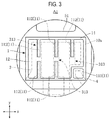
  • FIG. 3 is an enlarged view of a main enlarging part of FIG. 2 .
  • FIG. 4 is a bottom view illustrating the semiconductor device according to the first embodiment.
  • FIG. 5 is a cross-sectional view taken along line V-V in FIG. 2 .
  • FIG. 6 is a cross-sectional view taken along line VI-VI in FIG. 2 .
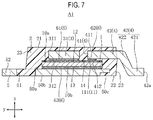
  • FIG. 7 is a cross-sectional view taken along line VII-VII in FIG. 2 .
  • FIG. 8 is an enlarged plan view of a main part illustrating a semiconductor element according to a modification example.
  • FIG. 9 is a cross-sectional view illustrating a semiconductor element according to a modification example.
  • FIG. 10 is an enlarged plan view of a main part illustrating a semiconductor element according to a modification example.
  • FIG. 11 is a cross-sectional view illustrating a semiconductor element according to a modification example.
  • FIG. 12 is a plan view (in which a sealing resin is transmitted) illustrating a semiconductor device according to a second embodiment of the present disclosure.
  • FIG. 13 is a cross-sectional view taken along line XIII-XIII in FIG. 12 .
  • FIG. 14 is a plan view illustrating a semiconductor device according to a third embodiment of the present disclosure.
  • FIG. 15 is a cross-sectional view taken along line XV-XV in FIG. 14 .
  • FIG. 16 is a plan view illustrating a semiconductor device according to a modification example of the third embodiment.
  • FIG. 17 is a cross-sectional view taken along line XVII-XVII in FIG. 16 .
  • FIG. 18 is a plan view (in which a sealing resin is transmitted) illustrating a semiconductor device according to a fourth embodiment of the present disclosure.
  • FIG. 19 is a cross-sectional view taken along line XIX-XIX in FIG. 18 .
  • FIG. 20 is a cross-sectional view taken along line XX-XX in FIG. 18 .
  • FIG. 21 is an enlarged plan view of a main part illustrating a semiconductor device according to a modification example.
  • FIGS. 1 to 7 illustrate a semiconductor device according to a first embodiment of the present disclosure.
  • a semiconductor device A 1 of the present embodiment includes a semiconductor element 1 , a sealing resin 2 , a first lead 3 , a second lead 4 , a third lead 5 , and a plurality of conductive binders 6 .
  • the semiconductor device A 1 is surface-mounted on circuit boards of various electronic devices or the like.
  • FIG. 1 is a plan view illustrating the semiconductor device A 1 .
  • FIG. 2 is a view in which the sealing resin 2 is transmitted in the plan view illustrated in FIG. 1 .
  • FIG. 3 is an enlarged view of a main enlarging part of FIG. 2 . In FIG. 3 , each conductive binder 6 is omitted and the first lead 3 and the second lead 4 are transmitted.
  • FIG. 4 is a bottom view illustrating the semiconductor device A 1 .
  • FIG. 5 is a cross-sectional view taken along line V-V shown in FIG. 2 .
  • FIG. 6 is a cross-sectional view taken along line VI-VI shown in FIG. 2 .
  • FIG. 7 is a cross-sectional view taken along line VII-VII shown in FIG. 2 .
  • the z direction is a thickness direction of the semiconductor device A 1 .
  • the x direction is a lateral direction in the plan view of the semiconductor device A 1 .
  • the y direction is a vertical direction in the plan view of the semiconductor device A 1 .
  • the x direction, the y direction, and the z direction correspond to a “second direction,” a “first direction,” and a “thickness direction,” respectively as described in the claims.
  • the semiconductor element 1 is an element that performs the electrical function of the semiconductor device A 1 .
  • the semiconductor element 1 is a three-terminal element including three electrodes, for example, a power MOSFET.
  • the semiconductor element 1 is not limited to the three-terminal element, but may be a two-terminal element such as a diode or the like.
  • the semiconductor element 1 has a rectangular shape as viewed in the z direction (hereinafter, also referred to as “as viewed from the plane”).
  • the dimension of the semiconductor element 1 as viewed from the plane is 0.05 to 0.3 mm square.
  • the semiconductor element 1 includes an element main surface 10 a and an element rear surface 10 b.
  • the element main surface 10 a and the element rear surface 10 b are separated in the z direction, and face opposite sides.
  • the element rear surface 10 b faces the circuit board. Both the element main surface 10 a and the element rear surface 10 b are flat.
  • the semiconductor element 1 includes a gate electrode 11 , a source electrode 12 , a drain electrode 13 , and a passivation film 14 .
  • the gate electrode 11 , the source electrode 12 , and the drain electrode 13 correspond to a “second electrode,” a “first electrode,” and a “third electrode,” respectively as described in the claims.
  • the passivation film 14 corresponds to an “insulating film” described in the claims.
  • the gate electrode 11 and the source electrode 12 are formed on the element main surface 10 a.
  • the area of the gate electrode 11 is smaller than the area of the source electrode 12 .
  • the drain electrode 13 is formed on the element rear surface 10 b.
  • the gate electrode 11 includes a pad electrode portion 111 and a plurality of finger electrode portions 112 .
  • the pad electrode portion 111 and the plurality of finger electrode portions 112 are electrically connected inside the semiconductor element 1 .
  • the pad electrode portion 111 is a portion for bonding the second lead 4 .
  • the pad electrode portion 111 has a rectangular shape as viewed from the plane.
  • Each finger electrode portion 112 serves to reduce the internal resistance (gate resistance) of the gate electrode 11 .
  • Each finger electrode portion 112 is covered with the passivation film 14 .
  • each finger electrode portion 112 is arranged inside the semiconductor element 1 .
  • each finger electrode portion 112 extends along the y direction, and has a rectangular shape as viewed from the plane.
  • three finger electrode portions 112 are arranged in the x direction on one side (upper side in FIG.
  • the source electrode 12 is divided into several parts by each finger electrode portion 112 .
  • the passivation film 14 is a protective film of the semiconductor element 1 formed so as to cover the element main surface 10 a.
  • the passivation film 14 is, for example, an Si 3 N 4 layer or an SiO 2 layer formed by a plasma CVD method, or a polyimide resin layer formed by coating. Or, it may be formed by a combination thereof. Both the pad electrode portion 111 of the gate electrode 11 and the source electrode 12 are exposed from the passivation film 14 .
  • the sealing resin 2 covers part of each of the first lead 3 , the second lead 4 , and the third lead 5 , and the semiconductor element 1 .
  • the sealing resin 2 is formed as, for example, a black epoxy resin.
  • the sealing resin 2 is formed by, for example, molding.
  • the sealing resin 2 has a rectangular shape as viewed from the plane. The material, forming method, and shape of the sealing resin 2 are not limited to those described above.
  • the sealing resin 2 includes a resin main surface 21 , a resin rear surface 22 , and a plurality of resin side surfaces 23 .
  • the resin main surface 21 and the resin rear surface 22 face opposite sides in the thickness direction z.
  • the resin main surface 21 faces the same direction as the element main surface 10 a.
  • the resin rear surface 22 faces the same direction as the element rear surface 10 b.
  • the plurality of resin side surfaces 23 are connected to the resin main surface 21 and the resin rear surface 22 .
  • each resin side surface 23 is orthogonal to both the resin main surface 21 and the resin rear surface 22 .
  • each resin side surface 23 is flat.
  • each resin side surface 23 may be slightly inclined with respect to the thickness direction z.
  • the first lead 3 , the second lead 4 , and the third lead 5 are each electrically connected to the semiconductor element 1 .
  • the first lead 3 , the second lead 4 , and the third lead 5 are made of metal.
  • the main component of the metal is copper (Cu), but it may be nickel (Ni), an alloy of Cu or Ni, a 42 alloy, or the like.
  • the respective materials of the first lead 3 , the second lead 4 , and the third lead 5 are not limited to those described above.
  • the first lead 3 , the second lead 4 , and the third lead 5 are formed in a predetermined shape by, for example, metal press working (stamping working).
  • the first lead 3 is a conductive member that is electrically connected to the source electrode 12 of the semiconductor element 1 .
  • the first lead 3 corresponds to a “first conductive member” described in the claims.
  • the first lead 3 includes a first pad part 31 , a plurality of first exposure parts 32 , and a plurality of first connection parts 33 .
  • the first pad part 31 is a part for bonding to the source electrode 12 of the semiconductor element 1 .
  • the first pad part 31 overlaps with the source electrode 12 as viewed from the plane.
  • the first pad part 31 is covered with the sealing resin 2 .
  • the first pad part 31 includes a first pad main surface 311 and a first pad bonding surface 312 , and further includes a plurality of recesses 313 .
  • the first pad main surface 311 faces the same direction as the element main surface 10 a of the semiconductor element 1 .
  • the first pad main surface 311 is flat. Furthermore, the first pad main surface 311 is covered with the sealing resin 2 .
  • the first pad bonding surface 312 faces the same direction as the element rear surface 10 b of the semiconductor element 1 . Therefore, the first pad bonding surface 312 faces the opposite side to the first pad main surface 311 .
  • the first pad bonding surface 312 faces the semiconductor element 1 and is bonded to the source electrode 12 via part of the conductive binder 6 (first binders 61 as described below).
  • the first pad bonding surface 312 corresponds to a “bonding surface” described in the claims.
  • Each of the plurality of recesses 313 is a portion recessed in the z direction from the first pad bonding surface 312 .
  • three recesses 313 are formed in the first pad part 31 .
  • each recess 313 extends in the y direction as viewed from the plane.
  • each recess 313 is connected from one end edge of the first pad part 31 in the y direction to the other end edge thereof in the y direction.
  • each recess 313 overlaps with the finger electrode portion 112 of the gate electrode 11 as viewed from the plane.
  • the recess 313 corresponds to a “non-bonding portion” described in the claims.
  • Each recess 313 includes a plurality of recess inner surfaces 313 a and recess bottom surfaces 313 b.
  • each recess 313 a each extend from the first pad bonding surface 312 toward the first pad main surface 311 .
  • each recess 313 includes two recess inner surfaces 313 a.
  • Each recess inner surface 313 a is flat.
  • Each recess inner surface 313 a is orthogonal to both the first pad bonding surface 312 and the recess bottom surface 313 b.
  • each recess inner surface 313 a may be a curved surface or may be inclined with respect to the z direction.
  • the recess inner surface 313 a corresponds to an “inner surface” described in the claims.
  • the recess bottom surface 313 b is connected to the plurality of recess inner surfaces 313 a in each recess 313 .
  • the recess bottom surface 313 b faces the same direction as the first pad bonding surface 312 and is arranged closer to the first pad main surface 311 side in the z direction than the first pad bonding surface 312 .
  • the recess bottom surface 313 b is flat.
  • the recess bottom surface 313 b is not limited to the flat surface, but may be, for example, a curved surface.
  • each of the plurality of first exposure parts 32 is exposed from the sealing resin 2 .
  • each first exposure part 32 protrudes from one (the lower side in the plan view (see FIG. 1 )) of two resin side surfaces 23 facing in the y direction of the sealing resin 2 as viewed from the plane.
  • there are three first exposure parts 32 but the number of the first exposure parts 32 is not limited.
  • the plurality of first exposure parts 32 are arranged in the x direction.
  • the plurality of first exposure parts 32 overlap with each other as viewed in the x direction.
  • each first exposure part 32 includes a first leading end surface 32 a.
  • the first leading end surface 32 a is a surface that faces one side (the lower side in FIG.
  • each first exposure part 32 is covered with plating (not shown) except each first leading end surface 32 a. Therefore, a base material (Cu in the present embodiment) of the first lead 3 is exposed on each first leading end surface 32 a. Also, each first leading end surface 32 a may be covered with plating.
  • Each first exposure part 32 includes a first terminal part 321 and a first bent part 322 .
  • Each first terminal part 321 functions as a terminal for mounting the semiconductor device A 1 on a circuit board or the like.
  • each first terminal part 321 is a source terminal of the semiconductor device A 1 .
  • each first bent part 322 in the y direction is connected to the first connection part 33 and the other end edge thereof in the y direction is connected to the first terminal part 321 , as viewed from the plane.
  • Each first bent part 322 is bent in the z direction.
  • Each first bent part 322 is bent in a gull wing shape.
  • Each of the plurality of first connection parts 33 is covered with the sealing resin 2 .
  • Each first connection part 33 connects the first pad part 31 and each first exposure part 32 .
  • Each first connection part 33 is formed for each first exposure part 32 .
  • there are also three first connection parts 33 since there are three first exposure parts 32 , there are also three first connection parts 33 .
  • Each first connection part 33 is located in a direction in which the element main surface 10 a faces, rather than each first terminal part 321 in the z direction.
  • the second lead 4 is a conductive member that is electrically connected to the gate electrode 11 of the semiconductor element 1 .
  • the second lead 4 corresponds to a “second conductive member” described in the claims.
  • the second lead 4 includes a second pad part 41 , a second exposure part 42 , and a second connection part 43 .
  • the second pad part 41 is a part for bonding to the gate electrode 11 (the pad electrode portion 111 ) of the semiconductor element 1 .
  • the second pad part 41 overlaps with the gate electrode 11 of the semiconductor element 1 as viewed from the plane.
  • the second pad part 41 is covered with the sealing resin 2 .
  • the second pad part 41 has a rectangular shape as viewed from the plane.
  • the second pad part 41 includes a second pad main surface 411 and a second pad bonding surface 412 .
  • the second pad main surface 411 faces the same direction as the element main surface 10 a of the semiconductor element 1 .
  • the second pad main surface 411 is flat. Furthermore, the second pad main surface 411 is covered with the sealing resin 2 .
  • the second pad bonding surface 412 faces in the same direction as the element rear surface 10 b of the semiconductor element 1 . Therefore, the second pad bonding surface 412 faces the opposite side to the second pad main surface 411 .
  • the second pad bonding surface 412 faces the semiconductor element 1 and is bonded to the gate electrode 11 via part of the conductive binder 6 (a second binder 62 as described below).
  • the second exposure part 42 is exposed from the sealing resin 2 .
  • the second exposure part 42 protrudes from one (the lower side in the plan view (see FIG. 1 )) of the two resin side surfaces 23 facing the y direction of the sealing resin 2 as viewed from the plane.
  • the second exposure part 42 overlaps with each first exposure part 32 as viewed in the x direction.
  • the second exposure part 42 includes a second leading end surface 42 a.
  • the second leading end surface 42 a is a surface that faces one side (the lower side in FIG. 1 ) in the y direction.
  • the second exposure part 42 is covered with plating (not shown) except the second leading end surface 42 a.
  • a base material (Cu in the present embodiment) of the second lead 4 is exposed on the second leading end surface 42 a.
  • the second leading end surface 42 a may be covered with plating.
  • the second exposure part 42 includes a second terminal part 421 and a second bent part 422 .
  • the second terminal part 421 functions as a terminal for mounting the semiconductor device A 1 on a circuit board or the like.
  • the second terminal part 421 is a gate terminal of the semiconductor device A 1 .
  • One end edge of the second bent part 422 in the y direction is connected to the second connection part 43 and the other end edge thereof in the y direction is connected to the second terminal part 421 , as viewed from the plane.
  • the second bent part 422 is bent in the z direction.
  • the second bent part 422 is bent in a gull wing shape.
  • the second connection part 43 is covered with the sealing resin 2 .
  • the second connection part 43 connects the second pad part 41 and the second exposure part 42 .
  • the second connection part 43 is located in a direction in which the element main surface 10 a faces, rather than the second terminal part 421 in the z direction.
  • the third lead 5 is a conductive member that is electrically connected to the drain electrode 13 of the semiconductor element 1 .
  • the third lead 5 corresponds to a “third conductive member” described in the claims.
  • the third lead 5 is plate-shaped, and has a rectangular shape as viewed from the plane.
  • the third lead 5 includes a loading surface 50 a, a mounting surface 50 b, and a mounting surface side recess 50 c.
  • the loading surface 50 a and the mounting surface 50 b are separated from each other and face opposite sides in the z direction.
  • the loading surface 50 a faces the same direction as the element main surface 10 a of the semiconductor element 1 .
  • the semiconductor element 1 is loaded on the loading surface 50 a.
  • the loading surface 50 a is covered with the sealing resin 2 .
  • the loading surface 50 a is flat.
  • the mounting surface 50 b faces the same direction as the element rear surface 10 b of the semiconductor element 1 .
  • the mounting surface 50 b faces the circuit board.
  • the mounting surface 50 b is exposed from the sealing resin 2 .
  • the mounting surface 50 b is flat.
  • the mounting surface 50 b becomes a drain terminal of the semiconductor device A 1 .
  • the mounting surface side recess 50 c is a portion recessed in the z direction from the mounting surface 50 b.
  • the mounting surface side recess 50 c is a portion of the third lead 5 , which overlaps with the sealing resin 2 as viewed from the plane, and is formed on the outer side.
  • the third lead 5 includes a thick portion and a thin portion.
  • the mounting surface side recess 50 c is covered with the sealing resin 2 .
  • the third lead 5 may not include the mounting surface side recess 50 c. However, the third lead 5 can be suppressed from coming off from the sealing resin 2 by the presence of the mounting surface side recess 50 c in the third lead 5 .
  • the third lead 5 includes a third exposure part 52 exposed from the sealing resin 2 as viewed from the plane.
  • the third exposure part 52 includes a pair of exposed side surfaces 521 .
  • the pair of exposed side surfaces 521 respectively face opposite sides in the x direction.
  • Each of the pair of exposed side surfaces 521 includes an exposed side surface first portion 521 a and an exposed side surface second portion 521 b.
  • the exposed side surface first portion 521 a is flat.
  • the exposed side surface second portion 521 b is connected to the exposed side surface first portion 521 a, and is recessed inward from the exposed side surface first portion 521 a as viewed from the plane.
  • a through hole 51 is formed in the third lead 5 .
  • the through hole 51 may not be formed.
  • the through hole 51 is filled with the sealing resin 2 .
  • the through hole 51 has a rectangular shape as viewed from the plane, but the shape as viewed from the plane is not limited.
  • the through hole 51 is connected from the loading surface 50 a to the mounting surface 50 b in the z direction.
  • the plurality of first terminal parts 321 and the second terminal part 421 overlap with each other as viewed in the x direction.
  • the plurality of first terminal parts 321 and the second terminal part 421 each overlap with the third lead 5 as viewed in the y direction.
  • the lower surfaces of the plurality of first terminal parts 321 in the z direction (the surfaces facing the same direction as the element rear surface 10 b ), the lower surface of the second terminal part 421 in the z direction (the surface facing the same direction as the element rear surface 10 b ), and the mounting surface 50 b of the third lead 5 are arranged at substantially the same position in the z direction. Therefore, the semiconductor device A 1 can be surface-mounted on the circuit board and the semiconductor device A 1 can be surface-mounted in a stable posture.
  • the semiconductor element 1 is held by the first lead 3 and the second lead 4 , and the third lead 5 .
  • the plurality of conductive binders 6 are made of, for example, solder or Ag paste.
  • the material of each of the conductive binders 6 is not limited to the aforementioned ones.
  • the plurality of conductive binders 6 include a plurality of first binders 61 , a second binder 62 , and a third binder 63 .
  • Each of the plurality of first binders 61 bonds the first pad part 31 and the source electrode 12 and electrically connects them.
  • each first binder 61 is interposed between the first pad bonding surface 312 of the first pad part 31 and the source electrode 12 .
  • the second binder 62 bonds the second pad part 41 and the gate electrode 11 and electrically connects them.
  • the second binder 62 is interposed between the second pad bonding surface 412 of the second pad part 41 and the pad electrode portion 111 of the gate electrode 11 .
  • the third binder 63 bonds the third lead 5 (loading surface 50 a ) and the drain electrode 13 and electrically connects them.
  • the third binder 63 is interposed between the loading surface 50 a of the third lead 5 and the drain electrode 13 .
  • the first pad part 31 of the first lead 3 includes the plurality of recesses 313 .
  • a non-bonding portion that is not bonded to the source electrode 12 of the semiconductor element 1 is formed in the first pad part 31 .
  • This makes it possible to alleviate the stress applied to the semiconductor element 1 by, for example, a difference in thermal expansion coefficients of the first lead 3 and the semiconductor element 1 . Accordingly, since damage to the semiconductor element 1 can be prevented, the reliability of the semiconductor device A 1 is improved.
  • the semiconductor device A 1 the plurality of recesses 313 formed in the first pad part 31 of the first lead 3 overlap with the finger electrode portions 112 of the gate electrode 11 of the semiconductor element 1 as viewed from the plane.
  • a binder is arranged on (bonded to) almost the entire surface of the source electrode 12 .
  • the conductive binder 6 (the first binder 61 ) is also arranged on the passivation film 14 covering the finger electrode portion 112 .
  • the semiconductor element 1 may be damaged by a difference in thermal expansion coefficients caused by a difference in materials of the passivation film 14 and the first binder 61 .
  • the first binder 61 is not arranged on the passivation film 14 by each recess 313 formed in the first pad part 31 .
  • the semiconductor element 1 is prevented from being damaged.
  • the three recesses 313 are formed in the first pad part 31 .
  • the dimension of the semiconductor element 1 as viewed from the plane is about 0.05 to 0.3 mm square.
  • the number of the finger electrode portions 112 arranged in the x direction is often three or smaller. That is, the number of the finger electrode portions 112 arranged in the x direction may be one or two.
  • FIGS. 8 and 9 illustrate a case where the number of the finger electrode portions 112 arranged in the x direction is one
  • FIGS. 10 and 11 illustrate a case where the number of the finger electrode portions 112 arranged in the x direction is two.
  • FIGS. 8 and 9 illustrate a case where the number of the finger electrode portions 112 arranged in the x direction is one
  • FIGS. 10 and 11 illustrate a case where the number of the finger electrode portions 112 arranged in the x direction is two.
  • FIGS. 9 and 11 are cross-sectional views (see FIG. 6 ) corresponding to the cross section taken along line VI-VI in FIG. 2 .
  • the finger electrode portions 112 overlap with any of the plurality of recesses 313 as viewed from the plane. Therefore, the first lead 3 having the aforementioned shape can be used regardless of the arrangement of the finger electrode portions 112 of the gate electrode 11 formed in the semiconductor element 1 .
  • the first lead 3 since there is no need to change the arrangement of the plurality of recesses 313 formed in the first lead 3 according to the semiconductor element 1 , the first lead 3 does not need to be redesigned according to the semiconductor element 1 to be used.
  • the semiconductor element 1 includes one finger electrode portion 112
  • the first pad part 31 can be designed so that one recess 313 is arranged on the one finger electrode portion 112 .
  • the first lead 3 thus designed, when the semiconductor element 1 includes two finger electrode portions 112 , it cannot be used as it is and the first pad part 31 needs to be designed so that two recesses 313 are arranged according to the arrangement of the two finger electrode portions 112 .
  • the first lead 3 (the arrangement of the recesses 313 of the first pad part 31 ) needs to be uniformly designed according to the finger electrode portions 112 installed in the semiconductor element 1 .
  • the semiconductor device A 1 the plurality of recesses 313 are formed in the first pad part 31 . Therefore, even in the case of the semiconductor element 1 in which the number and arrangement of the finger electrode portions 112 are different, the first lead 3 can be diverted. Thus, it is possible to improve the productivity of the semiconductor device A 1 by using the first lead 3 including the first pad part 31 in which the plurality of recesses 313 are formed.
  • the plurality of recesses 313 are formed in the first pad part 31 .
  • the first lead 3 is directly bonded to the source electrode 12 of the semiconductor element 1 .
  • the second lead 4 is directly bonded to the gate electrode 11 of the semiconductor element 1 .
  • the first lead 3 includes the first exposure part 32 exposed from the sealing resin 2 and the first exposure part 32 is bent by the first bent part 322 .
  • the first bent part 322 it is possible to alleviate the stress applied when the semiconductor device A 1 is mounted on the circuit board by the first bent part 322 .
  • each finger electrode portion 112 has a rectangular shape extending in the y direction, but the shape of each finger electrode portion 112 is not limited thereto.
  • the finger electrode portion 112 may be formed in a region, which overlaps with the non-bonding portion (recess 313 ) of the first pad part 31 , of the source electrode 12 as viewed from the plane. That is, the finger electrode portion 112 can be freely arranged as long as it is within a region that overlaps with the non-bonding portion (recess 313 ) as viewed from the plane.
  • FIGS. 12 and 13 illustrate a semiconductor device according to a second embodiment of the present disclosure.
  • a semiconductor device A 2 of the present embodiment is different from the semiconductor device A 1 (the first embodiment) in that a plurality of through holes 314 , instead of the plurality of recesses 313 , are formed in the first pad part 31 .
  • FIG. 12 is a plan view illustrating the semiconductor device A 2 .
  • the sealing resin 2 is transmitted.
  • FIG. 13 is a cross-sectional view taken along line XIII-XIII in FIG. 12 .
  • FIG. 13 corresponds to the cross section illustrated in FIG. 6 in the first embodiment.
  • each through hole 314 has a rectangular shape extending in the y direction as viewed from the plane.
  • the shape of each through hole 314 as viewed from the plane is not limited to the rectangular shape, but may be a polygonal shape, a circular shape, or the like.
  • each through hole 314 includes a through hole inner surface 314 a.
  • the through hole inner surface 314 a is connected from the first pad bonding surface 312 to the first pad main surface 311 in the z direction.
  • the through hole inner surface 314 a is flat.
  • the through hole inner surface 314 a is orthogonal to each of the first pad bonding surface 312 and the first pad main surface 311 . Therefore, the through hole inner surface 314 a is parallel to the z direction. Also, the through hole inner surface 314 a may be inclined with respect to the z direction.
  • the through hole 314 corresponds to a “non-bonding portion” described in the claims
  • the through hole inner surface 314 a corresponds to an “inner surface” described in the claims.
  • the first pad part 31 of the first lead 3 includes the plurality of through holes 314 .
  • a non-bonding portion that is not bonded to the source electrode 12 of the semiconductor element 1 is formed in the first pad part 31 . Therefore, similar to the semiconductor device A 1 , since the semiconductor device A 2 can prevent the semiconductor element 1 from being damaged, the reliability of the semiconductor device A 2 is improved. Furthermore, in the semiconductor device A 2 , the portion configured in the same manner as the semiconductor device A 1 can have the same effects as those of the semiconductor device A 1 .
  • the plurality of through holes 314 are formed in the first pad part 31 . Therefore, similar to the plurality of recesses 313 , it is possible to reduce the sectional area of the first pad part 31 in the x-z plane and to increase the surface area thereof. Thus, when a current with a high frequency flows, it is possible to reduce the resistance by a skin effect.
  • the semiconductor element 1 when an electric power is supplied to the semiconductor device A 2 , the semiconductor element 1 generates heat and the heat generated from the semiconductor element 1 is transferred to the first pad part 31 .
  • the through holes 314 are formed, and the volume thereof is reduced compared with the first pad part 31 in which the recesses 313 are formed as in the first embodiment. Therefore, the path through which the heat generated from the semiconductor element 1 is transferred is decreased.
  • the case where the plurality of recesses 313 are formed in the first pad part 31 can improve the heat dissipation of the heat generated from the semiconductor element 1 , compared with the case where the plurality of through holes 314 are formed.
  • FIGS. 14 and 15 illustrate a semiconductor device according to a third embodiment of the present disclosure.
  • a semiconductor device A 3 of the present embodiment is different from the semiconductor device A 1 (the first embodiment) in that part of the first pad main surface 311 of the first pad part 31 is exposed.
  • FIG. 14 is a plan view illustrating the semiconductor device A 3 .
  • FIG. 15 is a cross-sectional view taken along line XV-XV in FIG. 14 .
  • FIG. 15 corresponds to the cross section illustrated in FIG. 6 in the first embodiment.
  • the sealing resin 2 includes a resin recess 25 recessed in the z direction from the resin main surface 21 .
  • the resin main surface 21 of the sealing resin 2 is opened by the resin recess 25 .
  • the resin recess 25 has a rectangular shape as viewed from the plane.
  • the resin recess 25 exposes part of the first pad main surface 311 of the first pad part 31 .
  • the resin recess 25 includes a resin recess bottom surface 25 a and a resin recess side surface 25 b.
  • the resin recess bottom surface 25 a faces the same direction as the element main surface 10 a of the semiconductor element 1 . As illustrated in FIG. 15 , the resin recess bottom surface 25 a is located between the resin main surface 21 and the resin rear surface 22 in the z direction. The resin recess bottom surface 25 a and the first pad main surface 311 are flush with each other as illustrated in FIG. 15 .
  • One end edge of the resin recess side surface 25 b is connected to the resin main surface 21 and the other end edge thereof is connected to the resin recess bottom surface 25 a in the z direction. However, in the present embodiment, part of the other end edge is in contact with the first pad main surface 311 on the resin recess side surface 25 b on the lower side in the y direction in FIG. 14 .
  • the resin recess side surface 25 b is flat. In the present embodiment, the resin recess side surface 25 b is orthogonal to both the resin main surface 21 and the resin recess bottom surface 25 a.
  • the resin recess side surface 25 b is parallel to the z direction. Also, the resin recess side surface 25 b may be inclined with respect to the z direction.
  • the first pad part 31 of the first lead 3 includes a plurality of recesses 313 .
  • a non-bonding portion that is not bonded to the source electrode 12 of the semiconductor element 1 is formed in the first pad part 31 . Therefore, similar to the semiconductor device A 1 , since the semiconductor device A 3 can prevent the semiconductor element 1 from being damaged, the reliability of the semiconductor device A 3 is improved. Furthermore, in the semiconductor device A 3 , the portion configured in the same manner as the semiconductor devices A 1 and A 2 can have the same effects as those of the semiconductor devices A 1 and A 2 .
  • the resin recess 25 is formed in the sealing resin 2 , and part of the first pad main surface 311 of the first pad part 31 is exposed from the sealing resin 2 in the resin recess 25 .
  • heat generated from the semiconductor element 1 is transferred to the first pad part 31 . Therefore, the heat generated from the semiconductor element 1 can be efficiently released to the outside by exposing part of the first pad main surface 311 from the sealing resin 2 as described above. That is, the semiconductor device A 3 is improved in heat dissipation compared with the semiconductor device A 1 .
  • FIGS. 16 and 17 illustrate a semiconductor device A 3 ′ according to such a modification example.
  • FIG. 16 is a plan view illustrating the semiconductor device A 3 ′, and corresponds to FIG. 14 .
  • FIG. 17 is a cross-sectional view taken along line XVII-XVII in FIG. 16 , and corresponds to FIG. 15 .
  • one end edge of the resin recess side surface 25 b of the resin recess 25 is connected to the resin main surface 21 and the other end edge thereof is in contact with the first pad main surface 311 in the z direction. Even in such a case, the same effects as those of the semiconductor device A 3 can be obtained.
  • the present disclosure is not limited thereto.
  • at least part of the first pad main surface 311 may be exposed by reducing the thickness of the sealing resin 2 as a whole.
  • the resin main surface 21 and the first pad main surface 311 are flush with each other.
  • the second pad main surface 411 of the second lead 4 is similarly exposed from the sealing resin 2 .
  • measures may be taken as follows: the second pad main surface 411 is covered with an insulator, the second pad main surface 411 is located below the first pad main surface 311 in the z direction so that the second pad main surface 411 is not exposed from the sealing resin 2 , and the like.
  • FIGS. 18 to 20 illustrate a semiconductor device according to a fourth embodiment of the present disclosure.
  • a semiconductor device A 4 of the present embodiment is different from the semiconductor device A 1 (the first embodiment) in that the first lead 3 and the source electrode 12 of the semiconductor element 1 are electrically connected by means of a plate-shaped metal member 7 (hereinafter, referred to as a “strap member”).
  • FIG. 18 is a plan view illustrating the semiconductor device A 4 .
  • the sealing resin 2 is transmitted.
  • FIG. 19 is a cross-sectional view taken along line XIX-XIX in FIG. 18 .
  • FIG. 19 corresponds to the cross section illustrated in FIG. 6 of the first embodiment.
  • FIG. 20 is a cross-sectional view taken along line XX-XX in FIG. 18 .
  • the first lead 3 includes a belt-shaped portion 34 , a plurality of first exposure parts 32 , and a plurality of first connection parts 33 .
  • the belt-shaped portion 34 is a portion to which the strap member 7 is bonded.
  • the belt-shaped portion 34 has a rectangular shape extending in the x direction as viewed from the plane.
  • each first connection part 33 is connected to the belt-shaped portion 34 and each first exposure part 32 .
  • Each first connection part 33 extends from an edge on one side (the lower side in FIG. 18 ) of the belt-shaped portion 34 in the y direction.
  • the strap member 7 is a plate-shaped metal member as described above. In the present embodiment, the strap member 7 is boned to each of the belt-shaped portion 34 of the first lead 3 and the source electrode 12 of the semiconductor element 1 . The strap member 7 is entirely covered with the sealing resin 2 . In the present embodiment, the strap member 7 corresponds to the “first conductive member” described in the claims.
  • the strap member 7 includes a first clip bond part 71 , a second clip bond part 72 , and a bent part 73 .
  • the first clip bond part 71 is a part for bonding to the source electrode 12 of the semiconductor element 1 .
  • the first clip bond part 71 is configured similarly to the first pad part 31 of the first lead 3 .
  • the first clip bond part 71 corresponds to a “first pad part” described in the claims.
  • the first clip bond part 71 includes a strap main surface 711 , a strap bonding surface 712 , and a plurality of recesses 713 .
  • the strap main surface 711 , the strap bonding surface 712 , and the plurality of recesses 713 are configured similarly to the first pad main surface 311 , the first pad bonding surface 312 , and the plurality of recesses 313 of the first pad part 31 , respectively.
  • the strap bonding surface 712 corresponds to the “bonding surface” described in the claims.
  • the semiconductor element 1 is sandwiched between the first clip bond part 71 of the strap member 7 and the third lead 5 .
  • the second clip bond part 72 is a part for bonding to the belt-shaped portion 34 of the first lead 3 .
  • the second clip bond part 72 is bonded to the belt-shaped portion 34 via a conductive binder 6 (fourth binder 64 ).
  • the fourth binder 64 is made of, for example, solder or Ag paste. The material of the fourth binder 64 is not limited thereto.
  • the bent part 73 is connected to the first clip bond part 71 and the second clip bond part 72 .
  • the first clip bond part 71 and the second clip bond part 72 are arranged at different positions in the z direction. Therefore, the bent part 73 is bent in the z direction so as to connect them.
  • the first clip bond part 71 of the strap member 7 includes the plurality of recesses 713 .
  • a non-bonding portion that is not bonded to the source electrode 12 of the semiconductor element 1 is formed in the first clip bond part 71 .
  • the portion configured in the same manner as the semiconductor devices A 1 to A 3 can have the same effects as those of the semiconductor devices A 1 to A 3 .
  • the present disclosure is not limited thereto.
  • the second lead 4 and the gate electrode 11 may be connected by a strap member similar to the strap member 7 .
  • a plurality of through holes 314 may be formed instead of the plurality of recesses 313 .
  • the packages of the semiconductor devices A 1 to A 4 are not limited to those illustrated in the drawings.
  • the semiconductor device according to the present disclosure may be any other surface-mounted package or pin-inserted package, or the like.
  • the non-bonding portion (the recess 313 or the through hole 314 ) of the first pad part 31 overlaps with the finger electrode portion 112 of the gate electrode 11 as viewed from the plane, but the present disclosure is not limited thereto.
  • the semiconductor element 1 when there is a region which is not intended to be bonded by the first pad part 31 , it may be configured so that the non-bonding portion overlaps with the region. An example of such a modification example will be described below with reference to FIG. 21 .
  • FIG. 21 is an enlarged plan view of a main part according to the modification example, and corresponds to FIG. 3 in the first embodiment.
  • the gate electrode 11 , the source electrode 12 , and the drain electrode 13 are formed together on the element main surface 10 a. Furthermore, in the element main surface 10 a, the source electrode 12 and the drain electrode 13 are each formed in a comb shape.
  • the source electrode 12 includes a pad electrode portion 121 and a plurality of finger electrode portions 122 .
  • the pad electrode portion 121 has a rectangular shape extending in the x direction as viewed from the plane.
  • the plurality of finger electrode portions 122 have a rectangular shape as viewed from the plane and extend in the y direction from an edge on one side (the upper side in FIG. 21 ) of the pad electrode portion 121 in the y direction. Both the pad electrode portion 121 and the plurality of finger electrode portions 122 are exposed from the passivation film 14 .
  • the drain electrode 13 includes a pad electrode portion 131 and a plurality of finger electrode portions 132 .
  • the pad electrode portion 131 has a rectangular shape extending in the x direction as viewed from the plane.
  • the pad electrode portion 131 and the third lead 5 (loading surface 50 a ) are bonded by a strap member 7 ′.
  • the present disclosure is not limited to the strap member 7 ′ but it may be a bonding wire or a bonding ribbon.
  • the plurality of finger electrode portions 132 are rectangular as viewed from the plane and extend in the y direction from an edge on one side (the lower side in FIG. 21 ) of the pad electrode portion 131 in the y direction. Both the pad electrode portion 131 and the plurality of finger electrode portions 132 are exposed from the passivation film 14 .
  • the plurality of finger electrode portions 122 and the plurality of finger electrode portions 132 are alternately arranged in the x direction. In addition, the separation distances between adjacent finger electrode portions 122 and finger electrode portions 132 are all equal.
  • the source electrode 12 thus configured is entirely bonded to the first pad part 31 having no non-bonding portion (for example, the plurality of recesses 313 ) as in the conventional art, it is also bonded to the drain electrode 13 . As a result, the source electrode 12 and the drain electrode 13 are short-circuited.
  • a non-bonding portion (for example, the plurality of recesses 313 ) is formed in the first pad part 31 , and the non-bonded portion overlaps with the finger electrode portion 132 of the drain electrode 13 as viewed from the plane.
  • the first pad part 31 is bonded to the finger electrode portion 122 of the source electrode 12 , and the first pad part 31 is not bonded to the finger electrode portion 132 of the drain electrode 13 .
  • the first pad part 31 is bonded to the finger electrode portion 122 of the source electrode 12 , and the first pad part 31 is not bonded to the finger electrode portion 132 of the drain electrode 13 .
  • the non-bonding portion (the plurality of recesses 313 ) of the first pad part 31 is not connected to an edge on one side (the lower side in FIG. 21 ) of the first pad part 31 in the y direction.
  • the first pad part 31 can be bonded to substantially the entire surface of the pad electrode portion 121 of the source electrode 12 . Therefore, since the first pad part 31 is bonded to substantially the entire surface of the pad electrode portion 121 of the source electrode 12 and the plurality of finger electrode portions 122 , it is possible to reduce the internal resistance.
  • the non-bonding portion (the plurality of recesses 313 ) of the first pad part 31 overlaps with the finger electrode portion 112 of the gate electrode 11 as viewed from the plane. Therefore, it is possible to suppress the semiconductor element 1 from being damaged due to a difference in thermal expansion coefficients of the passivation film 14 covering the finger electrode portion 112 of the gate electrode 11 and the first binder 61 .
  • the drain electrode 13 is formed on the upper side as illustrated in FIG. 21 and the source electrode 12 is formed on the lower side as illustrated in FIG. 21 , but they may be opposite. That is, the source electrode 12 is formed on the upper side as illustrated in FIG. 21 , and the drain electrode 13 may be formed on the lower side as illustrated in FIG. 21 . In this case, the first terminal part 321 of the first lead 3 becomes the drain terminal.
  • the semiconductor device according to the present disclosure is not limited to the aforementioned embodiments.
  • the specific configuration of each part of the semiconductor device according to the present disclosure may be differently modified in design.

Landscapes

  • Physics & Mathematics (AREA)
  • Condensed Matter Physics & Semiconductors (AREA)
  • General Physics & Mathematics (AREA)
  • Engineering & Computer Science (AREA)
  • Computer Hardware Design (AREA)
  • Microelectronics & Electronic Packaging (AREA)
  • Power Engineering (AREA)
  • Structures Or Materials For Encapsulating Or Coating Semiconductor Devices Or Solid State Devices (AREA)
  • Geometry (AREA)

Abstract

There is provided a semiconductor device, including: a semiconductor element which includes an element main surface and an element rear surface that face opposite sides in a thickness direction and in which a first electrode and a second electrode are formed on the element main surface; a first conductive member electrically connected to the first electrode; a second conductive member electrically connected to the second electrode; and a sealing resin configured to cover part of the first conductive member, part of the second conductive member, and the semiconductor element.

Description

CROSS-REFERENCE TO RELATED APPLICATION
This application is based upon and claims the benefit of priority from Japanese Patent Application No. 2018-082981, filed on Apr. 24, 2018, the entire contents of which are incorporated herein by reference.
TECHNICAL FIELD
The present disclosure relates to a semiconductor device including a semiconductor element.
BACKGROUND
Various configurations of semiconductor devices have been proposed. As an example of a conventional semiconductor device, the semiconductor device includes a semiconductor element, a plurality of leads, a conductive metal plate (hereinafter, referred to as a “strap member”), and a sealing resin. The semiconductor element is electrically connected to each of the plurality of leads, and is electrically connected to one of the plurality of leads via the strap member. The strap member is bonded so as to cover almost the entire surface of an electrode formed on an upper surface of the semiconductor element. The sealing resin covers the semiconductor element, part of the plurality of leads, and the strap member.
In the conventional semiconductor device, the thermal expansion coefficients of the strap member and the semiconductor element are not necessarily equal. Therefore, thermal stress caused by a difference in the thermal expansion coefficients is generated in a region where the strap member and the semiconductor element are bonded, and the semiconductor element may be damaged. Thus, there is a possibility that the reliability of the semiconductor device is deteriorated.
SUMMARY
Some embodiments of the present disclosure provide a semiconductor device with improved reliability.
According to one embodiment of the present disclosure, there is provided a semiconductor device, including: a semiconductor element which includes an element main surface and an element rear surface that face opposite sides in a thickness direction and in which a first electrode and a second electrode are formed on the element main surface; a first conductive member electrically connected to the first electrode; a second conductive member electrically connected to the second electrode; and a sealing resin configured to cover part of the first conductive member, part of the second conductive member, and the semiconductor element, wherein the first conductive member includes a first pad part overlapping with the semiconductor element as viewed in the thickness direction, and wherein the first pad part includes: a bonding surface bonded to the first electrode; a first pad main surface facing a direction opposite to the bonding surface in the thickness direction; and a non-bonding portion which includes an inner surface extending from the bonding surface toward the first pad main surface and is not bonded to the first electrode.
According to one embodiment of the present disclosure, the second electrode includes: a pad electrode portion to which the second conductive member is bonded; and a finger electrode portion for reducing an internal resistance of the second electrode, and the non-bonding portion is configured to overlap with the finger electrode portion as viewed in the thickness direction.
According to one embodiment of the present disclosure, the semiconductor element includes an insulating film configured to cover the finger electrode portion.
According to one embodiment of the present disclosure, the semiconductor element is 0.05 to 0.3 mm square as viewed in the thickness direction.
According to one embodiment of the present disclosure, the first conductive member further includes: a first exposure part protruding from the sealing resin as viewed in the thickness direction; and a first connection part which is covered with the sealing resin and is connected to the first pad part and the first exposure part.
According to one embodiment of the present disclosure, the first exposure part includes: a first bent part which is connected to the first connection part and is bent in the thickness direction; and a first terminal part connected to the first bent part.
According to one embodiment of the present disclosure, the device further includes a third conductive member on which the semiconductor element is mounted, wherein a third electrode is formed on the element rear surface of the semiconductor element, and wherein the third conductive member is electrically connected to the third electrode.
According to one embodiment of the present disclosure, the sealing resin includes a resin rear surface facing the same direction as the element rear surface, the third conductive member includes a mounting surface facing the same direction as the element rear surface and exposed from the resin rear surface, and the first terminal part is configured to overlap with the third conductive member as viewed in a first direction orthogonal to the thickness direction.
According to one embodiment of the present disclosure, the second conductive member includes: a second pad part bonded to the second electrode; a second exposure part protruding from the sealing resin as viewed in the thickness direction; and a second connection part covered with the sealing resin and connected to the second pad part and the second exposure part.
According to one embodiment of the present disclosure, the second exposure part includes: a second bent part connected to the second connection part and bent in the thickness direction; and a second terminal part connected to the second bent part.
According to one embodiment of the present disclosure, the second terminal part is configured to overlap with the third conductive member as viewed in the first direction.
According to one embodiment of the present disclosure, the non-bonding portion further includes a bottom surface connected to the inner surface and facing the same direction as the bonding surface.
According to one embodiment of the present disclosure, the non-bonding portion includes a plurality of recesses, and each of the plurality of recesses extends in a first direction orthogonal to the thickness direction and is arranged in a second direction orthogonal to both the thickness direction and the first direction.
According to one embodiment of the present disclosure, each of the plurality of recesses is connected from an edge on a first side of the first pad part in the first direction to an edge on a second side of the first pad part in the first direction.
According to one embodiment of the present disclosure, at least part of the first pad main surface is exposed from the sealing resin. The sealing resin includes: a resin main surface facing the same direction as the element main surface; and a resin recess recessed from the resin main surface. The resin recess includes: a resin recess bottom surface; and a resin recess side surface connected to the resin recess bottom surface and the resin main surface. The resin recess bottom surface and the first pad main surface are flush with each other.
According to one embodiment of the present disclosure, the semiconductor element is a power MOSFET, the first electrode is a source electrode, and the second electrode is a gate electrode.
BRIEF DESCRIPTION OF DRAWINGS
FIG. 1 is a plan view illustrating a semiconductor device according to a first embodiment of the present disclosure.
FIG. 2 is a view in which a sealing resin is transmitted in the plan view illustrated in FIG. 1.
FIG. 3 is an enlarged view of a main enlarging part of FIG. 2.
FIG. 4 is a bottom view illustrating the semiconductor device according to the first embodiment.
FIG. 5 is a cross-sectional view taken along line V-V in FIG. 2.
FIG. 6 is a cross-sectional view taken along line VI-VI in FIG. 2.
FIG. 7 is a cross-sectional view taken along line VII-VII in FIG. 2.
FIG. 8 is an enlarged plan view of a main part illustrating a semiconductor element according to a modification example.
FIG. 9 is a cross-sectional view illustrating a semiconductor element according to a modification example.
FIG. 10 is an enlarged plan view of a main part illustrating a semiconductor element according to a modification example.
FIG. 11 is a cross-sectional view illustrating a semiconductor element according to a modification example.
FIG. 12 is a plan view (in which a sealing resin is transmitted) illustrating a semiconductor device according to a second embodiment of the present disclosure.
FIG. 13 is a cross-sectional view taken along line XIII-XIII in FIG. 12.
FIG. 14 is a plan view illustrating a semiconductor device according to a third embodiment of the present disclosure.
FIG. 15 is a cross-sectional view taken along line XV-XV in FIG. 14.
FIG. 16 is a plan view illustrating a semiconductor device according to a modification example of the third embodiment.
FIG. 17 is a cross-sectional view taken along line XVII-XVII in FIG. 16.
FIG. 18 is a plan view (in which a sealing resin is transmitted) illustrating a semiconductor device according to a fourth embodiment of the present disclosure.
FIG. 19 is a cross-sectional view taken along line XIX-XIX in FIG. 18.
FIG. 20 is a cross-sectional view taken along line XX-XX in FIG. 18.
FIG. 21 is an enlarged plan view of a main part illustrating a semiconductor device according to a modification example.
DETAILED DESCRIPTION
Embodiments of a semiconductor device according to the present disclosure will now be described in detail with reference to the drawings.
FIGS. 1 to 7 illustrate a semiconductor device according to a first embodiment of the present disclosure. A semiconductor device A1 of the present embodiment includes a semiconductor element 1, a sealing resin 2, a first lead 3, a second lead 4, a third lead 5, and a plurality of conductive binders 6. The semiconductor device A1 is surface-mounted on circuit boards of various electronic devices or the like.
FIG. 1 is a plan view illustrating the semiconductor device A1. FIG. 2 is a view in which the sealing resin 2 is transmitted in the plan view illustrated in FIG. 1. FIG. 3 is an enlarged view of a main enlarging part of FIG. 2. In FIG. 3, each conductive binder 6 is omitted and the first lead 3 and the second lead 4 are transmitted. FIG. 4 is a bottom view illustrating the semiconductor device A1. FIG. 5 is a cross-sectional view taken along line V-V shown in FIG. 2. FIG. 6 is a cross-sectional view taken along line VI-VI shown in FIG. 2. FIG. 7 is a cross-sectional view taken along line VII-VII shown in FIG. 2. For convenience of description, three directions orthogonal to each other are defined as an x direction, a y direction, and a z direction, respectively. The z direction is a thickness direction of the semiconductor device A1. The x direction is a lateral direction in the plan view of the semiconductor device A1. The y direction is a vertical direction in the plan view of the semiconductor device A1. The x direction, the y direction, and the z direction correspond to a “second direction,” a “first direction,” and a “thickness direction,” respectively as described in the claims.
The semiconductor element 1 is an element that performs the electrical function of the semiconductor device A1. In the present embodiment, the semiconductor element 1 is a three-terminal element including three electrodes, for example, a power MOSFET. The semiconductor element 1 is not limited to the three-terminal element, but may be a two-terminal element such as a diode or the like. In the present embodiment, the semiconductor element 1 has a rectangular shape as viewed in the z direction (hereinafter, also referred to as “as viewed from the plane”). The dimension of the semiconductor element 1 as viewed from the plane is 0.05 to 0.3 mm square.
The semiconductor element 1 includes an element main surface 10 a and an element rear surface 10 b. The element main surface 10 a and the element rear surface 10 b are separated in the z direction, and face opposite sides. In the present embodiment, when the semiconductor device A1 is mounted on a circuit board, the element rear surface 10 b faces the circuit board. Both the element main surface 10 a and the element rear surface 10 b are flat.
The semiconductor element 1 includes a gate electrode 11, a source electrode 12, a drain electrode 13, and a passivation film 14. In the present embodiment, the gate electrode 11, the source electrode 12, and the drain electrode 13 correspond to a “second electrode,” a “first electrode,” and a “third electrode,” respectively as described in the claims. In addition, the passivation film 14 corresponds to an “insulating film” described in the claims.
The gate electrode 11 and the source electrode 12 are formed on the element main surface 10 a. The area of the gate electrode 11 is smaller than the area of the source electrode 12. The drain electrode 13 is formed on the element rear surface 10 b.
In the semiconductor element 1, the gate electrode 11 includes a pad electrode portion 111 and a plurality of finger electrode portions 112. The pad electrode portion 111 and the plurality of finger electrode portions 112 are electrically connected inside the semiconductor element 1.
The pad electrode portion 111 is a portion for bonding the second lead 4. The pad electrode portion 111 has a rectangular shape as viewed from the plane. Each finger electrode portion 112 serves to reduce the internal resistance (gate resistance) of the gate electrode 11. Each finger electrode portion 112 is covered with the passivation film 14. Thus, each finger electrode portion 112 is arranged inside the semiconductor element 1. In the present embodiment, as illustrated in FIG. 3, each finger electrode portion 112 extends along the y direction, and has a rectangular shape as viewed from the plane. Furthermore, as illustrated in FIG. 3, three finger electrode portions 112 are arranged in the x direction on one side (upper side in FIG. 3) of the element main surface 10 a in the y direction, and two finger electrode portions 112 are arranged in the x direction on the other side (lower side in FIG. 3) of the element main surface 10 a in the y direction. The source electrode 12 is divided into several parts by each finger electrode portion 112.
The passivation film 14 is a protective film of the semiconductor element 1 formed so as to cover the element main surface 10 a. The passivation film 14 is, for example, an Si3N4 layer or an SiO2 layer formed by a plasma CVD method, or a polyimide resin layer formed by coating. Or, it may be formed by a combination thereof. Both the pad electrode portion 111 of the gate electrode 11 and the source electrode 12 are exposed from the passivation film 14.
The sealing resin 2 covers part of each of the first lead 3, the second lead 4, and the third lead 5, and the semiconductor element 1. The sealing resin 2 is formed as, for example, a black epoxy resin. The sealing resin 2 is formed by, for example, molding. In the present embodiment, the sealing resin 2 has a rectangular shape as viewed from the plane. The material, forming method, and shape of the sealing resin 2 are not limited to those described above. As illustrated in FIGS. 1 and 4 to 7, the sealing resin 2 includes a resin main surface 21, a resin rear surface 22, and a plurality of resin side surfaces 23.
The resin main surface 21 and the resin rear surface 22 face opposite sides in the thickness direction z. The resin main surface 21 faces the same direction as the element main surface 10 a. The resin rear surface 22 faces the same direction as the element rear surface 10 b. The plurality of resin side surfaces 23 are connected to the resin main surface 21 and the resin rear surface 22. In the present embodiment, as illustrated in FIGS. 5 to 7, each resin side surface 23 is orthogonal to both the resin main surface 21 and the resin rear surface 22. Furthermore, each resin side surface 23 is flat. Also, each resin side surface 23 may be slightly inclined with respect to the thickness direction z.
The first lead 3, the second lead 4, and the third lead 5 are each electrically connected to the semiconductor element 1. The first lead 3, the second lead 4, and the third lead 5 are made of metal. In the present embodiment, it is assumed that the main component of the metal is copper (Cu), but it may be nickel (Ni), an alloy of Cu or Ni, a 42 alloy, or the like. The respective materials of the first lead 3, the second lead 4, and the third lead 5 are not limited to those described above. The first lead 3, the second lead 4, and the third lead 5 are formed in a predetermined shape by, for example, metal press working (stamping working).
The first lead 3 is a conductive member that is electrically connected to the source electrode 12 of the semiconductor element 1. In the present embodiment, the first lead 3 corresponds to a “first conductive member” described in the claims. The first lead 3 includes a first pad part 31, a plurality of first exposure parts 32, and a plurality of first connection parts 33.
The first pad part 31 is a part for bonding to the source electrode 12 of the semiconductor element 1. The first pad part 31 overlaps with the source electrode 12 as viewed from the plane. In the present embodiment, the first pad part 31 is covered with the sealing resin 2. The first pad part 31 includes a first pad main surface 311 and a first pad bonding surface 312, and further includes a plurality of recesses 313.
As illustrated in FIGS. 5 and 6, the first pad main surface 311 faces the same direction as the element main surface 10 a of the semiconductor element 1. In the present embodiment, the first pad main surface 311 is flat. Furthermore, the first pad main surface 311 is covered with the sealing resin 2.
The first pad bonding surface 312 faces the same direction as the element rear surface 10 b of the semiconductor element 1. Therefore, the first pad bonding surface 312 faces the opposite side to the first pad main surface 311. The first pad bonding surface 312 faces the semiconductor element 1 and is bonded to the source electrode 12 via part of the conductive binder 6 (first binders 61 as described below). The first pad bonding surface 312 corresponds to a “bonding surface” described in the claims.
Each of the plurality of recesses 313 is a portion recessed in the z direction from the first pad bonding surface 312. In the present embodiment, three recesses 313 are formed in the first pad part 31. As illustrated in FIG. 2, each recess 313 extends in the y direction as viewed from the plane. In the present embodiment, each recess 313 is connected from one end edge of the first pad part 31 in the y direction to the other end edge thereof in the y direction. As illustrated in FIG. 3, each recess 313 overlaps with the finger electrode portion 112 of the gate electrode 11 as viewed from the plane. In the present embodiment, the recess 313 corresponds to a “non-bonding portion” described in the claims. Each recess 313 includes a plurality of recess inner surfaces 313 a and recess bottom surfaces 313 b.
The plurality of recess inner surfaces 313 a each extend from the first pad bonding surface 312 toward the first pad main surface 311. In the present embodiment, each recess 313 includes two recess inner surfaces 313 a. Each recess inner surface 313 a is flat. Each recess inner surface 313 a is orthogonal to both the first pad bonding surface 312 and the recess bottom surface 313 b. Also, each recess inner surface 313 a may be a curved surface or may be inclined with respect to the z direction. In the present embodiment, the recess inner surface 313 a corresponds to an “inner surface” described in the claims.
The recess bottom surface 313 b is connected to the plurality of recess inner surfaces 313 a in each recess 313. The recess bottom surface 313 b faces the same direction as the first pad bonding surface 312 and is arranged closer to the first pad main surface 311 side in the z direction than the first pad bonding surface 312. In the present embodiment, the recess bottom surface 313 b is flat. The recess bottom surface 313 b is not limited to the flat surface, but may be, for example, a curved surface.
Each of the plurality of first exposure parts 32 is exposed from the sealing resin 2. In the present embodiment, each first exposure part 32 protrudes from one (the lower side in the plan view (see FIG. 1)) of two resin side surfaces 23 facing in the y direction of the sealing resin 2 as viewed from the plane. In the present embodiment, there are three first exposure parts 32, but the number of the first exposure parts 32 is not limited. The plurality of first exposure parts 32 are arranged in the x direction. The plurality of first exposure parts 32 overlap with each other as viewed in the x direction. As illustrated in FIGS. 1, 2 and 4, each first exposure part 32 includes a first leading end surface 32 a. The first leading end surface 32 a is a surface that faces one side (the lower side in FIG. 1) in the y direction. In the present embodiment, each first exposure part 32 is covered with plating (not shown) except each first leading end surface 32 a. Therefore, a base material (Cu in the present embodiment) of the first lead 3 is exposed on each first leading end surface 32 a. Also, each first leading end surface 32 a may be covered with plating. Each first exposure part 32 includes a first terminal part 321 and a first bent part 322.
Each first terminal part 321 functions as a terminal for mounting the semiconductor device A1 on a circuit board or the like. In the present embodiment, since the first lead 3 is electrically connected to the source electrode 12 of the semiconductor element 1, each first terminal part 321 is a source terminal of the semiconductor device A1.
One end edge of each first bent part 322 in the y direction is connected to the first connection part 33 and the other end edge thereof in the y direction is connected to the first terminal part 321, as viewed from the plane. Each first bent part 322 is bent in the z direction. Each first bent part 322 is bent in a gull wing shape.
Each of the plurality of first connection parts 33 is covered with the sealing resin 2. Each first connection part 33 connects the first pad part 31 and each first exposure part 32. Each first connection part 33 is formed for each first exposure part 32. In the present embodiment, since there are three first exposure parts 32, there are also three first connection parts 33. Each first connection part 33 is located in a direction in which the element main surface 10 a faces, rather than each first terminal part 321 in the z direction.
The second lead 4 is a conductive member that is electrically connected to the gate electrode 11 of the semiconductor element 1. In the present embodiment, the second lead 4 corresponds to a “second conductive member” described in the claims. The second lead 4 includes a second pad part 41, a second exposure part 42, and a second connection part 43.
The second pad part 41 is a part for bonding to the gate electrode 11 (the pad electrode portion 111) of the semiconductor element 1. The second pad part 41 overlaps with the gate electrode 11 of the semiconductor element 1 as viewed from the plane. The second pad part 41 is covered with the sealing resin 2. In the present embodiment, the second pad part 41 has a rectangular shape as viewed from the plane. The second pad part 41 includes a second pad main surface 411 and a second pad bonding surface 412.
As illustrated in FIGS. 5 and 7, the second pad main surface 411 faces the same direction as the element main surface 10 a of the semiconductor element 1. In the present embodiment, the second pad main surface 411 is flat. Furthermore, the second pad main surface 411 is covered with the sealing resin 2.
The second pad bonding surface 412 faces in the same direction as the element rear surface 10 b of the semiconductor element 1. Therefore, the second pad bonding surface 412 faces the opposite side to the second pad main surface 411. The second pad bonding surface 412 faces the semiconductor element 1 and is bonded to the gate electrode 11 via part of the conductive binder 6 (a second binder 62 as described below).
The second exposure part 42 is exposed from the sealing resin 2. In the present embodiment, the second exposure part 42 protrudes from one (the lower side in the plan view (see FIG. 1)) of the two resin side surfaces 23 facing the y direction of the sealing resin 2 as viewed from the plane. The second exposure part 42 overlaps with each first exposure part 32 as viewed in the x direction. As illustrated in FIGS. 1, 2, 4, and 7, the second exposure part 42 includes a second leading end surface 42 a. The second leading end surface 42 a is a surface that faces one side (the lower side in FIG. 1) in the y direction. In the present embodiment, the second exposure part 42 is covered with plating (not shown) except the second leading end surface 42 a. Therefore, a base material (Cu in the present embodiment) of the second lead 4 is exposed on the second leading end surface 42 a. Also, the second leading end surface 42 a may be covered with plating. The second exposure part 42 includes a second terminal part 421 and a second bent part 422.
The second terminal part 421 functions as a terminal for mounting the semiconductor device A1 on a circuit board or the like. In the present embodiment, since the second lead 4 is electrically connected to the gate electrode 11 of the semiconductor element 1, the second terminal part 421 is a gate terminal of the semiconductor device A1.
One end edge of the second bent part 422 in the y direction is connected to the second connection part 43 and the other end edge thereof in the y direction is connected to the second terminal part 421, as viewed from the plane. The second bent part 422 is bent in the z direction. The second bent part 422 is bent in a gull wing shape.
The second connection part 43 is covered with the sealing resin 2. The second connection part 43 connects the second pad part 41 and the second exposure part 42. The second connection part 43 is located in a direction in which the element main surface 10 a faces, rather than the second terminal part 421 in the z direction.
The third lead 5 is a conductive member that is electrically connected to the drain electrode 13 of the semiconductor element 1. In the present embodiment, the third lead 5 corresponds to a “third conductive member” described in the claims. The third lead 5 is plate-shaped, and has a rectangular shape as viewed from the plane. The third lead 5 includes a loading surface 50 a, a mounting surface 50 b, and a mounting surface side recess 50 c. The loading surface 50 a and the mounting surface 50 b are separated from each other and face opposite sides in the z direction.
The loading surface 50 a faces the same direction as the element main surface 10 a of the semiconductor element 1. The semiconductor element 1 is loaded on the loading surface 50 a. The loading surface 50 a is covered with the sealing resin 2. The loading surface 50 a is flat.
The mounting surface 50 b faces the same direction as the element rear surface 10 b of the semiconductor element 1. When the semiconductor device A1 is mounted on a circuit board, the mounting surface 50 b faces the circuit board. The mounting surface 50 b is exposed from the sealing resin 2. The mounting surface 50 b is flat. In the present embodiment, since the third lead 5 is electrically connected to the drain electrode 13 of the semiconductor element 1, the mounting surface 50 b becomes a drain terminal of the semiconductor device A1.
The mounting surface side recess 50 c is a portion recessed in the z direction from the mounting surface 50 b. In the present embodiment, as illustrated in FIGS. 4 to 7, the mounting surface side recess 50 c is a portion of the third lead 5, which overlaps with the sealing resin 2 as viewed from the plane, and is formed on the outer side. By the mounting surface side recess 50 c, the third lead 5 includes a thick portion and a thin portion. The mounting surface side recess 50 c is covered with the sealing resin 2. The third lead 5 may not include the mounting surface side recess 50 c. However, the third lead 5 can be suppressed from coming off from the sealing resin 2 by the presence of the mounting surface side recess 50 c in the third lead 5.
In addition, the third lead 5 includes a third exposure part 52 exposed from the sealing resin 2 as viewed from the plane. As illustrated in FIGS. 1, 2, and 4, the third exposure part 52 includes a pair of exposed side surfaces 521. The pair of exposed side surfaces 521 respectively face opposite sides in the x direction. Each of the pair of exposed side surfaces 521 includes an exposed side surface first portion 521 a and an exposed side surface second portion 521 b. In each exposed side surface 521, the exposed side surface first portion 521 a is flat. The exposed side surface second portion 521 b is connected to the exposed side surface first portion 521 a, and is recessed inward from the exposed side surface first portion 521 a as viewed from the plane. A portion of the third lead 5, which is exposed from the sealing resin 2, is covered with plating (not shown) except each exposed side surface first portion 521 a. Therefore, a base material (Cu in the present embodiment) of the third lead 5 is exposed in each exposed side surface first portion 521 a. Also, each exposed side surface first portion 521 a may be covered with plating.
In the present embodiment, a through hole 51 is formed in the third lead 5. The through hole 51 may not be formed. The through hole 51 is filled with the sealing resin 2. In the present embodiment, as illustrated in FIG. 2, the through hole 51 has a rectangular shape as viewed from the plane, but the shape as viewed from the plane is not limited. The through hole 51 is connected from the loading surface 50 a to the mounting surface 50 b in the z direction.
In the present embodiment, the plurality of first terminal parts 321 and the second terminal part 421 overlap with each other as viewed in the x direction. In addition, the plurality of first terminal parts 321 and the second terminal part 421 each overlap with the third lead 5 as viewed in the y direction. In the present embodiment, the lower surfaces of the plurality of first terminal parts 321 in the z direction (the surfaces facing the same direction as the element rear surface 10 b), the lower surface of the second terminal part 421 in the z direction (the surface facing the same direction as the element rear surface 10 b), and the mounting surface 50 b of the third lead 5 are arranged at substantially the same position in the z direction. Therefore, the semiconductor device A1 can be surface-mounted on the circuit board and the semiconductor device A1 can be surface-mounted in a stable posture.
In the present embodiment, the semiconductor element 1 is held by the first lead 3 and the second lead 4, and the third lead 5.
The plurality of conductive binders 6 are made of, for example, solder or Ag paste. The material of each of the conductive binders 6 is not limited to the aforementioned ones. The plurality of conductive binders 6 include a plurality of first binders 61, a second binder 62, and a third binder 63.
Each of the plurality of first binders 61 bonds the first pad part 31 and the source electrode 12 and electrically connects them. In the present embodiment, each first binder 61 is interposed between the first pad bonding surface 312 of the first pad part 31 and the source electrode 12.
The second binder 62 bonds the second pad part 41 and the gate electrode 11 and electrically connects them. In the present embodiment, the second binder 62 is interposed between the second pad bonding surface 412 of the second pad part 41 and the pad electrode portion 111 of the gate electrode 11.
The third binder 63 bonds the third lead 5 (loading surface 50 a) and the drain electrode 13 and electrically connects them. In the present embodiment, the third binder 63 is interposed between the loading surface 50 a of the third lead 5 and the drain electrode 13.
Next, operational effects of the semiconductor device A1 will be described.
According to the semiconductor device A1, the first pad part 31 of the first lead 3 includes the plurality of recesses 313. With this configuration, a non-bonding portion that is not bonded to the source electrode 12 of the semiconductor element 1 is formed in the first pad part 31. Thus, it is possible to reduce a region where the semiconductor element 1 is constrained by the first lead 3 (the first pad part 31). This makes it possible to alleviate the stress applied to the semiconductor element 1 by, for example, a difference in thermal expansion coefficients of the first lead 3 and the semiconductor element 1. Accordingly, since damage to the semiconductor element 1 can be prevented, the reliability of the semiconductor device A1 is improved.
According to the semiconductor device A1, the plurality of recesses 313 formed in the first pad part 31 of the first lead 3 overlap with the finger electrode portions 112 of the gate electrode 11 of the semiconductor element 1 as viewed from the plane. In the conventional semiconductor device, a binder is arranged on (bonded to) almost the entire surface of the source electrode 12. When such a configuration is applied to the semiconductor device A1, the conductive binder 6 (the first binder 61) is also arranged on the passivation film 14 covering the finger electrode portion 112. As a result, the semiconductor element 1 may be damaged by a difference in thermal expansion coefficients caused by a difference in materials of the passivation film 14 and the first binder 61. On the other hand, in the present embodiment, as described above, since the plurality of recesses 313 overlap with the finger electrode portions 112 as viewed from the plane, the first binder 61 is not arranged on the passivation film 14 by each recess 313 formed in the first pad part 31. Thus, it is possible to prevent the semiconductor element 1 from being damaged.
According to the semiconductor device A1, the three recesses 313 are formed in the first pad part 31. In the semiconductor device A1, the dimension of the semiconductor element 1 as viewed from the plane is about 0.05 to 0.3 mm square. In the semiconductor element 1 whose dimension as viewed from the plane is just that dimension, the number of the finger electrode portions 112 arranged in the x direction is often three or smaller. That is, the number of the finger electrode portions 112 arranged in the x direction may be one or two. For example, FIGS. 8 and 9 illustrate a case where the number of the finger electrode portions 112 arranged in the x direction is one, and FIGS. 10 and 11 illustrate a case where the number of the finger electrode portions 112 arranged in the x direction is two. FIGS. 8 and 10 are enlarged views of a main part corresponding to that of FIG. 3. FIGS. 9 and 11 are cross-sectional views (see FIG. 6) corresponding to the cross section taken along line VI-VI in FIG. 2. As illustrated in these drawings, in any case, the finger electrode portions 112 overlap with any of the plurality of recesses 313 as viewed from the plane. Therefore, the first lead 3 having the aforementioned shape can be used regardless of the arrangement of the finger electrode portions 112 of the gate electrode 11 formed in the semiconductor element 1. In other words, since there is no need to change the arrangement of the plurality of recesses 313 formed in the first lead 3 according to the semiconductor element 1, the first lead 3 does not need to be redesigned according to the semiconductor element 1 to be used. For example, when the semiconductor element 1 includes one finger electrode portion 112, the first pad part 31 (first lead 3) can be designed so that one recess 313 is arranged on the one finger electrode portion 112. However, in the first lead 3 thus designed, when the semiconductor element 1 includes two finger electrode portions 112, it cannot be used as it is and the first pad part 31 needs to be designed so that two recesses 313 are arranged according to the arrangement of the two finger electrode portions 112. Therefore, the first lead 3 (the arrangement of the recesses 313 of the first pad part 31) needs to be uniformly designed according to the finger electrode portions 112 installed in the semiconductor element 1. On the other hand, in the semiconductor device A1, the plurality of recesses 313 are formed in the first pad part 31. Therefore, even in the case of the semiconductor element 1 in which the number and arrangement of the finger electrode portions 112 are different, the first lead 3 can be diverted. Thus, it is possible to improve the productivity of the semiconductor device A1 by using the first lead 3 including the first pad part 31 in which the plurality of recesses 313 are formed.
According to the semiconductor device A1, the plurality of recesses 313 are formed in the first pad part 31. Thus, it is possible to reduce the sectional area of the first pad part 31 in the plane (x-z plane) orthogonal to the y direction and to increase the surface area thereof compared with the case of a plate shape where no recess 313 is formed. Accordingly, even when a current with a high frequency flows through the first pad part 31, it is possible to suppress an increase in resistance by a skin effect.
According to the semiconductor device A1, the first lead 3 is directly bonded to the source electrode 12 of the semiconductor element 1. Thus, it is possible to reduce the internal resistance of the semiconductor device A1 compared with the case of being electrically connected via a bonding wire or a bonding ribbon. Similarly, in the semiconductor device A1, the second lead 4 is directly bonded to the gate electrode 11 of the semiconductor element 1. Thus, it is possible to reduce the internal resistance of the semiconductor device A1 compared with the case of being electrically connected via a bonding wire or a bonding ribbon.
According to the semiconductor device A1, the first lead 3 includes the first exposure part 32 exposed from the sealing resin 2 and the first exposure part 32 is bent by the first bent part 322. With this configuration, it is possible to alleviate the stress applied when the semiconductor device A1 is mounted on the circuit board by the first bent part 322.
In the first embodiment, there has been described a case where each finger electrode portion 112 has a rectangular shape extending in the y direction, but the shape of each finger electrode portion 112 is not limited thereto. For example, the finger electrode portion 112 may be formed in a region, which overlaps with the non-bonding portion (recess 313) of the first pad part 31, of the source electrode 12 as viewed from the plane. That is, the finger electrode portion 112 can be freely arranged as long as it is within a region that overlaps with the non-bonding portion (recess 313) as viewed from the plane.
Next, another embodiment of the semiconductor device according to the present disclosure will be described. In another embodiment as described below, the same or similar elements as those of the first embodiment are denoted by the same reference numerals and a description thereof will be omitted.
FIGS. 12 and 13 illustrate a semiconductor device according to a second embodiment of the present disclosure. A semiconductor device A2 of the present embodiment is different from the semiconductor device A1 (the first embodiment) in that a plurality of through holes 314, instead of the plurality of recesses 313, are formed in the first pad part 31.
FIG. 12 is a plan view illustrating the semiconductor device A2. In FIG. 12, the sealing resin 2 is transmitted. FIG. 13 is a cross-sectional view taken along line XIII-XIII in FIG. 12. FIG. 13 corresponds to the cross section illustrated in FIG. 6 in the first embodiment.
The plurality of through holes 314 are each connected from the first pad bonding surface 312 to the first pad main surface 311 in the z direction. In the present embodiment, each through hole 314 has a rectangular shape extending in the y direction as viewed from the plane. The shape of each through hole 314 as viewed from the plane is not limited to the rectangular shape, but may be a polygonal shape, a circular shape, or the like. In the present embodiment, each through hole 314 includes a through hole inner surface 314 a.
The through hole inner surface 314 a is connected from the first pad bonding surface 312 to the first pad main surface 311 in the z direction. In the present embodiment, the through hole inner surface 314 a is flat. Furthermore, the through hole inner surface 314 a is orthogonal to each of the first pad bonding surface 312 and the first pad main surface 311. Therefore, the through hole inner surface 314 a is parallel to the z direction. Also, the through hole inner surface 314 a may be inclined with respect to the z direction. In the present embodiment, the through hole 314 corresponds to a “non-bonding portion” described in the claims, and the through hole inner surface 314 a corresponds to an “inner surface” described in the claims.
According to the semiconductor device A2, the first pad part 31 of the first lead 3 includes the plurality of through holes 314. With this configuration, a non-bonding portion that is not bonded to the source electrode 12 of the semiconductor element 1 is formed in the first pad part 31. Therefore, similar to the semiconductor device A1, since the semiconductor device A2 can prevent the semiconductor element 1 from being damaged, the reliability of the semiconductor device A2 is improved. Furthermore, in the semiconductor device A2, the portion configured in the same manner as the semiconductor device A1 can have the same effects as those of the semiconductor device A1.
According to the semiconductor device A2, the plurality of through holes 314 are formed in the first pad part 31. Therefore, similar to the plurality of recesses 313, it is possible to reduce the sectional area of the first pad part 31 in the x-z plane and to increase the surface area thereof. Thus, when a current with a high frequency flows, it is possible to reduce the resistance by a skin effect.
Furthermore, when an electric power is supplied to the semiconductor device A2, the semiconductor element 1 generates heat and the heat generated from the semiconductor element 1 is transferred to the first pad part 31. In the first pad part 31 according to the present embodiment, the through holes 314 are formed, and the volume thereof is reduced compared with the first pad part 31 in which the recesses 313 are formed as in the first embodiment. Therefore, the path through which the heat generated from the semiconductor element 1 is transferred is decreased. Thus, the case where the plurality of recesses 313 are formed in the first pad part 31 can improve the heat dissipation of the heat generated from the semiconductor element 1, compared with the case where the plurality of through holes 314 are formed.
FIGS. 14 and 15 illustrate a semiconductor device according to a third embodiment of the present disclosure. A semiconductor device A3 of the present embodiment is different from the semiconductor device A1 (the first embodiment) in that part of the first pad main surface 311 of the first pad part 31 is exposed.
FIG. 14 is a plan view illustrating the semiconductor device A3. FIG. 15 is a cross-sectional view taken along line XV-XV in FIG. 14. FIG. 15 corresponds to the cross section illustrated in FIG. 6 in the first embodiment.
In the present embodiment, as illustrated in FIG. 15, the sealing resin 2 includes a resin recess 25 recessed in the z direction from the resin main surface 21. The resin main surface 21 of the sealing resin 2 is opened by the resin recess 25. In the present embodiment, the resin recess 25 has a rectangular shape as viewed from the plane. As illustrated in FIGS. 14 and 15, the resin recess 25 exposes part of the first pad main surface 311 of the first pad part 31. The resin recess 25 includes a resin recess bottom surface 25 a and a resin recess side surface 25 b.
The resin recess bottom surface 25 a faces the same direction as the element main surface 10 a of the semiconductor element 1. As illustrated in FIG. 15, the resin recess bottom surface 25 a is located between the resin main surface 21 and the resin rear surface 22 in the z direction. The resin recess bottom surface 25 a and the first pad main surface 311 are flush with each other as illustrated in FIG. 15.
One end edge of the resin recess side surface 25 b is connected to the resin main surface 21 and the other end edge thereof is connected to the resin recess bottom surface 25 a in the z direction. However, in the present embodiment, part of the other end edge is in contact with the first pad main surface 311 on the resin recess side surface 25 b on the lower side in the y direction in FIG. 14. The resin recess side surface 25 b is flat. In the present embodiment, the resin recess side surface 25 b is orthogonal to both the resin main surface 21 and the resin recess bottom surface 25 a. The resin recess side surface 25 b is parallel to the z direction. Also, the resin recess side surface 25 b may be inclined with respect to the z direction.
According to the semiconductor device A3, similar to the semiconductor device A1, the first pad part 31 of the first lead 3 includes a plurality of recesses 313. With this configuration, a non-bonding portion that is not bonded to the source electrode 12 of the semiconductor element 1 is formed in the first pad part 31. Therefore, similar to the semiconductor device A1, since the semiconductor device A3 can prevent the semiconductor element 1 from being damaged, the reliability of the semiconductor device A3 is improved. Furthermore, in the semiconductor device A3, the portion configured in the same manner as the semiconductor devices A1 and A2 can have the same effects as those of the semiconductor devices A1 and A2.
According to the semiconductor device A3, the resin recess 25 is formed in the sealing resin 2, and part of the first pad main surface 311 of the first pad part 31 is exposed from the sealing resin 2 in the resin recess 25. When an electric power is supplied to the semiconductor device A3, heat generated from the semiconductor element 1 is transferred to the first pad part 31. Therefore, the heat generated from the semiconductor element 1 can be efficiently released to the outside by exposing part of the first pad main surface 311 from the sealing resin 2 as described above. That is, the semiconductor device A3 is improved in heat dissipation compared with the semiconductor device A1.
In the third embodiment, there has been described a case where the resin recess 25 includes the resin recess bottom surface 25 a, but the resin recess 25 may not include such surface. FIGS. 16 and 17 illustrate a semiconductor device A3′ according to such a modification example. FIG. 16 is a plan view illustrating the semiconductor device A3′, and corresponds to FIG. 14. FIG. 17 is a cross-sectional view taken along line XVII-XVII in FIG. 16, and corresponds to FIG. 15.
In the semiconductor device A3′, as illustrated in FIG. 17, one end edge of the resin recess side surface 25 b of the resin recess 25 is connected to the resin main surface 21 and the other end edge thereof is in contact with the first pad main surface 311 in the z direction. Even in such a case, the same effects as those of the semiconductor device A3 can be obtained.
In the third embodiment and its modification example, there has been described a case where part of the first pad main surface 311 is exposed from the sealing resin 2 by the resin recess 25, but the present disclosure is not limited thereto. For example, at least part of the first pad main surface 311 may be exposed by reducing the thickness of the sealing resin 2 as a whole. In this case, the resin main surface 21 and the first pad main surface 311 are flush with each other. However, in this case, the second pad main surface 411 of the second lead 4 is similarly exposed from the sealing resin 2. Therefore, in order to prevent an unintended short-circuit between the first lead 3 and the second lead 4, measures may be taken as follows: the second pad main surface 411 is covered with an insulator, the second pad main surface 411 is located below the first pad main surface 311 in the z direction so that the second pad main surface 411 is not exposed from the sealing resin 2, and the like.
FIGS. 18 to 20 illustrate a semiconductor device according to a fourth embodiment of the present disclosure. A semiconductor device A4 of the present embodiment is different from the semiconductor device A1 (the first embodiment) in that the first lead 3 and the source electrode 12 of the semiconductor element 1 are electrically connected by means of a plate-shaped metal member 7 (hereinafter, referred to as a “strap member”).
FIG. 18 is a plan view illustrating the semiconductor device A4. In FIG. 18, the sealing resin 2 is transmitted. FIG. 19 is a cross-sectional view taken along line XIX-XIX in FIG. 18. FIG. 19 corresponds to the cross section illustrated in FIG. 6 of the first embodiment. FIG. 20 is a cross-sectional view taken along line XX-XX in FIG. 18.
In the present embodiment, the first lead 3 includes a belt-shaped portion 34, a plurality of first exposure parts 32, and a plurality of first connection parts 33. The belt-shaped portion 34 is a portion to which the strap member 7 is bonded. In the present embodiment, the belt-shaped portion 34 has a rectangular shape extending in the x direction as viewed from the plane. In the present embodiment, each first connection part 33 is connected to the belt-shaped portion 34 and each first exposure part 32. Each first connection part 33 extends from an edge on one side (the lower side in FIG. 18) of the belt-shaped portion 34 in the y direction.
The strap member 7 is a plate-shaped metal member as described above. In the present embodiment, the strap member 7 is boned to each of the belt-shaped portion 34 of the first lead 3 and the source electrode 12 of the semiconductor element 1. The strap member 7 is entirely covered with the sealing resin 2. In the present embodiment, the strap member 7 corresponds to the “first conductive member” described in the claims. The strap member 7 includes a first clip bond part 71, a second clip bond part 72, and a bent part 73.
The first clip bond part 71 is a part for bonding to the source electrode 12 of the semiconductor element 1. The first clip bond part 71 is configured similarly to the first pad part 31 of the first lead 3. In the present embodiment, the first clip bond part 71 corresponds to a “first pad part” described in the claims. The first clip bond part 71 includes a strap main surface 711, a strap bonding surface 712, and a plurality of recesses 713. The strap main surface 711, the strap bonding surface 712, and the plurality of recesses 713 are configured similarly to the first pad main surface 311, the first pad bonding surface 312, and the plurality of recesses 313 of the first pad part 31, respectively. In the present embodiment, the strap bonding surface 712 corresponds to the “bonding surface” described in the claims. The semiconductor element 1 is sandwiched between the first clip bond part 71 of the strap member 7 and the third lead 5.
The second clip bond part 72 is a part for bonding to the belt-shaped portion 34 of the first lead 3. The second clip bond part 72 is bonded to the belt-shaped portion 34 via a conductive binder 6 (fourth binder 64). The fourth binder 64 is made of, for example, solder or Ag paste. The material of the fourth binder 64 is not limited thereto.
The bent part 73 is connected to the first clip bond part 71 and the second clip bond part 72. In the present embodiment, the first clip bond part 71 and the second clip bond part 72 are arranged at different positions in the z direction. Therefore, the bent part 73 is bent in the z direction so as to connect them.
According to the semiconductor device A4, the first clip bond part 71 of the strap member 7 includes the plurality of recesses 713. With this configuration, a non-bonding portion that is not bonded to the source electrode 12 of the semiconductor element 1 is formed in the first clip bond part 71. Thus, it is possible to reduce a region where the semiconductor element 1 is constrained by the strap member 7 (the first clip bond part 71). This makes it possible to alleviate the stress applied to the semiconductor element 1 by a difference in thermal expansion coefficients of the strap member 7 and the semiconductor element 1. Therefore, since the semiconductor element 1 can be prevented from being damaged, the reliability of the semiconductor device A4 is improved. That is, the same effects as those of the first embodiment can be obtained. Furthermore, in the semiconductor device A4, the portion configured in the same manner as the semiconductor devices A1 to A3 can have the same effects as those of the semiconductor devices A1 to A3.
In the fourth embodiment, there has been described a case where the first lead 3 and the source electrode 12 are connected via the strap member 7, but the present disclosure is not limited thereto. For example, the second lead 4 and the gate electrode 11 may be connected by a strap member similar to the strap member 7.
In the third embodiment and the fourth embodiment, similar to the first embodiment, there has been described a case where the plurality of recesses 313 are formed in the first pad part 31, but similar to the second embodiment, a plurality of through holes 314 may be formed instead of the plurality of recesses 313.
In the first to fourth embodiments, the packages of the semiconductor devices A1 to A4 are not limited to those illustrated in the drawings. The semiconductor device according to the present disclosure may be any other surface-mounted package or pin-inserted package, or the like.
In the first to fourth embodiments, there has been described a case where the non-bonding portion (the recess 313 or the through hole 314) of the first pad part 31 overlaps with the finger electrode portion 112 of the gate electrode 11 as viewed from the plane, but the present disclosure is not limited thereto. In the semiconductor element 1, when there is a region which is not intended to be bonded by the first pad part 31, it may be configured so that the non-bonding portion overlaps with the region. An example of such a modification example will be described below with reference to FIG. 21.
FIG. 21 is an enlarged plan view of a main part according to the modification example, and corresponds to FIG. 3 in the first embodiment. In the semiconductor element 1 illustrated in FIG. 21, the gate electrode 11, the source electrode 12, and the drain electrode 13 are formed together on the element main surface 10 a. Furthermore, in the element main surface 10 a, the source electrode 12 and the drain electrode 13 are each formed in a comb shape.
The source electrode 12 includes a pad electrode portion 121 and a plurality of finger electrode portions 122. The pad electrode portion 121 has a rectangular shape extending in the x direction as viewed from the plane. The plurality of finger electrode portions 122 have a rectangular shape as viewed from the plane and extend in the y direction from an edge on one side (the upper side in FIG. 21) of the pad electrode portion 121 in the y direction. Both the pad electrode portion 121 and the plurality of finger electrode portions 122 are exposed from the passivation film 14.
The drain electrode 13 includes a pad electrode portion 131 and a plurality of finger electrode portions 132. The pad electrode portion 131 has a rectangular shape extending in the x direction as viewed from the plane. In the modification example, as illustrated in FIG. 21, the pad electrode portion 131 and the third lead 5 (loading surface 50 a) are bonded by a strap member 7′. The present disclosure is not limited to the strap member 7′ but it may be a bonding wire or a bonding ribbon. The plurality of finger electrode portions 132 are rectangular as viewed from the plane and extend in the y direction from an edge on one side (the lower side in FIG. 21) of the pad electrode portion 131 in the y direction. Both the pad electrode portion 131 and the plurality of finger electrode portions 132 are exposed from the passivation film 14.
The plurality of finger electrode portions 122 and the plurality of finger electrode portions 132 are alternately arranged in the x direction. In addition, the separation distances between adjacent finger electrode portions 122 and finger electrode portions 132 are all equal.
When the source electrode 12 thus configured is entirely bonded to the first pad part 31 having no non-bonding portion (for example, the plurality of recesses 313) as in the conventional art, it is also bonded to the drain electrode 13. As a result, the source electrode 12 and the drain electrode 13 are short-circuited. On the other hand, in the modification example illustrated in FIG. 21, a non-bonding portion (for example, the plurality of recesses 313) is formed in the first pad part 31, and the non-bonded portion overlaps with the finger electrode portion 132 of the drain electrode 13 as viewed from the plane. Therefore, it may be configured so that the first pad part 31 is bonded to the finger electrode portion 122 of the source electrode 12, and the first pad part 31 is not bonded to the finger electrode portion 132 of the drain electrode 13. Thus, it is possible to prevent a short circuit between the source electrode 12 and the drain electrode 13.
Furthermore, in the modification example illustrated in FIG. 21, the non-bonding portion (the plurality of recesses 313) of the first pad part 31 is not connected to an edge on one side (the lower side in FIG. 21) of the first pad part 31 in the y direction. Thus, the first pad part 31 can be bonded to substantially the entire surface of the pad electrode portion 121 of the source electrode 12. Therefore, since the first pad part 31 is bonded to substantially the entire surface of the pad electrode portion 121 of the source electrode 12 and the plurality of finger electrode portions 122, it is possible to reduce the internal resistance.
Furthermore, in the modification example illustrated in FIG. 21, the non-bonding portion (the plurality of recesses 313) of the first pad part 31 overlaps with the finger electrode portion 112 of the gate electrode 11 as viewed from the plane. Therefore, it is possible to suppress the semiconductor element 1 from being damaged due to a difference in thermal expansion coefficients of the passivation film 14 covering the finger electrode portion 112 of the gate electrode 11 and the first binder 61.
Moreover, in the aforementioned modification example, there has been described a case where, in the element main surface 10 a of the semiconductor element 1, the drain electrode 13 is formed on the upper side as illustrated in FIG. 21 and the source electrode 12 is formed on the lower side as illustrated in FIG. 21, but they may be opposite. That is, the source electrode 12 is formed on the upper side as illustrated in FIG. 21, and the drain electrode 13 may be formed on the lower side as illustrated in FIG. 21. In this case, the first terminal part 321 of the first lead 3 becomes the drain terminal.
The semiconductor device according to the present disclosure is not limited to the aforementioned embodiments. The specific configuration of each part of the semiconductor device according to the present disclosure may be differently modified in design.
According to the present disclosure in some embodiments, it is possible to improve reliability of a semiconductor device.
While certain embodiments have been described, these embodiments have been presented by way of example only, and are not intended to limit the scope of the disclosures. Indeed, the embodiments described herein may be embodied in a variety of other forms. Furthermore, various omissions, substitutions and changes in the form of the embodiments described herein may be made without departing from the spirit of the disclosures. The accompanying claims and their equivalents are intended to cover such forms or modifications as would fall within the scope and spirit of the disclosures.

Claims (13)

What is claimed is:
1. A semiconductor device, comprising:
a semiconductor element which includes an element main surface and an element rear surface that face opposite sides in a thickness direction and in which a first electrode and a second electrode are formed on the element main surface;
a first conductive member electrically connected to the first electrode;
a second conductive member electrically connected to the second electrode;
a third conductive member on which the semiconductor element is mounted; and
a sealing resin configured to cover part of the first conductive member, part of the second conductive member, and the semiconductor element, the sealing resin including a resin rear surface facing the same direction as the element rear surface,
wherein the first conductive member comprises:
a first pad part overlapping with the semiconductor element as viewed in the thickness direction;
a first exposure part protruding from the sealing resin as viewed in the thickness direction; and
a first connection part which is covered with the sealing resin and is connected to the first pad part and the first exposure part,
wherein the first pad part comprises:
a bonding surface bonded to the first electrode;
a first pad main surface facing a direction opposite to the bonding surface in the thickness direction; and
a non-bonding portion which includes an inner surface extending from the bonding surface toward the first pad main surface and is not bonded to the first electrode,
wherein the first exposure part comprises:
a first bent part which is connected to the first connection part and is bent in the thickness direction; and
a first terminal part connected to the first bent part,
wherein a third electrode is formed on the element rear surface of the semiconductor element,
wherein the third conductive member is electrically connected to the third electrode, and includes a mounting surface facing the same direction as the element rear surface and exposed from the resin rear surface, and
wherein the first terminal part is configured to overlap with the third conductive member as viewed in a first direction orthogonal to the thickness direction.
2. The device of claim 1, wherein the second electrode includes:
a pad electrode portion to which the second conductive member is bonded; and
a finger electrode portion for reducing an internal resistance of the second electrode, and
wherein the non-bonding portion is configured to overlap with the finger electrode portion as viewed in the thickness direction.
3. The device of claim 2, wherein the semiconductor element includes an insulating film configured to cover the finger electrode portion.
4. The device of claim 2, wherein the semiconductor element is 0.05 to 0.3 mm square as viewed in the thickness direction.
5. The device of claim 1, wherein the second conductive member includes:
a second pad part bonded to the second electrode;
a second exposure part protruding from the sealing resin as viewed in the thickness direction; and
a second connection part covered with the sealing resin and connected to the second pad part and the second exposure part.
6. The device of claim 5, wherein the second exposure part includes:
a second bent part connected to the second connection part and bent in the thickness direction; and
a second terminal part connected to the second bent part.
7. The device of claim 6, wherein the second terminal part is configured to overlap with the third conductive member as viewed in the first direction.
8. The device of claim 1, wherein the non-bonding portion further includes a bottom surface connected to the inner surface and facing the same direction as the bonding surface.
9. The device of claim 8, wherein the non-bonding portion includes a plurality of recesses, each of the plurality of recesses extending in the first direction orthogonal to the thickness direction and being arranged in a second direction orthogonal to both the thickness direction and the first direction.
10. The device of claim 9, wherein each of the plurality of recesses is connected from an edge on a first side of the first pad part in the first direction to an edge on a second side of the first pad part in the first direction.
11. The device of claim 1, wherein at least part of the first pad main surface is exposed from the sealing resin.
12. The device of claim 11, wherein the sealing resin includes:
a resin main surface facing the same direction as the element main surface; and
a resin recess recessed from the resin main surface,
wherein the resin recess includes:
a resin recess bottom surface; and
a resin recess side surface connected to the resin recess bottom surface and the resin main surface, and
wherein the resin recess bottom surface and the first pad main surface are flush with each other.
13. The device of claim 1, wherein the semiconductor element is a power MOSFET,
wherein the first electrode is a source electrode, and
wherein the second electrode is a gate electrode.
US16/388,021 2018-04-24 2019-04-18 Semiconductor device mounted on circuit board of electronic device Active 2039-07-22 US11031322B2 (en)

Priority Applications (3)

Application Number Priority Date Filing Date Title
US17/308,401 US11742264B2 (en) 2018-04-24 2021-05-05 Semiconductor device
US18/349,496 US12347752B2 (en) 2018-04-24 2023-07-10 Semiconductor device
US19/251,982 US20250323128A1 (en) 2018-04-24 2025-06-27 Semiconductor device

Applications Claiming Priority (3)

Application Number Priority Date Filing Date Title
JP2018082981A JP7150461B2 (en) 2018-04-24 2018-04-24 semiconductor equipment
JP2018-082981 2018-04-24
JPJP2018-082981 2018-04-24

Related Child Applications (1)

Application Number Title Priority Date Filing Date
US17/308,401 Continuation US11742264B2 (en) 2018-04-24 2021-05-05 Semiconductor device

Publications (2)

Publication Number Publication Date
US20190326204A1 US20190326204A1 (en) 2019-10-24
US11031322B2 true US11031322B2 (en) 2021-06-08

Family

ID=68237048

Family Applications (4)

Application Number Title Priority Date Filing Date
US16/388,021 Active 2039-07-22 US11031322B2 (en) 2018-04-24 2019-04-18 Semiconductor device mounted on circuit board of electronic device
US17/308,401 Active 2039-08-22 US11742264B2 (en) 2018-04-24 2021-05-05 Semiconductor device
US18/349,496 Active 2039-04-24 US12347752B2 (en) 2018-04-24 2023-07-10 Semiconductor device
US19/251,982 Pending US20250323128A1 (en) 2018-04-24 2025-06-27 Semiconductor device

Family Applications After (3)

Application Number Title Priority Date Filing Date
US17/308,401 Active 2039-08-22 US11742264B2 (en) 2018-04-24 2021-05-05 Semiconductor device
US18/349,496 Active 2039-04-24 US12347752B2 (en) 2018-04-24 2023-07-10 Semiconductor device
US19/251,982 Pending US20250323128A1 (en) 2018-04-24 2025-06-27 Semiconductor device

Country Status (2)

Country Link
US (4) US11031322B2 (en)
JP (2) JP7150461B2 (en)

Cited By (1)

* Cited by examiner, † Cited by third party
Publication number Priority date Publication date Assignee Title
US20210257281A1 (en) * 2018-04-24 2021-08-19 Rohm Co., Ltd. Semiconductor device

Families Citing this family (14)

* Cited by examiner, † Cited by third party
Publication number Priority date Publication date Assignee Title
US11069600B2 (en) * 2019-05-24 2021-07-20 Infineon Technologies Ag Semiconductor package with space efficient lead and die pad design
JP7359581B2 (en) * 2019-07-10 2023-10-11 株式会社デンソー semiconductor equipment
JP7531292B2 (en) * 2020-03-16 2024-08-09 株式会社東芝 Method for manufacturing semiconductor device
JP6952824B2 (en) * 2020-04-06 2021-10-27 三菱電機株式会社 Power modules and power semiconductor devices using them
WO2022030244A1 (en) * 2020-08-05 2022-02-10 ローム株式会社 Semiconductor device
JP7638087B2 (en) * 2020-11-30 2025-03-03 新電元工業株式会社 Semiconductor module and method for manufacturing the same
US20220181290A1 (en) * 2020-12-03 2022-06-09 Semiconductor Components Industries, Llc Clip interconnect with micro contact heads
JP7694167B2 (en) * 2021-06-04 2025-06-18 株式会社デンソー Semiconductor Device
CN118382925A (en) * 2021-12-01 2024-07-23 罗姆股份有限公司 Semiconductor devices
CN217280758U (en) * 2022-04-08 2022-08-23 力特半导体(无锡)有限公司 Discrete power semiconductor package
US20240021487A1 (en) * 2022-07-12 2024-01-18 Semiconductor Components Industries, Llc Semiconductor device package
JP2024067293A (en) 2022-11-04 2024-05-17 株式会社リコー Imaging lens, interchangeable lens, imaging device, and information processing device
JPWO2024116899A1 (en) * 2022-12-02 2024-06-06
WO2025192256A1 (en) * 2024-03-12 2025-09-18 ローム株式会社 Semiconductor device

Citations (3)

* Cited by examiner, † Cited by third party
Publication number Priority date Publication date Assignee Title
JP2006310609A (en) 2005-04-28 2006-11-09 Toshiba Corp Semiconductor device
US20070228534A1 (en) * 2006-03-28 2007-10-04 Tomoaki Uno Semiconductor device and manufacturing method of the same
US20110102059A1 (en) * 2008-05-19 2011-05-05 X-Fab Semiconductor Foundries Ag Location-Related Adjustment of the Operatng Temperature Distribution or Power Distribution of a Semiconductor Power Component, and Component for Carrying Out Said Method

Family Cites Families (19)

* Cited by examiner, † Cited by third party
Publication number Priority date Publication date Assignee Title
US6573119B1 (en) * 1999-02-17 2003-06-03 Hitachi, Ltd. Semiconductor device and method of manufacture thereof
JP4078993B2 (en) * 2003-01-27 2008-04-23 三菱電機株式会社 Semiconductor device
JP3599057B2 (en) * 2003-07-28 2004-12-08 株式会社デンソー Semiconductor device
JP4327636B2 (en) * 2004-03-25 2009-09-09 Necエレクトロニクス株式会社 Semiconductor device and assembly method thereof
JP2006202931A (en) * 2005-01-20 2006-08-03 Renesas Technology Corp Semiconductor device and manufacturing method thereof
JP2007037892A (en) * 2005-08-05 2007-02-15 Matsushita Electric Ind Co Ltd Telemedicine system
US7285849B2 (en) * 2005-11-18 2007-10-23 Fairchild Semiconductor Corporation Semiconductor die package using leadframe and clip and method of manufacturing
JP2007184525A (en) * 2005-12-07 2007-07-19 Mitsubishi Electric Corp Electronic equipment
JP2009004435A (en) * 2007-06-19 2009-01-08 Toshiba Corp Semiconductor device
JP4804497B2 (en) * 2008-03-24 2011-11-02 ルネサスエレクトロニクス株式会社 Semiconductor device
JP2011192760A (en) * 2010-03-12 2011-09-29 Nec Corp Semiconductor device and method of manufacturing the same
JP2012182240A (en) * 2011-02-28 2012-09-20 Panasonic Corp Semiconductor device
CN105122446B (en) * 2013-09-30 2019-07-19 富士电机株式会社 Semiconductor device, the assemble method of semiconductor device, member for semiconductor device and single-bit module
JP6386746B2 (en) * 2014-02-26 2018-09-05 株式会社ジェイデバイス Semiconductor device
EP3217430B1 (en) * 2014-11-06 2021-12-29 Mitsubishi Electric Corporation Semiconductor module comprising a conductive member and a solder resist
JP6150866B2 (en) * 2015-11-02 2017-06-21 三菱電機株式会社 Power semiconductor device
JP6119825B2 (en) * 2015-11-04 2017-04-26 トヨタ自動車株式会社 Power module
JP6941502B2 (en) * 2016-09-30 2021-09-29 ローム株式会社 Semiconductor devices and semiconductor packages
JP7150461B2 (en) * 2018-04-24 2022-10-11 ローム株式会社 semiconductor equipment

Patent Citations (3)

* Cited by examiner, † Cited by third party
Publication number Priority date Publication date Assignee Title
JP2006310609A (en) 2005-04-28 2006-11-09 Toshiba Corp Semiconductor device
US20070228534A1 (en) * 2006-03-28 2007-10-04 Tomoaki Uno Semiconductor device and manufacturing method of the same
US20110102059A1 (en) * 2008-05-19 2011-05-05 X-Fab Semiconductor Foundries Ag Location-Related Adjustment of the Operatng Temperature Distribution or Power Distribution of a Semiconductor Power Component, and Component for Carrying Out Said Method

Cited By (3)

* Cited by examiner, † Cited by third party
Publication number Priority date Publication date Assignee Title
US20210257281A1 (en) * 2018-04-24 2021-08-19 Rohm Co., Ltd. Semiconductor device
US11742264B2 (en) * 2018-04-24 2023-08-29 Rohm Co., Ltd. Semiconductor device
US12347752B2 (en) 2018-04-24 2025-07-01 Rohm Co., Ltd. Semiconductor device

Also Published As

Publication number Publication date
JP2022177252A (en) 2022-11-30
JP2019192751A (en) 2019-10-31
US12347752B2 (en) 2025-07-01
US20190326204A1 (en) 2019-10-24
US11742264B2 (en) 2023-08-29
US20230352375A1 (en) 2023-11-02
US20250323128A1 (en) 2025-10-16
JP7441287B2 (en) 2024-02-29
US20210257281A1 (en) 2021-08-19
JP7150461B2 (en) 2022-10-11

Similar Documents

Publication Publication Date Title
US12347752B2 (en) Semiconductor device
US10978379B2 (en) Semiconductor device with island and associated leads
US6153924A (en) Multilayered lead frame for semiconductor package
US20220301993A1 (en) Semiconductor device
US20220301967A1 (en) Semiconductor device
US20220301966A1 (en) Semiconductor device
WO2023021938A1 (en) Semiconductor device
WO2021002225A1 (en) Semiconductor device
JP7022541B2 (en) Semiconductor device
US12463119B2 (en) Semiconductor device and semiconductor device manufacturing method
US9293399B2 (en) Semiconductor device and electronic unit provided with the same
US20240282677A1 (en) Semiconductor device
US20250079383A1 (en) Semiconductor device
WO2024128062A1 (en) Semiconductor device
JP2007027403A (en) Semiconductor device
WO2023189930A1 (en) Semiconductor element and semiconductor device
WO2023140046A1 (en) Semiconductor device
WO2022153806A1 (en) Semiconductor device
JP2007027402A (en) Semiconductor device

Legal Events

Date Code Title Description
AS Assignment

Owner name: ROHM CO., LTD., JAPAN

Free format text: ASSIGNMENT OF ASSIGNORS INTEREST;ASSIGNOR:MIURA, YOSHIKATSU;REEL/FRAME:048927/0600

Effective date: 20190405

FEPP Fee payment procedure

Free format text: ENTITY STATUS SET TO UNDISCOUNTED (ORIGINAL EVENT CODE: BIG.); ENTITY STATUS OF PATENT OWNER: LARGE ENTITY

STPP Information on status: patent application and granting procedure in general

Free format text: RESPONSE TO NON-FINAL OFFICE ACTION ENTERED AND FORWARDED TO EXAMINER

STPP Information on status: patent application and granting procedure in general

Free format text: NOTICE OF ALLOWANCE MAILED -- APPLICATION RECEIVED IN OFFICE OF PUBLICATIONS

STPP Information on status: patent application and granting procedure in general

Free format text: PUBLICATIONS -- ISSUE FEE PAYMENT RECEIVED

STPP Information on status: patent application and granting procedure in general

Free format text: PUBLICATIONS -- ISSUE FEE PAYMENT VERIFIED

STCF Information on status: patent grant

Free format text: PATENTED CASE

MAFP Maintenance fee payment

Free format text: PAYMENT OF MAINTENANCE FEE, 4TH YEAR, LARGE ENTITY (ORIGINAL EVENT CODE: M1551); ENTITY STATUS OF PATENT OWNER: LARGE ENTITY

Year of fee payment: 4