US11026454B2 - Floating darts for shapewear - Google Patents
Floating darts for shapewear Download PDFInfo
- Publication number
- US11026454B2 US11026454B2 US16/174,900 US201816174900A US11026454B2 US 11026454 B2 US11026454 B2 US 11026454B2 US 201816174900 A US201816174900 A US 201816174900A US 11026454 B2 US11026454 B2 US 11026454B2
- Authority
- US
- United States
- Prior art keywords
- garment
- dart
- shapewear
- fabric
- darts
- Prior art date
- Legal status (The legal status is an assumption and is not a legal conclusion. Google has not performed a legal analysis and makes no representation as to the accuracy of the status listed.)
- Active, expires
Links
Images




Classifications
-
- A—HUMAN NECESSITIES
- A41—WEARING APPAREL
- A41B—SHIRTS; UNDERWEAR; BABY LINEN; HANDKERCHIEFS
- A41B9/00—Undergarments
- A41B9/001—Underpants or briefs
-
- A—HUMAN NECESSITIES
- A41—WEARING APPAREL
- A41B—SHIRTS; UNDERWEAR; BABY LINEN; HANDKERCHIEFS
- A41B17/00—Selection of special materials for underwear
-
- A—HUMAN NECESSITIES
- A41—WEARING APPAREL
- A41C—CORSETS; BRASSIERES
- A41C1/00—Corsets or girdles
- A41C1/003—Panty-girdles
-
- A—HUMAN NECESSITIES
- A41—WEARING APPAREL
- A41B—SHIRTS; UNDERWEAR; BABY LINEN; HANDKERCHIEFS
- A41B2400/00—Functions or special features of shirts, underwear, baby linen or handkerchiefs not provided for in other groups of this subclass
- A41B2400/22—Breathability, i.e. being vapour permeable and waterproof
-
- A—HUMAN NECESSITIES
- A41—WEARING APPAREL
- A41B—SHIRTS; UNDERWEAR; BABY LINEN; HANDKERCHIEFS
- A41B2400/00—Functions or special features of shirts, underwear, baby linen or handkerchiefs not provided for in other groups of this subclass
- A41B2400/38—Shaping the contour of the body or adjusting the figure
-
- A—HUMAN NECESSITIES
- A41—WEARING APPAREL
- A41B—SHIRTS; UNDERWEAR; BABY LINEN; HANDKERCHIEFS
- A41B2500/00—Materials for shirts, underwear, baby linen or handkerchiefs not provided for in other groups of this subclass
- A41B2500/10—Knitted
Definitions
- Shapewear is worn underneath outerwear to enhance a wearer's body shape.
- Shapewear garments are used to cover a wearer's abdominal area, providing smoothing and control to the area.
- lightweight, breathable shapewear that stays in place, is not visible through outerwear, and is still able to provide excellent shaping.
- the shapewear garments disclosed herein allow for precise control over the positioning of increased compression.
- the shapewear garments include darts in an abdominal region of the garment.
- the abdominal region includes a knit fabric, and the knit fabric contains from 20% to 60% elastane.
- One or more darts may extend at least partially across the abdominal region. The darts remove fabric from the abdominal region of the garment, increasing control in the abdominal region without substantially decreasing the flexibility or breathability of the fabric.
- the fabric contains from 30% to 40% elastane.
- the shapewear garment includes one or more floating darts.
- the shapewear garment includes a left dart and a right dart.
- the left and right darts extend at a diagonal relative to a vertical center line of the garment. For example, each of the left and right darts can make an angle that ranges between 10 degrees and 30 degrees with the vertical centerline of the garment.
- the left dart has a top point and a bottom point
- the right dart has a top point and a bottom point.
- the distance between a top point of the left dart and a vertical center line of the shapewear garment is less than the distance between a bottom point of the left dart and the vertical center line, and the distance between the top point of the right dart and the vertical center line less than the distance between a bottom point of the right dart and the vertical center line.
- the length of the left dart from the top point to the bottom point is from 2 to 8 inches, and the length of the right dart from the top point to the bottom point is from 2 to 8 inches.
- the left and right darts include a zigzag stitch.
- a lower edge of the garment includes a raw edge.
- the abdominal region has lower elasticity than the other regions of the garment.
- the fabric in the abdominal region is 1-ply.
- the shapewear garment includes a front panel and a back panel, and the back panel has a center seam.
- the garment includes left and right leg portions.
- the garment includes an elastic waistband above the abdominal region.
- Methods of making a shapewear garment having darts in the abdominal area are also disclosed herein.
- Methods of making the shapewear garment can include the steps of providing a front side having an abdominal region and a back side.
- the front side and back side can include a knit fabric, and the knit fabric can contain from 20% to 60% elastane.
- the method can include joining the front and back sides to form a garment, and sewing a left dart and a right dart that extend at least partially across the abdominal region.
- methods further include folding left and right fabric wedges to the interior of the front side of the garment before sewing the left and right darts.
- the left and right fabric wedges can be folded at an angle to the vertical centerline of the garment, the angle being between 10 degrees and 30 degrees.
- methods further include cutting left and right fabric wedges from the front side of the garment before sewing the left and right darts.
- FIG. 1 is a front view of an embodiment of a shapewear garment having a left dart and a right dart.
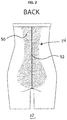
- FIG. 2 is a back view of an embodiment of a shapewear garment.
- FIG. 4 is a close-up view of a dart from the interior of a garment.
- FIG. 5 is a view of an embodiment of a shapewear garment having a left dart and a right dart, showing the placement of the darts.
- Shapewear garments enhance a wearer's body shape by providing compression, control, and smoothing to certain areas.
- One area that many wearers use shapewear to target is the abdominal area. It is often desirable for shapewear to provide more compression or control to certain targeted areas than to other areas covered by the garment.
- the amount of compression and stretch of different areas of a shapewear garment can be controlled by adjusting the garment pattern at the side seams or back seam. However, manipulating the garment pattern only at the side seams and back seam does not always do enough to restrict stretch at a targeted position, such as the abdominal region.
- Current additional methods of targeting the abdominal area include boning, bonding, and providing extra panels in the targeted area. These methods often make a garment less comfortable in the targeted areas. They also increase the material and labor costs of making the garments. It is therefore advantageous to provide additional compression to targeted regions of shapewear garments, specifically the abdominal region, in a way that does not add bulk or stiffness to the garment or increase the manufacturing costs.
- a shapewear garment is disclosed herein that includes floating darts in an abdominal region of the garment.
- the shapewear garment includes a front side and a back side, the front side having a region that at least partially covers an abdominal area of the wearer.
- the abdominal region of the garment is made from a knit fabric.
- the knit fabric includes from about 20% to about 60% elastane, which allows the fabric to have a high amount of stretch and elasticity.
- One or more darts extend at least partially across the abdominal region, taking in fabric from the region. The removal of the fabric from the abdominal region to create the darts restricts stretch and volume in the area, providing targeted control across the wearer's abdomen. Altering the shape of the abdominal region using darts instead of adding boning, bonding, or additional fabric panels is more comfortable for the wearer because the darts reduce the bulk of the fabric in the area without substantially decreasing the fabric's flexibility.
- Darts are created by taking in or removing fabric from certain areas of the garment. Darts take in fabric from narrower areas of the body, and have one or more points extending toward a fuller area of the body. This allows a flat piece of fabric to conform to the three-dimensional shape of a wearer's body.
- darts can either extend from the edge of a fabric panel of a garment, or can be formed in the middle of a fabric panel not intersecting an edge.
- Darts extending from the edge of a fabric panel are sometimes seen, for example, in the bust region of upper-body garments. A triangular or wedge-shaped section of material is removed, and the remaining edges bordering the removed section are stitched together. This creates shape in the bust area.
- the darts are “floating darts,” which are darts that do not begin at the edge of a fabric panel. Instead, the darts take in fabric from a more central area of a fabric panel. For example, darts can be used in a back panel of a jacket to create shape by taking in fabric at the waist area.
- fixedly attached is defined as attached via sewing or bonding.
- Seamlessly attached is defined as continuously formed as one stretch of fabric.
- Seamless attachment can be achieved by knitting two or more portions or panels of the undergarment together as one piece of fabric, such that there is no seam joining the portions. This can be achieved by using a seamless knitting machine, a hosiery machine, or other knitting machine. Seamless attachment can also be done by continuously forming two or more portions or panels as one stretch of woven or non-woven fabric.
- a shapewear garment is configured to compress the abdominals of a wearer.
- FIG. 1 illustrates the front side of an embodiment of a shapewear garment.
- FIG. 2 illustrates the back side of an embodiment of a shapewear garment.
- the shapewear garment 10 has a front side 12 and a back side 14 .
- the front side 12 of the shapewear garment 10 has an abdominal region 16 .
- the abdominal region 16 is a portion of the shapewear garment 10 that is configured to cover at least a portion of the abdominals of the wearer.
- the front side 12 and back side 14 are at least partially made from a knit fabric.
- the abdominal region 16 is made from a knit fabric.
- the knit fabric contains from about 20% to about 60% elastane. In some embodiments, the knit fabric contains from about 30% to about 40% elastane. The high elastane content of the knit fabric provides a large amount of stretch and elasticity to the fabric.
- the abdominal region 16 has one or more darts extending at least partially across the abdominal region.
- the abdominal region has a left dart 20 and a right dart 22 .
- FIG. 1 is an illustration of a shapewear garment having a left dart 20 and a right dart 22 .
- Left and right darts 20 , 22 are floating darts, in that they do not extend from nor contact an edge of a fabric panel or a seam connecting two fabric panels.
- one or more darts can extend at least partially across the abdominal region 16 from any point and, in any direction.
- one or more darts may contact and extend from a left lateral side seam and/or a right lateral side seam.
- FIG. 3 is an illustration of a close-up view of a right dart 22 from the exterior side of the garment.
- the point, or apex, of a dart is the end of the dart.
- the right dart 22 shown in FIG. 3 has a top point 24 b and a bottom point 26 b .
- the left dart has at least one point
- the right dart has at least one point.
- the left dart has a top point and a bottom point.
- the right dart has a top point and a bottom point.
- FIG. 1 is an illustration of a close-up view of a right dart 22 from the exterior side of the garment.
- the point, or apex, of a dart is the end of the dart.
- the right dart 22 shown in FIG. 3 has a top point 24 b and a bottom point 26 b .
- the left dart has at least one point
- the right dart has at least one point.
- the left dart has
- the length of the left dart from the top point to the bottom point is from about 2 inches to about 8 inches.
- the length of the right dart from the top point to the bottom point is from about 2 inches to about 8 inches.
- the length of the left dart is equal to the length of the right dart.
- the length of the one or more darts in a shapewear garment depends on the size of the garment. In some embodiments, the length of the one or more darts is dependent on the fabric elongation, the fabric modulus, and/or the anatomy of the wearer.
- FIG. 3 the dotted line indicates where a fold 31 is located on the interior of the garment to take in the fabric.
- the fold 31 is not visible from the exterior of the garment.
- FIG. 4 illustrates the interior view of the dart 22 , including seam 30 and fold 31 .
- the fabric wedge 32 that is taken in to create the dart 22 is cut or otherwise removed from the garment.
- a dart can be created by gathering or folding a portion of fabric at least partially located in the abdominal region 16 of the shapewear garment 10 and sewing the fabric along the gather or fold, such that the fabric wedge 32 that is taken in to create the dart 22 is left as part of the garment. Either way, the seam 30 attaches two formerly separated areas of the fabric to narrow the region.
- the seam of the dart stretches with the fabric of the shapewear garment.
- the thread used to create the seam 30 is polyester, cotton, nylon, or a blend thereof.
- the seam 30 is a zig-zag stitch.
- the seam 30 is a baby zig-zag stitch.
- the zig-zag stitch is a 3-step zig zag stitch.
- the seam 30 is an overlock stitch, a two-needle pull-out stitch, or a pearl marrow stitch.
- the distance d t2 between a top point 24 b of the right dart 22 and a vertical center line 34 is less than the distance d b2 between a bottom point 26 b of the right dart and the vertical center line.
- the top point 24 a of the left dart 20 and the top point 24 b of the right dart 22 are placed closer to the vertical center line 34 than the bottom point 26 a of the left dart 20 and bottom point 26 b of the right dart 22 .
- the darts are therefore placed diagonally on the abdominal region 16 of the shapewear garment 10 .
- left and right darts 20 , 22 can be placed such that they are parallel to at least a portion of the left and right edges of the garment 36 , 38 .
- the darts can be parallel to the tapered edges between the hip and waist.
- the shapewear garment 10 can be any type of garment configured to cover a wearer's abdominal area. In some embodiments, such as the embodiment shown in FIG. 1 , the shapewear garment 10 has a left leg portion 40 and a right leg portion 42 . In some embodiments, the shapewear garment 10 does not have a left leg portion or a right leg portion. In some embodiments, the shapewear garment 10 is a lower-body garment. In some embodiments, the shapewear garment 10 is an upper body garment.
- An upper body garment can be any upper body garment known in the art, including camisoles, slips, tanks, short-sleeve garments, long-sleeve garments, pull-on corsets/waist cinchers, step-in corsets/waist cinchers, bodysuits or any other upper body garment or top.
- a lower edge of the garment is raw cut. A raw cut edge does not have a seam or bonding along the edge.
- the entire shapewear garment 10 is made from fabric having generally the same elasticity and weight throughout.
- the abdominal region 16 has lower elasticity than other regions of the garment. In some embodiments, the abdominal region 16 has higher elasticity than other regions of the garment. In some embodiments, the abdominal region 16 is 1-ply fabric. In some embodiments, the elasticity of the abdominal region 16 in the vertical direction is greater than the elasticity in the horizontal direction. In some embodiments, the elasticity of the abdominal region 16 in the horizontal direction is greater than the elasticity in the vertical direction. In some embodiments, the abdominal region has balanced four-way stretch.
- the front side 12 is formed of a first fabric panel
- the back side 14 is formed of a second fabric panel
- the first and second panels are joined at side seams of the garment.
- the front side and the back side are formed from one fabric panel that is joined at the vertical center seam 52 on the back side of the garment.
- the shapewear garment has a region of lighter-weight fabric 50 along a vertical center line of the back side. An elastic band can be attached to the vertical back center seam 52 .
- the front side and the back side are formed seamlessly.
- a method of making a shapewear garment includes the steps of providing a front side with an abdominal region and a back side, where the front side and the back side include a knit fabric containing from about 20% to about 60% elastane.
- the method further includes joining the front side and the back side at the sides of the panels to form a garment and sewing at least one dart extending at least partially across the abdominal region.
- the method includes sewing a left dart and a right dart at least partially across the abdominal region.
- the method includes providing a front side and a back side that are seamlessly connected.
- the method includes providing a separate front side and back side and attaching the front side to the back side. In some embodiments, the method includes sewing the front side to the back side. In some embodiments, the method includes bonding the front side to the back side. In some embodiments, the method further includes providing a left leg portion and a right leg portion.
Landscapes
- Engineering & Computer Science (AREA)
- Textile Engineering (AREA)
- Chemical & Material Sciences (AREA)
- Materials Engineering (AREA)
- Outer Garments And Coats (AREA)
- Details Of Garments (AREA)
Abstract
Description
Claims (19)
Priority Applications (1)
| Application Number | Priority Date | Filing Date | Title |
|---|---|---|---|
| US16/174,900 US11026454B2 (en) | 2017-10-30 | 2018-10-30 | Floating darts for shapewear |
Applications Claiming Priority (2)
| Application Number | Priority Date | Filing Date | Title |
|---|---|---|---|
| US201762578869P | 2017-10-30 | 2017-10-30 | |
| US16/174,900 US11026454B2 (en) | 2017-10-30 | 2018-10-30 | Floating darts for shapewear |
Publications (2)
| Publication Number | Publication Date |
|---|---|
| US20190124998A1 US20190124998A1 (en) | 2019-05-02 |
| US11026454B2 true US11026454B2 (en) | 2021-06-08 |
Family
ID=66245739
Family Applications (1)
| Application Number | Title | Priority Date | Filing Date |
|---|---|---|---|
| US16/174,900 Active 2039-01-28 US11026454B2 (en) | 2017-10-30 | 2018-10-30 | Floating darts for shapewear |
Country Status (1)
| Country | Link |
|---|---|
| US (1) | US11026454B2 (en) |
Families Citing this family (3)
| Publication number | Priority date | Publication date | Assignee | Title |
|---|---|---|---|---|
| USD909009S1 (en) * | 2020-08-06 | 2021-02-02 | Hansen Huang | Shapewear |
| USD1097456S1 (en) * | 2024-04-02 | 2025-10-14 | Hexin Holaing Limited | Body shaping garment |
| USD1103559S1 (en) * | 2024-04-16 | 2025-12-02 | Hexin Holaing Limited | Jumpsuit |
Citations (73)
| Publication number | Priority date | Publication date | Assignee | Title |
|---|---|---|---|---|
| US738677A (en) * | 1903-06-06 | 1903-09-08 | Fay N Longwell | Trousers. |
| US1040747A (en) * | 1912-01-06 | 1912-10-08 | Arthur Page | Trousers. |
| US1173139A (en) * | 1914-06-18 | 1916-02-22 | Solomon Abramson | Trousers-knee-lifting device. |
| US1578970A (en) * | 1922-06-05 | 1926-03-30 | Feser Fritz | Means for preventing bagging at the knees of men's trousers |
| US2019545A (en) * | 1935-03-16 | 1935-11-05 | Roth Silk Undergarment Co Inc | Lady's undergarment |
| US2023701A (en) * | 1934-04-07 | 1935-12-10 | Rosenfeld Isidor | Combined undergarment and abdominal support |
| US2101564A (en) * | 1937-05-05 | 1937-12-07 | Sayour Elias | House coat |
| US2115146A (en) * | 1935-04-09 | 1938-04-26 | Kops Brothers Inc | Apparel garment |
| US2394541A (en) * | 1944-12-14 | 1946-02-12 | Israel L Freedman | Sleeve construction |
| US2409601A (en) * | 1943-04-19 | 1946-10-15 | Virginia M Truesdell | Body garment |
| US2513039A (en) * | 1949-08-16 | 1950-06-27 | Helen E Miller | Maternity panty |
| US2568826A (en) * | 1949-01-19 | 1951-09-25 | Roussos Mary | Garment accessory |
| US2663025A (en) * | 1952-06-11 | 1953-12-22 | Isaac Siegfried | Waist and abdominal fitting portion in nether garment |
| US2705324A (en) * | 1952-05-08 | 1955-04-05 | Jacob L Kleinman | Girdles |
| US2716754A (en) * | 1952-08-11 | 1955-09-06 | Harold S Hirsch | Ski pants |
| US2788524A (en) * | 1955-06-01 | 1957-04-16 | Gaine Scandale | Girdle |
| US3068871A (en) * | 1960-12-27 | 1962-12-18 | Ben Pearl | Form-fitting pants |
| US3080863A (en) * | 1961-08-21 | 1963-03-12 | H S Crocker Co Inc | Apparatus for melting thermoplastic materials |
| US3089149A (en) * | 1961-04-27 | 1963-05-14 | Alta T Kelleam | Maternity garment |
| US3099014A (en) * | 1960-05-20 | 1963-07-30 | Florence F Smith | Maternity garment |
| US3143741A (en) * | 1963-01-28 | 1964-08-11 | Else Inc | Clothing construction |
| US3234947A (en) * | 1963-12-31 | 1966-02-15 | Easton Trouser Company | Bifurcated garment with built-in support |
| US3609766A (en) * | 1970-01-05 | 1971-10-05 | Janet R Olive | Method of making a dress |
| US3694818A (en) * | 1971-06-11 | 1972-10-03 | Ruth N Nielson | Method and apparatus for sewing darts |
| US3763498A (en) * | 1972-04-24 | 1973-10-09 | C Rector | Underwater garment and method of making |
| US3765095A (en) * | 1970-01-05 | 1973-10-16 | J Olive | Pattern perfecter |
| US3812540A (en) * | 1972-09-11 | 1974-05-28 | R Pagano | Form fitting coat construction |
| US3883955A (en) * | 1969-06-11 | 1975-05-20 | Roberta F Bush | Pattern fitting tool and method of custom fitting patterns |
| US3932503A (en) * | 1966-05-28 | 1976-01-13 | Hoechst Aktiengesellschaft | Benzenesulfonyl ureas |
| US3939565A (en) * | 1969-06-11 | 1976-02-24 | Bush Roberta F | Pattern fitting tool and method of custom fitting patters |
| US4214319A (en) * | 1977-10-06 | 1980-07-29 | Didier Bollag | Outerwear garment article |
| US4599812A (en) * | 1985-10-15 | 1986-07-15 | Harmsen Wayne A | Leggings |
| US4890337A (en) * | 1988-12-27 | 1990-01-02 | Bert Greenberg | Pants-like garment incorporating a stretchable construction |
| US4989272A (en) * | 1990-03-18 | 1991-02-05 | Yitzhak Wagner | Trouser construction |
| US5127108A (en) * | 1991-04-23 | 1992-07-07 | Phyllis Weiss | Trousers including elastic inner panels for flattening pleats |
| US5144697A (en) * | 1991-06-07 | 1992-09-08 | Sandbeck Rick L | Bi-waisted trousers |
| US5450630A (en) * | 1993-12-10 | 1995-09-19 | Wyoming Woolens | Sock and method of making same |
| US5535451A (en) * | 1995-04-27 | 1996-07-16 | Sun Apparel Inc. | Pants garment with buttocks enhancement |
| US5784721A (en) * | 1996-08-15 | 1998-07-28 | Wyoming Woolens | Padded fleece sock and method of making same |
| US5888118A (en) * | 1995-07-20 | 1999-03-30 | Kishi Co., Ltd. | Garment with an inner lining for body shape adjustment |
| US6250115B1 (en) * | 1998-02-20 | 2001-06-26 | Yasuko Suzuki | Method for creating knitted garments and patterns therefor |
| US6846217B1 (en) * | 2003-10-01 | 2005-01-25 | Texas Instruments Incorporated | Garment with interior bra structure with side supports |
| US20060200893A1 (en) * | 2004-12-15 | 2006-09-14 | Boston James L | Athletic Hammock |
| US7341500B2 (en) * | 2005-05-13 | 2008-03-11 | Victoria's Secret Stores Brand Management, Inc. | Garment with lifting feature |
| US20080295217A1 (en) * | 2007-05-31 | 2008-12-04 | Mothers Work, Inc. | Belly covering garment |
| US20090133182A1 (en) * | 2005-08-22 | 2009-05-28 | Muneharu Inagaki | Leg Wear |
| US20090172859A1 (en) * | 2008-01-04 | 2009-07-09 | Under Armour, Inc. | Athletic Pants |
| US7707658B2 (en) * | 2001-04-02 | 2010-05-04 | Cabela's, Inc. | Garments with stretch fabrics |
| US7845021B2 (en) * | 2005-02-24 | 2010-12-07 | Del Carmen Erana Ahumada Elisa | Garments in order to lift the buttocks |
| US7874018B2 (en) * | 2006-02-22 | 2011-01-25 | Castlecrafts Limited | Clothing with elastically extendable region |
| US7958569B2 (en) * | 2005-04-14 | 2011-06-14 | Lion Apparel, Inc. | Protective garment with curved and protected extremities |
| US20120309265A1 (en) * | 2011-06-03 | 2012-12-06 | Abrams Sarah M | Exercise Clothing for Use During Pregnancy |
| US20130012853A1 (en) * | 2007-05-23 | 2013-01-10 | Brown Timothy W | Sensory motor stimulation garments and methods |
| US8418268B2 (en) * | 2009-12-04 | 2013-04-16 | Global Trademarks, Llc | Garment having support |
| US8491514B2 (en) * | 2009-06-08 | 2013-07-23 | Farrow Medical Innovations Holdings Llc | Customizable therapeutic compression garment and method |
| US20130211302A1 (en) * | 2007-05-23 | 2013-08-15 | Timothy W. Brown | Sensory Motor Stimulation Garment and Method |
| US8683616B2 (en) * | 2011-12-12 | 2014-04-01 | Lane Bryant Purchasing Corp. | Slimming garments |
| US20140114620A1 (en) * | 2010-11-07 | 2014-04-24 | Eitan Grinspun | Methods, systems, and media for interactive garment modeling and editing |
| US20140165265A1 (en) * | 2012-09-10 | 2014-06-19 | Levi Strauss & Co. | Shaped Fit Sizing System with Body Shaping |
| US8839463B2 (en) * | 2010-08-26 | 2014-09-23 | Alyx Fier | Trouser and method for easing the strain on legs and knees when moving |
| US8951217B2 (en) * | 2009-02-24 | 2015-02-10 | Exos Llc | Composite material for custom fitted products |
| US9320306B2 (en) * | 2012-05-24 | 2016-04-26 | Freddy S.P.A. | Pants, in particular for shaping the female buttocks and hips |
| US20160262460A1 (en) * | 2015-03-13 | 2016-09-15 | John W. Inzer | Gradual tilt sleeve support shirt |
| US9468239B2 (en) * | 2014-08-01 | 2016-10-18 | Juan Antonio Said Battah | Trouser for male users that lifts and shapes the form of the buttocks |
| US9801420B2 (en) * | 2013-03-15 | 2017-10-31 | Spanx, Inc. | Abdominal-restraint garment and methods of assembling the same |
| US9955741B2 (en) * | 2014-10-23 | 2018-05-01 | Talon Technologies, Inc. | Garment with multilayer internal abdominal support panels |
| US9968139B2 (en) * | 2014-01-03 | 2018-05-15 | Lysse Partners Llc | Hidden control waistband garment |
| US20180184726A1 (en) * | 2016-11-14 | 2018-07-05 | Monica Wesley | Flexible support structure for wire-free bras, bralettes and lingerie |
| US10045569B2 (en) * | 2013-11-13 | 2018-08-14 | Jkl Ip Company Llc | Garment for containing moisture compositions |
| US20190008226A1 (en) * | 2016-06-09 | 2019-01-10 | Nataliia Valerievna Krivonosova | Method and System for Interactive Creation of Garments |
| US20190015233A1 (en) * | 2016-01-05 | 2019-01-17 | President And Fellows Of Harvard College | Fabric-Based Soft Actuators |
| US20190320747A1 (en) * | 2018-04-18 | 2019-10-24 | Lane Bryant Purchasing Corp. | Outer garments with hidden internal circumferential support |
| US20190373971A1 (en) * | 2018-06-12 | 2019-12-12 | The Gap, Inc. | Waistband construction |
-
2018
- 2018-10-30 US US16/174,900 patent/US11026454B2/en active Active
Patent Citations (77)
| Publication number | Priority date | Publication date | Assignee | Title |
|---|---|---|---|---|
| US738677A (en) * | 1903-06-06 | 1903-09-08 | Fay N Longwell | Trousers. |
| US1040747A (en) * | 1912-01-06 | 1912-10-08 | Arthur Page | Trousers. |
| US1173139A (en) * | 1914-06-18 | 1916-02-22 | Solomon Abramson | Trousers-knee-lifting device. |
| US1578970A (en) * | 1922-06-05 | 1926-03-30 | Feser Fritz | Means for preventing bagging at the knees of men's trousers |
| US2023701A (en) * | 1934-04-07 | 1935-12-10 | Rosenfeld Isidor | Combined undergarment and abdominal support |
| US2019545A (en) * | 1935-03-16 | 1935-11-05 | Roth Silk Undergarment Co Inc | Lady's undergarment |
| US2115146A (en) * | 1935-04-09 | 1938-04-26 | Kops Brothers Inc | Apparel garment |
| US2101564A (en) * | 1937-05-05 | 1937-12-07 | Sayour Elias | House coat |
| US2409601A (en) * | 1943-04-19 | 1946-10-15 | Virginia M Truesdell | Body garment |
| US2394541A (en) * | 1944-12-14 | 1946-02-12 | Israel L Freedman | Sleeve construction |
| US2568826A (en) * | 1949-01-19 | 1951-09-25 | Roussos Mary | Garment accessory |
| US2513039A (en) * | 1949-08-16 | 1950-06-27 | Helen E Miller | Maternity panty |
| US2705324A (en) * | 1952-05-08 | 1955-04-05 | Jacob L Kleinman | Girdles |
| US2663025A (en) * | 1952-06-11 | 1953-12-22 | Isaac Siegfried | Waist and abdominal fitting portion in nether garment |
| US2716754A (en) * | 1952-08-11 | 1955-09-06 | Harold S Hirsch | Ski pants |
| US2788524A (en) * | 1955-06-01 | 1957-04-16 | Gaine Scandale | Girdle |
| US3099014A (en) * | 1960-05-20 | 1963-07-30 | Florence F Smith | Maternity garment |
| US3068871A (en) * | 1960-12-27 | 1962-12-18 | Ben Pearl | Form-fitting pants |
| US3089149A (en) * | 1961-04-27 | 1963-05-14 | Alta T Kelleam | Maternity garment |
| US3080863A (en) * | 1961-08-21 | 1963-03-12 | H S Crocker Co Inc | Apparatus for melting thermoplastic materials |
| US3143741A (en) * | 1963-01-28 | 1964-08-11 | Else Inc | Clothing construction |
| US3234947A (en) * | 1963-12-31 | 1966-02-15 | Easton Trouser Company | Bifurcated garment with built-in support |
| US3932503A (en) * | 1966-05-28 | 1976-01-13 | Hoechst Aktiengesellschaft | Benzenesulfonyl ureas |
| US3939565A (en) * | 1969-06-11 | 1976-02-24 | Bush Roberta F | Pattern fitting tool and method of custom fitting patters |
| US3883955A (en) * | 1969-06-11 | 1975-05-20 | Roberta F Bush | Pattern fitting tool and method of custom fitting patterns |
| US3609766A (en) * | 1970-01-05 | 1971-10-05 | Janet R Olive | Method of making a dress |
| US3765095A (en) * | 1970-01-05 | 1973-10-16 | J Olive | Pattern perfecter |
| US3694818A (en) * | 1971-06-11 | 1972-10-03 | Ruth N Nielson | Method and apparatus for sewing darts |
| US3763498A (en) * | 1972-04-24 | 1973-10-09 | C Rector | Underwater garment and method of making |
| US3812540A (en) * | 1972-09-11 | 1974-05-28 | R Pagano | Form fitting coat construction |
| US4214319A (en) * | 1977-10-06 | 1980-07-29 | Didier Bollag | Outerwear garment article |
| US4599812A (en) * | 1985-10-15 | 1986-07-15 | Harmsen Wayne A | Leggings |
| US4890337A (en) * | 1988-12-27 | 1990-01-02 | Bert Greenberg | Pants-like garment incorporating a stretchable construction |
| US4989272A (en) * | 1990-03-18 | 1991-02-05 | Yitzhak Wagner | Trouser construction |
| US5127108A (en) * | 1991-04-23 | 1992-07-07 | Phyllis Weiss | Trousers including elastic inner panels for flattening pleats |
| US5144697A (en) * | 1991-06-07 | 1992-09-08 | Sandbeck Rick L | Bi-waisted trousers |
| US5450630A (en) * | 1993-12-10 | 1995-09-19 | Wyoming Woolens | Sock and method of making same |
| US5450630C1 (en) * | 1993-12-10 | 2001-03-27 | Wyoming Woolens | Sock and method of making same |
| US5535451A (en) * | 1995-04-27 | 1996-07-16 | Sun Apparel Inc. | Pants garment with buttocks enhancement |
| US5888118A (en) * | 1995-07-20 | 1999-03-30 | Kishi Co., Ltd. | Garment with an inner lining for body shape adjustment |
| US5784721A (en) * | 1996-08-15 | 1998-07-28 | Wyoming Woolens | Padded fleece sock and method of making same |
| US6250115B1 (en) * | 1998-02-20 | 2001-06-26 | Yasuko Suzuki | Method for creating knitted garments and patterns therefor |
| US7707658B2 (en) * | 2001-04-02 | 2010-05-04 | Cabela's, Inc. | Garments with stretch fabrics |
| US6846217B1 (en) * | 2003-10-01 | 2005-01-25 | Texas Instruments Incorporated | Garment with interior bra structure with side supports |
| US20060200893A1 (en) * | 2004-12-15 | 2006-09-14 | Boston James L | Athletic Hammock |
| US7845021B2 (en) * | 2005-02-24 | 2010-12-07 | Del Carmen Erana Ahumada Elisa | Garments in order to lift the buttocks |
| US7958569B2 (en) * | 2005-04-14 | 2011-06-14 | Lion Apparel, Inc. | Protective garment with curved and protected extremities |
| US7341500B2 (en) * | 2005-05-13 | 2008-03-11 | Victoria's Secret Stores Brand Management, Inc. | Garment with lifting feature |
| US20090133182A1 (en) * | 2005-08-22 | 2009-05-28 | Muneharu Inagaki | Leg Wear |
| US7861323B2 (en) * | 2005-08-22 | 2011-01-04 | Toratani Kabushiki Kaisha | Lower torso pants garment |
| US7874018B2 (en) * | 2006-02-22 | 2011-01-25 | Castlecrafts Limited | Clothing with elastically extendable region |
| US20130211302A1 (en) * | 2007-05-23 | 2013-08-15 | Timothy W. Brown | Sensory Motor Stimulation Garment and Method |
| US20130012853A1 (en) * | 2007-05-23 | 2013-01-10 | Brown Timothy W | Sensory motor stimulation garments and methods |
| US20080295217A1 (en) * | 2007-05-31 | 2008-12-04 | Mothers Work, Inc. | Belly covering garment |
| US20090172859A1 (en) * | 2008-01-04 | 2009-07-09 | Under Armour, Inc. | Athletic Pants |
| US8951217B2 (en) * | 2009-02-24 | 2015-02-10 | Exos Llc | Composite material for custom fitted products |
| US8491514B2 (en) * | 2009-06-08 | 2013-07-23 | Farrow Medical Innovations Holdings Llc | Customizable therapeutic compression garment and method |
| US8418268B2 (en) * | 2009-12-04 | 2013-04-16 | Global Trademarks, Llc | Garment having support |
| US8839463B2 (en) * | 2010-08-26 | 2014-09-23 | Alyx Fier | Trouser and method for easing the strain on legs and knees when moving |
| US20140114620A1 (en) * | 2010-11-07 | 2014-04-24 | Eitan Grinspun | Methods, systems, and media for interactive garment modeling and editing |
| US20120309265A1 (en) * | 2011-06-03 | 2012-12-06 | Abrams Sarah M | Exercise Clothing for Use During Pregnancy |
| US8683616B2 (en) * | 2011-12-12 | 2014-04-01 | Lane Bryant Purchasing Corp. | Slimming garments |
| US9320306B2 (en) * | 2012-05-24 | 2016-04-26 | Freddy S.P.A. | Pants, in particular for shaping the female buttocks and hips |
| US20140165265A1 (en) * | 2012-09-10 | 2014-06-19 | Levi Strauss & Co. | Shaped Fit Sizing System with Body Shaping |
| US9801420B2 (en) * | 2013-03-15 | 2017-10-31 | Spanx, Inc. | Abdominal-restraint garment and methods of assembling the same |
| US10045569B2 (en) * | 2013-11-13 | 2018-08-14 | Jkl Ip Company Llc | Garment for containing moisture compositions |
| US9968139B2 (en) * | 2014-01-03 | 2018-05-15 | Lysse Partners Llc | Hidden control waistband garment |
| US9468239B2 (en) * | 2014-08-01 | 2016-10-18 | Juan Antonio Said Battah | Trouser for male users that lifts and shapes the form of the buttocks |
| US9955741B2 (en) * | 2014-10-23 | 2018-05-01 | Talon Technologies, Inc. | Garment with multilayer internal abdominal support panels |
| US10285457B2 (en) * | 2014-10-23 | 2019-05-14 | Talon Technologies, Inc. | Garment with multilayer internal abdominal support panels |
| US20160262460A1 (en) * | 2015-03-13 | 2016-09-15 | John W. Inzer | Gradual tilt sleeve support shirt |
| US10306931B2 (en) * | 2015-03-13 | 2019-06-04 | John W. Inzer | Gradual tilt sleeve support shirt |
| US20190015233A1 (en) * | 2016-01-05 | 2019-01-17 | President And Fellows Of Harvard College | Fabric-Based Soft Actuators |
| US20190008226A1 (en) * | 2016-06-09 | 2019-01-10 | Nataliia Valerievna Krivonosova | Method and System for Interactive Creation of Garments |
| US20180184726A1 (en) * | 2016-11-14 | 2018-07-05 | Monica Wesley | Flexible support structure for wire-free bras, bralettes and lingerie |
| US20190320747A1 (en) * | 2018-04-18 | 2019-10-24 | Lane Bryant Purchasing Corp. | Outer garments with hidden internal circumferential support |
| US20190373971A1 (en) * | 2018-06-12 | 2019-12-12 | The Gap, Inc. | Waistband construction |
Non-Patent Citations (1)
| Title |
|---|
| https://whileshenaps.com/2013/10/what-is-a-dart-and-how-are-darts-used-in-sewing-patterns.html; Glassenberg; Oct. 28, 2013. (Year: 2013). * |
Also Published As
| Publication number | Publication date |
|---|---|
| US20190124998A1 (en) | 2019-05-02 |
Similar Documents
| Publication | Publication Date | Title |
|---|---|---|
| US10883206B2 (en) | Shapewear garment with mesh regions | |
| US11096430B2 (en) | Reinforced seamed outer garments with hidden support | |
| US7395557B1 (en) | Seamless upper body garment | |
| US10278431B2 (en) | Shapewear garments | |
| US7614256B2 (en) | Back supporting brassiere and undergarments with reinforced zones and method of making the same | |
| US20250107579A1 (en) | Body shaping garments | |
| US10278432B2 (en) | Body shaping garment | |
| US12082627B2 (en) | Shaping garment with adjustable low back | |
| US20150289568A1 (en) | Upper and Lower Torso Garments having an Improved Band | |
| US11896063B2 (en) | Raw edge contouring gusset | |
| CN101257812A (en) | Garment with lifting features | |
| US20190320747A1 (en) | Outer garments with hidden internal circumferential support | |
| US11375757B1 (en) | Brassiere having scooped back band | |
| US11166504B2 (en) | Outer garments with hidden internal support and back body shaping and lift | |
| US20190124998A1 (en) | Floating darts for shapewear | |
| JP3836039B2 (en) | Buttock-covered clothing | |
| KR100573862B1 (en) | Correction underwear | |
| EP4215074A1 (en) | Flexible lace underwear | |
| US20200359712A1 (en) | Composite garment and method to manufacture same | |
| US20210022413A1 (en) | Shapewear garment | |
| EP0028505A1 (en) | Panties, briefs or like underwear |
Legal Events
| Date | Code | Title | Description |
|---|---|---|---|
| FEPP | Fee payment procedure |
Free format text: ENTITY STATUS SET TO UNDISCOUNTED (ORIGINAL EVENT CODE: BIG.); ENTITY STATUS OF PATENT OWNER: SMALL ENTITY |
|
| FEPP | Fee payment procedure |
Free format text: ENTITY STATUS SET TO SMALL (ORIGINAL EVENT CODE: SMAL); ENTITY STATUS OF PATENT OWNER: SMALL ENTITY |
|
| STPP | Information on status: patent application and granting procedure in general |
Free format text: DOCKETED NEW CASE - READY FOR EXAMINATION |
|
| AS | Assignment |
Owner name: SPANX, INC., GEORGIA Free format text: ASSIGNMENT OF ASSIGNORS INTEREST;ASSIGNORS:HANSON ALLEN, WENDY;MELENDEZ, ANGELICA;NOVOSIOLOVA, ELENA;AND OTHERS;SIGNING DATES FROM 20190606 TO 20190607;REEL/FRAME:049897/0879 |
|
| STPP | Information on status: patent application and granting procedure in general |
Free format text: NON FINAL ACTION MAILED |
|
| STPP | Information on status: patent application and granting procedure in general |
Free format text: RESPONSE TO NON-FINAL OFFICE ACTION ENTERED AND FORWARDED TO EXAMINER |
|
| STPP | Information on status: patent application and granting procedure in general |
Free format text: NOTICE OF ALLOWANCE MAILED -- APPLICATION RECEIVED IN OFFICE OF PUBLICATIONS |
|
| STPP | Information on status: patent application and granting procedure in general |
Free format text: PUBLICATIONS -- ISSUE FEE PAYMENT RECEIVED |
|
| STPP | Information on status: patent application and granting procedure in general |
Free format text: PUBLICATIONS -- ISSUE FEE PAYMENT VERIFIED |
|
| STCF | Information on status: patent grant |
Free format text: PATENTED CASE |
|
| AS | Assignment |
Owner name: SPANX, LLC, GEORGIA Free format text: CERTIFICATE OF CONVERSION;ASSIGNOR:SPANX, INC.;REEL/FRAME:058299/0377 Effective date: 20211108 |
|
| AS | Assignment |
Owner name: HPS INVESTMENT PARTNERS, LLC, AS COLLATERAL AGENT, NEW YORK Free format text: SECURITY INTEREST;ASSIGNOR:SPANX, LLC;REEL/FRAME:058386/0224 Effective date: 20211118 |
|
| MAFP | Maintenance fee payment |
Free format text: PAYMENT OF MAINTENANCE FEE, 4TH YR, SMALL ENTITY (ORIGINAL EVENT CODE: M2551); ENTITY STATUS OF PATENT OWNER: SMALL ENTITY Year of fee payment: 4 |