US10844536B2 - Steam iron sole plate - Google Patents
Steam iron sole plate Download PDFInfo
- Publication number
- US10844536B2 US10844536B2 US16/090,233 US201716090233A US10844536B2 US 10844536 B2 US10844536 B2 US 10844536B2 US 201716090233 A US201716090233 A US 201716090233A US 10844536 B2 US10844536 B2 US 10844536B2
- Authority
- US
- United States
- Prior art keywords
- cover
- range
- soleplate
- iron soleplate
- steam
- Prior art date
- Legal status (The legal status is an assumption and is not a legal conclusion. Google has not performed a legal analysis and makes no representation as to the accuracy of the status listed.)
- Expired - Fee Related, expires
Links
- XEEYBQQBJWHFJM-UHFFFAOYSA-N Iron Chemical compound [Fe] XEEYBQQBJWHFJM-UHFFFAOYSA-N 0.000 title claims abstract description 78
- 229910052742 iron Inorganic materials 0.000 title claims abstract description 39
- 238000010025 steaming Methods 0.000 claims abstract description 31
- 238000001035 drying Methods 0.000 claims abstract description 25
- 238000010438 heat treatment Methods 0.000 claims abstract description 24
- 239000000463 material Substances 0.000 claims description 16
- 238000000034 method Methods 0.000 claims description 14
- 238000002788 crimping Methods 0.000 claims description 10
- 238000004519 manufacturing process Methods 0.000 claims description 9
- 238000001125 extrusion Methods 0.000 claims description 3
- XAGFODPZIPBFFR-UHFFFAOYSA-N aluminium Chemical compound [Al] XAGFODPZIPBFFR-UHFFFAOYSA-N 0.000 description 13
- 229910052782 aluminium Inorganic materials 0.000 description 13
- 239000004744 fabric Substances 0.000 description 11
- 238000010409 ironing Methods 0.000 description 11
- 239000000835 fiber Substances 0.000 description 7
- 230000009471 action Effects 0.000 description 6
- 235000000396 iron Nutrition 0.000 description 6
- 238000012986 modification Methods 0.000 description 6
- 230000004048 modification Effects 0.000 description 6
- 238000006073 displacement reaction Methods 0.000 description 5
- 230000003247 decreasing effect Effects 0.000 description 4
- 238000009826 distribution Methods 0.000 description 4
- 229910000831 Steel Inorganic materials 0.000 description 3
- 238000000576 coating method Methods 0.000 description 3
- 238000005520 cutting process Methods 0.000 description 3
- 239000010959 steel Substances 0.000 description 3
- 230000008901 benefit Effects 0.000 description 2
- 230000000694 effects Effects 0.000 description 2
- 239000004519 grease Substances 0.000 description 2
- 238000009499 grossing Methods 0.000 description 2
- 230000006872 improvement Effects 0.000 description 2
- 230000035515 penetration Effects 0.000 description 2
- 229910001220 stainless steel Inorganic materials 0.000 description 2
- 239000010935 stainless steel Substances 0.000 description 2
- 238000009736 wetting Methods 0.000 description 2
- 229910052582 BN Inorganic materials 0.000 description 1
- PZNSFCLAULLKQX-UHFFFAOYSA-N Boron nitride Chemical compound N#B PZNSFCLAULLKQX-UHFFFAOYSA-N 0.000 description 1
- 230000002411 adverse Effects 0.000 description 1
- 230000004075 alteration Effects 0.000 description 1
- AZDRQVAHHNSJOQ-UHFFFAOYSA-N alumane Chemical class [AlH3] AZDRQVAHHNSJOQ-UHFFFAOYSA-N 0.000 description 1
- 238000004458 analytical method Methods 0.000 description 1
- 230000005540 biological transmission Effects 0.000 description 1
- 238000003763 carbonization Methods 0.000 description 1
- 238000005266 casting Methods 0.000 description 1
- 238000012512 characterization method Methods 0.000 description 1
- 239000011248 coating agent Substances 0.000 description 1
- 238000007796 conventional method Methods 0.000 description 1
- 238000010411 cooking Methods 0.000 description 1
- 230000007547 defect Effects 0.000 description 1
- 210000003298 dental enamel Anatomy 0.000 description 1
- 238000004049 embossing Methods 0.000 description 1
- 238000005304 joining Methods 0.000 description 1
- 239000007788 liquid Substances 0.000 description 1
- 238000012423 maintenance Methods 0.000 description 1
- 239000002245 particle Substances 0.000 description 1
- 230000002085 persistent effect Effects 0.000 description 1
- 238000005498 polishing Methods 0.000 description 1
- 238000003825 pressing Methods 0.000 description 1
- 238000011160 research Methods 0.000 description 1
- 238000007493 shaping process Methods 0.000 description 1
- 238000003860 storage Methods 0.000 description 1
- 238000004381 surface treatment Methods 0.000 description 1
- XLYOFNOQVPJJNP-UHFFFAOYSA-N water Substances O XLYOFNOQVPJJNP-UHFFFAOYSA-N 0.000 description 1
Images




Classifications
-
- D—TEXTILES; PAPER
- D06—TREATMENT OF TEXTILES OR THE LIKE; LAUNDERING; FLEXIBLE MATERIALS NOT OTHERWISE PROVIDED FOR
- D06F—LAUNDERING, DRYING, IRONING, PRESSING OR FOLDING TEXTILE ARTICLES
- D06F75/00—Hand irons
- D06F75/08—Hand irons internally heated by electricity
- D06F75/10—Hand irons internally heated by electricity with means for supplying steam to the article being ironed
- D06F75/20—Arrangements for discharging the steam to the article being ironed
-
- D—TEXTILES; PAPER
- D06—TREATMENT OF TEXTILES OR THE LIKE; LAUNDERING; FLEXIBLE MATERIALS NOT OTHERWISE PROVIDED FOR
- D06F—LAUNDERING, DRYING, IRONING, PRESSING OR FOLDING TEXTILE ARTICLES
- D06F75/00—Hand irons
- D06F75/38—Sole plates
Definitions
- the present application relates to a steam iron sole-plate.
- the soleplates of such irons were manufactured in cast aluminum and polished to obtain a surface state and a flatness compatible with the desired use. Their defect was a fast clogging due to the carbonization of fabric particles embedding into the microporosities created by the polishing.
- the distribution of the steam under the surface of the soleplate was improved by an increase in the number of outlet holes and/or by the arranging of shapes hollowed out under the soleplate.
- Water drop or tear shapes or channels of multiple shapes are non-exhaustively known.
- Patent DE452559 for example, relative to a soleplate comprising on its front side a steaming area and on its back side an area for drying by distribution of overheated air.
- a soleplate comprising on its front side a steaming area and on its back side an area for drying by distribution of overheated air.
- the soleplate surface had to be adapted to favor the steam flow to this area during the ironing action, whereby grooves having any shapes and configurations, favoring such an escape to the back and/or the sides, have appeared.
- An object of an embodiment is to overcome all or part of the disadvantages of the previously-described steam irons.
- Another object of an embodiment is to improve the drying of the garment during the steam ironing operation, by favoring a fast and complete escape thereof to avoid the forming of residual humidity in fabrics after the ironing.
- an embodiment provides a steam iron soleplate comprising a cover and a heating subassembly.
- the surface of the cover intended to be in contact with a garment comprises a steaming area having the steam outlet holes emerging onto it and a drying area different from the steaming area, the steaming area being at least partly located on the front third of said surface, the drying area comprising no steam outlet holes and comprising a first step corresponding to a portion raised toward the outside at the central portion of said surface.
- the steaming area is located on the front half, preferably on the front third, of said surface.
- the first planar surface totally surrounds the raised portion.
- the volume of the raised portion is inscribed between a first planar surface, coplanar with the steaming area, and a second planar surface located in a plane which is parallel to the first surface, the first and second surfaces being separated by a height in the range from 0.3 mm to 2 mm.
- the raised portion is de-limited on its sides by a third surface linking the first surface to the second surface.
- the soleplate comprises, on the circumference of the cover, fourth surfaces recessed with respect to the first surface, substantially parallel to one another and contiguous to the circumference of the cover, and forming second steps.
- the cover comprises lateral cover edges coupled to a cover heel and the junction between the second surface and the third surface is defined by a first line defined by:
- first and second curve portions on each side of the cover, first and second curve portions, each first and second curve portion being substantially parallel to the adjacent lateral cover edge and at a distance in the range from 25 mm to 45 mm from said lateral cover edge;
- a first circular portion tangent to the first and second curve portions having a radius in the range from 5 mm to 15 mm.
- the junction between the first surface and the third surface is defined by a second line defined by a constant distance from the first line in the range from 10 mm to 25 mm, the second line comprising:
- a fourth circular portion having its center located at the crossing point of the second curve portion with the first straight line portion.
- temperature sensors are installed within hollow rivets provided in the cover or in ports provided in the subassembly.
- the soleplate comprises fifth surfaces recessed with respect to the first surface, substantially parallel to one another and to the circumference of the cover and forming third steps, having a width in the range from 8 mm to 14 mm, and located at a distance in the range from 12 mm to 24 mm from the edge of the cover.
- the steam outlet holes emerge onto one of the fifth surfaces.
- the second steps each have a width in the range from 0.7 mm to 1.5 mm and a height in the range from 0.15 mm to 0.4 mm and the second steps form leading edges.
- the shape of the leading edges comprises a radius in the range from 0.2 mm to 0.3 mm.
- Another embodiment provides a method of manufacturing an iron soleplate such as previously defined, the assembly between its cover and its subassembly being performed:
- the method comprises locally forming, in the rear portion of the cover assigned to the drying, notches having a width in the range from 2 mm to 4 mm to form chips each having a thickness greater than a half-thickness of the cover sheet which, folded down on the edge of the subassembly, ensure the locking between the cover and the subassembly.
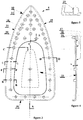
- FIGS. 1 and 2 are a bottom view and a partial side view along direction f of an embodiment of an iron soleplate
- FIG. 3 is a view similar to FIG. 1 where hidden elements are shown in dotted lines;
- FIGS. 4, 5, 6, and 7 are cross-section views of FIG. 3 respectively along lines A-A, B-B, C-C, and D-D in the case where the soleplate comprises a thick cover and FIGS. 8 and 9 are cross-section views of FIG. 3 respectively along lines C-C and D-D in the case where the soleplate comprises a thin cover;
- FIG. 10 shows an embodiment of a method enabling to obtain the structure shown in FIG. 7 ;
- FIGS. 11 and 12 are cross-section views of FIG. 3 along line F-F according to other embodiments of the soleplate;
- FIG. 13 is a cross-section view of FIG. 3 along line G-G illustrating the operation of the iron
- FIG. 14 is a bottom view of another embodiment of an iron soleplate
- FIG. 15 is a cross-section view of the cover of the soleplate shown in FIG. 14 along line a-a;
- FIG. 16 is an enlarged view of a portion of FIG. 15 ;
- FIG. 17 is an enlarged view of a portion of FIG. 16 ;
- FIGS. 18, 19 illustrate embodiments of a method of manufacturing the cover of the soleplate shown in FIG. 14 ;
- FIG. 20 is a detail view of FIG. 19 ;
- FIG. 21 is a cross-section view of the soleplate shown in FIG. 14 along line d-d;
- FIG. 22 illustrates an embodiment of a method of assembly between the cover and the heating subassembly of the soleplate shown in FIG. 14 ;
- FIG. 23 is a cross-section view of FIG. 14 along line c-c illustrating the operation of the iron.
- the steam iron soleplate comprises at least one step intended to create a surface parallel to a base surface used as a base of contact of the iron on the garment.
- the surface created by the step is raised with respect to the base surface.
- the raised surface is preferably located in the central portion of the drying area of the iron.
- the raised surface comprises no steaming holes and permanently bears on the garment at the same time as the base surface.
- the raised surface is coupled to the base surface by an intermediate surface surrounding the raised surface and joining the base surface.
- the intermediate surface may be planar or bulged to enable, on displacements of the iron on the garment and whatever the directions of the displacements, to chase the residual steam present in the garment towards the outside.
- the surface created by the step is recessed with respect to the base surface. This enables to create, on the circumferences of the recessed surface, leading edges improving the quality and the rapidity of the ironing.
- FIGS. 1 and 2 show a bottom view and a partial side view of a soleplate 5 of an iron.
- Soleplate 5 comprises two components: the first component is the cover and the second component is the heating subassembly, the cover covering the heating subassembly.
- soleplate 5 comprises a thick cover which is designated with reference numeral 10 .
- Cover 10 may be an aluminum cover having a thickness for example in the range from 1.5 mm to 2.5 mm.
- the soleplate comprises a thin cover which is designated with reference numeral 11 .
- Cover 11 may be a cover made of a sheet of stainless steel or of another material having a thickness for example in the range from 0.2 mm to 0.6 mm.
- the heating subassembly is specific to each type of cover and is designated with reference numeral 12 for the embodiment corresponding to cover 10 and with reference numeral 13 for the embodiment corresponding to cover 11 .
- FIGS. 1 and 2 are identical for covers 10 and 11 .
- FIGS. 1 and 2 which show the outer portion of cover 10 or 11 in contact with the garment and which are common to the two types of covers 10 and 11 , a step corresponding to a convex shape forming a relief 15 , also called bulged portion or raised portion, defined with respect to a substantially planar reference surface 16 , corresponding to the largest planar portion of cover 10 or 11 in permanent contact with the garment, can be distinguished.
- steaming holes 20 emerge into approximately the front half, preferably the front third, of surface 16 intended for the steaming.
- the volume of raised portion 15 is defined by a substantially planar surface 17 aligned with the cover.
- Surface 17 is raised with respect to surface 16 and is located in a plane parallel thereto.
- a height h in the range from 0.3 to 2 mm separates the two surfaces 16 and 17 .
- Surface 17 occupies a portion of the total surface area of cover 10 or 11 in contact with the garment which is in the range from 10% to 40%.
- a line L 1 shown in stripe-dot lines in FIG. 1 , shows the limits of surface 17 .
- Line L 1 is defined by:
- a straight line portion p 1 parallel to cover heel 22 at a distance d 2 which may be in the range from 25 mm to 40 mm, for example, equal to approximately 30 mm;
- a circular portion r 1 tangent to curves c 1 and c 2 having a radius which may be in the range from 5 mm to 15 mm, for example, equal to approximately 8 mm.
- the volume of raised portion 15 is further defined by a surface 18 of connection between surface 16 and surface 17 .
- a full line L 2 shows the limits of surface 18 .
- Line L 2 is defined by a constant distance d 3 between lines L 1 and L 2 , which may be in the range from 10 mm to 25 mm, for example, equal to approximately 17 mm. This is reflected on line L 2 by a curve portion c 3 parallel to curve portion c 1 , a curve portion c 4 parallel to curve portion c 2 , a circular portion r 2 parallel to circular portion r 1 , a straight line portion p 2 parallel to straight line portion p 1 , and by two new circular portions: a circular portion r 3 having a center of located at the crossing portion of curve portion c 1 with straight line portion p 1 , and a circular portion r 4 having a center o 2 located at the crossing point of curve portion c 2 with straight line portion p 2 .
- Surface 18 of junction between the two lines L 1 and L 2 may be generated by the displacement of a straight line segment between the two lines, but it is preferentially defined by the circulation of a radius R having a center located on a line perpendicular to surface 17 vertically in line with line L 1 , defined as being the location of tangency points between radius R and surface 17 .
- Line L 2 is defined as the location of the points of intersection between radius R and surface 16 .
- FIG. 3 is a view similar to FIG. 1 of cover 10 or 11 and FIGS. 4 and 5 are cross-section views of FIG. 3 respectively along lines A-A and B-B in the case of a thick cover 10 .
- FIG. 3 shows hidden elements specific to cover 10 and shown in FIGS. 4 and 5 .
- tubular shapes which are intended, among others, to be used as hollow rivets 23 to ensure the connection between the rear portion of cover 10 , assigned to the drying, and heating subassembly 12 . Their number, their distribution, and their usage mode are determined according to the selected usage. Tubular shapes 23 are positioned outside of the surface occupied by the steaming chamber.
- FIGS. 6 and 7 are cross-section views of FIG. 3 respectively along lines C-C and D-D in the case where the soleplate comprises cover 10 and FIGS. 8 and 9 are cross-section views of FIG. 3 respectively along lines C-C and D-D in the case where the soleplate comprises cover 11 .
- heating subassemblies 12 and 13 made of cast aluminum overmolding a tubular heating element and comprising the steaming chamber, are modified with respect to conventional heating subassemblies as follows:
- holes 24 are provided, in front of each hollow rivet 23 ( FIG. 7 ), in addition to those intended for the rivets resulting from the manufacturing of steaming holes 20 , and a chamfer 25 is created at the inlet of each hole 24 ;
- FIG. 10 illustrates an embodiment of a method enabling to obtain the structure shown in FIG. 7 .
- hollow rivets 23 are obtained by extrusion, the ductility of the aluminum of the cover enabling to apply this method by which a mobile punch under high pressure 30 blocks the material while the thrusting of cylindrical punch 31 makes it flow to form a rivet shaft having the desired height.
- a shaft having a height H of approximately 4.5 mm can be obtained.
- cover 10 and subassembly 12 may be assembled as follows:
- the tubes extruded from steam outlet holes 20 are used, the crimping being performed, for example, according to the known techniques described in patent FR2593837;
- hollow rivets 23 are used by proceeding by limited crushing of their end (visible in FIG. 7 ), the deformation generated by pushing back the material into chamfer 25 provided for this purpose ensures the locking between the two portions.
- cover 11 and subassembly 13 may be assembled by keeping conventional methods, by the use of steaming holes 20 and the crimping of cover 11 on the circumference of subassembly 13 .
- FIG. 11 is a cross-section view of FIG. 3 along line F-F of another embodiment where temperature sensors Ct are installed on cover 10 inside of certain hollow rivets 23 selected as being representative of the cover temperature.
- ports 27 may be provided in heating subassembly 13 to allow an access to cover 11 , each of ports 27 is topped with a hollow cast cone 28 , having a thickness for example in the range from 1 mm to 2 mm, protruding by a height h 1 for example between 2 mm and 6 mm on the inner side of subassembly 13 .
- FIG. 12 is a cross-section view of FIG. 3 along line F-F of another embodiment where temperature sensors Ct are installed in ports 27 , formed at points representative of the soleplate temperature to allow an access to cover 11 .
- the collected information transmitted to a calculator and translated may enable to display, for example, on a liquid display screen visible by a user, the nature of the fabric that may be ironed.
- FIG. 13 is a cross-section view of FIG. 3 along line G-G illustrating the operation of the iron.
- the bearing pressure is concentrated since the contact surface with garment 32 is decreased.
- the residual moisture, imprisoned in garment 32 under this surface, submitted to heat and to an enhanced pressure, has the possibility of laterally escaping, first in the space of height h formed between surfaces 16 and 17 , and then towards the outside, as illustrated by arrow V in FIG. 13 , under the effect of the displacement of surface 18 which creates a corner shape open towards the lateral edges of the soleplate.
- the possibility of obtaining marked and persisting pleats is real.
- each of the covers remains compatible with the application of known coatings, but its heat conductivity can be improved by a flash projection of boron nitride, for example, at the surface of the glaze slip before the cooking thereof.
- ironing efficiency can be defined as the best tradeoff between the following factors: speed/quality/decreased painfulness/decreased wearing of the garment, it was remarkable to observe that most of these actions had the sole purpose of optimizing the created relations.
- An object of an embodiment is to substantially increase the ironing efficiency by improving the fiber tension from as soon as the first movement of the soleplate on the garment.
- FIG. 14 is a bottom view of a soleplate 105 of an iron.
- soleplate 105 comprises two components: the first component is the cover and the second component is the heating subassembly, the cover covering the heating subassembly.
- soleplate 105 comprises a thick cover which is designated with reference numeral 110 .
- Cover 110 may be an aluminum cover having a thickness for example in the range from 1.5 mm to 2.5 mm.
- the soleplate comprises a thin cover which is designated with reference numeral 111 .
- Cover 111 may be a cover made of a sheet of stainless steel or of another material having a thickness for example in the range from 0.2 mm to 0.6 mm.
- the heating subassembly is specific to each type of cover and is designated with reference 112 for the embodiment corresponding to cover 110 and by reference 113 for the embodiment corresponding to cover 111 .
- FIG. 14 is the same for covers 110 and 111 .
- FIG. 15 is a cross-section view of cover 110 or 111 along line a-a.
- FIG. 16 is an enlarged view of a portion of FIG. 15 in the case of a thick cover 110 and
- FIG. 17 is an enlarged view of a portion of FIG. 16 in the case of a thick cover 110 .
- cover 110 made of aluminum and cover 111 made of a steel sheet or of other materials forming the object of the invention comprise:
- a reference surface 113 for example, substantially planar, corresponding to the portion of the cover in permanent contact with the garment;
- a surface 114 and a surface 115 for example, substantially planar, substantially parallel to each other and to the edge of the cover, having widths m in the range from 0.7 mm to 1.5 mm, surfaces 114 and 115 surrounding cover 110 or 111 ;
- a surface 116 for example, substantially planar, having its limits L substantially parallel to each other and to the edge of the cover.
- the axis of symmetry of surface 116 having a width for example in the range from 7 mm to 16 mm, is located at a distance for example in the range from 12 mm to 24 mm from the edge of the cover.
- Steaming holes 120 emerge onto surface 116 and delimit its length, which will be adapted according to their number;
- a surface 117 for example, substantially planar, substantially parallel to limits L of surface 116 having a width for example in the range from 0.7 mm to 1.5 mm.
- FIG. 14 shows two possible arrangements of surface 116 .
- a surface 116 which extends from the front of the cover to the cover heel has been shown while in the left-hand portion of FIG. 14 , surface 116 extends from the front of the cover to half of the cover.
- surface 16 is distributed in the same way along two lateral edges of the cover.
- Surfaces 114 , 115 , 116 , and 117 show the basic modifications of cover 110 and 111 , but other surfaces having different shapes but similar characterizations, such as for example surfaces 118 and 119 , may be added according to needs.
- Surfaces 114 to 119 are recessed with respect to reference surface 113 . They are obtained by creating steps (particularly visible in FIG. 17 ) having a height h in the range from 0.15 mm to 0.4 mm. Each step height h generates a leading edge 121 and 122 for those in contact with reference surface 113 , a leading edge 123 for that in contact with surface 114 , a leading edge 124 for that at the crossing of the cover edge and of surface 115 , as well as a leading edge 125 for that in contact with surface 117 . Accordingly, surfaces 114 and 117 are on a same plane, as well as surfaces 115 and 116 .
- each leading edge has a same radius r, for example, in the range from 0.2 mm to 0.3 mm, which is for example formed by die stamping and/or semishear to guarantee its dimensional regularity and a clean and flash-less surface condition.
- covers 110 and 111 For the manufacturing of covers 110 and 111 , the quality and the dimensional guarantees of the leading edges are obtained by implementing different methods according to the cover material.
- FIG. 18 illustrates an embodiment of a method of manufacturing cover 110 .
- a die stamping is performed, by using the ductility of aluminum to displace matter from its initial shape, indicated by dotted line Fi, towards its final shape Fd.
- the cover is introduced into the tool after the operation of embossing and raising of the edges, and then positioned on landing plane Pa of matrixes 125 and 126 comprising, the recessed shapes of leading edges 121 , 122 , 123 , 124 , and 125 of radius r.
- the cover is maintained pressed against plane Pa by a pressure plate 127 .
- a punch 128 having a shape and a penetration depth which have been designed to displace the quantity of aluminum just necessary for all the empty spaces to be filled is then introduced.
- FIG. 19 illustrates an embodiment of a method of manufacturing cover 111 .
- a semishear is carried out. Once the cover is positioned and held in place by a pressure plate 129 on matrixes 130 and 131 , cutting punch 132 is taken down towards these matrices, into which it penetrates by height h.
- FIG. 20 is a detail view of FIG. 19 .
- Radius r of leading edges ba is obtained by varying clearance j between cutting punch 132 and matrices 130 and 131 .
- Clearance j enables to set the radius after cutting, to obtain the desired radius r.
- heating subassembly 112 formed of cast aluminum overmolding a tubular heating element and comprising the steaming chamber, is modified in the following manner, which is valid for aluminum covers 110 as well as for covers 111 made of steel or another material.
- the manufacturing of the recessed portions of surfaces 116 and 117 complementarily generates, in relief with respect to the inner surface of the cover, protrusions 133 and 134 , as shown in FIG. 16 .
- the casting of subassembly 112 will be accordingly modified to house protrusions 133 and 134 at closest.
- FIG. 21 is a cross-section view of the soleplate shown in FIG. 14 along line d-d.
- covers 110 and if the option of creating steam holes all the way to the back of the soleplate has been chosen as shown in FIG. 14 for the left-hand portion of soleplate 105 , the technique of crimping by means of the steam holes described in patent FR2593837 is used.
- FIG. 22 illustrates an embodiment of a method of assembling cover 110 and heating subassembly 112 .
- a crimping by means of the steam holes in the steaming area is carried out and, for the drying area in the back portion as shown in FIG. 14 for the right-hand portion of soleplate 105 , deprived of fastening means, notches of width R, for example, in the range from 2 mm to 4 mm, are locally created by sinking a blade 135 , of corresponding width, to form a chip 136 having a thickness greater than a half thickness of the cover sheet, which, by being folded down on the edge of heating assembly 112 , will locally ensure the locking between the two portions.
- width R for example, in the range from 2 mm to 4 mm
- thermally-conductive grease which will prevent the forming of an insulating air film therebetween.
- FIG. 23 is a cross-section view of FIG. 14 along line c-c illustrating the operation of the iron.
- the repeating of the traction (area T) exerted by the movement of the iron (arrow D) on the garment by the plurality of leading edges improves the rapidity of its flattening or of the forming of pleats.
- surfaces 114 and 115 of soleplate 105 described in relation with FIGS. 14 to 23 may be implemented with the soleplate 5 described in relation with FIGS. 1 to 13 .
Landscapes
- Engineering & Computer Science (AREA)
- Textile Engineering (AREA)
- Irons (AREA)
Abstract
Description
Claims (15)
Applications Claiming Priority (3)
| Application Number | Priority Date | Filing Date | Title |
|---|---|---|---|
| FR1653145 | 2016-04-08 | ||
| FR1653145A FR3049962B1 (en) | 2016-04-08 | 2016-04-08 | STEEL IRON INSOLE WITH STEAM |
| PCT/FR2017/050836 WO2017174947A1 (en) | 2016-04-08 | 2017-04-06 | Steam iron sole plate |
Publications (2)
| Publication Number | Publication Date |
|---|---|
| US20190112754A1 US20190112754A1 (en) | 2019-04-18 |
| US10844536B2 true US10844536B2 (en) | 2020-11-24 |
Family
ID=56119598
Family Applications (1)
| Application Number | Title | Priority Date | Filing Date |
|---|---|---|---|
| US16/090,233 Expired - Fee Related US10844536B2 (en) | 2016-04-08 | 2017-04-06 | Steam iron sole plate |
Country Status (7)
| Country | Link |
|---|---|
| US (1) | US10844536B2 (en) |
| EP (1) | EP3440257B1 (en) |
| JP (1) | JP2019510615A (en) |
| CN (1) | CN109312528B (en) |
| BR (1) | BR112018070439A2 (en) |
| FR (1) | FR3049962B1 (en) |
| WO (1) | WO2017174947A1 (en) |
Families Citing this family (5)
| Publication number | Priority date | Publication date | Assignee | Title |
|---|---|---|---|---|
| IT201700045921A1 (en) * | 2017-04-27 | 2018-10-27 | Polti Spa | Steam iron and steam iron plate comprising said plate |
| WO2020015903A1 (en) * | 2018-07-19 | 2020-01-23 | Arcelik Anonim Sirketi | An iron with cold steam function |
| JP7228403B2 (en) * | 2019-02-20 | 2023-02-24 | 株式会社ツインバード | clothes steamer |
| FR3093114B1 (en) | 2019-02-22 | 2021-03-05 | Bernard Louison | STEAM IRON SOLE |
| CN110835835B (en) * | 2019-12-12 | 2025-01-14 | 宁波爱佳电器有限公司 | A steam iron |
Citations (11)
| Publication number | Priority date | Publication date | Assignee | Title |
|---|---|---|---|---|
| US29863A (en) * | 1860-09-04 | Lewis s | ||
| US1674092A (en) * | 1926-03-12 | 1928-06-19 | Cannon Engineering Co | Sadiron |
| US2042953A (en) * | 1933-02-09 | 1936-06-02 | Chicago Flexible Shaft Co | Method of making sole plates for sadirons |
| US2365332A (en) * | 1941-03-13 | 1944-12-19 | William M Cissell | Electric pressing iron |
| US2489673A (en) * | 1948-03-13 | 1949-11-29 | Frank H Richterkessing | Fur finishing iron |
| DE29611410U1 (en) | 1996-07-02 | 1996-10-31 | Esser, Hans-Peter, 50226 Frechen | Ironing device |
| US5619813A (en) * | 1993-01-25 | 1997-04-15 | Seb S.A. | Multilayer iron soleplate made up of co-laminated materials |
| WO2006051099A1 (en) | 2004-11-15 | 2006-05-18 | De' Longhi Spa | Iron |
| US20060130374A1 (en) | 2004-12-20 | 2006-06-22 | Matsushita Electric Industrial Co., Ltd. | Steam iron |
| US7389597B1 (en) * | 2007-02-01 | 2008-06-24 | Samson Tsen | Steam iron |
| US7490423B2 (en) * | 2004-12-20 | 2009-02-17 | Panasonic Corporation | Electric iron |
Family Cites Families (17)
| Publication number | Priority date | Publication date | Assignee | Title |
|---|---|---|---|---|
| GB129876A (en) * | 1918-09-28 | 1919-07-24 | Joseph Bath | An Improved Polishing Iron for use with an Electric or Gas Iron in Laundry Work. |
| DE452559C (en) | 1926-09-21 | 1927-11-14 | Anger Wilhelm | Hot air or steam iron |
| JPS4723838Y1 (en) * | 1968-07-11 | 1972-07-29 | ||
| JPS5264898U (en) * | 1975-11-05 | 1977-05-13 | ||
| FR2581402B1 (en) | 1985-05-02 | 1988-03-25 | Seb Sa | IRON SOLE COVERED BY AN EMAIL COATING |
| FR2593837B1 (en) | 1986-01-24 | 1988-12-30 | Seb Sa | IRON HAVING AN ADDED SOLE AND RELATED METHOD |
| FR2704247B1 (en) | 1993-04-23 | 1995-11-10 | Moulinex Sa | SOLE OF AN ELECTRIC STEAM IRON. |
| FR2745307B1 (en) | 1996-02-26 | 1998-05-15 | Seb Sa | STEAM IRON SOLE HAVING SEPARATE VAPORIZATION AND DRYING AREAS |
| US6453587B1 (en) * | 2001-05-18 | 2002-09-24 | Ehsan Alipour | Self lifting iron |
| JP2004357842A (en) * | 2003-06-03 | 2004-12-24 | Matsushita Electric Ind Co Ltd | Iron |
| JP4277795B2 (en) * | 2004-12-20 | 2009-06-10 | パナソニック株式会社 | Steam iron |
| KR100625602B1 (en) * | 2005-07-05 | 2006-09-20 | 이정민 | An improved iron |
| KR100765882B1 (en) * | 2006-06-21 | 2007-10-17 | 전준열 | iron |
| CN201433323Y (en) * | 2009-04-03 | 2010-03-31 | 林俊亮 | Composite steam iron ironing board |
| CN201420191Y (en) * | 2009-05-20 | 2010-03-10 | 松下·万宝(广州)电熨斗有限公司 | Sealing structure for steam chamber of electric iron |
| CN201678886U (en) * | 2010-06-02 | 2010-12-22 | 漳州灿坤实业有限公司 | Flatiron sole |
| JP6201143B2 (en) * | 2013-06-20 | 2017-09-27 | パナソニックIpマネジメント株式会社 | Steam blower |
-
2016
- 2016-04-08 FR FR1653145A patent/FR3049962B1/en not_active Expired - Fee Related
-
2017
- 2017-04-06 JP JP2019503792A patent/JP2019510615A/en active Pending
- 2017-04-06 BR BR112018070439A patent/BR112018070439A2/en not_active Application Discontinuation
- 2017-04-06 US US16/090,233 patent/US10844536B2/en not_active Expired - Fee Related
- 2017-04-06 EP EP17720556.4A patent/EP3440257B1/en active Active
- 2017-04-06 WO PCT/FR2017/050836 patent/WO2017174947A1/en not_active Ceased
- 2017-04-06 CN CN201780034879.3A patent/CN109312528B/en not_active Expired - Fee Related
Patent Citations (11)
| Publication number | Priority date | Publication date | Assignee | Title |
|---|---|---|---|---|
| US29863A (en) * | 1860-09-04 | Lewis s | ||
| US1674092A (en) * | 1926-03-12 | 1928-06-19 | Cannon Engineering Co | Sadiron |
| US2042953A (en) * | 1933-02-09 | 1936-06-02 | Chicago Flexible Shaft Co | Method of making sole plates for sadirons |
| US2365332A (en) * | 1941-03-13 | 1944-12-19 | William M Cissell | Electric pressing iron |
| US2489673A (en) * | 1948-03-13 | 1949-11-29 | Frank H Richterkessing | Fur finishing iron |
| US5619813A (en) * | 1993-01-25 | 1997-04-15 | Seb S.A. | Multilayer iron soleplate made up of co-laminated materials |
| DE29611410U1 (en) | 1996-07-02 | 1996-10-31 | Esser, Hans-Peter, 50226 Frechen | Ironing device |
| WO2006051099A1 (en) | 2004-11-15 | 2006-05-18 | De' Longhi Spa | Iron |
| US20060130374A1 (en) | 2004-12-20 | 2006-06-22 | Matsushita Electric Industrial Co., Ltd. | Steam iron |
| US7490423B2 (en) * | 2004-12-20 | 2009-02-17 | Panasonic Corporation | Electric iron |
| US7389597B1 (en) * | 2007-02-01 | 2008-06-24 | Samson Tsen | Steam iron |
Non-Patent Citations (2)
| Title |
|---|
| International Search Report for International Application No. PCT/FR2017/050836, dated Jun. 27, 2017, 2 pages. |
| Written Opinion of the International Searching Authority for International Application No. PCT/FR2017/050836, dated Jul. 6, 2017, 2 pages. |
Also Published As
| Publication number | Publication date |
|---|---|
| BR112018070439A2 (en) | 2019-02-05 |
| US20190112754A1 (en) | 2019-04-18 |
| JP2019510615A (en) | 2019-04-18 |
| EP3440257A1 (en) | 2019-02-13 |
| EP3440257B1 (en) | 2020-03-04 |
| FR3049962A1 (en) | 2017-10-13 |
| CN109312528B (en) | 2021-02-19 |
| FR3049962B1 (en) | 2019-05-03 |
| CN109312528A (en) | 2019-02-05 |
| WO2017174947A1 (en) | 2017-10-12 |
Similar Documents
| Publication | Publication Date | Title |
|---|---|---|
| US10844536B2 (en) | Steam iron sole plate | |
| JP4469787B2 (en) | Electric iron | |
| CN102061603B (en) | Iron comprising a soleplate with a recess provided with steam-outlet holes | |
| US9376768B2 (en) | Steam iron | |
| US8375611B2 (en) | Clothing iron comprising a sole having a recess equipped with steam exit holes | |
| AU2014202648B2 (en) | Steam clothes ironing device containing a clothes iron | |
| EP3081688A2 (en) | Electrical household appliance | |
| DE69701383T2 (en) | STEAM IRON SOLE WITH DIFFERENT AREAS FOR STEAMING AND DRYING | |
| US2729004A (en) | Laundry iron | |
| DE202009001042U1 (en) | Steam dispensing head | |
| US1616356A (en) | Pad for pressing machines | |
| EP2119824A1 (en) | Shoe press belt for making paper | |
| CN207176282U (en) | One kind printing and dyeing drying plant | |
| CN203668730U (en) | Electric iron with uniform steam emission | |
| KR200395618Y1 (en) | System for installing hot water pipe in pad for health-mat | |
| CN210262505U (en) | Pulp machine and shoe type press roller | |
| US2136992A (en) | Heating structure for drying, ironing, calendering, and similar machines | |
| US1486654A (en) | Pressing device | |
| JP4004304B2 (en) | Chest roll ironer | |
| US1639458A (en) | Woven-wire-cloth covering for pressing-machine elements | |
| USRE17883E (en) | f simpson | |
| CN107354642A (en) | One kind printing and dyeing drying plant | |
| US1329198A (en) | Radiator | |
| US2507029A (en) | Ventilated ironing shoe | |
| DE102005018046B4 (en) | Washing machine |
Legal Events
| Date | Code | Title | Description |
|---|---|---|---|
| FEPP | Fee payment procedure |
Free format text: ENTITY STATUS SET TO UNDISCOUNTED (ORIGINAL EVENT CODE: BIG.); ENTITY STATUS OF PATENT OWNER: SMALL ENTITY |
|
| FEPP | Fee payment procedure |
Free format text: ENTITY STATUS SET TO SMALL (ORIGINAL EVENT CODE: SMAL); ENTITY STATUS OF PATENT OWNER: SMALL ENTITY |
|
| STPP | Information on status: patent application and granting procedure in general |
Free format text: DOCKETED NEW CASE - READY FOR EXAMINATION |
|
| STPP | Information on status: patent application and granting procedure in general |
Free format text: NON FINAL ACTION MAILED |
|
| STPP | Information on status: patent application and granting procedure in general |
Free format text: NOTICE OF ALLOWANCE MAILED -- APPLICATION RECEIVED IN OFFICE OF PUBLICATIONS |
|
| ZAAA | Notice of allowance and fees due |
Free format text: ORIGINAL CODE: NOA |
|
| ZAAB | Notice of allowance mailed |
Free format text: ORIGINAL CODE: MN/=. |
|
| ZAAA | Notice of allowance and fees due |
Free format text: ORIGINAL CODE: NOA |
|
| STPP | Information on status: patent application and granting procedure in general |
Free format text: PUBLICATIONS -- ISSUE FEE PAYMENT VERIFIED |
|
| STCF | Information on status: patent grant |
Free format text: PATENTED CASE |
|
| CC | Certificate of correction | ||
| FEPP | Fee payment procedure |
Free format text: MAINTENANCE FEE REMINDER MAILED (ORIGINAL EVENT CODE: REM.); ENTITY STATUS OF PATENT OWNER: SMALL ENTITY |
|
| LAPS | Lapse for failure to pay maintenance fees |
Free format text: PATENT EXPIRED FOR FAILURE TO PAY MAINTENANCE FEES (ORIGINAL EVENT CODE: EXP.); ENTITY STATUS OF PATENT OWNER: SMALL ENTITY |
|
| STCH | Information on status: patent discontinuation |
Free format text: PATENT EXPIRED DUE TO NONPAYMENT OF MAINTENANCE FEES UNDER 37 CFR 1.362 |
|
| FP | Lapsed due to failure to pay maintenance fee |
Effective date: 20241124 |