US10696774B2 - Propylene copolymer for BOPP heat seal film layers - Google Patents
Propylene copolymer for BOPP heat seal film layers Download PDFInfo
- Publication number
- US10696774B2 US10696774B2 US14/903,302 US201414903302A US10696774B2 US 10696774 B2 US10696774 B2 US 10696774B2 US 201414903302 A US201414903302 A US 201414903302A US 10696774 B2 US10696774 B2 US 10696774B2
- Authority
- US
- United States
- Prior art keywords
- comonomer
- propylene
- block copolymer
- bimodal
- copolymer
- Prior art date
- Legal status (The legal status is an assumption and is not a legal conclusion. Google has not performed a legal analysis and makes no representation as to the accuracy of the status listed.)
- Active, expires
Links
- 0 *C(C)CCCC(*)C.*C(C)CCCC(C)C.CC(C)CCCC(C)C Chemical compound *C(C)CCCC(*)C.*C(C)CCCC(C)C.CC(C)CCCC(C)C 0.000 description 4
Images



Classifications
-
- C—CHEMISTRY; METALLURGY
- C08—ORGANIC MACROMOLECULAR COMPOUNDS; THEIR PREPARATION OR CHEMICAL WORKING-UP; COMPOSITIONS BASED THEREON
- C08F—MACROMOLECULAR COMPOUNDS OBTAINED BY REACTIONS ONLY INVOLVING CARBON-TO-CARBON UNSATURATED BONDS
- C08F293/00—Macromolecular compounds obtained by polymerisation on to a macromolecule having groups capable of inducing the formation of new polymer chains bound exclusively at one or both ends of the starting macromolecule
-
- C—CHEMISTRY; METALLURGY
- C08—ORGANIC MACROMOLECULAR COMPOUNDS; THEIR PREPARATION OR CHEMICAL WORKING-UP; COMPOSITIONS BASED THEREON
- C08F—MACROMOLECULAR COMPOUNDS OBTAINED BY REACTIONS ONLY INVOLVING CARBON-TO-CARBON UNSATURATED BONDS
- C08F210/00—Copolymers of unsaturated aliphatic hydrocarbons having only one carbon-to-carbon double bond
- C08F210/04—Monomers containing three or four carbon atoms
- C08F210/06—Propene
-
- B—PERFORMING OPERATIONS; TRANSPORTING
- B32—LAYERED PRODUCTS
- B32B—LAYERED PRODUCTS, i.e. PRODUCTS BUILT-UP OF STRATA OF FLAT OR NON-FLAT, e.g. CELLULAR OR HONEYCOMB, FORM
- B32B27/00—Layered products comprising a layer of synthetic resin
- B32B27/06—Layered products comprising a layer of synthetic resin as the main or only constituent of a layer, which is next to another layer of the same or of a different material
- B32B27/08—Layered products comprising a layer of synthetic resin as the main or only constituent of a layer, which is next to another layer of the same or of a different material of synthetic resin
-
- B—PERFORMING OPERATIONS; TRANSPORTING
- B32—LAYERED PRODUCTS
- B32B—LAYERED PRODUCTS, i.e. PRODUCTS BUILT-UP OF STRATA OF FLAT OR NON-FLAT, e.g. CELLULAR OR HONEYCOMB, FORM
- B32B27/00—Layered products comprising a layer of synthetic resin
- B32B27/32—Layered products comprising a layer of synthetic resin comprising polyolefins
-
- B—PERFORMING OPERATIONS; TRANSPORTING
- B32—LAYERED PRODUCTS
- B32B—LAYERED PRODUCTS, i.e. PRODUCTS BUILT-UP OF STRATA OF FLAT OR NON-FLAT, e.g. CELLULAR OR HONEYCOMB, FORM
- B32B27/00—Layered products comprising a layer of synthetic resin
- B32B27/32—Layered products comprising a layer of synthetic resin comprising polyolefins
- B32B27/327—Layered products comprising a layer of synthetic resin comprising polyolefins comprising polyolefins obtained by a metallocene or single-site catalyst
-
- C—CHEMISTRY; METALLURGY
- C08—ORGANIC MACROMOLECULAR COMPOUNDS; THEIR PREPARATION OR CHEMICAL WORKING-UP; COMPOSITIONS BASED THEREON
- C08F—MACROMOLECULAR COMPOUNDS OBTAINED BY REACTIONS ONLY INVOLVING CARBON-TO-CARBON UNSATURATED BONDS
- C08F10/00—Homopolymers and copolymers of unsaturated aliphatic hydrocarbons having only one carbon-to-carbon double bond
-
- C—CHEMISTRY; METALLURGY
- C08—ORGANIC MACROMOLECULAR COMPOUNDS; THEIR PREPARATION OR CHEMICAL WORKING-UP; COMPOSITIONS BASED THEREON
- C08F—MACROMOLECULAR COMPOUNDS OBTAINED BY REACTIONS ONLY INVOLVING CARBON-TO-CARBON UNSATURATED BONDS
- C08F2/00—Processes of polymerisation
- C08F2/001—Multistage polymerisation processes characterised by a change in reactor conditions without deactivating the intermediate polymer
-
- C—CHEMISTRY; METALLURGY
- C08—ORGANIC MACROMOLECULAR COMPOUNDS; THEIR PREPARATION OR CHEMICAL WORKING-UP; COMPOSITIONS BASED THEREON
- C08F—MACROMOLECULAR COMPOUNDS OBTAINED BY REACTIONS ONLY INVOLVING CARBON-TO-CARBON UNSATURATED BONDS
- C08F4/00—Polymerisation catalysts
- C08F4/42—Metals; Metal hydrides; Metallo-organic compounds; Use thereof as catalyst precursors
- C08F4/44—Metals; Metal hydrides; Metallo-organic compounds; Use thereof as catalyst precursors selected from light metals, zinc, cadmium, mercury, copper, silver, gold, boron, gallium, indium, thallium, rare earths or actinides
- C08F4/60—Metals; Metal hydrides; Metallo-organic compounds; Use thereof as catalyst precursors selected from light metals, zinc, cadmium, mercury, copper, silver, gold, boron, gallium, indium, thallium, rare earths or actinides together with refractory metals, iron group metals, platinum group metals, manganese, rhenium technetium or compounds thereof
- C08F4/62—Refractory metals or compounds thereof
- C08F4/64—Titanium, zirconium, hafnium or compounds thereof
- C08F4/647—Catalysts containing a specific non-metal or metal-free compound
- C08F4/649—Catalysts containing a specific non-metal or metal-free compound organic
- C08F4/6491—Catalysts containing a specific non-metal or metal-free compound organic hydrocarbon
- C08F4/6492—Catalysts containing a specific non-metal or metal-free compound organic hydrocarbon containing aliphatic unsaturation
-
- B—PERFORMING OPERATIONS; TRANSPORTING
- B32—LAYERED PRODUCTS
- B32B—LAYERED PRODUCTS, i.e. PRODUCTS BUILT-UP OF STRATA OF FLAT OR NON-FLAT, e.g. CELLULAR OR HONEYCOMB, FORM
- B32B2307/00—Properties of the layers or laminate
- B32B2307/50—Properties of the layers or laminate having particular mechanical properties
- B32B2307/514—Oriented
- B32B2307/518—Oriented bi-axially
-
- B—PERFORMING OPERATIONS; TRANSPORTING
- B32—LAYERED PRODUCTS
- B32B—LAYERED PRODUCTS, i.e. PRODUCTS BUILT-UP OF STRATA OF FLAT OR NON-FLAT, e.g. CELLULAR OR HONEYCOMB, FORM
- B32B2581/00—Seals; Sealing equipment; Gaskets
-
- C—CHEMISTRY; METALLURGY
- C08—ORGANIC MACROMOLECULAR COMPOUNDS; THEIR PREPARATION OR CHEMICAL WORKING-UP; COMPOSITIONS BASED THEREON
- C08F—MACROMOLECULAR COMPOUNDS OBTAINED BY REACTIONS ONLY INVOLVING CARBON-TO-CARBON UNSATURATED BONDS
- C08F210/00—Copolymers of unsaturated aliphatic hydrocarbons having only one carbon-to-carbon double bond
- C08F210/16—Copolymers of ethene with alpha-alkenes, e.g. EP rubbers
-
- C—CHEMISTRY; METALLURGY
- C08—ORGANIC MACROMOLECULAR COMPOUNDS; THEIR PREPARATION OR CHEMICAL WORKING-UP; COMPOSITIONS BASED THEREON
- C08F—MACROMOLECULAR COMPOUNDS OBTAINED BY REACTIONS ONLY INVOLVING CARBON-TO-CARBON UNSATURATED BONDS
- C08F2500/00—Characteristics or properties of obtained polyolefins; Use thereof
- C08F2500/05—Bimodal or multimodal molecular weight distribution
-
- C—CHEMISTRY; METALLURGY
- C08—ORGANIC MACROMOLECULAR COMPOUNDS; THEIR PREPARATION OR CHEMICAL WORKING-UP; COMPOSITIONS BASED THEREON
- C08F—MACROMOLECULAR COMPOUNDS OBTAINED BY REACTIONS ONLY INVOLVING CARBON-TO-CARBON UNSATURATED BONDS
- C08F2500/00—Characteristics or properties of obtained polyolefins; Use thereof
- C08F2500/20—Activation energy or enthalpy
-
- C—CHEMISTRY; METALLURGY
- C08—ORGANIC MACROMOLECULAR COMPOUNDS; THEIR PREPARATION OR CHEMICAL WORKING-UP; COMPOSITIONS BASED THEREON
- C08F—MACROMOLECULAR COMPOUNDS OBTAINED BY REACTIONS ONLY INVOLVING CARBON-TO-CARBON UNSATURATED BONDS
- C08F2500/00—Characteristics or properties of obtained polyolefins; Use thereof
- C08F2500/26—Use as polymer for film forming
-
- C—CHEMISTRY; METALLURGY
- C08—ORGANIC MACROMOLECULAR COMPOUNDS; THEIR PREPARATION OR CHEMICAL WORKING-UP; COMPOSITIONS BASED THEREON
- C08F—MACROMOLECULAR COMPOUNDS OBTAINED BY REACTIONS ONLY INVOLVING CARBON-TO-CARBON UNSATURATED BONDS
- C08F4/00—Polymerisation catalysts
- C08F4/42—Metals; Metal hydrides; Metallo-organic compounds; Use thereof as catalyst precursors
- C08F4/44—Metals; Metal hydrides; Metallo-organic compounds; Use thereof as catalyst precursors selected from light metals, zinc, cadmium, mercury, copper, silver, gold, boron, gallium, indium, thallium, rare earths or actinides
- C08F4/60—Metals; Metal hydrides; Metallo-organic compounds; Use thereof as catalyst precursors selected from light metals, zinc, cadmium, mercury, copper, silver, gold, boron, gallium, indium, thallium, rare earths or actinides together with refractory metals, iron group metals, platinum group metals, manganese, rhenium technetium or compounds thereof
- C08F4/62—Refractory metals or compounds thereof
- C08F4/64—Titanium, zirconium, hafnium or compounds thereof
- C08F4/659—Component covered by group C08F4/64 containing a transition metal-carbon bond
- C08F4/65912—Component covered by group C08F4/64 containing a transition metal-carbon bond in combination with an organoaluminium compound
-
- C—CHEMISTRY; METALLURGY
- C08—ORGANIC MACROMOLECULAR COMPOUNDS; THEIR PREPARATION OR CHEMICAL WORKING-UP; COMPOSITIONS BASED THEREON
- C08F—MACROMOLECULAR COMPOUNDS OBTAINED BY REACTIONS ONLY INVOLVING CARBON-TO-CARBON UNSATURATED BONDS
- C08F4/00—Polymerisation catalysts
- C08F4/42—Metals; Metal hydrides; Metallo-organic compounds; Use thereof as catalyst precursors
- C08F4/44—Metals; Metal hydrides; Metallo-organic compounds; Use thereof as catalyst precursors selected from light metals, zinc, cadmium, mercury, copper, silver, gold, boron, gallium, indium, thallium, rare earths or actinides
- C08F4/60—Metals; Metal hydrides; Metallo-organic compounds; Use thereof as catalyst precursors selected from light metals, zinc, cadmium, mercury, copper, silver, gold, boron, gallium, indium, thallium, rare earths or actinides together with refractory metals, iron group metals, platinum group metals, manganese, rhenium technetium or compounds thereof
- C08F4/62—Refractory metals or compounds thereof
- C08F4/64—Titanium, zirconium, hafnium or compounds thereof
- C08F4/659—Component covered by group C08F4/64 containing a transition metal-carbon bond
- C08F4/65916—Component covered by group C08F4/64 containing a transition metal-carbon bond supported on a carrier, e.g. silica, MgCl2, polymer
-
- C—CHEMISTRY; METALLURGY
- C08—ORGANIC MACROMOLECULAR COMPOUNDS; THEIR PREPARATION OR CHEMICAL WORKING-UP; COMPOSITIONS BASED THEREON
- C08F—MACROMOLECULAR COMPOUNDS OBTAINED BY REACTIONS ONLY INVOLVING CARBON-TO-CARBON UNSATURATED BONDS
- C08F4/00—Polymerisation catalysts
- C08F4/42—Metals; Metal hydrides; Metallo-organic compounds; Use thereof as catalyst precursors
- C08F4/44—Metals; Metal hydrides; Metallo-organic compounds; Use thereof as catalyst precursors selected from light metals, zinc, cadmium, mercury, copper, silver, gold, boron, gallium, indium, thallium, rare earths or actinides
- C08F4/60—Metals; Metal hydrides; Metallo-organic compounds; Use thereof as catalyst precursors selected from light metals, zinc, cadmium, mercury, copper, silver, gold, boron, gallium, indium, thallium, rare earths or actinides together with refractory metals, iron group metals, platinum group metals, manganese, rhenium technetium or compounds thereof
- C08F4/62—Refractory metals or compounds thereof
- C08F4/64—Titanium, zirconium, hafnium or compounds thereof
- C08F4/659—Component covered by group C08F4/64 containing a transition metal-carbon bond
- C08F4/6592—Component covered by group C08F4/64 containing a transition metal-carbon bond containing at least one cyclopentadienyl ring, condensed or not, e.g. an indenyl or a fluorenyl ring
- C08F4/65922—Component covered by group C08F4/64 containing a transition metal-carbon bond containing at least one cyclopentadienyl ring, condensed or not, e.g. an indenyl or a fluorenyl ring containing at least two cyclopentadienyl rings, fused or not
- C08F4/65927—Component covered by group C08F4/64 containing a transition metal-carbon bond containing at least one cyclopentadienyl ring, condensed or not, e.g. an indenyl or a fluorenyl ring containing at least two cyclopentadienyl rings, fused or not two cyclopentadienyl rings being mutually bridged
Definitions
- the present invention generally relates to a propylene-comonomer block copolymer suitable for use as heat seal layer for biaxially oriented multi-layer films.
- Biaxially oriented multi-layer polypropylene (BOPP) films are known to comprise a homopolypropylene layer which is sandwiched between two thin skin layers.
- Said skin layers provide surface properties to the BOPP film. They could correspond to the same grade as the core layer but with an appropriate formulation (e.g. with anti-block additives). They could also correspond to a polypropylene comprising at least one comonomer when sealing properties are required. In the latter case, said skin layers are also called heat seal layers.
- the optimal desired product will ideally have a combination of characteristics consisting in having low seal initiation temperature that do not lead to sticking on the rolls during BOPP production (in a tenter process); having good hot tack properties to allow the use of the BOPP film having the heat seal layer in a vertical-form-fill-seal packaging system in the broadest possible range of temperature and speed; having low xylene solubles and/or hexane solubles content to use the BOPP film with the heat seal layer in food packaging according to the legislation in force for food packaging; having good optical properties such as high transparency, low haze and high gloss; improved resistance to scratch, having good slip properties, good anti-block properties, good anti-static properties, good printability properties and good aptitude to metallization.
- EP 1 588 843 discloses a polyolefin based biaxially oriented multi-layer film having at least one surface layer comprising a propylene-ethylene random copolymer which is obtained through sequential polymerization catalyzed by a metallocene component.
- the propylene-ethylene random copolymer component produced in the first step has an ethylene content of 1 to 7 wt % and the propylene-ethylene random copolymer component produced in the second step has an ethylene content of 6 to 15 wt % higher than that of the polymer component obtained in the first step.
- the propylene-ethylene random copolymer has a high melt flow rate of at least 16 g/10 min, which increases the risk of heat seal layer thickness issues when used in a multi-layer BOPP production.
- the resin used for the production of said films comprises high xylene solubles content.
- EP 1 270 651 discloses a polymer film comprising a propylene random copolymer with the comonomer being ethylene or an alpha-olefin having at least four carbon atoms and a total comonomer content of 4.5 to 12 mol % wherein the sealing initiation temperature SIT of the film is the melting temperature (Tm)—30 DEG C. or less, preferably (Tm)—33 DEG C. or less and the xylene solubles is from 4 to 15 wt %, preferably from 6 to 10 wt %.
- the melting temperature Trn of the copolymer is 135 DEG C. or higher.
- hexane solubles content For most applications of BOPP heat seal layers, high hexane solubles content is not desired. For instance, in food packaging, the hexane solubles content should be low in order to be in conformity with the legislation.
- the present invention provides a propylene-comonomer block copolymer having a molecular weight distribution Mw/Mn of at least 1.7; a percentage of enthalpy measured between Ti and [Tm ⁇ 18° C.] of at least 20% of the total enthalpy, wherein the total enthalpy is determined by stepwise isothermal segregation technique SIST, Ti is the initial melting temperature and Tm is the melting temperature, and a ratio E1/Co of at least 0.80, wherein said ratio is determined by 13C-NMR analysis and is the molar fraction of ethylene comonomer in sequences of length 1 relative to the total comonomer content and wherein the sequences of length 1 correspond to the following structures
- R is the lateral chain appearing in the polypropylene chain after insertion of a comonomer other than ethylene, i.e. R is C n H 2n+1 wherein n is at least 2.
- the present invention provides a process for the production of a propylene-comonomer block copolymer as described above, wherein propylene is polymerized in the presence of a comonomer and a bridged metallocene catalyst selected from the group comprising bridged fluorenyl and bridged indenyl metallocene or any combination thereof.
- a metallocene catalyst selected from the group comprising bridged fluorenyl and bridged indenyl metallocene or any combination thereof.
- propylene-comonomer block copolymer produced by metallocene catalysts have hexane solubles content lower that the propylene-comonomer block copolymer produced by Ziegler-Natta catalysts.
- the present invention relates to the use of a propylene-comonomer block copolymer as described above as heat seal layer for biaxially oriented multi-layer films.
- FIG. 1 shows an example of determination of the melting temperature Tm of the second propylene-comonomer block.
- the figure shows the evolution of the Tm in function of the wt % of ethylene—determined by NMR—in a propylene-ethylene copolymer produced in one single reactor.
- the melting temperature of said second propylene comonomer block is deduced from the knowledge of the polymerization conditions, associated comonomer incorporation and use of FIG. 1 .
- FIG. 1 is specific for every catalyst—or blend of catalysts—and has to be re-established after every catalyst change.
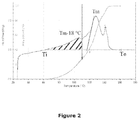
- FIG. 2 shows an example of determination of the percentage of enthalpy measured between Ti and [Tm ⁇ 18° C.] according to an embodiment of the present invention.
- FIG. 3 provides heat seal curves for BOPP films produced with propylene-comonomer block copolymer in accordance with the invention, and in accordance with comparative example CE1.
- FIG. 4 provides hot tack seal curves for BOPP films produced with propylene-comonomer block copolymer in accordance with the invention, and in accordance with comparative example CE1.
- the present invention relates to a propylene-comonomer block copolymer suitable for use as heat seal layer for biaxially oriented multi-layer films.
- a compartment refers to one or more than one compartment.
- the value to which the modifier “about” refers is itself also specifically disclosed.
- % by weight refers to the relative weight of the respective component based on the overall weight of the formulation.
- skin layer and “heat seal layer” are used herein as synonyms.
- “Seal-initiation temperature” used herein refers to the minimum sealing temperature required to form a seal of significant strength. The level of strength that must be reached to be deemed “significant” varies with the application. As a default value, 0.50 N (ca. 50 gm force) as minimum sealing force between two films, 1.5 cm width each, is commonly used.
- the present invention provides a propylene-comonomer block copolymer, which is a propylene-comonomer multimodal copolymer.
- the propylene-comonomer block copolymer is a propylene-comonomer bimodal copolymer i.e. with a bimodal distribution of the comonomer.
- the present invention provides therefore a propylene-comonomer block copolymer which comprises at least 40 wt % of a first propylene-comonomer polymer and at least 30 wt % of a second propylene-comonomer polymer, the first and the second propylene comonomer differing in their comonomer content.
- the comonomer content of the second propylene-comonomer polymer is higher than the comonomer content of the first propylene-comonomer polymer. This allows reaching low SIT value when the final product will be used as BOPP skin layer.
- Block polymer means that the final polymer will correspond to a blend of, at least, two polymers produced in different polymerization conditions; each polymer, also called block, has thus specific properties. Accordingly, the mentioned at least two polymers or blocks do not necessarily belong to the same molecule, in a preferred embodiment, the propylene-comonomer block copolymer is suitable for use as heat seal layer for biaxially oriented multi-layer films.
- the propylene-comonomer block copolymer comprises at most 70 wt % of said first propylene-comonomer polymer.
- the propylene-comonomer block copolymer comprises at most 60 wt % of said second propylene-comonomer polymer.
- the comonomer is ethylene and the propylene-comonomer block copolymer comprises at least two propylene-ethylene copolymers having different ethylene content, wherein the ethylene content of the second propylene-ethylene copolymer is from 1 to 5 wt % higher than that of the ethylene content of the first propylene-ethylene copolymer.
- the melting temperature of the propylene-comonomer polymer is dependant of the comonomer content of said propylene-comonomer polymer, such that an increase of the comonomer content leads to a decrease of the melting temperature and vice-versa.
- the fact that the comonomer content of one of the propylene-comonomer polymer is higher than the comonomer content of the other propylene-comonomer polymer result in having two propylene-comonomer polymers with different melting temperatures.
- an adjustment of the comonomer content of said propylene-comonomer polymer component or of at least one of the propylene-comonomer polymer component of the propylene-comonomer block copolymer is to be done.
- the melting temperature of the first propylene-comonomer block is at least 90° C., preferably at least 100° C., more preferably at least 110° C., most preferably at least 120° C.
- the melting temperature of said first propylene-comonomer block is at most 160° C., preferably at most 150° C., more preferably at most 145° C.
- the melting temperature of the second propylene-comonomer block is at most 135° C., preferably at most 130° C., more preferably at most 125° C., even more preferably at most 120° C., most preferably at most 115° C., even most preferably at most 100° C.
- the melting temperature of the second propylene-comonomer block is at least 60° C., preferably at least 70° C., more preferably at least 80° C.
- the melting temperature of the second propylene-comonomer block is determined, as shown in FIG.
- the comonomer content of the propylene-comonomer block copolymer is at least 0.1 wt %, preferably at least 1 wt %, more preferably at least 1.5 wt %, most preferably at least 2 wt %. Said comonomer content is at most 15 wt %, preferably at most 10 wt %, preferably at most 9 wt % more preferably at most 8 wt %, most preferably at most 5 wt %.
- said comonomer is selected from the group comprising ethylene, butene, pentene, hexene, heptene, octene, nonene, decene and any mixture thereof.
- at least 80%, preferably at least 90%, more preferably 95% and most preferably 99% of said comonomer is ethylene.
- said comonomer consists of ethylene.
- the propylene-comonomer block copolymer may further contain at most 10 wt %, preferably at most 5 wt %, more preferably at most 3 wt %, most preferably at most 1 wt %, of another comonomer.
- Said another comonomer might be comprised in the first propylene-comonomer block or in the second propylene-comonomer block.
- Preferably said another comonomer is butene or hexene.
- the propylene-comonomer block copolymer is devoid of butene.
- the melt flow index (MFI) of the propylene-comonomer block copolymer is at least 0.1 g/10 mm, at least 1 g/10 min, preferably at least 3 g/10 min. In a preferred embodiment, the melt flow index (MEI) of the propylene-comonomer block copolymer is at most 15 g/10 min, preferably at most 10 g/10 min.
- the seal initiation temperature of the propylene-comonomer block copolymer is at least 60° C., preferably at least 70° C.
- the seal initiation temperature of the propylene-comonomer block copolymer is at most 140° C., preferably at most 130° C., more preferably at most 125° C., even more preferably at most 120° C.
- the melting temperature of the propylene-comonomer block copolymer is at least 100° C., preferably at least 110° C., more preferably at least 120° C. Said melting temperature is at most 150° C., preferably at most 145° C.
- the molecular weight distribution of the propylene-comonomer block copolymer, represented by the ratio Mw/Mn as determined by gel permeation chromatography (GPC), of the propylene-comonomer block copolymer is at least 1.7, preferably at least 2, more preferably at least 2.3.
- Mw/Mn is at most 8, preferably at most 6, more preferably at most 5, even more preferably at most 4.
- the propylene-comonomer block copolymer is having a hexane solubles content of at most 2 wt %, preferably at most 1.5 wt %, more preferably at most 1 wt %, most preferably at most 0.8 wt %, even most preferably at most 0.5 wt %.
- the percentage of enthalpy measured between Ti and [Tm ⁇ 18° C.], of the propylene-comonomer block copolymer is at least 20%, preferably at least 22% of the total enthalpy. Said percentage is at least 20% when the propylene-comonmer block copolymer comprises at least two polymer components having different comonomer content in suitable proportion.
- the man skilled in the art can adjust the comrnoner content of the propylene-comonomer polymers in the different blocks of the propylene-comonomer block copolymer.
- the percentage of enthalpy measured between Ti and [Tm ⁇ 18° C.] of the propylene-comonomer block copolymer of at least 20%, preferably at least 22% of the total enthalpy quantifies that the DSC signal extends over a range of especially high temperatures.
- the percentage of enthalpy measured between Ti and [Tm ⁇ 18° C.], of the propylene-comonomer block copolymer is at most 40%, preferably at most 50%, more preferably at most 55%, even more preferably at most 60%, most preferably at most 70% of the total enthalpy. Said percentage of enthalpy measured between Ti and [Tm ⁇ 18° C.] being determined by stepwise isothermal segregation technique (SIST)
- the percentage of enthalpy between Ti and [Tm ⁇ 18° C.] is determined using the Stepwise Isothermal Segregation Technique (SIST). The precise analytical procedure is described in the “test methods” section. From the SIST obtained data, the percentage of enthalpy between Ti and [Tm ⁇ 18° C.] is calculated using the following equation (III):
- the proposed integrals must be divided by the heating rate. Doing so, enthalpies, in J/g, are obtained, both in the numerator and denominator. As division by the heating rate must be performed both in the numerator and in the denominator, these divisions could be simplified and they were not performed during the calculation of the percentage of enthalpy between Ti and [Tm ⁇ 18 C].
- FIG. 2 shows an example of the experimental result: the dashed part corresponds to the integration of Pleat Flux [ ⁇ Ti Tm ⁇ 18 C Heat Flux dT]. After division by the integration of the whole thermogram [ ⁇ Ti Te Heat Flux dT] and multiplication of this ratio by 100, the percentage of enthalpy between Ti and [Tm ⁇ 18 C] is obtained.
- the propylene-comonomer block copolymer further comprises additional polymer blocks produced during a prepolymerization step.
- the propylene-comonomer block copolymer comprises at most 20 wt %, preferably at most 10 wt %, more preferably at most 5 wt %, more preferably at most 2 wt % of the additional blocks produced during said prepolymerization step.
- Most preferably said additional polymer block consist of propylene.
- the first propylene-comonomer copolymer can be produced in one reactor.
- Said first propylene-comonomer copolymer can also be produced in a cascade of reactors wherein polymerization conditions such as hydrogen content, polymerization temperature may differ from one reactor to the other.
- the second propylene-comonomer copolymer can be produced in one reactor.
- Said second propylene-comonomer copolymer can also be produced in a cascade of reactors wherein polymerization conditions such as hydrogen content, polymerization temperature may differ from one reactor to the other.
- the propylene-comonomer block copolymer comprises at least one antioxidant and/or other additives selected from the group comprising slip-agent, anti-block agent, light stabilizers, acid scavengers, lubricants, antistatic additives, nucleating/clarifying agents, colorants.
- additives selected from the group comprising slip-agent, anti-block agent, light stabilizers, acid scavengers, lubricants, antistatic additives, nucleating/clarifying agents, colorants.
- the propylene-comonomer block copolymer according to an embodiment of the invention is used as heat seal layer of BOPP films.
- the propylene-comonomer block copolymer is blended with polybutene or syndiotactic polypropylene and the obtained blend is used as heat seal layer for BOPP films.
- This embodiment allows, for example, lowering the SIT temperature, but will results in poorer results regarding stickiness and hexane solubles content.
- a BOPP film comprises at least one heat seal layer.
- said BOPP film comprises an inner layer sandwiched between at least two heat seal layers.
- said heat seal layers consists of the propylene-comonomer block copolymer according to an embodiment of the present invention.
- said heat seal layer has a thickness of from 0.5 to 3 ⁇ m, preferably of from 0.6 to 2 ⁇ m, more preferably from 0.8 to 1.5 ⁇ m, most preferably about 1 ⁇ m.
- the present invention provides a process for the production of a propylene-comonomer block copolymer by polymerization of propylene and a comonomer in presence of a bridged metallocene catalyst wherein said comonomer is selected from the group comprising ethylene, butene, pentene, hexene, heptene, octene, nonene, decene and any mixture thereof.
- at least 80%, preferably at least 90%, more preferably 95% and most preferably 99% of said comonomer is ethylene.
- said comonomer consists of ethylene.
- the metallocene catalyst is a single site catalyst, preferably a blend of at least two single site metallocene catalysts.
- the metallocene catalyst is a multi sites catalyst, preferably a bi-sites catalyst, or a blend of at least two multi sites metallocene catalysts.
- said catalyst comprises a metallocene and an activating agent, or alternatively the metallocene catalyst may comprise a metallocene, an activating agent and a support.
- metallocene-based polymerization catalysts are generally known in the art.
- bridge is widely used in metallocene chemistry to denote a chemical group that “bridges”, i.e. is bonded simultaneously to for example two substituted cyclopentadienyl ligands or two substituted fluorenyl ligands or a substituted cyclopentadienyl ligand and a substituted fluorenyl ligand.
- the metallocene catalyst is a single site metallocene catalyst selected from the group comprising bridged fluorenyl and bridged indenyl metallocene.
- the used metallocene is selected from the group comprising (rac)-dimethylsilyl-bis-(2-methyl-4-phenylindenyl) zirconium dichloride and diphenylmethane(2-Me-4-tBu-cyclopentadiene-1-yl)(2,7-di-t-butylfluorene-9-yl)zirconium dichloride.
- the metallocene catalyst is a blend of (rac)-dimethylsilyl-bis-(2-methyl-4-phenylindenyl) zirconium dichloride and diphenylmethane(2-Me-4-tBu-cyclopentadiene-1-yl)(2,7-di-t-butylfluorene-9-yl)zirconium dichloride.
- the metallocene catalyst is a bi-site metallocene catalyst.
- a bi-site metallocene catalyst according to the invention is a catalyst with two sites wherein the sites have different response to comonomer incorporation, such as to produce a propylene-comonomer block copolymer with a bimodal comonomer distribution.
- the used metallocene is a combination of (rac)-dimethylsilyl-bis-(2-methyl-4-phenylindenyl) zirconium dichloride and diphenylmethane(2-Me-4-tBu-cyclopentadiene-1-yl)(2,7-di-t-butylfluorene-9-yl)zirconium dichloride.
- the catalysts used in the invention allow obtaining the desired block structure, in particular, when comonomer is ethylene, the desired C3C2-C3C2 block structure.
- the catalysts used in the invention allow obtaining a ratio E1/Co of at least 0.80 in contrast to Ziegler-Natta catalysts.
- the polymerization process can be carried out in one reactor using a blend of single site catalyst having different responses to comonomer incorporation or with a multi site catalyst, preferably a bi-site catalyst wherein the different sites have different responses to comonomer incorporation.
- the propylene-comonomer block copolymer produced must have a multimodal, preferably bimodal, comonomer distribution.
- a suitable multimodal comonomer distribution in accordance with the invention is achieved with a percentage of enthalpy measured between Ti and [Tm ⁇ 18° C.] of at least 20% of the total enthalpy.
- said process can be performed in at least two sequential polymerization reactors using a single site catalyst or a blend of single site catalysts. It is possible according to the invention to use the same catalyst system in all polymerization reactors, the multimodal comonomer distribution being achieved in varying the comonomer feed in said reactors (when single site metallocene catalysts are used) or with the same comonomer feed in said reactors (when bi-sites metallocene catalysts are used).
- the reactors can be two bulk reactors, two gas phase reactors or a bulk reactor followed by a gas phase reactor. If more than two reactors are used, all employed reactors can be gas phase reactors or bulk reactors or a combination of one or more bulk reactors followed by one or more gas phase reactors.
- the use of a cascade of reactors is preferred over a post-reactor blend of separately produced propylene-comonomer blocks.
- the propylene-comonomer polymer having the highest melting temperature, i.e. the lowest comonomer content is produced in the first reactor.
- the process comprises an optional pre-polymerization step. This is advantageous as it allows avoiding morphology issues.
- the present invention provides for the use of a propylene-comonomer block copolymer of the invention as heat seal layer for biaxially oriented multi-layer films.
- the propylene-comonomer block copolymer of the present invention presents several advantages such as having low SIT value while maintaining high melting temperature; having superior hot tack properties compared to existing terpolymer heat seal layer grades with similar SIT, melting temperature and optical properties; having low hexane solubles content or at least similar to the lowest commercial hexane solubles content. Further good optical properties are obtained.
- the propylene-comonomer block copolymer of the present invention is further characterized by a very good aptitude to corona treatment or flame treatment, especially when high surface tension is targeted. Furthermore, the propylene-comonomer block copolymer of the present invention provides access to high surface tension, typically higher than 40 mN/m, at high speed production lines, meaning e.g. for a “Tenter” BOPP lines, a line speed higher than 400 or 450 m/min.
- the melt flow index was measured according to norm ISO 1133, condition L, using a weight of 2.16 kg and a temperature of 230° C.
- the molecular weight (weight average molecular weight Mw, number average molecular weight Mn, and Z average molecular weight Mz) of the samples is measured using gel permeation chromatography (GPC).
- the samples are dissolved in 1,2,4-trichlorobenzene.
- the resulting solution is injected into a gel permeation chromatograph and analyzed under conditions well-known in the polymer industry.
- the total ethylene content (wt % C2) relative to the total weight of the propylene polymer and the molar fraction of ethylene comonomer in sequences of length one relative to the comonomer content are determined by 13C NMR analysis according to the state of the art of 13C NMR analysis of propylene based polyolefins.
- the 13C-NMR analysis was performed under conditions such that the signal intensity in the spectrum is directly proportional to the total number of contributing carbon atoms in the sample. Such conditions are well known to the skilled person and include for example sufficient relaxation time etc. In practice, the intensity of a signal is obtained from its integral, i.e. the corresponding area.
- the data were acquired using proton decoupling, several hundred even thousands scans per spectrum, at a temperature of 130° C.
- the sample was prepared by dissolving a sufficient amount of polymer in 1,2,4-trichlorobenzene (TCB 99% spectroscopic grade) at 130° C.
- HMDS hexadeuterobenzene
- HMDS hexamethyldisiloxane
- the total ethylene content (wt % C2) relative to the total weight of propylene polymer is determined from the appropriate peaks area combination, a well-known method to the skilled person.
- E1/Co well known to the person skilled in the art: Sbb peaks area (E1) divided by the sum of representative comonomer areas (Co).
- Representative comonomer areas means the sum of the areas related to the comonomer divided by the number of carbons contributing to that sum of areas.
- Sbb peaks correspond to the following structures resulting from the insertion of one ethylene unit between two propylene units, between two comonomer units wherein the comonomer units are not ethylene, or between one propylene and one comonomer wherein the comonomer is not ethylene.
- Melting temperatures were measured on a DSC Q2000 commercialized by TA Instruments calibrated with indium and using T zero mode. The polymer analysis is performed with a 2 to 10 mg polymer sample under conditions well-known in polymer industry.
- the imposed thermal history is:
- Stepwise isothermal segregation technique (SIST) is also performed in the same apparatus with 2 to 10 mg polymer. Following program is used.
- the raw data were processed as follow. The part of the curve after complete melting was rotated to horizontal. The base line was drawn horizontally from the end of the thermogram.
- the initial melting temperature (Ti) is the cross over point between the baseline and the thermogram. The melting temperature is the temperature at maximum height of the peak.
- the total enthalpy could be measured but also other values like the enthalpy “below Tm ⁇ 18 C”.
- the enthalpy is measured by integration of the heat flux signal in watt (divided by the heating rate and normalized based on the weight to obtain the final result in J/g) below the specified temperature, i.e. melting temperature—18 C in this case (See FIG. 1 ).
- the value reported in the examples of enthalpy “below Tm ⁇ 18° C.” is divided by the total enthalpy and multiplied by 100 to obtain a percentage.
- sealing initiation temperature SIT was measured on a 150 ⁇ m thick film made by compression molding. The test was performed according to norm ASTM F 88 and the following parameters were used: temperature: 23° C., specimen width: 15 mm, seal pressure: 40 N, seal time: 9 seconds, peel speed: 200 mm/min, start temperature: 104° C. and end temperature: 120° C. After annealing during 24 hours at 23° C. (50% humidity), a traction is imposed using a Zwick machine on the two 1.5 cm width sealed films (following the ASTM F88 norm), at a traction speed of 200 mm/min. SIT corresponds to the sealing temperature leading to a sealing force between the films of 0.5 N.
- hexane solubles content is determined according to FDA: 21 CFR 177-1520
- the film (below 100 ⁇ m thickness) sample was cut in 2.5 cm pieces. Weigh 1 gram of sample accurately and place in a 250-milliliter Erlenmeyer flask containing two or three boiling stones. Add 100 milliliters of solvent, attach the flask to the condenser (use no grease), and reflux the mixture for 2 hours. Remove the flask from the heat, disconnect the condenser, and filter rapidly, while still hot, through a small wad of glass wool packed in a short-stem funnel into a tared 150-millimeter beaker. Rinse the flask and filter with two 10-milliliter portions of the hot solvent, and add the rinsing to the filtrate.
- Grams ⁇ ⁇ of ⁇ ⁇ residue Grams ⁇ ⁇ of ⁇ ⁇ sample ⁇ 100 Percent ⁇ ⁇ extractable ⁇ ⁇ with ⁇ ⁇ ⁇ n ⁇ - ⁇ hexane
- sealing initiation temperature SIT was measured on a 20 ⁇ m thick BOPP film.
- the test was performed according to norm ASTM F 88 and the following parameters were used: temperature: 23° C., specimen width: 15 mm, seal pressure: 40 N, seal time: 3 seconds, peel speed: 200 mm/min, start temperature: 100° C. end temperature: 120° C.
- a traction is imposed using a Zwick machine on the two 1.5 cm width sealed films (following the ASTM F88 norm), at a traction speed of 200 mm/min.
- SIT corresponds to the sealing temperature leading to a sealing force between the films of 0.5 N.
- Hot seal strength (Hot Tack) has been determined in accordance to ASTM F1921—Méthode B.
- Tc is the crystallization temperature and is measured by DSC
- the catalyst used is a bi-site metallocene catalyst wherein the sites have different response to comonomer incorporation, such as to produce a propylene-comonomer block copolymer with a bimodal comonomer distribution.
- propylene-comonomer block copolymer were produced in a double loop reactor, whereas in Example 6 propylene-comonomer block copolymer was produced in a single loop reactor.
- propylene-comonomer block copolymer were produced with a prepolymerization loop using conditions from table 1 and continuously fed with the catalyst prepared as described above. Triethylaluminum concentration in reactors was maintained at 75 ppm (wt/wt).
- the comonomer used is ethylene (C2).
- the propylene-comonomer block copolymer was produced using 2 wt % of diphenylmethane(2-Me-4-tBu-cyclopentadiene-1-yl)(2,7-di-t-butylfluorene-9-yl)zirconium dichloride supported on G952 from Grace.
- Comparative example 1 is a “Ziegler-Natta terpolymer”, commercialized by Lyondellbasell under the trade name “Adsyl 5C37F”.
- the propylene-comonomer block copolymer of CE2 has been produced with the same catalyst than the inventive example 5, but in polymerisation conditions to have a monomodal comonomer distribution.
- the propylene-comonomer block copolymer of CE3 has been produced with the same catalyst than the inventive example 1-4, but in polymerisation conditions to have a monomodal comonomer distribution.
- split 1 60/40 61/39 58/42 70/30 40/60 — — — — 1 the split refers to the split or ratio between the comonomer block having High melting temperature Tm and the block having low melting temperature Tm. Said splits were determined by measuring the amount of residual zirconium in samples from first loop and in final polymer by ICP-AES.
- Comparative example 2 (CE2), consisting of the propylene-comonomer block having low melting temperature, shows that an increase of C2 in monomodal polymer induces stickiness on the chill-roll of the BOPP line. Without being bound by any theory it is believed that the inventive examples 1, 2 and 6 showing similar of lower melting temperature do not stick the apparatus due to their bimodal comonomer distribution which result in a mix of polymer of different melting temperatures.
- Comparative example 3 consisting of the first propylene-comonomer block having high melt temperature, has a high SIT compared to the examples according to the present invention.
- BOPP films were produced from some example resins on a BOPP pilot line (tenter process). Applied draw ratios were 4.5 and 6.6 in machine and transverse directions, respectively.
- the core layer (about 17 microns thick) consists of a PP homopolymer and skin layers (about 1.5 micron thick on each side) consist of the example resins.
- the PP homopolymer used as core layer in the examples has the following properties:
- the BOPP films produced from the propylene-comonomer block copolymer of the invention show an improvement in hot tack properties compared to BOPP film produced from CE1. Indeed, it can be seen that the maximum seal force has been improved whereas the sealing temperature at MSF has been lowered. A shift of the hot tack window to lower temperatures compared to CE1 has also been obtained.
Landscapes
- Chemical & Material Sciences (AREA)
- Chemical Kinetics & Catalysis (AREA)
- Health & Medical Sciences (AREA)
- Medicinal Chemistry (AREA)
- Polymers & Plastics (AREA)
- Organic Chemistry (AREA)
- Engineering & Computer Science (AREA)
- Materials Engineering (AREA)
- Graft Or Block Polymers (AREA)
- Laminated Bodies (AREA)
- Crystallography & Structural Chemistry (AREA)
- Manufacturing & Machinery (AREA)
- Addition Polymer Or Copolymer, Post-Treatments, Or Chemical Modifications (AREA)
Applications Claiming Priority (4)
| Application Number | Priority Date | Filing Date | Title |
|---|---|---|---|
| EP13175745 | 2013-07-09 | ||
| EP13175745 | 2013-07-09 | ||
| EP13175745.2 | 2013-07-09 | ||
| PCT/EP2014/064729 WO2015004193A1 (en) | 2013-07-09 | 2014-07-09 | Propylene copolymer for bopp heat seal film layers |
Publications (2)
| Publication Number | Publication Date |
|---|---|
| US20160376393A1 US20160376393A1 (en) | 2016-12-29 |
| US10696774B2 true US10696774B2 (en) | 2020-06-30 |
Family
ID=48874113
Family Applications (1)
| Application Number | Title | Priority Date | Filing Date |
|---|---|---|---|
| US14/903,302 Active 2035-11-11 US10696774B2 (en) | 2013-07-09 | 2014-07-09 | Propylene copolymer for BOPP heat seal film layers |
Country Status (9)
| Country | Link |
|---|---|
| US (1) | US10696774B2 (pl) |
| EP (1) | EP3019537B1 (pl) |
| KR (1) | KR102234329B1 (pl) |
| CN (1) | CN105377913B (pl) |
| ES (1) | ES2939122T3 (pl) |
| HU (1) | HUE061316T2 (pl) |
| PL (1) | PL3019537T3 (pl) |
| PT (1) | PT3019537T (pl) |
| WO (1) | WO2015004193A1 (pl) |
Families Citing this family (5)
| Publication number | Priority date | Publication date | Assignee | Title |
|---|---|---|---|---|
| AU2014243188B2 (en) | 2013-03-26 | 2016-05-12 | Borealis Ag | Propylene copolymer with high impact properties |
| WO2016089174A1 (ko) | 2014-12-04 | 2016-06-09 | 주식회사 엘지화학 | 무연신 폴리프로필렌계 필름 |
| ES2663345T3 (es) * | 2015-03-02 | 2018-04-12 | Borealis Ag | Composición de copolímeros aleatorios C2C3 con un equilibrio mejorado entre la temperatura de inicio del sellado y el punto de fusión |
| EP3309183A1 (en) * | 2016-10-14 | 2018-04-18 | SABIC Global Technologies B.V. | Polypropylene for use in bopp applications |
| EP3661983B1 (en) * | 2017-08-02 | 2022-01-19 | Total Research & Technology Feluy | Dual catalyst composition |
Citations (6)
| Publication number | Priority date | Publication date | Assignee | Title |
|---|---|---|---|---|
| EP1270651A1 (en) | 2001-06-27 | 2003-01-02 | Borealis Technology Oy | Polymer film comprising a propylene random copolymer |
| US20030130443A1 (en) | 1999-12-21 | 2003-07-10 | Juergen Suhm | Partly crystalline propylene polymerisate composition for production of biaxial-stretched polypropylene films |
| EP1588843A1 (en) | 2004-04-20 | 2005-10-26 | Japan Polypropylene Corporation | Biaxially oriented multilayer film comprising a surface layer based on a propylene-ethylene random block copolymer |
| US20060058463A1 (en) | 2002-06-12 | 2006-03-16 | Basell Polyolefine Gmbh | Flexible propylene copolymer compositions having a high transparency |
| EP1661924A1 (en) | 2003-08-22 | 2006-05-31 | Mitsui Chemicals, Inc. | Propylene random copolymers and use thereof |
| US20100152382A1 (en) | 2008-12-15 | 2010-06-17 | Peijun Jiang | Thermoplastic Olefin Compositions |
-
2014
- 2014-07-09 KR KR1020167000482A patent/KR102234329B1/ko active Active
- 2014-07-09 US US14/903,302 patent/US10696774B2/en active Active
- 2014-07-09 HU HUE14739388A patent/HUE061316T2/hu unknown
- 2014-07-09 CN CN201480039174.7A patent/CN105377913B/zh active Active
- 2014-07-09 PL PL14739388.8T patent/PL3019537T3/pl unknown
- 2014-07-09 EP EP14739388.8A patent/EP3019537B1/en active Active
- 2014-07-09 ES ES14739388T patent/ES2939122T3/es active Active
- 2014-07-09 PT PT147393888T patent/PT3019537T/pt unknown
- 2014-07-09 WO PCT/EP2014/064729 patent/WO2015004193A1/en not_active Ceased
Patent Citations (6)
| Publication number | Priority date | Publication date | Assignee | Title |
|---|---|---|---|---|
| US20030130443A1 (en) | 1999-12-21 | 2003-07-10 | Juergen Suhm | Partly crystalline propylene polymerisate composition for production of biaxial-stretched polypropylene films |
| EP1270651A1 (en) | 2001-06-27 | 2003-01-02 | Borealis Technology Oy | Polymer film comprising a propylene random copolymer |
| US20060058463A1 (en) | 2002-06-12 | 2006-03-16 | Basell Polyolefine Gmbh | Flexible propylene copolymer compositions having a high transparency |
| EP1661924A1 (en) | 2003-08-22 | 2006-05-31 | Mitsui Chemicals, Inc. | Propylene random copolymers and use thereof |
| EP1588843A1 (en) | 2004-04-20 | 2005-10-26 | Japan Polypropylene Corporation | Biaxially oriented multilayer film comprising a surface layer based on a propylene-ethylene random block copolymer |
| US20100152382A1 (en) | 2008-12-15 | 2010-06-17 | Peijun Jiang | Thermoplastic Olefin Compositions |
Non-Patent Citations (4)
| Title |
|---|
| G.J. Ray et al., "Carbon-13 Nuclear Magnetic Resonance Determination of Monomer Composition and Sequence Distributions in Ethylene-Propylene Copolymers Prepared with a Stereoregular Catalyst System", Macromolecules, vol. 10, n° 4, Jul.-Aug. 1977, p. 773-778. |
| International Search Report issued in PCT/EP2014/064729, dated Sep. 3, 2014, 3 pages. |
| Plastics Additives Handbook, ed. H. Zweifel, 5th edition, 2001, Hanser Publishers. |
| Y.D Zhang et al, "13C NMR, GPC, and DCS Study on a Propylene-ethylene-1-butene Terpolymer Fractionated by Termperature Rising Elution Fractionation" Polymer Journal, vol. 35, n°7, 2003, p. 551-559. |
Also Published As
| Publication number | Publication date |
|---|---|
| PT3019537T (pt) | 2023-03-03 |
| EP3019537B1 (en) | 2022-12-21 |
| KR20160028441A (ko) | 2016-03-11 |
| CN105377913A (zh) | 2016-03-02 |
| PL3019537T3 (pl) | 2023-04-24 |
| US20160376393A1 (en) | 2016-12-29 |
| WO2015004193A1 (en) | 2015-01-15 |
| HUE061316T2 (hu) | 2023-06-28 |
| EP3019537A1 (en) | 2016-05-18 |
| CN105377913B (zh) | 2018-07-31 |
| ES2939122T3 (es) | 2023-04-19 |
| KR102234329B1 (ko) | 2021-03-31 |
Similar Documents
| Publication | Publication Date | Title |
|---|---|---|
| US11390732B2 (en) | Polypropylene composition | |
| US10501615B2 (en) | Bimodal polypropylene and process for the preparation thereof | |
| EP1726602A1 (en) | Propylene polymer with high crystallinity | |
| US10696774B2 (en) | Propylene copolymer for BOPP heat seal film layers | |
| MX2009000405A (es) | Pelicula de polipropileno orientada biaxialmente. | |
| US6593442B2 (en) | Semicrystalline propylene polymer compositions with good suitability for producing biaxially oriented films | |
| WO2013127760A1 (en) | Polypropylene composition combining softness, toughness, low haze and high thermal resistance | |
| WO2013171105A1 (en) | Moulded article with improved stress whitening | |
| EP3387027A1 (en) | Propylene copolymers | |
| JP7081051B2 (ja) | ポリオレフィン繊維 | |
| EP3666804B1 (en) | Polypropylene composition with favourable combination of optics, softness and low sealing | |
| CN117597389B (zh) | 具有优异的光学性能和密封性能的多相丙烯乙烯共聚物组合物 | |
| US9879364B2 (en) | Polymer compositions for staple and multifilament fibers | |
| EP3919529A1 (en) | Process to produce propylene copolymer, the polypropylene produced and articles made from this polypropylene | |
| RU2775266C1 (ru) | Композиция пропиленового сополимера с превосходными оптическими и механическими свойствами | |
| EP4565652A1 (en) | Polypropylene composition for heat sealable films | |
| WO2025229198A1 (en) | Heterophasic propylene-ethylene copolymer having excellent stiffness-impact strength balance, optical properties and stress whitening performance | |
| WO2015180917A1 (en) | Ethylene polymer composition and use thereof in polyolefin compositions |
Legal Events
| Date | Code | Title | Description |
|---|---|---|---|
| AS | Assignment |
Owner name: TOTAL RESEARCH & TECHNOLOGY FELUY, BELGIUM Free format text: ASSIGNMENT OF ASSIGNORS INTEREST;ASSIGNORS:LHOST, OLIVIER;VANTOMME, AURELIEN;WELLE, ALEXANDRE;SIGNING DATES FROM 20160219 TO 20160302;REEL/FRAME:038454/0619 |
|
| STPP | Information on status: patent application and granting procedure in general |
Free format text: FINAL REJECTION MAILED |
|
| STPP | Information on status: patent application and granting procedure in general |
Free format text: RESPONSE AFTER FINAL ACTION FORWARDED TO EXAMINER |
|
| STPP | Information on status: patent application and granting procedure in general |
Free format text: DOCKETED NEW CASE - READY FOR EXAMINATION |
|
| STPP | Information on status: patent application and granting procedure in general |
Free format text: NOTICE OF ALLOWANCE MAILED -- APPLICATION RECEIVED IN OFFICE OF PUBLICATIONS |
|
| STCF | Information on status: patent grant |
Free format text: PATENTED CASE |
|
| MAFP | Maintenance fee payment |
Free format text: PAYMENT OF MAINTENANCE FEE, 4TH YEAR, LARGE ENTITY (ORIGINAL EVENT CODE: M1551); ENTITY STATUS OF PATENT OWNER: LARGE ENTITY Year of fee payment: 4 |