US10696593B2 - Method of quickly preparing geopolymer having high strength using coal bottom ash - Google Patents
Method of quickly preparing geopolymer having high strength using coal bottom ash Download PDFInfo
- Publication number
- US10696593B2 US10696593B2 US16/181,587 US201816181587A US10696593B2 US 10696593 B2 US10696593 B2 US 10696593B2 US 201816181587 A US201816181587 A US 201816181587A US 10696593 B2 US10696593 B2 US 10696593B2
- Authority
- US
- United States
- Prior art keywords
- geopolymer
- specimen
- bottom ash
- oven
- activating agent
- Prior art date
- Legal status (The legal status is an assumption and is not a legal conclusion. Google has not performed a legal analysis and makes no representation as to the accuracy of the status listed.)
- Active
Links
Images




Classifications
-
- C—CHEMISTRY; METALLURGY
- C04—CEMENTS; CONCRETE; ARTIFICIAL STONE; CERAMICS; REFRACTORIES
- C04B—LIME, MAGNESIA; SLAG; CEMENTS; COMPOSITIONS THEREOF, e.g. MORTARS, CONCRETE OR LIKE BUILDING MATERIALS; ARTIFICIAL STONE; CERAMICS; REFRACTORIES; TREATMENT OF NATURAL STONE
- C04B28/00—Compositions of mortars, concrete or artificial stone, containing inorganic binders or the reaction product of an inorganic and an organic binder, e.g. polycarboxylate cements
- C04B28/006—Compositions of mortars, concrete or artificial stone, containing inorganic binders or the reaction product of an inorganic and an organic binder, e.g. polycarboxylate cements containing mineral polymers, e.g. geopolymers of the Davidovits type
-
- C—CHEMISTRY; METALLURGY
- C04—CEMENTS; CONCRETE; ARTIFICIAL STONE; CERAMICS; REFRACTORIES
- C04B—LIME, MAGNESIA; SLAG; CEMENTS; COMPOSITIONS THEREOF, e.g. MORTARS, CONCRETE OR LIKE BUILDING MATERIALS; ARTIFICIAL STONE; CERAMICS; REFRACTORIES; TREATMENT OF NATURAL STONE
- C04B7/00—Hydraulic cements
- C04B7/24—Cements from oil shales, residues or waste other than slag
- C04B7/26—Cements from oil shales, residues or waste other than slag from raw materials containing flue dust, i.e. fly ash
-
- C—CHEMISTRY; METALLURGY
- C04—CEMENTS; CONCRETE; ARTIFICIAL STONE; CERAMICS; REFRACTORIES
- C04B—LIME, MAGNESIA; SLAG; CEMENTS; COMPOSITIONS THEREOF, e.g. MORTARS, CONCRETE OR LIKE BUILDING MATERIALS; ARTIFICIAL STONE; CERAMICS; REFRACTORIES; TREATMENT OF NATURAL STONE
- C04B12/00—Cements not provided for in groups C04B7/00 - C04B11/00
- C04B12/005—Geopolymer cements, e.g. reaction products of aluminosilicates with alkali metal hydroxides or silicates
-
- C—CHEMISTRY; METALLURGY
- C04—CEMENTS; CONCRETE; ARTIFICIAL STONE; CERAMICS; REFRACTORIES
- C04B—LIME, MAGNESIA; SLAG; CEMENTS; COMPOSITIONS THEREOF, e.g. MORTARS, CONCRETE OR LIKE BUILDING MATERIALS; ARTIFICIAL STONE; CERAMICS; REFRACTORIES; TREATMENT OF NATURAL STONE
- C04B22/00—Use of inorganic materials as active ingredients for mortars, concrete or artificial stone, e.g. accelerators or shrinkage compensating agents
- C04B22/06—Oxides, Hydroxides
- C04B22/062—Oxides, Hydroxides of the alkali or alkaline-earth metals
-
- C—CHEMISTRY; METALLURGY
- C04—CEMENTS; CONCRETE; ARTIFICIAL STONE; CERAMICS; REFRACTORIES
- C04B—LIME, MAGNESIA; SLAG; CEMENTS; COMPOSITIONS THEREOF, e.g. MORTARS, CONCRETE OR LIKE BUILDING MATERIALS; ARTIFICIAL STONE; CERAMICS; REFRACTORIES; TREATMENT OF NATURAL STONE
- C04B40/00—Processes, in general, for influencing or modifying the properties of mortars, concrete or artificial stone compositions, e.g. their setting or hardening ability
- C04B40/0028—Aspects relating to the mixing step of the mortar preparation
- C04B40/0032—Controlling the process of mixing, e.g. adding ingredients in a quantity depending on a measured or desired value
-
- C—CHEMISTRY; METALLURGY
- C04—CEMENTS; CONCRETE; ARTIFICIAL STONE; CERAMICS; REFRACTORIES
- C04B—LIME, MAGNESIA; SLAG; CEMENTS; COMPOSITIONS THEREOF, e.g. MORTARS, CONCRETE OR LIKE BUILDING MATERIALS; ARTIFICIAL STONE; CERAMICS; REFRACTORIES; TREATMENT OF NATURAL STONE
- C04B40/00—Processes, in general, for influencing or modifying the properties of mortars, concrete or artificial stone compositions, e.g. their setting or hardening ability
- C04B40/02—Selection of the hardening environment
- C04B40/0204—Selection of the hardening environment making use of electric or wave energy or particle radiation
- C04B40/0213—Electromagnetic waves
- C04B40/0218—Microwaves
-
- C—CHEMISTRY; METALLURGY
- C04—CEMENTS; CONCRETE; ARTIFICIAL STONE; CERAMICS; REFRACTORIES
- C04B—LIME, MAGNESIA; SLAG; CEMENTS; COMPOSITIONS THEREOF, e.g. MORTARS, CONCRETE OR LIKE BUILDING MATERIALS; ARTIFICIAL STONE; CERAMICS; REFRACTORIES; TREATMENT OF NATURAL STONE
- C04B2103/00—Function or property of ingredients for mortars, concrete or artificial stone
- C04B2103/10—Accelerators; Activators
-
- Y—GENERAL TAGGING OF NEW TECHNOLOGICAL DEVELOPMENTS; GENERAL TAGGING OF CROSS-SECTIONAL TECHNOLOGIES SPANNING OVER SEVERAL SECTIONS OF THE IPC; TECHNICAL SUBJECTS COVERED BY FORMER USPC CROSS-REFERENCE ART COLLECTIONS [XRACs] AND DIGESTS
- Y02—TECHNOLOGIES OR APPLICATIONS FOR MITIGATION OR ADAPTATION AGAINST CLIMATE CHANGE
- Y02P—CLIMATE CHANGE MITIGATION TECHNOLOGIES IN THE PRODUCTION OR PROCESSING OF GOODS
- Y02P40/00—Technologies relating to the processing of minerals
- Y02P40/10—Production of cement, e.g. improving or optimising the production methods; Cement grinding
Definitions
- the present invention is a technology relating to a method of preparing a geopolymer using a coal bottom ash.
- Geopolymers are attracting attention as an eco-friendly material to replace cement or walls because the amount of carbon dioxide emitted during the preparation process thereof is small compared to portland cement.
- the addition of NaOH, KOH, K 2 SiO 3 , or Na 2 SiO 3 as an alkali activating agent to a material containing aluminosilicate minerals such as coal fly ash or slag generates a geopolymer which has high mechanical strength and which is capable of being used as a construction material even without being subjected to a calcination process using a chemical reaction.
- geopolymers are used instead of cement paste as a binding material in a geopolymer concrete, and a geopolymer paste serves to bind coarse aggregates, fine aggregates, and non-reactive materials, thus forming geopolymer concrete.
- aggregate occupies the largest volume in geopolymer concrete, and the content thereof is approximately 75 to 80% in terms of mass.
- Si and Al in fly ash are activated by an alkali activating agent such as sodium hydroxide to thus act as binding materials.
- an alkali activating agent such as sodium hydroxide
- compounds of sodium hydroxide (or calcium hydroxide) and/or sodium silicate (or potassium silicate) are used as the alkali activating agent, and when heat is applied thereto, a chemical reaction for generating the geopolymer accelerates. Accordingly, the geopolymer concrete is generally cured at a high temperature.
- bottom ash which has a relatively large particle size ranging from a few millimeters to a few centimeters and an irregular shape, is not utilized but is being disposed of using landfill, unlike fly ash.
- bottom ash since bottom ash is very similar to fly ash in terms of constitutional components, bottom ash may be used as a raw material for geopolymers, like the fly ash, if the particle size thereof is lowered by grinding.
- Korean Laid-Open Patent Application No. 10-2009-0122270 discloses a method of preparing eco-friendly eco-bricks using a geopolymer reaction of the bottom ash (coal bottom ash) from the boiler of a thermoelectric power plant.
- the method includes adding to 40 wt % of a 6 to 12 mole/L aqueous solution of sodium hydroxide, which is an alkali stimulant, to the bottom ash, followed by mixing; and placing the mixture into a molding frame, followed by compression molding and curing.
- Korean Laid-Open Patent Application No. 10-2010-0090844 discloses a method of preparing a molded body using urban waste incineration ash.
- a slurry-phase mixture in which 50 to 100 parts by weight of sodium silicate is added to 100 parts by weight of the dry mortar powder that includes 10 to 70 wt % of the urban waste incineration ash, including 10 to 30 wt % of an incineration fly ash and 70 to 90 wt % of an incineration bottom ash pre-treated using an alkali solution, and 30 to 90 wt % of blast furnace slag, is subjected to vibration molding and then cured at a temperature ranging from 25 to 80° C.
- Korean Patent No. 10-1243094 discloses a method of recovering a refined ash material.
- the method includes: a grinding step of grinding a raw material including a bottom ash, a fly ash, or a mixture thereof in a power plant, a flotation-sorting step of adding a flotation reagent to the raw material and recovering carbon clean coal by floatation so that the carbon clean coal and the ash material are separated, a re-grinding step of re-grinding a first ash material, which is the ash material separated during the flotation-sorting step, so that liberation into the ash material, a ferromagnetic body, and a ferrimagnetic body is performed, a primary magnetic-sorting step of sorting the ferromagnetic body liberated from the re-ground first ash material using a magnetic sorting device to thus separate the ferromagnetic body and the ash material, and a secondary magnetic-sorting step of sorting the ferrimagnetic body obtained by performing liberation of a
- the conventional methods of preparing geopolymers using bottom ash including those described in the patent documents cited above, have the following problems.
- the present invention is a technology which has been made keeping in mind the above problems occurring in the conventional preparation of the geopolymer using the coal bottom ash.
- Patent document 1 Korean Laid-Open Patent Application No. 10-2009-0122270
- Patent document 2 Korean Laid-Open Patent Application No. 10-2010-0090844
- Patent document 3 Korean Patent No. 10-1243094
- the object of the present invention is to provide a method of preparing a geopolymer having low thermal conductivity while exhibiting high compressive strength in a short curing time when the geopolymer is prepared using a coal bottom ash.
- a conventional technology has a problem in that a large number of expensive molds is required because curing is performed in an oven in the state in which a geopolymer is contained in the mold.
- the object of the present invention is to provide a method for solving the above-described problem.
- the present invention provides a method of preparing a geopolymer using a coal bottom ash.
- the method includes a step (1) of preparing a mixture of the coal bottom ash and an alkali activating agent by performing mixing while the amount of the alkali activating agent is adjusted so that the mixture does not become a gel, a step (2) of filling a mold with the mixture of the coal bottom ash and the alkali activating agent and applying a pressure thereto to thus prepare a geopolymer specimen, a step (3) of curing only the geopolymer specimen in an oven for a predetermined period of time after the geopolymer specimen is separated from the mold, and a step (4) of radiating microwaves on the geopolymer specimen after the curing.
- the content of the alkali activating agent may be 0.36 to 0.40 based on 1 part by weight of the coal bottom ash in the step (1).
- the content of the alkali activating agent may be increased as high as possible while the mixture is not gelled in the step (1) in order to increase the compressive strength of the geopolymer.
- the alkali activating agent may be any one selected from the group consisting of NaOH, KOH, K 2 SiO 3 , and Na 2 SiO 3 in the step (1).
- the temperature of the oven may be 50 to 85° C. in the step (3).
- the geopolymer specimen may be cured in the oven in a sealed state in order to prevent rapid water evaporation from the geopolymer specimen in the step (3).
- the relative ratio of the bottom ash and the alkali activating agent may be adjusted to thus control the compressive strength and the thermal conductivity of the geopolymer in the step (1).
- the pressure may be adjusted during compression molding in the mold to thus control the compressive strength and the thermal conductivity of the geopolymer in the step (2).
- an oven curing time may be adjusted to thus control the compressive strength and the thermal conductivity of the geopolymer in the step (3).
- an output or a radiation time of the microwave may be adjusted to thus control the compressive strength and the thermal conductivity of the geopolymer in the step (4).
- a mixture (or solution) of a coal bottom ash and an alkali activating agent is injected into a mold while the mixture is not in a gel state by reducing the amount of the alkali activating agent that is mixed with the coal bottom ash. Therefore, there is a merit in that only a geopolymer specimen is put into an oven and then cured therein after the geopolymer specimen is demolded from the mold, unlike the conventional technology, thereby significantly reducing the number of molds.
- the mold since the mold is not used during the curing process in the oven, heat and mass transfer to the inside of the specimen is not impeded by the mold, which enables more uniform curing.
- the present invention has an effect whereby further curing and hardening of the specimen cured in the oven are performed in a very short time by radiating a microwave. It is possible to obtain the target compressive strength of the geopolymer in a short time by radiating the microwaves as in the present invention, compared to a conventional method without microwave radiation.
- the present invention since only a small amount of the alkali activating agent is used, so that the mixture of the coal bottom ash and the alkali activating agent is not gelled, it is possible to radiate high-output microwaves due to a low water content. Accordingly, it is possible to prepare a geopolymer having desired physical properties of the present invention using microwave radiation in a short time of several minutes.
- the mixture since the mixture does not become a gel state, when the mixture (bottom ash+alkali activating agent) is contained in the mold, the mixture is contained therein while pressure is applied thereto, and the pressure may be adjusted during this process, thereby controlling the physical properties of the specimen.
- the thermal conductivity is slightly high, but very high mechanical strength is capable of being achieved.
- a relatively low pressure is applied thereto, although the strength is reduced, an insulation effect is capable of being improved by lowering the thermal conductivity. That is, in the present invention, it is possible to control the thermal conductivity and the mechanical strength of the finally prepared geopolymer by adjusting the pressure of a process for molding the mixture of the coal bottom ash and the alkali activating agent in the mold.
- FIG. 1 is a flow chart illustrating a method of the present invention
- FIG. 2 is a particle size distribution diagram of the coal bottom ash used in Experimental Example 1;
- FIG. 9 shows the result of Experimental Example 2-1 and is a graph showing the result of measurement of liquid/solid ratio vs. compressive strength
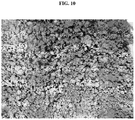
- FIG. 10 shows the result of Experimental Example 2-1 and is a photograph of a geopolymer prepared using a coal bottom ash and an alkali activating agent mixed at a liquid/solid ratio of 0.41;
- FIG. 11 shows the result of Experimental Example 2-1 and is a photograph of a geopolymer prepared using a coal bottom ash and an alkali activating agent mixed at a liquid/solid ratio of 0.43;
- FIG. 12 shows the result of Experimental Example 2-2 and is a graph showing the result of an experiment to measure liquid/solid ratio vs. thermal conductivity
- FIG. 13 shows the result of Experimental Example 3-1 and is a graph showing the result of measurement of microwave radiation time vs. mass loss;
- FIG. 14 shows the result of Experimental Example 3-2 and is a graph showing the result of measurement of mass loss vs. compressive strength.
- FIG. 15 shows the result of Experimental Example 3-3 and is a graph showing the result of the measurement of mass loss vs. thermal conductivity.
- bottom ash is used as an abbreviation for “coal bottom ash”.
- FIG. 1 illustrates the method of the present invention.
- the present invention provides a method of preparing a geopolymer using a coal bottom ash.
- the method includes a step (1) of performing mixing while the amount of the alkali activating agent is adjusted so that the bottom ash does not become a gel, a step (2) of filling a mold with the mixture of the bottom ash and the alkali activating agent and applying pressure thereto to thus prepare a geopolymer specimen, a step (3) of curing only the geopolymer specimen in an oven for a predetermined period of time after the geopolymer specimen is separated from the mold, and a step (4) of irradiating the geopolymer specimen in a microwave for a predetermined period of time after the curing.
- the alkali activating agent for example, NaOH, KOH, K 2 SiO 3 , and Na 2 SiO 3
- the alkali activating agent is used in an amount that is less in the present invention than in the conventional technology.
- the bottom ash is mixed with the alkali activating agent while the amount of the alkali activating agent is adjusted so that the mixture does not become a “gel” state.
- the present invention is not intended to mix as much as possible of the alkali activating agent before reaching the “gel” state, but means that the content of the alkali activating agent is variously adjustable while the mixture is not in the “gel” state.
- the geopolymer specimen may be demolded from the mold, so that only the geopolymer specimen may be cured in the oven without the mold.
- the number of molds required for preparing a large amount of the geopolymer is significantly reduced, and moreover, transfer of heat and mass to the inside of the geopolymer specimen during the oven curing process is not impeded by the mold. Accordingly, there is a merit in that more uniform curing is feasible. It is possible to embody the strength of the geopolymer more rapidly through the method of the present invention than through the method of curing in the oven with the geopolymer specimen placed in the mold.
- the mold is filled with the mixture of the bottom ash and the alkali activating agent and compression is performed to thus prepare a geopolymer specimen having a predetermined shape, for example, a brick shape.
- a predetermined time may be elapsed after the compression, but the geopolymer specimen is usually pulled from the mold immediately after the compression.
- the physical properties of the finally prepared geopolymer may be adjusted depending on the pressure applied thereto. For example, when high pressure is applied, the thermal conductivity is slightly high, but very high mechanical strength may be achieved. When relatively low pressure is applied, although the strength is reduced, an insulation effect is capable of being improved by lowering the thermal conductivity. That is, in the present invention, it is possible to adjust the physical properties of the finally prepared geopolymer by adjusting the pressure in the molding process.
- step (3) after the geopolymer specimen was separated from the mold, only the geopolymer specimen was cured in the oven for a predetermined period of time.
- Experimental Example 1 experiments were performed at 75° C. for 12 hours, 24 hours, and 36 hours.
- the oven curing time is variable depending on various factors such as the raw material of the coal bottom ash and the type and concentration of the alkali activating agent, and usually several hours or more to several days or tens of days or more is possible. Accordingly, the scope of the oven curing time is not limited in the present invention.
- the temperature of the oven is capable of being varied and, for example, may be 50 to 85° C. Further, the oven curing time may be adjusted to thus control the physical properties of the finally prepared geopolymer, for example, the thermal conductivity and compressive strength thereof.
- microwaves were further used during the process of curing the geopolymer specimen. Radiation of the microwaves on the specimen subjected to the curing in the oven for a predetermined period of time results in achievement of curing and hardening in a very short time. Accordingly, high strength may be achieved quickly compared to specimens cured at room temperature over a long period of time. Heating using the microwave is even more efficient in terms of energy consumption and is more effective because the inside of the geopolymer specimen is capable of being uniformly heated compared to the case of using an oven. In the present invention, since a small amount of the alkali activating agent is used, the amount of water contained in the geopolymer specimen is relatively small, so that high-output microwaves may be used. Using such high-output microwaves may result in achievement of drying and hardening of the geopolymer specimen in a very short time of a few minutes.
- the microwave radiation time is capable of being varied depending on various factors such as the output of the microwave, the raw material of the coal bottom ash, the type and concentration of the alkali activating agent, and the physical properties of the geopolymer product.
- the following Experimental Examples of the present invention respective experiments were performed in several minutes.
- an initial bulk density will refer to the bulk density of a geopolymer specimen demolded from a mold, and a final bulk density was used as a term meaning the bulk density of the finally prepared geopolymer.
- Example 1 the influence of curing time and a microwave radiation time using an oven at 75° C. on the physical properties of a geopolymer was examined.
- the prepared alkali activating agent was mixed with the bottom ash at a ratio of 0.38 based on the mass of the bottom ash, which was a value obtained as the result of a preliminary experiment showing the highest compressive strength while the mixture was not in a gel state.
- the above-described ratio is varied depending on variables such as the type of the coal bottom ash and the type and concentration of the alkali aqueous solution, and therefore, it is specified that the above-described ratio is not an absolute optimum ratio for all materials.
- the synthesis of the geopolymer specimen and the measurement of the physical properties thereof were performed according to the following process. First, the bottom ash and the alkali solution were mixed using a Hobart mixer for 5 minutes. The mixture was placed in a plastic mold having a size of 5 ⁇ 5 ⁇ 5 cm 3 and was compressed using a hand press.
- the geopolymer specimen was separated from the mold, placed on a stainless steel tray, and cured in an oven at 75° C.
- a plastic bag was used to seal the specimen and the tray in order to prevent rapid evaporation of water immediately after being placed in the oven due to heat before the reaction sufficiently proceeded.
- the geopolymer specimen cured in the oven for a predetermined period of time was sufficiently cooled at room temperature, and microwave radiation was then performed using a household microwave having an output of 700 W.
- the thermal conductivity (TPS500S, Hot Disk, Sweden) and the compressive strength (PL-9700H, Woojin Precision Co., Korea) were measured.
- a portion of the crushed specimen was sufficiently ground to measure a true density (powder density) using true-density measurement equipment (gas pycnometer, AccuPyc II 1340, Micromeritics, U.S.A.).
- the porosity of the geopolymer was calculated according to the following Equation using the bulk density obtained by dividing the measured true density and a mass by a volume.
- Porosity ⁇ ⁇ ( % ) ( 1 - Bulk ⁇ ⁇ ⁇ density Powder ⁇ ⁇ density ) ⁇ 100.
- the compressive strength and the bulk density were obtained using the averages of the result values of three geopolymer samples, and the thermal conductivity and the true density were measured six times and five times, respectively, and the average values thereof were used.
- Example 1 the experiment was performed while the oven curing time and the microwave radiation time were changed. The experiment was performed for three cases corresponding to oven curing times of 12, 24, and 36 hours. A microwave was radiated for eight different radiation times of 0 to 7 minutes with an increment of one minute on the geopolymer specimens cured in the oven for 12 hours, and was radiated on other geopolymer specimens for six different radiation times of 0 to 5 minutes with an increment of one minute.
- the initial bulk density of the geopolymer specimen after the geopolymer specimen was demolded from the mold was set to two cases (1.98 g/cm 3 and 1.82 g/cm 3 ) (the initial bulk density was large when the pressure applied to the mold was high), and the influence thereof on the physical properties of the finally prepared geopolymer depending on the pressure applied to the mold was examined.
- the physical properties of the geopolymers depend very heavily on the physical and chemical properties of the raw materials. As shown in Table 1 below, the sum of the component ratios of SiO 2 , Al 2 O 3 , and Fe 2 O 3 exceeded 70% with respect to the chemical component ratio of the bottom ash, analyzed using X-ray fluorescence analysis.
- the particle size distribution of the bottom ash is shown in FIG. 2 .
- the average particle size thereof was 44.57 ⁇ m, and 90% or more of the particles had a particle size of 84.83 ⁇ m or less.
- the oven curing time, microwave radiation time, initial bulk density condition, final bulk density and true density result, and porosity values of each geopolymer specimen are shown in Table 2 below.
- 12 H, 24 H, and 36 H indicate the oven curing time (hour)
- 0 to 7 M indicate the microwave radiation time (minute).
- L means a specimen having a low initial density (1.82 g/cm 3 ) (geopolymer demolded from the mold) in the preparation of the geopolymer.
- the microwave radiation time was increased, the bulk density of the finally prepared geopolymer was reduced and the true density was increased.
- the porosity of the geopolymer was increased. Further, in the case where the curing time in the oven was increased, the final bulk density was low even for the same microwave radiation times, causing an increase in porosity. In the case of the geopolymer specimens having the low initial bulk density, the bulk density of the finally prepared geopolymer was low, and the change patterns in density and porosity depending on the oven and microwave radiation times were the same.
- the longer the curing time in the oven the higher the compressive strength of the geopolymer.
- the reason for this is that when the curing time in the oven is increased, the reaction more readily occurs, thus more readily forming the geopolymer.
- the compressive strength of the geopolymer tended to increase and then decrease.
- the drying of the geopolymer occurred rapidly, so that the geopolymer was hardened to thus increase the compressive strength thereof.
- the microwave radiation time at which the compressive strength of the geopolymer was highest tended to be shortened.
- the change patterns in strength were the same, but the compressive strength of the geopolymer was generally low.
- the compressive strength was higher in the geopolymer prepared using the geopolymer specimen having low initial bulk density than in the geopolymer prepared using the geopolymer specimen having high bulk density.
- the highest compressive strength was 34.9, 38.3, and 41.5 MPa for oven curing times of 12, 24, and 36 hours and microwave radiation times of 5, 4, and 3 minutes, respectively.
- the highest compressive strength was 19.8, 26.7 and 31.6 MPa for the same oven time when the microwaves were radiated for 5, 3 and 3 minutes, respectively.
- the thermal conductivity of the geopolymer depending on each curing condition is shown in FIGS. 5 and 7 .
- the thermal conductivity of the final geopolymer tended to be reduced as the oven curing and microwave radiation times were increased.
- the oven curing and microwave radiation times are increased, the final bulk density of the geopolymer is reduced and the true density is increased, resulting in an increase in the porosity of the geopolymer.
- FIGS. 6 and 8 show the result of the porosity experiment, and the thermal conductivity of the geopolymer has a very close relationship with the porosity. Accordingly, the thermal conductivity is reduced as the porosity is increased.
- the porosity of the geopolymer was increased and the thermal conductivity thereof was reduced.
- the change patterns in the thermal conductivity of the final geopolymer were the same, but under the same conditions, the thermal conductivity was lower than that of the geopolymer prepared using the geopolymer specimen having high bulk density. This is because the porosity of the geopolymer having low initial bulk density is relatively larger.
- the highest compressive strength of the geopolymer was 41.5 MPa when the geopolymer was cured in the oven for 36 hours and the microwave was radiated thereon for 3 minutes.
- the compressive strength of the geopolymer was 31.6 MPa under the same conditions. Further, as the microwave radiation time was increased for the same oven curing time, the thermal conductivity of the geopolymer was reduced. The thermal conductivity of the geopolymer using the specimen having low initial bulk density was lower.
- the change pattern in thermal conductivity depending on the curing conditions was very closely related to porosity, and therefore, the thermal conductivity was lowered as the porosity of the geopolymer was increased.
- the thermal conductivity of the geopolymer which exhibited the highest strength and which was cured in the oven for 36 hours, followed by microwave radiation thereon for 3 minutes, was 0.60 W/mK and 0.53 W/mK for both cases when the initial bulk density was high and low, respectively.
- a geopolymer was synthesized while increasing the liquid/solid ratio from 0.36 to 0.43 in increments of 0.01. Curing conditions were fixed so that the curing was performed in an oven at 75° C. for 24 hours and using 700 W microwaves for 3 minutes. The remaining experimental conditions were the same as those of Experimental Example 1.
- the bottom ashes used in Experimental Example 2 and Experimental Example 3 as will be described later exhibited the component ratios shown in Table 3 below, and the average particle diameter thereof was 38.82 ⁇ m. 90% or more of the particles had a particle diameter of 78.01 ⁇ m or less.
- FIG. 9 shows the result of a compressive strength experiment, in which the highest compressive strength was 68.4 MPa at a liquid/solid ratio of 0.40.
- the compressive strength increased linearly when the liquid/solid ratio was increased from 0.36 to 0.40, and decreased linearly after the liquid/solid ratio became 0.40.
- the liquid/solid ratio was 0.41, a mixture started to form a gel in a pellet form (see the photograph of the geopolymer of FIG. 10 ), and was completely gelled at a ratio of 0.43. After gelling was completed, cracks were generated in a microwave radiation process, thus exhibiting low compressive strength (see the photograph of the geopolymer of FIG. 11 ).
- FIG. 12 is a graph showing the result of the measurement of liquid/solid ratio vs. thermal conductivity.
- the thermal conductivity of the geopolymer increased until the liquid/solid ratio reached 0.38 but not much after that. This seems to be due to the fact that as the liquid/solid ratio is increased, the mixture is gradually pelletized to thus allow voids to be contained in the geopolymer.
- the experiment was performed for microwave outputs ranging from 200 W to 1000 W divided at intervals of 200 W, and the mass loss depending on the microwave radiation time (minutes) is as shown in FIG. 13 .
- FIG. 14 shows the result of the experiment of mass loss vs. compressive strength for each microwave output, which exhibited similar patterns at microwave outputs of 400, 600, and 800 W. High compressive strength was exhibited for small mass loss was when the microwave outputs were 200 W and 1000 W, compared to the other outputs. However, the mass loss and the compressive strength were generally similar for all microwave outputs, and it could be concluded that the compressive strength was closely correlated with mass loss.
- FIG. 14 shows the results of experiments on geopolymer samples having a size of 5 ⁇ 5 ⁇ 5 cm, and it could be seen that the compressive strength is very high when mass loss of about 25 g occurs regardless of the microwave output.
- FIG. 15 is a graph showing the result of the measurement of mass loss vs. thermal conductivity.
- the result of the thermal conductivity showed a close correlation with mass loss.
- the thermal conductivity was continuously reduced depending on mass loss to a predetermined level (about 0.6 W/mK).
Landscapes
- Chemical & Material Sciences (AREA)
- Engineering & Computer Science (AREA)
- Ceramic Engineering (AREA)
- Organic Chemistry (AREA)
- Materials Engineering (AREA)
- Structural Engineering (AREA)
- General Life Sciences & Earth Sciences (AREA)
- Chemical Kinetics & Catalysis (AREA)
- Life Sciences & Earth Sciences (AREA)
- Inorganic Chemistry (AREA)
- Geochemistry & Mineralogy (AREA)
- Geology (AREA)
- Environmental & Geological Engineering (AREA)
- Physics & Mathematics (AREA)
- Electromagnetism (AREA)
- Health & Medical Sciences (AREA)
- Toxicology (AREA)
- Curing Cements, Concrete, And Artificial Stone (AREA)
- Macromonomer-Based Addition Polymer (AREA)
Applications Claiming Priority (2)
| Application Number | Priority Date | Filing Date | Title |
|---|---|---|---|
| KR10-2018-0042509 | 2018-04-12 | ||
| KR1020180042509A KR101901684B1 (ko) | 2018-04-12 | 2018-04-12 | 석탄 바닥재를 이용한 속성 고강도 지오폴리머의 제조 방법 |
Publications (2)
| Publication Number | Publication Date |
|---|---|
| US20190315657A1 US20190315657A1 (en) | 2019-10-17 |
| US10696593B2 true US10696593B2 (en) | 2020-06-30 |
Family
ID=63721688
Family Applications (1)
| Application Number | Title | Priority Date | Filing Date |
|---|---|---|---|
| US16/181,587 Active US10696593B2 (en) | 2018-04-12 | 2018-11-06 | Method of quickly preparing geopolymer having high strength using coal bottom ash |
Country Status (7)
| Country | Link |
|---|---|
| US (1) | US10696593B2 (de) |
| EP (1) | EP3778520B1 (de) |
| JP (1) | JP7126277B2 (de) |
| KR (1) | KR101901684B1 (de) |
| CN (1) | CN110372239A (de) |
| AU (1) | AU2018418789B2 (de) |
| WO (1) | WO2019198892A1 (de) |
Families Citing this family (9)
| Publication number | Priority date | Publication date | Assignee | Title |
|---|---|---|---|---|
| KR101901684B1 (ko) * | 2018-04-12 | 2018-09-28 | 흥국산업(주) | 석탄 바닥재를 이용한 속성 고강도 지오폴리머의 제조 방법 |
| US11939262B2 (en) | 2021-02-24 | 2024-03-26 | Heungkuk Ind.Co., Ltd. | Method for manufacturing coal-based geopolymer foam including silica fume |
| KR102279744B1 (ko) | 2021-02-24 | 2021-07-21 | 흥국산업 주식회사 | 실리카 퓸을 사용한 석탄재 기반 지오폴리머 폼의 제조방법 |
| CN113429137B (zh) * | 2021-07-14 | 2022-05-31 | 北京荣露材料科技有限公司 | 一种煤矸石微波活化制备地聚物材料及其方法 |
| CN113831037A (zh) * | 2021-09-17 | 2021-12-24 | 深圳大学 | 一种胶凝材料及其制备方法 |
| JP7453194B2 (ja) * | 2021-09-29 | 2024-03-19 | 株式会社神戸製鋼所 | ジオポリマー組成物およびジオポリマー硬化体 |
| KR102606082B1 (ko) * | 2022-07-08 | 2023-11-23 | 울산과학기술원 | 지오폴리머 제조용 물유리 제조방법, 이에 의해 제조된 지오폴리머 제조용 물유리, 지오폴리머 제조방법, 및 이에 의해 제조된 지오폴리머 |
| CN116778723A (zh) * | 2023-06-28 | 2023-09-19 | 西南石油大学 | 一种基于复合材料的交通流量检测装置制作方法 |
| CN117164381A (zh) * | 2023-08-31 | 2023-12-05 | 中建商品混凝土有限公司 | 一种基于煤基底灰和再生微粉的低碳泡沫混凝土及其制备方法 |
Citations (11)
| Publication number | Priority date | Publication date | Assignee | Title |
|---|---|---|---|---|
| US5601643A (en) * | 1995-02-17 | 1997-02-11 | Drexel University | Fly ash cementitious material and method of making a product |
| KR100891158B1 (ko) * | 2008-08-13 | 2009-04-03 | 주식회사 동진산업 | 정제된 무기물 탄화재를 이용한 성형체 및 그 제조방법 |
| US20090146108A1 (en) * | 2003-08-25 | 2009-06-11 | Amlan Datta | Methods and Formulations for Producing Low Density Products |
| KR20090122270A (ko) | 2007-03-05 | 2009-11-26 | 테믹 오토모티브 일렉트릭 모터스 게엠베하 | 열전도판을 가진 전력 저장 전지 |
| KR20100090844A (ko) | 2009-02-09 | 2010-08-18 | 강원대학교산학협력단 | 도시 쓰레기 소각재인 소각비산재와 바닥재를 혼합한 무기바인더의 제조 방법 |
| KR20120053411A (ko) * | 2010-11-17 | 2012-05-25 | 이동희 | 지오폴리머를 이용한 무기 발포성형체의 제조방법 |
| KR101243094B1 (ko) | 2012-08-09 | 2013-03-13 | 주식회사 미네월드 | 발전소 바닥재 및 비산재 정제 회재의 활용 |
| US20130284070A1 (en) * | 2012-04-27 | 2013-10-31 | United States Gypsum Company | Dimensionally stable geopolymer composition and method |
| US20150251951A1 (en) * | 2012-10-01 | 2015-09-10 | Arizona Board Of Regents On Behalf Of The University Of Arizona | Production Bricks from Mine Tailings Through Geopolymerization |
| KR20170022743A (ko) * | 2015-08-21 | 2017-03-02 | 한국전력공사 | 산업 폐기물로부터 지오폴리머를 제조하는 방법 |
| US20170283319A1 (en) * | 2016-03-30 | 2017-10-05 | King Fahd University Of Petroleum And Minerals | Structural lightweight concrete with superior thermal insulation |
Family Cites Families (10)
| Publication number | Priority date | Publication date | Assignee | Title |
|---|---|---|---|---|
| BR0313749A (pt) | 2002-08-23 | 2005-07-19 | James Hardie Int Finance Bv | Microesferas ocas sintéticas |
| CN101633581A (zh) * | 2008-07-22 | 2010-01-27 | 中国矿业大学(北京) | 一种微波辐射快速制备地质聚合物材料的方法 |
| US8038789B2 (en) * | 2008-09-09 | 2011-10-18 | Ceramatec, Inc. | Pervious concrete comprising a geopolymerized pozzolanic ash binder |
| KR101317357B1 (ko) * | 2011-05-19 | 2013-10-15 | 이동희 | 결합제로 지오폴리머를 이용한 무기 발포성형체의 제조방법 |
| CZ2011732A3 (cs) * | 2011-11-15 | 2013-05-22 | Active Optix S.R.O. | Zpusob výroby výrobku z geopolymerního kompozitu |
| CN102557549B (zh) * | 2012-03-09 | 2013-08-07 | 东华大学 | 一种垃圾焚烧飞灰稳定化处理的方法 |
| US9266783B2 (en) * | 2014-01-20 | 2016-02-23 | Council Of Scientific & Industrial Research | Process for the preparation of geopolymeric functional materials in a solid form |
| US9670096B1 (en) * | 2016-08-04 | 2017-06-06 | Geopolymer Solutions LLC | High strength, density controlled cold fusion concrete cementitious spray applied fireproofing |
| CN107663044B (zh) * | 2017-03-21 | 2020-04-17 | 武汉二航路桥特种工程有限责任公司 | 一种地聚合物类软土胶结剂及其制备方法 |
| KR101901684B1 (ko) * | 2018-04-12 | 2018-09-28 | 흥국산업(주) | 석탄 바닥재를 이용한 속성 고강도 지오폴리머의 제조 방법 |
-
2018
- 2018-04-12 KR KR1020180042509A patent/KR101901684B1/ko active Active
- 2018-10-16 WO PCT/KR2018/012188 patent/WO2019198892A1/ko not_active Ceased
- 2018-10-16 JP JP2020541416A patent/JP7126277B2/ja active Active
- 2018-10-16 EP EP18914850.5A patent/EP3778520B1/de active Active
- 2018-10-16 AU AU2018418789A patent/AU2018418789B2/en active Active
- 2018-11-06 US US16/181,587 patent/US10696593B2/en active Active
- 2018-11-26 CN CN201811416209.0A patent/CN110372239A/zh active Pending
Patent Citations (11)
| Publication number | Priority date | Publication date | Assignee | Title |
|---|---|---|---|---|
| US5601643A (en) * | 1995-02-17 | 1997-02-11 | Drexel University | Fly ash cementitious material and method of making a product |
| US20090146108A1 (en) * | 2003-08-25 | 2009-06-11 | Amlan Datta | Methods and Formulations for Producing Low Density Products |
| KR20090122270A (ko) | 2007-03-05 | 2009-11-26 | 테믹 오토모티브 일렉트릭 모터스 게엠베하 | 열전도판을 가진 전력 저장 전지 |
| KR100891158B1 (ko) * | 2008-08-13 | 2009-04-03 | 주식회사 동진산업 | 정제된 무기물 탄화재를 이용한 성형체 및 그 제조방법 |
| KR20100090844A (ko) | 2009-02-09 | 2010-08-18 | 강원대학교산학협력단 | 도시 쓰레기 소각재인 소각비산재와 바닥재를 혼합한 무기바인더의 제조 방법 |
| KR20120053411A (ko) * | 2010-11-17 | 2012-05-25 | 이동희 | 지오폴리머를 이용한 무기 발포성형체의 제조방법 |
| US20130284070A1 (en) * | 2012-04-27 | 2013-10-31 | United States Gypsum Company | Dimensionally stable geopolymer composition and method |
| KR101243094B1 (ko) | 2012-08-09 | 2013-03-13 | 주식회사 미네월드 | 발전소 바닥재 및 비산재 정제 회재의 활용 |
| US20150251951A1 (en) * | 2012-10-01 | 2015-09-10 | Arizona Board Of Regents On Behalf Of The University Of Arizona | Production Bricks from Mine Tailings Through Geopolymerization |
| KR20170022743A (ko) * | 2015-08-21 | 2017-03-02 | 한국전력공사 | 산업 폐기물로부터 지오폴리머를 제조하는 방법 |
| US20170283319A1 (en) * | 2016-03-30 | 2017-10-05 | King Fahd University Of Petroleum And Minerals | Structural lightweight concrete with superior thermal insulation |
Non-Patent Citations (1)
| Title |
|---|
| Office Action corresponding to Korean Patent Application No. 10-2018-0042509; mailed by the Korean Patent Office dated May 21, 2018. |
Also Published As
| Publication number | Publication date |
|---|---|
| EP3778520B1 (de) | 2025-10-01 |
| KR101901684B1 (ko) | 2018-09-28 |
| JP7126277B2 (ja) | 2022-08-26 |
| AU2018418789B2 (en) | 2021-02-11 |
| AU2018418789A1 (en) | 2020-07-23 |
| WO2019198892A1 (ko) | 2019-10-17 |
| CN110372239A (zh) | 2019-10-25 |
| EP3778520A4 (de) | 2021-12-29 |
| EP3778520C0 (de) | 2025-10-01 |
| JP2021512037A (ja) | 2021-05-13 |
| EP3778520A1 (de) | 2021-02-17 |
| US20190315657A1 (en) | 2019-10-17 |
Similar Documents
| Publication | Publication Date | Title |
|---|---|---|
| US10696593B2 (en) | Method of quickly preparing geopolymer having high strength using coal bottom ash | |
| DK2276714T3 (en) | PROCEDURE FOR MANUFACTURING A MAIN CARBONATE BASED ARTICLE BY CARBONIZATION OF ALKALIMATIALS | |
| Mallikarjuna Rao et al. | Final setting time and compressive strength of fly ash and GGBS-based geopolymer paste and mortar | |
| Sarıdemir et al. | Mechanical and microstructural properties of calcined diatomite powder modified high strength mortars at ambient and high temperatures | |
| Altwair et al. | Strength activity index and microstructural characteristics of treated palm oil fuel ash | |
| Tennakoon et al. | Distribution of oxides in fly ash controls strength evolution of geopolymers | |
| KR101291725B1 (ko) | 미생물을 이용한 탄산칼슘 미분말의 제조방법과, 이 제조방법에 의해 제조된 탄산칼슘 미분말을 함유하는 시멘트 몰탈 | |
| Sua-Iam et al. | Effect of incinerated sugarcane filter cake on the properties of self-compacting concrete | |
| Chen et al. | Effects of activator and aging process on the compressive strengths of alkali-activated glass inorganic binders | |
| Cai et al. | Mechanical behavior and microstructure mechanism of artificially stabilized marine sediment under high water content | |
| US5328508A (en) | Method for rapid hydration of cement and improved concrete | |
| RU2372306C1 (ru) | Тяжелый бетон | |
| Janowska-Renkas et al. | Properties of geopolymers from conventional fly ash activated at increased temperature with sodium hydroxide containing glass powder obtained from the recycling of waste glass | |
| KR101080855B1 (ko) | 폐연마재 슬러지를 이용한 친환경 건축재료의 제조방법 | |
| JP2002114562A (ja) | 水熱硬化体およびその製造方法 | |
| KR100795936B1 (ko) | 폐기 점토를 활용한 점토투수블록 및 그 제조방법 | |
| RU2778880C1 (ru) | Стеклощелочное вяжущее | |
| RU2811516C1 (ru) | Способ получения вяжущего | |
| JP7644476B2 (ja) | 非晶質パーライトを用いた耐水性ジオポリマー硬化体及びその製造方法 | |
| JP2024155544A (ja) | 炭酸化処理した軽量気泡コンクリート粉末を用いた軽量気泡コンクリートの製造方法 | |
| Ee et al. | Performance of alkali-activated concrete activated by silica fume-sodium silicate from different synthesis regimes: Mechanical, microstructural, and durability insights | |
| PL248453B1 (pl) | Sposób przetwarzania odpadu flotacyjnego z procesu wzbogacania rud miedzi na mineralny materiał budowlany | |
| PL248454B1 (pl) | Sposób przetwarzania odpadu z procesu flotacji rudy miedzi na materiał mineralny budowlany | |
| KR850001932B1 (ko) | 건설 및 건축용 재료의 제조방법 | |
| CS198401B1 (en) | Process for preparing thermal hardened moulded objects bonded by hydrated silicates |
Legal Events
| Date | Code | Title | Description |
|---|---|---|---|
| AS | Assignment |
Owner name: HEUNGKUK INDUSTRY CO., LTD., KOREA, REPUBLIC OF Free format text: ASSIGNMENT OF ASSIGNORS INTEREST;ASSIGNOR:LEE, KEE-YUN;REEL/FRAME:047420/0032 Effective date: 20181019 |
|
| FEPP | Fee payment procedure |
Free format text: ENTITY STATUS SET TO UNDISCOUNTED (ORIGINAL EVENT CODE: BIG.); ENTITY STATUS OF PATENT OWNER: SMALL ENTITY |
|
| FEPP | Fee payment procedure |
Free format text: ENTITY STATUS SET TO SMALL (ORIGINAL EVENT CODE: SMAL); ENTITY STATUS OF PATENT OWNER: SMALL ENTITY |
|
| STPP | Information on status: patent application and granting procedure in general |
Free format text: NON FINAL ACTION MAILED |
|
| STPP | Information on status: patent application and granting procedure in general |
Free format text: FINAL REJECTION MAILED |
|
| STPP | Information on status: patent application and granting procedure in general |
Free format text: RESPONSE AFTER FINAL ACTION FORWARDED TO EXAMINER |
|
| STPP | Information on status: patent application and granting procedure in general |
Free format text: ADVISORY ACTION MAILED |
|
| STPP | Information on status: patent application and granting procedure in general |
Free format text: DOCKETED NEW CASE - READY FOR EXAMINATION |
|
| STPP | Information on status: patent application and granting procedure in general |
Free format text: PUBLICATIONS -- ISSUE FEE PAYMENT RECEIVED |
|
| STCF | Information on status: patent grant |
Free format text: PATENTED CASE |
|
| MAFP | Maintenance fee payment |
Free format text: PAYMENT OF MAINTENANCE FEE, 4TH YR, SMALL ENTITY (ORIGINAL EVENT CODE: M2551); ENTITY STATUS OF PATENT OWNER: SMALL ENTITY Year of fee payment: 4 |