US10693070B2 - Manufacturing method for electroluminescence device - Google Patents

Manufacturing method for electroluminescence device Download PDF

Info

Publication number
US10693070B2
US10693070B2 US16/463,012 US201716463012A US10693070B2 US 10693070 B2 US10693070 B2 US 10693070B2 US 201716463012 A US201716463012 A US 201716463012A US 10693070 B2 US10693070 B2 US 10693070B2
Authority
US
United States
Prior art keywords
laser
irradiation
resin layer
layered body
mother substrate
Prior art date
Legal status (The legal status is an assumption and is not a legal conclusion. Google has not performed a legal analysis and makes no representation as to the accuracy of the status listed.)
Active
Application number
US16/463,012
Other versions
US20190326513A1 (en
Inventor
Katsuyuki Suga
Yuki Yasuda
Current Assignee (The listed assignees may be inaccurate. Google has not performed a legal analysis and makes no representation or warranty as to the accuracy of the list.)
Sharp Corp
Original Assignee
Sharp Corp
Priority date (The priority date is an assumption and is not a legal conclusion. Google has not performed a legal analysis and makes no representation as to the accuracy of the date listed.)
Filing date
Publication date
Application filed by Sharp Corp filed Critical Sharp Corp
Assigned to SHARP KABUSHIKI KAISHA reassignment SHARP KABUSHIKI KAISHA ASSIGNMENT OF ASSIGNORS INTEREST (SEE DOCUMENT FOR DETAILS). Assignors: YASUDA, YUKI, SUGA, KATSUYUKI
Publication of US20190326513A1 publication Critical patent/US20190326513A1/en
Application granted granted Critical
Publication of US10693070B2 publication Critical patent/US10693070B2/en
Active legal-status Critical Current
Anticipated expiration legal-status Critical

Links

Images

Classifications

    • H01L51/003
    • HELECTRICITY
    • H10SEMICONDUCTOR DEVICES; ELECTRIC SOLID-STATE DEVICES NOT OTHERWISE PROVIDED FOR
    • H10KORGANIC ELECTRIC SOLID-STATE DEVICES
    • H10K71/00Manufacture or treatment specially adapted for the organic devices covered by this subclass
    • H10K71/80Manufacture or treatment specially adapted for the organic devices covered by this subclass using temporary substrates
    • BPERFORMING OPERATIONS; TRANSPORTING
    • B32LAYERED PRODUCTS
    • B32BLAYERED PRODUCTS, i.e. PRODUCTS BUILT-UP OF STRATA OF FLAT OR NON-FLAT, e.g. CELLULAR OR HONEYCOMB, FORM
    • B32B43/00Operations specially adapted for layered products and not otherwise provided for, e.g. repairing; Apparatus therefor
    • B32B43/006Delaminating
    • H01L27/3244
    • H01L51/0097
    • H01L51/56
    • HELECTRICITY
    • H05ELECTRIC TECHNIQUES NOT OTHERWISE PROVIDED FOR
    • H05BELECTRIC HEATING; ELECTRIC LIGHT SOURCES NOT OTHERWISE PROVIDED FOR; CIRCUIT ARRANGEMENTS FOR ELECTRIC LIGHT SOURCES, IN GENERAL
    • H05B33/00Electroluminescent light sources
    • H05B33/02Details
    • HELECTRICITY
    • H05ELECTRIC TECHNIQUES NOT OTHERWISE PROVIDED FOR
    • H05BELECTRIC HEATING; ELECTRIC LIGHT SOURCES NOT OTHERWISE PROVIDED FOR; CIRCUIT ARRANGEMENTS FOR ELECTRIC LIGHT SOURCES, IN GENERAL
    • H05B33/00Electroluminescent light sources
    • H05B33/10Apparatus or processes specially adapted to the manufacture of electroluminescent light sources
    • HELECTRICITY
    • H10SEMICONDUCTOR DEVICES; ELECTRIC SOLID-STATE DEVICES NOT OTHERWISE PROVIDED FOR
    • H10KORGANIC ELECTRIC SOLID-STATE DEVICES
    • H10K59/00Integrated devices, or assemblies of multiple devices, comprising at least one organic light-emitting element covered by group H10K50/00
    • H10K59/10OLED displays
    • H10K59/12Active-matrix OLED [AMOLED] displays
    • HELECTRICITY
    • H10SEMICONDUCTOR DEVICES; ELECTRIC SOLID-STATE DEVICES NOT OTHERWISE PROVIDED FOR
    • H10KORGANIC ELECTRIC SOLID-STATE DEVICES
    • H10K71/00Manufacture or treatment specially adapted for the organic devices covered by this subclass
    • HELECTRICITY
    • H10SEMICONDUCTOR DEVICES; ELECTRIC SOLID-STATE DEVICES NOT OTHERWISE PROVIDED FOR
    • H10KORGANIC ELECTRIC SOLID-STATE DEVICES
    • H10K77/00Constructional details of devices covered by this subclass and not covered by groups H10K10/80, H10K30/80, H10K50/80 or H10K59/80
    • H10K77/10Substrates, e.g. flexible substrates
    • H10K77/111Flexible substrates
    • BPERFORMING OPERATIONS; TRANSPORTING
    • B32LAYERED PRODUCTS
    • B32BLAYERED PRODUCTS, i.e. PRODUCTS BUILT-UP OF STRATA OF FLAT OR NON-FLAT, e.g. CELLULAR OR HONEYCOMB, FORM
    • B32B2457/00Electrical equipment
    • B32B2457/20Displays, e.g. liquid crystal displays, plasma displays
    • B32B2457/206Organic displays, e.g. OLED
    • H01L2227/326
    • H01L2251/5338
    • HELECTRICITY
    • H10SEMICONDUCTOR DEVICES; ELECTRIC SOLID-STATE DEVICES NOT OTHERWISE PROVIDED FOR
    • H10KORGANIC ELECTRIC SOLID-STATE DEVICES
    • H10K2102/00Constructional details relating to the organic devices covered by this subclass
    • H10K2102/301Details of OLEDs
    • H10K2102/311Flexible OLED
    • HELECTRICITY
    • H10SEMICONDUCTOR DEVICES; ELECTRIC SOLID-STATE DEVICES NOT OTHERWISE PROVIDED FOR
    • H10KORGANIC ELECTRIC SOLID-STATE DEVICES
    • H10K59/00Integrated devices, or assemblies of multiple devices, comprising at least one organic light-emitting element covered by group H10K50/00
    • H10K59/10OLED displays
    • H10K59/12Active-matrix OLED [AMOLED] displays
    • H10K59/1201Manufacture or treatment
    • HELECTRICITY
    • H10SEMICONDUCTOR DEVICES; ELECTRIC SOLID-STATE DEVICES NOT OTHERWISE PROVIDED FOR
    • H10KORGANIC ELECTRIC SOLID-STATE DEVICES
    • H10K59/00Integrated devices, or assemblies of multiple devices, comprising at least one organic light-emitting element covered by group H10K50/00
    • H10K59/10OLED displays
    • H10K59/12Active-matrix OLED [AMOLED] displays
    • H10K59/131Interconnections, e.g. wiring lines or terminals
    • HELECTRICITY
    • H10SEMICONDUCTOR DEVICES; ELECTRIC SOLID-STATE DEVICES NOT OTHERWISE PROVIDED FOR
    • H10KORGANIC ELECTRIC SOLID-STATE DEVICES
    • H10K59/00Integrated devices, or assemblies of multiple devices, comprising at least one organic light-emitting element covered by group H10K50/00
    • H10K59/80Constructional details
    • H10K59/87Passivation; Containers; Encapsulations
    • H10K59/873Encapsulations
    • H10K59/8731Encapsulations multilayered coatings having a repetitive structure, e.g. having multiple organic-inorganic bilayers
    • YGENERAL TAGGING OF NEW TECHNOLOGICAL DEVELOPMENTS; GENERAL TAGGING OF CROSS-SECTIONAL TECHNOLOGIES SPANNING OVER SEVERAL SECTIONS OF THE IPC; TECHNICAL SUBJECTS COVERED BY FORMER USPC CROSS-REFERENCE ART COLLECTIONS [XRACs] AND DIGESTS
    • Y02TECHNOLOGIES OR APPLICATIONS FOR MITIGATION OR ADAPTATION AGAINST CLIMATE CHANGE
    • Y02EREDUCTION OF GREENHOUSE GAS [GHG] EMISSIONS, RELATED TO ENERGY GENERATION, TRANSMISSION OR DISTRIBUTION
    • Y02E10/00Energy generation through renewable energy sources
    • Y02E10/50Photovoltaic [PV] energy
    • Y02E10/549Organic PV cells
    • YGENERAL TAGGING OF NEW TECHNOLOGICAL DEVELOPMENTS; GENERAL TAGGING OF CROSS-SECTIONAL TECHNOLOGIES SPANNING OVER SEVERAL SECTIONS OF THE IPC; TECHNICAL SUBJECTS COVERED BY FORMER USPC CROSS-REFERENCE ART COLLECTIONS [XRACs] AND DIGESTS
    • Y02TECHNOLOGIES OR APPLICATIONS FOR MITIGATION OR ADAPTATION AGAINST CLIMATE CHANGE
    • Y02PCLIMATE CHANGE MITIGATION TECHNOLOGIES IN THE PRODUCTION OR PROCESSING OF GOODS
    • Y02P70/00Climate change mitigation technologies in the production process for final industrial or consumer products
    • Y02P70/50Manufacturing or production processes characterised by the final manufactured product
    • YGENERAL TAGGING OF NEW TECHNOLOGICAL DEVELOPMENTS; GENERAL TAGGING OF CROSS-SECTIONAL TECHNOLOGIES SPANNING OVER SEVERAL SECTIONS OF THE IPC; TECHNICAL SUBJECTS COVERED BY FORMER USPC CROSS-REFERENCE ART COLLECTIONS [XRACs] AND DIGESTS
    • Y10TECHNICAL SUBJECTS COVERED BY FORMER USPC
    • Y10TTECHNICAL SUBJECTS COVERED BY FORMER US CLASSIFICATION
    • Y10T156/00Adhesive bonding and miscellaneous chemical manufacture
    • Y10T156/11Methods of delaminating, per se; i.e., separating at bonding face
    • Y10T156/1153Temperature change for delamination [e.g., heating during delaminating, etc.]
    • Y10T156/1158Electromagnetic radiation applied to work for delamination [e.g., microwave, uv, ir, etc.]
    • YGENERAL TAGGING OF NEW TECHNOLOGICAL DEVELOPMENTS; GENERAL TAGGING OF CROSS-SECTIONAL TECHNOLOGIES SPANNING OVER SEVERAL SECTIONS OF THE IPC; TECHNICAL SUBJECTS COVERED BY FORMER USPC CROSS-REFERENCE ART COLLECTIONS [XRACs] AND DIGESTS
    • Y10TECHNICAL SUBJECTS COVERED BY FORMER USPC
    • Y10TTECHNICAL SUBJECTS COVERED BY FORMER US CLASSIFICATION
    • Y10T156/00Adhesive bonding and miscellaneous chemical manufacture
    • Y10T156/11Methods of delaminating, per se; i.e., separating at bonding face
    • Y10T156/1168Gripping and pulling work apart during delaminating
    • Y10T156/1179Gripping and pulling work apart during delaminating with poking during delaminating [e.g., jabbing, etc.]
    • Y10T156/1184Piercing layer during delaminating [e.g., cutting, etc.]
    • YGENERAL TAGGING OF NEW TECHNOLOGICAL DEVELOPMENTS; GENERAL TAGGING OF CROSS-SECTIONAL TECHNOLOGIES SPANNING OVER SEVERAL SECTIONS OF THE IPC; TECHNICAL SUBJECTS COVERED BY FORMER USPC CROSS-REFERENCE ART COLLECTIONS [XRACs] AND DIGESTS
    • Y10TECHNICAL SUBJECTS COVERED BY FORMER USPC
    • Y10TTECHNICAL SUBJECTS COVERED BY FORMER US CLASSIFICATION
    • Y10T156/00Adhesive bonding and miscellaneous chemical manufacture
    • Y10T156/19Delaminating means
    • Y10T156/1911Heating or cooling delaminating means [e.g., melting means, freezing means, etc.]
    • Y10T156/1917Electromagnetic radiation delaminating means [e.g., microwave, uv, ir, etc.]
    • YGENERAL TAGGING OF NEW TECHNOLOGICAL DEVELOPMENTS; GENERAL TAGGING OF CROSS-SECTIONAL TECHNOLOGIES SPANNING OVER SEVERAL SECTIONS OF THE IPC; TECHNICAL SUBJECTS COVERED BY FORMER USPC CROSS-REFERENCE ART COLLECTIONS [XRACs] AND DIGESTS
    • Y10TECHNICAL SUBJECTS COVERED BY FORMER USPC
    • Y10TTECHNICAL SUBJECTS COVERED BY FORMER US CLASSIFICATION
    • Y10T156/00Adhesive bonding and miscellaneous chemical manufacture
    • Y10T156/19Delaminating means
    • Y10T156/1961Severing delaminating means [e.g., chisel, etc.]
    • Y10T156/1967Cutting delaminating means

Definitions

  • the disclosure relates to an electroluminescence element (EL) device including an EL element.
  • EL electroluminescence element
  • a mother substrate need to be peeled from a resin layer formed on the mother substrate.
  • An object of the disclosure is to suppress deterioration in yield and an increase in manufacturing cost when a mother substrate is peeled from a resin layer formed on the mother substrate.
  • a method for manufacturing an EL device includes a process of peeling a mother substrate from a layered body including a light-emitting element layer with irradiation with a laser.
  • the mother substrate and the layered body are in contact with each other with a resin layer of the layered body interposed between the mother substrate and the layered body, and in a case that the process of peeling is performed by irradiating the resin layer with the laser, an irradiation of the laser is performed on at least a part of an end portion of the resin layer under a condition different from a condition in a central portion of the resin layer.
  • deterioration in yield and an increase in manufacturing cost are minimized when a mother substrate is peeled from a resin layer formed on the mother substrate.
  • FIG. 1 is a flowchart illustrating an example of a manufacturing method for an EL device.
  • FIG. 2A is a cross-sectional view illustrating a configuration example during a step of manufacturing an EL device of the present embodiment.
  • FIG. 2B is a cross-sectional view illustrating a configuration example of an EL device of the present embodiment.
  • FIGS. 3A to 3C are each a cross-sectional view illustrating a configuration example of an EL device of the present embodiment during a step of manufacturing the EL device.
  • FIG. 3A illustrates a state before step 7
  • FIG. 3B illustrates a state in step 7
  • FIG. 3C illustrates a state in step 8 .
  • FIGS. 4A and 4B are drawings each illustrating an outline of an LLO process.
  • FIG. 4A illustrates a state after step 7
  • FIG. 4B illustrates a state in step 8 .
  • FIGS. 5A and 5B are drawings each illustrating an outline of an LLO process.
  • FIG. 5A illustrates a state after step 7
  • FIG. 4B illustrates a state in step 8 .
  • FIGS. 6A to 6C are drawings each illustrating an outline of steps 7 and 8 of the present embodiment.
  • FIG. 6A illustrates an outline of the first laser irradiation in step 7
  • FIG. 6B illustrates an outline of the second laser irradiation in step 7
  • FIG. 6C illustrates an outline of step 8 .
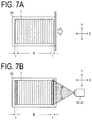
  • FIGS. 7A and 7B are drawings each illustrating an outline of step 7 of another embodiment.
  • FIG. 7A illustrates an outline of the first laser irradiation in step 7
  • FIG. 7B illustrates an outline of the second laser irradiation in step 7 .
  • FIGS. 8A and 8B are drawings each illustrating an outline of step 8 of another embodiment.
  • FIG. 8A illustrates an outline of insertion of a knife
  • FIG. 8B illustrates an outline of peeling of a layered body.
  • FIG. 9 is a drawing illustrating an outline of step 7 of another embodiment.
  • FIG. 1 is a flowchart illustrating an example of the manufacturing method for an EL device.
  • FIG. 2A is a cross-sectional view illustrating a configuration example during a step of manufacturing an EL device of the present embodiment.
  • FIG. 2B is a cross-sectional view illustrating a configuration example of the EL device of the present embodiment.
  • a resin layer 12 is first formed on a transparent mother substrate (e.g., a glass substrate) 50 (step S 1 ), as illustrated in FIGS. 1 and 2A .
  • a transparent mother substrate e.g., a glass substrate
  • an inorganic barrier film 3 is formed (step S 2 ).
  • a TFT layer 4 is formed, the TFT layer 4 including a plurality of inorganic insulating films 16 , 18 , and 20 , and a flattening film 21 (step S 3 ).
  • a light-emitting element layer e.g., an OLED element layer
  • a sealing layer 6 is formed, the sealing layer 6 including a first inorganic sealing film 26 and a second inorganic sealing film 28 , and an organic sealing film 27 (step S 5 ).
  • a protection member 9 (a PET film, for example) is bonded to the sealing layer 6 , with an adhesive layer 8 interposed therebetween (step S 6 ).
  • the resin layer 12 is irradiated with a laser (step S 7 ).
  • the resin layer 12 absorbs the emitted laser to cause a lower face of the resin layer 12 (an interface with the mother substrate 50 ) to change in properties due to ablation. This forms a peeling layer 13 (refer to FIG. 3B described below), and a bonding force between the resin layer 12 and the mother substrate 50 deteriorate.
  • the mother substrate 50 is peeled from the resin layer 12 (step S 8 ). This causes the mother substrate 50 to be peeled from a layered body 7 illustrated in FIG. 2A .
  • the layered body 7 represents the entire multi-layered body formed on the mother substrate 50 and represents a layer from the resin layer 12 formed on the mother substrate 50 to the protection member 9 being an outermost layer in an example illustrated in FIG. 2A .
  • a manufacturing method for an EL device particularly has features in steps S 7 and S 8 . Details thereof will be described below.
  • a support member 10 e.g., a PET film
  • the mother substrate 50 is divided while the protection member 9 is cut, so that a plurality of EL devices are cut (step S 10 ).
  • the protection member 9 on a terminal portion of the TFT layer 4 is peeled off, and terminal exposure is performed (step S 11 ).
  • an EL device 2 illustrated in FIG. 2B is obtained.
  • a function film 39 is bonded (step S 12 ), and an electronic circuit board is mounted on the terminal portion using an ACF or the like (step S 13 ).
  • Examples of the material of the resin layer 12 include polymide, epoxy, and polyamide. Among them, polyimide is suitably used.
  • the inorganic barrier film 3 is configured to prevent water or impurities from reaching the TFT layer 4 or the light-emitting element layer 5 , and may be made of a silicon oxide film, a silicon nitride film, or a silicon oxynitride film, formed with CVD, or a layered film thereof, for example.
  • the inorganic barrier layer 3 has a thickness from 50 nm to 1500 nm, for example.
  • the TFT layer 4 includes a semiconductor film 15 , the inorganic insulating film 16 (gate insulating film) formed on an upper side of the semiconductor film 15 , a gate electrode G formed on an upper side of the gate insulating film 16 , the inorganic insulating films 18 and 20 formed on an upper side of the gate electrode G, a source electrode S, a drain electrode D, and a terminal TM, formed on an upper side of the inorganic insulating film 20 , and the flattening film 21 formed on an upper side of each of the source electrode S and the drain electrode D.
  • the semiconductor film 15 , the inorganic insulating film 16 , the gate electrode G, the inorganic insulating films 18 and 20 , the source electrode S, and the drain electrode D constitute a thin film transistor (TFT).
  • a terminal portion is formed in the end portion (non-active region NA) of the TFT layer 4 , and the terminal portion includes a plurality of terminals TM used for connection with an IC chip and an electronic circuit board such as a FPC, and a terminal wiring line TW.
  • Each of the terminals TM is electrically connected to the corresponding one of various wiring lines of the TFT layer 4 with the terminal wiring line TW therebetween.
  • the semiconductor film 15 is made of a low-temperature polysilicon (LTPS) or an oxide semiconductor, for example.
  • the gate insulating film 16 can be formed of, for example, a silicon oxide (SiOx) film, a silicon nitride (SiNx) film, or a layered film thereof formed using a CVD method.
  • the gate electrode G, the source electrode S, the drain electrode D, and the terminal are formed of a metal single layer film or a layered film including, for example, at least one of aluminum (Al), tungsten (W), molybdenum (Mo), tantalum (Ta), chromium (Cr), titanium (Ti), or copper (Cu).
  • Al aluminum
  • tungsten W
  • Mo molybdenum
  • Ta tantalum
  • Cr chromium
  • Ti titanium
  • Cu copper
  • the inorganic insulating films 18 and 20 can be constituted by a silicon oxide (SiOx) film or a silicon nitride (SiNx) film, or a layered film of these, formed using CVD.
  • the flattening film 21 is an organic insulating film that can be made of a coatable photosensitive organic material such as polymide, or acrylic, for example.
  • the light-emitting element layer 5 (e.g., an organic light emitting diode layer) includes an anode electrode 22 formed on an upper side of the flattening film 21 , a partition 23 c that defines a subpixel of an active region DA, a bank 23 b formed in the non-active region NA, an electroluminescence (EL) layer 24 formed on the anode electrode 22 , and a cathode electrode 25 formed on an upper side of the EL layer 24 , and the anode electrode 22 , the EL layer 24 , and the cathode electrode 25 constitute a light-emitting element (e.g., an organic light emitting diode).
  • a light-emitting element e.g., an organic light emitting diode
  • the partition 23 c and the bank 23 b may be formed in the same step, for example, using a coatable photosensitive organic material such as polyimide, epoxy, or acrylic.
  • the bank 23 b of the non-active region NA is formed on the inorganic insulating film 20 .
  • the bank 23 b defines the edge of the organic sealing film 27 .
  • the EL layer 24 is formed by vapor deposition or an ink-jet method in a region (subpixel region) enclosed by the partition 23 c .
  • the light-emitting element layer 5 is an organic light emitting diode (OLED) layer
  • the EL layer 24 is formed by layering a hole injecting layer, a hole transport layer, a light emitting layer, an electron transport layer, and an electron injecting layer from the lower layer side.
  • the anode electrode (anode) 22 is composed of a layer made of an alloy containing Indium Tin Oxide (ITO) and Ag and has light reflectivity.
  • the cathode electrode 25 may be made of a transparent metal such as Indium Tin Oxide (ITO) or Indium Zinc Oxide (IZO).
  • the light-emitting element layer 5 is the OLED layer
  • positive holes and electrons are recombined inside the EL layer 24 by a drive current between the anode electrode 22 and the cathode electrode 25 , and light is emitted as a result of excitons that are generated by the recombination falling into a ground state.
  • the light-emitting element layer 5 is not limited to OLED element configurations and may be an inorganic light emitting diode or a quantum dot light emitting diode.
  • the sealing layer 6 includes a first inorganic sealing film 26 covering the partition 23 c and the cathode electrode 25 , an organic sealing film 27 covering the first inorganic sealing film 26 , and a second inorganic sealing film 28 covering the organic sealing film 27 .
  • the first inorganic sealing film 26 and the second inorganic sealing film 28 can be each constituted by a silicon oxide film, a silicon nitride film, or a silicon oxynitride film, or by a layered film of these, formed using CVD.
  • the organic sealing film 27 is a transparent organic insulating film that is thicker than the first inorganic sealing film 26 and the second inorganic sealing film 28 , and may be formed of a coatable photosensitive organic material such as polymide or acrylic.
  • the ink is cured by UV irradiation.
  • the sealing layer 6 covers the light-emitting element layer 5 and inhibits foreign matter, such as water and oxygen, from infiltrating to the light-emitting element layer 5 .
  • the protection member 9 is bonded to the sealing layer 6 with the adhesive layer 8 interposed therebetween and functions as a support member when the mother substrate 50 is peeled off.
  • Examples of a material of the protection member 9 include polyethylene terephthalate (PET).
  • the support member 10 is bonded to the lower face of the resin layer 12 so as to manufacture an EL device having excellent flexibility.
  • a material of the support member 10 include polyethylene terephthalate (PET).
  • the function film has an optical compensation function, a touch sensor function, a protective function, and the like, for example.
  • the electronic circuit board is an IC chip or a flexible printed circuit board that is mounted on a plurality of terminals TM, for example.
  • step 7 irradiation with a laser
  • step 8 peeling of a mother substrate
  • FIGS. 3A to 3C are each a cross-sectional view illustrating a configuration example of the EL device of the present embodiment during a step of manufacturing the EL device.
  • FIG. 3A illustrates a state before step 7
  • FIG. 3B illustrates a state in step 7
  • FIG. 3C illustrates a state in step 8 .
  • FIGS. 3A to 3C each illustrate the configuration example in which the EL layer is formed on the mother substrate 50 .
  • the EL layer and the like are not described in detail, and only the mother substrate 50 , the resin layer 12 , the second inorganic sealing film 28 , and the protection member 9 in FIG. 2A are illustrated.
  • the resin layer 12 is formed on the mother substrate 50
  • the protection member 9 is formed on an outermost surface of the EL layer and the like formed on the resin layer 12 with the EL layer and the like (not illustrated) interposed between the protection member 9 and the mother substrate 50 , in the configuration example before step 7 .
  • step 7 is a step for irradiating the resin layer 12 with a laser as a preceding stage for peeling the resin layer 12 from the mother substrate 50 .
  • step 7 is performed by radiating a laser 62 from a position below the mother substrate 50 toward the protection member 9 in the present embodiment.
  • the resin layer 12 made of polyimide or the like is not completely peeled from the mother substrate 50 composed of a glass substrate or the like in many cases.
  • a layered body 7 is peeled from the mother substrate 50 using a knife 70 after a laser is radiated, as an additional process (step 8 ).
  • a process is illustrated of inserting the knife 70 into an interface between the mother substrate 50 and the resin layer 12 in a lateral direction (a direction nearly parallel to a surface of the mother substrate 50 ).
  • FIGS. 4A, 4B, 5A, and 5B each illustrate an outline of an LLO process.
  • FIGS. 4A and 5A each illustrate a state after step 7
  • FIGS. 4B and 5B each illustrate a state in step 8 .
  • irradiation with a laser in step 7 causes ash 84 to generate between the mother substrate 50 and the resin layer 12 .
  • the amount of the ash 84 generated increases with a condition where the layered body 7 is more strongly irradiated with a laser.
  • FIG. 4A illustrates a case where a laser is radiated under condition where an energy density is 200 mJ/cm 2 , and an overlap is 50%
  • FIG. 5A illustrates a case where a laser is radiated under condition where an energy density is 240 mJ/cm 2 , and an overlap is 50%.
  • the amount of the ash 84 generated in an example illustrated in FIG. 5A is greater than that in an example illustrated in FIG. 4A .
  • a small amount of the ash 84 causes insufficient separation between the mother substrate 50 and the resin layer 12 as illustrated in FIG. 4B . That is, as illustrated in a portion “a” surrounded with a dotted line in FIG. 4A , an end portion of the resin layer 12 still bonded to the mother substrate 50 is likely to remain thereon. This causes the knife 70 to slide easily on the resin layer 12 in step 8 , so that peeling of the resin layer 12 from the mother substrate 50 is likely to be defective.
  • a large amount of the ash 84 allows sufficient separation between the mother substrate 50 and the resin layer 12 as illustrated in FIG. 5B . That is, an end portion of the resin layer 12 still bonded to the mother substrate 50 as illustrated in the portion “a” surrounded with the dotted line in FIG. 4A is less likely to remain thereon. Rather, the ash 84 between the resin layer 12 and the mother substrate 50 is easily generated to an end portion of the resin layer 12 as illustrated in a portion “b” surrounded with a dotted line in FIG. 5A . This allows the knife 70 to be inserted easily under the resin layer 12 , so that peeling of the resin layer 12 from the mother substrate 50 is less likely to be defective.
  • the ash 84 is black foreign matter and may be easily separated from the resin layer and scattered to contaminate the inside of a device or a clean room. Thus, generation of the ash 84 needs to be reduced, as much as possible. In addition, to reduce influence on display performance, it is preferable to reduce irradiation energy to a display region as much as possible.
  • steps 7 and 8 are performed on the basis of knowledge described above found by the inventors to satisfy both peel property and characteristics as a display material.
  • FIGS. 6A to 6C are each a cross-sectional view illustrating a configuration example of the EL device of the present embodiment during a step of manufacturing the EL device.
  • FIGS. 6A and 6B each illustrate a state in step 7
  • FIG. 6C illustrates a state in step 8 .
  • the laser irradiation condition for the layered body 7 in step 7 is different between an inclined region I and a flat region II.
  • the inclined region I is a region from a portion of the resin layer 12 starting to decrease in thickness to a portion without the resin layer 12 as described above with reference to FIGS. 3A to 3C , and corresponds to an end portion of the layered body 7 .
  • the flat region II is a portion uniform in thickness of the resin layer 12 and includes a central portion (a portion “c” surrounded with a dotted line in FIG. 6A ) of the layered body 7 .
  • the flat region II corresponds to a portion that is mainly used as a display material
  • the inclined region I corresponds to an end portion that is mainly used for peeling of the layered body 7 .
  • the inclined region I of the layered body 7 is irradiated with a laser under an optimum condition for a substrate-central portion.
  • the inclined region I of the layered body 7 is irradiated with a laser under a condition of generating ash.
  • the inclined region I is irradiated more strongly with a laser than the flat region II.
  • Irradiation conditions of a laser may include an optimum condition for a substrate-central portion where an energy density is 200 mJ/cm 2 , and an overlap is 50% (refer to FIGS. 4A and 4B ), and a condition of generating ash where an energy density is 240 mJ/cm 2 , and an overlap is 50% (refer to FIGS. 5A and 5B ), for example.
  • the layered body 7 is scanned with a line beam 62 ( 1 ) twice to perform laser irradiation twice. Furthermore, the first laser irradiation and the second laser irradiation are different in irradiation condition and irradiation range.
  • FIG. 6A illustrates an outline of the first laser irradiation. While the mother substrate 50 is scanned with the line beam 62 ( 1 ) in its longitudinal direction (indicated by the hollow arrow), the whole region of the layered body 7 is irradiated with a laser.
  • An irradiation condition (an irradiation condition 1: irradiation condition of the first laser irradiation) for the scanning is set to the optimum condition for a substrate-central portion, and the irradiation condition is constant during the scanning. Under the irradiation condition, while ash is generated between the layered body 7 and the mother substrate 50 , the amount of the ash does not impair use of the layered body 7 as a display material.
  • Fine vertical lines (lines in Y-direction) each illustrated in the layered body 7 of FIG. 6A illustrate an image for each irradiation with a laser while the mother substrate 50 is scanned with the line beam 62 ( 1 ).
  • the same applies to other similar drawings FIGS. 6B, 6C, 7A, 7B, 8A, 8B, and 9 ).
  • a condition of a laser for irradiating the inclined region I needs to be set only such that total irradiation energy in the inclined region I is greater than that in the flat region II. That is, when the inclined region I is also irradiated with a laser at the first irradiation for irradiating the flat region II, even in a case that energy at the second irradiation for the inclined region I is less than energy at the first irradiation, the inclined region I is more strongly irradiated with the laser than the flat region II, as a whole.
  • FIG. 6B illustrates an outline of the second laser irradiation.
  • the second laser irradiation is different from the first laser irradiation in irradiation condition of a laser.
  • the layered body 7 is more strongly irradiated with a laser under the second laser irradiation condition (irradiation condition 2: irradiation condition of the second laser irradiation) than under the irradiation condition 1.
  • the irradiation condition 2 may serve as the condition of generating ash.
  • the condition of generating ash is set such that overlap is equivalent to that under the condition for a substrate-central portion; however, energy is greater than that under the condition for a substrate-central portion, and the layered body 7 is strongly irradiated with a laser under the condition.
  • a method for irradiating the layered body 7 more strongly under the irradiation condition 2 than under the irradiation condition 1 is not limited to this, and the layered body 7 can be strongly irradiated with a laser under irradiation condition where overlap is increased, for example.
  • the second laser irradiation is also different from the first laser irradiation in irradiation range. While a whole area of the layered body 7 is irradiated with a laser in the first laser irradiation, only the inclined region I of the layered body 7 is irradiated with a laser in the second laser irradiation. Specifically, while the mother substrate 50 is scanned with the line beam 62 ( 1 ) in the longitudinal direction X (indicated by the hollow arrow) as in the first laser irradiation, a laser is radiated only when the line beam 62 ( 1 ) passes through the inclined region I.
  • the scanning direction is not limited to +X direction, and may be ⁇ X direction opposite to the direction indicated by the hollow arrow.
  • the whole of the layered body 7 (the inclined region I and the flat region II) is irradiated with a laser under a condition of generating less ash, and then only an end portion (the inclined region I) is irradiated with a laser under a condition of allowing the resin layer 12 to be easily peeled from the mother substrate 50 while generating more ash, in the present embodiment.
  • step 8 is performed using the knife 70 as illustrated in FIG. 6C .
  • step 7 a large amount of the ash 84 is generated between the resin layer 12 and the mother substrate 50 in the inclined region I, and this allows the resin layer 12 to be easily peeled from the mother substrate 50 .
  • knives 70 are inserted into the respective four corners (included in the inclined region I) of the layered body 7 , and are slid along corresponding sides different from each other as indicated by the respective hollow arrows in FIG. 6C , for example. This enables the resin layer 12 to be easily peeled from the mother substrate 50 .
  • the layered body 7 can be peeled from the mother substrate 50 while the protection member 9 that is easily peeled due to its slight adhesiveness is bonded to the sealing layer 6 .
  • the layered body 7 peeled can be favorably used as a display material.
  • FIGS. 7A and 7B illustrate an outline of step 7 of the present embodiment.
  • FIG. 7A illustrates an outline of the first laser irradiation in step 7
  • FIG. 7B illustrates an outline of the second laser irradiation in step 7 .
  • the first embodiment and the second embodiment are different in that the laser 62 to be used for the second laser irradiation is different.
  • the line beam 62 ( 1 ) is used for both the first laser irradiation and the second laser irradiation.
  • a Gaussian beam 62 ( 2 ) using a galvanometer optical system is used in the second laser irradiation.
  • the first laser irradiation is performed such that the mother substrate 50 is scanned with the line beam 62 ( 1 ) in the longitudinal direction X (indicated by the hollow arrow), and the entire layered body 7 is irradiated with a laser.
  • the irradiation condition 1 is set as an irradiation condition of a laser.
  • each of the inclined regions I positioned on the both ends of the layered body 7 in longitudinal direction X is irradiated with a Gaussian beam, as illustrated in FIG. 7B .
  • each of the inclined regions I is scanned with a Gaussian beam (indicated by the arc arrow) using the galvanometer optical system (Galvano scanner).
  • the irradiation condition 2 that causes more intense irradiation than the irradiation condition 1 is set as an irradiation condition, for example.
  • the irradiation condition of the second laser irradiation requires less precision than that in the irradiation condition of the first laser irradiation. Since the laser has been radiated once in the first laser irradiation, the irradiation condition of the second laser irradiation is a laser irradiation condition for more facilitating peeling of the layered body 7 from the mother substrate 50 .
  • the entire layered body 7 does not need to be scanned unlike the scanning with the line beam 62 ( 1 ), and the layered body 7 is scanned within a limited and desired range and is irradiated with a laser.
  • FIGS. 8A and 8B yet another embodiment of the disclosure will be described with reference to FIGS. 8A and 8B .
  • FIGS. 8A and 8B illustrate an outline of step 8 of the present embodiment.
  • FIG. 8A illustrates insertion of a knife 70
  • FIG. 8B illustrates an outline of peeling of a layered body 7 .
  • the first embodiment and the third embodiment are different in the number of sides for performing a peeling process using the knife 70 in step 8 .
  • the peeling process using the knife 70 is performed on all four sides of the mother substrate 50 .
  • the layered body 7 is peeled from the mother substrate 50 using the knife 70 such that the knife 70 is inserted only in one side of the mother substrate 50 in its longitudinal direction X (one short side of the layered body 7 ) (refer to FIG. 8A ). As illustrated in FIG.
  • this peeling is performed by inserting the knife 70 into an end portion of one short side of the layered body 7 on which laser irradiation under the irradiation condition 2 is performed and sliding the knife 70 in Y direction (indicated by the hollow arrow).
  • the layered body 7 is peeled from the mother substrate 50 while a portion peeled in FIG. 8A serves as a starting point (indicated by the hollow arrow) as illustrated in FIG. 8B .
  • a portion peeled in FIG. 8A serves as a starting point (indicated by the hollow arrow) as illustrated in FIG. 8B .
  • the present embodiment enables not only workload using the knife 70 to be reduced to about a quarter of that in the above described embodiment, but also processing capacity to be improved.
  • the present embodiment also enables laser irradiation of the layered body 7 under the irradiation condition 2 to be performed only for one side to be peeled with the knife 70 .
  • FIG. 9 illustrates an outline of step 7 of the present embodiment.
  • the first embodiment and the fourth embodiment are different in a portion irradiated with a laser under the irradiation condition 2 in step 7 .
  • the inclined regions I at the both ends of the layered body 7 in the longitudinal direction X of the mother substrate 50 are each irradiated with a laser under the irradiation condition 2.
  • four edge sides of the layered body 7 are each irradiated with a laser under the irradiation condition 2. That is, not only the inclined regions I at the both ends in the longitudinal direction X of the mother substrate 50 , but also inclined regions I at the both ends in the short-hand direction Y thereof, are each irradiated with a laser under the irradiation condition 2.
  • an irradiation condition of a laser is adjusted so that the layered body 7 is more strongly irradiated under the irradiation condition 2, and this allows the number of sides each to be irradiated with a laser under the irradiation condition 2 to be changed.
  • the layered body 7 can be also peeled from the mother substrate 50 without using the knife 70 .
  • an irradiation condition of a laser is defined using energy (mJ/cm 2 ) and overlap (%).
  • the irradiation condition (intensity) of a laser may be also defined using parameters other than the above.
  • the irradiation condition of a laser may be defined using a beam profile such as a beam shape (e.g., a line or a spot), a wavelength, the number of irradiation times, or the like.
  • a wavelength of a laser can be defined as an irradiation condition of the laser while depth of the laser for the resin layer 12 made of polyimide or the like, and transmittance, for the laser, of the mother substrate 50 made of glass or the like, are optimized.
  • an excimer laser with a wavelength of 308 nm, a solid-state laser with a wavelength of 343 nm or 355 nm, and a spot laser with a wavelength of 355 nm or a line laser with a wavelength of 343 nm associated with a laser shape, for example, are appropriately used.
  • changing a condition during one scanning enables irradiation intensity of a laser to be different in a plane of the layered body 7 .
  • a range of irradiation with a laser under the irradiation condition 2 does not necessarily coincide with that in the inclined region I.
  • the range may also be set at a portion where the resin layer 12 suddenly changes in thickness or shape in and near its end portion. This is because the portion requires much energy to peel the resin layer 12 from the mother substrate 50 in many cases.
  • a range of irradiation with a laser under the irradiation condition 2 may be also limited to a portion into which the knife 70 is inserted first. That is, the range may be also set at a point instead of a side.
  • a laser of a galvanometer optical system is suitably used.
  • a range of irradiation with a laser under the irradiation condition 2 may be also determined using a sensor.
  • a range of irradiation with a laser may be also appropriately determined by detecting an end face of the resin layer 12 or the layered body 7 , or a change in thickness, with a sensor.
  • a method for manufacturing an EL device includes a process of peeling a mother substrate from a layered body including a light-emitting element layer with irradiation with a laser.
  • the mother substrate and the layered body are in contact with each other with a resin layer of the layered body interposed between the mother substrate and the layered body, and in a case that the process of peeling is performed by irradiating the resin layer with the laser, an irradiation of the laser is performed on at least a part of an end portion of the resin layer under a condition different from a condition in a central portion of the resin layer.
  • the irradiation of the laser is performed on at least the part of the end portion under a condition causing intense irradiation greater than irradiation of the central portion.
  • the irradiation of the laser is performed on at least the part of the end portion more times than on the central portion.
  • the irradiation of the laser is performed using a line beam.
  • the irradiation of the laser is performed a plurality of times using a line beam, the irradiation of the laser is performed on a whole area of the resin layer at least one time of the plurality of times, and the irradiation of the laser is performed on only the end portion at least one time of the plurality of times.
  • the irradiation of the laser is performed using a line beam and a Gaussian beam
  • the irradiation of the laser is performed on the whole area of the resin layer using the line beam
  • the irradiation of the laser is performed on only the end portion using the Gaussian beam.
  • the end portion includes at least one of edge sides of the resin layer.
  • the end portion includes a portion decreasing in thickness of the resin layer.
  • a peeling between the mother substrate and the layered body is performed by inserting a knife into the end portion after the irradiation of the laser.
  • the knife is slid along the end portion subjected to the insertion of the knife.
  • a peeling between the mother substrate and the layered body is performed by inserting a knife into the end portion after the irradiation of the laser for one edge side of the resin layer, and after an insertion of the knife, the knife is slid along the end portion subjected to the insertion of the knife.
  • the peeling between the mother substrate and the layered body is performed with the end portion with the knife inserted serving as a starting point.
  • the laser has greater energy under a condition for performing the irradiation of the laser on at least the part of the end portion than under a condition for performing the irradiation of the laser on the central portion.
  • the laser is overlapped greatly under a condition for performing the irradiation of the laser on at least the part of the end portion than under a condition for performing the irradiation of the laser on the central portion.
  • an amount of ash between the mother substrate and the layered body is generated after the irradiation of the laser greater at the end portion than at the central portion.
  • the resin layer is peeled from the mother substrate in the end portion after the irradiation of the laser.

Landscapes

  • Engineering & Computer Science (AREA)
  • Manufacturing & Machinery (AREA)
  • Microelectronics & Electronic Packaging (AREA)
  • Electroluminescent Light Sources (AREA)

Abstract

Provided is a method for manufacturing an EL device, the method including peeling a mother substrate from a layered body including a light-emitting element layer with irradiation with a laser. The mother substrate and the layered body are in contact with each other with a resin layer of the layered body interposed therebetween, and in a case that the peeling is performed by irradiating the resin layer with the laser, the irradiation is performed on at least a part of an end portion of the resin layer under a condition different from that in a central portion of the resin layer.

Description

TECHNICAL FIELD
The disclosure relates to an electroluminescence element (EL) device including an EL element.
BACKGROUND ART
When a flexible EL device including an EL element is manufactured, a mother substrate need to be peeled from a resin layer formed on the mother substrate.
CITATION LIST Patent Literature
PTL 1: JP 2013-73001 A (Publication date: Apr. 22, 2013)
PTL 2: JP 2010-33761 A (Publication date: Feb. 12, 2010)
PTL 3: WO2012/164612 (International Publication date: Dec. 6, 2012)
SUMMARY Technical Problem
An object of the disclosure is to suppress deterioration in yield and an increase in manufacturing cost when a mother substrate is peeled from a resin layer formed on the mother substrate.
Solution to Problem
A method for manufacturing an EL device according to an aspect of the disclosure includes a process of peeling a mother substrate from a layered body including a light-emitting element layer with irradiation with a laser. The mother substrate and the layered body are in contact with each other with a resin layer of the layered body interposed between the mother substrate and the layered body, and in a case that the process of peeling is performed by irradiating the resin layer with the laser, an irradiation of the laser is performed on at least a part of an end portion of the resin layer under a condition different from a condition in a central portion of the resin layer.
Advantageous Effects of Disclosure
According to an aspect of the disclosure, deterioration in yield and an increase in manufacturing cost are minimized when a mother substrate is peeled from a resin layer formed on the mother substrate.
BRIEF DESCRIPTION OF DRAWINGS
FIG. 1 is a flowchart illustrating an example of a manufacturing method for an EL device.
FIG. 2A is a cross-sectional view illustrating a configuration example during a step of manufacturing an EL device of the present embodiment. FIG. 2B is a cross-sectional view illustrating a configuration example of an EL device of the present embodiment.
FIGS. 3A to 3C are each a cross-sectional view illustrating a configuration example of an EL device of the present embodiment during a step of manufacturing the EL device. FIG. 3A illustrates a state before step 7, FIG. 3B illustrates a state in step 7, and FIG. 3C illustrates a state in step 8.
FIGS. 4A and 4B are drawings each illustrating an outline of an LLO process. FIG. 4A illustrates a state after step 7, and FIG. 4B illustrates a state in step 8.
FIGS. 5A and 5B are drawings each illustrating an outline of an LLO process. FIG. 5A illustrates a state after step 7, and FIG. 4B illustrates a state in step 8.
FIGS. 6A to 6C are drawings each illustrating an outline of steps 7 and 8 of the present embodiment. FIG. 6A illustrates an outline of the first laser irradiation in step 7, FIG. 6B illustrates an outline of the second laser irradiation in step 7, and FIG. 6C illustrates an outline of step 8.
FIGS. 7A and 7B are drawings each illustrating an outline of step 7 of another embodiment. FIG. 7A illustrates an outline of the first laser irradiation in step 7, and FIG. 7B illustrates an outline of the second laser irradiation in step 7.
FIGS. 8A and 8B are drawings each illustrating an outline of step 8 of another embodiment. FIG. 8A illustrates an outline of insertion of a knife, and FIG. 8B illustrates an outline of peeling of a layered body.
FIG. 9 is a drawing illustrating an outline of step 7 of another embodiment.
DESCRIPTION OF EMBODIMENTS
FIG. 1 is a flowchart illustrating an example of the manufacturing method for an EL device. FIG. 2A is a cross-sectional view illustrating a configuration example during a step of manufacturing an EL device of the present embodiment. FIG. 2B is a cross-sectional view illustrating a configuration example of the EL device of the present embodiment.
When a flexible EL device is manufactured, a resin layer 12 is first formed on a transparent mother substrate (e.g., a glass substrate) 50 (step S1), as illustrated in FIGS. 1 and 2A. Next, an inorganic barrier film 3 is formed (step S2). Subsequently, a TFT layer 4 is formed, the TFT layer 4 including a plurality of inorganic insulating films 16, 18, and 20, and a flattening film 21 (step S3). Next, a light-emitting element layer (e.g., an OLED element layer) 5 is formed (step S4). Subsequently, a sealing layer 6 is formed, the sealing layer 6 including a first inorganic sealing film 26 and a second inorganic sealing film 28, and an organic sealing film 27 (step S5). Next, a protection member 9 (a PET film, for example) is bonded to the sealing layer 6, with an adhesive layer 8 interposed therebetween (step S6).
Subsequently, the resin layer 12 is irradiated with a laser (step S7). Here, the resin layer 12 absorbs the emitted laser to cause a lower face of the resin layer 12 (an interface with the mother substrate 50) to change in properties due to ablation. This forms a peeling layer 13 (refer to FIG. 3B described below), and a bonding force between the resin layer 12 and the mother substrate 50 deteriorate. Next, the mother substrate 50 is peeled from the resin layer 12 (step S8). This causes the mother substrate 50 to be peeled from a layered body 7 illustrated in FIG. 2A. The layered body 7 represents the entire multi-layered body formed on the mother substrate 50 and represents a layer from the resin layer 12 formed on the mother substrate 50 to the protection member 9 being an outermost layer in an example illustrated in FIG. 2A.
A manufacturing method for an EL device according to an aspect of the disclosure particularly has features in steps S7 and S8. Details thereof will be described below.
Next, as illustrated in FIG. 2B, a support member 10 (e.g., a PET film) is bonded to the lower face of the resin layer 12 with an adhesive layer 11 interposed therebetween (step S9). Subsequently, the mother substrate 50 is divided while the protection member 9 is cut, so that a plurality of EL devices are cut (step S10). Next, the protection member 9 on a terminal portion of the TFT layer 4 is peeled off, and terminal exposure is performed (step S11). As a result, an EL device 2 illustrated in FIG. 2B is obtained. Then, a function film 39 is bonded (step S12), and an electronic circuit board is mounted on the terminal portion using an ACF or the like (step S13). Each of the steps above is performed by a manufacturing apparatus of an EL device.
Examples of the material of the resin layer 12 include polymide, epoxy, and polyamide. Among them, polyimide is suitably used.
The inorganic barrier film 3 is configured to prevent water or impurities from reaching the TFT layer 4 or the light-emitting element layer 5, and may be made of a silicon oxide film, a silicon nitride film, or a silicon oxynitride film, formed with CVD, or a layered film thereof, for example. The inorganic barrier layer 3 has a thickness from 50 nm to 1500 nm, for example.
The TFT layer 4 includes a semiconductor film 15, the inorganic insulating film 16 (gate insulating film) formed on an upper side of the semiconductor film 15, a gate electrode G formed on an upper side of the gate insulating film 16, the inorganic insulating films 18 and 20 formed on an upper side of the gate electrode G, a source electrode S, a drain electrode D, and a terminal TM, formed on an upper side of the inorganic insulating film 20, and the flattening film 21 formed on an upper side of each of the source electrode S and the drain electrode D. The semiconductor film 15, the inorganic insulating film 16, the gate electrode G, the inorganic insulating films 18 and 20, the source electrode S, and the drain electrode D constitute a thin film transistor (TFT). A terminal portion is formed in the end portion (non-active region NA) of the TFT layer 4, and the terminal portion includes a plurality of terminals TM used for connection with an IC chip and an electronic circuit board such as a FPC, and a terminal wiring line TW. Each of the terminals TM is electrically connected to the corresponding one of various wiring lines of the TFT layer 4 with the terminal wiring line TW therebetween.
The semiconductor film 15 is made of a low-temperature polysilicon (LTPS) or an oxide semiconductor, for example. The gate insulating film 16 can be formed of, for example, a silicon oxide (SiOx) film, a silicon nitride (SiNx) film, or a layered film thereof formed using a CVD method. The gate electrode G, the source electrode S, the drain electrode D, and the terminal are formed of a metal single layer film or a layered film including, for example, at least one of aluminum (Al), tungsten (W), molybdenum (Mo), tantalum (Ta), chromium (Cr), titanium (Ti), or copper (Cu). Note that, in FIGS. 2A and 2B, the TFT is illustrated that has a top gate structure in which the semiconductor film 15 functions as the channel, but the TFT may have a bottom gate structure (when the channel of the TFT is formed in the oxide semiconductor, for example).
The inorganic insulating films 18 and 20 can be constituted by a silicon oxide (SiOx) film or a silicon nitride (SiNx) film, or a layered film of these, formed using CVD. The flattening film 21 is an organic insulating film that can be made of a coatable photosensitive organic material such as polymide, or acrylic, for example.
The light-emitting element layer 5 (e.g., an organic light emitting diode layer) includes an anode electrode 22 formed on an upper side of the flattening film 21, a partition 23 c that defines a subpixel of an active region DA, a bank 23 b formed in the non-active region NA, an electroluminescence (EL) layer 24 formed on the anode electrode 22, and a cathode electrode 25 formed on an upper side of the EL layer 24, and the anode electrode 22, the EL layer 24, and the cathode electrode 25 constitute a light-emitting element (e.g., an organic light emitting diode).
The partition 23 c and the bank 23 b may be formed in the same step, for example, using a coatable photosensitive organic material such as polyimide, epoxy, or acrylic. The bank 23 b of the non-active region NA is formed on the inorganic insulating film 20. The bank 23 b defines the edge of the organic sealing film 27.
The EL layer 24 is formed by vapor deposition or an ink-jet method in a region (subpixel region) enclosed by the partition 23 c. In a case that the light-emitting element layer 5 is an organic light emitting diode (OLED) layer, for example, the EL layer 24 is formed by layering a hole injecting layer, a hole transport layer, a light emitting layer, an electron transport layer, and an electron injecting layer from the lower layer side.
The anode electrode (anode) 22 is composed of a layer made of an alloy containing Indium Tin Oxide (ITO) and Ag and has light reflectivity. The cathode electrode 25 may be made of a transparent metal such as Indium Tin Oxide (ITO) or Indium Zinc Oxide (IZO).
In a case that the light-emitting element layer 5 is the OLED layer, positive holes and electrons are recombined inside the EL layer 24 by a drive current between the anode electrode 22 and the cathode electrode 25, and light is emitted as a result of excitons that are generated by the recombination falling into a ground state.
The light-emitting element layer 5 is not limited to OLED element configurations and may be an inorganic light emitting diode or a quantum dot light emitting diode.
The sealing layer 6 includes a first inorganic sealing film 26 covering the partition 23 c and the cathode electrode 25, an organic sealing film 27 covering the first inorganic sealing film 26, and a second inorganic sealing film 28 covering the organic sealing film 27.
The first inorganic sealing film 26 and the second inorganic sealing film 28 can be each constituted by a silicon oxide film, a silicon nitride film, or a silicon oxynitride film, or by a layered film of these, formed using CVD. The organic sealing film 27 is a transparent organic insulating film that is thicker than the first inorganic sealing film 26 and the second inorganic sealing film 28, and may be formed of a coatable photosensitive organic material such as polymide or acrylic. For example, after coating the first inorganic sealing film 26 with an ink containing such an organic material using the ink-jet method, the ink is cured by UV irradiation. The sealing layer 6 covers the light-emitting element layer 5 and inhibits foreign matter, such as water and oxygen, from infiltrating to the light-emitting element layer 5.
The protection member 9 is bonded to the sealing layer 6 with the adhesive layer 8 interposed therebetween and functions as a support member when the mother substrate 50 is peeled off. Examples of a material of the protection member 9 include polyethylene terephthalate (PET).
After the mother substrate 50 has been peeled off, the support member 10 is bonded to the lower face of the resin layer 12 so as to manufacture an EL device having excellent flexibility. Examples of a material of the support member 10 include polyethylene terephthalate (PET).
The function film has an optical compensation function, a touch sensor function, a protective function, and the like, for example. The electronic circuit board is an IC chip or a flexible printed circuit board that is mounted on a plurality of terminals TM, for example.
First Embodiment
Hereinafter, the step 7 (irradiation with a laser) and step 8 (peeling of a mother substrate) that are features of the disclosure will be described. These steps 7 and 8 relate to so-called Laser Lift Off (LLO).
Outline of LLO
FIGS. 3A to 3C are each a cross-sectional view illustrating a configuration example of the EL device of the present embodiment during a step of manufacturing the EL device. FIG. 3A illustrates a state before step 7, FIG. 3B illustrates a state in step 7, and FIG. 3C illustrates a state in step 8. FIGS. 3A to 3C each illustrate the configuration example in which the EL layer is formed on the mother substrate 50. In FIGS. 3A to 3C, the EL layer and the like are not described in detail, and only the mother substrate 50, the resin layer 12, the second inorganic sealing film 28, and the protection member 9 in FIG. 2A are illustrated.
As illustrated in FIG. 3A, the resin layer 12 is formed on the mother substrate 50, and the protection member 9 is formed on an outermost surface of the EL layer and the like formed on the resin layer 12 with the EL layer and the like (not illustrated) interposed between the protection member 9 and the mother substrate 50, in the configuration example before step 7.
As described with reference to FIG. 1, step 7 is a step for irradiating the resin layer 12 with a laser as a preceding stage for peeling the resin layer 12 from the mother substrate 50. As illustrated in FIG. 3B, step 7 is performed by radiating a laser 62 from a position below the mother substrate 50 toward the protection member 9 in the present embodiment. In step 7, the resin layer 12 made of polyimide or the like is not completely peeled from the mother substrate 50 composed of a glass substrate or the like in many cases.
Thus, as illustrated in FIG. 3C, a layered body 7 is peeled from the mother substrate 50 using a knife 70 after a laser is radiated, as an additional process (step 8). In the example illustrated in FIG. 3C, a process is illustrated of inserting the knife 70 into an interface between the mother substrate 50 and the resin layer 12 in a lateral direction (a direction nearly parallel to a surface of the mother substrate 50).
In this process, it is difficult to insert the knife 70 accurately into the interface between the resin layer 12 and the mother substrate 50 due to the reason that the knife 70 is likely to slide on an upper face of the resin layer 12, for example, so that it may be difficult to peel the resin layer 12 from the mother substrate 50 with a high yield rate.
Irradiation Condition and Peel Property
With reference to FIGS. 4A to 5B, the embodiment will be described in detail. FIGS. 4A, 4B, 5A, and 5B each illustrate an outline of an LLO process. FIGS. 4A and 5A each illustrate a state after step 7, and FIGS. 4B and 5B each illustrate a state in step 8.
As illustrated in FIGS. 4A and 5A, irradiation with a laser in step 7 causes ash 84 to generate between the mother substrate 50 and the resin layer 12. The amount of the ash 84 generated increases with a condition where the layered body 7 is more strongly irradiated with a laser.
FIG. 4A illustrates a case where a laser is radiated under condition where an energy density is 200 mJ/cm2, and an overlap is 50%, and FIG. 5A illustrates a case where a laser is radiated under condition where an energy density is 240 mJ/cm2, and an overlap is 50%. The amount of the ash 84 generated in an example illustrated in FIG. 5A is greater than that in an example illustrated in FIG. 4A.
As the amount of the ash 84 generated between the mother substrate 50 and the resin layer 12 increases, peeling of the resin layer 12 from the mother substrate 50 becomes easier. However, a large amount of ash generated may contaminate the inside of a device or a clean room during peeling or during transportation to cause deterioration in yield. When a peeling step is performed with irradiation with high energy, a resin layer and an OLED layer in an upper layer of the resin layer may be indirectly damaged, and display characteristics and the like may deteriorate.
For details, a small amount of the ash 84 causes insufficient separation between the mother substrate 50 and the resin layer 12 as illustrated in FIG. 4B. That is, as illustrated in a portion “a” surrounded with a dotted line in FIG. 4A, an end portion of the resin layer 12 still bonded to the mother substrate 50 is likely to remain thereon. This causes the knife 70 to slide easily on the resin layer 12 in step 8, so that peeling of the resin layer 12 from the mother substrate 50 is likely to be defective.
Meanwhile, a large amount of the ash 84 allows sufficient separation between the mother substrate 50 and the resin layer 12 as illustrated in FIG. 5B. That is, an end portion of the resin layer 12 still bonded to the mother substrate 50 as illustrated in the portion “a” surrounded with the dotted line in FIG. 4A is less likely to remain thereon. Rather, the ash 84 between the resin layer 12 and the mother substrate 50 is easily generated to an end portion of the resin layer 12 as illustrated in a portion “b” surrounded with a dotted line in FIG. 5A. This allows the knife 70 to be inserted easily under the resin layer 12, so that peeling of the resin layer 12 from the mother substrate 50 is less likely to be defective. Meanwhile, the ash 84 is black foreign matter and may be easily separated from the resin layer and scattered to contaminate the inside of a device or a clean room. Thus, generation of the ash 84 needs to be reduced, as much as possible. In addition, to reduce influence on display performance, it is preferable to reduce irradiation energy to a display region as much as possible.
Multiple Irradiation
In the present embodiment, steps 7 and 8 are performed on the basis of knowledge described above found by the inventors to satisfy both peel property and characteristics as a display material.
FIGS. 6A to 6C are each a cross-sectional view illustrating a configuration example of the EL device of the present embodiment during a step of manufacturing the EL device. FIGS. 6A and 6B each illustrate a state in step 7, and FIG. 6C illustrates a state in step 8.
In the present embodiment, the laser irradiation condition for the layered body 7 in step 7 is different between an inclined region I and a flat region II. The inclined region I is a region from a portion of the resin layer 12 starting to decrease in thickness to a portion without the resin layer 12 as described above with reference to FIGS. 3A to 3C, and corresponds to an end portion of the layered body 7. Meanwhile, the flat region II is a portion uniform in thickness of the resin layer 12 and includes a central portion (a portion “c” surrounded with a dotted line in FIG. 6A) of the layered body 7. The flat region II corresponds to a portion that is mainly used as a display material, and the inclined region I corresponds to an end portion that is mainly used for peeling of the layered body 7.
In the present embodiment, after a whole region of the layered body 7 (the inclined region I and the flat region II) is irradiated with a laser under an optimum condition for a substrate-central portion, the inclined region I of the layered body 7 is irradiated with a laser under a condition of generating ash. As a result, the inclined region I is irradiated more strongly with a laser than the flat region II.
Irradiation conditions of a laser may include an optimum condition for a substrate-central portion where an energy density is 200 mJ/cm2, and an overlap is 50% (refer to FIGS. 4A and 4B), and a condition of generating ash where an energy density is 240 mJ/cm2, and an overlap is 50% (refer to FIGS. 5A and 5B), for example.
Specifically, the layered body 7 is scanned with a line beam 62(1) twice to perform laser irradiation twice. Furthermore, the first laser irradiation and the second laser irradiation are different in irradiation condition and irradiation range.
FIG. 6A illustrates an outline of the first laser irradiation. While the mother substrate 50 is scanned with the line beam 62(1) in its longitudinal direction (indicated by the hollow arrow), the whole region of the layered body 7 is irradiated with a laser. An irradiation condition (an irradiation condition 1: irradiation condition of the first laser irradiation) for the scanning is set to the optimum condition for a substrate-central portion, and the irradiation condition is constant during the scanning. Under the irradiation condition, while ash is generated between the layered body 7 and the mother substrate 50, the amount of the ash does not impair use of the layered body 7 as a display material. Fine vertical lines (lines in Y-direction) each illustrated in the layered body 7 of FIG. 6A illustrate an image for each irradiation with a laser while the mother substrate 50 is scanned with the line beam 62(1). The same applies to other similar drawings (FIGS. 6B, 6C, 7A, 7B, 8A, 8B, and 9).
In addition, a condition of a laser for irradiating the inclined region I needs to be set only such that total irradiation energy in the inclined region I is greater than that in the flat region II. That is, when the inclined region I is also irradiated with a laser at the first irradiation for irradiating the flat region II, even in a case that energy at the second irradiation for the inclined region I is less than energy at the first irradiation, the inclined region I is more strongly irradiated with the laser than the flat region II, as a whole.
Subsequently, the second laser irradiation is similarly performed using the line beam 62(1). FIG. 6B illustrates an outline of the second laser irradiation. The second laser irradiation is different from the first laser irradiation in irradiation condition of a laser. Specifically, the layered body 7 is more strongly irradiated with a laser under the second laser irradiation condition (irradiation condition 2: irradiation condition of the second laser irradiation) than under the irradiation condition 1. For example, the irradiation condition 2 may serve as the condition of generating ash. The condition of generating ash is set such that overlap is equivalent to that under the condition for a substrate-central portion; however, energy is greater than that under the condition for a substrate-central portion, and the layered body 7 is strongly irradiated with a laser under the condition. A method for irradiating the layered body 7 more strongly under the irradiation condition 2 than under the irradiation condition 1 is not limited to this, and the layered body 7 can be strongly irradiated with a laser under irradiation condition where overlap is increased, for example.
The second laser irradiation is also different from the first laser irradiation in irradiation range. While a whole area of the layered body 7 is irradiated with a laser in the first laser irradiation, only the inclined region I of the layered body 7 is irradiated with a laser in the second laser irradiation. Specifically, while the mother substrate 50 is scanned with the line beam 62(1) in the longitudinal direction X (indicated by the hollow arrow) as in the first laser irradiation, a laser is radiated only when the line beam 62(1) passes through the inclined region I. The scanning direction is not limited to +X direction, and may be −X direction opposite to the direction indicated by the hollow arrow.
As described above, the whole of the layered body 7 (the inclined region I and the flat region II) is irradiated with a laser under a condition of generating less ash, and then only an end portion (the inclined region I) is irradiated with a laser under a condition of allowing the resin layer 12 to be easily peeled from the mother substrate 50 while generating more ash, in the present embodiment.
Subsequently, step 8 is performed using the knife 70 as illustrated in FIG. 6C. In step 7, a large amount of the ash 84 is generated between the resin layer 12 and the mother substrate 50 in the inclined region I, and this allows the resin layer 12 to be easily peeled from the mother substrate 50. Then, knives 70 are inserted into the respective four corners (included in the inclined region I) of the layered body 7, and are slid along corresponding sides different from each other as indicated by the respective hollow arrows in FIG. 6C, for example. This enables the resin layer 12 to be easily peeled from the mother substrate 50. In addition, the layered body 7 can be peeled from the mother substrate 50 while the protection member 9 that is easily peeled due to its slight adhesiveness is bonded to the sealing layer 6.
Further, a large amount of ash is not generated in the flat region II, so that the layered body 7 peeled can be favorably used as a display material.
Second Embodiment
Hereinafter, another embodiment of the disclosure will be described with reference to FIGS. 7A and 7B. FIGS. 7A and 7B illustrate an outline of step 7 of the present embodiment. FIG. 7A illustrates an outline of the first laser irradiation in step 7, and FIG. 7B illustrates an outline of the second laser irradiation in step 7.
The first embodiment and the second embodiment are different in that the laser 62 to be used for the second laser irradiation is different. In the first embodiment, the line beam 62(1) is used for both the first laser irradiation and the second laser irradiation. In contrast, in the second embodiment, while the line beam 62(1) is used in the first laser irradiation, a Gaussian beam 62(2) using a galvanometer optical system is used in the second laser irradiation.
As illustrated in FIG. 7A, the first laser irradiation is performed such that the mother substrate 50 is scanned with the line beam 62(1) in the longitudinal direction X (indicated by the hollow arrow), and the entire layered body 7 is irradiated with a laser. The irradiation condition 1 is set as an irradiation condition of a laser.
Subsequently, each of the inclined regions I positioned on the both ends of the layered body 7 in longitudinal direction X is irradiated with a Gaussian beam, as illustrated in FIG. 7B. At this time, each of the inclined regions I is scanned with a Gaussian beam (indicated by the arc arrow) using the galvanometer optical system (Galvano scanner).
The irradiation condition 2 that causes more intense irradiation than the irradiation condition 1 is set as an irradiation condition, for example.
The irradiation condition of the second laser irradiation requires less precision than that in the irradiation condition of the first laser irradiation. Since the laser has been radiated once in the first laser irradiation, the irradiation condition of the second laser irradiation is a laser irradiation condition for more facilitating peeling of the layered body 7 from the mother substrate 50.
This allows the scanning in the second laser irradiation to be performed with a Gaussian beam of a Galvano scanner instead of the line beam 62(1) and can provide a manufacturing apparatus configured at low cost and improved processing capacity.
This is because when the Galvano scanner is used, the entire layered body 7 does not need to be scanned unlike the scanning with the line beam 62(1), and the layered body 7 is scanned within a limited and desired range and is irradiated with a laser.
Third Embodiment
Hereinafter, yet another embodiment of the disclosure will be described with reference to FIGS. 8A and 8B.
FIGS. 8A and 8B illustrate an outline of step 8 of the present embodiment. FIG. 8A illustrates insertion of a knife 70, and FIG. 8B illustrates an outline of peeling of a layered body 7.
The first embodiment and the third embodiment are different in the number of sides for performing a peeling process using the knife 70 in step 8. In the first embodiment, the peeling process using the knife 70 is performed on all four sides of the mother substrate 50. In contrast, in the third embodiment, the layered body 7 is peeled from the mother substrate 50 using the knife 70 such that the knife 70 is inserted only in one side of the mother substrate 50 in its longitudinal direction X (one short side of the layered body 7) (refer to FIG. 8A). As illustrated in FIG. 8A, this peeling is performed by inserting the knife 70 into an end portion of one short side of the layered body 7 on which laser irradiation under the irradiation condition 2 is performed and sliding the knife 70 in Y direction (indicated by the hollow arrow).
Then, the layered body 7 is peeled from the mother substrate 50 while a portion peeled in FIG. 8A serves as a starting point (indicated by the hollow arrow) as illustrated in FIG. 8B. This is because once the knife 70 can be inserted into a portion between the layered body 7 and the mother substrate 50, the portion can trigger the peeling of the entire layered body 7 from the mother substrate 50.
The present embodiment enables not only workload using the knife 70 to be reduced to about a quarter of that in the above described embodiment, but also processing capacity to be improved.
The present embodiment also enables laser irradiation of the layered body 7 under the irradiation condition 2 to be performed only for one side to be peeled with the knife 70.
Fourth Embodiment
Hereinafter, yet another embodiment of the disclosure will be described with reference to FIG. 9. FIG. 9 illustrates an outline of step 7 of the present embodiment.
The first embodiment and the fourth embodiment are different in a portion irradiated with a laser under the irradiation condition 2 in step 7. In the first embodiment, the inclined regions I at the both ends of the layered body 7 in the longitudinal direction X of the mother substrate 50 are each irradiated with a laser under the irradiation condition 2. In contrast, in the fourth embodiment, four edge sides of the layered body 7 are each irradiated with a laser under the irradiation condition 2. That is, not only the inclined regions I at the both ends in the longitudinal direction X of the mother substrate 50, but also inclined regions I at the both ends in the short-hand direction Y thereof, are each irradiated with a laser under the irradiation condition 2.
This enables the layered body 7 to be peeled from the mother substrate 50 without using a knife 70.
Note that an irradiation condition of a laser is adjusted so that the layered body 7 is more strongly irradiated under the irradiation condition 2, and this allows the number of sides each to be irradiated with a laser under the irradiation condition 2 to be changed. For example, when only one side is irradiated with a laser under the irradiation condition 2 as in the third embodiment, the layered body 7 can be also peeled from the mother substrate 50 without using the knife 70.
Laser Intensity
In each of the embodiments, an irradiation condition of a laser is defined using energy (mJ/cm2) and overlap (%). However, the irradiation condition (intensity) of a laser may be also defined using parameters other than the above. For example, the irradiation condition of a laser may be defined using a beam profile such as a beam shape (e.g., a line or a spot), a wavelength, the number of irradiation times, or the like.
For example, a wavelength of a laser can be defined as an irradiation condition of the laser while depth of the laser for the resin layer 12 made of polyimide or the like, and transmittance, for the laser, of the mother substrate 50 made of glass or the like, are optimized. Specifically, an excimer laser with a wavelength of 308 nm, a solid-state laser with a wavelength of 343 nm or 355 nm, and a spot laser with a wavelength of 355 nm or a line laser with a wavelength of 343 nm associated with a laser shape, for example, are appropriately used.
In addition, changing a condition during one scanning enables irradiation intensity of a laser to be different in a plane of the layered body 7.
Irradiation Range
A range of irradiation with a laser under the irradiation condition 2 does not necessarily coincide with that in the inclined region I. For example, the range may also be set at a portion where the resin layer 12 suddenly changes in thickness or shape in and near its end portion. This is because the portion requires much energy to peel the resin layer 12 from the mother substrate 50 in many cases.
In addition, a range of irradiation with a laser under the irradiation condition 2 may be also limited to a portion into which the knife 70 is inserted first. That is, the range may be also set at a point instead of a side. In this case, a laser of a galvanometer optical system is suitably used.
Further, a range of irradiation with a laser under the irradiation condition 2 may be also determined using a sensor. For example, a range of irradiation with a laser may be also appropriately determined by detecting an end face of the resin layer 12 or the layered body 7, or a change in thickness, with a sensor.
Supplement
A method for manufacturing an EL device according to a first aspect of the disclosure includes a process of peeling a mother substrate from a layered body including a light-emitting element layer with irradiation with a laser. The mother substrate and the layered body are in contact with each other with a resin layer of the layered body interposed between the mother substrate and the layered body, and in a case that the process of peeling is performed by irradiating the resin layer with the laser, an irradiation of the laser is performed on at least a part of an end portion of the resin layer under a condition different from a condition in a central portion of the resin layer.
According to the method for manufacturing an EL device of a second aspect of the disclosure, the irradiation of the laser is performed on at least the part of the end portion under a condition causing intense irradiation greater than irradiation of the central portion.
According to the method for manufacturing an EL device of a third aspect of the disclosure, the irradiation of the laser is performed on at least the part of the end portion more times than on the central portion.
According to the method for manufacturing an EL device of a fourth aspect of the disclosure, the irradiation of the laser is performed using a line beam.
According to the method for manufacturing an EL device of a fifth aspect of the disclosure, the irradiation of the laser is performed a plurality of times using a line beam, the irradiation of the laser is performed on a whole area of the resin layer at least one time of the plurality of times, and the irradiation of the laser is performed on only the end portion at least one time of the plurality of times.
According to the method for manufacturing an EL device of a sixth aspect of the disclosure, the irradiation of the laser is performed using a line beam and a Gaussian beam, the irradiation of the laser is performed on the whole area of the resin layer using the line beam, and the irradiation of the laser is performed on only the end portion using the Gaussian beam.
According to the method for manufacturing an EL device of a seventh aspect of the disclosure, the end portion includes at least one of edge sides of the resin layer.
According to the method for manufacturing an EL device of an eighth aspect of the disclosure, the end portion includes a portion decreasing in thickness of the resin layer.
According to the method for manufacturing an EL device of a ninth aspect of the disclosure, a peeling between the mother substrate and the layered body is performed by inserting a knife into the end portion after the irradiation of the laser.
According to the method for manufacturing an EL device of a tenth aspect of the disclosure, after an insertion of the knife, the knife is slid along the end portion subjected to the insertion of the knife.
According to the method for manufacturing an EL device of an eleventh aspect of the disclosure, a peeling between the mother substrate and the layered body is performed by inserting a knife into the end portion after the irradiation of the laser for one edge side of the resin layer, and after an insertion of the knife, the knife is slid along the end portion subjected to the insertion of the knife.
According to the method for manufacturing an EL device of a twelfth aspect of the disclosure, the peeling between the mother substrate and the layered body is performed with the end portion with the knife inserted serving as a starting point.
According to the method for manufacturing an EL device of a thirteenth aspect of the disclosure, the laser has greater energy under a condition for performing the irradiation of the laser on at least the part of the end portion than under a condition for performing the irradiation of the laser on the central portion.
According to the method for manufacturing an EL device of a fourteenth aspect of the disclosure, the laser is overlapped greatly under a condition for performing the irradiation of the laser on at least the part of the end portion than under a condition for performing the irradiation of the laser on the central portion.
According to the method for manufacturing an EL device of a fifteenth aspect of the disclosure, an amount of ash between the mother substrate and the layered body is generated after the irradiation of the laser greater at the end portion than at the central portion.
According to the method for manufacturing an EL device of a sixteenth aspect of the disclosure, the resin layer is peeled from the mother substrate in the end portion after the irradiation of the laser.
Additional Items
The disclosure is not limited to the embodiments described above. Embodiments obtained by appropriately combining technical approaches disclosed in the corresponding embodiments are also included within the technical scope of the disclosure. In addition, novel technical features may be formed by combining the technical approaches disclosed in the corresponding embodiments.
REFERENCE SIGNS LIST
  • 2 EL device
  • 4 TFT layer
  • 3 Inorganic barrier film
  • 5 Light-emitting element layer
  • 6 Sealing layer
  • 7 Layered body
  • 8, 11 Adhesive layer
  • 9 Protection member
  • 10 Support member
  • 12 Resin layer
  • 13 Peeling layer
  • 15 Semiconductor film
  • 16 Gate insulating film
  • 16, 18, 20 Inorganic insulating film
  • 21 Flattening film
  • 22 Anode electrode
  • 23 b Bank
  • 23 c Partition
  • 24 EL layer
  • 25 Cathode electrode
  • 26 First inorganic sealing film
  • 26, 28 Inorganic sealing film
  • 27 Organic sealing film
  • 28 Second inorganic sealing film
  • ⇄Function film
  • 50 Mother substrate
  • 62 Laser
  • 62(1) Line beam
  • 62(2) Gaussian beam
  • 70 Knife
  • 84 Ash
  • X Longitudinal direction of mother substrate
  • Y Short-hand direction of mother substrate
  • I Inclined region (end portion)
  • II Flat region (central portion)
  • DA Active region
  • NA Non-active region

Claims (20)

The invention claimed is:
1. A method for manufacturing an electroluminescence (EL) device comprising:
a process of peeling a mother substrate and a layered body including a light-emitting element layer from each other by irradiation with a laser, wherein
the mother substrate and the layered body are in contact with each other with a resin layer of the layered body interposed between the mother substrate and the layered body, and
in a case that the process of peeling is performed by irradiating the resin layer with the laser, an irradiation of the laser is performed on at least a portion of an end portion of the resin layer under a condition different from a condition in a central portion of the resin layer,
the process of peeling the mother substrate and the layered body is performed by inserting a knife into the end portion after the irradiation by the laser,
after an insertion of the knife, the knife is slid along the end portion subjected to the insertion of the knife, and
the layered body includes the resin layer and an inorganic film, and the process of peeling the mother substrate and the layered body from each other is started by inserting the knife between the mother substrate and the inorganic film.
2. The method for manufacturing an EL device according to claim 1, wherein the irradiation of the laser is performed on the at least the portion of the end portion under a condition causing intense irradiation greater than irradiation of the central portion.
3. The method for manufacturing an EL device according to claim 1, wherein the irradiation of the laser is performed on the at least the portion of the end portion more times than on the central portion.
4. The method for manufacturing an EL device according to claim 1, wherein the irradiation of the laser is performed using a line beam.
5. The method for manufacturing an EL device according to claim 1, wherein
the irradiation of the laser is performed a plurality of times using a line beam,
the irradiation of the laser is performed on a whole area of the resin layer at least one time of the plurality of times, and
the irradiation of the laser is performed on only the end portion at least one time of the plurality of times.
6. The method for manufacturing an EL device according to claim 1, wherein the end portion includes at least one of edge sides of the resin layer.
7. The method for manufacturing an EL device according to claim 1, wherein the end portion includes a portion decreasing in thickness of the resin layer.
8. The method for manufacturing an EL device according to claim 1, wherein the laser has greater energy under a condition of performing the irradiation of the laser on the at least the portion of the end portion than under a condition for performing the irradiation of the laser on the central portion.
9. The method for manufacturing an EL device according to claim 1, wherein the laser is overlapped more under a condition of performing the irradiation of the laser on the at least the portion of the end portion than under a condition for performing the irradiation of the laser on the central portion.
10. The method for manufacturing an EL device according to claim 1, wherein an amount of ash generated between the mother substrate and the layered body after the irradiation of the laser is greater at the end portion than at the central portion.
11. The method for manufacturing an EL device according to claim 1, wherein the resin layer is peeled from the mother substrate in the end portion after the irradiation of the laser.
12. The method for manufacturing an EL device according to claim 1, wherein
the layered body includes the resin layer and an inorganic film, and
the inorganic film covers the end portion of the resin layer.
13. A method for manufacturing an electroluminescence (EL) device comprising:
a process of peeling a mother substrate and a layered body including a light-emitting element layer from each other by irradiation with a laser, wherein
the mother substrate and the layered body are in contact with each other with a resin layer of the layered body between the mother substrate and the layered body,
in a case that the peeling is performed by irradiating the resin layer with the laser, the irradiation is performed on at least a portion of an end portion of the resin layer under a condition different from a condition in a central portion of the resin layer,
the irradiation is performed using a line beam and a Gaussian beam,
the irradiation is performed on an entirety of the resin layer using the line beam, and
the irradiation is performed on only the end portion using the Gaussian beam.
14. The method for manufacturing an EL device according to claim 13, wherein the laser has greater energy under a condition of performing the irradiation of the laser on the at least the portion of the end portion than under a condition for performing the irradiation of the laser on the central portion.
15. The method for manufacturing an EL device according to claim 13, wherein the resin layer is peeled from the mother substrate in the end portion after the irradiation of the laser.
16. The method for manufacturing an EL device according to claim 13, wherein
the layered body includes the resin layer and an inorganic film, and
the inorganic film covers the end portion of the resin layer.
17. A method for manufacturing an electroluminescence (EL) device comprising:
a process of peeling a mother substrate and a layered body including a light-emitting element layer from each other by irradiation with a laser, wherein
the mother substrate and the layered body are in contact with each other with a resin layer of the layered body interposed between the mother substrate and the layered body, and
in a case that the process of peeling is performed by irradiating the resin layer with the laser, an irradiation of the laser is performed on at least a portion of an end portion of the resin layer under a condition different from a condition in a central portion of the resin layer,
the process of peeling the mother substrate and the layered body is performed by inserting a knife into the end portion after the irradiation by the laser of one edge side of the resin layer,
after an insertion of the knife, the knife is slid along the end portion subjected to the insertion of the knife,
the process of peeling the mother substrate and the layered body is performed at the end portion with the knife inserted serving as a starting point, and
the layered body includes the resin layer and an inorganic film, and the process of peeling the mother substrate and the layered body from each other is started by inserting the knife between the mother substrate and the inorganic film.
18. The method for manufacturing an EL device according to claim 17, wherein the laser has greater energy under a condition of performing the irradiation of the laser on the at least the portion of the end portion than under a condition for performing the irradiation of the laser on the central portion.
19. The method for manufacturing an EL device according to claim 17, wherein the resin layer is peeled from the mother substrate in the end portion after the irradiation of the laser.
20. The method for manufacturing an EL device according to claim 17, wherein
the layered body includes the resin layer and an inorganic film, and
the inorganic film covers the end portion of the resin layer.
US16/463,012 2017-08-08 2017-08-08 Manufacturing method for electroluminescence device Active US10693070B2 (en)

Applications Claiming Priority (1)

Application Number Priority Date Filing Date Title
PCT/JP2017/028751 WO2019030819A1 (en) 2017-08-08 2017-08-08 El device production method

Publications (2)

Publication Number Publication Date
US20190326513A1 US20190326513A1 (en) 2019-10-24
US10693070B2 true US10693070B2 (en) 2020-06-23

Family

ID=65271984

Family Applications (1)

Application Number Title Priority Date Filing Date
US16/463,012 Active US10693070B2 (en) 2017-08-08 2017-08-08 Manufacturing method for electroluminescence device

Country Status (2)

Country Link
US (1) US10693070B2 (en)
WO (1) WO2019030819A1 (en)

Cited By (1)

* Cited by examiner, † Cited by third party
Publication number Priority date Publication date Assignee Title
US20200251442A1 (en) * 2019-02-01 2020-08-06 Laserssel Co., Ltd. Multi-beam laser de-bonding apparatus and method thereof

Families Citing this family (1)

* Cited by examiner, † Cited by third party
Publication number Priority date Publication date Assignee Title
US10840477B2 (en) * 2018-09-20 2020-11-17 Wuhan China Star Optoelectronics Semiconductor Display Technology Co., Ltd. OLED display device

Citations (21)

* Cited by examiner, † Cited by third party
Publication number Priority date Publication date Assignee Title
JP2003115380A (en) 2001-10-04 2003-04-18 Seiko Epson Corp Method of manufacturing organic electroluminescence device, electronic equipment
US20090095418A1 (en) * 2007-10-10 2009-04-16 Masayuki Yamamoto Ultraviolet irradiation method and apparatus using the same
JP2010033761A (en) 2008-07-25 2010-02-12 Toshiba Corp Transfer device, transfer method, transfer body, and method of manufacturing organic electroluminescent display
US8198113B2 (en) * 2010-03-08 2012-06-12 Stanley Electric Co., Ltd. Production method for semiconductor light emitting devices
WO2012164612A1 (en) 2011-05-31 2012-12-06 パナソニック株式会社 Method for manufacturing joined body, and joined body
US20130014905A1 (en) * 2011-07-14 2013-01-17 Yoshiyuki Nakazawa Film peeling apparatus and film peeling method
US20130078752A1 (en) 2011-09-27 2013-03-28 Kabushiki Kaisha Toshiba Method for manufacturing display device
US20140318697A1 (en) * 2012-03-02 2014-10-30 Fujifilm Corporation Manufacturing method of semiconductor device
US8986497B2 (en) * 2009-12-07 2015-03-24 Ipg Photonics Corporation Laser lift off systems and methods
JP2015064468A (en) 2013-09-25 2015-04-09 東レ株式会社 Manufacturing method of display unit
US9111983B1 (en) * 2014-07-31 2015-08-18 Freescale Semiconductor, Inc. Methods for removing adhesive layers from semiconductor wafers
US20150236280A1 (en) 2014-02-19 2015-08-20 Semiconductor Energy Laboratory Co., Ltd. Light-emitting device and peeling method
US20160133864A1 (en) 2014-11-12 2016-05-12 Rohm And Haas Electronic Materials Llc Display device manufacture
WO2016143316A1 (en) 2015-03-10 2016-09-15 シャープ株式会社 Method for producing thin film element device, and light irradiation device used therefor
US20170194605A1 (en) 2016-01-04 2017-07-06 Japan Display Inc. Display device and method of manufacturing the same
WO2017154235A1 (en) 2016-03-10 2017-09-14 鴻海精密工業股▲ふん▼有限公司 Method for manufacturing flexible electronic device
US20170305134A1 (en) * 2016-04-26 2017-10-26 Semiconductor Energy Laboratory Co., Ltd. Peeling method and manufacturing method of flexible device
US9875918B2 (en) * 2014-09-29 2018-01-23 Samsung Electronics Co., Ltd. Initiator and method for debonding wafer supporting system
US10153392B2 (en) * 2016-09-21 2018-12-11 Nichia Corporation Method of manufacturing light emitting element
US10159120B2 (en) * 2015-06-12 2018-12-18 Sharp Kabushiki Kaisha EL display device and method for manufacturing EL display device
US20200106032A1 (en) * 2017-05-18 2020-04-02 Semiconductor Energy Laboratory Co., Ltd. Method for manufacturing display device, display device, display module, and electronic device

Patent Citations (28)

* Cited by examiner, † Cited by third party
Publication number Priority date Publication date Assignee Title
JP2003115380A (en) 2001-10-04 2003-04-18 Seiko Epson Corp Method of manufacturing organic electroluminescence device, electronic equipment
US20090095418A1 (en) * 2007-10-10 2009-04-16 Masayuki Yamamoto Ultraviolet irradiation method and apparatus using the same
JP2010033761A (en) 2008-07-25 2010-02-12 Toshiba Corp Transfer device, transfer method, transfer body, and method of manufacturing organic electroluminescent display
US8986497B2 (en) * 2009-12-07 2015-03-24 Ipg Photonics Corporation Laser lift off systems and methods
US8198113B2 (en) * 2010-03-08 2012-06-12 Stanley Electric Co., Ltd. Production method for semiconductor light emitting devices
WO2012164612A1 (en) 2011-05-31 2012-12-06 パナソニック株式会社 Method for manufacturing joined body, and joined body
US20140127480A1 (en) 2011-05-31 2014-05-08 Panasonic Corporation Method for manufacturing joined body, and joined body
US20130014905A1 (en) * 2011-07-14 2013-01-17 Yoshiyuki Nakazawa Film peeling apparatus and film peeling method
US20130078752A1 (en) 2011-09-27 2013-03-28 Kabushiki Kaisha Toshiba Method for manufacturing display device
JP2013073001A (en) 2011-09-27 2013-04-22 Toshiba Corp Display device manufacturing method
US20140318697A1 (en) * 2012-03-02 2014-10-30 Fujifilm Corporation Manufacturing method of semiconductor device
JP2015064468A (en) 2013-09-25 2015-04-09 東レ株式会社 Manufacturing method of display unit
JP2015173104A (en) 2014-02-19 2015-10-01 株式会社半導体エネルギー研究所 Light emitting device and peeling method
US20150236280A1 (en) 2014-02-19 2015-08-20 Semiconductor Energy Laboratory Co., Ltd. Light-emitting device and peeling method
US9111983B1 (en) * 2014-07-31 2015-08-18 Freescale Semiconductor, Inc. Methods for removing adhesive layers from semiconductor wafers
US9875918B2 (en) * 2014-09-29 2018-01-23 Samsung Electronics Co., Ltd. Initiator and method for debonding wafer supporting system
JP2016095504A (en) 2014-11-12 2016-05-26 ローム アンド ハース エレクトロニック マテリアルズ エルエルシーRohm and Haas Electronic Materials LLC Display device manufacture
US20160133864A1 (en) 2014-11-12 2016-05-12 Rohm And Haas Electronic Materials Llc Display device manufacture
WO2016143316A1 (en) 2015-03-10 2016-09-15 シャープ株式会社 Method for producing thin film element device, and light irradiation device used therefor
US20180108874A1 (en) 2015-03-10 2018-04-19 Sharp Kabushiki Kaisha Method for producing thin-film element device and light irradiation device used therefor
US10159120B2 (en) * 2015-06-12 2018-12-18 Sharp Kabushiki Kaisha EL display device and method for manufacturing EL display device
US20170194605A1 (en) 2016-01-04 2017-07-06 Japan Display Inc. Display device and method of manufacturing the same
JP2017123216A (en) 2016-01-04 2017-07-13 株式会社ジャパンディスプレイ Display device and manufacturing method thereof
WO2017154235A1 (en) 2016-03-10 2017-09-14 鴻海精密工業股▲ふん▼有限公司 Method for manufacturing flexible electronic device
US20190067605A1 (en) 2016-03-10 2019-02-28 Hon Hai Precision Industry Co., Ltd. Method for manufacturing flexible electronic device
US20170305134A1 (en) * 2016-04-26 2017-10-26 Semiconductor Energy Laboratory Co., Ltd. Peeling method and manufacturing method of flexible device
US10153392B2 (en) * 2016-09-21 2018-12-11 Nichia Corporation Method of manufacturing light emitting element
US20200106032A1 (en) * 2017-05-18 2020-04-02 Semiconductor Energy Laboratory Co., Ltd. Method for manufacturing display device, display device, display module, and electronic device

Non-Patent Citations (1)

* Cited by examiner, † Cited by third party
Title
Official Communication issued in International Patent Application No. PCT/JP2017/028751, dated Oct. 31, 2017.

Cited By (2)

* Cited by examiner, † Cited by third party
Publication number Priority date Publication date Assignee Title
US20200251442A1 (en) * 2019-02-01 2020-08-06 Laserssel Co., Ltd. Multi-beam laser de-bonding apparatus and method thereof
US11699676B2 (en) * 2019-02-01 2023-07-11 Laserssel Co., Ltd. Multi-beam laser de-bonding apparatus and method thereof

Also Published As

Publication number Publication date
US20190326513A1 (en) 2019-10-24
WO2019030819A1 (en) 2019-02-14

Similar Documents

Publication Publication Date Title
US10229965B2 (en) Method fabricating organic light emitting diode display device
US10847600B2 (en) Display device and manufacturing method for display device
US11800755B2 (en) Display device
US10811488B2 (en) Display device
JP2017211420A (en) Display and method for manufacturing the same
JP5028443B2 (en) Organic electroluminescence display
WO2019146115A1 (en) Display device and method for manufacturing display device
US10553822B2 (en) Display device, display device production method, and display device production device
US10672854B2 (en) Display device
US20200066822A1 (en) Display device, manufacturing method for display device, and manufacturing device for display device
US10693070B2 (en) Manufacturing method for electroluminescence device
US10862075B2 (en) Manufacturing method for EL device
CN110832626A (en) Flexible display device and method for manufacturing flexible display device
JP2019020509A (en) Display device and manufacturing method of display device
US20210057680A1 (en) Display device production method
US20190363304A1 (en) El device producing method and el device producing device
US20190157625A1 (en) Production method for el device
US11551975B2 (en) Method for manufacturing electronic device
KR101848502B1 (en) Repairing Method of Organic Light Emitting Display Device
US10777633B2 (en) Display device, display device manufacturing method, and display device manufacturing apparatus
US20190358684A1 (en) Method of cleaning mask
WO2018179265A1 (en) Display device, method for manufacturing display device, and apparatus for manufacturing display device
US20190363303A1 (en) Display device production method, display device production device, and inspection device
WO2020065856A1 (en) Method for manufacturing display device
WO2019180927A1 (en) Method for manufacturing a display device

Legal Events

Date Code Title Description
AS Assignment

Owner name: SHARP KABUSHIKI KAISHA, JAPAN

Free format text: ASSIGNMENT OF ASSIGNORS INTEREST;ASSIGNORS:SUGA, KATSUYUKI;YASUDA, YUKI;SIGNING DATES FROM 20190327 TO 20190328;REEL/FRAME:049252/0582

FEPP Fee payment procedure

Free format text: ENTITY STATUS SET TO UNDISCOUNTED (ORIGINAL EVENT CODE: BIG.); ENTITY STATUS OF PATENT OWNER: LARGE ENTITY

STPP Information on status: patent application and granting procedure in general

Free format text: NON FINAL ACTION MAILED

STPP Information on status: patent application and granting procedure in general

Free format text: NON FINAL ACTION MAILED

STPP Information on status: patent application and granting procedure in general

Free format text: NOTICE OF ALLOWANCE MAILED -- APPLICATION RECEIVED IN OFFICE OF PUBLICATIONS

STPP Information on status: patent application and granting procedure in general

Free format text: PUBLICATIONS -- ISSUE FEE PAYMENT VERIFIED

STCF Information on status: patent grant

Free format text: PATENTED CASE

MAFP Maintenance fee payment

Free format text: PAYMENT OF MAINTENANCE FEE, 4TH YEAR, LARGE ENTITY (ORIGINAL EVENT CODE: M1551); ENTITY STATUS OF PATENT OWNER: LARGE ENTITY

Year of fee payment: 4