US10411190B2 - Organic semiconducting compounds - Google Patents
Organic semiconducting compounds Download PDFInfo
- Publication number
- US10411190B2 US10411190B2 US15/724,710 US201715724710A US10411190B2 US 10411190 B2 US10411190 B2 US 10411190B2 US 201715724710 A US201715724710 A US 201715724710A US 10411190 B2 US10411190 B2 US 10411190B2
- Authority
- US
- United States
- Prior art keywords
- atoms
- groups
- formula
- optionally
- group
- Prior art date
- Legal status (The legal status is an assumption and is not a legal conclusion. Google has not performed a legal analysis and makes no representation as to the accuracy of the status listed.)
- Active, expires
Links
- 0 *C(C)=O Chemical compound *C(C)=O 0.000 description 532
- JBVGNSIGCOMKSD-UHFFFAOYSA-N Ic1cnc(-c([s]2)ncc2I)[s]1 Chemical compound Ic1cnc(-c([s]2)ncc2I)[s]1 JBVGNSIGCOMKSD-UHFFFAOYSA-N 0.000 description 5
- KBTRZEIIEJSNRS-UHFFFAOYSA-N Ic1nc([s]c(I)n2)c2[s]1 Chemical compound Ic1nc([s]c(I)n2)c2[s]1 KBTRZEIIEJSNRS-UHFFFAOYSA-N 0.000 description 4
- AGTXZUSQQMGXGX-UHFFFAOYSA-N c1c[nH]c2c1[nH]cc2 Chemical compound c1c[nH]c2c1[nH]cc2 AGTXZUSQQMGXGX-UHFFFAOYSA-N 0.000 description 3
- UFMGQEFDVXWQRW-UHFFFAOYSA-N CC.CC.CC.CC.CC.CC.CCC.CCC Chemical compound CC.CC.CC.CC.CC.CC.CCC.CCC UFMGQEFDVXWQRW-UHFFFAOYSA-N 0.000 description 2
- DMDDEWWSJKIVJC-UHFFFAOYSA-N Ic1ncc(-c([s]2)cnc2I)[s]1 Chemical compound Ic1ncc(-c([s]2)cnc2I)[s]1 DMDDEWWSJKIVJC-UHFFFAOYSA-N 0.000 description 2
- ZSMGCVLAMXFDNF-UHFFFAOYSA-N C.C.C.C.C.C.CC.CC.CC.CC.CC.CC.CCC.CCC Chemical compound C.C.C.C.C.C.CC.CC.CC.CC.CC.CC.CCC.CCC ZSMGCVLAMXFDNF-UHFFFAOYSA-N 0.000 description 1
- PAIXBNVAVRKXPA-UHFFFAOYSA-N CC(C)(C)CCC(C)(C)C.CC1(C)CC1.CC1(C)CCC(C)(C)C1.CC1=C(C)CC1.CCCC.CCCCCC.CCCC[Si](C)(C)C.CN1C(C)(C)CCC1(C)C Chemical compound CC(C)(C)CCC(C)(C)C.CC1(C)CC1.CC1(C)CCC(C)(C)C1.CC1=C(C)CC1.CCCC.CCCCCC.CCCC[Si](C)(C)C.CN1C(C)(C)CCC1(C)C PAIXBNVAVRKXPA-UHFFFAOYSA-N 0.000 description 1
- KOWXKIHEBFTVRU-UHFFFAOYSA-N CC.CC Chemical compound CC.CC KOWXKIHEBFTVRU-UHFFFAOYSA-N 0.000 description 1
- ORVGANOVGTUGKE-UHFFFAOYSA-N CC.CC#CCCC.CC1=CC=C(C)CC1.CC1=NN(C)CC1.CC1=NN(C)CC1.CCCC.CCCCC.CCCN(C)C Chemical compound CC.CC#CCCC.CC1=CC=C(C)CC1.CC1=NN(C)CC1.CC1=NN(C)CC1.CCCC.CCCCC.CCCN(C)C ORVGANOVGTUGKE-UHFFFAOYSA-N 0.000 description 1
- XLLKSWCXXRNELD-UHFFFAOYSA-N CC.CC(C)(C)C.CC(C)C.CC1=CC(C)=C(C)C=C1.CC1=CC(C)=CC(C)=C1.CC1=CC=C(C)C=C1.CC1=CC=CC(C)=C1.CCC(C)C.CCCC(C)C.CCCCCC(C)C Chemical compound CC.CC(C)(C)C.CC(C)C.CC1=CC(C)=C(C)C=C1.CC1=CC(C)=CC(C)=C1.CC1=CC=C(C)C=C1.CC1=CC=CC(C)=C1.CCC(C)C.CCCC(C)C.CCCCCC(C)C XLLKSWCXXRNELD-UHFFFAOYSA-N 0.000 description 1
- ZOKQNWGYLDGMTH-UHFFFAOYSA-N CC.CC.CC.CC1=CC#CC=C1C.CC1=CC=C(C)C(C)=C1.CC1=CC=CC(C)=C1C.CC1=CC=CC=C1C.CC1=CC=CC=C1C Chemical compound CC.CC.CC.CC1=CC#CC=C1C.CC1=CC=C(C)C(C)=C1.CC1=CC=CC(C)=C1C.CC1=CC=CC=C1C.CC1=CC=CC=C1C ZOKQNWGYLDGMTH-UHFFFAOYSA-N 0.000 description 1
- PTQZXHIORXUOPH-UHFFFAOYSA-N CC.CC.CC.CC1=CC=C(C)C(C)=C1.CC1=CC=CC(C)=C1C.CC1=CC=CC=C1C.CC1=CC=CC=C1C.CC1=CC=CC=C1C Chemical compound CC.CC.CC.CC1=CC=C(C)C(C)=C1.CC1=CC=CC(C)=C1C.CC1=CC=CC=C1C.CC1=CC=CC=C1C.CC1=CC=CC=C1C PTQZXHIORXUOPH-UHFFFAOYSA-N 0.000 description 1
- BPZMQYWEKLRDPA-UHFFFAOYSA-N CC1=C(C)C(C)=C(C)S1.CC1=CC(C)=C(C)C(C)=C1.CC1=CC(C)=C(C)S1.CC1=CC=C(C)S1 Chemical compound CC1=C(C)C(C)=C(C)S1.CC1=CC(C)=C(C)C(C)=C1.CC1=CC(C)=C(C)S1.CC1=CC=C(C)S1 BPZMQYWEKLRDPA-UHFFFAOYSA-N 0.000 description 1
- ZTORVFPBZWEWEQ-UHFFFAOYSA-N CC1=C(C)C(C)=C(C2CCCN2C)C(C)=C1C.C[Si](C)(CCCC[Si](C)(C)C1=CC=CC=C1)C1=CC=CC=C1.cc1=C(C)C(C)=C(C)C2=C1CCN2C Chemical compound CC1=C(C)C(C)=C(C2CCCN2C)C(C)=C1C.C[Si](C)(CCCC[Si](C)(C)C1=CC=CC=C1)C1=CC=CC=C1.cc1=C(C)C(C)=C(C)C2=C1CCN2C ZTORVFPBZWEWEQ-UHFFFAOYSA-N 0.000 description 1
- AFWHFEJUBALORB-UHFFFAOYSA-N CC1=CC=C(C2(C3=CC=C(C)C=C3)C3=C(C=C4C(=C3)C3=C/C5=C(\C=C/3C4(C3=CC=C(C)C=C3)C3=CC=C(C)C=C3)SC(C=C3C(=O)C4=CC=CC=C4C3=C(C#N)C#N)=C5)C3=C2C=C(C=C2C(=O)C4=CC=CC=C4C2=C(C#N)C#N)S3)C=C1 Chemical compound CC1=CC=C(C2(C3=CC=C(C)C=C3)C3=C(C=C4C(=C3)C3=C/C5=C(\C=C/3C4(C3=CC=C(C)C=C3)C3=CC=C(C)C=C3)SC(C=C3C(=O)C4=CC=CC=C4C3=C(C#N)C#N)=C5)C3=C2C=C(C=C2C(=O)C4=CC=CC=C4C2=C(C#N)C#N)S3)C=C1 AFWHFEJUBALORB-UHFFFAOYSA-N 0.000 description 1
- FIHGCAUACMDBMR-UHFFFAOYSA-N CC1=CC=C(C2(C3=CC=C(C)C=C3)C3=C(C=C4C(=C3)C3=C/C=C(C=C5C(=O)C6=CC=CC=C6C5=C(C#N)C#N)/C=C\3C4(C3=CC=C(C)C=C3)C3=CC=C(C)C=C3)C3=C2C2=C(C=C(C=C4C(=O)C5=CC=CC=C5C4=C(C#N)C#N)S2)S3)C=C1 Chemical compound CC1=CC=C(C2(C3=CC=C(C)C=C3)C3=C(C=C4C(=C3)C3=C/C=C(C=C5C(=O)C6=CC=CC=C6C5=C(C#N)C#N)/C=C\3C4(C3=CC=C(C)C=C3)C3=CC=C(C)C=C3)C3=C2C2=C(C=C(C=C4C(=O)C5=CC=CC=C5C4=C(C#N)C#N)S2)S3)C=C1 FIHGCAUACMDBMR-UHFFFAOYSA-N 0.000 description 1
- HLTVFRQSLRHISL-UHFFFAOYSA-N CC1=CC=C(C2(C3=CC=C(C)C=C3)C3=C(C=C4C(=C3)C3=C/C=C5\C=C(\C6=NC7=C(N=C(C=C8C(=O)C9=CC=CC=C9C8=C(C#N)C#N)S7)S6)S\C5=C\3C4(C3=CC=C(C)C=C3)C3=CC=C(C)C=C3)C3=C2C2=C(C=C3)C=C(C3=NC4=C(N=C(C=C5C(=O)C6=CC=CC=C6C5=C(C#N)C#N)S4)S3)S2)C=C1 Chemical compound CC1=CC=C(C2(C3=CC=C(C)C=C3)C3=C(C=C4C(=C3)C3=C/C=C5\C=C(\C6=NC7=C(N=C(C=C8C(=O)C9=CC=CC=C9C8=C(C#N)C#N)S7)S6)S\C5=C\3C4(C3=CC=C(C)C=C3)C3=CC=C(C)C=C3)C3=C2C2=C(C=C3)C=C(C3=NC4=C(N=C(C=C5C(=O)C6=CC=CC=C6C5=C(C#N)C#N)S4)S3)S2)C=C1 HLTVFRQSLRHISL-UHFFFAOYSA-N 0.000 description 1
- ZGLOQDCMOYCCQZ-UHFFFAOYSA-N CC1=CC=C(C2(C3=CC=C(C)C=C3)C3=C(SC(C4=CC=C(C=C5C(=O)C6=CC=CC=C6C5=C(C#N)C#N)S4)=C3)C3=C2/C=C2/C4=CC5=C(C=C4C(C4=CC=C(C)C=C4)(C4=CC=C(C)C=C4)/C2=C/3)SC(C2=CC=C(C=C3C(=O)C4=CC=CC=C4C3=C(C#N)C#N)S2)=C5)C=C1 Chemical compound CC1=CC=C(C2(C3=CC=C(C)C=C3)C3=C(SC(C4=CC=C(C=C5C(=O)C6=CC=CC=C6C5=C(C#N)C#N)S4)=C3)C3=C2/C=C2/C4=CC5=C(C=C4C(C4=CC=C(C)C=C4)(C4=CC=C(C)C=C4)/C2=C/3)SC(C2=CC=C(C=C3C(=O)C4=CC=CC=C4C3=C(C#N)C#N)S2)=C5)C=C1 ZGLOQDCMOYCCQZ-UHFFFAOYSA-N 0.000 description 1
- OWFHGCNGGSXAAC-UHFFFAOYSA-N CC1=CC=C(C2(C3=CC=C(C)C=C3)C3=C(SC(C=C4C(=O)C5=CC=CC=C5C4=C(C#N)C#N)=C3)C3=C2/C=C2/C4=C/C=C(C=C5C(=O)C6=CC=CC=C6C5=C(C#N)C#N)\C=C4\C(C4=CC=C(C)C=C4)(C4=CC=C(C)C=C4)/C2=C/3)C=C1 Chemical compound CC1=CC=C(C2(C3=CC=C(C)C=C3)C3=C(SC(C=C4C(=O)C5=CC=CC=C5C4=C(C#N)C#N)=C3)C3=C2/C=C2/C4=C/C=C(C=C5C(=O)C6=CC=CC=C6C5=C(C#N)C#N)\C=C4\C(C4=CC=C(C)C=C4)(C4=CC=C(C)C=C4)/C2=C/3)C=C1 OWFHGCNGGSXAAC-UHFFFAOYSA-N 0.000 description 1
- ABKHANMVMYDRSE-UHFFFAOYSA-N CC1=CC=C(C2(C3=CC=C(C)C=C3)C3=C4SC(C5=CC=C(C=C6C(=O)C7=CC=CC=C7C6=C(C#N)C#N)S5)=CC4=CC=C3C3=C/C4=C(/C=C/32)C2=C(C3=C(/C=C(/C5=CC=C(C=C6C(=O)C7=CC=CC=C7C6=C(C#N)C#N)S5)S/3)/C=C/2)\C4(C2=CC=C(C)C=C2)C2=CC=C(C)C=C2)C=C1 Chemical compound CC1=CC=C(C2(C3=CC=C(C)C=C3)C3=C4SC(C5=CC=C(C=C6C(=O)C7=CC=CC=C7C6=C(C#N)C#N)S5)=CC4=CC=C3C3=C/C4=C(/C=C/32)C2=C(C3=C(/C=C(/C5=CC=C(C=C6C(=O)C7=CC=CC=C7C6=C(C#N)C#N)S5)S/3)/C=C/2)\C4(C2=CC=C(C)C=C2)C2=CC=C(C)C=C2)C=C1 ABKHANMVMYDRSE-UHFFFAOYSA-N 0.000 description 1
- ZRMIYAPKTQUISI-UHFFFAOYSA-N CC1=CC=C(C2(C3=CC=C(C)C=C3)C3=CC(C4=CC=C(C5=CC=C(C=C(C#N)C#N)C6=NSN=C56)S4)=CC=C3C3=C2C=C2C(=C3)C(C3=CC=C(C)C=C3)(C3=CC=C(C)C=C3)C3=C2SC(C2=CC=C(C4=CC=C(C=C(C#N)C#N)C5=NSN=C45)S2)=C3)C=C1 Chemical compound CC1=CC=C(C2(C3=CC=C(C)C=C3)C3=CC(C4=CC=C(C5=CC=C(C=C(C#N)C#N)C6=NSN=C56)S4)=CC=C3C3=C2C=C2C(=C3)C(C3=CC=C(C)C=C3)(C3=CC=C(C)C=C3)C3=C2SC(C2=CC=C(C4=CC=C(C=C(C#N)C#N)C5=NSN=C45)S2)=C3)C=C1 ZRMIYAPKTQUISI-UHFFFAOYSA-N 0.000 description 1
- JNXYTCLKAOOLKD-UHFFFAOYSA-N CC1=CC=C(C2(C3=CC=C(C)C=C3)C3=CC(C4=CC=C(C5=CC=C(C=C(C#N)C#N)C6=NSN=C56)S4)=CC=C3C3=CC4=C(C=C32)C2=C(C3=C(C=C(C5=CC=C(C6=CC=C(C=C(C#N)C#N)C7=NSN=C67)S5)S3)S2)C4(C2=CC=C(C)C=C2)C2=CC=C(C)C=C2)C=C1 Chemical compound CC1=CC=C(C2(C3=CC=C(C)C=C3)C3=CC(C4=CC=C(C5=CC=C(C=C(C#N)C#N)C6=NSN=C56)S4)=CC=C3C3=CC4=C(C=C32)C2=C(C3=C(C=C(C5=CC=C(C6=CC=C(C=C(C#N)C#N)C7=NSN=C67)S5)S3)S2)C4(C2=CC=C(C)C=C2)C2=CC=C(C)C=C2)C=C1 JNXYTCLKAOOLKD-UHFFFAOYSA-N 0.000 description 1
- RVDQMCHZRKLPFV-UHFFFAOYSA-N CC1=CC=C(C2(C3=CC=C(C)C=C3)C3=CC(C4=CC=C(C5=CC=C(C=C(C#N)C#N)C6=NSN=C56)S4)=CC=C3C3=CC4=C(C=C32)C2=CC=C(C3=CC=C(C5=CC=C(C=C(C#N)C#N)C6=NSN=C56)S3)C=C2C4(C2=CC=C(C)C=C2)C2=CC=C(C)C=C2)C=C1 Chemical compound CC1=CC=C(C2(C3=CC=C(C)C=C3)C3=CC(C4=CC=C(C5=CC=C(C=C(C#N)C#N)C6=NSN=C56)S4)=CC=C3C3=CC4=C(C=C32)C2=CC=C(C3=CC=C(C5=CC=C(C=C(C#N)C#N)C6=NSN=C56)S3)C=C2C4(C2=CC=C(C)C=C2)C2=CC=C(C)C=C2)C=C1 RVDQMCHZRKLPFV-UHFFFAOYSA-N 0.000 description 1
- LPGFFEZXWPZWHN-UHFFFAOYSA-N CC1=CC=C(C2(C3=CC=C(C)C=C3)C3=CC(C4=CC=C(C=C5C(=O)C6=CC=CC=C6C5=C(C#N)C#N)S4)=CC=C3C3=C/C4=C(\C=C/32)C2=C/C=C(C3=CC=C(C=C5C(=O)C6=CC=CC=C6C5=C(C#N)C#N)S3)\C=C/2C4(C2=CC=C(C)C=C2)C2=CC=C(C)C=C2)C=C1 Chemical compound CC1=CC=C(C2(C3=CC=C(C)C=C3)C3=CC(C4=CC=C(C=C5C(=O)C6=CC=CC=C6C5=C(C#N)C#N)S4)=CC=C3C3=C/C4=C(\C=C/32)C2=C/C=C(C3=CC=C(C=C5C(=O)C6=CC=CC=C6C5=C(C#N)C#N)S3)\C=C/2C4(C2=CC=C(C)C=C2)C2=CC=C(C)C=C2)C=C1 LPGFFEZXWPZWHN-UHFFFAOYSA-N 0.000 description 1
- KQWDABLQYYAOPM-UHFFFAOYSA-N CC1=CC=C(C2(C3=CC=C(C)C=C3)C3=CC(C4=CC=C(C=C5C(=O)C6=CC=CC=C6C5=C(C#N)C#N)S4)=CC=C3C3=CC4=C(C=C32)C2=C(/C=C(/C3=CC=C(C=C5C(=O)C6=CC=CC=C6C5=C(C#N)C#N)S3)S2)C4(C2=CC=C(C)C=C2)C2=CC=C(C)C=C2)C=C1 Chemical compound CC1=CC=C(C2(C3=CC=C(C)C=C3)C3=CC(C4=CC=C(C=C5C(=O)C6=CC=CC=C6C5=C(C#N)C#N)S4)=CC=C3C3=CC4=C(C=C32)C2=C(/C=C(/C3=CC=C(C=C5C(=O)C6=CC=CC=C6C5=C(C#N)C#N)S3)S2)C4(C2=CC=C(C)C=C2)C2=CC=C(C)C=C2)C=C1 KQWDABLQYYAOPM-UHFFFAOYSA-N 0.000 description 1
- ZPGAKEWSHZNNPV-UHFFFAOYSA-N CC1=CC=C(C2(C3=CC=C(C)C=C3)C3=CC(C4=CC=C(C=C5C(=O)C6=CC=CC=C6C5=C(C#N)C#N)S4)=CC=C3C3=CC4=C(C=C32)C2=C(C3=C(C=C(C5=CC=C(C=C6C(=O)C7=CC=CC=C7C6=C(C#N)C#N)S5)S3)S2)C4(C2=CC=C(C)C=C2)C2=CC=C(C)C=C2)C=C1 Chemical compound CC1=CC=C(C2(C3=CC=C(C)C=C3)C3=CC(C4=CC=C(C=C5C(=O)C6=CC=CC=C6C5=C(C#N)C#N)S4)=CC=C3C3=CC4=C(C=C32)C2=C(C3=C(C=C(C5=CC=C(C=C6C(=O)C7=CC=CC=C7C6=C(C#N)C#N)S5)S3)S2)C4(C2=CC=C(C)C=C2)C2=CC=C(C)C=C2)C=C1 ZPGAKEWSHZNNPV-UHFFFAOYSA-N 0.000 description 1
- MTGALZWHZRMOML-UHFFFAOYSA-N CC1=CC=C(C2(C3=CC=C(C)C=C3)C3=CC(C4=NC5=C(N=C(C=C6C(=O)C7=CC=CC=C7C6=C(C#N)C#N)S5)S4)=CC=C3C3=CC4=C(C=C32)C2=C(C3=C(C=C(C5=NC6=C(N=C(C=C7C(=O)C8=CC=CC=C8C7=C(C#N)C#N)S6)S5)S3)S2)C4(C2=CC=C(C)C=C2)C2=CC=C(C)C=C2)C=C1 Chemical compound CC1=CC=C(C2(C3=CC=C(C)C=C3)C3=CC(C4=NC5=C(N=C(C=C6C(=O)C7=CC=CC=C7C6=C(C#N)C#N)S5)S4)=CC=C3C3=CC4=C(C=C32)C2=C(C3=C(C=C(C5=NC6=C(N=C(C=C7C(=O)C8=CC=CC=C8C7=C(C#N)C#N)S6)S5)S3)S2)C4(C2=CC=C(C)C=C2)C2=CC=C(C)C=C2)C=C1 MTGALZWHZRMOML-UHFFFAOYSA-N 0.000 description 1
- GICYNXRPEFISOD-UHFFFAOYSA-N CC1=CC=C(C2(C3=CC=C(C)C=C3)C3=CC(C4=NC5=C(N=C(C=C6C(=O)C7=CC=CC=C7C6=C(C#N)C#N)S5)S4)=CC=C3C3=CC4=C(C=C32)C2=C(C=C(C3=NC5=C(N=C(C=C6C(=O)C7=CC=CC=C7C6=C(C#N)C#N)S5)S3)S2)C4(C2=CC=C(C)C=C2)C2=CC=C(C)C=C2)C=C1 Chemical compound CC1=CC=C(C2(C3=CC=C(C)C=C3)C3=CC(C4=NC5=C(N=C(C=C6C(=O)C7=CC=CC=C7C6=C(C#N)C#N)S5)S4)=CC=C3C3=CC4=C(C=C32)C2=C(C=C(C3=NC5=C(N=C(C=C6C(=O)C7=CC=CC=C7C6=C(C#N)C#N)S5)S3)S2)C4(C2=CC=C(C)C=C2)C2=CC=C(C)C=C2)C=C1 GICYNXRPEFISOD-UHFFFAOYSA-N 0.000 description 1
- KEAGLHXMWYIXMZ-NZBCWPOOSA-N CC1=CC=C(C2(C3=CC=C(C)C=C3)C3=CC(C4=NC5=C(N=C(C=C6C(=O)C7=CC=CC=C7C6=C(C#N)C#N)S5)S4)=CC=C3C3=CC4=C(C=C32)C2=CC=C(C3=NC5=C(N=C(/C=C6\C(=O)C7=CC=CC=C7C6=C(C#N)C#N)S5)S3)C=C2C4(C2=CC=C(C)C=C2)C2=CC=C(C)C=C2)C=C1 Chemical compound CC1=CC=C(C2(C3=CC=C(C)C=C3)C3=CC(C4=NC5=C(N=C(C=C6C(=O)C7=CC=CC=C7C6=C(C#N)C#N)S5)S4)=CC=C3C3=CC4=C(C=C32)C2=CC=C(C3=NC5=C(N=C(/C=C6\C(=O)C7=CC=CC=C7C6=C(C#N)C#N)S5)S3)C=C2C4(C2=CC=C(C)C=C2)C2=CC=C(C)C=C2)C=C1 KEAGLHXMWYIXMZ-NZBCWPOOSA-N 0.000 description 1
- ZJFHRVRKMKAGLG-UHFFFAOYSA-N CC1=CC=C(C2(C3=CC=C(C)C=C3)C3=CC(C=C4C(=O)C5=CC=CC=C5C4=C(C#N)C#N)=CC=C3C3=C2/C=C2/C4=CC=C(C=C5C(=O)C6=CC=CC=C6C5=C(C#N)C#N)C=C4C(C4=CC=C(C)C=C4)(C4=CC=C(C)C=C4)/C2=C/3)C=C1 Chemical compound CC1=CC=C(C2(C3=CC=C(C)C=C3)C3=CC(C=C4C(=O)C5=CC=CC=C5C4=C(C#N)C#N)=CC=C3C3=C2/C=C2/C4=CC=C(C=C5C(=O)C6=CC=CC=C6C5=C(C#N)C#N)C=C4C(C4=CC=C(C)C=C4)(C4=CC=C(C)C=C4)/C2=C/3)C=C1 ZJFHRVRKMKAGLG-UHFFFAOYSA-N 0.000 description 1
- JAUQLPVRNPGMEG-UHFFFAOYSA-N CC1=CC=C(C2(C3=CC=C(C)C=C3)C3=CC4=C(C=C(C5=CC=C(C6=CC=C(C=C(C#N)C#N)C7=NSN=C67)S5)S4)C=C3C3=C2/C=C2/C4=CC=C(C5=CC=C(C6=CC=C(CC(C#N)C#N)C7=NSN=C67)S5)C=C4C(C4=CC=C(C)C=C4)(C4=CC=C(C)C=C4)/C2=C/3)C=C1 Chemical compound CC1=CC=C(C2(C3=CC=C(C)C=C3)C3=CC4=C(C=C(C5=CC=C(C6=CC=C(C=C(C#N)C#N)C7=NSN=C67)S5)S4)C=C3C3=C2/C=C2/C4=CC=C(C5=CC=C(C6=CC=C(CC(C#N)C#N)C7=NSN=C67)S5)C=C4C(C4=CC=C(C)C=C4)(C4=CC=C(C)C=C4)/C2=C/3)C=C1 JAUQLPVRNPGMEG-UHFFFAOYSA-N 0.000 description 1
- XAKNLULYIDLLSK-UHFFFAOYSA-N CC1=CC=C(C2(C3=CC=C(C)C=C3)C3=CC4=C(C=C(C5=CC=C(C6=CC=C(C=C(C#N)C#N)C7=NSN=C67)S5)S4)C=C3C3=CC4=C(C=C32)C2=C(C3=C(C=C(C5=CC=C(C6=CC=C(C=C(C#N)C#N)C7=NSN=C67)S5)S3)S2)C4(C2=CC=C(C)C=C2)C2=CC=C(C)C=C2)C=C1 Chemical compound CC1=CC=C(C2(C3=CC=C(C)C=C3)C3=CC4=C(C=C(C5=CC=C(C6=CC=C(C=C(C#N)C#N)C7=NSN=C67)S5)S4)C=C3C3=CC4=C(C=C32)C2=C(C3=C(C=C(C5=CC=C(C6=CC=C(C=C(C#N)C#N)C7=NSN=C67)S5)S3)S2)C4(C2=CC=C(C)C=C2)C2=CC=C(C)C=C2)C=C1 XAKNLULYIDLLSK-UHFFFAOYSA-N 0.000 description 1
- GAURCOHLIYPKFL-UHFFFAOYSA-N CC1=CC=C(C2(C3=CC=C(C)C=C3)C3=CC4=C(C=C(C5=CC=C(C6=CC=C(C=C(C#N)C#N)C7=NSN=C67)S5)S4)C=C3C3=CC4=C(C=C32)C2=C(C=C(C3=CC=C(C5=CC=C(C=C(C#N)C#N)C6=NSN=C56)S3)S2)C4(C2=CC=C(C)C=C2)C2=CC=C(C)C=C2)C=C1 Chemical compound CC1=CC=C(C2(C3=CC=C(C)C=C3)C3=CC4=C(C=C(C5=CC=C(C6=CC=C(C=C(C#N)C#N)C7=NSN=C67)S5)S4)C=C3C3=CC4=C(C=C32)C2=C(C=C(C3=CC=C(C5=CC=C(C=C(C#N)C#N)C6=NSN=C56)S3)S2)C4(C2=CC=C(C)C=C2)C2=CC=C(C)C=C2)C=C1 GAURCOHLIYPKFL-UHFFFAOYSA-N 0.000 description 1
- AYHBLRLAVPAPNF-UHFFFAOYSA-N CC1=CC=C(C2(C3=CC=C(C)C=C3)C3=CC4=C(C=C(C5=CC=C(C6=CC=C(C=C(C#N)C#N)C7=NSN=C67)S5)S4)C=C3C3=CC4=C(C=C32)C2=CC3=C(C=C2C4(C2=CC=C(C)C=C2)C2=CC=C(C)C=C2)SC(C2=CC=C(C4=CC=C(C=C(C#N)C#N)C5=NSN=C45)S2)=C3)C=C1 Chemical compound CC1=CC=C(C2(C3=CC=C(C)C=C3)C3=CC4=C(C=C(C5=CC=C(C6=CC=C(C=C(C#N)C#N)C7=NSN=C67)S5)S4)C=C3C3=CC4=C(C=C32)C2=CC3=C(C=C2C4(C2=CC=C(C)C=C2)C2=CC=C(C)C=C2)SC(C2=CC=C(C4=CC=C(C=C(C#N)C#N)C5=NSN=C45)S2)=C3)C=C1 AYHBLRLAVPAPNF-UHFFFAOYSA-N 0.000 description 1
- RWSOXRUGXXQGPD-UHFFFAOYSA-N CC1=CC=C(C2(C3=CC=C(C)C=C3)C3=CC4=C(C=C(C5=CC=C(C=C(C#N)C#N)C6=NSN=C56)S4)C=C3C3=C/C4=C(/C=C/32)C2=C(C=C(C3=CC=C(C=C(C#N)C#N)C5=NSN=C35)S2)C4(C2=CC=C(C)C=C2)C2=CC=C(C)C=C2)C=C1 Chemical compound CC1=CC=C(C2(C3=CC=C(C)C=C3)C3=CC4=C(C=C(C5=CC=C(C=C(C#N)C#N)C6=NSN=C56)S4)C=C3C3=C/C4=C(/C=C/32)C2=C(C=C(C3=CC=C(C=C(C#N)C#N)C5=NSN=C35)S2)C4(C2=CC=C(C)C=C2)C2=CC=C(C)C=C2)C=C1 RWSOXRUGXXQGPD-UHFFFAOYSA-N 0.000 description 1
- YEUKDKASUJXCSE-UHFFFAOYSA-N CC1=CC=C(C2(C3=CC=C(C)C=C3)C3=CC4=C(C=C(C5=CC=C(C=C(C#N)C#N)C6=NSN=C56)S4)C=C3C3=CC4=C(C=C32)C2=C(C3=C(C=C(C5=CC=C(C=C(C#N)C#N)C6=NSN=C56)S3)S2)C4(C2=CC=C(C)C=C2)C2=CC=C(C)C=C2)C=C1 Chemical compound CC1=CC=C(C2(C3=CC=C(C)C=C3)C3=CC4=C(C=C(C5=CC=C(C=C(C#N)C#N)C6=NSN=C56)S4)C=C3C3=CC4=C(C=C32)C2=C(C3=C(C=C(C5=CC=C(C=C(C#N)C#N)C6=NSN=C56)S3)S2)C4(C2=CC=C(C)C=C2)C2=CC=C(C)C=C2)C=C1 YEUKDKASUJXCSE-UHFFFAOYSA-N 0.000 description 1
- XKFXXRVANAUNMR-UHFFFAOYSA-N CC1=CC=C(C2(C3=CC=C(C)C=C3)C3=CC4=C(C=C(C5=CC=C(C=C(C#N)C#N)C6=NSN=C56)S4)C=C3C3=CC4=C(C=C32)C2=CC3=C(C=C2C4(C2=CC=C(C)C=C2)C2=CC=C(C)C=C2)SC(C2=CC=C(C=C(C#N)C#N)C4=NSN=C24)=C3)C=C1 Chemical compound CC1=CC=C(C2(C3=CC=C(C)C=C3)C3=CC4=C(C=C(C5=CC=C(C=C(C#N)C#N)C6=NSN=C56)S4)C=C3C3=CC4=C(C=C32)C2=CC3=C(C=C2C4(C2=CC=C(C)C=C2)C2=CC=C(C)C=C2)SC(C2=CC=C(C=C(C#N)C#N)C4=NSN=C24)=C3)C=C1 XKFXXRVANAUNMR-UHFFFAOYSA-N 0.000 description 1
- YTTAGKAVASRBCC-UHFFFAOYSA-N CC1=CC=C(C2(C3=CC=C(C)C=C3)C3=CC4=C(C=C(C5=CC=C(C=C6C(=O)C7=CC=CC=C7C6=C(C#N)C#N)S5)S4)C=C3C3=C2/C=C2/C4=CC=C(C5=CC=C(C=C6C(=O)C7=CC=CC=C7C6=C(C#N)C#N)S5)C=C4C(C4=CC=C(C)C=C4)(C4=CC=C(C)C=C4)/C2=C/3)C=C1 Chemical compound CC1=CC=C(C2(C3=CC=C(C)C=C3)C3=CC4=C(C=C(C5=CC=C(C=C6C(=O)C7=CC=CC=C7C6=C(C#N)C#N)S5)S4)C=C3C3=C2/C=C2/C4=CC=C(C5=CC=C(C=C6C(=O)C7=CC=CC=C7C6=C(C#N)C#N)S5)C=C4C(C4=CC=C(C)C=C4)(C4=CC=C(C)C=C4)/C2=C/3)C=C1 YTTAGKAVASRBCC-UHFFFAOYSA-N 0.000 description 1
- WBEVILSZPPLFAQ-UHFFFAOYSA-N CC1=CC=C(C2(C3=CC=C(C)C=C3)C3=CC4=C(C=C(C5=CC=C(C=C6C(=O)C7=CC=CC=C7C6=C(C#N)C#N)S5)S4)C=C3C3=CC4=C(C=C32)C2=C(C3=C(C=C(C5=CC=C(C=C6C(=O)C7=CC=CC=C7C6=C(C#N)C#N)S5)S3)S2)C4(C2=CC=C(C)C=C2)C2=CC=C(C)C=C2)C=C1 Chemical compound CC1=CC=C(C2(C3=CC=C(C)C=C3)C3=CC4=C(C=C(C5=CC=C(C=C6C(=O)C7=CC=CC=C7C6=C(C#N)C#N)S5)S4)C=C3C3=CC4=C(C=C32)C2=C(C3=C(C=C(C5=CC=C(C=C6C(=O)C7=CC=CC=C7C6=C(C#N)C#N)S5)S3)S2)C4(C2=CC=C(C)C=C2)C2=CC=C(C)C=C2)C=C1 WBEVILSZPPLFAQ-UHFFFAOYSA-N 0.000 description 1
- QHWQBCAWTNCYMB-UHFFFAOYSA-N CC1=CC=C(C2(C3=CC=C(C)C=C3)C3=CC4=C(C=C(C5=CC=C(C=C6C(=O)C7=CC=CC=C7C6=C(C#N)C#N)S5)S4)C=C3C3=CC4=C(C=C32)C2=CC3=C(C=C2C4(C2=CC=C(C)C=C2)C2=CC=C(C)C=C2)SC(C2=CC=C(C=C4C(=O)C5=CC=CC=C5C4=C(C#N)C#N)S2)=C3)C=C1 Chemical compound CC1=CC=C(C2(C3=CC=C(C)C=C3)C3=CC4=C(C=C(C5=CC=C(C=C6C(=O)C7=CC=CC=C7C6=C(C#N)C#N)S5)S4)C=C3C3=CC4=C(C=C32)C2=CC3=C(C=C2C4(C2=CC=C(C)C=C2)C2=CC=C(C)C=C2)SC(C2=CC=C(C=C4C(=O)C5=CC=CC=C5C4=C(C#N)C#N)S2)=C3)C=C1 QHWQBCAWTNCYMB-UHFFFAOYSA-N 0.000 description 1
- NOQXLMZERTUDSS-UHFFFAOYSA-N CC1=CC=C(C2(C3=CC=C(C)C=C3)C3=CC4=C(C=C(C5=NC6=C(N=C(C=C7C(=O)C8=CC=CC=C8C7=C(C#N)C#N)S6)S5)S4)C=C3C3=C2/C=C2/C4=CC=C(C5=NC6=C(N=C(C=C7C(=O)C8=CC=CC=C8C7=C(C#N)C#N)S6)S5)C=C4C(C4=CC=C(C)C=C4)(C4=CC=C(C)C=C4)/C2=C/3)C=C1 Chemical compound CC1=CC=C(C2(C3=CC=C(C)C=C3)C3=CC4=C(C=C(C5=NC6=C(N=C(C=C7C(=O)C8=CC=CC=C8C7=C(C#N)C#N)S6)S5)S4)C=C3C3=C2/C=C2/C4=CC=C(C5=NC6=C(N=C(C=C7C(=O)C8=CC=CC=C8C7=C(C#N)C#N)S6)S5)C=C4C(C4=CC=C(C)C=C4)(C4=CC=C(C)C=C4)/C2=C/3)C=C1 NOQXLMZERTUDSS-UHFFFAOYSA-N 0.000 description 1
- RZJHYUGWUBQHNC-UHFFFAOYSA-N CC1=CC=C(C2(C3=CC=C(C)C=C3)C3=CC4=C(C=C(C5=NC6=C(N=C(C=C7C(=O)C8=CC=CC=C8C7=C(C#N)C#N)S6)S5)S4)C=C3C3=CC4=C(C=C32)C2=C(C3=C(C=C(C5=NC6=C(N=C(C=C7C(=O)C8=CC=CC=C8C7=C(C#N)C#N)S6)S5)S3)S2)C4(C2=CC=C(C)C=C2)C2=CC=C(C)C=C2)C=C1 Chemical compound CC1=CC=C(C2(C3=CC=C(C)C=C3)C3=CC4=C(C=C(C5=NC6=C(N=C(C=C7C(=O)C8=CC=CC=C8C7=C(C#N)C#N)S6)S5)S4)C=C3C3=CC4=C(C=C32)C2=C(C3=C(C=C(C5=NC6=C(N=C(C=C7C(=O)C8=CC=CC=C8C7=C(C#N)C#N)S6)S5)S3)S2)C4(C2=CC=C(C)C=C2)C2=CC=C(C)C=C2)C=C1 RZJHYUGWUBQHNC-UHFFFAOYSA-N 0.000 description 1
- LMKGLZZHFAQFLR-UHFFFAOYSA-N CC1=CC=C(C2(C3=CC=C(C)C=C3)C3=CC4=C(C=C(C5=NC6=C(N=C(C=C7C(=O)C8=CC=CC=C8C7=C(C#N)C#N)S6)S5)S4)C=C3C3=CC4=C(C=C32)C2=C(C=C(C3=NC5=C(N=C(C=C6C(=O)C7=CC=CC=C7C6=C(C#N)C#N)S5)S3)S2)C4(C2=CC=C(C)C=C2)C2=CC=C(C)C=C2)C=C1 Chemical compound CC1=CC=C(C2(C3=CC=C(C)C=C3)C3=CC4=C(C=C(C5=NC6=C(N=C(C=C7C(=O)C8=CC=CC=C8C7=C(C#N)C#N)S6)S5)S4)C=C3C3=CC4=C(C=C32)C2=C(C=C(C3=NC5=C(N=C(C=C6C(=O)C7=CC=CC=C7C6=C(C#N)C#N)S5)S3)S2)C4(C2=CC=C(C)C=C2)C2=CC=C(C)C=C2)C=C1 LMKGLZZHFAQFLR-UHFFFAOYSA-N 0.000 description 1
- OAHMGZYTVFEPQC-UHFFFAOYSA-N CC1=CC=C(C2(C3=CC=C(C)C=C3)C3=CC4=C(C=C(C5=NC6=C(N=C(C=C7C(=O)C8=CC=CC=C8C7=C(C#N)C#N)S6)S5)S4)C=C3C3=CC4=C(C=C32)C2=C\C3=C(\C=C/2C4(C2=CC=C(C)C=C2)C2=CC=C(C)C=C2)S\C(C2=NC4=C(N=C(C=C5C(=O)C6=CC=CC=C6C5=C(C#N)C#N)S4)S2)=C/3)C=C1 Chemical compound CC1=CC=C(C2(C3=CC=C(C)C=C3)C3=CC4=C(C=C(C5=NC6=C(N=C(C=C7C(=O)C8=CC=CC=C8C7=C(C#N)C#N)S6)S5)S4)C=C3C3=CC4=C(C=C32)C2=C\C3=C(\C=C/2C4(C2=CC=C(C)C=C2)C2=CC=C(C)C=C2)S\C(C2=NC4=C(N=C(C=C5C(=O)C6=CC=CC=C6C5=C(C#N)C#N)S4)S2)=C/3)C=C1 OAHMGZYTVFEPQC-UHFFFAOYSA-N 0.000 description 1
- VLTFHOPXNKAXTD-UHFFFAOYSA-N CC1=CC=C(C2(C3=CC=C(C)C=C3)C3=CC4=C(C=C(C=C5C(=O)C6=CC=CC=C6C5=C(C#N)C#N)S4)C=C3C3=C2/C=C2/C4=CC=C(C=C5C(=O)C6=CC=CC=C6C5=C(C#N)C#N)C=C4C(C4=CC=C(C)C=C4)(C4=CC=C(C)C=C4)/C2=C/3)C=C1 Chemical compound CC1=CC=C(C2(C3=CC=C(C)C=C3)C3=CC4=C(C=C(C=C5C(=O)C6=CC=CC=C6C5=C(C#N)C#N)S4)C=C3C3=C2/C=C2/C4=CC=C(C=C5C(=O)C6=CC=CC=C6C5=C(C#N)C#N)C=C4C(C4=CC=C(C)C=C4)(C4=CC=C(C)C=C4)/C2=C/3)C=C1 VLTFHOPXNKAXTD-UHFFFAOYSA-N 0.000 description 1
- WIVMQCFECVBCKA-UHFFFAOYSA-N CC1=CC=C(C2(C3=CC=C(C)C=C3)C3=CC4=C(C=C(C=C5C(=O)C6=CC=CC=C6C5=C(C#N)C#N)S4)C=C3C3=CC4=C(C=C32)C2=C(C3=C(C=C(C=C5C(=O)C6=CC=CC=C6C5=C(C#N)C#N)S3)S2)C4(C2=CC=C(C)C=C2)C2=CC=C(C)C=C2)C=C1 Chemical compound CC1=CC=C(C2(C3=CC=C(C)C=C3)C3=CC4=C(C=C(C=C5C(=O)C6=CC=CC=C6C5=C(C#N)C#N)S4)C=C3C3=CC4=C(C=C32)C2=C(C3=C(C=C(C=C5C(=O)C6=CC=CC=C6C5=C(C#N)C#N)S3)S2)C4(C2=CC=C(C)C=C2)C2=CC=C(C)C=C2)C=C1 WIVMQCFECVBCKA-UHFFFAOYSA-N 0.000 description 1
- MNUUIENPWBIPTE-UHFFFAOYSA-N CC1=CC=C(C2(C3=CC=C(C)C=C3)C3=CC4=C(C=C(C=C5C(=O)C6=CC=CC=C6C5=C(C#N)C#N)S4)C=C3C3=CC4=C(C=C32)C2=C/C3=C(\C=C/2C4(C2=CC=C(C)C=C2)C2=CC=C(C)C=C2)SC(C=C2C(=O)C4=CC=CC=C4C2=C(C#N)C#N)=C3)C=C1 Chemical compound CC1=CC=C(C2(C3=CC=C(C)C=C3)C3=CC4=C(C=C(C=C5C(=O)C6=CC=CC=C6C5=C(C#N)C#N)S4)C=C3C3=CC4=C(C=C32)C2=C/C3=C(\C=C/2C4(C2=CC=C(C)C=C2)C2=CC=C(C)C=C2)SC(C=C2C(=O)C4=CC=CC=C4C2=C(C#N)C#N)=C3)C=C1 MNUUIENPWBIPTE-UHFFFAOYSA-N 0.000 description 1
- QGSRACRGUWMSLT-UHFFFAOYSA-N CC1=CC=C(C2(C3=CC=C(C)C=C3)C3=CC4=C(C=C3C3=C/C5=C(/C=C/32)C2=C\C3=C(\C=C(\C6=NC7=C(N=C(C=C8C(=O)C9=CC=CC=C9C8=C(C#N)C#N)S7)S6)S3)/C=C\2C5(C2=CC=C(C)C=C2)C2=CC=C(C)C=C2)SC(C2=NC3=C(N=C(C=C5C(=O)C6=CC=CC=C6C5=C(C#N)C#N)S3)S2)=C4)C=C1 Chemical compound CC1=CC=C(C2(C3=CC=C(C)C=C3)C3=CC4=C(C=C3C3=C/C5=C(/C=C/32)C2=C\C3=C(\C=C(\C6=NC7=C(N=C(C=C8C(=O)C9=CC=CC=C9C8=C(C#N)C#N)S7)S6)S3)/C=C\2C5(C2=CC=C(C)C=C2)C2=CC=C(C)C=C2)SC(C2=NC3=C(N=C(C=C5C(=O)C6=CC=CC=C6C5=C(C#N)C#N)S3)S2)=C4)C=C1 QGSRACRGUWMSLT-UHFFFAOYSA-N 0.000 description 1
- ZDSBIUPAWJKWDH-UHFFFAOYSA-N CC1=CC=C(C2(C3=CC=C(C)C=C3)C3=CC4=C(C=C3C3=C2/C=C2/C5=CC6=C(C=C(C7=CC=C(C=C8C(=O)C9=CC=CC=C9C8=C(C#N)C#N)S7)S6)C=C5C(C5=CC=C(C)C=C5)(C5=CC=C(C)C=C5)/C2=C/3)SC(C2=CC=C(C=C3C(=O)C5=CC=CC=C5C3=C(C#N)C#N)S2)=C4)C=C1 Chemical compound CC1=CC=C(C2(C3=CC=C(C)C=C3)C3=CC4=C(C=C3C3=C2/C=C2/C5=CC6=C(C=C(C7=CC=C(C=C8C(=O)C9=CC=CC=C9C8=C(C#N)C#N)S7)S6)C=C5C(C5=CC=C(C)C=C5)(C5=CC=C(C)C=C5)/C2=C/3)SC(C2=CC=C(C=C3C(=O)C5=CC=CC=C5C3=C(C#N)C#N)S2)=C4)C=C1 ZDSBIUPAWJKWDH-UHFFFAOYSA-N 0.000 description 1
- SWOPCAFEKGWDOE-UHFFFAOYSA-N CC1=CC=C(C2(C3=CC=C(C)C=C3)C3=CC4=C(C=C3C3=C2/C=C2\C5=CC6=C(C=C(C7=CC=C(C=C(C#N)C#N)C8=NSN=C78)S6)C=C5C(C5=CC=C(C)C=C5)(C5=CC=C(C)C=C5)\C2=C\3)SC(C2=CC=C(C=C(C#N)C#N)C3=NSN=C23)=C4)C=C1 Chemical compound CC1=CC=C(C2(C3=CC=C(C)C=C3)C3=CC4=C(C=C3C3=C2/C=C2\C5=CC6=C(C=C(C7=CC=C(C=C(C#N)C#N)C8=NSN=C78)S6)C=C5C(C5=CC=C(C)C=C5)(C5=CC=C(C)C=C5)\C2=C\3)SC(C2=CC=C(C=C(C#N)C#N)C3=NSN=C23)=C4)C=C1 SWOPCAFEKGWDOE-UHFFFAOYSA-N 0.000 description 1
- BNXFXZOHQWZVEZ-XJNLSRRASA-N CC1=CC=C(C2(C3=CC=C(C)C=C3)C3=CC4=C(C=C3C3=C2C2=C(C=C(/C=C5\C(=O)C6=CC=CC=C6C5=C(C#N)C#N)S2)S3)C(C2=CC=C(C)C=C2)(C2=CC=C(C)C=C2)C2=C4SC3=C2SC(/C=C2\C(=O)C4=CC=CC=C4C2=C(C#N)C#N)=C3)C=C1 Chemical compound CC1=CC=C(C2(C3=CC=C(C)C=C3)C3=CC4=C(C=C3C3=C2C2=C(C=C(/C=C5\C(=O)C6=CC=CC=C6C5=C(C#N)C#N)S2)S3)C(C2=CC=C(C)C=C2)(C2=CC=C(C)C=C2)C2=C4SC3=C2SC(/C=C2\C(=O)C4=CC=CC=C4C2=C(C#N)C#N)=C3)C=C1 BNXFXZOHQWZVEZ-XJNLSRRASA-N 0.000 description 1
- XDYKPRZEXNGNAH-CLMWDICHSA-N CC1=CC=C(C2(C3=CC=C(C)C=C3)C3=CC4=C(C=C3C3=CC5=C(C=C32)C2=CC3=C(C=C(C=C6C(=O)C7=CC=CC=C7C6=C(C#N)C#N)S3)C=C2C5(C2=CC=C(C)C=C2)C2=CC=C(C)C=C2)SC(/C=C2\C(=O)C3=CC=CC=C3C2=C(C#N)C#N)=C4)C=C1 Chemical compound CC1=CC=C(C2(C3=CC=C(C)C=C3)C3=CC4=C(C=C3C3=CC5=C(C=C32)C2=CC3=C(C=C(C=C6C(=O)C7=CC=CC=C7C6=C(C#N)C#N)S3)C=C2C5(C2=CC=C(C)C=C2)C2=CC=C(C)C=C2)SC(/C=C2\C(=O)C3=CC=CC=C3C2=C(C#N)C#N)=C4)C=C1 XDYKPRZEXNGNAH-CLMWDICHSA-N 0.000 description 1
- VGBWZMMBBCSFFP-UHFFFAOYSA-N CC1=CC=C(C2(C3=CC=C(C)C=C3)C3=CC4=C(C=C3C3=CC=C5C=C(C6=CC=C(C7=CC=C(C=C(C#N)C#N)C8=NSN=C78)S6)SC5=C32)C(C2=CC=C(C)C=C2)(C2=CC=C(C)C=C2)C2=C4C=CC3=C2SC(C2=CC=C(C4=CC=C(C=C(C#N)C#N)C5=NSN=C45)S2)=C3)C=C1 Chemical compound CC1=CC=C(C2(C3=CC=C(C)C=C3)C3=CC4=C(C=C3C3=CC=C5C=C(C6=CC=C(C7=CC=C(C=C(C#N)C#N)C8=NSN=C78)S6)SC5=C32)C(C2=CC=C(C)C=C2)(C2=CC=C(C)C=C2)C2=C4C=CC3=C2SC(C2=CC=C(C4=CC=C(C=C(C#N)C#N)C5=NSN=C45)S2)=C3)C=C1 VGBWZMMBBCSFFP-UHFFFAOYSA-N 0.000 description 1
- AUPFOBBLRMOYAN-UHFFFAOYSA-N CC1=CC=C(C2(C3=CC=C(C)C=C3)C3=CC4=C(C=C3C3=CC=C5C=C(C6=CC=C(C=C(C#N)C#N)C7=NSN=C67)SC5=C32)C(C2=CC=C(C)C=C2)(C2=CC=C(C)C=C2)C2=C4C=CC3=C2SC(C2=CC=C(C=C(C#N)C#N)C4=NSN=C24)=C3)C=C1 Chemical compound CC1=CC=C(C2(C3=CC=C(C)C=C3)C3=CC4=C(C=C3C3=CC=C5C=C(C6=CC=C(C=C(C#N)C#N)C7=NSN=C67)SC5=C32)C(C2=CC=C(C)C=C2)(C2=CC=C(C)C=C2)C2=C4C=CC3=C2SC(C2=CC=C(C=C(C#N)C#N)C4=NSN=C24)=C3)C=C1 AUPFOBBLRMOYAN-UHFFFAOYSA-N 0.000 description 1
- NNAAEQGOPFQUED-UHFFFAOYSA-N CC1=CC=C(C2(C3=CC=C(C)C=C3)C3=CC4=C(C=C3C3=CC=C5C=C(C=C6C(=O)C7=CC=CC=C7C6=C(C#N)C#N)SC5=C32)C(C2=CC=C(C)C=C2)(C2=CC=C(C)C=C2)C2=C4C=CC3=C2SC(C=C2C(=O)C4=CC=CC=C4C2=C(C#N)C#N)=C3)C=C1 Chemical compound CC1=CC=C(C2(C3=CC=C(C)C=C3)C3=CC4=C(C=C3C3=CC=C5C=C(C=C6C(=O)C7=CC=CC=C7C6=C(C#N)C#N)SC5=C32)C(C2=CC=C(C)C=C2)(C2=CC=C(C)C=C2)C2=C4C=CC3=C2SC(C=C2C(=O)C4=CC=CC=C4C2=C(C#N)C#N)=C3)C=C1 NNAAEQGOPFQUED-UHFFFAOYSA-N 0.000 description 1
- PPQWUKGYIDVPJQ-UHFFFAOYSA-N CC1=CC=C(C2(C3=CC=C(C)C=C3)C3=CC4=C(C=C3C3=CC=C5S/C(C6=NC7=C(N=C(C=C8C(=O)C9=CC=CC=C9C8=C(C#N)C#N)S7)S6)=C\C5=C32)C(C2=CC=C(C)C=C2)(C2=CC=C(C)C=C2)C2=C4C=CC3=C2C=C(C2=NC4=C(N=C(C=C5C(=O)C6=CC=CC=C6C5=C(C#N)C#N)S4)S2)S3)C=C1 Chemical compound CC1=CC=C(C2(C3=CC=C(C)C=C3)C3=CC4=C(C=C3C3=CC=C5S/C(C6=NC7=C(N=C(C=C8C(=O)C9=CC=CC=C9C8=C(C#N)C#N)S7)S6)=C\C5=C32)C(C2=CC=C(C)C=C2)(C2=CC=C(C)C=C2)C2=C4C=CC3=C2C=C(C2=NC4=C(N=C(C=C5C(=O)C6=CC=CC=C6C5=C(C#N)C#N)S4)S2)S3)C=C1 PPQWUKGYIDVPJQ-UHFFFAOYSA-N 0.000 description 1
- UTVABMYCPFSYTO-UHFFFAOYSA-N CC1=CC=C(C2(C3=CC=C(C)C=C3)C3=CC4=C(C=C3C3=CC=C5SC(C6=CC=C(C7=CC=C(C=C(C#N)C#N)C8=NSN=C78)S6)=CC5=C32)C(C2=CC=C(C)C=C2)(C2=CC=C(C)C=C2)C2=C4C=CC3=C2C=C(C2=CC=C(C4=CC=C(C=C(C#N)C#N)C5=NSN=C45)S2)S3)C=C1 Chemical compound CC1=CC=C(C2(C3=CC=C(C)C=C3)C3=CC4=C(C=C3C3=CC=C5SC(C6=CC=C(C7=CC=C(C=C(C#N)C#N)C8=NSN=C78)S6)=CC5=C32)C(C2=CC=C(C)C=C2)(C2=CC=C(C)C=C2)C2=C4C=CC3=C2C=C(C2=CC=C(C4=CC=C(C=C(C#N)C#N)C5=NSN=C45)S2)S3)C=C1 UTVABMYCPFSYTO-UHFFFAOYSA-N 0.000 description 1
- BHAJLIPIZDIXBK-UHFFFAOYSA-N CC1=CC=C(C2(C3=CC=C(C)C=C3)C3=CC4=C(C=C3C3=CC=C5SC(C6=CC=C(C=C(C#N)C#N)C7=NSN=C67)=CC5=C32)C(C2=CC=C(C)C=C2)(C2=CC=C(C)C=C2)C2=C4C=CC3=C2C=C(C2=CC=C(C=C(C#N)C#N)C4=NSN=C24)S3)C=C1 Chemical compound CC1=CC=C(C2(C3=CC=C(C)C=C3)C3=CC4=C(C=C3C3=CC=C5SC(C6=CC=C(C=C(C#N)C#N)C7=NSN=C67)=CC5=C32)C(C2=CC=C(C)C=C2)(C2=CC=C(C)C=C2)C2=C4C=CC3=C2C=C(C2=CC=C(C=C(C#N)C#N)C4=NSN=C24)S3)C=C1 BHAJLIPIZDIXBK-UHFFFAOYSA-N 0.000 description 1
- ZTTCMFMYLMHRTP-UHFFFAOYSA-N CC1=CC=C(C2(C3=CC=C(C)C=C3)C3=CC4=C(C=C3C3=CC=C5SC(C6=CC=C(C=C7C(=O)C8=CC=CC=C8C7=C(C#N)C#N)S6)=CC5=C32)C(C2=CC=C(C)C=C2)(C2=CC=C(C)C=C2)C2=C4C=CC3=C2C=C(C2=CC=C(C=C4C(=O)C5=CC=CC=C5C4=C(C#N)C#N)S2)S3)C=C1 Chemical compound CC1=CC=C(C2(C3=CC=C(C)C=C3)C3=CC4=C(C=C3C3=CC=C5SC(C6=CC=C(C=C7C(=O)C8=CC=CC=C8C7=C(C#N)C#N)S6)=CC5=C32)C(C2=CC=C(C)C=C2)(C2=CC=C(C)C=C2)C2=C4C=CC3=C2C=C(C2=CC=C(C=C4C(=O)C5=CC=CC=C5C4=C(C#N)C#N)S2)S3)C=C1 ZTTCMFMYLMHRTP-UHFFFAOYSA-N 0.000 description 1
- AVCFXNCTEYNABU-UHFFFAOYSA-N CC1=CC=C(C2(C3=CC=C(C)C=C3)C3=CC4=C(C=C3C3=CC=C5SC(C=C6C(=O)C7=CC=CC=C7C6=C(C#N)C#N)=CC5=C32)C(C2=CC=C(C)C=C2)(C2=CC=C(C)C=C2)C2=C4C=CC3=C2C=C(C=C2C(=O)C4=CC=CC=C4C2=C(C#N)C#N)S3)C=C1 Chemical compound CC1=CC=C(C2(C3=CC=C(C)C=C3)C3=CC4=C(C=C3C3=CC=C5SC(C=C6C(=O)C7=CC=CC=C7C6=C(C#N)C#N)=CC5=C32)C(C2=CC=C(C)C=C2)(C2=CC=C(C)C=C2)C2=C4C=CC3=C2C=C(C=C2C(=O)C4=CC=CC=C4C2=C(C#N)C#N)S3)C=C1 AVCFXNCTEYNABU-UHFFFAOYSA-N 0.000 description 1
- ZVPINGZJIMCXTA-UHFFFAOYSA-N CC1=CC=C(C2(C3=CC=C(C)C=C3)C3=CC=C4C=C(C5=CC=C(C6=CC=C(C=C(C#N)C#N)C7=NSN=C67)S5)SC4=C3C3=C2C=C2C(=C3)C(C3=CC=C(C)C=C3)(C3=CC=C(C)C=C3)C3=C2C2=C(C=C3)/C=C(/C3=CC=C(C4=CC=C(C=C(C#N)C#N)C5=NSN=C45)S3)S2)C=C1 Chemical compound CC1=CC=C(C2(C3=CC=C(C)C=C3)C3=CC=C4C=C(C5=CC=C(C6=CC=C(C=C(C#N)C#N)C7=NSN=C67)S5)SC4=C3C3=C2C=C2C(=C3)C(C3=CC=C(C)C=C3)(C3=CC=C(C)C=C3)C3=C2C2=C(C=C3)/C=C(/C3=CC=C(C4=CC=C(C=C(C#N)C#N)C5=NSN=C45)S3)S2)C=C1 ZVPINGZJIMCXTA-UHFFFAOYSA-N 0.000 description 1
- ZIXCFQITRQRRHN-UHFFFAOYSA-N CC1=CC=C(C2(C3=CC=C(C)C=C3)C3=CC=C4C=C(C5=CC=C(C=C(C#N)C#N)C6=NSN=C56)SC4=C3C3=C2C=C2C(=C3)C(C3=CC=C(C)C=C3)(C3=CC=C(C)C=C3)C3=C2C2=C(C=C3)C=C(C3=CC=C(C=C(C#N)C#N)C4=NSN=C34)S2)C=C1 Chemical compound CC1=CC=C(C2(C3=CC=C(C)C=C3)C3=CC=C4C=C(C5=CC=C(C=C(C#N)C#N)C6=NSN=C56)SC4=C3C3=C2C=C2C(=C3)C(C3=CC=C(C)C=C3)(C3=CC=C(C)C=C3)C3=C2C2=C(C=C3)C=C(C3=CC=C(C=C(C#N)C#N)C4=NSN=C34)S2)C=C1 ZIXCFQITRQRRHN-UHFFFAOYSA-N 0.000 description 1
- MBFHARIUSHGMIG-UHFFFAOYSA-N CC1=CC=C(C2(C3=CC=C(C)C=C3)C3=CC=C4C=C(C5=CC=C(C=C6C(=O)C7=CC=CC=C7C6=C(C#N)C#N)S5)SC4=C3C3=C2C=C2C(=C3)C(C3=CC=C(C)C=C3)(C3=CC=C(C)C=C3)C3=C2C2=C(C=C3)C=C(C3=CC=C(C=C4C(=O)C5=CC=CC=C5C4=C(C#N)C#N)S3)S2)C=C1 Chemical compound CC1=CC=C(C2(C3=CC=C(C)C=C3)C3=CC=C4C=C(C5=CC=C(C=C6C(=O)C7=CC=CC=C7C6=C(C#N)C#N)S5)SC4=C3C3=C2C=C2C(=C3)C(C3=CC=C(C)C=C3)(C3=CC=C(C)C=C3)C3=C2C2=C(C=C3)C=C(C3=CC=C(C=C4C(=O)C5=CC=CC=C5C4=C(C#N)C#N)S3)S2)C=C1 MBFHARIUSHGMIG-UHFFFAOYSA-N 0.000 description 1
- YBXHUFWJEPNEMX-UHFFFAOYSA-N CC1=CC=C(C2(C3=CC=C(C)C=C3)C3=CC=C4C=C(C5=NC6=C(N=C(C=C7C(=O)C8=CC=CC=C8C7=C(C#N)C#N)S6)S5)SC4=C3C3=C2C=C2C(=C3)C(C3=CC=C(C)C=C3)(C3=CC=C(C)C=C3)C3=C2C2=C(C=C3)C=C(C3=NC4=C(N=C(C=C5C(=O)C6=CC=CC=C6C5=C(C#N)C#N)S4)S3)S2)C=C1 Chemical compound CC1=CC=C(C2(C3=CC=C(C)C=C3)C3=CC=C4C=C(C5=NC6=C(N=C(C=C7C(=O)C8=CC=CC=C8C7=C(C#N)C#N)S6)S5)SC4=C3C3=C2C=C2C(=C3)C(C3=CC=C(C)C=C3)(C3=CC=C(C)C=C3)C3=C2C2=C(C=C3)C=C(C3=NC4=C(N=C(C=C5C(=O)C6=CC=CC=C6C5=C(C#N)C#N)S4)S3)S2)C=C1 YBXHUFWJEPNEMX-UHFFFAOYSA-N 0.000 description 1
- CRACLIMCFMCEBL-UHFFFAOYSA-N CC1=CC=C(C2(C3=CC=C(C)C=C3)C3=CC=C4C=C(C=C5C(=O)C6=CC=CC=C6C5=C(C#N)C#N)SC4=C3C3=C2/C=C2/C4=C(C=CC5=C4SC(C=C4C(=O)C6=CC=CC=C6C4=C(C#N)C#N)=C5)C(C4=CC=C(C)C=C4)(C4=CC=C(C)C=C4)/C2=C/3)C=C1 Chemical compound CC1=CC=C(C2(C3=CC=C(C)C=C3)C3=CC=C4C=C(C=C5C(=O)C6=CC=CC=C6C5=C(C#N)C#N)SC4=C3C3=C2/C=C2/C4=C(C=CC5=C4SC(C=C4C(=O)C6=CC=CC=C6C4=C(C#N)C#N)=C5)C(C4=CC=C(C)C=C4)(C4=CC=C(C)C=C4)/C2=C/3)C=C1 CRACLIMCFMCEBL-UHFFFAOYSA-N 0.000 description 1
- NPFRTKBSNBOCPT-UHFFFAOYSA-N CC1=CC=C(C2(C3=CC=C(C)C=C3)C3=CC=C4SC(C5=CC=C(C6=CC=C(C=C(C#N)C#N)C7=NSN=C67)S5)=CC4=C3C3=C2C=C2C(=C3)C(C3=CC=C(C)C=C3)(C3=CC=C(C)C=C3)C3=C2C2=C(C=C3)SC(C3=CC=C(C4=CC=C(C=C(C#N)C#N)C5=NSN=C45)S3)=C2)C=C1 Chemical compound CC1=CC=C(C2(C3=CC=C(C)C=C3)C3=CC=C4SC(C5=CC=C(C6=CC=C(C=C(C#N)C#N)C7=NSN=C67)S5)=CC4=C3C3=C2C=C2C(=C3)C(C3=CC=C(C)C=C3)(C3=CC=C(C)C=C3)C3=C2C2=C(C=C3)SC(C3=CC=C(C4=CC=C(C=C(C#N)C#N)C5=NSN=C45)S3)=C2)C=C1 NPFRTKBSNBOCPT-UHFFFAOYSA-N 0.000 description 1
- FMVLVVCCSKESKI-UHFFFAOYSA-N CC1=CC=C(C2(C3=CC=C(C)C=C3)C3=CC=C4SC(C5=CC=C(C=C(C#N)C#N)C6=NSN=C56)=CC4=C3C3=C2C=C2C(=C3)C(C3=CC=C(C)C=C3)(C3=CC=C(C)C=C3)C3=C2C2=C(C=C3)SC(/C3=C/C=C(/C=C(C#N)C#N)C4=NSN=C43)=C2)C=C1 Chemical compound CC1=CC=C(C2(C3=CC=C(C)C=C3)C3=CC=C4SC(C5=CC=C(C=C(C#N)C#N)C6=NSN=C56)=CC4=C3C3=C2C=C2C(=C3)C(C3=CC=C(C)C=C3)(C3=CC=C(C)C=C3)C3=C2C2=C(C=C3)SC(/C3=C/C=C(/C=C(C#N)C#N)C4=NSN=C43)=C2)C=C1 FMVLVVCCSKESKI-UHFFFAOYSA-N 0.000 description 1
- KDTNRPNEHBAMDJ-CMVKCSARSA-N CC1=CC=C(C2(C3=CC=C(C)C=C3)C3=CC=C4SC(C5=CC=C(C=C6C(=O)C7=CC=CC=C7C6=C(C#N)C#N)S5)=CC4=C3C3=C2C=C2C(=C3)C(C3=CC=C(C)C=C3)(C3=CC=C(C)C=C3)C3=C2C2=C(C=C3)SC(C3=CC=C(/C=C4\C(=O)C5=CC=CC=C5C4=C(C#N)C#N)S3)=C2)C=C1 Chemical compound CC1=CC=C(C2(C3=CC=C(C)C=C3)C3=CC=C4SC(C5=CC=C(C=C6C(=O)C7=CC=CC=C7C6=C(C#N)C#N)S5)=CC4=C3C3=C2C=C2C(=C3)C(C3=CC=C(C)C=C3)(C3=CC=C(C)C=C3)C3=C2C2=C(C=C3)SC(C3=CC=C(/C=C4\C(=O)C5=CC=CC=C5C4=C(C#N)C#N)S3)=C2)C=C1 KDTNRPNEHBAMDJ-CMVKCSARSA-N 0.000 description 1
- SMRMDMLYEYHMQC-UHFFFAOYSA-N CC1=CC=C(C2(C3=CC=C(C)C=C3)C3=CC=C4SC(C5=NC6=C(N=C(C=C7C(=O)C8=CC=CC=C8C7=C(C#N)C#N)S6)S5)=CC4=C3C3=C2C=C2C(=C3)C(C3=CC=C(C)C=C3)(C3=CC=C(C)C=C3)C3=C2C2=C(C=C3)SC(C3=NC4=C(N=C(C=C5C(=O)C6=CC=CC=C6C5=C(C#N)C#N)S4)S3)=C2)C=C1 Chemical compound CC1=CC=C(C2(C3=CC=C(C)C=C3)C3=CC=C4SC(C5=NC6=C(N=C(C=C7C(=O)C8=CC=CC=C8C7=C(C#N)C#N)S6)S5)=CC4=C3C3=C2C=C2C(=C3)C(C3=CC=C(C)C=C3)(C3=CC=C(C)C=C3)C3=C2C2=C(C=C3)SC(C3=NC4=C(N=C(C=C5C(=O)C6=CC=CC=C6C5=C(C#N)C#N)S4)S3)=C2)C=C1 SMRMDMLYEYHMQC-UHFFFAOYSA-N 0.000 description 1
- QRGHZFBGVMYQDX-UHFFFAOYSA-N CC1=CC=C(C2(C3=CC=C(C)C=C3)C3=CC=C4SC(C=C5C(=O)C6=CC=CC=C6C5=C(C#N)C#N)=CC4=C3C3=C2C=C2C(=C3)C(C3=CC=C(C)C=C3)(C3=CC=C(C)C=C3)C3=C2C2=C(C=C3)SC(C=C3C(=O)C4=CC=CC=C4C3=C(C#N)C#N)=C2)C=C1 Chemical compound CC1=CC=C(C2(C3=CC=C(C)C=C3)C3=CC=C4SC(C=C5C(=O)C6=CC=CC=C6C5=C(C#N)C#N)=CC4=C3C3=C2C=C2C(=C3)C(C3=CC=C(C)C=C3)(C3=CC=C(C)C=C3)C3=C2C2=C(C=C3)SC(C=C3C(=O)C4=CC=CC=C4C3=C(C#N)C#N)=C2)C=C1 QRGHZFBGVMYQDX-UHFFFAOYSA-N 0.000 description 1
- JKKGQIXBHZUIND-UHFFFAOYSA-N CC1=CC=C(C2(C3=CC=C(C)C=C3)C3=C\C4=C(\C=C/3C3=C\C5=C(C=C(C6=CC=C(C7=CC=C(C=C(C#N)C#N)C8=NSN=C78)S6)S5)\C=C/32)C(C2=CC=C(C)C=C2)(C2=CC=C(C)C=C2)C2=C/C3=C(\C=C4/2)S\C(C2=CC=C(C4=CC=C(C=C(C#N)C#N)C5=NSN=C45)S2)=C/3)C=C1 Chemical compound CC1=CC=C(C2(C3=CC=C(C)C=C3)C3=C\C4=C(\C=C/3C3=C\C5=C(C=C(C6=CC=C(C7=CC=C(C=C(C#N)C#N)C8=NSN=C78)S6)S5)\C=C/32)C(C2=CC=C(C)C=C2)(C2=CC=C(C)C=C2)C2=C/C3=C(\C=C4/2)S\C(C2=CC=C(C4=CC=C(C=C(C#N)C#N)C5=NSN=C45)S2)=C/3)C=C1 JKKGQIXBHZUIND-UHFFFAOYSA-N 0.000 description 1
- LDHQZDPVOLQEHY-UHFFFAOYSA-N CCCCCCCCC1(CCCCCCCC)C2=CC(Br)=CC=C2C2=C1C=C1C(=C2)C(C2=CC=C(C(C)(C)C)C=C2)(C2=CC=C(C(C)(C)C)C=C2)C2=C1C=CC(Br)=C2.CCCCCCCCC1(CCCCCCCC)C2=CC(C3=CC=C(C=O)S3)=CC=C2C2=C1C=C1C(=C2)C(C2=CC=C(C(C)(C)C)C=C2)(C2=CC=C(C(C)(C)C)C=C2)C2=C1C=CC(C1=CC=C(C=O)S1)=C2.CCCC[Sn](CCCC)(CCCC)C1=CC=C(C2OCCO2)S1 Chemical compound CCCCCCCCC1(CCCCCCCC)C2=CC(Br)=CC=C2C2=C1C=C1C(=C2)C(C2=CC=C(C(C)(C)C)C=C2)(C2=CC=C(C(C)(C)C)C=C2)C2=C1C=CC(Br)=C2.CCCCCCCCC1(CCCCCCCC)C2=CC(C3=CC=C(C=O)S3)=CC=C2C2=C1C=C1C(=C2)C(C2=CC=C(C(C)(C)C)C=C2)(C2=CC=C(C(C)(C)C)C=C2)C2=C1C=CC(C1=CC=C(C=O)S1)=C2.CCCC[Sn](CCCC)(CCCC)C1=CC=C(C2OCCO2)S1 LDHQZDPVOLQEHY-UHFFFAOYSA-N 0.000 description 1
- VPIHHHNPGOPBLA-RBSFRLIQSA-N CCCCCCCCC1(CCCCCCCC)C2=CC(C3=CC=C(/C=C4\C(=O)C5=C(C=CC=C5)C4=C(C#N)C#N)S3)=CC=C2C2=C1C=C1C(=C2)C(C2=CC=C(C(C)(C)C)C=C2)(C2=CC=C(C(C)(C)C)C=C2)C2=C1C=CC(C1=CC=C(/C=C3\C(=O)C4=C(C=CC=C4)C3C(C#N)C#N)S1)=C2.CCCCCCCCC1(CCCCCCCC)C2=CC(C3=CC=C(C=O)S3)=CC=C2C2=C1C=C1C(=C2)C(C2=CC=C(C(C)(C)C)C=C2)(C2=CC=C(C(C)(C)C)C=C2)C2=C1C=CC(C1=CC=C(C=O)S1)=C2 Chemical compound CCCCCCCCC1(CCCCCCCC)C2=CC(C3=CC=C(/C=C4\C(=O)C5=C(C=CC=C5)C4=C(C#N)C#N)S3)=CC=C2C2=C1C=C1C(=C2)C(C2=CC=C(C(C)(C)C)C=C2)(C2=CC=C(C(C)(C)C)C=C2)C2=C1C=CC(C1=CC=C(/C=C3\C(=O)C4=C(C=CC=C4)C3C(C#N)C#N)S1)=C2.CCCCCCCCC1(CCCCCCCC)C2=CC(C3=CC=C(C=O)S3)=CC=C2C2=C1C=C1C(=C2)C(C2=CC=C(C(C)(C)C)C=C2)(C2=CC=C(C(C)(C)C)C=C2)C2=C1C=CC(C1=CC=C(C=O)S1)=C2 VPIHHHNPGOPBLA-RBSFRLIQSA-N 0.000 description 1
- XUANBWTZLWLCFX-UHFFFAOYSA-N CCCCCCCCC1(CCCCCCCC)C2=CC3=C(C=C2C2=C1C=C(Br)C=C2)C(CCCCCCCC)(CCCCCCCC)C1=CC(Br)=CC=C13.CCCCCCCCC1(CCCCCCCC)C2=CC3=C(C=C2C2=C1C=C(C1=CC=C(C=O)S1)C=C2)C(CCCCCCCC)(CCCCCCCC)C1=CC(C2=CC=C(C=O)S2)=CC=C13.CCCC[Sn](CCCC)(CCCC)C1=CC=C(C2OCCO2)S1 Chemical compound CCCCCCCCC1(CCCCCCCC)C2=CC3=C(C=C2C2=C1C=C(Br)C=C2)C(CCCCCCCC)(CCCCCCCC)C1=CC(Br)=CC=C13.CCCCCCCCC1(CCCCCCCC)C2=CC3=C(C=C2C2=C1C=C(C1=CC=C(C=O)S1)C=C2)C(CCCCCCCC)(CCCCCCCC)C1=CC(C2=CC=C(C=O)S2)=CC=C13.CCCC[Sn](CCCC)(CCCC)C1=CC=C(C2OCCO2)S1 XUANBWTZLWLCFX-UHFFFAOYSA-N 0.000 description 1
- QNIKXCZNUJXRCS-QORCAOJTSA-N CCCCCCCCC1(CCCCCCCC)C2=CC3=C(C=C2C2=C1C=C(C1=CC=C(/C=C4\C(=O)C5=C(C=CC=C5)C4C(C#N)C#N)S1)C=C2)C(CCCCCCCC)(CCCCCCCC)C1=CC(C2=CC=C(/C=C4\C(=O)C5=C(C=CC=C5)C4=C(C#N)C#N)S2)=CC=C13.CCCCCCCCC1(CCCCCCCC)C2=CC3=C(C=C2C2=C1C=C(C1=CC=C(C=O)S1)C=C2)C(CCCCCCCC)(CCCCCCCC)C1=CC(C2=CC=C(C=O)S2)=CC=C13 Chemical compound CCCCCCCCC1(CCCCCCCC)C2=CC3=C(C=C2C2=C1C=C(C1=CC=C(/C=C4\C(=O)C5=C(C=CC=C5)C4C(C#N)C#N)S1)C=C2)C(CCCCCCCC)(CCCCCCCC)C1=CC(C2=CC=C(/C=C4\C(=O)C5=C(C=CC=C5)C4=C(C#N)C#N)S2)=CC=C13.CCCCCCCCC1(CCCCCCCC)C2=CC3=C(C=C2C2=C1C=C(C1=CC=C(C=O)S1)C=C2)C(CCCCCCCC)(CCCCCCCC)C1=CC(C2=CC=C(C=O)S2)=CC=C13 QNIKXCZNUJXRCS-QORCAOJTSA-N 0.000 description 1
- QEPIDMIUEICGSV-UHFFFAOYSA-N CCCCCCCCC1(CCCCCCCC)c2cc(-c3ccc(C=O)[s]3)ccc2-c(cc2C(CCCCCCCC)(CCCCCCCC)c3c4)c1cc2-c3ccc4-c1ccc(C=O)[s]1 Chemical compound CCCCCCCCC1(CCCCCCCC)c2cc(-c3ccc(C=O)[s]3)ccc2-c(cc2C(CCCCCCCC)(CCCCCCCC)c3c4)c1cc2-c3ccc4-c1ccc(C=O)[s]1 QEPIDMIUEICGSV-UHFFFAOYSA-N 0.000 description 1
- HDXRVXNYEDMCJJ-UHFFFAOYSA-N CCCCCCCCC1(CCCCCCCC)c2cc(Br)ccc2-c(cc2C(CCCCCCCC)(CCCCCCCC)c3c4)c1cc2-c3ccc4Br Chemical compound CCCCCCCCC1(CCCCCCCC)c2cc(Br)ccc2-c(cc2C(CCCCCCCC)(CCCCCCCC)c3c4)c1cc2-c3ccc4Br HDXRVXNYEDMCJJ-UHFFFAOYSA-N 0.000 description 1
- MQLZDOZJEDBNIJ-UHFFFAOYSA-N CCCCCCCCCCCCOC(=O)C1=C2C=C(C3=CC=C(C4=C(C)C(OCCCCCCCC)=C(C5=CC=C(C6=CC=CC=C6)S5)C5=NSN=C54)S3)SC2=C(C(=O)OCCCCCCCCCCCC)C2=C1SC(C1=CC=CC=C1)=C2 Chemical compound CCCCCCCCCCCCOC(=O)C1=C2C=C(C3=CC=C(C4=C(C)C(OCCCCCCCC)=C(C5=CC=C(C6=CC=CC=C6)S5)C5=NSN=C54)S3)SC2=C(C(=O)OCCCCCCCCCCCC)C2=C1SC(C1=CC=CC=C1)=C2 MQLZDOZJEDBNIJ-UHFFFAOYSA-N 0.000 description 1
- POACHBGALLTNDG-UHFFFAOYSA-N COC(CCCCCC1(C(C=C2Cc3c4)(C=C5CC6=CC(C78)C=C(C9)c%10c7c7c%11c%12c%10c9cc4c%124)c9ccccc9)c9c5c6c8c7c9c5c%11c4c3c2c15)=O Chemical compound COC(CCCCCC1(C(C=C2Cc3c4)(C=C5CC6=CC(C78)C=C(C9)c%10c7c7c%11c%12c%10c9cc4c%124)c9ccccc9)c9c5c6c8c7c9c5c%11c4c3c2c15)=O POACHBGALLTNDG-UHFFFAOYSA-N 0.000 description 1
- PVWMCXNGMZFMOD-UHFFFAOYSA-N Ic1cnc(-c([s]2)cnc2I)[s]1 Chemical compound Ic1cnc(-c([s]2)cnc2I)[s]1 PVWMCXNGMZFMOD-UHFFFAOYSA-N 0.000 description 1
Classifications
-
- H01L51/0036—
-
- C—CHEMISTRY; METALLURGY
- C07—ORGANIC CHEMISTRY
- C07D—HETEROCYCLIC COMPOUNDS
- C07D519/00—Heterocyclic compounds containing more than one system of two or more relevant hetero rings condensed among themselves or condensed with a common carbocyclic ring system not provided for in groups C07D453/00 or C07D455/00
-
- C—CHEMISTRY; METALLURGY
- C07—ORGANIC CHEMISTRY
- C07C—ACYCLIC OR CARBOCYCLIC COMPOUNDS
- C07C201/00—Preparation of esters of nitric or nitrous acid or of compounds containing nitro or nitroso groups bound to a carbon skeleton
-
- C—CHEMISTRY; METALLURGY
- C07—ORGANIC CHEMISTRY
- C07C—ACYCLIC OR CARBOCYCLIC COMPOUNDS
- C07C255/00—Carboxylic acid nitriles
- C07C255/01—Carboxylic acid nitriles having cyano groups bound to acyclic carbon atoms
- C07C255/32—Carboxylic acid nitriles having cyano groups bound to acyclic carbon atoms having cyano groups bound to acyclic carbon atoms of a carbon skeleton containing at least one six-membered aromatic ring
- C07C255/40—Carboxylic acid nitriles having cyano groups bound to acyclic carbon atoms having cyano groups bound to acyclic carbon atoms of a carbon skeleton containing at least one six-membered aromatic ring the carbon skeleton being further substituted by doubly-bound oxygen atoms
-
- C—CHEMISTRY; METALLURGY
- C07—ORGANIC CHEMISTRY
- C07D—HETEROCYCLIC COMPOUNDS
- C07D333/00—Heterocyclic compounds containing five-membered rings having one sulfur atom as the only ring hetero atom
- C07D333/02—Heterocyclic compounds containing five-membered rings having one sulfur atom as the only ring hetero atom not condensed with other rings
- C07D333/04—Heterocyclic compounds containing five-membered rings having one sulfur atom as the only ring hetero atom not condensed with other rings not substituted on the ring sulphur atom
- C07D333/06—Heterocyclic compounds containing five-membered rings having one sulfur atom as the only ring hetero atom not condensed with other rings not substituted on the ring sulphur atom with only hydrogen atoms, hydrocarbon or substituted hydrocarbon radicals, directly attached to the ring carbon atoms
- C07D333/22—Radicals substituted by doubly bound hetero atoms, or by two hetero atoms other than halogen singly bound to the same carbon atom
-
- C—CHEMISTRY; METALLURGY
- C07—ORGANIC CHEMISTRY
- C07D—HETEROCYCLIC COMPOUNDS
- C07D333/00—Heterocyclic compounds containing five-membered rings having one sulfur atom as the only ring hetero atom
- C07D333/02—Heterocyclic compounds containing five-membered rings having one sulfur atom as the only ring hetero atom not condensed with other rings
- C07D333/04—Heterocyclic compounds containing five-membered rings having one sulfur atom as the only ring hetero atom not condensed with other rings not substituted on the ring sulphur atom
- C07D333/06—Heterocyclic compounds containing five-membered rings having one sulfur atom as the only ring hetero atom not condensed with other rings not substituted on the ring sulphur atom with only hydrogen atoms, hydrocarbon or substituted hydrocarbon radicals, directly attached to the ring carbon atoms
- C07D333/24—Radicals substituted by carbon atoms having three bonds to hetero atoms with at the most one bond to halogen, e.g. ester or nitrile radicals
-
- C—CHEMISTRY; METALLURGY
- C07—ORGANIC CHEMISTRY
- C07D—HETEROCYCLIC COMPOUNDS
- C07D333/00—Heterocyclic compounds containing five-membered rings having one sulfur atom as the only ring hetero atom
- C07D333/50—Heterocyclic compounds containing five-membered rings having one sulfur atom as the only ring hetero atom condensed with carbocyclic rings or ring systems
- C07D333/78—Heterocyclic compounds containing five-membered rings having one sulfur atom as the only ring hetero atom condensed with carbocyclic rings or ring systems condensed with rings other than six-membered or with ring systems containing such rings
-
- C—CHEMISTRY; METALLURGY
- C07—ORGANIC CHEMISTRY
- C07D—HETEROCYCLIC COMPOUNDS
- C07D417/00—Heterocyclic compounds containing two or more hetero rings, at least one ring having nitrogen and sulfur atoms as the only ring hetero atoms, not provided for by group C07D415/00
- C07D417/14—Heterocyclic compounds containing two or more hetero rings, at least one ring having nitrogen and sulfur atoms as the only ring hetero atoms, not provided for by group C07D415/00 containing three or more hetero rings
-
- C—CHEMISTRY; METALLURGY
- C07—ORGANIC CHEMISTRY
- C07D—HETEROCYCLIC COMPOUNDS
- C07D495/00—Heterocyclic compounds containing in the condensed system at least one hetero ring having sulfur atoms as the only ring hetero atoms
- C07D495/02—Heterocyclic compounds containing in the condensed system at least one hetero ring having sulfur atoms as the only ring hetero atoms in which the condensed system contains two hetero rings
- C07D495/04—Ortho-condensed systems
-
- C—CHEMISTRY; METALLURGY
- C07—ORGANIC CHEMISTRY
- C07D—HETEROCYCLIC COMPOUNDS
- C07D495/00—Heterocyclic compounds containing in the condensed system at least one hetero ring having sulfur atoms as the only ring hetero atoms
- C07D495/12—Heterocyclic compounds containing in the condensed system at least one hetero ring having sulfur atoms as the only ring hetero atoms in which the condensed system contains three hetero rings
- C07D495/14—Ortho-condensed systems
-
- C—CHEMISTRY; METALLURGY
- C07—ORGANIC CHEMISTRY
- C07D—HETEROCYCLIC COMPOUNDS
- C07D495/00—Heterocyclic compounds containing in the condensed system at least one hetero ring having sulfur atoms as the only ring hetero atoms
- C07D495/22—Heterocyclic compounds containing in the condensed system at least one hetero ring having sulfur atoms as the only ring hetero atoms in which the condensed system contains four or more hetero rings
-
- C—CHEMISTRY; METALLURGY
- C07—ORGANIC CHEMISTRY
- C07D—HETEROCYCLIC COMPOUNDS
- C07D513/00—Heterocyclic compounds containing in the condensed system at least one hetero ring having nitrogen and sulfur atoms as the only ring hetero atoms, not provided for in groups C07D463/00, C07D477/00 or C07D499/00 - C07D507/00
- C07D513/02—Heterocyclic compounds containing in the condensed system at least one hetero ring having nitrogen and sulfur atoms as the only ring hetero atoms, not provided for in groups C07D463/00, C07D477/00 or C07D499/00 - C07D507/00 in which the condensed system contains two hetero rings
- C07D513/04—Ortho-condensed systems
-
- C—CHEMISTRY; METALLURGY
- C07—ORGANIC CHEMISTRY
- C07D—HETEROCYCLIC COMPOUNDS
- C07D513/00—Heterocyclic compounds containing in the condensed system at least one hetero ring having nitrogen and sulfur atoms as the only ring hetero atoms, not provided for in groups C07D463/00, C07D477/00 or C07D499/00 - C07D507/00
- C07D513/22—Heterocyclic compounds containing in the condensed system at least one hetero ring having nitrogen and sulfur atoms as the only ring hetero atoms, not provided for in groups C07D463/00, C07D477/00 or C07D499/00 - C07D507/00 in which the condensed system contains four or more hetero rings
-
- C—CHEMISTRY; METALLURGY
- C07—ORGANIC CHEMISTRY
- C07D—HETEROCYCLIC COMPOUNDS
- C07D517/00—Heterocyclic compounds containing in the condensed system at least one hetero ring having selenium, tellurium, or halogen atoms as ring hetero atoms
- C07D517/22—Heterocyclic compounds containing in the condensed system at least one hetero ring having selenium, tellurium, or halogen atoms as ring hetero atoms in which the condensed system contains four or more hetero rings
-
- C—CHEMISTRY; METALLURGY
- C08—ORGANIC MACROMOLECULAR COMPOUNDS; THEIR PREPARATION OR CHEMICAL WORKING-UP; COMPOSITIONS BASED THEREON
- C08G—MACROMOLECULAR COMPOUNDS OBTAINED OTHERWISE THAN BY REACTIONS ONLY INVOLVING UNSATURATED CARBON-TO-CARBON BONDS
- C08G61/00—Macromolecular compounds obtained by reactions forming a carbon-to-carbon link in the main chain of the macromolecule
- C08G61/12—Macromolecular compounds containing atoms other than carbon in the main chain of the macromolecule
- C08G61/122—Macromolecular compounds containing atoms other than carbon in the main chain of the macromolecule derived from five- or six-membered heterocyclic compounds, other than imides
- C08G61/123—Macromolecular compounds containing atoms other than carbon in the main chain of the macromolecule derived from five- or six-membered heterocyclic compounds, other than imides derived from five-membered heterocyclic compounds
- C08G61/126—Macromolecular compounds containing atoms other than carbon in the main chain of the macromolecule derived from five- or six-membered heterocyclic compounds, other than imides derived from five-membered heterocyclic compounds with a five-membered ring containing one sulfur atom in the ring
-
- C—CHEMISTRY; METALLURGY
- C08—ORGANIC MACROMOLECULAR COMPOUNDS; THEIR PREPARATION OR CHEMICAL WORKING-UP; COMPOSITIONS BASED THEREON
- C08L—COMPOSITIONS OF MACROMOLECULAR COMPOUNDS
- C08L65/00—Compositions of macromolecular compounds obtained by reactions forming a carbon-to-carbon link in the main chain; Compositions of derivatives of such polymers
-
- H01L51/0039—
-
- H01L51/0043—
-
- H01L51/0046—
-
- H01L51/0047—
-
- H—ELECTRICITY
- H10—SEMICONDUCTOR DEVICES; ELECTRIC SOLID-STATE DEVICES NOT OTHERWISE PROVIDED FOR
- H10K—ORGANIC ELECTRIC SOLID-STATE DEVICES
- H10K85/00—Organic materials used in the body or electrodes of devices covered by this subclass
- H10K85/10—Organic polymers or oligomers
- H10K85/111—Organic polymers or oligomers comprising aromatic, heteroaromatic, or aryl chains, e.g. polyaniline, polyphenylene or polyphenylene vinylene
- H10K85/113—Heteroaromatic compounds comprising sulfur or selene, e.g. polythiophene
-
- H—ELECTRICITY
- H10—SEMICONDUCTOR DEVICES; ELECTRIC SOLID-STATE DEVICES NOT OTHERWISE PROVIDED FOR
- H10K—ORGANIC ELECTRIC SOLID-STATE DEVICES
- H10K85/00—Organic materials used in the body or electrodes of devices covered by this subclass
- H10K85/10—Organic polymers or oligomers
- H10K85/111—Organic polymers or oligomers comprising aromatic, heteroaromatic, or aryl chains, e.g. polyaniline, polyphenylene or polyphenylene vinylene
- H10K85/115—Polyfluorene; Derivatives thereof
-
- H—ELECTRICITY
- H10—SEMICONDUCTOR DEVICES; ELECTRIC SOLID-STATE DEVICES NOT OTHERWISE PROVIDED FOR
- H10K—ORGANIC ELECTRIC SOLID-STATE DEVICES
- H10K85/00—Organic materials used in the body or electrodes of devices covered by this subclass
- H10K85/10—Organic polymers or oligomers
- H10K85/151—Copolymers
-
- H—ELECTRICITY
- H10—SEMICONDUCTOR DEVICES; ELECTRIC SOLID-STATE DEVICES NOT OTHERWISE PROVIDED FOR
- H10K—ORGANIC ELECTRIC SOLID-STATE DEVICES
- H10K85/00—Organic materials used in the body or electrodes of devices covered by this subclass
- H10K85/20—Carbon compounds, e.g. carbon nanotubes or fullerenes
- H10K85/211—Fullerenes, e.g. C60
-
- H—ELECTRICITY
- H10—SEMICONDUCTOR DEVICES; ELECTRIC SOLID-STATE DEVICES NOT OTHERWISE PROVIDED FOR
- H10K—ORGANIC ELECTRIC SOLID-STATE DEVICES
- H10K85/00—Organic materials used in the body or electrodes of devices covered by this subclass
- H10K85/20—Carbon compounds, e.g. carbon nanotubes or fullerenes
- H10K85/211—Fullerenes, e.g. C60
- H10K85/215—Fullerenes, e.g. C60 comprising substituents, e.g. PCBM
-
- H—ELECTRICITY
- H10—SEMICONDUCTOR DEVICES; ELECTRIC SOLID-STATE DEVICES NOT OTHERWISE PROVIDED FOR
- H10K—ORGANIC ELECTRIC SOLID-STATE DEVICES
- H10K85/00—Organic materials used in the body or electrodes of devices covered by this subclass
- H10K85/60—Organic compounds having low molecular weight
- H10K85/615—Polycyclic condensed aromatic hydrocarbons, e.g. anthracene
- H10K85/623—Polycyclic condensed aromatic hydrocarbons, e.g. anthracene containing five rings, e.g. pentacene
-
- H—ELECTRICITY
- H10—SEMICONDUCTOR DEVICES; ELECTRIC SOLID-STATE DEVICES NOT OTHERWISE PROVIDED FOR
- H10K—ORGANIC ELECTRIC SOLID-STATE DEVICES
- H10K85/00—Organic materials used in the body or electrodes of devices covered by this subclass
- H10K85/60—Organic compounds having low molecular weight
- H10K85/649—Aromatic compounds comprising a hetero atom
- H10K85/655—Aromatic compounds comprising a hetero atom comprising only sulfur as heteroatom
-
- H—ELECTRICITY
- H10—SEMICONDUCTOR DEVICES; ELECTRIC SOLID-STATE DEVICES NOT OTHERWISE PROVIDED FOR
- H10K—ORGANIC ELECTRIC SOLID-STATE DEVICES
- H10K85/00—Organic materials used in the body or electrodes of devices covered by this subclass
- H10K85/60—Organic compounds having low molecular weight
- H10K85/649—Aromatic compounds comprising a hetero atom
- H10K85/657—Polycyclic condensed heteroaromatic hydrocarbons
-
- H—ELECTRICITY
- H10—SEMICONDUCTOR DEVICES; ELECTRIC SOLID-STATE DEVICES NOT OTHERWISE PROVIDED FOR
- H10K—ORGANIC ELECTRIC SOLID-STATE DEVICES
- H10K85/00—Organic materials used in the body or electrodes of devices covered by this subclass
- H10K85/60—Organic compounds having low molecular weight
- H10K85/649—Aromatic compounds comprising a hetero atom
- H10K85/657—Polycyclic condensed heteroaromatic hydrocarbons
- H10K85/6576—Polycyclic condensed heteroaromatic hydrocarbons comprising only sulfur in the heteroaromatic polycondensed ring system, e.g. benzothiophene
-
- C—CHEMISTRY; METALLURGY
- C08—ORGANIC MACROMOLECULAR COMPOUNDS; THEIR PREPARATION OR CHEMICAL WORKING-UP; COMPOSITIONS BASED THEREON
- C08G—MACROMOLECULAR COMPOUNDS OBTAINED OTHERWISE THAN BY REACTIONS ONLY INVOLVING UNSATURATED CARBON-TO-CARBON BONDS
- C08G2261/00—Macromolecular compounds obtained by reactions forming a carbon-to-carbon link in the main chain of the macromolecule
- C08G2261/10—Definition of the polymer structure
- C08G2261/12—Copolymers
- C08G2261/124—Copolymers alternating
-
- C—CHEMISTRY; METALLURGY
- C08—ORGANIC MACROMOLECULAR COMPOUNDS; THEIR PREPARATION OR CHEMICAL WORKING-UP; COMPOSITIONS BASED THEREON
- C08G—MACROMOLECULAR COMPOUNDS OBTAINED OTHERWISE THAN BY REACTIONS ONLY INVOLVING UNSATURATED CARBON-TO-CARBON BONDS
- C08G2261/00—Macromolecular compounds obtained by reactions forming a carbon-to-carbon link in the main chain of the macromolecule
- C08G2261/10—Definition of the polymer structure
- C08G2261/14—Side-groups
- C08G2261/141—Side-chains having aliphatic units
- C08G2261/1412—Saturated aliphatic units
-
- C—CHEMISTRY; METALLURGY
- C08—ORGANIC MACROMOLECULAR COMPOUNDS; THEIR PREPARATION OR CHEMICAL WORKING-UP; COMPOSITIONS BASED THEREON
- C08G—MACROMOLECULAR COMPOUNDS OBTAINED OTHERWISE THAN BY REACTIONS ONLY INVOLVING UNSATURATED CARBON-TO-CARBON BONDS
- C08G2261/00—Macromolecular compounds obtained by reactions forming a carbon-to-carbon link in the main chain of the macromolecule
- C08G2261/10—Definition of the polymer structure
- C08G2261/14—Side-groups
- C08G2261/142—Side-chains containing oxygen
- C08G2261/1426—Side-chains containing oxygen containing carboxy groups (COOH) and/or -C(=O)O-moieties
-
- C—CHEMISTRY; METALLURGY
- C08—ORGANIC MACROMOLECULAR COMPOUNDS; THEIR PREPARATION OR CHEMICAL WORKING-UP; COMPOSITIONS BASED THEREON
- C08G—MACROMOLECULAR COMPOUNDS OBTAINED OTHERWISE THAN BY REACTIONS ONLY INVOLVING UNSATURATED CARBON-TO-CARBON BONDS
- C08G2261/00—Macromolecular compounds obtained by reactions forming a carbon-to-carbon link in the main chain of the macromolecule
- C08G2261/10—Definition of the polymer structure
- C08G2261/14—Side-groups
- C08G2261/148—Side-chains having aromatic units
-
- C—CHEMISTRY; METALLURGY
- C08—ORGANIC MACROMOLECULAR COMPOUNDS; THEIR PREPARATION OR CHEMICAL WORKING-UP; COMPOSITIONS BASED THEREON
- C08G—MACROMOLECULAR COMPOUNDS OBTAINED OTHERWISE THAN BY REACTIONS ONLY INVOLVING UNSATURATED CARBON-TO-CARBON BONDS
- C08G2261/00—Macromolecular compounds obtained by reactions forming a carbon-to-carbon link in the main chain of the macromolecule
- C08G2261/10—Definition of the polymer structure
- C08G2261/16—End groups
- C08G2261/164—End groups comprising organic end groups
- C08G2261/1644—End groups comprising organic end groups comprising other functional groups, e.g. OH groups, NH groups, COOH groups or boronic acid
-
- C—CHEMISTRY; METALLURGY
- C08—ORGANIC MACROMOLECULAR COMPOUNDS; THEIR PREPARATION OR CHEMICAL WORKING-UP; COMPOSITIONS BASED THEREON
- C08G—MACROMOLECULAR COMPOUNDS OBTAINED OTHERWISE THAN BY REACTIONS ONLY INVOLVING UNSATURATED CARBON-TO-CARBON BONDS
- C08G2261/00—Macromolecular compounds obtained by reactions forming a carbon-to-carbon link in the main chain of the macromolecule
- C08G2261/10—Definition of the polymer structure
- C08G2261/16—End groups
- C08G2261/164—End groups comprising organic end groups
- C08G2261/1646—End groups comprising organic end groups comprising aromatic or heteroaromatic end groups
-
- C—CHEMISTRY; METALLURGY
- C08—ORGANIC MACROMOLECULAR COMPOUNDS; THEIR PREPARATION OR CHEMICAL WORKING-UP; COMPOSITIONS BASED THEREON
- C08G—MACROMOLECULAR COMPOUNDS OBTAINED OTHERWISE THAN BY REACTIONS ONLY INVOLVING UNSATURATED CARBON-TO-CARBON BONDS
- C08G2261/00—Macromolecular compounds obtained by reactions forming a carbon-to-carbon link in the main chain of the macromolecule
- C08G2261/10—Definition of the polymer structure
- C08G2261/18—Definition of the polymer structure conjugated
-
- C—CHEMISTRY; METALLURGY
- C08—ORGANIC MACROMOLECULAR COMPOUNDS; THEIR PREPARATION OR CHEMICAL WORKING-UP; COMPOSITIONS BASED THEREON
- C08G—MACROMOLECULAR COMPOUNDS OBTAINED OTHERWISE THAN BY REACTIONS ONLY INVOLVING UNSATURATED CARBON-TO-CARBON BONDS
- C08G2261/00—Macromolecular compounds obtained by reactions forming a carbon-to-carbon link in the main chain of the macromolecule
- C08G2261/10—Definition of the polymer structure
- C08G2261/22—Molecular weight
- C08G2261/228—Polymers, i.e. more than 10 repeat units
-
- C—CHEMISTRY; METALLURGY
- C08—ORGANIC MACROMOLECULAR COMPOUNDS; THEIR PREPARATION OR CHEMICAL WORKING-UP; COMPOSITIONS BASED THEREON
- C08G—MACROMOLECULAR COMPOUNDS OBTAINED OTHERWISE THAN BY REACTIONS ONLY INVOLVING UNSATURATED CARBON-TO-CARBON BONDS
- C08G2261/00—Macromolecular compounds obtained by reactions forming a carbon-to-carbon link in the main chain of the macromolecule
- C08G2261/30—Monomer units or repeat units incorporating structural elements in the main chain
- C08G2261/31—Monomer units or repeat units incorporating structural elements in the main chain incorporating aromatic structural elements in the main chain
- C08G2261/314—Condensed aromatic systems, e.g. perylene, anthracene or pyrene
-
- C—CHEMISTRY; METALLURGY
- C08—ORGANIC MACROMOLECULAR COMPOUNDS; THEIR PREPARATION OR CHEMICAL WORKING-UP; COMPOSITIONS BASED THEREON
- C08G—MACROMOLECULAR COMPOUNDS OBTAINED OTHERWISE THAN BY REACTIONS ONLY INVOLVING UNSATURATED CARBON-TO-CARBON BONDS
- C08G2261/00—Macromolecular compounds obtained by reactions forming a carbon-to-carbon link in the main chain of the macromolecule
- C08G2261/30—Monomer units or repeat units incorporating structural elements in the main chain
- C08G2261/31—Monomer units or repeat units incorporating structural elements in the main chain incorporating aromatic structural elements in the main chain
- C08G2261/314—Condensed aromatic systems, e.g. perylene, anthracene or pyrene
- C08G2261/3142—Condensed aromatic systems, e.g. perylene, anthracene or pyrene fluorene-based, e.g. fluorene, indenofluorene, or spirobifluorene
-
- C—CHEMISTRY; METALLURGY
- C08—ORGANIC MACROMOLECULAR COMPOUNDS; THEIR PREPARATION OR CHEMICAL WORKING-UP; COMPOSITIONS BASED THEREON
- C08G—MACROMOLECULAR COMPOUNDS OBTAINED OTHERWISE THAN BY REACTIONS ONLY INVOLVING UNSATURATED CARBON-TO-CARBON BONDS
- C08G2261/00—Macromolecular compounds obtained by reactions forming a carbon-to-carbon link in the main chain of the macromolecule
- C08G2261/30—Monomer units or repeat units incorporating structural elements in the main chain
- C08G2261/32—Monomer units or repeat units incorporating structural elements in the main chain incorporating heteroaromatic structural elements in the main chain
- C08G2261/322—Monomer units or repeat units incorporating structural elements in the main chain incorporating heteroaromatic structural elements in the main chain non-condensed
- C08G2261/3223—Monomer units or repeat units incorporating structural elements in the main chain incorporating heteroaromatic structural elements in the main chain non-condensed containing one or more sulfur atoms as the only heteroatom, e.g. thiophene
-
- C—CHEMISTRY; METALLURGY
- C08—ORGANIC MACROMOLECULAR COMPOUNDS; THEIR PREPARATION OR CHEMICAL WORKING-UP; COMPOSITIONS BASED THEREON
- C08G—MACROMOLECULAR COMPOUNDS OBTAINED OTHERWISE THAN BY REACTIONS ONLY INVOLVING UNSATURATED CARBON-TO-CARBON BONDS
- C08G2261/00—Macromolecular compounds obtained by reactions forming a carbon-to-carbon link in the main chain of the macromolecule
- C08G2261/30—Monomer units or repeat units incorporating structural elements in the main chain
- C08G2261/32—Monomer units or repeat units incorporating structural elements in the main chain incorporating heteroaromatic structural elements in the main chain
- C08G2261/324—Monomer units or repeat units incorporating structural elements in the main chain incorporating heteroaromatic structural elements in the main chain condensed
- C08G2261/3243—Monomer units or repeat units incorporating structural elements in the main chain incorporating heteroaromatic structural elements in the main chain condensed containing one or more sulfur atoms as the only heteroatom, e.g. benzothiophene
-
- C—CHEMISTRY; METALLURGY
- C08—ORGANIC MACROMOLECULAR COMPOUNDS; THEIR PREPARATION OR CHEMICAL WORKING-UP; COMPOSITIONS BASED THEREON
- C08G—MACROMOLECULAR COMPOUNDS OBTAINED OTHERWISE THAN BY REACTIONS ONLY INVOLVING UNSATURATED CARBON-TO-CARBON BONDS
- C08G2261/00—Macromolecular compounds obtained by reactions forming a carbon-to-carbon link in the main chain of the macromolecule
- C08G2261/30—Monomer units or repeat units incorporating structural elements in the main chain
- C08G2261/32—Monomer units or repeat units incorporating structural elements in the main chain incorporating heteroaromatic structural elements in the main chain
- C08G2261/324—Monomer units or repeat units incorporating structural elements in the main chain incorporating heteroaromatic structural elements in the main chain condensed
- C08G2261/3246—Monomer units or repeat units incorporating structural elements in the main chain incorporating heteroaromatic structural elements in the main chain condensed containing nitrogen and sulfur as heteroatoms
-
- C—CHEMISTRY; METALLURGY
- C08—ORGANIC MACROMOLECULAR COMPOUNDS; THEIR PREPARATION OR CHEMICAL WORKING-UP; COMPOSITIONS BASED THEREON
- C08G—MACROMOLECULAR COMPOUNDS OBTAINED OTHERWISE THAN BY REACTIONS ONLY INVOLVING UNSATURATED CARBON-TO-CARBON BONDS
- C08G2261/00—Macromolecular compounds obtained by reactions forming a carbon-to-carbon link in the main chain of the macromolecule
- C08G2261/30—Monomer units or repeat units incorporating structural elements in the main chain
- C08G2261/34—Monomer units or repeat units incorporating structural elements in the main chain incorporating partially-aromatic structural elements in the main chain
- C08G2261/344—Monomer units or repeat units incorporating structural elements in the main chain incorporating partially-aromatic structural elements in the main chain containing heteroatoms
-
- C—CHEMISTRY; METALLURGY
- C08—ORGANIC MACROMOLECULAR COMPOUNDS; THEIR PREPARATION OR CHEMICAL WORKING-UP; COMPOSITIONS BASED THEREON
- C08G—MACROMOLECULAR COMPOUNDS OBTAINED OTHERWISE THAN BY REACTIONS ONLY INVOLVING UNSATURATED CARBON-TO-CARBON BONDS
- C08G2261/00—Macromolecular compounds obtained by reactions forming a carbon-to-carbon link in the main chain of the macromolecule
- C08G2261/90—Applications
- C08G2261/91—Photovoltaic applications
-
- C—CHEMISTRY; METALLURGY
- C08—ORGANIC MACROMOLECULAR COMPOUNDS; THEIR PREPARATION OR CHEMICAL WORKING-UP; COMPOSITIONS BASED THEREON
- C08G—MACROMOLECULAR COMPOUNDS OBTAINED OTHERWISE THAN BY REACTIONS ONLY INVOLVING UNSATURATED CARBON-TO-CARBON BONDS
- C08G2261/00—Macromolecular compounds obtained by reactions forming a carbon-to-carbon link in the main chain of the macromolecule
- C08G2261/90—Applications
- C08G2261/92—TFT applications
-
- C—CHEMISTRY; METALLURGY
- C08—ORGANIC MACROMOLECULAR COMPOUNDS; THEIR PREPARATION OR CHEMICAL WORKING-UP; COMPOSITIONS BASED THEREON
- C08G—MACROMOLECULAR COMPOUNDS OBTAINED OTHERWISE THAN BY REACTIONS ONLY INVOLVING UNSATURATED CARBON-TO-CARBON BONDS
- C08G2261/00—Macromolecular compounds obtained by reactions forming a carbon-to-carbon link in the main chain of the macromolecule
- C08G2261/90—Applications
- C08G2261/94—Applications in sensors, e.g. biosensors
-
- C—CHEMISTRY; METALLURGY
- C08—ORGANIC MACROMOLECULAR COMPOUNDS; THEIR PREPARATION OR CHEMICAL WORKING-UP; COMPOSITIONS BASED THEREON
- C08G—MACROMOLECULAR COMPOUNDS OBTAINED OTHERWISE THAN BY REACTIONS ONLY INVOLVING UNSATURATED CARBON-TO-CARBON BONDS
- C08G2261/00—Macromolecular compounds obtained by reactions forming a carbon-to-carbon link in the main chain of the macromolecule
- C08G2261/90—Applications
- C08G2261/95—Use in organic luminescent diodes
-
- C—CHEMISTRY; METALLURGY
- C08—ORGANIC MACROMOLECULAR COMPOUNDS; THEIR PREPARATION OR CHEMICAL WORKING-UP; COMPOSITIONS BASED THEREON
- C08L—COMPOSITIONS OF MACROMOLECULAR COMPOUNDS
- C08L2205/00—Polymer mixtures characterised by other features
- C08L2205/02—Polymer mixtures characterised by other features containing two or more polymers of the same C08L -group
-
- H—ELECTRICITY
- H01—ELECTRIC ELEMENTS
- H01G—CAPACITORS; CAPACITORS, RECTIFIERS, DETECTORS, SWITCHING DEVICES, LIGHT-SENSITIVE OR TEMPERATURE-SENSITIVE DEVICES OF THE ELECTROLYTIC TYPE
- H01G9/00—Electrolytic capacitors, rectifiers, detectors, switching devices, light-sensitive or temperature-sensitive devices; Processes of their manufacture
- H01G9/20—Light-sensitive devices
- H01G9/2004—Light-sensitive devices characterised by the electrolyte, e.g. comprising an organic electrolyte
- H01G9/2009—Solid electrolytes
-
- H—ELECTRICITY
- H01—ELECTRIC ELEMENTS
- H01G—CAPACITORS; CAPACITORS, RECTIFIERS, DETECTORS, SWITCHING DEVICES, LIGHT-SENSITIVE OR TEMPERATURE-SENSITIVE DEVICES OF THE ELECTROLYTIC TYPE
- H01G9/00—Electrolytic capacitors, rectifiers, detectors, switching devices, light-sensitive or temperature-sensitive devices; Processes of their manufacture
- H01G9/20—Light-sensitive devices
- H01G9/2059—Light-sensitive devices comprising an organic dye as the active light absorbing material, e.g. adsorbed on an electrode or dissolved in solution
-
- H01L2251/552—
-
- H01L51/0512—
-
- H01L51/0575—
-
- H01L51/42—
-
- H01L51/4253—
-
- H01L51/5012—
-
- H01L51/5296—
-
- H—ELECTRICITY
- H10—SEMICONDUCTOR DEVICES; ELECTRIC SOLID-STATE DEVICES NOT OTHERWISE PROVIDED FOR
- H10K—ORGANIC ELECTRIC SOLID-STATE DEVICES
- H10K10/00—Organic devices specially adapted for rectifying, amplifying, oscillating or switching; Organic capacitors or resistors having potential barriers
- H10K10/20—Organic diodes
-
- H—ELECTRICITY
- H10—SEMICONDUCTOR DEVICES; ELECTRIC SOLID-STATE DEVICES NOT OTHERWISE PROVIDED FOR
- H10K—ORGANIC ELECTRIC SOLID-STATE DEVICES
- H10K10/00—Organic devices specially adapted for rectifying, amplifying, oscillating or switching; Organic capacitors or resistors having potential barriers
- H10K10/40—Organic transistors
- H10K10/46—Field-effect transistors, e.g. organic thin-film transistors [OTFT]
- H10K10/462—Insulated gate field-effect transistors [IGFETs]
-
- H—ELECTRICITY
- H10—SEMICONDUCTOR DEVICES; ELECTRIC SOLID-STATE DEVICES NOT OTHERWISE PROVIDED FOR
- H10K—ORGANIC ELECTRIC SOLID-STATE DEVICES
- H10K2101/00—Properties of the organic materials covered by group H10K85/00
- H10K2101/30—Highest occupied molecular orbital [HOMO], lowest unoccupied molecular orbital [LUMO] or Fermi energy values
-
- H—ELECTRICITY
- H10—SEMICONDUCTOR DEVICES; ELECTRIC SOLID-STATE DEVICES NOT OTHERWISE PROVIDED FOR
- H10K—ORGANIC ELECTRIC SOLID-STATE DEVICES
- H10K30/00—Organic devices sensitive to infrared radiation, light, electromagnetic radiation of shorter wavelength or corpuscular radiation
-
- H—ELECTRICITY
- H10—SEMICONDUCTOR DEVICES; ELECTRIC SOLID-STATE DEVICES NOT OTHERWISE PROVIDED FOR
- H10K—ORGANIC ELECTRIC SOLID-STATE DEVICES
- H10K30/00—Organic devices sensitive to infrared radiation, light, electromagnetic radiation of shorter wavelength or corpuscular radiation
- H10K30/30—Organic devices sensitive to infrared radiation, light, electromagnetic radiation of shorter wavelength or corpuscular radiation comprising bulk heterojunctions, e.g. interpenetrating networks of donor and acceptor material domains
-
- H—ELECTRICITY
- H10—SEMICONDUCTOR DEVICES; ELECTRIC SOLID-STATE DEVICES NOT OTHERWISE PROVIDED FOR
- H10K—ORGANIC ELECTRIC SOLID-STATE DEVICES
- H10K50/00—Organic light-emitting devices
- H10K50/10—OLEDs or polymer light-emitting diodes [PLED]
- H10K50/11—OLEDs or polymer light-emitting diodes [PLED] characterised by the electroluminescent [EL] layers
-
- H—ELECTRICITY
- H10—SEMICONDUCTOR DEVICES; ELECTRIC SOLID-STATE DEVICES NOT OTHERWISE PROVIDED FOR
- H10K—ORGANIC ELECTRIC SOLID-STATE DEVICES
- H10K50/00—Organic light-emitting devices
- H10K50/30—Organic light-emitting transistors
-
- Y—GENERAL TAGGING OF NEW TECHNOLOGICAL DEVELOPMENTS; GENERAL TAGGING OF CROSS-SECTIONAL TECHNOLOGIES SPANNING OVER SEVERAL SECTIONS OF THE IPC; TECHNICAL SUBJECTS COVERED BY FORMER USPC CROSS-REFERENCE ART COLLECTIONS [XRACs] AND DIGESTS
- Y02—TECHNOLOGIES OR APPLICATIONS FOR MITIGATION OR ADAPTATION AGAINST CLIMATE CHANGE
- Y02E—REDUCTION OF GREENHOUSE GAS [GHG] EMISSIONS, RELATED TO ENERGY GENERATION, TRANSMISSION OR DISTRIBUTION
- Y02E10/00—Energy generation through renewable energy sources
- Y02E10/50—Photovoltaic [PV] energy
- Y02E10/549—Organic PV cells
Definitions
- the invention relates to novel organic semiconducting compounds containing a polycyclic unit, to methods for their preparation and educts or intermediates used therein, to compositions, polymer blends and formulations containing them, to the use of the compounds, compositions and polymer blends as organic semiconductors in, or for the preparation of, organic electronic (OE) devices, especially organic photovoltaic (OPV) devices, perovskite-based solar cell (PSC) devices, organic photo-detectors (OPD), organic field effect transistors (OFET) and organic light emitting diodes (OLED), and to OE, OPV, PSC, OPD, OFET and OLED devices comprising these compounds, compositions or polymer blends.
- OOV organic photovoltaic
- PSC perovskite-based solar cell
- OPD organic photo-detectors
- OFET organic field effect transistors
- OLED organic light emitting diodes
- organic semiconducting (OSC) materials in order to produce more versatile, lower cost electronic devices.
- OFETs organic field effect transistors
- OLEDs organic light emitting diodes
- PSC perovskite-based solar cell
- OPDs organic photodetectors
- OCV organic photovoltaic
- sensors memory elements and logic circuits to name just a few.
- the organic semiconducting materials are typically present in the electronic device in the form of a thin layer, for example of between 50 and 300 nm thickness.
- OLED organic photovoltaics
- Conjugated polymers have found use in OPVs as they allow devices to be manufactured by solution-processing techniques such as spin casting, dip coating or ink jet printing. Solution processing can be carried out cheaper and on a larger scale compared to the evaporative techniques used to make inorganic thin film devices.
- solution-processing techniques such as spin casting, dip coating or ink jet printing.
- Solution processing can be carried out cheaper and on a larger scale compared to the evaporative techniques used to make inorganic thin film devices.
- polymer based photovoltaic devices are achieving efficiencies above 10%.
- OFETs Another particular area of importance is OFETs.
- the performance of OFET devices is principally based upon the charge carrier mobility of the semiconducting material and the current on/off ratio, so the ideal semiconductor should have a low conductivity in the off state, combined with high charge carrier mobility (>1 ⁇ 10 ⁇ 3 cm 2 V ⁇ 1 s ⁇ 1 ).
- the semiconducting material is stable to oxidation i.e. it has a high ionization potential, as oxidation leads to reduced device performance.
- Further requirements for the semiconducting material are good processibility, especially for large-scale production of thin layers and desired patterns, and high stability, film uniformity and integrity of the organic semiconductor layer.
- OPDs Organic photodetectors
- the photosensitive layer in an OPV or OPD device is usually composed of at least two materials, a p-type semiconductor, which is typically a conjugated polymer, an oligomer or a defined molecular unit, and an n-type semiconductor, which is typically a fullerene or substituted fullerene, graphene, a metal oxide, or quantum dots.
- a p-type semiconductor which is typically a conjugated polymer, an oligomer or a defined molecular unit
- an n-type semiconductor which is typically a fullerene or substituted fullerene, graphene, a metal oxide, or quantum dots.
- OSC materials disclosed in prior art for use in OE devices have several drawbacks. They are often difficult to synthesis or purify (fullerenes), and/or do not absorb light strongly in the near IR (infrared) spectrum>700 nm. In addition, other OSC materials do not often form a favorable morphology and/or donor phase miscibility for use in organic photovoltaics or organic photodetectors.
- OSC materials for use in OE devices like OPVs, OPDs and OFETs, which have advantageous properties, in particular good processibility, high solubility in organic solvents, good structural organization and film-forming properties.
- the OSC materials should be easy to synthesize, especially by methods suitable for mass production.
- the OSC materials should especially have a low bandgap, which enables improved light harvesting by the photoactive layer and can lead to higher cell efficiencies, high stability and long lifetime.
- the OSC materials should especially have high charge-carrier mobility, high on/off ratio in transistor devices, high oxidative stability and long lifetime.
- Another aim of the invention was to extend the pool of OSC materials and n-type OSCs available to the expert. Other aims of the present invention are immediately evident to the expert from the following detailed description.
- Conjugated polymers based on linearly fused polycyclic aromatic units have been disclosed in prior art for use as p-type OSCs, such as indacenodithiophene (IDT) as disclosed for example in WO 2010/020329 A1 and EP 2075274 A1, or indacenodithienothiophene (IDTT) as disclosed for example in WO 2015/154845 A1.
- IDT indacenodithiophene
- IDTT indacenodithiophene
- OSC small molecules with an IDT core have been proposed for use as chromophores in OLEDs by K-T. Wong, T-C. Chao, L-C. Chi, Y-Y. Chu, A. Balaiah, S-F. Chiu, Y-H. Liu, and Y. Wang, Org. Lett., 2006, 8, 5033.
- OSC small molecules comprising an IDT or IDTT core that is end capped with 2-(3-oxo-2,3-dihydroinden-1-ylidene)malononitrile have been reported for use as non-fullerene n-type OSCs in OPV devices, for example by Y. Lin, J. Wang, Z.-G. Zhang, H. Bai, Y. Li, D. Zhu and X. Zhan, Adv. Mater., 2015, 27, 1170, and by H. Lin, S. Chen, Z. Li, J. Y. L. Lai, G. Yang, T. McAfee, K. Jiang, Y. Li, Y. Liu, H. Hu, J. Zhao, W. Ma, H. Ade and H. Yan, Zhan, Adv. Mater., 2015, 27, 7299, in CN104557968A and CN105315298 A.
- the invention relates to a compound of formula I
- the invention further relates to novel synthesis methods for preparing compounds of formula I, and novel intermediates used therein.
- the invention further relates to the use of compounds of formula I as semiconductor, preferably as electron acceptor or n-type semiconductor, preferably in a semiconducting material, an electronic or optoelectronic device, or a component of an electronic or optoelectronic device.
- the invention further relates to the use of compounds of formula I as dyes or pigments.
- the invention further relates to a composition comprising one or more compounds of formula I, and further comprising one or more compounds having one or more of a semiconducting, hole or electron transport, hole or electron blocking, insulating, binding, electrically conducting, photoconducting, photoactive or light emitting property.
- the invention further relates to a composition comprising one or more compounds of formula I, and further comprising a binder, preferably an electrically inert binder, very preferably an electrically inert polymeric binder.
- the invention further relates to a composition comprising a compound of formula I, and further comprising one or more electron donors or p-type semiconductors, preferably selected from conjugated polymers.
- the invention further relates to a composition comprising one or more n-type semiconductors, at least one of which is a compound of formula I, and further comprising one or more p-type semiconductors.
- the invention further relates to a composition
- a composition comprising one or more n-type semiconductors, at least one of which is a compound of formula I, and at least one other of which is a fullerene or fullerene derivative, and further comprising one or more p-type semiconductors, preferably selected from conjugated polymers.
- the invention further relates to a bulk heterojunction (BHJ) formed from a composition comprising a compound of formula I as electron acceptor or n-type semiconductor, and one or more compounds which are electron donor or p-type semiconductors, and are preferably selected from conjugated polymers.
- BHJ bulk heterojunction
- the invention further relates to the use of a compound of formula I or a composition as described above and below, as semiconducting, charge transporting, electrically conducting, photoconducting, photoactive or light emitting material.
- the invention further relates to the use of a compound of formula I or a composition as described above and below, in an electronic or optoelectronic device, or in a component of such a device or in an assembly comprising such a device.
- the invention further relates to a semiconducting, charge transporting, electrically conducting, photoconducting, photoactive or light emitting material, comprising a compound of formula I or a composition as described above and below.
- the invention further relates to an electronic or optoelectronic device, or a component thereof, or an assembly comprising it, which comprises a compound of formula I or a composition as described above and below.
- the invention further relates to an electronic or optoelectronic device, or a component thereof, or an assembly comprising it, which comprises a semiconducting, charge transporting, electrically conducting, photoconducting or light emitting material as described above and below.
- the invention further relates to a formulation comprising one or more compounds of formula I, or comprising a composition or semiconducting material as described above and below, and further comprising one or more solvents, preferably selected from organic solvents.
- the invention further relates to the use of a formulation as described above and below for the preparation of an electronic or optoelectronic device or a component thereof.
- the invention further relates to an electronic or optoelectronic device or a component thereof, which is obtained through the use of a formulation as described above and below.
- the electronic or optoelectronic device includes, without limitation, organic field effect transistors (OFET), organic thin film transistors (OTFT), organic light emitting diodes (OLED), organic light emitting transistors (OLET), organic light emitting electrochemical cell (OLEC), organic photovoltaic devices (OPV), organic photodetectors (OPD), organic solar cells, dye-sensitized solar cells (DSSC), organic photoelectrochemical cells (OPEC), perovskite-based solar cell (PSC) devices, laser diodes, Schottky diodes, photoconductors, photodetectors and thermoelectric devices.
- OFET organic field effect transistors
- OFT organic thin film transistors
- OLED organic light emitting diodes
- OLET organic light emitting transistors
- OLET organic light emitting electrochemical cell
- OLED organic photovoltaic devices
- OPD organic photodetectors
- organic solar cells dye-sensitized solar cells (DSSC), organic photoelectrochemical cells (OP
- Preferred devices are OFETs, OTFTs, OPVs, PSCs, OPDs and OLEDs, in particular OPDs and BHJ OPVs or inverted BHJ OPVs.
- the component of the electronic or optoelectronic device includes, without limitation, charge injection layers, charge transport layers, interlayers, planarizing layers, antistatic films, polymer electrolyte membranes (PEM), conducting substrates and conducting patterns.
- charge injection layers charge transport layers
- interlayers interlayers
- planarizing layers antistatic films
- PEM polymer electrolyte membranes
- conducting substrates conducting patterns.
- the assembly comprising an electronic or optoelectronic device includes, without limitation, integrated circuits (IC), radio frequency identification (RFID) tags, security markings, security devices, flat panel displays, backlights of flat panel displays, electrophotographic devices, electrophotographic recording devices, organic memory devices, sensor devices, biosensors and biochips.
- IC integrated circuits
- RFID radio frequency identification
- polymer will be understood to mean a molecule of high relative molecular mass, the structure of which essentially comprises multiple repetitions of units derived, actually or conceptually, from molecules of low relative molecular mass ( Pure Appl. Chem., 1996, 68, 2291).
- oligomer will be understood to mean a molecule of intermediate relative molecular mass, the structure of which essentially comprises a small plurality of units derived, actually or conceptually, from molecules of lower relative molecular mass ( Pure Appl. Chem., 1996, 68, 2291).
- a polymer will be understood to mean a compound having >1, i.e. at least 2 repeat units, preferably ⁇ 5 repeat units, and an oligomer will be understood to mean a compound with >1 and ⁇ 10, preferably ⁇ 5, repeat units.
- polymer will be understood to mean a molecule that encompasses a backbone (also referred to as “main chain”) of one or more distinct types of repeat units (the smallest constitutional unit of the molecule) and is inclusive of the commonly known terms “oligomer”, “copolymer”, “homopolymer”, “random polymer” and the like.
- polymer is inclusive of, in addition to the polymer itself, residues from initiators, catalysts and other elements attendant to the synthesis of such a polymer, where such residues are understood as not being covalently incorporated thereto. Further, such residues and other elements, while normally removed during post polymerization purification processes, are typically mixed or co-mingled with the polymer such that they generally remain with the polymer when it is transferred between vessels or between solvents or dispersion media.
- an asterisk will be understood to mean a chemical linkage to an adjacent unit or to a terminal group in the polymer backbone.
- an asterisk will be understood to mean a C atom that is fused to an adjacent ring.
- the terms “repeat unit”, “repeating unit” and “monomeric unit” are used interchangeably and will be understood to mean the constitutional repeating unit (CRU), which is the smallest constitutional unit the repetition of which constitutes a regular macromolecule, a regular oligomer molecule, a regular block or a regular chain ( Pure Appl. Chem., 1996, 68, 2291).
- the term “unit” will be understood to mean a structural unit which can be a repeating unit on its own, or can together with other units form a constitutional repeating unit.
- terminal group will be understood to mean a group that terminates a polymer backbone.
- the expression “in terminal position in the backbone” will be understood to mean a divalent unit or repeat unit that is linked at one side to such a terminal group and at the other side to another repeat unit.
- Such terminal groups include endcap groups, or reactive groups that are attached to a monomer forming the polymer backbone which did not participate in the polymerization reaction, like for example a group having the meaning of R 5 or R 6 as defined below.
- endcap group will be understood to mean a group that is attached to, or replacing, a terminal group of the polymer backbone.
- the endcap group can be introduced into the polymer by an endcapping process. Endcapping can be carried out for example by reacting the terminal groups of the polymer backbone with a monofunctional compound (“endcapper”) like for example an alkyl- or arylhalide, an alkyl- or arylstannane or an alkyl- or arylboronate.
- endcapper can be added for example after the polymerization reaction. Alternatively the endcapper can be added in situ to the reaction mixture before or during the polymerization reaction. In situ addition of an endcapper can also be used to terminate the polymerization reaction and thus control the molecular weight of the forming polymer.
- Typical endcap groups are for example H, phenyl and lower alkyl.
- small molecule will be understood to mean a monomeric compound which typically does not contain a reactive group by which it can be reacted to form a polymer, and which is designated to be used in monomeric form.
- monomer unless stated otherwise will be understood to mean a monomeric compound that carries one or more reactive functional groups by which it can be reacted to form a polymer.
- the terms “donor” or “donating” and “acceptor” or “accepting” will be understood to mean an electron donor or electron acceptor, respectively.
- “Electron donor” will be understood to mean a chemical entity that donates electrons to another compound or another group of atoms of a compound.
- “Electron acceptor” will be understood to mean a chemical entity that accepts electrons transferred to it from another compound or another group of atoms of a compound. See also International Union of Pure and Applied Chemistry, Compendium of Chemical Technology, Gold Book, Version 2.3.2, 19. August 2012, pages 477 and 480.
- n-type or n-type semiconductor will be understood to mean an extrinsic semiconductor in which the conduction electron density is in excess of the mobile hole density
- p-type or p-type semiconductor will be understood to mean an extrinsic semiconductor in which mobile hole density is in excess of the conduction electron density
- the term “leaving group” will be understood to mean an atom or group (which may be charged or uncharged) that becomes detached from an atom in what is considered to be the residual or main part of the molecule taking part in a specified reaction (see also Pure Appl. Chem., 1994, 66, 1134).
- conjugated will be understood to mean a compound (for example a polymer) that contains mainly C atoms with sp 2 -hybridization (or optionally also sp-hybridization), and wherein these C atoms may also be replaced by hetero atoms. In the simplest case this is for example a compound with alternating C—C single and double (or triple) bonds, but is also inclusive of compounds with aromatic units like for example 1,4-phenylene.
- the term “mainly” in this connection will be understood to mean that a compound with naturally (spontaneously) occurring defects, or with defects included by design, which may lead to interruption of the conjugation, is still regarded as a conjugated compound.
- the molecular weight is given as the number average molecular weight M n or weight average molecular weight M W , which is determined by gel permeation chromatography (GPC) against polystyrene standards in eluent solvents such as tetrahydrofuran, trichloromethane (TCM, chloroform), chlorobenzene or 1,2,4-trichloro-benzene. Unless stated otherwise, chlorobenzene is used as solvent.
- GPC gel permeation chromatography
- the term “carbyl group” will be understood to mean any monovalent or multivalent organic moiety which comprises at least one carbon atom either without any non-carbon atoms (like for example —C ⁇ C—), or optionally combined with at least one non-carbon atom such as B, N, O, S, P, Si, Se, As, Te or Ge (for example carbonyl etc.).
- hydrocarbyl group will be understood to mean a carbyl group that does additionally contain one or more H atoms and optionally contains one or more hetero atoms like for example B, N, O, S, P, Si, Se, As, Te or Ge.
- hetero atom will be understood to mean an atom in an organic compound that is not a H- or C-atom, and preferably will be understood to mean B, N, O, S, P, Si, Se, As, Te or Ge.
- a carbyl or hydrocarbyl group comprising a chain of 3 or more C atoms may be straight-chain, branched and/or cyclic, and may include spiro-connected and/or fused rings.
- Preferred carbyl and hydrocarbyl groups include alkyl, alkoxy, thioalkyl, alkylcarbonyl, alkoxycarbonyl, alkylcarbonyloxy and alkoxycarbonyloxy, each of which is optionally substituted and has up to 40, preferably up to 25, very preferably up to 18 C atoms, furthermore optionally substituted aryl or aryloxy having 6 to 40, preferably 6 to 25 C atoms, furthermore alkylaryloxy, arylcarbonyl, aryloxycarbonyl, arylcarbonyloxy and aryloxycarbonyloxy, each of which is optionally substituted and has 6 to 40, preferably 7 to 40 C atoms, wherein all these groups optionally contain one or more hetero atoms, preferably selected from B, N, O, S, P, Si, Se, As, Te and Ge.
- carbyl and hydrocarbyl group include for example: a C 1 -C 40 alkyl group, a C 1 -C 40 fluoroalkyl group, a C 1 -C 40 alkoxy or oxaalkyl group, a C 2 -C 40 alkenyl group, a C 2 -C 40 alkynyl group, a C 3 -C 40 allyl group, a C 4 -C 40 alkyldienyl group, a C 4 -C 40 polyenyl group, a C 2 -C 40 ketone group, a C 2 -C 40 ester group, a C 6 -C 18 aryl group, a C 6 -C 40 alkylaryl group, a C 6 -C 40 arylalkyl group, a C 4 -C 40 cycloalkyl group, a C 4 -C 40 cycloalkenyl group, and the like.
- Preferred among the foregoing groups are a C 1 -C 20 alkyl group, a C 1 -C 20 fluoroalkyl group, a C 2 -C 20 alkenyl group, a C 2 -C 20 alkynyl group, a C 3 -C 20 allyl group, a C 4 -C 20 alkyldienyl group, a C 2 -C 20 ketone group, a C 2 -C 20 ester group, a C 6 -C 12 aryl group, and a C 4 -C 20 polyenyl group, respectively.
- groups having carbon atoms and groups having hetero atoms like e.g. an alkynyl group, preferably ethynyl, that is substituted with a silyl group, preferably a trialkylsilyl group.
- the carbyl or hydrocarbyl group may be an acyclic group or a cyclic group. Where the carbyl or hydrocarbyl group is an acyclic group, it may be straight-chain or branched. Where the carbyl or hydrocarbyl group is a cyclic group, it may be a non-aromatic carbocyclic or heterocyclic group, or an aryl or heteroaryl group.
- a non-aromatic carbocyclic group as referred to above and below is saturated or unsaturated and preferably has 4 to 30 ring C atoms.
- a non-aromatic heterocyclic group as referred to above and below preferably has 4 to 30 ring C atoms, wherein one or more of the C ring atoms are each optionally replaced by a hetero atom, preferably selected from N, O, S, Si and Se, or by a —S(O)— or —S(O) 2 — group.
- the non-aromatic carbo- and heterocyclic groups are mono- or polycyclic, may also contain fused rings, preferably contain 1, 2, 3 or 4 fused or unfused rings, and are optionally substituted with one or more groups L.
- L is selected from F, Cl, —CN, —NC, —NCO, —NCS, —OCN, —SCN, —R 0 , —OR 0 , —SR 0 , —C( ⁇ O)X 0 , —C( ⁇ O)R 0 , —C( ⁇ O)—OR 0 , —O—C( ⁇ O)—R 0 , —NH 2 , —NHR 0 , —NR 0 R 00 , —C( ⁇ O)NHR 0 , —C( ⁇ O)NR 0 R 00 , —SO 3 R 0 , —SO 2 R 0 , —OH, —NO 2 , —CF 3 , —SF 5 , or optionally substituted silyl, or carbyl or hydrocarbyl with 1 to 30, preferably 1 to 20 C atoms that is optionally substituted and optionally comprises one or more hetero atoms, wherein X
- L is selected from F, —CN, —R 0 , —OR 0 , —SR 0 , —C( ⁇ O)—R 0 , —C( ⁇ O)—OR 0 , —O—C( ⁇ O)—R 0 , —O—C( ⁇ O)—OR 0 , —C( ⁇ O)—NHR 0 and —C( ⁇ O)—NR 0 R 00 .
- L is selected from F or alkyl, alkoxy, oxaalkyl, thioalkyl, fluoroalkyl, fluoroalkoxy, alkylcarbonyl, alkoxycarbonyl, with 1 to 12 C atoms, or alkenyl or alkynyl with 2 to 12 C atoms, or a C 1-24 alkyl chain selected from formulae SUB1-6 as defined below that is optionally fluorinated.
- Preferred non-aromatic carbocyclic or heterocyclic groups are tetrahydrofuran, indane, pyran, pyrrolidine, piperidine, cyclopentane, cyclohexane, cycloheptane, cyclopentanone, cyclohexanone, dihydro-furan-2-one, tetrahydro-pyran-2-one and oxepan-2-one.
- An aryl group as referred to above and below preferably has 4 to 30 ring C atoms, is mono- or polycyclic and may also contain fused rings, preferably contains 1, 2, 3 or 4 fused or unfused rings, and is optionally substituted with one or more groups L as defined above.
- a heteroaryl group as referred to above and below preferably has 4 to 30 ring C atoms, wherein one or more of the C ring atoms are replaced by a hetero atom, preferably selected from N, O, S, Si and Se, is mono- or polycyclic and may also contain fused rings, preferably contains 1, 2, 3 or 4 fused or unfused rings, and is optionally substituted with one or more groups L as defined above.
- An arylalkyl or heteroarylalkyl group as referred to above and below preferably denotes —(CH 2 ) a -aryl or —(CH 2 ) a -heteroaryl, wherein a is an integer from 1 to 6, preferably 1, and “aryl” and “heteroaryl” have the meanings given above and below.
- a preferred arylalkyl group is benzyl which is optionally substituted by L.
- arylene will be understood to mean a divalent aryl group
- heteroarylene will be understood to mean a divalent heteroaryl group, including all preferred meanings of aryl and heteroaryl as given above and below.
- Preferred aryl and heteroaryl groups are phenyl in which, in addition, one or more CH groups may each be replaced by N, naphthalene, thiophene, selenophene, thienothiophene, dithienothiophene, fluorene and oxazole, all of which can be unsubstituted, mono- or polysubstituted with L as defined above.
- Very preferred aryl and heteroaryl groups are selected from phenyl, pyrrole, preferably N-pyrrole, furan, pyridine, preferably 2- or 3-pyridine, pyrimidine, pyridazine, pyrazine, triazole, tetrazole, pyrazole, imidazole, isothiazole, thiazole, thiadiazole, isoxazole, oxazole, oxadiazole, thiophene, preferably 2-thiophene or 2,5-dithiophene-2′,5′-diyl, selenophene, preferably 2-selenophene, thieno[3,2-b]thiophene, thieno[2,3-b]thiophene, furo[3,2-b]furan, furo[2,3-b]furan, seleno[3,2-b]selenophene, seleno[2,3-b]selenophen
- An alkyl group or an alkoxy group i.e., where the terminal CH 2 group is replaced by —O—, can be straight-chain or branched. It is preferably straight-chain, has 2, 3, 4, 5, 6, 7, 8, 12 or 16 carbon atoms and accordingly is preferably ethyl, propyl, butyl, pentyl, hexyl, heptyl, octyl, dodecyl or hexadecyl, ethoxy, propoxy, butoxy, pentoxy, hexoxy, heptoxy, octoxy, dodecoxy or hexadecoxy, furthermore methyl, nonyl, decyl, undecyl, tridecyl, tetradecyl, pentadecyl, nonoxy, decoxy, undecoxy, tridecoxy or tetradecoxy, for example.
- An alkenyl group i.e., wherein one or more CH 2 groups are each replaced by —CH ⁇ CH— can be straight-chain or branched. It is preferably straight-chain, has 2 to 10 C atoms and accordingly is preferably vinyl, prop-1-, or prop-2-enyl, but-1-, 2- or but-3-enyl, pent-1-, 2-, 3- or pent-4-enyl, hex-1-, 2-, 3-, 4- or hex-5-enyl, hept-1-, 2-, 3-, 4-, 5- or hept-6-enyl, oct-1-, 2-, 3-, 4-, 5-, 6- or oct-7-enyl, non-1-, 2-, 3-, 4-, 5-, 6-, 7- or non-8-enyl, dec-1-, 2-, 3-, 4-, 5-, 6-, 7-, 8- or dec-9-enyl.
- alkenyl groups are C 2 -C 7 -1E-alkenyl, C 4 -C 7 -3E-alkenyl, C 5 -C 7 -4-alkenyl, C 6 -C 7 -5-alkenyl and C 7 -6-alkenyl, in particular C 2 -C 7 -1E-alkenyl, C 4 -C 7 -3E-alkenyl and C 5 -C 7 -4-alkenyl.
- alkenyl groups are vinyl, 1E-propenyl, 1E-butenyl, 1E-pentenyl, 1E-hexenyl, 1E-heptenyl, 3-butenyl, 3E-pentenyl, 3E-hexenyl, 3E-heptenyl, 4-pentenyl, 4Z-hexenyl, 4E-hexenyl, 4Z-heptenyl, 5-hexenyl, 6-heptenyl and the like. Groups having up to 5 C atoms are generally preferred.
- these radicals are preferably neighbored. Accordingly these radicals together form a carbonyloxy group —C(O)—O— or an oxycarbonyl group —O—C(O)—.
- this group is straight-chain and has 2 to 6 C atoms.
- An alkyl group wherein two or more CH 2 groups are replaced by —O— and/or —C(O)O— can be straight-chain or branched. It is preferably straight-chain and has 3 to 12 C atoms. Accordingly, it is preferably bis-carboxy-methyl, 2,2-bis-carboxy-ethyl, 3,3-bis-carboxy-propyl, 4,4-bis-carboxy-butyl, 5,5-bis-carboxy-pentyl, 6,6-bis-carboxy-hexyl, 7,7-bis-carboxy-heptyl, 8,8-bis-carboxy-octyl, 9,9-bis-carboxy-nonyl, 10,10-bis-carboxy-decyl, bis-(methoxycarbonyl)-methyl, 2,2-bis-(methoxycarbonyl)-ethyl, 3,3-bis-(methoxycarbonyl)-propyl, 4,4-bis-(meth
- a fluoroalkyl group can be perfluoroalkyl C i F 2i+1 , wherein i is an integer from 1 to 15, in particular CF 3 , C 2 F 5 , C 3 F 7 , C 4 F 9 , C 5 F 11 , C 6 F 13 , C 7 F 15 or CO 8 F 17 , very preferably C 6 F 13 , or partially fluorinated alkyl, preferably with 1 to 15 C atoms, in particular 1,1-difluoroalkyl, all of the aforementioned being straight-chain or branched.
- fluoroalkyl means a partially fluorinated (i.e. not perfluorinated) alkyl group.
- the substituents on an aryl or heteroaryl ring are independently of each other selected from primary, secondary or tertiary alkyl, alkoxy, oxaalkyl, thioalkyl, alkylcarbonyl or alkoxycarbonyl with 1 to 30 C atoms, wherein one or more H atoms are each optionally replaced by F, or aryl, aryloxy, heteroaryl or heteroaryloxy that is optionally alkylated, alkoxylated, alkylthiolated or esterified and has 4 to 30 ring atoms.
- Further preferred substituents are selected from the group consisting of the following formulae
- RSub 1-3 each denote L as defined above and below and where at least one, preferably all groups RSub 1-3 are selected from alkyl, alkoxy, oxaalkyl, thioalkyl, alkylcarbonyl or alkoxycarbonyl with up to 24 C atoms, preferably up to 20 C atoms, that is optionally fluorinated, and wherein the dashed line denotes the link to the ring to which these groups are attached. Very preferred among these substituents are those wherein all RSub 1-3 subgroups are identical.
- an aryl(oxy) or heteroaryl(oxy) group is “alkylated or alkoxylated”, this means that it is substituted with one or more alkyl or alkoxy groups having from 1 to 20 C-atoms and being straight-chain or branched and wherein one or more H atoms are each optionally substituted by an F atom.
- Y 1 and Y 2 are independently of each other H, F, Cl or CN.
- —CO—, —C( ⁇ O)— and —C(O)— will be understood to mean a carbonyl group, i.e. a group having the structure
- C ⁇ CR 1 R 2 will be understood to mean a group having the structure
- halogen includes F, Cl, Br or I, preferably F, Cl or Br.
- a halogen atom that represents a substituent on a ring or chain is preferably F or Cl, very preferably F.
- a halogen atom that represents a reactive group in a monomer or an intermediate is preferably Br or I.
- mirror image means a moiety that can be obtained from another moiety by flipping it vertically or horizontally across an external symmetry plane or a symmetry plane extending through the moiety.
- the moiety
- the compounds of the present invention are easy to synthesize and exhibit advantageous properties. They show good processibility for the device manufacture process, high solubility in organic solvents, and are especially suitable for large scale production using solution processing methods.
- the compounds of formula I are especially suitable as (electron) acceptor or n-type semiconductor, and for the preparation of blends of n-type and p-type semiconductors which are suitable for use in OPD or BHJ OPV devices.
- the compounds of formula I are further suitable to replace the fullerene compounds that have hitherto been used as n-type semiconductor in OPV or OPD devices.
- Ar 4 and Ar 5 are preferably arylene or heteroarylene as defined above.
- Ar 1 is preferably selected from the group consisting of benzene, naphthalene, anthracene, phenanthrene and pyrene, all of which are substituted by one or more identical or different groups R 21 , wherein R 21 is as defined in formula I.
- R 21 is preferably selected from H or straight-chain, branched or cyclic alkyl with 1 to 30, preferably 1 to 20, C atoms, in which one or more CH 2 groups are each optionally replaced by —O—, —S—, —NR 0 —, —SiR 0 R 00 —, CR 0 ⁇ CR 00 — or —C ⁇ C— in such a manner that O and/or S atoms are not linked directly to one another, wherein R 0 and R 00 have the meanings given in formula I.
- R 21 is very preferably selected from H, straight-chain or branched alkyl with 1 to 30, preferably 1 to 20, C atoms, in which one or more CH 2 groups are each optionally replaced by —O—, —CR 0 ⁇ CR 00 — or —C ⁇ C— in such a manner that O atoms are not linked directly to one another.
- Preferred groups Ar 1 in formula I are selected from the following formulae and their mirror images:
- Preferred groups Ar 2 in formula I are selected from the following formulae and their mirror images:
- Preferred groups Ar 4 and Ar 5 in formula I are selected from the following formulae and their mirror images:
- W 1 , W 2 , V 1 , V 2 , R 5-7 have the meanings given above and R 8 has one of the meanings given for R 7 .
- Preferred groups Ar 6 in formula I are selected from the following formulae and their mirror images:
- W 1 , W 2 , V 1 , R 5 , R 6 and R 7 have the meanings given above.
- Preferred groups Ar 3 in formula I are selected from the following formulae and their mirror images:
- W 1 , W 2 , V 1 , R 5-8 have the meanings given above and R 9 has one of the meanings given for R 5-8 .
- R 21 and R 22 have the meanings given above.
- R 5-7 have the meanings given above and below.
- R 5-9 have the meanings given above.
- X 1 , X 2 , X 3 and X 4 in each case independently have one of the meanings given for R 5 above and below, and in each case independently preferably denote H, F, Cl, —CN, —R 0 , —OR 0 or —C( ⁇ O)OR 0 .
- Preferred formulae AR1, AR2, AR5, AR6, AR7, AR8, AR9 and AR10 are those containing at least one, preferably one, two or four substituents X 1-4 selected from F and Cl, very preferably F.
- R T1 and R T2 in formula I are selected from H, —CN, —CF 3 , R*, —CF 2 —R*, —O—R*, —S—R*, —SO 2 —R*, —SO 3 —R*, —C( ⁇ O)—H, —C( ⁇ O)—R*, —C( ⁇ S)—R*, —C( ⁇ O)—CF 2 —R*, —C( ⁇ O)—OR*, —C( ⁇ S)—OR*, —O—C( ⁇ O)—R*, —O—C( ⁇ S)—R*, —C( ⁇ O)—SR*, —S—C( ⁇ O)—R*, —C( ⁇ O)NR*R**, —NR*—C( ⁇ O)—R*, —NHR*, —NR*R**, —CR* ⁇ CR*R**, —C ⁇ C—R*, —C ⁇ C ⁇ C—
- Preferred compounds of formula I are those wherein both of R T1 and R T2 denote an electron withdrawing group.
- Preferred electron withdrawing groups R T1 and R T2 are selected from —CN, —C( ⁇ O)—OR*, —C( ⁇ S)—OR*, —CH ⁇ CH(CN), —CH ⁇ C(CN) 2 , —C(CN) ⁇ C(CN) 2 , —CH ⁇ C(CN)(R a ), CH ⁇ C(CN)—C( ⁇ O)—OR*, —CH ⁇ C(CO—OR*) 2 , and formulae T1-T53.
- R T1 and R T2 are selected from the following formulae
- L, L′, R a , r and s have the meanings given above and below, and L′ is H or has one of the meanings given for L.
- L′ is H.
- r is 0.
- T1-T53 are meant to also include their respective E- or Z-stereoisomer with respect to the C ⁇ C bond in ⁇ -position to the adjacent group Ar 4 or Ar 5 , thus for example the group
- U a denotes CR 1 R 2 , SiR 1 R 2 or GeR 1 R 2 , preferably CR 1 R 2 or SiR 1 R 2 , very preferably CR 1 R 2
- U b denotes CR 3 R 4 , SiR 3 R 4 or GeR 3 R 4 , preferably CR 3 R 4 or SiR 3 R 4 , very preferably CR 3 R 4 , and R 1-4
- Ar 1-5 , R T1,T2 , a, b and m have the meanings or preferred meanings given above and below.
- R 1-4 are different from H.
- R 1-4 in formula I and Ia are selected from F, Cl or straight-chain or branched alkyl, alkoxy, sulfanylalkyl, sulfonylalkyl, alkylcarbonyl, alkoxycarbonyl and alkylcarbonyloxy, each having 1 to 20 C atoms and being unsubstituted or substituted by one or more F atoms.
- R 1-4 in formula I and Ia are selected from mono- or poylcyclic aryl or heteroaryl, each of which is optionally substituted with one or more groups L as defined in formula I and has 4 to 30 ring atoms, preferably 5 to 20 ring atoms, and wherein two or more rings may be fused to each other or connected with each other by a covalent bond.
- R 5-9 in formula I and Ia are H.
- At least one of R 5-9 in formula I and Ia is different from H.
- R 21-26 in formula I and Ia are H.
- At least one of R 21-26 in formula I and Ia is different from H.
- R 21-26 in formula I and Ia when being different from H, are selected from straight-chain or branched alkyl or alkoxy having 1 to 20 C atoms.
- R 5-9 in formula I and Ia when being different from H, are selected from F, Cl or straight-chain or branched alkyl, alkoxy, sulfanylalkyl, sulfonylalkyl, alkylcarbonyl, alkoxycarbonyl or alkylcarbonyloxy, each having 1 to 20 C atoms and being unsubstituted or substituted by one or more F atoms, without being perfluorinated.
- R 5-9 or R 21-26 in formula I and Ia when being different from H, are selected from aryl or heteroaryl, each of which is optionally substituted with one or more groups L as defined in formula I and has 4 to 30 ring atoms.
- Preferred aryl and heteroaryl groups R 1-9 or R 21-26 are selected from the following formulae
- R 11-17 independently of each other, and on each occurrence identically or differently, denote H or have one of the meanings given for L in formula I or one of its preferred meanings as given above and below.
- R 11-15 are as defined above. Most preferably R 1 -R 9 are selected from formulae SUB7-SUB14 above.
- R 1-9 or R 21-26 denote a straight-chain, branched or cyclic alkyl group with 1 to 50, preferably 2 to 50, very preferably 2 to 30, more preferably 2 to 24, most preferably 2 to 16 C atoms, in which one or more CH 2 or CH 3 groups are replaced by a cationic or anionic group.
- the cationic group is preferably selected from the group consisting of phosphonium, sulfonium, ammonium, uronium, thiouronium, guanidinium or heterocyclic cations such as imidazolium, pyridinium, pyrrolidinium, triazolium, morpholinium or piperidinium cation.
- Preferred cationic groups are selected from the group consisting of tetraalkylammonium, tetraalkylphosphonium, N-alkylpyridinium, N,N-dialkylpyrrolidinium, 1,3-dialkylimidazolium, wherein “alkyl” preferably denotes a straight-chain or branched alkyl group with 1 to 12 C atoms, and very preferably is selected from formulae SUB1-6.
- R 1′ , R 2′ , R 3′ and R 4′ denote, independently of each other, H, a straight-chain or branched alkyl group with 1 to 12 C atoms or non-aromatic carbo- or heterocyclic group or an aryl or heteroaryl group, each of the aforementioned groups having 3 to 20, preferably 5 to 15, ring atoms, being mono- or polycyclic, and optionally being substituted by one or more identical or different substituents L as defined above, or denote a link to the respective group R 1-9 or R 21-26 .
- any one of the groups R 1′ , R 2′ , R 3′ and R 4′ (if they replace a CH 3 group) can denote a link to the respective group R 1-9 or R 21-26 , or two neighbored groups R 1′ , R 2′ , R 3′ or R 4′ (if they replace a CH 2 group) can denote a link to the respective group R 1 .
- the anionic group is preferably selected from the group consisting of borate, imide, phosphate, sulfonate, sulfate, succinate, naphthenate or carboxylate, very preferably from phosphate, sulfonate or carboxylate.
- the groups R T1 and R T2 in formula I are selected from alkyl with 1 to 16 C atoms which is straight-chain, branched or cyclic, and is unsubstituted, substituted with one or more F or Cl atoms or CN groups, or perfluorinated, and in which one or more C atoms are each optionally replaced by —O—, —S—, —C(O)—, —C(S)—, —SiR 0 R 00 —, —NR 0 R 00 —, —CHR 0 ⁇ CR 00 — or —C ⁇ C— such that O- and/or S-atoms are not directly linked to each other.
- Preferred compounds of formula I are selected from the following subformulae
- R 1 , R 2 , R 3 , R 4 , R T1 , R T2 , Ar 4 , Ar 5 , a and b have the meanings given above.
- R 1-4 are preferably selected from alkyl or alkoxy with 1 to 16 C atoms which is optionally fluorinated, or aryl or heteroaryl that is mono- or polycyclic, optionally contains fused rings, has 4 to 30 ring atoms, preferably 5 to 20 ring atoms, and is optionally substituted by one or more groups L as defined in formula I, very preferably R 1-4 are selected from phenyl that is substituted with one or more optionally fluorinated alkyl or alkoxy group with 1 to 16 C atoms, and most preferably R 1-4 are selected from formulae SUB1-SUB14 as defined above.
- Very preferred compounds of formula I are selected from the subformulae shown below.
- “-” means that the corresponding group Ar 4 or Ar 5 is a single bond
- “T47” means that the corresponding group R T1 or R T2 is selected of formula T47
- R 1 , R 2 , R 3 , R 4 have the meanings given above.
- R 1 , R 2 , R 3 and R 4 are selected from alkyl or alkoxy having 1 to 16 C atoms that is optionally fluorinated.
- R 1 , R 2 , R 3 and R 4 are selected from phenyl that is optionally substituted, preferably in 4-position, 3,4,5-positions or 3,5-positions with alkyl, alkoxy or thioalkyl having 1 to 16 C atoms.
- R 1 , R 2 , R 3 and R 4 are selected from thiophene that is optionally substituted, preferably in 5-position, with alkyl or alkoxy having 1 to 16 C atoms.
- compositions comprising a compound of formula I, and further comprising one or more electron donors or p-type semiconductors, preferably selected from conjugated polymers.
- the conjugated polymer comprises at least one electron donating unit (“donor unit”) and at least one electron accepting unit (“acceptor unit”), and optionally at least one spacer unit separating a donor unit from an acceptor unit,
- each donor and acceptor units is directly connected to another donor or acceptor unit or to a spacer unit, and wherein all of the donor, acceptor and spacer units are selected from arylene or heteroarylene that has from 5 to 20 ring atoms, is mono- or polycyclic, optionally contains fused rings, are is unsubstituted or substituted by one or more identical or different groups L as defined above.
- the spacer units are located between the donor and acceptor units such that a donor unit and an acceptor unit are not directly connected to each other.
- Preferred conjugated polymers comprise, very preferably consist of, one or more units of the formula U1 and one or more units of the formula U2 -(D-Sp)- U1 -(A-Sp)- U2 wherein D denotes a donor unit, A denotes an acceptor unit and Sp denotes a spacer unit, all of which are selected from arylene or heteroarylene that has from 5 to 20 ring atoms, is mono- or polycyclic, optionally contains fused rings, are is unsubstituted or substituted by one or more identical or different groups L as defined above.
- A, D and Sp are as defined in formula U1 and U2
- x denotes the molar fraction of the units (D-Sp) or (D-A)
- y denotes the molar fraction of the units (A-Sp)
- x and y are preferably from 0.1 to 0.9, very preferably from 0.3 to 0.7, most preferably from 0.4 to 0.6.
- Preferred donor units or units D are selected from the following formulae
- R 11 , R 12 , R 13 , R 14 independently of each other have one of the meanings of R 1-9 as defined above in formula I.
- Preferred acceptor units or units A are selected from the following formulae
- R 11 , R 12 , R 13 , R 14 independently of each other denote have one of the meanings of R 1-9 as defined above in formula I.
- Preferred spacer units or units Sp are selected from the following formulae
- R 11 , R 12 , R 13 , R 14 independently of each other have one of the meanings of R 1-9 as defined above in formula I.
- R 11 and R 12 are H.
- R 11-14 are H or F.
- the conjugated polymer contains, preferably consists of
- the conjugated polymer comprises, preferably consists of
- the conjugated polymer according to this second preferred embodiment contains from one to six, very preferably one, two, three or four distinct units D and from one to six, very preferably one, two, three or four distinct units A, wherein d1, d2, d3, d4, d5 and d6 denote the molar ratio of each distinct unit D, and a1, a2, a3, a4, a5 and a6 denote the molar ratio of each distinct unit A, and
- each of d1, d2, d3, d4, d5 and d6 is from 0 to 0.6
- d1+d2+d3+d4+d5+d6 is from 0.2 to 0.8, preferably from 0.3 to 0.7, and
- each of a1, a2, a3, a4, a5 and a6 is from 0 to 0.6
- a1+a2+a3+a4+a5+d6 is from 0.2 to 0.8, preferably from 0.3 to 0.7, and
- d1+d2+d3+d4+d5+d6+a1+a2+a3+a4+a5+a6 is from 0.8 to 1, preferably 1.
- conjugated polymer according to this second preferred embodiment contains, preferably consists of
- the total number of repeating units n is preferably from 2 to 10,000.
- the total number of repeating units n is preferably ⁇ 5, very preferably ⁇ 10, most preferably ⁇ 50, and preferably ⁇ 500, very preferably ⁇ 1,000, most preferably ⁇ 2,000, including any combination of the aforementioned lower and upper limits of n.
- the conjugated polymers are preferably statistical or random copolymers.
- Very preferred conjugated polymers are selected from the following subformulae
- X 1 , X 2 , X 3 and X 4 denote F
- X 1 , X 2 , X 3 and X 4 denote F
- X 1 and X 2 denote H
- X 3 and X 4 denote F
- R 11 and R 12 are H. Further preferably R 11 and R 12 , when being different from H, denote straight-chain or branched alkyl with 1 to 30, preferably 1 to 20, C atoms that is optionally fluorinated.
- R 15 and R 16 are H, and R 13 and R 14 are different from H.
- R 13 , R 14 , R 15 and R 16 when being different from H, are selected from the following groups:
- R 17 and R 18 when being different from H, are selected from the following groups:
- conjugated polymers selected of formula PT R 31 -chain-R 32 PT wherein “chain” denotes a polymer chain selected from formulae Pi, Pii and P1-P49, and R 31 and R 32 have independently of each other one of the meanings of R 11 as defined above, or denote, independently of each other, H, F, Br, Cl, I, —CH 2 Cl, —CHO, —CR′ ⁇ CR′′ 2 , —SiR′R′′R′′′, —SiR′X′X′′, —SiR′R′′X′, —SnR′R′′R′′′, —BR′R′′, —B(OR′)(OR′′), —B(OH) 2 , —O—SO 2 —R′, —C ⁇ CH, —C ⁇ C—SiR′ 3 , —ZnX′ or an endcap group, X′ and X′′ each independently denote halogen, R′, R′′ and R′′′ have independently of each other one
- Preferred endcap groups R 31 and R 32 are H, C 1-20 alkyl, or optionally substituted C 6-12 aryl or C 2-10 heteroaryl, very preferably H, phenyl or thiophene.
- the compounds of formula I and the conjugated polymers of formulae, Pi, Pii, and PT can be synthesized according to or in analogy to methods that are known to the skilled person and are described in the literature. Other methods of preparation can be taken from the examples.
- the compounds of the present invention can be suitably prepared by aryl-aryl coupling reactions, such as Yamamoto coupling, Suzuki coupling, Stille coupling, Sonogashira coupling, Heck coupling or Buchwald coupling.
- aryl-aryl coupling reactions such as Yamamoto coupling, Suzuki coupling, Stille coupling, Sonogashira coupling, Heck coupling or Buchwald coupling.
- the educts can be prepared according to methods which are known to the person skilled in the art.
- Preferred aryl-aryl coupling methods used in the synthesis methods as described above and below are Yamamoto coupling, Kumada coupling, Negishi coupling, Suzuki coupling, Stille coupling, Sonogashira coupling, Heck coupling, C—H activation coupling, Ullmann coupling or Buchwald coupling.
- Yamamoto coupling is described for example in WO 00/53656 A1.
- Negishi coupling is described for example in J. Chem. Soc., Chem. Commun., 1977, 683-684.
- Yamamoto coupling is described in for example in T. Yamamoto et al., Prog. Polym.
- Stille coupling is described for example in Z. Bao et al., J. Am. Chem. Soc., 1995, 117, 12426-12435 and C—H activation is described for example in M. Leclerc et al, Angew. Chem. Int. Ed., 2012, 51, 2068-2071.
- Yamamoto coupling educts having two reactive halide groups are preferably used.
- Suzuki coupling educts having two reactive boronic acid or boronic acid ester groups or two reactive halide groups are preferably used.
- educts having two reactive stannane groups or two reactive halide groups are preferably used.
- Negishi coupling educts having two reactive organozinc groups or two reactive halide groups are preferably used.
- Preferred catalysts are selected from Pd(0) complexes or Pd(II) salts.
- Preferred Pd(0) complexes are those bearing at least one phosphine ligand such as Pd(Ph 3 P) 4 .
- Another preferred phosphine ligand is tris(ortho-tolyl)phosphine, i.e. Pd(o-Tol 3 P) 4 .
- Preferred Pd(II) salts include palladium acetate, i.e. Pd(OAc) 2 .
- the Pd(0) complex can be prepared by mixing a Pd(0) dibenzylideneacetone complex, for example tris(dibenzyl-ideneacetone)dipalladium(0), bis(dibenzylideneacetone)palladium(0), or Pd(II) salts e.g. palladium acetate, with a phosphine ligand, for example triphenylphosphine, tris(ortho-tolyl)phosphine or tri(tert-butyl)phosphine.
- a Pd(0) dibenzylideneacetone complex for example tris(dibenzyl-ideneacetone)dipalladium(0), bis(dibenzylideneacetone)palladium(0), or Pd(II) salts e.g. palladium acetate
- a phosphine ligand for example triphenylphosphine, tris(ortho-tolyl)phosphine or
- Suzuki coupling is performed in the presence of a base, for example sodium carbonate, potassium carbonate, cesium carbonate, lithium hydroxide, potassium phosphate or an organic base such as tetraethylammonium carbonate or tetraethylammonium hydroxide.
- a base for example sodium carbonate, potassium carbonate, cesium carbonate, lithium hydroxide, potassium phosphate or an organic base such as tetraethylammonium carbonate or tetraethylammonium hydroxide.
- Yamamoto coupling employs a Ni(0) complex, for example bis(1,5-cyclooctadienyl) nickel(0).
- leaving groups of formula —O—SO 2 Z 0 can be used wherein Z 0 is an alkyl or aryl group, preferably C 1-10 alkyl or C 6-12 aryl. Particular examples of such leaving groups are tosylate, mesylate and triflate.
- Novel methods of preparing compounds of formula I as described above and below are another aspect of the invention.
- the compounds of formula I can also be used in compositions, for example together with monomeric or polymeric compounds having charge-transport, semiconducting, electrically conducting, photoconducting and/or light emitting semiconducting properties, or for example with compounds having hole blocking or electron blocking properties for use as interlayers or charge blocking layers in PSCs or OLEDs.
- compositions comprising one or more compounds of formula I and one or more small molecule compounds and/or polymers having one or more of a charge-transport, semiconducting, electrically conducting, photoconducting, hole blocking and electron blocking property.
- compositions blends can be prepared by conventional methods that are described in prior art and known to the skilled person. Typically the compounds and/or polymers are mixed with each other or dissolved in suitable solvents and the solutions combined.
- Another aspect of the invention relates to a formulation comprising one or more compounds of formula I or compositions as described above and below and one or more organic solvents.
- Preferred solvents are aliphatic hydrocarbons, chlorinated hydrocarbons, aromatic hydrocarbons, ketones, ethers and mixtures thereof. Additional solvents which can be used include 1,2,4-trimethylbenzene, 1,2,3,4-tetra-methyl benzene, pentylbenzene, mesitylene, cumene, cymene, cyclohexylbenzene, diethylbenzene, tetralin, decalin, 2,6-lutidine, 2-fluoro-m-xylene, 3-fluoro-o-xylene, 2-chlorobenzotrifluoride, N,N-dimethylformamide, 2-chloro-6-fluorotoluene, 2-fluoroanisole, anisole, 2,3-dimethylpyrazine, 4-fluoroanisole, 3-fluoroanisole, 3-trifluoro-methylanisole, 2-methylanisole, phenetol, 4-methylanisole, 3-methylanisole, 4-flu
- solvents include, without limitation, dichloromethane, trichloromethane, chlorobenzene, o-dichlorobenzene, tetrahydrofuran, anisole, 2,4-dimethylanisole, 1-methylnaphthalene, morpholine, toluene, o-xylene, m-xylene, p-xylene, 1,4-dioxane, acetone, methylethylketone, 1,2-dichloroethane, 1,1,1-trichloroethane, 1,1,2,2-tetrachloroethane, ethyl acetate, n-butyl acetate, N,N-dimethylformamide, dimethylacetamide, dimethylsulfoxide, 1,5-dimethyltetraline, propiophenone, acetophenone, tetraline, 2-methylthiophene, 3-methylthiophene, decaline, indane,
- the concentration of the compounds or polymers in the solution is preferably 0.1 to 10% by weight, more preferably 0.5 to 5% by weight.
- the solution also comprises one or more binders to adjust the rheological properties, as described for example in WO 2005/055248 A1.
- solutions are evaluated as one of the following categories: complete solution, borderline solution or insoluble.
- the contour line is drawn to outline the solubility parameter-hydrogen bonding limits dividing solubility and insolubility.
- ‘Complete’ solvents falling within the solubility area can be chosen from literature values such as published in “Crowley, J. D., Teague, G. S. Jr and Lowe, J. W. Jr., Journal of Paint Technology, 1966, 38 (496), 296”.
- Solvent blends may also be used and can be identified as described in “Solvents, W. H. Ellis, Federation of Societies for Coatings Technology, p 9-10, 1986”. Such a procedure may lead to a blend of ‘non’ solvents that will dissolve both the polymers of the present invention, although it is desirable to have at least one true solvent in a blend.
- the compounds of formula I can also be used in patterned OSC layers in the devices as described above and below. For applications in modern microelectronics it is generally desirable to generate small structures or patterns to reduce cost (more devices/unit area), and power consumption. Patterning of thin layers comprising a compound according to the present invention can be carried out for example by photolithography, electron beam lithography or laser patterning.
- compositions or formulations of the present invention may be deposited by any suitable method.
- Liquid coating of devices is more desirable than vacuum deposition techniques.
- Solution deposition methods are especially preferred.
- the formulations of the present invention enable the use of a number of liquid coating techniques.
- Preferred deposition techniques include, without limitation, dip coating, spin coating, ink jet printing, nozzle printing, letter-press printing, screen printing, gravure printing, doctor blade coating, roller printing, reverse-roller printing, offset lithography printing, dry offset lithography printing, flexographic printing, web printing, spray coating, curtain coating, brush coating, slot dye coating or pad printing.
- Ink jet printing is particularly preferred when high resolution layers and devices needs to be prepared.
- Selected formulations of the present invention may be applied to prefabricated device substrates by ink jet printing or microdispensing.
- industrial piezoelectric print heads such as but not limited to those supplied by Aprion, Hitachi-Koki, InkJet Technology, On Target Technology, Picojet, Spectra, Trident, Xaar may be used to apply the organic semiconductor layer to a substrate.
- semi-industrial heads such as those manufactured by Brother, Epson, Konica, Seiko Instruments Toshiba TEC or single nozzle microdispensers such as those produced by Microdrop and Microfab may be used.
- the compounds or polymers should be first dissolved in a suitable solvent.
- Solvents must fulfil the requirements stated above and must not have any detrimental effect on the chosen print head. Additionally, solvents should have boiling points>100° C., preferably >140° C. and more preferably >150° C. in order to prevent operability problems caused by the solution drying out inside the print head.
- suitable solvents include substituted and non-substituted xylene derivatives, di-C 1-2 -alkyl formamide, substituted and non-substituted anisoles and other phenol-ether derivatives, substituted heterocycles such as substituted pyridines, pyrazines, pyrimidines, pyrrolidinones, substituted and non-substituted N,N-di-C 1-2 -alkylanilines and other fluorinated or chlorinated aromatics.
- a preferred solvent for depositing a compound of formula I by ink jet printing comprises a benzene derivative which has a benzene ring substituted by one or more substituents wherein the total number of carbon atoms among the one or more substituents is at least three.
- the benzene derivative may be substituted with a propyl group or three methyl groups, in either case there being at least three carbon atoms in total.
- Such a solvent enables an ink jet fluid to be formed comprising the solvent with the compound or polymer, which reduces or prevents clogging of the jets and separation of the components during spraying.
- the solvent(s) may include those selected from the following list of examples: dodecylbenzene, 1-methyl-4-tert-butylbenzene, terpineol, limonene, isodurene, terpinolene, cymene, and diethylbenzene.
- the solvent may be a solvent mixture, that is a combination of two or more solvents, each solvent preferably having a boiling point>100° C., more preferably >140° C. Such solvent(s) also enhance film formation in the layer deposited and reduce defects in the layer.
- the ink jet fluid (that is mixture of solvent, binder and semiconducting compound) preferably has a viscosity at 20° C. of 1-100 mPa ⁇ s, more preferably 1-50 mPa ⁇ s and most preferably 1-30 mPa ⁇ s.
- compositions and formulations according to the present invention can additionally comprise one or more further components or additives selected for example from surface-active compounds, lubricating agents, wetting agents, dispersing agents, hydrophobing agents, adhesive agents, flow improvers, defoaming agents, deaerators, diluents which may be reactive or non-reactive, auxiliaries, colorants, dyes or pigments, sensitizers, stabilizers, nanoparticles or inhibitors.
- further components or additives selected for example from surface-active compounds, lubricating agents, wetting agents, dispersing agents, hydrophobing agents, adhesive agents, flow improvers, defoaming agents, deaerators, diluents which may be reactive or non-reactive, auxiliaries, colorants, dyes or pigments, sensitizers, stabilizers, nanoparticles or inhibitors.
- the compounds according to the present invention are useful as charge transport, semiconducting, electrically conducting, photoconducting or light emitting materials in optical, electrooptical, electronic, electroluminescent or photoluminescent components or devices.
- the compounds of the present invention are typically applied as thin layers or films.
- the present invention also provides the use of the semiconducting compound or composition or layer in an electronic device.
- the compound or composition may be used as a high mobility semiconducting material in various devices and apparatus.
- the compound or composition may be used, for example, in the form of a semiconducting layer or film.
- the present invention provides a semiconducting layer for use in an electronic device, the layer comprising a compound or composition according to the invention.
- the layer or film may be less than about 30 microns.
- the thickness may be less than about 1 micron thick.
- the layer may be deposited, for example on a part of an electronic device, by any of the aforementioned solution coating or printing techniques.
- the invention additionally provides an electronic device comprising compound or composition or organic semiconducting layer according to the present invention.
- Especially preferred devices are OFETs, TFTs, ICs, logic circuits, capacitors, RFID tags, OLEDs, OLETs, OPEDs, OPVs, PSCs, OPDs, solar cells, laser diodes, photoconductors, photodetectors, electrophotographic devices, electrophotographic recording devices, organic memory devices, sensor devices, charge injection layers, Schottky diodes, planarizing layers, antistatic films, conducting substrates and conducting patterns.
- Especially preferred electronic device are OFETs, OLEDs, OPV, PSC and OPD devices, in particular PSC, OPD and bulk heterojunction (BHJ) OPV devices.
- the active semiconductor channel between the drain and source may comprise the compound or composition of the invention.
- the charge (hole or electron) injection or transport layer may comprise the compound or composition of the invention.
- the compounds according to the present invention are preferably used in a composition that comprises or contains, more preferably consists of, one or more p-type (electron donor) semiconductors and one or more n-type (electron acceptor) semiconductors.
- the n-type semiconductor is for example a compound of formula I.
- the p-type semiconductor is preferably a conjugated polymer as defined above.
- composition can also comprise a compound of formula I as n-type semiconductor, a p-type semiconductor like a conjugated polymer, and a second n-type semiconductor, which is preferably a fullerene or substituted fullerene.
- the fullerene is for example an indene-C 60 -fullerene bisaduct like ICBA, or a (6,6)-phenyl-butyric acid methyl ester derivatized methano C 60 fullerene, also known as “PCBM-C 60 ” or “C 60 PCBM”, as disclosed for example in G. Yu, J. Gao, J. C. Hummelen, F. Wudl, A. J. Heeger, Science 1995, Vol. 270, p. 1789 ff and having the structure shown below, or structural analogous compounds with e.g.
- the compound according to the present invention is blended with an additional n-type semiconductor such as a fullerene or substituted fullerene of formula Full-I to form the active layer in an OPV or OPD device
- k preferably denotes 1, 2, 3 or, 4, very preferably 1 or 2.
- the fullerene C n in formula Full-I and its subformulae may be composed of any number n of carbon atoms
- the number of carbon atoms n of which the fullerene C n is composed is 60, 70, 76, 78, 82, 84, 90, 94 or 96, very preferably 60 or 70.
- the fullerene C n in formula Full-I and its subformulae is preferably selected from carbon based fullerenes, endohedral fullerenes, or mixtures thereof, very preferably from carbon based fullerenes.
- Suitable and preferred carbon based fullerenes include, without limitation, (C 60-lh )[5,6]fullerene, (C 70-D5h )[5,6]fullerene, (C 76-D2 *)[5,6]fullerene, (C 84-D2 *)[5,6]fullerene, (C 84-D2d )[5,6]fullerene, or a mixture of two or more of the aforementioned carbon based fullerenes.
- the endohedral fullerenes are preferably metallofullerenes.
- Suitable and preferred metallofullerenes include, without limitation, La@C 60 , La@C 82 , Y@C 82 , Sc 3 N@C 80 , Y 3 N@C 80 , Sc 3 C 2 @C 80 or a mixture of two or more of the aforementioned metallofullerenes.
- the fullerene C n is substituted at a [6,6] and/or [5,6] bond, preferably substituted on at least one [6,6] bond.
- Adduct 1 Primary and secondary adducts, named “Adduct 1 ” and “Adduct 2 ” in formula Full-I and its subformulae, are each preferably selected from the following formulae
- Preferred compounds of formula Full-I are selected from the following subformulae:
- R S1 , R S2 , R S3 , R S4 R S5 and R S6 independently of each other denote H, CN or have one of the meanings of L as defined above and below.
- the fullerene is PCBM-C 60 , PCBM-C 70 , bis-PCBM-C 60 , bis-PCBM-C 70 , ICMA-c 60 (1′,4′-dihydro-naphtho[2′,3′:1,2][5,6]fullerene-C 60 ), ICBA, oQDM-C 60 (1′,4′-dihydro-naphtho[2′,3′:1,9][5,6]fullerene-C 60 -lh), or bis-oQDM-C 60 .
- the OPV or OPD device preferably further comprises a first transparent or semi-transparent electrode on a transparent or semi-transparent substrate on one side of the photoactive layer, and a second metallic or semi-transparent electrode on the other side of the photoactive layer.
- the OPV or OPD device comprises, between the photoactive layer and the first or second electrode, one or more additional buffer layers acting as hole transporting layer and/or electron blocking layer, which comprise a material such as metal oxide, like for example, ZTO, MoO x , NiO x , a conjugated polymer electrolyte, like for example PEDOT:PSS, a conjugated polymer, like for example polytriarylamine (PTAA), an insulating polymer, like for example nafion, polyethyleneimine or polystyrenesulphonate, an organic compound, like for example N,N′-diphenyl-N,N′-bis(1-naphthyl)(1,1′-biphenyl)-4,4′diamine (NPB), N,N′-diphenyl-N,N′-(3-methylphenyl)-1,1′-biphenyl-4,4′-diamine (TPD), or alternatively as hole blocking layer and/or
- the ratio polymer:compound of formula I is preferably from 5:1 to 1:5 by weight, more preferably from 1:1 to 1:3 by weight, most preferably 1:1 to 1:2 by weight.
- composition according to the present invention may also comprise a polymeric binder, preferably from 0.001 to 95% by weight.
- binder include polystyrene (PS), polydimethylsilane (PDMS), polypropylene (PP) and polymethylmethacrylate (PMMA).
- a binder to be used in the formulation as described before which is preferably a polymer, may comprise either an insulating binder or a semiconducting binder, or mixtures thereof, may be referred to herein as the organic binder, the polymeric binder or simply the binder.
- the polymeric binder comprises a weight average molecular weight in the range of 1000 to 5,000,000 g/mol, especially 1500 to 1,000,000 g/mol and more preferable 2000 to 500,000 g/mol.
- a weight average molecular weight in the range of 1000 to 5,000,000 g/mol, especially 1500 to 1,000,000 g/mol and more preferable 2000 to 500,000 g/mol.
- the polymer can have a polydispersity index M w /M n in the range of 1.0 to 10.0, more preferably in the range of 1.1 to 5.0 and most preferably in the range of 1.2 to 3.
- the binder is a polymer having a glass transition temperature in the range of ⁇ 70 to 160° C., preferably 0 to 150° C., more preferably 50 to 140° C. and most preferably 70 to 130° C.
- the glass transition temperature can be determined by measuring the DSC of the polymer (DIN EN ISO 11357, heating rate 10° C. per minute).
- the weight ratio of the polymeric binder to the OSC compound, like that of formula I, is preferably in the range of 30:1 to 1:30, particularly in the range of 5:1 to 1:20 and more preferably in the range of 1:2 to 1:10.
- the binder preferably comprises repeating units derived from styrene monomers and/or olefin monomers.
- Preferred polymeric binders can comprise at least 80%, preferably 90% and more preferably 99% by weight of repeating units derived from styrene monomers and/or olefins.
- Styrene monomers are well known in the art. These monomers include styrene, substituted styrenes with an alkyl substituent in the side chain, such as ⁇ -methylstyrene and ⁇ -ethylstyrene, substituted styrenes with an alkyl substituent on the ring such as vinyltoluene and p-methylstyrene, halogenated styrenes such as monochlorostyrenes, dichlorostyrenes, tribromostyrenes and tetrabromostyrenes.
- Olefin monomers consist of hydrogen and carbon atoms. These monomers include ethylene, propylene, butylenes, isoprene and 1,3-butadiene.
- the polymeric binder is polystyrene having a weight average molecular weight in the range of 50,000 to 2,000,000 g/mol, preferably 100,000 to 750,000 g/mol, more preferably in the range of 150,000 to 600,000 g/mol and most preferably in the range of 200,000 to 500,000 g/mol.
- binders are disclosed for example in US 2007/0102696 A1. Especially suitable and preferred binders are described in the following.
- the binder should preferably be capable of forming a film, more preferably a flexible film.
- Suitable polymers as binders include poly(1,3-butadiene), polyphenylene, polystyrene, poly( ⁇ -methylstyrene), poly( ⁇ -vinylnaphtalene), poly(vinyltoluene), polyethylene, cis-polybutadiene, polypropylene, polyisoprene, poly(4-methyl-1-pentene), poly (4-methylstyrene), poly(chorotrifluoroethylene), poly(2-methyl-1,3-butadiene), poly(p-xylylene), poly( ⁇ - ⁇ - ⁇ ′- ⁇ ′ tetrafluoro-p-xylylene), poly[1,1-(2-methyl propane)bis(4-phenyl)carbonate], poly(cyclohexyl methacrylate), poly(chlorostyrene), poly(2,6-dimethyl-1,4-phenylene ether), polyisobutylene, poly(vinyl cyclohexane),
- Preferred insulating binders to be used in the formulations as described before are polystryrene, poly( ⁇ -methylstyrene), polyvinylcinnamate, poly(4-vinylbiphenyl), poly(4-methylstyrene), and polymethyl methacrylate. Most preferred insulating binders are polystyrene and polymethyl methacrylate.
- the binder can also be selected from crosslinkable binders, like e.g. acrylates, epoxies, vinylethers, thiolenes etc.
- the binder can also be mesogenic or liquid crystalline.
- the organic binder may itself be a semiconductor, in which case it will be referred to herein as a semiconducting binder.
- the semiconducting binder is still preferably a binder of low permittivity as herein defined.
- Semiconducting binders for use in the present invention preferably have a number average molecular weight (Mn) of at least 1500-2000, more preferably at least 3000, even more preferably at least 4000 and most preferably at least 5000.
- the semiconducting binder preferably has a charge carrier mobility of at least 10 ⁇ 5 cm2V ⁇ 1 s ⁇ 1 , more preferably at least 10-4 cm2V ⁇ 1 s ⁇ 1 .
- a preferred semiconducting binder comprises a homo-polymer or copolymer (including block-copolymer) containing arylamine (preferably triarylamine).
- compositions and formulations of the present invention may be deposited by any suitable method.
- Liquid coating of devices is more desirable than vacuum deposition techniques.
- Solution deposition methods are especially preferred.
- the formulations of the present invention enable the use of a number of liquid coating techniques.
- Preferred deposition techniques include, without limitation, dip coating, spin coating, ink jet printing, nozzle printing, letter-press printing, screen printing, gravure printing, doctor blade coating, roller printing, reverse-roller printing, offset lithography printing, dry offset lithography printing, flexographic printing, web printing, spray coating, curtain coating, brush coating, slot dye coating or pad printing.
- area printing method compatible with flexible substrates are preferred, for example slot dye coating, spray coating and the like.
- Suitable solutions or formulations containing the mixture of a compound of formula I and a polymer must be prepared.
- suitable solvent must be selected to ensure full dissolution of both component, p-type and n-type and take into account the boundary conditions (for example rheological properties) introduced by the chosen printing method.
- Organic solvent are generally used for this purpose.
- Typical solvents can be aromatic solvents, halogenated solvents or chlorinated solvents, including chlorinated aromatic solvents. Examples include, but are not limited to chlorobenzene, 1,2-dichlorobenzene, chloroform, 1,2-dichloroethane, dichloromethane, carbon tetrachloride, toluene, cyclohexanone, ethylacetate, tetrahydrofuran, anisole, 2,4-dimethylanisole, 1-methylnaphthalene, morpholine, toluene, o-xylene, m-xylene, p-xylene, 1,4-dioxane, acetone, methylethylketone, 1,2-dichloroethane, 1,1,1-trichloroethane, 1,1,2,2-tetrachloroethane, ethyl acetate, n-butyl acetate
- the OPV device can for example be of any type known from the literature (see e.g. Waldauf et al., Appl. Phys. Lett., 2006, 89, 233517).
- a first preferred OPV device comprises the following layers (in the sequence from bottom to top):
- a second preferred OPV device is an inverted OPV device and comprises the following layers (in the sequence from bottom to top):
- the p-type and n-type semiconductor materials are preferably selected from the materials, like the compound/polymer/fullerene systems, as described above.
- the photoactive layer When the photoactive layer is deposited on the substrate, it forms a BHJ that phase separates at nanoscale level.
- phase separation see Dennler et al, Proceedings of the IEEE, 2005, 93 (8), 1429 or Hoppe et al, Adv. Func. Mater, 2004, 14(10), 1005.
- An optional annealing step may be then necessary to optimize blend morpohology and consequently OPV device performance.
- Another method to optimize device performance is to prepare formulations for the fabrication of OPV(BHJ) devices that may include high boiling point additives to promote phase separation in the right way.
- 1,8-Octanedithiol, 1,8-diiodooctane, nitrobenzene, chloronaphthalene, and other additives have been used to obtain high-efficiency solar cells. Examples are disclosed in J. Peet, et al, Nat. Mater., 2007, 6, 497 or Fréchet et al. J. Am. Chem. Soc., 2010, 132, 7595-7597.
- a preferred embodiment of the present invention relates to a BHJ formed, for example by the methods described above, from a composition comprising a compound of formula I as electron acceptor or n-type semiconductor, and further comprising one or more compounds which are electron donor or p-type semiconductors, and are preferably selected from conjugated polymers, and optionally further comprising one or more solvents or binders as described above and below.
- a further preferred embodiment of the present invention relates to a compositionally graded BHJ formed, for example by the methods described above, from a composition comprising a compound of formula I as electron acceptor or n-type semiconductor, and further comprising one or more compounds which are electron donor or p-type semiconductors, and are preferably selected from conjugated polymers, and optionally further comprising one or more solvents or binders as described above and below.
- Another preferred embodiment of the present invention relates to the use of a compound or composition according to the present invention as dye, hole transport layer, hole blocking layer, electron transport layer and/or electron blocking layer in a DSSC or PSC, and to a DSSC or PSC comprising a compound composition or polymer blend according to the present invention.
- DSSCs and PSCs can be manufactured as described in the literature, for example in Chem. Rev. 2010, 110, 6595-6663, Angew. Chem. Int. Ed. 2014, 53, 2-15 or in WO2013171520A1
- a preferred OE device is a solar cell, preferably a PSC, comprising a light absorber which is at least in part inorganic as described below.
- a solar cell comprising the light absorber according to the invention there are no restrictions per se with respect to the choice of the light absorber material which is at least in part inorganic.
- the term “at least in part inorganic” means that the light absorber material may be selected from metalorganic complexes or materials which are substantially inorganic and possess preferably a crystalline structure where single positions in the crystalline structure may be allocated by organic ions.
- the light absorber comprised in the solar cell according to the invention has an optical band-gap ⁇ 2.8 eV and ⁇ 0.8 eV.
- the light absorber in the solar cell according to the invention has an optical band-gap ⁇ 2.2 eV and ⁇ 1.0 eV.
- the light absorber used in the solar cell according to the invention does preferably not contain a fullerene.
- the chemistry of fullerenes belongs to the field of organic chemistry. Therefore fullerenes do not fulfil the definition of being “at least in part inorganic” according to the invention.
- the light absorber which is at least in part inorganic is a material having perovskite structure or a material having 2D crystalline perovskite structure.
- perovskite as used above and below denotes generally a material having a perovskite crystalline structure or a 2D crystalline perovskite structure.
- perovskite solar cell means a solar cell comprising a light absorber which is a material having perovskite structure or a material having 2D crystalline perovskite structure.
- the light absorber which is at least in part inorganic is without limitation composed of a material having perovskite crystalline structure, a material having 2D crystalline perovskite structure (e.g. CrystEngComm, 2010,12, 2646-2662), Sb 2 S 3 (stibnite), Sb 2 (S x Se (x-1) ) 3 , PbS x Se (x-1) , CdS x Se (x-1) , ZnTe, CdTe, ZnS x Se (x-1) , InP, FeS, FeS 2 , Fe 2 S 3 , Fe 2 SiS 4 , Fe 2 GeS 4 , Cu 2 S, CuInGa, CuIn(Se x S (1-x) ) 2 , Cu 3 Sb x Bi (x-1) , (S y Se (y-1) ) 3 , Cu 2 SnS 3 , SnS x Se (x-1) , Ag 2 S, AgBiS 2
- chalcopyrite e.g. CuIn x Ga (1-x) (S y Se (1-y) ) 2
- kesterite e.g. Cu 2 ZnSnS 4 , Cu 2 ZnSn(Se x S (1-x) ) 4 , Cu 2 Zn(Sn 1-x Ge x )S 4
- metal oxide e.g. CuO, Cu 2 O
- the light absorber which is at least in part inorganic is a perovskite.
- x and y are each independently defined as follows: (0 ⁇ x ⁇ 1) and (0 ⁇ y ⁇ 1).
- the light absorber is a special perovskite namely a metal halide perovskite as described in detail above and below.
- the light absorber is an organic-inorganic hybrid metal halide perovskite contained in the perovskite solar cell (PSC).
- the perovskite denotes a metal halide perovskite with the formula ABX 3 , where
- the monovalent organic cation of the perovskite is selected from alkylammonium, wherein the alkyl group is straight chain or branched having 1 to 6 C atoms, formamidinium or guanidinium or wherein the metal cation is selected from K + , Cs + or Rb + .
- Suitable and preferred divalent cations B are Ge 2+ , Sn 2+ or Pb 2+ .
- Suitable and preferred perovskite materials are CsSnI 3 , CH 3 NH 3 Pb(I 1-x Cl) 3 , CH 3 NH 3 PbI 3 , CH 3 NH 3 Pb(I 1-x Br x ) 3 , CH 3 NH 3 Pb(I 1-x (BF 4 ) x ) 3 , CH 3 NH 3 Sn(I 1-x Cl x ) 3 , CH 3 NH 3 SnI 3 or CH 3 NH 3 Sn(I 1-x Br x ) 3 wherein x is each independently defined as follows: (0 ⁇ x ⁇ 1).
- suitable and preferred perovskites may comprise two halides corresponding to formula Xa (3-x) Xb (x) , wherein Xa and Xb are each independently selected from Cl, Br, or I, and x is greater than 0 and less than 3.
- Suitable and preferred perovskites are also disclosed in WO 2013/171517, claims 52 to 71 and claims 72 to 79, which is entirely incorporated herein by reference.
- the materials are defined as mixed-anion perovskites comprising two or more different anions selected from halide anions and chalcogenide anions.
- Preferred perovskites are disclosed on page 18, lines 5 to 17.
- the perovskite is usually selected from CH 3 NH 3 PbBrI 2 , CH 3 NH 3 PbBrCl 2 , CH 3 NH 3 PbIBr 2 , CH 3 NH 3 PbICl 2 , CH 3 NH 3 SnF 2 Br, CH 3 NH 3 SnF 2 I and (H 2 N ⁇ CH—NH 2 )PbI 3z Br 3(1-z) , wherein z is greater than 0 and less than 1.
- the invention further relates to a solar cell comprising the light absorber, preferably a PSC, as described above and below, wherein the compound of formula I is employed as a layer between one electrode and the light absorber layer.
- the invention further relates to a solar cell comprising the light absorber, preferably a PSC, as described above and below, wherein the compound of formula I is comprised in an electron-selective layer.
- the electron selective layer is defined as a layer providing a high electron conductivity and a low hole conductivity favoring electron-charge transport.
- the invention further relates to a solar cell comprising the light absorber, preferably a PSC, as described above and below, wherein the compound of formula I is employed as electron transport material (ETM) or as hole blocking material as part of the electron selective layer.
- ETM electron transport material
- hole blocking material as part of the electron selective layer.
- the compound of formula I is employed as electron transport material (ETM).
- the compound of formula I is employed as hole blocking material.
- the device architecture of a PSC device according to the invention can be of any type known from the literature.
- a first preferred device architecture of a PSC device according to the invention comprises the following layers (in the sequence from bottom to top):
- a second preferred device architecture of a PSC device according to the invention comprises the following layers (in the sequence from bottom to top):
- the compounds of formula I may be deposited by any suitable method.
- Liquid coating of devices is more desirable than vacuum deposition techniques.
- Solution deposition methods are especially preferred.
- Formulations comprising the compounds of formula I enable the use of a number of liquid coating techniques.
- Preferred deposition techniques include, without limitation, dip coating, spin coating, ink jet printing, nozzle printing, letter-press printing, screen printing, gravure printing, doctor blade coating, roller printing, reverse-roller printing, offset lithography printing, dry offset lithography printing, flexographic printing, web printing, spray coating, curtain coating, brush coating, slot die coating or pad printing.
- deposition techniques for large area coating are preferred, for example slot die coating or spray coating.
- Formulations that can be used to produce electron selective layers in optoelectronic devices according to the invention, preferably in PSC devices comprise one or more compounds of formula I or preferred embodiments as described above in the form of blends or mixtures optionally together with one or more further electron transport materials and/or hole blocking materials and/or binders and/or other additives as described above and below, and one or more solvents.
- the formulation may include or comprise, essentially consist of or consist of the said necessary or optional constituents as described above or below. All compounds or components which can be used in the formulations are either known or commercially available, or can be synthesized by known processes.
- the formulation as described before may be prepared by a process which comprises:
- the solvent may be a single solvent for the compound of formula I and the organic binder and/or further electron transport material may each be dissolved in a separate solvent followed by mixing the resultant solutions to mix the compounds.
- the binder may be formed in situ by mixing or dissolving a compound of formula I in a precursor of a binder, for example a liquid monomer, oligomer or crosslinkable polymer, optionally in the presence of a solvent, and depositing the mixture or solution, for example by dipping, spraying, painting or printing it, on a substrate to form a liquid layer and then curing the liquid monomer, oligomer or crosslinkable polymer, for example by exposure to radiation, heat or electron beams, to produce a solid layer.
- a precursor of a binder for example a liquid monomer, oligomer or crosslinkable polymer, optionally in the presence of a solvent
- depositing the mixture or solution for example by dipping, spraying, painting or printing it, on a substrate to form a liquid layer and then curing the liquid monomer, oligomer or crosslinkable polymer, for example by exposure to radiation, heat or electron beams, to produce a solid layer.
- a preformed binder it may be dissolved together with the compound formula I in a suitable solvent as described before, and the solution deposited for example by dipping, spraying, painting or printing it on a substrate to form a liquid layer and then removing the solvent to leave a solid layer.
- solvents are chosen which are able to dissolve all ingredients of the formulation, and which upon evaporation from the solution blend give a coherent defect free layer.
- the formulation as described before may comprise further additives and processing assistants.
- additives and processing assistants include, inter alia, surface-active substances (surfactants), lubricants and greases, additives which modify the viscosity, additives which increase the conductivity, dispersants, hydrophobicizing agents, adhesion promoters, flow improvers, antifoams, deaerating agents, diluents, which may be reactive or unreactive, fillers, assistants, processing assistants, dyes, pigments, stabilizers, sensitizers, nanoparticles and inhibitors.
- Additives can be used to enhance the properties of the electron selective layer and/or the properties of any of the neighboring layers and/or the performance of the optoelectronic device according to the invention. Additives can also be used to facilitate the deposition, the processing or the formation of the electron selective layer and/or the deposition, the processing or the formation of any of the neighboring layers. Preferably, one or more additives are used which enhance the electrical conductivity of the electron selective layer and/or passivate the surface of any of the neighboring layers.
- Suitable methods to incorporate one or more additives include, for example exposure to a vapor of the additive at atmospheric pressure or at reduced pressure, mixing a solution or solid containing one or more additives and a material or a formulation as described or preferably described before, bringing one or more additives into contact with a material or a formulation as described before, by thermal diffusion of one or more additives into a material or a formulation as described before, or by ion-implantation of one or more additives into a material or a formulation as described before.
- Additives used for this purpose can be organic, inorganic, metallic or hybrid materials.
- Additives can be molecular compounds, for example organic molecules, salts, ionic liquids, coordination complexes or organometallic compounds, polymers or mixtures thereof.
- Additives can also be particles, for example hybrid or inorganic particles, preferably nanoparticles, or carbon based materials such as fullerenes, carbon nanotubes or graphene flakes.
- additives that can enhance the electrical conductivity are for example halogens (e.g. I 2 , Cl 2 , Br 2 , ICl, ICl 3 , IBr and IF), Lewis acids (e.g. PF 5 , AsF 5 , SbF 5 , BF 3 , BCl 3 , SbCl 5 , BBr 3 and SO 3 ), protonic acids, organic acids, or amino acids (e.g. HF, HCl, HNO 3 , H 2 SO 4 , HClO 4 , FSO 3 H and ClSO 3 H), transition metal compounds (e.g.
- halogens e.g. I 2 , Cl 2 , Br 2 , ICl, ICl 3 , IBr and IF
- Lewis acids e.g. PF 5 , AsF 5 , SbF 5 , BF 3 , BCl 3 , SbCl 5 , BBr 3 and SO 3
- protonic acids e.g
- FeCl 3 FeOCl, Fe(ClO 4 ) 3 , Fe(4-CH 3 C 6 H 4 SO 3 ) 3 , TiCl 4 , ZrCl 4 , HfCl 4 , NbF 5 , NbCl 5 , TaCl 5 , MoF 5 , MoCl 5 , WF 5 , WCl 6 , UF 6 and LnCl 3 (wherein Ln is a lanthanoid)), anions (e.g.
- WO 3 , Re 2 O 7 and MoO 3 metal-organic complexes of cobalt, iron, bismuth and molybdenum, (p-BrC 6 H 4 ) 3 NSbCl 6 , bismuth(III) tris(trifluoroacetate), FSO 2 OOSO 2 F, acetylcholine, R 4 N + , (R is an alkyl group), R 4 P + (R is a straight-chain or branched alkyl group 1 to 20), R 6 As + (R is an alkyl group), R 3 S + (R is an alkyl group) and ionic liquids (e.g.
- Suitable lithium salts are beside of lithium bis(trifluoromethylsulfonyl)imide, lithium tris(pentafluoroethyl)trifluorophosphate, lithium dicyanamide, lithium methylsulfate, lithium trifluormethanesulfonate, lithium tetracyanoborate, lithium dicyanamide, lithium tricyanomethide, lithium thiocyanate, lithium chloride, lithium bromide, lithium iodide, lithium hexafluorophosphate, lithium tetrafluoroborate, lithium perchlorate, lithium hexafluoroantimonate, lithium hexafluoroarsenate or a combination of two or more.
- a preferred lithium salt is lithium bis(trifluoromethylsulfonyl)imide.
- the formulation comprises from 0.1 mM to 50 mM, preferably from 5 to 20 mM of the lithium salt.
- Suitable device structures for PSCs comprising a compound formula I and a mixed halide perovskite are described in WO 2013/171517, claims 52 to 71 and claims 72 to 79, which is entirely incorporated herein by reference.
- Suitable device structures for PSCs comprising a compound formula and a dielectric scaffold together with a perovskite are described in WO 2013/171518, claims 1 to 90 or WO 2013/171520, claims 1 to 94 which are entirely incorporated herein by reference.
- Suitable device structures for PSCs comprising a compound of formula I, a semiconductor and a perovskite are described in WO 2014/020499, claims 1 and 3 to 14, which is entirely incorporated herein by reference
- the surface-increasing scaffold structure described therein comprises nanoparticles which are applied and/or fixed on a support layer, e.g. porous TiO 2 .
- Suitable device structures for PSCs comprising a compounds of formula and comprising a planar heterojunction are described in WO 2014/045021, claims 1 to 39, which is entirely incorporated herein by reference.
- Such a device is characterized in having a thin film of a light-absorbing or light-emitting perovskite disposed between n-type (electron conducting) and p-type (hole-conducting) layers.
- the thin film is a compact thin film.
- the invention further relates to a method of preparing a PSC as described above or below, the method comprising the steps of:
- the invention relates furthermore to a tandem device comprising at least one device according to the invention as described above and below.
- the tandem device is a tandem solar cell.
- the tandem device or tandem solar cell according to the invention may have two semi-cells wherein one of the semi cells comprises the compounds, oligomers or polymers in the active layer as described or preferably described above.
- one of the semi cells comprises the compounds, oligomers or polymers in the active layer as described or preferably described above.
- the other type of semi cell which may be any other type of device or solar cell known in the art.
- tandem solar cells There are two different types of tandem solar cells known in the art.
- the so called 2-terminal or monolithic tandem solar cells have only two connections.
- the two subcells or synonymously semi cells
- the current generated in both subcells is identical (current matching).
- the gain in power conversion efficiency is due to an increase in voltage as the voltages of the two subcells add up.
- tandem solar cells The other type of tandem solar cells is the so called 4-terminal or stacked tandem solar cell.
- both subcells are operated independently. Therefore, both subcells can be operated at different voltages and can also generate different currents.
- the power conversion efficiency of the tandem solar cell is the sum of the power conversion efficiencies of the two subcells.
- the invention furthermore relates to a module comprising a device according to the invention as described before or preferably described before.
- the compounds and compositions of the present invention can also be used as dye or pigment in other applications, for example as an ink dye, laser dye, fluorescent marker, solvent dye, food dye, contrast dye or pigment in coloring paints, inks, plastics, fabrics, cosmetics, food and other materials.
- the compounds and compositions of the present invention are also suitable for use in the semiconducting channel of an OFET. Accordingly, the invention also provides an OFET comprising a gate electrode, an insulating (or gate insulator) layer, a source electrode, a drain electrode and an organic semiconducting channel connecting the source and drain electrodes, wherein the organic semiconducting channel comprises a compound and compositions according to the present invention.
- an OFET comprising a gate electrode, an insulating (or gate insulator) layer, a source electrode, a drain electrode and an organic semiconducting channel connecting the source and drain electrodes, wherein the organic semiconducting channel comprises a compound and compositions according to the present invention.
- Other features of the OFET are well known to those skilled in the art.
- OFETs where an OSC material is arranged as a thin film between a gate dielectric and a drain and a source electrode are generally known, and are described for example in U.S. Pat. No. 5,892,244, U.S. Pat. No. 5,998,804, U.S. Pat. No. 6,723,394 and in the references cited in the background section. Due to the advantages, like low cost production using the solubility properties of the compounds according to the invention and thus the processibility of large surfaces, preferred applications of these OFETs are such as integrated circuitry, TFT displays and security applications.
- the gate, source and drain electrodes and the insulating and semiconducting layer in the OFET device may be arranged in any sequence, provided that the source and drain electrode are separated from the gate electrode by the insulating layer, the gate electrode and the semiconductor layer both contact the insulating layer, and the source electrode and the drain electrode both contact the semiconducting layer.
- An OFET device preferably comprises:
- the OFET device can be a top gate device or a bottom gate device.
- the gate insulator layer preferably comprises a fluoropolymer, like e.g. the commercially available Cytop 809M® or Cytop 107M® (from Asahi Glass).
- a fluoropolymer like e.g. the commercially available Cytop 809M® or Cytop 107M® (from Asahi Glass).
- the gate insulator layer is deposited, e.g. by spin-coating, doctor blading, wire bar coating, spray or dip coating or other known methods, from a formulation comprising an insulator material and one or more solvents with one or more fluoro atoms (fluorosolvents), preferably a perfluorosolvent.
- fluorosolvents fluoro atoms
- a suitable perfluorosolvent is e.g. FC75® (available from Acros, catalogue number 12380).
- fluoropolymers and fluorosolvents are known in prior art, like for example the perfluoropolymers Teflon AF® 1600 or 2400 (from DuPont) or Fluoropel® (from Cytonix) or the perfluorosolvent FC 43® (Acros, No. 12377).
- organic dielectric materials having a low permittivity (or dielectric constant) from 1.0 to 5.0, very preferably from 1.8 to 4.0 (“low k materials”), as disclosed for example in US 2007/0102696 A1 or U.S. Pat. No. 7,095,044.
- OFETs and other devices with semiconducting materials according to the present invention can be used for RFID tags or security markings to authenticate and prevent counterfeiting of documents of value like banknotes, credit cards or ID cards, national ID documents, licenses or any product with monetary value, like stamps, tickets, shares, cheques etc.
- the compounds and compositions (hereinafter referred to as “materials”) according to the present invention can be used in OLEDs, e.g. as the active display material in a flat panel display applications, or as backlight of a flat panel display like e.g. a liquid crystal display.
- OLEDs are realized using multilayer structures.
- An emission layer is generally sandwiched between one or more electron-transport and/or hole-transport layers.
- the materials according to the present invention may be employed in one or more of the charge transport layers and/or in the emission layer, corresponding to their electrical and/or optical properties.
- the materials according to the present invention show electroluminescent properties themselves or comprise electroluminescent groups or compounds.
- the selection, characterization as well as the processing of suitable monomeric, oligomeric and polymeric compounds or materials for the use in OLEDs is generally known by a person skilled in the art, see, e.g., Müller et al, Synth. Metals, 2000, 111-112, 31-34, Alcala, J. Appl. Phys., 2000, 88, 7124-7128 and the literature cited therein.
- the materials according to the present invention may be employed as materials of light sources, e.g. in display devices, as described in EP 0 889 350 A1 or by C. Weder et al., Science, 1998, 279, 835-837.
- a further aspect of the invention relates to both the oxidized and reduced form of the materials according to the present invention. Either loss or gain of electrons results in formation of a highly delocalized ionic form, which is of high conductivity. This can occur on exposure to common dopants. Suitable dopants and methods of doping are known to those skilled in the art, e.g. from EP 0 528 662, U.S. Pat. No. 5,198,153 or WO 96/21659.
- the doping process typically implies treatment of the semiconductor material with an oxidating or reducing agent in a redox reaction to form delocalized ionic centers in the material, with the corresponding counterions derived from the applied dopants.
- Suitable doping methods comprise for example exposure to a doping vapor in the atmospheric pressure or at a reduced pressure, electrochemical doping in a solution containing a dopant, bringing a dopant into contact with the semiconductor material to be thermally diffused, and ion-implantation of the dopant into the semiconductor material.
- suitable dopants are for example halogens (e.g., I 2 , Cl 2 , Br 2 , ICl, ICl 3 , IBr and IF), Lewis acids (e.g., PF 5 , AsF 5 , SbF 5 , BF 3 , BCl 3 , SbCl 5 , BBr 3 and SO 3 ), protonic acids, organic acids, or amino acids (e.g., HF, HCl, HNO 3 , H 2 SO 4 , HClO 4 , FSO 3 H and ClSO 3 H), transition metal compounds (e.g., FeCl 3 , FeOCl, Fe(ClO 4 ) 3 , Fe(4-CH 3 C 6 H 4 SO 3 ) 3 , TiCl 4 , ZrCl 4 , HfCl 4 , NbF 5 , NbCl 5 , TaCl 5 , MoF 5 , MoCl 5 , WF 5
- halogens
- examples of dopants are cations (e.g., H + , Li + , Na + , K + , Rb + and Cs + ), alkali metals (e.g., Li, Na, K, Rb, and Cs), alkaline-earth metals (e.g., Ca, Sr, and Ba), O 2 , XeOF 4 , (NO 2 + ) (SbF 6 ⁇ ), (NO 2 + ) (SbCl 6 ⁇ ), (NO 2 + ) (BF 4 ⁇ ), AgClO 4 , H 2 IrCl 6 , La(NO 3 ) 3 .6H 2 O, FSO 2 OOSO 2 F, Eu, acetylcholine, R 4 N + , (R is an alkyl group), R 4 P + (R is an alkyl group), R 6 As + (R is an alkyl group), and R 3 S + (R is an alkyl group).
- dopants are c
- the conducting form of the materials according to the present invention can be used as an organic “metal” in applications including, but not limited to, charge injection layers and ITO planarizing layers in OLED applications, films for flat panel displays and touch screens, antistatic films, printed conductive substrates, patterns or tracts in electronic applications such as printed circuit boards and condensers.
- the materials according to the present invention may also be suitable for use in organic plasmon-emitting diodes (OPEDs), as described for example in Koller et al., Nat. Photonics, 2008, 2, 684.
- OPEDs organic plasmon-emitting diodes
- the materials according to the present invention can be used alone or together with other materials in or as alignment layers in LCD or OLED devices, as described for example in US 2003/0021913.
- the use of charge transport compounds according to the present invention can increase the electrical conductivity of the alignment layer.
- this increased electrical conductivity can reduce adverse residual dc effects in the switchable LCD cell and suppress image sticking or, for example in ferroelectric LCDs, reduce the residual charge produced by the switching of the spontaneous polarization charge of the ferroelectric LCs.
- this increased electrical conductivity can enhance the electroluminescence of the light emitting material.
- the materials according to the present invention having mesogenic or liquid crystalline properties can form oriented anisotropic films as described above, which are especially useful as alignment layers to induce or enhance alignment in a liquid crystal medium provided onto said anisotropic film.
- the materials according to the present invention are suitable for use in liquid crystal (LC) windows, also known as smart windows.
- LC liquid crystal
- the materials according to the present invention may also be combined with photoisomerizable compounds and/or chromophores for use in or as photoalignment layers, as described in US 2003/0021913 A1.
- the materials according to the present invention can be employed as chemical sensors or materials for detecting and discriminating DNA sequences.
- Such uses are described for example in L. Chen, D. W. McBranch, H. Wang, R. Helgeson, F. Wudl and D. G. Whitten, Proc. Natl. Acad. Sci. U.S.A., 1999, 96, 12287; D. Wang, X. Gong, P. S. Heeger, F. Rininsland, G. C. Bazan and A. J. Heeger, Proc. Natl. Acad. Sci.
- E HOMO and E LUMO are defined as the eigenvalues of, respectively, the highest occupied and lowest unoccupied Kohn-Sham molecular orbitals, and are used as approximations of, respectively, ionization potential (IP) and electron affinity (EA).
- E g is defined as
- S 0 -S 1 is the vertical excitation energy from the ground state S 0 to the first singlet excited state S 1 , and is used as the measure of the optical band gap E g (opt).
- the driving force of this process is the energetic difference between the excited state of the donor material and the electron affinity (approximated by E LUMO ) of the acceptor material and has been empirically found to be at least ca. 0.35 eV for charge generation to be efficient [D. Veldman, S. C. J. Meskers, R. A. J. Janssen, Adv. Funct. Mater. 2009, 19, 1939-1948; M. C. Scharber, N. S. Sariciftci, Progr. Polym. Sci. 38 (2013) 1929-1940].
- Tris(dibenzylideneacetone)dipalladium(0) 120 mg, 0.131 mmol was then added and the mixture degassed for a further 20 minutes.
- the reaction mixture was then placed in to a pre-heated block and heated at 105° C. for 17 hours. After cooling to 23° C., the solvent was removed in vacuo. The resulting residue was dissolved in tetrahydrofuran (50 cm 3 ) and concentrated hydrochloric acid (5 cm 3 ) added followed by stirring at 23° C. for 2 hours. The solvent was removed in vacuo and the residue triturated with ethanol.
- Tris(dibenzylideneacetone)dipalladium(0) (114 mg, 0.125 mmol) was then added and the mixture degassed for a further 20 minutes.
- the reaction mixture was then placed in to a pre-heated block and heated at 105° C. for 17 hours. After cooling to 23° C., the solvent was removed in vacuo. The resulting residue was dissolved in tetrahydrofuran (50 cm 3 ) and concentrated hydrochloric acid (5 cm 3 ) added followed by stirring at 23° C. for 2 hours. The solvent was removed in vacuo and the residue triturated with ethanol.
- Organic photovoltaic (OPV) devices are fabricated on pre-patterned ITO-glass substrates (130/sq.) purchased from LUMTEC Corporation. Substrates are cleaned using common solvents (acetone, iso-propanol, deionized-water) in an ultrasonic bath. A layer of commercially available aluminum zinc oxide (AlZnO, Nanograde) was applied as a uniform coating by doctor blade at 40° C. The AlZnO Films are then annealed at 100° C. for 10 minutes in air. Active material solutions (i.e. polymer+acceptor) are prepared to fully dissolve the solutes at a 25 mg ⁇ cm ⁇ 3 solution concentration. Thin films are blade-coated in air atmosphere to achieve active layer thicknesses between 50 and 800 nm as measured using a profilometer. A short drying period follows to ensure removal of any residual solvent.
- solvents acetone, iso-propanol, deionized-water
- blade-coated films are dried at 70° C. for 2 minutes on a hotplate.
- the devices are transferred into an air atmosphere.
- a conducting polymer poly(ethylene dioxythiophene) doped with poly(styrene sulfonic acid) [PEDOT:PSS Clevios HTL Solar SCA 434 (Heraeus)] was spread and uniformly coated by doctor blade at 70° C.
- Ag (100 nm) cathodes are thermally evaporated through a shadow mask to define the cells.
- Table 1 shows the formulation characteristics of the individual photoactive material solutions comprising a polymer as electron donor component and a fullerene mixture as electron acceptor component.
- Solution C1 according to prior art contain fullerene PCBM-C60.
- Solutions 1 and 2 according to the present invention contain a mixture of Compound 57 or Compound 58 with previously described polymer.
- the solvent is either o-dichlorobenzene (oDCB), or o-xylene (oXyl).
- Table 2 shows the device characteristics for the individual OPV devices comprising a photoactive layer with a BHJ formed from the active material (acceptor/polymer) solutions of Table 1.
- Devices are fabricated onto glass substrates with six pre-patterned ITO dots of 5 mm diameter to provide the bottom electrode.
- the ITO substrates are cleaned using a standard process of ultrasonication in Decon90 solution (30 minutes) followed by washing with de-ionized water ( ⁇ 3) and ultrasonication in de-ionized water (30 minutes).
- the ZnO ETL layer was deposited by spin coating a ZnO nanoparticle dispersion onto the substrate and drying on a hotplate for 10 minutes at a temperature between 100 and 140° C.
- a formulation containing the polymer Lisicon® PV-D4650 as donor and either Compound 57 or Compound 58 as acceptor was prepared at a ratio of 1:2 in dichlorobenzene at a concentration of 30 mg/ml, and stirred for 17 hours at 60° C.
- the active layer was deposited using blade coating (K101 Control Coater System from RK). The stage temperature was set to 30° C., the blade gap set between 2-15 ⁇ m and the speed set between 2-8 m/min targeting a final dry film thickness of 500-1000 nm. Following coating the active layer was annealed at 100° C. for 15 minutes.
- the MoO 3 HTL layer was deposited by E-beam vacuum deposition from MoO 3 pellets at a rate of 1 ⁇ /s, targeting 15 nm thickness. Finally, the top silver electrode was deposited by thermal evaporation through a shadow mask, to achieve Ag thickness between 30-80 nm.
- the J-V curves are measured using a Keithley 4200 system under light and dark conditions at a bias from +5 to ⁇ 5 V.
- the light source was a 580 nm LED with power 0.5 mW/cm 2 .
- EQE of OPD devices are characterized between 400 and 1100 nm under ⁇ 2V bias, using an External Quantum Efficiency (EQE) Measurement System from LOT-QuantumDesign Europe. EQE values at 650 nm for devices incorporating Compound 57 and Compound 58 are 3% and 2% respectively.
Landscapes
- Chemical & Material Sciences (AREA)
- Organic Chemistry (AREA)
- Engineering & Computer Science (AREA)
- Materials Engineering (AREA)
- Nanotechnology (AREA)
- Physics & Mathematics (AREA)
- Spectroscopy & Molecular Physics (AREA)
- Polymers & Plastics (AREA)
- Medicinal Chemistry (AREA)
- Chemical Kinetics & Catalysis (AREA)
- Health & Medical Sciences (AREA)
- Electroluminescent Light Sources (AREA)
- Photovoltaic Devices (AREA)
- Heterocyclic Carbon Compounds Containing A Hetero Ring Having Oxygen Or Sulfur (AREA)
Abstract
Description

wherein the individual radicals, independently of each other and on each occurrence identically or differently, have the following meanings
- Ar1 arylene or heteroarylene that has from 6 to 20 ring atoms, which is mono- or polycyclic, optionally contains fused rings, and is substituted by one or more identical or different groups R21,
- Ar3

-
- wherein in each case the benzene ring is substituted by one or more identical or different groups R1-4,
- Ar2, Ar6 arylene or heteroarylene that has from 5 to 20 ring atoms, is mono- or polycyclic, optionally contains fused rings, and is substituted by one or more identical or different groups R1-4,
- Ar4,5 arylene or heteroarylene that has from 5 to 20 ring atoms, is mono- or polycyclic, optionally contains fused rings, and is substituted by one or more identical or different groups R1-4, or CY1═CY2 or —C≡C—,
- Y1, Y2 H, F, Cl or CN,
- U1 CR1R2, SiR1R2, GeR1R2, NR1 or C═O,
- U2 CR3R4, SiR3R4, GeR3R4, NR3 or C═O,
- R1-4 H, F, Cl, CN or straight-chain, branched or cyclic alkyl with 1 to 30, preferably 1 to 20, C atoms, in which one or more CH2 groups are each optionally replaced by —O—, —S—, —C(═O)—, —C(═S)—, —C(═O)—O—, —O—C(═O)—, —NR0—, —SiR0R00—, —CF2—, —CR0═CR00, —CY1═CY2— or —C≡C— in such a manner that O and/or S atoms are not linked directly to one another, and in which one or more H atoms are each optionally replaced by F, Cl, Br, I or CN, and in which one or more CH2 or CH3 groups are each optionally replaced by a cationic or anionic group, or aryl, heteroaryl, arylalkyl, heteroarylalkyl, aryloxy or heteroaryloxy, wherein each of the aforementioned cyclic groups has 5 to 20 ring atoms, is mono- or polycyclic, optionally contains fused rings, and is unsubstituted or substituted by one or more identical or different groups L,
- and the pair of R1 and R2 and/or the pair of R3 and R4 together with the C, Si or Ge atom to which they are attached, may also form a spiro group with 5 to 20 ring atoms which is mono- or polycyclic, optionally contains fused rings, and is unsubstituted or substituted by one or more identical or different groups L,
- RT1, RT2 H or a carbyl or hydrocarbyl group with 1 to 30 C atoms that is optionally substituted by one or more groups L and optionally comprises one or more hetero atoms,
- and wherein at least one of RT1 and RT2 is an electron withdrawing group,
- L F, Cl, —NO2, —CN, —NC, —NCO, —NCS, —OCN, —SCN, R0, OR0, SR0, —C(═O)X0, —C(═O)R0, —C(═O)—OR0, —O—C(═O)—R0, —NH2, —NHR0, —NR0R00, —C(═O)NHR0, —C(═O)NR0R00, —SO3R0, —SO2R0, —OH, —CF3, —SF5, or optionally substituted silyl, or carbyl or hydrocarbyl with 1 to 30, preferably 1 to 20 C atoms that is optionally substituted and optionally comprises one or more hetero atoms, preferably F, —CN, R0, —OR0, —SR0, —C(═O)—R0, —C(═O)—OR0, —O—C(═O)—R0, —O—C(═O)—OR0, —C(═O)—NHR0, or —C(═O)—NR0R00,
- R21 one of the meanings given for R1-4 that is preferably selected from H or from groups that are not electron-withdrawing,
- R0, R00 H or straight-chain or branched alkyl with 1 to 20, preferably 1 to 12, C atoms that is optionally fluorinated,
- X0 halogen, preferably F or Cl,
- a, b 0, 1, 2 or 3,
- m 1, 2 or 3,
wherein Ar1 contains at least one benzene ring that is connected to U2.


wherein RSub1-3 each denote L as defined above and below and where at least one, preferably all groups RSub1-3 are selected from alkyl, alkoxy, oxaalkyl, thioalkyl, alkylcarbonyl or alkoxycarbonyl with up to 24 C atoms, preferably up to 20 C atoms, that is optionally fluorinated, and wherein the dashed line denotes the link to the ring to which these groups are attached. Very preferred among these substituents are those wherein all RSub1-3 subgroups are identical.


also includes the mirror images

- i) Substitution in positions R1-4 and/or Ar1-5 for example with solubilizing groups enables greater light stability of the bulk heterojunction.
- ii) Substitution in positions R1-4 and/or Ar1-6 for example with solubilizing groups enables greater stability towards light illumination of the bulk heterojunction through mediation of the crystallization and/or phase separation kinetic, thus stabilizing the initial equilibrium thermodynamics in the BHJ.
- iii) Substitution in positions R1-4 and/or Ar1-6 for example with solubilizing groups enables greater thermal stability of the bulk heterojunction through mediation of the crystallization and/or phase separation kinetic, thus stabilizing the initial equilibrium thermodynamics in the BHJ.
- iv) Compared to previously disclosed n-type OSCs for OPV/OPD application, the compounds of formula I provide the advantage that they enable further optimization of the HOMO and LUMO levels of the polycyclic unit through substitution, and careful selection of the Ar1-6 units can give improved light absorption.
- v) Further optimization of the HOMO and LUMO levels of the polycyclic unit in formula I through substitution and/or careful selection of the Ar1-6 units can increase the open circuit potential (Voc).
- vi) When using the compounds as n-type OSC in a composition with a p-type OSC in the photoactive layer of an OPV or OPD, additional fine-tuning of the HOMO and LUMO levels of the polycyclic unit in formula I, for example through substitution and/or careful selection of the Ar1-6 units, can reduce the energy loss in the electron transfer process between the n-type acceptor and the p-type donor material in the photoactive layer.
- vii) Substitution in positions R1-4 and/or Ar1-6 can enable higher solubility in non-halogenated solvents due to the increased number of solubilizing groups.
- Ar1

wherein the individual radicals, independently of each other and on each occurrence identically or differently, have the following meanings
- V21 CR21 or N, preferably CR21,
- V22 CR22 or N, preferably CR22,
- R21-26 H or straight-chain, branched or cyclic alkyl with 1 to 30, preferably 1 to 20, C atoms, in which one or more CH2 groups are each optionally replaced by —O—, —S—, —NR0—, —SiR0R00—, —CR0═CR00— or —C≡C— in such a manner that O and/or S atoms are not linked directly to one another, and in which one or more CH2 or CH3 groups may each be replaced by a cationic or anionic group.

wherein the individual radicals, independently of each other and on each occurrence identically or differently, have the following meanings
- W1, W2 S, O, Se or C═O,
- V1 CR5 or N, preferably CR5,
- V2 CR6 or N, preferably CR6,
and R5-7 have one of the meanings given for R1-4 in formula I.
- Ar4,
- Ar5

wherein W1, W2, V1, V2, R5-7 have the meanings given above and R8 has one of the meanings given for R7.
- Ar6

wherein W1, W2, V1, R5, R6 and R7 have the meanings given above.
- Ar3


wherein W1, W2, V1, R5-8 have the meanings given above and R9 has one of the meanings given for R5-8.
- Ar1

wherein R21-26 have the meanings given above.
Very preferably Ar1 in formula I denotes

wherein R21 and R22 have the meanings given above.
- Ar2

wherein R5-7 have the meanings given above.
- Ar6

wherein R5-7 have the meanings given above and below.
- Ar3


wherein R5-9 have the meanings given above.


wherein X1, X2, X3 and X4 in each case independently have one of the meanings given for R5 above and below, and in each case independently preferably denote H, F, Cl, —CN, —R0, —OR0 or —C(═O)OR0.


wherein the individual radicals, independently of each other and on each occurrence identically or differently, have the following meanings
- Ra, Rb independently aryl or heteroaryl, each having from 4 to 30 ring atoms, preferably 5 to 10 ring atoms, optionally containing fused rings and being unsubstituted or substituted with one or more groups L, or one of the meanings given for L,
- R*, R**, R*** independently alkyl with 1 to 20 C atoms, preferably 1 to 8 C atoms, which is straight-chain, branched or cyclic, and is unsubstituted, or substituted with one or more F or Cl atoms or CN groups, or perfluorinated, and in which one or more C atoms are each optionally replaced by —O—, —S—, —C(═O)—, —C(═S)—, —SiR0R00—, —NR0R00—, —CHR0═CR00— or —C≡C— such that O- and/or S-atoms are not directly linked to each other,
- L F, Cl, —NO2, —CN, —NC, —NCO, —NCS, —OCN, —SCN, R0, OR0, SR0, —C(═O)X0, —C(═O)R0, —C(═O)—OR0, —O—C(═O)—R0, —NH2, —NHR0, —NR0R00, —C(═O)NHR0, —C(═O)NR0R00, —SO3R0, SO2R0, —OH, —CF3, —SF5, or optionally substituted silyl, or carbyl or hydrocarbyl with 1 to 30, preferably 1 to 20 C atoms that is optionally substituted and optionally comprises one or more hetero atoms, preferably F, —CN, R0, —OR0, —SR0, —C(═O)—R0, —C(═O)—OR0, —O—C(═O)—R0, —O—C(═O)—OR0, —C(═O)—NHR0, —C(═O)—NR0R00,
- L′ H or one of the meanings of L,
- R0, R00 independently H or straight-chain or branched alkyl with 1 to 20, preferably 1 to 12 C atoms that is optionally fluorinated,
- Y1, Y2 independently H, F, Cl or CN,
- X0 halogen, preferably F or Cl,
- r 0, 1, 2, 3 or 4,
- s 0, 1, 2, 3, 4 or 5,
- t 0, 1, 2 or 3,
- u 0, 1 or 2,
and wherein at least one of RT1 and RT2 denotes an electron withdrawing group.

wherein L, L′, Ra, r and s have the meanings given above and below, and L′ is H or has one of the meanings given for L. Preferably in these formulae L′ is H. Further preferably in these formulae r is 0.

may also denote


wherein Ua denotes CR1R2, SiR1R2 or GeR1R2, preferably CR1R2 or SiR1R2, very preferably CR1R2, Ub denotes CR3R4, SiR3R4 or GeR3R4, preferably CR3R4 or SiR3R4, very preferably CR3R4, and R1-4, Ar1-5, RT1,T2, a, b and m have the meanings or preferred meanings given above and below.


wherein R11-17, independently of each other, and on each occurrence identically or differently, denote H or have one of the meanings given for L in formula I or one of its preferred meanings as given above and below.

wherein R11-15 are as defined above. Most preferably R1-R9 are selected from formulae SUB7-SUB14 above.


wherein R1′, R2′, R3′ and R4′ denote, independently of each other, H, a straight-chain or branched alkyl group with 1 to 12 C atoms or non-aromatic carbo- or heterocyclic group or an aryl or heteroaryl group, each of the aforementioned groups having 3 to 20, preferably 5 to 15, ring atoms, being mono- or polycyclic, and optionally being substituted by one or more identical or different substituents L as defined above, or denote a link to the respective group R1-9 or R21-26.
-
- U1 is CR1R2 or SiR1R2 and U2 is CR3R4 or SiR3R4,
- U1 is CR1R2 and U2 is CR3R4,
- V1 is CR5 and V2 is CR6,
- V1 is CR5 and V2 is N,
- V1 and V2 are N,
- V21 is CR21 and V22 is CR22,
- V22 is CR21 and V22 is N,
- V21 and V22 are N,
- m=1,
- a=b=1 or 2, preferably 1,
- a=b=0,
- Ar1 is benzene that is fused in 1-, 2-, 4- and 5-position to the cyclopentadiene rings linked to Ar2 and Ar3,
- in Ar1 all substituents R21-26 are H,
- in Ar1 at least one, preferably one or two of R21-26 are different from H, and very preferably denote alkyl or alkoxy having 1 to 20 C atoms,
- Ar3 is benzene, wherein all of R5, R6 and R7 are H,
- Ar3 is benzene, wherein at least one, preferably one or two of R5, R6 and R7 are different from H, and very preferably denote F,
- in one or both of Ar2 and Ar6 all substituents R5-7 are H,
- in one or both of Ar2 and Ar6 at least one, preferably one or two of R5-7 are different from H, and very preferably denote F,
- in one or both of Ar4 and Ar5 all substituents R5-8 are H,
- in one or both of Ar4 and Ar5 at least one, preferably one or two of R5-8 are different from H,
- Ar4 and Ar5 denote thiophene, thiazole, thieno[3,2-b]thiophene, thiazolo[5,4-d]thiazole, benzene, 2,1,3-benzothiadiazole, 1,2,3-benzothiadiazole, thieno[3,4-b]thiophene or thiadiazole[3,4-c]pyridine, which are substituted by X1, X2, X3 and X4 as defined above,
- Ar4 and Ar5 denote thiophene, thiazole, thieno[3,2-b]thiophene, thiazolo[5,4-d]thiazole, benzene, 2,1,3-benzothiadiazole, 1,2,3-benzothiadiazole, thieno[3,4-b]thiophene or thiadiazole[3,4-c]pyridine, wherein X1, X2, X3 and X4 are H,
- Ar4 and Ar5 denote thiophene, thiazole, thieno[3,2-b]thiophene, thiazolothiazole, benzene, 2,1,3-benzothiadiazole, 1,2,3-benzothiadiazole, thieno[3,4-b]thiophene or thiadiazole[3,4-c]pyridine, wherein one or more of X1, X2, X3 and X4 are different from H,
- R1, R2, R3 and R4 are different from H,
- R1, R2, R3 and R4 are selected from F, Cl or straight-chain or branched alkyl, alkoxy, sulfanylalkyl, sulfonylalkyl, alkylcarbonyl, alkoxycarbonyl and alkylcarbonyloxy, each having 1 to 20 C atoms and being unsubstituted or substituted by one or more F atoms, without being perfluorinated, preferably from F, or alkyl or alkoxy having 1 to 16 C atoms that is optionally fluorinated,
- R1, R2, R3 and R4 are selected from aryl or heteroaryl, each of which is optionally substituted with one or more groups L as defined in formula I and has 4 to 30 ring atoms, preferably from phenyl that is optionally substituted, preferably in 4-position or in 3,5-positions, with alkyl or alkoxy having 1 to 20 C atoms, preferably 1 to 16 C atoms,
- R1, R2, R3 and R4 are selected from 4-alkylphenyl wherein alkyl is C1-16 alkyl, very preferably 4-methylphenyl, 4-hexylphenyl, 4-octylphenyl or 4-dodecylphenyl, or from 4-alkoxyphenyl wherein alkoxy is C1-16 alkoxy, very preferably 4-hexyloxyphenyl, 4-octyloxyphenyl or 4-dodecyloxyphenyl, or from 3,5-dialkylphenyl wherein alkyl is C1-16 alkyl, very preferably 3,5-dihexylphenyl or 3,5-dioctylphenyl, or from 3,5-dialkoxyphenyl wherein alkoxy is C1-16 alkoxy, very preferably 3,5-dihexyloxyphenyl or 3,5-dioctyloxyphenyl, or from 4-thioalkylphenyl wherein thioalkyl is C1-16 thioalkyl, very preferably 4-thiohexylphenyl, 4-thiooctylphenyl or 4-thiododecylphenyl, or from 3,5-dithioalkylphenyl wherein thioalkyl is C1-16 thioalkyl, very preferably 3,5-dithiohexylphenyl or 3,5-dithiooctylphenyl,
- R1, R2, R3 and R4 are selected from formulae SUB1-6 as defined above,
- L′ is H,
- L, L′ denote F, Cl, CN, NO2, or alkyl or alkoxy with 1 to 16 C atoms that is optionally fluorinated,
- r is 2 and L is F, Cl, —CN, —NO2, or alkyl or alkoxy with 1 to 16 C atoms that is optionally fluorinated,
- r is 1 and L is F, Cl, —CN, —NO2, or alkyl or alkoxy with 1 to 16 C atoms that is optionally fluorinated,
- r is 4 and L is F, Cl, —CN, —NO2, or alkyl or alkoxy with 1 to 16 C atoms that is optionally fluorinated,
- R5-9, when being different from H, are selected from F, Cl or straight-chain or branched alkyl, alkoxy, sulfanylalkyl, sulfonylalkyl, alkylcarbonyl, alkoxycarbonyl and alkylcarbonyloxy, each having 1 to 20 C atoms and being unsubstituted or substituted by one or more F atoms, without being perfluorinated, preferably from F, or alkyl or alkoxy having 1 to 16 C atoms that is optionally fluorinated, very preferably from formulae SUB1-SUB6 as defined above.
- RT1 and RT2 are different from H and are both an electron withdrawing group,
- one or more of X1-4 denote F or Cl, preferably F.


wherein R1, R2, R3, R4, RT1, RT2, Ar4, Ar5, a and b have the meanings given above.
- 1a) The group consisting of compounds of formula I1, wherein Ar4 and Ar5 are each independently selected from formulae AR1-AR10, a and b are each independently 0, 1 or 2, and RT1 and RT2 are each independently selected from formula T10.
- 1b) The group consisting of compounds of formula I1, wherein Ar4 and Ar5 are each independently selected from formulae AR1-AR10, a and b are each independently 0, 1 or 2, and RT1 and RT2 are each independently selected from formula T36.
- 1c) The group consisting of compounds of formula I1, wherein Ar4 and Ar5 are each independently selected from formulae AR1-AR10, a and b are each independently 0, 1 or 2, and RT1 and RT2 are each independently selected from formula T37.
- 1d) The group consisting of compounds of formula I11, wherein Ar4 and Ar5 are each independently selected from formulae AR1-AR10, a and b are each independently 0, 1 or 2, and RT1 and RT2 are each independently selected from formula T38.
- 1e) The group consisting of compounds of formula I1, wherein Ar4 and Ar5 are each independently selected from formulae AR1-AR10, a and b are each independently 0, 1 or 2, and RT1 and RT2 are each independently selected from formula T39.
- 1f) The group consisting of compounds of formula I1, wherein Ar4 and Ar5 are each independently selected from formulae AR1-AR10, a and b are each independently 0, 1 or 2, and RT1 and RT2 are each independently selected from formula T47.
- 2a) The group consisting of compounds of formula I2, wherein Ar4 and Ar5 are each independently selected from formulae AR1-AR10, a and b are each independently 0, 1 or 2, and RT1 and RT2 are each independently selected from formula T10.
- 2b) The group consisting of compounds of formula I2, wherein Ar4 and Ar5 are each independently selected from formulae AR1-AR10, a and b are each independently 0, 1 or 2, and RT1 and RT2 are s each independently elected from formula T36.
- 2c) The group consisting of compounds of formula I2, wherein Ar4 and Ar5 are each independently selected from formulae AR1-AR10, a and b are each independently 0, 1 or 2, and RT1 and RT2 are each independently selected from formula T37.
- 2d) The group consisting of compounds of formula I2, wherein Ar4 and Ar5 are each independently selected from formulae AR1-AR10, a and b are each independently 0, 1 or 2, and RT1 and RT2 are each independently selected from formula T38.
- 2e) The group consisting of compounds of formula I2, wherein Ar4 and Ar5 are each independently selected from formulae AR1-AR10, a and b are each independently 0, 1 or 2, and RT1 and RT2 are each independently selected from formula T39.
- 2f) The group consisting of compounds of formula I2, wherein Ar4 and Ar5 are each independently selected from formulae AR1-AR10, a and b are each independently 0, 1 or 2, and RT1 and RT2 are each independently selected from formula T47.
- 3a) The group consisting of compounds of formula I3, wherein Ar4 and Ar5 are each independently selected from formulae AR1-AR10, a and b are each independently 0, 1 or 2, and RT1 and RT2 are each independently selected from formula T10.
- 3b) The group consisting of compounds of formula I3, wherein Ar4 and Ar5 are each independently selected from formulae AR1-AR10, a and b are each independently 0, 1 or 2, and RT1 and RT2 are each independently selected from formula T36.
- 3c) The group consisting of compounds of formula I3, wherein Ar4 and Ar5 are each independently selected from formulae AR1-AR10, a and b are each independently 0, 1 or 2, and RT1 and RT2 are each independently selected from formula T37.
- 3d) The group consisting of compounds of formula I3, wherein Ar4 and Ar5 are each independently selected from formulae AR1-AR10, a and b are each independently 0, 1 or 2, and RT1 and RT2 are each independently selected from formula T38.
- 3e) The group consisting of compounds of formula I3, wherein Ar4 and Ar5 are each independently selected from formulae A1-A7, a and b are each independently 0, 1 or 2, and RT1 and RT2 are each independently selected from formula T39.
- 3f) The group consisting of compounds of formula I3, wherein Ar4 and Ar5 are each independently selected from formulae AR1-AR10, a and b are each independently 0, 1 or 2, and RT1 and RT2 are each independently selected from formula T47.
- 4a) The group consisting of compounds of formula I4, wherein Ar4 and Ar5 are each independently selected from formulae AR1-AR10, a and b are each independently 0, 1 or 2, and RT1 and RT2 are each independently selected from formula T10.
- 4b) The group consisting of compounds of formula I4, wherein Ar4 and Ar5 are each independently selected from formulae AR1-AR10, a and b are each independently 0, 1 or 2, and RT1 and RT2 are each independently selected from formula T36.
- 4c) The group consisting of compounds of formula I4, wherein Ar4 and Ar5 are each independently selected from formulae AR1-AR10, a and b are each independently 0, 1 or 2, and RT1 and RT2 are each independently selected from formula T37.
- 4d) The group consisting of compounds of formula I4, wherein Ar4 and Ar5 are each independently selected from formulae AR1-AR10, a and b are each independently 0, 1 or 2, and RT1 and RT2 are each independently selected from formula T38.
- 4e) The group consisting of compounds of formula I4, wherein Ar4 and Ar5 are each independently selected from formulae AR1-AR10, a and b are each independently 0, 1 or 2, and RT1 and RT2 are each independently selected from formula T39.
- 4f) The group consisting of compounds of formula I4, wherein Ar4 and Ar5 are each independently selected from formulae AR1-AR10, a and b are each independently 0, 1 or 2, and RT1 and RT2 are each independently selected from formula T47.
- 5a) The group consisting of compounds of formula I5, wherein Ar4 and Ar5 are each independently selected from formulae AR1-AR10, a and b are each independently 0, 1 or 2, and RT1 and RT2 are each independently selected from formula T10.
- 5b) The group consisting of compounds of formula I5, wherein Ar4 and Ar5 are each independently selected from formulae AR1-AR10, a and b are each independently 0, 1 or 2, and RT1 and RT2 are each independently selected from formula T36.
- 5c) The group consisting of compounds of formula I5, wherein Ar4 and Ar5 are each independently selected from formulae AR1-AR10, a and b are each independently 0, 1 or 2, and RT1 and RT2 are each independently selected from formula T37.
- 5d) The group consisting of compounds of formula I5, wherein Ar4 and Ar5 are each independently selected from formulae AR1-AR10, a and b are each independently 0, 1 or 2, and RT1 and RT2 are each independently selected from formula T38.
- 5e) The group consisting of compounds of formula I5, wherein Ar4 and Ar5 are each independently selected from formulae AR1-AR10, a and b are each independently 0, 1 or 2, and RT1 and RT2 are each independently selected from formula T39.
- 5f) The group consisting of compounds of formula I5, wherein Ar4 and Ar5 are each independently selected from formulae AR1-AR10, a and b are each independently 0, 1 or 2, and RT1 and RT2 are each independently selected from formula T47.
- 6a) The group consisting of compounds of formula I6, wherein Ar4 and Ar5 are each independently selected from formulae AR1-AR10, a and b are each independently 0, 1 or 2, and RT1 and RT2 are each independently selected from formula T10.
- 6b) The group consisting of compounds of formula I6, wherein Ar4 and Ar5 are each independently selected from formulae AR1-AR10, a and b are each independently 0, 1 or 2, and RT1 and RT2 are each independently selected from formula T36.
- 6c) The group consisting of compounds of formula I6, wherein Ar4 and Ar5 are each independently selected from formulae AR1-AR10, a and b are each independently 0, 1 or 2, and RT1 and RT2 are each independently selected from formula T37.
- 6d) The group consisting of compounds of formula I6, wherein Ar4 and Ar5 are each independently selected from formulae AR1-AR10, a and b are each independently 0, 1 or 2, and RT1 and RT2 are each independently selected from formula T38.
- 6e) The group consisting of compounds of formula I6, wherein Ar4 and Ar5 are each independently selected from formulae AR1-AR10, a and b are each independently 0, 1 or 2, and RT1 and RT2 are each independently selected from formula T39.
- 6f) The group consisting of compounds of formula I6, wherein Ar4 and Ar5 are each independently selected from formulae AR1-AR10, a and b are 0, 1 or 2, and RT1 and RT2 are selected from formula T47.
- 7a) The group consisting of compounds of formula I7, wherein Ar4 and Ar5 are selected from formulae AR1-AR10, a and b are each independently 0, 1 or 2, and RT1 and RT2 are each independently selected from formula T10.
- 7b) The group consisting of compounds of formula I7, wherein Ar4 and Ar5 are each independently selected from formulae AR1-AR10, a and b are each independently 0, 1 or 2, and RT1 and RT2 are each independently selected from formula T36.
- 7c) The group consisting of compounds of formula I7, wherein Ar4 and Ar5 are each independently selected from formulae AR1-AR10, a and b are each independently 0, 1 or 2, and RT1 and RT2 are each independently selected from formula T37.
- 7d) The group consisting of compounds of formula I7, wherein Ar4 and Ar5 are each independently selected from formulae AR1-AR10, a and b are each independently 0, 1 or 2, and RT1 and RT2 are each independently selected from formula T38.
- 7e) The group consisting of compounds of formula I7, wherein Ar4 and Ar5 are each independently selected from formulae AR1-AR10, a and b are each independently 0, 1 or 2, and RT1 and RT2 are each independently selected from formula T39.
- 7f) The group consisting of compounds of formula I7, wherein Ar4 and Ar5 are each independently selected from formulae AR1-AR10, a and b are each independently 0, 1 or 2, and RT1 and RT2 are each independently selected from formula T47.
- 8a) The group consisting of compounds of formula I8, wherein Ar4 and Ar5 are each independently selected from formulae AR1-AR10, a and b are each independently 0, 1 or 2, and RT1 and RT2 are each independently selected from formula T10.
- 8b) The group consisting of compounds of formula I8, wherein Ar4 and Ar5 are each independently selected from formulae AR1-AR10, a and b are each independently 0, 1 or 2, and RT1 and RT2 are each independently selected from formula T36.
- 8c) The group consisting of compounds of formula I8, wherein Ar4 and Ar5 are each independently selected from formulae AR1-AR10, a and b are 0, 1 or 2, and RT1 and RT2 are selected from formula T37.
- 8d) The group consisting of compounds of formula I8, wherein Ar4 and Ar5 are selected from formulae AR1-AR10, a and b are each independently 0, 1 or 2, and RT1 and RT2 are each independently selected from formula T38.
- 8e) The group consisting of compounds of formula I8, wherein Ar4 and Ar5 are each independently selected from formulae AR1-AR10, a and b are each independently 0, 1 or 2, and RT1 and RT2 are each independently selected from formula T39.
- 8f) The group consisting of compounds of formula I8. wherein Ar4 and Ar5 are each independently selected from formulae AR1-AR10, a and b are each independently 0, 1 or 2, and RT1 and RT2 are each independently selected from formula T47.
- 9a) The group consisting of compounds of formula I9, wherein Ar4 and Ar5 are each independently selected from formulae AR1-AR10, a and b are each independently 0, 1 or 2, and RT1 and RT2 are each independently selected from formula T10.
- 9b) The group consisting of compounds of formula I9, wherein Ar4 and Ar5 are each independently selected from formulae AR1-AR10, a and b are each independently 0, 1 or 2, and RT1 and RT2 are each independently selected from formula T36.
- 9c) The group consisting of compounds of formula I9, wherein Ar4 and Ar5 are each independently selected from formulae AR1-AR10, a and b are each independently 0, 1 or 2, and RT1 and RT2 are each independently selected from formula T37.
- 9d) The group consisting of compounds of formula I9, wherein Ar4 and Ar5 are each independently selected from formulae AR1-AR10, a and b are each independently 0, 1 or 2, and RT1 and RT2 are each independently selected from formula T38.
- 9e) The group consisting of compounds of formula I9, wherein Ar4 and Ar5 are each independently selected from formulae AR1-AR10, a and b are each independently 0, 1 or 2, and RT1 and RT2 are each independently selected from formula T39.
- 9f) The group consisting of compounds of formula I9, wherein Ar4 and Ar5 are each independently selected from formulae AR1-AR10, a and b are each independently 0, 1 or 2, and RT1 and RT2 are each independently selected from formula T47.
- 10a) The group consisting of compounds of formula I10, wherein Ar4 and Ar5 are each independently selected from formulae AR1-AR10, a and b are each independently 0, 1 or 2, and RT1 and RT2 are each independently selected from formula T10.
- 10b) The group consisting of compounds of formula I10, wherein Ar4 and Ar5 are each independently selected from formulae AR1-AR10, a and b are each independently 0, 1 or 2, and RT1 and RT2 are each independently selected from formula T36.
- 10c) The group consisting of compounds of formula I10, wherein Ar4 and Ar5 are each independently selected from formulae AR1-AR10, a and b are each independently 0, 1 or 2, and RT1 and RT2 are each independently selected from formula T37.
- 10d) The group consisting of compounds of formula I10, wherein Ar4 and Ar5 are each independently selected from formulae AR1-AR10, a and b are each independently 0, 1 or 2, and RT1 and RT2 are each independently selected from formula T38.
- 10e) The group consisting of compounds of formula I10, wherein Ar4 and Ar5 are each independently selected from formulae AR1-AR10, a and b are each independently 0, 1 or 2, and RT1 and RT2 are each independently selected from formula T39.
- 10f) The group consisting of compounds of formula I10, wherein Ar4 and Ar5 are each independently selected from formulae AR1-AR10, a and b are each independently 0, 1 or 2, and RT1 and RT2 are each independently selected from formula T47.
- 11a) The group consisting of compounds of formula I11, wherein Ar4 and Ar5 are each independently selected from formulae AR1-AR10, a and b are each independently 0, 1 or 2, and RT1 and RT2 are each independently selected from formula T10.
- 11b) The group consisting of compounds of formula I11, wherein Ar4 and Ar5 are each independently selected from formulae AR1-AR10, a and b are each independently 0, 1 or 2, and RT1 and RT2 are each independently selected from formula T36.
- 11c) The group consisting of compounds of formula I11, wherein Ar4 and Ar5 are each independently selected from formulae AR1-AR10, a and b are each independently 0, 1 or 2, and RT1 and RT2 are each independently selected from formula T37.
- 11d) The group consisting of compounds of formula I11, wherein Ar4 and Ar5 are each independently selected from formulae AR1-AR10, a and b are each independently 0, 1 or 2, and RT1 and RT2 are each independently selected from formula T38.
- 11e) The group consisting of compounds of formula I11, wherein Ar4 and Ar5 are each independently selected from formulae AR1-AR10, a and b are each independently 0, 1 or 2, and RT1 and RT2 are each independently selected from formula T39.
- 11f) The group consisting of compounds of formula I11, wherein Ar4 and Ar5 are each independently selected from formulae AR1-AR10, a and b are each independently 0, 1 or 2, and RT1 and RT2 are each independently selected from formula T47.
- 12a) The group consisting of compounds of formula I12, wherein Ar4 and Ar5 are each independently selected from formulae AR1-AR10, a and b are each independently 0, 1 or 2, and RT1 and RT2 are each independently selected from formula T10.
- 12b) The group consisting of compounds of formula I12, wherein Ar4 and Ar5 are each independently selected from formulae AR1-AR10, a and b are each independently 0, 1 or 2, and RT1 and RT2 are each independently selected from formula T36.
- 12c) The group consisting of compounds of formula I12, wherein Ar4 and Ar5 are each independently selected from formulae AR1-AR10, a and b are each independently 0, 1 or 2, and RT1 and RT2 are each independently selected from formula T37.
- 12d) The group consisting of compounds of formula I12, wherein Ar4 and Ar5 are each independently selected from formulae AR1-AR10, a and b are each independently 0, 1 or 2, and RT1 and RT2 are each independently selected from formula T38.
- 12e) The group consisting of compounds of formula I12, wherein Ar4 and Ar5 are each independently selected from formulae AR1-AR10, a and b are each independently 0, 1 or 2, and RT1 and RT2 are each independently selected from formula T39.
- 12f) The group consisting of compounds of formula I12, wherein Ar4 and Ar5 are each independently selected from formulae AR1-AR10, a and b are each independently 0, 1 or 2, and RT1 and RT2 are each independently selected from formula T47.
Further preferred embodiments of the invention relate to- compounds selected from the above groups 1a-1f,
- compounds selected from the above groups 2a-2f,
- compounds selected from the above groups 3a-3f,
- compounds selected from the above groups 4a-4f,
- compounds selected from the above groups 5a-5f,
- compounds selected from the above groups 6a-6f,
- compounds selected from the above groups 7a-7f,
- compounds selected from the above groups 8a-8f,
- compounds selected from the above groups 9a-9f,
- compounds selected from the above groups 10a-10f,
- compounds selected from the above groups 11a-11f,
- compounds selected from the above groups 12a-12f.
| RT1 | [Ar4]a |
 |
[Ar5]b | RT2 | Form- ula |
| T47 | — |
 |
— | T47 | I1a |
| T47 |
 |
 |
 |
T47 | I1b |
| T47 |
 |
 |
 |
T47 | I1c |
| T47 |
 |
 |
 |
T47 | I1d |
| T47 |
 |
 |
 |
T47 | I1e |
| T47 |
 |
 |
 |
T47 | I1f |
| T47 |
 |
 |
 |
T47 | I1g |
| T47 |
 |
 |
 |
T47 | I1h |
| T10 |
 |
 |
 |
T10 | I1i |
| T38 |
 |
 |
 |
T38 | I1k |
| T10 |
 |
 |
 |
T10 | I1l |
| T38 |
 |
 |
 |
T38 | I1m |
| T47 | — |
 |
— | T47 | I2a |
| T47 |
 |
 |
 |
T47 | I2b |
| T47 |
 |
 |
 |
T47 | I2c |
| T47 |
 |
 |
 |
T47 | I2d |
| T47 |
 |
 |
 |
T47 | I2e |
| T47 |
 |
 |
 |
T47 | I2f |
| T47 |
 |
 |
 |
T47 | 12g |
| T47 |
 |
 |
 |
T47 | I2h |
| T10 |
 |
 |
 |
T10 | I2i |
| T38 |
 |
 |
 |
T38 | I2k |
| T10 |
 |
 |
 |
T10 | I2l |
| T38 |
 |
 |
 |
T38 | I2m |
| T47 | — |
 |
— | T47 | I3a |
| T47 |
 |
 |
 |
T47 | I3b |
| T47 |
 |
 |
 |
T47 | I3c |
| T47 |
 |
 |
 |
T47 | I3d |
| T47 |
 |
 |
 |
T47 | I3e |
| T47 |
 |
 |
 |
T47 | I3f |
| T47 |
 |
 |
 |
T47 | I3g |
| T47 |
 |
 |
 |
T47 | I3h |
| T10 |
 |
 |
 |
T10 | I3i |
| T38 |
 |
 |
 |
T38 | I3k |
| T10 |
 |
 |
 |
T10 | I3l |
| T38 |
 |
 |
 |
T38 | I3m |
| T47 | — |
 |
— | T47 | I4a |
| T47 |
 |
 |
 |
T47 | I4b |
| T47 |
 |
 |
 |
T47 | I4c |
| T47 |
 |
 |
 |
T47 | I4d |
| T47 |
 |
 |
 |
T47 | I4e |
| T47 |
 |
 |
 |
T47 | I4f |
| T47 |
 |
 |
 |
T47 | I4g |
| T47 |
 |
 |
 |
T47 | I4h |
| T10 |
 |
 |
 |
T10 | I4i |
| T38 |
 |
 |
 |
T38 | I4k |
| T10 |
 |
 |
 |
510 | I4l |
| T38 |
 |
 |
 |
T38 | I4m |
| T47 | — |
 |
— | T47 | I5a |
| T47 |
 |
 |
 |
T47 | I5b |
| T47 |
 |
 |
 |
T47 | I5c |
| T47 |
 |
 |
 |
T47 | I5d |
| T47 |
 |
 |
 |
T47 | I5e |
| T47 |
 |
 |
 |
T47 | I5f |
| T47 |
 |
 |
 |
T47 | I5g |
| T47 |
 |
 |
 |
T47 | I5h |
| T10 |
 |
 |
 |
T10 | I5i |
| T38 |
 |
 |
 |
T38 | I5k |
| T10 |
 |
 |
 |
T10 | I5l |
| T38 |
 |
 |
 |
T38 | I5m |
| T47 | — |
 |
— | T47 | I6a |
| T47 |
 |
 |
 |
T47 | I6b |
| T47 |
 |
 |
 |
T47 | I6c |
| T47 |
 |
 |
 |
T47 | I6d |
| T47 |
 |
 |
 |
T47 | I6e |
| T47 |
 |
 |
 |
T47 | I6f |
| T47 |
 |
 |
 |
T47 | I6g |
| T47 |
 |
 |
 |
T47 | I6h |
| T10 |
 |
 |
 |
T10 | I6i |
| T38 |
 |
 |
 |
T38 | I6k |
| T10 |
 |
 |
 |
T10 | I6l |
| T38 |
 |
 |
 |
T38 | I6m |
| T47 | — |
 |
— | T47 | I7a |
| T47 |
 |
 |
 |
T47 | I7b |
| T47 |
 |
 |
 |
T47 | I7c |
| T47 |
 |
 |
 |
T47 | I7d |
| T47 |
 |
 |
 |
T47 | I7e |
| T47 |
 |
 |
 |
T47 | I7f |
| T47 |
 |
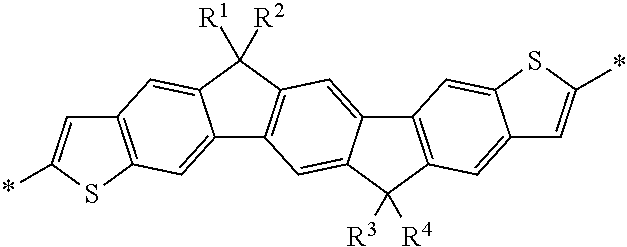 |
 |
T47 | I7g |
| T47 |
 |
 |
 |
T47 | I7h |
| T10 |
 |
 |
 |
T10 | I7i |
| T38 |
 |
 |
 |
T38 | I7k |
| T10 |
 |
 |
 |
T10 | I7l |
| T38 |
 |
 |
 |
T38 | I7m |
| T47 | — |
 |
— | T47 | I8a |
| T47 |
 |
 |
 |
T47 | I8b |
| T47 |
 |
 |
 |
T47 | I8c |
| T47 |
 |
 |
 |
T47 | I8d |
| T47 |
 |
 |
 |
T47 | I8e |
| T47 |
 |
 |
 |
T47 | I8f |
| T47 |
 |
 |
 |
T47 | I8g |
| T47 |
 |
 |
 |
T47 | I8h |
| T10 |
 |
 |
 |
T10 | I8i |
| T38 |
 |
 |
 |
T38 | I8k |
| T10 |
 |
 |
 |
T10 | I8l |
| T38 |
 |
 |
 |
T38 | I8m |
| T47 | — |
 |
— | T47 | I9a |
| T47 |
 |
 |
 |
T47 | I9b |
| T47 |
 |
 |
 |
T47 | I9c |
| T47 |
 |
 |
 |
T47 | I9d |
| T47 |
 |
 |
 |
T47 | I9e |
| T47 |
 |
 |
 |
T47 | I9f |
| T47 |
 |
 |
 |
T47 | I9g |
| T47 |
 |
 |
 |
T47 | I9h |
| T10 |
 |
 |
 |
T10 | I9i |
| T38 |
 |
 |
 |
T38 | I9k |
| T10 |
 |
 |
 |
T10 | I9l |
| T38 |
 |
 |
 |
T38 | I9m |
| T47 | — |
 |
— | T47 | I10a |
| T47 |
 |
 |
 |
T47 | I10b |
| T47 |
 |
 |
 |
T47 | I10c |
| T47 |
 |
 |
 |
T47 | I10d |
| T47 |
 |
 |
 |
T47 | I10e |
| T47 |
 |
 |
 |
T47 | I10f |
| T47 |
 |
 |
 |
T47 | I10g |
| T47 |
 |
 |
 |
T47 | I10h |
| T10 |
 |
 |
 |
T10 | I10i |
| T38 |
 |
 |
 |
T38 | I10k |
| T10 |
 |
 |
 |
T10 | I10l |
| T38 |
 |
 |
 |
T38 | I10m |
| T47 | — |
 |
— | T47 | I11a |
| T47 |
 |
 |
 |
T47 | I11b |
| T47 |
 |
 |
 |
T47 | I11c |
| T47 |
 |
 |
 |
T47 | I11d |
| T47 |
 |
 |
 |
T47 | I11e |
| T47 |
 |
 |
 |
T47 | I11f |
| T47 |
 |
 |
 |
T47 | I11g |
| T47 |
 |
 |
 |
T47 | I11h |
| T10 |
 |
 |
 |
T10 | I11i |
| T38 |
 |
 |
 |
T38 | I11k |
| T10 |
 |
 |
 |
T10 | I11l |
| T38 |
 |
 |
 |
T38 | I11m |
| T47 | — |
 |
— | T47 | I12a |
| T47 |
 |
 |
 |
T47 | I12b |
| T47 |
 |
 |
 |
T47 | I12c |
| T47 |
 |
 |
 |
T47 | I12d |
| T47 |
 |
 |
 |
T47 | I12e |
| T47 |
 |
 |
 |
T47 | I12f |
| T47 |
 |
 |
 |
T47 | I12g |
| T47 |
 |
 |
 |
T47 | I12h |
| T10 |
 |
 |
 |
T10 | I12i |
| T38 |
 |
 |
 |
T38 | I12k |
| T10 |
 |
 |
 |
T10 | I12l |
| T38 |
 |
 |
 |
T38 | I12m |

-(D-Sp)- U1
-(A-Sp)- U2
wherein D denotes a donor unit, A denotes an acceptor unit and Sp denotes a spacer unit, all of which are selected from arylene or heteroarylene that has from 5 to 20 ring atoms, is mono- or polycyclic, optionally contains fused rings, are is unsubstituted or substituted by one or more identical or different groups L as defined above.
-[(D-Sp)x-(A-Sp)y]n- Pi
-[(D-A)x-(A-Sp)y]n- Pii
wherein A, D and Sp are as defined in formula U1 and U2, x denotes the molar fraction of the units (D-Sp) or (D-A), y denotes the molar fraction of the units (A-Sp), x and y are each, independently of one another >0 and <1, with x+y=1, and n is an integer>1.


wherein R11, R12, R13, R14 independently of each other have one of the meanings of R1-9 as defined above in formula I.


wherein R11, R12, R13, R14 independently of each other denote have one of the meanings of R1-9 as defined above in formula I.


wherein R11, R12, R13, R14 independently of each other have one of the meanings of R1-9 as defined above in formula I.
- a) one or more donor units selected from the group consisting of the formulae D1, D7, D10, D11, D19, D22, D29, D30, D35, D36, D37, D44, D55, D84, D87, D88, D89, D93, D106, D111, D119, D140, D141, D146, and D147 and/or
- b) one or more acceptor units selected from the group consisting of the formulae A1, A5, A7, A15, A16, A20, A74, A88, A92, A94 and A98, A99, A100 and
- c) optionally one or more spacer units selected from the group consisting of the formulae Sp1-Sp18, very preferably of the formulae Sp1, Sp6, Sp11 and Sp14,
wherein the spacer units, if present, are preferably located between the donor and acceptor units such that a donor unit and an acceptor unit are not directly connected to each other.
- a) one or more donor units selected from the group consisting of the formulae D1, D7, D10, D11, D19, D22, D29, D30, D35, D36, D37, D44, D55, D84, D87, D88, D89, D93, D106, D111, D119, D140, D141, D146, and D147 and/or
- b) one or more acceptor units selected from the group consisting of the formulae A1, A5, A7, A15, A16, A20, A74, A88, A92, A94, A98, A99 and A100.


wherein R11-17, x, y and n are as defined above, w and z have one of the meanings given for y, x+y+w+z=1, R18 and R19 have one of the meanings given for R11, and X1, X2, X3 and X4 denote H, F or Cl.
-
- the group consisting of straight-chain or branched alkyl, alkoxy or sulfanylalkyl with 1 to 30, preferably 1 to 20, C atoms that is optionally fluorinated,
- the group consisting of straight-chain or branched alkylcarbonyl or alkylcarbonyloxy with 2 to 30, preferably 2 to 20, C atoms, that is optionally fluorinated.
-
- the group consisting of straight-chain or branched alkyl, alkoxy or sulfanylalkyl with 1 to 30, preferably 1 to 20, C atoms that is optionally fluorinated,
- the group consisting of straight-chain or branched alkylcarbonyl or alkylcarbonyloxy with 2 to 30, preferably 2 to 20, C atoms, that is optionally fluorinated.
- the group consisting of F and Cl.
R31-chain-R32 PT
wherein “chain” denotes a polymer chain selected from formulae Pi, Pii and P1-P49, and R31 and R32 have independently of each other one of the meanings of R11 as defined above, or denote, independently of each other, H, F, Br, Cl, I, —CH2Cl, —CHO, —CR′═CR″2, —SiR′R″R′″, —SiR′X′X″, —SiR′R″X′, —SnR′R″R′″, —BR′R″, —B(OR′)(OR″), —B(OH)2, —O—SO2—R′, —C≡CH, —C≡C—SiR′3, —ZnX′ or an endcap group, X′ and X″ each independently denote halogen, R′, R″ and R′″ have independently of each other one of the meanings of R0 given in formula I, and preferably denote alkyl with 1 to 12 C atoms, and two of R′, R″ and R′″ may also form a cyclosilyl, cyclostannyl, cycloborane or cycloboronate group with 2 to 20 C atoms together with the respective hetero atom to which they are attached.


wherein
- Cn denotes a fullerene composed of n carbon atoms, optionally with one or more atoms trapped inside,
- Adduct1 is a primary adduct appended to the fullerene Cn with any connectivity,
- Adduct2 is a secondary adduct, or a combination of secondary adducts, appended to the fullerene Cn with any connectivity,
- k is an integer≥1,
and - l is 0, an integer≥1, or a non-integer>0.


wherein
- ArS1, ArS2 denote, independently of each other, an aryl or heteroaryl group with 5 to 20, preferably 5 to 15, ring atoms, which is mono- or polycyclic, and which is optionally substituted by one or more identical or different substituents having one of the meanings of L as defined above and below,
- RS1, RS2, RS3, RS4 and RS5 independently of each other denote H, CN or have one of the meanings of L as defined above and below.


wherein
RS1, RS2, RS3, RS4 RS5 and RS6 independently of each other denote H, CN or have one of the meanings of L as defined above and below.
-
- optionally a substrate,
- a high work function electrode, preferably comprising a metal oxide, like for example ITO, serving as anode,
- an optional conducting polymer layer or hole transport layer, preferably comprising an organic polymer or polymer blend, for example of PEDOT:PSS (poly(3,4-ethylenedioxythiophene): poly(styrene-sulfonate), or TBD (N,N′-dyphenyl-N-N′-bis(3-methylphenyl)-1,1′biphenyl-4,4′-diamine) or NBD (N,N′-dyphenyl-N—N′-bis(1-napthylphenyl)-1,1′biphenyl-4,4′-diamine),
- a layer, also referred to as “photoactive layer”, comprising a p-type and an n-type organic semiconductor, which can exist for example as a p-type/n-type bilayer or as distinct p-type and n-type layers, or as blend or p-type and n-type semiconductor, forming a BHJ,
- optionally a layer having electron transport properties, for example comprising LiF or PFN,
- a low work function electrode, preferably comprising a metal like for example aluminum, serving as cathode,
- wherein at least one of the electrodes, preferably the anode, is transparent to visible light, and
- wherein the n-type semiconductor is a compound of formula I.
-
- optionally a substrate,
- a high work function metal or metal oxide electrode, comprising for example ITO, serving as cathode,
- a layer having hole blocking properties, preferably comprising an organic polymer, polymer blend, metal or metal oxide like TiOx, ZnOx, Ca, Mg, poly(ethyleneimine), poly(ethyleneimine) ethoxylated or poly [(9,9-bis(3′-(N,N-dimethylamino)propyl)-2,7-fluorene)-alt-2,7-(9,9-dioctylfluorene)],
- a photoactive layer comprising a p-type and an n-type organic semiconductor, situated between the electrodes, which can exist for example as a p-type/n-type bilayer or as distinct p-type and n-type layers, or as blend or p-type and n-type semiconductor, forming a BHJ,
- an optional conducting polymer layer or hole transport layer, preferably comprising an organic polymer or polymer blend, metal or metal oxide, for example PEDOT:PSS, nafion a substituted triaryl amine derivative like for example TBD or NBD, or WOx, MoOx, NiOx, Pd or Au,
- an electrode comprising a high work function metal like for example silver, serving as anode,
- wherein at least one of the electrodes, preferably the cathode, is transparent to visible light, and
- wherein the n-type semiconductor is a compound of formula I.
- A is a monovalent organic cation, a metal cation or a mixture of two or more of these cations
- B is a divalent cation and
- X is F, Cl, Br, I, BF4 or a combination thereof.
-
- optionally a substrate which, in any combination, can be flexible or rigid and transparent, semi-transparent or non-transparent and electrically conductive or non-conductive;
- a high work function electrode, preferably comprising a doped metal oxide, for example fluorine-doped tin oxide (FTO), tin-doped indium oxide (ITO), or aluminum-doped zinc oxide;
- an electron-selective layer which comprises one or more electron-transporting materials, at least one of which is a compound of formula I, and which, in some cases, can also be a dense layer and/or be composed of nanoparticles, and which preferably comprises a metal oxide such as TiO2, ZnO2, SnO2, Y2O5, Ga2O3, SrTiO3, BaTiO3 or combinations thereof;
- optionally a porous scaffold which can be conducting, semi-conducting or insulating, and which preferably comprises a metal oxide such as TiO2, ZnO2, SnO2, Y2O5, Ga2O3, SrTiO3, BaTiO3, Al2O3, ZrO2, SiO2 or combinations thereof, and which is preferably composed of nanoparticles, nanorods, nanoflakes, nanotubes or nanocolumns;
- a layer comprising a light absorber which is at least in part inorganic, particularly preferably a metal halide perovskite as described above which, in some cases, can also be a dense or porous layer and which optionally partly or fully infiltrates into the underlying layer;
- optionally a hole selective layer, which comprises one or more hole-transporting materials, and which, in some cases, can also comprise additives such as lithium salts, for example LiY, where Y is a monovalent organic anion, preferably bis(trifluoromethylsulfonyl)imide, tertiary amines such as 4-tert-butylpyridine, or any other covalent or ionic compounds, for example tris(2-(1H-pyrazol-1-yl)-4-tert-butylpyridine)-cobalt(III) tris(bis(trifluoromethylsulfonyl)imide)), which can enhance the properties of the hole selective layer, for example the electrical conductivity, and/or facilitate its processing;
and a back electrode which can be metallic, for example made of Au, Ag, Al, Cu, Ca, Ni or combinations thereof, or non-metallic and transparent, semi-transparent or non-transparent.
-
- optionally a substrate which, in any combination, can be flexible or rigid and transparent, semi-transparent or non-transparent and electrically conductive or non-conductive;
- a high work function electrode, preferably comprising a doped metal oxide, for example fluorine-doped tin oxide (FTO), tin-doped indium oxide (ITO), or aluminum-doped zinc oxide;
- optionally a hole injection layer which, for example, changes the work function of the underlying electrode, and/or modifies the surface of the underlying layer and/or helps to planarize the rough surface of the underlying layer and which, in some cases, can also be a monolayer;
- optionally a hole selective layer, which comprises one or more hole-transporting materials and which, in some cases, can also comprise additives such as lithium salts, for example LiY, where Y is a monovalent organic anion, preferably bis(trifluoromethylsulfonyl)imide, tertiary amines such as 4-tert-butylpyridine, or any other covalent or ionic compounds, for example tris(2-(1H-pyrazol-1-yl)-4-tert-butylpyridine)-cobalt(III) tris(bis(trifluoromethylsulfonyl)imide)), which can enhance the properties of the hole selective layer, for example the electrical conductivity, and/or facilitate its processing;
- a layer comprising a light absorber which is at least in part inorganic, particularly preferably a metal halide perovskite as described or preferably described above;
- an electron-selective layer, which comprises one or more electron-transporting materials, at least one of which is a compound of formula I and which, in some cases, can also be a dense layer and/or be composed of nanoparticles, and which, for example, can comprise a metal oxide such as TiO2, ZnO2, SnO2, Y2O5, Ga2O3, SrTiO3, BaTiO3 or combinations thereof, and/or which can comprise a substituted fullerene, for example [6,6]-phenyl C61-butyric acid methyl ester, and/or which can comprise a molecular, oligomeric or polymeric electron-transport material, for example 2,9-Dimethyl-4,7-diphenyl-1,10-phenanthroline, or a mixture thereof;
and a back electrode which can be metallic, for example made of Au, Ag, Al, Cu, Ca, Ni or combinations thereof, or non-metallic and transparent, semi-transparent or non-transparent.
- (i) first mixing a compound of formula I, optionally a binder or a precursor of a binder as described before, optionally a further electron transport material, optionally one or more further additives as described above and below and a solvent or solvent mixture as described above and below and
- (ii) applying such mixture to a substrate; and optionally evaporating the solvent(s) to form an electron selective layer according to the present invention.
-
- providing a first and a second electrode;
- providing an electron selective layer comprising a compound of formula I.
-
- a source electrode,
- a drain electrode,
- a gate electrode,
- a semiconducting layer,
- one or more gate insulator layers,
- optionally a substrate.
wherein the semiconductor layer preferably comprises a compound of formula I.
| No. | Structure | EHOMO/eV | ELUMO/eV | Eg/eV | S0-S1/eV |
| C1 |
 |
−5.46 | −3.34 | 2.12 | 1.91 |
| No. | Structure | EHOMO/eV | ELUMO/eV | Eg/eV | S0-S1/eV |
| 1 |
 |
−5.52 | −3.56 | 1.96 | 1.68 |
| 2 |
 |
−5.44 | −3.55 | 1.89 | 1.67 |
| 3 |
 |
−5.55 | −3.55 | 2.00 | 1.70 |
| 4 |
 |
−5.55 | −3.54 | 2.01 | 1.88 |
| 5 |
 |
−5.67 | −3.53 | 2.14 | 1.92 |
| 6 |
 |
−5.58 | −3.52 | 2.06 | 1.76 |
| 7 |
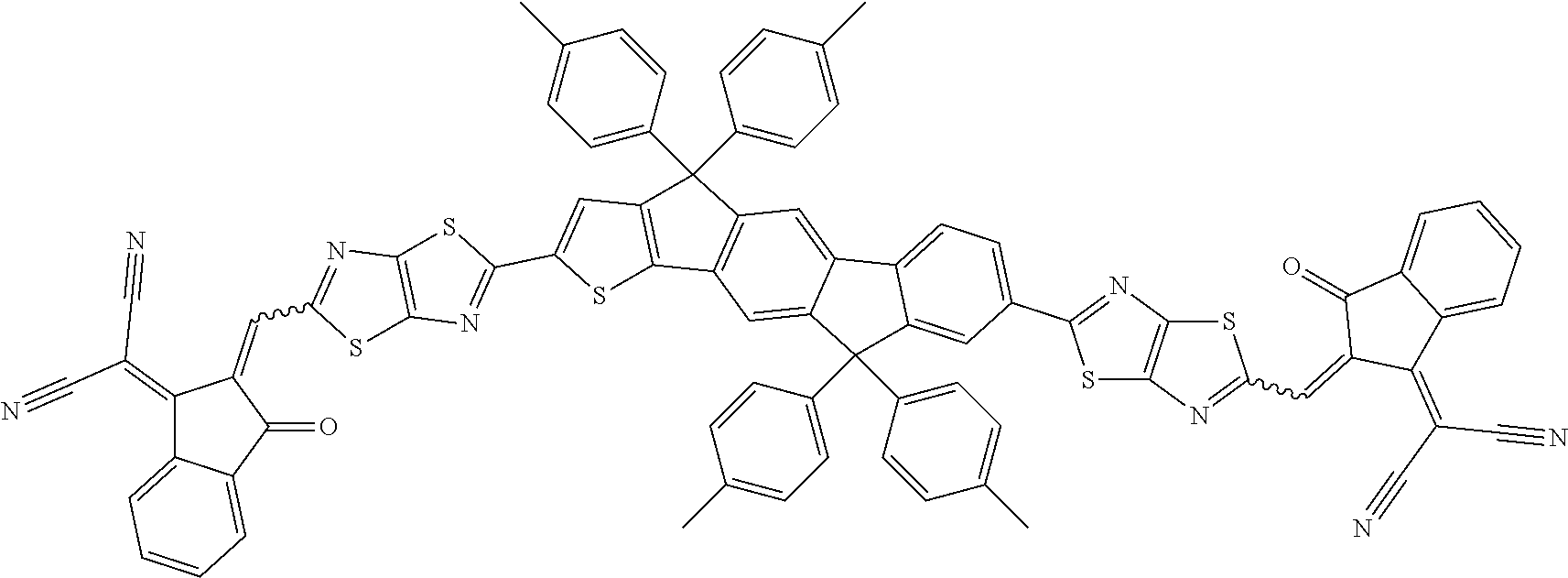 |
−5.55 | −3.52 | 2.03 | 1.89 |
| 8 |
 |
−5.48 | −3.52 | 1.96 | 1.66 |
| 9 |
 |
−5.67 | −3.52 | 2.15 | 1.98 |
| 10 |
 |
−5.47 | −3.51 | 1.96 | 1.75 |
| 11 |
 |
−5.58 | −3.51 | 2.07 | 1.82 |
| 12 |
 |
−5.56 | −3.50 | 2.06 | 1.56 |
| 13 |
 |
−5.57 | −3.50 | 2.07 | 1.75 |
| 14 |
 |
−5.68 | −3.50 | 2.18 | 2.04 |
| 15 |
 |
−5.50 | −3.49 | 2.01 | 1.61 |
| 16 |
 |
−5.61 | −3.49 | 2.12 | 1.87 |
| 17 |
 |
−5.47 | −3.49 | 1.98 | 1.66 |
| 18 |
 |
−5.35 | −3.47 | 1.88 | 1.64 |
| 19 |
 |
−5.65 | −3.46 | 2.19 | 1.71 |
| 20 |
 |
−5.29 | −3.46 | 1.83 | 1.59 |
| 21 |
 |
−5.40 | −3.46 | 1.94 | 1.73 |
| 22 |
 |
−5.54 | −3.46 | 2.08 | 1.85 |
| 23 |
 |
−5.53 | −3.46 | 2.07 | 1.76 |
| 24 |
 |
−5.54 | −3.45 | 2.09 | 1.70 |
| 25 |
 |
−5.69 | −3.45 | 2.24 | 1.89 |
| 26 |
 |
−5.56 | −3.45 | 2.11 | 1.89 |
| 27 |
 |
−5.59 | −3.45 | 2.14 | 1.68 |
| 28 |
 |
−5.58 | −3.44 | 2.14 | 1.76 |
| 29 |
 |
−5.34 | −3.44 | 1.90 | 1.65 |
| 30 |
 |
−5.30 | −3.42 | 1.88 | 1.63 |
| 31 |
 |
−5.36 | −3.42 | 1.94 | 1.68 |
| 32 |
 |
−5.52 | −3.40 | 2.12 | 1.85 |
| 33 |
 |
−5.70 | −3.34 | 2.36 | 2.16 |
| 34 |
 |
−5.64 | −3.33 | 2.31 | 2.18 |
| 35 |
 |
−5.45 | −3.32 | 2.13 | 1.83 |
| 36 |
 |
−5.48 | −3.32 | 2.16 | 1.85 |
| 37 |
 |
−5.59 | −3.32 | 2.27 | 2.09 |
| 38 |
 |
−5.63 | −3.31 | 2.32 | 2.11 |
| 39 |
 |
−5.52 | −3.30 | 2.22 | 2.00 |
| 40 |
 |
−5.83 | −3.30 | 2.53 | 2.31 |
| 41 |
 |
−5.53 | −3.29 | 2.24 | 1.99 |
| 42 |
 |
−5.41 | −3.28 | 2.13 | 2.02 |
| 43 |
 |
−5.37 | −3.28 | 2.09 | 1.95 |
| 44 |
 |
−5.30 | −3.27 | 2.03 | 1.83 |
| 45 |
 |
−5.55 | −3.26 | 2.29 | 2.15 |
| 46 |
 |
−5.35 | −3.25 | 2.10 | 1.88 |
| 47 |
 |
−5.72 | −3.25 | 2.47 | 2.22 |
| 48 |
 |
−5.55 | −3.25 | 2.30 | 1.90 |
| 49 |
 |
−5.57 | −3.25 | 2.32 | 2.18 |
| 50 |
 |
−5.69 | −3.24 | 2.45 | 2.18 |
| 51 |
 |
−5.38 | −3.24 | 2.14 | 1.95 |
| 52 |
 |
−5.52 | −3.24 | 2.28 | 2.00 |
| 53 |
 |
−5.53 | −3.24 | 2.29 | 1.95 |
| 54 |
 |
−5.31 | −3.23 | 2.08 | 1.91 |
| 55 |
 |
−5.52 | −3.22 | 2.30 | 1.97 |
| 56 |
 |
−5.54 | −3.20 | 2.34 | 2.15 |


where FF is defined as
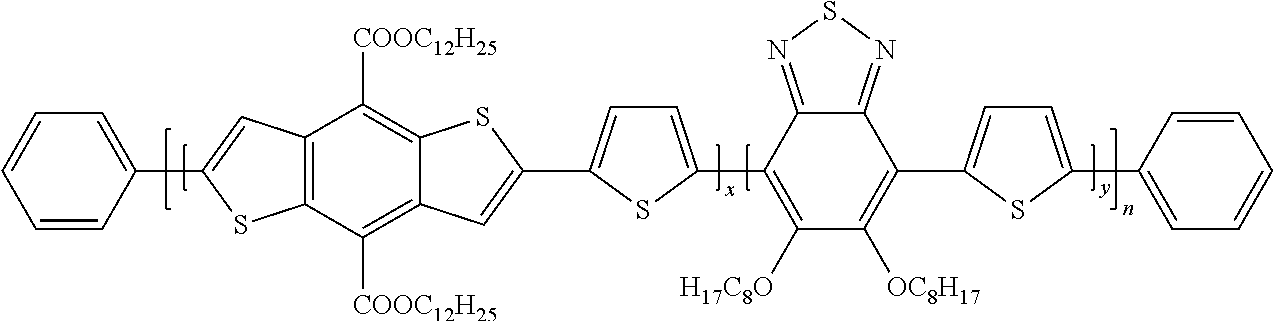
Polymer 1 and its preparation are disclosed in WO 2011/131280 A1.
Inverted Bulk Heterojunction Organic Photovoltaic Devices
| TABLE 1 |
| Formulation characteristics |
| Concen- | |||||
| Ratio | tration | ||||
| No. | Acceptor | Polymer | Polymer:Acceptor | g/L | Solvent |
| C1 | PCBM-C60 | 1 | 1.00:2.00 | 30 | oDCB |
| 1 | Cpd. 57 | 1 | 1.00:1.30 | 23 | oDCB |
| 2 | Cpd. 57 | 1 | 1.00:1.30 | 23 | oXyl |
| 3 | Cpd. 58 | 1 | 1.00:1.30 | 23 | oDCB |
| 4 | Cpd. 58 | 1 | 1.00:1.30 | 23 | oXyl |
Inverted Device Properties
| TABLE 2 |
| Photovoltaic cell characteristics under simulated solar irradiation |
| at 1 sun (AM1.5G). |
| Average Initial Performance |
| Voc | Jsc | FF | PCE | |
| No. | mV | mA · cm−2 | % | % |
| C1 | 784 | 11.6 | 68.1 | 6.18 |
| 1 | 960 | 5.1 | 39.6 | 1.94 |
| 2 | 942 | 6.2 | 35.8 | 2.10 |
| 3 | 939 | 2.96 | 40.0 | 1.11 |
| 4 | 915 | 4.87 | 39.9 | 1.77 |
Claims (24)


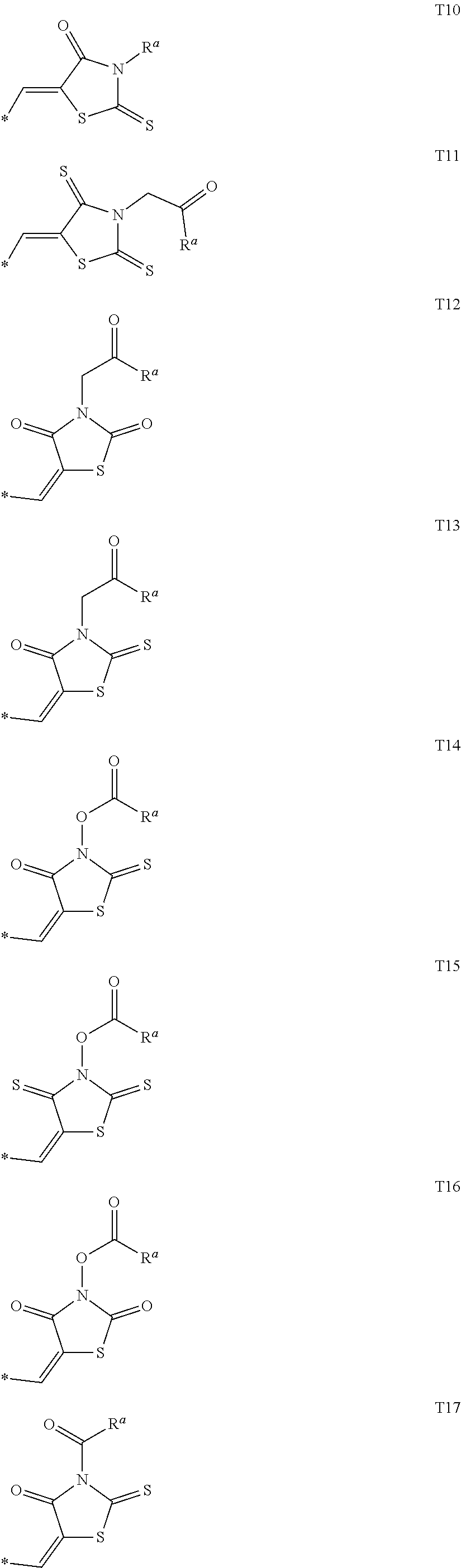


Applications Claiming Priority (3)
| Application Number | Priority Date | Filing Date | Title |
|---|---|---|---|
| EP16192352 | 2016-10-05 | ||
| EP16192352 | 2016-10-05 | ||
| EP16192352.9 | 2016-10-05 |
Publications (2)
| Publication Number | Publication Date |
|---|---|
| US20180309062A1 US20180309062A1 (en) | 2018-10-25 |
| US10411190B2 true US10411190B2 (en) | 2019-09-10 |
Family
ID=57144799
Family Applications (1)
| Application Number | Title | Priority Date | Filing Date |
|---|---|---|---|
| US15/724,710 Active 2037-11-10 US10411190B2 (en) | 2016-10-05 | 2017-10-04 | Organic semiconducting compounds |
Country Status (3)
| Country | Link |
|---|---|
| US (1) | US10411190B2 (en) |
| EP (1) | EP3306690B1 (en) |
| CN (1) | CN107915661B (en) |
Cited By (1)
| Publication number | Priority date | Publication date | Assignee | Title |
|---|---|---|---|---|
| US11005043B2 (en) * | 2017-08-11 | 2021-05-11 | Raynergy Tek Incorporation | Organic semiconducting polymer |
Families Citing this family (13)
| Publication number | Priority date | Publication date | Assignee | Title |
|---|---|---|---|---|
| CN109891616B (en) * | 2016-10-31 | 2023-09-29 | 天光材料科技股份有限公司 | organic semiconductor compounds |
| CN112368316A (en) | 2018-04-27 | 2021-02-12 | 天光材料科技股份有限公司 | Organic semiconducting polymers |
| CN110767807A (en) * | 2018-07-27 | 2020-02-07 | 中国科学院长春光学精密机械与物理研究所 | Has photosensitive field effect transistors formed by using perovskite thin single crystals |
| GB201819621D0 (en) * | 2018-11-30 | 2019-01-16 | Sumitomo Chemical Co | Photoactive compound |
| US20230073741A1 (en) * | 2019-03-07 | 2023-03-09 | Raynergy Tek Inc. | Organic semiconducting composition |
| WO2020187867A1 (en) | 2019-03-19 | 2020-09-24 | Raynergy Tek Inc. | Organic semiconductors |
| US20220367814A1 (en) | 2019-05-06 | 2022-11-17 | Raynergy Tek Inc. | Photoactive composition |
| CN110964041B (en) * | 2019-05-30 | 2021-01-26 | 深圳睿迅有机太阳能有限公司 | Receptor material based on benzimide and preparation method and application thereof |
| CN110818698A (en) * | 2019-11-14 | 2020-02-21 | 湘潭大学 | A-pi-D-pi-A type organic small molecule based on diindenopyrazine and preparation method and application thereof |
| KR20210152058A (en) * | 2020-06-04 | 2021-12-15 | 삼성디스플레이 주식회사 | Display device and method for manufacturing the same |
| CN112382645B (en) * | 2020-10-09 | 2024-10-15 | 西北工业大学 | Photoelectrically coupled perovskite memristor based on 1T1R structure and crossbar array integrated structure |
| CN112382726B (en) * | 2020-10-09 | 2022-04-19 | 西北工业大学 | Photoelectric coupling perovskite memristor for neuromorphic calculation and preparation method |
| CN114133376B (en) * | 2021-11-11 | 2023-05-09 | 北京师范大学 | Organic solar cell acceptor material and preparation method thereof, organic solar cell |
Citations (7)
| Publication number | Priority date | Publication date | Assignee | Title |
|---|---|---|---|---|
| EP2075274A1 (en) | 2007-12-27 | 2009-07-01 | Industrial Technology Research Institute | Soluble polythiophene derivatives |
| WO2010020329A1 (en) | 2008-08-18 | 2010-02-25 | Merck Patent Gmbh, | Indacenodithiophene and indacenodiselenophene polymers and their use as organic semiconductors |
| US20120056166A1 (en) * | 2009-05-11 | 2012-03-08 | Dainichiseika Color & Chemicals Mfg. Co., Ltd. | Organic semiconductor material, organic semiconductor thin film, and organic thin-film transistor |
| CN102372663A (en) | 2010-08-20 | 2012-03-14 | 清华大学 | Pyridyl indenofluorene compound and application thereof |
| WO2015154845A1 (en) | 2014-04-10 | 2015-10-15 | Merck Patent Gmbh | Organic semiconducting compounds |
| US20160013420A1 (en) | 2014-07-10 | 2016-01-14 | Samsung Display Co., Ltd. | Organic compound and organic light emitting diode device including the same |
| WO2017191466A1 (en) | 2016-05-06 | 2017-11-09 | Imperial Innovations Limited | Organic ternary blends |
Family Cites Families (34)
| Publication number | Priority date | Publication date | Assignee | Title |
|---|---|---|---|---|
| US5892244A (en) | 1989-01-10 | 1999-04-06 | Mitsubishi Denki Kabushiki Kaisha | Field effect transistor including πconjugate polymer and liquid crystal display including the field effect transistor |
| US5198153A (en) | 1989-05-26 | 1993-03-30 | International Business Machines Corporation | Electrically conductive polymeric |
| JP3224829B2 (en) | 1991-08-15 | 2001-11-05 | 株式会社東芝 | Organic field effect device |
| WO1996021659A1 (en) | 1995-01-10 | 1996-07-18 | University Of Technology, Sydney | Organic semiconductor |
| EP0889350A1 (en) | 1997-07-03 | 1999-01-07 | ETHZ Institut für Polymere | Photoluminescent display devices (I) |
| US5998804A (en) | 1997-07-03 | 1999-12-07 | Hna Holdings, Inc. | Transistors incorporating substrates comprising liquid crystal polymers |
| AU2926400A (en) | 1999-03-05 | 2000-09-28 | Cambridge Display Technology Limited | Polymer preparation |
| JP5167569B2 (en) | 1999-06-21 | 2013-03-21 | ケンブリッジ・エンタープライズ・リミテッド | Method for manufacturing transistor |
| GB0028867D0 (en) | 2000-11-28 | 2001-01-10 | Avecia Ltd | Field effect translators,methods for the manufacture thereof and materials therefor |
| US20030021913A1 (en) | 2001-07-03 | 2003-01-30 | O'neill Mary | Liquid crystal alignment layer |
| DE10241814A1 (en) | 2002-09-06 | 2004-03-25 | Covion Organic Semiconductors Gmbh | Process for the preparation of aryl-aryl coupled compounds |
| JP2004292743A (en) * | 2003-03-28 | 2004-10-21 | Toyo Ink Mfg Co Ltd | Optical functional materials |
| US7842942B2 (en) | 2003-11-28 | 2010-11-30 | Merck Patent Gmbh | Organic semiconducting layers |
| EP2185496A1 (en) * | 2007-08-02 | 2010-05-19 | Northwestern University | Conjugated monomers and polymers and preparation and use thereof |
| JP5655568B2 (en) * | 2008-10-09 | 2015-01-21 | コニカミノルタ株式会社 | Organic photoelectric conversion element, solar cell, and optical sensor array |
| US20120049174A1 (en) * | 2009-03-11 | 2012-03-01 | Osaka University | Conjugated compound, and organic thin film and organic thin film element each comprising same |
| CN102549791B (en) * | 2009-08-28 | 2015-01-07 | 新加坡科技研究局 | Ambipolar polymeric semiconductor materials and organic electronic devices |
| EP3243818B1 (en) | 2010-04-19 | 2021-02-17 | Raynergy Tek Inc. | Polymers of benzodithiophene and their use as organic semiconductors |
| KR20140016298A (en) | 2011-02-25 | 2014-02-07 | 에꼴 뽈리떼끄닉 뻬데랄 드 로잔느 (으뻬에프엘) | Improved redox couple for electrochemical and optoelectronic devices |
| KR101957534B1 (en) | 2011-02-25 | 2019-03-12 | 에꼴 뽈리떼끄닉 뻬데랄 드 로잔느 (으뻬에프엘) | Metal complexes for use as dopants and other uses |
| JP2014527550A (en) * | 2011-07-25 | 2014-10-16 | メルク パテント ゲーエムベーハー | Polymers and oligomers with functional side groups |
| JP2013131477A (en) | 2011-12-22 | 2013-07-04 | Merck Ltd | Cobalt electrolyte, electrolytic solution, dye sensitized solar cell, and method for producing cobalt electrolyte |
| ES2566914T3 (en) | 2012-05-18 | 2016-04-18 | Isis Innovation Limited | Photovoltaic device comprising perovskites |
| EP2850627B1 (en) | 2012-05-18 | 2016-04-06 | Isis Innovation Limited | Optoelectronic device comprising porous scaffold material and perovskites |
| GB201208793D0 (en) | 2012-05-18 | 2012-07-04 | Isis Innovation | Optoelectronic device |
| EP2693503A1 (en) | 2012-08-03 | 2014-02-05 | Ecole Polytechnique Fédérale de Lausanne (EPFL) | Organo metal halide perovskite heterojunction solar cell and fabrication thereof |
| EP4089753B1 (en) | 2012-09-18 | 2024-11-06 | Oxford University Innovation Limited | Optoelectronic device |
| EP2925767A1 (en) | 2012-11-30 | 2015-10-07 | Merck Patent GmbH | Cobalt complexes with tricyanoborate or dicyanoborate counter-anions for electrochemical or optoelectronic devices |
| EP2925768B1 (en) | 2012-11-30 | 2016-12-21 | Merck Patent GmbH | Cobaltcomplex salts |
| CN104557968B (en) | 2013-10-29 | 2017-04-05 | 中国科学院化学研究所 | A D A conjugated molecules based on dithieno indacene and its preparation method and application |
| EP2883881A1 (en) | 2013-12-12 | 2015-06-17 | Merck Patent GmbH | Cobaltcomplex salts and mixtures of Cobaltcomplex salts for use in DSSC |
| CN105315298B (en) | 2014-08-04 | 2017-10-10 | 中国科学院化学研究所 | A D A conjugated molecules and its preparation method and application based on seven and condensed ring unit |
| CN105061463B (en) * | 2015-08-15 | 2018-09-14 | 华南理工大学 | A kind of nine yuan of fused-ring derivatives and its synthetic method and application |
| EP3500577B1 (en) * | 2016-08-22 | 2021-12-01 | Raynergy Tek Inc. | Organic semiconducting compounds |
-
2017
- 2017-10-02 EP EP17194312.9A patent/EP3306690B1/en active Active
- 2017-10-04 US US15/724,710 patent/US10411190B2/en active Active
- 2017-10-09 CN CN201710929288.4A patent/CN107915661B/en active Active
Patent Citations (12)
| Publication number | Priority date | Publication date | Assignee | Title |
|---|---|---|---|---|
| EP2075274A1 (en) | 2007-12-27 | 2009-07-01 | Industrial Technology Research Institute | Soluble polythiophene derivatives |
| WO2010020329A1 (en) | 2008-08-18 | 2010-02-25 | Merck Patent Gmbh, | Indacenodithiophene and indacenodiselenophene polymers and their use as organic semiconductors |
| US20110226999A1 (en) | 2008-08-18 | 2011-09-22 | Merck Patent Gesellschaft Mit Beschrankter Haftung | Indacenodithiophene and Indacenodiselenophene Polymers and their Use as Organic Semiconductors |
| US9017577B2 (en) | 2008-08-18 | 2015-04-28 | Merck Patent Gmbh | Indacenodithiophene and indacenodiselenophene polymers and their use as organic semiconductors |
| US20120056166A1 (en) * | 2009-05-11 | 2012-03-08 | Dainichiseika Color & Chemicals Mfg. Co., Ltd. | Organic semiconductor material, organic semiconductor thin film, and organic thin-film transistor |
| CN102372663A (en) | 2010-08-20 | 2012-03-14 | 清华大学 | Pyridyl indenofluorene compound and application thereof |
| CN102372663B (en) | 2010-08-20 | 2013-10-30 | 清华大学 | Pyridyl indenofluorene compound and application thereof |
| WO2015154845A1 (en) | 2014-04-10 | 2015-10-15 | Merck Patent Gmbh | Organic semiconducting compounds |
| US20170117477A1 (en) | 2014-04-10 | 2017-04-27 | Merck Patent Gmbh | Organic semiconducting compounds |
| US20160013420A1 (en) | 2014-07-10 | 2016-01-14 | Samsung Display Co., Ltd. | Organic compound and organic light emitting diode device including the same |
| WO2017191466A1 (en) | 2016-05-06 | 2017-11-09 | Imperial Innovations Limited | Organic ternary blends |
| WO2017191468A1 (en) | 2016-05-06 | 2017-11-09 | Imperial Innovations Limited | Non-fullerene electron acceptors |
Non-Patent Citations (5)
| Title |
|---|
| English Abstract of CN 102372663 A published Mar. 14, 2012. |
| European Search Report dated Mar. 5, 2018 issued in corresponding EP 17194312 application (7 pages). |
| H. Lin et al., "High-Performance Non-Fullerene Polymer Solar Cells Based on a Pair of Donor-Acceptor Materials with Complementary Absorption Properties", Advanced Materials, vol. 27 (2015) pp. 7299-7304. |
| K-T Wong et al., "Syntheses and Structures of Novel Heteroarene-Fused Coplanar—Conjugated Chromophores", Organic Letters, vol. 8, No. 22 (2006) pp. 5033-5036. |
| Y. Lin et al., "An Electron Acceptor Challenging Fullerenes for Efficient Polymer Solar Cells", Advanced Materials, vol. 27 (2015) pp. 1170-1174. |
Cited By (1)
| Publication number | Priority date | Publication date | Assignee | Title |
|---|---|---|---|---|
| US11005043B2 (en) * | 2017-08-11 | 2021-05-11 | Raynergy Tek Incorporation | Organic semiconducting polymer |
Also Published As
| Publication number | Publication date |
|---|---|
| CN107915661A (en) | 2018-04-17 |
| EP3306690A1 (en) | 2018-04-11 |
| US20180309062A1 (en) | 2018-10-25 |
| CN107915661B (en) | 2024-01-23 |
| EP3306690B1 (en) | 2022-09-07 |
Similar Documents
| Publication | Publication Date | Title |
|---|---|---|
| US10991893B2 (en) | Organic semiconducting compounds | |
| US10411190B2 (en) | Organic semiconducting compounds | |
| US11196005B2 (en) | Organic semiconducting compounds | |
| US11508910B2 (en) | Organic semiconducting compounds | |
| US10759775B2 (en) | Organic semiconducting compounds | |
| EP3500577B1 (en) | Organic semiconducting compounds | |
| US20230287001A1 (en) | Organic Semiconducting Compounds | |
| US12101992B2 (en) | Organic semiconducting compounds | |
| US11649321B2 (en) | Organic semiconducting compounds | |
| US20200066998A1 (en) | Organic semiconducting componds | |
| US12532662B2 (en) | Organic semiconducting compounds | |
| US11637246B2 (en) | Organic semiconducting compounds | |
| US20210367159A1 (en) | Organic semiconducting compounds | |
| US12193317B2 (en) | Organic semiconducting compounds | |
| US11005043B2 (en) | Organic semiconducting polymer | |
| US11289663B2 (en) | Organic semiconducting compounds | |
| US20210280791A1 (en) | Organic semiconducting polymers | |
| US20230073741A1 (en) | Organic semiconducting composition | |
| WO2019161748A1 (en) | Organic semiconducting compounds | |
| WO2019154973A1 (en) | Organic semiconducting compounds |
Legal Events
| Date | Code | Title | Description |
|---|---|---|---|
| AS | Assignment |
Owner name: MERCK PATENT GMBH, GERMANY Free format text: ASSIGNMENT OF ASSIGNORS INTEREST;ASSIGNORS:MORSE, GRAHAM;NANSON, LANA;MITCHELL, WILLIAM;AND OTHERS;SIGNING DATES FROM 20170927 TO 20170928;REEL/FRAME:043781/0195 |
|
| FEPP | Fee payment procedure |
Free format text: ENTITY STATUS SET TO UNDISCOUNTED (ORIGINAL EVENT CODE: BIG.); ENTITY STATUS OF PATENT OWNER: SMALL ENTITY Free format text: ENTITY STATUS SET TO UNDISCOUNTED (ORIGINAL EVENT CODE: BIG.); ENTITY STATUS OF PATENT OWNER: LARGE ENTITY |
|
| STPP | Information on status: patent application and granting procedure in general |
Free format text: RESPONSE TO NON-FINAL OFFICE ACTION ENTERED AND FORWARDED TO EXAMINER |
|
| STPP | Information on status: patent application and granting procedure in general |
Free format text: NOTICE OF ALLOWANCE MAILED -- APPLICATION RECEIVED IN OFFICE OF PUBLICATIONS |
|
| STPP | Information on status: patent application and granting procedure in general |
Free format text: PUBLICATIONS -- ISSUE FEE PAYMENT RECEIVED |
|
| STPP | Information on status: patent application and granting procedure in general |
Free format text: PUBLICATIONS -- ISSUE FEE PAYMENT VERIFIED |
|
| STCF | Information on status: patent grant |
Free format text: PATENTED CASE |
|
| AS | Assignment |
Owner name: RAYNERGY TEK INCORPORATION, TAIWAN Free format text: ASSIGNMENT OF ASSIGNORS INTEREST;ASSIGNOR:MERCK PATENT GMBH;REEL/FRAME:053283/0990 Effective date: 20200716 |
|
| FEPP | Fee payment procedure |
Free format text: ENTITY STATUS SET TO SMALL (ORIGINAL EVENT CODE: SMAL); ENTITY STATUS OF PATENT OWNER: SMALL ENTITY |
|
| MAFP | Maintenance fee payment |
Free format text: PAYMENT OF MAINTENANCE FEE, 4TH YR, SMALL ENTITY (ORIGINAL EVENT CODE: M2551); ENTITY STATUS OF PATENT OWNER: SMALL ENTITY Year of fee payment: 4 |