US10364313B2 - Method for producing an ablative resin - Google Patents
Method for producing an ablative resin Download PDFInfo
- Publication number
- US10364313B2 US10364313B2 US15/545,494 US201615545494A US10364313B2 US 10364313 B2 US10364313 B2 US 10364313B2 US 201615545494 A US201615545494 A US 201615545494A US 10364313 B2 US10364313 B2 US 10364313B2
- Authority
- US
- United States
- Prior art keywords
- formula
- compound
- aromatic aldehyde
- denoting
- alcohol
- Prior art date
- Legal status (The legal status is an assumption and is not a legal conclusion. Google has not performed a legal analysis and makes no representation as to the accuracy of the status listed.)
- Active
Links
- MNXVIQCUWMQNMZ-UHFFFAOYSA-N CC.CC.COC1=CC=CC=C1.O=CC1=CC=CC=C1 Chemical compound CC.CC.COC1=CC=CC=C1.O=CC1=CC=CC=C1 MNXVIQCUWMQNMZ-UHFFFAOYSA-N 0.000 description 3
- 0 **Cc1cc(O**C=O)ccc1 Chemical compound **Cc1cc(O**C=O)ccc1 0.000 description 2
- IAZZLTZIWAADPN-UHFFFAOYSA-N CC.CC.CC.O=CC1=CC=CC=C1.OC1=CC=CC=C1 Chemical compound CC.CC.CC.O=CC1=CC=CC=C1.OC1=CC=CC=C1 IAZZLTZIWAADPN-UHFFFAOYSA-N 0.000 description 2
- RVKKVXVOKBIDFI-UHFFFAOYSA-N BrCC1OCCO1.C1=CC=C(OCC2OCCO2)C=C1.OC1=CC=CC=C1 Chemical compound BrCC1OCCO1.C1=CC=C(OCC2OCCO2)C=C1.OC1=CC=CC=C1 RVKKVXVOKBIDFI-UHFFFAOYSA-N 0.000 description 1
- YNAPTDNBVWQPNF-UHFFFAOYSA-N C1=CC=C(OCC2OCCO2)C=C1.O=CCOC1=CC=CC=C1.OCCO Chemical compound C1=CC=C(OCC2OCCO2)C=C1.O=CCOC1=CC=CC=C1.OCCO YNAPTDNBVWQPNF-UHFFFAOYSA-N 0.000 description 1
- FLVYXLJUBWVAQT-UHFFFAOYSA-N CC.CC.CC.COC1=CC=CC=C1.O=CC1=CC=CC=C1.O=CCOC1=CC=CC=C1 Chemical compound CC.CC.CC.COC1=CC=CC=C1.O=CC1=CC=CC=C1.O=CCOC1=CC=CC=C1 FLVYXLJUBWVAQT-UHFFFAOYSA-N 0.000 description 1
- PSRWBJQNHGDOQE-UHFFFAOYSA-N CC.CC.CCCOC1=CC=CC=C1.CCC[Y].OC1=CC=CC=C1 Chemical compound CC.CC.CCCOC1=CC=CC=C1.CCC[Y].OC1=CC=CC=C1 PSRWBJQNHGDOQE-UHFFFAOYSA-N 0.000 description 1
- SNELAOVPYOEGBS-UHFFFAOYSA-N CC.CC.COC.COC1=CC=CC=C1.COCC=O.O=CC1=CC=CC=C1 Chemical compound CC.CC.COC.COC1=CC=CC=C1.COCC=O.O=CC1=CC=CC=C1 SNELAOVPYOEGBS-UHFFFAOYSA-N 0.000 description 1
- KHEYQIOKOQFKDP-UHFFFAOYSA-N CC.CC.COC.COC1=CC=CC=C1.O=CC1=CC=CC=C1 Chemical compound CC.CC.COC.COC1=CC=CC=C1.O=CC1=CC=CC=C1 KHEYQIOKOQFKDP-UHFFFAOYSA-N 0.000 description 1
- NQKYMNZRKRDHQN-UHFFFAOYSA-N CC.CC.COC1=CC=C(C=O)C=C1OC.COC1=CC=CC=C1.O=CC1=CC=CC=C1.O=CC1=CC=CC=C1 Chemical compound CC.CC.COC1=CC=C(C=O)C=C1OC.COC1=CC=CC=C1.O=CC1=CC=CC=C1.O=CC1=CC=CC=C1 NQKYMNZRKRDHQN-UHFFFAOYSA-N 0.000 description 1
- BYYMICNCGKRIAX-UHFFFAOYSA-N CC.O=CCOC1=CC=CC=C1 Chemical compound CC.O=CCOC1=CC=CC=C1 BYYMICNCGKRIAX-UHFFFAOYSA-N 0.000 description 1
- ACYZGNSGPRLNCZ-UHFFFAOYSA-N CCO.CCOC(COC1=CC=C(C=O)C=C1)OCC.O=CCOC1=CC=C(C=O)C=C1 Chemical compound CCO.CCOC(COC1=CC=C(C=O)C=C1)OCC.O=CCOC1=CC=C(C=O)C=C1 ACYZGNSGPRLNCZ-UHFFFAOYSA-N 0.000 description 1
- DEJCLPVNTLNZLW-UHFFFAOYSA-N CCOC(CBr)OCC.CCOC(COC1=CC=C(C=O)C=C1)OCC.O=CC1=CC=C(O)C=C1 Chemical compound CCOC(CBr)OCC.CCOC(COC1=CC=C(C=O)C=C1)OCC.O=CC1=CC=C(O)C=C1 DEJCLPVNTLNZLW-UHFFFAOYSA-N 0.000 description 1
- BEVAPOTWMQDBPW-UHFFFAOYSA-N CO.COC1=CC(C=O)=CC=C1OCC(OC)OC.COC1=CC(C=O)=CC=C1OCC=O Chemical compound CO.COC1=CC(C=O)=CC=C1OCC(OC)OC.COC1=CC(C=O)=CC=C1OCC=O BEVAPOTWMQDBPW-UHFFFAOYSA-N 0.000 description 1
- BNJIOXJFHAMIPO-UHFFFAOYSA-N COC(CBr)OC.COC1=CC(C=O)=CC=C1O.COC1=CC(C=O)=CC=C1OCC(OC)OC Chemical compound COC(CBr)OC.COC1=CC(C=O)=CC=C1O.COC1=CC(C=O)=CC=C1OCC(OC)OC BNJIOXJFHAMIPO-UHFFFAOYSA-N 0.000 description 1
- WNSDZWZVUMMFFB-UHFFFAOYSA-N COC1=C(OC2=CC=C(C=O)C=C2)C=CC(C=O)=C1.COC1=CC(C=O)=CC=C1O.O=CC1=CC=C(F)C=C1 Chemical compound COC1=C(OC2=CC=C(C=O)C=C2)C=CC(C=O)=C1.COC1=CC(C=O)=CC=C1O.O=CC1=CC=C(F)C=C1 WNSDZWZVUMMFFB-UHFFFAOYSA-N 0.000 description 1
- JSBAMTIEJQVRHX-FCHARDOESA-N COC1=C(OC2=CC=C(C=O)C=C2)C=CC(C=O)=C1.OC1=CC=CC=C1.[2HH] Chemical compound COC1=C(OC2=CC=C(C=O)C=C2)C=CC(C=O)=C1.OC1=CC=CC=C1.[2HH] JSBAMTIEJQVRHX-FCHARDOESA-N 0.000 description 1
- RIFISHIPNLOTRP-UHFFFAOYSA-N COC1=CC(C=O)=CC=C1OCC=O.O=CCOC1=CC=CC=C1 Chemical compound COC1=CC(C=O)=CC=C1OCC=O.O=CCOC1=CC=CC=C1 RIFISHIPNLOTRP-UHFFFAOYSA-N 0.000 description 1
- ADRRMQTXGCUFCV-FCHARDOESA-N COC1=CC(C=O)=CC=C1OCC=O.OC1=CC=CC=C1.[2HH] Chemical compound COC1=CC(C=O)=CC=C1OCC=O.OC1=CC=CC=C1.[2HH] ADRRMQTXGCUFCV-FCHARDOESA-N 0.000 description 1
- ZDOBRGZJMSEUHW-UHFFFAOYSA-N O=CC1=CC=C(F)C=C1.O=CC1=CC=C(O)C=C1.O=CC1=CC=C(OC2=CC=C(C=O)C=C2)C=C1 Chemical compound O=CC1=CC=C(F)C=C1.O=CC1=CC=C(O)C=C1.O=CC1=CC=C(OC2=CC=C(C=O)C=C2)C=C1 ZDOBRGZJMSEUHW-UHFFFAOYSA-N 0.000 description 1
- USBWLDDJQFQKOA-UHFFFAOYSA-N O=CC1=CC=C(F)C=C1.O=CC1=CC=C(OC2=CC=CC=C2)C=C1.OC1=CC=CC=C1 Chemical compound O=CC1=CC=C(F)C=C1.O=CC1=CC=C(OC2=CC=CC=C2)C=C1.OC1=CC=CC=C1 USBWLDDJQFQKOA-UHFFFAOYSA-N 0.000 description 1
- NYUXISUNOBSXIX-FCHARDOESA-N O=CC1=CC=C(OC2=CC=C(C=O)C=C2)C=C1.OC1=CC=CC=C1.[2HH] Chemical compound O=CC1=CC=C(OC2=CC=C(C=O)C=C2)C=C1.OC1=CC=CC=C1.[2HH] NYUXISUNOBSXIX-FCHARDOESA-N 0.000 description 1
- MBPNXYAFNSFEJG-FCHARDOESA-N O=CC1=CC=C(OC2=CC=CC=C2)C=C1.OC1=CC=CC=C1.[2HH] Chemical compound O=CC1=CC=C(OC2=CC=CC=C2)C=C1.OC1=CC=CC=C1.[2HH] MBPNXYAFNSFEJG-FCHARDOESA-N 0.000 description 1
- DWNNTQZSUWSHAN-FCHARDOESA-N O=CCOC1=CC=C(C=O)C=C1.OC1=CC=CC=C1.[2HH] Chemical compound O=CCOC1=CC=C(C=O)C=C1.OC1=CC=CC=C1.[2HH] DWNNTQZSUWSHAN-FCHARDOESA-N 0.000 description 1
- MPNXKWHGDKEEII-FCHARDOESA-N O=CCOC1=CC=CC=C1.OC1=CC=CC=C1.[2HH] Chemical compound O=CCOC1=CC=CC=C1.OC1=CC=CC=C1.[2HH] MPNXKWHGDKEEII-FCHARDOESA-N 0.000 description 1
Images


Classifications
-
- C—CHEMISTRY; METALLURGY
- C08—ORGANIC MACROMOLECULAR COMPOUNDS; THEIR PREPARATION OR CHEMICAL WORKING-UP; COMPOSITIONS BASED THEREON
- C08G—MACROMOLECULAR COMPOUNDS OBTAINED OTHERWISE THAN BY REACTIONS ONLY INVOLVING UNSATURATED CARBON-TO-CARBON BONDS
- C08G8/00—Condensation polymers of aldehydes or ketones with phenols only
- C08G8/04—Condensation polymers of aldehydes or ketones with phenols only of aldehydes
-
- B—PERFORMING OPERATIONS; TRANSPORTING
- B64—AIRCRAFT; AVIATION; COSMONAUTICS
- B64D—EQUIPMENT FOR FITTING IN OR TO AIRCRAFT; FLIGHT SUITS; PARACHUTES; ARRANGEMENT OR MOUNTING OF POWER PLANTS OR PROPULSION TRANSMISSIONS IN AIRCRAFT
- B64D33/00—Arrangement in aircraft of power plant parts or auxiliaries not otherwise provided for
- B64D33/04—Arrangement in aircraft of power plant parts or auxiliaries not otherwise provided for of exhaust outlets or jet pipes
-
- C—CHEMISTRY; METALLURGY
- C08—ORGANIC MACROMOLECULAR COMPOUNDS; THEIR PREPARATION OR CHEMICAL WORKING-UP; COMPOSITIONS BASED THEREON
- C08J—WORKING-UP; GENERAL PROCESSES OF COMPOUNDING; AFTER-TREATMENT NOT COVERED BY SUBCLASSES C08B, C08C, C08F, C08G or C08H
- C08J3/00—Processes of treating or compounding macromolecular substances
- C08J3/24—Crosslinking, e.g. vulcanising, of macromolecules
- C08J3/247—Heating methods
-
- C—CHEMISTRY; METALLURGY
- C08—ORGANIC MACROMOLECULAR COMPOUNDS; THEIR PREPARATION OR CHEMICAL WORKING-UP; COMPOSITIONS BASED THEREON
- C08J—WORKING-UP; GENERAL PROCESSES OF COMPOUNDING; AFTER-TREATMENT NOT COVERED BY SUBCLASSES C08B, C08C, C08F, C08G or C08H
- C08J2361/00—Characterised by the use of condensation polymers of aldehydes or ketones; Derivatives of such polymers
- C08J2361/04—Condensation polymers of aldehydes or ketones with phenols only
- C08J2361/06—Condensation polymers of aldehydes or ketones with phenols only of aldehydes with phenols
- C08J2361/08—Condensation polymers of aldehydes or ketones with phenols only of aldehydes with phenols with monohydric phenols
Definitions
- the invention relates to a novel method for producing a phenolic resin.
- the phenolic resins such as the Ablaphene RS101 resin are synthesized from formaldehyde and phenol. It is known that formaldehyde is very reactive with respect to phenol. The phenolic resins synthesized from these two compounds have high aromatic densities and high crosslinking densities, which give the resins the desired heat stability and carbonizing properties.
- formaldehyde and phenol are compounds categorized as category 1B and 2 carcinogenic, mutagenic, reprotoxic (CMR), respectively.
- formaldehyde is a chemical compound the use of which is becoming strictly regulated by CMR legislation. Furthermore, formaldehyde is a chemical compound derived from exhaustable fossil resources.
- aldehyde compounds such as glyoxal [E. C. Ramires, J. D. Megiatto, C. Gardrat, A. Castellan, E. Frollini, Biobased composites from glyoxal-phenolic resins and sisal fibers, Bioresour. Technol., 101 (2010) 1998-2006] or furfural [L. H. Brown, Resin-forming reactions of furfural and phenol, J. Ind. Eng. Chem., 44 (1952) 2673-2675] for example.
- aldehyde compounds such as glyoxal [E. C. Ramires, J. D. Megiatto, C. Gardrat, A. Castellan, E. Frollini, Biobased composites from glyoxal-phenolic resins and sisal fibers, Bioresour. Technol., 101 (2010) 1998-2006] or furfural [L. H. Brown, Resin-forming reactions of furfural and phenol, J. Ind. Eng
- the invention provides, according to a first aspect, a method for producing a phenolic resin comprising the following step:
- n 1 is an integer between 0 and 4 and when n 1 is greater than or equal to 2, the substituents R 1 are identical or different, n 2 is an integer between 0 and 5, for example between 1 and 5, and when n 2 is greater than or equal to 2, the substituents R 2 are identical or different and n 3 is an integer between 1 and 6, and in which the substituents R 1 and R 2 are chosen independently from one another from: —OH, —COOH, —CHO, the groups —O-Alk wherein Alk denotes a substituted or unsubstituted alkyl chain of 1 to 4 carbon atoms, saturated or unsaturated, substituted or unsubstituted hydrocarbon-based chains comprising between 1 and 20 carbon atoms, optionally interrupted with one or more heteroatoms, and optionally having one or more carbonyl or carboxylic acid functions, substituted or unsubstituted, monocyclic or polycyclic, saturated, unsaturated or aromatic carbocyclic or heterocyclic groups optional
- R 1 , R 2 , n 1 , n 2 and n 3 are as defined above.
- phenolic compound should be understood to mean an organic molecule comprising at least one benzene nucleus to which is attached at least one hydroxyl (—OH) group.
- Step a) results in a phenolic resin which constitutes a pre-polymer insofar as it has reactive groups enabling it to participate in a subsequent crosslinking reaction.
- the invention advantageously makes it possible to dispense with the use of formaldehyde for the production of phenolic resins by providing a novel method for obtaining phenolic resins from innovative aromatic aldehyde compounds for this application.
- the aromatic aldehyde compound used during step a) can advantageously have a low toxicity and be produced from renewable resources.
- the invention is also directed toward a method for producing a crosslinked phenolic resin, comprising a step b) during which a heat treatment is carried out so as to crosslink phenolic resins obtained by carrying out a process as described above, in order to obtain the crosslinked phenolic resin.
- the aromatic aldehyde compound used during step a) can be polyfunctional and, for example, can be an aromatic polyaldehyde compound (i.e. an aromatic aldehyde compound having several aldehyde functions).
- the polyfunctional and aromatic nature of such an aromatic aldehyde compound advantageously makes it possible to obtain, after the crosslinking step b), a resin which has a high crosslinking density and also a high aromatic density.
- the use of such an aromatic aldehyde compound advantageously makes it possible to obtain, after step b), a crosslinked phenolic resin the applicative properties and the heat stability and carbonizing properties of which are similar to, or even better than, those of the Ablaphene RS101 resin.
- the aromatic aldehyde compound used during step a) can have the formula A and the method can, in addition, comprise, before step a), a step of producing said aromatic aldehyde compound by aromatic nucleophilic substitution reaction between a compound having the formula A3 and a compound having the formula A4 wherein X denotes a leaving group, the formulae A3 and A4 being the following:
- R 1 , R 2 , n 1 and n 2 are as defined above.
- the leaving group X can for example be a halogen atom or a nitro group —NO 2 , the leaving group preferably being a halogen atom.
- the aromatic aldehyde compound used during step a) can have the formula B and the method can, in addition, comprise, before step a), the following two steps:
- R 2 , n 2 and n 3 are as defined above.
- the leaving group Y can for example be a halogen atom.
- the group Z can for example be an acetal group; in this case, the compound B3 has the following formula:
- R 4 and R 5 are C 1 to C 8 hydrocarbon-based chains optionally forming a ring.
- the group Z can be an imine function.
- the substituents R 1 and R 2 can be chosen independently from one another from: —OH, —CHO, the groups —O-Alk wherein Alk denotes a substituted or unsubstituted alkyl chain of 1 to 4 carbon atoms, preferably —OMe, —COOH, and substituted or unsubstituted aryl groups optionally having one or more carbonyl or carboxylic acid functions, R 2 possibly also denoting a radical of formula A1 in formula A above or a radical of formula B1 in formula B above and R 1 possibly also denoting a radical of formula A2 in formula A above; in formulae A1, A2 and B1, R 1 and R 2 are as defined above in this paragraph. In the formulae A1, A2 and B1, n 1 , n 2 and n 3 are as defined above.
- the substituents R 1 and R 2 are chosen independently from one another from: —OH, —CHO, —OMe wherein Me denotes a methyl group, and substituted or unsubstituted aryl groups optionally having one or more carbonyl or carboxylic acid functions.
- n 1 can be between 0 and 2 and n 2 can be between 0 and 3 for formula A.
- n 1 can preferably be equal to 0.
- n 2 can be between 0 and 3 and n 3 can be between 1 and 3 for formula B.
- the compound of formula A3 used for producing the aromatic aldehyde compound can be chosen from: simple phenols, polyphenolic compounds, for example diphenolic compounds, hydroxybenzoic aldehydes, hydroxybenzoic acids, hydroxybenzyl alcohols, hydroxycinnamyl alcohols, hydroxycinnamic acids, phenylpropenes, coumarins, naphthoquinones, stilbenoids, flavonoids, isoflavonoids, anthocyans, lignans, lignins, condensed tannins, hydrolyzable tannins, depolymerized tannins, and resol and novolac resins.
- simple phenols polyphenolic compounds, for example diphenolic compounds, hydroxybenzoic aldehydes, hydroxybenzoic acids, hydroxybenzyl alcohols, hydroxycinnamyl alcohols, hydroxycinnamic acids, phenylpropenes, coumarins, naphthoquinones, stil
- the compound of formula A3 used for producing the aromatic aldehyde compound can be chosen from: simple phenols, polyphenolic compounds, for example diphenolic compounds, hydroxybenzoic aldehydes, hydroxybenzoic acids, hydroxybenzyl alcohols, and resol and novolac resins.
- the compound of formula A3 used for producing the aromatic aldehyde compound can be chosen from: simple phenols, for example phenol, resorcinol or phloroglucinol, and hydroxybenzoic aldehydes, for example para-hydroxybenzaldehyde, vanillin or syringaldehyde.
- the compound of formula A3 used for producing the aromatic aldehyde compound can be chosen from: phenol, pyrocatechol, resorcinol, hydroquinone, phloroglucinol, pyrogallol, guaiacol, syringol, bis-phenol A, bis-phenol S, para-hydroxybenzaldehyde, vanillin, syringaldehyde, dehydrodivanillin, 2-hydroxybenzyl alcohol, 4-hydroxybenzyl alcohol, vanillyl alcohol, syringyl alcohol, para-coumaryl alcohol, coniferyl alcohol, sinapyl alcohol, ferulic acid, para-hydroxybenzoic acid, gallic acid, para-coumaric acid, eugenol, isoeugenol, cardanols, cardols, anacardic acids, catechin, umbelliferone, juglone, trans-resveratrol, kaempferol,
- the compound of formula A3 used for producing the aromatic aldehyde compound can be chosen from: phenol, resorcinol, phloroglucinol, hydroquinone, 2-hydroxybenzyl alcohol, 4-hydroxybenzyl alcohol, vanillyl alcohol, syringyl alcohol, bis-phenol A, bis-phenol S, para-hydroxybenzaldehyde, vanillin, syringaldehyde, and resol and novolac resins.
- Such examples of compounds A3 can be produced from renewable resources and can advantageously be used in the context of the invention.
- the phenolic compound can be chosen from: simple phenols, polyphenolic compounds, for example diphenolic compounds, and phenols and polyphenolic compounds which can optionally be substituted with alkoxyl groups for example.
- the phenolic compound can, for example, be chosen from: phenol, pyrocatechol, resorcinol, hydroquinone, phloroglucinol, pyrogallol, guaiacol, syringol, bis-phenol A, bis-phenol S, para-hydroxybenzaldehyde, vanillin, syringaldehyde, dehydrodivanillin, 2-hydroxybenzyl alcohol, 4-hydroxybenzyl alcohol, vanillyl alcohol, syringyl alcohol, para-coumaryl alcohol, coniferyl alcohol, sinapyl alcohol, ferulic acid, para-hydroxybenzoic acid, gallic acid, para-coumaric acid, eugenol, isoeugenol, cardanols, cardols, anacardic acids, catechin, umbelliferone, juglone, trans-resveratrol, kaempferol, daidzein, delphinid
- the phenolic compound can, for example, be chosen from: phenol, resorcinol, hydroquinone, phloroglucinol, 2-hydroxybenzyl alcohol, 4-hydroxybenzyl alcohol, vanillyl alcohol, syringyl alcohol, bis-phenol A, bis-phenol S, para-hydroxybenzaldehyde, vanillin, resol and novolac resins, procyanidins and condensed tannins.
- phenolic compounds can be produced from renewable resources and can advantageously be used in the context of the invention.
- an aromatic aldehyde compound of formula A5 or A6 can be used during step a), the formulae A5 and A6 being the following:
- R 1 and n 1 are as defined above and Alk denotes a substituted or unsubstituted alkyl chain of 1 to 4 carbon atoms.
- an aromatic aldehyde compound of formula B4 or B5 can be used during step a), the formulae B4 and B5 being the following:
- n 3 is as defined above and Alk denotes a substituted or unsubstituted alkyl chain of 1 to 4 carbon atoms.
- the invention is also directed toward a method for producing a propulsion nozzle, wherein the nozzle is produced from a phenolic resin obtained by carrying out a method as described above or from a crosslinked phenolic resin obtained by carrying out a method as described above.
- the propulsion nozzle can be made of composite material.
- the production of the nozzle can comprise a first step of forming a fibrous pre-form of the nozzle to be obtained, impregnated with one or more pre-polymerized phenolic resins obtained as described above.
- This production can also comprise a second step of curing the impregnated fibrous pre-form so as to crosslink the pre-polymerized phenolic resin(s) and to obtain the propulsion nozzle.
- the fibrous pre-form can for example comprise carbon fibers, silica fibers, glass fibers or fibers of a ceramic material, for example silicone carbide fibers.
- the fibrous preform intended to form the fibrous reinforcement of the nozzle can be formed in various ways (drape-forming of layers of fabric that have been pre-impregnated with the pre-polymerized phenolic resin(s) for example).
- FIGS. 1 and 2 represent results of thermogravimetric analyses comparing the properties of resins obtained by means of a method according to the invention and of the Ablaphene RS 101 resin.
- Phenol (5 g, 1 eq., 53 mmol), 4-fluorobenzaldehyde (5.4 g, 0.82 eq., 43.5 mmol), potassium carbonate (14.68 g, 2 eq., 106 mmol) and 50 ml of N,N-dimethylformamide are placed in a 100 ml round-bottomed flask equipped with a condenser, with magnetic stirring and under an argon atmosphere. The round-bottomed flask is immersed in a bath of oil thermostated at 110° C. for 15 hours.
- the 1 H NMR analysis of the reaction crude indicates that the conversion of the 4-fluorobenzaldehyde to 4-phenoxybenzaldehyde is total.
- the reaction medium is filtered through filter paper, and the filtrate is recovered and then distilled under reduced pressure in order to remove the DMF.
- the product is purified by liquid-liquid extraction with EtOAc/H 2 O.
- the organic phases are recovered and washed three times with a concentrated sodium hydroxide solution at 1 mol/l. The purpose of these washes is to remove the residual phenol and the residual DMF.
- the organic phases are recovered, dried over anhydrous magnesium sulfate and concentrated under reduced pressure. 4.93 g of 4-phenoxybenzaldehyde product are recovered.
- a phenolic resin was then synthesized without formaldehyde from 4-phenoxybenzaldehyde according to the operating protocol detailed below.
- a phenolic resin was then synthesized without formaldehyde from 4-hydroxybenzaldehyde-benzaldehyde according to the operating protocol detailed below.
- Vanillin (1.62 g, 1 eq., 10.6 mmol), 4-fluorobenzaldehyde (2.63 g, 2 eq., 21.2 mmol), potassium carbonate (2.94 g, 2 eq., 21.2 mmol) and 10 ml of N,N-dimethylformamide are placed in a 50 ml round-bottomed flask equipped with a condenser, with magnetic stirring and under an argon atmosphere. The round-bottomed flask is immersed in a bath of oil thermostated at 110° C. for 42 hours.
- the vanillin used can, for example, be obtained from a biobased synthesis route as described in the article: M. B.
- a phenolic resin was then synthesized without formaldehyde from the vanillin-benzaldehyde according to the operating protocol detailed below.
- Vanillin-benzaldehyde (1.4 g, 0.75 eq., 5.5 mmol), phenol (0.686 g, 1 eq., 7.3 mmol) and sodium hydroxide in aqueous solution at 50% by weight (0.1 g, 0.3 eq., 2.5 mmol) are placed in a 50 ml round-bottomed flask equipped with a condenser, with magnetic stirring. The round-bottomed flask is immersed in a bath of oil thermostated at 130° C. for 20 minutes. At the end of this reaction, the mixture is in homogeneous and viscous resitol form.
- 2-(phenoxymethyl)-1,3-dioxolane was first of all synthesized according to the operating protocol described below.
- Phenol (3 g, 1 eq., 31.9 mmol), potassium carbonate (8.81 g, 2 eq., 63.8 mmol), 2-bromomethyl-1,3-dioxolane (10.65 g, 2 eq., 46.1 mmol) and butyronitrile 30 ml) are placed in a 100 ml round-bottomed flask equipped with a condenser, with magnetic stirring. The medium is placed at reflux of the butyronitrile, at 115° C. After 58 hours of reaction, the conversion of the phenol to 2-(phenoxymethyl)-1,3-dioxolane, determined by 1 H NMR analysis of the reaction crude, is total.
- the reaction medium is filtered through filter paper and the product is purified by liquid-liquid extraction with EtOAc/H 2 O.
- the organic phases are recovered, dried over anhydrous magnesium sulfate and concentrated under reduced pressure.
- the 2-(phenoxymethyl)-1,3-dioxolane compound (0.756 g, 1 eq., 4.2 mmol) and the mixture of solvents consisting of 32 ml of HCl solution at 1 mol/l (7.6 eq., 32 mmol) and of 32 ml of 1,4-dioxane are placed in a 250 ml round-bottomed flask with magnetic stirring and equipped with a condenser. The round-bottomed flask is placed in a bath of oil thermostated at 80° C. for 5 h.
- the pH of the reaction medium is neutralized with a saturated NaHCO 3 solution, the dioxane solvent is evaporated off under reduced pressure and the product is purified by liquid-liquid extraction with EtOAc/H 2 O. The organic phases are recovered, dried over anhydrous magnesium sulfate and concentrated under reduced pressure.
- the product is isolated pure by separative chromatography with a mixture of EtOAc/cyclohexane eluent: 20/80. 0.35 g of 2-phenoxyacetaldehyde product are obtained.
- a phenolic resin was then synthesized without formaldehyde from 2-phenoxyacetaldehyde according to the operating protocol detailed below.
- 2-Phenoxyacetaldehyde (2 g, 1.5 eq., 14.7 mmol), phenol (0.922 g, 1 eq., 9.8 mmol) and sodium hydroxide in aqueous solution at 50% by weight (0.15 g, 0.4 eq., 16 mmol) are placed in a 50 ml round-bottomed flask equipped with a condenser, with magnetic stirring. The round-bottomed flask is immersed in a bath of oil thermostated at 130° C. for 10 minutes. At the end of this reaction, the mixture is in homogeneous and viscous resitol form.
- 4-hydroxybenzaldehyde-diethoxyethane was first of all synthesized according to the operating protocol described below.
- reaction medium is filtered through filter paper and the product is purified by liquid-liquid extraction with EtOAc/H 2 O.
- the organic phases are recovered, dried over anhydrous magnesium sulfate and concentrated under reduced pressure.
- This reaction is summarized by the synthesis scheme below.
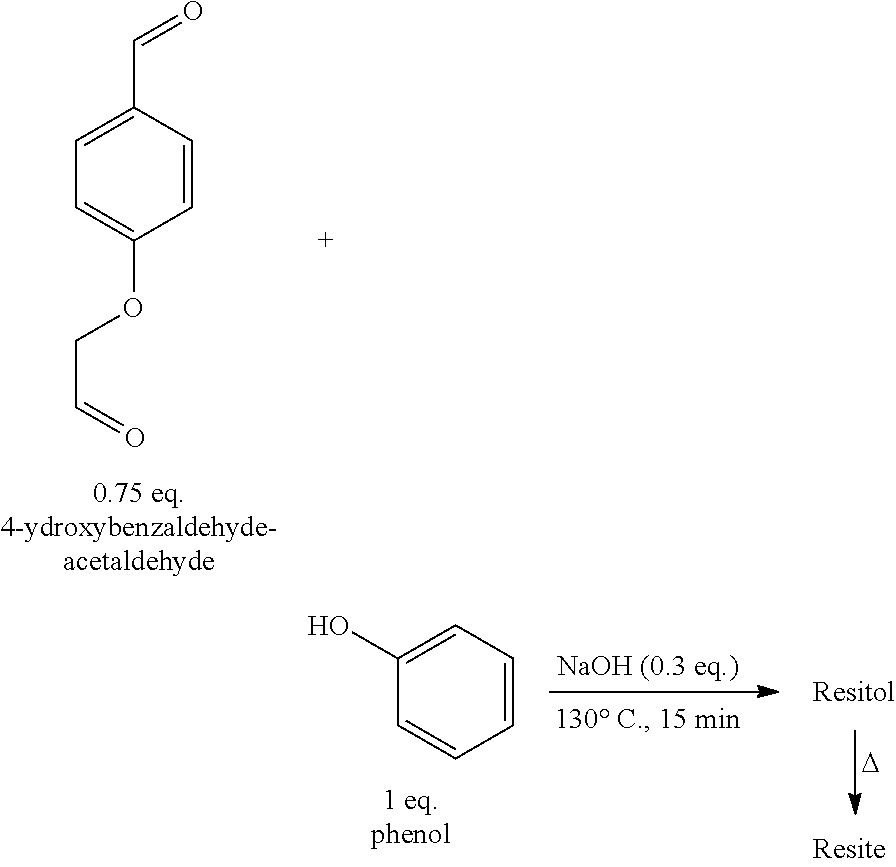
- 4-hydroxybenzaldehyde-diethoxyethane 4-hydroxybenzaldehyde-acetaldehyde was then synthesized by carrying out the operating protocol described below.
- the 4-hydroxybenzaldehyde-diethoxyethane compound (1 g, 1 eq., 4.2 mmol) and the mixture of solvents consisting of 16 ml of HCl solution at 1 mol/l (3.8 eq., 16 mmol) and of 16 ml of tetrahydrofuran are placed in a 100 ml round-bottomed flask with magnetic stirring and equipped with a condenser.
- the round-bottomed flask is placed in a bath of oil thermostated at 60° C. for 5 hours.
- a phenolic resin was then synthesized without formaldehyde from 4-hydroxybenzaldehyde-acetaldehyde according to the operating protocol detailed below.
- vanillin-dimethoxyethane was first of all synthesized according to the operating protocol described below.
- Vanillin 11.25 g, 1 eq., 74 mmol
- potassium carbonate (40.9 g, 4 eq., 296 mmol)
- 2-bromo-1,1-dimethoxyethane 25 g, 2 eq., 147.9 mmol
- butyronitrile 240 ml
- the medium is placed at reflux of the butyronitrile, at 115° C. After four days of reaction, the conversion of the vanillin to vanillin-dimethoxyethane, determined by 1 H NMR analysis of the reaction crude, is total.
- reaction medium is filtered through filter paper and the product is purified by liquid-liquid extraction with EtOAc/H 2 O.
- the organic phases are recovered, dried over anhydrous magnesium sulfate and concentrated under reduced pressure.
- This reaction is summarized by the synthesis scheme below.
- vanillin-acetaldehyde was then synthesized by carrying out the operating protocol described below.
- the vanillin-dimethoxyethane compound (1 g, 1 eq., 4.2 mmol) and the mixture of solvents consisting of 16 ml of HCl solution at 1 mol/l (3.8 eq., 16 mmol) and of 16 ml of tetrahydrofuran are placed in a 100 ml round-bottomed flask with magnetic stirring and equipped with a condenser.
- the round-bottomed flask is placed in a bath of oil thermostated at 60° C. for 22 hours.
- a phenolic resin was then synthesized without formaldehyde from vanillin-acetaldehyde according to the operating protocol detailed below.
- Vanillin-acetaldehyde (2 g, 0.75 eq., 10.3 mmol), phenol (1.29 g, 1 eq., 13.7 mmol) and sodium hydroxide in aqueous solution at 50% by weight (0.16 g, 0.3 eq., 4 mmol) are placed in a 50 ml round-bottomed flask equipped with a condenser, with magnetic stirring. The round-bottomed flask is immersed in a bath of oil thermostated at 130° C. for 5 minutes. At the end of this reaction, the mixture is in homogeneous and viscous resitol form.
- thermogravimetric analyses TGA
- Q50 Q50 instrument sold by the company TA Instruments.
- a 30 mg sample of resite in monolithic form is placed on a platinum cradle and then heated, under a nitrogen stream (60 ml/min) according to the following program:
- FIG. 1 represents the results obtained by TGA for the resins synthesized in examples 1 (4-phenoxybenzaldehyde/phenol resite), 2 (4-hydroxybenzaldehyde-benzaldehyde/phenol resite) and 3 (vanillin-benzaldehyde/phenol resite) in comparison with the results obtained for Ablaphene RS101.
- FIG. 2 represents the results obtained by TGA for the resins synthesized in examples 4 (2-phenoxyacetaldehyde/phenol resite), 5 (4-hydroxybenzaldehyde-acetaldehyde/phenol) and 6 (vanillin-acetaldehyde/phenol) in comparison with the results obtained for Ablaphene RS101.
Landscapes
- Chemical & Material Sciences (AREA)
- Health & Medical Sciences (AREA)
- Chemical Kinetics & Catalysis (AREA)
- Medicinal Chemistry (AREA)
- Polymers & Plastics (AREA)
- Organic Chemistry (AREA)
- Engineering & Computer Science (AREA)
- Combustion & Propulsion (AREA)
- Mechanical Engineering (AREA)
- Aviation & Aerospace Engineering (AREA)
- Phenolic Resins Or Amino Resins (AREA)
Abstract
Description

in which formulae n1 is an integer between 0 and 4 and when n1 is greater than or equal to 2, the substituents R1 are identical or different, n2 is an integer between 0 and 5, for example between 1 and 5, and when n2 is greater than or equal to 2, the substituents R2 are identical or different and n3 is an integer between 1 and 6, and
in which the substituents R1 and R2 are chosen independently from one another from: —OH, —COOH, —CHO, the groups —O-Alk wherein Alk denotes a substituted or unsubstituted alkyl chain of 1 to 4 carbon atoms, saturated or unsaturated, substituted or unsubstituted hydrocarbon-based chains comprising between 1 and 20 carbon atoms, optionally interrupted with one or more heteroatoms, and optionally having one or more carbonyl or carboxylic acid functions, substituted or unsubstituted, monocyclic or polycyclic, saturated, unsaturated or aromatic carbocyclic or heterocyclic groups optionally having one or more carbonyl or carboxylic acid functions, and substituted or unsubstituted aryl groups optionally having one or more carbonyl or carboxylic acid functions,
R2 possibly also denoting a radical of formula A1 in formula A above or a radical of formula B1 in formula B above and R1 possibly also denoting a radical of formula A2 in formula A above, formulae A1, A2 and B1 being the following:


wherein R1 and n1 are as defined above and Alk denotes a substituted or unsubstituted alkyl chain of 1 to 4 carbon atoms.

wherein n3 is as defined above and Alk denotes a substituted or unsubstituted alkyl chain of 1 to 4 carbon atoms.


A phenolic resin was then synthesized without formaldehyde from 4-hydroxybenzaldehyde-benzaldehyde according to the operating protocol detailed below.




-
- Linear increase from 20° C. to 160° C. at the rate of 10° C./min.
- Stationary temperature phase for one hour at 160° C. (iw).
- Linear increase from 160° C. to 900° C. at the rate of 10° C./min.
- Stationary temperature phase for one hour at 900° C. (fw).
Coke content=fw/iw.
| TABLE 1 | ||||
| Coke | ||||
| Resite | Td10% | content | ||
| 4-Phenoxybenzaldehyde/Phenol | 375° C. | 56% | ||
| 4-Hydroxybenzaldehyde- | 497° C. | 66% | ||
| benzaldehyde/phenol | ||||
| Vanillin-benzaldehyde/Phenol | 440° C. | 68% | ||
| Ablaphene RS101 | 370° C. | 63% | ||
| TABLE 2 | ||||
| Coke | ||||
| Resite | Td10% | content | ||
| 2-Phenoxyacetaldehyde/Phenol | 260° C. | 44% | ||
| 4-Hydroxybenzaldehyde- | 352° C. | 61% | ||
| acetaldehyde/phenol | ||||
| Vanillin-acetaldehyde/Phenol | 330° C. | 51% | ||
| Ablaphene RS101 | 370° C. | 63% | ||
Claims (9)


Applications Claiming Priority (3)
| Application Number | Priority Date | Filing Date | Title |
|---|---|---|---|
| FR1500127A FR3031977B1 (en) | 2015-01-22 | 2015-01-22 | PROCESS FOR PRODUCING AN ABLATIVE RESIN |
| FR1500127 | 2015-01-22 | ||
| PCT/FR2016/050104 WO2016116697A1 (en) | 2015-01-22 | 2016-01-20 | Method for producing an ablative resin |
Publications (2)
| Publication Number | Publication Date |
|---|---|
| US20180022853A1 US20180022853A1 (en) | 2018-01-25 |
| US10364313B2 true US10364313B2 (en) | 2019-07-30 |
Family
ID=53483871
Family Applications (1)
| Application Number | Title | Priority Date | Filing Date |
|---|---|---|---|
| US15/545,494 Active US10364313B2 (en) | 2015-01-22 | 2016-01-20 | Method for producing an ablative resin |
Country Status (4)
| Country | Link |
|---|---|
| US (1) | US10364313B2 (en) |
| EP (1) | EP3247636B1 (en) |
| FR (1) | FR3031977B1 (en) |
| WO (1) | WO2016116697A1 (en) |
Families Citing this family (5)
| Publication number | Priority date | Publication date | Assignee | Title |
|---|---|---|---|---|
| CN106832161A (en) * | 2017-01-16 | 2017-06-13 | 浙江农林大学 | Application of the plant extract polyphenol oligomer in phenolic resin manufacture |
| CN109320408B (en) * | 2018-11-12 | 2021-04-06 | 河北海力香料股份有限公司 | A kind of purification method of 4-(4-formylphenoxy)benzaldehyde |
| CN109651120B (en) * | 2019-01-25 | 2021-11-09 | 河北海力香料股份有限公司 | Preparation method of 4- (4-formylphenoxy) benzaldehyde |
| US20240317920A1 (en) * | 2023-03-24 | 2024-09-26 | The Boeing Company | Bio-sourced polymers for aerospace applications and methods thereof |
| CN117304142B (en) * | 2023-09-28 | 2025-12-05 | 江苏集萃光敏电子材料研究所有限公司 | A high-refractive-index epoxy resin for rapid encapsulation and its preparation method |
Citations (34)
| Publication number | Priority date | Publication date | Assignee | Title |
|---|---|---|---|---|
| FR673379A (en) | 1929-08-02 | 1930-01-14 | Parfumerie Houbigant | Process for preparing aldehydes |
| US2621165A (en) | 1949-05-23 | 1952-12-09 | California Research Corp | Phenol phthalaldehyde resins and process of preparing same |
| GB707598A (en) | 1950-09-06 | 1954-04-21 | Union Carbide & Carbon Corp | Improvements in or relating to triphenylols |
| US3963651A (en) | 1973-12-07 | 1976-06-15 | Kernforschungsanlage Julich Gesellschaft Mit Beschrankter Haftung | Method of cross linking and hardening of graphitic formed bodies |
| US3981929A (en) | 1968-03-27 | 1976-09-21 | Kerr-Mcgee Corporation | Method of separating methylolphenols from solutions |
| US4061620A (en) | 1974-03-11 | 1977-12-06 | Weyerhaeuser Company | Phenol-formaldehyde-resorcinol resins and adhesives |
| GB1539733A (en) | 1975-06-02 | 1979-01-31 | Shell Int Research | Preparation of 3-phenoxybenzaldehydes |
| US4148777A (en) | 1977-05-09 | 1979-04-10 | Delta Oil Products Corporation | Binder for foundry process |
| FR2432010A1 (en) | 1978-07-28 | 1980-02-22 | Prod Chim Auxil Synthese | Meta-phenoxy-benzaldehyde prepn. - from 1-bromo-3-dioxolanyl-benzene and phenol |
| US4259464A (en) | 1971-08-18 | 1981-03-31 | Petrolite Corporation | Cyclic phenol-aldehyde resins |
| US4296219A (en) | 1978-03-31 | 1981-10-20 | Hitachi, Ltd. | Bismide-ether compounds, compositions thereof, and method of producing same |
| US4345054A (en) | 1979-12-27 | 1982-08-17 | Mitsui Petrochemical Industries, Ltd. | High-molecular-weight novolak types substituted phenolic resins and process for preparation thereof |
| US4433120A (en) | 1981-09-30 | 1984-02-21 | The Borden Chemical Company (Canada) Limited | Liquid phenolic resin composition and method for waferboard manufacture |
| US4477025A (en) * | 1978-11-02 | 1984-10-16 | Societe Nationale Industrielle Aerospatiale | Hot nozzle |
| US4684449A (en) | 1985-11-26 | 1987-08-04 | Mitsui Toatsu Chemicals, Inc. | Process for producing m-hydroxybenzyl alcohol |
| EP0274075A2 (en) | 1986-12-23 | 1988-07-13 | Hoechst Aktiengesellschaft | Polyvinyl acetal, light-sensitive composition containing it and reproduction material made therefrom |
| US4994505A (en) | 1988-11-15 | 1991-02-19 | Borden, Inc. | Binder compositions comprising low molecular weight poly(orthomethylolated) phenolic compound and novolac resin |
| US5096519A (en) | 1989-02-23 | 1992-03-17 | Mitsubishi Pencil Co., Ltd. | Process for preparation of carbon fiber composite reinforced carbonaceous material |
| US5202403A (en) | 1992-01-15 | 1993-04-13 | Georgia-Pacific Resins, Inc. | Lignin modified phenol-formaldehyde resins |
| US5238776A (en) | 1986-12-23 | 1993-08-24 | Shipley Company Inc. | Photoresist composition containing block copolymer resin and positive-working o-quinone diazide or negative-working azide sensitizer compound |
| JPH07258364A (en) | 1994-03-22 | 1995-10-09 | Sumikin Chem Co Ltd | Phenolic curing agent and semiconductor encapsulating resin composition using the same |
| US5663246A (en) | 1994-10-26 | 1997-09-02 | Lord Corporation | Acetal derivatives of resole compounds |
| JPH10130189A (en) * | 1996-10-25 | 1998-05-19 | Sumitomo Chem Co Ltd | Polyhydric phenol compound and resin composition using the same |
| FR2760760A1 (en) | 1997-01-09 | 1998-09-18 | Aerospatiale | Use of composite material containing reinforced carbon@ fibres |
| US6261692B1 (en) | 1998-07-21 | 2001-07-17 | Korea Research Institute Of Chemical Technology | Carbon-carbon composites containing ceramic power and method for preparing the same |
| US6646094B1 (en) | 1999-06-17 | 2003-11-11 | Certainteed Corporation | Low emission formaldehyde resin and binder for mineral fiber insulation |
| US20040039085A1 (en) | 2001-03-27 | 2004-02-26 | Kasowshi Robert Valentine | Acid-methylol compound reaction products for flame resistance |
| US20080128938A1 (en) | 2004-12-16 | 2008-06-05 | Brigitte Boutefeu | Densification of Fibrous Structures by Resin Transfer Moulding for Making Thick Parts of Composite Material |
| US20080275186A1 (en) | 2006-09-05 | 2008-11-06 | Si Group, Inc. | Modified hydrocarbylphenol-aldehyde resins for use as tackifiers and rubber compositions containing them |
| US20100316555A1 (en) | 2007-12-25 | 2010-12-16 | Sumitomt Chemical Company, Limited | Process for producing carbon |
| US20110269902A1 (en) | 2008-12-19 | 2011-11-03 | Huttenes-Albertus Chemische Werke Gmbh | Modified phenolic resins |
| US20120277396A1 (en) | 2009-11-20 | 2012-11-01 | Centre National De La Recherche Scientifique (C.N.R.S) | Novel phenolic plastic resins obtained from phenolic compounds and macromolecular hardeners having aldehyde functions |
| US20140322479A1 (en) | 2011-09-09 | 2014-10-30 | Astrium Sas | Flame resistant shield |
| US20150369175A1 (en) | 2013-02-15 | 2015-12-24 | Herakles | A nozzle having a movable divergent section with a thermal protection system |
-
2015
- 2015-01-22 FR FR1500127A patent/FR3031977B1/en active Active
-
2016
- 2016-01-20 WO PCT/FR2016/050104 patent/WO2016116697A1/en not_active Ceased
- 2016-01-20 US US15/545,494 patent/US10364313B2/en active Active
- 2016-01-20 EP EP16705566.4A patent/EP3247636B1/en active Active
Patent Citations (34)
| Publication number | Priority date | Publication date | Assignee | Title |
|---|---|---|---|---|
| FR673379A (en) | 1929-08-02 | 1930-01-14 | Parfumerie Houbigant | Process for preparing aldehydes |
| US2621165A (en) | 1949-05-23 | 1952-12-09 | California Research Corp | Phenol phthalaldehyde resins and process of preparing same |
| GB707598A (en) | 1950-09-06 | 1954-04-21 | Union Carbide & Carbon Corp | Improvements in or relating to triphenylols |
| US3981929A (en) | 1968-03-27 | 1976-09-21 | Kerr-Mcgee Corporation | Method of separating methylolphenols from solutions |
| US4259464A (en) | 1971-08-18 | 1981-03-31 | Petrolite Corporation | Cyclic phenol-aldehyde resins |
| US3963651A (en) | 1973-12-07 | 1976-06-15 | Kernforschungsanlage Julich Gesellschaft Mit Beschrankter Haftung | Method of cross linking and hardening of graphitic formed bodies |
| US4061620A (en) | 1974-03-11 | 1977-12-06 | Weyerhaeuser Company | Phenol-formaldehyde-resorcinol resins and adhesives |
| GB1539733A (en) | 1975-06-02 | 1979-01-31 | Shell Int Research | Preparation of 3-phenoxybenzaldehydes |
| US4148777A (en) | 1977-05-09 | 1979-04-10 | Delta Oil Products Corporation | Binder for foundry process |
| US4296219A (en) | 1978-03-31 | 1981-10-20 | Hitachi, Ltd. | Bismide-ether compounds, compositions thereof, and method of producing same |
| FR2432010A1 (en) | 1978-07-28 | 1980-02-22 | Prod Chim Auxil Synthese | Meta-phenoxy-benzaldehyde prepn. - from 1-bromo-3-dioxolanyl-benzene and phenol |
| US4477025A (en) * | 1978-11-02 | 1984-10-16 | Societe Nationale Industrielle Aerospatiale | Hot nozzle |
| US4345054A (en) | 1979-12-27 | 1982-08-17 | Mitsui Petrochemical Industries, Ltd. | High-molecular-weight novolak types substituted phenolic resins and process for preparation thereof |
| US4433120A (en) | 1981-09-30 | 1984-02-21 | The Borden Chemical Company (Canada) Limited | Liquid phenolic resin composition and method for waferboard manufacture |
| US4684449A (en) | 1985-11-26 | 1987-08-04 | Mitsui Toatsu Chemicals, Inc. | Process for producing m-hydroxybenzyl alcohol |
| EP0274075A2 (en) | 1986-12-23 | 1988-07-13 | Hoechst Aktiengesellschaft | Polyvinyl acetal, light-sensitive composition containing it and reproduction material made therefrom |
| US5238776A (en) | 1986-12-23 | 1993-08-24 | Shipley Company Inc. | Photoresist composition containing block copolymer resin and positive-working o-quinone diazide or negative-working azide sensitizer compound |
| US4994505A (en) | 1988-11-15 | 1991-02-19 | Borden, Inc. | Binder compositions comprising low molecular weight poly(orthomethylolated) phenolic compound and novolac resin |
| US5096519A (en) | 1989-02-23 | 1992-03-17 | Mitsubishi Pencil Co., Ltd. | Process for preparation of carbon fiber composite reinforced carbonaceous material |
| US5202403A (en) | 1992-01-15 | 1993-04-13 | Georgia-Pacific Resins, Inc. | Lignin modified phenol-formaldehyde resins |
| JPH07258364A (en) | 1994-03-22 | 1995-10-09 | Sumikin Chem Co Ltd | Phenolic curing agent and semiconductor encapsulating resin composition using the same |
| US5663246A (en) | 1994-10-26 | 1997-09-02 | Lord Corporation | Acetal derivatives of resole compounds |
| JPH10130189A (en) * | 1996-10-25 | 1998-05-19 | Sumitomo Chem Co Ltd | Polyhydric phenol compound and resin composition using the same |
| FR2760760A1 (en) | 1997-01-09 | 1998-09-18 | Aerospatiale | Use of composite material containing reinforced carbon@ fibres |
| US6261692B1 (en) | 1998-07-21 | 2001-07-17 | Korea Research Institute Of Chemical Technology | Carbon-carbon composites containing ceramic power and method for preparing the same |
| US6646094B1 (en) | 1999-06-17 | 2003-11-11 | Certainteed Corporation | Low emission formaldehyde resin and binder for mineral fiber insulation |
| US20040039085A1 (en) | 2001-03-27 | 2004-02-26 | Kasowshi Robert Valentine | Acid-methylol compound reaction products for flame resistance |
| US20080128938A1 (en) | 2004-12-16 | 2008-06-05 | Brigitte Boutefeu | Densification of Fibrous Structures by Resin Transfer Moulding for Making Thick Parts of Composite Material |
| US20080275186A1 (en) | 2006-09-05 | 2008-11-06 | Si Group, Inc. | Modified hydrocarbylphenol-aldehyde resins for use as tackifiers and rubber compositions containing them |
| US20100316555A1 (en) | 2007-12-25 | 2010-12-16 | Sumitomt Chemical Company, Limited | Process for producing carbon |
| US20110269902A1 (en) | 2008-12-19 | 2011-11-03 | Huttenes-Albertus Chemische Werke Gmbh | Modified phenolic resins |
| US20120277396A1 (en) | 2009-11-20 | 2012-11-01 | Centre National De La Recherche Scientifique (C.N.R.S) | Novel phenolic plastic resins obtained from phenolic compounds and macromolecular hardeners having aldehyde functions |
| US20140322479A1 (en) | 2011-09-09 | 2014-10-30 | Astrium Sas | Flame resistant shield |
| US20150369175A1 (en) | 2013-02-15 | 2015-12-24 | Herakles | A nozzle having a movable divergent section with a thermal protection system |
Non-Patent Citations (20)
| Title |
|---|
| "Reduction of the aldehyde functional group of vanillin: CAPLP [French certificate for teaching in vocational high schools] competitive examination maths sciences 2012," Mar. 2012, XP055205878, retrieved from the Internet: URL:http://www.chimix.com/an12/cap12/caplp5.html. |
| ATARU KOBAYASHI, GEN-ICHI KONISHI: "Rapid Synthesis of Phenolic Resins by Microwave-Assisted Self-Condensation of Hydroxybenzyl Alcohol Derivatives", POLYMER JOURNAL, vol. 40, no. 7, 15 July 2008 (2008-07-15), pages 590 - 591, XP055205889, ISSN: 00323896, DOI: 10.1295/polymj.PJ2008050 |
| Brown, L. H., "Resin Forming Reactions of Furfural and Phenol," J. Ind. Eng. Chem., vol. 44, (1952), pp. 2673-2675. |
| Eapen et al. (Die Makromolekulare Chemie 119, 1968, 4-16) (Year: 1968). |
| FOYER G.; CHANFI B.-H.; BOUTEVIN B.; CAILLOL S.; DAVID G.: "New method for the synthesis of formaldehyde-free phenolic resins from lignin-based aldehyde precursors", EUROPEAN POLYMER JOURNAL., PERGAMON PRESS LTD. OXFORD., GB, vol. 74, 30 November 2015 (2015-11-30), GB, pages 296 - 309, XP029350113, ISSN: 0014-3057, DOI: 10.1016/j.eurpolymj.2015.11.036 |
| Foyer, G., et al., "New method for the synthesis of formaldehyde-free phenolic resins from lignin-based aldehyde precursors," European Polymer Journal, vol. 74, Nov. 2015, XP029350113, pp. 296-309. |
| Hocking, M.B., "Vanillin: Synthetic Flavoring from Spent Sulfite Liquor," J. Chem. Educ., vol. 74, No. 9, Sep. 1997, pp. 1055-1059. |
| International Preliminary Report on Patentability and the Written Opinion of the International Searching Authority as issued in International Patent Application No. PCT/FR2016/050106, dated Jul. 25, 2017. |
| International Search Report as issued in International Patent Application No. PCT/FR2016/050104, dated Apr. 11, 2016. |
| International Search Report as issued in International Patent Application No. PCT/FR2016/050106, dated Apr. 7, 2016. |
| Katsoulidis, A. P. et al., "Phloroglucinol Based Microporous Polymeric Organic Frameworks with −OH Functional Groups and High CO2 Capture Capacity," Chemistry of Materials, vol. 23, No. 7, Apr. 2011, XP002755764, Retrieved from the Internet: URL: http://pubs.acs.org/doi/pdf/10.1021/cm103206x [retrieved on Mar. 22, 2016], pp. 1818-1824. |
| Kobayashi, A., et al., "Rapid Synthesis of Phenolic Resins by Microwave-Assisted Self-Condensation of Hydroxybenzyl Alcohol Derivatives," Polymer Journal, vol. 40, No. 7, Jun. 2008, XP055205889, pp. 590-591. |
| Kumar, V., et al., "Enzyme Mediated Oxidative Polymerization of 4-Hydroxybenzyl Alcohol for Optical Applications," Journal of Macromolecular Science, Part A: Pure and Applied Chemistry, vol. 39, No. 10, Jan. 2002, XP055205868, pp. 1183-1193. |
| Lidnsey et al. (Lidnsey et al., The Kolbe Schmitt Reaction, Chemical Reviews, 1957, p. 583-620) (Year: 1957). |
| Notice of Allowance as issued in U.S. Appl. No. 15/545,457, dated Nov. 15, 2018. |
| Park, J. K. et al., "Thermal and ablative properties of low temperature carbon fiber-phenol formaldehyde resin composites," Carbon, Elsevier, vol. 40, No. 12, Jan. 2002, XP004379499, pp. 2125-2134. |
| PARK, J.K. KANG, T.J.: "Thermal and ablative properties of low temperature carbon fiber-phenol formaldehyde resin composites", CARBON., ELSEVIER, OXFORD., GB, vol. 40, no. 12, 1 January 2002 (2002-01-01), GB, pages 2125 - 2134, XP004379499, ISSN: 0008-6223, DOI: 10.1016/S0008-6223(02)00063-5 |
| Ramires, E. C., et al., "Biobased composites from glyoxal-phenolic resins and sisal fibers," Bioresource Technology, vol. 101, (2010), pp. 1998-2006. |
| Ren, S., et al., "Zeolites as Shape-Selective Catalysts: Highly Selective Synthesis of Vanillin from Reimer-Tiemann Reaction of Guaiacol and Chloroform," Catal. Lett. vol. 145, (2015), pp. 712-714. |
| VIJAYENDRA KUMAR, VIRINDER PARMAR, LYNNE SAMUELSON, JAYANT KUMAR, ASHOK CHOLLI: "ENZYME MEDIATED OXIDATIVE POLYMERIZATION OF 4-HYDROXYBENZYL ALCOHOL FOR OPTICAL APPLICATIONS", JOURNAL OF MACROMOLECULAR SCIENCE, PART A, vol. 39, no. 10, 11 January 2002 (2002-01-11), pages 1183 - 1193, XP055205868, ISSN: 10601325, DOI: 10.1081/MA-120014844 |
Also Published As
| Publication number | Publication date |
|---|---|
| EP3247636A1 (en) | 2017-11-29 |
| FR3031977A1 (en) | 2016-07-29 |
| US20180022853A1 (en) | 2018-01-25 |
| EP3247636B1 (en) | 2019-06-12 |
| FR3031977B1 (en) | 2018-04-20 |
| WO2016116697A1 (en) | 2016-07-28 |
Similar Documents
| Publication | Publication Date | Title |
|---|---|---|
| US20180022853A1 (en) | Method for producing an ablative resin | |
| US4110279A (en) | High temperature polymers from methoxy functional ether aromatic monomers | |
| US11499002B2 (en) | Polyepoxidized biphenyl compounds, preparation and uses | |
| US10246544B2 (en) | Method for producing an ablative resin | |
| JP2014534254A (en) | Method for producing trioxane from an aqueous formaldehyde source | |
| EP2316810B1 (en) | Alcoholic hydroxyl-containing compounds and making method | |
| US11384195B2 (en) | Difunctional biphenyl compounds, preparation, and uses | |
| JP2012162474A (en) | Method of manufacturing naphthol type calix(4)arene compound | |
| US11008297B2 (en) | Bio-based, multi-aromatic compounds, and methods of making and using same | |
| US2744882A (en) | Unsymmetrical diphenylol methanes | |
| Schamel et al. | Bio‐Based Epoxy Resins Derived from Eugenol with High Glass Transition Temperatures as Substitutes for DGEBA | |
| JP4895537B2 (en) | Calixarene polymer and process for producing the same | |
| US20230312912A1 (en) | Resin, method for producing resin, curable resin composition, and cured product | |
| US20050124778A1 (en) | Method of producing novolak resin | |
| JP2752498B2 (en) | Method for producing hydroxycarboxylic acid derivative | |
| JPH08301960A (en) | Production of alkenylphenol resin | |
| CN112778477A (en) | Method for preparing thermosetting resin by directly taking coal tar mixed phenol as raw material | |
| Li et al. | Synthesis of C-unalkylated calix [4] resorcinarene from 1, 3-dimethoxybenzene-formaldehyde condensation | |
| JP7828603B2 (en) | Method for producing bisphenol compounds | |
| JP3104915B2 (en) | Novolak resin manufacturing method | |
| KR102408697B1 (en) | Method for producing novel dihydroxy compound | |
| SU264694A1 (en) | ||
| EP3365160A1 (en) | Method for producing a thruster nozzle from composite material | |
| JP6265479B2 (en) | 3,3-bis (4-hydroxy-3-methoxyphenyl) -1-propanol and process for producing the same | |
| JP4720057B2 (en) | Production method of epoxy resin |
Legal Events
| Date | Code | Title | Description |
|---|---|---|---|
| AS | Assignment |
Owner name: ARIANEGROUP SAS, FRANCE Free format text: ASSIGNMENT OF ASSIGNORS INTEREST;ASSIGNORS:FOYER, GABRIEL M.;NEGRELL-GUIRAO, CLAIRE F.;CAILLOL, SYLVAIN Y.;AND OTHERS;REEL/FRAME:043861/0945 Effective date: 20170912 Owner name: CENTRE NATIONAL DE LA RECHERCHE SCIENTIFIQUE, FRAN Free format text: ASSIGNMENT OF ASSIGNORS INTEREST;ASSIGNORS:FOYER, GABRIEL M.;NEGRELL-GUIRAO, CLAIRE F.;CAILLOL, SYLVAIN Y.;AND OTHERS;REEL/FRAME:043861/0945 Effective date: 20170912 |
|
| STPP | Information on status: patent application and granting procedure in general |
Free format text: NOTICE OF ALLOWANCE MAILED -- APPLICATION RECEIVED IN OFFICE OF PUBLICATIONS |
|
| STPP | Information on status: patent application and granting procedure in general |
Free format text: PUBLICATIONS -- ISSUE FEE PAYMENT VERIFIED |
|
| STCF | Information on status: patent grant |
Free format text: PATENTED CASE |
|
| MAFP | Maintenance fee payment |
Free format text: PAYMENT OF MAINTENANCE FEE, 4TH YEAR, LARGE ENTITY (ORIGINAL EVENT CODE: M1551); ENTITY STATUS OF PATENT OWNER: LARGE ENTITY Year of fee payment: 4 |