US10344395B2 - Apparatus and method for growing silicon single crystal ingot - Google Patents

Apparatus and method for growing silicon single crystal ingot Download PDF

Info

Publication number
US10344395B2
US10344395B2 US15/564,045 US201615564045A US10344395B2 US 10344395 B2 US10344395 B2 US 10344395B2 US 201615564045 A US201615564045 A US 201615564045A US 10344395 B2 US10344395 B2 US 10344395B2
Authority
US
United States
Prior art keywords
crucible
ingot
silicon melt
single crystal
silicon
Prior art date
Legal status (The legal status is an assumption and is not a legal conclusion. Google has not performed a legal analysis and makes no representation as to the accuracy of the status listed.)
Active
Application number
US15/564,045
Other versions
US20180094359A1 (en
Inventor
Young Ho Hong
Hyun Woo Park
Su Jin SON
Nam Seok Kim
Current Assignee (The listed assignees may be inaccurate. Google has not performed a legal analysis and makes no representation or warranty as to the accuracy of the list.)
SK Siltron Co Ltd
Original Assignee
SK Siltron Co Ltd
Priority date (The priority date is an assumption and is not a legal conclusion. Google has not performed a legal analysis and makes no representation as to the accuracy of the date listed.)
Filing date
Publication date
Application filed by SK Siltron Co Ltd filed Critical SK Siltron Co Ltd
Assigned to SK SILTRON CO., LTD. reassignment SK SILTRON CO., LTD. ASSIGNMENT OF ASSIGNORS INTEREST (SEE DOCUMENT FOR DETAILS). Assignors: HONG, YOUNG HO, KIM, NAM SEOK, PARK, HYUN WOO, SON, SU JIN
Publication of US20180094359A1 publication Critical patent/US20180094359A1/en
Application granted granted Critical
Publication of US10344395B2 publication Critical patent/US10344395B2/en
Active legal-status Critical Current
Anticipated expiration legal-status Critical

Links

Images

Classifications

    • CCHEMISTRY; METALLURGY
    • C30CRYSTAL GROWTH
    • C30BSINGLE-CRYSTAL GROWTH; UNIDIRECTIONAL SOLIDIFICATION OF EUTECTIC MATERIAL OR UNIDIRECTIONAL DEMIXING OF EUTECTOID MATERIAL; REFINING BY ZONE-MELTING OF MATERIAL; PRODUCTION OF A HOMOGENEOUS POLYCRYSTALLINE MATERIAL WITH DEFINED STRUCTURE; SINGLE CRYSTALS OR HOMOGENEOUS POLYCRYSTALLINE MATERIAL WITH DEFINED STRUCTURE; AFTER-TREATMENT OF SINGLE CRYSTALS OR A HOMOGENEOUS POLYCRYSTALLINE MATERIAL WITH DEFINED STRUCTURE; APPARATUS THEREFOR
    • C30B15/00Single-crystal growth by pulling from a melt, e.g. Czochralski method
    • C30B15/10Crucibles or containers for supporting the melt
    • CCHEMISTRY; METALLURGY
    • C30CRYSTAL GROWTH
    • C30BSINGLE-CRYSTAL GROWTH; UNIDIRECTIONAL SOLIDIFICATION OF EUTECTIC MATERIAL OR UNIDIRECTIONAL DEMIXING OF EUTECTOID MATERIAL; REFINING BY ZONE-MELTING OF MATERIAL; PRODUCTION OF A HOMOGENEOUS POLYCRYSTALLINE MATERIAL WITH DEFINED STRUCTURE; SINGLE CRYSTALS OR HOMOGENEOUS POLYCRYSTALLINE MATERIAL WITH DEFINED STRUCTURE; AFTER-TREATMENT OF SINGLE CRYSTALS OR A HOMOGENEOUS POLYCRYSTALLINE MATERIAL WITH DEFINED STRUCTURE; APPARATUS THEREFOR
    • C30B15/00Single-crystal growth by pulling from a melt, e.g. Czochralski method
    • C30B15/14Heating of the melt or the crystallised materials
    • CCHEMISTRY; METALLURGY
    • C30CRYSTAL GROWTH
    • C30BSINGLE-CRYSTAL GROWTH; UNIDIRECTIONAL SOLIDIFICATION OF EUTECTIC MATERIAL OR UNIDIRECTIONAL DEMIXING OF EUTECTOID MATERIAL; REFINING BY ZONE-MELTING OF MATERIAL; PRODUCTION OF A HOMOGENEOUS POLYCRYSTALLINE MATERIAL WITH DEFINED STRUCTURE; SINGLE CRYSTALS OR HOMOGENEOUS POLYCRYSTALLINE MATERIAL WITH DEFINED STRUCTURE; AFTER-TREATMENT OF SINGLE CRYSTALS OR A HOMOGENEOUS POLYCRYSTALLINE MATERIAL WITH DEFINED STRUCTURE; APPARATUS THEREFOR
    • C30B15/00Single-crystal growth by pulling from a melt, e.g. Czochralski method
    • C30B15/20Controlling or regulating
    • CCHEMISTRY; METALLURGY
    • C30CRYSTAL GROWTH
    • C30BSINGLE-CRYSTAL GROWTH; UNIDIRECTIONAL SOLIDIFICATION OF EUTECTIC MATERIAL OR UNIDIRECTIONAL DEMIXING OF EUTECTOID MATERIAL; REFINING BY ZONE-MELTING OF MATERIAL; PRODUCTION OF A HOMOGENEOUS POLYCRYSTALLINE MATERIAL WITH DEFINED STRUCTURE; SINGLE CRYSTALS OR HOMOGENEOUS POLYCRYSTALLINE MATERIAL WITH DEFINED STRUCTURE; AFTER-TREATMENT OF SINGLE CRYSTALS OR A HOMOGENEOUS POLYCRYSTALLINE MATERIAL WITH DEFINED STRUCTURE; APPARATUS THEREFOR
    • C30B15/00Single-crystal growth by pulling from a melt, e.g. Czochralski method
    • C30B15/30Mechanisms for rotating or moving either the melt or the crystal
    • C30B15/305Stirring of the melt
    • CCHEMISTRY; METALLURGY
    • C30CRYSTAL GROWTH
    • C30BSINGLE-CRYSTAL GROWTH; UNIDIRECTIONAL SOLIDIFICATION OF EUTECTIC MATERIAL OR UNIDIRECTIONAL DEMIXING OF EUTECTOID MATERIAL; REFINING BY ZONE-MELTING OF MATERIAL; PRODUCTION OF A HOMOGENEOUS POLYCRYSTALLINE MATERIAL WITH DEFINED STRUCTURE; SINGLE CRYSTALS OR HOMOGENEOUS POLYCRYSTALLINE MATERIAL WITH DEFINED STRUCTURE; AFTER-TREATMENT OF SINGLE CRYSTALS OR A HOMOGENEOUS POLYCRYSTALLINE MATERIAL WITH DEFINED STRUCTURE; APPARATUS THEREFOR
    • C30B29/00Single crystals or homogeneous polycrystalline material with defined structure characterised by the material or by their shape
    • C30B29/02Elements
    • C30B29/06Silicon

Definitions

  • the embodiment relates to an apparatus and a method for growing a silicon single crystal ingot and more particularly, is to secure a uniformity of oxygen concentration in diameter and radial directions in a silicon single crystal ingot.
  • a silicon wafer is formed by a single crystal growing process for manufacturing a single crystal ingot, a slicing process for obtaining a thin disk-shaped wafer by slicing the single crystal ingot, a grinding process for machining an outer peripheral portion of a wafer to prevent cracking and distortion of the wafer obtained by the slicing process, a lapping process for removing damages due to mechanical processing remaining on the wafer, a polishing process for polishing the wafer, and a cleaning process for removing an abrasive or an foreign substance adhering to the wafer while polishing the polished wafer.
  • CZ method For a single crystal growth, a floating zone (FZ) method or a Czochralski (CZ) method (hereinafter referred to as CZ method) has been widely used.
  • the CZ method is the most common method among these methods.
  • a polycrystalline silicon is charged in a quartz crucible and heated and melted by a graphite heating element, and then a single crystal silicon ingot is grown by pulling up a seed crystal while rotating the seed crystal when the seed crystal is immersed in silicon melt formed as a result of melting and crystallization occurs at an interface.
  • oxygen is included in a silicon single crystal as crystal defects due to growth history and undesired impurities in a growing process of the silicon single crystal, and thus intruded oxygen in this manner is grown into oxygen precipitate due to heat applied during a manufacturing process of a semiconductor device.
  • the oxygen precipitate shows beneficial characteristics such as reinforcing the strength of the silicon wafer and capturing metal pollution elements and serving as an internal gettering site, a leakage current and a fail of the semiconductor device are caused.
  • oxygen concentration of a wafer manufactured from the silicon single crystal ingot needs to be uniform in longitudinal and radial directions, and the oxygen concentration may be controlled through a seed rotating speed, a crucible rotating speed, a melt gap, which is the distance between a melt surface and a heat shield, a pull speed of the ingot, a design change of hot zone, a third element doping such as nitrogen or carbon, which are process variables when growing a silicon single crystal ingot.
  • the embodiment is directed to providing a method for growing a silicon single crystal to secure a uniformity of oxygen concentration in longitudinal and radial directions.
  • An embodiment provides an apparatus for growing a silicon single crystal ingot, including: a chamber; a crucible provided inside the chamber to accommodate silicon melt; a rotating shaft and a crucible support disposed at a lower portion of the crucible; a heater provided inside the chamber to heat the silicon melt; a pulling unit for rotating and pulling up an ingot grown from the silicon melt; and a magnetic field generating unit for applying a horizontal magnetic field to the crucible, wherein a first direction in which the rotating shaft rotates the crucible and a second direction in which the pulling unit rotates the ingot are the same.
  • the heater may heat the periphery of the crucible so that a maximum heat generating position is formed below a maximum gauss position (MGP).
  • MGP maximum gauss position
  • the heater may heat the periphery of the crucible so that a maximum heat generating position is formed at 100 to 200 mm below the MGP.
  • the heater and the pulling unit may heat the crucible so that a diffusion boundary layer is uniformly distributed at an edge of a radial direction of the silicon melt and may pull up the ingot.
  • the heater and the pulling unit may heat the crucible so that the diffusion boundary layer is formed at 12 mm below a surface of the silicon melt and may pull up the ingot.
  • the heater and the pulling unit may heat the crucible so that the diffusion boundary layer is distributed over a diameter of 300 mm or more from an edge of the silicon melt and may pull up the ingot.
  • Another embodiment is directed to providing a method for growing a silicon single crystal ingot in which an ingot and a crucible are rotated in the same direction and a maximum heat generating position is below a maximum gauss position (MGP).
  • MGP maximum gauss position
  • a diffusion boundary layer may be uniformly distributed at an edge in a radial direction of silicon melt.
  • the diffusion boundary layer may be distributed 12 mm below a surface of the silicon melt, in a region of diameter of 300 mm or more.
  • a flow of the silicon melt may be constant in a depth direction in the silicon melt.
  • a maximum heat generating position may be located 100 to 200 mm lower than the MGP.
  • the flow of the silicon melt may be constant, the diffusion boundary layer may be distributed at an edge of the ingot, and the oxygen concentration of the manufactured silicon wafer may be constant, and thus resistivity may be improved.
  • FIG. 1 is a view illustrating an apparatus of manufacturing a single crystal ingot according to an embodiment
  • FIG. 2 is a diagram illustrating a shift of a maximum gauss position (MGP) at the time of growing a silicon single crystal ingot
  • FIG. 3 is a view illustrating a conventional maximum heat generating position and a maximum heat generating position according to an embodiment
  • FIGS. 4A to 4C are views illustrating a flow of silicon melt together with a comparative example in a method for growing a silicon single crystal ingot according to an embodiment
  • FIGS. 5A to 5C are views illustrating a distribution of oxygen in silicon melt together with a comparative example in a method for growing a silicon single crystal ingot according to an embodiment
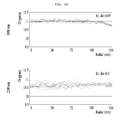
  • FIG. 6A is a diagram illustrating a uniformity of oxygen concentration in a method for growing a silicon single crystal ingot according to an embodiment
  • FIG. 6B is a diagram illustrating a uniformity of oxygen concentration in a method for growing a silicon single crystal ingot according to a comparative example.
  • relational terms such as “first” and “second,” “over/upper portion/above,” and “below/lower portion/under” do not necessarily require or include any physical or logical relationship or sequence between devices or elements, and may also be used only to distinguish one device or element from another device or element.
  • Thicknesses of layers and areas in the drawings may be exaggerated, omitted, or schematically described for a convenient and precise description.
  • the size of each component does not fully match the actual size thereof.
  • FIG. 1 is a view illustrating an apparatus of manufacturing a single crystal ingot according to an embodiment.
  • an apparatus of manufacturing a silicon single crystal ingot 100 may include a chamber 110 , a crucible 120 , a heater 130 , a pulling unit 150 , and the like.
  • an apparatus of manufacturing a silicon single crystal ingot 100 according to the embodiment may include the chamber 110 , the crucible 120 provided in the chamber 110 to receive a silicon melt, the heater 130 provided in the chamber 110 and configured to heat the crucible 120 , and a pulling unit 150 coupled to a seed crystal 152 at one end thereof, and a magnetic field generating unit (not shown) to apply a horizontal magnetic field to the crucible 120 .
  • the chamber 110 provides a space in which predetermined processes for growing the single crystal ingot for a silicon wafer used as an electronic component material such as a semiconductor are performed.
  • a radiant insulator 140 may be installed on an inner wall of the chamber 110 to prevent heat of the heater 130 from being radiated to a side wall of the chamber 110 .
  • argon gas or the like may be injected into the chamber 110 of the silicon single crystal growing apparatus to control the oxygen concentration and then be discharged downward.
  • the crucible 120 is provided inside the chamber 110 to contain silicon melt and may be made of quartz or the like.
  • a crucible support (not shown) made of graphite may be provided on the outside of the crucible 120 to support the crucible 120 .
  • the crucible support is fixedly installed on a rotating shaft (not shown), and the rotating shaft is rotated by a driving unit (not shown) to rotate and elevate the crucible 120 , so that a solid-liquid interface, that is, the interface between the solidified ingot and the silicon melt, may maintain the same height.
  • the rotating shaft may rotate in a first direction for rotating the crucible
  • the pulling unit may rotate in a second direction for rotating the ingot, wherein the first direction and the second direction may be the same.
  • the heater 130 may be provided inside the chamber 110 to heat the crucible 120 .
  • the heater 130 may have a cylindrical shape surrounding the crucible support.
  • the heater 130 melts a high-purity polycrystalline silicon ingot placed in the crucible 120 which may be formed into silicon melt.
  • the crucible 120 is heated by heat supplied from the heater 130 .
  • the temperature in each region may vary depending on the height of the crucible 120 , and a region having the highest temperature may correspond to a maximum heat generating position of the heater 130 .
  • a Czochralski (CZ) method for growing a crystal by immersing a seed crystal 152 which is a single crystal in silicon melt and slowly pulling up the seed crystal 152 to grow a crystal may be employed.
  • the CZ method is described in detail as follows.
  • a necking process is performed to grow elongated crystals from the seed crystal 152 , then the crystal is grown in a diameter direction and subjected to a shouldering process to make a target diameter, after a body growing process is performed to grow crystals having a predetermined diameter, after the body growing has progressed by a certain length, the diameter of the crystal is gradually reduced, and finally a tailing process is performed to separate the crystal from the molten silicon, thereby completing the growth of the single crystal.
  • B which is a P-type dopant and As (arsenic), P (phosphorus), Sb (antimony) or the like, which are N-type dopants, may be doped in the silicon melt.
  • V/G growth rate/temperature gradient
  • oxygen concentration may be changed within an interior, particularly a body region of the ingot.
  • an ingot and a crucible are rotated in the same direction at the time of growing the ingot, a heater is arranged so that a maximum heat generating position is below a maximum gauss position (MGP), and thus oxygen concentration in longitudinal and radial directions (in-plane direction) of the ingot may be constant, and resistivity of the wafer to be produced may be constant.
  • MGP maximum gauss position
  • a magnetic field is applied to the periphery of the crucible 120 by the magnetic field applying unit, and a region having the strongest magnetic field intensity may be referred to as a maximum gauss position (MGP).
  • MGP maximum gauss position
  • the heater and the magnetic field may heat the periphery of the crucible 120 and apply a magnetic field to the periphery of the crucible so that a maximum heat generating position is formed below the maximum gauss position (MGP).
  • the maximum heat generating position may be formed at a position 100 to 200 mm below the MGP.
  • FIG. 2 is a diagram illustrating a shift of a maximum gauss position (MGP) at the time of growth of a silicon single crystal ingot.
  • MGP maximum gauss position
  • a maximum gauss point may move up and down from an interface between ‘A’, which is a region inside the crucible, and ‘B’, which is a region of an upper chamber, and the MGP may move within a range of ‘a’ in the ‘A’ direction and ‘b’ in the ‘B’ direction from the above interface.
  • the maximum heat generating position of the heater may be lower than the MGP described above.
  • FIG. 3 is a view illustrating a conventional maximum heat generating position and a maximum heat generating position according to an embodiment.
  • a maximum heat generating position is at a lower portion than that of the related art and in particular, the maximum heat generating position may be at a distance D of 100 to 200 mm lower than the MGP. At this point, a flow of the silicon melt may be changed.
  • the flow above the silicon melt may become a turbulence, and if the maximum heat generating position is below to 100 mm, the flow under the silicon melt may become a turbulence.
  • a maximum heat generating position may be at 100 mm to 200 mm below the MGP so that the flow in a depth direction of the silicon melt, that is, in the vertical direction in FIG. 1 , may be constant.
  • a diffusion boundary layer may be distributed at a depth of about 12 mm from a surface of the growing silicon melt, in a region outside the diameter of about 300 mm.
  • the diffusion boundary layer in the silicon melt may be uniformly distributed at an edge of a radial direction, and the diffusion boundary layer may be confirmed by measuring the temperature of the silicon melt.
  • the heater and the pulling unit may heat the crucible so that a diffusion boundary layer is uniformly distributed at an edge of the radial direction of the silicon melt and may pull up the ingot.
  • the heater and the pulling unit may heat the crucible so that the diffusion boundary layer is formed at 12 mm below a surface of the silicon melt and may pull up the ingot.
  • a diffusion boundary layer is a region having a diffusion rate of about 10 ⁇ 8 m 2 /sec. In the embodiment, at a temperature of about 1700 Kelvin, the diffusion boundary layer may be at the maximum diameter of 320 mm.
  • FIGS. 4A to 4C are views illustrating a flow of silicon melt together with a comparative example in a method for growing a silicon single crystal ingot according to an embodiment.
  • a left side illustrates a flow of the silicon melt on a surface of the silicon melt and a flow in a lower region toward the right side
  • the utmost right side represents a flow of the silicon melt at the bottom surface of the crucible.
  • a pattern of flow of the silicon melt is maintained in the lower region.
  • a pattern of flow of the silicon melt may be blurred at the bottom.
  • FIGS. 5A to 5C are views illustrating a distribution of oxygen in silicon melt together with a comparative example in a method for growing a silicon single crystal ingot according to an embodiment.
  • a diffusion boundary layer is maintained at an edge of the ingot and a variation in speed of the silicon melt is suppressed so that oxygen concentration is uniform up to 2200 mm in a depth direction.
  • a flow of the silicon melt is not constant and the oxygen concentration may not be uniform at 2000 mm in the depth direction.
  • FIG. 6A is a diagram illustrating a uniformity of oxygen concentration in a method for growing a silicon single crystal ingot according to an embodiment
  • FIG. 6B is a diagram illustrating a uniformity of oxygen concentration in a method for growing a silicon single crystal ingot according to a comparative example.
  • silicon wafers are 1800 and 2200 mm in length, respectively and 0.09 and 0.11 in resistivity, respectively, and oxygen concentration of the silicon wafers manufactured from one ingot is almost uniform in a radial direction.
  • silicon wafers are 1100 and 1800 mm in length and 0.16 and 0.19 in resistivity, respectively, and oxygen concentration of the silicon wafers manufactured from one ingot represents a large dispersion in a radial direction.
  • a flow of the silicon melt may be constant, so that the diffusion boundary layer may be distributed at an edge of the ingot, and the oxygen concentration of the manufactured silicon wafer may be constant, and thus resistivity may be improved.
  • an apparatus and method for growing a silicon single crystal ingot may improve a uniformity of oxygen concentration in diameter and radial directions in the silicon single crystal ingot.

Landscapes

  • Chemical & Material Sciences (AREA)
  • Engineering & Computer Science (AREA)
  • Crystallography & Structural Chemistry (AREA)
  • Materials Engineering (AREA)
  • Metallurgy (AREA)
  • Organic Chemistry (AREA)
  • Crystals, And After-Treatments Of Crystals (AREA)
  • Physics & Mathematics (AREA)
  • Condensed Matter Physics & Semiconductors (AREA)
  • General Physics & Mathematics (AREA)
  • Manufacturing & Machinery (AREA)
  • Computer Hardware Design (AREA)
  • Microelectronics & Electronic Packaging (AREA)
  • Power Engineering (AREA)

Abstract

Provided is a silicon single crystal ingot growing apparatus of an embodiment, including: a chamber; a crucible provided inside the chamber to accommodate silicon melt; a rotating shaft and a crucible support disposed at a lower portion of the crucible; a heater provided inside the chamber to heat the silicon melt; a pulling unit for rotating and pulling up an ingot grown from the silicon melt; and a magnetic field generating unit for applying a horizontal magnetic field to the crucible, wherein a first direction in which the rotating shaft rotates the crucible and a second direction in which the pulling unit rotates the ingot are the same.

Description

CROSS-REFERENCE TO RELATED PATENT APPLICATIONS
This application is a U.S. National Stage Application under 35 U.S.C. § 371 of PCT Application No. PCT/KR2016/003841, filed Apr. 12, 2016, which claims priority to Korean Patent Application No. 10-2015-0052307, filed Apr. 14, 2015, whose entire disclosures are hereby incorporated by reference.
TECHNICAL FIELD
The embodiment relates to an apparatus and a method for growing a silicon single crystal ingot and more particularly, is to secure a uniformity of oxygen concentration in diameter and radial directions in a silicon single crystal ingot.
BACKGROUND ART
In general, a silicon wafer is formed by a single crystal growing process for manufacturing a single crystal ingot, a slicing process for obtaining a thin disk-shaped wafer by slicing the single crystal ingot, a grinding process for machining an outer peripheral portion of a wafer to prevent cracking and distortion of the wafer obtained by the slicing process, a lapping process for removing damages due to mechanical processing remaining on the wafer, a polishing process for polishing the wafer, and a cleaning process for removing an abrasive or an foreign substance adhering to the wafer while polishing the polished wafer.
For a single crystal growth, a floating zone (FZ) method or a Czochralski (CZ) method (hereinafter referred to as CZ method) has been widely used. The CZ method is the most common method among these methods.
In the CZ method, a polycrystalline silicon is charged in a quartz crucible and heated and melted by a graphite heating element, and then a single crystal silicon ingot is grown by pulling up a seed crystal while rotating the seed crystal when the seed crystal is immersed in silicon melt formed as a result of melting and crystallization occurs at an interface.
In particular, oxygen is included in a silicon single crystal as crystal defects due to growth history and undesired impurities in a growing process of the silicon single crystal, and thus intruded oxygen in this manner is grown into oxygen precipitate due to heat applied during a manufacturing process of a semiconductor device. Although the oxygen precipitate shows beneficial characteristics such as reinforcing the strength of the silicon wafer and capturing metal pollution elements and serving as an internal gettering site, a leakage current and a fail of the semiconductor device are caused.
Accordingly, oxygen concentration of a wafer manufactured from the silicon single crystal ingot needs to be uniform in longitudinal and radial directions, and the oxygen concentration may be controlled through a seed rotating speed, a crucible rotating speed, a melt gap, which is the distance between a melt surface and a heat shield, a pull speed of the ingot, a design change of hot zone, a third element doping such as nitrogen or carbon, which are process variables when growing a silicon single crystal ingot.
However, in the case of a wafer obtained from a silicon single crystal ingot currently manufactured, in particular, a region where the oxygen concentration is non-uniform in a ring shape is found at an edge, which may be caused by non-uniformity of the internal gettering property described above.
DISCLOSURE Technical Problem
The embodiment is directed to providing a method for growing a silicon single crystal to secure a uniformity of oxygen concentration in longitudinal and radial directions.
Technical Solution
An embodiment provides an apparatus for growing a silicon single crystal ingot, including: a chamber; a crucible provided inside the chamber to accommodate silicon melt; a rotating shaft and a crucible support disposed at a lower portion of the crucible; a heater provided inside the chamber to heat the silicon melt; a pulling unit for rotating and pulling up an ingot grown from the silicon melt; and a magnetic field generating unit for applying a horizontal magnetic field to the crucible, wherein a first direction in which the rotating shaft rotates the crucible and a second direction in which the pulling unit rotates the ingot are the same.
The heater may heat the periphery of the crucible so that a maximum heat generating position is formed below a maximum gauss position (MGP).
The heater may heat the periphery of the crucible so that a maximum heat generating position is formed at 100 to 200 mm below the MGP.
The heater and the pulling unit may heat the crucible so that a diffusion boundary layer is uniformly distributed at an edge of a radial direction of the silicon melt and may pull up the ingot.
The heater and the pulling unit may heat the crucible so that the diffusion boundary layer is formed at 12 mm below a surface of the silicon melt and may pull up the ingot.
The heater and the pulling unit may heat the crucible so that the diffusion boundary layer is distributed over a diameter of 300 mm or more from an edge of the silicon melt and may pull up the ingot.
Another embodiment is directed to providing a method for growing a silicon single crystal ingot in which an ingot and a crucible are rotated in the same direction and a maximum heat generating position is below a maximum gauss position (MGP).
A diffusion boundary layer may be uniformly distributed at an edge in a radial direction of silicon melt.
The diffusion boundary layer may be distributed 12 mm below a surface of the silicon melt, in a region of diameter of 300 mm or more.
A flow of the silicon melt may be constant in a depth direction in the silicon melt.
A maximum heat generating position may be located 100 to 200 mm lower than the MGP.
Advantageous Effects
When the silicon single crystal ingot is grown by the process described above, it can be seen that the flow of the silicon melt may be constant, the diffusion boundary layer may be distributed at an edge of the ingot, and the oxygen concentration of the manufactured silicon wafer may be constant, and thus resistivity may be improved.
DESCRIPTION OF DRAWINGS
FIG. 1 is a view illustrating an apparatus of manufacturing a single crystal ingot according to an embodiment,
FIG. 2 is a diagram illustrating a shift of a maximum gauss position (MGP) at the time of growing a silicon single crystal ingot,
FIG. 3 is a view illustrating a conventional maximum heat generating position and a maximum heat generating position according to an embodiment,
FIGS. 4A to 4C are views illustrating a flow of silicon melt together with a comparative example in a method for growing a silicon single crystal ingot according to an embodiment,
FIGS. 5A to 5C are views illustrating a distribution of oxygen in silicon melt together with a comparative example in a method for growing a silicon single crystal ingot according to an embodiment,
FIG. 6A is a diagram illustrating a uniformity of oxygen concentration in a method for growing a silicon single crystal ingot according to an embodiment, and
FIG. 6B is a diagram illustrating a uniformity of oxygen concentration in a method for growing a silicon single crystal ingot according to a comparative example.
MODES OF THE INVENTION
Hereinafter, embodiments are provided in order to fully explain the invention, and will be described in detail with reference to accompanying drawings to help understanding of the invention. The embodiments may, however, be embodied in many different forms and are not to be construed as being limited to the embodiments set forth herein; rather, these embodiments are provided so that this disclosure is thorough and complete, and fully conveys the concept of embodiments to those skilled in the art.
In the description of embodiments, it should be understood that when an element is referred to as being “on or under” another element, the term “on or under” refers to either a direct connection between two elements or an indirect connection between two elements having one or more elements formed therebetween. In addition, when the term “on or under” is used, it may refer to a downward direction as well as an upward direction with respect to an element.
Further, the relational terms such as “first” and “second,” “over/upper portion/above,” and “below/lower portion/under” do not necessarily require or include any physical or logical relationship or sequence between devices or elements, and may also be used only to distinguish one device or element from another device or element.
Thicknesses of layers and areas in the drawings may be exaggerated, omitted, or schematically described for a convenient and precise description. In addition, the size of each component does not fully match the actual size thereof.
FIG. 1 is a view illustrating an apparatus of manufacturing a single crystal ingot according to an embodiment.
According to the embodiment, an apparatus of manufacturing a silicon single crystal ingot 100 may include a chamber 110, a crucible 120, a heater 130, a pulling unit 150, and the like. In detail, an apparatus of manufacturing a silicon single crystal ingot 100 according to the embodiment may include the chamber 110, the crucible 120 provided in the chamber 110 to receive a silicon melt, the heater 130 provided in the chamber 110 and configured to heat the crucible 120, and a pulling unit 150 coupled to a seed crystal 152 at one end thereof, and a magnetic field generating unit (not shown) to apply a horizontal magnetic field to the crucible 120.
The chamber 110 provides a space in which predetermined processes for growing the single crystal ingot for a silicon wafer used as an electronic component material such as a semiconductor are performed.
A radiant insulator 140 may be installed on an inner wall of the chamber 110 to prevent heat of the heater 130 from being radiated to a side wall of the chamber 110.
In order to control oxygen concentration at the time of growing the silicon single crystal, various factors such as a rotating speed of the crucible 120 or a pressure condition inside the chamber 110 may be controlled. For example, according to the embodiment, argon gas or the like may be injected into the chamber 110 of the silicon single crystal growing apparatus to control the oxygen concentration and then be discharged downward.
The crucible 120 is provided inside the chamber 110 to contain silicon melt and may be made of quartz or the like. A crucible support (not shown) made of graphite may be provided on the outside of the crucible 120 to support the crucible 120. The crucible support is fixedly installed on a rotating shaft (not shown), and the rotating shaft is rotated by a driving unit (not shown) to rotate and elevate the crucible 120, so that a solid-liquid interface, that is, the interface between the solidified ingot and the silicon melt, may maintain the same height.
Further, the rotating shaft may rotate in a first direction for rotating the crucible, and the pulling unit may rotate in a second direction for rotating the ingot, wherein the first direction and the second direction may be the same.
The heater 130 may be provided inside the chamber 110 to heat the crucible 120. For example, the heater 130 may have a cylindrical shape surrounding the crucible support. The heater 130 melts a high-purity polycrystalline silicon ingot placed in the crucible 120 which may be formed into silicon melt.
The crucible 120 is heated by heat supplied from the heater 130. The temperature in each region may vary depending on the height of the crucible 120, and a region having the highest temperature may correspond to a maximum heat generating position of the heater 130.
In a manufacturing method for growing a silicon single crystal ingot according to an embodiment, a Czochralski (CZ) method for growing a crystal by immersing a seed crystal 152 which is a single crystal in silicon melt and slowly pulling up the seed crystal 152 to grow a crystal may be employed.
The CZ method is described in detail as follows.
A necking process is performed to grow elongated crystals from the seed crystal 152, then the crystal is grown in a diameter direction and subjected to a shouldering process to make a target diameter, after a body growing process is performed to grow crystals having a predetermined diameter, after the body growing has progressed by a certain length, the diameter of the crystal is gradually reduced, and finally a tailing process is performed to separate the crystal from the molten silicon, thereby completing the growth of the single crystal.
According to the embodiment, B (boron), which is a P-type dopant and As (arsenic), P (phosphorus), Sb (antimony) or the like, which are N-type dopants, may be doped in the silicon melt. When high concentration of dopant is introduced, a growth rate/temperature gradient (V/G), that is, the rate of growth of the ingot relative to the temperature gradient may be changed depending on the dopant concentration. Accordingly, oxygen concentration may be changed within an interior, particularly a body region of the ingot.
According to the embodiment, an ingot and a crucible are rotated in the same direction at the time of growing the ingot, a heater is arranged so that a maximum heat generating position is below a maximum gauss position (MGP), and thus oxygen concentration in longitudinal and radial directions (in-plane direction) of the ingot may be constant, and resistivity of the wafer to be produced may be constant.
In detail, a magnetic field is applied to the periphery of the crucible 120 by the magnetic field applying unit, and a region having the strongest magnetic field intensity may be referred to as a maximum gauss position (MGP). At this point, the heater and the magnetic field may heat the periphery of the crucible 120 and apply a magnetic field to the periphery of the crucible so that a maximum heat generating position is formed below the maximum gauss position (MGP). In detail, the maximum heat generating position may be formed at a position 100 to 200 mm below the MGP.
FIG. 2 is a diagram illustrating a shift of a maximum gauss position (MGP) at the time of growth of a silicon single crystal ingot.
In FIG. 2, a maximum gauss point (MGP) may move up and down from an interface between ‘A’, which is a region inside the crucible, and ‘B’, which is a region of an upper chamber, and the MGP may move within a range of ‘a’ in the ‘A’ direction and ‘b’ in the ‘B’ direction from the above interface. At this point, the maximum heat generating position of the heater may be lower than the MGP described above.
FIG. 3 is a view illustrating a conventional maximum heat generating position and a maximum heat generating position according to an embodiment.
In an embodiment, as shown in the figure, a maximum heat generating position is at a lower portion than that of the related art and in particular, the maximum heat generating position may be at a distance D of 100 to 200 mm lower than the MGP. At this point, a flow of the silicon melt may be changed.
If the maximum heat generating position is 200 mm or more below the MGP, the flow above the silicon melt may become a turbulence, and if the maximum heat generating position is below to 100 mm, the flow under the silicon melt may become a turbulence.
In an embodiment, a maximum heat generating position may be at 100 mm to 200 mm below the MGP so that the flow in a depth direction of the silicon melt, that is, in the vertical direction in FIG. 1, may be constant.
In order to secure a high gettering and a uniformity of the silicon wafer manufactured from the ingot to be grown, it is advantageous that oxygen concentration in the ingot is constant in longitudinal and radial directions. For this, a diffusion boundary layer may be distributed at a depth of about 12 mm from a surface of the growing silicon melt, in a region outside the diameter of about 300 mm. In a method of growing a silicon single crystal ingot according to an embodiment, the diffusion boundary layer in the silicon melt may be uniformly distributed at an edge of a radial direction, and the diffusion boundary layer may be confirmed by measuring the temperature of the silicon melt.
At this point, the heater and the pulling unit may heat the crucible so that a diffusion boundary layer is uniformly distributed at an edge of the radial direction of the silicon melt and may pull up the ingot. In detail, the heater and the pulling unit may heat the crucible so that the diffusion boundary layer is formed at 12 mm below a surface of the silicon melt and may pull up the ingot.
In detail, a diffusion boundary layer is a region having a diffusion rate of about 10−8 m2/sec. In the embodiment, at a temperature of about 1700 Kelvin, the diffusion boundary layer may be at the maximum diameter of 320 mm.
FIGS. 4A to 4C are views illustrating a flow of silicon melt together with a comparative example in a method for growing a silicon single crystal ingot according to an embodiment.
A left side illustrates a flow of the silicon melt on a surface of the silicon melt and a flow in a lower region toward the right side, and the utmost right side represents a flow of the silicon melt at the bottom surface of the crucible.
In the first and second embodiments of FIGS. 4B and 4C, particularly in a method of growing a silicon single crystal ingot according to the first embodiment, a pattern of flow of the silicon melt is maintained in the lower region. On the other hand, in the related art, a pattern of flow of the silicon melt may be blurred at the bottom.
FIGS. 5A to 5C are views illustrating a distribution of oxygen in silicon melt together with a comparative example in a method for growing a silicon single crystal ingot according to an embodiment. In FIGS. 5B and 5C, a diffusion boundary layer is maintained at an edge of the ingot and a variation in speed of the silicon melt is suppressed so that oxygen concentration is uniform up to 2200 mm in a depth direction. On the other hand, in the case of the comparative example of FIG. 5A, a flow of the silicon melt is not constant and the oxygen concentration may not be uniform at 2000 mm in the depth direction.
FIG. 6A is a diagram illustrating a uniformity of oxygen concentration in a method for growing a silicon single crystal ingot according to an embodiment, and FIG. 6B is a diagram illustrating a uniformity of oxygen concentration in a method for growing a silicon single crystal ingot according to a comparative example.
In FIG. 6A, silicon wafers are 1800 and 2200 mm in length, respectively and 0.09 and 0.11 in resistivity, respectively, and oxygen concentration of the silicon wafers manufactured from one ingot is almost uniform in a radial direction. In FIG. 6B, silicon wafers are 1100 and 1800 mm in length and 0.16 and 0.19 in resistivity, respectively, and oxygen concentration of the silicon wafers manufactured from one ingot represents a large dispersion in a radial direction.
When a silicon single crystal ingot is grown by the process according to the embodiment described above, it can be seen that a flow of the silicon melt may be constant, so that the diffusion boundary layer may be distributed at an edge of the ingot, and the oxygen concentration of the manufactured silicon wafer may be constant, and thus resistivity may be improved.
Although embodiments have been mostly described above, they are only examples and do not limit the present invention and a person skilled in the art may appreciate that several variations and applications not presented above may be made without departing from the essential characteristic of embodiments. For example, each of components described in detail in the embodiment may be implemented in a modifiable manner. Also, it should be construed that differences related to such variations and applications are included in the scope of the present invention defined in the appended claims.
INDUSTRIAL APPLICABILITY
In an embodiment, an apparatus and method for growing a silicon single crystal ingot may improve a uniformity of oxygen concentration in diameter and radial directions in the silicon single crystal ingot.

Claims (6)

The invention claimed is:
1. A method of growing an ingot by immersing a seed crystal in silicon melt in a crucible and slowly pulling up the seed crystal to grow the ingot, comprising:
rotating the ingot in a specific direction;
rotating the crucible in the specific direction; and
heating a periphery of the crucible such that a maximum heat generating position is provided 100 mm to 200 mm below a maximum gauss position (MGP), and
wherein the crucible is heated such that a diffusion boundary layer is uniformly distributed at an edge of a radial direction of the silicon melt.
2. The method of claim 1, wherein the diffusion boundary layer is distributed in a region having a diameter of 300 mm or more.
3. The method of claim 1, wherein a flow of the silicon melt is constant in a depth direction in the silicon melt.
4. The method of claim 1, wherein the crucible is elevated such that an interface between the ingot and the silicon melt is maintained at a same height.
5. The method of claim 1, wherein the diffusion boundary layer is provided 12 mm below an interface between a surface of the silicon melt and the ingot.
6. The method of claim 1, wherein the maximum gauss position corresponds to a region of the crucible having a strongest magnetic field intensity.
US15/564,045 2015-04-14 2016-04-12 Apparatus and method for growing silicon single crystal ingot Active US10344395B2 (en)

Applications Claiming Priority (3)

Application Number Priority Date Filing Date Title
KR1020150052307A KR101729515B1 (en) 2015-04-14 2015-04-14 Method for growing silicon single crystal ingot
KR10-2015-0052307 2015-04-14
PCT/KR2016/003841 WO2016167542A1 (en) 2015-04-14 2016-04-12 Apparatus and method for growing single crystal silicon ingot

Publications (2)

Publication Number Publication Date
US20180094359A1 US20180094359A1 (en) 2018-04-05
US10344395B2 true US10344395B2 (en) 2019-07-09

Family

ID=57127285

Family Applications (1)

Application Number Title Priority Date Filing Date
US15/564,045 Active US10344395B2 (en) 2015-04-14 2016-04-12 Apparatus and method for growing silicon single crystal ingot

Country Status (4)

Country Link
US (1) US10344395B2 (en)
JP (1) JP2018510839A (en)
KR (1) KR101729515B1 (en)
WO (1) WO2016167542A1 (en)

Families Citing this family (4)

* Cited by examiner, † Cited by third party
Publication number Priority date Publication date Assignee Title
JP7342845B2 (en) * 2020-11-25 2023-09-12 株式会社Sumco Manufacturing method of silicon single crystal
US12486593B2 (en) 2022-08-29 2025-12-02 Globalwafers Co., Ltd. Axial positioning of magnetic poles while producing a silicon ingot
US12486594B2 (en) 2022-08-29 2025-12-02 Globalwafers Co., Ltd. Ingot puller apparatus that axially position magnetic poles
CN117364225B (en) * 2023-12-07 2024-02-23 天通控股股份有限公司 Crystal growing method by co-rotating crystal and crucible

Citations (16)

* Cited by examiner, † Cited by third party
Publication number Priority date Publication date Assignee Title
US5306387A (en) * 1990-06-21 1994-04-26 Shin-Etsu Handotai Co., Ltd. Method for pulling up semiconductor single crystal
JPH08231294A (en) 1995-02-24 1996-09-10 Toshiba Ceramics Co Ltd Method for pulling up silicon single crystal under horizontal magnetic field
JPH09208385A (en) 1996-01-30 1997-08-12 Mitsubishi Materials Corp Method and apparatus for growing silicon single crystal
KR100239864B1 (en) 1995-06-01 2000-01-15 와다 다다시 Method and apparatus for manufacturing single crystal
JP2003321297A (en) 2002-04-25 2003-11-11 Shin Etsu Handotai Co Ltd Method for producing silicon single crystal and silicon single crystal wafer
JP2005015314A (en) 2003-06-27 2005-01-20 Shin Etsu Handotai Co Ltd Method for manufacturing single crystal, and single crystal
JP2007084417A (en) 2005-09-21 2007-04-05 Siltron Inc Apparatus for growing high quality silicon single crystal ingot and growing method using the apparatus
JP2008019129A (en) 2006-07-13 2008-01-31 Sumco Corp Apparatus for producing single crystal, method for producing single crystal, and single crystal
JP2008214118A (en) 2007-03-01 2008-09-18 Shin Etsu Handotai Co Ltd Method for manufacturing semiconductor single crystal
US20080286565A1 (en) * 2006-11-06 2008-11-20 Yasuo Koike Method For Manufacturing Epitaxial wafer
JP2010024120A (en) 2008-07-24 2010-02-04 Sumco Corp Silicon single crystal and its growing method
KR100954291B1 (en) 2008-01-21 2010-04-26 주식회사 실트론 High quality semiconductor single crystal ingot manufacturing apparatus and method
KR20100089457A (en) 2009-02-04 2010-08-12 주식회사 실트론 Method for manufacturing single crystal minimizing process-deviation
WO2013176396A1 (en) 2012-05-23 2013-11-28 주식회사 엘지실트론 Single crystal silicon ingot and wafer, and apparatus and method for growing said ingot
KR101379798B1 (en) 2012-05-23 2014-04-01 주식회사 엘지실트론 Monocrystalline Silicon Ingot Growth Apparatus and Method
JP2014214067A (en) 2013-04-26 2014-11-17 信越半導体株式会社 Production method of silicon single crystal

Family Cites Families (1)

* Cited by examiner, † Cited by third party
Publication number Priority date Publication date Assignee Title
KR20150007885A (en) * 2013-07-12 2015-01-21 엘지이노텍 주식회사 Phosphor and light emitting device having thereof

Patent Citations (17)

* Cited by examiner, † Cited by third party
Publication number Priority date Publication date Assignee Title
US5306387A (en) * 1990-06-21 1994-04-26 Shin-Etsu Handotai Co., Ltd. Method for pulling up semiconductor single crystal
JPH08231294A (en) 1995-02-24 1996-09-10 Toshiba Ceramics Co Ltd Method for pulling up silicon single crystal under horizontal magnetic field
KR100239864B1 (en) 1995-06-01 2000-01-15 와다 다다시 Method and apparatus for manufacturing single crystal
JPH09208385A (en) 1996-01-30 1997-08-12 Mitsubishi Materials Corp Method and apparatus for growing silicon single crystal
JP2003321297A (en) 2002-04-25 2003-11-11 Shin Etsu Handotai Co Ltd Method for producing silicon single crystal and silicon single crystal wafer
JP2005015314A (en) 2003-06-27 2005-01-20 Shin Etsu Handotai Co Ltd Method for manufacturing single crystal, and single crystal
JP2007084417A (en) 2005-09-21 2007-04-05 Siltron Inc Apparatus for growing high quality silicon single crystal ingot and growing method using the apparatus
JP2008019129A (en) 2006-07-13 2008-01-31 Sumco Corp Apparatus for producing single crystal, method for producing single crystal, and single crystal
US20080286565A1 (en) * 2006-11-06 2008-11-20 Yasuo Koike Method For Manufacturing Epitaxial wafer
JP2008214118A (en) 2007-03-01 2008-09-18 Shin Etsu Handotai Co Ltd Method for manufacturing semiconductor single crystal
KR100954291B1 (en) 2008-01-21 2010-04-26 주식회사 실트론 High quality semiconductor single crystal ingot manufacturing apparatus and method
JP2010024120A (en) 2008-07-24 2010-02-04 Sumco Corp Silicon single crystal and its growing method
KR20100089457A (en) 2009-02-04 2010-08-12 주식회사 실트론 Method for manufacturing single crystal minimizing process-deviation
WO2013176396A1 (en) 2012-05-23 2013-11-28 주식회사 엘지실트론 Single crystal silicon ingot and wafer, and apparatus and method for growing said ingot
KR101379798B1 (en) 2012-05-23 2014-04-01 주식회사 엘지실트론 Monocrystalline Silicon Ingot Growth Apparatus and Method
US20150147258A1 (en) * 2012-05-23 2015-05-28 LG SILTRON INCORPORATION a corporation Single crystal silicon ingot and wafer, and apparatus and method for growing said ingot
JP2014214067A (en) 2013-04-26 2014-11-17 信越半導体株式会社 Production method of silicon single crystal

Non-Patent Citations (2)

* Cited by examiner, † Cited by third party
Title
International Search Report (with English Translation) and Written Opinion dated Jul. 22, 2016 issued in Application No. PCT/KR2016/003841.
Japanese Office Action issued in Application 2018-504631 dated Feb. 20, 2019.

Also Published As

Publication number Publication date
WO2016167542A1 (en) 2016-10-20
KR101729515B1 (en) 2017-04-24
KR20160122453A (en) 2016-10-24
US20180094359A1 (en) 2018-04-05
JP2018510839A (en) 2018-04-19

Similar Documents

Publication Publication Date Title
US20170362736A1 (en) Apparatus and method for growing silicon single crystal ingot
US10344395B2 (en) Apparatus and method for growing silicon single crystal ingot
JP2014509584A (en) Method for producing single crystal ingot and single crystal ingot and wafer produced thereby
US9469917B2 (en) Dopant feeder of ignot growing apparatus
JP4367213B2 (en) Method for producing silicon single crystal
KR101942322B1 (en) An apparatus for growing a crystal ingot and a method for growing a crystal ingot using the same
JP4193610B2 (en) Single crystal manufacturing method
JP6107308B2 (en) Silicon single crystal manufacturing method
JP2004315258A (en) Production method for single crystal
CN109415843B (en) Method for producing single crystal silicon
US20150044467A1 (en) Method of growing ingot and ingot
WO2005080646A1 (en) Method for manufacturing single crystal semiconductor
KR20170088120A (en) Single crystal ingot growth apparatus and the growing method of it
CN114808112B (en) Single crystal growth method and wafer
KR102799141B1 (en) Method for producing epitaxially coated semiconductor wafers from single crystal silicon
JP2009274903A (en) Methods for producing silicon single crystal and silicon wafer and silicon wafer produced by the method
JP5668786B2 (en) Method for growing silicon single crystal and method for producing silicon wafer
KR101741101B1 (en) Silicon single crystal ingot and method for manufacturing the same
JP4655861B2 (en) Manufacturing method of substrate for electronic device
JP2004269335A (en) Production method for single crystal
KR101625431B1 (en) Method for growing a silicon single crystal using czochralski method and silicon single crystal ingot
JP2002075924A (en) Machining method of silicon single-crystal ingot
KR101193678B1 (en) Method for Manufacturing large Diameter Single Crystal Ingot
KR20190100653A (en) Method for correcting shape of silicon single crystal ingot

Legal Events

Date Code Title Description
AS Assignment

Owner name: SK SILTRON CO., LTD., KOREA, REPUBLIC OF

Free format text: ASSIGNMENT OF ASSIGNORS INTEREST;ASSIGNORS:HONG, YOUNG HO;PARK, HYUN WOO;SON, SU JIN;AND OTHERS;REEL/FRAME:044114/0372

Effective date: 20170906

FEPP Fee payment procedure

Free format text: ENTITY STATUS SET TO UNDISCOUNTED (ORIGINAL EVENT CODE: BIG.); ENTITY STATUS OF PATENT OWNER: LARGE ENTITY

STPP Information on status: patent application and granting procedure in general

Free format text: RESPONSE TO NON-FINAL OFFICE ACTION ENTERED AND FORWARDED TO EXAMINER

STPP Information on status: patent application and granting procedure in general

Free format text: NOTICE OF ALLOWANCE MAILED -- APPLICATION RECEIVED IN OFFICE OF PUBLICATIONS

STPP Information on status: patent application and granting procedure in general

Free format text: PUBLICATIONS -- ISSUE FEE PAYMENT VERIFIED

STCF Information on status: patent grant

Free format text: PATENTED CASE

MAFP Maintenance fee payment

Free format text: PAYMENT OF MAINTENANCE FEE, 4TH YEAR, LARGE ENTITY (ORIGINAL EVENT CODE: M1551); ENTITY STATUS OF PATENT OWNER: LARGE ENTITY

Year of fee payment: 4