US10196320B2 - Plant food, nutrient and soil conditioner formulation - Google Patents
Plant food, nutrient and soil conditioner formulation Download PDFInfo
- Publication number
- US10196320B2 US10196320B2 US14/737,024 US201514737024A US10196320B2 US 10196320 B2 US10196320 B2 US 10196320B2 US 201514737024 A US201514737024 A US 201514737024A US 10196320 B2 US10196320 B2 US 10196320B2
- Authority
- US
- United States
- Prior art keywords
- soil
- plant growth
- formulation
- plant
- growth
- Prior art date
- Legal status (The legal status is an assumption and is not a legal conclusion. Google has not performed a legal analysis and makes no representation as to the accuracy of the status listed.)
- Active, expires
Links
- 239000000203 mixture Substances 0.000 title claims abstract description 205
- 238000009472 formulation Methods 0.000 title claims abstract description 192
- 235000015097 nutrients Nutrition 0.000 title description 16
- 235000013305 food Nutrition 0.000 title description 8
- 239000003516 soil conditioner Substances 0.000 title description 4
- 239000002689 soil Substances 0.000 claims abstract description 287
- 230000008635 plant growth Effects 0.000 claims abstract description 177
- 239000003864 humus Substances 0.000 claims abstract description 51
- 239000000463 material Substances 0.000 claims abstract description 23
- 238000000034 method Methods 0.000 claims abstract description 23
- 239000000126 substance Substances 0.000 claims abstract description 20
- 230000012010 growth Effects 0.000 claims description 60
- 239000002245 particle Substances 0.000 claims description 15
- 239000004021 humic acid Substances 0.000 claims description 13
- QJZYHAIUNVAGQP-UHFFFAOYSA-N 3-nitrobicyclo[2.2.1]hept-5-ene-2,3-dicarboxylic acid Chemical compound C1C2C=CC1C(C(=O)O)C2(C(O)=O)[N+]([O-])=O QJZYHAIUNVAGQP-UHFFFAOYSA-N 0.000 claims description 12
- 241000894006 Bacteria Species 0.000 claims description 8
- 239000011435 rock Substances 0.000 claims description 8
- 229910021532 Calcite Inorganic materials 0.000 claims description 7
- 239000002509 fulvic acid Substances 0.000 claims description 6
- PUKLDDOGISCFCP-JSQCKWNTSA-N 21-Deoxycortisone Chemical compound C1CC2=CC(=O)CC[C@]2(C)[C@@H]2[C@@H]1[C@@H]1CC[C@@](C(=O)C)(O)[C@@]1(C)CC2=O PUKLDDOGISCFCP-JSQCKWNTSA-N 0.000 claims description 5
- FCYKAQOGGFGCMD-UHFFFAOYSA-N Fulvic acid Natural products O1C2=CC(O)=C(O)C(C(O)=O)=C2C(=O)C2=C1CC(C)(O)OC2 FCYKAQOGGFGCMD-UHFFFAOYSA-N 0.000 claims description 5
- 230000002708 enhancing effect Effects 0.000 claims description 5
- 229940095100 fulvic acid Drugs 0.000 claims description 5
- 239000000084 colloidal system Substances 0.000 claims description 4
- 229910052500 inorganic mineral Inorganic materials 0.000 abstract description 32
- 239000011707 mineral Substances 0.000 abstract description 32
- 241000196324 Embryophyta Species 0.000 description 132
- 235000013339 cereals Nutrition 0.000 description 48
- 239000007921 spray Substances 0.000 description 47
- 230000004720 fertilization Effects 0.000 description 32
- 239000003337 fertilizer Substances 0.000 description 31
- 235000010755 mineral Nutrition 0.000 description 31
- XLYOFNOQVPJJNP-UHFFFAOYSA-N water Substances O XLYOFNOQVPJJNP-UHFFFAOYSA-N 0.000 description 27
- 244000061456 Solanum tuberosum Species 0.000 description 23
- 235000002595 Solanum tuberosum Nutrition 0.000 description 23
- 238000002474 experimental method Methods 0.000 description 23
- 239000010902 straw Substances 0.000 description 21
- 230000001965 increasing effect Effects 0.000 description 19
- 150000001875 compounds Chemical class 0.000 description 18
- 239000003077 lignite Substances 0.000 description 18
- 240000000111 Saccharum officinarum Species 0.000 description 17
- IJGRMHOSHXDMSA-UHFFFAOYSA-N Atomic nitrogen Chemical compound N#N IJGRMHOSHXDMSA-UHFFFAOYSA-N 0.000 description 16
- 241000209140 Triticum Species 0.000 description 16
- 235000021307 Triticum Nutrition 0.000 description 16
- 235000007201 Saccharum officinarum Nutrition 0.000 description 15
- XEEYBQQBJWHFJM-UHFFFAOYSA-N Iron Chemical compound [Fe] XEEYBQQBJWHFJM-UHFFFAOYSA-N 0.000 description 13
- VYPSYNLAJGMNEJ-UHFFFAOYSA-N Silicium dioxide Chemical compound O=[Si]=O VYPSYNLAJGMNEJ-UHFFFAOYSA-N 0.000 description 13
- 244000005700 microbiome Species 0.000 description 12
- 102000004169 proteins and genes Human genes 0.000 description 12
- 108090000623 proteins and genes Proteins 0.000 description 12
- 238000005507 spraying Methods 0.000 description 12
- 240000007594 Oryza sativa Species 0.000 description 11
- 240000003768 Solanum lycopersicum Species 0.000 description 11
- 230000000694 effects Effects 0.000 description 11
- 238000003306 harvesting Methods 0.000 description 11
- 235000012015 potatoes Nutrition 0.000 description 11
- 235000019624 protein content Nutrition 0.000 description 11
- 239000000243 solution Substances 0.000 description 11
- 241000219310 Beta vulgaris subsp. vulgaris Species 0.000 description 10
- 244000068988 Glycine max Species 0.000 description 10
- KWYUFKZDYYNOTN-UHFFFAOYSA-M Potassium hydroxide Chemical compound [OH-].[K+] KWYUFKZDYYNOTN-UHFFFAOYSA-M 0.000 description 10
- 235000021536 Sugar beet Nutrition 0.000 description 10
- 240000008042 Zea mays Species 0.000 description 10
- 235000005824 Zea mays ssp. parviglumis Nutrition 0.000 description 10
- 235000002017 Zea mays subsp mays Nutrition 0.000 description 10
- 238000010521 absorption reaction Methods 0.000 description 10
- 235000005822 corn Nutrition 0.000 description 10
- 240000009088 Fragaria x ananassa Species 0.000 description 9
- 235000010469 Glycine max Nutrition 0.000 description 9
- 235000007164 Oryza sativa Nutrition 0.000 description 9
- OAICVXFJPJFONN-UHFFFAOYSA-N Phosphorus Chemical compound [P] OAICVXFJPJFONN-UHFFFAOYSA-N 0.000 description 9
- 239000011574 phosphorus Substances 0.000 description 9
- 229910052698 phosphorus Inorganic materials 0.000 description 9
- 235000009566 rice Nutrition 0.000 description 9
- 238000012360 testing method Methods 0.000 description 9
- 244000017020 Ipomoea batatas Species 0.000 description 8
- ZLMJMSJWJFRBEC-UHFFFAOYSA-N Potassium Chemical compound [K] ZLMJMSJWJFRBEC-UHFFFAOYSA-N 0.000 description 8
- 239000004927 clay Substances 0.000 description 8
- 235000013399 edible fruits Nutrition 0.000 description 8
- 229910052757 nitrogen Inorganic materials 0.000 description 8
- 239000011591 potassium Substances 0.000 description 8
- 229910052700 potassium Inorganic materials 0.000 description 8
- WKBPZYKAUNRMKP-UHFFFAOYSA-N 1-[2-(2,4-dichlorophenyl)pentyl]1,2,4-triazole Chemical compound C=1C=C(Cl)C=C(Cl)C=1C(CCC)CN1C=NC=N1 WKBPZYKAUNRMKP-UHFFFAOYSA-N 0.000 description 7
- CSNNHWWHGAXBCP-UHFFFAOYSA-L Magnesium sulfate Chemical compound [Mg+2].[O-][S+2]([O-])([O-])[O-] CSNNHWWHGAXBCP-UHFFFAOYSA-L 0.000 description 7
- 229930002875 chlorophyll Natural products 0.000 description 7
- 235000019804 chlorophyll Nutrition 0.000 description 7
- ATNHDLDRLWWWCB-AENOIHSZSA-M chlorophyll a Chemical compound C1([C@@H](C(=O)OC)C(=O)C2=C3C)=C2N2C3=CC(C(CC)=C3C)=[N+]4C3=CC3=C(C=C)C(C)=C5N3[Mg-2]42[N+]2=C1[C@@H](CCC(=O)OC\C=C(/C)CCC[C@H](C)CCC[C@H](C)CCCC(C)C)[C@H](C)C2=C5 ATNHDLDRLWWWCB-AENOIHSZSA-M 0.000 description 7
- 238000012272 crop production Methods 0.000 description 7
- 210000003608 fece Anatomy 0.000 description 7
- 229910001385 heavy metal Inorganic materials 0.000 description 7
- 229910052928 kieserite Inorganic materials 0.000 description 7
- 239000007788 liquid Substances 0.000 description 7
- 239000010871 livestock manure Substances 0.000 description 7
- 229910052615 phyllosilicate Inorganic materials 0.000 description 7
- 239000011031 topaz Substances 0.000 description 7
- 229910052853 topaz Inorganic materials 0.000 description 7
- 241000233866 Fungi Species 0.000 description 6
- 235000002678 Ipomoea batatas Nutrition 0.000 description 6
- 229920003266 Leaf® Polymers 0.000 description 6
- ZOKXTWBITQBERF-UHFFFAOYSA-N Molybdenum Chemical compound [Mo] ZOKXTWBITQBERF-UHFFFAOYSA-N 0.000 description 6
- HCHKCACWOHOZIP-UHFFFAOYSA-N Zinc Chemical compound [Zn] HCHKCACWOHOZIP-UHFFFAOYSA-N 0.000 description 6
- 229910052782 aluminium Inorganic materials 0.000 description 6
- XAGFODPZIPBFFR-UHFFFAOYSA-N aluminium Chemical compound [Al] XAGFODPZIPBFFR-UHFFFAOYSA-N 0.000 description 6
- GUJOJGAPFQRJSV-UHFFFAOYSA-N dialuminum;dioxosilane;oxygen(2-);hydrate Chemical compound O.[O-2].[O-2].[O-2].[Al+3].[Al+3].O=[Si]=O.O=[Si]=O.O=[Si]=O.O=[Si]=O GUJOJGAPFQRJSV-UHFFFAOYSA-N 0.000 description 6
- 201000010099 disease Diseases 0.000 description 6
- 208000037265 diseases, disorders, signs and symptoms Diseases 0.000 description 6
- 239000013022 formulation composition Substances 0.000 description 6
- 229910052742 iron Inorganic materials 0.000 description 6
- WPBNNNQJVZRUHP-UHFFFAOYSA-L manganese(2+);methyl n-[[2-(methoxycarbonylcarbamothioylamino)phenyl]carbamothioyl]carbamate;n-[2-(sulfidocarbothioylamino)ethyl]carbamodithioate Chemical compound [Mn+2].[S-]C(=S)NCCNC([S-])=S.COC(=O)NC(=S)NC1=CC=CC=C1NC(=S)NC(=O)OC WPBNNNQJVZRUHP-UHFFFAOYSA-L 0.000 description 6
- 229910052750 molybdenum Inorganic materials 0.000 description 6
- 239000011733 molybdenum Substances 0.000 description 6
- 229910052901 montmorillonite Inorganic materials 0.000 description 6
- 238000002360 preparation method Methods 0.000 description 6
- 239000004576 sand Substances 0.000 description 6
- 239000011701 zinc Substances 0.000 description 6
- 229910052725 zinc Inorganic materials 0.000 description 6
- 235000007688 Lycopersicon esculentum Nutrition 0.000 description 5
- 239000013543 active substance Substances 0.000 description 5
- 230000008901 benefit Effects 0.000 description 5
- 239000011575 calcium Substances 0.000 description 5
- 230000002349 favourable effect Effects 0.000 description 5
- 230000006872 improvement Effects 0.000 description 5
- 238000002791 soaking Methods 0.000 description 5
- ZOXJGFHDIHLPTG-UHFFFAOYSA-N Boron Chemical compound [B] ZOXJGFHDIHLPTG-UHFFFAOYSA-N 0.000 description 4
- RYGMFSIKBFXOCR-UHFFFAOYSA-N Copper Chemical compound [Cu] RYGMFSIKBFXOCR-UHFFFAOYSA-N 0.000 description 4
- 241000233622 Phytophthora infestans Species 0.000 description 4
- XUIMIQQOPSSXEZ-UHFFFAOYSA-N Silicon Chemical compound [Si] XUIMIQQOPSSXEZ-UHFFFAOYSA-N 0.000 description 4
- 229920002472 Starch Polymers 0.000 description 4
- 235000012216 bentonite Nutrition 0.000 description 4
- 229910052796 boron Inorganic materials 0.000 description 4
- 229910052791 calcium Inorganic materials 0.000 description 4
- 229910052802 copper Inorganic materials 0.000 description 4
- 239000010949 copper Substances 0.000 description 4
- 238000011161 development Methods 0.000 description 4
- 230000018109 developmental process Effects 0.000 description 4
- 230000009931 harmful effect Effects 0.000 description 4
- 239000004009 herbicide Substances 0.000 description 4
- BHEPBYXIRTUNPN-UHFFFAOYSA-N hydridophosphorus(.) (triplet) Chemical compound [PH] BHEPBYXIRTUNPN-UHFFFAOYSA-N 0.000 description 4
- 238000004519 manufacturing process Methods 0.000 description 4
- 229910052710 silicon Inorganic materials 0.000 description 4
- 239000010703 silicon Substances 0.000 description 4
- 239000011734 sodium Substances 0.000 description 4
- 239000007787 solid Substances 0.000 description 4
- 241000894007 species Species 0.000 description 4
- 235000019698 starch Nutrition 0.000 description 4
- 239000008107 starch Substances 0.000 description 4
- PAWQVTBBRAZDMG-UHFFFAOYSA-N 2-(3-bromo-2-fluorophenyl)acetic acid Chemical compound OC(=O)CC1=CC=CC(Br)=C1F PAWQVTBBRAZDMG-UHFFFAOYSA-N 0.000 description 3
- 239000004254 Ammonium phosphate Substances 0.000 description 3
- OYPRJOBELJOOCE-UHFFFAOYSA-N Calcium Chemical compound [Ca] OYPRJOBELJOOCE-UHFFFAOYSA-N 0.000 description 3
- OKTJSMMVPCPJKN-UHFFFAOYSA-N Carbon Chemical compound [C] OKTJSMMVPCPJKN-UHFFFAOYSA-N 0.000 description 3
- 235000008733 Citrus aurantifolia Nutrition 0.000 description 3
- 241001465754 Metazoa Species 0.000 description 3
- 208000031888 Mycoses Diseases 0.000 description 3
- 229910019142 PO4 Inorganic materials 0.000 description 3
- 235000011941 Tilia x europaea Nutrition 0.000 description 3
- 229910000148 ammonium phosphate Inorganic materials 0.000 description 3
- 235000019289 ammonium phosphates Nutrition 0.000 description 3
- 150000001450 anions Chemical class 0.000 description 3
- 239000000440 bentonite Substances 0.000 description 3
- 229910000278 bentonite Inorganic materials 0.000 description 3
- SVPXDRXYRYOSEX-UHFFFAOYSA-N bentoquatam Chemical compound O.O=[Si]=O.O=[Al]O[Al]=O SVPXDRXYRYOSEX-UHFFFAOYSA-N 0.000 description 3
- VNSBYDPZHCQWNB-UHFFFAOYSA-N calcium;aluminum;dioxido(oxo)silane;sodium;hydrate Chemical compound O.[Na].[Al].[Ca+2].[O-][Si]([O-])=O VNSBYDPZHCQWNB-UHFFFAOYSA-N 0.000 description 3
- 229910052799 carbon Inorganic materials 0.000 description 3
- 150000001768 cations Chemical class 0.000 description 3
- 210000002421 cell wall Anatomy 0.000 description 3
- MNNHAPBLZZVQHP-UHFFFAOYSA-N diammonium hydrogen phosphate Chemical compound [NH4+].[NH4+].OP([O-])([O-])=O MNNHAPBLZZVQHP-UHFFFAOYSA-N 0.000 description 3
- 238000010790 dilution Methods 0.000 description 3
- 239000012895 dilution Substances 0.000 description 3
- 230000005094 fruit set Effects 0.000 description 3
- 239000000417 fungicide Substances 0.000 description 3
- 239000003673 groundwater Substances 0.000 description 3
- 229920005610 lignin Polymers 0.000 description 3
- 239000004571 lime Substances 0.000 description 3
- 239000011777 magnesium Substances 0.000 description 3
- 229910052749 magnesium Inorganic materials 0.000 description 3
- 238000005259 measurement Methods 0.000 description 3
- 244000052769 pathogen Species 0.000 description 3
- 238000003359 percent control normalization Methods 0.000 description 3
- 235000021317 phosphate Nutrition 0.000 description 3
- 150000003013 phosphoric acid derivatives Chemical class 0.000 description 3
- 229940072033 potash Drugs 0.000 description 3
- BWHMMNNQKKPAPP-UHFFFAOYSA-L potassium carbonate Substances [K+].[K+].[O-]C([O-])=O BWHMMNNQKKPAPP-UHFFFAOYSA-L 0.000 description 3
- 235000015320 potassium carbonate Nutrition 0.000 description 3
- 239000000377 silicon dioxide Substances 0.000 description 3
- 238000001179 sorption measurement Methods 0.000 description 3
- 230000000638 stimulation Effects 0.000 description 3
- 238000009333 weeding Methods 0.000 description 3
- 241001156739 Actinobacteria <phylum> Species 0.000 description 2
- 235000001674 Agaricus brunnescens Nutrition 0.000 description 2
- XKJMBINCVNINCA-UHFFFAOYSA-N Alfalone Chemical compound CON(C)C(=O)NC1=CC=C(Cl)C(Cl)=C1 XKJMBINCVNINCA-UHFFFAOYSA-N 0.000 description 2
- 241000167854 Bourreria succulenta Species 0.000 description 2
- DGAQECJNVWCQMB-PUAWFVPOSA-M Ilexoside XXIX Chemical compound C[C@@H]1CC[C@@]2(CC[C@@]3(C(=CC[C@H]4[C@]3(CC[C@@H]5[C@@]4(CC[C@@H](C5(C)C)OS(=O)(=O)[O-])C)C)[C@@H]2[C@]1(C)O)C)C(=O)O[C@H]6[C@@H]([C@H]([C@@H]([C@H](O6)CO)O)O)O.[Na+] DGAQECJNVWCQMB-PUAWFVPOSA-M 0.000 description 2
- FYYHWMGAXLPEAU-UHFFFAOYSA-N Magnesium Chemical compound [Mg] FYYHWMGAXLPEAU-UHFFFAOYSA-N 0.000 description 2
- 235000011430 Malus pumila Nutrition 0.000 description 2
- 244000070406 Malus silvestris Species 0.000 description 2
- 235000015103 Malus silvestris Nutrition 0.000 description 2
- PXHVJJICTQNCMI-UHFFFAOYSA-N Nickel Chemical compound [Ni] PXHVJJICTQNCMI-UHFFFAOYSA-N 0.000 description 2
- 229930006000 Sucrose Natural products 0.000 description 2
- CZMRCDWAGMRECN-UGDNZRGBSA-N Sucrose Chemical compound O[C@H]1[C@H](O)[C@@H](CO)O[C@@]1(CO)O[C@@H]1[C@H](O)[C@@H](O)[C@H](O)[C@@H](CO)O1 CZMRCDWAGMRECN-UGDNZRGBSA-N 0.000 description 2
- NINIDFKCEFEMDL-UHFFFAOYSA-N Sulfur Chemical compound [S] NINIDFKCEFEMDL-UHFFFAOYSA-N 0.000 description 2
- XSQUKJJJFZCRTK-UHFFFAOYSA-N Urea Chemical compound NC(N)=O XSQUKJJJFZCRTK-UHFFFAOYSA-N 0.000 description 2
- 238000009835 boiling Methods 0.000 description 2
- 239000004202 carbamide Substances 0.000 description 2
- 230000008859 change Effects 0.000 description 2
- 235000019693 cherries Nutrition 0.000 description 2
- 239000003245 coal Substances 0.000 description 2
- 238000011109 contamination Methods 0.000 description 2
- 239000013078 crystal Substances 0.000 description 2
- 230000003247 decreasing effect Effects 0.000 description 2
- 230000007613 environmental effect Effects 0.000 description 2
- 230000002363 herbicidal effect Effects 0.000 description 2
- 230000036039 immunity Effects 0.000 description 2
- 229940091250 magnesium supplement Drugs 0.000 description 2
- 239000011785 micronutrient Substances 0.000 description 2
- 235000013369 micronutrients Nutrition 0.000 description 2
- 239000002420 orchard Substances 0.000 description 2
- 239000011368 organic material Substances 0.000 description 2
- 239000000575 pesticide Substances 0.000 description 2
- 239000002574 poison Substances 0.000 description 2
- 231100000614 poison Toxicity 0.000 description 2
- 238000012545 processing Methods 0.000 description 2
- 229910021647 smectite Inorganic materials 0.000 description 2
- 229910052708 sodium Inorganic materials 0.000 description 2
- 238000009331 sowing Methods 0.000 description 2
- 239000005720 sucrose Substances 0.000 description 2
- 239000011593 sulfur Substances 0.000 description 2
- 229910052717 sulfur Inorganic materials 0.000 description 2
- 238000005406 washing Methods 0.000 description 2
- 239000010457 zeolite Substances 0.000 description 2
- LQDARGUHUSPFNL-UHFFFAOYSA-N 1-[2-(2,4-dichlorophenyl)-3-(1,1,2,2-tetrafluoroethoxy)propyl]1,2,4-triazole Chemical compound C=1C=C(Cl)C=C(Cl)C=1C(COC(F)(F)C(F)F)CN1C=NC=N1 LQDARGUHUSPFNL-UHFFFAOYSA-N 0.000 description 1
- IRCMYGHHKLLGHV-UHFFFAOYSA-N 2-ethoxy-3,3-dimethyl-2,3-dihydro-1-benzofuran-5-yl methanesulfonate Chemical compound C1=C(OS(C)(=O)=O)C=C2C(C)(C)C(OCC)OC2=C1 IRCMYGHHKLLGHV-UHFFFAOYSA-N 0.000 description 1
- UPMXNNIRAGDFEH-UHFFFAOYSA-N 3,5-dibromo-4-hydroxybenzonitrile Chemical compound OC1=C(Br)C=C(C#N)C=C1Br UPMXNNIRAGDFEH-UHFFFAOYSA-N 0.000 description 1
- FIUFLISGGHNPSM-UHFFFAOYSA-N 3-(4-methoxyphenyl)propanoic acid Chemical compound COC1=CC=C(CCC(O)=O)C=C1 FIUFLISGGHNPSM-UHFFFAOYSA-N 0.000 description 1
- GSWYUZQBLVUEPH-UHFFFAOYSA-N 3-(azaniumylmethyl)benzoate Chemical compound NCC1=CC=CC(C(O)=O)=C1 GSWYUZQBLVUEPH-UHFFFAOYSA-N 0.000 description 1
- ODPOAESBSUKMHD-UHFFFAOYSA-L 6,7-dihydrodipyrido[1,2-b:1',2'-e]pyrazine-5,8-diium;dibromide Chemical compound [Br-].[Br-].C1=CC=[N+]2CC[N+]3=CC=CC=C3C2=C1 ODPOAESBSUKMHD-UHFFFAOYSA-L 0.000 description 1
- 235000005156 Brassica carinata Nutrition 0.000 description 1
- 244000257790 Brassica carinata Species 0.000 description 1
- 241001157813 Cercospora Species 0.000 description 1
- 229920002101 Chitin Polymers 0.000 description 1
- ZAMOUSCENKQFHK-UHFFFAOYSA-N Chlorine atom Chemical compound [Cl] ZAMOUSCENKQFHK-UHFFFAOYSA-N 0.000 description 1
- 241001573881 Corolla Species 0.000 description 1
- 241000195493 Cryptophyta Species 0.000 description 1
- 239000005947 Dimethoate Substances 0.000 description 1
- 239000005630 Diquat Substances 0.000 description 1
- 239000005512 Ethofumesate Substances 0.000 description 1
- 241000405147 Hermes Species 0.000 description 1
- 241000238631 Hexapoda Species 0.000 description 1
- 102000011782 Keratins Human genes 0.000 description 1
- 108010076876 Keratins Proteins 0.000 description 1
- 238000007696 Kjeldahl method Methods 0.000 description 1
- 244000141359 Malus pumila Species 0.000 description 1
- 239000005579 Metamitron Substances 0.000 description 1
- 241000282373 Panthera pardus Species 0.000 description 1
- 239000005594 Phenmedipham Substances 0.000 description 1
- 241000589516 Pseudomonas Species 0.000 description 1
- 239000005614 Quizalofop-P-ethyl Substances 0.000 description 1
- 239000005840 Tetraconazole Substances 0.000 description 1
- 239000005842 Thiophanate-methyl Substances 0.000 description 1
- 241000223259 Trichoderma Species 0.000 description 1
- 241000607479 Yersinia pestis Species 0.000 description 1
- 229910021536 Zeolite Inorganic materials 0.000 description 1
- 239000002250 absorbent Substances 0.000 description 1
- 230000002745 absorbent Effects 0.000 description 1
- 238000009825 accumulation Methods 0.000 description 1
- 230000002378 acidificating effect Effects 0.000 description 1
- 238000005273 aeration Methods 0.000 description 1
- 229940009868 aluminum magnesium silicate Drugs 0.000 description 1
- 235000021016 apples Nutrition 0.000 description 1
- 125000003118 aryl group Chemical group 0.000 description 1
- XEGGRYVFLWGFHI-UHFFFAOYSA-N bendiocarb Chemical compound CNC(=O)OC1=CC=CC2=C1OC(C)(C)O2 XEGGRYVFLWGFHI-UHFFFAOYSA-N 0.000 description 1
- 230000015572 biosynthetic process Effects 0.000 description 1
- 239000002802 bituminous coal Substances 0.000 description 1
- YYRMJZQKEFZXMX-UHFFFAOYSA-N calcium;phosphoric acid Chemical compound [Ca+2].OP(O)(O)=O.OP(O)(O)=O YYRMJZQKEFZXMX-UHFFFAOYSA-N 0.000 description 1
- 238000005341 cation exchange Methods 0.000 description 1
- 230000001413 cellular effect Effects 0.000 description 1
- 238000006243 chemical reaction Methods 0.000 description 1
- 239000000460 chlorine Substances 0.000 description 1
- 229910052801 chlorine Inorganic materials 0.000 description 1
- 239000008119 colloidal silica Substances 0.000 description 1
- 230000001276 controlling effect Effects 0.000 description 1
- 238000005336 cracking Methods 0.000 description 1
- 230000006378 damage Effects 0.000 description 1
- 238000010908 decantation Methods 0.000 description 1
- 238000000354 decomposition reaction Methods 0.000 description 1
- MCWXGJITAZMZEV-UHFFFAOYSA-N dimethoate Chemical compound CNC(=O)CSP(=S)(OC)OC MCWXGJITAZMZEV-UHFFFAOYSA-N 0.000 description 1
- HNPSIPDUKPIQMN-UHFFFAOYSA-N dioxosilane;oxo(oxoalumanyloxy)alumane Chemical compound O=[Si]=O.O=[Al]O[Al]=O HNPSIPDUKPIQMN-UHFFFAOYSA-N 0.000 description 1
- 210000005069 ears Anatomy 0.000 description 1
- 238000005516 engineering process Methods 0.000 description 1
- 238000011156 evaluation Methods 0.000 description 1
- 230000035558 fertility Effects 0.000 description 1
- 238000011049 filling Methods 0.000 description 1
- 230000009661 flower growth Effects 0.000 description 1
- 238000005755 formation reaction Methods 0.000 description 1
- 239000007789 gas Substances 0.000 description 1
- 230000035784 germination Effects 0.000 description 1
- 239000003501 hydroponics Substances 0.000 description 1
- XLYOFNOQVPJJNP-UHFFFAOYSA-M hydroxide Chemical compound [OH-] XLYOFNOQVPJJNP-UHFFFAOYSA-M 0.000 description 1
- 239000002054 inoculum Substances 0.000 description 1
- 239000002917 insecticide Substances 0.000 description 1
- 238000005342 ion exchange Methods 0.000 description 1
- 150000002500 ions Chemical class 0.000 description 1
- 238000003973 irrigation Methods 0.000 description 1
- 230000002262 irrigation Effects 0.000 description 1
- 238000005304 joining Methods 0.000 description 1
- 235000021073 macronutrients Nutrition 0.000 description 1
- 229940076230 magnesium sulfate monohydrate Drugs 0.000 description 1
- LFCFXZHKDRJMNS-UHFFFAOYSA-L magnesium;sulfate;hydrate Chemical compound O.[Mg+2].[O-]S([O-])(=O)=O LFCFXZHKDRJMNS-UHFFFAOYSA-L 0.000 description 1
- 230000014759 maintenance of location Effects 0.000 description 1
- 230000007246 mechanism Effects 0.000 description 1
- IBIKHMZPHNKTHM-RDTXWAMCSA-N merck compound 25 Chemical compound C1C[C@@H](C(O)=O)[C@H](O)CN1C(C1=C(F)C=CC=C11)=NN1C(=O)C1=C(Cl)C=CC=C1C1CC1 IBIKHMZPHNKTHM-RDTXWAMCSA-N 0.000 description 1
- VHCNQEUWZYOAEV-UHFFFAOYSA-N metamitron Chemical compound O=C1N(N)C(C)=NN=C1C1=CC=CC=C1 VHCNQEUWZYOAEV-UHFFFAOYSA-N 0.000 description 1
- QPFCWJXXUBGYFW-UHFFFAOYSA-N methyl 3-(2-hydroxy-4-methoxyphenyl)propanoate Chemical compound COC(=O)CCC1=CC=C(OC)C=C1O QPFCWJXXUBGYFW-UHFFFAOYSA-N 0.000 description 1
- 238000002156 mixing Methods 0.000 description 1
- 238000012986 modification Methods 0.000 description 1
- 230000004048 modification Effects 0.000 description 1
- 239000006272 natural pesticide Substances 0.000 description 1
- 230000003472 neutralizing effect Effects 0.000 description 1
- 229910052759 nickel Inorganic materials 0.000 description 1
- 235000016709 nutrition Nutrition 0.000 description 1
- 230000035764 nutrition Effects 0.000 description 1
- 238000005457 optimization Methods 0.000 description 1
- 239000005416 organic matter Substances 0.000 description 1
- 229920000620 organic polymer Polymers 0.000 description 1
- 230000008520 organization Effects 0.000 description 1
- 230000020477 pH reduction Effects 0.000 description 1
- 239000003415 peat Substances 0.000 description 1
- 229920001277 pectin Polymers 0.000 description 1
- 239000001814 pectin Substances 0.000 description 1
- 235000010987 pectin Nutrition 0.000 description 1
- 230000000149 penetrating effect Effects 0.000 description 1
- IDOWTHOLJBTAFI-UHFFFAOYSA-N phenmedipham Chemical compound COC(=O)NC1=CC=CC(OC(=O)NC=2C=C(C)C=CC=2)=C1 IDOWTHOLJBTAFI-UHFFFAOYSA-N 0.000 description 1
- 230000035479 physiological effects, processes and functions Effects 0.000 description 1
- 229930195732 phytohormone Natural products 0.000 description 1
- 230000008092 positive effect Effects 0.000 description 1
- 229920001592 potato starch Polymers 0.000 description 1
- 230000002265 prevention Effects 0.000 description 1
- 230000035755 proliferation Effects 0.000 description 1
- 238000010298 pulverizing process Methods 0.000 description 1
- OSUHJPCHFDQAIT-GFCCVEGCSA-N quizalofop-P-ethyl Chemical group C1=CC(O[C@H](C)C(=O)OCC)=CC=C1OC1=CN=C(C=C(Cl)C=C2)C2=N1 OSUHJPCHFDQAIT-GFCCVEGCSA-N 0.000 description 1
- 230000001105 regulatory effect Effects 0.000 description 1
- 230000005070 ripening Effects 0.000 description 1
- 238000005070 sampling Methods 0.000 description 1
- 239000013049 sediment Substances 0.000 description 1
- -1 sodium calcium aluminum magnesium Chemical compound 0.000 description 1
- 238000004162 soil erosion Methods 0.000 description 1
- 239000002594 sorbent Substances 0.000 description 1
- 239000002426 superphosphate Substances 0.000 description 1
- 239000002352 surface water Substances 0.000 description 1
- 230000002195 synergetic effect Effects 0.000 description 1
- QGHREAKMXXNCOA-UHFFFAOYSA-N thiophanate-methyl Chemical compound COC(=O)NC(=S)NC1=CC=CC=C1NC(=S)NC(=O)OC QGHREAKMXXNCOA-UHFFFAOYSA-N 0.000 description 1
- 239000011573 trace mineral Substances 0.000 description 1
- 235000013619 trace mineral Nutrition 0.000 description 1
- 238000012549 training Methods 0.000 description 1
- 235000013311 vegetables Nutrition 0.000 description 1
- 238000003911 water pollution Methods 0.000 description 1
- 239000002023 wood Substances 0.000 description 1
Images


Classifications
-
- C—CHEMISTRY; METALLURGY
- C05—FERTILISERS; MANUFACTURE THEREOF
- C05F—ORGANIC FERTILISERS NOT COVERED BY SUBCLASSES C05B, C05C, e.g. FERTILISERS FROM WASTE OR REFUSE
- C05F11/00—Other organic fertilisers
- C05F11/02—Other organic fertilisers from peat, brown coal, and similar vegetable deposits
-
- C—CHEMISTRY; METALLURGY
- C05—FERTILISERS; MANUFACTURE THEREOF
- C05D—INORGANIC FERTILISERS NOT COVERED BY SUBCLASSES C05B, C05C; FERTILISERS PRODUCING CARBON DIOXIDE
- C05D3/00—Calcareous fertilisers
- C05D3/04—Calcareous fertilisers from blast-furnace slag or other slags containing lime or calcium silicates
-
- C—CHEMISTRY; METALLURGY
- C05—FERTILISERS; MANUFACTURE THEREOF
- C05D—INORGANIC FERTILISERS NOT COVERED BY SUBCLASSES C05B, C05C; FERTILISERS PRODUCING CARBON DIOXIDE
- C05D9/00—Other inorganic fertilisers
- C05D9/02—Other inorganic fertilisers containing trace elements
-
- C—CHEMISTRY; METALLURGY
- C05—FERTILISERS; MANUFACTURE THEREOF
- C05F—ORGANIC FERTILISERS NOT COVERED BY SUBCLASSES C05B, C05C, e.g. FERTILISERS FROM WASTE OR REFUSE
- C05F11/00—Other organic fertilisers
-
- C05G3/04—
-
- C—CHEMISTRY; METALLURGY
- C05—FERTILISERS; MANUFACTURE THEREOF
- C05G—MIXTURES OF FERTILISERS COVERED INDIVIDUALLY BY DIFFERENT SUBCLASSES OF CLASS C05; MIXTURES OF ONE OR MORE FERTILISERS WITH MATERIALS NOT HAVING A SPECIFIC FERTILISING ACTIVITY, e.g. PESTICIDES, SOIL-CONDITIONERS, WETTING AGENTS; FERTILISERS CHARACTERISED BY THEIR FORM
- C05G3/00—Mixtures of one or more fertilisers with additives not having a specially fertilising activity
- C05G3/80—Soil conditioners
Definitions
- the present invention is directed to an agricultural product; to a formulation for plants which augments growth by enhancing root activity and soil stability; and more particularly to a plant growth and soil enhancement formulation formulated to act as a plant food, nutrient, and soil conditioner which does not require the use of chemical fertilizers, pesticides, herbicides or fungicides.
- Crop production is vital to the sustainability to human existence.
- numerous governmental agencies, private companies, universities, and trade associations have been established to provide products, training, and information regarding crop technology in order to improve the profitability of the agriculture industry.
- the ability of society to produce various crops, particularly food related crops, faces several serious challenges. First, as the world population expands, the pressure to feed additional populations increases. Moreover, in many parts of the world, individuals are living longer. The amount of arable land relative to the increasing population is decreasing.
- Fertilizers whether organic, i.e. composed of organic plant or animal matter, or inorganic, are generally designed to supply different nutrients (such as macronutrients including nitrogen, phosphorous, potassium, calcium, magnesium, and sulfur, micronutrients such as boron, chlorine, copper, iron, manganese, molybdenum, zinc, and nickel, to plants to aid in plant growth.
- nutrients such as macronutrients including nitrogen, phosphorous, potassium, calcium, magnesium, and sulfur, micronutrients such as boron, chlorine, copper, iron, manganese, molybdenum, zinc, and nickel.
- the nutrients provided by the fertilizer then get absorbed into the plant.
- Numerous fertilizers and methods of making fertilizers are known in the art. Illustrative examples include U.S. Pat. No. 8,110,017, U.S. Pat. No. 7,811,352, U.S. Patent Application Publication No.
- the present invention describes a plant growth and soil enhancement formulation comprising generally humus and at least one mineral, preferably a bedrock material known as Geza.
- Geza a bedrock material known as Geza.
- the use of the Geza in the formulation contributes to the formulation having strong binding properties to both anions and cations, thereby allowing nutrients to remain in the soil level, be accessible to the plant, and prevent the plant from absorbing heavy metals.
- the presence of this mineral in the plant growth and soil enhancement formulation contributes to making phosphorus contained in the soil available to the plant.
- the presence of the mineral also contributes to the prevention of crop lodging and minimizes harmful effects of mobile aluminum contained in the soil, which poisons and destroys plant root system.
- the plant growth and soil enhancement formulation may further include other components, such as microorganisms including beneficiary saprophytic bacteria or fungi.
- the microorganisms provide the plant sources of nitrogen, phosphorus and sulfur.
- One or more micro-elements which are essential for plants, such as iron, manganese, zinc, copper, boron, molybdenum, and other micro-elements, as well as other organic components, humic compounds, and colloidal silica may be included in the formulation.
- FIG. 1 is a graph illustrating the agricultural and environmental impact of applying the plant growth and soil enhancement formulation to a variety of live crops
- FIG. 2 illustrates the root system of strawberry plants grown with and without the use of the plant growth and soil enhancement formulation in accordance with the present invention
- FIG. 3 illustrates a tomato plant having traces of Phytophthorainfestans
- FIG. 4 illustrates the tomato plant shown in FIG. 3 after spraying with the plant growth and soil enhancement formulation in accordance with the present invention
- FIG. 5 illustrates the tomato plant shown in FIG. 3 after spraying, and the stricken part of the plant was cut off; side shoots appeared as well as flowers and fruits;
- FIG. 6 illustrates the bottom part of the tomato stalk with visible traces of Phytophthorainfestans
- FIG. 7 illustrates the upper part of the healthy tomato stalk with tomatoes and new shoots
- FIG. 8 illustrates tomatoes on a tomato stalk grown with the plant growth and soil enhancement formulation
- FIG. 9 illustrates continuously blooming shoots
- FIG. 10 illustrates a plurality of tomatoes plants grown with the plant growth and soil enhancement formulation and grown in an unheated greenhouse
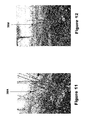
- FIG. 11 is a picture of sugarcane which was soaked in the plant growth and soil enhancement formulation in accordance with the present invention.
- FIG. 12 is a picture of sugarcane not soaked with the plant growth and soil enhancement formulation in accordance with the present invention.
- the present invention describes a unique plant growth and soil enhancement formulation designed to provide maximum water retention, minimize temperature fluctuations, bind to heavy metals, convert elements such as phosphorous into bio-available nutrients, allow for nutrient retention, decrease soil salinity, act as a natural pesticide resistance, and increase crop yields.
- a plurality of components is combined to form a unique, synergic plant growth and soil enhancement formulation. Administering the plant growth and soil enhancement formulation to crops or fields provides the plants with an environment sufficient for development.
- the plant growth and soil enhancement formulation comprises sufficient amounts/concentrations of humus.
- humus is the portion of soil that has been fully broken down and is thus stable and is used to describe the dark organic material in soils produced by the decomposition of animal or vegetable matter.
- Humus typically contains a black or dark brown color resulting from accumulation of carbon and refers to organic matter that has reached a point of stability, i.e. it will not break down or decompose further.
- the brown to black complex of carbon containing compounds is not recognized under a light microscope as possessing cellular organization in the form of plant or animal bodies.
- the humus forms particles, either dry or more preferably being formed as a colloid of particle size of 0.5 microns to 5.0 microns, more preferably 1.0 to 3.0 microns.
- the plant growth and soil enhancement formulation in accordance with the present invention contains billions of humus particles per mL, thereby providing enhanced increase in the water holding capacity and soil exchange absorption capacity, and decreasing the salinity of the soil solution.
- the humus as part of the formulation penetrates into the soil where it is believed to act by modifying the soil structure and increasing the sorption capacity.
- the structural change results in minimizing drought danger.
- the particles of humus can store water even several times more than their weigh and provide a water source in the form available for plants (maintaining water in the layer of soil available for plants).
- the humus further prevents the phenomenon of soil cracking, surface water outlet and soil erosion by introducing colloidal particles with capabilities of increasing water bonding and providing for better aeration.
- the humus should have the characteristics of being capable of maintaining its structural integrity, i.e. will not break down at high temperatures.
- a preferred embodiment is a humus that is degradable only at temperatures in excess of 500 degrees Celsius, and most preferably in excess of 900 degrees Celsius.
- the humus particles due to their high absorption capacity, should also store nutrient-rich water in a range of 500% to 2,000% of their own weight.
- the humus can be obtained from natural sources and processed as needed. Alternatively, the humus can be provided from processing, such as crushing or pulverizing, rock formations, such as lignite.
- Lignite as used herein, is defined as the usually brownish black coal intermediate between peat and bituminous coal. It is generally described as having carbon content of 25-35%, a high inherent moisture content (as high as 66%), and ash content ranging from 6%-19%.
- the plant growth and soil enhancement formulation composition comprises humic substances, such as humic acid or fulvic acid.
- the plant growth and soil enhancement formulation composition comprises sufficient amounts/concentrations of one or more mineral based substances.
- the minerals may include, for example, one or more members of the phyllosilicate group of minerals.
- the minerals typically have microscopic crystals and form a clay.
- the phyllosilicate group may include a clay group such as the Smectite/Montmorillonite Family.
- the Smectite Family of clays includes Montmorillonite and has larger cation exchange capacity and specific surface as compared to other families of clays. They have an absorption capacity as much as eight times greater than other clays.
- Montmorillonite is a very soft phyllosilicate group of minerals that typically form in microscopic crystals, forming a clay.
- Montmorillonite is a 2:1 clay having 2 tetrahedral sheets sandwiching a central octahedral sheet. The particles are plate-shaped with an average diameter of approximately one micrometer.
- the water content of Montmorillonite is variable and it increases greatly in volume when it absorbs water. Chemically it is hydrated sodium calcium aluminum magnesium silicate hydroxide (Na,Ca)(Al,Mg) 6 (Si 4 O 1O )(OH) 6 .nH2O.
- the phyllosilicate group may be Bentonite.
- Bentonite is an absorbent aluminum phyllosilicate, generally impure clay consisting mostly of montmorillonite.
- Bentonites there are different types of Bentonites, each depending on the dominant element that makes up the clay, such as potassium (K), sodium (Na), calcium (Ca), and aluminum (AI).
- Bentonite usually forms from weathering of volcanic ash, most often in the presence of water.
- the mineral composition may include sufficient amounts/concentrations of a bedrock component.
- the bedrock component is comprised of a silica-calcite sedimentary rock known as Geza (also known as gaize or opoka).
- Geza also known as gaize or opoka
- the bedrock is found primarily in Poland, Lithuania, and the Ukraine.
- Use of the bedrock in the formulation provides several advantages over traditional fertilizers. First, adding bedrock to the plant growth and soil enhancement formulation makes the silicon contained therein penetrate the plant's cell walls. By “lining” the cell walls with silica, the risk of mycotic diseases or getting pathogens into the plant is prevented or minimized. The silica also prevents the absorption of heavy metals by plants.
- bedrock together with the other components of the plant growth and soil enhancement formulation, allows for more effective activity of the plant growth and soil enhancement formulation due to the strong binding properties of the Geza.
- Geza applied into the soil binds both anions and cations. Binding prevents the soil anions and cations from being washed away and providing a means to getting into those layers of the soil, which are inaccessible for plants without such material.
- the plant growth and soil enhancement formulation contains microorganisms therein which get released into the soil.
- the presence of bedrock keeps them in the soil layer accessible to be absorbed by the plant.
- the bedrock/Geza prevents absorption of heavy metals by plants, including mobile aluminum. It binds heavy metals into insoluble compounds making them inaccessible to the plants.
- Bedrock strongly affects phosphorus content in the soil. Use of the bedrock provides a mechanism which allows plants to use phosphorus. Reaction with silica converts the phosphorus from an inaccessible form to an accessible form. Therefore, use of Geza within the plant growth and soil enhancement formulation can be applied instead of fertilizing with phosphorus.
- the bedrock itself will release phosphorus to the soil.
- bedrock prevents heavy crops from lodging (for instance falling of rice ears to the water), which often results in the decrease in crop yield.
- Bedrock is further believed to influence mobile aluminum, known to poison and destroy the root system of a plant, in the soil by neutralizing it.
- use of bedrock/Geza prevents the washing away of phosphates into ground waters. Such wash away causes significant contamination of the natural environment.
- the bedrock is provided in sufficient form and concentration to retain phosphates and prevent them from penetrating into ground waters.
- the mineral composition may include sufficient amounts/concentrations of Kieserite.
- Kieserite is chemically known as magnesium sulfate monohydrate, MgSo 4 -H 2 O. It is a naturally occurring mineral typically mined from geologic marine deposits.
- the plant growth and soil enhancement formulation composition may comprise sedimentary rock such as lignite coal.
- the plant growth and soil enhancement formulation composition may comprise sedimentary rock rich in silicon.
- the plant growth and soil enhancement formulation may comprise sufficient amounts/concentrations of Lignin.
- Lignin having a molecular formula such as C 9 H 10 O 2 , C 10 H 12 O 3 , C 11 H 14 O 4 , is a complex chemical compound most commonly derived from wood, and an integral part of the secondary cell walls of plants and some algae.
- the plant growth and soil enhancement formulation composition may comprise sufficient amounts/concentrations of one or more of sorbents, i.e. materials used to absorb liquids or gases.
- the plant growth and soil enhancement formulation may comprise sufficient amounts/concentrations of one or more microorganisms such as, for example, saprophytic bacteria or fungi.
- the microorganisms may be naturally occurring organisms associated with one or more components of the plant growth and soil enhancement formulation, or can be microorganisms added independently or separately.
- the microorganisms may be cultured.
- the plant growth and soil enhancement formulation preferably contains microorganisms that prevent soil exhaustion or improve immunity and activity of the plants, or have the ability to bind nitrogen from the air.
- the plant growth and soil enhancement formulation may contain one or more strains of Pseudomonas bacteria and/or Actinobacteria.
- Actinobacteria are saprotrophes that accelerate the processing of hard-degradable substances including lignin, chitin, pectin, keratin and various aromatic complexes.
- the plant growth and soil enhancement formulation may contain one or more species of Trichoderma fungi.
- the plant growth and soil enhancement formulation may contain sufficient amounts/concentrations of one or more micro-elements essential for plants, including but not limited to iron, manganese, zinc, copper, boron, molybdenum.
- the plant growth and soil enhancement formulation may contain sufficient amounts/concentrations of one or more macro-elements essential for plants, including but not limited to nitrogen, phosphorous, potassium, calcium, magnesium.
- the plant growth and soil enhancement formulation may include sufficient amounts/concentrations of humic substances.
- the plant growth and soil enhancement formulation may include sufficient amounts/concentrations of humic acids.
- Humic acid is one of two classes of natural acidic organic polymer extracted from humus found in the soil.
- the plant growth and soil enhancement formulation may include sufficient amounts/concentrations of fulvic acids.
- the plant growth and soil enhancement formulation composition may comprise biostimulators, phytohormones which stimulate the growth and development of plants.
- the plant growth and soil enhancement formulation may include sufficient amounts/concentrations of one or more zeolites (microporousaluminosilicate crystalline structures commonly used for adsorption and ion exchange).
- zeolites microporousaluminosilicate crystalline structures commonly used for adsorption and ion exchange.
- the plant growth and soil enhancement formulation may include sufficient amounts/concentrations of one or more alkalinizer, such as but not limited to potash, potassium lime, or sodium lime.
- the plant growth and soil enhancement formulation may be formulated and/or used to grow crops in sandy soils, typically associated with desert soil structures.
- the plant growth and soil enhancement formulation may be added to the sand substances, causing adhering or joining of soil particles in clods and grains, changing its structure.
- the change in structure provides resistance to washout, but it also increases its sorptive capacity. By filling the gaps among sand particles, a layer is created which retains both nutrients and moisture present.
- the following examples provide illustrative variations of the plant growth and soil enhancement formulation, and are not meant to be limiting.
- about 10 to 20 liters of the fertilizer composition maybe dissolved in 100 to 2000 L ⁇ liters of water. More specifically, about 10 to 20 liters of fertilizer may be dissolved in 200 liters of water for use with smaller plants. The same 10 to 20 liters of fertilizer may be dissolved in 500 liters of water for bigger plants, or even 1000 liters of water for orchards.
- the plant growth and soil enhancement formulation may be best applied to soil in the early spring at a dilution of about 50 liters of fertilizer mixed with 500 to 1000 liters of water and distributed using a machine or a device used for irrigation.
- the plant growth and soil enhancement formulation may also be used in protected cultivation, such as a tunnel or greenhouse, at a dilution rate of about 1 liter of fertilizer per 24 hours per a square meter during vegetation period.
- 2 ml of plant growth and soil enhancement formulation maybe mixed in 1 liter of water.
- about 200 ml of plant growth and soil enhancement formulation in 100 liters of water may be applied per square meter.
- Compound Amount Lignite About 30% to about 60% by weight
- Organic Component About 30% to about 60% by weight
- Mineral Based material Geza About 5% to about 20% by weight
- Organic Component One or About 30% to about 60% by More of Lignite, Humic Acid weight and/or Other HumicSubstances Mineral Based Material: Geza About 5% to about 20% by weight
- Organic Component One or About 30% to about 60% by More of Lignite, Humic Acid weight Mineral Based Material: Geza About 5% to about 20% by weight At least One Microorganism As needed At least One Micronutrient As needed
- Organic Component One or About 30% to about 60% by More of Lignite, Humic acid weight Mineral Based Material: About 5% to about 20% by One or More of Geza, weight Phyllosilicate Minerals, Kieserite, Bearer
- Compound Amount Organic Humus About 30% to about 60% by weight One or More of Lignite, About 30% to about 60% by HumicAcid, and/or Other weight HumicSubstances One or More of Geza, About 5% to about 20% by Phyllosilicate Minerals, weight Kieserite, 3, Jrllite At Least One Microelement As needed At Least One Microorganism As needed
- Organic Component Lignite, About 30% to about 60% by Humic Acid weight Mineral Based Material: One or About 5% to about 20% by More of Geza, Kieserite weight Micro Elements: One or More of As required Iron, Manganese, Zinc, Copper, Boron, Molybdenum
- Compound Amount Organic Humus About 30% to about 60% by weight Lignite, Humic Acid, About 30% to about 60% by FulvicAcid weight One or More of Geza, Kieserite About 5% to about 20% by weight One or More of Iron, Manganese, As required Zinc, Copper, Boron, Molybdenum One or More Species of As required Bacteria or Fungi
- Example 8A Formulation for Application to High Temperature Environments Having Sand as Part of the Soil Structure, 1000 Liter
- Example 8A Formulation for Application to High Temperature Environments Having Sand as Part of the Soil Structure, 1000 Liter
- To ground lignite (from KWB Belchatow, preferably of molecular size less than 5 mm) 1 Molar water solution of potash is added in the ratio of 1:1. To this mixture ?approximately 5-20% by weight, preferably 5%, Geza is added. The mineral rich bedrock is preferably crushed and minced to form particles of at or less than 0.05 mm. The composition is mixed for a period of time, from a few hours to overnight mixing, forming a wet but granulated volume (100 to 300 liters) of activated humus. The activated humus is spread using a fertilizer distributor in order to place over the soil area of 1 hectare. The activated humus is preferably mixed with top soil, resulting in a significant improvement of water retention and absorption, leading to larger crop yield. Preferably, the pH of the plant growth and soil enhancement formulation is less than 10.
- Example 9A may further be supplemented with one or more of the following: additional mineral based materials such as but not limited to kieserite, humic acid, microorganisms such as saprophytic bacteria, or one or more micro elements, such as iron, manganese, zinc, copper, boron, molybdenum.
- additional mineral based materials such as but not limited to kieserite, humic acid, microorganisms such as saprophytic bacteria, or one or more micro elements, such as iron, manganese, zinc, copper, boron, molybdenum.
- a 1 Molar water solution of potash is added in the ratio of 1:1.
- approximately 20% by volume of 40% aqueous Hellite is added.
- the mixture is mixed for a period ranging from a few hours to overnight.
- a wet but granulated solution of activated humus is obtained and spread using a fertilizer distributor over the soil area of 1 hectare.
- the activated humus is preferably mixed with top soil, resulting in a significant improvement of water retention and absorption, leading to larger crop yields.
- Granulated, activated humus described above, as for example, Examples 1, 9A/9B or 10, is diluted with water in the ratio of 1 volume part of humus to 5 parts of water, and mixed. After setting, a dark brown clear dilution of activated humus is decanted and used at the dose e.g. 50-200 L per hectare using, for example, an herbicide sprayer. The sediment that remains after decantation is transformed into a loose activated humus, which is applied using a fertilizer spreader, the same way as in Examples 1A-3, or using a liquid manure sprayer as in Example 4.
- wet but loose activated humus such as for example as in Examples 1, 9A/9B or 10 is dry mixed with lignite ash (lignite ash obtained from the 2nd and 3rd zone of electro filters, e.g. from Patnow Power Plant) in the ratio of 1:1.
- lignite ash lignite ash obtained from the 2nd and 3rd zone of electro filters, e.g. from Patnow Power Plant
- the obtained granulated activated humus is spread using a fertilizer spreader or is sprayed using a liquid manure sprayer as described previously, at a dose of, for example, 300 L per hectare.
- the activated humus is preferably applied during various vegetation periods resulting to provide gradual soil de-acidification, improvement in water retention and absorption, as well as higher crops.
- Liquid humus as in for example, Examples 1A-2 is mixed with fragmented bedrock and zeolite or with fragmented chalk, e.g. Ekocalcium, isolated from KBW Belchato in the ratio of 1:1, enriched in bio-humus or mycorrhizal inoculums.
- the granulated mixture obtained is applied at the dose of, for example, 100 to 200 L per hectare using, for example, a fertilizer spreader, or sprayed using a liquid manure sprayer.
- the mixture is preferably mixed with top soil or applied to deep levels of soil using a mechanical applicator having sub-soiling teeth.
- FIG. 1 illustrates graphical representation of various characteristics which show the affect of the application of the plant growth and soil enhancement formulation to live crops and some of the minimum benefits with respect to:
- A) chlorophyll content 10 showing a 10% increase in chlorophyll content of the Topaz Apple Tree; B) leaf surface area 12 , showing a 30% increase in leaf surface of leafs of the Topaz Apple Tree, C) sucrose content 14 , showing a 30% increase or more in sucrose content in Apples, Cherries, Sugarcane;
- D) tree height 16 showing a 38% increase in tree height growth in the Sabina Cherry Tree;
- E) tree diameter 18 showing a 45% increase in tree diameter growth in the Sabina Cherry Tree;
- F) fruit pieces 20 showing a 60% increase in fruit set pieces in the Ariwa Apple Tree;
- G) shoot growth 22 showing a 65% increase in the shoot growth in the To
- Additional Testing Methods Various testing was performed to provide an assessment of the influence of the fertilization formulation in accordance with the present invention upon a variety of plants, measuring various parameters such as correct development of yielding parameters and stimulation of resistance of plants to pathogens.
- the tests were performed within orchards located in Tru having various types of trees and/or plants, including several varieties of apple trees, several varieties of cherry trees, and strawberry plants.
- Several testing parameters were used, including observations of blooming stages, observations of fruiting, measurement of chlorophyll in leaves, measurement of crop volume and fruit quality, and measurement of tree size.
- Table 1 illustrates several measured parameters for the Topaz Apple Tree in the presence and absence of the plant growth and soil enhancement formulation in accordance with the present invention.
- the measured parameters include Chlorophyll, tree size, blooming intensity, number of fruit set and crops.
- Table 2 illustrates several additional measured parameters for the Topaz Apple Tree in the presence and absence of the plant growth and soil enhancement formulation in accordance with the present invention.
- Table 3 illustrates several measured parameters for the Ariwa apple tree in the presence and absence of the plant growth and soil enhancement formulation in accordance with the present invention.
- the measured parameters include Chlorophyll, tree size, blooming intensity, number of fruit set and crops.
- Table 4 illustrates several measured parameters for the Sabina Cherry Tree in the presence and absence of the plant growth and soil enhancement formulation in accordance with the present invention.
- Tables 5, 6, and 7 illustrate the effects the plant growth and soil enhancement formulation in accordance with the present invention has on the growth rate of various fruiting trees.
- Table 5 illustrates the influence of the use of plant growth and soil enhancement formulation on one-year growth of Sabina Cherry trees.
- plant growth and soil enhancement formulation in accordance with the present invention has also been found to have influence over various characteristics of plant roots, including increasing root area, volume, number of root tops, fresh root mass and mass of dried roots, and ability to fight off disease. Accordingly, the ability of the plant growth and soil enhancement formulation in accordance with the present invention to impact the growth of roots and the presence of arbuscularmycorrhizal fungi in the rhizosphere of strawberry species, such as Elsanta, Elkat , and Honeoye , in field conditions was measured. The tests were aimed at determination of influence of use of plant growth and soil enhancement formulation upon growth and settlement of strawberry plants by arbuscularmycorrhizal fungi.
- mycorrhizal frequency F
- M relative mycorrhizal intensity
- m absolute mycorrhizal intensity
- a control strawberry plant 28 with roots 30 i.e. grown without the presence of the plant growth and soil enhancement formulation is shown next to a strawberry plant 32 with roots 34 grown in the presence of the plant growth and soil enhancement formulation.
- the root system of the strawberry plant 32 seems to have greater numbers of roots 34 when compared to the number of roots 30 of the strawberry plant 28 .
- Tables 8, 9 and 10 illustrate the degree of mycorrhizal frequency and intensity in the roots of several varieties of strawberry plants: Elsanta, Elkat , and Honeoye.
- FIGS. 3-10 the effectiveness of using the plant growth and soil enhancement formulation for fighting plant disease such as Phytophthorainfestans in tomato plants 36 is illustrated.
- tomato plants stricken by Phytophthorainfestans were sprayed twice with 6% of the plant growth and soil enhancement formulation for a period of 4 days. Plants infected with the disease, see FIG. 3 or FIG. 6 , were able to produce fruit after treatment, see FIGS. 4-5 and FIGS. 8-10 .
- Test Results SugarCane Planting, combination of treatment with plant growth and soil enhancement formulation and soaking with the plant growth and soil enhancement formulation.
- Treatment Group A 20 setts, soaking treatment and spraying treatment.
- the setts were soaked for two hours in a plant growth and soil enhancement formulation (preferably 2% solution) and planted.
- the solution remaining after removal of the setts was applied to the furrow at planting.
- Day 2 Spraying plant growth and soil enhancement formulation (preferably a 12% solution) on the field.
- Day 14 Creating furrows (trenches) to place the setts in and spray the plant growth and soil enhancement formulation (preferably a 4% solution) in the furrows.
- Day 15 Placing plant growth and soil enhancement formulation soaked (preferably a 2% solution) setts in the furrows, covering with soil.
- Day 60 Spraying the plant growth and soil enhancement formulation (preferably a 4% solution) on the emerged plants.
- Day 90 Spraying the plant growth and soil enhancement formulation (preferably a 4% solution) on the growing plants.
- Control Group B 20 setts, no treatment.
- Table 11 illustrates the effects of soaking and treating sugarcane with the plant growth and soil enhancement formulation. As illustrated in the table, several measurable characteristics were improved in Treatment Group A, the soaked and treated group, when compared to Control Group B. The benefits of soaking and treating the sugarcane increased germination proliferation (150%), increased diameter of the plants (8.3%), days to plant emergence (33%), and size, i.e. taller plants (30%).
- FIG. 11 is a representative picture of soaked and treated sugarcane plants 38 A.
- FIG. 12 a representative picture of untreated sugarcane plants 38 B.
- Test Study 3 Pot experiment: soybeans, spring wheat, sweet potatoes, and rice. Field Experiment: potatoes, sugar beets and corn.
- Insecticide Bi 58 Nowy 400 EC, active substance: dimethoate in dose: 0.5 l on 1 ha in 200 l water.
- Fungicides against cercospora leaf spot: Yamato 303 SE, active substance: thiophanate-methyl, tetraconazole in dose: 1.25 l on 1 ha in 200 l water.
- Corn, variety Smolitop (FAO 230-240), was planted on 30 Apr. 2013 in the amount of around 100 thousand grains per 1 ha, spaced each at 75 cm.
- ammonium phosphate was used in the amount of 200 kg/ha and potash salt in a dose of 120 kg K 2 O/ha.
- Nitrogen fertilization in the form of ammonium nitrate was used also during vegetation period: at the stage of 4-6 leaves in the amount of 300 kg/ha and at the stage of paniculation in the amount of 100 kg per 1 ha.
- Weeding was carried out chemically using preparations of Click 500SC (1.5 l/ha)+ Guardian Max 840 EC (2.5 l/ha) and Bromotril as postemergent weed control.
- Karate was used to fight pests. Samples of plants were taken at harvest time. The following were determined in plants: general nitrogen content with Kjeldahl method, potato starch content in potatoes, sugar content in sugar beets, fat content in rape. In addition, darkening of raw potato pulp was evaluated on their longitudinal section 10 minutes and 1 hour after slicing, based on 9° European scale. Evaluation of darkening of boiled potatoes was carried out separately for stolon part and in an apical part of a potato after 10 minutes and 2 hours after boiling, applying a 9° Danish grading scale.
- Sugar beets A significant increase in harvest was recorded for both roots and leaves of sugar beets on fields fertilized with plant growth and soil enhancement formulation in comparison to the control (Table 14). The greatest growth of harvest was obtained using combination number 5 with soil-applied plant growth and soil enhancement formulation and foliage-spraying. However, the difference between other manners of the plant growth and soil enhancement formulation application was statistically negligible. Roots of sugar beets fertilized with the plant growth and soil enhancement formulation had a higher content of sugar (Table 14). This effect additionally increases sugar crops which is the basis for valuation of this crop.
- Corn, field experiment Similar to the potatoes and sugar beets, a significant growth of crops was obtained of both grain and straw in combinations using the plant growth and soil enhancement formulation in comparison to the control (Table 15). The crops on fields fertilized more intensively with the plant growth and soil enhancement formulation were slightly higher than using combinations with double application of the plant growth and soil enhancement formulation. However, these differences were insignificant, which shows that in field experiments it is enough to apply the plant growth and soil enhancement formulation once before sowing (planting) and a double spraying during vegetation period. Unlike in the case of potatoes, a more productive use was soil-application prior to emergence of plants. Use of the plant growth and soil enhancement formulation resulted in an increase in the weight of corn grains. Enhanced protein content in corn grains fertilized with the plant growth and soil enhancement formulation was recorded. The greatest increase of protein content was obtained on plants with four cycles of spraying.
- Spring rape, micro-plot experiment Spring rape was cultivated in a micro-plot experiment on heavy soil. Spring rape fertilized with the plant growth and soil enhancement formulation increased the crop of grains, the straw of the rape, and the fat content in seeds (Table 16). Differences depending on the manner of fertilizer application were insignificant.
- Soybeans pot experiment. As in the case of rape crop, the use of the plant growth and soil enhancement formulation on soybeans increased both soybean grains and straw (Table 17). Better effects of the plant growth and soil enhancement formulation were obtained when more doses were used (see No. 4 and No. 5) compared to double application. This follows from the fact that soybeans gain crop weight at later stages of vegetation. As with other species, these differences were statistically insignificant. A greater weight of 1000 grains of soybeans was obtained where this fertilizer was used compared to the control. The plant growth and soil enhancement formulation also increased protein content in grains. The largest increase was obtained with the crops fertilized with the plant growth and soil enhancement formulation method of using four spraying periods. Soybean plants fertilized with plant growth and soil enhancement formulation have shown a greater immunity to fungal diseases.
- Spring wheat pot experiments. Spring wheat was grown in light and heavy soil (Tables 18 and 19). In both soils, the crops obtained considerable growth of grain and straw crops when used with the plant growth and soil enhancement formulation fertilizer. However, the growth of the grain crop as a result of the use of the plant growth and soil enhancement formulation was approx. 10% higher from the heavy soil as compared to the light soil. As far as the light soil with lower fertility is concerned, appropriate nutrition of plants plays a greater role, and the very stimulation gives lower production effects. The favourable influence of using the plant growth and soil enhancement formulation upon wheat crops resulted in improvement of rigidity of wheat stems. This can be significant, especially in field conditions.
- Corn, micro-plot experiments Apart from the field experiments conducted in light soil, corn was grown as part of micro-plot experiments in heavy soil and medium humus soil (Table 20). From those soils, the crops obtained much greater efficiency when using the plant growth and soil enhancement formulation in the light soil. Crop growth from the medium soil was 50% higher than from the light soil and 75% higher than from the heavy soil. Crops such as corn grains and straw from the heavy soil, which were grown in the same conditions and fertilized in the same way, had higher (crop yields than from the medium soil. This confirms observations made during pot experiments with wheat, where effectiveness of the plant growth and soil enhancement formulation in the heavy soil was also much higher than from the light soil. From the medium soil, the crops had obtained growth, where the plant growth and soil enhancement formulation was used four times (no. 4 and 5) as compared to two times (no. 2 and 3). For the heavy soil differences between particular methods of application of the fertilizer were very small
- Sweet Potato, pot experiments Use of the plant growth and soil enhancement formulation on sweet potato plants provided considerable growth of the tuber crops as compared to control crops (Table 21). Similar to the field experiments with potatoes, the influence of the plant growth and soil enhancement formulation was better for preparation of the tubers than fertilization of the soil following plant sprouting. Little favourable influence of the plant growth and soil enhancement formulation with the use of the fertilizer upon contents of dry mass and protein in sweet potato tubers was found. The little influence of the plant growth and soil enhancement formulation upon protein contents results from the fact that the potato tubers contain relatively little protein and the least contents of protein as compared to all the tested plants. Soil fertilization with the plant growth and soil enhancement formulation had the most favourable influence upon dry mass contents, whereas spray fertilization had the most favourable influence upon protein contents.
Landscapes
- Chemical & Material Sciences (AREA)
- Organic Chemistry (AREA)
- Life Sciences & Earth Sciences (AREA)
- Soil Sciences (AREA)
- Pest Control & Pesticides (AREA)
- Chemical Kinetics & Catalysis (AREA)
- Inorganic Chemistry (AREA)
- Fertilizers (AREA)
- Agricultural Chemicals And Associated Chemicals (AREA)
Abstract
The present invention describes a plant growth and soil enhancement formulation, and method of using said formulation for enhanced plant growth and soil enrichment, comprising generally an organic substance such as humus and at least one mineral, preferably a bedrock material known as Geza.
Description
In accordance with 37 CFR 1.76, a claim of priority is included in an Application Data Sheet filed concurrently herewith. Accordingly, the present invention claims priority to U.S. Provisional Patent Application Ser. No. 62/010,512, entitled, “Plant Food, Nutrient and Soil Conditioner Formulation”, filed Jun. 11, 2014. The contents of the above referenced application are incorporated herein by reference in its entirety.
The present invention is directed to an agricultural product; to a formulation for plants which augments growth by enhancing root activity and soil stability; and more particularly to a plant growth and soil enhancement formulation formulated to act as a plant food, nutrient, and soil conditioner which does not require the use of chemical fertilizers, pesticides, herbicides or fungicides.
The agricultural industry is a multi-billion dollar industry crossing all continents with the general aim of improving crop production. Crop production, whether for food or industrial use, is vital to the sustainability to human existence. As such, numerous governmental agencies, private companies, universities, and trade associations have been established to provide products, training, and information regarding crop technology in order to improve the profitability of the agriculture industry. The ability of society to produce various crops, particularly food related crops, faces several serious challenges. First, as the world population expands, the pressure to feed additional populations increases. Moreover, in many parts of the world, individuals are living longer. The amount of arable land relative to the increasing population is decreasing. In order to feed the world population and satisfy crop yield for industrial uses, numerous crop protecting substances, such as pesticides, herbicides, fungicides, or bio-engineered crops, have been developed to improve crop production. While these substances have been vital in increasing crop yields by controlling weed growth, effects of insects and plant-based pathogens and disease, use of these substances are not without controversy, including claims that such substances are harmful to humans, harmful to the environment, and particularly for bio-engineered crops, are harmful to the overall food chain.
Additional means of increasing crop production have been accomplished through the use of fertilizers. Fertilizers, whether organic, i.e. composed of organic plant or animal matter, or inorganic, are generally designed to supply different nutrients (such as macronutrients including nitrogen, phosphorous, potassium, calcium, magnesium, and sulfur, micronutrients such as boron, chlorine, copper, iron, manganese, molybdenum, zinc, and nickel, to plants to aid in plant growth. The nutrients provided by the fertilizer then get absorbed into the plant. Numerous fertilizers and methods of making fertilizers are known in the art. Illustrative examples include U.S. Pat. No. 8,110,017, U.S. Pat. No. 7,811,352, U.S. Patent Application Publication No. 2012/0222170, and U.S. Patent Application Publication No. 2011/02144465. While fertilizers are vital to increasing crop production, they are not without their own problems. Inorganic fertilizers have been known to contribute to water pollution, soil acidification, or trace mineral depletion.
Given the increased pressures on crop production, what is needed in the art is an improved crop enhancing substance, preferably a plant growth and soil enhancement formulation, in order to maintain adequate crop supplies for both food production and industrial use.
The present invention describes a plant growth and soil enhancement formulation comprising generally humus and at least one mineral, preferably a bedrock material known as Geza. The use of the Geza in the formulation contributes to the formulation having strong binding properties to both anions and cations, thereby allowing nutrients to remain in the soil level, be accessible to the plant, and prevent the plant from absorbing heavy metals. The presence of this mineral in the plant growth and soil enhancement formulation contributes to making phosphorus contained in the soil available to the plant. The presence of the mineral also contributes to the prevention of crop lodging and minimizes harmful effects of mobile aluminum contained in the soil, which poisons and destroys plant root system.
The plant growth and soil enhancement formulation may further include other components, such as microorganisms including beneficiary saprophytic bacteria or fungi. The microorganisms provide the plant sources of nitrogen, phosphorus and sulfur. One or more micro-elements which are essential for plants, such as iron, manganese, zinc, copper, boron, molybdenum, and other micro-elements, as well as other organic components, humic compounds, and colloidal silica may be included in the formulation.
Accordingly, it is an objective of the instant invention to provide a plant growth and soil enhancement formulation.
It is a further objective of the instant invention to provide a plant growth and soil enhancement composition formulated to provide a plant with nutrients in hydroponic proportions.
It is yet another objective of the instant invention to provide an organic plant growth and soil enhancement formulation adapted to influence soil structure by increasing its water holding capacity and absorption capacity.
It is a still further objective of the invention to provide an improved organic plant growth and soil enhancement formulation adapted to prevent plants from up-taking heavy metals from the soil.
It is a further objective of the instant invention to provide an improved organic plant growth and soil enhancement formulation adapted to prevent or minimize the destruction of the root systems resulting from heavy metal uptake.
It is yet another objective of the instant invention to provide an improved organic plant growth and soil enhancement formulation adapted to prevent crop lodging.
It is a still further objective of the invention to provide an improved organic plant growth and soil enhancement formulation adapted to prevent environmental contamination in a form of washing out of phosphates into ground water.
It is a further objective of the instant invention to provide an improved organic plant growth and soil enhancement formulation adapted to enable agricultural cultivation on sand.
It is yet another objective of the instant invention to provide an improved organic plant growth and soil enhancement formulation comprising solid organic humus, in combination with a rare, nutrient rich, mineral-based material.
It is yet another objective of the instant invention to provide an improved organic plant growth and soil enhancement formulation comprising solid organic humus, in combination with a rare, nutrient rich, mineral-based material from sedimentary rock.
It is a still further objective of the invention to provide an improved organic plant growth and soil enhancement formulation comprising solid organic humus, in combination with a rare, nutrient rich, mineral-based material known as Geza.
It is a further objective of the instant invention to provide an improved organic plant growth and soil enhancement formulation comprising solid organic humus, in combination with a rare, nutrient rich, mineral-based material isolated from Geza adapted to act as a plant food, nutrient, and soil conditioner.
Other objectives and advantages of this invention will become apparent from the following description taken in conjunction with any accompanying drawings wherein are set forth, by way of illustration and example, certain embodiments of this invention. Any drawings contained herein constitute a part of this specification and include exemplary embodiments of the present invention and illustrate various objects and features thereof.
The patent or application contains at least one drawing executed in color. Copies of this patent or patent application publication with color drawings will be provided by the Office upon request and payment of the necessary fee.
While the present invention is susceptible of embodiment in various forms, there is shown in the drawings and will hereinafter be described a presently preferred, albeit not limiting, embodiment with the understanding that the present disclosure is to be considered an exemplification of the present invention and is not intended to limit the invention to the specific embodiments illustrated.
The present invention describes a unique plant growth and soil enhancement formulation designed to provide maximum water retention, minimize temperature fluctuations, bind to heavy metals, convert elements such as phosphorous into bio-available nutrients, allow for nutrient retention, decrease soil salinity, act as a natural pesticide resistance, and increase crop yields. In certain embodiments of the present invention, a plurality of components is combined to form a unique, synergic plant growth and soil enhancement formulation. Administering the plant growth and soil enhancement formulation to crops or fields provides the plants with an environment sufficient for development.
In certain embodiments, the plant growth and soil enhancement formulation comprises sufficient amounts/concentrations of humus. As used herein, humus is the portion of soil that has been fully broken down and is thus stable and is used to describe the dark organic material in soils produced by the decomposition of animal or vegetable matter. Humus typically contains a black or dark brown color resulting from accumulation of carbon and refers to organic matter that has reached a point of stability, i.e. it will not break down or decompose further. The brown to black complex of carbon containing compounds is not recognized under a light microscope as possessing cellular organization in the form of plant or animal bodies. In an illustrative embodiment, the humus forms particles, either dry or more preferably being formed as a colloid of particle size of 0.5 microns to 5.0 microns, more preferably 1.0 to 3.0 microns. In this configuration, the plant growth and soil enhancement formulation in accordance with the present invention contains billions of humus particles per mL, thereby providing enhanced increase in the water holding capacity and soil exchange absorption capacity, and decreasing the salinity of the soil solution.
The humus, as part of the formulation penetrates into the soil where it is believed to act by modifying the soil structure and increasing the sorption capacity. The structural change results in minimizing drought danger. Due to great sorption capabilities, the particles of humus can store water even several times more than their weigh and provide a water source in the form available for plants (maintaining water in the layer of soil available for plants). The humus further prevents the phenomenon of soil cracking, surface water outlet and soil erosion by introducing colloidal particles with capabilities of increasing water bonding and providing for better aeration.
Preferably, the humus should have the characteristics of being capable of maintaining its structural integrity, i.e. will not break down at high temperatures. Accordingly, a preferred embodiment is a humus that is degradable only at temperatures in excess of 500 degrees Celsius, and most preferably in excess of 900 degrees Celsius. The humus particles, due to their high absorption capacity, should also store nutrient-rich water in a range of 500% to 2,000% of their own weight.
The humus can be obtained from natural sources and processed as needed. Alternatively, the humus can be provided from processing, such as crushing or pulverizing, rock formations, such as lignite. Lignite, as used herein, is defined as the usually brownish black coal intermediate between peat and bituminous coal. It is generally described as having carbon content of 25-35%, a high inherent moisture content (as high as 66%), and ash content ranging from 6%-19%.
In certain embodiments, the plant growth and soil enhancement formulation composition comprises humic substances, such as humic acid or fulvic acid.
In certain embodiments, the plant growth and soil enhancement formulation composition comprises sufficient amounts/concentrations of one or more mineral based substances. The minerals may include, for example, one or more members of the phyllosilicate group of minerals. The minerals typically have microscopic crystals and form a clay. As an illustrative example, the phyllosilicate group may include a clay group such as the Smectite/Montmorillonite Family. The Smectite Family of clays includes Montmorillonite and has larger cation exchange capacity and specific surface as compared to other families of clays. They have an absorption capacity as much as eight times greater than other clays. Montmorillonite is a very soft phyllosilicate group of minerals that typically form in microscopic crystals, forming a clay. Montmorillonite is a 2:1 clay having 2 tetrahedral sheets sandwiching a central octahedral sheet. The particles are plate-shaped with an average diameter of approximately one micrometer. The water content of Montmorillonite is variable and it increases greatly in volume when it absorbs water. Chemically it is hydrated sodium calcium aluminum magnesium silicate hydroxide (Na,Ca)(Al,Mg)6(Si4O1O)(OH)6.nH2O.
In certain embodiments, the phyllosilicate group may be Bentonite. Bentonite is an absorbent aluminum phyllosilicate, generally impure clay consisting mostly of montmorillonite. There are different types of Bentonites, each depending on the dominant element that makes up the clay, such as potassium (K), sodium (Na), calcium (Ca), and aluminum (AI). Bentonite usually forms from weathering of volcanic ash, most often in the presence of water.
In certain embodiments, the mineral composition may include sufficient amounts/concentrations of a bedrock component. In an illustrated, albeit preferred embodiment, the bedrock component is comprised of a silica-calcite sedimentary rock known as Geza (also known as gaize or opoka). The bedrock is found primarily in Poland, Lithuania, and the Ukraine. Use of the bedrock in the formulation provides several advantages over traditional fertilizers. First, adding bedrock to the plant growth and soil enhancement formulation makes the silicon contained therein penetrate the plant's cell walls. By “lining” the cell walls with silica, the risk of mycotic diseases or getting pathogens into the plant is prevented or minimized. The silica also prevents the absorption of heavy metals by plants. Application of bedrock, together with the other components of the plant growth and soil enhancement formulation, allows for more effective activity of the plant growth and soil enhancement formulation due to the strong binding properties of the Geza. Geza applied into the soil binds both anions and cations. Binding prevents the soil anions and cations from being washed away and providing a means to getting into those layers of the soil, which are inaccessible for plants without such material.
As described later, the plant growth and soil enhancement formulation contains microorganisms therein which get released into the soil. The presence of bedrock keeps them in the soil layer accessible to be absorbed by the plant. The bedrock/Geza prevents absorption of heavy metals by plants, including mobile aluminum. It binds heavy metals into insoluble compounds making them inaccessible to the plants. Bedrock strongly affects phosphorus content in the soil. Use of the bedrock provides a mechanism which allows plants to use phosphorus. Reaction with silica converts the phosphorus from an inaccessible form to an accessible form. Therefore, use of Geza within the plant growth and soil enhancement formulation can be applied instead of fertilizing with phosphorus. The bedrock itself will release phosphorus to the soil.
Application of bedrock prevents heavy crops from lodging (for instance falling of rice ears to the water), which often results in the decrease in crop yield. Bedrock is further believed to influence mobile aluminum, known to poison and destroy the root system of a plant, in the soil by neutralizing it. Finally, use of bedrock/Geza prevents the washing away of phosphates into ground waters. Such wash away causes significant contamination of the natural environment. The bedrock is provided in sufficient form and concentration to retain phosphates and prevent them from penetrating into ground waters.
In certain embodiments, the mineral composition may include sufficient amounts/concentrations of Kieserite. Kieserite is chemically known as magnesium sulfate monohydrate, MgSo4-H2O. It is a naturally occurring mineral typically mined from geologic marine deposits.
In certain embodiments, the plant growth and soil enhancement formulation composition may comprise sedimentary rock such as lignite coal.
In certain embodiments, the plant growth and soil enhancement formulation composition may comprise sedimentary rock rich in silicon.
In certain embodiments, the plant growth and soil enhancement formulation may comprise sufficient amounts/concentrations of Lignin. Lignin, having a molecular formula such as C9H10O2, C10H12O3, C11H14O4, is a complex chemical compound most commonly derived from wood, and an integral part of the secondary cell walls of plants and some algae.
In certain embodiments, the plant growth and soil enhancement formulation composition may comprise sufficient amounts/concentrations of one or more of sorbents, i.e. materials used to absorb liquids or gases.
In certain embodiments, the plant growth and soil enhancement formulation may comprise sufficient amounts/concentrations of one or more microorganisms such as, for example, saprophytic bacteria or fungi. The microorganisms may be naturally occurring organisms associated with one or more components of the plant growth and soil enhancement formulation, or can be microorganisms added independently or separately. The microorganisms may be cultured. Accordingly, the plant growth and soil enhancement formulation preferably contains microorganisms that prevent soil exhaustion or improve immunity and activity of the plants, or have the ability to bind nitrogen from the air. As an illustrative example, the plant growth and soil enhancement formulation may contain one or more strains of Pseudomonas bacteria and/or Actinobacteria. Actinobacteria are saprotrophes that accelerate the processing of hard-degradable substances including lignin, chitin, pectin, keratin and various aromatic complexes. In addition to the bacteria, the plant growth and soil enhancement formulation may contain one or more species of Trichoderma fungi.
In certain embodiments, the plant growth and soil enhancement formulation may contain sufficient amounts/concentrations of one or more micro-elements essential for plants, including but not limited to iron, manganese, zinc, copper, boron, molybdenum.
In certain embodiments, the plant growth and soil enhancement formulation may contain sufficient amounts/concentrations of one or more macro-elements essential for plants, including but not limited to nitrogen, phosphorous, potassium, calcium, magnesium.
In certain embodiments, the plant growth and soil enhancement formulation may include sufficient amounts/concentrations of humic substances.
In certain embodiments, the plant growth and soil enhancement formulation may include sufficient amounts/concentrations of humic acids. Humic acid is one of two classes of natural acidic organic polymer extracted from humus found in the soil.
In certain embodiments, the plant growth and soil enhancement formulation may include sufficient amounts/concentrations of fulvic acids.
In certain embodiments, the plant growth and soil enhancement formulation composition may comprise biostimulators, phytohormones which stimulate the growth and development of plants.
In certain embodiments, the plant growth and soil enhancement formulation may include sufficient amounts/concentrations of one or more zeolites (microporousaluminosilicate crystalline structures commonly used for adsorption and ion exchange).
In certain embodiments, the plant growth and soil enhancement formulation may include sufficient amounts/concentrations of one or more alkalinizer, such as but not limited to potash, potassium lime, or sodium lime.
In certain embodiments, the plant growth and soil enhancement formulation may be formulated and/or used to grow crops in sandy soils, typically associated with desert soil structures. In such an environment, the plant growth and soil enhancement formulation may be added to the sand substances, causing adhering or joining of soil particles in clods and grains, changing its structure. The change in structure provides resistance to washout, but it also increases its sorptive capacity. By filling the gaps among sand particles, a layer is created which retains both nutrients and moisture present.
The following examples provide illustrative variations of the plant growth and soil enhancement formulation, and are not meant to be limiting. Generally, about 10 to 20 liters of the fertilizer composition maybe dissolved in 100 to 2000 L\liters of water. More specifically, about 10 to 20 liters of fertilizer may be dissolved in 200 liters of water for use with smaller plants. The same 10 to 20 liters of fertilizer may be dissolved in 500 liters of water for bigger plants, or even 1000 liters of water for orchards. The plant growth and soil enhancement formulation may be best applied to soil in the early spring at a dilution of about 50 liters of fertilizer mixed with 500 to 1000 liters of water and distributed using a machine or a device used for irrigation. The plant growth and soil enhancement formulation may also be used in protected cultivation, such as a tunnel or greenhouse, at a dilution rate of about 1 liter of fertilizer per 24 hours per a square meter during vegetation period. In hydroponics, 2 ml of plant growth and soil enhancement formulation maybe mixed in 1 liter of water. When vegetation is to grow for about 100 days, about 200 ml of plant growth and soil enhancement formulation in 100 liters of water may be applied per square meter.
| Compound | Amount | ||
| Organic Components | Up to about 80% by weight | ||
| At Least One Mineral Based | Up to about 20% by weight | ||
| Component | |||
| Additional Components | As needed | ||
| Compound | Amount | ||
| Organic Materials | Up to about 80% by weight | ||
| At Least One Mineral Based | Up to about 20% by weight | ||
| Material | |||
| At Least One Micro Element | As needed | ||
| Microorganism: One or More | As needed | ||
| Species of Bacteria and/or | |||
| Fungi | |||
| Compound | Amount | ||
| Organic Components | Up to about 80% by weight | ||
| At Least One Mineral Based | Up to about 20% by weight | ||
| Component Having Silicon | |||
| Additional Components | As needed | ||
| Compound | Amount | ||
| Organic Humus | About 30% to about 60% by | ||
| weight | |||
| Organic Component | About 30% to about 60% by | ||
| weight | |||
| Mineral Based Material: | About 5% to about 20% by | ||
| Bedrock/Geza | weight | ||
| Compound | Amount | ||
| Organic Humus | About 50% by weight | ||
| Organic Component | About 40% by weight | ||
| Mineral Based Material: Geza | About 5% by weight | ||
| Compound | Amount | ||
| Lignite | About 30% to about 60% by | ||
| weight | |||
| Organic Component | About 30% to about 60% by | ||
| weight | |||
| Mineral Based material: Geza | About 5% to about 20% by | ||
| weight | |||
| Compound | Amount | ||
| Organic Humus | About 30% to about 60% by | ||
| weight | |||
| Organic Component: One or | About 30% to about 60% by | ||
| More of Lignite, Humic Acid | weight | ||
| and/or Other HumicSubstances | |||
| Mineral Based Material: Geza | About 5% to about 20% by | ||
| weight | |||
| Compound | Amount | ||
| Organic Humus | About 30% to about 60% by | ||
| weight | |||
| Organic Component: One or | About 30% to about 60% by | ||
| More of Lignite, Humic Acid | weight | ||
| Mineral Based Material: Geza | About 5% to about 20% by | ||
| weight | |||
| At least One Microorganism | As needed | ||
| At least One Micronutrient | As needed | ||
| Compound | Amount | ||
| Organic Humus | About 30% to about 60% by | ||
| weight | |||
| Organic Component: One or | About 30% to about 60% by | ||
| More of Lignite, Humic acid | weight | ||
| Mineral Based Material: | About 5% to about 20% by | ||
| One or More of Geza, | weight | ||
| Phyllosilicate Minerals, | |||
| Kieserite, Beidellite | |||
| Compound | Amount | ||
| Organic Humus | About 30% to about 60% by | ||
| weight | |||
| One or More of Lignite, | About 30% to about 60% by | ||
| HumicAcid, and/or Other | weight | ||
| HumicSubstances | |||
| One or More of Geza, | About 5% to about 20% by | ||
| Phyllosilicate Minerals, | weight | ||
| Kieserite, Beidellite | |||
| At Least One Microelement | As needed | ||
| At Least One Microorganism | As needed | ||
| Compound | Amount | ||
| Organic Humus | About 30% to about 60% by | ||
| weight | |||
| Organic Component: Lignite, | About 30% to about 60% by | ||
| Humic Acid | weight | ||
| Mineral Based Material: One or | About 5% to about 20% by | ||
| More of Geza, Kieserite | weight | ||
| Micro Elements: One or More of | As required | ||
| Iron, Manganese, Zinc, Copper, | |||
| Boron, Molybdenum | |||
| Compound | Amount | ||
| Organic Humus | About 30% to about 60% by | ||
| weight | |||
| Lignite, Humic Acid, | About 30% to about 60% by | ||
| FulvicAcid | weight | ||
| One or More of Geza, Kieserite | About 5% to about 20% by | ||
| weight | |||
| One or More of Iron, Manganese, | As required | ||
| Zinc, Copper, Boron, Molybdenum | |||
| One or More Species of | As required | ||
| Bacteria or Fungi | |||
| Compound | Amount | ||
| Lignite (Brown Coal) | 140 | | ||
| Geza Bedrock | ||||
| 30 | | |||
| KOH | ||||
| 10 | kg | |||
| Kiserite | 10 | kg | ||
| Organic Substances | 500 | liters | ||
| Compound | Amount | ||
| Lignite (Brown Coal) | 280 | grams | ||
| Geza Bedrock | 90 | | ||
| KOH | ||||
| 60 | kg | |||
| Kiserite | 60 | kg | ||
| |
50 | liters | ||
To ground lignite (from KWB Belchatow, preferably of molecular size less than 5 mm) 1 Molar water solution of potash is added in the ratio of 1:1. To this mixture ?approximately 5-20% by weight, preferably 5%, Geza is added. The mineral rich bedrock is preferably crushed and minced to form particles of at or less than 0.05 mm. The composition is mixed for a period of time, from a few hours to overnight mixing, forming a wet but granulated volume (100 to 300 liters) of activated humus. The activated humus is spread using a fertilizer distributor in order to place over the soil area of 1 hectare. The activated humus is preferably mixed with top soil, resulting in a significant improvement of water retention and absorption, leading to larger crop yield. Preferably, the pH of the plant growth and soil enhancement formulation is less than 10.
Example 9A may further be supplemented with one or more of the following: additional mineral based materials such as but not limited to kieserite, humic acid, microorganisms such as saprophytic bacteria, or one or more micro elements, such as iron, manganese, zinc, copper, boron, molybdenum.
To ground lignite, preferably having a molecular size of less than 5 mm, a 1 Molar water solution of potash is added in the ratio of 1:1. To this mixture, approximately 20% by volume of 40% aqueous Beidellite is added. The mixture is mixed for a period ranging from a few hours to overnight. A wet but granulated solution of activated humus is obtained and spread using a fertilizer distributor over the soil area of 1 hectare. The activated humus is preferably mixed with top soil, resulting in a significant improvement of water retention and absorption, leading to larger crop yields.
Wet but loose granulated activated humus, like the one in Example 1, 9A/9B or 10 above, is mixed with dry, well composted greenery, manure or commercial farm mushroom bedding in a ratio of 1:1 to obtain a loose, granulated mix. The mix is distributed using a fertilizer spreader type at the dose of 200-3000 L per hectare. Administration of the mix results in significant soil improvement and higher crop yields in comparison to control (area with composted manure or mushroom growers bedding, but without activated humus).
Wet but loose granulated activated humus, like the one in Examples 1, 9A/9B or 10 above, is transported to planting sites as an organic liquid fertilizer in a dose of 100-200 L per hectare, and is used with liquid manure on soil, mixed with top soil. This results in better soil water retention and absorption as well as an increase, by approximately 20%, of crops in comparison to control (area with manure only).
Granulated, activated humus, described above, as for example, Examples 1, 9A/9B or 10, is diluted with water in the ratio of 1 volume part of humus to 5 parts of water, and mixed. After setting, a dark brown clear dilution of activated humus is decanted and used at the dose e.g. 50-200 L per hectare using, for example, an herbicide sprayer. The sediment that remains after decantation is transformed into a loose activated humus, which is applied using a fertilizer spreader, the same way as in Examples 1A-3, or using a liquid manure sprayer as in Example 4.
Wet but loose activated humus, such as for example as in Examples 1, 9A/9B or 10 is dry mixed with lignite ash (lignite ash obtained from the 2nd and 3rd zone of electro filters, e.g. from Patnow Power Plant) in the ratio of 1:1. The obtained granulated activated humus is spread using a fertilizer spreader or is sprayed using a liquid manure sprayer as described previously, at a dose of, for example, 300 L per hectare. The activated humus is preferably applied during various vegetation periods resulting to provide gradual soil de-acidification, improvement in water retention and absorption, as well as higher crops.
One hundred (100) liters of the plant growth and soil enhancement formulation, as described in, for example, Examples 1, 9A/9B or 10, per 1 hectare is applied annually, about 20% applied to soil and 80% applied to leaves by sprayers or sprinklers in different stages of plant growth.
Liquid humus, as in for example, Examples 1A-2 is mixed with fragmented bedrock and zeolite or with fragmented chalk, e.g. Ekocalcium, isolated from KBW Belchato in the ratio of 1:1, enriched in bio-humus or mycorrhizal inoculums. The granulated mixture obtained is applied at the dose of, for example, 100 to 200 L per hectare using, for example, a fertilizer spreader, or sprayed using a liquid manure sprayer. The mixture is preferably mixed with top soil or applied to deep levels of soil using a mechanical applicator having sub-soiling teeth.
Test Results: Live Crop Application
Application of the plant growth and soil enhancement formulation in accordance with the present invention, such as Example 1, to various types of plants was found to have direct affects on crop production and yield optimization. FIG. 1 illustrates graphical representation of various characteristics which show the affect of the application of the plant growth and soil enhancement formulation to live crops and some of the minimum benefits with respect to: A) chlorophyll content 10, showing a 10% increase in chlorophyll content of the Topaz Apple Tree; B) leaf surface area 12, showing a 30% increase in leaf surface of leafs of the Topaz Apple Tree, C) sucrose content 14, showing a 30% increase or more in sucrose content in Apples, Cherries, Sugarcane; D) tree height 16, showing a 38% increase in tree height growth in the Sabina Cherry Tree; E) tree diameter 18, showing a 45% increase in tree diameter growth in the Sabina Cherry Tree; F) fruit pieces 20, showing a 60% increase in fruit set pieces in the Ariwa Apple Tree; G) shoot growth 22 showing a 65% increase in the shoot growth in the Topaz Apple Tree; H) grain output 24, showing a 100% increase in grain output in rice plants; and I) flower growth 26, showing a 300% increase in corolla (flower) growth in the Topaz Apple Tree.
Additional Testing Methods: Various testing was performed to provide an assessment of the influence of the fertilization formulation in accordance with the present invention upon a variety of plants, measuring various parameters such as correct development of yielding parameters and stimulation of resistance of plants to pathogens. The tests were performed within orchards located in Poland having various types of trees and/or plants, including several varieties of apple trees, several varieties of cherry trees, and strawberry plants. Several testing parameters were used, including observations of blooming stages, observations of fruiting, measurement of chlorophyll in leaves, measurement of crop volume and fruit quality, and measurement of tree size.
Table 1 illustrates several measured parameters for the Topaz Apple Tree in the presence and absence of the plant growth and soil enhancement formulation in accordance with the present invention. The measured parameters include Chlorophyll, tree size, blooming intensity, number of fruit set and crops.
| TABLE 1 | ||||||
| Chlorophyll | Leaf | No. of | ||||
| [fallen | PPPP | area | Blooming | fruits | Crop | |
| Combination | fruit] | [cm2] | [cm2] | intensity | set [pcs] | [kg] |
| Control-“0” | 47.88 | 7.86 | 31.15 | 9.00 | 21.13 | 2.26 |
| Control(NPK- | 52.95 | 7.19 | 28.36 | 7.00 | 11.14 | 1.39 |
| nitrogen/ | ||||||
| phosphorous/ | ||||||
| potassium | ||||||
| fertilizer) | ||||||
| plant growth | 50.70 | 7.86 | 36.74 | 9.00 | 14.25 | 2.46 |
| and soil | ||||||
| enhancement | ||||||
| formulation | ||||||
Table 2 illustrates several additional measured parameters for the Topaz Apple Tree in the presence and absence of the plant growth and soil enhancement formulation in accordance with the present invention.
| TABLE 2 | ||||
| The total | ||||
| of growth | The total | |||
| Diameter | Height | in the | of growth | |
| Treatment | [mm] | [cm] | crown* [cm] | [pcs] |
| No | 12.48 | 107.70 | 15.74 | 1.45 |
| fertilization | ||||
| NPK | 14.30 | 124.58 | 24.94 | 2.13 |
| Plant growth | 13.92 | 124.78 | 47.04 | 2.38 |
| and soil | ||||
| enhancement | ||||
| formulation | ||||
| *shoots longer than 5 cm | ||||
Table 3 illustrates several measured parameters for the Ariwa apple tree in the presence and absence of the plant growth and soil enhancement formulation in accordance with the present invention. The measured parameters include Chlorophyll, tree size, blooming intensity, number of fruit set and crops.
| TABLE 3 | ||||||
| Chlorophyll | Leaf | No. of | ||||
| [fallen | PPPP | area | Blooming | fruit | Crop | |
| Combination | fruit] | [cm2] | [cm2] | intensity | set [pcs] | [kg] |
| Control “0” | 50.60 | 6.01 | 34.37 | 7.00 | 5.13 | 0.86 |
| Control(NPK) | 53.63 | 5.42 | 44.38 | 4.00 | 6.13 | 0.94 |
| Plant growth | 48.65 | 5.92 | 37.48 | 4.00 | 8.13 | 1.09 |
| and soil | ||||||
| enhancement | ||||||
| formulation | ||||||
Table 4 illustrates several measured parameters for the Sabina Cherry Tree in the presence and absence of the plant growth and soil enhancement formulation in accordance with the present invention.
| TABLE 4 | ||||
| The total | ||||
| of growth | The total | |||
| Diameter | Height | in the | of growth | |
| Treatment | [mm] | [cm] | crown* [cm] | [pcs] |
| No | 8.50 | 96.42 | 176.16 | 4.63 |
| fertilization | ||||
| NPK | 12.58 | 120.38 | 230.75 | 5.00 |
| Plant growth | 12.40 | 132.86 | 303.58 | 6.08 |
| and soil | ||||
| enhancement | ||||
| formulation | ||||
| *shoots longer than 5 cm. | ||||
Tables 5, 6, and 7 illustrate the effects the plant growth and soil enhancement formulation in accordance with the present invention has on the growth rate of various fruiting trees.
Table 5 illustrates the influence of the use of plant growth and soil enhancement formulation on one-year growth of Sabina Cherry trees.
| TABLE 5 | |||
| The total of | |||
| one-year | No. of growths | Average length | |
| Combination | growth [m] | [pcs.] | of growth [cm] |
| Control-“0” | 8.16 | 40.50 | 22.30 |
| Control-(NPK) | 7.60 | 27.80 | 27.50 |
| Plant growth | 8.20 | 45.50 | 14.80 |
| and soil | |||
| enhancement | |||
| formulation | |||
Table 6. Influence of use of plant growth and soil enhancement formulation on one-year growth of Topaz Cherry Trees.
| TABLE 6 | ||||
| The total of | ||||
| one-year | No. of growths | Average length | |||
| Combination | growth [m] | [pcs.] | of growth [cm] | ||
| Control-“0” | 4.45 | 27.80 | 15.80 | ||
| Control- | 3.54 | 23.30 | 14.90 | ||
| (NPK) | |||||
| Plant growth | 5.03 | 32.80 | 15.10 | ||
| and soil | |||||
| enhancement | |||||
| formulation | |||||
Table 7. Influence of use of plant growth and soil enhancement formulation on one-year growth of Ariwa Apple Trees.
| TABLE 7 | ||
| The total of | ||
| one-year | No. of growths | Average length | |
| Combination | growth [m] | [pcs.] | of growth [cm] |
| Control-“0” | 3.16 | 14.30 | 20.40 |
| (red) | |||
| Control-(NPK) | 3.06 | 15.80 | 20.40 |
| (red) | |||
| Plant growth | 2.78 | 20.50 | 14.10 |
| and soil | |||
| enhancement | |||
| formulation | |||
Use of the plant growth and soil enhancement formulation in accordance with the present invention has also been found to have influence over various characteristics of plant roots, including increasing root area, volume, number of root tops, fresh root mass and mass of dried roots, and ability to fight off disease. Accordingly, the ability of the plant growth and soil enhancement formulation in accordance with the present invention to impact the growth of roots and the presence of arbuscularmycorrhizal fungi in the rhizosphere of strawberry species, such as Elsanta, Elkat, and Honeoye, in field conditions was measured. The tests were aimed at determination of influence of use of plant growth and soil enhancement formulation upon growth and settlement of strawberry plants by arbuscularmycorrhizal fungi. A degree of mycorrhizal frequency and the following parameters were determined in the plant roots: mycorrhizal frequency (F), relative mycorrhizal intensity (M), and absolute mycorrhizal intensity (m) according to Trouvelot's method, Trouvelot A, Kough J L, Gianinazzi-Pearson V (1986). Mesure du tauxdemycorhization VA d'un système radiculaire. Recherche des méthodesd'estimation ayant une signification fonctionnelle. In V. Gianinazzi-Pearson, S. Gianinazzi (Eds.). The mycorrhizae: physiology and genetics. INRA Press, Paris, France, pp. 217-221.
Use of the plant growth and soil enhancement formulation has been shown to have a positive influence on the stimulation of plant root systems. Referring to FIG. 2 , a control strawberry plant 28 with roots 30, i.e. grown without the presence of the plant growth and soil enhancement formulation is shown next to a strawberry plant 32 with roots 34 grown in the presence of the plant growth and soil enhancement formulation. The root system of the strawberry plant 32 seems to have greater numbers of roots 34 when compared to the number of roots 30 of the strawberry plant 28.
Tables 8, 9 and 10 illustrate the degree of mycorrhizal frequency and intensity in the roots of several varieties of strawberry plants: Elsanta, Elkat, and Honeoye.
Table 8: Degree of mycorrhizal frequency and intensity in the roots of Elsanta:
| TABLE 8 |
| Elsanta |
| Combination | F % | M % | m % | ||
| Control | 8.89 | 0.09 | 1.0 | ||
| NPK control | 4.44 | 0.04 | 1.0 | ||
| Plant growth and soil | 22.22 | 0.47 | 1.83 | ||
| enhancement | |||||
| formulation | |||||
Table 9: Degree of mycorrhizal frequency and intensity in the roots of Elkat:
| TABLE 9 |
| Elkat |
| Combination | F % | M % | m % | ||
| Control | 14.44 | 0.28 | 1.80 | ||
| NPK control | 6.67 | 0.58 | 2.33 | ||
| Plant growth and soil | 23.33 | 0.63 | 2.71 | ||
| enhancement formulation | |||||
Table 10: Degree of mycorrhizal frequency and intensity in the roots of Honeoye:
| TABLE 10 |
| Honeoye |
| Combination | F % | M % | m % | ||
| Control | 10.0 | 0.51 | 5.11 | ||
| NPK control | 7.78 | 0.08 | 1.0 | ||
| Plant growth and soil | 24.44 | 0.51 | 2.15 | ||
| enhancement | |||||
| formulation | |||||
Referring to FIGS. 3-10 , the effectiveness of using the plant growth and soil enhancement formulation for fighting plant disease such as Phytophthorainfestans in tomato plants 36 is illustrated. In these examples, tomato plants stricken by Phytophthorainfestans were sprayed twice with 6% of the plant growth and soil enhancement formulation for a period of 4 days. Plants infected with the disease, see FIG. 3 or FIG. 6 , were able to produce fruit after treatment, see FIGS. 4-5 and FIGS. 8-10 .
Test Results: SugarCane Planting, combination of treatment with plant growth and soil enhancement formulation and soaking with the plant growth and soil enhancement formulation.
Application, including soaking, of the plant growth and soil enhancement formulation in accordance with the present invention, such as for example, Examples 1A-15, to sugarcane setts was shown to have a positive effect in comparison to sugarcane setts not treated with the plant growth and soil enhancement formulation. Forty (40) sugarcane setts were created from sugarcane stalks. Each sett contained two nodes (buds).
Treatment Group A: 20 setts, soaking treatment and spraying treatment. The setts were soaked for two hours in a plant growth and soil enhancement formulation (preferably 2% solution) and planted. The solution remaining after removal of the setts was applied to the furrow at planting. The planting schedule for non-treated sugarcane included:
Day 1: Plowing the field in one direction.
Day 2: Spraying plant growth and soil enhancement formulation (preferably a 12% solution) on the field.
Day 5-8: Plowing the same field perpendicular to the previous direction.
Day 13: Tilling the field with a disc harrow to create smaller granularity.
Day 14: Creating furrows (trenches) to place the setts in and spray the plant growth and soil enhancement formulation (preferably a 4% solution) in the furrows.
Day 15: Placing plant growth and soil enhancement formulation soaked (preferably a 2% solution) setts in the furrows, covering with soil.
Day 60: Spraying the plant growth and soil enhancement formulation (preferably a 4% solution) on the emerged plants.
Day 75: Weeding between rows as needed.
Day 90: Spraying the plant growth and soil enhancement formulation (preferably a 4% solution) on the growing plants.
Control Group B: 20 setts, no treatment. The planting schedule for non-treated sugarcane included:
Day 1: Plowing the field in one direction.
Day 5-8: Plowing the same field perpendicular to the previous direction.
Day 13: Tilling the field with a disc harrow to create smaller granularity.
Day 14: Creation of furrows (trenches) to place the sugarcane setts in.
Day 15: Placing sugarcane setts in the furrows and covering with soil.
Table 11 illustrates the effects of soaking and treating sugarcane with the plant growth and soil enhancement formulation. As illustrated in the table, several measurable characteristics were improved in Treatment Group A, the soaked and treated group, when compared to Control Group B. The benefits of soaking and treating the sugarcane increased germination proliferation (150%), increased diameter of the plants (8.3%), days to plant emergence (33%), and size, i.e. taller plants (30%). FIG. 11 is a representative picture of soaked and treated sugarcane plants 38A. FIG. 12 a representative picture of untreated sugarcane plants 38B.
| TABLE 11 |
| Results of Soak Test on SugarCane Setts |
| Group | Group | |
| A | B | |
| # of buds which germinated out of a maximum 40 possible | 34 | 16 |
| % of total possible which germinated | 85% | 40% |
| # of days to emerge (break the surface of ground) | 15 | 21 |
| Diameter (mm) of plants at base (sampling of 4 plants) | 45.05 | 43.0 |
| 44.7 | 39.8 | |
| 45.1 | 43.1 | |
| 44.9 | 40.1 | |
| Avg. Diameter (mm) of plants at base | 44.94 | 41.5 |
Test Study 3: Pot experiment: soybeans, spring wheat, sweet potatoes, and rice. Field Experiment: potatoes, sugar beets and corn.
The results of the experiments indicated that the use of the plant growth and soil enhancement formulation increased all the tested plants considerably. The plant growth and soil enhancement formulation had the largest influence upon root crops such as sweet potato and sugar beet. The plant growth and soil enhancement formulation was shown to improve the quality of plants. Plants fertilized with the plant growth and soil enhancement formulation showed increased protein growth, increased sugar production, increases in fat (rapes), and an increase in the amount of starch in potatoes. The silicon contained in the plant growth and soil enhancement formulation was believed to play a role in the increased resistance of the plants to fungal diseases.
Basic studies were conducted on a lessive soil made of heavy loamy sand. Additionally, efficiency of the plant growth and soil enhancement formulation was tested in pot experiments on black earth made of light clay and on fen soil made of sandy clay loam. The experiment was carried out in 4 replicates. After sprouting, the crop stand was regulated leaving: 8 plants of spring wheat, 6 plants of soybeans, 4 plants of rice and 1 sweet potato plant. The growth and development of each type of plant was observed during vegetation. Fungal diseases (grey mold and wheat shoot diseases) occurring on plants in the pot experiment during vegetation were destroyed chemically.
After harvesting of winter wheat, a traditional plough cultivation of soil was applied. Directly before planting Sporta sugar beet, mineral fertilizers were sowed manually. 150 kg of potassium were used in the form of potash salt, 70 kg of phosphorus in the form of ammonium phosphate and 30 kg N/ha in the form of ammonium phosphate and 60 kg N/ha of urea were used. 60 kg of nitrogen in the form of ammonium nitrate was used as top dressing. In the vegetation period of sugar beet, weediness was destroyed.
On broadleaved weeds: Kontakttwin 191 EC, active substance: ethofumesate, phenmedipham/2 l/ha/2001 water 21 IV and Metafol 700 S.C., active substance: metamitron/1 l/ha/200 l water.
On monocotyledonous weeds: Leopard 05 EC, active substance: quizalofop-P-ethyl in dose: 1.20 l on 1 ha in 200 l water.
Insecticide: Bi 58 Nowy 400 EC, active substance: dimethoate in dose: 0.5 l on 1 ha in 200 l water.
Fungicides: against cercospora leaf spot: Yamato 303 SE, active substance: thiophanate-methyl, tetraconazole in dose: 1.25 l on 1 ha in 200 l water.
After harvesting of a winter wheat, a traditional plough cultivation of soil was applied. Directly before planting potatoes, mineral fertilizers were sowed manually. Hermes potatoes were planted using a two row planter, spacing of 75 cm. The space between seed-potatoes in a row was around 35 cm. In a vegetation period of potatoes, the following agricultural practices were applied:
| Agricultural Practices | |
| Day 1 | Pre-sowing fertilization, potassium fertilizer, phosphorus |
| 80 kg P2O5/hain the form of triple superphosphate, 140 kg of | |
| potassium in the form of potash salt and 80 kg N/ha in the | |
| form of urea | |
| Day 9 | Planting of potato tubers dressed with |
| Day | |
| 28 | Covering of potatoes. Application of Linurex 500 SC |
| herbicide in dose 2 l/ha | |
| Day 42 | Top dressing with ammonium nitrate in |
| Day 48 | Agricultural practices of chemical plant protection with |
| preparations: PytonConsento 450 SC 2 l/ha | |
| Day 69 | Agricultural practices of chemical plant protection with |
| preparations: Infinito 687.5 SC in dose 2 l/ha | |
| Day 90 | Agricultural practices of chemical plant protection with |
| preparations: Tatoo C750 SC in dose 1.5 l/ha + |
|
| in dose 0.1 l/ha | |
| Day 97 | Desiccation with |
| l/ha | |
| Day102 | Potato harvest |
Corn, variety Smolitop (FAO 230-240), was planted on 30 Apr. 2013 in the amount of around 100 thousand grains per 1 ha, spaced each at 75 cm. Before planting, ammonium phosphate was used in the amount of 200 kg/ha and potash salt in a dose of 120 kg K2O/ha. Nitrogen fertilization in the form of ammonium nitrate was used also during vegetation period: at the stage of 4-6 leaves in the amount of 300 kg/ha and at the stage of paniculation in the amount of 100 kg per 1 ha. Weeding was carried out chemically using preparations of Click 500SC (1.5 l/ha)+ Guardian Max 840 EC (2.5 l/ha) and Bromotril as postemergent weed control. In vegetation period, Karate was used to fight pests. Samples of plants were taken at harvest time. The following were determined in plants: general nitrogen content with Kjeldahl method, potato starch content in potatoes, sugar content in sugar beets, fat content in rape. In addition, darkening of raw potato pulp was evaluated on their longitudinal section 10 minutes and 1 hour after slicing, based on 9° European scale. Evaluation of darkening of boiled potatoes was carried out separately for stolon part and in an apical part of a potato after 10 minutes and 2 hours after boiling, applying a 9° Danish grading scale.
Results: The following crop growth of potato tubers was obtained on every field fertilized with the plant growth and soil enhancement formulation compared to the control (Table 12). On average, the crop growth was 13% greater when treated. The highest yields of potato tubers were obtained using 2 formulation combinations: where potato tubers were dressed with the plant growth and soil enhancement formulation and where double spraying was applied at vegetation period, and on facility with four cycles of spraying of the plant growth and soil enhancement formulation. A greater effect was obtained when the potato tubers were dressed with the plant growth and soil enhancement formulation.
| TABLE 12 |
| Harvest and Quality of Potato Tubers |
| Method of | |||||
| application of the |
| plant growth and | Harvest | Darkening of tubers |
| soil enhancement | Harvest | growth | % | after | |
| formulation | t/ha | % | starch | raw | boiling |
| 1.Control | 19.83 | 20.5 | 8.0 | 7.8 | |
| 2. Dressing of | 22.43 | 13.1 | 20.9 | 8.2 | 7.7 |
| tubers and two | |||||
| cycles of plant | |||||
| sprays; | |||||
| 3. Soil | 22.34 | 12.7 | 21.0 | 8.3 | 7.9 |
| fertilization | |||||
| and two cycles | |||||
| of plant sprays; | |||||
| 4. Four cycles | 22.59 | 13.9 | 21.2 | 8.3 | 8.1 |
| of plant sprays; | |||||
| 5. Dressing of | 22.23 | 12.1 | 21.0 | 8.5 | 8.0 |
| tubers, soil | |||||
| fertilization | |||||
| and two cycles | |||||
| of plant sprays; | |||||
| Average for | 22.40 | 13.0 | 20.9 | 8.3 | 7.9 |
| plant growth and | |||||
| soil enhancement | |||||
| formulation. | |||||
An increase of starch content in potato tubers was also recorded for each combination fertilized with the plant growth and soil enhancement formulation. The manner of the plant growth and soil enhancement formulation application had no influence on starch content. Additionally, the influence of the plant growth and soil enhancement formulation on output value of tubers (darkening) was evaluated. However, the examined variety had low susceptibility to darkening, therefore no influence of the plant growth and soil enhancement formulation application on this parameter was recorded. A higher average weight of a single tuber and greater participation in harvest of tubers with bigger diameter was observed for crops sprayed with the plant growth and soil enhancement formulation when compared to the control.
| TABLE 13 |
| The structure of potato harvest (weight of |
| tubers under bushes and percentage of small, medium and large |
| tubers) |
| Method of |
| application of | Tubers Weight |
| plant growth and | Average | % Tubers with ø |
| soil enhancement | of 1 | From a | <0.3 | 30- | ||
| formulation | tuber | | mm | 50 mm | >50 mm | |
| 1. Control | 38.91 | 311.3 | 25.3 | 70.5 | 4.2 |
| 2. Dressing of | 43.13 | 345.0 | 22.3 | 72.5 | 5.2 |
| tubers and two | |||||
| cycles of plant | |||||
| sprays; | |||||
| 3. Soil | 42.19 | 337.5 | 23.8 | 69.7 | 6.5 |
| fertilization and | |||||
| two cycles of | |||||
| plant sprays; | |||||
| 4. Four cycles of | 43.44 | 347.5 | 21.5 | 71.3 | 7.2 |
| plant sprays; | |||||
| 5. Dressing of | 42.75 | 342.0 | 22.0 | 71.0 | 7.0 |
| tubers, soil | |||||
| fertilization and | |||||
| two cycles of | |||||
| plant sprays; | |||||
| Average for the | 42.88 | 343.0 | 22.4 | 71.2 | 6.4 |
| plant growth and | |||||
| soil enhancement | |||||
| formulation | |||||
Sugar beets: A significant increase in harvest was recorded for both roots and leaves of sugar beets on fields fertilized with plant growth and soil enhancement formulation in comparison to the control (Table 14). The greatest growth of harvest was obtained using combination number 5 with soil-applied plant growth and soil enhancement formulation and foliage-spraying. However, the difference between other manners of the plant growth and soil enhancement formulation application was statistically negligible. Roots of sugar beets fertilized with the plant growth and soil enhancement formulation had a higher content of sugar (Table 14). This effect additionally increases sugar crops which is the basis for valuation of this crop.
| TABLE 14 |
| Sugar beet crop and sugar content in roots |
| Method of | |||||
| application of the |
| plant growth and | Crop growth in |
| soil enhancement | Crop in t/ha | % |
| formulation | root | leaves | % sugar | root | leaves |
| 1. Control | 59.2 | 27.6 | 18.1 | ||
| 2. Dressing of | 68.37 | 31.48 | 19.1 | 15.5 | 14.05 |
| tubers and two | |||||
| cycles of plant | |||||
| sprays; | |||||
| 3. Soil | 70.06 | 30.64 | 19.3 | 18.3 | 11.01 |
| fertilization and | |||||
| two cycles of plant | |||||
| sprays; | |||||
| 4. Four cycles of | 69.31 | 31.48 | 19.4 | 17.1 | 14.05 |
| plant sprays; | |||||
| 5. Dressing of | 70.81 | 31.90 | 19.6 | 19.6 | 15.5 |
| tubers, soil | |||||
| fertilization and | |||||
| two cycles of plant | |||||
| sprays; | |||||
| Average for the | 69.60 | 31.38 | 19.3 | 17.6 | 13.66 |
| plant growth and | |||||
| soil enhancement | |||||
| formulation | |||||
Corn, field experiment: Similar to the potatoes and sugar beets, a significant growth of crops was obtained of both grain and straw in combinations using the plant growth and soil enhancement formulation in comparison to the control (Table 15). The crops on fields fertilized more intensively with the plant growth and soil enhancement formulation were slightly higher than using combinations with double application of the plant growth and soil enhancement formulation. However, these differences were insignificant, which shows that in field experiments it is enough to apply the plant growth and soil enhancement formulation once before sowing (planting) and a double spraying during vegetation period. Unlike in the case of potatoes, a more productive use was soil-application prior to emergence of plants. Use of the plant growth and soil enhancement formulation resulted in an increase in the weight of corn grains. Enhanced protein content in corn grains fertilized with the plant growth and soil enhancement formulation was recorded. The greatest increase of protein content was obtained on plants with four cycles of spraying.
| TABLE 15 |
| Corn crop on light soil, protein content and |
| weight of 1000 grains (MTZ) field experiment. |
| Method of application | % | |
| of the plant growth | protein | Crop growth |
| and soil enhancement | Crop in g/pot | in the | in % |
| formulation. | grain | straw | MTZ | grain | grain | straw |
| 1. Control | 7.14 | 14.85 | 241 | 8.18 | ||
| 2. Dressing of grain | 7.82 | 16.43 | 249 | 8.51 | 9.6 | 10.6 |
| and two cycles of | ||||||
| plant sprays; | ||||||
| 3. Soil fertilization | 8.00 | 16.11 | 252 | 8.42 | 12.1 | 8.5 |
| and two cycles of | ||||||
| plant sprays; | ||||||
| 4. Four cycles of | 8.10 | 16.20 | 254 | 8.59 | 13.5 | 9.1 |
| plant sprays; | ||||||
| 5. Dressing of grain, | 8.14 | 17.10 | 256 | 8.49 | 14.0 | 15.2 |
| soil fertilization | ||||||
| and two cycles of | ||||||
| plant sprays; | ||||||
| Average for the plant | 8.01 | 16.46 | 252 | 8.50 | 12.3 | 10.8 |
| growth and soil | ||||||
| enhancement | ||||||
| formulation. | ||||||
Spring rape, micro-plot experiment. Spring rape was cultivated in a micro-plot experiment on heavy soil. Spring rape fertilized with the plant growth and soil enhancement formulation increased the crop of grains, the straw of the rape, and the fat content in seeds (Table 16). Differences depending on the manner of fertilizer application were insignificant.
| TABLE 16 |
| Crop of spring rape and fat content in |
| seeds |
| Method of | |||||
| application of |
| theplant growth and | Crop growth in |
| soil enhancement | Crop in g/pot | % |
| formulation | grain | straw | % fat | grain | straw |
| 1. Control | 52.8 | 114.3 | 42.9 | ||
| 2. Dressing of | 62.85 | 132.07 | 44.8 | 19.03 | 15.5 |
| grain and two | |||||
| cycles of plant | |||||
| sprays; | |||||
| 3. Soil | 63.80 | 134.51 | 45.0 | 20.84 | 17.7 |
| fertilization and | |||||
| two cycles of plant | |||||
| sprays; | |||||
| 4. Four cycles of | 63.44 | 133.91 | 44.2 | 20.20 | 17.2 |
| plant sprays; | |||||
| 5. Dressing of | 64.13 | 135.4 | 44.9 | 21.46 | 18.5 |
| grain, soil | |||||
| fertilization and | |||||
| two cycles of plant | |||||
| sprays; | |||||
| Average for | 63.60 | 134.02 | 44.73 | 20.40 | 17.2 |
| the plant growth and | |||||
| soil enhancement | |||||
| formulation. | |||||
Soybeans, pot experiment. As in the case of rape crop, the use of the plant growth and soil enhancement formulation on soybeans increased both soybean grains and straw (Table 17). Better effects of the plant growth and soil enhancement formulation were obtained when more doses were used (see No. 4 and No. 5) compared to double application. This follows from the fact that soybeans gain crop weight at later stages of vegetation. As with other species, these differences were statistically insignificant. A greater weight of 1000 grains of soybeans was obtained where this fertilizer was used compared to the control. The plant growth and soil enhancement formulation also increased protein content in grains. The largest increase was obtained with the crops fertilized with the plant growth and soil enhancement formulation method of using four spraying periods. Soybean plants fertilized with plant growth and soil enhancement formulation have shown a greater immunity to fungal diseases.
| TABLE 17 |
| Soybeans crop, protein content in seeds and |
| weight of 1000 soybean seeds 1000 (MTZ) |
| Method of application |
| of the plant growth | Crop growth |
| and soil enhancement | Crop in g/pot | MTZ | Protein | in % |
| formulation ion | grain | straw | g | % | grain | straw |
| 1. Control | 6.74 | 8.20 | 108.1 | 34.24 | ||
| 2. Dressing of grain | 7.71 | 9.44 | 116.3 | 35.54 | 14.4 | 15.1 |
| and two cycles of | ||||||
| plant sprays; | ||||||
| 3. Soil fertilization | 7.87 | 9.44 | 121.1 | 35.67 | 16.8 | 15.1 |
| and two cycles of | ||||||
| plant sprays; | ||||||
| 4. Four cycles of | 8.09 | 9.65 | 122.9 | 36.78 | 20.0 | 17.7 |
| plant sprays; | ||||||
| 5. Dressing of grain, | 8.19 | 9.68 | 123.8 | 36.75 | 21.5 | 18.0 |
| soil fertilization | ||||||
| and two cycles of | ||||||
| plant sprays; | ||||||
| Average for the plant | 7.97 | 9.55 | 121.0 | 36.19 | 18.2 | 16.5 |
| growth and soil | ||||||
| enhancement | ||||||
| formulation | ||||||
Spring wheat, pot experiments. Spring wheat was grown in light and heavy soil (Tables 18 and 19). In both soils, the crops obtained considerable growth of grain and straw crops when used with the plant growth and soil enhancement formulation fertilizer. However, the growth of the grain crop as a result of the use of the plant growth and soil enhancement formulation was approx. 10% higher from the heavy soil as compared to the light soil. As far as the light soil with lower fertility is concerned, appropriate nutrition of plants plays a greater role, and the very stimulation gives lower production effects. The favourable influence of using the plant growth and soil enhancement formulation upon wheat crops resulted in improvement of rigidity of wheat stems. This can be significant, especially in field conditions.
For pot experiments, favourable influence of the plant growth and soil enhancement formulation was also obtained per the weight of wheat grains. Similar to the crops, the weight of wheat grains in the heavy soil was approx. 10 grams higher than in the light soil. The contents of protein in wheat grains also depended on fertilization with the use of the tested fertilizer. Objects fertilized with the plant growth and soil enhancement formulation were shown to have higher protein content than in cases of control objects. A cycle of four sprays had the best effect for protein contents. The protein contents in the heavy soil were lower than in the light soil.
| TABLE 18 |
| Spring wheat crops in the light soil, protein |
| contents and weight of 1000 seeds (MTZ) |
| Method of application |
| of the plant growth | Crop growth |
| and soil enhancement | Crop in g/pot | Protein | in % |
| formulation | grain | straw | MTZ | content % | grain | straw |
| 1. Control | 21.48 | 32.90 | 46.1 | 19.41 | ||
| 2. Dressing of tubers | 23.74 | 35.60 | 48.3 | 20.06 | 10.5 | 8.2 |
| and two cycles of | ||||||
| plant sprays; | ||||||
| 3. Soil fertilization | 23.90 | 36.40 | 48.4 | 20.22 | 11.3 | 10.6 |
| and two cycles of | ||||||
| plant sprays; | ||||||
| 4. Four cycles of | 24.12 | 36.60 | 48.9 | 20.69 | 12.3 | 11.2 |
| plant sprays; | ||||||
| 5. Dressing of grain, | 25.20 | 37.10 | 49.1 | 20.38 | 17.3 | 12.8 |
| soil fertilization | ||||||
| and two cycles of | ||||||
| plant sprays; | ||||||
| Average for the plant | 24.24 | 36.43 | 48.7 | 20.34 | 12.8 | 10.7 |
| growth and soil | ||||||
| enhancement | ||||||
| formulation | ||||||
| TABLE 19 |
| Spring wheat crops in the heavy soil, % |
| protein and weight of 1000 seeds (MTZ) |
| Method of application |
| of the plant growth | % | Crop growth |
| and soil enhancement | Crops in g/pot | protein | in % |
| formulation | grain | straw | MTZ | in grain | grain | straw |
| 1. Control | 32.4 | 34.1 | 54.2 | 18.14 | ||
| 2. Dressing of grain | 38.91 | 39.6 | 56.63 | 18.85 | 20.1 | 16.1 |
| and two cycles of | ||||||
| plant sprays; | ||||||
| 3. Soil fertilization | 40.49 | 40.7 | 57.17 | 18.57 | 25.0 | 19.4 |
| and two cycles of | ||||||
| plant sprays; | ||||||
| 4. Four cycles of | 40.69 | 40.9 | 60.19 | 19.06 | 25.6 | 20.0 |
| plant sprays; | ||||||
| 5. Dressing of grain, | 41.15 | 41.3 | 60.8 | 19.11 | 27.0 | 21.2 |
| soil fertilization | ||||||
| and two cycles of | ||||||
| plant sprays; | ||||||
| Average for the plant | 40.3 | 40.6 | 58.7 | 18.90 | 24.4 | 19.2 |
| growth and soil | ||||||
| enhancement | ||||||
| formulation | ||||||
Corn, micro-plot experiments. Apart from the field experiments conducted in light soil, corn was grown as part of micro-plot experiments in heavy soil and medium humus soil (Table 20). From those soils, the crops obtained much greater efficiency when using the plant growth and soil enhancement formulation in the light soil. Crop growth from the medium soil was 50% higher than from the light soil and 75% higher than from the heavy soil. Crops such as corn grains and straw from the heavy soil, which were grown in the same conditions and fertilized in the same way, had higher (crop yields than from the medium soil. This confirms observations made during pot experiments with wheat, where effectiveness of the plant growth and soil enhancement formulation in the heavy soil was also much higher than from the light soil. From the medium soil, the crops had obtained growth, where the plant growth and soil enhancement formulation was used four times (no. 4 and 5) as compared to two times (no. 2 and 3). For the heavy soil differences between particular methods of application of the fertilizer were very small
| TABLE 20 |
| Corn crops in medium and heavy soil. |
| Method of | ||
| application of | ||
| the plant | Medium soil | Heavy soil |
| growth and soil | Crops in | Crop growth | Crops in | Crop growth |
| enhancement | g/pot | in % | g/pot | in % |
| formulation | grain | straw | grain | straw | grain | straw | grain | straw |
| 1. Control | 390 | 850 | 470 | 1100 | ||||
| 2. Dressing of | 455 | 1000 | 16.7 | 17.6 | 570 | 1300 | 21.3 | 18.2 |
| tubers and two | ||||||||
| cycles of | ||||||||
| plant sprays; | ||||||||
| 3. Soil | 445 | 975 | 14.1 | 14.7 | 590 | 1270 | 25.5 | 15.5 |
| fertilization | ||||||||
| and two cycles | ||||||||
| of plant sprays; | ||||||||
| 4. Four cycles | 465 | 1022 | 19.2 | 20.2 | 580 | 1380 | 23.4 | 25.5 |
| of plant sprays; | ||||||||
| 5. Dressing of | 472 | 1037 | 21.0 | 22.0 | 585 | 1400 | 24.5 | 27.3 |
| tubers, soil | ||||||||
| fertilization | ||||||||
| and two cycles | ||||||||
| of plant sprays; | ||||||||
| Average for | 459 | 1009 | 17.8 | 18.6 | 581 | 1338 | 23.7 | 21.6 |
| the plant | ||||||||
| growth and | ||||||||
| soil | ||||||||
| enhancement | ||||||||
| formulation | ||||||||
Sweet Potato, pot experiments. Use of the plant growth and soil enhancement formulation on sweet potato plants provided considerable growth of the tuber crops as compared to control crops (Table 21). Similar to the field experiments with potatoes, the influence of the plant growth and soil enhancement formulation was better for preparation of the tubers than fertilization of the soil following plant sprouting. Little favourable influence of the plant growth and soil enhancement formulation with the use of the fertilizer upon contents of dry mass and protein in sweet potato tubers was found. The little influence of the plant growth and soil enhancement formulation upon protein contents results from the fact that the potato tubers contain relatively little protein and the least contents of protein as compared to all the tested plants. Soil fertilization with the plant growth and soil enhancement formulation had the most favourable influence upon dry mass contents, whereas spray fertilization had the most favourable influence upon protein contents.
| TABLE 21 |
| Sweet potato crops and contents of dry |
| mass and protein in sweet potato tubers. |
| Method of | ||||||
| application of the | ||||||
| plant growth and | Dry | Crop | ||||
| soil enhancement | Crops in | weight | % | growth | ||
| formulation | g/pot | content | protein | in % | ||
| 1. Control | 149.24 | 29.0 | 1.66 | |||
| 2. Dressing of | 172.24 | 28.9 | 1.70 | 15.4 | ||
| tubers and two | ||||||
| cycles of plant | ||||||
| sprays; | ||||||
| 3. Soil | 174.99 | 29.7 | 1.65 | 17.3 | ||
| fertilization and | ||||||
| two cycles of plant | ||||||
| sprays; | ||||||
| 4. Four cycles of | 171.90 | 29.1 | 1.73 | 15.2 | ||
| plant sprays; | ||||||
| 5. Dressing of | 175.30 | 30.3 | 1.71 | 17.5 | ||
| grain, soil | ||||||
| fertilization and | ||||||
| two cycles of plant | ||||||
| sprays; | ||||||
| Average for the | 173.6 | 29.5 | 1.70 | 16.0 | ||
| plant growth and | ||||||
| soil enhancement | ||||||
| formulation | ||||||
Rice, pot experiments. Rice fertilized with the plant growth and soil enhancement formulation was affected the most as compared to the tested plants as part of pot experiments. Rice crops obtained from 4 plants were one and a half times higher than spring wheat crops obtained from 8 plants (Table 22). This indicates a high production potential of the plant. Similar to other plants, the rice plants obtained considerable growth of rice crops as a result of fertilization with the plant growth and soil enhancement formulation in relation to the control combination. Influence of the plant growth and soil enhancement formulation caused a slight delay in rice ripening (increased the period of vegetation). This phenomenon was observed, in particular, using method combination 4, where the plant growth and soil enhancement formulation was used four times.
| TABLE 22 |
| Rice crops in light soil-pot experiments |
| Method of application | ||
| of the plant growth | Crops in | Crop growth in |
| and soil enhancement | g/pot | % |
| formulation | grain | straw | grain | straw |
| 1. Control | 30.02 | 57.04 | ||
| 2. Dressing of grain | 34.67 | 69.34 | 15.5 | 21.6 |
| and two cycles of | ||||
| plant sprays; | ||||
| 3. Soil fertilization | 34.37 | 70.80 | 14.5 | 24.1 |
| and two cycles of | ||||
| plant sprays; | ||||
| 4. Four cycles of | 33.74 | 73.89 | 12.4 | 29.5 |
| plant sprays; | ||||
| 5. Dressing of grain, | 33.99 | 70.02 | 13.2 | 22.8 |
| soil fertilization | ||||
| and two cycles of | ||||
| plant sprays; | ||||
| Average for the plant | 34.19 | 71.01 | 13.9 | 24.5 |
| growth and soil | ||||
| enhancement | ||||
| formulation | ||||
All patents and publications mentioned in this specification are indicative of the levels of those skilled in the art to which the invention pertains. All patents and publications are herein incorporated by reference to the same extent as if each individual publication was specifically and individually indicated to be incorporated by reference.
It is to be understood that while a certain form of the invention is illustrated, it is not to be limited to the specific form or arrangement herein described and shown. It will be apparent to those skilled in the art that various changes may be made without departing from the scope of the invention and the invention is not to be considered limited to what is shown and described in the specification and any drawings/figures included herein.
One skilled in the art will readily appreciate that the present invention is well adapted to carry out the objectives and obtain the ends and advantages mentioned, as well as those inherent therein. The embodiments, methods, procedures and techniques described herein are presently representative of the preferred embodiments, are intended to be exemplary and are not intended as limitations on the scope. Changes therein and other uses will occur to those skilled in the art which are encompassed within the spirit of the invention and are defined by the scope of the appended claims. Although the invention has been described in connection with specific preferred embodiments, it should be understood that the invention as claimed should not be unduly limited to such specific embodiments. Indeed, various modifications of the described modes for carrying out the invention, which are obvious to those skilled in the art, are intended to be within the scope of the following claims.
Claims (9)
1. A plant growth and soil enhancement formulation comprising organic humus colloid having a particle size of 0.5 microns to 5.0 microns; a silica-calcite sedimentary rock material; saprophytic bacteria; at least one micro element or one macro element essential for plant growth; and at least one humic substance comprising humic acid or fulvic acid.
2. The plant growth and soil enhancement formulation according to claim 1 wherein said silica-calcite material is Geza.
3. The plant growth and soil enhancement formulation according to claim 1 wherein said humus comprises particles in the size of between 1 to 3 microns.
4. The plant growth and soil enhancement formulation according to claim 1 wherein said at least one humic substance is humic acid, fulvic acid, or combinations thereof.
5. A plant growth and soil enhancement formulation comprising:
humus colloid having particle size of 1.0 to 3.0 microns at a concentration of between 30% and 60% total weight of said formulation;
silica-calcite sedimentary rock material at a concentration of between 5% to 20% total weight of said formulation; and
humic acid, fulvic acid, or combinations thereof at a concentration of between 30% and 60% total weight of said formulation.
6. The plant growth and soil enhancement formulation according to claim 5 wherein said silica-calcite material is particles of at or less than 0.05 mm.
7. A method of enhancing soil growth comprising applying a plant growth and soil enhancement formulation comprising at least organic humus colloid having a particle size of 1.0 to 3.0 microns at a concentration of between 30% and 60% total weight of said formulation, a silica-calcite sedimentary rock material at a concentration of between 5% to 20% total weight of said formulation, saprophytic bacteria, at least one micro element or one macro element essential for plant growth; and at least one humic substance at a concentration of between 30% and 60% total weight of said formulation, to an area of land.
8. The method of enhancing soil growth according to claim 7 wherein said silica-calcite material is Geza.
9. The method of enhancing soil growth according to claim 8 wherein a concentration of Geza is between 5% and 20% total weight of said formulation.
Priority Applications (1)
| Application Number | Priority Date | Filing Date | Title |
|---|---|---|---|
| US14/737,024 US10196320B2 (en) | 2014-06-11 | 2015-06-11 | Plant food, nutrient and soil conditioner formulation |
Applications Claiming Priority (2)
| Application Number | Priority Date | Filing Date | Title |
|---|---|---|---|
| US201462010512P | 2014-06-11 | 2014-06-11 | |
| US14/737,024 US10196320B2 (en) | 2014-06-11 | 2015-06-11 | Plant food, nutrient and soil conditioner formulation |
Publications (2)
| Publication Number | Publication Date |
|---|---|
| US20150361005A1 US20150361005A1 (en) | 2015-12-17 |
| US10196320B2 true US10196320B2 (en) | 2019-02-05 |
Family
ID=54557447
Family Applications (1)
| Application Number | Title | Priority Date | Filing Date |
|---|---|---|---|
| US14/737,024 Active 2036-08-13 US10196320B2 (en) | 2014-06-11 | 2015-06-11 | Plant food, nutrient and soil conditioner formulation |
Country Status (2)
| Country | Link |
|---|---|
| US (1) | US10196320B2 (en) |
| WO (1) | WO2015198155A2 (en) |
Families Citing this family (8)
| Publication number | Priority date | Publication date | Assignee | Title |
|---|---|---|---|---|
| WO2016085991A1 (en) * | 2014-11-25 | 2016-06-02 | Oil-Dri Corporation Of America | Granule for delivering humates and uses thereof |
| US20160200634A1 (en) * | 2014-12-12 | 2016-07-14 | Avalon Alliance Inc. | Bio-available mineral fertilizer and derivative applications, including product processes |
| US20180029945A1 (en) * | 2015-01-29 | 2018-02-01 | José Luis Miranda Valencia | Solid Granulated Fertilizer Formulated with Mineral Clays, Siderophore Chelating Agents, Secondary Nutrients and Micronutrients |
| CN110590448A (en) * | 2019-09-29 | 2019-12-20 | 刘玲侠 | Preparation for repairing polluted soil and promoting plant stress resistance and preparation method thereof |
| CN110937956A (en) * | 2019-12-13 | 2020-03-31 | 句容市乡土树种研究所 | Special-effect fertilizer for oak cultivation and preparation method and application thereof |
| KR102255693B1 (en) * | 2021-02-22 | 2021-05-25 | 주식회사 인화무역 | Cultivation method of Cissus quadrangularis |
| CN115029140B (en) * | 2022-04-20 | 2023-12-22 | 江西省农业科学院土壤肥料与资源环境研究所 | Asparagus soil conditioner and preparation method and application method thereof |
| CN119969229A (en) * | 2025-03-20 | 2025-05-13 | 四川嘉智生态科技有限公司 | A kind of bitterwood cutting medium, cutting seedling bed and cutting method |
Citations (28)
| Publication number | Priority date | Publication date | Assignee | Title |
|---|---|---|---|---|
| US2570537A (en) * | 1948-06-30 | 1951-10-09 | Finch Eric George | Preparations for use in agriculture and horticulture |
| US4174957A (en) * | 1978-03-06 | 1979-11-20 | Hydrosoil Corporation | Synthetic growing medium and method of preparing it |
| US4249929A (en) * | 1972-10-25 | 1981-02-10 | Franz Kneer | Method of digesting organic wastes |
| US4743287A (en) * | 1984-09-24 | 1988-05-10 | Robinson Elmo C | Fertilizer and method |
| EP0298136A1 (en) * | 1985-11-06 | 1989-01-11 | Pajenk, Francek | Universal organomineral and biostimulating fertilizer and a method for the manufacture thereof |
| EP0472771A1 (en) * | 1990-08-31 | 1992-03-04 | KOPF-BAU GmbH | Process for fabricating humus-based fertilizers and soil conditioners |
| FR2689723A1 (en) * | 1992-04-13 | 1993-10-15 | De Malliard Hugues | Growing vegetation on poor or sterile soil - by applying mixt. of humus-forming material, vegetable flour and microorganisms to the soil |
| US5393317A (en) * | 1989-11-06 | 1995-02-28 | Reland Industries, Inc. | Method and apparatus for producing organic based fertilizer in continuous process |
| US5466273A (en) * | 1994-04-28 | 1995-11-14 | Connell; Larry V. | Method of treating organic material |
| US5603744A (en) * | 1991-10-14 | 1997-02-18 | Kuerner; Rudolf | Process for establishing optimum soil conditions by naturally forming tilth |
| US5698001A (en) * | 1995-10-24 | 1997-12-16 | Rsa Microtech, Incorporated | Soil additive |
| US5876479A (en) * | 1997-07-15 | 1999-03-02 | Hedgpeth, Iv; Joel | Composition and method of manufacturing a liquid humic acid based soil enhancer |
| US6447568B1 (en) * | 2000-06-22 | 2002-09-10 | Nisshin Flour Milling Inc. | Composting accelerator |
| US20030131641A1 (en) * | 2000-04-24 | 2003-07-17 | Shulgin Alexandr Ivanovich | Method for producing a humin-mineral concentrate and device for carrying out said method |
| US6783567B1 (en) * | 2002-07-29 | 2004-08-31 | Joseph A. Waters | Composition and method for soil acidification |
| US7811352B2 (en) | 2005-10-14 | 2010-10-12 | Archer-Daniels-Midland Company | Fertilizer compositions and methods of using |
| US20110077155A1 (en) * | 2009-09-28 | 2011-03-31 | Goodwin Brian B | Fertilizer compositions and methods |
| US20110214465A1 (en) | 2010-03-03 | 2011-09-08 | Lawrence Alan Peacock | Fertilizer composition containing micronutrients and methods of making same |
| US20110247273A1 (en) * | 2010-04-12 | 2011-10-13 | Justin Cannock | Mineral complex, compositions thereof, and methods of using the same |
| US8110017B2 (en) | 2008-03-11 | 2012-02-07 | Lawrence Brooke Engineering, Llc. | Fertilizer suspension and method of preparation |
| US20120222170A1 (en) | 2005-08-18 | 2012-08-30 | King William E | Slow-Release Fertilizer and Method of Making and Using Same |
| US20130145805A1 (en) * | 2011-09-14 | 2013-06-13 | Wisearth Ip, Inc. | Soil improver |
| US8465567B2 (en) * | 2007-08-10 | 2013-06-18 | Palaterra Gmbh & Co. Kg | Method for the production of humus- and nutrient-rich and water-storing soils or soil substrates for sustainable land use and development systems |
| WO2013159709A1 (en) * | 2012-04-28 | 2013-10-31 | 天津丰润园精细化工科技有限公司 | Fishpond-use slow release organic fertilizer and preparation method therefor |
| US8617283B2 (en) * | 2008-07-28 | 2013-12-31 | Prp Holding | Use of a solid mineral composition for increasing the fertility of a crop soil or that of a prairie soil |
| US20140360238A1 (en) * | 2013-06-10 | 2014-12-11 | Nano Growth Technologies, LLC | Engineered soilless plant culitvation medium |
| US20150203414A1 (en) * | 2014-01-22 | 2015-07-23 | Robin J. Cook | Particlized Biotic Soil Amendment |
| US20160102028A1 (en) * | 2013-05-24 | 2016-04-14 | Leaders Chemical Co., Ltd. | Method for manufacturing sustained-release matrix-type granular complex fertilizer and matrix-type granular complex fertilizer obtained therefrom |
Family Cites Families (5)
| Publication number | Priority date | Publication date | Assignee | Title |
|---|---|---|---|---|
| DE2230685C3 (en) * | 1972-06-23 | 1975-04-30 | Torfwerke Neuhaus Gmbh, 2909 Sedelsberg | Process for the production of a fertilizer from substances containing humic acid |
| DE2525658A1 (en) * | 1975-06-09 | 1976-12-30 | Richard Dipl Ing Reeker | Coating mineral fertiliser with peat - to give granular fertilisers with differentiated nutrient and humus effects |
| DE19821427A1 (en) * | 1998-05-13 | 1998-10-15 | Gertung Lutz Dipl Ing | Fertilizer providing complete nutrient utilisation |
| WO2003050060A1 (en) * | 2001-12-12 | 2003-06-19 | Roland Heinle | Agent for use in sandy soils and method for improving sandy soils by using this agent |
| DE102011010329A1 (en) * | 2011-02-04 | 2012-08-09 | Inotec Glienke & Glienke Gbr (Vertretungsberechtigte Gesellschafter: Peter O. Glienke, 10557 Berlin; Isolde M. Glienke, 10557 Berlin) | Composite material, useful e.g. as nitrogen-phosphorus-potassium fertilizer, comprises superabsorber polymer, (in)organic filler, soil additive, binding agent and solid and/or liquid fermentation residues fermented from biomass |
-
2015
- 2015-06-11 WO PCT/IB2015/001793 patent/WO2015198155A2/en not_active Ceased
- 2015-06-11 US US14/737,024 patent/US10196320B2/en active Active
Patent Citations (29)
| Publication number | Priority date | Publication date | Assignee | Title |
|---|---|---|---|---|
| US2570537A (en) * | 1948-06-30 | 1951-10-09 | Finch Eric George | Preparations for use in agriculture and horticulture |
| US4249929A (en) * | 1972-10-25 | 1981-02-10 | Franz Kneer | Method of digesting organic wastes |
| US4174957A (en) * | 1978-03-06 | 1979-11-20 | Hydrosoil Corporation | Synthetic growing medium and method of preparing it |
| US4743287A (en) * | 1984-09-24 | 1988-05-10 | Robinson Elmo C | Fertilizer and method |
| EP0298136A1 (en) * | 1985-11-06 | 1989-01-11 | Pajenk, Francek | Universal organomineral and biostimulating fertilizer and a method for the manufacture thereof |
| US5393317A (en) * | 1989-11-06 | 1995-02-28 | Reland Industries, Inc. | Method and apparatus for producing organic based fertilizer in continuous process |
| EP0472771A1 (en) * | 1990-08-31 | 1992-03-04 | KOPF-BAU GmbH | Process for fabricating humus-based fertilizers and soil conditioners |
| US5603744A (en) * | 1991-10-14 | 1997-02-18 | Kuerner; Rudolf | Process for establishing optimum soil conditions by naturally forming tilth |
| FR2689723A1 (en) * | 1992-04-13 | 1993-10-15 | De Malliard Hugues | Growing vegetation on poor or sterile soil - by applying mixt. of humus-forming material, vegetable flour and microorganisms to the soil |
| US5466273A (en) * | 1994-04-28 | 1995-11-14 | Connell; Larry V. | Method of treating organic material |
| US5698001A (en) * | 1995-10-24 | 1997-12-16 | Rsa Microtech, Incorporated | Soil additive |
| US5876479A (en) * | 1997-07-15 | 1999-03-02 | Hedgpeth, Iv; Joel | Composition and method of manufacturing a liquid humic acid based soil enhancer |
| US20030131641A1 (en) * | 2000-04-24 | 2003-07-17 | Shulgin Alexandr Ivanovich | Method for producing a humin-mineral concentrate and device for carrying out said method |
| US6447568B1 (en) * | 2000-06-22 | 2002-09-10 | Nisshin Flour Milling Inc. | Composting accelerator |
| US6783567B1 (en) * | 2002-07-29 | 2004-08-31 | Joseph A. Waters | Composition and method for soil acidification |
| US20120222170A1 (en) | 2005-08-18 | 2012-08-30 | King William E | Slow-Release Fertilizer and Method of Making and Using Same |
| US7811352B2 (en) | 2005-10-14 | 2010-10-12 | Archer-Daniels-Midland Company | Fertilizer compositions and methods of using |
| US8465567B2 (en) * | 2007-08-10 | 2013-06-18 | Palaterra Gmbh & Co. Kg | Method for the production of humus- and nutrient-rich and water-storing soils or soil substrates for sustainable land use and development systems |
| US8110017B2 (en) | 2008-03-11 | 2012-02-07 | Lawrence Brooke Engineering, Llc. | Fertilizer suspension and method of preparation |
| US8617283B2 (en) * | 2008-07-28 | 2013-12-31 | Prp Holding | Use of a solid mineral composition for increasing the fertility of a crop soil or that of a prairie soil |
| US20110077155A1 (en) * | 2009-09-28 | 2011-03-31 | Goodwin Brian B | Fertilizer compositions and methods |
| US20110214465A1 (en) | 2010-03-03 | 2011-09-08 | Lawrence Alan Peacock | Fertilizer composition containing micronutrients and methods of making same |
| US20110247273A1 (en) * | 2010-04-12 | 2011-10-13 | Justin Cannock | Mineral complex, compositions thereof, and methods of using the same |
| US20130145805A1 (en) * | 2011-09-14 | 2013-06-13 | Wisearth Ip, Inc. | Soil improver |
| WO2013159709A1 (en) * | 2012-04-28 | 2013-10-31 | 天津丰润园精细化工科技有限公司 | Fishpond-use slow release organic fertilizer and preparation method therefor |
| US20160102028A1 (en) * | 2013-05-24 | 2016-04-14 | Leaders Chemical Co., Ltd. | Method for manufacturing sustained-release matrix-type granular complex fertilizer and matrix-type granular complex fertilizer obtained therefrom |
| US20140360238A1 (en) * | 2013-06-10 | 2014-12-11 | Nano Growth Technologies, LLC | Engineered soilless plant culitvation medium |
| US8911525B1 (en) * | 2013-06-10 | 2014-12-16 | Nano Growth Technologies, LLC | Engineered soilless plant culitvation medium |
| US20150203414A1 (en) * | 2014-01-22 | 2015-07-23 | Robin J. Cook | Particlized Biotic Soil Amendment |
Also Published As
| Publication number | Publication date |
|---|---|
| US20150361005A1 (en) | 2015-12-17 |
| WO2015198155A2 (en) | 2015-12-30 |
| WO2015198155A3 (en) | 2016-05-06 |
Similar Documents
| Publication | Publication Date | Title |
|---|---|---|
| US10196320B2 (en) | Plant food, nutrient and soil conditioner formulation | |
| US10301229B2 (en) | Process for the preparation of humic extracts from fossil sources | |
| Togun et al. | Comparative effectiveness of organic-based fertilizer to mineral fertilizer on tomato growth and fruit yield | |
| Ogundare et al. | Effect of different spacing and urea application rates on fruit nutrient composition, growth and yield of tomato in derived savannah vegetation of Kogi state, Nigeria | |
| Ajibola et al. | Effect of seasons, mulching materials, and fruit quality on a cucumber (Cucumis sativus L.) variety | |
| Noormets et al. | Recultivation of opencast peat pits with Vaccinium culture in Estonia | |
| Ali et al. | Effect of different levels of nitrogen, phosphorus and potassium on the growth and yield of cucumber (Cucumis sativus L.) in the coastal region of Bangladesh | |
| Kennedy et al. | Hexazinone and fertilizer impacts on sheep sorrel (Rumex acetosella) in wild blueberry | |
| Gebretsadik et al. | Effect of nitrogen fertilizer rates and intra row spacing on bulb yield of onion (Allium cepa L.) at Shire, Northern Ethiopia | |
| Aina et al. | Effect of organic (cow dung slurry) and inorganic (N: P: K 15: 15: 15) fertilizer on the growth and yield of tomato (Lycopersicon Lycopersicum) in Anyigba, Kogi state, Nigeria | |
| Larwanou et al. | Effects of fertilization and watering regimes on early growth and leaf biomass production for two food tree species in the Sahel: Moringa oleifera Lam. and Adansonia digitata L. | |
| Ddamulira et al. | Soil Amendments improved tomato growth, yield and soil properties | |
| Titova et al. | The influence of fertilizers and a complex of protection measures on crop capacity and quality of potato tubers of different varieties | |
| RU2556902C1 (en) | Environmentally friendly method of potato cultivation | |
| Ganunga, RP,* Yerokun, OA** & Kumwenda | Contribution of Tithonia diversifolia to yield and nutrient uptake of maize in Malawian small-scale agriculture | |
| Getahun et al. | Responses of tomato varieties to intra-row spacing under rain-fed production | |
| Hassan et al. | Effect of soil coverage with organic mulching and spraying with seaweed extract on some vegetative and productive traits of cucumber grown in greenhouses | |
| Rashid | Effects of micronutrients on growth and yield of potato | |
| RU2731579C1 (en) | Method of using biological preparations in potato cultivation technology on gray forest soils of central non-chernozem region | |
| Akande et al. | Response of maize (Zea mays) and okra (Abelmoschus esculentus) intercrop relayed with cowpea (Vigna unguiculata) to different levels of cow dung amended phosphate rock | |
| Zeebaree et al. | Effect of nano NPK fertilizer and amino acids (Tecamin Max) as foliar application on vegetative growth, yield and mineral leaves content of two potato cultivars (Solanum tuberosum L.) | |
| RU2655854C1 (en) | Method of preparing soil for cultivation of vegetable crops | |
| Prodhan et al. | Development of Integrated Management Approaches against Insect Pest Complex of Mungbean | |
| Ekhuemelo et al. | Effect of soil ammendment on disease and yield of two pepper varieties in Makurdi, Benue State, Nigeria | |
| IVANCHENKO et al. | Effects of seed treatment compounds on physiological processes, yield dynamics and disease resistance in safflower (Carthamus tinctorius L). |
Legal Events
| Date | Code | Title | Description |
|---|---|---|---|
| AS | Assignment |
Owner name: MAX WELLNESS AGRO SP Z.O.O., POLAND Free format text: ASSIGNMENT OF ASSIGNORS INTEREST;ASSIGNORS:SKOWRONEK, DANIEL;BROGOWSKI, ZYGMUNT;REEL/FRAME:035824/0847 Effective date: 20150610 |
|
| STCF | Information on status: patent grant |
Free format text: PATENTED CASE |
|
| MAFP | Maintenance fee payment |
Free format text: PAYMENT OF MAINTENANCE FEE, 4TH YR, SMALL ENTITY (ORIGINAL EVENT CODE: M2551); ENTITY STATUS OF PATENT OWNER: SMALL ENTITY Year of fee payment: 4 |