US10179840B2 - Condensation curable resin composition and semiconductor package - Google Patents
Condensation curable resin composition and semiconductor package Download PDFInfo
- Publication number
- US10179840B2 US10179840B2 US15/495,221 US201715495221A US10179840B2 US 10179840 B2 US10179840 B2 US 10179840B2 US 201715495221 A US201715495221 A US 201715495221A US 10179840 B2 US10179840 B2 US 10179840B2
- Authority
- US
- United States
- Prior art keywords
- integer
- sio
- organosilicon compound
- monovalent hydrocarbon
- hydrocarbon group
- Prior art date
- Legal status (The legal status is an assumption and is not a legal conclusion. Google has not performed a legal analysis and makes no representation as to the accuracy of the status listed.)
- Active, expires
Links
- 0 [3*][Si]([3*])(C)C1=CC=CC=C1.[3*][Si]([3*])(C)CC.[3*][Si]([3*])(CC)C1=CC=CC=C1 Chemical compound [3*][Si]([3*])(C)C1=CC=CC=C1.[3*][Si]([3*])(C)CC.[3*][Si]([3*])(CC)C1=CC=CC=C1 0.000 description 8
- XGIZTLFJCDBRDD-UHFFFAOYSA-N C=C(C)O[Si](OC(=C)C)(OC(=C)C)C1=CC=CC=C1 Chemical compound C=C(C)O[Si](OC(=C)C)(OC(=C)C)C1=CC=CC=C1 XGIZTLFJCDBRDD-UHFFFAOYSA-N 0.000 description 1
- UHKWHAUGVTWIKC-UHFFFAOYSA-N C=O.C=O.C=O.CCO[Si](C)(C)C.CCO[Si](C)(C)C.CCO[Si](C)(C)C.CO[Si](C)(C)C.CO[Si](C)(C)C.C[Si](C)(C)C1=CC=CC=C1.C[Si](C)(C)C1=CC=CC=C1.C[Si](C)(C)C1=CC=CC=C1.C[Si](C)(C)C1=CC=CC=C1.C[Si](C)(C)C1=CC=CC=C1.C[Si](C)(C)C1=CC=CC=C1.C[Si](C)(C)C1=CC=CC=C1.C[Si](C)(C)C1=CC=CC=C1.C[Si](C)(C)C1=CC=CC=C1.C[Si](C)(C)C1=CC=CC=C1.C[Si](C)(C)C1=CC=CC=C1.C[Si](C)(C)O.C[Si](C)(C)O.C[Si](C)(C)O.C[Si](C)(CO)C1=CC=CC=C1.C[Si](C)(CO)C1=CC=CC=C1.C[Si](C)(O)C1=CC=CC=C1.C[Si](C)(O)C1=CC=CC=C1.C[Si](C)(O)C1=CC=CC=C1 Chemical compound C=O.C=O.C=O.CCO[Si](C)(C)C.CCO[Si](C)(C)C.CCO[Si](C)(C)C.CO[Si](C)(C)C.CO[Si](C)(C)C.C[Si](C)(C)C1=CC=CC=C1.C[Si](C)(C)C1=CC=CC=C1.C[Si](C)(C)C1=CC=CC=C1.C[Si](C)(C)C1=CC=CC=C1.C[Si](C)(C)C1=CC=CC=C1.C[Si](C)(C)C1=CC=CC=C1.C[Si](C)(C)C1=CC=CC=C1.C[Si](C)(C)C1=CC=CC=C1.C[Si](C)(C)C1=CC=CC=C1.C[Si](C)(C)C1=CC=CC=C1.C[Si](C)(C)C1=CC=CC=C1.C[Si](C)(C)O.C[Si](C)(C)O.C[Si](C)(C)O.C[Si](C)(CO)C1=CC=CC=C1.C[Si](C)(CO)C1=CC=CC=C1.C[Si](C)(O)C1=CC=CC=C1.C[Si](C)(O)C1=CC=CC=C1.C[Si](C)(O)C1=CC=CC=C1 UHKWHAUGVTWIKC-UHFFFAOYSA-N 0.000 description 1
- GGELUCFXODNQPA-UHFFFAOYSA-N C=O.CCO[Si](C)(C)C.CO[Si](C)(C)C.CO[Si](C)(C)C.C[Si](C)(C)C1=CC=CC=C1.C[Si](C)(C)C1=CC=CC=C1.C[Si](C)(C)C1=CC=CC=C1.C[Si](C)(C)C1=CC=CC=C1.C[Si](C)(C)C1=CC=CC=C1.C[Si](C)(C)Cl.C[Si](C)(C)Cl.C[Si](C)(C)Cl.C[Si](C)(C)Cl.C[Si](C)(C)O.C[Si](C)(CO)C1=CC=CC=C1.C[Si](C)(CO)C1=CC=CC=C1.C[Si](C)(Cl)C1=CC=CC=C1.C[Si](C)(Cl)C1=CC=CC=C1.C[Si](C)(Cl)C1=CC=CC=C1.C[Si](C)(Cl)C1=CC=CC=C1.C[Si](C)(Cl)C1=CC=CC=C1.C[Si](C)(O)C1=CC=CC=C1.C[Si](Cl)(C1=CC=CC=C1)C1=CC=CC=C1 Chemical compound C=O.CCO[Si](C)(C)C.CO[Si](C)(C)C.CO[Si](C)(C)C.C[Si](C)(C)C1=CC=CC=C1.C[Si](C)(C)C1=CC=CC=C1.C[Si](C)(C)C1=CC=CC=C1.C[Si](C)(C)C1=CC=CC=C1.C[Si](C)(C)C1=CC=CC=C1.C[Si](C)(C)Cl.C[Si](C)(C)Cl.C[Si](C)(C)Cl.C[Si](C)(C)Cl.C[Si](C)(C)O.C[Si](C)(CO)C1=CC=CC=C1.C[Si](C)(CO)C1=CC=CC=C1.C[Si](C)(Cl)C1=CC=CC=C1.C[Si](C)(Cl)C1=CC=CC=C1.C[Si](C)(Cl)C1=CC=CC=C1.C[Si](C)(Cl)C1=CC=CC=C1.C[Si](C)(Cl)C1=CC=CC=C1.C[Si](C)(O)C1=CC=CC=C1.C[Si](Cl)(C1=CC=CC=C1)C1=CC=CC=C1 GGELUCFXODNQPA-UHFFFAOYSA-N 0.000 description 1
- KUHFAOCMKFJWRL-TXCHTVKQSA-N CC/C=N/O[Si](C)(O/N=C/CC)O/N=C(\C)CC Chemical compound CC/C=N/O[Si](C)(O/N=C/CC)O/N=C(\C)CC KUHFAOCMKFJWRL-TXCHTVKQSA-N 0.000 description 1
- BHRLPLOKHYDOEE-UHFFFAOYSA-N CC[Si](C)(C)C.CC[Si](C)(C)C.CC[Si](C)(C)C.CC[Si](C)(C)C1=CC=CC=C1.CC[Si](C)(C)C1=CC=CC=C1.CC[Si](C)(C)C1=CC=CC=C1.C[Si](C)(C)C1=CC=CC=C1.C[Si](C)(C)C1=CC=CC=C1 Chemical compound CC[Si](C)(C)C.CC[Si](C)(C)C.CC[Si](C)(C)C.CC[Si](C)(C)C1=CC=CC=C1.CC[Si](C)(C)C1=CC=CC=C1.CC[Si](C)(C)C1=CC=CC=C1.C[Si](C)(C)C1=CC=CC=C1.C[Si](C)(C)C1=CC=CC=C1 BHRLPLOKHYDOEE-UHFFFAOYSA-N 0.000 description 1
- XFDNRTCKUGBEBV-UHFFFAOYSA-N C[Si](C)(C)C1=CC=CC=C1.C[Si](C)(C)C1=CC=CC=C1.C[Si](C)(C)C1=CC=CC=C1.C[Si](C)(C)Cl.C[Si](C)(C)Cl.C[Si](C)(C)Cl.C[Si](C)(C1=CC=CC=C1)C1=CC=CC=C1.C[Si](C)(C1=CC=CC=C1)C1=CC=CC=C1.C[Si](C)(C1=CC=CC=C1)C1=CC=CC=C1.C[Si](C)(Cl)C1=CC=CC=C1.C[Si](C)(Cl)C1=CC=CC=C1.C[Si](C)(Cl)C1=CC=CC=C1.C[Si](C)(Cl)C1=CC=CC=C1.C[Si](C)(Cl)C1=CC=CC=C1.C[Si](C)(Cl)C1=CC=CC=C1.C[Si](Cl)(C1=CC=CC=C1)C1=CC=CC=C1.C[Si](Cl)(C1=CC=CC=C1)C1=CC=CC=C1.C[Si](Cl)(C1=CC=CC=C1)C1=CC=CC=C1 Chemical compound C[Si](C)(C)C1=CC=CC=C1.C[Si](C)(C)C1=CC=CC=C1.C[Si](C)(C)C1=CC=CC=C1.C[Si](C)(C)Cl.C[Si](C)(C)Cl.C[Si](C)(C)Cl.C[Si](C)(C1=CC=CC=C1)C1=CC=CC=C1.C[Si](C)(C1=CC=CC=C1)C1=CC=CC=C1.C[Si](C)(C1=CC=CC=C1)C1=CC=CC=C1.C[Si](C)(Cl)C1=CC=CC=C1.C[Si](C)(Cl)C1=CC=CC=C1.C[Si](C)(Cl)C1=CC=CC=C1.C[Si](C)(Cl)C1=CC=CC=C1.C[Si](C)(Cl)C1=CC=CC=C1.C[Si](C)(Cl)C1=CC=CC=C1.C[Si](Cl)(C1=CC=CC=C1)C1=CC=CC=C1.C[Si](Cl)(C1=CC=CC=C1)C1=CC=CC=C1.C[Si](Cl)(C1=CC=CC=C1)C1=CC=CC=C1 XFDNRTCKUGBEBV-UHFFFAOYSA-N 0.000 description 1
Classifications
-
- C—CHEMISTRY; METALLURGY
- C08—ORGANIC MACROMOLECULAR COMPOUNDS; THEIR PREPARATION OR CHEMICAL WORKING-UP; COMPOSITIONS BASED THEREON
- C08G—MACROMOLECULAR COMPOUNDS OBTAINED OTHERWISE THAN BY REACTIONS ONLY INVOLVING UNSATURATED CARBON-TO-CARBON BONDS
- C08G77/00—Macromolecular compounds obtained by reactions forming a linkage containing silicon with or without sulfur, nitrogen, oxygen or carbon in the main chain of the macromolecule
- C08G77/04—Polysiloxanes
- C08G77/14—Polysiloxanes containing silicon bound to oxygen-containing groups
- C08G77/18—Polysiloxanes containing silicon bound to oxygen-containing groups to alkoxy or aryloxy groups
-
- C—CHEMISTRY; METALLURGY
- C08—ORGANIC MACROMOLECULAR COMPOUNDS; THEIR PREPARATION OR CHEMICAL WORKING-UP; COMPOSITIONS BASED THEREON
- C08G—MACROMOLECULAR COMPOUNDS OBTAINED OTHERWISE THAN BY REACTIONS ONLY INVOLVING UNSATURATED CARBON-TO-CARBON BONDS
- C08G77/00—Macromolecular compounds obtained by reactions forming a linkage containing silicon with or without sulfur, nitrogen, oxygen or carbon in the main chain of the macromolecule
- C08G77/04—Polysiloxanes
- C08G77/12—Polysiloxanes containing silicon bound to hydrogen
-
- C—CHEMISTRY; METALLURGY
- C08—ORGANIC MACROMOLECULAR COMPOUNDS; THEIR PREPARATION OR CHEMICAL WORKING-UP; COMPOSITIONS BASED THEREON
- C08L—COMPOSITIONS OF MACROMOLECULAR COMPOUNDS
- C08L83/00—Compositions of macromolecular compounds obtained by reactions forming in the main chain of the macromolecule a linkage containing silicon with or without sulfur, nitrogen, oxygen or carbon only; Compositions of derivatives of such polymers
-
- C—CHEMISTRY; METALLURGY
- C08—ORGANIC MACROMOLECULAR COMPOUNDS; THEIR PREPARATION OR CHEMICAL WORKING-UP; COMPOSITIONS BASED THEREON
- C08L—COMPOSITIONS OF MACROMOLECULAR COMPOUNDS
- C08L83/00—Compositions of macromolecular compounds obtained by reactions forming in the main chain of the macromolecule a linkage containing silicon with or without sulfur, nitrogen, oxygen or carbon only; Compositions of derivatives of such polymers
- C08L83/14—Compositions of macromolecular compounds obtained by reactions forming in the main chain of the macromolecule a linkage containing silicon with or without sulfur, nitrogen, oxygen or carbon only; Compositions of derivatives of such polymers in which at least two but not all the silicon atoms are connected by linkages other than oxygen atoms
-
- H01L23/296—
-
- H01L33/56—
-
- H—ELECTRICITY
- H10—SEMICONDUCTOR DEVICES; ELECTRIC SOLID-STATE DEVICES NOT OTHERWISE PROVIDED FOR
- H10H—INORGANIC LIGHT-EMITTING SEMICONDUCTOR DEVICES HAVING POTENTIAL BARRIERS
- H10H20/00—Individual inorganic light-emitting semiconductor devices having potential barriers, e.g. light-emitting diodes [LED]
- H10H20/80—Constructional details
- H10H20/85—Packages
- H10H20/852—Encapsulations
- H10H20/854—Encapsulations characterised by their material, e.g. epoxy or silicone resins
-
- H—ELECTRICITY
- H10—SEMICONDUCTOR DEVICES; ELECTRIC SOLID-STATE DEVICES NOT OTHERWISE PROVIDED FOR
- H10W—GENERIC PACKAGES, INTERCONNECTIONS, CONNECTORS OR OTHER CONSTRUCTIONAL DETAILS OF DEVICES COVERED BY CLASS H10
- H10W74/00—Encapsulations, e.g. protective coatings
- H10W74/40—Encapsulations, e.g. protective coatings characterised by their materials
- H10W74/47—Encapsulations, e.g. protective coatings characterised by their materials comprising organic materials, e.g. plastics or resins
- H10W74/476—Organic materials comprising silicon
-
- C—CHEMISTRY; METALLURGY
- C08—ORGANIC MACROMOLECULAR COMPOUNDS; THEIR PREPARATION OR CHEMICAL WORKING-UP; COMPOSITIONS BASED THEREON
- C08G—MACROMOLECULAR COMPOUNDS OBTAINED OTHERWISE THAN BY REACTIONS ONLY INVOLVING UNSATURATED CARBON-TO-CARBON BONDS
- C08G77/00—Macromolecular compounds obtained by reactions forming a linkage containing silicon with or without sulfur, nitrogen, oxygen or carbon in the main chain of the macromolecule
- C08G77/04—Polysiloxanes
- C08G77/14—Polysiloxanes containing silicon bound to oxygen-containing groups
- C08G77/16—Polysiloxanes containing silicon bound to oxygen-containing groups to hydroxy groups
-
- C—CHEMISTRY; METALLURGY
- C08—ORGANIC MACROMOLECULAR COMPOUNDS; THEIR PREPARATION OR CHEMICAL WORKING-UP; COMPOSITIONS BASED THEREON
- C08G—MACROMOLECULAR COMPOUNDS OBTAINED OTHERWISE THAN BY REACTIONS ONLY INVOLVING UNSATURATED CARBON-TO-CARBON BONDS
- C08G77/00—Macromolecular compounds obtained by reactions forming a linkage containing silicon with or without sulfur, nitrogen, oxygen or carbon in the main chain of the macromolecule
- C08G77/48—Macromolecular compounds obtained by reactions forming a linkage containing silicon with or without sulfur, nitrogen, oxygen or carbon in the main chain of the macromolecule in which at least two but not all the silicon atoms are connected by linkages other than oxygen atoms
- C08G77/50—Macromolecular compounds obtained by reactions forming a linkage containing silicon with or without sulfur, nitrogen, oxygen or carbon in the main chain of the macromolecule in which at least two but not all the silicon atoms are connected by linkages other than oxygen atoms by carbon linkages
- C08G77/52—Macromolecular compounds obtained by reactions forming a linkage containing silicon with or without sulfur, nitrogen, oxygen or carbon in the main chain of the macromolecule in which at least two but not all the silicon atoms are connected by linkages other than oxygen atoms by carbon linkages containing aromatic rings
Definitions
- This invention relates to a condensation curable resin composition, especially comprising an organosilicon compound bearing a silphenylene skeleton within the molecule, and a semiconductor package encapsulated with the cured composition.
- condensation curable silicone resin compositions are used as encapsulant for semiconductor chips such as LED because of excellent heat resistance and light resistance.
- Patent Document 1 describes a condensation curable silicone resin composition which is resistant to sulfide and effective for the protection of bottom silver surface in LED packages.
- Patent Document 2 describes a condensation curable silicone resin composition having improved adhesion to adherends.
- condensation curable silicone resin compositions are widely used as the semiconductor encapsulant, their properties are still below the satisfactory level.
- LED encapsulants are exposed to not only internal stresses by temperature changes associated with on/off operation of optical semiconductor devices, but also external stresses by changes of ambient temperature and humidity.
- crack resistance is quite important.
- silicone resins obtained by curing prior art condensation curable silicone resin compositions do not withstand stresses by temperature changes, i.e., have poor crack resistance.
- a countermeasure taken in silicone resin for the purpose of improving crack resistance is by reducing the hardness of resin to make the resin softer so that the stress may be mitigated.
- the silicone resin is softened, another problem arises that the resin is deformable in shape and sticky on its surface. Such resin products are difficult to handle. Their gas barrier properties are degraded, and LED protection ability is reduced.
- Patent Documents 3 and 4 For imparting toughness to a cured silicone resin while maintaining hardness, an attempt to incorporate a silphenylene skeleton into a silicone resin is made in Patent Documents 3 and 4. As compared with the general method of establishing a high hardness by increasing the crosslinking density of silicone resin, this method establishes a high hardness by incorporating a silphenylene skeleton into a silicone resin to restrain motion of the polymer chain. The resulting resin has rigidity and hardness. While the method of increasing the crosslinking density generally makes the resin brittle, the method of incorporating a silphenylene skeleton is advantageous in that the resin exerts a toughness without embrittlement because the silphenylene skeleton is linear.
- condensation curable polyorganosiloxane compositions have low reactivity and low productivity. If a large amount of condensation catalyst is added to such a silicone resin to increase the reactivity, the silicone resin is degraded in an accelerated manner, failing to exert the silicone resin's own heat resistance and light resistance. Additionally, many catalysts are inadequate in the field requiring transparency because some catalysts themselves are colored or the resin is colored with the progress of degradation.
- Patent Document 5 proposes to add a metal catalyst of aluminum or zinc and a condensation catalyst selected from phosphates and boron compounds to a polyorganosiloxane having at least two silanol groups per molecule and a polyorganosiloxane having at least two silicon-bonded alkoxy groups per molecule for thereby increasing a curing rate and minimizing resin degradation.
- Patent Document 6 discloses an attempt to combine addition cure with condensation cure to compensate for mutual shortcomings by introducing silanol and alkoxy groups into an addition curable polyorganosiloxane composition having alkenyl and hydrosilyl groups.
- Patent Document 7 describes an attempt in which a condensation curable polyorganosiloxane composition is previously converted to a higher molecular weight one whereby gelation is achieved within a smaller number of reactions.
- Patent Document 1 JP-A 2012-251058
- Patent Document 2 JP-A 2012-111850
- Patent Document 3 JP-A 2001-064393 (U.S. Pat. No. 6,368,535, EP 1074574)
- Patent Document 4 JP-A 2005-133073
- Patent Document 5 JP-A 2011-219729
- Patent Document 6 JP 4788837
- Patent Document 7 JP 4781780 (U.S. Pat. No. 7,550,204, EP 1780242)
- An object of the invention is to provide a condensation curable resin composition comprising a silphenylene skeleton-bearing organosilicon compound, which quickly cures, without a need for catalyst, into a product having a satisfactory hardness and crack resistance, and a semiconductor package encapsulated with the cured composition.
- a condensation curable resin composition comprising (A) a silphenylene skeleton-bearing organosilicon compound having at least two hydroxyl and/or alkoxy groups per molecule, represented by the general formula (1) and (B) an organosilicon compound having a hydrogen atom and a hydroxyl and/or alkoxy group on a common silicon atom, represented by the general formula (3), or a condensation curable resin composition comprising (C) a silphenylene skeleton-bearing organosilicon compound having a hydrogen atom and a hydroxyl and/or alkoxy group on a common silicon atom, represented by the general formula (4), the composition being free of a condensation catalyst.
- the formulae (1), (3) and (4) are as defined below.
- the resin composition has a satisfactory curing rate and cures into a product having a good profile of hardness, crack resistance, heat resistance and light resistance.
- the invention provides a condensation curable resin composition comprising:
- R 3 is independently a C 1 -C 12 unsubstituted monovalent hydrocarbon group, and n is an integer of 0 to 3
- X is independently hydrogen or a C 1 -C 6 unsubstituted monovalent hydrocarbon group
- a is an integer of 0 to 500
- b is an integer of 0 to 5,000
- c is an integer of 0 to 500
- d is an integer of 0 to 500
- e is an integer of 1 to 500
- f is an integer of 2 to 100
- a+b+c+d+e is an integer of 1 to 5,001
- the invention provides a condensation curable resin composition
- a condensation curable resin composition comprising (C) a silphenylene skeleton-bearing organosilicon compound having a hydrogen atom and a hydroxyl and/or alkoxy group on a common silicon atom, represented by the general formula (4): (R 1 3 SiO 0.5 ) a′′ (R 4 2 SiO) b′′ (R 2 SiO 1.5 ) c′′ (SiO 2 ) d′′ Z e′′ (O 0.5 X) f′′ (R 1 k HSi(OX) 2-k O 0.5 ) g′′ (4) wherein R 1 is independently hydrogen or a C 1 -C 12 unsubstituted monovalent hydrocarbon group, R 2 is independently a C 1 -C 12 unsubstituted monovalent hydrocarbon group, Z is independently a group having the formula (2):
- R 3 is independently a C 1 -C 12 unsubstituted monovalent hydrocarbon group, and n is an integer of 0 to 3
- X is independently hydrogen or a C 1 -C 6 unsubstituted monovalent hydrocarbon group
- R 4 is hydrogen, a C 1 -C 12 unsubstituted monovalent hydrocarbon group or OX
- a′′ is an integer of 0 to 500
- b′′ is an integer of 0 to 5,000
- c′′ is an integer of 0 to 500
- d′′ is an integer of 0 to 500
- e′′ is an integer of 1 to 500
- f′′ is an integer of 0 to 100
- g′′ is an integer of 2 to 100
- k is 0 or 1
- a′′+b′′+c′′+d′′+e′′+g′′ is an integer of 3 to 5,003, the composition being free of a condensation catalyst.
- composition may further comprise (D) an organosilicon compound having at least two hydrolyzable groups selected from acetoxy, ketoxime and alkenoxy groups per molecule or a partial hydrolyzate thereof, in an amount of 0.1 to 30 parts by weight per 100 parts by weight of components (A) and (B) combined or component (C).
- D an organosilicon compound having at least two hydrolyzable groups selected from acetoxy, ketoxime and alkenoxy groups per molecule or a partial hydrolyzate thereof, in an amount of 0.1 to 30 parts by weight per 100 parts by weight of components (A) and (B) combined or component (C).
- the composition may further comprise (E) an organosilicon compound having at least two hydroxyl and/or alkoxy groups per molecule, represented by the general formula (6): (R 1 3 SiO 0.5 ) a′′′ (R 1 2 SiO) b′′′ (R 2 SiO 1.5 ) c′′′ (SiO 2 ) d′′′ (O 0.5 X) f′′′ (6) wherein R 1 , R 2 and X are as defined above, a′′′ is an integer of 0 to 500, b′′′ is an integer of 0 to 5,000, c′′′ is an integer of 0 to 500, d′′′ is an integer of 0 to 500, f′′′ is an integer of 2 to 100, and 1 ⁇ b′′′+c′′′+d′′′ ⁇ 5,000, in an amount of 5 to 500 parts by weight per 100 parts by weight of components (A) and (B) combined or component (C).
- R 1 , R 2 and X are as defined above, a′′′ is an integer of
- Also contemplated herein is a semiconductor package encapsulated with a cured product of the condensation curable resin composition defined above.
- the condensation curable resin composition exhibits improved crack resistance by virtue of silphenylene skeleton involved therein.
- the composition is effectively curable without a need for catalyst and cures into a product having heat resistance and light resistance.
- the notation (Cn-Cm) means a group containing from n to m carbon atoms per group.
- One embodiment of the invention is a condensation curable resin composition essentially comprising components (A) and (B) whereas another embodiment of the invention is a condensation curable resin composition essentially comprising component (C). These embodiments are described in sequence.
- Component (A) is a silphenylene skeleton-bearing organosilicon compound containing at least two hydroxyl and/or alkoxy groups per molecule, represented by the general formula (1).
- R 1 3 SiO 0.5 a (R 1 2 SiO) b (R 2 SiO 1.5 ) c (SiO 2 ) d Z e (O 0.5 X) f
- R 1 is independently hydrogen or a C 1 -C 12 unsubstituted monovalent hydrocarbon group
- R 2 is independently a C 1 -C 12 unsubstituted monovalent hydrocarbon group
- Z is independently a group having the formula (2):
- R 3 is independently a C 1 -C 12 unsubstituted monovalent hydrocarbon group, and n is an integer of 0 to 3
- X is independently hydrogen or a C 1 -C 6 unsubstituted monovalent hydrocarbon group
- a is an integer of 0 to 500
- b is an integer of 0 to 5,000
- c is an integer of 0 to 500
- d is an integer of 0 to 500
- e is an integer of 1 to 500
- 1 is an integer of 2 to 100
- a+b+c+d+e is an integer of 1 to 5,001.
- R 1 is independently hydrogen or a C 1 -C 12 unsubstituted monovalent hydrocarbon group.
- Examples include hydrogen, C 1 -C 12 monovalent saturated aliphatic hydrocarbon groups, for example, alkyl groups such as methyl, ethyl, propyl, butyl and hexyl, and cycloalkyl groups such as cyclohexyl, and C 6 -C 12 monovalent aromatic hydrocarbon groups, for example, aryl groups such as phenyl, tolyl, xylyl and naphthyl and aralkyl groups such as benzyl, phenylethyl and phenylpropyl. Inter alia, methyl and phenyl are preferred.
- R 2 is independently a C 1 -C 12 unsubstituted monovalent hydrocarbon group, examples of which are the same as exemplified above for R 1 (exclusive of hydrogen). Inter alia, methyl and phenyl are preferred.
- X is independently hydrogen or a C 1 -C 6 unsubstituted monovalent hydrocarbon group.
- Examples include hydrogen, C 1 -C 6 monovalent saturated aliphatic hydrocarbon groups, for example, alkyl groups such as methyl, ethyl, propyl, butyl and hexyl, and cycloalkyl groups such as cyclohexyl, and phenyl. Inter alia, methyl and ethyl are preferred.
- R 3 is independently a C 1 -C 12 unsubstituted monovalent hydrocarbon group.
- Examples include C 1 -C 12 monovalent saturated aliphatic hydrocarbon groups, for example, alkyl groups such as methyl, ethyl, propyl, butyl and hexyl, and cycloalkyl groups such as cyclohexyl, and C 6 -C 12 monovalent aromatic hydrocarbon groups, for example, aryl groups such as phenyl, tolyl, xylyl and naphthyl and aralkyl groups such as benzyl, phenylethyl and phenylpropyl. Inter alia, methyl and phenyl are preferred.
- a is an integer of 0 to 500, preferably 0 to 250, and more preferably 0 to 100
- b is an integer of 0 to 5,000, preferably 0 to 2,500, and more preferably 0 to 1,000
- c is an integer of 0 to 500, preferably 0 to 250, and more preferably 0 to 100
- d is an integer of 0 to 500, preferably 0 to 250, and more preferably 0 to 100
- e is an integer of 1 to 500, preferably 1 to 250, and more preferably 1 to 100
- f is an integer of 2 to 100, preferably 2 to 75, and more preferably 2 to 50
- a+b+c+d+e is an integer of 1 to 5,001, preferably 1 to 4,000, and more preferably 1 to 2,500.
- n is an integer of 0 to 3, preferably 0 or 1, and most preferably 1.
- the organosilicon compound may be one prepared by a well-known method. For example, it may be obtained from (co-hydrolytic) condensation of a silphenylene skeleton-bearing organosilicon compound having a hydrolyzable or hydroxyl group with a hydrolyzable silane or siloxane by a standard method.
- the silphenylene skeleton-bearing organosilicon compound having a hydrolyzable or hydroxyl group is represented by the formula (5):
- R 3 and n are as defined above, and Y is a hydrolyzable or hydroxyl group.
- An organosilicon compound having formula (5) wherein Y is OX wherein X is as defined above may be used as component (A) without further modification.
- examples of the hydrolyzable group Y include C 1 -C 10 , preferably C 1 -C 6 alkoxy groups such as methoxy, ethoxy, propoxy and butoxy, C 2 -C 10 alkoxyalkoxy groups such as methoxymethoxy and methoxyethoxy, C 1 -C 10 acyloxy groups such as acetoxy, C 2 -C 10 alkenyloxy groups such as isopropenoxy, and halogen atoms such as chlorine, bromine and iodine.
- Y is hydroxyl, chlorine, methoxy or ethoxy.
- silphenylene skeleton-bearing organosilicon compound having formula (5) examples are given below.
- Component (A) may be used alone or in admixture of two or more.
- Component (B) is an organosilicon compound having a hydrogen atom and a hydroxyl and/or alkoxy group on a common silicon atom, represented by the general formula (3).
- R 1 , R 2 , Z and X are as defined above
- R 4 is hydrogen, a C 1 -C 12 unsubstituted monovalent hydrocarbon group or OX
- a′ is an integer of 0 to 500
- b′ is an integer of 0 to 5,000
- c′ is an integer of 0 to 500
- d′ is an integer of 0 to 500
- e′ is an integer of 0 to 500
- f′ is an integer of 0 to 100
- R 1 , R 2 , Z and X are as defined and exemplified above in formula (1).
- R 4 is hydrogen, a C 1 -C 12 unsubstituted monovalent hydrocarbon group or OX.
- Examples of the C 1 -C 12 unsubstituted monovalent hydrocarbon group are the same as exemplified above for R 1 in formula (1).
- X is the same as X in formula (1), with examples being the same.
- component (B) Since the (R 1 k HSi(OX) 2-k O 0.5 ) unit in component (B) is readily hydrolyzable, it undergoes cohydrolysis with the OX group in component (A) even in the absence of a catalyst, whereby quick condensation curing reaction takes place.
- the organosilicon compound as component (B) may be one prepared by a well-known method. As described in JP-A 2014-167091, for example, it may be obtained from condensation reaction of a silanol-containing organosilicon compound with an organosilicon compound having a hydrogen atom and at least two alkoxy groups on a common silicon atom in the presence of a catalyst.
- the catalyst is selected from hydroxides of Group 2 elements, hydrates of hydroxides of Group 2 elements, oxides of Group 2 elements, and hydroxides and oxides of Group 3 to 15 metal elements in the Periodic Table.
- Component (B) may be used alone or in admixture.
- An amount of component (B) used is 0.1 to 200 parts, preferably 0.5 to 100 parts, more preferably 1 to 50 parts by weight per 100 parts by weight of component (A). Within the range, both crack resistance due to the silphenylene skeleton in component (A) and curability due to component (B) are ensured.
- Component (C) is a silphenylene skeleton-bearing organosilicon compound having a hydrogen atom and a hydroxyl and/or alkoxy group on a common silicon atom, represented by the general formula (4).
- R 1 , R 2 , Z, X and k are as defined above, a′′ is an integer of 0 to 500, b′′ is an R 4 , integer of 0 to 5,000, c′′ is an integer of 0 to 500, d′′ is an integer of 0 to 500, e′′ is an integer of 1 to 500, f′′ is an integer of 0 to 100, g′′ is an integer of 2 to 100, k is
- R 1 , R 2 , R 4 , Z and X are as defined and exemplified above in formula (1) or (3).
- Component (C) may be used alone or in admixture.
- the organosilicon compound as component (C) may be one prepared by a well-known method. For example, like the method for preparing component (B), it may be obtained from condensation reaction of a silphenylene skeleton-bearing organosilicon compound having a silanol group with an organosilicon compound having a hydrogen atom and at least two alkoxy groups on a common silicon atom in the presence of a specific catalyst.
- reaction product of components (A) and (B) may be used as component (C).
- the reaction product of components (A) and (B) may be obtained by mixing sufficient amounts of components (A) and (B) to form the desired component (C) and heating the mixture at 50 to 200° C. for 0.5 to 72 hours. Any desired solvent may be used to adjust the reaction rate.
- the resin composition is characterized by the absence of a condensation catalyst independent of whether it is Embodiment 1 or Embodiment 2.
- the condensation catalyst is used herein to encompass metal catalysts and acid and base catalysts.
- Exemplary metal catalysts include metal alkoxides having methoxy, ethoxy, isopropoxy and tert-butoxy groups; metal salts of aliphatic carboxylic acids such as acetic acid, acetoacetic acid, 2-ethylhexanoic acid, octylic acid, neodecanoic acid, lauric acid and stearic acid; metal salts of alicyclic carboxylic acids such as naphthenic acid; metal salts of aromatic carboxylic acids such as benzoic acid, p-tert-butylbenzoic acid, and salicylic acid; and metal chelates with acetylacetonate and 2,2,6,6-tetramethyl-3,5-heptanedionate.
- Exemplary acid and base catalysts include acidic catalysts such as carboxylic acid, phenylboronic acid, and trispentafluorophenylborane, and basic catalysts such as ammonia, amine, alkali metal silanolates and siliconates, ammonium and phosphonium hydroxides and silanolates thereof, ammonium and phosphonium alkoxides. If the resin composition contains such a catalyst, heat resistance and light resistance are adversely affected, and the cured composition may be colored with the catalyst.
- acidic catalysts such as carboxylic acid, phenylboronic acid, and trispentafluorophenylborane
- basic catalysts such as ammonia, amine, alkali metal silanolates and siliconates, ammonium and phosphonium hydroxides and silanolates thereof, ammonium and phosphonium alkoxides. If the resin composition contains such a catalyst, heat resistance and light resistance are adversely affected, and the cured
- (D) a hydrolyzable organosilicon compound is optionally added for the purpose of promoting cure.
- Component (D) is an organosilicon compound having at least two hydrolyzable groups selected from acetoxy, ketoxime and alkenoxy groups per molecule or a partial hydrolyzate thereof.
- the organosilicon compound should have at least two hydrolyzable groups, preferably at least three hydrolyzable groups per molecule.
- the organosilicon compound may have a silicon-bonded organic group other than the hydrolyzable groups.
- the additional organic group is preferably selected from C 1 -C 12 unsubstituted monovalent hydrocarbon groups, as exemplified above for R 2 .
- C 1 -C 6 alkyl groups and C 6 -C 12 aryl groups are preferred for ease of synthesis.
- organosilicon compound as component (D) examples include acetoxysilanes such as diacetoxymethylsilane, diacetoxydimethylsilane, methyltriacetoxysilane, tetraacetoxysilane, ethyltriacetoxysilane, and diacetoxymethylphenylsilane, silanes having a ketoxime group such as methyltri(butanoxime)silane, phenyltri(butanoxime)silane and propyltri(butanoxime)silane, silanes having an alkenoxy group such as methyltriisopropenoxysilane, triisopropenoxysilane, tetrapropenoxysilane, phenyltrialkenoxysilanes, isopropylpropenoxysilane, and butyltripropenoxysilane, and partial hydrolyzates thereof.
- acetoxysilanes such as diacetoxymethylsilane, di
- component (D) When used, component (D) is preferably added in an amount of 0.1 to 30 parts by weight, more preferably 0.5 to 20 parts by weight per 100 parts by weight of components (A) and (B) combined or 100 parts by weight of component (C). Less than 0.1 part of component (D) may be insufficient to promote curing of the composition whereas more than 30 parts may adversely affect shelf stability.
- an organosilicon compound having at least two hydroxyl and/or alkoxy groups per molecule is optionally added for the purpose of adjusting the viscosity and reaction rate of the composition and the hardness of the cured composition.
- Component (E) is an organosilicon compound having at least two hydroxyl and/or alkoxy groups per molecule, represented by the general formula (6).
- component (E) is distinguished from components (A) to (C) in that it does not contain a silphenylene skeleton and does not have hydrogen and hydroxyl and/or alkoxy group on a common silicon atom.
- R 1 3 SiO 0.5 a′′′ (R 1 2 SiO) b′′′ (R 2 SiO 1.5 ) c′′′ (SiO 2 ) d′′′ (O 0.5 X) f′′′
- R 1 , R 2 and X are as defined above, a′′′ is an integer of 0 to 500, b′′′ is an integer of 0 to 5,000, c′′′ is an integer of 0 to 500, d′′′ is an integer of 0 to 500, f′′ is an integer of 2 to 100, and 1 ⁇ b′′′+c′′′+d′′′s 5,000.
- R 1 , R 2 and X are as defined and exemplified above in formula (1).
- a′′′ is an integer of 0 to 500, preferably 0 to 250, and more preferably 0 to 100
- b′′′ is an integer of 0 to 5,000, preferably 0 to 2,500, and more preferably 0 to 1,000
- c′′′ is an integer of 0 to 500, preferably 0 to 250, and more preferably 0 to 100
- d′′′ is an integer of 0 to 500, preferably 0 to 250, and more preferably 0 to 100
- f′′ is an integer of 2 to 100, preferably 2 to 75, and more preferably 2 to 50
- component (E) When used, component (E) is preferably added in an amount of 5 to 500 parts by weight, more preferably 10 to 300 parts by weight per 100 parts by weight of components (A) and (B) combined or 100 parts by weight of component (C). Outside the range, a less amount may be insufficient for component (E) to exert its effect whereas an excessive amount may retard the curing rate.
- condensation curable resin composition may include optional additives such as phosphor, inorganic filler, adhesive aid, and cure inhibitor. These additives are described below.
- the phosphor used herein is not particularly limited and any well-known phosphors may be used.
- One preferred example is the phosphor capable of absorbing light from a semiconductor chip, typically a semiconductor LED including a light-emissive layer of nitride semiconductor and converting it to light of different wavelength.
- Suitable such phosphors include nitride base phosphors and oxynitride base phosphors which are activated mainly with a lanthanoid element such as Eu or Ce; alkaline earth metal halide apatite phosphors which are activated mainly with a lanthanoid element such as Eu or a transition metal element such as Mn, alkaline earth metal borate halide phosphors, alkaline earth metal aluminate phosphors, alkaline earth metal silicate phosphors, alkaline earth metal sulfide phosphors, alkaline earth metal thiogallate phosphors, alkaline earth metal silicon nitride phosphors, and germanate phosphors; rare earth aluminate phosphors which are activated mainly with a lanthanoid element such as Ce; rare earth silicate phosphors; organic and organic complex phosphors which are activated mainly with a lanthanoid
- Exemplary of the nitride phosphors which are activated mainly with a lanthanoid element such as Eu or Ce are M 2 Si 5 N 8 :Eu wherein M is at least one element selected from Sr, Ca, Ba, Mg, and Zn. Also included are MSi 7 N 10 :Eu, M 1.8 Si 5 O 0.2 N 8 :Eu, and M 0.9 Si 7 O 0.1 N 10 :Eu wherein M is at least one element selected from Sr, Ca, Ba, Mg, and Zn.
- Exemplary of the oxynitride phosphors which are activated mainly with a lanthanoid element such as Eu or Ce are MSi 2 O 2 N 2 :Eu wherein M is at least one element selected from Sr, Ca, Ba, Mg, and Zn.
- Exemplary of the alkaline earth metal halide apatite phosphors which are activated mainly with a lanthanoid element such as Eu or a transition metal element such as Mn are M 5 (PO 4 ) 3 X′:R′ wherein M is at least one element selected from Sr, Ca, Ba, Mg, and Zn, X′ is at least one element selected from F, Cl, Br and I, and R′ is Eu, Mn, or Eu and Mn.
- Exemplary of the alkaline earth metal borate halide phosphors are M 2 B 5 O 9 X′:R′ wherein M is at least one element selected from Sr, Ca, Ba, Mg, and Zn, X′ is at least one element selected from F, Cl, Br and I, and R′ is Eu, Mn, or Eu and Mn.
- alkaline earth metal aluminate phosphors are SrAl 2 O 4 :R′, Sr 4 Al 14 O 25 :R′, CaAl 2 O 4 :R′, BaMg 2 Al 16 O 27 :R′, BaMg 2 Al 16 O 12 :R′ and BaMgAl 10 O 17 :R′ wherein R′ is Eu, Mn, or Eu and Mn.
- alkaline earth metal sulfide phosphors are La 2 O 2 S:Eu, Y 2 O 2 S:Eu and Gd 2 O 2 S:Eu.
- Exemplary of the rare earth aluminate phosphors which are activated mainly with a lanthanoid element such as Ce are YAG base phosphors of the compositional formulae: Y 3 Al 5 O 12 :Ce, (Y 0.8 Gd 0.2 ) 3 Al 5 O 12 :Ce, Y 3 (Al 0.8 Ga 0.2 ) 5 O 12 :Ce, and (Y,Gd) 3 (Al,Ga) 5 O 12 :Ce. Also included are variants of the foregoing wherein Y is partly or entirely replaced by Tb or Lu, such as Tb 3 Al 5 O 12 :Ce and Lu 3 Al 5 O 12 :Ce.
- Suitable phosphors include ZnS:Eu, Zn 2 GeO 4 :Mn, and MGa 2 S 4 :Eu wherein M is at least one element selected from Sr, Ca, Ba, Mg, and Zn.
- At least one element selected from Tb, Cu, Ag, Au, Cr, Nd, Dy, Co, Ni and Ti may be incorporated instead of Eu or in addition to Eu, if desired.
- the Ca—Al—Si—O—N oxynitride glass phosphors are phosphors based on an oxynitride glass matrix consisting of 20 to 50 mol % of CaCO 3 (calculated as CaO), 0 to 30 mol % of Al 2 O 3 , 25 to 60 mol % of SiO, 5 to 50 mol % of MN, and 0.1 to 20 mol % of a rare earth oxide or transition metal oxide, the total of five ingredients being 100 mol %.
- the nitrogen content is preferably up to 15 mol %, and besides the rare earth oxide ion, another rare earth ion serving as a sensitizer is preferably contained in the phosphor glass in a content of 0.1 to 10 mol % of rare earth oxide as a co-activator.
- Phosphors other than the foregoing may also be used as long as they have equivalent functions and effects.
- the phosphor takes the form of particles having an average particle size of preferably at least 10 nm, more preferably 10 nm to 10 ⁇ m, and even more preferably 10 nm to 1 ⁇ m.
- the average particle size is measured by a particle size distribution measurement system CILAS using the laser light diffraction method.
- the amount of the phosphor is preferably 0.1 to 2,000 parts, more preferably 1 to 1,000 parts by weight per 100 parts by weight of the other components, typically components (A) and (B) combined or component (C).
- Suitable inorganic fillers include silica, fumed silica, fumed titanium dioxide, alumina, calcium carbonate, calcium silicate, titanium dioxide, ferric oxide, and zinc oxide, which may be used alone or in admixture.
- the amount of the filler is preferably up to 20 parts, more preferably 0.1 to 10 parts by weight per 100 parts by weight of components (A) and (B) combined or component (C), but not limited thereto.
- An adhesive aid may be added to the resin composition for imparting adhesion thereto, if desired.
- Suitable adhesive aids are organosiloxane oligomers having per molecule at least two functional groups selected from silicon-bonded hydrogen, alkenyl and alkoxy, and an epoxy group.
- the organosiloxane oligomers preferably have 4 to 50 silicon atoms, more preferably 4 to 20 silicon atoms. These oligomers differ from the foregoing components in that the oligomer does not contain a silphenylene skeleton, does not have hydrogen and hydroxyl and/or alkoxy group on a common silicon atom, but essentially contains an epoxy group.
- organooxysilyl-modified isocyanurate compounds having the formula (7) below and hydrolytic condensates thereof (i.e., organosiloxane-modified isocyanurate compounds).
- R 5 is each independently an organic group having the formula (8) below, or a monovalent unsaturated aliphatic hydrocarbon group which may contain an oxygen atom, with the proviso that at least one R 5 is an organic group of formula (8).
- R 6 is hydrogen or a C 1 -C 6 unsubstituted monovalent hydrocarbon group, examples of which are as exemplified above for X in formula (1), and h is an integer of 1 to 6, preferably 1 to 4.
- the monovalent unsaturated aliphatic hydrocarbon group represented by R 5 may optionally contain oxygen, and is preferably selected from hydrocarbon groups of 2 to 8 carbon atoms, more preferably 2 to 6 carbon atoms, for example, linear or branched alkenyl groups such as vinyl, allyl, 1-butenyl, 1-hexenyl and 2-methylpropenyl, and (meth)acrylic groups.
- the amount of the adhesive aid is preferably up to 10 parts, more preferably 0.1 to 8 parts, and even more preferably 0.2 to 5 parts by weight per 100 parts by weight of components (A) and (B) combined or component (C). As long as the amount is within the range, adhesion is improved at no sacrifice of the benefits of the invention.
- additives include a radical scavenger, flame retardant, surfactant, photostabilizer, thickener, plasticizer, antioxidant, heat stabilizer, conductive agent, antistatic agent, radiation shielding agent, nucleating agent, phosphorus peroxide decomposing agent, lubricant, pigment, metal inactivating agent, physical property regulator, and organic solvent. These optional additives may be used alone or in admixture.
- the simplest embodiment of the condensation curable resin composition is a composition consisting of components (A) and (B), or component (C). Particularly when it is desired that a cured product have high transparency, the composition should preferably be free of an inorganic filler such as silica filler. Examples of the inorganic filler are as described above.
- the method for preparing the condensation curable resin composition is not particularly limited.
- the composition may be prepared by any prior art well-known methods, for example, by mixing components (A) and (B) or component (C), and optional components in a standard way.
- the components are fed into a commercially available mixer (e.g., Thinky Conditioning Mixer by Thinky Corp.) where they are mixed for about 1 to 5 minutes until uniform.
- a commercially available mixer e.g., Thinky Conditioning Mixer by Thinky Corp.
- the method for curing the condensation curable resin composition is not particularly limited.
- the composition may be cured by any prior art well-known methods, for example, by heating at 30 to 200° C. for about 1 to 48 hours.
- Preferably the composition is cured stepwise over a temperature range from 60° C. to 200° C.
- the preferred stepwise curing includes two steps, for example.
- the resin composition is heated at a temperature of 60 to 100° C. for 0.5 to 4 hours for achieving full deaeration before it is heated at a temperature of 120 to 200° C. for 1 to 48 hours for heat curing.
- Such stepwise curing ensures that even when the composition to be cured is thick walled, it is fully cured into a colorless transparent product without bubbles.
- the term “colorless transparent product” means that a cured part of 1 mm thick has a light transmittance of at least 80%, preferably at least 85%, and most preferably at least 90% at wavelength 450 nm.
- condensation curable resin composition cures into a product having a high light transmittance, it is suited for the encapsulation of LED chips, especially blue and purple LED chips.
- An LED chip or microelectronic device may be encapsulated with the condensation curable resin composition by any prior art well-known methods, for example, dispensing or compression molding.
- condensation curable resin composition cures into a product having crack resistance, heat resistance, light resistance and transparency, it is also suited in a variety of applications including display materials, optical recording media materials, optical equipment materials, optical part materials, optical fiber materials, optoelectronic functional organic materials, and semiconductor IC-related materials.
- Components (A) to (F) used in Examples have the following structures.
- Me stands for methyl
- Et for ethyl
- iPr for isopropyl
- Ph for phenyl
- Z, Z′ and Z′′ have the following formulae.
- Condensation curable resin compositions were prepared by mixing the components in the amounts shown in Tables 1 and 2. These resin compositions were examined by the following tests.
- a viscosity at 23° C. of the curable resin composition was measured according to JIS Z 8803:2011 by a Brookfield viscometer.
- the resin composition was cast into an aluminum dish of 50 mm diameter and 10 mm thick, and cured stepwise at 60° C. for 1 hour, at 100° C. for 1 hour, and at 150° C. for 4 hours into a cured product.
- the cured product was measured for Shore D or Durometer Type A hardness according to JIS K 6253-3:2012.
- the resin composition was cast into a concave Teflon® mold of 150 mm ⁇ 200 mm ⁇ 2 mm thick and cured stepwise at 60° C. for 1 hour, at 100° C. for 1 hour, and at 150° C. for 8 hours.
- the cured sample was measured for tensile strength and elongation at break on a tensile tester EZ TEST (EZ-L by Shimadzu Corp.) according to JIS K 6251:2010 under conditions including a separation rate of 500 mm/min, a distance between grips of 80 mm, and a distance between two gage marks of 40 mm.
- the resin composition was dispensed on a package (Tiger 3528, Shin-Etsu Chemical Co., Ltd.) and cured stepwise at 60° C. for 1 hour, at 100° C. for 1 hour, and at 150° C. for 8 hours, obtaining a test sample in the form of the package encapsulated with the cured product.
- a thermal cycling test (TCT) between ⁇ 55° C. and 165° C. was carried out over 1,000 cycles. The number of test samples in which the encapsulant cracked was counted.
- a concave Teflon® spacer of 1 mm thick was sandwiched between two slide glass plates of 50 mm ⁇ 20 mm ⁇ 1 mm thick and fixedly secured.
- the resin composition was cast into the space, and cured stepwise at 60° C. for 1 hour, at 100° C. for 1 hour, and at 150° C. for 8 hours.
- the cured sample was measured for light transmittance at wavelength 450 nm on a spectrometer U-4100 (Hitachi High-Technologies Corp.).
- the sample in test (5) was allowed to stand at 180° C. for 1,000 hours before it was measured for light transmittance at 450 nm on spectrometer U-4100.
- the sample in test (5) was exposed at 100° C. to laser light of 440 nm (power 250 mW/mm 2 ) for 1,000 hours using a thermostat laser irradiation system (light source UV-LED by Nichia Corp., oven ESPEC STH-120, detector ADVANTEST R8240).
- the transmittance at 440 nm of the sample after 1,000 hours of laser exposure is expressed relative to the transmittance at 440 nm of the sample at the initial (0 hr) which is 100%.
- condensation curable resin composition containing a silphenylene skeleton-bearing organosilicon compound but not a condensation catalyst endows the cured product with rigidity and toughness.
- the cured product exhibits very high heat resistance and light resistance because it is devoid of catalysts.
- the condensation curable resin composition containing a silphenylene skeleton-bearing organosilicon compound according to the invention cures into a product having satisfactory mechanical properties, heat resistance and light resistance.
- a fully reliable semiconductor package is obtained.
- the inventive condensation curable resin composition despite the absence of catalyst, gives a cured product which is as satisfactory as catalyst-containing compositions. By virtue of the absence of catalyst, the cured product exhibits high heat resistance and light resistance. Because of these advantages, the resin composition is best suited for the encapsulation of LED chips, especially blue and purple LED chips.
Landscapes
- Chemical & Material Sciences (AREA)
- Health & Medical Sciences (AREA)
- Chemical Kinetics & Catalysis (AREA)
- Medicinal Chemistry (AREA)
- Polymers & Plastics (AREA)
- Organic Chemistry (AREA)
- Silicon Polymers (AREA)
- Compositions Of Macromolecular Compounds (AREA)
- Structures Or Materials For Encapsulating Or Coating Semiconductor Devices Or Solid State Devices (AREA)
Abstract
Description
(R1 3SiO0.5)a(R1 2SiO)b(R2SiO1.5)c(SiO2)dZe(O0.5X)f (1)
wherein R1 is independently hydrogen or a C1-C12 unsubstituted monovalent hydrocarbon group, R2 is independently a C1-C12 unsubstituted monovalent hydrocarbon group, Z is independently a group having the formula (2):

wherein R3 is independently a C1-C12 unsubstituted monovalent hydrocarbon group, and n is an integer of 0 to 3, X is independently hydrogen or a C1-C6 unsubstituted monovalent hydrocarbon group, a is an integer of 0 to 500, b is an integer of 0 to 5,000, c is an integer of 0 to 500, d is an integer of 0 to 500, e is an integer of 1 to 500, f is an integer of 2 to 100, and a+b+c+d+e is an integer of 1 to 5,001, and
(R1 3SiO0.5)a′(R4 2SiO)b′(R2SiO1.5)c′(SiO2)d′Ze′(O0.5X)f′(R1 kHSi(OX)2-kO0.5)g′ (3)
wherein R1, R2, Z and X are as defined above, R4 is hydrogen, a C1-C12 unsubstituted monovalent hydrocarbon group or OX, a′ is an integer of 0 to 500, b′ is an integer of 0 to 5,000, c′ is an integer of 0 to 500, d′ is an integer of 0 to 500, e′ is an integer of 0 to 500, f′ is an integer of 0 to 100, g′ is an integer of 2 to 100, k is 0 or 1, and a′+b′+c′+d′+e′+g′ is an integer of 2 to 5,002, the composition being free of a condensation catalyst.
(R1 3SiO0.5)a″(R4 2SiO)b″(R2SiO1.5)c″(SiO2)d″Ze″(O0.5X)f″(R1 kHSi(OX)2-kO0.5)g″ (4)
wherein R1 is independently hydrogen or a C1-C12 unsubstituted monovalent hydrocarbon group, R2 is independently a C1-C12 unsubstituted monovalent hydrocarbon group, Z is independently a group having the formula (2):

wherein R3 is independently a C1-C12 unsubstituted monovalent hydrocarbon group, and n is an integer of 0 to 3, X is independently hydrogen or a C1-C6 unsubstituted monovalent hydrocarbon group, R4 is hydrogen, a C1-C12 unsubstituted monovalent hydrocarbon group or OX, a″ is an integer of 0 to 500, b″ is an integer of 0 to 5,000, c″ is an integer of 0 to 500, d″ is an integer of 0 to 500, e″ is an integer of 1 to 500, f″ is an integer of 0 to 100, g″ is an integer of 2 to 100, k is 0 or 1, and a″+b″+c″+d″+e″+g″ is an integer of 3 to 5,003, the composition being free of a condensation catalyst.
(R1 3SiO0.5)a′″(R1 2SiO)b′″(R2SiO1.5)c′″(SiO2)d′″(O0.5X)f′″ (6)
wherein R1, R2 and X are as defined above, a′″ is an integer of 0 to 500, b′″ is an integer of 0 to 5,000, c′″ is an integer of 0 to 500, d′″ is an integer of 0 to 500, f′″ is an integer of 2 to 100, and 1≤b′″+c′″+d′″≤5,000, in an amount of 5 to 500 parts by weight per 100 parts by weight of components (A) and (B) combined or component (C).
(R1 3SiO0.5)a(R1 2SiO)b(R2SiO1.5)c(SiO2)dZe(O0.5X)f (1)
Herein R1 is independently hydrogen or a C1-C12 unsubstituted monovalent hydrocarbon group, R2 is independently a C1-C12 unsubstituted monovalent hydrocarbon group, Z is independently a group having the formula (2):

wherein R3 is independently a C1-C12 unsubstituted monovalent hydrocarbon group, and n is an integer of 0 to 3, X is independently hydrogen or a C1-C6 unsubstituted monovalent hydrocarbon group, a is an integer of 0 to 500, b is an integer of 0 to 5,000, c is an integer of 0 to 500, d is an integer of 0 to 500, e is an integer of 1 to 500, 1 is an integer of 2 to 100, and a+b+c+d+e is an integer of 1 to 5,001.

wherein R3 and n are as defined above, and Y is a hydrolyzable or hydroxyl group. An organosilicon compound having formula (5) wherein Y is OX wherein X is as defined above may be used as component (A) without further modification.


(R1 3SiO0.5)a′(R4 2SiO)b′(R2SiO1.5)c′(SiO2)d′Ze′(O0.5X)f′(R1 kHSi(OX)2-kO0.5)g′ (3)
Herein R1, R2, Z and X are as defined above, R4 is hydrogen, a C1-C12 unsubstituted monovalent hydrocarbon group or OX, a′ is an integer of 0 to 500, b′ is an integer of 0 to 5,000, c′ is an integer of 0 to 500, d′ is an integer of 0 to 500, e′ is an integer of 0 to 500, f′ is an integer of 0 to 100, g′ is an integer of 2 to 100, k is 0 or 1, and a′+b′+c′+d′+e′+g′ is an integer of 2 to 5,002.
(R1 3SiO0.5)a″(R4 2SiO)b″(R2SiO1.5)c″(SiO2)d″Ze″(O0.5X)f″(R1 kHSi(OX)2-kO0.5)g″ (4)
Herein R1, R2, Z, X and k are as defined above, a″ is an integer of 0 to 500, b″ is an R4, integer of 0 to 5,000, c″ is an integer of 0 to 500, d″ is an integer of 0 to 500, e″ is an integer of 1 to 500, f″ is an integer of 0 to 100, g″ is an integer of 2 to 100, k is 0 or 1, and a″+b″+c″+d″+e″+g″ is an integer of 3 to 5,003.
(R1 3SiO0.5)a′″(R1 2SiO)b′″(R2SiO1.5)c′″(SiO2)d′″(O0.5X)f′″ (1)
Herein R1, R2 and X are as defined above, a′″ is an integer of 0 to 500, b′″ is an integer of 0 to 5,000, c′″ is an integer of 0 to 500, d′″ is an integer of 0 to 500, f″ is an integer of 2 to 100, and 1≤b′″+c′″+d′″s 5,000.

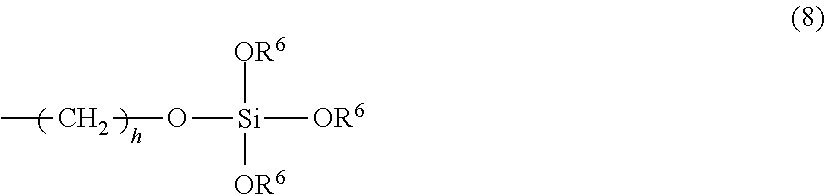
Herein R6 is hydrogen or a C1-C6 unsubstituted monovalent hydrocarbon group, examples of which are as exemplified above for X in formula (1), and h is an integer of 1 to 6, preferably 1 to 4.

- (A-1) Branched silphenylene skeleton-bearing organosilicon compound of the formula below (Shin-Etsu Chemical Co., Ltd.)
(Me3SiO0.5)4(PhSiO1.5)16Z′3(O0.5H)4 - (A-2) Branched silphenylene skeleton-bearing organosilicon compound of the formula below (Shin-Etsu Chemical Co., Ltd.)
(Me3SiO0.5)4(PhSiO1.5)16Z3(O0.5H)4 - (A-3) Branched silphenylene skeleton-bearing organosilicon compound of the formula below (Shin-Etsu Chemical Co., Ltd.)
(Me3SiO0.5)30(SiO2)45Z′5(O0.5R)6 R=H or iPr - (A-4) Branched silphenylene skeleton-bearing organosilicon compound of the formula below (Shin-Etsu Chemical Co., Ltd.)
(Me3SiO0.5)180(SiO2)180Z′40(O0.5R)60 R=H or Et - (A-5) Branched silphenylene skeleton-bearing organosilicon compound of the formula below (Shin-Etsu Chemical Co., Ltd.)
(Me3SiO0.5)30(Me2SiO)30(MeSiO1.5)190Z′20(O0.5R)50 R=H or Me - (A-6) Linear silphenylene skeleton-bearing organosilicon compound of the formula below (Shin-Etsu Chemical Co., Ltd.)
MeO0.5—Z″—O0.5Me - (A-7) Linear silphenylene skeleton-bearing organosilicon compound of the formula below (Shin-Etsu Chemical Co., Ltd.)
HO0.5-(PhMeSiO)28Z2—O0.5H - (A-8) Linear silphenylene skeleton-bearing organosilicon compound of the formula below (Shin-Etsu Chemical Co., Ltd.)
HO0.5-(PhMeSiO)28Z2—O0.5H - (A-9) Linear silphenylene skeleton-bearing organosilicon compound of the formula below (Shin-Etsu Chemical Co., Ltd.)
RO0.5-(Me2SiO)300Z′45—O0.5R R=H or Me - (A-10) Linear silphenylene skeleton-bearing organosilicon compound of the formula below (Shin-Etsu Chemical Co., Ltd.)
RO0.5-(Me2SiO)1980Z′495—O0.5R R=H or Me - (B-1) Organosilicon compound having hydrogen and alkoxy on a common silicon atom, of the formula below (Shin-Etsu Chemical Co., Ltd.)
(HSi(OEt)2O0.5)2(Ph2SiO) - (B-2) Organosilicon compound having hydrogen and alkoxy on a common silicon atom, of the formula below (Shin-Etsu Chemical Co., Ltd.)
(HSi(OMe)2O0.5)2(Me(OMe)SiO)3 - (B-3) Organosilicon compound having hydrogen and alkoxy on a common silicon atom, of the formula below (Shin-Etsu Chemical Co., Ltd.)
(HSi(OMe)2O0.5)2(Me2SiO)1980 - (B-4) Organosilicon compound having hydrogen and alkoxy on a common silicon atom, of the formula below (Shin-Etsu Chemical Co., Ltd.)
(HSi(OMe)2O0.5)4(Me3SiO0.5)4(PhSiO1.5)16 - (B-5) Organosilicon compound having hydrogen and alkoxy on a common silicon atom, of the formula below (Shin-Etsu Chemical Co., Ltd.)
(HSi(OMe)2O0.5)62(Me3SiO0.5)196(SiO2)191(O0.5Et)10 - (B-6) Organosilicon compound having hydrogen and alkoxy on a common silicon atom, of the formula below (Shin-Etsu Chemical Co., Ltd.)
(HSi(OMe)2O0.5)38(Me3SiO0.5)30(Me2SiO)30(MeSiO1.5)200(O0.5Me)22 - (C-1) Silphenylene skeleton-bearing organosilicon compound having hydrogen and alkoxy on a common silicon atom, of the formula below (Shin-Etsu Chemical Co., Ltd.)
(HSi(OMe)2O0.5)48(Me3SiO0.5)180(SiO2)180Z′40(O0.5Et)12 - (C-2) Silphenylene skeleton-bearing organosilicon compound having hydrogen and alkoxy on a common silicon atom, of the formula below (Shin-Etsu Chemical Co., Ltd.)
(HSi(OMe)2O0.5)26(Me3SiO0.5)31)(Me2SiO)30(MeSiO1.5)190Z′20(O0.5Me)24 - (C-3) Condensate of (A-1) and (B-1) synthesized as follows.
(HSi(OEt)2O0.5)6(HSi(OEt)O)8(Ph2SiO)7(Me3SiO0.5)8(PhSiO1.5)32Z′6
- (D-1) Phenyltriisopropenoxysilane of the formula below (Shin-Etsu Chemical Co., Ltd.)

- (D-2) Methyltrisbutanoximesilane of the formula below (Shin-Etsu Chemical Co., Ltd.)

- (E-1) Branched organosilicon compound of the formula below (Shin-Etsu Chemical Co., Ltd.)
(Me3SiO0.5)4(PhSiO1.5)18(O0.5H)4 - (E-2) Branched organosilicon compound of the formula below (Shin-Etsu Chemical Co., Ltd.)
(Me3SiO0.5)30(SiO2)45(O0.5H)4 R=H or iPr - (E-3) Linear organosilicon compound of the formula below (Shin-Etsu Chemical Co., Ltd.)
HO-(PhMeSiO)30—H - (E-4) Linear organosilicon compound of the formula below (Shin-Etsu Chemical Co., Ltd.)
- RO-(Me2SiO)300—R R=H or Me
- (E-5) Linear organosilicon compound of the formula below (Shin-Etsu Chemical Co., Ltd.)
RO-(Me2SiO)25000—R R=H or Me - (F) Condensation catalyst:
-
- (ethylacetoacetate titanate, Matsumoto Fine Chemical Co., Ltd., Ti content 11.2 wt %)
| TABLE 1 | |
| Amount | Example |
| (pbw) | 1 | 2 | 3 | 4 | 5 | 6 | 7 | 8 |
| (A-1) | 100 | 100 | 100 | |||||
| (A-2) | 100 | |||||||
| (A-3) | 100 | |||||||
| (A-4) | 100 | |||||||
| (A-5) | 100 | |||||||
| (A-6) | 40 | |||||||
| (A-7) | 100 | |||||||
| (A-8) | 100 | 100 | 100 | |||||
| (A-9) | 390 | 200 | 250 | |||||
| (A-10) | 5 | |||||||
| (B-1) | 10 | 10 | 10 | 5 | ||||
| (B-2) | 20 | 1.5 | ||||||
| (B-3) | 5 | |||||||
| (B-4) | 200 | |||||||
| (B-5) | 100 | |||||||
| (B-6) | ||||||||
| (C-1) | ||||||||
| (C-2) | ||||||||
| (C-3) | ||||||||
| (D-1) | 20 | |||||||
| (D-2) | ||||||||
| (E-1) | ||||||||
| (E-2) | ||||||||
| (E-3) | 100 | |||||||
| (E-4) | ||||||||
| (E-5) | ||||||||
| (F) | ||||||||
| TABLE 2 | ||
| Amount | Example | Comparative Example |
| (pbw) | 9 | 10 | 11 | 12 | 13 | 1 | 2 | 3 |
| (A-1) | ||||||||
| (A-2) | ||||||||
| (A-3) | ||||||||
| (A-4) | ||||||||
| (A-5) | 100 | |||||||
| (A-6) | ||||||||
| (A-7) | ||||||||
| (A-8) | ||||||||
| (A-9) | 250 | 200 | ||||||
| (A-10) | ||||||||
| (B-1) | 10 | |||||||
| (B-2) | 1.5 | 20 | ||||||
| (B-3) | ||||||||
| (B-4) | ||||||||
| (B-5) | ||||||||
| (B-6) | 100 | |||||||
| (C-1) | 100 | |||||||
| (C-2) | 100 | |||||||
| (C-3) | 100 | |||||||
| (D-1) | ||||||||
| (D-2) | 5 | |||||||
| (E-1) | 100 | 100 | ||||||
| (E-2) | 100 | |||||||
| (E-3) | 100 | 100 | 100 | |||||
| (E-4) | 250 | 250 | 390 | |||||
| (E-5) | 5 | |||||||
| (F) | 0.1 | 0.1 | ||||||
| TABLE 3 | ||
| Example | ||
| Test results | 1 | 2 | 3 | 4 | 5 | 6 | 7 | 8 |
| Viscosity, 23° C. (Pa · s) | 4.8 | 2.8 | 4.4 | 9.6 | 4.8 | 3.3 | 14.6 | 5.3 |
| Hardness | Shore D | 32 | 34 | 30 | 54 | 27 | — | — | — |
| Type A | — | — | — | — | — | 38 | 90 | 72 |
| Tensile strength, 25° C. (MPa) | 3.8 | 4 | 3.4 | 7.5 | 3.1 | 3 | 10.4 | 6.9 |
| Elongation at break, 25° C. (%) | 130 | 120 | 150 | 80 | 160 | 190 | 80 | 160 |
TCT, −55° C.  |
0/20 | 0/20 | 0/20 | 0/20 | 0/20 | 0/20 | 0/20 | 0/20 |
| (number of cracked samples) |
| Light | Heat | T after 180° C./ | 1 mm | 99.8 | 99.7 | 99.7 | 99.6 | 99.8 | 99.6 | 99.7 | 99.8 |
| transmittance | resistance | 1,000 hr heating | thick, | 99.7 | 99.7 | 99.7 | 99.6 | 99.7 | 99.6 | 99.6 | 99.8 |
| (T) | test | 450 nm | |||||||||
| Light | Relative T after 100° C./ | 1 mm | 99.5 | 99.4 | 99.5 | 99.4 | 99.4 | 99.5 | 99.6 | 99.7 | |
| resistance | 1,000 hr exposure | thick, | |||||||||
| test | (initial T = 100%) | 440 nm | |||||||||
| TABLE 4 | |||
| Comparative | |||
| Example | Example | ||
| Test results | 9 | 10 | 11 | 12 | 13 | 1 | 2 | 3 |
| Viscosity, 23° C. (Pa · s) | 5 | 4.8 | 11.2 | 2.0 | 8.1 | 3.6 | 2.8 | 2.9 |
| Hardness | Shore D | — | — | — | — | 31 | 21 | 22 | — |
| Type A | 75 | 84 | 72 | 66 | — | — | — | 22 |
| Tensile strength, 25° C. (MPa) | 7.4 | 8.7 | 6.8 | 5.6 | 3.1 | 1.8 | 1.9 | 1.4 |
| Elongation at break, 25° C. (%) | 130 | 100 | 130 | 140 | 120 | 90 | 80 | 150 |
| TCT, −55° C. |
0/20 | 0/20 | 0/20 | 0/20 | 0/20 | 20/20 | 18/20 | 20/20 |
| (number of cracked samples) |
| Light | Heat | T after 180° C./ | 1 mm | 99.7 | 99.7 | 99.6 | 99.7 | 99.8 | 99.7 | 99.6 | 99.8 |
| transmittance | resistance | 1,000 hr heating | thick, | 99.7 | 99.6 | 99.6 | 99.7 | 99.7 | 93.3 | 99.3 | 96.4 |
| (T) | test | 450 nm | |||||||||
| Light | Relative T after 100° C./ | 1 mm | 99.6 | 99.6 | 99.5 | 99.7 | 99.4 | 89.3 | 99.5 | 92.1 | |
| resistance | 1,000 hr exposure | thick, | |||||||||
| test | (initial T = 100%) | 440 nm | |||||||||
Claims (5)
(R1 3SiO0.5)a(R1 2SiO)b(R2SiO1.5)c(SiO2)dZe(O0.5X)f (1)

(R1 3SiO0.5)a′(R4 2SiO)b′(R2SiO1.5)c′(SiO2)d′Ze′(O0.5X)f′(R1 kHSi(OX)2-kO0.5)g′ (3)
(R1 3SiO0.5)a″(R4 2SiO)b″(R2SiO1.5)c″(SiO2)d″Ze″(O0.5X)f″ (4)

(R1 3SiO0.5)a′″(R1 2SiO)b′″(R2SiO1.5)c′″(SiO2)d′″(O0.5X)f′″ (6)
Applications Claiming Priority (2)
| Application Number | Priority Date | Filing Date | Title |
|---|---|---|---|
| JP2016087163A JP6672991B2 (en) | 2016-04-25 | 2016-04-25 | Condensation curable resin composition and semiconductor device |
| JP2016-087163 | 2016-04-25 |
Publications (2)
| Publication Number | Publication Date |
|---|---|
| US20170306098A1 US20170306098A1 (en) | 2017-10-26 |
| US10179840B2 true US10179840B2 (en) | 2019-01-15 |
Family
ID=58644829
Family Applications (1)
| Application Number | Title | Priority Date | Filing Date |
|---|---|---|---|
| US15/495,221 Active 2037-07-27 US10179840B2 (en) | 2016-04-25 | 2017-04-24 | Condensation curable resin composition and semiconductor package |
Country Status (3)
| Country | Link |
|---|---|
| US (1) | US10179840B2 (en) |
| EP (1) | EP3239247B1 (en) |
| JP (1) | JP6672991B2 (en) |
Families Citing this family (2)
| Publication number | Priority date | Publication date | Assignee | Title |
|---|---|---|---|---|
| US10800920B2 (en) * | 2017-12-18 | 2020-10-13 | Shin-Etsu Chemical Co., Ltd. | Curable organopolysiloxane composition |
| JP6990164B2 (en) * | 2017-12-18 | 2022-01-12 | 信越化学工業株式会社 | Curable organopolysiloxane composition |
Citations (13)
| Publication number | Priority date | Publication date | Assignee | Title |
|---|---|---|---|---|
| US4463118A (en) * | 1981-07-16 | 1984-07-31 | General Electric Company | Oil extended silicone elastomer composition |
| EP1074574A1 (en) | 1999-08-06 | 2001-02-07 | Dow Corning Corporation | Condensation reaction curable silesquioxane resin composition and methods for the synthesis and cure thereof |
| JP2005133073A (en) | 2003-10-10 | 2005-05-26 | Shin Etsu Chem Co Ltd | Curable composition |
| US7176270B2 (en) | 2003-10-10 | 2007-02-13 | Shin-Etsu Chemical Co., Ltd. | Curable composition |
| EP1780242A2 (en) | 2005-10-27 | 2007-05-02 | Shin-Etsu Chemical Co., Ltd. | Resin composition for sealing optical device and method of sealing semiconductor element |
| JP4788837B2 (en) | 2010-01-26 | 2011-10-05 | 横浜ゴム株式会社 | Silicone resin composition and method for using the same, silicone resin, silicone resin-containing structure, and optical semiconductor element sealing body |
| JP2011219729A (en) | 2010-03-23 | 2011-11-04 | Yokohama Rubber Co Ltd:The | Heat-curable silicone resin composition and sealed optical semiconductor using the same |
| US20110278640A1 (en) * | 2010-05-12 | 2011-11-17 | Shahrokh Motallebi | Resin composition and transparent encapsulant formed using the same, and electronic device including the encapsulant |
| JP2012111850A (en) | 2010-11-25 | 2012-06-14 | Yokohama Rubber Co Ltd:The | Silicone resin composition, and structure containing silicone resin obtained using the same and sealed optical semiconductor element |
| JP2012251058A (en) | 2011-06-01 | 2012-12-20 | Yokohama Rubber Co Ltd:The | Thermally curable silicone resin composition |
| US20140051806A1 (en) * | 2012-08-20 | 2014-02-20 | Shin-Etsu Chemical Co., Ltd. | Addition curable self-adhesive silicone rubber composition |
| US20140213809A1 (en) * | 2013-01-29 | 2014-07-31 | Shin-Etsu Chemical Co., Ltd. | Method for preparing a polyorganosiloxane and a polyorganosiloxane |
| US20160266490A1 (en) * | 2013-10-21 | 2016-09-15 | Az Electronic Materials (Luxembourg) S.A.R.L. | Silicon-containing heat- or photo-curable composition |
Family Cites Families (6)
| Publication number | Priority date | Publication date | Assignee | Title |
|---|---|---|---|---|
| DE4118598A1 (en) * | 1991-06-06 | 1992-12-10 | Wacker Chemie Gmbh | COATING ALCOHOLS TO ELASTOMER NETWORKING ORGANO (POLY) SILOXANIC MASSES |
| WO2009119841A1 (en) * | 2008-03-28 | 2009-10-01 | 三菱化学株式会社 | Curable polysiloxane composition, and polysiloxane cured product, optical member, member for aerospace industry, semiconductor light emitting device, lighting system, and image display device using the curable polysiloxane composition |
| JP6254833B2 (en) * | 2013-11-25 | 2017-12-27 | 信越化学工業株式会社 | Silicone resin composition and optical semiconductor device |
| JP6587632B2 (en) * | 2014-03-31 | 2019-10-09 | オスラム オプト セミコンダクターズ ゲゼルシャフト ミット ベシュレンクテル ハフツングOsram Opto Semiconductors GmbH | Wavelength conversion composition, wavelength converter and device including the same |
| JP6385248B2 (en) | 2014-11-06 | 2018-09-05 | 株式会社三共 | Game machine |
| JP6561871B2 (en) * | 2015-12-22 | 2019-08-21 | 信越化学工業株式会社 | Condensation curable resin composition and semiconductor device |
-
2016
- 2016-04-25 JP JP2016087163A patent/JP6672991B2/en active Active
-
2017
- 2017-04-19 EP EP17166980.7A patent/EP3239247B1/en active Active
- 2017-04-24 US US15/495,221 patent/US10179840B2/en active Active
Patent Citations (17)
| Publication number | Priority date | Publication date | Assignee | Title |
|---|---|---|---|---|
| US4463118A (en) * | 1981-07-16 | 1984-07-31 | General Electric Company | Oil extended silicone elastomer composition |
| EP1074574A1 (en) | 1999-08-06 | 2001-02-07 | Dow Corning Corporation | Condensation reaction curable silesquioxane resin composition and methods for the synthesis and cure thereof |
| JP2001064393A (en) | 1999-08-06 | 2001-03-13 | Dow Corning Corp | Condensation reaction-curable silsesquioxane resin composition, and its synthesis and curing method |
| US6368535B1 (en) | 1999-08-06 | 2002-04-09 | Dow Corning Corporation | Condensation reaction curable silsesquioxane resin composition and methods for the synthesis and cure thereof |
| JP2005133073A (en) | 2003-10-10 | 2005-05-26 | Shin Etsu Chem Co Ltd | Curable composition |
| US7176270B2 (en) | 2003-10-10 | 2007-02-13 | Shin-Etsu Chemical Co., Ltd. | Curable composition |
| EP1780242A2 (en) | 2005-10-27 | 2007-05-02 | Shin-Etsu Chemical Co., Ltd. | Resin composition for sealing optical device and method of sealing semiconductor element |
| US7550204B2 (en) | 2005-10-27 | 2009-06-23 | Shin-Etsu Chemical Co., Ltd. | Resin composition for sealing optical device, cured product thereof, and method of sealing semiconductor element |
| JP4781780B2 (en) | 2005-10-27 | 2011-09-28 | 信越化学工業株式会社 | Resin composition for sealing light-related device, cured product thereof and method for sealing semiconductor element |
| JP4788837B2 (en) | 2010-01-26 | 2011-10-05 | 横浜ゴム株式会社 | Silicone resin composition and method for using the same, silicone resin, silicone resin-containing structure, and optical semiconductor element sealing body |
| JP2011219729A (en) | 2010-03-23 | 2011-11-04 | Yokohama Rubber Co Ltd:The | Heat-curable silicone resin composition and sealed optical semiconductor using the same |
| US20110278640A1 (en) * | 2010-05-12 | 2011-11-17 | Shahrokh Motallebi | Resin composition and transparent encapsulant formed using the same, and electronic device including the encapsulant |
| JP2012111850A (en) | 2010-11-25 | 2012-06-14 | Yokohama Rubber Co Ltd:The | Silicone resin composition, and structure containing silicone resin obtained using the same and sealed optical semiconductor element |
| JP2012251058A (en) | 2011-06-01 | 2012-12-20 | Yokohama Rubber Co Ltd:The | Thermally curable silicone resin composition |
| US20140051806A1 (en) * | 2012-08-20 | 2014-02-20 | Shin-Etsu Chemical Co., Ltd. | Addition curable self-adhesive silicone rubber composition |
| US20140213809A1 (en) * | 2013-01-29 | 2014-07-31 | Shin-Etsu Chemical Co., Ltd. | Method for preparing a polyorganosiloxane and a polyorganosiloxane |
| US20160266490A1 (en) * | 2013-10-21 | 2016-09-15 | Az Electronic Materials (Luxembourg) S.A.R.L. | Silicon-containing heat- or photo-curable composition |
Also Published As
| Publication number | Publication date |
|---|---|
| EP3239247B1 (en) | 2018-07-18 |
| US20170306098A1 (en) | 2017-10-26 |
| JP6672991B2 (en) | 2020-03-25 |
| EP3239247A1 (en) | 2017-11-01 |
| JP2017197601A (en) | 2017-11-02 |
Similar Documents
| Publication | Publication Date | Title |
|---|---|---|
| US9147818B2 (en) | Wavelength conversion sheet filled with large amount of phosphor, method of producing light emitting semiconductor device using the sheet, and light emitting semiconductor device | |
| US8710158B2 (en) | Epoxy composition for encapsulating an optical semiconductor element | |
| EP1873211B1 (en) | Phosphor-filled curable silicone resin composition and cured product thereof | |
| JP5305452B2 (en) | Resin composition for optical semiconductor element sealing | |
| US9890251B2 (en) | Hydrosilyl-containing organopolysiloxane, making method, addition curable silicone composition, and semiconductor package | |
| US20130183776A1 (en) | Uv-curable adhesive silicone composition, uv-curable adhesive silicone composition sheet, optical semiconductor apparatus and method for manufacturing the same | |
| US9859474B2 (en) | Addition curable organopolysiloxane composition, and semiconductor package | |
| JP5548322B1 (en) | Silicone resin composition, cured silicone resin, and sealed optical semiconductor element | |
| US10696794B2 (en) | Addition-curable silicone resin composition and a semiconductor device | |
| TW201803913A (en) | Addition-curable silicone resin composition | |
| EP3239247B1 (en) | Condensation curable resin composition and semiconductor package | |
| KR20140103696A (en) | Phosphor-containing curable silicone composition and curable hotmelt film made therefrom | |
| US9751989B2 (en) | Condensation curable resin composition and semiconductor package | |
| US10259911B2 (en) | Addition curable resin composition and semiconductor package | |
| US20150158981A1 (en) | Curable composition and an optical semiconductor device | |
| US10604654B2 (en) | Curable resin composition | |
| JP6561871B2 (en) | Condensation curable resin composition and semiconductor device |
Legal Events
| Date | Code | Title | Description |
|---|---|---|---|
| AS | Assignment |
Owner name: SHIN-ETSU CHEMICAL CO., LTD., JAPAN Free format text: ASSIGNMENT OF ASSIGNORS INTEREST;ASSIGNORS:KUSUNOKI, TAKAYUKI;TAKAMIZAWA, YUUSUKE;REEL/FRAME:042138/0376 Effective date: 20170307 |
|
| STCF | Information on status: patent grant |
Free format text: PATENTED CASE |
|
| MAFP | Maintenance fee payment |
Free format text: PAYMENT OF MAINTENANCE FEE, 4TH YEAR, LARGE ENTITY (ORIGINAL EVENT CODE: M1551); ENTITY STATUS OF PATENT OWNER: LARGE ENTITY Year of fee payment: 4 |
|
| MAFP | Maintenance fee payment |
Free format text: PAYMENT OF MAINTENANCE FEE, 8TH YEAR, LARGE ENTITY (ORIGINAL EVENT CODE: M1552); ENTITY STATUS OF PATENT OWNER: LARGE ENTITY Year of fee payment: 8 |