RU2755533C1 - Method for producing grain bases from golozerny oats - Google Patents
Method for producing grain bases from golozerny oats Download PDFInfo
- Publication number
- RU2755533C1 RU2755533C1 RU2020140748A RU2020140748A RU2755533C1 RU 2755533 C1 RU2755533 C1 RU 2755533C1 RU 2020140748 A RU2020140748 A RU 2020140748A RU 2020140748 A RU2020140748 A RU 2020140748A RU 2755533 C1 RU2755533 C1 RU 2755533C1
- Authority
- RU
- Russia
- Prior art keywords
- grain
- product
- oats
- functional value
- crushed
- Prior art date
Links
Classifications
-
- A—HUMAN NECESSITIES
- A23—FOODS OR FOODSTUFFS; TREATMENT THEREOF, NOT COVERED BY OTHER CLASSES
- A23L—FOODS, FOODSTUFFS, OR NON-ALCOHOLIC BEVERAGES, NOT COVERED BY SUBCLASSES A21D OR A23B-A23J; THEIR PREPARATION OR TREATMENT, e.g. COOKING, MODIFICATION OF NUTRITIVE QUALITIES, PHYSICAL TREATMENT; PRESERVATION OF FOODS OR FOODSTUFFS, IN GENERAL
- A23L33/00—Modifying nutritive qualities of foods; Dietetic products; Preparation or treatment thereof
-
- A—HUMAN NECESSITIES
- A23—FOODS OR FOODSTUFFS; TREATMENT THEREOF, NOT COVERED BY OTHER CLASSES
- A23L—FOODS, FOODSTUFFS, OR NON-ALCOHOLIC BEVERAGES, NOT COVERED BY SUBCLASSES A21D OR A23B-A23J; THEIR PREPARATION OR TREATMENT, e.g. COOKING, MODIFICATION OF NUTRITIVE QUALITIES, PHYSICAL TREATMENT; PRESERVATION OF FOODS OR FOODSTUFFS, IN GENERAL
- A23L7/00—Cereal-derived products; Malt products; Preparation or treatment thereof
- A23L7/10—Cereal-derived products
Abstract
Description
Изобретение относится к пищевой промышленности и может быть использовано для получения функциональных продуктов питания.The invention relates to the food industry and can be used to obtain functional food products.
Существует множество способов производства зерновых продуктов, заключающихся в приготовлении смеси, содержащей зерновую основу и композицию лекарственных растений. В качестве зерновой основы используют зерна пшеницы, ячменя, овса или риса. Вышеупомянутые зерна подвергают термообработке и измельчают [1] либо измельчают и подвергают термообработке [2]. Далее зерновую основу смешивают с композицией лекарственных растений. Эти способы являются прототипами изобретения.There are many methods for the production of cereal products, consisting in the preparation of a mixture containing a cereal base and a composition of medicinal plants. Wheat, barley, oats or rice grains are used as the grain base. The aforementioned grains are heat-treated and crushed [1] or crushed and heat-treated [2]. Next, the grain base is mixed with the herbal composition. These methods are prototypes of the invention.
К достоинству способов относится то, что они позволяют получить зерновые продукты с выраженными профилактическими и диетическими свойствами, к недостаткам способов следует отнести присутствие в конечном продукте жестких наружных пленок зерна, которые представляют собой целлюлозную массу, не обладающая питательными свойствами, а также необходимость использования нескольких видов лекарственных растений (курильский чай, крапива, тимьян, боярышник).The advantages of the methods include the fact that they allow obtaining cereal products with pronounced preventive and dietary properties; the disadvantages of the methods include the presence in the final product of hard outer films of grain, which are cellulose mass that does not have nutritional properties, as well as the need to use several types medicinal plants (Kuril tea, nettle, thyme, hawthorn).
Наиболее близким к заявленному является способ производства молочно-белковой пасты с использованием продукта переработки ячменя «талган» [3]. Процесс приготовления зерновой основы в данном изобретении заключается в обжаривании и измельчении пленчатого зерна ячменя. К недостаткам данного способа можно отнести низкий выход готового продукта, связанный с высоким процентом оболочек у зерна ячменя и более длительные временные затраты на обжаривание. Кроме того, зерно голозерного овса, в сравнении с пленчатыми культурами, обладает более высокими питательными (содержание белка, жира, минеральных веществ), а также функциональными (содержание антиоксидантов, бета-глюканов [4]) свойствами.The closest to the claimed is a method for the production of milk-protein paste using a barley processing product "talgan" [3]. The process of preparing the grain base in the present invention consists in roasting and grinding the hulled barley grain. The disadvantages of this method include a low yield of the finished product associated with a high percentage of casings in barley grain and a longer time spent on roasting. In addition, the grain of naked oats, in comparison with hulled crops, has higher nutritional (protein, fat, minerals) and functional (antioxidant, beta-glucans [4]) properties.
Задачей, на решение которой направлено заявляемое изобретение является получение зернового продукта, обладающего повышенными питательными и функциональными свойствами, а также упрощение способа его производства.The problem to be solved by the claimed invention is to obtain a grain product with increased nutritional and functional properties, as well as to simplify the method of its production.
Данная задача решается за счет того, что заявленный способ производства зерновых продуктов, включающий использование сухой зерновой основы, ее измельчение и термообработку, отличающийся тем, что в качестве зерновой основы используют зерно голозерного овса, обладающего высокими питательными и функциональными свойствами.This problem is solved due to the fact that the claimed method for the production of grain products, including the use of dry grain base, its grinding and heat treatment, characterized in that as the grain base is used grain of naked oats, which has high nutritional and functional properties.
При этом достигается технический результат, заключающийся в повышении эффективности технологического процесса на 20%, экономии энергетических ресурсов за счет сокращения времени нагрева с 5 до 3 минут, снижении количества отходов в процессе изготовления. Полученный продукт на основе зерна овса обладает высокой питательной и функциональной ценностью, в готовой к усвоению организмом человека форме.At the same time, the technical result is achieved, which consists in increasing the efficiency of the technological process by 20%, saving energy resources by reducing the heating time from 5 to 3 minutes, and reducing the amount of waste in the manufacturing process. The resulting product based on oat grain has a high nutritional and functional value, in a form ready for assimilation by the human body.
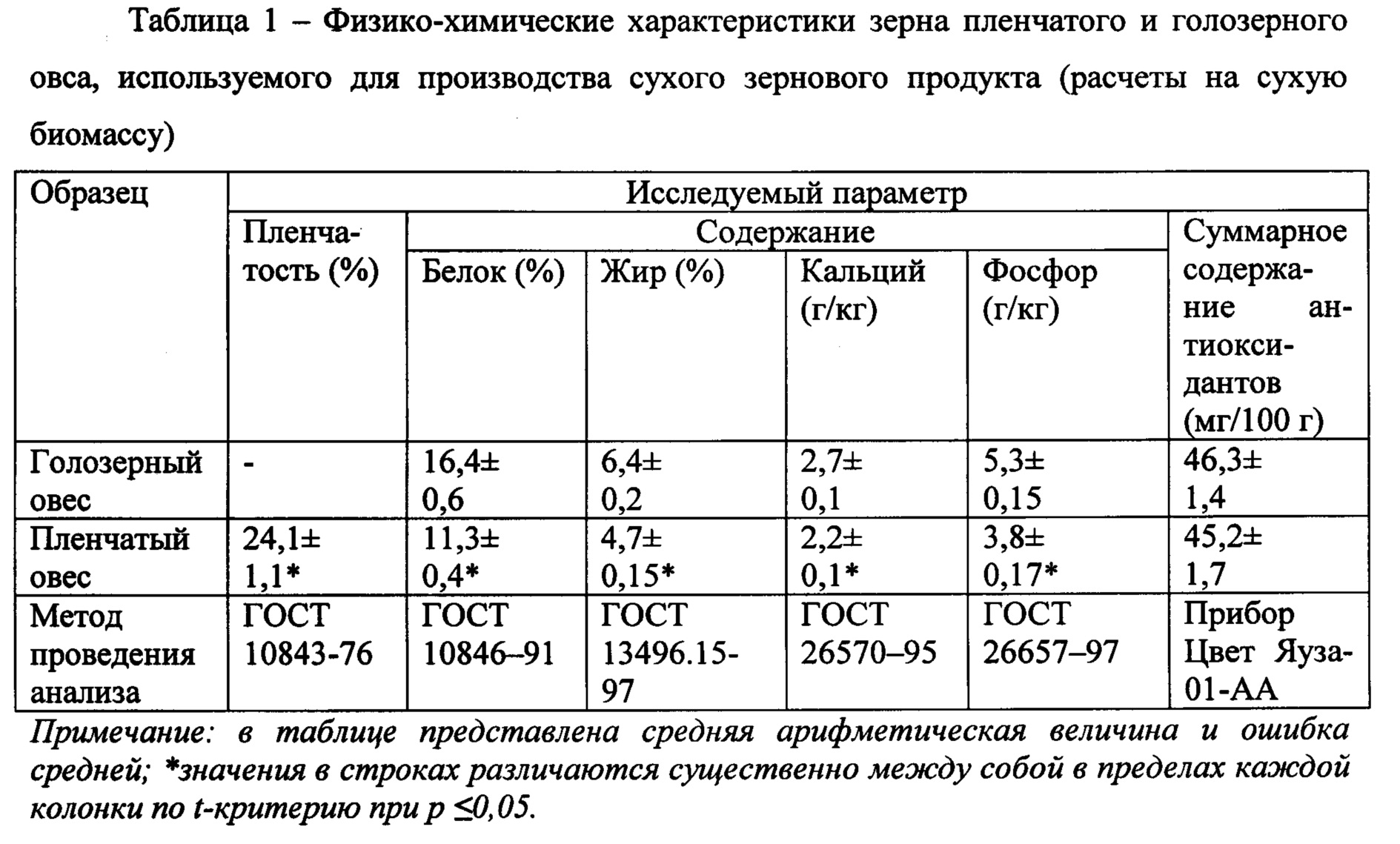
Пример 1. В лабораторных условиях проводили сравнительный анализ физико-химических показателей исходного зернового сырья для получения овсяного функционального продукта. Для этого использовали образцы пленчатого (по прототипу) и голозерного (по предлагаемому способу) овса, выращенные на территории Бейского района Республики Хакасия (табл. 1). Анализы выполнены в трех повторностях.Example 1. In laboratory conditions, a comparative analysis of the physicochemical parameters of the initial grain raw material was carried out to obtain an oat functional product. For this, we used samples of filmy (according to the prototype) and naked (according to the proposed method) oats grown on the territory of the Beysky district of the Republic of Khakassia (Table 1). The analyzes were performed in triplicate.
В результате выполненных анализов было выявлено, что растительное сырье из голозерного зерна овса имеет существенно более высокие показатели по всем параметрам. Превышение по содержанию белка, жира, кальция и фосфора составляет соответственно на: 45, 36, 23, 40%. С позиций пищевой ценности и функциональности полученные данные однозначно позволяют говорить о более полноценном составе зерна голозерного овса.As a result of the performed analyzes, it was revealed that the vegetable raw material from the naked grain of oats has significantly higher indicators in all parameters. The excess in the content of protein, fat, calcium and phosphorus is respectively: 45, 36, 23, 40%. From the standpoint of nutritional value and functionality, the data obtained unambiguously allow us to speak about a more complete composition of the grain of naked oats.
Пример 2. На основе растительного сырья, описанного в Примере 1, изготавливали пищевой продукт с помощью двух вариантов технологий, отличающихся последовательностью выполнения этапов (соответственно технология №1 и №2, характерные для прототипов [1] и [2]). В первом случае очищенное от посторонних примесей сухое зерно овса сначала обжаривали, а затем измельчали. Во втором случае -зерно овса измельчали, а потом обжаривали.Example 2. On the basis of the plant raw materials described in Example 1, a food product was made using two versions of technologies, differing in the sequence of stages (respectively, technology No. 1 and No. 2, characteristic of prototypes [1] and [2]). In the first case, the dry grain of oats, cleaned from foreign impurities, was first roasted and then crushed. In the second case, oat grains were crushed and then fried.
Зерно овса подвергалось термической обработке на протяжении 5 минут при температуре 240°С, до золотистого (светло-коричневого) цвета и характерного запаха жареного зерна. Затем обжаренные зерна измельчали в вальцовом станке до размера частиц в пределах 0,25-0,5 мм. Данный алгоритм действий отражает технологическую последовательность №1.Oat grains were heat treated for 5 minutes at a temperature of 240 ° C until golden (light brown) color and a characteristic roasted grain odor. Then the fried grains were ground in a roller mill to a particle size in the range of 0.25-0.5 mm. This algorithm of actions reflects the technological sequence No. 1.
Второй вариант изготовления зернового продукта проходил в иной последовательности: чистое сухое зерно сначала измельчали, а затем обжаривали в течение трех минут при температуре 240°С до появления указанного выше цвета и запаха. Продолжительность термической обработки в технологической последовательности №2 была заметно сокращена и соответствовала таковой в прототипе [2]. Полученные зерновые овсяные продукты, изготовленные по двум технологиям, оценивали на основании трех физико-химических показателей. Результаты представлены в таблице 2.The second variant of the production of the grain product took place in a different sequence: clean dry grain was first crushed and then fried for three minutes at a temperature of 240 ° C until the above color and smell appeared. The duration of heat treatment in the technological sequence No. 2 was significantly reduced and corresponded to that in the prototype [2]. The obtained cereal oat products, made using two technologies, were evaluated on the basis of three physical and chemical indicators. The results are shown in Table 2.
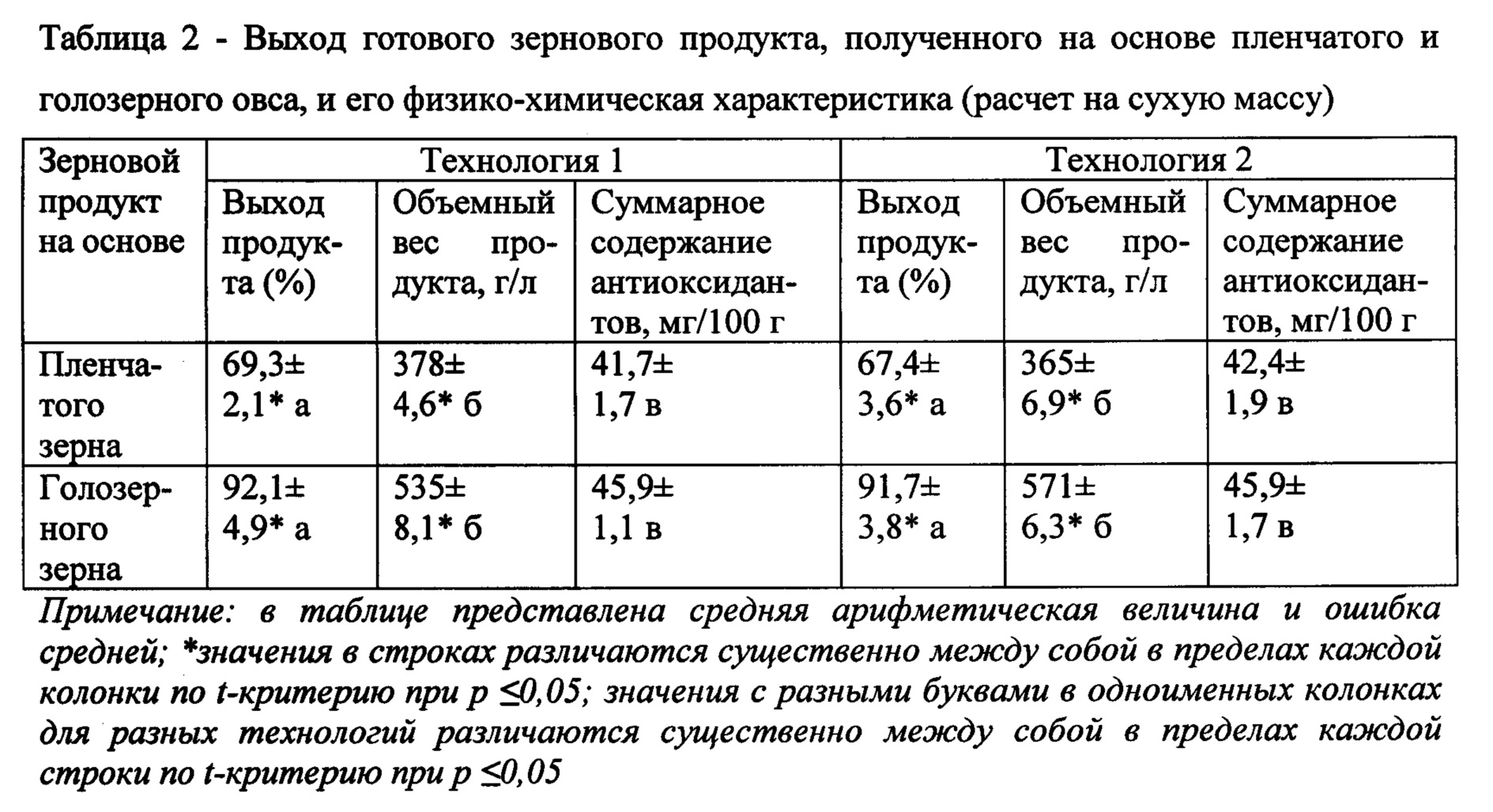
Можно видеть существенные различия в массовых показателях зернового продукта между пленчатой и голозерной формами овса. При этом технология не оказывает влияние на данные показатели. Установлено, что более высокие значения объемного веса продукта, полученного на основе голозерного сырья, говорит о включении в большей степени эндосперма в случае с голозерным овсом, и отрубей при использовании пленчатой формы овса.You can see significant differences in the mass indicators of the grain product between the hulled and hulless forms of oats. At the same time, the technology does not affect these indicators. It was found that higher values of the bulk density of the product obtained on the basis of naked raw materials indicate the inclusion of a greater degree of endosperm in the case of naked oats, and bran when using the hulled form of oats.
Основываясь на полученной информации, можно заключить, что использовать сырье из голозерного овса для приготовления зернового продукта гораздо выгоднее по сравнению с пленчатым. Подчеркнем, что за счет снижения количества отходов (наружных пленок зерна) при изготовлении зернового продукта экономическая эффективность процесса увеличивается более чем на 20%.Based on the information received, we can conclude that using raw oats from naked oats for the preparation of a grain product is much more profitable compared to hulled oats. We emphasize that by reducing the amount of waste (outer films of grain) in the manufacture of a grain product, the economic efficiency of the process increases by more than 20%.
При изучении функциональных свойств (суммарного содержания антиоксидантов) овсяного продукта, было установлено, что по данному биохимическому критерию, продукт, полученный на основе голозерного овса, незначительно превосходит таковой из пленчатого.When studying the functional properties (the total content of antioxidants) of the oat product, it was found that, according to this biochemical criterion, the product obtained on the basis of naked oats is slightly superior to that of the membranous one.
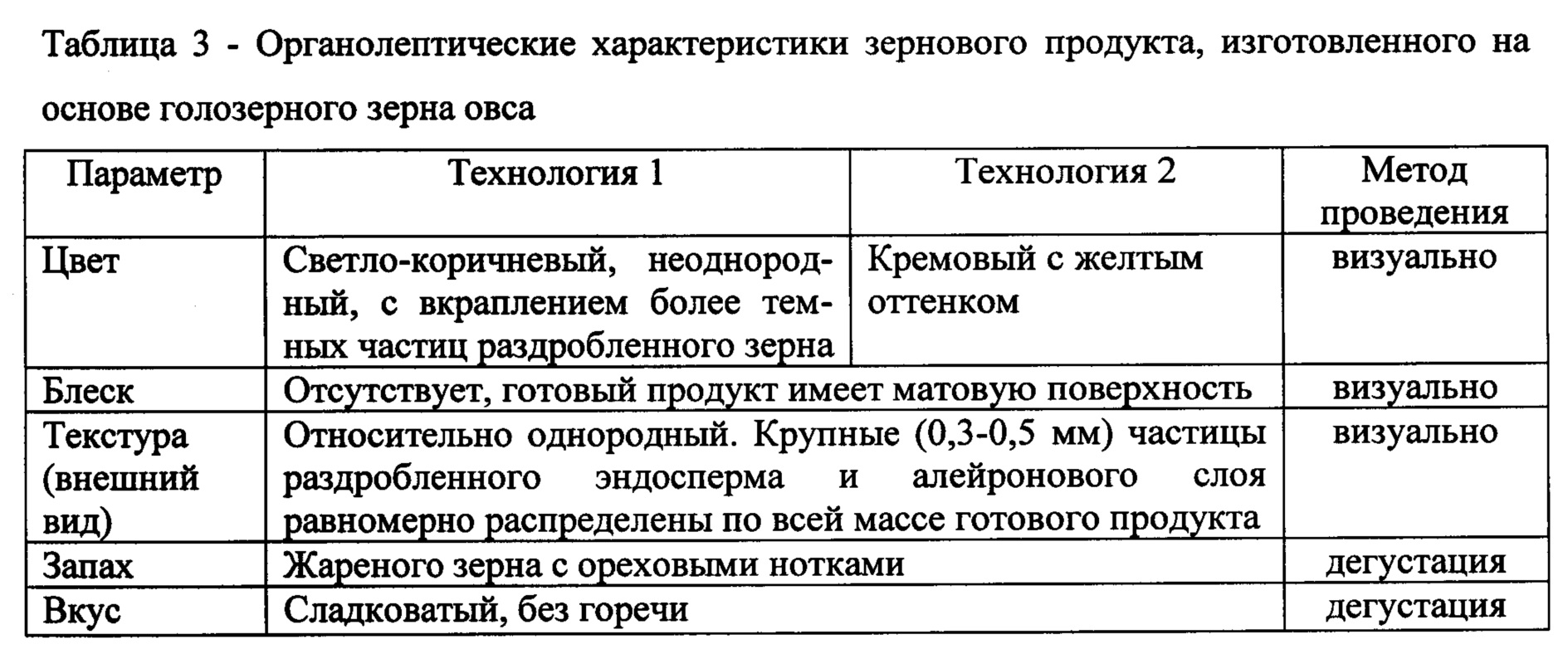
Пример 3. Для сравнения параметров зернового продукта, изготовленного по двум разным технологиям, на основе голозерного зерна овса были выполнены определения ряда органолептических характеристик, данные о которых представлены в табл. 3. Можно видеть, что существенных отличий по органолептическим показателям в зерновом продукте из голозерного овса, изготовленном по технологиям 1 и 2, не было выявлено. Исключение составил параметр цвет продукта, который был неоднородным с вкраплением более темных частиц раздробленного зерна. Полученные результаты свидетельствует о потенциальной возможности использовать для изготовления зернового продукта обе технологии. Все же на основании цвета продукта (табл. 3) и экономии энергетических ресурсов за счет сокращения времени нагрева с 5 до 3 минут предпочтение отдается технологии 2.Example 3. To compare the parameters of a cereal product made using two different technologies, based on naked oat grain, a number of organoleptic characteristics were determined, the data on which are presented in table. 3. It can be seen that there were no significant differences in organoleptic characteristics in the grain product from naked oats, made according to technologies 1 and 2. The exception was the parameter color of the product, which was inhomogeneous with interspersed darker particles of crushed grain. The results obtained indicate the potential for using both technologies for the manufacture of a grain product. However, based on the color of the product (Table 3) and saving energy resources by reducing the heating time from 5 to 3 minutes, technology 2 is preferred.
Традиционно способы изготовления аналогичных зерновых продуктов основаны на более распространенном пленчатом сырье, таком как ячмень или пшеница.Traditionally, methods for making similar cereal products have relied on more common hulled raw materials such as barley or wheat.
Исходя из результатов проведенного исследования, предлагается способ изготовления зернового продукта из голозерного овса, преимуществом которого являются следующие параметры: снижение количества отходов в процессе изготовления, более высокие питательные и функциональные качества продукта. Продукт, изготовленный по предлагаемому способу, может быть дополнительно обогащен лекарственными растениями: высушенными листьями, фруктами, ягодами. Предлагаемый способ решает задачу получения сухого зернового питательного функционального компонента на основе зерна голозерного овса, обладающего более выраженными лечебно-профилактическими свойствами и доступного для всех возрастных категорий и слоев потребителей. Полученный продукт на основе зерна овса обладает высокой питательной и функциональной ценностью, в готовой к усвоению организмом человека форме, и имеет длительный срок хранения и невысокую стоимость.Based on the results of the study, a method for making a grain product from naked oats is proposed, the advantage of which is the following parameters: a decrease in the amount of waste in the manufacturing process, and higher nutritional and functional qualities of the product. The product made by the proposed method can be additionally enriched with medicinal plants: dried leaves, fruits, berries. The proposed method solves the problem of obtaining a dry grain nutritional functional component based on the grain of naked oats, which has more pronounced therapeutic and prophylactic properties and is available for all age categories and strata of consumers. The resulting product based on oat grain has a high nutritional and functional value, in a form ready for assimilation by the human body, and has a long shelf life and low cost.
ЛитератураLiterature
1. RU №2156084,20.09.2000. Способ обогащения сухой питательной смеси1. RU No. 2156084,20.09.2000. Method for enrichment of dry nutritional mixture
2. RU №2 624 964, 11.07.2017. Способ производства сухих зерновых продуктов.2. RU No. 2 624 964, 11.07.2017. Method for the production of dry grain products.
3. RU 2 238 655 С2, 27.10.2004. Способ производства молочно-белковой пасты.3. RU 2 238 655 С2, 27.10.2004. Method for the production of milk-protein paste.
4. Герасимов С.А., Полонский В.И., Сумина А.В. и др. Влияние генотипа и условий выращивания овса на содержание биологически активных компонентов в зерне / Химия растительного сырья. - 2020. - №2. -С.65-71.4. Gerasimov S.A., Polonsky V.I., Sumina A.V. et al. Influence of the genotype and growing conditions of oats on the content of biologically active components in grain / Chemistry of plant raw materials. - 2020. - No. 2. -S.65-71.
Claims (1)
Priority Applications (1)
| Application Number | Priority Date | Filing Date | Title |
|---|---|---|---|
| RU2020140748A RU2755533C1 (en) | 2020-12-09 | 2020-12-09 | Method for producing grain bases from golozerny oats |
Applications Claiming Priority (1)
| Application Number | Priority Date | Filing Date | Title |
|---|---|---|---|
| RU2020140748A RU2755533C1 (en) | 2020-12-09 | 2020-12-09 | Method for producing grain bases from golozerny oats |
Publications (1)
| Publication Number | Publication Date |
|---|---|
| RU2755533C1 true RU2755533C1 (en) | 2021-09-17 |
Family
ID=77745532
Family Applications (1)
| Application Number | Title | Priority Date | Filing Date |
|---|---|---|---|
| RU2020140748A RU2755533C1 (en) | 2020-12-09 | 2020-12-09 | Method for producing grain bases from golozerny oats |
Country Status (1)
| Country | Link |
|---|---|
| RU (1) | RU2755533C1 (en) |
Citations (5)
| Publication number | Priority date | Publication date | Assignee | Title |
|---|---|---|---|---|
| CN1086393A (en) * | 1992-11-02 | 1994-05-11 | 兰州工业资源技术研究所 | Naked oats powder with rich vitamins |
| RU2238655C2 (en) * | 2002-03-29 | 2004-10-27 | Кемеровский технологический институт пищевой промышленности | Method for manufacturing milk-protein paste |
| RU2334407C1 (en) * | 2007-06-21 | 2008-09-27 | Виктор Александрович Деревянко | Method of biological active item production |
| RU2624964C1 (en) * | 2016-04-21 | 2017-07-11 | Федеральное государственное бюджетное образовательное учреждение высшего образования "Кемеровский технологический институт пищевой промышленности (университет)" | Method of producing dry grain products |
| CN104489472B (en) * | 2014-12-05 | 2017-08-04 | 山西省农业科学院高粱研究所 | It is a kind of to be used to improve indigestion, the food of diarrhoea |
-
2020
- 2020-12-09 RU RU2020140748A patent/RU2755533C1/en active
Patent Citations (5)
| Publication number | Priority date | Publication date | Assignee | Title |
|---|---|---|---|---|
| CN1086393A (en) * | 1992-11-02 | 1994-05-11 | 兰州工业资源技术研究所 | Naked oats powder with rich vitamins |
| RU2238655C2 (en) * | 2002-03-29 | 2004-10-27 | Кемеровский технологический институт пищевой промышленности | Method for manufacturing milk-protein paste |
| RU2334407C1 (en) * | 2007-06-21 | 2008-09-27 | Виктор Александрович Деревянко | Method of biological active item production |
| CN104489472B (en) * | 2014-12-05 | 2017-08-04 | 山西省农业科学院高粱研究所 | It is a kind of to be used to improve indigestion, the food of diarrhoea |
| RU2624964C1 (en) * | 2016-04-21 | 2017-07-11 | Федеральное государственное бюджетное образовательное учреждение высшего образования "Кемеровский технологический институт пищевой промышленности (университет)" | Method of producing dry grain products |
Similar Documents
| Publication | Publication Date | Title |
|---|---|---|
| KR20150120465A (en) | Coffee cherry flour compositions and methods for their preparation | |
| CN101217883A (en) | Continuous production of pregelatinized corn flours for dairy-based and cereal-based foods | |
| Mykolenko et al. | Baking properties of different amaranth flours as wheat bread ingredients | |
| Samilyk et al. | Development of bread technology with high biological value and increased shelf life | |
| CN104256315A (en) | Breakfast powder with AOB (antioxidant of bamboo leaves) and plant functions and preparation method | |
| Erasmus et al. | Processing effects on physicochemical and proximate composition of finger millet (Eleusine coracana) | |
| RU2755533C1 (en) | Method for producing grain bases from golozerny oats | |
| US2230417A (en) | Cereal flour and method of making the same | |
| EP0852911A2 (en) | A process for preparing a particulate product from spent grains and a particulate product obtainable by said method | |
| KR20180087589A (en) | Method for manufacturing cereals powder containing white kidney bean and dough product manufactured thereby | |
| CN101912091B (en) | Whole-grain sweet buckwheat and processing technology thereof | |
| Singh | Development of fiber enriched bakery products by incorporating fruit pulp waste powder and their acceptability evaluation | |
| RU2371250C2 (en) | Production method of eincorn cereal | |
| JP2005013242A (en) | Food material or food, and method for producing the same | |
| US6455089B1 (en) | Method for producing macaroni-type articles | |
| RU2157644C1 (en) | Food and feed product with elevated content of ballast substances and method of preparation thereof | |
| RU2627560C1 (en) | Production method of dough foundation from whole hydrolized sprouted wheat grain and dough piece composition, produced by indicated method | |
| WO2003080248A1 (en) | Decorticated finger millet (eleusine coracana) and process for its preparation | |
| RU2239332C2 (en) | Method for buckwheat flour production | |
| RU2522321C2 (en) | Flour wheat and its production method | |
| Malomo et al. | Effect of Processing on Total Amino Acid Profile of Maize and Cowpea Grains | |
| AU2007228643B2 (en) | Dehulling wheat grains using ozone | |
| KR101575342B1 (en) | Using natural materials Grain method of manufacturing a multi-functional | |
| KR20150001374A (en) | Puffed cereal containing sea algae and preparing method thereof | |
| RU2785382C1 (en) | Bread production method |