RU2736331C2 - Granules, method for production thereof and use thereof - Google Patents
Granules, method for production thereof and use thereof Download PDFInfo
- Publication number
- RU2736331C2 RU2736331C2 RU2018119305A RU2018119305A RU2736331C2 RU 2736331 C2 RU2736331 C2 RU 2736331C2 RU 2018119305 A RU2018119305 A RU 2018119305A RU 2018119305 A RU2018119305 A RU 2018119305A RU 2736331 C2 RU2736331 C2 RU 2736331C2
- Authority
- RU
- Russia
- Prior art keywords
- range
- carbon atoms
- mass
- alkyl
- granulate
- Prior art date
Links
- 239000008187 granular material Substances 0.000 title claims abstract description 39
- 238000004519 manufacturing process Methods 0.000 title description 3
- -1 alkali metal citrate Chemical class 0.000 claims abstract description 56
- 125000004432 carbon atom Chemical group C* 0.000 claims abstract description 33
- 125000000217 alkyl group Chemical group 0.000 claims abstract description 24
- 239000000203 mixture Substances 0.000 claims abstract description 23
- 239000002245 particle Substances 0.000 claims abstract description 19
- 239000002736 nonionic surfactant Substances 0.000 claims abstract description 18
- 235000012239 silicon dioxide Nutrition 0.000 claims abstract description 17
- 239000007787 solid Substances 0.000 claims abstract description 17
- RMAQACBXLXPBSY-UHFFFAOYSA-N silicic acid Chemical compound O[Si](O)(O)O RMAQACBXLXPBSY-UHFFFAOYSA-N 0.000 claims abstract description 14
- 229910052783 alkali metal Inorganic materials 0.000 claims abstract description 12
- 239000000126 substance Substances 0.000 claims abstract description 12
- 239000002202 Polyethylene glycol Substances 0.000 claims abstract description 10
- 229920001223 polyethylene glycol Polymers 0.000 claims abstract description 10
- 125000002947 alkylene group Chemical group 0.000 claims abstract description 6
- 238000000034 method Methods 0.000 claims description 30
- 238000002844 melting Methods 0.000 claims description 17
- 230000008018 melting Effects 0.000 claims description 17
- 238000009826 distribution Methods 0.000 claims description 10
- 150000001875 compounds Chemical class 0.000 claims description 9
- 238000000227 grinding Methods 0.000 claims description 6
- 230000015572 biosynthetic process Effects 0.000 claims description 5
- 238000005029 sieve analysis Methods 0.000 claims description 4
- 125000005624 silicic acid group Chemical class 0.000 claims description 3
- 235000009508 confectionery Nutrition 0.000 claims description 2
- 229910019142 PO4 Inorganic materials 0.000 claims 1
- 229920000388 Polyphosphate Polymers 0.000 claims 1
- 235000021317 phosphate Nutrition 0.000 claims 1
- 150000003013 phosphoric acid derivatives Chemical class 0.000 claims 1
- 239000001205 polyphosphate Substances 0.000 claims 1
- 235000011176 polyphosphates Nutrition 0.000 claims 1
- 229910000288 alkali metal carbonate Inorganic materials 0.000 abstract description 4
- 150000008041 alkali metal carbonates Chemical class 0.000 abstract description 4
- 239000000047 product Substances 0.000 description 8
- 238000002156 mixing Methods 0.000 description 7
- 239000011734 sodium Substances 0.000 description 7
- IJGRMHOSHXDMSA-UHFFFAOYSA-N Atomic nitrogen Chemical compound N#N IJGRMHOSHXDMSA-UHFFFAOYSA-N 0.000 description 6
- 150000001340 alkali metals Chemical class 0.000 description 6
- 125000002496 methyl group Chemical group [H]C([H])([H])* 0.000 description 6
- BPQQTUXANYXVAA-UHFFFAOYSA-N Orthosilicate Chemical compound [O-][Si]([O-])([O-])[O-] BPQQTUXANYXVAA-UHFFFAOYSA-N 0.000 description 5
- VYPSYNLAJGMNEJ-UHFFFAOYSA-N Silicium dioxide Chemical compound O=[Si]=O VYPSYNLAJGMNEJ-UHFFFAOYSA-N 0.000 description 5
- 125000001495 ethyl group Chemical group [H]C([H])([H])C([H])([H])* 0.000 description 5
- 238000009472 formulation Methods 0.000 description 5
- 125000001972 isopentyl group Chemical group [H]C([H])([H])C([H])(C([H])([H])[H])C([H])([H])C([H])([H])* 0.000 description 5
- 239000004094 surface-active agent Substances 0.000 description 5
- JSPLKZUTYZBBKA-UHFFFAOYSA-N trioxidane Chemical class OOO JSPLKZUTYZBBKA-UHFFFAOYSA-N 0.000 description 5
- IAYPIBMASNFSPL-UHFFFAOYSA-N Ethylene oxide Chemical compound C1CO1 IAYPIBMASNFSPL-UHFFFAOYSA-N 0.000 description 4
- DGAQECJNVWCQMB-PUAWFVPOSA-M Ilexoside XXIX Chemical compound C[C@@H]1CC[C@@]2(CC[C@@]3(C(=CC[C@H]4[C@]3(CC[C@@H]5[C@@]4(CC[C@@H](C5(C)C)OS(=O)(=O)[O-])C)C)[C@@H]2[C@]1(C)O)C)C(=O)O[C@H]6[C@@H]([C@H]([C@@H]([C@H](O6)CO)O)O)O.[Na+] DGAQECJNVWCQMB-PUAWFVPOSA-M 0.000 description 4
- 229920001400 block copolymer Polymers 0.000 description 4
- 125000000959 isobutyl group Chemical group [H]C([H])([H])C([H])(C([H])([H])[H])C([H])([H])* 0.000 description 4
- 125000004108 n-butyl group Chemical group [H]C([H])([H])C([H])([H])C([H])([H])C([H])([H])* 0.000 description 4
- 125000002914 sec-butyl group Chemical group [H]C([H])([H])C([H])([H])C([H])(*)C([H])([H])[H] 0.000 description 4
- 150000004760 silicates Chemical class 0.000 description 4
- 229910052708 sodium Inorganic materials 0.000 description 4
- 125000004079 stearyl group Chemical group [H]C([*])([H])C([H])([H])C([H])([H])C([H])([H])C([H])([H])C([H])([H])C([H])([H])C([H])([H])C([H])([H])C([H])([H])C([H])([H])C([H])([H])C([H])([H])C([H])([H])C([H])([H])C([H])([H])C([H])([H])C([H])([H])[H] 0.000 description 4
- 238000003860 storage Methods 0.000 description 4
- XLYOFNOQVPJJNP-UHFFFAOYSA-N water Substances O XLYOFNOQVPJJNP-UHFFFAOYSA-N 0.000 description 4
- ZLMJMSJWJFRBEC-UHFFFAOYSA-N Potassium Chemical compound [K] ZLMJMSJWJFRBEC-UHFFFAOYSA-N 0.000 description 3
- GOOHAUXETOMSMM-UHFFFAOYSA-N Propylene oxide Chemical compound CC1CO1 GOOHAUXETOMSMM-UHFFFAOYSA-N 0.000 description 3
- 150000001298 alcohols Chemical class 0.000 description 3
- 229910052782 aluminium Inorganic materials 0.000 description 3
- XAGFODPZIPBFFR-UHFFFAOYSA-N aluminium Chemical compound [Al] XAGFODPZIPBFFR-UHFFFAOYSA-N 0.000 description 3
- 125000001797 benzyl group Chemical group [H]C1=C([H])C([H])=C(C([H])=C1[H])C([H])([H])* 0.000 description 3
- 239000002738 chelating agent Substances 0.000 description 3
- KRKNYBCHXYNGOX-UHFFFAOYSA-N citric acid Chemical compound OC(=O)CC(O)(C(O)=O)CC(O)=O KRKNYBCHXYNGOX-UHFFFAOYSA-N 0.000 description 3
- 238000004851 dishwashing Methods 0.000 description 3
- 238000001382 dynamic differential scanning calorimetry Methods 0.000 description 3
- 125000001449 isopropyl group Chemical group [H]C([H])([H])C([H])(*)C([H])([H])[H] 0.000 description 3
- 125000003136 n-heptyl group Chemical group [H]C([H])([H])C([H])([H])C([H])([H])C([H])([H])C([H])([H])C([H])([H])C([H])([H])* 0.000 description 3
- 125000001280 n-hexyl group Chemical group C(CCCCC)* 0.000 description 3
- 125000000740 n-pentyl group Chemical group [H]C([H])([H])C([H])([H])C([H])([H])C([H])([H])C([H])([H])* 0.000 description 3
- 125000004123 n-propyl group Chemical group [H]C([H])([H])C([H])([H])C([H])([H])* 0.000 description 3
- 229910052757 nitrogen Inorganic materials 0.000 description 3
- 125000001997 phenyl group Chemical group [H]C1=C([H])C([H])=C(*)C([H])=C1[H] 0.000 description 3
- 229910052700 potassium Inorganic materials 0.000 description 3
- 239000011591 potassium Substances 0.000 description 3
- 239000000843 powder Substances 0.000 description 3
- 238000003756 stirring Methods 0.000 description 3
- 125000003542 3-methylbutan-2-yl group Chemical group [H]C([H])([H])C([H])(*)C([H])(C([H])([H])[H])C([H])([H])[H] 0.000 description 2
- SRBFZHDQGSBBOR-IOVATXLUSA-N D-xylopyranose Chemical compound O[C@@H]1COC(O)[C@H](O)[C@H]1O SRBFZHDQGSBBOR-IOVATXLUSA-N 0.000 description 2
- UFHFLCQGNIYNRP-UHFFFAOYSA-N Hydrogen Chemical compound [H][H] UFHFLCQGNIYNRP-UHFFFAOYSA-N 0.000 description 2
- CDBYLPFSWZWCQE-UHFFFAOYSA-L Sodium Carbonate Chemical compound [Na+].[Na+].[O-]C([O-])=O CDBYLPFSWZWCQE-UHFFFAOYSA-L 0.000 description 2
- 239000000654 additive Substances 0.000 description 2
- 239000012159 carrier gas Substances 0.000 description 2
- 230000000052 comparative effect Effects 0.000 description 2
- 239000003599 detergent Substances 0.000 description 2
- 229920000359 diblock copolymer Polymers 0.000 description 2
- 150000002191 fatty alcohols Chemical class 0.000 description 2
- 239000000499 gel Substances 0.000 description 2
- 238000010438 heat treatment Methods 0.000 description 2
- 239000008240 homogeneous mixture Substances 0.000 description 2
- 239000001257 hydrogen Substances 0.000 description 2
- 229910052739 hydrogen Inorganic materials 0.000 description 2
- ARZLUCYKIWYSHR-UHFFFAOYSA-N hydroxymethoxymethanol Chemical compound OCOCO ARZLUCYKIWYSHR-UHFFFAOYSA-N 0.000 description 2
- 125000004491 isohexyl group Chemical group C(CCC(C)C)* 0.000 description 2
- 238000002356 laser light scattering Methods 0.000 description 2
- 239000000463 material Substances 0.000 description 2
- 239000000155 melt Substances 0.000 description 2
- 229920006030 multiblock copolymer Polymers 0.000 description 2
- 125000001971 neopentyl group Chemical group [H]C([*])([H])C(C([H])([H])[H])(C([H])([H])[H])C([H])([H])[H] 0.000 description 2
- 125000000913 palmityl group Chemical group [H]C([*])([H])C([H])([H])C([H])([H])C([H])([H])C([H])([H])C([H])([H])C([H])([H])C([H])([H])C([H])([H])C([H])([H])C([H])([H])C([H])([H])C([H])([H])C([H])([H])C([H])([H])C([H])([H])[H] 0.000 description 2
- BWHMMNNQKKPAPP-UHFFFAOYSA-L potassium carbonate Chemical compound [K+].[K+].[O-]C([O-])=O BWHMMNNQKKPAPP-UHFFFAOYSA-L 0.000 description 2
- 229920005604 random copolymer Polymers 0.000 description 2
- 125000003548 sec-pentyl group Chemical group [H]C([H])([H])C([H])([H])C([H])([H])C([H])(*)C([H])([H])[H] 0.000 description 2
- 239000000377 silicon dioxide Substances 0.000 description 2
- 238000005245 sintering Methods 0.000 description 2
- 239000001509 sodium citrate Substances 0.000 description 2
- 239000008247 solid mixture Substances 0.000 description 2
- HRXKRNGNAMMEHJ-UHFFFAOYSA-K trisodium citrate Chemical compound [Na+].[Na+].[Na+].[O-]C(=O)CC(O)(CC([O-])=O)C([O-])=O HRXKRNGNAMMEHJ-UHFFFAOYSA-K 0.000 description 2
- 235000019263 trisodium citrate Nutrition 0.000 description 2
- RSWGJHLUYNHPMX-UHFFFAOYSA-N Abietic-Saeure Natural products C12CCC(C(C)C)=CC2=CCC2C1(C)CCCC2(C)C(O)=O RSWGJHLUYNHPMX-UHFFFAOYSA-N 0.000 description 1
- FBPFZTCFMRRESA-FSIIMWSLSA-N D-Glucitol Natural products OC[C@H](O)[C@H](O)[C@@H](O)[C@H](O)CO FBPFZTCFMRRESA-FSIIMWSLSA-N 0.000 description 1
- WQZGKKKJIJFFOK-GASJEMHNSA-N Glucose Natural products OC[C@H]1OC(O)[C@H](O)[C@@H](O)[C@@H]1O WQZGKKKJIJFFOK-GASJEMHNSA-N 0.000 description 1
- WHXSMMKQMYFTQS-UHFFFAOYSA-N Lithium Chemical compound [Li] WHXSMMKQMYFTQS-UHFFFAOYSA-N 0.000 description 1
- KHPCPRHQVVSZAH-HUOMCSJISA-N Rosin Natural products O(C/C=C/c1ccccc1)[C@H]1[C@H](O)[C@@H](O)[C@@H](O)[C@@H](CO)O1 KHPCPRHQVVSZAH-HUOMCSJISA-N 0.000 description 1
- 239000004115 Sodium Silicate Substances 0.000 description 1
- 235000021355 Stearic acid Nutrition 0.000 description 1
- 239000002253 acid Substances 0.000 description 1
- 230000000996 additive effect Effects 0.000 description 1
- PYMYPHUHKUWMLA-UHFFFAOYSA-N arabinose Natural products OCC(O)C(O)C(O)C=O PYMYPHUHKUWMLA-UHFFFAOYSA-N 0.000 description 1
- SRBFZHDQGSBBOR-UHFFFAOYSA-N beta-D-Pyranose-Lyxose Natural products OC1COC(O)C(O)C1O SRBFZHDQGSBBOR-UHFFFAOYSA-N 0.000 description 1
- WQZGKKKJIJFFOK-VFUOTHLCSA-N beta-D-glucose Chemical compound OC[C@H]1O[C@@H](O)[C@H](O)[C@@H](O)[C@@H]1O WQZGKKKJIJFFOK-VFUOTHLCSA-N 0.000 description 1
- 239000002981 blocking agent Substances 0.000 description 1
- 239000012459 cleaning agent Substances 0.000 description 1
- 239000012084 conversion product Substances 0.000 description 1
- 239000002826 coolant Substances 0.000 description 1
- 238000001816 cooling Methods 0.000 description 1
- 239000013078 crystal Substances 0.000 description 1
- 238000001514 detection method Methods 0.000 description 1
- 238000010586 diagram Methods 0.000 description 1
- 150000005690 diesters Chemical class 0.000 description 1
- 235000014113 dietary fatty acids Nutrition 0.000 description 1
- 150000004683 dihydrates Chemical class 0.000 description 1
- 150000002148 esters Chemical class 0.000 description 1
- 239000000194 fatty acid Substances 0.000 description 1
- 229930195729 fatty acid Natural products 0.000 description 1
- 150000004665 fatty acids Chemical class 0.000 description 1
- 239000011888 foil Substances 0.000 description 1
- 238000005194 fractionation Methods 0.000 description 1
- 238000004817 gas chromatography Methods 0.000 description 1
- 239000008103 glucose Substances 0.000 description 1
- 229930182470 glycoside Natural products 0.000 description 1
- PMYUVOOOQDGQNW-UHFFFAOYSA-N hexasodium;trioxido(trioxidosilyloxy)silane Chemical compound [Na+].[Na+].[Na+].[Na+].[Na+].[Na+].[O-][Si]([O-])([O-])O[Si]([O-])([O-])[O-] PMYUVOOOQDGQNW-UHFFFAOYSA-N 0.000 description 1
- 239000004615 ingredient Substances 0.000 description 1
- 229910052744 lithium Inorganic materials 0.000 description 1
- 239000000178 monomer Substances 0.000 description 1
- 150000002772 monosaccharides Chemical class 0.000 description 1
- QIQXTHQIDYTFRH-UHFFFAOYSA-N octadecanoic acid Chemical compound CCCCCCCCCCCCCCCCCC(O)=O QIQXTHQIDYTFRH-UHFFFAOYSA-N 0.000 description 1
- OQCDKBAXFALNLD-UHFFFAOYSA-N octadecanoic acid Natural products CCCCCCCC(C)CCCCCCCCC(O)=O OQCDKBAXFALNLD-UHFFFAOYSA-N 0.000 description 1
- 230000003287 optical effect Effects 0.000 description 1
- 238000012856 packing Methods 0.000 description 1
- 230000002093 peripheral effect Effects 0.000 description 1
- 229910000027 potassium carbonate Inorganic materials 0.000 description 1
- 238000002360 preparation method Methods 0.000 description 1
- 230000001698 pyrogenic effect Effects 0.000 description 1
- 239000011265 semifinished product Substances 0.000 description 1
- 238000010008 shearing Methods 0.000 description 1
- 230000002226 simultaneous effect Effects 0.000 description 1
- 229910000029 sodium carbonate Inorganic materials 0.000 description 1
- 235000019795 sodium metasilicate Nutrition 0.000 description 1
- NTHWMYGWWRZVTN-UHFFFAOYSA-N sodium silicate Chemical compound [Na+].[Na+].[O-][Si]([O-])=O NTHWMYGWWRZVTN-UHFFFAOYSA-N 0.000 description 1
- 229910052911 sodium silicate Inorganic materials 0.000 description 1
- 239000000600 sorbitol Substances 0.000 description 1
- 238000001179 sorption measurement Methods 0.000 description 1
- 239000007858 starting material Substances 0.000 description 1
- 239000008117 stearic acid Substances 0.000 description 1
- 238000010971 suitability test Methods 0.000 description 1
- 125000000999 tert-butyl group Chemical group [H]C([H])([H])C(*)(C([H])([H])[H])C([H])([H])[H] 0.000 description 1
- KHPCPRHQVVSZAH-UHFFFAOYSA-N trans-cinnamyl beta-D-glucopyranoside Natural products OC1C(O)C(O)C(CO)OC1OCC=CC1=CC=CC=C1 KHPCPRHQVVSZAH-UHFFFAOYSA-N 0.000 description 1
- 230000009466 transformation Effects 0.000 description 1
- 229940038773 trisodium citrate Drugs 0.000 description 1
- 238000005406 washing Methods 0.000 description 1
- 239000010457 zeolite Substances 0.000 description 1
Classifications
-
- C—CHEMISTRY; METALLURGY
- C11—ANIMAL OR VEGETABLE OILS, FATS, FATTY SUBSTANCES OR WAXES; FATTY ACIDS THEREFROM; DETERGENTS; CANDLES
- C11D—DETERGENT COMPOSITIONS; USE OF SINGLE SUBSTANCES AS DETERGENTS; SOAP OR SOAP-MAKING; RESIN SOAPS; RECOVERY OF GLYCEROL
- C11D1/00—Detergent compositions based essentially on surface-active compounds; Use of these compounds as a detergent
- C11D1/66—Non-ionic compounds
- C11D1/72—Ethers of polyoxyalkylene glycols
-
- C—CHEMISTRY; METALLURGY
- C11—ANIMAL OR VEGETABLE OILS, FATS, FATTY SUBSTANCES OR WAXES; FATTY ACIDS THEREFROM; DETERGENTS; CANDLES
- C11D—DETERGENT COMPOSITIONS; USE OF SINGLE SUBSTANCES AS DETERGENTS; SOAP OR SOAP-MAKING; RESIN SOAPS; RECOVERY OF GLYCEROL
- C11D17/00—Detergent materials or soaps characterised by their shape or physical properties
- C11D17/06—Powder; Flakes; Free-flowing mixtures; Sheets
-
- C—CHEMISTRY; METALLURGY
- C11—ANIMAL OR VEGETABLE OILS, FATS, FATTY SUBSTANCES OR WAXES; FATTY ACIDS THEREFROM; DETERGENTS; CANDLES
- C11C—FATTY ACIDS FROM FATS, OILS OR WAXES; CANDLES; FATS, OILS OR FATTY ACIDS BY CHEMICAL MODIFICATION OF FATS, OILS, OR FATTY ACIDS OBTAINED THEREFROM
- C11C3/00—Fats, oils, or fatty acids by chemical modification of fats, oils, or fatty acids obtained therefrom
- C11C3/04—Fats, oils, or fatty acids by chemical modification of fats, oils, or fatty acids obtained therefrom by esterification of fats or fatty oils
- C11C3/08—Fats, oils, or fatty acids by chemical modification of fats, oils, or fatty acids obtained therefrom by esterification of fats or fatty oils with fatty acids
-
- C—CHEMISTRY; METALLURGY
- C11—ANIMAL OR VEGETABLE OILS, FATS, FATTY SUBSTANCES OR WAXES; FATTY ACIDS THEREFROM; DETERGENTS; CANDLES
- C11D—DETERGENT COMPOSITIONS; USE OF SINGLE SUBSTANCES AS DETERGENTS; SOAP OR SOAP-MAKING; RESIN SOAPS; RECOVERY OF GLYCEROL
- C11D1/00—Detergent compositions based essentially on surface-active compounds; Use of these compounds as a detergent
- C11D1/66—Non-ionic compounds
- C11D1/72—Ethers of polyoxyalkylene glycols
- C11D1/721—End blocked ethers
-
- C—CHEMISTRY; METALLURGY
- C11—ANIMAL OR VEGETABLE OILS, FATS, FATTY SUBSTANCES OR WAXES; FATTY ACIDS THEREFROM; DETERGENTS; CANDLES
- C11D—DETERGENT COMPOSITIONS; USE OF SINGLE SUBSTANCES AS DETERGENTS; SOAP OR SOAP-MAKING; RESIN SOAPS; RECOVERY OF GLYCEROL
- C11D1/00—Detergent compositions based essentially on surface-active compounds; Use of these compounds as a detergent
- C11D1/66—Non-ionic compounds
- C11D1/722—Ethers of polyoxyalkylene glycols having mixed oxyalkylene groups; Polyalkoxylated fatty alcohols or polyalkoxylated alkylaryl alcohols with mixed oxyalkylele groups
-
- C—CHEMISTRY; METALLURGY
- C11—ANIMAL OR VEGETABLE OILS, FATS, FATTY SUBSTANCES OR WAXES; FATTY ACIDS THEREFROM; DETERGENTS; CANDLES
- C11D—DETERGENT COMPOSITIONS; USE OF SINGLE SUBSTANCES AS DETERGENTS; SOAP OR SOAP-MAKING; RESIN SOAPS; RECOVERY OF GLYCEROL
- C11D1/00—Detergent compositions based essentially on surface-active compounds; Use of these compounds as a detergent
- C11D1/66—Non-ionic compounds
- C11D1/825—Mixtures of compounds all of which are non-ionic
-
- C—CHEMISTRY; METALLURGY
- C11—ANIMAL OR VEGETABLE OILS, FATS, FATTY SUBSTANCES OR WAXES; FATTY ACIDS THEREFROM; DETERGENTS; CANDLES
- C11D—DETERGENT COMPOSITIONS; USE OF SINGLE SUBSTANCES AS DETERGENTS; SOAP OR SOAP-MAKING; RESIN SOAPS; RECOVERY OF GLYCEROL
- C11D11/00—Special methods for preparing compositions containing mixtures of detergents
-
- C—CHEMISTRY; METALLURGY
- C11—ANIMAL OR VEGETABLE OILS, FATS, FATTY SUBSTANCES OR WAXES; FATTY ACIDS THEREFROM; DETERGENTS; CANDLES
- C11D—DETERGENT COMPOSITIONS; USE OF SINGLE SUBSTANCES AS DETERGENTS; SOAP OR SOAP-MAKING; RESIN SOAPS; RECOVERY OF GLYCEROL
- C11D11/00—Special methods for preparing compositions containing mixtures of detergents
- C11D11/0082—Special methods for preparing compositions containing mixtures of detergents one or more of the detergent ingredients being in a liquefied state, e.g. slurry, paste or melt, and the process resulting in solid detergent particles such as granules, powders or beads
-
- C—CHEMISTRY; METALLURGY
- C11—ANIMAL OR VEGETABLE OILS, FATS, FATTY SUBSTANCES OR WAXES; FATTY ACIDS THEREFROM; DETERGENTS; CANDLES
- C11D—DETERGENT COMPOSITIONS; USE OF SINGLE SUBSTANCES AS DETERGENTS; SOAP OR SOAP-MAKING; RESIN SOAPS; RECOVERY OF GLYCEROL
- C11D3/00—Other compounding ingredients of detergent compositions covered in group C11D1/00
- C11D3/02—Inorganic compounds ; Elemental compounds
- C11D3/04—Water-soluble compounds
- C11D3/08—Silicates
-
- C—CHEMISTRY; METALLURGY
- C11—ANIMAL OR VEGETABLE OILS, FATS, FATTY SUBSTANCES OR WAXES; FATTY ACIDS THEREFROM; DETERGENTS; CANDLES
- C11D—DETERGENT COMPOSITIONS; USE OF SINGLE SUBSTANCES AS DETERGENTS; SOAP OR SOAP-MAKING; RESIN SOAPS; RECOVERY OF GLYCEROL
- C11D3/00—Other compounding ingredients of detergent compositions covered in group C11D1/00
- C11D3/02—Inorganic compounds ; Elemental compounds
- C11D3/04—Water-soluble compounds
- C11D3/10—Carbonates ; Bicarbonates
-
- C—CHEMISTRY; METALLURGY
- C11—ANIMAL OR VEGETABLE OILS, FATS, FATTY SUBSTANCES OR WAXES; FATTY ACIDS THEREFROM; DETERGENTS; CANDLES
- C11D—DETERGENT COMPOSITIONS; USE OF SINGLE SUBSTANCES AS DETERGENTS; SOAP OR SOAP-MAKING; RESIN SOAPS; RECOVERY OF GLYCEROL
- C11D3/00—Other compounding ingredients of detergent compositions covered in group C11D1/00
- C11D3/02—Inorganic compounds ; Elemental compounds
- C11D3/12—Water-insoluble compounds
- C11D3/124—Silicon containing, e.g. silica, silex, quartz or glass beads
-
- C—CHEMISTRY; METALLURGY
- C11—ANIMAL OR VEGETABLE OILS, FATS, FATTY SUBSTANCES OR WAXES; FATTY ACIDS THEREFROM; DETERGENTS; CANDLES
- C11D—DETERGENT COMPOSITIONS; USE OF SINGLE SUBSTANCES AS DETERGENTS; SOAP OR SOAP-MAKING; RESIN SOAPS; RECOVERY OF GLYCEROL
- C11D3/00—Other compounding ingredients of detergent compositions covered in group C11D1/00
- C11D3/02—Inorganic compounds ; Elemental compounds
- C11D3/12—Water-insoluble compounds
- C11D3/124—Silicon containing, e.g. silica, silex, quartz or glass beads
- C11D3/1246—Silicates, e.g. diatomaceous earth
-
- C—CHEMISTRY; METALLURGY
- C11—ANIMAL OR VEGETABLE OILS, FATS, FATTY SUBSTANCES OR WAXES; FATTY ACIDS THEREFROM; DETERGENTS; CANDLES
- C11D—DETERGENT COMPOSITIONS; USE OF SINGLE SUBSTANCES AS DETERGENTS; SOAP OR SOAP-MAKING; RESIN SOAPS; RECOVERY OF GLYCEROL
- C11D3/00—Other compounding ingredients of detergent compositions covered in group C11D1/00
- C11D3/02—Inorganic compounds ; Elemental compounds
- C11D3/12—Water-insoluble compounds
- C11D3/124—Silicon containing, e.g. silica, silex, quartz or glass beads
- C11D3/1246—Silicates, e.g. diatomaceous earth
- C11D3/1253—Layer silicates, e.g. talcum, kaolin, clay, bentonite, smectite, montmorillonite, hectorite or attapulgite
- C11D3/126—Layer silicates, e.g. talcum, kaolin, clay, bentonite, smectite, montmorillonite, hectorite or attapulgite in solid compositions
-
- C—CHEMISTRY; METALLURGY
- C11—ANIMAL OR VEGETABLE OILS, FATS, FATTY SUBSTANCES OR WAXES; FATTY ACIDS THEREFROM; DETERGENTS; CANDLES
- C11D—DETERGENT COMPOSITIONS; USE OF SINGLE SUBSTANCES AS DETERGENTS; SOAP OR SOAP-MAKING; RESIN SOAPS; RECOVERY OF GLYCEROL
- C11D3/00—Other compounding ingredients of detergent compositions covered in group C11D1/00
- C11D3/02—Inorganic compounds ; Elemental compounds
- C11D3/12—Water-insoluble compounds
- C11D3/124—Silicon containing, e.g. silica, silex, quartz or glass beads
- C11D3/1246—Silicates, e.g. diatomaceous earth
- C11D3/1253—Layer silicates, e.g. talcum, kaolin, clay, bentonite, smectite, montmorillonite, hectorite or attapulgite
- C11D3/1273—Crystalline layered silicates of type NaMeSixO2x+1YH2O
-
- C—CHEMISTRY; METALLURGY
- C11—ANIMAL OR VEGETABLE OILS, FATS, FATTY SUBSTANCES OR WAXES; FATTY ACIDS THEREFROM; DETERGENTS; CANDLES
- C11D—DETERGENT COMPOSITIONS; USE OF SINGLE SUBSTANCES AS DETERGENTS; SOAP OR SOAP-MAKING; RESIN SOAPS; RECOVERY OF GLYCEROL
- C11D3/00—Other compounding ingredients of detergent compositions covered in group C11D1/00
- C11D3/16—Organic compounds
- C11D3/20—Organic compounds containing oxygen
- C11D3/2075—Carboxylic acids-salts thereof
- C11D3/2086—Hydroxy carboxylic acids-salts thereof
-
- C—CHEMISTRY; METALLURGY
- C11—ANIMAL OR VEGETABLE OILS, FATS, FATTY SUBSTANCES OR WAXES; FATTY ACIDS THEREFROM; DETERGENTS; CANDLES
- C11D—DETERGENT COMPOSITIONS; USE OF SINGLE SUBSTANCES AS DETERGENTS; SOAP OR SOAP-MAKING; RESIN SOAPS; RECOVERY OF GLYCEROL
- C11D3/00—Other compounding ingredients of detergent compositions covered in group C11D1/00
- C11D3/16—Organic compounds
- C11D3/26—Organic compounds containing nitrogen
- C11D3/33—Amino carboxylic acids
-
- C—CHEMISTRY; METALLURGY
- C11—ANIMAL OR VEGETABLE OILS, FATS, FATTY SUBSTANCES OR WAXES; FATTY ACIDS THEREFROM; DETERGENTS; CANDLES
- C11D—DETERGENT COMPOSITIONS; USE OF SINGLE SUBSTANCES AS DETERGENTS; SOAP OR SOAP-MAKING; RESIN SOAPS; RECOVERY OF GLYCEROL
- C11D3/00—Other compounding ingredients of detergent compositions covered in group C11D1/00
- C11D3/16—Organic compounds
- C11D3/37—Polymers
- C11D3/3703—Macromolecular compounds obtained otherwise than by reactions only involving carbon-to-carbon unsaturated bonds
- C11D3/3707—Polyethers, e.g. polyalkyleneoxides
-
- C—CHEMISTRY; METALLURGY
- C11—ANIMAL OR VEGETABLE OILS, FATS, FATTY SUBSTANCES OR WAXES; FATTY ACIDS THEREFROM; DETERGENTS; CANDLES
- C11D—DETERGENT COMPOSITIONS; USE OF SINGLE SUBSTANCES AS DETERGENTS; SOAP OR SOAP-MAKING; RESIN SOAPS; RECOVERY OF GLYCEROL
- C11D2111/00—Cleaning compositions characterised by the objects to be cleaned; Cleaning compositions characterised by non-standard cleaning or washing processes
- C11D2111/10—Objects to be cleaned
- C11D2111/14—Hard surfaces
Landscapes
- Chemical & Material Sciences (AREA)
- Organic Chemistry (AREA)
- Engineering & Computer Science (AREA)
- Chemical Kinetics & Catalysis (AREA)
- Oil, Petroleum & Natural Gas (AREA)
- Wood Science & Technology (AREA)
- Life Sciences & Earth Sciences (AREA)
- Inorganic Chemistry (AREA)
- Crystallography & Structural Chemistry (AREA)
- Health & Medical Sciences (AREA)
- Emergency Medicine (AREA)
- General Chemical & Material Sciences (AREA)
- Detergent Compositions (AREA)
Abstract
Description
Изобретение относится к способу получения состава, твердого до температуры по меньшей мере 60°С, причем способ отличается тем, что:The invention relates to a method for preparing a composition solid up to a temperature of at least 60 ° C, the method being characterized in that:
(а) по меньшей мере одно неионное поверхностно-активное вещество общей формулы (I):(a) at least one nonionic surfactant of general formula (I):

в которой переменные определены следующим образомin which the variables are defined as follows
R1 выбрана из алкила с 4-20 атомами углерода,R 1 is selected from alkyl with 4-20 carbon atoms,
R2 выбрана из алкила с 8-20 атомами углерода,R 2 is selected from alkyl with 8-20 carbon atoms,
АО соответственно одинаковые или разные и выбраны из алкилена с 2-4 атомами углерода,AO, respectively, are the same or different and are selected from alkylene with 2-4 carbon atoms,
х находится в диапазоне от 5 до 100,x is in the range from 5 to 100,
(b) по меньшей мере с одним вторым веществом, выбранным из полиэтиленгликоля и неионных поверхностно-активных веществ, отличающихся от поверхностно-активных веществ формулы (I),(b) with at least one second substance selected from polyethylene glycol and nonionic surfactants other than the surfactants of formula (I),
в смешанном расплавленном состоянииmixed molten state
конфекционируют,confection,
и в твердом состоянии сand in solid state with
(c) кремниевой кислотой или силикатом и(c) silicic acid or silicate, and
(d) по меньшей мере с одним вспомогательным компонентом, выбранным из цитрата щелочного металла, карбоната щелочного металла или по меньшей мере одного хелатообразующего средства, выбранного из соединений общей формулы (II):(d) with at least one auxiliary component selected from alkali metal citrate, alkali metal carbonate or at least one chelating agent selected from compounds of general formula (II):

в которой переменные определены следующим образомin which the variables are defined as follows
R3 выбрана из алкила с 1-4 атомами углерода, фенила, бензила, СН2ОН или СН2СН2СООМ1,R 3 is selected from alkyl with 1-4 carbon atoms, phenyl, benzyl, CH 2 OH or CH 2 CH 2 COOM 1 ,
М1 означает щелочной металл или комбинацию по меньшей мере двух щелочных металлов, перемешивают и размалывают в мельнице.M 1 means an alkali metal or a combination of at least two alkali metals, mixed and ground in a mill.
Кроме того, настоящее изобретение относится к гранулятам и их применению.In addition, the present invention relates to granules and their use.
Поверхностно-активные вещества находят применение в многочисленных сферах, например, в производстве моющих и чистящих средств. При этом в качестве так называемых ополаскивающих ПАВ, используемых, например, для машинного мытья посуды, особое значение приобрели определенные неионные поверхностно-активные вещества. Речь при этом прежде всего идет о многочисленных представителях так называемых смешанных простых гидроксиэфиров. Однако к рецептуре смешанных простых гидроксиэфиров предъявляются высокие требования, в особенности если речь идет о твердых составах, которые являются полуфабрикатами или конечными продуктами.Surfactants are used in numerous fields, for example in the manufacture of detergents and cleaning agents. In this connection, certain nonionic surfactants have acquired particular importance as so-called rinsing surfactants, used, for example, for machine washing of dishes. In this case, we are talking primarily about the numerous representatives of the so-called mixed hydroxy ethers. However, high demands are placed on the formulation of mixed hydroxy ethers, especially when it comes to solid formulations that are semi-finished or finished products.
Многочисленные смешанные простые гидроксиэфиры являются воскоподобными веществами с температурой плавления ниже 60°С, ниже 50°С или даже ниже 35°С. Указанные вещества способны образовывать переохлажденный расплав, который в течение длительного времени характеризуется низкой склонностью к кристаллизации. Некоторые смешанные простые гидроксиэфиры отличаются гигроскопичностью, а также тенденцией к слипанию, в особенности в случае частиц с небольшими размерами. Стабильность указанных веществ при хранении может быть повышена благодаря добавлению так называемого средства против слипания. Однако подобные средства во многих случаях несовместимы с другими ингредиентами составов для посудомоечных машин.Numerous mixed hydroxy ethers are waxy substances with melting points below 60 ° C, below 50 ° C, or even below 35 ° C. These substances are capable of forming a supercooled melt, which for a long time is characterized by a low tendency to crystallize. Some mixed hydroxy ethers are hygroscopic and have a tendency to stick together, especially in the case of small particles. The storage stability of these substances can be increased by the addition of a so-called anti-blocking agent. However, these products are often incompatible with other dishwasher ingredients.
Твердые составы, например, порошки или грануляты, содержащие смешанные простые гидроксиэфиры, в некоторых случаях могут быть склонны к слипанию или спеканию. В случае порошков или гранулятов, которые являются полуфабрикатами, подобное слипание или спекание обусловливает возникновение затруднений при дальнейшей переработке. В случае порошков или гранулятов, которые являются конечными, то есть подлежащими поставке продуктами, подобное слипание или спекание обусловливает негативные отзывы потребителей.Solid formulations such as powders or granulates containing mixed hydroxy ethers may in some cases tend to stick together or crumble. In the case of powders or granulates, which are semi-finished products, such adhesion or sintering leads to difficulties in further processing. In the case of powders or granulates, which are final products, that is, products to be delivered, such adhesion or sintering leads to negative consumer feedback.
С учетом вышеизложенного в основу настоящего изобретения была положена задача предложить способ, которым можно было бы получать содержащие смешанный гидроксиметиловый эфир твердые составы, подлежащие легкой дальнейшей переработки. Другая задача настоящего изобретения состояла в получении содержащих смешанный гидроксиметиловый эфир твердых составов, подлежащих легкой дальнейшей переработке.In view of the foregoing, the object of the present invention was to propose a method by which solid compositions containing mixed hydroxymethyl ether could be obtained which are readily further processed. Another object of the present invention was to provide mixed hydroxymethyl ether containing solid formulations that are readily further processed.
В соответствии с этим согласно изобретению найден способ указанного в начале описания типа, называемый также предлагаемым в изобретении способом. Предлагаемый в изобретении способ предусматривает получение состава, твердого при температурах по меньшей мере до 60°С. При этом температуру плавления состава можно определять, например, методом динамической дифференциальной сканирующей калориметрии, предпочтительно выполняемой со скоростью нагревания 10±1 К/мин (навеска от 6 до 7 мг, расход используемого в качестве газа-носителя азота 3 л/ч, открытый алюминиевый измерительный тигель).Accordingly, according to the invention, a method of the type indicated at the beginning of the description is found, also called the method according to the invention. The method according to the invention provides for the preparation of a composition that is solid at temperatures of at least 60 ° C. In this case, the melting point of the composition can be determined, for example, by the method of dynamic differential scanning calorimetry, preferably performed at a heating rate of 10 ± 1 K / min (sample from 6 to 7 mg, flow rate of nitrogen used as a carrier gas 3 l / h, open aluminum measuring crucible).
Предлагаемый в изобретении способ состоит из нескольких стадий. Исходным веществом для осуществления предлагаемого в изобретении способа является по меньшей мере одно неионное поверхностно-активное вещество общей формулы (I) (называемое также компонентом (а)):The method according to the invention consists of several stages. The starting material for carrying out the process according to the invention is at least one nonionic surfactant of the general formula (I) (also referred to as component (a)):
в которой переменные определены следующим образомin which the variables are defined as follows
R1 выбрана из алкила с 4-20 атомами углерода, предпочтительно н-алкила с 4-20 атомами углерода, например, н-бутила, втор-бутила, изобутила, н-пентила, изопентила, втор-пентила, неопентила, 1,2-диметилпропила, изо-амила, н-гексила, изогексила, втор-гексила, н-гептила, н-октила, 2-этил-гексила, н-нонила, н-децила, н-додецила, изододецила, н-тетрадецила, изотетрадецила, стеарила, пальмитила или н-эйкозила, предпочтительно н-бутила, н-пентила, изопентила, н-гексила, н-гептила, н-октила, н-нонила, н-децила, н-додецила, н-тетрадецила, стеарила, палыиитила или н-эйкозила, особенно предпочтительно н-октила или н-децила,R 1 is selected from alkyl with 4-20 carbon atoms, preferably n-alkyl with 4-20 carbon atoms, for example, n-butyl, sec-butyl, isobutyl, n-pentyl, isopentyl, sec-pentyl, neopentyl, 1,2 -dimethylpropyl, iso-amyl, n-hexyl, isohexyl, sec-hexyl, n-heptyl, n-octyl, 2-ethyl-hexyl, n-nonyl, n-decyl, n-dodecyl, isododecyl, n-tetradecyl, isotetradecyl , stearyl, palmityl or n-eicosyl, preferably n-butyl, n-pentyl, isopentyl, n-hexyl, n-heptyl, n-octyl, n-nonyl, n-decyl, n-dodecyl, n-tetradecyl, stearyl, palyiityl or n-eicosyl, particularly preferably n-octyl or n-decyl,
R2 выбрана из алкила с 8-20 атомами углерода, предпочтительно н-алкила с 8-20 атомами углерода, например, н-октила, 2-этилгексила, н-нонила, н-децила, н-ундецила, изо-С11Н23, н-додецила, изододецила, н-тетрадецила, изотетрадецила, стеарила, пальмитила или н-эйкозила, предпочтительно н-октила, н-нонила, н-децила, н-ундецила, изо-С11Н23, н-додецила, изододецила, н-тетрадецила, стеарила, пальмитила или н-эйкозила, особенно предпочтительно изо-С11Н23,R 2 is selected from alkyl with 8-20 carbon atoms, preferably n-alkyl with 8-20 carbon atoms, for example, n-octyl, 2-ethylhexyl, n-nonyl, n-decyl, n-undecyl, iso-C 11 H 23 , n-dodecyl, isododecyl, n-tetradecyl, isotetradecyl, stearyl, palmitil or n-eicosyl, preferably n-octyl, n-nonyl, n-decyl, n-undecyl, iso-C 11 H 23 , n-dodecyl, isododecyl, n-tetradecyl, stearyl, palmityl or n-eicosyl, particularly preferably iso-C 11 H 23 ,
АО соответственно одинаковые или разные и выбрана из алкилена с 2-4 атомами углерода, например СН2-СН2-O, (СН2)3-O, (СН2)4-O, СН2СН(СН3)-O, СН(СН3)-СН2-O- или СН2СН(Н-С3Н7)-O, особенно предпочтительно соответственно одинаковые и выбраны из СН2-СН2-О (кратко также «ЭО»),AO, respectively, are the same or different and is selected from alkylene with 2-4 carbon atoms, for example CH 2 -CH 2 -O, (CH 2 ) 3 -O, (CH 2 ) 4 -O, CH 2 CH (CH 3 ) -O , CH (CH 3 ) -CH 2 -O- or CH 2 CH (H-C 3 H 7 ) -O, particularly preferably the same respectively and selected from CH 2 -CH 2 -O (also briefly "EO"),
х находится в диапазоне число от 5 до 100, предпочтительно от 5 до 60, еще более предпочтительно от 10 до 50, особенно предпочтительно от 20 до 40.x is in the range of 5 to 100, preferably 5 to 60, even more preferably 10 to 50, particularly preferably 20 to 40.
В одном варианте осуществления изобретения (АО)х означает остаток формулы -(CH2CH2O)х1, в которой х1 находится в диапазоне от 1 до 50.In one embodiment of the invention (AO) x is a radical of the formula - (CH 2 CH 2 O) x1 , in which x1 is in the range from 1 to 50.
В одном варианте осуществления изобретения (АО)х означает остаток формул -(CH2CH2O)х2-(СН2СН(СН3)-O)х3 или -(CH2CH2O)х2-(СН(СН3)СН2-O)х3. в которых х2 и х3 могут быть одинаковыми или разными и соответственно находятся в диапазоне от 1 до 30.In one embodiment of the invention, (AO) x means the remainder of the formulas - (CH 2 CH 2 O) x2 - (CH 2 CH (CH 3 ) -O) x3 or - (CH 2 CH 2 O) x2 - (CH (CH 3 ) CH 2 -O) x3 . in which x2 and x3 can be the same or different and, accordingly, are in the range from 1 to 30.
В одном варианте осуществления изобретения (АО)х означает остаток формулы -(CH2CH2O)х4, в которой х4 находится в диапазоне от 10 до 50, АО соответственно означает ЭО, и R1 и R2 соответственно выбраны из алкила с 8-14 атомами углерода.In one embodiment, (AO) x is a residue of the formula - (CH 2 CH 2 O) x4 , in which x4 is in the range from 10 to 50, AO is respectively EO, and R 1 and R 2 are respectively selected from alkyl with 8 -14 carbon atoms.
Согласно изобретению под х, х1, х2, х3, соответственно х4, подразумевают соответствующее среднее значение, предпочтительно среднечисловое значение. Следовательно, х, х1, х2, х3, соответственно х4, могут означать не целое число, хотя отдельные молекулы соответственно и содержат целое число звеньев АО.According to the invention, x, x1, x2, x3 or x4 mean the corresponding average value, preferably the number average value. Consequently, x, x1, x2, x3, respectively x4, may not mean an integer, although individual molecules, respectively, contain an integer number of AO units.
В особенно предпочтительном варианте осуществления изобретения R1 выбран из н-алкила с 8-10 атомами углерода, R2 выбран из алкила с 8-12 атомами углерода (неразветвленного алкила с 8-12 атомами углерода или изоалкила с 8-12 атомами углерода), х находится в диапазоне от 20 до 25.In a particularly preferred embodiment, R 1 is selected from n-alkyl of 8-10 carbon atoms, R 2 is selected from alkyl of 8-12 carbon atoms (straight chain alkyl of 8-12 carbon atoms or isoalkyl of 8-12 carbon atoms), x ranges from 20 to 25.
В одном варианте осуществления изобретения точке плавления компонента (а) соответствует температурный диапазон от 30 до 60°С, предпочтительно от 35 до 55°С. Точка плавления компонента (а) может быть определена, как указано выше.In one embodiment of the invention, the melting point of component (a) is in a temperature range of 30 to 60 ° C, preferably 35 to 55 ° C. The melting point of component (a) can be determined as indicated above.
Компонент (а) смешивают по меньшей мере с одним вторым веществом (b), согласно изобретению называемым также компонентом (b) и выбран из полиэтиленгликоля и неионных поверхностно-активных веществ, отличающихся от поверхностно-активных веществ формулы (I).Component (a) is mixed with at least one second substance (b), also referred to as component (b) according to the invention, and is selected from polyethylene glycol and nonionic surfactants other than the surfactants of formula (I).
Примерами полиэтиленгликоля являются продукты полиприсоединения этиленоксида, средняя молекулярная масса Mw которых находится в диапазоне от 1000 до 50000 г/моль, предпочтительно от 2000 до 20000 г/моль.Examples of polyethylene glycol are polyaddition products of ethylene oxide, the average molecular weight M w of which is in the range from 1000 to 50,000 g / mol, preferably from 2000 to 20,000 g / mol.
Примерами неионных поверхностно-активных веществ, отличающихся от компонента (а), являются алкоксилированные спирты, двухблочные и многоблочные сополимеры этиленоксида с пропиленоксидом, продукты превращения сорбита с этиленоксидом или пропиленоксидом, а также алкил-гликозиды.Examples of non-ionic surfactants other than component (a) are alkoxylated alcohols, diblock and multiblock copolymers of ethylene oxide with propylene oxide, conversion products of sorbitol with ethylene oxide or propylene oxide, and alkyl glycosides.
Предпочтительными алкоксилированными спиртами и алкоксилированными жирными спиртами являются, например, соединения общей формулы (III):Preferred alkoxylated alcohols and alkoxylated fatty alcohols are, for example, the compounds of general formula (III):
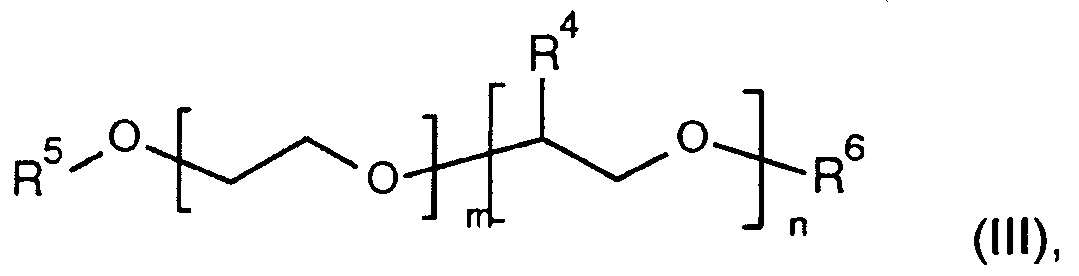
в которойwherein
R4 выбран из неразветвленного алкила с 1-4 атомами углерода, предпочтительно этила, особенно предпочтительно метила,R 4 is selected from unbranched C 1 -C 4 alkyl, preferably ethyl, particularly preferably methyl,
R5 выбран из алкила с 8-22 атомами углерода, например, н-С8Н17, н-С10Н21, н-C12H25, н-С14Н29, н-С16Н33 или н-С18Н37,R 5 is selected from alkyl with 8-22 carbon atoms, for example, n-C 8 H 17 , n-C 10 H 21 , n-C 12 H 25 , n-C 14 H 29 , n-C 16 H 33 or n -C 18 H 37 ,
R6 выбран из алкила с 1-10 атомами углерода, метила, этила, н-пропила, изопропила, н-бутила, изобутила, втор-бутила, трет-бутила, н-пентила, изопентила, втор-пентила, неопентила, 1,2-диметилпропила, изоамила, н-гексила, изогексила, втор-гексила, н-гептила, н-октила, 2-этилгексила, н-нонила, н-децила или изодецила,R 6 is selected from alkyl with 1-10 carbon atoms, methyl, ethyl, n-propyl, isopropyl, n-butyl, isobutyl, sec-butyl, tert-butyl, n-pentyl, isopentyl, sec-pentyl, neopentyl, 1, 2-dimethylpropyl, isoamyl, n-hexyl, isohexyl, sec-hexyl, n-heptyl, n-octyl, 2-ethylhexyl, n-nonyl, n-decyl or isodecyl,
m и n соответственно находится в диапазоне от 0 до 300, причем сумма n+m составляет по меньшей мере 1, m предпочтительно находится в диапазоне от 1 до 100 и n предпочтительно находится в диапазоне от 0 до 30.m and n are respectively in the range from 0 to 300, where the sum of n + m is at least 1, m is preferably in the range from 1 to 100, and n is preferably in the range from 0 to 30.
При этом соединения общей формулы (I) могут являться блок-сополимерами или статистическими сополимерами, предпочтительно блок-сополимерами.In this case, the compounds of general formula (I) can be block copolymers or random copolymers, preferably block copolymers.
Другими предпочтительными алкоксилированными спиртами и алкоксилированными жирными спиртами являются, например, соединения общей формулы (IV):Other preferred alkoxylated alcohols and alkoxylated fatty alcohols are, for example, the compounds of general formula (IV):

в которойwherein
R4 одинаковые или разные и выбрана из неразветвленного алкила с 1-4 атомами углерода, предпочтительно соответственно одинаковые, и выбраны из этила, особенно предпочтительно метила,R 4 are the same or different and is selected from unbranched C 1-4 alkyl, preferably the same, respectively, and selected from ethyl, especially methyl,
R7 выбрана из алкила с 6-20 атомами углерода, в частности, н-C8H17, н-С10Н21, н-С12Н25, н-C14H29, н-С16Н33 или н-С18Н37,R 7 is selected from alkyl with 6-20 carbon atoms, in particular n-C 8 H 17 , n-C 10 H 21 , n-C 12 H 25 , n-C 14 H 29 , n-C 16 H 33 or n-S 18 N 37 ,
а находится в диапазоне от 1 до 6,a is in the range from 1 to 6,
b находится в диапазоне от 4 до 20,b is in the range from 4 to 20,
d находится в диапазоне от 4 до 25.d ranges from 4 to 25.
При этом соединения общей формулы (IV) могут являться блок-сополимерами или статистическими сополимерами, предпочтительно блок-сополимерами.In this case, the compounds of general formula (IV) can be block copolymers or random copolymers, preferably block copolymers.
Другими пригодными неионными поверхностно-активными веществами являются двухблочные и многоблочные сополимеры, состоящие из мономерных звеньев этиленоксида и пропиленоксида. Другие пригодные неион-ные поверхностно-активные вещества выбраны из этоксилированных или пропоксилированных сложных эфиров сорбита и сложных эфиров изосорбита. Другие пригодные неионные поверхностно-активные вещества выбраны из сложных диэфиров жирных кислот и полиэтиленгликоля, например двукратно этерифицированного стеариновой кислотой полиэтиленгликоля со средней молекулярной массой Mw от 1500 до 2500 г/моль.Other suitable nonionic surfactants are diblock and multiblock copolymers composed of ethylene oxide and propylene oxide monomer units. Other suitable non-ionic surfactants are selected from ethoxylated or propoxylated sorbitol esters and isosorbitol esters. Other suitable nonionic surfactants are selected from diesters of fatty acids and polyethylene glycol, for example polyethylene glycol, doubly esterified with stearic acid, with an average molecular weight M w from 1500 to 2500 g / mol.
Примерами алкилполигликозидов являются соединения общей формулы (VI):Examples of alkyl polyglycosides are compounds of general formula (VI):
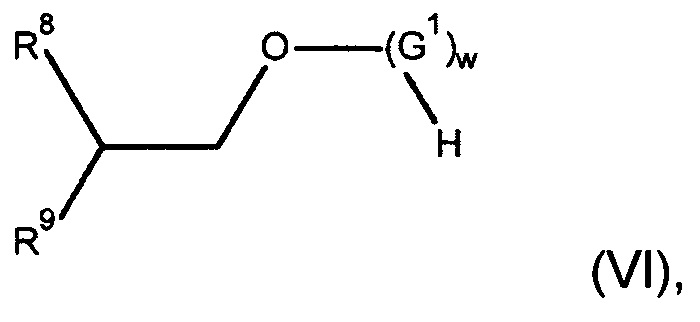
в которойwherein
R8 выбрана из водорода или алкила с 1-4 атомами углерода, предпочтительно этила, н-пропила, изопропила, а также водорода,R 8 is selected from hydrogen or alkyl with 1-4 carbon atoms, preferably ethyl, n-propyl, isopropyl, and hydrogen,
R9 выбрана из -(CH2)2-R8,R 9 is selected from - (CH 2 ) 2 -R 8 ,
G выбран из моносахарида с 4-6 атомами углерода, в частности, глюкозы или ксилозы, w находится в диапазоне от 1,1 до 4, которое является средним значением, в частности, среднечисловым значением.G is selected from a monosaccharide having 4-6 carbon atoms, in particular glucose or xylose, w is in the range from 1.1 to 4, which is an average value, in particular a number average value.
Индекс w предпочтительно находится в диапазоне от 1,1 до 2, особенно предпочтительно от 1,2 до 1,8. Индекс w предпочтительно определяют методом высокотемпературной газовой хроматографии.The w index is preferably in the range from 1.1 to 2, particularly preferably from 1.2 to 1.8. The w index is preferably determined by high temperature gas chromatography.
В одном варианте осуществления изобретения температуре плавления компонента (b) соответствует диапазон от 35 до 70°С, предпочтительно от 50 до 65°С. Температура плавления компонента (b) также может быть определена методом динамической дифференциальной сканирующей калориметрии.In one embodiment of the invention, the melting point of component (b) is in the range 35 to 70 ° C, preferably 50 to 65 ° C. The melting point of component (b) can also be determined by dynamic differential scanning calorimetry.
В предпочтительном варианте осуществления изобретения температура плавления компонента (а) ниже температуры плавления компонента (b).In a preferred embodiment, the melting point of component (a) is lower than the melting point of component (b).
Для осуществления предлагаемого в изобретении способа сначала в расплавленном состоянии смешивают компоненты (а) и (b). Температуру смешивания выбирают таким образом, чтобы в расплавленном состоянии находился плавящийся при более низкой температуре компонент, то есть компонент (b) или предпочтительно компонент (а). Соответствующий более высокоплавкий компонент может находиться в твердом или расплавленном состоянии. Компонент (а) и компонент (b) предпочтительно смешивают в предусматриваемых для соответствующей рецептуры количествах.To carry out the process according to the invention, components (a) and (b) are first mixed in the molten state. The mixing temperature is chosen such that the component melting at a lower temperature, ie component (b) or preferably component (a), is in the molten state. The corresponding higher melting component can be in a solid or molten state. Component (a) and component (b) are preferably mixed in the amounts specified for the respective formulation.
В особом варианте осуществления изобретения компонент (а) плавится в процессе смешивания.In a particular embodiment of the invention, component (a) melts during mixing.
Компонент (а) и компонент (b) продолжают смешивать до тех пор, пока не образуется обнаруживаемая невооруженным глазом, то есть без использования вспомогательного оптического средства, гомогенная смесь.Component (a) and component (b) continue to be mixed until a homogeneous mixture is formed that is detectable with the naked eye, that is, without the use of an optical aid.
Компонент (а) и компонент (b) предпочтительно смешивают при температуре, которая по меньшей мере на 5°С, особенно предпочтительно по меньшей мере на 10°С превышает температуру плавления компонента (а).Component (a) and component (b) are preferably mixed at a temperature that is at least 5 ° C, particularly preferably at least 10 ° C higher than the melting point of component (a).
В особом варианте осуществления изобретения компонент (а) смешивают с компонентом (b) при температуре, которая по меньшей мере на 5°С превышает температуру, при которой плавится более высокоплавкий компонент.In a particular embodiment, component (a) is mixed with component (b) at a temperature that is at least 5 ° C. higher than the temperature at which the higher melting component melts.
Для содействия процессу смешивания находящиеся в твердой форме компоненты (а) и (b) могут быть загружены в смесительный резервуар и нагреты при смешивании (например, встряхивании или предпочтительно перемешивании), пока не расплавится соответствующий более низкоплавкий компонент. После этого смешивание продолжают до тех пор, пока не образуется гомогенная смесь, то есть обнаружение отдельных частиц и шлиров невооруженным глазом становится невозможным.To aid in the mixing process, the solid form components (a) and (b) can be charged into the mixing vessel and heated with mixing (eg, shaking or preferably stirring) until the corresponding lower melting component is melted. After that, the mixing is continued until a homogeneous mixture is formed, that is, the detection of individual particles and schlieren with the naked eye becomes impossible.
Примерами пригодных смесительных резервуаров являются снабженные мешалкой емкости, например, реакторы или котлы с мешалкой.Examples of suitable mixing vessels are vessels equipped with an agitator, for example reactors or stirred boilers.
Полученную на первой стадии предлагаемого в изобретении способа смесь на следующей стадии конфекционируют. В соответствии с предлагаемым в изобретении способом под конфекционированием подразумевается переработка полученной на первой стадии смеси, обеспечивающая ее преобразование в твердые частицы заданного размера. Предпочтительными примерами конфекционирования выбирают из формирования лепешек или чешуек, размола или комбинации по меньшей мере двух указанных технических мероприятий. При намерении выполнить размол смеси, полученной на первой стадии предлагаемого в изобретении способа, должно быть обеспечено ее предварительное затвердевание.The mixture obtained in the first stage of the process according to the invention is concreted in the next stage. In accordance with the method according to the invention, the term `` packing '' means the processing of the mixture obtained in the first stage, which ensures its transformation into solid particles of a given size. Preferred examples of the configuration are selected from the formation of cakes or flakes, grinding or a combination of at least two of these technical measures. When intending to grind the mixture obtained in the first stage of the process according to the invention, it must be pre-solidified.
Для формирования лепешек можно использовать, например, метод, согласно которому полученную на первой стадии предлагаемого в изобретении способа смесь выливают в снабженную соответствующими углублениями форму, в которых смесь остывает и приобретает надлежащую конфигурацию. Затем остывшую смесь, например, лепешки, извлекают из формы, в которую вновь заливают смесь. В другом технологическом варианте для формирования лепешек используют охлаждающие конвейеры. Диаметр лепешек может составлять, например, от 4 до 10 мм.For the formation of cakes, it is possible, for example, to use the method according to which the mixture obtained in the first step of the method according to the invention is poured into a mold provided with appropriate recesses, in which the mixture cools and takes on the correct configuration. Then the cooled mixture, for example, cakes, is removed from the mold, into which the mixture is again poured. In another technological variant, cooling conveyors are used to form the cakes. The diameter of the cakes can be, for example, 4 to 10 mm.
Для формирования чешуек можно использовать, например, пригодный для этой цели валок. Размер чешуек может зависеть от свойств целевого продукта и настройки аппаратуры. Как правило, получают чешуйки неоднородной формы. Пригодным средним размерам, например, соответствует длина от 1 мм до 2 см, ширина от 1 мм до 1,5 см и толщина от 0,5 до 3 мм.For the formation of the flakes, you can use, for example, a suitable roll. The size of the flakes may depend on the properties of the target product and the settings of the equipment. As a rule, flakes of a non-uniform shape are obtained. Suitable medium sizes are, for example, a length of 1 mm to 2 cm, a width of 1 mm to 1.5 cm and a thickness of 0.5 to 3 mm.
Примерами особенно пригодной для размола аппаратуры являются ударные мельницы и резательные мельницы. При перемешивании в мельнице одновременно происходит размол.Examples of apparatus particularly suitable for grinding are impact mills and shearing mills. While stirring in the mill, grinding occurs simultaneously.
Описанным выше образом получают конфекционированную и твердую при комнатной температуре смесь компонента (а) с компонентом (b).As described above, a mixture of component (a) and component (b) was formed and solid at room temperature.
На следующей стадии предлагаемого в изобретении способа конфекционированную и твердую при комнатной температуре смесь компонента (а) с компонентом (b) в твердом состоянии перемешивают в мельнице совместно:In the next step of the process according to the invention, the mixture of component (a) and component (b), which is shaped and solid at room temperature, is mixed in the solid state in a mill together:
(c) с кремниевой кислотой или силикатом, в общем случае согласно изобретению называемыми также компонентом (с), и(c) with silicic acid or silicate, generally also referred to according to the invention as component (c), and
(d) по меньшей мере с одним вспомогательным компонентом, называемым также компонентом (d), причем компонент (d) выбран из цитрата щелочного металла (например, тринатрийцитрат), карбоната щелочного металла (например, карбонат калия или карбонат натрия) и по меньшей мере одного хелатообразующего средства, выбранного из соединений общей формулы (II):(d) with at least one auxiliary component, also called component (d), wherein component (d) is selected from alkali metal citrate (e.g. trisodium citrate), alkali metal carbonate (e.g. potassium carbonate or sodium carbonate) and at least one chelating agent selected from the compounds of general formula (II):

в которойwherein
R3 выбрана из алкила с 1-4 атомами углерода, например, метила, этила, н-пропила, изопропила, н-бутила, втор-бутила или изобутила, предпочтительно метила, втор-бутила или изобутила, еще более предпочтительно метила, а также фенила, бензила, СН2ОН или СН2СН2СООМ1,R 3 is selected from alkyl with 1-4 carbon atoms, for example, methyl, ethyl, n-propyl, isopropyl, n-butyl, sec-butyl or isobutyl, preferably methyl, sec-butyl or isobutyl, even more preferably methyl, and phenyl, benzyl, CH 2 OH or CH 2 CH 2 COOM 1 ,
М1 означает щелочной металл или комбинацию по меньшей мере двух щелочных металлов, например, лития, натрия, калия, причем предпочтительными являются калий, натрий и комбинации калия и натрия, например, в молярном отношении от 1:2 до 2:1, еще более предпочтительно натрий.M 1 means an alkali metal or a combination of at least two alkali metals, for example, lithium, sodium, potassium, with potassium, sodium and combinations of potassium and sodium being preferred, for example in a molar ratio of 1: 2 to 2: 1, even more preferably sodium.
Кремниевая кислота (с) может быть выбраны из осажденных кремниевых кислот и пирогенных кремниевых кислот.Silicic acid (c) can be selected from precipitated silicic acids and pyrogenic silicic acids.
Примерами силикатов (с) являются дисиликат натрия, метасиликат натрия, цеолиты и слоистые силикаты, в частности, вещества формул α-Na2Si2O5, β-Na2Si2O5 и δ-Na2Si2O5.Examples of silicates (c) are sodium disilicate, sodium metasilicate, zeolites and layered silicates, in particular substances of the formulas α-Na 2 Si 2 O 5 , β-Na 2 Si 2 O 5 and δ-Na 2 Si 2 O 5 .
В одном варианте осуществления изобретения в качестве вспомогательного компонента (с) используют два разных силикагеля или два разных силиката. Разные силикагели, соответственно разные силикаты могут отличаться друг от друга соответственно размером частиц, поверхностной кислотностью или кристаллической структурой.In one embodiment of the invention, two different silica gels or two different silicates are used as auxiliary component (c). Different silica gels, respectively different silicates, can differ from each other, respectively, in particle size, surface acidity or crystal structure.
В другом варианте осуществления изобретения в качестве вспомогательного компонента (с) используют кремниевую кислоту и силикат.In another embodiment of the invention, silicic acid and silicate are used as auxiliary component (c).
В другом варианте осуществления изобретения используют только один вспомогательный компонент (с).In another embodiment, only one auxiliary component (c) is used.
В одном варианте осуществления изобретения средний диаметр частиц кремниевой кислоты (с), определяемый методом рассеяния лазерного излучения согласно стандарту ISO 13320-1 (2009), находится в диапазоне от 5 до 100 мкм, предпочтительно от 5 до максимум 20 мкм.In one embodiment of the invention, the average particle diameter of the silicic acid particles (c), determined by laser light scattering according to ISO 13320-1 (2009), is in the range of 5 to 100 μm, preferably 5 to at most 20 μm.
В одном варианте осуществления изобретения средний диаметр частиц кремниевой кислоты (с), определяемый методом рассеяния лазерного излучения согласно стандарту ISO 13320-1 (2009), находится в диапазоне от 5 до максимум 20 мкм.In one embodiment of the invention, the average particle diameter of the silicic acid particles (c), as determined by laser light scattering according to ISO 13320-1 (2009), is in the range from 5 to a maximum of 20 μm.
При перемешивании осуществляется размол.Grinding is carried out with stirring.
В одном варианте осуществления изобретения мельницами, используемыми на третьей стадии предлагаемого в изобретении способа, являются мельницы с подводом относительно небольшого количества энергии. Предпочтительными являются молотковые и резательные мельницы.In one embodiment of the invention, the mills used in the third stage of the process according to the invention are relatively low energy mills. Hammer and cutter mills are preferred.
В одном варианте осуществления изобретения количество компонента (b) по меньшей мере аналогично количеству неионного поверхностно-активного вещества общей формулы (I).In one embodiment, the amount of component (b) is at least the same as the amount of nonionic surfactant of general formula (I).
В одном варианте осуществления изобретения в соответствии с предлагаемым в изобретении способом используют следующие относительные количества компонентов:In one embodiment of the invention in accordance with the method according to the invention, the following relative amounts of components are used:
(a) в диапазоне от 15 до 25% масс. неионного поверхностно-активного вещества общей формулы (I),(a) in the range from 15 to 25% of the mass. nonionic surfactant of general formula (I),
(b) в совокупности в диапазоне от 5 до 40% масс., компонента (b),(b) in the aggregate in the range from 5 to 40 wt%, component (b),
(c) в совокупности в диапазоне от 1 до 5% масс., предпочтительно от 2 до 3% масс. кремниевой кислоты или силиката, и(c) in the aggregate in the range from 1 to 5 wt%, preferably from 2 to 3 wt%. silicic acid or silicate, and
(d) в совокупности в диапазоне от 40 до 70% масс., предпочтительно от 42 до 60% масс. компонента (d).(d) in the aggregate in the range from 40 to 70 wt%, preferably from 42 to 60 wt%. component (d).
Получают гранулят, который обладает высокой сыпучестью. Грануляты, которые могут быть изготовлены предлагаемым в изобретении способом, могут быть легко переработаны, например, в таблетки для машинного мытья посуды и таблетки ополаскивателя для машинного мытья посуды. Грануляты, которые могут быть изготовлены предлагаемым в изобретении способом, характеризуются низкой гигроскопичностью и низкой склонностью к слипанию или спеканию.A granulate is obtained which has high flowability. Granules which can be produced by the process according to the invention can be easily processed, for example, into machine dishwashing tablets and dishwashing rinse tablets. Granules that can be produced by the method according to the invention are characterized by low hygroscopicity and a low tendency to sticking or caking.
Другой аспект настоящего изобретения касается гранулятов, называемых также предлагаемыми в изобретении гранулятами. Средний диаметр частиц предлагаемых в изобретении гранулятов составляет от 0,5 до 1,6 мм, причем грануляты содержат:Another aspect of the present invention relates to granules, also referred to as inventive granules. The average particle diameter of the granules according to the invention is between 0.5 and 1.6 mm, and the granules contain:
(а) в диапазоне от 15 до 25% масс. неионного поверхностно-активного вещества общей формулы (I):(a) in the range from 15 to 25% of the mass. nonionic surfactant of general formula (I):
в которой переменные определены следующим образомin which the variables are defined as follows
R1 выбрана из алкила с 4-20 атомами углерода,R 1 is selected from alkyl with 4-20 carbon atoms,
R2 выбрана из алкила с 8-20 атомами углерода,R 2 is selected from alkyl with 8-20 carbon atoms,
АО соответственно одинаковые или разные и выбраны из алкилена с 2-4 атомами углерода,AO, respectively, are the same or different and are selected from alkylene with 2-4 carbon atoms,
х находится в диапазоне от 5 до 100,x is in the range from 5 to 100,
(b) в совокупности в диапазоне от 5 до 25% масс. второго вещества, выбранного из полиэтиленгликоля и неионных поверхностно-активных веществ, отличающихся от поверхностно-активных веществ формулы (I),(b) in the aggregate in the range from 5 to 25% of the mass. a second substance selected from polyethylene glycol and nonionic surfactants other than the surfactants of formula (I),
(c) в совокупности от 1 до 5% масс. кремниевой кислоты или силиката, и(c) in the aggregate from 1 to 5% of the mass. silicic acid or silicate, and
(d) в совокупности в диапазоне от 40 до 70% масс. вспомогательного компонента, выбранного из цитрата щелочного металла, карбоната щелочного металла или по меньшей мере одного хелатообразующего средства, выбранного из соединений общей формулы (II):(d) in the aggregate in the range from 40 to 70% of the mass. an auxiliary component selected from alkali metal citrate, alkali metal carbonate or at least one chelating agent selected from compounds of general formula (II):

в которой переменные определены следующим образомin which the variables are defined as follows
R3 выбрана из алкила с 1-4 атомами углерода, фенила, бензила, СН2ОН или СН2СН2СООМ1,R 3 is selected from alkyl with 1-4 carbon atoms, phenyl, benzyl, CH 2 OH or CH 2 CH 2 COOM 1 ,
М1 означает щелочной металл или комбинацию по меньшей мере двух щелочных металлов, причем предлагаемый в изобретении гранулят при температуре до 60°С является твердым.M 1 means an alkali metal or a combination of at least two alkali metals, the granules according to the invention being solid at temperatures up to 60 ° C.
Компоненты (а), (b), (с) и (а) подробно описаны выше.Components (a), (b), (c) and (a) are described in detail above.
В предпочтительном варианте осуществления изобретения предлагаемый в изобретении гранулят характеризуется следующим распределением частиц по диаметру: dm в диапазоне от 0,5 до 1,8 мм, d63,3 в диапазоне от 0,4 до 1,8 мм и n в диапазоне от 0,7 до 10, причем соответствующие показатели определяют методом ситового анализа согласно стандарту DIN ISO 3310-1 (1992) и оценивают согласно стандарту DIN 66145 (1976).In a preferred embodiment of the invention, the granulate according to the invention is characterized by the following particle diameter distribution: d m in the range from 0.5 to 1.8 mm, d 63.3 in the range from 0.4 to 1.8 mm and n in the range from 0.7 to 10, the respective values being determined by sieve analysis according to DIN ISO 3310-1 (1992) and evaluated according to DIN 66145 (1976).
Предлагаемые в изобретении грануляты могут быть подвергнуты дальнейшей переработке, например, в таблетки для машинного мытья посуды, в частности, таблетки ополаскивателя, или в качестве компонента посудомоечного средства «х в одном», например, «два в одном» или «три в одном». Таким образом, другим объектом настоящего изобретения является применение предлагаемого в изобретении гранулята в качестве ополаскивателя или для изготовления ополаскивателя. В предпочтительном варианте осуществления изобретения под ополаскивателем подразумевают ополаскиватель для посудомоечных машин или компонент средства для мытья посуды «х в одном», например, «два в одном» или «три в одном».The granules according to the invention can be further processed, for example, into machine-washable tablets, in particular rinse aid tablets, or as an x-in-one dishwasher component, for example, two-in-one or three-in-one ... Thus, another object of the present invention is the use of the granulate according to the invention as a rinse aid or for the manufacture of a rinse aid. In a preferred embodiment, rinse aid is meant to be a dishwasher rinse aid or an x-in-one dishwashing detergent component such as two-in-one or three-in-one.
В одном варианте осуществления изобретения предлагаемый в изобретении гранулят можно использовать без дополнительных добавок в посудомоечной машине в качестве ополаскивателя, в частности, ополаскивателя «х в одном». В другом варианте осуществления изобретения дополнительно используют по меньшей мере одну добавку, выбранную из воды и кислоты, например, лимонной кислоты.In one embodiment, the granulate according to the invention can be used without additional additives in the dishwasher as a rinse aid, in particular an x-in-one rinse aid. In another embodiment of the invention, at least one additive selected from water and an acid such as citric acid is additionally used.
Приведенные ниже примеры служат для более подробного пояснения настоящего изобретения.The examples below serve to illustrate the present invention in more detail.
Температуру плавления определяют методом динамической дифференциальной сканирующей калориметрии при скорости нагревания 10±1 К/мин (навеска от 6 до 7 мг, расход азота в качестве газа-носителя 3 л/ч, открытый алюминиевый измерительный тигель).The melting point is determined by the method of dynamic differential scanning calorimetry at a heating rate of 10 ± 1 K / min (sample from 6 to 7 mg, nitrogen consumption as carrier gas 3 l / h, open aluminum measuring crucible).
Используемые компонентыComponents used
(а.1) н-С8Н17-СН(ОН)-СН2-(АО)22-изо-С11Н23 (температура плавления 32°С).(a.1) n-C 8 H 17 -CH (OH) -CH 2 - (AO) 22 -iso-C 11 H 23 (melting point 32 ° C).
(b.1) Полиэтиленгликоль (Mw 4000 г/моль).(b.1) Polyethylene glycol (M w 4000 g / mol).
(с.1) Осажденная кремниевая кислота со средним диаметром частиц d50 13,5 мкм (лазерная дифракция) и поверхностью по БЭТ 190 м2/г (определение методом адсорбции азота согласно стандарту ISO 92777); с. 1 является коммерчески доступным продуктом Sipernat® 22 S.(c.1) Precipitated silicic acid with an average particle diameter of d50 13.5 μm (laser diffraction) and a BET surface of 190 m 2 / g (determination by nitrogen adsorption according to ISO 92777); from. 1 is the commercially available product Sipernat® 22 S.
(d.1) Тринатриевая соль лимонной кислоты в виде дигидрата.(d.1) Citric acid trisodium salt as dihydrate.
Твердый состав изготавливают следующим образом.The solid composition is made as follows.
Компоненты (а.1) и (b.1) подвергают совместному плавлению в химическом стакане при 70°С и перемешиванию посредством пропеллерной мешалки. Полученный расплав выливают на алюминиевую фольгу (20 см × 10 см × 1 см), на которой он застывает при комнатной температуре. Образуются воскоподобные пластинки.Components (a.1) and (b.1) are co-melted in a beaker at 70 ° C. and mixed with a propeller stirrer. The resulting melt is poured onto aluminum foil (20 cm × 10 cm × 1 cm), on which it solidifies at room temperature. Wax-like plates are formed.
Из полученных воскоподобных пластинок с помощью валка для переработки в чешуйки выполняют лепешки. Используемый при этом валок вращается со скоростью 1,2 об/мин и обладает диаметром 33 см и шириной 50 см. Температура охлаждающего средства (воды) составляет от 16 до 22°С. Для формирования лепешек воскоподобные пластинки помещают в обогреваемую капельную воронку диаметром 38 см, дно которой снабжено 36 отверстиями диаметром 1,5 мм. Варьируя температуру воронки в интервале от 80 до 100°С, скорость плавления пластинки устанавливают таким образом, чтобы на охлаждаемой поверхности валка происходило образование капель определенного размера, застывающих в пределах одного оборота валка, которые затем снимают с валка зафиксированным вдоль него жестким ножом.From the obtained wax-like plates, cakes are made using a roll for processing into flakes. The used roll rotates at a speed of 1.2 rpm and has a diameter of 33 cm and a width of 50 cm. The temperature of the coolant (water) is from 16 to 22 ° C. To form cakes, wax-like plates are placed in a heated dropping funnel with a diameter of 38 cm, the bottom of which is equipped with 36 holes with a diameter of 1.5 mm. By varying the temperature of the funnel in the range from 80 to 100 ° C, the melting rate of the plate is set so that drops of a certain size are formed on the cooled surface of the roll, solidifying within one roll revolution, which are then removed from the roll with a rigid knife fixed along it.
Выполненные указанным образом лепешки подвергают размолу в ударной (ножевой) мельнице. Используемая для этого мельница снабжена двумя ножами и функционирует с окружной скоростью 14 м/с. В качестве мельничного сита используют сетку с круглыми отверстиями диаметром 3,2 мм и свободной поверхностью 40%. В мельницу одновременно загружают и размалывают лепешки, компонент (d.1) и кремниевую кислоту (с.1).Made in this way, the cakes are subjected to grinding in an impact (knife) mill. The mill used for this is equipped with two knives and operates at a peripheral speed of 14 m / s. A mesh with circular holes 3.2 mm in diameter and a free surface of 40% is used as a mill sieve. The cakes, component (d.1) and silicic acid (c.1) are simultaneously charged and ground into the mill.
Получают указанные в таблице 1 предлагаемые в изобретении и сравнительные грануляты.Received according to table 1 proposed in the invention and comparative granules.

ПримечаниеNote
Содержание компонентов (а.1), (b.1), (с.1) и (d.1) указано в массовых процентах.The content of components (a.1), (b.1), (c.1) and (d.1) is indicated in mass percent.
Испытание пригодности для хранения предусматривает выдержку гранулята в течение 72 часов при 40°С и исключении доступа влаги. Данное испытание выполняют следующим образом. В открытый сверху и снизу цилиндр помещают 15 мл гранулята, соответственно сравнительного гранулята. Для предотвращения высыпания гранулята цилиндр устанавливают нижним отверстием на опорную плиту. Верхнее отверстие снабжают поршнем, на который воздействует груз массой 500 г, и всю систему в течение 72 часов выдерживают при 40°С. Затем контролируют изменения гранулята, обусловленные его выдержкой при температуре 40°С и одновременным воздействием нагрузки. В случае если в указанных условиях изменения гранулята отсутствуют, после подъема цилиндра гранулят высыпается из нижнего отверстия. При наличии склонности гранулята к слипанию формируется уплотненная масса, которую осторожно выталкивают из цилиндра поршнем. Уплотненную массу помещают на чашку коромысловых весов. На чашке находится химический стакан, который заполняют водой до тех пор, пока уплотненная масса не разрушится. Результаты измерения количества воды позволяют судить об устойчивости гранулятов при хранении. Продукты, которые не образуют уплотненную массу (предлагаемые в изобретении грануляты G.1 и G.4), характеризуются чрезвычайно высокой пригодностью для хранения.The storage suitability test provides for holding the granulate for 72 hours at 40 ° C and excluding the access of moisture. This test is performed as follows. In a cylinder open at the top and bottom, 15 ml of granulate or comparative granulate are placed. To prevent the granulate from spilling out, the cylinder is installed with the lower hole on the base plate. The upper hole is equipped with a piston, which is subjected to a weight of 500 g, and the entire system is kept at 40 ° C for 72 hours. Then the changes in the granulate caused by its holding at a temperature of 40 ° C and the simultaneous effect of the load are monitored. If there are no changes in the granulate under the indicated conditions, after lifting the cylinder, the granulate is poured out of the lower hole. If there is a tendency of the granulate to stick together, a compacted mass is formed, which is carefully pushed out of the cylinder by the piston. The compacted mass is placed on the pan of the beam balance. There is a beaker on the cup, which is filled with water until the compacted mass collapses. The results of measuring the amount of water make it possible to judge the stability of the granulates during storage. Products that do not form a compacted mass (granules G.1 and G.4 according to the invention) are characterized by extremely high storage properties.
Распределение по диаметру частиц используемых в примерах гранулятов определяют методом ситового анализа, выполняемого в следующих условиях:The particle diameter distribution of the granules used in the examples is determined by sieve analysis performed under the following conditions:
просеивающая машина AS 200 control (фирма Retsch), аналитические сита согласно стандарту DIN ISO 3310-1, высота 25 мм, диаметр 200 мм, амплитуда 0,6,sieve shaker AS 200 control (Retsch), analytical sieves according to DIN ISO 3310-1, height 25 mm, diameter 200 mm, amplitude 0.6,
время фракционирования 2 минуты.fractionation time 2 minutes.
На основании полученных методом ситового анализа результатов измерения распределения частиц по диаметру определяют характеризующие гранулометрический состав показатели dm, d63,3 и n.On the basis of the results of measuring the particle diameter distribution obtained by the sieve analysis method, the parameters d m , d 63.3 and n characterizing the granulometric composition are determined.
Графическая оценка распределения частиц по диаметру с помощью диаграммы Розина, Рамлера, Сперлинга и Беннета (RRSB-распределения) позволяет определить следующие параметры гранулята:Graphical assessment of the particle diameter distribution using the Rosin, Ramler, Sperling and Bennett diagrams (RRSB distribution) allows you to determine the following parameters of the granulate:
d63,3 характеристический размер частиц,d 63.3 characteristic particle size,
n коэффициент однородности (показатель n).n uniformity coefficient (index n).
В случае если гранулометрическое состояние рыхлого материала невозможно описать посредством RRSB-распределения, например, если речь идет о смесях рыхлых материалов с разным гранулометрическим составом, указанные выше параметры справедливы также для тех участков распределения, которые следуют из RRSB-распределения.If the granulometric state of the loose material cannot be described by means of the RRSB distribution, for example, when it comes to mixtures of loose materials with different particle size distribution, the above parameters are also valid for those distribution areas that follow from the RRSB distribution.
Пример (G.1): d<0,4 мм 22,6%,Example (G.1): d <0.4 mm 22.6%,
d≥1,6мм 0%,d≥1.6mm 0%,
dm=0,69 ммd m = 0.69 mm
d63,3=0,8 мм,d 63.3 = 0.8 mm,
n=2,0.n = 2.0.
Пример V-G.2:Example V-G.2:
поддающийся измерению гранулят не получен.no measurable granulate was obtained.
Пример V-G.3:Example V-G.3:
поддающийся измерению гранулят не получен.no measurable granulate was obtained.
Пример (G.4): d<0,4 мм 29,8%,Example (G.4): d <0.4 mm 29.8%,
d≥1,6мм 10,6%,d≥1.6mm 10.6%,
dm=0,71 мм,d m = 0.71 mm,
d63,3=0,79 мм,d 63.3 = 0.79 mm,
n=1,49.n = 1.49.
Claims (34)

Applications Claiming Priority (3)
| Application Number | Priority Date | Filing Date | Title |
|---|---|---|---|
| EP15191376 | 2015-10-26 | ||
| EP15191376.1 | 2015-10-26 | ||
| PCT/EP2016/074920 WO2017071984A1 (en) | 2015-10-26 | 2016-10-18 | Granulates, method for the production and use thereof |
Publications (3)
| Publication Number | Publication Date |
|---|---|
| RU2018119305A3 RU2018119305A3 (en) | 2019-11-28 |
| RU2018119305A RU2018119305A (en) | 2019-11-28 |
| RU2736331C2 true RU2736331C2 (en) | 2020-11-13 |
Family
ID=54541944
Family Applications (1)
| Application Number | Title | Priority Date | Filing Date |
|---|---|---|---|
| RU2018119305A RU2736331C2 (en) | 2015-10-26 | 2016-10-18 | Granules, method for production thereof and use thereof |
Country Status (10)
| Country | Link |
|---|---|
| US (1) | US10717952B2 (en) |
| EP (1) | EP3368645B1 (en) |
| JP (1) | JP6885936B2 (en) |
| KR (1) | KR20180074737A (en) |
| CN (1) | CN108350397B (en) |
| BR (1) | BR112018008210A2 (en) |
| ES (1) | ES2765237T3 (en) |
| PL (1) | PL3368645T3 (en) |
| RU (1) | RU2736331C2 (en) |
| WO (1) | WO2017071984A1 (en) |
Families Citing this family (2)
| Publication number | Priority date | Publication date | Assignee | Title |
|---|---|---|---|---|
| EP3969555A1 (en) | 2019-06-21 | 2022-03-23 | Ecolab USA, Inc. | Solid nonionic surfactant compositions |
| CN115916940A (en) * | 2020-07-03 | 2023-04-04 | 宝洁公司 | Granular Laundry Detergent Composition |
Citations (5)
| Publication number | Priority date | Publication date | Assignee | Title |
|---|---|---|---|---|
| RU2169175C1 (en) * | 1999-12-17 | 2001-06-20 | Общество с ограниченной ответственностью "Чистые технологии" | Detergent for cleaning surface from organic contaminants and method of preparing thereof |
| WO2001048131A2 (en) * | 1999-12-24 | 2001-07-05 | Cognis Deutschland Gmbh & Co. Kg | Tenside granules with improved disintegration rate |
| EP1306422A1 (en) * | 2001-10-23 | 2003-05-02 | Cognis Deutschland GmbH & Co. KG | Solid washing, rinsing and cleansing agent |
| EP1953217A1 (en) * | 2007-02-02 | 2008-08-06 | Kemira Agro Oy | A cogranule for use in solid detergent compositions |
| DE102011084934A1 (en) * | 2011-10-21 | 2013-04-25 | Henkel Ag & Co. Kgaa | Rinse aid and dishwashing detergent |
Family Cites Families (8)
| Publication number | Priority date | Publication date | Assignee | Title |
|---|---|---|---|---|
| DE69411746T2 (en) * | 1993-08-13 | 1999-03-18 | The Procter & Gamble Co., Cincinnati, Ohio | GRANULAR, LONG-CHAIN AMINOXIDE CONTAINING, MACHINE DISHWASHER |
| EP0925341A1 (en) * | 1996-09-11 | 1999-06-30 | The Procter & Gamble Company | Detergent composition |
| JPH1135999A (en) * | 1997-07-23 | 1999-02-09 | Lion Corp | Method for producing granular nonionic detergent composition |
| ES2142783T1 (en) * | 1997-11-26 | 2000-05-01 | Procter & Gamble | TABLET OF MULTIPLE LAYER DETERGENTS THAT HAS COMPRESSED PORTIONS AND UNCOMPRESSED PORTIONS. |
| JP2000192098A (en) * | 1998-12-25 | 2000-07-11 | Lion Corp | Tablet detergent composition |
| DE10019936A1 (en) * | 1999-12-04 | 2001-10-25 | Henkel Kgaa | Detergents and cleaning agents |
| JP2003105375A (en) * | 2001-09-28 | 2003-04-09 | Lion Corp | Granular detergent composition |
| DE102007019458A1 (en) * | 2007-04-25 | 2008-10-30 | Basf Se | Phosphate-free machine dishwashing detergent with excellent rinse performance |
-
2016
- 2016-10-18 BR BR112018008210-4A patent/BR112018008210A2/en active Search and Examination
- 2016-10-18 ES ES16785417T patent/ES2765237T3/en active Active
- 2016-10-18 KR KR1020187014363A patent/KR20180074737A/en not_active Withdrawn
- 2016-10-18 JP JP2018521634A patent/JP6885936B2/en not_active Expired - Fee Related
- 2016-10-18 CN CN201680062436.0A patent/CN108350397B/en not_active Expired - Fee Related
- 2016-10-18 EP EP16785417.3A patent/EP3368645B1/en not_active Not-in-force
- 2016-10-18 PL PL16785417T patent/PL3368645T3/en unknown
- 2016-10-18 RU RU2018119305A patent/RU2736331C2/en active
- 2016-10-18 US US15/770,532 patent/US10717952B2/en not_active Expired - Fee Related
- 2016-10-18 WO PCT/EP2016/074920 patent/WO2017071984A1/en not_active Ceased
Patent Citations (6)
| Publication number | Priority date | Publication date | Assignee | Title |
|---|---|---|---|---|
| RU2169175C1 (en) * | 1999-12-17 | 2001-06-20 | Общество с ограниченной ответственностью "Чистые технологии" | Detergent for cleaning surface from organic contaminants and method of preparing thereof |
| WO2001048131A2 (en) * | 1999-12-24 | 2001-07-05 | Cognis Deutschland Gmbh & Co. Kg | Tenside granules with improved disintegration rate |
| EP1306422A1 (en) * | 2001-10-23 | 2003-05-02 | Cognis Deutschland GmbH & Co. KG | Solid washing, rinsing and cleansing agent |
| EP1953217A1 (en) * | 2007-02-02 | 2008-08-06 | Kemira Agro Oy | A cogranule for use in solid detergent compositions |
| DE102011084934A1 (en) * | 2011-10-21 | 2013-04-25 | Henkel Ag & Co. Kgaa | Rinse aid and dishwashing detergent |
| US20140228271A1 (en) * | 2011-10-21 | 2014-08-14 | Henkel Ag & Co. Kgaa | Dishwasher rinse aids and detergents |
Also Published As
| Publication number | Publication date |
|---|---|
| EP3368645B1 (en) | 2019-10-16 |
| CN108350397B (en) | 2021-02-26 |
| US20190055501A1 (en) | 2019-02-21 |
| ES2765237T3 (en) | 2020-06-08 |
| CN108350397A (en) | 2018-07-31 |
| BR112018008210A2 (en) | 2018-10-23 |
| RU2018119305A3 (en) | 2019-11-28 |
| KR20180074737A (en) | 2018-07-03 |
| US10717952B2 (en) | 2020-07-21 |
| WO2017071984A1 (en) | 2017-05-04 |
| JP6885936B2 (en) | 2021-06-16 |
| RU2018119305A (en) | 2019-11-28 |
| EP3368645A1 (en) | 2018-09-05 |
| PL3368645T3 (en) | 2020-04-30 |
| JP2018533656A (en) | 2018-11-15 |
Similar Documents
| Publication | Publication Date | Title |
|---|---|---|
| DE68924375T2 (en) | Detergent granulate from a cold paste by fine dispersion granulation. | |
| DE69615213T2 (en) | METHOD FOR PRODUCING CRYSTALLINE ALKALINE METAL SILICATES AND GRANULAR DETERGENT WITH HIGH BULK DENSITY | |
| AU660466B2 (en) | Particulate detergent composition or component containing zeolite map | |
| JP5561822B2 (en) | Fatty acid alkyl ester sulfonate metal salt solid and method for producing fatty acid alkyl ester sulfonate metal salt powder having sharp particle size distribution | |
| US10717952B2 (en) | Granulates, method for the production and use thereof | |
| EP0618290A1 (en) | Flow aids for detergent powders comprising sodium aluminosilicate and hydrophobic silica | |
| JP2019533743A (en) | Phosphate-free detergent composition and its application | |
| WO2016047788A1 (en) | Granular detergent and detergent product | |
| JP5851408B2 (en) | Granular detergent composition and method for producing the same | |
| JP3161710B2 (en) | Surfactant composition | |
| US6602846B1 (en) | Method for producing single nucleus detergent particles | |
| JP2004099699A (en) | Detergent particles | |
| EP1212399B1 (en) | Process for preparing high-bulk density detergent compositions | |
| JP6735188B2 (en) | Granular detergent and method for producing the same | |
| JPWO2015012235A1 (en) | Granular detergent composition and method for producing the same | |
| JP2018065973A (en) | Granular detergent | |
| JP4173728B2 (en) | Surfactant composition | |
| JPWO1999063047A1 (en) | surfactant composition | |
| KR100967330B1 (en) | Manufacturing method of detergent particle group | |
| JP4173729B2 (en) | Surfactant composition | |
| JP2010144045A (en) | Method for producing mononuclear detergent particle cluster | |
| JP2007009087A (en) | Powder detergent composition with improved solubility at low temperatures | |
| JP2016069394A (en) | Granular detergent, method for producing the same and detergent product | |
| MXPA01003096A (en) | Granular detergent compositions having improved solubility profiles | |
| KR20010075335A (en) | Granular detergent compositions having improved solubility profiles |