RU2702503C1 - Method of modeling processes of justification of required level of survivability of distributed communication networks of a superior control system in conditions of opening and external destructive effects - Google Patents
Method of modeling processes of justification of required level of survivability of distributed communication networks of a superior control system in conditions of opening and external destructive effects Download PDFInfo
- Publication number
- RU2702503C1 RU2702503C1 RU2018129734A RU2018129734A RU2702503C1 RU 2702503 C1 RU2702503 C1 RU 2702503C1 RU 2018129734 A RU2018129734 A RU 2018129734A RU 2018129734 A RU2018129734 A RU 2018129734A RU 2702503 C1 RU2702503 C1 RU 2702503C1
- Authority
- RU
- Russia
- Prior art keywords
- communication network
- control system
- distributed communication
- elements
- level control
- Prior art date
Links
- 230000006854 communication Effects 0.000 title claims abstract description 324
- 238000004891 communication Methods 0.000 title claims abstract description 322
- 238000000034 method Methods 0.000 title claims abstract description 100
- 230000008569 process Effects 0.000 title claims abstract description 52
- 230000001066 destructive effect Effects 0.000 title claims description 6
- 230000015572 biosynthetic process Effects 0.000 claims abstract description 13
- 238000003786 synthesis reaction Methods 0.000 claims abstract description 8
- 230000003993 interaction Effects 0.000 claims abstract description 6
- 230000033001 locomotion Effects 0.000 claims description 35
- 238000004088 simulation Methods 0.000 claims description 16
- 238000012545 processing Methods 0.000 claims description 13
- 238000004458 analytical method Methods 0.000 claims description 8
- 238000011888 autopsy Methods 0.000 claims description 4
- 230000008859 change Effects 0.000 claims description 2
- 238000012937 correction Methods 0.000 claims description 2
- 230000000694 effects Effects 0.000 abstract description 9
- 230000009471 action Effects 0.000 abstract description 8
- 239000000126 substance Substances 0.000 abstract description 2
- 238000007726 management method Methods 0.000 description 28
- 230000005540 biological transmission Effects 0.000 description 10
- 238000005516 engineering process Methods 0.000 description 7
- 238000011156 evaluation Methods 0.000 description 6
- 238000010276 construction Methods 0.000 description 5
- 230000006378 damage Effects 0.000 description 5
- 238000005755 formation reaction Methods 0.000 description 5
- 230000014509 gene expression Effects 0.000 description 5
- 238000012549 training Methods 0.000 description 5
- 238000009826 distribution Methods 0.000 description 4
- 239000000463 material Substances 0.000 description 4
- 244000309464 bull Species 0.000 description 3
- 238000004422 calculation algorithm Methods 0.000 description 3
- 238000004364 calculation method Methods 0.000 description 3
- 230000007123 defense Effects 0.000 description 3
- 238000005259 measurement Methods 0.000 description 3
- 238000000926 separation method Methods 0.000 description 3
- 230000001629 suppression Effects 0.000 description 3
- 238000012546 transfer Methods 0.000 description 3
- 230000004308 accommodation Effects 0.000 description 2
- 238000013459 approach Methods 0.000 description 2
- 238000003491 array Methods 0.000 description 2
- 238000005094 computer simulation Methods 0.000 description 2
- 230000002596 correlated effect Effects 0.000 description 2
- 238000010586 diagram Methods 0.000 description 2
- 230000005693 optoelectronics Effects 0.000 description 2
- 241000143957 Vanessa atalanta Species 0.000 description 1
- 230000002411 adverse Effects 0.000 description 1
- 230000001174 ascending effect Effects 0.000 description 1
- 239000000470 constituent Substances 0.000 description 1
- 230000001276 controlling effect Effects 0.000 description 1
- 238000007405 data analysis Methods 0.000 description 1
- 238000013499 data model Methods 0.000 description 1
- 238000013461 design Methods 0.000 description 1
- 238000001514 detection method Methods 0.000 description 1
- 238000011161 development Methods 0.000 description 1
- 238000003745 diagnosis Methods 0.000 description 1
- 238000002474 experimental method Methods 0.000 description 1
- 230000003116 impacting effect Effects 0.000 description 1
- 238000012067 mathematical method Methods 0.000 description 1
- 238000013178 mathematical model Methods 0.000 description 1
- 238000010295 mobile communication Methods 0.000 description 1
- 238000012544 monitoring process Methods 0.000 description 1
- 238000011017 operating method Methods 0.000 description 1
- 238000005457 optimization Methods 0.000 description 1
- 210000000056 organ Anatomy 0.000 description 1
- 230000008520 organization Effects 0.000 description 1
- 230000010287 polarization Effects 0.000 description 1
- NHDHVHZZCFYRSB-UHFFFAOYSA-N pyriproxyfen Chemical compound C=1C=CC=NC=1OC(C)COC(C=C1)=CC=C1OC1=CC=CC=C1 NHDHVHZZCFYRSB-UHFFFAOYSA-N 0.000 description 1
- 230000005855 radiation Effects 0.000 description 1
- 238000011160 research Methods 0.000 description 1
- 238000010187 selection method Methods 0.000 description 1
- 230000003595 spectral effect Effects 0.000 description 1
- 230000002269 spontaneous effect Effects 0.000 description 1
- 230000003068 static effect Effects 0.000 description 1
- 238000003860 storage Methods 0.000 description 1
- 230000009466 transformation Effects 0.000 description 1
- 230000007704 transition Effects 0.000 description 1
- 238000012795 verification Methods 0.000 description 1
Images


Classifications
-
- G—PHYSICS
- G05—CONTROLLING; REGULATING
- G05B—CONTROL OR REGULATING SYSTEMS IN GENERAL; FUNCTIONAL ELEMENTS OF SUCH SYSTEMS; MONITORING OR TESTING ARRANGEMENTS FOR SUCH SYSTEMS OR ELEMENTS
- G05B17/00—Systems involving the use of models or simulators of said systems
-
- H—ELECTRICITY
- H04—ELECTRIC COMMUNICATION TECHNIQUE
- H04L—TRANSMISSION OF DIGITAL INFORMATION, e.g. TELEGRAPHIC COMMUNICATION
- H04L12/00—Data switching networks
Landscapes
- Engineering & Computer Science (AREA)
- Computer Networks & Wireless Communication (AREA)
- Signal Processing (AREA)
- Physics & Mathematics (AREA)
- General Physics & Mathematics (AREA)
- Automation & Control Theory (AREA)
- Data Exchanges In Wide-Area Networks (AREA)
Abstract
Description
Изобретение относится к области моделирования и может быть использовано при проектировании радиоэлектронных, технических систем, а также, для оценки показателей их живучести.The invention relates to the field of modeling and can be used in the design of electronic, technical systems, as well as to assess their survivability.
Толкование терминов, используемых в изобретении.Interpretation of terms used in the invention.
Единая сеть электросвязи Российской Федерации (ЕСЭ РФ) представляет собой совокупность технологически сопряженных сетей электросвязи общего пользования, выделенных сетей, технологических сетей связи, присоединенных к ЕСЭ РФ, сетей связи специального назначения и других сетей электросвязи для передачи информации при помощи электромагнитных систем (Ломовицкий В.В. Основы построения систем и сетей передачи информации / Ломовицкий В.В., Михайлов А.И., Шестак К.В., Щекотихин В.М. - М.: Горячая линия - Телеком, 2004. - 382 с., стр. 160).The Unified Telecommunication Network of the Russian Federation (RF ESE) is a combination of technologically interconnected public telecommunication networks, dedicated networks, technological communication networks connected to the RF ESE, special-purpose communication networks and other telecommunication networks for transmitting information using electromagnetic systems (V. Lomovitsky V. Fundamentals of building systems and networks for the transmission of information / Lomovitsky V.V., Mikhailov A.I., Shestak K.V., Schekotikhin V.M. - M.: Hot line - Telecom, 2004. - 382 p., P. . 160).
Живучесть распределенной сети связи - характеризует устойчивость распределенной сети связи против действия причин (стихийных и преднамеренных), приводящих к разрушениям или значительным повреждениям некоторой части ее элементов: узлов, пунктов, станций и линий связи, а так же способность распределенной сети связи сохранять или быстро восстанавливать свое функционирование в условиях возможного физического уничтожения ее элементов (Дудник Б.Я., Овчаренко В.Ф., Орлов В.К. и др. Надежность и живучесть систем связи. М.: «Радио и связь», 1984.- 216 с., стр.9.Survivability of a distributed communication network - characterizes the stability of a distributed communication network against the action of factors (spontaneous and deliberate), leading to destruction or significant damage to a certain part of its elements: nodes, points, stations and communication lines, as well as the ability of a distributed communication network to save or quickly recover its functioning under the conditions of the possible physical destruction of its elements (Dudnik B.Ya., Ovcharenko V.F., Orlov V.K. et al. Reliability and survivability of communication systems. M: Radio and Communication, 1984.- 216 p. . pg. 9.
Информационно-технические воздействия - применение способов и средств информационного воздействия на информационно-технические объекты, на технику и вооружение в интересах достижения поставленных целей (Центр стратегических оценок и прогнозов. Информационная война и защита информации. Словарь основных терминов и определений www.csef.ru Москва, 2011, стр. 25).Information and technical impacts - the application of methods and means of information impact on information and technical objects, equipment and weapons in the interest of achieving the goals (Center for Strategic Assessments and Forecasts. Information War and Information Protection. Glossary of basic terms and definitions www.csef.ru Moscow , 2011, p. 25).
Критичность отказа элемента сложной системы - сочетание тяжести последствий и частоты появления или других свойств отказа как характеристика необходимости идентификации источников, причин и сокращения частоты или количества появлений данного отказа и уменьшения тяжести его последствий. (ГОСТ Р 51901.12-2007. Менеджмент риска. Метод анализа видов и последствий отказов. - М.: Стандартинформ, 2008. - 35 с.).The criticality of a failure of an element of a complex system is a combination of the severity of the consequences and the frequency of occurrence or other properties of the failure as a characteristic of the need to identify the sources, causes and reduce the frequency or number of occurrences of this failure and reduce the severity of its consequences. (GOST R 51901.12-2007. Risk management. A method for analyzing the types and consequences of failures. - M .: Standartinform, 2008. - 35 p.).
Моделирование - замещение одного объекта другим с целью получения информации о важнейших свойствах объекта-модели путем проведения эксперимента (Советов Б.Я., Яковлев С.А. Моделирование систем: Учебник для вузов - 3-е изд., перераб. и доп. М.: Высшая школа, 2001. - 343 с., стр. 6).Modeling - replacing one object with another in order to obtain information about the most important properties of the object model by conducting an experiment (Sovetov B.Ya., Yakovlev S.A. System modeling: Textbook for high schools - 3rd ed., Revised and additional M .: Higher school, 2001. - 343 p., P. 6).
Огневое поражение - уничтожение (подавление) сил и средств противника огнем различных видов оружия, ударами ракетных войск, артиллерии и авиации, а так же ударами разведывательно-огневых комплексов с применением боеприпасов в обычном снаряжении и снаряженных зажигательными веществами (Военная энциклопедия: в 8 томах, Т. 6. - М., 2002, стр. 9).Fire defeat - destruction (suppression) of enemy forces and means by fire of various types of weapons, attacks by missile forces, artillery and aircraft, as well as attacks by reconnaissance and fire systems using ammunition in conventional equipment and equipped with incendiary substances (Military Encyclopedia: in 8 volumes, T. 6. - M., 2002, p. 9).
Разведывательная защищенность - свойство, характеризующее возможности радиоразведки противника по добыванию и обработке информации, описывающей уровень разведывательной доступности с учетом реальных свойств среды распространения радиоволн (Ермишян А.Г. Теоретические основы построения систем военной связи в объединениях и соединениях: Учебник. Часть 1. Методологические основы построения организационно-технических систем военной связи. СПб.: ВАС, 2005. - 740 с., стр. 345).Reconnaissance security is a property that characterizes the enemy’s radio reconnaissance capabilities for obtaining and processing information describing the level of reconnaissance accessibility taking into account the real properties of the radio wave propagation environment (A. Ermishyan. Theoretical foundations of building military communications systems in associations and formations: Textbook. Part 1. Methodological fundamentals construction of organizational and technical systems of military communications. St. Petersburg: VAS, 2005. - 740 p., p. 345).
Распределенная сеть связи вышестоящей системы управления представляет собой первичные сети связи, различающиеся используемой средой распространения сигнала и (или), а также, развернутые на их базе вторичные сети связи, различающиеся реализуемым видом электросвязи (типом передаваемых сообщений, прикладной службой передачи данных) (Гаранин М.В. и др. Системы и сети передачи информации: Учеб. пособие для ВУЗов. - М.: Радио и связь, 2001. - 336 с., стр. 13-19).The distributed communication network of the higher-level control system is the primary communication network, differing in the medium used for signal propagation and (or), as well as secondary communication networks deployed on their basis, differing in the type of telecommunication being implemented (type of transmitted messages, application data transmission service) (Garanin M .V. Et al. Information transmission systems and networks: Textbook for universities. - M.: Radio and communications, 2001. - 336 p., Pp. 13-19).
Реконфигурация системы заключается в изменении ее структуры, топологии, режимов работы, восстановлении поврежденных и отказавших элементов и т.д). Основы построения систем и сетей передачи информации. Учебное пособие для вузов / В.В. Ломовицкий, А.И. Михайлов, К.В. Шестак, В.М. Щекотихин; под. ред. В.М. Щекотихина - М.: Горячая линия - Телеком, 2005. - 382 с.Reconfiguration of the system consists in changing its structure, topology, operating modes, restoring damaged and failed elements, etc.). Fundamentals of building systems and networks for the transfer of information. Textbook for high schools / V.V. Lomovitsky, A.I. Mikhailov, K.V. Shestak, V.M. Schekotikhin; under. ed. V.M. Schekotikhina - M .: Hot line - Telecom, 2005 .-- 382 p.
Система управления - совокупность управляемого объекта и устройства управления (средств сбора, обработки, передачи информации и формирования управляющих сигналов или команд), действие которой направлено на поддержание или улучшение работы объекта (Ермишян А.Г. Теоретические основы построения систем военной связи в объединениях и соединениях: Учебник. Часть 1. Методологические основы построения организационно-технических систем военной связи. СПб.: ВАС, 2005. - 740 с., стр. 307Control system - a set of controlled object and control device (means of collecting, processing, transmitting information and generating control signals or commands), the action of which is aimed at maintaining or improving the operation of the object (A. Yermishyan. Theoretical foundations of building military communications systems in associations and formations : Textbook. Part 1. Methodological foundations for the construction of organizational and technical systems of military communications. St. Petersburg: VAS, 2005. - 740 p., P. 307
Узел связи - организационно-техническое объединение сил и средств связи, средств автоматизированной системы управления, развернутых на пунктах управления или в пунктах распределения (коммутации) каналов (сообщений) для обмена информацией в процессе управления войсками (Военная энциклопедия: в 8 томах, Т. 8. - М., Военное издательство, 2004, стр. 177).Communication center - an organizational and technical union of communication forces and means, automated control system equipment deployed at control points or at distribution (switching) points of channels (messages) for exchanging information in the process of command and control (Military Encyclopedia: in 8 volumes, T. 8 . - M., Military Publishing House, 2004, p. 177).
Известен способ моделирования, реализованный в изобретении («Способ моделирования процессов управления техническими средствами и система моделирования для его осуществления», патент РФ №2487387, G05B 17/00, опубликованное 10.07.2013, бюл. №19). Способ заключается в моделировании на пунктах управления (ПУ) функций оценки эффективности воздействия технических средств на все объекты воздействия.There is a known modeling method implemented in the invention ("Method for modeling the control processes of technical means and a modeling system for its implementation", RF patent No. 2487387, G05B 17/00, published July 10, 2013, bull. No. 19). The method consists in modeling at control points (PU) the functions of evaluating the effectiveness of the impact of technical means on all objects of influence.
Известен способ моделирования, реализованный в изобретении «Способ моделирования процессов двухуровневого управления и система для его осуществления (варианты)», патент РФ № 2507565, G06F 9/00, опубликованное 20.02.2014, бюл. №5. Способ заключается в моделировании выполнения функций сбора, обработки, анализа данных об объектах воздействия, принятия решения на осуществление воздействия и оценки эффективности осуществления воздействия.There is a known modeling method implemented in the invention "Method for modeling two-level control processes and a system for its implementation (options)", RF patent No. 2507565, G06F 9/00, published on 02.20.2014, bull. No. 5. The method consists in modeling the performance of the functions of collecting, processing, analyzing data on the objects of impact, making decisions on the impact and assessing the effectiveness of the impact.
Наиболее близким по своей технической сущности и выполняемым функциям аналогом-прототипом к заявленному, является способ, реализованный в изобретении РФ «Способ моделирования процессов управления и связи на распределенной территории», патент РФ №2631970, G06F 9/00, опубликованный 29.09.2017, бюл. №28.The closest prototype analogue to the claimed one in terms of its technical essence and functions is the method implemented in the invention of the Russian Federation “Method for modeling control and communication processes in a distributed territory”, RF patent No. 2631970, G06F 9/00, published on 09.29.2017, bull . No. 28.
Способ-прототип заключается в моделировании: топологии распределенной сети связи, перемещения элементов (узлов связи) распределенной сети связи вышестоящей системы управления и объектов органов вышестоящего управления (должностных лиц и мест их размещения и перемещения), необходимых способов привязки к узлам связи ПУ и ЕСЭ РФ с учетом существующего количества точек доступа и среднего времени их функционирования, определения используемого вышестоящей системой управления телекоммуникационного ресурса системы связи ПУ и ЕСЭ РФ, прогнозирования состояния ресурса системы связи ПУ и ЕСЭ РФ с учетом динамики перемещения элементов (узлов связи) распределенной сети связи вышестоящей системы управления и объектов органов вышестоящего управления от одного положения к другому, сравнения спрогнозированного ресурса системы связи пунктов управления и ЕСЭ РФ с требуемым на определенный промежуток времени для обеспечения требуемого объема телекоммуникационного ресурса моделируемой распределенной сети связи вышестоящей системы управления, применения сформированной распределенной сети связи вышестоящей системы управления по назначению, взаимодействия элементов (узлов связи) распределенной сети связи вышестоящей системы управления с техническими средствами пунктов управления различных уровней управления, основных процессов управления: сбора, обработки, анализа данных, передачи управляющих команд по линиям связи на ПУ нижестоящего уровня.The prototype method consists in modeling: the topology of a distributed communication network, the movement of elements (communication nodes) of a distributed communication network of a higher-level control system and objects of higher-level management bodies (officials and their locations and movements), the necessary methods of linking to communication centers of the PU and ESE of the Russian Federation taking into account the existing number of access points and the average time of their functioning, determining the communication system used by the higher-level telecommunication resource management system of the communication system of the PU and ESE of the Russian Federation, the forecast determining the state of the resource of the communication system of the PU and ESE of the Russian Federation, taking into account the dynamics of the movement of elements (communication nodes) of the distributed communication network of the higher-level control system and objects of higher-level management bodies from one position to another, comparing the predicted resource of the communication system of control centers and ESE of the Russian Federation with the required for a certain period time to provide the required amount of telecommunication resource of a simulated distributed communication network of a superior control system, the use of the formed distribution the communication network of the higher-level control system for its intended purpose, the interaction of elements (communication nodes) of the distributed communication network of the higher-level control system with the technical means of control points of various control levels, the main control processes: collection, processing, data analysis, transmission of control commands via communication lines to lower-level control rooms level.
Данный способ был выбран за основу в качестве прототипа для заявленного способа.This method was chosen as a basis as a prototype for the claimed method.
Технической проблемой в данной области является низкая достоверность моделирования процессов обоснования требуемого уровня живучести распределенной сети связи вышестоящей системы управления из-за отсутствия имитации: процессов вскрытия и воздействия на элементы распределенной сети связи вышестоящей системы управления со стороны злоумышленника, процессов сбора, обработки и анализа статистических данных о степени воздействия злоумышленника на элементы распределенной сети связи вышестоящей системы управления и динамике перемещения элементов распределенной сети связи вышестоящей системы управления, прогнозирования количества элементов распределенной сети связи вышестоящей системы управления, которые могут выйти из строя в результате вскрытия и воздействий злоумышленника, прогнозирования состояния ресурса системы связи пунктов управления и ЕСЭ РФ с учетом воздействий злоумышленника, структурно-функциональной реконфигурации распределенной сети связи вышестоящей системы управления.A technical problem in this area is the low reliability of modeling processes for substantiating the required survivability of a distributed communication network of a superior control system due to the lack of simulation: tampering processes and exposure to elements of a distributed communication network of a superior control system by an attacker, processes of collecting, processing and analyzing statistical data about the degree of the attacker's influence on the elements of the distributed communication network of the higher-level control system and the dynamics I elements of a distributed communication network of a superior control system, predicting the number of elements of a distributed communication network of a superior control system that may fail as a result of tampering and the effects of an attacker, predicting the state of a resource of a communication system of control centers and the ESE of the Russian Federation taking into account the effects of an attacker, structural and functional reconfiguration distributed communication network superior control system.
Технический результат - повышение устойчивости работы распределенной сети связи вышестоящей системы управления.The technical result is an increase in the stability of the distributed communication network of a superior control system.
Техническая проблема решается созданием способа моделирования процессов обоснования требуемого уровня живучести распределенных сетей связи вышестоящей системы управления в условиях вскрытия и внешних деструктивных воздействий, обеспечивающего возможность повысить достоверность моделирования процессов обоснования требуемого уровня живучести распределенной сети связи вышестоящей системы управления за счет имитации: процессов вскрытия и воздействия на элементы распределенной сети связи вышестоящей системы управления со стороны злоумышленника, процессов сбора, обработки и анализа статистических данных о степени воздействия злоумышленника на элементы распределенной сети связи вышестоящей системы управления и динамике перемещения элементов распределенной сети связи вышестоящей системы управления, прогнозирования количества элементов распределенной сети связи вышестоящей системы управления, которые могут выйти из строя в результате вскрытия и воздействий злоумышленника, прогнозирования состояния ресурса системы связи пунктов управления и ЕСЭ РФ с учетом воздействий злоумышленника, структурно-функциональной реконфигурации распределенной сети связи вышестоящей системы управления.The technical problem is solved by creating a method for modeling the processes of substantiating the required survivability of distributed communication networks of a higher-level control system under autopsy conditions and external destructive influences, which makes it possible to increase the reliability of modeling processes of substantiating the required survivability of a distributed communication network of a higher-level control system by simulating: opening and impact processes elements of a distributed communication network of a superior control system by attacker, the processes of collecting, processing and analyzing statistics on the extent of the attacker’s impact on the elements of the distributed communication network of the higher-level control system and the dynamics of movement of the elements of the distributed communication network of the higher-level control system, predicting the number of elements of the distributed communication network of the higher-level control system that can fail as a result tampering and the impact of the attacker, predicting the state of the resource of the communication system of control centers and the ESE of the Russian Federation, taking the impact of an attacker, structural and functional reconfiguration of a distributed communication network of a superior control system.
Техническая проблема решается тем, что способ моделирования процессов обоснования требуемого уровня живучести распределенных сетей связи вышестоящей системы управления в условиях вскрытия и внешних деструктивных воздействий заключающийся в том, что моделируют развертывание распределенной сети связи вышестоящей системы управления, при этом моделируют: топологию сети связи, количество узлов и линий связи вышестоящей системы управления, количество точек доступа к узлам связи пунктов управления и единой сети электросвязи РФ (ЕСЭ РФ), функционирование точек доступа, количество объектов органов вышестоящего управления, моделируют перемещение элементов сети связи вышестоящей системы управления и объектов органов вышестоящего управления, моделируют использование вышестоящей системой управления телекоммуникационного ресурса системы связи пунктов управления и ЕСЭ РФ, моделируют определение используемого ресурса системы связи пунктов управления и ЕСЭ РФ, моделируют прогнозирование состояния ресурса системы связи пунктов управления и ЕСЭ РФ с учетом динамики перемещения элементов сети связи вышестоящей системы управления и объектов органов вышестоящего управления от одного положения к другому, моделируют применение сформированной распределенной сети связи вышестоящей системы управления по назначению, в случае необходимости, моделируют изменение структуры системы связи, моделируют процесс взаимодействия элементов сети связи вышестоящей системы управления с техническими средствами пунктов управления различных уровней управления, моделируют основные процессы управления: сбор, обработку и анализ данных о интенсивности и продолжительности предоставления телекоммуникационных услуг объектам органов вышестоящего управления, производят остановку процесса моделирования, согласно изобретению дополнен: перед моделированием прогнозирования состояния ресурса системы связи пунктов управления и ЕСЭ РФ с учетом динамики перемещения элементов сети связи вышестоящей системы управления и объектов органов вышестоящего управления от одного положения к другому моделируют процессы вскрытия и воздействия на элементы распределенной сети связи вышестоящей системы управления со стороны злоумышленника, моделируют процессы сбора, обработки и анализа данных о степени воздействия злоумышленника на элементы распределенной сети связи вышестоящей системы управления и динамике перемещения элементов распределенной сети связи вышестоящей системы управления, формируют набор статистических данных, моделируют прогнозирование количества элементов распределенной сети связи вышестоящей системы управления, которые могут выйти из строя в результате вскрытия и воздействий злоумышленника, моделируют прогнозирование состояния ресурса системы связи пунктов управления и ЕСЭ РФ с учетом воздействий злоумышленника, после моделирования прогнозирования состояния ресурса системы связи пунктов управления и ЕСЭ РФ с учетом динамики перемещения элементов сети связи вышестоящей системы управления и объектов органов вышестоящего управления от одного положения к другому оценивают эффективность функционирования распределенной сети связи вышестоящей системы управления, в случае необходимости, моделируют структурно-функциональную реконфигурацию распределенной сети связи вышестоящей системы управления, при этом: определяют и рассчитывают структурно-топологические и структурно-функциональные показатели распределенной сети связи вышестоящей системы управления, определяют критически важные элементы распределенной сети связи вышестоящей системы управления, моделируют процесс разработки вариантов структурной реконфигурации распределенной сети связи вышестоящей системы управления, моделируют процесс выбора оптимального варианта структурно-функциональной реконфигурации распределенной сети связи вышестоящей системы управления, моделируют параметрический синтез распределенной сети связи вышестоящей системы управления, оценивают эффективность функционирования сформированной распределенной сети связи вышестоящей системы управления, при необходимости производят корректировку исходных данных, сохраняют и документально оформляют результаты моделирования.The technical problem is solved by the fact that the method of modeling the processes of substantiating the required level of survivability of distributed communication networks of a higher-level control system in the conditions of opening and external destructive influences consists in the fact that simulate the deployment of a distributed communication network of a higher-level control system, while simulating: the topology of a communication network, the number of nodes and communication lines of a higher-level control system, the number of access points to communication centers of control points and a single telecommunication network of the Russian Federation (ESE of the Russian Federation), the functioning of access points, the number of objects bodies of higher management, model the movement of elements of a communication network of a higher control system and objects of bodies of higher control, model the use of a higher system management of the telecommunication resource of the communication system of control points and the ESE of the Russian Federation, simulate the definition of the used resource of the communication system of control points and the ESE of the Russian Federation, model forecasting the state of the resource of the communication system of control points and the ESE of the Russian Federation taking into account the dynamics of movement of communication network elements of the higher-level control system and objects of higher-level management bodies from one position to another, simulate the use of the formed distributed communication network of a superior control system for the intended purpose, in the case of Necessities, simulate a change in the structure of the communication system, simulate the process of interaction of the elements of the communication network of the higher-level control system with the technical means of control centers of various control levels, simulate the basic control processes: collect, process and analyze data on the intensity and duration of the provision of telecommunication services to objects of higher-level management bodies, produce stopping the simulation process, According to the invention, it is supplemented: before modeling forecasting the state of the resource of the communication system of control centers and the ESE of the Russian Federation, taking into account the dynamics of movement of communication network elements of a higher-level control system and objects of higher-level control bodies from one position to another, the processes of opening and affecting the elements of a distributed communication network of a higher-level control system are simulated parties of the attacker, model the processes of collecting, processing and analyzing data on the degree of impact of the attacker on the distribution elements of the communication network of the higher-level control system and the dynamics of movement of the elements of the distributed communication network of the higher-level control system, form a set of statistical data, model the prediction of the number of elements of the distributed communication network of the higher-level control system, which can fail as a result of opening and the attacker, model the forecasting of the state of the system’s resource communications of control centers and the ESE of the Russian Federation, taking into account the effects of an attacker, after modeling forecasting Taking into account the dynamics of movement of the communication network elements of the higher-level control system and objects of higher-level management bodies from one position to another, the resource of the communication system of control centers and the ESE of the Russian Federation assesses the effectiveness of the functioning of the distributed communication network of the higher-level control system, and, if necessary, models the structural and functional reconfiguration of the distributed network communication of a higher control system, in this case: structural-topological and structural-functional functions are determined and calculated providers of a distributed communication network of a higher-level control system, determine the critical elements of a distributed communication network of a higher-level control system, model the process of developing options for structural reconfiguration of a distributed communication network of a higher-level control system, model the process of choosing the best option for structural-functional reconfiguration of a distributed communication network of a higher-level control system, model a parametric synthesis of a distributed communication network of a superior control system, tsenivayut efficiency of the distributed communication network formed by a higher control system, if necessary corrections produce the original data is stored and documented simulation results.
Проведенный анализ уровня техники позволил установить, что аналоги, характеризующиеся совокупностями признаков, тождественными всем признакам заявленного способа, отсутствуют. Следовательно, заявленное изобретение соответствует условию патентоспособности «новизна». Результаты поиска известных решений в данной и смежной областях техники с целью выявления признаков, совпадающих с отличительными от прототипов признаками заявленного изобретения, показали, что они не следуют явным образом из уровня техники.The analysis of the prior art allowed to establish that analogues, characterized by sets of features that are identical to all the features of the claimed method, are absent. Therefore, the claimed invention meets the condition of patentability "novelty." Search results for known solutions in this and related fields of technology in order to identify features that match the distinctive features of the claimed invention from the prototypes showed that they do not follow explicitly from the prior art.
Из определенного заявителем уровня техники не выявлена известность влияния предусматриваемых существенными признаками заявленного изобретения на достижение указанного технического результата. Следовательно, заявленное изобретение соответствует условию патентоспособности «изобретательский уровень». «Промышленная применимость» способа обусловлена наличием элементной базы, на основе которой могут быть выполнены устройства, реализующие данный способ.From the prior art determined by the applicant, the influence of the provided by the essential features of the claimed invention on the achievement of the specified technical result is not known. Therefore, the claimed invention meets the condition of patentability "inventive step". "Industrial applicability" of the method is due to the presence of the element base, on the basis of which devices that implement this method can be made.
Заявленный способ поясняется чертежами, на которых показана:The claimed method is illustrated by drawings, which show:
фиг. 1 - схема, поясняющая способ моделирования процессов обоснования требуемого уровня живучести распределенных сетей связи вышестоящей системы управления в условиях вскрытия и внешних деструктивных воздействий.FIG. 1 is a diagram explaining a method for modeling substantiation processes of the required survivability level of distributed communication networks of a higher-level control system under autopsy conditions and external destructive influences.
фиг. 2 - схема, поясняющая порядок и особенности моделирования структурно-функциональной реконфигурации распределенной сети связи вышестоящей системы управления.FIG. 2 is a diagram explaining the order and features of modeling the structural and functional reconfiguration of a distributed communication network of a superior control system.
Реализовать заявленный способ можно в виде моделирующего алгоритма процессов обоснования требуемого уровня живучести распределенной сети связи вышестоящей системы управления, представленного на фиг. 1.The claimed method can be implemented in the form of a modeling algorithm for substantiating the required survivability level of a distributed communication network of a higher-level control system shown in FIG. one.
В блоке 1 задают (вводят) исходные данные, необходимые для моделирования развертывания, функционирования и структурно-функциональной реконфигурации распределенной сети связи вышестоящей системы управления в условиях вскрытия и внешних деструктивных воздействий злоумышленника, а именно: количество элементов (узлов связи) распределенной сети связи - [2…N], количество линий связи с учетом узлов связи ПУ и ЕСЭ РФ - [1…M], количество точек доступа к узлам связи ПУ и ЕСЭ - [1…m], среднее время функционирования точек доступа узлов связи ПУ и ЕСЭ - 






В блоке 2 моделируют топологию распределенной сети связи вышестоящей системы управления - 
При этом топология размещения элементов распределенной сети связи представлена с учетом нескольких N групп элементов. Для каждой группы элементов осуществляется генерация координат районов их размещения.Moreover, the layout topology of the elements of a distributed communication network is presented taking into account several N groups of elements. For each group of elements, the coordinates of the regions of their distribution are generated.
Первую группу составляют элементы распределенной сети связи, местоположения которых ограничены районами нахождения объектов органов вышестоящего управления. Представление их координат обеспечивается с помощью соотношений:The first group consists of elements of a distributed communication network, the locations of which are limited by the areas where the objects of higher-level authorities are located. Representation of their coordinates is provided using the relations:


где 


Ко второй группе относятся элементы распределенной сети связи, координаты которых зависят от положения элементов распределенной сети связи первой группы.The second group includes elements of a distributed communication network, the coordinates of which depend on the position of the elements of the distributed communication network of the first group.
Имитация их районов размещения осуществляется с помощью выражений:Simulation of their areas of accommodation is carried out using the expressions:


где 


Третью группу составляют элементы распределенной сети связи, местоположение которых коррелированно с координатами элементов распределенной сети связи второй группы.The third group consists of elements of a distributed communication network, the location of which is correlated with the coordinates of the elements of the distributed communication network of the second group.
N-ую группу составляют элементы распределенной сети связи, местоположение которых коррелировано с координатами элементов распределенной сети связи (N-1)-ой группы.The nth group consists of elements of a distributed communication network, the location of which is correlated with the coordinates of the elements of a distributed communication network of the (N-1) th group.
Имитация их районов размещения осуществляется с помощью выражений:Simulation of their areas of accommodation is carried out using the expressions:


где 


Имитация координат размещения элементов распределенной сети связи всех групп осуществляется последовательно от групп с наименьшими номерами к группам с наибольшими номерами в порядке возрастания.Simulation of the coordinates of the elements of a distributed communication network of all groups is carried out sequentially from groups with the lowest numbers to groups with the highest numbers in ascending order.
Структурно-топологическое построение сети связи и входящих в ее состав элементов предполагает ее представление количественными показателями через соответствующие параметры, а также описание состава, конфигурации и взаимосвязи отдельных элементов (Основы построения систем и сетей передачи информации. Учебное пособие для вузов / В.В. Ломовицкий, А.И. Михайлов, К.В. Шестак, В.М. Щекотихин; под. ред. В.М. Щекотихина - М.: Горячая линия - Телеком, 2005. - 382 с., стр.57).The structural and topological construction of a communication network and its constituent elements involves its presentation by quantitative indicators through the relevant parameters, as well as a description of the composition, configuration and relationship of individual elements (Fundamentals of building systems and networks for transmitting information. Textbook for universities / V.V. Lomovitsky , A.I. Mikhailov, K.V. Shestak, V.M. Shchekotikhin; under the editorship of V.M. Shchekotikhin - M .: Hot line - Telecom, 2005.- 382 p., P. 57).
Структуры моделируемых сетей связи могут быть смоделированы с помощью имитаторов формальных математических моделей каналов связи, основанных на аппарате системных функций (Галкин А.П. и др. Моделирование каналов систем связи. - М.: Связь, 1979. - 96 с., стр. 40-52).The structures of simulated communication networks can be modeled using simulators of formal mathematical models of communication channels based on the apparatus of system functions (Galkin A.P. et al. Modeling of communication system channels. - M .: Communication, 1979. - 96 p., P. 40-52).
В блоке 3 моделируют функционирование (применение по назначению) распределенной сети связи вышестоящей системы управления.In
Моделирование функционирования (применения по назначению) распределенной сети связи осуществляется следующим образом:Modeling the functioning (intended use) of a distributed communication network is as follows:
1. Моделируют взаимодействие элементов (узлов связи) распределенной сети связи вышестоящей системы управления с техническими средствами ПУ различных уровней управления, при этом:1. Model the interaction of elements (communication nodes) of a distributed communication network of a higher-level control system with technical means of controllers of various control levels, while:
- моделируют формирование управляющих команд объектов органов вышестоящего управления по линиям связи на ПУ различных уровней управления на применение технических средств на ПУ различных уровней управления (Основы теории управления в системах военного назначения. Часть 1. Учебное пособие. Е.А. Карпов и др. / Под редакцией А.Ю. Рунеева и И.В. Котенко. СПб.: ВУС, 2000. - 194 с., стр. 20-22);- model the formation of control teams of objects of bodies of higher control over communication lines at control rooms of various control levels for the use of technical means at control centers of various control levels (Fundamentals of control theory in military systems. Part 1. Training manual. EA Karpov and others / Edited by A.Yu. Runeyev and I.V. Kotenko.SPb .: VUS, 2000. - 194 p., Pp. 20-22);
- моделируют передачу управляющих команд на проведение мероприятий по противодействию: разведки злоумышленника, подавлению технических средств и всестороннего воздействия на технические средства распределенной сети связи вышестоящей системы управления и объектов органов вышестоящего управления (Телекоммуникационные системы и сети: Учебное пособие / В 3 томах. Том 3. - Мультисервисные сети / В.В. Величко, Е.А. Субботин, В.П. Шувалов, А.Ф. Ярославцев; под редакцией профессора В.П. Шувалова. - 2-е изд., стереотип. - М.: Горячая линия-телеком, 2015. - 592 с., стр. 229-255), (Гаранин М.В. и др. Системы и сети передачи информации: Учеб. пособие для ВУЗов. - М.: Радио и связь, 2001. - 336 с., стр. 11-12);- simulate the transfer of control teams to take measures to counter: reconnaissance of an attacker, suppression of technical means and comprehensive impact on the technical means of a distributed communication network of a higher-level control system and objects of higher-level government bodies (Telecommunication systems and networks: Training manual / 3 volumes.
- моделируют процессы маскировки и защиты от подавления и всестороннего воздействия (Меньшаков Ю.К. Защита объектов и информации от технических средств разведки. - М.: Российск. гос. гуманит. ун-т. - 2002 г., 399 с. стр. 20-25);- simulate the processes of camouflage and protection against suppression and comprehensive influence (Menshakov YK Protection of objects and information from reconnaissance equipment. - M.: Russian. State. Humanitarian. University. - 2002, 399 pp. 20-25);
- моделируют доклад о выполнении управляющих команд (Телекоммуникационные системы и сети: Учебное пособие / В 3 томах. Том 3. - Мультисервисные сети / В.В. Величко, Е.А. Субботин, В.П. Шувалов, А.Ф. Ярославцев; под редакцией профессора В.П. Шувалова. - 2-е изд., стереотип. - М.: Горячая линия-телеком, 2015. - 592 с., стр. 229-255), (Гаранин М.В. и др. Системы и сети передачи информации: Учеб. пособие для ВУЗов. - М.: Радио и связь, 2001. - 336 с., стр. 11-12).- simulate a report on the implementation of management teams (Telecommunication systems and networks: Textbook / 3 volumes.
2. Моделируют перемещение элементов (узлов связи) распределенной сети связи вышестоящей системы управления на ПУ различных уровней и объектов органов вышестоящего управления.2. Model the movement of elements (communication nodes) of a distributed communication network of a higher-level control system at control stations of various levels and objects of higher-level control bodies.
Моделирование перемещения элементов (узлов связи) распределенной сети связи осуществляется следующим образом:Modeling the movement of elements (communication nodes) of a distributed communication network is as follows:
2.1 Моделируют измерение изменяемых координат элементов (узлов связи) распределенной сети связи вышестоящей системы управления.2.1 Model the measurement of the variable coordinates of the elements (communication nodes) of a distributed communication network of a superior control system.
Исходными данными для измерения изменяемых координат элементов распределенной сети связи 


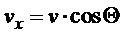
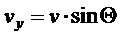
Измерение изменяемых координат элементов системы связи производится по следующим формулам:The measurement of the coordinates of the elements of the communication system is carried out according to the following formulas:
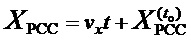

где t - время перемещения элемента распределенной сети связи;where t is the travel time of the element of the distributed communication network;


Расчет изменяемых координат для объектов органов вышестоящего управления производится по следующим формулам:The calculation of the changing coordinates for the objects of the higher-level government bodies is carried out according to the following formulas:
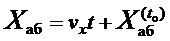
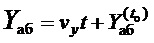
где t0 - время начала перемещения объекта органов вышестоящего управления;where t 0 is the time of the beginning of the movement of the object of the higher-level organs;


2.2 Моделируют выбор координат района развертывания перемещаемого элемента (узлов связи) распределенной сети связи вышестоящей системы управления на ПУ различных уровней и объектов органов вышестоящего управления.2.2. Model the choice of coordinates of the deployment area of the relocatable element (communication nodes) of the distributed communication network of the higher-level control system at control stations of various levels and objects of higher-level control bodies.
Процедура выбора координат района развертывания перемещаемого элемента (объектов органов вышестоящего управления) системы связи носит итерационный характер. Правило останова процедуры выбора координат использует критерий:The procedure for selecting the coordinates of the deployment area of the relocatable element (objects of higher-level authorities) of the communication system is iterative. The rule for stopping the coordinate selection procedure uses the criterion:
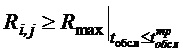
где 


Порядок и особенности моделирования процесса перемещения сил и средств описан в книге Чуев Ю.В. Исследование операций в военном деле. М.: Военное издательство Министерства Обороны СССР,1970. - 256 с., стр. 107-114.The order and features of modeling the process of moving forces and means are described in the book Chuyev Yu.V. The study of operations in the military. M .: Military publishing house of the Ministry of Defense of the USSR, 1970. - 256 p., Pp. 107-114.
3. Моделируют использование ресурса системы связи ПУ различных уровней и ЕСЭ РФ в процессе функционирования. Одним из основных показателей ресурса системы связи ПУ и ЕСЭ РФ является пропускная способность.3. Model the use of the resource of the communication system of PU at various levels and the ESE of the Russian Federation in the process of functioning. One of the main indicators of the resource of the communication system of the PU and ESE of the Russian Federation is throughput.
Требования к пропускной способности узла и линии связи задаются количеством сообщений (
В блоке 4 моделируют процессы вскрытия и воздействия на элементы распределенной сети связи вышестоящей системы управления со стороны злоумышленника.In block 4, the processes of tampering and exposure to elements of a distributed communication network of a superior control system by an attacker are simulated.
Вероятность принятия решения злоумышленником на применение средств поражения по элементам распределенной сети связи зависит от степени их вскрытия разведкой. Вскрытие элементов распределенной сети связи может осуществляться по данным различных видов разведки: радиоразведки (РР), радиотехнической (РТР), радиолокационной (РЛР), оптико-электронной (ОЭР), инфракрасной (ИКР) и др. (Ю.К. Меньшаков Защита объектов и информации от технических средств разведки. Учебное пособие. М.: Российский государственный гуманитарный университет, 2002. - 399 с., стр. 15-75).The likelihood of an attacker making a decision on the use of means of destruction on elements of a distributed communication network depends on the degree of their discovery by intelligence. The opening of the elements of a distributed communication network can be carried out according to various types of reconnaissance: radio reconnaissance (RR), radio engineering (RTR), radar (RLR), optoelectronic (OER), infrared (IRR), etc. (Yu.K. Menshakov Object protection and information from technical intelligence tools. Textbook. M.: Russian State University for the Humanities, 2002. - 399 p., pp. 15-75).
Обобщенный алгоритм вскрытия технических средств (объектов) описан в учебном пособии Горелик А.Л., Скрипкин В.А. Методы распознавания: Учебное пособие для вузов. - 2-е издание, переработанное и дополненное. - М.: Высшая школа, 1984. - 208 с.: ил. стр. 123-146.The generalized algorithm for opening technical means (objects) is described in the training manual Gorelik A.L., Skripkin V.A. Recognition Methods: Textbook for high schools. - 2nd edition, revised and supplemented. - M.: Higher School, 1984. - 208 p.: Ill. pg. 123-146.
Обобщенный алгоритм включает в себя следующие этапы:The generalized algorithm includes the following steps:
1. Определение источников излучений (технических средств, объектов) и их местоположения.1. Determination of radiation sources (technical equipment, objects) and their location.
2. Выделение первичных признаков (реквизиты демаскирующих признаков) и идентификация типа технического средства (объекта).2. The allocation of primary features (details of unmasking features) and identification of the type of technical tool (object).
3. Группирование идентифицированных технических средств в более сложные объекты (группы, классы) с учетом их места нахождения и наличия структурных связей в системе.3. Grouping of identified technical means into more complex objects (groups, classes), taking into account their location and the presence of structural connections in the system.
4. Формирование группового «портрета» технических средств (объектов) в информационном поле радиоразведки на основании полученных признаков.4. Formation of a group “portrait” of technical means (objects) in the information field of radio intelligence based on the received signs.
5. Сопоставление группового «портрета» технических средств (объектов) с известными описаниями элементов системы и расчет меры сходства.5. Comparison of the group “portrait” of technical means (objects) with well-known descriptions of the elements of the system and calculation of the measure of similarity.
6. На основании полученных расчетов и определенных правил, принятие решения об отнесении заданного технического средства (объекта) к определенному элементу системы.6. Based on the obtained calculations and certain rules, a decision is made on assigning a given technical means (object) to a specific element of the system.
Особенности построения и порядок функционирования системы вскрытия технических средств и объектов описан в учебнике Осипов А.С. Военно-техническая подготовка. Военно-технические основы построения средств и комплексов РЭП: учебник / А.С. Осипов; под науч. ред. Е.Н. Гарина. - Красноярск : Сиб. федер. ун-т, 2013. - 344 с., стр. 322-325.Features of the construction and operation of the opening system of technical means and objects are described in the textbook Osipov A.S. Military technical training. Military-technical foundations of building tools and complexes of electronic warfare: textbook / A.S. Osipov; under the scientific. ed. E.N. Garina. - Krasnoyarsk: Sib. Feder. Univ., 2013 .-- 344 p., pp. 322-325.
При оценке процессов функционирования элементов распределенной сети связи вышестоящей системы управления в условиях вскрытия злоумышленником используют обобщенные показатели разведзащищенности: вероятность вскрытия - 



где 




Порядок расчета и оценки показателей разведзащищенности описан в следующих источниках: 1. Ануреев И.И., Татарченко А.Е. Применение математических методов в военном деле. - М.: ВИ МО СССР, 1967. - 243 с., стр. 173-175; 2. Чуев Ю.П. и др. Основы исследования операций в военной технике. - М.: Советское радио, 1965. - 591 с., стр. 63-73; 3. Хорев А.А. Теоретические основы оценки возможностей технических средств разведки. - М.: МО РФ, 2000. - 255 с.; 4. Меньшаков Ю.К. Защита объектов и информации от технических средств разведки - М.: Российск. гос. гуманит. ун-т, 2002. - 399 с., стр. 78-116. 5. В.Г. Иванов, С.А. Панихидников Монографии «Теория и практика построения технической основы системы управления специального назначения»: [монография] / В.Г. Иванов, С.А. Панихидников; СПбГУТ. - СПб., 2016. - 184 с., стр. 138-141.The procedure for calculating and evaluating intelligence indicators is described in the following sources: 1. Anureev II, Tatarchenko A.E. The use of mathematical methods in military affairs. - M.: VI MO of the USSR, 1967. - 243 p., Pp. 173-175; 2. Chuev Yu.P. and other Fundamentals of the study of operations in military equipment. - M .: Soviet Radio, 1965. - 591 p., Pp. 63-73; 3. Horev A.A. The theoretical basis for assessing the capabilities of technical intelligence. - M .: MO RF, 2000. - 255 p .; 4. Menshakov Yu.K. Protection of objects and information from reconnaissance equipment - M .: Russian. state humanity. Univ., 2002 .-- 399 p., pp. 78-116. 5. V.G. Ivanov, S.A. Panikhidnikov Monographs “Theory and Practice of Building the Technical Basis of a Special Purpose Management System”: [monograph] / V.G. Ivanov, S.A. Funeral attendants; SPbGUT. - SPb., 2016 .-- 184 p., Pp. 138-141.
Моделирование внешних деструктивных воздействий осуществляется с использованием известных методов генерации (имитации), зависящих от вида распределения разыгрываемых величин, характеризующих математические ожидания времени возникновения внешних воздействий (см. Имитационное моделирование средств и комплексов связи и автоматизации. Иванов Е.В. СПб.: ВАС, 1992. стр. 9-18).The modeling of external destructive influences is carried out using well-known methods of generation (imitation), depending on the type of distribution of the played values, which characterize the mathematical expectations of the time of occurrence of external influences (see. Simulation of means and complexes of communication and automation. Ivanov EV St. Petersburg: YOU, 1992. p. 9-18).
В нашем случае основными видами внешних деструктивных воздействий, используемых для моделирования, являются: огневое воздействие и информационно-техническое воздействие. При этом, в зависимости от выбранного внешнего воздействия, при моделировании могут использоваться следующие методы генерации (розыгрыша) случайных величин (см. Моделирование систем. Инструментальные средства GPSS World: Учеб. пособие. - СПб.: БХВ-Петербург, 2004. - 368 с.): метод розыгрыша случайных чисел для дискретных равномерных распределений; метод розыгрыша случайных чисел для дискретных неравномерных распределений; метод розыгрыша случайных чисел для непрерывных равномерных распределений; метод розыгрыша случайных чисел для непрерывных неравномерных распределений.In our case, the main types of external destructive influences used for modeling are: fire exposure and information and technical impact. At the same time, depending on the selected external influence, the following methods of generating (drawing) random variables can be used in modeling (see. System Simulation. GPSS World Tools: Textbook. - SPb .: BHV-Petersburg, 2004. - 368 p. .): random number draw method for discrete uniform distributions; random number draw method for discrete non-uniform distributions; random number drawing method for continuous uniform distributions; random number drawing method for continuous uneven distributions.
Основные виды и особенности использования средств огневого поражения описаны в книгах: 1. А.В. Бабкин, В.А. Велданов Средства поражения и боеприпасы: Учебник / А.В. Бабкин и др.; Под общ. ред. В.В.Селиванова. - М.: Изд-во МГТУ им. Н.Э. Баумана, 2008. - 984 с.: ил. 2. И.А. Балаганский, Л.А. Мержневский Действие средств поражения и боеприпасов: Учебник. - Новосибирск: издательство НГТУ. - 2004. - 408 с. 3. Боеприпасы : учебник : в 2 т. / под общей ред. В.В. Селиванова. - Москва: Издательство МГТУ им. Н.Э. Баумана, 2016.The main types and features of the use of fire weapons are described in the books: 1. A.V. Babkin, V.A. Veldanov Means of destruction and ammunition: Textbook / A.V. Babkin et al .; Under the total. ed. V.V.Selivanova. - M.: Publishing House of MSTU. N.E. Bauman, 2008 .-- 984 p.: Ill. 2. I.A. Balagansky, L.A. Merzhnevsky Effect of weapons and ammunition: Textbook. - Novosibirsk: NSTU publishing house. - 2004 .-- 408 p. 3. Ammunition: textbook: in 2 volumes / under the general ed. V.V. Selivanova. - Moscow: Publishing House MSTU. N.E. Bauman, 2016.
Основные виды и особенности использования средств информационно-технического воздействия описаны в книге Гриняев С.Н. Поле битвы - киберпространство. Теория, приемы, средства, методы и системы ведения информационной войны. М.: издательство Харвест, 2004. - 426с., стр. 109-112.The main types and features of using information technology tools are described in the book Grinyaev S.N. The battlefield is cyberspace. Theory, techniques, means, methods and systems of information warfare. M .: Harvest Publishing House, 2004 .-- 426p., Pp. 109-112.
Порядок и особенности моделирования огневых воздействий описан в книге Чуев Ю.В. Исследование операций в военном деле. М.: Военное издательство Министерства Обороны СССР,1970. - 256 с., стр. 88-103.The order and features of modeling of fire actions are described in the book Chuev Yu.V. The study of operations in the military. M .: Military publishing house of the Ministry of Defense of the USSR, 1970. - 256 p., Pp. 88-103.
Особенности моделирования информационно-технических воздействий описаны в книге Д.А. Губанов, Д.А. Новиков Социальные сети: модели информационного влияния, управления и противоборства. М.: Издательство физико-математической литературы, 2010. - 228 с., стр. 196.Features of modeling information technology impacts are described in the book D.A. Gubanov, D.A. Novikov Social networks: models of information influence, management and confrontation. M .: Publishing house of physical and mathematical literature, 2010. - 228 p., P. 196.
В блоке 5 моделируют процессы сбора, обработки и анализа данных о: степени воздействия злоумышленника на элементы распределенной сети связи вышестоящей системы управления, динамике перемещения элементов (узлов связи) распределенной сети связи вышестоящей системы управления, а так же интенсивности и продолжительности предоставления телекоммуникационных услуг (используемом ресурсе) объектам органов вышестоящего управления.In
1. Оценка степени воздействия злоумышленника на элементы распределенной сети связи вышестоящей системы управления осуществляется с учетом его возможностей по их вскрытию.1. An assessment of the degree of the attacker's influence on the elements of a distributed communication network of a higher-level control system is carried out taking into account his capabilities for opening them.
1.1 Оценка возможностей злоумышленника по вскрытию элементов распределенной сети связи осуществляется следующим образом.1.1. Evaluation of the capabilities of an attacker to reveal elements of a distributed communication network is as follows.
В общем случае требования к разведывательной защищенности элементов распределенной сети связи заключаются в том, чтобы продолжительность времени вскрытия элементов распределенной сети связи было не меньше допустимого при значении вероятности этого вскрытия, не превышающего допустимое значение. Оценка возможностей злоумышленника по вскрытию элементов распределенной сети связи осуществляется на основании выполнения следующих условий:In the general case, the requirements for reconnaissance security of the elements of a distributed communication network are that the duration of the opening time of the elements of the distributed communication network should be no less than the permissible value for the probability of this opening that does not exceed the permissible value. Evaluation of the attacker's ability to open the elements of a distributed communication network is carried out on the basis of the following conditions:


где 

Если условие 15 не выполнено, то злоумышленник не успел вскрыть элементы распределенной сети связи, если условие 16 не выполнено, то у злоумышленника нет средств для вскрытия элементов распределенной сети связи; при выполнении условий 15 и 16 элемент распределенной сети связи считается вскрытым.If condition 15 is not met, then the attacker did not manage to open the elements of the distributed communication network; if condition 16 is not fulfilled, then the attacker does not have the means to open the elements of the distributed communication network; when conditions 15 and 16 are fulfilled, the element of the distributed communication network is considered opened.
1.2 Оценка возможностей злоумышленника по воздействию на элементы распределенной сети связи вышестоящей системы управления осуществляется на основании выполнения следующего условия:1.2. Evaluation of the capabilities of an attacker to influence the elements of a distributed communication network of a higher-level control system is carried out on the basis of the following conditions:

где

Если условие 17 не выполнено, то злоумышленник не успел воздействовать на элементы распределенной сети связи, при выполнении условия 19 элемент распределенной сети связи считается подвергнутым воздействию.If condition 17 is not fulfilled, the attacker did not manage to act on the elements of the distributed communication network; when condition 19 is fulfilled, the element of the distributed communication network is considered to be exposed.
2. Оценка динамики перемещения элементов (узлов связи) распределенной сети связи вышестоящей системы управления осуществляется с учетом времени их перемещения от одного положения к другому, определяемого по формуле:2. The dynamics of the movement of elements (communication nodes) of a distributed communication network of a higher-level control system is evaluated taking into account the time of their movement from one position to another, determined by the formula:

где tcp - среднее значение времени перемещения элемента распределенной сети связи от одного положения к другому;where t cp is the average value of the time the element of the distributed communication network moves from one position to another;

Порядок и особенности перемещения (передвижения) элементов (узлов связи) описаны в следующей литературе: 1. Тактика / В.Г. Резниченко, И.Н. Воробьев, Н.Ф. Мирошниченко и др., Под. ред. В.Г. Резниченко - М.: Воениздат, 1984. - 271 с., стр. 222-267. 2.Учебник сержанта войск связи. М.: Военное издательство. Министерство обороны РФ, 2004. - 574 с., стр. 80-83. 3. Градусов, Р.А. Организация и структура полевых узлов связи объединения : учеб.- метод. пособие / Р.А. Градусов, С.Н. Касанин. - Минск: БГУИР, 2012. - 119 с., стр. 89-90.The order and features of the movement (movement) of elements (communication nodes) are described in the following literature: 1. Tactics / V.G. Reznichenko, I.N. Vorobiev, N.F. Miroshnichenko et al., Under. ed. V.G. Reznichenko - M .: Military Publishing House, 1984 .-- 271 p., Pp. 222-267. 2. Textbook sergeant communications troops. M .: Military publishing house. Ministry of Defense of the Russian Federation, 2004. - 574 p., Pp. 80-83. 3. Degrees, R.A. The organization and structure of the field communication nodes of the association: textbook.- method. allowance / R.A. Gradusov, S.N. Casanin. - Minsk: BSUIR, 2012 .-- 119 p., Pp. 89-90.
3. Оценка интенсивности и продолжительности предоставления телекоммуникационных услуг (используемый ресурс) объектам органов вышестоящего управления определяется с учетом анализа используемого ресурса ЕСЭ РФ.3. The assessment of the intensity and duration of the provision of telecommunication services (used resource) to the objects of higher management bodies is determined taking into account the analysis of the used ESE RF resource.
При этом измеряют: основные характеристики передаваемых элементами распределенной сети связи и абонентами потоков информации, интенсивность выхода элементов распределенной сети связи и абонентов в связь, количество и длительность сеансов связи, определяют виды и измеряют продолжительность предоставляемых телекоммуникационных услуг. Под характеристиками передаваемых потоков информации, определяемыми средой распространения сигналов, видами электросвязи и отражающими расположение и состояние элементов распределенной сети связи (абонентов) понимаются (Гаранин М.В. и др. Системы и сети передачи информации: Учеб. пособие для ВУЗов. - М.: Радио и связь, 2001. - 336 с., стр. 11-12):In this case, they measure: the main characteristics of the information flows transmitted by the elements of the distributed communication network and subscribers, the intensity of the output of the elements of the distributed communication network and subscribers into the communication, the number and duration of communication sessions, determine the types and measure the duration of the telecommunication services provided. Under the characteristics of the transmitted information flows, determined by the medium of signal propagation, types of telecommunications and reflecting the location and condition of the elements of a distributed communication network (subscribers) are understood (MV Garanin and others. Information transmission systems and networks: Textbook for universities. - M. : Radio and communications, 2001. - 336 p., Pp. 11-12):
- пространственно-поляризационные и энергетические характеристики передаваемых сигналов;- spatial polarization and energy characteristics of the transmitted signals;
- используемые рабочие частоты (диапазон частот) и спектральные характеристики передаваемых несущих (аналоговых) сигналов;- used operating frequencies (frequency range) and spectral characteristics of the transmitted carrier (analog) signals;
- характеристики структуры передаваемых потоков данных, используемые протоколы передачи данных, служебные протоколы (управления, диагностические и др.), прикладные службы (сервисы) обмена данными;- characteristics of the structure of the transmitted data streams, the used data transfer protocols, service protocols (control, diagnostic, etc.), data exchange application services (services);
- идентификационные сигналы и информация (сообщения, данные) абонентов;- identification signals and information (messages, data) of subscribers;
- служебные (управляющие, диагностические и др.) сигналы и информация (сообщения, данные) элементов разнородных сетей связи.- service (control, diagnostic, etc.) signals and information (messages, data) of elements of heterogeneous communication networks.
Проводимые измерения, позволяют произвести оценку индивидуальных особенностей использования элементами распределенной сети связи и абонентами предоставляемого телекоммуникационного ресурса.The measurements taken allow us to evaluate the individual characteristics of the use of the distributed telecommunication network by the elements of the distributed communication network and subscribers.
Кроме того, определяют возможность привязки элементов распределенной сети связи и абонентов к узлам (точкам) доступа ЕСЭ в конкретных районах размещения и при смене местоположений, с учетом требуемого набора предоставляемых телекоммуникационных услуг и характера выполняемых задач.In addition, they determine the possibility of linking elements of a distributed communication network and subscribers to ESE access nodes (points) in specific areas of location and when changing locations, taking into account the required set of telecommunication services provided and the nature of the tasks performed.
Телекоммуникационные услуги включают услуги магистральных транспортных сетей и высокоскоростных сетей передачи данных, услуги сетей передачи данных, услуги мобильной связи. Эти услуги обеспечивают передачу различных видов информации (речь, данные, видеоизображения и т.п.), сопряжение между разнотипным оконечным оборудованием, сервисное обслуживание пользователей (Битнер В.И. Нормирование качества телекоммуникационных услуг: Учебное пособие. / Под ред. профессора В.П. Шувалова, Битнер В.И., Попов Г.Н. - М.: Горячая линия - Телеком, 2004. - 312 с.).Telecommunication services include the services of backbone transport networks and high-speed data transmission networks, data transmission network services, and mobile communication services. These services provide the transmission of various types of information (speech, data, video, etc.), pairing between different types of terminal equipment, user services (Bitner V.I. Rationing of the quality of telecommunication services: Textbook. / Ed. By Professor V. P. Shuvalova, Bitner V.I., Popov G.N .-- M .: Hot line - Telecom, 2004. - 312 p.).
По результатам сбора, обработки и анализа полученной информации формируют набор статистических данных. Порядок и особенности работы со статистическими данными описан учебнике Орлов А.И. Прикладная статистика. Учебник. / А.И.Орлов. - М.: Издательство «Экзамен», 2004. - 656 с.Based on the results of the collection, processing and analysis of the information received, a set of statistical data is formed. The order and features of working with statistical data are described in the textbook Orlov A.I. Applied statistics. Textbook. / A.I. Orlov. - M.: Publishing house "Examination", 2004. - 656 p.
Порядок формирования и использования статистических данных в условиях применения и управления силами и средствами описан в учебнике Иволгин Н.С. Исследование операций. Ч. 1. СПб.: Военно-морская академия имени Адмирала Флота Советского Союза Н.Г. Кузнецова, 1999. - 366 с., стр. 176-180.The procedure for the generation and use of statistical data in terms of application and control of forces and means is described in the textbook Ivolgin N.S. Operations research. Part 1. St. Petersburg: Admiral Fleet Naval Academy of the Soviet Union N.G. Kuznetsova, 1999 .-- 366 p., Pp. 176-180.
В блоке 6 с учетом полученного набора статистических данных моделируют прогнозирование количества элементов распределенной сети связи вышестоящей системы управления, которые могут выйти из строя в результате вскрытия и воздействий злоумышленника, а так же состояние ресурса системы связи пунктов управления и ЕСЭ РФ с учетом воздействий злоумышленника и динамики перемещения элементов (узлов связи) распределенной сети связи и объектов органов вышестоящего управления от одного положения к другому.In
Особенности моделирования процесса прогнозирования применительно к военной сфере деятельности описаны в книге Чуев Ю.В., Михайлов Ю.Б. Прогнозирование в военном деле. М., Воениздат, 1975. - 279 с., стр. 137-271.Features of modeling the forecasting process as applied to the military sphere of activity are described in the book Chuev Yu.V., Mikhailov Yu.B. Forecasting in the military. M., Military Publishing, 1975 .-- 279 p., Pp. 137-271.
При этом техническая реализация процесса прогнозирования известна в виде технических устройств из широкого круга технической литературы: 1. Рабочая книга по прогнозированию/ И.В. Бестужев-Лада. - М.: Мысль, 1982. - 430 с., стр. 281-293. 2. Технические средства диагностирования: Справочник / В.В. Клюев, П.П. Пархоменко, В.Е. Абрамчук и др.; Под общ. Ред. В.В. Клюева. - М.: Машиностроение, 1989. - 672 с., ил. - стр.158-159, рис. 17. 3. Гаскаров Д.В., Голинкевич Т.А., Мозгалевский А.В. Прогнозирование технического состояния и надежности радиоэлектронной аппаратуры. М.: Сов. радио, 1974. - 224 с.Moreover, the technical implementation of the forecasting process is known in the form of technical devices from a wide range of technical literature: 1. Workbook on forecasting / I.V. Bestuzhev-Lada. - M.: Thought, 1982. - 430 p., Pp. 281-293. 2. Technical means of diagnosis: Reference / V.V. Klyuev, P.P. Parkhomenko, V.E. Abramchuk and others; Under the total. Ed. V.V. Klyueva. - M .: Engineering, 1989 .-- 672 p., Ill. - p. 158-159, fig. 17. 3. Gaskarov D.V., Golinkevich T.A., Mozgalevsky A.V. Prediction of the technical condition and reliability of electronic equipment. M .: Sov. Radio, 1974.- 224 p.
Результаты прогнозирования представляются в удобном для использования виде: таблицы, графики, массивы данных (Романова Ю.Д. Информатика и информационные технологии. Конспект лекций: учеб. пособие / Ю.Д. Романова, И.Г. Лесничая. - 2-е изд., перераб. и доп. - М.: Эксмо, 2009. - 320 с., стр. 116, 174).The forecasting results are presented in a convenient form for use: tables, graphs, data arrays (Romanova Yu.D. Informatics and information technology. Lecture notes: textbook / Yu.D. Romanova, I.G. Lesnichaya. - 2nd ed. ., rev. and add. - M .: Eksmo, 2009 .-- 320 p., pp. 116, 174).
В блоке 7 с учетом результатов прогнозирования оценивают эффективность функционирования распределенной сети связи вышестоящей системы управления (А.В. Боговик, В.В. Игнатов Эффективность систем военной связи и методы ее оценки. - СПб.: ВАС, 2006. - 183 с., стр. 37-61).In
Оценка эффективности функционирования распределенной сети связи производится с учетом: требуемого объема телекоммуникационного ресурса - 


В случае, если объекты органов вышестоящего управления удовлетворены требуемым набором, качеством и своевременностью предоставляемых телекоммуникационных услуг, то переходят к блоку 12, где осуществляется проверка окончания модельного (системного) времени. В случае если модельное (системное) время не закончилось, управление передается блоку 3, где осуществляется дальнейшее моделирование функционирования (применения по назначению) распределенной сети связи вышестоящей системы управления, если модельное (системное) время закончилось, то производят остановку процесса моделирования.If the objects of the higher management bodies are satisfied with the required set, quality and timeliness of the telecommunication services provided, then they proceed to block 12, where the end of the model (system) time is checked. If the model (system) time has not expired, control is transferred to block 3, where further modeling of the functioning (intended use) of the distributed communication network of the higher-level control system is carried out, if the model (system) time has expired, the simulation process is stopped.
Если же структура распределенной сети связи не обеспечивает объекты органов вышестоящего управления требуемым набором телекоммуникационных услуг или объекты органов вышестоящего управления не удовлетворены своевременностью и качеством предоставляемых телекоммуникационных услуг, осуществляется переход к блоку 8, где осуществляется моделирование структурно-функциональной реконфигурации распределенной сети связи вышестоящей системы управления.If the structure of the distributed communication network does not provide the objects of the higher-level management bodies with the required set of telecommunication services or the objects of the higher-level management bodies are not satisfied with the timeliness and quality of the telecommunications services provided, go to
Порядок работы блока 8 следующий (фиг. 2).The operating procedure of
В блоке 8.1 определяют и рассчитывают структурно-топологические и структурно-функциональные показатели распределенной сети связи вышестоящей системы управления.In block 8.1, structural-topological and structural-functional indicators of a distributed communication network of a superior control system are determined and calculated.
К структурно-топологическим (статическим) показателям относятся: структурная живучесть (надежность), структурно-топологические свойства, связность и т.д.:The structural and topological (static) indicators include: structural survivability (reliability), structural and topological properties, connectivity, etc .:
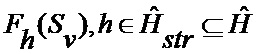
К структурно-функциональным (динамическим) показателям относятся: функциональная живучесть (надежность), производительность, удельная пропускная способность, расходуемые ресурсы и т.д.:The structural-functional (dynamic) indicators include: functional survivability (reliability), performance, specific throughput, expendable resources, etc .:
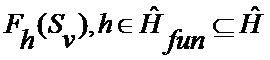
где 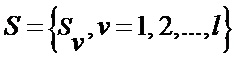

Совокупность частных показателей элементов распределенной сети связи в каждом из структурных состояний будет определятся выражением:The set of private indicators of the elements of a distributed communication network in each of the structural states will be determined by the expression:

Порядок и особенности расчета показателей живучести (надежности) систем управления и сетей описаны в книгах: 1. Величко В.В., Попков Г.В., Попков В.К. Модели и методы повышения живучести современных систем связи. - М.: Горячая линия - Телеком, 2014. - 270 с.:, ил. стр. 9-14. 2. ГОСТ Р 53111-2008 устойчивость функционирования сети связи общего пользования. Требования и методы проверки. М.: Стандартинформ, 2009 г. 3. Шкляр В.Н. Надежность систем управления: учебное пособие / В.Н. Шкляр. Томский политехнический университет. - Томск: Издательство Томского политехнического университета, 2009. - 126 с., стр. 11-28.The order and features of calculating the survivability (reliability) of control systems and networks are described in the books: 1. Velichko VV, Popkov GV, Popkov VK Models and methods for increasing the survivability of modern communication systems. - M .: Hot line - Telecom, 2014 .-- 270 p.:, Ill. p. 9-14. 2. GOST R 53111-2008 the stability of the functioning of the public communication network. Requirements and verification methods. M .: Standartinform, 2009. 3. Shklyar V.N. Reliability of control systems: a training manual / V.N. Shklyar. Tomsk Polytechnic University. - Tomsk: Publishing House of the Tomsk Polytechnic University, 2009. - 126 p., Pp. 11-28.
В блоке 8.2 с учетом рассчитанных структурно-топологических и структурно-функциональных показателей определяют критически важные элементы распределенной сети связи вышестоящей системы управления, которые играют ключевую роль в обеспечении надежности, безопасности и живучести распределенной сети связи.In block 8.2, taking into account the calculated structural-topological and structural-functional indicators, critical elements of a distributed communication network of a higher-level control system are determined that play a key role in ensuring the reliability, security and survivability of a distributed communication network.
Для выявления критически важных элементов распределенной сети связи определяют и рассчитывают показатели критичности отказов (выхода из строя) основными из которых являются: устойчивость элемента распределенной сети связи к воздействию внешних неблагоприятных факторов (живучесть), возможность резервирования элемента распределенной сети связи, возможность контроля (мониторинга) состояния элемента распределенной сети связи; возможность восстановления элемента распределенной сети связи и др.To identify critical elements of a distributed communication network, the criticality of failures (failure) is determined and calculated, the main of which are: the stability of the distributed communication network element to the effects of external adverse factors (survivability), the ability to reserve a distributed communication network element, and the ability to control (monitor) state of an element of a distributed communication network; the ability to restore an element of a distributed communication network, etc.
Полученное множество показателей критичности отказов имеет вид:The resulting set of failure criticality indicators has the form:
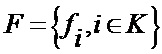
где 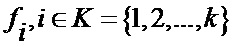
Порядок и особенности анализа видов, последствий и критичности отказов элементов сложных систем описаны в следующих источниках: 1. ГОСТ 27.310-95 Надежность в технике. Анализ видов, последствий и критичности отказов. Основные положения. - М.: ИПК издательство стандартов, 1998. - 12 с. 2. ГОСТ Р 51901.12-2007 Менеджмент риска. Метод анализа видов и последствий отказов. - М.: Стандартинформ, 2008. - 35 с. 3. МЭК 60812:2006 «Методы анализа надежности систем. Метод анализа видов и последствий отказов». The order and features of the analysis of the types, consequences and criticality of failures of elements of complex systems are described in the following sources: 1. GOST 27.310-95 Reliability in technology. Analysis of the types, consequences and criticality of failures. The main provisions. - M .: IPK publishing house of standards, 1998. - 12 p. 2. GOST R 51901.12-2007 Risk management. Method for analyzing the types and consequences of failures. - M .: Standartinform, 2008 .-- 35 p. 3. IEC 60812: 2006 “Methods of analysis of system reliability. A method of analyzing the types and consequences of failures. "
В блоке 8.3 с учетом критичности отказов элементов распределенной сети связи моделируют процесс разработки вариантов структурной реконфигурации распределенной сети связи вышестоящей системы управления.In block 8.3, taking into account the criticality of failures of elements of a distributed communication network, the process of developing options for structural reconfiguration of a distributed communication network of a higher-level control system is modeled.
Задача разработки вариантов структурной реконфигурации распределенной сети связи представляет собой оптимизационную задачу следующего вида:The task of developing options for structural reconfiguration of a distributed communication network is an optimization task of the following form:
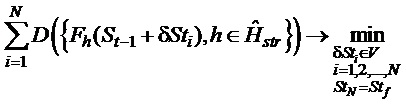
где





Порядок и особенности структурной реконфигурации сложных объектов описаны в следующих источниках: 1. Филин Б.П. Методы анализа структурной надежности сетей связи. - М.: Радио и связь, 1988. - 208 с.: ил., стр. 160-175. 2. Охтилев М.Ю. Интеллектуальные технологии мониторинга и управления структурной динамикой сложных технических объектов / М.Ю. Охтилев, Б.В. Соколов, Р.М. Юсупов. - М. : Наука, 2006. - 410 с., стр. 174-205. 3. Павлов, А.Н. Структурная реконфигурации сложных объектов / А.Н. Павлов, В.А. Зеленцов, А.Ю. Кулаков // Надежность и качество: труды международного симпозиума (РФ, Пенза, 21-31 мая 2012 г.). - Пенза : Изд-во ПГУ, 2012. - т. 1. - С. 146-148. 2.The order and features of the structural reconfiguration of complex objects are described in the following sources: 1. Filin B.P. Methods of analysis of the structural reliability of communication networks. - M.: Radio and Communications, 1988 .-- 208 p.: Ill., Pp. 160-175. 2. Okhtilev M.Yu. Intelligent technologies for monitoring and controlling the structural dynamics of complex technical objects / M.Yu. Okhtilev, B.V. Sokolov, R.M. Yusupov. - M.: Nauka, 2006 .-- 410 p., Pp. 174-205. 3. Pavlov, A.N. Structural reconfiguration of complex objects / A.N. Pavlov, V.A. Zelentsov, A.Yu. Kulakov // Reliability and quality: proceedings of an international symposium (RF, Penza, May 21-31, 2012). - Penza: Publishing house of PSU, 2012. - v. 1. - S. 146-148. 2.
В блоке 8.4 моделируют процесс выбора оптимального варианта структурно-функциональной реконфигурации распределенной сети связи вышестоящей системы управления.In block 8.4, the process of choosing the best option for structural and functional reconfiguration of a distributed communication network of a superior control system is modeled.
Процесс выбора оптимального варианта структурно-функциональной реконфигурации распределенной сети связи может быть представлен в виде теоретико-множественной модели:The process of choosing the best option for structural and functional reconfiguration of a distributed communication network can be represented as a set-theoretic model:

где 


С учетом выражения 24 задача выбора оптимального варианта структурно-функциональной реконфигурации распределенной сети связи сводится к задаче определения множества наилучших альтернатив при определенных условиях функционирования.Given expression 24, the task of choosing the best option for structural and functional reconfiguration of a distributed communication network is reduced to the task of determining the set of best alternatives under certain operating conditions.
Для обеспечения требуемого уровня работоспособности выбранного варианта структурно-функциональной реконфигурации распределенной сети связи в динамически изменяющихся условиях требуется, с одной стороны, минимизировать постоянные расходы на поддержание функционирования распределенной сети связи в процессе реконфигурации, а с другой стороны, достичь наилучшего целевого эффекта (эффективности функционирования).To ensure the required level of operability of the selected option of structural and functional reconfiguration of a distributed communication network in dynamically changing conditions, it is required, on the one hand, to minimize the fixed costs of maintaining the functioning of a distributed communication network during reconfiguration, and on the other hand, to achieve the best target effect (functioning efficiency) .
Порядок и особенности структурно-функциональной реконфигурации сложных систем описаны в следующих источниках: 1. Тарасов, А.А. Методы функциональной реконфигурации отказо-устойчивых систем / А.А. Тарасов // Надежность. - 2002. - № 2. - С. 29-35. 2. Москвин, Б.В. Комбинированные модели управления структурной динамикой сложных технических объектов / Б.В. Москвин, Е.П. Михайлов, А.Н. Павлов, Б.В. Соколов // Известия Вузов. Приборостроение. - 2006. - том №49, №11. - C. 8-12.The order and features of the structural and functional reconfiguration of complex systems are described in the following sources: 1. Tarasov, A.A. Methods of functional reconfiguration of fault-tolerant systems / A.A. Tarasov // Reliability. - 2002. - No. 2. - S. 29-35. 2. Moskvin, B.V. Combined control models for the structural dynamics of complex technical objects / B.V. Moskvin, E.P. Mikhailov, A.N. Pavlov, B.V. Sokolov // University News. Instrument making. - 2006. - Volume No. 49, No. 11. - C. 8-12.
В блоке 8.5 с учетом выбранного варианта структурно-функциональной реконфигурации моделируют параметрический синтез распределенной сети связи вышестоящей системы управления.In block 8.5, taking into account the selected variant of the structural and functional reconfiguration, a parametric synthesis of a distributed communication network of a higher-level control system is modeled.
Параметрический синтез распределенной сети связи осуществляется с целью обоснования характеристик элементов распределенной сети связи и связей между ними, обеспечивающих эффективность функционирования распределенной сети связи с учетом выбранного варианта структурно-функциональной реконфигурации. The parametric synthesis of a distributed communication network is carried out in order to justify the characteristics of the elements of a distributed communication network and the connections between them, ensuring the efficiency of the distributed communication network, taking into account the selected option of structural and functional reconfiguration.
Порядок и особенности синтеза сложных систем описаны в следующих источниках: 1. Балашов, Е.П. Эволюционный синтез систем / Е.П. Балашов. - М.: Радио и связь, 1985. - 328 с., стр. 31-43, 132-150. 2. Цвиркун, А.Д. Структура сложных систем / А.Д. Цвиркун. - М.: Радио и связь, 1975. - 200 с., стр. 41-147. 3. Цвиркун, А.Д. Имитационное моделирование в задачах синтеза структуры сложных систем: Оптимизационно-имитационный подход / А.Д. Цвиркун, В.И. Акинфиев, В.А. Филимонов. - М.: Наука, 1985. - 176 с., стр. 74-118.The order and features of the synthesis of complex systems are described in the following sources: 1. Balashov, EP Evolutionary synthesis of systems / E.P. Balashov. - M .: Radio and communications, 1985 .-- 328 p., Pp. 31-43, 132-150. 2. Zvirkun, A.D. The structure of complex systems / A.D. Zwirkun. - M .: Radio and communications, 1975 .-- 200 p., Pp. 41-147. 3. Zvirkun, A.D. Simulation modeling in problems of synthesis of the structure of complex systems: Optimization-simulation approach / A.D. Zvirkun, V.I. Akinfiev, V.A. Filimonov. - M .: Nauka, 1985 .-- 176 p., Pp. 74-118.
В блоке 9 оценивают эффективность функционирования сформированной распределенной сети связи вышестоящей системы управления. Порядок и особенности оценки эффективности функционирования сформированной распределенной сети связи подробно рассмотрен при описании блока 7.In
В случае если сформированная распределенная сеть связи не обеспечивает объекты органов вышестоящего управления требуемым набором телекоммуникационных услуг или объекты органов вышестоящего управления не удовлетворены своевременностью и качеством предоставляемых телекоммуникационных услуг, осуществляется переход к блоку 10 , где проверяется потребность в корректировке исходных данных.If the formed distributed communication network does not provide the objects of the higher-level management bodies with the required set of telecommunication services or the objects of the higher-level management bodies are not satisfied with the timeliness and quality of the telecommunication services provided, a transition is made to block 10, where the need for updating the initial data is checked.
В случае необходимости корректировки исходных данных управление передается блоку 1, в котором осуществляется корректировка исходных данных. В случае если корректировка исходных данных не требуется, осуществляется возврат к блоку 8, где осуществляется дальнейшее моделирование структурно-функциональной реконфигурации распределенной сети связи вышестоящей системы управления, исходя их предъявляемых к ней требований.If necessary, the adjustment of the source data control is transferred to block 1, in which the adjustment of the source data. If the adjustment of the initial data is not required, a return is made to block 8, where further modeling of the structural and functional reconfiguration of the distributed communication network of the higher-level control system is carried out, based on their requirements for it.
Если же объекты органов вышестоящего управления удовлетворены требуемым набором, качеством и своевременностью предоставляемых телекоммуникационных услуг, то переходят к блоку 11, где осуществляется сохранение и документальное оформление результатов моделирования.If the objects of the higher-level management bodies are satisfied with the required set, quality and timeliness of the telecommunication services provided, then they proceed to block 11, where the simulation results are saved and documented.
Результаты моделирования сохраняются в удобном для пользователя виде (таблицы, графики, массивы данных), которые записываются в базу данных. Порядок хранения используемой информации, а так же особенности построения и функционирования баз данных описаны в ученом пособии Романова Ю.Д. Информатика и информационные технологии. Конспект лекций: учеб. пособие / Ю.Д. Романова, И.Г. Лесничая. - 2-е изд., перераб. и доп. - М.: Эксмо, 2009.- 320 с., стр. 246-284.The simulation results are stored in a user-friendly form (tables, graphs, data arrays), which are recorded in the database. The storage order of the information used, as well as the features of the construction and functioning of the databases are described in the scientific manual of Romanov Yu.D. Informatics and information technology. Lecture notes: textbook. allowance / Yu.D. Romanova, I.G. Forester. - 2nd ed., Revised. and add. - M .: Eksmo, 2009.- 320 p., Pp. 246-284.
Документальное оформление результатов моделирования заключается в разработке различных документов, схем, карт и т.п. в которых устанавливается последовательность, способы и время выполнения поставленных задач в рамках структурно-функциональной реконфигурации распределенной сети связи (1. П.К. Алтухов, И.А. Афонский и др. Основы теории управления войсками. / Под ред. Алтухова П.К. - М.: Воениздат, 1984. - 221 с., стр. 17, 137-141. Военный энциклопедический словарь. - М.: Издательский дом “Оникс 21 век”, 2002. - 1432 с., стр. 1104, 1128 2. Основы теории управления в системах военного назначения. Часть 1. Учебное пособие. Е.А. Карпов, И.В. Котенко / Под редакцией А.Ю. Рунеева. Спб.: ВУС, 2000. - 194 с., стр. 134, 168).Documentation of the simulation results consists in the development of various documents, schemes, maps, etc. in which the sequence, methods and timing of the tasks in the framework of the structural and functional reconfiguration of a distributed communication network are established (1. P.K. Altukhov, I.A. Afonsky, etc. Fundamentals of the theory of command and control of troops. Edited by P. Altukhov. . - Moscow: Military Publishing House, 1984. - 221 p., Pp. 17, 137-141. Military Encyclopedic Dictionary. - M.: Onyx 21 Century Publishing House, 2002. - 1432 p., Pp. 1104, 1128. 2. Fundamentals of control theory in military systems. Part 1. Textbook. E. A. Karpov, I. V. Kotenko / Edited by A. Yu. Runeev. St. Petersburg: VUS, 2000. - 194 p. p. 134, 168).
После сохранения и документального оформления результатов моделирования переходят к блоку 12, где осуществляется проверка окончания модельного (системного) времени. В случае если модельное (системное) время не закончилось, управление передается блоку 3, где осуществляется дальнейшее моделирование функционирования (применения по назначению) распределенной сети связи вышестоящей системы управления, если модельное (системное) время закончилось, то производят остановку процесса моделирования.After saving and documenting the simulation results, go to block 12, where the end of the model (system) time is checked. If the model (system) time has not expired, control is transferred to block 3, where further modeling of the functioning (intended use) of the distributed communication network of the higher-level control system is carried out, if the model (system) time is over, the simulation process is stopped.
Подробное описание понятия системного (модельного) времени представлено в книге Р. Шеннон «Имитационное моделирование систем - искусство и наука». - М.: Изд-во «Мир», 1978. С. 136-142.A detailed description of the concept of system (model) time is presented in the book by R. Shannon "Simulation of systems - art and science." - M.: Mir Publishing House, 1978. P. 136-142.
Оценка эффективности предлагаемого способа проводилась путем сравнения достоверности моделирования процессов обоснования требуемого уровня живучести распределенной сети связи вышестоящей системы управления для способ-прототипа и предлагаемого способа.Evaluation of the effectiveness of the proposed method was carried out by comparing the reliability of modeling processes justification of the required level of survivability of a distributed communication network of a superior control system for the prototype method and the proposed method.
Из формулы 25 (Вентцель Е.С., Овчаров Л.А. Теория вероятностей и ее инженерные приложения. - М.: Наука. Гл. ред. физ.-мат. лит. - 1988 г., 480 с., стр. 463):From formula 25 (Ventzel E.S., Ovcharov L.A. Probability Theory and its Engineering Applications. - M.: Science. Gl. Ed. Phys.-Math. Lite. - 1988, 480 pp., P. 463):
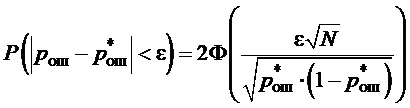
где 


N - количество моделируемых событий, причем:N is the number of simulated events, and:

где k - число материальных действий;where k is the number of material actions;
n - число реализаций материальных действий.n is the number of realizations of material actions.
Определим достоверность моделирования процессов обоснования требуемого уровня живучести распределенной сети связи вышестоящей системы управления принимая:We will determine the reliability of modeling the processes of substantiating the required level of survivability of a distributed communication network of a higher-level control system by accepting:

Перейдем от функции Лапласа к ее аргументу (Имитационное моделирование средств и комплексов связи и автоматизации. Иванов Е.В. СПб.: ВАС, 1992, 206 с., стр. 14):We pass from the Laplace function to its argument (Simulation of means and complexes of communication and automation. Ivanov EV St. Petersburg: VAS, 1992, 206 pp., P. 14):

Данное значение аргумента функции Лапласа можно представить в следующем виде:This value of the argument of the Laplace function can be represented as follows:

Для случая, когда 

Тогда:Then:

Определим приращения аргументов функции Лапласа для способа-прототипа и предлагаемого способа при выполнении требований к числу реализаций, обеспечивающих требуемую точность и надежность получаемых результатов - 




Оценка эффективности заявленного способа:Evaluation of the effectiveness of the claimed method:


Таким образом, эффективность заявленного способа по сравнению со способом - прототипом составляет 26%, чем и решается техническая проблема.Thus, the effectiveness of the claimed method in comparison with the method of the prototype is 26%, which solves the technical problem.
Claims (1)
Priority Applications (1)
| Application Number | Priority Date | Filing Date | Title |
|---|---|---|---|
| RU2018129734A RU2702503C1 (en) | 2018-08-15 | 2018-08-15 | Method of modeling processes of justification of required level of survivability of distributed communication networks of a superior control system in conditions of opening and external destructive effects |
Applications Claiming Priority (1)
| Application Number | Priority Date | Filing Date | Title |
|---|---|---|---|
| RU2018129734A RU2702503C1 (en) | 2018-08-15 | 2018-08-15 | Method of modeling processes of justification of required level of survivability of distributed communication networks of a superior control system in conditions of opening and external destructive effects |
Publications (1)
| Publication Number | Publication Date |
|---|---|
| RU2702503C1 true RU2702503C1 (en) | 2019-10-08 |
Family
ID=68171161
Family Applications (1)
| Application Number | Title | Priority Date | Filing Date |
|---|---|---|---|
| RU2018129734A RU2702503C1 (en) | 2018-08-15 | 2018-08-15 | Method of modeling processes of justification of required level of survivability of distributed communication networks of a superior control system in conditions of opening and external destructive effects |
Country Status (1)
| Country | Link |
|---|---|
| RU (1) | RU2702503C1 (en) |
Cited By (4)
| Publication number | Priority date | Publication date | Assignee | Title |
|---|---|---|---|---|
| RU2723296C1 (en) * | 2019-11-25 | 2020-06-09 | Елена Валерьевна Вершенник | Method for simulating dynamically interacting fixed-line networks and mobile communication nodes with different interface elements |
| RU2746670C1 (en) * | 2020-07-31 | 2021-04-19 | Юрий Иванович Стародубцев | Method for modeling the connection of mobile elements of a corporate management system to a fixed communication network |
| RU2747174C1 (en) * | 2020-07-14 | 2021-04-28 | Юрий Иванович Стародубцев | Method for proactive reconfiguration of communication network structure providing information exchange in interests of corporate management system under conditions of destructive influence |
| RU2764390C1 (en) * | 2020-07-15 | 2022-01-17 | Юрий Иванович Стародубцев | Method for assessing awareness of source of destructive impacts on structure of corporate management system |
Citations (5)
| Publication number | Priority date | Publication date | Assignee | Title |
|---|---|---|---|---|
| US20050020278A1 (en) * | 2003-07-22 | 2005-01-27 | Krumm John C. | Methods for determining the approximate location of a device from ambient signals |
| RU2406146C1 (en) * | 2009-04-06 | 2010-12-10 | Государственное образовательное учреждение высшего профессионального образования Академия Федеральной службы охраны Российской Федерации (Академия ФСО России) | Method of simulating communication survivability processes in fire damage and electronic warfare conditions |
| RU2487387C1 (en) * | 2011-11-30 | 2013-07-10 | Федеральное государственное военное образовательное учреждение высшего профессионального образования "Военный авиационный инженерный университет" (г. Воронеж) Министерства обороны Российской Федерации | Method of simulating equipment control processes and simulation system for realising said method |
| RU2507565C2 (en) * | 2012-02-29 | 2014-02-20 | Федеральное государственное военное образовательное учреждение высшего профессионального образования "Военный авиационный инженерный университет" (г. Воронеж) Министерства обороны Российской Федерации | Method of simulating two-level control processes and system for realising said method (versions) |
| RU159360U1 (en) * | 2014-12-29 | 2016-02-10 | Федеральное государственное бюджетное образовательное учреждение высшего профессионального образования Московский авиационный институт (национальный исследовательский университет) (МАИ) | INFORMATION AND ANALYTICAL SYSTEM OF RESEARCH OF POSSIBILITIES OF DEESCALATION OF CONFLICT IN CHANGING CONDITIONS OF MULTILATERAL NEGOTIATION PROCESS |
-
2018
- 2018-08-15 RU RU2018129734A patent/RU2702503C1/en not_active IP Right Cessation
Patent Citations (5)
| Publication number | Priority date | Publication date | Assignee | Title |
|---|---|---|---|---|
| US20050020278A1 (en) * | 2003-07-22 | 2005-01-27 | Krumm John C. | Methods for determining the approximate location of a device from ambient signals |
| RU2406146C1 (en) * | 2009-04-06 | 2010-12-10 | Государственное образовательное учреждение высшего профессионального образования Академия Федеральной службы охраны Российской Федерации (Академия ФСО России) | Method of simulating communication survivability processes in fire damage and electronic warfare conditions |
| RU2487387C1 (en) * | 2011-11-30 | 2013-07-10 | Федеральное государственное военное образовательное учреждение высшего профессионального образования "Военный авиационный инженерный университет" (г. Воронеж) Министерства обороны Российской Федерации | Method of simulating equipment control processes and simulation system for realising said method |
| RU2507565C2 (en) * | 2012-02-29 | 2014-02-20 | Федеральное государственное военное образовательное учреждение высшего профессионального образования "Военный авиационный инженерный университет" (г. Воронеж) Министерства обороны Российской Федерации | Method of simulating two-level control processes and system for realising said method (versions) |
| RU159360U1 (en) * | 2014-12-29 | 2016-02-10 | Федеральное государственное бюджетное образовательное учреждение высшего профессионального образования Московский авиационный институт (национальный исследовательский университет) (МАИ) | INFORMATION AND ANALYTICAL SYSTEM OF RESEARCH OF POSSIBILITIES OF DEESCALATION OF CONFLICT IN CHANGING CONDITIONS OF MULTILATERAL NEGOTIATION PROCESS |
Cited By (4)
| Publication number | Priority date | Publication date | Assignee | Title |
|---|---|---|---|---|
| RU2723296C1 (en) * | 2019-11-25 | 2020-06-09 | Елена Валерьевна Вершенник | Method for simulating dynamically interacting fixed-line networks and mobile communication nodes with different interface elements |
| RU2747174C1 (en) * | 2020-07-14 | 2021-04-28 | Юрий Иванович Стародубцев | Method for proactive reconfiguration of communication network structure providing information exchange in interests of corporate management system under conditions of destructive influence |
| RU2764390C1 (en) * | 2020-07-15 | 2022-01-17 | Юрий Иванович Стародубцев | Method for assessing awareness of source of destructive impacts on structure of corporate management system |
| RU2746670C1 (en) * | 2020-07-31 | 2021-04-19 | Юрий Иванович Стародубцев | Method for modeling the connection of mobile elements of a corporate management system to a fixed communication network |
Similar Documents
| Publication | Publication Date | Title |
|---|---|---|
| CN111080108B (en) | Data-driven weapon equipment combat effectiveness evaluation index screening method and system | |
| CN109960863B (en) | A reliability assessment method for complex simulation systems based on network topology paths | |
| US20160063144A1 (en) | System and method for modeling human crowd behavior | |
| RU2631970C1 (en) | Modeling technique of management and communication processes in distributed territory | |
| Bezuhlyi et al. | Development of object state estimation method in intelligent decision support systems | |
| Cayirci et al. | Computer assisted military experimentations | |
| Bratko et al. | Application of simulation modelling means in management decisions-making within the security and defence sector | |
| Iliev et al. | A Generalized Net Model of Command and Control System | |
| RU2673014C1 (en) | Method of modeling and evaluating the efficiency of management and communication processes | |
| DeStefano | Agent based simulation SEAS evaluation of DoDAF architecture | |
| RU2640734C1 (en) | Method of modeling control points | |
| CN115374392B (en) | Method, electronic device and storage medium for obtaining object parameters of target event | |
| OLENCHENKO et al. | Analysis of decision-making support systems in the performance of service and combat tasks by the security forces of Ukraine | |
| Wetteland et al. | The human simulation: resolving manning issues onboard DD21 | |
| RU2676893C1 (en) | Method of construction of distributed control point in conditions of opening and external destructive effects of attacker | |
| RU2702902C1 (en) | Method of simulating processes of providing survivability of distributed communication networks of different-level control systems | |
| RU2794470C1 (en) | Method of professional training of comjam officials | |
| RU2691257C1 (en) | Method for modeling and evaluating efficiency of complex application of diverse forces, facilities and resources | |
| Sweet et al. | The Modular Command and Control Evaluation Structure (MCES): Applications of and expansion to C3 architectural evaluation | |
| Harder et al. | Conceptual framework for an automated battle planning system in combat simulations | |
| RU2776323C1 (en) | Method for professional training of officials of radio monitoring management bodies | |
| RU2776323C9 (en) | Method for professional training of officials of radio monitoring management bodies | |
| Neal et al. | Accounting for the Impact of Real-World Data and Costs in Autonomous Cyber Defence | |
| Zhang et al. | Model-based operational planning using coloured petri nets | |
| Enders | Methodology for the Selection of Pivotal Features in AFSIM Meta-Markov Models |
Legal Events
| Date | Code | Title | Description |
|---|---|---|---|
| MM4A | The patent is invalid due to non-payment of fees |
Effective date: 20200816 |