RU2694271C2 - Device for classifying noisy objects - Google Patents
Device for classifying noisy objects Download PDFInfo
- Publication number
- RU2694271C2 RU2694271C2 RU2017137465A RU2017137465A RU2694271C2 RU 2694271 C2 RU2694271 C2 RU 2694271C2 RU 2017137465 A RU2017137465 A RU 2017137465A RU 2017137465 A RU2017137465 A RU 2017137465A RU 2694271 C2 RU2694271 C2 RU 2694271C2
- Authority
- RU
- Russia
- Prior art keywords
- unit
- block
- similarity
- permanent memory
- objects
- Prior art date
Links
Images
Classifications
-
- G—PHYSICS
- G01—MEASURING; TESTING
- G01S—RADIO DIRECTION-FINDING; RADIO NAVIGATION; DETERMINING DISTANCE OR VELOCITY BY USE OF RADIO WAVES; LOCATING OR PRESENCE-DETECTING BY USE OF THE REFLECTION OR RERADIATION OF RADIO WAVES; ANALOGOUS ARRANGEMENTS USING OTHER WAVES
- G01S3/00—Direction-finders for determining the direction from which infrasonic, sonic, ultrasonic or electromagnetic waves, or particle emission, not having a directional significance, are being received
- G01S3/80—Direction-finders for determining the direction from which infrasonic, sonic, ultrasonic or electromagnetic waves, or particle emission, not having a directional significance, are being received using ultrasonic, sonic or infrasonic waves
Landscapes
- Physics & Mathematics (AREA)
- Engineering & Computer Science (AREA)
- General Physics & Mathematics (AREA)
- Radar, Positioning & Navigation (AREA)
- Remote Sensing (AREA)
- Measurement Of Mechanical Vibrations Or Ultrasonic Waves (AREA)
- Radar Systems Or Details Thereof (AREA)
Abstract
Description
Изобретение относится к области гидроакустики и предназначено для распознавания объектов по их шумоизлучению.The invention relates to the field of hydro-acoustics and is intended for the recognition of objects by their noise.
В системах, основанных на анализе шумоизлучения для обнаружения и классификации объектов, используют особенности спектрального состава сигнала, так называемого «портрета» [1]. Обычно под спектральным «портретом» объекта понимают ограниченный набор характерных гармоник, амплитуда которых превышает сплошную часть спектра, образованную гармониками с близким амплитудами. Указанные характерные гармоники называют дискретными составляющими, или дискретами.In systems based on the analysis of noise emission for the detection and classification of objects, use features of the spectral composition of the signal, the so-called "portrait" [1]. Usually, a spectral “portrait” of an object is understood to mean a limited set of characteristic harmonics, the amplitude of which exceeds the continuous part of the spectrum formed by harmonics with close amplitudes. These characteristic harmonics are called discrete components, or discretes.
Известно устройство классификации шумящих объектов [2], основанное на измерении средней частоты полосы шумоизлучения сигнала, и последующем сравнении этой частоты с эталонными частотами объектов определенных классов. Классификация этим устройством неэффективна, поскольку средняя частота полосы спектра определяется в первую очередь расстоянием до объекта [3], и только во вторую очередь классом объекта по уровню его шумоизлучения.A device for classifying noise objects is known [2], based on measuring the average frequency of the noise emission band of a signal, and then comparing this frequency with the reference frequencies of objects of certain classes. Classification by this device is inefficient, since the average frequency of the spectrum band is determined primarily by the distance to the object [3], and only secondarily by the class of the object in terms of its noise emission.
Известно устройство классификации шумящих объектов [4], основанное на анализе спектрального состава шумоизлучения сигнала, и последующем сравнении обнаруженных дискретных составляющих с эталонными дискретными составляющими объектов определенных классов. Это устройство принципиально может работать только в том случае, если все шумящие объекты одного класса имеют общие дискретные составляющие, что для большинства современных шумящих объектов не наблюдается [5].A device for classifying noise objects is known [4], based on the analysis of the spectral composition of the signal noise emission, and the subsequent comparison of the detected discrete components with the reference discrete components of objects of certain classes. This device can basically work only if all noisy objects of one class have common discrete components, which is not observed for most modern noisy objects [5].
Наиболее близким аналогом предлагаемого изобретения является устройство классификации шумящих объектов [6], которое принято за прототип.The closest analogue of the present invention is a device for the classification of noise objects [6], which is taken as a prototype.
Устройство-прототип содержит следующие последовательно соединенные блоки:The device prototype contains the following series-connected blocks:
многоэлементную акустическую приемную антенну шумопеленгования;multi-element acoustic receiving direction finding antenna;
аналого-цифровой преобразователь;analog-to-digital converter;
блок формирования спектра сигнала;signal shaping unit;
блок обнаружения дискретных составляющих;discrete component detection unit;
блок принятия решения о классе объекта,block deciding on the class of the object
индикатор.indicator.
Указанное устройство путем деления антенны на две половины и последующей обработки при формировании спектра сигнала позволяет снизить влияние распределенной шумовой помехи, принимаемой боковым полем характеристики направленности. Однако сама классификация этим устройством недостаточно эффективна по двум причинам. Во-первых, в основе классификации лежит неустойчивая процедура обнаружения дискретных составляющих, при которой всегда есть вероятность как пропуска обнаружения дискреты, так и ложного обнаружения несуществующей дискреты [7]. Во-вторых, устройство не способно классифицировать объекты, спектральный состав сигнала которых не известен разработчику.The specified device by dividing the antenna into two halves and subsequent processing during the formation of the signal spectrum reduces the influence of the distributed noise interference received by the side field of the directivity pattern. However, the classification itself by this device is not effective enough for two reasons. First, the classification is based on an unstable procedure for detecting discrete components, in which there is always the likelihood of both missing detection of discretes and false detection of non-existent discretes [7]. Secondly, the device is not able to classify objects whose spectral composition of the signal is not known to the developer.
Задачей изобретения является повышение эффективности классификации шумящих объектов по спектральным характеристикам их шумоизлучения.The objective of the invention is to increase the efficiency of the classification of noisy objects according to the spectral characteristics of their noise.
Для решения поставленной задачи в устройство классификации шумящих объектов, содержащее последовательно соединенные многоэлементную акустическую приемную антенну шумопеленгования, аналого-цифровой преобразователь, блок формирования спектра сигнала, также содержащее последовательно соединенные блок принятия решения о классе объекта и индикатор, введены новые признаки, а именно: блок формирования меры сходства и блок постоянной памяти, при этом вход блока формирования меры сходства соединен с выходом блока формирования спектра сигнала, а его выход соединен со входом блока принятия решения о классе, второй выход которого соединен с входом блока постоянной памяти, выход блока постоянной памяти соединен со вторым входом блока формирования меры сходства, при этом блок формирования меры сходства выполнен в виде вычислителя, реализующего расчет совокупности мер сходства между сформированным спектром измеренного сигнала и спектрами сигналов эталонных классов из базы, хранящейся в блоке постоянной памяти, с последующим выбором максимальной меры сходства, а блок принятия решения о классе выполнен в виде порогового устройства сравнения максимальной меры сходства с порогом и выдачи в зависимости от результата сравнения либо принятого решения о классе на индикатор, либо спектра измеренного сигнала в блок постоянной памяти для дополнения базы спектров эталонных классов.To solve this task, a noise-finding antenna analog-digital converter, a signal shaping unit that also contains a class of the object and an indicator sequentially connected to the multi-component acoustic receiving antenna, sequentially connected multi-element acoustic signals are added to the device for classifying objects, namely: forming a measure of similarity and a block of permanent memory, while the input of the block forming a measure of similarity is connected to the output of a signal shaping unit ala, and its output is connected to the input of the class decision block, the second output of which is connected to the input of the permanent memory block, the output of the permanent memory block is connected to the second input of the similarity measure forming unit, while the similarity forming unit is designed as a calculator set of measures of similarity between the formed spectrum of the measured signal and the spectra of the signals of the reference classes from the database stored in the block of permanent memory, followed by the choice of the maximum measure of similarity, and solutions of the class configured in the form of a threshold comparison device measures the maximum similarity with a threshold and outputting depending on the comparison result or the decision to class on indicator, or the spectrum of the measured signal in permanent memory unit to supplement the reference spectra base classes.
Дополнительно для осуществления связи с внешними устройствами в устройство может быть введен блок чтения и записи, соединенный двусторонней связью с блоком постоянной памяти, и реализующий перемещение базы спектров эталонных сигналов между блоком постоянной памяти и внешними носителями информации.Additionally, to communicate with external devices, a read and write unit can be entered into the device, connected by two-way communication with the permanent memory unit, and realizing the movement of the base of spectra of the reference signals between the permanent memory unit and external storage media.
Техническим результатом изобретения является обеспечение возможности классификации объектов, спектральные характеристики которых априорно не известны разработчику, и, в том числе, объектов, в спектре которых отсутствуют ярко выраженные характерные дискретные составляющие.The technical result of the invention is the provision of the possibility of classifying objects, the spectral characteristics of which are not known a priori by the developer, and, in particular, of objects, in the spectrum of which there are no pronounced characteristic discrete components.
Покажем возможность достижения указанного технического результата предложенным устройством.We show the possibility of achieving the specified technical result of the proposed device.
Введение в устройство блока формирования меры сходства в совокупности блоком постоянной памяти позволяет использовать для анализа не ограниченный набор дискретных составляющих, эталонный перечень которых зафиксирован разработчиком, как в устройстве-прототипе, а полную совокупность гармоник спектра (весь спектр). В полную совокупность гармоник входят как характерные дискреты, так и все остальные гармоники, образующие сплошную часть спектра. Это позволяет учесть при классификации полный набор свойств объекта, присутствующих в его спектре: и совокупность характерных дискрет, как в [4, 6], и форму сплошной части спектра, и среднюю частоту полосы спектра, как в [2]. Кроме того, процедура формирования мер сходства [8], основанная на анализе всего спектра, не требует предварительного обнаружения характерных дискрет. В связи с этим, процедура будет правильно работать даже в случае, когда у объекта характерные дискреты выражены слабо или отсутствуют. А блок постоянной памяти, кроме хранения, позволяет в процессе работы устройства дополнять базу спектров сигналов, состоящую из полной совокупности гармоник спектра, новыми записями, которые не были априорно известны разработчику, и тем самым расширять перечень классов.Introduction to the device unit of forming measures of similarity in the aggregate by the block of permanent memory allows to use for analysis not a limited set of discrete components, the reference list of which is fixed by the developer, as in the device-prototype, but a full set of harmonics of the spectrum (the whole spectrum). The total set of harmonics includes both characteristic discretes and all other harmonics that form a continuous part of the spectrum. This makes it possible to take into account in classifying the full set of object properties present in its spectrum: both a set of characteristic discretes, as in [4, 6], and the shape of the solid part of the spectrum, and the average frequency of the spectrum band, as in [2]. In addition, the procedure for forming similarity measures [8], based on the analysis of the entire spectrum, does not require preliminary detection of characteristic discretes. In this regard, the procedure will work correctly even in the case when the object has characteristic voices that are weak or absent. A block of permanent memory, in addition to storage, allows the device to supplement the base of signal spectra, consisting of a complete set of harmonics of the spectrum, with new entries that were not known a priori by the developer, and thereby expand the list of classes.
Для обеспечения работы вновь введенных блоков, блок принятия решения выполнен в виде порогового устройства, обеспечивающего обратную связь между блоком формирования меры сходства и блоком постоянной памяти в том случае, когда спектр вновь измеренного сигнала оказывается отличным от всех спектров сигналов эталонных классов из базы.To ensure the operation of the newly introduced blocks, the decision block is made in the form of a threshold device providing feedback between the similarity measure generation unit and the permanent memory block when the spectrum of the newly measured signal is different from all spectra of the reference classes from the base.
В заявляемое устройство дополнительно может быть введен блок чтения и записи, который позволит переносить сформированную в процессе работы устройства базу на другие образцы устройства, обеспечивая накопление общей совокупности знаний о спектральных «портретах» шумящих объектов. Накопленная совокупность знаний может быть использована в дальнейшем, как для прикладных задач классификации, так и для научных задач разработки новых методов классификации.A device for reading and writing may additionally be introduced into the inventive device, which will allow transferring the base formed during the operation of the device to other device samples, ensuring the accumulation of a common body of knowledge about the spectral “portraits” of noisy objects. The accumulated body of knowledge can be used in the future, both for applied classification problems and for scientific problems of developing new classification methods.
Таким образом, эффективность классификации заявленного устройства увеличивается относительно аналогов, использующих для классификации только одно свойство спектра объекта.Thus, the classification efficiency of the claimed device is increased relative to analogs that use only one property of the object spectrum for classification.
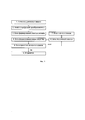
Сущность изобретения поясняется фиг. 1, на которой приведена блок-схема устройства классификации шумящих объектов.The invention is illustrated FIG. 1, which shows a block diagram of a device for classifying noisy objects.
Заявленное устройство (фиг. 1) содержит последовательно соединенные блоки: многоэлементная антенна шумопеленгования 1, аналого-цифровой преобразователь 2, блок 3 формирования спектра сигнала, блок 4 формирования меры сходства, блок 5 принятия решения о классе, индикатор 6, а также блок 8 постоянной памяти, вход которого соединен со вторым выходом блока 5, а выход - со вторым входом блока 4.The claimed device (Fig. 1) contains serially connected blocks: multi-element direction finding antenna 1, analog-to-digital converter 2, signal shaping unit 3, similarity measure generating unit 4, class decision making unit 5, indicator 6, and also unit 8 constant memory, the input of which is connected to the second output of block 5, and the output to the second input of block 4.
Устройство может быть дополнено блоком 7 чтения и записи, соединенным двусторонней связью с блоком 8.The device can be supplemented by a block 7 of reading and writing, connected by a two-way communication with block 8.
Многоэлементная антенна 1 шумопеленгования известна из [9], при этом антенные модули могут быть выполнены согласно [10]. Аналого-цифровое преобразование (блок 2) выполняется согласно [11]. Блок 3 формирования спектра сигнала включает процедуры быстрого преобразования Фурье, накопления во времени, определения суммарного и разностного спектров двух полуантенн для очищения спектра сигнала от помехи согласно [6]. Блок 4 формирования меры сходства и блок 5 принятия решения о классе могут быть выполнены в модулях программируемых процессоров сигналов и в модулях универсальной части цифрового вычислительного комплекса [12]. В качестве мер сходства может использоваться любая из известных мер сходства, например, коэффициент корреляции или Евклидово расстояние [8]. Порог для принятия решения выбирается на основании требуемой вероятности ложной классификации согласно [7]. Индикатор, блок постоянной памяти и блок чтения и записи реализуются, например, в пультовом приборе и накопителе на оптическом диске согласно [12]. База спектров имеет унифицированную структуру хранения. Каждая запись кроме таблицы спектра сигнала со столбцами «частота» и «амплитуда», содержит сопутствующую информацию: имя эталонного класса, дата, время и условия записи.Multiple-element antenna 1 noise-finding is known from [9], while the antenna modules can be performed according to [10]. A / D conversion (block 2) is performed according to [11]. Block 3 of the signal spectrum formation includes procedures for fast Fourier transform, accumulation over time, determining the total and difference spectra of two semi-antennas for clearing the signal spectrum from interference according to [6]. Block 4 forming similarity measures and block 5 making a decision about a class can be performed in modules of programmable signal processors and in modules of the universal part of a digital computing complex [12]. As measures of similarity can be used any of the known measures of similarity, for example, the correlation coefficient or the Euclidean distance [8]. The threshold for decision making is selected based on the required probability of a false classification according to [7]. The indicator, the block of permanent memory and the block of reading and writing are implemented, for example, in a remote control device and an optical disk drive according to [12]. The base of spectra has a unified storage structure. Each record except the table of the signal spectrum with the columns “frequency” and “amplitude” contains related information: the name of the reference class, the date, time and conditions of the recording.
В динамике работы устройства шумовой сигнал объектов, принятый антенной 1, поступает в блок 2, в котором осуществляется перевод сигнала из аналогового в цифровой вид. Далее сигнал поступает в блок 3, в котором осуществляется очистка сигнала от распределенной помехи, перевод в частотную область и накопление во времени. Далее измеренный спектр сигнала поступает в блок 4. Одновременно в блок 4 из блока 8 поступает база спектров сигналов эталонных классов, сформированная к текущему моменту времени. В блоке 4 осуществляется процедура формирования мер сходства между измеренным спектром сигнала и каждым спектром сигнала эталонного класса из базы. Максимальная из полученных мер сходства, соответствующее ей имя эталонного класса и измеренный спектр сигнала поступают в блок 5, в котором реализуется процедура сравнения меры сходства с порогом. В случае, если значение максимальной меры сходства превышает порог, из блока 5 в индикатор 1 для отображения поступает имя эталонного класса. В противном случае, из блока 5 в блок 8 поступает измеренный спектр сигнала. В блоке 8 база спектров сигналов эталонных классов дополняется новой записью, содержащей спектр измеренного сигнала. При следующем акте работы устройства в блок 4 из блока 8 будет поступать вновь сформированная база спектров эталонных классов. Тогда в блоке 4 будет формироваться дополненная совокупность мер сходства, которая позволит в блоке 5 принять решение о классе и отобразить его на индикаторе 6.In the dynamics of the device operation, the noise signal of objects, received by antenna 1, enters block 2, in which the signal is transferred from analog to digital form. Next, the signal enters the block 3, in which the signal is cleared from the distributed interference, transferred to the frequency domain and accumulated over time. Next, the measured spectrum of the signal goes to block 4. At the same time, block 4 of block 8 receives the base of the spectra of the reference classes of signals, formed to the current point in time. In block 4, the procedure for forming measures of similarity between the measured signal spectrum and each signal spectrum of the reference class from the base is carried out. The maximum of the obtained similarity measures, the corresponding name of the reference class and the measured signal spectrum arrive in block 5, which implements the procedure for comparing the similarity measure with the threshold. If the value of the maximum measure of similarity exceeds the threshold, the name of the reference class comes from block 5 to indicator 1 for display. Otherwise, from block 5 to block 8 the measured spectrum of the signal enters. In block 8, the base of the spectra of the signals of the reference classes is supplemented by a new record containing the spectrum of the measured signal. At the next operation of the device in block 4 from block 8, the newly formed base of spectra of reference classes will be received. Then, in block 4, an additional set of measures of similarity will be formed, which will allow in block 5 to decide on the class and display it on the indicator 6.
Блок 7 включается в работу устройства по мере необходимости, и позволяет записывать базу данных на внешний накопитель информации для переноса на другой образец устройства, либо считывать базу данных, сформированную на другом образце устройства.Block 7 is included in the operation of the device as needed, and allows you to write the database to an external storage device for transfer to another sample device, or read the database formed on another sample device.
Все изложенное позволяет считать задачу изобретения решенной. Предложено устройство классификации шумящих объектов, обеспечивающее классификацию объектов, спектральные характеристики которых априорно не известны разработчику, и, в том числе, объектов, в спектре которых отсутствуют ярко выраженные характерные дискретные составляющие.All of the above allows us to consider the problem of the invention solved. A classification device for noisy objects is proposed, which provides for the classification of objects whose spectral characteristics are not known a priori by the developer, and, in particular, for objects whose spectrum does not contain pronounced characteristic discrete components.
ИСТОЧНИКИ ИНФОРМАЦИИINFORMATION SOURCES
1. Бурдик B.C. Анализ гидроакустических систем. Л.: Судостроение. 19881. Burdick B.C. Analysis of sonar systems. L .: Shipbuilding. 1988
2. Тимошенков В.Г., Дядченко Т.З. Патент РФ №2262121 от 24.04.2003. Способ классификации шумящих объектов. МПК G01S 3/802. Timoshenkov V.G., Dyadchenko T.Z. The patent of the Russian Federation №2262121 from 04.24.2003. A way to classify rustling objects. IPC G01S 3/80
3. Хортон Дж. У Основы гидролокации. Л.: Судпромгиз. 19613. Horton J. U Basics of sonar. L .: Sudpromgiz. 1961
4. Деев В.В. и др. Анализ информации оператором - гидроакустиком. Л.: Судостроение. 19894. Deev V.V. and others. Analysis of information by the operator - hydroacoustics. L .: Shipbuilding. 1989
5. Мясников Л.Л., Мясникова Е.Н. Автоматическое распознавание звуковых образов. Л.: Энергия. 19705. Myasnikov LL, Myasnikova E.N. Automatic recognition of sound images. L .: Energy. 1970
6. Афанасьев А.Н. Знаменская Т.К. Патент РФ №2546851 от 11.12.2013. Способ классификации гидроакустических сигналов шумоизлучения морского объекта. МПК G01S 3/806. Afanasyev A.N. Znamenskaya T.K. The patent of the Russian Federation №2546851 from 11.12.2013. A method for classifying sonar acoustic signals of a marine object. IPC G01S 3/80
7. Тюрин A.M. Введение в теорию статистических методов в гидроакустике. Л. 19637. Tyurin A.M. Introduction to the theory of statistical methods in hydroacoustics. L. 1963
8. Ту Дж., Гонсалес Р. Принципы распознавания образов / Пер. с англ. М.: Мир. 19788. Tu J., Gonzalez R. Principles of pattern recognition / Per. from English M .: Mir. 1978
9. Литвиненко СЛ. Патент РФ №2515133 от 10.05.2014 Сферическая гидроакустическая антенна. МПК G01S 15/009. Litvinenko SL. RF patent №2515133 dated 05/10/2014 Spherical sonar antenna. IPC G01S 15/00
10. Смарышев М.Д., Черняховский А.Е., Иванов A.M., Шатохин А.В., Селезнев И.А., Никандров В.А., Маляров К.В., Барсуков Ю.В. Патент РФ №2539819 от 27.01.2015. Антенный модуль с цифровым выходом. МПК H04R 1/4410. Smaryshev, MD, Chernyakhovsky, A.E., Ivanov, A.M., Shatokhin, A.V., Seleznev, I.A., Nikandrov, V.A., Malyarov, K.V., Barsukov, Yu.V. The patent of the Russian Federation №2539819 from 01/27/2015. Antenna module with digital output. IPC H04R 1/44
11. Айфичер Э.С., Джервис Б.У. Цифровая обработка сигналов: практический подход / Пер. с англ. М.: ООО «И.Д. Вильямс». 201711. IFisher E.S., Jervis B.U. Digital signal processing: a practical approach / Trans. from English M .: OOO “I.D. Williams. 2017
12. Бетелин В.Б., Капустин Г.И., Кокурин В.А., Корякин Ю.А., Лисс А.Р., Немытов А.И., Першин А.С., Рыжиков А.В., Челпанов А.В., Шалин С.А. Патент РФ №2207620 от 10.03.2003. Цифровой вычислительный комплекс для обработки сигналов в гидроакустических системах. МПК G06F 15/16, G01S 15/8812. Betelin V.B., Kapustin G.I., Kokurin V.A., Koryakin Yu.A., Liss A.R., Nemytov A.I., Pershin A.S., Ryzhikov A.V., Chelpanov A.V., Shalin S.A. The patent of the Russian Federation №2207620 from 10.03.2003. Digital computing system for processing signals in sonar systems. IPC G06F 15/16, G01S 15/88
Claims (2)
Priority Applications (1)
| Application Number | Priority Date | Filing Date | Title |
|---|---|---|---|
| RU2017137465A RU2694271C2 (en) | 2017-10-25 | 2017-10-25 | Device for classifying noisy objects |
Applications Claiming Priority (1)
| Application Number | Priority Date | Filing Date | Title |
|---|---|---|---|
| RU2017137465A RU2694271C2 (en) | 2017-10-25 | 2017-10-25 | Device for classifying noisy objects |
Publications (3)
| Publication Number | Publication Date |
|---|---|
| RU2017137465A RU2017137465A (en) | 2019-04-25 |
| RU2017137465A3 RU2017137465A3 (en) | 2019-04-25 |
| RU2694271C2 true RU2694271C2 (en) | 2019-07-11 |
Family
ID=66321726
Family Applications (1)
| Application Number | Title | Priority Date | Filing Date |
|---|---|---|---|
| RU2017137465A RU2694271C2 (en) | 2017-10-25 | 2017-10-25 | Device for classifying noisy objects |
Country Status (1)
| Country | Link |
|---|---|
| RU (1) | RU2694271C2 (en) |
Cited By (2)
| Publication number | Priority date | Publication date | Assignee | Title |
|---|---|---|---|---|
| RU2730048C1 (en) * | 2019-12-06 | 2020-08-14 | Акционерное Общество "Концерн "Океанприбор" | Adaptive dichotomous classification method of marine objects |
| RU200260U1 (en) * | 2020-05-25 | 2020-10-14 | Акционерное Общество "Концерн "Океанприбор" | DEVICE TO RESTORE CONTACT WITH A TARGET IN A STANDARD NOISE DIRECTION TRACT |
Citations (6)
| Publication number | Priority date | Publication date | Assignee | Title |
|---|---|---|---|---|
| RU2208811C2 (en) * | 2001-09-27 | 2003-07-20 | Федеральное государственное унитарное предприятие "Центральный научно-исследовательский институт "Морфизприбор" | Procedure to obtain information on noisy objects in sea |
| RU2262121C2 (en) * | 2003-04-24 | 2005-10-10 | Федеральное государственное унитарное предприятие "Центральный научно-исследовательский институт "Морфизприбор" | Method of classification of noisy objects |
| RU2546851C1 (en) * | 2013-12-11 | 2015-04-10 | Открытое акционерное общество "Концерн "Океанприбор" | Method of classification of hydroacoustic signals of sea object noise emission |
| US9372255B2 (en) * | 2011-03-25 | 2016-06-21 | Teledyne Instruments, Inc. | Determining a position of a submersible vehicle within a body of water |
| RU2590933C1 (en) * | 2015-04-27 | 2016-07-10 | Акционерное Общество "Концерн "Океанприбор" | Device for obtaining information on noisy object in sea |
| RU2624798C1 (en) * | 2016-07-27 | 2017-07-06 | Российская Федерация, от имени которой выступает Министерство промышленности и торговли Российской Федерации (Минпромторг) | Method of determination of location of sensing object in sea |
-
2017
- 2017-10-25 RU RU2017137465A patent/RU2694271C2/en active
Patent Citations (6)
| Publication number | Priority date | Publication date | Assignee | Title |
|---|---|---|---|---|
| RU2208811C2 (en) * | 2001-09-27 | 2003-07-20 | Федеральное государственное унитарное предприятие "Центральный научно-исследовательский институт "Морфизприбор" | Procedure to obtain information on noisy objects in sea |
| RU2262121C2 (en) * | 2003-04-24 | 2005-10-10 | Федеральное государственное унитарное предприятие "Центральный научно-исследовательский институт "Морфизприбор" | Method of classification of noisy objects |
| US9372255B2 (en) * | 2011-03-25 | 2016-06-21 | Teledyne Instruments, Inc. | Determining a position of a submersible vehicle within a body of water |
| RU2546851C1 (en) * | 2013-12-11 | 2015-04-10 | Открытое акционерное общество "Концерн "Океанприбор" | Method of classification of hydroacoustic signals of sea object noise emission |
| RU2590933C1 (en) * | 2015-04-27 | 2016-07-10 | Акционерное Общество "Концерн "Океанприбор" | Device for obtaining information on noisy object in sea |
| RU2624798C1 (en) * | 2016-07-27 | 2017-07-06 | Российская Федерация, от имени которой выступает Министерство промышленности и торговли Российской Федерации (Минпромторг) | Method of determination of location of sensing object in sea |
Cited By (2)
| Publication number | Priority date | Publication date | Assignee | Title |
|---|---|---|---|---|
| RU2730048C1 (en) * | 2019-12-06 | 2020-08-14 | Акционерное Общество "Концерн "Океанприбор" | Adaptive dichotomous classification method of marine objects |
| RU200260U1 (en) * | 2020-05-25 | 2020-10-14 | Акционерное Общество "Концерн "Океанприбор" | DEVICE TO RESTORE CONTACT WITH A TARGET IN A STANDARD NOISE DIRECTION TRACT |
Also Published As
| Publication number | Publication date |
|---|---|
| RU2017137465A (en) | 2019-04-25 |
| RU2017137465A3 (en) | 2019-04-25 |
Similar Documents
| Publication | Publication Date | Title |
|---|---|---|
| CN112036074B (en) | Radar signal sorting method and system in high pulse density environment | |
| US10871548B2 (en) | Systems and methods for transient acoustic event detection, classification, and localization | |
| RU2603886C1 (en) | Method of sea object sonar noise emission signals classifying | |
| de Moura et al. | Novelty detection in passive sonar systems using support vector machines | |
| Shadlou Jahromi et al. | Feature extraction in fractional Fourier domain for classification of passive sonar signals | |
| CN111487592B (en) | Radar signal sorting method based on GPU and CPU platform drift mean clustering | |
| JP2010181272A (en) | Radar signal processing apparatus and target determination method of the same | |
| CN109597045B (en) | Static target steady recognition method based on two times of clutter suppression | |
| US7352321B2 (en) | Determining statistical descriptors of a signal from a set of its samples | |
| CN113608193A (en) | Radar multi-target distance and speed estimation method based on UNet | |
| RU2711406C1 (en) | Method of classification of hydro acoustic signals of marine objects noise emission | |
| KR102207003B1 (en) | Method for detecting maritime target | |
| KR101817011B1 (en) | Clutter reduction Method and Apparatus for active sonar based on clustering characteristics | |
| Wang | Wavelet Transform Based Feature Extraction for Ultrasonic Flaw Signal Classification. | |
| Bach | Improving the classification of propeller ships using LOFAR and triple loss variational auto encoder | |
| RU2689968C1 (en) | Method of classification of marine objects in a typical sound locating station | |
| US8265899B2 (en) | Automatic procedure for merging tracks and estimating harmonic combs | |
| CN118501837A (en) | Target recognition method based on IR-UWB radar motion detection mode | |
| de Souza et al. | Passive sonar classification using time-domain information and recurrent neural networks | |
| Manapaka et al. | An Explainable ML Model for MultiClass Marine Vessel Classification Using Passive Sonar Signals | |
| US7180442B1 (en) | Target indentification method using cepstral coefficients | |
| RU2730048C1 (en) | Adaptive dichotomous classification method of marine objects | |
| RU200260U1 (en) | DEVICE TO RESTORE CONTACT WITH A TARGET IN A STANDARD NOISE DIRECTION TRACT | |
| RU2634786C1 (en) | Method for determining noisy object maneuver | |
| Yan et al. | A UAV detection method based on signal periodicity and its implementation on FPGA |