RU2588503C2 - Method of producing high-temperature heat insulation - Google Patents
Method of producing high-temperature heat insulation Download PDFInfo
- Publication number
- RU2588503C2 RU2588503C2 RU2014138756/03A RU2014138756A RU2588503C2 RU 2588503 C2 RU2588503 C2 RU 2588503C2 RU 2014138756/03 A RU2014138756/03 A RU 2014138756/03A RU 2014138756 A RU2014138756 A RU 2014138756A RU 2588503 C2 RU2588503 C2 RU 2588503C2
- Authority
- RU
- Russia
- Prior art keywords
- temperature
- heat insulation
- temperature heat
- electric heating
- poured
- Prior art date
Links
- 238000009413 insulation Methods 0.000 title claims abstract description 6
- 238000000034 method Methods 0.000 title abstract description 6
- 239000000203 mixture Substances 0.000 claims abstract description 10
- 238000004519 manufacturing process Methods 0.000 claims abstract description 8
- 239000004927 clay Substances 0.000 claims abstract description 7
- XLYOFNOQVPJJNP-UHFFFAOYSA-N water Substances O XLYOFNOQVPJJNP-UHFFFAOYSA-N 0.000 claims abstract description 7
- 244000062793 Sorghum vulgare Species 0.000 claims abstract description 6
- 235000019713 millet Nutrition 0.000 claims abstract description 6
- 238000005485 electric heating Methods 0.000 claims abstract description 4
- 229920002472 Starch Polymers 0.000 claims description 5
- 235000019698 starch Nutrition 0.000 claims description 5
- 239000008107 starch Substances 0.000 claims description 5
- 238000001035 drying Methods 0.000 claims description 4
- 239000002994 raw material Substances 0.000 claims description 4
- 238000010304 firing Methods 0.000 claims description 3
- 239000003110 molding sand Substances 0.000 claims description 2
- 238000000465 moulding Methods 0.000 claims description 2
- 235000013339 cereals Nutrition 0.000 abstract description 7
- 238000010276 construction Methods 0.000 abstract description 3
- 230000000694 effects Effects 0.000 abstract description 2
- 239000000126 substance Substances 0.000 abstract description 2
- 239000000047 product Substances 0.000 description 10
- 239000004793 Polystyrene Substances 0.000 description 3
- 229920002223 polystyrene Polymers 0.000 description 3
- 230000015572 biosynthetic process Effects 0.000 description 2
- 238000005516 engineering process Methods 0.000 description 2
- 239000000463 material Substances 0.000 description 2
- 238000002156 mixing Methods 0.000 description 2
- 230000008961 swelling Effects 0.000 description 2
- UGFAIRIUMAVXCW-UHFFFAOYSA-N Carbon monoxide Chemical compound [O+]#[C-] UGFAIRIUMAVXCW-UHFFFAOYSA-N 0.000 description 1
- 229910002091 carbon monoxide Inorganic materials 0.000 description 1
- 230000015556 catabolic process Effects 0.000 description 1
- 210000003850 cellular structure Anatomy 0.000 description 1
- 239000000919 ceramic Substances 0.000 description 1
- 238000001816 cooling Methods 0.000 description 1
- 230000006378 damage Effects 0.000 description 1
- 229920006248 expandable polystyrene Polymers 0.000 description 1
- 239000008187 granular material Substances 0.000 description 1
- 238000000227 grinding Methods 0.000 description 1
- 239000011121 hardwood Substances 0.000 description 1
- 229910052500 inorganic mineral Inorganic materials 0.000 description 1
- 238000009434 installation Methods 0.000 description 1
- 238000005272 metallurgy Methods 0.000 description 1
- 239000011707 mineral Substances 0.000 description 1
- 239000002245 particle Substances 0.000 description 1
- 125000001997 phenyl group Chemical group [H]C1=C([H])C([H])=C(*)C([H])=C1[H] 0.000 description 1
- 239000013589 supplement Substances 0.000 description 1
- 239000000725 suspension Substances 0.000 description 1
- 231100000331 toxic Toxicity 0.000 description 1
- 230000002588 toxic effect Effects 0.000 description 1
- 238000009966 trimming Methods 0.000 description 1
Abstract
Description
Изобретение относится к строительству, а именно к производству огнеупорных изделий. Изобретение может быть использовано при производстве высокотемпературной теплоизоляции с повышенными физико-техническими свойствами по скоростной энергоэффективной технологии.The invention relates to the construction, namely the production of refractory products. The invention can be used in the manufacture of high-temperature insulation with enhanced physical and technical properties using high-speed energy-efficient technology.
Известен способ изготовления огнеупорной теплоизоляции из композиции, содержащей огнеупорный компонент, опилки твердых древесных пород и воду. Количество древесных опилок составляет не более 25-30% по массе [И.Я. Гузман. Высокоогнеупорная пористая керамика. - М. Металлургия, 1971].A known method of manufacturing refractory thermal insulation from a composition containing a refractory component, sawdust of hardwood and water. The amount of sawdust is not more than 25-30% by weight [I.Ya. Guzman. Highly refractory porous ceramics. - M. Metallurgy, 1971].
Недостатком известного способа является невозможность получения изделий пористостью более 60%, т.к. опилки имеют неравномерное строение и развитую удельную поверхность. Опилки интенсивно впитывают влагу, набухают, что создает трудности при сушке. Изделия склонны к неравномерной усадке и короблению, что приводит к существенному снижению механической прочности сырца и готовых изделий.The disadvantage of this method is the inability to obtain products with a porosity of more than 60%, because sawdust has an uneven structure and a developed specific surface. Sawdust intensively absorbs moisture, swells, which creates difficulties when drying. Products are prone to uneven shrinkage and warping, which leads to a significant decrease in the mechanical strength of raw and finished products.
Наиболее близким к предлагаемой по технической сущности и достигаемому результату является способ для изготовления теплоизоляционных изделий из композиции, включающей огнеупорную глину, подвспененные гранулы полистирола и воду [Авторское свидетельство СССР №885202, кл. С04В 21/12, 1981].Closest to the proposed technical essence and the achieved result is a method for the manufacture of heat-insulating products from a composition comprising refractory clay, foamed polystyrene granules and water [USSR Author's Certificate No. 885202, cl. C04B 21/12, 1981].
Недостатками известного способа является высокая стоимость полистирола и относительная трудоемкость технологии изготовления материала (полистирол необходимо предварительно подвспенивать на специальной установке, формование производится в перфорированной форме). При выгорании полистирола выделяется не только угарный газ, но и ядовитые продукты расщепления бензольного ядра. Сырцы имеют недостаточную прочность для механического захвата при транспортировке в сушильную камеру.The disadvantages of this method is the high cost of polystyrene and the relative complexity of the manufacturing technology of the material (polystyrene must be pre-foamed in a special installation, molding is performed in a perforated form). When polystyrene burns out, not only carbon monoxide is released, but also the toxic products of the breakdown of the benzene core. The raw materials have insufficient strength for mechanical capture during transportation to the drying chamber.
Целью изобретения является получение нового материала, обладающего повышенной по сравнению с прототипом механической прочности сырца. Поставленная цель достигается следующим образом.The aim of the invention is to obtain a new material with increased in comparison with the prototype of the mechanical strength of the raw material. The goal is achieved as follows.
В лопастную мешалку засыпают зерна пшена, туда же заливают воду затворения, засыпают огнеупорную глину и перемешивают. Время перемешивания - 5 минут. Готовую формовочную смесь влажностью 40-50% заливают в жесткую герметичную форму, двумя стенками которой являются электроды, закрывают крышкой и подвергают электропрогреву. При достижении 55°С крахмал, содержащийся в зерне до 70% по массе, начинает проявлять свою активность. Происходит разрушение водой кристаллической структуры крахмальных зерен. Крахмал впитывает влагу и набухает, увеличивая в объеме зерна пшена. В результате внутреннего избыточного напряжения происходит уплотнение структуры глинистого компонента вокруг пшена. Одновременно с набуханием содержащиеся в крахмале растворимые вещества растворяются и выносятся в глинистую суспензию, образуя клейстер, который при остывании затвердевает. Процесс одновременного набухания и образования клейстера обуславливает формирование сырца с четкими гранями и повышенной механической прочностью. Сушка производится при температуре 90°С. Сырец обжигают при 1300°С. После обжига изделия сохраняют форму и четкие грани и не требуют шлифовки и обрезки.Millet grains are poured into a paddle mixer, mixing water is poured into it, refractory clay is poured and mixed. Mixing time is 5 minutes. The finished molding sand with a moisture content of 40-50% is poured into a rigid hermetic mold, the electrodes of which are two walls, close the lid and undergo electric heating. Upon reaching 55 ° C, the starch contained in the grain up to 70% by weight begins to show its activity. There is a destruction by water of the crystalline structure of starch grains. Starch absorbs moisture and swells, increasing the volume of millet grain. As a result of internal overpressure, the structure of the clay component around the millet is densified. Simultaneously with the swelling, the soluble substances contained in the starch dissolve and are taken out into the clay suspension, forming a paste, which hardens upon cooling. The process of simultaneous swelling and the formation of a paste determines the formation of raw material with clear edges and increased mechanical strength. Drying is carried out at a temperature of 90 ° C. The raw is fired at 1300 ° C. After firing, the products retain their shape and clear edges and do not require grinding and trimming.
Зерна пшена являются отощителем и активной выгорающей добавкой одновременно. Сферическая форма зерен с минимальной шероховатостью позволяет получать изделия ячеистой структуры с пониженным расходом минерального компонента и высокой пористостью.Millet grains are a cleanser and an active burn-out supplement at the same time. The spherical shape of the grains with minimal roughness makes it possible to obtain products with a cellular structure with a reduced consumption of the mineral component and high porosity.
Изготовление изделий по предложенной композиции в отличие от прототипа позволяет использовать формы без перфорации, что устраняет вынос с водой отжатия частиц глины.The manufacture of products according to the proposed composition, in contrast to the prototype, allows the use of forms without perforation, which eliminates the removal of clay particles with water.
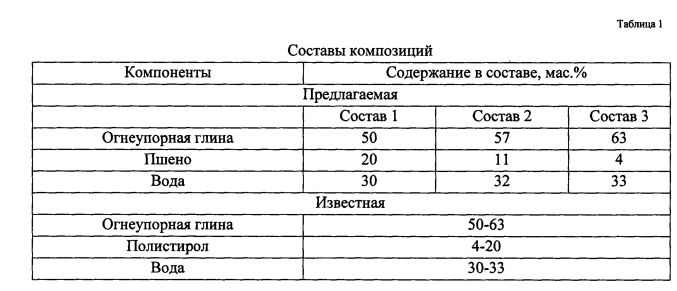
В таблице 1 приведены составы предлагаемой композиции и известных композиций, в таблице 2 - их свойства.Table 1 shows the compositions of the proposed composition and known compositions, in table 2 their properties.
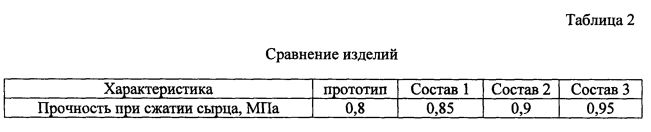
Из таблицы 2 следует, что теплоизоляционные изделия из предложенной композиции обладают большей прочностью сырца, чем у аналога.From table 2 it follows that the heat-insulating products from the proposed composition have a greater raw strength than the analogue.
Claims (1)
Priority Applications (1)
| Application Number | Priority Date | Filing Date | Title |
|---|---|---|---|
| RU2014138756/03A RU2588503C2 (en) | 2014-09-26 | Method of producing high-temperature heat insulation |
Applications Claiming Priority (1)
| Application Number | Priority Date | Filing Date | Title |
|---|---|---|---|
| RU2014138756/03A RU2588503C2 (en) | 2014-09-26 | Method of producing high-temperature heat insulation |
Publications (2)
| Publication Number | Publication Date |
|---|---|
| RU2014138756A RU2014138756A (en) | 2016-04-20 |
| RU2588503C2 true RU2588503C2 (en) | 2016-06-27 |
Family
ID=
Citations (3)
| Publication number | Priority date | Publication date | Assignee | Title |
|---|---|---|---|---|
| SU885202A1 (en) * | 1980-02-05 | 1981-11-30 | Московский Ордена Трудового Красного Знамени Инженерно-Строительный Институт Им.В.В.Куйбышева | Composition for producing heat-insulation articles |
| US5084101A (en) * | 1989-09-12 | 1992-01-28 | Huels Troisdorf Ag | Process for the preparation of an open-pore foam from essentially inorganic components |
| CN102584318A (en) * | 2012-03-16 | 2012-07-18 | 北京科技大学 | Method for preparing porous heat-insulating material from Cr-containing steel slag |
Patent Citations (3)
| Publication number | Priority date | Publication date | Assignee | Title |
|---|---|---|---|---|
| SU885202A1 (en) * | 1980-02-05 | 1981-11-30 | Московский Ордена Трудового Красного Знамени Инженерно-Строительный Институт Им.В.В.Куйбышева | Composition for producing heat-insulation articles |
| US5084101A (en) * | 1989-09-12 | 1992-01-28 | Huels Troisdorf Ag | Process for the preparation of an open-pore foam from essentially inorganic components |
| CN102584318A (en) * | 2012-03-16 | 2012-07-18 | 北京科技大学 | Method for preparing porous heat-insulating material from Cr-containing steel slag |
Non-Patent Citations (1)
| Title |
|---|
| ГУЗМАН И.Я. "Высокоогнеупорная пористая керамика", Москва, Металлургия, 1971, с. 16, абзац 5. * |
Similar Documents
| Publication | Publication Date | Title |
|---|---|---|
| CN103011856B (en) | A kind of mullite lightweight heat insulation brick and preparation method thereof | |
| CN104446625A (en) | High-porosity porous ceramic and preparation method thereof | |
| US10759702B2 (en) | Forming a ceramic product | |
| CN106396726A (en) | Porous refractory material and preparation method thereof | |
| RU2251540C1 (en) | Foam-ceramic items production method | |
| KR20130067624A (en) | Porous lightweight ceramics and manufacturing method of the same | |
| JP4054872B2 (en) | Alumina porous ceramics and method for producing the same | |
| CN102875095B (en) | Self-insulation art casting stone and production method thereof | |
| CN105622157A (en) | Foamed ceramics insulation board and preparation method thereof | |
| JP4967111B2 (en) | Alumina-based porous ceramics and method for producing the same | |
| US1761108A (en) | Method for the manufacture of cellular building materials | |
| CN104628417A (en) | Method for preparing clay brick by using waste polystyrene foams | |
| CN102503529B (en) | Lightweight ceramic clay and making method thereof | |
| KR100835533B1 (en) | Lightweight ocher brick and its manufacturing method | |
| US1992916A (en) | Permeable ceramic material and process of making the same | |
| RU2535560C1 (en) | Method to manufacture foam-ceramic products with facing layer | |
| JP2015048257A (en) | Burned product using egg shell and manufacturing method thereof | |
| RU2819710C1 (en) | Method of making ceramic-vermiculite articles | |
| RU2473515C1 (en) | Composition for fireproof products of volume pressing | |
| RU2318772C1 (en) | Method of manufacture of wall ceramic articles, raw charge for manufacture of wall ceramic articles and filler for wall ceramic articles | |
| SU537975A1 (en) | Raw mix for the manufacture of thermal insulation products | |
| RU2481281C1 (en) | Method of producing porous aggregate | |
| RU2610603C2 (en) | Ceramic mixture based on clay with addition of deironing stations residue | |
| RU2562646C2 (en) | Method of production of heat-resistant heat insulating products | |
| RU2608093C1 (en) | Method of producing high-temperature heat-insulating material |