RU2564373C1 - Method of pipe steel production - Google Patents
Method of pipe steel production Download PDFInfo
- Publication number
- RU2564373C1 RU2564373C1 RU2014128412/02A RU2014128412A RU2564373C1 RU 2564373 C1 RU2564373 C1 RU 2564373C1 RU 2014128412/02 A RU2014128412/02 A RU 2014128412/02A RU 2014128412 A RU2014128412 A RU 2014128412A RU 2564373 C1 RU2564373 C1 RU 2564373C1
- Authority
- RU
- Russia
- Prior art keywords
- steel
- metal
- amount
- release
- content
- Prior art date
Links
- 229910000831 Steel Inorganic materials 0.000 title claims abstract description 51
- 239000010959 steel Substances 0.000 title claims abstract description 51
- 238000004519 manufacturing process Methods 0.000 title claims description 11
- 238000000034 method Methods 0.000 title claims description 11
- 229910052751 metal Inorganic materials 0.000 claims abstract description 45
- 239000002184 metal Substances 0.000 claims abstract description 45
- 229910052782 aluminium Inorganic materials 0.000 claims abstract description 17
- XAGFODPZIPBFFR-UHFFFAOYSA-N aluminium Chemical compound [Al] XAGFODPZIPBFFR-UHFFFAOYSA-N 0.000 claims abstract description 17
- XKRFYHLGVUSROY-UHFFFAOYSA-N Argon Chemical compound [Ar] XKRFYHLGVUSROY-UHFFFAOYSA-N 0.000 claims abstract description 16
- NINIDFKCEFEMDL-UHFFFAOYSA-N Sulfur Chemical compound [S] NINIDFKCEFEMDL-UHFFFAOYSA-N 0.000 claims abstract description 14
- OKTJSMMVPCPJKN-UHFFFAOYSA-N Carbon Chemical compound [C] OKTJSMMVPCPJKN-UHFFFAOYSA-N 0.000 claims abstract description 12
- 229910052799 carbon Inorganic materials 0.000 claims abstract description 12
- OYPRJOBELJOOCE-UHFFFAOYSA-N Calcium Chemical compound [Ca] OYPRJOBELJOOCE-UHFFFAOYSA-N 0.000 claims abstract description 10
- 229910001018 Cast iron Inorganic materials 0.000 claims abstract description 10
- 235000008733 Citrus aurantifolia Nutrition 0.000 claims abstract description 10
- 235000011941 Tilia x europaea Nutrition 0.000 claims abstract description 10
- 229910052791 calcium Inorganic materials 0.000 claims abstract description 10
- 239000011575 calcium Substances 0.000 claims abstract description 10
- 239000004571 lime Substances 0.000 claims abstract description 10
- 229910052786 argon Inorganic materials 0.000 claims abstract description 8
- 229910052717 sulfur Inorganic materials 0.000 claims description 12
- 239000011593 sulfur Substances 0.000 claims description 12
- 238000003723 Smelting Methods 0.000 claims description 7
- 238000009847 ladle furnace Methods 0.000 claims description 5
- 238000005266 casting Methods 0.000 claims description 4
- 239000003153 chemical reaction reagent Substances 0.000 claims description 4
- 238000010926 purge Methods 0.000 claims description 2
- 238000005260 corrosion Methods 0.000 abstract description 7
- 230000007797 corrosion Effects 0.000 abstract description 7
- 239000000126 substance Substances 0.000 abstract description 4
- 239000005864 Sulphur Substances 0.000 abstract 2
- 239000004411 aluminium Substances 0.000 abstract 1
- 238000005422 blasting Methods 0.000 abstract 1
- 238000005272 metallurgy Methods 0.000 abstract 1
- 239000000155 melt Substances 0.000 description 10
- 239000000203 mixture Substances 0.000 description 8
- 238000009628 steelmaking Methods 0.000 description 7
- 238000007670 refining Methods 0.000 description 6
- 238000006477 desulfuration reaction Methods 0.000 description 5
- 230000023556 desulfurization Effects 0.000 description 5
- 230000015572 biosynthetic process Effects 0.000 description 4
- 229910000720 Silicomanganese Inorganic materials 0.000 description 3
- 239000000654 additive Substances 0.000 description 3
- 230000000996 additive effect Effects 0.000 description 3
- 238000007664 blowing Methods 0.000 description 3
- 238000011109 contamination Methods 0.000 description 3
- 239000010436 fluorite Substances 0.000 description 3
- 239000002893 slag Substances 0.000 description 3
- 229910000628 Ferrovanadium Inorganic materials 0.000 description 2
- QVGXLLKOCUKJST-UHFFFAOYSA-N atomic oxygen Chemical compound [O] QVGXLLKOCUKJST-UHFFFAOYSA-N 0.000 description 2
- 238000010438 heat treatment Methods 0.000 description 2
- PNXOJQQRXBVKEX-UHFFFAOYSA-N iron vanadium Chemical compound [V].[Fe] PNXOJQQRXBVKEX-UHFFFAOYSA-N 0.000 description 2
- 230000004048 modification Effects 0.000 description 2
- 238000012986 modification Methods 0.000 description 2
- 229910052760 oxygen Inorganic materials 0.000 description 2
- 239000001301 oxygen Substances 0.000 description 2
- 229910000592 Ferroniobium Inorganic materials 0.000 description 1
- 229910000805 Pig iron Inorganic materials 0.000 description 1
- PNEYBMLMFCGWSK-UHFFFAOYSA-N aluminium oxide Inorganic materials [O-2].[O-2].[O-2].[Al+3].[Al+3] PNEYBMLMFCGWSK-UHFFFAOYSA-N 0.000 description 1
- 239000000571 coke Substances 0.000 description 1
- 238000002485 combustion reaction Methods 0.000 description 1
- 238000005520 cutting process Methods 0.000 description 1
- 238000009851 ferrous metallurgy Methods 0.000 description 1
- ZFGFKQDDQUAJQP-UHFFFAOYSA-N iron niobium Chemical compound [Fe].[Fe].[Nb] ZFGFKQDDQUAJQP-UHFFFAOYSA-N 0.000 description 1
- 239000007788 liquid Substances 0.000 description 1
- 230000007774 longterm Effects 0.000 description 1
- 239000000463 material Substances 0.000 description 1
- 238000002844 melting Methods 0.000 description 1
- 230000008018 melting Effects 0.000 description 1
- 238000002156 mixing Methods 0.000 description 1
- 230000001590 oxidative effect Effects 0.000 description 1
- TWNQGVIAIRXVLR-UHFFFAOYSA-N oxo(oxoalumanyloxy)alumane Chemical compound O=[Al]O[Al]=O TWNQGVIAIRXVLR-UHFFFAOYSA-N 0.000 description 1
- 238000003756 stirring Methods 0.000 description 1
Landscapes
- Treatment Of Steel In Its Molten State (AREA)
Abstract
Description
Изобретение относится к области черной металлургии, в частности к производству сталей для магистральных трубопроводов.The invention relates to the field of ferrous metallurgy, in particular to the production of steels for main pipelines.
К сталям для магистральных трубопроводов предъявляются требования по длительной эксплуатационной надежности, вследствие чего они должны обладать повышенной коррозионной стойкостью.The steels for the main pipelines are required for long-term operational reliability, as a result of which they must have increased corrosion resistance.
Неметаллические включения в стали служат центрами образования очагов коррозии. При недостаточно корректном выборе технологических параметров внепечной обработки сталь может загрязняться неметаллическими включениями, что отрицательно влияет на ее коррозионную стойкость.Non-metallic inclusions in steel serve as centers for the formation of corrosion centers. If the technological parameters of the out-of-furnace treatment are not correctly selected, the steel may be contaminated with non-metallic inclusions, which negatively affects its corrosion resistance.
Известен способ производства стали, включающий выплавку стали в электропечи, выпуск расплава в ковш с отсечкой шлака, рафинирование в процессе выпуска и доводки стали на установке печь-ковш введением в расплав алюминия в виде двух порций силикомарганца, извести, плавикового шпата, при перемешивании расплава продувкой аргоном, последующее модифицирование присадкой в расплав модифицирующей смеси, состоящей из алюминия, феррованадия и силикокальция, взятых в соотношении (1,5-3,0):(27,0-34,5):(15-30,0) в количестве 2,9-4,5 кг/т стали, при этом введение в расплав одной порции алюминия, силикомарганца, извести и плавикового шпата осуществляют в виде рафинировочной смеси в соотношении (1,0-1,5):(15,0-22,5):(1,0-3,0) соответственно, в количестве 18-28 кг/т стали, продувку аргоном осуществляют с интенсивностью 0,05-0,35 м3/т мин. на каждый 1 кг/т смеси, другую порцию алюминия непрерывно вводят в расплав со скоростью, обеспечивающей поддержание концентрации алюминия в металле в пределах 0,010-0,030% до получения содержания серы в металле не более 0,005%, после чего осуществляют модифицирование [Патент RU 2101367, МПК С21С 7/076, 1998].A known method of steel production, including smelting steel in an electric furnace, releasing the melt into a ladle with slag cut-off, refining during steel production and refining at the ladle furnace by introducing aluminum in the form of two portions of silicomanganese, lime, fluorspar into the melt, blowing the melt while blowing argon, the subsequent modification of the additive in the melt of a modifying mixture consisting of aluminum, ferrovanadium and silicocalcium taken in the ratio (1.5-3.0) :( 27.0-34.5) :( 15-30.0) in an amount 2.9-4.5 kg / t of steel, with the introduction of melt of one portion of aluminum, silicomanganese, lime and fluorspar is carried out in the form of a refining mixture in the ratio (1.0-1.5) :( 15.0-22.5) :( 1.0-3.0), respectively, an amount of 18-28 kg / t steel, argon purge is performed with an intensity of 0.05-0.35 m 3 / t min. for each 1 kg / t of the mixture, another portion of aluminum is continuously introduced into the melt at a rate that ensures that the aluminum concentration in the metal is in the range of 0.010-0.030% until the sulfur content in the metal is not more than 0.005%, after which they are modified [Patent RU 2101367, IPC C21C 7/076, 1998].
Недостаток этого способа - не оптимальный способ ввода раскислителей и рафинирующих смесей, с постоянным вводом алюминия, что может привести к образованию неметаллических включений, снижая качество трубной стали.The disadvantage of this method is not the best way to enter deoxidizers and refining mixtures, with a constant input of aluminum, which can lead to the formation of non-metallic inclusions, reducing the quality of pipe steel.
Наиболее близким по технической сущности к предлагаемому изобретению является способ, включающий выплавку металла в электропечи, отсечку окислительного шлака, выпуск нераскисленного расплава в ковш, рафинирование в процессе выпуска и доводки стали на установке печь-ковш введением в расплав алюминия в количестве 0,7-1,5 кг/т при выпуске 5-10% плавки; смеси извести, плавикового шпата, глинозема и кокса в соотношении (20-30):(2-6):(2-6):(1-2). Смесь вводят в течение выпуска плавки под струю металла в количестве 8-15 кг/т с поддержанием отношения продолжительности подачи смеси к длительности выпуска плавки в пределах 0,9-1,0 при перемешивании расплава продувкой аргоном. Затем вводят силикомарганец в смеси с алюминием, феррованадием или феррониобием в соотношении (30-60):(1-1,5):(2-12) в количестве 9-20 кг/т. После чего производят обработку металла кальцием в количестве 0,8-1,2 кг/т. Изобретение позволяет повысить коррозионную стойкость и хладостойкость стали [Патент RU 2148659, МПК С21С 7/076, С21С 5/52, 2000].Closest to the technical nature of the present invention is a method comprising smelting metal in an electric furnace, cutting off oxidative slag, releasing non-oxidized melt into a ladle, refining during steelmaking and refining at a ladle furnace by introducing aluminum into the melt in an amount of 0.7-1 5 kg / t with the release of 5-10% of heat; mixtures of lime, fluorspar, alumina and coke in the ratio (20-30) :( 2-6) :( 2-6) :( 1-2). The mixture is introduced during the release of melting under a stream of metal in an amount of 8-15 kg / t while maintaining the ratio of the duration of the supply of the mixture to the duration of the release of the melt in the range of 0.9-1.0 while stirring the melt by blowing with argon. Then, silicomanganese is introduced in a mixture with aluminum, ferrovanadium or ferroniobium in the ratio (30-60) :( 1-1.5) :( 2-12) in the amount of 9-20 kg / t. After that, the metal is treated with calcium in an amount of 0.8-1.2 kg / t. The invention improves the corrosion resistance and cold resistance of steel [Patent RU 2148659, IPC C21C 7/076, C21C 5/52, 2000].
Недостаток способа заключается в том, что при вводе материалов во время выпуска металла из сталеплавильного агрегата не учитывается содержание в нем углерода и серы, что может привести к недостаточной степени десульфурации металла и получению его с высоким содержанием неметаллических включений.The disadvantage of this method is that when introducing materials during the release of metal from the steelmaking unit, the content of carbon and sulfur in it is not taken into account, which can lead to an insufficient degree of metal desulfurization and its production with a high content of non-metallic inclusions.
Технический результат изобретения - снижение содержания неметаллических включений в трубной стали и, как следствие, повышение ее коррозионной стойкости.The technical result of the invention is to reduce the content of non-metallic inclusions in pipe steel and, as a result, increase its corrosion resistance.
Указанный технический результат достигается тем, что в способе производства трубной стали, включающем выплавку металла в сталеплавильном агрегате, выпуск металла в сталь-ковш, внепечную обработку на установке печь-ковш, разливку стали, согласно изобретению выпуск металла в сталь-ковш осуществляют в течение 4-8 мин, при температуре металла не менее 1650°С, во время выпуска присаживают алюминий в количестве 2,1-2,5 кг/т стали при содержании углерода в металле перед выпуском до 0,055% и в количестве 1,7-2,1 кг/т стали при содержании углерода в металле перед выпуском не менее 0,055%, известь в количестве 4,0-6,1 кг/т стали при содержании серы в чугуне до 0,025% и в количестве 6,1-7,5 кг/т стали при содержании серы в чугуне не менее 0,025%, во время внепечной обработки осуществляют продувку металла аргоном в течение не менее 50 мин, а также производят обработку металла кальцийсодержащим реагентом из расчета 0,05-0,5 кг кальция на тонну стали.The specified technical result is achieved by the fact that in the method for producing pipe steel, including the smelting of metal in a steel-smelting unit, the release of metal into a steel-ladle, the secondary furnace treatment at the ladle furnace, the casting of steel, according to the invention, the metal is released into the steel-ladle for 4 -8 min, at a metal temperature of at least 1650 ° C, during the release, aluminum is planted in an amount of 2.1-2.5 kg / t of steel with a carbon content in the metal before release up to 0.055% and in an amount of 1.7-2, 1 kg / t of steel with a carbon content of metal ne units with a release of at least 0.055%, lime in an amount of 4.0-6.1 kg / t of steel with a sulfur content in cast iron up to 0.025% and in an amount of 6.1-7.5 kg / t of steel with a sulfur content in cast iron of at least 0.025%, during out-of-furnace treatment, metal is purged with argon for at least 50 minutes, and metal is also treated with calcium-containing reagent at the rate of 0.05-0.5 kg of calcium per ton of steel.
Сущность предложенного способа заключается в следующем.The essence of the proposed method is as follows.
Выпуск металла из сталеплавильного агрегата в течение менее 4 мин приводит к попаданию шлака из сталеплавильного агрегата в сталькош и необходимости дополнительного расхода алюминия, что в свою очередь приводит к загрязнению стали неметаллическими включениями. Выпуск металла из сталеплавильного агрегата в течение более 8 мин приводит к снижению температуры металла в сталеразливочном ковше и последующей необходимости применения химического подогрева металла кислородом, что ведет к образованию большого количества неметаллических включений и увеличению расхода алюминия.The release of metal from the steelmaking unit in less than 4 minutes leads to the ingress of slag from the steelmaking unit into the steelmaking furnace and the need for additional consumption of aluminum, which in turn leads to contamination of the steel with non-metallic inclusions. The release of metal from the steelmaking unit for more than 8 min leads to a decrease in the temperature of the metal in the steel pouring ladle and the subsequent need for the chemical heating of the metal with oxygen, which leads to the formation of a large number of non-metallic inclusions and an increase in aluminum consumption.
Выпуск металла из сталеплавильного агрегата при температуре не менее 1650°С необходим для обеспечения требуемой температуры металла перед разливкой. При температуре металла менее 1650°С возникает необходимость применения химического подогрева металла кислородом на УВС, что ведет к образованию большого количества неметаллических включений и увеличению расхода алюминия.The release of metal from the steelmaking unit at a temperature of at least 1650 ° C is necessary to ensure the required temperature of the metal before casting. When the metal temperature is less than 1650 ° C, there is a need to use chemical heating of the metal with oxygen at the combustion chamber, which leads to the formation of a large number of non-metallic inclusions and an increase in aluminum consumption.
Во время выпуска присаживают алюминий в количестве 2,1-2,5 кг/т стали при содержании углерода в металле перед выпуском до 0,055% и в количестве 1,7-2,1 кг/т стали при содержании углерода в металле перед выпуском не менее 0,055%. Граничные значения по содержанию углерода на выпуске получены на основании экспериментальных данных. Присадка алюминия в меньшем количестве, при указанном содержании углерода, не обеспечивает необходимого уровня раскисленности металла для проведения эффективной десульфурации стали. Присадка алюминия в большем количестве, при указанном содержании углерода, не приводит к дальнейшему увеличению раскисленности металла и повышению степени десульфурации стали.During the production, aluminum is planted in an amount of 2.1-2.5 kg / t of steel with a carbon content in the metal before release up to 0.055% and in an amount of 1.7-2.1 kg / t of steel with a carbon content in the metal before release less than 0.055%. The boundary values for the carbon content at the outlet are obtained on the basis of experimental data. The addition of aluminum in a smaller amount, at the indicated carbon content, does not provide the necessary level of metal deoxidation for effective desulfurization of steel. The addition of aluminum in a larger amount, at the indicated carbon content, does not lead to a further increase in the deoxidation of the metal and an increase in the degree of desulfurization of steel.
Во время выпуска присаживают известь в количестве 4,0-6,1 кг/т стали при содержании серы в чугуне до 0,025% и в количестве 6,1-7,5 кг/т стали при содержании серы в чугуне не менее 0,025%. Граница содержания серы в чугуне 0,025% и расходы извести определены на основании экспериментальных данных. Присадка извести в меньшем количестве, при указанном содержании серы в чугуне, не обеспечивает необходимого уровня десульфурации стали. Присадка извести в большем количестве, при указанном содержании серы в чугуне, не приводит к дальнейшему повышению степени десульфурации стали.During production, lime is added in an amount of 4.0-6.1 kg / t of steel with a sulfur content in cast iron up to 0.025% and in an amount of 6.1-7.5 kg / t of steel with a sulfur content in cast iron of at least 0.025%. The limit of sulfur content in pig iron is 0.025% and lime consumption is determined on the basis of experimental data. Additive of lime in a smaller amount, with the specified sulfur content in cast iron, does not provide the necessary level of desulfurization of steel. Additive of lime in a larger quantity, with the indicated sulfur content in cast iron, does not lead to a further increase in the degree of desulfurization of steel.
Во время внепечной обработки осуществляют продувку металла аргоном в течение не менее 50 мин. Обработка металла аргоном менее 50 мин не позволяет провести эффективное перемешивание расплава, удаление серы и неметаллических включений.During out-of-furnace treatment, the metal is purged with argon for at least 50 minutes. Processing the metal with argon for less than 50 min does not allow for effective mixing of the melt, removal of sulfur and non-metallic inclusions.
Ввод в глубину расплава кальцийсодержащего реагента (0,05-0,5 кг кальция на тонну стали) обеспечивает эффективное модифицирование неметаллических включений на основе оксида алюминия. Ввод большего, либо меньшего количества кальцийсодержащего реагента не позволяет модифицировать неметаллические включения, перевести их в жидкое состояние и эффективно удалить из металла.The introduction of a calcium-containing reagent (0.05-0.5 kg of calcium per ton of steel) into the melt depth provides an effective modification of non-metallic inclusions based on aluminum oxide. The introduction of a larger or smaller amount of calcium-containing reagent does not allow to modify non-metallic inclusions, transfer them to a liquid state and effectively remove them from the metal.
Пример реализации способа.An example implementation of the method.
Предложенный способ производства стали был реализован в кислородно-конвертерном цехе. После выплавки, металл выпускали в сталь-ковш, осуществляли внепечную обработку на установке печь-ковш и разливку стали.The proposed method for the production of steel was implemented in an oxygen-converter shop. After smelting, the metal was released into a steel ladle, out-of-furnace processing was carried out at the ladle furnace and steel casting was performed.
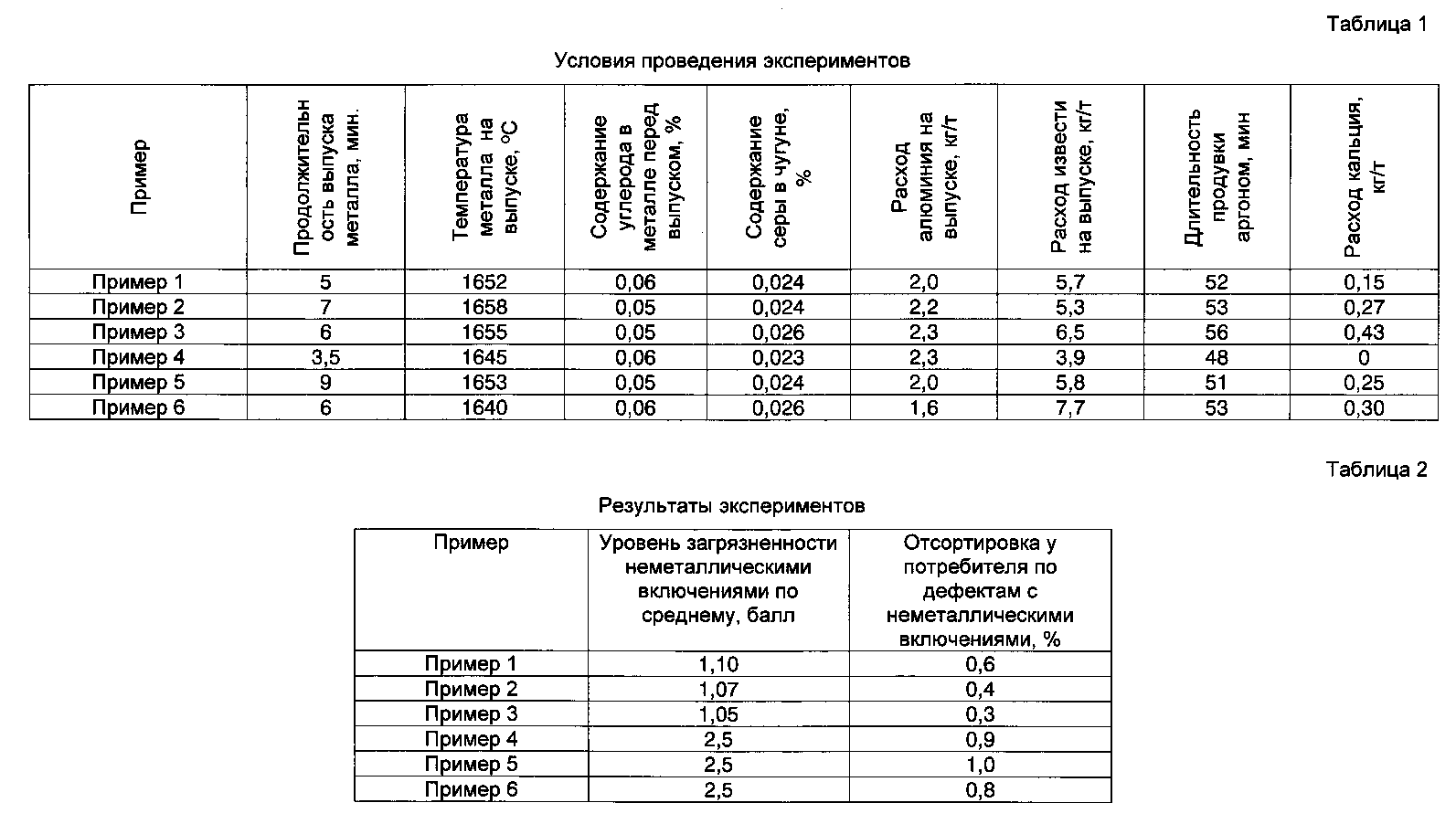
Условия проведения экспериментов приведены в таблице 1. Примеры 1-3 с соблюдением предложенных технических параметров, примеры 4-6 с не соблюдением некоторых параметров.The experimental conditions are shown in table 1. Examples 1-3 in compliance with the proposed technical parameters, examples 4-6 in non-compliance with some parameters.
Результаты экспериментов представлены в таблице 2. Из представленных результатов видно, что при выполнении всех предложенных технических решений (примеры 1-3) удается достичь достаточно низкий уровень неметаллических включений в стали (не более 1,1 балла по среднему). При не выполнении предложенных технических решений (пример 4-6), уровень загрязненности неметаллическими включениями составляет 2,5 баллов по среднему.The experimental results are presented in table 2. It can be seen from the presented results that when all the proposed technical solutions (examples 1-3) are fulfilled, it is possible to achieve a fairly low level of non-metallic inclusions in steel (not more than 1.1 average points). If the proposed technical solutions are not fulfilled (Example 4-6), the level of contamination with non-metallic inclusions is 2.5 points on average.
Таким образом, предложенный способ производства трубной стали позволяет снизить загрязненность стали неметаллическими включениями и тем самым повысить ее коррозионную стойкость.Thus, the proposed method for the production of pipe steel can reduce the contamination of steel by non-metallic inclusions and thereby increase its corrosion resistance.
Claims (1)
Priority Applications (1)
| Application Number | Priority Date | Filing Date | Title |
|---|---|---|---|
| RU2014128412/02A RU2564373C1 (en) | 2014-07-10 | 2014-07-10 | Method of pipe steel production |
Applications Claiming Priority (1)
| Application Number | Priority Date | Filing Date | Title |
|---|---|---|---|
| RU2014128412/02A RU2564373C1 (en) | 2014-07-10 | 2014-07-10 | Method of pipe steel production |
Publications (1)
| Publication Number | Publication Date |
|---|---|
| RU2564373C1 true RU2564373C1 (en) | 2015-09-27 |
Family
ID=54251068
Family Applications (1)
| Application Number | Title | Priority Date | Filing Date |
|---|---|---|---|
| RU2014128412/02A RU2564373C1 (en) | 2014-07-10 | 2014-07-10 | Method of pipe steel production |
Country Status (1)
| Country | Link |
|---|---|
| RU (1) | RU2564373C1 (en) |
Cited By (2)
| Publication number | Priority date | Publication date | Assignee | Title |
|---|---|---|---|---|
| RU2686510C1 (en) * | 2018-11-27 | 2019-04-29 | Акционерное общество "Выксунский металлургический завод" | Method of producing steel for making pipes |
| RU2765475C1 (en) * | 2018-11-08 | 2022-01-31 | Наньцзин Айрон Энд Стил Ко., Лтд. | Method for production of acid-resistant high purity pipeline steel |
Citations (4)
| Publication number | Priority date | Publication date | Assignee | Title |
|---|---|---|---|---|
| US4586956A (en) * | 1985-07-17 | 1986-05-06 | Labate M D | Method and agents for producing clean steel |
| FR2542761B1 (en) * | 1983-03-15 | 1987-10-16 | Vallourec | PROCESS FOR MANUFACTURING HIGH-MACHINABILITY STEELS |
| RU2101367C1 (en) * | 1995-11-02 | 1998-01-10 | Акционерное общество открытого типа Волжский трубный завод | Method of production of pipe steel |
| RU2148659C1 (en) * | 1998-11-16 | 2000-05-10 | Открытое акционерное общество "Производственное объединение "Волжский трубный завод" | Method of pipe steel production |
-
2014
- 2014-07-10 RU RU2014128412/02A patent/RU2564373C1/en active
Patent Citations (4)
| Publication number | Priority date | Publication date | Assignee | Title |
|---|---|---|---|---|
| FR2542761B1 (en) * | 1983-03-15 | 1987-10-16 | Vallourec | PROCESS FOR MANUFACTURING HIGH-MACHINABILITY STEELS |
| US4586956A (en) * | 1985-07-17 | 1986-05-06 | Labate M D | Method and agents for producing clean steel |
| RU2101367C1 (en) * | 1995-11-02 | 1998-01-10 | Акционерное общество открытого типа Волжский трубный завод | Method of production of pipe steel |
| RU2148659C1 (en) * | 1998-11-16 | 2000-05-10 | Открытое акционерное общество "Производственное объединение "Волжский трубный завод" | Method of pipe steel production |
Cited By (2)
| Publication number | Priority date | Publication date | Assignee | Title |
|---|---|---|---|---|
| RU2765475C1 (en) * | 2018-11-08 | 2022-01-31 | Наньцзин Айрон Энд Стил Ко., Лтд. | Method for production of acid-resistant high purity pipeline steel |
| RU2686510C1 (en) * | 2018-11-27 | 2019-04-29 | Акционерное общество "Выксунский металлургический завод" | Method of producing steel for making pipes |
Similar Documents
| Publication | Publication Date | Title |
|---|---|---|
| RU2765475C1 (en) | Method for production of acid-resistant high purity pipeline steel | |
| CN102140566B (en) | Method for improving cleanliness of low-carbon molten aluminum-killed steel | |
| JP2012012648A (en) | Method for applying desulfurize-treatment to molten steel | |
| CN101962702A (en) | Method for controlling non-metallic inclusions in steel | |
| CN108531807A (en) | A kind of heavy wall heavy caliber X80M pipelines clean steel and smelting process | |
| JP7060113B2 (en) | Method of adding Ca to molten steel | |
| CN103555886B (en) | Method for smelting ultralow-sulfur steel by using vanadium-containing molten iron | |
| CN105420445A (en) | Method for smelting coarse-grained steel | |
| CN106566913A (en) | Desulfurizing smelting method for ultra low sulfur pure iron | |
| Li et al. | Effect of Molten Steel Composition on Inclusion Modification by Calcium Treatment in Al-Killed Tinplate Steel | |
| JP2020531691A (en) | Refining method of ultra-low carbon 13Cr stainless steel | |
| CN103451368B (en) | A kind of method that steel is carried out desulfurization | |
| CN103031408A (en) | Method for controlling silicon return through low-silicon aluminum killed steel LF furnace process deep desulfurization | |
| RU2533263C1 (en) | Method of dry steel production | |
| CN101545027A (en) | Low-carbon quick melting ladle refining slag | |
| RU2465340C1 (en) | Low-silicon steel making method | |
| RU2533071C1 (en) | Method of steel production | |
| RU2269579C1 (en) | High-carbon cord-quality steel obtaining method | |
| RU2461635C1 (en) | Method of steel out-of-furnace processing by calcium | |
| RU2569621C1 (en) | Method of producing niobium-containing steel | |
| RU2312902C1 (en) | Method of refining rail steel in furnace-ladle | |
| RU2564205C1 (en) | Method of producing especially-low-carbon steel | |
| RU2440423C1 (en) | Out-of-furnace steel treatment method | |
| RU2564202C1 (en) | Out-of-furnace steel treatment method | |
| RU2440421C1 (en) | Out-of-furnace steel treatment method |