RU2441069C2 - Enzymatic protein stabiliser - Google Patents
Enzymatic protein stabiliser Download PDFInfo
- Publication number
- RU2441069C2 RU2441069C2 RU2010108916/10A RU2010108916A RU2441069C2 RU 2441069 C2 RU2441069 C2 RU 2441069C2 RU 2010108916/10 A RU2010108916/10 A RU 2010108916/10A RU 2010108916 A RU2010108916 A RU 2010108916A RU 2441069 C2 RU2441069 C2 RU 2441069C2
- Authority
- RU
- Russia
- Prior art keywords
- activity
- enzyme
- stabilizer
- stability
- alkyl phenols
- Prior art date
Links
- 239000003381 stabilizer Substances 0.000 title claims abstract description 32
- 230000002255 enzymatic effect Effects 0.000 title description 7
- 102000004169 proteins and genes Human genes 0.000 title description 4
- 108090000623 proteins and genes Proteins 0.000 title description 4
- 102000004190 Enzymes Human genes 0.000 claims abstract description 63
- 108090000790 Enzymes Proteins 0.000 claims abstract description 63
- 239000000203 mixture Substances 0.000 claims description 15
- -1 alkyl phenols Chemical class 0.000 claims description 12
- OSAYNTCWNTVWHD-UHFFFAOYSA-N OC1=C(C(=CC(=C1)C1=CC(=C(C(=C1)C)O)O)C)O Chemical compound OC1=C(C(=CC(=C1)C1=CC(=C(C(=C1)C)O)O)C)O OSAYNTCWNTVWHD-UHFFFAOYSA-N 0.000 claims description 4
- OOXFYOMIPZSLEW-UHFFFAOYSA-N OC1=C(C=C(C(=C1)C1=CC(=C(C=C1CCCCCC)O)O)CCCCCC)O Chemical compound OC1=C(C=C(C(=C1)C1=CC(=C(C=C1CCCCCC)O)O)CCCCCC)O OOXFYOMIPZSLEW-UHFFFAOYSA-N 0.000 claims description 4
- ABFCOJLLBHXNOU-UHFFFAOYSA-N 2-(2-hydroxyphenyl)ethanol Chemical compound OCCC1=CC=CC=C1O ABFCOJLLBHXNOU-UHFFFAOYSA-N 0.000 claims description 2
- WFJIVOKAWHGMBH-UHFFFAOYSA-N 4-hexylbenzene-1,3-diol Chemical compound CCCCCCC1=CC=C(O)C=C1O WFJIVOKAWHGMBH-UHFFFAOYSA-N 0.000 claims description 2
- AXTGIOSZSDVMFS-UHFFFAOYSA-N OC1=CC(=C(C(=C1)O)C=1C(=CC(=CC=1)O)O)CC Chemical compound OC1=CC(=C(C(=C1)O)C=1C(=CC(=CC=1)O)O)CC AXTGIOSZSDVMFS-UHFFFAOYSA-N 0.000 claims description 2
- OIPPWFOQEKKFEE-UHFFFAOYSA-N orcinol Chemical compound CC1=CC(O)=CC(O)=C1 OIPPWFOQEKKFEE-UHFFFAOYSA-N 0.000 claims description 2
- 230000000694 effects Effects 0.000 abstract description 58
- 239000000126 substance Substances 0.000 abstract description 12
- 238000003860 storage Methods 0.000 abstract description 9
- 238000006555 catalytic reaction Methods 0.000 abstract description 8
- 230000002411 adverse Effects 0.000 abstract description 2
- 239000003814 drug Substances 0.000 abstract description 2
- 229940088598 enzyme Drugs 0.000 description 51
- 239000000243 solution Substances 0.000 description 24
- 239000007788 liquid Substances 0.000 description 11
- YCIMNLLNPGFGHC-UHFFFAOYSA-N catechol Chemical compound OC1=CC=CC=C1O YCIMNLLNPGFGHC-UHFFFAOYSA-N 0.000 description 9
- 238000006243 chemical reaction Methods 0.000 description 8
- 230000007062 hydrolysis Effects 0.000 description 8
- 238000006460 hydrolysis reaction Methods 0.000 description 8
- 102000016911 Deoxyribonucleases Human genes 0.000 description 7
- 108010053770 Deoxyribonucleases Proteins 0.000 description 7
- 230000006641 stabilisation Effects 0.000 description 7
- 238000011105 stabilization Methods 0.000 description 7
- 102000004139 alpha-Amylases Human genes 0.000 description 6
- 108090000637 alpha-Amylases Proteins 0.000 description 6
- 229940024171 alpha-amylase Drugs 0.000 description 6
- 238000010438 heat treatment Methods 0.000 description 6
- 239000011541 reaction mixture Substances 0.000 description 6
- 239000000758 substrate Substances 0.000 description 6
- 150000001875 compounds Chemical class 0.000 description 5
- 238000000034 method Methods 0.000 description 5
- 238000002360 preparation method Methods 0.000 description 5
- 108010073178 Glucan 1,4-alpha-Glucosidase Proteins 0.000 description 4
- 102100022624 Glucoamylase Human genes 0.000 description 4
- WQZGKKKJIJFFOK-GASJEMHNSA-N Glucose Natural products OC[C@H]1OC(O)[C@H](O)[C@@H](O)[C@@H]1O WQZGKKKJIJFFOK-GASJEMHNSA-N 0.000 description 4
- 102000003992 Peroxidases Human genes 0.000 description 4
- 230000007423 decrease Effects 0.000 description 4
- 239000008103 glucose Substances 0.000 description 4
- 108040007629 peroxidase activity proteins Proteins 0.000 description 4
- XLYOFNOQVPJJNP-UHFFFAOYSA-N water Substances O XLYOFNOQVPJJNP-UHFFFAOYSA-N 0.000 description 4
- PGSWEKYNAOWQDF-UHFFFAOYSA-N 3-methylcatechol Chemical compound CC1=CC=CC(O)=C1O PGSWEKYNAOWQDF-UHFFFAOYSA-N 0.000 description 3
- GXCLVBGFBYZDAG-UHFFFAOYSA-N N-[2-(1H-indol-3-yl)ethyl]-N-methylprop-2-en-1-amine Chemical compound CN(CCC1=CNC2=C1C=CC=C2)CC=C GXCLVBGFBYZDAG-UHFFFAOYSA-N 0.000 description 3
- 108091005804 Peptidases Proteins 0.000 description 3
- 102000035195 Peptidases Human genes 0.000 description 3
- 229920002472 Starch Polymers 0.000 description 3
- 230000009471 action Effects 0.000 description 3
- 239000007864 aqueous solution Substances 0.000 description 3
- 230000015572 biosynthetic process Effects 0.000 description 3
- 230000003197 catalytic effect Effects 0.000 description 3
- 230000008859 change Effects 0.000 description 3
- 238000001914 filtration Methods 0.000 description 3
- 230000000415 inactivating effect Effects 0.000 description 3
- 238000002156 mixing Methods 0.000 description 3
- 239000008363 phosphate buffer Substances 0.000 description 3
- 229920005862 polyol Polymers 0.000 description 3
- 235000018102 proteins Nutrition 0.000 description 3
- 230000000087 stabilizing effect Effects 0.000 description 3
- 235000019698 starch Nutrition 0.000 description 3
- 239000008107 starch Substances 0.000 description 3
- LWFUFLREGJMOIZ-UHFFFAOYSA-N 3,5-dinitrosalicylic acid Chemical compound OC(=O)C1=CC([N+]([O-])=O)=CC([N+]([O-])=O)=C1O LWFUFLREGJMOIZ-UHFFFAOYSA-N 0.000 description 2
- ZBCATMYQYDCTIZ-UHFFFAOYSA-N 4-methylcatechol Chemical compound CC1=CC=C(O)C(O)=C1 ZBCATMYQYDCTIZ-UHFFFAOYSA-N 0.000 description 2
- ZCYVEMRRCGMTRW-UHFFFAOYSA-N 7553-56-2 Chemical compound [I] ZCYVEMRRCGMTRW-UHFFFAOYSA-N 0.000 description 2
- 102000013142 Amylases Human genes 0.000 description 2
- 108010065511 Amylases Proteins 0.000 description 2
- IAZDPXIOMUYVGZ-UHFFFAOYSA-N Dimethylsulphoxide Chemical compound CS(C)=O IAZDPXIOMUYVGZ-UHFFFAOYSA-N 0.000 description 2
- LFQSCWFLJHTTHZ-UHFFFAOYSA-N Ethanol Chemical compound CCO LFQSCWFLJHTTHZ-UHFFFAOYSA-N 0.000 description 2
- 102000005431 Molecular Chaperones Human genes 0.000 description 2
- 108010006519 Molecular Chaperones Proteins 0.000 description 2
- 229940024606 amino acid Drugs 0.000 description 2
- 235000001014 amino acid Nutrition 0.000 description 2
- 150000001413 amino acids Chemical class 0.000 description 2
- 235000019418 amylase Nutrition 0.000 description 2
- TXXHDPDFNKHHGW-CCAGOZQPSA-N cis,cis-muconic acid Chemical compound OC(=O)\C=C/C=C\C(O)=O TXXHDPDFNKHHGW-CCAGOZQPSA-N 0.000 description 2
- 238000004925 denaturation Methods 0.000 description 2
- 238000006911 enzymatic reaction Methods 0.000 description 2
- 125000002887 hydroxy group Chemical group [H]O* 0.000 description 2
- 229910052740 iodine Inorganic materials 0.000 description 2
- 239000011630 iodine Substances 0.000 description 2
- 230000003647 oxidation Effects 0.000 description 2
- 238000007254 oxidation reaction Methods 0.000 description 2
- VLTRZXGMWDSKGL-UHFFFAOYSA-N perchloric acid Chemical compound OCl(=O)(=O)=O VLTRZXGMWDSKGL-UHFFFAOYSA-N 0.000 description 2
- 150000003077 polyols Chemical class 0.000 description 2
- 238000004321 preservation Methods 0.000 description 2
- 239000000047 product Substances 0.000 description 2
- 239000007787 solid Substances 0.000 description 2
- 238000010792 warming Methods 0.000 description 2
- TXXHDPDFNKHHGW-UHFFFAOYSA-N (2E,4E)-2,4-hexadienedioic acid Natural products OC(=O)C=CC=CC(O)=O TXXHDPDFNKHHGW-UHFFFAOYSA-N 0.000 description 1
- 150000005206 1,2-dihydroxybenzenes Chemical class 0.000 description 1
- QKNYBSVHEMOAJP-UHFFFAOYSA-N 2-amino-2-(hydroxymethyl)propane-1,3-diol;hydron;chloride Chemical compound Cl.OCC(N)(CO)CO QKNYBSVHEMOAJP-UHFFFAOYSA-N 0.000 description 1
- GQKDZDYQXPOXEM-UHFFFAOYSA-N 3-chlorocatechol Chemical compound OC1=CC=CC(Cl)=C1O GQKDZDYQXPOXEM-UHFFFAOYSA-N 0.000 description 1
- QHRTZMDBPOUHPU-UHFFFAOYSA-N 4-(4-amino-3-methoxyphenyl)-2-methoxyaniline;hydrochloride Chemical compound Cl.C1=C(N)C(OC)=CC(C=2C=C(OC)C(N)=CC=2)=C1 QHRTZMDBPOUHPU-UHFFFAOYSA-N 0.000 description 1
- WWOBYPKUYODHDG-UHFFFAOYSA-N 4-chlorocatechol Chemical compound OC1=CC=C(Cl)C=C1O WWOBYPKUYODHDG-UHFFFAOYSA-N 0.000 description 1
- 102100036475 Alanine aminotransferase 1 Human genes 0.000 description 1
- 108010082126 Alanine transaminase Proteins 0.000 description 1
- 239000004382 Amylase Substances 0.000 description 1
- 108010003415 Aspartate Aminotransferases Proteins 0.000 description 1
- 102000004625 Aspartate Aminotransferases Human genes 0.000 description 1
- OKTJSMMVPCPJKN-UHFFFAOYSA-N Carbon Chemical group [C] OKTJSMMVPCPJKN-UHFFFAOYSA-N 0.000 description 1
- 108090000317 Chymotrypsin Proteins 0.000 description 1
- 230000007064 DNA hydrolysis Effects 0.000 description 1
- 102000016680 Dioxygenases Human genes 0.000 description 1
- 108010028143 Dioxygenases Proteins 0.000 description 1
- KCXVZYZYPLLWCC-UHFFFAOYSA-N EDTA Chemical compound OC(=O)CN(CC(O)=O)CCN(CC(O)=O)CC(O)=O KCXVZYZYPLLWCC-UHFFFAOYSA-N 0.000 description 1
- ONIBWKKTOPOVIA-BYPYZUCNSA-N L-Proline Chemical compound OC(=O)[C@@H]1CCCN1 ONIBWKKTOPOVIA-BYPYZUCNSA-N 0.000 description 1
- 241001465754 Metazoa Species 0.000 description 1
- ONIBWKKTOPOVIA-UHFFFAOYSA-N Proline Natural products OC(=O)C1CCCN1 ONIBWKKTOPOVIA-UHFFFAOYSA-N 0.000 description 1
- 239000004365 Protease Substances 0.000 description 1
- 102000006382 Ribonucleases Human genes 0.000 description 1
- 108010083644 Ribonucleases Proteins 0.000 description 1
- 239000007983 Tris buffer Substances 0.000 description 1
- KZSNJWFQEVHDMF-UHFFFAOYSA-N Valine Natural products CC(C)C(N)C(O)=O KZSNJWFQEVHDMF-UHFFFAOYSA-N 0.000 description 1
- 238000002835 absorbance Methods 0.000 description 1
- 238000010521 absorption reaction Methods 0.000 description 1
- 230000004913 activation Effects 0.000 description 1
- 239000000654 additive Substances 0.000 description 1
- 229940025131 amylases Drugs 0.000 description 1
- 230000003625 amylolytic effect Effects 0.000 description 1
- 230000008033 biological extinction Effects 0.000 description 1
- 238000009835 boiling Methods 0.000 description 1
- KGBXLFKZBHKPEV-UHFFFAOYSA-N boric acid Chemical compound OB(O)O KGBXLFKZBHKPEV-UHFFFAOYSA-N 0.000 description 1
- 239000004327 boric acid Substances 0.000 description 1
- 239000000872 buffer Substances 0.000 description 1
- 239000000969 carrier Substances 0.000 description 1
- 239000003054 catalyst Substances 0.000 description 1
- 238000005119 centrifugation Methods 0.000 description 1
- 235000013339 cereals Nutrition 0.000 description 1
- 238000007385 chemical modification Methods 0.000 description 1
- 229960002376 chymotrypsin Drugs 0.000 description 1
- 239000013068 control sample Substances 0.000 description 1
- 238000001816 cooling Methods 0.000 description 1
- 238000006731 degradation reaction Methods 0.000 description 1
- 230000036425 denaturation Effects 0.000 description 1
- 239000003599 detergent Substances 0.000 description 1
- 238000011161 development Methods 0.000 description 1
- 229940079593 drug Drugs 0.000 description 1
- 230000007613 environmental effect Effects 0.000 description 1
- 230000007515 enzymatic degradation Effects 0.000 description 1
- 230000009144 enzymatic modification Effects 0.000 description 1
- 238000002474 experimental method Methods 0.000 description 1
- 235000013305 food Nutrition 0.000 description 1
- 238000007710 freezing Methods 0.000 description 1
- 230000008014 freezing Effects 0.000 description 1
- 230000005714 functional activity Effects 0.000 description 1
- 239000011521 glass Substances 0.000 description 1
- 235000011868 grain product Nutrition 0.000 description 1
- 238000011534 incubation Methods 0.000 description 1
- 230000000977 initiatory effect Effects 0.000 description 1
- 229920002521 macromolecule Polymers 0.000 description 1
- 238000012423 maintenance Methods 0.000 description 1
- 238000005360 mashing Methods 0.000 description 1
- 229910021645 metal ion Inorganic materials 0.000 description 1
- 230000003287 optical effect Effects 0.000 description 1
- 230000008569 process Effects 0.000 description 1
- 235000019833 protease Nutrition 0.000 description 1
- 239000012460 protein solution Substances 0.000 description 1
- 229940024999 proteolytic enzymes for treatment of wounds and ulcers Drugs 0.000 description 1
- ZUFQODAHGAHPFQ-UHFFFAOYSA-N pyridoxine hydrochloride Chemical compound Cl.CC1=NC=C(CO)C(CO)=C1O ZUFQODAHGAHPFQ-UHFFFAOYSA-N 0.000 description 1
- 229960004172 pyridoxine hydrochloride Drugs 0.000 description 1
- 235000019171 pyridoxine hydrochloride Nutrition 0.000 description 1
- 239000011764 pyridoxine hydrochloride Substances 0.000 description 1
- 230000009467 reduction Effects 0.000 description 1
- 238000006722 reduction reaction Methods 0.000 description 1
- 108091008146 restriction endonucleases Proteins 0.000 description 1
- 150000003839 salts Chemical class 0.000 description 1
- 239000000523 sample Substances 0.000 description 1
- 238000002741 site-directed mutagenesis Methods 0.000 description 1
- 239000002904 solvent Substances 0.000 description 1
- 125000001424 substituent group Chemical group 0.000 description 1
- 235000000346 sugar Nutrition 0.000 description 1
- 150000008163 sugars Chemical class 0.000 description 1
- 239000006228 supernatant Substances 0.000 description 1
- 238000003786 synthesis reaction Methods 0.000 description 1
- 231100000331 toxic Toxicity 0.000 description 1
- 230000002588 toxic effect Effects 0.000 description 1
- LENZDBCJOHFCAS-UHFFFAOYSA-N tris Chemical compound OCC(N)(CO)CO LENZDBCJOHFCAS-UHFFFAOYSA-N 0.000 description 1
- 239000004474 valine Substances 0.000 description 1
Images


Landscapes
- Enzymes And Modification Thereof (AREA)
- Cosmetics (AREA)
Abstract
Description
Изобретение относится к биотехнологической, медицинской, пищевой, комбикормовой и легкой промышленности.The invention relates to biotechnology, medical, food, animal feed and light industry.
Ферменты - биологические катализаторы, широко используются в различных областях хозяйственной деятельности человека. Одной из отрицательных сторон использования ферментов является свойственная им нестабильность в денатурирующих условиях. Активность ферментных белков зависит от сохранения нативной структуры, которая может быть нарушена физическими, химическими и биологическими воздействиями, такими как нагревание, замораживание, окисление, восстановление, действием растворителей, ионов металлов, ионной силой растворов, ферментативной модификацией и деградацией. Применение ферментов в различных областях человеческой практики предполагает сохранение ими активности в широком диапазоне температур, рН, высоких концентраций солей и других параметров среды, выходящих за пределы оптимальных для катализа.Enzymes are biological catalysts that are widely used in various fields of human activity. One of the negative aspects of the use of enzymes is their inherent instability under denaturing conditions. The activity of enzyme proteins depends on the preservation of the native structure, which can be disrupted by physical, chemical and biological influences, such as heating, freezing, oxidation, reduction, by the action of solvents, metal ions, ionic strength of solutions, enzymatic modification and degradation. The use of enzymes in various fields of human practice involves their preservation of activity in a wide range of temperatures, pH, high concentrations of salts and other environmental parameters that go beyond the optimal for catalysis.
Обеспечить стабилизацию белковой молекулы можно следующими способами:To stabilize the protein molecule in the following ways:
1. иммобилизацией ферментов на твердых носителях;1. immobilization of enzymes on solid carriers;
2. использованием добавок, стабилизирующих конформацию белка;2. using additives that stabilize the conformation of the protein;
3. химической модификацией молекулы;3. chemical modification of the molecule;
4. приемами белковой инженерии через сайт - направленный мутагенез.4. methods of protein engineering through the site - directed mutagenesis.
Добавление стабилизирующих веществ в растворы белков является наиболее простым способом сохранения активности ферментов в денатурирующих или неоптимальных для катализа условиях.Adding stabilizing substances to protein solutions is the easiest way to preserve enzyme activity under denaturing or non-optimal conditions for catalysis.
Известно использование для стабилизации аспартатаминотрансферазы и аланинаминотрансферазы водных растворов аминокислот - валина или пролина или их комбинации (ЕР 1136550, 2001).It is known to use for stabilization of aspartate aminotransferase and alanine aminotransferase aqueous solutions of amino acids - valine or proline, or a combination thereof (EP 1136550, 2001).
Эффект стабилизации выражается в сохранении достаточно высокой остаточной активности после хранения ферментных растворов при 45°С в течение 4 дней.The stabilization effect is expressed in maintaining a sufficiently high residual activity after storage of enzyme solutions at 45 ° C for 4 days.
В патенте RU 2008354, 1994 для сохранения водных растворов протеиназ используют диметилсулфоксид (20-30% об.). В патенте RU 2020154, 1991 при хранении дезоксирибонуклеазы в ее раствор в качестве стабилизатора вносят смесь гидрохлорида пиридоксина (5-10% вес.) и борной кислоты (1-2% вес.). Недостатком этих известных стабилизирующих веществ является необходимость их использования в высокой концентрации.In patent RU 2008354, 1994, dimethyl sulfoxide (20-30% by volume) is used to preserve aqueous solutions of proteinases. In the patent RU 2020154, 1991, when storing deoxyribonuclease, a mixture of pyridoxine hydrochloride (5-10% by weight) and boric acid (1-2% by weight) is introduced into its solution as a stabilizer. The disadvantage of these known stabilizing substances is the need for their use in high concentrations.
Известно использование для стабилизации протеолитических ферментов водорастворимых полиолов (US 4169817, 1979). Эффективность применения полиолов выражается в увеличении остаточной активности при хранении ферментов в течение года, а также в повышении совместимости протеаз с различными детергентами.It is known to use water-soluble polyols for stabilization of proteolytic enzymes (US 4169817, 1979). The effectiveness of the use of polyols is expressed in an increase in residual activity during storage of enzymes during the year, as well as in increased compatibility of proteases with various detergents.
В патенте ЕР 0821058, 2002 для сохранения высокой ферментативной активности деполимераз и рестриктаз при высоких значениях температуры используют стабилизирующие вещества, обладающие функциями химических шаперонов, к которым относят сахара, полиольные спирты, аминокислоты и их производные, а также используют белки-шапероны. Недостатком известных веществ является то, что стабильность ферментативной активности проявляется лишь при супраоптимальных температурах.In patent EP 0821058, 2002, to maintain a high enzymatic activity of depolymerases and restrictase at high temperatures, stabilizing substances having the functions of chemical chaperones are used, which include sugars, polyol alcohols, amino acids and their derivatives, and they also use chaperone proteins. A disadvantage of the known substances is that the stability of the enzymatic activity is manifested only at supraoptimal temperatures.
Известно применение С7-алкилоксибензола в виде его раствора в этаноле в качестве стабилизатора ферментов, в частности, его использование для стабилизации и активации РНКазы и химотрипсина ("Микробиология", 2000, том 69, №2, 224-230).It is known to use C 7 -alkyloxybenzene in the form of its solution in ethanol as an enzyme stabilizer, in particular, its use for stabilization and activation of RNase and chymotrypsin (Microbiology, 2000, Volume 69, No. 2, 224-230).
Ближайшим аналогом настоящего изобретения является патент ЕР 0189838 1996, в котором для термостабилизации водного раствора α-амилазы применяют некоторые амфифильные соединения.The closest analogue of the present invention is the patent EP 0189838 1996, in which some amphiphilic compounds are used to thermally stabilize an aqueous solution of α-amylase.
Действие описанных в патенте стабилизаторов позволяет сохранять высокую ферментативную активность при воздействии высоких, в том числе денатурирующих, значений температуры. Однако действие этих стабилизаторов сопровождается снижением каталитической активности.The action of the stabilizers described in the patent allows maintaining high enzymatic activity when exposed to high, including denaturing, temperatures. However, the action of these stabilizers is accompanied by a decrease in catalytic activity.
Недостатками известных технических решений является то, что стабилизация ферментов ориентирована в основном на их хранение, т.е. обеспечивается функциональная стабильность, но эффекты стабилизации, как правило, сопровождаются снижением каталитической активности. Кроме того, известные стабилизаторы не обеспечивают расширения рабочего диапазона катализа с сохранением высокой активности в области неоптимальных (высоких или низких) значений температуры и рН.The disadvantages of the known technical solutions is that the stabilization of enzymes is focused mainly on their storage, i.e. functional stability is provided, but stabilization effects are usually accompanied by a decrease in catalytic activity. In addition, the known stabilizers do not provide an extension of the working range of catalysis while maintaining high activity in the region of non-optimal (high or low) values of temperature and pH.
Задачей настоящего изобретения является разработка стабилизаторов ферментов, которые способны повысить устойчивость ферментов к инактивирующим воздействиям температуры, рН и других неблагоприятных факторов и сохранить высокую активность ферментов при неоптимальных для катализа параметрах реакции.The present invention is the development of stabilizers of enzymes that can increase the resistance of enzymes to the inactivating effects of temperature, pH and other adverse factors and maintain a high activity of enzymes at non-optimal for catalysis reaction parameters.
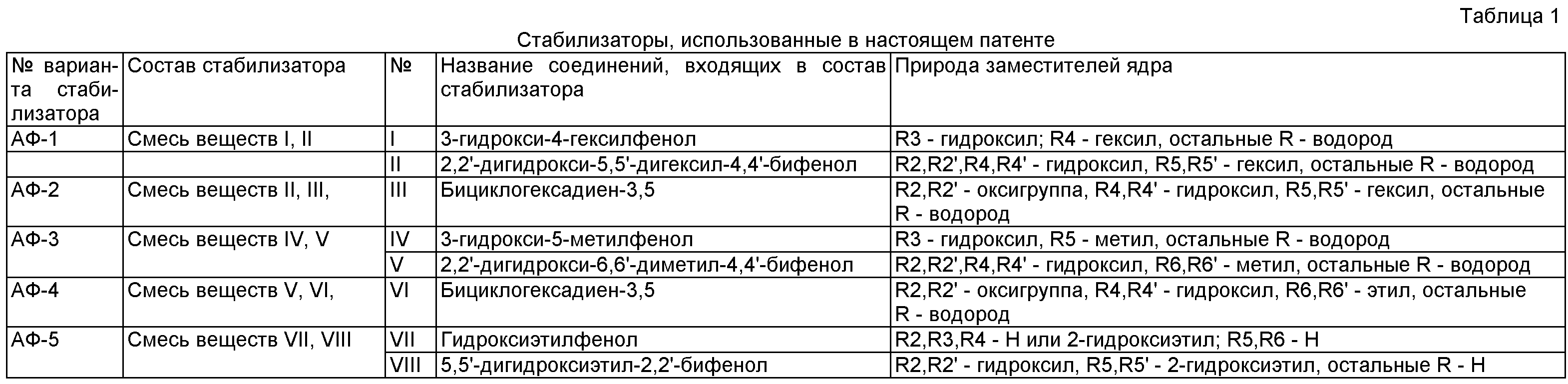
Поставленная задача решается применением описываемых пяти вариантов стабилизаторов ферментных белков на основе алкилфенолов, которые содержат смесь следующих соединений в количестве от 1% до 99%:The problem is solved by the use of the described five variants of stabilizers of enzyme proteins based on alkyl phenols, which contain a mixture of the following compounds in an amount of from 1% to 99%:
1. смесь 3-гидрокси-4-гексилфенола и 2,2'-дигидрокси-5,5'-дигексил-4,4'-бифенола.1. a mixture of 3-hydroxy-4-hexylphenol and 2,2'-dihydroxy-5,5'-dihexyl-4,4'-biphenol.
2. смесь 2,2'-дигидрокси-5,5'-дигексил-4,4'-бифенола и бициклогексадиена-3,5.2. a mixture of 2,2'-dihydroxy-5,5'-dihexyl-4,4'-biphenol and bicyclohexadiene-3,5.
3. смесь 3-гидрокси-5-метилфенола и 2,2'-дигидрокси-6,6'-диметил-4,4'-бифенола.3. a mixture of 3-hydroxy-5-methylphenol and 2,2'-dihydroxy-6,6'-dimethyl-4,4'-biphenol.
4. смесь 2,2'-дигидрокси-6,6'-диметил-4,4'-бифенола и бициклогексадиена-3,5.4. a mixture of 2,2'-dihydroxy-6,6'-dimethyl-4,4'-biphenol and bicyclohexadiene-3,5.
5. смесь гидроксиэтилфенола и 5,5'-дигидроксиэтил-2,2'-бифенола.5. a mixture of hydroxyethylphenol and 5,5'-dihydroxyethyl-2,2'-biphenol.
Все пять заявленных вариантов стабилизаторов ферментных белков позволяют обеспечить достижение технического результата, заключающегося в том, что за счет модификации пространственной структуры ферментных белков (как моно-, так и полисубъединичных) обеспечивается их устойчивость к инактивирующим воздействиям химической, физической и биологической природы и сохранение высокой активности при неоптимальных для катализа значениях температуры и рН.All five declared variants of stabilizers of enzyme proteins make it possible to achieve a technical result, namely, that by modifying the spatial structure of enzyme proteins (both mono- and polysubunit), they are resistant to inactivating effects of a chemical, physical and biological nature and maintain high activity at temperatures that are not optimal for catalysis and pH.
По химической природе все химические соединения, входящие в состав заявленных стабилизаторов, являются соединениями с одним или несколькими шестиатомными углеродными циклами с различными заместителями, не менее чем один из которых является гидроксилом или оксигруппой.By chemical nature, all chemical compounds that make up the claimed stabilizers are compounds with one or more six-atom carbon rings with various substituents, at least one of which is hydroxyl or hydroxy.
Заявленные варианты композиций АФ1-АФ5 могут быть получены например, путем смешения компонентов I-VIII, входящих в их состав приобретенных коммерчески (например: http://www.reaxys.com; http://mntc.ru/synthesis.html и http://chemexpress.fatal.ru/Navigator/Deliver.html). Активность модифицирующих композиций проявляется при наличии указанных выше АФ I-VIII в количествах от 1% до 99% от суммарного содержания АФ при любом их соотношении.The claimed variants of compositions AF1-AF5 can be obtained, for example, by mixing the components I-VIII included in their composition purchased commercially (for example: http://www.reaxys.com; http://mntc.ru/synthesis.html and http : //chemexpress.fatal.ru/Navigator/Deliver.html). The activity of modifying compositions is manifested in the presence of the above AF I-VIII in amounts from 1% to 99% of the total AF content at any ratio.
В таблице 1 представлены заявленные варианты стабилизаторов (далее используется условное обозначение АФ) и входящие в их состав химические соединения, при этом радикалы R1-R5 относятся к первому кольцу, радикалы R'1-R'5 - ко второму, R"1-R"5 - к третьему.Table 1 presents the claimed stabilizer variants (hereinafter the AF symbol is used) and their chemical compounds, with the radicals R1-R5 belonging to the first ring, the radicals R'1-R'5 to the second, R "1-R "5 - to the third.
Применение предлагаемых стабилизаторов можно осуществить двумя способами: 1) смешивая растворы ферментов и стабилизаторов; 2) путем введения растворов стабилизаторов в реакционную смесь одновременно с растворами фермента и субстрата.The use of the proposed stabilizers can be carried out in two ways: 1) mixing solutions of enzymes and stabilizers; 2) by introducing solutions of stabilizers into the reaction mixture simultaneously with solutions of the enzyme and substrate.
Заявленные стабилизаторы не обладают токсическим действием и могут действовать на ферменты даже в составе живых организмов.The claimed stabilizers do not have a toxic effect and can act on enzymes even in living organisms.
Достижение технического результата продемонстрировано с помощью конкретных примеров и проиллюстрировано на представленных фиг.1-3.The achievement of the technical result is demonstrated using specific examples and is illustrated in the presented figures 1-3.
Примеры использования заявленных стабилизаторовExamples of the use of the claimed stabilizers
Пример 1. Влияние АФ-5 и АФ-1 на активность жидкого ФП α-амилазы (α-malt-LKu5038, Германия) при различных значениях температуры (операционная стабильность)Example 1. The effect of AF-5 and AF-1 on the activity of liquid AF α-amylase (α-malt-LKu5038, Germany) at various temperatures (operational stability)
Ферментативную активность α-амилазы определяют по количеству редуцирующих веществ (метод с 3,5-динитросалициловой кислотой), образующихся при гидролизе крахмала. Реакционная смесь включает 2.5 мл раствора фермента (5 ед./мл), 1.5 мл раствора АФ №5 или АФ №1 с концентрацией 0.04 г/л и с концентрацией 0.3 г/л, соответственно, 5 мл 1% раствора крахмала. Гидролиз проводят в течение 10 мин при рН 6.0. Реакцию останавливают добавлением равного объема 0.2 н. HCl.The enzymatic activity of α-amylase is determined by the number of reducing substances (method with 3,5-dinitrosalicylic acid) formed during the hydrolysis of starch. The reaction mixture includes 2.5 ml of an enzyme solution (5 units / ml), 1.5 ml of a solution of AF No. 5 or AF No. 1 with a concentration of 0.04 g / l and a concentration of 0.3 g / l, respectively, 5 ml of a 1% starch solution. Hydrolysis is carried out for 10 min at pH 6.0. The reaction is stopped by the addition of an equal volume of 0.2 n. HCl.
Гидролиз ведут при различных температурах в интервале 20-80°С. Результаты представлены в табл.2. Активность стабилизированного АФ №5 (0.3 г/л) фермента больше чем в 2 раза при всех температурах реакции, стабилизированного АФ №1 (0.04 г/л) - в 1,5 раза. Температурный оптимум гидролиза не изменяется, но существенно расширяется рабочий Т-диапазон катализа. Активность стабилизированного фермента в интервале температур 35-75°С равна или больше, чем максимальная активность нестабилизированной амилазы при Топт=60°С.Hydrolysis is carried out at various temperatures in the range of 20-80 ° C. The results are presented in table.2. The activity of stabilized AF No. 5 (0.3 g / l) of the enzyme is more than 2 times at all reaction temperatures, stabilized AF No. 1 (0.04 g / l) is 1.5 times. The temperature optimum of hydrolysis does not change, but the working T-range of catalysis expands significantly. The activity of the stabilized enzyme in the temperature range of 35-75 ° C is equal to or greater than the maximum activity of unstabilized amylase at T opt = 60 ° C.
(операционная стабильность)Activity of stabilized AF-5 and AF-1 liquid AF of α-amylase α-malt-LKu5038 at various temperatures
(operational stability)
Пример 2. Влияние АФ-4 на активность жидкого ФП α-амилазы (α-malt-LKu5038, Германия) при различных значениях рН (операционная стабильность)Example 2. The effect of AF-4 on the activity of liquid AF α-amylase (α-malt-LKu5038, Germany) at various pH values (operational stability)
Опыты проводят, как описано в примере 1, за исключением того, что гидролиз ведут в интервале рН 2.5-7.5. Результаты представлены в табл.3. Активность стабилизированного АФ-4 (0.2 и 1.5 г/л) фермента при различных значениях рН реакционной смеси существенно выше по сравнению с контролем при рНопт 3.5-4.0 (более чем в 2 раза). Это указывает на повышение стабильности модифицированного фермента в широком диапазоне неоптимальных значений рН.The experiments are carried out as described in example 1, except that the hydrolysis is carried out in the range of pH 2.5-7.5. The results are presented in table.3. The activity of the stabilized AF-4 (0.2 and 1.5 g / l) enzyme at various pH values of the reaction mixture is significantly higher compared to the control at pH opt 3.5–4.0 (more than 2 times). This indicates an increase in the stability of the modified enzyme in a wide range of non-optimal pH values.
Пример 3. Влияние АФ-2, 3, 5 на термостабильность диоксигеназ (функциональная стабильность)Example 3. The effect of AF-2, 3, 5 on the thermal stability of dioxygenases (functional stability)
Активность метилпирокатехин - 1,2-диоксигеназы (МПК - 1,2-ДО) определяют модифицированным методом Хаяиси. Реакционная смесь содержит в 50 мМ буфере Tris-HCl (рН 7.2) 0.25 мМ пирокатехин или замещенный пирокатехин, 1.3 мМ ЭДТА и фермент. Реакцию начинают добавлением фермента. Активность фермента рассчитывают по скорости образования продукта (цис, цис-муконовой кислоты или замещенных муконатов) спектрофотометрически при длине волны 260 нм. При расчете активностей используют коэффициенты молярной экстинкции, определенные Дорном и Кнакмуссом: 16800 М-1 · см-1 для пирокатехина; 17100 М-1 · см-1 для 3-хлорпирокатехина; 12400 М-1 · см-1 для 4-хлорпирокатехина; 12000 M-1 · см-1 для 3,5-хлорпирокатехина; 18000 М-1 · см-1 для 3-метилпирокатехина; 13900 M-1 · см-1 для 4-метилпирокатехина. Единицу активности определяют как количество фермента, катализирующее превращение 1 мкмоля субстрата или образование 1 мкмоля продукта в минуту. Термостабильность ферментов определяют при использовании АФ в концентрациях, которые максимально увеличивают скорость протекания реакции ферментов с пирокатехином: АФ-2 - 0.36 г/л; АФ-3 - 0.42 г/л; АФ-5 - 0.8 г/л. Влияние АФ на термостабильность ферментов изучена после их прогревания при 50°С. Остаточную активность определяют в районе значений температурного максимума. Ферменты инкубируют с АФ при 50°С в течение 9 час, пробы отбирают каждые 10-30 мин, реакцию начинают добавлением пирокатехина. В контрольном варианте фермент инкубируют без добавления АФ в тех же условиях.The activity of methylpyrocatechin - 1,2-dioxigenase (MPC - 1,2-DO) is determined by the modified Hayaisi method. The reaction mixture contains in a 50 mM Tris-HCl buffer (pH 7.2) 0.25 mM pyrocatechol or substituted pyrocatechol, 1.3 mM EDTA and an enzyme. The reaction is started by the addition of an enzyme. The enzyme activity is calculated by the rate of formation of the product (cis, cis-muconic acid or substituted muconates) spectrophotometrically at a wavelength of 260 nm. When calculating the activities, molar extinction coefficients determined by Dorn and Knuckmuss are used: 16800 M -1 · cm -1 for pyrocatechol; 17100 M -1 · cm -1 for 3-chloropyrocatechol; 12400 M -1 · cm -1 for 4-chloropyrocatechol; 12000 M -1 · cm -1 for 3,5-chloropyrocatechol; 18000 M -1 · cm -1 for 3-methylpyrocatechol; 13900 M -1 · cm -1 for 4-methylpyrocatechol. The unit of activity is defined as the amount of enzyme that catalyzes the conversion of 1 μmol of substrate or the formation of 1 μmol of product per minute. The thermal stability of enzymes is determined using AF in concentrations that maximize the rate of the reaction of enzymes with catechol: AF-2 - 0.36 g / l; AF-3 - 0.42 g / l; AF-5 - 0.8 g / l. The effect of AF on the thermal stability of enzymes was studied after their heating at 50 ° C. The residual activity is determined in the region of the temperature maximum. Enzymes are incubated with AF at 50 ° C for 9 hours, samples are taken every 10-30 minutes, the reaction is started by the addition of catechol. In the control variant, the enzyme is incubated without the addition of AF under the same conditions.
Метилпирокатехин - 1,2-диоксигеназа (МПК1,2-ДО), инкубируемая при 50°С в отсутствие АФ (контрольный вариант), практически инактивируется через 1.5 ч (фиг.1). АФ-2, 3, 5 повышают термостабильность МПК 1,2-ДО при 50°С: в присутствии АФ-2 фермент инактивируется через 2 ч; в присутствии АФ-3 - через 2.5 ч, а в присутствии АФ-5 - только через 3 ч.Methylpyrocatechol - 1,2-dioxygenase (MPC1,2-DO), incubated at 50 ° C in the absence of AF (control option), is practically inactivated after 1.5 hours (Fig. 1). AF-2, 3, 5 increase the thermal stability of MPC 1,2-DO at 50 ° C: in the presence of AF-2, the enzyme is inactivated after 2 hours; in the presence of AF-3, after 2.5 hours, and in the presence of AF-5, only after 3 hours.
Данный пример показывает, что использование заявленных вариантов АФ значительно удлиняет время активности ферментов за счет увеличения их функциональной стабильности (сохранения функции после денатурирующих воздействий).This example shows that the use of the claimed AF variants significantly lengthens the enzyme activity time by increasing their functional stability (maintaining function after denaturing effects).
Пример 4. Влияние АФ-4 на термостабильность пероксидазы (функциональная стабильность).Example 4. The effect of AF-4 on the thermal stability of peroxidase (functional stability).
Термостабильность пероксидазы определяют при ее модификации АФ №4 в концентрациях 0.05-2.0 г/л. Фермент, модифицированный и контрольный (без АФ), подвергают прогреванию при температурах 60°С, 20 минут и 70°С, 10 минут, охлаждают до комнатной температуры и проводят ферментативную реакцию. Для окисления субстрата, о-дианизидингидрохлорида, готовят на фосфатном буфере 0.05 М (рН 7.0) растворы: субстрата - о-дианизидингидрохлорида - 5 мг/мл; АФ - с диапазоном концентраций от 0.018 до 0.36 мг/л, ферментного препарата - 0.002 мг/мл. Реакционная смесь включает 840 мкл 0.05 М К-фосфатного буфера (рН 7.0); 10 мкл 3% H2O2; 100 мкл субстрата, по 25 мкл ферментного препарата и раствора определенных концентраций АФ. В течение 5 мин измеряют изменение поглощения при 436 нм. В контрольных вариантах вместо раствора АФ вносят 25 мкл 0.05 М К-фосфатного буфера. Активность в контроле принимают за 100%. Результаты представлены в таблице 4.The thermal stability of peroxidase is determined when it is modified AF No. 4 at concentrations of 0.05-2.0 g / l. The enzyme, modified and control (without AF), is heated at 60 ° C, 20 minutes and 70 ° C, 10 minutes, cooled to room temperature and carried out an enzymatic reaction. For the oxidation of the substrate, o-dianisidine hydrochloride, solutions are prepared on phosphate buffer 0.05 M (pH 7.0): substrate - o-dianisidine hydrochloride - 5 mg / ml; AF - with a concentration range from 0.018 to 0.36 mg / l, of the enzyme preparation - 0.002 mg / ml. The reaction mixture includes 840 μl of 0.05 M K-phosphate buffer (pH 7.0); 10
Модифицированный фермент (0.05 г/л) сохраняет функциональную активность после термообработки 60°С 20 минут практически полностью (98%), тогда как у контрольного фермента она снижается на 27%. Термообработка при 70°С в течение 10 минут модифицированного фермента при всех концентрациях АФ-4 показала сохранение активности на 13-19% выше контрольного.The modified enzyme (0.05 g / l) retains functional activity after heat treatment at 60 ° C for 20 minutes almost completely (98%), whereas it decreases by 27% in the control enzyme. Heat treatment at 70 ° C for 10 minutes of the modified enzyme at all AF-4 concentrations showed that activity was 13–19% higher than the control.
Пример 5. Влияние АФ-3 на стабильность дезоксирибонуклеазы при храненииExample 5. The effect of AF-3 on the stability of deoxyribonuclease during storage
Одной из проблем в практике применения фермента ДНКазы является быстрая потеря ее активности в растворах. Исследовали сохранение активности ДНКазы, модифицированной АФ-3, в растворах, хранившихся в течение 24, 48 и 144 часов в стеклянной или пластмассовой посуде при температурах 25°С и 4°С. Фермент стабилизируют АФ-3 в концентрациях 0.05-0.5 г/л.One of the problems in the practice of using the DNase enzyme is the rapid loss of its activity in solutions. Investigated the conservation of the activity of DNase modified with AF-3 in solutions stored for 24, 48, and 144 hours in glass or plastic containers at temperatures of 25 ° C and 4 ° C. The enzyme is stabilized by AF-3 at concentrations of 0.05-0.5 g / l.
Ферментативную активность ДНКазы определяют по количеству кислоторастворимых веществ, освобождаемых ферментом при гидролизе ДНК в стандартных условиях (37°С, 30 мин). В реакционную смесь вносят по 0.25 мл субстрата (ДНК, 2 мг/мл воды) и 0.15 мл 0.2 М трис-буфера рН 7.0, 0.1 мл раствора стабилизированного АФ фермента. Реакцию останавливают внесением 0.5 мл 1 М раствора хлорной кислоты. В контрольном варианте фермент не стабилизируют. После охлаждения и центрифугирования из надосадочного слоя отбирают 0.5 мл раствора, прибавляют 2.5 мл воды и измеряют поглощение при 260 нм. За единицу активности фермента принимают такое его количество, которое вызывает увеличение оптической плотности на 1 ед. при 260 нм за 1 час инкубации.The enzymatic activity of DNase is determined by the amount of acid-soluble substances released by the enzyme during DNA hydrolysis under standard conditions (37 ° C, 30 min). 0.25 ml of substrate (DNA, 2 mg / ml of water) and 0.15 ml of 0.2 M Tris buffer pH 7.0, 0.1 ml of a solution of stabilized AF enzyme are added to the reaction mixture. The reaction is stopped by adding 0.5 ml of a 1 M perchloric acid solution. In the control embodiment, the enzyme is not stabilized. After cooling and centrifugation, 0.5 ml of the solution was taken from the supernatant, 2.5 ml of water was added, and absorption was measured at 260 nm. For a unit of enzyme activity, take such an amount that causes an increase in optical density by 1 unit. at 260 nm per 1 hour of incubation.
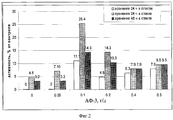
На фиг.2 представлены результаты зависимости стабильности ДНКазы от концентрации АФ при хранении растворов при комнатной температуре.Figure 2 presents the results of the dependence of DNase stability on AF concentration during storage of solutions at room temperature.
Активность фермента при хранении в стеклянной посуде через 24 часа составляла до 25% от исходной и была на 21% выше, чем в контроле, а через 48 часов составляла 14% и была на 11% выше контрольной. При хранении раствора фермента в пластмассовой посуде активность фермента сохранялась на уровне 11%, тогда как в контрольном варианте была нулевой.The enzyme activity during storage in glassware after 24 hours was up to 25% of the initial one and was 21% higher than in the control, and after 48 hours it was 14% and was 11% higher than the control. When storing the enzyme solution in a plastic dish, the enzyme activity remained at the level of 11%, while in the control variant it was zero.
При хранении тех же образцов при температуре 4°С активность модифицированной ДНКазы сохранялась на более высоком уровне: при концентрации АФ 0.1 г/л через 48 ч сохранялась до 25% от исходной активности, что на 22% больше, чем в контроле. Соответствующие данные проиллюстрированы на фиг.3.When storing the same samples at a temperature of 4 ° С, the activity of the modified DNase remained at a higher level: at an AF concentration of 0.1 g / l, after 48 h, up to 25% of the initial activity remained, which is 22% more than in the control. Corresponding data is illustrated in FIG.
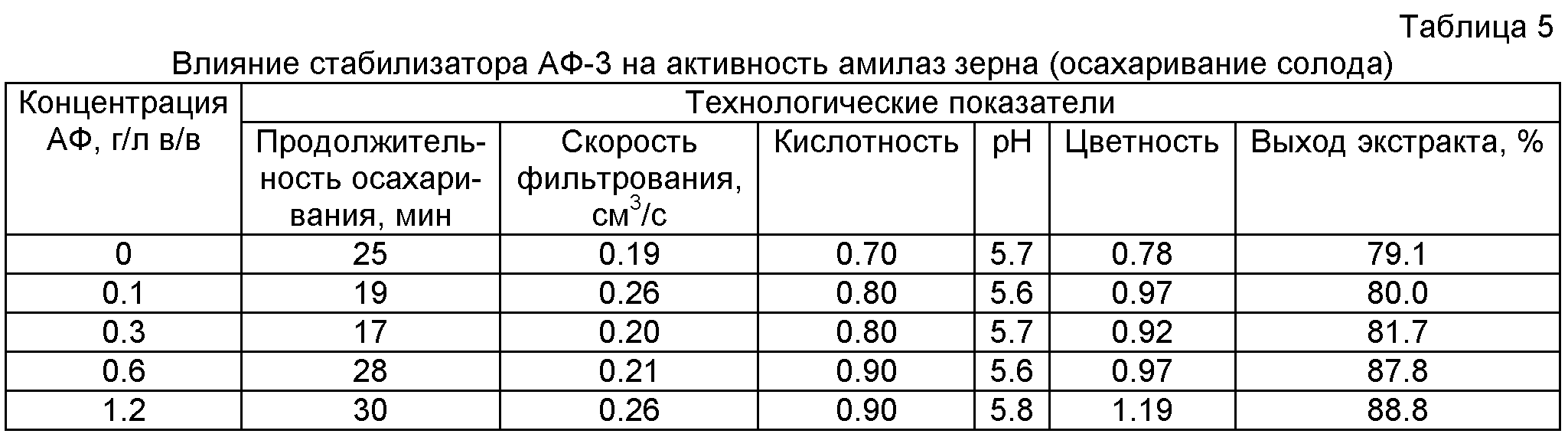
Пример 6. Влияние стабилизатора АФ-3 на стабильность амилаз зерна при осахаривании солодаExample 6. The effect of the stabilizer AF-3 on the stability of amylases of grain during saccharification of malt
Затирание готовят, смешивая 40 г дробленного солода с 450 мл воды, проводят температурную паузу при 45°С в течение 30 минут, затем поднимают температуру до 55°С и выдерживают 20 минут, затем поднимают температуру до 65°С и выдерживают 20 минут. После этого затор разделяют фильтрованием на жидкую и густую часть. Жидкую часть инкубируют с препаратом АФ-3 (0.1, 0.3, 0.6, 1.2 г/л) в течение 20 минут. В это время постепенно поднимают температуру густой отварочной части до 70°С, затем охлаждают до 65°С и объединяют с жидкой частью. Поднимают температуру общего затора до 70°С, доливают 20 мл воды (70°С) и проводят осахаривание затора.Mashing is prepared by mixing 40 g of crushed malt with 450 ml of water, hold a temperature pause at 45 ° C for 30 minutes, then raise the temperature to 55 ° C and hold for 20 minutes, then raise the temperature to 65 ° C and hold for 20 minutes. After that, the mash is separated by filtration into a liquid and a thick part. The liquid part is incubated with the drug AF-3 (0.1, 0.3, 0.6, 1.2 g / l) for 20 minutes. At this time, the temperature of the thick boiling part is gradually raised to 70 ° C, then cooled to 65 ° C and combined with the liquid part. Raise the temperature of the total mash to 70 ° C, add 20 ml of water (70 ° C) and spend the saccharification of the mash.
В полученном заторе определяют продолжительность осахаривания по капельной йодной пробе. После того как йод перестает изменять цвет, затор фильтруют до появления трещин. В полученном жидком сусле определяют содержание сухих веществ (СВ) весовым методом, титруемую кислотность, рН, цветность, а также скорость фильтрования сусла.In the resulting mash, the duration of saccharification is determined by the drip iodine sample. After iodine ceases to change color, the mash is filtered until cracks appear. In the resulting liquid wort, the solids content (W) is determined by the gravimetric method, titratable acidity, pH, color, and the rate of wort filtration.
Как видно из таблицы 5, происходит значительное снижение (на 32.0%) продолжительности осахаривания в варианте внесения АФ-3 в количестве 0.5% от массы зернопродуктов, скорость фильтрования при этом остается почти неизменной. Выход экстракта у всех опытных образцов лучше, чем у контрольного образца. Пример доказывает стабилизацию комплекса амилолитических ферментов, участвующих в процессе осахаривания солодового затора при высоких температурах (65-70°С).As can be seen from table 5, there is a significant decrease (by 32.0%) in the duration of saccharification in the variant of making AF-3 in the amount of 0.5% by weight of grain products, while the filtration rate remains almost unchanged. The yield of the extract in all experimental samples is better than that of the control sample. An example proves the stabilization of a complex of amylolytic enzymes involved in the process of saccharification of malt mash at high temperatures (65-70 ° C).
Пример 7. Влияние стабилизатора АФ-3 на сохранение активности глюкоамилазы (Сан-Ультра Л, Novozyme, Дания) в денатурирующих условиях температуры и рН (функциональная стабильность).Example 7. The effect of the stabilizer AF-3 on the conservation of glucoamylase activity (San Ultra L, Novozyme, Denmark) under denaturing conditions of temperature and pH (functional stability).
Ферментативную активность определяют по количеству редуцирующих веществ (с 3,5-динитросалициловой кислотой), образующихся при гидролизе крахмала, как в примере 1. Для определения термостабильности и рН-стабильности глюкоамилазу - жидкий концентрированный препарат с активностью 2.5 ед./мл, модифицируют добавлением раствора АФ-3 (1 и 20 г/л). Полученный раствор экспонируют (0-60 мин) при температуре 70°, затем охлаждают и определяют активность при стандартной температуре (30°С). В варианте определения рН-стабильности ферментный раствор экспонируют (0-60 мин) при рН 2 или 9.5, затем нейтрализуют и определяют активность при рН 6.0 (оптимуме). Из таблиц 6 и 7 видно, что активность модифицированного фермента в условиях термо- или рН-денатурации была выше, чем немодифицированного (контроль) на протяжении всего времени экспонирования. Эффективность дозы 20 г/л была существенно выше чем 1 г/л.The enzymatic activity is determined by the number of reducing substances (with 3,5-dinitrosalicylic acid) formed during the hydrolysis of starch, as in example 1. To determine the thermal stability and pH stability of glucoamylase, a concentrated liquid preparation with an activity of 2.5 units / ml is modified by adding a solution AF-3 (1 and 20 g / l). The resulting solution was exposed (0-60 min) at a temperature of 70 °, then cooled and activity was determined at a standard temperature (30 ° C). In a variant of determining pH stability, the enzyme solution is exposed (0-60 min) at
Таким образом, заявленные варианты стабилизаторов позволяют не только повысить устойчивость макромолекул к инактивирующим воздействиям, но и обеспечивает сохранение высокой каталитической активности ферментов при неоптимальных условиях (Т°С и рН) катализа, что в свою очередь позволяет расширить рабочий температурный и рН диапазоны ферментативных реакций, включая область низких температур.Thus, the claimed stabilizer options not only increase the stability of macromolecules to inactivating effects, but also ensure the maintenance of high catalytic activity of enzymes under non-optimal conditions (T ° C and pH) of catalysis, which in turn allows you to expand the operating temperature and pH ranges of enzymatic reactions, including low temperature range.
Краткое описание чертежей:Brief Description of the Drawings:
Фиг.1. Влияние АФ на термостабильность фермента МПК1,2-ДО при 50°С: 1 - контроль; 2 - АФ-3 (0.42 г/л); 3 - АФ-5 (0.8 г/л); 4 - №2 (0.36 г/л).Figure 1. Influence of AF on the thermal stability of the MPK1,2-DO enzyme at 50 ° С: 1 - control; 2 - AF-3 (0.42 g / l); 3 - AF-5 (0.8 g / l); 4 - No. 2 (0.36 g / l).
По оси ординат отложена остаточная активность фермента, в % от исходной, до прогрева при 50°С.The ordinate shows the residual activity of the enzyme, in% of the original, until warming up at 50 ° C.
Фиг.2. Активность модифицированных АФ-3 препаратов ДНКазы после хранения в течение 24 и 48 часов при температуре 25°С.Figure 2. The activity of modified AF-3 DNAse preparations after storage for 24 and 48 hours at a temperature of 25 ° C.
Фиг.3. Активность модифицированных АФ-3 препаратов ДНКазы после хранения в течение 24, 48 и 144 часов при температуре 4°С.Figure 3. The activity of modified AF-3 DNAse preparations after storage for 24, 48 and 144 hours at a temperature of 4 ° C.
Claims (5)
Priority Applications (1)
| Application Number | Priority Date | Filing Date | Title |
|---|---|---|---|
| RU2010108916/10A RU2441069C2 (en) | 2010-03-11 | 2010-03-11 | Enzymatic protein stabiliser |
Applications Claiming Priority (1)
| Application Number | Priority Date | Filing Date | Title |
|---|---|---|---|
| RU2010108916/10A RU2441069C2 (en) | 2010-03-11 | 2010-03-11 | Enzymatic protein stabiliser |
Publications (2)
| Publication Number | Publication Date |
|---|---|
| RU2010108916A RU2010108916A (en) | 2011-09-20 |
| RU2441069C2 true RU2441069C2 (en) | 2012-01-27 |
Family
ID=44758358
Family Applications (1)
| Application Number | Title | Priority Date | Filing Date |
|---|---|---|---|
| RU2010108916/10A RU2441069C2 (en) | 2010-03-11 | 2010-03-11 | Enzymatic protein stabiliser |
Country Status (1)
| Country | Link |
|---|---|
| RU (1) | RU2441069C2 (en) |
Citations (4)
| Publication number | Priority date | Publication date | Assignee | Title |
|---|---|---|---|---|
| RU2238318C1 (en) * | 2003-06-20 | 2004-10-20 | Открытое акционерное общество "Восток" | Method for stabilization and activation of hydrolytic enzymes |
| RU2239657C2 (en) * | 2002-10-21 | 2004-11-10 | Институт биологии Коми Научного центра Уральского отделения РАН | Method for purifying pectolytic enzyme preparation |
| RU2288228C2 (en) * | 2001-03-15 | 2006-11-27 | Астразенека Аб | Inhibitors of metalloproteinases, their using and pharmaceutical composition based on thereof |
| RU2395510C2 (en) * | 2004-12-17 | 2010-07-27 | Ипсен Фарма С.А.С. | PHOSPHATASE Cdc25 INHIBITORS |
-
2010
- 2010-03-11 RU RU2010108916/10A patent/RU2441069C2/en not_active IP Right Cessation
Patent Citations (4)
| Publication number | Priority date | Publication date | Assignee | Title |
|---|---|---|---|---|
| RU2288228C2 (en) * | 2001-03-15 | 2006-11-27 | Астразенека Аб | Inhibitors of metalloproteinases, their using and pharmaceutical composition based on thereof |
| RU2239657C2 (en) * | 2002-10-21 | 2004-11-10 | Институт биологии Коми Научного центра Уральского отделения РАН | Method for purifying pectolytic enzyme preparation |
| RU2238318C1 (en) * | 2003-06-20 | 2004-10-20 | Открытое акционерное общество "Восток" | Method for stabilization and activation of hydrolytic enzymes |
| RU2395510C2 (en) * | 2004-12-17 | 2010-07-27 | Ипсен Фарма С.А.С. | PHOSPHATASE Cdc25 INHIBITORS |
Non-Patent Citations (2)
| Title |
|---|
| BECK B.D. Utilization of Quantitative Structure-Activity Relationships (QSARs) in Risk Assessment: Alkylphenols // Regulatory Toxycology and Pharmacology, №14, 1991, pp.273-285. * |
| реферат. * |
Also Published As
| Publication number | Publication date |
|---|---|
| RU2010108916A (en) | 2011-09-20 |
Similar Documents
| Publication | Publication Date | Title |
|---|---|---|
| Dingle et al. | Studies on the mode of action of excess of vitamin A. 1. Effect of excess of vitamin A on the metabolism and composition of embryonic chick-limb cartilage grown in organ culture | |
| Noda et al. | Sweet potato β-amylase immobilized on chitosan beads and its application in the semi-continuous production of maltose | |
| DK168950B1 (en) | Process for increasing the thermal stability of bacterial alpha-amylase, stabilized concentrated aqueous solution of alpha-amylase and its use for liquefaction of starch | |
| KR20110050752A (en) | Flavin-bound glucose dehydrogenase | |
| US9506042B2 (en) | Glucose dehydrogenase | |
| CN114058603B (en) | Freeze-drying protective agent for sphingomyelinase and preparation method thereof | |
| Liu et al. | Process optimization and scale-up production of fungal aryl alcohol oxidase from genetically modified Aspergillus nidulans in stirred-tank bioreactor | |
| Vasileva et al. | Study of the effect of some organic solvents on the activity and stability of glucose oxidase | |
| JP2009269843A (en) | Isomaloligosaccharide and food or drink using the same | |
| RU2441069C2 (en) | Enzymatic protein stabiliser | |
| CN113633759A (en) | Preparation for improving activity and/or thermal stability of superoxide dismutase and application thereof | |
| EP3682013B1 (en) | Bacterial strain clostridium histolyticum and its use | |
| Ellenrieder et al. | Hydrolysis of supersaturated naringin solutions by free and immobilized naringinase | |
| CN113416723A (en) | Liquid enzyme preparation of proteinase K for molecular biology and in vitro diagnostics | |
| Gonaus et al. | Transcription analysis of pyranose dehydrogenase from the basidiomycete Agaricus bisporus and characterization of the recombinantly expressed enzyme | |
| Nakajima et al. | Unique metal dependency of cytosolic α-mannosidase from Thermotoga maritima, a hyperthermophilic bacterium | |
| CN101596311A (en) | Stable kallikrein-1 injection | |
| JP2004000159A (en) | Preparation method of shiitake laccase and decomposition method of phenolic environmental pollutants | |
| Čaušević et al. | Enzymatic activities in honey | |
| Kolpakov et al. | Stabilization of enzymes by dormancy autoinducers as a possible mechanism of resistance of resting microbial forms | |
| Al-Bar | Characterization of partially purified catalase from camel (Camelus dromedarius) liver | |
| JP2011160758A (en) | Enzyme-stabilizing agent | |
| JP2020501525A (en) | Glutathione reductase | |
| JPH0276579A (en) | Salt-tolerant catalase | |
| Tafazoli et al. | Safety evaluation of amylomaltase from Thermus aquaticus |
Legal Events
| Date | Code | Title | Description |
|---|---|---|---|
| MM4A | The patent is invalid due to non-payment of fees |
Effective date: 20120312 |
|
| NF4A | Reinstatement of patent |
Effective date: 20130827 |
|
| PC41 | Official registration of the transfer of exclusive right |
Effective date: 20140314 |
|
| MM4A | The patent is invalid due to non-payment of fees |
Effective date: 20170312 |