RU2425035C2 - Method of producing 4,5-dichloroimidazoles - Google Patents
Method of producing 4,5-dichloroimidazoles Download PDFInfo
- Publication number
- RU2425035C2 RU2425035C2 RU2009138200/04A RU2009138200A RU2425035C2 RU 2425035 C2 RU2425035 C2 RU 2425035C2 RU 2009138200/04 A RU2009138200/04 A RU 2009138200/04A RU 2009138200 A RU2009138200 A RU 2009138200A RU 2425035 C2 RU2425035 C2 RU 2425035C2
- Authority
- RU
- Russia
- Prior art keywords
- yield
- dichloroimidazoles
- unsubstituted
- temperature
- reaction mixture
- Prior art date
Links
- 238000000034 method Methods 0.000 title claims abstract description 15
- QAJJXHRQPLATMK-UHFFFAOYSA-N 4,5-dichloro-1h-imidazole Chemical class ClC=1N=CNC=1Cl QAJJXHRQPLATMK-UHFFFAOYSA-N 0.000 title claims abstract description 13
- 239000005708 Sodium hypochlorite Substances 0.000 claims abstract description 7
- SUKJFIGYRHOWBL-UHFFFAOYSA-N sodium hypochlorite Chemical compound [Na+].Cl[O-] SUKJFIGYRHOWBL-UHFFFAOYSA-N 0.000 claims abstract description 7
- 150000002460 imidazoles Chemical class 0.000 claims abstract description 5
- 125000000217 alkyl group Chemical group 0.000 claims abstract description 3
- 230000015572 biosynthetic process Effects 0.000 claims description 7
- 238000003786 synthesis reaction Methods 0.000 claims description 7
- 239000012264 purified product Substances 0.000 abstract description 2
- 239000000126 substance Substances 0.000 abstract description 2
- HEMHJVSKTPXQMS-UHFFFAOYSA-M Sodium hydroxide Chemical compound [OH-].[Na+] HEMHJVSKTPXQMS-UHFFFAOYSA-M 0.000 description 12
- 239000011541 reaction mixture Substances 0.000 description 9
- VEXZGXHMUGYJMC-UHFFFAOYSA-N Hydrochloric acid Chemical compound Cl VEXZGXHMUGYJMC-UHFFFAOYSA-N 0.000 description 8
- XLYOFNOQVPJJNP-UHFFFAOYSA-N water Substances O XLYOFNOQVPJJNP-UHFFFAOYSA-N 0.000 description 7
- RAXXELZNTBOGNW-UHFFFAOYSA-N imidazole Natural products C1=CNC=N1 RAXXELZNTBOGNW-UHFFFAOYSA-N 0.000 description 6
- 239000000047 product Substances 0.000 description 4
- 238000006243 chemical reaction Methods 0.000 description 3
- 239000000203 mixture Substances 0.000 description 3
- 238000003756 stirring Methods 0.000 description 3
- LXBGSDVWAMZHDD-UHFFFAOYSA-N 2-methyl-1h-imidazole Chemical compound CC1=NC=CN1 LXBGSDVWAMZHDD-UHFFFAOYSA-N 0.000 description 2
- ZAMOUSCENKQFHK-UHFFFAOYSA-N Chlorine atom Chemical compound [Cl] ZAMOUSCENKQFHK-UHFFFAOYSA-N 0.000 description 2
- 239000000460 chlorine Substances 0.000 description 2
- 229910052801 chlorine Inorganic materials 0.000 description 2
- 239000002244 precipitate Substances 0.000 description 2
- ZWRYWVBALYOSPQ-UHFFFAOYSA-N 4,5-dichloro-2-methyl-1h-imidazole Chemical compound CC1=NC(Cl)=C(Cl)N1 ZWRYWVBALYOSPQ-UHFFFAOYSA-N 0.000 description 1
- 230000032683 aging Effects 0.000 description 1
- 239000003153 chemical reaction reagent Substances 0.000 description 1
- 238000004140 cleaning Methods 0.000 description 1
- 239000003245 coal Substances 0.000 description 1
- 150000001875 compounds Chemical class 0.000 description 1
- 239000013078 crystal Substances 0.000 description 1
- 230000007423 decrease Effects 0.000 description 1
- 125000000623 heterocyclic group Chemical group 0.000 description 1
- 230000000749 insecticidal effect Effects 0.000 description 1
- 230000007774 longterm Effects 0.000 description 1
- 238000004519 manufacturing process Methods 0.000 description 1
- 238000002360 preparation method Methods 0.000 description 1
Landscapes
- Organic Low-Molecular-Weight Compounds And Preparation Thereof (AREA)
- Pharmaceuticals Containing Other Organic And Inorganic Compounds (AREA)
Abstract
Description
Изобретение относится к органической и фармацевтической химии, поскольку производные 4,5-дихлоримидазолов находят применение, в частности, для изготовления инсектицидных препаратов (WO 94/06765 А1 (Nippon Soda Co., LTD), 31.03.1994 (стр.12, табл.1, соединения 1-42).The invention relates to organic and pharmaceutical chemistry, since derivatives of 4,5-dichlorimidazoles are used, in particular, for the manufacture of insecticidal preparations (WO 94/06765 A1 (Nippon Soda Co., LTD), 03/31/1994 (p. 12, table. 1, compounds 1-42).
Известен способ синтеза дихлоримидазолов обработкой N-незамещенных имидазолов гипохлоритом натрия с выходом 50,8% (A.W.Lutr and S.DeLorenzo, J.Heterocyclic Chem., 4, 399 (1967).A known method for the synthesis of dichlorimidazoles by treating N-unsubstituted imidazoles with sodium hypochlorite in a yield of 50.8% (A.W. Lutr and S. DeLorenzo, J. Heterocyclic Chem., 4, 399 (1967).
Известен способ синтеза дихлоримидазолов, выбранный в качестве прототипа, путем обработки имидазолов гипохлоритом натрия с выходом 47% (Пожарский А.Ф., Комиссаров И.В., Филиппов И.Т. и др., Хим. - Фарм. журнал, №5, с.87, 1977).A known method for the synthesis of dichlorimidazoles, selected as a prototype, by treating imidazoles with sodium hypochlorite with a yield of 47% (Pozharsky A.F., Komissarov I.V., Filippov I.T. et al., Chem. - Pharm. Journal, No. 5 p. 87, 1977).
Недостатком известных методов является низкий выход из-за протекающих побочных процессов, в частности смолообразования, чем объясняются большие потери вещества при их очистке.A disadvantage of the known methods is the low yield due to the occurring side processes, in particular gumming, which explains the large loss of substance during their cleaning.
Целью изобретения является создание способа синтеза 4,5-дихлоримидазолов, обеспечивающего высокий выход очищенных продуктов.The aim of the invention is to provide a method for the synthesis of 4,5-dichloroimidazoles, providing a high yield of purified products.
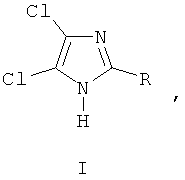
Поставленная цель достигается тем, что нами разработаны оптимальные температурные условия при синтезе 4,5-дихлоримидазолов, общей формулы IThis goal is achieved by the fact that we have developed optimal temperature conditions for the synthesis of 4,5-dichloroimidazoles, general formula I

где R=H, алкил, обработкой N - незамещенных имидазолов раствором гипохлорита натрия.where R = H, alkyl, by treatment of N - unsubstituted imidazoles with sodium hypochlorite solution.
В известных способах синтеза температура реакционной смеси достигала 40°С. Нами установлено, что поддержание температуры в пределах от -10°С до +10°С обеспечивает высокий выход 4,5-дихлоримидазолов. Оптимальной является температура реакционной смеси около 0°С.In known methods of synthesis, the temperature of the reaction mixture reached 40 ° C. We found that maintaining the temperature in the range from -10 ° C to + 10 ° C provides a high yield of 4,5-dichlorimidazoles. The optimum temperature of the reaction mixture is about 0 ° C.
Примеры синтезов.Examples of syntheses.
4,5-Дихлоримидазол. Растворяют 288 г NaOH (7,2 моль) в 700 мл воды, охлаждают до 20-25°С, смешивают с 3 кг колотого льда в колбе объемом 5 литров.4,5-dichlorimidazole. 288 g of NaOH (7.2 mol) are dissolved in 700 ml of water, cooled to 20-25 ° C, mixed with 3 kg of crushed ice in a 5 liter flask.
В полученную смесь пропускают хлор, полученный из 270 г КМnO4 и 1,2 л концентрированной соляной кислоты, в течение 40-60 минут. Затем в реакционную смесь добавляют раствор 72 г NaOH (1,8 моль) в 200 мл воды и 1,5 кг мелкораздробленного льда.Chlorine obtained from 270 g of KMnO 4 and 1.2 L of concentrated hydrochloric acid was passed into the resulting mixture for 40-60 minutes. Then, a solution of 72 g of NaOH (1.8 mol) in 200 ml of water and 1.5 kg of finely divided ice is added to the reaction mixture.
Перемешивают 1 минуту и добавляют в один прием 122,4 г (1,8 моль) имидазола и интенсивно перемешивают 5 минут. Температура реакционной смеси не превышает 0°С. Затем реакционную смесь оставляют без перемешивания на 30 минут. Подкисляют концентрированной соляной кислотой до рН 4,5, отфильтровывают, осадок промывают водой.It is stirred for 1 minute and 122.4 g (1.8 mol) of imidazole are added in one go and mixed vigorously for 5 minutes. The temperature of the reaction mixture does not exceed 0 ° C. Then the reaction mixture was left without stirring for 30 minutes. Acidified with concentrated hydrochloric acid to pH 4.5, filtered off, the precipitate washed with water.
Выход 205-215 г (83-87%).Yield 205-215 g (83-87%).
Перекристаллизовывают из воды с углем. Выход белоснежных кристаллов чистого 4,5 - дихлоримидазола составляет 167-185 г (68-75%).Recrystallized from water with coal. The yield of snow-white crystals of pure 4,5 - dichlorimidazole is 167-185 g (68-75%).
Опыт сравнения.Comparison Experience.
Применяют те же загрузки, что и в вышеописанном опыте с единственным отличием: в реакционную колбу, содержащую гипохлорит натрия, не добавляют 1,5 кг льда, а сразу добавляют имидазол. Температура реакционной смеси поднимается до 40°С самопроизвольно.The same charges were used as in the above experiment with the only difference: 1.5 kg of ice was not added to the reaction flask containing sodium hypochlorite, but imidazole was immediately added. The temperature of the reaction mixture rises to 40 ° C spontaneously.
Выход очищенного 4,5-дихлоримидазола, полученного по этой методике, составляет 49%.The yield of purified 4,5-dichlorimidazole obtained by this method is 49%.
4,5-Дихлор-2-метилимидазол.4,5-Dichloro-2-methylimidazole.
Растворяют 288 г NaOH (7,2 моль) в 700 мл воды, охлаждают до 20-25°С, смешивают с 3 кг колотого льда в колбе емкостью 5 литров. В приготовленную смесь пропускают хлор, полученный из 270 г КМnO4 и 1,2 л концентрированной соляной кислоты в течение 40-60 минут. Затем в реакционную смесь добавляют раствор 72 г NaOH (1,8 моль) в 200 мл воды и 2 кг мелкораздробленного льда. Перемешивают 1 минуту и добавляют в один прием 147,6 г (1,8 моль) 2-метилимидазола. Интенсивно перемешивают в течение 5 минут, затем оставляют без перемешивания на 30 минут. Подкисляют концентрированной соляной кислотой до рН 5,0, отфильтровывают осадок, промывают водой.288 g of NaOH (7.2 mol) are dissolved in 700 ml of water, cooled to 20-25 ° C, mixed with 3 kg of crushed ice in a 5 liter flask. Chlorine obtained from 270 g of KMnO 4 and 1.2 l of concentrated hydrochloric acid was passed into the prepared mixture for 40-60 minutes. Then, a solution of 72 g of NaOH (1.8 mol) in 200 ml of water and 2 kg of finely divided ice is added to the reaction mixture. It is stirred for 1 minute and 147.6 g (1.8 mol) of 2-methylimidazole are added in one portion. Stir vigorously for 5 minutes, then leave without stirring for 30 minutes. Acidified with concentrated hydrochloric acid to pH 5.0, the precipitate is filtered off, washed with water.
Выход 130-150 г (47,8-55,2%).Yield 130-150 g (47.8-55.2%).
Опыт сравнения.Comparison Experience.
Проводят по описанной выше методике за исключением того, что в полученный раствор гипохлорита натрия не добавляют 2 кг льда. Температура реакционной смеси после добавления 2-метилимидазола поднимается до 45-50°С. Выход продукта составляет 80-90 г (29,4-33,1%).Conducted according to the method described above, except that 2 kg of ice is not added to the resulting sodium hypochlorite solution. The temperature of the reaction mixture after adding 2-methylimidazole rises to 45-50 ° C. The product yield is 80-90 g (29.4-33.1%).
Обоснование температурного режима.Justification of the temperature regime.
При проведении реакции ниже -10°С скорость процесса сильно замедляется, что приводит к необходимости длительного выдерживания реакционной смеси при низких температурах и, как следствие, к излишним затратам энергии. При этом выход продукта не увеличивается.When carrying out the reaction below -10 ° C, the speed of the process slows down significantly, which leads to the need for long-term aging of the reaction mixture at low temperatures and, as a consequence, to excessive energy costs. In this case, the product yield does not increase.
При проведении реакции выше +10°С смесь сильно темнеет из-за побочных процессов, выход продукта уменьшается.When carrying out the reaction above + 10 ° C, the mixture darkens strongly due to side processes, the yield of the product decreases.
Оптимальной является температура около 0°С.The optimum temperature is around 0 ° C.
Технический результат, проявляющийся при осуществлении способа, заключается:The technical result manifested in the implementation of the method is:
1) в повышении выхода продукта на 30-38% по сравнению с известными способами;1) in increasing the yield of the product by 30-38% compared with known methods;
2) в снижении смолообразования и, как следствие, в экономии исходных реагентов и снижении энергетических затрат.2) in the reduction of gum formation and, as a result, in saving initial reagents and lowering energy costs.
Claims (1)
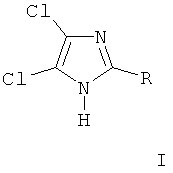
где R=H, алкил, включающий обработку N-незамещенных имидазолов раствором гипохлорита натрия, отличающийся тем, что, с целью повышения выхода целевого продукта, обработку проводят при температуре от -10°С до +10°С. The method of synthesis of N-unsubstituted 4,5-dichlorimidazoles of the general formula I:
where R = H, alkyl, including the treatment of N-unsubstituted imidazoles with sodium hypochlorite solution, characterized in that, in order to increase the yield of the target product, the treatment is carried out at a temperature of from -10 ° C to + 10 ° C.
Priority Applications (1)
| Application Number | Priority Date | Filing Date | Title |
|---|---|---|---|
| RU2009138200/04A RU2425035C2 (en) | 2009-10-15 | 2009-10-15 | Method of producing 4,5-dichloroimidazoles |
Applications Claiming Priority (1)
| Application Number | Priority Date | Filing Date | Title |
|---|---|---|---|
| RU2009138200/04A RU2425035C2 (en) | 2009-10-15 | 2009-10-15 | Method of producing 4,5-dichloroimidazoles |
Publications (2)
| Publication Number | Publication Date |
|---|---|
| RU2009138200A RU2009138200A (en) | 2011-04-20 |
| RU2425035C2 true RU2425035C2 (en) | 2011-07-27 |
Family
ID=44051047
Family Applications (1)
| Application Number | Title | Priority Date | Filing Date |
|---|---|---|---|
| RU2009138200/04A RU2425035C2 (en) | 2009-10-15 | 2009-10-15 | Method of producing 4,5-dichloroimidazoles |
Country Status (1)
| Country | Link |
|---|---|
| RU (1) | RU2425035C2 (en) |
Citations (1)
| Publication number | Priority date | Publication date | Assignee | Title |
|---|---|---|---|---|
| SU232270A1 (en) * | П. М. Кочергин , А. Клыков | METHOD OF OBTAINING 2-ALKYL-4,5-DICHLOROMIDAZOLES |
-
2009
- 2009-10-15 RU RU2009138200/04A patent/RU2425035C2/en not_active IP Right Cessation
Patent Citations (1)
| Publication number | Priority date | Publication date | Assignee | Title |
|---|---|---|---|---|
| SU232270A1 (en) * | П. М. Кочергин , А. Клыков | METHOD OF OBTAINING 2-ALKYL-4,5-DICHLOROMIDAZOLES |
Non-Patent Citations (1)
| Title |
|---|
| Lutz, Albert W. et al: "Novel halogenated imidazoles. Chloroimidazoles", Journal of Heterocyclic Chemistry, 4(3), pp.399-402, 1967. * |
Also Published As
| Publication number | Publication date |
|---|---|
| RU2009138200A (en) | 2011-04-20 |
Similar Documents
| Publication | Publication Date | Title |
|---|---|---|
| RU2616608C2 (en) | Method of producing derivatives of 4,4-difluoro-3,4-dihydroisoquinolin | |
| CA2863994A1 (en) | Methods of producing sulfilimine compounds | |
| US10259789B2 (en) | Process for the preparation of 4-alkoxy-3-acetoxypicolinic acids | |
| CN1125048C (en) | Process for producing isourea | |
| IL207431A (en) | Process for the preparation of a cyclohexanecarboxylic acid derivative and intermediate thereof | |
| EP3303300B1 (en) | Process for the preparation of enzalutamide | |
| EP3029028B1 (en) | Novel method for synthesizing key intermediate of apixaban | |
| RU2744834C2 (en) | Method for producing 4-alkoxy-3-hydroxypicolinic acids | |
| RU2264384C2 (en) | Method for preparing 2- and 4-alkylamino-3-amino-5-nitrobenzoic acids | |
| CN110981769A (en) | Method for preparing tylosin | |
| RU2445307C1 (en) | Method of producing trans-urocanic acid | |
| RU2483055C1 (en) | Method of producing 1,5-bis(2-hydroxyphenoxy)-3-oxapentane monohydrate | |
| EP3609877B1 (en) | Process for the synthesis of firocoxib | |
| TW201429936A (en) | Process for preparing dialkyl thiodiglycolates | |
| CA2662525A1 (en) | Process for preparing alkali metal or alkaline earth metal tricyanomethanides | |
| US6207837B1 (en) | Process for producing dibenzo[b,f]thiepine derivatives | |
| KR101213467B1 (en) | Novel process for the preparation of dihydrate of losartan metabolite exp-3174 | |
| JP2002302485A (en) | Method for producing disulfide-type thiamine derivative | |
| RU2455004C1 (en) | Method for producing sulphochlorides of 6-arylpyridazine-3(2h)-ones | |
| JP4925518B2 (en) | Method for producing substituted alkylamine derivative | |
| KR100615428B1 (en) | 4-carboxy-3-hydroxy-5-mercapto-isothiazole or salts thereof useful for preparing cephalosporins and salts thereof obtained by the method | |
| CN114044783A (en) | Preparation method of idoxaban and intermediate thereof | |
| CN120208914A (en) | A synthesis process of atorvastatin side chain intermediate | |
| RU2520964C1 (en) | Method of obtaining 1,1,2,2-tetrakis-(nitroxymethyl)-1,2-dinitroethane | |
| AU2018273904A1 (en) | Pyrazole amine reactive crystallization |
Legal Events
| Date | Code | Title | Description |
|---|---|---|---|
| MM4A | The patent is invalid due to non-payment of fees |
Effective date: 20121016 |