RU2278503C2 - Method for controlling formation of quality of grape wine - Google Patents
Method for controlling formation of quality of grape wine Download PDFInfo
- Publication number
- RU2278503C2 RU2278503C2 RU2003135810/12A RU2003135810A RU2278503C2 RU 2278503 C2 RU2278503 C2 RU 2278503C2 RU 2003135810/12 A RU2003135810/12 A RU 2003135810/12A RU 2003135810 A RU2003135810 A RU 2003135810A RU 2278503 C2 RU2278503 C2 RU 2278503C2
- Authority
- RU
- Russia
- Prior art keywords
- quality
- wine
- sugar content
- grape
- factors
- Prior art date
Links
- 235000014101 wine Nutrition 0.000 title claims abstract description 57
- 235000009754 Vitis X bourquina Nutrition 0.000 title claims abstract description 25
- 235000012333 Vitis X labruscana Nutrition 0.000 title claims abstract description 25
- 235000014787 Vitis vinifera Nutrition 0.000 title claims abstract description 25
- 238000000034 method Methods 0.000 title claims abstract description 14
- 230000015572 biosynthetic process Effects 0.000 title claims abstract description 7
- 240000006365 Vitis vinifera Species 0.000 title 1
- 235000000346 sugar Nutrition 0.000 claims abstract description 29
- 241000219095 Vitis Species 0.000 claims abstract description 24
- 238000003306 harvesting Methods 0.000 claims abstract description 10
- 238000012545 processing Methods 0.000 claims abstract description 9
- 230000005868 ontogenesis Effects 0.000 claims abstract description 8
- 230000007613 environmental effect Effects 0.000 claims abstract description 7
- 230000002068 genetic effect Effects 0.000 claims abstract description 7
- 241000219094 Vitaceae Species 0.000 claims description 12
- 235000021021 grapes Nutrition 0.000 claims description 12
- 239000002253 acid Substances 0.000 claims description 11
- 239000002994 raw material Substances 0.000 claims description 6
- 238000004891 communication Methods 0.000 claims description 3
- 238000011156 evaluation Methods 0.000 abstract description 4
- 239000000126 substance Substances 0.000 abstract description 3
- 230000000694 effects Effects 0.000 abstract 2
- 239000013058 crude material Substances 0.000 abstract 1
- 235000019647 acidic taste Nutrition 0.000 description 15
- 238000005516 engineering process Methods 0.000 description 6
- 150000007513 acids Chemical class 0.000 description 4
- 230000017260 vegetative to reproductive phase transition of meristem Effects 0.000 description 4
- 238000004519 manufacturing process Methods 0.000 description 3
- 230000005070 ripening Effects 0.000 description 3
- 238000013459 approach Methods 0.000 description 2
- 235000021028 berry Nutrition 0.000 description 2
- 230000001364 causal effect Effects 0.000 description 2
- 230000008121 plant development Effects 0.000 description 2
- 238000001303 quality assessment method Methods 0.000 description 2
- 239000013543 active substance Substances 0.000 description 1
- 150000001413 amino acids Chemical class 0.000 description 1
- 150000001491 aromatic compounds Chemical class 0.000 description 1
- 230000004071 biological effect Effects 0.000 description 1
- 230000034303 cell budding Effects 0.000 description 1
- 238000005094 computer simulation Methods 0.000 description 1
- 238000011161 development Methods 0.000 description 1
- 230000018109 developmental process Effects 0.000 description 1
- 238000009826 distribution Methods 0.000 description 1
- 238000012994 industrial processing Methods 0.000 description 1
- 230000007774 longterm Effects 0.000 description 1
- 238000013178 mathematical model Methods 0.000 description 1
- 230000008520 organization Effects 0.000 description 1
- 238000002360 preparation method Methods 0.000 description 1
- 238000011160 research Methods 0.000 description 1
- 150000008163 sugars Chemical class 0.000 description 1
- 230000007704 transition Effects 0.000 description 1
- 238000011514 vinification Methods 0.000 description 1
- 229940088594 vitamin Drugs 0.000 description 1
- 229930003231 vitamin Natural products 0.000 description 1
- 235000013343 vitamin Nutrition 0.000 description 1
- 239000011782 vitamin Substances 0.000 description 1
- 238000009369 viticulture Methods 0.000 description 1
Landscapes
- Management, Administration, Business Operations System, And Electronic Commerce (AREA)
- Breeding Of Plants And Reproduction By Means Of Culturing (AREA)
Abstract
Description
Изобретение относится к области виноградарства, в частности к способам прогнозирования и оценки качества вина.The invention relates to the field of viticulture, in particular to methods for predicting and evaluating the quality of wine.
В настоящее время оценка качества сводится в основном к контролю за производством, начиная от выбора ареала возделывания винограда и до реализации готовой продукции. Основным параметром при определении качества вина на данный момент является дегустационная оценка. Однако эта оценка является сугубо субъективной и поэтому не может быть достаточно точной.Currently, quality assessment is reduced mainly to the control of production, starting from the choice of the range of cultivation of grapes and to the sale of finished products. The main parameter in determining the quality of wine at the moment is a tasting assessment. However, this assessment is purely subjective and therefore cannot be sufficiently accurate.
Необходимость оценивать качество вина на основе объективных данных, которыми являются его физико-химические показатели, привела к тому, что при определении технической зрелости, выборе направления переработки винограда и определении типа вина стали учитывать значения его сахаристости, титруемой кислотности и их соотношения (Пономарев В.Ф. и др., Технология переработки винограда, Москва, Издательство МСХА, 1997, с.с.15-16).The need to assess the quality of wine on the basis of objective data, which are its physicochemical parameters, led to the fact that when determining the technical maturity, choosing the direction of grape processing and determining the type of wine, they began to take into account the values of its sugar content, titratable acidity and their ratio (V. Ponomarev F. et al., Technology for processing grapes, Moscow, Publishing House of the Moscow Agricultural Academy, 1997, pp. 15-16).
Наиболее близким по технологической сущности является способ производства вина заданного качества, который учитывает влияние на него структурных признаков, включающих не только сахаристость и титруемую кислотность, но и урожайность. По этому способу промышленная переработка винограда начинается с подбора сортов винограда и выбора участков земли, способных обеспечить высокое качество готового продукта (Шольц Е.П. и др., Технология переработки винограда, Москва, Агропромиздат, 1990, с.с.64-99).The closest in technological essence is the method of producing wine of a given quality, which takes into account the influence of structural features on it, including not only sugar content and titratable acidity, but also productivity. According to this method, the industrial processing of grapes begins with the selection of grape varieties and the selection of land plots that can ensure the high quality of the finished product (Scholz EP et al., Grape processing technology, Moscow, Agropromizdat, 1990, pp. 64-99) .
После определения качества сырья принимают решение о направлении переработки винограда. Оценка качества при этом проводится дегустационной комиссией.After determining the quality of the raw materials, they decide on the direction of grape processing. Quality assessment is carried out by the tasting commission.
Недостатками данного способа является неточность оценки качества и типа произведенного вина, требующая постоянной корректировки технологии, которую может осуществить только опытный технолог, и только при использовании традиционных сортов, знания условий его произрастания, агротехнических приемов и т.д. При этом оценка качества и типа вина, полученного из новых генотипов, обладающих многими полезными хозяйственно-биологическими свойствами, вообще трудноосуществима, и поэтому их распространение игнорируется многими виноградарями и виноделами.The disadvantages of this method is the inaccuracy of assessing the quality and type of wine produced, requiring constant adjustment of technology that can only be done by an experienced technologist, and only when using traditional varieties, knowledge of the conditions for its growth, agricultural techniques, etc. At the same time, assessing the quality and type of wine obtained from new genotypes that have many useful economic and biological properties is generally difficult to implement, and therefore their distribution is ignored by many winegrowers and winemakers.
Техническим результатом от использования предлагаемого изобретения является обеспечение отбора сорта или зоны возделывания винограда, соответствующей генетическим требованиям сорта, с заданными показателями качества и плодоносности, а также определение оптимального срока сбора урожая за счет учета доли влияния на них внешних лимитирующих факторов среды по фазам онтогенеза, что позволяет формировать качество и тип вина.The technical result from the use of the present invention is to ensure the selection of a variety or cultivation zone of grapes that meets the genetic requirements of the variety, with specified quality and fruitfulness indicators, as well as determining the optimal harvesting time by taking into account the share of the influence of external limiting environmental factors on the phases of ontogenesis, which allows you to shape the quality and type of wine.
Технический результат достигается за счет того, что в способе управления формированием качества виноградного вина, включающем определение структурных признаков сырья, таких как сахаристость, титруемая кислотность, урожайность, выбор направления переработки, дегустационная оценка продукта, предусмотрено в различных экологических условиях возделывания проведение измерений значений внешних лимитирующих факторов по фазам онтогенеза сорта винограда, на основе полученных данных строят множественные регрессионные модели связи среди структурных признаков с внешними лимитирующими факторами и по параметрам этой модели выбирают оптимальный срок сбора урожая и зону возделывания, экологические условия которой наиболее соответствуют генетическим требованиям сорта, затем строят множественные регрессионные модели связи дегустационной оценки виноградного вина с его структурными признаками и с учетом полученных данных строят номограмму, по которой судят о типе и качестве вина путем определения 4-х квадрантов, образованных горизонтальной и вертикальной границами, первая из которых проходит по линии, при которой независимо от уровня титруемой кислотности и постоянном значении сахаристости вино имеет постоянную дегустационную оценку, а вторая - через точку пересечения всех линий на номограмме, при этом значения сахарно-кислотного интервала, лежащие на линиях в левом и правом верхних квадратах, соответствуют высококачественным сухим и специальным винам соответственно, а левый и правый нижние квадранты соответствуют менее качественным специальным и сухим винам.The technical result is achieved due to the fact that in the method of controlling the formation of the quality of grape wine, which includes determining the structural characteristics of the raw materials, such as sugar content, titratable acidity, yield, choice of processing direction, tasting evaluation of the product, it is envisaged in various environmental conditions of cultivation to measure external limiting values factors on the phases of ontogenesis of the grape variety, based on the data obtained, multiple regression models of communication among the structural attributes with external limiting factors and according to the parameters of this model, choose the optimal harvesting time and cultivation zone, the ecological conditions of which are most consistent with the genetic requirements of the variety, then construct multiple regression models for linking the tasting assessment of grape wine with its structural features and taking into account the data obtained, build a nomogram , which judges the type and quality of wine by determining 4 quadrants formed by horizontal and vertical borders, the first of which runs along a line where, regardless of the level of titratable acidity and a constant value of sugar content, the wine has a constant tasting score, and the second goes through the intersection point of all lines on the nomogram, while the values of the sugar-acid interval lying on the lines in the upper left and right squares , correspond to high-quality dry and special wines, respectively, and the left and right lower quadrants correspond to lower-quality special and dry wines.
На дегустационную оценку виноградного вина огромное влияние имеют не только структурные признаки, агротехнические приемы, ареалы возделывания и технология его получения, но и внешние лимитирующие факторы среды по фазам онтогенеза сорта винограда.The tasting assessment of grape wine is greatly influenced not only by structural features, agricultural practices, cultivation areas and the technology for its production, but also by external limiting environmental factors in the phases of ontogenesis of the grape variety.
В результате научных исследований и математического моделирования была установлена зависимость структурных признаков от внешних лимитирующих факторов.As a result of scientific research and mathematical modeling, the dependence of structural features on external limiting factors was established.
Управление урожайностью и качеством винограда состоит в том, что, имея в руках математические модели реакции сорта на конкретные лимитирующие факторы среды по фазам онтогенеза и подробные карты экологических ситуаций региона, для каждого сорта определяют оптимальный срок сбора урожая, подбирают зону возделывания, экологические условия которой наиболее соответствуют генетическим требованиям сорта, или, наоборот, для конкретной зоны возделывания подбирают соответствующий сорт.The management of the yield and quality of grapes consists in the fact that, having in their hands mathematical models of the reaction of the variety to specific limiting environmental factors by the phases of ontogenesis and detailed maps of the ecological situations of the region, for each variety they determine the optimal harvest time, select the cultivation zone, the ecological conditions of which are most correspond to the genetic requirements of the variety, or, conversely, for the specific cultivation zone, select the appropriate variety.
Управление качеством виноградного вина и его типом осуществляется следующим образом.Quality management of grape wine and its type is as follows.
Дегустационная оценка, характеризующая качество вина, напрямую связана с физико-химическими показателями состава винограда и его продуктивностью. Эти структурные признаки, в свою очередь формируются в зависимости как от экологических условий выращивания, так и от генетических особенностей сортов. Сначала формализуют причинно-следственные связи дегустационной оценки сорта винограда с ее структурными признаками: сахаристостью, титруемой кислотностью, урожайностью. Подставляя в уравнение связи данные о складывающихся конкретных метеоусловиях онтогенеза, уже в ранние периоды развития растения делают прогноз на формирование сахаристости, титруемой кислотности, урожайности. Такой прогноз можно проводить в каждую фазу развития растений. Строят модель связи дегустационной оценки с перечисленными параметрами, на основании чего строят номограмму для определения дегустационной оценки вина из данного сорта винограда в зависимости от содержания титруемых кислот при различной сахаристости.Tasting assessment, characterizing the quality of wine, is directly related to the physico-chemical parameters of the composition of the grape and its productivity. These structural characters, in turn, are formed depending on both the ecological conditions of cultivation and the genetic characteristics of the varieties. First, formalize the causal relationship of the tasting assessment of the grape variety with its structural characteristics: sugar content, titratable acidity, productivity. Substituting data on the emerging specific meteorological conditions of ontogenesis into the communication equation, already in the early periods of plant development they make a forecast for the formation of sugar content, titratable acidity, and productivity. Such a forecast can be carried out in each phase of plant development. A model is built of the connection between the tasting assessment and the listed parameters, on the basis of which a nomogram is built to determine the tasting assessment of wine from a given grape variety depending on the content of titratable acids with different sugar content.
При приближении срока созревания фактические данные по сахаристости, кислотности и урожайности (предполагаемой или оцененной визуально) подставляют в уравнение дегустационной оценки и рассчитывают ее прогноз. Отслеживая динамику этих параметров, уточняют оптимальный срок сбора урожая. Имеющиеся номограммы связи дегустационной оценки с сахаристостью и кислотностью каждого сорта винограда позволяют прогнозировать тип и качество вина из виноградного сырья с конкретными характеристиками. Сырье направляется на переработку для получения гарантированного типа и качества вина.When the ripening period approaches, the actual data on sugar content, acidity and yield (estimated or estimated visually) are substituted into the equation of the tasting assessment and its forecast is calculated. Tracking the dynamics of these parameters, specify the optimal harvest time. The available nomograms of the relationship between the tasting assessment and the sugar content and acidity of each grape variety make it possible to predict the type and quality of wine from grape raw materials with specific characteristics. The raw materials are sent for processing to obtain a guaranteed type and quality of wine.
Пример конкретного выполнения.An example of a specific implementation.
Для примера использования способа были выбраны два современных перспективных сорта винограда различного происхождения Гечеи заматош и Виорика, выращенные в трех агроклиматических зонах: центральной и анапо-таманской зонах Краснодарского края и восточной зоне Ставропольского края в течение 10 лет. Были взяты значения пяти факторов (сумма активных температур, минимальная температура воздуха, максимальная температура воздуха и др.) в рамках пяти фенологических фаз каждого сорта, ограниченных календарными датами начала и конца: начало распускания почек - начало цветения; начало цветения - конец цветения; конец цветения - начало созревания ягод; начало созревания ягод - техническая зрелость; техническая зрелость - листопад. Для каждого структурного признака были созданы монофакторные регрессионные линейные модели. После этого для каждого признака были составлены многофакторные линейные модели, включающие все факторы во все фазы развития (25 переменных). Далее для каждого сорта были получены нелинейные модели зависимости дегустационной оценки от структурных признаков - сахаристости, титруемой кислотности и урожайности.For an example of the use of the method, two modern promising grape varieties of various origin Gechei zamatosh and Viorika were grown in three agroclimatic zones: the central and Anapo-Taman zones of the Krasnodar Territory and the eastern zone of the Stavropol Territory for 10 years. The values of five factors were taken (the sum of the active temperatures, the minimum air temperature, the maximum air temperature, etc.) within the framework of the five phenological phases of each variety, limited by the calendar dates of the beginning and end: the beginning of budding - the beginning of flowering; beginning of flowering - end of flowering; end of flowering - the beginning of ripening berries; the beginning of ripening - technical maturity; technical maturity - leaf fall. Monofactor regression linear models were created for each structural feature. After that, for each trait, multivariate linear models were compiled that included all factors in all phases of development (25 variables). Then, for each variety, nonlinear models were obtained for the dependence of the tasting assessment on structural attributes — sugar content, titratable acidity, and yield.
Модель связи дегустационной оценки со структурными признаками для сорта Гечеи заматош показана уравнением (1)A model for linking the tasting assessment with structural features for the variety Gechei zamatosh is shown by equation (1)
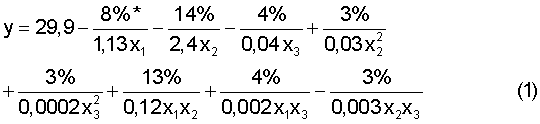
где y - дегустационная оценка, балл;where y is a tasting score, point;
х1 - сахаристость винограда, г/100 см;x 1 - sugar content of grapes, g / 100 cm;
х2 - титруемая кислотность, г/дм;x 2 - titratable acidity, g / dm;
x3 - урожайность, ц/гаx 3 - productivity, kg / ha
и для сорта Виорика уравнением (2)and for the Viorika variety by equation (2)

* - В уравнениях над чертой указаны доли влияния факторов* - In the equations above the bar, the shares of the influence of factors are indicated
Модели причинно-следственных связей изучаемых признаков с дегустационной оценкой показали, что на нее в большей степени влияют не столько линейные составляющие факторов, сколько их соотношение, доля влияния которого может достигать 60%.Models of causal relationships of the studied features with a tasting assessment showed that it is more influenced not so much by the linear components of the factors as by their ratio, the proportion of which can reach 60%.
Поскольку в любой экологической зоне выращивания есть колебания метеоусловий от средних многолетних, то и прогнозируемая с помощью моделей дегустационная оценка не будет постоянной. Мы просчитали по Виорике и Гечеи заматош десятки вариантов возможных сочетаний выбранных трех составляющих дегустационной оценки в рамках реальных условий изучаемых зон, убедились в генотипическом различии изучаемых сортов и для каждого из них определили сахарокислотный интервал для получения качественного вина (см. чертеж).Since there are fluctuations in weather conditions from long-term average in any ecological growing zone, the tasting assessment predicted by using models will not be constant. We calculated dozens of options for possible combinations of the selected three components of the tasting assessment according to the actual conditions of the studied zones according to Viorika and Getechea zamatosh, we were convinced of the genotypic difference of the studied varieties, and for each of them we determined the sugar-acid interval for obtaining high-quality wine (see drawing).
На чертеже отображена номограмма для расчета дегустационной оценки вин из винограда сорта Виорика.The drawing shows a nomogram for calculating the tasting assessment of wines from grapes of the Viorika variety.
Из приведенной номограммы видно, что при всем возможном разнообразии титруемых кислот для сорта Виорика границей содержания сахара для получения качественного сухого вина является сахаристость винограда 21%. Варьирование кислот от 6 до 11 г/дм3 при этой сахаристости не меняет дегустационную оценку 8,4 балла.It can be seen from the above nomogram that, with all possible variety of titratable acids for the Viorika variety, the sugar content for obtaining high-quality dry wine is 21% sugar content of grapes. Variation of acids from 6 to 11 g / dm 3 with this sugar content does not change the tasting score of 8.4 points.
С увеличением сахаристости выше 21% высококачественное сухое вино получить нельзя.With an increase in sugar content above 21%, high-quality dry wine cannot be obtained.
Подобная граница сахаросодержания у сорта Гечеи заматош, по нашим расчетам, составляет 19%. При более низкой сахаристости (17-18%) высокая дегустационная оценка может быть получена при кислотности 6-8 г/дм3. При сахаристости 19% при всем изученном диапазоне кислотностей (6-10 г/дм3) дегустационная оценка почти не менялась (7,9-8,1 балла). При сахаросодержании 20% и выше сырье может быть использовано в производстве специальных вин.According to our estimates, the similar sugar content of the variety Gechei zamatosh is 19%. With a lower sugar content (17-18%), a high tasting score can be obtained with an acidity of 6-8 g / dm 3 . With a sugar content of 19% for the entire studied range of acidities (6-10 g / dm 3 ), the tasting score remained almost unchanged (7.9-8.1 points). With a sugar content of 20% or higher, raw materials can be used in the production of special wines.
Таким образом, номограммы, полученные с помощью моделей, демонстрируют качественный переход вина от одного типа к другому.Thus, the nomograms obtained using the models demonstrate a qualitative transition of wine from one type to another.
Линию, разделяющую высококачественное вино от менее качественного, когда, независимо от уровня кислоты в винограде при постоянном значении сахаристости вино имеет постоянную дегустационную оценку, мы назвали «планкой качества». Планка качества является нижней границей высококачественного вина из ягод данного сорта. Величина дегустационной оценки, соответствующей планке качества, зависит от генотипических особенностей сорта и незначительно колеблется при изменении урожая.The line dividing high-quality wine from less-quality, when, regardless of the level of acid in grapes with a constant value of sugar content, the wine has a constant tasting score, we called the “quality bar”. The quality bar is the lower limit of high-quality wine from berries of this variety. The value of the tasting score corresponding to the quality bar depends on the genotypic characteristics of the variety and varies slightly with a change in yield.
«Планка качества» является одной из границ «сахарокислотного» интервала раздела вин по качеству и типу.The “quality bar” is one of the boundaries of the “sugar-acid” interval for the division of wines by quality and type.
Все линии номограммы пересекаются в одной точке перегиба, через которую проходит вторая граница «сахарокислотного» интервала. При кислотности, соответствующей этой точке, изменение сахаристости не ведет к изменению дегустационной оценки.All nomogram lines intersect at one inflection point, through which the second boundary of the “sugar-acid” interval passes. With an acidity corresponding to this point, a change in sugar content does not lead to a change in the tasting score.
«Планка качества» и ордината, проходящая через точку перегиба, делят поле координат на 4 квадранта с разными характеристиками типа и качества вина. Значения сахаристости и кислотности, лежащие на графиках в левом верхнем квадранте, соответствуют высококачественным сухим винам; в правом верхнем квадранте - высококачественным сухим винам; в правом верхнем квадранте - высококачественным специальным винам; в нижнем левом - менее качественным специальным и в нижнем правом квадранте дегустационная оценка соответствует менее качественным сухим винам.The “quality bar” and the ordinate passing through the inflection point divide the coordinate field into 4 quadrants with different characteristics of the type and quality of wine. The values of sugar content and acidity on the graphs in the upper left quadrant correspond to high-quality dry wines; in the upper right quadrant - high-quality dry wines; in the upper right quadrant - high-quality special wines; in the lower left - less high-quality special and in the lower right quadrant the tasting score corresponds to lower-quality dry wines.
Таким образом, на примере сортов Гечеи заматош и Виорика было проведено глубокое исследование зависимости дегустационной оценки от урожайности и физико-химических показателей винограда. Из полученных моделей видно четкое генотипическое различие изучаемых сортов по характеру формирования дегустационной оценки вин, получаемых от каждого сорта винограда, в зависимости от урожая и содержания в нем сахаров и титруемых кислот.Thus, on the example of the varieties Gethea zamatosh and Viorika, an in-depth study was conducted of the dependence of the tasting assessment on the yield and physico-chemical characteristics of grapes. From the obtained models, we can see a clear genotypic difference between the studied varieties by the nature of the formation of the tasting assessment of wines obtained from each grape variety, depending on the yield and the content of sugars and titrated acids in it.
Номограммы, построенные по моделям, отражающим зависимость дегустационной оценки от сахаристости, кислотности, урожайности и их, в свою очередь, от внешних лимитирующих факторов на протяжении вегетационного периода, позволяют для любого сорта прогнозировать как возможные оптимумы дегустационных оценок, так и возможные спады.Nomograms constructed according to models reflecting the dependence of the tasting assessment on sugar content, acidity, yield and, in turn, on external limiting factors during the growing season, allow for any grade to predict both possible optimum tasting ratings and possible drops.
Практическая значимость предложенного способа управления формированием качества виноградного вина заключается в том, что с его помощью можно оценить потенциал сорта, рассчитать оптимальный срок сбора урожая, спрогнозировать тип и качество вина, вносить коррективы в технологию его приготовления и принимать соответствующие управленческие решения по организации и проведению винодельческого процесса.The practical significance of the proposed method for managing the formation of quality of grape wine is that it can be used to assess the potential of the variety, calculate the optimal harvest time, predict the type and quality of wine, make adjustments to the technology of its preparation and make appropriate management decisions on the organization and conduct of winemaking process.
Незначительные отклонения от расчетных границ «сахаро-кислотного» интервала качества и типа вина могут быть вызваны неучтенными здесь аминокислотами, витаминами, ароматическими соединениями и прочими биологически активными веществами.Slight deviations from the calculated boundaries of the “sugar-acid” range of quality and type of wine can be caused by unaccounted for amino acids, vitamins, aromatic compounds and other biologically active substances.
Предлагаемый нами методический подход анализа зависимости качества вина от физико-химических показателей винограда, его урожайности, а также от внешних лимитирующих факторов позволяет с помощью компьютерного моделирования рассчитать «планку качества» и условия получения высококачественных вин для любого сорта винограда. Эти оценки необходимы для выяснения потенциала сорта в момент сбора урожая и направленности его использования при переработке.Our methodological approach to analyzing the dependence of wine quality on the physicochemical parameters of grapes, its yield, and also on external limiting factors allows using computer simulation to calculate the “quality bar” and conditions for producing high-quality wines for any grape variety. These estimates are necessary to determine the potential of the variety at the time of harvest and the direction of its use in processing.
Практическая значимость предложенного способа заключается в том, что он позволяет рассчитать оптимальный момент сбора урожая, прогнозировать тип и качество вина, внести коррективы в технологию для получения необходимого качества вина.The practical significance of the proposed method lies in the fact that it allows you to calculate the optimal time for harvesting, to predict the type and quality of wine, to make adjustments to the technology to obtain the required quality of wine.
Claims (1)
Priority Applications (1)
| Application Number | Priority Date | Filing Date | Title |
|---|---|---|---|
| RU2003135810/12A RU2278503C2 (en) | 2003-12-09 | 2003-12-09 | Method for controlling formation of quality of grape wine |
Applications Claiming Priority (1)
| Application Number | Priority Date | Filing Date | Title |
|---|---|---|---|
| RU2003135810/12A RU2278503C2 (en) | 2003-12-09 | 2003-12-09 | Method for controlling formation of quality of grape wine |
Publications (2)
| Publication Number | Publication Date |
|---|---|
| RU2003135810A RU2003135810A (en) | 2005-05-20 |
| RU2278503C2 true RU2278503C2 (en) | 2006-06-27 |
Family
ID=35820219
Family Applications (1)
| Application Number | Title | Priority Date | Filing Date |
|---|---|---|---|
| RU2003135810/12A RU2278503C2 (en) | 2003-12-09 | 2003-12-09 | Method for controlling formation of quality of grape wine |
Country Status (1)
| Country | Link |
|---|---|
| RU (1) | RU2278503C2 (en) |
Cited By (2)
| Publication number | Priority date | Publication date | Assignee | Title |
|---|---|---|---|---|
| CN105123423A (en) * | 2015-07-21 | 2015-12-09 | 句容市万山红遍应时鲜果专业合作联社 | Plantation method for improving sugar content of shine-muscat |
| CN105628884A (en) * | 2016-04-01 | 2016-06-01 | 刘涛 | Method for identifying real and counterfeited imported red wine |
Citations (3)
| Publication number | Priority date | Publication date | Assignee | Title |
|---|---|---|---|---|
| SU1564538A1 (en) * | 1987-08-10 | 1990-05-15 | Всесоюзный Научно-Исследовательский Институт Винограда И Продуктов Его Переработки "Магарач" | Method of assessing quality of grape |
| US5200909A (en) * | 1989-02-28 | 1993-04-06 | Juergens John P | Method for evaluation of a liquid, particularly wine |
| WO2002033404A2 (en) * | 2000-10-19 | 2002-04-25 | Trauner Kenneth B | Integrated wine quality sensor |
-
2003
- 2003-12-09 RU RU2003135810/12A patent/RU2278503C2/en not_active IP Right Cessation
Patent Citations (3)
| Publication number | Priority date | Publication date | Assignee | Title |
|---|---|---|---|---|
| SU1564538A1 (en) * | 1987-08-10 | 1990-05-15 | Всесоюзный Научно-Исследовательский Институт Винограда И Продуктов Его Переработки "Магарач" | Method of assessing quality of grape |
| US5200909A (en) * | 1989-02-28 | 1993-04-06 | Juergens John P | Method for evaluation of a liquid, particularly wine |
| WO2002033404A2 (en) * | 2000-10-19 | 2002-04-25 | Trauner Kenneth B | Integrated wine quality sensor |
Non-Patent Citations (1)
| Title |
|---|
| ШОЛЬЦ Е.П. и др. Технология переработки винограда. - М.: Агропромиздат, 1990, с.64-99). ПОНОМАРЕВ К.В. и др. Технология переработки винограда. - М.: издательство МСХА, 1997, с.15-16). * |
Cited By (2)
| Publication number | Priority date | Publication date | Assignee | Title |
|---|---|---|---|---|
| CN105123423A (en) * | 2015-07-21 | 2015-12-09 | 句容市万山红遍应时鲜果专业合作联社 | Plantation method for improving sugar content of shine-muscat |
| CN105628884A (en) * | 2016-04-01 | 2016-06-01 | 刘涛 | Method for identifying real and counterfeited imported red wine |
Also Published As
| Publication number | Publication date |
|---|---|
| RU2003135810A (en) | 2005-05-20 |
Similar Documents
| Publication | Publication Date | Title |
|---|---|---|
| EP3211987B1 (en) | Method for providing a three-dimensional assessment of water movement through soil and across a field and associated system | |
| CN107392376B (en) | A kind of crop meteorological yield forecasting method and system | |
| Findlay | An" Austrian" model of international trade and interest rate equalization | |
| Pizarro et al. | Irrigation management or climate change? Which is more important to cope with water shortage in the production of table grape in a Mediterranean context | |
| CN105445229A (en) | Nitrogen balance spectroscopy-based wheat spring nitrogenous fertilizer application method, and construction method of nitrogen topdressing amount model thereof | |
| Zaldea et al. | Climate changes in recent decades, the evolution of the drought phenomenon and their influence on vineyards in north-eastern Romania | |
| RU2278503C2 (en) | Method for controlling formation of quality of grape wine | |
| EP3385366A1 (en) | Method for controlling a biotechnological process | |
| CN110162830B (en) | Variable irrigation node prediction method based on blade tension on-line monitoring | |
| CN119183938B (en) | A soilless cultivation system for reclaimed land and intercropping of green manure | |
| CN102279567A (en) | Method for controlling liquor fermentation period | |
| LaRue et al. | Considerations for variable rate irrigation | |
| Karaiev et al. | Defining Stability of Technological Process of Growing Fruit Crop Seedlings | |
| Roucher et al. | Predicting wine prices based on the weather: Bordeaux vineyards in a changing climate | |
| Bahat et al. | Comparison of water potential and yield parameters under uniform and variable rate drip irrigation in a cabernet sauvignon vineyard | |
| EP1559775A2 (en) | Process for the controlled fermentation of liquid | |
| Sojkova et al. | Evaluation of economic efficiency of orchards investment project with respect to the risk | |
| CN106644998A (en) | Novel fruit thinning method | |
| BUCIUMEANU et al. | Use of analytic hierarchy process on the choice of grapevine varieties suitable for a sustainable viticulture and market demands in the viticultural center Stefanesti. | |
| Padsuwan et al. | Potassium availability in tropical sandy soils and cassava response to three-year K fertilization | |
| Egorov et al. | Cognitive map of the model for managing the sustainability of reproductive processes in industrial viticulture | |
| Nedeljković et al. | Prediction of Sunflower Production in the Republic of Serbia | |
| TOKAR et al. | Optimize the fermentation process of strawberry must for unfortified wine | |
| Hasama et al. | Water storage and drainage in perlite in container cultivation | |
| CN121093624A (en) | A standardized liquor body for Maotai-flavor liquor and its design method |
Legal Events
| Date | Code | Title | Description |
|---|---|---|---|
| MM4A | The patent is invalid due to non-payment of fees |
Effective date: 20161210 |