RU2254103C2 - Belt for loins - Google Patents
Belt for loins Download PDFInfo
- Publication number
- RU2254103C2 RU2254103C2 RU2002132296/14A RU2002132296A RU2254103C2 RU 2254103 C2 RU2254103 C2 RU 2254103C2 RU 2002132296/14 A RU2002132296/14 A RU 2002132296/14A RU 2002132296 A RU2002132296 A RU 2002132296A RU 2254103 C2 RU2254103 C2 RU 2254103C2
- Authority
- RU
- Russia
- Prior art keywords
- belt
- sides
- fasteners
- elastic
- manufactured
- Prior art date
Links
- 239000004744 fabric Substances 0.000 claims abstract description 13
- 239000004753 textile Substances 0.000 claims abstract description 5
- 230000000694 effects Effects 0.000 abstract description 15
- 230000001225 therapeutic effect Effects 0.000 abstract description 6
- 230000001965 increasing effect Effects 0.000 abstract description 4
- 238000004519 manufacturing process Methods 0.000 abstract description 3
- 238000010276 construction Methods 0.000 abstract 1
- 239000000463 material Substances 0.000 abstract 1
- 239000000126 substance Substances 0.000 abstract 1
- 210000004705 lumbosacral region Anatomy 0.000 description 13
- 210000001519 tissue Anatomy 0.000 description 11
- 210000001015 abdomen Anatomy 0.000 description 9
- 210000004872 soft tissue Anatomy 0.000 description 6
- 208000002193 Pain Diseases 0.000 description 5
- 210000003692 ilium Anatomy 0.000 description 5
- 238000000034 method Methods 0.000 description 5
- 210000003205 muscle Anatomy 0.000 description 5
- 230000015572 biosynthetic process Effects 0.000 description 4
- 230000003449 preventive effect Effects 0.000 description 4
- 201000009859 Osteochondrosis Diseases 0.000 description 3
- 239000011324 bead Substances 0.000 description 3
- 208000037265 diseases, disorders, signs and symptoms Diseases 0.000 description 3
- 239000003814 drug Substances 0.000 description 3
- 206010019909 Hernia Diseases 0.000 description 2
- 208000007623 Lordosis Diseases 0.000 description 2
- 201000010099 disease Diseases 0.000 description 2
- 239000013013 elastic material Substances 0.000 description 2
- 208000014674 injury Diseases 0.000 description 2
- 230000000399 orthopedic effect Effects 0.000 description 2
- 230000002265 prevention Effects 0.000 description 2
- 230000002035 prolonged effect Effects 0.000 description 2
- ZOXJGFHDIHLPTG-UHFFFAOYSA-N Boron Chemical compound [B] ZOXJGFHDIHLPTG-UHFFFAOYSA-N 0.000 description 1
- 208000037273 Pathologic Processes Diseases 0.000 description 1
- 208000027418 Wounds and injury Diseases 0.000 description 1
- 230000003187 abdominal effect Effects 0.000 description 1
- 210000003815 abdominal wall Anatomy 0.000 description 1
- 208000005298 acute pain Diseases 0.000 description 1
- 210000000577 adipose tissue Anatomy 0.000 description 1
- 210000003484 anatomy Anatomy 0.000 description 1
- 238000005452 bending Methods 0.000 description 1
- 229910052796 boron Inorganic materials 0.000 description 1
- QTCANKDTWWSCMR-UHFFFAOYSA-N costic aldehyde Natural products C1CCC(=C)C2CC(C(=C)C=O)CCC21C QTCANKDTWWSCMR-UHFFFAOYSA-N 0.000 description 1
- 230000006378 damage Effects 0.000 description 1
- 230000008021 deposition Effects 0.000 description 1
- 208000035475 disorder Diseases 0.000 description 1
- 238000006073 displacement reaction Methods 0.000 description 1
- 229940079593 drug Drugs 0.000 description 1
- 230000002708 enhancing effect Effects 0.000 description 1
- 230000005713 exacerbation Effects 0.000 description 1
- 230000000622 irritating effect Effects 0.000 description 1
- ISTFUJWTQAMRGA-UHFFFAOYSA-N iso-beta-costal Natural products C1C(C(=C)C=O)CCC2(C)CCCC(C)=C21 ISTFUJWTQAMRGA-UHFFFAOYSA-N 0.000 description 1
- 230000014759 maintenance of location Effects 0.000 description 1
- 238000002219 manual therapy Methods 0.000 description 1
- 239000002184 metal Substances 0.000 description 1
- 230000007171 neuropathology Effects 0.000 description 1
- 230000009054 pathological process Effects 0.000 description 1
- 230000000737 periodic effect Effects 0.000 description 1
- 230000002269 spontaneous effect Effects 0.000 description 1
- 230000003068 static effect Effects 0.000 description 1
- 230000008733 trauma Effects 0.000 description 1
- 230000000472 traumatic effect Effects 0.000 description 1
- 230000009278 visceral effect Effects 0.000 description 1
Images
Landscapes
- Orthopedics, Nursing, And Contraception (AREA)
Abstract
Description
Изобретение относится к медицинской технике, а именно к поясам, бандажам и корсетам поясничного отдела позвоночника.The invention relates to medical equipment, namely to belts, bandages and corsets of the lumbar spine.
Остеохондроз или травма поясничного отдела позвоночника и их последствия часто вызывают боли и ограничение движений, приводя людей к страданиям и нарушая их трудоспособность. При наличии болей щадящая нагрузка на мышцы спины и брюшного пресса приводит к гипотрофии их, а физическое напряжение при недостаточности собственного мышечного корсета, укрепляющего и разгружающего позвоночник, может провоцировать обострение заболевания (В.В.Проскурин. Мануальная терапия висцеральных проявлений остеохондроза позвоночника. Изд. Российского университета дружбы народов. М., 1993 г., с. 17 и 40). Установлено, что восстановительные процессы в опорных тканях требуют дозированных функций, а не длительного покоя и иммобилизации (К.Левит, Й.Захис, В.Янда. Мануальная медицина. Перевод с немецкого. M.: Медицина. 1993 г., с.195). Современные методы профилактики расстройств, возникающих при остеохондрозе позвоночника, предусматривают не обездвиживание позвоночника, а мобилизацию его. Однако при развитии острых болей необходимо создание временного покоя. Поэтому для лечения, профилактики и реабилитации больных с заболеваниями и с последствиями травм поясничного отдела позвоночника разрабатывают и используют различные пояса. Тем не менее, разнообразие патологических процессов в поясничном отделе позвоночника и индивидуальные особенности форм поясницы побуждают к дальнейшей разработке новых конструкций поясов.Osteochondrosis or trauma of the lumbar spine and their consequences often cause pain and restriction of movement, leading people to suffering and impairing their ability to work. In the presence of pain, a gentle load on the muscles of the back and abdominal press leads to their hypotrophy, and physical stress with failure of their own muscle corset, which strengthens and unloads the spine, can provoke an exacerbation of the disease (V. V. Proskurin. Manual therapy of visceral manifestations of osteochondrosis of the spine. Edition. Peoples' Friendship University of Russia. M., 1993, p. 17 and 40). It has been established that restoration processes in supporting tissues require dosed functions, and not prolonged rest and immobilization (K. Levit, J. Zahis, V. Yanda. Manual medicine. Translation from German. M .: Medicine. 1993, p. 195 ) Modern methods for the prevention of disorders arising from osteochondrosis of the spine, do not provide for immobilization of the spine, but its mobilization. However, the development of acute pain requires the creation of temporary rest. Therefore, for the treatment, prevention and rehabilitation of patients with diseases and with the consequences of injuries of the lumbar spine, various belts are developed and used. Nevertheless, the variety of pathological processes in the lumbar spine and the individual features of the lower back shape encourage further development of new belt designs.
Известен пояс по патенту РФ №2146908, борта которого выполнены с упругорастяжимым элементом в месте соединения его со спинкой, упругие элементы обеспечивают при натяжении бортов смещение лишь их концов, при этом спинка остается на месте.The belt is known according to the patent of the Russian Federation No. 2146908, the sides of which are made with an elastically extensible element in the place of its connection with the back, the elastic elements ensure that only the ends are displaced when the sides are tensioned, while the back remains in place.
Недостатком этого ортопедического пояса является отсутствие в нем элементов, обеспечивающих повышение профилактического, лечебного, реабилитационного и эстетического воздействия устройства на ткани организма путем расширения возможностей различного локального воздействия его на разных уровнях поясничной области организма.The disadvantage of this orthopedic belt is the lack of elements in it, which increase the preventive, curative, rehabilitation and aesthetic effects of the device on body tissues by expanding the possibilities of various local effects at different levels of the lumbar region of the body.
Известен также пояснично-крестцовый корсет по патенту США №3717143, содержащий спинку из эластичного материала с бортами, карманы с металлическими пластинками-вкладышами, полоски-липучки на бортах и ремни с пряжками.Also known lumbosacral corset according to US patent No. 3717143, containing a back made of elastic material with sides, pockets with metal plate inserts, Velcro strips on the sides and belts with buckles.
Недостатками этого корсета являются громоздкость его конструкции, что усложняет надевание и снятие его со значительной затратой времени, затрудняет его изготовление и повышают себестоимость, а также отсутствие в нем конструктивных элементов, обеспечивающих повышение профилактического, лечебного, реабилитационного и эстетического воздействия устройства на ткани организма путем расширения возможностей локального воздействия его на разных уровнях поясничной области организма.The disadvantages of this corset are the bulkiness of its design, which complicates putting on and removing it with a significant investment of time, complicates its manufacture and increases the cost, as well as the absence of structural elements in it, which increase the preventive, therapeutic, rehabilitation and aesthetic effects of the device on body tissues by expanding the possibilities of local exposure to it at different levels of the lumbar region of the body.
Известен ранее разработанный нами «Пояс поясничный» и защищенный патентом РФ на изобретение №2175219, включающий спинку из эластичного материала, расположенные в ней вкладыши, соединенные с противоположными концами спинки два борта с застежками из текстильной ворсовой ткани велкро. Петельные элементы застежки на внешней поверхности концов обоих бортов выполнены с узкой полосой удлинения в направлении спинки не менее чем на две трети длины борта, содержит тяж с крючковым элементом застежек на обоих концах, длина которого в статическом состоянии превышает расстояние между полосами удлинения и короче расстояния между элементами застежки на внешней поверхности бортов, а длина эластичных ремешков, прикрепленных к внутренней поверхности бортов, не превышает расстояния от места прикрепления каждого до конца своего борта.Known previously developed by us is “Lumbar Belt” and protected by RF patent for invention No. 2175219, including a backrest made of elastic material, inserts located in it, two sides with fasteners made of velcro textile fleece fabric connected to opposite ends of the backrest. The loop fastener elements on the outer surface of the ends of both sides are made with a narrow elongation strip in the direction of the back for at least two-thirds of the side length, contains a cord with a hook fastener element at both ends, the length of which in the static state exceeds the distance between the elongation strips and is shorter than the distance between fasteners on the outer surface of the sides, and the length of the elastic straps attached to the inner surface of the sides does not exceed the distance from the place of attachment of each to the end of its boron that one.
Недостатком этого устройства является необходимость для его изготовления значительного количества дорогостоящей упругоэластичной ткани, что повышает себестоимость пояса. В нем отсутствуют конструктивные элементы, обеспечивающие дальнейшее повышение профилактического, лечебного, реабилитационного и эстетического воздействия устройства на ткани организма путем расширения возможностей различного локального воздействия его на ткани поясничной области организма.The disadvantage of this device is the need for its manufacture of a significant amount of expensive elastic fabric, which increases the cost of the belt. It lacks structural elements that provide a further increase in the preventive, curative, rehabilitation, and aesthetic effects of the device on body tissues by expanding the possibilities of various local effects on the tissues of the lumbar region of the body.
Известен, кроме того, пояс для поясницы по патенту ЕР 0459082, включающий спинку с карманами, содержащими упругие вкладыши, соединенные с ней два борта, снабженные застежками на концах, и тяж, состоящий из двух ремней, выполненных из упругорастяжимой ткани и прикрепленных раздельно средней частью к внешней поверхности спинки, а на свободных концах снабженных застежками, при этом все застежки выполнены из текстильной ворсовой ткани велкро, спинка выполнена изогнутой по вертикали, а ремни тяжа прикреплены к спинке под углом в направлении изогнутых концов спинки.Also known is a waist belt according to patent EP 0459082, including a back with pockets containing elastic inserts, two sides connected to it, provided with fasteners at the ends, and a cord consisting of two belts made of elastic fabric and attached separately by the middle part to the outer surface of the back, and on the free ends provided with fasteners, while all the fasteners are made of textile velcro fleece fabric, the back is made curved vertically, and the straps of the tie are attached to the back at an angle in the direction of curvature ends of the back.
Недостатком этого устройства является отсутствие нем конструктивных признаков, обеспечивающих дальнейшее повышение профилактического, лечебного, реабилитационного и эстетического воздействия устройства на ткани организма путем расширения возможностей различного локального воздействия его на ткани поясничной области организма.The disadvantage of this device is its lack of design features that provide a further increase in the preventive, therapeutic, rehabilitation and aesthetic effects of the device on body tissues by expanding the possibilities of various local effects on the tissue of the lumbar region of the body.
Наиболее близким по технической сущности к предлагаемому устройству является изобретение по патенту ЕР 0459082, которое принято за прототип, а недостатки его изложены выше.The closest in technical essence to the proposed device is the invention according to patent EP 0459082, which is taken as a prototype, and its disadvantages are described above.
Технический результат изобретения заключается в снижении себестоимости устройства путем упрощения конструкции и уменьшения дорогостоящего расходного материала, а также в повышении лечебного и эстетического эффекта путем расширения возможностей локального воздействия его на ткани организма в поясничной области.The technical result of the invention is to reduce the cost of the device by simplifying the design and reducing expensive consumables, as well as increasing the therapeutic and aesthetic effect by expanding the possibilities of local effects on the body tissue in the lumbar region.
Технический результат достигается тем, что пояс для поясницы включает спинку с карманами, содержащими упругие вкладыши, соединенные с ней два борта, снабженные застежками на концах, и тяж, состоящий из двух ремней, выполненных из упругорастяжимой ткани и прикрепленных раздельно средней частью к внешней поверхности спинки, а на свободных концах снабженных застежками. При этом все застежки выполнены из текстильной ворсовой ткани велкро, спинка выполнена изогнутой по вертикали, причем спинка выполнена дугообразно изогнутой и снабжена выточками с выемками, расположенными вблизи бортов, каждый из которых в месте соединения со спинкой содержит упруго растяжимый элемент. Упругоэластичные вкладыши выполнены из намагниченной в разной степени резины.The technical result is achieved by the fact that the waist belt includes a back with pockets containing elastic inserts, two sides connected to it, provided with fasteners at the ends, and a cord consisting of two belts made of elastic fabric and attached separately by the middle part to the outer surface of the back , and on the free ends equipped with fasteners. Moreover, all the fasteners are made of velcro textile fleece fabric, the back is made curved vertically, and the back is made arcuate and equipped with recesses with recesses located near the sides, each of which contains an elastically extensible element at the junction with the back. Elastic elastic liners are made of magnetized to varying degrees rubber.
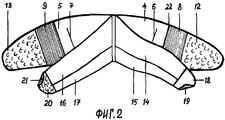
Сущность изобретенного устройства поясняется чертежами. На фиг.1 - устройство, вид с внутренней поверхности. На фиг.2 - то же, вид с тыльной поверхности. На фиг.1 и 2 обозначены: 1 - середина спинки; 2 - карман спинки с упругим вкладышем в нем; 3 - другой карман спинки с упругим вкладышем в нем; 4 - борт у одного края спинки; 5 - борт у другого края спинки; 6 - выточка с выемкой в спинке; 7 - другая выточка с выемкой в спинке; 8 - упругорастяжимый элемент одного борта; 9 - упругорастяжимый элемент другого борта; 10 - конец одного борта; 11 - конец другого борта с крючковым элементом застежки из ткани велкро; 12 - застежка из петельного элемента ткани велкро на тыльной поверхности борта; 13 - застежка из петельного элемента ткани велкро на тыльной поверхности другого борта; 14 - внешний упругорастяжимый ремень тяжа с одной стороны; 15 - внутренний упругорастяжимый ремень тяжа с этой же стороны; 16 - внешний упругорастяжимый ремень тяжа с другой стороны; 17 - внутренний упругорастяжимый ремень тяжа с другой стороны; 18 - конец тяжа с одной стороны; 19 - крючковый элемент застежки на внутренней поверхности конца тяжа; 20 - петельный элемент застежки на тыльной поверхности другого конца тяжа; 21 - крючковый элемент застежки внутренней поверхности другого конца тяжа; 22 - линия соединения упругорастяжимого элемента одного борта со спинкой; 23 - линия соединения упругорастяжимого элемента другого борта.The essence of the invented device is illustrated by drawings. Figure 1 - device, view from the inner surface. Figure 2 is the same, view from the back surface. In figure 1 and 2 are indicated: 1 - the middle of the back; 2 - a back pocket with an elastic insert in it; 3 - another pocket back with an elastic liner in it; 4 - a board at one edge of the back; 5 - a board at the other edge of the back; 6 - recess with a recess in the back; 7 - another recess with a recess in the back; 8 - elastically extensible element of one side; 9 - elastically extensible element of the other side; 10 - end of one side; 11 - the end of the other side with a hook element fasteners made of velcro fabric; 12 - fastener from a loop element of velcro fabric on the back surface of the side; 13 - fastener from a loop element of velcro fabric on the back surface of another side; 14 - external elastically extensible belt of the strand on one side; 15 - inner elastic tension belt of the strand on the same side; 16 - external elastomeric tension belt on the other hand; 17 - inner elastomeric tension belt on the other hand; 18 - end of the cord on one side; 19 - hook element of the fastener on the inner surface of the end of the strand; 20 - loop fastener element on the back surface of the other end of the strand; 21 - hook element of the fastener of the inner surface of the other end of the strand; 22 is a connection line of an elastically extensible element of one side with a back; 23 is a connection line of an elastically extensible element of the other side.
Конкретное описание работы устройства. Перед применением пояса для поясницы в отверстия карманов спинки вводят вкладыши, подобранные в соответствие с поставленными задачами локального их использования. При отсутствии увеличенного живота и при нормальной форме талии пояс укладывают вогнутостью спинки и концами бортов кверху. Концы бортов берут руками таким образом, чтобы элементы их застежек были свободны за пределами кисти. Прикладывают конец 10 левого борта 4 к середине живота, элементом застежки 12 наружу, и с натяжением, растягивая элементы 8 и 9, пристегивают крючковый элемент 11 застежки правого борта 5 к петельному элементу 12 застежки другого борта 4. После чего пояс самопроизвольно удерживается на теле, а руки становятся свободными. Освободившимися руками корректируют положение пояса: расположение карманов относительно остистых отростков, а выточек с выемками относительно выступов крыльев подвздошных костей. При укладывании выемок на выступы крыльев подвздошных костей нижний край спинки пояса размещают на уровне последнего поясничного позвонка, а верхний - ниже реберного края. Затем с должным усилием растягивают руками оба конца тяжа и к внешней петельной застежке 20 правого конца тяжа пристегивают внутренний крючковый элемент 19 застежки левого конца тяжа.A specific description of the operation of the device. Before applying the waist belt, inserts are selected into the openings of the back pockets, selected in accordance with the tasks set for their local use. In the absence of an enlarged abdomen and with a normal shape of the waist, the belt is laid with the concave back and the ends of the sides up. The ends of the sides are taken with their hands so that the elements of their fasteners are free outside the brush. Apply the end 10 of the
При большом животе и сглаженности талии изобретенный пояс укладывают вогнутостью спинки и направлением концов бортов книзу. Прикладывают конец 10 борта 4 (теперь ставшего правым) к нижней части живота элементом застежки 12 наружу, и с натяжением, растягивая элементы 8 и 9, пристегивают крючковый элемент 11 застежки борта 5 (теперь ставшего левым) к петельному элементу 12 застежки уже размещенного борта 4. Освободившимися руками корректируют положение карманов 1-3 спинки относительно остистых отростков, а выточек с выемками относительно крыльев подвздошных костей. Затем концы бортов берут руками таким образом, чтобы элементы их застежек были свободными, с должным усилием растягивают оба конца тяжа, направляют их по нижней поверхности живота, и к внешнему петельному элементу 20 застежки ставшего левым тяжа пристегивают внутренний крючковый элемент 19 застежки конца 18 (ставшего правым) тяжа. При такой укладке пояса его использование, кроме того, способствует профилактике увеличения жировых отложений внизу живота и образования грыж.With a large abdomen and flattened waist, the invented belt is laid with the concavity of the back and the direction of the ends of the sides down. Apply the end 10 of the bead 4 (now turned right) to the lower abdomen by the
Существенность отличий заявленного устройства от прототипа заключается в следующем. Выполнение спинки дугообразно изогнутой по вертикали создает возможность при натяжении бортов создавать разное давление верхнего и нижнего краев спинки на мягкие ткани организма, что может быть полезным для формирования талии. При нормальной конфигурации талии и обычных размерах живота, конструкция пояса позволяет поворачивать его изогнутыми концами спинки и бортов кверху. Тогда нижний край спинки будет оказывать большее давление на выше расположенные поясничные позвонки и мягкие ткани верхней части поясницы, а борта расположатся по средней или верхней части живота, стягивая их, подчеркивая выраженность талии и усиливая эстетический эффект. Конструкция пояса позволяет поворачивать его изогнутыми концами спинки и бортов книзу. При укладке пояса изгибом бортов книзу создается большее давление нижнего края спинки на нижнюю часть поясницы и нижние позвонки. Такая конструкция пояса позволяет регулировать локальное давление его на ткани организма в пояснице. Выполнение каждого борта у места соединения со спинкой из упругорастяжимого элемента обеспечивает при натяжении бортов смещение лишь их концов, при этом застежки не соприкасаются с кожей и не травмируют ее. Спинка же остается на месте и тоже не травмирует мягкие ткани своим смещением. Такой признак конструкции пояса предупреждает раздражающее и травмирующее воздействие пояса на кожу при надевании его. Поскольку установлено, что в талии выражен лордоз, предлагаемая конструкция пояса способствует более физиологичному размещению его спинки на задней поверхности поясницы в области лордоза. Подтягивая свисающую часть живота, пояс способствует предупреждению растяжения мягких тканей в нижнем отделе передней брюшной стенки, дальнейшему свисанию их и образованию грыж. Выполнение упругоэластичных вкладышей из различно намагниченной резины расширяет возможности использования различных магнитов на поясничную область для разнообразного лечебного воздействия. Известно, что повторяемое локальное влияние на определенные анатомические структуры в пояснице является приемом лечения (В.В.Проскурин. Там же, стр.95). Поэтому спонтанный массаж, обусловленный при движениях пациента периодическим давлением упруго-эластичных вкладышей на кожу и мышцы талии, приводит к релаксации спазмированных мышц, снижая выраженность болей и способствуя без болевых ощущений повышению мышечной силы, ускоряя реабилитацию больных. Выполнение вкладышей из различно намагниченной резины разнообразит возможности дополнительного локального воздействия разными магнитами на поясничную область. Выполнение выточек в спинке вблизи бортов создает выемку с прогибом у концов спинки и в месте прикрепления к ней бортов под гребни крыльев подвздошных костей. Наличие такого признака обеспечивает более плотное прилегание пояса к тканям ниже и выше уровня гребней крыльев подвздошных костей, что повышает удерживаемость пояса на теле в заданном положении, предупреждает смещение его книзу и позволяет распределять интенсивность локального давления на поясничные позвонки и мягкие ткани поясничной области. Замечено, что при выраженном жировом отложении в мягких тканях поясницы длительное давление на жировую ткань способствует уменьшению ее массы, поэтому применение пояса предлагаемой конструкции может влиять и на формирование более эстетичной талии. Таким образом, изобретенный пояс для поясницы, наряду с упрощением его конструкции и снижением себестоимости, в совокупности своих признаков расширяет возможности локального воздействия его на ткани организма в поясничной области, способствуя повышению лечебного и эстетического эффекта.The significance of the differences of the claimed device from the prototype is as follows. Performing the back of the arcuate curved vertically creates the opportunity when tensioning the sides to create different pressure of the upper and lower edges of the back on the soft tissues of the body, which can be useful for the formation of the waist. With the normal configuration of the waist and the usual size of the abdomen, the design of the belt allows you to rotate it with the curved ends of the back and sides up. Then the lower edge of the back will put more pressure on the higher lumbar vertebrae and soft tissues of the upper lumbar, and the sides will be located on the middle or upper abdomen, tightening them, emphasizing the severity of the waist and enhancing the aesthetic effect. The design of the belt allows you to rotate it with the curved ends of the back and sides down. When laying the belt by bending the sides downward, greater pressure is created from the lower edge of the back to the lower part of the lower back and lower vertebrae. This design of the belt allows you to adjust its local pressure on the body tissue in the lower back. The implementation of each side at the junction with the back of the elastically extensible element ensures that only the ends displace when the sides are tensioned, while the fasteners do not touch the skin and do not injure it. The back remains in place and also does not injure the soft tissue with its displacement. This feature of the belt design prevents the irritating and traumatic effect of the belt on the skin when donning it. Since it was found that lordosis is expressed in the waist, the proposed belt design contributes to a more physiological placement of its back on the back surface of the lower back in the region of lordosis. By tightening the hanging part of the abdomen, the belt helps prevent stretching of the soft tissues in the lower part of the anterior abdominal wall, their further drooping and the formation of hernias. The implementation of elastomeric liners of differently magnetized rubber expands the use of various magnets on the lumbar region for a variety of therapeutic effects. It is known that a repeated local effect on certain anatomical structures in the lower back is a method of treatment (V.V. Proskurin. Ibid., P. 95). Therefore, spontaneous massage, caused by periodic pressure of the elastic-elastic inserts on the skin and waist muscles during patient movements, leads to relaxation of spasmodic muscles, reducing the severity of pain and contributing to increased muscle strength without pain, accelerating the rehabilitation of patients. The implementation of the liners of differently magnetized rubber diversifies the possibilities of additional local effects of different magnets on the lumbar region. Performing grooves in the back near the sides creates a recess with a deflection at the ends of the back and in the place of attachment of the sides to it under the crests of the wings of the ilium. The presence of such a feature provides a more tight fit of the belt to the tissues below and above the level of the crests of the wings of the ilium, which increases the retention of the belt on the body in a predetermined position, prevents its downward movement and allows you to distribute the intensity of local pressure on the lumbar vertebrae and soft tissue of the lumbar region. It is noted that with pronounced fat deposition in the soft tissues of the lower back, prolonged pressure on the adipose tissue helps to reduce its mass, so the use of the belt of the proposed design can also influence the formation of a more aesthetic waist. Thus, the invented waist belt, along with the simplification of its design and cost reduction, in the aggregate of its features expands the possibilities of its local impact on body tissues in the lumbar region, contributing to an increase in the therapeutic and aesthetic effect.
Применение устройства возможно в ортопедии, невропатологии, нейрохирургии, спортивной медицине, а также в сфере соцобеспечения для реабилитации нуждающихся.The use of the device is possible in orthopedics, neuropathology, neurosurgery, sports medicine, as well as in the field of social security for the rehabilitation of those in need.
Claims (1)
Priority Applications (1)
| Application Number | Priority Date | Filing Date | Title |
|---|---|---|---|
| RU2002132296/14A RU2254103C2 (en) | 2002-12-02 | 2002-12-02 | Belt for loins |
Applications Claiming Priority (1)
| Application Number | Priority Date | Filing Date | Title |
|---|---|---|---|
| RU2002132296/14A RU2254103C2 (en) | 2002-12-02 | 2002-12-02 | Belt for loins |
Publications (2)
| Publication Number | Publication Date |
|---|---|
| RU2002132296A RU2002132296A (en) | 2004-06-10 |
| RU2254103C2 true RU2254103C2 (en) | 2005-06-20 |
Family
ID=35836019
Family Applications (1)
| Application Number | Title | Priority Date | Filing Date |
|---|---|---|---|
| RU2002132296/14A RU2254103C2 (en) | 2002-12-02 | 2002-12-02 | Belt for loins |
Country Status (1)
| Country | Link |
|---|---|
| RU (1) | RU2254103C2 (en) |
Cited By (7)
| Publication number | Priority date | Publication date | Assignee | Title |
|---|---|---|---|---|
| RU2363426C2 (en) * | 2007-04-17 | 2009-08-10 | Валерий Геннадиевич Музюков | Elastic medical, hygienic, orthopaedic, therapeutic belt (versions) |
| RU2368357C1 (en) * | 2008-04-16 | 2009-09-27 | Федеральное учреждение здравоохранения "Медико-санитарная часть Главного управления внутренних дел Кемеровской области" | Therapeutic belt |
| RU2372058C1 (en) * | 2008-03-04 | 2009-11-10 | Федеральное государственное учреждение здравоохранения "Медико-санитарная часть Главного управления внутренних дел Кемеровской области" | Loin support |
| RU2400188C2 (en) * | 2008-12-05 | 2010-09-27 | Государственное образовательное учреждение высшего профессионального образования "Костромской государственный технологический университет" | Therapeutic belt for backache prevention and treatment |
| RU2481085C2 (en) * | 2011-07-21 | 2013-05-10 | Василий Фёдорович Севрюков | Fixing prophylactic belt |
| RU2491900C2 (en) * | 2011-08-01 | 2013-09-10 | Общество с ограниченной ответственностью "Центр внедрения средств безопасности труда" | Miner's belt |
| RU184493U1 (en) * | 2018-04-25 | 2018-10-29 | Альберт Георгиевич Арутюнян | Unloading belt |
Citations (6)
| Publication number | Priority date | Publication date | Assignee | Title |
|---|---|---|---|---|
| FR2255043A1 (en) * | 1973-12-12 | 1975-07-18 | Takeo Nakayama | |
| EP0459082A1 (en) * | 1990-04-30 | 1991-12-04 | Ergodyne Corporation | Improved back support |
| US5833638A (en) * | 1996-06-10 | 1998-11-10 | Nelson; Ronald E. | Back brace |
| RU2146908C1 (en) * | 1998-12-01 | 2000-03-27 | Государственное предприятие "Московская лечебно-производственная фирма "Здоровье" | Therapeutic and bandaging article |
| FR2804012A1 (en) * | 2000-01-24 | 2001-07-27 | Francois Rosanval | Lumbar belt comprises isosceles triangular shaped flexible band with Velcro fasteners and strap which applies elastic force to triangle top |
| RU2189203C2 (en) * | 2000-05-24 | 2002-09-20 | Паршиков Михаил Викторович | Orthopedic corset |
-
2002
- 2002-12-02 RU RU2002132296/14A patent/RU2254103C2/en active
Patent Citations (6)
| Publication number | Priority date | Publication date | Assignee | Title |
|---|---|---|---|---|
| FR2255043A1 (en) * | 1973-12-12 | 1975-07-18 | Takeo Nakayama | |
| EP0459082A1 (en) * | 1990-04-30 | 1991-12-04 | Ergodyne Corporation | Improved back support |
| US5833638A (en) * | 1996-06-10 | 1998-11-10 | Nelson; Ronald E. | Back brace |
| RU2146908C1 (en) * | 1998-12-01 | 2000-03-27 | Государственное предприятие "Московская лечебно-производственная фирма "Здоровье" | Therapeutic and bandaging article |
| FR2804012A1 (en) * | 2000-01-24 | 2001-07-27 | Francois Rosanval | Lumbar belt comprises isosceles triangular shaped flexible band with Velcro fasteners and strap which applies elastic force to triangle top |
| RU2189203C2 (en) * | 2000-05-24 | 2002-09-20 | Паршиков Михаил Викторович | Orthopedic corset |
Cited By (7)
| Publication number | Priority date | Publication date | Assignee | Title |
|---|---|---|---|---|
| RU2363426C2 (en) * | 2007-04-17 | 2009-08-10 | Валерий Геннадиевич Музюков | Elastic medical, hygienic, orthopaedic, therapeutic belt (versions) |
| RU2372058C1 (en) * | 2008-03-04 | 2009-11-10 | Федеральное государственное учреждение здравоохранения "Медико-санитарная часть Главного управления внутренних дел Кемеровской области" | Loin support |
| RU2368357C1 (en) * | 2008-04-16 | 2009-09-27 | Федеральное учреждение здравоохранения "Медико-санитарная часть Главного управления внутренних дел Кемеровской области" | Therapeutic belt |
| RU2400188C2 (en) * | 2008-12-05 | 2010-09-27 | Государственное образовательное учреждение высшего профессионального образования "Костромской государственный технологический университет" | Therapeutic belt for backache prevention and treatment |
| RU2481085C2 (en) * | 2011-07-21 | 2013-05-10 | Василий Фёдорович Севрюков | Fixing prophylactic belt |
| RU2491900C2 (en) * | 2011-08-01 | 2013-09-10 | Общество с ограниченной ответственностью "Центр внедрения средств безопасности труда" | Miner's belt |
| RU184493U1 (en) * | 2018-04-25 | 2018-10-29 | Альберт Георгиевич Арутюнян | Unloading belt |
Similar Documents
| Publication | Publication Date | Title |
|---|---|---|
| RU2701579C1 (en) | Retracting brace with tension belts | |
| US6755799B2 (en) | Belt-like corset | |
| US4217893A (en) | Above-the-knee cast | |
| US5967998A (en) | Lumbo-sacral orthosis | |
| CN112399839B (en) | Back support belt | |
| AU2016336024B2 (en) | Device for the treatment of medial tibial stress syndrome and other conditions of the lower leg | |
| US20200268589A1 (en) | Back brace with repositionable pressure nodules | |
| RU2131232C1 (en) | Union suit for treatment of patients with infantile cerebral paralysis and patients with aftereffects of craniocerebral injury | |
| RU2226373C2 (en) | Flexible corset | |
| JPH08294505A (en) | Bdsm belt | |
| RU2179422C1 (en) | Posture corrector | |
| RU2372058C1 (en) | Loin support | |
| RU2146908C1 (en) | Therapeutic and bandaging article | |
| RU2175219C2 (en) | Lumbar belt | |
| RU2202312C2 (en) | Lumbar belt | |
| RU2242952C1 (en) | Postoperative bandage | |
| RU2254849C1 (en) | Massaging jacket (versions) | |
| RU2758543C1 (en) | Corrective device for treatment of kyphotic spine deformities | |
| RU2368357C1 (en) | Therapeutic belt | |
| RU2271178C1 (en) | Bandage for big belly | |
| RU2727747C1 (en) | Orthopedic corset for performing therapeutic exercises with displacement of pelvic bones and hip joints | |
| WO2006098042A1 (en) | Foot stimulating health apparatus | |
| RU2295321C2 (en) | Suit for compulsory changing human body pose and creating high load applied to locomotor apparatus | |
| RU143444U1 (en) | PREPARATION OF THE TREATMENT AND PREVENTIVE | |
| RU2201725C1 (en) | Orthopedic jacket |