RU2200503C1 - Tooth bridge prosthesis for substituting small inclusion defects of dental row - Google Patents
Tooth bridge prosthesis for substituting small inclusion defects of dental row Download PDFInfo
- Publication number
- RU2200503C1 RU2200503C1 RU2001120185/14A RU2001120185A RU2200503C1 RU 2200503 C1 RU2200503 C1 RU 2200503C1 RU 2001120185/14 A RU2001120185/14 A RU 2001120185/14A RU 2001120185 A RU2001120185 A RU 2001120185A RU 2200503 C1 RU2200503 C1 RU 2200503C1
- Authority
- RU
- Russia
- Prior art keywords
- plate
- tooth
- teeth
- grooves
- longitudinal groove
- Prior art date
Links
- 230000007547 defect Effects 0.000 title claims description 16
- RTAQQCXQSZGOHL-UHFFFAOYSA-N Titanium Chemical compound [Ti] RTAQQCXQSZGOHL-UHFFFAOYSA-N 0.000 claims abstract description 13
- 239000010936 titanium Substances 0.000 claims abstract description 13
- 229910052719 titanium Inorganic materials 0.000 claims abstract description 13
- 210000004513 dentition Anatomy 0.000 claims description 15
- 230000036346 tooth eruption Effects 0.000 claims description 15
- 230000003446 memory effect Effects 0.000 claims description 12
- 230000000694 effects Effects 0.000 abstract description 2
- 210000003679 cervix uteri Anatomy 0.000 abstract 1
- 239000000126 substance Substances 0.000 abstract 1
- 239000002131 composite material Substances 0.000 description 13
- 239000000463 material Substances 0.000 description 6
- 210000003298 dental enamel Anatomy 0.000 description 5
- 238000009434 installation Methods 0.000 description 5
- 238000004519 manufacturing process Methods 0.000 description 5
- 238000000034 method Methods 0.000 description 5
- 239000000956 alloy Substances 0.000 description 4
- 229910045601 alloy Inorganic materials 0.000 description 4
- 230000006378 damage Effects 0.000 description 4
- 210000002455 dental arch Anatomy 0.000 description 4
- 229910052751 metal Inorganic materials 0.000 description 4
- 239000002184 metal Substances 0.000 description 4
- 210000000214 mouth Anatomy 0.000 description 4
- NIXOWILDQLNWCW-UHFFFAOYSA-N acrylic acid group Chemical group C(C=C)(=O)O NIXOWILDQLNWCW-UHFFFAOYSA-N 0.000 description 3
- 238000013461 design Methods 0.000 description 3
- 238000002360 preparation method Methods 0.000 description 3
- 239000011230 binding agent Substances 0.000 description 2
- 230000015572 biosynthetic process Effects 0.000 description 2
- 239000000919 ceramic Substances 0.000 description 2
- 230000001055 chewing effect Effects 0.000 description 2
- 239000003814 drug Substances 0.000 description 2
- 238000005516 engineering process Methods 0.000 description 2
- 210000001847 jaw Anatomy 0.000 description 2
- 239000004033 plastic Substances 0.000 description 2
- 229920003023 plastic Polymers 0.000 description 2
- 229910052573 porcelain Inorganic materials 0.000 description 2
- 238000012545 processing Methods 0.000 description 2
- 230000000717 retained effect Effects 0.000 description 2
- 210000001519 tissue Anatomy 0.000 description 2
- 238000012876 topography Methods 0.000 description 2
- 230000001720 vestibular Effects 0.000 description 2
- 241000282465 Canis Species 0.000 description 1
- 239000004698 Polyethylene Substances 0.000 description 1
- 239000000853 adhesive Substances 0.000 description 1
- 230000001070 adhesive effect Effects 0.000 description 1
- 239000004568 cement Substances 0.000 description 1
- 125000002603 chloroethyl group Chemical group [H]C([*])([H])C([H])([H])Cl 0.000 description 1
- 238000010276 construction Methods 0.000 description 1
- 239000002537 cosmetic Substances 0.000 description 1
- 238000005520 cutting process Methods 0.000 description 1
- 229910003460 diamond Inorganic materials 0.000 description 1
- 239000010432 diamond Substances 0.000 description 1
- 229940079593 drug Drugs 0.000 description 1
- 210000003128 head Anatomy 0.000 description 1
- 239000007943 implant Substances 0.000 description 1
- 238000007373 indentation Methods 0.000 description 1
- 238000003780 insertion Methods 0.000 description 1
- 230000037431 insertion Effects 0.000 description 1
- 230000001788 irregular Effects 0.000 description 1
- 238000002955 isolation Methods 0.000 description 1
- 210000003041 ligament Anatomy 0.000 description 1
- 239000011159 matrix material Substances 0.000 description 1
- 230000000399 orthopedic effect Effects 0.000 description 1
- 201000001245 periodontitis Diseases 0.000 description 1
- -1 polyethylene Polymers 0.000 description 1
- 229920000573 polyethylene Polymers 0.000 description 1
- 235000019592 roughness Nutrition 0.000 description 1
- 210000003296 saliva Anatomy 0.000 description 1
- 238000012546 transfer Methods 0.000 description 1
- XLYOFNOQVPJJNP-UHFFFAOYSA-N water Substances O XLYOFNOQVPJJNP-UHFFFAOYSA-N 0.000 description 1
Images
Landscapes
- Dental Prosthetics (AREA)
Abstract
Description
Изобретение относится к медицине, а именно к стоматологии, и может быть использовано при восстановлении непрерывности зубного ряда. The invention relates to medicine, namely to dentistry, and can be used to restore continuity of the dentition.
Известен способ восстановления непрерывности зубного ряда (Гаврилов Е.И. , Оксман И.М. Ортопедическая стоматология. М.: Медицина, 1975, с. 136-147), при котором на опорные зубы изготавливают коронки, а промежуточная часть состоит из литых зубов, моделированных по форме отсутствующих зубов. Затем литые зубы спаивают с коронками и готовый мостовидный протез фиксируют на опорные зубы цементом. A known method of restoring the continuity of the dentition (Gavrilov E.I., Oksman I.M. Orthopedic dentistry. M: Medicine, 1975, S. 136-147), in which crowns are made on the abutment teeth, and the intermediate part consists of molded teeth modeled on the shape of missing teeth. Then the molten teeth are soldered with crowns and the finished bridge is fixed to the supporting teeth with cement.
Недостатки способа следующие. The disadvantages of the method are as follows.
1. Паянные мостовидные протезы не удовлетворяют возросшим эстетическим требованиям. 1. Soldered bridges do not meet the increased aesthetic requirements.
2. Многоэтапность и значительная трудоемкость при изготовлении. 2. The multi-stage and significant complexity in the manufacture.
3. При таком протезировании нарушается циркулярная связка зуба, что приводит к возникновению пародонтита. 3. With such prosthetics, the circular ligament of the tooth is disturbed, which leads to the occurrence of periodontitis.
4. Обработка опорных зубов, приводящая к потере слоя эмали. 4. Processing of supporting teeth, leading to the loss of an enamel layer.
Известен способ изготовления мостовидного протеза, включающий выполнение оппозитно ориентированных полостей с дополнительной площадкой на жевательной и апроксимальной поверхности в опорных зубах, размещение в них вкладок балочной конструкции и формирование отсутствующих зубов. Площадки выполнены закругленными или в форме ласточкиного хвоста (Патент 2155555, М. кл. А 61 С 13/00; 13/225, БИ 25, 2000). There is a method of manufacturing a bridge, including the oppositely oriented cavities with an additional area on the chewing and proximal surfaces in the abutment teeth, placing tabs of the beam structure and forming missing teeth in them. The sites are made rounded or in the form of a dovetail (Patent 2155555, M. cl. A 61 C 13/00; 13/225, BI 25, 2000).
Недостатки способа
1. Многоэтапность и значительная трудоемкость при изготовлении.The disadvantages of the method
1. The multi-stage and significant complexity in the manufacture.
2. Обработка опорных зубов, приводящая к потере слоя эмали. 2. Processing of supporting teeth, leading to the loss of an enamel layer.
Наиболее близким к заявляемому является зубной протез для замещения малых включенных дефектов зубного ряда, включающий установку двух частей, одна из которых - несущий элемент - выполнена в виде Н-образной балки из никелида титана, закрепленной в углублениях или пазах, выполненных в пределах эмали на опорных зубах. Углубления или паз выполнены с отступом, равным расстоянию от режущего и маргинального краев опорных зубов. Другая часть по форме утраченных зубов (пластмассовая, керамическая или удаленный естественный зуб с сохраненной коронковой частью) припасовывается на балку и фиксируется к балке и опорным зубам композитным материалом (Юдин П.С. Применение сплава никелид титана для замещения малых включенных дефектов зубного ряда. Имплантаты с памятью формы. Томск: изд-во Томского университета, 1990, 6, c. 21-24). Closest to the claimed is a denture to replace small included defects of the dentition, including the installation of two parts, one of which is a supporting element made in the form of an N-shaped beam of titanium nickelide, fixed in recesses or grooves made within the enamel on the supporting teeth. The recesses or groove are indented equal to the distance from the cutting and marginal edges of the abutment teeth. Another part in the form of lost teeth (plastic, ceramic or extracted natural tooth with the retained crown part) is fitted onto the beam and fixed to the beam and abutment teeth by a composite material (P. Yudin. Use of titanium nickelide alloy to replace small included dentition defects. Implants with shape memory. Tomsk: Tomsk University Press, 1990, 6, p. 21-24).
Предложенный зубной протез имеет недостаточную прочность из-за малой площади контакта балки с насаживаемым зубом. The proposed denture has insufficient strength due to the small contact area of the beam with the implanted tooth.
Опорные части Н-образной балки также имеют небольшую площадь для закрепления в опорных зубах и могут неравномерно передавать жевательную нагрузку на опорные зубы. Кроме того, размещение балки между опорными зубами и установка ножек точно в намеченные углубления является довольно трудоемкой операцией. The supporting parts of the H-shaped beam also have a small area for fixing in the supporting teeth and can unevenly transfer the chewing load to the supporting teeth. In addition, placing the beam between the abutment teeth and installing the legs exactly in the intended recesses is a rather time-consuming operation.
Соединение насаженного зуба и опорных зубов фиксирующим материалом ведет к потере физиологической подвижности опорных зубов. The connection of the implanted tooth and supporting teeth with a fixing material leads to a loss of physiological mobility of the supporting teeth.
Задача изобретения - увеличение прочности конструкции и улучшение ее биомеханических характеристик, упрощение способа установки несущего элемента и изготовления протеза. The objective of the invention is to increase the strength of the structure and improve its biomechanical characteristics, simplifying the method of installation of the bearing element and the manufacture of the prosthesis.
Поставленная задача достигается тем, что мостовидный протез для замещения малых включенных дефектов зубного ряда имеет несущую пластину из никелида титана, обладающего эффектом памяти формы, прямоугольной или, например, трапециевидной формы с одним центральным или, например, несколькими отверстиями. Пластина имеет полукруглые торцевые поверхности, соответствующие полукруглым вертикальным пазам опорных зубов, в которые она устанавливается. Насаженный на пластину зуб имеет продольный паз. Пазы в опорных зубах сформированы вертикально от их контактной поверхности и не доходят 1,0-1,5 мм до шейки зуба, в нижней части пазы заканчиваются уступом. В насаженном зубе выполнен сквозной канал перпендикулярно продольному пазу. Канал насаженного зуба и центральное отверстие в пластине совмещены и могут иметь резьбу, а элемент крепления выполнен в виде винта. Элемент крепления может быть выполнен в форме скобы из металла с эффектом памяти формы, тогда канал для крепежного элемента может быть без резьбы. Несущая пластина, кроме центрального отверстия, может дополнительно иметь несколько отверстий круглой формы или несколько продольных вырезов. Продольный паз в насаженном зубе имеет неровную поверхность, величина продольного паза на 10% больше толщины пластины. Несущая пластина может быть прямой или изогнутой в соответствии с формой зубной дуги. Между насаженным зубом и опорными зубами выдержано расстояние, равное физиологическому. This object is achieved in that the bridge for replacing small included dentition defects has a supporting plate made of titanium nickelide having a shape memory effect, rectangular or, for example, a trapezoidal shape with one central or, for example, several holes. The plate has semicircular end surfaces corresponding to semicircular vertical grooves of the supporting teeth into which it is mounted. The tooth mounted on the plate has a longitudinal groove. The grooves in the abutment teeth are formed vertically from their contact surface and do not reach 1.0-1.5 mm to the neck of the tooth, in the lower part of the grooves end with a ledge. In the mounted tooth, a through channel is made perpendicular to the longitudinal groove. The inserted tooth channel and the central hole in the plate are aligned and can be threaded, and the fastening element is made in the form of a screw. The fastening element can be made in the form of a bracket made of metal with a shape memory effect, then the channel for the fastening element can be without thread. The carrier plate, in addition to the Central hole, may additionally have several holes of circular shape or several longitudinal cuts. The longitudinal groove in the implanted tooth has an uneven surface, the size of the longitudinal groove is 10% more than the thickness of the plate. The carrier plate may be straight or curved in accordance with the shape of the dental arch. Between the implanted tooth and the abutment teeth, a distance equal to physiological is maintained.
В сравнении с прототипом предлагаемое техническое решение характеризуется следующими отличительными признаками, подтверждающими его новизну:
- выполнение несущей пластины в форме прямоугольника или, например, трапеции;
- паз в опорных зубах формируют вертикально от контактной поверхности опорного зуба, не доводя до шейки зуба на 1,0-1,5 мм, с уступом в нижней части;
- в насаженном зубе выполнен сквозной канал перпендикулярно продольному пазу на уровне центрального отверстия в несущей пластине;
- канал и центральное отверстие в пластине имеют резьбу, а элемент крепления, соединяющий несущую пластину и насаженный зуб, выполнен в виде винта;
- канал и отверстие в пластине не имеют резьбы, а элемент крепления выполнен в виде скобы из сплава с эффектом памяти формы;
- торцевые поверхности пластины и паз полукруглой формы;
- пластина может иметь более одного центрального отверстия круглой формы или, например, в виде прорезей;
- продольный паз в насаженном зубе имеет неровную поверхность;
- величина продольного паза на 10% больше толщины пластины;
- несущая пластина изогнута в соответствии с формой зубной дуги;
- между насаженным зубом и опорными зубами выдержано расстояние, равное физиологическому.In comparison with the prototype, the proposed technical solution is characterized by the following distinctive features, confirming its novelty:
- the implementation of the carrier plate in the form of a rectangle or, for example, a trapezoid;
- the groove in the abutment teeth is formed vertically from the contact surface of the abutment tooth, not reaching the tooth neck by 1.0-1.5 mm, with a step in the lower part;
- in the implanted tooth, a through channel is made perpendicular to the longitudinal groove at the level of the central hole in the carrier plate;
- the channel and the central hole in the plate are threaded, and the fastening element connecting the carrier plate and the set tooth is made in the form of a screw;
- the channel and the hole in the plate are not threaded, and the fastening element is made in the form of an alloy bracket with the shape memory effect;
- end surfaces of the plate and a semicircular groove;
- the plate may have more than one central hole of circular shape or, for example, in the form of slots;
- the longitudinal groove in the implanted tooth has an uneven surface;
- the magnitude of the longitudinal groove is 10% more than the thickness of the plate;
- the carrier plate is curved in accordance with the shape of the dental arch;
- a distance equal to physiological is maintained between the implanted tooth and the abutment teeth.
Существенность указанных признаков для достижения поставленной задачи характеризуется следующими причинно-следственными связями:
- несущая пластина из никелида титана, с эффектом памяти формы может быть выполнена с точно определенной длиной, равной расстоянию между опорными зубами с припуском на углубления в них; пластина легко деформируется в охлажденном состоянии, например дугообразно, с уменьшением продольного габарита, и при последующем формовосстановлении, за счет проявления эффекта памяти формы, при отогреве входит концами в углубления в опорных зубах. Такое точное соответствие габаритов позволяет делать продольные пазы минимальной глубины строго вдоль вертикали в середине зуба, что улучшает симметрию жевательной нагрузки, а следовательно, и прочность крепления. В связи со свойствами сплава пластина находится в напряженно-деформированном состоянии и упирается своими торцевыми поверхностями в пазы полукруглой формы, т.е. фиксируется за счет этих усилий;
- выполнение несущего элемента в форме пластины прямоугольной или трапециевидной формы в теле насаженного зуба позволяет получить большую площадь контакта для закрепления насаженного зуба, что придает конструкции высокую жесткость при малых поперечных размерах, а также позволяет учесть то, что включенные дефекты зубного ряда могут иметь различную форму (прямоугольную, неправильную, например, трапециевидную);
- наличие в пластине нескольких круглых отверстий или прорезей, дополнительно к центральному отверстию, обеспечивает соединение связующего материала с вестибулярной и лингвальной поверхностями насаженного зуба, что также упрочняет соединение;
- величина продольного паза на 10% больше толщины пластины, так как упругие свойства несущего элемента конструкции, изготовленного из сплава никелида титана, присущие ему свойства: ползучесть и релаксация, обеспечивают подвижность протеза в горизонтальном направлении в ходе нормального функционирования конструкции зубного протеза, и этот диапазон подвижности вписывается в размеры предложенного нами паза, что исключает разрушение искусственного зуба в верхней части;
- выполнение пластины с торцевыми поверхностями полукруглой формы обусловлено тем, что пазы в опорных зубах выполняют круглым бором и они также имеют полукруглую форму, это обеспечивает лучшую конгруэнтность и прилегание поверхностей. К тому же отсутствуют острые углы у пластины, что позволяет избежать концентрации усилий на этих участках поверхности пазов в опорных зубах и уменьшается возможность их скола и разрушения;
- пазы в опорных зубах формируют вертикально от контактной поверхности опорных зубов в пределах эмали на глубину всего 1-3 мм, что является щадящей препаровкой опорных зубов;
- формирование внизу паза уступа с помощью торцевого бора дает дополнительную площадку для опоры пластины;
- паз не доводят на 1,0-1,5 мм до шейки зуба, что связано с незначительной толщиной твердых тканей в этой области и служит для профилактики повреждения десневого сосочка;
- в насаженном зубе выполнен сквозной канал, совпадающий с центральным отверстием в пластине и служащий для установки элемента крепления, это дополнительно укрепляет конструкцию, а именно прикрепляет насаженный зуб к пластине;
- элемент крепления может быть, например, в виде винта, тогда канал и центральное отверстие в пластине выполняются с резьбой;
- элемент крепления может быть выполнен, например, в форме скобы из никелида титана с эффектом памяти формы, которая ножками прижимает пластину к внутренней боковой поверхности продольного паза насаживаемого зуба;
- неровная внутренняя поверхность продольного паза, выполненного в насаженном зубе, позволяет улучшить микромеханическое соединение с композиционным материалом и несущей пластиной;
- несущая пластина может быть изогнута, это зависит от топографии дефекта зубного ряда, криволинейность дефекта возникает при замещении двух зубов, а также при отсутствии зубов, занимающих определенное место в зубной дуге, например, клыков. В этом случае изгиб пластины вписывается в продольный паз насаженного зуба, имеющего величину на 10% большую толщины пластины;
- между насаженным зубом и опорными зубами выдержано расстояние, равное физиологическому, не закрытое композиционными материалами, что сохраняет физиологическую подвижность опорных зубов.The materiality of these characteristics to achieve the task is characterized by the following cause-effect relationships:
- a bearing plate made of titanium nickelide, with a shape memory effect can be made with a precisely defined length equal to the distance between the abutment teeth with an allowance for indentations in them; the plate is easily deformed in a cooled state, for example, in an arcuate manner, with a decrease in the longitudinal dimension, and with subsequent shape restoration, due to the manifestation of the shape memory effect, it enters the recesses in the abutment teeth when heated. This exact correspondence of dimensions allows longitudinal grooves of minimal depth to be made strictly along the vertical in the middle of the tooth, which improves the symmetry of the masticatory load and, consequently, the fastening strength. Due to the properties of the alloy, the plate is in a stress-strain state and abuts with its end surfaces in semicircular grooves, i.e. fixed by these efforts;
- the implementation of the supporting element in the form of a rectangular or trapezoidal plate in the body of the implanted tooth allows you to get a large contact area for fixing the implanted tooth, which gives the structure high rigidity with small transverse dimensions, and also allows you to take into account the fact that the included defects of the dentition can have a different shape (rectangular, irregular, for example, trapezoidal);
- the presence in the plate of several round holes or slots, in addition to the Central hole, provides a connection of the binder material with the vestibular and lingual surfaces of the implanted tooth, which also strengthens the connection;
- the magnitude of the longitudinal groove is 10% greater than the thickness of the plate, since the elastic properties of the supporting structure made of titanium nickelide alloy, its inherent properties: creep and relaxation, ensure the mobility of the prosthesis in the horizontal direction during the normal functioning of the denture structure, and this range mobility fits into the dimensions of the groove we proposed, which eliminates the destruction of the artificial tooth in the upper part;
- the execution of the plate with the end surfaces of a semicircular shape is due to the fact that the grooves in the abutment teeth are made with a round bur and they also have a semicircular shape, this provides better congruence and fit of the surfaces. In addition, there are no sharp angles at the plate, which avoids the concentration of efforts on these sections of the surface of the grooves in the abutment teeth and reduces the possibility of their chipping and destruction;
- grooves in the abutment teeth are formed vertically from the contact surface of the abutment teeth within the enamel to a depth of only 1-3 mm, which is a gentle preparation of abutment teeth;
- the formation of the bottom of the groove of the ledge using the end bur provides an additional platform for supporting the plate;
- the groove is not adjusted 1.0-1.5 mm to the neck of the tooth, which is associated with an insignificant thickness of hard tissues in this area and serves to prevent damage to the gingival papilla;
- in the mounted tooth, a through channel is made, which coincides with the central hole in the plate and serves to install the fastening element, this additionally strengthens the structure, namely, attaches the mounted tooth to the plate;
- the fastening element can be, for example, in the form of a screw, then the channel and the central hole in the plate are threaded;
- the fastening element can be made, for example, in the form of a bracket made of titanium nickelide with a shape memory effect that legs presses the plate against the inner side surface of the longitudinal groove of the tooth being inserted;
- the uneven inner surface of the longitudinal groove made in the implanted tooth improves the micromechanical connection with the composite material and the carrier plate;
- the carrier plate can be bent, it depends on the topography of the dentition defect, the curvature of the defect occurs when two teeth are replaced, as well as in the absence of teeth occupying a certain place in the dental arch, for example, canines. In this case, the bend of the plate fits into the longitudinal groove of the implanted tooth, which is 10% larger than the thickness of the plate;
- a distance equal to physiological, not covered by composite materials, is maintained between the implanted tooth and the abutment teeth, which preserves the physiological mobility of the abutment teeth.
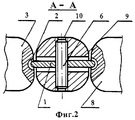
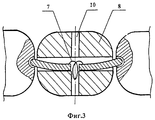
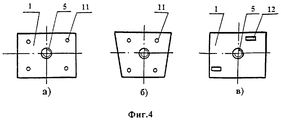
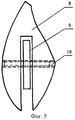
Представленная конструкция поясняется чертежами, представленными на фиг. 1, где показана установка пластины в пазы опорных зубов и насаженный зуб, на фиг. 2 показана установка пластины и фиксация винтом, на фиг.3 показано крепление изогнутой пластины в насаженном зубе с помощью скобы из металла с эффектом памяти формы, на фиг.4а, б, в, представлена различная форма несущей пластины и расположение на ней отверстий различной конфигурации, на фиг.5 - вид насаженного зуба сбоку с несущей пластиной, установленной в продольном пазе, и винтом, установленным в сквозном канале. The presented construction is illustrated by the drawings shown in FIG. 1, which shows the installation of the plate in the grooves of the abutment teeth and the implanted tooth, in FIG. Fig. 2 shows the installation of the plate and screw fixing; Fig. 3 shows the fastening of the curved plate in the mounted tooth with a metal bracket with a shape memory effect; Figs. 4a, b, c show a different form of the carrier plate and the arrangement of holes of various configurations on it 5 is a side view of a mounted tooth with a carrier plate mounted in a longitudinal groove and a screw mounted in a through channel.
Мостовидный протез содержит несущую пластину 1 из никелида титана с эффектом памяти формы, установленную в пазы 2 опорных зубов 3. Пазы 2 выполнены в опорных зубах 3 вертикально от контактной поверхности опорных зубов в пределах эмали на глубину всего 1-3 мм, и паз 2 не доходит на 1,0-1,5 мм до шейки зуба. Внизу паза 2 сформирован уступ 4 с помощью торцевого бора. Уступ 4 дает дополнительную площадку для опоры пластины 1. Торцевые края пластины 1 и пазы 2 имеют полукруглую форму. Пластина 1 может быть прямоугольной или трапециевидной формы. Она имеет центральное отверстие 5 для установки крепежного элемента в виде винта 6 или в виде скобы 7 из никелида титана с эффектом памяти формы. На пластину 1 насаживается зуб 8 или несколько зубов, по форме соответствующих утраченным зубам (пластмассовые, керамические или удаленный естественный зуб с сохраненной коронковой частью). Насаженный зуб 8 имеет продольный паз 9. Паз 9 имеет неровную поверхность, величина продольного паза 9 на 10% больше толщины пластины 1. The bridge contains a supporting
Насаженный зуб 8 имеет сквозной канал 10, совпадающий с центральным отверстием 5 в пластине 1. Канал 10 предназначен для установки крепежного элемента, дополнительно соединяющего пластину 1 с насаженным зубом 8. Канал 10 может иметь резьбу для установки винта 6 или выполняться без резьбы для установки скобы 7. Пластина 1 может быть изогнута в соответствии с топографией зубного ряда. Пластина для лучшего сцепления с композитом имеет несколько дополнительных отверстий 11 диаметром от 1 до 3 мм или прорезей 12. Между насаженным зубом 8 и опорными зубами 3 выдержано расстояние, равное физиологическому, не закрытое композиционными материалами, что позволяет сохранить физиологическую подвижность опорных зубов и обеспечивает функционирование биотехнической системы близкое к функционированию естественной челюстной системы. The inserted
Предлагаемый мостовидный протез для замещения малых включенных дефектов зубного ряда устанавливается следующим образом. The proposed bridge for replacing small included defects of the dentition is set as follows.
В первое посещение после выявления жалоб и осмотра полости рта пациента определяют анатомические параметры дефекта зубного ряда. Выяснив параметры и тип дефекта зубного ряда, определяют форму пластины из никелида титана с эффектом памяти формы, служащую основой предлагаемого протеза. Измеряется протяженность дефекта и определяются его линейные размеры с помощью инструмента (модифицированного штангенциркуля) в полости рта или на модели. Определив размеры дефекта зубного ряда, подбираем заранее подготовленную пластину из никелида титана, из заранее изготовленных промышленным способом. Пластины имеют толщину от 0,6 мм до 3 мм. Пластина имеет несколько отверстий круглой формы или горизонтальные прорези. Также она имеет центральное отверстие с резьбой или без резьбы для установки крепежного элемента, что зависит от его вида. On the first visit, after identifying complaints and examining the patient's oral cavity, the anatomical parameters of the dentition defect are determined. Having ascertained the parameters and type of dentition defect, the shape of the titanium nickelide plate with the shape memory effect, which serves as the basis of the proposed prosthesis, is determined. The extent of the defect is measured and its linear dimensions are determined using an instrument (modified caliper) in the oral cavity or on the model. Having determined the dimensions of the dentition defect, we select a pre-prepared plate of titanium nickelide, from pre-manufactured industrially. The plates have a thickness of 0.6 mm to 3 mm. The plate has several round holes or horizontal slots. It also has a central hole with or without thread for installing a fastener, depending on its type.
Осуществляют препарирование апроксимальных поверхностей опорных зубов с помощью цилиндрических алмазных боров с диаметром, соответствующим толщине несущей пластины, с целью создания вертикальных пазов, параллельных друг другу. Пазы начинаются от контактной поверхности опорного зуба и не доходят до шейки зуба на 1,0-1,5 мм, что связано с незначительной толщиной твердых тканей в этой области и необходимостью профилактики повреждения десневого сосочка. Паз заканчивается уступом, который создается с помощью торцевого бора соответствующего размера. При необходимости несущему элементу придается криволинейная форма, соответствующая форме зубной дуги, что требует формирования продольного паза на 10% больше толщины несущей пластины. Carry out the preparation of the approximate surfaces of the abutment teeth using cylindrical diamond burs with a diameter corresponding to the thickness of the carrier plate, in order to create vertical grooves parallel to each other. The grooves begin from the contact surface of the abutment tooth and do not reach the neck of the tooth by 1.0-1.5 mm, which is associated with an insignificant thickness of hard tissues in this area and the need to prevent damage to the gingival papilla. The groove ends with a ledge, which is created using an end bore of the appropriate size. If necessary, the supporting element is given a curved shape corresponding to the shape of the dental arch, which requires the formation of a
Далее подобранную пластину охлаждают холодной водой или хлорэтилом и деформируют дугообразно или волнообразно до уменьшения ее размеров и удобного введения по месту установки в пазы опорных зубов, ограничивающих дефект. Опорные зубы и пазы изолированы от слюны и подготовлены по правилам композитной техники: пазы предварительно протравлены, промыты и высушены, нанесены адгезионные подслои. Несущую пластину устанавливают в вертикальные пазы, заполненные композитом. Next, the selected plate is cooled with cold water or chloroethyl and deformed in an arcuate or wave-like shape until its size is reduced and it is conveniently inserted into the grooves of the abutment teeth that limit the defect. The abutment teeth and grooves are isolated from saliva and prepared according to the rules of the composite technique: the grooves are pre-etched, washed and dried, adhesive undercoats are applied. The carrier plate is mounted in vertical grooves filled with composite.
В изотермических условиях полости рта, т.е. при температуре порядка 35-37oС происходит формовосстановление пластины. Это происходит в течение нескольких минут. Одновременно отвердевает и композитный материал. После затвердевания композитного материала и восстановления прямо- или криволинейной формы пластины проводится обработка поверхностей опорных зубов, удаляются излишки композита, зубы тщательно обрабатываются и полируются.In isothermal conditions of the oral cavity, i.e. at a temperature of the order of 35-37 o C, the plate is molded. This happens within minutes. At the same time, the composite material hardens. After the hardening of the composite material and restoration of the straight or curved shape of the plate, the surfaces of the abutment teeth are treated, excess composite is removed, the teeth are carefully processed and polished.
Подбирается, к примеру, соответствующего цвета и формы искусственный акриловый зуб, изготовленный фабричным путем. В середине зуба делается продольный паз, на 10% превышающий толщину несущей пластины, внутренняя поверхность паза имеет шероховатости для обеспечения надежности фиксации. Акриловый зуб крепится на несущей пластине с помощью акрилового самотвердеющего материала, обеспечивающего прочное химически однородное соединение его со связующим материалом и соответственно несущим элементом. Для непосредственного закрепления на несущем элементе фарфорового зуба используются материалы, соединяющие фарфор с металлом. Важным элементом крепления искусственного зуба к несущему элементу является наличие в нем отверстий или прорезей, обеспечивающих соединение его связующим материалом с вестибулярной и с лингвальной поверхностями. Возможно также применение для замещения зубного ряда, удаленного по соответствующим показаниям, естественного зуба пациента, в этом случае его коронковую часть прикрепляют к несущему элементу композитом. Важным условием является достижение изоляции насаженного зуба на несущем элементе от контактных поверхностей опорных зубов. Это достигается применением матрицы из металла либо полиэтилена. В предлагаемой конструкции обеспечивается функционирование биотехнической системы, моделирующее в определенной мере функционирование естественной челюстной системы. За счет материала несущей пластины и выдерживания расстояния между насаженным зубом и опорными зубами, равного физиологическому, обеспечивается естественная микроподвижность зубов. Для более прочного закрепления в насаживаемом зубе выполняется сквозной канал на уровне центрального отверстия в несущей пластине для установки дополнительного крепежного элемента. Если элемент крепления - винт, то в канале нарезается резьба. Винт ввинчивается так, чтобы его головка была утоплена в канале, отверстие закрывается композитом и полируется. Элементом крепления может быть скоба из никелида титана с эффектом памяти формы. Тогда канал выполняется без резьбы, заполняется композитом, скоба охлаждается, ее ножкам придается форма, удобная для введения в канал. Под действием температуры в полости рта скоба принимает заданную ей форму, ножки распрямляются и прижимают несущую пластину к стенке паза, выполненного в насаженном зубе. For example, an artificial acrylic tooth manufactured by the factory is selected for the corresponding color and shape. A longitudinal groove is made in the middle of the tooth, 10% greater than the thickness of the carrier plate, the inner surface of the groove has roughnesses to ensure reliable fixation. The acrylic tooth is attached to the carrier plate using an acrylic self-hardening material, which provides a strong, chemically uniform connection with the binder material and, accordingly, the carrier element. For direct fixing on the supporting element of the porcelain tooth, materials are used that connect the porcelain to the metal. An important element of fastening an artificial tooth to the supporting element is the presence of holes or slots in it, which ensure its bonding with the vestibular and lingual surfaces. It is also possible to use the patient’s natural tooth to replace the dentition, removed according to appropriate indications, in which case the crown part is attached to the supporting element by a composite. An important condition is to achieve isolation of the inserted tooth on the supporting element from the contact surfaces of the abutment teeth. This is achieved by using a matrix of metal or polyethylene. The proposed design ensures the functioning of the biotechnological system, simulating to a certain extent the functioning of the natural jaw system. Due to the material of the carrier plate and maintaining the distance between the implanted tooth and the abutment teeth, which is equal to the physiological one, the natural micromotion of the teeth is ensured. For a stronger fixation in the tooth being inserted, a through channel is made at the level of the central hole in the carrier plate to install an additional fastener. If the fastening element is a screw, then a thread is cut in the channel. The screw is screwed so that its head is recessed in the channel, the hole is closed by composite and polished. The fastening element may be a bracket made of titanium nickelide with a shape memory effect. Then the channel is made without thread, filled with composite, the bracket is cooled, its legs are given a shape convenient for insertion into the channel. Under the influence of temperature in the oral cavity, the bracket assumes the shape given to it, the legs straighten and press the carrier plate against the wall of the groove made in the implanted tooth.
Мостовидный протез для замещения малых включенных дефектов зубного ряда установлен 8 пациентам с дефектами во фронтальном участке верхней челюсти, один на нижней челюсти и один в боковом участке верхней челюсти. Во всех случаях при наблюдении в течении трех месяцев после протезирования нарушения целостности протеза не обнаружено. Жалоб пациенты не предъявляют. A bridge for replacing small included dentition defects was installed in 8 patients with defects in the frontal region of the upper jaw, one in the lower jaw and one in the lateral section of the upper jaw. In all cases, when observed within three months after prosthetics, violations of the integrity of the prosthesis were not detected. Patients do not make complaints.
Отсутствующие зубы можно заменить непосредственно в полости пациента, при этом технология изготовления проста, удобна в применении и имеет незначительную стоимость. При использовании предложенной конструкции достигается хороший косметический эффект зубов человека, конструкция имеет достаточную надежность и большую прочность соединения насаженного зуба с несущей пластиной. При установке протеза достигается минимальное препарирование опорных зубов, сокращается время и количество визитов к врачу. Для установки протезов не требуется специальных навыков, и эту технологию можно применять в неспециализированной общей стоматологической практике. Missing teeth can be replaced directly in the patient’s cavity, while the manufacturing technology is simple, convenient to use and has a low cost. Using the proposed design, a good cosmetic effect of human teeth is achieved, the design has sufficient reliability and greater strength of the connection between the inserted tooth and the carrier plate. When installing the prosthesis, the minimum preparation of supporting teeth is achieved, the time and number of visits to the doctor are reduced. For the installation of prostheses, special skills are not required, and this technology can be used in non-specialized general dental practice.
Claims (1)
Priority Applications (1)
| Application Number | Priority Date | Filing Date | Title |
|---|---|---|---|
| RU2001120185/14A RU2200503C1 (en) | 2001-07-18 | 2001-07-18 | Tooth bridge prosthesis for substituting small inclusion defects of dental row |
Applications Claiming Priority (1)
| Application Number | Priority Date | Filing Date | Title |
|---|---|---|---|
| RU2001120185/14A RU2200503C1 (en) | 2001-07-18 | 2001-07-18 | Tooth bridge prosthesis for substituting small inclusion defects of dental row |
Publications (1)
| Publication Number | Publication Date |
|---|---|
| RU2200503C1 true RU2200503C1 (en) | 2003-03-20 |
Family
ID=20251885
Family Applications (1)
| Application Number | Title | Priority Date | Filing Date |
|---|---|---|---|
| RU2001120185/14A RU2200503C1 (en) | 2001-07-18 | 2001-07-18 | Tooth bridge prosthesis for substituting small inclusion defects of dental row |
Country Status (1)
| Country | Link |
|---|---|
| RU (1) | RU2200503C1 (en) |
Cited By (1)
| Publication number | Priority date | Publication date | Assignee | Title |
|---|---|---|---|---|
| RU2255705C1 (en) * | 2003-12-24 | 2005-07-10 | Государственное образовательное учреждение высшего профессионального образования "Пермская государственная медицинская академия Министерства Здравоохранения Российской Федерации" | Method for producing permanent dental prostheses |
Citations (4)
| Publication number | Priority date | Publication date | Assignee | Title |
|---|---|---|---|---|
| US3881251A (en) * | 1974-01-02 | 1975-05-06 | Maurice Valen | Crown and bridge prefabricated system |
| DE3724637A1 (en) * | 1987-03-20 | 1988-09-29 | Peter Jordan | BETWEEN PILLAR TEETH BRIDGE AND METHOD FOR THE PRODUCTION THEREOF |
| DE3937449C1 (en) * | 1989-11-10 | 1990-12-06 | Wolfgang Dr. 8682 Geroldsgruen De Reichardt | Joint for detachable tooth prostheses - has prim. part joined to anchor tooth, joined to sec. part by element inserted in cross-bore |
| RU2125419C1 (en) * | 1996-04-11 | 1999-01-27 | Зурабишвили Нодари Георгиевич | Adhesive bridge-type dental prosthesis |
-
2001
- 2001-07-18 RU RU2001120185/14A patent/RU2200503C1/en not_active IP Right Cessation
Patent Citations (4)
| Publication number | Priority date | Publication date | Assignee | Title |
|---|---|---|---|---|
| US3881251A (en) * | 1974-01-02 | 1975-05-06 | Maurice Valen | Crown and bridge prefabricated system |
| DE3724637A1 (en) * | 1987-03-20 | 1988-09-29 | Peter Jordan | BETWEEN PILLAR TEETH BRIDGE AND METHOD FOR THE PRODUCTION THEREOF |
| DE3937449C1 (en) * | 1989-11-10 | 1990-12-06 | Wolfgang Dr. 8682 Geroldsgruen De Reichardt | Joint for detachable tooth prostheses - has prim. part joined to anchor tooth, joined to sec. part by element inserted in cross-bore |
| RU2125419C1 (en) * | 1996-04-11 | 1999-01-27 | Зурабишвили Нодари Георгиевич | Adhesive bridge-type dental prosthesis |
Non-Patent Citations (1)
| Title |
|---|
| ЮДИН П.С. Применение сплава никелид титана для замещения малых включенных дефектов зубного ряда. Имплантаты с памятью формы. - Томск, изд-во Томского университета, 1990, №6, с.21-24. * |
Cited By (1)
| Publication number | Priority date | Publication date | Assignee | Title |
|---|---|---|---|---|
| RU2255705C1 (en) * | 2003-12-24 | 2005-07-10 | Государственное образовательное учреждение высшего профессионального образования "Пермская государственная медицинская академия Министерства Здравоохранения Российской Федерации" | Method for producing permanent dental prostheses |
Similar Documents
| Publication | Publication Date | Title |
|---|---|---|
| Moberg et al. | Brånemark System® and ITI Dental Implant System® for treatment of mandibular edentulism: A comparative randomized study: 3‐year follow‐up | |
| JP5429520B2 (en) | Dental implant | |
| CA2581410C (en) | Temporary dental prosthesis | |
| Weigl et al. | Advanced biomaterials used for a new telescopic retainer for removable dentures: ceramic vs. electroplated gold copings: part II. Clinical effects | |
| US10299895B2 (en) | Fabrication and installation of a dental implant | |
| BRPI0809733B1 (en) | dental implant system | |
| JP2004523290A (en) | Pin holding inlay bridge and method of manufacturing and mounting the same | |
| US5888068A (en) | Intracoronally supported pontic | |
| US6050820A (en) | Intracoronally supported pontic | |
| Reeves | Periodontal health–Challenges in restorative dentistry | |
| RU2602033C1 (en) | Fixed denture | |
| Bae et al. | Retrospective clinical study of a freely removable implant‐supported fixed dental prosthesis by a microlocking system | |
| JP2021513400A (en) | Implants with expanded struts on the support structure, soft tissue replacement system, manufacturing process, and implant manufacturing planning process | |
| TWI700076B (en) | Dental implant for implanting in alveolar bone | |
| KR20120013611A (en) | Dental attachment | |
| RU50812U1 (en) | CULTIVE TAB FOR RESTORING A THREE-CHANNEL TOOTH | |
| RU2150913C1 (en) | Method for splinting teeth | |
| KR101928738B1 (en) | Protective instrument for stability of individualized tooth replicated implant | |
| KR100614975B1 (en) | Dental prosthesis and installation method | |
| JP2013146469A (en) | Surface properties of fixture for dental implant | |
| RU2184506C2 (en) | Device for fixing dental bridge on dental intraosteal implants | |
| KR200395918Y1 (en) | Dental prosthesis | |
| RU2340306C2 (en) | Method of teeth splinting (versions) | |
| Salah Eldin et al. | Strain gauge analysis of axial and off axial loading on implants for replacing first mandibular molar (invitro study) | |
| RU2231330C1 (en) | Method for repairing bicuspid and multicuspid teeth with removed dental pulp in the cases of total crowns injury |
Legal Events
| Date | Code | Title | Description |
|---|---|---|---|
| MM4A | The patent is invalid due to non-payment of fees |
Effective date: 20050719 |