RU2139288C1 - Imidazo[1,2-a]pyridine alkoxyalkylcarbamates and drug based on said - Google Patents
Imidazo[1,2-a]pyridine alkoxyalkylcarbamates and drug based on said Download PDFInfo
- Publication number
- RU2139288C1 RU2139288C1 RU96109369A RU96109369A RU2139288C1 RU 2139288 C1 RU2139288 C1 RU 2139288C1 RU 96109369 A RU96109369 A RU 96109369A RU 96109369 A RU96109369 A RU 96109369A RU 2139288 C1 RU2139288 C1 RU 2139288C1
- Authority
- RU
- Russia
- Prior art keywords
- compounds
- formula
- pyridine
- acid
- salts
- Prior art date
Links
Images

Classifications
-
- C—CHEMISTRY; METALLURGY
- C07—ORGANIC CHEMISTRY
- C07D—HETEROCYCLIC COMPOUNDS
- C07D471/00—Heterocyclic compounds containing nitrogen atoms as the only ring hetero atoms in the condensed system, at least one ring being a six-membered ring with one nitrogen atom, not provided for by groups C07D451/00 - C07D463/00
- C07D471/02—Heterocyclic compounds containing nitrogen atoms as the only ring hetero atoms in the condensed system, at least one ring being a six-membered ring with one nitrogen atom, not provided for by groups C07D451/00 - C07D463/00 in which the condensed system contains two hetero rings
- C07D471/04—Ortho-condensed systems
-
- A—HUMAN NECESSITIES
- A61—MEDICAL OR VETERINARY SCIENCE; HYGIENE
- A61P—SPECIFIC THERAPEUTIC ACTIVITY OF CHEMICAL COMPOUNDS OR MEDICINAL PREPARATIONS
- A61P1/00—Drugs for disorders of the alimentary tract or the digestive system
-
- A—HUMAN NECESSITIES
- A61—MEDICAL OR VETERINARY SCIENCE; HYGIENE
- A61P—SPECIFIC THERAPEUTIC ACTIVITY OF CHEMICAL COMPOUNDS OR MEDICINAL PREPARATIONS
- A61P1/00—Drugs for disorders of the alimentary tract or the digestive system
- A61P1/04—Drugs for disorders of the alimentary tract or the digestive system for ulcers, gastritis or reflux esophagitis, e.g. antacids, inhibitors of acid secretion, mucosal protectants
-
- A—HUMAN NECESSITIES
- A61—MEDICAL OR VETERINARY SCIENCE; HYGIENE
- A61P—SPECIFIC THERAPEUTIC ACTIVITY OF CHEMICAL COMPOUNDS OR MEDICINAL PREPARATIONS
- A61P19/00—Drugs for skeletal disorders
- A61P19/08—Drugs for skeletal disorders for bone diseases, e.g. rachitism, Paget's disease
- A61P19/10—Drugs for skeletal disorders for bone diseases, e.g. rachitism, Paget's disease for osteoporosis
Landscapes
- Chemical & Material Sciences (AREA)
- Organic Chemistry (AREA)
- Health & Medical Sciences (AREA)
- Nuclear Medicine, Radiotherapy & Molecular Imaging (AREA)
- Pharmacology & Pharmacy (AREA)
- Bioinformatics & Cheminformatics (AREA)
- Veterinary Medicine (AREA)
- Chemical Kinetics & Catalysis (AREA)
- General Chemical & Material Sciences (AREA)
- Medicinal Chemistry (AREA)
- Physical Education & Sports Medicine (AREA)
- Public Health (AREA)
- Engineering & Computer Science (AREA)
- Life Sciences & Earth Sciences (AREA)
- Animal Behavior & Ethology (AREA)
- General Health & Medical Sciences (AREA)
- Orthopedic Medicine & Surgery (AREA)
- Rheumatology (AREA)
- Pharmaceuticals Containing Other Organic And Inorganic Compounds (AREA)
- Nitrogen Condensed Heterocyclic Rings (AREA)
- Pyridine Compounds (AREA)
- Luminescent Compositions (AREA)
Abstract
Description
Изобретение относится к новым соединениям, предназначенным для применения в фармацевтической промышленности в качестве действующих веществ при изготовлении лекарственных средств. The invention relates to new compounds intended for use in the pharmaceutical industry as active substances in the manufacture of medicines.
В европейской патентной заявке ЕР-А-0033094 описываются имидазо[1,2-а] пиридины, содержащие в положении 8 арильный заместитель, представляющий собой фенил, тиенил или пиридил либо фенил, замещенный на хлор, фтор, метил, трет.-бутил, трифторметил, метокси или циано. В качестве арильных радикалов, представляющих особый интерес, в упомянутой европейской заявке ЕР-А-0033094 названы фенил, о- либо п-фторфенил, п-хлорфенил и 2,4,6-триметилфенил, причем наиболее предпочтительными из них являются фенил, о- либо п-фторфенил и 2,4,6-триметилфенил. European patent application EP-A-0033094 describes imidazo [1,2-a] pyridines containing at position 8 an aryl substituent representing phenyl, thienyl or pyridyl or phenyl substituted with chlorine, fluorine, methyl, tert.-butyl, trifluoromethyl, methoxy or cyano. As aryl radicals of particular interest, the mentioned European application EP-A-0033094 refers to phenyl, p-p-fluorophenyl, p-chlorophenyl and 2,4,6-trimethylphenyl, the most preferred of which are phenyl, o- or p-fluorophenyl and 2,4,6-trimethylphenyl.
В европейских патентных заявках ЕР-А-0204285, ЕР-А-0228006, ЕР-А- 0268989 и ЕР-А-0308917 описываются имидазо[1,2-а] пиридины, содержащие в положении 3 ненасыщенный алифатический радикал, прежде всего (замещенный) алкинильный радикал. In European patent applications EP-A-0204285, EP-A-0228006, EP-A-0268989 and EP-A-0308917 describe imidazo [1,2-a] pyridines containing at position 3 an unsaturated aliphatic radical, especially (substituted ) alkynyl radical.
В европейской патентной заявке ЕР-А-0266890 описываются имидазо[1,2-а] пиридины, замещенные в положении 8 на алкенильный, алкильный либо циклоалкильный радикал. EP-A-0266890 describes imidazo [1,2-a] pyridines substituted at position 8 with an alkenyl, alkyl or cycloalkyl radical.
Задачей настоящего изобретения является разработка новых соединений, обладающих противоязвенными и антисекреторными свойствами, способа их получения и лекарственного средства на их основе. The present invention is the development of new compounds with antiulcer and antisecretory properties, a method for their preparation and medicines based on them.
Было найдено, что подробно описанные ниже соединения, отличающиеся от известных соединений из уровня техники прежде всего замещением в положении 3 или 8, обладают неожиданными и особенно положительными свойствами. It was found that the compounds described in detail below, which differ from known compounds of the prior art primarily by substitution at position 3 or 8, have unexpected and especially positive properties.
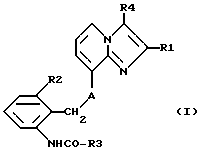
Таким образом, объектом настоящего изобретения являются алкоксиалкилкарбаматы имидазо[1,2-а]пиридинов формулы I
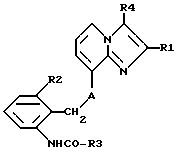
где R1 обозначает C1-C4алкил,
R2 обозначает C1-C4алкил,
R3 обозначает C1-C4алкокси-C2-C4алкокси,
R4 обозначает C1-C4алкил или гидроксиметил и
A обозначает О (кислород) или NH, и их соли.Thus, an object of the present invention are the alkoxyalkyl carbamates of imidazo [1,2-a] pyridines of the formula I
where R 1 denotes C 1 -C 4 alkyl,
R 2 is C 1 -C 4 alkyl,
R 3 is C 1 -C 4 alkoxy-C 2 -C 4 alkoxy,
R 4 is C 1 -C 4 alkyl or hydroxymethyl and
A is O (oxygen) or NH, and salts thereof.
C1-C4алкил представляет собой линейные либо разветвленные алкильные радикалы с числом атомов углерода 1-4. В качестве примеров можно назвать бутил, изобутил, втор. -бутил, трет. -бутил, пропил, изопропил, этил и в первую очередь метил.C 1 -C 4 alkyl is a linear or branched alkyl radicals with the number of carbon atoms 1-4. Examples include butyl, isobutyl, sec. -butyl, tert. -butyl, propyl, isopropyl, ethyl and especially methyl.
C1-C4алкокси представляет собой атом кислорода, с которым связан один из вышеназванных C1-C4алкильных радикалов. Предпочтителен из них метоксильный радикал. C2-C4алкокси представляет собой атом кислорода, с которым связан один из C2-C4алкильных радикалов, выбранный из группы указанных выше C1-C4алкильных радикалов. C1-C4алкокси-C2-C4алкокси представляет собой C2-C4алкоксильный радикал, с которым связан C1-C4алкоксильный радикал. Предпочтителен среди них 2-метоксиэтоксильный радикал.C 1 -C 4 alkoxy is an oxygen atom to which one of the aforementioned C 1 -C 4 alkyl radicals is bound. Of these, a methoxy radical is preferred. C 2 -C 4 alkoxy is an oxygen atom to which one of the C 2 -C 4 alkyl radicals is selected, selected from the group of the above C 1 -C 4 alkyl radicals. The C 1 -C 4 alkoxy-C 2 -C 4 alkoxy is a C 2 -C 4 alkoxyl radical to which a C 1 -C 4 alkoxyl radical is bound. Among them, a 2-methoxyethoxy radical is preferred.
В качестве солей соединений формулы I могут рассматриваться предпочтительно все кислотно-аддитивные соли. Особо следует назвать фармакологически приемлемые соли неорганических и органических кислот, применяемые обычно при изготовлении средств в галеновой форме. Фармакологически неприемлемые соли, которые могут являться первичными продуктами способа, осуществляемого при получении соединений по изобретению в промышленном масштабе, переводятся затем с помощью известных специалисту методов в фармакологически приемлемые соли. В качестве таковых пригодны водорастворимые, равно как и водонерастворимые кислотно-аддитивные соли, образованные от таких кислот, как, например, соляная кислота, бромистоводородная кислота, фосфорная кислота, азотная кислота, серная кислота, уксусная кислота, лимонная кислота, D-глюконовая кислота, бензойная кислота, 2-(4-гидроксибензоил)бензойная кислота, масляная кислота, сульфосалициловая кислота, малеиновая кислота, лауриновая кислота, яблочная кислота, фумаровая кислота, янтарная кислота, щавелевая кислота, винная кислота, эмбоновая кислота, стеариновая кислота, толуолсульфоновая кислота, метансульфоновая кислота или 3-гидрокси-2-нафтойная кислота, причем для получения соответствующей соли - в зависимости от того, какую кислоту используют: одноосновную или многоосновную, и в зависимости от того, какую соль требуется получить, кислоты применяют в эквимолярном количественном соотношении либо приблизительно в таком соотношении. As salts of the compounds of formula I, preferably all acid addition salts can be considered. Of particular note are pharmacologically acceptable salts of inorganic and organic acids, usually used in the manufacture of funds in galenic form. Pharmacologically unacceptable salts, which may be the primary products of the process carried out in the preparation of the compounds of the invention on an industrial scale, are then converted, using methods known to those skilled in the art, into pharmacologically acceptable salts. Suitable as such are water-soluble, as well as water-insoluble acid addition salts formed from acids such as, for example, hydrochloric acid, hydrobromic acid, phosphoric acid, nitric acid, sulfuric acid, acetic acid, citric acid, D-gluconic acid, benzoic acid, 2- (4-hydroxybenzoyl) benzoic acid, butyric acid, sulfosalicylic acid, maleic acid, lauric acid, malic acid, fumaric acid, succinic acid, oxalic acid, tartaric acid, embonic acid, stearic acid, toluenesulfonic acid, methanesulfonic acid or 3-hydroxy-2-naphthoic acid, moreover, to obtain the corresponding salt, depending on which acid is used: monobasic or polybasic, and depending on which salt you want to obtain, acids are used in equimolar proportions or approximately in this ratio.
В качестве примеров соединений можно назвать следующие: 8-{2-[(2- метоксиэтокси)карбониламино] -6-метилбензилокси}-2- метилимидазо[1,2-а]пиридин-3-метанол, 8-{2-[(2-метоксиэтокси)карбониламино]-6-метилбензиламино}-2- метилимидазо[1,2-а] пиридин-3-метанол и 8-{2-[(2-метоксиэтокси)карбониламино] -6-метилбезиламино}-2,3- диметилимидазо[1,2-а]пиридин и их соли. Examples of compounds include the following: 8- {2 - [(2-methoxyethoxy) carbonylamino] -6-methylbenzyloxy} -2-methylimidazo [1,2-a] pyridin-3-methanol, 8- {2 - [( 2-methoxyethoxy) carbonylamino] -6-methylbenzylamino} -2-methylimidazo [1,2-a] pyridin-3-methanol and 8- {2 - [(2-methoxyethoxy) carbonylamino] -6-methylbenzylamino} -2,3 - dimethylimidazo [1,2-a] pyridine and their salts.
Среди соединений формулы I следует выделить такие, в которых R4 обозначает гидроксиметил и A представляет собой О (кислород), a R1, R2 и R3 имеют указанные выше значения, а также соли этих соединений.Among the compounds of formula I, it is worth highlighting those in which R 4 is hydroxymethyl and A is O (oxygen), and R 1 , R 2 and R 3 are as defined above, as well as salts of these compounds.
Другим объектом изобретения является способ получения соединений формулы I и их солей. Способ заключается в том, что
а) соединения формулы II,
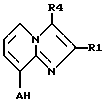
где R1, R4 и A имеют указанные выше значения, или их соли подвергают взаимодействию с соединениями формулы III,
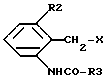
где R2 и R3 имеют указанные выше значения, а X представляет собой соответствующую реакционноспособную отщепляемую группу, либо с их солями, или
б) для получения соединений формулы 1, в которых R4 обозначает гидроксиметил, восстанавливают соединения формулы IV,
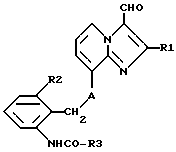
где R1, R2, R3 и A имеют указанные выше значения и затем при необходимости соединения I, полученные согласно а) или б), переводят в их соли, или затем при необходимости из полученных солей соединений I высвобождают соединения I.Another object of the invention is a method for producing compounds of formula I and their salts. The method is that
a) compounds of formula II,
where R 1 , R 4 and A have the above meanings, or their salts are reacted with compounds of formula III,
where R 2 and R 3 have the above meanings, and X represents the corresponding reactive cleavable group, either with their salts, or
b) to obtain compounds of the
where R 1 , R 2 , R 3 and A have the above meanings and then, if necessary, compounds I obtained according to a) or b) are converted to their salts, or then, if necessary, compounds I are released from the obtained salts of compounds I.
Взаимодействие соединений II с соединениями III осуществляют по методике, известной специалистам. Соответствующей реакционноспособной отщепляемой группой является, например, атом галогена (предпочтительно хлор либо бром) или метансульфонилоксигруппа. Обменную реакцию проводят предпочтительно в присутствии основания (например, неорганического гидроксида, такого, как гидроксид натрия, либо неорганического карбоната, такого, как карбонат калия, либо органического азотистого основания, такого, как триэтиламин, пиридин, коллидин или 4-диметиламинопиридин), причем добавками катализаторов, таких, как иодид щелочного металла или бромид тетрабутиламмония, можно эффективно воздействовать на ход реакции. The interaction of compounds II with compounds III is carried out according to a method known to specialists. A suitable reactive cleavable group is, for example, a halogen atom (preferably chlorine or bromine) or a methanesulfonyloxy group. The exchange reaction is preferably carried out in the presence of a base (for example, an inorganic hydroxide, such as sodium hydroxide, or an inorganic carbonate, such as potassium carbonate, or an organic nitrogen base, such as triethylamine, pyridine, collidine or 4-dimethylaminopyridine), with additives catalysts, such as alkali metal iodide or tetrabutylammonium bromide, can effectively influence the course of the reaction.
Восстановление соединений IV осуществляют по обычной методике, хорошо известной специалистам. Реакцию проводят в инертных растворителях, например, в низших алифатических спиртах, например, с использованием соответствующих гидридов, таких, как борогидрид натрия, при необходимости с добавками воды. The recovery of compounds IV is carried out according to the usual method, well known to specialists. The reaction is carried out in inert solvents, for example, lower aliphatic alcohols, for example, using the corresponding hydrides, such as sodium borohydride, optionally with water.
Выбор тех или иных параметров реакции, требуемых для осуществления способа, не доставит квалифицированному специалисту трудностей. The choice of certain reaction parameters required for the implementation of the method will not cause difficulties to a qualified specialist.
Выделение и очистку веществ по изобретению осуществляют с помощью известных методов, используя для этой цели, например, отгонку растворителя под вакуумом и перекристаллизацию полученного остатка из соответствующего растворителя или применяя один из обычных методов очистки, как, например, колоночная хроматография на соответствующем носителе. Isolation and purification of substances according to the invention is carried out using known methods, using, for example, distillation of the solvent under vacuum and recrystallization of the obtained residue from an appropriate solvent, or using one of the usual purification methods, such as column chromatography on an appropriate carrier.
Кислотно-аддитивные соли получают путем растворения свободного основания в соответствующем растворителе, например, в хлорированном углеводороде, таком, как метиленхлорид или хлороформ, в низкомолекулярном алифатическом спирте (этаноле, изопропаноле), в кетоне, таком, как ацетон, или в простом эфире, таком, как ТГФ или диизопропиловый эфир, который содержит требуемую кислоту или в который затем вводят требуемую кислоту. Acid addition salts are prepared by dissolving the free base in an appropriate solvent, for example, a chlorinated hydrocarbon, such as methylene chloride or chloroform, in a low molecular weight aliphatic alcohol (ethanol, isopropanol), in a ketone, such as acetone, or in an ether, such as THF or diisopropyl ether, which contains the desired acid or into which the desired acid is then added.
Выделение солей осуществляют путем фильтрации, переосаждения, высаживания с помощью растворителя, нерастворяющего аддитивную соль, или путем выпаривания растворителя. Полученные соли можно переводить подщелачиванием, например, водным раствором аммиака, в свободные основания, которые в свою очередь могут быть снова переведены в кислотно-аддитивные соли. Таким путем фармакологически неприемлемые кислотно-аддитивные соли могут быть превращены в фармакологически приемлемые кислотно-аддитивные соли. The separation of salts is carried out by filtration, reprecipitation, precipitation using a solvent, insoluble additive salt, or by evaporation of the solvent. The resulting salts can be converted by alkalization, for example, with an aqueous solution of ammonia, to the free bases, which in turn can be converted back to acid addition salts. In this way, pharmacologically unacceptable acid addition salts can be converted into pharmacologically acceptable acid addition salts.
Исходные соединения формулы II известны в частности из европейских патентных заявок ЕР-А-0290003 и ЕР-А-0299470. Исходные соединения формулы III являются новыми. Их получают аналогично способам, известным из соответствующих публикаций, а именно следующим образом: в соединениях III, где X обозначает OH, гидроксильную группу взаимодействием с галогенирующим средством, таким, как, например, тионилхлорид, тионилбромид, фосфортрибромид либо оксалилхлорид, переводят в реакционноспособную отщепляемую группу, например, в атом галогена, или взаимодействием с метансульфонилхлоридом, при необходимости в присутствии основания, ее превращают в метансульфонилоксигруппу. The starting compounds of formula II are known in particular from European patent applications EP-A-0290003 and EP-A-0299470. The starting compounds of formula III are new. They are obtained analogously to methods known from the relevant publications, namely as follows: in compounds III, where X is OH, the hydroxyl group is reacted with a halogenating agent, such as, for example, thionyl chloride, thionyl bromide, phosphor tribromide or oxalyl chloride, into a reactive leaving group , for example, into a halogen atom, or by reaction with methanesulfonyl chloride, if necessary in the presence of a base, it is converted into a methanesulfonyloxy group.
Соединения формулы IV представляют собой новые соединения и также являются объектом настоящего изобретения. Как и соединения формулы I, их получают аналогичным взаимодействием соединений II, где R4 обозначает CHO, с соединениями III, описанными выше.The compounds of formula IV are new compounds and are also an object of the present invention. Like the compounds of formula I, they are prepared by a similar reaction of compounds II, where R 4 is CHO, with compounds III described above.
Нижеследующие примеры поясняют подробнее способ получения соединений формулы I. Сокращение KT обозначает комнатную температуру, ч обозначает час(ы). The following examples explain in more detail the process for preparing compounds of formula I. The abbreviation KT stands for room temperature, h stands for hour (s).
Примеры
Конечные и промежуточные продукты
1. 8-{ 2-[(2-метоксиэтокси)карбониламино]-6-метилбензилокси}- 2-метилимидазо[1,2-а]пиридин-3-карбоксальдегид
Смесь 2,0 г (11,35 ммолей) 8-гидрокси-2-метилимидазо[1,2-а]пиридин-3-карбоксальдегида, 1,2 г безводного карбоната натрия, 0,17 г (1,14 ммоля) иодида натрия и 3,3 г (12,8 ммолей) 2-метоксиэтилового эфира [2-(хлорметил)-3-метилфенил] карбаминовой кислоты в 30 мл ацетона перемешивают в течение 24 ч при КТ и выливают в 200 мл ледяной воды. Затем осадок отфильтровывают, сушат и перекристаллизовывают из толуола/диизопропилового эфира. В результате получают 3,9 г (86,5%) соединения, указанного в заголовке, с Тпл 119-120oC.Examples
End and intermediate products
1. 8- {2 - [(2-methoxyethoxy) carbonylamino] -6-methylbenzyloxy} - 2-methylimidazo [1,2-a] pyridine-3-carboxaldehyde
A mixture of 2.0 g (11.35 mmol) of 8-hydroxy-2-methylimidazo [1,2-a] pyridin-3-carboxaldehyde, 1.2 g of anhydrous sodium carbonate, 0.17 g (1.14 mmol) of iodide sodium and 3.3 g (12.8 mmol) of [2- (chloromethyl) -3-methylphenyl] carbamic acid 2-methoxyethyl ester in 30 ml of acetone are stirred for 24 hours at RT and poured into 200 ml of ice-cold water. The precipitate is then filtered off, dried and recrystallized from toluene / diisopropyl ether. The result is 3.9 g (86.5%) of the title compound with a mp of 119-120 ° C.
2. 8-{ 2-[(2-метоксиэтокси)карбониламино] -6-метилбензилокси} 2-метилимидазо[1,2-а] пиридин-3-метанол
Суспензию 3,7 г (9,3 ммолей) 8-{2-[(2-метоксиэтокси)карбониламино]-6-метилбензилокси} -2-метилимидазо[1,2-а] пиридин-3-карбоксальдегида в 40 мл метанола смешивают при КТ с 362 мг (9,3 ммолей) 97%-ного борогидрида натрия и перемешивают в течение 75 мин. Затем выливают в ледяную воду, экстрагируют дихлорметаном и концентрируют в ротационно-вакуумном испарителе. Оставшееся масло кристаллизуют с помощью 5 мл изопропилового спирта, 5 мл толуола и диизопропилового эфира. Таким путем получают 2,7 г (72,7%) соединения, указанного в заголовке, с Тпл 121-123oC.2. 8- {2 - [(2-methoxyethoxy) carbonylamino] -6-methylbenzyloxy} 2-methylimidazo [1,2-a] pyridin-3-methanol
A suspension of 3.7 g (9.3 mmol) of 8- {2 - [(2-methoxyethoxy) carbonylamino] -6-methylbenzyloxy} -2-methylimidazo [1,2-a] pyridine-3-carboxaldehyde in 40 ml of methanol is mixed at CT with 362 mg (9.3 mmol) of 97% sodium borohydride and stirred for 75 minutes Then it is poured into ice water, extracted with dichloromethane and concentrated in a rotary vacuum evaporator. The remaining oil is crystallized with 5 ml of isopropyl alcohol, 5 ml of toluene and diisopropyl ether. In this way, 2.7 g (72.7%) of the title compound are obtained with a mp of 121-123 ° C.
3. 8-{ 2-[(2-метоксиэтокси)карбониламино] -6-метилбензиламино} -2-метилимидазо[1,2-а]пиридин-3-карбоксальдегид
Смесь из 2,0 г (11,41 ммолей) 8-амино-2-метилимидазо[1,2-а]пиридин-3-карбоксальдегида, 1,21 г (11,41 ммолей) безводного карбоната натрия, 0,17 г (1,14 ммоля) иодида натрия и 3,5 г (13,6 ммолей) 2-метоксиэтилового эфира [2-(хлорметил)-3-метилфенил]карбаминовой кислоты в 30 мл ацетона перемешивают в течение 24 ч при КТ и концентрируют в ротационно-вакуумном испарителе. Остаток смешивают со 100 мл воды, после чего экстрагируют этилацетатом, органическую фазу сушат сульфатом магния и концентрируют в вакууме. Остаток перекристаллизовывают из толуола. В результате получают 3,31 г (73%) соединения, указанного в заголовке, с Тпл 153-155oC.3. 8- {2 - [(2-methoxyethoxy) carbonylamino] -6-methylbenzylamino} -2-methylimidazo [1,2-a] pyridine-3-carboxaldehyde
A mixture of 2.0 g (11.41 mmol) of 8-amino-2-methylimidazo [1,2-a] pyridin-3-carboxaldehyde, 1.21 g (11.41 mmol) of anhydrous sodium carbonate, 0.17 g (1.14 mmol) of sodium iodide and 3.5 g (13.6 mmol) of [2- (chloromethyl) -3-methylphenyl] carbamic acid 2-methoxyethyl ester in 30 ml of acetone are stirred for 24 hours at RT and concentrated in rotary vacuum evaporator. The residue was mixed with 100 ml of water, after which it was extracted with ethyl acetate, the organic phase was dried with magnesium sulfate and concentrated in vacuo. The residue was recrystallized from toluene. The result is 3.31 g (73%) of the title compound with a mp of 153-155 ° C.
4. 8-{2-[(2-метоксиэтокси)карбониламино]-6-метилбензиламино} -2-метилимидазо[1,2-а]пиридин-3-метанол
2,8 г (7,06 молей) 8-{2-[(2-метоксиэтокси)карбониламино]-6- метилбензиламино} -2-метилимидазо[1,2-а] пиридин-3-карбоксальдегида восстанавливают с помощью борогидрида натрия аналогично примеру 2, метанол отгоняют в вакууме, смешивают с водой и этилацетатом и раствором гидрофосфата калия устанавливают pH 9. Затем несколько раз экстрагируют этилацетатом, сушат, концентрируют в вакууме и перекристаллизовывают из толуола/диизопропилового эфира. Таким путем получают 2,28 г (81%) соединения, указанного в заголовке, с Тпл 138-140oC.4. 8- {2 - [(2-methoxyethoxy) carbonylamino] -6-methylbenzylamino} -2-methylimidazo [1,2-a] pyridin-3-methanol
2.8 g (7.06 moles) of 8- {2 - [(2-methoxyethoxy) carbonylamino] -6-methylbenzylamino} -2-methylimidazo [1,2-a] pyridine-3-carboxaldehyde are reduced with sodium borohydride in the same way Example 2, methanol is distilled off in vacuo, mixed with water and ethyl acetate, and a solution of potassium hydrogen phosphate is adjusted to pH 9. Then it is extracted several times with ethyl acetate, dried, concentrated in vacuo and recrystallized from toluene / diisopropyl ether. In this way, 2.28 g (81%) of the title compound are obtained with a mp of 138-140 ° C.
5. 8-{2-[(2-метоксиэтокси)карбониламино]-6-метилбензиламино} -2,3-диметилимидазо[1,2-а]пиридин-изопропиловый спирт (1/1)
Смесь 3,0 г (18,6 ммолей) 8-амино-2,3-диметилимидазо[1,2-а]пиридина, 4,9 г (46,2 ммолей) безводного карбоната натрия, 0,28 г (1,86 ммоля) иодида натрия и 5,8 г (22,5 ммоля) 2-метоксиэтилового эфира [2-(хлорметил)-3-метилфенил] карбаминовой кислоты в 30 мл ацетона перемешивают в течение 20 ч при КТ. Затем фильтруют, концентрируют в вакууме, смешивают с водой и этилацетатом, разбавленной соляной кислотой устанавливают pH 6 и экстрагируют этилацетатом. Органический раствор сушат и концентрируют в вакууме. Остаток растворяют в 40 мл ацетона и смешивают с раствором 1,2 г (10,3 ммолей) фумаровой кислоты в 80 мл ацетона. Выпадение кристаллов не происходит. Тогда повторно концентрированный раствор смешивают с толуолом и изопропиловым спиртом и при температуре 0oC осаждают с помощью диизопропилового эфира 4,9 г фумарата. Полученный фумарат смешивают с 50 мл этилацетата и 10 мл воды, едким натром устанавливают pH 9 и свободное основание экстрагируют этилацетатом. После концентрирования в вакууме растворяют в толуоле/изопропиловом спирте и при температуре 0oC осаждают с помощью петролейного эфира (Ткип 40oC). В результате получают 2,2 г (26,7%) соединения, указанного в заголовке, с Тпл 85-86oC.5.8- {2 - [(2-methoxyethoxy) carbonylamino] -6-methylbenzylamino} -2,3-dimethylimidazo [1,2-a] pyridine-isopropyl alcohol (1/1)
A mixture of 3.0 g (18.6 mmol) of 8-amino-2,3-dimethylimidazo [1,2-a] pyridine, 4.9 g (46.2 mmol) of anhydrous sodium carbonate, 0.28 g (1, 86 mmol) of sodium iodide and 5.8 g (22.5 mmol) of [2- (chloromethyl) -3-methylphenyl] carbamic acid 2-methoxyethyl ester in 30 ml of acetone are stirred for 20 hours at RT. It is then filtered, concentrated in vacuo, mixed with water and ethyl acetate, diluted with hydrochloric acid, the pH is adjusted to 6 and extracted with ethyl acetate. The organic solution was dried and concentrated in vacuo. The residue was dissolved in 40 ml of acetone and mixed with a solution of 1.2 g (10.3 mmol) of fumaric acid in 80 ml of acetone. Crystal precipitation does not occur. Then the re-concentrated solution is mixed with toluene and isopropyl alcohol and 4.9 g of fumarate are precipitated with diisopropyl ether at 0 ° C. The resulting fumarate was mixed with 50 ml of ethyl acetate and 10 ml of water, pH 9 was adjusted with sodium hydroxide and the free base was extracted with ethyl acetate. After concentration in vacuo, it was dissolved in toluene / isopropyl alcohol and, at a temperature of 0 ° C., precipitated with petroleum ether (T boiling point 40 ° C.). The result is 2.2 g (26.7%) of the title compound with a mp of 85-86 ° C.
6. 8-{2-[(2-метоксиэтокси)карбониламино]-6-метилбензилокси} -2-метилимидазо[1,2-а]пиридин-3-метанол. 6. 8- {2 - [(2-methoxyethoxy) carbonylamino] -6-methylbenzyloxy} -2-methylimidazo [1,2-a] pyridin-3-methanol.
Смесь 178 мг (1,0 ммоль) 8-гидрокси-2-метилимидазо[1,2-а]пиридин-3-метанола, 117 мг (1,1 ммоля) безводного карбоната натрия, 15 мг (0,1 ммоля) иодида натрия и 283 мг (1,1 ммоля) 2-метоксиэтилового эфира [2-(хлорметил)- 3-метилфенил]карбаминовой кислоты в 5 мл ацетона перемешивают в течение 48 ч при КТ, затем перерабатывают аналогично примеру 2 и хроматографируют с помощью этилацетата/изопропилового спирта (соотношение 9:1). Таким путем получают 247 мг (62%) соединения, указанного в заголовке. A mixture of 178 mg (1.0 mmol) of 8-hydroxy-2-methylimidazo [1,2-a] pyridin-3-methanol, 117 mg (1.1 mmol) of anhydrous sodium carbonate, 15 mg (0.1 mmol) of iodide sodium and 283 mg (1.1 mmol) of [2- (chloromethyl) -3-methylphenyl] carbamic acid 2-methoxyethyl ester in 5 ml of acetone are stirred for 48 hours at RT, then they are processed analogously to example 2 and chromatographed with ethyl acetate / isopropyl alcohol (9: 1 ratio). In this way, 247 mg (62%) of the title compound are obtained.
7. 8-{ 2-[(2-метоксиэтокси)карбониламино]-6-метилбензилокси} -2,3-диметилимидазо[1,2-а]пиридин. 7. 8- {2 - [(2-methoxyethoxy) carbonylamino] -6-methylbenzyloxy} -2,3-dimethylimidazo [1,2-a] pyridine.
Аналогично примеру 5 подвергают взаимодействию 2,0 г (12,4 ммолей) 8-гидрокси-2,3-диметилимидазо[1,2-а] пиридина, 3,6 г (13,9 ммолей) 2-метоксиэтилового эфира [2-(хлорметил)-3-метилфенил] карбаминовой кислоты, 0,18 г иодида натрия и 1,3 г карбоната натрия в 30 мл ацетона. В результате получают 1,07 г (22,5%) соединения, указанного в заголовке, с Тпл 107-108oC.Analogously to example 5, 2.0 g (12.4 mmol) of 8-hydroxy-2,3-dimethylimidazo [1,2-a] pyridine, 3.6 g (13.9 mmol) of 2-methoxyethyl ether [2- (chloromethyl) -3-methylphenyl] carbamic acid, 0.18 g of sodium iodide and 1.3 g of sodium carbonate in 30 ml of acetone. The result is 1.07 g (22.5%) of the title compound with a mp of 107-108 ° C.
Исходные продукты
Аа. 2-Метоксиэтиловый эфир [2-(гидроксиметил)-3-метилфенил] карбаминовой кислоты
К раствору 33 г (0,24 моля) 2-амино-6-метилбензилового спирта и 19,4 мл (0,24 моля) пиридина в 600 мл изопропилового спирта при температуре 10oC добавляют по каплям при перемешивании и охлаждении 33,2 г (0,24 моля) 2-метоксиэтилового эфира хлормуравьиной кислоты. Перемешивание продолжают еще в течение 2 ч при 0oC, затем смешивают с водой и изопропилацетатом и несколько раз экстрагируют изопропилацетатом. Органическую фазу сушат сульфатом магния и концентрируют при 50oC в ротационно-вакуумном испарителе. Остаток хроматографируют на силикагельной колонне с помощью этилацетата. После концентрирования в вакууме получают 36 г (68%) соединения, указанного в заголовке, в виде масла.Source products
Ahh. [2- (Hydroxymethyl) -3-methylphenyl] carbamic acid 2-methoxyethyl ester
To a solution of 33 g (0.24 mol) of 2-amino-6-methylbenzyl alcohol and 19.4 ml (0.24 mol) of pyridine in 600 ml of isopropyl alcohol at a temperature of 10 ° C. was added dropwise with stirring and cooling 33.2 g (0.24 mol) of 2-methoxyethyl ester of chloroformic acid. Stirring is continued for another 2 hours at 0 ° C., then mixed with water and isopropyl acetate and extracted several times with isopropyl acetate. The organic phase is dried with magnesium sulfate and concentrated at 50 o C in a rotary vacuum evaporator. The residue is chromatographed on a silica gel column with ethyl acetate. After concentration in vacuo, 36 g (68%) of the title compound are obtained in the form of an oil.
Аб. 2-Метоксиэтиловый эфир [2-(хлорметил)-3-метилфенил] карбаминовой кислоты
К раствору 18,0 г (0,075 моля) указанного выше соединения в 80 мл толуола при температуре 17-20oC по каплям добавляют при перемешивании и охлаждении 9,4 г (0,079 моля) тионилхлорида и оставляют на ночь при КТ. Затем охлаждают на ледяной бане, растирают и в результате получают 11,2 г (57,7%) соединения, указанного в заголовке, с Тпл 100-102oC. После концентрирования маточного раствора и кристаллизации из толуола/петролейного эфира (Ткип 40oC), получают еще 4,8 г (24,7%) осадка с аналогичной температурой плавления.Ab. [2- (Chloromethyl) -3-methylphenyl] carbamic acid 2-methoxyethyl ester
To a solution of 18.0 g (0.075 mol) of the above compound in 80 ml of toluene at a temperature of 17-20 ° C., 9.4 g (0.079 mol) of thionyl chloride are added dropwise with stirring and cooling and left overnight at RT. Then it was cooled in an ice bath, triturated, and as a result, 11.2 g (57.7%) of the title compound were obtained with a mp of 100-102 ° C. After concentration of the mother liquor and crystallization from toluene / petroleum ether (T boiling point) 40 o C), get another 4.8 g (24.7%) of a precipitate with a similar melting point.
Б. 8-гидрокси-2-метилимидазо[1,2-а]пиридин-3-карбоксальдегид
4,77 г (0,02 моля) 8-бензилокси-2-метилимидазо[1,2-а]пиридина перемешивают в смеси Вильсмайера, содержащей 20 мл диметилформамида и 2,3 мл хлорокиси фосфора, в течение 2,5 ч при температуре 60oC и смесь разделяют по обычной методике с помощью ледяной воды и гидрокарбоната калия. Таким путем получают 8-бензилокси-2-метилимидазо[1,2-а] пиридин-3-карбоксальдегид с Тпл 105-106oC (из диизопропилового эфира). Это соединение аналогично тому, как это описано у Kaminski и др., в Journ. Med. Chem. 28, 876 (1985), Methode Н. , дебензилируют до соединения, указанного в заголовке, с Тпл 251-252oC.B. 8-hydroxy-2-methylimidazo [1,2-a] pyridin-3-carboxaldehyde
4.77 g (0.02 mol) of 8-benzyloxy-2-methylimidazo [1,2-a] pyridine was stirred in a Vilsmeier mixture containing 20 ml of dimethylformamide and 2.3 ml of phosphorus oxychloride for 2.5 hours at a temperature 60 o C and the mixture is separated according to the usual method using ice water and potassium hydrogen carbonate. In this way, 8-benzyloxy-2-methylimidazo [1,2-a] pyridin-3-carboxaldehyde with a mp of 105-106 ° C. (from diisopropyl ether) is obtained. This compound is similar to that described by Kaminski et al. In Journ. Med. Chem. 28, 876 (1985), Methode H., debenzylated to the title compound, mp 251-252 ° C.
Промышленная применимость
Соединения формулы I и их соли обладают ценными фармакологическими свойствами, обеспечивающими их промышленную применимость. Прежде всего они обладают ярко выраженной способностью ингибировать секрецию кислоты желудочного сока и отличным защитным действием по отношению к желудку и кишечнику у теплокровных. При этом наряду с хорошей растворимостью в водной среде соединения по изобретению отличаются высокой избирательностью действия, сравнительно продолжительной длительностью действия, хорошей энтеральной эффективностью, отсутствием существенных побочных эффектов и широким терапевтическим спектром.Industrial applicability
The compounds of formula I and their salts have valuable pharmacological properties that ensure their industrial applicability. First of all, they have a pronounced ability to inhibit the secretion of acid of gastric juice and an excellent protective effect in relation to the stomach and intestines in warm-blooded animals. Moreover, along with good solubility in an aqueous medium, the compounds of the invention are distinguished by high selectivity of action, relatively long duration of action, good enteral efficacy, the absence of significant side effects and a wide therapeutic spectrum.
Под понятием "защита желудка и кишечника" в контексте изобретения имеются в виду предупреждение и лечение заболеваний желудочно-кишечного тракта, прежде всего желудочно-кишечных воспалительных заболеваний и поражений (как, например, язвенная болезнь желудка, язва двенадцатиперстной кишки, гастрит, раздражение желудка, вызванное повышенной кислотностью или действием определенных лекарств), которые могут быть обусловлены, например, микроорганизмами (например, Helicobacter pylori), бактериальными токсинами, медикаментами (например, некоторыми противовоспалительными средствами и антиревматическими средствами), химикалиями (например, этанолом), кислотой желудочного сока или стрессовыми ситуациями. Соединения по изобретению обладают, кроме того, также собственным действием против зародыша Helicobacter pylori. The term "protection of the stomach and intestines" in the context of the invention refers to the prevention and treatment of diseases of the gastrointestinal tract, especially gastrointestinal inflammatory diseases and lesions (such as peptic ulcer, duodenal ulcer, gastritis, stomach irritation, caused by increased acidity or the action of certain drugs), which can be caused, for example, by microorganisms (e.g. Helicobacter pylori), bacterial toxins, medications (e.g., some anti-inflammatory and anti-rheumatic drugs), chemicals (e.g. ethanol), gastric acid, or stressful situations. The compounds of the invention also have, in addition, their own action against the germ of Helicobacter pylori.
По своим отличным противоязвенным и антисекреционным свойствам, проходившим экспериментальную проверку на различных моделях, соединения по изобретению неожиданным образом заметно превосходят соединения, известные из уровня техники. Благодаря этим свойствам соединения формулы I и их фармакологически приемлемые соли могут исключительно эффективно применяться в медицине и ветеринарии, причем свое применение они могут находить в первую очередь для лечения и/или профилактики заболеваний желудка и кишечника, равно как и для лечения остеопороза. In terms of their excellent anti-ulcer and antisecretion properties, which have been experimentally tested on various models, the compounds of the invention are surprisingly superior to compounds known in the art. Owing to these properties, the compounds of formula I and their pharmacologically acceptable salts can be extremely effectively used in medicine and veterinary medicine, and they can find their application primarily for the treatment and / or prevention of diseases of the stomach and intestines, as well as for the treatment of osteoporosis.
Объектом изобретения являются поэтому соединения по изобретению, обладающие способностью ингибировать секрецию кислоты желудочного сока. The object of the invention is therefore the compounds of the invention having the ability to inhibit the secretion of acid of gastric juice.
Изобретение включает далее применение соединений по изобретению для изготовления лекарственных средств, обладающих способностью ингибировать секрецию кислоты желудочного сока, которые предназначены для лечения и/или профилактики вышеназванных заболеваний. The invention further includes the use of the compounds of the invention for the manufacture of drugs having the ability to inhibit the secretion of acid of gastric juice, which are intended for the treatment and / or prevention of the above diseases.
Изобретение включает далее применение соединений по изобретению для лечения и/или профилактики вышеназванных заболеваний. The invention further includes the use of the compounds of the invention for the treatment and / or prophylaxis of the above diseases.
Другим объектом настоящего изобретения являются лекарственные средства, содержащие одно или несколько соединений формулы I и/или их фармакологически приемлемые соли. Another object of the present invention are drugs containing one or more compounds of formula I and / or their pharmacologically acceptable salts.
Лекарственные средства изготавливают с помощью хорошо известных и доступных специалисту методов. В качестве лекарственных средств соединения по изобретению, обладающие фармакологическим действием (т.е. действующие вещества), применяют либо как таковые, либо предпочтительно в комбинации с соответствующими фармацевтическими вспомогательными веществами и/или наполнителями, причем они могут изготавливаться в виде таблеток, драже, капсул, суппозиториев, пластырей (например, в виде чрескожно действующей терапевтической системы), эмульсий, суспензий или растворов, содержание действующих веществ в которых составляет при этом предпочтительно от 0,1 до 95 %, а благодаря выбору вспомогательных веществ и наполнителей можно получать средства в галеновой форме, точно соответствующей действующему веществу и/или желаемому наступлению действия (например, в форме пролонгированного действия или в форме, устойчивой к действию желудочного сока). Medicines are made using methods well known and accessible to the person skilled in the art. As pharmaceuticals, the compounds of the invention having a pharmacological action (i.e., active substances) are used either as such, or preferably in combination with appropriate pharmaceutical excipients and / or excipients, and they can be made in the form of tablets, dragees, capsules , suppositories, plasters (for example, in the form of a transdermally active therapeutic system), emulsions, suspensions or solutions in which the content of active substances is preferred flax is from 0.1 to 95%, and due to the choice of excipients and fillers, it is possible to obtain agents in galenic form exactly corresponding to the active substance and / or the desired onset of action (for example, in the form of a prolonged action or in a form resistant to the action of gastric juice) .
Выбор вспомогательных веществ, соответственно носителей для изготовления требуемых препаративных форм для специалиста, обладающего опытом в данной области, трудностей не представляет. Наряду с растворителями, загустителями, основными веществами для суппозиториев, вспомогательными веществами для таблеток и другими носителями действующих веществ могут применяться, например, покрытия для таблеток, антиоксиданты, диспергаторы, эмульгаторы, антивспениватели, вкусовые добавки, консерванты, вещества, способствующие растворимости, красители или прежде всего промоторы для проницаемости и комплексообразователи (например, циклодекстрины). The choice of excipients, respectively carriers for the manufacture of the required preparative forms for a specialist with experience in this field, is not difficult. In addition to solvents, thickeners, basic suppository substances, tablet excipients and other active ingredient carriers, for example, tablet coatings, antioxidants, dispersants, emulsifiers, antifoams, flavors, preservatives, solubility agents, colorants or previously total permeability promoters and complexing agents (e.g. cyclodextrins).
Действующие вещества могут назначаться для орального, парентерального или чрескожного введения. The active substances can be prescribed for oral, parenteral or transdermal administration.
Было установлено, что для достижения положительного терапевтического эффекта при лечении человека суточная доза при оральном введении, при необходимости назначаемая в виде нескольких, предпочтительно от 1 до 4, разовых доз, должна содержать действующее вещество, соответственно действующие вещества в количестве от приблизительно 0,01 до приблизительно 20, предпочтительно 0,05-5, прежде всего 0,1-1,5 мг/кг веса тела. Для парентерального введения могут назначаться препараты примерно с той же дозировкой действующих веществ или (в частности при внутривенном введении), как правило, с более низкой дозировкой. Выбор необходимой оптимальной дозировки, равно как и формы введения действующих веществ в каждом отдельном случае компетентный специалист в данной области определяет сам. It was found that to achieve a positive therapeutic effect in the treatment of humans, the daily dose for oral administration, if necessary, in the form of several, preferably from 1 to 4, single doses, should contain the active substance, respectively, active substances in an amount of from about 0.01 to about 20, preferably 0.05-5, especially 0.1-1.5 mg / kg body weight. For parenteral administration, preparations can be prescribed with approximately the same dosage of active ingredients or (in particular with intravenous administration), usually with a lower dosage. The competent specialist in this field determines the choice of the necessary optimal dosage, as well as the form of administration of the active substances in each individual case.
При применении соединений по изобретению и/или их солей для лечения указанных выше заболеваний фармацевтические композиции могут содержать в своем составе также один либо несколько фармацевтически активных ингредиентов, относящихся к другим группам лекарственных средств, такие, как антацидные средства, например, гидроксид алюминия, алюминат магния; транквилизаторы, такие, как бензодиазепины, например, диазепам; спазмолитические средства, как, например, биэтамиверин, камилофин; антихолинэргические средства, как, например, оксифенциклимин, фенкарбамид; местно-анестезирующие средства, как, например, тетракаин, прокаин; при необходимости также ферменты, витамины или аминокислоты. When using the compounds of the invention and / or their salts for the treatment of the above diseases, pharmaceutical compositions may also contain one or more pharmaceutically active ingredients belonging to other groups of drugs, such as antacids, for example, aluminum hydroxide, magnesium aluminate ; tranquilizers, such as benzodiazepines, for example, diazepam; antispasmodics, such as bietameverin, camilofin; anticholinergics, such as oxyphencyclimine, fencarbamide; local anesthetics, such as tetracaine, procaine; if necessary also enzymes, vitamins or amino acids.
В этой связи следует подчеркнуть особое значение соединений по изобретению при их применении в сочетании с другими медикаментозными средствами, ингибирующими секрецию кислоты, к каковым относятся, например, H2-блокаторы (например, циметидин, ранитидин), ингибиторы H+/К+- аденозинтрифосфотазы (например, омепразол, пантопразол), или, далее, с так называемыми периферийными антихолинэргическими средствами (как, например, пирензепин, телензепин), а также с гастриновыми антагонистами с целью дополнительного и даже сверхдополнительного усиления основного действия и/или исключения либо снижения побочных эффектов, или, далее, в сочетании с субстанциями, обладающими антибактериальным действием (как, например, цефалоспорины, тетрациклины, налидиксиновая кислота, пенициллины или также висмутовые соли), для борьбы с Helicobacter pylori.In this regard, it is worth emphasizing the particular importance of the compounds of the invention when used in combination with other medications that inhibit acid secretion, such as, for example, H 2 blockers (e.g. cimetidine, ranitidine), H + / K + - adenosine triphosphotase inhibitors (for example, omeprazole, pantoprazole), or, further, with the so-called peripheral anticholinergics (such as pirenzepine, telenzepine), as well as gastrin antagonists with the aim of additional and even super-complementary I have primary action and / or eliminating or reducing side effects, or further in combination with a substance having antibacterial effect (as, for example, cephalosporins, tetracyclines, nalidixic acid, penicillins or alternatively bismuth salts) for controlling Helicobacter pylori.
Фармакология
Отличное защитное действие соединений по изобретению по отношению к желудку и их способность ингибировать секрецию кислоты желудочного сока подтверждают результаты экспериментальных исследований, проведенных на моделях животных. Соединения по изобретению, прошедшие экспериментальную проверку на представленной ниже модели, получили порядковые номера, соответствующие нумерации этих соединений в примерах.Pharmacology
The excellent protective effect of the compounds of the invention in relation to the stomach and their ability to inhibit the secretion of acid of gastric juice is confirmed by the results of experimental studies conducted on animal models. Compounds according to the invention, tested experimentally on the model below, received serial numbers corresponding to the numbering of these compounds in the examples.
Испытание ингибирующего секрецию действия на перфундированном желудке крыс
В нижеследующей таблице представлено влияние соединений по изобретению после внутривенного введения на стимулированную пентагастрином секрецию кислоты перфундированного желудка крыс in vivo.Test on the secretion-inhibiting action on the perfunctory stomach of rats
The following table summarizes the effect of the compounds of the invention after intravenous administration on pentagastrin-stimulated secretion of acid from a rat's gastric perfusion in vivo.
Методика
У наркотизированных крыс (крыса линии CD, женская особь, 200-250 г; 1,5 г/кг, i. m. уретан) после трахеотомии разрезом по центральной линии эпистральной области вскрывали живот и введенный трансорально один ПХВ-катетер фиксировали в пищеводе, а другой в привратнике таким образом, что концы мягких трубок входили в просвет желудка. Катетер, выходящий из привратника, через боковое отверстие с правой стороны живота выходил наружу.Methodology
In anesthetized rats (a rat of the CD line, a female, 200-250 g; 1.5 g / kg, im urethane) after a tracheotomy, the abdomen was opened by a section along the central line of the epistral region and a transversely inserted PCV catheter was fixed in the esophagus and the other in the pylorus in such a way that the ends of the soft tubes enter the lumen of the stomach. A catheter exiting the pylorus exits through a side opening on the right side of the abdomen.
После тщательного промывания (приблизительно 50-100 мл) желудок при температуре 37oC непрерывно спринцевали теплым физиологическим раствором NaCl (0,5 мл/мин, pH 6,8-6,9; прибор типа Braun-Unita I). В собранном (с помощью мерного цилиндра) через каждые 15 мин эффлюате определяли значение pH (измеритель кислотности pH-Meter 632, стеклянный электрод ЕА 147; ⌀ = 5 мм , прибор Metrohm), а путем титрования свежеприготовленной 0,01H NaOH до pH 7 (прибор Dosimat 655 Metrohm) определяли выделенную HCl.After thorough washing (approximately 50-100 ml), the stomach at a temperature of 37 o C was continuously douched with warm physiological NaCl solution (0.5 ml / min, pH 6.8-6.9; device type Braun-Unita I). The pH value (pH meter Meter 632, glass electrode EA 147; ⌀ = 5 mm, Metrohm instrument) was determined in each effluent collected (using a measuring cylinder) every 15 min), and by titration with freshly prepared 0.01H NaOH to pH 7 ( Dosimat 655 Metrohm instrument) the released HCl was determined.
Стимулирование желудочной секреции осуществляли длительным внутривенным вливанием 1 мкг/кг (=1,65 мл/ч) i.v. пентагастрина (в левую бедренную вену) приблизительно через 30 мин после завершения операции (т.е. после определения двух предварительных фракций). Испытуемые субстанции вводили внутривенно в объеме жидкости 1 мл/кг через 60 мин после начала длительного внутривенного вливания пентагастрина. Gastric secretion was stimulated by continuous intravenous infusion of 1 μg / kg (= 1.65 ml / h) i.v. pentagastrin (into the left femoral vein) approximately 30 minutes after completion of the operation (i.e., after determining two preliminary fractions). The test substances were administered intravenously in a liquid volume of 1 ml / kg 60 minutes after the start of a long intravenous infusion of pentagastrin.
Температуру тела подопытных животных с помощью инфракрасного облучения и грелки (автоматическое, бесступенчатое регулирование через ректальный температурный датчик) поддерживали постоянной на уровне 37,8-38oC.The body temperature of the experimental animals using infrared radiation and a heating pad (automatic, stepless regulation through a rectal temperature sensor) was kept constant at 37.8-38 o C.
Соединения формулы I обладают низкой токсичностью. Так, например, для соединения из примера 2 значения LD50 составляют:
Мыши.р.о. - > 1000мг/кг
Крысы р.о. - > 1000мг/кг
Мыши в/в - около 80 мг/кг
Крысы в/в - около 20 мг/кг.The compounds of formula I have low toxicity. So, for example, for the compound of Example 2, the LD 50 values are:
Mice -> 1000mg / kg
Rats -> 1000mg / kg
I / O mice - about 80 mg / kg
I / O rats are about 20 mg / kg.
Получение составов лекарственного средства может быть проиллюстрировано следующими примерами:
а) Таблетки с содержанием 40 мг действующего вещества
20 кг 8-{2-[(2-метоксиэтокси)карбониламино]-6-метилбензилокси}-2- метилимидазо[1,2-а] пиридин-3-метанола, 40 кг молочного сахара, 26 кг маисового крахмала и 3 кг поливинилпирролидона смачивают в 20 литрах воды и затем гранулируют пропусканием через сита с размером ячеек 1,25. Гранулят высушивают в псевдоожиженном слое до получения продукта с влажностью 50- 60% и затем смешивают с 8 кг натрийкарбоксиметилцеллюлозы, 2 кг талька и 1 кг стеарата магния. Готовый гранулят таблетируют в таблетки по 200 мг диаметром 8 мм.The preparation of drug formulations can be illustrated by the following examples:
a) Tablets containing 40 mg of active ingredient
20 kg of 8- {2 - [(2-methoxyethoxy) carbonylamino] -6-methylbenzyloxy} -2-methylimidazo [1,2-a] pyridin-3-methanol, 40 kg of milk sugar, 26 kg of maize starch and 3 kg of polyvinylpyrrolidone soaked in 20 liters of water and then granulated by passing through sieves with a mesh size of 1.25. The granulate is dried in a fluidized bed until a product with a moisture content of 50-60% is obtained and then mixed with 8 kg of sodium carboxymethyl cellulose, 2 kg of talc and 1 kg of magnesium stearate. The finished granulate is tabletted into tablets of 200 mg with a diameter of 8 mm.
б) Капсулы с содержанием 30 мг действующего вещества
300 г 8-{2-[(2-метоксиэтокси)карбониламино]-6-метилбензилокси}-2- метилимидазо[1,2-а] пиридин-3-метанола, 695 г микрокристаллической целлюлозы и 5 г аморфной кремниевой кислоты подвергают тонкому измельчению, тщательному смешиванию и инкапсулированию с образованием твердых желатиновых капсул 4 размера.b) Capsules containing 30 mg of active ingredient
300 g of 8- {2 - [(2-methoxyethoxy) carbonylamino] -6-methylbenzyloxy} -2-methylimidazo [1,2-a] pyridin-3-methanol, 695 g of microcrystalline cellulose and 5 g of amorphous silicic acid are micronized , thorough mixing and encapsulation with the formation of hard gelatin capsules 4 sizes.
в) Капсулы с содержанием 10 мг действующего вещества
100 г 8-{2-[(2-метоксиэтокси)карбониламино]-6-метилбензиламино}-2- метилимидазо[1,2-а] пиридин-3-метанола, 895 г микрокристаллической целлюлозы и 5 г аморфной кремниевой кислоты подвергают тонкому измельчению, тщательному смешиванию и инкапсулированию с образованием твердых желатиновых капсул 4 размера.c) Capsules containing 10 mg of active ingredient
100 g of 8- {2 - [(2-methoxyethoxy) carbonylamino] -6-methylbenzylamino} -2-methylimidazo [1,2-a] pyridin-3-methanol, 895 g of microcrystalline cellulose and 5 g of amorphous silicic acid are micronized , thorough mixing and encapsulation with the formation of hard gelatin capsules 4 sizes.
г) Ампулы с содержанием 10 мг действующего вещества
Растворяют 3,16 г 8-{2-[(2-метоксиэтокси)карбониламино]-6- метилбензилокси} -2,3-диметилимидазо[1,2-а]пиридина в растворе 165,5 г маннита и 0,5 г карбоната натрия в 1300 мл дистиллированной воды и стерильно фильтруют. Полученный раствор разливают по 5 мл в 15 мл ампулы и лиофилизуют. Лиофилизат может быть вновь переведен в водный раствор с 10 мл воды.g) Ampoules containing 10 mg of active substance
3.16 g of 8- {2 - [(2-methoxyethoxy) carbonylamino] -6-methylbenzyloxy} -2,3-dimethylimidazo [1,2-a] pyridine are dissolved in a solution of 165.5 g of mannitol and 0.5 g of carbonate sodium in 1300 ml of distilled water and sterile filtered. The resulting solution was poured into 5 ml in 15 ml ampoules and lyophilized. The lyophilisate can be re-transferred to an aqueous solution with 10 ml of water.
Claims (7)
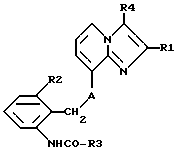
где R1 обозначает C1-4 алкил;
R2 обозначает C1-4 алкил;
R3 обозначает С1-4алкокси-С2-4алкокси;
R4 обозначает C1-4 алкил или гидроксиметил;
А обозначает О (кислород) или NН,
и их соли.1. Alkoxyalkylcarbamates of imidazo [1,2-a] pyridines of the formula I
where R 1 denotes C 1-4 alkyl;
R 2 is C 1-4 alkyl;
R 3 is C 1-4 alkoxy-C 2-4 alkoxy;
R 4 is C 1-4 alkyl or hydroxymethyl;
A denotes O (oxygen) or NH,
and their salts.
Applications Claiming Priority (3)
| Application Number | Priority Date | Filing Date | Title |
|---|---|---|---|
| CH3047/93-3 | 1993-10-11 | ||
| CH304793 | 1993-10-11 | ||
| PCT/EP1994/003326 WO1995010518A1 (en) | 1993-10-11 | 1994-10-08 | ALKOXY ALKYL CARBAMATES FROM IMIDAZO (1,2-a)PYRIDINES |
Publications (2)
| Publication Number | Publication Date |
|---|---|
| RU96109369A RU96109369A (en) | 1998-08-20 |
| RU2139288C1 true RU2139288C1 (en) | 1999-10-10 |
Family
ID=4247423
Family Applications (1)
| Application Number | Title | Priority Date | Filing Date |
|---|---|---|---|
| RU96109369A RU2139288C1 (en) | 1993-10-11 | 1994-10-08 | Imidazo[1,2-a]pyridine alkoxyalkylcarbamates and drug based on said |
Country Status (26)
| Country | Link |
|---|---|
| US (1) | US5719161A (en) |
| EP (1) | EP0723544B1 (en) |
| JP (1) | JP3526305B2 (en) |
| KR (1) | KR100339059B1 (en) |
| CN (1) | CN1042633C (en) |
| AT (1) | ATE200672T1 (en) |
| AU (1) | AU685176B2 (en) |
| BG (1) | BG100459A (en) |
| CA (1) | CA2173876C (en) |
| CZ (1) | CZ290325B6 (en) |
| DE (1) | DE59409735D1 (en) |
| DK (1) | DK0723544T3 (en) |
| EE (1) | EE03262B1 (en) |
| ES (1) | ES2157992T3 (en) |
| FI (1) | FI961564L (en) |
| GR (1) | GR3035943T3 (en) |
| HU (1) | HU220066B (en) |
| NO (1) | NO305864B1 (en) |
| NZ (1) | NZ275419A (en) |
| PL (1) | PL176424B1 (en) |
| PT (1) | PT723544E (en) |
| RO (1) | RO118428B1 (en) |
| RU (1) | RU2139288C1 (en) |
| SK (1) | SK283264B6 (en) |
| UA (1) | UA48122C2 (en) |
| WO (1) | WO1995010518A1 (en) |
Cited By (1)
| Publication number | Priority date | Publication date | Assignee | Title |
|---|---|---|---|---|
| RU2294935C2 (en) * | 2001-08-22 | 2007-03-10 | Астразенека Аб | Imidazopyridine derivatives for using in therapy as medicinal agent inhibiting proton pump and intermediate compounds for their preparing |
Families Citing this family (20)
| Publication number | Priority date | Publication date | Assignee | Title |
|---|---|---|---|---|
| CZ22697A3 (en) * | 1994-07-28 | 1997-07-16 | Byk Gulden Lomberg Chem Fab | Imidazopyridine-azolidinone derivatives, process of their preparation and pharmaceutical composition containing thereof |
| WO1997027193A1 (en) * | 1996-01-26 | 1997-07-31 | Byk Gulden Lomberg Chemische Fabrik Gmbh | Imidazopyridine halides |
| EP0882048B1 (en) * | 1996-01-26 | 2005-05-04 | ALTANA Pharma AG | 3-alkylimidazopyridines |
| DE19602855A1 (en) * | 1996-01-26 | 1997-07-31 | Byk Gulden Lomberg Chem Fab | New ((acyl-amino-phenyl)methyl-oxy- or -imino)imidazo:pyridine compounds |
| SE9802794D0 (en) | 1998-08-21 | 1998-08-21 | Astra Ab | New compounds |
| US6780880B1 (en) | 1999-08-26 | 2004-08-24 | Robert R. Whittle | FT-Raman spectroscopic measurement |
| US6326384B1 (en) | 1999-08-26 | 2001-12-04 | Robert R. Whittle | Dry blend pharmaceutical unit dosage form |
| US6312723B1 (en) | 1999-08-26 | 2001-11-06 | Robert R. Whittle | Pharmaceutical unit dosage form |
| US6312712B1 (en) | 1999-08-26 | 2001-11-06 | Robert R. Whittle | Method of improving bioavailability |
| US6369087B1 (en) * | 1999-08-26 | 2002-04-09 | Robert R. Whittle | Alkoxy substituted benzimidazole compounds, pharmaceutical preparations containing the same, and methods of using the same |
| US6262086B1 (en) | 1999-08-26 | 2001-07-17 | Robert R. Whittle | Pharmaceutical unit dosage form |
| US6262085B1 (en) | 1999-08-26 | 2001-07-17 | Robert R. Whittle | Alkoxy substituted Benzimidazole compounds, pharmaceutical preparations containing the same, and methods of using the same |
| US6316020B1 (en) | 1999-08-26 | 2001-11-13 | Robert R. Whittle | Pharmaceutical formulations |
| US6268385B1 (en) | 1999-08-26 | 2001-07-31 | Robert R. Whittle | Dry blend pharmaceutical formulations |
| UA80393C2 (en) * | 2000-12-07 | 2007-09-25 | Алтана Фарма Аг | Pharmaceutical preparation comprising an pde inhibitor dispersed on a matrix |
| DE10145457A1 (en) | 2001-09-14 | 2003-04-03 | Basf Ag | Substituted imidazo [1,2-a] -5,6,7,8-tetrahydropyridin-8-ones, process for their preparation and their use in the preparation of imidazo [1,2, -a] pyridines |
| MY140561A (en) * | 2002-02-20 | 2009-12-31 | Nycomed Gmbh | Dosage form containing pde 4 inhibitor as active ingredient |
| SI1606261T1 (en) | 2003-03-10 | 2010-03-31 | Nycomed Gmbh | Novel process for the preparation of roflumilast |
| EP1974730A1 (en) | 2003-11-03 | 2008-10-01 | AstraZeneca AB | Imidazo[1,2-a]pyridine derivatives for use in the treatment of sleep disturbance due to silent gastro-esophageal reflux |
| US8663694B2 (en) * | 2005-03-16 | 2014-03-04 | Takeda Gmbh | Taste masked dosage form containing roflumilast |
Citations (1)
| Publication number | Priority date | Publication date | Assignee | Title |
|---|---|---|---|---|
| SU117992A1 (en) * | 1958-04-11 | 1958-11-30 | Н.В. Олехнович | A device for counting and recording the readings of needle instruments |
Family Cites Families (7)
| Publication number | Priority date | Publication date | Assignee | Title |
|---|---|---|---|---|
| ZA81219B (en) * | 1980-01-23 | 1982-01-27 | Schering Corp | Imidazo (1,2-a) pyridines ,process for their preparation and pharmaceutical compositions containing them |
| US4725601A (en) * | 1985-06-04 | 1988-02-16 | Fujisawa Pharmaceutical Co., Ltd. | Certain imidazo[1,2-a]pyridines useful in the treatment of ulcers |
| EP0228006A1 (en) * | 1985-12-16 | 1987-07-08 | Fujisawa Pharmaceutical Co., Ltd. | Imidazopyridine compounds and processes for preparation thereof |
| NZ221996A (en) * | 1986-10-07 | 1989-08-29 | Yamanouchi Pharma Co Ltd | Imidazo-pyridine derivatives and pharmaceutical compositions |
| US4831041A (en) * | 1986-11-26 | 1989-05-16 | Fujisawa Pharmaceutical Co., Ltd. | Imidazopyridine compounds and processes for preparation thereof |
| GB8722488D0 (en) * | 1987-09-24 | 1987-10-28 | Fujisawa Pharmaceutical Co | Imidazopyridine compound |
| KR900014376A (en) * | 1989-03-13 | 1990-10-23 | 후지사와 토모키치로 | Imidazo pyridine compound and preparation method thereof |
-
1994
- 1994-08-10 UA UA96051789A patent/UA48122C2/en unknown
- 1994-10-08 CA CA002173876A patent/CA2173876C/en not_active Expired - Fee Related
- 1994-10-08 US US08/624,525 patent/US5719161A/en not_active Expired - Fee Related
- 1994-10-08 RU RU96109369A patent/RU2139288C1/en not_active IP Right Cessation
- 1994-10-08 NZ NZ275419A patent/NZ275419A/en unknown
- 1994-10-08 AT AT94930158T patent/ATE200672T1/en not_active IP Right Cessation
- 1994-10-08 JP JP51126495A patent/JP3526305B2/en not_active Expired - Fee Related
- 1994-10-08 PT PT94930158T patent/PT723544E/en unknown
- 1994-10-08 RO RO96-00722A patent/RO118428B1/en unknown
- 1994-10-08 CZ CZ19961055A patent/CZ290325B6/en not_active IP Right Cessation
- 1994-10-08 WO PCT/EP1994/003326 patent/WO1995010518A1/en not_active Ceased
- 1994-10-08 KR KR1019960701866A patent/KR100339059B1/en not_active Expired - Fee Related
- 1994-10-08 HU HU9600890A patent/HU220066B/en not_active IP Right Cessation
- 1994-10-08 EP EP94930158A patent/EP0723544B1/en not_active Expired - Lifetime
- 1994-10-08 CN CN94194070A patent/CN1042633C/en not_active Expired - Fee Related
- 1994-10-08 DE DE59409735T patent/DE59409735D1/en not_active Expired - Fee Related
- 1994-10-08 ES ES94930158T patent/ES2157992T3/en not_active Expired - Lifetime
- 1994-10-08 EE EE9600053A patent/EE03262B1/en not_active IP Right Cessation
- 1994-10-08 FI FI961564A patent/FI961564L/en unknown
- 1994-10-08 SK SK450-96A patent/SK283264B6/en unknown
- 1994-10-08 AU AU79372/94A patent/AU685176B2/en not_active Ceased
- 1994-10-08 PL PL94313941A patent/PL176424B1/en not_active IP Right Cessation
- 1994-10-08 DK DK94930158T patent/DK0723544T3/en active
-
1996
- 1996-03-28 BG BG100459A patent/BG100459A/en unknown
- 1996-04-10 NO NO961414A patent/NO305864B1/en not_active IP Right Cessation
-
2001
- 2001-05-28 GR GR20010400798T patent/GR3035943T3/en not_active IP Right Cessation
Patent Citations (1)
| Publication number | Priority date | Publication date | Assignee | Title |
|---|---|---|---|---|
| SU117992A1 (en) * | 1958-04-11 | 1958-11-30 | Н.В. Олехнович | A device for counting and recording the readings of needle instruments |
Cited By (1)
| Publication number | Priority date | Publication date | Assignee | Title |
|---|---|---|---|---|
| RU2294935C2 (en) * | 2001-08-22 | 2007-03-10 | Астразенека Аб | Imidazopyridine derivatives for using in therapy as medicinal agent inhibiting proton pump and intermediate compounds for their preparing |
Also Published As
Similar Documents
| Publication | Publication Date | Title |
|---|---|---|
| RU2139288C1 (en) | Imidazo[1,2-a]pyridine alkoxyalkylcarbamates and drug based on said | |
| US5665730A (en) | Pharmaceutically useful imidazopyridines | |
| US6436953B1 (en) | Tetrahydropyridoethers | |
| RU2138501C1 (en) | Imidazopyridine azolidinones and their salts, drug | |
| AU700737B2 (en) | Benzylimidazopyridines | |
| JPH10505330A (en) | Halogen imidazopyridine | |
| HK1011681B (en) | Alkoxy alkyl carbamates of imidazo (1,2-a) pyridines |
Legal Events
| Date | Code | Title | Description |
|---|---|---|---|
| MM4A | The patent is invalid due to non-payment of fees |
Effective date: 20051009 |