RU211971U1 - Sleeper lining - Google Patents
Sleeper lining Download PDFInfo
- Publication number
- RU211971U1 RU211971U1 RU2021127507U RU2021127507U RU211971U1 RU 211971 U1 RU211971 U1 RU 211971U1 RU 2021127507 U RU2021127507 U RU 2021127507U RU 2021127507 U RU2021127507 U RU 2021127507U RU 211971 U1 RU211971 U1 RU 211971U1
- Authority
- RU
- Russia
- Prior art keywords
- polymer
- wavy
- elastic layer
- layer
- sleeper
- Prior art date
Links
- 241001669679 Eleotris Species 0.000 title claims abstract description 54
- 229920000642 polymer Polymers 0.000 claims abstract description 62
- 230000003014 reinforcing effect Effects 0.000 claims abstract description 29
- 238000005728 strengthening Methods 0.000 claims abstract description 3
- 238000010276 construction Methods 0.000 abstract description 2
- 230000006870 function Effects 0.000 abstract 1
- 230000008447 perception Effects 0.000 abstract 1
- 239000000463 material Substances 0.000 description 8
- 239000004575 stone Substances 0.000 description 7
- 230000006378 damage Effects 0.000 description 5
- 238000004519 manufacturing process Methods 0.000 description 5
- 230000007423 decrease Effects 0.000 description 3
- 239000000835 fiber Substances 0.000 description 3
- 239000006185 dispersion Substances 0.000 description 2
- 238000006073 displacement reaction Methods 0.000 description 2
- 239000013013 elastic material Substances 0.000 description 2
- 239000007788 liquid Substances 0.000 description 2
- 230000000149 penetrating effect Effects 0.000 description 2
- 230000035515 penetration Effects 0.000 description 2
- 239000002861 polymer material Substances 0.000 description 2
- 229910000831 Steel Inorganic materials 0.000 description 1
- 238000010521 absorption reaction Methods 0.000 description 1
- 230000002411 adverse Effects 0.000 description 1
- 238000002425 crystallisation Methods 0.000 description 1
- 230000008025 crystallization Effects 0.000 description 1
- 238000013016 damping Methods 0.000 description 1
- 230000006866 deterioration Effects 0.000 description 1
- 230000000694 effects Effects 0.000 description 1
- 238000005516 engineering process Methods 0.000 description 1
- 239000004744 fabric Substances 0.000 description 1
- 238000007373 indentation Methods 0.000 description 1
- 238000001746 injection moulding Methods 0.000 description 1
- 238000009434 installation Methods 0.000 description 1
- 238000002955 isolation Methods 0.000 description 1
- 230000007774 longterm Effects 0.000 description 1
- 238000000034 method Methods 0.000 description 1
- 230000002028 premature Effects 0.000 description 1
- 230000002787 reinforcement Effects 0.000 description 1
- 239000002689 soil Substances 0.000 description 1
- 239000000243 solution Substances 0.000 description 1
- 239000010959 steel Substances 0.000 description 1
- 239000000126 substance Substances 0.000 description 1
- 229920001169 thermoplastic Polymers 0.000 description 1
- 238000009827 uniform distribution Methods 0.000 description 1
- XLYOFNOQVPJJNP-UHFFFAOYSA-N water Substances O XLYOFNOQVPJJNP-UHFFFAOYSA-N 0.000 description 1
Images


Abstract
Полезная модель относится к области строительства железнодорожных путей.The utility model relates to the field of railway construction.
Задача - повышение эксплуатационной надежности подшпальной подкладки за счет достижения технического результата - повышения плотности расположения армирующих элементов в подшпальной подкладке и повышения их поперечного сопротивления сдвигу при восприятии нагрузок.The task is to increase the operational reliability of the sleeper lining by achieving a technical result - increasing the density of the reinforcing elements in the sleeper lining and increasing their transverse shear resistance when absorbing loads.
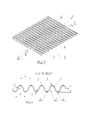
Подшпальная подкладка (фиг. 1) содержит опорный слой (7) и расположенный на нем и выполненный из полимера эластичный слой (1), в котором и над которым расположен армирующий слой (2), выполненный из рядов волнообразных полимерных нитей (3), внедренных своими впадинами в эластичный слой (1) и свободно расположенными над ним своими вершинами (5), при этом через ряды волнообразных полимерных нитей (3) пропущены ряды стренг (6).Sleeper lining (Fig. 1) contains a support layer (7) and an elastic layer (1) located on it and made of polymer, in which and above which a reinforcing layer (2) is located, made of rows of wavy polymer threads (3) embedded with their depressions into the elastic layer (1) and their tops (5) freely located above it, while rows of strands (6) are passed through the rows of wavy polymer threads (3).
Ряды стренг ориентированы в армирующем слое таким образом, что пропущены через вершины (5) и впадины волнообразных полимерных нитей (3), образуя с ними монолитный элемент армирующего слоя (2), что способствует увеличению жесткости армирующего слоя и повышению поперечного сопротивления сдвигу подкладки при восприятии нагрузок.The rows of strands are oriented in the reinforcing layer in such a way that they are passed through the tops (5) and troughs of the wavy polymer threads (3), forming with them a monolithic element of the reinforcing layer (2), which contributes to an increase in the rigidity of the reinforcing layer and an increase in the transverse shear resistance of the lining during perception loads.
Стренги (6) выполнены моноволоконными из полимера, твердость которого равна твердости волнообразных полимерных нитей (3), при этом они и стренги (6) выполнены из полимера, твердость которого выше твердости полимера, из которого выполнен эластичный слой (1).The strands (6) are made of monofilament polymer, the hardness of which is equal to the hardness of the wavy polymer threads (3), while they and the strands (6) are made of a polymer whose hardness is higher than the hardness of the polymer from which the elastic layer (1) is made.
Для обеспечения возможности функции усиления прочности эластичного слоя (1) впадины волнообразных полимерных нитей (3) внедрены в эластичный слой (1) на глубину не менее 5 мм и не более 10 мм.To enable the function of strengthening the strength of the elastic layer (1), the cavities of the wavy polymer threads (3) are embedded in the elastic layer (1) to a depth of at least 5 mm and not more than 10 mm.
Эластичный слой (1) выполнен в контакте с опорным слоем (7), при этом он выполнен из полимера, плотность которого выше плотности полимера, из которого выполнен эластичный слой (1).The elastic layer (1) is made in contact with the support layer (7), while it is made of a polymer whose density is higher than the density of the polymer from which the elastic layer (1) is made.
Дополнительные отличительные признаки полезной модели:Additional distinguishing features of the utility model:
- расстояние между соседними вершинами (5) каждой волнообразной полимерной нити (3) не менее 10 мм и не более 25 мм;- the distance between adjacent peaks (5) of each wavy polymer thread (3) is not less than 10 mm and not more than 25 mm;
- расстояние между соседними вершинами (5) волнообразных полимерных нитей (3) не менее 4 мм и не более 15 мм.
Description
Полезная модель относится к области строительства железнодорожных путей и касается виброизоляционных устройств, в частности подшпальных подкладок, служащих для поглощения и рассеивания высоких вибрационных нагрузок, возникающих в процессе проезда железнодорожного транспорта.The utility model relates to the field of railway construction and concerns vibration isolation devices, in particular sleeper pads, which serve to absorb and dissipate high vibration loads that occur during the passage of railway transport.
Известна подшпальная подкладка [1, Патент DE 102013209495 B4, МПК Е01В 3/00, приоритет 22.05.2013 опубликован 27.11.2014], которая состоит из опорной конструкции, выполненной из эластичного полимерного материала и соединительного слоя, при этом структура соединительного слоя выполнена путем модификации поверхности опорной конструкции.Known sleeper lining [1, Patent DE 102013209495 B4, IPC E01B 3/00, priority 22.05.2013 published 27.11.2014], which consists of a support structure made of elastic polymer material and a connecting layer, while the structure of the connecting layer is made by modifying surface of the supporting structure.
Соединительный слой выполнен в виде волокнистой структуры, из упругого термопластичного полимерного материала. При этом волокнистая структура изготовлена вместе с опорной конструкцией, как одно целое изделие, посредством литья под давлением. В таком изделии волокна изогнуты или имеют перегиб, а структура волокна имеет множество участков с различной ориентацией элементов.The connecting layer is made in the form of a fibrous structure, made of an elastic thermoplastic polymer material. In this case, the fibrous structure is made together with the supporting structure as a single piece by means of injection molding. In such a product, the fibers are bent or have a kink, and the fiber structure has many sections with different element orientations.
Такая своеобразная амортизирующая подошва из подшпальной подкладки может крепиться к шпале посредством крепежной конструкции. Крепление может быть выполнено в форме фитинга, например, путем затвердевания бетона в приемных зонах конструкции крепления.Such a kind of shock-absorbing sole made of undersleepers can be attached to the sleeper by means of a fastening structure. The attachment can be made in the form of a fitting, for example by hardening concrete in the receiving areas of the attachment structure.
Однако данная подшпальная подкладка сложна в процессе изготовления. Кроме того, при ее выполнении из того же материала, что и у опорной конструкции, снижается прочность выступов на разрыв материала подкладки при ее сдвиге. Волокна, которые выступают над опорной конструкцией, не замкнуты между собой, поэтому не обладают достаточной жесткостью, что не обеспечивает надежного поперечного сопротивления сдвигу при восприятии нагрузок. Поэтому и выполняющая функцию амортизирующей подошвы шпала на основе такой подшпальной подкладки недостаточна долговечна.However, this sleeper pad is difficult to manufacture. In addition, when it is made of the same material as that of the supporting structure, the tensile strength of the protrusions of the lining material decreases when it is sheared. The fibers that protrude above the supporting structure are not closed to each other, therefore they do not have sufficient rigidity, which does not provide reliable transverse shear resistance when absorbing loads. Therefore, a sleeper that performs the function of a shock-absorbing sole based on such an undersleeve lining is not sufficiently durable.
Известна более долговечная подшпальная подкладка [2, Патент WO 2008122066 A1, Е01В 3/46, приоритет 06.04.2007 опубликован 16.10.2008].A more durable sleeper lining is known [2, Patent WO 2008122066 A1, E01B 3/46, priority 04/06/2007 published 10/16/2008].
Эта подшпальная подкладка содержит опорный слой, по меньшей мере, из одного полимера с соединительным слоем для контакта и соединения с бетонной шпалой. Структура соединительного слоя также выполнена путем модификации поверхности опорной конструкции и образована каналообразными и порообразными углублениями или каналообразными выступами. При соединении со шпалой данные каналы заполняются бетоном, что увеличивает надежность сцепления подкладки со шпалой.This sleeper pad contains a support layer of at least one polymer with a bonding layer for contact and connection with the concrete sleeper. The structure of the connecting layer is also made by modifying the surface of the support structure and is formed by channel-like and porous recesses or channel-like protrusions. When connected to a sleeper, these channels are filled with concrete, which increases the adhesion of the lining to the sleeper.
Однако данная подшпальная подкладка также сложна в процессе изготовления. Кроме того, требуется тщательное соблюдение технологии для полного заполнением бетоном каналов подкладки. Все это ведет к удоражанию изделия.However, this sleeper pad is also difficult to manufacture. In addition, careful observance of the technology is required for the complete filling of the lining channels with concrete. All this leads to an increase in the price of the product.
Известна более технологичная и более надежная в эксплуатации подшпальная подкладка [3, Патент AT12923U1, МПК D03D13/00; Е01 В1/00; Е01 ВЗ/46, приоритет 15.04.2011, опубликован 15.02.2013], принятая за прототип полезной модели.Known more technologically advanced and more reliable under sleeper lining [3, Patent AT12923U1, IPC D03D13/00; E01 B1/00; E01 ВЗ/46, priority 04/15/2011, published 02/15/2013], taken as a utility model prototype.
Такая подшпальная подкладка содержит эластичный слой, в котором и над которым расположен армирующий слой для бетонной шпалы при ее формировании на подшпальной подкладке. Армирующий слой, выполнен из рядов волнообразных нитей, внедренных своими впадинами в эластичный слой и свободно расположенными над ним своими вершинами. Через ряды волнообразных полимерных нитей пропущены ряды стренг, расположенных на плоскости соединения эластичного слоя с бетонной шпалой. При этом данный армирующий слой предотвращает слишком глубокое проникновение балласта или грунта в эластичный слой подшпальной подкладки, что предохраняет ее от преждевременного разрушения.Such a sleeper pad contains an elastic layer, in which and above which a reinforcing layer for a concrete sleeper is located when it is formed on the sleeper pad. The reinforcing layer is made of rows of wavy threads embedded with their depressions into the elastic layer and freely located above it with their tops. Rows of strands are passed through the rows of wavy polymer threads, located on the plane of the connection of the elastic layer with the concrete sleeper. At the same time, this reinforcing layer prevents the ballast or soil from penetrating too deeply into the elastic layer of the sleeper lining, which protects it from premature destruction.
Существенным недостатком известного устройства-прототипа [3] является то, что вершины и впадины вышеупомянутых волнообразных нитей не соединены с соседними рядами. Кроме того армирующий слой не является монолитным элементом. Поэтому армирующий слой недостаточно жесткий и не может оказать сильное сопротивление сдвигу эластичного слоя.A significant disadvantage of the known prototype device [3] is that the tops and troughs of the above wavy threads are not connected to adjacent rows. In addition, the reinforcing layer is not a monolithic element. Therefore, the reinforcing layer is not sufficiently rigid and cannot provide strong shear resistance of the elastic layer.
Из-за этого, в случае чрезмерного внедрения щебня балласта в эластичный слой и низкого поперечного сопротивления сдвигу всей конструкции такой подкладки, это может привести как к ухудшению поглощения и рассеивания вибрационных нагрузок, так и к разрушению самой подшпальной подкладки и к снижению качества работы шпалы.Because of this, in the case of excessive penetration of crushed ballast into the elastic layer and low transverse shear resistance of the entire structure of such a lining, this can lead both to a deterioration in the absorption and dissipation of vibration loads, and to the destruction of the sleeper lining itself and to a decrease in the quality of the sleeper.
Данное обстоятельство отрицательно сказывается на их надежности, надежности множества таких подшпальных подкладок и шпал на их основе, а также на надежности железнодорожного пути, в котором такие изделия применяются.This circumstance adversely affects their reliability, the reliability of many such sleeper pads and sleepers based on them, as well as the reliability of the railway track in which such products are used.
Поэтому задачей полезной модели является повышение эксплуатационной надежности подшпальной подкладки за счет достижения технического результата - повышения жесткости ее армирующего слоя и повышения поперечного сопротивления ее сдвигу при восприятии нагрузок.Therefore, the objective of the utility model is to increase the operational reliability of the sleeper lining by achieving a technical result - increasing the rigidity of its reinforcing layer and increasing the transverse resistance to its shear when taking loads.
Поставленная задача достигается тем, что в подшпальной подкладке (фиг. 1-7), содержащей эластичный слой (1), в котором и над которым расположен армирующий слой (2), выполненный из рядов волнообразных полимерных нитей (3), внедренных своими впадинами (4) в эластичный слой (1) и свободно расположенными над ним своими вершинами (5), при этом через ряды волнообразных полимерных нитей (3) пропущены ряды стренг (6), имеются отличительные признаки: ряды стренг выполнены моноволоконными из полимера и ориентированы в армирующем слое таким образом, что пропущены через вершины (5) и впадины (4) волнообразных полимерных нитей (3), образуя с ними монолитный элемент армирующего слоя (2), причем стренги (6) выполнены моноволоконными из полимера, твердость которого равна твердости волнообразных полимерных нитей (3), которые, как и стренги (6), выполнены из полимера, твердость которого выше твердости полимера, из которого выполнен эластичный слой (1).The task is achieved by the fact that in the undersleeper lining (Fig. 1-7), containing an elastic layer (1), in which and above which there is a reinforcing layer (2), made of rows of wavy polymer threads (3), embedded by their depressions ( 4) into the elastic layer (1) and their tops (5) freely located above it, while rows of strands (6) are passed through the rows of wavy polymer threads (3), there are distinctive features: the rows of strands are made of monofilament polymer and are oriented in the reinforcing layer in such a way that they are passed through the tops (5) and troughs (4) of the wavy polymer threads (3), forming with them a monolithic element of the reinforcing layer (2), and the strands (6) are made of monofilament polymer, the hardness of which is equal to the hardness of the wavy polymer threads (3), which, like the strands (6), are made of a polymer whose hardness is higher than the hardness of the polymer from which the elastic layer (1) is made.
За счет того, ряды стренг ориентированы в армирующем слое таким образом, что пропущены через вершины (5) и впадины (4) полимерных нитей (3), образуя с ними монолитный элемент армирующего слоя (2), достигается то, что по сравнению с прототипом [3], значительно повышается поперечное сопротивление сдвигу изделия в целом при восприятии нагрузок таких нитей.Due to the fact that the rows of strands are oriented in the reinforcing layer in such a way that they are passed through the tops (5) and troughs (4) of the polymer threads (3), forming with them a monolithic element of the reinforcing layer (2), it is achieved that, compared with the prototype [3], the transverse shear resistance of the product as a whole increases significantly when the load of such threads is perceived.
Это также позволяет упомянутое повышение поперечного сопротивления сдвигу усилить выполнением нитей моноволоконными из полимера, твердость которого выше твердости полимера, из которого выполнен эластичный слой (2).This also makes it possible to increase the mentioned increase in transverse shear resistance by making the yarns monofilament from a polymer whose hardness is higher than the hardness of the polymer from which the elastic layer (2) is made.
В совокупности, приведенные отличительные признаки полезной модели, позволят не применять, в отличие от прототипа [3], тканевую основу для армирующих элементов, чтобы создать ей связку рядов для компенсации их неплотного расположения.Taken together, these distinguishing features of the utility model will allow not to use, unlike the prototype [3], a fabric base for reinforcing elements in order to create a bunch of rows for it to compensate for their loose arrangement.
Дополнительные отличительные признаки полезной модели, усиливающие упомянутые выше эффекты:Additional distinctive features of the utility model that enhance the effects mentioned above:
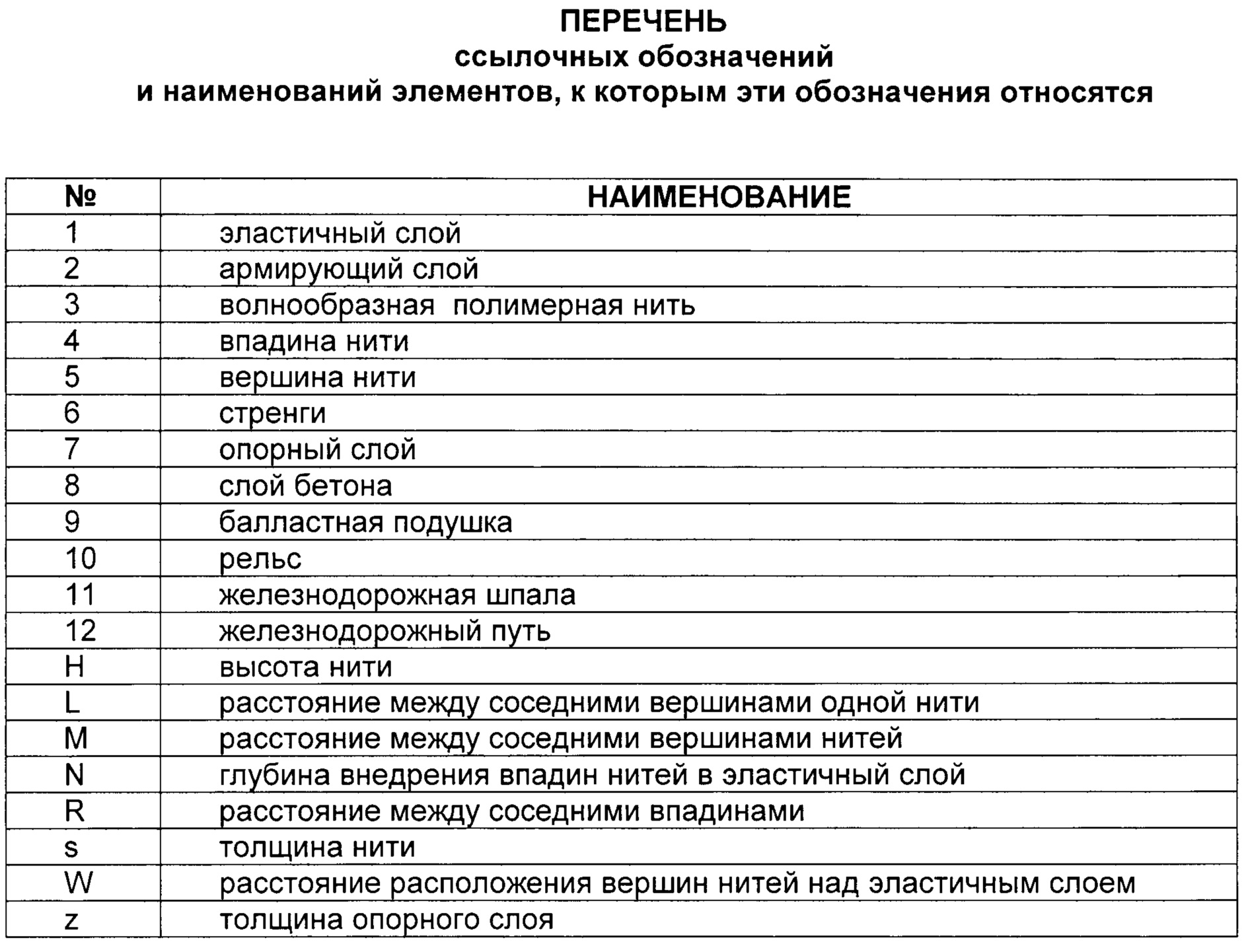
- расстояние (L) между соседними вершинами (5) каждой волнообразной полимерной нити (3) не менее 10 мм и не более 25 мм;- the distance (L) between adjacent peaks (5) of each wavy polymer thread (3) is not less than 10 mm and not more than 25 mm;
- расстояние (М) между соседними вершинами (5) волнообразных полимерных нитей (3) не менее 4 мм и не более 15 мм;- distance (M) between adjacent peaks (5) of wavy polymer threads (3) not less than 4 mm and not more than 15 mm;
- расстояние (R) между соседними впадинами (4) у волнообразных полимерных нитей не менее 10 мм и не более 25 мм;- the distance (R) between adjacent depressions (4) for wavy polymer threads is not less than 10 mm and not more than 25 mm;
- толщина (s) волнообразных полимерных нитей (3) и стренг (6) не менее 0,9 мм и не более 2 мм;- thickness (s) of wavy polymer threads (3) and strands (6) not less than 0.9 mm and not more than 2 mm;
- эластичный слой (1) выполнен в контакте с опорным слоем (7), который выполнен из полимера, плотность которого выше плотности полимера, из которого выполнен эластичный слой (1);- the elastic layer (1) is made in contact with the support layer (7), which is made of a polymer whose density is higher than the density of the polymer from which the elastic layer (1) is made;
- толщина (z) опорного слоя (7) не менее 0,1 мм и не более 3 мм;- thickness (z) of the support layer (7) is not less than 0.1 mm and not more than 3 mm;
- впадины (4) волнообразных полимерных нитей (3) внедрены с обеспечением возможности функции усиления его прочности в эластичный слой (1) на глубину (N) не менее 5 мм и не более 10 мм, а вершины (5) полимерных нитей (3) свободно расположены над эластичным слоем (1) на расстоянии (W) не менее 4 мм и не более 10 мм.- depressions (4) of wavy polymer threads (3) are embedded in the elastic layer (1) to a depth (N) of not less than 5 mm and not more than 10 mm, and the tops (5) of polymer threads (3) freely located above the elastic layer (1) at a distance (W) of at least 4 mm and not more than 10 mm.
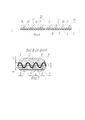
Сущность полезной модели поясняется иллюстрациями, где на фиг. 1 показан пример общего вида в перспективе части подшпальной подкладки; на фиг. 2 - увеличенный местный вид А по фиг. 1; на фиг. 3 - вид в перспективе армирующего слоя; на фиг. 4 - повернутый разрез Б-Б по фиг. 3; на фиг. 5 показан поперечный разрез шпалы в примере ее применения; на фиг. 6 показан поперечный разрез железнодорожного пути на примере применения шпалы по фиг. 5; на фиг. 7 - увеличенный местный вид В по фиг. 6.The essence of the utility model is illustrated by illustrations, where in Fig. 1 shows an example of a general perspective view of a part of a sleeper pad; in fig. 2 is an enlarged detail view of A in FIG. one; in fig. 3 is a perspective view of the reinforcement layer; in fig. 4 is a rotated section B-B of FIG. 3; in fig. 5 shows a cross section of a sleeper in an example of its application; in fig. 6 shows a cross-section of a railway track using the sleeper of FIG. 5; in fig. 7 is an enlarged detail view of B in FIG. 6.
Подшпальная подкладка (фиг. 1, 2, 3) содержит эластичный слой (1), в котором и над которым расположен армирующий слой (2), выполненный из рядов волнообразных полимерных нитей (3), внедренных своими впадинами (4) в эластичный слой (1) и свободно расположенными над ним своими вершинами (5). Через ряды волнообразных полимерных нитей (3) пропущены ряды стренг (6), образуя с ними монолитный элемент армирующего слоя (2).The sleeper lining (Fig. 1, 2, 3) contains an elastic layer (1), in which and above which there is a reinforcing layer (2), made of rows of wavy polymer threads (3), embedded with their depressions (4) into the elastic layer ( 1) and their vertices freely located above it (5). Rows of strands (6) are passed through the rows of wavy polymer threads (3), forming with them a monolithic element of the reinforcing layer (2).
Стренги (6) пропущены через вершины (5) и впадины (4) волнообразных лолимерных (3) нитей (3). Таким образом, нижние стренги (6) внедрены в эластичный слой (1), а верхние - в слой бетона (8), что усиливает соединение подкладки с железнодорожной шпалой (11).The strands (6) are passed through the tops (5) and troughs (4) of the wavy lolimer (3) threads (3). Thus, the lower strands (6) are embedded in the elastic layer (1), and the upper strands in the concrete layer (8), which strengthens the connection between the lining and the railway sleeper (11).
Волнообразные лолимерные нити (3) и стренги (6) целесообразно выполнять моноволоконными из полимера, твердость которого выше твердости полимера, из которого выполнен эластичный слой (1). Последний выполнен в контакте с опорным слоем (7), который изготовлен из полимера, плотность которого выше плотности полимера эластичного слоя (1). Эластичный слой (1) со стороны, противоположной опорному слою (7), имеет глянцевую структуру своей поверхности.Wavy lolimer threads (3) and strands (6) are expediently made of monofilament polymer, the hardness of which is higher than the hardness of the polymer from which the elastic layer (1) is made. The latter is made in contact with the support layer (7), which is made of a polymer whose density is higher than that of the elastic layer (1). The elastic layer (1) on the side opposite to the support layer (7) has a glossy surface structure.
Такое выполнение армирующего слоя (2) упрощает его изготовление и повышает удобство и долговечность применения в качестве материала армирующих элементов, так как они будут обладать улучшенными показателями по модулю упругости, прочности, химической стойкости к внешним воздействующим факторам. Как следствие, армирующий слой (2) будет лучше сохранять свои свойства и форму в процессе его заделки, как в материал эластичного слоя (1), так и в слой бетона (8) шпалы на этапе производства железнодорожной конструкции, что создаст еще большее усиление эластичного слоя (1) подшпальной подкладки.Such a design of the reinforcing layer (2) simplifies its manufacture and increases the convenience and durability of the use as a material for reinforcing elements, since they will have improved modulus of elasticity, strength, and chemical resistance to external influencing factors. As a result, the reinforcing layer (2) will better retain its properties and shape during its embedding, both in the material of the elastic layer (1) and in the concrete layer (8) of the sleeper at the stage of production of the railway structure, which will create an even greater increase in the elastic layer (1) of the sleeper lining.
Придание глянцевой структуры поверхности эластичного слоя (1) со стороны, противоположной опорному слою (7), в свою очередь создаст дополнительную защиту от попадания воды внутрь эластичного слоя (1), что совместно с его закрытопористой структурой повысит стойкость подшпальной подкладки к низким температурам за счет отсутствия жидкости и, соответственно, отсутствия процессов ее кристаллизации в эластичном слое (1).Giving a glossy structure to the surface of the elastic layer (1) from the side opposite to the support layer (7), in turn, will create additional protection against water ingress into the elastic layer (1), which, together with its closed-cell structure, will increase the resistance of the sleeper pad to low temperatures due to the absence of liquid and, accordingly, the absence of its crystallization processes in the elastic layer (1).
Рекомендуемые выше геометрические размеры (фиг. 2, 4) элементов армирующего слоя (2) оптимальны для надежной адгезии с эластичным слоем (1) и бетоном железнодорожной шпалы (11). Применение волнообразных полимерных нитей (3) армирующего слоя (2), выполненных из упругих моноволоконных нитей, не препятствует рассеиванию вибрационных нагрузок в материале эластичного слоя (1), одновременно повышая прочность и износостойкость подшпальной подкладки в целом.The geometric dimensions recommended above (Fig. 2, 4) of the elements of the reinforcing layer (2) are optimal for reliable adhesion with the elastic layer (1) and the concrete of the railway sleeper (11). The use of wavy polymer threads (3) of the reinforcing layer (2), made of elastic monofilament threads, does not prevent the dispersion of vibration loads in the material of the elastic layer (1), while increasing the strength and wear resistance of the undersleeper lining as a whole.
Для обеспечения возможности функции усиления прочности эластичного слоя (1) впадины (4) полимерных нитей (3) внедрены (фиг. 7) в эластичный слой (1) на глубину (N) не менее 5 мм и не более 10 мм.To enable the function of strengthening the strength of the elastic layer (1), the cavities (4) of the polymer threads (3) are embedded (Fig. 7) in the elastic layer (1) to a depth (N) of at least 5 mm and not more than 10 mm.
Для надежного соединения подкладки с железнодорожной шпалой (11) вершины (5) полимерных нитей (3) расположены (фиг. 2) над эластичным слоем (1) на расстоянии (W) не менее 4 мм и не более 10 мм.For reliable connection of the lining with the railway sleeper (11), the tops (5) of the polymer threads (3) are located (Fig. 2) above the elastic layer (1) at a distance (W) of at least 4 mm and not more than 10 mm.
Такая подшпальная подкладка (фиг. 5) может применяться в составе железнодорожной шпалы (11), когда поверх эластичного слоя (1) имеется застывший слой бетона (8), предварительно залитый с закрытием вершин (5) волнообразных полимерных нитей (3) и верхних стренг (5). Железнодорожная шпала (11) устанавливается на балластную подушку (9) из щебня. В составе такой конструкции, где множество ей подобных шпал, образуется (фиг. 6) железнодорожный путь (12), в котором на слои бетона (9), железнодорожных шпал (11) установлены рельсы (10).Such a sleeper lining (Fig. 5) can be used as part of a railway sleeper (11), when on top of the elastic layer (1) there is a hardened layer of concrete (8), pre-filled with closing tops (5) of wavy polymer threads (3) and upper strands (5). Railway sleeper (11) is installed on a ballast pad (9) made of crushed stone. As part of such a structure, where there are many sleepers similar to it, a railway track (12) is formed (Fig. 6), in which rails (10) are installed on layers of concrete (9), railway sleepers (11).
Подшпальные подкладки устанавливают под железнодорожными шпалами (11), выполненными бетонными, для повышения упругости конструкции верхнего строения железнодорожного пути (12), для обеспечения рассеяния вибрационных нагрузок, для сокращения уровня износа железнодорожных шпал (11), а также для не допущения разрушения щебня и проседания балластной подушки (9). Подшпальная подкладка может устанавливаться, как на всю площадь основания железнодорожной шпалы (11), так и частично, на отдельных участках этого основания. Также применение подшпальных подкладок способствует снижению общего уровня шума, вызываемого вибрацией в стальных и бетонных конструкциях при прохождении поезда.Sleeper pads are installed under railway sleepers (11), made of concrete, to increase the elasticity of the structure of the upper structure of the railway track (12), to ensure the dispersion of vibration loads, to reduce the wear level of railway sleepers (11), and also to prevent the destruction of crushed stone and subsidence ballast cushion (9). The sleeper lining can be installed both on the entire area of the base of the railway sleeper (11), and partially, on separate sections of this base. Also, the use of sleeper pads helps to reduce the overall noise level caused by vibration in steel and concrete structures during the passage of the train.
В момент движения колес железнодорожного состава по участку пути оборудованному такими подкладками, возникают повышенные нагрузки и вибрации, особенно при прохождении стыков рельсов (10). Эти нагрузки через бетонный монолит шпалы и материал подкладки передаются на щебень балластной подушки (9). В результате демпфирования в эластичном материале подкладки происходит значительное ослабление и рассеивание этих нагрузок, а волнообразные полимерные нити (3), внедренные впадинами (4) в эластичный слой (1) и вершинами (5) в слой бетона (8) шпалы не допускают поперечный сдвиг этой шпалы.At the moment of movement of the wheels of the railway train along the section of the track equipped with such linings, increased loads and vibrations occur, especially when passing the rail joints (10). These loads through the concrete monolith of the sleeper and the lining material are transferred to the crushed stone of the ballast pad (9). As a result of damping in the elastic material of the lining, these loads are significantly weakened and dissipated, and the wavy polymer threads (3) embedded with depressions (4) into the elastic layer (1) and peaks (5) into the concrete layer (8) of the sleeper do not allow transverse shift this sleeper.
Для недопущения чрезмерного вдавливания острых углов щебня балластной подушки (9) в эластичный слой (1) подкладки и его повреждения от повышенной нагрузки, особенно при прохождении загруженных вагонов, дополнительно выполнен более плотный опорный слой (7). Кроме того, в качестве армирующего и усиливающего слоя выступают впадины волнообразной полимерной нити (1), выполненной моноволоконной, через которые проходят нижние стренги (6), дополнительно препятствующие внедрению щебня балластной подушки (9) при повышенных нагрузках. Эти оба слоя, опорный слой (7) и образованный впадинами (4) нити (3) с нижними стренгами (6), при совместной работе способны сдерживать высокие проникающие силы от давления острых краев щебня балластной подушки (9), значительно расширяя площадь передачи усилия от колес железнодорожного состава и равномерно распределяя эту нагрузку на соседние железнодорожные шпалы (11). Кроме того, из-за расширения пятна контакта и равномерного распределения нагрузки на большее количество таких шпал, уменьшается величина прогиба рельсового пути.To prevent excessive indentation of the sharp corners of the crushed stone of the ballast cushion (9) into the elastic layer (1) of the lining and its damage from increased load, especially when passing loaded cars, a denser support layer (7) is additionally made. In addition, the depressions of the wave-like polymer thread (1) made of monofilament act as a reinforcing and reinforcing layer, through which the lower strands (6) pass, further preventing the penetration of crushed stone of the ballast cushion (9) at increased loads. These two layers, the support layer (7) and formed by the cavities (4) of the thread (3) with the lower strands (6), when working together, are able to restrain high penetrating forces from the pressure of the sharp edges of the crushed stone of the ballast cushion (9), significantly expanding the area of force transfer from the wheels of the train and evenly distributing this load on the neighboring railway sleepers (11). In addition, due to the expansion of the contact patch and the uniform distribution of the load on a larger number of such sleepers, the deflection of the rail track decreases.
При прохождении железнодорожным составом участков пути, оборудованных стрелочными переводами и крутыми изгибами полотна, возникают нагрузки, приводящие к поперечному смещению корпуса железнодорожной шпалы (1) в связи с нестабильностью верхнего слоя балластной подушки (9).When a train passes through sections of the track equipped with turnouts and sharp bends in the track, loads occur that lead to a transverse displacement of the body of the railway sleeper (1) due to the instability of the upper layer of the ballast cushion (9).
Применяя подшпальную подкладку по полезной модели на таких участках пути значительно снижают эти смещения за счет применения в подшпальных подкладках образованных волнообразными полимерными нитями (3) своеобразных зацепов, передающих усилия сдвига на эластичный материал и увеличивая площадь контакта между железнодорожной шпалой (11) и щебнем балластной подушки (9) путем заделки краев щебня в материал подшпальной подкладки.Applying a sleeper pad according to the utility model on such sections of the track significantly reduces these displacements due to the use of peculiar hooks formed in the sleeper pads formed by wavy polymer threads (3), transferring shear forces to an elastic material and increasing the contact area between the railway sleeper (11) and the crushed stone of the ballast cushion (9) by embedding the edges of the rubble into the bedding material.
Для уменьшения количества влаги, попадающей в эластичный слой (1), как из слоя бетона (8) на этапе производства, так и в процессе транспортировки, установки и эксплуатации шпалы, эластичный слой (1) имеет закрытую пористую внутреннюю структуру, а со стороны, противоположной опорному слою (7), глянцевую структуру своей поверхности. Благодаря такому решению материал подшпальной подкладки, в процессе ее длительной эксплуатации, не будет терять своих эластичных свойств и обретет высокую стойкость к разрушению при эксплуатации в условиях низких отрицательных температур и агрессивных жидкостей.To reduce the amount of moisture entering the elastic layer (1), both from the concrete layer (8) at the production stage, and during transportation, installation and operation of the sleeper, the elastic layer (1) has a closed porous internal structure, and from the side, opposite to the support layer (7), the glossy structure of its surface. Thanks to this solution, the material of the sleeper lining, during its long-term operation, will not lose its elastic properties and will gain high resistance to destruction when operating in conditions of low negative temperatures and aggressive liquids.
Это позволит успешно применять при эксплуатации железнодорожного полотна подшпальные подкладки по полезной модели в широком диапазоне климатических поясов.This will make it possible to successfully use sleeper pads according to the utility model in a wide range of climatic zones during the operation of the railway track.
Источники информации:Sources of information:
1. Патент DE 102013209495 B4, МПК Е01В 3/00, приоритет 22.05.2013 опубликован 27.11.2014.1. Patent DE 102013209495 B4,
2. Патент WO 2008122066 A1, Е01В 3/46, приоритет 06.04.2007 опубликован 16.10.2008.2. Patent WO 2008122066 A1,
3. Патент AT 12923 U1, МПК D03D 13/00; Е01В 1/00; Е01В 3/46, приоритет 15.04.2011., опубликован 15.02.2013 /прототип/.3. Patent AT 12923 U1, IPC D03D 13/00;
Приложение Application
к заявке на патентование полезной модели «Подшпальная подкладка»to the application for patenting the utility model "Under sleeper lining"
Claims (8)
Publications (1)
| Publication Number | Publication Date |
|---|---|
| RU211971U1 true RU211971U1 (en) | 2022-06-30 |
Family
ID=
Cited By (1)
| Publication number | Priority date | Publication date | Assignee | Title |
|---|---|---|---|---|
| RU235180U1 (en) * | 2025-03-25 | 2025-06-23 | Акционерное общество "БетЭлТранс" | SLEEP LINING |
Citations (6)
| Publication number | Priority date | Publication date | Assignee | Title |
|---|---|---|---|---|
| FR2753998A1 (en) * | 1996-09-30 | 1998-04-03 | Etancheite Les Revetements Et | UNDER-CROSS SOLE FOR BALLAST PROTECTION |
| WO2012139143A1 (en) * | 2011-04-15 | 2012-10-18 | Getzner Werkstoffe Holding Gmbh | Railroad tie |
| RU176225U1 (en) * | 2017-07-28 | 2018-01-12 | Александр Юрьевич Ермолов | UNDERWAY GASKET |
| RU180231U1 (en) * | 2017-12-15 | 2018-06-06 | Акционерное общество "РС-Комплект" | UNDERWAY GASKET |
| RU2704761C1 (en) * | 2016-06-02 | 2019-10-30 | Семперит АГ Холдинг | Under sleeper pad |
| RU206455U1 (en) * | 2020-12-17 | 2021-09-13 | Общество с ограниченной ответственностью "Индустриальный центр" | Sleeper pad |
Patent Citations (6)
| Publication number | Priority date | Publication date | Assignee | Title |
|---|---|---|---|---|
| FR2753998A1 (en) * | 1996-09-30 | 1998-04-03 | Etancheite Les Revetements Et | UNDER-CROSS SOLE FOR BALLAST PROTECTION |
| WO2012139143A1 (en) * | 2011-04-15 | 2012-10-18 | Getzner Werkstoffe Holding Gmbh | Railroad tie |
| RU2704761C1 (en) * | 2016-06-02 | 2019-10-30 | Семперит АГ Холдинг | Under sleeper pad |
| RU176225U1 (en) * | 2017-07-28 | 2018-01-12 | Александр Юрьевич Ермолов | UNDERWAY GASKET |
| RU180231U1 (en) * | 2017-12-15 | 2018-06-06 | Акционерное общество "РС-Комплект" | UNDERWAY GASKET |
| RU206455U1 (en) * | 2020-12-17 | 2021-09-13 | Общество с ограниченной ответственностью "Индустриальный центр" | Sleeper pad |
Cited By (2)
| Publication number | Priority date | Publication date | Assignee | Title |
|---|---|---|---|---|
| RU2847572C2 (en) * | 2023-06-15 | 2025-10-09 | Акционерное общество "БетЭлТранс" | Method of connecting a sub-base to a reinforced concrete sub-base |
| RU235180U1 (en) * | 2025-03-25 | 2025-06-23 | Акционерное общество "БетЭлТранс" | SLEEP LINING |
Similar Documents
| Publication | Publication Date | Title |
|---|---|---|
| US4500037A (en) | Railway road bed | |
| CA1257576A (en) | Impact and vibration attenuating pad | |
| RU130314U1 (en) | UNDERWEAR SUPPORT WITH SHOCK ABSORBER | |
| FI110885B (en) | Support for an upper construction | |
| US4609144A (en) | Railroad tie cover | |
| US6386461B1 (en) | Rail pads | |
| US9127410B2 (en) | Elastic pad for concrete elements on which rails of a railway rest | |
| RU2756929C1 (en) | Sleeper pad and method for its manufacture, construction of railway sleeper with sleeper pad fixed in it and method for connecting sleeper pad with railway sleeper | |
| RU206455U1 (en) | Sleeper pad | |
| EA044266B1 (en) | SLEEP LINING | |
| CN107805977A (en) | Elastic shoe and resilient sleeper-bearing component and non-fragment orbit for non-fragment orbit | |
| RU213132U1 (en) | Sleeper | |
| HUE029372T2 (en) | Use of a coating material for direct connection to a concrete structure | |
| WO2004079094A2 (en) | Civil engineering support structures | |
| CZ278337B6 (en) | Permanent way | |
| EA047004B1 (en) | SLEEP AND METHOD OF ITS MANUFACTURE | |
| WO2023102633A1 (en) | Sleeper and method for manufacturing same | |
| CN206189195U (en) | Rubber tie plate under compound rail of pressure -shear | |
| RU241219U1 (en) | SLEEPING LINING | |
| RU213570U1 (en) | FIBER RAILWAY SLEEP | |
| CA2311905C (en) | Sleeper for railway tracks | |
| RU98419U1 (en) | RAIL SUPPORT AND RAILWAY SITE | |
| RU233836U1 (en) | SUB-RAIL LINER | |
| JP4222931B2 (en) | Anti-vibration structure | |
| RU227865U1 (en) | Prestressed reinforced concrete sleeper with elastic anchor fastening |