RU2025503C1 - Heat treatment method for rolled products - Google Patents
Heat treatment method for rolled products Download PDFInfo
- Publication number
- RU2025503C1 RU2025503C1 SU5044384A RU2025503C1 RU 2025503 C1 RU2025503 C1 RU 2025503C1 SU 5044384 A SU5044384 A SU 5044384A RU 2025503 C1 RU2025503 C1 RU 2025503C1
- Authority
- RU
- Russia
- Prior art keywords
- heat treatment
- point
- final
- cooling
- heating
- Prior art date
Links
- 238000010438 heat treatment Methods 0.000 title claims abstract description 33
- 238000000034 method Methods 0.000 title claims abstract description 15
- 238000001816 cooling Methods 0.000 claims abstract description 12
- 125000004122 cyclic group Chemical group 0.000 claims abstract description 6
- 238000004781 supercooling Methods 0.000 claims description 10
- 238000005096 rolling process Methods 0.000 claims description 5
- 230000003014 reinforcing effect Effects 0.000 claims 1
- 230000002787 reinforcement Effects 0.000 abstract description 6
- 229910000975 Carbon steel Inorganic materials 0.000 abstract description 3
- 229910000859 α-Fe Inorganic materials 0.000 abstract description 3
- 239000006185 dispersion Substances 0.000 abstract description 2
- 238000005516 engineering process Methods 0.000 abstract description 2
- 238000009851 ferrous metallurgy Methods 0.000 abstract description 2
- 238000004519 manufacturing process Methods 0.000 abstract description 2
- 239000002344 surface layer Substances 0.000 abstract description 2
- FBPFZTCFMRRESA-JGWLITMVSA-N D-glucitol Chemical compound OC[C@H](O)[C@@H](O)[C@H](O)[C@H](O)CO FBPFZTCFMRRESA-JGWLITMVSA-N 0.000 abstract 2
- 238000010257 thawing Methods 0.000 abstract 2
- 230000000694 effects Effects 0.000 abstract 1
- 239000000126 substance Substances 0.000 abstract 1
- FBPFZTCFMRRESA-FSIIMWSLSA-N D-Glucitol Natural products OC[C@H](O)[C@H](O)[C@@H](O)[C@H](O)CO FBPFZTCFMRRESA-FSIIMWSLSA-N 0.000 description 3
- 229910000831 Steel Inorganic materials 0.000 description 3
- 239000000600 sorbitol Substances 0.000 description 3
- 239000010959 steel Substances 0.000 description 3
- 238000012360 testing method Methods 0.000 description 3
- 229910001209 Low-carbon steel Inorganic materials 0.000 description 2
- 238000005275 alloying Methods 0.000 description 2
- 229910001294 Reinforcing steel Inorganic materials 0.000 description 1
- 230000002411 adverse Effects 0.000 description 1
- 238000002844 melting Methods 0.000 description 1
- 230000008018 melting Effects 0.000 description 1
- 229910001562 pearlite Inorganic materials 0.000 description 1
- 238000012795 verification Methods 0.000 description 1
Images
Landscapes
- Heat Treatment Of Articles (AREA)
Abstract
Description
Изобретение относится к черной металлургии, в частности к термической обработке арматурной стали с использованием тепла прокатного нагрева, и может быть использовано при производстве высокопрочной стержневой арматуры. The invention relates to ferrous metallurgy, in particular to the heat treatment of reinforcing steel using heat from rolling heat, and can be used in the manufacture of high-strength bar reinforcement.
Известен способ термической обработки проката, преимущественно катанки, с использованием тепла прокатного нагрева, включающий циклическое охлаждение до температуры 650-500оС с переохлаждением поверхности на глубине 0,05-0,03 мм ниже точки Мн в процессе каждого цикла, причем охлаждение при втором и последующих циклах производят при достижении поверхностью проката температуры 650-500оС.Known is a method of heat treatment of rolled, preferably rod using heat rolling heating comprising cyclic cooling to a temperature of 650-500 C from the surface to a depth supercooling 0,05-0,03 mm below the M s during each cycle, with cooling at the second and subsequent cycles are produced when the surface of the rental temperature is 650-500 about C.
Наиболее близким к заявляемому способу по совокупности признаков, технической сущности и достигаемому положительному результату является способ термической обработки проката, преимущественно стержневой арматуры, с использованием прокатного нагрева, включающий циклическое охлаждение в течение 1-2 с с количеством циклов, равным двум, и переохлаждением поверхности на глубине 0,15-0,2R ниже точки Мн в процессе каждого цикла с промежуточным нагревом до Мн + (5-20)оС и окончательным отогревом поверхности до Мн + (100-250)оС, и окончательное охлаждение, где R - радиус стержневой арматуры.The closest to the claimed method in terms of features, technical nature and the achieved positive result is a method of heat treatment of rolled products, mainly rod reinforcement, using rolling heating, including cyclic cooling for 1-2 s with a number of cycles equal to two, and surface supercooling at 0,15-0,2R depth below the M n in each cycle with an intermediate heating to M n + (5-20) C and final heating of the surface to the M n + (100-250) ° C and final cooling s, where R - radius of the armature shaft.
Недостатком известных способов является то, что они не обеспечивают получение сверхпрочной арматуры из углеродистых сталей 10, 15, 20, имеющих высокие пластические и вязкие свойства при отрицательных температурах. A disadvantage of the known methods is that they do not provide heavy-duty reinforcement from
В заявляемом способе термической обработки, включающем циклическое охлаждение с переохлаждением поверхности ниже точки Мн с количеством циклов, равным двум, с промежуточным и окончательным отогревами поверхности до температур выше точки Мн, но ниже точки Ас1 и окончательное охлаждение, согласно изобретению, переохлаждение поверхности ведут в течение времени (0,015-0,045)D с с промежуточным отогревом в течение 0,7-2,5 с и окончательным отогревом в течение 4,0-7,5 с, где D - диаметр стержня, мм.In the inventive method of heat treatment, including cyclic cooling with supercooling of the surface below the point M n with the number of cycles equal to two, with intermediate and final heating of the surface to temperatures above the point M n , but below point A c1 and final cooling, according to the invention, surface supercooling lead over a period of time (0.015-0.045) D s with intermediate heating for 0.7-2.5 s and final heating for 4.0-7.5 s, where D is the diameter of the rod, mm
Проверка соответствия изобретения требованию новизны проводилась с учетом всех ранее опубликованных изобретений. Verification of compliance of the invention with the requirement of novelty was carried out taking into account all previously published inventions.
Предлагаемый способ термической обработки с указанной совокупностью и последовательностью выполнения операций и выбором интервалов значений признаков в указанном диапазоне их изменений обеспечивает достижение технического результата, заключающегося в получении пластических и вязких свойств при отрицательных температурах у проката из обычных среднеуглеродистых сталей не за счет дополнительного легирования дорогостоящими и дефицитными элементами, а за счет создания технологии термической обработки стали. С точки зрения пластических и вязких свойств низкоуглеродистой стали при отрицательных температурах наиболее оптимальной является структура отпущенного сорбита в поверхностном слое и высокодисперсного феррита с колониями сорбита в центре раската. Причем высокая степень дисперсности обеспечивается переохлаждением поверхности в течение времени не менее 0,015D с в каждом цикле с промежуточным отогревом в течение времени не более 2,5 с и окончательным отогревом не более 7,5 с. С другой стороны, время переохлаждения в течение более 0,045D с с промежуточным отогревом более 2,5 с и окончательным отогревом более 7,5 с приведет к нарушению баланса тепла и отогреву поверхности выше Ас1, что приведет к получению ферритно-перлитной структуры, что отрицательно сказывается на вязких свойствах при минусовых температурах.The proposed method of heat treatment with the specified set and sequence of operations and the choice of intervals of the values of the attributes in the specified range of their changes ensures the achievement of the technical result, which consists in obtaining plastic and viscous properties at low temperatures for rolled products from ordinary medium-carbon steels, not due to additional alloying with expensive and scarce elements, and by creating technology for heat treatment of steel. From the point of view of the plastic and viscous properties of low-carbon steel at negative temperatures, the structure of tempered sorbitol in the surface layer and highly dispersed ferrite with sorbitol colonies in the center of the roll is the most optimal. Moreover, a high degree of dispersion is ensured by surface supercooling over a period of at least 0.015D s in each cycle with intermediate heating for a period of not more than 2.5 s and a final heating of not more than 7.5 s. On the other hand, a supercooling time of more than 0.045D s with an intermediate heating of more than 2.5 s and a final heating of more than 7.5 s will lead to an imbalance in the heat balance and surface heating above A s1 , which will lead to a ferrite-pearlite structure, which adversely affects viscous properties at subzero temperatures.
Для сохранения баланса тепла в раскате и получения структуры высокодисперсного феррита с колониями сорбита промежуточный отогрев должен быть не менее 0,7 с, а для получения требуемой прочности при высокой пластичности необходимо проводить окончательный отогрев раската не менее 4 с. To maintain the heat balance in the roll and to obtain the structure of finely dispersed ferrite with sorbitol colonies, the intermediate heating must be at least 0.7 s, and to obtain the required strength with high ductility, it is necessary to final heat the roll at least 4 s.
Получение данного технического результата достигнуто решением задачи на изобретательском уровне, например выбор пределов времени переохлаждения поверхности, а также времени промежуточного и окончательного отогрева ее, что не следует из известного уровня техники. The receipt of this technical result was achieved by solving the problem at the inventive step, for example, the choice of limits for the time of surface supercooling, as well as the time for its intermediate and final heating, which does not follow from the prior art.
Реализация способа термической обработки проката с использованием тепла прокатного нагрева осуществлялась следующим образом. The implementation of the method of heat treatment of rolled products using the heat of rolling heating was carried out as follows.
П р и м е р. В мелкосортном цехе Западно-Сибирского металлургического комбината проводили опытно-промышленное опробование способа термической обработки стержневой арматуры N 12 из стали 20 промышленной плавки. Для этого заготовки сечением 80 х 80 мм нагревали до температуры 1200+20оС, прокатывали на непрерывном мелкосортном стане 250-1 и 250-2 и проводили циклическое охлаждение с переохлаждением поверхности в течение времени 0,03D с (0,36 с) до 20оС с количеством циклов, равным двум, с промежуточным отогревом до 670+20оС в течение 1,5 с и окончательным отогревом до 580+20оС продолжительностью 5,6 с, затем проводили окончательное охлаждение (пример 2).PRI me R. In the small-grade workshop of the West Siberian Metallurgical Combine, pilot testing of the method of heat treatment of rod reinforcement N 12 from
Механические свойства составляли:
- предел прочности - σв = 760 н/мм2;
- предел текучести - σт = 650 н/мм2;
- пятикратное удлинение - δ5 = 20%;
- ударная вязкость при температуре (-60оС) - ан = 1,20 МДж/мм2.The mechanical properties were:
- tensile strength - σ in = 760 n / mm 2 ;
- yield strength - σ t = 650 n / mm 2 ;
- five-fold elongation - δ 5 = 20%;
- toughness at temperature (-60 ° C) - and n = 1.20 mJ / mm 2.
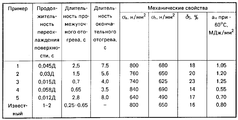
По предлагаемому способу было испытано несколько режимов при граничных (примеры 1 и 3) и заграничных (примеры 4 и 5) параметрах отличительных признаков формулы изобретения, результаты механических испытаний которых приведены в таблице. Кроме того, были проведены испытания и по прототипу. According to the proposed method, several modes were tested at the boundary (examples 1 and 3) and foreign (examples 4 and 5) parameters of the distinguishing features of the claims, the results of mechanical tests of which are shown in the table. In addition, tests were carried out on the prototype.
Из таблицы видно, что оптимальными режимами способа термической обработки проката являются режимы по примерам 1-3. The table shows that the optimal modes of the method of heat treatment of rolled products are the modes of examples 1-3.
Получена термически обработанная стержневая арматура с повышенными эксплуатационными свойствами при отрицательных температурах для термически упрочненного проката из низкоуглеродистых марок сталей, например ст.20. Кроме того, предлагаемый способ позволяет получать высокие пластические свойства при отрицательных температурах на сталях, не содержащих дефицитных и дорогостоящих легирующих элементов. Received heat-treated rod reinforcement with enhanced performance at low temperatures for thermally hardened rolled products from low-carbon steel grades, for example, Art. 20. In addition, the proposed method allows to obtain high plastic properties at low temperatures on steels that do not contain scarce and expensive alloying elements.
Claims (1)
Priority Applications (1)
| Application Number | Priority Date | Filing Date | Title |
|---|---|---|---|
| SU5044384 RU2025503C1 (en) | 1992-05-27 | 1992-05-27 | Heat treatment method for rolled products |
Applications Claiming Priority (1)
| Application Number | Priority Date | Filing Date | Title |
|---|---|---|---|
| SU5044384 RU2025503C1 (en) | 1992-05-27 | 1992-05-27 | Heat treatment method for rolled products |
Publications (1)
| Publication Number | Publication Date |
|---|---|
| RU2025503C1 true RU2025503C1 (en) | 1994-12-30 |
Family
ID=21605332
Family Applications (1)
| Application Number | Title | Priority Date | Filing Date |
|---|---|---|---|
| SU5044384 RU2025503C1 (en) | 1992-05-27 | 1992-05-27 | Heat treatment method for rolled products |
Country Status (1)
| Country | Link |
|---|---|
| RU (1) | RU2025503C1 (en) |
Cited By (3)
| Publication number | Priority date | Publication date | Assignee | Title |
|---|---|---|---|---|
| RU2149193C1 (en) * | 1999-07-05 | 2000-05-20 | ОАО "Западно-Сибирский металлургический комбинат" | Method of producing heat-hardenable reinforcing rod steel |
| RU2169198C2 (en) * | 1999-08-04 | 2001-06-20 | Открытое акционерное общество "Западно-Сибирский металлургический комбинат" | Method of thermomechanical treatment of rolled products |
| RU2213150C2 (en) * | 2001-11-02 | 2003-09-27 | Республиканское Унитарное Предприятие "Белорусский Металлургический Завод" | Method for thermal processing of rolled product |
-
1992
- 1992-05-27 RU SU5044384 patent/RU2025503C1/en active
Non-Patent Citations (1)
| Title |
|---|
| Авторское свидетельство СССР N 1456472, кл. C 21D 1/02, 1989. * |
Cited By (3)
| Publication number | Priority date | Publication date | Assignee | Title |
|---|---|---|---|---|
| RU2149193C1 (en) * | 1999-07-05 | 2000-05-20 | ОАО "Западно-Сибирский металлургический комбинат" | Method of producing heat-hardenable reinforcing rod steel |
| RU2169198C2 (en) * | 1999-08-04 | 2001-06-20 | Открытое акционерное общество "Западно-Сибирский металлургический комбинат" | Method of thermomechanical treatment of rolled products |
| RU2213150C2 (en) * | 2001-11-02 | 2003-09-27 | Республиканское Унитарное Предприятие "Белорусский Металлургический Завод" | Method for thermal processing of rolled product |
Similar Documents
| Publication | Publication Date | Title |
|---|---|---|
| US3810793A (en) | Process of manufacturing a reinforcing bar steel for prestressed concrete | |
| RU2201468C2 (en) | Steel for manufacture of part by cold plastic deformation and method of manufacture of such part | |
| US4023988A (en) | Heat treatment for ball bearing steel to improve resistance to rolling contact fatigue | |
| EP0896068B1 (en) | Bainite hardening | |
| EP0933437B1 (en) | Method of heat-treating a hollow cylindrical workpiece | |
| EP0523375A2 (en) | Process for producing steel bar wire rod for cold working | |
| US3954517A (en) | Method for making carburized bearing members | |
| JP3599551B2 (en) | Wire with excellent drawability | |
| EP0249855B1 (en) | Hot work tool steel | |
| RU2127770C1 (en) | Structural steel of high hardenability | |
| RU2025503C1 (en) | Heat treatment method for rolled products | |
| JP3715744B2 (en) | Non-tempered steel for hot forging used by fracture cutting | |
| RU2081182C1 (en) | Method of heat treatment of rolled products | |
| JPH09314276A (en) | High-strength stainless bolt manufacturing method | |
| JP3288563B2 (en) | Steel for mechanical structure excellent in machinability and resistance to fire cracking and method for producing the same | |
| JP4061003B2 (en) | Cold forging bar wire with excellent induction hardenability and cold forgeability | |
| JPH083640A (en) | Manufacturing method of high tension non-heat treated bolt | |
| CA1201960A (en) | Method of manufacturing steel reinforcements for concrete, having improved properties | |
| RU2081189C1 (en) | Method of heat treatment of rolled products | |
| JPH09242763A (en) | Rolling bearing manufacturing method | |
| JPH04285118A (en) | Production of hot forged non-heattreated steel having high strength and high toughness | |
| EP0191873B1 (en) | Method and steel alloy for producing high-strength hot forgings | |
| JPS59136421A (en) | Preparation of rod steel and wire material having spheroidal structure | |
| RU2149193C1 (en) | Method of producing heat-hardenable reinforcing rod steel | |
| JP3751707B2 (en) | High-strength bolt wire excellent in strength and ductility and its manufacturing method |