NL2010625C2 - MIRROR, AND METHOD FOR MANUFACTURING SUCH MIRROR - Google Patents
MIRROR, AND METHOD FOR MANUFACTURING SUCH MIRROR Download PDFInfo
- Publication number
- NL2010625C2 NL2010625C2 NL2010625A NL2010625A NL2010625C2 NL 2010625 C2 NL2010625 C2 NL 2010625C2 NL 2010625 A NL2010625 A NL 2010625A NL 2010625 A NL2010625 A NL 2010625A NL 2010625 C2 NL2010625 C2 NL 2010625C2
- Authority
- NL
- Netherlands
- Prior art keywords
- mirror
- layer
- glass plate
- adhesive layer
- foregoing
- Prior art date
Links
Classifications
-
- G—PHYSICS
- G02—OPTICS
- G02B—OPTICAL ELEMENTS, SYSTEMS OR APPARATUS
- G02B5/00—Optical elements other than lenses
- G02B5/08—Mirrors
- G02B5/0808—Mirrors having a single reflecting layer
-
- B—PERFORMING OPERATIONS; TRANSPORTING
- B32—LAYERED PRODUCTS
- B32B—LAYERED PRODUCTS, i.e. PRODUCTS BUILT-UP OF STRATA OF FLAT OR NON-FLAT, e.g. CELLULAR OR HONEYCOMB, FORM
- B32B17/00—Layered products essentially comprising sheet glass, or glass, slag, or like fibres
- B32B17/06—Layered products essentially comprising sheet glass, or glass, slag, or like fibres comprising glass as the main or only constituent of a layer, next to another layer of a specific material
- B32B17/069—Layered products essentially comprising sheet glass, or glass, slag, or like fibres comprising glass as the main or only constituent of a layer, next to another layer of a specific material of intumescent material
-
- B—PERFORMING OPERATIONS; TRANSPORTING
- B32—LAYERED PRODUCTS
- B32B—LAYERED PRODUCTS, i.e. PRODUCTS BUILT-UP OF STRATA OF FLAT OR NON-FLAT, e.g. CELLULAR OR HONEYCOMB, FORM
- B32B17/00—Layered products essentially comprising sheet glass, or glass, slag, or like fibres
- B32B17/06—Layered products essentially comprising sheet glass, or glass, slag, or like fibres comprising glass as the main or only constituent of a layer, next to another layer of a specific material
- B32B17/10—Layered products essentially comprising sheet glass, or glass, slag, or like fibres comprising glass as the main or only constituent of a layer, next to another layer of a specific material of synthetic resin
- B32B17/10005—Layered products essentially comprising sheet glass, or glass, slag, or like fibres comprising glass as the main or only constituent of a layer, next to another layer of a specific material of synthetic resin laminated safety glass or glazing
- B32B17/10009—Layered products essentially comprising sheet glass, or glass, slag, or like fibres comprising glass as the main or only constituent of a layer, next to another layer of a specific material of synthetic resin laminated safety glass or glazing characterized by the number, the constitution or treatment of glass sheets
- B32B17/10082—Properties of the bulk of a glass sheet
- B32B17/10091—Properties of the bulk of a glass sheet thermally hardened
-
- B—PERFORMING OPERATIONS; TRANSPORTING
- B32—LAYERED PRODUCTS
- B32B—LAYERED PRODUCTS, i.e. PRODUCTS BUILT-UP OF STRATA OF FLAT OR NON-FLAT, e.g. CELLULAR OR HONEYCOMB, FORM
- B32B17/00—Layered products essentially comprising sheet glass, or glass, slag, or like fibres
- B32B17/06—Layered products essentially comprising sheet glass, or glass, slag, or like fibres comprising glass as the main or only constituent of a layer, next to another layer of a specific material
- B32B17/10—Layered products essentially comprising sheet glass, or glass, slag, or like fibres comprising glass as the main or only constituent of a layer, next to another layer of a specific material of synthetic resin
- B32B17/10005—Layered products essentially comprising sheet glass, or glass, slag, or like fibres comprising glass as the main or only constituent of a layer, next to another layer of a specific material of synthetic resin laminated safety glass or glazing
- B32B17/10009—Layered products essentially comprising sheet glass, or glass, slag, or like fibres comprising glass as the main or only constituent of a layer, next to another layer of a specific material of synthetic resin laminated safety glass or glazing characterized by the number, the constitution or treatment of glass sheets
- B32B17/10128—Treatment of at least one glass sheet
- B32B17/10137—Chemical strengthening
-
- B—PERFORMING OPERATIONS; TRANSPORTING
- B32—LAYERED PRODUCTS
- B32B—LAYERED PRODUCTS, i.e. PRODUCTS BUILT-UP OF STRATA OF FLAT OR NON-FLAT, e.g. CELLULAR OR HONEYCOMB, FORM
- B32B17/00—Layered products essentially comprising sheet glass, or glass, slag, or like fibres
- B32B17/06—Layered products essentially comprising sheet glass, or glass, slag, or like fibres comprising glass as the main or only constituent of a layer, next to another layer of a specific material
- B32B17/10—Layered products essentially comprising sheet glass, or glass, slag, or like fibres comprising glass as the main or only constituent of a layer, next to another layer of a specific material of synthetic resin
- B32B17/10005—Layered products essentially comprising sheet glass, or glass, slag, or like fibres comprising glass as the main or only constituent of a layer, next to another layer of a specific material of synthetic resin laminated safety glass or glazing
- B32B17/10165—Functional features of the laminated safety glass or glazing
- B32B17/10174—Coatings of a metallic or dielectric material on a constituent layer of glass or polymer
-
- B—PERFORMING OPERATIONS; TRANSPORTING
- B32—LAYERED PRODUCTS
- B32B—LAYERED PRODUCTS, i.e. PRODUCTS BUILT-UP OF STRATA OF FLAT OR NON-FLAT, e.g. CELLULAR OR HONEYCOMB, FORM
- B32B17/00—Layered products essentially comprising sheet glass, or glass, slag, or like fibres
- B32B17/06—Layered products essentially comprising sheet glass, or glass, slag, or like fibres comprising glass as the main or only constituent of a layer, next to another layer of a specific material
- B32B17/10—Layered products essentially comprising sheet glass, or glass, slag, or like fibres comprising glass as the main or only constituent of a layer, next to another layer of a specific material of synthetic resin
- B32B17/10005—Layered products essentially comprising sheet glass, or glass, slag, or like fibres comprising glass as the main or only constituent of a layer, next to another layer of a specific material of synthetic resin laminated safety glass or glazing
- B32B17/10165—Functional features of the laminated safety glass or glazing
- B32B17/10431—Specific parts for the modulation of light incorporated into the laminated safety glass or glazing
- B32B17/10467—Variable transmission
- B32B17/10495—Variable transmission optoelectronic, i.e. optical valve
- B32B17/10513—Electrochromic layer
-
- B—PERFORMING OPERATIONS; TRANSPORTING
- B32—LAYERED PRODUCTS
- B32B—LAYERED PRODUCTS, i.e. PRODUCTS BUILT-UP OF STRATA OF FLAT OR NON-FLAT, e.g. CELLULAR OR HONEYCOMB, FORM
- B32B17/00—Layered products essentially comprising sheet glass, or glass, slag, or like fibres
- B32B17/06—Layered products essentially comprising sheet glass, or glass, slag, or like fibres comprising glass as the main or only constituent of a layer, next to another layer of a specific material
- B32B17/10—Layered products essentially comprising sheet glass, or glass, slag, or like fibres comprising glass as the main or only constituent of a layer, next to another layer of a specific material of synthetic resin
- B32B17/10005—Layered products essentially comprising sheet glass, or glass, slag, or like fibres comprising glass as the main or only constituent of a layer, next to another layer of a specific material of synthetic resin laminated safety glass or glazing
- B32B17/1055—Layered products essentially comprising sheet glass, or glass, slag, or like fibres comprising glass as the main or only constituent of a layer, next to another layer of a specific material of synthetic resin laminated safety glass or glazing characterized by the resin layer, i.e. interlayer
- B32B17/10743—Layered products essentially comprising sheet glass, or glass, slag, or like fibres comprising glass as the main or only constituent of a layer, next to another layer of a specific material of synthetic resin laminated safety glass or glazing characterized by the resin layer, i.e. interlayer containing acrylate (co)polymers or salts thereof
-
- B—PERFORMING OPERATIONS; TRANSPORTING
- B32—LAYERED PRODUCTS
- B32B—LAYERED PRODUCTS, i.e. PRODUCTS BUILT-UP OF STRATA OF FLAT OR NON-FLAT, e.g. CELLULAR OR HONEYCOMB, FORM
- B32B17/00—Layered products essentially comprising sheet glass, or glass, slag, or like fibres
- B32B17/06—Layered products essentially comprising sheet glass, or glass, slag, or like fibres comprising glass as the main or only constituent of a layer, next to another layer of a specific material
- B32B17/10—Layered products essentially comprising sheet glass, or glass, slag, or like fibres comprising glass as the main or only constituent of a layer, next to another layer of a specific material of synthetic resin
- B32B17/10005—Layered products essentially comprising sheet glass, or glass, slag, or like fibres comprising glass as the main or only constituent of a layer, next to another layer of a specific material of synthetic resin laminated safety glass or glazing
- B32B17/1055—Layered products essentially comprising sheet glass, or glass, slag, or like fibres comprising glass as the main or only constituent of a layer, next to another layer of a specific material of synthetic resin laminated safety glass or glazing characterized by the resin layer, i.e. interlayer
- B32B17/10761—Layered products essentially comprising sheet glass, or glass, slag, or like fibres comprising glass as the main or only constituent of a layer, next to another layer of a specific material of synthetic resin laminated safety glass or glazing characterized by the resin layer, i.e. interlayer containing vinyl acetal
-
- B—PERFORMING OPERATIONS; TRANSPORTING
- B32—LAYERED PRODUCTS
- B32B—LAYERED PRODUCTS, i.e. PRODUCTS BUILT-UP OF STRATA OF FLAT OR NON-FLAT, e.g. CELLULAR OR HONEYCOMB, FORM
- B32B17/00—Layered products essentially comprising sheet glass, or glass, slag, or like fibres
- B32B17/06—Layered products essentially comprising sheet glass, or glass, slag, or like fibres comprising glass as the main or only constituent of a layer, next to another layer of a specific material
- B32B17/10—Layered products essentially comprising sheet glass, or glass, slag, or like fibres comprising glass as the main or only constituent of a layer, next to another layer of a specific material of synthetic resin
- B32B17/10005—Layered products essentially comprising sheet glass, or glass, slag, or like fibres comprising glass as the main or only constituent of a layer, next to another layer of a specific material of synthetic resin laminated safety glass or glazing
- B32B17/1055—Layered products essentially comprising sheet glass, or glass, slag, or like fibres comprising glass as the main or only constituent of a layer, next to another layer of a specific material of synthetic resin laminated safety glass or glazing characterized by the resin layer, i.e. interlayer
- B32B17/10788—Layered products essentially comprising sheet glass, or glass, slag, or like fibres comprising glass as the main or only constituent of a layer, next to another layer of a specific material of synthetic resin laminated safety glass or glazing characterized by the resin layer, i.e. interlayer containing ethylene vinylacetate
-
- B—PERFORMING OPERATIONS; TRANSPORTING
- B32—LAYERED PRODUCTS
- B32B—LAYERED PRODUCTS, i.e. PRODUCTS BUILT-UP OF STRATA OF FLAT OR NON-FLAT, e.g. CELLULAR OR HONEYCOMB, FORM
- B32B37/00—Methods or apparatus for laminating, e.g. by curing or by ultrasonic bonding
- B32B37/06—Methods or apparatus for laminating, e.g. by curing or by ultrasonic bonding characterised by the heating method
-
- B—PERFORMING OPERATIONS; TRANSPORTING
- B32—LAYERED PRODUCTS
- B32B—LAYERED PRODUCTS, i.e. PRODUCTS BUILT-UP OF STRATA OF FLAT OR NON-FLAT, e.g. CELLULAR OR HONEYCOMB, FORM
- B32B37/00—Methods or apparatus for laminating, e.g. by curing or by ultrasonic bonding
- B32B37/14—Methods or apparatus for laminating, e.g. by curing or by ultrasonic bonding characterised by the properties of the layers
-
- G—PHYSICS
- G02—OPTICS
- G02B—OPTICAL ELEMENTS, SYSTEMS OR APPARATUS
- G02B1/00—Optical elements characterised by the material of which they are made; Optical coatings for optical elements
- G02B1/10—Optical coatings produced by application to, or surface treatment of, optical elements
- G02B1/14—Protective coatings, e.g. hard coatings
-
- G—PHYSICS
- G02—OPTICS
- G02B—OPTICAL ELEMENTS, SYSTEMS OR APPARATUS
- G02B1/00—Optical elements characterised by the material of which they are made; Optical coatings for optical elements
- G02B1/10—Optical coatings produced by application to, or surface treatment of, optical elements
- G02B1/18—Coatings for keeping optical surfaces clean, e.g. hydrophobic or photo-catalytic films
-
- G—PHYSICS
- G02—OPTICS
- G02F—OPTICAL DEVICES OR ARRANGEMENTS FOR THE CONTROL OF LIGHT BY MODIFICATION OF THE OPTICAL PROPERTIES OF THE MEDIA OF THE ELEMENTS INVOLVED THEREIN; NON-LINEAR OPTICS; FREQUENCY-CHANGING OF LIGHT; OPTICAL LOGIC ELEMENTS; OPTICAL ANALOGUE/DIGITAL CONVERTERS
- G02F1/00—Devices or arrangements for the control of the intensity, colour, phase, polarisation or direction of light arriving from an independent light source, e.g. switching, gating or modulating; Non-linear optics
- G02F1/01—Devices or arrangements for the control of the intensity, colour, phase, polarisation or direction of light arriving from an independent light source, e.g. switching, gating or modulating; Non-linear optics for the control of the intensity, phase, polarisation or colour
- G02F1/15—Devices or arrangements for the control of the intensity, colour, phase, polarisation or direction of light arriving from an independent light source, e.g. switching, gating or modulating; Non-linear optics for the control of the intensity, phase, polarisation or colour based on an electrochromic effect
- G02F1/153—Constructional details
-
- B—PERFORMING OPERATIONS; TRANSPORTING
- B32—LAYERED PRODUCTS
- B32B—LAYERED PRODUCTS, i.e. PRODUCTS BUILT-UP OF STRATA OF FLAT OR NON-FLAT, e.g. CELLULAR OR HONEYCOMB, FORM
- B32B2307/00—Properties of the layers or laminate
- B32B2307/40—Properties of the layers or laminate having particular optical properties
- B32B2307/416—Reflective
-
- B—PERFORMING OPERATIONS; TRANSPORTING
- B32—LAYERED PRODUCTS
- B32B—LAYERED PRODUCTS, i.e. PRODUCTS BUILT-UP OF STRATA OF FLAT OR NON-FLAT, e.g. CELLULAR OR HONEYCOMB, FORM
- B32B2307/00—Properties of the layers or laminate
- B32B2307/50—Properties of the layers or laminate having particular mechanical properties
- B32B2307/558—Impact strength, toughness
-
- B—PERFORMING OPERATIONS; TRANSPORTING
- B32—LAYERED PRODUCTS
- B32B—LAYERED PRODUCTS, i.e. PRODUCTS BUILT-UP OF STRATA OF FLAT OR NON-FLAT, e.g. CELLULAR OR HONEYCOMB, FORM
- B32B2551/00—Optical elements
- B32B2551/08—Mirrors
Landscapes
- Physics & Mathematics (AREA)
- General Physics & Mathematics (AREA)
- Optics & Photonics (AREA)
- Chemical & Material Sciences (AREA)
- Chemical Kinetics & Catalysis (AREA)
- Nonlinear Science (AREA)
- General Chemical & Material Sciences (AREA)
- Thermal Sciences (AREA)
- Laminated Bodies (AREA)
- Rear-View Mirror Devices That Are Mounted On The Exterior Of The Vehicle (AREA)
- Joining Of Glass To Other Materials (AREA)
Abstract
Description
Spiegel, en werkwijze ter vervaardiging van een dergelijke spiegelMirror, and method of manufacturing such a mirror
De uitvinding heeft betrekking op een spiegel. De uitvinding heeft verder betrekking op een motorrijtuig, omvattende een spiegel overeenkomstig de uitvinding. De uitvinding heeft tevens betrekking op een luchtvaartuig, omvattende een spiegel overeenkomstig de uitvinding. De uitvinding heeft daarnaast betrekking op een vaartuig, omvattende een spiegel overeenkomstig de uitvinding. De uitvinding heeft voorts betrekking op een werkwijze voor het vervaardigen van een spiegel overeenkomstig de uitvinding.The invention relates to a mirror. The invention further relates to a motor vehicle, comprising a mirror according to the invention. The invention also relates to an aircraft, comprising a mirror according to the invention. The invention also relates to a vessel, comprising a mirror according to the invention. The invention further relates to a method for manufacturing a mirror according to the invention.
Spiegels waarnaar in de onderhavige beschrijving verwezen wordt, omvatten in het algemeen een glasplaat met op het glasoppervlak afgezette reflecterende metaallaag en een beschermlaag, die op het reflecterende metaal is aangebracht. Voorbeelden van gewoonlijk toegepaste reflecterende metalen zijn zilver, chroom, en koper. De beschermlaag, die gewoonlijk een verflaag is, dient ten dele voor het beschermen van het reflecterende metaal tegen slijtage, doch meer in het bijzonder verschaft het metaal resistentie tegen corrosie. Indien een dergelijke anti-corrosiebescherming aan het reflecterende metaal niet wordt meegegeven dan heeft het metaal de neiging oxidatie te ondergaan dan wel aantasting door atmosferische verontreinigingen, hetgeen resulteert in dof worden en verkleuring en derhalve in een vermindering van de spiegelende reflecterende eigenschappen van de spiegel. Spiegels hebben doorgaans een vlakke geometrie en worden dagelijks gebruikt als cosmetische spiegel en/of als veiligheidsspiegel. Bij een vlakke spiegel is het beeld dat wordt gegenereerd door de spiegel even groot als het origineel. Een belangrijk nadeel van de bekende spiegels is dat deze een relatief lage impactresistentie hebben en derhalve relatief snel breekbaar zijn. Een verder nadeel van de bekende spiegels is dat deze doorgaans relatief zwaar zijn. Voornoemde nadelen maken de spiegels minder geschikt om te worden toegepast in voertuigen, daar dit het gewicht van de voertuigen en daarmee het energieverbruik laten toenemen, en bovendien leidt tot ongewenste splintervorming in het voertuig ingeval de spiegel zou breken.Mirrors referred to in the present description generally include a glass plate with a reflective metal layer deposited on the glass surface and a protective layer applied to the reflective metal. Examples of commonly used reflective metals are silver, chromium, and copper. The protective layer, which is usually a paint layer, serves in part to protect the reflective metal from wear, but more particularly, the metal provides corrosion resistance. If such an anti-corrosion protection is not imparted to the reflective metal, the metal tends to undergo oxidation or attack by atmospheric impurities, resulting in dullness and discoloration and therefore a reduction in the reflective reflective properties of the mirror. Mirrors generally have a flat geometry and are used daily as a cosmetic mirror and / or as a safety mirror. With a flat mirror, the image generated by the mirror is the same size as the original. A major drawback of the known mirrors is that they have a relatively low impact resistance and are therefore relatively quickly breakable. A further drawback of the known mirrors is that they are generally relatively heavy. The aforementioned disadvantages make the mirrors less suitable for use in vehicles, since this increases the weight of the vehicles and thereby the energy consumption, and moreover leads to undesired splintering in the vehicle in the event of a mirror breaking.
Een eerste doel van de uitvinding is het verschaffen van een verbeterde spiegel, waarmee ten minste één van voornoemde nadelen kan worden voorkomen.A first object of the invention is to provide an improved mirror with which at least one of the aforementioned disadvantages can be prevented.
Een tweede doel van de uitvinding is het verschaffen van een spiegel met een gereduceerd gewicht.A second object of the invention is to provide a mirror with a reduced weight.
Een derde doel van de uitvinding is het verschaffen van een spiegel die een verhoogde impactresistentie heeft.A third object of the invention is to provide a mirror that has an increased impact resistance.
Althans één van voomoemde doelen kan worden bereikt door het verschaffen van een spiegel volgens het in aanhef genoemde type, omvattende: ten minste één ultradunne geharde eerste glasplaat met een maximale dikte van 1,0 mm, in het bijzonder een maximale dikte van 0,7 mm; ten minste één met een frontale zijde van de eerste glasplaat verbonden ten minste één polymeer omvattende hechtlaag, ten minste één met de hechtlaag verbonden verstevigingsplaat, en ten minste één tussen de glasplaat en de verstevigingsplaat aangebrachte spiegellaag. Doordat de spiegel overeenkomstig de uitvinding een laminaat van onderlinge gehechte materiaallagen omvat kan een substantiële toename van de impactresistentie worden gerealiseerd, waardoor ingeval van een impact op de eerste ultradunne glasplaat - doorgaans de voorzijde (voorste laag) van de spiegel - versplintering (decompositie) van de betreffende geharde ultradunne glasplaat en het laminaat kan worden tegengegaan, hetgeen vanuit oogpunt van veiligheid bijzonder voordelig is. Doordat de glasplaat ultradun is met een dikte kleiner of gelijk aan 0,7 mm alsmede onderworpen is aan een hardingsproces ter versteviging van de glasstructuur, kan deze impactresistentie verder worden verhoogd. Bovendien zal door toepassing van de ultradunne glasplaat het gewicht van de spiegel aanzienlijk kunnen worden gereduceerd, hetgeen vanuit financieel oogpunt voordelig is, doch bovendien vanuit energetisch oogpunt voordelig is ingeval de spiegel overeenkomstig de uitvinding wordt toegepast in een voertuig. De spiegel overeenkomstig de uitvinding zal doorgaans een vlakke geometrie bezitten. Het is echter denkbaar dat de spiegel een enkelvoudig of meervoudig gekromde geometrie bezit. De voordelige constructie van de spiegel overeenkomstig de uitvinding maakt het mogelijk dat de spiegel is toe te passen in legio toepassingen en sectoren, met name in de bouwsector en transportsector, met name in transportvoertuigen, zoals in automobielen, vaartuigen, en luchtvaartuigen. In het kader van dit octrooi schrift wordt onder spiegel in het bijzonder, doch niet uitsluitend, verstaan een spiegel die is bedoeld voor persoonlijk gebruik. Hiermee wordt bedoeld dat een persoon in de spiegel kan kijken en een beeld zal zien. Dit beeld kan een zelfbeeld betreffen, waardoor de spiegel in het bijzonder geschikt is als cosmetische spiegel en/of veiligheidsspiegel. Ingeval de persoon een ander beeld dan een zelfbeeld zal zien, zal de spiegel in het bijzonder geschikt zijn om te worden toegepast als veiligheidsspiegel. De dikte van de glasplaat is bij voorkeur kleiner dan 1,0 mm, bij nadere voorkeur kleiner dan 0,7 mm, en kan een typische dikte hebben van 0,3; 0,4; of 0,55 mm.At least one of the aforementioned objectives can be achieved by providing a mirror of the type mentioned in the preamble, comprising: at least one ultra-thin cured first glass plate with a maximum thickness of 1.0 mm, in particular a maximum thickness of 0.7 mm; at least one bonding layer comprising at least one polymer layer bonded to a frontal side of the first glass plate, at least one reinforcing plate connected to the bonding layer, and at least one mirror layer disposed between the glass plate and the reinforcing plate. Because the mirror according to the invention comprises a laminate of mutually adhered material layers, a substantial increase in the impact resistance can be realized, so that in the event of an impact on the first ultra-thin glass plate - usually the front (front layer) of the mirror - fragmentation (decomposition) of the relevant hardened ultra-thin glass plate and the laminate can be counteracted, which is particularly advantageous from a safety point of view. Because the glass plate is ultra-thin with a thickness less than or equal to 0.7 mm and is subjected to a hardening process to reinforce the glass structure, this impact resistance can be further increased. Moreover, by using the ultra-thin glass plate, the weight of the mirror can be considerably reduced, which is advantageous from a financial point of view, but moreover is advantageous from an energy point of view if the mirror according to the invention is used in a vehicle. The mirror according to the invention will generally have a flat geometry. However, it is conceivable that the mirror has a single or multiple curved geometry. The advantageous construction of the mirror according to the invention makes it possible for the mirror to be used in many applications and sectors, in particular in the construction sector and transport sector, in particular in transport vehicles, such as in automobiles, vessels and aircraft. For the purposes of this patent specification, a mirror is understood to mean, in particular, but not exclusively, a mirror intended for personal use. This means that a person can look in the mirror and see an image. This image can be a self-image, whereby the mirror is particularly suitable as a cosmetic mirror and / or safety mirror. In case the person will see a different image than a self-image, the mirror will in particular be suitable for use as a safety mirror. The thickness of the glass plate is preferably less than 1.0 mm, more preferably less than 0.7 mm, and can have a typical thickness of 0.3; 0.4; or 0.55 mm.
Navolgend zullen ter illustratie meerdere voordelige uitvoeringsvormen van de spiegel overeenkomstig de uitvinding worden beschreven. In enkele uitvoeringsvormen zijn meerdere inventieve concepten terug te vinden. Het is denkbaar dat individuele inventieve concepten en technische maatregelen worden toegepast zonder daarbij alle details van een bepaalde uitvoeringsvorm eveneens toe te passen.In the following, several advantageous embodiments of the mirror according to the invention will be described by way of illustration. Several inventive concepts can be found in some embodiments. It is conceivable that individual inventive concepts and technical measures are applied without applying all the details of a particular embodiment.
Het moge duidelijk zijn dat diverse modificaties op de hieronder beschreven uitvoeringsvormen denkbaar zijn voor een vakman, waarbij een vakman verschillende inventieve concepten en/of technische maatregelen van verschillende uitvoeringsvormen kan combineren zonder daarbij afstand te doen van de in bijgesloten conclusies beschreven uitvindingsgedachte.It will be clear that various modifications to the embodiments described below are conceivable for a person skilled in the art, wherein a person skilled in the art can combine different inventive concepts and / or technical measures of different embodiments without thereby renouncing the inventive idea described in the appended claims.
Bij voorkeur is de spiegellaag tussen de eerste glasplaat en de hechtlaag aangebracht.The mirror layer is preferably arranged between the first glass plate and the adhesive layer.
Op deze wijze wordt het reflecterende (spiegelende) vermogen van de spiegellaag minimaal aangetast, onderwijl de spiegellaag evenwel wordt beschermd (afgeschermd) door de eerste glasplaat. De spiegellaag kan divers zijn uitgevoerd. Het is daarbij denkbaar dat de spiegellaag is uitgevoerd als een ten minste eenzijdig reflecterend folie. Voordeel van een folie is dat de laagdikte van de spiegellaag in hoofdzaak homogeen is, hetgeen een homogene reflectie van de spiegel ten goede kan komen. Het is tevens denkbaar dat een (dunne) metaal(oxide)laag wordt aangebracht op een andere laag van het laminaat, welke andere dragende laag bij voorkeur wordt gevormd door de eerste glasplaat. Voorbeelden van geschikte metalen zijn koper, zilver, goud, nikkel, aluminium, Berillium, chroom, molybdeen, platina, rhodium, wolfraam, en titaan. De metaallaag kan middels vacuümdamptechnieken en/of sputteren worden aangebracht op de dragende laag, in het bijzonder de eerste glasplaat. Eventueel kan de aangebrachte metaallaag ten minste gedeeltelijk worden verwijderd, bijvoorbeeld middels zandstralen, teneinde een deel van de spiegel volledig of semi-transparant te maken en/of om de spiegel een gesatineerd (mat) uiterlijk te verschaffen. Dit maakt het mogelijk om achter te spiegellaag, bijvoorbeeld in een separate materiaallaag, visuele effecten te genereren die via de semi-transparante spiegel zichtbaar zullen zijn voor personen die in de spiegel kijken. Voomoemde voorbeelden van de spiegellaag betreffen uitvoeringsvormen waarbij de (statische) spiegellaag permanent spiegelend is uitgevoerd.In this way the reflective (reflective) power of the mirror layer is minimally affected, while the mirror layer is, however, protected (shielded) by the first glass plate. The mirror layer can be of various designs. It is conceivable in this connection that the mirror layer is designed as an at least one-sided reflective film. The advantage of a foil is that the layer thickness of the mirror layer is substantially homogeneous, which can benefit a homogeneous reflection of the mirror. It is also conceivable that a (thin) metal (oxide) layer is applied to another layer of the laminate, which other supporting layer is preferably formed by the first glass plate. Examples of suitable metals are copper, silver, gold, nickel, aluminum, Berillium, chromium, molybdenum, platinum, rhodium, tungsten, and titanium. The metal layer can be applied to the supporting layer, in particular the first glass plate, by means of vacuum vapor techniques and / or sputtering. Optionally, the applied metal layer can be removed at least in part, for example by sandblasting, in order to make a part of the mirror completely or semi-transparent and / or to provide the mirror with a satinized (mat) appearance. This makes it possible to generate visual effects behind the mirror layer, for example in a separate material layer, which will be visible via the semi-transparent mirror for people looking into the mirror. The aforementioned examples of the mirror layer concern embodiments in which the (static) mirror layer is permanently mirrored.
Het is echter tevens denkbaar dat de spiegellaag semipermanent (tijdelijk) spiegelend is uitgevoerd. Doorgaans kan de spiegellaag daarbij naar wens spiegelend worden gemaakt. Dit is bijvoorbeeld mogelijk door ten minste een deel van de spiegellaag te laten vormen door een elektrochromatische laag. Door de elektrochromatische laag, eventueel gebaseerd op vloeibare kristallen (LCD), aan te sluiten op een elektrische energiebron, zoals een batterij, kan de laag worden geladen, waardoor de spiegelende laag kan worden geactiveerd dan wel worden gedeactiveerd. De elektrochromatische laag kan eventueel mee worden gelamineerd tijdens het productieproces. Het is tevens denkbaar een dergelijke laag later te assembleren met het reeds gevormde laminaat. Het is denkbaar de thermochromatische laag te positioneren achter een eventueel niet-spiegelend, eventueel ontspiegeld, deel van de spiegel, in het bijzonder van de eerste glasplaat.However, it is also conceivable that the mirror layer has a semi-permanent (temporary) mirroring design. The mirror layer can generally be made reflective as desired. This is possible, for example, by having at least a part of the mirror layer formed by an electrochromatic layer. By connecting the electrochromatic layer, possibly based on liquid crystals (LCD), to an electrical energy source, such as a battery, the layer can be charged, whereby the mirroring layer can be activated or deactivated. The electrochromatic layer can optionally be laminated during the production process. It is also conceivable to later assemble such a layer with the laminate already formed. It is conceivable to position the thermochromatic layer behind a possibly non-reflective, possibly anti-reflective, part of the mirror, in particular of the first glass plate.
De lichtdoorlaatbaarheid van de spiegellaag is afhankelijk van het type spiegellaag dat wordt toegepast alsook de beoogde toepassing van de spiegel. Doorgaans zal deze lichtdoorlaatbaarheid zijn gelegen tussen 10% en 80%. De dikte van de spiegellaag hangt tevens af van het type van de gebruikte spiegellaag, waarbij de dikte van bijvoorbeeld een metaallaag doorgaans in de ordegrootte van 70-100 nanometer is gelegen voor een lichtondoorlatende spiegel en zelfs geringer kan zijn bij (semi)lichtdoorlatende spiegels, terwijl een elektrochromatische laag doorgaans in de ordegrootte van enkele millimeter, typisch tussen 0,5 en 2 millimeter, is gelegen.The light transmittance of the mirror layer depends on the type of mirror layer that is used as well as the intended use of the mirror. This light transmittance will generally be between 10% and 80%. The thickness of the mirror layer also depends on the type of mirror layer used, wherein the thickness of, for example, a metal layer is generally in the order of 70-100 nanometers for a light-impermeable mirror and may even be smaller for (semi) light-transmitting mirrors, whereas an electrochromatic layer is usually in the order of a few millimeters, typically between 0.5 and 2 millimeters.
In een voorkeursuitvoering is een van de eerste glasplaat afgekeerde zijde van de spiegellaag ten minste gedeeltelijk voorzien van een de spiegellaag beschermende coating. De coating is met name voordelig ingeval de spiegellaag wordt gevormd door een metaallaag, teneinde oxidatie van de metaallaag te kunnen voorkomen, of althans te kunnen tegengaan. Ingeval de spiegellaag wordt gevormd door een koperlaag is het bijvoorbeeld denkbaar te koperlaag te bekleden met een inhibitor gebaseerd op bijvoorbeeld azoolderivaat. Nadere details hierover zijn beschreven in het Britse octrooischrift GB1074076. De toepassing van azoolgebaseerde inhibitors heeft geleid tot een waarneembare verbetering in het voorkomen of vertragen van het verschijnen van een waas door te beletten dat het koper wordt geoxideerd en dientengevolge ook een eventueel onderliggende zilverlaag. De coating kan tevens op de omtreksrand(en) van de spiegellaag worden aangebracht, teneinde ook de kopse zijde te beschermen tegen corrosie.In a preferred embodiment, a side of the mirror layer remote from the first glass plate is at least partially provided with a coating protecting the mirror layer. The coating is particularly advantageous if the mirror layer is formed by a metal layer in order to be able to prevent or at least prevent oxidation of the metal layer. If the mirror layer is formed by a copper layer, for example, it is conceivable to coat the copper layer with an inhibitor based on, for example, azole derivative. Further details on this are described in British Patent Specification GB1074076. The use of azole-based inhibitors has led to a noticeable improvement in preventing or delaying the appearance of a haze by preventing the copper from being oxidized and, consequently, from any underlying silver layer. The coating can also be applied to the peripheral edge (s) of the mirror layer in order to also protect the front side against corrosion.
Bij voorkeur wordt de beschermlaag als verf met een rest inwendige spanning Sr· die gelijk is aan of kleiner is dan IMPa, gemeten volgens de methode van Cantilever, bij een temperatuur boven zijn glasovergangstemperatuur, hetgeen tot een sterk toegenomen bestendigheid tegen corrosie kan leiden. De verf, die wordt aangebracht als beschermlaag voor een metaallaag die op de eerste glasplaat is aangebracht, wordt in het algemeen in vloeibare vorm afgezet en wordt gebakken of anderszins behandeld teneinde het oplosmiddel te verdampen en/of verknoping te bevorderen en derhalve harding van de verf te verkrijgen. Eén van de belangrijkste kenmerken waaraan de verf bij voorkeur moet voldoen, is dat deze sterk hecht aan de metaallaag. Vanwege de lage restspanning kan een relatief sterke hechting op het metaal worden verkregen. Een verdere beschrijving van deze uitvoeringsvorm is opgenomen in het Nederlandse octrooischrift NL9000160, waarvan de inhoud middels verwijzing daarnaar deel uitmaakt van de beschrijving van dit octrooischrift.Preferably, the protective layer becomes a paint with a residual internal stress Sr · equal to or less than IMPa, measured according to the Cantilever method, at a temperature above its glass transition temperature, which can lead to a greatly increased resistance to corrosion. The paint, which is applied as a protective layer for a metal layer applied to the first glass plate, is generally deposited in liquid form and is baked or otherwise treated in order to evaporate the solvent and / or to promote cross-linking and therefore curing of the paint to obtain. One of the most important characteristics that the paint must preferably meet is that it adheres strongly to the metal layer. Due to the low residual stress, a relatively strong adhesion to the metal can be obtained. A further description of this embodiment is included in Dutch patent specification NL9000160, the contents of which are incorporated herein by reference in the description of this patent specification.
Bij voorkeur heeft de coating een temperatuurbestendigheid van ten minste 150 °C. Dit maakt het mogelijk om de coating volledig in tact te houden tijdens het lamineren van de verschillende materiaallagen van de spiegel. Dit lamineringsproces geschiedt doorgaans bij circa 130 °C.The coating preferably has a temperature resistance of at least 150 ° C. This makes it possible to keep the coating fully intact while laminating the different layers of material of the mirror. This lamination process usually takes place at approximately 130 ° C.
Doordat de beschermende coating bij voorkeur direct is aangebracht op de spiegellaag, zijn bij voorkeur de spiegellaag alsmede n de coating aangebracht tussen de eerste glasplaat en de hechtlaag. Zoals reeds in het voorgaande vermeld heeft dit als belangrijk voordeel dat het reflecterende vermogen van de spiegellaag niet noemenswaardig wordt aangetast, doordat slechts de ultradunne (heldere) eerste glasplaat voor de spiegellaag is aangebracht.Because the protective coating is preferably applied directly to the mirror layer, the mirror layer as well as the coating are preferably arranged between the first glass plate and the adhesive layer. As already stated in the foregoing, this has the important advantage that the reflective power of the mirror layer is not appreciably affected by the fact that only the ultra-thin (clear) first glass plate is arranged in front of the mirror layer.
De eerste glasplaat is gehard, teneinde het glas bijzonder sterk te maken. Daarbij vindt met name een oppervlakteharding plaats die leidt tot een drukspanning aan het buitenoppervlak van de glasplaat en een trekspanning in de kern van de glasplaat. Harding van het glas kan zowel op chemische wijze alsook thermische wijze geschieden. Doorgaans geniet een chemische harding de voorkeur, waarbij het (ongeharde) glas bij voorkeur ondergedompeld in een bad met gesmolten kaliumnitraat bij een temperatuur van ongeveer 400 °C. Daarbij ontstaat chemische uitwisseling van K+-ionen uit het bad met de Na+-ionen uit het glas. De K+-ionen (afmetingen 2,66 A) nemen de plaats in van de Na+-ionen (afmetingen 1,96 A). Vermits deze grotere afmetingen hebben, induceren zij drukspanningen aan de oppervlakte van het glas, dat zodoende meer weerstand kan bieden. De onderdompelingsduur is bepalend voor het uiteindelijk verkregen spanningsniveau. De spanningsverdeling vertoont niet dezelfde vorm als bij thermisch gehard glas, en leidt doorgaans tot beduidend sterker glas dan wanneer ongehard glas op thermische wijze zou worden gehard. In dit kader wordt opgemerkt dat chemisch gehard glad doorgaans een veel hogere drukspanning heeft aan de oppervlakte van de glasplaat die juist onder het oppervlak relatief snel afneemt, waarbij in het midden (1/2 diepte) van de glasplaat een beperkte trekspanning aanwezig is, waardoor een geblokt spanningsprofiel ontstaat. Thermisch gehard glas heeft doorgaans een aanzienlijk lagere drukspanning aan de oppervlakte van de glasplaat, waarbij in het midden van de glasplaat een relatief hoge trekspanning aanwezig is, waardoor een parabolisch spanningsprofiel ontstaat.The first glass plate is hardened to make the glass particularly strong. In particular, a surface hardening takes place that leads to a compressive stress on the outer surface of the glass plate and a tensile stress in the core of the glass plate. Curing of the glass can be done chemically as well as thermally. A chemical hardening is generally preferred, the (uncured) glass preferably being immersed in a bath with molten potassium nitrate at a temperature of approximately 400 ° C. This results in a chemical exchange of K + ions from the bath with the Na + ions from the glass. The K + ions (dimensions 2.66 A) take the place of the Na + ions (dimensions 1.96 A). Since these have larger dimensions, they induce compressive stresses on the surface of the glass, which can thus offer more resistance. The immersion duration determines the ultimate voltage level obtained. The voltage distribution does not have the same shape as with thermally tempered glass, and generally leads to significantly stronger glass than if unhardened glass were thermally tempered. In this context, it is noted that chemically cured smooth usually has a much higher compressive stress on the surface of the glass plate which decreases relatively quickly just below the surface, with a limited tensile stress being present in the middle (1/2 depth) of the glass plate, so that a blocked voltage profile is created. Thermally tempered glass generally has a considerably lower compressive stress on the surface of the glass plate, with a relatively high tensile stress being present in the center of the glass plate, resulting in a parabolic stress profile.
De hechtlaag heeft als belangrijkste doel het onderling direct of indirect hechten van de eerste glasplaat en de achterliggende verstevigingsplaat, zodat een relatief stevig en stabiel laminaat kan worden verkregen, hetgeen de duurzaamheid en de impactresistentie van het laminaat doorgaans ten goede komen. In een mogelijke uitvoeringsvorm wordt de hechtlaag initieel gevormd door een vaste, vloeibaar of pasteuze lijmlaag, zoals bijvoorbeeld epoxylijm of polyurethaanlijm. De hechtlaag wordt bij voorkeur ten minste gedeeltelijk gevormd door een kunststof folie. Dit folie zal tijdens het lamineringsproces versmelten met naastgelegen materiaallagen. De folie kan bijvoorbeeld zijn vervaardigd uit ethyleenvinylacetaat (EVA). Het voordeel van EVA is dat dit polymeer bijzonder geschikt is om te worden vermengd met additieven, waardoor van de spiegel kan worden voorzien bijzondere eigenschappen. Een nadeel van EVA is dat EVA is dat EVA relatief zacht is, en vanuit constructief oogpunt minder de voorkeur geniet. De hechtlaag kan tevens uit polyvinylbutyral (PVB) worden vervaardigd dat doorgaans een relatief beperkte dikte heeft van circa 0,38 mm en relatief goedkoop kan worden aangeschaft. Eventueel kan het folie eenzijdig of tweezijdig klevend zijn uitgevoerd, hetgeen het vervaardigen van het laminaat en/of het onderling uitlijnen en stabiliseren van materiaallaag kan vergemakkelijken.The main purpose of the adhesive layer is to bond the first glass plate and the underlying reinforcement plate to each other directly or indirectly, so that a relatively strong and stable laminate can be obtained, which generally benefits the durability and impact resistance of the laminate. In a possible embodiment the adhesive layer is initially formed by a solid, liquid or pasty adhesive layer, such as for example epoxy glue or polyurethane glue. The adhesive layer is preferably at least partially formed by a plastic film. This foil will fuse with adjacent layers of material during the lamination process. The film can for example be made from ethylene vinyl acetate (EVA). The advantage of EVA is that this polymer is particularly suitable for being mixed with additives, whereby the mirror can be provided with special properties. A disadvantage of EVA is that EVA is that EVA is relatively soft, and is less preferred from a structural point of view. The adhesive layer can also be made from polyvinyl butyral (PVB) which usually has a relatively limited thickness of approximately 0.38 mm and can be purchased relatively cheaply. The film can optionally be made of one-sided or two-sided adhesive, which can facilitate the manufacture of the laminate and / or the mutual alignment and stabilization of material layer.
Bij voorkeur is de hechtlaag ten minste gedeeltelijk vervaardigd uit een ionomeer. Ionomeren zijn polymere materialen met hydrofobe organische ketens waaraan een klein gehalte ionische groepen is gebonden. Ionomeren worden voornamelijk gesynthetiseerd door copolymerisatie van ten minste één functioneel monomeer met ten minste één onverzadigd monomeer, waarna een deel van de functionele groepen van het ten minste ene functionele monomeer wordt geneutraliseerd door een metaalkation, waardoor sterk polaire zoutgroepen worden gevormd in het copolymeer. Deze sterk polaire zoutgroepen verenigen zich in kleine clusters, die optreden als tijdelijke, thermoreversibele vernettingspunten (crosslinks) bij kamertemperatuur, maar die voldoende verweken bij verhoogde temperatuur om thermoplastische verwerking mogelijk te maken. Door aanwezigheid van de thermoreversibele crosslinks zal de elasticiteit van het ionomeer aanzienlijk hoger zijn dan de elasticiteit van de uit de stand van techniek bekende thermoplasten. Bovendien heeft studie naar de mechanische eigenschappen en smeltverwerkbaarheid onthuld dat ionomeren relatief goede mechanische eigenschappen en een relatief hoge smeltviscositeit kunnen bezitten, afhankelijk van de samenstelling van de ionomeren, waardoor een hoge impactresistentie kan worden gewaarborgd, en waardoor het hechtend vermogen van de hechtlaag voor hechting aan glas aanzienlijk kan worden verbeterd.Preferably the adhesive layer is at least partially made from an ionomer. Ionomers are polymeric materials with hydrophobic organic chains to which a small amount of ionic groups is attached. Ionomers are mainly synthesized by copolymerizing at least one functional monomer with at least one unsaturated monomer, after which a portion of the functional groups of the at least one functional monomer is neutralized by a metal cation, thereby forming strongly polar salt groups in the copolymer. These highly polar salt groups combine into small clusters that act as temporary, thermoreversible cross-linking points (cross-links) at room temperature, but which soften sufficiently at elevated temperature to allow thermoplastic processing. Due to the presence of the thermoreversible crosslinks, the elasticity of the ionomer will be considerably higher than the elasticity of the thermoplastics known from the prior art. In addition, studies of mechanical properties and melt processability have revealed that ionomers can have relatively good mechanical properties and relatively high melt viscosity, depending on the composition of the ionomers, thereby ensuring high impact resistance, and allowing the adhesiveness of the adhesive layer for adhesion glass can be improved considerably.
Bij voorkeur omvat het ionomeer een copolymeer van etheen en een carbonzuur gekozen uit de groep van bestaande uit: a, β-onverzadigde carbonzuren met 3-8 koolstofatomen, waarbij een deel van de zuurgroepen is geneutraliseerd met ten minste één metaalion. Daarbij is het bijzonder voordelig ingeval zinkionen worden gebruikt voor het neutraliseren van een deel van de zuurgroepen van het ten minste ene toegepaste carbonzuur. Uit onderzoek is gebleken dat ionomeren in zekere mate hydrofiel van aard zijn. Echter, de hoeveelheid geabsorbeerd water is sterk afhankelijk van het type tegenion. Vergeleken met aardalkali of zink ionomeren, absorberen de alkali geneutraliseerde ionomeren het meeste water. De zinkgebaseerde ionomeren absorberen het minste water en genieten derhalve doorgaans de voorkeur. Een voordelig werkend ionomeer betreft een semikri stall ij ne thermoplast gebaseerd op een random copolymeer van etheen en methacrylzuur dat gedeeltelijk geneutraliseerd is tot een zink-of natriumzout.Preferably, the ionomer comprises a copolymer of ethylene and a carboxylic acid selected from the group consisting of: α, β-unsaturated carboxylic acids with 3-8 carbon atoms, with a portion of the acid groups neutralized with at least one metal ion. It is particularly advantageous here if zinc ions are used to neutralize a part of the acid groups of the at least one carboxylic acid used. Research has shown that ionomers are to a certain extent hydrophilic in nature. However, the amount of water absorbed is highly dependent on the type of counter ion. Compared with alkaline earth or zinc ionomers, the alkali neutralized ionomers absorb the most water. The zinc-based ionomers absorb the least water and are therefore generally preferred. An advantageous ionomer is a semi-standard thermoplastic based on a random copolymer of ethylene and methacrylic acid that is partially neutralized to a zinc or sodium salt.
Toename van de neutralisatiegraad van het ionomeer resulteert in een toename van de smeltviscositeit, treksterkte, hardheid, impactresistentie, en een afname van de rek bij breuk alsook een afname van het hechtend vermogen van het ionomeer. Derhalve is het van belang een balans te vinden in de neutralisatiegraad die enerzijds voldoende hoog dient te zijn om het ionomeer voldoende impactresistentie en elasticiteit te laten verkrijgen en die anderzijds voldoende laag is om een goede hechting en verwerkbaarheid van het ionomeer te kunnen waarborgen. Deze balans kan worden gevonden ingeval 15-45%, in het bijzonder 20-35%, van de zuurgroepen zijn geneutraliseerd met ten minste één metaalion. Een neutralisatiegraad groter dan 45% maakt het ionomeer lastig verwerkbaar, waarbij bovendien is gebleken dat de hechtlaag alsdan moeilijker en minder goed kan worden gehecht aan de glasplaat. De hechting van de hechtlaag aan de glasplaat wordt bij een ionomeer namelijk met name bepaald door de resterende zuurgroepen in het copolymeer. Een neutralisatiegraad kleiner dan 15% leidt tot te weinig crosslinks, hetgeen zich uit in een verminderde elasticiteit, hetgeen vanuit oogpunt van toepasbaarheid ongewenst is. Bijzonder gunstige eigenschappen worden verkregen ingeval tussen circa 20% en circa 35% van de zuurgroepen worden geneutraliseerd.An increase in the degree of neutralization of the ionomer results in an increase in melt viscosity, tensile strength, hardness, impact resistance, and a decrease in elongation at break as well as a decrease in the adhesiveness of the ionomer. It is therefore important to find a balance in the degree of neutralization which, on the one hand, must be sufficiently high to allow the ionomer to obtain sufficient impact resistance and elasticity, and, on the other hand, to be sufficiently low to ensure proper adhesion and processability of the ionomer. This balance can be found if 15-45%, in particular 20-35%, of the acid groups are neutralized with at least one metal ion. A degree of neutralization greater than 45% makes the ionomer difficult to process, and it has furthermore been found that the adhesive layer can then be more difficult and less well adhered to the glass plate. Namely, the adhesion of the adhesive layer to the glass plate with an ionomer is mainly determined by the remaining acid groups in the copolymer. A degree of neutralization of less than 15% leads to too few crosslinks, which results in a reduced elasticity, which is undesirable from the point of view of applicability. Particularly favorable properties are obtained if between approximately 20% and approximately 35% of the acid groups are neutralized.
Het copolymeer omvat bij voorkeur een gewichtspercentage etheen dat is gelegen binnen de range 70-79 gew% . Een te hoge gewichtsfractie polyetheen (>79%) leidt doorgaans tot een te broze structuur van de hechtlaag die te weinig elastisch is. Bovendien zal daarbij de kristalliniteit van de hechtlaag te hoog worden, hetgeen ten koste gaat van de lichtdoorlatendheid van de hechtlaag. Een te lage gewichtsfractie polyetheen (<79%) leidt doorgaans tot een te rubberige hechtlaag, hetgeen weliswaar de elasticiteit ten goede komt doch de verwerking van de hechtlaag aanzienlijk kan bemoeilijken.The copolymer preferably comprises a weight percentage of ethylene that is in the range 70-79% by weight. Too high a weight fraction of polyethylene (> 79%) usually leads to a too brittle structure of the adhesive layer that is not sufficiently elastic. Moreover, the crystallinity of the adhesive layer will thereby become too high, which is at the expense of the light transmittance of the adhesive layer. Too low a weight fraction of polyethylene (<79%) usually leads to a rubbery adhesive layer, which, although it improves the elasticity, can considerably complicate the processing of the adhesive layer.
Bij voorkeur omvat het copolymeer een gewichtspercentage carbonzuur dat is gelegen binnen de range 21-30 gew% . De gewichtsfractie (%) van het carbonzuur bedraagt doorgaans 100% minus de gewichtsfractie (%) van het polyetheen. Echter, het is tevens denkbaar dat aan het ionomeer één of meerdere additieven worden toegepast, waardoor de gewichtsfractie van met name het carbonzuur wordt beïnvloed. Een voorbeeld van een dergelijke toeslagstof zijn afgeleiden van methacrylzuur, zoals zouten, esters, en polymeren van deze afgeleide monomeren. Als carbonzuur zijn acrylzuur en methacrylzuur doorgaans het meest geschikt ingeval een flexibiliteit van de spiegel van belang wordt geacht. Als additieven kan worden gedacht aan olie, zoals paraffineolie (Sunpar 2280, Sunoco Holland B.V.) en/of vulstoffen, teneinde de mechanische eigenschappen te kunnen manipuleren.Preferably, the copolymer comprises a weight percentage of carboxylic acid that is within the range of 21-30% by weight. The weight fraction (%) of the carboxylic acid is usually 100% minus the weight fraction (%) of the polyethylene. However, it is also conceivable that one or more additives are applied to the ionomer, whereby the weight fraction of in particular the carboxylic acid is influenced. An example of such an additive are derivatives of methacrylic acid, such as salts, esters, and polymers of these derived monomers. Acrylic acid and methacrylic acid are generally the most suitable as carboxylic acid if a flexibility of the mirror is considered important. Examples of additives are oil, such as paraffin oil (Sunpar 2280, Sunoco Holland B.V.) and / or fillers, in order to be able to manipulate the mechanical properties.
Het vermoeden bestaat dat de relatief hoge impactresistentie van de spiegel als zodanig wordt verkregen doordat het copolymeer alvorens deze wordt geneutraliseerd een smeltindex (MI) heeft die lager is dan 60 gram/10 min bij 190°C, bij voorkeur lager dan 55 gram/10 min, bij nadere voorkeur lager dan 50 gram/10 min, in het bijzonder lager dan 35 gram/10 min. Na neutralisatie van het copolymeer met één of meerdere kationen, bij voorkeur zink, is de MI bij voorkeur lager dan 2,5 gram/10 min, en mogelijk lager 1,5 gram/10 min.It is suspected that the relatively high impact resistance of the mirror as such is obtained because the copolymer before it is neutralized has a melt index (MI) that is lower than 60 grams / 10 min at 190 ° C, preferably lower than 55 grams / 10 min, more preferably less than 50 grams / 10 minutes, in particular less than 35 grams / 10 minutes. After neutralization of the copolymer with one or more cations, preferably zinc, the MI is preferably less than 2.5 grams / 10 min, and possibly lower 1.5 grams / 10 min.
De in de spiegel overeenkomstig de uitvinding toegepaste hechtlaag is bij voorkeur vervaardigd uit een materiaal met een Young’s modulus (E-modulus) van ten minste 150 MPa, in het bijzonder ten minste 200 MPa, meer in het bijzonder ten minste 250 MPa. Bij nadere voorkeur is de Young’s modulus van de hechtlaag gelegen tussen 250 en 350 MPa, in het bijzonder tussen 290 en 310 MPa. Deze relatief hoge modulus heeft als voordeel dat het materiaal relatief stijf en sterk is, hetgeen de impactresistentie ten goede komt.The adhesive layer used in the mirror according to the invention is preferably made of a material with a Young's modulus (E-modulus) of at least 150 MPa, in particular at least 200 MPa, more in particular at least 250 MPa. More preferably, the Young's modulus of the adhesive layer is between 250 and 350 MPa, in particular between 290 and 310 MPa. This relatively high modulus has the advantage that the material is relatively stiff and strong, which benefits the impact resistance.
Eventueel kan de hechtlaag worden gevormd door een thermoharder. Een voorbeeld van een geschikte thermoharder is bakeliet, een hars op basis van fenol en formaldehyde (PF). Andere voorbeelden zijn alkydharsen, epoxyharsen (EP), polyurethaan (PUR), melamineformaldehyde (MF), onverzadigde polyesters (UP en GUP). Toepassing van een thermoharder kan meer stevigheid geven aan het laminaat dan ingeval een thermoplast, zoals EVA, wordt toegepast. Echter, thermoharders zijn doorgaans niet transparant, waardoor deze toepassing slechts voordelig is ingeval transparantie van de hechtlaag in de spiegel niet van belang is.The adhesive layer can optionally be formed by a thermoset. An example of a suitable thermoset is bakelite, a resin based on phenol and formaldehyde (PF). Other examples are alkyd resins, epoxy resins (EP), polyurethane (PUR), melamine formaldehyde (MF), unsaturated polyesters (UP and GUP). The use of a thermoset can give more strength to the laminate than if a thermoplastic, such as EVA, is used. However, thermosets are generally not transparent, so that this application is only advantageous if transparency of the adhesive layer in the mirror is not important.
Het kan voordelig zijn ingeval de hechtlaag in hoofdzaak transparant is uitgevoerd. Dit kan met name voordelig zijn ingeval de spiegellaag semi-transparant is uitgevoerd, waarbij achter de hechtlaag visuele effecten worden gegenereerd die dienen te worden getoond aan personen die in de spiegel kijken. Overigens is het denkbaar dat de eerste glasplaat en/of de hechtlaag worden voorzien van een kleurstof om het glaslaminaat een kleurtint te geven.It can be advantageous if the adhesive layer is substantially transparent. This can be particularly advantageous if the mirror layer is of semi-transparent design, with visual effects being generated behind the adhesive layer to be shown to persons looking into the mirror. It is otherwise conceivable that the first glass plate and / or the adhesive layer are provided with a dye to give the glass laminate a color tint.
De dikte van de hechtlaag bedraagt bij voorkeur niet meer dan 2,5 mm, bij nadere voorkeur niet meer dan 1,8 mm. De hechtlaag zal daarbij doorgaans als folie worden geprefabriceerd alvorens deze wordt verwerkt in de spiegel overeenkomstig de uitvinding.The thickness of the adhesive layer is preferably no more than 2.5 mm, more preferably no more than 1.8 mm. The adhesive layer will generally be prefabricated as a foil before it is processed in the mirror according to the invention.
De verstevigingsplaat geeft het laminaat van de spiegel aanvullende stijfheid en sterkte, en draagt wezenlijk bij aan het vergroten van de impactresistentie van de spiegel als zodanig. Hierbij is het denkbaar om de verstevigingsplaat te vervaardigen uit een vezelomvattend materiaal, zoals een aramidevezel, in het bijzonder Kevlar®, een koolstofhoudend materiaal, of een rooster, zoals een metalen rooster, of een kunststof rooster, bijvoorbeeld voorzien van een honingraatstructuur. Een honingraatstructuur is doorgaans relatief licht van gewicht terwijl een dergelijke structuur evenwel relatief sterk en stevig is.The reinforcement plate gives the laminate of the mirror additional rigidity and strength, and substantially contributes to increasing the impact resistance of the mirror as such. In this context, it is conceivable to manufacture the reinforcement plate from a fiber-comprising material, such as an aramid fiber, in particular Kevlar®, a carbon-containing material, or a grid, such as a metal grid, or a plastic grid, for example provided with a honeycomb structure. A honeycomb structure is generally relatively light in weight, while such a structure is, however, relatively strong and sturdy.
In een voorkeursuitvoering wordt de verstevigingsplaat echter gevormd door ten minste één, bij voorkeur chemisch, geharde tweede glasplaat met een maximale dikte van 0,7 mm, welke tweede glasplaat is gepositioneerd aan een van de eerste glasplaat afgekeerde frontale zijde van de met de eerste glasplaat verbonden hechtlaag. Door toepassing van een ultradunne tweede glasplaat kan een door de eerste glasplaat onbedekt gelaten deel van de hechtlaag op brandwerende en vochtwerende wijze worden afgeschermd. De hechtlaag functioneert daarbij de facto als tussenlaag. Het is daarbij denkbaar dat de tweede glasplaat direct is verbonden met een van de eerste glasplaat afgekeerde frontale zijde van de met de eerste glasplaat verbonden hechtlaag. Het is tevens denkbaar dat de tweede glasplaat indirect is verbonden met de hechtlaag, id est onder tussenkomst van één of meerdere tussengelegen materiaallagen. Ingeval het glaslaminaat slechts zou bestaan uit de eerste glasplaat, de hechtlaag, en de tweede glasplaat die als een sandwich zijn gestapeld en zouden zijn verbonden, zou de ten minste ene kopse zijde (perifere omtrekszijde) van de hechtlaag onbedekt zijn, hetgeen vanuit brandveiligheidsoogpunt doorgaans ongewenst is, daar de ionomere hechtlaag brandgevoelig is en bovendien vocht kan opnemen. Derhalve zal deze kopse zijde, althans voor een substantieel deel en bij voorkeur volledig, eveneens worden afgeschermd in het glaslaminaat overeenkomstig de uitvinding. Afscherming van de kopse zijde van de hechtlaag kan bijvoorbeeld geschieden door middel van de eerste glasplaat en/of de tweede glasplaat. In een bijzondere voorkeursuitvoering is de tweede glasplaat verbonden met de eerste glasplaat zodanig dat de hechtlaag in hoofdzaak volledig wordt ingesloten door de tweede glasplaat en de eerste glasplaat. Daarbij zijn de eerste glasplaat en de tweede glasplaat onderling verlijmd of versmolten onder insluiting en opsluiting van de tussengelegen hechtlaag.In a preferred embodiment, however, the reinforcement plate is formed by at least one, preferably chemically, cured second glass plate with a maximum thickness of 0.7 mm, which second glass plate is positioned on a frontal side of the first glass plate remote from the first glass plate bonded adhesive layer. By using an ultra-thin second glass plate, a part of the adhesive layer left uncovered by the first glass plate can be protected in a fire-resistant and moisture-resistant manner. The adhesive layer thereby functions de facto as an intermediate layer. It is conceivable in this connection that the second glass plate is directly connected to a frontal side remote from the first glass plate of the adhesive layer connected to the first glass plate. It is also conceivable that the second glass plate is indirectly connected to the adhesive layer, which is interposed by one or more intermediate material layers. In the event that the glass laminate consisted only of the first glass plate, the adhesive layer, and the second glass plate that were stacked and connected as a sandwich, the at least one end face (peripheral peripheral side) of the adhesive layer would be uncovered, which is generally a fire safety point of view. undesirable, since the ionomeric adhesive layer is fire-sensitive and can additionally absorb moisture. Therefore, this end face, at least for a substantial part and preferably completely, will also be shielded in the glass laminate according to the invention. Shielding of the end face of the adhesive layer can be effected, for example, by means of the first glass plate and / or the second glass plate. In a particularly preferred embodiment, the second glass plate is connected to the first glass plate such that the adhesive layer is substantially completely enclosed by the second glass plate and the first glass plate. The first glass plate and the second glass plate are thereby glued or fused to one another with the inclusion and confinement of the intermediate adhesive layer.
Het is doorgaans voordelig ingeval het laminaat een kleeflaag omvat voor het bevestigen van het laminaat aan een draagstructuur, zoals een wand. Met behulp van de kleeflaag kan de spiegel relatief eenvoudig aan een draagstructuur, zoals bijvoorbeeld een wand, plafond, of meubelstuk, worden bevestigd. De kleeflaag zal initieel afgedekt zijn middels een afdekfolie die juist vóór het aanbrengen van de spiegel op de draagstructuur zal worden verwijderd.It is usually advantageous if the laminate comprises an adhesive layer for attaching the laminate to a support structure, such as a wall. With the aid of the adhesive layer, the mirror can be attached relatively easily to a support structure, such as for example a wall, ceiling or piece of furniture. The adhesive layer will initially be covered by means of a cover film which will be removed just prior to applying the mirror to the support structure.
Het is tevens denkbaar dat de spiegel ten minste één additionele materiaallaag omvat die is gepositioneerd aan een van de eerste glasplaat afgekeerde frontale zijde van de hechtlaag, waarbij de ten minste ene additionele materiaallaag bij voorkeur is gekozen uit de groep bestaande uit: een decoratieve laag, een gekleurde laag, een additionele hechtlaag, een elektronische laag, een licht reflectieve laag, en een additionele glasplaat. Daarbij is het veelal voordelig ingeval de additionele materiaallaag ten minste gedeeltelijk transparant is uitgevoerd, waardoor eventueel door de spiegel kan worden heengekeken.It is also conceivable that the mirror comprises at least one additional material layer that is positioned on a frontal side of the adhesive layer remote from the first glass plate, the at least one additional material layer preferably being selected from the group consisting of: a decorative layer, a colored layer, an additional adhesive layer, an electronic layer, a slightly reflective layer, and an additional glass plate. In this case, it is often advantageous if the additional material layer is at least partially transparent, so that it is possible to look through the mirror.
De dikte van de hechtlaag bedraagt bij voorkeur niet meer dan 2,5 mm, bij nadere voorkeur niet meer dan 1,8 mm. De hechtlaag zal daarbij doorgaans als folie worden geprefabriceerd alvorens deze wordt verwerkt in het glaslaminaat overeenkomstig de uitvinding. Daar het glaslaminaat doorgaans als beglazing wordt toegepast is het voordelig ingeval de hechtlaag ten minste gedeeltelijk, en bij voorkeur in hoofdzaak volledig, lichtdoorlatend is. Overigens is het denkbaar dat de eerste glasplaat en/of de hechtlaag worden voorzien van een kleurstof om het glaslaminaat een kleurtint te geven.The thickness of the adhesive layer is preferably no more than 2.5 mm, more preferably no more than 1.8 mm. The adhesive layer will generally be prefabricated as a foil before it is processed in the glass laminate according to the invention. Since the glass laminate is generally used as glazing, it is advantageous if the adhesive layer is at least partially, and preferably substantially completely, transparent. It is otherwise conceivable that the first glass plate and / or the adhesive layer are provided with a dye to give the glass laminate a color tint.
Teneinde de omtrekszijde, ook wel aangeduid als kopse zijde of rand, van de ten minste ene glasplaat minder kwetsbaar te maken is het doorgaans tevens voordelig ingeval deze omtrekszijde wordt behandeld, in het bijzonder wordt gepolijst. Het polijsten van de omtrekszijden kan doorgaans geschieden op chemische, thermische, en/of mechanische wijze. Eventueel kan ten minste één separaat afschermelement worden gebruikt voor het afschermen van de kopse zijden van de ten minste ene glasplaat en eventueel voor het afschermen van de omtreksrand van de gehele spiegel.In order to make the peripheral side, also referred to as end face or edge, of the at least one glass plate less vulnerable, it is generally also advantageous if this peripheral side is treated, in particular polished. The polishing of the peripheral sides can usually be done in a chemical, thermal, and / or mechanical manner. Optionally, at least one separate shielding element can be used for shielding the end faces of the at least one glass plate and optionally for shielding the peripheral edge of the entire mirror.
De uitvinding heeft verder betrekking op een voertuig omvattende dat één of meerdere spiegels overeenkomstig de uitvinding omvat. De spiegels kunnen daarbij aanvullend dienst doen als beglazing, videoscherm, als aanraakscherm (touchscreen), of combinaties hiervan. Onder voertuigen worden onder meer motorfietsen, automobielen, vaartuigen en luchtvaartuigen verstaan.The invention further relates to a vehicle comprising one or more mirrors according to the invention. The mirrors can additionally serve as glazing, video screen, as touch screen (touch screen), or combinations thereof. Vehicles include motorcycles, automobiles, vessels and aircraft.
De uitvinding heeft voorts betrekking op een werkwijze voor het vervaardigen van een spiegel, in het bijzonder een spiegel zoals in het voorgaande is beschreven, omvattende de stappen: A) het verschaffen van ten minste één ultradunne geharde eerste glasplaat met een maximale dikte van 0,7 mm, B) het op ten minste één frontale zijde van de eerste glasplaat aanbrengen van een spiegellaag, C) het op elkaar aan leggen van successievelijk de van de spiegellaag voorziene eerste glasplaat, ten minste één polymeer omvattende hechtlaag, en een verstevigingsplaat, en D) het middels verwarming lamineren van het tijdens stap C) gevormde samenstel onder vorming van de spiegel. Tijdens het verwarmen van het laminaat zal de tussenliggende polymere hechtlaag week worden en zich hechten aan de aan weerszijden van de hechtlaag gelegen materiaallaag, in het bijzonder de eerste glasplaat en de verstevigingsplaat. Alhoewel de hechtlaag doorgaans wordt gevormd door een folie, eventueel een eenzijdig of tweezijdig klevend folie, is het tevens denkbaar dat de hechtlaag wordt gevormd door een lijmlaag, zoals een epoxylijmlaag of een polyurethaanlijmlaag. In dit laatste geval zal tijdens het C) de lijmlaag worden aangebracht op de verstevigingsplaat waarna de van de spiegellaag voorziene eerste glasplaat wordt gelegd op de lijm, of vice versa.The invention further relates to a method for manufacturing a mirror, in particular a mirror as described above, comprising the steps of: A) providing at least one ultra-thin cured first glass plate with a maximum thickness of 0, 7 mm, B) applying a mirror layer to at least one frontal side of the first glass plate, C) superimposing successively the first glass plate provided with the mirror layer, an adhesive layer comprising at least one polymer, and a reinforcement plate, and D) heat laminating the assembly formed during step C) to form the mirror. During the heating of the laminate, the intermediate polymeric adhesive layer will soften and adhere to the material layer located on either side of the adhesive layer, in particular the first glass plate and the reinforcement plate. Although the adhesive layer is usually formed by a foil, optionally a one-sided or double-sided adhesive foil, it is also conceivable that the adhesive layer is formed by an adhesive layer, such as an epoxy adhesive layer or a polyurethane adhesive layer. In the latter case, the adhesive layer will be applied to the reinforcement plate during C), after which the first glass plate provided with the mirror layer is laid on the adhesive, or vice versa.
De uitvinding zal worden verduidelijkt aan de hand van in navolgende figuren weergegeven niet-limitatieve uitvoeringsvoorbeelden. Hierin toont: figuur 1 een zijaanzicht op een laminaat volgens een eerste uitvoeringsvorm van een spiegel overeenkomstig de uitvinding, figuur 2 een zijaanzicht op een laminaat volgens een tweede uitvoeringsvorm van een spiegel overeenkomstig de uitvinding, en figuur 3 een perspectivisch aanzicht op de toepassing van een spiegel overeenkomstig de uitvinding in een sanitaire ruimte van een voertuig.The invention will be elucidated on the basis of non-limitative exemplary embodiments shown in the following figures. Herein: figure 1 shows a side view of a laminate according to a first embodiment of a mirror according to the invention, figure 2 shows a side view of a laminate according to a second embodiment of a mirror according to the invention, and figure 3 shows a perspective view of the use of a mirror mirror according to the invention in a sanitary space of a vehicle.
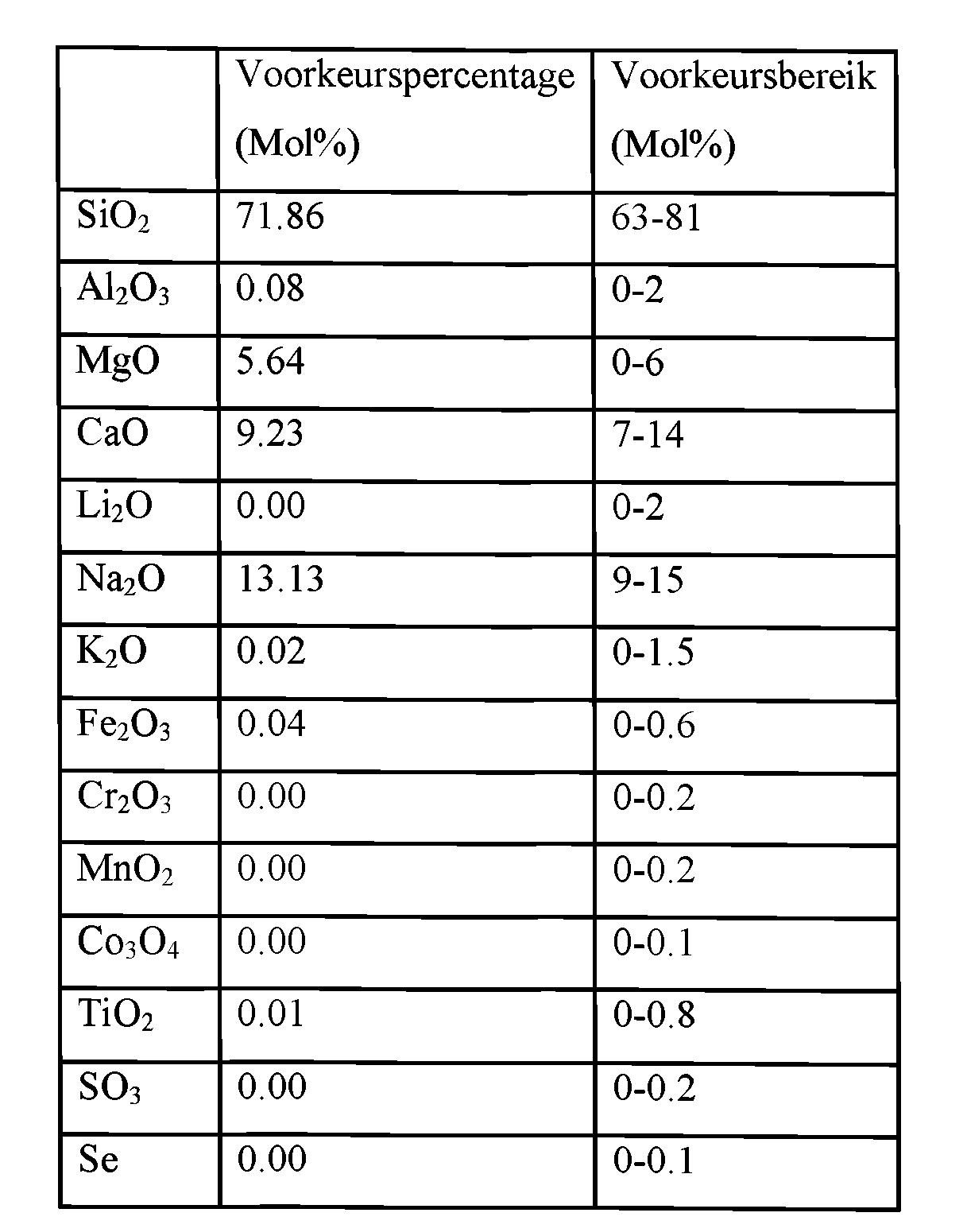
Figuur 1 toont een zijaanzicht op een laminaat volgens een eerste uitvoeringsvorm van een spiegel 1 overeenkomstig de uitvinding. De spiegel 1 omvat in dit uitvoeringsvoorbeeld een chemisch geharde ultradunne glasplaat 2 met een dikte van maximaal 0,7 mm, en een tweede ultradunne chemische geharde glasplaat 3 met een dikte van maximaal 0,7 mm. De ultradunne glasplaat 2 vormt daarbij een voorzijde van de spiegel 1. Op de voorste glasplaat 2 is een spiegelende metaallaag 4 gedampt middels bekende technieken. De metaallaag 4 is vervolgens afgeschermd middels toepassing van een (optionele) beschermende coating 5 die met name een zuurstofbarrière vormt om corrosie van de metaallaag 5 tegen te gaan. De voorste glasplaat 2 met daarop de spiegelende metaallaag 4 en de coating 5 enerzijds en de achterste glasplaat 3 anderzijds zijn onderling verbonden door toepassing van een ionomere tussenlaag 6 (hechtlaag). De dikte van de tussenlaag 6 is gelegen tussen 0,3 en 1,8 mm, en heeft in het bijzonder een typische dikte van 0,89 mm in dit uitvoeringsvoorbeeld. In de getoonde geassembleerde toestand is de tussengelegen hechtlaag 6 versmolten met de glasplaten 2, 3, of althans met de coating 5 en met de achterste glasplaat 3, waardoor een stevige, doch flexibele structuur ontstaat. De uiteindelijke vormgeving van de spiegel 1 wordt bepaald door de vormgeving van de ultradunne glasplaten 2, 3. De ultradunne glasplaten 2, 3 kunnen legio alsook onderling verschillende samenstellingen bezitten. Slechts als voorbeeld wordt aangegeven dat de glasplaten 2, 3 kunnen zijn vervaardigd uit: 64-68 mol.% Si02; 12-16 mol.% Na20 ; 8-12 mol.% A1203; 0-3 mol.% B20 3; 2-5 mol.% K20 ; 4-6 mol.% MgO; en 0-5 mol.% CaO, waarbij: 66 mol.% < Si02 + B203 + CaO < 69 mol.%; Na20 + K20 + B203 + MgO + CaO + SrO > 10 mol.%; 5 mol.% < MgO + CaO + SrO < 8 mol.%; (Na20 + B203) - A1203 < 2 mol.%; 2 mol.% <Na20 -A1203 < 6 mol.%; en 4 mol.% < (Na20 + K20) - A1203 < 10 mol.%. Een voorkeursuitvoering van de samenstelling van toe te passen zogenaamd soda-lime glas is weergegeven in navolgende tabel:Figure 1 shows a side view of a laminate according to a first embodiment of a mirror 1 according to the invention. The mirror 1 in this exemplary embodiment comprises a chemically cured ultra-thin glass plate 2 with a thickness of at most 0.7 mm, and a second ultra-thin chemically cured glass plate 3 with a thickness of at most 0.7 mm. The ultra-thin glass plate 2 thereby forms a front side of the mirror 1. A reflective metal layer 4 is vapor-deposited on the front glass plate 2 by known techniques. The metal layer 4 is then shielded by applying an (optional) protective coating 5 which in particular forms an oxygen barrier to prevent corrosion of the metal layer 5. The front glass plate 2 with the reflective metal layer 4 and the coating 5 on the one hand and the rear glass plate 3 on the other hand are interconnected by the use of an ionomeric intermediate layer 6 (adhesive layer). The thickness of the intermediate layer 6 is between 0.3 and 1.8 mm, and in particular has a typical thickness of 0.89 mm in this exemplary embodiment. In the assembled condition shown, the intermediate adhesive layer 6 is fused with the glass plates 2, 3, or at least with the coating 5 and with the rear glass plate 3, whereby a sturdy, yet flexible structure is created. The final shape of the mirror 1 is determined by the shape of the ultra-thin glass plates 2, 3. The ultra-thin glass plates 2, 3 can have countless and mutually different compositions. Only as an example is it indicated that the glass plates 2, 3 can be made from: 64-68 mol% SiO 2; 12-16 mole% Na 2 O; 8-12 mol% Al 2 O 3; 0-3 mol% B 2 O 3; 2-5 mol% K 2 O; 4-6 mol% MgO; and 0-5 mole% CaO, wherein: 66 mole% <SiO 2 + B 2 O 3 + CaO <69 mole%; Na 2 O + K 2 O + B 2 O 3 + MgO + CaO + SrO> 10 mole%; 5 mole% <MgO + CaO + SrO <8 mole%; (Na 2 O + B 2 O 3) - Al 2 O 3 <2 mol%; 2 mole% <Na 2 O-Al 2 O 3 <6 mole%; and 4 mole% <(Na 2 O + K 2 O) - Al 2 O 3 <10 mole%. A preferred embodiment of the composition of so-called soda-lime glass to be used is shown in the following table:
Het is tevens denkbaar glas toe te passen met de volgende samenstelling:It is also conceivable to use glass with the following composition:
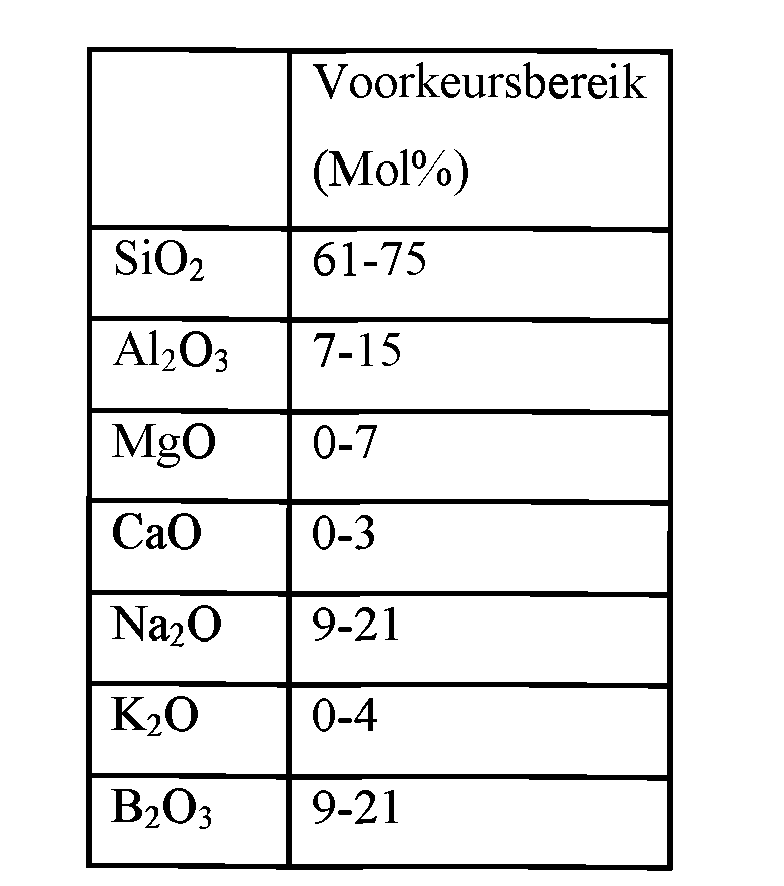
Het glas is chemisch gehard, teneinde het glas bijzonder sterk te maken. Daarbij wordt het (ongeharde) glas bij voorkeur ondergedompeld in een bad met gesmolten kaliumnitraat bij een temperatuur van ongeveer 400 °C. Daarbij ontstaat chemische uitwisseling van K+-ionen uit het bad met de Na+-ionen uit het glas. De K+-ionen (afmetingen 2,66 A) nemen de plaats in van de Na+-ionen (afmetingen 1,96 A). Vermits deze grotere afmetingen hebben, induceren zij drukspanningen aan de oppervlakte van het glas, dat zodoende meer weerstand kan bieden. De onderdompelingsduur is bepalend voor het uiteindelijk verkregen spanningsniveau. De spanningsverdeling vertoont niet dezelfde vorm als bij thermisch gehard glas, en leidt tot beduidend sterker glas dan wanneer ongehard glas op thermische wijze zou worden gehard. In dit kader wordt opgemerkt dat chemisch gehard glad doorgaans een veel hogere drukspanning heeft aan de oppervlakte van de glasplaat die juist onder het oppervlak relatief snel afneemt, waarbij in het midden (1/2 diepte) van de glasplaat een beperkte trekspanning aanwezig is, waardoor een geblokt spanningsprofiel ontstaat. Thermisch gehard glas heeft doorgaans een aanzienlijk lagere drukspanning aan de oppervlakte van de glasplaat, waarbij in het midden van de glasplaat een relatief hoge trekspanning aanwezig is, waardoor een parabolisch spanningsprofiel ontstaat.The glass is chemically tempered to make the glass particularly strong. The (uncured) glass is thereby preferably immersed in a bath with molten potassium nitrate at a temperature of approximately 400 ° C. This results in a chemical exchange of K + ions from the bath with the Na + ions from the glass. The K + ions (dimensions 2.66 A) take the place of the Na + ions (dimensions 1.96 A). Since these have larger dimensions, they induce compressive stresses on the surface of the glass, which can thus offer more resistance. The immersion duration determines the ultimate voltage level obtained. The voltage distribution does not have the same shape as with thermally tempered glass, and leads to significantly stronger glass than if unhardened glass were thermally tempered. In this context, it is noted that chemically cured smooth usually has a much higher compressive stress on the surface of the glass plate which decreases relatively quickly just below the surface, with a limited tensile stress being present in the middle (1/2 depth) of the glass plate, so that a blocked voltage profile is created. Thermally tempered glass generally has a considerably lower compressive stress on the surface of the glass plate, with a relatively high tensile stress being present in the center of the glass plate, resulting in a parabolic stress profile.
De tussenlaag 6 is in dit uitvoeringsvoorbeeld vervaardigd uit een copolymeer bestaande 81% etheen, 19% methacrylzuur, waarbij 37% van de zuurgroepen is geneutraliseerd met natrium of zink. The Young’s modules van een dergelijk ionomeer bedraagt circa 361 MPa.The intermediate layer 6 in this exemplary embodiment is made from a copolymer consisting of 81% ethylene, 19% methacrylic acid, with 37% of the acid groups neutralized with sodium or zinc. The Young’s modules of such an ionomer are approximately 361 MPa.
Een van de tussenlaag 6 afgekeerde zijde van de tweede glasplaat 3 is voorzien van een kleeflaag 7 om de spiegel 1 te kunnen plakken tegen een ander object. De kleeflaag kan hierbij eventueel lichtdoorlatend zijn uitgevoerd, waardoor mogelijk door de spiegel 1 kan worden heengekeken, een en ander afhankelijk van de eventuele lichtdoorlaatbaarheid van de metaallaag 4. In plaats van een kleeflaag 7 is het denkbaar om één of meerdere alternatieve bevestigingselementen toe te passen.A side of the second glass plate 3 remote from the intermediate layer 6 is provided with an adhesive layer 7 in order to be able to stick the mirror 1 against another object. The adhesive layer can optionally be made light-transmitting, so that it is possible to look through the mirror 1, all this depending on the possible light transmittance of the metal layer 4. Instead of an adhesive layer 7, it is conceivable to use one or more alternative fastening elements. .
Figuur 2 toont een zijaanzicht op een alternatieve spiegel 10 overeenkomstig de uitvinding. De spiegel 10 omvat een voorste geharde ultradunne glasplaat 11 die thermisch of chemisch gehard is. Tegen een achterzijde van de voorste glasplaat 11 is een elektrochromatische laag 12 aangebracht die eventueel kan zijn afgeschermd middels een beschermende laag 13. De elektrochromatische laag 12 heeft als eigenschap van kleur te veranderen ingeval spanning op de elektrochromatische laag 12 wordt gezet. Doorgaans is de hoogte van de spanning bepalend voor de mate van verkleuring. Zoals tevens getoond in figuur 2 maakt de elektrochromatische laag 12 deel uit van een elektronisch circuit 14 waarin tevens een besturingseenheid 15 alsook een energiebron 16, zoals een batterij of een aansluiting op het lichtnet, zijn opgenomen. Middels de besturingseenheid kan gecontroleerd spanning op de elektrochromatische laag 12 worden gezet. Ingeval géén spanning op de elektrochromatische laag 12 wordt gezet is de elektrochromatische laag 12 in hoofdzaak transparant. Ingeval spanning op de elektrochromatische laag 12 wordt gezet is het mogelijk de elektrochromatische laag 12 te laten verkleuren richting een vooraf gewenste kleur, bijvoorbeeld zilverkleurig, waardoor de elektrochromatische laag 12 spiegelende eigenschappen verkrijgt en de spiegel 10 ook daadwerkelijk als spiegel kan worden gebruikt. Teneinde de spiegel 10 meer stevigheid en een vergrote impactresistentie te verschaffen omvat de spiegel 10 tevens een achterliggende ultradunne geharde glasplaat 17 (of andersoortige verstevigingsstructuur) die onder tussenkomst van een polymere hechtlaag 18, bijvoorbeeld vervaardigd uit EVA of PVB, is verbonden met de voorste glasplaat onder vorming van een solide en sterk laminaat. Eventueel kan nog een aanvullende materiaallaag 19 tussen de achterste glasplaat 17 en de hechtlaag 18 worden gepositioneerd, teneinde de spiegel 10 aanvullende functionaliteit te geven. Deze aanvullende materiaallaag 19 kan bijvoorbeeld worden gevormd door een gekleurde folielaag, een decoratieve folielaag, en/of een elektronische laag. Onder een elektronische laag wordt verstaan een materiaallaag die in staat is een videobeeld te visualiseren (voor gebruikers) of een interactieve materiaallaag, waardoor het glaslaminaat kan fungeren als aanraakscherm (touchscreen). Fysiek contact tussen gebruiker en het glaslaminaat zal hierbij niet noodzakelijk hoeven te zijn, teneinde de interactieve materiaallaag te kunnen bedienen. Bekende interactieve materiaallagen zijn bijvoorbeeld resistieve lagen, capacitieve lagen, SAW-lagen (surface acoustic waves), APR-lagen (acoustic pulse recognition), infraroodlagen, NFI-lagen (near field imaging). Voomoemde niet-limitatieve voorbeelden zullen voor een vakman in het vakgebied van interactieve materiaallagen bekend zijn. Een kleeflaag 20 kan worden toegepast ter bevestiging van de spiegel 10 aan een externe draagstructuur.Figure 2 shows a side view of an alternative mirror 10 according to the invention. The mirror 10 comprises a front cured ultra-thin glass plate 11 which is thermally or chemically cured. An electrochromatic layer 12 is provided against a rear side of the front glass plate 11, which may optionally be protected by a protective layer 13. The electrochromatic layer 12 has the property of changing color if voltage is applied to the electrochromatic layer 12. The level of the voltage generally determines the degree of discolouration. As also shown in Figure 2, the electrochromatic layer 12 forms part of an electronic circuit 14 in which a control unit 15 as well as an energy source 16, such as a battery or a connection to the mains, are also included. Controlled voltage can be applied to the electrochromatic layer 12 by means of the control unit. In case no voltage is applied to the electrochromatic layer 12, the electrochromatic layer 12 is substantially transparent. If voltage is applied to the electrochromatic layer 12, it is possible to discolour the electrochromatic layer 12 towards a predetermined color, for example silver, so that the electrochromatic layer 12 acquires reflective properties and the mirror 10 can actually be used as a mirror. In order to provide the mirror 10 with more rigidity and an increased impact resistance, the mirror 10 also comprises a rear ultra-thin hardened glass plate 17 (or other type of reinforcing structure) which is connected to the front glass plate via a polymeric adhesive layer 18, for example made of EVA or PVB. forming a solid and strong laminate. Optionally, an additional material layer 19 can be positioned between the rear glass plate 17 and the adhesive layer 18, in order to give the mirror 10 additional functionality. This additional material layer 19 can for instance be formed by a colored foil layer, a decorative foil layer, and / or an electronic layer. An electronic layer is understood to be a material layer that is able to visualize a video image (for users) or an interactive material layer, whereby the glass laminate can act as a touch screen (touchscreen). Physical contact between the user and the glass laminate will not have to be necessary in order to be able to operate the interactive material layer. Well-known interactive material layers are, for example, resistive layers, capacitive layers, SAW layers (surface acoustic waves), APR layers (acoustic pulse recognition), infrared layers, NFI layers (near field imaging). The aforementioned non-limitative examples will be known to a person skilled in the art of interactive material layers. An adhesive layer 20 can be used to attach the mirror 10 to an external support structure.
figuur 3 een perspectivisch aanzicht op de toepassing van een spiegel 30 overeenkomstig de uitvinding in een sanitaire ruimte 31 van een voertuig 32, zoals een vliegtuig, boot, of autobus. Bijkomende voordelen van de toegepaste spiegel overeenkomstig de uitvinding, naast het licht van gewicht zijn en het hebben van een relatief hoge impactresistentie, zijn de hoge mate van krasbestendigheid, en het hebben van een uniforme dikte waardoor de lichtbreking eveneens relatief uniform is, hetgeen de beeldreflectie van de spiegel 30 ten goede komt.figure 3 shows a perspective view of the use of a mirror 30 according to the invention in a sanitary space 31 of a vehicle 32, such as an airplane, boat, or bus. Additional advantages of the applied mirror according to the invention, in addition to being light in weight and having a relatively high impact resistance, are the high degree of scratch resistance, and having a uniform thickness whereby the refraction of light is also relatively uniform, which is the image reflection of the mirror 30.
Het moge duidelijk zijn dat de uitvinding niet beperkt is tot de hier weergegeven en beschreven uitvoeringsvoorbeelden, maar dat binnen het kader van de bijgaande conclusies legio varianten mogelijk zijn, die voor de vakman op dit gebied voor de hand zullen liggen.It will be clear that the invention is not limited to the exemplary embodiments shown and described here, but that within the scope of the appended claims, countless variants are possible which will be obvious to those skilled in the art.
Claims (37)
Priority Applications (7)
| Application Number | Priority Date | Filing Date | Title |
|---|---|---|---|
| NL2010625A NL2010625C2 (en) | 2013-04-11 | 2013-04-11 | MIRROR, AND METHOD FOR MANUFACTURING SUCH MIRROR |
| EP14724170.7A EP2983911A1 (en) | 2013-04-11 | 2014-04-11 | Vehicle mirror, and method for manufacturing such a mirror |
| BR112015025945A BR112015025945A2 (en) | 2013-04-11 | 2014-04-11 | vehicle mirror, and a method for making such a mirror |
| PCT/NL2014/050230 WO2014168481A1 (en) | 2013-04-11 | 2014-04-11 | Vehicle mirror, and method for manufacturing such a mirror |
| US14/783,518 US20160062001A1 (en) | 2013-04-11 | 2014-04-11 | Vehicle mirror, and method for manufacturing such a mirror |
| CN201480026844.1A CN105246685A (en) | 2013-04-11 | 2014-04-11 | Vehicle mirror, and method for manufacturing the same |
| US15/137,970 US20160238752A1 (en) | 2013-04-11 | 2016-04-25 | Vehicle mirror, and method for manufacturing such a mirror |
Applications Claiming Priority (2)
| Application Number | Priority Date | Filing Date | Title |
|---|---|---|---|
| NL2010625 | 2013-04-11 | ||
| NL2010625A NL2010625C2 (en) | 2013-04-11 | 2013-04-11 | MIRROR, AND METHOD FOR MANUFACTURING SUCH MIRROR |
Publications (1)
| Publication Number | Publication Date |
|---|---|
| NL2010625C2 true NL2010625C2 (en) | 2014-10-14 |
Family
ID=50729752
Family Applications (1)
| Application Number | Title | Priority Date | Filing Date |
|---|---|---|---|
| NL2010625A NL2010625C2 (en) | 2013-04-11 | 2013-04-11 | MIRROR, AND METHOD FOR MANUFACTURING SUCH MIRROR |
Country Status (6)
| Country | Link |
|---|---|
| US (2) | US20160062001A1 (en) |
| EP (1) | EP2983911A1 (en) |
| CN (1) | CN105246685A (en) |
| BR (1) | BR112015025945A2 (en) |
| NL (1) | NL2010625C2 (en) |
| WO (1) | WO2014168481A1 (en) |
Families Citing this family (9)
| Publication number | Priority date | Publication date | Assignee | Title |
|---|---|---|---|---|
| CN107249878A (en) * | 2015-01-13 | 2017-10-13 | 戴森航空宇宙集团有限公司 | For the glass surface used in aircraft and other delivery vehicles |
| CA3043432A1 (en) | 2015-07-27 | 2017-02-02 | Halliburton Energy Services, Inc. | Centrifugal particle accumulator and filter . |
| US10429892B1 (en) * | 2016-01-12 | 2019-10-01 | Apple Inc. | Electronic devices with thin display housings |
| CN108779027A (en) * | 2016-03-31 | 2018-11-09 | 积水化学工业株式会社 | Pioloform, polyvinyl acetal ionomer resin film and laminated glass |
| US10459307B2 (en) * | 2016-04-22 | 2019-10-29 | Gentex Corporation | Flame retardancy of electrochromic devices |
| NL2016772B1 (en) * | 2016-05-13 | 2017-11-16 | Air-Craftglass Inc | A mirror comprising a glass laminate and a method for manufacturing same |
| EP3339918A1 (en) * | 2016-12-21 | 2018-06-27 | Max-Planck-Gesellschaft zur Förderung der Wissenschaften e.V. | A mirror and a method for fabricating the same |
| KR102663777B1 (en) | 2017-12-08 | 2024-05-14 | 어포지 엔터프라이지즈, 인크. | Adhesion promoter, glass surface comprising adhesion promoter, and method of making adhesion promoter |
| KR20210097143A (en) * | 2018-11-30 | 2021-08-06 | 코닝 인코포레이티드 | Thin multilayer laminate |
Family Cites Families (22)
| Publication number | Priority date | Publication date | Assignee | Title |
|---|---|---|---|---|
| US3382087A (en) | 1964-08-20 | 1968-05-07 | Pittsburgh Plate Glass Co | Silver and copper coated articles protected by treatment with aminoazole compounds |
| GB8901684D0 (en) | 1989-01-26 | 1989-03-15 | Glaverbel | Mirrors |
| LU87797A1 (en) * | 1990-08-31 | 1992-03-11 | Glaverbel | HEATING MIRROR |
| US5668663A (en) * | 1994-05-05 | 1997-09-16 | Donnelly Corporation | Electrochromic mirrors and devices |
| US5940201A (en) * | 1997-04-02 | 1999-08-17 | Gentex Corporation | Electrochromic mirror with two thin glass elements and a gelled electrochromic medium |
| US5959793A (en) * | 1997-06-06 | 1999-09-28 | Globe-Amerada Glass Co. | Laminated safety mirror with reflective coating adjacent the bonding layer |
| US5908704A (en) * | 1997-06-30 | 1999-06-01 | Norton Performance Plastics Corporation | Interlayer film for protective glazing laminates |
| JP2001235798A (en) * | 1999-12-17 | 2001-08-31 | Nippon Sheet Glass Co Ltd | Reflection mirror and rear projecting type display using the same |
| US6495244B1 (en) * | 2000-09-07 | 2002-12-17 | Oak-Mitsui, Inc. | Manufacturing fire retardant circuit boards without the use of fire retardant resin additives |
| JP3864750B2 (en) * | 2001-10-18 | 2007-01-10 | 株式会社日立製作所 | Display element substrate and display element using the same |
| KR20050060098A (en) * | 2002-10-18 | 2005-06-21 | 설패이스 스페셜티즈, 에스.에이. | Flame retardant composition |
| FR2857617B1 (en) * | 2003-07-16 | 2006-10-27 | Saint Gobain | FUNCTIONALIZED SAFETY GLAZING |
| US8282224B2 (en) * | 2004-07-12 | 2012-10-09 | Gentex Corporation | Rearview mirror assemblies with anisotropic polymer laminates |
| WO2006071908A1 (en) * | 2004-12-28 | 2006-07-06 | Exxonmobil Chemical Patents Inc. | Metallized ionomer laminates, composite articles, and processes for making the same |
| US20110043719A1 (en) * | 2007-07-03 | 2011-02-24 | Thunhorst Kristin L | Optically transmissive composite film frame |
| EP2108508A1 (en) * | 2008-04-07 | 2009-10-14 | Cytec Surface Specialties, S.A. | Flame retardant radiation curable compositions |
| WO2010036219A1 (en) * | 2008-09-25 | 2010-04-01 | Agp Plastics, Inc. | Anti-spall windows |
| US7710671B1 (en) * | 2008-12-12 | 2010-05-04 | Applied Materials, Inc. | Laminated electrically tintable windows |
| JP2011186414A (en) * | 2010-02-12 | 2011-09-22 | Sony Corp | Optical device, sun screening apparatus, fitting, window material, and method of producing optical device |
| JP5980198B2 (en) * | 2010-03-25 | 2016-08-31 | ビーエーエスエフ ソシエタス・ヨーロピアBasf Se | Foam and molded member from support material containing foamable reactive resin |
| FR2975195A1 (en) * | 2011-05-10 | 2012-11-16 | Saint Gobain | MIRROR WITH FINE GLASS SHEET |
| NL2009706C2 (en) * | 2012-10-26 | 2014-04-29 | Aviat Glass & Technology B V | GLASS LAMINATE, COATING LAYER, AND VEHICLE INCLUDING SUCH GLASS LAMINATE. |
-
2013
- 2013-04-11 NL NL2010625A patent/NL2010625C2/en active
-
2014
- 2014-04-11 CN CN201480026844.1A patent/CN105246685A/en active Pending
- 2014-04-11 BR BR112015025945A patent/BR112015025945A2/en not_active Application Discontinuation
- 2014-04-11 US US14/783,518 patent/US20160062001A1/en not_active Abandoned
- 2014-04-11 EP EP14724170.7A patent/EP2983911A1/en not_active Withdrawn
- 2014-04-11 WO PCT/NL2014/050230 patent/WO2014168481A1/en not_active Ceased
-
2016
- 2016-04-25 US US15/137,970 patent/US20160238752A1/en not_active Abandoned
Also Published As
| Publication number | Publication date |
|---|---|
| CN105246685A (en) | 2016-01-13 |
| US20160062001A1 (en) | 2016-03-03 |
| BR112015025945A2 (en) | 2017-07-25 |
| EP2983911A1 (en) | 2016-02-17 |
| WO2014168481A1 (en) | 2014-10-16 |
| US20160238752A1 (en) | 2016-08-18 |
Similar Documents
| Publication | Publication Date | Title |
|---|---|---|
| NL2010625C2 (en) | MIRROR, AND METHOD FOR MANUFACTURING SUCH MIRROR | |
| NL2009706C2 (en) | GLASS LAMINATE, COATING LAYER, AND VEHICLE INCLUDING SUCH GLASS LAMINATE. | |
| JP7046789B2 (en) | Polyvinyl acetal resin film for laminated glass | |
| US10241248B2 (en) | Biaxially stretched laminated polyester film, infrared light shielding structure for laminated glass composed of the same, and laminated glass composed of the same | |
| KR101504950B1 (en) | Laminated glass and laminated glass member | |
| JP5959746B2 (en) | Light transmissive laminate | |
| NL2012607B1 (en) | Vehicle mirror, and method for manufacturing such a mirror. | |
| US20250162286A1 (en) | Illuminating glazed roof | |
| CN101228098A (en) | heated windshield | |
| CN101500833A (en) | Polycarbonate glazing system having solar reflecting properties | |
| CN1122128A (en) | Coatings on glass | |
| JP3901911B2 (en) | Transparent laminated film | |
| JP2014201450A (en) | Heat-ray shielding laminated glass and method for manufacturing heat-ray shielding laminated glass | |
| JP2018076189A (en) | Laminated glass | |
| CN119451816A (en) | Lighting vehicle embedded glass | |
| CN118465884A (en) | Optical antireflection film, window glass and vehicle | |
| JP2009062409A (en) | Near infrared-shielding material, laminate and optical filter for display using the same and display | |
| CA2701784C (en) | Plastic film with infrared reflective film and laminated glass with inserted plastic film | |
| NL2009705C2 (en) | GLASS LAMINATE AND VEHICLE INCLUDING SUCH GLASS LAMINATE. | |
| NL2016754B1 (en) | Aircraft panel, in particular an aircraft window, and method of manufacturing such an aircraft panel | |
| JP6597574B2 (en) | Transparent heating plate, vehicle and building windows | |
| CN116209643A (en) | Laminate with large area head-up display and solar energy characteristics | |
| CN220766872U (en) | Protective film structure | |
| JPS6252147A (en) | Improved safety glass | |
| JP2024007005A (en) | Functional film and glass laminate with adhesive layer |
Legal Events
| Date | Code | Title | Description |
|---|---|---|---|
| PD | Change of ownership |
Owner name: AVIATION GLASS & TECHNOLOGY HOLDING B.V.; NL Free format text: DETAILS ASSIGNMENT: VERANDERING VAN EIGENAAR(S), OVERDRACHT; FORMER OWNER NAME: AVIATION GLASS & TECHNOLOGY B.V. Effective date: 20160122 |
|
| RC | Pledge established |
Free format text: DETAILS LICENCE OR PLEDGE: RIGHT OF PLEDGE, ESTABLISHED Name of requester: ABN AMRO BANK N.V. Effective date: 20250718 |