KR910009552B1 - Arbiter of dual port ram - Google Patents
Arbiter of dual port ram Download PDFInfo
- Publication number
- KR910009552B1 KR910009552B1 KR1019890000744A KR890000744A KR910009552B1 KR 910009552 B1 KR910009552 B1 KR 910009552B1 KR 1019890000744 A KR1019890000744 A KR 1019890000744A KR 890000744 A KR890000744 A KR 890000744A KR 910009552 B1 KR910009552 B1 KR 910009552B1
- Authority
- KR
- South Korea
- Prior art keywords
- address
- circuit
- signal
- signals
- logic
- Prior art date
- Legal status (The legal status is an assumption and is not a legal conclusion. Google has not performed a legal analysis and makes no representation as to the accuracy of the status listed.)
- Expired
Links
Images


Classifications
-
- G—PHYSICS
- G11—INFORMATION STORAGE
- G11C—STATIC STORES
- G11C11/00—Digital stores characterised by the use of particular electric or magnetic storage elements; Storage elements therefor
- G11C11/21—Digital stores characterised by the use of particular electric or magnetic storage elements; Storage elements therefor using electric elements
- G11C11/34—Digital stores characterised by the use of particular electric or magnetic storage elements; Storage elements therefor using electric elements using semiconductor devices
-
- C—CHEMISTRY; METALLURGY
- C07—ORGANIC CHEMISTRY
- C07C—ACYCLIC OR CARBOCYCLIC COMPOUNDS
- C07C21/00—Acyclic unsaturated compounds containing halogen atoms
- C07C21/02—Acyclic unsaturated compounds containing halogen atoms containing carbon-to-carbon double bonds
- C07C21/18—Acyclic unsaturated compounds containing halogen atoms containing carbon-to-carbon double bonds containing fluorine
Landscapes
- Chemical & Material Sciences (AREA)
- Organic Chemistry (AREA)
- Engineering & Computer Science (AREA)
- Computer Hardware Design (AREA)
- Static Random-Access Memory (AREA)
Abstract
Description
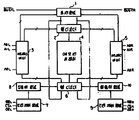
제1도는 듀얼 포트 램의 블럭도.1 is a block diagram of a dual port RAM.
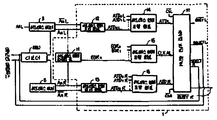
제2도는 본 발명에 따른 중재회로의 블럭도.2 is a block diagram of an arbitration circuit according to the present invention.
제3도는 제3도의 상세회로도.3 is a detailed circuit diagram of FIG.
제4a도 내지 제4d도는 본 발명에 따른 중재회로의 동작설명을 위한 타이밍도.4a to 4d are timing diagrams for explaining the operation of the arbitration circuit according to the present invention.
* 도면의 주요부분에 대한 부호의 설명* Explanation of symbols for the main parts of the drawings
1 : 중재회로 2 : 열디코더1: Arbitrary Circuit 2: Thermal Decoder
3 및 5 : 어드레스버퍼 4 : 메모리 어레이3 and 5: address buffer 4: memory array
6 : 행디코더 7 및 9 : 논리제어회로6: row decoder 7 and 9: logic control circuit
8 및 10 : 입출력회로 11 : 어드레스 매치 감지회로8 and 10: input / output circuit 11: address match detection circuit
12 및 13 : 어드레스 천이 감지회로 15 : 어드레스 매치 조합회로12 and 13: address transition detection circuit 15: address match combination circuit
14 및 16 : 어드레스 천이 조합회로 17 : 중재논리회로14 and 16: address transition combination circuit 17: arbitration logic circuit
본 발명은 듀얼 포트 램(DUAL PORT RAM)이 중재(ARBITRATION)회로에 관한 것으로, 특히 램 동작중 우측포트와 좌측포트, 즉 양포트가 동일위치의 동일 메모리 셀을 선택하여 동시에 서입 또는 판독하려고 할때, 어느 한쪽 포트의 램동작을 허용하고 다른쪽 포트는 그 기간 동안 동일 셀에 대한 램동작이 금지되도록 구성한 신규의 듀얼 포트 램의 중재회로에 관한 것이다.The present invention relates to a dual bit RAM (ARBITRATION) circuit, and in particular, the right port and the left port, that is, both ports select the same memory cell at the same position to write or read at the same time during RAM operation. At this time, it relates to the arbitration circuit of a new dual port RAM configured to allow the RAM operation of one port and the other port is prohibited from the RAM operation for the same cell during that period.
일반적으로 듀얼 포트 램(DUAL PORT RAM)은 같은 메모리 용량을 놓고 좌측포트와 우측포트, 즉 듀얼 포트에서 서입(WRITE) 및 판독(READ) 동작이 동시에 가능하도록 하자는 견지에서 설계되고 개발되었다. 이러한 듀얼 포트에서의 램동작은 각 포트가 메모리 어레이(MEMORY ARRAY)중에서 서로 다른 메모리 셀(MEMORY CELL)을 선택했을 때 가능한 것으로 만약에 램동작중 양포트가 같은 위치의 동일 메모리 셀을 선택하여 동시에 서입 또는 판독을 하려고 하는 경우 일정한 원칙에 의해 한쪽 포트만이 램동작이 허용되고 다른쪽 포트는 그 기간동안 동일셀에 대한 램동작이 금지되는 중재회로(ARBITRATION CIRCUITS)가 필요하다.In general, dual port RAM is designed and developed in the sense that both write and read operations can be simultaneously performed on the left port and the right port, that is, the dual port, with the same memory capacity. The RAM operation in this dual port is possible when each port selects a different memory cell in the memory array. If both ports select the same memory cell at the same location during the RAM operation, In the case of writing or reading, a certain principle requires an ARBITRATION CIRCUITS where only one port is allowed to operate the RAM and the other port is prohibited from operating the same cell during that period.
본 발명은 듀얼 포트 램의 중재회로에 관한 것으로서 다음의 세가지 논리원칙에 의해 동일셀에 대한 듀얼 포트의 램동작을 조정 중재한다.The present invention relates to an arbitration circuit of dual port RAM, and arbitrates the arbitration of dual port RAM operation for the same cell by the following three logic principles.
첫번째 논리 원칙은 일정셀에 대한 어드레스(ADDRESS)선택이 먼저 이루어진 포트를 동작이 허용되도록 하고, 동작이 허용된 포트가 일정셀에 대해 램동작을 하고 있는 시간동안은 다른쪽 포트로부터의 동일셀에 대한 램동작을 금지하는 어드레스 중재논리회로이다.The first logic principle is to allow the operation of the port where the address selection for a certain cell is made first, and to the same cell from the other port during the time that the allowed port is doing RAM operation for the certain cell. This is an address arbitration logic circuit that prohibits RAM operation.
둘째는 칩 셀렉트(CHIP SELECT)중재논리로서 듀얼 포트의 어드레스가 이미 동일 셀 선택을 위해 매치(MATCH)가 된 상태(양 포트의 어드레스가 같은 상태)에서 양포트의 칩 셀렉트 신호가 먼저 인에이블(ENABLE)된 포트가 동작이 허용되고 다른쪽 포트는 그 시간동안 동일셀에 대한 동작이 금지되는 논리원칙이다.The second is the chip select arbitration logic, in which the chip select signals of both ports are enabled first when the address of the dual port is already matched for the same cell selection (the address of both ports are the same). The ENABLE) port is allowed to operate, and the other port is the logic principle that operation for the same cell is prohibited during that time.
셋째는 양포트로부터의 어드레스 또는 칩 셀렉트 신호가 상기 어드레스 중재논리와 칩 셀렉트 중재논리, 두 논리에 의해 구별될 수 없는 동시신호로 입력되었을 때 항상 좌측포트의 동작을 허용하고 우측포트는 그 시간동안 동일 셀에 대한 동작을 금지하는 동시신호 중재논리이다.Thirdly, when the address or chip select signal from both ports is inputted simultaneously with the signal arbitration logic and the chip select arbitration logic, the left port always permits the operation of the left port and the right port during that time. Simultaneous signal arbitration logic that prohibits operation for the same cell.
따라서, 본 발명은 듀얼 포트 램의 중재회로가 상기 세가지 중재논리원칙을 구현하면서 중재논리가 성립 또는 해제되었을때의 프래그(FLAG) 신호인
본 발명의 듀얼 포트 램의 중재회로에 의하면 상기 중재논리원칙과


이하, 첨부된 도면을 참조하여 본 발명을 상세히 설명하기로 한다.Hereinafter, with reference to the accompanying drawings will be described in detail the present invention.
제1도는 일반적인 듀얼 포트 램을 설명하기 위한 블록도로서, Ao L 내지 An L의 좌측 포트 어드레스 신호 및 Ao R 내지 An R의 우측포트 어드레스 신호가 어드레스 버퍼(3 및 5)에 각기 인가되어, 이 인가된 신호들을 정신호 및 부신호(예를 들어 Ao 및
또한 논리제어회로(7 및 9)는 칩의 동작 또는 정지 상태를 제어하는


제2도는 상술한
먼저, 좌,우측 포트의 어드레스 신호 An L 및 An R 신호가 양포트의 어드레스 버퍼(3 및 5)에 인가되면 이 어드레스 버퍼(3 및 5)는


한편, 상기 어드레스 천이 감지회로(12 및 13)에서는 상기 어드레스 버퍼(3 및 5)에서 각각 출력되는 2개의 신호를 일정시간지연, 변환하여 ATD 신호(실제로는 ATDo,ATD1,ATD2…TDn)를 생성하고, 이 신호들(ATDn L 및 ATDn R)을 어드레스 천이 조합회로(14 및 16)에 인가시키면, 이 회로(14 및 16)에서는 인가된 신호들을 조합하여 ATD L 및 ATD R 신호를 생성한다음, 이 신호들(ATD L 및 ATD R)을 상기 중재 논리회로(17)에 인가시킨다.Meanwhile, the address
상기 중재 논리회로(17)에서는 상술한 신호들의 인가에 따라 SELEET 및

제3도는 제2도의 상세 회로도로서, 좌측 포트의 어드레스 신호 An L은 NOT 논리게이트 G1 및 G2를 경유한 An L 신호와 NOT 논리게이트 G6를 경유한

따라서, 상기 NOR 게이트 G5 및 G9의 각각의 출력은 NOR 게이트 G10을 경유해 NOT 게이트 G11에서 반전되어 ATDn 펄스가 생성된다(본 명세서에서는 편의상 하나의 ATDn 펄스 생성과정만 세술하고 있지만, 실제로는 상술한 회로가 여러개 나열되어 ATD1, ATD2, ATD3…ATDn 펄스가 생성된다). 상기 ATDn 펄스신호가 FET1의 게이트 단자에 인가되는데, 이 펄스신호가 High 상태(즉 어드레스 천이가 일어난 상태)이면 FET1이 ON되고 칩 셀렉터 신호의 CSL.CSR가 논리적으로 High 상태에서 FET2와 FET3의 접속점은 노리적으로 LOW 상태가 된다. 이상태가 NOT 게이트 G15에서 반전되어 NOR 게이트 G18의 한 입력단자에 인가된다.Therefore, the respective outputs of the NOR gates G5 and G9 are inverted at the NOT gate G11 via the NOR gate G10 to generate an ATDn pulse. Multiple circuits are listed, generating ATD1, ATD2, ATD3… ATDn pulses). The ATDn pulse signal is applied to the gate terminal of the FET1. When the pulse signal is high (that is, the address transition has occurred), the FET1 is turned on and the connection point of the FET2 and the FET3 when the CSL.CSR of the chip selector signal is logically high. Is logically LOW. This state is inverted at the NOT gate G15 and applied to one input terminal of the NOR gate G18.
한편, 우측 포트의 어드레스 신호 An R 또한 상술한 좌측 포트의 어드레스 신호 An L 전달과정과 동일한 동작으로, 어드레스 버퍼(5), 어드레스 천이 감지회로(13)를 거쳐 어드레스 천이 조합회로(16)에서의 NOT 게이트 G35의 출력이 시간지연을 위한 NOT 게이트 G22 및 G23을 경유해 NOR 게이트 G19의 한입력 단자에 인가된다. 여기서 상술한 우측 포트측의 어드레스 버퍼(5), 어드레스 천이 감지회로(13) 및 어드레스 천이 조합회로(16)의 구성은 좌측 포트 측의 회로와 구성이 동일하므로 그 설명은 생략키로 한다.On the other hand, the address signal An R of the right port is also the same operation as that of the address signal An L of the left port described above, and the address transition combination circuit 16 passes through the
상술한 양측의 어드레스 버퍼(3 및 5)에서 출력되는 신호중 An L 및 An R 신호를 게이트 G12, G13 및 G14로 구성된 배타 논리합(EXCLUSIVE OR)(11)회로에 인가시켜, 이 두 개의 신호가 다를때만 NOR 게이트 G14에서 High 신호가 출력되는 EoRn(실제로는 상기 배타 논리합 회로가 수개로 구성되어 EoR1,EoR2,EoR3…EoRn의 펄스신호가 된다) 펄스신호를 생성하여, EoRn 펄스 신호를 FET4의 게이트에 인가시키면 이펄스신호에 따라 상기 FET4가 ON 또는 OFF 되고 칩 셀렉터 신호를 조합한
상술한 바와 같이, 중재논리회로(17)에 인가된 상기 신호들에 따라 좌측 포트 또는 우측 포트가 선택되는데, 이 동작 설명은 제4a도 내지 제4d도에 도시된 타이밍도를 참조하여 상세히 설명하면 다음과 같다.As described above, the left port or the right port is selected according to the signals applied to the arbitration logic circuit 17. This operation description will be described in detail with reference to the timing diagrams shown in Figs. 4A to 4D. As follows.
CLK AL 신호가 HIGH 상태인 경우, 즉 각 포트의 어드레스들이 동일 논리신호가 아닌 상태여서 동일셀에 대한 각 포트의 동작이 이루어지지 않는 보통상태의 듀얼 포트 램동작에서는 제3도의 중재논리회로(17)의 G24와 G35의 출력들은 다른쪽 입력(점 A와 점 B)의 상태와는 관계없이 CLK AL에 의해 결정되므로 NOR 게이트 G24와 G35의 출력신호는 LOW이다. 두단의 NOT 논리게이트를 거친 신호 역시 LOW이므로 FET16, FET17, FET19, FET20은 OFF 상태이고 FET15, FET18은 ON 상태이다. 따라서

먼저, 제4a도의 경우를 제3도의 회로와 함께 설명하여 보기로 한다.First, the case of FIG. 4A will be described together with the circuit of FIG.
CLK AL T1에서 LOW 상태로 바뀌면, 즉 각 포트의 어드레스들이 동일셀 선택을 위해 동일 논리신호가 되면 어드레스 매치회로와 어드레스 매치조합회로를 거쳐 G24와 G35의 CLK AL 입력은 LOW 상태가되므로 앞단의 ATD 신호와
T1시점에서 볼 때 ATD L 은 HIGH 상태이므로 G18과 FET17을 거쳐 점 A의 상태는 LOW이고, ATD R과

상기의 중재논리에 의해 이루어진 신호들의 상태는 T2시점에서 우측포트의 어드레스가 바뀌어 CLK AL이 HIGH 상태로 되면 해제된다. 즉
T3에서 T4 구간의 타이밍도는 T1에서 T2구간에서 발생한 경우를 좌측, 우측포트끼리 서로 바뀌어 놓은 상황과 같다. 즉 T3시점에서 볼 때 ATD R은 HIGH 상태이므로 G19와 FET8을 거친 점 B의 상태는 LOW이고 ATD L과

제4b도 역시 어드레스 중재논리의 또 다른 경우의 타이밍도를 나타낸 것으로 제4a도의 경우에서 설명한 바와 같은 중재논리회로의 동작으로 실행되며 중재논리가 성립되는 경우의 차이점을 설명하여 보면 다음과 같다.FIG. 4B also shows another timing diagram of the address arbitration logic, which is executed by the operation of the arbitration logic circuit as described in the case of FIG. 4A, and the difference between the case where the arbitration logic is established is as follows.
제4a도의 경우 T1이전 구간에서 우측포트가 일정셀에 대해 동작을 하고 있는 상황에서 우측포트가 선택하고 있는 동일셀에 대해 좌측포트가 동작을 하기 위한 상태로 바뀌어 각 포트의 어드레스들이 동일논리신호가 되면 어드레스 매치회로와 어드레스 매치회로와 어드레스 매치조합회로를 거쳐 T1 시점에서 CLK AL HIGH에서 LOW로 바뀌고, 좌측포트의 어드레스 신호의 변화는 어드레스 천이감지회로와 어드레스 천이조합회로를 통해 ATDL 신호가 클럭으로 나타나 T1 시점의 앞뒤로 CLK AL과 겹치게 된다.In the case of FIG. 4A, when the right port operates for a certain cell in the section before T1, the left port operates for the same cell selected by the right port. In this case, the signal is changed from CLK AL HIGH to LOW at the time T1 through the address match circuit, the address match circuit, and the address match combination circuit. The change in the address signal of the left port is performed by the ATDL signal through the address transition detection circuit and the address transition combination circuit. Appears and overlaps with CLK AL before and after T1.
제4b도의 경우 먼저 동일셀을 T1이전 구간에서 선택하고 있는 포트는 좌측포트이며, T2에서 중재논리의 해제가 우측포트의 어드레스가 바뀜으로써 일어나는 경우는 제4a도와 제4b도가 동일하다. T3부터 T4구간의 경우도 위와 같이 설명할 수 있으며 이는 중재논리가 여러 가지 경우의 수에 대해서도 에러 없이 동작하는 것을 검증하고 설명하기 위해 도시한 것이다.In the case of FIG. 4B, the port in which the same cell is selected in the section before T1 is the left port, and in the case where the release of arbitration logic occurs at T2 due to the change of the address of the right port, FIGS. 4A and 4B are the same. The case of section T3 to T4 can be explained as above, and it is shown to verify and explain that the arbitration logic works without error even for the number of cases.
칩 셀렉트 중재논리의 타이밍도인 제4c도 및 제4d도의 경우 ATD 신호를


상술한 바와 같이 본 발명에 의한 듀얼 포트 램의 중재회로에 의하면 중재논리가 성립 또는 해제되었을시
Claims (6)


Priority Applications (1)
| Application Number | Priority Date | Filing Date | Title |
|---|---|---|---|
| KR1019890000744A KR910009552B1 (en) | 1989-01-25 | 1989-01-25 | Arbiter of dual port ram |
Applications Claiming Priority (1)
| Application Number | Priority Date | Filing Date | Title |
|---|---|---|---|
| KR1019890000744A KR910009552B1 (en) | 1989-01-25 | 1989-01-25 | Arbiter of dual port ram |
Publications (2)
| Publication Number | Publication Date |
|---|---|
| KR900012269A KR900012269A (en) | 1990-08-03 |
| KR910009552B1 true KR910009552B1 (en) | 1991-11-21 |
Family
ID=19283369
Family Applications (1)
| Application Number | Title | Priority Date | Filing Date |
|---|---|---|---|
| KR1019890000744A Expired KR910009552B1 (en) | 1989-01-25 | 1989-01-25 | Arbiter of dual port ram |
Country Status (1)
| Country | Link |
|---|---|
| KR (1) | KR910009552B1 (en) |
Families Citing this family (1)
| Publication number | Priority date | Publication date | Assignee | Title |
|---|---|---|---|---|
| KR100360265B1 (en) * | 2000-10-14 | 2002-11-09 | 엘지전자 주식회사 | Controlling circuit of dual port ram |
-
1989
- 1989-01-25 KR KR1019890000744A patent/KR910009552B1/en not_active Expired
Also Published As
| Publication number | Publication date |
|---|---|
| KR900012269A (en) | 1990-08-03 |
Similar Documents
| Publication | Publication Date | Title |
|---|---|---|
| KR100268429B1 (en) | Synchronous memory device | |
| US6697926B2 (en) | Method and apparatus for determining actual write latency and accurately aligning the start of data capture with the arrival of data at a memory device | |
| EP0902433B1 (en) | Synchronous dynamic random access memory | |
| KR950004854B1 (en) | Semiconductor memory device | |
| US7327613B2 (en) | Input circuit for a memory device | |
| JP3317187B2 (en) | Semiconductor storage device | |
| JP3645294B2 (en) | Multi-bit test circuit for semiconductor memory device | |
| EP0744749B1 (en) | Data input circuit of semiconductor storage device | |
| KR19990048133A (en) | Pin assignment method of semiconductor memory device and semiconductor memory device for inputting signal in packet unit | |
| KR19980079767A (en) | Dynamic RAM | |
| JPH04322000A (en) | semiconductor storage device | |
| JP4061029B2 (en) | Semiconductor memory device, buffer and signal transmission circuit | |
| CN100555445C (en) | Semiconductor memory device and activation signal generating method for sense amplifier | |
| KR910009552B1 (en) | Arbiter of dual port ram | |
| KR930008847A (en) | Dual port semiconductor memory | |
| JPH06161870A (en) | Dual port ram circuit | |
| US20020031043A1 (en) | Semiconductor memory device | |
| KR100489356B1 (en) | Data Path Circuit in Memory Device | |
| JPH08235895A (en) | Semiconductor integrated circuit device | |
| KR100213216B1 (en) | Parallel bit test (PBT) control circuit for synchronous semiconductor memory device (SDRAM) and control method thereof | |
| JPH05307502A (en) | Dual port semiconductor storage device | |
| US7483320B2 (en) | Data input/output method of semiconductor memory device and semiconductor memory device for the same | |
| SU1741174A1 (en) | Working memory | |
| JPH0414438B2 (en) | ||
| US6522181B1 (en) | Semiconductor memory apparatus which can easily attain reduction of access time |
Legal Events
| Date | Code | Title | Description |
|---|---|---|---|
| A201 | Request for examination | ||
| PA0109 | Patent application |
St.27 status event code: A-0-1-A10-A12-nap-PA0109 |
|
| PA0201 | Request for examination |
St.27 status event code: A-1-2-D10-D11-exm-PA0201 |
|
| R17-X000 | Change to representative recorded |
St.27 status event code: A-3-3-R10-R17-oth-X000 |
|
| PG1501 | Laying open of application |
St.27 status event code: A-1-1-Q10-Q12-nap-PG1501 |
|
| E902 | Notification of reason for refusal | ||
| PE0902 | Notice of grounds for rejection |
St.27 status event code: A-1-2-D10-D21-exm-PE0902 |
|
| P11-X000 | Amendment of application requested |
St.27 status event code: A-2-2-P10-P11-nap-X000 |
|
| P13-X000 | Application amended |
St.27 status event code: A-2-2-P10-P13-nap-X000 |
|
| G160 | Decision to publish patent application | ||
| PG1605 | Publication of application before grant of patent |
St.27 status event code: A-2-2-Q10-Q13-nap-PG1605 |
|
| E701 | Decision to grant or registration of patent right | ||
| PE0701 | Decision of registration |
St.27 status event code: A-1-2-D10-D22-exm-PE0701 |
|
| GRNT | Written decision to grant | ||
| PR0701 | Registration of establishment |
St.27 status event code: A-2-4-F10-F11-exm-PR0701 |
|
| PR1002 | Payment of registration fee |
St.27 status event code: A-2-2-U10-U11-oth-PR1002 Fee payment year number: 1 |
|
| PR1001 | Payment of annual fee |
St.27 status event code: A-4-4-U10-U11-oth-PR1001 Fee payment year number: 4 |
|
| PR1001 | Payment of annual fee |
St.27 status event code: A-4-4-U10-U11-oth-PR1001 Fee payment year number: 7 |
|
| PR1001 | Payment of annual fee |
St.27 status event code: A-4-4-U10-U11-oth-PR1001 Fee payment year number: 9 |
|
| PR1001 | Payment of annual fee |
St.27 status event code: A-4-4-U10-U11-oth-PR1001 Fee payment year number: 10 |
|
| PN2301 | Change of applicant |
St.27 status event code: A-5-5-R10-R13-asn-PN2301 St.27 status event code: A-5-5-R10-R11-asn-PN2301 |
|
| PN2301 | Change of applicant |
St.27 status event code: A-5-5-R10-R13-asn-PN2301 St.27 status event code: A-5-5-R10-R11-asn-PN2301 |
|
| PR1001 | Payment of annual fee |
St.27 status event code: A-4-4-U10-U11-oth-PR1001 Fee payment year number: 11 |
|
| PR1001 | Payment of annual fee |
St.27 status event code: A-4-4-U10-U11-oth-PR1001 Fee payment year number: 12 |
|
| PR1001 | Payment of annual fee |
St.27 status event code: A-4-4-U10-U11-oth-PR1001 Fee payment year number: 13 |
|
| PR1001 | Payment of annual fee |
St.27 status event code: A-4-4-U10-U11-oth-PR1001 Fee payment year number: 14 |
|
| PR1001 | Payment of annual fee |
St.27 status event code: A-4-4-U10-U11-oth-PR1001 Fee payment year number: 15 |
|
| PR1001 | Payment of annual fee |
St.27 status event code: A-4-4-U10-U11-oth-PR1001 Fee payment year number: 16 |
|
| FPAY | Annual fee payment |
Payment date: 20071025 Year of fee payment: 17 |
|
| PR1001 | Payment of annual fee |
St.27 status event code: A-4-4-U10-U11-oth-PR1001 Fee payment year number: 17 |
|
| LAPS | Lapse due to unpaid annual fee | ||
| PC1903 | Unpaid annual fee |
St.27 status event code: A-4-4-U10-U13-oth-PC1903 Not in force date: 20081122 Payment event data comment text: Termination Category : DEFAULT_OF_REGISTRATION_FEE |
|
| PC1903 | Unpaid annual fee |
St.27 status event code: N-4-6-H10-H13-oth-PC1903 Ip right cessation event data comment text: Termination Category : DEFAULT_OF_REGISTRATION_FEE Not in force date: 20081122 |
|
| PN2301 | Change of applicant |
St.27 status event code: A-5-5-R10-R13-asn-PN2301 St.27 status event code: A-5-5-R10-R11-asn-PN2301 |
|
| PN2301 | Change of applicant |
St.27 status event code: A-5-5-R10-R13-asn-PN2301 St.27 status event code: A-5-5-R10-R11-asn-PN2301 |
|
| PN2301 | Change of applicant |
St.27 status event code: A-5-5-R10-R13-asn-PN2301 St.27 status event code: A-5-5-R10-R11-asn-PN2301 |
|
| P22-X000 | Classification modified |
St.27 status event code: A-4-4-P10-P22-nap-X000 |