KR20180098651A - Luminescent compound - Google Patents
Luminescent compound Download PDFInfo
- Publication number
- KR20180098651A KR20180098651A KR1020187021898A KR20187021898A KR20180098651A KR 20180098651 A KR20180098651 A KR 20180098651A KR 1020187021898 A KR1020187021898 A KR 1020187021898A KR 20187021898 A KR20187021898 A KR 20187021898A KR 20180098651 A KR20180098651 A KR 20180098651A
- Authority
- KR
- South Korea
- Prior art keywords
- ring
- substituted
- tadf
- species
- ring system
- Prior art date
- Legal status (The legal status is an assumption and is not a legal conclusion. Google has not performed a legal analysis and makes no representation as to the accuracy of the status listed.)
- Ceased
Links
Images

Classifications
-
- C—CHEMISTRY; METALLURGY
- C09—DYES; PAINTS; POLISHES; NATURAL RESINS; ADHESIVES; COMPOSITIONS NOT OTHERWISE PROVIDED FOR; APPLICATIONS OF MATERIALS NOT OTHERWISE PROVIDED FOR
- C09K—MATERIALS FOR MISCELLANEOUS APPLICATIONS, NOT PROVIDED FOR ELSEWHERE
- C09K11/00—Luminescent materials, e.g. electroluminescent or chemiluminescent
- C09K11/06—Luminescent materials, e.g. electroluminescent or chemiluminescent containing organic luminescent materials
-
- H01L51/50—
-
- H—ELECTRICITY
- H10—SEMICONDUCTOR DEVICES; ELECTRIC SOLID-STATE DEVICES NOT OTHERWISE PROVIDED FOR
- H10K—ORGANIC ELECTRIC SOLID-STATE DEVICES
- H10K50/00—Organic light-emitting devices
-
- H—ELECTRICITY
- H10—SEMICONDUCTOR DEVICES; ELECTRIC SOLID-STATE DEVICES NOT OTHERWISE PROVIDED FOR
- H10K—ORGANIC ELECTRIC SOLID-STATE DEVICES
- H10K50/00—Organic light-emitting devices
- H10K50/10—OLEDs or polymer light-emitting diodes [PLED]
- H10K50/11—OLEDs or polymer light-emitting diodes [PLED] characterised by the electroluminescent [EL] layers
- H10K50/135—OLEDs or polymer light-emitting diodes [PLED] characterised by the electroluminescent [EL] layers comprising mobile ions
-
- H—ELECTRICITY
- H10—SEMICONDUCTOR DEVICES; ELECTRIC SOLID-STATE DEVICES NOT OTHERWISE PROVIDED FOR
- H10K—ORGANIC ELECTRIC SOLID-STATE DEVICES
- H10K85/00—Organic materials used in the body or electrodes of devices covered by this subclass
- H10K85/60—Organic compounds having low molecular weight
- H10K85/615—Polycyclic condensed aromatic hydrocarbons, e.g. anthracene
-
- H—ELECTRICITY
- H10—SEMICONDUCTOR DEVICES; ELECTRIC SOLID-STATE DEVICES NOT OTHERWISE PROVIDED FOR
- H10K—ORGANIC ELECTRIC SOLID-STATE DEVICES
- H10K85/00—Organic materials used in the body or electrodes of devices covered by this subclass
- H10K85/60—Organic compounds having low molecular weight
- H10K85/631—Amine compounds having at least two aryl rest on at least one amine-nitrogen atom, e.g. triphenylamine
- H10K85/633—Amine compounds having at least two aryl rest on at least one amine-nitrogen atom, e.g. triphenylamine comprising polycyclic condensed aromatic hydrocarbons as substituents on the nitrogen atom
-
- H—ELECTRICITY
- H10—SEMICONDUCTOR DEVICES; ELECTRIC SOLID-STATE DEVICES NOT OTHERWISE PROVIDED FOR
- H10K—ORGANIC ELECTRIC SOLID-STATE DEVICES
- H10K85/00—Organic materials used in the body or electrodes of devices covered by this subclass
- H10K85/60—Organic compounds having low molecular weight
- H10K85/649—Aromatic compounds comprising a hetero atom
- H10K85/657—Polycyclic condensed heteroaromatic hydrocarbons
- H10K85/6572—Polycyclic condensed heteroaromatic hydrocarbons comprising only nitrogen in the heteroaromatic polycondensed ring system, e.g. phenanthroline or carbazole
-
- C—CHEMISTRY; METALLURGY
- C09—DYES; PAINTS; POLISHES; NATURAL RESINS; ADHESIVES; COMPOSITIONS NOT OTHERWISE PROVIDED FOR; APPLICATIONS OF MATERIALS NOT OTHERWISE PROVIDED FOR
- C09K—MATERIALS FOR MISCELLANEOUS APPLICATIONS, NOT PROVIDED FOR ELSEWHERE
- C09K2211/00—Chemical nature of organic luminescent or tenebrescent compounds
- C09K2211/10—Non-macromolecular compounds
- C09K2211/1018—Heterocyclic compounds
- C09K2211/1025—Heterocyclic compounds characterised by ligands
- C09K2211/1029—Heterocyclic compounds characterised by ligands containing one nitrogen atom as the heteroatom
-
- C—CHEMISTRY; METALLURGY
- C09—DYES; PAINTS; POLISHES; NATURAL RESINS; ADHESIVES; COMPOSITIONS NOT OTHERWISE PROVIDED FOR; APPLICATIONS OF MATERIALS NOT OTHERWISE PROVIDED FOR
- C09K—MATERIALS FOR MISCELLANEOUS APPLICATIONS, NOT PROVIDED FOR ELSEWHERE
- C09K2211/00—Chemical nature of organic luminescent or tenebrescent compounds
- C09K2211/10—Non-macromolecular compounds
- C09K2211/1018—Heterocyclic compounds
- C09K2211/1025—Heterocyclic compounds characterised by ligands
- C09K2211/1029—Heterocyclic compounds characterised by ligands containing one nitrogen atom as the heteroatom
- C09K2211/1033—Heterocyclic compounds characterised by ligands containing one nitrogen atom as the heteroatom with oxygen
-
- C—CHEMISTRY; METALLURGY
- C09—DYES; PAINTS; POLISHES; NATURAL RESINS; ADHESIVES; COMPOSITIONS NOT OTHERWISE PROVIDED FOR; APPLICATIONS OF MATERIALS NOT OTHERWISE PROVIDED FOR
- C09K—MATERIALS FOR MISCELLANEOUS APPLICATIONS, NOT PROVIDED FOR ELSEWHERE
- C09K2211/00—Chemical nature of organic luminescent or tenebrescent compounds
- C09K2211/10—Non-macromolecular compounds
- C09K2211/1018—Heterocyclic compounds
- C09K2211/1025—Heterocyclic compounds characterised by ligands
- C09K2211/1029—Heterocyclic compounds characterised by ligands containing one nitrogen atom as the heteroatom
- C09K2211/1037—Heterocyclic compounds characterised by ligands containing one nitrogen atom as the heteroatom with sulfur
-
- H—ELECTRICITY
- H10—SEMICONDUCTOR DEVICES; ELECTRIC SOLID-STATE DEVICES NOT OTHERWISE PROVIDED FOR
- H10K—ORGANIC ELECTRIC SOLID-STATE DEVICES
- H10K2101/00—Properties of the organic materials covered by group H10K85/00
- H10K2101/10—Triplet emission
-
- H—ELECTRICITY
- H10—SEMICONDUCTOR DEVICES; ELECTRIC SOLID-STATE DEVICES NOT OTHERWISE PROVIDED FOR
- H10K—ORGANIC ELECTRIC SOLID-STATE DEVICES
- H10K2101/00—Properties of the organic materials covered by group H10K85/00
- H10K2101/20—Delayed fluorescence emission
-
- H—ELECTRICITY
- H10—SEMICONDUCTOR DEVICES; ELECTRIC SOLID-STATE DEVICES NOT OTHERWISE PROVIDED FOR
- H10K—ORGANIC ELECTRIC SOLID-STATE DEVICES
- H10K50/00—Organic light-emitting devices
- H10K50/10—OLEDs or polymer light-emitting diodes [PLED]
- H10K50/11—OLEDs or polymer light-emitting diodes [PLED] characterised by the electroluminescent [EL] layers
Landscapes
- Chemical & Material Sciences (AREA)
- Engineering & Computer Science (AREA)
- Materials Engineering (AREA)
- Physics & Mathematics (AREA)
- Spectroscopy & Molecular Physics (AREA)
- Organic Chemistry (AREA)
- Optics & Photonics (AREA)
- Indole Compounds (AREA)
- Electroluminescent Light Sources (AREA)
- Heterocyclic Carbon Compounds Containing A Hetero Ring Having Nitrogen And Oxygen As The Only Ring Hetero Atoms (AREA)
- Organic Low-Molecular-Weight Compounds And Preparation Thereof (AREA)
- Nitrogen- Or Sulfur-Containing Heterocyclic Ring Compounds With Rings Of Six Or More Members (AREA)
Abstract
화학식 I에 따른 유기 열 활성화 지연 형광(TADF) 종이 개시되어 있다. 상기 종은 고리 시스템 (Q)에 결합된 공여체(D) 및 수용체(A) 모이어티를 갖는다. Q는 함께 융합된 적어도 2개의 고리를 포함하는 불포화 탄소환식 또는 헤테로환식 고리 시스템이다. 상기 고리 시스템(Q)는 적어도 하나의 고도 불포화 고리, 전형적으로는 방향족 또는 헤테로 방향족 고리를 포함할 수 있다. 고도 불포화 고리는 적어도 2개의 이중결합을 포함한다. 상기 고리 시스템(Q)은 적어도 하나의 다른 고리에 융합된 적어도 하나의 벤젠 고리를 포함할 수 있다. 상기 고리 시스템(Q)에서 함께 융합된 적어도 2개의 고리 둘 모두는 방향족 및/또는 헤테로 방향족 고리일 수 있다. 상기 고리 시스템(Q)은 어닐레이팅된 벤젠 또는 어닐레이팅된 헤테로아렌 고리 시스템일 수 있다.Organic thermally activated delayed fluorescence (TADF) species according to formula I are disclosed. The species has a donor (D) and acceptor (A) moiety attached to the ring system (Q). Q is an unsaturated carbon cyclic or heterocyclic ring system comprising at least two rings fused together. The ring system (Q) may comprise at least one polyunsaturated ring, typically an aromatic or heteroaromatic ring. The polyunsaturated ring comprises at least two double bonds. The ring system Q may comprise at least one benzene ring fused to at least one other ring. Both of the at least two rings fused together in the ring system (Q) may be aromatic and / or heteroaromatic rings. The ring system (Q) may be an annealed benzene or an annealed heteroaren ring system.
Description
본 발명은 유기 열 활성화 지연 형광(TADF) 종에 관한 것이다. 이들은 유기 발광 다이오드(OLED) 및 발광 전기화학 전지(LEEC)와 같은 발광 장치에서 에미터 물질(emitter material)로서의 용도를 발견할 수 있다.The present invention relates to organic thermally activated delayed fluorescence (TADF) species. They may find use as emitter materials in light emitting devices such as organic light emitting diodes (OLEDs) and light emitting electrochemical cells (LEECs).
유기 발광 다이오드(OLED)는 표시장치 기술에서 최첨단 기술로서 간주되며, 이들은 산업계 및 학계 둘 모두로부터 집중 연구 관심을 받아왔거나 계속해서 받고 있다. 또한 OLED는 이들의 효율 및 낮은 전력 소비로 인해 확산성 조명 기술(diffuse lighting technology)에서 상당한 장래성을 갖는다. 이러한 후자의 논점은, 조명 전류가 2012년도에 전 세계적으로 1,900Mt의 등가 CO2 방출량에 상응하는 전기 소비의 대략 20%를 차지함에 따라 특히 밀접한 관련이 있다. 이러한 맥락에서, 고도로 효율적인 저렴한 OLED가 요구된다.Organic light-emitting diodes (OLEDs) are regarded as state-of-the-art in display technology and have been or continue to receive intensive research attention from both industry and academia. OLEDs also have significant prospects in diffuse lighting technology due to their efficiency and low power consumption. This latter issue is particularly relevant as lighting currents account for approximately 20% of the electricity consumption equivalent to 1,900 Mt equivalent CO 2 emissions worldwide in 2012. In this context, a highly efficient and cheap OLED is required.
전계발광 장치에서, 전하 재결합(charge recombination)에 의해 단일항 여기자(singlet exciton) 및 삼중항 여기자(triplet exciton) 둘 모두는 1:3의 비율로 생성된다. 후자는 형광 에미터가 OLED에 사용되는 경우 이들의 상당히 긴 인광 수명으로 인해 열로서 소실된다. 유기 금속성 인광 에미터는 비효율적인 전하 재결합이라는 안건을 제기하기 위해 21세기의 전환기에 도입되었다.In an electroluminescent device, both singlet excitons and triplet excitons are produced at a ratio of 1: 3 by charge recombination. The latter is lost as heat when fluorescent emitters are used in OLEDs due to their significantly longer phosphorescent lifetimes. The organometallic phosphorescent emitter was introduced in the turn of the 21st century to raise the issue of inefficient charge recombination.
이들 에미터 내 이들의 금속 중심은 강력한 스핀-궤도 결합(spin-orbit coupling; SOC)을 조장하고, 따라서 효율적인 계간 교차(intersystem crossing; ISC)를 조장하여 인광 수명을 사용 가능한 마이크로초 범주까지 유의하게 감소시킨다. 따라서 단일항 및 삼중항 여기자 둘 모두로부터의 방출은 이들 물질에서 허용 가능하다. 이들 사용에서의 주요 단점은 이리듐 및 백금과 같이 사용된 금속의 비용 및 희귀성이다.Their metal centers in these emitters encourage strong spin-orbit coupling (SOC), thus promoting efficient intersystem crossing (ISC), resulting in a significant increase in phosphorescence lifetime to the usable microchannel category . Thus, emissions from both singlet and triplet excitons are acceptable for these materials. The main drawbacks in these uses are the cost and rarity of the metals used, such as iridium and platinum.
부가적으로, 적색 및 녹색 인광 에미터의 성능이 산업적 요건을 충족시킬지라도 청색 인광 OLED의 안정성 및 휘도는 여전히 문제로 남아있다.Additionally, although the performance of the red and green phosphorescent emitters fulfills industry requirements, the stability and brightness of blue phosphorescent OLEDs remains a problem.
최근, 아다치(Adachi) 및 동료들은 열 활성화 지연 형광(TADF)으로 지칭되는 메커니즘(mechanism)으로부터 방출이 일어나는 OLED에서 소분자 유기 에미터를 성공적으로 이용하였다(인용문헌 1). 통상적인 형광 에미터와는 달리, TADF 에미터는 OLED에서 단일항 및 삼중항 여기자 둘 모두를 모을 수 있다. 이는, 이들 화합물이 매우 작은 교환 에너지(△EST)를 보유하고 있기 때문에 가능하며, 여기서 이러한 교환 에너지(△EST)는 단일항 여기자가 삼중항 여기자로부터 생성되는 역계간 교차(reverse intersystem crossing; RISC)를 조장한다.Recently, Adachi and colleagues have successfully utilized small molecule organic emitters in OLEDs where emission occurs from a mechanism called thermal activation delayed fluorescence (TADF) (cited document 1). Unlike conventional fluorescent emitters, TADF emitters can collect both singlet and triplet excitons in OLEDs. This is possible so that these compounds have the very small exchange energy (△ E ST), where this exchange of energy (△ E ST) is reverse Quarterly cross originating from wherein the singlet exciton triplet exciton (reverse intersystem crossing; RISC).
△EST를 최소화하기 위해, TADF 에미터의 분자 설계에서는 최고 점유 분자 궤도(highest occupied molecular orbital; HOMO)가 최저 비점유 분자 궤도(lowest unoccupied molecular orbital; LUMO)로부터 공간적으로 충분히 분리되어야 한다는 것이 요구된다. 이를 성취하기 위한 하나의 방법은 분자 내에서 공여체(HOMO)와 수용체(LUMO) 모이어티 사이에 큰 비틀림(torsion)을 부여하는 것이다. 대부부의 TADF 에미터 설계에서, 페닐기(벤젠 고리)는 공여체 단위와 수용체 단위 사이의 가교(bridge)로서 작용한다.To minimize ΔE ST , the molecular design of the TADF emitter requires that the highest occupied molecular orbital (HOMO) be sufficiently spatially separated from the lowest unoccupied molecular orbital (LUMO) do. One way to achieve this is to give a large torsion between the donor (HOMO) and receptor (LUMO) moieties in the molecule. In the predominant TADF emitter design, the phenyl group (benzene ring) acts as a bridge between the donor unit and the acceptor unit.
제 1 양태에 따르면, 본 발명은 화학식 I에 따른 유기 열 활성화 지연 형광(TADF) 종을 제공한다:According to a first aspect, the present invention provides an organic thermally activated delayed fluorescence (TADF) species according to formula I:
[화학식 I](I)

상기 식에서, Q는 함께 융합된 적어도 2개의 고리를 포함하는 불포화 탄소환식 또는 헤테로환식 고리 시스템이고;Wherein Q is an unsaturated carbon cyclic or heterocyclic ring system comprising at least two rings fused together;
A 각각은 수용체 모이어티(acceptor moiety)이고;Each A is an acceptor moiety;
D 각각은 공여체 모이어티(donor moiety)이고;Each D is a donor moiety;
n 및 m은 적어도 1이다.n and m are at least one.
제 2 양태에 따르면, 본 발명은 또한 상기 유기 열 활성화 지연 형광(TADF) 종을 에미터 물질로서 포함하는 발광 장치를 제공한다. 상기 발광 장치는 OLED 또는 LEEC(발광 전기화학 전지)일 수 있다.According to a second aspect, the present invention also provides a light emitting device comprising said organic thermally activated delayed fluorescent (TADF) species as an emitter material. The light emitting device may be an OLED or a LEEC (light emitting electrochemical cell).
Q는 함께 융합된 적어도 2개의 고리를 포함하는 불포화 탄소환식 또는 헤테로환식 고리 시스템이다. 상기 고리 시스템(Q)은 적어도 하나의 고도 불포화 고리, 전형적으로는 방향족 또는 헤테로 방향족 고리를 포함할 수 있다. 고도 불포화 고리는 적어도 2개의 이중결합을 포함한다. 상기 고리 시스템(Q)은 적어도 하나의 다른 고리에 융합된 적어도 하나의 벤젠 고리를 포함할 수 있다. 상기 고리 시스템(Q)에서 함께 융합된 적어도 2개의 고리 둘 모두는 방향족 및/또는 헤테로 방향족 고리일 수 있다. 상기 고리 시스템(Q)은 어닐레이팅(annelating)된 벤젠 또는 어닐레이팅된 헤테로아렌 고리 시스템일 수 있다.Q is an unsaturated carbon cyclic or heterocyclic ring system comprising at least two rings fused together. The ring system (Q) may comprise at least one polyunsaturated ring, typically an aromatic or heteroaromatic ring. The polyunsaturated ring comprises at least two double bonds. The ring system Q may comprise at least one benzene ring fused to at least one other ring. Both of the at least two rings fused together in the ring system (Q) may be aromatic and / or heteroaromatic rings. The ring system Q may be an annelated benzene or an annealed heteroaren ring system.
상기 공여체(D) 및 수용체(A) 모이어티는 가교용 고리 시스템(Q)에 결합되어 있다. 이들은 연결되어 있지만, 상기 가교용 고리 시스템(Q)에 의해 서로에 대해 이격되어 있다. 광 물리학적 거동(photophysical behaviour)을 조절하기 위해 D 및 A 기의 개수는 동일할 수 있거나(m = n) 서로 상이할 수 있다(m ≠ n). m 및 n 둘 모두는 적어도 1이다. 공여체(D) 및 수용체(A) 모이어티의 개수에 대한 특정 상한은 존재하지 않지만, 각각은 전형적으로는 1 내지 5의 범위 또는 심지어는 1 내지 3의 범위로 이용될 수 있다. 적어도 2개의 융합된 고리를 포함하는 융합된 고리 시스템을 이용함으로써 다수의 이점을 얻을 수 있다. 상기 사용된 고리 시스템에는 광 물리학적 거동을 조절하기 위해 상이한 불포화 및/또는 헤테로원자가 제공될 수 있다. 상기 고리 시스템 상에 공여체 및 수용체 모이어티의 배치는 페닐 고리만이 사용되는 경우보다 용이하게 분자의 광 물리학적 거동을 변경하기 위해 조절될 수 있다. 필요한 경우, 적어도 2개의 고리의 존재는 또한 공여에(D) 및 수용체(A) 모이어티 둘 모두 등과 같은 치환기의 배치를 위한 추가의 여지를 허용한다.The donor (D) and acceptor (A) moieties are coupled to a bridging ring system (Q). They are connected, but are spaced apart from each other by the bridging ring system (Q). To control photophysical behavior, the number of D and A groups can be the same (m = n) or different from each other (m ≠ n). m and n are both at least one. There is no specific upper limit for the number of donor (D) and acceptor (A) moieties, but each can typically be used in the range of 1 to 5, or even in the range of 1 to 3. A number of advantages can be achieved by using a fused ring system comprising at least two fused rings. The ring system used may be provided with different unsaturated and / or hetero atoms to control the photophysical behavior. The arrangement of the donor and acceptor moieties on the ring system can be adjusted to more easily change the photophysical behavior of the molecule when only the phenyl ring is used. If desired, the presence of at least two rings also permits additional room for the placement of substituents such as both (D) and (A) moieties in the donor.
공여체(D) 및 수용체(A) 모이어티는 동일한 고리 상에 배치될 수 있으며, 예를 들어 벤젠 고리 상의 파라-위치에 배치될 수 있다. 대안적으로는, 공여체(D) 및 수용체(A) 모이어티는 상이한 고리 상에 배치될 수 있으며, 예를 들어 고리 시스템(Q)의 상이한 벤젠 고리 상에 배치될 수 있다. 하나 초과의 공여체 모이어티가 이용되는 경우, 이들은 동일하거나 상이할 수 있다. 하나 초과의 수용체 모이어티가 이용되는 경우, 이들은 동일하거나 상이할 수 있다.The donor (D) and acceptor (A) moieties may be placed on the same ring, for example, at para-positions on the benzene ring. Alternatively, the donor (D) and acceptor (A) moieties may be placed on different rings, for example, on different benzene rings of the ring system (Q). If more than one donor moiety is used, they may be the same or different. Where more than one acceptor moiety is employed, they may be the same or different.
공여체(D) 및 수용체(A) 모이어티는 통상적인 TADF 분자에서 이미 이용되고 있는 유형일 수 있다.The donor (D) and acceptor (A) moieties may be of the type already used in conventional TADF molecules.
수용체 모이어티는 시아노(-CN), 케톤, 에스테르류, 아미드류, 알데히드류, 설폰류, 설폭시드류, 산화포스핀, 케톤류, 에스테르류, 아미드류, 알데히드류, 설폰류, 설폭시드류, 산화포스핀, 치환 및 비치환된 1,3,5 트리아진 및 1,3,4 옥사디아졸 모이어티로 이루어진 군으로부터 선택될 수 있다. 수용체 모이어티의 기타 예로는 치환 또는 비치환된 피리딘, 피리미딘, 피라진 및 1,2,4-트리아졸을 들 수 있다. 일반적으로, 전자-빈약 헤테로사이클(electron poor heterocycle), 예를 들어, 전자-빈약 5원 및 6원 헤테로사이클은 수용체 모이어티로서의 용도를 발견할 수 있다.The acceptor moiety may be selected from the group consisting of cyano (-CN), ketones, esters, amides, aldehydes, sulfones, sulfoxides, oxiphosphines, ketones, esters, amides, aldehydes, , Phosphine oxides, substituted and unsubstituted 1,3,5 triazine, and 1,3,4 oxadiazole moieties. Other examples of the receptor moiety include substituted or unsubstituted pyridine, pyrimidine, pyrazine, and 1,2,4-triazole. In general, electron poor heterocycles, for example, electron-poor 5-membered and 6-membered heterocycles, may find use as receptor moieties.
예를 들어, 케톤, 에스테르, 아미드, 알데히드, 설폰, 설폭시드 및 산화포스핀은 하기 반응식 1에 나타나 있는 바와 같이 고리 시스템(Q)에 부착될 수 있다. -B는 이들 수용체 모이어티의 고리 시스템(Q)에 대한 결합 위치를 나타낸다.For example, ketones, esters, amides, aldehydes, sulfones, sulfoxides, and oxidized phosphines may be attached to the ring system (Q) as shown in Scheme 1 below. -B represents the binding position of these acceptor moieties to the ring system (Q).
[반응식 1][Reaction Scheme 1]

상기 반응식 1에서, -R2 각각은 각각의 경우에 대해 독립적으로는 환형일 수 있고 비치환될 수 있는 치환 또는 비치환된 1차, 2차 또는 3차 알킬(예를 들어, C1-C10 또는 심지어는 C1-C4)로 이루어진 군으로부터 선택될 수 있다. 반응식 1에서, 아미드 질소 상의 R1 기 각각은 각각의 경우에 대해 독립적으로는 -H, 환형일 수 있고 비치환될 수 있는 치환 또는 비치환된 1차, 2차 또는 3차 알킬(예를 들어, C1-C10 또는 심지어는 C1-C4); 치환 또는 비치환된 아릴 또는 헤테로아릴(예를 들어, 치환 또는 비치환된 페닐) 등으로 이루어진 군으로부터 선택될 수 있다.In the above Reaction Scheme 1, each of -R < 2 > is independently for each occurrence a substituted or unsubstituted primary, secondary or tertiary alkyl which may be cyclic and may be unsubstituted (e.g., Even C1-C4). In Scheme 1, each R 1 group on the amide nitrogen is independently for each occurrence -H, a substituted or unsubstituted primary, secondary, or tertiary alkyl that may be cyclic and unsubstituted (e.g., , C1-C10 or even C1-C4); Substituted or unsubstituted aryl or heteroaryl (e.g., substituted or unsubstituted phenyl), and the like.
기타 헤테로사이클은 치환된 피롤 및 푸란(탄소를 경유하여 상기 고리 시스템(Q)에 부착됨)과 같은 수용체(A) 모이어티로서 이용될 수 있다.Other heterocycles may be used as acceptor (A) moieties such as substituted pyrrole and furan (attached via carbon to said ring system (Q)).
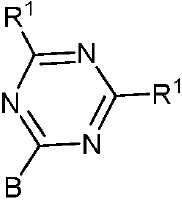
1,3,5-트리아진 모이어티 및 1,3,4-옥사디아졸 모이어티의 예로는 화학식 II, 화학식 III 및 화학식 IIIa의 모이어티를 들 수 있다.Examples of 1,3,5-triazine moieties and 1,3,4-oxadiazole moieties include the moieties of formulas (II), (III) and (IIIa).
[화학식 II]≪ RTI ID = 0.0 &
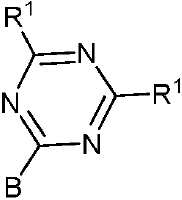
[화학식 III](III)

[화학식 IIIa]≪ RTI ID = 0.0 &
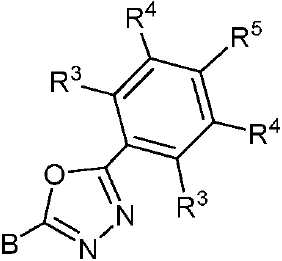
상기 식에서, -B는 고리 시스템(Q)에 대한 결합 위치를 나타내고;Wherein: -B represents the bonding position to the ring system (Q);
-R2는 환형일 수 있고 비치환될 수 있는 치환 또는 비치환된 1차, 2차 또는 3차 알킬(예를 들어, C1-C10 또는 심지어는 C1-C4)을 나타내고;R 2 represents a substituted or unsubstituted primary, secondary or tertiary alkyl (eg, C 1 -C 10 or even C 1 -C 4) which may be cyclic and unsubstituted;
R1, R3, R4 및 R5 기는 각각의 경우에 대해 독립적으로는 -H, 환형일 수 있고 비치환될 수 있는 치환 또는 비치환된 1차, 2차 또는 3차 알킬(예를 들어, C1-C10 또는 심지어는 C1-C4); 치환 또는 비치환된 아릴 또는 헤테로아릴, -CF3, -OMe, -SF5, -NO2, 할로(예를 들어, 플루오로, 클로로, 브로모 및 요오도), 아릴 하이드록시, 아미노, 알콕시, 알킬티오, 카르복시, 시아노, 티오, 포르밀, 에스테르, 아실, 티오아실, 아미도, 설폰아미도, 카바메이트, 산화포스핀 및 황화포스핀으로 이루어진 군으로부터 선택된다.The R 1 , R 3 , R 4 and R 5 groups may in each case independently be -H, substituted or unsubstituted primary, secondary or tertiary alkyl which may be cyclic and unsubstituted (for example, , C1-C10 or even C1-C4); A substituted or unsubstituted aryl or heteroaryl, -CF 3, -OMe, -SF 5 , -NO 2, halo (e.g., fluoro, chloro, bromo and iodo), aryl, hydroxy, amino, alkoxy , Alkylthio, carboxy, cyano, thio, formyl, ester, acyl, thioacyl, amido, sulfonamido, carbamate, oxidized phosphine and sulfated phosphine.
편리하게도, 1,3,4 옥사디아졸 수용체 모이어티는 니트릴 함유 TADF 종의 반응에 의해 형성될 수 있다. 아지드와의 반응은 테트라졸을 생성하며, 이는 이어 적절한 산 염화물과 반응하여 옥사디아졸을 제공한다. 보다 일반적으로는, 수용체 모이어티로서의 헤테로사이클은 교차 결합 반응 또는 기타 유형의 치환 반응에 의해 고리 시스템(Q)에 부착될 수 있으며, 목적하는 최종 산물을 수득하기 위해 추가의 조작을 포함할 수 있다. 축합 반응과 같은 기타 공지된 절차는 수용체 모이어티의 헤테로환식 고리를 구축하기 위해 사용될 수 있다.Conveniently, the 1,3,4 oxadiazole acceptor moiety may be formed by the reaction of a nitrile containing TADF species. The reaction with an azide produces a tetrazole, which in turn reacts with the appropriate acid chloride to provide the oxadiazole. More generally, the heterocycle as the acceptor moiety may be attached to the ring system (Q) by a cross-linking reaction or other type of substitution reaction and may include further manipulation to obtain the desired end product . Other known procedures such as condensation reactions can be used to construct the heterocyclic ring of the acceptor moiety.
상기 R1, R2, R3, R4 및 R5 기(또는 본원에서 토의된 구조 내에 제공되는 임의의 기타 기)가 치환되어 있는 것처럼 개시되어 있을지라도 이들은 각각의 경우에 대해 독립적으로 치환될 수 있다. 예를 들어, 1회, 2회 또는 3회, 예를 들어 1회, 즉 정상적으로는 하나 이상의 수소 원자를 할로(예를 들어, 플루오로, 클로로, 브로모 및 요오도), -SF5, -CF3, -OMe, -NO2, 환형일 수 있고 비치환될 수 있는 치환 또는 비치환된 1차, 2차 또는 3차 알킬(예를 들어, C1-C10 또는 심지어는 C1-C4); 치환 또는 비치환된 아릴 또는 헤테로아릴, 아릴 하이드록시, 아미노, 알콕시, 알킬티오, 카르복시, 시아노, 티오, 포르밀, 에스테르, 아실, 티오아실, 아미도, 설폰아미도, 카바메이트, 산화포스핀, 황화포스핀 등과 같은 치환기로 치환한다. 상기 치환기가 아미노인 경우, 이는 NH2, NHR 또는 NR2일 수 있으며, 여기서 질소 상의 R 치환기는 알킬, 아릴 또는 헤테로아릴(예를 들어, 치환 또는 비치환된 C1-C20 또는 심지어는 C1-C10)일 수 있다.Although the R 1 , R 2 , R 3 , R 4, and R 5 groups (or any other group provided in the structures discussed herein) are disclosed as being substituted, they are independently substituted for each occurrence . For example, once, twice or three times, for example one or more hydrogen atoms is one, that is, normally, halo (e.g., fluoro, chloro, bromo and iodo), -SF 5, - CF 3 , -OMe, -NO 2 , substituted or unsubstituted primary, secondary or tertiary alkyl (e.g., C 1 -C 10 or even C 1 -C 4) which may be cyclic and unsubstituted; Substituted or unsubstituted aryl or heteroaryl, arylhydroxy, amino, alkoxy, alkylthio, carboxy, cyano, thio, formyl, ester, acyl, thioacyl, amido, sulfonamido, carbamate, Pin, sulfide phosphine, and the like. When the substituent is amino, it may be NH 2 , NHR or NR 2 wherein the R substituent on the nitrogen is selected from the group consisting of alkyl, aryl or heteroaryl (e.g. substituted or unsubstituted C 1 -C 20 or even C 1 -C 10 ).
본원에서 아릴은 방향족 화합물로부터 수소 원자의 추출에 의해 정상적으로 형성된 라디칼(radical)을 의미한다. 당해 기술분야의 숙련자에게 공지된 바와 같이, 헤테로아릴 모이어티는 하나 이상의 탄소 원자 및 여기에 부착된 임의의 수소 원자 대신에 하나 이상의 헤테로원자, 전형적으로는 O, N 또는 S를 포함하는 아릴 모이어티의 하위 세트이다. 예시적인 아릴 치환기로는, 예를 들어 치환 가능한 페닐 또는 나프틸을 들 수 있다. 예시적인 헤테로아릴 치환기로는, 예를 들어 피리딘일, 푸란일, 피롤릴 및 피리미딘일을 들 수 있다.Aryl herein refers to a radical normally formed by the extraction of a hydrogen atom from an aromatic compound. As known to those skilled in the art, a heteroaryl moiety is an aryl moiety containing one or more carbon atoms and optionally one or more heteroatoms, typically O, N or S, instead of any hydrogen atoms attached thereto ≪ / RTI > Exemplary aryl substituents include, for example, substituted phenyl or naphthyl. Exemplary heteroaryl substituents include, for example, pyridinyl, furanyl, pyrrolyl, and pyrimidinyl.
헤테로 방향족 고리의 추가적인 예로는 피리다진일(여기서 2개의 질소 원자는 방향족 6원 고리 내에서 서로 인접함); 피라진일(여기서 2개의 질소는 6원 방향족 고리에서 1,4-위치에 배열됨); 피리미딘일(여기서 2개의 질소 원자는 6원 방향족 고리에서 1,3-위치에 배열됨); 또는 1,3,5-트리아진일(여기서 3개의 질소 원자는 6원 방향족 고리에서 1,3,5-위치에 배열됨)을 들 수 있다.Further examples of heteroaromatic rings include pyridazinyl wherein the two nitrogen atoms are adjacent to one another in an aromatic six-membered ring; Pyrazine wherein the two nitrogens are arranged at the 1,4-position in a six-membered aromatic ring; Pyrimidinyl wherein the two nitrogen atoms are arranged in the 1,3-position in the 6-membered aromatic ring; Or 1,3,5-triazinyl, wherein the three nitrogen atoms are arranged at the 1,3,5-position in the six-membered aromatic ring.
상기 R1, R2, R3, R4 및 R5 기(또는 본원에서 토의된 구조 내에 제공되는 임의의 기타 기)가 하나 이상의 고리를 포함하는 경우, 이들은 사이클로알킬일 수 있다. 이들은, 예를 들어 사이클로헥실 또는 사이클로펜틸 고리일 수 있다. 상기 사이클로헥실기 또는 사이클로펜틸기는 존재하는 경우에 치환 또는 비치환될 수 있으며, 상술한 바와 같이 치환될 수 있다.When the R 1 , R 2 , R 3 , R 4 and R 5 groups (or any other group provided in the structures discussed herein) comprise one or more rings, they may be cycloalkyl. These may be, for example, cyclohexyl or cyclopentyl rings. The cyclohexyl group or the cyclopentyl group, when present, may be substituted or unsubstituted and may be substituted as described above.
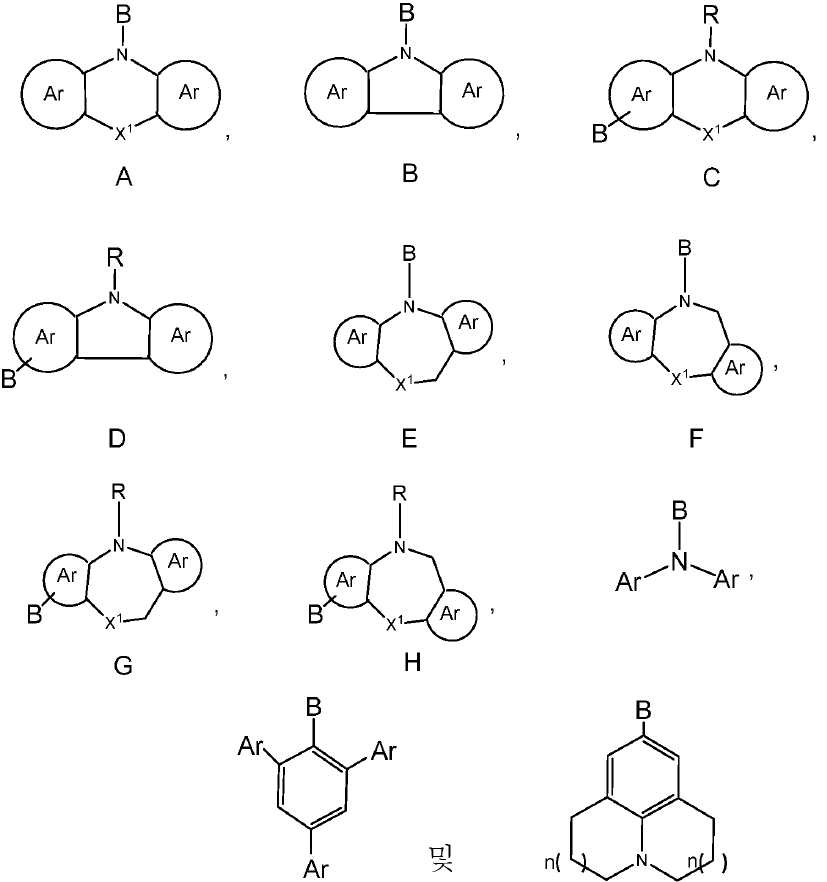
공여체(D) 모이어티는 하기 화합물로부터 선택될 수 있다:The donor (D) moiety can be selected from the following compounds:
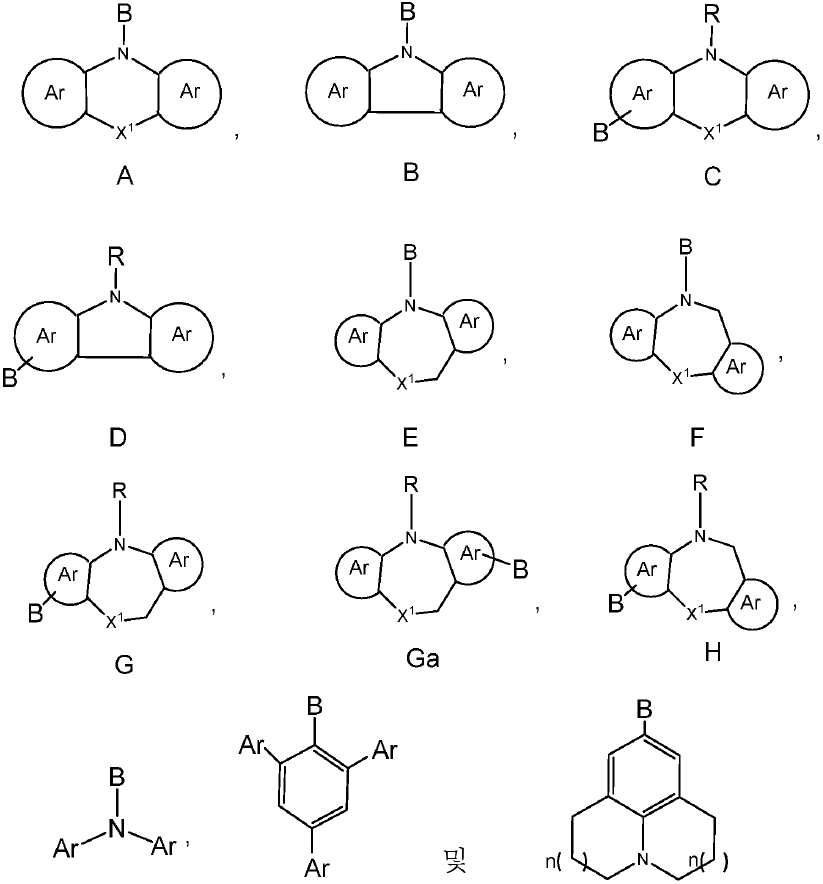
상기 식에서, -B는 화학식 C, 화학식 D, 화학식 G, 화학식 Ga 및 화학식 H의 구조 내의 질소에 대해 파라-위치에 있는 고리 시스템(Q)에 대한 결합 위치를 나타내고;Wherein B represents the bonding position to the ring system (Q) in the para-position to the nitrogen in the structure of formula C, formula D, formula G, formula Ga and formula H;
X1은 O, S, NR, SiR2, PR 및 CR2로 이루어진 군으로부터 선택되고;X 1 is selected from the group consisting of O, S, NR, SiR 2 , PR, and CR 2 ;
R 각각은 -H, 알킬, 아릴 또는 헤테로아릴(예를 들어, 치환 또는 비치환된 C1-C20 또는 심지어는 C1-C10 알킬)로 이루어진 군으로부터 독립적으로 선택되고;Each R is independently selected from the group consisting of-H, alkyl, aryl, or heteroaryl (e.g., substituted or unsubstituted C1-C20 or even C1-C10 alkyl);
Ar 각각은 각각의 경우에 대해 독립적으로는 치환 또는 비치환된 아릴 또는 헤테로아릴로 이루어진 군으로부터 선택되고;Each Ar is independently for each occurrence selected from the group consisting of substituted or unsubstituted aryl or heteroaryl;

n( )는 상기 벤젠 고리에 어닐레이팅된 고리 내의 포화된 -CH2- 기의 선택적 존재를 나타내고;n () represents the optional presence of a saturated -CH 2 - group in the ring annealed to the benzene ring;
n은 각각의 경우에 대해 독립적으로는 0, 1 또는 2이다. n is independently 0, 1 or 2 for each occurrence.
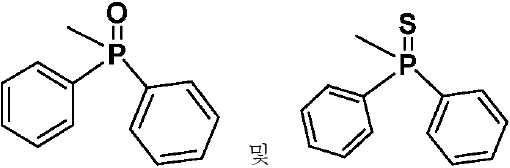
-Ar 및 
산화포스핀 또는 황화포스핀은 본원에서 개시된 TADF 화합물과 같은 TADF 분자의 구조 내에서 수용체 모이어티로서 또는 수용체 모이어티의 일부(수용체 모이어티 상의 치환기)로서 사용될 수 있다.Oxidative phosphines or sulfide phosphines may be used as the acceptor moiety in the structure of the TADF molecule, such as the TADF compound disclosed herein, or as part of the acceptor moiety (a substituent on the acceptor moiety).
본원에서 개시된 바와 같이 공여체(D) 모이어티 상의 치환기로서 사용되는 경우, 산화포스핀 또는 황화포스핀은 공여체의 특징을 조정하는 작용을 하며, 따라서 TADF 화합물의 광 물리학적 거동을 변경할 수 있으며, 예를 들어 이는 방출 색깔 및 세기의 변화를 초래할 수 있다.When used as a substituent on the donor (D) moiety as disclosed herein, the oxidized phosphine or sulfided phosphine acts to modulate the donor's properties and thus can alter the photophysical behavior of the TADF compound, Which can result in a change in emission color and intensity.
본원에서 개시된 치환기가 산화포스핀 또는 황화포스핀인 경우, 이는 하기 화합물로 이루어진 군으로부터 선택될 수 있다:When the substituent disclosed herein is an oxidized phosphine or a sulfated phosphine, it may be selected from the group consisting of:

상기 식에서, 인 상의 R 치환기는 치환 또는 비치환된 알킬, 아릴 또는 헤테로아릴(예를 들어, 치환 또는 비치환된 C1-C20 또는 심지어는 C1-C10)일 수 있다.In the above formula, the R substituent on the phosphorus may be substituted or unsubstituted alkyl, aryl or heteroaryl (e.g., substituted or unsubstituted C1-C20 or even C1-C10).
따라서 하기 치환기, 또는 하나 또는 2개의 페닐기 모두가 치환되어 있는 치환기가 수용체 및 공여체 모이어티 둘 모두에 대해서 고려되고 있다.Thus, the following substituents, or substituents in which both one or two phenyl groups are substituted, are contemplated for both the acceptor and donor moieties.
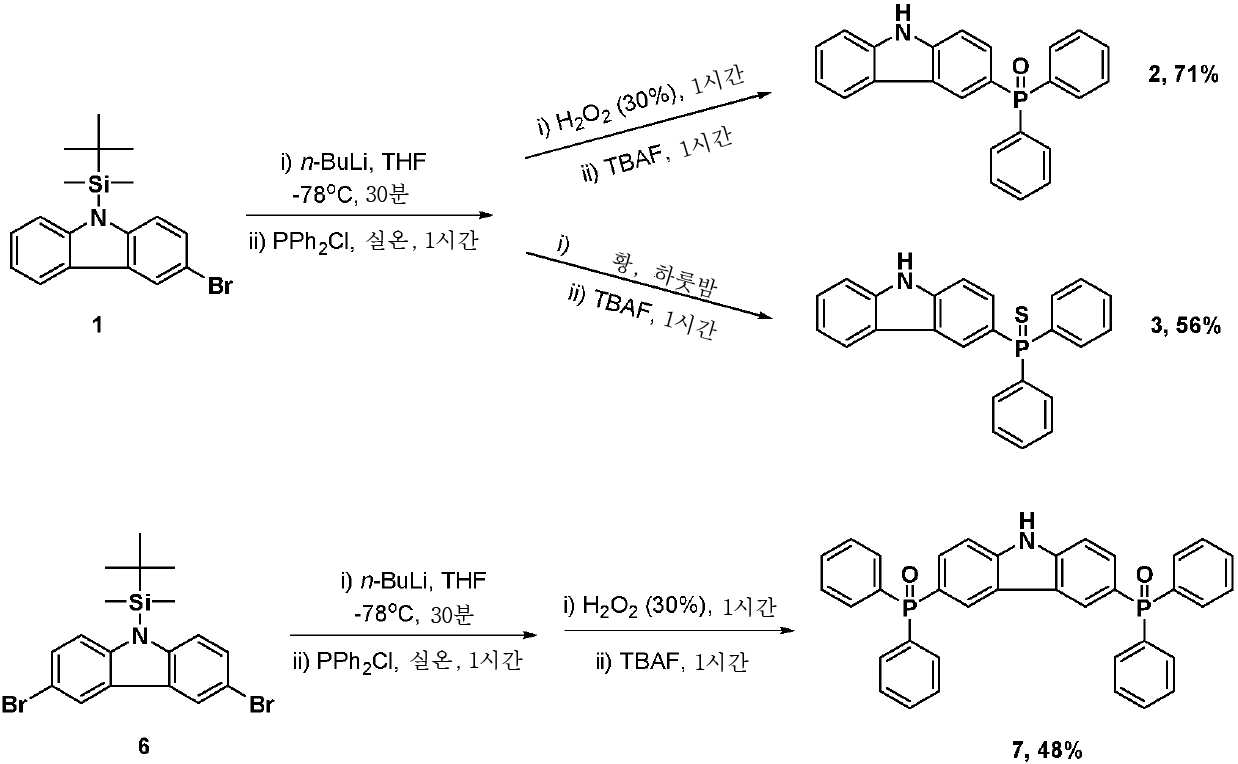
산화포스핀 및 황화포스핀 치환기는, 예를 들어 하기 반응식에 따라 도입될 수 있으며, 하기 반응식에서는 전형적인 공여체 모이어티인 카바졸 상의 치환이 예시되어 있다.Oxidative phosphines and sulfided phosphine substituents can be introduced, for example, according to the following reaction schemes, in which the substitution of the carbazole moiety, which is a typical donor moiety, is illustrated.
하기 구조 내 벤젠 고리에 어닐레이팅된 포화 고리는 5원, 6원 또는 7원 고리일 수 있다:The saturated ring which is annealed to the benzene ring in the structure may be a 5, 6 or 7 membered ring:

전형적으로는, 이들은 6원, 즉 n이 1인 줄리오리딘(juliolidine) 구조일 수 있다.Typically, these may be a 6-membered, juliolidine structure with n = 1.

따라서 공여체 모이어티는 치환 및 비치환된 카바졸, 디페닐아민, 페노티아진, 페녹사진, 페나진 및 디하이드로아크리딘 모이어티으로 이루어진 군으로부터 선택될 수 있다. 공여체 모이어티에서, 상기 고리 시스템 상의 치환기는 모두 H일 수 있다. 상기 공여체 모이어티는 하기 화합물로 이루어진 군으로부터 선택될 수 있다:Thus, the donor moiety may be selected from the group consisting of substituted and unsubstituted carbazole, diphenylamine, phenothiazine, phenoxazine, phenazine and dihydroacridine moieties. In the donor moiety, all of the substituents on the ring system may be H. The donor moiety may be selected from the group consisting of:
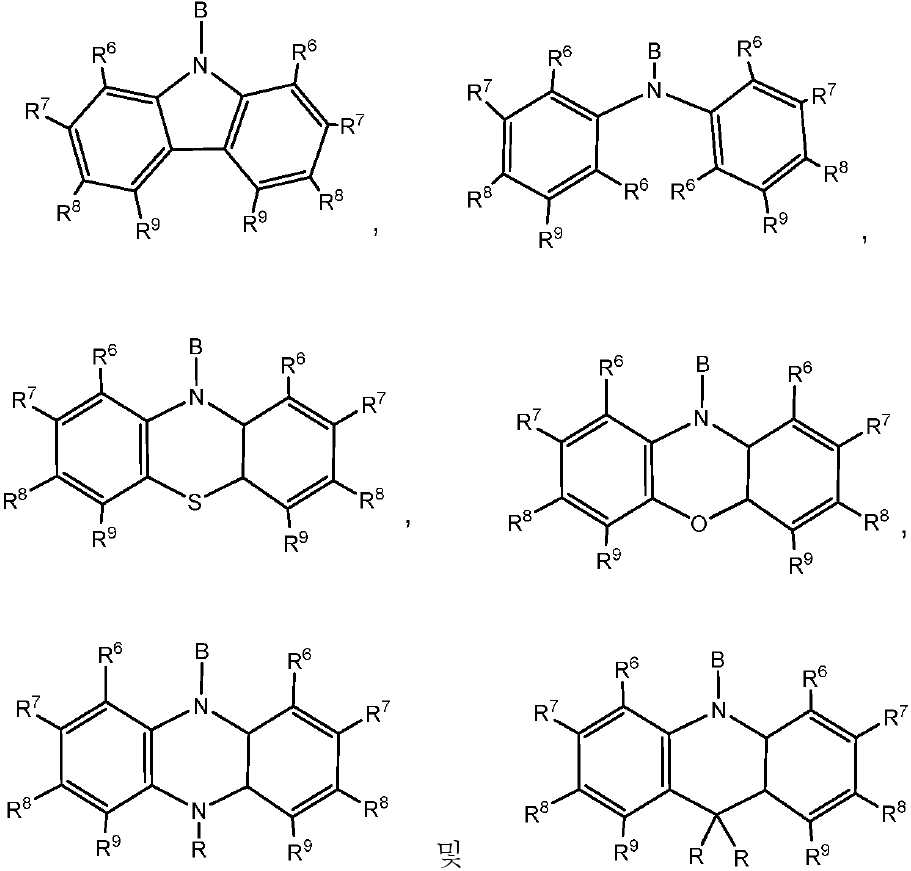
상기 식에서, -B는 고리 시스템(Q)에 대한 결합 위치를 나타내고;Wherein: -B represents the bonding position to the ring system (Q);
R6, R7, R8 및 R9 기 각각은 각각의 경우에 대해 독립적으로는 -H, 환형일 수 있고 비치환될 수 있는 치환 또는 비치환된 1차, 2차 또는 3차 알킬(예를 들어, C1-C10 또는 심지어는 C1-C4); 치환 또는 비치환된 아릴 또는 헤테로아릴, -CF3, -OMe, -SF5, -NO2, 할로(예를 들어, 플루오로, 클로로, 브로모 및 요오도), 아릴, 아릴 하이드록시, 아미노, 알콕시, 알킬티오, 카르복시, 시아노, 티오, 포르밀, 에스테르, 아실, 티오아실, 아미도, 설폰아미도, 카바메이트, 산화포스핀, 황화포스핀 등으로 이루어진 군으로부터 선택되고;Each of R 6 , R 7 , R 8 and R 9 groups is independently for each occurrence -H, a substituted or unsubstituted primary, secondary or tertiary alkyl which may be cyclic and unsubstituted (eg, For example C1-C10 or even C1-C4); Substituted or unsubstituted aryl or heteroaryl, -CF 3, -OMe, -SF 5 , -NO 2, halo-ring (as, for example, fluoro, chloro, bromo, and iodo), aryl, hydroxy, amino Alkoxy, alkylthio, carboxy, cyano, thio, formyl, ester, acyl, thioacyl, amido, sulfonamido, carbamate, oxidized phosphine, sulfated phosphine and the like;
R 각각은 -H, 알킬, 아릴 또는 헤테로아릴(예를 들어, 치환 또는 비치환된 C1-C20 또는 심지어는 C1-C10 알킬)로 이루어진 군으로부터 독립적으로 선택된다.Each R is independently selected from the group consisting of-H, alkyl, aryl, or heteroaryl (e.g., substituted or unsubstituted C1-C20 or even C1-C10 alkyl).
상기 고리 시스템(Q)은 공여체와 수용체 모이어티 사이를 가교하도록 작용한다. 상기 고리 시스템(Q)은 함께 융합된 적어도 2개의 고리를 포함한다. 상기 적어도 2개의 함께 융합된 고리는 6원 및/또는 5원 고리일 수 있다.The ring system (Q) acts to bridge the donor and acceptor moieties. The ring system (Q) comprises at least two rings fused together. The at least two fused rings may be a 6-membered and / or 5-membered ring.
5원 및 6원 고리 둘 모두를 갖는 고리 시스템(Q)의 예로는 치환 및 비치환된 플루오렌, 디벤조티오펜, 디벤조푸란, 디벤조셀레노펜 및 벤조[1,2-b:4,5-b'] 디티오펜 고리 시스템을 들 수 있다.Examples of ring systems (Q) having both 5-membered and 6-membered rings include substituted and unsubstituted fluorene, dibenzothiophene, dibenzofuran, dibenzocellenophen and benzo [1,2-b: 5-b '] dithiophene ring system.
6원 고리를 갖는 고리 시스템(Q)의 예로는 융합된 벤젠 고리를 갖는 치환 및 비치환된 방향족 탄화수소를 들 수 있다. 이 같은 고리 시스템(Q)은 치환 또는 비치환된 나프탈렌, 안트라센, 페난트렌 및 피렌 고리 시스템을 포함할 수 있다. 융합된 벤젠 고리를 갖는 기타 다환식 방향족 고리 시스템이 고려된다. 예를 들어, 안트라센 및 치환 및 비치환된 아센기(융합된 벤젠 고리를 직선 배열(rectilinear arrangement)로 갖는 다환식 방향족 탄화수소)의 추가적인 멤버가 고려된다.Examples of the ring system (Q) having a six-membered ring include substituted and unsubstituted aromatic hydrocarbons having a fused benzene ring. Such ring systems (Q) may include substituted or unsubstituted naphthalene, anthracene, phenanthrene, and pyrene ring systems. Other polycyclic aromatic ring systems with fused benzene rings are contemplated. For example, additional members of anthracene and substituted and unsubstituted asene groups (polycyclic aromatic hydrocarbons having a fused benzene ring in a rectilinear arrangement) are contemplated.
하기 반응식 2에는 이 같은 고리 시스템(Q)의 예가 나타나 있으며, 여기서 모체 고리 시스템의 명칭은 각각의 구조 아래에 기재되어 있다. 각각의 경우에, Rq 치환기들 중 적어도 하나는 공여체(D) 모이어티일 것이고, Rq 치환기들 중 적어도 하나는 수용체(A) 모이어티일 것이다. 나머지 Rq 치환기는 H일 수 있다.An example of such a ring system (Q) is shown in the following Reaction Scheme 2, wherein the names of the parent ring systems are described below under each structure. In each case, at least one of R q substituent is a donor (D) moiety tiil will, at least one of R q substituent is tiil receptor (A) moieties. The remaining R < q > substituent can be H.
[반응식 2][Reaction Scheme 2]
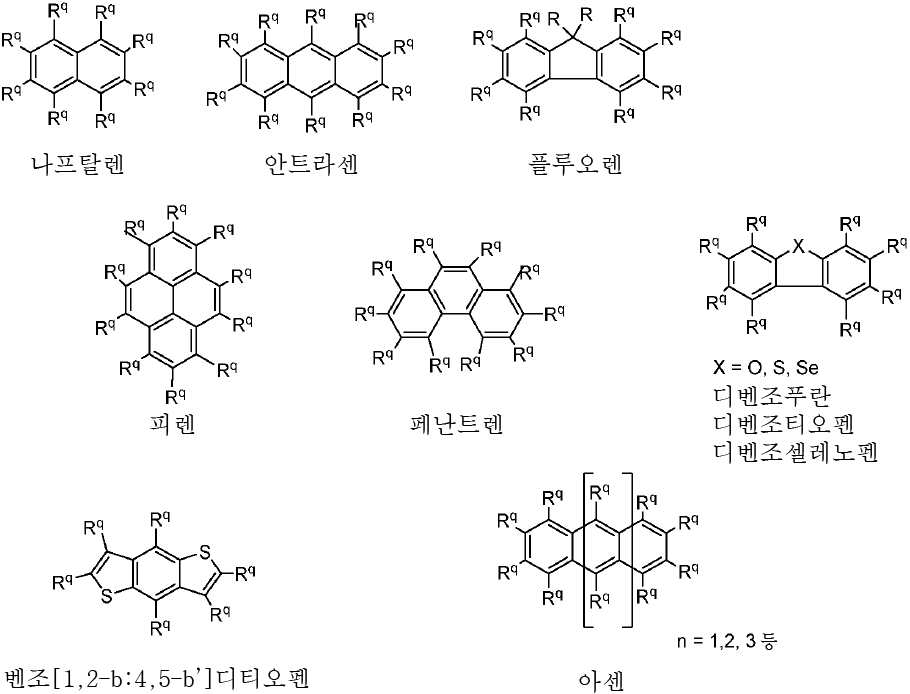
나머지 Rq 치환기는 각각의 경우에 대해 독립적으로는 -H, 환형일 수 있고 비치환될 수 있는 치환 또는 비치환된 1차, 2차 또는 3차 알킬(예를 들어, C1-C10 또는 심지어는 C1-C4); 치환 또는 비치환된 아릴 또는 헤테로아릴, -CF3, -OMe, -SF5, -NO2, 할로(예를 들어, 플루오로, 클로로, 브로모 및 요오도), 아릴, 아릴 하이드록시, 아미노, 알콕시, 알킬티오, 카르복시, 시아노, 티오, 포르밀, 에스테르, 아실, 티오아실, 아미도, 설폰아미도, 카바메이트, 산화포스핀, 황화포스핀 등으로 이루어진 군으로부터 선택될 수 있다. 상기 아센 실시예에 있어서, n은 1 이상, 예를 들어, 1 내지 10의 범위이다. n이 1인 경우, Q 기는 안트라센이다.The remaining R < q > substituents can in each case independently be -H, substituted or unsubstituted primary, secondary or tertiary alkyl which may be cyclic and unsubstituted (e.g., C1-C10 or even C1-C4); Substituted or unsubstituted aryl or heteroaryl, -CF 3, -OMe, -SF 5 , -NO 2, halo-ring (as, for example, fluoro, chloro, bromo, and iodo), aryl, hydroxy, amino , Alkoxy, alkylthio, carboxy, cyano, thio, formyl, ester, acyl, thioacyl, amido, sulfonamido, carbamate, oxidized phosphine, sulfide phosphine and the like. In the Ascene embodiment, n is in the range of 1 or more, for example, 1 to 10. When n is 1, Q is anthracene.
플루오렌 상의 R 치환기는 -H, 알킬, 아릴 또는 헤테로아릴(예를 들어, 치환 또는 비치환된 C1-C20 또는 심지어는 C1-C10)로 이루어진 군으로부터 독립적으로 선택될 수 있다. 일부 실시예에서, 상기 R 치환기는 공여체 또는 수용체 모이어티일 수 있으며, 단 이들은 TADF 효과를 구현하기 위해 사용된 D 및 A 모이어티보다 약하다.The R substituent on the fluorene may be independently selected from the group consisting of -H, alkyl, aryl, or heteroaryl (e.g., substituted or unsubstituted C1-C20 or even C1-C10). In some embodiments, the R substituent may be a donor or acceptor moiety, but they are weaker than the D and A moieties used to effect the TADF effect.
공여체(D) 및 수용체(A) 기의 배치에 대한 예는 하기 반응식 3에 나타나 있다.An example of the arrangement of donor (D) and acceptor (A) groups is shown in Scheme 3 below.
[반응식 3][Reaction Scheme 3]
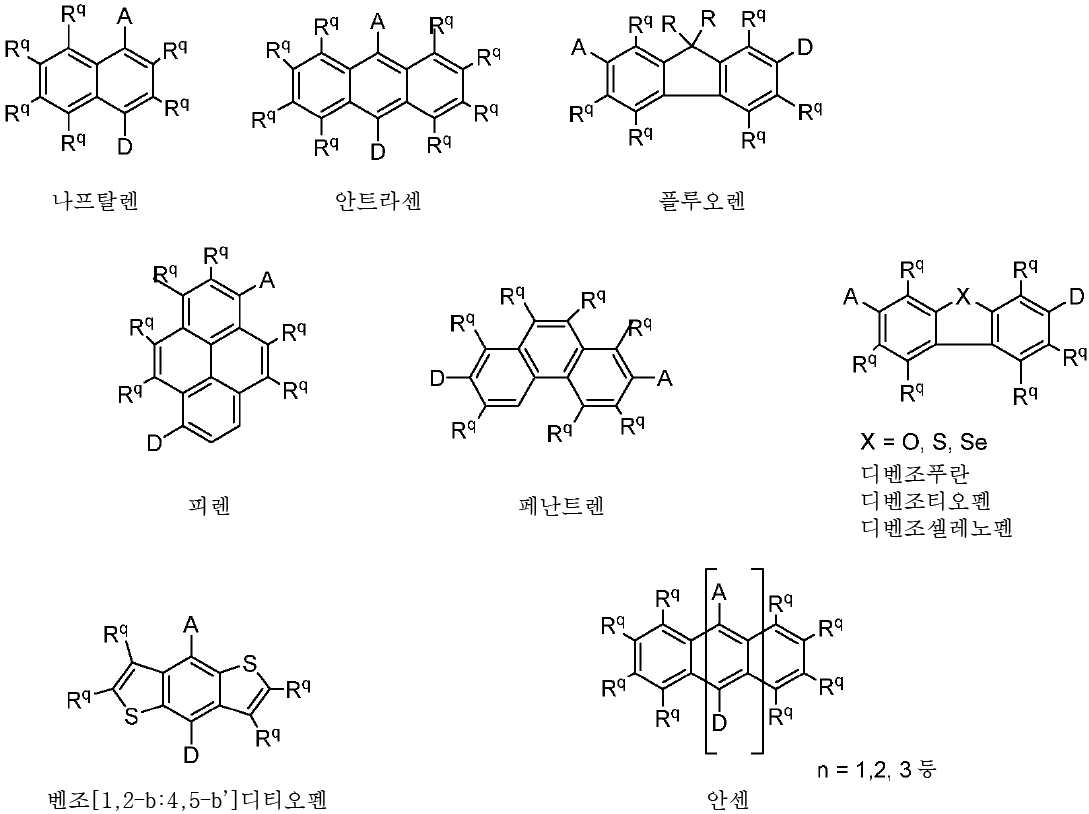
상기 아센 실시예에 있어서, 반응식 3에 나타나 있는 안트라센 실시예의 경우와 같이 공여체 및 수용체 기들 중 각각 하나만이 제공될 수 있다. n이 2, 3 등인 경우에 존재하는 기타 고리(들)은 상기에서 토의된 바와 같이 기타 Rq 치환기를 가질 수 있다. 따라서, 예를 들어 A 및 D가 상이한 고리 상에 있고/있거나 각각의 A 및/또는 D 모이어티 중 하나 이상이 제공되는 구조가 고려될뿐만 아니라, 화학식 IV, 화학식 IVa, 화학식 V, 화학식 Va 및 화학식 VI의 구조(하기)는 n = 2 및 n = 3인 경우에 고려된다.In the Ascene embodiment, only one of each of the donor and acceptor groups may be provided, as in the anthracene embodiment shown in Scheme 3. Other ring (s) present when n is 2, 3, etc. may have other R q substituents as discussed above. Thus, for example, not only are structures in which A and D are on different rings and / or one or more of the respective A and / or D moieties are contemplated, but also the structures of formula IV, formula IVa, formula V, The structure of Formula VI (below) is considered when n = 2 and n = 3.
[화학식 IV](IV)
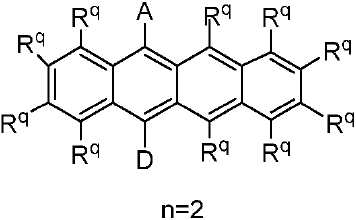
[화학식 IVa](IVa)

[화학식 V](V)

[화학식 Va][Formula Va]
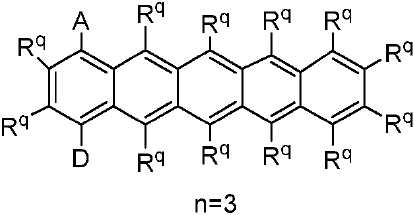
[화학식 VI](VI)
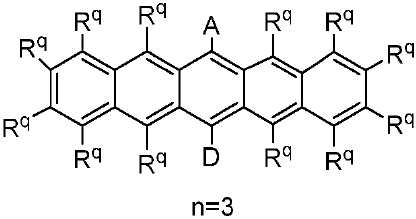
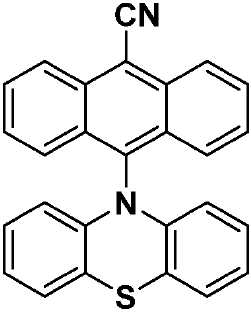
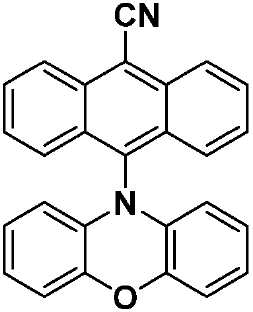
화학식 I에 따른 예시적인 유기 열 활성화 지연 형광(TADF) 종으로는 수용체 모이어티로서 -CN을 이용하고, 상기 고리 시스템(Q)으로서 안트라센을 이용하고, 공여체 모이어티로서 카바졸, 디페닐아민, 페노티아진 및 페녹사진을 이용하는 화학식 VII, 화학식 VIII, 화학식 IX 및 화학식 X의 구조(하기)를 들 수 있다.Exemplary TADF species according to Formula I include -CN as the acceptor moiety, anthracene as the ring system Q, carbazole, diphenylamine, (VII), (VIII), (IX) and (X) using phenothiazine and phenoxazine.
[화학식 VII](VII)
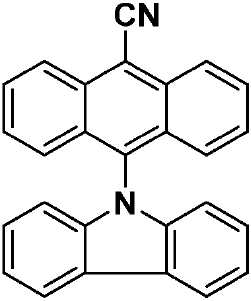
[화학식 VIII](VIII)
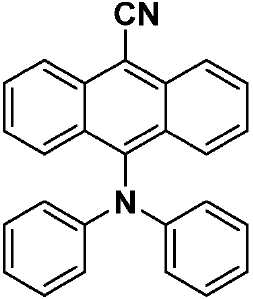
[화학식 IX](IX)
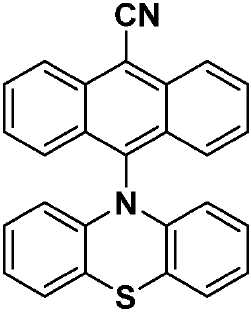
[화학식 X](X)

상기 화학식 I에 따른 유기 열 활성화 지연 형광(TADF) 종은 필요한 공여체 및 수용체 기 및 상기 고리 시스템(Q) 상에서의 이들의 필요한 위치에 따라 다양한 방식으로 만들어질 수 있다. 전형적으로는, 당업계의 숙련자에게 널리 공지된 바와 같이 치환기를 목적하는 생성물로 변형하기 위한 추가의 조작과 더불어 친핵성 방향족 치환 반응과 같은 친핵성 치환 반응이 이용될 수 있다.Organic thermally activated delayed fluorescence (TADF) species according to Formula I above may be made in a variety of ways depending on the required donor and acceptor groups and their required location on the ring system (Q). Typically, nucleophilic substitution reactions, such as nucleophilic aromatic substitution reactions, can be employed, with further manipulation to transform the substituent into the desired product, as is well known to those skilled in the art.
예를 들어, 하기 실시예를 참고하여 개시된 바와 같이, 안트라센 고리 시스템(Q)이 사용되는 경우에 시아노를 수용체 기로서 포함하는 본 발명의 TADF 종에 접근하기 위해 공지된 9,10-디브로모안트라센을 출발 물질로 이용할 수 있다. 상기 시아노기 자체는 조작되어 옥사디아졸 수용체 기를 제공할 수 있다.For example, as disclosed with reference to the following examples, there is a known 9,10-dibromo-4,6-dibromoquinolinecarboxylic acid, which is known to approach the TADF species of the present invention comprising cyano as the acceptor group when an anthracene ring system (Q) The anthracene can be used as a starting material. The cyano group itself may be manipulated to provide an oxadiazole acceptor group.
고리 시스템, 특히 방향족 고리 시스템에 기를 구축하거나 기를 부착하는 기타 수단은 당업계의 숙련자에게 널리 공지되어 있다. 유사하게도, 공여체(D) 모이어티를 부착하기 위한 방법은 당업계의 숙련자가 이용 가능하다. (예를 들어, 문헌{Name reactions in heterocyclic chemistry 2005 - Jie Jack Li, editor; Wiley; and Strategic Applications of Organic Named Reactions in Organic Synthesis 2005 - by Laslo Kurti and Barbara Czako; Academic Press}을 참조한다. 이들 문헌의 전문은 본원에서 참고로 인용된다).Ring systems, especially other means of building or attaching groups to aromatic ring systems, are well known to those skilled in the art. Similarly, methods for attaching donor (D) moieties are available to those skilled in the art. (See, for example, Name reactions in heterocyclic chemistry 2005 - Jie Jack Li, editor Wiley; and Strategic Applications of Organic Named Reactions in Organic Synthesis 2005 - by Laslo Kurti and Barbara Czako; Academic Press. The disclosure of which is incorporated herein by reference).
도 1은 TADF 종의 TADF 종의 흡수 스펙트럼을 나타내고;
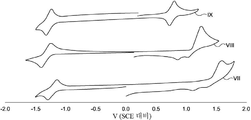
도 2는 TADF 종의 순환 전압곡선(cyclic voltammogram)을 나타내고;
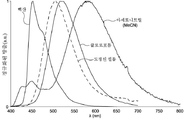
도 3a는 TADF 종의 방출 스펙트럼을 나타내고;
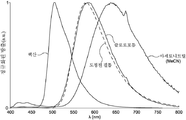
도 3b는 TADF 종의 방출 스펙트럼을 나타낸다.Figure 1 shows the absorption spectrum of the TADF species of the TADF species;
Figure 2 shows a cyclic voltammogram of a TADF species;
Figure 3a shows the emission spectrum of a TADF species;
Figure 3b shows the emission spectrum of TADF species.
일반적인 합성 절차General Synthetic Procedures
상업적으로 이용 가능한 화학물질 및 시약 등급의 용매가 접수된 바와 같이 사용하였다. 공기-민감성 반응은 질소 분위기 하에 표준 슈렌크 기법(Schlenk technique)을 이용하여 수행되었다. 새롭게 증류된 무수 THF는 Pure SolvTM 용매 정제 시스템(이노베이티브 테크놀로지스(Innovative Technologies))으로부터 수득하였다. 플래시 칼럼 크로마토그래피는 실리카 겔(실리사이클(Silicycle)사의 Silia-P, 60Å, 40 내지 63㎛)을 이용하여 수행되었다. 분석용 박층 크로마토그래피(TLC)는 알루미늄 지지대(backing; 250㎛로 F-254 지시기가 구비됨)가 구비된 실리카 플레이트를 이용하여 수행되었다. TLC 시각화(TLC visualization)는 254/365㎚ UV 램프에 의해 구현되었다. 1H 및 13C NMR 스펙트럼은 브루커 어드밴스(Bruker Advance) AVANCE II 400 분광계 상에 기록되었다. 융점(melting point)은 전열 융점 장치 IA9200 상에서 개방-말단 모세관(open-ended capillary)을 이용하여 측정되었으며, 보정하지는 않았다. 고해상도 질량 분광 분석법(HRMS)은 스완지(Swansea) 대학교의 EPSRC 국립 질량 분광 분석 서비스 센터(NMSSC)에 의해 수행되었다. 원소 분석은 런던 메트로폴리탄(London Metropolitan) 대학교의 스티븐 보이어(Stephen Boyer)에 의해 수행되었다.Commercially available chemicals and reagent grade solvents were used as received. The air-sensitive reaction was carried out using the standard Schlenk technique under a nitrogen atmosphere. The freshly distilled anhydrous THF was obtained from the Pure Solv ™ solvent refining system (Innovative Technologies). Flash column chromatography was performed using silica gel (Silia-P, 60 Å, 40 to 63 袖 m from Silicycle). Analytical thin layer chromatography (TLC) was performed using a silica plate equipped with an aluminum backing (250 [mu] m equipped with an F-254 indicator). TLC visualization was implemented by a 254/365 nm UV lamp. The 1 H and 13 C NMR spectra were recorded on a Bruker Advance AVANCE II 400 spectrometer. Melting points were measured using an open-ended capillary on a heat melting point device IA9200 and were not calibrated. High resolution mass spectrometry (HRMS) was performed by the EPSRC National Mass Spectrometry Service Center (NMSSC) at Swansea University. Elemental analysis was carried out by Stephen Boyer at the London Metropolitan University.
9-시아노-10-플루오로안트라센(화학식 XI)의 제조(하기 반응식 4)Preparation of 9-cyano-10-fluoroanthracene (Formula XI) (Scheme 4)
-78℃로 냉각된 건식 THF(20㎖) 중의 9,10-디브로모안트라센(1.0g, 3.0 mmol, 1.0당량)의 용액에 1.6M n-BuLi 용액(2.2㎖, 3.6mmol, 1.2당량)을 적가하였다. 반응 혼합물을 이 온도에서 15분 동안 교반하였다. N-플루오로벤젠설폰이미드(0.77g, 3.0mmol, 1.0당량)을 첨가하고, 혼합물을 실온까지 승온한 후, 1시간 동안 교반하였다. 상기 혼합물을 물(25㎖)에 첨가하고, DCM(3 x 20㎖)으로 추출하였다. 농축된 유기층은 헥산을 용리액으로서 사용하는 칼럼 크로마토그래피에 의해 정제하였다. 상기 수득된 황색 고체(0.57g)를 -78℃로 냉각된 건식 THF(10㎖) 중에 용해하였다. 1.6M n-BuLi 용액(1.6㎖, 2.5mmol, 1.2당량)을 적가하고, 혼합물을 이 온도에서 15분 동안 교반하였다. 건식 DMF(0.8㎖, 10mmol, 5당량)를 첨가하고, 상기 혼합물을 실온까지 승온한 후, 1시간 동안 추가로 교반하였다. 상기 혼합물을 10% HCl(수성)(15㎖)에 첨가하고, DCM(3 x 20㎖)으로 추출하였다. 상기 농축된 유기층은 EtOAc:헥산(1:8(부피/부피))을 용리액으로서 사용하는 칼럼 크로마토그래피에 의해 정제하였다. 상기 수득된 황색 고체(0.30g)는 NMP(10㎖) 중의 하이드록실아민 염산염(0.28g, 4.1mmol, 3.0당량)과 혼합하고, 120℃에서 6시간 동안 가열하였다. 상기 혼합물을 물(50㎖)에 첨가하고, 여과하여 표제 화합물(0.29g, 총 44%)을 얻었으며, 이는 추가의 정제 없이 사용하였다.To a solution of 9,10-dibromoanthracene (1.0 g, 3.0 mmol, 1.0 eq.) In dry THF (20 mL) cooled to -78 째 C was added 1.6M n- BuLi solution (2.2 mL, 3.6 mmol, 1.2 eq) Was added dropwise. The reaction mixture was stirred at this temperature for 15 minutes. N -Fluorobenzenesulfonimide (0.77 g, 3.0 mmol, 1.0 eq.) Was added and the mixture was allowed to warm to room temperature and stirred for 1 h. The mixture was added to water (25 mL) and extracted with DCM (3 x 20 mL). The concentrated organic layer was purified by column chromatography using hexane as the eluent. The resulting yellow solid (0.57 g) was dissolved in dry THF (10 mL) cooled to -78 < 0 > C. 1.6 M n- BuLi solution (1.6 mL, 2.5 mmol, 1.2 eq.) Was added dropwise and the mixture was stirred at this temperature for 15 min. Dry DMF (0.8 mL, 10 mmol, 5 equiv.) Was added and the mixture was allowed to warm to room temperature and stirred further for 1 h. The mixture was added to 10% HCl (aq) (15 mL) and extracted with DCM (3 x 20 mL). The concentrated organic layer was purified by column chromatography using EtOAc: hexane (1: 8 (v / v)) as eluent. The obtained yellow solid (0.30 g) was mixed with hydroxylamine hydrochloride (0.28 g, 4.1 mmol, 3.0 eq.) In NMP (10 ml) and heated at 120 캜 for 6 hours. The mixture was added to water (50 mL) and filtered to give the title compound (0.29 g, 44% total), which was used without further purification.
안트라센계 에미터를 합성하기 위한 일반적인 절차General Procedure for Synthesis of Anthracene Emitter
[반응식 4][Reaction Scheme 4]

건식 THF(2㎖)에 용해된 상응하는 공여체 아민(D1 내지 D3)(1.2당량)에 NaH(광유 중의 60%, 2.4당량)를 첨가하고, 혼합물을 30분 동안 교반하도록 하였다.NaH (60% in mineral oil, 2.4 equiv.) Was added to the corresponding donor amine (D1 to D3) (1.2 eq) dissolved in dry THF (2 ml) and the mixture allowed to stir for 30 minutes.
9-시아노-10-플루오로안트라센(1.0당량)을 첨가하고, 상기 혼합물을 3시간 동안 교반하였다. 상기 혼합물을 물(10㎖)에 첨가하고, DCM(3 x 10㎖)으로 추출하였다. 상기 농축된 유기층은 클로로포름:헥산(1:4(부피/부피))을 이용하는 칼럼 크로마토그래피에 의해 정제하였다. 상기 수득된 고체는 DCM/헥산 혼합물로부터 추가로 재결정화되었다.9-Cyano-10-fluoroanthracene (1.0 eq.) Was added and the mixture was stirred for 3 hours. The mixture was added to water (10 mL) and extracted with DCM (3 x 10 mL). The concentrated organic layer was purified by column chromatography using chloroform: hexane (1: 4 (volume / volume)). The resulting solid was further recrystallized from a DCM / hexane mixture.
9-(9- ( NN -카바졸릴)-10-시아노안트라센(CZAnCN)(화학식 VII)-Carbazolyl) -10-cyananthracene (CZAnCN) (VII)

녹색 고체. 수율: 71%. Mp: 252℃. R f : 0.47 (DCM:헥산류 = 1:1, 실리카). 1H NMR (400 MHz, CD2Cl2) δ (ppm): 8.64 (d, J = 8.7 Hz, 2H), 8.35 (dd, J = 7.7, 0.9 Hz, 2H), 7.84-7.80 (m, 2H), 7.49-7.45 (m, 2H), 7.41-7.31 (m, 6H), 6.73 (d, J = 7.9 Hz, 2H) 13C NMR (100 MHz, CD2Cl2) δ (ppm): 142.5, 135.0, 133.9, 129.4, 129.3, 127.9, 126.4, 125.9, 124.3, 123.4, 120.6, 120.5, 116.7, 110.0, 107.5. HR-MS (ESI): [M + H]+ 계산 값: (C27H17N2) 369.1386; 실제 값: 369.1389. C27H16N2에 대한 분석 계산 값: C, 88.02; H, 4.38; N, 7.60. 실제 값: C, 87.90; H, 4.26; N, 7.60.Green solid. Yield: 71%. Mp: 252 ° C. Rf : 0.47 (DCM: hexanes = 1: 1, silica). 1 H NMR (400 MHz, CD 2 Cl 2) δ (ppm): 8.64 (d, J = 8.7 Hz, 2H), 8.35 (dd, J = 7.7, 0.9 Hz, 2H), 7.84-7.80 (m, 2H ), 7.49-7.45 (m, 2H) , 7.41-7.31 (m, 6H), 6.73 (d, J = 7.9 Hz, 2H) 13 C NMR (100 MHz, CD 2 Cl 2) δ (ppm): 142.5, 135.0, 133.9, 129.4, 129.3, 127.9, 126.4, 125.9, 124.3, 123.4, 120.6, 120.5, 116.7, 110.0, 107.5. HR-MS (ESI): [M + H] < + > calculated: (C 27 H 17 N 2 ) 369.1386; Actual value: 369.1389. Calcd for C 27 H 16 N 2 : C, 88.02; H, 4.38; N, 7.60. Actual value: C, 87.90; H, 4.26; N, 7.60.
9-시아노-10-디페닐아미노안트라센(TPAAnCN)(화학식 VIII)9-cyano-10-diphenylaminoanthracene (TPAAnCN) (VIII)

오렌지색 고체. 수율: 55%. Mp: 233℃. R f : 0.48 (EtOAc:헥산류 = 1:8, 실리카). 1H NMR (300 MHz, CDCl3) δ (ppm): 8.52 (d, J = 8.7 Hz, 2H), 8.22 (d, J = 8.8 Hz, 2H), 7.73-7.68 (m, 2H), 7.53-7.47 (m, 2H), 7.24-7.18 (m, 4H), 7.07-7.04 (m, 4H), 6.99-6.93 (m, 2H). 13C NMR (76 MHz, CDCl3) δ (ppm): 147.5, 143.5, 134.7, 130.1, 129.5, 128.9, 127.5, 126.1, 125.4, 122.1, 120.7, 117.3, 105.5. HR-MS (ESI): [M + H]+ 계산 값: (C27H19N2) 371.1543; 실제 값: 371.1540. C27H18N2에 대한 분석 계산 값: C, 87.54; H, 4.90; N, 7.56. 실제 값: C, 87.44; H, 5.03; N, 7.45.Orange solid. Yield: 55%. Mp: 233 [deg.] C. R f : 0.48 (EtOAc: hexanes = 1: 8, silica). 1 H NMR (300 MHz, CDCl 3) δ (ppm): 8.52 (d, J = 8.7 Hz, 2H), 8.22 (d, J = 8.8 Hz, 2H), 7.73-7.68 (m, 2H), 7.53- 7.47 (m, 2H), 7.24-7.18 (m, 4H), 7.07-7.04 (m, 4H), 6.99-6.93 (m, 2H). 13 C NMR (76 MHz, CDCl 3) δ (ppm): 147.5, 143.5, 134.7, 130.1, 129.5, 128.9, 127.5, 126.1, 125.4, 122.1, 120.7, 117.3, 105.5. HR-MS (ESI): [M + H] < + > calculated: (C 27 H 19 N 2 ) 371.1543; Actual value: 371.1540. Anal. Calcd. For C 27 H 18 N 2 : C, 87.54; H, 4.90; N, 7.56. Actual value: C, 87.44; H, 5.03; N, 7.45.
9-시아노-10-(N-페노티아진일)안트라센(PTZAnCN)(화학식 IX)9-Cyano-10- (N-phenothiazinyl) anthracene (PTZAnCN) (IX)
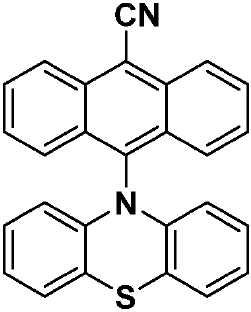
적색 고체. 수율: 59%. Mp: 320℃. R f : 0.43 (EtOAc:헥산류 = 1:8, 실리카). 1H NMR (300 MHz, CDCl3) δ (ppm): 8.60 (d, J = 8.7 Hz, 2H), 8.44 (d, J = 8.8 Hz, 2H), 7.84-7.78 (m, 2H), 7.67-7.62 (m, 2H), 7.11 (dd, J = 7.6, 1.5 Hz, 2H), 6.82 (dd, J = 7.5, 1.2 Hz, 2H), 6.67-6.61 (m, 2H), 5.70 (dd, J = 8.3, 1.1 Hz, 2H),13C NMR (76 MHz, CDCl3) δ (ppm): 142.9, 138.6, 134.4, 130.1, 129.4, 128.3, 127.2, 126.8, 126.3, 125.0, 123.1, 120.1, 116.8, 115.9, 107.1. HR-MS (ESI): [M]+ 계산 값: (C27H16N2S) 400.1029; 실제 값: 400.1029. C27H16N2S에 대한 분석 계산 값: C, 80.97; H, 4.03; N, 6.99. 실제 값: C, 81.05; H, 4.12; N, 7.05.Red solid. Yield: 59%. Mp: 320 ° C. Rf : 0.43 (EtOAc: hexanes = 1: 8, silica). 1 H NMR (300 MHz, CDCl 3) δ (ppm): 8.60 (d, J = 8.7 Hz, 2H), 8.44 (d, J = 8.8 Hz, 2H), 7.84-7.78 (m, 2H), 7.67- J = 7.6, 1.5 Hz, 2H), 6.82 (dd, J = 7.5, 1.2 Hz, 2H), 6.67-6.61 (m, 2H), 5.70 (dd, J = 8.3, 1.1 Hz, 2H), 13 C NMR (76 MHz, CDCl 3) δ (ppm): 142.9, 138.6, 134.4, 130.1, 129.4, 128.3, 127.2, 126.8, 126.3, 125.0, 123.1, 120.1, 116.8, 115.9 , 107.1. HR-MS (ESI): [M] + calculated: (C 27 H 16 N 2 S) 400.1029; Actual value: 400.1029. Anal. Calcd. For C 27 H 16 N 2 S: C, 80.97; H, 4.03; N, 6.99. Actual value: C, 81.05; H, 4.12; N, 7.05.
광 물리학적 측정Photophysical measurement
대략 10-5 또는 10-6M의 농도를 갖는 광학적 희석 용액을 흡수 및 방출 분석을 위한 HPLC 등급의 용매에서 제조하였다. 흡수 스펙트럼은 시마츠(Shimadzu) UV-1800 이중선 분광 광도계 상에 실온에서 기록하였다. 몰 흡수율 값(molar absorptivity value)은 적어도 4개의 용액으로부터 결정한 후, 선형 회귀분석을 실시하였다. 통기 용액(aerated solution)을 5분 동안 압축 공기로 버블링(bubbling)하는 반면, 탈기 용액은 사내에서 개조한 형광 큐벳(fluorescence cuvette)(큐벳 자체는 스타나(Starna)로부터 구매함)을 이용하여 방출 분석 이전에 5회의 냉동-펌프-해동 주기를 통해 제조하였다. 안정 상태의 방출 및 여기 스펙트럼 및 시간 분해 방출 스펙트럼은 에딘버그 인스트루먼츠(Edinburgh Instruments) F980 형광계를 이용하여 298K에서 기록하였다. 샘플은 안정 상태 측정을 위해 360㎚에서 여기하고, 시간 분해 측정을 위해 378㎚에서 여기하였다.An optical dilution solution having a concentration of approximately 10 < -5 > or 10 < -6 > M was prepared in HPLC grade solvent for absorption and release analysis. Absorption spectra were recorded on a Shimadzu UV-1800 dual line spectrophotometer at room temperature. The molar absorptivity value was determined from at least four solutions and then subjected to a linear regression analysis. The aerated solution was bubbled with compressed air for 5 minutes while the degassing solution was replaced with a fluorescence cuvette modified in-house (the cuvette itself was purchased from Starna) Were prepared through five freeze-pump-thaw cycles prior to release analysis. Steady-state emission and excitation and time-resolved emission spectra were recorded at 298 K using an Edinburgh Instruments F980 fluorescence system. The sample was excited at 360 nm for steady state measurements and excited at 378 nm for time resolution measurements.
용액에 대한 광발광 양자 수율(photoluminescence quantum yield)은 360㎚에서 흡광도가 약 0.10, 0.080, 0.060 및 0.040인 4개의 샘플 용액을 사용하는 희석 방법을 이용하여 결정되었다. 이들 방출 세기는 절대 방법을 이용하여 1N H2SO4에서의 양자 수율(Φs)이 54.6%인 것으로 알려진 기준물질인 황산퀴닌의 방출 세기와 비교하였다. 샘플의 양자 수율(Φs)은 하기 식에 의해 결정될 수 있다: Φs = Φr(Ar/As)((Is/Ir)(ns/nr)2(여기서, A는 여기 파장(λexc: 360㎚)에서의 흡광도를 나타내고, I는 보정된 방출 곡선 하의 적분된 면적이고, n은 용매의 굴절률이며, 이때 "s" 및 "r" 아래첨자는 각각 샘플 및 기준물질을 나타낸다. 적분구(integrating sphere)는 박막 샘플에 대한 양자 수율의 측정을 위해 이용되었다.The photoluminescence quantum yield for the solution was determined using a dilution method using four sample solutions with absorbances of about 0.10, 0.080, 0.060 and 0.040 at 360 nm. These emission intensities were compared with the emission intensity of the quinone sulfate, a reference material known to have a quantitative yield (Φ s ) of 54.6% at 1 N H 2 SO 4 using an absolute method. Quantum yield (Φ s) of the sample can be determined by the following equation: Φ s = Φ r (A r / A s) ((I s / I r) (n s / n r) 2 ( where, A is excitation wavelength: represents the absorbance at (λ exc 360㎚), I is the integrated area under the corrected discharge curve, n is the refractive index of the solvent, where "s" and "r" subscript each sample and the reference material The integrating sphere was used to measure the quantum yield for thin film samples.
전기 화학 측정 . 순환 전압 전류(cyclic voltammetry; CV) 분석은 씨에이치 인스트루먼츠(CH Instruments)사의 전기 화학적 분석기인 포텐시오스타트 모델 600D(potentiostat model 600D) 상에서 수행되었다. 샘플은 측정 이전에 15분 동안 MeCN-포화 질소 가스로 스파징(sparging)함으로써 탈기된 MeCN 용액으로서 제조되었다. 모든 측정은 테트라부틸암모늄 헥사플루오로포스페이트의 0.1M MeCN 용액에서 수행되었다. Ag/Ag+ 전극을 기준 전극으로서 사용한 반면, 백금 전극 및 백금선을 각각 작업 전극 및 상대 전극으로서 사용하였다. 산화/환원 전위는 내부 표준(SCE 대비 0.38V)으로서 페로세늄/페로센(Fc+/Fc) 산화/환원 쌍을 갖는 포화 칼로멜 전극(SCE)에 대비하여 기록된다. Electrochemical measurement . Cyclic voltammetry (CV) analysis was performed on a Potentiostat model 600D, an electrochemical analyzer from CH Instruments. The sample was prepared as a degassed MeCN solution by sparging with MeCN-saturated nitrogen gas for 15 minutes prior to measurement. All measurements were performed in a 0.1M MeCN solution of tetrabutylammonium hexafluorophosphate. An Ag / Ag + electrode was used as a reference electrode, while a platinum electrode and a platinum wire were used as a working electrode and a counter electrode, respectively. The oxidation / reduction potentials are recorded against a saturated calomel electrode (SCE) with a ferrocenium / ferrocene (Fc + / Fc) oxidation / reduction pair as the internal standard (0.38 V vs. SCE).
용매로서 DCM을 사용하고 보조 용매로서 디에틸에테르를 사용하여 화학식 VII, 화학식 VIII 및 화학식 IX의 X선 품질 결정은 느린 증기 확산에 의해 성장시켰다. 이들 결정 구조에 따르면 상기 화합물 각각에서 공여체 기와 시아노안트라센 모이어티 사이에는 큰 비틀림 각도가 존재하는 것으로 나타나 있다(화학식 VII, 화학식 VIII 및 화학식 IX에 대해 각각 68.0°, 80.7° 및 85.1°). 이러한 구조적 특징, 즉 공여체와 수용체(이들 실시예의 경우 -CN) 사이의 큰 이면각(dihedral angle)은 HOMO와 LUMO 사이의 교환 적분의 최소화를 조장한다. 이는 교환 에너지를 최소화하는 HOMO 및 LUMO의 충분한 분리를 가능케 하며, 그 결과 TADF 영향을 받아들이고 향상시킨다.X-ray quality determinations of formula VII, formula VIII and formula IX using DCM as solvent and diethyl ether as co-solvent were grown by slow vapor diffusion. According to these crystal structures, there is a large twist angle between the donor group and the cyanoanthracene moiety in each of the above compounds (68.0 °, 80.7 ° and 85.1 ° for Formulas VII, VIII and IX, respectively). This structural feature, the dihedral angle between donor and acceptor (-CN in these embodiments), promotes minimization of the exchange integral between HOMO and LUMO. This allows a sufficient separation of the HOMO and LUMO to minimize the exchange energy and, as a result, accepts and enhances the TADF effect.
흡수 및 전기 화학적 물성Absorption and electrochemical properties
화학식 VII, 화학식 VIII 및 화학식 IX의 흡수 스펙트럼은 실온에서 DCM 중에서 기록하였으며, 도 1에 나타나 있다. 흡수 최대 및 상응하는 몰 흡수율은 표 1(하기)에 요약되어 있다. 2개의 중요한 스펙트럼 특징이 존재한다. 가장 분명하게는, 상기 에미터 각각은 안트라센의 특징을 나타내는 370㎚ 내지 412㎚ 범위에서 한 세트의 고도로 조직화된 흡수 밴드를 갖는다. 낮은 에너지에서, 각각은 공여체-수용체 한 쌍(donor-acceptor dyad)을 대표하는 광범위한 전하 전달(CT) 흡수를 나타낸다. 이러한 특징은 TPAAnCN(화학식 VIII)의 경우에 472㎚에서 우세하고, CzAnCN(화학식 VI)의 경우에 435㎚에서 존재하지만 약한 숄더(shoulder)로서 청색-시프팅(blue-shifting)되며, PTZAnCN((화학식 IX)의 경우에 480㎚에서 매우 약하고 집중되어 있다. 후자의 경우, 이러한 전이(transition)에 대한 작은 흡수율은 PTZ (페노티아진) 단편이 안트라센 배치도에 대해 취해야 하는 근사 직교 배향(nearly orthogonal orientation)으로 기인한다.The absorption spectra of Formulas VII, VIII and IX were recorded in DCM at room temperature and are shown in FIG. Absorption maxima and corresponding molar absorptions are summarized in Table 1 (below). Two important spectral features exist. Most notably, each of the emitters has a set of highly organized absorption bands in the range of 370 nm to 412 nm, which characterizes anthracene. At low energies, each represents a wide range of charge transfer (CT) uptake, representing a donor-acceptor dyad. This characteristic is dominant at 472 nm for TPAAnCN (VIII), blue-shifted as a weak shoulder, present at 435 nm for CzAnCN (VI), while PTZAnCN ( In the latter case, the small absorption rate for such transitions is due to the fact that the PTZ (phenothiazine) fragment has a nearly orthogonal orientation which must be taken for the anthracene arrangement ).
화학식 VII, 화학식 VIII 및 화학식 IX의 전기 화학적 거동은 지지 전해질로서 테트라부틸암모늄 헥사플루오로포스페이트를 이용하여 탈기된 아세토니트릴에서 순환 전압 전류법에 의해 연구되었다. 순환 전압곡선(cyclic voltammogram; CV)은 도 2에 나타나 있으며, 상기 데이터는 표 1에 요약되어 있다. 3개의 에미터 모두는 시아노안트라센 모이어티와 연관된 고도로 가역적인 환원파(reduction wave)를 나타낸다. 이들은 시아노안트라센 모이어티의 환원이 고도로 가역적임을 증명하였다.The electrochemical behavior of formula VII, formula VIII and formula IX was studied by cyclic voltammetry in deacylated acetonitrile using tetrabutylammonium hexafluorophosphate as the supporting electrolyte. A cyclic voltammogram (CV) is shown in FIG. 2, and the data is summarized in Table 1. All three emitters exhibit a highly reversible reduction wave associated with the cyanoanthracene moiety. They have demonstrated that the reduction of the cyanoanthracene moiety is highly reversible.
LUMO: -3.15
△E: 2.84HOMO: -5.99
LUMO: -3.15
? E: 2.84
LUMO: -3.20
△E: 2.84HOMO: -5.68
LUMO: -3.20
? E: 2.84
LUMO: -3.15
△E: 2.04HOMO: -5.19
LUMO: -3.15
? E: 2.04
광 물리학적 물성Photophysical Properties
도 3a는 용액(헥산, 클로로포름 및 아세토니트릴) 중의 화학식 VII 및 도핑된 필름(PMMA 중의 10중량%)의 방출 스펙트럼을 나타낸다. 도 3b는 용액(헥산, 클로로포름 및 아세토니트릴) 중의 화학식 VIII 및 도핑된 필름(PMMA 중의 10중량%)의 방출 스펙트럼을 나타낸다. Aexc: 360㎚. 화학식 VII, 화학식 VIII 및 화학식 IX에 대한 결과는 하기 표 2에 나타나 있다.Figure 3a shows the emission spectra of formula VII and doped film (10 wt% in PMMA) in solution (hexane, chloroform and acetonitrile). Figure 3b shows the emission spectra of formula (VIII) and doped film (10 wt% in PMMA) in solution (hexane, chloroform and acetonitrile). A exc : 360 nm. The results for Formulas VII, VIII and IX are shown in Table 2 below.
화학식 VII 및 화학식 VIII 둘 모두에는 양의 용매-의존 발색현상(solvatochromism)이 상기 방출의 분자 내 전하 전달 특성과 일치한다는 것이 증명되었다. 화학식 VIII의 방출은 카바졸과 비교하여 디페닐아미노기의 공여체 강도의 증가로 인해 화학식 VII에서 보다 더 적색-시프팅되며, 이는 전기 화학 결과와도 일치한다. 페노티아진이 매우 강력한 공여체이기 때문에 화합물(화학식 IX)은 이러한 시리즈에서 가장 붉은 에미터이다. 그렇지만, 화학식 IX는 낮은 에미터인 것으로 밝혀졌다. 이는 페노티아진 공여체와 시아노안트라센 모이어티 사이의 전자 연통(electronic communication)의 상실로 인한 전이 쌍극자 모멘트(transition dipole moment)의 소실 때문일 수 있으며, 이는 상기에서 토의된 X선 연구에서 발견된 이들 모이어티 사이의 근사 직교성(near orthogonality)에서 유래한다. PTZ(페노티아진) 기의 이러한 견고화(rigidification) 및 보다 큰 뒤틀림(twisting)은 PTZ-함유 TADF 에미터에 대해 이전에 보고된 바와는 다르다. Ref X: 광발광 양자 수율(ΦPL)은 화학식 VIII의 경우에 가장 크고, 화학식 VII의 경우에 약간 감소하였다. 상기 ΦPL 값은 아마도 여기 상태와 바닥 상태 사이의 진자진동 결합(vibronic coupling)의 증가, 즉 에너지 갭 법칙(energy-gap law)으로 인해 용매의 극성이 증가함에 따라 감소한다. 탈기 시, 상기 ΦPL 값은 화학식 VII 및 화학식 VIII 둘 모두의 경우에 증가했으며, 이는 방출 도중에 삼중항 상태의 연관성을 암시한다. 특히, 탈기 시 CzAnCN(화학식 VII)에 대해 ΦPL에서의 2배의 증가는 유의성이 있으며 각각의 연구된 용매 내에 존재하였다.Both of formula VII and formula VIII demonstrated that a positive solvent-dependent color development phenomenon (solvatochromism) is consistent with the intramolecular charge transport properties of this release. The emission of the formula VIII is more red-shifted than in the formula VII due to the increase in the donor strength of the diphenylamino group compared with the carbazole, which is also consistent with the electrochemical results. The compound (IX) is the most red emitter in this series because phenothiazine is a very potent donor. However, Formula IX has been found to be a low emitter. This may be due to the loss of the transition dipole moment due to the loss of electronic communication between the phenothiazine donor and the cyananoanthracene moiety, It comes from the near orthogonality between tees. This rigidification and greater twisting of the PTZ (phenothiazine) group differs from the previously reported for PTZ-containing TADF emitters. Ref X : The photoluminescence quantum yield (PH PL ) was the largest in the case of the formula VIII and slightly decreased in the case of the formula VII. The PL value decreases as the polarity of the solvent increases, presumably due to the increase of the vibronic coupling between the excited state and the ground state, i.e., the energy-gap law. Upon degassing, the value of? PL increased in the case of both formula VII and formula VIII, suggesting an association of the triplet state during release. In particular, a twofold increase in Φ PL for CzAnCN (VII) upon degassing was significant and was present in each studied solvent.
더욱이, 상기 방출은 이중 지수 동역학(biexponential kinetics)에 의해 쇠퇴하는 것으로 밝혀졌다. 짧은 나노초 성분 및 보다 킨 마이크로초 성분은 각각 즉발성 형광 및 지연 형광에 기인한다. 이는 소분자 유기 에미터에 존재하는 경우에 TADF 현상을 대표한다.Moreover, it has been found that the release is deteriorated by biexponential kinetics. The short nanosecond component and the barkin microsecond component are attributed to both immediate fluorescence and delayed fluorescence, respectively. This represents the TADF phenomenon when present in small molecule organic emitters.
화학식 VII, 화학식 VIII 및 화학식 IX의 박막은 DCM 중의 PMMA(10중량%) 내로 상기 에미터를 도핑한 후, 이러한 용액을 석영 기판 상에 스핀-코팅함으로써 제조되었다. PTZAnCN(화학식 IX)는 오직 약 1%의 ΦPL에 의해 낮은 방출을 나타내는 것으로 밝혀졌다. CzAnCN(화학식 VII) 및 TPAAnCN(화학식 VIII) 둘 모두는 박막에서 밝게 빛난다. 3개의 에미터 모두는 즉발성 및 지연 형광 둘 모두를 나타냈으며, 이는 TADF가 고체 상태로 존재한다는 것을 암시한다.The thin films of formulas VII, VIII and IX were prepared by doping the emitter into PMMA (10% by weight) in DCM and then spin-coating this solution on a quartz substrate. PTZAnCN (Formula IX) was found to exhibit low release by only about 1% PH PL . Both CzAnCN (VII) and TPAAnCN (VIII) both brighten in thin films. All three emitters exhibited both immediate and delayed fluorescence, suggesting that TADF is present in a solid state.
Claims (18)
[화학식 I]

상기 식에서, Q는 함께 융합된 적어도 2개의 고리를 포함하는 불포화 탄소환식 또는 헤테로환식 고리 시스템이고;
A 각각은 수용체 모이어티(acceptor moiety)이고;
D 각각은 공여체 모이어티(donor moiety)이고;
n 및 m은 적어도 1이다.Organic thermally activated delayed fluorescence (TADF) species according to formula I:
(I)
Wherein Q is an unsaturated carbon cyclic or heterocyclic ring system comprising at least two rings fused together;
Each A is an acceptor moiety;
Each D is a donor moiety;
n and m are at least one.
[화학식 II]
[화학식 III]

[화학식 IIIa]

상기 식에서, -B는 고리 시스템(Q)에 대한 결합 위치를 나타내고;
-R2는 환형일 수 있고 불포화될 수 있는 치환 또는 비치환된 1차, 2차 또는 3차 알킬(예를 들어, C1-C10 또는 심지어는 C1-C4)을 나타내고;
R1, R3, R4 및 R5 기는 각각의 경우에 대해 독립적으로는 -H, 환형일 수 있고 불포화될 수 있는 치환 또는 비치환된 1차, 2차 또는 3차 알킬(예를 들어, C1-C10 또는 심지어는 C1-C4); 치환 또는 비치환된 아릴 또는 헤테로아릴, -CF3, -OMe, -SF5, -NO2, 할로, 아릴 하이드록시, 아미노, 알콕시, 알킬티오, 카르복시, 시아노, 티오, 포르밀, 에스테르, 아실, 티오아실, 아미도, 설폰아미도, 카바메이트, 산화포스핀 및 황화포스핀으로 이루어진 군으로부터 선택된다.9. The organic thermally activated delayed fluorescence (TADF) species of claim 8, wherein said at least one acceptor moiety is according to one of formulas II, III and < RTI ID =
≪ RTI ID = 0.0 &
(III)
≪ RTI ID = 0.0 &
Wherein: -B represents the bonding position to the ring system (Q);
R 2 represents a substituted or unsubstituted primary, secondary or tertiary alkyl (eg, C 1 -C 10 or even C 1 -C 4) which may be cyclic and unsaturated;
The R 1 , R 3 , R 4 and R 5 groups may in each case independently be -H, substituted or unsubstituted primary, secondary or tertiary alkyl which may be cyclic and may be unsaturated (for example, C1-C10 or even C1-C4); A substituted or unsubstituted aryl or heteroaryl, -CF 3, -OMe, -SF 5 , -NO 2, halo, aryl, hydroxy, amino, alkoxy, alkylthio, carboxy, cyano, alkylthio, formyl, ester, Acyl, thioacyl, amido, sulfonamido, carbamates, oxidized phosphines, and sulfated phosphines.
상기 식에서, -B는 고리 시스템(Q)에 대한 결합 위치를 나타내되, 화학식 C, 화학식 D, 화학식 G 및 화학식 H의 구조 내에서는 질소에 대해 파라-위치에 있고;
X1은 O, S, NR, SiR2, PR 및 CR2로 이루어진 군으로부터 선택되고;
R 각각은 -H, 알킬, 아릴 또는 헤테로아릴(예를 들어, 치환 또는 비치환된 C1-C20 또는 심지어는 C1-C10 알킬)로 이루어진 군으로부터 독립적으로 선택되고;
Ar 각각은 각각의 경우에 대해 독립적으로는 치환 또는 비치환된 아릴 또는 헤테로아릴로 이루어진 군으로부터 선택되고;

n( )는 상기 벤젠 고리에 어닐레이팅된 고리 내의 포화된 -CH2- 기의 선택적 존재를 나타내고;
n은 각각의 경우에 대해 독립적으로는 0, 1 또는 2이다.10. An organic heat-activated delayed fluorescence (TADF) species according to any one of claims 1 to 9, characterized in that the donor (D) moiety is selected from the group consisting of:
In the above formula, -B represents the bonding position to the ring system (Q) and is para-substituted with respect to nitrogen in the structures of formulas C, D, G and H;
X 1 is selected from the group consisting of O, S, NR, SiR 2 , PR, and CR 2 ;
Each R is independently selected from the group consisting of-H, alkyl, aryl, or heteroaryl (e.g., substituted or unsubstituted C1-C20 or even C1-C10 alkyl);
Each Ar is independently for each occurrence selected from the group consisting of substituted or unsubstituted aryl or heteroaryl;
n () represents the optional presence of a saturated -CH 2 - group in the ring annealed to the benzene ring;
n is independently 0, 1 or 2 for each occurrence.
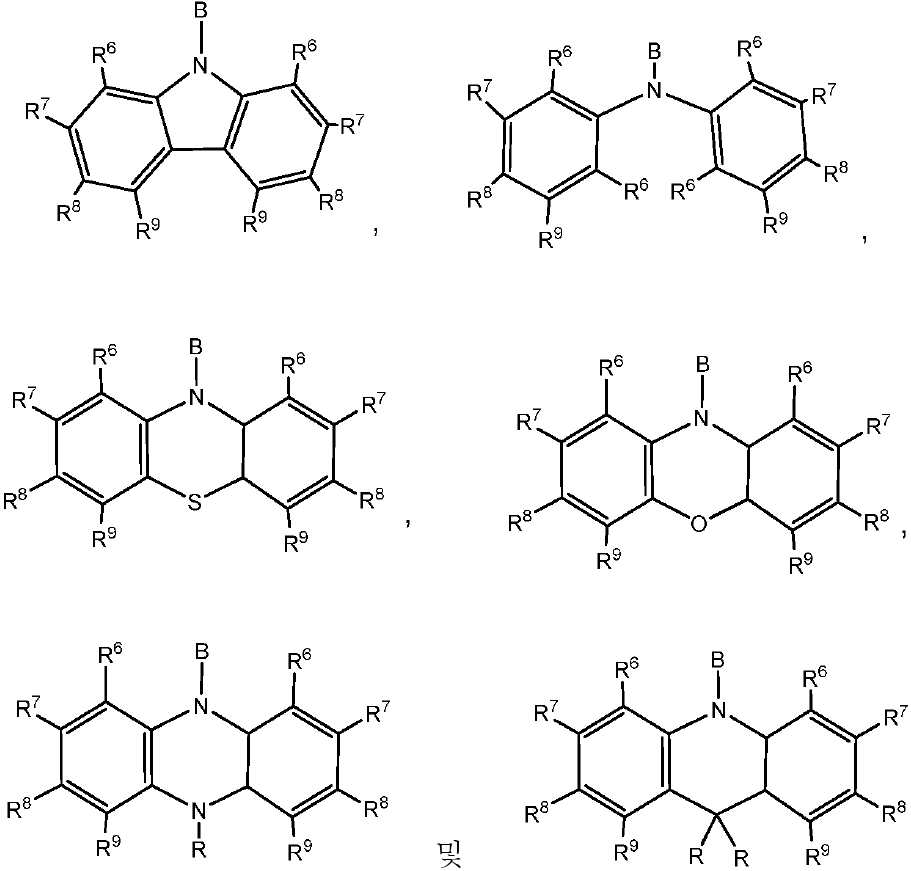
상기 식에서, -B는 고리 시스템(Q)에 대한 결합 위치를 나타내고;
R6, R7, R8 및 R9 기 각각은 각각의 경우에 대해 독립적으로는 -H, 환형일 수 있고 불포화될 수 있는 치환 또는 비치환된 1차, 2차 또는 3차 알킬(예를 들어, C1-C10 또는 심지어는 C1-C4); 치환 또는 비치환된 아릴 또는 헤테로아릴, -CF3, -OMe, -SF5, -NO2, 할로(예를 들어, 플루오로, 클로로, 브로모 및 요오도), 아릴, 아릴 하이드록시, 아미노, 알콕시, 알킬티오, 카르복시, 시아노, 티오, 포르밀, 에스테르, 아실, 티오아실, 아미도, 설폰아미도, 카바메이트, 산화포스핀 및 황화포스핀으로 이루어진 군으로부터 선택되고;
R 각각은 -H, 알킬, 아릴 또는 헤테로아릴(예를 들어, 치환 또는 비치환된 C1-C20 또는 심지어는 C1-C10 알킬)로 이루어진 군으로부터 독립적으로 선택된다.11. An organic heat-activated delayed fluorescence (TADF) species according to any one of claims 1 to 10, characterized in that the donor (D) moiety is selected from the group consisting of:
Wherein: -B represents the bonding position to the ring system (Q);
Each of R 6 , R 7 , R 8 and R 9 groups may in each case independently be -H, a substituted or unsubstituted primary, secondary or tertiary alkyl which may be cyclic and may be unsaturated For example, C1-C10 or even C1-C4); Substituted or unsubstituted aryl or heteroaryl, -CF 3, -OMe, -SF 5 , -NO 2, halo-ring (as, for example, fluoro, chloro, bromo, and iodo), aryl, hydroxy, amino Alkoxy, alkylthio, carboxy, cyano, thio, formyl, ester, acyl, thioacyl, amido, sulfonamido, carbamate, oxidized phosphine and sulfated phosphine;
Each R is independently selected from the group consisting of-H, alkyl, aryl, or heteroaryl (e.g., substituted or unsubstituted C1-C20 or even C1-C10 alkyl).
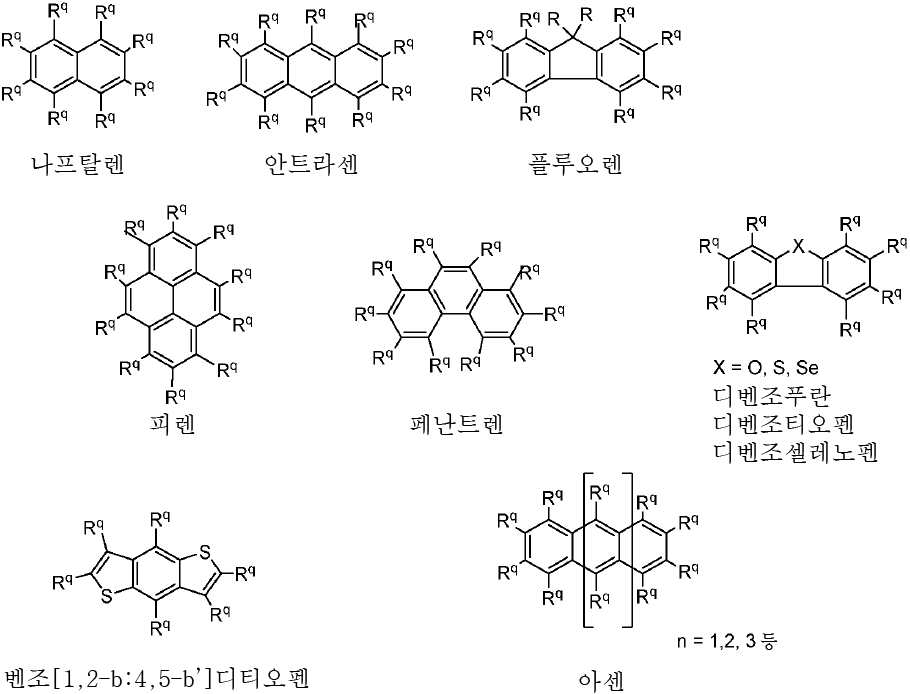
상기 식에서, Rq 치환기들 중 적어도 하나는 공여체(D) 모이어티이고, Rq 치환기들 중 적어도 하나는 수용체(A) 모이어티이고;
나머지 Rq 치환기는 각각의 경우에 대해 독립적으로는 -H, 환형일 수 있고 불포화될 수 있는 치환 또는 비치환된 1차, 2차 또는 3차 알킬(예를 들어, C1-C10 또는 심지어는 C1-C4); 치환 또는 비치환된 아릴 또는 헤테로아릴, -CF3, -OMe, -SF5, -NO2, 할로, 아릴, 아릴 하이드록시, 아미노, 알콕시, 알킬티오, 카르복시, 시아노, 티오, 포르밀, 에스테르, 아실, 티오아실, 아미도, 설폰아미도, 카바메이트, 산화포스핀 및 황화포스핀으로 이루어진 군으로부터 선택되고;
n은 1 이상이다.The organic thermally activated delayed fluorescence (TADF) species of claim 1, wherein said ring system (Q) is selected from the group consisting of:
Wherein at least one of the R q substituents is a donor (D) moiety, at least one of the R q substituents is a acceptor (A) moiety;
The remaining R < q > substituents can in each case be independently -H, substituted or unsubstituted primary, secondary or tertiary alkyl which may be cyclic and may be unsaturated (e.g., C1-C10 or even C1 -C4); Substituted or unsubstituted aryl or heteroaryl, -CF 3 , -OMe, -SF 5 , -NO 2 , halo, aryl, arylhydroxy, amino, alkoxy, alkylthio, carboxy, cyano, An ester, an acyl, a thioacyl, an amido, a sulfonamido, a carbamate, an oxidized phosphine, and a sulfated phosphine;
n is 1 or more.
[화학식 VII]
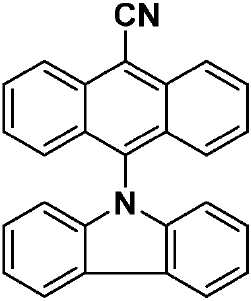
[화학식 VIII]
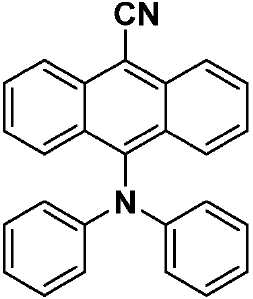
[화학식 IX]
[화학식 X]
(VII)
(VIII)
(IX)
(X)
Applications Claiming Priority (3)
| Application Number | Priority Date | Filing Date | Title |
|---|---|---|---|
| GB1523037.8 | 2015-12-29 | ||
| GBGB1523037.8A GB201523037D0 (en) | 2015-12-29 | 2015-12-29 | Light emitting compounds |
| PCT/GB2016/053858 WO2017115068A1 (en) | 2015-12-29 | 2016-12-08 | Light emitting compounds |
Publications (1)
| Publication Number | Publication Date |
|---|---|
| KR20180098651A true KR20180098651A (en) | 2018-09-04 |
Family
ID=55359160
Family Applications (1)
| Application Number | Title | Priority Date | Filing Date |
|---|---|---|---|
| KR1020187021898A Ceased KR20180098651A (en) | 2015-12-29 | 2016-12-08 | Luminescent compound |
Country Status (7)
| Country | Link |
|---|---|
| US (1) | US20190027693A1 (en) |
| EP (1) | EP3398217A1 (en) |
| JP (1) | JP2019509977A (en) |
| KR (1) | KR20180098651A (en) |
| CN (1) | CN108780852B (en) |
| GB (1) | GB201523037D0 (en) |
| WO (1) | WO2017115068A1 (en) |
Cited By (1)
| Publication number | Priority date | Publication date | Assignee | Title |
|---|---|---|---|---|
| US11844274B2 (en) | 2019-04-05 | 2023-12-12 | Samsung Display Co., Ltd. | Organic electroluminescence device and compound for organic electroluminescence device |
Families Citing this family (9)
| Publication number | Priority date | Publication date | Assignee | Title |
|---|---|---|---|---|
| US10680188B2 (en) | 2016-11-11 | 2020-06-09 | Universal Display Corporation | Organic electroluminescent materials and devices |
| US11910699B2 (en) * | 2017-08-10 | 2024-02-20 | Universal Display Corporation | Organic electroluminescent materials and devices |
| GB201717193D0 (en) * | 2017-10-19 | 2017-12-06 | Univ Durham | Thermally activated delayed fluorescence molecules, materials comprising said molecules, and devices comprising said materials |
| CN108864068B (en) * | 2018-07-27 | 2021-12-28 | 武汉天马微电子有限公司 | Compound and organic light-emitting display device |
| CN109456276A (en) | 2018-10-22 | 2019-03-12 | 武汉华星光电半导体显示技术有限公司 | Dark red photo-thermal activation delayed fluorescence material and its synthetic method, electroluminescent device |
| CN109503508A (en) * | 2018-11-15 | 2019-03-22 | 武汉华星光电半导体显示技术有限公司 | Green light thermal activation delayed fluorescence material and its synthetic method, electroluminescent device |
| CN111303009B (en) * | 2018-12-12 | 2022-02-15 | 华中科技大学 | Anthracene-based deep blue light organic electroluminescent material with high efficiency and low roll-off |
| CN110054643B (en) * | 2019-04-25 | 2021-10-15 | 上海天马有机发光显示技术有限公司 | Compound, light-emitting material, organic light-emitting display panel and organic light-emitting display device |
| US20260036466A1 (en) * | 2022-07-26 | 2026-02-05 | Mississippi State University | Methods and systems for integrating-sphere-assisted resonance synchronous (isars) spectroscopy |
Family Cites Families (18)
| Publication number | Priority date | Publication date | Assignee | Title |
|---|---|---|---|---|
| JP3008897B2 (en) * | 1997-07-14 | 2000-02-14 | 日本電気株式会社 | Organic electroluminescence device |
| JPH11111458A (en) * | 1997-09-29 | 1999-04-23 | Toyo Ink Mfg Co Ltd | Organic electroluminescent device material and organic electroluminescent device using the same |
| JP3633236B2 (en) * | 1997-10-06 | 2005-03-30 | 東洋インキ製造株式会社 | Organic electroluminescent device material and organic electroluminescent device using the same |
| JP4404473B2 (en) * | 2000-12-25 | 2010-01-27 | 富士フイルム株式会社 | Novel nitrogen-containing heterocyclic compounds, light emitting device materials, and light emitting devices using them |
| US20070141393A1 (en) * | 2005-12-21 | 2007-06-21 | Eastman Kodak Company | Amino anthracene compounds in OLED devices |
| KR100852328B1 (en) * | 2006-03-15 | 2008-08-14 | 주식회사 엘지화학 | Novel anthracene derivatives, preparation method thereof and organic electroluminescent device using same |
| JP5624270B2 (en) * | 2007-09-18 | 2014-11-12 | ユー・ディー・シー アイルランド リミテッド | Organic electroluminescence device |
| KR100989815B1 (en) * | 2008-03-20 | 2010-10-29 | 다우어드밴스드디스플레이머티리얼 유한회사 | Novel organic light emitting compound and organic light emitting device employing the same as light emitting material |
| KR20130020503A (en) * | 2011-08-17 | 2013-02-27 | (주)씨에스엘쏠라 | Organic light compound and organic light device using the same |
| JP2013179198A (en) * | 2012-02-29 | 2013-09-09 | Toyo Ink Sc Holdings Co Ltd | Material for organic electroluminescent element and application thereof |
| TWI650399B (en) * | 2012-08-03 | 2019-02-11 | 日商半導體能源研究所股份有限公司 | Light-emitting element |
| US10600983B2 (en) * | 2013-03-29 | 2020-03-24 | Kyulux, Inc. | Organic electroluminescent device comprising delayed fluorescent materials |
| CN105102582B (en) * | 2013-04-08 | 2018-10-12 | 默克专利有限公司 | Organic Electroluminescent Devices |
| JPWO2015029964A1 (en) * | 2013-08-30 | 2017-03-02 | コニカミノルタ株式会社 | Organic electroluminescence element, luminescent material, luminescent thin film, display device and lighting device |
| KR101502316B1 (en) * | 2014-04-18 | 2015-03-13 | 롬엔드하스전자재료코리아유한회사 | Multi-component host material and an organic electroluminescence device comprising the same |
| KR20150126755A (en) * | 2014-05-02 | 2015-11-13 | 삼성디스플레이 주식회사 | Organic light emitting device |
| WO2016017514A1 (en) * | 2014-07-31 | 2016-02-04 | コニカミノルタ株式会社 | Organic electroluminescent element, light-emitting thin film, display device, and lighting device |
| WO2017017205A1 (en) * | 2015-07-30 | 2017-02-02 | Hartmut Yersin | Organic molecules having two non-conjugated bridges between a donor and an acceptor for effective thermally activated delayed fluorescence for use in optoelectronic devices |
-
2015
- 2015-12-29 GB GBGB1523037.8A patent/GB201523037D0/en not_active Ceased
-
2016
- 2016-12-08 WO PCT/GB2016/053858 patent/WO2017115068A1/en not_active Ceased
- 2016-12-08 KR KR1020187021898A patent/KR20180098651A/en not_active Ceased
- 2016-12-08 JP JP2018534633A patent/JP2019509977A/en active Pending
- 2016-12-08 EP EP16812793.4A patent/EP3398217A1/en not_active Withdrawn
- 2016-12-08 CN CN201680077271.4A patent/CN108780852B/en not_active Expired - Fee Related
- 2016-12-08 US US16/067,390 patent/US20190027693A1/en not_active Abandoned
Cited By (1)
| Publication number | Priority date | Publication date | Assignee | Title |
|---|---|---|---|---|
| US11844274B2 (en) | 2019-04-05 | 2023-12-12 | Samsung Display Co., Ltd. | Organic electroluminescence device and compound for organic electroluminescence device |
Also Published As
| Publication number | Publication date |
|---|---|
| GB201523037D0 (en) | 2016-02-10 |
| CN108780852A (en) | 2018-11-09 |
| US20190027693A1 (en) | 2019-01-24 |
| CN108780852B (en) | 2020-12-15 |
| EP3398217A1 (en) | 2018-11-07 |
| WO2017115068A1 (en) | 2017-07-06 |
| JP2019509977A (en) | 2019-04-11 |
Similar Documents
| Publication | Publication Date | Title |
|---|---|---|
| CN108780852B (en) | Luminescent compounds | |
| Cui et al. | Organoboron compounds with an 8-hydroxyquinolato chelate and its derivatives: substituent effects on structures and luminescence | |
| JP6861644B2 (en) | Luminescent devices and compounds | |
| KR102082528B1 (en) | Organic light emitting element, and light emitting material and compound used in same | |
| Zeng et al. | Cationic Bis‐cyclometallated Iridium (iii) Phenanthroline Complexes with Pendant Fluorenyl Substituents: Synthesis, Redox, Photophysical Properties and Light‐Emitting Cells | |
| Slodek et al. | Does the length matter?-Synthesis, photophysical, and theoretical study of novel quinolines based on carbazoles with different length of alkyl chain | |
| Zhang et al. | New platinum (II) one-armed Schiff base complexes for blue and orange PHOLEDs applications | |
| Slodek et al. | Fluorene vs carbazole substituent at quinoline core toward organic electronics | |
| CN103052644A (en) | Copper (I) complexes for optoelectronic devices | |
| Skardziute et al. | Synthesis and optical properties of the isomeric pyrimidine and carbazole derivatives: effects of polar substituents and linking topology | |
| Huang et al. | Thermally activated delayed fluorescence of N-phenylcarbazole and triphenylamine functionalised tris (aryl) triazines | |
| Li et al. | Effects of electron affinity and steric hindrance of the trifluoromethyl group on the π‐bridge in designing blue thermally activated delayed fluorescence emitters | |
| Yang et al. | Charged dinuclear Cu (I) complexes for solution-processed single-emitter warm white organic light-emitting devices | |
| Sun et al. | Multi-substituted dibenzo [a, c] phenazine derivatives as solution-processable thermally activated delayed fluorescence materials for orange–red organic light-emitting diodes | |
| Karthik et al. | Synthesis, characterization and electroluminescence of carbazole-benzimidazole hybrids with thiophene/phenyl linker | |
| Patil et al. | Universal blue emitters for high efficiency thermally activated delayed fluorescence and fluorescent organic light-emitting diodes | |
| Obłoza et al. | Synthesis, photophysics and redox properties of aza‐BODIPY dyes with electron‐donating groups | |
| Arsenyan et al. | Dual versus normal TADF of pyridines ornamented with multiple donor moieties and their performance in OLEDs | |
| Shan et al. | Manipulating the AIE and low-temperature phosphorescence properties of o-carborane-imidazole derivatives via fine tuning their structural features | |
| Gupta et al. | Deep-red to NIR solution-processed OLEDs of donor-decorated quinoxaline-based TADF aggregates | |
| Zhang et al. | An efficient blue thermally activated delayed fluorescence material based on 4-fluorocyanobenzene derivative for organic light-emitting diodes | |
| Kumar et al. | Facile color tuning of thermally activated delayed fluorescence by substituted ortho-carbazole-appended triarylboron emitters | |
| Kang et al. | Effective exciplex host for solution-processed narrowband blue TADF-OLEDs using a 9-(dibenzo [b, d] thiophen-2-yl)-9H-carbazole analogue with an adamantane substituent | |
| Zhong et al. | Synthesis and luminescence properties of polymeric complexes of Cu (II), Zn (II) and Al (III) with functionalized polybenzimidazole containing 8-hydroxyquinoline side group | |
| Li et al. | Cyano Decoration of π‐Bridge to Boost Photoluminescence and Electroluminescence Quantum Yields of Triazine/Carbazole Based Blue TADF Emitter |
Legal Events
| Date | Code | Title | Description |
|---|---|---|---|
| PA0105 | International application |
Patent event date: 20180727 Patent event code: PA01051R01D Comment text: International Patent Application |
|
| PG1501 | Laying open of application | ||
| A201 | Request for examination | ||
| PA0201 | Request for examination |
Patent event code: PA02012R01D Patent event date: 20211116 Comment text: Request for Examination of Application |
|
| E902 | Notification of reason for refusal | ||
| PE0902 | Notice of grounds for rejection |
Comment text: Notification of reason for refusal Patent event date: 20240408 Patent event code: PE09021S01D |
|
| E601 | Decision to refuse application | ||
| PE0601 | Decision on rejection of patent |
Patent event date: 20240613 Comment text: Decision to Refuse Application Patent event code: PE06012S01D Patent event date: 20240408 Comment text: Notification of reason for refusal Patent event code: PE06011S01I |