KR20180098371A - Cross-copolymer and medical single-layer tube using same - Google Patents
Cross-copolymer and medical single-layer tube using same Download PDFInfo
- Publication number
- KR20180098371A KR20180098371A KR1020187021568A KR20187021568A KR20180098371A KR 20180098371 A KR20180098371 A KR 20180098371A KR 1020187021568 A KR1020187021568 A KR 1020187021568A KR 20187021568 A KR20187021568 A KR 20187021568A KR 20180098371 A KR20180098371 A KR 20180098371A
- Authority
- KR
- South Korea
- Prior art keywords
- polymerization
- copolymer
- aromatic vinyl
- ethylene
- olefin
- Prior art date
- Legal status (The legal status is an assumption and is not a legal conclusion. Google has not performed a legal analysis and makes no representation as to the accuracy of the status listed.)
- Withdrawn
Links
Classifications
-
- C—CHEMISTRY; METALLURGY
- C08—ORGANIC MACROMOLECULAR COMPOUNDS; THEIR PREPARATION OR CHEMICAL WORKING-UP; COMPOSITIONS BASED THEREON
- C08F—MACROMOLECULAR COMPOUNDS OBTAINED BY REACTIONS ONLY INVOLVING CARBON-TO-CARBON UNSATURATED BONDS
- C08F210/00—Copolymers of unsaturated aliphatic hydrocarbons having only one carbon-to-carbon double bond
- C08F210/02—Ethene
-
- A—HUMAN NECESSITIES
- A61—MEDICAL OR VETERINARY SCIENCE; HYGIENE
- A61L—METHODS OR APPARATUS FOR STERILISING MATERIALS OR OBJECTS IN GENERAL; DISINFECTION, STERILISATION OR DEODORISATION OF AIR; CHEMICAL ASPECTS OF BANDAGES, DRESSINGS, ABSORBENT PADS OR SURGICAL ARTICLES; MATERIALS FOR BANDAGES, DRESSINGS, ABSORBENT PADS OR SURGICAL ARTICLES
- A61L29/00—Materials for catheters, medical tubing, cannulae, or endoscopes or for coating catheters
- A61L29/04—Macromolecular materials
- A61L29/041—Macromolecular materials obtained by reactions only involving carbon-to-carbon unsaturated bonds
-
- A—HUMAN NECESSITIES
- A61—MEDICAL OR VETERINARY SCIENCE; HYGIENE
- A61L—METHODS OR APPARATUS FOR STERILISING MATERIALS OR OBJECTS IN GENERAL; DISINFECTION, STERILISATION OR DEODORISATION OF AIR; CHEMICAL ASPECTS OF BANDAGES, DRESSINGS, ABSORBENT PADS OR SURGICAL ARTICLES; MATERIALS FOR BANDAGES, DRESSINGS, ABSORBENT PADS OR SURGICAL ARTICLES
- A61L31/00—Materials for other surgical articles, e.g. stents, stent-grafts, shunts, surgical drapes, guide wires, materials for adhesion prevention, occluding devices, surgical gloves, tissue fixation devices
- A61L31/04—Macromolecular materials
- A61L31/048—Macromolecular materials obtained by reactions only involving carbon-to-carbon unsaturated bonds
-
- C—CHEMISTRY; METALLURGY
- C08—ORGANIC MACROMOLECULAR COMPOUNDS; THEIR PREPARATION OR CHEMICAL WORKING-UP; COMPOSITIONS BASED THEREON
- C08F—MACROMOLECULAR COMPOUNDS OBTAINED BY REACTIONS ONLY INVOLVING CARBON-TO-CARBON UNSATURATED BONDS
- C08F212/00—Copolymers of compounds having one or more unsaturated aliphatic radicals, each having only one carbon-to-carbon double bond, and at least one being terminated by an aromatic carbocyclic ring
- C08F212/02—Monomers containing only one unsaturated aliphatic radical
- C08F212/04—Monomers containing only one unsaturated aliphatic radical containing one ring
- C08F212/06—Hydrocarbons
- C08F212/08—Styrene
-
- C—CHEMISTRY; METALLURGY
- C08—ORGANIC MACROMOLECULAR COMPOUNDS; THEIR PREPARATION OR CHEMICAL WORKING-UP; COMPOSITIONS BASED THEREON
- C08F—MACROMOLECULAR COMPOUNDS OBTAINED BY REACTIONS ONLY INVOLVING CARBON-TO-CARBON UNSATURATED BONDS
- C08F212/00—Copolymers of compounds having one or more unsaturated aliphatic radicals, each having only one carbon-to-carbon double bond, and at least one being terminated by an aromatic carbocyclic ring
- C08F212/34—Monomers containing two or more unsaturated aliphatic radicals
-
- C—CHEMISTRY; METALLURGY
- C08—ORGANIC MACROMOLECULAR COMPOUNDS; THEIR PREPARATION OR CHEMICAL WORKING-UP; COMPOSITIONS BASED THEREON
- C08F—MACROMOLECULAR COMPOUNDS OBTAINED BY REACTIONS ONLY INVOLVING CARBON-TO-CARBON UNSATURATED BONDS
- C08F2800/00—Copolymer characterised by the proportions of the comonomers expressed
- C08F2800/10—Copolymer characterised by the proportions of the comonomers expressed as molar percentages
-
- C—CHEMISTRY; METALLURGY
- C08—ORGANIC MACROMOLECULAR COMPOUNDS; THEIR PREPARATION OR CHEMICAL WORKING-UP; COMPOSITIONS BASED THEREON
- C08F—MACROMOLECULAR COMPOUNDS OBTAINED BY REACTIONS ONLY INVOLVING CARBON-TO-CARBON UNSATURATED BONDS
- C08F2800/00—Copolymer characterised by the proportions of the comonomers expressed
- C08F2800/20—Copolymer characterised by the proportions of the comonomers expressed as weight or mass percentages
-
- C—CHEMISTRY; METALLURGY
- C08—ORGANIC MACROMOLECULAR COMPOUNDS; THEIR PREPARATION OR CHEMICAL WORKING-UP; COMPOSITIONS BASED THEREON
- C08F—MACROMOLECULAR COMPOUNDS OBTAINED BY REACTIONS ONLY INVOLVING CARBON-TO-CARBON UNSATURATED BONDS
- C08F4/00—Polymerisation catalysts
- C08F4/42—Metals; Metal hydrides; Metallo-organic compounds; Use thereof as catalyst precursors
- C08F4/44—Metals; Metal hydrides; Metallo-organic compounds; Use thereof as catalyst precursors selected from light metals, zinc, cadmium, mercury, copper, silver, gold, boron, gallium, indium, thallium, rare earths or actinides
- C08F4/60—Metals; Metal hydrides; Metallo-organic compounds; Use thereof as catalyst precursors selected from light metals, zinc, cadmium, mercury, copper, silver, gold, boron, gallium, indium, thallium, rare earths or actinides together with refractory metals, iron group metals, platinum group metals, manganese, rhenium technetium or compounds thereof
- C08F4/62—Refractory metals or compounds thereof
- C08F4/64—Titanium, zirconium, hafnium or compounds thereof
- C08F4/659—Component covered by group C08F4/64 containing a transition metal-carbon bond
- C08F4/65912—Component covered by group C08F4/64 containing a transition metal-carbon bond in combination with an organoaluminium compound
Landscapes
- Chemical & Material Sciences (AREA)
- Health & Medical Sciences (AREA)
- Chemical Kinetics & Catalysis (AREA)
- Medicinal Chemistry (AREA)
- Polymers & Plastics (AREA)
- Organic Chemistry (AREA)
- Animal Behavior & Ethology (AREA)
- Life Sciences & Earth Sciences (AREA)
- Epidemiology (AREA)
- General Health & Medical Sciences (AREA)
- Public Health (AREA)
- Veterinary Medicine (AREA)
- Heart & Thoracic Surgery (AREA)
- Surgery (AREA)
- Vascular Medicine (AREA)
- Addition Polymer Or Copolymer, Post-Treatments, Or Chemical Modifications (AREA)
Abstract
(과제) 연질성, 인장 특성, 투명성 및 내블로킹성이 우수한 크로스 공중합체 그리고 의료용 단층 튜브를 제공한다.
(해결 수단) 방향족 비닐 단량체 단위 8.99 ∼ 15.99 몰%, 올레핀 단량체 단위 84 ∼ 91 몰%, 방향족 폴리엔 단량체 단위 0.01 ∼ 0.5 몰% 로 이루어지는 방향족 비닐-올레핀계 공중합체 75 ∼ 95 질량% 의 주사슬과, 방향족 비닐 단량체 단위로 이루어지는 중합체 5 ∼ 25 질량% 의 크로스 사슬로 이루어지고, DCS 법에 의해 30 ㎖/분의 질소 기류하에서 -50 ℃ 까지 냉각 후, 승온 속도 10 ℃/분으로 180 ℃ 까지 승온시키고, 다시 -50 ℃ 까지 냉각시키고 승온 속도 10 ℃/분으로 180 ℃ 까지 가열하였을 때의 융해 피크의 정점 온도가 60 ∼ 80 ℃ 이고, 또한 DSC 곡선의 -20 ℃ 내지 130 ℃ 사이에 그은 직선을 사용하여 -20 ℃ 와 130 ℃ 사이의 DSC 곡선의 면적으로부터 산출되는 융해열이 45 ∼ 75 J/g 인 크로스 공중합체.A cross-copolymer and a medical single-layer tube excellent in softness, tensile properties, transparency and blocking resistance are provided.
(A) 75 to 95 mass% of an aromatic vinyl-olefin-based copolymer consisting of 8.99 to 15.99 mol% of an aromatic vinyl monomer unit, 84 to 91 mol% of an olefin monomer unit and 0.01 to 0.5 mol% of an aromatic polyene monomer unit, And 5 to 25 mass% of a polymer composed of an aromatic vinyl monomer unit and cooled to -50 占 폚 in a stream of nitrogen at 30 ml / min by the DCS method and then heated to 180 占 폚 at a rate of 10 占 폚 / The temperature of the peak of the melting peak when heated to 180 ° C. at a heating rate of 10 ° C./min was 60 to 80 ° C. and the straight line between the temperatures of -20 ° C. and 130 ° C. of the DSC curve And a heat of fusion of 45 to 75 J / g calculated from the area of the DSC curve between -20 ° C and 130 ° C.
Description
본 발명은, 연질성, 인장 특성, 투명성 및 내블로킹성이 우수한 크로스 공중합체, 그리고 그것을 사용한 의료용 단층 튜브에 관한 것이다.The present invention relates to a cross-copolymer excellent in softness, tensile properties, transparency and blocking resistance, and a medical single-layer tube using the cross-copolymer.
최근, 종래부터 가황 고무가 주류였던 자동차 부품, 가전 부품, 의료 부품 또는 잡화 등의 용도로, 생산성이 우수한 열가소성 엘라스토머가 많이 이용되도록 되어 오고 있다. 그 중에서, 각종 용도에 있어서 요구되는 특성을 갖는 신규 열가소성 엘라스토머가 많이 제안되어 있다. 예를 들어, 특허문헌 1 에는, 스티렌-에틸렌 공중합체에 소량의 디비닐벤젠을 공중합하고, 디비닐벤젠 유닛의 비닐기를 개재하여 폴리스티렌 (크로스 사슬) 을 도입하는 방법에 의해 얻어지는, 이른바 크로스 공중합체가 제안되어 있다. 이 방법에 의해 얻어지는 크로스 공중합체는, 스티렌-에틸렌 공중합체 사슬을 소프트 세그먼트로 하고, 폴리스티렌을 하드 세그먼트로서 갖는 분기형 블록 공중합체이며, 내스크래치성이나 성형 가공성이 매우 우수한 재료로 되어 있다.BACKGROUND ART [0002] In recent years, thermoplastic elastomers having excellent productivity have been widely used for applications such as automobile parts, home appliance parts, medical parts, or miscellaneous goods, which have conventionally been mainstream vulcanized rubber. Among them, many new thermoplastic elastomers having properties required for various applications have been proposed. For example, Patent Document 1 discloses a so-called crosslinked copolymer obtained by copolymerizing a small amount of divinylbenzene with a styrene-ethylene copolymer and introducing polystyrene (cross-chain) through a vinyl group of a divinylbenzene unit Has been proposed. The cross-copolymer obtained by this method is a branched block copolymer having a styrene-ethylene copolymer chain as a soft segment and polystyrene as a hard segment, and is excellent in scratch resistance and moldability.
의료 부품인 의료용 튜브에서는, 연질성, 투명성, 내절곡성 (내킹크성) 에 더하여, 약제의 흡착 흡수가 적어 정량적으로 수송할 수 있는 약제 정량성이나 수액 펌프 회로에 적합한 내스퀴즈성 (형상 회복성, 내마모성 등), 나아가서는 멸균을 위한 감마선이나 전자선에 대한 내방사선성이 우수한 등의 여러 가지 특성이 요구된다. 이들 요구에 대해, 특허문헌 2 에서는, 튜브 성형 후에 전자선 조사에 의해 표면을 가교시킴으로써, 유연성, 투명성, 약제의 저흡착 흡수성, 펌프 회로 적성, 화학적 안정성, 나아가서는 내킹크성이 우수하고, 블로킹을 억제하여 각종 멸균법에 대응하는 내열성을 갖는 의료용 튜브로 하는 것을 제안하고 있다. 특허문헌 3 에서는, 튜브 두께의 50 % 이상을 차지하는 지지층을 충분한 연질성을 갖는 크로스 공중합체로 하고, 내층을 블로킹성이 작은 재료로 한 다층 튜브로 함으로써, 절곡시나 겸자 등으로 클램프하였을 때의 내벽끼리의 밀착에 의한 폐색을 개선할 것을 제안하고 있다. 또한, 최근에는 의료 부품의 디스포저블화가 진행되어 오고 있어, 바이오해저드 방지를 위해 사용 후에 소각 처리되는 경우가 많아, 소각시에 염소 화합물을 가스로서 발생시키지 않는 비연질 염화비닐재를 사용하는 것이 중요해지고 있다.In medical tubing, which is a medical part, it is preferable to use a medicine quantitatively capable of being transported quantitatively because the adsorption absorption of the drug is low, in addition to the softness, transparency and endurance (knock resistance) Abrasion resistance, etc.), and furthermore, various properties such as excellent radiation resistance against gamma rays or electron beams for sterilization are required. With respect to these demands, Patent Document 2 discloses that crosslinking the surface by irradiation with an electron beam after tube formation leads to excellent flexibility, transparency, low adsorption absorbency of the agent, pump circuit suitability, chemical stability, and furthermore, Thereby forming a medical tube having heat resistance corresponding to various sterilization methods. Patent Document 3 discloses that the support layer occupying 50% or more of the tube thickness is a cross-copolymer having sufficient softness and the inner layer is a multi-layer tube made of a material having a small blocking property, It is proposed to improve the clogging due to the close contact between the two. In recent years, the disposability of medical parts has been progressing, and in many cases, incineration is performed after use to prevent biohazard, so that a non-soft vinyl chloride material which does not generate a chlorine compound as a gas upon incineration is used It is becoming important.
이러한 상황하, 크로스 공중합체가 갖는 연질성, 인장 특성, 투명성 등의 우수한 특성을 유지하면서, 내블로킹성을 더욱 높일 수 있으면, 특히 의료용 튜브로서 사용하는 경우에 단층으로 사용할 수 있게 됨과 함께, 그 밖의 용도로도 이용 가치가 높아지기 때문에, 가일층의 개선이 요구되고 있었다.Under such circumstances, if the blocking resistance can be further improved while maintaining excellent properties such as softness, tensile properties, transparency and the like of the cross-copolymer, the cross-copolymer can be used as a single layer particularly when used as a medical tube, The use value is increased even for the outside use, and it has been demanded to improve further.
본 발명은, 연질성, 인장 특성, 투명성 및 내블로킹성이 우수한 크로스 공중합체, 그리고 그것을 사용한 의료용 단층 튜브를 제공하는 것이다.The present invention provides a cross-copolymer excellent in softness, tensile properties, transparency and blocking resistance, and a medical single-layer tube using the cross-copolymer.
본 발명은, 이하를 요지로 하는 것이다.The present invention is based on the following points.
(1) 방향족 비닐 단량체 단위 8.99 ∼ 15.99 몰%, 올레핀 단량체 단위 84 ∼ 91 몰%, 방향족 폴리엔 단량체 단위 0.01 ∼ 0.5 몰% 로 이루어지는 방향족 비닐-올레핀계 공중합체로 이루어지는 주사슬 75 ∼ 95 질량% 와, 방향족 비닐 단량체 단위로 이루어지는 중합체로 이루어지는 크로스 사슬 5 ∼ 25 질량% 를 함유하고, 시차 주사 열량 측정법 (DSC) 에 의해, 30 ㎖/분의 질소 기류하에서 -50 ℃ 까지 냉각 후, 승온 속도 10 ℃/분으로 180 ℃ 까지 승온시키고, 다시 -50 ℃ 까지 냉각시키고, 승온 속도 10 ℃/분으로 180 ℃ 까지 가열하였을 때의 융해 피크의 정점 온도 (Tm) 가 60 ∼ 80 ℃ 이고, 또한 DSC 곡선의 -20 ℃ 내지 130 ℃ 사이에 그은 직선을 사용하여 -20 ℃ 와 130 ℃ 사이의 DSC 곡선의 면적으로부터 산출되는 융해열이 45 ∼ 75 J/g 인 크로스 공중합체.(1) A copolymer comprising 75 to 95 mass% of a main chain of an aromatic vinyl-olefin copolymer composed of 8.99 to 15.99 mol% of an aromatic vinyl monomer unit, 84 to 91 mol% of an olefin monomer unit and 0.01 to 0.5 mol% of an aromatic polyene monomer unit, And 5 to 25 mass% of a cross chain composed of a polymer composed of an aromatic vinyl monomer unit and cooled to -50 占 폚 under a flow of nitrogen of 30 ml / min by differential scanning calorimetry (DSC) (Tm) of 60 to 80 占 폚 when heated up to 180 占 폚 / min, cooled to -50 占 폚 and heated up to 180 占 폚 at a heating rate of 10 占 폚 / min, and a DSC curve Of a heat ray of 45 to 75 J / g calculated from an area of a DSC curve between -20 DEG C and 130 DEG C using a straight line between -20 DEG C and 130 DEG C.
(2) 일 양태에서는, 주사슬을 구성하는 방향족 비닐-올레핀계 공중합체의 조성 분포가, 올레핀 단량체 단위가 85 몰% 이상 92 몰% 이하인 방향족 비닐-올레핀계 공중합체의 함유량이 50 질량% 이상이고, 올레핀 단량체 단위가 85 몰% 미만인 방향족 비닐-올레핀계 공중합체의 함유량이 35 질량% 미만이고, 또한 올레핀 단량체 단위가 92 몰% 를 초과하는 방향족 비닐-올레핀계 공중합체의 함유량이 15 질량% 미만인, (1) 에 기재된 크로스 공중합체로 할 수 있다.(2) In one embodiment, the composition of the aromatic vinyl-olefin-based copolymer constituting the main chain is 50% by mass or more of the content of the aromatic vinyl-olefin-based copolymer in which the olefin monomer unit is 85 mol% or more and 92 mol% Olefin copolymer having an olefin monomer unit content of less than 85 mol% is less than 35 mass% and an olefin monomer unit content is more than 92 mol%, the content of the aromatic vinyl-olefin copolymer is less than 15 mass% By weight of the cross-copolymer of the present invention.
(3) 융해 피크의 정점 온도 (Tm) 가 65 ∼ 73 ℃ 이고, 또한 융해열이 50 ∼ 70 J/g 인, (1) 또는 (2) 에 기재된 크로스 공중합체로 하는 것이 바람직하다.(3) The cross-copolymer according to (1) or (2), wherein the melting peak has a peak temperature (Tm) of 65 to 73 ° C and a heat of fusion of 50 to 70 J / g.
(4) 방향족 비닐 단량체 단위가 스티렌인, (1) 내지 (3) 중 어느 하나에 기재된 크로스 공중합체로 하는 것이 바람직하다.(4) The cross-copolymer of any one of (1) to (3), wherein the aromatic vinyl monomer unit is styrene.
(5) 올레핀 단량체 단위가 에틸렌인, (1) 내지 (4) 중 어느 하나에 기재된 크로스 공중합체로 하는 것이 바람직하다.(5) The cross-copolymer according to any one of (1) to (4), wherein the olefin monomer unit is ethylene.
(6) 또, 본 발명은, (1) 내지 (5) 중 어느 하나에 기재된 크로스 공중합체를 함유하는 의료용 단층 튜브이다.(6) Further, the present invention is a medical single-layer tube containing the cross-copolymer according to any one of (1) to (5).
본 발명에 의하면, 연질성, 인장 특성, 투명성 및 내블로킹성이 우수한 크로스 공중합체, 그리고 그것을 사용한 의료용 튜브를 제공할 수 있다.According to the present invention, it is possible to provide a cross-copolymer having excellent softness, tensile properties, transparency and blocking resistance, and a medical tube using the cross-copolymer.
이하, 본 발명의 실시형태에 대하여 상세하게 설명한다. 또한, 본 명세서 및 특허청구범위에 있어서, 「A ∼ B」라는 기재는, A 이상이고 B 이하라는 의미이다.Hereinafter, embodiments of the present invention will be described in detail. In the present specification and claims, the description "A to B" means not less than A and not more than B.
[크로스 공중합체][Cross copolymer]
크로스 공중합체는, 방향족 비닐 단량체 단위, 올레핀 단량체 단위, 및 방향족 폴리엔 단량체 단위로 이루어지는 방향족 비닐-올레핀계 공중합체로 이루어지는 주사슬과, 방향족 비닐 단량체 단위로 이루어지는 중합체로 이루어지는 크로스 사슬을 함유하고, 방향족 비닐 단량체 단위로 이루어지는 중합체가, 주사슬의 방향족 폴리엔 단량체 단위를 개재하여 결합되어 있는 구조를 갖는다.The cross-copolymer contains a main chain composed of an aromatic vinyl-olefin-based copolymer composed of an aromatic vinyl monomer unit, an olefin monomer unit and an aromatic polyene monomer unit and a cross-chain composed of a polymer composed of an aromatic vinyl monomer unit, Has a structure in which a polymer composed of an aromatic vinyl monomer unit is bonded via an aromatic polyene monomer unit in the main chain.
(주사슬)(Main chain)
방향족 비닐 단량체 단위로는, 스티렌 및 각종 치환 스티렌, 예를 들어 p-메틸스티렌, m-메틸스티렌, o-메틸스티렌, o-t-부틸스티렌, m-t-부틸스티렌, p-t-부틸스티렌, p-클로로스티렌, o-클로로스티렌 등의 각 스티렌계 단량체에서 유래하는 단위를 들 수 있다. 이들 중에서도 바람직하게는 스티렌 단위, p-메틸스티렌 단위, p-클로로스티렌 단위이고, 특히 바람직하게는 스티렌 단위이다. 이들 방향족 비닐 단량체 단위는, 1 종류여도 되고, 2 종류 이상의 병용이어도 된다.Examples of the aromatic vinyl monomer unit include styrene and various substituted styrenes such as p-methylstyrene, m-methylstyrene, o-methylstyrene, ot-butylstyrene, mt-butylstyrene, pt-butylstyrene, , o-chlorostyrene, and the like. Of these, styrene units, p-methylstyrene units and p-chlorostyrene units are preferable, and styrene units are particularly preferable. These aromatic vinyl monomer units may be used alone or in combination of two or more.
올레핀 단량체 단위로는, 에틸렌 및 탄소수 3 ∼ 20 의 α-올레핀, 예를 들어 프로필렌, 1-부텐, 1-헥센, 4-메틸-1-펜텐, 1-옥텐, 비닐시클로헥산이나, 고리형 올레핀 즉 시클로펜텐, 노르보르넨 등, 각 α-올레핀계 단량체 및 고리형 올레핀계 단량체에서 유래하는 단위를 들 수 있다. 바람직하게는 에틸렌 단위, 프로필렌 단위, 1-부텐 단위, 1-헥센 단위, 1-옥텐 단위 등의 혼합물이 사용되며, 특히 바람직하게는 에틸렌 단위가 사용된다.Examples of the olefin monomer unit include ethylene and? -Olefins having 3 to 20 carbon atoms such as propylene, 1-butene, 1-hexene, 4-methyl-1-pentene, 1-octene, vinylcyclohexane, A unit derived from an? -Olefin-based monomer and a cyclic olefin-based monomer such as cyclopentene and norbornene. Preferably, a mixture of an ethylene unit, a propylene unit, a 1-butene unit, a 1-hexene unit and a 1-octene unit is used, and an ethylene unit is particularly preferably used.
방향족 폴리엔 단량체 단위로는, 10 이상 30 이하의 탄소수를 갖고, 복수의 이중 결합 (비닐기) 과 단수 또는 복수의 방향족기를 가진 방향족 폴리엔이고, 예를 들어, o-디비닐벤젠, p-디비닐벤젠, m-디비닐벤젠, 1,4-디비닐나프탈렌, 3,4-디비닐나프탈렌, 2,6-디비닐나프탈렌, 1,2-디비닐-3,4-디메틸벤젠, 1,3-디비닐-4,5,8-트리부틸나프탈렌 등, 방향족 폴리엔 단량체에서 유래하는 단위를 들 수 있고, 바람직하게는 오르토디비닐벤젠 단위, 파라디비닐벤젠 단위 및 메타디비닐벤젠 단위 중 어느 1 종 또는 2 종 이상의 혼합물이 바람직하게 사용된다.The aromatic polyene monomer unit is an aromatic polyene having a carbon number of 10 or more and 30 or less and having a plurality of double bonds (vinyl group) and one or more aromatic groups, and examples thereof include o-divinylbenzene, p-di Divinylbenzene, m-divinylbenzene, 1,4-divinylnaphthalene, 3,4-divinylnaphthalene, 2,6-divinylnaphthalene, 1,2-divinyl-3,4- -Divinyl-4,5,8-tributylnaphthalene, and the like, and preferably a unit derived from an aromatic polyene monomer such as an orthovinylbenzene unit, a paradivinylbenzene unit or a metadivinylbenzene unit Species or a mixture of two or more species is preferably used.
방향족 비닐-올레핀계 공중합체 중의 각 구성 단위의 함유 비율은, 방향족 비닐 단량체 단위 8.99 ∼ 15.99 몰%, 올레핀 단량체 단위 84 ∼ 91 몰%, 방향족 폴리엔 단량체 단위 0.01 ∼ 0.5 몰% 이고, 바람직하게는 방향족 비닐 단량체 단위 9.97 ∼ 13.97 몰%, 올레핀 단량체 단위 86 ∼ 90 몰%, 방향족 폴리엔 단량체 단위 0.03 ∼ 0.3 몰% 이다.The content of each constituent unit in the aromatic vinyl-olefin copolymer is preferably from 8.99 to 15.99 mol% of an aromatic vinyl monomer unit, from 84 to 91 mol% of an olefin monomer unit and from 0.01 to 0.5 mol% of an aromatic polyene monomer unit, 9.97 to 13.97 mol% of an aromatic vinyl monomer unit, 86 to 90 mol% of an olefin monomer unit and 0.03 to 0.3 mol% of an aromatic polyene monomer unit.
방향족 비닐 단량체 단위가 8.99 몰% 이상인 경우에, 올레핀 연쇄 구조에서 유래하는 결정 구조가 억제되기 때문에, 연질성, 투명성이 향상된다. 방향족 비닐 단량체 단위는, 바람직하게는 9.97 몰% 이상이다. 방향족 비닐 단량체 단위가 15.99 몰% 이하인 경우에, 올레핀 연쇄 구조에서 유래하는 결정 구조에 의해 인장 특성, 내블로킹성이 향상된다. 방향족 비닐 단량체 단위는, 바람직하게는 13.97 몰% 이하이다.When the aromatic vinyl monomer unit is 8.99 mol% or more, the crystal structure derived from the olefin chain structure is suppressed, so that the softness and transparency are improved. The aromatic vinyl monomer unit is preferably at least 9.97 mol%. When the aromatic vinyl monomer unit is 15.99 mol% or less, the tensile property and the blocking resistance are improved by the crystal structure derived from the olefin chain structure. The aromatic vinyl monomer unit is preferably 13.97 mol% or less.
올레핀 단량체 단위가 84 몰% 이상인 경우에, 올레핀 연쇄 구조에서 유래하는 인장 특성, 내블로킹성이 향상된다. 올레핀 단량체 단위는, 바람직하게는 86 몰% 이상이다. 또, 올레핀 단량체 단위가 91 몰% 이하인 경우에, 올레핀 연쇄 구조에서 유래하는 결정 구조가 억제되기 때문에, 크로스 공중합체의 연질성, 투명성이 향상된다. 올레핀 단량체 단위는, 바람직하게는 90 몰% 이하이다.When the olefin monomer unit is at least 84 mol%, the tensile properties and blocking resistance derived from the olefin chain structure are improved. The olefin monomer unit is preferably at least 86 mol%. When the olefin monomer unit is 91 mol% or less, the crystal structure derived from the olefin chain structure is suppressed, so that the softness and transparency of the cross copolymer are improved. The olefin monomer unit is preferably 90 mol% or less.
방향족 폴리엔 단량체 단위가 0.01 몰% 이상인 경우에, 방향족 비닐 단량체 단위로 이루어지는 중합체의 크로스 사슬을 형성할 수 있기 때문에 인장 특성이 향상된다. 방향족 폴리엔 단량체 단위는, 바람직하게는 0.03 몰% 이상이다. 방향족 폴리엔 단량체 단위가 0.5 몰% 이하인 경우에, 가교 반응에 의한 분자량 증대를 억제할 수 있기 때문에, 생산 안정성, 성형 가공성이 양호해진다. 방향족 폴리엔 단량체 단위는, 바람직하게는 0.3 몰% 이하이다.When the aromatic polyene monomer unit is at least 0.01 mol%, the cross-chain of the polymer composed of the aromatic vinyl monomer unit can be formed, so that the tensile properties are improved. The aromatic polyene monomer unit is preferably 0.03 mol% or more. When the content of the aromatic polyene monomer is 0.5 mol% or less, the increase in the molecular weight due to the crosslinking reaction can be suppressed, so that the production stability and molding processability are improved. The aromatic polyene monomer unit is preferably 0.3 mol% or less.
방향족 비닐-올레핀계 공중합체의 공중합 조성 분포의 바람직한 범위로는, 예를 들어, 올레핀 단량체 단위가 85 몰% 미만인 방향족 비닐-올레핀계 공중합체의 함유량이 35 질량% 미만, 올레핀 단량체 단위가 85 ∼ 92 몰% 인 방향족 비닐-올레핀계 공중합체의 함유량이 50 질량% 이상, 올레핀 단량체 단위가 92 몰% 를 초과하는 방향족 비닐-올레핀계 공중합체의 함유량이 15 질량% 미만인 방향족 비닐-올레핀계 공중합체를 들 수 있다.A preferable range of the copolymer composition distribution of the aromatic vinyl-olefin copolymer is, for example, a content of an aromatic vinyl-olefin copolymer having an olefin monomer unit of less than 85% by mole of less than 35% by mass, an olefin monomer unit of 85% Wherein the content of the aromatic vinyl-olefin-based copolymer in which the content of the aromatic vinyl-olefin-based copolymer is 92% by mole or more and 50% by mass or more and the content of the olefin monomer unit is more than 92% .
방향족 비닐-올레핀계 공중합체의 중량 평균 분자량은, 특별히 제한은 없지만, 성형 가공성의 관점에서, 바람직하게는 3 만 ∼ 30 만이고, 특히 바람직하게는 5 만 ∼ 20 만이다. 또한, 본 명세서에 있어서, 중량 평균 분자량이란, 겔 퍼미에이션 크로마토그래피 (GPC) 로 측정되는 폴리스티렌 환산의 값이며, 하기에 기재된 측정 조건에 있어서의 측정값이다.The weight average molecular weight of the aromatic vinyl-olefin-based copolymer is not particularly limited, but is preferably 30,000 to 300,000, particularly preferably 50,000 to 200,000 from the viewpoint of moldability. In the present specification, the weight average molecular weight is a value in terms of polystyrene measured by gel permeation chromatography (GPC), and is a measured value under the measurement conditions described below.
장치명 : HLC-8220 (토소사 제조)Device name: HLC-8220 (manufactured by Tosoh Corporation)
칼럼 : Shodex GPC KF-404HQ 를 4 개 직렬Column: Serial 4 Shodex GPC KF-404HQ
온도 : 40 ℃Temperature: 40 ° C
검출 : 시차 굴절률Detection: differential refractive index
용매 : 테트라하이드로푸란Solvent: tetrahydrofuran
검량선 : 표준 폴리스티렌 (PS) 을 사용하여 제조하였다.Calibration curve: Prepared using standard polystyrene (PS).
(크로스 사슬)(Cross chain)
크로스 사슬을 구성하고 있는 방향족 비닐 단량체 단위로 이루어지는 중합체는, 1 종류의 방향족 비닐 단량체 단위로 이루어지는 중합체여도 되고, 2 종류 이상의 방향족 비닐 단량체 단위로 이루어지는 공중합체여도 된다. 방향족 비닐 단량체 단위로는, 상기 서술한 주사슬과 동일한 것을 사용할 수 있다.The polymer comprising the aromatic vinyl monomer unit constituting the cross chain may be a polymer comprising one kind of aromatic vinyl monomer units or a copolymer comprising two or more kinds of aromatic vinyl monomer units. The aromatic vinyl monomer unit may be the same as the main chain described above.
크로스 사슬을 구성하고 있는 방향족 비닐 단량체 단위로 이루어지는 중합체의 중량 평균 분자량에는 특별히 제한은 없지만, 성형 가공성의 관점에서, 바람직하게는 0.3 만 ∼ 15 만이고, 특히 바람직하게는 0.5 만 ∼ 7 만이다.The weight average molecular weight of the polymer comprising the aromatic vinyl monomer unit constituting the cross chain is not particularly limited, but is preferably from 0.3 to 150,000, particularly preferably from 0.5 to 70,000 from the viewpoint of moldability.
(크로스 공중합체)(Cross-copolymer)
크로스 공중합체는, 방향족 비닐-올레핀계 공중합체로 이루어지는 주사슬 75 ∼ 95 질량% 와, 방향족 비닐 단량체 단위로 이루어지는 중합체로 이루어지는 크로스 사슬 5 ∼ 25 질량% 로 이루어지는 공중합체이다. 방향족 비닐-올레핀계 공중합체로 이루어지는 주사슬이 75 질량% 이상인 경우에 연질성이 향상된다. 방향족 비닐-올레핀계 공중합체로 이루어지는 주사슬은, 바람직하게는 80 질량% 이상이다. 방향족 비닐-올레핀계 공중합체로 이루어지는 주사슬이 95 질량% 이하인 경우에, 인장 특성, 내블로킹성이 향상된다. 방향족 비닐-올레핀계 공중합체로 이루어지는 주사슬은, 바람직하게는 90 질량% 이하이다. 크로스 사슬이 5 질량% 이상인 경우에, 인장 특성, 내블로킹성이 향상된다. 크로스 사슬은, 바람직하게는 10 질량% 이상이다. 크로스 사슬이 25 질량% 이하인 경우에, 연질성, 투명성이 향상된다. 크로스 사슬은, 바람직하게는 20 질량% 이하이다.The cross copolymer is a copolymer comprising 75 to 95 mass% of a main chain made of an aromatic vinyl-olefin copolymer and 5 to 25 mass% of a cross chain made of a polymer composed of an aromatic vinyl monomer unit. When the main chain of the aromatic vinyl-olefin-based copolymer is 75 mass% or more, the softness is improved. The main chain comprising the aromatic vinyl-olefin-based copolymer is preferably 80% by mass or more. When the main chain of the aromatic vinyl-olefin copolymer is 95% by mass or less, the tensile properties and the blocking resistance are improved. The main chain comprising the aromatic vinyl-olefin-based copolymer is preferably 90 mass% or less. When the cross-chain is 5 mass% or more, the tensile properties and blocking resistance are improved. The cross chain is preferably at least 10% by mass. When the cross-chain is 25 mass% or less, the softness and transparency are improved. The cross chain is preferably 20 mass% or less.
크로스 공중합체는, 시차 주사 열량 측정법 (DSC) 에 의해, 30 ㎖/분의 질소 기류하에서 -50 ℃ 까지 냉각 후, 승온 속도 10 ℃/분으로 180 ℃ 까지 승온시키고, 다시-50 ℃ 까지 냉각시키고, 승온 속도 10 ℃/분으로 180 ℃ 까지 가열하였을 때의 융해 피크의 정점 온도 (Tm) (이하, 간단히 「융해 피크 온도 (Tm) 」라고도 한다) 가, 60 ℃ 이상 80 ℃ 이하이고, 바람직하게는 65 ℃ 이상 73 ℃ 이하이다. 융해 피크 온도 (Tm) 가 60 ℃ 이상인 경우에, 올레핀 연쇄 구조에서 유래하는 결정 구조에 의해 인장 특성, 내블로킹성이 향상된다. 융해 피크 온도 (Tm) 는, 바람직하게는 65 ℃ 이상이다. 융해 피크 온도 (Tm) 가 80 ℃ 이하인 경우에, 올레핀 연쇄 구조에서 유래하는 결정 구조가 억제되어, 투명성, 연질성이 향상된다. 융해 피크 온도 (Tm) 는, 바람직하게는 73 ℃ 이하이다.The cross copolymer was cooled to -50 占 폚 under a nitrogen stream of 30 ml / min by differential scanning calorimetry (DSC), then heated to 180 占 폚 at a temperature raising rate of 10 占 폚 / min, cooled again to -50 占 폚 (Hereinafter simply referred to as "melting peak temperature (Tm)") of the melting peak when heated to 180 ° C. at a heating rate of 10 ° C./min is not less than 60 ° C. and not more than 80 ° C., Is not less than 65 ° C and not more than 73 ° C. When the melting peak temperature (Tm) is 60 占 폚 or higher, the tensile property and the blocking resistance are improved by the crystal structure derived from the olefin chain structure. The melting peak temperature (Tm) is preferably 65 DEG C or more. When the melting peak temperature (Tm) is 80 DEG C or lower, the crystal structure derived from the olefin chain structure is suppressed, and transparency and softness are improved. The melting peak temperature (Tm) is preferably 73 DEG C or less.
또한, 융해 피크 온도 (Tm) 란, 방향족 비닐-올레핀계 공중합체의 올레핀 연쇄 구조에서 유래하는 결정 구조의 융점을 말한다.The melting peak temperature (Tm) refers to the melting point of the crystal structure derived from the olefin chain structure of the aromatic vinyl-olefin-based copolymer.
크로스 공중합체는, 시차 주사 열량 측정법 (DSC) 에 의해, 30 ㎖/분의 질소 기류하에서 -50 ℃ 까지 냉각 후, 승온 속도 10 ℃/분으로 180 ℃ 까지 승온시키고, 다시 -50 ℃ 까지 냉각시키고, 승온 속도 10 ℃/분으로 180 ℃ 까지 가열하였을 때의 DSC 곡선의 -20 ℃ 내지 130 ℃ 사이에 그은 직선을 사용하여 -20 ℃ 와 130 ℃ 사이의 DSC 곡선의 면적으로부터 산출되는 융해열 (이하, 간단히 「융해열」이라고도 한다) 이, 45 ∼ 75 J/g 이고, 바람직하게는 50 ∼ 70 J/g 이다. 융해열이 45 J/g 이상인 경우에, 올레핀 연쇄 구조에서 유래하는 결정 구조에 의해, 인장 특성, 내블로킹성이 향상된다. 융해열은, 바람직하게는 50 J/g 이상이다. 융해열이 75 J/g 이하인 경우에, 올레핀 연쇄 구조에서 유래하는 결정 구조가 억제되어, 투명성, 연질성이 향상된다. 융해열은, 바람직하게는 70 J/g 이하이다.The cross copolymer was cooled to -50 占 폚 under a nitrogen stream of 30 ml / min by differential scanning calorimetry (DSC), then heated to 180 占 폚 at a temperature raising rate of 10 占 폚 / min, cooled again to -50 占 폚 , The heat of fusion calculated from the area of the DSC curve between -20 ° C and 130 ° C using a straight line between -20 ° C and 130 ° C of the DSC curve when heated up to 180 ° C at a heating rate of 10 ° C / Quot; heat of fusion ") is 45 to 75 J / g, preferably 50 to 70 J / g. When the heat of fusion is 45 J / g or more, the tensile characteristics and the blocking resistance are improved by the crystal structure derived from the olefin chain structure. The heat of fusion is preferably 50 J / g or more. When the heat of fusion is 75 J / g or less, the crystal structure derived from the olefin chain structure is suppressed, and transparency and softness are improved. The heat of fusion is preferably 70 J / g or less.
또한, 융해열이란, 방향족 비닐-올레핀계 공중합체의 올레핀 연쇄 구조에서 유래하는 결정 구조의 융해열을 말하며, -20 ℃ 내지 130 ℃ 사이에 관측된다.The heat of fusion refers to the heat of fusion of the crystal structure derived from the olefin chain structure of the aromatic vinyl-olefin copolymer, and is observed between -20 ° C and 130 ° C.
시차 주사 열량 측정 (DSC) 은, 크로스 공중합체 6 ㎎ 을, 세이코 인스트루먼트사 제조 DSC6200 을 사용하여 측정하였다. 방향족 비닐-올레핀계 공중합체에는, 올레핀 연쇄 구조에서 유래하는 결정 구조 외에, 방향족 비닐-올레핀 구조에서 유래하는 결정 구조를 갖고 있다. 방향족 비닐-올레핀 구조에서 유래하는 결정 구조는 결정화 속도가 느리기 때문에, 30 ㎖/분의 질소 기류하에서 -50 ℃ 까지 냉각 후, 승온 속도 10 ℃/분으로 180 ℃ 까지 승온시키고, 다시 -50 ℃ 까지 냉각시키고, 승온 속도 10 ℃/분으로 180 ℃ 까지 가열함으로써, 올레핀 연쇄 구조에서 유래하는 결정 구조만을 관측할 수 있다.In differential scanning calorimetry (DSC), 6 mg of the cross copolymer was measured using DSC6200 manufactured by Seiko Instruments Inc. The aromatic vinyl-olefin-based copolymer has a crystal structure derived from an aromatic vinyl-olefin structure in addition to a crystal structure derived from an olefin chain structure. Since the crystal structure derived from the aromatic vinyl-olefin structure has a slow crystallization rate, it is cooled to -50 占 폚 under a flow of nitrogen of 30 ml / min, then heated to 180 占 폚 at a temperature raising rate of 10 占 폚 / min, And the crystal structure derived from the olefin chain structure can be observed only by heating to 180 DEG C at a heating rate of 10 DEG C / min.
[제조 방법][Manufacturing method]
본 실시형태에 관련된 크로스 공중합체의 제조 방법에 대하여 설명한다. 중합 양식에 있어서는, 특별히 제한은 없고, 용액 중합, 괴상 중합 등 공지된 방법으로 제조할 수 있지만, 용액 중합이 원하는 크로스 공중합체를 얻는 데에 있어서의 중합 제어의 자유도가 높기 때문에 보다 바람직하다.A method for producing a cross-copolymer according to the present embodiment will be described. The polymerization mode is not particularly limited and can be produced by a known method such as solution polymerization and bulk polymerization, but it is more preferable because the degree of freedom of polymerization control in obtaining a desired cross-copolymer for solution polymerization is high.
중합 방법은, 원하는 크로스 공중합체를 얻을 수 있으면 특별히 한정되지 않지만, 배위 중합 촉매를 사용하여 방향족 비닐-올레핀계 공중합체를 중합하는 배위 중합 공정과, 배위 중합 공정에서 얻어진 방향족 비닐-올레핀계 공중합체와 방향족 비닐 단량체의 공존하, 아니온 중합 개시제를 사용하여 중합함으로써 주사슬의 방향족 폴리엔 단량체 단위에 잔존하는 비닐기에 방향족 비닐 단량체 단위로 이루어지는 중합체를 크로스 사슬로 하는 구조의 크로스 공중합체를 제조하는 아니온 중합 공정으로 이루어지는 2 단계의 중합 공정을 거치는 제조 방법에 의해 제조하는 것이 가능하다.The polymerization method is not particularly limited as long as a desired cross-copolymer can be obtained, but it is also possible to use a copolymerization polymerization process in which an aromatic vinyl-olefin-based copolymer is polymerized using a coordination polymerization catalyst and an aromatic vinyl-olefin- And an aromatic vinyl monomer are co-polymerized using an anionic polymerization initiator to produce a cross-copolymer having a cross-chain structure of a polymer composed of an aromatic vinyl monomer unit in a vinyl group remaining in the aromatic polyene monomer unit of the main chain It is possible to produce the copolymer by a production process that involves a two-stage polymerization process comprising an anionic polymerization process.
(배위 중합 공정)(Coordination polymerization step)
배위 중합 공정에 대하여 구체적으로 설명한다. 배위 중합 촉매에 대해서는, 천이 금속 화합물과 조촉매로 구성되는 싱글 사이트 배위 중합 촉매를 사용할 수 있다. 싱글 사이트 배위 중합 촉매의 활성을 돕는 조촉매로서 메틸알루미녹산을 바람직하게 사용할 수 있다. 또, 용제나 각 단량체 원료에 함유되는 수분을 제거하고, 싱글 사이트 배위 중합 촉매가 물과 반응하여 피독되어 촉매 기능이 저하되는 것을 억제하기 때문에, 알킬알루미늄을 바람직하게 사용할 수 있다. 사용하는 용제는, 극성 관능기를 가지면 싱글 사이트 배위 중합 촉매를 피독시키기 때문에 시클로헥산, 메틸시클로헥산, 톨루엔, 에틸벤젠 등의 탄화수소계 용제, 및 방향족 탄화수소계 용제가 바람직하다. 용제의 첨가량은, 얻어지는 공중합체량 100 질량부에 대해 200 ∼ 900 질량부가 바람직하다. 200 질량부 이상인 경우, 중합액 점도 및 반응 속도를 제어하는 데에 있어서 바람직하고, 900 질량부 이하인 경우, 생산성의 관점에서 바람직하다.The coordination polymerization process will be described in detail. As the coordination polymerization catalyst, a single site coordination polymerization catalyst composed of a transition metal compound and a cocatalyst can be used. Methyl aluminoxane can be preferably used as a cocatalyst for assisting the activity of the single site coordination polymerization catalyst. In addition, alkyl aluminum is preferably used because it removes water contained in the solvent and each monomer raw material, and the single site coordination polymerization catalyst reacts with water and is poisoned to inhibit degradation of the catalytic function. The solvent to be used is preferably a hydrocarbon solvent such as cyclohexane, methylcyclohexane, toluene, and ethylbenzene, and an aromatic hydrocarbon solvent because it has a polar functional group to poison the single site coordination polymerization catalyst. The amount of the solvent to be added is preferably 200 to 900 parts by mass per 100 parts by mass of the copolymer obtained. When the amount is 200 parts by mass or more, it is preferable in controlling the viscosity and the reaction rate of the polymerization liquid, and when it is 900 parts by mass or less, it is preferable from the viewpoint of productivity.
배위 중합의 순서는, 특별히 제한은 없지만, 크로스 공중합체가, 상기한 DSC 곡선의 융해 피크 온도 (Tm) (60 ∼ 80 ℃), 및 융해열 (45 ∼ 75 J/g) 이 되도록, 방향족 비닐-올레핀계 공중합체의 공중합 조성 분포를 특정한 범위로 제어하면서 중합할 필요가 있다. 즉, 방향족 비닐 단량체와 폴리올레핀 단량체의 반응성비를 고려하면서, 중합 속도에 맞춰 올레핀 단량체의 첨가 속도를 적절히 조정하거나, 방향족 비닐 단량체의 일부를 추첨 (追添), 혹은 분첨 (分添) 하거나 함으로써, 공중합 조성 분포가 특정한 범위가 되도록 제어하는 방법이 바람직하다. 중합 온도, 교반 조건, 압력 조건 등을 적절히 조정하면서 중합 속도를 컨트롤하면, 보다 정밀하게 공중합체의 조성 분포를 제어할 수 있으므로 바람직하다.Although the order of the coordination polymerization is not particularly limited, it is preferable that the cross-copolymer is an aromatic vinyl-based copolymer such that the melting peak temperature (Tm) (60 to 80 ° C) and the heat of fusion (45 to 75 J / g) It is necessary to perform polymerization while controlling the copolymer composition distribution of the olefin-based copolymer in a specific range. That is, by appropriately adjusting the addition rate of the olefin monomer in accordance with the polymerization rate, or by adding a part of the aromatic vinyl monomer in proportion to the polymerization rate in consideration of the reactivity ratio between the aromatic vinyl monomer and the polyolefin monomer, It is preferable to control the copolymer composition distribution such that the copolymer composition distribution has a specific range. Controlling the polymerization rate while appropriately adjusting the polymerization temperature, stirring conditions, pressure conditions, and the like is preferable because the composition distribution of the copolymer can be more precisely controlled.
(아니온 중합 공정)(Anionic polymerization process)
아니온 중합 공정에 대하여 구체적으로 설명한다. 아니온 중합 공정에서는, 배위 중합 공정에서 얻어진 방향족 비닐-올레핀계 공중합체와 방향족 비닐 단량체의 공존하, 아니온 중합 개시제를 사용하여 중합함으로써, 주사슬의 방향족 폴리엔 단량체 단위에 잔존하는 비닐기에 방향족 비닐 단량체 단위로 이루어지는 중합체를 크로스 사슬로 하는 구조의 크로스 공중합체를 합성한다. 배위 중합 공정에서 얻어진 방향족 비닐-올레핀계 공중합체는, 메탄올 등의 빈용매에 의해 석출시키는 방법, 가열 롤 등에 의해 용매를 증발시켜 석출시키는 방법 (드럼 드라이어법), 농축기에 의해 용액을 농축한 후에 벤트식 압출기로 용매를 제거하는 방법, 용액을 물에 분산시켜, 수증기를 불어넣어 용매를 가열 제거하고 공중합체를 회수하는 방법 (스팀 스트리핑법), 클램포밍법 등, 임의의 방법을 사용하여 배위 중합 후의 중합액으로부터 분리, 정제하여 아니온 중합 공정에 사용해도 된다. 또, 방향족 비닐-올레핀계 공중합체를 중합액으로부터 분리, 정제하지 않고, 방향족 비닐-올레핀계 공중합체를 함유한 중합액을 아니온 중합 공정에 사용해도 되고, 이 방법이 생산성의 관점에서 바람직하다. 아니온 중합 개시제는, n-부틸리튬, sec-부틸리튬 등 공지된 아니온 중합 개시제를 사용할 수 있다. 방향족 비닐 단량체는, 배위 중합 후의 중합액에 잔류하는 방향족 비닐 단량체를 그대로 사용할 수도 있다. 또, 아니온 중합의 개시 전에 필요량 첨가하거나, 아니온 중합의 도중에 추첨, 혹은 분첨하거나 함으로써, 목적으로 하는 크로스 공중합체를 얻을 수 있다.An anionic polymerization process will be described in detail. In the anionic polymerization step, the aromatic vinyl-olefin-based copolymer obtained in the coordination polymerization step and the aromatic vinyl monomer are co-existed and polymerized using an anionic polymerization initiator, whereby the vinyl group remaining in the aromatic polyene monomer unit of the main chain A cross-copolymer having a structure in which a polymer composed of a vinyl monomer unit is cross-linked is synthesized. The aromatic vinyl-olefin-based copolymer obtained by the coordination polymerization process can be obtained by a method of precipitating with a poor solvent such as methanol, a method of evaporating a solvent by a heating roll or the like (drum dryer method), a method of concentrating the solution A method of removing the solvent by a vent type extruder, a method of dispersing the solution in water, heating the solvent by blowing steam to remove the solvent, recovering the copolymer (steam stripping method), and clam forming method, It may be separated and purified from the polymerization solution after polymerization to be used in an anionic polymerization process. Further, a polymerization liquid containing an aromatic vinyl-olefin-based copolymer may be used in an anionic polymerization process without separating and purifying the aromatic vinyl-olefin-based copolymer from the polymerization liquid, and this method is preferable from the viewpoint of productivity . As the anionic polymerization initiator, known anionic polymerization initiators such as n-butyllithium and sec-butyllithium can be used. As the aromatic vinyl monomer, the aromatic vinyl monomer remaining in the polymerization solution after the coordination polymerization may be used as it is. In addition, the desired cross-copolymer can be obtained by adding the required amount before the initiation of the anionic polymerization, or by drawing or adding in the middle of the anionic polymerization.
(회수 공정)(Recovery process)
크로스 공중합체를 회수하는 방법에 대해서는, 특별히 한정은 없고, 메탄올 등의 빈용매에 의해 석출시키는 방법, 가열 롤 등에 의해 용매를 증발시켜 석출시키는 방법 (드럼 드라이어법), 용액을 물에 분산시켜, 수증기를 불어넣어 용매를 가열 제거하고 공중합체를 회수하는 방법 (스팀 스트리핑법), 클램포밍법 등, 공지된 방법을 사용할 수 있다. 또, 중합액을 2 축 탈휘 압출기에 기어 펌프를 사용하여 연속적으로 피드하여, 중합 용제를 탈휘 처리하는 방법이 있다. 이 방법은, 중합 용제를 함유하는 탈휘 성분을, 콘덴서 등을 사용하여 응축시켜 회수하고, 응축액을 증류탑에서 정제함으로써, 중합 용제를 재이용할 수 있기 때문에, 경제적인 관점에서 바람직하다.The method for recovering the cross-copolymer is not particularly limited, and a method of precipitating by a poor solvent such as methanol, a method of evaporating a solvent by a heating roll or the like (a drum dryer method), a method of dispersing a solution in water, A known method such as a method in which water vapor is blown to remove the solvent by heating and the copolymer is recovered (steam stripping method), a clam forming method and the like can be used. There is also a method in which the polymerization liquid is fed continuously to a biaxial demagnetizing extruder using a gear pump to perform a devolatilization treatment of the polymerization solvent. This method is preferable from the economical point of view because the depolymerization component containing the polymerization solvent can be recovered by condensing using a condenser or the like and purifying the condensate by the distillation column.
[의료용 단층 튜브][Medical single layer tube]
의료용 단층 튜브는, 상기한 크로스 공중합체를 함유한다. 그 제조 방법은, 특별히 제한은 없고, 압출 성형법, 사출 성형법, 블로 성형법, 회전 성형법 등, 공지된 방법을 사용할 수 있다.The medical single-layer tube contains the cross-copolymer described above. The production method is not particularly limited, and known methods such as an extrusion molding method, an injection molding method, a blow molding method, and a rotary molding method can be used.
실시예Example
이하, 실시예 및 비교예를 들어 본 발명을 설명하지만, 이것들은 모두 예시적인 것으로, 본 발명의 내용을 한정하는 것은 아니다.Hereinafter, the present invention will be described by way of examples and comparative examples, but they are all meant to be illustrative and not intended to limit the scope of the present invention.
[크로스 공중합체의 합성][Synthesis of Cross Copolymer]
이하의 합성예 1 ∼ 7 은, 배위 중합 촉매로서, rac-디메틸메틸렌비스(4,5-벤조-1-인데닐)지르코늄디클로라이드 (화학식 1) 를 사용하였다.In the following Synthesis Examples 1 to 7, rac-dimethylmethylene bis (4,5-benzo-1-indenyl) zirconium dichloride (Formula 1) was used as a coordination polymerization catalyst.
[화학식 1][Chemical Formula 1]

(합성예 1) 크로스 공중합체 (Ⅰ) 의 합성(Synthesis Example 1) Synthesis of Cross Copolymer (I)
(배위 중합 공정)(Coordination polymerization step)
용량 50 ℓ, 교반기 및 가열 냉각용 재킷이 부착된 오토클레이브를 사용하여 중합을 실시하였다. 시클로헥산 20.0 ㎏, 스티렌 2.43 ㎏ 및 신닛테츠 화학사 제조 디비닐벤젠 (메타, 파라 혼합품, 디비닐벤젠으로서 84 m㏖) 을 주입하고, 내온 60 ℃ 로 하여 220 rpm 으로 교반하였다. 이어서, 트리이소부틸알루미늄 50 m㏖, 메틸알루목산 (토소·파인켐사 제조, MMAO-3A/톨루엔 용액) 을 Al 기준으로 65 m㏖ 을 첨가하고, 즉시 에틸렌으로 계 내 가스를 치환하였다. 치환 후, 내온을 90 ℃ 로 승온시켜 에틸렌을 도입하고, 압력 0.665 ㎫G 로 한 후에, rac-디메틸메틸렌비스(4,5-벤조-1-인데닐)지르코늄디클로라이드를 80 μ㏖, 트리이소부틸알루미늄 1 m㏖ 을 용해시킨 톨루엔 용액 50 ㎖ 를 오토클레이브 중에 첨가하였다. 즉시 중합이 시작되고, 내온은 95 ℃ 까지 상승하였다. 내온을 95 ℃, 에틸렌을 보급하여 압력을 0.665 ㎫G 로 유지하고 중합을 실시하였다. 에틸렌 소비량이 1.00 ㎏ 이 된 시점에서 중합액의 소량을 샘플링하였다. 에틸렌 소비량이 2.00 ㎏ 이 된 시점에서 중합액의 소량을 샘플링하였다.Polymerization was carried out using an autoclave equipped with a stirrer and a jacket for heating and cooling in a volume of 50 L. 20.0 kg of cyclohexane, 2.43 kg of styrene, and divinylbenzene (meta-para mixed product, 84 mmol as divinylbenzene) manufactured by Shin-Nittsu Chemical Co., Ltd. were poured into the flask, and the mixture was stirred at 220 rpm at an internal temperature of 60 ° C. Subsequently, 50 mmol of triisobutylaluminum and 65 mmol of methyl alumoxane (MMAO-3A / toluene solution, manufactured by Toso Fine Chemicals Co., Ltd.) were added based on Al, and the gas in the system was replaced immediately with ethylene. After the substitution, the inner temperature was raised to 90 占 폚, ethylene was introduced and the pressure was adjusted to 0.665 MPaG. Then, 80 占 퐉 ol of rac-dimethylmethylenebis (4,5-benzo-1-indenyl) zirconium dichloride, 50 ml of a toluene solution in which 1 mmol of butyl aluminum was dissolved was added to the autoclave. Polymerization started immediately, and the internal temperature rose to 95 캜. The inner temperature was maintained at 95 캜, ethylene was supplied, and the pressure was maintained at 0.665 MPaG to perform polymerization. When ethylene consumption amounted to 1.00 kg, a small amount of the polymerization solution was sampled. When ethylene consumption amounted to 2.00 kg, a small amount of the polymerization solution was sampled.
에틸렌 소비량이 2.10 ㎏ 이 된 시점에서 에틸렌의 보급을 일단 정지하고, 압력이 0.565 ㎫G 가 될 때까지 에틸렌을 소비한 후, 압력을 0.565 ㎫G 로 유지하고 중합을 실시하였다. 에틸렌 소비량이 2.80 ㎏ 이 된 시점에서 에틸렌의 보급을 일단 정지하고, 압력이 0.465 ㎫G 가 될 때까지 에틸렌을 소비한 후, 압력을 0.465 ㎫G 로 유지하고 중합을 실시하였다. 에틸렌 소비량이 3.00 ㎏ 이 된 시점에서 중합액의 소량을 샘플링하였다.At the time when the ethylene consumption amount reached 2.10 kg, the supply of ethylene was once stopped, ethylene was consumed until the pressure became 0.565 MPaG, and the pressure was maintained at 0.565 MPaG and polymerization was carried out. At the time when the ethylene consumption amount reached 2.80 kg, the supply of ethylene was once stopped, ethylene was consumed until the pressure became 0.465 MPaG, and the pressure was maintained at 0.465 MPaG and polymerization was carried out. When ethylene consumption amounted to 3.00 kg, a small amount of the polymerization solution was sampled.
에틸렌 소비량이 3.30 ㎏ 이 된 시점에서 에틸렌의 보급을 일단 정지하고, 압력이 0.415 ㎫G 가 될 때까지 에틸렌을 소비한 후, 압력을 0.415 ㎫G 로 유지하고 중합을 실시하였다. 에틸렌 소비량이 3.50 ㎏ 이 된 시점에서 에틸렌의 보급을 일단 정지하고, 압력이 0.365 ㎫G 가 될 때까지 에틸렌을 소비한 후, 압력을 0.365 ㎫G 로 유지하고 중합을 실시하였다. 에틸렌 소비량이 3.70 ㎏ 이 된 시점에서 에틸렌의 보급을 일단 정지하고, 압력이 0.265 ㎫G 가 될 때까지 에틸렌을 소비한 후, 압력을 0.265 ㎫G 로 유지하고 중합을 실시하였다. 에틸렌 소비량이 3.80 ㎏ 이 된 시점에서 중합액의 소량 (50 ㎖) 을 샘플링하고, 중합캔으로의 에틸렌의 공급을 정지하여 에틸렌을 방압함과 함께 내온을 70 ℃ 까지 냉각시켜 배위 중합을 정지하였다.At the time when the ethylene consumption amount reached 3.30 kg, the supply of ethylene was once stopped, ethylene was consumed until the pressure became 0.415 MPaG, and the pressure was maintained at 0.415 MPaG and polymerization was carried out. At the time when the ethylene consumption amount reached 3.50 kg, the supply of ethylene was once stopped, ethylene was consumed until the pressure reached 0.365 MPaG, and the pressure was maintained at 0.365 MPaG and polymerization was carried out. At the time when the ethylene consumption amount reached 3.70 kg, the supply of ethylene was once stopped, ethylene was consumed until the pressure became 0.265 MPaG, and the pressure was maintained at 0.265 MPaG and the polymerization was carried out. A small amount (50 ml) of the polymerization solution was sampled at the time when the ethylene consumption amount reached 3.80 kg, the supply of ethylene to the polymerization can was stopped, the ethylene was repressurized and the internal temperature was cooled to 70 占 폚 to terminate coordination polymerization.
샘플링한 중합액은, 다량의 메탄올에 혼합함으로써 수지분을 석출시켜, 여과, 건조시켜 방향족 비닐-올레핀계 공중합체의 샘플을 얻고, 또 중합액 중의 수지율을 구하였다. 얻어진 샘플로부터, 배위 중합 도중의 샘플에 대해서는, 방향족 비닐-올레핀계 공중합체의 각 단량체 단위의 함량 (㏖%) 을 분석에 의해 구하였다. 또, 배위 중합 정지시의 샘플에 대해서는, 방향족 비닐-올레핀계 공중합체의 각 단량체 단위의 함량 (㏖%) 과 중량 평균 분자량을 분석에 의해 구하였다. 분석 결과를 표 1, 표 2 에 나타낸다.The sampled polymer solution was mixed with a large amount of methanol to precipitate a resin component, followed by filtration and drying to obtain a sample of an aromatic vinyl-olefin copolymer, and the resin percentage in the polymer solution was determined. From the obtained sample, the content (mol%) of each monomer unit of the aromatic vinyl-olefin-based copolymer was determined by analysis for samples during the coordination polymerization. With regard to the samples at the time of termination of the coordination polymerization, the content (mol%) of each monomer unit of the aromatic vinyl-olefin copolymer and the weight average molecular weight thereof were determined by analysis. The results of the analysis are shown in Tables 1 and 2.
또한, 「수지율」, 「단량체 단위의 함유량」, 「중량 평균 분자량」, 「주사슬 및 크로스 사슬의 함유량」등의 측정 방법에 대해서는 후술한다.Measurement methods such as "resin ratio", "content of monomer units", "weight average molecular weight", "content of main chain and cross chain" and the like will be described later.
(아니온 중합 공정)(Anionic polymerization process)
배위 중합 후, 내온이 70 ℃ 까지 내려간 시점에서, n-부틸리튬 210 m㏖ (헥산 용액) 을 촉매 탱크로부터 질소 가스에 동반시켜 중합캔 내에 도입하였다. 즉시 아니온 중합이 개시되고, 내온은 70 ℃ 로부터 한때 75 ℃ 까지 상승하였다. 그대로 1 시간, 내온을 75 ℃ 로 유지하고 아니온 중합을 완결시켰다. 중합 종료 후, 약 100 ㎖ 의 물을 주입함으로써 n-부틸리튬을 실활시켰다.After the co-polymerization, 210 mmol (hexane solution) of n-butyllithium was introduced from the catalyst tank into the polymerization can with nitrogen gas at the time when the internal temperature was lowered to 70 캜. Immediate anionic polymerization was immediately initiated, and the internal temperature rose from 70 캜 to 75 캜 once. And the inner temperature was maintained at 75 캜 for 1 hour to complete the anionic polymerization. After completion of the polymerization, about 100 ml of water was injected to inactivate n-butyllithium.
(크로스 공중합체 회수 공정)(Cross-copolymer recovering step)
아니온 중합 후의 중합액은, 기어 펌프를 사용하여 2 축 탈휘 압출기에 연속적으로 피드하고, 용매 및 실활수를 탈휘 처리하여, 스트랜드상으로 압출하고 절단함으로써 펠릿 형상의 크로스 공중합체 (Ⅰ) 을 얻었다. 얻어진 크로스 공중합체 (Ⅰ) 에 대해, 주사슬인 방향족 비닐-올레핀계 공중합체의 함량 (질량%) 과 크로스 사슬인 방향족 비닐 단량체 단위로 이루어지는 중합체의 함량 (질량%) 을 분석에 의해 구하였다. 또, 아니온 중합의 성질상, 크로스 사슬을 구성하고 있는 방향족 비닐 단량체 단위로 이루어지는 중합체와, 주사슬과 결합되어 있지 않은 방향족 비닐 단량체 단위로 이루어지는 중합체는 분자량이 거의 동일해지는 것으로부터, 아니온 중합 공정에 있어서 미량 부생하는 주사슬에 결합되어 있지 않은 방향족 비닐 단량체 단위로 이루어지는 중합체를 분리하여 그 중량 평균 분자량을 측정함으로써, 크로스 사슬의 중량 평균 분자량을 구하였다. 이들 분석 결과를 표 1 에 나타낸다. 또 세이코 인스트루먼트사 제조 DSC6200 에 의해 측정한 시차 주사 열량 측정법 (DSC) 의 결과를 표 4 에 나타낸다. 또한, 시차 주사 열량 측정법 (DSC) 에 의한 융해 피크 온도 (Tm) 및 융해열의 측정 방법에 대해서는 후술한다.The polymerized liquid after the anionic polymerization was fed continuously to a biaxial demagnetizing extruder using a gear pump, and the solvent and the working water were subjected to devolatilization treatment, extruded and cut into a strand shape to obtain a pellet-shaped cross-copolymer (I) . The content (% by mass) of the aromatic vinyl-olefin copolymer as the main chain and the content (% by mass) of the polymer comprising the cross-chain aromatic vinyl monomer unit were determined for the obtained cross-copolymer (I) by analysis. From the viewpoint of the properties of anionic polymerization, the polymer composed of the aromatic vinyl monomer unit constituting the cross chain and the polymer composed of the aromatic vinyl monomer unit not bonded to the main chain have almost the same molecular weight, A polymer comprising an aromatic vinyl monomer unit not bound to a minor by-produced main chain in the process was separated and its weight average molecular weight was measured to determine the weight average molecular weight of the cross chain. The results of these analyzes are shown in Table 1. Table 4 shows the results of differential scanning calorimetry (DSC) measured by DSC6200 manufactured by Seiko Instruments. A method of measuring the melting peak temperature (Tm) and the heat of fusion by differential scanning calorimetry (DSC) will be described later.
(합성예 2) 크로스 공중합체 (Ⅱ) 의 합성(Synthesis Example 2) Synthesis of Cross Copolymer (II)
(배위 중합 공정)(Coordination polymerization step)
용량 50 ℓ, 교반기 및 가열 냉각용 재킷이 부착된 오토클레이브를 사용하여 중합을 실시하였다. 시클로헥산 20.2 ㎏, 스티렌 2.48 ㎏ 및 신닛테츠 화학사 제조 디비닐벤젠 (메타, 파라 혼합품, 디비닐벤젠으로서 84 m㏖) 을 주입하고, 내온 60 ℃ 로 하여 220 rpm 으로 교반하였다. 이어서, 트리이소부틸알루미늄 50 m㏖, 메틸알루목산 (토소·파인켐사 제조, MMAO-3A/톨루엔 용액) 을 Al 기준으로 65 m㏖ 을 첨가하고, 즉시 에틸렌으로 계 내 가스를 치환하였다. 치환 후, 내온을 90 ℃ 로 승온시켜 에틸렌을 도입하고, 압력 0.665 ㎫G 로 한 후에, rac-디메틸메틸렌 비스(4,5-벤조-1-인데닐)지르코늄디클로라이드를 80 μ㏖, 트리이소부틸알루미늄 1 m㏖ 을 용해시킨 톨루엔 용액 50 ㎖ 를 오토클레이브 중에 첨가하였다. 즉시 중합이 시작되고, 내온은 95 ℃ 까지 상승하였다. 내온을 95 ℃, 에틸렌을 보급하여 압력을 0.665 ㎫G 로 유지하고 중합을 실시하였다. 에틸렌 소비량이 1.00 ㎏ 이 된 시점에서 중합액의 소량을 샘플링하고, 에틸렌의 보급을 일단 정지하고, 압력이 0.565 ㎫G 가 될 때까지 에틸렌을 소비한 후, 압력을 0.565 ㎫G 로 유지하고 중합을 실시하였다. 에틸렌 소비량이 1.60 ㎏ 이 된 시점에서 에틸렌의 보급을 일단 정지하고, 압력이 0.515 ㎫G 가 될 때까지 에틸렌을 소비한 후, 압력을 0.515 ㎫G 로 유지하고 중합을 실시하였다. 에틸렌 소비량이 2.00 ㎏ 이 된 시점에서 중합액의 소량을 샘플링하였다.Polymerization was carried out using an autoclave equipped with a stirrer and a jacket for heating and cooling in a volume of 50 L. 20.2 kg of cyclohexane, 2.48 kg of styrene and divinylbenzene (metamorphic mixture, 84 mmol as divinylbenzene) manufactured by Shin-Nittsu Chemical Co., Ltd. were poured into the autoclave and stirred at 220 rpm at an internal temperature of 60 캜. Subsequently, 50 mmol of triisobutylaluminum and 65 mmol of methyl alumoxane (MMAO-3A / toluene solution, manufactured by Toso Fine Chemicals Co., Ltd.) were added based on Al, and the gas in the system was replaced immediately with ethylene. After the substitution, the inner temperature was raised to 90 占 폚, ethylene was introduced and the pressure was adjusted to 0.665 MPaG. Then, 80 占 퐉 ol of rac-dimethylmethylenebis (4,5-benzo-1-indenyl) zirconium dichloride, 50 ml of a toluene solution in which 1 mmol of butyl aluminum was dissolved was added to the autoclave. Polymerization started immediately, and the internal temperature rose to 95 캜. The inner temperature was maintained at 95 캜, ethylene was supplied, and the pressure was maintained at 0.665 MPaG to perform polymerization. At the time when the ethylene consumption amount reached 1.00 kg, a small amount of the polymerization solution was sampled, the supply of ethylene was temporarily stopped, ethylene was consumed until the pressure reached 0.565 MPaG, the pressure was maintained at 0.565 MPaG, Respectively. At the time when the ethylene consumption amount reached 1.60 kg, the supply of ethylene was once stopped, ethylene was consumed until the pressure became 0.515 MPaG, and the pressure was maintained at 0.515 MPaG and the polymerization was carried out. When ethylene consumption amounted to 2.00 kg, a small amount of the polymerization solution was sampled.
에틸렌의 보급을 일단 정지하고, 압력이 0.465 ㎫G 가 될 때까지 에틸렌을 소비한 후, 압력을 0.465 ㎫G 로 유지하고 중합을 실시하였다. 에틸렌 소비량이 2.30 ㎏ 이 된 시점에서 에틸렌의 보급을 일단 정지하고, 압력이 0.415 ㎫G 가 될 때까지 에틸렌을 소비한 후, 압력을 0.415 ㎫G 로 유지하고 중합을 실시하였다. 에틸렌 소비량이 2.70 ㎏ 이 된 시점에서 에틸렌의 보급을 일단 정지하고, 압력이 0.365 ㎫G 가 될 때까지 에틸렌을 소비한 후, 압력을 0.365 ㎫G 로 유지하고 중합을 실시하였다. 에틸렌 소비량이 3.00 ㎏ 이 된 시점에서 중합액의 소량을 샘플링하였다.The supply of ethylene was once stopped, ethylene was consumed until the pressure became 0.465 MPaG, and the pressure was maintained at 0.465 MPaG and polymerization was carried out. At the time when the ethylene consumption amount reached 2.30 kg, the supply of ethylene was once stopped, ethylene was consumed until the pressure became 0.415 MPaG, and the pressure was maintained at 0.415 MPaG and polymerization was carried out. At the time when the ethylene consumption amount reached 2.70 kg, the supply of ethylene was once stopped, ethylene was consumed until the pressure reached 0.365 MPaG, and the pressure was maintained at 0.365 MPaG and polymerization was carried out. When ethylene consumption amounted to 3.00 kg, a small amount of the polymerization solution was sampled.
에틸렌 소비량이 3.10 ㎏ 이 된 시점에서 에틸렌의 보급을 일단 정지하고, 압력이 0.315 ㎫G 가 될 때까지 에틸렌을 소비한 후, 압력을 0.315 ㎫G 로 유지하고 중합을 실시하였다. 에틸렌 소비량이 3.30 ㎏ 이 된 시점에서 에틸렌의 보급을 일단 정지하고, 압력이 0.265 ㎫G 가 될 때까지 에틸렌을 소비한 후, 압력을 0.265 ㎫G 로 유지하고 중합을 실시하였다. 에틸렌 소비량이 3.40 ㎏ 이 된 시점에서 중합액의 소량 (50 ㎖) 을 샘플링하고, 중합캔으로의 에틸렌의 공급을 정지하여 에틸렌을 방압함과 함께 내온을 70 ℃ 까지 냉각시켜 중합을 정지하였다. 방향족 비닐-올레핀계 공중합체의 수지율, 각 단량체 단위의 함량 (㏖%) 과 중량 평균 분자량에 대해서는 합성예 1 과 마찬가지로 분석에 의해 구하였다. 분석 결과를 표 1, 표 2 에 나타낸다.When ethylene consumption amounted to 3.10 kg, the supply of ethylene was once stopped, ethylene was consumed until the pressure became 0.315 MPaG, and the pressure was maintained at 0.315 MPaG and polymerization was carried out. At the time when the ethylene consumption amount reached 3.30 kg, the supply of ethylene was once stopped, ethylene was consumed until the pressure became 0.265 MPaG, and the pressure was maintained at 0.265 MPaG and polymerization was carried out. A small amount (50 ml) of the polymerization solution was sampled at the time when the ethylene consumption amount reached 3.40 kg, the supply of ethylene to the polymerization can was stopped, the ethylene was repressurized and the internal temperature was cooled to 70 deg. The resin ratio of the aromatic vinyl-olefin copolymer, the content (mol%) of each monomer unit and the weight average molecular weight were determined in the same manner as in Synthesis Example 1. The results of the analysis are shown in Tables 1 and 2.
(아니온 중합 공정)(Anionic polymerization process)
배위 중합 후, 내온이 70 ℃ 까지 내려간 시점에서, n-부틸리튬 240 m㏖ (헥산 용액) 을 촉매 탱크로부터 질소 가스에 동반시켜 중합캔 내에 도입하였다. 즉시 아니온 중합이 개시되고, 내온은 70 ℃ 로부터 한때 75 ℃ 까지 상승하였다. 그대로 1 시간, 내온을 75 ℃ 로 유지하고 아니온 중합을 완결시켰다. 중합 종료 후, 약 100 ㎖ 의 물을 주입함으로써 n-부틸리튬을 실활시켰다.After the co-polymerization, 240 mmol (hexane solution) of n-butyllithium was introduced into the polymerization can from the catalyst tank together with nitrogen gas at the time when the inner temperature was lowered to 70 占 폚. Immediate anionic polymerization was immediately initiated, and the internal temperature rose from 70 캜 to 75 캜 once. And the inner temperature was maintained at 75 캜 for 1 hour to complete the anionic polymerization. After completion of the polymerization, about 100 ml of water was injected to inactivate n-butyllithium.
(크로스 공중합체 회수 공정)(Cross-copolymer recovering step)
아니온 중합 후의 중합액은, 기어 펌프를 사용하여 2 축 탈휘 압출기에 연속적으로 피드하고, 용매 및 실활수를 탈휘 처리하여, 스트랜드상으로 압출하고 절단함으로써 펠릿 형상의 크로스 공중합체 (Ⅱ) 를 얻었다. 얻어진 크로스 공중합체 (Ⅱ) 의 주사슬인 방향족 비닐-올레핀계 공중합체의 함량 (질량%) 과 크로스 사슬인 방향족 비닐 단량체 단위로 이루어지는 중합체의 함량 (질량%), 및 크로스 사슬의 중량 평균 분자량에 대해서는, 합성예 1 과 마찬가지로 분석에 의해 구하였다. 분석 결과를 표 1 에 나타낸다. 또 시차 주사 열량 측정법 (DSC) 의 결과를 표 4 에 나타낸다.The polymerized liquid after the anionic polymerization was fed continuously to a biaxial demagnetization extruder using a gear pump, subjected to devolatilization of the solvent and the working water, extruded into a strand shape and cut to obtain a pellet-shaped cross-copolymer (II) . The content (mass%) of the obtained aromatic vinyl-olefin copolymer as the main chain of the obtained cross-copolymer (II), the content (mass%) of the polymer composed of cross-linked aromatic vinyl monomer units and the weight average molecular weight of the cross- Was obtained by analysis in the same manner as in Synthesis Example 1. The results of the analysis are shown in Table 1. Table 4 shows the results of differential scanning calorimetry (DSC).
(합성예 3) 크로스 공중합체 (Ⅲ) 의 합성(Synthesis Example 3) Synthesis of Cross Copolymer (III)
(배위 중합 공정)(Coordination polymerization step)
용량 50 ℓ, 교반기 및 가열 냉각용 재킷이 부착된 오토클레이브를 사용하여 중합을 실시하였다. 시클로헥산 20.0 ㎏, 스티렌 2.25 ㎏ 및 신닛테츠 화학사 제조 디비닐벤젠 (메타, 파라 혼합품, 디비닐벤젠으로서 84 m㏖) 을 주입하고, 내온 60 ℃ 로 하여 220 rpm 으로 교반하였다. 이어서, 트리이소부틸알루미늄 50 m㏖, 메틸알루목산 (토소·파인켐사 제조, MMAO-3A/톨루엔 용액) 을 Al 기준으로 65 m㏖ 을 첨가하고, 즉시 에틸렌으로 계 내 가스를 치환하였다. 치환 후, 내온을 90 ℃ 로 승온시켜 에틸렌을 도입하고, 압력 0.665 ㎫G 로 한 후에, rac-디메틸메틸렌 비스(4,5-벤조-1-인데닐)지르코늄디클로라이드를 80 μ㏖, 트리이소부틸알루미늄 1 m㏖ 을 용해시킨 톨루엔 용액 50 ㎖ 를 오토클레이브 중에 첨가하였다. 즉시 중합이 시작되고, 내온은 95 ℃ 까지 상승하였다. 내온을 95 ℃, 에틸렌을 보급하여 압력을 0.665 ㎫G 로 유지하고 중합을 실시하였다. 에틸렌 소비량이 1.00 ㎏ 이 된 시점에서 중합액의 소량을 샘플링하였다.Polymerization was carried out using an autoclave equipped with a stirrer and a jacket for heating and cooling in a volume of 50 L. 20.0 kg of cyclohexane, 2.25 kg of styrene and divinylbenzene (meta-para mixture, 84 mmol as divinylbenzene) manufactured by Shin-Nittsu Chemical Co., Ltd., and the mixture was stirred at 220 rpm at an internal temperature of 60 캜. Subsequently, 50 mmol of triisobutylaluminum and 65 mmol of methyl alumoxane (MMAO-3A / toluene solution, manufactured by Toso Fine Chemicals Co., Ltd.) were added based on Al, and the gas in the system was replaced immediately with ethylene. After the substitution, the inner temperature was raised to 90 占 폚, ethylene was introduced and the pressure was adjusted to 0.665 MPaG. Then, 80 占 퐉 ol of rac-dimethylmethylenebis (4,5-benzo-1-indenyl) zirconium dichloride, 50 ml of a toluene solution in which 1 mmol of butyl aluminum was dissolved was added to the autoclave. Polymerization started immediately, and the internal temperature rose to 95 캜. The inner temperature was maintained at 95 캜, ethylene was supplied, and the pressure was maintained at 0.665 MPaG to perform polymerization. When ethylene consumption amounted to 1.00 kg, a small amount of the polymerization solution was sampled.
에틸렌 소비량이 2.00 ㎏ 이 된 시점에서 중합액의 소량을 샘플링하였다. 에틸렌 소비량이 2.50 ㎏ 이 된 시점에서 에틸렌의 보급을 일단 정지하고, 압력이 0.565 ㎫G 가 될 때까지 에틸렌을 소비한 후, 압력을 0.565 ㎫G 로 유지하고 중합을 실시하였다. 에틸렌 소비량이 3.00 ㎏ 이 된 시점에서 중합액의 소량을 샘플링하였다.When ethylene consumption amounted to 2.00 kg, a small amount of the polymerization solution was sampled. At the time when the ethylene consumption amount reached 2.50 kg, the supply of ethylene was once stopped, ethylene was consumed until the pressure reached 0.565 MPaG, and the pressure was maintained at 0.565 MPaG and polymerization was carried out. When ethylene consumption amounted to 3.00 kg, a small amount of the polymerization solution was sampled.
에틸렌의 보급을 일단 정지하고, 압력이 0.500 ㎫G 가 될 때까지 에틸렌을 소비한 후, 압력을 0.500 ㎫G 로 유지하고 중합을 실시하였다. 에틸렌 소비량이 3.5 ㎏ 이 된 시점에서 에틸렌의 보급을 일단 정지하고, 압력이 0.415 ㎫G 가 될 때까지 에틸렌을 소비한 후, 압력을 0.415 ㎫G 로 유지하고 중합을 실시하였다. 에틸렌 소비량이 4.00 ㎏ 이 된 시점에서 중합액의 소량을 샘플링하였다.After the supply of ethylene was temporarily stopped, ethylene was consumed until the pressure became 0.500 MPaG, and the pressure was maintained at 0.500 MPaG and the polymerization was carried out. At the time when the ethylene consumption amount reached 3.5 kg, the supply of ethylene was once stopped, ethylene was consumed until the pressure became 0.415 MPaG, and the pressure was maintained at 0.415 MPaG and polymerization was carried out. When ethylene consumption amounted to 4.00 kg, a small amount of the polymerization solution was sampled.
에틸렌의 보급을 일단 정지하고, 압력이 0.365 ㎫G 가 될 때까지 에틸렌을 소비한 후, 압력을 0.365 ㎫G 로 유지하고 중합을 실시하였다. 에틸렌 소비량이 4.30 ㎏ 이 된 시점에서 에틸렌의 보급을 일단 정지하고, 압력이 0.300 ㎫G 가 될 때까지 에틸렌을 소비한 후, 압력을 0.300 ㎫G 로 유지하고 중합을 실시하였다. 에틸렌 소비량이 4.50 ㎏ 이 된 시점에서 중합액의 소량 (50 ㎖) 을 샘플링하고, 중합캔으로의 에틸렌의 공급을 정지하여 에틸렌을 방압함과 함께 내온을 70 ℃ 까지 냉각시켜 배위 중합을 정지하였다. 방향족 비닐-올레핀계 공중합체의 수지율, 각 단량체 단위의 함량 (㏖%) 과 중량 평균 분자량에 대해서는 합성예 1 과 마찬가지로 분석에 의해 구하였다. 분석 결과를 표 1, 표 2 에 나타낸다.After the supply of ethylene was once stopped, ethylene was consumed until the pressure reached 0.365 MPaG, and the pressure was maintained at 0.365 MPaG and polymerization was carried out. At the time when the consumption of ethylene became 4.30 kg, the supply of ethylene was once stopped, ethylene was consumed until the pressure became 0.300 MPaG, and the pressure was maintained at 0.300 MPaG and polymerization was carried out. A small amount (50 ml) of the polymerization solution was sampled at the time when the ethylene consumption amount reached 4.50 kg, the supply of ethylene to the polymerization can was stopped, the ethylene was repressurized and the internal temperature was cooled to 70 占 폚 to terminate the coordination polymerization. The resin ratio of the aromatic vinyl-olefin copolymer, the content (mol%) of each monomer unit and the weight average molecular weight were determined in the same manner as in Synthesis Example 1. The results of the analysis are shown in Tables 1 and 2.
(아니온 중합 공정)(Anionic polymerization process)
배위 중합 후, 내온이 70 ℃ 까지 내려간 시점에서, n-부틸리튬 240 m㏖ (헥산 용액) 을 촉매 탱크로부터 질소 가스에 동반시켜 중합캔 내에 도입하였다. 즉시 아니온 중합이 개시되고, 내온은 70 ℃ 로부터 한때 75 ℃ 까지 상승하였다. 그대로 1 시간, 내온을 75 ℃ 로 유지하고 아니온 중합을 완결시켰다. 중합 종료 후, 약 100 ㎖ 의 물을 주입함으로써 n-부틸리튬을 실활시켰다.After the co-polymerization, 240 mmol (hexane solution) of n-butyllithium was introduced into the polymerization can from the catalyst tank together with nitrogen gas at the time when the inner temperature was lowered to 70 占 폚. Immediate anionic polymerization was immediately initiated, and the internal temperature rose from 70 캜 to 75 캜 once. And the inner temperature was maintained at 75 캜 for 1 hour to complete the anionic polymerization. After completion of the polymerization, about 100 ml of water was injected to inactivate n-butyllithium.
(크로스 공중합체 회수 공정)(Cross-copolymer recovering step)
아니온 중합 후의 중합액은, 기어 펌프를 사용하여 2 축 탈휘 압출기에 연속적으로 피드하고, 용매 및 실활수를 탈휘 처리하여, 스트랜드상으로 압출하고 절단함으로써 펠릿 형상의 크로스 공중합체 (Ⅲ) 을 얻었다. 얻어진 크로스 공중합체 (Ⅲ) 의 주사슬인 방향족 비닐-올레핀계 공중합체의 함량 (질량%) 과 크로스 사슬인 방향족 비닐 단량체 단위로 이루어지는 중합체의 함량 (질량%), 및 크로스 사슬의 중량 평균 분자량에 대해서는, 합성예 1 과 마찬가지로 분석에 의해 구하였다. 분석 결과를 표 1 에 나타낸다. 또 시차 주사 열량 측정법 (DSC) 의 결과를 표 4 에 나타낸다.The polymerized liquid after the anionic polymerization was fed continuously to a biaxial demagnetization extruder using a gear pump, subjected to a devolatilization treatment of the solvent and the working water, extruded into a strand shape and cut to obtain a pellet-shaped cross-copolymer (III) . The content (mass%) of the obtained aromatic vinyl-olefin copolymer as the main chain of the obtained cross-copolymer (III), the content (mass%) of the polymer composed of cross-linked aromatic vinyl monomer units and the weight average molecular weight of the cross- Was obtained by analysis in the same manner as in Synthesis Example 1. The results of the analysis are shown in Table 1. Table 4 shows the results of differential scanning calorimetry (DSC).
(합성예 4) 크로스 공중합체 (Ⅳ) 의 합성(Synthesis Example 4) Synthesis of Cross Copolymer (IV)
(배위 중합 공정)(Coordination polymerization step)
용량 50 ℓ, 교반기 및 가열 냉각용 재킷이 부착된 오토클레이브를 사용하여 중합을 실시하였다. 시클로헥산 20.5 ㎏, 스티렌 2.85 ㎏ 및 신닛테츠 화학사 제조 디비닐벤젠 (메타, 파라 혼합품, 디비닐벤젠으로서 112 m㏖) 을 주입하고, 내온 60 ℃ 로 하여 220 rpm 으로 교반하였다. 이어서, 트리이소부틸알루미늄 50 m㏖, 메틸알루목산 (토소·파인켐사 제조, MMAO-3A/톨루엔 용액) 을 Al 기준으로 65 m㏖ 을 첨가하고, 즉시 에틸렌으로 계 내 가스를 치환하였다. 치환 후, 내온을 90 ℃ 로 승온시켜 에틸렌을 도입하고, 압력 0.455 ㎫G 로 한 후에, rac-디메틸메틸렌 비스(4,5-벤조-1-인데닐)지르코늄디클로라이드를 110 μ㏖, 트리이소부틸알루미늄 1 m㏖ 을 용해시킨 톨루엔 용액 50 ㎖ 를 오토클레이브 중에 첨가하였다. 즉시 중합이 시작되고, 내온은 95 ℃ 까지 상승하였다. 내온을 95 ℃, 에틸렌을 보급하여 압력을 0.455 ㎫G 로 유지하고 중합을 실시하였다. 에틸렌 소비량이 1.00 ㎏ 이 된 시점에서 중합액의 소량을 샘플링하였다. 에틸렌 소비량이 2.00 ㎏ 이 된 시점에서 중합액의 소량을 샘플링하였다.Polymerization was carried out using an autoclave equipped with a stirrer and a jacket for heating and cooling in a volume of 50 L. 20.5 kg of cyclohexane, 2.85 kg of styrene and divinylbenzene (metamorphic mixture, 112 mmol as divinylbenzene) manufactured by Shin-Nittsu Chemical Co., Ltd. were charged and stirred at 220 rpm at an internal temperature of 60 캜. Subsequently, 50 mmol of triisobutylaluminum and 65 mmol of methyl alumoxane (MMAO-3A / toluene solution, manufactured by Toso Fine Chemicals Co., Ltd.) were added based on Al, and the gas in the system was replaced immediately with ethylene. After the substitution, the internal temperature was raised to 90 占 폚, ethylene was introduced, the pressure was adjusted to 0.455 MPaG, 110 占 퐉 of rac-dimethylmethylenebis (4,5-benzo-1-indenyl) zirconium dichloride, 50 ml of a toluene solution in which 1 mmol of butyl aluminum was dissolved was added to the autoclave. Polymerization started immediately, and the internal temperature rose to 95 캜. The inner temperature was maintained at 95 占 폚, ethylene was supplied, and the pressure was maintained at 0.455 MPaG to perform polymerization. When ethylene consumption amounted to 1.00 kg, a small amount of the polymerization solution was sampled. When ethylene consumption amounted to 2.00 kg, a small amount of the polymerization solution was sampled.
에틸렌 소비량이 2.10 ㎏ 이 된 시점에서, 스티렌 0.19 ㎏ 을 추첨하였다. 에틸렌 소비량이 2.70 ㎏ 이 된 시점에서 에틸렌의 보급을 일단 정지하고, 압력이 0.365 ㎫G 가 될 때까지 에틸렌을 소비한 후, 압력을 0.365 ㎫G 로 유지하고 중합을 실시하였다. 에틸렌 소비량이 3.00 ㎏ 이 된 시점에서 중합액의 소량을 샘플링하였다.When ethylene consumption amounted to 2.10 kg, 0.19 kg of styrene was drawn. At the time when the ethylene consumption amount reached 2.70 kg, the supply of ethylene was once stopped, ethylene was consumed until the pressure reached 0.365 MPaG, and the pressure was maintained at 0.365 MPaG and polymerization was carried out. When ethylene consumption amounted to 3.00 kg, a small amount of the polymerization solution was sampled.
에틸렌 소비량이 3.20 ㎏ 이 된 시점에서 에틸렌의 보급을 일단 정지하고, 압력이 0.315 ㎫G 가 될 때까지 에틸렌을 소비한 후, 압력을 0.315 ㎫G 로 유지하고 중합을 실시하였다. 에틸렌 소비량이 3.50 ㎏ 이 된 시점에서 중합액의 소량 (50 ㎖) 을 샘플링하고, 중합캔으로의 에틸렌의 공급을 정지하여 에틸렌을 방압함과 함께 내온을 70 ℃ 까지 냉각시켜 배위 중합을 정지하였다. 방향족 비닐-올레핀계 공중합체의 수지율, 각 단량체 단위의 함량 (㏖%) 과 중량 평균 분자량에 대해서는 합성예 1 과 마찬가지로 분석에 의해 구하였다. 분석 결과를 표 1, 표 2 에 나타낸다.At the time when the ethylene consumption amount reached 3.20 kg, the supply of ethylene was once stopped, ethylene was consumed until the pressure became 0.315 MPaG, and the pressure was maintained at 0.315 MPaG and polymerization was carried out. A small amount (50 ml) of the polymerization solution was sampled at the time when the ethylene consumption amount reached 3.50 kg, the supply of ethylene to the polymerization can was stopped, the ethylene was repressurized and the inner temperature was cooled to 70 占 폚 to terminate the coordination polymerization. The resin ratio of the aromatic vinyl-olefin copolymer, the content (mol%) of each monomer unit and the weight average molecular weight were determined in the same manner as in Synthesis Example 1. The results of the analysis are shown in Tables 1 and 2.
(아니온 중합 공정)(Anionic polymerization process)
배위 중합 후, 내온이 70 ℃ 까지 내려간 시점에서, 스티렌 0.1 ㎏ 을 첨가한 후, n-부틸리튬 240 m㏖ (헥산 용액) 을 촉매 탱크로부터 질소 가스에 동반시켜 중합캔 내에 도입하였다. 즉시 아니온 중합이 개시되고, 내온은 70 ℃ 로부터 한때 75 ℃ 까지 상승하였다. 그대로 1 시간, 내온을 75 ℃ 로 유지하고 아니온 중합을 완결시켰다. 중합 종료 후, 약 100 ㎖ 의 물을 주입함으로써 n-부틸리튬을 실활시켰다.After the co-polymerization, 0.1 kg of styrene was added at the time when the internal temperature was lowered to 70 캜, and then 240 mmol (hexane solution) of n-butyllithium was introduced into the polymerization can from the catalyst tank together with nitrogen gas. Immediate anionic polymerization was immediately initiated, and the internal temperature rose from 70 캜 to 75 캜 once. And the inner temperature was maintained at 75 캜 for 1 hour to complete the anionic polymerization. After completion of the polymerization, about 100 ml of water was injected to inactivate n-butyllithium.
(크로스 공중합체 회수 공정)(Cross-copolymer recovering step)
아니온 중합 후의 중합액은, 기어 펌프를 사용하여 2 축 탈휘 압출기에 연속적으로 피드하고, 용매 및 실활수를 탈휘 처리하여, 스트랜드상으로 압출하고 절단함으로써 펠릿 형상의 크로스 공중합체 (Ⅳ) 를 얻었다. 얻어진 크로스 공중합체 (Ⅳ) 의 주사슬인 방향족 비닐-올레핀계 공중합체의 함량 (질량%) 과 크로스 사슬인 방향족 비닐 단량체 단위로 이루어지는 중합체의 함량 (질량%), 및 크로스 사슬의 중량 평균 분자량에 대해서는, 합성예 1 과 마찬가지로 분석에 의해 구하였다. 분석 결과를 표 1 에 나타낸다. 또 시차 주사 열량 측정법 (DSC) 의 결과를 표 4 에 나타낸다.The polymerized liquid after the anionic polymerization was fed continuously to a biaxial demagnetization extruder using a gear pump, subjected to a devolatilization treatment of the solvent and the working water, extruded into a strand shape and cut to obtain a pellet-shaped cross-copolymer (IV) . The content (mass%) of the obtained aromatic vinyl-olefin copolymer as the main chain of the obtained cross-copolymer (IV), the content (mass%) of the polymer composed of cross-linked aromatic vinyl monomer units and the weight average molecular weight Was obtained by analysis in the same manner as in Synthesis Example 1. The results of the analysis are shown in Table 1. Table 4 shows the results of differential scanning calorimetry (DSC).
(합성예 5) 크로스 공중합체 (Ⅴ) 의 합성(Synthesis Example 5) Synthesis of Cross Copolymer (V)
(배위 중합 공정)(Coordination polymerization step)
용량 50 ℓ, 교반기 및 가열 냉각용 재킷이 부착된 오토클레이브를 사용하여 중합을 실시하였다. 시클로헥산 19.4 ㎏, 스티렌 4.79 ㎏ 및 신닛테츠 화학사 제조 디비닐벤젠 (메타, 파라 혼합품, 디비닐벤젠으로서 71 m㏖) 을 주입하고, 내온 60 ℃ 로 하여 220 rpm 으로 교반하였다. 이어서, 트리이소부틸알루미늄 50 m㏖, 메틸알루목산 (토소·파인켐사 제조, MMAO-3A/톨루엔 용액) 을 Al 기준으로 65 m㏖ 을 첨가하고, 즉시 에틸렌으로 계 내 가스를 치환하였다. 치환 후, 내온을 90 ℃ 로 승온시켜 에틸렌을 도입하고, 압력 0.425 ㎫G 로 한 후에, rac-디메틸메틸렌 비스(4,5-벤조-1-인데닐)지르코늄디클로라이드를 110 μ㏖, 트리이소부틸알루미늄 1 m㏖ 을 용해시킨 톨루엔 용액 50 ㎖ 를 오토클레이브 중에 첨가하였다. 즉시 중합이 시작되고, 내온은 95 ℃ 까지 상승하였다. 내온을 95 ℃, 에틸렌을 보급하여 압력을 0.425 ㎫G 로 유지하고 중합을 실시하였다. 에틸렌 소비량이 1.00 ㎏ 이 된 시점에서 중합액의 소량을 샘플링하였다. 에틸렌 소비량이 2.00 ㎏ 이 된 시점에서 중합액의 소량을 샘플링하였다. 에틸렌 소비량이 3.00 ㎏ 이 된 시점에서 중합액의 소량을 샘플링하였다.Polymerization was carried out using an autoclave equipped with a stirrer and a jacket for heating and cooling in a volume of 50 L. 19.4 kg of cyclohexane, 4.79 kg of styrene, and divinylbenzene (metamorphic mixture, 71 mmol as divinylbenzene) manufactured by Shin-Nittsu Chemical Co., Ltd., and the mixture was stirred at 220 rpm at an internal temperature of 60 캜. Subsequently, 50 mmol of triisobutylaluminum and 65 mmol of methyl alumoxane (MMAO-3A / toluene solution, manufactured by Toso Fine Chemicals Co., Ltd.) were added based on Al, and the gas in the system was replaced immediately with ethylene. After the substitution, the internal temperature was raised to 90 占 폚, ethylene was introduced and the pressure was adjusted to 0.425 MPaG. Thereafter, 110 占 퐉 of rac-dimethylmethylenebis (4,5-benzo-1-indenyl) zirconium dichloride, 50 ml of a toluene solution in which 1 mmol of butyl aluminum was dissolved was added to the autoclave. Polymerization started immediately, and the internal temperature rose to 95 캜. Polymerization was carried out by keeping the internal temperature at 95 캜, supplying ethylene with the pressure maintained at 0.425 MPaG. When ethylene consumption amounted to 1.00 kg, a small amount of the polymerization solution was sampled. When ethylene consumption amounted to 2.00 kg, a small amount of the polymerization solution was sampled. When ethylene consumption amounted to 3.00 kg, a small amount of the polymerization solution was sampled.
에틸렌 소비량이 3.10 ㎏ 이 된 시점에서 중합액의 소량 (50 ㎖) 을 샘플링 하고, 중합캔으로의 에틸렌의 공급을 정지하여 에틸렌을 방압함과 함께 내온을 70 ℃ 까지 냉각시켜 배위 중합을 정지하였다. 방향족 비닐-올레핀계 공중합체의 수지율, 각 단량체 단위의 함량 (㏖%) 과 중량 평균 분자량에 대해서는 합성예 1 과 마찬가지로 분석에 의해 구하였다. 분석 결과를 표 1, 표 2 에 나타낸다.When the consumption of ethylene became 3.10 kg, a small amount (50 ml) of the polymerization solution was sampled, the supply of ethylene to the polymerization can is stopped, the ethylene was repressurized and the internal temperature was cooled to 70 deg. The resin ratio of the aromatic vinyl-olefin copolymer, the content (mol%) of each monomer unit and the weight average molecular weight were determined in the same manner as in Synthesis Example 1. The results of the analysis are shown in Tables 1 and 2.
(아니온 중합 공정)(Anionic polymerization process)
배위 중합 후, 내온이 70 ℃ 까지 내려간 시점에서, 스티렌 0.8 ㎏ 을 첨가한 후, n-부틸리튬 240 m㏖ (헥산 용액) 을 촉매 탱크로부터 질소 가스에 동반시켜 중합캔 내에 도입하였다. 즉시 아니온 중합이 개시되고, 내온은 70 ℃ 로부터 한때 75 ℃ 까지 상승하였다. 그대로 1 시간, 내온을 75 ℃ 로 유지하고 아니온 중합을 완결시켰다. 중합 종료 후, 약 100 ㎖ 의 물을 주입함으로써 n-부틸리튬을 실활시켰다.After the co-polymerization, 0.8 kg of styrene was added at a time when the internal temperature was lowered to 70 占 폚, and then 240 mmol (hexane solution) of n-butyllithium was introduced into the polymerization can from the catalyst tank together with nitrogen gas. Immediate anionic polymerization was immediately initiated, and the internal temperature rose from 70 캜 to 75 캜 once. And the inner temperature was maintained at 75 캜 for 1 hour to complete the anionic polymerization. After completion of the polymerization, about 100 ml of water was injected to inactivate n-butyllithium.
(크로스 공중합체 회수 공정)(Cross-copolymer recovering step)
아니온 중합 후의 중합액은, 기어 펌프를 사용하여 2 축 탈휘 압출기에 연속적으로 피드하고, 용매 및 실활수를 탈휘 처리하여, 스트랜드상으로 압출하고 절단함으로써 펠릿 형상의 크로스 공중합체 (Ⅴ) 를 얻었다. 얻어진 크로스 공중합체 (Ⅴ) 의 주사슬인 방향족 비닐-올레핀계 공중합체의 함량 (질량%) 과 크로스 사슬인 방향족 비닐 단량체 단위로 이루어지는 중합체의 함량 (질량%), 및 크로스 사슬의 중량 평균 분자량에 대해서는, 합성예 1 과 마찬가지로 분석에 의해 구하였다. 분석 결과를 표 1 에 나타낸다. 또 시차 주사 열량 측정법 (DSC) 의 결과를 표 4 에 나타낸다.The polymerized liquid after the anionic polymerization was continuously fed to a biaxial extruding extruder using a gear pump, subjected to a devolatilization treatment of the solvent and the working water, extruded into a strand shape and cut to obtain a pellet-shaped cross-copolymer (V) . The content (mass%) of the aromatic vinyl-olefin-based copolymer as the main chain of the obtained cross-copolymer (V), the content (mass%) of the polymer composed of cross-linked aromatic vinyl monomer units and the weight average molecular weight Was obtained by analysis in the same manner as in Synthesis Example 1. The results of the analysis are shown in Table 1. Table 4 shows the results of differential scanning calorimetry (DSC).
(합성예 6) 크로스 공중합체 (Ⅵ) 의 합성(Synthesis Example 6) Synthesis of Cross Copolymer (VI)
(배위 중합 공정)(Coordination polymerization step)
용량 50 ℓ, 교반기 및 가열 냉각용 재킷이 부착된 오토클레이브를 사용하여 중합을 실시하였다. 시클로헥산 20.0 ㎏, 스티렌 2.25 ㎏ 및 신닛테츠 화학사 제조 디비닐벤젠 (메타, 파라 혼합품, 디비닐벤젠으로서 87 m㏖) 을 주입하고, 내온 60 ℃ 로 하여 220 rpm 으로 교반하였다. 이어서, 트리이소부틸알루미늄 50 m㏖, 메틸알루목산 (토소·파인켐사 제조, MMAO-3A/톨루엔 용액) 을 Al 기준으로 65 m㏖ 을 첨가하고, 즉시 에틸렌으로 계 내 가스를 치환하였다. 치환 후, 내온을 90 ℃ 로 승온시켜 에틸렌을 도입하고, 압력 0.540 ㎫G 로 한 후에, rac-디메틸메틸렌 비스(4,5-벤조-1-인데닐)지르코늄디클로라이드를 95 μ㏖, 트리이소부틸알루미늄 1 m㏖ 을 용해시킨 톨루엔 용액 50 ㎖ 를 오토클레이브 중에 첨가하였다. 즉시 중합이 시작되고, 내온은 95 ℃ 까지 상승하였다. 내온을 95 ℃, 에틸렌을 보급하여 압력을 0.540 ㎫G 로 유지하고 중합을 실시하였다. 에틸렌 소비량이 1.00 ㎏ 이 된 시점에서 중합액의 소량을 샘플링하였다. 에틸렌 소비량이 2.00 ㎏ 이 된 시점에서 중합액의 소량을 샘플링하였다. 에틸렌 소비량이 3.00 ㎏ 이 된 시점에서 중합액의 소량을 샘플링하였다. 에틸렌 소비량이 4.00 ㎏ 이 된 시점에서 중합액의 소량을 샘플링하였다.Polymerization was carried out using an autoclave equipped with a stirrer and a jacket for heating and cooling in a volume of 50 L. 20.0 kg of cyclohexane, 2.25 kg of styrene, and divinylbenzene (meta-para mixed product, manufactured by Shin-Nittsu Chemical Co., Ltd., 87 mmol as divinylbenzene) were charged and stirred at 220 rpm at an internal temperature of 60 캜. Subsequently, 50 mmol of triisobutylaluminum and 65 mmol of methyl alumoxane (MMAO-3A / toluene solution, manufactured by Toso Fine Chemicals Co., Ltd.) were added based on Al, and the gas in the system was replaced immediately with ethylene. After the substitution, the inner temperature was raised to 90 占 폚, ethylene was introduced and the pressure was adjusted to 0.540 MPaG. Then, 95 占 퐉 ol of rac-dimethylmethylenebis (4,5-benzo-1-indenyl) zirconium dichloride, 50 ml of a toluene solution in which 1 mmol of butyl aluminum was dissolved was added to the autoclave. Polymerization started immediately, and the internal temperature rose to 95 캜. Polymerization was carried out by keeping the internal temperature at 95 占 폚, supplying ethylene, and maintaining the pressure at 0.540 MPaG. When ethylene consumption amounted to 1.00 kg, a small amount of the polymerization solution was sampled. When ethylene consumption amounted to 2.00 kg, a small amount of the polymerization solution was sampled. When ethylene consumption amounted to 3.00 kg, a small amount of the polymerization solution was sampled. When ethylene consumption amounted to 4.00 kg, a small amount of the polymerization solution was sampled.
에틸렌 소비량이 4.40 ㎏ 이 된 시점에서 중합액의 소량 (50 ㎖) 을 샘플링 하고, 중합캔으로의 에틸렌의 공급을 정지하여 에틸렌을 방압함과 함께 내온을 70 ℃ 까지 냉각시켜 배위 중합을 정지하였다. 방향족 비닐-올레핀계 공중합체의 수지율, 각 단량체 단위의 함량 (㏖%) 과 중량 평균 분자량에 대해서는 합성예 1 과 마찬가지로 분석에 의해 구하였다. 분석 결과를 표 1, 표 2 에 나타낸다.A small amount (50 ml) of the polymerization solution was sampled at the time when the ethylene consumption amount reached 4.40 kg, the supply of ethylene to the polymerization can was stopped, the ethylene was repressurized and the internal temperature was cooled to 70 占 폚 to terminate the coordination polymerization. The resin ratio of the aromatic vinyl-olefin copolymer, the content (mol%) of each monomer unit and the weight average molecular weight were determined in the same manner as in Synthesis Example 1. The results of the analysis are shown in Tables 1 and 2.
(아니온 중합 공정)(Anionic polymerization process)
배위 중합 후, 내온이 70 ℃ 까지 내려간 시점에서, n-부틸리튬 240 m㏖ (헥산 용액) 을 촉매 탱크로부터 질소 가스에 동반시켜 중합캔 내에 도입하였다. 즉시 아니온 중합이 개시되고, 내온은 70 ℃ 로부터 한때 75 ℃ 까지 상승하였다. 그대로 1 시간, 내온을 75 ℃ 로 유지하고 아니온 중합을 완결시켰다. 중합 종료 후, 약 100 ㎖ 의 물을 주입함으로써 n-부틸리튬을 실활시켰다.After the co-polymerization, 240 mmol (hexane solution) of n-butyllithium was introduced into the polymerization can from the catalyst tank together with nitrogen gas at the time when the inner temperature was lowered to 70 占 폚. Immediate anionic polymerization was immediately initiated, and the internal temperature rose from 70 캜 to 75 캜 once. And the inner temperature was maintained at 75 캜 for 1 hour to complete the anionic polymerization. After completion of the polymerization, about 100 ml of water was injected to inactivate n-butyllithium.
(크로스 공중합체 회수 공정)(Cross-copolymer recovering step)
아니온 중합 후의 중합액은, 기어 펌프를 사용하여 2 축 탈휘 압출기에 연속적으로 피드하고, 용매 및 실활수를 탈휘 처리하여, 스트랜드상으로 압출하고 절단함으로써 펠릿 형상의 크로스 공중합체 (Ⅵ) 을 얻었다. 얻어진 크로스 공중합체 (Ⅵ) 의 주사슬인 방향족 비닐-올레핀계 공중합체의 함량 (질량%) 과 크로스 사슬인 방향족 비닐 단량체 단위로 이루어지는 중합체의 함량 (질량%), 및 크로스 사슬의 중량 평균 분자량에 대해서는, 합성예 1 과 마찬가지로 분석에 의해 구하였다. 분석 결과를 표 1 에 나타낸다. 또 시차 주사 열량 측정법 (DSC) 의 결과를 표 4 에 나타낸다.The polymerization solution after the anionic polymerization was continuously fed to a biaxial demagnetization extruder using a gear pump, subjected to a devolatilization treatment of the solvent and the working water, extruded into a strand shape and cut to obtain a pellet-shaped cross-copolymer (VI) . The content (mass%) of the obtained aromatic vinyl-olefin copolymer as the main chain of the obtained cross-copolymer (VI), the content (mass%) of the polymer composed of cross-linked aromatic vinyl monomer units and the weight average molecular weight of the cross- Was obtained by analysis in the same manner as in Synthesis Example 1. The results of the analysis are shown in Table 1. Table 4 shows the results of differential scanning calorimetry (DSC).
(합성예 7) 크로스 공중합체 (Ⅶ) 의 합성(Synthesis Example 7) Synthesis of Cross Copolymer (VII)
(배위 중합 공정)(Coordination polymerization step)
용량 50 ℓ, 교반기 및 가열 냉각용 재킷이 부착된 오토클레이브를 사용하여 중합을 실시하였다. 시클로헥산 20.0 ㎏, 스티렌 2.51 ㎏ 및 신닛테츠 화학사 제조 디비닐벤젠 (메타, 파라 혼합품, 디비닐벤젠으로서 112 m㏖) 을 주입하고, 내온 60 ℃ 로 하여 220 rpm 으로 교반하였다. 이어서, 트리이소부틸알루미늄 50 m㏖, 메틸알루목산 (토소·파인켐사 제조, MMAO-3A/톨루엔 용액) 을 Al 기준으로 65 m㏖ 을 첨가하고, 즉시 에틸렌으로 계 내 가스를 치환하였다. 치환 후, 내온을 90 ℃ 로 승온시켜 에틸렌을 도입하고, 압력 0.390 ㎫G 로 한 후에, rac-디메틸메틸렌 비스(4,5-벤조-1-인데닐)지르코늄디클로라이드를 110 μ㏖, 트리이소부틸알루미늄 1 m㏖ 을 용해시킨 톨루엔 용액 50 ㎖ 를 오토클레이브 중에 첨가하였다. 즉시 중합이 시작되고, 내온은 95 ℃ 까지 상승하였다. 내온을 95 ℃, 에틸렌을 보급하여 압력을 0.390 ㎫G 로 유지하고 중합을 실시하였다. 에틸렌 소비량이 1.00 ㎏ 이 된 시점에서 중합액의 소량을 샘플링하였다. 에틸렌 소비량이 2.00 ㎏ 이 된 시점에서 중합액의 소량을 샘플링하였다.Polymerization was carried out using an autoclave equipped with a stirrer and a jacket for heating and cooling in a volume of 50 L. Cyclohexane (20.0 kg), styrene (2.51 kg) and divinylbenzene (divinylbenzene, meta, para mixture, 112 mmol as divinylbenzene) were charged and stirred at 220 rpm at an internal temperature of 60 캜. Subsequently, 50 mmol of triisobutylaluminum and 65 mmol of methyl alumoxane (MMAO-3A / toluene solution, manufactured by Toso Fine Chemicals Co., Ltd.) were added based on Al, and the gas in the system was replaced immediately with ethylene. After the substitution, the internal temperature was raised to 90 占 폚, ethylene was introduced, and the pressure was adjusted to 0.390 MPaG. Thereafter, 110 占 퐉 of rac-dimethylmethylenebis (4,5-benzo-1-indenyl) zirconium dichloride, 50 ml of a toluene solution in which 1 mmol of butyl aluminum was dissolved was added to the autoclave. Polymerization started immediately, and the internal temperature rose to 95 캜. The inner temperature was maintained at 95 캜, ethylene was supplied, and the pressure was maintained at 0.390 MPaG to perform polymerization. When ethylene consumption amounted to 1.00 kg, a small amount of the polymerization solution was sampled. When ethylene consumption amounted to 2.00 kg, a small amount of the polymerization solution was sampled.
에틸렌 소비량이 2.90 ㎏ 이 된 시점에서 중합액의 소량 (50 ㎖) 을 샘플링하고, 중합캔으로의 에틸렌의 공급을 정지하여 에틸렌을 방압함과 함께 내온을 70 ℃ 까지 냉각시켜 배위 중합을 정지하였다. 방향족 비닐-올레핀계 공중합체의 수지율, 각 단량체 단위의 함량 (㏖%) 과 중량 평균 분자량에 대해서는 합성예 1 과 마찬가지로 분석에 의해 구하였다. 분석 결과를 표 1, 표 2 에 나타낸다.A small amount (50 ml) of the polymerization solution was sampled at the time when the ethylene consumption amount reached 2.90 kg, the supply of ethylene to the polymerization can was stopped, the ethylene was repressurized and the internal temperature was cooled to 70 占 폚 to terminate the coordination polymerization. The resin ratio of the aromatic vinyl-olefin copolymer, the content (mol%) of each monomer unit and the weight average molecular weight were determined in the same manner as in Synthesis Example 1. The results of the analysis are shown in Tables 1 and 2.
(아니온 중합 공정)(Anionic polymerization process)
배위 중합 후, 내온이 70 ℃ 까지 내려간 시점에서, n-부틸리튬 240 m㏖ (헥산 용액) 을 촉매 탱크로부터 질소 가스에 동반시켜 중합캔 내에 도입하였다. 즉시 아니온 중합이 개시되고, 내온은 70 ℃ 로부터 한때 75 ℃ 까지 상승하였다. 그대로 1 시간, 내온을 75 ℃ 로 유지하고 아니온 중합을 완결시켰다. 중합 종료 후, 약 100 ㎖ 의 물을 주입함으로써 n-부틸리튬을 실활시켰다.After the co-polymerization, 240 mmol (hexane solution) of n-butyllithium was introduced into the polymerization can from the catalyst tank together with nitrogen gas at the time when the inner temperature was lowered to 70 占 폚. Immediate anionic polymerization was immediately initiated, and the internal temperature rose from 70 캜 to 75 캜 once. And the inner temperature was maintained at 75 캜 for 1 hour to complete the anionic polymerization. After completion of the polymerization, about 100 ml of water was injected to inactivate n-butyllithium.
(크로스 공중합체 회수 공정)(Cross-copolymer recovering step)
아니온 중합 후의 중합액은, 기어 펌프를 사용하여 2 축 탈휘 압출기에 연속적으로 피드하고, 용매 및 실활수를 탈휘 처리하여, 스트랜드상으로 압출하고 절단함으로써 펠릿 형상의 크로스 공중합체 (Ⅶ) 을 얻었다. 얻어진 크로스 공중합체 (Ⅶ) 의 주사슬인 방향족 비닐-올레핀계 공중합체의 함량 (질량%) 과 크로스 사슬인 방향족 비닐 단량체 단위로 이루어지는 중합체의 함량 (질량%), 및 크로스 사슬의 중량 평균 분자량에 대해서는, 합성예 1 과 마찬가지로 분석에 의해 구하였다. 분석 결과를 표 1 에 나타낸다. 또 시차 주사 열량 측정법 (DSC) 의 결과를 표 4 에 나타낸다.The polymerization solution after the anionic polymerization was continuously fed to a biaxial demagnetization extruder using a gear pump, subjected to a devolatilization treatment of the solvent and the working water, extruded into a strand shape and cut to obtain a pellet-shaped cross-copolymer (VII) . The content (mass%) of the obtained aromatic vinyl-olefin copolymer as the main chain of the obtained cross-copolymer (VII), the content (mass%) of the polymer composed of cross-linked aromatic vinyl monomer units and the weight average molecular weight of the cross- Was obtained by analysis in the same manner as in Synthesis Example 1. The results of the analysis are shown in Table 1. Table 4 shows the results of differential scanning calorimetry (DSC).
[분석][analysis]
(방향족 비닐-올레핀계 공중합체의 수지율 측정)(Measurement of resin ratio of aromatic vinyl-olefin-based copolymer)
샘플링한 중합액 6 g 을 500 ㎖ 의 메탄올에 혼합함으로써 수지를 석출한 후, 석출된 수지를 필터 여과하여, 얻어진 수지를 건조시켰다. 건조된 수지의 질량으로부터 수지율 : [(건조된 수지의 질량)/(중합액 샘플 질량)] × 100 % 를 구하였다.After 6 g of the sampled polymerization solution was mixed with 500 ml of methanol to precipitate a resin, the precipitated resin was filtered and the obtained resin was dried. From the mass of the dried resin, the resin ratio: [(mass of dried resin) / (mass of polymer solution sample)] × 100% was obtained.
측정하여 얻어진 분석값과, 중합액량으로부터, 샘플링시까지 생성된 방향족 비닐-올레핀계 공중합체의 질량을 구하였다. 결과를 표 1, 표 2 에 나타낸다.From the analytical value obtained by measurement and the amount of the polymerization liquid, the mass of the aromatic vinyl-olefin-based copolymer produced until sampling was determined. The results are shown in Tables 1 and 2.
(주사슬 중의 단량체 단위의 함유량 측정)(Measurement of content of monomer units in the main chain)
합성예 1 ∼ 7 에서 얻어진 배위 중합 공정에 있어서의 방향족 비닐-올레핀계 공중합체의 스티렌 단량체 단위 함량 (㏖%), 에틸렌 단량체 단위 함량 (㏖%), 및 디비닐벤젠 단량체 함량 (㏖%) 은, 이하의 방법으로 측정하였다.The styrene monomer unit content (mol%), the ethylene monomer unit content (mol%), and the divinylbenzene monomer content (mol%) of the aromatic vinyl-olefin copolymer in the coordination polymerization step obtained in Synthesis Examples 1 to 7 were , And measured by the following method.
장치명 : AVANCE300 (Bruker 사 제조)Device name: AVANCE 300 (manufactured by Bruker)
순서 : 메탄올에 석출된 수지 샘플을 중 1,1,2,2-테트라클로로에탄에 용해시켜, 130 ℃ 에서 1H-NMR 을 측정하였다. 트리메틸실란을 기준으로 하여 페닐기 프로톤 유래의 피크의 면적 강도 비교로부터 스티렌 단량체 단위 함량 (㏖%) 을 구하였다. 또, 올레핀 프로톤 유래의 피크의 면적 강도 비교로부터 에틸렌 단량체 단위 함량 (㏖%) 을 구하였다. 또, 비닐기 프로톤 유래의 피크의 면적 강도 비교로부터 디비닐벤젠 단량체 단위 함량 (㏖%) 을 구하였다. 결과를 표 1, 표 2 에 나타낸다.Procedure: A resin sample precipitated in methanol was dissolved in 1,1,2,2-tetrachloroethane in 1 H-NMR at 130 캜. The styrene monomer unit content (mol%) was determined from a comparison of the area intensity of peaks derived from phenyl group protons based on trimethylsilane. Further, the ethylene monomer unit content (mol%) was obtained from a comparison of the area intensity of peaks derived from olefin protons. Further, the content of divinylbenzene monomer units (mol%) was determined from a comparison of the area intensity of peaks derived from vinyl group protons. The results are shown in Tables 1 and 2.
(주사슬의 중량 평균 분자량)(Weight average molecular weight of main chain)
합성예 1 ∼ 7 에서 얻어진 배위 중합 공정에 있어서의 방향족 비닐-올레핀계 공중합체의 중량 평균 분자량은, 겔 퍼미에이션 크로마토그래피 (GPC) 로 측정되는 폴리스티렌 환산의 값이며, 하기 기재된 측정 조건에 있어서의 측정값이다. 결과를 표 1 에 나타낸다.The weight-average molecular weight of the aromatic vinyl-olefin-based copolymer in the coordination polymerization step obtained in Synthesis Examples 1 to 7 was a value in terms of polystyrene measured by gel permeation chromatography (GPC) It is a measured value. The results are shown in Table 1.
장치명 : HLC-8220 (토소사 제조)Device name: HLC-8220 (manufactured by Tosoh Corporation)
칼럼 : Shodex GPC KF-404HQ 를 4 개 직렬Column: Serial 4 Shodex GPC KF-404HQ
온도 : 40 ℃Temperature: 40 ° C
검출 : 시차 굴절률Detection: differential refractive index
용매 : 테트라하이드로푸란Solvent: tetrahydrofuran
검량선 : 표준 폴리스티렌 (PS) 을 사용하여 제조하였다.Calibration curve: Prepared using standard polystyrene (PS).
(주사슬 및 크로스 사슬의 함유량)(Content of main chain and cross chain)
합성예 1 ∼ 7 에서 얻어진 크로스 공중합체 (Ⅰ) ∼ (Ⅶ) 의 주사슬인 방향족 비닐-올레핀계 공중합체의 함량 (질량%) 과, 크로스 사슬인 방향족 비닐 단량체 단위로 이루어지는 중합체의 함량 (질량%) 은, 방향족 비닐-올레핀계 공중합체의 조성 분석과 마찬가지로, 1H-NMR 에 의해 스티렌 단량체 단위와 에틸렌 단량체 단위의 함량을 구하고, 먼저 구한 방향족 비닐-올레핀계 공중합체의 주사슬 조성으로부터, 주사슬의 함량 (질량%) 과 크로스 사슬의 함량 (질량%) 을 산출하였다. 결과를 표 1 에 나타낸다.The content (mass%) of the aromatic vinyl-olefin-based copolymer which is the main chain of the cross-copolymers (I) to (VII) obtained in Synthesis Examples 1 to 7 and the content of the polymer composed of the aromatic vinyl monomer units %) Was obtained by determining the content of styrene monomer unit and ethylene monomer unit by 1 H-NMR in the same manner as the analysis of the composition of an aromatic vinyl-olefin copolymer, and from the main chain composition of the aromatic vinyl- The content (mass%) of the main chain and the content (mass%) of the cross chain were calculated. The results are shown in Table 1.
(크로스 사슬의 중량 평균 분자량)(Weight average molecular weight of cross chain)
합성예 1 ∼ 7 에서 얻어진 크로스 공중합체 (Ⅰ) ∼ (Ⅶ) 에 대해, 아니온 중합 공정에 있어서 미량 부생하는 주사슬에 결합되어 있지 않은 방향족 비닐 단량체 단위로 이루어지는 중합체를 하기 기재된 방법으로 분리 추출을 실시하였다.The cross-copolymers (I) to (VII) obtained in Synthesis Examples 1 to 7 were subjected to an anionic polymerization process in such a manner that a polymer comprising an aromatic vinyl monomer unit not bound to a minor by- Respectively.
(ⅰ) 펠릿을 톨루엔에 용해(I) dissolving the pellets in toluene
(ⅱ) (ⅰ) 의 톨루엔 용액을 아세톤에 교반하면서 적하(Ii) While the toluene solution of (i) was stirred in acetone,
(ⅲ) (ⅱ) 의 아세톤 용액을 여과하여, 가용분과 불용분으로 분리(Iii) The acetone solution of (ii) is filtered to separate into soluble and insoluble fractions
(ⅳ) (ⅲ) 의 가용분 용액을 메탄올에 교반하면서 적하(Iv) The solution of the soluble fraction of (iii) was added dropwise to methanol while stirring
(ⅴ) (ⅳ) 의 메탄올 용액 중의 석출물을 여과하여 분리 채취하고, 진공 건조를 실시하여 분말상의 방향족 비닐 단량체 단위로 이루어지는 중합체를 얻었다.The precipitate in the methanol solution of (v) (iv) was separated by filtration and dried in vacuo to obtain a polymer comprising powdery aromatic vinyl monomer units.
아니온 중합의 성질상, 크로스 사슬을 구성하고 있는 방향족 비닐 단량체 단위로 이루어지는 중합체와, 주사슬과 결합되어 있지 않은 방향족 비닐 단량체 단위로 이루어지는 중합체는 분자량이 거의 동일해지기 때문에, 분리 채취된 방향족 비닐 단량체 단위로 이루어지는 중합체의 중량 평균 분자량을 측정함으로써, 크로스 사슬의 중량 평균 분자량을 구하였다. 중량 평균 분자량은, 겔 퍼미에이션 크로마토그래피 (GPC) 로 측정되는 폴리스티렌 환산의 값이며, 하기 기재된 측정 조건에 있어서의 측정값이다. 결과를 표 1 에 나타낸다.Since the molecular weight of the polymer composed of the aromatic vinyl monomer unit constituting the cross chain and the polymer composed of the aromatic vinyl monomer unit not bonded to the main chain are almost the same due to the property of anionic polymerization, The weight-average molecular weight of the cross-chain was determined by measuring the weight-average molecular weight of the polymer comprising monomer units. The weight average molecular weight is a value in terms of polystyrene measured by gel permeation chromatography (GPC), and is a measured value under the measurement conditions described below. The results are shown in Table 1.
장치명 : HLC-8220 (토소사 제조)Device name: HLC-8220 (manufactured by Tosoh Corporation)
칼럼 : Shodex GPC KF-404HQ 를 4 개 직렬Column: Serial 4 Shodex GPC KF-404HQ
온도 : 40 ℃Temperature: 40 ° C
검출 : 시차 굴절률Detection: differential refractive index
용매 : 테트라하이드로푸란Solvent: tetrahydrofuran
검량선 : 표준 폴리스티렌 (PS) 을 사용하여 제조하였다.Calibration curve: Prepared using standard polystyrene (PS).

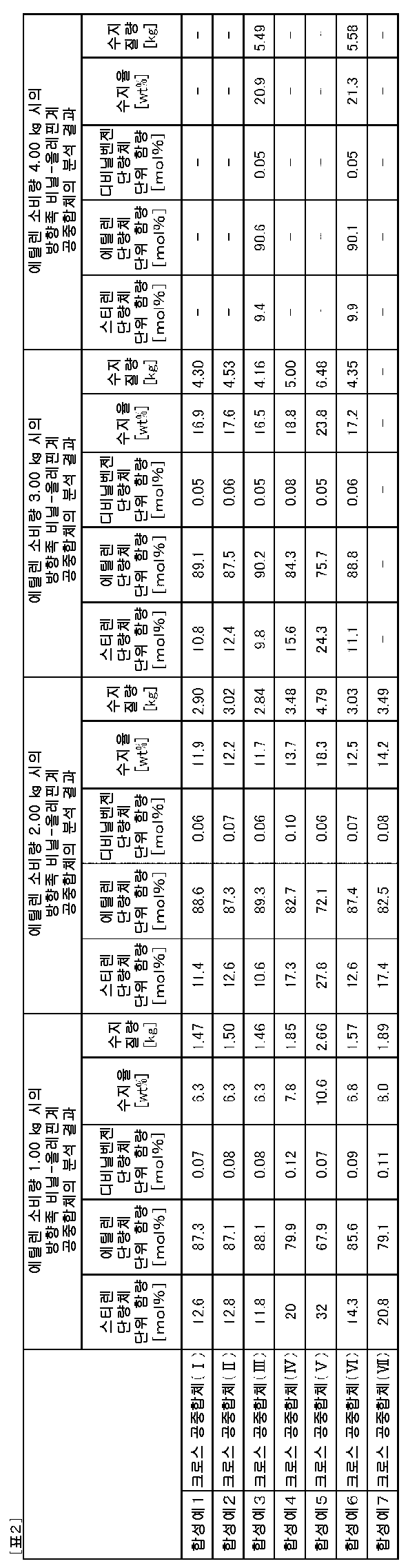
(배위 중합 도중에서의 주사슬 중의 에틸렌 단량체 단위의 함유량 (㏖%) 산출)(Calculation of content (mol%) of ethylene monomer units in main chain during coordination polymerization)
이하의 (a) ∼ (e) 에 나타내는 내용을, 이하의 (1) ∼ (3) 의 방법으로 산출하였다.The following contents (a) to (e) were calculated by the following methods (1) to (3).
(a) 에틸렌 소비량 1.00 ㎏ 까지에서 얻어진 방향족 비닐-올레핀계 공중합체 중의 에틸렌 단량체 단위 함량 (㏖%) 과, 그 공중합체의 배위 중합 정지시에 얻어지는 방향족 비닐-올레핀계 공중합체에 대한 질량% (a) the content of ethylene monomer units (mol%) in the aromatic vinyl-olefin-based copolymer obtained at up to an ethylene consumption of 1.00 kg and the mass% of the aromatic vinyl-olefin-
(b) 에틸렌 소비량 1.01 ㎏ 내지 2.00 ㎏ 까지에서 얻어진 방향족 비닐-올레핀계 공중합체 중의 에틸렌 단량체 단위 함량 (㏖%) 과, 그 공중합체의 배위 중합 정지시에 얻어지는 방향족 비닐-올레핀계 공중합체에 대한 질량% (b) the content of ethylene monomer units (mol%) in the aromatic vinyl-olefin-based copolymer obtained from ethylene consumption of 1.01 kg to 2.00 kg and the content of the ethylene monomer units (mol%) in the copolymer of aromatic vinyl- mass%
(c) 에틸렌 소비량 2.01 ㎏ 내지 3.00 ㎏, 또는 배위 중합 정지까지에서 얻어진 방향족 비닐-올레핀계 공중합체 중의 에틸렌 단량체 단위 함량 (㏖%) 과, 그 공중합체의 배위 중합 정지시에 얻어지는 방향족 비닐-올레핀계 공중합체에 대한 질량%(c) an amount of ethylene consumption of from 2.01 kg to 3.00 kg, or an ethylene vinyl monomer content (mol%) in an aromatic vinyl-olefin copolymer obtained from termination of coordination polymerization and an aromatic vinyl- Mass% < tb >
(d) 에틸렌 소비량 3.01 ㎏ 내지 4.00 ㎏, 또는 배위 중합 정지까지에서 얻어진 방향족 비닐-올레핀계 공중합체 중의 에틸렌 단량체 단위 함량 (㏖%) 과, 그 공중합체의 배위 중합 정지시에 얻어지는 방향족 비닐-올레핀계 공중합체에 대한 질량%(d) an amount of ethylene consumed from 3.01 kg to 4.00 kg, or the content of an ethylene monomer unit (mol%) in an aromatic vinyl-olefin-based copolymer obtained until termination of coordination polymerization and the content of an aromatic vinyl- Mass% < tb >
(e) 에틸렌 소비량 4.01 ㎏ 으로부터 배위 중합 정지까지에서 얻어진 방향족 비닐-올레핀계 공중합체 중의 에틸렌 단량체 단위 함량 (㏖%) 과, 그 공중합체의 배위 중합 정지시에 얻어지는 방향족 비닐-올레핀계 공중합체에 대한 질량%(e) the content of ethylene monomer units (mol%) in the aromatic vinyl-olefin-based copolymer obtained from the ethylene consumption amount of 4.01 kg to the termination of the coordination polymerization and the content of the ethylene monomer units in the aromatic vinyl- Mass%
상기 (a) ∼ (e) 에 나타내는 내용에 대해, 이하의 (1) ∼ (3) 의 방법으로 산출하였다.The contents shown in the above (a) to (e) were calculated by the following methods (1) to (3).
(1) 샘플링시까지 생성된 방향족 비닐-올레핀계 공중합체 중의 각 단량체 단위 함량 (㏖%) 과, 그 공중합체의 질량 (㎏) 으로부터, 그 공중합체 중의 각 단량체 단위 함량 (㎏) 값을 구한다.(1) The value of each monomer unit (kg) in the copolymer is obtained from the content (mol%) of each monomer in the aromatic vinyl-olefin copolymer produced until sampling and the mass (kg) of the copolymer .
(2) (a), (b), (c), (d), (e) 에서의 방향족 비닐-올레핀계 공중합체 중의 각 단량체 단위 함량 (㎏) 을 구한다.(2) The content (kg) of each monomer unit in the aromatic vinyl-olefin-based copolymer in (a), (b), (c), (d) and (e) is determined.
(a) : 에틸렌 (Et) 소비량 1.00 ㎏ 시의 (1) 에서 구한 값을 사용한다.(a): The value obtained in (1) at the time of consumption of ethylene (Et) at 1.00 kg is used.
(b) : (에틸렌 소비량 2.00 ㎏ 시의 (1) 에서 구한 값) - (에틸렌 소비량 1.00 ㎏ 시의 (1) 에서 구한 값)(b): (value obtained from (1) at the time of ethylene consumption of 2.00 kg) - (value obtained from (1) at the time of ethylene consumption of 1.00 kg)
(c) : (에틸렌 소비량 3.00 ㎏ 시, 또는 배위 중합 정지시의 (1) 에서 구한 값) - (에틸렌 소비량 2.00 ㎏ 시의 (1) 에서 구한 값)(c): (value obtained in (1) at the time of ethylene consumption of 3.00 kg, or in the case of termination of coordination polymerization) - (value obtained in (1) at the time of ethylene consumption of 2.00 kg)
(d) : (에틸렌 소비량 4.00 ㎏ 시, 또는 배위 중합 정지시의 (1) 에서 구한 값) - (에틸렌 소비량 3.00 ㎏ 시의 (1) 에서 구한 값) (value obtained in (1) at the ethylene consumption of 4.00 kg or in (1) at the time of termination of the coordination polymerization) - (value obtained in (1) at the ethylene consumption of 3.00 kg)
(e) : (배위 중합 정지시의 (1) 에서 구한 값) - (에틸렌 소비량 4.00 ㎏ 시의 (1) 에서 구한 값)(e) (value obtained in (1) at the time of termination of coordination polymerization) - (value obtained in (1) at the time of 4.00 kg ethylene consumption)
(3) (2) 에서 구한 각 단량체 단위 함량 (㎏) 으로부터, (a), (b), (c), (d), (e) 에 있어서의 에틸렌 단량체 단위 함량 (㏖%) 을 구한다. 결과를 표 3 에 나타낸다.(3) The ethylene monomer unit content (mol%) in (a), (b), (c), (d) and (e) is obtained from each monomer unit content (kg) obtained in (2). The results are shown in Table 3.
(4) (2) 에서 구한 각 단량체 단위 함량 (㎏) 의 합을, 배위 중합 정지시에 얻어지는 방향족 비닐-올레핀계 공중합체의 질량으로 나눠, (a), (b), (c), (d), (e) 에 있어서의 방향족 비닐-올레핀계 공중합체의 배위 중합 정지시에 얻어지는 방향족 비닐-올레핀계 공중합체에 대한 질량% 를 구한다. 결과를 표 3 에 나타낸다.(A), (b), (c), and (c) by dividing the sum of the monomer unit contents (kg) obtained in (4) (2) by the mass of the aromatic vinyl- The mass% of the aromatic vinyl-olefin-based copolymer obtained upon termination of the coordination polymerization of the aromatic vinyl-olefin-based copolymer in (d) and (e) is determined. The results are shown in Table 3.
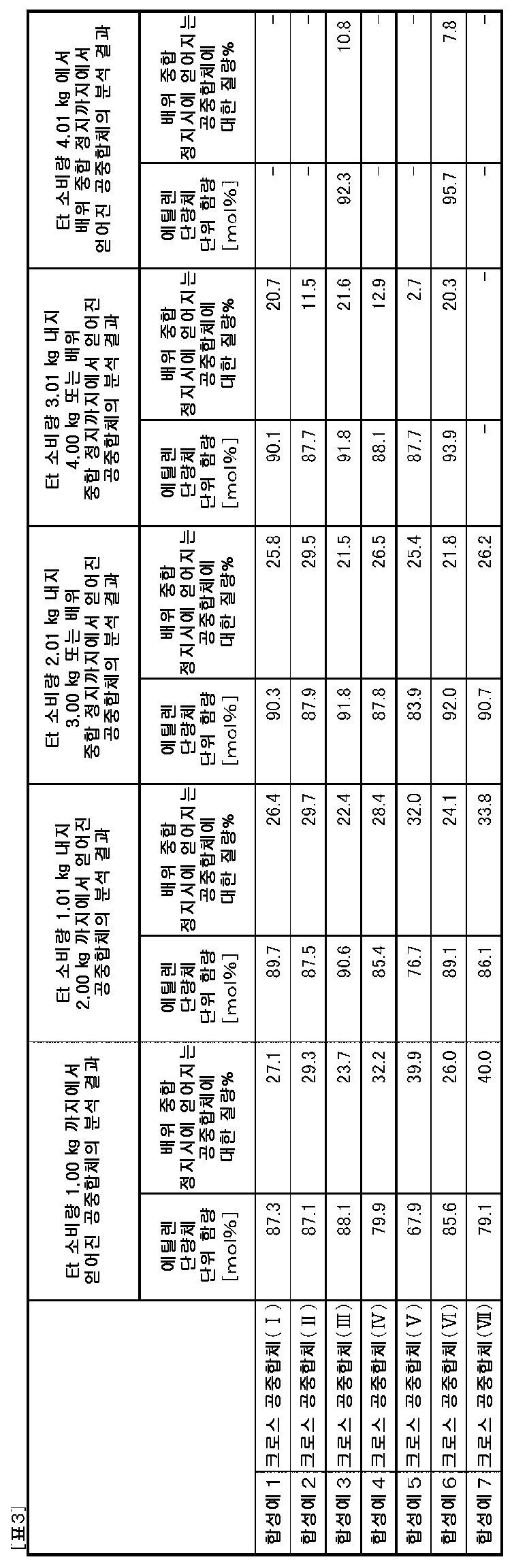
(융해 피크 온도 (Tm))(Melting peak temperature (Tm))
시차 주사 열량 측정법 (DSC) 에 의해, 30 ㎖/분의 질소 기류하에서 -50 ℃ 까지 냉각 후, 승온 속도 10 ℃/분으로 180 ℃ 까지 승온시키고, 다시 -50 ℃ 까지 냉각시키고, 승온 속도 10 ℃/분으로 180 ℃ 까지 가열하였을 때의 융해 피크 온도 (Tm) 를 측정하였다. 결과를 표 4 에 나타낸다.Cooled to -50 占 폚 under a flow of nitrogen of 30 ml / min by differential scanning calorimetry (DSC), then heated to 180 占 폚 at a temperature raising rate of 10 占 폚 / min, cooled again to -50 占 폚, / Min, and the melting peak temperature (Tm) at 180 DEG C was measured. The results are shown in Table 4.
(융해열)(Heat of fusion)
DSC 곡선의 -20 ℃ 내지 130 ℃ 사이에 그은 직선을 사용하여 -20 ℃ 와 130 ℃ 사이의 DSC 곡선의 면적으로부터 산출되는 융해열을 측정하였다. 결과를 표 4 에 나타낸다.The heat of fusion calculated from the area of the DSC curve between -20 ° C and 130 ° C was measured using a straight line between -20 ° C and 130 ° C of the DSC curve. The results are shown in Table 4.

[실시예 1 ∼ 실시예 4, 비교예 1 ∼ 3][Examples 1 to 4, Comparative Examples 1 to 3]
합성예 1 ∼ 7 에서 얻어진 크로스 공중합체에 대해, 이하의 평가 기준에 입각하여 시험편을 제조하고, 평가를 실시하였다. 결과를 표 5 에 나타낸다.For the cross-copolymers obtained in Synthesis Examples 1 to 7, test pieces were prepared on the basis of the following evaluation criteria and evaluated. The results are shown in Table 5.
(경도)(Hardness)
JIS K 6253 에 준거하여, 타입 A 의 듀로미터 경도를 사용하여 순간값의 경도를 구하였다. 또한, A 경도 85 이하를 합격 레벨로 하였다.In accordance with JIS K 6253, the durometer hardness of Type A was used to determine the hardness of the instantaneous value. The A hardness of 85 or less was regarded as the acceptable level.
(인장 특성)(Tensile Properties)
JIS K 6251 에 준거하여, 50 % 모듈러스 및 파단 강도를 구하였다. 50 % 모듈러스란, 시험편에 50 % 의 연신을 부여하였을 때의 인장 응력을 말한다. 시험편으로서 1 ㎜ 두께 프레스 시트를 3 호 덤벨형으로 타발하여 사용하였다. 인장 속도는 500 ㎜/분으로 하였다. 또한, 50 % 모듈러스 3.5 ㎫ 이상, 또한 파단 강도 30 ㎫ 이상을 합격 레벨로 하였다.50% modulus and breaking strength were determined in accordance with JIS K 6251. 50% modulus refers to the tensile stress when a 50% stretch is applied to a specimen. A 1 mm thick press sheet was used as a test piece by stamping it in a No. 3 dumbbell shape. The tensile speed was set at 500 mm / min. The acceptance level was 50% modulus of 3.5 MPa or more and breaking strength of 30 MPa or more.
(전광선 투과율)(Total light transmittance)
두께 1 ㎜, 한 변 50 ㎜ 의 정방형 경면 프레스 시트를, JIS K 7136 에 준거하여, 헤이즈미터 (닛폰 덴쇼쿠 공업사 제조 NDH-1001DP 형) 를 사용하여 측정하였다. 또한, 82 % 이상을 합격 레벨로 하였다.A square mirror press sheet having a thickness of 1 mm and a side of 50 mm was measured using a haze meter (NDH-1001DP type, manufactured by Nippon Denshoku Industries Co., Ltd.) in accordance with JIS K 7136. Also, 82% or more was set as the acceptable level.
(내블로킹성)(Blocking resistance)
두께 1 ㎜, 한 변 60 ㎜ 의 정방형 경면 프레스 시트 4 장을 중첩하여 직경 60 ㎜ 원반상의 100 g 의 추를 올리고, 23 ℃, 24 시간 후의 프레스 시트 4 장의 박리 용이성을 다음의 기준으로 평가하였다.Four square specimen sheets 1 mm in thickness and 60 mm square on one side were superposed on each other and a weight of 100 g on a disc having a diameter of 60 mm was placed thereon and the ease of peeling off four sheets of press sheets after 23 hours at 23 캜 was evaluated according to the following criteria.
3 : 4 장의 프레스 시트가 달라붙지 않고 깨긋이 박리된다.3: The four sheets of the press sheet are peeled off without sticking.
2 : 2, 3 장의 프레스 시트가 달라붙어 있어 박리하기 어렵지만, 1, 2 장의 프레스 시트는 달라붙지 않고 깨끗히 박리된다.2: The two or three sheets of press sheets stick together and are difficult to peel off, but one or two sheets of press sheet are peeled off without sticking.
1 : 4 장의 프레스 시트가 달라붙어 있어 박리되기 어렵다.1: The four sheets of the press sheet are stuck to each other and are difficult to peel off.

크로스 공중합체에 관련된 실시예 1 ∼ 4 에 대해서는, 모두 A 경도 85 이하, 50 % 모듈러스 3.5 ㎫ 이상, 인장 파단 강도 30 ㎫ 이상, 전광선 투과율 82 % 이상이며, 연질성, 인장 특성, 투명성, 및 내블로킹성이 우수하였다. 한편, 비교예 1 ∼ 3 에서는, 연질성, 인장 특성, 투명성, 및 내블로킹성 중 어느 물성에 있어서 뒤떨어지는 것이었다.All of Examples 1 to 4 relating to the cross copolymer had A hardness of 85 or less, 50% modulus of 3.5 MPa or more, tensile rupture strength of 30 MPa or more, and total light transmittance of 82% or more and were excellent in softness, tensile properties, transparency, The blocking property was excellent. On the other hand, in Comparative Examples 1 to 3, the properties such as softness, tensile properties, transparency and blocking resistance were inferior.
[단층 튜브의 평가][Evaluation of single layer tube]
실시예 1 ∼ 4, 비교예 1 ∼ 3 에서 얻어진 크로스 공중합체를 사용하여, 외경 3.6 ㎜, 내경 2.4 ㎜, 튜브 두께 0.6 ㎜ 의 단층 튜브를 압출 성형에 의해 제조하였다. 각각에 대해, 튜브로서의 특성을 이하의 기준에 따라 평가하였다. 결과를 표 6 에 나타낸다.A single-layer tube having an outer diameter of 3.6 mm, an inner diameter of 2.4 mm, and a tube thickness of 0.6 mm was produced by extrusion molding using the cross-copolymer obtained in Examples 1 to 4 and Comparative Examples 1 to 3. For each, the characteristics as a tube were evaluated according to the following criteria. The results are shown in Table 6.
(튜브 투명성)(Tube transparency)
튜브에 생리 식염액을 흘려, 액면, 기포 등을 육안으로 시인할 수 있는지의 여부를 관찰하였다. 용이하게 관찰할 수 있는 경우를 3 으로 하고, 관찰은 할 수 있지만 약간 시인하기 어려운 경우를 2, 관찰이 곤란한 경우를 1 로 하였다. 3 을 합격으로 하였다.A physiological saline solution was poured into the tube, and it was observed whether or not the liquid surface, bubbles, etc. could be visually recognized. The case of easily observable was defined as 3, the case of being difficult to observe was 2, and the case of being difficult to observe was regarded as 1, although observations were possible. 3 was accepted.
(튜브 블로킹성)(Tube blocking property)
길이 10 ㎝ 의 2 개의 튜브를 5 ㎝ 평행하게 겹쳐 종이 테이프로 묶고, 고압 수증기 멸균 (121 ℃, 30 분) 을 실시하였다. 그 후 묶은 종이 테이프를 제거하고, 튜브간의 전단 박리 강도를 측정하였다. 전단 박리 강도는, 인장 시험기에서 테스트 스피드 100 ㎜/분의 조건으로 측정하였다. 5 N 미만을 합격으로 하였다. 또한, 묶은 종이 테이프를 제거하였을 때에 2 개의 튜브가 달라붙지 않고 박리된 것은, 0 N 으로 하였다.Two tubes of 10 cm in length were piled up 5 cm in parallel, bound with paper tape, and subjected to high pressure steam sterilization (121 占 폚, 30 minutes). The bundled paper tape was then removed and the shear peel strength between the tubes was measured. The shear peel strength was measured in a tensile testing machine at a test speed of 100 mm / min. Less than 5 N was accepted. In addition, when the bundled paper tape was removed, the two tubes were peeled off without sticking to each other.
(킹크 개시 반경)(Kink starting radius)
20 ㎝ 의 튜브를 각 곡률 반경으로 구부리고, 1 분 후에 튜브의 절곡의 발생이 확인된 곡률 반경을 구하였다. 10 ㎜ 이하를 합격으로 하였다.A tube of 20 cm was bent at each radius of curvature, and after one minute, the radius of curvature in which the occurrence of bending of the tube was confirmed was obtained. 10 mm or less was accepted.
(내겸자성)(Internal and external)
40 ℃ 에 있어서, 생리 식염액을 채운 튜브를 의료용 튜브 겸자로 15 시간 폐지 후, 겸자를 떼어내고 튜브 내측이 형상을 회복하고 관통하는 시간을 측정하고, 다음의 기준으로 평가하였다.At 40 캜, the tube filled with the physiological saline solution was closed for 15 hours with a medical tube forceps, the forceps were removed, and the time when the inside of the tube was restored and passed through was measured and evaluated according to the following criteria.
4 : 3 초 이내에 형상이 회복되어 관통4: The shape is restored within 3 seconds and penetrated
3 : 3 ∼ 10 초에 형상이 회복되어 관통3: The shape is restored in 3 to 10 seconds,
2 : 형상이 회복되어 관통할 때까지 10 초 이상 걸린다2: It takes more than 10 seconds for the shape to recover and penetrate
1 : 형상이 회복되지 않고 관통하지 않는다1: The shape is not restored and penetrates.
또한, 4, 3 을 합격으로 하였다.Also, 4 and 3 were accepted.
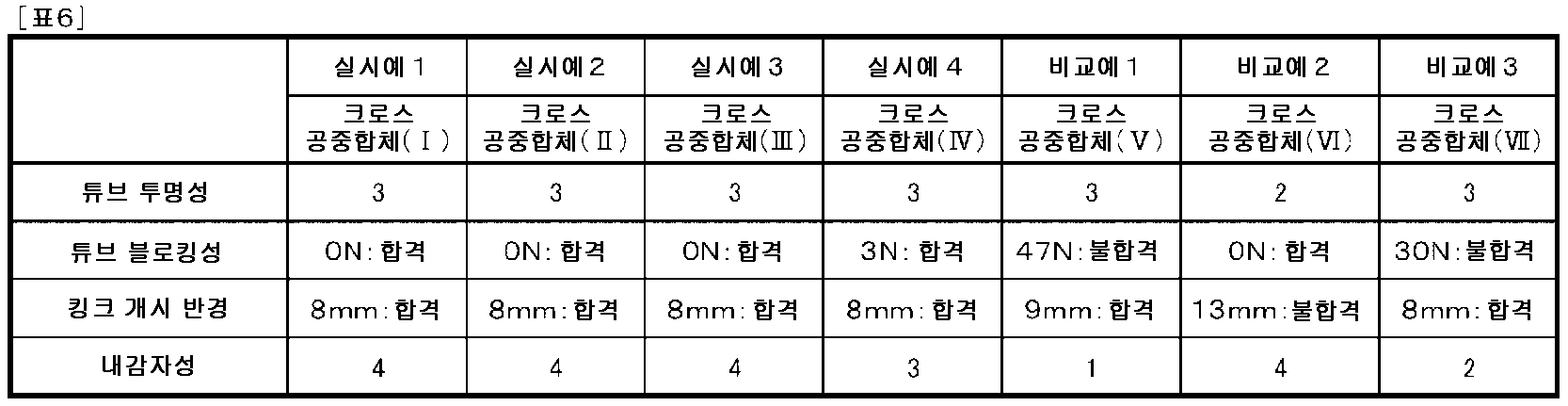
실시예 1 ∼ 4 의 크로스 공중합체를 사용한 단층 튜브는, 양호한 투명성, 내블로킹성, 양호한 킹크성, 및 내겸자성을 나타내고, 의료용 단층 튜브로서의 우수한 특성을 나타냈다. 한편, 비교예 1 ∼ 3 의 크로스 공중합체를 사용한 단층 튜브에 대해서는, 투명성, 내블로킹성, 킹크성, 내겸자성 중 어느 물성에 있어서 뒤떨어지는 것이었다.The single-layer tubes using the cross-copolymers of Examples 1 to 4 exhibited excellent transparency, blocking resistance, good kink resistance, and inward magnetic properties, and exhibited excellent properties as medical single-layer tubes. On the other hand, the single-layer tubes using the cross-copolymers of Comparative Examples 1 to 3 were inferior in transparency, blocking resistance, kink resistance and in-resistance.
산업상 이용가능성Industrial availability
본 발명에 의하면, 투명성, 내블로킹성, 킹크성 및 내겸자성이 우수한 의료용 단층 튜브를 제공할 수 있다.According to the present invention, it is possible to provide a medical single-layer tube which is excellent in transparency, blocking resistance, kink resistance and in-resistance.
Claims (6)
시차 주사 열량 측정법 (DSC) 에 의해, 30 ㎖/분의 질소 기류하에서 -50 ℃ 까지 냉각 후, 승온 속도 10 ℃/분으로 180 ℃ 까지 승온시키고, 다시 -50 ℃ 까지 냉각시키고, 승온 속도 10 ℃/분으로 180 ℃ 까지 가열하였을 때의 융해 피크의 정점 온도 (Tm) 가 60 ∼ 80 ℃ 이고, 또한 DSC 곡선의 -20 ℃ 내지 130 ℃ 사이에 그은 직선을 사용하여 -20 ℃ 와 130 ℃ 사이의 DSC 곡선의 면적으로부터 산출되는 융해열이 45 ∼ 75 J/g 인, 크로스 공중합체.From 75 to 95 mass% of a main chain composed of an aromatic vinyl-olefin copolymer composed of 8.99 to 15.99 mol% of an aromatic vinyl monomer unit, 84 to 91 mol% of an olefin monomer unit and 0.01 to 0.5 mol% of an aromatic polyene monomer unit, And 5 to 25 mass% of a cross chain composed of a polymer composed of a vinyl monomer unit,
Cooled to -50 占 폚 under a flow of nitrogen of 30 ml / min by differential scanning calorimetry (DSC), then heated to 180 占 폚 at a temperature raising rate of 10 占 폚 / min, cooled again to -50 占 폚, (Tm) of the melting peak when heated to 180 deg. C / minute in a temperature range of -60 deg. C to 80 deg. C, and a DSC curve of -20 deg. C to 130 deg. And a heat of fusion of 45 to 75 J / g calculated from the area of the DSC curve.
주사슬을 구성하는 방향족 비닐-올레핀계 공중합체의 조성 분포가, 올레핀 단량체 단위가 85 몰% 이상 92 몰% 이하인 방향족 비닐-올레핀계 공중합체의 함유량이 50 질량% 이상이고, 올레핀 단량체 단위가 85 몰% 미만인 방향족 비닐-올레핀계 공중합체의 함유량이 35 질량% 미만이고, 또한, 올레핀 단량체 단위가 92 몰% 를 초과하는 방향족 비닐-올레핀계 공중합체의 함유량이 15 질량% 미만인, 크로스 공중합체.The method according to claim 1,
Wherein the content of the aromatic vinyl-olefin-based copolymer in which the olefin monomer unit is 85 mol% or more and 92 mol% or less is 50% or more by mass and the olefin monomer unit is 85 Wherein the content of the aromatic vinyl-olefin-based copolymer is less than 35% by mass, and the content of the aromatic vinyl-olefin-based copolymer in which the olefin monomer unit exceeds 92% by mole is less than 15% by mass.
융해 피크의 정점 온도 (Tm) 가 65 ∼ 73 ℃ 이고, 또한 융해열이 50 ∼ 70 J/g 인, 크로스 공중합체.3. The method according to claim 1 or 2,
Wherein the melting peak has a peak temperature (Tm) of 65 to 73 占 폚 and a heat of fusion of 50 to 70 J / g.
방향족 비닐 단량체 단위가 스티렌인, 크로스 공중합체.4. The method according to any one of claims 1 to 3,
Wherein the aromatic vinyl monomer unit is styrene.
올레핀 단량체 단위가 에틸렌인, 크로스 공중합체.5. The method according to any one of claims 1 to 4,
Wherein the olefin monomer unit is ethylene.
Applications Claiming Priority (3)
| Application Number | Priority Date | Filing Date | Title |
|---|---|---|---|
| JP2015254652 | 2015-12-25 | ||
| JPJP-P-2015-254652 | 2015-12-25 | ||
| PCT/JP2016/081525 WO2017110235A1 (en) | 2015-12-25 | 2016-10-25 | Cross - copolymer and medical single-layer tube including same |
Publications (1)
| Publication Number | Publication Date |
|---|---|
| KR20180098371A true KR20180098371A (en) | 2018-09-03 |
Family
ID=59089234
Family Applications (1)
| Application Number | Title | Priority Date | Filing Date |
|---|---|---|---|
| KR1020187021568A Withdrawn KR20180098371A (en) | 2015-12-25 | 2016-10-25 | Cross-copolymer and medical single-layer tube using same |
Country Status (7)
| Country | Link |
|---|---|
| US (1) | US20190077893A1 (en) |
| JP (1) | JPWO2017110235A1 (en) |
| KR (1) | KR20180098371A (en) |
| CN (1) | CN108699185A (en) |
| DE (1) | DE112016006045T5 (en) |
| TW (1) | TW201723059A (en) |
| WO (1) | WO2017110235A1 (en) |
Families Citing this family (1)
| Publication number | Priority date | Publication date | Assignee | Title |
|---|---|---|---|---|
| CN119161537A (en) * | 2019-12-03 | 2024-12-20 | 电化株式会社 | Copolymer and laminate containing the same |
Citations (3)
| Publication number | Priority date | Publication date | Assignee | Title |
|---|---|---|---|---|
| JP2009102515A (en) | 2007-10-23 | 2009-05-14 | Denki Kagaku Kogyo Kk | Scratch-resistant wear-resistant elastomer |
| WO2013137326A1 (en) | 2012-03-14 | 2013-09-19 | 電気化学工業株式会社 | Multi-layer tube for medical use |
| JP2013202133A (en) | 2012-03-27 | 2013-10-07 | Denki Kagaku Kogyo Kk | Medical tube |
Family Cites Families (13)
| Publication number | Priority date | Publication date | Assignee | Title |
|---|---|---|---|---|
| EP0970976B1 (en) * | 1998-07-10 | 2002-10-09 | Sumitomo Chemical Company, Limited | Copolymer, process for production thereof, and molded article thereof |
| JP2001316431A (en) * | 2000-05-08 | 2001-11-13 | Denki Kagaku Kogyo Kk | Medical molded body |
| WO2003008497A1 (en) * | 2001-07-12 | 2003-01-30 | Idemitsu Petrochemical Co., Ltd. | Polyolefin resin composition |
| JP2006176708A (en) * | 2004-12-24 | 2006-07-06 | Denki Kagaku Kogyo Kk | Resin composition |
| JP2007191654A (en) * | 2006-01-23 | 2007-08-02 | Denki Kagaku Kogyo Kk | Resin composition |
| JP5435942B2 (en) * | 2006-05-29 | 2014-03-05 | 電気化学工業株式会社 | CROSS COPOLYMER MANUFACTURING METHOD, OBTAINED CROSS COPOLYMER AND USE THEREOF |
| CN101454365A (en) * | 2006-05-29 | 2009-06-10 | 电气化学工业株式会社 | Process for production of cross copolymers, cross copolymers obtained by the process, and use thereof |
| JP2009161743A (en) * | 2007-12-10 | 2009-07-23 | Denki Kagaku Kogyo Kk | Post-curing resin composition and high-frequency electrical insulating material using the same |
| JP5422274B2 (en) * | 2008-07-18 | 2014-02-19 | 電気化学工業株式会社 | Process for producing olefin-aromatic polyene copolymer |
| JP2012092197A (en) * | 2010-10-26 | 2012-05-17 | Denki Kagaku Kogyo Kk | Resin and sheet |
| WO2015072466A1 (en) * | 2013-11-12 | 2015-05-21 | 電気化学工業株式会社 | Thermoplastic elastomer resin composition |
| CN106133005B (en) * | 2014-03-28 | 2018-08-24 | 三井化学株式会社 | Olefin-based resin and its production method |
| JP6622186B2 (en) * | 2014-04-03 | 2019-12-18 | デンカ株式会社 | Cross copolymer and resin composition |
-
2016
- 2016-10-25 KR KR1020187021568A patent/KR20180098371A/en not_active Withdrawn
- 2016-10-25 WO PCT/JP2016/081525 patent/WO2017110235A1/en not_active Ceased
- 2016-10-25 CN CN201680082659.3A patent/CN108699185A/en active Pending
- 2016-10-25 DE DE112016006045.9T patent/DE112016006045T5/en not_active Withdrawn
- 2016-10-25 US US16/064,703 patent/US20190077893A1/en not_active Abandoned
- 2016-10-25 JP JP2017557760A patent/JPWO2017110235A1/en active Pending
- 2016-11-03 TW TW105135640A patent/TW201723059A/en unknown
Patent Citations (3)
| Publication number | Priority date | Publication date | Assignee | Title |
|---|---|---|---|---|
| JP2009102515A (en) | 2007-10-23 | 2009-05-14 | Denki Kagaku Kogyo Kk | Scratch-resistant wear-resistant elastomer |
| WO2013137326A1 (en) | 2012-03-14 | 2013-09-19 | 電気化学工業株式会社 | Multi-layer tube for medical use |
| JP2013202133A (en) | 2012-03-27 | 2013-10-07 | Denki Kagaku Kogyo Kk | Medical tube |
Also Published As
| Publication number | Publication date |
|---|---|
| DE112016006045T5 (en) | 2018-10-25 |
| US20190077893A1 (en) | 2019-03-14 |
| CN108699185A (en) | 2018-10-23 |
| TW201723059A (en) | 2017-07-01 |
| JPWO2017110235A1 (en) | 2018-10-18 |
| WO2017110235A1 (en) | 2017-06-29 |
Similar Documents
| Publication | Publication Date | Title |
|---|---|---|
| JP5275633B2 (en) | β-pinene polymer and process for producing the same | |
| JP6622186B2 (en) | Cross copolymer and resin composition | |
| JP5652688B2 (en) | Method for producing copolymer comprising olefin and aromatic vinyl compound | |
| CN103145902B (en) | Multi-phase polypropylene copolymer having high ethylene-propylene rubber content and preparation method thereof | |
| WO2007139116A1 (en) | Process for production of cross copolymers, cross copolymers obtained by the process, and use thereof | |
| CN101641380A (en) | Soluble polyfunctional vinyl aromatic copolymer and process for producing the same | |
| JP6563503B2 (en) | Tube using hydrogenated block copolymer | |
| CA2622498A1 (en) | Ethylene polymer, and thermoplastic resin composition comprising the same, and molded product obtained therefrom | |
| WO2017056946A1 (en) | Cross-copolymer and method for producing same | |
| KR20180098371A (en) | Cross-copolymer and medical single-layer tube using same | |
| JP5303933B2 (en) | Block copolymer and method for producing the same, resin-modifying composition, and modified resin composition and method for producing the same | |
| US20190330402A1 (en) | Cross-copolymer and method for producing same | |
| JP6795917B2 (en) | Cross copolymer and its production method | |
| JP2018080248A (en) | Thermoplastic elastomer composition, molded article and medical tube using the same | |
| KR101207398B1 (en) | Catalytic activity enhanced ethylene-based terpolymer having high elasticity and a preparation method thereof | |
| JP7602879B2 (en) | Composition and method for producing same | |
| US3632681A (en) | Block copolymers comprising an nphenyl maleimide and either a diolefin or cyclic oxide | |
| US20140235795A1 (en) | Highly functional graft copolymer and method for preparing the same | |
| JP2004244594A (en) | Cyclic conjugated diene copolymer | |
| WO2018230614A1 (en) | Thermoplastic elastomer composition | |
| JP2007039541A (en) | Thermoplastic elastomer and molded item | |
| JP6959724B2 (en) | Resin composition and its manufacturing method | |
| JP2000230015A (en) | Ion-crosslinked vinyl-compound-modified olefin polymer and molded article thereof | |
| WO2006120995A1 (en) | Block copolymer, resin composition containing same, and method for producing same |
Legal Events
| Date | Code | Title | Description |
|---|---|---|---|
| PA0105 | International application |
Patent event date: 20180725 Patent event code: PA01051R01D Comment text: International Patent Application |
|
| PG1501 | Laying open of application | ||
| PC1203 | Withdrawal of no request for examination | ||
| WITN | Application deemed withdrawn, e.g. because no request for examination was filed or no examination fee was paid |