KR20180098365A - High Strength Cold Rolled Steel Sheet and Manufacturing Method Thereof - Google Patents
High Strength Cold Rolled Steel Sheet and Manufacturing Method Thereof Download PDFInfo
- Publication number
- KR20180098365A KR20180098365A KR1020187021481A KR20187021481A KR20180098365A KR 20180098365 A KR20180098365 A KR 20180098365A KR 1020187021481 A KR1020187021481 A KR 1020187021481A KR 20187021481 A KR20187021481 A KR 20187021481A KR 20180098365 A KR20180098365 A KR 20180098365A
- Authority
- KR
- South Korea
- Prior art keywords
- retained austenite
- less
- steel sheet
- circularity
- crystal grains
- Prior art date
- Legal status (The legal status is an assumption and is not a legal conclusion. Google has not performed a legal analysis and makes no representation as to the accuracy of the status listed.)
- Granted
Links
Images


Classifications
-
- C—CHEMISTRY; METALLURGY
- C21—METALLURGY OF IRON
- C21D—MODIFYING THE PHYSICAL STRUCTURE OF FERROUS METALS; GENERAL DEVICES FOR HEAT TREATMENT OF FERROUS OR NON-FERROUS METALS OR ALLOYS; MAKING METAL MALLEABLE, e.g. BY DECARBURISATION OR TEMPERING
- C21D9/00—Heat treatment, e.g. annealing, hardening, quenching or tempering, adapted for particular articles; Furnaces therefor
- C21D9/46—Heat treatment, e.g. annealing, hardening, quenching or tempering, adapted for particular articles; Furnaces therefor for sheet metals
-
- B—PERFORMING OPERATIONS; TRANSPORTING
- B32—LAYERED PRODUCTS
- B32B—LAYERED PRODUCTS, i.e. PRODUCTS BUILT-UP OF STRATA OF FLAT OR NON-FLAT, e.g. CELLULAR OR HONEYCOMB, FORM
- B32B15/00—Layered products comprising a layer of metal
- B32B15/01—Layered products comprising a layer of metal all layers being exclusively metallic
- B32B15/013—Layered products comprising a layer of metal all layers being exclusively metallic one layer being formed of an iron alloy or steel, another layer being formed of a metal other than iron or aluminium
-
- C—CHEMISTRY; METALLURGY
- C21—METALLURGY OF IRON
- C21D—MODIFYING THE PHYSICAL STRUCTURE OF FERROUS METALS; GENERAL DEVICES FOR HEAT TREATMENT OF FERROUS OR NON-FERROUS METALS OR ALLOYS; MAKING METAL MALLEABLE, e.g. BY DECARBURISATION OR TEMPERING
- C21D1/00—General methods or devices for heat treatment, e.g. annealing, hardening, quenching or tempering
- C21D1/26—Methods of annealing
- C21D1/28—Normalising
-
- C—CHEMISTRY; METALLURGY
- C21—METALLURGY OF IRON
- C21D—MODIFYING THE PHYSICAL STRUCTURE OF FERROUS METALS; GENERAL DEVICES FOR HEAT TREATMENT OF FERROUS OR NON-FERROUS METALS OR ALLOYS; MAKING METAL MALLEABLE, e.g. BY DECARBURISATION OR TEMPERING
- C21D6/00—Heat treatment of ferrous alloys
- C21D6/005—Heat treatment of ferrous alloys containing Mn
-
- C—CHEMISTRY; METALLURGY
- C21—METALLURGY OF IRON
- C21D—MODIFYING THE PHYSICAL STRUCTURE OF FERROUS METALS; GENERAL DEVICES FOR HEAT TREATMENT OF FERROUS OR NON-FERROUS METALS OR ALLOYS; MAKING METAL MALLEABLE, e.g. BY DECARBURISATION OR TEMPERING
- C21D6/00—Heat treatment of ferrous alloys
- C21D6/008—Heat treatment of ferrous alloys containing Si
-
- C—CHEMISTRY; METALLURGY
- C21—METALLURGY OF IRON
- C21D—MODIFYING THE PHYSICAL STRUCTURE OF FERROUS METALS; GENERAL DEVICES FOR HEAT TREATMENT OF FERROUS OR NON-FERROUS METALS OR ALLOYS; MAKING METAL MALLEABLE, e.g. BY DECARBURISATION OR TEMPERING
- C21D8/00—Modifying the physical properties of ferrous metals or ferrous alloys by deformation combined with, or followed by, heat treatment
- C21D8/02—Modifying the physical properties of ferrous metals or ferrous alloys by deformation combined with, or followed by, heat treatment during manufacturing of plates or strips
-
- C—CHEMISTRY; METALLURGY
- C21—METALLURGY OF IRON
- C21D—MODIFYING THE PHYSICAL STRUCTURE OF FERROUS METALS; GENERAL DEVICES FOR HEAT TREATMENT OF FERROUS OR NON-FERROUS METALS OR ALLOYS; MAKING METAL MALLEABLE, e.g. BY DECARBURISATION OR TEMPERING
- C21D8/00—Modifying the physical properties of ferrous metals or ferrous alloys by deformation combined with, or followed by, heat treatment
- C21D8/02—Modifying the physical properties of ferrous metals or ferrous alloys by deformation combined with, or followed by, heat treatment during manufacturing of plates or strips
- C21D8/0221—Modifying the physical properties of ferrous metals or ferrous alloys by deformation combined with, or followed by, heat treatment during manufacturing of plates or strips characterised by the working steps
- C21D8/0226—Hot rolling
-
- C—CHEMISTRY; METALLURGY
- C21—METALLURGY OF IRON
- C21D—MODIFYING THE PHYSICAL STRUCTURE OF FERROUS METALS; GENERAL DEVICES FOR HEAT TREATMENT OF FERROUS OR NON-FERROUS METALS OR ALLOYS; MAKING METAL MALLEABLE, e.g. BY DECARBURISATION OR TEMPERING
- C21D8/00—Modifying the physical properties of ferrous metals or ferrous alloys by deformation combined with, or followed by, heat treatment
- C21D8/02—Modifying the physical properties of ferrous metals or ferrous alloys by deformation combined with, or followed by, heat treatment during manufacturing of plates or strips
- C21D8/0221—Modifying the physical properties of ferrous metals or ferrous alloys by deformation combined with, or followed by, heat treatment during manufacturing of plates or strips characterised by the working steps
- C21D8/0236—Cold rolling
-
- C—CHEMISTRY; METALLURGY
- C21—METALLURGY OF IRON
- C21D—MODIFYING THE PHYSICAL STRUCTURE OF FERROUS METALS; GENERAL DEVICES FOR HEAT TREATMENT OF FERROUS OR NON-FERROUS METALS OR ALLOYS; MAKING METAL MALLEABLE, e.g. BY DECARBURISATION OR TEMPERING
- C21D8/00—Modifying the physical properties of ferrous metals or ferrous alloys by deformation combined with, or followed by, heat treatment
- C21D8/02—Modifying the physical properties of ferrous metals or ferrous alloys by deformation combined with, or followed by, heat treatment during manufacturing of plates or strips
- C21D8/0247—Modifying the physical properties of ferrous metals or ferrous alloys by deformation combined with, or followed by, heat treatment during manufacturing of plates or strips characterised by the heat treatment
-
- C—CHEMISTRY; METALLURGY
- C21—METALLURGY OF IRON
- C21D—MODIFYING THE PHYSICAL STRUCTURE OF FERROUS METALS; GENERAL DEVICES FOR HEAT TREATMENT OF FERROUS OR NON-FERROUS METALS OR ALLOYS; MAKING METAL MALLEABLE, e.g. BY DECARBURISATION OR TEMPERING
- C21D8/00—Modifying the physical properties of ferrous metals or ferrous alloys by deformation combined with, or followed by, heat treatment
- C21D8/02—Modifying the physical properties of ferrous metals or ferrous alloys by deformation combined with, or followed by, heat treatment during manufacturing of plates or strips
- C21D8/0247—Modifying the physical properties of ferrous metals or ferrous alloys by deformation combined with, or followed by, heat treatment during manufacturing of plates or strips characterised by the heat treatment
- C21D8/0263—Modifying the physical properties of ferrous metals or ferrous alloys by deformation combined with, or followed by, heat treatment during manufacturing of plates or strips characterised by the heat treatment following hot rolling
-
- C—CHEMISTRY; METALLURGY
- C21—METALLURGY OF IRON
- C21D—MODIFYING THE PHYSICAL STRUCTURE OF FERROUS METALS; GENERAL DEVICES FOR HEAT TREATMENT OF FERROUS OR NON-FERROUS METALS OR ALLOYS; MAKING METAL MALLEABLE, e.g. BY DECARBURISATION OR TEMPERING
- C21D8/00—Modifying the physical properties of ferrous metals or ferrous alloys by deformation combined with, or followed by, heat treatment
- C21D8/02—Modifying the physical properties of ferrous metals or ferrous alloys by deformation combined with, or followed by, heat treatment during manufacturing of plates or strips
- C21D8/0278—Modifying the physical properties of ferrous metals or ferrous alloys by deformation combined with, or followed by, heat treatment during manufacturing of plates or strips involving a particular surface treatment
-
- C—CHEMISTRY; METALLURGY
- C21—METALLURGY OF IRON
- C21D—MODIFYING THE PHYSICAL STRUCTURE OF FERROUS METALS; GENERAL DEVICES FOR HEAT TREATMENT OF FERROUS OR NON-FERROUS METALS OR ALLOYS; MAKING METAL MALLEABLE, e.g. BY DECARBURISATION OR TEMPERING
- C21D8/00—Modifying the physical properties of ferrous metals or ferrous alloys by deformation combined with, or followed by, heat treatment
- C21D8/02—Modifying the physical properties of ferrous metals or ferrous alloys by deformation combined with, or followed by, heat treatment during manufacturing of plates or strips
- C21D8/04—Modifying the physical properties of ferrous metals or ferrous alloys by deformation combined with, or followed by, heat treatment during manufacturing of plates or strips to produce plates or strips for drawing, e.g. for deep-drawing
- C21D8/0421—Modifying the physical properties of ferrous metals or ferrous alloys by deformation combined with, or followed by, heat treatment during manufacturing of plates or strips to produce plates or strips for drawing, e.g. for deep-drawing characterised by the working steps
- C21D8/0426—Hot rolling
-
- C—CHEMISTRY; METALLURGY
- C21—METALLURGY OF IRON
- C21D—MODIFYING THE PHYSICAL STRUCTURE OF FERROUS METALS; GENERAL DEVICES FOR HEAT TREATMENT OF FERROUS OR NON-FERROUS METALS OR ALLOYS; MAKING METAL MALLEABLE, e.g. BY DECARBURISATION OR TEMPERING
- C21D8/00—Modifying the physical properties of ferrous metals or ferrous alloys by deformation combined with, or followed by, heat treatment
- C21D8/02—Modifying the physical properties of ferrous metals or ferrous alloys by deformation combined with, or followed by, heat treatment during manufacturing of plates or strips
- C21D8/04—Modifying the physical properties of ferrous metals or ferrous alloys by deformation combined with, or followed by, heat treatment during manufacturing of plates or strips to produce plates or strips for drawing, e.g. for deep-drawing
- C21D8/0421—Modifying the physical properties of ferrous metals or ferrous alloys by deformation combined with, or followed by, heat treatment during manufacturing of plates or strips to produce plates or strips for drawing, e.g. for deep-drawing characterised by the working steps
- C21D8/0436—Cold rolling
-
- C—CHEMISTRY; METALLURGY
- C21—METALLURGY OF IRON
- C21D—MODIFYING THE PHYSICAL STRUCTURE OF FERROUS METALS; GENERAL DEVICES FOR HEAT TREATMENT OF FERROUS OR NON-FERROUS METALS OR ALLOYS; MAKING METAL MALLEABLE, e.g. BY DECARBURISATION OR TEMPERING
- C21D8/00—Modifying the physical properties of ferrous metals or ferrous alloys by deformation combined with, or followed by, heat treatment
- C21D8/02—Modifying the physical properties of ferrous metals or ferrous alloys by deformation combined with, or followed by, heat treatment during manufacturing of plates or strips
- C21D8/04—Modifying the physical properties of ferrous metals or ferrous alloys by deformation combined with, or followed by, heat treatment during manufacturing of plates or strips to produce plates or strips for drawing, e.g. for deep-drawing
- C21D8/0447—Modifying the physical properties of ferrous metals or ferrous alloys by deformation combined with, or followed by, heat treatment during manufacturing of plates or strips to produce plates or strips for drawing, e.g. for deep-drawing characterised by the heat treatment
-
- C—CHEMISTRY; METALLURGY
- C21—METALLURGY OF IRON
- C21D—MODIFYING THE PHYSICAL STRUCTURE OF FERROUS METALS; GENERAL DEVICES FOR HEAT TREATMENT OF FERROUS OR NON-FERROUS METALS OR ALLOYS; MAKING METAL MALLEABLE, e.g. BY DECARBURISATION OR TEMPERING
- C21D8/00—Modifying the physical properties of ferrous metals or ferrous alloys by deformation combined with, or followed by, heat treatment
- C21D8/02—Modifying the physical properties of ferrous metals or ferrous alloys by deformation combined with, or followed by, heat treatment during manufacturing of plates or strips
- C21D8/04—Modifying the physical properties of ferrous metals or ferrous alloys by deformation combined with, or followed by, heat treatment during manufacturing of plates or strips to produce plates or strips for drawing, e.g. for deep-drawing
- C21D8/0447—Modifying the physical properties of ferrous metals or ferrous alloys by deformation combined with, or followed by, heat treatment during manufacturing of plates or strips to produce plates or strips for drawing, e.g. for deep-drawing characterised by the heat treatment
- C21D8/0463—Modifying the physical properties of ferrous metals or ferrous alloys by deformation combined with, or followed by, heat treatment during manufacturing of plates or strips to produce plates or strips for drawing, e.g. for deep-drawing characterised by the heat treatment following hot rolling
-
- C—CHEMISTRY; METALLURGY
- C21—METALLURGY OF IRON
- C21D—MODIFYING THE PHYSICAL STRUCTURE OF FERROUS METALS; GENERAL DEVICES FOR HEAT TREATMENT OF FERROUS OR NON-FERROUS METALS OR ALLOYS; MAKING METAL MALLEABLE, e.g. BY DECARBURISATION OR TEMPERING
- C21D9/00—Heat treatment, e.g. annealing, hardening, quenching or tempering, adapted for particular articles; Furnaces therefor
- C21D9/46—Heat treatment, e.g. annealing, hardening, quenching or tempering, adapted for particular articles; Furnaces therefor for sheet metals
- C21D9/48—Heat treatment, e.g. annealing, hardening, quenching or tempering, adapted for particular articles; Furnaces therefor for sheet metals deep-drawing sheets
-
- C—CHEMISTRY; METALLURGY
- C22—METALLURGY; FERROUS OR NON-FERROUS ALLOYS; TREATMENT OF ALLOYS OR NON-FERROUS METALS
- C22C—ALLOYS
- C22C38/00—Ferrous alloys, e.g. steel alloys
- C22C38/001—Ferrous alloys, e.g. steel alloys containing N
-
- C—CHEMISTRY; METALLURGY
- C22—METALLURGY; FERROUS OR NON-FERROUS ALLOYS; TREATMENT OF ALLOYS OR NON-FERROUS METALS
- C22C—ALLOYS
- C22C38/00—Ferrous alloys, e.g. steel alloys
- C22C38/002—Ferrous alloys, e.g. steel alloys containing In, Mg, or other elements not provided for in one single group C22C38/001 - C22C38/60
-
- C—CHEMISTRY; METALLURGY
- C22—METALLURGY; FERROUS OR NON-FERROUS ALLOYS; TREATMENT OF ALLOYS OR NON-FERROUS METALS
- C22C—ALLOYS
- C22C38/00—Ferrous alloys, e.g. steel alloys
- C22C38/02—Ferrous alloys, e.g. steel alloys containing silicon
-
- C—CHEMISTRY; METALLURGY
- C22—METALLURGY; FERROUS OR NON-FERROUS ALLOYS; TREATMENT OF ALLOYS OR NON-FERROUS METALS
- C22C—ALLOYS
- C22C38/00—Ferrous alloys, e.g. steel alloys
- C22C38/04—Ferrous alloys, e.g. steel alloys containing manganese
-
- C—CHEMISTRY; METALLURGY
- C22—METALLURGY; FERROUS OR NON-FERROUS ALLOYS; TREATMENT OF ALLOYS OR NON-FERROUS METALS
- C22C—ALLOYS
- C22C38/00—Ferrous alloys, e.g. steel alloys
- C22C38/06—Ferrous alloys, e.g. steel alloys containing aluminium
-
- C—CHEMISTRY; METALLURGY
- C23—COATING METALLIC MATERIAL; COATING MATERIAL WITH METALLIC MATERIAL; CHEMICAL SURFACE TREATMENT; DIFFUSION TREATMENT OF METALLIC MATERIAL; COATING BY VACUUM EVAPORATION, BY SPUTTERING, BY ION IMPLANTATION OR BY CHEMICAL VAPOUR DEPOSITION, IN GENERAL; INHIBITING CORROSION OF METALLIC MATERIAL OR INCRUSTATION IN GENERAL
- C23C—COATING METALLIC MATERIAL; COATING MATERIAL WITH METALLIC MATERIAL; SURFACE TREATMENT OF METALLIC MATERIAL BY DIFFUSION INTO THE SURFACE, BY CHEMICAL CONVERSION OR SUBSTITUTION; COATING BY VACUUM EVAPORATION, BY SPUTTERING, BY ION IMPLANTATION OR BY CHEMICAL VAPOUR DEPOSITION, IN GENERAL
- C23C2/00—Hot-dipping or immersion processes for applying the coating material in the molten state without affecting the shape; Apparatus therefor
- C23C2/02—Pretreatment of the material to be coated, e.g. for coating on selected surface areas
-
- C—CHEMISTRY; METALLURGY
- C23—COATING METALLIC MATERIAL; COATING MATERIAL WITH METALLIC MATERIAL; CHEMICAL SURFACE TREATMENT; DIFFUSION TREATMENT OF METALLIC MATERIAL; COATING BY VACUUM EVAPORATION, BY SPUTTERING, BY ION IMPLANTATION OR BY CHEMICAL VAPOUR DEPOSITION, IN GENERAL; INHIBITING CORROSION OF METALLIC MATERIAL OR INCRUSTATION IN GENERAL
- C23C—COATING METALLIC MATERIAL; COATING MATERIAL WITH METALLIC MATERIAL; SURFACE TREATMENT OF METALLIC MATERIAL BY DIFFUSION INTO THE SURFACE, BY CHEMICAL CONVERSION OR SUBSTITUTION; COATING BY VACUUM EVAPORATION, BY SPUTTERING, BY ION IMPLANTATION OR BY CHEMICAL VAPOUR DEPOSITION, IN GENERAL
- C23C2/00—Hot-dipping or immersion processes for applying the coating material in the molten state without affecting the shape; Apparatus therefor
- C23C2/02—Pretreatment of the material to be coated, e.g. for coating on selected surface areas
- C23C2/022—Pretreatment of the material to be coated, e.g. for coating on selected surface areas by heating
- C23C2/0224—Two or more thermal pretreatments
-
- C—CHEMISTRY; METALLURGY
- C23—COATING METALLIC MATERIAL; COATING MATERIAL WITH METALLIC MATERIAL; CHEMICAL SURFACE TREATMENT; DIFFUSION TREATMENT OF METALLIC MATERIAL; COATING BY VACUUM EVAPORATION, BY SPUTTERING, BY ION IMPLANTATION OR BY CHEMICAL VAPOUR DEPOSITION, IN GENERAL; INHIBITING CORROSION OF METALLIC MATERIAL OR INCRUSTATION IN GENERAL
- C23C—COATING METALLIC MATERIAL; COATING MATERIAL WITH METALLIC MATERIAL; SURFACE TREATMENT OF METALLIC MATERIAL BY DIFFUSION INTO THE SURFACE, BY CHEMICAL CONVERSION OR SUBSTITUTION; COATING BY VACUUM EVAPORATION, BY SPUTTERING, BY ION IMPLANTATION OR BY CHEMICAL VAPOUR DEPOSITION, IN GENERAL
- C23C2/00—Hot-dipping or immersion processes for applying the coating material in the molten state without affecting the shape; Apparatus therefor
- C23C2/02—Pretreatment of the material to be coated, e.g. for coating on selected surface areas
- C23C2/024—Pretreatment of the material to be coated, e.g. for coating on selected surface areas by cleaning or etching
-
- C—CHEMISTRY; METALLURGY
- C23—COATING METALLIC MATERIAL; COATING MATERIAL WITH METALLIC MATERIAL; CHEMICAL SURFACE TREATMENT; DIFFUSION TREATMENT OF METALLIC MATERIAL; COATING BY VACUUM EVAPORATION, BY SPUTTERING, BY ION IMPLANTATION OR BY CHEMICAL VAPOUR DEPOSITION, IN GENERAL; INHIBITING CORROSION OF METALLIC MATERIAL OR INCRUSTATION IN GENERAL
- C23C—COATING METALLIC MATERIAL; COATING MATERIAL WITH METALLIC MATERIAL; SURFACE TREATMENT OF METALLIC MATERIAL BY DIFFUSION INTO THE SURFACE, BY CHEMICAL CONVERSION OR SUBSTITUTION; COATING BY VACUUM EVAPORATION, BY SPUTTERING, BY ION IMPLANTATION OR BY CHEMICAL VAPOUR DEPOSITION, IN GENERAL
- C23C2/00—Hot-dipping or immersion processes for applying the coating material in the molten state without affecting the shape; Apparatus therefor
- C23C2/04—Hot-dipping or immersion processes for applying the coating material in the molten state without affecting the shape; Apparatus therefor characterised by the coating material
- C23C2/06—Zinc or cadmium or alloys based thereon
-
- C—CHEMISTRY; METALLURGY
- C23—COATING METALLIC MATERIAL; COATING MATERIAL WITH METALLIC MATERIAL; CHEMICAL SURFACE TREATMENT; DIFFUSION TREATMENT OF METALLIC MATERIAL; COATING BY VACUUM EVAPORATION, BY SPUTTERING, BY ION IMPLANTATION OR BY CHEMICAL VAPOUR DEPOSITION, IN GENERAL; INHIBITING CORROSION OF METALLIC MATERIAL OR INCRUSTATION IN GENERAL
- C23C—COATING METALLIC MATERIAL; COATING MATERIAL WITH METALLIC MATERIAL; SURFACE TREATMENT OF METALLIC MATERIAL BY DIFFUSION INTO THE SURFACE, BY CHEMICAL CONVERSION OR SUBSTITUTION; COATING BY VACUUM EVAPORATION, BY SPUTTERING, BY ION IMPLANTATION OR BY CHEMICAL VAPOUR DEPOSITION, IN GENERAL
- C23C2/00—Hot-dipping or immersion processes for applying the coating material in the molten state without affecting the shape; Apparatus therefor
- C23C2/34—Hot-dipping or immersion processes for applying the coating material in the molten state without affecting the shape; Apparatus therefor characterised by the shape of the material to be treated
- C23C2/36—Elongated material
- C23C2/40—Plates; Strips
-
- C—CHEMISTRY; METALLURGY
- C21—METALLURGY OF IRON
- C21D—MODIFYING THE PHYSICAL STRUCTURE OF FERROUS METALS; GENERAL DEVICES FOR HEAT TREATMENT OF FERROUS OR NON-FERROUS METALS OR ALLOYS; MAKING METAL MALLEABLE, e.g. BY DECARBURISATION OR TEMPERING
- C21D2211/00—Microstructure comprising significant phases
- C21D2211/001—Austenite
-
- C—CHEMISTRY; METALLURGY
- C21—METALLURGY OF IRON
- C21D—MODIFYING THE PHYSICAL STRUCTURE OF FERROUS METALS; GENERAL DEVICES FOR HEAT TREATMENT OF FERROUS OR NON-FERROUS METALS OR ALLOYS; MAKING METAL MALLEABLE, e.g. BY DECARBURISATION OR TEMPERING
- C21D2211/00—Microstructure comprising significant phases
- C21D2211/005—Ferrite
-
- C—CHEMISTRY; METALLURGY
- C21—METALLURGY OF IRON
- C21D—MODIFYING THE PHYSICAL STRUCTURE OF FERROUS METALS; GENERAL DEVICES FOR HEAT TREATMENT OF FERROUS OR NON-FERROUS METALS OR ALLOYS; MAKING METAL MALLEABLE, e.g. BY DECARBURISATION OR TEMPERING
- C21D2211/00—Microstructure comprising significant phases
- C21D2211/008—Martensite
-
- Y—GENERAL TAGGING OF NEW TECHNOLOGICAL DEVELOPMENTS; GENERAL TAGGING OF CROSS-SECTIONAL TECHNOLOGIES SPANNING OVER SEVERAL SECTIONS OF THE IPC; TECHNICAL SUBJECTS COVERED BY FORMER USPC CROSS-REFERENCE ART COLLECTIONS [XRACs] AND DIGESTS
- Y02—TECHNOLOGIES OR APPLICATIONS FOR MITIGATION OR ADAPTATION AGAINST CLIMATE CHANGE
- Y02P—CLIMATE CHANGE MITIGATION TECHNOLOGIES IN THE PRODUCTION OR PROCESSING OF GOODS
- Y02P10/00—Technologies related to metal processing
- Y02P10/20—Recycling
Landscapes
- Chemical & Material Sciences (AREA)
- Engineering & Computer Science (AREA)
- Mechanical Engineering (AREA)
- Materials Engineering (AREA)
- Metallurgy (AREA)
- Organic Chemistry (AREA)
- Physics & Mathematics (AREA)
- Thermal Sciences (AREA)
- Crystallography & Structural Chemistry (AREA)
- Chemical Kinetics & Catalysis (AREA)
- Heat Treatment Of Sheet Steel (AREA)
Abstract
소정의 성분 조성으로 하는 동시에, 강 조직을, 면적율에서 페라이트:30∼75%, 마텐자이트:15∼40% 및 잔류 오스테나이트:10∼30%인 조직으로 하고, 또한 잔류 오스테나이트의 결정립의 원형도 분포를 계급 범위:0.1×(n-1)초과 0.1×n이하, 계급값:0.1×n(여기서, n은 1∼10까지의 정수)로 한 히스토그램으로 나타내는 경우에, 잔류 오스테나이트의 결정립의 원형도의 최빈치를 0.7이상으로 하는 것에 의해, 인장 강도:900MPa이상의 고강도와 전체 신장:20%이상의 고가공성을 겸비하고, 또한 60%미만의 저항복비를 갖는 고강도 냉연 강판으로 한다.And the steel structure is made into a structure having a ferrite content of 30 to 75%, a martensite content of 15 to 40% and a retained austenite content of 10 to 30%, and a steel structure having a grain structure of residual austenite When the circularity distribution is represented by a histogram in which the rank range is 0.1 x (n-1) to 0.1 x n or less and the rank value is 0.1 x n (where n is an integer of 1 to 10), the residual austenite A high strength cold rolled steel sheet having a high tensile strength of 900 MPa or more and a high elongation of 20% or more and a low resistance ratio of less than 60% by setting the minimum value of the circularity of the crystal grain to 0.7 or more.
Description
본 발명은 고강도 냉연 강판 및 그 제조 방법에 관한 것으로서, 특히 저항복비이고 또한 가공성도 우수한 고강도 냉연 강판을 얻고자 하는 것이다.The present invention relates to a high-strength cold-rolled steel sheet and a method for producing the same, and more particularly to a high-strength cold-rolled steel sheet having low resistance and excellent processability.
근래, 고강도와 우수한 가공성을 겸비한 강판으로서, 강판의 강 조직(미세 조직)을 제어한 각종 강판이 개발되어 있다.2. Description of the Related Art In recent years, various types of steel sheets having high strength and excellent processability have been developed which control the steel structure (microstructure) of the steel sheet.
예를 들면, 특허문헌 1에는 인장 강도가 980MPa이상의 가공성이 우수한 고항복비 고강도의 용융 아연 도금 강판 및 그 제조 방법이 개시되어 있다.For example,
또, 특허문헌 2에는 인장 강도가 1180MPa이상이고, 신장과 신장 플랜지성이 우수한 초고강도 냉연 강판 및 그 제조 방법이 개시되어 있다.Patent Document 2 discloses an ultra-high-strength cold-rolled steel sheet having a tensile strength of 1180 MPa or more and excellent elongation and stretch flangeability, and a method for producing the same.
그런데, 자동차용 강판의 가공에는 프레스 가공이 많이 이용되지만, 항복비가 크면 프레스 가공시의 부하가 클 뿐만 아니라, 프레스 가공 후에 강판이 원래의 형상으로 되돌아가고자 하는 소위 스프링 백 현상이 문제로 된다.However, when the yield ratio is large, the load during press working is large, and the so-called springback phenomenon in which the steel plate is to be returned to its original shape after the press working becomes a problem.
또, 근래, 자동차의 충돌 안전성 확보를 위해, 충돌시에 적극적으로 변형되는 강판을 자동차 부품에 적용하여, 충돌 에너지를 흡수하는 차체 구조 설계를 실행하는 것도 요구되어 있으며, 그 때문에, 고강도와 우수한 가공성을 겸비하고, 또한 저항복비의 강판을 개발하는 것이 요망되고 있다.In recent years, in order to secure the collision safety of an automobile, it is also required to apply a steel plate that is actively deformed at the time of collision to an automobile part, and to implement a vehicle body structure design that absorbs impact energy. Therefore, And it is desired to develop a steel plate having a low resistance.
이 점에서, 특허문헌 1에 기재된 강판은 고항복비의 강판을 대상으로 하는 것이며, 상기와 같은 용도에는 적합하지 않다.In view of this point, the steel sheet described in
또, 특허문헌 2에 기재된 강판에서는 항복 강도나 항복비에 대해 하등 고려가 이루어져 있지 않다.In the steel sheet described in Patent Document 2, no consideration is given to the yield strength or the yield ratio.
또한, 특허문헌 1 및 2에 기재된 강판에서는 모두, 반드시 충분한 연성이 얻어지지 않는 경우가 있으며, 가공성의 면에도 과제를 남기고 있었다.Further, in all of the steel sheets described in
본 발명은 상기의 현상을 감안하여 개발된 것으로서, 인장 강도:900MPa이상의 고강도와 전체 신장:20%이상의 우수한 가공성을 겸비하고, 또한 항복비:60%미만의 저항복비의 고강도 냉연 강판을 제공하는 것을 목적으로 한다.The present invention has been developed in view of the above phenomenon, and it is an object of the present invention to provide a high strength cold rolled steel sheet having a high tensile strength of 900 MPa or more and a total elongation of 20% or more with excellent workability and a yield ratio of less than 60% The purpose.
또, 본 발명은 상기의 고강도 냉연 강판의 제조 방법을 제공하는 것을 목적으로 한다.It is another object of the present invention to provide a method of manufacturing the high strength cold rolled steel sheet.
그런데, 발명자들은 인장 강도:900MPa이상의 고강도와 전체 신장:20%이상의 우수한 가공성을 겸비하고, 또한 항복비:60%미만의 저항복비의 고강도 냉연 강판을 개발하기 위해 예의 검토를 거듭한 결과, 이하의 것을 지견하였다.The inventors of the present invention have conducted intensive studies to develop a high strength cold rolled steel sheet having a high tensile strength of 900 MPa or more and excellent elongation of 20% or more and a yield ratio of less than 60%. As a result, .
(1) 인장 강도:900MPa이상과 전체 신장:20%이상을 양립하기 위해서는 성분 조성을 적정하게 조정한 후에, 강 조직을, 페라이트, 마텐자이트 및 잔류 오스테나이트가 각각 적정한 배합 비율이 되는 복합 조직으로 하고, 잔류 오스테나이트에 의한 TRIP 효과를 활용하는 것이 유효하다.(1) In order to make both the tensile strength of 900 MPa or more and the total elongation of 20% or more compatible, the composition of the steel is appropriately adjusted, and then the steel structure is treated with a composite structure in which ferrite, martensite and retained austenite are mixed in appropriate ratios And it is effective to utilize the TRIP effect by the residual austenite.
(2) 또, 강판의 기계적 특성, 특히 항복비는 성분 조성이나 강 조직에 있어서의 각 상의 면적율(이하, 조직분율이라고도 함)에 의해서 일의적으로 정해지는 것은 아니며, 성분 조성이나 조직분율이 대략 동일해도 크게 변경되는 경우가 있다.(2) Further, the mechanical properties, particularly the yield ratio, of the steel sheet are not uniquely determined by the component composition and the area ratio of the respective phases in the steel structure (hereinafter also referred to as the structure fraction), and the composition and the structure fraction It may be largely changed even if it is the same.
(3) 그래서, 각 상의 조직 형태에 주목하고, 전계방출형 주사 전자 현미경(FE-SEM)을 이용하여 강 조직의 상세한 관찰·해석을 실행한 결과, 잔류 오스테나이트의 형태, 특히 잔류 오스테나이트의 결정립의 원형도가 강판의 항복비에 영향을 주고 있고, 이 잔류 오스테나이트의 결정립의 원형도를 적정하게 제어하는 것에 의해서, 원하는 강판의 항복비를 얻는 것이 가능하게 된다.(3) Thus, attention was paid to the morphology of each phase and, as a result of detailed observation and analysis of the steel structure using a field emission scanning electron microscope (FE-SEM), the shape of retained austenite, It is possible to obtain the yield ratio of a desired steel sheet by appropriately controlling the circularity of the crystal grains of the retained austenite, since the circularity of the crystal grains affects the yield ratio of the steel sheet.
(4) 또, 특히 열간 압연 후의 권취 온도와 냉각 조건을 조정하는 것에 의해, 소둔 처리 전의 열연판 조직을 페라이트와 펄라이트의 2상 조직으로 하고, 그 후, 페라이트와 오스테나이트의 2상역에 있어서 소둔을 실행하여, 소정의 조건에서 과시효 처리를 실행하는 것에 의해, 최종 조직에 있어서의 잔류 오스테나이트의 결정립의 원형도를 적정하게 제어할 수 있다.(4) Further, by adjusting the coiling temperature and the cooling conditions after the hot rolling in particular, the hot rolled steel sheet structure before the annealing treatment is made into a two-phase structure of ferrite and pearlite, and thereafter annealing in the biaxial region of ferrite and austenite And the overhanging treatment is performed under a predetermined condition, the circularity of the crystal grains of the retained austenite in the final structure can be appropriately controlled.
본 발명은 상기의 지견에 의거하여, 또한 검토를 가한 끝에 완성된 것이다.The present invention has been completed on the basis of the above knowledge and also after a review has been made.
즉, 본 발명의 요지 구성은 다음과 같다.That is, the structure of the present invention is as follows.
1. 질량%로, C:0.15∼0.35%, Si:1.0∼2.0%, Mn:1.8∼3.5%, P:0.020%이하, S:0.0040%이하, Al:0.01∼0.1% 및 N:0.01%이하를 함유하고, 잔부가 Fe 및 불가피한 불순물로 이루어지는 성분 조성을 갖고, 면적율에서, 페라이트:30∼75%, 마텐자이트:15∼40% 및 잔류 오스테나이트:10∼30%의 범위인 강 조직을 갖고, 또, 상기 잔류 오스테나이트의 결정립의 원형도 분포를, 계급 범위:0.1×(n-1)초과 0.1×n이하, 계급값:0.1×n(여기서, n은 1∼10까지의 정수)로 한 히스토그램으로 나타내는 경우에, 상기 잔류 오스테나이트의 결정립의 원형도의 최빈치가 0.7이상인 것을 특징으로 하는 고강도 냉연 강판;1. A ferritic stainless steel comprising 0.1 to 0.35% of C, 1.0 to 2.0% of Si, 1.8 to 3.5% of Mn, 0.020% or less of P, 0.0040% or less of S, 0.01 to 0.1% And a balance of Fe and inevitable impurities, and has a steel structure having a ferrite content of 30 to 75%, a martensite content of 15 to 40% and a retained austenite content of 10 to 30% (N is an integer of 1 to 10) of 0.1 x (n-1) or more and 0.1 x n or less, and a rank value of 0.1 x n (where n is an integer of 1 to 10) , Wherein the maximum value of the circularity of the crystal grains of the retained austenite is 0.7 or more.
여기서, 잔류 오스테나이트의 각 결정립의 원형도는 다음 식에 의해 구한 것이고, 원형도=4πS/L2 여기서, S는 잔류 오스테나이트의 결정립의 면적, L은 잔류 오스테나이트의 결정립의 둘레 길이이다.Here, the circularity of each crystal grain of the retained austenite is obtained by the following formula, and the circularity is 4? S / L 2 where S is the area of the crystal grains of the retained austenite and L is the circumferential length of the crystal grains of the retained austenite.
2. 표면에 아연 도금층을 갖는 상기 1에 기재된 고강도 냉연 강판.2. The high strength cold rolled steel sheet according to the above 1, which has a zinc plated layer on its surface.
3. 질량%로, C:0.15∼0.35%, Si:1.0∼2.0%, Mn:1.8∼3.5%, P:0.020%이하, S:0.0040%이하, Al:0.01∼0.1% 및 N:0.01%이하를 함유하고, 잔부가 Fe 및 불가피한 불순물로 이루어지는 강 슬래브를, 1100℃이상 1200℃이하로 가열한 후, 상기 강 슬래브에 마무리 압연 출측 온도:850℃이상 950℃이하에서 열간 압연을 실시하여 열연판으로 하고, 상기 열연판을, 상기 마무리 압연 출측 온도에서 700℃까지의 온도역에 있어서의 냉각 속도를 50℃/s이상으로 해서 냉각하고, 상기 열연판을 550℃이상 650℃이하에서 권취하고, 권취 후에 수냉을 실시하여 100℃이하까지 냉각하고, 산세를 실행한 후, 상기 열연판에 냉간 압연을 실시하여 냉연판으로 하고, 상기 냉연판을 730℃이상 820℃이하에서 소둔한 후, 300℃이상 500℃이하의 온도역으로 냉각하고, 상기 냉연판을 해당 300℃이상 500℃이하의 온도역에서 100s이상 1000s이하 유지하는 과시효 처리를 실시하는 고강도 냉연 강판의 제조 방법.3. The steel sheet according to any one of
4. 상기 과시효 처리 후에 아연 도금 처리를 실행하는 상기 3에 기재된 고강도 냉연 강판의 제조 방법.4. The method for manufacturing a high strength cold rolled steel sheet according to the above 3, wherein the zinc plating treatment is carried out after the over-treatment treatment.
본 발명에 따르면, 인장 강도:900MPa이상의 고강도와 전체 신장:20%이상의 우수한 가공성을 겸비하고, 또한 항복비:60%미만의 저항복비의 고강도 냉연 강판을 얻을 수 있다.According to the present invention, it is possible to obtain a high strength cold rolled steel sheet having a high tensile strength of 900 MPa or more and excellent elongation of 20% or more and a yield ratio of less than 60%.
또, 이러한 고강도 냉연 강판을 소정의 자동차 부품에 적용하는 것에 의해, 충돌시에 충돌 에너지를 흡수하는 차체 구조 설계를 실행하면서, 차체 경량화에 의한 연비 개선을 도모하는 것이 가능하게 되므로, 산업적인 이용 가치는 극히 크다.Further, by applying such a high-strength cold-rolled steel sheet to a predetermined automobile part, it becomes possible to improve the fuel economy by reducing the weight of the vehicle while performing the design of the vehicle body structure that absorbs the impact energy at the time of the collision, Is extremely large.
도 1은 잔류 오스테나이트의 결정립의 원형도 분포를 나타내는 히스토그램의 일예를 나타내는 도면이다.
도 2의 (a)는 강 조직을 FE-SEM에 의해 관찰한 경우에 얻어지는 2차 전자상의 일예를 나타내는 도면이며, (b)는 강 조직을 EBSD에 의해 관찰하고, 소정의 PC 소프트에 의해 해석하여 얻어지는 화상의 일예를 나타내는 도면이다.
도 3은 실시예의 강판 No.1의 강 조직을 나타내는 FE-SEM상((a) 가속 전압:15kV, 배율:2000배로 관찰한 2차 전자상, (b) 가속 전압:1kV, 배율:5000배로 관찰한 2차 전자상)이다.BRIEF DESCRIPTION OF DRAWINGS FIG. 1 is a view showing an example of a histogram showing the distribution of circularity of crystal grains of retained austenite. FIG.
Fig. 2 (a) is a view showing an example of a secondary electron image obtained when FE-SEM observes a steel structure, Fig. 2 (b) is a view showing a steel structure observed with EBSD, And Fig.
Fig. 3 is a graph showing the results of FE-SEM ((a) acceleration voltage: 15 kV, magnification: secondary electron observed at 2000 times, (b) acceleration voltage: 1 kV, magnification: Observed secondary electron image).
이하, 본 발명을 구체적으로 설명한다.Hereinafter, the present invention will be described in detail.
우선, 본 발명의 고강도 냉연 강판에 있어서의 성분 조성의 한정 이유를 이하에 기술한다. 또한, 성분 조성에 있어서의 단위는 모두 「질량%」이지만, 이하, 특히 단정하지 않는 한 단지「%」로 나타낸다.First, the reason for limiting the composition of the high-strength cold-rolled steel sheet of the present invention will be described below. The units in the composition of the components are "% by mass ", but they are expressed as "% "
C:0.15∼0.35%C: 0.15 to 0.35%
C는 강판의 고강도화에도 기여하는 동시에, 잔류 오스테나이트를 얻기 위해 중요한 원소이다. 본 발명의 강판을 제조함에 있어서는 소둔 후의 과시효 처리시에 페라이트 변태가 진행한다. 여기서, 페라이트는 C를 거의 고용하지 않으므로, 미변태 오스테나이트에 C가 농화되고, 오스테나이트가 안정화된다. 그 결과, 최종 조직에 있어서 잔류 오스테나이트가 얻어지며, 신장을 향상시킨다. 또, C의 농화가 불충분한 일부의 오스테나이트는 마텐자이트 변태하고, C를 과포화로 고용한 경질상(마텐자이트)으로 되어 강도의 향상에 기여한다. 여기에, C량이 0.15%미만에서는 충분한 강도를 얻을 수 없다. 한편, C량이 0.35%를 넘으면, 용접성의 열화가 현저하게 된다. 따라서, C량은 0.15∼0.35%의 범위로 한다. 바람직하게는 0.15%이상이다. 바람직하게는 0.28%이하이다.C is an important element for obtaining the retained austenite while contributing to the strengthening of the steel sheet. In producing the steel sheet of the present invention, the ferrite transformation progresses during overexposure treatment after annealing. Here, since ferrite hardly employs C, C is concentrated in the untransformed austenite, and austenite is stabilized. As a result, retained austenite is obtained in the final structure and the elongation is improved. In addition, a part of the austenite in which the concentration of C is insufficient is transformed into martensite, and a hard phase (martensite) solidified by supersaturation of C contributes to improvement of strength. If the C content is less than 0.15%, sufficient strength can not be obtained. On the other hand, when the C content exceeds 0.35%, the weldability deteriorates remarkably. Therefore, the amount of C is in the range of 0.15 to 0.35%. It is preferably at least 0.15%. And preferably 0.28% or less.
Si:1.0∼2.0%Si: 1.0 to 2.0%
Si는 과시효시의 시멘타이트 생성을 억제하고, 충분한 양의 잔류 오스테나이트를 얻기 위해 중요한 원소이다. 그러나, Si량이 1.0%미만에서는 상기의 효과를 얻을 수 없다. 한편, Si량이 2.0%를 넘으면, 열간 압연 및 소둔시의 표면 산화가 현저하게 되고, 외관 및 도금성에 악영향을 미친다. 따라서, Si량은 1.0∼2.0%의 범위로 한다. 바람직하게는 1.2%이상이다. 바람직하게는 1.8%이하이다.Si is an important element for suppressing cementite formation over time and obtaining a sufficient amount of retained austenite. However, if the amount of Si is less than 1.0%, the above effects can not be obtained. On the other hand, when the amount of Si exceeds 2.0%, the surface oxidation during hot rolling and annealing becomes remarkable, which adversely affects appearance and plating ability. Therefore, the amount of Si is set in the range of 1.0 to 2.0%. It is preferably at least 1.2%. And preferably 1.8% or less.
Mn:1.8∼3.5%Mn: 1.8 to 3.5%
Mn은 잔류 오스테나이트를 안정화시키는 효과가 있다. 그러나, Mn량이 1.8%미만에서는 상기의 효과가 작다. 한편, Mn량이 3.5%를 넘으면, 과시효 처리시의 페라이트 변태, 더 나아가서는 잔류 오스테나이트의 생성이 억제되며, 원하는 신장을 얻는 것이 곤란하게 된다. 따라서, Mn량은 1.8∼3.5%의 범위로 한다. 바람직하게는 1.9%이상이다. 바람직하게는 2.5%이하이다.Mn has an effect of stabilizing the retained austenite. However, when the Mn amount is less than 1.8%, the above effect is small. On the other hand, when the Mn content exceeds 3.5%, the ferrite transformation at the time of overexposure treatment and further the formation of retained austenite are suppressed, and it becomes difficult to obtain a desired elongation. Therefore, the amount of Mn is set in the range of 1.8 to 3.5%. It is preferably 1.9% or more. It is preferably 2.5% or less.
P:0.020%이하P: not more than 0.020%
P는 용접성을 저하시키기 때문에, 극력 적은 것이 바람직하다. 따라서, P량은 0.020%이하로 한다. 바람직하게는 0.015%이하이다.Since P lowers the weldability, it is preferable that P is as small as possible. Therefore, the amount of P is 0.020% or less. It is preferably 0.015% or less.
S:0.0040%이하S: not more than 0.0040%
S는 개재물을 형성하여 국부 신장을 저하시키기 때문에, 극력 적은 것이 바람직하다. 따라서, S량은 0.0040%이하로 한다. 바람직하게는 0.0020%이하이다.Since S forms inclusions and lowers the local elongation, it is preferable that S is as small as possible. Therefore, the amount of S is 0.0040% or less. And preferably 0.0020% or less.
Al:0.01∼0.1%Al: 0.01 to 0.1%
Al은 탈산제로서 첨가된다. 그러나, Al량이 0.01%미만에서는 그 효과가 작다. 한편, Al량이 0.1%를 넘으면, 개재물이 형성되며, 국부 신장이 저하한다. 따라서, Al량은 0.01∼0.1%의 범위로 한다. 바람직하게는 0.02%이상이다. 바람직하게는 0.06%이하이다.Al is added as a deoxidizer. However, if the amount of Al is less than 0.01%, the effect is small. On the other hand, if the amount of Al exceeds 0.1%, inclusions are formed and the local elongation decreases. Therefore, the Al content is in the range of 0.01 to 0.1%. It is preferably 0.02% or more. Preferably 0.06% or less.
N:0.01%이하N: not more than 0.01%
N은 왜곡 시효에 영향을 미치는 원소이며, 극력 적은 것이 바람직하다. 따라서, N량은 0.01%이하로 한다. 바람직하게는 0.006%이하이다.N is an element that affects the aging of the distortion, and it is preferable that the N is as small as possible. Therefore, the N content should be 0.01% or less. It is preferably not more than 0.006%.
또한, 상기 이외의 성분은 Fe 및 불가피한 불순물이다. 단, 본 발명의 효과를 해치지 않는 범위이면 상기 이외의 성분의 함유를 거부하는 것은 아니다.The other components are Fe and unavoidable impurities. However, if the effect of the present invention is not impaired, the inclusion of other components is not contemplated.
다음에, 본 발명의 고강도 냉연 강판의 강 조직에 대해 설명한다.Next, the steel structure of the high-strength cold-rolled steel sheet of the present invention will be described.
페라이트의 면적율:30∼75%Area ratio of ferrite: 30 to 75%
페라이트는 연질 상이며 신장의 향상에 기여한다. 여기서, 페라이트의 면적율이 30%미만에서는 마텐자이트가 증가하여 강도가 과도하게 높아지며, 신장이 저하한다. 한편, 페라이트의 면적율이 75%를 넘으면, 마텐자이트의 면적율이 저하하여, 원하는 강도를 확보할 수 없다. 따라서, 페라이트의 면적율은 30∼75%의 범위로 한다. 바람직하게는 40%이상이다. 바람직하게는 70%이하이다.Ferrite is a soft phase and contributes to the improvement of the elongation. Here, when the area ratio of ferrite is less than 30%, martensite increases and the strength becomes excessively high, and the elongation decreases. On the other hand, if the area ratio of the ferrite exceeds 75%, the area ratio of the martensite decreases and the desired strength can not be secured. Therefore, the area ratio of ferrite is set in the range of 30 to 75%. It is preferably at least 40%. And preferably 70% or less.
마텐자이트의 면적율:15∼40%Area ratio of martensite: 15 to 40%
마텐자이트는 경질 상이며 강도의 향상에 기여한다. 여기서, 마텐자이트의 면적율이 15%미만에서는 원하는 강도를 확보할 수 없다. 한편, 마텐자이트의 면적율이 40%를 넘으면, 강도가 과도하게 높아지고 신장이 저하한다. 따라서, 마텐자이트의 면적율은 15∼40%의 범위로 한다. 바람직하게는 20%이상이다. 바람직하게는 35%이하이다.Martensite is a hard phase and contributes to the improvement of strength. If the area ratio of martensite is less than 15%, desired strength can not be secured. On the other hand, if the area ratio of martensite exceeds 40%, the strength becomes excessively high and the elongation decreases. Therefore, the area ratio of the martensite is set in the range of 15 to 40%. Preferably 20% or more. And preferably 35% or less.
잔류 오스테나이트의 면적율:10∼30%Area ratio of retained austenite: 10 to 30%
잔류 오스테나이트는 TRIP 효과를 통해 신장의 향상에 크게 기여한다. 여기서, 잔류 오스테나이트의 면적율이 10%미만에서는 원하는 신장을 얻을 수 없다. 한편, 잔류 오스테나이트의 면적율이 증가함에 따라, 잔류 오스테나이트 중의 C농도가 낮아져 잔류 오스테나이트의 안정도가 저하한다. 이 때문에, 면적율에서 30%초과의 잔류 오스테나이트를 공업적으로 얻기 위해서는 제어가 곤란하다. 따라서, 잔류 오스테나이트의 면적율은 10∼30%의 범위로 한다. 바람직하게는 12%이상이다. 바람직하게는 28%이하이다.Residual austenite contributes greatly to the improvement of kidney through TRIP effect. If the area ratio of the retained austenite is less than 10%, desired elongation can not be obtained. On the other hand, as the area ratio of the retained austenite increases, the C concentration in the retained austenite decreases and the stability of the retained austenite decreases. Therefore, it is difficult to control in order to industrially obtain residual austenite exceeding 30% in area ratio. Therefore, the area ratio of the retained austenite is set in the range of 10 to 30%. It is preferably at least 12%. Preferably, it is 28% or less.
또한, 강 조직은 기본적으로 상기한 페라이트, 마텐자이트 및 잔류 오스테나이트에 의해 구성되지만, 시멘타이트 등의 탄화물이나 TiN 등의 개재물이 미량이면 포함되어 있어도 좋고, 이들 합계의 면적율이 1%이하이면 허용할 수 있다.The steel structure is basically composed of the above ferrite, martensiticite and retained austenite. However, it may be included if it contains trace amounts of carbides such as cementite and TiN, and if the total area percentage of these carbides is 1% can do.
잔류 오스테나이트의 결정립의 원형도의 최빈치:0.7이상The minimum value of the circularity of the crystal grains of the retained austenite: 0.7 or more
전술한 바와 같이, 잔류 오스테나이트의 결정립의 원형도는 강판의 항복비에 영향을 미치며, 이 잔류 오스테나이트의 결정립의 원형도의 최빈치를 0.7이상으로 제어하는 것에 의해서, 원하는 항복비:60%미만의 저항복비를 얻는 것이 가능하게 된다.As described above, the circularity of the crystal grains of the retained austenite affects the yield ratio of the steel sheet, and by controlling the optimum value of the circularity of the crystal grains of the retained austenite to be not less than 0.7, the desired yield ratio is less than 60% It is possible to obtain the resistance reduction ratio of.
여기서, 잔류 오스테나이트의 결정립의 원형도가 강판의 항복비에 영향을 미치는 메커니즘에 대해서는 반드시 명백하지는 않지만, 발명자들은 조직 형태에 의해 미시적인 응력 분배가 변화하기 때문으로 생각하고 있다.Here, the mechanism by which the degree of circularity of the crystal grain of the retained austenite influences the yield ratio of the steel sheet is not necessarily clear, but the inventors think that the microstrain distribution changes due to the structure type.
즉, 잔류 오스테나이트의 결정립의 원형도(이하, 단지 원형도라고도 함)의 최빈치가 작아지면, 잔류 오스테나이트의 결정립의 대부분은 가늘고 길게 연장된 형상으로 된다. 강판에 인장 하중을 부가한 경우, 잔류 오스테나이트의 결정립의 형상이 인장 방향에 대해 어떠한 방향으로 연장하고 있는지로, 응력의 부가방식이 다른 것으로 된다. 이러한 경우, 가늘고 길게 연장된 형상으로 된 잔류 오스테나이트의 결정립은 응력이 가해져도 TRIP 현상을 일으키지 않고, 그 응력을 페라이트 또는 마텐자이트가 담당하게 된다. TRIP 현상은 불가역인 소성 변형이기 때문에, TRIP 현상이 일어나면 항복한다. 그러나, 페라이트 및 마텐자이트는 응력이 가해지면 탄성 변형되기 때문에, 항복하지 않고, 항복비를 높이는 측으로 작용한다. 이 때문에, 잔류 오스테나이트의 결정립의 원형도의 최빈치가 작아지면, 강판의 항복비가 상승한다. 한편, 잔류 오스테나이트의 결정립의 원형도의 최빈치가 커지면, 강 중의 대부분은 잔류 오스테나이트에 있어서 TRIP 현상이 생기고, 그 결과, 항복비가 저하하는 것으로 생각하고 있다.That is, if the smallest value of the circularity of the crystal grains of the retained austenite (hereinafter also simply referred to as the circularity) becomes small, most of the crystal grains of the retained austenite become elongated and elongated. When a tensile load is added to the steel sheet, the direction of the grain growth of the retained austenite in the tensile direction is different from that of the stress. In such a case, the crystal grains of the retained austenite in the form of elongated elongation do not cause the TRIP phenomenon even if stress is applied, and the stress is caused by the ferrite or martensite. Since the TRIP phenomenon is an irreversible plastic deformation, it yields when a TRIP phenomenon occurs. However, since ferrite and martensite are elastically deformed when stress is applied, they do not surrender and act as a side to increase the yield ratio. Therefore, if the minimum value of the circularity of the crystal grains of the retained austenite becomes small, the yield ratio of the steel sheet increases. On the other hand, when the maximum value of the circularity of the crystal grains of the retained austenite is large, most of the steel is considered to have a TRIP phenomenon in the retained austenite, and as a result, the yield ratio decreases.
또한, 여기서 말하는 잔류 오스테나이트의 결정립의 원형도의 최빈치는 도 1에 나타내는 바와 같이, 잔류 오스테나이트의 결정립의 원형도 분포를 계급 범위:0.1×(n-1)초과 0.1×n이하, 계급값:0.1×n(여기서, n은 1∼10까지의 정수)으로 한 히스토그램으로 나타내는 경우에 있어서의 원형도의 최빈치이다. 또한, 최빈치는 상기의 원형도 분포에 있어서, 도수(결정립의 수)가 최대로 되는 계급값을 의미하는 것이며, 도 1의 경우, 최빈치는 0.9이다.1, the distribution of the circularity of the crystal grains of the retained austenite is in the range of 0.1 x (n-1) to 0.1 x n or less, and the rank value of the austenite : 0.1 x n (where n is an integer from 1 to 10). In addition, the minimum value means a rank value in which the frequency (the number of crystal grains) becomes maximum in the above circularity distribution, and in the case of FIG. 1, the minimum value is 0.9.
또, 잔류 오스테나이트의 각 결정립의 원형도는 다음 식에 의해 구한 것이다.The circularity of each crystal grain of the retained austenite is obtained by the following formula.
원형도=4πS/L2 Circularity = 4πS / L 2
여기서, S는 잔류 오스테나이트의 결정립의 면적, L은 잔류 오스테나이트의 결정립의 둘레 길이이다.Here, S is the area of the crystal grains of the retained austenite, and L is the circumferential length of the crystal grains of the retained austenite.
또한, 강판 중의 잔류 오스테나이트의 결정립의 형태는 다양하기 때문에, 통계적으로 원형도를 판정하기 위해서는 1000개 이상의 잔류 오스테나이트의 결정립의 원형도를 측정하는 것이 바람직하다.Further, since the shape of the crystal grains of the retained austenite in the steel sheet varies, it is preferable to measure the circularity of the crystal grains of 1000 or more retained austenite in order to statistically determine the circularity.
이에 부가하여, 잔류 오스테나이트의 각 결정립의 원형도의 측정은 전계 방출형 주사 전자 현미경(FE-SEM)의 관찰상의 화상 처리에 의해 실행하는 것이 바람직하다.In addition, the circularity of each crystal grain of the retained austenite is preferably measured by image processing on observation of a field emission scanning electron microscope (FE-SEM).
즉, 강판의 시료 단면을 경면 연마한 후, 적절한 조직 에칭 처리를 실시하고, FE-SEM에 의한 2차 전자상 관찰을 실행하는 것에 의해, 도 2의 (a)에 나타내는 바와 같이, 잔류 오스테나이트의 형태를 고해상도로 관찰 가능하다. 여기서, 에칭 처리로서는 예를 들면, 나이탈 및 전해 연마 에칭을 이용하면 좋다. 또, 에칭된 영역의 중심부가 아닌 주변부를 FE-SEM의 인렌즈형 검출기 또는 Everhart-Thornley 검출기로 관찰하는 것에 의해, 잔류 오스테나이트만을 항상 페라이트나 마텐자이트보다 어두운 콘트라스트로 관찰 가능하다. 또한, 이 때의 FE-SEM의 가속 전압은 2kV이하로 하는 것이 바람직하다(또한, 도 2의 (a) 중의 백색 부분은 연마제의 잔류 입자이다.).That is, after the end face of the sample of the steel sheet is mirror-polished, a proper texture etching treatment is carried out and secondary electron image observation by FE-SEM is carried out. As shown in Fig. 2 (a) Can be observed at high resolution. Here, as the etching treatment, it is preferable to use, for example, etching away and electrolytic polishing. Also, by observing the peripheral portion, which is not the center portion of the etched region, with an in-lens type detector of FE-SEM or an Everhart-Thornley detector, only the residual austenite can always be observed with a darker contrast than ferrite or martensite. It is preferable that the acceleration voltage of the FE-SEM at this time is 2 kV or less (the white portion in Fig. 2 (a) is the residual particles of the abrasive).
또한, 강 조직의 결정 상의 판정 방법으로서, SEM에 EBSD(Electron BackScattered Diffraction) 검출기를 부착하고, 관찰한 화상을 PC 소프트에 의해 해석하는 방법이 널리 보급되고 있다. 그러나, EBSD로 관찰한 화상에서는 도 2의 (b)와 같이, 50㎚이하의 크기의 잔류 오스테나이트의 결정립(도 2의 (b) 중의 백색 부분에 상당)의 경계가 애매하고, 장소에 따라서는 정밀도좋게 잔류 오스테나이트의 결정립의 면적 S 및 둘레 길이 L을 구할 수 없다. 한편, 상술한 FE-SEM상에서는 50㎚이하의 잔류 오스테나이트도 고해상도로 관찰 가능하며, 이것에 의해서, 50㎚이하의 크기의 잔류 오스테나이트의 결정립에서도 원형도를 고정밀도로 측정 가능하다.As a method of determining the crystal phase of the steel structure, a method of attaching an EBSD (Electron Back Scattered Diffraction) detector to an SEM and analyzing the observed image by PC software has become widespread. However, in the image observed with the EBSD, as shown in Fig. 2B, the boundaries of the residual austenite grains having a size of 50 nm or less (corresponding to the white portion in Fig. 2B) are vague, The area S and the peripheral length L of the crystal grains of the retained austenite can not be obtained with high accuracy. On the other hand, on the FE-SEM described above, the retained austenite of 50 nm or less can be observed at high resolution, and thus the circularity can be measured with high precision even at the crystal grains of the retained austenite of 50 nm or less.
또한, FE-SEM의 관찰 상의 화상 처리로서는 콘트라스트를 이용한 화상 처리가 용이하며, 예를 들면 프리 소프트의 ImageJ 소프트웨어를 이용하여 화상을 이진화하고, 추출한 잔류 오스테나이트의 결정립의 면적 및 둘레 길이로부터 구한 원형도를 circularity로서 출력할 수 있다.As image processing on the FE-SEM, image processing using contrast is easy. For example, the image is binarized using ImageJ software of PreSoft, and a circular pattern is obtained from the area and the circumferential length of the crystal grains of the retained austenite You can output the figure as circularity.
또, 원형도의 측정 대상으로 하는 잔류 오스테나이트의 결정립은 결정 입경(짧은 지름):10㎚이상의 결정립으로 한다. 또한, 원형도의 계급값이 0.7이상으로 되는 결정립의 수는 전체의 50%초과로 하는 것이 바람직하다.The crystal grains of the retained austenite to be measured for the circularity are crystal grains having a crystal grain size (short diameter) of 10 nm or more. The number of crystal grains having a degree of circularity of 0.7 or more is preferably more than 50% of the whole.
다음에, 본 발명의 고강도 냉연 강판의 제조 방법에 대해, 설명한다.Next, a method for manufacturing a high-strength cold-rolled steel sheet of the present invention will be described.
본 발명의 고강도 냉연 강판의 제조 방법은 상기한 성분 조성으로 되는 강 슬래브를, 1100℃이상 1200℃이하로 가열한 후, 상기 강 슬래브에 마무리 압연 출측 온도:850℃이상 950℃이하에서 열간 압연을 실시하여 열연판으로 하고, 상기 열연판을, 상기 마무리 압연 출측 온도에서 700℃까지의 온도역에 있어서의 냉각 속도를 50℃/s이상으로 해서 냉각하고, 상기 열연판을 550℃이상 650℃이하에서 권취하고, 권취후에 수냉을 실시하여 100℃이하까지 냉각하고, 산세를 실행한 후, 상기 열연판에 냉간 압연을 실시하여 냉연판으로 하고, 상기 냉연판을, 730℃이상 820℃이하에서 소둔한 후, 300℃이상 500℃이하로 냉각하고, 다음에, 상기 냉연판을 해당 300℃이상 500℃이하의 온도역에서 100s이상 1000s이하 유지하는 과시효 처리를 실시하는 것이다.The method for manufacturing a high-strength cold-rolled steel sheet according to the present invention is characterized in that a steel slab having the aforementioned composition is heated to a temperature of 1100 DEG C to 1200 DEG C and hot rolling is performed on the steel slab at a finish rolling temperature of 850 DEG C or more and 950 DEG C or less The hot-rolled sheet is cooled by setting the cooling rate at a temperature range from the finish rolling-out temperature to 700 ° C to 50 ° C / s or higher, and the hot- And cooling the rolled sheet to cold rolling to obtain a cold-rolled sheet. The cold-rolled sheet is annealed at a temperature of 730 DEG C to 820 DEG C inclusive The cold rolled steel sheet is cooled to 300 ° C or higher and 500 ° C or lower and then the cold rolled steel sheet is subjected to an overhanging treatment in which the cold rolled steel sheet is maintained at a temperature range of 300 ° C or more and 500 ° C or less for 100s or more and 1000s or less.
이하, 상기한 제조 조건의 한정 이유에 대해 설명한다.Hereinafter, the reason for limiting the manufacturing conditions will be described.
슬래브 가열 온도:1100℃이상 1200℃이하Slab heating temperature: more than 1100 ℃ and less than 1200 ℃
슬래브 가열 온도가 1100℃미만에서는 압연 부하가 증대하고, 열간 압연시의 트러블 발생의 위험이 증대하는 등의 문제가 생긴다. 한편, 슬래브 가열 온도가 1200℃를 넘으면, 가열을 위한 에너지 부하가 크며, 또 스케일 로스도 커진다. 이 때문에, 슬래브 가열 온도는 1100℃이상 1200℃이하로 한다.If the slab heating temperature is less than 1100 캜, the rolling load increases, and the risk of occurrence of troubles during hot rolling increases. On the other hand, if the slab heating temperature exceeds 1200 deg. C, the energy load for heating is large and the scale loss becomes large. For this reason, the slab heating temperature is set to 1100 DEG C or higher and 1200 DEG C or lower.
열간 압연의 마무리 압연 출측 온도:850℃이상 950℃이하Finishing rolling of hot rolling Temperature at exit: 850 ℃ to 950 ℃
열간 압연의 마무리 압연 출측 온도가 850℃미만에서는 열간 압연시의 변형 저항이 증대한다. 한편, 열간 압연의 마무리 압연 출측 온도가 950℃를 넘으면, 결정립의 조대화를 초래하며, 강도가 저하한다. 따라서, 열간 압연의 마무리 압연 출측 온도는 850℃이상 950℃이하로 한다.When the finish rolling temperature of hot rolling is less than 850 캜, the deformation resistance during hot rolling increases. On the other hand, when the temperature at the finishing rolling out side of hot rolling exceeds 950 占 폚, crystal grains are coarsened and the strength is lowered. Therefore, the temperature at which the finish rolling and the hot rolling are performed is 850 ° C or more and 950 ° C or less.
마무리 압연 출측 온도에서 700℃까지의 온도역에 있어서의 냉각 속도:50℃/s이상Cooling speed in the temperature range from finish rolling output temperature to 700 占 폚: 50 占 폚 / s or more
열간 압연 후, 마무리 압연 출측 온도에서 700℃까지의 온도역에 있어서의 냉각 속도가 50℃/s미만이 되면, 페라이트 입경이 커지고, 강도가 저하한다. 이 때문에, 마무리 압연 출측 온도에서 700℃까지의 온도역에 있어서의 냉각 속도는 50℃/s이상으로 한다.When the cooling rate at a temperature range from the finish rolling temperature to 700 占 폚 after hot rolling is less than 50 占 폚 / s, the ferrite grain size becomes large and the strength is lowered. For this reason, the cooling rate at the temperature range from the finishing rolling output temperature to 700 占 폚 is 50 占 폚 / s or more.
권취 온도:550℃이상 650℃이하Coiling temperature: 550 캜 or more and 650 캜 or less
열간 압연 후의 열연판의 권취 온도는 강판의 최종 조직에 있어서의 잔류 오스테나이트의 결정립의 원형도를 소정의 범위로 제어하기 때문에, 특히 중요하다. 즉, 잔류 오스테나이트의 결정립의 원형도를 소정의 범위로 제어하여, 원하는 저항복비를 얻기 위해서는 소둔 처리 전의 열연판의 강 조직을 페라이트와 펄라이트의 2상 조직으로 한 후에, 페라이트와 오스테나이트의 2상역에 있어서 소둔을 실행하는 것이 중요하다. 여기서, 권취 온도가 550℃미만에서는 열연판의 강 조직에 베이나이트 등의 저온 변태상이 생성되고, 그 후의 소둔·과시효 처리를 경유하여 얻어지는 잔류 오스테나이트의 결정립에 대해, 원형도가 작은 것이 많아지며, 항복비가 상승한다. 한편, 권취 온도가 650℃를 넘으면, 결정립의 조대화에 의해, 인장 강도가 저하할 뿐만 아니라, Si나 Mn의 표면 산화에 의해, 외관 및 도금성이 저하한다. 이 때문에, 권취 온도는 550℃이상 650℃이하로 한다. 바람직하게는 560℃이상, 더욱 바람직하게는 590℃이상이다. 바람직하게는 620℃이하이다.The coiling temperature of the hot rolled sheet after hot rolling is particularly important because it controls the degree of circularity of the crystal grains of the retained austenite in the final structure of the steel sheet to a predetermined range. That is, in order to control the circularity of the crystal grains of the retained austenite to a predetermined range and to obtain a desired resistance ratio, the steel structure of the hot-rolled steel sheet before the annealing treatment is made into a two-phase structure of ferrite and pearlite, It is important to carry out the annealing in commerce. Here, when the coiling temperature is less than 550 ° C, a low-temperature transformation image such as bainite is generated in the steel structure of the hot-rolled steel sheet, and many of the crystal grains of the retained austenite obtained through the subsequent annealing and over- And the yield ratio increases. On the other hand, when the coiling temperature exceeds 650 캜, not only the tensile strength is lowered due to coarsening of crystal grains but also the appearance and plating ability are lowered due to surface oxidation of Si or Mn. Therefore, the coiling temperature is set to 550 deg. C or higher and 650 deg. C or lower. Preferably 560 DEG C or higher, more preferably 590 DEG C or higher. Preferably 620 占 폚 or less.
권취 후의 냉각 조건:수냉을 실시하여 100℃이하까지 냉각Cooling condition after winding: Water cooling and cooling to 100 캜 or lower
또, 권취 후의 냉각 조건도, 상기한 권취 온도와 함께, 강판의 최종 조직에 있어서의 잔류 오스테나이트의 생성량 및 결정립의 원형도를 소정의 범위로 제어하기 때문에, 중요하다. 즉, 강판의 최종 조직에 있어서의 잔류 오스테나이트의 생성량 및 결정립의 원형도를 소정의 범위로 제어하기 위해서는 소둔 처리 전의 열연판의 강 조직을 페라이트와 펄라이트의 2상 조직으로 하는 동시에, 소둔 처리시에, 페라이트로부터 상 변태하는 오스테나이트의 핵 생성 장소를 적절히 제어할 필요가 있다.The cooling conditions after winding are also important because the amount of retained austenite produced in the final structure of the steel sheet and the circularity of the crystal grains are controlled to a predetermined range together with the above-mentioned coiling temperature. That is, in order to control the amount of retained austenite in the final structure of the steel sheet and the circularity of the crystal grains to a predetermined range, the steel structure of the hot rolled steel sheet before annealing is made into a two-phase structure of ferrite and pearlite, It is necessary to appropriately control the nucleation site of the austenite phase-transforming from the ferrite.
이 점에서, 권취 후의 냉각을 수냉으로 해서 100℃이하까지 냉각하는 것에 의해, 강 중의 탄소가 페라이트립내에 고용된다. 그리고, 이 페라이트립내에 고용된 탄소가 소둔 처리시에 펄라이트로 확산, 농화되고, 이 펄라이트로부터 오스테나이트 변태가 원형형상으로 생기며, 강판의 최종 조직에 있어서, 원하는 잔류 오스테나이트의 생성량 및 결정립의 원형도를 얻는 것이 가능하게 된다.At this point, the cooling in the steel after cooling is cooled to 100 deg. C or less by water cooling, and the carbon in the steel is solidified in the ferrite lips. The carbon dissolved in the ferrite grains diffuses and concentrates in pearlite during the annealing treatment, and the austenite transformation takes place in a circular shape from the pearlite. In the final structure of the steel sheet, the amount of the desired retained austenite and the original shape It becomes possible to obtain a figure.
한편, 냉각을 수냉에 의해 실행하지 않는 경우나, 냉각 정지 온도가 100℃를 넘는 경우에는 탄소의 일부가 페라이트립계에 편석하고, 소둔 처리시에 페라이트립계로부터 오스테나이트가 변태하여, 조대한 오스테나이트립을 형성한다. 조대한 오스테나이트립은 탄소량이 적기 때문에, 잔류 오스테나이트가 불안정하게 되고, 더 나아가서는 잔류 오스테나이트의 면적율이 적어져, 연성이 저하한다.On the other hand, when the cooling is not carried out by water cooling or when the cooling stop temperature exceeds 100 ° C, a part of the carbon segregates in the ferrite system, the austenite is transformed from the ferrite system in the annealing treatment, To form a lip. The coarse austenite grains have a small amount of carbon, so that the retained austenite becomes unstable, and further, the area ratio of the retained austenite decreases and the ductility decreases.
이 때문에, 권취 후의 냉각 조건은 수냉을 실시하여 100℃이하까지 냉각하는 것으로 한다.For this reason, the cooling condition after winding is to be cooled to 100 캜 or lower by water cooling.
상기 열연판을 권취 후, 산세하고, 상기 열연판에 냉간 압연을 실시하여 냉연판으로 한다. 또한, 산세 조건 및 냉간 압연 조건은 특히 한정되지 않으며, 상법에 따르면 좋다.The hot-rolled sheet is wound and pickled, and the hot-rolled sheet is subjected to cold rolling to obtain a cold-rolled sheet. The pickling conditions and the cold rolling conditions are not particularly limited and may be suitably selected according to the conventional method.
소둔 온도:730℃이상 820℃이하Annealing temperature: 730 ° C or more and 820 ° C or less
계속해서, 상기와 같이 해서 얻은 냉연판을 소둔한다. 여기서는 열간 압연 후의 권취시에 형성한 열연판의 페라이트와 펄라이트의 2상 조직으로부터, 페라이트와 오스테나이트의 2상 조직을 형성하고, 소둔을 실행하는 것이 중요하다. 즉, 페라이트에 대해서는 소둔의 과정에서 전위 밀도가 적은 조직으로 되고, 연성 향상에 기여한다. 한편, 펄라이트에 대해서는 소둔의 과정에서 층상 시멘타이트가 구형상하되고, 여기로부터 오스테나이트가 핵 생성되어, 원형형상의 오스테나이트가 분산된 조직이 형성된다.Subsequently, the cold-rolled sheet thus obtained is annealed. In this case, it is important to form a two-phase structure of ferrite and austenite from the two-phase structure of ferrite and pearlite of the hot-rolled sheet formed at the time of coiling after hot rolling and perform annealing. In other words, ferrite becomes a structure having a low dislocation density in the course of annealing, and contributes to improvement of ductility. On the other hand, for pearlite, layered cementite is spherically shaped in the course of annealing, and austenite is nucleated therefrom to form a structure in which austenite in a circular shape is dispersed.
여기서, 소둔 온도가 730℃미만에서는 펄라이트 중의 탄화물(시멘타이트)이 용해되지 않고, 과시효 처리에서 형성되는 마텐자이트 중의 C가 부족하여 강도가 저하한다. 또, 과시효 처리에서 얻어지는 잔류 오스테나이트가 적어지고, 연성이 저하한다. 또한, 과시효 처리에서 얻어지는 잔류 오스테나이트에 대해서도, 원형도가 작은 결정립이 증가한다.Here, when the annealing temperature is less than 730 DEG C, the carbide (cementite) in the pearlite does not dissolve, and the strength of the martensite formed in the overexposure treatment is insufficient. In addition, the retained austenite obtained in the overflow treatment is reduced and ductility is lowered. In addition, with respect to the retained austenite obtained by over-treatment, the number of crystal grains with small circularity increases.
한편, 소둔 온도가 820℃를 넘으면, 소둔시의 오스테나이트 분율이 과잉으로 되어, 서로 연결된다. 이것에 의해, 부정형인 오스테나이트가 형성되며, 과시효 처리에서 얻어지는 잔류 오스테나이트가 적어지며, 연성이 저하한다. 또, 과시효 처리에서 얻어지는 잔류 오스테나이트에 대해, 원형도가 작은 결정립이 증가하며, 결과적으로 항복비가 상승한다. 이 때문에, 소둔 온도는 730℃이상 820℃이하로 한다. 바람직하게는 740℃이상이다. 바람직하게는 810℃이하이다.On the other hand, if the annealing temperature exceeds 820 占 폚, the austenite fraction at the time of annealing becomes excessive and connected to each other. As a result, an austenite of irregular shape is formed, the retained austenite obtained by the overaging process is reduced, and the ductility is lowered. In addition, with respect to the retained austenite obtained by the over-treatment, the grain size of the small degree of circularity is increased, and as a result, the yield ratio increases. Therefore, the annealing temperature is set to 730 DEG C or more and 820 DEG C or less. Preferably 740 占 폚 or higher. Preferably 810 DEG C or less.
과시효 처리 조건:300℃이상 500℃이하의 온도역에서 100초 이상 1000초 이하 유지Overheat treatment conditions: 100 seconds or more and 1000 seconds or less at a temperature range of 300 ° C to 500 ° C
상기의 소둔 후, 300℃이상 500℃이하의 온도역으로 냉각하고, 이 온도역에서 100초 이상 1000초 이하 유지하는 과시효 처리를 실시한다.After the above-mentioned annealing, the steel sheet is cooled to a temperature range of 300 DEG C to 500 DEG C, and an overshoot treatment is performed in this temperature range for 100 seconds to 1000 seconds.
여기에, 과시효 처리 온도가 300℃미만의 경우, 오스테나이트가 마텐자이트 변태하여 소정량의 잔류 오스테나이트가 얻어지지 않으며, 신장이 저하한다. 한편, 과시효 처리 온도가 500℃를 넘으면, 오스테나이트로부터의 페라이트 변태가 충분히 진행하지 않아, 오스테나이트에의 C농화가 불충분하게 된다. 이 때문에, 소정량의 잔류 오스테나이트가 얻어지지 않으며, 신장이 저하한다. 따라서, 과시효 처리 온도는 300℃이상 500℃이하로 한다. 바람직하게는 350℃이상이다. 바람직하게는 450℃이하이다.When the over-treatment temperature is less than 300 ° C, austenite is transformed into martensite, and a predetermined amount of retained austenite is not obtained, and elongation is decreased. On the other hand, if the over-treatment temperature exceeds 500 캜, the ferrite transformation from the austenite does not sufficiently proceed and the C enrichment to the austenite becomes insufficient. For this reason, a predetermined amount of retained austenite is not obtained and elongation is decreased. Therefore, the overheat treatment temperature is set to 300 ° C or more and 500 ° C or less. Preferably 350 DEG C or more. Preferably 450 DEG C or less.
또, 과시효 처리에서의 유지 시간이 100초 미만에서는 오스테나이트로부터의 페라이트 변태가 충분히 진행하지 않으며, 오스테나이트에의 C농화가 불충분하게 되어, 소정량의 잔류 오스테나이트가 얻어지지 않고, 신장이 저하한다. 한편, 과시효 처리에서의 유지 시간이 1000초를 넘으면, 생산성이 저하한다. 따라서, 과시효 처리에서의 유지 시간은 100초 이상 1000초 이하로 한다. 바람직하게는 120초 이상이다. 바람직하게는 600초 이하이다.When the holding time in the overflow treatment is less than 100 seconds, the ferrite transformation from the austenite does not proceed sufficiently, the C concentration in the austenite becomes insufficient, a predetermined amount of retained austenite is not obtained, . On the other hand, if the holding time in the overflow treatment exceeds 1000 seconds, the productivity decreases. Therefore, the holding time in the overflow treatment is set to 100 seconds or more and 1000 seconds or less. Preferably 120 seconds or more. Preferably 600 seconds or less.
또, 상기의 과시효 처리를 실시하여 얻어진 강판에, 또한 아연 도금 처리를 실시하여, 그 표면에 아연 도금층을 형성해도 좋다. 여기서, 아연 도금 처리로서는 용융 아연 도금 처리나 합금화 용융 아연 도금 처리 및 전기 아연 도금 처리 등을 들 수 있다. 처리 조건에 대해서는 특히 한정되지 않으며, 상법에 따르면 좋다.Further, the steel sheet obtained by the above-mentioned overexposure treatment may be further subjected to a zinc plating treatment to form a zinc plating layer on the surface thereof. Examples of the zinc plating treatment include hot dip galvanizing, galvannealed hot dip galvanizing, and electro-galvanizing. The treatment conditions are not particularly limited and may be used according to the conventional method.
실시예 Example
표 1에 나타내는 성분 조성을 갖고, 잔부가 Fe 및 불가피한 불순물로 이루어지는 강을 용제하여 강 슬래브로 하였다. 다음에, 표 2에 나타내는 조건으로, 강 슬래브를 가열하여 열간 압연에 의해 열연판으로 하고, 얻어진 열연판을 냉각 후, 권취하고, 그 후, 또한 표 2에 나타내는 냉각 조건으로 100℃이하까지 냉각하였다. 계속해서, 염산 산세를 실시하고, 압하율:40∼60%에서 냉간 압연하여 냉연판(두께:0.8∼1.0㎜)으로 한 후, 표 2에 나타내는 조건으로, 소둔 및 과시효 처리를 실행하였다.A steel having the composition shown in Table 1 and the balance consisting of Fe and unavoidable impurities was melted to obtain a steel slab. Next, the steel slab was heated under the conditions shown in Table 2 to obtain a hot-rolled sheet by hot rolling. The obtained hot-rolled sheet was cooled and then rolled up. Thereafter, Respectively. Subsequently, hydrochloric acid pickling was carried out, and cold rolling was carried out at a reduction ratio of 40 to 60% to obtain a cold rolled steel sheet (thickness: 0.8 to 1.0 mm), and annealing and overglazing treatment were carried out under the conditions shown in Table 2.
[표 1] [Table 1]
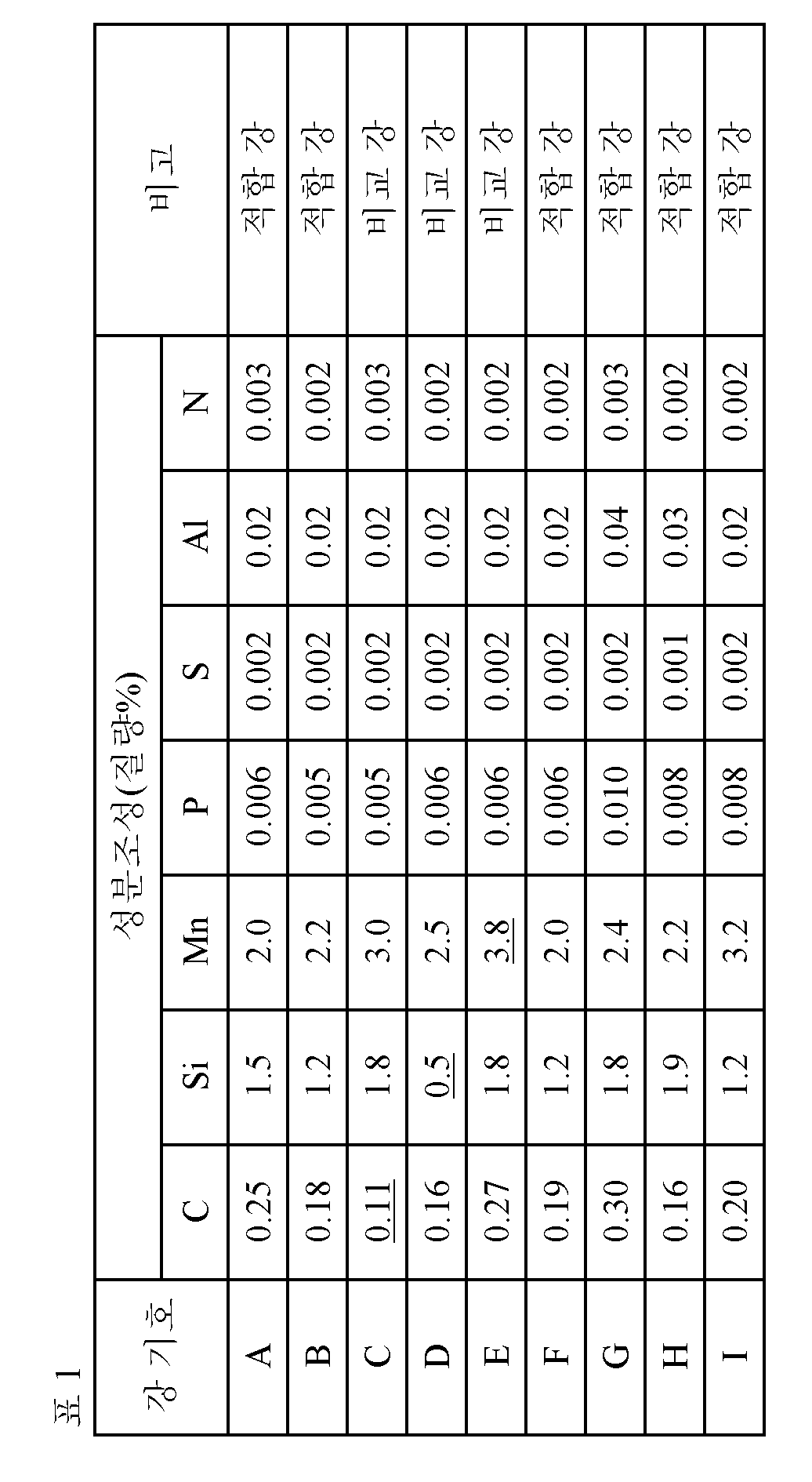
[표 2] [Table 2]
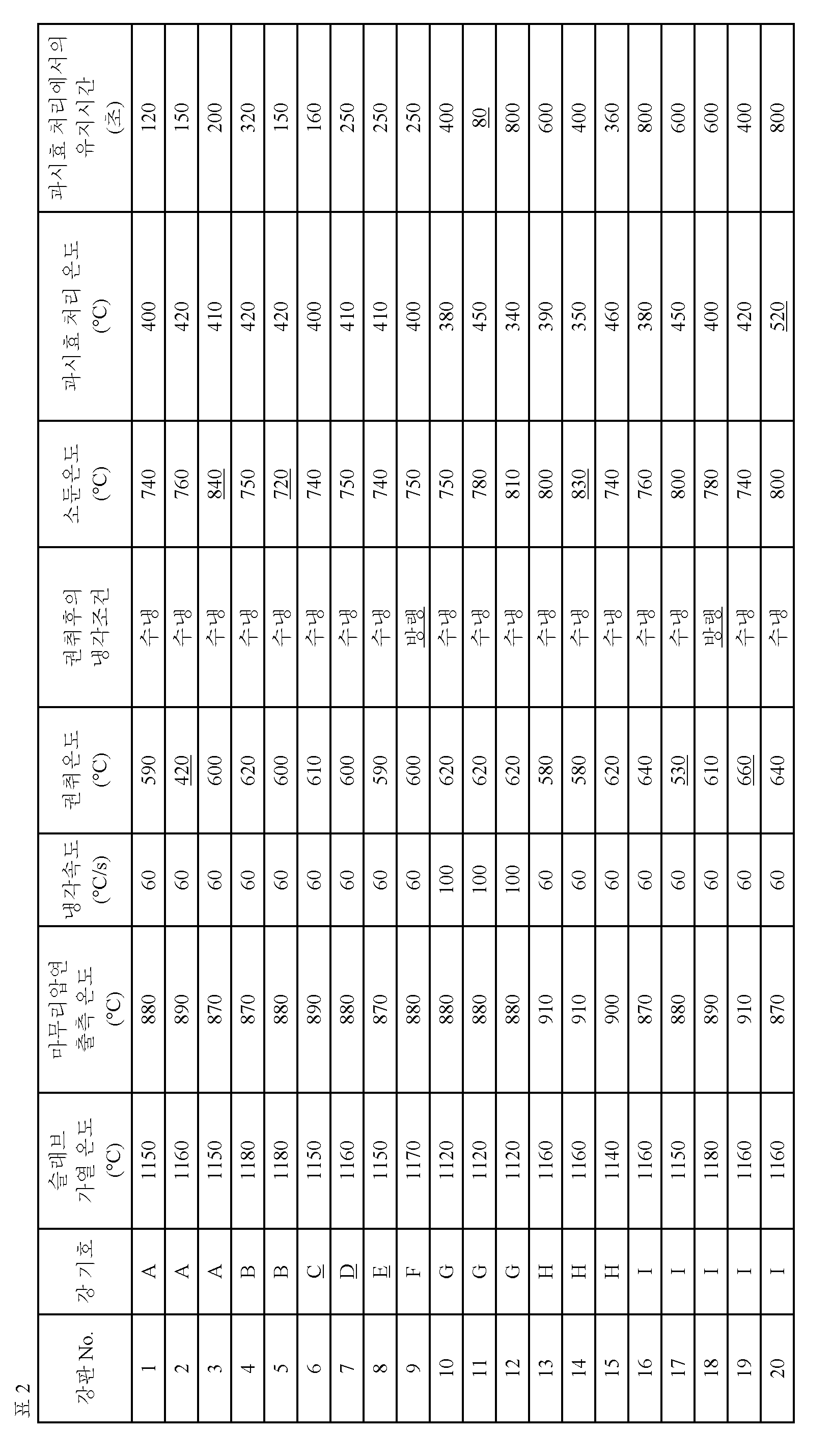
그리하여 제조한 강판에 대해, 이하와 같이 해서 조직 관찰 및 인장 시험을 실행하였다. 결과를 표 3에 나타낸다.The steel sheet thus produced was subjected to a structure observation and a tensile test as described below. The results are shown in Table 3.
(1) 조직 관찰(1) Tissue observation
·페라이트의 면적율· Area ratio of ferrite
페라이트의 면적율은 제조한 강판으로부터 제작한 시료의 단면을 경면 연마한 후, 나이탈로 부식하고, Carl Zeiss NTS GmbH제 FE-SEM LEO-1530을 이용하여, 시료의 판 두께 1/4 위치(표면으로부터 깊이 방향에서의 판 두께의 1/4에 상당하는 위치)의 조직 관찰을 실행하는 것에 의해 구하였다.The area ratio of the ferrite was obtained by mirror polishing the cross section of the sample prepared from the manufactured steel sheet and then corroding the steel sheet by leaving it as it was. Using FE-SEM LEO-1530 manufactured by Carl Zeiss NTS GmbH, A position corresponding to 1/4 of the plate thickness in the depth direction).
여기서, 가속 전압은 15kV로 하고, Everhart-Thronley(ET) 검출기를 이용하여, 2차 전자상을 관찰하였다. 또, 상기의 2차 전자상에서는 주위보다 어두운 콘트라스트의 결정립을 페라이트로 하고, 시야 전체에 대해 페라이트가 차지하는 면적율을 구하였다.Here, the acceleration voltage was 15 kV, and the secondary electron image was observed using an Everhart-Thronley (ET) detector. In the above-described secondary electron phase, the crystal grains of contrast darker than the surroundings were ferrite, and the area ratio occupied by ferrite with respect to the entire visual field was obtained.
또한, 관찰은 배율:5000배에서 10시야 실행하고, 각 시야에서 관찰된 페라이트가 차지하는 면적율의 평균값을 페라이트의 면적율로 하였다.The observation was carried out at a magnification of 5000 times to 10 degrees, and the average value of the area ratios occupied by the ferrite observed in each field was regarded as the area ratio of ferrite.
참고로서, 도 3의 (a)에, 강판 No.1에 있어서 배율:2000배로 강 조직을 관찰하여 얻어진 2차 전자상의 일예를 나타낸다.For reference, FIG. 3A shows an example of a secondary electron image obtained by observing a steel structure at a magnification of 2000 times in the steel sheet No. 1. FIG.
·잔류 오스테나이트의 면적율Area ratio of retained austenite
잔류 오스테나이트의 면적율은 제조한 강판으로부터 제작한 시료의 단면을 경면 연마한 후, 메탄올, 부틸셀로솔브 및 과염소산을 체적율로 10:6:1의 비율로 혼합한 전해액에 의해 전해 연마를 실행하고, Carl Zeiss NTS GmbH제 FE-SEM LEO-1530을 이용하여 시료의 판 두께 1/4 위치의 조직 관찰을 실행하는 것에 의해 구하였다.The area ratio of the retained austenite was obtained by polishing the cross section of a sample prepared from the steel sheet and then conducting electrolytic polishing with an electrolytic solution in which methanol, butyl cellosolve and perchloric acid were mixed at a volume ratio of 10: 6: 1 , And observing the texture at 1/4 of the plate thickness of the sample using FE-SEM LEO-1530 manufactured by Carl Zeiss NTS GmbH.
여기서, 가속 전압은 1kV로 하고, Everhart-Thornley형 검출기를 이용하여 2차 전자상을 관찰하였다. 또, 상기의 2차 전자상에서는 주위보다 어두운 콘트라스트의 결정립을 잔류 오스테나이트로 하고, 시야 전체에 대해 잔류 오스테나이트가 차지하는 면적율을 구하였다.Here, the acceleration voltage was set to 1 kV, and a secondary electron image was observed using an Everhart-Thornley type detector. In the above-described secondary electron phase, the grains having a contrast darker than that of the surrounding grains were made residual austenite, and the area ratio occupied by the retained austenite with respect to the entire visual field was obtained.
또한, 관찰은 배율:5000배로 10시야 실행하고, 각 시야에서 관찰된 잔류 오스테나이트가 차지하는 면적율의 평균값을 잔류 오스테나이트의 면적율로 하였다.Further, the observation was carried out at a magnification of 5000 times at 10 o'clock, and the average value of the area ratios occupied by the residual austenite observed in each field was defined as the area ratio of the retained austenite.
참고로서, 도 3의 (b)에, 강판 No.1에 있어서 배율:5000배로 강 조직을 관찰해서 얻어진 2차 전자상의 일예를 나타낸다.For reference, FIG. 3 (b) shows an example of a secondary electron image obtained by observing the steel structure at a magnification of 5000 times in the steel sheet No. 1. FIG.
·마텐자이트의 면적율· Area percentage of martensite
마텐자이트의 면적율은 100%에서 상기에서 구한 페라이트의 면적율 및 잔류 오스테나이트의 면적율을 빼는 것에 의해 구하였다.The area ratio of martensite was obtained by subtracting the area ratio of ferrite and the area percentage of retained austenite obtained above from 100%.
·잔류 오스테나이트의 결정립의 원형도의 최빈치The most negative value of the circularity of the crystal grains of the retained austenite
잔류 오스테나이트의 면적율을 구할 때에 이용한 시료를 사용하고, Carl Zeiss NTS GmbH제 FE-SEM LEO-1530에 의해 시료의 판 두께 1/4 위치의 조직 관찰을 실행하고, 관찰된 잔류 오스테나이트의 결정립의 원형도를 ImageJ 소프트웨어를 이용한 화상 해석에 의해 구하였다.A sample used to obtain the area ratio of the retained austenite was used and the structure was observed at 1/4 of the plate thickness of the sample by FE-SEM LEO-1530 manufactured by Carl Zeiss NTS GmbH, and the observed austenite grains The circularity was obtained by image analysis using ImageJ software.
또, 잔류 오스테나이트의 결정립의 원형도는 시야를 변경하면서 1000개의 결정립에 대해 산출하고, 산출한 잔류 오스테나이트의 결정립의 원형도 분포를 계급 범위:0.1×(n-1)초과 0.1×n이하, 계급값:0.1×n(여기서, n은 1∼10까지의 정수)으로 한 히스토그램으로 나타내고, 그 최빈치를 구하였다.The circularity of the residual austenite grains is calculated for 1000 crystal grains while changing the field of view, and the calculated circularity distribution of the crystal grains of the retained austenite is calculated in the rank range: 0.1 x (n-1) , Rank value: 0.1 x n (where n is an integer from 1 to 10), and the optimal value is obtained.
(2) 인장 시험(2) Tensile test
강판의 압연 방향과 90°의 방향을 긴쪽 방향(인장 방향)으로 하는 JISZ2201에 준거한 JIS5호 시험편을 이용하여, JISZ2241에 준거한 인장 시험을 실행하고, 항복 강도(YS), 인장 강도(TS), 항복비(YR) 및 전체 신장(EL)을 구하였다.(YS), tensile strength (TS), and tensile strength (TS) were measured by using a JIS Z2 test specimen in accordance with JIS Z2201 in which the direction of rolling of the steel sheet and the direction of 90 DEG were the longitudinal direction , The yield ratio (YR) and the total elongation (EL).
[표 3] [Table 3]
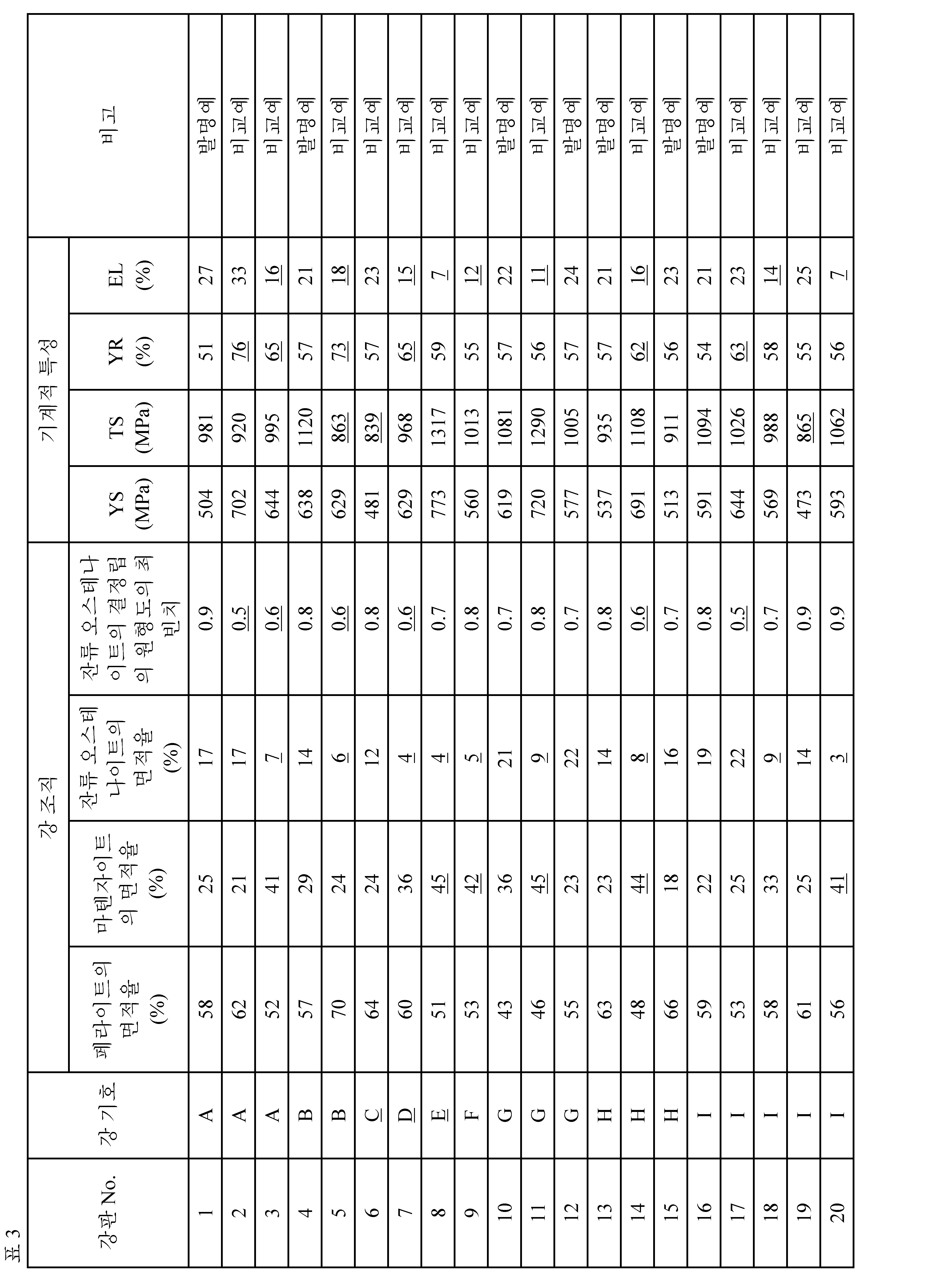
표 3으로부터 본 발명예에서는 모두, 인장 강도:900MPa이상의 고강도와 전체 신장:20%이상의 우수한 가공성이 얻어지고, 더 나아가서는 항복비:60%미만의 저항복비가 얻어지고 있는 것을 알 수 있다.It can be seen from Table 3 that all of the examples according to the present invention have a high tensile strength of 900 MPa or more and excellent elongation of 20% or more and excellent yieldability and a yield ratio of less than 60%.
한편, 비교예에서는 인장 강도, 전체 신장 및 항복비 중의 적어도 하나가 원하는 범위 밖으로 되었다.On the other hand, in the comparative example, at least one of the tensile strength, the total elongation and the yield ratio was out of a desired range.
Claims (4)
C:0.15∼0.35%,
Si:1.0∼2.0%,
Mn:1.8∼3.5%,
P:0.020%이하,
S:0.0040%이하,
Al:0.01∼0.1% 및
N:0.01%이하
를 함유하고, 잔부가 Fe 및 불가피한 불순물로 이루어지는 성분 조성을 갖고,
면적율에서, 페라이트:30∼75%, 마텐자이트:15∼40% 및 잔류 오스테나이트:10∼30%의 범위인 강 조직을 갖고,
또, 상기 잔류 오스테나이트의 결정립의 원형도 분포를, 계급 범위:0.1×(n-1)초과 0.1×n이하, 계급값:0.1×n(여기서, n은 1∼10까지의 정수)로 한 히스토그램으로 나타내는 경우에, 상기 잔류 오스테나이트의 결정립의 원형도의 최빈치가 0.7이상인 것을 특징으로 하는 고강도 냉연 강판;
여기서, 잔류 오스테나이트의 각 결정립의 원형도는 다음 식에 의해 구한 것이고,
원형도=4πS/L2
여기서, S는 잔류 오스테나이트의 결정립의 면적, L은 잔류 오스테나이트의 결정립의 둘레 길이이다.In terms of% by mass,
C: 0.15 to 0.35%
Si: 1.0 to 2.0%
Mn: 1.8 to 3.5%
P: 0.020% or less,
S: 0.0040% or less,
Al: 0.01 to 0.1% and
N: not more than 0.01%
And the balance of Fe and inevitable impurities,
It has a steel structure with an areal ratio ranging from 30 to 75% of ferrite, 15 to 40% of martensite and 10 to 30% of retained austenite,
Further, the distribution of the circularity of the crystal grains of the retained austenite is set in the range of rank: 0.1 x (n-1) to 0.1 x n or less and rank value: 0.1 x n (where n is an integer of 1 to 10) Wherein the maximum value of the circularity of the crystal grains of the retained austenite is 0.7 or more when expressed by a histogram.
The circularity of each crystal grain of the retained austenite is obtained by the following formula,
Circularity = 4πS / L 2
Here, S is the area of the crystal grains of the retained austenite, and L is the circumferential length of the crystal grains of the retained austenite.
표면에 아연 도금층을 갖는 것을 특징으로 하는 고강도 냉연 강판.The method according to claim 1,
And a zinc plated layer on the surface thereof.
C:0.15∼0.35%,
Si:1.0∼2.0%,
Mn:1.8∼3.5%,
P:0.020%이하,
S:0.0040%이하,
Al:0.01∼0.1% 및
N:0.01%이하
를 함유하고, 잔부가 Fe 및 불가피한 불순물로 이루어지는 강 슬래브를, 1100℃이상 1200℃이하로 가열한 후, 상기 강 슬래브에 마무리 압연 출측 온도:850℃이상 950℃이하에서 열간 압연을 실시하여 열연판으로 하고,
상기 열연판을, 상기 마무리 압연 출측 온도에서 700℃까지의 온도역에 있어서의 냉각 속도를 50℃/s이상으로 해서 냉각하고, 상기 열연판을 550℃이상 650℃이하에서 권취하고, 권취 후에 수냉을 실시하여 100℃이하까지 냉각하고,
산세를 실행한 후, 상기 열연판에 냉간 압연을 실시하여 냉연판으로 하고,
상기 냉연판을 730℃이상 820℃이하에서 소둔한 후, 300℃이상 500℃이하의 온도역으로 냉각하고, 상기 냉연판을 해당 300℃이상 500℃이하의 온도역에서 100s이상 1000s이하 유지하는 과시효 처리를 실시하는 것을 특징으로 하는 고강도 냉연 강판의 제조 방법.In terms of% by mass,
C: 0.15 to 0.35%
Si: 1.0 to 2.0%
Mn: 1.8 to 3.5%
P: 0.020% or less,
S: 0.0040% or less,
Al: 0.01 to 0.1% and
N: not more than 0.01%
And the balance of Fe and inevitable impurities is heated to a temperature of 1100 DEG C to 1200 DEG C and then subjected to hot rolling at a finish rolling temperature of 850 DEG C to 950 DEG C on the steel slab, Lt; / RTI &
The hot-rolled sheet is cooled at a cooling rate of 50 ° C / s or higher in a temperature range from the finish rolling-out temperature to 700 ° C, and the hot-rolled sheet is rolled at 550 ° C or higher and 650 ° C or lower, And cooled to 100 DEG C or lower,
After pickling, the hot rolled sheet is cold rolled to form a cold rolled sheet,
Wherein the cold-rolled sheet is annealed at a temperature of 730 ° C to 820 ° C and then cooled to a temperature range of 300 ° C to 500 ° C and maintained at a temperature range of 300 ° C to 500 ° C for 100s to 1000s Wherein the hot-rolled steel sheet is subjected to an effect treatment.
상기 과시효 처리 후에 아연 도금 처리를 실행하는 것을 특징으로 하는 고강도 냉연 강판의 제조 방법.The method of claim 3,
And a galvanizing treatment is performed after the above overexposure treatment.
Applications Claiming Priority (3)
| Application Number | Priority Date | Filing Date | Title |
|---|---|---|---|
| JP2016029273 | 2016-02-18 | ||
| JPJP-P-2016-029273 | 2016-02-18 | ||
| PCT/JP2017/000878 WO2017141587A1 (en) | 2016-02-18 | 2017-01-12 | High-strength cold-rolled steel sheet, and production method therefor |
Publications (2)
| Publication Number | Publication Date |
|---|---|
| KR20180098365A true KR20180098365A (en) | 2018-09-03 |
| KR102093056B1 KR102093056B1 (en) | 2020-03-24 |
Family
ID=59624879
Family Applications (1)
| Application Number | Title | Priority Date | Filing Date |
|---|---|---|---|
| KR1020187021481A Active KR102093056B1 (en) | 2016-02-18 | 2017-01-12 | High-strength cold rolled steel sheet and method of producing same |
Country Status (7)
| Country | Link |
|---|---|
| US (1) | US20190062863A1 (en) |
| EP (1) | EP3418413B1 (en) |
| JP (1) | JP6260744B1 (en) |
| KR (1) | KR102093056B1 (en) |
| CN (1) | CN108713065B (en) |
| MX (1) | MX2018009885A (en) |
| WO (1) | WO2017141587A1 (en) |
Families Citing this family (4)
| Publication number | Priority date | Publication date | Assignee | Title |
|---|---|---|---|---|
| WO2019107042A1 (en) * | 2017-11-29 | 2019-06-06 | Jfeスチール株式会社 | High-strength cold-rolled steel sheet and method for manufacturing same |
| US11003956B2 (en) | 2019-05-16 | 2021-05-11 | Naver Corporation | System and method for training a neural network for visual localization based upon learning objects-of-interest dense match regression |
| CN110747391A (en) * | 2019-08-30 | 2020-02-04 | 武汉钢铁有限公司 | Cold-rolled ultrahigh-strength steel with excellent elongation and preparation method thereof |
| CN114438400B (en) * | 2020-10-30 | 2022-12-16 | 宝山钢铁股份有限公司 | 980 MPa-grade hot-dip galvanized steel plate with high elongation and manufacturing method thereof |
Citations (6)
| Publication number | Priority date | Publication date | Assignee | Title |
|---|---|---|---|---|
| JPS5438302B2 (en) | 1972-08-19 | 1979-11-20 | ||
| JP2007154283A (en) * | 2005-12-07 | 2007-06-21 | Jfe Steel Kk | High-strength steel sheet with excellent formability and shape freezeability |
| JP2011195956A (en) * | 2010-02-26 | 2011-10-06 | Nippon Steel Corp | High strength thin steel sheet having excellent elongation and hole expansion and method for producing the same |
| JP2012153957A (en) * | 2011-01-27 | 2012-08-16 | Jfe Steel Corp | High-strength cold-rolled steel sheet with excellent ductility, and method for producing the same |
| KR20140129316A (en) * | 2012-03-29 | 2014-11-06 | 가부시키가이샤 고베 세이코쇼 | High-strength cold-rolled steel sheet, high-strength galvanized steel sheet and high-strength galvannealed steel sheet, having excellent formability and shape fixability, and processes for manufacturing same |
| JP2015014026A (en) | 2013-07-04 | 2015-01-22 | 新日鐵住金株式会社 | Cold rolled steel sheet and production method thereof |
Family Cites Families (5)
| Publication number | Priority date | Publication date | Assignee | Title |
|---|---|---|---|---|
| JP4119758B2 (en) * | 2003-01-16 | 2008-07-16 | 株式会社神戸製鋼所 | High-strength steel sheet excellent in workability and shape freezing property, and its production method |
| JP4333356B2 (en) * | 2003-12-19 | 2009-09-16 | Jfeスチール株式会社 | Cold rolled steel sheet manufacturing method |
| JP5651964B2 (en) * | 2010-02-16 | 2015-01-14 | 新日鐵住金株式会社 | Alloyed hot-dip galvanized steel sheet excellent in ductility, hole expansibility and corrosion resistance, and method for producing the same |
| WO2015011511A1 (en) * | 2013-07-24 | 2015-01-29 | Arcelormittal Investigación Y Desarrollo Sl | Steel sheet having very high mechanical properties of strength and ductility, manufacturing method and use of such sheets |
| KR101594670B1 (en) * | 2014-05-13 | 2016-02-17 | 주식회사 포스코 | Cold-rolled steel sheet and galvanized steel sheet having excellent ductility and method for manufacturing thereof |
-
2017
- 2017-01-12 EP EP17752851.0A patent/EP3418413B1/en active Active
- 2017-01-12 WO PCT/JP2017/000878 patent/WO2017141587A1/en not_active Ceased
- 2017-01-12 MX MX2018009885A patent/MX2018009885A/en unknown
- 2017-01-12 KR KR1020187021481A patent/KR102093056B1/en active Active
- 2017-01-12 US US16/075,747 patent/US20190062863A1/en not_active Abandoned
- 2017-01-12 JP JP2017527934A patent/JP6260744B1/en active Active
- 2017-01-12 CN CN201780008192.2A patent/CN108713065B/en active Active
Patent Citations (6)
| Publication number | Priority date | Publication date | Assignee | Title |
|---|---|---|---|---|
| JPS5438302B2 (en) | 1972-08-19 | 1979-11-20 | ||
| JP2007154283A (en) * | 2005-12-07 | 2007-06-21 | Jfe Steel Kk | High-strength steel sheet with excellent formability and shape freezeability |
| JP2011195956A (en) * | 2010-02-26 | 2011-10-06 | Nippon Steel Corp | High strength thin steel sheet having excellent elongation and hole expansion and method for producing the same |
| JP2012153957A (en) * | 2011-01-27 | 2012-08-16 | Jfe Steel Corp | High-strength cold-rolled steel sheet with excellent ductility, and method for producing the same |
| KR20140129316A (en) * | 2012-03-29 | 2014-11-06 | 가부시키가이샤 고베 세이코쇼 | High-strength cold-rolled steel sheet, high-strength galvanized steel sheet and high-strength galvannealed steel sheet, having excellent formability and shape fixability, and processes for manufacturing same |
| JP2015014026A (en) | 2013-07-04 | 2015-01-22 | 新日鐵住金株式会社 | Cold rolled steel sheet and production method thereof |
Also Published As
| Publication number | Publication date |
|---|---|
| EP3418413A1 (en) | 2018-12-26 |
| MX2018009885A (en) | 2018-11-09 |
| WO2017141587A1 (en) | 2017-08-24 |
| US20190062863A1 (en) | 2019-02-28 |
| JPWO2017141587A1 (en) | 2018-02-22 |
| EP3418413A4 (en) | 2018-12-26 |
| CN108713065A (en) | 2018-10-26 |
| EP3418413B1 (en) | 2020-06-17 |
| CN108713065B (en) | 2020-05-22 |
| JP6260744B1 (en) | 2018-01-17 |
| KR102093056B1 (en) | 2020-03-24 |
Similar Documents
| Publication | Publication Date | Title |
|---|---|---|
| KR102016432B1 (en) | High-strength cold-rolled steel sheet and method for manufacturing the same | |
| KR101549317B1 (en) | Cold rolled steel sheet and production method therefor | |
| JP6372633B1 (en) | High strength steel plate and manufacturing method thereof | |
| US11332804B2 (en) | High-strength cold-rolled steel sheet, high-strength coated steel sheet, and method for producing the same | |
| US10294542B2 (en) | Method for producing high-strength galvanized steel sheet and high-strength galvannealed steel sheet | |
| JP6315160B1 (en) | High strength steel plate and manufacturing method thereof | |
| KR20190107089A (en) | High strength steel sheet and its manufacturing method | |
| JP6372632B1 (en) | High strength steel plate and manufacturing method thereof | |
| WO2017026125A1 (en) | Material for high-strength steel sheet, hot rolled material for high-strength steel sheet, material annealed after hot rolling and for high-strength steel sheet, high-strength steel sheet, high-strength hot-dip plated steel sheet, high-strength electroplated steel sheet, and manufacturing method for same | |
| KR20190109407A (en) | Steel plate and its manufacturing method | |
| US20180171429A1 (en) | Heat-treated steel sheet member and method for producing the same | |
| KR102865997B1 (en) | High-strength steel plate and its manufacturing method | |
| JP7006848B1 (en) | Steel sheets, members and their manufacturing methods | |
| KR102865992B1 (en) | High-strength steel plate and method for manufacturing the same | |
| KR20220066365A (en) | High-strength steel sheet and manufacturing method thereof | |
| KR20220129615A (en) | Steel plate, member and manufacturing method thereof | |
| CN117716060A (en) | High-strength steel sheet, high-strength plated steel sheet, method for producing same, and member | |
| JP7020594B2 (en) | Steel sheets, members and their manufacturing methods | |
| CN108713065B (en) | High-strength cold-rolled steel sheet and method for producing same | |
| JP6724320B2 (en) | High-strength hot-dip galvanized steel sheet excellent in elongation and hole expandability and method for producing the same | |
| KR102093057B1 (en) | High-strength cold rolled steel sheet and method of producing same | |
| JP6930682B1 (en) | High-strength steel plate and its manufacturing method | |
| JP7779298B2 (en) | High-strength steel plate, steel strip, method for manufacturing high-strength steel plate, method for manufacturing steel strip and component |
Legal Events
| Date | Code | Title | Description |
|---|---|---|---|
| A201 | Request for examination | ||
| PA0105 | International application |
Patent event date: 20180725 Patent event code: PA01051R01D Comment text: International Patent Application |
|
| PA0201 | Request for examination | ||
| PG1501 | Laying open of application | ||
| E902 | Notification of reason for refusal | ||
| PE0902 | Notice of grounds for rejection |
Comment text: Notification of reason for refusal Patent event date: 20190823 Patent event code: PE09021S01D |
|
| E701 | Decision to grant or registration of patent right | ||
| PE0701 | Decision of registration |
Patent event code: PE07011S01D Comment text: Decision to Grant Registration Patent event date: 20200220 |
|
| GRNT | Written decision to grant | ||
| PR0701 | Registration of establishment |
Comment text: Registration of Establishment Patent event date: 20200318 Patent event code: PR07011E01D |
|
| PR1002 | Payment of registration fee |
Payment date: 20200318 End annual number: 3 Start annual number: 1 |
|
| PG1601 | Publication of registration | ||
| PR1001 | Payment of annual fee |
Payment date: 20230220 Start annual number: 4 End annual number: 4 |
|
| PR1001 | Payment of annual fee |
Payment date: 20240219 Start annual number: 5 End annual number: 5 |
|
| PR1001 | Payment of annual fee |
Payment date: 20250217 Start annual number: 6 End annual number: 6 |