KR20180098273A - Resin film - Google Patents
Resin film Download PDFInfo
- Publication number
- KR20180098273A KR20180098273A KR1020187018253A KR20187018253A KR20180098273A KR 20180098273 A KR20180098273 A KR 20180098273A KR 1020187018253 A KR1020187018253 A KR 1020187018253A KR 20187018253 A KR20187018253 A KR 20187018253A KR 20180098273 A KR20180098273 A KR 20180098273A
- Authority
- KR
- South Korea
- Prior art keywords
- mass
- layer
- parts
- resin
- monomer
- Prior art date
- Legal status (The legal status is an assumption and is not a legal conclusion. Google has not performed a legal analysis and makes no representation as to the accuracy of the status listed.)
- Granted
Links
Classifications
-
- C—CHEMISTRY; METALLURGY
- C08—ORGANIC MACROMOLECULAR COMPOUNDS; THEIR PREPARATION OR CHEMICAL WORKING-UP; COMPOSITIONS BASED THEREON
- C08L—COMPOSITIONS OF MACROMOLECULAR COMPOUNDS
- C08L33/00—Compositions of homopolymers or copolymers of compounds having one or more unsaturated aliphatic radicals, each having only one carbon-to-carbon double bond, and only one being terminated by only one carboxyl radical, or of salts, anhydrides, esters, amides, imides or nitriles thereof; Compositions of derivatives of such polymers
- C08L33/04—Homopolymers or copolymers of esters
- C08L33/06—Homopolymers or copolymers of esters of esters containing only carbon, hydrogen and oxygen, which oxygen atoms are present only as part of the carboxyl radical
- C08L33/10—Homopolymers or copolymers of methacrylic acid esters
- C08L33/12—Homopolymers or copolymers of methyl methacrylate
-
- B—PERFORMING OPERATIONS; TRANSPORTING
- B29—WORKING OF PLASTICS; WORKING OF SUBSTANCES IN A PLASTIC STATE IN GENERAL
- B29C—SHAPING OR JOINING OF PLASTICS; SHAPING OF MATERIAL IN A PLASTIC STATE, NOT OTHERWISE PROVIDED FOR; AFTER-TREATMENT OF THE SHAPED PRODUCTS, e.g. REPAIRING
- B29C45/00—Injection moulding, i.e. forcing the required volume of moulding material through a nozzle into a closed mould; Apparatus therefor
- B29C45/0001—Injection moulding, i.e. forcing the required volume of moulding material through a nozzle into a closed mould; Apparatus therefor characterised by the choice of material
-
- B—PERFORMING OPERATIONS; TRANSPORTING
- B32—LAYERED PRODUCTS
- B32B—LAYERED PRODUCTS, i.e. PRODUCTS BUILT-UP OF STRATA OF FLAT OR NON-FLAT, e.g. CELLULAR OR HONEYCOMB, FORM
- B32B27/00—Layered products comprising a layer of synthetic resin
- B32B27/30—Layered products comprising a layer of synthetic resin comprising vinyl (co)polymers; comprising acrylic (co)polymers
-
- B—PERFORMING OPERATIONS; TRANSPORTING
- B32—LAYERED PRODUCTS
- B32B—LAYERED PRODUCTS, i.e. PRODUCTS BUILT-UP OF STRATA OF FLAT OR NON-FLAT, e.g. CELLULAR OR HONEYCOMB, FORM
- B32B27/00—Layered products comprising a layer of synthetic resin
- B32B27/30—Layered products comprising a layer of synthetic resin comprising vinyl (co)polymers; comprising acrylic (co)polymers
- B32B27/308—Layered products comprising a layer of synthetic resin comprising vinyl (co)polymers; comprising acrylic (co)polymers comprising acrylic (co)polymers
-
- C—CHEMISTRY; METALLURGY
- C08—ORGANIC MACROMOLECULAR COMPOUNDS; THEIR PREPARATION OR CHEMICAL WORKING-UP; COMPOSITIONS BASED THEREON
- C08J—WORKING-UP; GENERAL PROCESSES OF COMPOUNDING; AFTER-TREATMENT NOT COVERED BY SUBCLASSES C08B, C08C, C08F, C08G or C08H
- C08J5/00—Manufacture of articles or shaped materials containing macromolecular substances
- C08J5/18—Manufacture of films or sheets
-
- C—CHEMISTRY; METALLURGY
- C08—ORGANIC MACROMOLECULAR COMPOUNDS; THEIR PREPARATION OR CHEMICAL WORKING-UP; COMPOSITIONS BASED THEREON
- C08L—COMPOSITIONS OF MACROMOLECULAR COMPOUNDS
- C08L101/00—Compositions of unspecified macromolecular compounds
-
- C—CHEMISTRY; METALLURGY
- C08—ORGANIC MACROMOLECULAR COMPOUNDS; THEIR PREPARATION OR CHEMICAL WORKING-UP; COMPOSITIONS BASED THEREON
- C08L—COMPOSITIONS OF MACROMOLECULAR COMPOUNDS
- C08L101/00—Compositions of unspecified macromolecular compounds
- C08L101/02—Compositions of unspecified macromolecular compounds characterised by the presence of specified groups, e.g. terminal or pendant functional groups
- C08L101/06—Compositions of unspecified macromolecular compounds characterised by the presence of specified groups, e.g. terminal or pendant functional groups containing oxygen atoms
-
- C—CHEMISTRY; METALLURGY
- C08—ORGANIC MACROMOLECULAR COMPOUNDS; THEIR PREPARATION OR CHEMICAL WORKING-UP; COMPOSITIONS BASED THEREON
- C08L—COMPOSITIONS OF MACROMOLECULAR COMPOUNDS
- C08L33/00—Compositions of homopolymers or copolymers of compounds having one or more unsaturated aliphatic radicals, each having only one carbon-to-carbon double bond, and only one being terminated by only one carboxyl radical, or of salts, anhydrides, esters, amides, imides or nitriles thereof; Compositions of derivatives of such polymers
- C08L33/04—Homopolymers or copolymers of esters
- C08L33/06—Homopolymers or copolymers of esters of esters containing only carbon, hydrogen and oxygen, which oxygen atoms are present only as part of the carboxyl radical
-
- B—PERFORMING OPERATIONS; TRANSPORTING
- B29—WORKING OF PLASTICS; WORKING OF SUBSTANCES IN A PLASTIC STATE IN GENERAL
- B29K—INDEXING SCHEME ASSOCIATED WITH SUBCLASSES B29B, B29C OR B29D, RELATING TO MOULDING MATERIALS OR TO MATERIALS FOR MOULDS, REINFORCEMENTS, FILLERS OR PREFORMED PARTS, e.g. INSERTS
- B29K2433/00—Use of polymers of unsaturated acids or derivatives thereof, as filler
- B29K2433/04—Polymers of esters
- B29K2433/12—Polymers of methacrylic acid esters, e.g. PMMA, i.e. polymethylmethacrylate
-
- B—PERFORMING OPERATIONS; TRANSPORTING
- B29—WORKING OF PLASTICS; WORKING OF SUBSTANCES IN A PLASTIC STATE IN GENERAL
- B29L—INDEXING SCHEME ASSOCIATED WITH SUBCLASS B29C, RELATING TO PARTICULAR ARTICLES
- B29L2007/00—Flat articles, e.g. films or sheets
- B29L2007/008—Wide strips, e.g. films, webs
-
- C—CHEMISTRY; METALLURGY
- C08—ORGANIC MACROMOLECULAR COMPOUNDS; THEIR PREPARATION OR CHEMICAL WORKING-UP; COMPOSITIONS BASED THEREON
- C08J—WORKING-UP; GENERAL PROCESSES OF COMPOUNDING; AFTER-TREATMENT NOT COVERED BY SUBCLASSES C08B, C08C, C08F, C08G or C08H
- C08J2333/00—Characterised by the use of homopolymers or copolymers of compounds having one or more unsaturated aliphatic radicals, each having only one carbon-to-carbon double bond, and only one being terminated by only one carboxyl radical, or of salts, anhydrides, esters, amides, imides, or nitriles thereof; Derivatives of such polymers
- C08J2333/04—Characterised by the use of homopolymers or copolymers of compounds having one or more unsaturated aliphatic radicals, each having only one carbon-to-carbon double bond, and only one being terminated by only one carboxyl radical, or of salts, anhydrides, esters, amides, imides, or nitriles thereof; Derivatives of such polymers esters
- C08J2333/06—Characterised by the use of homopolymers or copolymers of compounds having one or more unsaturated aliphatic radicals, each having only one carbon-to-carbon double bond, and only one being terminated by only one carboxyl radical, or of salts, anhydrides, esters, amides, imides, or nitriles thereof; Derivatives of such polymers esters of esters containing only carbon, hydrogen, and oxygen, the oxygen atom being present only as part of the carboxyl radical
- C08J2333/10—Homopolymers or copolymers of methacrylic acid esters
- C08J2333/12—Homopolymers or copolymers of methyl methacrylate
-
- C—CHEMISTRY; METALLURGY
- C08—ORGANIC MACROMOLECULAR COMPOUNDS; THEIR PREPARATION OR CHEMICAL WORKING-UP; COMPOSITIONS BASED THEREON
- C08J—WORKING-UP; GENERAL PROCESSES OF COMPOUNDING; AFTER-TREATMENT NOT COVERED BY SUBCLASSES C08B, C08C, C08F, C08G or C08H
- C08J2433/00—Characterised by the use of homopolymers or copolymers of compounds having one or more unsaturated aliphatic radicals, each having only one carbon-to-carbon double bond, and only one being terminated by only one carboxyl radical, or of salts, anhydrides, esters, amides, imides, or nitriles thereof; Derivatives of such polymers
- C08J2433/04—Characterised by the use of homopolymers or copolymers of compounds having one or more unsaturated aliphatic radicals, each having only one carbon-to-carbon double bond, and only one being terminated by only one carboxyl radical, or of salts, anhydrides, esters, amides, imides, or nitriles thereof; Derivatives of such polymers esters
- C08J2433/06—Characterised by the use of homopolymers or copolymers of compounds having one or more unsaturated aliphatic radicals, each having only one carbon-to-carbon double bond, and only one being terminated by only one carboxyl radical, or of salts, anhydrides, esters, amides, imides, or nitriles thereof; Derivatives of such polymers esters of esters containing only carbon, hydrogen, and oxygen, the oxygen atom being present only as part of the carboxyl radical
- C08J2433/08—Homopolymers or copolymers of acrylic acid esters
-
- C—CHEMISTRY; METALLURGY
- C08—ORGANIC MACROMOLECULAR COMPOUNDS; THEIR PREPARATION OR CHEMICAL WORKING-UP; COMPOSITIONS BASED THEREON
- C08J—WORKING-UP; GENERAL PROCESSES OF COMPOUNDING; AFTER-TREATMENT NOT COVERED BY SUBCLASSES C08B, C08C, C08F, C08G or C08H
- C08J2433/00—Characterised by the use of homopolymers or copolymers of compounds having one or more unsaturated aliphatic radicals, each having only one carbon-to-carbon double bond, and only one being terminated by only one carboxyl radical, or of salts, anhydrides, esters, amides, imides, or nitriles thereof; Derivatives of such polymers
- C08J2433/04—Characterised by the use of homopolymers or copolymers of compounds having one or more unsaturated aliphatic radicals, each having only one carbon-to-carbon double bond, and only one being terminated by only one carboxyl radical, or of salts, anhydrides, esters, amides, imides, or nitriles thereof; Derivatives of such polymers esters
- C08J2433/06—Characterised by the use of homopolymers or copolymers of compounds having one or more unsaturated aliphatic radicals, each having only one carbon-to-carbon double bond, and only one being terminated by only one carboxyl radical, or of salts, anhydrides, esters, amides, imides, or nitriles thereof; Derivatives of such polymers esters of esters containing only carbon, hydrogen, and oxygen, the oxygen atom being present only as part of the carboxyl radical
- C08J2433/10—Homopolymers or copolymers of methacrylic acid esters
- C08J2433/12—Homopolymers or copolymers of methyl methacrylate
Landscapes
- Chemical & Material Sciences (AREA)
- Health & Medical Sciences (AREA)
- Chemical Kinetics & Catalysis (AREA)
- Medicinal Chemistry (AREA)
- Polymers & Plastics (AREA)
- Organic Chemistry (AREA)
- Engineering & Computer Science (AREA)
- Manufacturing & Machinery (AREA)
- Materials Engineering (AREA)
- Mechanical Engineering (AREA)
- Compositions Of Macromolecular Compounds (AREA)
- Graft Or Block Polymers (AREA)
- Laminated Bodies (AREA)
- Manufacture Of Macromolecular Shaped Articles (AREA)
- Addition Polymer Or Copolymer, Post-Treatments, Or Chemical Modifications (AREA)
Abstract
메틸메타크릴레이트 단위 80 ∼ 99.99 질량%, 가교성 단량체 단위 0.01 ∼ 2 질량% 및 공중합 가능한 다른 단량체 단위 0 ∼ 19.99 질량% 를 함유하여 이루어지는 중합체로 이루어지는 층 (a) 와, 알킬아크릴레이트 단위 70 ∼ 99.8 질량%, 가교성 단량체 단위 0.2 ∼ 10 질량% 및 공중합 가능한 다른 단량체 단위 0 ∼ 29.8 질량% 를 함유하여 이루어지는 중합체로 이루어지는 층 (b) 와, 메틸메타크릴레이트 단위 80 ∼ 100 질량% 및 공중합 가능한 다른 단량체 단위 0 ∼ 20 질량% 를 함유하여 이루어지는 중합체로 이루어지는 층 (c) 를 적어도 포함하고, 층 (a), 층 (b) 및 층 (c) 의 합계 100 질량부에 대해서, 층 (a) 가 5 ∼ 15 질량부, 층 (b) 가 40 ∼ 60 질량부 및 층 (c) 가 35 ∼ 50 질량부이고, 입자 중심으로부터 입자 외표면을 향하여 층 (a), 층 (b), 층 (c) 의 순으로 배치되어 있으며 또한 체적 기준 평균 입자경이 90 ∼ 150 ㎚ 인 다층 입자 (B), 및 수지 (A) 를 함유하여 이루어지는 수지 필름.A layer (a) comprising a polymer containing 80 to 99.99 mass% of methyl methacrylate units, 0.01 to 2 mass% of crosslinkable monomer units and 0 to 19.99 mass% of other copolymerizable monomer units, (B) composed of a polymer containing 99.8% by mass of a polymerizable monomer, 99.8% by mass of a crosslinkable monomer unit, 0.2 to 10% by mass of a crosslinkable monomer unit and 0 to 29.8% by mass of other copolymerizable monomer units, (A), (b) and (c) in total of 100 parts by mass of the layer (c) composed of a polymer containing 0 to 20 mass% of other monomer units. (A), the layer (b), and the layer (c) from 5 to 15 parts by mass, from 40 to 60 parts by mass, and from 35 to 50 parts by mass, c). (B) having a volume average particle diameter of 90 to 150 nm and a resin (A).
Description
본 발명은 수지 필름에 관한 것이다. 보다 상세하게는, 본 발명은 내열성 및 표면 경도가 높고, 절곡에 의한 백화가 억제되는 수지 필름에 관한 것이다.The present invention relates to a resin film. More specifically, the present invention relates to a resin film having high heat resistance and surface hardness and suppressed whitening due to bending.
아크릴 수지 등의 열가소성 수지와, 다층 구조 중합체 입자로 이루어지는 수지 조성물의 성형품이 알려져 있다.A molded article of a resin composition comprising a thermoplastic resin such as an acrylic resin and a multi-layered polymer particle is known.
예를 들어, 특허문헌 1 은, 아크릴 수지와 메틸메타크릴레이트 80 ∼ 99.99 질량%, 가교성 단량체 0.01 ∼ 5 질량% 및 다른 단관능성 단량체 19.99 ∼ 0 질량% 로 이루어지는 공중합체의 층 (가교 수지층) 10 ∼ 65 질량% ; 알킬아크릴레이트 70 ∼ 99.8 질량%, 가교성 단량체 0.2 ∼ 20 질량% 및 다른 단관능성 단량체 29.8 ∼ 0 질량% 로 이루어지는 공중합체의 층 (가교 탄성체층) 5 ∼ 75 질량% ; 그리고 메틸메타크릴레이트 80 질량% 이상 및 다른 단관능성 단량체 20 질량% 이하로 이루어지는 중합체의 층 (경질 열가소성 수지층) 5 ∼ 30 질량% ; 의 적어도 3 층을 함유하고, 가교 수지층, 가교 탄성체층 및 경질 열가소성 수지층이, 중심층으로부터 최외층 방향으로 이 순으로 배치되어 있는 구조를 적어도 하나 갖고 있는 다층 구조 중합체 입자와, 분산용 입자를 함유하는 수지 조성물로 이루어지는 성형품을 개시하고 있다. 관련되는 성형품은 내충격성, 내열성, 표면 경도 등이 우수하다.For example, Patent Document 1 discloses a layer of a copolymer comprising an acrylic resin and 80 to 99.99 mass% of methyl methacrylate, 0.01 to 5 mass% of a crosslinkable monomer, and 19.99 to 0 mass% of other monofunctional monomers ) 10 to 65 mass%; 5 to 75 mass% of a layer (crosslinked elastomer layer) of a copolymer comprising 70 to 99.8 mass% of an alkyl acrylate, 0.2 to 20 mass% of a crosslinkable monomer, and 29.8 to 0 mass% of another monofunctional monomer; 5 to 30 mass% of a polymer layer (hard thermoplastic resin layer) composed of 80 mass% or more of methyl methacrylate and 20 mass% or less of other monofunctional monomer; Layer structure polymer particles having at least three layers of at least three layers of a thermoplastic resin and at least one structure in which a crosslinked resin layer, a crosslinked elastomer layer and a hard thermoplastic resin layer are arranged in this order from the center layer to the outermost layer, Based on the total weight of the composition. The molded articles involved are excellent in impact resistance, heat resistance, surface hardness and the like.
특허문헌 2 는, 메타크릴 열가소성 중합체와, 심 (芯) 이 메타크릴산메틸 80 ∼ 99.95 질량%, 탄소 원자수 1 ∼ 8 의 알킬기를 갖는 아크릴산알킬에스테르 단량체 0 ∼ 19.95 질량% 및 가교성 단량체 0.05 ∼ 2 질량% 를 중합하여 이루어지는 중합체 (Ⅲ) 을 함유하여 이루어지는 층이고, 내각이 탄소 원자수 1 ∼ 8 의 알킬기를 갖는 아크릴산알킬에스테르 단량체 80 ∼ 98 질량%, 방향족 비닐 단량체 1 ∼ 19 질량% 및 가교성 단량체 1 ∼ 5 질량% 를 중합하여 이루어지는 가교 탄성 중합체 (I) 을 함유하여 이루어지는 층이며, 외각이 메타크릴산메틸 80 ∼ 100 질량% 및 탄소 원자수 1 ∼ 8 의 알킬기를 갖는 아크릴산알킬에스테르 단량체 0 ∼ 20 질량% 를 중합하여 이루어지는 열가소성 중합체 (Ⅱ) 를 함유하여 이루어지는 층으로 구성되고, 외각의 질량에 대한 심과 내각의 합계 질량이 바람직하게는 60/40 ∼ 95/5인 3 층 중합체 입자와, 분산용 입자를 함유하는 수지 조성물로 이루어지는 성형품을 개시하고 있다. 그 성형품은 우수한 내충격성을 갖는다.Patent Document 2 discloses a methacrylic thermoplastic polymer which comprises a methacrylic thermoplastic polymer and a core comprising 80 to 99.95% by mass of methyl methacrylate, 0 to 19.95% by mass of an acrylic acid alkyl ester monomer having an alkyl group of 1 to 8 carbon atoms and a crosslinkable monomer (Meth) acrylic acid alkyl ester monomer having an alkyl group of 1 to 8 carbon atoms, 1 to 19 mass% of an aromatic vinyl monomer, and (I) obtained by polymerizing 1 to 5% by mass of a crosslinkable monomer, wherein the outer shell is an acrylic acid alkyl ester having an alkyl group of 80 to 100% by mass methyl methacrylate and an alkyl group of 1 to 8 carbon atoms And a thermoplastic polymer (II) obtained by polymerizing 0 to 20 mass% of a monomer, wherein the core This is the total mass of the cabinet preferably has disclosed a three-layer and the polymer particles 60/40 - 95/5, the molded article of the resin composition containing the dispersing particles. The molded article has excellent impact resistance.
특허문헌 3 은, 메타크릴산알킬을 주체로 하는 모상의 메타크릴 수지, 그리고 메타크릴산알킬을 주체로 하는 경질 중합체로 이루어지는 심, 아크릴산알킬을 주체로 하는 탄성 공중합체로 이루어지는 내각, 및 메타크릴산알킬을 주체로 하는 경질 중합체로 이루어지는 외각으로 구성되고, 심/내각/외각의 질량 비율이 30 ∼ 40/40 ∼ 50/10 ∼ 30 이며, 체적 평균 입자경이 0.1 ∼ 0.17 ㎛ 인 3 층 구조 아크릴 고무 입자를 함유하고, 3 층 구조의 아크릴 고무 입자 (B) 의 양이 15 ∼ 50 질량% 인 수지 조성물로 이루어지고, 75 ∼ 600 ㎛ 의 두께를 갖는 아크릴 수지 필름을 개시하고 있다. 특허문헌 3 은, 그 필름이 가열에 의해서도 잘 백탁되지 않아, 높은 의장성을 유지할 수 있다고 기재되어 있다.Patent Document 3 discloses a resin composition comprising a core made of a methacrylic resin having a matrix of methacrylic acid as its main component and a core composed of a hard polymer mainly composed of alkyl methacrylate and an elastic copolymer mainly composed of an alkyl acrylate, A three-layer structure acrylic resin which is composed of an outer shell made of a hard polymer mainly composed of an acid alkyl and having a core / inner / outer shell mass ratio of 30 to 40/40 to 50/10 to 30 and a volume average particle size of 0.1 to 0.17 μm Discloses an acrylic resin film comprising a resin composition containing rubber particles and having an amount of acrylic rubber particles (B) of 3-layer structure of 15 to 50 mass%, and having a thickness of 75 to 600 탆. Patent Document 3 discloses that the film is not well-opaque even by heating, and high designability can be maintained.
상기 특허문헌에 기재된 성형품은, 우수한 내충격성을 갖지만, 내열성이 낮고, 절곡에 의해서 잘 백화되고, 스침에 의해서 손상되기 쉽다는 점에서 불충분하다.The molded articles described in the above patent documents have excellent impact resistance, but are insufficient in that they have low heat resistance, are whitened by bending, and are susceptible to scratching.
본 발명의 과제는, 내열성 및 표면 경도가 높고, 절곡에 의해서 잘 백화되지 않는 수지 필름을 제공하는 것이다.A problem to be solved by the present invention is to provide a resin film which has high heat resistance and surface hardness and is not whitened well by bending.
상기 과제를 해결하기 위해서 예의 검토한 바, 이하의 양태를 포함하는 본 발명을 완성하기에 이르렀다.Means for Solving the Problems Having studied extensively in order to solve the above problems, the present invention has been completed including the following aspects.
[1] 메틸메타크릴레이트 단위 80 ∼ 99.99 질량%, 가교성 단량체 단위 0.01 ∼ 2 질량% 및 공중합 가능한 다른 단량체 단위 0 ∼ 19.99 질량% 를 함유하여 이루어지는 중합체로 이루어지는 층 (a) 와, 알킬아크릴레이트 단위 70 ∼ 99.8 질량%, 가교성 단량체 단위 0.2 ∼ 10 질량% 및 공중합 가능한 다른 단량체 단위 0 ∼ 29.8 질량% 를 함유하여 이루어지는 중합체로 이루어지는 층 (b) 와, 메틸메타크릴레이트 단위 80 ∼ 100 질량% 및 공중합 가능한 다른 단량체 단위 0 ∼ 20 질량% 를 함유하여 이루어지는 중합체로 이루어지는 층 (c) 를 적어도 포함하고, 층 (a), 층 (b) 및 층 (c) 의 합계 100 질량부에 대해서, 층 (a) 가 5 ∼ 15 질량부, 층 (b) 가 40 ∼ 60 질량부 및 층 (c) 가 35 ∼ 50 질량부이고, 입자 중심으로부터 입자 외표면을 향하여 층 (a), 층 (b), 층 (c) 의 순으로 배치되어 있으며 또한 체적 평균 입자경이 90 ∼ 150 ㎚ 인 다층 입자 (B), [1] A thermoplastic resin composition comprising a layer (a) comprising a polymer comprising 80 to 99.99 mass% of methyl methacrylate units, 0.01 to 2 mass% of crosslinkable monomer units and 0 to 19.99 mass% of other copolymerizable monomer units, A layer (b) comprising a polymer containing 70 to 99.8% by mass of a monomer unit, 0.2 to 10% by mass of a crosslinkable monomer unit and 0 to 29.8% by mass of other monomer units copolymerizable with each other, and 80 to 100% by mass of a methyl methacrylate unit, And a layer (c) comprising a polymer containing 0 to 20 mass% of other copolymerizable monomer units, wherein the total amount of 100 mass parts of the layer (a), the layer (b) and the layer (c) (a), the layer (b) and the layer (c) are 5 to 15 parts by mass, the layer (b) is 40 to 60 parts by mass and the layer (c) , Layer (c) And is also a multi-layer particles of a volume average particle diameter of 90 ~ 150 ㎚ (B),
및 수지 (A) And the resin (A)
를 함유하여 이루어지는 수지 필름.By weight.
[2] 수지 (A) 가, 메틸메타크릴레이트 80 ∼ 100 질량% 를 함유하며, 또한 겔 퍼미에이션 크로마토그래피로 측정한 중량 평균 분자량이 90,000 g/㏖ 이상인 메타크릴 수지 (a1) 인, [1] 의 수지 필름.Wherein the resin (A) is a methacrylic resin (a1) containing 80 to 100% by mass of methyl methacrylate and having a weight average molecular weight of 90,000 g / mol or more as measured by gel permeation chromatography [1] ].
[3] 메틸메타크릴레이트 단위 80 ∼ 100 질량% 를 가지며 또한 겔 퍼미에이션 크로마토그래피로 측정한 중량 평균 분자량이 90,000 g/㏖ 미만인 중합체 (C) 를, 다층 입자 (B) 에 대한 질량비 (C/B) 20/80 ∼ 55/45 로 추가로 함유하여 이루어지는, [1] 또는 [2] 의 수지 필름.(C) a polymer (C) having 80 to 100 mass% of methyl methacrylate units and a weight average molecular weight measured by gel permeation chromatography of less than 90,000 g / mol, and a mass ratio (C / (B) 20/80 to 55/45. The resin film according to [1] or [2]
[4] 수지 (A) 에 대한 다층 입자 (B) 의 질량비 (B/A) 가 1/99 ∼ 99/1 인 [1] ∼ [3] 중 어느 하나의 수지 필름.[4] The resin film according to any one of [1] to [3], wherein the mass ratio (B / A) of the multilayered particles (B) to the resin (A) is 1/99 to 99/1.
[5] 메틸메타크릴레이트 80 ∼ 99.99 질량%, 가교성 단량체 0.01 ∼ 2 질량% 및 공중합 가능한 다른 단량체 0 ∼ 19.99 질량% 를 함유하여 이루어지는 단량체를 중합하여 층 (a) 를 형성하는 공정, [5] a step of polymerizing a monomer containing 80 to 99.99% by mass of methyl methacrylate, 0.01 to 2% by mass of a crosslinkable monomer and 0 to 19.99% by mass of other copolymerizable monomers to form a layer (a)
알킬아크릴레이트 70 ∼ 99.8 질량%, 가교성 단량체 0.2 ∼ 10 질량% 및 공중합 가능한 다른 단량체 0 ∼ 29.8 질량% 를 함유하여 이루어지는 단량체를 중합하여 층 (b) 를 형성하는 공정, 그리고 A step of polymerizing a monomer containing 70 to 99.8 mass% of an alkyl acrylate, 0.2 to 10 mass% of a crosslinkable monomer and 0 to 29.8 mass% of other copolymerizable monomers to form a layer (b), and
메틸메타크릴레이트 80 ∼ 100 질량% 및 공중합 가능한 다른 단량체 0 ∼ 20 질량% 를 함유하여 이루어지는 단량체를 중합하여 층 (c) 를 형성하는 공정 A step of forming a layer (c) by polymerizing a monomer containing 80 to 100 mass% of methyl methacrylate and 0 to 20 mass% of other copolymerizable monomer
을 이 순으로 거쳐, In this order,
층 (a), 층 (b) 및 층 (c) 의 합계 100 질량부에 대해서, 층 (a) 가 5 ∼ 15 질량부, 층 (b) 가 40 ∼ 60 질량부 및 층 (c) 가 35 ∼ 50 질량부이며, 또한 체적 기준 평균 입자경이 90 ∼ 150 ㎚ 인 다층 입자 (B) 를 제조하고, 5 to 15 parts by mass of the layer (a), 40 to 60 parts by mass of the layer (b), and 35 to 60 parts by mass of the layer (c) are added to 100 parts by mass of the total 100 parts by mass of the layer (a) To 50 parts by mass and a volume-based average particle diameter of 90 to 150 nm,
상기 다층 입자 (B) 및 수지 (A) 를 적어도 함유하는 혼합물을 혼련하여 필름상으로 성형하는 것을 포함하는, 수지 필름의 제조 방법.Kneading a mixture containing at least the multi-layered particles (B) and the resin (A), and molding the mixture into a film.
[6] 상기 [1] ∼ [4] 중 어느 하나의 수지 필름으로 이루어지는 층을 갖고 이루어지는 적층체.[6] A laminate comprising a resin film of any one of the above-mentioned [1] to [4].
본 발명의 수지 필름은, 비커트 연화 온도가 높고, 내열성이 우수하다. 본 발명의 수지 필름은, 연필 경도가 3H 또는 그보다 단단하고, 스침에 의해서 잘 손상되지 않는다. 또한, 본 발명의 수지 필름은, 절곡에 의해서 잘 백화되지 않는다.The resin film of the present invention has high non-cut softening temperature and excellent heat resistance. The resin film of the present invention has a pencil hardness of 3H or harder than that, and is not easily damaged by sputtering. Further, the resin film of the present invention is not whitened well by bending.
본 발명의 수지 필름은, 다층 입자 (B) 및 수지 (A) 를 함유하여 이루어진다.The resin film of the present invention comprises the multilayer particle (B) and the resin (A).
다층 입자 (B) 는, 층 (a), 층 (b) 및 층 (c) 를 적어도 포함하는 코어 쉘 구조의 입자이다.The multilayered particle (B) is a core-shell structure particle including at least the layer (a), the layer (b) and the layer (c).
다층 입자의 층 (a) 은, 메틸메타크릴레이트에서 유래하는 단위 (메틸메타크릴레이트 단위로 표기하는 경우가 있다.) 및 가교성 단량체에서 유래하는 단위 (가교성 단량체 단위로 표기하는 경우가 있다.) 를 필수로 함유하고, 메틸메타크릴레이트 및 가교성 단량체와 공중합 가능한 다른 단량체에서 유래하는 단위 (단량체 (a) 단위로 표기하는 경우가 있다.) 를 필요에 따라서 함유하여 이루어지는 중합체로 이루어진다.The layer (a) of the multilayered particle may contain a unit derived from methyl methacrylate (sometimes referred to as a methyl methacrylate unit) and a unit derived from a crosslinkable monomer (sometimes referred to as a crosslinkable monomer unit (A)) derived from other monomer capable of copolymerizing with methyl methacrylate and a cross-linkable monomer, if necessary.
층 (a) 를 구성하는 중합체에 함유되는 메틸메타크릴레이트 단위의 양은, 층 (a) 를 구성하는 중합체의 질량에 대해서, 바람직하게는 80 ∼ 99.99 질량%, 보다 바람직하게는 85 ∼ 99 질량%, 더욱 바람직하게는 90 ∼ 98 질량% 이다.The amount of the methyl methacrylate unit contained in the polymer constituting the layer (a) is preferably 80 to 99.99 mass%, more preferably 85 to 99 mass%, more preferably 85 to 99 mass%, with respect to the mass of the polymer constituting the layer (a) , And more preferably 90 to 98 mass%.
층 (a) 를 구성하는 중합체에 함유되는 가교성 단량체로는, 에틸렌글리콜디메타크릴레이트, 프로필렌글리콜디메타크릴레이트, 트리에틸렌글리콜디메타크릴레이트, 부틸렌글리콜디메타크릴레이트, 헥산디올디메타크릴레이트, 에틸렌글리콜디아크릴레이트, 프로필렌글리콜디아크릴레이트, 트리에틸렌글리콜디아크릴레이트, 부틸렌글리콜디아크릴레이트, 헥산디올디아크릴레이트, 펜타에리트리톨트리메타크릴레이트, 트리메틸올프로판트리메타크릴레이트, 디트리메틸올프로판테트라메타크릴레이트, 펜타에리트리톨테트라메타크릴레이트, 디펜타에리트리톨헥사메타크릴레이트, 에톡시화 이소시아누르산트리메타크릴레이트, 에톡시화 글리세린트리메타크릴레이트, 펜타에리트리톨트리아크릴레이트, 트리메틸올프로판트리아크릴레이트, 디트리메틸올프로판테트라아크릴레이트, 펜타에리트리톨테트라아크릴레이트, 디펜타에리트리톨헥사아크릴레이트, 에톡시화 이소시아누르산트리아크릴레이트, 에톡시화 글리세린트리아크릴레이트 등의 다관능 (메트)아크릴레이트 ; 알릴메타크릴레이트, 알릴아크릴레이트, 메탈릴메타크릴레이트, 메탈릴아크릴레이트, 계피산알릴, 계피산메탈릴, 말레산디알릴, 프탈산디알릴, 테레프탈산디알릴, 이소프탈산디알릴 등의 가교성 카르복실산 (메트)알릴에스테르 ; 디비닐벤젠 등의 다관능 에틸렌성 불포화 단량체를 들 수 있다. 이것들은 1 종을 단독으로 또는 2 종 이상을 조합하여 사용할 수 있다.Examples of the crosslinkable monomer contained in the polymer constituting the layer (a) include ethylene glycol dimethacrylate, propylene glycol dimethacrylate, triethylene glycol dimethacrylate, butylene glycol dimethacrylate, hexanediol di Acrylate, methacrylate, ethylene glycol diacrylate, propylene glycol diacrylate, triethylene glycol diacrylate, butylene glycol diacrylate, hexane diol diacrylate, pentaerythritol trimethacrylate, trimethylolpropane trimethacrylate But are not limited to, trimethylolpropane trimethacrylate, trimethylolpropane trimethacrylate, trimethylolpropane trimethacrylate, ditrimethylolpropane tetramethacrylate, pentaerythritol tetramethacrylate, dipentaerythritol hexamethacrylate, ethoxylated isocyanuric acid trimethacrylate, ethoxylated glycerin trimethacrylate, Triacrylate, trimethylolpropane triacrylate, ditri Polyfunctional (meth) acrylates such as methylol propane tetraacrylate, pentaerythritol tetraacrylate, dipentaerythritol hexaacrylate, ethoxylated isocyanuric acid triacrylate and ethoxylated glycerin triacrylate; A crosslinkable carboxylic acid such as allyl methacrylate, allyl acrylate, methallyl methacrylate, methallyl acrylate, allyl cinnamate, methallyl cinnamate, diallyl maleate, diallyl phthalate, diallyl terephthalate, diallyl isophthalate (Meth) allyl ester; And polyfunctional ethylenically unsaturated monomers such as divinylbenzene. These may be used singly or in combination of two or more.
층 (a) 를 구성하는 중합체에 함유되는 가교성 단량체 단위의 양은, 층 (a) 를 구성하는 중합체의 질량에 대해서, 바람직하게는 0.01 ∼ 2 질량%, 보다 바람직하게는 0.03 ∼ 1.5 질량%, 더욱 바람직하게는 0.05 ∼ 1.0 질량% 이다.The amount of the crosslinkable monomer units contained in the polymer constituting the layer (a) is preferably from 0.01 to 2% by mass, more preferably from 0.03 to 1.5% by mass, more preferably from 0.03 to 1.5% by mass with respect to the mass of the polymer constituting the layer (a) More preferably from 0.05 to 1.0% by mass.
메틸메타크릴레이트 및 가교성 단량체와 공중합 가능한 다른 단량체 (단량체 (a) 로 표기하는 경우가 있다.) 는, 특별히 제한되지 않고, 예를 들어, 에틸메타크릴레이트, n-프로필메타크릴레이트, 이소프로필메타크릴레이트, n-부틸메타크릴레이트, 이소부틸메타크릴레이트, 펜틸메타크릴레이트, 헥실메타크릴레이트, 옥틸메타크릴레이트, 2-에틸헥실메타크릴레이트, 시클로헥실메타크릴레이트, 도데실메타크릴레이트, 미리스틸메타크릴레이트, 팔미틸메타크릴레이트, 스테아릴메타크릴레이트, 베헤닐메타크릴레이트 등의 메틸메타크릴레이트를 제외한 메타크릴산알킬에스테르 ; 페닐메타크릴레이트 등의 메타크릴산아릴에스테르 ; 벤질메타크릴레이트 등의 메타크릴산아르알킬에스테르 ; 페닐아크릴레이트 등의 아크릴산아릴에스테르 ; 벤질아크릴레이트 등의 아크릴산아르알킬에스테르 ; 메틸아크릴레이트, 에틸아크릴레이트, n-프로필아크릴레이트, 이소프로필아크릴레이트, n-부틸아크릴레이트, 이소부틸아크릴레이트, 펜틸아크릴레이트, 헥실아크릴레이트, 옥틸아크릴레이트, 2-에틸헥실아크릴레이트, 시클로헥실아크릴레이트, 도데실아크릴레이트, 미리스틸아크릴레이트, 팔미틸아크릴레이트, 스테아릴아크릴레이트, 베헤닐아크릴레이트 등의 알킬아크릴레이트 ; 스티렌, α-메틸스티렌, 1-비닐나프탈렌, 4-메틸스티렌, 4-프로필스티렌, 4-시클로헥실스티렌, 4-도데실스티렌, 2-에틸-4-벤질스티렌, 4-(페닐부틸)스티렌, 할로겐화 스티렌 등의 방향족 비닐 단량체 ; 아크릴로니트릴, 메타크릴로니트릴 등의 시안화 비닐 단량체 ; 아크릴아미드, 메타크릴아미드 ; 아크릴산, 메타크릴산; 부타디엔, 이소프렌 등의 공액 디엔 단량체 ; N-프로필말레이미드, N-시클로헥실말레이미드, N-o-클로로페닐말레이미드 등의 말레이미드 단량체 등을 들 수 있다. 단량체 (a) 는 비가교성 단량체인 것이 바람직하다. 이것들은 1 종을 단독으로 또는 2 종 이상을 조합하여 사용할 수 있다. 단량체 (a) 는, 단량체 (a) 와 메틸메타크릴레이트만으로 공중합시켰을 때 얻어지는 비가교의 공중합체의 유리 전이 온도가, 바람직하게는 60 ℃ 이상, 보다 바람직하게는 80 ℃ 이상이 되도록 종류 및 사용 비율을 설정하는 것이 내열성 향상 등의 관점에서 바람직하다. 또한, 단량체 (a) 와 메틸메타크릴레이트만으로 공중합시켰을 때 얻어지는 비가교의 공중합체의 유리 전이 온도는 실측해도 되고, 폴리머 핸드북에 기재된 데이터로부터 추산해도 된다.Methyl methacrylate and other monomers copolymerizable with the crosslinkable monomer (sometimes referred to as monomer (a)) are not particularly limited and include, for example, ethyl methacrylate, n-propyl methacrylate, iso Propyl methacrylate, n-butyl methacrylate, isobutyl methacrylate, pentyl methacrylate, hexyl methacrylate, octyl methacrylate, 2-ethylhexyl methacrylate, cyclohexyl methacrylate, Methacrylic acid alkyl esters other than methyl methacrylate such as acrylate, methyl methacrylate, palmityl methacrylate, stearyl methacrylate, and behenyl methacrylate; Methacrylic acid aryl esters such as phenyl methacrylate; Methacrylic acid aralkyl esters such as benzyl methacrylate; Acrylic acid aryl esters such as phenyl acrylate; Aralkyl acrylate esters such as benzyl acrylate; Acrylic esters such as methyl acrylate, ethyl acrylate, n-propyl acrylate, isopropyl acrylate, n-butyl acrylate, isobutyl acrylate, pentyl acrylate, hexyl acrylate, octyl acrylate, Alkyl acrylates such as hexyl acrylate, dodecyl acrylate, myristyl acrylate, palmitylacrylate, stearyl acrylate, and behenyl acrylate; Styrene, 4-methylstyrene, 4-methylstyrene, 4-methylstyrene, 4-cyclohexylstyrene, 4-dodecylstyrene, , Aromatic vinyl monomers such as halogenated styrene; Vinyl cyanide monomers such as acrylonitrile and methacrylonitrile; Acrylamide, methacrylamide; Acrylic acid, methacrylic acid; Conjugated diene monomers such as butadiene and isoprene; Maleimide monomers such as N-propylmaleimide, N-cyclohexylmaleimide and N-o-chlorophenylmaleimide. The monomer (a) is preferably a non-cross-linkable monomer. These may be used singly or in combination of two or more. The monomer (a) is preferably selected so that the glass transition temperature of the non-crosslinked copolymer obtained by copolymerization of the monomer (a) with only methyl methacrylate is preferably 60 ° C or more, more preferably 80 ° C or more, From the viewpoint of improvement in heat resistance and the like. In addition, the glass transition temperature of the uncrosslinked copolymer obtained by copolymerizing only the monomer (a) with methyl methacrylate alone may be measured or may be estimated from the data described in the polymer handbook.
층 (a) 를 구성하는 중합체에 함유되는 단량체 (a) 단위의 양은, 층 (a) 를 구성하는 중합체의 질량에 대해서, 바람직하게는 0 ∼ 19.99 질량%, 보다 바람직하게는 0 ∼ 15 질량%, 더욱 바람직하게는 0 ∼ 10 질량% 이다.The amount of the monomer (a) unit contained in the polymer constituting the layer (a) is preferably 0 to 19.99 mass%, more preferably 0 to 15 mass%, and more preferably 0 to 15 mass% with respect to the mass of the polymer constituting the layer (a) , And more preferably from 0 to 10 mass%.
층 (a) 의 질량은, 층 (a), 층 (b) 및 층 (c) 의 합계 100 질량부에 대해서, 5 질량부 이상 15 질량부 이하, 바람직하게는 7 질량부 이상 13 질량부 이하이다. 층 (a) 의 질량이 이 범위이면 얻어지는 수지 필름의 내열성이 우수하다.The mass of the layer (a) is 5 parts by mass or more and 15 parts by mass or less, preferably 7 parts by mass or more and 13 parts by mass or less, based on 100 parts by mass of the total of the layer (a), the layer (b) to be. When the mass of the layer (a) is within this range, the obtained resin film is excellent in heat resistance.
다층 입자의 층 (b) 는, 알킬아크릴레이트에서 유래하는 단위 (알킬아크릴레이트 단위로 표기하는 경우가 있다.) 및 가교성 단량체에서 유래하는 단위 (가교성 단량체 단위로 표기하는 경우가 있다.) 를 필수로 함유하고, 알킬아크릴레이트 및 가교성 단량체와 공중합 가능한 다른 단량체에서 유래하는 단위 (단량체 (b) 단위로 표기하는 경우가 있다.) 를 필요에 따라서 함유하여 이루어지는 중합체로 이루어진다.The layer (b) of the multilayered particle may contain a unit derived from an alkyl acrylate (sometimes referred to as an alkyl acrylate unit) and a unit derived from a crosslinkable monomer (sometimes referred to as a crosslinkable monomer unit). (B) units derived from other monomer capable of copolymerizing with an alkyl acrylate and a crosslinkable monomer, as required, as required.
알킬아크릴레이트로는, 메틸아크릴레이트, 에틸아크릴레이트, n-프로필아크릴레이트, 이소프로필아크릴레이트, n-부틸아크릴레이트, 이소부틸아크릴레이트, 펜틸아크릴레이트, 헥실아크릴레이트, 옥틸아크릴레이트, 2-에틸헥실아크릴레이트, 시클로헥실아크릴레이트, 도데실아크릴레이트, 미리스틸아크릴레이트, 팔미틸아크릴레이트, 스테아릴아크릴레이트, 베헤닐아크릴레이트 등을 들 수 있다. 층 (b) 를 구성하는 중합체에 사용되는 알킬아크릴레이트는, 알킬기의 탄소수가 2 ∼ 8 인 것이 바람직하다.Examples of the alkyl acrylate include methyl acrylate, ethyl acrylate, n-propyl acrylate, isopropyl acrylate, n-butyl acrylate, isobutyl acrylate, pentyl acrylate, hexyl acrylate, octyl acrylate, 2- Ethylhexyl acrylate, cyclohexyl acrylate, dodecyl acrylate, myristyl acrylate, palmitylacrylate, stearyl acrylate, and behenyl acrylate. The alkyl acrylate used in the polymer constituting the layer (b) preferably has 2 to 8 carbon atoms in the alkyl group.
층 (b) 를 구성하는 중합체에 함유되는 알킬아크릴레이트 단위의 양은, 층 (b) 를 구성하는 중합체의 질량에 대해서, 바람직하게는 70 ∼ 99.8 질량%, 보다 바람직하게는 75 ∼ 90 질량%, 더욱 바람직하게는 78 ∼ 86 질량% 이다.The amount of the alkyl acrylate unit contained in the polymer constituting the layer (b) is preferably 70 to 99.8% by mass, more preferably 75 to 90% by mass, And more preferably 78 to 86 mass%.
층 (b) 를 구성하는 중합체에 함유되는 가교성 단량체로는, 층 (a) 를 구성하는 중합체에 함유되는 가교성 단량체로서 예시한 것과 동일한 것을 들 수 있다.Examples of the crosslinkable monomer contained in the polymer constituting the layer (b) include those exemplified as the crosslinkable monomer contained in the polymer constituting the layer (a).
층 (b) 를 구성하는 중합체에 함유되는 가교성 단량체 단위의 양은, 층 (b) 를 구성하는 중합체의 질량에 대해서, 바람직하게는 0.2 ∼ 10 질량%, 보다 바람직하게는 0.5 ∼ 8 질량%, 더욱 바람직하게는 1 ∼ 6 질량% 이다.The amount of the crosslinkable monomer units contained in the polymer constituting the layer (b) is preferably from 0.2 to 10% by mass, more preferably from 0.5 to 8% by mass, more preferably from 0.5 to 8% by mass with respect to the mass of the polymer constituting the layer (b) More preferably 1 to 6% by mass.
알킬아크릴레이트 및 가교성 단량체와 공중합 가능한 다른 단량체 (단량체 (b) 로 표기하는 경우가 있다.) 는, 특별히 제한되지 않고, 예를 들어, 메틸메타크릴레이트, 에틸메타크릴레이트, n-프로필메타크릴레이트, 이소프로필메타크릴레이트, n-부틸메타크릴레이트, 이소부틸메타크릴레이트, 펜틸메타크릴레이트, 헥실메타크릴레이트, 옥틸메타크릴레이트, 2-에틸헥실메타크릴레이트, 시클로헥실메타크릴레이트, 도데실메타크릴레이트, 미리스틸메타크릴레이트, 팔미틸메타크릴레이트, 스테아릴메타크릴레이트, 베헤닐메타크릴레이트 등의 알킬메타크릴레이트 ; 페닐메타크릴레이트 등의 메타크릴산아릴에스테르 ; 벤질메타크릴레이트 등의 메타크릴산아르알킬에스테르 ; 페닐아크릴레이트 등의 아크릴산아릴에스테르 ; 벤질아크릴레이트 등의 아크릴산아르알킬에스테르 ; 스티렌, α-메틸스티렌, 1-비닐나프탈렌, 4-메틸스티렌, 4-프로필스티렌, 4-시클로헥실스티렌, 4-도데실스티렌, 2-에틸-4-벤질스티렌, 4-(페닐부틸스티렌, 할로겐화 스티렌 등의 방향족 비닐 단량체 ; 아크릴로니트릴, 메타크릴로니트릴 등의 시안화 비닐 단량체 ; 아크릴아미드, 메타크릴아미드 ; 아크릴산, 메타크릴산; 부타디엔, 이소프렌 등의 공액 디엔 단량체 ; N-프로필말레이미드, N-시클로헥실말레이미드, N-o-클로로페닐말레이미드 등의 말레이미드 단량체 등을 들 수 있다. 단량체 (b) 는 비가교성 단량체인 것이 바람직하다. 이것들은 1 종을 단독으로 또는 2 종 이상을 조합하여 사용해도 된다. 단량체 (b) 는, 단량체 (b) 와 알킬아크릴레이트만으로 공중합시켰을 때, 얻어지는 비가교의 공중합체의 유리 전이 온도가, 바람직하게는 0 ℃ 이하, 보다 바람직하게는 -5 ℃ 이하가 되도록 종류 및 사용 비율을 설정하는 것이 내열성 향상의 관점에서 바람직하다. 단량체 (b) 와 알킬아크릴레이트만으로 공중합시켰을 때 얻어지는 비가교의 공중합체의 유리 전이 온도는 실측해도 되고, 폴리머 핸드북에 기재된 데이터로부터 추산해도 된다.Other monomers copolymerizable with the alkyl acrylate and the crosslinkable monomer (sometimes referred to as monomer (b)) are not particularly limited and include, for example, methyl methacrylate, ethyl methacrylate, n-propyl methacrylate Acrylate, methacrylate, isopropyl methacrylate, n-butyl methacrylate, isobutyl methacrylate, pentyl methacrylate, hexyl methacrylate, octyl methacrylate, 2-ethylhexyl methacrylate, cyclohexyl methacrylate , Alkyl methacrylates such as dodecyl methacrylate, myristyl methacrylate, palmityl methacrylate, stearyl methacrylate and behenyl methacrylate; Methacrylic acid aryl esters such as phenyl methacrylate; Methacrylic acid aralkyl esters such as benzyl methacrylate; Acrylic acid aryl esters such as phenyl acrylate; Aralkyl acrylate esters such as benzyl acrylate; 4-methylstyrene, 4-methylstyrene, 4-cyclohexylstyrene, 4-dodecylstyrene, 2-ethyl-4-benzylstyrene, 4- (phenylbutylstyrene, Aromatic vinyl monomers such as styrene and halogenated styrene, vinyl cyanide monomers such as acrylonitrile and methacrylonitrile, acrylamide, methacrylamide, acrylic acid, methacrylic acid, conjugated diene monomers such as butadiene and isoprene, N-cyclohexylmaleimide, and No-chlorophenylmaleimide, etc. The monomer (b) is preferably a non-cross-linkable monomer. These monomers may be used singly or in combination of two or more The monomer (b) can be obtained by copolymerizing only the monomer (b) with alkyl acrylate, and the resulting non-crosslinked copolymer has a glass transition temperature of preferably 0 ° C or less, It is preferable to set the kind and the use ratio so as to be -5 占 폚 or lower from the viewpoint of heat resistance improvement. The glass transition temperature of the non-crosslinked copolymer obtained by copolymerization with monomer (b) alone with alkyl acrylate may be measured , May be estimated from the data described in the polymer handbook.
층 (b) 를 구성하는 중합체에 함유되는 단량체 (b) 단위의 양은, 층 (b) 를 구성하는 중합체의 질량에 대해서, 바람직하게는 0 ∼ 29.8 질량%, 보다 바람직하게는 0 ∼ 25 질량%, 더욱 바람직하게는 0 ∼ 22 질량% 이다.The amount of the monomer (b) units contained in the polymer constituting the layer (b) is preferably 0 to 29.8 mass%, more preferably 0 to 25 mass%, and more preferably 0 to 20 mass%, relative to the mass of the polymer constituting the layer (b) , More preferably from 0 to 22 mass%.
층 (b) 의 질량은, 층 (a), 층 (b) 및 층 (c) 의 합계 100 질량부에 대해서, 40 질량부 이상 60 질량부 이하, 바람직하게는 45 질량부 이상 55 질량부 이하이다. 층 (b) 의 질량이 이 범위이면, 얻어지는 수지 필름은, 표면 경도가 높고, 또 잘 균열되지 않는다.The mass of the layer (b) is 40 parts by mass or more and 60 parts by mass or less, preferably 45 parts by mass or more and 55 parts by mass or less, based on 100 parts by mass of the total of the layer (a), the layer (b) to be. When the mass of the layer (b) is within this range, the resulting resin film has a high surface hardness and does not crack well.
다층 입자의 층 (c) 는, 메틸메타크릴레이트에서 유래하는 단위 (메틸메타크릴레이트 단위로 표기하는 경우가 있다.) 를 필수로 함유하고, 메틸메타크릴레이트와 공중합 가능한 단량체에서 유래하는 단위 (단량체 (c) 단위로 표기하는 경우가 있다.) 를 필요에 따라서 함유하여 이루어지는 중합체로 이루어진다.The layer (c) of the multilayered particle contains a unit derived from methyl methacrylate (sometimes referred to as methyl methacrylate unit) and a unit derived from a monomer copolymerizable with methyl methacrylate And may be represented by a monomer (c) unit), if necessary.
층 (c) 를 구성하는 중합체에 함유되는 메틸메타크릴레이트 단위의 양은, 층 (c) 를 구성하는 중합체의 질량에 대해서, 바람직하게는 80 ∼ 100 질량%, 보다 바람직하게는 85 ∼ 100 질량%, 더욱 바람직하게는 90 ∼ 100 질량% 이다.The amount of the methyl methacrylate unit contained in the polymer constituting the layer (c) is preferably 80 to 100% by mass, more preferably 85 to 100% by mass with respect to the mass of the polymer constituting the layer (c) , And more preferably 90 to 100 mass%.
메틸메타크릴레이트와 공중합 가능한 단량체 (단량체 (c) 로 표기하는 경우가 있다.) 로는, 층 (a) 를 구성하는 중합체에 함유되는 경우가 있는 단량체 (a) 로서 예시한 것과 동일한 것을 들 수 있다.Examples of the monomer copolymerizable with methyl methacrylate (sometimes referred to as monomer (c)) include those exemplified as the monomer (a) which may be contained in the polymer constituting the layer (a) .
층 (c) 를 구성하는 중합체에 함유되는 단량체 (c) 단위의 양은, 층 (c) 를 구성하는 중합체의 질량에 대해서, 바람직하게는 0 ∼ 20 질량%, 보다 바람직하게는 0 ∼ 15 질량%, 더욱 바람직하게는 0 ∼ 10 질량% 이다.The amount of the monomer (c) unit contained in the polymer constituting the layer (c) is preferably 0 to 20 mass%, more preferably 0 to 15 mass%, more preferably 0 to 15 mass%, relative to the mass of the polymer constituting the layer (c) , And more preferably from 0 to 10 mass%.
층 (c) 의 질량은, 층 (a), 층 (b) 및 층 (c) 의 합계 100 질량부에 대해서, 35 질량부 이상 50 질량부 이하, 바람직하게는 37 질량부 초과 45 질량부 이하이다. 층 (c) 의 질량이 이 범위이면, 얻어지는 수지 필름은, 표면 경도가 높다.The mass of the layer (c) is preferably not less than 35 parts by mass and not more than 50 parts by mass, preferably not less than 37 parts by mass and not more than 45 parts by mass relative to 100 parts by mass of the total of the layer (a), the layer (b) to be. When the mass of the layer (c) is within this range, the resulting resin film has a high surface hardness.
층 (a), 층 (b) 및 층 (c) 는, 입자 중심으로부터 입자 외표면을 향하여 층 (a), 층 (b), 층 (c) 의 순으로 배치되어 있다. 또한, 층 (a), 층 (b) 및 층 (c) 가, 이 순으로 배치되어 있으면, 층 (a) 의 내측, 층 (a) 와 층 (b) 사이, 및 층 (b) 와 층 (c) 사이의 적어도 하나에, 다른 층 (d) 가 적어도 1 개 배치되어 있어도 된다. 층 (d) 는, 본 발명의 주지 (主旨) 에 반하지 않는 범위에서, 층 (a) 를 구성하는 중합체와 동일한 중합체, 층 (b) 를 구성하는 중합체와 동일한 중합체, 층 (c) 를 구성하는 중합체와 동일한 중합체, 또는 그것들과는 별도인 중합체의 어느 것일 수 있다. 예를 들어, 층 (a) 의 내측에, 층 (b) 를 구성하는 중합체와 동일한 중합체로 이루어지는 층 (d) 를 배치하여, 층 (d)-층 (a)-층 (b)-층 (c) 의 순으로 4 층 배치해도 되고, 층 (a) 와 층 (b) 사이에, 층 (c) 를 구성하는 중합체와 동일한 중합체로 이루어지는 층 (d) 를 배치하여, 층 (a)-층 (d)-층 (b)-층 (c) 의 순으로 4 층 배치해도 된다. 본 발명에 사용되는 다층 입자는, 층 (a)-층 (b)-층 (c) 의 순으로 3 층 배치되는 구조인 것이 바람직하다.The layer (a), the layer (b) and the layer (c) are arranged in the order of the layer (a), the layer (b) and the layer (c) from the center of the particle toward the outer surface of the particle. When the layer (a), the layer (b) and the layer (c) are arranged in this order, the inside of the layer (a) (c), at least one other layer (d) may be disposed. The layer (d) may contain the same polymer as the polymer constituting the layer (a), the same polymer as the polymer constituting the layer (b), the layer (c) , Or a polymer which is separate from the same. For example, a layer (d) made of the same polymer as the polymer constituting the layer (b) is disposed inside the layer (a) to form a layer (d) c), and a layer (d) composed of the same polymer as the polymer constituting the layer (c) is disposed between the layer (a) and the layer (b) (d) -layer (b) -layer (c). The multilayer particle used in the present invention is preferably a structure in which three layers are arranged in the order of layer (a) -layer (b) -layer (c).
본 발명에 사용하는 다층 입자 (B) 는, 체적 평균 입자경이 90 ∼ 150 ㎚, 바람직하게는 93 ∼ 140 ㎚, 보다 바람직하게는 95 ∼ 130 ㎚ 이다. 체적 평균 입자경 Dv 는, 광산란광법에 의해서 측정되는 체적 기준 입자경 분포에 기초하여 산출되는 산술 평균치 (Dv = sΣ(vd)/(v)) 이다. d 는 입경 구분의 대표치이고, v 는 입경 구분마다의 체적 기준 퍼센트이다. 다층 입자의 입자경이 이 범위에 있으면, 얻어지는 수지 필름의 굽힘 백화 내성을 높일 수 있다. 또한, 다층 입자 (B) 는, 수지 필름 중에서 입자의 형태를 유지하고 있는 것이 바람직하다. 다층 입자 (B) 의 평균 입자경은, 예를 들어, 후술하는 유화 중합법에 의해서 다층 입자 (B) 를 제조할 경우, 유화제의 양을 변경함으로써 조절할 수 있고, 이에 더하여 중합 개시제의 양, 각 층을 구성하는 중합체를 얻기 위한 단량체의 공급 속도 등을 변경함으로써 미세하게 조절할 수 있다.The multilayer particle (B) used in the present invention has a volume-average particle diameter of 90 to 150 nm, preferably 93 to 140 nm, and more preferably 95 to 130 nm. The volume average particle size D v is an arithmetic average (D v = sΣ (vd) / (v)) is calculated on the basis of the volume-based particle size distribution measured by a light scattering gwangbeop. d is a representative value of the particle size classification, and v is a volumetric reference percentage per particle size classification. When the particle diameter of the multilayered particle is within this range, the bending whitening resistance of the resulting resin film can be enhanced. It is preferable that the multilayered particles (B) retain the shape of the particles in the resin film. The average particle diameter of the multilayered particles (B) can be controlled by changing the amount of the emulsifier when the multilayered particles (B) are produced by, for example, the emulsion polymerization method described later, Can be finely controlled by changing the feed rate of the monomers for obtaining the polymer constituting the polymer.
본 발명에 사용하는 다층 입자 (B) 는, 그 제조 방법에 의해서 특별히 제한은 없지만, 유화 중합법으로 얻어지는 것이 바람직하다. 본 발명에 사용하는 다층 입자 (B) 는, 예를 들어, 다음과 같은 유화 중합법으로 얻을 수 있다. 먼저, 층 (a) 를 구성하는 중합체를 얻기 위한 단량체를 유화 중합하여 층 (a) 로 이루어지는 시드 입자를 얻고, 이 시드 입자의 존재하에 층 (b) 를 구성하는 중합체를 얻기 위한 단량체를 유화 중합하여 시드 입자의 표면에 층 (b) 를 피복시켜 2 층 코어 쉘 입자를 얻고, 이 2 층 코어 쉘 입자의 존재하에, 층 (c) 를 구성하는 중합체를 얻기 위한 단량체를 유화 중합하여 2 층 코어 쉘 입자의 표면에 층 (c) 를 피복시켜, 층 (a)-층 (b)-층 (c) 의 순으로 3 층 배치된 구조의 다층 입자를 얻을 수 있다. 또한, 각 층을 구성하는 중합체를 얻기 위한 단량체는, 일괄적으로 반응계에 공급해도 되고, 서서히 반응계에 공급해도 된다.The multi-layered particle (B) used in the present invention is not particularly limited depending on the production method thereof, but is preferably obtained by emulsion polymerization. The multilayer particle (B) used in the present invention can be obtained by, for example, the following emulsion polymerization method. First, a monomer for obtaining a polymer constituting the layer (a) is subjected to emulsion polymerization to obtain seed particles comprising the layer (a), and a monomer for obtaining a polymer constituting the layer (b) in the presence of the seed particles is subjected to emulsion polymerization (B) is coated on the surface of the seed particle to obtain a two-layer core shell particle. In the presence of the two-layer core shell particle, a monomer for obtaining a polymer constituting the layer (c) The surface of the shell particles is coated with the layer (c) to obtain multilayered particles having a structure in which the layer (a) - the layer (b) - the layer (c) are arranged in three layers in this order. The monomers for obtaining the polymer constituting each layer may be supplied to the reaction system at a time or slowly to the reaction system.
유화 중합법에 사용되는 유화제로는, 예를 들어, 아니온 유화제인 디옥틸술포숙신산나트륨, 디라우릴술포숙신산나트륨 등의 디알킬술포숙신산염, 도데실벤젠술폰산나트륨 등의 알킬벤젠술폰산염, 도데실황산나트륨 등의 알킬황산염 ; 논이온 유화제인 폴리옥시에틸렌알킬에테르, 폴리옥시에틸렌노닐페닐에테르 등 ; 논이온·아니온 유화제인 폴리옥시에틸렌노닐페닐에테르황산나트륨 등의 폴리옥시에틸렌노닐페닐에테르황산염, 폴리옥시에틸렌알킬에테르황산나트륨 등의 폴리옥시에틸렌알킬에테르황산염, 폴리옥시에틸렌트리데실에테르아세트산나트륨 등의 알킬에테르카르복실산염 ; 을 들 수 있다. 이것들은 1 종을 단독으로 또는 2 종 이상을 조합하여 사용해도 된다. 또한, 논이온 유화제 및 논이온·아니온 유화제의 예시 화합물에 있어서의 에틸렌옥사이드 단위의 평균 반복 단위수는, 유화제의 발포성이 극단적으로 커지지 않도록 하기 위해서, 바람직하게는 30 이하, 보다 바람직하게는 20 이하, 더욱 바람직하게는 10 이하이다.Examples of the emulsifier used in the emulsion polymerization method include dialkylsulfosuccinates such as sodium dioctylsulfosuccinate and sodium dilaurylsulfosuccinate which are anionic emulsifiers, alkylbenzenesulfonic acid salts such as sodium dodecylbenzenesulfonate, Alkylsulfuric acid salts such as sodium silicate; Polyoxyethylene alkyl ether, polyoxyethylene nonylphenyl ether, etc., which are nonionic ion emulsifiers; Polyoxyethylene nonylphenyl ether sulfate such as polyoxyethylene nonylphenyl ether sodium sulfate which is a nonionic / anionic emulsifier, polyoxyethylene alkyl ether sulfate such as sodium polyoxyethylene alkyl ether sulfate and polyoxyethylene alkyl ether sulfate such as sodium polyoxyethylene tridecyl ether acetate Ether carboxylate; . These may be used singly or in combination of two or more. The average number of the repeating units of the ethylene oxide units in the exemplified compounds of the nonionic ion emulsifier and the nonionic anionic emulsifier is preferably 30 or less, more preferably 20 or less, more preferably 20 or less, in order to prevent the foaming property of the emulsifier from becoming extremely large. Or less, more preferably 10 or less.
다층 입자 (B) 의 평균 입자경을 본 발명에서 규정하는 범위 내로 하기 위해서, 예를 들어, 유화제로서 논이온·아니온 유화제인 폴리옥시에틸렌트리데실에테르아세트산나트륨을 사용할 경우, 물 100 질량부당 0.05 ∼ 0.09 질량부인 것이 바람직하다. 또 유화제로서 아니온 유화제인 도데실디페닐에테르디술폰산나트륨을 사용할 경우, 물 100 질량부당 0.25 ∼ 0.45 질량부인 것이 바람직하다. 유화제는, 반응계에, 물과 함께 첨가해도 되고, 각 층을 구성하는 중합체를 얻기 위한 단량체와 함께 첨가해도 된다.For example, in the case of using polyoxyethylene tridecyl ether acetate as the nonionic emulsifier as the emulsifier, it is preferable to use a surfactant in an amount of 0.05 to 100 parts by mass per 100 parts by mass of water to make the average particle diameter of the multilayer particle (B) 0.09 parts by mass. When sodium dodecyldiphenyl ether disulfonate, which is an anionic emulsifier, is used as an emulsifier, it is preferably 0.25 to 0.45 parts by mass per 100 parts by mass of water. The emulsifier may be added to the reaction system together with water or may be added together with a monomer for obtaining a polymer constituting each layer.
유화 중합법에 사용되는 중합 개시제로는, 예를 들어, 과황산칼륨, 과황산암모늄 등의 과황산염 개시제 ; 퍼술폭시레이트/유기 과산화물, 과황산염/아황산염 등의 레독스 개시제를 들 수 있다.Examples of the polymerization initiator used in the emulsion polymerization method include persulfate initiators such as potassium persulfate and ammonium persulfate; Persulfoxylate / organic peroxides, and redox initiators such as persulfate / sulfite.
유화 중합법에 사용되는 연쇄 이동제로는, 예를 들어, n-옥틸메르캅탄, t-옥틸메르캅탄, n-도데실메르캅탄, t-도데실메르캅탄, 메르캅토에탄올 등의 메르캅탄류 ; 터피놀렌, 디펜텐, t-테르피넨 등의 테르펜류 ; 클로로포름, 사염화탄소 등의 할로겐화 탄화수소 ; α-메틸스티렌 다이머 등을 들 수 있다. 이것들은 1 종을 단독으로 혹은 2 종 이상을 조합하여 사용할 수 있다. 이 중에서도, n-옥틸메르캅탄 등의 알킬메르캅탄이 바람직하다. 연쇄 이동제의 사용량은, 각 층을 구성하는 중합체를 얻기 위한 단량체 100 질량부에 대해서, 바람직하게는 0.05 ∼ 1.5 질량부이다.Examples of the chain transfer agent used in the emulsion polymerization method include mercaptans such as n-octyl mercaptan, t-octyl mercaptan, n-dodecyl mercaptan, t-dodecyl mercaptan and mercaptoethanol; Terpenes such as terpinolene, dipentene, and t-terpinene; Halogenated hydrocarbons such as chloroform and carbon tetrachloride; methylstyrene dimer and the like. These may be used singly or in combination of two or more. Of these, alkyl mercaptans such as n-octyl mercaptan are preferable. The amount of the chain transfer agent to be used is preferably 0.05 to 1.5 parts by mass based on 100 parts by mass of the monomer for obtaining the polymer constituting each layer.
유화 중합법에 의해서 다층 입자의 라텍스가 얻어진다. 이 라텍스로부터 필요에 따라서 다층 입자를 단리할 수 있다. 다층 입자의 단리는, 염석 응고법, 동결 응고법, 분무 건조법 등의 공지된 방법에 의해서 행할 수 있다. 이 중에서도, 다층 입자에 함유되는 불순물을 수세에 의해서 용이하게 제거할 수 있는 점에서, 염석 응고법 및 동결 응고법이 바람직하다. 또한, 응고 공정 전에 라텍스에 혼입된 이물질을 제거하기 위해서, 눈금 50 ㎛ 이하의 철망 등으로 라텍스를 여과하는 것이 바람직하다.The latex of the multilayered particles is obtained by the emulsion polymerization method. From this latex, the multilayered particles can be isolated as required. The isolation of the multilayered particles can be performed by a known method such as a salting-out solidification method, a freezing solidification method, or a spray drying method. Among them, the salting-out solidification method and the freeze-solidification method are preferable in that impurities contained in the multilayered particle can be easily removed by washing with water. Further, in order to remove foreign matter mixed into the latex before the solidifying step, it is preferable to filter the latex with a mesh of 50 占 퐉 or less.
수지 필름을 제조할 때에, 다층 입자 (B) 의 응집을 억제하여, 수지 (A) 에 대한 균일한 분산을 촉진하거나 하기 위해서, 분산용 입자를 다층 입자 (B) 와 함께 수지 (A) 에 배합하는 것이 바람직하다. 분산용 입자로는, 예를 들어, 특허문헌 1 이나 특허문헌 2 등에 기재된 것을 들 수 있다.In order to suppress the aggregation of the multilayered particles (B) and promote the uniform dispersion of the resin (A), the dispersed particles are mixed with the resin (A) together with the multilayered particles (B) . Examples of the dispersing particles include those described in Patent Documents 1 and 2.
분산용 입자는, 그 체적 평균 입자경이, 바람직하게는 40 ∼ 120 ㎚, 보다 바람직하게는 50 ∼ 100 ㎚ 이다. 분산용 입자의 체적 평균 입자경은, 다층 입자의 체적 평균 입자경보다 작은 것이 바람직하다.The dispersing particles have a volume average particle diameter of preferably 40 to 120 nm, more preferably 50 to 100 nm. The volume average particle diameter of the dispersion particles is preferably smaller than the volume average particle diameter of the multilayer particles.
본 발명에 사용되는 분산용 입자는, 그 제조법에 의해서 특별히 제한되지 않지만, 유화 중합법으로 얻어지는 것이 바람직하다.The dispersion particles to be used in the present invention are not particularly limited by the production method, but are preferably obtained by emulsion polymerization.
분산용 입자를 제조하기 위한 유화 중합법에 사용되는 유화제, 중합 개시제 및 연쇄 이동제로는, 다층 입자를 제조하기 위한 유화 중합법에 사용되는 것으로서 예시한 것과 동일한 것을 들 수 있다.Examples of the emulsifier, polymerization initiator and chain transfer agent used in the emulsion polymerization method for producing the dispersing particles include the same ones exemplified as those used in the emulsion polymerization method for producing the multilayered particles.
유화 중합법에 의해서 분산용 입자의 라텍스가 얻어진다. 이 라텍스로부터 필요에 따라서 분산용 입자를 단리할 수 있다. 분산용 입자의 단리 방법으로는, 다층 입자의 단리 방법으로서 예시한 것과 동일한 것을 들 수 있다.The latex of the dispersing particles is obtained by the emulsion polymerization method. Dispersing particles can be isolated from the latex as required. As the method of isolating the dispersing particles, the same methods as those exemplified as the method of isolating the multilayered particles can be mentioned.
다층 입자 (B) 와 분산용 입자는, 수지 (A) 에 반죽하여 넣기 전에, 혼합 분말로 해 두는 것이 바람직하다. 다층 입자 (B) 와 분산용 입자의 혼합 분말은, 예를 들어, 단리된 다층 입자와 단리된 분산용 입자를 건식 혼합함으로써, 또는 다층 입자의 라텍스와 분산용 입자의 라텍스를 혼합하고, 이어서 그 혼합 라텍스로부터 염석 응고법, 동결 응고법, 분무 건조법 등의 공지된 방법으로 취출함으로써 얻을 수 있다. 혼합 분말은, 분산용 입자가 다층 입자 (B) 의 표면에 도포된 상태로 되어 있는 것이 바람직하다. 그와 같은 상태의 혼합 분말은, 다층 입자의 라텍스와 분산용 입자의 라텍스를 혼합하고, 이어서 그 혼합 라텍스로부터 공지된 방법으로 취출함으로써 효율적으로 얻을 수 있다.It is preferable that the multi-layered particle (B) and the dispersing particle are mixed powder before kneaded and mixed in the resin (A). The mixed powder of the multi-layered particles (B) and the dispersing particles can be prepared, for example, by dry mixing the isolated multi-layered particles with the dispersed particles, or by mixing the latex of the multi-layered particles with the latex of the dispersing particles, For example, a known method such as a salting-out solidification method, a freezing solidification method, or a spray drying method from a mixed latex. It is preferable that the mixed powder is in a state in which the dispersing particles are applied to the surface of the multilayer particle (B). The mixed powder in such a state can be efficiently obtained by mixing the latex of the multi-layered particle and the latex of the dispersed particle, and then taking out the latex from the mixed latex by a known method.
분산용 입자의 양은, 상기 혼합 분말의 질량에 대해서, 바람직하게는 20 ∼ 55 질량% 이고, 보다 바람직하게는 25 ∼ 50 질량% 이다. 다층 입자의 양은, 상기 혼합 분말의 질량에 대해서, 바람직하게는 45 ∼ 80 질량% 이고, 보다 바람직하게는 50 ∼ 75 질량% 이다. 다층 입자와 분산용 입자의 질량비는 45 : 55 ∼ 80 : 20 이 바람직하다.The amount of the dispersing particles is preferably 20 to 55 mass%, more preferably 25 to 50 mass%, with respect to the mass of the mixed powder. The amount of the multilayered particles is preferably 45 to 80 mass%, more preferably 50 to 75 mass%, with respect to the mass of the mixed powder. The mass ratio of the multilayered particles to the dispersing particles is preferably 45:55 to 80:20.
다층 입자 (B) 와 분산용 입자의 혼합 분말은, 수지 (A) 와의 용융 혼련에 있어서 균일하게 분산시키기 쉽다는 관점에서, 다층 입자 (B) 및 분산용 입자가 복수 모여 연 (軟) 응집체로 되어 있는 것이 바람직하다. 이 연응집체의 체적 평균 입자경은, 바람직하게는 1000 ㎛ 이하, 보다 바람직하게는 500 ㎛ 이하이다. 이 연응집체는, 다층 입자끼리가 직접 접하는 상태로 되어 있어도 되고, 분산용 입자가 다층 입자 (B) 사이에 개재하는 상태로 되어 있어도 된다.From the viewpoint that the mixed powder of the multi-layered particles (B) and the dispersing particles can be uniformly dispersed in the melt-kneading with the resin (A), the multi-layered particles (B) and a plurality of dispersing particles are gathered into soft aggregates . The volume average particle size of the agglomerated body is preferably 1000 占 퐉 or less, and more preferably 500 占 퐉 or less. In this agglomerated body, the multilayered particles may be in direct contact with each other, or the dispersed particles may be interposed between the multilayered particles (B).
다층 입자 (B) 와 분산용 입자의 혼합 분말은, 벌크 비중이, 바람직하게는 0.4 ∼ 0.6 g/㎤ 이다. 벌크 비중은, 메스 실린더를 사용한, 탭핑하지 않았을 때의 값이다. 혼합 분말의 벌크 비중이 이 범위에 있으면, 수지 (A) 에 대한 다층 입자 (B) 의 분산성이 좋아진다.The mixed powder of the multilayer particle (B) and the dispersing particle has a bulk specific gravity of preferably 0.4 to 0.6 g / cm 3. The bulk specific gravity is the value obtained by using a scalpel cylinder and without tapping. When the bulk specific gravity of the mixed powder is in this range, the dispersibility of the multilayered particles (B) to the resin (A) is improved.
본 발명에서 사용될 경우가 있는 분산용 입자는, 중합체 (C) 로 이루어지는 것인 것이 바람직하다.The dispersing particle which may be used in the present invention is preferably one comprising the polymer (C).
중합체 (C) 는, 메틸메타크릴레이트에서 유래하는 단위 (메틸메타크릴레이트 단위로 표기하는 경우가 있다.) 를 필수로 함유하고, 메틸메타크릴레이트와 공중합 가능한 단량체에서 유래하는 단위 (단량체 (d) 단위로 표기하는 경우가 있다.) 를 필요에 따라서 함유하여 이루어지는 것이다. 중합체 (C) 는 비가교 중합체인 것이 바람직하다.The polymer (C) contains a unit derived from methyl methacrylate (sometimes referred to as a methyl methacrylate unit) and a unit derived from a monomer copolymerizable with methyl methacrylate (monomer (d ) May be expressed in units of, if necessary, the above-mentioned components. The polymer (C) is preferably an uncrosslinked polymer.
분산용 입자를 구성하는 중합체 (C) 에 함유되는 메틸메타크릴레이트 단위의 양은, 중합체 (C) 의 질량에 대해서, 바람직하게는 80 ∼ 100 질량%, 보다 바람직하게는 85 ∼ 100 질량% 이다.The amount of the methyl methacrylate unit contained in the polymer (C) constituting the dispersing particle is preferably 80 to 100 mass%, more preferably 85 to 100 mass%, with respect to the mass of the polymer (C).
메틸메타크릴레이트와 공중합 가능한 단량체 (단량체 (d) 로 표기하는 경우가 있다.) 로는, 층 (a) 를 구성하는 중합체에 함유되는 경우가 있는 단량체 (a) 로서 예시한 것과 동일한 것을 들 수 있다.Examples of the monomer copolymerizable with methyl methacrylate (sometimes referred to as monomer (d)) include those exemplified as the monomer (a) which may be contained in the polymer constituting the layer (a) .
분산용 입자를 구성하는 중합체 (C) 에 함유되는 단량체 (d) 단위의 양은, 중합체 (C) 의 질량에 대해서, 바람직하게는 0 ∼ 20 질량%, 보다 바람직하게는 0 ∼ 18 질량%, 더욱 바람직하게는 0 ∼ 15 질량% 이다.The amount of the monomer (d) contained in the polymer (C) constituting the dispersion particles is preferably 0 to 20% by mass, more preferably 0 to 18% by mass, more preferably 0 to 20% And preferably 0 to 15% by mass.
중합체 (C) 는, 겔 퍼미에이션 크로마토그래피로 측정한 중량 평균 분자량이, 바람직하게는 90,000 g/㏖ 미만, 보다 바람직하게는 70,000 ∼ 89,000 g/㏖ 이다. 중량 평균 분자량은, 표준 폴리메틸메타크릴레이트 환산의 분자량이다. 중합체 (C) 의 중량 평균 분자량은, 중합 개시제 및 연쇄 이동제의 종류나 양 등을 변경함으로써 조절할 수 있다.The polymer (C) has a weight average molecular weight measured by gel permeation chromatography of preferably 90,000 g / mol or less, more preferably 70,000 to 89,000 g / mol. The weight average molecular weight is the molecular weight in terms of standard polymethyl methacrylate. The weight average molecular weight of the polymer (C) can be controlled by changing the type and amount of the polymerization initiator and the chain transfer agent.
중합체 (C) 로 이루어지는 분산용 입자는, 다층 입자 (B) 과 함께 수지 (A) 에 배합하면, 중합체 (C) 와 수지 (A) 가 상용하여, 수지 필름 속에서 입자의 형태를 이루지 않는 것인 것이 바람직하다. 분산용 입자로서 배합되는 중합체 (C) 의 양은, 다층 입자 (B) 에 대해서 질량비 (C/B) 로, 바람직하게는 20/80 ∼ 55/45이다.The dispersing particles composed of the polymer (C) are preferably such that the polymer (C) and the resin (A) are compatible with each other in the resin (A) together with the multilayer particle (B) . The amount of the polymer (C) to be blended as the dispersing particles is preferably from 20/80 to 55/45 by mass ratio (C / B) to the multilayer particle (B).
본 발명에 사용되는 수지 (A) 는, 필름 성형 가능한 중합체 또는 중합체 조성물이면, 특별히 제한되지 않는다. 수지 (A) 로는, 폴리에틸렌, 폴리프로필렌, 폴리부텐-1, 폴리-4-메틸펜텐-1, 폴리노르보르넨 등의 폴리올레핀 수지 ; 폴리스티렌, 스티렌-무수 말레산 공중합체, 하이 임펙트 폴리스티렌, AS 수지, ABS 수지, AES 수지, AAS 수지, ACS 수지, MBS 수지 등의 스티렌계 수지 ; 메틸메타크릴레이트 중합체, 메틸메타크릴레이트-스티렌 공중합체 등의 메타크릴 수지 ; 폴리에틸렌테레프탈레이트, 폴리부틸렌테레프탈레이트 등의 폴리에스테르 수지 ; 나일론 6, 나일론 66, 폴리아미드 엘라스토머 등의 폴리아미드 ; 폴리카보네이트 수지, 폴리염화비닐, 폴리염화비닐리덴, 폴리비닐알코올, 에틸렌-비닐알코올 공중합체, 폴리아세탈, 폴리불화비닐리덴, 폴리우레탄, 변성 폴리페닐렌에테르, 폴리페닐렌술파이드, 실리콘 변성 수지 ; 아크릴 고무, 실리콘 고무 ; SEPS, SEBS, SIS 등의 스티렌계 열가소성 엘라스토머 ; IR, EPR, EPDM 등의 올레핀 고무 등을 들 수 있다. 이것들은 필름 성형 가능한 한에 있어서, 1 종을 단독으로 혹은 2 종 이상을 혼합하여 사용할 수 있다.The resin (A) used in the present invention is not particularly limited as long as it is a polymer or a polymer composition capable of forming a film. Examples of the resin (A) include polyolefin resins such as polyethylene, polypropylene, polybutene-1, poly-4-methylpentene-1 and polynorbornene; Styrene resins such as polystyrene, styrene-maleic anhydride copolymer, high impact polystyrene, AS resin, ABS resin, AES resin, AAS resin, ACS resin and MBS resin; Methacrylic resins such as methyl methacrylate polymer and methyl methacrylate-styrene copolymer; Polyester resins such as polyethylene terephthalate and polybutylene terephthalate; Nylon 6, nylon 66, and polyamide elastomers; Polyvinyl alcohol, an ethylene-vinyl alcohol copolymer, a polyacetal, a polyvinylidene fluoride, a polyurethane, a modified polyphenylene ether, a polyphenylene sulfide, a silicone-modified resin; Acrylic rubber, silicone rubber; Styrene-based thermoplastic elastomers such as SEPS, SEBS and SIS; And olefin rubbers such as IR, EPR and EPDM. These can be used singly or in a mixture of two or more kinds as long as the film can be formed.
본 발명에 바람직하게 사용되는 수지 (A) 는, 메타크릴 수지이고, 보다 바람직하게는, 메틸메타크릴레이트에서 유래하는 단위 (메틸메타크릴레이트 단위로 표기하는 경우가 있다.) 를 메타크릴 수지 (a1) 의 질량에 대해서 80 ∼ 100 질량%, 바람직하게는 85 ∼ 100 질량% 함유하며, 또한 겔 퍼미에이션 크로마토그래피로 측정한 중량 평균 분자량이 90,000 g/㏖ 이상, 바람직하게는 90,000 ∼ 500,000 g/㏖ 인 메타크릴 수지 (a1) 이다. 중량 평균 분자량은, 표준 폴리메틸메타크릴레이트 환산의 분자량이다.The resin (A) preferably used in the present invention is a methacrylic resin, and more preferably a unit derived from methyl methacrylate (sometimes referred to as methyl methacrylate unit) is a methacrylic resin and the weight average molecular weight measured by gel permeation chromatography is 90,000 g / mol or more, preferably 90,000 to 500,000 g / mol, more preferably 90,000 to 500,000 g / mol, (Meth) acrylate (a1). The weight average molecular weight is the molecular weight in terms of standard polymethyl methacrylate.
메타크릴 수지 (a1) 은, 메틸메타크릴레이트 이외의 단량체에서 유래하는 단위 (단량체 (e) 단위로 표기하는 경우가 있다.) 를 함유하고 있어도 된다.The methacrylic resin (a1) may contain a unit derived from a monomer other than methyl methacrylate (sometimes referred to as a monomer (e)).
메틸메타크릴레이트 이외의 단량체 (단량체 (e) 로 표기하는 경우가 있다.) 로는, 층 (a) 를 구성하는 중합체에 함유되는 경우가 있는 단량체 (a) 로서 예시한 것과 동일한 것을 들 수 있다. 메타크릴 수지 (a1) 에 함유되는 경우가 있는 단량체 (e) 단위의 양은, 메타크릴 수지 (a1) 의 질량에 대해서, 0 ∼ 20 질량%, 더욱 바람직하게는 0 ∼ 15 질량% 이다.Monomers other than methyl methacrylate (sometimes referred to as monomer (e)) include those exemplified as the monomer (a) which may be contained in the polymer constituting the layer (a). The amount of the monomer (e) which may be contained in the methacrylic resin (a1) is 0 to 20% by mass, more preferably 0 to 15% by mass with respect to the mass of the methacrylic resin (a1).
본 발명에 사용되는 메타크릴 수지 (a1) 의 제조 방법은 특별히 제한되지 않는다. 예를 들어, 라디칼 중합법, 아니온 중합법 등의 공지된 중합법에 의해서 제조할 수 있다. 원하는 특성치 (예를 들어, 중량 평균 분자량 등) 를 갖는 메타크릴 수지는, 중합 조건을 조절함으로써, 구체적으로는, 중합 온도, 중합 시간, 연쇄 이동제의 종류나 양, 중합 개시제의 종류나 양 등을 조절함으로써 얻을 수 있다. 이와 같은 중합 조건의 조절은 당업자에 있어서 관용적인 기술이다.The method for producing the methacrylic resin (a1) used in the present invention is not particularly limited. For example, by a known polymerization method such as a radical polymerization method or an anionic polymerization method. The methacrylic resin having a desired characteristic value (for example, a weight average molecular weight and the like) can be obtained by adjusting the polymerization conditions, specifically by controlling the polymerization temperature, the polymerization time, the kind and amount of the chain transfer agent, . Control of such polymerization conditions is a conventional technique for those skilled in the art.
메타크릴 수지 (a1) 의 제조에 있어서, 라디칼 중합법을 이용할 경우, 현탁 중합법, 괴상 중합법, 용액 중합법, 유화 중합법을 선택할 수 있다. 이러한 중합 방법에 있어서, 생산성 및 내열 분해성의 관점에서, 현탁 중합법, 괴상 중합법으로 행하는 것이 바람직하다. 괴상 중합법은 연속 유통식으로 행하는 것이 바람직하다. 중합 반응은, 중합 개시제와, 소정의 단량체와, 필요에 따라서 연쇄 이동제 등을 사용하여 이루어진다.In the case of using the radical polymerization method in the production of the methacrylic resin (a1), a suspension polymerization method, a bulk polymerization method, a solution polymerization method and an emulsion polymerization method can be selected. In such a polymerization method, the suspension polymerization method and the bulk polymerization method are preferably used from the viewpoints of productivity and thermal decomposition resistance. The bulk polymerization is preferably carried out in a continuous flow system. The polymerization reaction is carried out using a polymerization initiator, a predetermined monomer, and optionally a chain transfer agent.
본 발명에 관련된 수지 필름은, 본 발명의 효과를 해치지 않는 범위에서, 산화 방지제, 열 열화 방지제, 자외선 흡수제, 광 안정제, 활제, 이형제, 고분자 가공 보조제, 대전 방지제, 난연제, 염 안료, 광 확산제, 유기 색소, 광택 제거제, 형광체 등의 첨가제를 함유하고 있어도 된다.The resin film according to the present invention can be used in the form of an antioxidant, a thermal deterioration inhibitor, an ultraviolet absorber, a light stabilizer, a lubricant, a release agent, a polymer processing aid, an antistatic agent, a flame retardant, , An organic dye, a gloss removing agent, and a fluorescent substance.
산화 방지제는, 산소 존재하에서 그것 단독으로 수지의 산화 열화 방지에 효과를 갖는 것이다. 예를 들어, 인계 산화 방지제, 힌다드페놀계 산화 방지제, 티오에테르계 산화 방지제 등을 들 수 있다. 이 중에서, 착색에 의한 광학 특성의 열화 방지 효과의 관점에서, 인계 산화 방지제나 힌다드페놀계 산화 방지제가 바람직하고, 인계 산화 방지제와 힌다드페놀계 산화 방지제의 병용이 보다 바람직하다.The antioxidant is effective for preventing oxidation deterioration of the resin alone in the presence of oxygen. Examples thereof include phosphorus antioxidants, hindered phenol antioxidants, thioether antioxidants and the like. Among them, a phosphorus-based antioxidant and a hindered phenol-based antioxidant are preferable from the viewpoint of an effect of preventing deterioration of optical characteristics due to coloring, and a phosphorus-based antioxidant and a hindered phenol-based antioxidant are more preferably used in combination.
인계 산화 방지제와 힌다드페놀계 산화 방지제를 병용할 경우, 인계 산화 방지제/힌다드페놀계 산화 방지제를 질량비로 0.2/1 ∼ 2/1 로 사용하는 것이 바람직하고, 0.5/1 ∼ 1/1 로 사용하는 것이 보다 바람직하다.When the phosphorus-based antioxidant and the hindered phenol-based antioxidant are used in combination, the phosphorus-based antioxidant / hindered phenol-based antioxidant is preferably used in a mass ratio of 0.2 / 1 to 2/1, more preferably 0.5 / 1 to 1/1 It is more preferable to use it.
인계 산화 방지제로는, 2,2-메틸렌비스(4,6-디-t-부틸페닐)옥틸포스파이트 (ADEKA 사 제조 ; 상품명 : 아데카스타브 HP-10), 트리스(2,4-디-t-부틸페닐)포스파이트 (BASF 사 제조 ; 상품명 : IRUGAFOS168), 3,9-비스(2,6-디-t-부틸-4-메틸페녹시)-2,4,8,10-테트라옥사-3,9-디포스파스피로[5.5]운데칸 (ADEKA 사 제조 ; 상품명 : 아데카스타브 PEP-36) 등을 들 수 있다.Examples of the phosphorus antioxidant include 2,2-methylenebis (4,6-di-t-butylphenyl) octylphosphite (trade name: Adekastab HP-10 manufactured by ADEKA), tris (2,4- (2,6-di-t-butyl-4-methylphenoxy) -2,4,8,10-tetraoxane (trade name: IRUGAFOS168) -3,9-diphosphaspiro [5.5] undecane (manufactured by ADEKA; trade name: Adecastab PEP-36).
힌다드페놀계 산화 방지제로는, 펜타에리트리톨테트라키스[3-(3,5-디-t-부틸-4-하이드록시페닐)프로피오네이트] (BASF 사 제조 ; 상품명 IRGANOX1010), 옥타데실-3-(3,5-디-t-부틸-4-하이드록시페닐)프로피오네이트 (BASF 사 제조 ; 상품명 IRGANOX1076) 등이 바람직하다.Examples of the hindered phenolic antioxidant include pentaerythritol tetrakis [3- (3,5-di-t-butyl-4-hydroxyphenyl) propionate] (trade name IRGANOX1010, manufactured by BASF) 3- (3,5-di-t-butyl-4-hydroxyphenyl) propionate (trade name IRGANOX1076, manufactured by BASF).
열 열화 방지제로는, 실질상 무산소 상태하에서 고열에 노출되었을 때에 발생되는 폴리머 라디칼을 포착함으로써 수지의 열 열화를 방지할 수 있는 것이다.As the thermal deterioration preventing agent, thermal degradation of the resin can be prevented by capturing the polymer radical generated when the resin is exposed to high temperature under substantially anoxic condition.
그 열 열화 방지제로는, 2-t-부틸-6-(3'-t-부틸-5'-메틸-하이드록시벤질)-4-메틸페닐아크릴레이트 (스미토모 화학사 제조 ; 상품명 스미라이자 GM), 2,4-디t-아밀-6-(3',5'-디-t-아밀-2'-하이드록시-α-메틸벤질)페닐아크릴레이트 (스미토모 화학사 제조 ; 상품명 스미라이자 GS) 등이 바람직하다.Examples of the thermal deterioration preventing agent include 2-t-butyl-6- (3'-t-butyl-5'-methylhydroxybenzyl) -4-methylphenylacrylate (Sumilizer GM, (3 ', 5'-di-t-amyl-2'-hydroxy- alpha -methylbenzyl) phenyl acrylate (manufactured by Sumitomo Chemical Co., Do.
자외선 흡수제는, 자외선을 흡수하는 능력을 갖는 화합물로서, 주로 광 에너지를 열 에너지로 변환하는 기능을 갖는다고 하는 것이다.The ultraviolet absorber is a compound having an ability to absorb ultraviolet rays, and has a function of mainly converting light energy into heat energy.
자외선 흡수제로는, 벤조페논류, 벤조트리아졸류, 트리아진류, 벤조에이트류, 살리실레이트류, 시아노아크릴레이트류, 옥살산아닐리드류, 말론산에스테르류, 포름아미딘류 등을 들 수 있다. 이 중에서도, 벤조트리아졸류, 트리아진류, 또는 파장 380 ∼ 450 ㎚ 에 있어서의 몰 흡광 계수의 최대치 εmax 가 100 dm3·㏖-1 ㎝-1 이하인 자외선 흡수제가 바람직하다.Examples of the ultraviolet absorber include benzophenones, benzotriazoles, triazines, benzoates, salicylates, cyanoacrylates, anilides oxalic acid, malonic acid esters and formamidines. Among them, an ultraviolet absorber having benzotriazoles, triazines, or a maximum molar extinction coefficient ε max at a wavelength of 380 to 450 nm of 100 dm 3揃 mol -1 cm -1 or less is preferable.
벤조트리아졸류는 자외선 피조사에 의한 착색 등의 광학 특성 저하를 억제하는 효과가 높기 때문에, 본 발명의 수지 필름을 광학 용도에 적용하는 경우에 사용하는 자외선 흡수제로서 바람직하다. 벤조트리아졸류로는, 2-(2H-벤조트리아졸-2-일)-4-(1,1,3,3-테트라메틸부틸)페놀 (BASF 사 제조 ; 상품명 TINUVIN329), 2-(2H-벤조트리아졸-2-일)-4,6-비스(1-메틸-1-페닐에틸)페놀 (BASF 사 제조 ; 상품명 TINUVIN234), 2,2'-메틸렌비스[6-(2H-벤조트리아졸-2-일)-4-t-옥틸페놀] (ADEKA 사 제조 ; LA-31) 등이 바람직하다.Since benzotriazoles have a high effect of suppressing deterioration of optical properties such as coloration due to ultraviolet irradiation, they are preferable as the ultraviolet absorber for use in application of the resin film of the present invention to optical use. Examples of benzotriazoles include 2- (2H-benzotriazol-2-yl) -4- (1,1,3,3-tetramethylbutyl) phenol (trade name: TINUVIN329, Methyl-1-phenylethyl) phenol (trade name: TINUVIN234, manufactured by BASF), 2,2'-methylenebis [6- (2H-benzotriazole -2-yl) -4-t-octylphenol] (manufactured by ADEKA, LA-31).
또, 파장 380 ∼ 450 ㎚ 에 있어서의 몰 흡광 계수의 최대치 εmax 가 1200 dm3·㏖-1㎝-1 이하인 자외선 흡수제는, 얻어지는 수지 필름의 변색을 억제할 수 있다. 이와 같은 자외선 흡수제로는, 2-에틸-2'-에톡시-옥살아닐리드 (클라리안트 쟈판사 제조 ; 상품명 산듀보아 VSU) 등을 들 수 있다.The ultraviolet absorber having a maximum molar extinction coefficient ε max of 1200 dm 3 · mol -1 cm -1 or less at a wavelength of 380 to 450 nm can suppress discoloration of the resulting resin film. Examples of such an ultraviolet absorber include 2-ethyl-2'-ethoxy-oxalanilide (Clariant Co., Ltd., product name: Sanduboa VSU).
이들 자외선 흡수제 중, 자외선 피조사에 의한 수지 열화가 억제된다는 관점에서 벤조트리아졸류가 바람직하게 사용된다.Of these ultraviolet absorbers, benzotriazoles are preferably used from the viewpoint that the resin deterioration due to ultraviolet irradiation is suppressed.
또, 파장 380 ㎚ 이하의 단파장을 효율적으로 흡수하고자 하는 경우에는, 트리아진류의 자외선 흡수제가 바람직하게 사용된다. 이와 같은 자외선 흡수제로는, 2,4,6-트리스(2-하이드록시-4-헥실옥시-3-메틸페닐)-1,3,5-트리아진 (ADEKA 사 제조 ; LA-F70) 이나, 그 유연체인 하이드록시페닐트리아진계 자외선 흡수제 (BASF 사 제조 ; TINUVIN477 나 TINUVIN460) 등을 들 수 있다.In order to efficiently absorb a short wavelength of 380 nm or shorter, a triazine-based ultraviolet absorber is preferably used. Examples of such ultraviolet absorbers include 2,4,6-tris (2-hydroxy-4-hexyloxy-3-methylphenyl) -1,3,5-triazine (LA- Hydroxyphenyltriazine type ultraviolet absorber (manufactured by BASF; TINUVIN477 or TINUVIN460), and the like.
또한, 자외선 흡수제의 몰 흡광 계수의 최대치 εmax 는, 다음과 같이 하여 측정한다. 시클로헥산 1 ℓ 에 자외선 흡수제 10.00 ㎎ 을 첨가하고, 육안에 의한 관찰로 미용해물이 없도록 용해시킨다. 이 용액을 1 ㎝ × 1 ㎝ × 3 ㎝ 의 석영 유리 셀에 주입하고, 히타치 제작소사 제조 U-3410 형 분광 광도계를 사용하여, 파장 380 ∼ 450 ㎚, 광로 길이 1 ㎝ 에서의 흡광도를 측정한다. 자외선 흡수제의 분자량 (MUV) 과, 측정된 흡광도의 최대치 (Amax) 로부터 다음 식에 의해서 계산하고, 몰 흡광 계수의 최대치 εmax 를 산출한다.The maximum value? Max of the molar extinction coefficient of the ultraviolet absorber is measured as follows. 10.00 mg of an ultraviolet absorber is added to 1 liter of cyclohexane and dissolved by observation with naked eyes so that there is no undissolved product. This solution is poured into a quartz glass cell of 1 cm x 1 cm x 3 cm and the absorbance at a wavelength of 380 to 450 nm and an optical path length of 1 cm is measured using a U-3410 type spectrophotometer manufactured by Hitachi, Ltd. The molecular weight (M UV ) of the ultraviolet absorber and the maximum value (A max ) of the measured absorbance are calculated by the following equation to calculate the maximum value? Max of the molar extinction coefficient.
εmax = [Amax/(10 × 10-3)] × MUV ε max = [A max / (10 × 10 -3 )] × M UV
광 안정제는, 주로 광에 의한 산화로 생성되는 라디칼을 포착하는 기능을 갖는다는 화합물이다. 바람직한 광 안정제로는, 2,2,6,6-테트라알킬피페리딘 골격을 갖는 화합물 등의 힌다드아민류를 들 수 있다.The light stabilizer is a compound that mainly has a function of capturing a radical generated by oxidation by light. Preferred examples of the light stabilizer include hindered amines such as compounds having a 2,2,6,6-tetraalkylpiperidine skeleton.
활제로는, 예를 들어, 스테아르산, 베헤닌산, 스테아로아미드산, 메틸렌비스스테아로아미드, 하이드록시스테아르산트리글리세리드, 파라핀 왁스, 케톤 왁스, 옥틸알코올, 경화유 등을 들 수 있다.Examples of the lubricant include stearic acid, behenic acid, stearoamidoic acid, methylenebisstearoamide, hydroxystearic acid triglyceride, paraffin wax, ketone wax, octyl alcohol, and hardened oil.
이형제로는, 성형품의 금형으로부터의 분리를 용이하게 하는 기능을 갖는 화합물이다. 이형제로는, 세틸알코올, 스테아릴알코올 등의 고급 알코올류 ; 스테아르산모노글리세라이드, 스테아르산디글리세라이드 등의 글리세린 고급 지방산 에스테르 등을 들 수 있다. 본 발명에 있어서는, 이형제로서, 고급 알코올류와 글리세린 지방산 모노에스테르를 병용하는 것이 바람직하다. 고급 알코올류와 글리세린 지방산 모노에스테르를 병용할 경우, 고급 알코올류/글리세린 지방산 모노에스테르의 질량비가, 2.5/1 ∼ 3.5/1 의 범위에서 사용하는 것이 바람직하고, 2.8/1 ∼ 3.2/1 의 범위에서 사용하는 것이 보다 바람직하다.The release agent is a compound having a function of facilitating the separation of the molded article from the mold. Examples of the release agent include higher alcohols such as cetyl alcohol and stearyl alcohol; Stearic acid monoglyceride, stearic acid monoglyceride, and stearic acid diglyceride. In the present invention, it is preferable to use a combination of a higher alcohol and a glycerin fatty acid monoester as a release agent. When the higher alcohols and the glycerin fatty acid monoester are used in combination, the mass ratio of the higher alcohol / glycerin fatty acid monoester is preferably in the range of 2.5 / 1 to 3.5 / 1, more preferably in the range of 2.8 / 1 to 3.2 / Is more preferable.
고분자 가공 보조제로는, 통상적으로 유화 중합법에 의해서 제조할 수 있는, 0.05 ∼ 0.5 ㎛ 의 입자경을 갖는 중합체 입자를 사용할 수 있다. 그 중합체 입자는, 단일 조성비 및 단일 극한 점도의 중합체로 이루어지는 단층 입자여도 되고, 또 조성비 또는 극한 점도가 상이한 2 종 이상의 중합체로 이루어지는 다층 입자여도 된다. 이 중에서도, 내층에 낮은 극한 점도를 갖는 중합체층을 갖고, 외층에 5 ㎗/g 이상의 높은 극한 점도를 갖는 중합체층을 갖는 2 층 구조의 입자를 바람직한 것으로서 들 수 있다. 고분자 가공 보조제는, 평균 중합도가 3,000 ∼ 40,000 인 것이 바람직하고, 극한 점도가 3 ∼ 6 ㎗/g 인 것이 바람직하다. 구체적으로는, 미츠비시 레이욘사 제조 메타브렌 P 시리즈나, 다우 케미컬사 제조의 파라로이드 시리즈를 들 수 있다. 본 발명의 수지 필름에 배합하는 고분자 가공 보조제의 양은, 수지 (A) 100 질량부에 대해서, 바람직하게는 0.1 질량부 이상 5 질량부 이하이다. 배합량이 0.1 질량부 이상이면 양호한 가공 특성을 얻을 수 있고, 배합량이 5 질량부 이하이면 표면 평활성이 양호하다.As the polymer processing aid, polymer particles having a particle diameter of 0.05 to 0.5 mu m, which can be usually produced by emulsion polymerization, can be used. The polymer particles may be single-layer particles composed of a polymer having a single composition ratio and a single intrinsic viscosity, or multi-layer particles composed of two or more polymers having different composition ratios or intrinsic viscosities. Of these, particles of a two-layer structure having a polymer layer having a low intrinsic viscosity in the inner layer and a polymer layer having a high intrinsic viscosity of 5 dl / g or more in the outer layer are preferably used. The polymer processing aid preferably has an average degree of polymerization of 3,000 to 40,000 and an intrinsic viscosity of 3 to 6 dl / g. Specifically, Metabrene P series manufactured by Mitsubishi Rayon Co., Ltd. and Pararoid series manufactured by Dow Chemical Co., Ltd. can be mentioned. The amount of the polymer processing aid added to the resin film of the present invention is preferably 0.1 parts by mass or more and 5 parts by mass or less based on 100 parts by mass of the resin (A). When the blending amount is 0.1 part by mass or more, good processing characteristics can be obtained. When the blending amount is 5 parts by mass or less, surface smoothness is good.
유기 색소로는, 수지에 대해서는 유해하다고 되어 있는 자외선을 가시 광선으로 변환하는 기능을 갖는 화합물이 바람직하게 사용된다. As the organic coloring matter, a compound having a function of converting ultraviolet rays harmful to the resin into visible light is preferably used.
광 확산제나 광택 제거제로는, 유리 미립자, 폴리실록산계 가교 미립자, 가교 폴리머 미립자, 탤크, 탄산칼슘, 황산바륨 등을 들 수 있다.Examples of the light diffusing agent and the gloss removing agent include glass fine particles, polysiloxane crosslinked fine particles, crosslinked polymer fine particles, talc, calcium carbonate, barium sulfate and the like.
형광체로서, 형광 안료, 형광 염료, 형광 백색 염료, 형광 증백제, 형광 표백제 등을 들 수 있다.Examples of the fluorescent substance include a fluorescent pigment, a fluorescent dye, a fluorescent white dye, a fluorescent whitening agent, and a fluorescent whitening agent.
이들 첨가제는, 1 종을 단독으로 또는 2 종 이상을 조합하여 사용해도 된다. 이들 첨가제는, 수지 (A) 를 제조할 때에 첨가해도 되고, 제조된 수지 (A) 에 첨가해도 되며, 후술하는 필름 제조용 수지 콤파운드를 조제할 때에 첨가해도 된다. 본 발명의 수지 필름에 함유되는 첨가제의 합계량은, 필름의 외관 불량을 억제하는 관점에서, 수지 (A) 에 대해서, 바람직하게는 7 질량% 이하, 보다 바람직하게는 5 질량% 이하, 더욱 바람직하게는 4 질량% 이하이다.These additives may be used singly or in combination of two or more kinds. These additives may be added when preparing the resin (A), added to the resin (A), or added when preparing a resin composition for film production, which will be described later. The total amount of the additives contained in the resin film of the present invention is preferably 7% by mass or less, more preferably 5% by mass or less, further preferably 5% by mass or less, relative to the resin (A) Is not more than 4% by mass.
본 발명의 수지 필름을 제조하기 위해서, 수지 콤파운드를 사용할 수 있다. 필름 제조용 수지 콤파운드는, 예를 들어, 다층 입자 (B) 를 수지 (A) 에 혼련함으로써 얻을 수 있다. 다층 입자 (B) 는 분산용 입자와 혼합하여 혼합 분말로 한 후에, 수지 (A) 와 혼련하는 것이 바람직하다. 혼련은, 예를 들어, 니더 루더, 압출기, 믹싱 롤, 밴버리 믹서 등의 이미 알려진 혼합 장치 또는 혼련 장치를 사용하여 행할 수 있다. 이 중, 2 축 압출기가 바람직하다. 혼합·혼련시의 온도는, 사용하는 수지 (A) 의 용융 온도 등에 따라서 적절히 조절할 수 있는데, 바람직하게는 110 ℃ ∼ 300 ℃ 이다.In order to produce the resin film of the present invention, resin compounds can be used. The resin composition for producing a film can be obtained, for example, by kneading the multilayer particle (B) with the resin (A). It is preferable that the multi-layered particles (B) are mixed with the dispersing particles to obtain a mixed powder and then kneaded with the resin (A). The kneading can be carried out by using a known mixing device or a kneading device such as a kneader rudder, an extruder, a mixing roll, a Banbury mixer or the like. Among them, a twin-screw extruder is preferable. The temperature at the time of mixing and kneading can be suitably adjusted in accordance with the melting temperature of the resin (A) to be used and the like, and is preferably 110 ° C to 300 ° C.
필름 제조용 수지 콤파운드 및 본 발명의 수지 필름에 있어서의 수지 (A) 와 다층 입자 (B) 의 질량비 {(A) : (B)} 는, 바람직하게는 1 : 99 ∼ 99 : 1, 보다 바람직하게는 10 : 90 ∼ 50 : 50, 더욱 바람직하게는 20 : 80 ∼ 40 : 60 이다.(A): (B)} of the resin (A) and the multilayer particle (B) in the resin composition for producing a film and the resin film of the present invention is preferably 1:99 to 99: 1, Is from 10:90 to 50:50, and more preferably from 20:80 to 40:60.
필름 제조용 수지 콤파운드는, 수지 (A) 와 다층 입자 (B) 혹은 다층 입자 (B) 와 분산용 입자의 혼합 분말의 용융 혼련을 2 이상의 단계로 나누어 행함으로써도 얻을 수 있다. 예를 들어, 수지 (A) 의 일부와 다층 입자 (B) 혹은 다층 입자 (B) 와 분산용 입자의 혼합 분말을 용융 혼련하여, 목적으로 하는 비율보다 많은 양으로 다층 입자 (B) 를 함유하는 마스터 배치를 얻고, 이어서 이 마스터 배치와 수지 (A) 의 잔부를 용융 혼련하여, 목적으로 하는 비율로 다층 입자 (B) 를 함유하는 수지 콤파운드를 얻을 수 있다. 마스터 배치를 거치는 방법에 의하면, 다층 입자 (B) 의 취급성이 향상되어, 다층 입자 (B) 를 수지 (A) 에 균일하게 분산시키기 쉽다.The resin composition for producing a film can also be obtained by performing melt-kneading of a mixed powder of the resin (A), the multilayered particles (B), the multilayered particles (B) and the dispersed particles in two or more steps. For example, a mixed powder of a part of the resin (A), the multi-layered particles (B) or the multi-layered particles (B) and the dispersing particles is melted and kneaded to obtain a multi- The master batch is obtained, and then the master batch and the remainder of the resin (A) are melt-kneaded to obtain the resin composition containing the multilayered particles (B) in the desired ratio. According to the method of passing through the master batch, the handling properties of the multilayered particles (B) are improved, and the multilayered particles (B) can be uniformly dispersed in the resin (A).
필름 제조용 수지 콤파운드는, 230 ℃ 및 3.8 ㎏ 하중의 조건에서 측정하여 결정되는 멜트 플로 레이트가, 바람직하게는 0.1 ∼ 6 g/10 분, 더욱 바람직하게는 0.5 ∼ 5 g/10 분, 가장 바람직하게는 1.0 ∼ 3 g/10 분이다.The resin composition for film production has a melt flow rate determined by measurement under the conditions of a load of 230 캜 and a load of 3.8 가, preferably 0.1 to 6 g / 10 min, more preferably 0.5 to 5 g / 10 min, Is 1.0 to 3 g / 10 min.
필름 제조용 수지 콤파운드는, 1.0 ㎜ 두께의 헤이즈가, 바람직하게는 1.0 % 이하, 보다 바람직하게는 0.7 % 이하, 더욱 바람직하게는 0.5 % 이하이다.The resin composition for producing a film has a haze of 1.0 mm in thickness, preferably 1.0% or less, more preferably 0.7% or less, further preferably 0.5% or less.
상기와 같은 필름 제조용 수지 콤파운드는, 펠릿, 과립, 분말 등의 임의의 형태로 할 수 있다.The resin composition for producing a film as described above may be in any form such as pellets, granules, and powders.
본 발명에 관련된 수지 필름은, 그 제법에 의해서 특별히 한정되지 않는다. 바람직한 제법으로서, 다층 입자 (B) 와, 중합체 (C) 로 이루어지는 분산용 입자를 혼합하여 혼합 분말을 얻고, 그 혼합 분말을 수지 (A) 에 혼련하여, 수지 (A) 와 다층 입자 (B) 와 중합체 (C) 를 함유하는 필름용 수지 콤파운드를 얻고, 그 필름용 수지 콤파운드를 필름상으로 성형하는 것을 들 수 있다. The resin film according to the present invention is not particularly limited by the production method. (A) and the multi-layered particles (B) are obtained by mixing the dispersed particles composed of the multi-layered particles (B) and the dispersing particles composed of the polymer (C) And a polymer (C), and molding the resin compound for a film into a film.
필름상으로 성형하는 방법으로는, 예를 들어, 용액 캐스트법, 용융 유연법, 압출 성형법, 인플레이션 성형법, 블로 성형법 등을 들 수 있다. 이 중, 압출 성형법이 바람직하다. 압출 성형법에 의하면, 투명성이 우수하고, 개선된 인성을 가지며, 취급성이 우수하고, 인성과 표면 경도 및 강성과의 밸런스가 우수한 수지 필름을 얻을 수 있다. 압출기로부터 토출되는 수지 콤파운드의 온도는, 바람직하게는 160 ∼ 280 ℃, 보다 바람직하게는 220 ∼ 270 ℃ 로 설정한다.Examples of the method of molding into a film form include a solution casting method, a melt casting method, an extrusion forming method, an inflation forming method, and a blow molding method. Of these, the extrusion molding method is preferable. According to the extrusion molding method, a resin film excellent in transparency, having improved toughness, excellent handling property, and excellent balance between toughness, surface hardness and rigidity can be obtained. The temperature of the resin compound discharged from the extruder is preferably set to 160 to 280 ° C, more preferably to 220 to 270 ° C.
압출 성형법 중, 양호한 표면 평활성, 양호한 경면 광택, 저헤이즈의 필름이 얻어진다는 관점에서, 필름 제조용 수지 콤파운드를 용융 상태에서 T 다이로부터 압출하고, 이어서 그것을 2 개 이상의 경면 롤 또는 경면 벨트로 협지하여 성형하는 것을 포함하는 방법이 바람직하다. 경면 롤 또는 경면 벨트는, 금속 제인 것이 바람직하다. 1 쌍의 경면 롤 또는 경면 벨트 사이의 선압은, 바람직하게는 10 ㎏/㎝ 이상, 보다 바람직하게는 30 ㎏/㎝ 이상이다.From the viewpoint that good film surface smoothness, good mirror gloss and low haze film can be obtained in the extrusion molding method, the resin composition for film production is extruded from a T die in a molten state and then sandwiched between two or more mirror- Is preferable. The mirror-surface roll or mirror-surface belt is preferably made of a metal. The linear pressure between the pair of mirror-surface rolls or the mirror-surface belt is preferably 10 kg / cm or more, and more preferably 30 kg / cm or more.
또, 경면 롤 또는 경면 벨트의 표면 온도는 모두 130 ℃ 이하인 것이 바람직하다. 또, 1 쌍의 경면 롤 혹은 경면 벨트는, 적어도 일방의 표면 온도가 60 ℃ 이상인 것이 바람직하다. 이와 같은 표면 온도로 설정하면, 압출기로부터 토출되는 수지 콤파운드를 자연 방랭보다 빠른 속도로 냉각할 수 있고, 표면 평활성이 우수하며 또한 헤이즈가 낮은 본 발명의 수지 필름을 제조하기 쉽다.The surface temperature of the mirror-surface roll or mirror-surface belt is preferably 130 ° C or lower. It is preferable that at least one surface temperature of the pair of mirror-surface rolls or mirror-surface belts is 60 占 폚 or higher. By setting the surface temperature to such a value, the resin compound discharged from the extruder can be cooled at a faster rate than the natural freezing, and the resin film of the present invention having excellent surface smoothness and low haze can be easily produced.
본 발명의 수지 필름은 적어도 일 방향으로 연신 처리를 실시한 것이어도 된다. 연신 처리에 의해서, 기계적 강도가 높아져, 잘 균열되지 않는 필름을 얻을 수 있다. 연신 방법은 특별히 한정되지 않고, 1 축 연신, 동시 2 축 연신법, 축차 2 축 연신법, 튜블러 연신법 등을 들 수 있다. 연신시의 온도는, 균일하게 연신할 수 있고, 높은 강도의 필름이 얻어진다는 관점에서, 100 ∼ 200 ℃ 가 바람직하고, 120 ℃ ∼ 160 ℃ 가 보다 바람직하다. 연신은, 통상적으로 길이 기준으로 100 ∼ 5000 %/분으로 행해진다. 면적 연신 배율은, 바람직하게는 1.5 ∼ 8 배이다. 연신 후, 열 고정을 실시하거나, 필름을 이완시키거나 함으로써, 열 수축이 적은 필름을 얻을 수 있다.The resin film of the present invention may be subjected to a stretching treatment in at least one direction. By the stretching treatment, the mechanical strength is increased, and a film which is not cracked well can be obtained. The stretching method is not particularly limited, and examples thereof include uniaxial stretching, simultaneous biaxial stretching, sequential biaxial stretching, and tubular stretching. The temperature at the time of stretching is preferably from 100 to 200 占 폚, more preferably from 120 占 폚 to 160 占 폚, from the viewpoint that stretching can be performed uniformly and a film of high strength can be obtained. The stretching is usually performed at 100 to 5000% / min on a length basis. The area elongation magnification is preferably 1.5 to 8 times. After the stretching, heat fixing is performed or the film is loosened to obtain a film with little heat shrinkage.
본 발명의 수지 필름의 두께는, 통상적으로 1 ㎛ 이상 200 ㎛ 이하, 바람직하게는 10 ㎛ 이상 50 ㎛ 이하, 보다 바람직하게는 15 ㎛ 이상 40 ㎛ 이하이다.The thickness of the resin film of the present invention is usually 1 μm or more and 200 μm or less, preferably 10 μm or more and 50 μm or less, and more preferably 15 μm or more and 40 μm or less.
본 발명의 수지 필름의 표면에 기능층을 설치해도 된다. 기능층으로는, 가스 배리어층, 하드 코트층, 안티글레어층, 반사 방지층, 스티킹 방지층, 확산층, 방현층, 정전기 방지층, 방오층, 미립자 등의 미끄러짐 용이성 층, 접착층 등을 들 수 있다. 이들 층은, 화학 증착법, 물리 증착법, 도포법 등의 공지된 방법으로 형성할 수 있다.A functional layer may be provided on the surface of the resin film of the present invention. Examples of the functional layer include a gas barrier layer, a hard coat layer, an antiglare layer, an antireflection layer, a sticking prevention layer, a diffusion layer, an antiglare layer, an antistatic layer, a slippery layer such as an antifouling layer and fine particles, and an adhesive layer. These layers can be formed by a known method such as a chemical vapor deposition method, a physical vapor deposition method, and a coating method.
본 발명의 수지 필름은, 연필 경도가 높고, 내열성이 높은 것을 특징으로 하며, 여러 분야에서 사용할 수 있다. 예를 들어, 위상차 필름, 편광자 보호 필름, 액정 보호판, 휴대형 정보 단말의 표면재, 휴대형 정보 단말의 표시창 보호 필름, 도광 필름, 은나노 와이어나 카본 나노 튜브를 표면에 도포한 투명 도전 필름, 대전 방지 필름, 각종 디스플레이의 전면판 용도, IR 컷 필름, 방범 필름, 비산 방지 필름, 가식 필름, 금속 가식 필름, 태양 전지의 백시트, 플렉시블 태양 전지용 프론트 시트, 슈링크 필름, 인몰드 라벨용 필름, 가스 배리어 필름 등에 사용할 수 있다. 그 중에서도 바람직하게는, 자동차의 내장재나 가전품의 외장재로서 사용할 수 있다.The resin film of the present invention is characterized by high pencil hardness and high heat resistance and can be used in various fields. For example, a transparent conductive film on which a surface of a retardation film, a polarizer protective film, a liquid crystal protecting plate, a surface material of a portable information terminal, a display window protective film of a portable information terminal, a light guide film, a silver nano wire or a carbon nanotube, A front sheet for various displays, an IR cut film, a crime prevention film, a shatterproof film, an edible film, a metalized film, a back sheet for a solar cell, a front sheet for a flexible solar cell, a shrink film, And the like. Among them, it can be preferably used as an exterior material of an automobile interior material or an electric appliance.
본 발명의 적층체는, 본 발명의 수지 필름으로 이루어지는 층을 갖고 이루어진다. 본 발명의 적층체는, 예를 들어, 본 발명의 수지 필름을 다른 재료로 이루어지는 물품에 눌러 붙임으로써, 필름 제조용 수지 콤파운드의 용액을 다른 재료로 이루어지는 물품에 도포함으로써, 필름 제조용 수지 콤파운드를 다른 재료로 이루어지는 물품에 피복 용융 성형함으로써, 필름 제조용 수지 콤파운드와 다른 수지 재료를 공압출 성형함으로써, 얻을 수 있다. 또한, 본 발명의 적층체는, 그 일 실시형태로서 적층 필름을 포함한다.The laminate of the present invention comprises a layer made of the resin film of the present invention. The laminate of the present invention can be produced by applying the solution of the resin composition for film production to an article made of another material by pressing the resin film of the present invention onto an article made of another material so that the resin composition for film production can be applied to other articles And then co-extruding the other resin material with the resin composition for film production. In addition, the laminate of the present invention includes a laminated film as one embodiment thereof.
다른 재료로는, 특별히 제한은 없고, 목제 재료, 종이 재료, 포 (布) 재료, 금속 재료, 수지 재료, 세라믹스 재료 등을 들 수 있다. 다른 수지 재료로는, 폴리카보네이트계 중합체, 염화비닐계 중합체, 불화비닐리덴계 중합체, 메타크릴 수지, ABS 수지, AES 수지, AS 수지 등을 들 수 있다. 다른 재료의 형태는, 필름, 판, 봉, 구체, 직방체 등에 한정되지 않고, 여러 가지의 형태일 수 있다.Other materials are not particularly limited, and examples thereof include wood materials, paper materials, cloth materials, metal materials, resin materials and ceramics materials. Other resin materials include polycarbonate-based polymers, vinyl chloride-based polymers, vinylidene fluoride-based polymers, methacrylic resins, ABS resins, AES resins, AS resins and the like. The shape of the other material is not limited to a film, a plate, a rod, a sphere, a rectangular parallelepiped, and the like, and may be various forms.
이하에 실시예를 들어 본 발명을 구체적으로 설명하지만, 본 발명은 이들 실시예에 의해서 전혀 한정되는 것은 아니다.Hereinafter, the present invention will be specifically described by way of examples, but the present invention is not limited at all by these examples.
(입자경 측정) (Particle size measurement)
호리바 제작소 제조 레이저 회절/산란식 입자경 분포 측정 장치 LA-950V2 를 사용하여 측정하였다.Was measured using a laser diffraction / scattering type particle size distribution measuring apparatus LA-950V2 manufactured by Horiba, Ltd.
(중량 평균 분자량 : Mw) (Weight average molecular weight: Mw)
겔 퍼미에이션 크로마토그래피 (GPC) 로 하기의 조건에서 크로마토그램을 측정하고, 표준 폴리메틸메타크릴레이트의 분자량으로 환산한 값을 산출하였다.The chromatogram was measured by gel permeation chromatography (GPC) under the following conditions, and the value converted into the molecular weight of standard polymethyl methacrylate was calculated.
GPC 장치 : 토소 주식회사 제조, HLC-8320 GPC apparatus: HLC-8320 manufactured by Tosoh Corporation
검출기 : 시차 굴절률 검출기 Detector: differential refractive index detector
칼럼 : 토소 주식회사 제조의 TSK gel Super Multipore HZM-M 의 2 개와 Super HZ4000 을 직렬로 연결한 것을 사용하였다.Column: Two TSK gel Super Multipore HZM-M manufactured by Toso Co., Ltd. and Super HZ4000 connected in series were used.
용리제 : 테트라하이드로푸란 Eluent: tetrahydrofuran
용리제 유량 : 0.35 ㎖/분 Flow rate of eluent: 0.35 ml / min
칼럼 온도 : 40 ℃ Column temperature: 40 DEG C
(내열성) (Heat resistance)
ISO-306-B50 에 준거하여, 비커트 연화 온도 (VST) 를 측정하였다.The non-cut softening temperature (VST) was measured in accordance with ISO-306-B50.
(굽힘 백화 내성) (Bending whitening resistance)
두께 100 ㎛ 의 필름을, 상온 (23 ℃) 에서 90 도로 절곡하고, 절곡 부분에 있어서의 백화의 유무를 육안으로 관찰하여, 이하의 지표로 평가하였다.A film having a thickness of 100 占 퐉 was bent at an angle of 90 degrees at room temperature (23 占 폚), and the presence or absence of whitening in the bent portion was visually observed and evaluated by the following index.
○ : 백화 없음 ○: None
× : 백화 있음×: Yes
(표면 경도) (Surface hardness)
JIS K 5400 에 준거하여, 연필 경도 시험을 행하였다.The pencil hardness test was conducted in accordance with JIS K 5400.
(공압출 성형성) (Co-extrusion moldability)
메타크릴 수지 (쿠라레사 제조 파라페트 EH) 와 실시예 또는 비교예에서 얻어진 수지 조성물을 공압출 성형하여, 두께 3 ㎜ 의 메타크릴 수지로 이루어지는 층과 두께 50 ㎛ 의 수지 조성물로 이루어지는 층을 갖는 판상 적층체를 제조하였다. 상기 적층체를 육안 관찰하여, 플로 마크 및 계면에 있어서의 백화의 유무를 조사하고, 이하의 지표로 평가하였다.The methacrylic resin (Parapet EH manufactured by Kuraray Co., Ltd.) and the resin composition obtained in Example or Comparative Example were co-extruded to obtain a plate-like sheet having a layer made of a methacrylic resin having a thickness of 3 mm and a layer made of a resin composition having a thickness of 50 탆 To prepare a laminate. The laminate was visually observed, and the presence or absence of whitening on the float mark and the interface was examined and evaluated by the following index.
○ : 플로 마크 및 층 계면의 백화 모두 발생되지 않았다.?: Both the flow mark and the whitening of the layer interface were not generated.
× : 플로 마크 또는 층 계면의 백화가 발생되었다.X: White marking of flow mark or layer interface occurred.
[다층 입자 (B-1) 의 제조] [Production of multilayer particle (B-1)
교반기, 온도계, 질소 가스 도입관, 단량체 도입관 및 환류 냉각기를 구비한 반응기 내에, 탈이온수 150 질량부, 폴리옥시에틸렌트리데실에테르아세트산나트륨 0.10 질량부 및 탄산나트륨 0.05 질량부를 주입하고, 용기 내를 질소 가스로 충분히 치환하여 실질적으로 산소가 없는 상태로 한 후, 내온을 80 ℃ 로 설정하였다. 그곳에, 과황산칼륨 0.01 질량부를 투입하고, 5 분간 교반하였다. 그 후, 질량비 93.9/6.1/0.2 의 메틸메타크릴레이트, 메틸아크릴레이트 및 알릴메타크릴레이트로 이루어지는 혼합물 10 질량부를 50 분간에 걸쳐 연속적으로 적하하였다. 적하 종료 후, 중합률 98 % 이상이 될 때까지 약 30 분간 반응시켰다.150 parts by mass of deionized water, 0.10 parts by mass of sodium polyoxyethylene tridecyl ether acetate and 0.05 parts by mass of sodium carbonate were fed into a reactor equipped with a stirrer, a thermometer, a nitrogen gas introducing tube, a monomer introduction pipe and a reflux condenser, After the atmosphere was substantially free of oxygen by substituting with the gas sufficiently, the internal temperature was set at 80 캜. To this solution, 0.01 part by mass of potassium persulfate was added and the mixture was stirred for 5 minutes. Thereafter, 10 parts by mass of a mixture of methyl methacrylate, methyl acrylate and allyl methacrylate in a mass ratio of 93.9 / 6.1 / 0.2 was continuously added dropwise over 50 minutes. After completion of the dropwise addition, the reaction was carried out for about 30 minutes until the polymerization rate reached 98% or more.
이어서, 동 반응기 내에, 과황산칼륨 0.05 질량부를 투입하여 5 분간 교반하였다. 그 후, 질량비 82.2/17.8/4.0 의 n-부틸아크릴레이트, 스티렌 및 알릴메타크릴레이트로 이루어지는 혼합물 50 질량부를 90 분간에 걸쳐 연속적으로 적하하였다. 적하 종료 후, 중합률 98 % 이상이 될 때까지 약 60 분간 반응시켰다.Then, 0.05 parts by mass of potassium persulfate was added to the reactor and stirred for 5 minutes. Thereafter, 50 parts by mass of a mixture of n-butyl acrylate, styrene and allyl methacrylate having a mass ratio of 82.2 / 17.8 / 4.0 was continuously added dropwise over 90 minutes. After completion of the dropwise addition, the reaction was allowed to proceed for about 60 minutes until the polymerization rate reached 98% or more.
이어서, 동 반응기 내에, 과황산칼륨 0.04 질량부를 투입하여 5 분간 교반하였다. 그 후, 질량비 94.0/6.0/0.3 의 메틸메타크릴레이트, 메틸아크릴레이트 및 n-옥틸메르캅탄으로 이루어지는 혼합물 40 질량부를 30 분간에 걸쳐 연속적으로 적하하였다. 적하 종료 후, 중합률 98 % 이상이 될 때까지 약 60 분간 반응시켰다. 체적 평균 입자경 110 ㎚ 의 다층 입자 (B-1) 을 함유하는 라텍스를 얻었다. 표 1 에 다층 입자 (B-1) 의 특성 등을 정리하여 나타낸다.Then, 0.04 part by mass of potassium persulfate was added to the reactor and stirred for 5 minutes. Thereafter, 40 parts by mass of a mixture of methyl methacrylate, methyl acrylate and n-octylmercaptan having a mass ratio of 94.0 / 6.0 / 0.3 was continuously added dropwise over 30 minutes. After completion of the dropwise addition, the reaction was allowed to proceed for about 60 minutes until the polymerization rate reached 98% or more. To obtain a latex containing the multilayer particle (B-1) having a volume average particle diameter of 110 nm. Table 1 summarizes the properties of the multilayered particles (B-1) and the like.
[다층 입자 (B-2) 의 제조] [Preparation of multi-layered particle (B-2)
교반기, 온도계, 질소 가스 도입관, 단량체 도입관 및 환류 냉각기를 구비한 반응기 내에, 탈이온수 150 질량부, 폴리옥시에틸렌트리데실에테르아세트산나트륨 0.11 질량부 및 탄산나트륨 0.05 질량부를 주입하고, 용기 내를 질소 가스로 충분히 치환하여 실질적으로 산소가 없는 상태로 한 후, 내온을 80 ℃ 로 설정하였다. 그곳에, 과황산칼륨 0.012 질량부를 투입하고, 5 분간 교반하였다. 그 후, 질량비 93.9/6.1/0.2 의 메틸메타크릴레이트, 메틸아크릴레이트 및 알릴메타크릴레이트로 이루어지는 혼합물 12 질량부를 50 분간에 걸쳐 연속적으로 적하하였다. 적하 종료 후, 중합률 98 % 이상이 될 때까지 약 30 분간 반응시켰다.150 parts by mass of deionized water, 0.11 parts by mass of sodium polyoxyethylene tridecyl ether acetate and 0.05 parts by mass of sodium carbonate were fed into a reactor equipped with a stirrer, a thermometer, a nitrogen gas introducing tube, a monomer introduction tube and a reflux condenser, After the atmosphere was substantially free of oxygen by substituting with the gas sufficiently, the internal temperature was set at 80 캜. To this solution, 0.012 parts by mass of potassium persulfate was added and stirred for 5 minutes. Thereafter, 12 parts by mass of a mixture of methyl methacrylate, methyl acrylate and allyl methacrylate in a mass ratio of 93.9 / 6.1 / 0.2 was continuously added dropwise over 50 minutes. After completion of the dropwise addition, the reaction was carried out for about 30 minutes until the polymerization rate reached 98% or more.
이어서, 동 반응기 내에, 과황산칼륨 0.053 질량부를 투입하여 5 분간 교반하였다. 그 후, 질량비 82.2/17.8/4.0 의 n-부틸아크릴레이트, 스티렌 및 알릴메타크릴레이트로 이루어지는 혼합물 53 질량부를 90 분간에 걸쳐 연속적으로 적하하였다. 적하 종료 후, 중합률 98 % 이상이 될 때까지 약 60 분간 반응시켰다.Then, 0.053 part by mass of potassium persulfate was charged into the reactor and stirred for 5 minutes. Thereafter, 53 parts by mass of a mixture of n-butyl acrylate, styrene and allyl methacrylate in a mass ratio of 82.2 / 17.8 / 4.0 was continuously added dropwise over 90 minutes. After completion of the dropwise addition, the reaction was allowed to proceed for about 60 minutes until the polymerization rate reached 98% or more.
이어서, 동 반응기 내에, 과황산칼륨 0.038 질량부를 투입하여 5 분간 교반하였다. 그 후, 질량비 94.0/6.0/0.3 의 메틸메타크릴레이트, 메틸아크릴레이트 및 n-옥틸메르캅탄으로 이루어지는 혼합물 38 질량부를 30 분간에 걸쳐 연속적으로 적하하였다. 적하 종료 후, 중합률 98 % 이상이 될 때까지 약 60 분간 반응시켰다. 체적 평균 입자경 100 ㎚ 의 다층 입자 (B-2) 를 함유하는 라텍스를 얻었다. 표 1 에 다층 입자 (B-2) 의 특성 등을 정리하여 나타낸다.Then, 0.038 part by mass of potassium persulfate was added to the reactor and stirred for 5 minutes. Thereafter, 38 parts by mass of a mixture of methyl methacrylate, methyl acrylate and n-octylmercaptan having a mass ratio of 94.0 / 6.0 / 0.3 was continuously added dropwise over 30 minutes. After completion of the dropwise addition, the reaction was allowed to proceed for about 60 minutes until the polymerization rate reached 98% or more. To obtain a latex containing multilayer particles (B-2) having a volume average particle diameter of 100 nm. Table 1 summarizes the properties of the multilayered particles (B-2) and the like.
[다층 입자 (B-3) 의 제조] [Preparation of multilayer particle (B-3)] [
교반기, 온도계, 질소 가스 도입관, 단량체 도입관 및 환류 냉각기를 구비한 반응기 내에, 탈이온수 150 질량부, 폴리옥시에틸렌트리데실에테르아세트산나트륨 0.08 질량부 및 탄산나트륨 0.05 질량부를 주입하고, 용기 내를 질소 가스로 충분히 치환하여 실질적으로 산소가 없는 상태로 한 후, 내온을 80 ℃ 로 설정하였다. 그곳에, 과황산칼륨 0.035 질량부를 투입하고, 5 분간 교반하였다. 그 후, 질량비 94.0/6.0/0.2/0.1 의 메틸메타크릴레이트, n-부틸아크릴레이트, 알릴메타크릴레이트 및 n-옥틸메르캅탄으로 이루어지는 혼합물 35 질량부를 50 분간에 걸쳐 연속적으로 적하하였다. 적하 종료 후, 중합률 98 % 이상이 될 때까지 약 30 분간 반응시켰다.150 parts by mass of deionized water, 0.08 parts by mass of sodium polyoxyethylene tridecyl ether acetate and 0.05 parts by mass of sodium carbonate were charged into a reactor equipped with a stirrer, a thermometer, a nitrogen gas introducing tube, a monomer introduction tube and a reflux condenser, After the atmosphere was substantially free of oxygen by substituting with the gas sufficiently, the internal temperature was set at 80 캜. To this solution, 0.035 parts by mass of potassium persulfate was added and stirred for 5 minutes. Subsequently, 35 parts by mass of a mixture of methyl methacrylate, n-butyl acrylate, allyl methacrylate and n-octyl mercaptan in a mass ratio of 94.0 / 6.0 / 0.2 / 0.1 was continuously added dropwise over 50 minutes. After completion of the dropwise addition, the reaction was carried out for about 30 minutes until the polymerization rate reached 98% or more.
이어서, 동 반응기 내에, 과황산칼륨 0.045 질량부를 투입하여 5 분간 교반하였다. 그 후, 질량비 82.2/17.8/2.0 의 n-부틸아크릴레이트, 스티렌 및 알릴메타크릴레이트로 이루어지는 혼합물 45 질량부를 90 분간에 걸쳐 연속적으로 적하하였다. 적하 종료 후, 중합률 98 % 이상이 될 때까지 약 60 분간 반응시켰다.Then, 0.045 part by mass of potassium persulfate was added to the reactor and stirred for 5 minutes. Thereafter, 45 parts by mass of a mixture of n-butyl acrylate, styrene and allyl methacrylate having a mass ratio of 82.2 / 17.8 / 2.0 was continuously added dropwise over 90 minutes. After completion of the dropwise addition, the reaction was allowed to proceed for about 60 minutes until the polymerization rate reached 98% or more.
이어서, 동 반응기 내에, 과황산칼륨 0.02 질량부를 투입하여 5 분간 교반하였다. 그 후, 질량비 94.0/6.0/0.2 의 메틸메타크릴레이트, 메틸아크릴레이트 및 n-옥틸메르캅탄으로 이루어지는 혼합물 20 질량부를 30 분간에 걸쳐 연속적으로 적하하였다. 적하 종료 후, 중합률 98 % 이상이 될 때까지 약 60 분간 반응시켰다. 체적 평균 입자경 145 ㎚ 의 다층 입자 (B-3) 을 함유하는 라텍스를 얻었다. 표 1 에 다층 입자 (B-3) 의 특성 등을 정리하여 나타낸다.Then, 0.02 part by mass of potassium persulfate was added to the reactor and stirred for 5 minutes. Thereafter, 20 parts by mass of a mixture of methyl methacrylate, methyl acrylate and n-octylmercaptan in a mass ratio of 94.0 / 6.0 / 0.2 was continuously added dropwise over 30 minutes. After completion of the dropwise addition, the reaction was allowed to proceed for about 60 minutes until the polymerization rate reached 98% or more. To obtain a latex containing multilayer particles (B-3) having a volume average particle diameter of 145 nm. Table 1 summarizes the characteristics of the multilayered particles (B-3).
[다층 입자 (B-4) 의 제조] [Preparation of multi-layered particle (B-4)
교반기, 온도계, 질소 가스 도입관, 단량체 도입관 및 환류 냉각기를 구비한 반응기 내에, 탈이온수 150 질량부, 폴리옥시에틸렌트리데실에테르아세트산나트륨 0.03 질량부 및 탄산나트륨 0.05 질량부를 주입하고, 용기 내를 질소 가스로 충분히 치환하여 실질적으로 산소가 없는 상태로 한 후, 내온을 80 ℃ 로 설정하였다. 그곳에, 과황산칼륨 0.01 질량부를 투입하고, 5 분간 교반하였다. 그 후, 질량비 93.9/6.1/0.2 의 메틸메타크릴레이트, 메틸아크릴레이트 및 알릴메타크릴레이트로 이루어지는 혼합물 10 질량부를 50 분간에 걸쳐 연속적으로 적하하였다. 적하 종료 후, 중합률 98 % 이상이 될 때까지 약 30 분간 반응시켰다.150 parts by mass of deionized water, 0.03 parts by mass of sodium polyoxyethylene tridecyl ether acetate and 0.05 parts by mass of sodium carbonate were fed into a reactor equipped with a stirrer, a thermometer, a nitrogen gas introducing tube, a monomer introduction pipe and a reflux condenser, After the atmosphere was substantially free of oxygen by substituting with the gas sufficiently, the internal temperature was set at 80 캜. To this solution, 0.01 part by mass of potassium persulfate was added and the mixture was stirred for 5 minutes. Thereafter, 10 parts by mass of a mixture of methyl methacrylate, methyl acrylate and allyl methacrylate in a mass ratio of 93.9 / 6.1 / 0.2 was continuously added dropwise over 50 minutes. After completion of the dropwise addition, the reaction was carried out for about 30 minutes until the polymerization rate reached 98% or more.
이어서, 동 반응기 내에, 과황산칼륨 0.05 질량부를 투입하여 5 분간 교반하였다. 그 후, 질량비 82.2/17.8/4.0 의 n-부틸아크릴레이트, 스티렌 및 알릴메타크릴레이트로 이루어지는 혼합물 50 질량부를 90 분간에 걸쳐 연속적으로 적하하였다. 적하 종료 후, 중합률 98 % 이상이 될 때까지 약 60 분간 반응시켰다.Then, 0.05 parts by mass of potassium persulfate was added to the reactor and stirred for 5 minutes. Thereafter, 50 parts by mass of a mixture of n-butyl acrylate, styrene and allyl methacrylate having a mass ratio of 82.2 / 17.8 / 4.0 was continuously added dropwise over 90 minutes. After completion of the dropwise addition, the reaction was allowed to proceed for about 60 minutes until the polymerization rate reached 98% or more.
이어서, 동 반응기 내에, 과황산칼륨 0.04 질량부를 투입하여 5 분간 교반하였다. 그 후, 질량비 94.0/6.0/0.3 의 메틸메타크릴레이트, 메틸아크릴레이트 및 n-옥틸메르캅탄으로 이루어지는 혼합물 40 질량부를 30 분간에 걸쳐 연속적으로 적하하였다. 적하 종료 후, 중합률 98 % 이상이 될 때까지 약 60 분간 반응시켰다. 체적 평균 입자경 220 ㎚ 의 다층 입자 (B-4) 를 함유하는 라텍스를 얻었다. 표 1 에 다층 입자 (B-4) 의 특성 등을 정리하여 나타낸다.Then, 0.04 part by mass of potassium persulfate was added to the reactor and stirred for 5 minutes. Thereafter, 40 parts by mass of a mixture of methyl methacrylate, methyl acrylate and n-octylmercaptan having a mass ratio of 94.0 / 6.0 / 0.3 was continuously added dropwise over 30 minutes. After completion of the dropwise addition, the reaction was allowed to proceed for about 60 minutes until the polymerization rate reached 98% or more. To obtain a latex containing multilayer particles (B-4) having a volume average particle diameter of 220 nm. Table 1 summarizes the characteristics of the multilayer particle (B-4) and the like.
[다층 입자 (B-5) 의 제조] [Preparation of multilayer particle (B-5)] [
교반기, 온도계, 질소 가스 도입관, 단량체 도입관 및 환류 냉각기를 구비한 반응기 내에, 탈이온수 150 질량부, 폴리옥시에틸렌트리데실에테르아세트산나트륨 0.10 질량부 및 탄산나트륨 0.05 질량부를 주입하고, 용기 내를 질소 가스로 충분히 치환하여 실질적으로 산소가 없는 상태로 한 후, 내온을 80 ℃ 로 설정하였다. 그곳에, 과황산칼륨 0.05 질량부를 투입하고, 5 분간 교반하였다. 그 후, 질량비 82.2/17.8/4.0 의 n-부틸아크릴레이트, 스티렌 및 알릴메타크릴레이트로 이루어지는 혼합물 50 질량부를 90 분간에 걸쳐 연속적으로 적하하였다. 적하 종료 후, 중합률 98 % 이상이 될 때까지 약 60 분간 반응시켰다.150 parts by mass of deionized water, 0.10 parts by mass of sodium polyoxyethylene tridecyl ether acetate and 0.05 parts by mass of sodium carbonate were fed into a reactor equipped with a stirrer, a thermometer, a nitrogen gas introducing tube, a monomer introduction pipe and a reflux condenser, After the atmosphere was substantially free of oxygen by substituting with the gas sufficiently, the internal temperature was set at 80 캜. To the solution, 0.05 parts by mass of potassium persulfate was added, and the mixture was stirred for 5 minutes. Thereafter, 50 parts by mass of a mixture of n-butyl acrylate, styrene and allyl methacrylate having a mass ratio of 82.2 / 17.8 / 4.0 was continuously added dropwise over 90 minutes. After completion of the dropwise addition, the reaction was allowed to proceed for about 60 minutes until the polymerization rate reached 98% or more.
이어서, 동 반응기 내에, 과황산칼륨 0.05 질량부를 투입하여 5 분간 교반하였다. 그 후, 질량비 94.0/6.0/0.3 의 메틸메타크릴레이트, 메틸아크릴레이트 및 n-옥틸메르캅탄으로 이루어지는 혼합물 50 질량부를 30 분간에 걸쳐 연속적으로 적하하였다. 적하 종료 후, 중합률 98 % 이상이 될 때까지 약 60 분간 반응시켰다. 체적 평균 입자경 110 ㎚ 의 다층 입자 (B-5) 를 함유하는 라텍스를 얻었다. 표 1 에 다층 입자 (B-5) 의 특성 등을 정리하여 나타낸다.Then, 0.05 parts by mass of potassium persulfate was added to the reactor and stirred for 5 minutes. Thereafter, 50 parts by mass of a mixture of methyl methacrylate, methyl acrylate and n-octyl mercaptan in a mass ratio of 94.0 / 6.0 / 0.3 was continuously added dropwise over 30 minutes. After completion of the dropwise addition, the reaction was allowed to proceed for about 60 minutes until the polymerization rate reached 98% or more. To obtain a latex containing multilayer particles (B-5) having a volume average particle diameter of 110 nm. Table 1 summarizes the characteristics of the multilayered particles (B-5) and the like.
[다층 입자 (B-6) 의 제조] [Preparation of multi-layered particle (B-6)
다층 입자 (B-4) 의 제조 방법에 있어서, 폴리옥시에틸렌트리데실에테르아세트산나트륨의 양을 0.055 질량부에 변경한 것 이외에는 다층 입자 (B-4) 의 제조 방법과 동일한 조작을 행하여, 체적 평균 입자경 140 ㎚ 의 다층 입자 (B-6) 을 함유하는 라텍스를 얻었다. 표 1 에 다층 입자 (B-6) 의 특성 등을 정리하여 나타낸다.(B-4) except that the amount of sodium polyoxyethylene tridecyl ether acetate was changed to 0.055 parts by mass in the process for producing the multilayered particles (B-4), the volume average To obtain a latex containing the multilayer particle (B-6) having a particle diameter of 140 nm. Table 1 summarizes the characteristics of the multilayer particle (B-6) and the like.
[분산용 입자 (C-1) 의 제조] [Production of dispersion particle (C-1)] [
교반기, 온도계, 질소 가스 도입관, 단량체 도입관 및 환류 냉각기를 구비한 반응기 내에, 탈이온수 150 질량부, 폴리옥시에틸렌트리데실에테르아세트산나트륨 0.12 질량부 및 탄산나트륨 0.1 질량부를 주입하고, 용기 내를 질소 가스로 충분히 치환하여 실질적으로 산소가 없는 상태로 한 후, 내온을 80 ℃ 로 설정하였다. 그곳에, 과황산칼륨 0.01 질량부를 투입하고, 5 분간 교반하였다. 그 후, 질량비 94.0/6.0/0.3 의 메틸메타크릴레이트, 메틸아크릴레이트 및 n-옥틸메르캅탄으로 이루어지는 혼합물 100 질량부를 60 분간에 걸쳐 연속적으로 적하하였다. 적하 종료 후, 중합률 98 % 이상이 될 때까지 약 30 분간 반응시켰다. 중량 평균 분자량 (Mw) 이 80,000 g/㏖ 인 비가교 중합체로 이루어지는 체적 평균 입자경 90 ㎚ 의 분산용 단층 입자 (C-1) 을 함유하는 라텍스를 얻었다. 표 1 에 다층 입자 (C-1) 의 특성 등을 정리하여 나타낸다.150 parts by mass of deionized water, 0.12 parts by mass of sodium polyoxyethylene tridecyl ether acetate and 0.1 part by mass of sodium carbonate were fed into a reactor equipped with a stirrer, a thermometer, a nitrogen gas introducing tube, a monomer introduction pipe and a reflux condenser, After the atmosphere was substantially free of oxygen by substituting with the gas sufficiently, the internal temperature was set at 80 캜. To this solution, 0.01 part by mass of potassium persulfate was added and the mixture was stirred for 5 minutes. Thereafter, 100 parts by mass of a mixture of methyl methacrylate, methyl acrylate and n-octylmercaptan having a mass ratio of 94.0 / 6.0 / 0.3 was continuously added dropwise over 60 minutes. After completion of the dropwise addition, the reaction was carried out for about 30 minutes until the polymerization rate reached 98% or more. (C-1) having a volume-average particle diameter of 90 nm comprising a non-crosslinked polymer having a weight average molecular weight (Mw) of 80,000 g / mol. Table 1 summarizes the characteristics of the multilayer particle (C-1) and the like.
[메타크릴계 수지 (A-1) 의 제조] [Production of methacrylic resin (A-1)] [
메틸메타크릴레이트 94 질량% 및 메틸아크릴레이트 6 질량% 로 이루어지는 혼합물을 현탁 중합법으로 반응시켰다. 현탁 입자를 응고시켜, 탈수하고, 건조시킴으로써, GPC 에 의한 중량 평균 분자량 (Mw) 이 160,000 g/㏖ 인 메타크릴계 수지 (A-1) 을 얻었다.And a mixture of methyl methacrylate (94 mass%) and methyl acrylate (6 mass%) was reacted by suspension polymerization. The suspended particles were solidified, dehydrated and dried to obtain a methacrylic resin (A-1) having a weight average molecular weight (Mw) of 160,000 g / mol by GPC.

<실시예 1> ≪ Example 1 >
다층 입자 (B-1) 60 질량부를 함유하는 라텍스와 분산용 입자 (C-1) 40 질량부를 함유하는 라텍스를 혼합하였다. 얻어진 혼합 라텍스를 -30 ℃ 에서 4 시간에 걸쳐 동결시켰다. 동결물을 2 배량의 90 ℃ 의 물에 투입하고, 용해시켜, 슬러리를 얻었다. 그 슬러리를 20 분간 90 ℃ 로 유지하고, 이어서 탈수하였다. 얻어진 고형분을 80 ℃ 에서 건조시켜 벌크 비중 0.52 g/㎤ 의 수지 분말 (b1) 을 얻었다. 이 수지 분말 (b1) 을, 40 φ 벤트 형성 단축 압출기를 사용하여 250 ℃ 에서 성형하고, 펠릿상의 수지 조성물 (1) 을 얻었다. 그 수지 조성물 (1) 을 사출 성형하고, 얻어진 성형체 (1) 의 비커트 연화 온도 (VST1) 를 측정하였다. 결과를 표 2 에 나타낸다.A latex containing 60 parts by mass of the multilayer particle (B-1) and a latex containing 40 parts by mass of the dispersion particle (C-1) were mixed. The resulting mixed latex was frozen at -30 占 폚 for 4 hours. The frozen product was poured into two times of 90 DEG C water and dissolved to obtain a slurry. The slurry was held at 90 占 폚 for 20 minutes and then dehydrated. The resulting solid was dried at 80 占 폚 to obtain a resin powder (b1) having a bulk specific gravity of 0.52 g / cm3. The resin powder (b1) was molded at 250 占 폚 using a 40 占 vent-forming single-screw extruder to obtain a pellet-shaped resin composition (1). The resin composition (1) was injection molded, and the uncut softening temperature (VST1) of the obtained molded article (1) was measured. The results are shown in Table 2.
수지 분말 (b1) 100 질량부와 메타크릴 수지 (A-1) 200 질량부를 슈퍼 믹서로 혼합시켰다. 얻어진 혼합물을 40 φ 벤트 형성 단축 압출기를 사용하여 240 ℃ 에서 성형하고, 펠릿상의 수지 조성물 (2) 를 얻었다.100 parts by mass of the resin powder (b1) and 200 parts by mass of the methacrylic resin (A-1) were mixed by a super mixer. The obtained mixture was molded at 240 캜 using a single screw extruder with a 40 vent to obtain a pellet-shaped resin composition (2).
수지 조성물 (2) 를 사출 성형하고, 얻어진 성형체 (2) 의 비커트 연화 온도 (VST2) 를 측정하였다. 결과를 표 2 에 나타낸다.The resin composition (2) was injection-molded, and the non-cut softening temperature (VST2) of the obtained molded article (2) was measured. The results are shown in Table 2.
수지 조성물 (2) 에 대해서 굽힘 백화 내성, 연필 경도 및 공압출 성형성의 평가 시험을 행하였다. 결과를 표 2 에 나타낸다. The resin composition (2) was subjected to an evaluation test for bending whitening resistance, pencil hardness and co-extrusion moldability. The results are shown in Table 2.
<실시예 2> ≪ Example 2 >
다층 입자 (B-1) 을 함유하는 라텍스를 다층 입자 (B-2) 를 함유하는 라텍스로 변경한 것 이외에는, 실시예 1 과 동일한 방법으로 평가 시험을 행하였다. 결과를 표 2 에 나타낸다.An evaluation test was conducted in the same manner as in Example 1 except that the latex containing the multilayered particle (B-1) was changed to a latex containing the multilayered particle (B-2). The results are shown in Table 2.
<실시예 3> ≪ Example 3 >
다층 입자 (B-1) 을 함유하는 라텍스를 다층 입자 (B-6) 를 함유하는 라텍스로 변경한 것 이외에는, 실시예 1 과 동일한 방법으로 평가 시험을 행하였다. 결과를 표 2 에 나타낸다.An evaluation test was conducted in the same manner as in Example 1 except that the latex containing the multilayered particle (B-1) was changed to a latex containing the multilayered particle (B-6). The results are shown in Table 2.
<비교예 1> ≪ Comparative Example 1 &
다층 입자 (B-1) 을 함유하는 라텍스를 다층 입자 (B-3) 을 함유하는 라텍스로 변경한 것 이외에는, 실시예 1 과 동일한 방법으로 평가 시험을 행하였다. 결과를 표 2 에 나타낸다.An evaluation test was conducted in the same manner as in Example 1 except that the latex containing the multilayered particle (B-1) was changed to a latex containing the multilayered particle (B-3). The results are shown in Table 2.
<비교예 2> ≪ Comparative Example 2 &
다층 입자 (B-1) 을 함유하는 라텍스를 다층 입자 (B-4) 를 함유하는 라텍스로 변경한 것 이외에는, 실시예 1 과 동일한 방법으로 평가 시험을 행하였다. 결과를 표 2 에 나타낸다.An evaluation test was conducted in the same manner as in Example 1 except that the latex containing the multilayered particle (B-1) was changed to a latex containing the multilayered particle (B-4). The results are shown in Table 2.
<비교예 3> ≪ Comparative Example 3 &
다층 입자 (B-1) 을 함유하는 라텍스를 다층 입자 (B-5) 를 함유하는 라텍스로 변경한 것 이외에는, 실시예 1 과 동일한 방법으로 평가 시험을 행하였다. 결과를 표 2 에 나타낸다.An evaluation test was conducted in the same manner as in Example 1 except that the latex containing the multilayered particle (B-1) was changed to a latex containing the multilayered particle (B-5). The results are shown in Table 2.
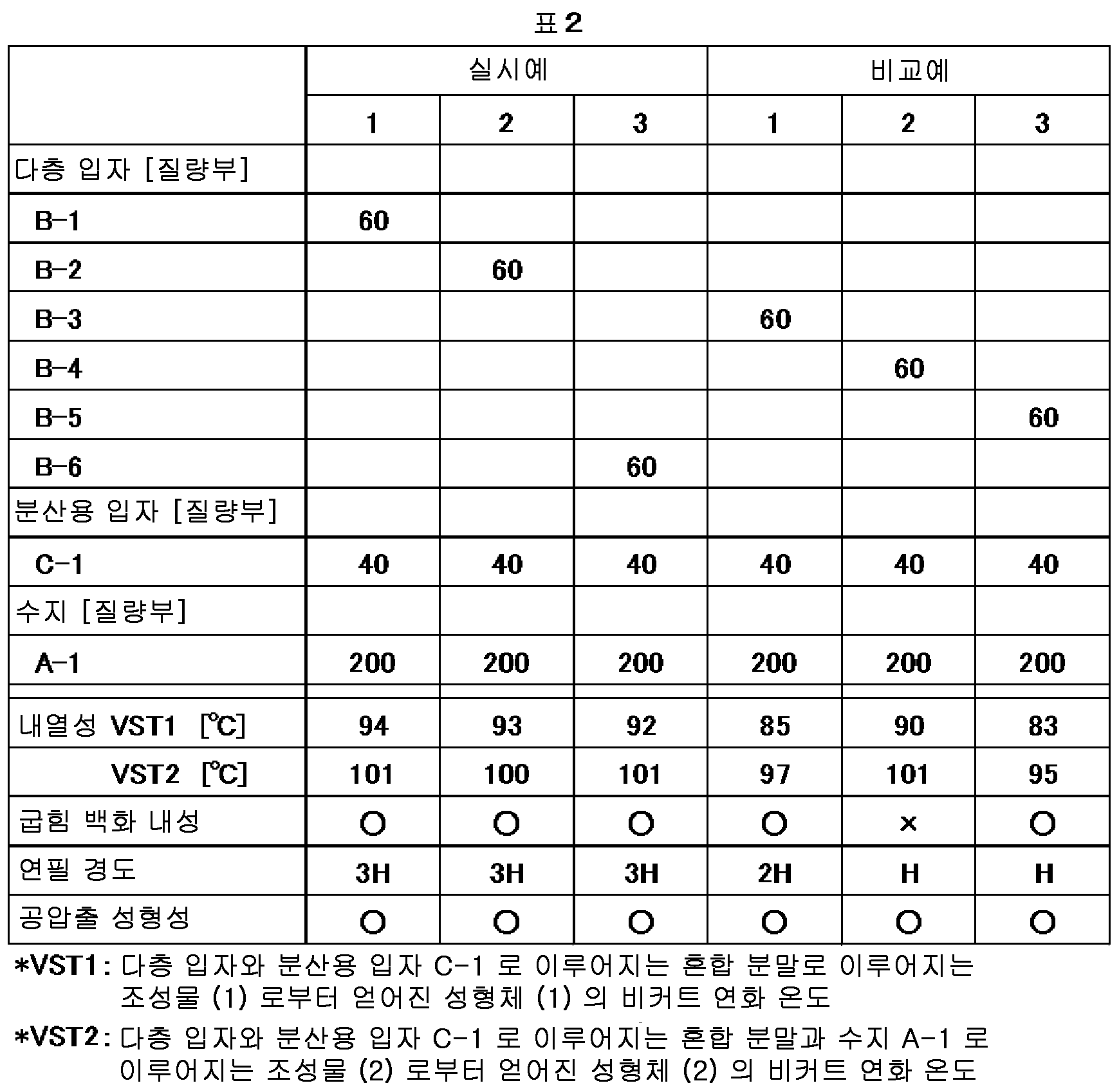
Claims (6)
및 수지 (A)
를 함유하여 이루어지는 수지 필름.A layer (a) comprising a polymer containing 80 to 99.99 mass% of methyl methacrylate units, 0.01 to 2 mass% of crosslinkable monomer units and 0 to 19.99 mass% of other copolymerizable monomer units, (B) composed of a polymer containing 99.8% by mass of a polymerizable monomer, 99.8% by mass of a crosslinkable monomer unit, 0.2 to 10% by mass of a crosslinkable monomer unit and 0 to 29.8% by mass of other copolymerizable monomer units, (A), (b) and (c) in total of 100 parts by mass of the layer (c) composed of a polymer containing 0 to 20 mass% of other monomer units. (A), the layer (b), and the layer (c) from 5 to 15 parts by mass, from 40 to 60 parts by mass, and from 35 to 50 parts by mass, c). (B) having a volume-based average particle diameter of 90 to 150 nm,
And the resin (A)
By weight.
수지 (A) 가, 메틸메타크릴레이트 80 ∼ 100 질량% 를 함유하며, 또한 겔 퍼미에이션 크로마토그래피로 측정한 중량 평균 분자량이 90,000 g/㏖ 이상인 메타크릴 수지 (a1) 인, 수지 필름.The method according to claim 1,
Wherein the resin (A) is a methacrylic resin (a1) containing 80 to 100 mass% of methyl methacrylate and having a weight average molecular weight of 90,000 g / mol or more as measured by gel permeation chromatography.
메틸메타크릴레이트 단위 80 ∼ 100 질량% 를 가지며 또한 겔 퍼미에이션 크로마토그래피로 측정한 중량 평균 분자량이 90,000 g/㏖ 미만인 중합체 (C) 를, 다층 입자 (B) 에 대한 질량비 (C/B) 20/80 ∼ 55/45 로 함유하여 이루어지는, 수지 필름.3. The method according to claim 1 or 2,
(C / B) relative to the multi-layered particles (B) of 20 to 100% by mass and a weight average molecular weight of less than 90,000 g / mol, as measured by gel permeation chromatography, / 80 to 55/45.
수지 (A) 에 대한 다층 입자 (B) 의 질량비 (B/A) 가 1/99 ∼ 99/1 인 수지 필름.4. The method according to any one of claims 1 to 3,
Wherein a mass ratio (B / A) of the multilayered particles (B) to the resin (A) is 1/99 to 99/1.
알킬아크릴레이트 70 ∼ 99.8 질량%, 가교성 단량체 0.2 ∼ 10 질량% 및 공중합 가능한 다른 단량체 0 ∼ 29.8 질량% 를 함유하여 이루어지는 단량체를 중합하여 층 (b) 를 형성하는 공정, 그리고
메틸메타크릴레이트 80 ∼ 100 질량% 및 공중합 가능한 다른 단량체 0 ∼ 20 질량% 를 함유하여 이루어지는 단량체를 중합하여 층 (c) 를 형성하는 공정
을 이 순으로 거쳐,
층 (a), 층 (b) 및 층 (c) 의 합계 100 질량부에 대해서, 층 (a) 가 5 ∼ 15 질량부, 층 (b) 가 40 ∼ 60 질량부 및 층 (c) 가 35 ∼ 50 질량부이며, 또한 체적 기준 평균 입자경이 90 ∼ 150 ㎚ 인 다층 입자 (B) 를 제조하고,
상기 다층 입자 (B) 및 수지 (A) 를 적어도 함유하는 혼합물을 혼련하여 필름상으로 성형하는 것을 포함하는, 수지 필름의 제조 방법.A step of polymerizing a monomer containing 80 to 99.99% by mass of methyl methacrylate, 0.01 to 2% by mass of a crosslinkable monomer and 0 to 19.99% by mass of other copolymerizable monomers to form a layer (a)
A step of polymerizing a monomer containing 70 to 99.8 mass% of an alkyl acrylate, 0.2 to 10 mass% of a crosslinkable monomer and 0 to 29.8 mass% of other copolymerizable monomers to form a layer (b), and
A step of forming a layer (c) by polymerizing a monomer containing 80 to 100 mass% of methyl methacrylate and 0 to 20 mass% of other copolymerizable monomer
In this order,
5 to 15 parts by mass of the layer (a), 40 to 60 parts by mass of the layer (b), and 35 to 60 parts by mass of the layer (c) are added to 100 parts by mass of the total 100 parts by mass of the layer (a) To 50 parts by mass and a volume-based average particle diameter of 90 to 150 nm,
Kneading a mixture containing at least the multi-layered particles (B) and the resin (A), and molding the mixture into a film.
Applications Claiming Priority (3)
| Application Number | Priority Date | Filing Date | Title |
|---|---|---|---|
| JPJP-P-2015-256002 | 2015-12-28 | ||
| JP2015256002 | 2015-12-28 | ||
| PCT/JP2016/088907 WO2017115800A1 (en) | 2015-12-28 | 2016-12-27 | Resin film |
Publications (2)
| Publication Number | Publication Date |
|---|---|
| KR20180098273A true KR20180098273A (en) | 2018-09-03 |
| KR102556590B1 KR102556590B1 (en) | 2023-07-17 |
Family
ID=59224702
Family Applications (1)
| Application Number | Title | Priority Date | Filing Date |
|---|---|---|---|
| KR1020187018253A Active KR102556590B1 (en) | 2015-12-28 | 2016-12-27 | resin film |
Country Status (7)
| Country | Link |
|---|---|
| US (1) | US10800912B2 (en) |
| EP (1) | EP3398997B1 (en) |
| JP (1) | JP6784698B2 (en) |
| KR (1) | KR102556590B1 (en) |
| CN (1) | CN108473778A (en) |
| TW (1) | TWI705994B (en) |
| WO (1) | WO2017115800A1 (en) |
Families Citing this family (3)
| Publication number | Priority date | Publication date | Assignee | Title |
|---|---|---|---|---|
| JP7225258B2 (en) * | 2018-10-04 | 2023-02-20 | 株式会社クラレ | acrylic resin film |
| EP4299641A4 (en) * | 2021-02-26 | 2025-03-26 | Kuraray Co., Ltd. | POLYURETHANE RESIN COMPOSITION SUITABLE FOR EXTRUSION |
| CN117818186B (en) * | 2024-02-05 | 2025-12-26 | 宁波勤邦新材料科技股份有限公司 | A double-sided printed ultra-low transmittance polyester film and its preparation method |
Citations (7)
| Publication number | Priority date | Publication date | Assignee | Title |
|---|---|---|---|---|
| JPS6228404A (en) * | 1985-07-26 | 1987-02-06 | シ−サ− スマ− パクハ | Production of pre-oriented monofilament yarn of synthetic material |
| JP2004352837A (en) | 2003-05-28 | 2004-12-16 | Kuraray Co Ltd | Multilayer structure polymer particles, acrylic resin composition containing the same, and molded product thereof |
| JP2005306980A (en) | 2004-04-21 | 2005-11-04 | Sumitomo Chemical Co Ltd | Acrylic resin film and resin molded body using the same |
| JP2011006647A (en) * | 2009-06-29 | 2011-01-13 | Asahi Kasei Chemicals Corp | Acrylic polymer resin particles and thermoplastic resin composition containing the acrylic resin particles |
| JP2012180454A (en) | 2011-03-01 | 2012-09-20 | Kuraray Co Ltd | Methacrylic resin composition and molded article |
| KR20140034929A (en) * | 2011-10-05 | 2014-03-20 | 가부시키가이샤 가네카 | Acrylic resin film having excellent resistance to whitening on bending and excellent cracking resistance |
| KR20150142683A (en) * | 2013-04-12 | 2015-12-22 | 가부시키가이샤 구라레 | Acrylic resin film |
Family Cites Families (9)
| Publication number | Priority date | Publication date | Assignee | Title |
|---|---|---|---|---|
| US3793402A (en) * | 1971-11-05 | 1974-02-19 | F Owens | Low haze impact resistant compositions containing a multi-stage,sequentially produced polymer |
| JPH04270751A (en) * | 1991-02-26 | 1992-09-28 | Kanegafuchi Chem Ind Co Ltd | Impact-resistant methacrylic resin composition |
| JP3391834B2 (en) | 1993-02-05 | 2003-03-31 | 株式会社クラレ | Heat resistant impact resistant methacrylic resin composition |
| JPH06228404A (en) * | 1993-02-05 | 1994-08-16 | Kuraray Co Ltd | Heat and impact resistant methacrylic resin composition |
| JP3934754B2 (en) * | 1997-08-28 | 2007-06-20 | 株式会社クラレ | Acrylic multilayered granular composite |
| JP3433892B2 (en) * | 1997-09-16 | 2003-08-04 | 三菱レイヨン株式会社 | Acrylic film with good processability and molded products laminated with the acrylic film |
| WO2005095480A1 (en) * | 2004-03-30 | 2005-10-13 | Mitsubishi Rayon Co., Ltd. | Impact resistance modifier and resin composition |
| EP1940901B1 (en) * | 2005-10-28 | 2014-09-03 | Arkema France | Multi-layer article comprising impact modified acrylics having a bimodal distribution of impact modifier sizes |
| JP2007204620A (en) * | 2006-02-02 | 2007-08-16 | Sumitomo Chemical Co Ltd | Acrylic film for laminating foamed resin molded body and laminated molded body |
-
2016
- 2016-12-27 KR KR1020187018253A patent/KR102556590B1/en active Active
- 2016-12-27 WO PCT/JP2016/088907 patent/WO2017115800A1/en not_active Ceased
- 2016-12-27 EP EP16881774.0A patent/EP3398997B1/en active Active
- 2016-12-27 JP JP2017559209A patent/JP6784698B2/en active Active
- 2016-12-27 US US16/066,853 patent/US10800912B2/en active Active
- 2016-12-27 CN CN201680076994.2A patent/CN108473778A/en active Pending
- 2016-12-28 TW TW105143479A patent/TWI705994B/en active
Patent Citations (7)
| Publication number | Priority date | Publication date | Assignee | Title |
|---|---|---|---|---|
| JPS6228404A (en) * | 1985-07-26 | 1987-02-06 | シ−サ− スマ− パクハ | Production of pre-oriented monofilament yarn of synthetic material |
| JP2004352837A (en) | 2003-05-28 | 2004-12-16 | Kuraray Co Ltd | Multilayer structure polymer particles, acrylic resin composition containing the same, and molded product thereof |
| JP2005306980A (en) | 2004-04-21 | 2005-11-04 | Sumitomo Chemical Co Ltd | Acrylic resin film and resin molded body using the same |
| JP2011006647A (en) * | 2009-06-29 | 2011-01-13 | Asahi Kasei Chemicals Corp | Acrylic polymer resin particles and thermoplastic resin composition containing the acrylic resin particles |
| JP2012180454A (en) | 2011-03-01 | 2012-09-20 | Kuraray Co Ltd | Methacrylic resin composition and molded article |
| KR20140034929A (en) * | 2011-10-05 | 2014-03-20 | 가부시키가이샤 가네카 | Acrylic resin film having excellent resistance to whitening on bending and excellent cracking resistance |
| KR20150142683A (en) * | 2013-04-12 | 2015-12-22 | 가부시키가이샤 구라레 | Acrylic resin film |
Also Published As
| Publication number | Publication date |
|---|---|
| EP3398997B1 (en) | 2022-06-29 |
| KR102556590B1 (en) | 2023-07-17 |
| EP3398997A1 (en) | 2018-11-07 |
| US20190016878A1 (en) | 2019-01-17 |
| CN108473778A (en) | 2018-08-31 |
| WO2017115800A1 (en) | 2017-07-06 |
| JPWO2017115800A1 (en) | 2018-10-18 |
| TWI705994B (en) | 2020-10-01 |
| TW201736452A (en) | 2017-10-16 |
| EP3398997A4 (en) | 2019-09-04 |
| JP6784698B2 (en) | 2020-11-11 |
| US10800912B2 (en) | 2020-10-13 |
Similar Documents
| Publication | Publication Date | Title |
|---|---|---|
| KR102381502B1 (en) | Acrylic film | |
| TWI715722B (en) | Thermoplastic resin film and its manufacturing method, and laminated body | |
| CN105121543B (en) | acrylic resin film | |
| KR102519252B1 (en) | (meth)acrylic resin composition and (meth)acrylic resin film | |
| WO2021193922A1 (en) | Acrylic composition and molded article | |
| WO2018021449A1 (en) | Methacrylate resin composition, method for producing same, molded body, film, laminated film, and laminated molded body | |
| JP7322002B2 (en) | (Meth)acrylic resin composition, film and method for producing the same | |
| JP6784698B2 (en) | Resin film | |
| CN114829493B (en) | Methacrylic resin composition | |
| KR20160108338A (en) | Copolymer, and molded article | |
| JP6571542B2 (en) | Resin composition containing aromatic vinyl copolymer | |
| JP7693541B2 (en) | Methacrylic melt extrusion moldings | |
| KR102578963B1 (en) | Methacrylic resin compositions, molded bodies and films | |
| JP7563926B2 (en) | Method for producing (meth)acrylic resin film | |
| KR102585620B1 (en) | Composite sheet having matt metallic surface properties and preparation method thereof | |
| JP6852997B2 (en) | Impact resistance improver, thermoplastic resin composition and film | |
| JP2022010998A (en) | Thermoplastic resin film | |
| EP3862382A1 (en) | Acrylic resin film | |
| JP2022010980A (en) | Thermoplastic resin film |
Legal Events
| Date | Code | Title | Description |
|---|---|---|---|
| PA0105 | International application |
St.27 status event code: A-0-1-A10-A15-nap-PA0105 |
|
| P11-X000 | Amendment of application requested |
St.27 status event code: A-2-2-P10-P11-nap-X000 |
|
| P13-X000 | Application amended |
St.27 status event code: A-2-2-P10-P13-nap-X000 |
|
| PG1501 | Laying open of application |
St.27 status event code: A-1-1-Q10-Q12-nap-PG1501 |
|
| A201 | Request for examination | ||
| PA0201 | Request for examination |
St.27 status event code: A-1-2-D10-D11-exm-PA0201 |
|
| E902 | Notification of reason for refusal | ||
| PE0902 | Notice of grounds for rejection |
St.27 status event code: A-1-2-D10-D21-exm-PE0902 |
|
| P11-X000 | Amendment of application requested |
St.27 status event code: A-2-2-P10-P11-nap-X000 |
|
| P13-X000 | Application amended |
St.27 status event code: A-2-2-P10-P13-nap-X000 |
|
| E701 | Decision to grant or registration of patent right | ||
| PE0701 | Decision of registration |
St.27 status event code: A-1-2-D10-D22-exm-PE0701 |
|
| GRNT | Written decision to grant | ||
| PR0701 | Registration of establishment |
St.27 status event code: A-2-4-F10-F11-exm-PR0701 |
|
| PR1002 | Payment of registration fee |
St.27 status event code: A-2-2-U10-U12-oth-PR1002 Fee payment year number: 1 |
|
| PG1601 | Publication of registration |
St.27 status event code: A-4-4-Q10-Q13-nap-PG1601 |
|
| R18 | Changes to party contact information recorded |
Free format text: ST27 STATUS EVENT CODE: A-5-5-R10-R18-OTH-X000 (AS PROVIDED BY THE NATIONAL OFFICE) |
|
| R18-X000 | Changes to party contact information recorded |
St.27 status event code: A-5-5-R10-R18-oth-X000 |
|
| PR1001 | Payment of annual fee |
St.27 status event code: A-4-4-U10-U11-oth-PR1001 Fee payment year number: 4 |
|
| U11 | Full renewal or maintenance fee paid |
Free format text: ST27 STATUS EVENT CODE: A-4-4-U10-U11-OTH-PR1001 (AS PROVIDED BY THE NATIONAL OFFICE) Year of fee payment: 4 |