KR20180098258A - Pyrazole compound or its salt, process for its preparation, herbicidal composition and uses thereof - Google Patents
Pyrazole compound or its salt, process for its preparation, herbicidal composition and uses thereof Download PDFInfo
- Publication number
- KR20180098258A KR20180098258A KR1020187017400A KR20187017400A KR20180098258A KR 20180098258 A KR20180098258 A KR 20180098258A KR 1020187017400 A KR1020187017400 A KR 1020187017400A KR 20187017400 A KR20187017400 A KR 20187017400A KR 20180098258 A KR20180098258 A KR 20180098258A
- Authority
- KR
- South Korea
- Prior art keywords
- compound
- ring
- pyrazole
- alkyl
- salt
- Prior art date
- Legal status (The legal status is an assumption and is not a legal conclusion. Google has not performed a legal analysis and makes no representation as to the accuracy of the status listed.)
- Granted
Links
Classifications
-
- C—CHEMISTRY; METALLURGY
- C07—ORGANIC CHEMISTRY
- C07D—HETEROCYCLIC COMPOUNDS
- C07D403/00—Heterocyclic compounds containing two or more hetero rings, having nitrogen atoms as the only ring hetero atoms, not provided for by group C07D401/00
- C07D403/14—Heterocyclic compounds containing two or more hetero rings, having nitrogen atoms as the only ring hetero atoms, not provided for by group C07D401/00 containing three or more hetero rings
-
- A—HUMAN NECESSITIES
- A01—AGRICULTURE; FORESTRY; ANIMAL HUSBANDRY; HUNTING; TRAPPING; FISHING
- A01N—PRESERVATION OF BODIES OF HUMANS OR ANIMALS OR PLANTS OR PARTS THEREOF; BIOCIDES, e.g. AS DISINFECTANTS, AS PESTICIDES OR AS HERBICIDES; PEST REPELLANTS OR ATTRACTANTS; PLANT GROWTH REGULATORS
- A01N43/00—Biocides, pest repellants or attractants, or plant growth regulators containing heterocyclic compounds
- A01N43/48—Biocides, pest repellants or attractants, or plant growth regulators containing heterocyclic compounds having rings with two nitrogen atoms as the only ring hetero atoms
- A01N43/56—1,2-Diazoles; Hydrogenated 1,2-diazoles
-
- C—CHEMISTRY; METALLURGY
- C07—ORGANIC CHEMISTRY
- C07D—HETEROCYCLIC COMPOUNDS
- C07D231/00—Heterocyclic compounds containing 1,2-diazole or hydrogenated 1,2-diazole rings
- C07D231/02—Heterocyclic compounds containing 1,2-diazole or hydrogenated 1,2-diazole rings not condensed with other rings
- C07D231/10—Heterocyclic compounds containing 1,2-diazole or hydrogenated 1,2-diazole rings not condensed with other rings having two or three double bonds between ring members or between ring members and non-ring members
- C07D231/14—Heterocyclic compounds containing 1,2-diazole or hydrogenated 1,2-diazole rings not condensed with other rings having two or three double bonds between ring members or between ring members and non-ring members with hetero atoms or with carbon atoms having three bonds to hetero atoms with at the most one bond to halogen, e.g. ester or nitrile radicals, directly attached to ring carbon atoms
- C07D231/18—One oxygen or sulfur atom
- C07D231/20—One oxygen atom attached in position 3 or 5
-
- C—CHEMISTRY; METALLURGY
- C07—ORGANIC CHEMISTRY
- C07D—HETEROCYCLIC COMPOUNDS
- C07D403/00—Heterocyclic compounds containing two or more hetero rings, having nitrogen atoms as the only ring hetero atoms, not provided for by group C07D401/00
- C07D403/02—Heterocyclic compounds containing two or more hetero rings, having nitrogen atoms as the only ring hetero atoms, not provided for by group C07D401/00 containing two hetero rings
- C07D403/12—Heterocyclic compounds containing two or more hetero rings, having nitrogen atoms as the only ring hetero atoms, not provided for by group C07D401/00 containing two hetero rings linked by a chain containing hetero atoms as chain links
-
- C—CHEMISTRY; METALLURGY
- C07—ORGANIC CHEMISTRY
- C07D—HETEROCYCLIC COMPOUNDS
- C07D405/00—Heterocyclic compounds containing both one or more hetero rings having oxygen atoms as the only ring hetero atoms, and one or more rings having nitrogen as the only ring hetero atom
- C07D405/14—Heterocyclic compounds containing both one or more hetero rings having oxygen atoms as the only ring hetero atoms, and one or more rings having nitrogen as the only ring hetero atom containing three or more hetero rings
Landscapes
- Chemical & Material Sciences (AREA)
- Organic Chemistry (AREA)
- Life Sciences & Earth Sciences (AREA)
- Agronomy & Crop Science (AREA)
- Pest Control & Pesticides (AREA)
- Plant Pathology (AREA)
- Health & Medical Sciences (AREA)
- Engineering & Computer Science (AREA)
- Dentistry (AREA)
- General Health & Medical Sciences (AREA)
- Wood Science & Technology (AREA)
- Zoology (AREA)
- Environmental Sciences (AREA)
- Agricultural Chemicals And Associated Chemicals (AREA)
- Plural Heterocyclic Compounds (AREA)
Abstract
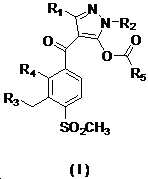
본 발명은 살충제의 기술 분야에 관한 것으로, 특히 피라졸 화합물 또는 그의 염, 그의 제조 방법, 제초제 조성물 및 그의 용도에 관한 것이다. 화학식 (I)의 피라졸 화합물 또는 그의 염은 하기와 같다:
여기서, R1은 수소 또는 C1-C4 알킬을 나타내고; R2는 C1-C3 알킬을 나타내고; R3은 O, S 및 N으로부터 선택되는 하나 이상의 헤테로원자를 함유하는 C1-C6 선형 사슬 또는 고리 기를 나타내고; R4는 C1-C3 알킬 또는 할로겐을 나타내고; R5는 피라졸 고리 또는 알킬, 알콕시, 할로겐, 할로겐화 알킬, 아미노 및 니트로로부터 선택된 하나 이상의 기로 치환된 피라졸 고리를 나타낸다. 피라졸 화합물은 광범위한 스펙트럼의 생물학적 활성 및 작물에 대한 뛰어난 안전성을 가진 탁월한 제초제이다.TECHNICAL FIELD OF THE INVENTION The present invention relates to the field of pesticides, in particular to pyrazole compounds or salts thereof, a process for their preparation, herbicidal compositions and uses thereof. The pyrazole compound of formula (I) or a salt thereof is as follows:
Wherein R 1 represents hydrogen or C 1 -C 4 alkyl; R 2 represents C 1 -C 3 alkyl; R 3 represents a C 1 -C 6 linear chain or ring group containing one or more heteroatoms selected from O, S and N; R 4 represents C 1 -C 3 alkyl or halogen; R 5 represents a pyrazole ring or a pyrazole ring substituted with one or more groups selected from alkyl, alkoxy, halogen, alkyl halide, amino and nitro. Pyrazole compounds are excellent herbicides with broad spectrum of biological activity and excellent safety for crops.
Description
본 발명은 살충제의 기술 분야에 관한 것으로, 특히 피라졸 화합물 또는 그의 염, 그의 제조 방법, 제초제 및 이들의 용도에 관한 것이다.TECHNICAL FIELD OF THE INVENTION The present invention relates to the technical field of pesticides, and more particularly to a pyrazole compound or a salt thereof, a process for producing the same, a herbicide and a use thereof.
잡초 방제는 고효율 농업의 달성 과정에서 가장 중요한 수단 중 하나이다. 시장에서 다양한 제초제가 이용 가능하지만, 과학자들은 여전히 시장의 증가, 잡초 저항성, 살충제의 서비스 수명 및 경제성 및 환경에 대한 사람들의 관심 증가와 같은 문제들로 인하여 높은 효능, 안전성, 경제성 및 다른 행동 양식으로 새로운 제초제를 지속적으로 연구하고 개발해야 한다. 피라졸 화합물에 대해서는 많은 연구가 있고, 예를 들어, CN88101455A는 일반적인 구조에서 피라졸 고리를 포함하는 일련의 피라졸 화합물들을 개시하지만, 이 화합물들은 안전성 및 활성에 있어 약간의 결함을 갖는다.Weed control is one of the most important means of achieving high efficiency agriculture. Although a variety of herbicides are available in the market, scientists are still struggling with high efficacy, safety, cost-effectiveness and other forms of behavior due to problems such as market growth, weed resistance, service life and economics of pesticides, New herbicides should be continuously studied and developed. There are many studies on pyrazole compounds, for example, CN88101455A discloses a series of pyrazole compounds containing a pyrazole ring in the general structure, but these compounds have some deficiencies in safety and activity.
이에 본 발명자들은 합성된 신규한 피라졸 화합물이 제초용 화합물로서 우수한 것을 확인하였다.Therefore, the present inventors confirmed that the novel pyrazole compound thus synthesized is excellent as a herbicidal compound.
이에, 본 발명의 목적은 피라졸 화합물 또는 그의 염을 제공하는 것이다.Accordingly, an object of the present invention is to provide a pyrazole compound or a salt thereof.
본 발명의 다른 목적은 피라졸 화합물 또는 그의 염의 제조 방법을 제공하는 것이다.Another object of the present invention is to provide a process for producing a pyrazole compound or a salt thereof.
본 발명의 또 다른 목적은 피라졸 화합물 또는 그의 염의 제초학적 유효량을 포함하는 것을 특징으로 하는 제초제 조성물을 제공하는 것이다.It is another object of the present invention to provide a herbicidal composition which comprises a herbicidally effective amount of a pyrazole compound or a salt thereof.
본 발명의 또 다른 목적은 유해 식물의 방제 방법을 제공하는 것이다.It is another object of the present invention to provide a method for controlling harmful plants.
본 발명의 또 다른 목적은 피라졸 화합물 또는 그의 염의 유해 식물 방제 용도에 관한 것이다.Another object of the present invention relates to the use of a pyrazole compound or a salt thereof for harmful plant control.
본 발명은 분자 설계 및 최적화를 통해 더 높은 효능, 더 넓은 활성 스펙트럼 및 더 우수한 안전성을 갖는 제초용 화합물을 고안하고 합성하기 위하여, 제초 활성 성분으로서 사용될 수 있는 적어도 2개의 피라졸 고리를 함유하는 신규한 피라졸 화합물을 합성하였다. 이 화합물은 작물에 대한 더 뛰어난 활성과 우수한 안전성을 갖는다.The present invention relates to novel compounds containing at least two pyrazole rings which can be used as herbicidal active ingredients for devising and synthesizing herbicidal compounds with higher efficacy, wider activity spectrum and better safety through molecular design and optimization A pyrazole compound was synthesized. This compound has superior activity against crops and excellent safety.
상기 목적을 달성하기 위해, 본 발명은 다음의 기술적 해결 방법을 제공한다 :In order to achieve the above object, the present invention provides the following technical solution:
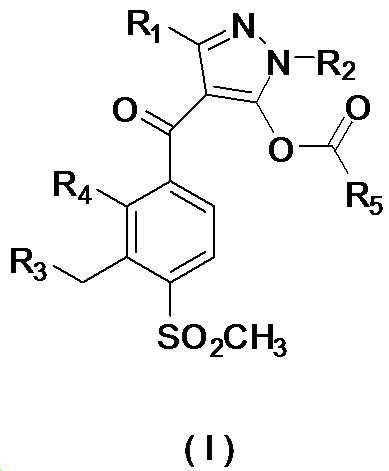
화학식 (I)의 피라졸 화합물 또는 그의 염:A pyrazole compound of formula (I) or a salt thereof:
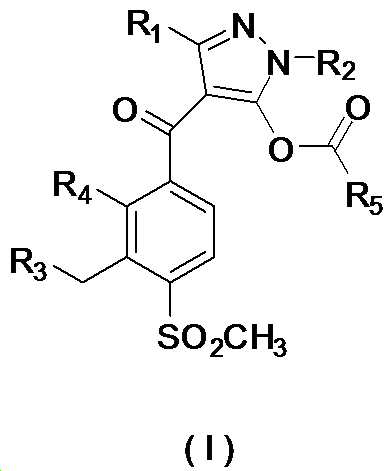
여기서,here,
R1은 수소 또는 C1-C4 알킬을 나타내고;R 1 represents hydrogen or C 1 -C 4 alkyl;
R2는 C1-C3 알킬을 나타내고;R 2 represents C 1 -C 3 alkyl;
R3은 O, S, 및 N으로부터 선택되는 하나 이상의 헤테로원자를 함유하는 C1-C6 선형 또는 고리 기를 나타내고;R 3 represents a C 1 -C 6 linear or cyclic group containing one or more heteroatoms selected from O, S, and N;
R4는 C1-C3 알킬 또는 할로겐을 나타내고;R 4 represents C 1 -C 3 alkyl or halogen;
R5는 피라졸 고리 또는 알킬, 알콕시, 할로겐, 할로겐화 알킬, 아미노, 및 니트로로부터 선택되는 하나 이상의 기로 치환된 피라졸 고리를 나타낸다.R 5 represents a pyrazole ring or a pyrazole ring substituted with at least one group selected from alkyl, alkoxy, halogen, alkyl halide, amino, and nitro.
바람직하게는, 상기 피라졸 화합물 또는 그의 염의 구조는 하기와 같다:Preferably, the structure of the pyrazole compound or its salt is as follows:
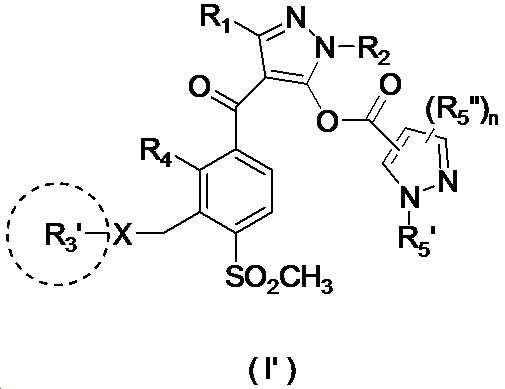
여기서,here,
R1은 수소 또는 C1-C4 알킬을 나타내고;R 1 represents hydrogen or C 1 -C 4 alkyl;
R2는 C1-C3 알킬을 나타내고;R 2 represents C 1 -C 3 alkyl;
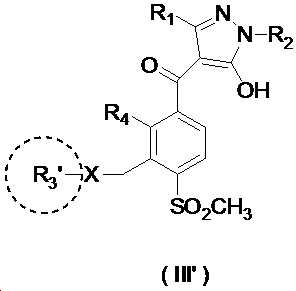
X는 O, N 또는 S이고, X 및 R3'은 고리 또는 선형 사슬을 형성할 수 있고, 여기서, X가 O 또는 S 인 경우, R3'은 C1-C6 알킬, C3-C6 알콕시 알킬, C2-C6 할로겐화 알킬, C3-C6 알케닐 또는 C3-C6 알키닐을 나타내고; X가 N 인 경우, X 및 R3'은 피라졸 고리 또는 치환된 피라졸 고리, C3-C5 락탐 고리 또는 치환된 락탐 고리를 형성한다.X is O, N or S, X and R 3 'may form a ring or a linear chain, wherein when X is O or S, R 3 ' is C 1 -C 6 alkyl, C 3 -C 6 alkoxyalkyl, C2-C6 halogenated alkyl, C3-C6 alkenyl or C3-C6 alkynyl; When X is N, X and R 3 'form a pyrazole ring or a substituted pyrazole ring, a C3-C5 lactam ring or a substituted lactam ring.
R4는 C1-C3 알킬 또는 할로겐을 나타내고;R 4 represents C 1 -C 3 alkyl or halogen;
R5'는 C1-C3 알킬을 나타내고;R 5 'represents C 1 -C 3 alkyl;
R5"는 수소, C1-C3 알킬, C1-C3 알콕시, C1-C3 할로겐화 알킬, 할로겐, 아미노 또는 니트로를 나타내고; n은 0, 1 또는 2이고, 여기서, n이 2인 경우, 2개의 R5"는 같거나 또는 상이할 수 있다.R 5 "is hydrogen, C1-C3 alkyl, C1-C3 alkoxy, C1-C3 halogenated alkyl, a halogen, amino or nitro; when n is 0, 1 or 2, wherein n is 2, the two R 5 "may be the same or different.
더욱 바람직하게는, R1은 수소, 메틸, 에틸 또는 사이클로프로필일 수 있고;More preferably, R < 1 > can be hydrogen, methyl, ethyl or cyclopropyl;
R2는 메틸, 에틸 또는 이소프로필을 나타내고;R 2 represents methyl, ethyl or isopropyl;
X는 O, N 또는 S이고, X 및 R3'은 고리 또는 선형 사슬을 형성할 수 있고, 여기서, X가 O 또는 S인 경우, R3'은 C1-C6 알킬, C3-C6 알콕시 알킬, C2-C4 할로겐화 알킬, C3-C5 알케닐 또는 C3-C5 알키닐을 나타내고; X가 N일 때, X 및 R3'은 피라졸 고리 또는 치환된 피라졸 고리, C3-C5 락탐 고리 또는 치환된 락탐 고리를 형성한다.X is O, N or S, X and R 3 'may form a ring or a linear chain, wherein when X is O or S, R 3 ' is C 1 -C 6 alkyl, C 3 -C 6 alkoxyalkyl, C2-C4 halogenated alkyl, C3-C5 alkenyl or C3-C5 alkynyl; When X is N, X and R3 'form a pyrazole ring or a substituted pyrazole ring, a C3-C5 lactam ring or a substituted lactam ring.
R4는 메틸 또는 염소를 나타내고;R 4 represents methyl or chlorine;
R5'는 메틸, 에틸 또는 이소프로필을 나타내고;R 5 'represents methyl, ethyl or isopropyl;
R5"는 수소, 메틸, 에틸, 이소프로필, 메톡실, 에톡실, 디플루오로메틸, 클로로 또는 브로모를 나타내고; n은 0, 1 또는 2이고, 여기서, n이 2인 경우, 두 개의 R5"는 같거나 또는 상이할 수 있다.R 5 "represents unknown hydrogen, methyl, ethyl, isopropyl, methoxyl, ethoxylates, difluoro methyl, chloro or bromo in; if n is 0, 1 or 2, wherein, n is 2, two R 5 "may be the same or different.
더욱 바람직하게는, X는 O 또는 N이고, X 및 R3'은 고리 또는 선형 사슬을 형성할 수 있으며, 여기서, X가 O인 경우, R3'은 메틸, 에틸, n-부틸, 메톡실 에틸, 에톡실 에틸, 메톡실 이소프로필, 메톡실 n-프로필, 2,2-디플루오로에틸, 2,2,2-트리플루오로에틸, 1,1,2,2-테트라플루오로프로필, 프로파르길, 2-알켄 부틸 또는 테트라히드로푸푸릴; X가 N인 경우, X 및 R3'은 피라졸 고리, 3-메틸 피라졸 고리, 4-메틸 피라졸 고리, 3,5-디메틸 피라졸 고리, 4-클로로피라졸 고리 또는 피롤리돈 고리를 형성한다.More preferably, X is O or N, X and R 3 'may form a ring or linear chain, wherein when X is O, R 3 ' is methyl, ethyl, n-butyl, methoxyl Ethyl, ethoxylethyl, methoxylisopropyl, methoxyl n-propyl, 2,2-difluoroethyl, 2,2,2-trifluoroethyl, 1,1,2,2-tetrafluoropropyl, Propargyl, 2-alkenylbutyl or tetrahydrofurfuryl; When X is N, X and R 3 'are selected from the group consisting of a pyrazole ring, a 3-methylpyrazole ring, a 4-methylpyrazole ring, a 3,5-dimethylpyrazole ring, a 4- chloropyrazole ring or a pyrrolidone ring .
상기 화학식 (I)의 화합물의 정의에서, 단독으로 또는 다른 용어와 결합하여 사용된 용어는, 하기 치환기를 나타낸다:In the definition of the compound of formula (I) above, the term used alone or in combination with another term represents the following substituent:
할로겐 : 불소, 염소, 브롬 및 요오드를 의미한다.Halogen: means fluorine, chlorine, bromine and iodine.
알킬 : 선형 알킬 또는 분지형 알킬을 의미한다.Alkyl: means linear alkyl or branched alkyl.
할로겐화 알킬 : 할로겐 원자로 치환된 수소의 전부 또는 일부를 갖는 선형 또는 분지형 알킬을 의미한다.Halogenated alkyl: means a linear or branched alkyl having all or part of hydrogen substituted with a halogen atom.
알콕시 : 알콕시와 산소 원자를 연결하여 형성된 관능기를 말한다.Alkoxy refers to a functional group formed by linking an alkoxy and an oxygen atom.
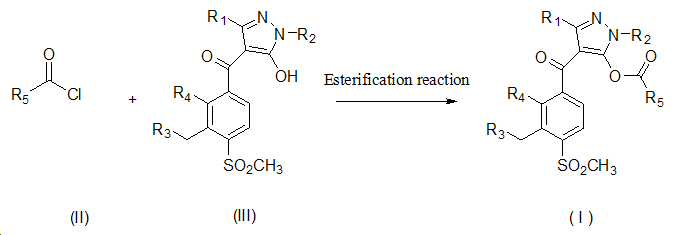
상기 화학식 (I)의 피라졸 화합물 또는 그의 염을 제조하는 방법에 있어서, 화학식 (Ⅱ)의 화합물 및 화학식 (Ⅲ)의 화합물을 에스테르화 반응시켜 상기 화학식 (I)의 피라졸 화합물 또는 그의 염을 수득하는 단계를 포함하고,A method for producing a pyrazole compound of the formula (I) or a salt thereof, which comprises esterifying a compound of the formula (II) and a compound of the formula (III) to obtain a pyrazole compound of the formula (I) , ≪ / RTI >
여기서, 상기 화학식 (Ⅱ)의 화합물은 하기와 같이 표시되고:Wherein the compound of formula (II) is represented as follows:
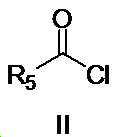
상기 화학식 Ⅲ의 화합물은 하기와 같이 표시되고:The compound of formula (III) is represented as follows:

및 상세한 반응 경로는 하기와 같이 표시된다:And the detailed reaction path are represented as follows:
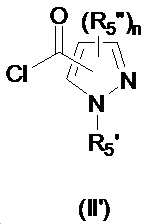
화학식 (I')의 피라졸 피라졸 화합물 또는 그의 염을 제조하는 방법에 있어서, 화학식 (Ⅱ')의 화합물 및 화학식 (Ⅲ')의 화합물을 에스테르화 반응시켜 화학식 (I')의 피라졸 화합물 또는 그의 염을 얻는 단계를 포함하고,In the process for producing the pyrazolepyrazole compound of the formula (I ') or a salt thereof, the compound of the formula (II') and the compound of the formula (III ' Or a salt thereof,
여기서, 상기 화학식 (Ⅱ')의 화합물은 하기와 같이 표시되고:Wherein the compound of formula (II ') is represented as follows:
상기 화학식 (Ⅲ')의 화합물은 하기와 같이 표시되고:The compound of formula (III ') is represented as follows:
및 상세한 반응 경로는 하기와 같이 표시된다:And the detailed reaction path are represented as follows:

화학식 (Ⅱ')의 화합물은 상응하는 카복실산(즉, 화학식 (Ⅱ-1)의 화합물)을 설폭사이드 클로라이드와 반응시켜 제조할 수 있다. 화학식 (Ⅱ-1)의 화합물은 하기와 같이 표시된다:Compounds of formula (II ') may be prepared by reacting the corresponding carboxylic acid (i.e., a compound of formula (II-1)) with sulfoxide chloride. The compound of formula (II-1) is represented as follows:

화학식 (Ⅱ-1)에 나타낸 구조는 피라졸카복실산의 구조이다. 상기 화학식은 3-피라졸카복실산 또는 치환된 3-피라졸카복실산, 4-피라졸카복실산 또는 치환된 4-피라졸카복실산, 또는 5-피라졸카복실산 또는 치환된 5-피라졸카복실산일 수 있는 피라졸카복실산과 같은 것을 나타낸다.The structure represented by the formula (II-1) is the structure of a pyrazolecarboxylic acid. The above formula may be prepared by reacting a 3-pyrazolecarboxylic acid or a substituted 3-pyrazolecarboxylic acid, a 4-pyrazolecarboxylic acid or a substituted 4-pyrazolecarboxylic acid, or a pyrazole which may be a 5-pyrazolecarboxylic acid or a substituted 5- Carboxylic acid.
상기 언급된 반응 경로에서의 에스테르화 반응은 용매의 존재하에 수행될 필요가 있다. 사용된 용매는 반응에 불활성인 용매여야 한다. 이러한 용매는 일반적으로 극성 또는 비극성인 중성 용매이며, 예를 들어, 아세토니트릴, 메틸벤젠, 디메틸벤젠, 디클로로메탄, 디클로로에탄, 테트라하이드로퓨란, 아세톤 등이고, 바람직하게는 아세토니트릴 또는 디클로로메탄이다.The esterification reaction in the above-mentioned reaction pathway needs to be carried out in the presence of a solvent. The solvent used should be a solvent inert to the reaction. Such a solvent is generally a polar solvent or a nonpolar solvent and is, for example, acetonitrile, methylbenzene, dimethylbenzene, dichloromethane, dichloroethane, tetrahydrofuran, acetone, etc., preferably acetonitrile or dichloromethane.
상기 언급된 에스테르화 반응은 탈산제(deacid reagent) 존재하에 수행되어야한다; 사용된 탈산제는 일반적으로 무기 또는 유기인 알칼리이다. 하나 이상의 이러한 알칼리는 탄산염(예: 탄산나트륨, 탄산칼륨), 중탄산염(예: 중탄산나트륨, 중탄산칼륨), 아민(예: 디메틸아민, 트리에틸아민, N,N-디이소프로필에틸아민) 및 피리딘(예: 피리딘, 4-디메틸아미노피리딘)으로부터 선택하여 사용할 수 있고, 바람직하게는 트리에틸아민 또는 탄산칼륨일 수 있다.The above-mentioned esterification reaction must be carried out in the presence of a deacid reagent; The deoxidizer used is generally an alkali, either inorganic or organic. One or more of these alkalis can be converted to the corresponding salts by treatment with a base such as a carbonate such as sodium carbonate or potassium carbonate, a bicarbonate such as sodium bicarbonate, potassium bicarbonate, an amine such as dimethylamine, triethylamine, N, N-diisopropylethylamine, For example, pyridine, 4-dimethylaminopyridine), preferably triethylamine or potassium carbonate.
상기 언급된 에스테르화 반응의 반응 온도는 일반적으로 -10 내지 50℃이고, 바람직하게는 0 내지 20℃; 반응 시간은 0.1 내지 12시간이고, 바람직하게는 0.5 내지 3시간이다.The reaction temperature of the above-mentioned esterification reaction is generally -10 to 50 캜, preferably 0 to 20 캜; The reaction time is 0.1 to 12 hours, preferably 0.5 to 3 hours.
본 발명의 화합물은 하나 이상의 입체이성질체의 형태로 존재할 수 있다. 입체 이성질체는 거울상이성질체(enantiomer), 부분입체이성질체(diastereoisomer) 및 기하이성질체(geometric isomer)를 포함한다. 이들 모든 입체이성질체 및 이들의 혼합물은 모두 본 발명의 범위 내에 있다.The compounds of the present invention may exist in the form of one or more stereoisomers. Stereoisomers include enantiomers, diastereoisomers, and geometric isomers. All of these stereoisomers and mixtures thereof are all within the scope of the present invention.
또한, 적어도 하나의 피라졸 화합물 또는 그의 염의 제초학적 유효량을 포함하는 제초제 조성물이 개시되어 있다.Also disclosed are herbicidal compositions comprising a herbicidally effective amount of at least one pyrazole compound or a salt thereof.
상기 제초제 조성물은 조제 보조제를 또한 포함할 수 있다.The herbicide composition may also comprise a formulation aid.
또한, 적어도 하나의 피라졸 화합물 또는 그의 염의 제초제 유효량 또는 제초제 조성물을 식물 또는 유해 식물이 있는 지역에 적용하는 단계를 포함하는 유해 식물의 방제 방법이 개시되어 있다.Also disclosed is a herbicidally effective amount of at least one pyrazole compound or a salt thereof, or a herbicidal composition, which is applied to a plant or a region where harmful plants are present.
유해 식물을 방제하기 위한 적어도 하나의 피라졸 화합물 또는 그의 염 또는 제초제 조성물의 용도에 있어서, 바람직하게는, 상기 피라졸 화합물 또는 그의 염은 바람직한 작물로부터 유해 식물을 방제하기 위하여 적용되는 것이고, 바람직하게는, 상기 바람직한 작물은 유전자 변형 작물 또는 게놈 편집 기술로 처리된 작물이다.In the use of at least one pyrazole compound or its salt or herbicidal composition for controlling harmful plants, preferably the pyrazole compound or its salt is applied for controlling harmful plants from the desired crops, , The preferred crop is a crop treated with a genetically modified crop or genome editing technique.
본 발명에 따른 화학식 (I)의 화합물은 경제적으로 중요한 단자엽 및 쌍자엽 유해 식물들의 폭 넓은 스펙트럼에 대하여 탁월한 제초 활성을 갖는다. 활성 화합물은 또한 근경으로부터의 뿌리(rhizome), 근경(root stock) 또는 기타 다년생 기관에서 생장하고 조절하기 어려운 다년생 잡초에서 효율적으로 작용한다. 이러한 맥락에서, 물질이 파종 전, 출현 전 또는 출현 후에 적용되는지의 여부는 일반적으로 중요하지 않다. 특히, 본 발명에 따른 화합물에 의해 조절될 수 있는 단자엽 및 쌍자엽 잡초 종의 일부 대표에 대한 예가 언급 될 수 있으며, 이들은 특정한 종에 대한 제한이 없다. 활성 화합물이 효율적으로 작용하는 잡초 종의 예로는, 단자엽 중에서, 귀리(Avena), 라이그래스(Lolium), 강아지풀(Alopecurus), 갈풀(Phalaris), 에키노클로아(Echinochloa), 디지타리아(Digitaria), 세타리아(Setaria) 및 또한 일년생(annual sector)의 향부자(Cyperus) 종 및 다년생 종 중에서 개밀(Agropyron), 우산잔디(Cynodon), 모근(Imperata) 및 수수(Sorghum), 및 또한 다년생 향부자 종이 있다.The compounds of formula (I) according to the invention have excellent herbicidal activity against a broad spectrum of economically important terminal and dicotyledonous harmful plants. The active compounds also work efficiently in rhizomes from rootstocks, root stocks or perennial weeds which are difficult to grow and control in other perennial organs. In this context, it is generally not important whether the material is applied before, during or after sowing. In particular, examples of some representations of terminal and dicot weed species that can be controlled by the compounds according to the present invention may be mentioned, and they are not limited to any particular species. Examples of weed species for which the active compound works efficiently include, but are not limited to, Avena, Lolium, Alopecurus, Phalaris, Echinochloa, Digitaria, Among the Cyperus species and perennial species of Setaria and also of the annual sector are Agropyron, Cynodon, Imperata and Sorghum, and also perennial herbaceous species have.
쌍자엽 잡초 종의 경우, 행동 스펙트럼은, 예를 들어, 일년생 중에서 갈퀴덩굴(Galium), 제비꽃(Viola), 개불알풀(Veronica), 자주광대나물(Lamium), 별꽃(Stellaria), 비름(Amaranthus), 들갓(Sinapis), 나팔꽃(Ipomoea), 공단풀(Sida), 카밀레(Matricaria) 및 아부틸론(Abutilon), 및 다년생 잡초의 경우 엉겅퀴(Cirsium), 수영(Rumex) 및 물쑥(Artemisia)과 같은 종들이 있다. 본 발명에 따른 활성 화합물은 또한 예를 들어 들피(Echinochloa), 보풀(Sagittaria), 택사(Alisma), 엘레오카리스(Eleocharis), 고랭이(Scirpus) 및 향부자와 같은 쌀 재배의 특정 조건 하에서 발생하는 유해식물에 대하여 현저한 방제 수행 효과가 있다. 본 발명에 따른 상기 화합물이 발아 전에 토양 표면에 적용되는 경우, 상기 잡초 모종은 성장으로부터 완전히 출현하지 못하게 되거나, 또는 상기 잡초는 자엽 단계에 도달할 때까지 성장하지만 그 후에 성장이 멈추고, 및, 결국, 3 내지 4주가 지나면, 완전히 죽는다. 본 발명에 따른 상기 화합물이 발아 전에 토양 표면에 적용되는 경우, 상기 잡초 모종은 성장으로부터 완전히 출현하지 못하게 되거나, 또는 상기 잡초는 자엽 단계에 도달할 때까지 성장하지만 그 후에 성장이 멈추고, 및, 결국, 3 내지 4주가 지나면, 완전히 죽는다. 특히, 본 발명에 따른 화합물은 아페라 스피카 벤티(Apera spica venti), 명아주(Chenopodium album), 자주광대나물(Lamium purpureum), 덩굴메밀(Polygonum convulvulus), 별꽃(Stellaria media), 눈개불알풀(Veronica hederifolia), 큰개불알풀(Veronica persica), 삼색제비꽃(Viola tricolor) 및 아마란서스, 갈퀴덩굴 및 댑싸리(Kochia) 종에 대해 탁월한 활성을 나타낸다.In the case of dicotyledon weed species, the behavioral spectrum is, for example, in the annual population, such as Galium, Viola, Veronica, Lamium, Stellaria, Amaranthus, Species such as Sinapis, Ipomoea, Sida, Matricaria and Abutilon, and perennial weeds such as Cirsium, Rumex and Artemisia, have. The active compounds according to the present invention may also be used in the production of rice under certain conditions of rice cultivation such as, for example, Echinochloa, Sagittaria, Alisma, Eleocharis, Scirpus, There is a remarkable effect of controlling the harmful plants. When the compound according to the present invention is applied to the soil surface before germination, the weed seedlings either fail to fully appear from the growth or the weeds grow until reaching the cotyledon stage, but then the growth stops, After three to four weeks, they die completely. When the compound according to the present invention is applied to the soil surface before germination, the weed seedlings either fail to fully appear from the growth or the weeds grow until reaching the cotyledon stage, but then the growth stops, After three to four weeks, they die completely. In particular, the compounds according to the present invention are useful in the treatment of Apera spica venti, Chenopodium album, Lamium purpureum, Polygonum convulvulus, Stellaria media, Veronica hederifolia ), Veronica persica, Viola tricolor, and Amaranthus, Spinach and Kochia species.
본 발명에 따른 화합물은 단자엽 및 쌍자엽 잡초에 대하여 우수한 제초 활성을 갖지만, 예를 들어 밀, 보리, 호밀, 쌀, 옥수수, 사탕무, 면화 및 콩과 같은 경제적으로 중요한 작물의 작물 식물은 전혀 또는 무시할 수 있을 정도로 손상되지 않는다. 특히, 밀, 보리 및 옥수수와 같은 곡류, 특히 밀과의 우수한 상용성을 가진다. 이러한 이유로, 본 화합물은 농업 용도 또는 관상 용도의 식물 재배에서 바람직하지 않은 식물의 성장을 선택적으로 방제하는데 매우 적합하다.The compounds according to the invention have excellent herbicidal activity against terminal and dicotyledonous weeds, but crop plants of economically important crops such as wheat, barley, rye, rice, corn, sugar beet, cotton and soybeans, It is not damaged enough. In particular, it has excellent compatibility with cereals such as wheat, barley and corn, especially wheat. For this reason, the present compounds are well suited for selectively controlling undesirable plant growth in plant cultivation for agricultural or tubular uses.
이들의 제초 특성으로 인해, 상기 활성 화합물은 또한 유전적으로 조작된 것으로 공지되거나 또는 아직 개발 중인 식물의 작물에서의 유해 식물 방제를 위해 사용될 수 있다. 형질전환 식물은 일반적으로 특히 유리한 특성을 갖고, 예를 들어 특정 살충제, 특히 특정 제초제에 대한, 식물 질병에 있어서 식물 질병 또는 원인이 되는 유기체에 대한 내성에 있어서, 상기 유기체는 특정 곤충 또는 미생물과 같으며, 상기 미생물은 곰팡이, 세균 또는 바이러스와 같다. 다른 특정 특성은, 예를 들어, 수확된 제품의 양, 품질, 저장-안정성, 조성 및 특정 성분과 관계가 있다. 따라서, 증가된 전분 함량 또는 전분의 변형된 품질을 갖는 형질전환 식물, 또는 수확된 생산물의 상이한 지방산 조성을 갖는 형질전환 식물이 공지되어 있다.Due to their herbicidal properties, the active compounds can also be used for controlling harmful plants in crops of plants which are known to be genetically engineered or are still under development. Transgenic plants generally have particularly favorable characteristics, for example in the resistance to plant diseases or causative organisms in plant diseases, for certain insecticides, in particular for certain herbicides, such organisms are the same as certain insects or microorganisms And the microorganism is the same as a fungus, a bacterium or a virus. Other specific properties relate, for example, to the quantity, quality, storage-stability, composition and specific ingredients of the harvested product. Thus, transgenic plants with increased starch content or modified quality of starch, or transgenic plants with different fatty acid compositions of the harvested products, are known.
실용 및 관상용인 식물의 경제적으로 중요한 형질전환 작물에서의 본 발명에 따른 화학식 (I)의 화합물 또는 그의 염의 용도에 있어서, 예를 들어, 밀, 보리, 호밀, 귀리, 기장, 쌀, 마니악(maniok) 및 옥수수와 같은 곡물, 또는 사탕무, 면화, 콩, 유채, 감자, 토마토, 완두 및 다른 채소 종의 작물이 바람직하다.In the use of the compounds of formula (I) according to the present invention or their salts in economically important transgenic crops of practical and ornamental plants, for example, wheat, barley, rye, oats, millet, rice, maniok and corn, or beet crops, cotton, soybeans, rapeseed, potatoes, tomatoes, peas and other vegetable species.
화학식 (I)의 화합물은 제초제의 식물독성 효과에 대하여 유전적 조작에 의해 저항성으로 만들어졌거나 또는 내성인 유용한 식물의 작물에서 제초제로서 바람직하게 사용될 수 있다.The compounds of formula (I) are preferably used as herbicides in crops of useful plants which have been rendered resistant or resistant to genetic manipulation of the phytotoxic effects of herbicides.
공지된 식물들과 비교하여 개질된 특성을 갖는 신규 식물을 제조하기 위한 통상적인 방법은, 예를 들어, 전통적인 육종 방법 및 돌연변이체의 생성을 포함한다. 대안적으로, 변형된 특성을 갖는 신규한 식물은 유전적 조작을 이용하여 생성 될 수 있다(예를 들어, EP-A 0 221 044, EP-A 0 131 624 참조). 예를 들어, 식물에서 합성된 전분을 변형시키기 위해 작물 식물에서의 유전자 조작으로 인한 변화의 몇 가지 경우가 기술되어 있고(예를 들어, WO 92/11376, WO 92/14827, WO 91/19806),Conventional methods for preparing new plants with modified properties compared to known plants include, for example, conventional breeding methods and the generation of mutants. Alternatively, novel plants with altered properties can be generated using genetic manipulations (see for example EP-A 0 221 044, EP-A 0 131 624). For example, some cases of genetic engineering changes in crop plants have been described to transform starch synthesized in plants (e.g., WO 92/11376, WO 92/14827, WO 91/19806) ,
글루포시네이트(글루포시네이트 암모늄)인 특정 제초제(예를 들어, EP-A 0 242 236, EP-A 0 242 246 참조) 또는 글리포세이트-형(WO 92/00377 참조), 또는 설포닐유레아-형(EP-A 0 257 993, US 5,013,659)에 내성인 형질전환 작물 식물,(See, for example, EP-A 0 242 236, EP-A 0 242 246) or glyphosate-type (see WO 92/00377), or sulfonylureas Transgenic crop plants that are resistant to molds (EP-A 0 257 993, US 5,013,659)
예를 들어 면화로, 식물에 특정 해충에 대한 저항성을 부여하는 바실러스 튜링겐시스(Bacillus thuringiensis) 독소(Bt 독소)를 생산할 수 있는 형질전환 작물 식물(EP-A 0 142 924, EP-A 0 193 259),Transgenic crop plants capable of producing Bacillus thuringiensis toxins (Bt toxins) which impart resistance to certain pests to plants, for example cotton (EP-A 0 142 924, EP-A 0 193 259),
변형된 지방산 조성을 갖는 형질전환 작물 식물(WO 91/13972)이 있다.Transgenic crop plants with modified fatty acid composition (WO 91/13972).
변형된 특성을 갖는 신규한 형질 전환 식물의 제조를 허용하는 수많은 분자 생물학적 기술은 원칙적으로 공지되어있다; 예를 들어 Sambrook et al, 1989, Molecular Cloning, A Laboratory Manual, 2nd ed. Cold Spring Harbor Laboratory Press, Cold Spring Harbor, N.Y.; 또는 Winnacker "Gene und Clone"[Genes and Clones], VCH Weinheim, 1996 년판, Christou, "Trends in Plant Science"1 (1996) 423-431). 이러한 유전자 조작을 수행하기 위해 DNA 서열 재조합에 의해 돌연변이 유발 또는 서열의 변화가 일어날 수있는 플라스미드 내로 핵산 분자를 도입하는 것이 가능하다. 상기 언급된 표준 공정을 사용하여, 예를 들어, 염기를 치환하거나, 부분 서열을 제거하거나, 천연 또는 합성 서열을 첨가하는 것이 가능하다. DNA 단편을 서로 연결하기 위해 상기 단편에 어댑터 또는 링커를 부착하는 것이 가능하다.Numerous molecular biological techniques that allow the production of novel transgenic plants with modified properties are known in principle; See, for example, Sambrook et al, 1989, Molecular Cloning, A Laboratory Manual, 2nd ed. Cold Spring Harbor Laboratory Press, Cold Spring Harbor, N.Y .; Or Winnacker "Gene und Clone" [Genes and Clones], VCH Weinheim, 1996 edition, Christou, "Trends in Plant Science" 1 (1996) 423-431). In order to carry out such gene manipulation, it is possible to introduce a nucleic acid molecule into a plasmid in which mutation induction or change of sequence can take place by DNA sequence recombination. Using the standard procedures mentioned above, it is possible, for example, to replace bases, remove partial sequences, or add natural or synthetic sequences. It is possible to attach an adapter or a linker to the fragment to connect the DNA fragments to each other.
유전자 생성물의 활성이 감소된 식물 세포는, 예를 들어, 적어도 하나의 적절한 안티센스-RNA, 동시억제(cosuppression) 효과를 나타내기 위한 센스-RNA의 발현에 의해, 또는 상기 언급된 유전자 산물의 전사물을 특이적으로 절단할 수 있는 적어도 하나의 적절하게 구성된 리보자임의 발현에 의해 제조될 수 있다.Plant cells having reduced activity of the gene product can be obtained, for example, by expression of at least one suitable antisense-RNA, sense-RNA to exhibit a cosuppression effect, or by transcription of the above-mentioned gene product Lt; RTI ID = 0.0 > ribozymes < / RTI > capable of specifically cleaving a ribozyme.
이를 위해, 존재할 수 있는 임의의 인접 서열을 포함하는 유전자 산물의 전체 코딩 서열을 포함하는 DNA 분자 및 코딩 서열의 일부만을 포함하는 DNA 분자 모두를 사용할 수 있으며, 이들 부분은 세포에서 안티센스 효과를 일으킬 만큼 충분히 길어야 한다. 유전자 산물의 코딩 서열과 상동성은 높지만 완전히 동일하지 않은 DNA 서열을 사용할 수도 있다.To this end, it is possible to use both DNA molecules containing the entire coding sequence of the gene product containing any contiguous sequences that may be present and DNA molecules containing only a part of the coding sequence, It should be long enough. DNA sequences that are highly homologous but not completely identical to the coding sequence of the gene product may be used.
식물에서 핵산 분자를 발현할 때, 합성된 단백질은 식물 세포의 원하는 구획에 국한될 수 있다. 그러나, 특정 구획에서의 위치에 도달하기 위해, 예를 들어, 코딩 영역을 특정 구획에서의 위치 확인을 보장하는 DNA 서열과 연결시키는 것이 가능하다. 이러한 서열은 당업자에게 공지되어있다(예를 들어, Braun et al., EMBO J. 11 (1992), 3219-3227; Wolter et al., Proc. Natl. Acad. Sci. USA 85 (1988), 846-850; Sonnewald et al., Plant J. 1 (1991), 95-106).When expressing a nucleic acid molecule in a plant, the synthesized protein may be confined to the desired compartment of the plant cell. However, in order to reach a position in a particular compartment, it is possible, for example, to link the coding region with a DNA sequence ensuring positioning in a particular compartment. Such sequences are known to those skilled in the art (see, for example, Braun et al., EMBO J. 11 (1992), 3219-3227; Wolter et al., Proc. Natl. Acad. Sci. USA 85 -850; Sonnewald et al., Plant J. 1 (1991), 95-106).
형질전환된 식물 세포는 공지된 기술을 사용하여 전체 식물체로 재생시킬 수있다. 형질전환된 식물은 원칙적으로 임의의 원하는 식물 종의 식물, 즉, 단자엽 및 쌍자엽 식물 모두일 수 있다. 이러한 방식으로, 상동(=자연적) 유전자 또는 유전자 서열의 과발현, 억제 또는 저해에 의해 또는 이종(=외래) 유전자 또는 유전자 서열의 발현에 의해 변형된 특성을 갖는 형질전환 식물을 수득할 수 있다.Transformed plant cells can be regenerated into whole plants using known techniques. Transformed plants can in principle be plants of any desired plant species, i. E., Terminal and dicot plants. In this way, transgenic plants having characteristics modified by over-expression, inhibition or inhibition of homologous (= natural) genes or gene sequences or by expression of heterologous (= foreign) genes or gene sequences can be obtained.
형질전환 작물에서 본 발명에 따른 활성 화합물을 사용하는 경우, 다른 작물에서 관찰할 수 있는 유해 식물에 대한 효과 이외에, 각각의 형질전환 작물에서의 적용에 특이적인 빈번한 효과, 예를 들어 조절될 수 있는 잡초의 변형된 또는 구체적으로 넓어진 스펙트럼, 적용에 사용될 수 있는 변형된 적용 비율, 바람직하게는 형질전환 작물이 저항성인 제초제와의 좋은 결합가능성, 및 형질전환 작물 식물의 성장 및 수확량에 대한 효과가 있을 수 있다. 따라서 본 발명은 또한 형질전환 작물 식물에서의 유해 식물 방제를 위한 제초제로서의 본 발명에 따른 화합물의 용도를 제공한다.In the case of using the active compounds according to the invention in transgenic crops, in addition to the effects on harmful plants which can be observed in other crops, the frequent effects specific for application in each transgenic crop, A modified or specifically widened spectrum of weeds, a modified application rate that can be used for application, preferably a good binding potential with the herbicide resistant to the transgenic crop, and an effect on the growth and yield of the transgenic crop plant . The invention thus also provides the use of a compound according to the invention as a herbicide for controlling harmful plants in transgenic crop plants.
또한, 본 발명에 따른 물질은 작물 식물에서 탁월한 성장-조절 특성을 갖는다. 그들은 규제적인 방식으로 식물 신진 대사에 관여하고 이는 식물 성분의 표적화된 제어 및 예를 들어 건조 유발 및 성장 저해에 의한 수확 촉진을 위해 사용될 수 있다. 또한, 이들은 공정에서 식물의 파괴 없이, 바람직하지 않은 영양적 생장을 일반적으로 조절하고 억제하기 위해서도 적합하다. 영양적 성장의 억제는 이로써 쓰러짐을 줄이고, 또한 완전히 예방할 수 있기 때문에 많은 단자엽 및 쌍자엽 작물에서 중요한 역할을 한다.In addition, the material according to the invention has excellent growth-regulating properties in crop plants. They are involved in plant metabolism in a regulated manner, which can be used for targeted control of plant components and, for example, for promoting harvesting by drying induction and growth inhibition. They are also suitable for generally controlling and inhibiting undesirable nutritional growth without destroying the plant in the process. Inhibition of nutritional growth plays an important role in many leaf and dicotyledonous crops because it can reduce the fall and also prevent it completely.
본 발명에 따른 화합물은 습윤성 분말, 유화성 농축물, 분무성 용액, 분진 또는 과립의 통상적인 제형으로 적용될 수 있다. 따라서 본 발명은 또한 화학식 (I)의 화합물을 포함하는 제초제를 제공한다. 화학식 (I)의 화합물은 지배적인 생물학적 및/또는 화학-물리적 파라미터에 의존하여 다양한 방법으로 기술될 수 있다. 적절한 제형의 선택의 예는 다음과 같다: 습윤성 분말(wettable powders; WP), 수용성 분말(water-soluble powders; SP), 수용성 농축액, 유화성 농축액(emulsifiable concentrates; EC), 수중유 및 유중수 유화액과 같은 유화액(emulsions; EW), 분무성 용액, 현탁 농축물(suspension concentrates; SC), 오일 또는 물 기반 분산액, 유화성 용액, 분진(dusts; DP), 캡슐 현탁액(capsule suspensions; CS), 종자-드레싱 조성물, 살포용 및 토양 적용용 과립, 미세과립 형태의 과립(granules; GR), 분무성 과립, 코팅 과립 및 흡착 과립, 수-분산성 과립(water-dispersible granules; WG), 수용성 과립(water-soluble granules; SG), ULV 제제, 마이크로캡슐 및 왁스. 이러한 개별 제제 유형은 원칙적으로 공지되어 있으며, 예를 들어, Winnacker-Kuhler, "Chemische Technologie" [Chemical Technology], Volume 7, C. Hauser Verlag Munich, 4th. Edition 1986; Wade van Valkenburg, "Pesticide Formulations", Marcel Dekker, N.Y., 1973; K. Martens, "Spray Drying" Handbook, 3rd Ed. 1979, G. Goodwin Ltd. London이 있다.The compounds according to the present invention can be applied as conventional formulations of wettable powders, emulsifiable concentrates, sprayable solutions, dusts or granules. The present invention therefore also provides a herbicide comprising a compound of formula (I). The compounds of formula (I) may be described in a variety of ways depending on the dominant biological and / or chemical-physical parameters. Examples of suitable formulation choices are: wettable powders (WP), water-soluble powders (SP), aqueous concentrates, emulsifiable concentrates (EC), oil-in-water and water- Such as emulsions (EW), spray solutions, suspension concentrates (SC), oil or water based dispersions, emulsifiable solutions, dusts (DP), capsule suspensions Granules (GR), spray granules, coated granules and adsorbed granules, water-dispersible granules (WG), water-soluble granules (WG) water-soluble granules (SG), ULV preparations, microcapsules and waxes. Such individual preparation types are known in principle and are described, for example, in Winnacker-Kuhler, "Chemische Technologie" [Chemical Technology], Volume 7, C. Hauser Verlag Munich, 4th. Edition 1986; Wade van Valkenburg, "Pesticide Formulations ", Marcel Dekker, N.Y., 1973; K. Martens, "Spray Drying" Handbook, 3rd Ed. 1979, G. Goodwin Ltd. There is London.
불활성 물질, 계면 활성제, 용매 및 다른 첨가제와 같은 필요한 제제 보조제는 마찬가지로 공지되어 있고, 예를 들어, Watkins, "Handbook of Insecticide Dust Diluents and Carriers", 2nd Ed., Darland Books, Caldwell N.J., H. v. Olphen, "Introduction to Clay Colloid Chemistry"; 2nd Ed., J. Wiley & Sons, N.Y.; C. Marsden, "Solvents Guide"; 2nd Ed., Interscience, N.Y. 1963; McCutcheon's "Detergents and Emulsifiers Annual", MC Publ. Corp., Ridgewood N.J.; Sisley and Wood, "Encyclopedia of Surface Active Agents", Chem. Publ. Co. Inc., N.Y. 1964; Schonfeldt, "Grenzflchenaktive thylenoxidaddukte" [Surface-active ethylene oxide adducts], Wiss. Verlagsgesell., Stuttgart 1976; Winnacker-Kuchler, "Chemische Technologie" [Chemical Technology], Volume 7, C. Hauser Verlag Munich, 4th Edition 1986이 있다.The necessary formulation adjuvants, such as inert materials, surfactants, solvents and other additives, are likewise known and are described, for example, in Watkins, "Handbook of Insecticide Dust Diluents and Carriers ", 2nd Ed., Darland Books, Caldwell NJ, . Olphen, "Introduction to Clay Colloid Chemistry "; 2nd Ed., J. Wiley & Sons, N. Y .; C. Marsden, "Solvents Guide "; 2nd Ed., Interscience, N.Y. 1963; McCutcheon ' s "Detergents and Emulsifiers Annual ", MC Publ. Corp., Ridgewood N. J .; Sisley and Wood, "Encyclopedia of Surface Active Agents ", Chem. Publ. Co. Inc., N.Y. 1964; Schonfeldt, "Grenzflchenaktive thylenoxidadkte" [Surface-active ethylene oxide adducts], Wiss. Verlagsgesell., Stuttgart 1976; Winnacker-Kuchler, "Chemische Technologie" [Chemical Technology], Volume 7, C. Hauser Verlag Munich, 4th Edition 1986. [
습윤성 분말은 물에 균일하게 분산될 수 있는 조제품이며, 활성 화합물뿐만 아니라 희석제 또는 불활성 물질, 이온성 및/또는 비이온성 형의 계면활성제(습윤제, 분산제)이고, 예를 들어 폴리에톡실레이티드 알킬 페놀, 폴리에톡실레이티드 지방족 알코올, 폴리에톡실레이티드 지방족 아민, 지방족 알코올 폴리글리콜 에테르술페이트, 알칸술포네이트, 알킬벤젠술포네이트, 소듐 리그닌술포네이트, 소듐 2,2'-디나프틸메탄-6,6'-디술포네이트, 소듐 디부틸나프탈렌술포네이트 또한 소듐 올레일메틸타우리네이트가 있다. 습윤성 분말을 제조하기 위해, 제초 활성 화합물은 예를 들어 해머 밀, 팬 밀 및 에어 제트 밀과 같은 통상적인 장치에서 미세하게 분쇄되고, 동시에 또는 후속적으로 제제 보조제와 혼합된다.Wettable powders are preparations which can be uniformly dispersed in water, and are not only active compounds but also diluents or inert substances, ionic and / or nonionic type surfactants (wetting agents, dispersants), for example, polyethoxylated alkyl Phenol, polyethoxylated aliphatic alcohols, polyethoxylated aliphatic amines, aliphatic alcohol polyglycol ether sulfates, alkanesulfonates, alkylbenzenesulfonates, sodium ligninsulfonates, sodium 2,2'-dinaphthylmethane -6,6'-disulfonate, sodium dibutylnaphthalenesulfonate, and also sodium oleylmethyltaurinate. To produce a wettable powder, the herbicidally active compound is finely ground in a conventional apparatus such as, for example, a hammer mill, a pan mill and an air jet mill, and is mixed with a formulation adjuvant simultaneously or subsequently.
유화성 농축액은 활성 화합물을 유기 용매에 용해시켜 제조할 수 있고, 예를 들어 부탄올, 시클로헥사논, 디메틸포름아미드, 크실렌 또는 비교적 높은 끓는점의 방향족 화합물 또는 탄화수소 또는 상기 용매들의 혼합물을, 1종 이상의 이온 성 및/또는 비이온성 계면활성제(유화제)와 함께 첨가할 수 있다. 사용할 수 있는 유화제의 예는 Ca 도데실벤젠술포네이트와 같은 칼슘 알킬아릴술포네이트, 또는 지방산 폴리글리콜 에스테르와 같은 비이온성 유화제, 알킬아릴 폴리글리콜 에테르, 지방 알코올 폴리글리콜 에테르, 프로필렌 옥사이드-에틸렌 옥사이드 축합 생성물, 알킬 폴리에스테르, 소르비탄 에스테르, 예를 들어 소르비탄 지방산 에스테르 또는 폴리옥시에틸렌 소르비탄 에스테르, 예를 들어 폴리옥시에틸렌 소르비탄 지방산 에스테르이다.The emulsifiable concentrate may be prepared by dissolving the active compound in an organic solvent and may be prepared by dissolving, for example, butanol, cyclohexanone, dimethylformamide, xylene or a relatively high boiling aromatic compound or hydrocarbon, May be added together with ionic and / or nonionic surfactants (emulsifiers). Examples of emulsifiers that can be used include calcium alkylarylsulfonates such as Ca dodecylbenzenesulfonate, or nonionic emulsifiers such as fatty acid polyglycol esters, alkylaryl polyglycol ethers, fatty alcohol polyglycol ethers, propylene oxide-ethylene oxide condensation Products, alkyl polyesters, sorbitan esters, such as sorbitan fatty acid esters or polyoxyethylene sorbitan esters, such as polyoxyethylene sorbitan fatty acid esters.
분진은 활성 화합물을 미세하게 분쇄된 고체 물질, 예를 들어 탈크, 카올린, 벤토나이트 및 파이로필라이트, 또는 규조토와 같은 천연 점토와 분쇄함으로써 수득된다. 현탁 농축물은 물 또는 오일을 기반으로 할 수 있다. 이들은, 예를 들어, 상업적으로 통상적인 비드 밀을 사용하는 습식 밀링에 의해, 예를 들어, 다른 제제 유형의 경우에, 상기 언급된 것과 같은 계면활성제를 첨가하거나 또는 첨가하지 않고, 제조할 수 있다.Dust is obtained by milling the active compound with finely divided solid materials such as talc, kaolin, bentonite and pyrophyllite, or natural clay such as diatomaceous earth. Suspension concentrates may be based on water or oil. They can be prepared, for example, by wet milling using commercially available bead mills, for example in the case of other formulation types, with or without the addition of surfactants such as those mentioned above .
유화액, 예를 들어 수중유 유화액은, 예를 들면, 수성 유기 용매를 사용하는 교반기, 콜로이드 분쇄기 및/또는 정적 혼합기에 의해 제조 될 수 있으며, 필요하다면, 예를 들어, 다른 제제 유형의 경우, 이미 상기 언급된 바와 같은 계면활성제를 포함할 수 있다.Emulsions, for example oil-in-water emulsions, can be prepared, for example, by means of a stirrer, colloid mill and / or static mixer using an aqueous organic solvent and, if necessary, And may contain a surfactant as mentioned above.
과립은 활성 화합물을 흡착, 과립화된 불활성 물질에 분무하거나 또는 활성-화합물 농축물을 모래, 카올리나이트, 또는 예를 들면 폴리비닐 알코올, 소듐 폴리아크릴레이트 또는 미네랄 오일인 접착제 결합제에 의해 과립화된 불활성 물질과 같은 담체의 표면에 적용시킴으로써 제조될 수 있다. 적절한 활성 화합물은 비료와의 혼합물로서, 필요하다면 비료 과립의 제조에 통상적인 방식으로 과립화될 수 있다. 수-분산성 과립은 일반적으로 분무-건조, 유동-층 과립화, 디스크 과립화, 고속 혼합기를 사용한 혼합 및 고체 불활성 물질을 사용하지 않는 압출과 같은 통상적인 공정에 의해 제조된다.Granules may be prepared by spraying the active compound onto an adsorbed, granulated inert material or by granulating the active-compound concentrate with sand, kaolinite or granulated inert binder such as polyvinyl alcohol, sodium polyacrylate or mineral oil, To a surface of a carrier such as a material. A suitable active compound can be granulated as a mixture with a fertilizer, if necessary, in a conventional manner in the manufacture of fertilizer granules. Water-dispersible granules are generally prepared by conventional processes such as spray-drying, fluid-bed granulation, disk granulation, mixing using a high-speed mixer, and extrusion without using solid inert materials.
디스크, 유동층, 압출기 및 분무 과립의 제조에 대해서는, 예를 들어 "Spray-Drying Handbook" 3rd ed. 1979, G. Goodwin Ltd., London; J. E. Browning, "Agglomeration", Chemical and Engineering 1967, pages 147 ff.; "Perry's Chemical Engineer's Handbook", 5th Ed., McGraw-Hill, New York 1973, pp. 8-57의 과정을 참조한다. 작물 보호 제품의 제형에 대한 더 자세한 내용은, 예를 들어 G. C. Klingman, "Weed Control as a Science", John Wiley and Sons Inc., New York, 1961, pages 81-96 and J. D. Freyer, S. A. Evans, "Weed Control Handbook", 5th Ed., Blackwell Scientific Publications, Oxford, 1968, pages 101-103을 참조한다.For the manufacture of discs, fluidized beds, extruders and spray granules, see, for example, "Spray-Drying Handbook" 3rd ed. 1979, G. Goodwin Ltd., London; J. E. Browning, "Agglomeration ", Chemical and Engineering 1967, pages 147 ff .; Perry ' s Chemical Engineer ' s Handbook ", 5th Ed., McGraw-Hill, New York 1973, pp. See the procedure in 8-57. For more information on formulation of crop protection products, see, for example, GC Klingman, " Weed Control as a Science ", John Wiley and Sons Inc., New York, 1961, pages 81-96 and JD Freyer, SA Evans, Weed Control Handbook ", 5th Ed., Blackwell Scientific Publications, Oxford, 1968, pages 101-103.
농약 제제는 일반적으로 0.1 내지 99 중량%, 특히 0.1 내지 95 중량%의 화학식 (I)의 활성 화합물을 함유한다. 습윤성 분말에서 활성 화합물의 농도는, 예를 들어, 약 10 내지 90 중량%이고, 나머지는 통상적인 제형 성분으로 이루어진 100 중량%이다. 유화성 농축액에서 활성 화합물의 농도는 약 1 내지 90%, 바람직하게는 5 내지 80 중량%일 수 있다. 분진 형태의 제형은 1 내지 30 중량%의 활성 화합물을 함유하고, 바람직하게는 통상적으로 5 내지 20 중량%의 활성 화합물을 함유하고, 분무성 용액은 약 0.05 내지 80 중량%, 바람직하게는 2 내지 50 중량%의 활성 화합물을 함유한다. 수-분산성 과립의 경우, 활성 화합물의 함량은 활성 화합물이 액체 또는 고체 형태인지 및 과립 보조제, 충전제 등에 부분적으로 의존한다. 활성 화합물의 수-분산성 과립 함량은, 예를 들어, 1 내지 95 중량%이고, 바람직하게는 10 내지 80 중량%이다.The pesticidal formulations generally contain from 0.1 to 99% by weight, in particular from 0.1 to 95% by weight, of the active compound of formula (I). The concentration of the active compound in the wettable powder is, for example, about 10 to 90% by weight, and the balance is 100% by weight, which is a typical formulation component. The concentration of the active compound in the emulsifiable concentrate may be about 1 to 90%, preferably 5 to 80% by weight. The particulate formulations contain from 1 to 30% by weight of the active compound, preferably from 5 to 20% by weight of the active compound, and the sprayable solution contains from about 0.05 to 80% by weight, 50% by weight of active compound. In the case of water-dispersible granules, the content of active compound depends in part on whether the active compound is in liquid or solid form and on granule auxiliaries, fillers and the like. The water-dispersible granule content of the active compound is, for example, 1 to 95% by weight, preferably 10 to 80% by weight.
또한, 활성 화합물의 상기 제제는 점착제, 습윤제, 분산제, 유화제, 침투제, 방부제, 부동제, 용매, 충전제, 담체, 착색제, 소포제, 증발 억제제 및 각각의 경우 통상적인 pH 및 점도 조절제를 포함할 수 있다.In addition, the above-mentioned formulations of the active compounds may comprise conventional pH and viscosity control agents such as pressure-sensitive adhesives, wetting agents, dispersants, emulsifiers, penetrants, preservatives, antifreeze agents, solvents, fillers, carriers, colorants, defoamers, .
이러한 제형에 기초하여, 다른 살충제 활성 물질, 예를 들어 살충제, 살응애제, 제초제 및 곰팡이 제거제, 및 또한 완화제, 비료 및/또는 성장 조절제, 예를 들어 레디-믹스 또는 탱크 믹스의 형태로 조합물을 제조하는 것 또한 가능하다.On the basis of these formulations, it is also possible to use other insecticidal active substances such as insecticides, fungicides, herbicides and fungicides, as well as combinations in the form of emollients, fertilizers and / or growth regulators, for example ready-mix or tank mixes It is also possible to prepare the above.
혼합된 제제 또는 탱크 믹스에서 본 발명에 따른 활성 화합물과 조합될 수 있는 적절한 활성 화합물은, 예를 들어, World Herbicide New Product Technology Handbook, China Agricultural Science and Farming Techniques Press, 2010.9 및 이 문헌에 인용된 문헌에 공지된 활성 화합물을 예로 들 수 있다. 예를 들어, 다음의 활성 화합물은 화학식 (I)의 화합물과 결합할 수 있는 제초제로 언급될 수 있다(참고: 상기 화합물은 국제 표준화기구(International Organization for Standardization; ISO)에 따라 "일반명" 또는 화학명으로, 해당되는 경우 관습법 코드 번호와 함께 지칭된다.): 아세토클로르, 부타클로르, 알라클로르, 프로피소 클로르, 메톨라클로르, s-메톨라클로르, 프레틸라클로르, 프로파클로르, 에타클로르, 나프로파미드, R-좌회선 나프로파미드, 프로파닐, 메페나세트, 디페나미드, 디플루페니칸, 에타프로클로르, 베플루부타미드, 브로모부티드, 디메테나미드, 디메테나미드-P, 에토벤자니드, 플루페나세트, 테닐클로르, 메타자클로르, 이속사벤, 플람프롭-M-메틸, 플람프롭-M-프로필, 알리도클로르, 페톡사미드, 클로라노크릴, 시프라진, 메플루이디드, 모노알리드, 델라클로르, 프리나클로르, 테르부클로르, 자일라클로르, 디메타클로르, 시스아닐리드, 트리멕사클로르, 클로메프롭, 프로피자미드, 펜타노클로르, 카르베타미드, 벤조일프롭-에틸, 시프라졸, 부테나클로르, 테부탐, 벤지프람, 1379, 다이클로플루아니드, 나프로아닐리드, 디에타틸-에틸, 나프탈람, 플루페나세트, 벤자독스, 클로로티아미드, 클로로프탈라미드, 이소카르바미드, 피콜리나펜, 아트라진, 시마진, 프로메트린, 시나트린, 시메트린, 아메트린, 프로파진, 디프로페트린, SSH-108, 테부트린, 테르부틸라진, 트리아지플람, 시프라진, 프로글리나진, 트리에타진, 프로메톤, 시메톤, 아지프로트린, 데스메트린, 디메타메트린, 프로시아진, 메소프라진, 세부틸라진, 섹부메톤, 테르부메톤, 메토프로트린, 시아나트린, 아이파진, 클로라진, 아트라톤, 펜디메탈린, 에글리나진, 시아누릭산, 인다지플람, 클로르술푸론, 메트술푸론-메틸, 벤술푸론메틸, 클로리무론-에틸, 트리베누론-메틸, 타이펜술푸론-메틸, 피라조술푸론-에틸, 메소술푸론, 아이도술푸론-메틸소듐, 포람술푸론, 시노술푸론, 트리아술푸론, 술포메투론메틸, 니코술푸론, 에타메트술푸론, 아미도술푸론, 에톡시술푸론, 사이클로술파무론, 림술 푸론, 아짐술푸론, 플라자술푸론, 모노술푸론, 모노술푸론-에스테르, 플루카르바존-소듐, 플루피르술푸론-메틸, 할로술푸론-메틸, 옥사술푸론, 이마조술푸론, 프리미술푸론, 프로폭시카르바존, 프로술푸론, 술포설푸론, 트리플록시술푸론, 트리플루술푸론-메틸, 트리토술푸론, 소듐메트술푸론메틸, 플루세토술푸론, HNPC-C, 오소술파무론, 프로피리술푸론, 메타조술푸론, 아시플루오르펜, 포메사펜, 락토펜, 플루오로글리코펜, 옥시플루오르펜, 클로르니트로펜, 아클로니펜, 에톡시펜-에틸, 바이페녹스, 나이트로플루오르펜, 클로메톡시펜, 플루오로다이펜, 플루오로나이트로펜, 푸릴록시펜, 나이트로펜, TOPE, DMNP, PPG1013, AKH-7088, 할로사펜, 클로르톨루론, 이소프로투론, 리누론, 다이우론, 딤론, 플루오메투론, 벤즈티아주론, 메타벤즈티아주론, 쿠밀루론, 에타이다이무론, 이소우론, 테부티우론, 부투론, 클로르브로무론, 메틸딤론, 페노벤주론, SK-85, 메토브로무론, 메톡수론, 아페신, 모노우론, 사이두론, 페누론, 플루오티우론, 네부론, 클로록수론, 노루론, 이소노루론, 3-사이클로옥틸-1, 티아즈플루론, 테부티우론, 다이페녹수론, 파라플루론, 메틸아민트리부닐, 카르부틸레이트, 트리메투론, 다이메퓨론, 모니소우론, 아니수론,메티우론, 클로레투론, 테트라플루론, 펜메디팜, 펜메디팜-에틸, 데스메디팜, 아술람, 테르부카브, 바르반, 프로팜, 클로르프로팜, 로우메이트, 스웹, 클로르부팜, 카르복사졸, 클로르프로카브, 페나술람, BCPC, CPPC, 카르바술람, 부틸레이트, 벤티오카브, 베르놀레이트, 몰리네이트, 트리알레이트, 디메피페레이트, 에스프로카브, 파이리부티카브, 사이클로에이트, 아바덱스, EPTC, 에티올레이트, 오르벤카브, 페불레이트, 프로술포카브, 티오카르바질, CDEC, 디멕사노, 이소폴리네이트, 메티오벤카브, 2,4-D 부틸 에스테르, MCPA-Na, 2,4-D 이소옥틸 에스테르, MCPA 이소옥틸 에스테르, 2,4-D 소듐 염, 2,4-D 다이메틸아민 염, MCPA-티오에틸, MCPA, 2,4-D 프로피온산, 높은 2,4-D 프로피온산 염, 2,4-D 부티르산, MCPA 프로피온산, MCPA 프로피온산 염, MCPA 부티르산, 2,4,5-D, 2,4,5-D 프로피온산, 2,4,5-D 부티르산, MCPA 아민 염, 다이캄바, 에르본, 클로르페낙, 사이손, TBA, 클로람벤, 메톡시-TBA, 다이클로포프-메틸, 플루아지포프-부틸, 플루아지포프-p-부틸, 할록시포프-메틸, 할록시포프-P, 퀴잘로포프-에틸, 퀴잘로포프-p-에틸, 페녹사프로프-에틸, 페녹사프로프-p-에틸, 프로파퀴자포프, 사이할로포프-부틸, 메타미포프, 클로디나포프-프로파르길, 펜티아프로프-에틸, 클로로아지포프-프로피닐, 포페네이트-메틸, 트리포프심, 아이속사피라이포프, 파라콰트, 디콰트, 오리잘린, 에탈플루랄린, 이소프로팔린, 나이트랄린, 프로플루랄린, 프로디나민, 벤플루랄린, 플루클로랄린, 디나이트라미나, 다이프로팔린, 클로르나이다인, 메탈프로팔린, 디노프롭, 글리포세이트, 아닐로포스, 글루포시네이트 암모늄, 아미프로포스-메틸, 술포세이트, 피페로포스, 바이알라포스-소듐, 벤술라이드, 부타미포스, 프로카브, 2,4-DEP, H-9201, 자이트론, 이마자피르, 이마제타피르, 이마자퀸, 이마자목스, 이마자목스 암모늄 염, 이마자픽, 이마자메타벤즈-메틸, 플루록시피르, 플루록시피르 이소옥틸 에스테르, 클로피랄리드, 피클로람, 트리클로피르, 디티오피르, 할록시다인, 3,5,6-트리클로로-2-피리디놀, 티아조피르, 플루리돈, 아미노피랄리드, 디플루펜조피르, 트리클로피르-부토틸, 클리오디네이트, 세톡시딤, 클레토딤, 사이클록시딤, 알록시딤, 클레폭시딤, 부트록시딤, 트랄콕시딤, 테프랄록시딤, 부티다졸, 메트리부진, 헥사지논, 메타미트론, 에티오진, 아메트리디온, 아미부진, 브로목시닐, 브로목시닐 옥타노에이트, 이옥시닐 옥타노에이트, 이옥시닐, 디클로베닐, 디페나트릴, 피라클로닐, 클로록시닐, 아이오도보닐, 플루메트술람, 플로라술람, 페녹술람, 메토술람, 클로란술람-메틸, 디클로술람, 파이록술람, 벤푸레세이트, 비스파이리박-소듐, 파이리벤족심, 파이리프탈리드, 파이리미노박-메틸, 파이리티오박-소듐, 벤조바이실론, 메소트리온, 술코트리온, 템보트리온, 테푸릴트리온, 바이사이클로피론, 케토드피라독스, 이속사플루톨, 클로마존, 페녹사술폰, 메티오졸린, 플루아졸레이트, 피라플루펜-에틸, 피라졸리네이트, 디펜조콰트, 피라족시펜, 벤조페납, 나이피라클로펜, 피라술포톨, 토프라메존, 피록사술폰, 카펜스트롤, 플루폭삼, 아미노트리아졸, 아미카바존, 아자페니딘, 카펜트라존-에틸, 술펜트라존, 벤카바존, 벤즈펜디존, 부타페나실, 브로마실, 이소실, 레나실, 테르바실, 플루프로파실, 시니돈-에틸, 플루미클로락-펜틸, 플루미옥사진, 프로피자미드, MK-129, 플루메진, 펜타클로로페놀, 디노셉, 디노터브, 디노터브 아세테이트, 디노삼, DNOC, 클로로니트로펜, 메디노터브 아세테이트, 디노페네이트, 옥사디아르길, 옥사디아존, 펜톡사존, 플루페나세트, 플루티아세트-메틸, 펜트라자미드, 플루펜피르-에틸, 피라존, 브롬피라존, 메트플루라존, 쿠사키라, 디미다존, 옥사피라존, 노르플루라존, 피리다폴, 퀸클로락, 퀸메락, 벤타존, 피리데이트, 옥사지클로메폰, 베나졸린, 클로마존, 신메틸린, ZJ0702, 피리밤벤즈-프로필, 인다노판, 소듐 클로레이트, 달라폰, 트리클로로아세트산, 모노클로로아세트산, 헥사클로로아세톤, 플루프로파네이트, 사이퍼콰트, 브로모페녹심, 에프로나즈, 메타졸, 플루르타몬, 벤플루레세이트, 에토푸메세이트, 티오클로림, 클로르탈, 플루오로클로리돈, 타브론, 아크롤레인, 벤트라닐, 트리디판, 클로르펜프롭 메틸, 티디아리조나이민, 페니소팜, 부속시논, 메톡시페논, 사플루페나실, 클라시포스, 클로로폰, 알로락, 디에탐콰트, 에트니프로미드, 이프리미담, 이프펜카바존, 티엔카바존-메틸, 피리미술판, 클로르플루아졸, 트리프로핀단, 술글리카핀, 프로술팔린, 캄벤디클로르, 아미노사이클로피라클로르, 로데타닐, 베녹사코르, 펜클로림, 플루라졸, 펜클로라졸-에틸, 클로퀸토세트-멕실, 옥사베트리닐, MG/91, 사이오메트리닐, DKA-24, 메펜피르-디에틸, 푸릴라졸, 플룩소페님, 이속사디펜-에틸, 디클로르미드, 할라욱시펜-메틸, DOW848, UBH-509, D489, LS 82-556, KPP-300, NC-324, NC-330, KH-218, DPX-N8189, SC-0744, DOWCO535, DK-8910, V-53482, PP-600, MBH-001, KIH-9201, ET-751, KIH-6127 and KIH-2023.Suitable active compounds which can be combined with the active compounds according to the invention in a mixed preparation or tank mix are described, for example, in the World Herbicide New Product Technology Handbook , China Agricultural Science and Farming Techniques Press, 2010.9, For example, the active compounds known in the art. For example, the following active compounds may be referred to as herbicides which are capable of binding to the compounds of formula (I): (Note: said compounds are referred to as "generic names" Chemical name, if applicable, together with the common law code number.): Acetobutyrate, acetaldehyde, acetaldehyde, acetaldehyde, Or a pharmaceutically acceptable salt thereof, such as a prodrug, a prodrug, a prodrug, a propargyl, a propargyl, a propargyl, a propargyl, a propargyl, But are not limited to, N-amide-P, etofenanide, flupenacet, tenylchlor, metachlor, isoxaben, flameprop-M-methyl, flameprop- , ≪ / RTI > maple, But are not limited to, dextrose, dextrin, dextrin, dextrin, dextrin, dextrin, dextrin, dextrin, Benzothiazide, chlorothiamid, chlorophthalamide, isobutanol, isobutanol, benzothiophene, chlorothiazide, benzothiophene, benzothiophene, But are not limited to, carbamides, picolinafen, atrazine, simajin, promethrin, cinatrine, cimetriene, amethrin, propazine, dipropetrine, SSH-108, tebutyne, terbutylazine, , Ciprozine, progirazine, triethazine, promethone, cymetone, aziprotrine, desmetryn, dimethymetryne, procyazine, mesoprazine, cetyllazine, Methoprotrine, cyanatrine, iphagazine, clorazine, atraton, pen But are not limited to, dimethalin, epiglissin, cyanuric acid, indagi flam, chlorsulfuron, methsulfuron-methyl, bensulfuron methyl, chlorimuron-ethyl, But are not limited to, furon-ethyl, mesosulfuron, idosulfuron-methyl sodium, phorrsulfuron, cinnosulfuron, triasulfuron, sulfomethuron methyl, nicosulfuron, ethameth sulfuron, amidosulfuron, But are not limited to, sulfamuron, limsulfuron, azimusulfuron, plazasulfuron, monosulfuron, monosulfuron-ester, flucarbazone-sodium, flupyrsulfuron-methyl, halosulfuron- , Pre-art fulon, propoxycarbazone, prosulfuron, sulfosulfuron, triflocussulfuron, triflusulfuron-methyl, tritosulfuron, sodium methosulfuron methyl, flucetosulfuron, HNPC-C, Methionine, methionine, methionine, methionine, methionine, methionine, methionine, propionine, But are not limited to, fluorine, chlorine, bromine, bromine, chlorine, bromine, chlorine, bromine, chlorine, bromine, But are not limited to, furyloxyphene, nitrophen, TOPE, DMNP, PPG1013, AKH-7088, halosapene, chloroluron, isoprothrone, linuron, diuron, dimyrone, fluorometuron, benzthiazuron, Methamphetamine, methophorone, methoxyuron, aphecin, monaurone, cyadron, methamphetamine, methamphetamine, methamphetamine, methamphetamine, But are not limited to, nuclide, fluorothiuron, nebulone, chloroxuron, noruron, isonorrone, 3-cyclooctyl-1, thiazofuron, tebuturon, Carbutyrate, trimeturon, dimethuron, monoisolone, ansuron, methiuron, chloroturon, te But are not limited to, lupulone, lupurone, penmedipam, penmedipam-ethyl, desmedipham, asulam, terbucav, barbang, propham, chlorprofam, But are not limited to, phenanthroline, phenasulam, BCPC, CPPC, carbazolam, butyrate, benzothiocarb, vernolate, molinate, triallylate, dimepiperate, esprocarb, pyributicarb, cycloate, 2,4-D butyl ester, MCPA-Na, 2,4-dihydroxybenzoic acid, 2,4-dihydroxybenzophenone, D isooctyl ester, MCPA isooctyl ester, 2,4-D sodium salt, 2,4-D dimethylamine salt, MCPA-thioethyl, MCPA, 2,4-D propionic acid, high 2,4- , 2,4-D butyric acid, MCPA propionic acid, MCPA propionate, MCPA butyric acid, 2,4,5-D, 2,4,5-D propionic acid, 2,4,5-D butyric acid, MCPA But are not limited to, those selected from the group consisting of citric acid, citric acid, citric acid, citric acid, citric acid, citric acid, citric acid, citric acid, Methyl, haloxyphop-P, quizalofop-ethyl, quizalofop-p-ethyl, fenoxaprop-ethyl, fenoxaprop-ethyl, proparczapof, But are not limited to, metamipop, clodinafop-propargyl, pentafaroff-ethyl, chloroadipop-propinyl, pomponate-methyl, tripopshym, , Isopropanol, nitoralin, profuraline, prodinamine, benfluraline, fluchlorlarine, dinitramine, diproparin, clonadine, metallopropaline, dinoprope, glyphosate, anilofos , Glufosinate ammonium, amipropos-methyl, sulphosate, piperathos, bialaphos-sodium, Rhamnosidic acid, imazamethicone, imazamethabenz, imazamethasone, imazamethasone, imazamethasone, imazamethasone, imazamethasone, -Methyl, fluroxypyr, fluroxypyrisooctyl ester, clopyralid, picloram, trichloropyr, dithiopyr, haloxidin, 3,5,6-trichloro-2-pyridinol, thiazopyr , Fluridone, aminopyralide, diflufenzopyr, trichloropur-buttyl, clodinate, cetoxydim, clethodim, cycloxydim, alloxydim, clexoxidim, butroxydim, tralcoxime But are not limited to, dimethicone, dimethacrylate, dimethacrylate, dimethacrylate, dimethacrylate, dimethacrylate, dimethacrylate, dimethacrylate, dimethacrylate dimethacrylate, dimethacrylate dimethacrylate, dimethacrylate dimethacrylate dimethacrylate dimethacrylate dimethacrylate dimethacrylate dimethacrylate dimethacrylate dimethacrylate dimethacrylate dimethacrylate , Dioxinyl, dicarbonyl, diphenatril, pyraconyl, chloroxinyl, iodobonyl, flumethsulam, fluoro But are not limited to, lanthanum, lanthanum, lanthanum, lanthanum, lanthanum, phenoxulam, methosulam, chloransulam-methyl, But are not limited to, sodium, benzoicylon, mesotrione, sulcotrione, tembolatron, tefuryltion, bicyclopyrone, ketod pyradox, isoxaflutol, clromazone, Pyrazolone, pyrazolinate, diphenozquat, pyrazosin, benzophenone, niacylacocopene, pyrazoloportol, toframazone, fluorocatholone, carpentol, fluoxam, But are not limited to, aminotriazole, amikabazone, azaphenidine, carpentrazone-ethyl, sulfentrazone, benzcarbazone, benzfendizone, butapenacyl, bromacil, isosyl, renascil, tervacil, Cyclodextrin, cinidon-ethyl, flimiclolac-pentyl, flumioxazine, propizamide, MK-129, But are not limited to, phenol, phenol, dinocept, dinotub, dinotube acetate, dinoxam, DNOC, chloronitrofen, medinotac acetate, dino- phenate, oxadiargyl, oxadiazon, pentoxazone, -Methyl, pentrazamid, flufenpyr-ethyl, pyrazone, brompyrazone, metflurazone, kucakira, dimidazone, oxpyrazone, norfluracil, pyridapol, quinclorac, But are not limited to, benzoyl peroxide, benzyl benzoate, benzyl benzoate, benzyl benzoate, benzyl benzoate, benzyl benzoate, benzyl benzoate, benzyl benzoate, , Chlorpromazine, chloramphenicol, chloramphenicol, chloramphenicol, chloramphenicol, chloramphenicol, chloramphenicol, chloramphenicol, chloramphenicol, Vendranyl, tridiphenyl, chlorphen But are not limited to, methyl, thiadiazinemine, pennisopam, adenosine, methoxyphenone, safflupensacil, clasifos, chloropone, alorak, diethamquat, etnipromide, iprimidam, But are not limited to, carbanzone-methyl, pyrimidine, chlorpyruvazole, tripropin, sulgicapine, prosulfaline, cambendichlor, aminocyclopyracol, roptanil, Ethyl, cloquintocet-mexyl, oxabetrynyl, MG / 91, siometrynyl, DKA-24, mefenpyr-diethyl, furilazole, Dow 848, UBH-509, D489, LS 82-556, KPP-300, NC-324, NC-330, KH-218, DPX-N8189, SC-0744, DOWCO535, DK-8910, V-53482, PP-600, MBH-001, KIH-9201, ET-751, KIH-6127 and KIH-2023.
사용을 위해, 상업적으로 이용가능한 형태로 존재하는 제제는, 적절한 경우, 예를 들어 습윤성 분말, 유화성 농축액, 분산액 및 수-분산성 과립의 경우에 물을 사용하여 통상적인 방식으로 희석된다. 분진, 토양 적용용 또는 살포용 과립 및 분무성 용액 형태의 제품은 일반적으로 사용하기 전에 다른 비활성 물질로 더 희석하지 않는다. 요구되는 화학식 (I)의 화합물의 적용 비율은 온도, 습도, 사용 된 제초제의 성질 등과 같은 외부 조건에 따라 변한다. 이는 광범위한 한계 내에서 다양할 수 있지만, 예를 들어 0.001 내지 1.0 kg/ha 또는 그 이상의 활성 물질을 함유할 수 있지만, 바람직하게는 0.005 내지 750 g/ha, 특히 0.005 내지 250 g/ha일 수 있다.For use, the agent present in a commercially available form is diluted in a conventional manner, if appropriate with water, for example in the case of wettable powders, emulsifiable concentrates, dispersions and water-dispersible granules. Products in the form of dust, soil application or spray granules and sprayable solutions are generally not further diluted with other inert materials before use. The rate of application of the required compound of formula (I) varies with external conditions such as temperature, humidity, properties of the herbicides used, and the like. It may vary within wide limits, but may contain, for example, from 0.001 to 1.0 kg / ha or more of active substance, but preferably it can be from 0.005 to 750 g / ha, especially from 0.005 to 250 g / ha .
경제적인 관점에서 볼 때, 다양한 화합물의 생물학적 활성에 있어서, 본 발명자들은 바람직하게는 몇 가지 화합물을 합성하였고, 그중 일부는 다음 표에 나열되었다. 특정 화합물의 구조 및 정보는 표 1에 제시하였다. 표 1의 화합물은 본 발명을 제한하기 위한 것이 아닌 본 발명의 추가 설명을 위해 나열되었다. 본 발명의 주제는 통상의 기술자에 의해 다음의 화합물에 한정되는 것으로 해석되어서는 안 된다. 본 발명과 관련된 물리적 성질 데이터는 보정되지 않았다.From an economic point of view, for the biological activity of various compounds, the inventors have preferably synthesized several compounds, some of which are listed in the following table. The structure and information of the specific compounds are given in Table 1. The compounds of Table 1 are listed for further explanation of the present invention, not intended to limit the present invention. The subject matter of the present invention should not be construed as limited to the following compounds by the ordinary skilled artisan. Physical property data related to the present invention were not corrected.
표 1의 화합물 구조 및 1H NMR 데이터The compound structure in Table 1 and 1 H NMR data





















































본 발명은 살충제의 기술 분야에 관한 것으로, 특히 피라졸 화합물 또는 그의 염, 그의 제조 방법, 제초제 조성물 및 그의 용도에 관한 것이다. 피라졸 화합물은 광범위한 스펙트럼의 생물학적 활성 및 작물에 대한 뛰어난 안전성을 가진 탁월한 제초제이다.TECHNICAL FIELD OF THE INVENTION The present invention relates to the field of pesticides, in particular to pyrazole compounds or salts thereof, a process for their preparation, herbicidal compositions and uses thereof. Pyrazole compounds are excellent herbicides with broad spectrum of biological activity and excellent safety for crops.
본 발명의 내용은 하기 실시예에서 더 설명된다. 본 발명의 주제는 통상의 기술자에 의해 하기 예에 한정되는 것으로 해석되어서는 안 된다: 본 발명의 내용에 기초하여 달성된 모든 기술은 본 발명의 범위 내에 포함되어야 한다. 실시예에서 기술 파라미터 및 생산 수율은 보정 없이 제시된다.The present invention is further illustrated in the following examples. The subject matter of the present invention should not be construed as being limited to the following examples by the ordinary skilled artisan: all techniques achieved on the basis of the contents of the present invention should be included within the scope of the present invention. In an embodiment, the technical parameters and production yield are presented without correction.
실시예Example 1 One
본 실시예에서는 표 1의 화합물 01의 제조방법을 설명한다. 화합물 01은 하기 반응 경로를 통해 합성될 수 있다:In this embodiment, a method for producing Compound 01 in Table 1 will be described. Compound 01 can be synthesized via the following reaction pathway:
단계 1: 중간체 (a-1)의 합성Step 1: Synthesis of intermediate (a-1)

아세토니트릴 50 ml를 칭량하고 250 ml의 삼구 플라스크에 넣었다. 플라스크를 얼음물 수조에 넣고 온도를 5에서 10℃로 조절하였다. 60%(질량 분율) NaH 3.0 g(0.075 mol)을 칭량하여 삼구 플라스크에 천천히 첨가하였다. 온도는 10℃ 이하로 조절하였다. 이어서, 피라졸 2.4 g(0.036 mol)을 소량의 아세토니트릴에 용해시키고, 수득한 용액을 적하 깔대기에 넣고 약 0℃로 온도가 내려가면 반응계에 떨어 뜨렸다. 적하 후 얼음물 수조 조건 하에서 혼합물을 계속 교반하였다. 계의 온도가 안정되었을 때, 10 g(0.033 mol)의 2-클로로-3-브로모메틸-4-메틸술포닐벤조산을 칭량하고 10℃ 이하의 조절된 온도에서 일괄하여 천천히 첨가하였다. 첨가 후 계를 얼음물 수조에서 연속적으로 교반하였다. 원료가 완전히 소비될 때까지 반응을 HPLC로 추적하였다. 아세토니트릴을 회전 증발기로 제거하고, 물 200 ml를 잔류물에 첨가한 후, HCl을 적가하고 실온에서 교반하여 고체 입자를 침전시켰다. 황백색 고체, 즉 중간체 (a-1)를 흡입 여과에 의해 수득하였고 이후 사용하기 위해 건조 오븐에 넣었다.50 ml of acetonitrile was weighed and placed in a 250 ml three-necked flask. The flask was placed in an ice water bath and the temperature was adjusted from 5 to 10 < 0 > C. 60% (mass fraction) NaH 3.0 g (0.075 mol) was weighed slowly and added slowly to a three-necked flask. The temperature was adjusted to 10 [deg.] C or less. 2.4 g (0.036 mol) of pyrazole was then dissolved in a small amount of acetonitrile, and the resulting solution was added to a dropping funnel and dropped into the reaction system when the temperature was lowered to about 0 캜. The mixture was continuously stirred under ice-water bath conditions after the dropping. When the temperature of the system was stabilized, 10 g (0.033 mol) of 2-chloro-3-bromomethyl-4-methylsulfonylbenzoic acid was weighed and added slowly at batch temperature at a controlled temperature below 10 ° C. After the addition, the system was continuously stirred in an ice water bath. The reaction was followed by HPLC until the feed was completely consumed. The acetonitrile was removed by rotary evaporation, 200 ml of water was added to the residue, HCl was added dropwise and the solid particles were precipitated by stirring at room temperature. A yellowish white solid, i.e., intermediate (a-1), was obtained by suction filtration and then placed in a drying oven for use.
단계 2: 중간체 (a-2)의 합성Step 2: Synthesis of intermediate (a-2)

중간체 (a-1) 10 g(0.030 mol)을 칭량하고 250 ml 플라스크에 넣은 다음, 디클로로에탄 50 ml를 첨가하였다. DMF 몇 방울을 촉매로서 생성된 혼합물에 첨가하였다. 이어서, 옥살릴 클로라이드 5 g(0.039 mol)을 소량의 디클로로에탄에 용해시키고, 수득한 용액을 적하 깔대기에 넣고 실온에서 반응계에 적가하였다. 첨가 후 반응계를 실온에서 약 2시간 동안 교반하여 중간체 (a-2)를 함유하는 반응 용액을 얻었다. 반응 용액은 어떠한 처리도 없이 다음 반응에 직접 사용될 수 있다.10 g (0.030 mol) of intermediate (a-1) was weighed and placed in a 250 ml flask, followed by addition of 50 ml of dichloroethane. A few drops of DMF were added to the resulting mixture as catalyst. Subsequently, 5 g (0.039 mol) of oxalyl chloride was dissolved in a small amount of dichloroethane, and the resulting solution was added dropwise to the reaction system at room temperature. After the addition, the reaction system was stirred at room temperature for about 2 hours to obtain a reaction solution containing the intermediate (a-2). The reaction solution can be used directly for the next reaction without any treatment.
단계 3: 중간체 a의 합성Step 3: Synthesis of intermediate a

1,3-디메틸-5-피라졸-올 1.7 g(0.015 mol)을 칭량하고 250 ml의 삼구 플라스크에 첨가하였다. 용해를 위해 1,2-디클로로에탄 50 ml를 첨가하였다. 트리에틸아민 4.0 g(0.040 mol)을 칭량하여 반응계에 첨가하였다. 얼음물 수조 및 아르곤 보호 조건 하에 반응계에 중간체 (a-2)( 중간체 (a-2) 0.010 mol 함유)의 1,2-디클로로에탄 용액을 적하하였다. 반응은 1시간 후 HPLC로 추적하였다. 원료가 완전히 소비된 후에 중간체 (a-3)을 함유하는 반응 용액을 수득하였다. 아르곤 보호하에 50 내지 60℃의 조절된 온도에서 중간체 (a-3)를 함유하는 반응 용액에 1.0 g(0.010 mol)의 트리에틸아민 및 몇 방울의 아세톤 시아노히드린을 첨가하였다. 2시간 동안 반응시킨 후, 반응을 HPLC로 추적하였다. 반응이 완료되었을 때, 100 ml의 물을 첨가한 다음, pH가 약 3으로 조정될 때까지 실온에서 교반하면서 HCl을 천천히 적가하였다. 생성된 수성층을 추출로 제거하였다. 생성된 유기층을 물 200 ml로 2회 세척하고, 무수 소듐 술페이트로 건조시키고, 회전 증발로 농축시켜 화합물 a로서 옅은 갈색 분말 고체 3.6 g을 수득하였다.1.7 g (0.015 mol) of 1,3-dimethyl-5-pyrazol-ol was weighed out and added to a 250 ml three-necked flask. 50 ml of 1,2-dichloroethane was added for dissolution. 4.0 g (0.040 mol) of triethylamine was weighed and added to the reaction system. A 1,2-dichloroethane solution of the intermediate (a-2) (containing 0.010 mol of the intermediate (a-2)) was added dropwise to the reaction system under ice water bath and argon protecting conditions. The reaction was followed by HPLC after 1 hour. After the raw material was completely consumed, a reaction solution containing the intermediate (a-3) was obtained. 1.0 g (0.010 mol) of triethylamine and a few drops of acetone cyanohydrin were added to the reaction solution containing intermediate (a-3) at a controlled temperature of 50 to 60 ° C under argon protection. After reaction for 2 hours, the reaction was followed by HPLC. When the reaction was complete, 100 ml of water was added, and HCl was slowly added dropwise with stirring at room temperature until the pH was adjusted to about 3. The resulting aqueous layer was removed by extraction. The resulting organic layer was washed twice with 200 ml of water, dried over anhydrous sodium sulfate and concentrated by rotary evaporation to give 3.6 g of a light brown powdery solid as compound a.
단계 4: 화합물 01의 합성Step 4: Synthesis of Compound 01

2.1 g(0.005 mol)의 화합물 a를 칭량하고 100 ml 플라스크에 넣었다. 아세토니트릴 15 ml 및 트리에틸아민 1.0 g(0.010 mol)을 첨가하고, 수득한 혼합물을 얼음물 수조 조건 하에서 교반하였다. 1,3-디메틸피라졸-4-포밀 클로라이드 1.0 g(0.006 mol)을 칭량하고 아세토니트릴 10 ml에 용해시켰다. 용액을 적하 깔때기에 넣고 얼음물 수조 조건 하에 적하하였다. 화합물 a가 완전히 소비될 때까지 반응을 HPLC로 추적하였다. 반응이 완료되면 반응계에 물 100 ml 및 에틸아세테이트 100 ml를 넣었다. 생성된 수성층을 추출로 제거하였다. 생성된 유기층을 100 ml의 포화 염 용액으로 2회 세척하고, 무수 소듐 술페이트로 건조시키고, 회전 증발로 농축시켜 담갈색 고체를 수득하였다. 1.5 g의 담황색 분말 고체, 즉 화합물 01을, 컬럼 크로마토 그래피 정제 후에 수득하였다. HPLC로 측정한 함량은 93.9%이고, 수율은 53.1%였다.2.1 g (0.005 mol) of compound a were weighed and placed in a 100 ml flask. 15 ml of acetonitrile and 1.0 g (0.010 mol) of triethylamine were added, and the resulting mixture was stirred under ice-water bath conditions. 1.0 g (0.006 mol) of 1,3-dimethylpyrazole-4-formyl chloride was weighed and dissolved in 10 ml of acetonitrile. The solution was placed in a dropping funnel and added dropwise under ice water bath conditions. The reaction was followed by HPLC until compound a was completely consumed. When the reaction was completed, 100 ml of water and 100 ml of ethyl acetate were added to the reaction system. The resulting aqueous layer was removed by extraction. The resulting organic layer was washed twice with 100 ml of saturated saline solution, dried over anhydrous sodium sulfate and concentrated by rotary evaporation to give a light brown solid. 1.5 g of a light yellow powdery solid, Compound 01, was obtained after column chromatography purification. The content determined by HPLC was 93.9% and the yield was 53.1%.
1H NMR 데이터는 표 1로 나타내었다. 1 H NMR data are shown in Table 1.
실시예 2-13은 각각 표 1의 화합물 02 내지 화합물 13의 합성을 제공하였고, 그 합성 방법은 실시예 1의 것과 각각 유사하므로, 그 설명은 여기에 기재되지 않았다.Examples 2-13 provided the synthesis of Compounds 02 to 13 of Table 1, respectively, and the synthesis method thereof was similar to that of Example 1, so that description thereof was not described here.
실시예Example 14 14
실시예는 표 1의 화합물 14의 합성을 설명하였다. 화합물 14는 하기 반응 경로를 통해 합성될 수 있다:The examples illustrate the synthesis of compound 14 of Table 1. Compound 14 can be synthesized via the following reaction pathway:
단계 1: 중간체 (b-1)의 합성Step 1: Synthesis of intermediate (b-1)

아세토니트릴 50 ml를 칭량하고 250 ml의 삼구 플라스크에 넣었다. 플라스크를 얼음물 수조에 넣고, 온도를 5 내지 10℃로 조절하였다. NaH 3.0 g(0.075 mol)을 칭량하고 10℃ 이하의 조절된 온도에서 삼구 플라스크에 천천히 첨가하였다. 4- 메틸피라졸 3 g(0.036 mol)을 칭량한 다음, 소량의 아세토니트릴에 용해시켰다. 용액을 적하 깔때기에 넣고 온도가 약 0℃로 낮아질 때 반응 시스템에 한 방울씩 첨가하였다. 적하 후 얼음물 수조 조건 하에서 계의 교반을 계속하였다. 온도가 안정해지면, 2-클로로-3-브로모메틸-4-메틸술포닐벤조산 10 g(0.033 mol)을 칭량하고, 얼음물 수조 조건 하의 10℃ 이하로 조절된 온도에서 교반하면서 반응계에 일괄하여 첨가하였다. 원료가 완전히 소비될 때까지 반응을 HPLC로 추적하였다. 아세토니트릴을 회전 증발로 제거하고, 잔류물에 물 200 ml를 첨가한 다음, HCl을 서서히 한 방울씩 적하하고 실온에서 교반하여 고체 입자를 침전시켰다. 입자를 흡인 여과하여 황백색 고체인, 즉 중간체 (b-1)를 얻었다. 상기 중간체는 이후 사용하기 위해 건조 오븐에 넣었다.50 ml of acetonitrile was weighed and placed in a 250 ml three-necked flask. The flask was placed in an ice water bath and the temperature was adjusted to 5-10 ° C. 3.0 g (0.075 mol) of NaH was weighed and added slowly to a three-necked flask at a controlled temperature below 10 < 0 > C. 3 g (0.036 mol) of 4-methylpyrazole was weighed, and then dissolved in a small amount of acetonitrile. The solution was placed in a dropping funnel and added dropwise to the reaction system when the temperature was reduced to about 0 < 0 > C. Stirring of the system was continued under ice water bath conditions after dropwise addition. When the temperature became stable, 10 g (0.033 mol) of 2-chloro-3-bromomethyl-4-methylsulfonylbenzoic acid was weighed and added to the reaction system in a batchwise manner with stirring at a temperature controlled at 10 DEG C or lower in an ice- Respectively. The reaction was followed by HPLC until the feed was completely consumed. The acetonitrile was removed by rotary evaporation, 200 ml of water was added to the residue, and HCl was slowly added dropwise to the residue, followed by stirring at room temperature to precipitate the solid particles. The particles were suction filtered to obtain a yellowish white solid, i.e., intermediate (b-1). The intermediate was placed in a drying oven for later use.
단계 2: 중간체 (b-2)의 합성Step 2: Synthesis of intermediate (b-2)
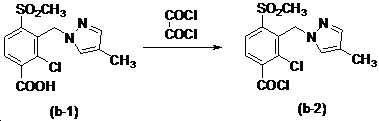
중간체 (b-1) 10 g(0.030 mol)을 칭량하고 250 ml 플라스크에 넣었다. 50 ml의 디클로로에탄을 첨가하고 촉매로서 용액에 DMF를 소량 적하하였다. 이어서, 옥 살릴 클로라이드 5 g(0.039 mol)을 칭량하여 소량의 디클로로에탄에 용해시켰다. 얻어진 용액을 적하 깔때기에 넣고, 실온에서 계 내에 적하하였다. 반응계에 적하 후 실온에서 약 2시간 교반하여 중간체 (b-2) 함유 반응 용액을 얻었다. 반응 용액은 어떠한 처리도 없이 다음 반응에 직접 사용될 수 있다.10 g (0.030 mol) of the intermediate (b-1) was weighed into a 250 ml flask. 50 ml of dichloroethane was added and a small amount of DMF was added dropwise to the solution as a catalyst. Then, 5 g (0.039 mol) of oxalyl chloride was weighed and dissolved in a small amount of dichloroethane. The resulting solution was placed in a dropping funnel and dropped into the system at room temperature. And the mixture was stirred at room temperature for about 2 hours to obtain a reaction solution containing the intermediate (b-2). The reaction solution can be used directly for the next reaction without any treatment.
3 단계: 화합물 b의 합성Step 3: Synthesis of compound b
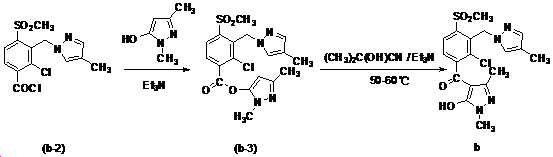
1,3-디메틸-5-피라졸-올 4.0 g(0.036 mol)을 칭량하고 250 ml의 삼구 플라스크에 넣었다. 1,2-디클로로에탄 50 ml를 가하여 용해시켰다. 트리에틸아민 12 g(0.12 mol)을 칭량하여 계 내에 넣었다. 얼음물 수조 조건 및 아르곤 보호 하에서 중간체 (b-2)를 함유하는 반응 용액(0.030 mol)을 한 방울씩 첨가하였다. 1시간 후에 반응을 HPLC로 정착시키고, 원료가 완전히 소비되었을 때 중간체 (b-3)을 함유하는 반응 용액을 수득하였다. 중간체 (b-3)를 함유하는 반응 용액에 트리에틸아민 3.0 g(0.030 mol)과 아세톤 시아노히드린 0.5 ml를 아르곤 보호하의 50 내지 60℃의 조절된 온도에서 첨가하여 2시간 반응시켰고, 상기 반응은 HPLC로 추적하였다. 반응이 완료되었을 때 100 ml의 물을 첨가 한 후, HCl을 한 방울씩 서서히 첨가하였다. 얻어진 혼합물을 pH가 약 3으로 조정될 때까지 실온에서 교반하였다. 수성층은 추출로 제거하였다. 유기층을 물 200ml로 2회 세척하고, 무수 소듐 술페이트로 건조시키고, 회전 증발로 농축시켜 8.1 g의 담갈색 분말 고체, 즉 화합물 b를 얻었다.4.0 g (0.036 mol) of 1,3-dimethyl-5-pyrazol-ol was weighed into a 250 ml three-necked flask. And 50 ml of 1,2-dichloroethane was added to dissolve it. 12 g (0.12 mol) of triethylamine was weighed into the system. The reaction solution (0.030 mol) containing intermediate (b-2) under ice-water bath conditions and under argon protection was added dropwise. After one hour, the reaction was fixed by HPLC, and a reaction solution containing the intermediate (b-3) was obtained when the raw material was completely consumed. 3.0 g (0.030 mol) of triethylamine and 0.5 ml of acetone cyanohydrin were added to the reaction solution containing the intermediate (b-3) at a controlled temperature of 50 to 60 ° C under argon protection, and the reaction was carried out for 2 hours. Was followed by HPLC. When the reaction was complete, 100 ml of water was added and then HCl was slowly added dropwise. The resulting mixture was stirred at room temperature until the pH was adjusted to about 3. The aqueous layer was removed by extraction. The organic layer was washed twice with 200 ml of water, dried over anhydrous sodium sulfate and concentrated by rotary evaporation to obtain 8.1 g of a light brown powdery solid, i. E., Compound b.
4 단계: 화합물 14의 합성Step 4: Synthesis of Compound 14
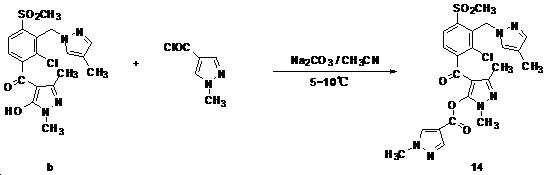
화합물 b 2.2 g(0.005 mol)을 칭량하고 100 ml 플라스크에 넣었다. 아세토 니트릴 20 ml 및 소듐 카보네이트 1.0 g(0.010 mol)을 첨가하여 얼음물 수조 조건하에 교반하였다. 1-메틸피라졸-4-포밀 클로라이드 0.8 g(0.0055 mol)을 칭량하고 아세토니트릴 10 ml에 용해시켰다. 얻어진 용액을 적하 깔대기에 넣고, 얼음물 수조 조건 하에 계 내에 적하하였다. 화합물 b가 완전히 소비될 때까지 반응을 HPLC로 추적하였다. 이어서 물 100 ml 및 에틸아세테이트 100 ml를 첨가하였다. 수성층은 추출로 제거하였다. 유기층을 100 ml의 포화 염 용액으로 2회 세척하고, 무수 소듐 술페이트로 건조시키고, 회전 증발에 의해 농축시켜 농갈색 기름을 얻고, 이를 에탄올 중에서 재결정화하여 2.0 g의 담갈색 분말 고체, 즉 화합물 14를 얻었다. HPLC로 측정한 함량은 94.1%이고, 수율은 70.9%였다.2.2 g (0.005 mol) of compound b was weighed into a 100 ml flask. 20 ml of acetonitrile and 1.0 g (0.010 mol) of sodium carbonate were added and stirred under ice-water bath conditions. 0.8 g (0.0055 mol) of 1-methylpyrazole-4-formyl chloride was weighed and dissolved in 10 ml of acetonitrile. The resulting solution was placed in a dropping funnel and dropped into the system under an ice water bath condition. The reaction was followed by HPLC until compound b was completely consumed. 100 ml of water and 100 ml of ethyl acetate were then added. The aqueous layer was removed by extraction. The organic layer was washed twice with 100 ml of saturated sodium chloride solution, dried over anhydrous sodium sulfate and concentrated by rotary evaporation to give a thick brown oil which was recrystallized in ethanol to yield 2.0 g of a light brown powder solid, . The content determined by HPLC was 94.1% and the yield was 70.9%.
1H NMR 데이터는 표 1로 나타내었다. 1 H NMR data are shown in Table 1.
실시예 15-22은 각각 표 1의 화합물 15 내지 화합물 22의 합성을 제공하였고, 그 합성 방법은 실시예 14의 것과 각각 유사하므로, 그 설명은 여기에 기재되지 않았다.Examples 15-22 provided the synthesis of the compounds 15 to 22 of Table 1, respectively, and the synthesis method thereof was similar to that of Example 14, so that description thereof was not described here.
실시예Example 23 23
실시예는 표 1의 화합물 23에 대한 특정한 합성을 설명하였다. 화합물 23은하기 반응 경로를 통해 합성될 수 있다:The examples illustrate specific syntheses for compound 23 of Table 1. Compound 23 can be synthesized via an electrophilic reaction pathway:
단계 1: 중간체 (b-1)의 합성Step 1: Synthesis of intermediate (b-1)
실시예 14 참조See Example 14
단계 2: 중간체 (b-2)Step 2: Preparation of intermediate (b-2)
실시예 14 참조See Example 14
단계 3: 화합물 c의 합성Step 3: Synthesis of compound c

1-메틸-5-피라졸-올 3.6 g(0.036 mol)을 칭량하고 250 ml의 삼구 플라스크에 첨가하였다. 1,2-디클로로에탄 50 ml를 가하여 용해시켰다. 트리에틸아민 12 g(0.12 mol)을 칭량하고 계내에 첨가하였다. 이 중간체 (b-2) (0.030 mol)를 함유하는 반응 용액을 얼음물 수조 및 아르곤 보호 조건 하에서 계내에 첨가하였다. 반응은 1시간 후 HPLC로 추적하였다. 중간체 (c-1)을 함유하는 반응 용액은 원료가 완전히 소비되었을 때 수득하였다. 트리에틸아민 3.0 g(0.030 mol) 및 아세톤 시아노히드린 0.5 ml를 아르곤 보호하에 50 내지 60℃의 조절된 온도로 중간체 (c-1)를 함유하는 반응 용액에 가하였다. 2시간 후에 HPLC로 반응을 추적하였다. 반응이 완결되었을 때 물 100 ml를 가한 다음, pH가 약 3이 될 때까지 실온에서 교반하면서 천천히 HCl을 한 방울씩 첨가하였다. 수성층은 추출로 제거하였다. 유기층을 물 200 ml로 2회 세척하고, 무수 소듐 술페이트로 건조시키고, 회전 증발로 농축시켜 화합물 c로서 7.9 g의 담갈색 분말 고체를 수득하였다.3.6 g (0.036 mol) of 1-methyl-5-pyrazol-ol was weighed and added to a 250 ml three-necked flask. And 50 ml of 1,2-dichloroethane was added to dissolve it. 12 g (0.12 mol) of triethylamine was weighed and added in the system. The reaction solution containing this intermediate (b-2) (0.030 mol) was added to the system under an ice-water bath and argon-protected conditions. The reaction was followed by HPLC after 1 hour. The reaction solution containing the intermediate (c-1) was obtained when the raw material was completely consumed. 3.0 g (0.030 mol) of triethylamine and 0.5 ml of acetone cyanohydrin were added to the reaction solution containing intermediate (c-1) at a controlled temperature of 50 to 60 캜 under an argon atmosphere. The reaction was followed by HPLC after 2 hours. When the reaction was complete, 100 ml of water was added and then slowly added HCl dropwise with stirring at room temperature until the pH was about 3. The aqueous layer was removed by extraction. The organic layer was washed twice with 200 ml of water, dried over anhydrous sodium sulfate and concentrated by rotary evaporation to give 7.9 g of a light brown powdery solid as compound c.
4 단계: 화합물 23의 합성Step 4: Synthesis of Compound 23

화합물 c 2.1 g(0.005 mol)을 칭량하고 100 ml 플라스크에 첨가하였다. 디클로로메탄 20 ml 및 N,N-디이소프로필에틸아민 1.3 g(0.010 mol)을 가하고, 상기 혼합물을 얼음물 수조 조건 하에서 교반하였다. 1-메틸-5-에톡실 피라졸-4-포밀 클로라이드 1.0 g(0.0055 mol)을 칭량하고, 10ml의 디클로로 메탄에 용해시켰다. 얻은 용액을 적하 깔때기에 넣고, 얼음물 수조 조건 하에 반응계에 적하하였다. 반응은 화합물 c가 완전히 소비될 때까지 HPLC로 추적하였다. 이어서, 물 100 ml 및 디클로로메탄 100 ml를 첨가하였다. 얻어진 수층을 추출로 제거 하였다. 얻어진 유기층을 포화 식염수 100 ml로 2회 세척하고, 무수 소듐 술페이트로 건조한 후, 회전 증발 농축하여 담갈색 고체를 얻었으며, 이를 95% 에탄올로 재결정하여 담황색 분말 고체 1.9 g, 즉 화합물 23을 얻었다. HPLC로 측정 된 함량은 95.1%이고 수율은 64.4%였다.2.1 g (0.005 mol) of compound c were weighed and added to a 100 ml flask. 20 ml of dichloromethane and 1.3 g (0.010 mol) of N, N-diisopropylethylamine were added and the mixture was stirred under an ice-water bath. 1.0 g (0.0055 mol) of 1-methyl-5-ethoxylpyrazole-4-formyl chloride was weighed and dissolved in 10 ml of dichloromethane. The obtained solution was placed in a dropping funnel and added dropwise to the reaction system under ice water bath conditions. The reaction was followed by HPLC until compound c was completely consumed. 100 ml of water and 100 ml of dichloromethane were then added. The obtained aqueous layer was removed by extraction. The obtained organic layer was washed twice with 100 ml of saturated brine, dried over anhydrous sodium sulfate, concentrated by rotary evaporation to obtain a light brown solid which was recrystallized from 95% ethanol to obtain 1.9 g of a pale yellow powdery solid, that is, Compound 23. The content determined by HPLC was 95.1% and the yield was 64.4%.
1H NMR 데이터는 표 1로 나타내었다. 1 H NMR data are shown in Table 1.
실시예 24는 표 1의 화합물 24의 합성을 제공하였고, 그 합성 방법은 실시예 23의 것과 유사하므로, 그 설명은 여기에 기재되지 않았다.Example 24 provided the synthesis of compound 24 of Table 1, and the synthesis method thereof is similar to that of Example 23, and the description thereof is not described here.
실시예 25Example 25
실시예는 표 1의 화합물 25에 대한 특정한 합성을 설명하였다. 화합물 25는하기 반응 경로를 통해 합성될 수 있다:The examples illustrate specific syntheses for compound 25 of Table 1. Compound 25 can be synthesized via the following reaction pathway:

실험 조작:Experimental manipulation:
화합물 d 2.2 g(0.005 mol)을 칭량하여 100 ml 플라스크에 넣고, 아세토니트릴 15 ml와 트리에틸아민 1.0 g(0.010 mol)을 첨가하고, 상기 얻어진 혼합물을 얼음물 수조 조건하에서 교반하였다. 1,3-디메틸피라졸-4-포밀 클로라이드 1.0 g(0.006 mol)을 칭량하고 아세토니트릴 10 ml에 용해시켰다. 용액을 적하 깔때기에 넣고 얼음물 수조 조건하에서 반응계에 적하하였다. 화합물 d가 완전히 소비될 때까지 반응을 HPLC로 추적하였다. 이어서, 물 100 ml 및 아세트산 에틸 100 ml를 첨가하였다. 얻어진 수층은 추출하여 제거하였다. 유기층을 포화 식염수 100 ml로 2회 세척하고, 무수 소듐 술페이트로 건조한 후, 회전 증발 농축하여 담갈색 고체를 얻었으며, 이를 95% 에탄올로 재결정하여 담황색 분말 고체 1.7 g, 즉 화합물 25를 얻었다. HPLC로 측정한 함량은 92.3%이고 수율은 57.6%였다.2.2 g (0.005 mol) of Compound d was weighed into a 100 ml flask, 15 ml of acetonitrile and 1.0 g (0.010 mol) of triethylamine were added, and the obtained mixture was stirred under an ice water bath condition. 1.0 g (0.006 mol) of 1,3-dimethylpyrazole-4-formyl chloride was weighed and dissolved in 10 ml of acetonitrile. The solution was placed in a dropping funnel and added dropwise to the reaction system under ice-water bath conditions. The reaction was followed by HPLC until compound d was completely consumed. Then, 100 ml of water and 100 ml of ethyl acetate were added. The obtained aqueous layer was extracted and removed. The organic layer was washed twice with 100 ml of saturated brine, dried over anhydrous sodium sulfate and then concentrated by rotary evaporation to obtain a light brown solid which was recrystallized from 95% ethanol to obtain 1.7 g of a pale yellow powdery solid, that is, Compound 25. The content determined by HPLC was 92.3% and the yield was 57.6%.
1H NMR 데이터는 표 1로 나타내었다. 1 H NMR data are shown in Table 1.
실시예 26-53은 각각 표 1의 화합물 26 내지 화합물 53의 합성을 제공하고, 그 합성 방법은 실시예 25의 것과 유사하므로 여기에 기재하지 않았다.Examples 26-53 provide the synthesis of the compounds 26 to 53 of Table 1, respectively, and the synthesis method thereof is similar to that of Example 25 and therefore, it is not described here.
실시예 54Example 54
실시예는 표 1의 화합물 54에 대한 합성을 설명하였다. 화합물 54는 하기 반응 경로를 통해 합성될 수 있다:The examples illustrate the synthesis for compound 54 of Table 1. Compound 54 can be synthesized via the following reaction pathway:
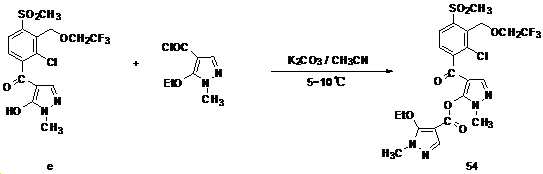
실험 조작Experimental manipulation
화합물 e 2.4 g(0.005 mol)을 칭량하여 100 ml 플라스크에 넣고, 아세토니트릴 20 ml와 탄산칼륨 1.4 g(0.010 mol)을 첨가한 후 상기 얻어진 혼합물을 얼음물 수조 조건 하에서 교반하였다. 1-메틸-5-에톡실 피라졸-4-포밀 클로라이드 1.0 g(0.0055 mol)을 칭량하고 아세토 니트릴 10 ml에 용해시켰다. 용액을 적하 깔때기에 넣고 얼음물 수조 조건하에서 반응계에 적하하였다. 화합물은 화합물 e가 완전히 소비될 때까지 HPLC로 추적하였다. 이어서, 물 100 ml 및 아세트산 에틸 100 ml를 첨가하였다. 얻어진 수층을 추출로 제거하였다. 얻어진 유기층을 포화 식염수 100 ml로 2회 세척하고, 무수 소듐 술페이트로 건조한 후, 회전 증발 농축하여 농갈색 고체를 얻었으며, 95% 에탄올로 재결정하여 황색 분말 고체 2.1 g, 즉 화합물 54를 얻었다. HPLC로 측정한 함량은 94.3%이고 수율은 68.3%였다.2.4 g (0.005 mol) of Compound e was weighed into a 100 ml flask, and 20 ml of acetonitrile and 1.4 g (0.010 mol) of potassium carbonate were added, and the resulting mixture was stirred under an ice water bath condition. 1.0 g (0.0055 mol) of 1-methyl-5-ethoxylpyrazole-4-formyl chloride was weighed and dissolved in 10 ml of acetonitrile. The solution was placed in a dropping funnel and added dropwise to the reaction system under ice-water bath conditions. The compound was followed by HPLC until compound e was completely consumed. Then, 100 ml of water and 100 ml of ethyl acetate were added. The obtained aqueous layer was removed by extraction. The obtained organic layer was washed twice with 100 ml of saturated brine, dried over anhydrous sodium sulfate, concentrated by rotary evaporation to obtain a thick brown solid, and recrystallized from 95% ethanol to obtain 2.1 g of a yellow powder solid, that is, Compound 54. [ The content determined by HPLC was 94.3% and the yield was 68.3%.
1H NMR 데이터는 표 1로 나타내었다. 1 H NMR data are shown in Table 1.
실시예 55-59는 각각 표 1의 화합물 55 내지 화합물 59의 합성을 제공하고, 그 합성 방법은 실시예 54의 것과 유사하므로, 여기에 기재하지 않았다.Examples 55-59 provide the synthesis of compounds 55 to 59 of Table 1, respectively, and the method of synthesis thereof is similar to that of Example 54, so it is not described here.
실시예 60Example 60
실시예는 표 1의 화합물 60에 대한 합성을 설명하였다. 화합물 60은 하기 반응 경로를 통해 합성될 수 있다:The examples illustrate the synthesis for compound 60 of Table 1. Compound 60 can be synthesized via the following reaction pathway:

실험 조작Experimental manipulation
화합물 f 2.1 g(0.005 mol)을 칭량하여 100 ml 플라스크에 넣고, 이후 디클로로메탄 20 ml와 N,N-디이소프로필에틸아민 1.3 g(0.010 mol)을 가하고, 상기 얻어진 혼합물을 얼음물 수조 조건 하에서 교반하였다. 1-메틸 피라졸-4-포밀 클로라이드 0.8 g(0.0055 mol)을 칭량하여 10 ml의 디클로로메탄에 용해시켰다. 얻어진 용액을 적하 깔때기에 넣고 얼음물 수조 조건 하에서 반응계에 적하하였다. 화합물 f가 완전히 소비될 때까지 반응을 HPLC로 정착시켰다. 이어서 물 100 ml 및 디클로로메탄 100 ml를 첨가하였다. 얻어진 수층을 추출로 제거하였다. 얻어진 유기층을 포화 식염수 100 ml로 2회 세척하고, 무수 소듐 술페이트로 건조한 후, 회전 증발 농축하여 농갈색 고체를 얻고, 95% 에탄올로 재결정하여 담갈색 분말 2.1 g, 즉 화합물 60을 얻었다. HPLC로 측정 한 함량은 95.7%이고 수율은 76.6%였다.2.1 g (0.005 mol) of the compound f was weighed and placed in a 100 ml flask. Then, 20 ml of dichloromethane and 1.3 g (0.010 mol) of N, N-diisopropylethylamine were added and the mixture was stirred under an ice- Respectively. 0.8 g (0.0055 mol) of 1-methylpyrazole-4-formyl chloride was weighed and dissolved in 10 ml of dichloromethane. The obtained solution was placed in a dropping funnel and added dropwise to the reaction system under an ice water bath condition. The reaction was settled by HPLC until compound f was completely consumed. 100 ml of water and 100 ml of dichloromethane were then added. The obtained aqueous layer was removed by extraction. The obtained organic layer was washed twice with 100 ml of saturated aqueous sodium chloride solution, dried over anhydrous sodium sulfate, concentrated by rotary evaporation to obtain a dark brown solid, and recrystallized from 95% ethanol to obtain 2.1 g of a pale brown powder, that is, Compound 60. The content determined by HPLC was 95.7% and the yield was 76.6%.
1H NMR 데이터는 표 1로 나타내었다. 1 H NMR data are shown in Table 1.
실시예 61-75는 각각 표 1의 화합물 61 내지 화합물 75의 합성을 각각 제공하고, 그 합성 방법은 실시예 60의 것과 유사하므로, 여기에 기재하지 않았다.Examples 61-75 respectively provide the syntheses of the compounds 61 to 75 of Table 1, respectively, and the synthesis method thereof is similar to that of Example 60, so it is not described here.
실시예 76Example 76
실시예는 표 1의 화합물 76에 대한 합성을 설명하였다. 화합물 76은 하기 반응 경로를 통해 합성될 수 있다:The examples illustrate the synthesis for compound 76 of Table 1. Compound 76 can be synthesized via the following reaction pathway:

실험 조작Experimental manipulation
화합물 g 1.9 g(0.005 mol)을 칭량하여 100 ml 플라스크에 넣고, 테트라하이드로퓨란 20ml와 트리에틸아민 1.0 g(0.010 mol)을 가하고, 상기 얻어진 혼합물을 얼음물 수조 조건 하에서 교반하였다. 1,3-디메틸 피라졸-4-포르밀 클로라이드 0.9 g(0.0055 mol)을 칭량하여 테트라히드로푸란 10 ml에 용해시켰다. 얻어진 용액을 적하 깔때기에 넣고 얼음물 수조 조건 하에서 반응계에 적하하였다. 화합물 g이 완전히 소비될 때까지 반응을 HPLC로 추적하였다. 이어서 물 100 ml 및 에틸 아세테이트 100 ml를 첨가하였다. 얻어진 수층을 추출로 제거하였다. 얻어진 유기층을 포화 식염수 100 ml로 2 회 세척하고, 무수 소듐 술페이트로 건조한 후, 회전 증발 농축하여 갈색 고체를 얻고, 95% 에탄올로 재결정하여 담갈색 분말 고체, 즉 화합물 76을 얻었다. HPLC로 측정 한 함량은 96.2%이고 수율은 69.4%였다.1.9 g (0.005 mol) of the compound g was weighed, placed in a 100 ml flask, 20 ml of tetrahydrofuran and 1.0 g (0.010 mol) of triethylamine were added, and the obtained mixture was stirred under an ice water bath condition. 0.9 g (0.0055 mol) of 1,3-dimethylpyrazole-4-formyl chloride was weighed and dissolved in 10 ml of tetrahydrofuran. The obtained solution was placed in a dropping funnel and added dropwise to the reaction system under an ice water bath condition. The reaction was followed by HPLC until compound g was completely consumed. 100 ml of water and 100 ml of ethyl acetate were then added. The obtained aqueous layer was removed by extraction. The obtained organic layer was washed twice with 100 ml of saturated aqueous sodium chloride solution, dried over anhydrous sodium sulfate, concentrated by rotary evaporation to obtain a brown solid, and recrystallized from 95% ethanol to obtain a pale brown powdery solid, The content determined by HPLC was 96.2% and the yield was 69.4%.
1H NMR 데이터는 표 1로 나타내었다. 1 H NMR data are shown in Table 1.
실시예 77-81는 표 1의 화합물 77 내지 화합물 81의 합성을 각각 제공하고, 그 합성 방법은 실시예 76의 것과 유사하므로, 여기에 기재하지 않았다.Examples 77-81 provide the synthesis of the compounds 77 to 81 of Table 1, respectively, and the synthesis method thereof is similar to that of Example 76, so it is not described here.
실시예Example 82 82
실시예는 표 1의 화합물 82에 대한 합성을 설명하였다. 화합물 82은 하기 반응 경로를 통해 합성될 수 있다:The examples illustrate the synthesis for compound 82 of Table 1. Compound 82 can be synthesized via the following reaction pathway:
단계 1: 중간체 (h-1)의 합성Step 1: Synthesis of intermediate (h-1)

아세토니트릴 50 ml를 칭량하고 250 ml의 삼구 플라스크에 넣었다. 플라스크를 5 내지 10℃의 온도로 조절하기 위해 얼음물 수조에 두었다. NaH 4.4 g(0.11 mol)을 칭량하여 10℃ 이하의 조절된 온도에서 플라스크에 천천히 첨가하였다. 이어서 4-클로로 피라졸 4.6 g(0.045 mol)을 아세토니트릴 소량에 용해시키고, 얻은 용액을 적하 깔때기에 넣고 반응계의 온도가 약 0℃의 저온이 되면 반응계에 한 방울씩 적하하였다. 적하 후 얼음물 수조 조건 하에서 반응계의 교반을 계속하였다. 계의 온도가 안정한 경우, 2-메틸-3-브로모메틸-4메틸 술포닐 벤조산 10 g(0.034 mol)을 칭량하고 얼음물 수조 조건 하에서 교반하여 10℃ 이하로 조절된 온도에서 일괄적으로 반응계에 천천히 첨가하였다. 원료가 완전히 소비될 때까지 반응을 HPLC로 추적하였다. 회전 증발을 통해 아세토니트릴을 제거하였다. 수득된 잔류물에 물 200 ml를 가한 다음, HCl을 서서히 한 방울씩 적하하고 실온에서 교반하여 고체 입자를 침전시켰다. 황백색 고체, 즉 중간체 (h-1)는, 흡입 여과에 의해 수득되었다. 상기 중간체는 이후 사용하기 위해 건조 오븐에 넣었다.50 ml of acetonitrile was weighed and placed in a 250 ml three-necked flask. The flask was placed in an ice-water bath to adjust the temperature to 5-10 ° C. 4.4 g (0.11 mol) of NaH were weighed and slowly added to the flask at a controlled temperature below 10 < 0 > C. Then, 4.6 g (0.045 mol) of 4-chloropyrazole was dissolved in a small amount of acetonitrile, and the resulting solution was added to a dropping funnel. When the temperature of the reaction system reached a low temperature of about 0 ° C, the solution was added dropwise to the reaction system. Stirring of the reaction system was continued under ice water bath conditions after dropwise addition. When the temperature of the system was stable, 10 g (0.034 mol) of 2-methyl-3-bromomethyl-4-methylsulfonylbenzoic acid was weighed and stirred under an ice water bath condition. Slowly added. The reaction was followed by HPLC until the feed was completely consumed. The acetonitrile was removed by rotary evaporation. 200 ml of water was added to the obtained residue, and then HCl was slowly added dropwise to the residue, followed by stirring at room temperature to precipitate the solid particles. The yellowish white solid, i.e., intermediate (h-1), was obtained by suction filtration. The intermediate was placed in a drying oven for later use.
단계 2 : 중간체 (h-2)의 합성Step 2: Synthesis of intermediate (h-2)
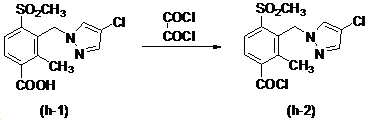
중간체 (h-1) 10.5 g(0.030 mol)을 칭량하고 250 ml 플라스크에 첨가한 후, 디클로로에탄 50 ml를 첨가하고, 촉매로서 DMF 몇 방울을 첨가하였다. 이어서, 옥 살릴 클로라이드 5 g(0.039 mol)을 소량의 디클로로에탄에 용해시키고, 수득된 용액을 적하 깔때기에 넣고 실온에서 반응계에 적하하였다. 적하 후 반응계를 실온에서 약 2시간 계속해서 교반하고 중간체 (h-2) 함유 반응 용액을 얻었다. 반응 용액은 어떠한 처리도 없이 다음 반응에 직접 사용될 수있다.10.5 g (0.030 mol) of intermediate (h-1) was weighed and added to a 250 ml flask, followed by addition of 50 ml of dichloroethane and a few drops of DMF as catalyst. Subsequently, 5 g (0.039 mol) of oxalyl chloride was dissolved in a small amount of dichloroethane, and the resulting solution was added to a dropping funnel and added dropwise to the reaction system at room temperature. After the dropwise addition, the reaction system was continuously stirred at room temperature for about 2 hours to obtain a reaction solution containing the intermediate (h-2). The reaction solution can be used directly for the next reaction without any treatment.
3 단계 : 화합물 h의 합성Step 3: Synthesis of compound h
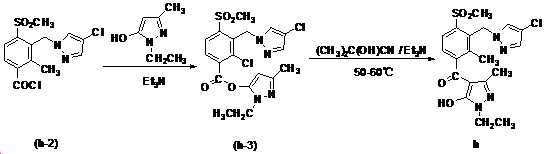
1-에틸-3-메틸-5-피라졸-4-올 4.5 g(0.036 mol)을 칭량하고 250 ml 삼구 플라스크에 넣었다. 1,2-디클로로에탄 50 ml를 가하여 용해시켰다. 트리에틸아민 12 g(0.012 mol)을 칭량하고 계내에 첨가하였다. 중간체 (h-2)를 함유하는 반응 용액(0.030 mol)을 아르곤 보호 하에서 얼음물 수조 조건 하에서 계내에 적하하였다. 반응은 1시간 후 HPLC로 추적하였다. 중간체 (h-3)을 함유하는 반응 용액은 원료가 완전히 소비되었을 때 얻었다. 아르곤 보호 하에서 40 내지 50℃로 조절된 온도에서 중간체 (h-3)를 함유하는 반응 용액에 트리에틸아민 3.0 g(0.030 mol) 및 아세톤 시아노히드린 0.5 ml을 첨가하였다. 2시간 후에 HPLC로 상기 반응을 추적하였다. 반응이 완료되었을 때 물 100 ml를 첨가 한 후, pH가 약 3으로 조정될 때까지 실온에서 교반하면서 천천히 HCl를 한 방울씩 첨가하였다. 얻어진 수층을 추출로 제거 하였다. 얻어진 유기층을 물 200 ml로 2회 세척하고, 무수 소듐 술페이트로 건조시키고, 회전 증발로 농축시켜, 6.7g의 농갈색 분말 고체, 즉 화합물 h를 얻었다.4.5 g (0.036 mol) of 1-ethyl-3-methyl-5-pyrazol-4-ol were weighed and placed in a 250 ml three-necked flask. And 50 ml of 1,2-dichloroethane was added to dissolve it. 12 g (0.012 mol) of triethylamine were weighed and added in-situ. The reaction solution (0.030 mol) containing the intermediate (h-2) was dripped into the system under an argon-protected ice water bath condition. The reaction was followed by HPLC after 1 hour. The reaction solution containing the intermediate (h-3) was obtained when the raw material was completely consumed. 3.0 g (0.030 mol) of triethylamine and 0.5 ml of acetone cyanohydrin were added to the reaction solution containing intermediate (h-3) at a temperature controlled at 40 to 50 ° C under argon protection. The reaction was followed by HPLC after 2 hours. When the reaction was complete, 100 ml of water was added, and HCl was slowly added slowly with stirring at room temperature until the pH was adjusted to about 3. The obtained aqueous layer was removed by extraction. The obtained organic layer was washed twice with 200 ml of water, dried over anhydrous sodium sulfate and concentrated by rotary evaporation to obtain 6.7 g of a dark brown powdery solid, i.e., compound h.
4 단계: 화합물 82의 합성Step 4: Synthesis of Compound 82

화합물 h 2.2 g(0.005 mol)을 칭량하여 100 ml 플라스크에 넣은 후, 1,2-디클로로에탄 20 ml와 N,N-디이소프로필에틸아민 1.3 g(0.010 mol)을 첨가하여 얼음물 수조 조건 하에서 교반하였다. 1-메틸-5-에톡실 피라졸-4-포밀 클로라이드 1.0 g(0.0055 mol)을 칭량하고 1,2-디클로로에탄 10 ml에 용해시켰다. 얻어진 용액을 적하 깔때기에 넣고 얼음물 수조 조건 하에서 반응계에 적하하였다. 화합물 h가 완전히 소비될 때까지 반응을 HPLC로 추적하였다. 이어서 물 100 ml 및 디클로로메탄 100 ml를 첨가하였다. 얻어진 수층을 추출로 제거하였다. 얻어진 유기층을 포화 식염수 100 ml로 2회 세척하고, 무수 소듐 술페이트로 건조한 후, 회전 증발로 농축시켜 담갈색 고체를 얻고, 95% 에탄올로 재결정하여 1.9g의 황색 분말 고체, 즉 화합물 82를 얻었다. HPLC로 측정된 함량은 93.8%이고 수율은 62.0%이었다.2.2 g (0.005 mol) of the compound h was weighed into a 100 ml flask, and then 20 ml of 1,2-dichloroethane and 1.3 g (0.010 mol) of N, N-diisopropylethylamine were added thereto and stirred under ice- Respectively. 1.0 g (0.0055 mol) of 1-methyl-5-ethoxylpyrazole-4-formyl chloride was weighed and dissolved in 10 ml of 1,2-dichloroethane. The obtained solution was placed in a dropping funnel and added dropwise to the reaction system under an ice water bath condition. The reaction was followed by HPLC until compound h was completely consumed. 100 ml of water and 100 ml of dichloromethane were then added. The obtained aqueous layer was removed by extraction. The obtained organic layer was washed twice with 100 ml of saturated brine, dried over anhydrous sodium sulfate and concentrated by rotary evaporation to obtain a light brown solid which was recrystallized from 95% ethanol to obtain 1.9 g of a yellow powdery solid, that is, Compound 82. [ The content determined by HPLC was 93.8% and the yield was 62.0%.
1H NMR 데이터는 표 1로 나타내었다. 1 H NMR data are shown in Table 1.
실시예 83-87은 표 1의 화합물 83 내지 화합물 87의 합성을 각각 제공하고, 그 합성 방법은 실시예 82의 것과 유사하므로, 여기에 기재하지 않았다.Examples 83-87 provide the syntheses of the compounds 83 to 87 of Table 1, respectively, and the synthesis method thereof is similar to that of Example 82, and therefore, it is not described here.
실시예 88Example 88
실시예는 표 1의 화합물 88에 대한 합성을 설명하였다. 화합물 88은 하기 반응 경로를 통해 합성될 수 있다:The examples illustrate the synthesis for 88 of Table 1. Compound 88 can be synthesized via the following reaction pathway:
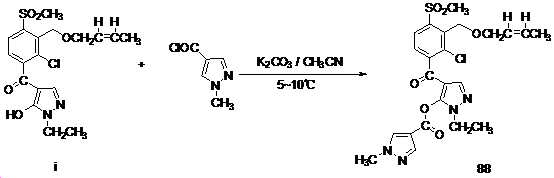
실험 조작Experimental manipulation
화합물 i 2.1 g(0.005 mol)을 칭량하고 아세토니트릴 20 ml 및 포타슘 카보네이트 1.4 g(0.010 mol)을 첨가하여 100 ml 플라스크에 넣었다. 얻어진 혼합물을 얼음물 수조 조건 하에서 교반하였다. 1-메틸 피라졸-4-포밀 클로라이드 0.8 g(0.0055 mol)을 칭량하고 아세토니트릴 10 ml에 용해시켰다. 얻어진 용액을 적하 깔때기에 넣고 얼음물 수조 조건 하에서 반응계에 적하하였다. 화합물 i가 완전히 소비될 때까지 반응을 HPLC로 추적하였다. 이어서, 물 100 ml 및 에틸 아세테이트 100 ml를 첨가하였다. 얻어진 수층을 추출로 제거하였다. 얻어진 유기층을 포화 식염수 100 ml로 2회 세척하고, 무수 소듐 술페이트로 건조시키고, 회전 증발로 농축시켜 농갈색의 고체를 얻고, 이를 95% 에탄올에서 재결정화하여 1.6 g의 갈색 분말 고체, 즉 화합물 88을 얻었다. HPLC로 측정한 함량은 90.6%이고 수율은 57.2%이었다.2.1 g (0.005 mol) of compound i was weighed and 20 ml of acetonitrile and 1.4 g (0.010 mol) of potassium carbonate were added and placed in a 100 ml flask. The resulting mixture was stirred under ice-water bath conditions. 0.8 g (0.0055 mol) of 1-methylpyrazole-4-formyl chloride was weighed and dissolved in 10 ml of acetonitrile. The obtained solution was placed in a dropping funnel and added dropwise to the reaction system under an ice water bath condition. The reaction was followed by HPLC until compound i was completely consumed. 100 ml of water and 100 ml of ethyl acetate were then added. The obtained aqueous layer was removed by extraction. The organic layer obtained was washed twice with 100 ml of saturated brine, dried over anhydrous sodium sulfate and concentrated by rotary evaporation to give a thick brown solid which was recrystallized from 95% ethanol to yield 1.6 g of a brown powder solid, 88. The content determined by HPLC was 90.6% and the yield was 57.2%.
1H NMR 데이터는 표 1로 나타내었다. 1 H NMR data are shown in Table 1.
실시예 89-95는 표 1의 화합물 89 내지 화합물 95의 합성을 각각 제공하고, 그 합성 방법은 실시예 88의 것과 유사하므로, 여기에 기재하지 않았다.Examples 89-95 each provide the synthesis of compounds 89 to 95 of Table 1, respectively, and the synthesis method thereof is similar to that of Example 88, so it is not described here.
실시예 96Example 96
실시예는 표 1의 화합물 96에 특이적인 합성을 설명하였다. 화합물 96은 하기 반응 경로를 통해 합성될 수 있다:The examples illustrate the synthesis specific for compound 96 of Table 1. Compound 96 can be synthesized via the following reaction pathway:

실험 조작Experimental manipulation
화합물 j 2.2 g(0.005 mol)을 칭량하여 100 ml 플라스크에 넣고, 아세토니트릴 20 ml와 포타슘 카보네이트 1.4 g(0.010 mol)을 첨가하였다. 얻어진 혼합물을 얼음물 수조 조건 하에서 교반하였다. 1,3-디메틸 피라졸-4-포르밀 클로라이드 0.95 g(0.006 mol)을 칭량하여 아세토니트릴 10 ml에 용해시켰다. 얻어진 용액을 적하 깔때기에 넣고 얼음물 수조 조건 하에서 반응계에 적하하였다. 화합물 j가 완전히 소비될 때까지 반응을 HPLC로 추적하였다. 이어서 물 100 ml 및 에틸 아세테이트 100 ml를 첨가하였다. 얻어진 수층을 추출로 제거하였다. 얻어진 유기층을 포화 식염수 100 ml로 2회 세척하고, 무수 소듐 술페이트로 건조시키고, 회전 증발로 농축시켜 농갈색의 고체를 수득하고, 이를 95% 에탄올에서 재결정화하여 1.6 g의 갈색 분말 고체, 즉 화합물 96을 얻었다. HPLC로 측정된 함량은 94.7%이고 수율은 53.8%이었다.2.2 g (0.005 mol) of compound j was weighed into a 100 ml flask, and 20 ml of acetonitrile and 1.4 g (0.010 mol) of potassium carbonate were added. The resulting mixture was stirred under ice-water bath conditions. 0.95 g (0.006 mol) of 1,3-dimethylpyrazole-4-formyl chloride was weighed and dissolved in 10 ml of acetonitrile. The obtained solution was placed in a dropping funnel and added dropwise to the reaction system under an ice water bath condition. The reaction was followed by HPLC until compound j was completely consumed. 100 ml of water and 100 ml of ethyl acetate were then added. The obtained aqueous layer was removed by extraction. The resulting organic layer was washed twice with 100 ml of saturated brine, dried over anhydrous sodium sulfate and concentrated by rotary evaporation to give a thick brown solid which was recrystallized from 95% ethanol to yield 1.6 g of a brown powder solid, Compound 96 was obtained. The content determined by HPLC was 94.7% and the yield was 53.8%.
1H NMR 데이터는 표 1로 나타내었다. 1 H NMR data are shown in Table 1.
실시예 97-101은 화합물 97 내지 화합물 101의 합성을 각각 제공하고, 그 합성 방법은 실시예 96의 것과 유사하므로, 여기에 기재하지 않았다.Examples 97-101 provide synthesis of compounds 97 to 101, respectively, and the synthesis method thereof is similar to that of Example 96, so it is not described here.
실시예 102Example 102
실시예는 표 1의 화합물 102에 특이적인 합성을 설명하였다. 화합물 102는 하기 반응 경로를 통해 합성될 수 있다:The examples illustrate the synthesis specific for compound 102 of Table 1. Compound 102 can be synthesized via the following reaction pathway:

실험 조작Experimental manipulation
화합물 k 2.0 g(0.005 mol)을 칭량하여 100 ml 플라스크에 넣고, 아세토니트릴 20 ml과 트리에틸아민 1.0 g(0.010 mol)을 첨가하였다. 얻어진 혼합물을 얼음물 수조 조건 하에서 교반하였다. 1-메틸-4-클로로 피라졸-3-포밀 클로라이드 1.0 g(0.0055 mol)을 칭량하여 아세토니트릴 10 ml에 용해시켰다. 얻어진 용액을 적하 깔때기에 넣고 얼음물 수조 조건 하에서 반응계에 적하하였다. 화합물 k가 완전히 소비될 때까지 반응을 HPLC로 추적하였다. 이어서 물 100 ml 및 에틸 아세테이트 100 ml를 첨가하였다. 얻어진 수층을 추출로 제거하였다. 얻어진 유기층을 포화 식염수 100 ml로 2회 세척하고, 무수 소듐 술페이트로 건조시키고, 회전 증발로 농축시켜 갈색 고체를 얻었고, 이를 95% 에탄올로 재결정화하여 1.8 g의 담갈색 분말, 즉 화합물 102를 얻었다. HPLC에 의해 측정된 함량은 96.2%이고 수율은 62.8%이었다.2.0 g (0.005 mol) of compound k was weighed into a 100 ml flask, and 20 ml of acetonitrile and 1.0 g (0.010 mol) of triethylamine were added. The resulting mixture was stirred under ice-water bath conditions. 1.0 g (0.0055 mol) of 1-methyl-4-chloropyrazole-3-formyl chloride was weighed and dissolved in 10 ml of acetonitrile. The obtained solution was placed in a dropping funnel and added dropwise to the reaction system under an ice water bath condition. The reaction was followed by HPLC until compound k was completely consumed. 100 ml of water and 100 ml of ethyl acetate were then added. The obtained aqueous layer was removed by extraction. The organic layer obtained was washed twice with 100 ml of saturated brine, dried over anhydrous sodium sulfate and concentrated by rotary evaporation to give a brown solid which was recrystallized from 95% ethanol to give 1.8 g of a pale brown powder, Compound 102 . The content determined by HPLC was 96.2% and the yield was 62.8%.
1H NMR 데이터는 표 1로 나타내었다. 1 H NMR data are shown in Table 1.
실시예 103-104는 표 1의 화합물 103 내지 화합물 104의 합성을 각각 제공하고, 그 합성 방법은 실시예 102의 것과 유사하므로, 여기에 기재하지 않았다.Examples 103-104 each provide the synthesis of compounds 103 to 104 of Table 1, respectively, and the synthesis method thereof is similar to that of Example 102, so it is not described here.
실시예 105Example 105
실시예는 표 1의 화합물 105에 특이적인 합성을 설명하였다. 화합물 105는 하기 반응 경로를 통해 합성될 수 있다:The examples illustrate the synthesis specific for compound 105 of Table 1. Compound 105 can be synthesized via the following reaction pathway:
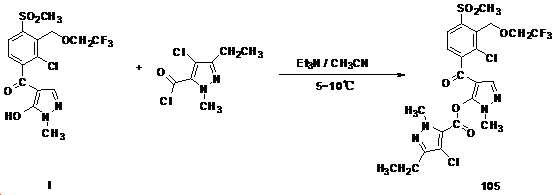
실험 조작Experimental manipulation
화합물 l 2.1 g(0.005 mol) 을 칭량하여 100 ml 플라스크에 넣고, 아세토니트릴 15 ml 및 트리에틸아민 1.0 g(0.010 mol)을 첨가하였다. 얻어진 반응 혼합물을 얼음물 수조 조건 하에서 교반하였다. 1-메틸-3-에틸-4-클로로 피라졸-5-포밀 클로라이드 1.2 g(0.006 mol)을 칭량하여 아세토니트릴 10 ml에 용해시켰다. 얻어진 용액을 적하 깔때기에 넣고 얼음물 수조 조건 하에서 반응계에 적하하였다. 화합물 l이 완전히 소비될 때까지 반응을 HPLC로 추적하였다. 이어서 물 100 ml 및 에틸 아세테이트 100 ml를 첨가하였다. 얻어진 수층을 추출로 제거하였다. 얻어진 유기층을 100 ml의 포화 식염수로 2회 세척하고, 무수 소듐 술페이트로 건조시키고, 회전 증발에 의해 농축시켜 담갈색 고체를 얻고, 이를 95% 에탄올에서 재결정화하여 1.7 g의 담황색 분말 고체, 즉 화합물 105를 얻었다. HPLC로 측정한 함량은 95.3%이고 수율은 54.2%이었다.2.1 g (0.005 mol) of compound l was weighed into a 100 ml flask, and 15 ml of acetonitrile and 1.0 g (0.010 mol) of triethylamine were added. The resulting reaction mixture was stirred under ice-water bath conditions. 1.2 g (0.006 mol) of 1-methyl-3-ethyl-4-chloropyrazole-5-formyl chloride was weighed and dissolved in 10 ml of acetonitrile. The obtained solution was placed in a dropping funnel and added dropwise to the reaction system under an ice water bath condition. The reaction was followed by HPLC until Compound 1 was completely consumed. 100 ml of water and 100 ml of ethyl acetate were then added. The obtained aqueous layer was removed by extraction. The resulting organic layer was washed twice with 100 ml of saturated brine, dried over anhydrous sodium sulfate and concentrated by rotary evaporation to give a light brown solid which was recrystallized from 95% ethanol to yield 1.7 g of a light yellow powder solid, 105 was obtained. The content determined by HPLC was 95.3% and the yield was 54.2%.
1H NMR 데이터는 표 1로 나타내었다. 1 H NMR data are shown in Table 1.
실시예 106-107은 표 1의 화합물 106 내지 화합물 107의 합성을 각각 제공하고, 그 합성 방법은 실시예 105의 것과 유사하므로, 여기에 기재하지 않았다.Examples 106-107 provide synthesis of compounds 106 to 107, respectively, of Table 1, and the synthesis method thereof is similar to that of Example 105, so it is not described here.
생물학적 활동 평가:Biological Activity Assessment:
유해 식물 파괴(즉, 성장 억제율)의 활동 레벨 표준은 다음과 같다 :Activity level standards for harmful plant destruction (ie growth inhibition rates) are as follows:
레벨 10 : 완전히 사멸;Level 10: Complete destruction;
레벨 9 : 성장 억제율 90% 이상;Level 9: Growth inhibition rate 90% or higher;
레벨 8 : 성장 억제율 80% 이상;Level 8: 80% or more growth inhibition rate;
레벨 7 : 성장 억제율 70% 이상;Level 7: growth inhibition rate of 70% or higher;
레벨 6 : 성장 억제율 60% 이상;Level 6: growth inhibition rate of 60% or more;
레벨 5 : 성장 억제율 50% 이상;Level 5: growth inhibition rate of 50% or higher;
레벨 4 : 성장 억제율 30% 이상;Level 4: growth inhibition rate of 30% or more;
레벨 3 : 성장 억제율 20% 이상;Level 3: growth inhibition rate of 20% or more;
레벨 2 : 성장 억제율 10% 이상;Level 2: growth inhibition rate of 10% or more;
레벨 1 : 성장 억제율 1-10% 이상;Level 1: Growth inhibition rate 1-10% or higher;
레벨 0 : 효과 없음Level 0: No effect
상기 공지된 성장 조절 비율은 생체중 조절 비율이다.The known growth control ratio is a fresh weight control ratio.
발아-후 시험 실험: 토양이 채워진 플라스틱 포트에 단자엽 및 쌍자엽 잡초 종자 및 주요 작물 종자(즉, 밀, 옥수수, 쌀, 콩, 면화, 오일시드, 기장 및 수수)를 넣었다. 이어서 0.5-2 cm 토양으로 덮어, 종자를 좋은 온실 환경에서 자라게 했다. 파종 2-3주 후 2-3번 잎 단계에서 시험 식물에 처리하였다. 본 발명의 시험 화합물을 각각 아세톤으로 용해시킨 다음, 80 트윈을 첨가하고 특정한 양의 물에 의해 특정 농도로 희석시켰다. 상기 용액을 분무기로 식물에 분무하였다. 이후 상기 식물을 온실에서 3주 동안 배양하였다. 3주 후 잡초 방제 효과에 대한 실험 결과를 표 2에 나타내었다.Germination Tests: Potted and dicot weed seeds and major crop seeds (ie, wheat, corn, rice, soybeans, cotton, oilseed, millet and sorghum) were placed in a plastic pot filled with soil. It was then covered with 0.5-2 cm soil, allowing the seed to grow in a good greenhouse environment. After 2-3 weeks of sowing, the test plants were treated at 2-3 leaf stage. Test compounds of the invention were each dissolved in acetone and then 80 twin was added and diluted to a certain concentration with a certain amount of water. The solution was sprayed onto the plants with an atomizer. The plants were then incubated in the greenhouse for 3 weeks. Experimental results on the effect of weed control after 3 weeks are shown in Table 2.
표 2: 발아-후 단계에서의 잡초 방제 효과 실험Table 2: Effects of weed control effect on germination
순번compound
turn
발아-전 단계에서의 잡초 효과 실험Weed effects on germination - pre-stage
단자엽 및 쌍자엽 잡초 및 주요 작물의 종자(예를 들어 밀, 옥수수, 쌀, 콩, 면화, 오일시드, 기장 및 수수)를 토양이 채워진 플라스틱 포트에 넣고 0.5-2 cm의 토양으로 덮었다. 본 발명의 시험 화합물을 아세톤으로 용해시킨 다음, 트윈 80을 첨가하고, 일정량의 물로 희석하여 일정 농도가 되게 하고, 파종 직후에 분무하였다. 얻어진 종자를 분무 후 온실에서 4주 동안 배양하였다. 시험 결과는 3주 후에 관찰되었다. 제초제는 주로 250 g/ha의 적용 비율, 특히 피(Echinochloa crus-galli), 바랭이(digitaria sanguinalis) 및 어저귀(abutilon theophrasti)와 같은 잡초에 탁월한 효과가 있음이 관찰되었다. 많은 화합물은 옥수수, 밀, 쌀, 콩, 오일시드 등에 대해 우수한 선택성을 보였다.Monocots and dicotyledonous weeds and seeds of major crops (eg wheat, corn, rice, soybeans, cotton, oilseed, millet and millet) were placed in plastic pots filled with soil and covered with 0.5-2 cm soil. The test compound of the present invention was dissolved in acetone, then Tween 80 was added, diluted with a certain amount of water to a certain concentration, and sprayed immediately after sowing. The obtained seeds were sprayed and cultured in a greenhouse for 4 weeks. Test results were observed after 3 weeks. Herbicides were observed to have an excellent effect mainly on weeds such as echinochloa crus-galli, digitaria sanguinalis and abutilon theophrasti, at application rates of mainly 250 g / ha. Many compounds showed excellent selectivity for corn, wheat, rice, soybeans, oilseeds, and the like.
벼 밭으로부터 이식된 벼의 안전성 평가 및 잡초 방제 효과 평가:Evaluation of Safety and Weed Control Effect of Rice Transplanted from Rice Fields:
벼 밭의 토양은 1/1,000,000 ha의 포트에 적재하였다. 피, 고랭이, 가막사리 및 벗풀의 씨를 뿌리고 토양으로 부드럽게 덮은 다음, 물 저장 0.5-1 cm의 상태로 온실에 두었다. 벗풀(Sagittaria trifolia)의 결절은 다음 날 또는 2일 후에 심었다. 그것은 물 저장 3-4 cm으로 그 후 유지하였다. 잡초는 본 발명의 화합물의 통상적인 제조 방법에 따라 제조된 WP 또는 SC 수성 희석액을 파이펫으로 균등하게 적하하여 피, 고랭이, 가막사리가 0.5 잎 단계 및 벗풀이 1차 잎 단계의 시점에 도달했을 때 특정 유효량을 얻도록 처리하였다.The soil of rice field was loaded in a port of 1 / 1,000,000 ha. Blood, high-calorie, broad-leaved sage and bamboo shoots were seeded, gently covered with soil, and placed in a greenhouse with a water storage of 0.5-1 cm. Nodules of Sagittaria trifolia were planted the next day or two days later. It was then kept at 3-4 cm of water storage. Weeds can be obtained by uniformly dropping a WP or SC aqueous diluted solution prepared according to the conventional preparation method of the compound of the present invention with a pipette, , We were treated to obtain a specific effective dose.
또한, 1/1,000,000 ha의 포트에 벼 밭 토양은 3-4 cm 깊이의 물 저장을 유지했다. 그 다음날 3 잎 단계의 벼(japonica rice)을 이식 깊이 3 cm에서 이식하였다. 본 발명의 화합물은 이식 5일 후에 동일한 방법으로 처리하였다.In addition, the paddy soils at 1 / 1,000,000 ha ports maintained water storage depths of 3-4 cm. The next day, three leaf stage rice (japonica rice) was transplanted at a transplantation depth of 3 cm. The compounds of the present invention were treated in the same manner after 5 days of transplantation.
본 발명의 화합물의 처리 14일 후의 피, 고랭이, 가막사리 및 벗풀의 번식력 상태와 본 발명의 화합물의 처리 21일 후의 번식력 상태를 육안으로 각각 확인하였다. 표 3에 제시된 1-10 활동 표준 레벨로 잡초 방제 효과를 평가하였다.The fertilization state of blood, high tongue, cauliflower syrup, and bumblebee after 14 days of the treatment of the compound of the present invention and the fertility state of the compound of the present invention after 21 days of treatment were visually confirmed. Weed control effects were evaluated with the 1-10 activity standard levels shown in Table 3.
표 3: 이식된 벼 밭에서의 잡초 방제 효과 실험 결과(500g a.i./ha)Table 3: Effect of weed control on transplanted rice field (500g a.i./ha)
순번compound
turn
(g/ha)Capacity
(g / ha)
피, 고랭이 및 물달개비의 종자는 중국 헤이룽장성 및 장쑤성에서 수집하였다. 시험에 의하면 잡초는 일반적인 비율로 피라졸술푸론-에틸에 저항성이 있었다.The seeds of blood, ginseng and water marsh were harvested from Heilongjiang Province and Jiangsu Province in China. Tests showed that weeds were resistant to pyrazole sulfone-ethyl at a common rate.
대조 실험:Control experiment:
대조군 화합물 A: 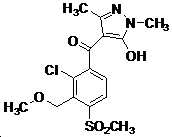
대조군 화합물 B: 
대조 화합물은 CN88101455A 특허에 제시된 것들로부터 선택되었다.Control compounds were selected from those set forth in the CN88101455A patent.
발아-후 단계에서의 시험: 단자엽 잡초 및 옥수수의 종자를 토양이 적재된 플라스틱 포트에 넣고, 0.5-2 cm 토양으로 덮고, 우수한 온실 환경에서 성장하게 하였다. 시험 식물은 파종 4주 후 5-6 잎 단계에서 처리하였다. 본 발명의 시험 화합물을 각각 아세톤으로 용해시킨 다음, 트윈(tween) 80을 첨가하고, 일정량의 물로 희석하여 특정 농도에 도달시켰다. 상기 용액을 분무탑에 의해 상기 식물에 분무하였다. 시험 적용 비율은 15 g/ha이었으며 관찰 시간은 25일이었다.Germination - Post-Stage Test: Monocotyledonous weeds and corn seeds were placed in plastic pots loaded with soil, covered with 0.5-2 cm soil, and allowed to grow in an excellent greenhouse environment. Test plants were treated at 5-6 leaf stage after 4 weeks of sowing. Each of the test compounds of the present invention was dissolved in acetone, then tween 80 was added, and diluted with a certain amount of water to reach a specific concentration. The solution was sprayed onto the plant by a spray tower. The application rate was 15 g / ha and the observation time was 25 days.
표 4: 대조 실험 결과Table 4: Control experiment results
표 4는 본 발명의 화합물이 대조군의 화합물보다 더 우수한 제초 활성 및 안전성을 갖는다는 것을 나타낸다.Table 4 shows that the compounds of the present invention have better herbicidal activity and safety than the compounds of the control group.
동시에, 본 발명의 화합물은 몇몇 시험 이후 들잔디, 버뮤다 그래스, 톨페스큐, 블루그래스, 라이그래스 및 시쇼어 파스팔룸 등과 같은 많은 벼과 풀에 대해 우수한 선택성을 가지며, 다수의 중요한 풀 잡초 및 넓은잎 잡초를 방제할 수 있는 것으로 밝혀졌다. 이 화합물은 또한 다른 제초제의 적용 방법으로 콩, 면화, 오일 해바라기, 감자, 과수원 및 채소에 대한 시험에서도 탁월한 선택성 및 상업적 가치를 나타낸다.At the same time, the compounds of the present invention have excellent selectivity for many paddy grasses, such as Zander, Bermudagrass, Tall Fescue, Bluegrass, Ryegrass, and Shishi Parspalum, after several tests and control many important grasses and broad leaf weeds It can be done. This compound also exhibits excellent selectivity and commercial value in testing for soybean, cotton, oil sunflower, potato, orchard and vegetable as an alternative herbicide application method.
Claims (13)

여기서,
R1은 수소 또는 C1-C4 알킬을 나타내고;
R2는 C1-C3 알킬을 나타내고;
R3은 O, S, 및 N으로부터 선택되는 하나 이상의 헤테로원자를 함유하는 C1-C6 선형 사슬 또는 고리 기를 나타내고;
R4는 C1-C3 알킬 또는 할로겐을 나타내고;
R5는 피라졸 고리 또는 알킬, 알콕시, 할로겐, 할로겐화 알킬, 아미노, 및 니트로로부터 선택되는 하나 이상의 기로 치환된 피라졸 고리를 나타낸다.A pyrazole compound of formula (I) or a salt thereof:
here,
R 1 represents hydrogen or C 1 -C 4 alkyl;
R 2 represents C 1 -C 3 alkyl;
R 3 represents a C 1 -C 6 linear chain or ring group containing one or more heteroatoms selected from O, S, and N;
R 4 represents C 1 -C 3 alkyl or halogen;
R 5 represents a pyrazole ring or a pyrazole ring substituted with at least one group selected from alkyl, alkoxy, halogen, alkyl halide, amino, and nitro.
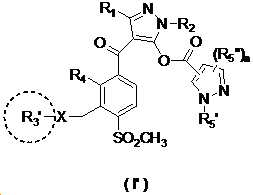
여기서,
R1은 수소 또는 C1-C4 알킬을 나타내고;
R2는 C1-C3 알킬을 나타내고;
X는 O, N 또는 S이고, X 및 R3'은 고리 또는 선형 사슬을 형성할 수 있고, 여기서, X가 O 또는 S 인 경우, R3'은 C1-C6 알킬, C3-C6 알콕시 알킬, C2-C6 할로겐화 알킬, C3-C6 알케닐 또는 C3-C6 알키닐을 나타내고; X가 N 인 경우, X 및 R3'은 피라졸 고리 또는 치환된 피라졸 고리, C3-C5 락탐 고리 또는 치환된 락탐 고리를 형성한다.
R4는 C1-C3 알킬 또는 할로겐을 나타내고;
R5'는 C1-C3 알킬을 나타내고;
R5"는 수소, C1-C3 알킬, C1-C3 알콕시, C1-C3 할로겐화 알킬, 할로겐, 아미노 또는 니트로를 나타내고; n은 0, 1 또는 2이고, 여기서, n이 2인 경우, 2개의 R5"는 같거나 또는 상이할 수 있다.The pyrazole compound or its salt according to claim 1, wherein the compound has the structure of formula (I '):
here,
R 1 represents hydrogen or C 1 -C 4 alkyl;
R 2 represents C 1 -C 3 alkyl;
X is O, N or S, X and R 3 'may form a ring or a linear chain, wherein when X is O or S, R 3 ' is C 1 -C 6 alkyl, C 3 -C 6 alkoxyalkyl, C2-C6 halogenated alkyl, C3-C6 alkenyl or C3-C6 alkynyl; When X is N, X and R 3 'form a pyrazole ring or a substituted pyrazole ring, a C3-C5 lactam ring or a substituted lactam ring.
R 4 represents C 1 -C 3 alkyl or halogen;
R 5 'represents C 1 -C 3 alkyl;
R 5 "is hydrogen, C1-C3 alkyl, C1-C3 alkoxy, C1-C3 halogenated alkyl, a halogen, amino or nitro; when n is 0, 1 or 2, wherein n is 2, the two R 5 "may be the same or different.
R1은 수소, 메틸, 에틸 또는 사이클로프로필을 나타내고;
R2는 메틸, 에틸 또는 이소프로필을 나타내고;
X는 O, N 또는 S이고, X 및 R3'은 고리 또는 선형 사슬을 형성할 수 있고, 여기서, X가 O 또는 S인 경우, R3'은 C1-C6 알킬, C3-C6 알콕시 알킬, C2-C4 할로겐화 알킬, C3-C5 알케닐 또는 C3-C5 알키닐을 나타내고; X가 N일 때, X 및 R3'은 피라졸 고리 또는 치환된 피라졸 고리, C3-C5 락탐 고리 또는 치환된 락탐 고리를 형성한다.
R4는 메틸 또는 염소를 나타내고;
R5'는 메틸, 에틸 또는 이소프로필을 나타내고;
R5"는 수소, 메틸, 에틸, 이소프로필, 메톡실, 에톡실, 디플루오로메틸, 클로로 또는 브로모를 나타내고; n은 0, 1 또는 2이고, 여기서, n이 2인 경우, 두 개의 R5"는 같거나 또는 상이할 수 있는 것을 특징으로 하는 피라졸 화합물 또는 그의 염.The pyrazole compound or its salt according to claim 2,
R 1 represents hydrogen, methyl, ethyl or cyclopropyl;
R 2 represents methyl, ethyl or isopropyl;
X is O, N or S, X and R 3 'may form a ring or a linear chain, wherein when X is O or S, R 3 ' is C 1 -C 6 alkyl, C 3 -C 6 alkoxyalkyl, C2-C4 halogenated alkyl, C3-C5 alkenyl or C3-C5 alkynyl; When X is N, X and R3 'form a pyrazole ring or a substituted pyrazole ring, a C3-C5 lactam ring or a substituted lactam ring.
R 4 represents methyl or chlorine;
R 5 'represents methyl, ethyl or isopropyl;
R 5 "represents unknown hydrogen, methyl, ethyl, isopropyl, methoxyl, ethoxylates, difluoro methyl, chloro or bromo in; if n is 0, 1 or 2, wherein, n is 2, two R 5 "may be the same or different.
화학식 (Ⅱ)의 화합물 및 화학식 (Ⅲ)의 화합물을 에스테르화 반응시켜 피라졸 화합물 또는 그의 염을 얻는 것을 특징으로 하고,
여기서, 상기 화학식 (Ⅱ)의 화합물은 하기와 같이 표시되고:

상기 화학식 (Ⅲ)의 화합물은 하기와 같이 표시되는 방법:
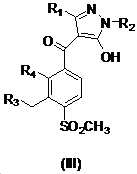
Characterized in that a compound of the formula (II) and a compound of the formula (III) are subjected to an esterification reaction to obtain a pyrazole compound or a salt thereof,
Wherein the compound of formula (II) is represented as follows:
Wherein the compound of formula (III) is represented as follows:
여기서, 상기 화학식 (Ⅱ')의 화합물은 하기와 같이 표시되고:
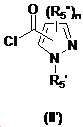
상기 화학식 (Ⅲ')의 화합물은 하기와 같이 표시되는 방법:

Wherein the compound of formula (II ') is represented as follows:
The compound of formula (III ') is represented as follows:
Applications Claiming Priority (3)
| Application Number | Priority Date | Filing Date | Title |
|---|---|---|---|
| CN201511030154.6A CN105503728B (en) | 2015-12-31 | 2015-12-31 | Pyrazole compounds or salts thereof and preparation method thereof, and weedicide composition and application thereof |
| CN201511030154.6 | 2015-12-31 | ||
| PCT/CN2016/075578 WO2017113509A1 (en) | 2015-12-31 | 2016-03-04 | Pyrazole compound or salt thereof, and preparation method, herbicide composition and use thereof |
Publications (2)
| Publication Number | Publication Date |
|---|---|
| KR20180098258A true KR20180098258A (en) | 2018-09-03 |
| KR102102067B1 KR102102067B1 (en) | 2020-06-26 |
Family
ID=55712098
Family Applications (1)
| Application Number | Title | Priority Date | Filing Date |
|---|---|---|---|
| KR1020187017400A Active KR102102067B1 (en) | 2015-12-31 | 2016-03-04 | Pyrazole compounds or salts thereof, methods for their preparation, herbicidal compositions and uses thereof |
Country Status (14)
| Country | Link |
|---|---|
| US (1) | US10556888B2 (en) |
| EP (1) | EP3398938B1 (en) |
| JP (1) | JP6695967B2 (en) |
| KR (1) | KR102102067B1 (en) |
| CN (1) | CN105503728B (en) |
| AU (1) | AU2016382562B2 (en) |
| BR (1) | BR112018012921B1 (en) |
| CA (1) | CA2980382C (en) |
| CO (1) | CO2018005848A2 (en) |
| MY (1) | MY177469A (en) |
| PH (1) | PH12017501912B1 (en) |
| RU (1) | RU2688936C1 (en) |
| UA (1) | UA121253C2 (en) |
| WO (1) | WO2017113509A1 (en) |
Families Citing this family (37)
| Publication number | Priority date | Publication date | Assignee | Title |
|---|---|---|---|---|
| CN105831123B (en) * | 2016-04-15 | 2018-01-23 | 青岛清原抗性杂草防治有限公司 | A kind of cornfield weeding composition and its application |
| CN105724390B (en) * | 2016-04-28 | 2017-12-22 | 青岛清原抗性杂草防治有限公司 | A kind of herbicide composition for paddy fields and its application |
| CN106106474A (en) * | 2016-06-21 | 2016-11-16 | 泰安市农业科学研究院 | A kind of cornfield weeding composition and application thereof |
| CN106070309B (en) * | 2016-06-21 | 2018-06-15 | 江苏清原农冠抗性杂草防治有限公司 | Complex herbicidal composition and its application method containing polybenzobisoxazole humulone |
| CN106135220A (en) * | 2016-06-22 | 2016-11-23 | 泰安市农业科学研究院 | A kind of cornfield weeding composition |
| CN106106506B (en) * | 2016-06-24 | 2018-09-14 | 青岛清原抗性杂草防治有限公司 | Herbicidal combinations containing pyrazolone compound and its application |
| CN106259401A (en) * | 2016-08-02 | 2017-01-04 | 泰安市农业科学研究院 | A kind of cornfield weeding composition and application thereof |
| CN106259352A (en) * | 2016-08-12 | 2017-01-04 | 泰安市农业科学研究院 | A kind of cornfield weeding composition and application thereof |
| CN106942234A (en) * | 2016-09-29 | 2017-07-14 | 泰安市农业科学研究院 | A kind of herbicidal composition and application containing benzene azoles fluorine humulone and benzene flumetsulam |
| CN106508913B (en) * | 2016-10-11 | 2020-01-03 | 泰安市农业科学研究院 | Herbicide composition containing triazophoron and triafamone and application thereof |
| CN106665599A (en) * | 2016-10-11 | 2017-05-17 | 泰安市农业科学研究院 | Herbicide composition containing fenbuconazol fluridon and isoxaflutole and application of herbicide composition |
| CN106561665B (en) * | 2016-10-28 | 2019-12-13 | 江苏清原农冠杂草防治有限公司 | A kind of wheat field herbicide composition and application thereof |
| CN106977458B (en) * | 2017-04-19 | 2019-08-09 | 青岛清原化合物有限公司 | Amorphous state triazole sulphur humulone and its preparation method and application |
| CN106946783B (en) * | 2017-04-19 | 2019-04-19 | 青岛清原化合物有限公司 | Sulfurtrazone C crystal form and preparation method and use thereof |
| CN107033086B (en) * | 2017-04-19 | 2019-07-26 | 青岛清原化合物有限公司 | Triazole sulphur humulone B crystal form and its preparation method and application |
| CN106966983B (en) * | 2017-05-02 | 2019-07-02 | 青岛清原化合物有限公司 | Amorphous state benzene azoles fluorine humulone and its preparation method and application |
| CN107286096B (en) * | 2017-07-13 | 2019-05-03 | 青岛清原化合物有限公司 | Polybenzobisoxazole humulone crystal form E and its preparation method and application |
| CN107286095B (en) * | 2017-07-13 | 2019-05-03 | 青岛清原化合物有限公司 | Polybenzobisoxazole humulone form D and its preparation method and application |
| CN107311930B (en) * | 2017-07-13 | 2019-05-03 | 青岛清原化合物有限公司 | Polybenzobisoxazole humulone B crystal form and its preparation method and application |
| CN107286097B (en) | 2017-07-13 | 2019-06-25 | 青岛清原化合物有限公司 | Polybenzobisoxazole humulone C crystal form and its preparation method and application |
| CN107372525B (en) * | 2017-08-30 | 2022-07-26 | 青岛清原化合物有限公司 | Weeding composition containing triazasulam and application thereof |
| WO2019037313A1 (en) * | 2017-08-25 | 2019-02-28 | 青岛清原化合物有限公司 | Herbicidal composition containing triazole sulcotrione and application thereof |
| CN107372551B (en) * | 2017-08-25 | 2022-06-28 | 青岛清原化合物有限公司 | Weeding composition containing triazophorbine and pyridazine compound and application thereof |
| CN113180051A (en) * | 2017-09-19 | 2021-07-30 | 青岛清原抗性杂草防治有限公司 | Weeding composition containing triazasulam and application thereof |
| CN107897191B (en) * | 2017-11-09 | 2021-11-30 | 青岛清原化合物有限公司 | Weeding composition containing topramezone and application thereof |
| CN107674025B (en) * | 2017-11-10 | 2019-12-31 | 青岛清原化合物有限公司 | 4-benzoyl pyrazole compound and preparation method and application thereof |
| CN108283185A (en) * | 2018-04-05 | 2018-07-17 | 合肥红佳科技信息有限公司 | A kind of Herbicidal combinations containing dichloroquinoline humulone |
| CN108558761B (en) * | 2018-05-21 | 2020-03-17 | 青岛清原化合物有限公司 | Triazolesulfonylzone-salicylic acid eutectic crystal and preparation method and application thereof |
| CN110903279B (en) * | 2018-09-17 | 2023-05-16 | 潍坊中农联合化工有限公司 | Pyrazole compound, salt and application thereof |
| WO2020156106A1 (en) * | 2019-01-29 | 2020-08-06 | 青岛清原化合物有限公司 | Heterocyclic aryl formamides or salt thereof, preparation method, weeding composition, and application |
| CN116803993A (en) * | 2019-10-23 | 2023-09-26 | 青岛清原化合物有限公司 | Aryl formamide compound containing chiral sulfur oxide or salt thereof, preparation method, weeding composition and application |
| CN113387926B (en) * | 2020-03-13 | 2023-12-12 | 沈阳中化农药化工研发有限公司 | Heterocyclic carboxylic ester compound and application thereof as herbicide |
| CN113387942B (en) | 2020-03-13 | 2025-08-01 | 沈阳中化农药化工研发有限公司 | Pyrazole carboxylic ester compound and application thereof |
| WO2024109721A1 (en) * | 2022-11-22 | 2024-05-30 | 兰升生物科技集团股份有限公司 | Preparation method for hppd inhibitor herbicide, intermediate, preparation method for intermediate |
| CN117247363A (en) * | 2023-11-17 | 2023-12-19 | 山东滨农科技有限公司 | Oxadiazolone compounds, herbicidal compositions and uses thereof |
| CN119661521B (en) * | 2024-12-11 | 2025-10-03 | 安徽喜田生物科技有限公司 | Selective herbicide based on pyraclonil and preparation method and application thereof |
| CN119707818A (en) * | 2024-12-11 | 2025-03-28 | 河北农业大学 | Novel methyl pyrazole propionamide derivative, and preparation method and application thereof |
Citations (1)
| Publication number | Priority date | Publication date | Assignee | Title |
|---|---|---|---|---|
| EP2106697A1 (en) * | 2007-02-02 | 2009-10-07 | Ishihara Sangyo Kaisha, Ltd. | Herbicidal compositions containing benzoylpyrazole compounds |
Family Cites Families (11)
| Publication number | Priority date | Publication date | Assignee | Title |
|---|---|---|---|---|
| JPS63122673A (en) | 1986-11-10 | 1988-05-26 | Nissan Chem Ind Ltd | Pyrazole derivative and herbicide |
| IL85659A (en) * | 1987-03-17 | 1992-03-29 | Nissan Chemical Ind Ltd | 4-benzoylpyrazole derivatives,method for their preparation and herbicidal compositions containing them |
| US6165944A (en) | 1997-01-17 | 2000-12-26 | Basf Aktiengesellschaft | 4-(3-heterocyclyl-1-benzoyl) pyrazoles and their use as herbicides |
| WO1998042648A1 (en) * | 1997-03-24 | 1998-10-01 | Dow Agrosciences Llc | 2-benzoylcyclohexane-1,3-dione compounds and their use as herbicides |
| US6207618B1 (en) * | 1997-08-07 | 2001-03-27 | Basf Aktiengesellschaft | Heterocyclic substituted 4-benzoyl-pyrazole as herbicides |
| US6156702A (en) * | 1997-08-07 | 2000-12-05 | Basf Aktiengesellschaft | Substituted 4-benzoylpyrazoles |
| AU4652499A (en) * | 1998-07-16 | 2000-02-07 | Ishihara Sangyo Kaisha Ltd. | Pyrazole-type compounds, process for producing the same and herbicides containing the same |
| JP2008081406A (en) | 2006-09-26 | 2008-04-10 | Ishihara Sangyo Kaisha Ltd | Benzoyl pyrazole type compound and herbicide containing the same |
| CN103980202B (en) * | 2014-05-27 | 2017-01-18 | 青岛清原化合物有限公司 | 4-benzoyl pyrazole compound with herbicidal activity |
| CN105399674B (en) * | 2015-12-31 | 2017-02-15 | 青岛清原化合物有限公司 | Pyrazole compound or salt thereof, and preparation method, herbicide composition and application thereof |
| CN109802002B (en) * | 2019-03-05 | 2024-04-12 | 通威太阳能(合肥)有限公司 | Stacked double-sided battery assembly and manufacturing method thereof |
-
2015
- 2015-12-31 CN CN201511030154.6A patent/CN105503728B/en active Active
-
2016
- 2016-03-04 RU RU2018110616A patent/RU2688936C1/en active
- 2016-03-04 WO PCT/CN2016/075578 patent/WO2017113509A1/en not_active Ceased
- 2016-03-04 CA CA2980382A patent/CA2980382C/en active Active
- 2016-03-04 JP JP2018517441A patent/JP6695967B2/en active Active
- 2016-03-04 BR BR112018012921-6A patent/BR112018012921B1/en active IP Right Grant
- 2016-03-04 KR KR1020187017400A patent/KR102102067B1/en active Active
- 2016-03-04 MY MYPI2017703871A patent/MY177469A/en unknown
- 2016-03-04 UA UAA201802994A patent/UA121253C2/en unknown
- 2016-03-04 US US15/561,394 patent/US10556888B2/en active Active
- 2016-03-04 AU AU2016382562A patent/AU2016382562B2/en active Active
- 2016-03-04 EP EP16880318.7A patent/EP3398938B1/en active Active
- 2016-03-04 CO CONC2018/0005848A patent/CO2018005848A2/en unknown
-
2017
- 2017-10-19 PH PH12017501912A patent/PH12017501912B1/en unknown
Patent Citations (1)
| Publication number | Priority date | Publication date | Assignee | Title |
|---|---|---|---|---|
| EP2106697A1 (en) * | 2007-02-02 | 2009-10-07 | Ishihara Sangyo Kaisha, Ltd. | Herbicidal compositions containing benzoylpyrazole compounds |
Also Published As
| Publication number | Publication date |
|---|---|
| AU2016382562A1 (en) | 2017-10-19 |
| EP3398938A1 (en) | 2018-11-07 |
| PH12017501912A1 (en) | 2018-03-05 |
| AU2016382562B2 (en) | 2018-10-04 |
| CO2018005848A2 (en) | 2018-09-20 |
| EP3398938A4 (en) | 2019-08-14 |
| BR112018012921A2 (en) | 2018-12-11 |
| UA121253C2 (en) | 2020-04-27 |
| EP3398938B1 (en) | 2020-09-02 |
| CN105503728A (en) | 2016-04-20 |
| WO2017113509A1 (en) | 2017-07-06 |
| US20180105513A1 (en) | 2018-04-19 |
| CN105503728B (en) | 2017-03-22 |
| PH12017501912B1 (en) | 2018-03-05 |
| BR112018012921B1 (en) | 2022-02-08 |
| CA2980382A1 (en) | 2017-07-06 |
| JP2019509251A (en) | 2019-04-04 |
| MY177469A (en) | 2020-09-16 |
| RU2688936C1 (en) | 2019-05-23 |
| JP6695967B2 (en) | 2020-05-20 |
| CA2980382C (en) | 2019-12-03 |
| KR102102067B1 (en) | 2020-06-26 |
| US10556888B2 (en) | 2020-02-11 |
Similar Documents
| Publication | Publication Date | Title |
|---|---|---|
| KR102102067B1 (en) | Pyrazole compounds or salts thereof, methods for their preparation, herbicidal compositions and uses thereof | |
| ES2794867T3 (en) | Pyrazolone compound or salt thereof, method of preparation thereof, herbicidal composition and use thereof | |
| CN107629035B (en) | Pyrazolone compound or salt thereof, herbicide composition and application | |
| KR102276572B1 (en) | Pyrazole compounds or salts thereof, and methods for their preparation, herbicide compositions and uses thereof | |
| JP7739280B2 (en) | Substituted isoxazoline-containing aromatic compounds, their preparation process, herbicidal compositions and their use | |
| CN109535070B (en) | Pyridyloxycarboxylate derivative, preparation method thereof, herbicidal composition and application | |
| CN107652217B (en) | Substituted benzoyl diketone nitrile compounds or its tautomer, salt, preparation method, Herbicidal combinations and application | |
| CN108586357A (en) | Substituted pyrimidine formoxyl 9 oxime derivate and preparation method thereof, Herbicidal combinations and application | |
| JP2022553987A (en) | Arylformamide compound containing chiral sulfur oxide or its salt, preparation method, herbicidal composition and use thereof | |
| CN109721546B (en) | Substituted pyrimidine aryl ester derivative and preparation method, herbicidal composition and application thereof | |
| CN111285863B (en) | 4- (3-heterocyclyl-1-benzoyl) pyrazole compound or salt thereof, preparation method, herbicide composition and application | |
| CN113024531A (en) | Isoxazoline-containing compound, preparation method thereof, herbicidal composition and application | |
| JP2023139056A (en) | R-pyridyloxycarboxylic acid, salts thereof, ester derivatives thereof, preparation methods thereof, herbicidal compositions thereof and uses thereof | |
| CN107759581B (en) | Substituted benzoyl isoxazole compound or tautomer, salt, preparation method, herbicidal composition and application thereof | |
| CN107674025B (en) | 4-benzoyl pyrazole compound and preparation method and application thereof | |
| JP2022549537A (en) | Substituted 1,2,4-triazolo[4,3-a]pyridine derivatives, methods for their preparation, herbicidal compositions and uses | |
| CN107353238B (en) | Substituted benzoylcyclohexan cyclohexadione compounds or its tautomer, salt, preparation method, Herbicidal combinations and application | |
| CN109400526B (en) | Pyridyloxy thioester derivative, preparation method thereof, herbicidal composition and application | |
| CN107629046B (en) | Pyrazolone compound or salt thereof, herbicide composition and application | |
| CN117050067B (en) | Heterocyclic substituted aromatic compound, preparation method thereof, weeding composition and application | |
| RU2836575C1 (en) | Substituted isoxazoline-containing aromatic compound, method for production thereof, herbicidal composition and use thereof | |
| CN109832277B (en) | Substituted nitrogen-containing heteroaromatic imine formate derivative, preparation method thereof, herbicidal composition and application | |
| WO2025214022A1 (en) | 3-phenyl isoxazoline-5-formamide compound, and preparation method therefor, weeding composition thereof and use thereof | |
| WO2021043114A1 (en) | Substituted thiadiazinone dioxide and preparation method therefor, herbicidal composition, and application therefor | |
| BR112022002507B1 (en) | A substituted thiadiazinone dioxide compound, a method for preparing it, a herbicide composition comprising the compound, uses thereof, and a method for controlling a weed. |
Legal Events
| Date | Code | Title | Description |
|---|---|---|---|
| PA0105 | International application |
Patent event date: 20180619 Patent event code: PA01051R01D Comment text: International Patent Application |
|
| A201 | Request for examination | ||
| PA0201 | Request for examination |
Patent event code: PA02012R01D Patent event date: 20180801 Comment text: Request for Examination of Application |
|
| PG1501 | Laying open of application | ||
| E902 | Notification of reason for refusal | ||
| PE0902 | Notice of grounds for rejection |
Comment text: Notification of reason for refusal Patent event date: 20190917 Patent event code: PE09021S01D |
|
| E701 | Decision to grant or registration of patent right | ||
| PE0701 | Decision of registration |
Patent event code: PE07011S01D Comment text: Decision to Grant Registration Patent event date: 20200407 |
|
| GRNT | Written decision to grant | ||
| PR0701 | Registration of establishment |
Comment text: Registration of Establishment Patent event date: 20200410 Patent event code: PR07011E01D |
|
| PR1002 | Payment of registration fee |
Payment date: 20200410 End annual number: 3 Start annual number: 1 |
|
| PG1601 | Publication of registration | ||
| FPAY | Annual fee payment |
Payment date: 20230227 Year of fee payment: 4 |
|
| PR1001 | Payment of annual fee |
Payment date: 20230227 Start annual number: 4 End annual number: 4 |
|
| PR1001 | Payment of annual fee |
Payment date: 20240227 Start annual number: 5 End annual number: 5 |
|
| PR1001 | Payment of annual fee |
Payment date: 20250310 Start annual number: 6 End annual number: 6 |