KR20080098298A - Method for Producing Glycoprotein Removed from Mannose Phosphate Using Novel MlMPO1 Gene Derived from Yarrowia Lipolitica - Google Patents
Method for Producing Glycoprotein Removed from Mannose Phosphate Using Novel MlMPO1 Gene Derived from Yarrowia Lipolitica Download PDFInfo
- Publication number
- KR20080098298A KR20080098298A KR1020070057635A KR20070057635A KR20080098298A KR 20080098298 A KR20080098298 A KR 20080098298A KR 1020070057635 A KR1020070057635 A KR 1020070057635A KR 20070057635 A KR20070057635 A KR 20070057635A KR 20080098298 A KR20080098298 A KR 20080098298A
- Authority
- KR
- South Korea
- Prior art keywords
- ylmpo1
- gene
- strain
- protein
- glu
- Prior art date
- Legal status (The legal status is an assumption and is not a legal conclusion. Google has not performed a legal analysis and makes no representation as to the accuracy of the status listed.)
- Granted
Links
Images




Classifications
-
- C—CHEMISTRY; METALLURGY
- C07—ORGANIC CHEMISTRY
- C07K—PEPTIDES
- C07K14/00—Peptides having more than 20 amino acids; Gastrins; Somatostatins; Melanotropins; Derivatives thereof
- C07K14/37—Peptides having more than 20 amino acids; Gastrins; Somatostatins; Melanotropins; Derivatives thereof from fungi
- C07K14/39—Peptides having more than 20 amino acids; Gastrins; Somatostatins; Melanotropins; Derivatives thereof from fungi from yeasts
-
- C—CHEMISTRY; METALLURGY
- C12—BIOCHEMISTRY; BEER; SPIRITS; WINE; VINEGAR; MICROBIOLOGY; ENZYMOLOGY; MUTATION OR GENETIC ENGINEERING
- C12N—MICROORGANISMS OR ENZYMES; COMPOSITIONS THEREOF; PROPAGATING, PRESERVING, OR MAINTAINING MICROORGANISMS; MUTATION OR GENETIC ENGINEERING; CULTURE MEDIA
- C12N15/00—Mutation or genetic engineering; DNA or RNA concerning genetic engineering, vectors, e.g. plasmids, or their isolation, preparation or purification; Use of hosts therefor
- C12N15/09—Recombinant DNA-technology
- C12N15/63—Introduction of foreign genetic material using vectors; Vectors; Use of hosts therefor; Regulation of expression
- C12N15/79—Vectors or expression systems specially adapted for eukaryotic hosts
- C12N15/80—Vectors or expression systems specially adapted for eukaryotic hosts for fungi
- C12N15/81—Vectors or expression systems specially adapted for eukaryotic hosts for fungi for yeasts
- C12N15/815—Vectors or expression systems specially adapted for eukaryotic hosts for fungi for yeasts for yeasts other than Saccharomyces
-
- C—CHEMISTRY; METALLURGY
- C12—BIOCHEMISTRY; BEER; SPIRITS; WINE; VINEGAR; MICROBIOLOGY; ENZYMOLOGY; MUTATION OR GENETIC ENGINEERING
- C12N—MICROORGANISMS OR ENZYMES; COMPOSITIONS THEREOF; PROPAGATING, PRESERVING, OR MAINTAINING MICROORGANISMS; MUTATION OR GENETIC ENGINEERING; CULTURE MEDIA
- C12N15/00—Mutation or genetic engineering; DNA or RNA concerning genetic engineering, vectors, e.g. plasmids, or their isolation, preparation or purification; Use of hosts therefor
- C12N15/09—Recombinant DNA-technology
-
- C—CHEMISTRY; METALLURGY
- C12—BIOCHEMISTRY; BEER; SPIRITS; WINE; VINEGAR; MICROBIOLOGY; ENZYMOLOGY; MUTATION OR GENETIC ENGINEERING
- C12N—MICROORGANISMS OR ENZYMES; COMPOSITIONS THEREOF; PROPAGATING, PRESERVING, OR MAINTAINING MICROORGANISMS; MUTATION OR GENETIC ENGINEERING; CULTURE MEDIA
- C12N9/00—Enzymes; Proenzymes; Compositions thereof; Processes for preparing, activating, inhibiting, separating or purifying enzymes
- C12N9/10—Transferases (2.)
- C12N9/1048—Glycosyltransferases (2.4)
- C12N9/1081—Glycosyltransferases (2.4) transferring other glycosyl groups (2.4.99)
Landscapes
- Life Sciences & Earth Sciences (AREA)
- Health & Medical Sciences (AREA)
- Genetics & Genomics (AREA)
- Chemical & Material Sciences (AREA)
- Engineering & Computer Science (AREA)
- Organic Chemistry (AREA)
- Bioinformatics & Cheminformatics (AREA)
- Zoology (AREA)
- Wood Science & Technology (AREA)
- Biomedical Technology (AREA)
- General Engineering & Computer Science (AREA)
- Biotechnology (AREA)
- Mycology (AREA)
- Microbiology (AREA)
- Biochemistry (AREA)
- General Health & Medical Sciences (AREA)
- Molecular Biology (AREA)
- Biophysics (AREA)
- Plant Pathology (AREA)
- Physics & Mathematics (AREA)
- Medicinal Chemistry (AREA)
- Gastroenterology & Hepatology (AREA)
- Proteomics, Peptides & Aminoacids (AREA)
- Micro-Organisms Or Cultivation Processes Thereof (AREA)
- Preparation Of Compounds By Using Micro-Organisms (AREA)
Abstract
Description
도 1은 YlMPO1 유전자에 해당하는 2,135 bp 뉴클레오타이드 서열과 예상되는 YlMpo1 단백질의 아미노산 서열을 나타낸 것이다.Figure 1 shows the predicted YlMpo1 protein and the 2,135 bp nucleotide sequence corresponding to the YlMPO1 gene. The amino acid sequence is shown.
도 2a 내지 도 2c는 효모와 곰팡이 등에서 만노스 인산화(mannosylphosphorylation)에 중요한 역할을 담당하는 Mnn4 단백질과 이에 상응하는 단백질들 및 야로위아 리폴리티카의 YlMpo1 단백질의 아미노산 서열을 상동성 비교 프로그램 (http://www.ncbi.nlm.nih.gov/BLAST/)을 이용하여 비교한 것으로서, 각 단백질의 종 명, GeneBank Accession Number 또는 PCT 특허 출원번호 등의 정보는 각각 다음과 같다: AfMnn4p (Aspergillus fumigatus, XP_752633); CaMnn4p (Candida albicans, AAL86704); NcLac1p (Neurospora crassa, CAB91733); PpMnn4Ap (Pichia pastoris , WO2005/060519); PpMnn4Bp (Pichia pastoris , WO2005/060519); PpMnn4Cp (Pichia pastoris , WO2005/060519); PpPno1p (Pichia pastoris, BAD06252); ScMnn4p (Saccharomyces cerevisiae, NP_012721); YlMpo1p (Yarrowia lipolytica)).Figures 2a to 2c shows the amino acid sequence of the Mnn4 protein and its corresponding proteins and YlMpo1 protein of Yarrowia repolitica, which plays an important role in mannosylphosphorylation in yeast and mold, etc. ( http: / /www.ncbi.nlm.nih.gov/BLAST/ ), the information of each protein's name, GeneBank Accession Number or PCT patent application number is as follows: AfMnn4p ( Aspergillus) fumigatus , XP_752633); CaMnn4p ( Candida albicans , AAL86704); NcLac1p ( Neurospora crassa , CAB91733); PpMnn4Ap ( Pichia pastoris , WO 2005/060519); PpMnn4Bp ( Pichia pastoris , WO 2005/060519); PpMnn4Cp ( Pichia pastoris , WO 2005/060519); PpPno1p ( Pichia pastoris , BAD06252); ScMnn4p ( Saccharomyces cerevisiae , NP_012721); YlMpo1p ( Yarrowia lipolytica )).
도 3은 야로위아 리폴리티카의 YlMpo1 단백질과 효모와 곰팡이 등에서 만노스 인산화 과정에서 중요한 역할을 수행할 것으로 예상되는 단백질들 사이의 연관 관계를 분석하기 위한 동일성 및 유사성 비교 테이블(도 3A)과 근연 관계를 나타낸 계통도(도 3B)를 나타낸 것이다(인터넷 웝사이트 http://align.genome.jp/에 있는 프로그램을 사용하여 그렸음). FIG. 3 shows a close relationship between the identity and similarity comparison table (FIG. 3A) to analyze the association between YlMpo1 protein of Yarrowia lipolitica and proteins that are expected to play an important role in mannose phosphorylation in yeast and mold. It is a schematic diagram (Fig. 3B) showing (drawing using the program on the Internet website http://align.genome.jp/ ).
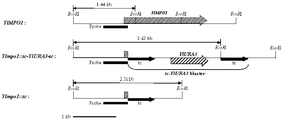
도 4는 야로위아 리폴리티카 YlMPO1 유전자를 파쇄하기 위한 세포내 유전자 재조합에 관한 모식도(도 4A)와 이러한 방법으로 파쇄된 균주를 써던 블럿팅(southern blotting) 방법으로 확인한 결과(도 4B)를 나타낸 것이다. 써던 블럿팅에 있는 각 레인(lane)은 각각 다음의 균주들을 확인한 것이다. 레인 1: 야생형 균주 (YlMPO1), 레인 2: YlURA3 선택 표지가 팝-아웃(pop-out)된 Ylmpo1 파쇄균주 (Ylmpo1::tc-YlURA3-tc), 레인 3: Ylmpo1 파쇄균주 (Ylmpo1 :: tc).Figure 4 shows a schematic diagram of intracellular gene recombination for disrupting the Yarrowia repolytica YlMPO1 gene (FIG. 4A) and the result confirmed by Southern blotting method using the strain crushed by this method (FIG. 4B) will be. Each lane in Southern blotting identifies the following strains: Lane 1: wild-type strain (YlMPO1), lane 2: YlURA3 selected cover a pop-out (pop-out) the Ylmpo1 crushing strain (Ylmpo1 :: tc-YlURA3-tc ), lane 3: Ylmpo1 disrupted strain (Ylmpo1 :: tc ).
도 5는 트리코더마 리세이 유래의 글루칸 분해효소인 엔도글루카나아제를 발현하는 재조합 발현벡터의 제작 모식도이다.Figure 5 is a schematic diagram of the production of recombinant expression vectors expressing endoglucanase, a glucan degrading enzyme derived from Trichoderma lysase.
도 6는 Ylmpo1 파쇄 균주들의 당사슬 생합성과 관련된 특징들을 분석한 결과로서, 도 6A는 야생형과 YlOCH1 파쇄 균주를 모균주로 하여 제작된 Ylmpo1 파쇄 균주에서 각각 배지로 분비되는 당단백질(Endoglucanase I, EGI)의 N-당사슬 프로파일을 HPLC로 비교 분석한 결과이다. (a) 야생형 균주, (b) Ylmpo1 파쇄균주, (c) Yloch1 파쇄균주, (d) Ylmpo1 / Yloch1 이중 파쇄 균주. 도 6B는 야생형과 YlMPO1 파쇄 균주에서 유래된 세포벽의 주요 구성 성분인 만노단백질(mannoprotein)의 N-당 사슬 프로파일을 HPLC로 비교 분석한 결과이다. 각각 배지와 세포벽으로부터 분리 정제한 EGI와 만노단백질에 당사슬 절단효소인 펩타이드 N-글리코시다제 F(PNGase F)를 처리하여 당사슬을 분리한 후, 환원 말단에 형광발색단을 부착하고 HPLC 분석을 수행하였다. 구조와 크기를 알고 있는 표준 당사슬의 검출시간을 화살표로 표시하였으며(M7, Man7GlcNAc2-PA; M8, Man8GlcNAc2-PA; M9, Man9GlcNAc2-PA; M10, Man10GlcNAc2-PA), 만노스 인산이 부착되어 있는 당사슬에 해당하는 피크들은 *로 표시하였다. *1은 모노만노스 인산(monomannosylphosphate)이 부착된 M8 형태의 당사슬에 해당되며, *2는 모노만노스 인산(monomannoyslphosphate)이 부착된 M9 형태의 당사슬에 해당된다. Figure 6 is an analysis of the characteristics relating to the biosynthesis of a sugar chain Ylmpo1 disrupted strain, Figure 6A is produced by the wild type strain as a parent strain and the disrupted YlOCH1 Ylmpo1 It is the result of comparative analysis of the N- sugar chain profile of glycoprotein (Endoglucanase I, EGI) which is secreted into the medium in the crushed strain, respectively. (a) wild type strain, (b) Ylmpo1 crushed strain, (c) Yloch1 crushed strain, (d) Ylmpo1 / Yloch1 Double crushed strain . Figure 6 B shows the results of comparative analysis of the sugar chain-N- profile of manno proteins (mannoprotein) the main constituent of the cell wall derived from a wild type strain and YlMPO1 crushed by HPLC. EGI and mannoproteins isolated from the medium and the cell wall, respectively, were treated with peptide N- glycosidase F (PNGase F), an oligosaccharide cleavage enzyme, to separate oligosaccharides, and then fluorophores were attached to the reduced ends, followed by HPLC analysis. . Detection times of standard oligosaccharides of known structure and size are indicated by arrows (M7, Man 7 GlcNAc 2 -PA; M8, Man 8 GlcNAc 2 -PA; M9, Man 9 GlcNAc 2 -PA; M10, Man 10 GlcNAc 2 -PA), peaks corresponding to oligosaccharides to which mannose phosphoric acid is attached are marked with *. * 1 corresponds to the M8 form oligosaccharide attached with monomannosylphosphate, and * 2 corresponds to the M9 form oligosaccharide attached with monomannosylphosphate.
도 6C는 Ylmpo1 파쇄균주(Ylmpo1::tc)가 야생형 균주와 비교해서 알시안 블루(Alcian blue)에 염색되는 정도가 감소된 것을 나타낸다. 알시안 블루에 의해서 염색되는 정도와 세포벽의 주요 구성성분인 만노 단백질의 당사슬에 부가되어 있는 만노스 인산의 양과 비례 관계에 있으므로, Ylmpo1 파쇄 균주에서 만노스 인산의 양이 현저히 적어진 것을 알 수 있다. 정지기까지 배양한 균주들을 0.1% 알시안 블루로 30분간 상온에서 반응시킨 후 두 균주 간 염색 정도를 스캔하여 나타나는 색깔의 차이를 비교하였다.6C is Ylmpo1 The crushed strain ( Ylmpo1 :: tc ) shows a decreased degree of staining on Alcian blue compared to the wild type strain. Ylmpo1 is proportional to the degree of staining by alcian blue and the amount of mannose phosphate added to the sugar chain of mannose protein, a major component of the cell wall. It can be seen that the amount of mannose phosphoric acid in the crushed strain is significantly lower. The strains cultured up to the stationary phase were reacted with 0.1% alcian blue for 30 minutes at room temperature, and then compared to the difference in color by scanning the staining degree between the two strains.
본 발명은 야로위아 리폴리티카(Yarrowia lipolytica)의 N-결합형 당사슬에 만노스 인산이 부가되는 반응에서 중요한 역할을 담당하는 YlMPO1(Mannosyl Phosphorylation of Oligosaccharide) 유전자와 상기 MPO1 유전자가 결손된 야로위아 리폴리티카 변이주 및 이러한 변이주를 이용하여 재조합 당단백질을 생산하는 방법에 관한 것이다. The present invention relates to YlMPO1 ( Mannosyl Phosphorylation of Oligosaccharide), which plays an important role in the reaction of adding mannose phosphoric acid to the N- linked oligosaccharide of Yarrowia lipolytica . Genes and the MPO1 The present invention relates to Yarrowia repolytica mutants lacking genes and methods for producing recombinant glycoproteins using such mutants.
대부분의 의약용 단백질들은 세포의 분비 경로를 거치는 동안 단백질의 특정 아미노산 잔기에 당사슬들이 부착하는 당단백질들이다. 부착된 당사슬들은 단백질의 활성과 기능 유지에 중요한 역할을 한다고 알려져 있다. 이러한 당단백질들은 인체에서의 면역반응 유발 등의 문제점들을 해결하기 위해서 주로 동물세포에서 생산되고 있으나, 낮은 생산성과 높은 생산 비용 및 바이러스와 프라이온 등의 오염 가능성 등과 같은 많은 문제점들이 존재한다. 이러한 단점들을 해소하기 위하여 대체 생산 세포주로서 경제성과 생산성이 높으며 N-결합형 당화 과정의 초기 단계가 비슷한 진핵 미생물인 효모를 이용하려는 시도들이 각광을 받고 있다. Most medicinal proteins are glycoproteins that sugar chains attach to specific amino acid residues of the protein during the cell's secretory pathway. Attached sugar chains are known to play an important role in maintaining protein activity and function. These glycoproteins are mainly produced in animal cells to solve problems such as inducing immune responses in the human body, but there are many problems such as low productivity, high production cost, and possible contamination of viruses and prions. To address these shortcomings, attempts have been made to use yeasts, eukaryotic microorganisms, which are economical and productive as alternative production cell lines and have similar early stages of N- linked glycosylation.
효모는 진핵 미생물로서 고농도의 단백질을 신속하게 생산할 수 있으며, 유전자 조작이 용이하여 다루기 쉽고, 인간과 동물들의 바이러스와 프라이온 등에 감염되지 않으므로 안전성 또한 매우 높다는 많은 장점들을 가지고 있다. 그러나 효모에서 합성된 최종 당사슬 구조는 인간의 것과 매우 상이하여 면역 반응을 일으키곤 한다. 따라서 이와 같은 문제점들을 해결하기 위해서 인간의 것과 동일한 당사슬을 가진 당단백질을 생산할 수 있는 효모를 만들기 위해서 당사슬 생합성 경로를 인간화하기 위한 연구들이 큰 관심을 끌고 있다. Yeast is a eukaryotic microorganism that can produce a high concentration of protein quickly, is easy to handle because it is easy to genetically manipulate, and has many advantages because it is not very infected with viruses and prions of humans and animals. However, the final oligosaccharide structure synthesized in yeast is very different from that of humans, often causing an immune response. Therefore, in order to solve these problems, studies to humanize the sugar chain biosynthetic pathway to attract yeast capable of producing glycoproteins having the same sugar chain as humans have attracted great attention.
전통효모인 사카로마이세스 세레비지아의 N-결합형 당사슬은 핵심 당사슬(core oligosaccharide chain)에 약 50개에서 200개의 만노스(mannose) 당이 연속적으로 결합되어 있는 고 만노스(hypermannosylation) 형태로, 각 가지의 말단에 알파1,3 결합형 만노스(α 1,3-linked mannose)가 연결되어 있다(Dean, Biochim. Biophys. Acta., 1426, p.309-322, 1999). 또한, 만노스 인산이 당사슬의 핵심 및 외쇄 부위에 부가되며 (Ballow, 1990, Methods Enzymol. 185: 440-470), 만노스 인산이 부가된 당사슬이 부착된 당단백질을 동물에게 투여하면 면역반응 유발된다는 사실이 보고되었다(Rosenfeld and Ballou, 1974, J. Biol. Chem. 249: 2319-2321). 때문에, 당외쇄 개시 반응에서 중요한 역할을 하는 OCH1 유전자와 더불어 만노스 인산의 부가에 중요한 역할을 하는 MNN4 유전자 등을 파쇄시켜 합성되는 당사슬을 인간화하려는 시도가 있었다(Jigami and Odani, Biochim. Biophys. Acta 1426, 335-345, 1999). 그러나, MNN4 유전자를 파쇄시킨 균주에서도 만노스 인산의 부가가 야생형 균주의 것보다 감소는 했으나, 완전히 제어되지는 못하였다(Odani et al., Glycobiology, 6, p.805-810, 1996). The N- linked sugar chain of Saccharomyces cerevisiae, a traditional yeast, is a form of hypermannosylation in which about 50 to 200 mannose sugars are continuously connected to the core oligosaccharide chain.
전통 효모 외에도 메탄올자화 효모인 피키아 파스토리스(Pichia pastoris)에서도 만노스 인산의 부가 반응을 제거하여 당사슬 생합성 경로를 인간화하기 위한 연구들이 보고되었다. 일본의 Miura 박사 그룹에서 사카로마이세스 세레비시아의 MNN4 유전자 서열을 탐침으로 이용해 피키아 파스토리스에서 만노스 인산의 부가에 중요한 역할을 하는 PNO1(Phosphorylmannosylation of N-linked Oligosacharides) 유전자를 클로닝하였고, 이를 파쇄하였을 때 당사슬의 만노스 인산의 부가가 제어될 수 있다는 보고를 하였다(WO 01/88143; Miura et al., 2004, Gene 324: 129-137). In addition to traditional yeast, studies have been reported to humanize the oligosaccharide biosynthesis pathway by removing the addition reaction of mannose phosphoric acid in Pichia pastoris, a methanolized yeast. Was used a MNN4 gene sequence of three saccharide in my process in Miura Dr. group of Japanese Levy cyano as a probe cloned Pichia PNO1 (Phosphorylmannosylation of N-linked Oligosacharides ) that plays an important role in the addition of mannose phosphate in Pas pastoris gene, it When crushed, it was reported that the addition of mannose phosphoric acid in the sugar chain could be controlled (WO 01/88143; Miura et al., 2004, Gene 324: 129-137).
그러나, 미국의 글라이코파이(GlycoFi) 사는 PNO1 유전자의 파쇄로 만노스 인산의 부가를 저해할 수는 있으나 이를 완전히 제어할 수는 없다는 사실을 발견하고, 이를 극복하기 위한 방법을 특허로 출원하였다(US2006/0160179). 이들은 사카로마이세스 세레비시아의 Mnn4 단백질의 아미노산 서열을 이용하여 피키아 파스토리스의 유전체 정보(Integrated Genomics, Chicago, III)를 BLAST 서치(search)하여 유사성이 높은 유전자들을 발견하고, 이들을 각각 MNN4A, MNN4B와 MNN4C로 명명하였다. 그리고, 이들 중에서 MNN4A 유전자와 PNO1 유전자를 이중 파쇄하면 만노스 인산의 부가를 완전히 제어할 수 있음을 보여주었다. However, GlycoFi of the United States discovered that the disruption of the mannose phosphate could be inhibited by the disruption of the PNO1 gene, but not fully controlled, and a patent was filed to overcome it (US2006). / 0160179). Using the amino acid sequence of the Mnn4 protein of Saccharomyces cerevisiae, BLAST searches Pichia pastoris genomic information (Integrated Genomics, Chicago, III) to find genes of high similarity, each of which is MNN4A. With MNN4B Named MNN4C . Among them, the double crushing of the MNN4A gene and the PNO1 gene showed that the addition of mannose phosphate was completely controlled.
야로위아 리폴리티카는 오래전부터 시트르산(citric acid) 생산, 단세포 단백질(single-cell protein) 생산과 같은 분야에서 산업적으로 유용하게 이용되는 비병원성 이형효모(dimorphic yeast)로, 단백질 분해효소(protease)나 지질분해효소(lipase) 등의 단백질들을 세포 외부로 과량 분비하는 특성을 갖고 있다. 또한, 야로위아 리폴리티카는 전통 효모인 사카로마이세스보다 높은 단백질 분비 효율을 보이고, 동물세포와 유사한 단백질의 동시 번역 수식(co-translational modification) 과정을 가지며(Boisrame et al., J. Biol. Chem., 273, p.30903-30908, 1998), 핵심 당사슬에 결합된 만노스의 수가 사카로마이세스 세레비지애보다 적고(Madzak et al., J. Biotechnol., 109, p.63-81, 2004) 면역반응 유발원인 알파1,3-결합형 만노스가 존재하지 않는다는 점에서 의약용 당단백질 생산 균주로서 사카로마이세스 세레비지애보다 우수한 숙주로 여겨지고 있다. 인체 유래의 의약용 당단백질들을 야로위아 리폴리티카에서 발현 분비하기 위해서는 야로위아 리폴리티카의 당화 과정을 이해하는 것이 필수적이지만, 최근까지 야로위아 리폴리티카의 당화 과정은 극히 일부분만 밝혀졌다(Jaagar et al., Yeast, 20, p.633-644, 2003, Barnay-Verdier et al., Microbiology, 150, p.2185-2195, 2004).Yarrowia repolitica is a non-pathogenic dimorphic yeast that has long been used industrially in fields such as citric acid production and single-cell protein production. It has a characteristic of excessive secretion of proteins such as lipase to the outside of the cell. In addition, Yarrowia repolitica has higher protein secretion efficiency than traditional yeast Saccharomyces and has a process of co-translational modification of proteins similar to animal cells (Boisrame et al., J. Biol). Chem., 273, p.30903-30908, 1998), and the number of mannose bound to the core sugar chain is less than that of Saccharomyces cerevisiae (Madzak et al., J. Biotechnol., 109, p.63-81). , 2004) It is considered to be a better host than Saccharomyces cerevisiae as a pharmaceutical glycoprotein-producing strain in the absence of
본 발명자들은 야로위아 리폴리티카를 의약용 당단백질을 발현 분비하는 숙주로 개발하기 위하여 야로위아 리폴리티카의 당화 과정을 조사하고 당외쇄 개시 반응 효소인 YlOCH1 유전자를 파쇄한 균주를 제작하였다. 그러나 YlOCH1 유전자의 파쇄 시, 인간에서는 나타나지 않는 비인간 당사슬인 만노스 인산의 부가가 보다 활발해지는 현상을 관찰하였다.The present inventors investigated the glycosylation process of Yarrowia lipolitica and developed the strain of the YlOCH1 gene, which is an off- chain initiation reaction enzyme, in order to develop Yarrowia lipolitica as a host expressing and secreting a medical glycoprotein. But YlOCH1 When the gene was disrupted, the addition of mannose phosphate, a non-human oligosaccharide not present in humans, was observed.
이에, 본 발명자들은 만노스 인산의 부가 과정에서 중요한 역할을 수행하는 사카로마이세스 세레비지아 Mnn4 단백질의 아미노산 서열을 이용하여 야로위아 리폴리티카의 유전체 데이터베이스(http://cbi.labri.fr/Genolevures/elt/YALI)로부터 상동성 비교를 통하여 야로위아 리폴리티카의 새로운 유전자 YlMPO1 을 찾았으며, 이 유전자를 파쇄시킨 균주(Ylmpo1 Δ)를 제작하여 분비 단백질 및 세포벽의 주요 성분을 분석한 결과, 상기 유전자만을 파쇄시킴으로써 야로위아 리폴리티카에서는 만노스 인산의 부가가 완전히 제어된 당사슬을 생합성할 수 있다는 사실을 확인하고 본 발명을 완성하였다. Thus, the present inventors made use of the amino acid sequence of Saccharomyces cerevisiae Mnn4 protein, which plays an important role in the addition process of mannose phosphate, to the genome database of Yarrowia repolitica ( http://cbi.labri.fr/ Genolvures / elt / YALI ) identified a new gene YlMPO1 of Yarrowia repolitica by homology comparison, and analyzed the major components of the secreted protein and cell wall by constructing the strain Ylmpo1 Δ The present invention was completed by confirming that only the genes could be broken down to synthesize oligosaccharides with fully controlled addition of mannose phosphate in Yarrowia repolitica.
따라서, 본 발명은 야로위아 리폴리티카의 당사슬 생합성 경로에서 만노스 인산의 부가에 중요한 역할을 하는 새로운 유전자 YlMOP1을 제공하는 것을 첫 번째 목적으로 한다. Accordingly, the present invention aims to provide a new gene YlMOP1 which plays an important role in the addition of mannose phosphoric acid in the oligosaccharide biosynthetic pathway of Yarrowia lipolitica .
본 발명은 또한, 상기 유전자를 파쇄시킴으로써 만노스 인산이 부가되지 않는 당단백질을 생산할 수 있는 야로위아 리폴리티카의 재조합 변이주를 제공하는 것을 두 번째 목적으로 한다. It is a second object of the present invention to provide a recombinant mutant strain of Yarrowia lipolitica which is capable of producing a glycoprotein to which mannose phosphate is not added by disrupting the gene.
본 발명은 또한, 상기 유전자가 파쇄된 야로위아 리폴리티카 변이주에 외래 단백질을 코딩하는 핵산분자를 도입하여 발현시킴으로써, 효모 특이적인 만노스 인산이 부가되지 않아 의료용 등에 유용하게 사용될 수 있는 재조합 당단백질의 생산방법을 제공하는 것을 세 번째 목적으로 한다. The present invention also introduces and expresses a nucleic acid molecule encoding a foreign protein in a Yrowia lipolytica mutant strain in which the gene is crushed, thereby preventing the addition of yeast-specific mannose phosphate to the use of a recombinant glycoprotein that can be useful for medical purposes. The third object is to provide a production method.
본 발명은 산업용 효모 야로위아 리폴리티카(Yarrowia lipolytica)의 만노스 인산화(mannosylphosphorylation) 과정에서 중요한 역할을 수행하는 신규 유전자 YlMPO1와 이 유전자를 파쇄하여 만노스 인산이 부가되지 않는 재조합 당단백질 생산 숙주를 만드는 방법에 관한 것이다. The present invention provides a novel gene YlMPO1 that plays an important role in the process of mannosylphosphorylation of industrial yeast Yarrowia lipolytica and a method of making a recombinant glycoprotein production host which does not add mannose phosphoric acid by crushing the gene. It is about.
본 명세서에서 용어 “당단백질(glycoprotein)"이란 하나 이상의 아스파라긴 잔기 또는 하나 이상의 세린 또는 트레오닌 잔기 상에서 당화되거나 아스파라긴 및 세린 또는 트레오닌 잔기 상에서 당화된 단백질을 의미한다. 본 명세서에서 ”만노스 인산 (mannosylphophate)"이란 효모와 곰팡이 등에서 발견되는 비인간 당사슬구조로서 당사슬의 핵심 및 당외쇄 부위에 각각 2개 씩 부가되는 위치를 갖고 있 다(Jigami Y & Odani T, Biochimica et Biophysica Acta 1426, p.335-345, 1999).As used herein, the term "glycoprotein" refers to a protein that is glycosylated on one or more asparagine residues or one or more serine or threonine residues or glycosylated on asparagine and serine or threonine residues. As used herein, "mannosylphophate" Non-human oligosaccharide structure found in Iran's yeast and mold, and has two positions each added to the core and sugar chain of the oligosaccharide (Jigami Y & Odani T, Biochimica et Biophysica Acta 1426, p. 335-345, 1999) ).
본 발명자는 만노스 인산의 부가 과정에서 중요한 역할을 수행하는 사카로마이세스 세레비지아 Mnn4 단백질의 아미노산 서열을 이용하여 야로위아 리폴리티카의 유전체 데이터베이스(http://cbi.labri.fr/Genolevures/elt/YALI)로부터 상동성 비교를 통하여 YlMPO1 유전자를 찾았다. 이 유전자 서열은 서열번호 1에 기재되었으며, 이로부터 예상되는 Ylmpo1 단백질의 아미노산 서열은 서열번호 2에 나타내었다.We use the amino acid sequence of Saccharomyces cerevisiae Mnn4 protein, which plays an important role in the addition process of mannose phosphate, to the genome database of Yarrowia repolitica ( http://cbi.labri.fr/Genolevures/). elt / YALI ) to find the YlMPO1 gene through homology comparisons. This gene sequence is shown in SEQ ID NO: 1, and the amino acid sequence of the Ylmpo1 protein expected therefrom is shown in SEQ ID NO: 2.
따라서, 하나의 양태로서 본 발명은 서열번호 2로 나타나는 아미노산 서열을 가지는 만노스 인산의 부가에 중요한 역할을 하는 Ylmpo1 단백질을 제공한다.Thus, in one aspect, the present invention provides a Ylmpo1 protein that plays an important role in the addition of mannose phosphoric acid having the amino acid sequence represented by SEQ ID NO: 2.
또 다른 양태로서, 본 발명은 상기 Ylmpo1 단백질을 코딩하는 핵산분자 및 상기 핵산분자의 서열과 75% 이상의 상동성, 바람직하게는 85%, 더욱 바람직하게는 90% 이상의 상동성을 가지며 상기 Ylmpo1 단백질의 활성을 나타내는 폴리펩티드를 코딩하는 핵산분자를 제공한다. 바람직하게는 상기 핵산분자는 서열번호 1의 핵산서열을 가지는 핵산 분자이며, 이의 유사체 또는 이의 단편도 포함한다.In another embodiment, the present invention provides a nucleic acid molecule encoding the Ylmpo1 protein and at least 75% homology, preferably at least 85%, more preferably at least 90% homology with the nucleic acid molecule encoding the Ylmpo1 protein. A nucleic acid molecule encoding a polypeptide exhibiting activity is provided. Preferably the nucleic acid molecule is a nucleic acid molecule having a nucleic acid sequence of SEQ ID NO: 1, including an analog or fragment thereof.
본 발명에서 야로위아 리폴리티카 유래의 YlMPO1 유전자에 대해 사용된 용어 “상동성”이란 야생형(wild type) 핵산 서열과의 유사한 정도를 나타내기 위한 것으로, 본 발명의 YlMPO1 유전자의 DNA 염기서열과 바람직하게는 75% 이상, 보다 바람직하게는 85% 이상, 더욱 바람직하게는 90% 이상, 가장 바람직하게는 95% 이상 동일한 염기 서열을 포함한다. 당해 분야의 통상의 지식을 가진 기술자는 당해 분야에 공지된 유전자 재조합 기술 등에 의해 본 발명에 따른 상기 YlMPO1 유전자의 하나 또는 그 이상의 염기서열을 용이하게 치환, 부가 또는 결실시킴으로써 상기 상동성을 갖는 범위 내에서 동일한 활성을 갖는 폴리펩티드를 코딩하는 핵산분자를 용이하게 제조할 수 있음을 이해할 수 있을 것이다. 이러한 상동성의 비교는 시판되는 컴퓨터 프로그램을 이용하여 2개 이상의 서열간의 상동성을 백분율(%)로 계산할 수 있으며, 상동성(%)은 인접한 서열에 대해 계산될 수 있다.As used herein, the term “homology” used for the YlMPO1 gene derived from Yarrowia repolitica is intended to indicate a degree of similarity with a wild type nucleic acid sequence, and preferably with the DNA sequence of the YlMPO1 gene of the present invention. Preferably at least 75%, more preferably at least 85%, even more preferably at least 90%, most preferably at least 95% identical nucleotide sequences. A person skilled in the art can easily replace, add, or delete one or more nucleotide sequences of the YlMPO1 gene according to the present invention by genetic recombination techniques known in the art within the range having the homology. It will be appreciated that nucleic acid molecules encoding polypeptides having the same activity in E. coli can be readily prepared. Such comparisons of homology can be calculated in percent (%) between two or more sequences using commercially available computer programs, and the percent homology can be calculated for adjacent sequences.
신규 유전자와 그 발현 산물인 단백질은 여러 생물체에 존재하는 유사 단백질 군들과의 서열 비교를 통하여 그 기능을 예상해 볼 수 있다. 서열 비교는 상품화된 분석소프트웨어나 웹 기반 분석시스템을 이용하여 서열 비교가 가능하다. 본 발명에서는 웹 기반 분석시스템을 이용하여 야로위아 리폴리티카 신규 유전자의 발현 산물인 단백질을 유사 단백질 군들과 동일성(identity)과 유사성(similarity)을 비교하였다.New genes and their expression products, proteins, can be predicted by comparing their sequences with similar groups of proteins in different organisms. Sequence comparison can be performed using commercially available analysis software or web-based analysis systems. In the present invention, the identity and similarity of the protein, which is the expression product of the Yarrowia repolitica novel gene, was compared with similar protein groups using a web-based analysis system.
본 발명에서 야로위아 리폴리티카 유래의 YlMpo1 단백질에 대해 사용된 용어 “동일성”이란 여러 생물체 유래의 단백질들의 서열 비교 시 특정 위치에서 같은 아미노산 잔기가 있음을 의미하며, 전체 아미노산 잔기 중 특정위치에 동일한 아미노산 잔기가 존재하는 정도를 백분율(%)로 계산한 것이다. 또한, “유사성”이란 단백질들의 서열 비교 시 특정 위치에서 비슷한 화학적 성질을 갖는 아미노산 잔기가 있음을 의미하며, 전체 아미노산 잔기 중 특정위치에 유사한 성질의 아미노산 잔기가 존재하는 정도를 백분율(%)로 계산한 것이다.YlMpo1 derived from Yarrowia lipolitica in the present invention The term “identity” used for a protein means that there is the same amino acid residue at a specific position when comparing sequences of proteins from different organisms, and the percentage (%) of the degree of existence of the same amino acid residue at a specific position among all amino acid residues. It is calculated as. In addition, “similarity” means that there are amino acid residues having similar chemical properties at specific positions when comparing sequences of proteins, and calculating the percentage of amino acid residues having similar properties at specific positions among all amino acid residues. It is.
본 발명자는 효모 야로위아 리폴리티카의 만노스 인산의 부가를 제어하여 보다 바람직한 인체형 당단백질 생산 숙주로 만들기 위해서, 상기에서 밝힌 만노스 인산의 부가에서 중요한 역할을 하는 YlMPO1 유전자를 중합효소 연쇄 반응을 통하여 확보한 후, 이를 이용하여 YlMPO1 유전자 파쇄용 벡터를 만들었다. 그리고 이를 야로위아 리폴리티카에 형질전환시켜 YlMPO1 유전자가 파쇄된 균주 (Yarrowia lipolytica mpo1 Δ)를 제작하였고(실시예3), 이를 2007년 3월 27일에 KCTC (Korean Collection for Type Cultures, 한국 대전광역시 유성구 어은동 52번지 한국생명공학연구원)에 기탁번호 제 KCTC 11102BP호로 기탁하였다.In order to control the addition of mannose phosphoric acid of yeast Yarrowia politica to make a more desirable human-type glycoprotein production host, the inventors described a polymerase chain reaction of the YlMPO1 gene, which plays an important role in the addition of mannose phosphoric acid, as described above. After securing, A vector for disrupting the YlMPO1 gene was made. And it Yaroslavl by transforming the WIA Li Poly Galactica was produced with a YlMPO1 gene disrupted strain (Yarrowia lipolytica mpo1 Δ) (Example 3), this 3-2007 May 27, KCTC (Korean Collection for Type Cultures, Korea War It was deposited with KCTC 11102BP, Korea Institute of Biotechnology, 52 Eun-dong, Yuseong-gu, Metropolitan City, Korea.
따라서, 또 다른 양태로서, 본 발명은 만노스 인산의 부가에 중요한 역할을 하는 YlMPO1 유전자를 파쇄시켜 만노스 인산이 부가되지 않는 당단백질을 생산하는 변이주에 관한 것이며, 바람직하게 상기 변이주는 기탁번호 제 KCTC 11102BP호로 기탁된 야로위아 리폴리티카 변이주 Ylmpo1 Δ 이다.Thus, as another aspect, the present invention relates to a mutant strain that produces a glycoprotein to which mannose phosphate is not added by disrupting the YlMPO1 gene, which plays an important role in the addition of mannose phosphate, preferably the variant strain has accession number KCTC 11102BP Yarrowia lipolitica variant strain Ylmpo1 Δ deposited as arc.
지놈 상에서 목적한 유전자만의 특이적 파쇄, 즉 불활성화는 당업자라면 당 분야에서 확립된 방법들을 통하여 손쉽게 수행할 수 있으며, 방법은 특별히 제한되지 않는다. 본 발명자는 먼저 YlMPO1 유전자 DNA를 이용하여 YlMPO1 파쇄용 벡터를 제작하고, 이를 야로위아 리폴리티카에 형질전환시켜 지놈과 벡터 사이의 상동성에 의한 유전자 재조합을 유도하였다. YlMPO1 파쇄용 벡터 제작에 사용되는 선별마커 (selection marker)는 특별히 제한되지 않고, 약물 내성, 영양 요구성, 세포 독성제에 대한 내성 또는 표면 단백질의 발현과 같은 선택가능 표현형을 부여하는 마커들이 사용될 수 있으며, 본 발명에서는 YlURA3를 선별 마커로 사용하였다. Specific disruption, ie inactivation, of only the gene of interest on the genome can be easily carried out by those skilled in the art through methods established in the art, and the method is not particularly limited. The present inventors first produced a YlMPO1 fragmentation vector using the YlMPO1 gene DNA, and transformed it into Yarrowia repolitica to induce genetic recombination by homology between the genome and the vector. The selection marker used to construct the YlMPO1 disruption vector is not particularly limited, and markers that confer selectable phenotypes such as drug resistance, nutritional requirements, resistance to cytotoxic agents, or expression of surface proteins can be used. In the present invention, YlURA3 was used as a selection marker.
*상기 방법으로 제작된 YlMPO1 유전자가 결손된 균주(Ylmpo1 Δ)에서 발현되 는 당단백질들에 부착된 당사슬들을 분석하기 위하여 HPLC 프로파일 분석과 알시안 블루 염색 실험들을 수행하였다(도 6 참조). Ylmpo1 Δ 균주에서 발현되는 분비 단백질 및 세포벽 단백질들의 당사슬 프로파일 분석에서 중성 당사슬들은 야생형 균주의 것과 같은 양상을 보였지만, 만노스 인산이 부가되어 나타나는 산성 당사슬은 관찰되지 않았다. 또한, Ylmpo1 Δ 균주는 야생형에 비해서 알시안 블루의 결합이 잘 일어나지 않아 거의 염색이 되지 않은 것을 볼 수 있으며, 이는 Ylmpo1 Δ 균주의 세포벽 단백질의 당사슬에 부가되는 만노스 인산이 제어되었음을 의미한다.* Produced by the above method HPLC profile analysis and alcian blue staining experiments were performed to analyze oligosaccharides attached to glycoproteins expressed in the YlMPO1 gene deficient strain ( Ylmpo1 Δ ) (see FIG. 6). In the sugar chain profile analysis of secreted and cell wall proteins expressed in the Ylmpo1 Δ strain, the neutral sugar chains showed the same pattern as that of the wild type strain, but the acidic sugar chains with the addition of mannose phosphoric acid were not observed. In addition, the Ylmpo1 Δ strain is rarely stained because the binding of the Alcian blue does not occur as compared to the wild type, which means that the mannose phosphate added to the oligosaccharide of the cell wall protein of the Ylmpo1 Δ strain was controlled.
상기의 결과들은 야로위아 리폴리티카의 단일 유전자 YlMPO1의 결손만으로 만노스 인산이 당사슬의 핵심 부위와 당외쇄 부위에 결합하는 것을 모두 제어할 수 있음을 보여준다. 기존에 연구되었던 효모 사카로마이세스 세레비지아에서는 ScMNN4 유전자의 결손 시 알시안 블루의 염색은 크게 감소되었으나, 당사슬 구조 분석 시 핵심 부위에 대한 만노스 인산의 부가가 완전히 제어되지 못했다. 마찬가지로 피키아 파스토리스에서는 PpPNO1 , PpMNN4A , PpMNN4B 및 PpMNN4C 등 4개의 상동 유전자가 존재하며, PpPNO1 및 PpMNN4B가 이중 결손이 되어야 만노스 인산의 부가가 완전히 제어 되었다. 특히, PpPNO1 유전자만의 파쇄로는 알시안 블루 염색의 감소가 관찰되지 않아서 PpPNO1은 당외쇄에 만노스 인산을 부가하는데 있어서는 중요한 역할을 못하는 것으로 생각되고 있다. The above results show that only the deletion of the single gene YlMPO1 of Yarrowia politica can control the binding of mannose phosphate to the core region and the sugar chain region of the sugar chain. In the previously studied yeast Saccharomyces cerevisiae, the staining of Alcian blue was greatly reduced when the ScMNN4 gene was deleted, but the addition of mannose phosphate to the core region was not fully controlled in the analysis of the sugar chain structure. Similarly, Pichia pastoris, and the four homologous genes such as PpPNO1, PpMNN4A, PpMNN4B and PpMNN4C present, the PpPNO1 and PpMNN4B be a double-deficient mannose addition of phosphoric acid has been completely controlled. Specifically, PpPNO1 No disruption of the Alsian blue staining was observed with the gene only disruption. PpPNO1 is thought to not play an important role in adding mannose phosphate to the sugar chain.
상기와 같이, 야로위아 리폴리티카에서는 단일 유전자의 결손만으로도 만노스 인산의 부가를 완전히 제어할 수 있어 사카로마이세스 세레비지아나 피키아 파스토리스 등에 비해서 우월한 장점을 갖는다. 이와 같은 장점은 여러 효모 특이적 유전자들을 결손시키고 다양한 새로운 유전자들을 도입해야만 하는 효모의 당사슬 생합성 경로의 인간화 연구에서는 더욱 우월성을 갖는다. As described above, in Yarrowia repolitica, it is possible to completely control the addition of mannose phosphate even by a single gene deletion, which is superior to Saccharomyces cerevisiae and Pichia pastoris. This advantage is even more superior in the humanization studies of the sugar chain biosynthesis pathway in yeast, which has to delete several yeast specific genes and introduce various new genes.
한편, 야로위아 리폴리티카에서는 당외쇄 개시 유전자인 YlOCH1과 만노스 인산 부가 유전자인 YlMPO1 을 이중 결손시키는 경우, 효모 특이적인 당사슬의 생합성을 완전히 제거할 수 있다. On the other hand, YlOCH1, which is a sugar chain initiation gene, and YlMPO1 , which is a mannose phosphate addition gene, in Yarrowia repolitica In the case of double deletion, the biosynthesis of yeast-specific oligosaccharides can be completely eliminated.
따라서, 또 다른 양태로서, 본 발명은 YlMPO1 유전자 파쇄 균주(Ylmpo1 Δ)에 추가로 당사슬 수식 경로를 재설계함으로써 다양한 형태의 인간화 당사슬을 가지도록 조작하는 방법을 제공하며, 바람직한 한 예로서 상기한 바와 같이, YlMPO1 유전자 외에 YlOCH1 유전자를 추가로 파쇄시킨 변이주를 제공한다. 본원 실시예에서는 상기 YlMPO1 유전자와 YlOCH1 유전자를 동시에 파쇄시킨 야로위아 리폴리티카 변이주(Yarrowia lipolytica och1 △/ mpol △)를 제조하였으며(실시예4), 이를 2007년 4월 26일자로 KCTC(Korean Collection for Type Cultures, 한국 대전광역시 유성구 어은동 52번지 한국생명공학연구원)에 기탁번호 제 KCTC 11126BP호로 기탁하였다. Thus, as another aspect, the present invention provides a method for manipulating the human sugar chains of various forms by redesigning the sugar chain modification pathway in addition to the YlMPO1 gene disruption strain ( Ylmpo1 Δ ), a preferred embodiment as described above Similarly, in addition to the YlMPO1 gene, a mutant strain in which the YlOCH1 gene was further disrupted is provided. In the present embodiment, Yarrowia lipolitica mutant strain ( Yarrowia) simultaneously crushed the YlMPO1 gene and YlOCH1 gene lipolytica och1 △ / mpol △ (Example 4), which was deposited on April 26, 2007 to KCTC (Korean Collection for Type Cultures, Korea Biotechnology Research Institute, 52, Eeun-dong, Yuseong-gu, Daejeon, Korea) No. KCTC 11126BP Deposited.
본 발명의 또 다른 양태에서는, 상기 야로위아 리폴리티카 변이주들을 이용하여 다양한 인체형 당단백질을 생산하는 방법 및 이러한 방법에 따라 생산된 인체형 당단백질에 관한 것이다. In another aspect of the present invention, a method for producing various humanoid glycoproteins using the Yarrowia lipolitica mutants and a humanoid glycoprotein produced according to the method.
본 발명에 따라 YlMPO1 유전자 또는 상기 유전자와 YlCHO1 유전자를 함께 결손시킨 야로위아 리폴리티카 변이주에서 당단백질을 발현시키는 경우, 제조되는 당단백질은 인간화된 당사슬을 가져 인체 내에서 면역반응을 덜 유발할 뿐만 아니라 용해도, 단백질 분해효소에 대한 감수성, 트래픽킹, 트랜스포트, 분비, 다른 단백 질 또는 인자에 의한 인식 등의 반응이 인간에서 생성된 단백질과 동일하거나 유사하므로 의료용 단백질 등으로 인체에 적합하게 사용될 수 있다. According to the present invention, when the glycoprotein is expressed in the YlMPO1 gene or Yarrowia lipolitica strains in which the gene and the YlCHO1 gene are deleted together, the glycoprotein prepared has not only humanized sugar chains, but also less induces an immune response in the human body. Solubility, susceptibility to protease, trafficking, transport, secretion, and recognition by other proteins or factors are the same or similar to those produced in humans, making them suitable for human use as medical proteins. .
생산된 당단백질은 통상적인 방법에 의해 정제될 수 있으며, 정제될 특정 단백질의 특성에 따라 정제 프로토콜을 결정한다. 이러한 결정은 당업자에게 통상적인 기술에 속한다. 예를 들어 침전, 면역흡착, 분획화 또는 다양한 크로마토그래피와 같은 전형적인 분리 기술에 의해 정제할 수 있다.The glycoproteins produced can be purified by conventional methods and the purification protocol is determined according to the properties of the particular protein to be purified. Such decisions belong to those of ordinary skill in the art. Purification may be by conventional separation techniques such as, for example, precipitation, immunosorbent, fractionation or various chromatography.
본 발명에 따라 생산될 수 있는 당단백질은 예를 들어 사이토카인 (예: EPO, 인터페론-알파, 인터페론-베타, 인터페론-감마, G-CSF 등), 응집인자 (예: VIII 인자, IX 인자, 인간 단백질 C), 치료용 항체류 (예: 면역글로블린, Fab, 이중특이 항체, 단일체인 항체, diabody 등) 및 Fc 융합 단백질, 효소 치료제 (예: 글루코세레브로시데이즈, 알파-갈락토시데이즈, 알파-L-이듀로니데이즈, 알파-글루코시데이즈 등), 내피성장인자, 성장호르몬 방출인자, 티파노소마크루지 트랜스-시알리다제 (Typanosoma cruzi trans-sialidase), HIV 외피 단백질(HIV envelope protein), 인플루엔자 바이러스 A 헤마글루티닌 (influenza virus A haemagglutinin), 인플루엔자 뉴라미니다제 (influenza neuraminidase), 소의 엔테로카이네이즈 (enterokinase) 활성인자, 소의 포진 바이러스 타입-1 당단백질 D (Bovine herpes virus type-1 glycoprotein D), 인간 안지오스타틴(human angiostatin), 인간 B7-1, B7-2 및 B-7 수용체 CTLA-4, 인간 조직 인자 (human tissue factor), 성장인자 (예: 혈소판-유래 성장인자), 인간 알파-앤티트립신(human alpha-antitrypsin), 조직 플라즈미노겐활성화인자 (tissue plasminogen activator), 플라즈미노겐 활성화 인자 억제인자-1(plasminogen activator inhibitor-1), 우로키나제 (urokinase), 플라즈미노겐, 트롬빈 등을 포함하며 이들에 제한되는 것이 아니다.Glycoproteins that can be produced according to the invention include, for example, cytokines (e.g., EPO, interferon-alpha, interferon-beta, interferon-gamma, G-CSF, etc.), aggregate factors (e.g., factor VIII, factor IX, Human protein C), therapeutic antibodies (e.g. immunoglobulins, Fabs, bispecific antibodies, monoclonal antibodies, diabody, etc.) and Fc fusion proteins, enzyme therapeutics (e.g. glucocerebrosidase, alpha-galactosidase) , Alpha-L-eduronides, alpha-glucosidase, etc.), endothelial growth factor, growth hormone releasing factor, typanosoma cruzi trans-sialidase, HIV envelope protein (HIV envelope protein) ), Influenza virus A haemagglutinin, influenza neuraminidase, bovine enterokinase activator, bovine herpes virus type-1 glycoprotein D (Bovine herpes virus type- 1 glycopr otein D), human angiostatin, human B7-1, B7-2 and B-7 receptor CTLA-4, human tissue factor, growth factor (eg platelet-derived growth factor), human Human alpha-antitrypsin, tissue plasminogen activator, plasminogen activator inhibitor-1, urokinase, plasminogen, Thrombin and the like.
이하, 본 발명을 실시예에 의거하여 보다 상세히 설명한다. 단, 하기 실시예는 본 발명을 예시하기 위한 목적일 뿐 본 발명의 권리 범위는 하기 실시예에만 한정되는 것은 아니다.Hereinafter, the present invention will be described in more detail with reference to Examples. However, the following examples are only for the purpose of illustrating the present invention and the scope of the present invention is not limited only to the following examples.
실시 예 1: Example 1: YlMPO1YlMPO1 유전자의 동정 Gene Identification
본 발명의 야로위아 리폴리티카의 YlMPO1 유전자는 만노스 인산의 부가 과정에서 중요한 역할을 수행하는 사카로마이세스 세레비지아 Mnn4 단백질의 아미노산 서열을 이용하여 야로위아 리폴리티카의 유전체 데이터베이스를 Blast 서치하여 찾았으며, 이 상동 유전자는 644개의 아미노산으로 구성된 단백질을 인코딩하였다 (도 1).The YlMPO1 gene of Yarrowia lipolitica of the present invention was searched by Blast search of the genome database of Yarrowia repolitica using the amino acid sequence of Saccharomyces cerevisiae Mnn4 protein, which plays an important role in the addition process of mannose phosphate. This homologous gene encodes a protein consisting of 644 amino acids (FIG. 1).
본 발명자들 또한 MNN4 유전자들 및 이에 상응하는 유전자군들을 아스퍼질러스 푸미가투스, 캔디다 알비칸스, 뉴로스포라 크라사, 피키아 파스토리스, 사카로마이세스 세레비지아, 야로위아 리폴리티카를 포함한 진핵생물에서 찾을 수 있었으며, 이들이 인코딩하는 단백질 서열들을 비교할 수 있었다(도 2a 내지 도 2c). YlMpo1 단백질은 사카로마이세스의 세레비지아 Mnn4 단백질에서 나타나는 4개의 라이신(lysine; Lys)과 4개의 글루탐산(glutamic acid; Glu)으로 이루어진 반복 서열 (Lys-Lys-Lys-Lys-Glu-Glu-Glu-Glu)을 포함하고 있지는 않았다. We also MNN4 genes and their corresponding families of genes in eukaryotes including Aspergillus pumigatus , Candida albicans, neurospora crassa , Pichia pastoris, Saccharomyces cerevisiae, Yarrowia repolitica And the protein sequences they encode were comparable (FIGS. 2A-2C). The YlMpo1 protein is a repeating sequence (Lys-Lys-Lys-Lys-Glu-Glu-) consisting of four lysines (Lys) and four glutamic acids (Glus) present in Saccharomyces cerevisiae Mnn4 protein. Glu-Glu) is not included.
도 3에서는 이 단백질 군의 종간의 연관 관계를 알아보기 위해 상동성 및 동 일성 분석(도 3A)과 계통도(도 3B)를 보여준다. 야로위아 리폴리티카의 Mpo1 단백질은 사카로마이세스 세레비지아의 것과 40%의 동일성을, 캔디다 알비칸스의 것과는 34%의 동일성을, 피키아 파스토리스의 Pno1 단백질과는 33%의 동일성을, 피키아 파스토리스의 Mnn4A 단백질과는 32%의 동일성을, 피키아 파스토리스의 Mnn4B 단백질과는 27%의 동일성을, 피키아 파스토리스의 Mnn4C 단백질과는 33%의 동일성을, 뉴로스포라 크라사의 것과는 41%의 동일성을, 아스퍼질러스 푸미가투스의 것과는 37%의 동일성을 나타내었다. 도 3B의 계통도에서 나타내는 바와 같이, YlMpo1 단백질은 사카로마이세스 세레비지아 Mnn4 단백질이나 피키아 파스토리스의 Pno1 단백질과는 계통도 상 다른 가지에 위치하며, 뉴로스포라 크라사와 아스퍼질러스 푸미가투스 같은 곰팡이 유래의 Mnn4 단백질들과 분류상 유사한 것을 알 수 있었다. 따라서 YlMpo1 단백질은 효모 및 곰팡이 등에서 만노스 인산의 부가에 중요한 역할을 담당하는 단백질 그룹에 속하나, 기존에 특성이 밝혀진 사카로마이세스 세레비지아의 Mnn4 단백질이나 피키아 파스토리스의 Pno1 및 Mnn4A, Mnn4B, Mnn4C 등과 다른 특성들을 보일 것이라 예상할 수 있었다. Figure 3 shows the homology and identity analysis (FIG. 3A) and the phylogenetic tree (FIG. 3B) to determine the association between species of this protein group. The Mpo1 protein of Yarrowia Ripolitica is 40% identical to that of Saccharomyces cerevisiae, 34% identical to that of Candida albicans, and 33% identical to the Pno1 protein of Pichia pastoris, 32% identity with Pichia pastoris Mnn4A protein, 27% identity with Pichia pastoris Mnn4B protein, 33% identity with Pichia pastoris Mnn4C protein,
실시 예 2 : Example 2: YlMPO1YlMPO1 유전자 파쇄용 벡터의 제조 Preparation of Gene Disruption Vectors
야로위아 리폴리티카에서 YlMPO1 유전자를 파쇄하기 위하여 도 4A의 YlURA3 선택 표지 카세트를 이용한 파쇄 벡터를 다음과 같이 제조하였다. 야로위아 리폴리티카 SMS397A(MATA ade1 ura3 xpr2) 균주의 지노믹 DNA를 대상으로 Pfu 폴리머래이즈(뉴로틱스, 한국)를 이용하여 YlMPO1-F1(CAACACACCATCGGAGAC)(서열번호 3)와 YlMPO1-R1 (CCATGGATCCGTAGATCTCTGCCGAAAATCAGACAG)(서열번호 4) 프라이머를 이용한 중합효소 연쇄반응 (PCR)으로 571bp 절편을, YlMPO1-F2(AGATCTACGGATCCATGGATCCAGGAGAGACCAGAG)(서열번호 5)와 YlMPO1-R2(GTTGCGTCATTCTCTCCA)(서열번호 6) 프라이머를 이용한 중합효소 연쇄반응으로 477bp 절편을 각각 얻었다. 그리고 상기의 두 절편을 다시 주형으로 하고 YlMPO1-F1와 YlMPO1-R2 프라이머를 사용하여 Ex Taq 폴리머래이즈(타카라, 일본)를 이용한 융합 중합효소 연쇄반응(fusion PCR)을 수행하여, linker sequence(18bp; AGATCTACGGATCCATGG)(서열번호 7)에 의해 상기의 두 절편이 접합된 절편(1,066bp) 을 얻을 수 있었다. 그리고, 이 접합 절편을 pGEM T easy 벡터 (프로메가, 미국)에 클로닝하여 pT-YlMPO1+ (4,084bp)를 제조하였다. 그리고 tc-YlURA3 - tc 선택 표지를 pYLUB 벡터(Song et al., J. Microbiology, 41, p121-128, 2003)에서 제한 효소 BamHI과 BglII로 잘라내고 이 절편(2,783bp)을 pT-YlMPO1+ 벡터의 BglII 절편에 클로닝하여 Ylmpo1 :: tc - YlURA3 - tc 파쇄 벡터, pT-YlMPO1D 벡터 (6,867bp)를 완성하였다.In order to disrupt the YlMPO1 gene in Yarrowia repolitica , a disruption vector using the YlURA3 selective label cassette of FIG. 4A was prepared as follows. Yarrowia repolitica SMS397A ( MATA ade1 ura3 xpr2 ) Using the Pfu polymerase (Nurotitics, Korea) and YlMPO1-F1 (CAACACACCATCGGAGAC) (SEQ ID NO: 3) and YlMPO1-R1 ( CCATGGATCCGTAGATCT CTGCCGAAAATCAGACAG) (SEQ ID NO: 4) 571 bp fragments were obtained by polymerase chain reaction (PCR) and 477 bp fragments were obtained by polymerase chain reaction using YlMPO1-F2 ( AGATCTACGGATCCATGG ATCCAGGAGAGACCAGAG) (SEQ ID NO: 5) and YlMPO1-R2 (GTTGCGTCATTCTCTCCA) (SEQ ID NO: 6) primers. The above two fragments were again used as templates, and a fusion polymerase chain reaction (fusion PCR) was performed using Ex Taq polymerase (Takara, Japan) using YlMPO1-F1 and YlMPO1-R2 primers. AGATCTACGGATCCATGG (SEQ ID NO: 7) yielded a fragment (1,066 bp) in which the two fragments were joined. The junction fragment was then cloned into pGEM T easy vector (Promega, USA) to prepare pT-YlMPO1 + (4,084 bp). And the tc - YlURA3 - tc selection marker was cut from the pYLUB vector (Song et al., J. Microbiology, 41, p121-128, 2003) with restriction enzymes BamH I and Bgl II and this fragment (2,783 bp) was pT-YlMPO1 + The Bgl II fragment of the vector was cloned to complete the Ylmpo1 :: tc - YlURA3 - tc disruption vector, the pT-YlMPO1D vector (6,867 bp).
실시 예 3 : Example 3: 야로위아Yarrowia 리폴리티카Ripolitica Ylmpo1Ylmpo1 파쇄 균주 제조 Crushed strain preparation
상기 실시 예 2에서 제작한 유전자 파쇄 벡터를 이용하여 야로위아 리폴리티카의 YlMPO1 유전자를 파쇄하였다. YlMPO1 유전자를 파쇄시킨 균주(M4D3)와 다시 이로부터 YlURA3 선택 표지를 제거시킨 균주(M4D3P1)는 다음과 같이 제조하였다. 우선, YlMPO1 유전자를 파쇄하기 위하여 Ylmpo1 :: tc - YlURA3 - tc 파쇄 벡터, pT- YlMPO1D을 NotI 제한 효소로 자른 절편 (3,849bp)을 야생형 SMS397A 균주에 형질 전환하였으며, SC-URA 선택배지 (2% glucose, 0.67% yeast nitrogen base w/o amino acid, DO supplement -URA)에서 형질 전환체를 선별하였다. 그리고, 선별된 형질전환체들을 대상으로 중합효소 연쇄 반응을 통하여 YlMPO1 유전자가 파쇄된 균주를 선별 확인하고 M4D3(Ylmpo1 :: tc - YlURA3 - tc)라 명명하였다. 그리고, 다시 선별된 M4D3 균주를 5-플로로오르틱 액시드(5-FOA, 0.675g/liter)가 첨가된 배지에서 배양하여 YlURA3 선택 표지 카세트가 팝-아웃(pop-out)된 균주를 얻었고, 이를 M4D3P1(Ylmpo1Δ, Ylmpo1 :: tc)이라 명명하였다. 이 모든 균주들은 써던 블럿팅 (Southern Blotting)을 이용하여 확인하였고, 도 4B (lane 1: SMS397A, lane 2: M4D3P1, lane 3: M4D3)에 제시하였다.The YlMPO1 gene of Yarrowia lipolitica was disrupted using the gene disruption vector prepared in Example 2. The strain crushing the YlMPO1 gene (M4D3) and the strain from which the YlURA3 selection label was removed therefrom (M4D3P1) were prepared as follows. First of all, YlMPO1 To disrupt the gene, Ylmpo1 :: tc - YlURA3 - tc disruption vector, pT-YlMPO1D, a fragment (3,849 bp) cut with Not I restriction enzyme was transformed into a wild type SMS397A strain, and SC-URA selective medium (2% glucose, Transformants were selected from 0.67% yeast nitrogen base w / o amino acid, DO supplement -URA). Then, the selected transformants were screened and identified as strains in which the YlMPO1 gene was disrupted through a polymerase chain reaction, and named as M4D3 ( Ylmpo1 :: tc - YlURA3 - tc ). In addition, the selected M4D3 strain was further cultured in a medium to which 5-fluoroaric acid (5-FOA, 0.675 g / liter) was added to obtain a strain to which the YlURA3 selective label cassette was popped out. , M4D3P1 ( Ylmpo1Δ , Ylmpo1 :: tc ). All these strains were identified using Southern blotting and presented in FIG. 4B (lane 1: SMS397A, lane 2: M4D3P1, lane 3: M4D3).
실시 예 4 : Example 4: 야로위아Yarrowia 리폴리티카Ripolitica Yloch1Yloch1 /Of Ylmpo1Ylmpo1 이중 파쇄 균주 제조Double crushed strain preparation
야로위아 리폴리티카에서 YlOCH1 유전자를 파쇄한 균주를 만들기 위하여 YlURA3 선택 표지 카세트를 이용한 YlOCH1 파쇄 벡터를 실시 예 2에서 사용한 방법으로 제작하였다. 야로위아 리폴리티카 SMS397A 균주의 지노믹 DNA를 대상으로 YlOCH1-F1 (ACTTTTTGCATCTGCGGAC)(서열번호 8)와 YlOCH1-R1 (CCATGGATCCGTAGATCTAGGAGTTCGAAGACGTTG)(서열번호 9) 프라이머들과 YlOCH1-F2 (AGATCTACGGATCCATGGGACCGACTCTGTCTTCGA)(서열번호 10)와 YlOCH1-R2 (CATCCTCCTGATATACGC)(서열번호 11) 프라이머들을 이용한 중합효소 연쇄반응으로 YlOCH1 유전자의 N-말단과 C-말단 일부가 포함된 절편들을 얻었다. 그리고 상기의 두 절편들을 다시 주형으로 하고 YlOCH1-F1와 YlOCH1-R2 프라이머를 사용한 융합 중합효소 연쇄반응을 수행하여, 실시예 2에서 사용한 서열번호 7의 linker sequence에 의해 상기의 두 절편들이 접합된 절편을 얻었고, 이 접합 절편을 pGEM T easy 벡터 에 클로닝 하여 pT-YlOCH1+를 제조하였다. 그리고 tc-YlURA3 - tc 선택 표지를 pYLUB 벡터에서 잘라내고, 이 절편을 pT-YlOCH1+ 벡터에 클로닝 하여 Yloch1::tc-YlURA3-tc 파쇄 벡터, pT-YlOCH1D 벡터를 완성하였다. YlOCH1 유전자를 파쇄하기 위하여, pT-YlOCH1D를 NotI 제한 효소로 자른 DNA 절편을 야로위아 리폴리티카 야생형균주에 형질 전환으로 도입하였으며, SC-URA 선택배지에서 자란 형질 전환체를 선별하였다. 선별된 형질전환체들을 대상으로 중합효소 연쇄 반응을 수행하여 YlOCH1 유전자가 파쇄된 균주를 확인하였고, 선별 확인된 균주를 5-플로로오르틱 액시드가 첨가된 배지에 배양하여 YlURA3 선택 표지 카세트가 팝-아웃된 균주(Yloch1 Δ, Yloch1 :: tc)를 얻었다. 또한, 야로위아 리폴리티카 Yloch1 Δ/ Ylmpo1 Δ 이중 파쇄균주(Yloch1::tc Ylmpo1::tc)는 상기의 방법으로 제작된 균주(Yloch1 Δ)를 대상으로 실시 예 2에서 제작한 pT-YlMPO1D 벡터를 사용하여 상기 실시 예 3에서 수행한 유전자 재조합 방법을 통하여 동일하게 제작하였다. YlOCH1 using a YlURA3 Selective Labeling Cassette to Create a Strain That Disrupts the YlOCH1 Gene in Yarrowia Lipolitica Fracture vectors were constructed by the method used in Example 2. YlOCH1-F1 (ACTTTTTGCATCTGCGGAC) (SEQ ID NO: 8) and YlOCH1-R1 ( CCATGGATCCGTAGATCT AGGAGTTCGAAGACGTTG) (SEQ ID NO: 9) primers and YlOCH1-F2 (AGGTCTACTCGATC) for the genomic DNA of the Yarrowia lipolitica SMS397A strain Polymerase chain reaction using primers No. 10) and YlOCH1-R2 (CATCCTCCTGATATACGC) (SEQ ID NO: 11) yielded fragments containing the N -terminus and C -terminus of the YlOCH1 gene. Then, the two fragments were again used as a template, and a fusion polymerase chain reaction using YlOCH1-F1 and YlOCH1-R2 primers was carried out, and the two fragments were conjugated by the linker sequence of SEQ ID NO. The junction fragment was cloned into pGEM T easy vector to prepare pT-YlOCH1 +. The tc - YlURA3 - tc selection marker was cut out of the pYLUB vector, and the fragment was cloned into the pT-YlOCH1 + vector to complete the Yloch1 :: tc-YlURA3-tc crushing vector and the pT-YlOCH1D vector. YlOCH1 To disrupt the genes, DNA fragments cut with pT-YlOCH1D with Not I restriction enzyme were introduced into Yarrowia lipolitica wild-type strains, and transformants grown in SC-URA selection medium were selected. The strains of the YlOCH1 gene were disrupted by polymerase chain reaction of the selected transformants, and the strains identified in the YlURA3 selective labeling cassette were cultured in a medium to which 5- fluoro ortho-acid was added. Pop-out strains ( Yloch1 Δ, Yloch1 :: tc ) were obtained. In addition, the Yarrowia lipolitica Yloch1 Δ / Ylmpo1 Δ double crushed strain ( Yloch1 :: tc Ylmpo1 :: tc ) is a pT-YlMPO1D vector prepared in Example 2 for the strain ( Yloch1 Δ ) produced by the above method. Was prepared in the same manner through the genetic recombination method performed in Example 3.
실시 예 5: 모델 당단백질 발현용 숙주 제작Example 5: Preparation of host for expressing model glycoprotein
야로위아 리폴리티카의 야생형 균주 및 당사슬 생합성 유전자 파쇄 균주들에서 발현되는 당단백질의 당사슬 분석을 손쉽게 하기 위하여, 트리코더마 리세이 유래의 글루칸 분해효소인 엔도글루카나제 (endoglucanase I, EGI)가 발현되는 균 주들을 다음과 같은 방법으로 제작하였다. EGI 발현벡터인 pXCSIn(His)(Park et al. Appl Biochem Biotechnol, 87, 1-15, 2000)로부터 EcoRI과 ClaI을 처리하여 야로위아 유래의 분비형 단백질 분해효소인 AEP(alkaline extracellular protease)를 인코딩하는 XPR2 유전자의 프로모터와 C-말단 (carboxy terminus)에 6개의 히스티딘(histidine) 잔기들이 부착된 엔도글루카나제 유전자(EGI) 그리고 XPR2 유전자의 터미네이터 서열들이 포함된 약 3.5kb 길이의 EcoRI/ClaI 단편을 분리하고, 이 단편을 EcoRI과 ClaI을 처리한 pAUX-1 (pIMR53, Sohn et al., J Bacteriol, 180, 6736-42, 1998)에 도입하여 pAUXEGI 벡터를 완성하였다(도 5).To facilitate glycoprotein analysis of glycoproteins expressed in wild-type strains and oligosaccharide biosynthetic gene disruption strains of Yarrowia lipoticica, a bacterium expressing endoglucanase I (EGI), a glucan degrading enzyme derived from Trichoderma reesei Notes were produced in the following manner. EcoRI and ClaI were processed from pXCSIn (His), an EGI expression vector (Park et al. Appl Biochem Biotechnol, 87, 1-15, 2000) to encode AEP (alkaline extracellular protease), a secretory protease derived from Yarrowia Approximately 3.5 kb of EcoRI / ClaI fragment containing promoter of XPR2 gene, endoglucanase gene (EGI) with six histidine residues attached to C-terminal (carboxy terminus), and terminator sequences of XPR2 gene Was isolated and introduced into pAUX-1 (pIMR53, Sohn et al., J Bacteriol, 180, 6736-42, 1998) treated with EcoRI and ClaI to complete the pAUXEGI vector (Fig. 5).
그리고, 이 벡터를 야로위아 리폴리티카에 도입하기 위하여 one-step transformation 방법(Chen et al., Appl. Microbiol Biotechnol. 48, p.232-235, 1997)을 사용하였다. 즉, 야생형 균주와 Ylmpo1 Δ 균주를 각각 YPD 고체배지에 도말하여 16-24시간 동안 배양한 후 loop로 5×10⁷cell 정도를 긁어서 100㎕ one-step buffer[50%(w/v) PEG 4000; 2M DTT; 2M lithium acetate(pH6.0); single-strand carrier DNA(10 ㎍/㎕)]에 풀고 재조합 pAUXEGI을 500ng이상 넣은 후 충분히 섞어 주였다. 이것을 39℃ 항온 수조에서 1시간 동안 배양한 후 선택 최소 배지에 깔고 28℃에서 3-4일 배양하여 형질 전환체를 얻어냈다. In addition, a one-step transformation method (Chen et al., Appl. Microbiol Biotechnol. 48, p. 232-235, 1997) was used to introduce this vector into Yarrowia repolitica. That is, wild-type strains and Ylmpo1 Δ strains were plated in YPD solid medium, incubated for 16-24 hours, and then scraped at 5 × 10 7 cells with loops to obtain 100 μl one-step buffer [50% (w / v) PEG 4000 ; 2M DTT; 2M lithium acetate (pH 6.0); single-strand carrier DNA (10 ㎍ / ㎕)] and the recombinant pAUXEGI 500ng or more were mixed well enough. This was incubated in a 39 ° C. constant temperature water bath for 1 hour and then placed in a minimal selection medium and incubated at 28 ° C. for 3-4 days to obtain a transformant.
실시 예 6: Example 6: Ylmpo1Ylmpo1 파쇄 균주들의 Crushed strains NN -결합형 Combined 당사슬Our hair 구조 분석 Structural analysis
야로위아 리폴리티카의 야생형 및 Ylmpo1 Δ, Yloch1 Δ, Yloch1 Δ/ Ylmpo1 Δ 변이 균주들에서 분비 발현되는 당단백질에 부착된 당사슬의 구조를 분석하기 위하여 다음과 같은 방법을 사용하였다. 먼저, YPD (1% yeast extract, 2% peptone, 2% glucose) 배지에서 전배양한 균주들을 YPDm(1% yeast extract, 1% proteose peptone 0.1% glucose, 50mM 인산나트륨 완충용액(pH6.8)) 배지에 접종하여 28℃에서 30시간 동안 배양하였다. 배양액으로 분비되는 EGI 단백질을 셀룰로스막(cellulose membrane, YM-30, Millipore)을 이용하여 회수하고, 니켈 컬럼(nickel column)을 통과시켜 C-말단에 6개의 히스티딘이 부착된 EGI 단백질을 선택적으로 분리하였다. 분리된 EGI 단백질에 펩타이드 N-글리코시다제 F(PNGase-F)를 처리하여 EGI 단백질에 결합된 당사슬을 자르고, PGC(porous graphite column)를 이용하여 당사슬만을 분리 정제하였다. 형광 발색단인 2-아미노피리딘(2-aminopyridine, PA)을 정제한 당사슬 말단에 붙인 후, HPLC 분석을 수행하여 두 균주 간 N-결합형 당사슬 프로파일을 비교하였다. HPLC 분석(Waters, 미국)은 아민컬럼(Asahipak NH2P-504E, Showa denko, 일본)을 이용하여 용매 A(0.2M 트리에틸아민-초산 용액:아세토니트릴 용액=1:9, pH 7.3)와 용매 B(0.2M 트리에틸아민-초산 용액:아세토니트릴 용액=9:1, pH 7.3)를 분당 1 ml 유속으로 52분 동안 80:20에서 5:95 비율의 선형구배 (linear gradient)를 만들어 수행하였다. 형광 발색단이 부착된 당사슬들은 HPLC에 연결된 형광 검출기로 여기 파장(excitation wavelength) 320 nm와 방출파장 (emission wavelength) 400 nm로 설정하여 검출하였다.The following method was used to analyze the structure of oligosaccharides attached to glycoproteins secreted and expressed in wild type and Ylmpo1 Δ , Yloch1 Δ, and Yloch1 Δ / Ylmpo1 Δ strains of Yarrowia lipolica . First, YPDm (1% yeast extract, 1% proteose peptone 0.1% glucose, 50 mM sodium phosphate buffer (pH6.8)) was pre-cultured in YPD (1% yeast extract, 2% peptone, 2% glucose) medium. The medium was inoculated and incubated at 28 ° C. for 30 hours. The EGI protein secreted into the culture was recovered by using a cellulose membrane (YM-30, Millipore) and selectively separated from the histidine at 6 C-terminus by passing through a nickel column. It was. The isolated EGI protein was treated with peptide N- glycosidase F (PNGase-F) to cut oligosaccharides bound to the EGI protein, and only oligosaccharides were separated and purified using a porous graphite column (PGC). Fluorescent chromophore 2-aminopyridine (PA) was attached to the terminal of the purified oligosaccharide, followed by HPLC analysis to compare the N -linked oligosaccharide profile between the two strains. HPLC analysis (Waters, USA) was carried out using an amine column (Asahipak NH2P-504E, Showa denko, Japan) using solvent A (0.2M triethylamine-acetic acid solution: acetonitrile solution = 1: 9, pH 7.3) and solvent B (0.2M triethylamine-acetic acid solution: acetonitrile solution = 9: 1, pH 7.3) was performed by making a linear gradient of 5:95 ratio at 80:20 for 52 minutes at 1 ml flow rate per minute. The oligosaccharides to which fluorophores were attached were detected by setting an excitation wavelength of 320 nm and an emission wavelength of 400 nm with a fluorescence detector connected to HPLC.
또한, 야로위아 리폴리티카 야생형 및 Ylmpo1 Δ 균주 유래 세포벽의 만노단백질(mannoprotein) 분석을 위해서는 성장이 정지기 달했을 때의 세포벽 만노단백 질들로부터 얻은 당사슬의 프로파일 분석도 다음과 같이 수행하였다. YPD 배지에서 전배양한 균주들을 200 ㎖ YPD 배지에 접종하여 정지기까지 배양하였다. 두 균주들을 원심 분리하여 회수한 후, 세포벽 만노프로테인은 시트르산 완충용액(citric acid buffer, pH 7.0)으로 현탁하고 고압 멸균 (121℃, 1시간) 하였다. 에탄올을 첨가하고 원심 분리하여 세포벽 단백질을 회수하였고, 여기에 펩타이드 N-글리코시다제 F (PNGase F)를 처리하여 당사슬를 절단하고 PGC (porous graphite column)를 이용하여 당사슬만을 분리 정제하였다. 형광 발색단인 2-aminopyridine (PA)을 정제한 당사슬 말단에 붙이고 상기와 같은 조건에서 HPLC 분석을 수행하여 당사슬 프로파일을 비교하였다. HPLC 분석은 아민컬럼 (Asahipak NH2P-504E, Showa denko, 일본)을 이용하여 용매 A (100% 아세토니트릴 용액)와 용매 B (0.2M 트리에틸아민-초산 용액, pH7.0)를 분당 1 ml 유속으로 60분 동안 60:40에서 25:75 비율의 선형구배 (linear gradient)를 만들어 수행하였다. 형광 발색단이 부착된 당사슬은 여기파장 (excitation wavelength) 315 nm와 방출파장 (emission wavelength) 380 nm로 설정하여 검출하였다.In addition, for the analysis of the mannoprotein of cell walls derived from Yarrowia politica wild type and Ylmpo1 Δ strains, the profile analysis of oligosaccharides obtained from cell wall mannoproteins when growth reached a stop was performed as follows. Strains precultured in YPD medium were inoculated in 200 mL YPD medium and cultured to stationary phase. After centrifugation and recovery of the two strains, cell wall mannoprotein was suspended in citric acid buffer (pH 7.0) and autoclaved (121 ° C., 1 hour). Ethanol was added and centrifuged to recover the cell wall protein, and the oligosaccharide was cleaved by treatment with peptide N-glycosidase F (PNGase F), and only oligosaccharide was separated and purified using a porous graphite column (PGC). Fluorescent chromophore 2-aminopyridine (PA) was attached to the purified oligosaccharide ends and HPLC analysis was performed under the same conditions as above to compare oligosaccharide profiles. HPLC analysis was performed using an amine column (Asahipak NH2P-504E, Showa denko, Japan) with 1 ml flow rate of solvent A (100% acetonitrile solution) and solvent B (0.2M triethylamine-acetic acid solution, pH7.0) per minute. The linear gradient of 60:40 to 25:75 ratio was performed for 60 minutes. The oligosaccharides attached with fluorophores were detected by setting the excitation wavelength at 315 nm and the emission wavelength at 380 nm.
도 6A와 6B에서 보는 바와 같이 Ylmpo1 Δ 균주의 중성 당사슬(neutral sugar chain) 영역의 프로파일은 야생형 균주와 같은 양상을 보였지만, 만노스 인산이 부가되어있는 산성 당사슬(acidic sugar chain) 프로파일 (* 표시 영역)은 관찰되지 않았다. 이는 단일 YlMPO1 유전자의 파쇄로 N-결합형 당사슬에 만노스 인산의 부가를 완전히 제어할 수 있음을 보여준다. As shown in FIGS. 6A and 6B, the neutral sugar chain region of the Ylmpo1 Δ strain showed the same pattern as the wild-type strain, but the acidic sugar chain profile to which mannose phosphoric acid was added (marked region). Was not observed. This shows that disruption of the single YlMPO1 gene can completely control the addition of mannose phosphate to the N -linked oligosaccharides.
실시 예 7: Example 7: 알시안Alcian 블루blue ( ( AlcainAlcain blueblue ) 염색) dyeing
알시안 블루는 양전하를 띄는 프탈로시아닌(phthalocyanine)계 염색시약으로서 음전하를 띄는 세포 표면에 결합하는 특징을 지니고 있어서, 이에 의한 염색 정도는 세포 표면의 만노 단백질에 부가되어 있는 만노스 인산의 양과 비례 관계에 있다. 따라서, 야생형 균주와 Ylmpo1 Δ 균주(M4D3P1)를 대상으로 알시안 블루에 의한 염색 정도를 비교하여 세포 표면에 노출된 만노스 인산의 양을 추정하였다.Alcian blue is a positively charged phthalocyanine-based staining reagent, which has a characteristic of binding to negatively charged cell surface, and the degree of staining is proportional to the amount of mannose phosphate added to the mannoprotein on the cell surface. . Therefore, the amount of mannose phosphoric acid exposed on the cell surface was estimated by comparing the degree of staining with Alcian blue in the wild type strain and the Ylmpo1 Δ strain (M4D3P1).
우선, 28 ℃에서 16시간 동안 YPD에서 배양하여 정지기에 도달한 두 균주들을 회수하고, 0.02 N 염산 용액(pH3.0)으로 세척하였다. 0.1% 알시안 블루(시그마, 미국)가 포함된 0.02 N 염산 용액으로 30분간 상온에서 반응시킨 다음, 증류수로 세척하고 96-well 조직배양접시에 옮긴 후 색깔차이를 비교했다. 도 6C에 나타난 것처럼, Ylmpo1 Δ 균주는 야생형에 비해서 알시안 블루의 결합이 잘 일어나지 않아 거의 염색이 되지 않은 것을 볼 수 있었다. 이는 Ylmpo1 Δ 균주의 세포벽 단백질의 당사슬에 부가되는 만노스 인산이 제어되었음을 의미한다First, two strains which reached the stationary phase by incubating in YPD for 16 hours at 28 ° C. were recovered and washed with 0.02 N hydrochloric acid solution (pH 3.0). After reacting with 0.02 N hydrochloric acid solution containing 0.1% Alcian blue (Sigma, USA) for 30 minutes at room temperature, washed with distilled water and transferred to a 96-well tissue culture dish to compare the color difference. As shown in FIG. 6C, the Ylmpo1 Δ strain was hardly stained because Alcian blue binding did not occur as compared with the wild type. This means that mannose phosphate added to the oligosaccharide of the cell wall protein of Ylmpo1 Δ strain was controlled.
야로위아 리폴리티카의 당사슬 생합성 경로를 인간화하여 인체 유래의 고부가가치의 의약용 당단백질 분비 발현용 효모를 제작하기 위해서는 효모 특이적인 만노스 인산의 부가 반응을 제어하는 것이 필수적이다. 상기 실시 예 등을 통하여 살펴본 바와 같이, 본 발명을 통하여 개발된 YlMPO1 유전자가 결손된 Ylmpo1 Δ 균주는 HPLC 당사슬 프로파일 분석이나 알시안 블루 염색 실험 등을 통하여 당사슬의 핵심 및 당외쇄에 부가되는 만노스 인산의 부가가 완전히 제어됨을 볼 수 있었다. 이와 같이 단일 유전자의 결손만으로 만노스 인산의 부가가 완전히 제어되는 현상은 사카로마이세스 세레비지애나 피키아 파스토리스 등에서는 볼 수 없었던 것이다. It is essential to control the addition reaction of yeast-specific mannose phosphoric acid in order to humanize the oligosaccharide biosynthetic pathway of Yarrowia lipolitica to produce yeast for expression of high value-added medical glycoprotein secretion derived from the human body. As described through the above examples, the Ylmpo1 Δ strain lacking the YlMPO1 gene developed through the present invention is the mannose phosphate added to the core and the sugar chain of the sugar chain through HPLC oligosaccharide profile analysis or Alcian blue staining experiment. It can be seen that the addition is fully controlled. Such a phenomenon in which the addition of mannose phosphate is completely controlled by a single gene deletion was not found in Saccharomyces cerevisiae or Pichia pastoris.
따라서, 본 발명의 YlMPO1 유전자를 파쇄하여 만노스 인산의 부가를 억제하는 방법을 다른 당사슬 생합성 경로 재설계 기술들과 함께 사용한다면, 인체형 당단백질을 분비 발현하는 균주를 제작하는데 매우 유용하게 활용될 것이다. 즉, 본 발명은 야로위아 리폴리티카 효모를 인체 유래의 의약용 당단백질 생산을 위한 기반 숙주로 개발하여 의약용 당단백질들을 고품질, 고효율로 대량 생산할 수 있는 숙주 시스템을 제공할 수 있는 의약 산업상의 매우 유용한 발명인 것이다.Therefore, if the method of crushing the YlMPO1 gene of the present invention to inhibit the addition of mannose phosphate in combination with other oligosaccharide biosynthetic pathway redesign techniques, it will be very useful for the production of strains that secrete human glycoproteins. . That is, the present invention is to develop a Yarrowia lipolitic yeast as a host for the production of medical glycoproteins derived from the human body to provide a host system capable of mass production of medical glycoproteins with high quality and high efficiency. It is a very useful invention.
<110> Korea Research Institute of Bioscience and Biotechnology <120> A novel YIMPO1 gene derived from Yarrowia lipolytica and a process for preparing a glycoprotein not being mannosylphosporylated by using a mutated Yarrowia lipolytica in which YIMPO1 gene is disrupted <160> 11 <170> KopatentIn 1.71 <210> 1 <211> 2135 <212> DNA <213> Yarrowia lipolytica <400> 1 cagccgcaga cactgtcatg tatcgtgccc acgttcttac taactcaggg acattgaaaa 60 acaaacgcat cggtcgccgt accgctcgaa agcactgagc atggtgctgc acccgtttcg 120 cctgctgcgc acatctcttg tgagcaagct cgtcgtcatt ctcataacct gtctgatttt 180 cggcagctta ctcaacttga ccgacaagct gcccgacgga gtcaagtcac gggtcgccta 240 catgaccgac gtgggcttag tcagcggcgg tgcccgctcg aaagccatgg ccggcaactc 300 gtctgtgcgc atcagtcacg tgccactgac gaaaatcaag tttgccgaaa acgaaaagga 360 attcaacccc aagtgggccc agaagaaggc tctggactcg tcgtcggatt actcattcga 420 gtggaaagac tgggtcgact tgaccgaggt cacgggtcta ttcagagcca tcgaggtcgg 480 ctcgtgtggc aaaaacaaac aatgccttag taagctccag gtcaccggac ccccgactca 540 ggtggagccc caggcgtttt tcaaccgggt cggaaaggtg tttttggacc agaccatgcc 600 caagccgaaa cagttgattt atctgaccga gaaagagtca cgtggcaagc gggaggagcc 660 cgtcgagata gagtcacatg ttccggtggt tcgggagcct gagttgggcg actttagccg 720 atcgcgtgac gccaagtcaa tccaaaatgc taagcgggag gcgactgagg aggcgactgg 780 tgagtcagcc aacgagggcc agtcacgtga ctccgcacga gcctccgcgc gtgacattgc 840 cttttccgag gctgaccccg tgcacgaaga ctcgtatgac gacgacgaaa acggaaccat 900 tctcgtgccg acggctgagt cagaggagga gctccaggaa tacgcagaca aggacgcggc 960 cgccaagtcg tacctgcgaa gcggctggtc acgtggccag aaatatgtcg agctgccgcg 1020 cgagctgttc acttgggaca ttcacgaaga gattgacaag ggactgacta agaagagcgt 1080 tgactcagac gacccgtcac gtgagcaggt tgcgcactcg cagtttctta gtcagcattg 1140 gaaacacatc aaaaagtccg gcaagcattt ctccgaagcg tgggttgtgg gcgacaccaa 1200 agcagccgga gtccattacg actggcgatt tttcagcgag ttaaacacca ttgacgagaa 1260 acgagtcatc ttgcgtaaat tggtgcgtgc gtggctcgac ttcacgtcac gtgagggcat 1320 tatcacgtgg ctggcgcatg gcacgttgct gggctggtac tggaacggcc agtctctgcc 1380 gtgggatttc gacggtgatg tccagatgcc gatccgcgaa ttcgaccggt ttgcccgcct 1440 ctataatcag tcgttggtaa ttgatgagtc agccggcggc cggtattatg tcgatgtggg 1500 tccctcctac gtcgagcgcc tccgaggcaa cggcaagaat gtcattgatg ctcggtttat 1560 cgacgttgat agtggcatgt acattgacat taccgccttg gcgtatgccg agcagcagga 1620 aaagttccac tgcaaaaact ggcatcggta tgagttggag agcgtttctc cgctgcgtcg 1680 gacgctgttt gagggcaagg aggcttacat tccaaacaat ttcgagtcca ttttgaacca 1740 ggagtacaag aaggcgccgc tggtgaacac ccggttcgag ggccacttct ggaacaagtt 1800 tatcaaaatg tgggttcagc aggaccagtg tgaaatgtta cagattgagg agaatgtgga 1860 ccagcgggca gtgagggaaa acggtgaacc cacaactttt ggcgcttgtt atcgaccgga 1920 gtatctcaag aggtatcacg agacccacaa gatgagtaag gctcatgagg gggagatgga 1980 ggcaatcagg caaaaggccg atgtttggga atggattcgc gaggagtttg agtagaaggg 2040 gtgacggcgt gagagaggtc acgtgagaac atcacatgag gaaagggatc caggagagac 2100 cagagcacgt ggattgtagc tcacctcaga gatgg 2135 <210> 2 <211> 644 <212> PRT <213> Yarrowia lipolytica <400> 2 Met Val Leu His Pro Phe Arg Leu Leu Arg Thr Ser Leu Val Ser Lys 1 5 10 15 Leu Val Val Ile Leu Ile Thr Cys Leu Ile Phe Gly Ser Leu Leu Asn 20 25 30 Leu Thr Asp Lys Leu Pro Asp Gly Val Lys Ser Arg Val Ala Tyr Met 35 40 45 Thr Asp Val Gly Leu Val Ser Gly Gly Ala Arg Ser Lys Ala Met Ala 50 55 60 Gly Asn Ser Ser Val Arg Ile Ser His Val Pro Leu Thr Lys Ile Lys 65 70 75 80 Phe Ala Glu Asn Glu Lys Glu Phe Asn Pro Lys Trp Ala Gln Lys Lys 85 90 95 Ala Leu Asp Ser Ser Ser Asp Tyr Ser Phe Glu Trp Lys Asp Trp Val 100 105 110 Asp Leu Thr Glu Val Thr Gly Leu Phe Arg Ala Ile Glu Val Gly Ser 115 120 125 Cys Gly Lys Asn Lys Gln Cys Leu Ser Lys Leu Gln Val Thr Gly Pro 130 135 140 Pro Thr Gln Val Glu Pro Gln Ala Phe Phe Asn Arg Val Gly Lys Val 145 150 155 160 Phe Leu Asp Gln Thr Met Pro Lys Pro Lys Gln Leu Ile Tyr Leu Thr 165 170 175 Glu Lys Glu Ser Arg Gly Lys Arg Glu Glu Pro Val Glu Ile Glu Ser 180 185 190 His Val Pro Val Val Arg Glu Pro Glu Leu Gly Asp Phe Ser Arg Ser 195 200 205 Arg Asp Ala Lys Ser Ile Gln Asn Ala Lys Arg Glu Ala Thr Glu Glu 210 215 220 Ala Thr Gly Glu Ser Ala Asn Glu Gly Gln Ser Arg Asp Ser Ala Arg 225 230 235 240 Ala Ser Ala Arg Asp Ile Ala Phe Ser Glu Ala Asp Pro Val His Glu 245 250 255 Asp Ser Tyr Asp Asp Asp Glu Asn Gly Thr Ile Leu Val Pro Thr Ala 260 265 270 Glu Ser Glu Glu Glu Leu Gln Glu Tyr Ala Asp Lys Asp Ala Ala Ala 275 280 285 Lys Ser Tyr Leu Arg Ser Gly Trp Ser Arg Gly Gln Lys Tyr Val Glu 290 295 300 Leu Pro Arg Glu Leu Phe Thr Trp Asp Ile His Glu Glu Ile Asp Lys 305 310 315 320 Gly Leu Thr Lys Lys Ser Val Asp Ser Asp Asp Pro Ser Arg Glu Gln 325 330 335 Val Ala His Ser Gln Phe Leu Ser Gln His Trp Lys His Ile Lys Lys 340 345 350 Ser Gly Lys His Phe Ser Glu Ala Trp Val Val Gly Asp Thr Lys Ala 355 360 365 Ala Gly Val His Tyr Asp Trp Arg Phe Phe Ser Glu Leu Asn Thr Ile 370 375 380 Asp Glu Lys Arg Val Ile Leu Arg Lys Leu Val Arg Ala Trp Leu Asp 385 390 395 400 Phe Thr Ser Arg Glu Gly Ile Ile Thr Trp Leu Ala His Gly Thr Leu 405 410 415 Leu Gly Trp Tyr Trp Asn Gly Gln Ser Leu Pro Trp Asp Phe Asp Gly 420 425 430 Asp Val Gln Met Pro Ile Arg Glu Phe Asp Arg Phe Ala Arg Leu Tyr 435 440 445 Asn Gln Ser Leu Val Ile Asp Glu Ser Ala Gly Gly Arg Tyr Tyr Val 450 455 460 Asp Val Gly Pro Ser Tyr Val Glu Arg Leu Arg Gly Asn Gly Lys Asn 465 470 475 480 Val Ile Asp Ala Arg Phe Ile Asp Val Asp Ser Gly Met Tyr Ile Asp 485 490 495 Ile Thr Ala Leu Ala Tyr Ala Glu Gln Gln Glu Lys Phe His Cys Lys 500 505 510 Asn Trp His Arg Tyr Glu Leu Glu Ser Val Ser Pro Leu Arg Arg Thr 515 520 525 Leu Phe Glu Gly Lys Glu Ala Tyr Ile Pro Asn Asn Phe Glu Ser Ile 530 535 540 Leu Asn Gln Glu Tyr Lys Lys Ala Pro Leu Val Asn Thr Arg Phe Glu 545 550 555 560 Gly His Phe Trp Asn Lys Phe Ile Lys Met Trp Val Gln Gln Asp Gln 565 570 575 Cys Glu Met Leu Gln Ile Glu Glu Asn Val Asp Gln Arg Ala Val Arg 580 585 590 Glu Asn Gly Glu Pro Thr Thr Phe Gly Ala Cys Tyr Arg Pro Glu Tyr 595 600 605 Leu Lys Arg Tyr His Glu Thr His Lys Met Ser Lys Ala His Glu Gly 610 615 620 Glu Met Glu Ala Ile Arg Gln Lys Ala Asp Val Trp Glu Trp Ile Arg 625 630 635 640 Glu Glu Phe Glu <210> 3 <211> 18 <212> DNA <213> Artificial Sequence <220> <223> forward primer for pT-YIMPO1+ <400> 3 caacacacca tcggagac 18 <210> 4 <211> 36 <212> DNA <213> Artificial Sequence <220> <223> reverse primer for pT-YIMPO1+ <400> 4 ccatggatcc gtagatctct gccgaaaatc agacag 36 <210> 5 <211> 36 <212> DNA <213> Artificial Sequence <220> <223> forward primer for pT-YIMPO1+ <400> 5 agatctacgg atccatggat ccaggagaga ccagag 36 <210> 6 <211> 18 <212> DNA <213> Artificial Sequence <220> <223> reverse primer for pT-YIMPO1+ <400> 6 gttgcgtcat tctctcca 18 <210> 7 <211> 18 <212> DNA <213> Artificial Sequence <220> <223> linker sequence <400> 7 agatctacgg atccatgg 18 <210> 8 <211> 19 <212> DNA <213> Artificial Sequence <220> <223> forward primer for pT-YIOCH1+ <400> 8 actttttgca tctgcggac 19 <210> 9 <211> 36 <212> DNA <213> Artificial Sequence <220> <223> reverse primer for pT-YIOCH1+ <400> 9 ccatggatcc gtagatctag gagttcgaag acgttg 36 <210> 10 <211> 36 <212> DNA <213> Artificial Sequence <220> <223> forward primer for pT-YIOCH1+ <400> 10 agatctacgg atccatggga ccgactctgt cttcga 36 <210> 11 <211> 18 <212> DNA <213> Artificial Sequence <220> <223> reverse primer for pT-YIOCH1+ <400> 11 catcctcctg atatacgc 18 <110> Korea Research Institute of Bioscience and Biotechnology <120> A novel YIMPO1 gene derived from Yarrowia lipolytica and a process for preparing a glycoprotein not being mannosylphosporylated by using a mutated Yarrowia lipolytica in which YIMPO1 gene is disrupted <160> 11 <170> KopatentIn 1.71 <210> 1 <211> 2135 <212> DNA <213> Yarrowia lipolytica <400> 1 cagccgcaga cactgtcatg tatcgtgccc acgttcttac taactcaggg acattgaaaa 60 acaaacgcat cggtcgccgt accgctcgaa agcactgagc atggtgctgc acccgtttcg 120 cctgctgcgc acatctcttg tgagcaagct cgtcgtcatt ctcataacct gtctgatttt 180 cggcagctta ctcaacttga ccgacaagct gcccgacgga gtcaagtcac gggtcgccta 240 catgaccgac gtgggcttag tcagcggcgg tgcccgctcg aaagccatgg ccggcaactc 300 gtctgtgcgc atcagtcacg tgccactgac gaaaatcaag tttgccgaaa acgaaaagga 360 attcaacccc aagtgggccc agaagaaggc tctggactcg tcgtcggatt actcattcga 420 gtggaaagac tgggtcgact tgaccgaggt cacgggtcta ttcagagcca tcgaggtcgg 480 ctcgtgtggc aaaaacaaac aatgccttag taagctccag gtcaccggac ccccgactca 540 ggtggagccc caggcgtttt tcaaccgggt cggaaaggtg tttttggacc agaccatgcc 600 caagccgaaa cagttgattt atctgaccga gaaagagtca cgtggcaagc gggaggagcc 660 cgtcgagata gagtcacatg ttccggtggt tcgggagcct gagttgggcg actttagccg 720 atcgcgtgac gccaagtcaa tccaaaatgc taagcgggag gcgactgagg aggcgactgg 780 tgagtcagcc aacgagggcc agtcacgtga ctccgcacga gcctccgcgc gtgacattgc 840 cttttccgag gctgaccccg tgcacgaaga ctcgtatgac gacgacgaaa acggaaccat 900 tctcgtgccg acggctgagt cagaggagga gctccaggaa tacgcagaca aggacgcggc 960 cgccaagtcg tacctgcgaa gcggctggtc acgtggccag aaatatgtcg agctgccgcg 1020 cgagctgttc acttgggaca ttcacgaaga gattgacaag ggactgacta agaagagcgt 1080 tgactcagac gacccgtcac gtgagcaggt tgcgcactcg cagtttctta gtcagcattg 1140 gaaacacatc aaaaagtccg gcaagcattt ctccgaagcg tgggttgtgg gcgacaccaa 1200 agcagccgga gtccattacg actggcgatt tttcagcgag ttaaacacca ttgacgagaa 1260 acgagtcatc ttgcgtaaat tggtgcgtgc gtggctcgac ttcacgtcac gtgagggcat 1320 tatcacgtgg ctggcgcatg gcacgttgct gggctggtac tggaacggcc agtctctgcc 1380 gtgggatttc gacggtgatg tccagatgcc gatccgcgaa ttcgaccggt ttgcccgcct 1440 ctataatcag tcgttggtaa ttgatgagtc agccggcggc cggtattatg tcgatgtggg 1500 tccctcctac gtcgagcgcc tccgaggcaa cggcaagaat gtcattgatg ctcggtttat 1560 cgacgttgat agtggcatgt acattgacat taccgccttg gcgtatgccg agcagcagga 1620 aaagttccac tgcaaaaact ggcatcggta tgagttggag agcgtttctc cgctgcgtcg 1680 gacgctgttt gagggcaagg aggcttacat tccaaacaat ttcgagtcca ttttgaacca 1740 ggagtacaag aaggcgccgc tggtgaacac ccggttcgag ggccacttct ggaacaagtt 1800 tatcaaaatg tgggttcagc aggaccagtg tgaaatgtta cagattgagg agaatgtgga 1860 ccagcgggca gtgagggaaa acggtgaacc cacaactttt ggcgcttgtt atcgaccgga 1920 gtatctcaag aggtatcacg agacccacaa gatgagtaag gctcatgagg gggagatgga 1980 ggcaatcagg caaaaggccg atgtttggga atggattcgc gaggagtttg agtagaaggg 2040 gtgacggcgt gagagaggtc acgtgagaac atcacatgag gaaagggatc caggagagac 2100 cagagcacgt ggattgtagc tcacctcaga gatgg 2135 <210> 2 <211> 644 <212> PRT <213> Yarrowia lipolytica <400> 2 Met Val Leu His Pro Phe Arg Leu Leu Arg Thr Ser Leu Val Ser Lys 1 5 10 15 Leu Val Val Ile Leu Ile Thr Cys Leu Ile Phe Gly Ser Leu Leu Asn 20 25 30 Leu Thr Asp Lys Leu Pro Asp Gly Val Lys Ser Arg Val Ala Tyr Met 35 40 45 Thr Asp Val Gly Leu Val Ser Gly Ala Arg Ser Lys Ala Met Ala 50 55 60 Gly Asn Ser Ser Val Arg Ile Ser His Val Pro Leu Thr Lys Ile Lys 65 70 75 80 Phe Ala Glu Asn Glu Lys Glu Phe Asn Pro Lys Trp Ala Gln Lys Lys 85 90 95 Ala Leu Asp Ser Ser Ser Asp Tyr Ser Phe Glu Trp Lys Asp Trp Val 100 105 110 Asp Leu Thr Glu Val Thr Gly Leu Phe Arg Ala Ile Glu Val Gly Ser 115 120 125 Cys Gly Lys Asn Lys Gln Cys Leu Ser Lys Leu Gln Val Thr Gly Pro 130 135 140 Pro Thr Gln Val Glu Pro Gln Ala Phe Phe Asn Arg Val Gly Lys Val 145 150 155 160 Phe Leu Asp Gln Thr Met Pro Lys Pro Lys Gln Leu Ile Tyr Leu Thr 165 170 175 Glu Lys Glu Ser Arg Gly Lys Arg Glu Glu Pro Val Glu Ile Glu Ser 180 185 190 His Val Pro Val Val Arg Glu Pro Glu Leu Gly Asp Phe Ser Arg Ser 195 200 205 Arg Asp Ala Lys Ser Ile Gln Asn Ala Lys Arg Glu Ala Thr Glu Glu 210 215 220 Ala Thr Gly Glu Ser Ala Asn Glu Gly Gln Ser Arg Asp Ser Ala Arg 225 230 235 240 Ala Ser Ala Arg Asp Ile Ala Phe Ser Glu Ala Asp Pro Val His Glu 245 250 255 Asp Ser Tyr Asp Asp Asp Glu Asn Gly Thr Ile Leu Val Pro Thr Ala 260 265 270 Glu Ser Glu Glu Glu Leu Gln Glu Tyr Ala Asp Lys Asp Ala Ala Ala 275 280 285 Lys Ser Tyr Leu Arg Ser Gly Trp Ser Arg Gly Gln Lys Tyr Val Glu 290 295 300 Leu Pro Arg Glu Leu Phe Thr Trp Asp Ile His Glu Glu Ile Asp Lys 305 310 315 320 Gly Leu Thr Lys Lys Ser Val Asp Ser Asp Asp Pro Ser Arg Glu Gln 325 330 335 Val Ala His Ser Gln Phe Leu Ser Gln His Trp Lys His Ile Lys Lys 340 345 350 Ser Gly Lys His Phe Ser Glu Ala Trp Val Val Gly Asp Thr Lys Ala 355 360 365 Ala Gly Val His Tyr Asp Trp Arg Phe Phe Ser Glu Leu Asn Thr Ile 370 375 380 Asp Glu Lys Arg Val Ile Leu Arg Lys Leu Val Arg Ala Trp Leu Asp 385 390 395 400 Phe Thr Ser Arg Glu Gly Ile Ile Thr Trp Leu Ala His Gly Thr Leu 405 410 415 Leu Gly Trp Tyr Trp Asn Gly Gln Ser Leu Pro Trp Asp Phe Asp Gly 420 425 430 Asp Val Gln Met Pro Ile Arg Glu Phe Asp Arg Phe Ala Arg Leu Tyr 435 440 445 Asn Gln Ser Leu Val Ile Asp Glu Ser Ala Gly Gly Arg Tyr Tyr Val 450 455 460 Asp Val Gly Pro Ser Tyr Val Glu Arg Leu Arg Gly Asn Gly Lys Asn 465 470 475 480 Val Ile Asp Ala Arg Phe Ile Asp Val Asp Ser Gly Met Tyr Ile Asp 485 490 495 Ile Thr Ala Leu Ala Tyr Ala Glu Gln Gln Glu Lys Phe His Cys Lys 500 505 510 Asn Trp His Arg Tyr Glu Leu Glu Ser Val Ser Pro Leu Arg Arg Thr 515 520 525 Leu Phe Glu Gly Lys Glu Ala Tyr Ile Pro Asn Asn Phe Glu Ser Ile 530 535 540 Leu Asn Gln Glu Tyr Lys Lys Ala Pro Leu Val Asn Thr Arg Phe Glu 545 550 555 560 Gly His Phe Trp Asn Lys Phe Ile Lys Met Trp Val Gln Gln Asp Gln 565 570 575 Cys Glu Met Leu Gln Ile Glu Glu Asn Val Asp Gln Arg Ala Val Arg 580 585 590 Glu Asn Gly Glu Pro Thr Thr Phe Gly Ala Cys Tyr Arg Pro Glu Tyr 595 600 605 Leu Lys Arg Tyr His Glu Thr His Lys Met Ser Lys Ala His Glu Gly 610 615 620 Glu Met Glu Ala Ile Arg Gln Lys Ala Asp Val Trp Glu Trp Ile Arg 625 630 635 640 Glu Glu Phe Glu <210> 3 <211> 18 <212> DNA <213> Artificial Sequence <220> <223> forward primer for pT-YIMPO1 + <400> 3 caacacacca tcggagac 18 <210> 4 <211> 36 <212> DNA <213> Artificial Sequence <220> <223> reverse primer for pT-YIMPO1 + <400> 4 ccatggatcc gtagatctct gccgaaaatc agacag 36 <210> 5 <211> 36 <212> DNA <213> Artificial Sequence <220> <223> forward primer for pT-YIMPO1 + <400> 5 agatctacgg atccatggat ccaggagaga ccagag 36 <210> 6 <211> 18 <212> DNA <213> Artificial Sequence <220> <223> reverse primer for pT-YIMPO1 + <400> 6 gttgcgtcat tctctcca 18 <210> 7 <211> 18 <212> DNA <213> Artificial Sequence <220> <223> linker sequence <400> 7 agatctacgg atccatgg 18 <210> 8 <211> 19 <212> DNA <213> Artificial Sequence <220> <223> forward primer for pT-YIOCH1 + <400> 8 actttttgca tctgcggac 19 <210> 9 <211> 36 <212> DNA <213> Artificial Sequence <220> <223> reverse primer for pT-YIOCH1 + <400> 9 ccatggatcc gtagatctag gagttcgaag acgttg 36 <210> 10 <211> 36 <212> DNA <213> Artificial Sequence <220> <223> forward primer for pT-YIOCH1 + <400> 10 agatctacgg atccatggga ccgactctgt cttcga 36 <210> 11 <211> 18 <212> DNA <213> Artificial Sequence <220> <223> reverse primer for pT-YIOCH1 + <400> 11 catcctcctg atatacgc 18
Claims (9)
Priority Applications (2)
| Application Number | Priority Date | Filing Date | Title |
|---|---|---|---|
| US12/598,887 US8003349B2 (en) | 2007-05-04 | 2007-11-30 | YLMPO1 gene derived from yarrowia lipolytica and a process for preparing a glycoprotein not being mannosylphosphorylated by using a mutated yarrowia lipolytica in which YLMPO1 gene is disrupted |
| PCT/KR2007/006164 WO2008136564A1 (en) | 2007-05-04 | 2007-11-30 | A novel ylmpo1 gene derived from yarrowia lipolytica and a process for preparing a glycoprotein not being mannosylphosphorylated by using a mutated yarrowia lipolytica in which ylmpo1 gene is disrupted |
Applications Claiming Priority (2)
| Application Number | Priority Date | Filing Date | Title |
|---|---|---|---|
| KR20070043806 | 2007-05-04 | ||
| KR1020070043806 | 2007-05-04 |
Publications (2)
| Publication Number | Publication Date |
|---|---|
| KR20080098298A true KR20080098298A (en) | 2008-11-07 |
| KR100915670B1 KR100915670B1 (en) | 2009-09-04 |
Family
ID=40285855
Family Applications (1)
| Application Number | Title | Priority Date | Filing Date |
|---|---|---|---|
| KR1020070057635A Expired - Fee Related KR100915670B1 (en) | 2007-05-04 | 2007-06-13 | A novel YlMPO1 gene derived from Yarrowia lipolytica and a process for preparing a glycoprotein not being mannosylphosphorylated by using a mutated Yarrowia lipolytica in which YlMPO1 gene is disrupted |
Country Status (2)
| Country | Link |
|---|---|
| US (1) | US8003349B2 (en) |
| KR (1) | KR100915670B1 (en) |
Cited By (1)
| Publication number | Priority date | Publication date | Assignee | Title |
|---|---|---|---|---|
| KR20150042936A (en) * | 2013-10-14 | 2015-04-22 | 한국생명공학연구원 | Mannosylphosphorylation Reaction Using YlMpo1 Protein |
Families Citing this family (2)
| Publication number | Priority date | Publication date | Assignee | Title |
|---|---|---|---|---|
| WO2012067466A2 (en) * | 2010-11-18 | 2012-05-24 | 한국생명공학연구원 | Yarrowia lipolytica-derived peptide-n-glycosidase, and use thereof |
| KR101750888B1 (en) * | 2014-09-23 | 2017-06-26 | 한국생명공학연구원 | Method for Increasing Mannosylphosphorylation by Overexpression of YlMpo1 |
Family Cites Families (1)
| Publication number | Priority date | Publication date | Assignee | Title |
|---|---|---|---|---|
| CA2551484C (en) * | 2003-12-24 | 2015-03-31 | Glycofi, Inc. | Methods for eliminating mannosylphosphorylation of glycans in the production of glycoproteins |
-
2007
- 2007-06-13 KR KR1020070057635A patent/KR100915670B1/en not_active Expired - Fee Related
- 2007-11-30 US US12/598,887 patent/US8003349B2/en not_active Expired - Fee Related
Cited By (1)
| Publication number | Priority date | Publication date | Assignee | Title |
|---|---|---|---|---|
| KR20150042936A (en) * | 2013-10-14 | 2015-04-22 | 한국생명공학연구원 | Mannosylphosphorylation Reaction Using YlMpo1 Protein |
Also Published As
| Publication number | Publication date |
|---|---|
| KR100915670B1 (en) | 2009-09-04 |
| US20100227362A1 (en) | 2010-09-09 |
| US8003349B2 (en) | 2011-08-23 |
Similar Documents
| Publication | Publication Date | Title |
|---|---|---|
| EP3019602B1 (en) | Multiple proteases deficient filamentous fungal cells and methods of use thereof | |
| KR100975596B1 (en) | Protein fusion factor library for recombinant protein production and protein fusion factor obtained therefrom | |
| EP3172333B1 (en) | Production of glycoproteins with mammalian-like n-glycans in filamentous fungi | |
| EP2341128A1 (en) | Methods for eliminating mannosylphosphorylation of glycans in the production of glycoproteins | |
| CN113754739B (en) | A preparation method and application of coronavirus S protein RBD glycoprotein | |
| JP5662363B2 (en) | Method for clarifying protein fusion factor (TFP) for secretion of difficult-to-express protein, method for producing protein fusion factor (TFP) library, and method for recombinant production of difficult-to-express protein | |
| US7244591B2 (en) | Yeast transformant producing recombinant human parathyroid hormone and method for producing the hormone | |
| KR100915670B1 (en) | A novel YlMPO1 gene derived from Yarrowia lipolytica and a process for preparing a glycoprotein not being mannosylphosphorylated by using a mutated Yarrowia lipolytica in which YlMPO1 gene is disrupted | |
| CN113797326B (en) | A vaccine to prevent illness caused by the coronavirus | |
| JP3638599B2 (en) | Increased production of secreted proteins by recombinant eukaryotic cells | |
| KR100604994B1 (en) | Method for producing recombinant glycoproteins using a novel gene of Hanshenula polymorpha encoding alpha 1,6-mannosyltransferase and Hanshenula polymorpha mutant lacking the gene | |
| EP0994955B1 (en) | Increased production of secreted proteins by recombinant yeast cells | |
| JPH09266792A (en) | Gene for positively controlling mannose-1-phosphate transfer in yeast and method for producing high mannose-type neutral sugar chain using mutant mutant of this gene | |
| WO2008136564A1 (en) | A novel ylmpo1 gene derived from yarrowia lipolytica and a process for preparing a glycoprotein not being mannosylphosphorylated by using a mutated yarrowia lipolytica in which ylmpo1 gene is disrupted | |
| KR20040004089A (en) | Hansenula polymorpha mutant strains with defect in outer chain biosynthesis and the production of recombinant glycoproteins using the same strains | |
| CN113316641A (en) | Tandem protein expression | |
| CN113056554A (en) | Recombinant yeast cells | |
| KR100977446B1 (en) | A novel gene of Hansenula polymorpha that regulates secretory stress response and a method of increasing the secretory expression efficiency of recombinant protein using the gene | |
| KR101419266B1 (en) | A Novel Hansenula polymorpha Gene Coding for Protein O-mannosyltransferase and Hansenula polymorpha Mutant Strain Deficient in The Same Gene | |
| KR100558614B1 (en) | Glycosylated Recombinant Onconase and Method for Making the Same | |
| CN119752977A (en) | Polynucleotide construct capable of improving expression effect of target polypeptide and application thereof | |
| Ramagoma | Development of Yarrowia lipolytica for enhanced production of heterologous proteins |
Legal Events
| Date | Code | Title | Description |
|---|---|---|---|
| A201 | Request for examination | ||
| PA0109 | Patent application |
St.27 status event code: A-0-1-A10-A12-nap-PA0109 |
|
| PA0201 | Request for examination |
St.27 status event code: A-1-2-D10-D11-exm-PA0201 |
|
| D13-X000 | Search requested |
St.27 status event code: A-1-2-D10-D13-srh-X000 |
|
| D14-X000 | Search report completed |
St.27 status event code: A-1-2-D10-D14-srh-X000 |
|
| R18-X000 | Changes to party contact information recorded |
St.27 status event code: A-3-3-R10-R18-oth-X000 |
|
| PG1501 | Laying open of application |
St.27 status event code: A-1-1-Q10-Q12-nap-PG1501 |
|
| E902 | Notification of reason for refusal | ||
| PE0902 | Notice of grounds for rejection |
St.27 status event code: A-1-2-D10-D21-exm-PE0902 |
|
| T11-X000 | Administrative time limit extension requested |
St.27 status event code: U-3-3-T10-T11-oth-X000 |
|
| P11-X000 | Amendment of application requested |
St.27 status event code: A-2-2-P10-P11-nap-X000 |
|
| P13-X000 | Application amended |
St.27 status event code: A-2-2-P10-P13-nap-X000 |
|
| E701 | Decision to grant or registration of patent right | ||
| PE0701 | Decision of registration |
St.27 status event code: A-1-2-D10-D22-exm-PE0701 |
|
| GRNT | Written decision to grant | ||
| PR0701 | Registration of establishment |
St.27 status event code: A-2-4-F10-F11-exm-PR0701 |
|
| PR1002 | Payment of registration fee |
St.27 status event code: A-2-2-U10-U11-oth-PR1002 Fee payment year number: 1 |
|
| PG1601 | Publication of registration |
St.27 status event code: A-4-4-Q10-Q13-nap-PG1601 |
|
| PR1001 | Payment of annual fee |
St.27 status event code: A-4-4-U10-U11-oth-PR1001 Fee payment year number: 4 |
|
| FPAY | Annual fee payment |
Payment date: 20130805 Year of fee payment: 5 |
|
| PR1001 | Payment of annual fee |
St.27 status event code: A-4-4-U10-U11-oth-PR1001 Fee payment year number: 5 |
|
| FPAY | Annual fee payment |
Payment date: 20140630 Year of fee payment: 6 |
|
| PR1001 | Payment of annual fee |
St.27 status event code: A-4-4-U10-U11-oth-PR1001 Fee payment year number: 6 |
|
| PN2301 | Change of applicant |
St.27 status event code: A-5-5-R10-R13-asn-PN2301 St.27 status event code: A-5-5-R10-R11-asn-PN2301 |
|
| FPAY | Annual fee payment |
Payment date: 20150827 Year of fee payment: 7 |
|
| PR1001 | Payment of annual fee |
St.27 status event code: A-4-4-U10-U11-oth-PR1001 Fee payment year number: 7 |
|
| FPAY | Annual fee payment |
Payment date: 20160830 Year of fee payment: 8 |
|
| PR1001 | Payment of annual fee |
St.27 status event code: A-4-4-U10-U11-oth-PR1001 Fee payment year number: 8 |
|
| FPAY | Annual fee payment |
Payment date: 20170928 Year of fee payment: 9 |
|
| PR1001 | Payment of annual fee |
St.27 status event code: A-4-4-U10-U11-oth-PR1001 Fee payment year number: 9 |
|
| LAPS | Lapse due to unpaid annual fee | ||
| PC1903 | Unpaid annual fee |
St.27 status event code: A-4-4-U10-U13-oth-PC1903 Not in force date: 20180829 Payment event data comment text: Termination Category : DEFAULT_OF_REGISTRATION_FEE |
|
| PC1903 | Unpaid annual fee |
St.27 status event code: N-4-6-H10-H13-oth-PC1903 Ip right cessation event data comment text: Termination Category : DEFAULT_OF_REGISTRATION_FEE Not in force date: 20180829 |
|
| R18-X000 | Changes to party contact information recorded |
St.27 status event code: A-5-5-R10-R18-oth-X000 |
|
| R18-X000 | Changes to party contact information recorded |
St.27 status event code: A-5-5-R10-R18-oth-X000 |
|
| R18-X000 | Changes to party contact information recorded |
St.27 status event code: A-5-5-R10-R18-oth-X000 |