JP7699720B2 - Resin composition and biodegradable resin molded article containing the same - Google Patents
Resin composition and biodegradable resin molded article containing the same Download PDFInfo
- Publication number
- JP7699720B2 JP7699720B2 JP2024522575A JP2024522575A JP7699720B2 JP 7699720 B2 JP7699720 B2 JP 7699720B2 JP 2024522575 A JP2024522575 A JP 2024522575A JP 2024522575 A JP2024522575 A JP 2024522575A JP 7699720 B2 JP7699720 B2 JP 7699720B2
- Authority
- JP
- Japan
- Prior art keywords
- weight
- parts
- resin composition
- pbat
- polybutylene adipate
- Prior art date
- Legal status (The legal status is an assumption and is not a legal conclusion. Google has not performed a legal analysis and makes no representation as to the accuracy of the status listed.)
- Active
Links
Classifications
-
- C—CHEMISTRY; METALLURGY
- C08—ORGANIC MACROMOLECULAR COMPOUNDS; THEIR PREPARATION OR CHEMICAL WORKING-UP; COMPOSITIONS BASED THEREON
- C08J—WORKING-UP; GENERAL PROCESSES OF COMPOUNDING; AFTER-TREATMENT NOT COVERED BY SUBCLASSES C08B, C08C, C08F, C08G or C08H
- C08J5/00—Manufacture of articles or shaped materials containing macromolecular substances
- C08J5/18—Manufacture of films or sheets
-
- C—CHEMISTRY; METALLURGY
- C08—ORGANIC MACROMOLECULAR COMPOUNDS; THEIR PREPARATION OR CHEMICAL WORKING-UP; COMPOSITIONS BASED THEREON
- C08K—Use of inorganic or non-macromolecular organic substances as compounding ingredients
- C08K5/00—Use of organic ingredients
- C08K5/04—Oxygen-containing compounds
- C08K5/13—Phenols; Phenolates
-
- C—CHEMISTRY; METALLURGY
- C08—ORGANIC MACROMOLECULAR COMPOUNDS; THEIR PREPARATION OR CHEMICAL WORKING-UP; COMPOSITIONS BASED THEREON
- C08K—Use of inorganic or non-macromolecular organic substances as compounding ingredients
- C08K5/00—Use of organic ingredients
- C08K5/04—Oxygen-containing compounds
- C08K5/15—Heterocyclic compounds having oxygen in the ring
- C08K5/151—Heterocyclic compounds having oxygen in the ring having one oxygen atom in the ring
- C08K5/1515—Three-membered rings
-
- C—CHEMISTRY; METALLURGY
- C08—ORGANIC MACROMOLECULAR COMPOUNDS; THEIR PREPARATION OR CHEMICAL WORKING-UP; COMPOSITIONS BASED THEREON
- C08L—COMPOSITIONS OF MACROMOLECULAR COMPOUNDS
- C08L67/00—Compositions of polyesters obtained by reactions forming a carboxylic ester link in the main chain; Compositions of derivatives of such polymers
- C08L67/02—Polyesters derived from dicarboxylic acids and dihydroxy compounds
-
- C—CHEMISTRY; METALLURGY
- C08—ORGANIC MACROMOLECULAR COMPOUNDS; THEIR PREPARATION OR CHEMICAL WORKING-UP; COMPOSITIONS BASED THEREON
- C08L—COMPOSITIONS OF MACROMOLECULAR COMPOUNDS
- C08L67/00—Compositions of polyesters obtained by reactions forming a carboxylic ester link in the main chain; Compositions of derivatives of such polymers
- C08L67/04—Polyesters derived from hydroxycarboxylic acids, e.g. lactones
-
- C—CHEMISTRY; METALLURGY
- C08—ORGANIC MACROMOLECULAR COMPOUNDS; THEIR PREPARATION OR CHEMICAL WORKING-UP; COMPOSITIONS BASED THEREON
- C08J—WORKING-UP; GENERAL PROCESSES OF COMPOUNDING; AFTER-TREATMENT NOT COVERED BY SUBCLASSES C08B, C08C, C08F, C08G or C08H
- C08J2367/00—Characterised by the use of polyesters obtained by reactions forming a carboxylic ester link in the main chain; Derivatives of such polymers
- C08J2367/02—Polyesters derived from dicarboxylic acids and dihydroxy compounds
-
- C—CHEMISTRY; METALLURGY
- C08—ORGANIC MACROMOLECULAR COMPOUNDS; THEIR PREPARATION OR CHEMICAL WORKING-UP; COMPOSITIONS BASED THEREON
- C08J—WORKING-UP; GENERAL PROCESSES OF COMPOUNDING; AFTER-TREATMENT NOT COVERED BY SUBCLASSES C08B, C08C, C08F, C08G or C08H
- C08J2467/00—Characterised by the use of polyesters obtained by reactions forming a carboxylic ester link in the main chain; Derivatives of such polymers
- C08J2467/04—Polyesters derived from hydroxy carboxylic acids, e.g. lactones
-
- C—CHEMISTRY; METALLURGY
- C08—ORGANIC MACROMOLECULAR COMPOUNDS; THEIR PREPARATION OR CHEMICAL WORKING-UP; COMPOSITIONS BASED THEREON
- C08L—COMPOSITIONS OF MACROMOLECULAR COMPOUNDS
- C08L2201/00—Properties
- C08L2201/06—Biodegradable
-
- C—CHEMISTRY; METALLURGY
- C08—ORGANIC MACROMOLECULAR COMPOUNDS; THEIR PREPARATION OR CHEMICAL WORKING-UP; COMPOSITIONS BASED THEREON
- C08L—COMPOSITIONS OF MACROMOLECULAR COMPOUNDS
- C08L2203/00—Applications
- C08L2203/16—Applications used for films
-
- C—CHEMISTRY; METALLURGY
- C08—ORGANIC MACROMOLECULAR COMPOUNDS; THEIR PREPARATION OR CHEMICAL WORKING-UP; COMPOSITIONS BASED THEREON
- C08L—COMPOSITIONS OF MACROMOLECULAR COMPOUNDS
- C08L2203/00—Applications
- C08L2203/16—Applications used for films
- C08L2203/162—Applications used for films sealable films
-
- C—CHEMISTRY; METALLURGY
- C08—ORGANIC MACROMOLECULAR COMPOUNDS; THEIR PREPARATION OR CHEMICAL WORKING-UP; COMPOSITIONS BASED THEREON
- C08L—COMPOSITIONS OF MACROMOLECULAR COMPOUNDS
- C08L2205/00—Polymer mixtures characterised by other features
- C08L2205/02—Polymer mixtures characterised by other features containing two or more polymers of the same C08L -group
- C08L2205/025—Polymer mixtures characterised by other features containing two or more polymers of the same C08L -group containing two or more polymers of the same hierarchy C08L, and differing only in parameters such as density, comonomer content, molecular weight, structure
-
- Y—GENERAL TAGGING OF NEW TECHNOLOGICAL DEVELOPMENTS; GENERAL TAGGING OF CROSS-SECTIONAL TECHNOLOGIES SPANNING OVER SEVERAL SECTIONS OF THE IPC; TECHNICAL SUBJECTS COVERED BY FORMER USPC CROSS-REFERENCE ART COLLECTIONS [XRACs] AND DIGESTS
- Y02—TECHNOLOGIES OR APPLICATIONS FOR MITIGATION OR ADAPTATION AGAINST CLIMATE CHANGE
- Y02W—CLIMATE CHANGE MITIGATION TECHNOLOGIES RELATED TO WASTEWATER TREATMENT OR WASTE MANAGEMENT
- Y02W90/00—Enabling technologies or technologies with a potential or indirect contribution to greenhouse gas [GHG] emissions mitigation
- Y02W90/10—Bio-packaging, e.g. packing containers made from renewable resources or bio-plastics
Landscapes
- Chemical & Material Sciences (AREA)
- Health & Medical Sciences (AREA)
- Chemical Kinetics & Catalysis (AREA)
- Medicinal Chemistry (AREA)
- Polymers & Plastics (AREA)
- Organic Chemistry (AREA)
- Engineering & Computer Science (AREA)
- Manufacturing & Machinery (AREA)
- Materials Engineering (AREA)
- Compositions Of Macromolecular Compounds (AREA)
- Biological Depolymerization Polymers (AREA)
- Manufacture Of Macromolecular Shaped Articles (AREA)
Description
本発明は、樹脂組成物およびこれを含む生分解性樹脂成形品に関するものである。 The present invention relates to a resin composition and a biodegradable resin molded article containing the same.
熱可塑性高分子樹脂は機械的特性および化学的特性に優れて飲用水容器、医療用、食品包装紙、食品容器、自動車成形品、農業用ビニルなど多様な分野で使用されている。 Thermoplastic polymer resins have excellent mechanical and chemical properties and are used in a wide variety of fields, including drinking water containers, medical applications, food packaging paper, food containers, automotive molded parts, and agricultural vinyl.
熱可塑性高分子樹脂は、その中でもポリエチレンフィルムなどは機械的物性に優れ、人体に無害でありながらも、熱を加えれば持続的に変形が可能であるため、食品包装用ホットシーリングバックや、農業用マルチングフィルムなどとして多く用いられる。 Thermoplastic polymer resins, especially polyethylene films, have excellent mechanical properties and are harmless to the human body, but can be continuously deformed when heat is applied, so they are often used for hot sealing bags for food packaging and agricultural mulching films.
食品包装用ホットシーリングバックは、食品などを真空包装するのに多く用いられ、低いシーリング温度でも優れた接合強度を達成することができる、ポリエチレンフィルムなどが多く使用されている。 Hot sealing bags for food packaging are often used for vacuum packaging food products, and are often made of polyethylene film, which can achieve excellent bonding strength even at low sealing temperatures.
前記農業用フィルムはマルチング農法に多く使用される。マルチングとは、農作物を栽培する時、土壌の表面を覆う資材をいう。多様な種類の資材で土壌の上面を被覆すれば、雑草の生育を遮断することができ、病虫害を予防することができ、これにより農薬使用を節減することができる。また、土壌の温度を容易に調節することができ、土壌内有益なバクテリアを増殖させることもでき、土壌浸食を防止し土壌水分を維持することができる。 The agricultural film is often used in mulching farming. Mulching refers to materials that cover the surface of the soil when cultivating crops. By covering the top surface of the soil with various types of materials, it is possible to block the growth of weeds and prevent damage from pests and diseases, thereby reducing the use of pesticides. It also makes it easy to regulate the soil temperature and promote the proliferation of beneficial bacteria in the soil, preventing soil erosion and maintaining soil moisture.
このようなマルチング資材としては例えば、わら、牧草など作物の葉や、ポリオレフィン系フィルムなどが挙げられ、一般にはポリエチレンフィルムなどの合成樹脂が多く使用される。 Examples of such mulching materials include straw, grass and other crop leaves, and polyolefin films, with synthetic resins such as polyethylene film being commonly used.
しかし、前記のように食品包装用ホットシーリングバックやマルチング材料として多く使用されるポリエチレンフィルムは自然環境で分解されず、再利用にも限界がある。特に、最近は捨てられたポリエチレンフィルムなどのプラスチックなどが海に流入し、海で還流および太陽光によって大きさが非常に小さい微細プラスチックに破砕される現象が知られている。 However, as mentioned above, polyethylene film, which is widely used as a hot sealing bag for food packaging and as a mulching material, does not decompose in the natural environment, and there are limits to how much it can be reused. In particular, it has recently become known that discarded plastics such as polyethylene film flow into the ocean, where they are broken down into very small microplastics by the ocean's return flow and sunlight.
現在、このような微細プラスチックは、数十億~数百億以上の数えられない量が海に浮遊していると知られており、これは海の生物の体内に流入し、生態系内で蓄積されて、食物連鎖全体に影響を与えることになる。 It is currently known that billions, or even tens of billions, of these microplastic particles are floating in the ocean, and these particles enter the bodies of marine organisms, accumulate in ecosystems, and affect the entire food chain.
したがって、従来使用されていた熱可塑性プラスチックの代替材に対する研究が必要である。 Therefore, research into alternative materials to the thermoplastics that have been used traditionally is necessary.
これを解決するために、最近、光分解性または生分解性高分子からなるマルチングフィルムの開発が活発に試みられているが、まだ生分解度が充分でなく、機械的物性が既存のポリエチレンフィルムに至らないという問題点がある。 To solve this problem, there have been active attempts in recent years to develop mulching films made of photodegradable or biodegradable polymers, but there are still problems with the degree of biodegradability being insufficient and the mechanical properties not reaching those of existing polyethylene films.
本明細書は、ホットシーリング時低い温度でも高いシーリング強度を実現することができる樹脂製品のための生分解性樹脂組成物を提供しようとする。 This specification aims to provide a biodegradable resin composition for resin products that can achieve high sealing strength even at low temperatures during hot sealing.
また、本明細書は、前記樹脂組成物を含む、生分解性樹脂成形品を提供しようとする。 This specification also aims to provide a biodegradable resin molded article that contains the resin composition.
本明細書は、ポリブチレンアジペートテレフタレート(PBAT)100重量部に対して、ポリ乳酸0.5~60重量部、およびエポキシ化カルダノール0.1~15重量部を含む、樹脂組成物を提供する。 The present specification provides a resin composition that contains 0.5 to 60 parts by weight of polylactic acid and 0.1 to 15 parts by weight of epoxidized cardanol per 100 parts by weight of polybutylene adipate terephthalate (PBAT).
前記樹脂組成物は、前記ポリブチレンアジペートテレフタレート(PBAT)100重量部に対して、前記ポリ乳酸約1~約45重量部を含むことができる。 The resin composition can contain about 1 to about 45 parts by weight of the polylactic acid per 100 parts by weight of the polybutylene adipate terephthalate (PBAT).
前記樹脂組成物は、ポリブチレンアジペートテレフタレート(PBAT):ポリ乳酸の重量比率が約6.5:3.5以上であってもよい。 The resin composition may have a weight ratio of polybutylene adipate terephthalate (PBAT):polylactic acid of about 6.5:3.5 or more.
前記樹脂組成物は、ポリブチレンアジペートテレフタレート(PBAT):ポリ乳酸の重量比率が約9.5:0.5以下であってもよい。 The resin composition may have a weight ratio of polybutylene adipate terephthalate (PBAT):polylactic acid of about 9.5:0.5 or less.
前記樹脂組成物は、前記ポリブチレンアジペートテレフタレート(PBAT)100重量部に対して、前記エポキシ化カルダノール0.2~10重量部を含むことができる。 The resin composition may contain 0.2 to 10 parts by weight of the epoxidized cardanol per 100 parts by weight of the polybutylene adipate terephthalate (PBAT).
前記エポキシ化カルダノールは、下記化学式2で表される化合物を含むことができる。 The epoxidized cardanol may include a compound represented by the following chemical formula 2:

上記化学式2中、EAは炭素数2~5のエポキシ化アルコキシであり、nは0~10の整数であり、mは0~10の整数であり、Rは水素またはメチル基である。 In the above chemical formula 2, EA is an epoxidized alkoxy having 2 to 5 carbon atoms, n is an integer from 0 to 10, m is an integer from 0 to 10, and R is hydrogen or a methyl group.
前記樹脂組成物は、ポリブチレンアジペートテレフタレート(PBAT)およびポリ乳酸の合計100重量部に対して、前記エポキシ化カルダノール0.01~10重量部を含むことができる。 The resin composition can contain 0.01 to 10 parts by weight of the epoxidized cardanol per 100 parts by weight of polybutylene adipate terephthalate (PBAT) and polylactic acid combined.
前記樹脂組成物は、前記ポリブチレンアジペートテレフタレート(PBAT)およびポリ乳酸の合計100重量部に対して、無機充填材約1~約50重量部を含むことができる。 The resin composition may contain about 1 to about 50 parts by weight of an inorganic filler per 100 parts by weight of the polybutylene adipate terephthalate (PBAT) and polylactic acid combined.
また、本明細書は、前述の樹脂組成物を含む生分解性樹脂成形品を提供する。 The present specification also provides a biodegradable resin molded article containing the above-mentioned resin composition.
前記生分解性樹脂成形品は、ISO 527基準によって測定した引張強度値が約250~約500kgf/cm2または約250kgf/cm2~約400kgf/cm2であってもよい。 The biodegradable resin molded article may have a tensile strength value, measured according to ISO 527 standard, of about 250 to about 500 kgf/cm 2 or about 250 kgf/cm 2 to about 400 kgf/cm 2 .
発明の一実施形態によれば、前記生分解性樹脂成形品は、ISO 527基準によって測定した伸び率値が約300%以上であってもよい。 According to one embodiment of the invention, the biodegradable resin molded article may have an elongation value of about 300% or more as measured according to the ISO 527 standard.
そして、前記生分解性樹脂成形品は、生分解性フィルムであってもよい。 The biodegradable resin molded article may be a biodegradable film.
そして、前記生分解性樹脂成形品は、ホットシーリングフィルムであってもよい。 The biodegradable resin molded product may be a hot sealing film.
前記生分解性樹脂成形品は、ASTM F1921基準によって2N条件で測定したホットシーリング開始温度値が約80℃~約120℃、または約100℃~約120℃、または約105℃~約116℃、または約105℃~約115℃であってもよい。 The biodegradable resin molded product may have a hot sealing initiation temperature value measured under 2N conditions according to ASTM F1921 standard of about 80°C to about 120°C, or about 100°C to about 120°C, or about 105°C to about 116°C, or about 105°C to about 115°C.
本明細書で使用される用語は単に例示的な実施形態を説明するために使用されたものであって、本発明を限定しようとする意図ではない。 The terms used herein are merely used to describe exemplary embodiments and are not intended to limit the invention.
単数の表現は、文脈上明白に異なるものを意味しない限り、複数の表現を含む。 Singular expressions include plural expressions unless the context clearly indicates otherwise.
本明細書で、"含む”、“備える”または“有する”などの用語は実施された特徴、数字、段階、構成要素またはこれらの組み合わせを説明するためのものであり、一つまたはそれ以上の他の特徴や数字、段階、構成要素、これらの組み合わせまたは付加可能性を予め排除するのではない。 In this specification, the terms "including," "comprising," "having," and the like are intended to describe embodied features, numbers, steps, components, or combinations thereof, and do not preclude the presence of one or more other features, numbers, steps, components, combinations thereof, or additional possibilities.
また、本明細書において、各層または要素が各層または要素の“上に”または“の上に”形成されると言及される場合には、各層または要素が直接各層または要素の上に形成されることを意味するか、他の層または要素が各層の間、対象体、基材上に追加的に形成できることを意味する。 In addition, in this specification, when a layer or element is referred to as being formed "on" or "on" another layer or element, this means that the layer or element is formed directly on the layer or element, or that other layers or elements can be additionally formed between layers, on the object, or on the substrate.
本発明は多様な変更を加えることができ様々な形態を有することができるところ、特定実施形態を例示し下記で詳細に説明しようとする。しかし、これは本発明を特定の開示形態に限定するのではなく、本発明の思想および技術範囲に含まれる全ての変更、均等物乃至代替物を含むと理解されなければならない。 The present invention can be modified in various ways and can have various forms, and a specific embodiment will be exemplified and described in detail below. However, this is not intended to limit the invention to the specific disclosed form, and it should be understood that the invention includes all modifications, equivalents, and alternatives within the spirit and technical scope of the invention.
以下、本発明を詳細に説明する。 The present invention is described in detail below.
本発明の発明者らは、ポリブチレンアジペートテレフタレート(PBAT)およびポリ乳酸(PLA)をブレンディングしたブレンディング樹脂で、エポキシ化カルダノールを共に使用する場合、伸び率、引張強度などの機械的物性が非常に優れ、ホットシーリング時に低い温度でも高い接合強度を実現することができるという点を発見して、本発明を完成することになった。 The inventors of the present invention discovered that when epoxylated cardanol is used in a blended resin made by blending polybutylene adipate terephthalate (PBAT) and polylactic acid (PLA), the mechanical properties such as elongation and tensile strength are excellent, and high bonding strength can be achieved even at low temperatures during hot sealing, leading to the completion of the present invention.
本発明の一側面による樹脂組成物は、ポリブチレンアジペートテレフタレート(PBAT)100重量部に対して、ポリ乳酸0.5~60重量部、およびエポキシ化カルダノール0.1~15重量部を含む。 The resin composition according to one aspect of the present invention contains 0.5 to 60 parts by weight of polylactic acid and 0.1 to 15 parts by weight of epoxidized cardanol per 100 parts by weight of polybutylene adipate terephthalate (PBAT).
前記樹脂組成物は、前記ポリブチレンアジペートテレフタレート(PBAT)100重量部に対して、前記ポリ乳酸約1~約45重量部を含むことができ、約1重量部以上、または約5重量部以上、または約10重量部以上、または約45重量部以下、または約43重量部以下を含むことができる。 The resin composition may contain about 1 to about 45 parts by weight of the polylactic acid per 100 parts by weight of the polybutylene adipate terephthalate (PBAT), and may contain about 1 part by weight or more, or about 5 parts by weight or more, or about 10 parts by weight or more, or about 45 parts by weight or less, or about 43 parts by weight or less.
前記樹脂組成物内でポリブチレンアジペートテレフタレート(PBAT):ポリ乳酸の重量比率が約6.5:3.5以上、または約6.9:3.1以上、または約7.5:2.5以上であってもよい。 The weight ratio of polybutylene adipate terephthalate (PBAT):polylactic acid in the resin composition may be about 6.5:3.5 or more, or about 6.9:3.1 or more, or about 7.5:2.5 or more.
前記樹脂組成物内で、ポリブチレンアジペートテレフタレート(PBAT):ポリ乳酸の重量比率が約9.5:0.5以下、または約9.1:0.9以下であってもよい。 In the resin composition, the weight ratio of polybutylene adipate terephthalate (PBAT):polylactic acid may be about 9.5:0.5 or less, or about 9.1:0.9 or less.
ポリ乳酸が過度に少なく含まれる場合、PBATの機械的物性を向上させるための効果が示されないことがあり、ポリ乳酸が過度に多く含まれる場合、硬性が高まって、樹脂組成物の伸び率が低下するという問題点が発生することがあり、特に、前記樹脂組成物を生分解性フィルムなどに加工する場合に加工性などが低下することがあり、マルチングフィルム、ホットシーリングフィルムなどの用途として使用する時要求される物性を実現し難いという問題点が発生することがある。 If the polylactic acid content is too low, the effect of improving the mechanical properties of PBAT may not be observed, and if the polylactic acid content is too high, problems may occur in that the hardness increases and the elongation of the resin composition decreases. In particular, when the resin composition is processed into a biodegradable film, the processability may decrease, and problems may occur in that it is difficult to achieve the required physical properties when used for applications such as mulching film and hot sealing film.
ポリエステル系樹脂は機械的特性および化学的特性に優れて多様な産業分野で使用されている。その中でも、ポリブチレンアジペートテレフタレート(Polybutylene Adipate Terephthalate、PBAT)は軟質のポリエステルで生分解が可能であるため、包装材、農業用フィルムに主に使用されるポリオレフィン(polyolefin)系高分子代替材として脚光を浴びている。 Polyester resins have excellent mechanical and chemical properties and are used in a variety of industrial fields. Among them, polybutylene adipate terephthalate (PBAT) is a soft polyester that is biodegradable and has been attracting attention as a substitute for polyolefin polymers, which are mainly used in packaging materials and agricultural films.
しかし、当該用途として軟質のPBATを単独で使用するのにはPBATの機械的物性が多少不足するため、主に硬質のポリ乳酸(Polylactic acid、PLA)とブレンディング(blending)して使用するか;PBATを単独で使用しカーボンブラック(carbon black)のような有機充填材(filler)をコンパウンディングして使用している。 However, since the mechanical properties of soft PBAT are somewhat insufficient to use it alone for this purpose, it is mainly used by blending it with hard polylactic acid (PLA) or by compounding PBAT alone with an organic filler such as carbon black.
但し、PBATとPLAは相溶性が非常に低いため、ブレンディング時相溶化剤を必ず使用しなければならない。 However, since PBAT and PLA have very low compatibility, a compatibilizer must be used when blending.
よって、本発明の一側面による樹脂組成物は相溶化剤成分として、エポキシ化カルダノールを含む。 Therefore, the resin composition according to one aspect of the present invention contains epoxidized cardanol as a compatibilizer component.
エポキシ化カルダノールは、その分子構造的特徴によって、高分子鎖の柔軟性を増加させることができ、PBATとPLAの相溶性を高めることができ、このような組成物を用いてフィルムを製造した時、フィルム界面間の鎖拡散およびもつれを増加させることができる。 Due to its molecular structural characteristics, epoxidized cardanol can increase the flexibility of the polymer chains, improve the compatibility of PBAT and PLA, and increase chain diffusion and entanglement between the film interfaces when a film is produced using such a composition.
これにより、本発明の一側面による樹脂組成物は非常に高い伸び率および引張強度などを達成することができると同時に、ホットシーリング時に低い温度でも高い接合強度を実現することができる。 As a result, the resin composition according to one aspect of the present invention can achieve extremely high elongation and tensile strength, while also achieving high bonding strength even at low temperatures during hot sealing.
前記樹脂組成物は、前記ポリブチレンアジペートテレフタレート(PBAT)100重量部に対して、前記エポキシ化カルダノール約0.1~約15重量部、または約0.1重量部以上、または約0.2重量部以上、または約0.3重量部以上、または約0.4重量部以上、または約15重量部以下、または約10重量部以下、または約5重量部以下、または約4.5重量部以下に含むことができる。 The resin composition may contain about 0.1 to about 15 parts by weight of the epoxidized cardanol, or about 0.1 parts by weight or more, or about 0.2 parts by weight or more, or about 0.3 parts by weight or more, or about 0.4 parts by weight or more, or about 15 parts by weight or less, or about 10 parts by weight or less, or about 5 parts by weight or less, or about 4.5 parts by weight or less, per 100 parts by weight of the polybutylene adipate terephthalate (PBAT).
前記エポキシ化カルダノールは、下記化学式2で表される化合物を含むことができる。 The epoxidized cardanol may include a compound represented by the following chemical formula 2:

上記化学式2中、EAは炭素数2~5のエポキシ化アルコキシであり、nは0~10の整数、または1以上、または3以上、または10以下、または8以下の整数であり、mは0~10の整数、または1以上、または3以上、または10以下、または8以下の整数であり、Rは水素またはメチル基である。 In the above chemical formula 2, EA is an epoxylated alkoxy having 2 to 5 carbon atoms, n is an integer from 0 to 10, or an integer of 1 or more, or an integer of 3 or more, or an integer of 10 or less, or an integer of 8 or less, m is an integer from 0 to 10, or an integer of 1 or more, or an integer of 3 or more, or an integer of 10 or less, or an integer of 8 or less, and R is hydrogen or a methyl group.
前記のような化学式2で表される化合物は、2つのエポキシグループを含み、分子内にアルキルグループとベンゼン環を全て含んで、高分子鎖の柔軟性と剛性を適切に増加させることができ、PBATとPLAの相溶性を高めることができる。 The compound represented by the above formula 2 contains two epoxy groups, an alkyl group and a benzene ring in the molecule, and can appropriately increase the flexibility and rigidity of the polymer chain and enhance the compatibility of PBAT and PLA.
前記樹脂組成物は、前記ポリブチレンアジペートテレフタレート(PBAT)およびポリ乳酸の合計100重量部に対して、前記エポキシ化カルダノール約0.01重量部~約10重量部、または約0.1重量部~約5重量部、または約0.1~約1重量部を含むことができる。 The resin composition can include about 0.01 parts by weight to about 10 parts by weight, or about 0.1 parts by weight to about 5 parts by weight, or about 0.1 to about 1 part by weight of the epoxidized cardanol per 100 parts by weight of the polybutylene adipate terephthalate (PBAT) and polylactic acid combined.
ポリブチレンアジペートテレフタレート(PBAT)およびポリ乳酸に対比してエポキシ化カルダノールが過度に少なく含まれる場合、PBATとPLAの相溶性が低下して、ポリブチレンアジペートテレフタレート(PBAT)およびポリ乳酸間にブレンディングがよく行われないという問題点が発生することがあり、過度に多く含まれる場合、むしろ機械的物性が低下するという問題点が発生することがある。 If the amount of epoxidized cardanol is too small compared to polybutylene adipate terephthalate (PBAT) and polylactic acid, the compatibility of PBAT with PLA may decrease, resulting in poor blending between polybutylene adipate terephthalate (PBAT) and polylactic acid. If the amount is too large, the mechanical properties may deteriorate.
そして、前記樹脂組成物は、前記ポリブチレンアジペートテレフタレート(PBAT)100重量部に対して、前記エポキシ化カルダノールと表示される化合物約0.01重量部~約10重量部、または約0.1重量部~5重量部を含むことができる。 The resin composition may contain about 0.01 parts by weight to about 10 parts by weight, or about 0.1 parts by weight to about 5 parts by weight, of the compound represented by epoxidized cardanol per 100 parts by weight of the polybutylene adipate terephthalate (PBAT).
ポリブチレンアジペートテレフタレート(PBAT)に対比してエポキシ化カルダノールが過度に少なく含まれる場合、PBATとPLAの相溶性が低下して、ブレンディングが行われないという問題点が発生することがあり、ポリブチレンアジペートテレフタレート(PBAT)に対比してエポキシ化カルダノールが過度に多く含まれる場合、ポリブチレンアジペートテレフタレート(PBAT)主鎖の平均的な長さが過度に長くなる可能性が高まって、樹脂組成物の加工性が悪化してブローンフィルム成形が難しくなることがあり、伸び率など樹脂組成物の機械的物性が低下するという問題点が発生することがある。 If the amount of epoxidized cardanol is too small compared to polybutylene adipate terephthalate (PBAT), the compatibility of PBAT and PLA may decrease, resulting in a problem of blending not being performed. If the amount of epoxidized cardanol is too large compared to polybutylene adipate terephthalate (PBAT), the average length of the polybutylene adipate terephthalate (PBAT) main chain may be too long, which may cause the processability of the resin composition to deteriorate, making blown film molding difficult, and may cause problems such as a decrease in the mechanical properties of the resin composition, such as elongation.
ポリブチレンアジペートテレフタレート(PBAT)に対比してエポキシ化カルダノールが前記範囲内に含まれる場合、適切な分子量増加効果と共にPBATとPLAの相溶性が増加することになって、加工性および機械的物性に優れることになり、特に無機添加剤などを添加した時にも、優れた加工性および高い伸び率値などの特性を維持することができるようになる。 When epoxidized cardanol is contained within the above range in comparison with polybutylene adipate terephthalate (PBAT), the compatibility between PBAT and PLA increases along with the appropriate molecular weight increase effect, resulting in excellent processability and mechanical properties, and in particular, even when inorganic additives are added, it becomes possible to maintain properties such as excellent processability and high elongation values.
その他、発明の一実施形態による樹脂組成物は、その他の添加剤をさらに含んでもよい。添加剤は、本発明の属する技術分野で、即ち、熱可塑性高分子分野で樹脂組成物の成形時に使用する一般的な添加剤を特別な制限なく使用することができる。 In addition, the resin composition according to one embodiment of the invention may further contain other additives. The additives may be any additives commonly used in the technical field to which the present invention belongs, i.e., in the field of thermoplastic polymers, when molding a resin composition, without any particular restrictions.
添加剤は、熱安定剤、UV安定剤などを含むことができる。 Additives can include heat stabilizers, UV stabilizers, etc.
そして、前記添加剤は、前記ポリブチレンアジペートテレフタレート(PBAT)およびポリ乳酸の合計100重量部に対して、約1~約30重量部で含まれてもよい。 The additive may be present in an amount of about 1 to about 30 parts by weight per 100 parts by weight of the polybutylene adipate terephthalate (PBAT) and polylactic acid combined.
そして、前記樹脂組成物は、前記ポリブチレンアジペートテレフタレート(PBAT)およびポリ乳酸の合計100重量部に対して、無機充填材約1~約50重量部、または約10~約30重量部、または約15~約25重量部を含むことができる。 The resin composition may contain about 1 to about 50 parts by weight, or about 10 to about 30 parts by weight, or about 15 to about 25 parts by weight of an inorganic filler per 100 parts by weight of the polybutylene adipate terephthalate (PBAT) and polylactic acid combined.
無機充填材は、樹脂組成物の機械的物性および加工性を向上させることができる。無機充填材が過度に少なく含まれる場合、前述の有利な効果が示されないという問題点が発生することがあり、無機充填材が過度に多く含まれる場合、樹脂組成物の機械的物性と加工性がむしろ低下するという問題点が発生することがある。 Inorganic fillers can improve the mechanical properties and processability of the resin composition. If the inorganic filler is contained in an excessively small amount, the above-mentioned advantageous effects may not be obtained, and if the inorganic filler is contained in an excessively large amount, the mechanical properties and processability of the resin composition may be deteriorated.
また、本明細書は前述の明細書全体で説明した樹脂組成物のうちのいずれか一つ以上を含む生分解性樹脂成形品を提供する。 This specification also provides a biodegradable resin molded article containing one or more of the resin compositions described throughout the specification.
そして、前記生分解性樹脂成形品は生分解性フィルムであってもよく、具体的には、ブローン工程によって形成された、生分解性ブローンフィルムであってもよい。 The biodegradable resin molded article may be a biodegradable film, specifically, a biodegradable blown film formed by a blowing process.
前記生分解性樹脂成形品は、ISO 527基準によって測定した引張強度値が約250kg/cm2~約500kg/cm2、または約250kg/cm2~約400kg/cm2で、非常に優れた引張強度値を有することができる。 The biodegradable resin molded article can have an excellent tensile strength value, measured according to the ISO 527 standard, of about 250 kg/cm 2 to about 500 kg/cm 2 , or about 250 kg/cm 2 to about 400 kg/cm 2 .
そして、前記生分解性樹脂成形品は、ISO 527基準によって測定した伸び率値が約300%以上、または約350%以上であってもよい。 The biodegradable resin molded article may have an elongation value of about 300% or more, or about 350% or more, measured according to the ISO 527 standard.
このような優れた機械的物性によって、農業用マルチングフィルムや、包装材などの用途として使用することができる。 Due to these excellent mechanical properties, it can be used for applications such as agricultural mulching film and packaging material.
そして、他の一例によれば、前記生分解性樹脂成形品は、ホットシーリングフィルム、さらに具体的には、ブローン工程によって形成された、ホットシーリングフィルムであってもよい。 In another example, the biodegradable resin molded product may be a hot sealing film, more specifically, a hot sealing film formed by a blowing process.
発明の一実施形態によれば、前記生分解性樹脂成形品は、ASTM F1921基準によって2N条件で測定したホットシーリング開始温度値が約80℃~約120℃、または約100℃~約120℃、または約105℃~約115℃であってもよい。 According to one embodiment of the invention, the biodegradable resin molded product may have a hot sealing initiation temperature value measured under 2N conditions according to ASTM F1921 standard of about 80°C to about 120°C, or about 100°C to about 120°C, or about 105°C to about 115°C.
接合強度2Nは、ホットシーリングを評価するための最小接合強度値であって、接合強度が2N以上である場合、ホットシーリングが特別な問題なく実現されたと見ることができる。本発明の一例による生分解性樹脂成形品は、従来に比べて非常に低い温度でもホットシーリングを実現することができる。 The bond strength of 2N is the minimum bond strength value for evaluating hot sealing, and if the bond strength is 2N or more, it can be said that hot sealing has been achieved without any particular problems. A biodegradable resin molded product according to one example of the present invention can achieve hot sealing even at a much lower temperature than conventional products.
発明の一実施形態によれば、前記生分解性樹脂成形品は、ASTM F1921基準によって約112℃条件で測定したシーリング強度値が約2N以上、または約2N~約4Nであってもよい。 According to one embodiment of the invention, the biodegradable resin molded product may have a sealing strength value of about 2N or more, or about 2N to about 4N, measured at about 112°C according to ASTM F1921 standard.
発明の他の一実施形態によれば、前記生分解性樹脂成形品はASTM F1921基準によって約114℃条件で測定したシーリング強度値が約2N以上、または約2N~約4Nであってもよい。 According to another embodiment of the invention, the biodegradable resin molded product may have a sealing strength value of about 2N or more, or about 2N to about 4N, measured at about 114°C according to ASTM F1921 standard.
前記のように、本発明の一例による生分解性樹脂成形品は、従来に比べて非常に低い温度でも高いシーリング強度値を実現することができる。 As described above, a biodegradable resin molded article according to one example of the present invention can achieve high sealing strength values even at temperatures that are much lower than those of conventional products.
本発明の樹脂組成物は、生分解性に優れながらも、機械的物性に優れ、またホットシーリング時低い温度でも高いシーリング強度を実現することができるホットシーリングフィルム、ホットシーリングバック(bag)などの樹脂製品を提供することができる。 The resin composition of the present invention can provide resin products such as hot sealing films and hot sealing bags that have excellent biodegradability, excellent mechanical properties, and high sealing strength even at low temperatures during hot sealing.
以下、発明の具体的な実施例を通じて、発明の作用および効果をより詳しく述べることにする。但し、このような実施例は発明の例示として提示されたものに過ぎず、これによって発明の権利範囲が決定されるのではない。 Below, the functions and effects of the invention will be described in more detail through specific examples of the invention. However, these examples are presented only as examples of the invention, and do not determine the scope of the invention's rights.
<実施例>
[使用した試料の情報]
ポリブチレンアジペート-コ-テレフタレートとしては、Tunhe社のTH801T製品を準備した。
融点:119℃、溶融指数(190℃ 2.16Kg):2.7g/10min
<Example>
[Information on the samples used]
As the polybutylene adipate-co-terephthalate, a product TH801T manufactured by Tunhe Co., Ltd. was prepared.
Melting point: 119°C, melting index (190°C 2.16Kg): 2.7g/10min
ポリ乳酸としては、ESUN社(AI-1001)製品を準備した。
密度:1.24g/cm3、溶融指数(190℃ 2.16Kg):3.82g/10min
As the polylactic acid, an ESUN product (AI-1001) was prepared.
Density: 1.24g/cm3, melting index (190°C 2.16Kg): 3.82g/10min
エポキシ化カルダノールとしては、Cardolite社のNC-514Sを使用した。 As the epoxidized cardanol, NC- 514 S manufactured by Cardolite was used.
エポキシ化大豆油としては、松原産業のSONGSTABE-700を使用した。 Matsubara Sangyo's SONGSTABE-700 was used as the epoxidized soybean oil.
無機添加剤:
無機添加剤としては、炭酸カルシウムを使用した。
炭酸カルシウム:オミア(Omya)製品、Hydrocarb95T
Inorganic additives:
As the inorganic additive, calcium carbonate was used.
Calcium carbonate: Omya product, Hydrocarb 95T
[樹脂組成物(ペレット)の製造]
下記表1の組成によって樹脂組成物を製造した。具体的には、二軸押出機(32mm)に前記PBAT、PLA、およびエポキシ化カルダノール化合物を下記表の組成によって投入し、バレル温度:200℃、フィード:30kg/hr、300rpmの条件で押出を行って、樹脂組成物をペレット形態に製造した。
[Production of resin composition (pellets)]
A resin composition was prepared according to the composition in Table 1. Specifically, the PBAT, PLA, and epoxidized cardanol compound were fed into a twin-screw extruder (32 mm) according to the composition in the table below, and extrusion was performed under the conditions of barrel temperature: 200° C., feed: 30 kg/hr, 300 rpm, to prepare a resin composition in the form of pellets.

上記表1で、相溶化剤成分として、比較例の場合、エポキシ化大豆油を使用し、実施例の場合、エポキシ化カルダノールを使用した。 In Table 1 above, epoxidized soybean oil was used as the compatibilizer component in the comparative examples, and epoxidized cardanol was used in the examples.
[ブローンフィルム製造]
前記で製造されたペレットに対して単軸押出機(Single Screw Extruder、Blown Film M/C、19パイ、L/D=25)を用いて、押出温度約160℃~約170℃で0.05mmの厚さになるように成形してブローンフィルムを製造した。膨張比(Blown-Up Ratio)は約1.8、線束は約5m/minで行った。
[Blown film manufacturing ]
The pellets were extruded into a blown film having a thickness of 0.05 mm at an extrusion temperature of about 160° C. to about 170° C. using a single screw extruder (Blown Film M/C, 19 mm, L/D=25). The blown-up ratio was about 1.8, and the linear flux was about 5 m/min.
[物性測定]
(引張強度、弾性係数、および伸び率測定)
万能試験機(製造社:GALDABINI、モデル名:QUASUR50)を用いて、ISO527基準によって前記フィルムの引張強度値を測定した。
試片は、Bar形態、横×縦(10mm×150mm)で製造した。
[Physical property measurements]
(tensile strength, elastic modulus, and elongation measurements)
The tensile strength of the film was measured using a universal testing machine (manufacturer: GALDABINI, model name: QUASUR50) according to ISO 527 standard.
The test specimen was prepared in a bar shape with dimensions of 10 mm x 150 mm.
(ホットシーリング開始温度、シーリング強度測定、および評価)
前記で製造されたブローンフィルムに対して、ホットタック試験機(製造社:Swiss Management、モデル名:Model 4000)を用いて、ASTM F1921基準によって、シーリング温度によるシーリング強度値を測定し、2Nになる温度値をホットシーリング開始温度値に決定した。
そして、シーリング温度115℃を基準にして、シーリング強度値が2N以上を満足する場合、良好、満足しない場合、不良と表記した。
(Hot sealing start temperature, sealing strength measurement and evaluation)
The blown film prepared above was subjected to a hot tack test using a hot tack tester (manufacturer: Swiss Management, model name: Model 4000) according to ASTM F1921 standard to measure sealing strength according to sealing temperature, and the temperature at which the sealing strength reached 2N was determined as the hot sealing initiation temperature.
When the sealing strength value was 2N or more at a sealing temperature of 115° C., it was evaluated as good, and when it was not, it was evaluated as poor.
前記測定の結果を下記表2に整理した。 The results of the above measurements are summarized in Table 2 below.

上記表2を参照すれば、本発明の一実施形態による樹脂組成物は、引張強度および伸び率などの物性値が比較例より大体優れながらも、シーリング特性と関連して、低い温度でもホットシーリングが可能であるという点を明確に確認することができる。 Referring to Table 2 above, it can be clearly seen that the resin composition according to one embodiment of the present invention has generally better physical properties such as tensile strength and elongation than the comparative examples, and is capable of hot sealing at low temperatures in terms of sealing properties.
比較例の場合、実施例より機械的物性も大体劣位にあり、シーリング強度特性と関連しても、ホットシーリング開始温度が相対的に高くて、シーリングのためにより多くのエネルギーが必要であるということを確認することができた。 In the case of the comparative examples, the mechanical properties were generally inferior to those of the examples, and in terms of sealing strength properties, it was confirmed that the hot sealing initiation temperature was relatively high and more energy was required for sealing.
[樹脂組成物(ペレット)の製造]
PBATおよびPLA組成比率による差異点を確認するために、下記表3の組成によって樹脂組成物を製造した。具体的に、二軸押出機(32mm)に前記PBAT、PLA、およびエポキシ化カルダノール化合物を下記表の組成によって投入し、バレル温度:200℃、フィード:30kg/hr、300rpmの条件で押出を行って、樹脂組成物をペレット形態に製造した。
[Production of resin composition (pellets)]
In order to confirm the difference due to the composition ratio of PBAT and PLA, a resin composition was prepared according to the composition in the following Table 3. Specifically, the PBAT, PLA, and epoxidized cardanol compound were fed into a twin-screw extruder (32 mm) according to the composition in the following table, and extrusion was performed under the conditions of barrel temperature: 200° C., feed: 30 kg/hr, 300 rpm, to prepare a resin composition in the form of pellets.

[物性測定]
(引張強度、弾性係数、および伸び率測定)
万能試験機(製造社:GALDABINI、モデル名:QUASUR50を)用いて、ISO 527基準によって前記フィルムの引張強度値を測定した。
試片は、Bar形態、横×縦(10mm×150mm)で製造した。
[Physical property measurements]
(tensile strength, elastic modulus, and elongation measurements)
The tensile strength of the film was measured using a universal testing machine (manufacturer: GALDABINI, model name: QUASUR50) according to ISO 527 standard.
The test specimen was prepared in a bar shape with dimensions of 10 mm x 150 mm.
[ブローンフィルム製造]
前記で製造されたペレットに対して単軸押出機(Single Screw Extruder、Blown Film M/C、19パイ、L/D=25)を用いて、押出温度約160℃~約170℃で0.05mmの厚さになるように成形してブローンフィルムを製造した。
ブローンフィルムに製造する時、加工性を評価するために、線束を約10m/minで固定し、当該線束で最大膨張比を評価した。
[Blown film manufacturing]
The pellets thus prepared were extruded into a blown film having a thickness of 0.05 mm at an extrusion temperature of about 160° C. to about 170° C. using a single screw extruder (Blown Film M/C, 19 mm, L/D=25).
In order to evaluate the processability when producing a blown film, the line flux was fixed at about 10 m/min, and the maximum expansion ratio was evaluated at that line flux.
(シーリング強度測定および評価)
前記で製造されたブローンフィルムに対して、ホットタック試験機(製造社:Swiss Management、モデル名:Model 4000)を用いて、ASTM F1921基準によって、シーリング温度115℃を基準にして、シーリング強度値が2N以上を満足する場合、良好、満足しない場合、不良と表記した。
(Sealing strength measurement and evaluation)
The blown film prepared as above was subjected to a hot tack test using a hot tack tester (manufacturer: Swiss Management, model name: Model 4000) at a sealing temperature of 115° C. according to ASTM F1921 standard. If the sealing strength value was 2N or more, it was evaluated as good, and if it was not, it was evaluated as poor.
(外観特性評価)
実施例および比較例で製造されたブローンフィルムを肉眼で観察して、フィルムに凸凹の屈曲やたるみ、などの欠陥が発生した場合、不良、特別な欠陥が観察されない場合、良好と評価した。
(Appearance characteristic evaluation)
The blown films produced in the Examples and Comparative Examples were observed with the naked eye, and if defects such as uneven bending or sagging were observed in the film, it was rated as poor, and if no particular defects were observed, it was rated as good.
測定結果を下記表4に整理した。 The measurement results are summarized in Table 4 below.
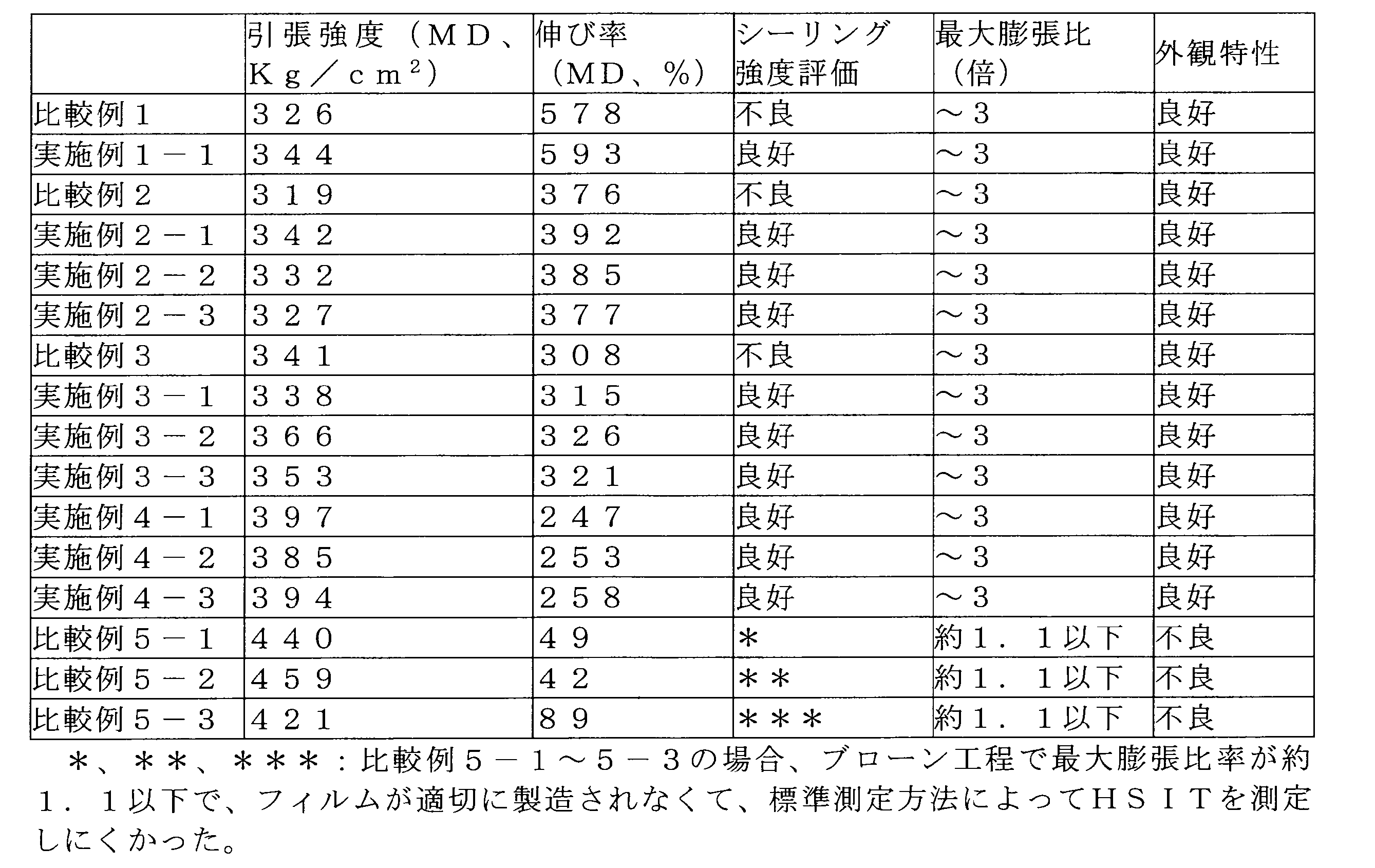
前記表を参照すれば、本発明の一実施形態による樹脂組成物は非常に高い伸び率および引張強度などを達成することができると同時に、ホットシーリング時に相対的に低い温度でも高い接合強度を実現することができるという点を明確に確認することができる。 Referring to the above table, it can be clearly seen that the resin composition according to one embodiment of the present invention can achieve very high elongation and tensile strength, and at the same time, can achieve high bonding strength even at relatively low temperatures during hot sealing.
Claims (12)
ポリ乳酸0.5~60重量部、および
エポキシ化カルダノール0.1~15重量部を含み、
前記エポキシ化カルダノールは、下記化学式2で表される化合物を含む、樹脂組成物。

0.5 to 60 parts by weight of polylactic acid; and 0.1 to 15 parts by weight of epoxidized cardanol ;
The epoxidized cardanol is a resin composition containing a compound represented by the following chemical formula 2.
前記ポリ乳酸1~45重量部を含む、請求項1に記載の樹脂組成物。 For 100 parts by weight of the polybutylene adipate terephthalate (PBAT),
The resin composition according to claim 1, comprising 1 to 45 parts by weight of the polylactic acid.
前記エポキシ化カルダノール0.2~10重量部を含む、請求項1に記載の樹脂組成物。 For 100 parts by weight of the polybutylene adipate terephthalate (PBAT),
The resin composition according to claim 1, comprising 0.2 to 10 parts by weight of the epoxidized cardanol.
Applications Claiming Priority (5)
| Application Number | Priority Date | Filing Date | Title |
|---|---|---|---|
| KR10-2021-0176953 | 2021-12-10 | ||
| KR20210176953 | 2021-12-10 | ||
| KR1020220032856A KR20230088212A (en) | 2021-12-10 | 2022-03-16 | A resin composition and a biodegradable resin product comprising the same |
| KR10-2022-0032856 | 2022-03-16 | ||
| PCT/KR2022/020034 WO2023106887A1 (en) | 2021-12-10 | 2022-12-09 | Resin composition and biodegradable resin molded product comprising same |
Publications (2)
| Publication Number | Publication Date |
|---|---|
| JP2024539028A JP2024539028A (en) | 2024-10-28 |
| JP7699720B2 true JP7699720B2 (en) | 2025-06-27 |
Family
ID=86731018
Family Applications (1)
| Application Number | Title | Priority Date | Filing Date |
|---|---|---|---|
| JP2024522575A Active JP7699720B2 (en) | 2021-12-10 | 2022-12-09 | Resin composition and biodegradable resin molded article containing the same |
Country Status (5)
| Country | Link |
|---|---|
| US (1) | US20240409737A1 (en) |
| EP (1) | EP4400546B1 (en) |
| JP (1) | JP7699720B2 (en) |
| KR (1) | KR20230088291A (en) |
| WO (1) | WO2023106887A1 (en) |
Citations (4)
| Publication number | Priority date | Publication date | Assignee | Title |
|---|---|---|---|---|
| CN103937178A (en) | 2014-05-06 | 2014-07-23 | 宁波家塑生物材料科技有限公司 | Poly(butylene tertephehalate-co-butanediol adipate)/starch-based full biodegrade composite material and preparation method thereof |
| CN107312295A (en) | 2016-04-26 | 2017-11-03 | 宁波家联塑料科技有限公司 | A kind of lactic acid composite material of high transparency low cost and preparation method thereof |
| JP2019151797A (en) | 2018-03-06 | 2019-09-12 | 富士ゼロックス株式会社 | Resin composition and resin molding |
| CN110698819A (en) | 2019-10-18 | 2020-01-17 | 青岛周氏塑料包装有限公司 | Full-biological 100% degradation garbage bag with traceable two-dimensional code identification and preparation method |
Family Cites Families (3)
| Publication number | Priority date | Publication date | Assignee | Title |
|---|---|---|---|---|
| KR20180044715A (en) * | 2016-10-24 | 2018-05-03 | 롯데정밀화학 주식회사 | Biodegradable resin composition and biodegradable articles prepared therefrom |
| CN112771121A (en) * | 2018-10-03 | 2021-05-07 | 斯瓦蒙卢森堡有限责任公司 | Polymer blend compositions and degradable extruded webs made therefrom |
| KR102860485B1 (en) | 2020-09-08 | 2025-09-17 | 삼성전자주식회사 | An electronic device that measures burned calories and control method thereof |
-
2022
- 2022-12-09 KR KR1020220171682A patent/KR20230088291A/en not_active Ceased
- 2022-12-09 WO PCT/KR2022/020034 patent/WO2023106887A1/en not_active Ceased
- 2022-12-09 EP EP22904716.2A patent/EP4400546B1/en active Active
- 2022-12-09 JP JP2024522575A patent/JP7699720B2/en active Active
- 2022-12-09 US US18/700,674 patent/US20240409737A1/en active Pending
Patent Citations (4)
| Publication number | Priority date | Publication date | Assignee | Title |
|---|---|---|---|---|
| CN103937178A (en) | 2014-05-06 | 2014-07-23 | 宁波家塑生物材料科技有限公司 | Poly(butylene tertephehalate-co-butanediol adipate)/starch-based full biodegrade composite material and preparation method thereof |
| CN107312295A (en) | 2016-04-26 | 2017-11-03 | 宁波家联塑料科技有限公司 | A kind of lactic acid composite material of high transparency low cost and preparation method thereof |
| JP2019151797A (en) | 2018-03-06 | 2019-09-12 | 富士ゼロックス株式会社 | Resin composition and resin molding |
| CN110698819A (en) | 2019-10-18 | 2020-01-17 | 青岛周氏塑料包装有限公司 | Full-biological 100% degradation garbage bag with traceable two-dimensional code identification and preparation method |
Non-Patent Citations (1)
| Title |
|---|
| Juliana M. FARIAS DA SILVA et al.,"Epoxidized cardanol-based prepolymer as promising biobased compatibilizing agent for PLA/PBAT blends",Polymer Testing,2021年01月,Vol. 93,p.106889,DOI: 10.1016/j.polymertesting.2020.106889 |
Also Published As
| Publication number | Publication date |
|---|---|
| WO2023106887A1 (en) | 2023-06-15 |
| EP4400546A4 (en) | 2024-12-04 |
| JP2024539028A (en) | 2024-10-28 |
| KR20230088291A (en) | 2023-06-19 |
| US20240409737A1 (en) | 2024-12-12 |
| EP4400546A1 (en) | 2024-07-17 |
| EP4400546B1 (en) | 2025-04-16 |
Similar Documents
| Publication | Publication Date | Title |
|---|---|---|
| CN108219396B (en) | Biodegradable polyester composition and application thereof | |
| KR20240110925A (en) | Biodegradable resin compositions and manufacturing methods thereof | |
| EP2492314A2 (en) | Clay-reinforced poly(lactic acid)-polyolefin alloy composition | |
| WO2012112266A1 (en) | Modified polylactic acid, polymeric blends and methods of making the same | |
| CN113025015A (en) | Biodegradable compostable environment-friendly material with low moisture permeability, and preparation method and application thereof | |
| JP2013147609A (en) | Resin composition, molded body, film, and bag | |
| JP7715452B2 (en) | Resin composition and biodegradable resin molded article containing the same | |
| KR20070010837A (en) | Biodegradable Resin Composition | |
| CN102850744B (en) | A kind of plastics composite, plastics and preparation method thereof | |
| JP5369673B2 (en) | Aliphatic polyester resin composition and molded article formed by molding the same | |
| JP7699720B2 (en) | Resin composition and biodegradable resin molded article containing the same | |
| CN109504042A (en) | PHA modified TPS/PBAT biodegradable resin and preparation method thereof | |
| CN1712435A (en) | A kind of green fully degradable resin and preparation method thereof | |
| KR102595757B1 (en) | Water based biodegadable composition having improved mechanical properties, products including the same and manufacturing method of water based biodegadable products | |
| KR20230088212A (en) | A resin composition and a biodegradable resin product comprising the same | |
| JP2013172678A (en) | Biodegradable mulch film | |
| JP2012031329A (en) | Biodegradable resin composition and molded article obtained by molding the composition | |
| KR20240037642A (en) | A resin composition and a biodegradable resin product comprising the same | |
| KR20080043041A (en) | Polylactic acid resin composition excellent in impact resistance and elongation | |
| KR20240041553A (en) | A resin composition and a biodegradable resin product comprising the same | |
| KR20240030678A (en) | A resin composition and a biodegradable resin product comprising the same | |
| KR20240041552A (en) | A resin composition and a biodegradable resin product comprising the same | |
| CN118201999A (en) | Resin composition and biodegradable resin product comprising the same | |
| KR20240044895A (en) | A resin composition and a biodegradable resin product comprising the same | |
| EP4613812A1 (en) | Resin composition and biodegradable resin molded product comprising same |
Legal Events
| Date | Code | Title | Description |
|---|---|---|---|
| A621 | Written request for application examination |
Free format text: JAPANESE INTERMEDIATE CODE: A621 Effective date: 20240415 |
|
| A131 | Notification of reasons for refusal |
Free format text: JAPANESE INTERMEDIATE CODE: A131 Effective date: 20250225 |
|
| A521 | Request for written amendment filed |
Free format text: JAPANESE INTERMEDIATE CODE: A523 Effective date: 20250526 |
|
| TRDD | Decision of grant or rejection written | ||
| A01 | Written decision to grant a patent or to grant a registration (utility model) |
Free format text: JAPANESE INTERMEDIATE CODE: A01 Effective date: 20250612 |
|
| A61 | First payment of annual fees (during grant procedure) |
Free format text: JAPANESE INTERMEDIATE CODE: A61 Effective date: 20250617 |
|
| R150 | Certificate of patent or registration of utility model |
Ref document number: 7699720 Country of ref document: JP Free format text: JAPANESE INTERMEDIATE CODE: R150 |