JP7689422B2 - Extracorporeal blood circulation device - Google Patents
Extracorporeal blood circulation device Download PDFInfo
- Publication number
- JP7689422B2 JP7689422B2 JP2020204761A JP2020204761A JP7689422B2 JP 7689422 B2 JP7689422 B2 JP 7689422B2 JP 2020204761 A JP2020204761 A JP 2020204761A JP 2020204761 A JP2020204761 A JP 2020204761A JP 7689422 B2 JP7689422 B2 JP 7689422B2
- Authority
- JP
- Japan
- Prior art keywords
- blood
- circuit
- solution
- circulation circuit
- circulation
- Prior art date
- Legal status (The legal status is an assumption and is not a legal conclusion. Google has not performed a legal analysis and makes no representation as to the accuracy of the status listed.)
- Active
Links
Images


Classifications
-
- A—HUMAN NECESSITIES
- A61—MEDICAL OR VETERINARY SCIENCE; HYGIENE
- A61M—DEVICES FOR INTRODUCING MEDIA INTO, OR ONTO, THE BODY; DEVICES FOR TRANSDUCING BODY MEDIA OR FOR TAKING MEDIA FROM THE BODY; DEVICES FOR PRODUCING OR ENDING SLEEP OR STUPOR
- A61M1/00—Suction or pumping devices for medical purposes; Devices for carrying-off, for treatment of, or for carrying-over, body-liquids; Drainage systems
- A61M1/36—Other treatment of blood in a by-pass of the natural circulatory system, e.g. temperature adaptation, irradiation ; Extra-corporeal blood circuits
- A61M1/3672—Means preventing coagulation
-
- A—HUMAN NECESSITIES
- A61—MEDICAL OR VETERINARY SCIENCE; HYGIENE
- A61L—METHODS OR APPARATUS FOR STERILISING MATERIALS OR OBJECTS IN GENERAL; DISINFECTION, STERILISATION OR DEODORISATION OF AIR; CHEMICAL ASPECTS OF BANDAGES, DRESSINGS, ABSORBENT PADS OR SURGICAL ARTICLES; MATERIALS FOR BANDAGES, DRESSINGS, ABSORBENT PADS OR SURGICAL ARTICLES
- A61L33/00—Antithrombogenic treatment of surgical articles, e.g. sutures, catheters, prostheses, or of articles for the manipulation or conditioning of blood; Materials for such treatment
- A61L33/04—Use of organic materials, e.g. acetylsalicylic acid
-
- A—HUMAN NECESSITIES
- A61—MEDICAL OR VETERINARY SCIENCE; HYGIENE
- A61L—METHODS OR APPARATUS FOR STERILISING MATERIALS OR OBJECTS IN GENERAL; DISINFECTION, STERILISATION OR DEODORISATION OF AIR; CHEMICAL ASPECTS OF BANDAGES, DRESSINGS, ABSORBENT PADS OR SURGICAL ARTICLES; MATERIALS FOR BANDAGES, DRESSINGS, ABSORBENT PADS OR SURGICAL ARTICLES
- A61L33/00—Antithrombogenic treatment of surgical articles, e.g. sutures, catheters, prostheses, or of articles for the manipulation or conditioning of blood; Materials for such treatment
- A61L33/06—Use of macromolecular materials
- A61L33/12—Polypeptides, proteins or derivatives thereof, e.g. degradation products thereof
- A61L33/128—Other specific proteins or polypeptides not covered by A61L33/122 - A61L33/126
-
- A—HUMAN NECESSITIES
- A61—MEDICAL OR VETERINARY SCIENCE; HYGIENE
- A61K—PREPARATIONS FOR MEDICAL, DENTAL OR TOILETRY PURPOSES
- A61K38/00—Medicinal preparations containing peptides
-
- A—HUMAN NECESSITIES
- A61—MEDICAL OR VETERINARY SCIENCE; HYGIENE
- A61M—DEVICES FOR INTRODUCING MEDIA INTO, OR ONTO, THE BODY; DEVICES FOR TRANSDUCING BODY MEDIA OR FOR TAKING MEDIA FROM THE BODY; DEVICES FOR PRODUCING OR ENDING SLEEP OR STUPOR
- A61M2202/00—Special media to be introduced, removed or treated
- A61M2202/04—Liquids
- A61M2202/0413—Blood
- A61M2202/0445—Proteins
- A61M2202/0447—Glycoproteins
- A61M2202/045—Fibrin
-
- A—HUMAN NECESSITIES
- A61—MEDICAL OR VETERINARY SCIENCE; HYGIENE
- A61M—DEVICES FOR INTRODUCING MEDIA INTO, OR ONTO, THE BODY; DEVICES FOR TRANSDUCING BODY MEDIA OR FOR TAKING MEDIA FROM THE BODY; DEVICES FOR PRODUCING OR ENDING SLEEP OR STUPOR
- A61M2205/00—General characteristics of the apparatus
- A61M2205/33—Controlling, regulating or measuring
- A61M2205/3331—Pressure; Flow
-
- A—HUMAN NECESSITIES
- A61—MEDICAL OR VETERINARY SCIENCE; HYGIENE
- A61M—DEVICES FOR INTRODUCING MEDIA INTO, OR ONTO, THE BODY; DEVICES FOR TRANSDUCING BODY MEDIA OR FOR TAKING MEDIA FROM THE BODY; DEVICES FOR PRODUCING OR ENDING SLEEP OR STUPOR
- A61M2205/00—General characteristics of the apparatus
- A61M2205/33—Controlling, regulating or measuring
- A61M2205/3331—Pressure; Flow
- A61M2205/3334—Measuring or controlling the flow rate
-
- A—HUMAN NECESSITIES
- A61—MEDICAL OR VETERINARY SCIENCE; HYGIENE
- A61M—DEVICES FOR INTRODUCING MEDIA INTO, OR ONTO, THE BODY; DEVICES FOR TRANSDUCING BODY MEDIA OR FOR TAKING MEDIA FROM THE BODY; DEVICES FOR PRODUCING OR ENDING SLEEP OR STUPOR
- A61M2205/00—General characteristics of the apparatus
- A61M2205/50—General characteristics of the apparatus with microprocessors or computers
- A61M2205/502—User interfaces, e.g. screens or keyboards
-
- A—HUMAN NECESSITIES
- A61—MEDICAL OR VETERINARY SCIENCE; HYGIENE
- A61M—DEVICES FOR INTRODUCING MEDIA INTO, OR ONTO, THE BODY; DEVICES FOR TRANSDUCING BODY MEDIA OR FOR TAKING MEDIA FROM THE BODY; DEVICES FOR PRODUCING OR ENDING SLEEP OR STUPOR
- A61M2205/00—General characteristics of the apparatus
- A61M2205/50—General characteristics of the apparatus with microprocessors or computers
- A61M2205/52—General characteristics of the apparatus with microprocessors or computers with memories providing a history of measured variating parameters of apparatus or patient
Landscapes
- Health & Medical Sciences (AREA)
- Animal Behavior & Ethology (AREA)
- Public Health (AREA)
- Engineering & Computer Science (AREA)
- Hematology (AREA)
- Veterinary Medicine (AREA)
- General Health & Medical Sciences (AREA)
- Life Sciences & Earth Sciences (AREA)
- Heart & Thoracic Surgery (AREA)
- Vascular Medicine (AREA)
- Materials Engineering (AREA)
- Chemical & Material Sciences (AREA)
- Epidemiology (AREA)
- Surgery (AREA)
- Cardiology (AREA)
- Anesthesiology (AREA)
- Biomedical Technology (AREA)
- External Artificial Organs (AREA)
Description
本発明は、体外血液循環回路を有する体外血液循環デバイスに関する。 The present invention relates to an extracorporeal blood circulation device having an extracorporeal blood circulation circuit.
体外血液循環を行うためのデバイスは存在し、かつ文献で広く説明されており、それらは、腎不全のような血液浄化(以下で「透析」と呼ぶ血液透析、血液濾過、血液透析濾過)を必要とする病状を有する患者の処置のために、心臓手術中に血液循環(以下で「ECC」と呼ぶ)を提供するために、又は血液酸素化(以下で「ECMO」と呼ぶ)のための多くの機能、例えば、血液成分(白血球、血漿、血小板など、以下で「アフェレーシス」と呼ぶ)の抽出を行う。透析、ECC、及びECMOは、常に治療目的のためのものであり、すなわち、患者を処置するためのものであるが、アフェレーシスは、例えば自己免疫疾患又は高コレステロール血症を有する患者か、又は健康な個人であって血漿、血小板、又は赤血球のような彼らの血液からの成分を提供するドナーかのいずれかを目的とするものである。様々な血液循環システムがこれを達成するのに利用可能であり、全ては、血液を循環させるためのチューブと、流れを確立するためのポンプ、例えば、蠕動ポンプ、遠心ポンプ、又は隔膜ポンプとを含む。体外循環回路(以下で「回路」と呼ぶ)を形成することによって患者の外側で血液を循環させるための公知の様々な手段は、40年にわたって文献に説明されており、全ては、2つの主な機構、すなわち、プラスチック又は空気のような物質と血液を接触させることと回路の構成からもたらされる乱流又は可変圧力の流れとを通じた血液凝固の活性化を共通して有する。 Devices for performing extracorporeal blood circulation exist and are widely described in the literature, and they perform many functions, such as extraction of blood components (white blood cells, plasma, platelets, etc., hereafter referred to as "apheresis"), for the treatment of patients with pathologies that require blood purification (hemodialysis, hemofiltration, hemodiafiltration, hereafter referred to as "dialysis"), such as renal failure, to provide blood circulation during cardiac surgery (hereafter referred to as "ECC"), or for blood oxygenation (hereafter referred to as "ECMO"). Dialysis, ECC, and ECMO are always for therapeutic purposes, i.e. for treating a patient, whereas apheresis is aimed at either patients with, for example, autoimmune diseases or hypercholesterolemia, or healthy individuals, donors who provide components from their blood, such as plasma, platelets, or red blood cells. Various blood circulation systems are available to achieve this, all including tubes for circulating the blood and pumps for establishing the flow, such as peristaltic, centrifugal, or diaphragm pumps. Various known means for circulating blood outside a patient by forming an extracorporeal circuit (hereafter referred to as the "circuit") have been described in the literature for over 40 years, and all have in common two main mechanisms: activation of blood clotting through contact of blood with materials such as plastic or air, and turbulent or variable pressure flow resulting from the configuration of the circuit.
血液凝固は、その多くが依然として十分に理解されておらず、かつ以下のような簡単な方式で要約することができる事象のカスケードによって達成される:血液に存在する血小板が最初に活性化され、すなわち、未知の物質との接触のような異常な状況又は圧力の強力かつ突然の変動に直面する時にそれらが容易に結合することができる状態に置かれる。それらは、次に、凝集して典型的に皮膚切開の場合でのような傷を閉じるために作られる「血小板血栓」を形成する。この血栓は、次に、「フィブリン血栓」になるために様々な凝固因子、取りわけ、フィブリノゲンによって強化される。この現象は、出血している傷の場合に出血を止めるのに望ましいが、それは、それが、血液を循環させる回路の容量を低減し、それを完全に停止することによって終結し、すなわち、この回路を使用不能にするので、血液循環回路では回避しなければならない。 Blood clotting is accomplished by a cascade of events, many of which are still poorly understood and can be summarized in the following simple manner: Platelets present in the blood are first activated, i.e. placed in a state where they can easily bind when faced with an abnormal situation, such as contact with an unknown substance, or a strong and sudden fluctuation in pressure. They then aggregate to form a "platelet clot" that is typically created to close a wound, such as in the case of a skin incision. This clot is then strengthened by various clotting factors, notably fibrinogen, to become a "fibrin clot". Although this phenomenon is desirable to stop bleeding in the case of a bleeding wound, it must be avoided in the blood circulation circuit, since it reduces the capacity of the circuit to circulate blood and terminates it by stopping it completely, i.e. making this circuit unusable.
凝固カスケードは、炎症のそれ及び免疫のそれと相互作用し、その両方はまた、行われている処置に直接に起因して、例えば、この処置が炎症媒体又は抗体を除去する時に起因して、又は外的因子、例えば、抗生物質の使用に起因してのいずれかで回路での循環期間中に多くの場合に変更され、凝固カスケードパラメータは、すなわち、回路内を通る血液に起因するだけではなく、数日又は更に数週間である場合がある循環の継続期間にわたる患者の状況にも起因して修正される傾向がある。すなわち、多くの現象が、血液を凝固させる又は逆にその凝固を防止するのに関与しており、回路内のいずれの凝固も防止するためにそれらの全てを知っていると想像することは非現実的であると考えられる。従って、今日までに配備された全ての手段にも関わらず、体外循環回路内の血液凝固は、可能な場合に血液を患者/ドナーに戻した後にデバイスを停止し、次に、新しい回路を設置して「呼び水」及び「濯ぎ」フェーズでデバイスを準備することによって行われる望ましくない回路交換に対する主な理由の1つとして残っている。これが起こる時に、患者に血液を戻すことは必ずしも常に可能ではなく、患者は、次に、潜在的に輸血を必要とするかなりの量を特に48時間未満に数回この状況が発生する時に失う。最も深刻な臨床症例では、体外循環は、患者の臨床状況がもはやそれを必要としなくなるまで中断することなく24時間として定義される連続方式で行われ、これは、数日又は数週間の問題である場合が多い。循環回路内の血液凝固に起因して体外循環を停止することは、すなわち、提供される機能に応じて様々な悪影響を有する場合がある。例えば、透析の場合に、血液の循環を回路内のその凝固に起因して停止することは、希ではあるがそれ自体は許容可能である血液の損失に至る場合があり、この場合に、処置は、単に回路交換後に継続されることになる。心臓(ECC)及び/又は肺(ECMO)交換の場合に、循環を停止することは、緊急手術が行われない場合に数分以内に患者の死に至る場合があり、そのような手術は、大手術であり、かつ失敗のリスクがないとは言いない。全ての場合で、回路を交換するのに少なくとも30分を要し、患者をある一定のリスクに露出し、かつかなり高価である。すなわち、血液凝固の場合であっても回路が中断なく機能することができることは不可欠である。 The coagulation cascade interacts with that of inflammation and that of immunity, both of which are also often modified during the circulation period in the circuit, either directly due to the treatment being performed, for example due to when this treatment removes inflammatory media or antibodies, or due to external factors, for example due to the use of antibiotics, and the coagulation cascade parameters tend to be modified, i.e. not only due to the blood passing through the circuit, but also due to the patient's situation over the duration of the circulation, which can be several days or even weeks. That is, many phenomena are involved in clotting the blood or, conversely, preventing its clotting, and it would be unrealistic to imagine knowing all of them in order to prevent any clotting in the circuit. Thus, despite all the measures deployed to date, blood clotting in extracorporeal circuits remains one of the main reasons for undesirable circuit exchanges, which are performed by stopping the device after returning the blood to the patient/donor when possible, and then installing a new circuit and preparing the device with a "priming" and "rinsing" phase. When this happens, it is not always possible to return blood to the patient, who then loses a significant amount that potentially requires a transfusion, especially when this situation occurs several times in less than 48 hours. In the most serious clinical cases, the extracorporeal circulation is performed in a continuous manner, defined as 24 hours without interruption, until the patient's clinical situation no longer requires it, which is often a matter of days or weeks. Stopping the extracorporeal circulation due to blood clotting in the circulation circuit can have various adverse effects, i.e. depending on the function provided. For example, in the case of dialysis, stopping the circulation of blood due to its clotting in the circuit can lead to a rare, but per se tolerable, loss of blood, in which case the treatment will simply be continued after the circuit exchange. In the case of heart (ECC) and/or lung (ECMO) exchange, stopping the circulation can lead to the death of the patient within a few minutes if emergency surgery is not performed, which is a major operation and is not without risk of failure. In all cases, it takes at least 30 minutes to exchange the circuit, exposes the patient to certain risks, and is rather expensive. That is, it is essential that the circuit can function uninterrupted even in the event of blood clotting.
実際に、血液が体外循環回路内で凝固することは一般的であり、これは、数秒又は更に1又は2分以内に起こる。従って、回路の出口に置かれて血餅を収集するように設計された血餅フィルタに主として見出されることになる小さい血餅を見出すことは珍しいことではない。しかし、本質的に指数関数的である血餅の成長により、それらはより大きくなり、かつ回路内のどこにでも、ほとんどは清浄化部材又は血餅フィルタ内で循環を大いに低減する又は更に遮断するほど十分に大きくなる場合がある。 In fact, it is common for blood to clot in extracorporeal circuits, and this occurs within a few seconds or even a minute or two. It is therefore not uncommon to find small clots that will be found primarily in the clot filter placed at the outlet of the circuit and designed to collect the clots. However, due to the growth of the clots, which is essentially exponential, they become larger and may become large enough to greatly reduce or even block circulation anywhere in the circuit, mostly in the cleaning member or clot filter.
これを防止するために、予防手段として、抗凝固剤として定義された物質を使用することは公知の慣例であり、すなわち、様々な広く説明された手段、主として血液回路の中へのヘパリン又はクエン酸塩の注入が毎日ベースで使用されている。取りわけ血液中の血小板の低含有量に起因してそれが必要であるかつ可能である時に、回路内の血液循環は、そのような予防的抗凝固剤なしで行われる場合もある。 To prevent this, it is a known practice to use substances defined as anticoagulants as a preventive measure, i.e. various widely described measures, mainly the injection of heparin or citrate into the blood circuit, are used on a daily basis. When it is necessary and possible, especially due to the low content of platelets in the blood, the blood circulation in the circuit may also be carried out without such preventive anticoagulants.
その役割が抗トロンビンIIIを活性化することであるヘパリンは、全身性抗凝固に関して一般的に使用され、すなわち、回路内で抗凝固化された患者/ドナーの血液は、それが患者に戻されている時にその状態に留まり、これは、取りわけ、この患者に対する出血リスクに至る。従って、ヘパリンの使用は、体外処置の前24時間以内に簡単な生検を含む手術を受けた患者には推奨されないことが多い。 Heparin, whose role is to activate antithrombin III, is commonly used for systemic anticoagulation, i.e. the patient/donor blood that is anticoagulated in the circuit remains in that state when it is returned to the patient, which leads, among other things, to bleeding risks for the patient. Therefore, the use of heparin is often not recommended for patients undergoing surgery, including minor biopsies, within 24 hours prior to an extracorporeal procedure.
クエン酸塩は、それなしでは起こり得ない凝固カスケードに不可欠な要素であるイオン化カルシウム(Ca++)に結合する。すなわち、Calatzis他による文献「体外回路のためのクエン酸塩抗凝固剤:全血液凝固活性化及び血餅形成に対する効果」、Nephron 2001;89:233-236では、血液の0.4mmol/L未満の血液中のイオン化カルシウム(Ca++)濃度が凝固時間を増加させ、その曲線が指数関数的であり、かつ血液が0.2mmol/L未満の血液中のイオン化カルシウム(Ca++)の濃度で凝固を停止することが明らかにされている。従って、体外回路内で循環する血液の中へのクエン酸塩の注入は、それがヘパリンと比較して回路内でのみ作用する利益を有するので、具体的には、患者の静脈の数センチメートルを通過した後に、回路からの血液が、0.9~1.1mmol/Lの含有量を有する患者の血液と混合することにより、クエン酸塩の抗凝固効果を直ちに停止する0.5mmol/Lよりも高いイオン化カルシウム濃度を取り戻すので臨床用途に入れられ、かつ文献で広く説明されている。これは、次に、それが体外循環回路に限定されるので「局所抗凝固」と呼ばれ、これは、少なくともクエン酸塩が患者によって十分に許容される最も頻繁な場合では、患者に対する出血リスクを回避して体外循環回路の使用時間を増すことを可能にする。 Citrate binds to ionized calcium (Ca ++ ), an essential component of the coagulation cascade without which it cannot occur: Calatzis et al., "Citrate Anticoagulants for Extracorporeal Circuits: Effects on Total Blood Coagulation Activation and Clot Formation," Nephron 2001;89:233-236, reveals that blood ionized calcium (Ca++) concentrations below 0.4 mmol/L of blood increase clotting time, the curve is exponential, and blood stops clotting at blood ionized calcium (Ca++) concentrations below 0.2 mmol/L. Thus, the infusion of citrate into the blood circulating in an extracorporeal circuit has been put into clinical use and is widely described in the literature, since it has the advantage, compared to heparin, of acting only within the circuit, in particular because, after passing a few centimeters through the patient's veins, the blood from the circuit regains an ionized calcium concentration higher than 0.5 mmol/L, which immediately stops the anticoagulant effect of citrate, by mixing with the patient's blood, which has a content of 0.9 to 1.1 mmol/L. This is then called "local anticoagulation", since it is limited to the extracorporeal circuit, which makes it possible to increase the use time of the extracorporeal circuit, avoiding bleeding risks for the patient, at least in the most frequent cases where citrate is well tolerated by the patient.
回路内の凝固を低減するための別の技術は、回路の開始時に効率的であるように事前希釈として公知の結晶性生理的溶液を注入することによって達成される血液及び従って血小板濃度を希釈することにあり、この方法は、流体過負荷を回避するために血液を患者に戻す前に除去する必要がある大量の溶液を必要とする。従って、この方法は、血液濾過にのみ適用可能であり、かつ通常は上述の技術に追加されるものである。更に、それは、処置された血液が希釈され、すなわち、除去すべき成分をより少なく含有するので処置の効率を低減する欠点を有する。 Another technique to reduce clotting in the circuit consists in diluting the blood and thus the platelet concentration, which is achieved by injecting a crystalloid physiological solution known as predilution so as to be efficient at the beginning of the circuit; this method requires a large amount of solution that must be removed before returning the blood to the patient to avoid fluid overload. This method is therefore only applicable to hemofiltration and is usually in addition to the techniques mentioned above. Moreover, it has the drawback that the treated blood is diluted, i.e. contains less of the components to be removed, which reduces the efficiency of the treatment.
予防的抗凝固処置の以上の3つの事例では、凝固を防止するための溶液の注入量は、最適条件の結果である。ヘパリンの場合に、回路内の抗凝固と患者に対する出血リスクの間の均衡を見出さなければならない。Ca++のような生命に不可欠のイオンに結合するクエン酸塩は、患者に戻される血液が0.2~0.4mmol/Lのイオン化カルシウム濃度を有し、0.6mmol/Lよりも低い値は致命的であるので、悲惨な臨床状況又は更に死に至る不均衡を誘導する場合がある。具体的には、状況に応じて、クエン酸塩の累積投与量は、患者内のイオン化カルシウム濃度を徐々に下げてそれを0.6mmol/Lよりも低くする場合がある。事前希釈は、その部分に関しては、血液の希釈を回避するために最適化しなければならず、これは、逆に、望ましい閾値よりも低く処置機能を低減する傾向がある。 In the three above cases of prophylactic anticoagulation treatment, the infusion volume of the solution to prevent coagulation is the result of an optimum. In the case of heparin, a balance must be found between anticoagulation in the circuit and the bleeding risk to the patient. Citrate, which binds to vital ions such as Ca ++ , may induce an imbalance leading to a dire clinical situation or even death, since the blood returned to the patient has an ionized calcium concentration of 0.2-0.4 mmol/L, values below 0.6 mmol/L being fatal. Specifically, depending on the situation, the cumulative dose of citrate may gradually reduce the ionized calcium concentration in the patient to below 0.6 mmol/L. Predilution, for its part, must be optimized to avoid hemodilution, which in turn tends to reduce the treatment function below the desired threshold.
従って、予防的抗凝固目的のための注入流体の投与は、血液が回路内で循環する時間にわたって更に変動する微妙かつ経験的な均衡の産物である。すなわち、回路内の血液の予防的抗凝固が不十分であること、及び血液がそれにも関わらず凝固し、すなわち、回路内の循環が停止すること、しかし、同じく抗凝固が過度に実質的であり、かつ患者に対するリスクのソースになることが頻繁に生じる。これは、予防的抗凝固溶液の流量の選択が、それを回路に存在する状況及び同じく患者の臨床状態の状況、これらは両方とも迅速に、すなわち、数分以内に進行することが多いが、その状況の進展に従って適応させる看護スタッフの責任になるので一層真である。別の実際的な困難は、注入速度の補正とこれらの補正の結果との間に応答の遅延があるという事実から生じ、この応答の遅延は、回路内の凝固の追加のリスクを伴うことになる看護スタッフが多数の他のタスクを行うことになるかつ時間を経過させることになる期間を表す数分又は更に数時間の期間の後に点検することができるに過ぎない。更に、有効血液流量、回路内の空気の存在、警報又は血液濃度に起因する血液ポンプの停止のようなシステムパラメータは、ランダム方式で変化し、全ては、予想のいずれの可能性もなしに回路内の潜在的な血餅の発生に大きな影響を与える。従って、抗凝固剤の大量で許容度の低い投与量の予防的注入を使用することを除いて、日常的に実際に確認される回路内の凝固を全ての場合に回避することは不可能である。 The administration of infusion fluid for prophylactic anticoagulation purposes is therefore the product of a delicate and empirical balance that further varies over the time that the blood circulates in the circuit. It frequently happens that the prophylactic anticoagulation of the blood in the circuit is insufficient and that the blood nevertheless coagulates, i.e. the circulation in the circuit stops, but also that the anticoagulation is too substantial and becomes a source of risk for the patient. This is all the more true since the choice of the flow rate of the prophylactic anticoagulation solution becomes the responsibility of the nursing staff, who adapt it according to the evolution of the situation present in the circuit and also of the clinical condition of the patient, both of which often progress quickly, i.e. within a few minutes. Another practical difficulty arises from the fact that there is a delay in response between the correction of the infusion rate and the result of these corrections, which can only be checked after a period of several minutes or even hours, representing a period during which the nursing staff will have many other tasks and will have time to perform, which will entail an additional risk of coagulation in the circuit. Furthermore, system parameters such as effective blood flow rate, the presence of air in the circuit, the stopping of the blood pump due to an alarm or blood concentration change in a random manner, all of which have a significant impact on the occurrence of potential blood clots in the circuit without any possibility of prediction. Therefore, it is not possible to avoid in all cases the clots in the circuit that are routinely observed in practice, except by using prophylactic injections of large and poorly tolerated doses of anticoagulants.
更に、様々なヘパリンの形態に関して、標準化データを提供するように設計されたデバイスによって行われる凝固時間の測定である達成された抗凝固を評価する最良の方法は、100%の信頼度で循環回路内の血液凝固を予想しないことは公知である。同じことは、血液がクエン酸塩の注入に対する患者の許容度とそれらの時間変動とによって課せられる限界に起因して時に凝固するのでクエン酸塩に関しても適用される。いずれの場合も、すなわち、循環回路に存在する血液が予防手段の実施にも関わらず凝固することが可能であり、これは、数分から数十分かかる可能性がある漸進的現象である。従って、予防的抗凝固に使用する物質に関わらず、効率の欠如は、物質の量を最小しなければならないことに主として起因し、これは、勿論、回路内の血液凝固のリスクを高め、これは、ケアユニットにおいて日常的に観察されており、かつ進行中の処置の停止と新しい回路を設定した後の最終的な再開又は多くの場合に体外循環回路の血液容積(200mlと2リットルの間)と同等である患者の失血に関連付けられた処置の停止、又は患者の血液の中心循環及び/又は酸素化の停止に起因する主な合併症のいずれかに至る。 Moreover, it is known that the best way to evaluate the anticoagulation achieved, which is the measurement of the clotting time carried out by a device designed to provide standardized data for the various heparin forms, does not predict blood clotting in the circulation circuit with 100% confidence. The same applies to citrate, since blood sometimes clots due to the limits imposed by the patient's tolerance to citrate infusions and their time variation. In both cases, it is possible that the blood present in the circulation circuit clots despite the implementation of preventive measures, a gradual phenomenon that can take several minutes to several tens of minutes. Thus, regardless of the substance used for preventive anticoagulation, the lack of efficiency is mainly due to the need to minimize the amount of substance, which of course increases the risk of blood clotting in the circuit, which is routinely observed in care units and leads either to the cessation of the ongoing treatment and its eventual resumption after setting up a new circuit or to the cessation of the treatment associated with the patient's blood loss, which is often equivalent to the blood volume of the extracorporeal circuit (between 200 ml and 2 liters), or to major complications due to the cessation of the central circulation and/or oxygenation of the patient's blood.
従って、恐らくは、回路内の凝固した(固化した)血液は、それを流動化して上述の問題を回避するために液状化する、すなわち、溶解することができることが有利であると考えられる。文献は、フィブリン血餅の酵素液状化として説明される「繊維素溶解」と、血管に存在する血餅を液状化することにある「血栓溶解」又は繊維素溶解治療とに言及している。血餅液状化システムは、説明されてきており、かつ実験室解析に対して又は脳卒中に続いて血管の詰まりを取り除くために及び従って化学的方法又は音波によって患者内の血流を回復するために使用されている。繊維素溶解は、すなわち、冠状動脈症候群、肺塞栓症、又は心筋梗塞のような身体内の血餅の形成を伴う病状の関連で説明されている。具体的には、体外循環回路内で観察される望ましくない凝固は、人体内で起こり、かつ類似の方式で血液循環を遮断する場合もある。血餅を溶解して通常は取りわけ上述の病状を予防する天然繊維素溶解システムが存在する。このシステムの機能がもはや満足のいくものでない時に、血餅を液状化するために薬物を使用することができ、3つの主要な薬物群が存在し、これらは、それらの作用モードに基づいて異なっている:組織プラスミノーゲン活性剤、ストレプトキナーゼ、及びウロキナーゼ。他の製剤原料が存在はするが、それらの大部分は、症状の最初の数時間内でのみ有効であり、すなわち、血餅形成は可逆的であるが、それは経時的に発現して実際には益々不可逆的になることを明らかにしている。 It would therefore probably be advantageous to be able to liquefy, i.e. dissolve, the clotted (solidified) blood in the circuit in order to make it mobile and avoid the problems mentioned above. The literature refers to "fibrinolysis", described as the enzymatic liquefaction of fibrin clots, and to "thrombolysis" or fibrinolytic therapy, which consists in liquefying the clots present in the blood vessels. Clot liquefaction systems have been described and used for laboratory analysis or following a stroke to unclog blood vessels and thus restore blood flow in the patient by chemical methods or sound waves. Fibrinolysis has been described in the context of pathologies involving the formation of blood clots in the body, i.e. coronary syndromes, pulmonary embolism, or myocardial infarction. In particular, the undesired clotting observed in extracorporeal circuits may occur in the human body and in a similar manner block the blood circulation. There are natural fibrinolytic systems that dissolve blood clots and usually prevent, among other things, the pathologies mentioned above. When the functioning of this system is no longer satisfactory, drugs can be used to liquefy the clot; there are three main drug groups, which differ based on their mode of action: tissue plasminogen activator, streptokinase, and urokinase. Other drug substances exist, but most of them are only effective within the first hours of symptoms, i.e., clot formation is reversible, but it manifests over time as becoming more and more irreversible in practice.
血栓溶解は、上述の病状との関連で全て上述のように研究されているが、それは、透析に使用する血管アクセスに関しても研究されている。具体的には、回路内の体外循環に十分である血流を有するために、回路の入口及び出口がその上に接続されることになる血管アクセスとも呼ばれる適切なアクセスが準備される必要がある。主として3つのアクセス:瘻孔、カテーテル、及びインプラントが存在し、それらは、手術によって患者の中に嵌め込まれる。それらは、血餅によって頻繁に(インプラントに対して年当たり0.5-2回、瘻孔に対して年当たり0.1-0.5回)塞がれる。Quencer他による文献「血液透析アクセス血栓症、精査文献」、Cardiovasc.Diagn.Ther.2017;S299-S308は、瘻孔及びインプラントから血餅を排除することを可能にする様々なソリューション及びその限界、及び診断を確立する方法を説明している。Kennard他による文献「中心静脈血液透析カテーテル誤作動を処置するための医療介入(精査)」、系統的精査のコクランデータベース 2017,Issue 10.Art.No.:CD011953は、血餅で塞がれたカテーテルを処置するために行われる様々な研究を議論している。それらの文献を読むと、いくつかの血栓溶解技術は、それらのそれぞれの利点及び欠点と共に想定可能であるが、同じくどの1つの技術も他よりも一貫して優れていることを示していないように見える。
Thrombolysis has been studied as above in the context of all the above mentioned pathologies, but also in the context of vascular accesses used for dialysis. Specifically, to have a blood flow that is sufficient for extracorporeal circulation in the circuit, a suitable access, also called vascular access, onto which the inlet and outlet of the circuit will be connected, must be prepared. There are mainly three accesses: fistulas, catheters, and implants, which are implanted in the patient by surgery. They are frequently blocked by blood clots (0.5-2 times per year for implants, 0.1-0.5 times per year for fistulas). The article "Hemodialysis Access Thrombosis, a Review of the Literature" by Quencer et al., Cardiovasc. Diagn. Ther. 2017; S299-S308, describes the different solutions and their limitations that allow to exclude blood clots from fistulas and implants, and how to establish a diagnosis. The article "Medical Interventions to Treat Central Venous Hemodialysis Catheter Malfunction (Reviews)" by Kennard et al., Cochrane Database of Systematic Reviews 2017,
既存の血餅を溶解するために使用することができる物質は、例えばCa++濃度を低減することによって血小板、フィブリン、又はカスケードの構成成分間の相互作用を直接にターゲットにする様々な方法でかつ凝固カスケード中の様々な瞬間で作用する。従って、それらは、多くの潜在的な段階及び経路を含む凝固過程中の様々な瞬間で有効である。本質的には、通常研究されているかつ上述の症例は、数時間又は更に数日にわたって形成された血餅に関連するものである。使用する手段及びこれらの症例で得られる結果は、すなわち、血餅形成の数秒又は数分以内の状況下で血液回路内に観察されるものとは非常に異なる場合がある。 Substances that can be used to dissolve existing clots act in different ways and at different moments during the coagulation cascade, for example by directly targeting platelets, fibrin, or interactions between the components of the cascade, by reducing the Ca ++ concentration. They are therefore effective at different moments during the coagulation process, which includes many potential steps and pathways. Essentially, the cases usually studied and described above relate to clots that have formed over hours or even days. The means used and the results obtained in these cases can be very different from those observed in the blood circuit, i.e. in situations within seconds or minutes of clot formation.
体外血液循環のための回路は、ポンプを通して強制される血液循環が要求通りに進行するかを決定するのに使用される圧力測定を常に保有する。すなわち、例えば透析装置のような構成要素の上流及び下流の圧力、又は患者の中に血液を再注入する前に上述の血餅を保持するように置かれた血餅フィルタの上流の圧力を測定することにより、回路内の初期の凝固を検出することが可能であり、かつ公知である。具体的には、凝固した血液は、循環せず又は大して循環せず、それは、それが存在するチューブを少なくとも部分的に塞ぎ、それは、従って、血液循環を減速させることになり、ポンプを使用して流れを強制する場合に、圧力差は、その位置から上流部分と下流部分の間で増加することになる。これが起こる時に、血小板が互いに粘着する時の現象の急速な加速に起因して「雪玉」効果が存在する。そのような場合に、一般的慣例では、血餅の存在を検出した後の数分を超えて処置を継続するための手段は存在せず、回路が完全に塞がれる前に血液をその患者/ドナーに戻すことさえも常に可能であるとは限らない。 Circuits for extracorporeal blood circulation always have pressure measurements that are used to determine whether the forced blood circulation through the pump is proceeding as required. That is, it is possible and known to detect incipient clotting in the circuit, for example by measuring the pressure upstream and downstream of a component such as a dialysis machine, or upstream of a clot filter placed to hold said clot before reinfusing the blood into the patient. In particular, the clotted blood does not circulate or does not circulate much, it at least partially blocks the tube in which it is present, which therefore slows down the blood circulation, and when a pump is used to force the flow, the pressure difference will increase between the upstream and downstream parts from that position. When this happens, there is a "snowball" effect due to the rapid acceleration of the phenomenon when platelets stick to each other. In such cases, in general practice there is no means to continue the treatment for more than a few minutes after detecting the presence of a clot, and it is not always possible to even return the blood to its patient/donor before the circuit is completely blocked.
体外循環回路に使用されるかつ文献に説明された抗凝固システムの全ては、変化する複雑性のモデルに従って、取りわけ、ヘパリン又はクエン酸塩の注入による凝固の予防に着目しており、その妥当性は、看護スタッフにより又は少なくとも1時間毎に1回自動的にそのいずれかで再評価しなければならない。血餅が回路に生じる時に、通常行われるように回路を交換するのではなく、血液循環及び関連の処置を継続することができるためにこの血餅を液状化することが依然として有利であると考えられる。しかし、上述したかつ実験室レベルで又は患者の身体内で使用される方法は、これらの方法が遅すぎるか又は複雑過ぎるかのいずれかであるので、血液循環回路に適用することはできない。事実上、血液体外回路は、血液が一方で強く活性化され、かつこれを相殺するために強く抗凝固化されるので、血餅形成の観点からは特別である。更に、血餅の形成を迅速に検出し、すなわち、凝固カスケードの早期段階で対処することがこの場合に可能である。 All of the anticoagulation systems used in extracorporeal circuits and described in the literature focus on the prevention of clotting, inter alia, by infusion of heparin or citrate, according to models of varying complexity, the adequacy of which must be reassessed either by nursing staff or automatically at least once every hour. When a clot occurs in the circuit, it is still considered advantageous to liquefy this clot in order to be able to continue the blood circulation and the associated treatments, rather than replacing the circuit, as is usually done. However, the methods mentioned above and used at laboratory level or in the patient's body cannot be applied to blood circulation circuits, since these methods are either too slow or too complicated. In fact, blood extracorporeal circuits are special from the point of view of clot formation, since the blood is on the one hand strongly activated and, to counteract this, strongly anticoagulated. Moreover, it is possible in this case to detect the formation of a clot quickly, i.e. to deal with it at an early stage of the coagulation cascade.
例えば、特許出願EP 1095666は、血液のかつフィルタを通じて血液から抽出された限外濾液の流れを表すパラメータを測定し、かつ交換容積を自動的に調節しながらフィルタ内の汚れを防止する主な目的のためにフィルタの上流に提供される生理的溶液から構成される事前希釈流量を相応に適応させる「血液濾過」処置に適用されるシステムを説明している。この文書は、回路内の循環の状態を決定するための可能な手段を説明している。しかし、その用途は、事前希釈を排除するのに必要である血液濾過回路に限定される。具体的には、事前希釈を通じて回路を濯ぐことは、患者内に蓄積することができない、すなわち、廃棄しなければならない典型的に少なくとも1 l/hの流量での大量の流体の注入を必要とする。更に、事前希釈は、血液粘性を低減して血液流量を増大することによる本質的にフィルタ防汚の特性を有し、それは、血液を希釈することによる凝固での及び従ってその後に接触状態になる可能性が低い血小板の濃度での僅かな減少を達成するが、この効果は、血餅の形成を防止するのに十分ではないことが多い。この発明は、血液濾過に使用する回路内の循環条件及びその変動を測定して物質の流量、事前希釈、この循環の改善を適応させる利益を有する。しかし、それは、既存の血餅の液状化を達成することができず、かつ患者に血液を戻す前に回路から除去しなければならない大量の水の供給を必要とする。従って、それは、濾過によって大量の水を抽出することを可能にする1つのタイプの処置、血液濾過に特定のものである。 For example, patent application EP 1095666 describes a system applied to "hemofiltration" treatments that measures parameters representative of the flow of blood and of ultrafiltrate extracted from the blood through a filter, and accordingly adapts the predilution flow rate, consisting of a physiological solution provided upstream of the filter, for the main purpose of preventing fouling in the filter while automatically adjusting the exchange volume. This document describes possible means for determining the state of circulation in the circuit. However, its application is limited to hemofiltration circuits, where it is necessary to eliminate predilution. In particular, rinsing the circuit through predilution requires the injection of large amounts of fluid, typically at a flow rate of at least 1 l/h, that cannot accumulate in the patient, i.e. must be discarded. Furthermore, predilution has inherently anti-filter properties by reducing blood viscosity and increasing blood flow rate, which achieves a slight reduction in the concentration of platelets, which are less likely to coagulate and therefore subsequently come into contact by diluting the blood, but this effect is often not sufficient to prevent the formation of blood clots. This invention has the advantage of measuring the circulatory conditions and their variations in the circuit used for hemofiltration to adapt the flow rate of substances, pre-dilution, and improvement of this circulation. However, it is unable to achieve liquefaction of existing blood clots and requires a large supply of water that must be removed from the circuit before returning the blood to the patient. It is therefore specific to one type of treatment, hemofiltration, that allows the extraction of large amounts of water by filtration.
本発明者は、血液が回路内で凝固し始める時のヘパリンの追加が血液の代わりに生理食塩水を循環させることに極似して完全に無意味であることに気が付いた。 The inventors realized that adding heparin when blood begins to clot in the circuit is completely pointless, much like circulating saline instead of blood.
本発明の目的は、上述の欠点を少なくとも部分的に是正することである。 The object of the present invention is to at least partially remedy the above-mentioned shortcomings.
これを達成するために、本発明は、少なくとも1つの血液抽出ライン及び血液戻りライン、及び同じく循環回路内で血液を循環させるように配置された手段、循環回路内で血流に対する抵抗によって影響された少なくとも1つのパラメータを測定するための手段を含む血液循環回路と、このパラメータの少なくとも1つの閾値を決定し、それをメモリに記録し、次にこのパラメータの現在値をこの記録した閾値と比較するのために配置された計算手段を含む制御ユニットとを含む体外血液循環デバイスに関する。 To achieve this, the invention relates to an extracorporeal blood circulation device comprising a blood circulation circuit including at least one blood extraction line and a blood return line, as well as means arranged to circulate blood in the circulation circuit, means for measuring at least one parameter affected by the resistance to blood flow in the circulation circuit, and a control unit including calculation means arranged to determine at least one threshold value of this parameter, record it in a memory and then compare the current value of this parameter with this recorded threshold value.
本発明により、このデバイスはまた、血餅液状化溶液の少なくとも1つのソースと、注入手段と、この液状化溶液を循環回路の中に搬送するための1又は2以上の接続ラインとを含む。更に、制御ユニットは、この液状化溶液のこの注入手段のうちの少なくとも1つを駆動するための手段を含み、この制御ユニットは、少なくとも1つの血餅が形成されていることを意味するこの閾値が超えられた時にこの駆動手段を作動するように配置され、この駆動手段は、液状化溶液が、形成された血餅の液状化を可能にするのに必要でありかつ少なくとも十分であるように予め決められた量でかつ時間にわたって循環回路に存在するように配置される。 According to the invention, the device also comprises at least one source of clot liquefaction solution, injection means and one or more connection lines for conveying the liquefaction solution into the circulation circuit. Furthermore, a control unit comprises means for driving at least one of the injection means of the liquefaction solution, the control unit being arranged to activate the driving means when the threshold value, meaning that at least one clot has been formed, is exceeded, and the driving means is arranged so that the liquefaction solution is present in the circulation circuit in a predetermined amount and for a time that is necessary and at least sufficient to allow liquefaction of the formed clot.
この駆動手段は、流量、時間、又は容積のようなパラメータに従って作用することになり、主なことは、回路に存在する血液容積に対して決定された液状化液体の量と液状化溶液の作用モードによって決定された時間とが回路に存在する血餅を液状化するのに十分であるということである。当業者に明らかなように、この駆動手段は、この量及びこの時間が回路内のどこに対しても遵守されることを保証するために液状化溶液を循環させる手段及び/又は血液を循環させる手段を作動させることによって作用することになる。 The driving means will act according to parameters such as flow rate, time or volume, the main thing being that the amount of liquefaction liquid determined for the blood volume present in the circuit and the time determined by the action mode of the liquefaction solution is sufficient to liquefy the blood clots present in the circuit. As will be clear to the skilled person, the driving means will act by activating the means for circulating the liquefaction solution and/or the means for circulating the blood to ensure that this amount and this time are respected everywhere in the circuit.
従って、駆動手段はまた、例えば、液状化溶液の作用のためのより多くの時間を残すために回路内で血液流量を低減することにより、又は回路が、液状化溶液の十分であると推定される濃度を与える量で満たされた状態で、与えられた時間にわたって血液を完全に停止することにより、様々なシナリオに従って循環回路内で血液を循環させるように配置された手段を制御するように配置することもできる。当業者に公知の駆動の多くの他のオプション、例えば、あらゆる初期血餅を液状化するために液状化溶液の注入の定期的な時間間隔での又は血液循環手段の中断のような特定の事象の後での再生が可能である。様々なシナリオは、決して限定的ではなく、実際に、それらは、液状化液体循環手段の駆動の決定のために組み合わせることができる。 The actuation means can therefore also be arranged to control the means arranged to circulate the blood in the circulation circuit according to various scenarios, for example by reducing the blood flow rate in the circuit to leave more time for the action of the liquefying solution, or by completely stopping the blood for a given time, with the circuit filled with an amount that gives a presumably sufficient concentration of the liquefying solution. Many other options of actuation known to the skilled person are possible, for example regeneration at regular time intervals of injection of the liquefying solution to liquefy any incipient blood clots or after certain events such as interruption of the blood circulation means. The various scenarios are in no way limiting and in fact they can be combined for the determination of the actuation of the liquefying liquid circulation means.
有利なことに、循環回路内の血流に対する抵抗によって影響を受ける少なくとも1つのパラメータを測定するための手段は、圧力又は流量を測定するように配置される。 Advantageously, the means for measuring at least one parameter affected by the resistance to blood flow in the circulation circuit is arranged to measure pressure or flow rate.
好ましくは、計算手段は、形成されている血餅の液状化を可能にするのに十分な周波数に従って、すなわち、優先的に毎秒1回であるが少なくとも毎分1回に従ってこのパラメータの現在値を上述の記録閾値と比較するように配置される。 Preferably, the calculation means are arranged to compare the current value of this parameter with the aforementioned recording threshold value according to a frequency sufficient to allow liquefaction of the forming blood clot, i.e. preferentially once per second but at least once per minute.
好ましくは、液状化溶液は、水でかつ血餅を液状化するのに十分である量で存在するクエン酸塩、ウロキナーゼ、ストレプトキナーゼ、及びその混合物を含む群から選択される成分で作られる。あらゆる他の公知の又は今後の物質又は混合物は、勿論、血餅に対するその効果及び患者に対して望ましくないあらゆる影響が決定される限り液状化溶液に使用することができる。 Preferably, the liquefaction solution is made of water and ingredients selected from the group including citrate, urokinase, streptokinase, and mixtures thereof, present in an amount sufficient to liquefy the clot. Any other known or future substance or mixture may, of course, be used in the liquefaction solution as long as its effect on the clot and any undesirable effects on the patient are determined.
有利なことに、本発明のデバイスはまた、予防的抗凝固を行うように配置された手段を含むことができる。 Advantageously, the device of the invention may also include means arranged to perform prophylactic anticoagulation.
有利なことに、液状化溶液は、クエン酸塩、ウロキナーゼ、ストレプトキナーゼ、及びその混合物を含む群から選択される成分を含む。液状化溶液は、好ましくは、クエン酸塩を含む。 Advantageously, the liquefaction solution comprises a component selected from the group comprising citrate, urokinase, streptokinase, and mixtures thereof. The liquefaction solution preferably comprises citrate.
本発明者は、予防に使用する濃度の少なくとも2倍の濃度を有する液状化溶液としてのクエン酸塩の追加は、これが、勢いを得る現象の最初の数分以内に行われる限り、血餅を液状化することを可能にすることに気が付いた。しかし、追加がオペレータによって行われ、かつ彼らの個人的かつ多くの場合に遅い評価に基づく時に、既に血餅で塞がれた回路を交換することが必要であることが多い。い。 The inventors have realized that the addition of citrate as a liquefying solution, with a concentration at least twice that used for prophylaxis, makes it possible to liquefy the clot, provided that this is done within the first few minutes of the phenomenon of gaining momentum. However, it is often necessary to replace a circuit already blocked by a clot, when the addition is done by the operator and based on their personal and often delayed assessment.
従って、本発明は、上述のようなあらゆる用途(透析、ECC、アフェレーシス、ECMO)に対して意図された血液循環回路を有し、第1に血液が凝固の過程にあることを検出し、第2に理想的には100ml未満の少量がこの目的に十分である物質を注入することによって血餅の液状化を行うことを可能にするデバイス又は装置を提案する。従って、それは、凝固した血液(すなわち、液体状態から回路内で血餅を形成するように固体に変えられた血液)の液状化及び従って回路を交換する必要なしの血液循環の継続を可能にする。 The invention therefore proposes a device or apparatus having a blood circulation circuit intended for any application as mentioned above (dialysis, ECC, apheresis, ECMO) that makes it possible, firstly, to detect when blood is in the process of clotting and, secondly, to carry out the liquefaction of the blood clot by injecting a substance, ideally a small amount of less than 100 ml, sufficient for this purpose. It therefore allows the liquefaction of clotted blood (i.e. blood that has been transformed from a liquid state into a solid so as to form a clot in the circuit) and thus the continuation of the blood circulation without the need to replace the circuit.
本発明の他の特性及び利点は、添付図面を参照して非限定的な例として与える本発明のいくつかの実施形態の以下の詳細説明を読む時に明らかであろう。 Other characteristics and advantages of the present invention will become apparent on reading the following detailed description of some embodiments of the invention, given by way of non-limiting example with reference to the accompanying drawings, in which:
本発明による装置は、図1に示すように、患者又はドナーからの血液の抽出のためのライン1及び血液戻りライン3を含む少なくとも1つの血液抽出ラインを含む体外血液循環回路を有する。この回路は、ライン2及び血液修正手段5で完了することができる。装置はまた、循環回路内で血液を循環させるように配置された手段9を含む。循環回路上には、ライン1及び/又はライン2において血餅を液状化することができる溶液4’を含有する流体の注入のための注入手段4が置かれ、この溶液4’は、バッグ、シリンジ、又はボトルのようなあらゆるタイプのリザーバに収容することができる。この注入手段は、接続ライン4’’及びポンプ4のようなこの接続ライン4’’において液状化溶液4’を循環させるように配置された手段を含む。
The device according to the invention has an extracorporeal blood circulation circuit, as shown in FIG. 1, including at least one blood extraction line, including a line 1 for the extraction of blood from a patient or donor and a
デバイスはまた、例えば、フィルタ、透析装置、吸収カートリッジ、又は酸素供給器から構成される血液修正手段5を含むことができる。純粋なECCの場合は存在しないそれらの手段5は、実際にいくつかの構成要素、例えば、透析装置及び吸収カートリッジから構成される場合がある。更に、装置は、循環回路内の血流に対する抵抗によって影響を受けるパラメータのうちの少なくとも1つを測定するための手段6、7、8を含むことができる。それらの測定手段は、圧力センサ又は流量センサ6及び/又は7及び/又は8とすることができ、それらは、回路内の循環が予想通りであり、取りわけ、ラインが切断されず、曲げられもしないことを保証するのに一般的に使用される。透析及びアフェレーシスの場合に、装置は、血液修正手段5から得られる流体を抽出するための手段で完了することができ、この抽出手段は、ポンプ10、ライン10’’、及び拒絶手段10’を含む。更に、血液循環回路は、実際に、通常の示していない患者又はドナー12を保護するための手段、例えば、血液漏出検出器又はクランプに関連付けられた空気検出器、及び溶液を注入するための他の手段、例えば、予防的抗凝固のためのシリンジポンプ又は抽出流体の置換の手段で完了する。図示していないそれらの手段は、当業者に一般的に公知であり、かつ文献に説明されており、それらは、勿論、本発明に説明する装置の一部を形成することができる。
The device may also include blood modification means 5, consisting of, for example, a filter, a dialyzer, an absorption cartridge, or an oxygenator. Those means 5, which are not present in the case of pure ECC, may in fact consist of several components, for example a dialyzer and an absorption cartridge. Furthermore, the device may include means 6, 7, 8 for measuring at least one of the parameters affected by the resistance to the blood flow in the circulation circuit. Those measuring means may be pressure or flow sensors 6 and/or 7 and/or 8, which are generally used to ensure that the circulation in the circuit is as expected and, among other things, that the lines are not cut or bent. In the case of dialysis and apheresis, the device may be completed with means for extracting the fluid obtained from the blood modification means 5, which extraction means include a
図1に回路によって表されたような本発明に使用する流体循環手段4、9、10は、実際に、体外血液循環回路を必要とする用途に使用する公知の構成要素である蠕動ポンプ、隔膜ポンプ、遠心ポンプ、シリンジポンプ又はクランプのいずれかとすることができる。それらの手段は、リザーバ、ライン、及びコネクタで完了する。 The fluid circulation means 4, 9, 10 used in the present invention as represented by the circuit in FIG. 1 can in fact be any of the peristaltic pumps, diaphragm pumps, centrifugal pumps, syringe pumps or clamps, which are known components used in applications requiring extracorporeal blood circulation circuits. They are completed with reservoirs, lines and connectors.
本発明のための必須構成要素は、以下に説明するように、ライン1及び3から構成される血液循環回路、血液循環9の手段、溶液を注入するための手段4、4’、4’’、及び制御ユニットである。他の構成要素は、本発明による装置に対して任意であり、血液回路の意図する用途により追加する又は追加しない場合がある。
The essential components for the present invention are the blood circulation circuit consisting of
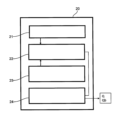
本発明による装置は、従って、必要なメッセージを表示するために及び適用可能な場合に本発明の決定因子値を入力するためのユーザインタフェース21から構成される図2に示すような制御ユニット20を有する。計算手段22は、血餅を液状化するために事前に確立した規則により作用し、かつメモリ23に記録された情報を必要に応じて取るユーザインタフェースに必要なメッセージを送る。事前に確立した規則は、公知の方程式を決定するが、ユーザインタフェース21を通じて提供される新しい条件、取りわけ、上限及び下限を含む場合がある。公知の方程式の中でも、ポンプ4で表す流量「Q」が液状化液体4’に関連付けられていることに言及することができる。単位時間「t」当たりの注入量「M」は、流量「Q」に対応する時間を乗算する、すなわち、M=Q*tによって示されているのに対して、注入時間「T」は、作用が望まれる血液容積「V」、例えば、T=V/Qbで回路に含まれる2×容積を知ることによって計算することができ、式中、Qbは、ポンプ9によって与えられる血液流量である。制御ユニットの駆動手段24は、次に、行われた測定及び計算によりポンプ4及び9を制御することになる。
The device according to the invention therefore has a
本発明による装置の計算ユニットは、例えば、図3に示すようなアルゴリズムによって稼働することができる。例えば、30秒にわたる血液ポンプ9の一定速度に対して決定された安定した流量レジメンでは、制御ユニット20は、メモリ23に圧力6と圧力7の間の差を記録し、この差は、安定条件が消える度に更新され、これは安定したタイムカウンタを更新する。測定された差が記録されたものに対して例えば10%よりも大きく増加する時に、制御ユニット20は、発達している血餅を溶解するための流量及び予め決められた時間にわたって液状化溶液4’のポンプ4を駆動し、次に、それは、次の10分以内に差が望ましい10%よりも低く戻ることを点検する。そうでなければ、制御ユニット20は、インタフェース21を通じて回路に問題があることをユーザに通知する。他のアルゴリズムが勿論考えられており、重要なことは、それらが、血餅が回路内で発達していることを何らかの方法で最初に決定することにより、典型的には、6、7、又は8で測定された圧力又は流量を使用することにより、例えば、特許出願EP 1095666に説明されたような規則を適用することによって進み、次に、予め決められた時間及び流量に関して既存の血餅を液状化することができる溶液を注入することである。時間及び流量は、勿論、他のパラメータによって置換することができる。手段6、7、又は8は、予め決められた時間間隔又は状況、例えば、血餅形成の頻繁な原因になることが公知の血液循環手段の2分よりも長い停止で置換又は完了することができる。
The calculation unit of the device according to the invention can be run, for example, by an algorithm as shown in FIG. 3. For example, with a stable flow regime determined for a constant speed of the
一例として、150ミリリットル/分の血液流量の5%に等しい流量、4%クエン酸塩を有する溶液4’を含有する流体、すなわち、7.5ミリリットル/分の流量を提供するポンプ4で連続的に注入する予防的抗凝固を行うアフェレーシスの例を取ることができる。圧力差6-7は、最初に60mmHgを示している。この差が66mmHgよりも大きい時に、ポンプ4は、血流に対してその流量を2倍にし、もはや5%ではなくここでは10%のクエン酸塩を注入し、3分間そのようにして、次に、ポンプはその初期流量に戻り、制御ユニット20は、差6-7がそれ以来63mmHgよりも低いことを点検する。同じ用途では、ポンプの駆動は、ポンプ4の速度を2倍にせずにポンプ9の速度を半分にすることによって行うことができる。この溶液は、患者の中に注入されたクエン酸塩の投与量を増加させず、同時に血液中に同じクエン酸塩濃度及び従って同じ液状化効果を提供するという利点を有することになる。
As an example, we can take the case of apheresis with prophylactic anticoagulation, in which a fluid containing a solution 4' with a flow rate equal to 5% of the blood flow rate of 150 ml/min, 4% citrate, is continuously infused with a
クエン酸塩の循環は、回路の1-2容積にわたって、すなわち、アフェレーシス又は透析の例では200-400mlにわたって行われ、これは、溶液の16~40ml、すなわち、予防的抗凝固に対して低容量のパルスを表している。このパルスは、適切な時に印加されると、臨床的に示される限り処置を継続すること及び従って患者の血液損失及び関連の輸血リスクを軽減することを可能にする。この例により、液状化溶液の注入のために提供される手段4、4’、及び4’’はまた、予防的抗凝固に使用することができることが観察され、これは、必要な機器及び同じくその設置に必要な時間を短縮する利点を有する。
The circulation of citrate is carried out over 1-2 volumes of the circuit, i.e. over 200-400 ml in the example of apheresis or dialysis, which represents a pulse of 16 to 40 ml of solution, i.e. a low volume for prophylactic anticoagulation. This pulse, when applied at the right time, makes it possible to continue the treatment as long as clinically indicated and thus reduce the patient's blood loss and the associated transfusion risk. By this example, it is observed that the
予防的抗凝固、すなわち、回路内で血餅の形成の防止を対象としたものが上記例にあるようなクエン酸塩溶質以外の手段で行われることになった場合に、状況は同じになり、クエン酸塩パルスは同じ効果を有することになる。 If prophylactic anticoagulation, i.e. aimed at preventing the formation of clots in the circuit, were to be performed by means other than citrate solutes as in the example above, the situation would be the same and a citrate pulse would have the same effect.
体外循環に含有される血餅を液状化するための多数の他の変形を使用することができ、それらは全て、予め決められた時に必要かつ十分であると決定された時間及び容積に対して液状化溶液を注入することにある。この与えられた瞬間は、圧力又は流量測定手段6、7、又は8による血餅形成の検出に基づいて決定されることが最適であり、これは、毎回及び血餅が発達の進行中である時にのみ作用することを可能にする。しかし、可能な変形は、予め決められた時間間隔で、例えば、20分毎に、又は事象、例えば、2分よりも長い血液ポンプの停止に基づいて液状化溶液を注入することにあることになるが、これは最適ではなく、予防的抗凝固のものと同一の結果をもたらす遅い注入のリスクをもたらすことになる。 Numerous other variants for liquefying the blood clot contained in the extracorporeal circulation can be used, all of which consist in injecting a liquefying solution for a time and volume determined to be necessary and sufficient at a predetermined time. This given moment is optimally determined based on the detection of the clot formation by the pressure or flow measurement means 6, 7 or 8, which makes it possible to act every time and only when the clot is in the process of development. However, possible variants would consist in injecting the liquefying solution at predetermined time intervals, for example every 20 minutes, or based on an event, for example the stopping of the blood pump for longer than 2 minutes, which is not optimal and would result in the risk of a slow injection resulting in the same results as those of prophylactic anticoagulation.
従って、別の例は、シリンジポンプ(図示せず)を使用して注入されることになるヘパリンを使用して予防的抗凝固で行う透析のものになる。本発明に適合するように、透析装置はまた、溶液が作用して血餅を液状化することを可能にするために、回路に含まれる全ての血液が3分間ポンプ4及び9を停止する前に液状化溶液と混合されるように、以前の場合に説明されているように駆動されることになる4%クエン酸塩を含有する溶液又は90秒間注入されることになるウロキナーゼ又は両方の混合物を含有する溶液を注入するための手段4、4’、4’’を含むことになる。差6-7のみを測定するのではなく、変形として、制御ユニット20は、((6+7)/2)-8)で定義された膜貫通圧(TMP)及び差6-7に基づくだけではなくTMP増加に基づく駆動ポンプ4を更に測定することができる。
Another example would therefore be that of dialysis with prophylactic anticoagulation using heparin, which would be infused using a syringe pump (not shown). In keeping with the invention, the dialysis machine would also include means 4, 4', 4'' for injecting a solution containing 4% citrate, or a solution containing urokinase, or a mixture of both, which would be infused for 90 seconds, which would be driven as described in the previous case, so that all the blood contained in the circuit is mixed with the liquefying solution before stopping the
第3の例は、予防的抗凝固を含まないECCのものである。この場合に、ポンプ4は、60mlシリンジが20%クエン酸塩のかつストレプトキナーゼの混合物を含む溶液で満たされることになるシリンジポンプとすることができる。下流に血餅の存在を示す戻った血液7の圧力が上昇する時に、10mlボーラス投与が、シリンジポンプによって注入され、これは、次に、シリンジが再充填を必要とすることをオペレータに通知する前に、連続して6つの血餅を液状化することができる。 A third example is that of an ECC that does not include prophylactic anticoagulation. In this case, pump 4 can be a syringe pump where a 60 ml syringe is filled with a solution containing a mixture of 20% citrate and streptokinase. When the pressure of the returned blood 7 rises, indicating the presence of a clot downstream, a 10 ml bolus is injected by the syringe pump, which can then liquefy six clots in succession before notifying the operator that the syringe requires refilling.
本発明の本質的な利点は、抗凝固剤の使用に関連付けられたリスクを既存の技術と比較して有意に低減することを可能にすることであり、それらは「最小限で」投与することができるので、あらゆる血餅は、少量の液状化溶液を使用して自動的に検出されて液状化され、この使用は、時々であり、かつ回路に含まれる血液の容積(これは、典型的にはアフェレーシス及び透析の場合は200ml)を伴うだけであり、血液の累積容積(典型的には、血液流量の200ミリリットル/分、すなわち、12l/h)又は患者の血液容積(成人体重70kgに対して約5リットル)ではない。従って、血餅の液状化を可能にするための手段を提案することにより、本発明は、最少量の抗凝固剤を使用するだけではなく、凝固血液を含有する回路の欠点を回避することを可能にする。 The essential advantage of the present invention is that it makes it possible to significantly reduce the risks associated with the use of anticoagulants compared to existing techniques, since they can be administered "minimally", so that any blood clots are automatically detected and liquefied using a small amount of liquefaction solution, this use being occasional and only involving the volume of blood contained in the circuit (which is typically 200 ml for apheresis and dialysis), and not the cumulative volume of blood (typically 200 ml/min of blood flow, i.e. 12 l/h) or the blood volume of the patient (approximately 5 liters for an adult body weight of 70 kg). Thus, by proposing a means to allow liquefaction of blood clots, the present invention makes it possible not only to use a minimal amount of anticoagulant, but also to avoid the disadvantages of circuits containing clotted blood.
本発明による実施形態変形は、体外循環回路の全ての様々な構成に適用され、それらは、血餅を液状化することができる1又は2以上の物質を含む様々な可能な溶液を使用し、かつそれらを回路内の様々な点であるが好ましくは血液ポンプ9の前に注入するという可能性を含む。
The embodiment variations according to the invention apply to all the different configurations of the extracorporeal circuit, including the possibility of using different possible solutions containing one or more substances capable of liquefying the blood clot and injecting them at different points in the circuit, but preferably before the
1 患者又はドナーからの血液の抽出のためのライン
3 血液戻りライン
4’ 液状化溶液
5 血液修正手段
12 患者又はドナー
1 Line for extraction of blood from a patient or
Claims (9)
少なくとも1つの血液抽出ライン(1)及び血液戻りライン(3)を含む血液循環回路と、
前記循環回路内で血液を循環させるように配置された手段(9)と、
前記循環回路内の血流に対する抵抗に影響されるパラメータのうちの少なくとも1つを測定するための手段(6、7、8)と、
を含み、
前記デバイスは、
血餅を液状化するための溶液(4’)のソースと、
前記液状化溶液(4’)を前記循環回路(1、3)の中に注入するための手段(4、4’’)と、 前記少なくとも1つのパラメータの少なくとも1つの閾値を決定し、それをメモリ(23)に記録し、かつ該少なくとも1つのパラメータの現在値を該記録された閾値と比較するように構成された計算手段(22)を含む制御ユニット(20)と、
を含み、
前記制御ユニット(20)は、前記液状化溶液(4’)を前記循環回路(1、3)の中に注入するために前記手段(4)を駆動するための駆動手段(24)を含み、
前記制御ユニット(20)は、前記液状化溶液(4’)が、前記回路内に形成された血餅を液状化するのに必要かつ十分であると予め決められた量でかつ時間にわたって該循環回路に存在するように、該血餅の存在を示す前記閾値が超えられた時に前記注入手段(4)を駆動するための前記駆動手段(24)を作動するように提供される、
ことを特徴とするデバイス。 An extracorporeal blood circulation device, comprising:
a blood circulation circuit comprising at least one blood extraction line (1) and a blood return line (3);
a means (9) arranged to circulate blood in said circulation circuit;
means (6, 7, 8) for measuring at least one of the parameters influenced by the resistance to blood flow in said circulation circuit;
Including,
The device comprises:
a source of solution (4') for liquefying the clot;
a control unit (20) comprising means (4, 4'') for injecting said liquefied solution (4') into said circulation circuit (1, 3), and calculation means (22) adapted to determine at least one threshold value of said at least one parameter, to record it in a memory (23) and to compare a current value of said at least one parameter with said recorded threshold value;
Including,
said control unit (20) comprising drive means (24) for driving said means (4) for injecting said liquefied solution (4') into said circulation circuit (1, 3);
the control unit (20) is provided to operate the drive means (24) for driving the injection means (4) when the threshold value indicating the presence of a blood clot is exceeded, so that the liquefaction solution (4') is present in the circulation circuit in an amount and for a time predetermined to be necessary and sufficient to liquefy a blood clot formed in the circuit.
A device characterized in that
Applications Claiming Priority (2)
| Application Number | Priority Date | Filing Date | Title |
|---|---|---|---|
| EP19215310.4 | 2019-12-11 | ||
| EP19215310.4A EP3834860B1 (en) | 2019-12-11 | 2019-12-11 | Device for extracorporeal circulation of blood |
Publications (2)
| Publication Number | Publication Date |
|---|---|
| JP2021090755A JP2021090755A (en) | 2021-06-17 |
| JP7689422B2 true JP7689422B2 (en) | 2025-06-06 |
Family
ID=68886879
Family Applications (1)
| Application Number | Title | Priority Date | Filing Date |
|---|---|---|---|
| JP2020204761A Active JP7689422B2 (en) | 2019-12-11 | 2020-12-10 | Extracorporeal blood circulation device |
Country Status (3)
| Country | Link |
|---|---|
| US (1) | US11819599B2 (en) |
| EP (1) | EP3834860B1 (en) |
| JP (1) | JP7689422B2 (en) |
Families Citing this family (2)
| Publication number | Priority date | Publication date | Assignee | Title |
|---|---|---|---|---|
| CN114404707B (en) * | 2021-12-27 | 2023-08-18 | 健帆生物科技集团股份有限公司 | Blood oxygenation device |
| CN116400014B (en) * | 2023-03-13 | 2025-06-27 | 宁波天益医疗器械股份有限公司 | Anticoagulation test system and test method for extracorporeal circulation dialysis pipeline |
Citations (7)
| Publication number | Priority date | Publication date | Assignee | Title |
|---|---|---|---|---|
| WO1994021124A1 (en) | 1993-03-16 | 1994-09-29 | Applied Immune Sciences, Inc. | Removal of selected factors from whole blood or its components |
| EP1095666A1 (en) | 1999-10-29 | 2001-05-02 | Infomed S.A. | Extracorporeal blood purification apparatus |
| EP1430920A1 (en) | 2002-12-20 | 2004-06-23 | Gambro Lundia AB | Device and disposable line for extracorporeal blood treatment by citrate anticoagulation |
| WO2007062197A1 (en) | 2005-11-22 | 2007-05-31 | Edwards Lifesciences Corporation | Citrate anticoagulation system for extracorporeal blood treatments |
| JP2011045450A (en) | 2009-08-25 | 2011-03-10 | Hiroshima Univ | Blood viscosity estimation method, blood viscosity ratio estimation method, blood viscosity monitoring device, and blood viscosity ratio monitoring device |
| US20120273415A1 (en) | 2011-04-29 | 2012-11-01 | Martin Gerber | Blood fluid removal system performance monitoring |
| JP2016007541A (en) | 2014-06-26 | 2016-01-18 | アンフォムド ソシエテ アノニム | Apparatus for blood purification by extracorporeal circulation |
-
2019
- 2019-12-11 EP EP19215310.4A patent/EP3834860B1/en active Active
-
2020
- 2020-12-10 US US17/117,736 patent/US11819599B2/en active Active
- 2020-12-10 JP JP2020204761A patent/JP7689422B2/en active Active
Patent Citations (7)
| Publication number | Priority date | Publication date | Assignee | Title |
|---|---|---|---|---|
| WO1994021124A1 (en) | 1993-03-16 | 1994-09-29 | Applied Immune Sciences, Inc. | Removal of selected factors from whole blood or its components |
| EP1095666A1 (en) | 1999-10-29 | 2001-05-02 | Infomed S.A. | Extracorporeal blood purification apparatus |
| EP1430920A1 (en) | 2002-12-20 | 2004-06-23 | Gambro Lundia AB | Device and disposable line for extracorporeal blood treatment by citrate anticoagulation |
| WO2007062197A1 (en) | 2005-11-22 | 2007-05-31 | Edwards Lifesciences Corporation | Citrate anticoagulation system for extracorporeal blood treatments |
| JP2011045450A (en) | 2009-08-25 | 2011-03-10 | Hiroshima Univ | Blood viscosity estimation method, blood viscosity ratio estimation method, blood viscosity monitoring device, and blood viscosity ratio monitoring device |
| US20120273415A1 (en) | 2011-04-29 | 2012-11-01 | Martin Gerber | Blood fluid removal system performance monitoring |
| JP2016007541A (en) | 2014-06-26 | 2016-01-18 | アンフォムド ソシエテ アノニム | Apparatus for blood purification by extracorporeal circulation |
Also Published As
| Publication number | Publication date |
|---|---|
| JP2021090755A (en) | 2021-06-17 |
| EP3834860A1 (en) | 2021-06-16 |
| EP3834860C0 (en) | 2024-08-14 |
| US20210178049A1 (en) | 2021-06-17 |
| EP3834860B1 (en) | 2024-08-14 |
| US11819599B2 (en) | 2023-11-21 |
Similar Documents
| Publication | Publication Date | Title |
|---|---|---|
| Jobes et al. | Increased accuracy and precision of heparin and protamine dosing reduces blood loss and transfusion in patients undergoing primary cardiac operations | |
| US8603021B2 (en) | Method and apparatus for ultrafiltration of blood | |
| US6533747B1 (en) | Extracorporeal circuit for peripheral vein fluid removal | |
| US20090192137A1 (en) | Dialysis method | |
| Hendrickx et al. | A comparative prospective study on the use of low concentrate citrate lock versus heparin lock in permanent dialysis catheters | |
| JP7689422B2 (en) | Extracorporeal blood circulation device | |
| Romagnolib | Technical complications of continuous renal replacement therapy | |
| US20200188572A1 (en) | Device For An Extracorporeal Blood Treatment, And Method For Determining A Hemodynamic Parameter During An Extracorporeal Blood Treatment | |
| Vanommeslaeghe et al. | Detection and scoring of extracorporeal circuit clotting during hemodialysis | |
| Stammers et al. | Hematological assessment of patients undergoing plasmapheresis during cardiac surgery | |
| Preuschof et al. | Heparin-free hemodialysis with prophylactic change of dialyser and blood lines | |
| Liang et al. | Outcomes associated with a heparin-free hemodialysis protocol and review of the literature | |
| Zaccaria et al. | Principles of extracorporeal circulation and transport phenomena | |
| Hu et al. | Time course of activated coagulation time at various sites during continuous haemodiafiltration using nafamostat mesilate | |
| Clark et al. | Continuous Renal Replacement Therapy Machine Technology | |
| Kramer | Arteriovenous hemofiltration: A kidney replacement therapy for the intensive care unit | |
| Ashouri | Regional sodium citrate anticoagulation in patients with active bleeding undergoing hemodialysis | |
| Tominaga et al. | Continuous arteriovenous hemodiafiltration in postoperative and traumatic renal failure | |
| De Vos | Anticoagulation therapy in acute renal failure extracorporeal treated patients | |
| CN112190779A (en) | CRRT pipeline replacement method | |
| Munshi et al. | Hemodialysis | |
| Zope | Dialysis without anticoagulation (heparin free dialysis) | |
| Rees | 73 Hemodialysis | |
| JP2005046377A (en) | Anticoagulant for extracorporeal blood circulation circuit |
Legal Events
| Date | Code | Title | Description |
|---|---|---|---|
| A621 | Written request for application examination |
Free format text: JAPANESE INTERMEDIATE CODE: A621 Effective date: 20231122 |
|
| A977 | Report on retrieval |
Free format text: JAPANESE INTERMEDIATE CODE: A971007 Effective date: 20240823 |
|
| A131 | Notification of reasons for refusal |
Free format text: JAPANESE INTERMEDIATE CODE: A131 Effective date: 20240930 |
|
| A601 | Written request for extension of time |
Free format text: JAPANESE INTERMEDIATE CODE: A601 Effective date: 20241216 |
|
| A521 | Request for written amendment filed |
Free format text: JAPANESE INTERMEDIATE CODE: A523 Effective date: 20250228 |
|
| TRDD | Decision of grant or rejection written | ||
| A01 | Written decision to grant a patent or to grant a registration (utility model) |
Free format text: JAPANESE INTERMEDIATE CODE: A01 Effective date: 20250428 |
|
| A61 | First payment of annual fees (during grant procedure) |
Free format text: JAPANESE INTERMEDIATE CODE: A61 Effective date: 20250527 |
|
| R150 | Certificate of patent or registration of utility model |
Ref document number: 7689422 Country of ref document: JP Free format text: JAPANESE INTERMEDIATE CODE: R150 |