JP7688317B2 - Surface-treated steel sheet - Google Patents
Surface-treated steel sheet Download PDFInfo
- Publication number
- JP7688317B2 JP7688317B2 JP2024557217A JP2024557217A JP7688317B2 JP 7688317 B2 JP7688317 B2 JP 7688317B2 JP 2024557217 A JP2024557217 A JP 2024557217A JP 2024557217 A JP2024557217 A JP 2024557217A JP 7688317 B2 JP7688317 B2 JP 7688317B2
- Authority
- JP
- Japan
- Prior art keywords
- coating layer
- steel sheet
- primer coating
- mass
- layer
- Prior art date
- Legal status (The legal status is an assumption and is not a legal conclusion. Google has not performed a legal analysis and makes no representation as to the accuracy of the status listed.)
- Active
Links
Images



Classifications
-
- C—CHEMISTRY; METALLURGY
- C23—COATING METALLIC MATERIAL; COATING MATERIAL WITH METALLIC MATERIAL; CHEMICAL SURFACE TREATMENT; DIFFUSION TREATMENT OF METALLIC MATERIAL; COATING BY VACUUM EVAPORATION, BY SPUTTERING, BY ION IMPLANTATION OR BY CHEMICAL VAPOUR DEPOSITION, IN GENERAL; INHIBITING CORROSION OF METALLIC MATERIAL OR INCRUSTATION IN GENERAL
- C23C—COATING METALLIC MATERIAL; COATING MATERIAL WITH METALLIC MATERIAL; SURFACE TREATMENT OF METALLIC MATERIAL BY DIFFUSION INTO THE SURFACE, BY CHEMICAL CONVERSION OR SUBSTITUTION; COATING BY VACUUM EVAPORATION, BY SPUTTERING, BY ION IMPLANTATION OR BY CHEMICAL VAPOUR DEPOSITION, IN GENERAL
- C23C28/00—Coating for obtaining at least two superposed coatings either by methods not provided for in a single one of groups C23C2/00 - C23C26/00 or by combinations of methods provided for in subclasses C23C and C25C or C25D
- C23C28/30—Coatings combining at least one metallic layer and at least one inorganic non-metallic layer
- C23C28/32—Coatings combining at least one metallic layer and at least one inorganic non-metallic layer including at least one pure metallic layer
- C23C28/322—Coatings combining at least one metallic layer and at least one inorganic non-metallic layer including at least one pure metallic layer only coatings of metal elements only
- C23C28/3225—Coatings combining at least one metallic layer and at least one inorganic non-metallic layer including at least one pure metallic layer only coatings of metal elements only with at least one zinc-based layer
-
- C—CHEMISTRY; METALLURGY
- C09—DYES; PAINTS; POLISHES; NATURAL RESINS; ADHESIVES; COMPOSITIONS NOT OTHERWISE PROVIDED FOR; APPLICATIONS OF MATERIALS NOT OTHERWISE PROVIDED FOR
- C09D—COATING COMPOSITIONS, e.g. PAINTS, VARNISHES OR LACQUERS; FILLING PASTES; CHEMICAL PAINT OR INK REMOVERS; INKS; CORRECTING FLUIDS; WOODSTAINS; PASTES OR SOLIDS FOR COLOURING OR PRINTING; USE OF MATERIALS THEREFOR
- C09D167/00—Coating compositions based on polyesters obtained by reactions forming a carboxylic ester link in the main chain; Coating compositions based on derivatives of such polymers
-
- C—CHEMISTRY; METALLURGY
- C23—COATING METALLIC MATERIAL; COATING MATERIAL WITH METALLIC MATERIAL; CHEMICAL SURFACE TREATMENT; DIFFUSION TREATMENT OF METALLIC MATERIAL; COATING BY VACUUM EVAPORATION, BY SPUTTERING, BY ION IMPLANTATION OR BY CHEMICAL VAPOUR DEPOSITION, IN GENERAL; INHIBITING CORROSION OF METALLIC MATERIAL OR INCRUSTATION IN GENERAL
- C23C—COATING METALLIC MATERIAL; COATING MATERIAL WITH METALLIC MATERIAL; SURFACE TREATMENT OF METALLIC MATERIAL BY DIFFUSION INTO THE SURFACE, BY CHEMICAL CONVERSION OR SUBSTITUTION; COATING BY VACUUM EVAPORATION, BY SPUTTERING, BY ION IMPLANTATION OR BY CHEMICAL VAPOUR DEPOSITION, IN GENERAL
- C23C2/00—Hot-dipping or immersion processes for applying the coating material in the molten state without affecting the shape; Apparatus therefor
- C23C2/04—Hot-dipping or immersion processes for applying the coating material in the molten state without affecting the shape; Apparatus therefor characterised by the coating material
- C23C2/06—Zinc or cadmium or alloys based thereon
-
- C—CHEMISTRY; METALLURGY
- C23—COATING METALLIC MATERIAL; COATING MATERIAL WITH METALLIC MATERIAL; CHEMICAL SURFACE TREATMENT; DIFFUSION TREATMENT OF METALLIC MATERIAL; COATING BY VACUUM EVAPORATION, BY SPUTTERING, BY ION IMPLANTATION OR BY CHEMICAL VAPOUR DEPOSITION, IN GENERAL; INHIBITING CORROSION OF METALLIC MATERIAL OR INCRUSTATION IN GENERAL
- C23C—COATING METALLIC MATERIAL; COATING MATERIAL WITH METALLIC MATERIAL; SURFACE TREATMENT OF METALLIC MATERIAL BY DIFFUSION INTO THE SURFACE, BY CHEMICAL CONVERSION OR SUBSTITUTION; COATING BY VACUUM EVAPORATION, BY SPUTTERING, BY ION IMPLANTATION OR BY CHEMICAL VAPOUR DEPOSITION, IN GENERAL
- C23C2/00—Hot-dipping or immersion processes for applying the coating material in the molten state without affecting the shape; Apparatus therefor
- C23C2/26—After-treatment
-
- C—CHEMISTRY; METALLURGY
- C23—COATING METALLIC MATERIAL; COATING MATERIAL WITH METALLIC MATERIAL; CHEMICAL SURFACE TREATMENT; DIFFUSION TREATMENT OF METALLIC MATERIAL; COATING BY VACUUM EVAPORATION, BY SPUTTERING, BY ION IMPLANTATION OR BY CHEMICAL VAPOUR DEPOSITION, IN GENERAL; INHIBITING CORROSION OF METALLIC MATERIAL OR INCRUSTATION IN GENERAL
- C23C—COATING METALLIC MATERIAL; COATING MATERIAL WITH METALLIC MATERIAL; SURFACE TREATMENT OF METALLIC MATERIAL BY DIFFUSION INTO THE SURFACE, BY CHEMICAL CONVERSION OR SUBSTITUTION; COATING BY VACUUM EVAPORATION, BY SPUTTERING, BY ION IMPLANTATION OR BY CHEMICAL VAPOUR DEPOSITION, IN GENERAL
- C23C2/00—Hot-dipping or immersion processes for applying the coating material in the molten state without affecting the shape; Apparatus therefor
- C23C2/34—Hot-dipping or immersion processes for applying the coating material in the molten state without affecting the shape; Apparatus therefor characterised by the shape of the material to be treated
- C23C2/36—Elongated material
- C23C2/40—Plates; Strips
-
- C—CHEMISTRY; METALLURGY
- C23—COATING METALLIC MATERIAL; COATING MATERIAL WITH METALLIC MATERIAL; CHEMICAL SURFACE TREATMENT; DIFFUSION TREATMENT OF METALLIC MATERIAL; COATING BY VACUUM EVAPORATION, BY SPUTTERING, BY ION IMPLANTATION OR BY CHEMICAL VAPOUR DEPOSITION, IN GENERAL; INHIBITING CORROSION OF METALLIC MATERIAL OR INCRUSTATION IN GENERAL
- C23C—COATING METALLIC MATERIAL; COATING MATERIAL WITH METALLIC MATERIAL; SURFACE TREATMENT OF METALLIC MATERIAL BY DIFFUSION INTO THE SURFACE, BY CHEMICAL CONVERSION OR SUBSTITUTION; COATING BY VACUUM EVAPORATION, BY SPUTTERING, BY ION IMPLANTATION OR BY CHEMICAL VAPOUR DEPOSITION, IN GENERAL
- C23C22/00—Chemical surface treatment of metallic material by reaction of the surface with a reactive liquid, leaving reaction products of surface material in the coating, e.g. conversion coatings, passivation of metals
- C23C22/05—Chemical surface treatment of metallic material by reaction of the surface with a reactive liquid, leaving reaction products of surface material in the coating, e.g. conversion coatings, passivation of metals using aqueous solutions
- C23C22/06—Chemical surface treatment of metallic material by reaction of the surface with a reactive liquid, leaving reaction products of surface material in the coating, e.g. conversion coatings, passivation of metals using aqueous solutions using aqueous acidic solutions with pH less than 6
- C23C22/07—Chemical surface treatment of metallic material by reaction of the surface with a reactive liquid, leaving reaction products of surface material in the coating, e.g. conversion coatings, passivation of metals using aqueous solutions using aqueous acidic solutions with pH less than 6 containing phosphates
-
- C—CHEMISTRY; METALLURGY
- C23—COATING METALLIC MATERIAL; COATING MATERIAL WITH METALLIC MATERIAL; CHEMICAL SURFACE TREATMENT; DIFFUSION TREATMENT OF METALLIC MATERIAL; COATING BY VACUUM EVAPORATION, BY SPUTTERING, BY ION IMPLANTATION OR BY CHEMICAL VAPOUR DEPOSITION, IN GENERAL; INHIBITING CORROSION OF METALLIC MATERIAL OR INCRUSTATION IN GENERAL
- C23C—COATING METALLIC MATERIAL; COATING MATERIAL WITH METALLIC MATERIAL; SURFACE TREATMENT OF METALLIC MATERIAL BY DIFFUSION INTO THE SURFACE, BY CHEMICAL CONVERSION OR SUBSTITUTION; COATING BY VACUUM EVAPORATION, BY SPUTTERING, BY ION IMPLANTATION OR BY CHEMICAL VAPOUR DEPOSITION, IN GENERAL
- C23C26/00—Coating not provided for in groups C23C2/00 - C23C24/00
-
- C—CHEMISTRY; METALLURGY
- C23—COATING METALLIC MATERIAL; COATING MATERIAL WITH METALLIC MATERIAL; CHEMICAL SURFACE TREATMENT; DIFFUSION TREATMENT OF METALLIC MATERIAL; COATING BY VACUUM EVAPORATION, BY SPUTTERING, BY ION IMPLANTATION OR BY CHEMICAL VAPOUR DEPOSITION, IN GENERAL; INHIBITING CORROSION OF METALLIC MATERIAL OR INCRUSTATION IN GENERAL
- C23C—COATING METALLIC MATERIAL; COATING MATERIAL WITH METALLIC MATERIAL; SURFACE TREATMENT OF METALLIC MATERIAL BY DIFFUSION INTO THE SURFACE, BY CHEMICAL CONVERSION OR SUBSTITUTION; COATING BY VACUUM EVAPORATION, BY SPUTTERING, BY ION IMPLANTATION OR BY CHEMICAL VAPOUR DEPOSITION, IN GENERAL
- C23C28/00—Coating for obtaining at least two superposed coatings either by methods not provided for in a single one of groups C23C2/00 - C23C26/00 or by combinations of methods provided for in subclasses C23C and C25C or C25D
-
- C—CHEMISTRY; METALLURGY
- C23—COATING METALLIC MATERIAL; COATING MATERIAL WITH METALLIC MATERIAL; CHEMICAL SURFACE TREATMENT; DIFFUSION TREATMENT OF METALLIC MATERIAL; COATING BY VACUUM EVAPORATION, BY SPUTTERING, BY ION IMPLANTATION OR BY CHEMICAL VAPOUR DEPOSITION, IN GENERAL; INHIBITING CORROSION OF METALLIC MATERIAL OR INCRUSTATION IN GENERAL
- C23C—COATING METALLIC MATERIAL; COATING MATERIAL WITH METALLIC MATERIAL; SURFACE TREATMENT OF METALLIC MATERIAL BY DIFFUSION INTO THE SURFACE, BY CHEMICAL CONVERSION OR SUBSTITUTION; COATING BY VACUUM EVAPORATION, BY SPUTTERING, BY ION IMPLANTATION OR BY CHEMICAL VAPOUR DEPOSITION, IN GENERAL
- C23C28/00—Coating for obtaining at least two superposed coatings either by methods not provided for in a single one of groups C23C2/00 - C23C26/00 or by combinations of methods provided for in subclasses C23C and C25C or C25D
- C23C28/30—Coatings combining at least one metallic layer and at least one inorganic non-metallic layer
- C23C28/34—Coatings combining at least one metallic layer and at least one inorganic non-metallic layer including at least one inorganic non-metallic material layer, e.g. metal carbide, nitride, boride, silicide layer and their mixtures, enamels, phosphates and sulphates
-
- B—PERFORMING OPERATIONS; TRANSPORTING
- B32—LAYERED PRODUCTS
- B32B—LAYERED PRODUCTS, i.e. PRODUCTS BUILT-UP OF STRATA OF FLAT OR NON-FLAT, e.g. CELLULAR OR HONEYCOMB, FORM
- B32B15/00—Layered products comprising a layer of metal
- B32B15/18—Layered products comprising a layer of metal comprising iron or steel
-
- B—PERFORMING OPERATIONS; TRANSPORTING
- B32—LAYERED PRODUCTS
- B32B—LAYERED PRODUCTS, i.e. PRODUCTS BUILT-UP OF STRATA OF FLAT OR NON-FLAT, e.g. CELLULAR OR HONEYCOMB, FORM
- B32B7/00—Layered products characterised by the relation between layers; Layered products characterised by the relative orientation of features between layers, or by the relative values of a measurable parameter between layers, i.e. products comprising layers having different physical, chemical or physicochemical properties; Layered products characterised by the interconnection of layers
- B32B7/02—Physical, chemical or physicochemical properties
- B32B7/027—Thermal properties
Landscapes
- Chemical & Material Sciences (AREA)
- Chemical Kinetics & Catalysis (AREA)
- Engineering & Computer Science (AREA)
- Materials Engineering (AREA)
- Organic Chemistry (AREA)
- Mechanical Engineering (AREA)
- Metallurgy (AREA)
- Inorganic Chemistry (AREA)
- Life Sciences & Earth Sciences (AREA)
- Wood Science & Technology (AREA)
- General Chemical & Material Sciences (AREA)
- Other Surface Treatments For Metallic Materials (AREA)
- Physics & Mathematics (AREA)
- Thermal Sciences (AREA)
- Electroplating Methods And Accessories (AREA)
- Laminated Bodies (AREA)
Description
本発明は、表面処理鋼板に関する。The present invention relates to a surface-treated steel sheet.
家電製品用、建材用、自動車用等といった用途向けの鋼板素材として、従来の成形加工後に塗装されていたポスト塗装鋼板に代わって、着色された皮膜が予め被覆されているプレコート金属板が使用されるようになってきている。かかるプレコート金属板は、防錆処理が施された鋼板やめっき鋼板の表面に対し、着色された皮膜を被覆したものである。かかるプレコート金属板は、美麗な外観を有しながら、十分な加工性を有し、更に耐食性が良好であるという特性を有している。Precoated metal sheets, which are coated with a colored film in advance, are being used as steel sheet materials for applications such as home appliances, building materials, and automobiles, instead of post-painted steel sheets that were conventionally painted after forming. Such precoated metal sheets are produced by coating the surface of a rust-proofed steel sheet or plated steel sheet with a colored film. Such precoated metal sheets have the properties of having a beautiful appearance, sufficient workability, and good corrosion resistance.
上記のようなプレコート金属板において、プレコート金属板としての耐食性を更に向上させるために、めっき層上に設けられる皮膜層を、プライマー皮膜層及び上層塗膜層という複層構造とするとともに、かかるプライマー皮膜層に対して、防錆顔料としてバナジウム化合物を含有させる技術が提案されている(例えば、以下の特許文献1を参照。)。In order to further improve the corrosion resistance of the precoated metal sheet as described above, a technique has been proposed in which the coating layer provided on the plating layer has a multilayer structure consisting of a primer coating layer and an upper coating layer, and the primer coating layer contains a vanadium compound as an anti-rust pigment (see, for example,
本発明者らは、上記特許文献1に開示されているようなプレコート金属板を、給湯器やエアコンの室外機等のような、熱に曝される家電製品等の素材として用いることを検討していたところ、めっき層上に設けられる皮膜層が経時的に黄色味を帯びてしまう場合があることに気づいた。このような色相の変化(より詳細には、熱による黄変)が生じた場合、家電製品の外観が変化してしまう。そのため、めっき層上に設けられる皮膜の耐熱黄変性について、更なる改良の余地があることが明らかとなった。The present inventors were considering using the precoated metal sheet disclosed in the
そこで、本発明は、上記問題に鑑みてなされたものであり、本発明の目的とするところは、バナジウム化合物を含有する皮膜層を有する場合であっても、皮膜層の耐熱黄変性をより向上させることが可能な、表面処理鋼板を提供することにある。Therefore, the present invention has been made in consideration of the above problems, and an object of the present invention is to provide a surface-treated steel sheet that can further improve the heat yellowing resistance of a coating layer even when the coating layer contains a vanadium compound.
上記課題を解決するために、本発明者らが鋭意検討を行った結果、上記のような熱による黄変は、皮膜層に含有されているバナジウム化合物が酸化変色して、黄色味を帯びることが原因であると推察された。その上で、本発明者らは、バナジウム化合物が酸化変色したとしても、酸化変色したバナジウム化合物が外部から視認されにくくなれば、結果として、表面処理鋼板としての外観の変化が認識されにくくなるのではないか、との着想を得た。そこで、本発明者らは、かかる着想に基づき、酸化変色したバナジウムが視認されにくくなるための構成について、鋭意検討を行った。
かかる検討の結果完成された本発明の要旨は、以下の通りである。 In order to solve the above problems, the present inventors conducted intensive research and inferred that the above-mentioned yellowing due to heat is caused by the vanadium compound contained in the coating layer being oxidized and discolored, resulting in a yellowish color. Based on this, the present inventors came up with the idea that even if the vanadium compound is oxidized and discolored, if the oxidized and discolored vanadium compound is difficult to see from the outside, then as a result, the change in the appearance of the surface-treated steel sheet will be difficult to recognize. Based on this idea, the present inventors conducted intensive research into a configuration for making the oxidized and discolored vanadium difficult to see.
The gist of the present invention, which was completed as a result of such investigation, is as follows.
(1)母材となる鋼板の表面に位置する、Zn含有めっき層と、前記Zn含有めっき層上に位置し、バナジウム化合物を少なくとも含有するプライマー皮膜層と、前記プライマー皮膜層上に位置する、上層皮膜層と、を有し、前記プライマー皮膜層の平均厚みは、3.0~15.0μmの範囲内であり、前記上層皮膜層の平均厚みは、7.0~25.0μmの範囲内であり、前記上層皮膜層のビッカース硬さは、25~70Hvの範囲内であり、前記プライマー皮膜層のビッカース硬さは、20Hv以下であり、かつ、前記上層皮膜層のビッカース硬さと、前記プライマー皮膜層のビッカース硬さとの差は、5~50Hvの範囲内であり、前記プライマー皮膜層の造膜成分のガラス転移点Tgは、0~40℃の範囲内であり、前記上層皮膜層の造膜成分のガラス転移点Tgは、40~70℃の範囲内である、表面処理鋼板。
(2)前記バナジウム化合物の平均粒径は、0.05~2.00μmの範囲内である、(1)に記載の表面処理鋼板。
(3)前記プライマー皮膜層における前記バナジウム化合物の含有量は、前記プライマー皮膜層の全固形分質量に対して、5~50質量%の範囲内であり、前記プライマー皮膜層における造膜成分の含有量は、前記プライマー皮膜層の全固形分質量に対して、30~80質量%の範囲内であり、かつ、前記バナジウム化合物と前記造膜成分の合計含有量が、前記プライマー皮膜層の全固形分質量の100質量%以下となるように、前記バナジウム化合物と前記造膜成分とを含有する、(1)又は(2)に記載の表面処理鋼板。
(4)前記上層皮膜層は、アルミ顔料を含有する、(1)又は(2)に記載の表面処理鋼板。
(5)前記Zn含有めっき層と、前記プライマー皮膜層との間に、更に化成処理皮膜層を有する、(1)又は(2)に記載の表面処理鋼板。
(1) A surface-treated steel sheet comprising: a Zn-containing plating layer located on a surface of a steel sheet serving as a base material; a primer coating layer located on the Zn-containing plating layer and containing at least a vanadium compound; and an upper coating layer located on the primer coating layer, wherein the primer coating layer has an average thickness in the range of 3.0 to 15.0 μm, the upper coating layer has an average thickness in the range of 7.0 to 25.0 μm, the upper coating layer has a Vickers hardness in the range of 25 to 70 Hv, the primer coating layer has a Vickers hardness of 20 Hv or less, and a difference between the Vickers hardness of the upper coating layer and the Vickers hardness of the primer coating layer is in the range of 5 to 50 Hv, the primer coating layer has a glass transition point Tg in the range of 0 to 40° C., and the upper coating layer has a glass transition point Tg in the range of 40 to 70° C.
( 2 ) The surface-treated steel sheet according to (1) , wherein the vanadium compound has an average particle size within a range of 0.05 to 2.00 μm.
( 3 ) The surface-treated steel sheet according to (1) or (2), wherein the content of the vanadium compound in the primer coating layer is within a range of 5 to 50 mass% relative to the total solid mass of the primer coating layer, the content of the film-forming components in the primer coating layer is within a range of 30 to 80 mass% relative to the total solid mass of the primer coating layer, and the vanadium compound and the film-forming components are contained such that the total content of the vanadium compound and the film-forming components is 100 mass% or less of the total solid mass of the primer coating layer.
( 4 ) The surface-treated steel sheet according to (1) or (2), wherein the upper coating layer contains an aluminum pigment.
( 5 ) The surface-treated steel sheet according to (1) or (2), further comprising a chemical conversion coating layer between the Zn-containing plating layer and the primer coating layer.
以上説明したように本発明によれば、バナジウム化合物を含有する皮膜層を有する場合であっても、皮膜層の耐熱黄変性をより向上させることが可能となる。As described above, according to the present invention, even when a coating layer containing a vanadium compound is provided, it is possible to further improve the heat yellowing resistance of the coating layer.
以下に添付図面を参照しながら、本発明の好適な実施の形態について詳細に説明する。なお、本明細書及び図面において、実質的に同一の機能構成を有する構成要素については、同一の符号を付することにより重複説明を省略する。Hereinafter, preferred embodiments of the present invention will be described in detail with reference to the accompanying drawings. In this specification and the drawings, components having substantially the same functional configurations are designated by the same reference numerals, and duplicated explanations will be omitted.
(表面処理鋼板について)
以下では、図1A~図2Bを参照しながら、本発明の実施形態に係る表面処理鋼板について、詳細に説明する。図1A~図2Bは、本実施形態に係る表面処理鋼板の構成の一例を模式的に示した説明図である。(About surface-treated steel sheets)
Hereinafter, a surface-treated steel sheet according to an embodiment of the present invention will be described in detail with reference to Figures 1A to 2B. Figures 1A to 2B are explanatory diagrams that diagrammatically show an example of the configuration of the surface-treated steel sheet according to the present embodiment.
<表面処理鋼板の全体的な構成について>
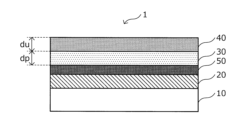
図1Aに模式的に示したように、本実施形態に係る表面処理鋼板1は、母材鋼板10と、母材鋼板10の片方の表面上に位置するZn含有めっき層20と、Zn含有めっき層20上に位置するプライマー皮膜層30と、プライマー皮膜層30上に位置する上層皮膜層40と、を有している。また、本実施形態に係る表面処理鋼板1は、図1Bに模式的に示したように、Zn含有めっき層20と、プライマー皮膜層30と、の間に、更に、化成処理皮膜層50を有していてもよい。<Overall composition of surface-treated steel sheet>
As shown typically in Fig. 1A, the surface-treated
なお、かかるZn含有めっき層20、プライマー皮膜層30、上層皮膜層40及び必要に応じて設けられる化成処理皮膜層50は、図2A及び図2Bに模式的に示したように、母材鋼板10の両面に設けられていても良い。The Zn-containing
以下、本実施形態に係る表面処理鋼板1が有する各構成について、詳細に説明する。Hereinafter, each component of the surface-treated
<母材鋼板10について>
母材鋼板10としては、例えば、Alキルド鋼、Ti、Nb等を含有させた極低炭素鋼、極低炭素鋼にP、Si、Mn等の強化元素を更に含有させた高強度鋼等のような、種々の鋼板を用いることが可能である。<Regarding
As the
また、母材鋼板10の厚みは、表面処理鋼板1に求められる機械的強度等に応じて適宜設定すればよく、例えば0.2mm~10.0mm程度とすることができる。The thickness of the
<Zn含有めっき層20について>
上記のような母材鋼板10の表面には、Zn含有めっき層20が位置している。かかるZn含有めっき層20は、各種の亜鉛系めっきで構成されている。かかる亜鉛系めっきとしては、例えば、溶融亜鉛めっき、電気亜鉛めっき、亜鉛-ニッケル合金めっき、合金化溶融亜鉛めっき、アルミニウム-亜鉛合金めっき、亜鉛-アルミニウム-マグネシウム合金めっき、亜鉛-バナジウム複合めっき、亜鉛-ジルコニウム複合めっき等が挙げられる。<Regarding Zn-containing
A Zn-containing
このような亜鉛系めっきの中でも、特に、Zn含有めっき層20として、亜鉛-アルミニウム-マグネシウム合金めっきを用いることが好ましく、Al:4~22質量%、Mg:1~10質量%、Si:0.0001~2.0000質量%を含有し、残部がZn及び不純物である、亜鉛-アルミニウム-マグネシウム-ケイ素合金めっきを用いることが、より好ましい。Among such zinc-based platings, it is particularly preferable to use a zinc-aluminum-magnesium alloy plating as the Zn-containing
[Al:4~22質量%]
Alの含有量を4質量%以上とすることで、鋼板の耐食性をより向上させることが可能となる。Alの含有量は、より好ましくは5質量%以上である。一方、Alの含有量を22質量%以下とすることで、上記のような耐食性向上効果の飽和を抑制しながら、鋼板の耐食性をより向上させることが可能となる。Alの含有量は、より好ましくは16質量%以下である。[Al: 4-22% by mass]
By setting the Al content to 4 mass% or more, it is possible to further improve the corrosion resistance of the steel sheet. The Al content is more preferably 5 mass% or more. On the other hand, by setting the Al content to 22 mass% or less, it is possible to further improve the corrosion resistance of the steel sheet while suppressing saturation of the corrosion resistance improvement effect as described above. The Al content is more preferably 16 mass% or less.
[Mg:1~10質量%]
Mgの含有量を1質量%以上とすることで、鋼板の耐食性をより向上させることが可能となる。Mgの含有量は、より好ましくは2質量%以上である。一方、めっき層の形成に用いるめっき浴において、製造後のZn含有めっき層20におけるMgの含有量が10質量%以下となるようなMg濃度に調整を行うことで、めっき浴でのドロス発生を安定化させて、めっき鋼板を安定的に製造することが可能となる。Zn含有めっき層20の形成に用いるめっき浴において、製造後のZn含有めっき層20におけるMgの含有量が5質量%以下となるようなMg濃度に調整を行うことが、より好ましい。[Mg: 1 to 10% by mass]
By setting the Mg content to 1 mass% or more, it is possible to further improve the corrosion resistance of the steel sheet. The Mg content is more preferably 2 mass% or more. On the other hand, by adjusting the Mg concentration in the plating bath used to form the plating layer so that the Mg content in the Zn-containing
[Si:0.0001~2.0000質量%]
Siの含有量を0.0001質量%以上とすることで、Zn含有めっき層20の密着性(より詳細には、母材鋼板10とZn含有めっき層20との密着性)をより向上させることが可能となる。一方、Siの含有量を2.0000質量%以下とすることで、Zn含有めっき層20の密着性向上効果の飽和を抑制しつつ、Zn含有めっき層20の密着性をより向上させることが可能となる。Siの含有量は、より好ましくは1.6000質量%以下である。[Si: 0.0001 to 2.0000% by mass]
By setting the Si content to 0.0001 mass% or more, it is possible to further improve the adhesion of the Zn-containing plating layer 20 (more specifically, the adhesion between the
更に、本実施形態に係るZn含有めっき層20では、残部のZnの一部に換えて、Fe、Sb、Pb等の元素を単独又は複合で1質量%以下含有してもよい。Furthermore, the Zn-containing
上記のような化学成分を有するZn含有めっき層20が設けられた亜鉛系めっき鋼板として、例えば、Zn-6%Al-3%Mg合金めっき層を有する溶融亜鉛-アルミニウム-マグネシウム合金めっき鋼板や、Zn-11%Al-3%Mg-0.2%Si合金めっき層を有するめっき鋼板のような、溶融亜鉛-アルミニウム-マグネシウム-ケイ素合金めっき鋼板(例えば、日本製鉄株式会社製「スーパーダイマ(登録商標)」)等を挙げることができる。Examples of zinc-based plated steel sheets provided with the Zn-containing
[化学成分の計測方法]
上記のZn含有めっき層20の化学成分は、ICP-AES(Inductively
Coupled Plasma Atomic Emission Spectrometry)を使用して、計測することが可能である。着目する表面処理鋼板を切り出してサンプルを採取し、プライマー皮膜層及び上層皮膜層等を予め除去する。プライマー皮膜層及び上層皮膜層等を除去する方法は特に限定されず、周知の方法を用いてよい。例えば、切りだしたサンプルに対し、下記条件にて塗装を剥がし、鋼板を露出させる。まず、塗膜剥離剤(ネオリバー#160、三彩化工株式会社製)を室温で表面に塗布し、5分ほど静置する。その後、硬質のスポンジ等(例えば、カネフィール、アイオン株式会社製)でこすり、塗膜を剥離する。その後、塗膜を剥離したサンプルを水洗・乾燥する。このとき、塗膜の剥離が不十分な場合は、再度同様の手順を繰り返すことで塗膜を除去すればよい。また、市販の塗装剥離剤を使用する方法や、ブラスト処理により、皮膜を除去することもできる。次いで、母材鋼板の腐食を抑制するインヒビターを含有した酸を含む溶液で、めっき層部分を溶解することで、めっき成分が溶解した酸液を得る。酸種は、めっき層を溶解できる酸であれば特に制限はなく、例えばHCl水溶液等を用いることができる。得られた酸液を、ICP-AESによって分析して、めっき層の全体平均としての化学成分を得ることができる。また、サンプルのめっきを施した面の面積と、めっき層剥離前後のサンプルの質量を測定しておけば、表面処理鋼板のめっき付着量(g/m2)も同時に得ることができる。なお、酸による溶解に先立ち、サンプルの一方の面にのみテープシールを貼り、当該一方の面側のめっき層を酸液に溶解しないようにすることで、片面当たりのZn含有めっき層20の付着量を決定することも可能である。[Method of measuring chemical components]
The chemical composition of the Zn-containing
It is possible to measure using a coupled plasma atomic emission spectrometry (CPE). The surface-treated steel sheet of interest is cut out to take a sample, and the primer film layer and the upper film layer, etc. are removed in advance. The method for removing the primer film layer and the upper film layer, etc. is not particularly limited, and a well-known method may be used. For example, the coating is peeled off from the cut-out sample under the following conditions to expose the steel sheet. First, a coating remover (Neo River #160, manufactured by Sansai Kako Co., Ltd.) is applied to the surface at room temperature and left to stand for about 5 minutes. Then, the coating is peeled off by rubbing with a hard sponge or the like (for example, Kanefiel, manufactured by Aion Co., Ltd.). Then, the sample from which the coating has been peeled off is washed with water and dried. At this time, if the coating is not sufficiently peeled off, the coating may be removed by repeating the same procedure again. The coating can also be removed by a method using a commercially available paint remover or by blasting. Next, the plating layer is dissolved in a solution containing an acid containing an inhibitor that suppresses corrosion of the base steel sheet, to obtain an acid solution in which the plating components are dissolved. The type of acid is not particularly limited as long as it can dissolve the plating layer, and for example, an aqueous HCl solution can be used. The obtained acid solution can be analyzed by ICP-AES to obtain the chemical components as the overall average of the plating layer. In addition, if the area of the plated surface of the sample and the mass of the sample before and after the plating layer is peeled off are measured, the plating adhesion amount (g/m 2 ) of the surface-treated steel sheet can also be obtained at the same time. Note that, prior to dissolution with acid, a tape seal is attached only to one side of the sample to prevent the plating layer on that side from dissolving in the acid solution, and thus the adhesion amount of the Zn-containing
なお、上記のようなZn含有めっき層20のめっき付着量は、鋼板の両面での合計で、30g/m2以上である(すなわち、片面あたり、15g/m2以上である)ことが好ましい。付着量を30g/m2以上とすることで、亜鉛系めっき鋼板としての耐食性を確実に担保することが可能となる。めっき付着量は、より好ましくは、鋼板の両面での合計で、40g/m2以上である。一方、めっきの付着量は、鋼板の両面での合計で、600g/m2以下である(すなわち、片面あたり、300g/m2以下である)ことが好ましい。付着量を600g/m2以下とすることで、Zn含有めっき層20の表面の平滑性を担保しつつ、耐食性の更なる向上を図ることが可能となる。めっき付着量は、より好ましくは、鋼板の両面での合計で、550g/m2以下である。 The coating weight of the Zn-containing
<プライマー皮膜層30について>
上記のようなZn含有めっき層20上には、プライマー皮膜層30が設けられる。本実施形態に係るプライマー皮膜層30は、耐食性を向上させるための防錆顔料として、バナジウム化合物を含有する。<Regarding the
A
本実施形態に係る表面処理鋼板1の表面に、酸又はアルカリ成分を含む水分が付着した場合、この酸又はアルカリ成分を含む水分は、上層皮膜層40及びプライマー皮膜層30を透過して、Zn含有めっき層20や化成処理皮膜層50の表面に到達しうる。この際に、プライマー皮膜層30にバナジウム化合物が含有されていることで、バナジウム化合物は、浸入した酸又はアルカリ成分を含む水分に対して溶解して、バナジン酸イオンを放出する。かかるバナジン酸イオンは、Zn含有めっき層20や化成処理皮膜層50の表面の金属と反応して、各種の塩を生成する。生成される塩は、Zn含有めっき層20や化成処理皮膜層50の界面付近に緻密なバリア層を形成することで、表面処理鋼板1の耐食性を向上させる。When moisture containing an acid or alkaline component adheres to the surface of the surface-treated
このようなバナジウム化合物としては、例えば、バナジン酸カルシウム、バナジン酸マグネシウム、メタバナジン酸アンモニウム、バナジン酸カリウム、バナジン酸ナトリウム、バナジン酸アンモニウム、バナジン酸リン等の各種バナジン酸塩、及び、酸化バナジウム等を用いることができる。かかるバナジウム化合物の中でも、特に、五価のバナジウムからなるバナジウム化合物を用いることが好ましい。また、適度な溶解性を有することで耐食性と耐水性とのバランスが良好であるという理由から、バナジン酸カルシウム、バナジン酸マグネシウム、メタバナジン酸アンモニウムを用いることが好ましい。これらのバナジウム化合物は、単独で含有されていてもよく、複数種類が組み合わされて含有されていてもよい。なお、五酸化バナジウムは、有毒性のため使用しないことが好ましい。Examples of such vanadium compounds include various vanadates such as calcium vanadate, magnesium vanadate, ammonium metavanadate, potassium vanadate, sodium vanadate, ammonium vanadate, and phosphorus vanadate, as well as vanadium oxide. Among such vanadium compounds, it is preferable to use a vanadium compound made of pentavalent vanadium. In addition, it is preferable to use calcium vanadate, magnesium vanadate, and ammonium metavanadate because they have a good balance between corrosion resistance and water resistance due to their moderate solubility. These vanadium compounds may be contained alone or in combination. It is preferable not to use vanadium pentoxide because of its toxicity.
本実施形態に係るプライマー皮膜層30において、かかるバナジウム化合物は、粒子の状態で含有されることが好ましい。より詳細には、本実施形態に係るプライマー皮膜層30において、バナジウム化合物は、平均粒径が0.05~2.00μmの範囲内である粒子の状態であることが好ましい。In the
バナジウム化合物の平均粒径が0.05μm以上であることで、上層皮膜層を塗布・乾燥加熱する際に、バナジウム化合物の上層皮膜層への熱拡散を抑制しながら、耐食性を向上させることが可能となる。バナジウム化合物の平均粒径は、より好ましくは0.10μm以上であり、更に好ましくは0.50μm以上である。By setting the average particle size of the vanadium compound to 0.05 μm or more, it is possible to improve the corrosion resistance while suppressing the thermal diffusion of the vanadium compound into the upper coating layer when the upper coating layer is applied and dried and heated. The average particle size of the vanadium compound is more preferably 0.10 μm or more, and even more preferably 0.50 μm or more.
一方、バナジウム化合物の平均粒径が2.00μm以下であることで、バナジウム化合物を、皮膜水平方向の偏在を抑制しながら、めっき層側の界面付近に固定しやすくすることが可能となる。バナジウム化合物の平均粒径は、より好ましくは1.50μm以下であり、更に好ましくは1.00μm以下である。On the other hand, by making the average particle size of the vanadium compound 2.00 μm or less, it becomes possible to easily fix the vanadium compound near the interface on the plating layer side while suppressing uneven distribution in the horizontal direction of the coating. The average particle size of the vanadium compound is more preferably 1.50 μm or less, and even more preferably 1.00 μm or less.
なお、プライマー皮膜層30に含有されるバナジウム化合物の平均粒径は、以下のようにして測定することが可能である。
まず、対象とする表面処理鋼板1を適当な大きさに切断して、板厚方向断面が見えるように樹脂に埋め込みし、断面を研磨する。その後、電子プローブマイクロアナライザ(Electron Probe Micro Analyzer:EPMA)が設けられた走査型電子顕微鏡(Scanning Electron Microscope:SEM)を用いて、得られた研磨面の断面観察を行う。より詳細には、断面(研磨面)のプライマー皮膜層30について、EPMAマッピング分析を、倍率6000倍で実施する(加速電圧:15kV)。この際、検出対象元素としてVを選択し、V元素の存在位置及び元素濃度のマッピング撮影を行う。 The average particle size of the vanadium compound contained in the
First, the target surface-treated
次に、同一サンプルの同じ位置を、倍率6000倍でSEM画像撮影し、先のEPMAマッピング画像と照合することにより、SEM画像上でのバナジウム化合物を全て特定する。SEM画像上で、鋼板の平面方向に20μmを測定範囲とし、範囲内のプライマー皮膜層30に存在する全てのバナジウム化合物の粒径(真円でない場合は最も長い径:長径)を測定する。その上で、得られた粒径の測定値を用いて、バナジウム化合物の平均値を算出し、得られた平均値を、バナジウム化合物の平均粒径とする。ここで、複数個のバナジウム化合物が凝集している場合は、凝集した化合物を1個とみなして、粒径(長径)を測定すればよい。Next, the same position of the same sample is photographed with a SEM image at a magnification of 6000 times, and all vanadium compounds on the SEM image are identified by comparing it with the previous EPMA mapping image. On the SEM image, a measurement range of 20 μm is set in the planar direction of the steel sheet, and the particle diameters (the longest diameter: major axis if not a perfect circle) of all vanadium compounds present in the
また、本実施形態に係るプライマー皮膜層30は、上記のバナジウム化合物に加えて、プライマー皮膜層30を皮膜として保持するための造膜成分を含有することが好ましい。Furthermore, the
より詳細には、本実施形態に係るプライマー皮膜層30は、造膜成分として、バインダー樹脂を含有することが好ましい。More specifically, the
プライマー皮膜層30に含まれるバインダー樹脂としては、例えば、高分子ポリエステル樹脂、ポリエステル樹脂、アクリル樹脂、エポキシ樹脂、ウレタン樹脂、フッ素樹脂等を用いることが可能である。また、これら樹脂の変性樹脂等といったフィルム形成性樹脂成分を、ブチル化メラミン樹脂、メチル化メラミン樹脂、ブチルメチル混合メラミン樹脂、尿素樹脂、イソシアネート樹脂や、これら樹脂の混合系の架橋剤成分により架橋させたもの等を用いることも可能である。また、バインダー樹脂として、電子線硬化型樹脂、紫外線硬化型樹脂などを用いてもよい。Examples of the binder resin contained in the
また、上記のようなバインダー樹脂に用いる架橋剤としては、例えば、イソシアネート系の硬化剤を用いることが特に好ましい。例えば、ポリエステル樹脂からなるフィルム形成性樹脂成分を、イソシアネート系の硬化剤を用いて架橋させたものを用いることが好ましい。イソシアネート硬化により形成された皮膜は、架橋点が緻密なウレタン結合となるとともに、めっき表面に存在する水酸基(-OH)と反応して、Zn含有めっき層20との間の密着性をより一層向上させて、耐食性をより向上させることが可能である。As a crosslinking agent for the binder resin, it is particularly preferable to use, for example, an isocyanate-based curing agent. For example, it is preferable to use a film-forming resin component made of polyester resin that is crosslinked with an isocyanate-based curing agent. The coating formed by isocyanate curing has dense urethane bonds at the crosslinking points and reacts with hydroxyl groups (-OH) present on the plating surface, further improving the adhesion with the Zn-containing
なお、バインダー樹脂がイソシアネート硬化であることを確認する方法としては、以下の方法がある。まず、対象とする表面処理鋼板を適当な大きさに切断して樹脂埋め込みし、断面方向を研磨する。その後、断面のプライマー皮膜層を、顕微FT-IR(Fourier Transform Infrared Spectroscopy)等の方法によりIR測定を行い、1550cm-1近辺のウレタン結合の吸収ピークや、2260cm-1付近に現れるイソシアネート由来のC=N吸収ピークを確認すればよい。 The following method can be used to confirm that the binder resin is isocyanate-cured. First, the target surface-treated steel sheet is cut to an appropriate size, embedded in resin, and polished in the cross-sectional direction. Then, the primer coating layer on the cross section is subjected to IR measurement using a method such as microscopic Fourier Transform Infrared Spectroscopy (FT-IR), and the absorption peak of the urethane bond near 1550 cm -1 and the C=N absorption peak derived from isocyanate that appears near 2260 cm -1 can be confirmed.
ここで、硬化剤として使用するイソシアネート樹脂としては、例えば、IPDI(イソホロンジイソシアネート)、TDI(トリレンジイソシアネート)、MDI(4,4’-ジフェニルメタンジイソシアネート)、HMDI(ヘキサメチレンジイソシアネート)、水素化MDI、水素化XDI(キシリレンジイソシアネート)、水素化TDI等に代表される各種のイソシアネートの一量体、二量体、三量体及びこれらのイソシアネートを骨格に持つプレポリマーを、メタノール、エタノール、ブタノール、プロパノール、フェノール、クレゾール、クロロフェノール、ニトロフェノール、ヒドロフェノール、アセチルアセトン、アセト酢酸エチル、マロン酸エチル、ラクタム、ホスゲン、1-クロロ-2プロパノール、MEKオキシム類等に代表されるブロック剤でブロックしたものが挙げられる。ただし、イソシアネート樹脂の種類やブロック剤の種類は、上記のものに限定されるものではない。イソシアネート樹脂として、ラクタムブロックMDI、MEKオキシムブロックIPDIを用いることが、特に好ましい。Examples of the isocyanate resin used as the curing agent include monomers, dimers, and trimers of various isocyanates, such as IPDI (isophorone diisocyanate), TDI (tolylene diisocyanate), MDI (4,4'-diphenylmethane diisocyanate), HMDI (hexamethylene diisocyanate), hydrogenated MDI, hydrogenated XDI (xylylene diisocyanate), and hydrogenated TDI, as well as prepolymers having these isocyanates in their skeletons, blocked with a blocking agent, such as methanol, ethanol, butanol, propanol, phenol, cresol, chlorophenol, nitrophenol, hydrophenol, acetylacetone, ethyl acetoacetate, ethyl malonate, lactam, phosgene, 1-chloro-2-propanol, and MEK oximes. However, the types of isocyanate resins and blocking agents are not limited to those mentioned above. As the isocyanate resin, it is particularly preferable to use lactam-blocked MDI or MEK oxime-blocked IPDI.
本実施形態に係るプライマー皮膜層30において、上記のような成分で構成される造膜成分のガラス転移点Tgは、0℃以上であることが好ましい。造膜成分のガラス転移点Tgが0℃以上となることで、プライマー皮膜層30の凝集力不足による耐食性低下を防止するとともに、上層皮膜層40を塗布・乾燥加熱する際に、上層皮膜層40へのバナジウム化合物の熱拡散を抑制できる。更に、上層皮膜層40との間で、以下で改めて詳述するような硬度の関係をより実現しやすくなるため、好ましい。造膜成分のガラス転移点Tgは、5℃以上であることがより好ましく、10℃以上であることが更に好ましい。In the
一方、造膜成分のガラス転移点Tgは、40℃以下であることが好ましい。プライマー皮膜層30の造膜成分が40℃以下となることで、プライマー皮膜層30が硬くなりすぎることによる加工性低下を防止できる。更に、上層皮膜層40との間で、以下で改めて詳述するような硬度の関係をより実現しやすくなるため、好ましい。造膜成分のガラス転移点Tgは、35℃以下であることがより好ましく、30℃以下であることが更に好ましい。On the other hand, the glass transition point Tg of the film-forming component is preferably 40° C. or lower. By making the film-forming component of the
なお、かかるガラス転移点Tgは、例えば、測定対象である皮膜を削り取り、得られたサンプルを、示差走査熱量測定(Differential scanning calorimetry:DSC)に供すること等により特定することが可能である。The glass transition point Tg can be determined, for example, by scraping off a sample from the film to be measured and subjecting the resulting sample to differential scanning calorimetry (DSC).
本実施形態に係るプライマー皮膜層30において、上記のバナジウム化合物の含有量は、プライマー皮膜層30の全固形分質量に対して、5~50質量%の範囲内であり、造膜成分の含有量は、プライマー皮膜層30の全固形分質量に対して、30~80質量%の範囲内であり、かつ、バナジウム化合物と造膜成分の合計含有量が、プライマー皮膜層30の全固形分質量の100質量%以下となるように、バナジウム化合物と造膜成分とを含有することが好ましい。In the
バナジウム化合物の含有量が、プライマー皮膜層30の全固形分質量に対して5質量%以上となることで、本実施形態に係る表面処理鋼板1は、より優れた耐食性を実現することが可能となる。バナジウム化合物の含有量は、より好ましくは10質量%以上であり、更に好ましくは15質量%以上である。一方、バナジウム化合物の含有量が、プライマー皮膜層30の全固形分質量に対して50質量%以下となることで、加工性及び耐熱黄変性の低下を抑制しつつ、より優れた耐食性を実現することが可能となる。バナジウム化合物の含有量は、より好ましくは40質量%以下であり、更に好ましくは30質量%以下である。When the vanadium compound content is 5 mass% or more relative to the total solid mass of the
また、造膜成分の含有量が、プライマー皮膜層30の全固形分質量に対して30質量%以上となることで、プライマー皮膜層30全体として所望の耐熱黄変性及び加工性を実現しやすくなる。造膜成分の含有量は、より好ましくは40質量%以上であり、更に好ましくは50質量%以上である。一方、造膜成分の含有量が、プライマー皮膜層30の全固形分質量に対して80質量%以下となることで、防錆顔料を含有させ、耐食性の低下を抑制しやすくなる。造膜成分の含有量は、より好ましくは70質量%以下であり、更に好ましくは65質量%以下である。Furthermore, when the content of the film-forming components is 30% by mass or more relative to the total solid mass of the
ここで、プライマー皮膜層30におけるバナジウム化合物及び造膜成分の含有量は、プライマー皮膜層30を形成するために用いられるプライマー塗料に含有されるバナジウム化合物及び造膜成分の含有量とほぼ同じ値となる。Here, the content of the vanadium compound and the film-forming components in the
なお、上記のようなバナジウム化合物及び造膜成分の含有量を、既に製造された表面処理鋼板の状態から測定する場合には、例えば、グロー放電発光分光法(Glow Discharge Spectrometry:GDS)を用いればよい。着目する塗膜を表面からめっき層に向かってスパッタリングし、プライマー皮膜層30を構成する主要な元素について、深さ方向の濃度プロファイルを測定する。その後、プライマー皮膜層30における、測定した主要な元素の濃度の平均値を求め、バナジウム化合物の具体的な種類が判明している場合は、既知のバナジウム化合物の分子量に基づいて測定した濃度を換算し、プライマー皮膜層30におけるバナジウム化合物の平均濃度を算出する。バナジウム化合物の具体的な種類が不明な場合は、プライマー皮膜層30の断面から、バナジウム化合物について電界放出型電子プローブマイクロアナライザ(Field Emission-Electron Prove Micro Analyzer:FE-EPMA)を用いて元素分析することで、バナジウム化合物の種類を特定した後に、上記のような方法で濃度を測定すればよい。造膜成分の濃度は、100質量%から、上記方法で算出したバナジウム化合物の質量%を差し引くことで算出できる。When the contents of the vanadium compounds and film-forming components are measured from the state of an already manufactured surface-treated steel sheet, for example, glow discharge spectrometry (GDS) may be used. The coating film of interest is sputtered from the surface toward the plating layer, and the concentration profile in the depth direction of the main elements constituting the
本実施形態に係るプライマー皮膜層30は、上記のようなバナジウム化合物以外の防錆顔料を含んでもよい。このような防錆顔料として、例えば、カルシウムイオン交換シリカ(俗称として、カルシウムシリケートと呼ばれることもある。)、トリポリリン酸アルミニウム、リン酸亜鉛、リン酸鉄、リン酸アルミニウム、リン酸マグネシウム、酸化マグネシウム、モリブデン酸カルシウム、モリブデン酸アルミニウム、モリブデン酸バリウム、水分散シリカ、ヒュームドシリカ、オルトリン酸、ピロリン酸、メタリン酸、次リン酸、亜リン酸、次亜リン酸及びこれらの塩など、任意のものを使用することができる。このような防錆顔料を含む場合、バナジウム化合物を含む防錆顔料の合計含有量が、プライマー皮膜層30の全固形分質量に対して20質量%以上60質量%以下であることが好ましい。バナジウム化合物を含む防錆顔料の合計含有量は、より好ましくは、35質量%以上50質量%以下である。また、本実施形態に係るプライマー皮膜層30は、必要に応じて、沈降性硫酸バリウム、クレー等の体質顔料や、酸化チタン等の着色顔料を更に含有してもよい。更に、本実施形態に係るプライマー皮膜層30は、上記のような防錆顔料、体質顔料、着色顔料以外に、必要に応じて、着色剤、粘度調整剤、レベリング剤、消泡剤、紫外線吸収剤等の添加剤を含有してもよい。The
本実施形態に係るプライマー皮膜層30の平均厚み(図1A~図2Bにおける厚みdp)は、3.0~15.0μmの範囲内である。プライマー皮膜層30の平均厚みが3.0μm以上となることで、優れた耐食性を実現することが可能となる。プライマー皮膜層30の平均厚みは、好ましくは4.0μm以上である。一方、プライマー皮膜層30の平均厚みが15.0μm以下となることで、加工性の低下を抑制しつつ、優れた耐食性を実現することが可能となる。プライマー皮膜層30の平均厚みは、好ましくは10.0μm以下である。The average thickness of the
なお、プライマー皮膜層30の平均厚みは、断面からの直接観察により測定することが可能である。具体的には、表面処理鋼板1を、常温乾燥型エポキシ樹脂中に、その断面が観察可能なように埋め込み、その埋め込み面を機械研磨した後に、SEMで観察する。任意の複数の位置(例えば、10箇所)で厚みを測定し、得られた複数の厚みの平均値を、プライマー皮膜層30の平均厚みとすればよい。The average thickness of the
<上層皮膜層40について>
本実施形態に係る表面処理鋼板1は、上記のようなプライマー皮膜層30の上に、上層皮膜層40を有する。かかる上層皮膜層40は、用途に応じた造膜成分を含有するものであり、1層又は複数層の皮膜とすることが可能である。<
The surface-treated
本実施形態に係る上層皮膜層40は、造膜成分として、バインダー樹脂を含有することが好ましい。かかるバインダー樹脂として、例えば、高分子ポリエステル樹脂、ポリエステル樹脂、アクリル樹脂、エポキシ樹脂、ウレタン樹脂、フッ素樹脂等を用いることが可能である。また、これら樹脂の変性樹脂等といったフィルム形成性樹脂成分を、ブチル化メラミン樹脂、メチル化メラミン樹脂、ブチルメチル混合メラミン樹脂、尿素樹脂、イソシアネート樹脂や、これら樹脂の混合系の架橋剤成分により架橋させたもの等を用いることも可能である。また、バインダー樹脂として、電子線硬化型樹脂、紫外線硬化型樹脂などを用いてもよい。The
本実施形態に係る上層皮膜層40において、上記のような成分で構成される造膜成分のガラス転移点Tgは、40℃以上であることが好ましい。造膜成分のガラス転移点Tgが40℃以上となることで、上層皮膜層40の凝集力不足による耐食性低下を防止するとともに、上層皮膜層40を塗布・乾燥加熱する際に、プライマー皮膜層30から上層皮膜層40へのバナジウム化合物の熱拡散を抑制できる。更に、プライマー皮膜層30との間で、以下で改めて詳述するような硬度の関係をより実現しやすくなるため、好ましい。造膜成分のガラス転移点Tgは、45℃以上であることがより好ましく、50℃以上であることが更に好ましい。In the
一方、造膜成分のガラス転移点Tgは、70℃以下であることが好ましい。上層皮膜層40の造膜成分が70℃以下となることで、上層皮膜層40が硬くなりすぎることによる加工性低下を防止できる。更に、プライマー皮膜層30との間で、以下で改めて詳述するような硬度の関係をより実現しやすくなるため、好ましい。造膜成分のガラス転移点Tgは、65℃以下であることがより好ましく、60℃以下であることが更に好ましい。On the other hand, the glass transition point Tg of the film-forming component is preferably 70° C. or lower. By making the film-forming component of the
ここで、かかるガラス転移点Tgは、上記と同様にして、示差走査熱量測定(DSC)等により、測定することが可能である。Here, the glass transition point Tg can be measured by differential scanning calorimetry (DSC) or the like in the same manner as above.
本実施形態に係る上層皮膜層40は、造膜成分として、更に、皮膜の黄変を視認しにくくなるような色相を実現可能な着色顔料を含有してもよい。これにより、表面処理鋼板1全体として、皮膜の黄変を外部から視認しにくくなる。The
このような着色顔料として、例えば各種のアルミ顔料を挙げることができる。上層皮膜層40がアルミ顔料を更に含有することで、上層皮膜層40がメタリックな外観を示すようになり、皮膜の黄変を外部から視認しにくくなる。Examples of such color pigments include various aluminum pigments. When the
また、上記のようなアルミ顔料以外にも、着色顔料として、公知の無機着色顔料及び有機着色顔料を用いることができる。無機着色顔料としては、例えば、酸化チタン、酸化亜鉛、酸化ジルコニウム、炭酸カルシウム、硫酸バリウム、カオリンクレー、カーボンブラック、酸化鉄等を用いることができる。また、有機着色顔料としては、例えば、ハンザエロー、ピラゾロンオレンジ、フタロシアニン、アゾ系顔料等を用いることができる。In addition to the above-mentioned aluminum pigments, known inorganic and organic coloring pigments can be used as coloring pigments. Examples of inorganic coloring pigments that can be used include titanium oxide, zinc oxide, zirconium oxide, calcium carbonate, barium sulfate, kaolin clay, carbon black, and iron oxide. Examples of organic coloring pigments that can be used include Hansa Yellow, pyrazolone orange, phthalocyanine, and azo pigments.
本実施形態に係る上層皮膜層40の平均厚み(図1A~図2Bにおける厚みdu)は、7.0~25.0μmの範囲内である。上層皮膜層40の平均厚みが7.0μm以上となることで、優れた耐食性を実現することが可能となる。上層皮膜層40の平均厚みは、好ましくは10.0μm以上である。一方、上層皮膜層40の平均厚みが25.0μm以下となることで、加工性の低下を抑制しつつ、優れた耐食性を実現することが可能となる。上層皮膜層40の平均厚みは、好ましくは20.0μm以下である。The average thickness of the
ここで、上層皮膜層40の平均厚みは、プライマー皮膜層30の平均厚みと同様にして測定することが可能である。Here, the average thickness of the
<プライマー皮膜層30及び上層皮膜層40のビッカース硬さの関係について>
本実施形態に係る表面処理鋼板1において、プライマー皮膜層30のビッカース硬さは、上層皮膜層40のビッカース硬さよりも低く、かつ、上層皮膜層40のビッカース硬さと、プライマー皮膜層30のビッカース硬さとの差は、5~50Hvの範囲内となっている。<Relationship between Vickers hardness of
In the surface-treated
プライマー皮膜層30のビッカース硬さが、上層皮膜層40のビッカース硬さよりも低くなる(換言すれば、上層皮膜層40のビッカース硬さが、プライマー皮膜層30のビッカース硬さよりも高くなる)ことで、物理的に上層皮膜層40中にバナジウムを侵入しにくくすることが可能となる。これにより、表面処理鋼板1が熱に曝された際に、プライマー皮膜層30中のバナジウム化合物が上層皮膜層40へと熱拡散していくことを防止できる。また、プライマー皮膜層30のビッカース硬さが、上層皮膜層40のビッカース硬さよりも低くなることで、表面処理鋼板1に印加された応力をプライマー皮膜層30で緩和することが可能となる。これにより、表面処理鋼板からの皮膜層の剥離を防止して、表面処理鋼板の加工密着性を保持することが可能となる。The Vickers hardness of the
具体的には、プライマー皮膜層30のビッカース硬さは、20Hv以下であり、かつ、上層皮膜層40のビッカース硬さは、25Hv~70Hvの範囲内である。Specifically, the Vickers hardness of the
ここで、プライマー皮膜層30のビッカース硬さは、15Hv以下であることが好ましい。なお、プライマー皮膜層30のビッカース硬さの下限値は、特に規定するものではないが、実質的には5Hv程度が下限となる。また、プライマー皮膜層30のビッカース硬さは、10Hv以上であることが好ましい。Here, the Vickers hardness of the
また、上層皮膜層40のビッカース硬さは、28Hv~65Hvの範囲内であることが好ましい。The Vickers hardness of the
また、上層皮膜層40のビッカース硬さとプライマー皮膜層30のビッカース硬さとの差が5Hv未満である場合には、上記のようなバナジウム化合物の熱拡散を防止することができない。そのため、上層皮膜層40のビッカース硬さとプライマー皮膜層30のビッカース硬さとの差は、5Hv以上とする。これにより、本実施形態に係る表面処理鋼板1において、耐熱黄変性の向上を実現することが可能となる。上層皮膜層40のビッカース硬さとプライマー皮膜層30のビッカース硬さとの差は、好ましくは10Hv以上である。Furthermore, when the difference between the Vickers hardness of the
一方、上層皮膜層40のビッカース硬さとプライマー皮膜層30のビッカース硬さとの差が50Hv超である場合には、上層皮膜層40が硬くなりすぎる結果、所望の加工密着性を実現することができない。そのため、上層皮膜層40のビッカース硬さとプライマー皮膜層30のビッカース硬さとの差は、50Hv以下とする。上層皮膜層40のビッカース硬さとプライマー皮膜層30のビッカース硬さとの差は、好ましくは40Hv以下である。On the other hand, if the difference between the Vickers hardness of the
なお、上記のようなプライマー皮膜層30及び上層皮膜層40におけるビッカース硬さの関係は、それぞれの皮膜層を構成する造膜成分の種類や配合具合を調整して、それぞれの皮膜層での架橋密度の度合いを制御することで、実現することが可能である。The above-described relationship between the Vickers hardness of the
なお、プライマー皮膜層30のビッカース硬さは、プライマー皮膜層30の厚み方向の断面において、プライマー皮膜層30の所定の位置を測定することで特定する。より詳細には、着目する表面処理鋼板1を、常温乾燥型エポキシ樹脂中に、その断面が観察可能なように埋め込み、その埋め込み面を機械研磨する。得られた断面において、プライマー皮膜層30と、プライマー皮膜層30よりも母材鋼板10側に位置する層との界面の位置を特定する。ISO14577に準拠したインデンテーション試験が可能な市販の硬度計(例えば、株式会社フィッシャー・インストルメンツ製FISCHERSCOPE HM2000等)を用い、かかる界面から上層皮膜層40側の方向に向かって1μmの位置に対して、ビッカース圧子(四角錐ダイヤモンド圧子)を、1μmの深さまで10秒間かけて挿入して、ビッカース硬さを測定する。このような測定を、界面から上層皮膜層40側の方向に向かって1μmの位置となる複数の箇所(例えば、10箇所)で実施し、得られた測定値の平均値を、プライマー皮膜層30のビッカース硬さとすればよい。The Vickers hardness of the
また、上層皮膜層40のビッカース硬さは、ISO14577に準拠したインデンテーション試験により、上層皮膜層40の表面から圧子を挿入することで測定する。より詳細には、市販の硬度計(例えば、株式会社フィッシャー・インストルメンツ製FISCHERSCOPE HM2000等)を用い、上層皮膜層40の表面から、深さ5μmの位置まで10秒間かけて圧子を挿入して、ビッカース硬さを測定する。このような測定を、上層皮膜層40の表面の複数の箇所(例えば、10箇所)で実施し、得られた測定値の平均値を、上層皮膜層40のビッカース硬さとすればよい。The Vickers hardness of the
<化成処理皮膜層50について>
本実施形態に係る化成処理皮膜層50は、必要に応じて、Zn含有めっき層20と、プライマー皮膜層30との間に、各種の化成処理により形成される層である。<Regarding the chemical
The chemical
本実施形態に係る化成処理皮膜層50は、例えば、シランカップリング剤、樹脂、ジルコニウム化合物、シリカ、リン酸及びその塩、フッ化物、バナジウム化合物、並びに、タンニン又はタンニン酸からなる群より選択される何れか一つ以上を含有する。本実施形態に係る化成処理皮膜層50が、上記のような成分を含有することで、化成処理液塗布後の成膜性、水分や腐食性イオン等の腐食因子に対する皮膜のバリア性(緻密性)、及び、めっき面への皮膜密着性などが向上し、皮膜の耐食性の底上げに寄与することができる。The chemical
以下では、上記のような化成処理皮膜層50が含みうる各構成成分の詳細について、例を挙げながら説明する。Hereinafter, the components that may be contained in the chemical
[シランカップリング剤]
シランカップリング剤としては、例えば、3-(2-アミノエチル)アミノプロピルトリメトキシシラン、3-(2-アミノエチル)アミノプロピルメチルジメトキシシラン、3-(2-アミノエチル)アミノプロピルトリエトキシシラン、3-(2-アミノエチル)アミノプロピルメチルジエトキシシラン、3-(2-アミノエチル)アミノプロピルメチルジメトキシシラン、3-メタクリロキシプロピルトリメトキシシラン、3-メタクリロキシプロピルメチルジメトキシシラン、3-メタクリロキシプロピルトリエトキシシラン、3-メタクリロキシプロピルメチルジエトキシシラン、N-2-(N-ビニルベンジルアミノエチル)-3-アミノプロピルトリメトキシシラン、N-2-(N-ビニルベンジルアミノエチル)-3-アミノプロピルメチルジメトキシシラン、N-2-(N-ビニルベンジルアミノエチル)-3-アミノプロピルトリエトキシシラン、N-2-(N-ビニルベンジルアミノエチル)-3-アミノプロピルメチルジエトキシシラン、3-メルカプトプロピルトリメトキシシラン、3-メルカプトプロピルメチルジメトキシシラン、3-メルカプトプロピルトリエトキシシラン、3-メルカプトプロピルメチルジエトキシシラン、メチルトリメトキシシラン、ジメチルジメトキシシラン、メチルトリエトキシシラン、ジメチルジエトキシシラン、ビニルトリアセトキシシラン、3-クロロプロピルトリメトキシシラン、3-クロロプロピルメチルジメトキシシラン、3-クロロプロピルトリエトキシシラン、3-クロロプロピルメチルジエトキシシラン、3-アニリノプロピルトリメトキシシラン、3-アニリノプロピルメチルジメトキシシラン、3-アニリノプロピルトリエトキシシラン、3-アニリノプロピルメチルジエトキシシラン、ビニルトリメトキシシラン、ビニルメチルジメトキシシラン、ビニルトリエトキシシラン、ビニルメチルジエトキシシラン、オクタデシルジメチル[3-(トリメトキシシリル)プロピル]アンモニウムクロライド、オクタデシルジメチル[3-(メチルジメトキシシリル)プロピル]アンモニウムクロライド、オクタデシルジメチル[3-(トリエトキシシリル)プロピル]アンモニウムクロライド、オクタデシルジメチル[3-(メチルジエトキシシリル)プロピル]アンモニウムクロライド、3-クロロプロピルメチルジメトキシシラン、3-メルカプトプロピルメチルジメトキシシラン、メチルトリクロロシラン、ジメチルジクロロシラン、トリメチルクロロシラン等を挙げることができる。化成処理皮膜層50を形成するための化成処理剤中のシランカップリング剤の添加量は、例えば、2~80g/Lとすることができる。シランカップリング剤の添加量が2g/L未満である場合にはめっき表面との密着性が不足し、皮膜層の加工密着性が低下する可能性がある。また、シランカップリング剤の添加量が80g/Lを超える場合には、化成処理皮膜層50の凝集力が不足し、皮膜層の加工密着性が低下する可能性がある。上記に例示したようなシランカップリング剤は、1種で使用してもよく、2種以上を併用してもよい。[Silane coupling agent]
Examples of silane coupling agents include 3-(2-aminoethyl)aminopropyltrimethoxysilane, 3-(2-aminoethyl)aminopropylmethyldimethoxysilane, 3-(2-aminoethyl)aminopropyltriethoxysilane, 3-(2-aminoethyl)aminopropylmethyldiethoxysilane, 3-(2-aminoethyl)aminopropylmethyldimethoxysilane, 3-methacryloxypropyltrimethoxysilane, 3-methacryloxypropylmethyldimethoxysilane, 3-methacryloxypropyltriethoxysilane, 3-methacryloxypropylmethyldiethoxysilane, N-2-(N-vinylbenzylaminoethyl)-3-aminopropyltrimethoxysilane, N-2-(N-vinylbenzylaminoethyl)-3-aminopropylmethyldimethoxysilane, N-2-(N-vinylbenzylaminoethyl)-3-aminopropyltriethoxysilane, N-2-(N-vinylbenzylaminoethyl)-3-aminopropylmethyldiethoxysilane, 3-mercaptopropyltrimethoxysilane, 3-mercaptopropylmethyldimethoxysilane, 3-mercaptopropyltriethoxysilane, 3-mercaptopropylmethyldiethoxysilane, methyltrimethoxysilane dimethyldimethoxysilane, methyltriethoxysilane, dimethyldiethoxysilane, vinyltriacetoxysilane, 3-chloropropyltrimethoxysilane, 3-chloropropylmethyldimethoxysilane, 3-chloropropyltriethoxysilane, 3-chloropropylmethyldiethoxysilane, 3-anilinopropyltrimethoxysilane, 3-anilinopropylmethyldimethoxysilane, 3-anilinopropyltriethoxysilane, 3-anilinopropylmethyldiethoxysilane, vinyltrimethoxysilane, vinylmethyldimethoxysilane, vinyltriethoxysilane, vinylmethyldi Examples of suitable silanes include ethoxysilane, octadecyldimethyl[3-(trimethoxysilyl)propyl]ammonium chloride, octadecyldimethyl[3-(methyldimethoxysilyl)propyl]ammonium chloride, octadecyldimethyl[3-(triethoxysilyl)propyl]ammonium chloride, octadecyldimethyl[3-(methyldiethoxysilyl)propyl]ammonium chloride, 3-chloropropylmethyldimethoxysilane, 3-mercaptopropylmethyldimethoxysilane, methyltrichlorosilane, dimethyldichlorosilane, and trimethylchlorosilane. The amount of silane coupling agent added to the chemical
[ジルコニウム化合物]
ジルコニウム化合物としては、例えば、ジルコニウムノルマルプロピレート、ジルコニウムノルマルブチレート、ジルコニウムテトラアセチルアセトネート、ジルコニウムモノアセチルアセトネート、ジルコニウムビスアセチルアセトネート、ジルコニウムモノエチルアセトアセテート、ジルコニウムアセチルアセトネートビスエチルアセトアセテート、ジルコニウムアセテート、ジルコニウムモノステアレート、炭酸ジルコニウム、炭酸ジルコニウムアンモ二ウム、炭酸ジルコニウムカリウム、炭酸ジルコニウムナトリウム等を挙げることができる。化成処理皮膜層50を形成するための化成処理剤中のジルコニウム化合物の添加量は、例えば、2~80g/Lとすることができる。ジルコニウム化合物の添加量が2g/L未満である場合にはめっき表面との密着性が不足し、皮膜層の加工密着性が低下する可能性がある。また、ジルコニウム化合物の添加量が80g/Lを超える場合には、化成処理皮膜層50の凝集力が不足し、皮膜層の加工密着性が低下する可能性がある。かかるジルコニウム化合物は、単独で用いてもよく、2種以上を併用してもよい。[Zirconium compounds]
Examples of the zirconium compound include zirconium normal propylate, zirconium normal butylate, zirconium tetraacetylacetonate, zirconium monoacetylacetonate, zirconium bisacetylacetonate, zirconium monoethylacetoacetate, zirconium acetylacetonate bisethylacetoacetate, zirconium acetate, zirconium monostearate, zirconium carbonate, zirconium ammonium carbonate, zirconium potassium carbonate, and zirconium sodium carbonate. The amount of the zirconium compound added to the chemical conversion coating agent for forming the chemical
[樹脂]
樹脂は、特に限定されるものではなく、例えば、ポリエステル樹脂、ポリウレタン樹脂、エポキシ樹脂、フェノール樹脂、アクリル樹脂、ポリオレフィン樹脂等といった、公知の有機樹脂を使用することができる。めっき鋼板との密着性を更に高めるためには、分子鎖中に強制部位や極性官能基をもつ樹脂(ポリエステル樹脂、ウレタン樹脂、エポキシ樹脂、アクリル樹脂等)の少なくとも一つを使用することが好ましい。樹脂は、単独で用いてもよく、2種以上を併用してもよい。[resin]
The resin is not particularly limited, and known organic resins such as polyester resin, polyurethane resin, epoxy resin, phenol resin, acrylic resin, polyolefin resin, etc. can be used. In order to further improve adhesion to plated steel sheets, it is preferable to use at least one resin having a forced site or a polar functional group in the molecular chain (polyester resin, urethane resin, epoxy resin, acrylic resin, etc.). The resins may be used alone or in combination of two or more kinds.
化成処理皮膜層50における樹脂の含有量は、例えば、皮膜固形分に対して、0質量%以上であることが好ましく、1質量%以上であることがより好ましい。また、化成処理皮膜層50における樹脂の含有量は、例えば、皮膜固形分に対して、85質量%以下であることが好ましく、60質量%以下であることがより好ましく、40質量%以下であることが更に好ましい。樹脂の含有量が、85質量%を超える場合には、その他の皮膜構成成分の割合が低下して、耐食性以外の皮膜として求められる性能が低下する場合がある。The resin content in the chemical
[シリカ]
シリカとしては、例えば、日産化学株式会社製の「スノーテックスN」、「スノーテックスC」、「スノーテックスUP」、「スノーテックスPS」、株式会社ADEKA製の「アデライトAT-20Q」等の市販のシリカゲル、もしくは、日本アエロジル株式会社製のアエロジル#300等の粉末シリカ、又は、これら市販のシリカと同等のものを用いることができる。シリカは、必要とされる表面処理鋼板の性能に応じて、適宜選択することができる。化成処理皮膜層50を形成するための化成処理剤中のシリカの添加量は、例えば、1~40g/Lとすることが好ましい。シリカの添加量が1g/L未満である場合には、皮膜層の加工密着性が低下する可能性があり、シリカの添加量が40g/Lを超える場合には、加工密着性及び耐食性の効果が飽和する可能性が高いことから、不経済である。[silica]
As the silica, for example, commercially available silica gel such as "Snowtex N", "Snowtex C", "Snowtex UP", and "Snowtex PS" manufactured by Nissan Chemical Co., Ltd., "Adelite AT-20Q" manufactured by ADEKA Corporation, powdered silica such as Aerosil #300 manufactured by Nippon Aerosil Co., Ltd., or equivalent to these commercially available silicas can be used. Silica can be appropriately selected according to the required performance of the surface-treated steel sheet. The amount of silica added in the chemical conversion treatment agent for forming the chemical
[リン酸及びその塩]
リン酸及びその塩としては、例えば、オルトリン酸、メタリン酸、ピロリン酸、三リン酸、四リン酸等のリン酸類及びそれらの塩、リン酸三アンモニウム、リン酸水素二アンモニウム等のアンモニウム塩、アミノトリ(メチレンホスホン酸)、1-ヒドロキシエチリデン-1,1-ジホスホン酸、エチレンジアミンテトラ(メチレンホスホン酸)、ジエチレントリアミンペンタ(メチレンホスホン酸)等のホスホン酸類及びそれらの塩、フィチン酸等の有機リン酸類及びそれらの塩等が挙げられる。なお、リン酸の塩として、アンモニウム塩以外の塩としては、Na、Mg、Al、K、Ca、Mn、Ni、Zn、Fe等との金属塩が挙げられる。リン酸及びその塩は、単独で用いてもよく、2種以上を併用してもよい。[Phosphoric acid and its salts]
Examples of phosphoric acid and its salts include phosphoric acids such as orthophosphoric acid, metaphosphoric acid, pyrophosphoric acid, triphosphoric acid, tetraphosphoric acid, and their salts, ammonium salts such as triammonium phosphate and diammonium hydrogen phosphate, phosphonic acids such as aminotri(methylenephosphonic acid), 1-hydroxyethylidene-1,1-diphosphonic acid, ethylenediaminetetra(methylenephosphonic acid), diethylenetriaminepenta(methylenephosphonic acid), and their salts, and organic phosphoric acids such as phytic acid and their salts. Examples of phosphoric acid salts other than ammonium salts include metal salts with Na, Mg, Al, K, Ca, Mn, Ni, Zn, Fe, and the like. Phosphoric acid and its salts may be used alone or in combination of two or more.
なお、リン酸及びその塩の含有量は、例えば、皮膜固形分に対して、0質量%以上であることが好ましく、1質量%以上であることがより好ましい。また、リン酸及びその塩の含有量は、例えば、皮膜固形分に対して、20質量%以下であることが好ましく、10質量%以下であることがより好ましい。リン酸及びその塩の含有量が20質量%を超える場合には、皮膜が脆くなり、表面処理鋼板を成形加工する際の皮膜の加工追従性が低下する場合がある。The content of phosphoric acid and its salts is, for example, preferably 0 mass% or more, more preferably 1 mass% or more, based on the solid content of the coating. The content of phosphoric acid and its salts is, for example, preferably 20 mass% or less, more preferably 10 mass% or less, based on the solid content of the coating. If the content of phosphoric acid and its salts exceeds 20 mass%, the coating becomes brittle and the processing followability of the coating when the surface-treated steel sheet is formed may decrease.
[フッ化物]
フッ化物としては、例えば、ジルコンフッ化アンモニウム、ケイフッ化アンモニウム、チタンフッ化アンモニウム、フッ化ナトリウム、フッ化カリウム、フッ化カルシウム、フッ化リチウム、チタンフッ化水素酸、ジルコンフッ化水素酸等を挙げることができる。かかるフッ化物は、単独で用いてもよく、2種以上を併用してもよい。[Fluoride]
Examples of the fluoride include ammonium zirconate fluoride, ammonium silicofluoride, ammonium titanium fluoride, sodium fluoride, potassium fluoride, calcium fluoride, lithium fluoride, titanium hydrofluoric acid, zirconate hydrofluoric acid, etc. Such fluorides may be used alone or in combination of two or more.
なお、フッ化物の含有量は、例えば、皮膜固形分に対して、0質量%以上であることが好ましく、1質量%以上であることがより好ましい。また、フッ化物の含有量は、例えば、皮膜固形分に対して、20質量%以下であることが好ましく、10質量%以下であることがより好ましい。フッ化物の含有量が20質量%を超える場合には、皮膜が脆くなり、表面処理鋼板を成形加工する際の皮膜の加工追従性が低下する場合がある。The fluoride content is, for example, preferably 0 mass% or more, more preferably 1 mass% or more, based on the solid content of the coating. The fluoride content is, for example, preferably 20 mass% or less, more preferably 10 mass% or less, based on the solid content of the coating. If the fluoride content exceeds 20 mass%, the coating becomes brittle and the processing followability of the coating when the surface-treated steel sheet is formed may decrease.
[バナジウム化合物]
バナジウム化合物としては、例えば、五酸化バナジウム、メタバナジン酸、メタバナジン酸アンモニウム、メタバナジン酸ナトリウム、オキシ三塩化バナジウム等の5価のバナジウム化合物を還元剤で2~4価に還元したバナジウム化合物、三酸化バナジウム、二酸化バナジウム、オキシ硫酸バナジウム、オキシ蓚酸バナジウム、バナジウムオキシアセチルアセトネート、バナジウムアセチルアセトネート、三塩化バナジウム、リンバナドモリブデン酸、硫酸バナジウム、二塩化バナジウム、酸化バナジウム等の酸化数4~2価のバナジウム化合物等を挙げることができる。かかるバナジウム化合物は、単独で用いてもよく、2種以上を併用してもよい。[Vanadium compounds]
Examples of vanadium compounds include vanadium compounds obtained by reducing pentavalent vanadium compounds such as vanadium pentoxide, metavanadic acid, ammonium metavanadate, sodium metavanadate, and vanadium oxytrichloride to divalent to tetravalent vanadium compounds with a reducing agent, vanadium trioxide, vanadium dioxide, vanadium oxysulfate, vanadium oxyoxalate, vanadium oxyacetylacetonate, vanadium acetylacetonate, vanadium trichloride, phosphovanadomolybdic acid, vanadium sulfate, vanadium dichloride, and vanadium oxide, and other vanadium compounds having an oxidation number of 4 to 2. Such vanadium compounds may be used alone or in combination of two or more.
なお、バナジウム化合物の含有量は、例えば、皮膜固形分に対して、0質量%以上であることが好ましく、1質量%以上であることがより好ましい。また、バナジウム化合物の含有量は、例えば、皮膜固形分に対して、20質量%以下であることが好ましく、10質量%以下であることがより好ましい。バナジウム化合物の含有量が20質量%を超える場合には、皮膜が脆くなり、表面処理鋼板を成形加工する際の皮膜の加工追従性が低下する場合がある。The content of the vanadium compound is, for example, preferably 0 mass% or more, more preferably 1 mass% or more, based on the solid content of the coating. The content of the vanadium compound is, for example, preferably 20 mass% or less, more preferably 10 mass% or less, based on the solid content of the coating. If the content of the vanadium compound exceeds 20 mass%, the coating becomes brittle, and the processing followability of the coating when the surface-treated steel sheet is formed may decrease.
[タンニン又はタンニン酸]
タンニン又はタンニン酸は、加水分解できるタンニン、縮合タンニンのいずれも用いることができる。タンニン及びタンニン酸の例としては、ハマメタタンニン、五倍子タンニン、没食子タンニン、ミロバランのタンニン、ジビジビのタンニン、アルガロビラのタンニン、バロニアのタンニン、カテキン等を挙げることができる。化成処理皮膜層50を形成するための化成処理剤中のタンニン又はタンニン酸の添加量は、2~80g/Lとすることができる。タンニン又はタンニン酸の添加量が2g/L未満である場合にはめっき表面との密着性が不足し、皮膜層の加工密着性が低下する可能性がある。また、タンニン又はタンニン酸の添加量の添加量が80g/Lを超える場合には、化成処理皮膜層50の凝集力が不足し、皮膜層の加工密着性が低下する可能性がある。[Tannin or tannic acid]
The tannin or tannic acid may be either hydrolyzable tannin or condensed tannin. Examples of tannin and tannic acid include hamaneta tannin, chinese gall tannin, gall tannin, myrobalan tannin, dividivi tannin, algarovila tannin, valonia tannin, and catechin. The amount of tannin or tannic acid added to the chemical
また、化成処理皮膜層50を形成するための化成処理剤中には、性能が損なわれない範囲内で、pH調整のために酸、アルカリ等を添加してもよい。Furthermore, an acid, an alkali, or the like may be added to the chemical conversion treatment agent used to form the chemical
上記のような各種の成分を含有する化成処理剤は、亜鉛系めっき鋼板10の片面又は両面上に塗布されたのち、乾燥されて化成処理皮膜層50を形成する。本実施形態に係る表面処理鋼板では、片面あたり100mg/m2以上の化成処理皮膜層50をZn含有めっき層20上に形成することが好ましい。化成処理皮膜層50の付着量は、より好ましくは200mg/m2以上であり、更に好ましくは500mg/m2以上である。また、本実施形態に係る表面処理鋼板では、片面あたり1000mg/m2以下の化成処理皮膜層50をZn含有めっき層20上に形成することが好ましい。化成処理皮膜層50の付着量は、より好ましくは800mg/m2以下であり、更に好ましくは600mg/m2以下である。なお、かかる付着量に対応する化成処理皮膜層50の膜厚は、化成処理剤に含まれる成分にもよるが、概ね0.1~1.0μm程度となる。なお、かかる化成処理皮膜層50の膜厚は、断面の直接観察により測定することが可能である。 The chemical conversion coating agent containing the various components as described above is applied to one or both sides of the zinc-based plated
以上、図1A~図2Bを参照しながら、本実施形態に係る表面処理鋼板1について、詳細に説明した。The surface-treated
(表面処理鋼板の製造方法について)
以下では、本実施形態に係る表面処理鋼板の製造方法の一例を、簡単に説明する。
まず、母材となる鋼板に対して、アルカリ脱脂処理、水洗処理、酸洗処理等をはじめとする各種の前処理を施して、清浄な鋼板表面とする。その後、かかる母材鋼板の表面に、Zn含有めっき層を形成する。かかるめっき工程では、所望のめっき組成を実現可能な成分を有するめっき浴を準備し、公知の各種の方法により、Zn含有めっき層を形成すればよい。(Regarding the manufacturing method of surface-treated steel sheets)
An example of the method for producing a surface-treated steel sheet according to this embodiment will be briefly described below.
First, various pretreatments, including alkaline degreasing, water washing, and pickling, are performed on a steel sheet to clean the surface of the base steel sheet. Then, a Zn-containing plating layer is formed on the surface of the base steel sheet. In this plating step, a plating bath containing components capable of realizing a desired plating composition is prepared, and the Zn-containing plating layer is formed by various known methods.
Zn含有めっき層の形成された鋼板に対して、必要に応じて、化成処理皮膜層を形成するための、公知の各種の化成処理を実施する。例えば、上記のような所望の成分を含有する化成処理剤を準備し、Zn含有めっき層の表面に化成処理剤を塗布すればよい。ここで、上記のような化成処理剤の塗布は、一般に公知の塗布方法、例えば、ロールコート、カーテンフローコート、エアースプレー、エアーレススプレー、浸漬、バーコート、刷毛塗りなどで行うことができる。For the steel sheet on which the Zn-containing plating layer is formed, various known chemical conversion treatments are carried out as necessary to form a chemical conversion coating layer. For example, a chemical conversion treatment agent containing the desired components as described above may be prepared and applied to the surface of the Zn-containing plating layer. Here, the application of the chemical conversion treatment agent as described above may be carried out by a generally known application method, such as roll coating, curtain flow coating, air spray, airless spray, immersion, bar coating, brush coating, etc.
例えば以上のようにして形成したZn含有めっき層(又は、化成処理皮膜層)の表面に対して、プライマー皮膜形成用塗布液を塗布し、加熱乾燥することで、プライマー皮膜層を形成する。ここで、プライマー皮膜形成用塗布液は、溶媒中に、上記のようなバナジウム化合物(より好ましくは、上記のようなバナジウム化合物と造膜成分、必要に応じて更に各種の添加剤)を含有させることで準備する。準備した塗布液の塗布は、上記と同様に、一般に公知の塗布方法、例えば、ロールコート、カーテンフローコート、エアースプレー、エアーレススプレー、浸漬、バーコート、刷毛塗りなどで行うことができる。For example, a primer coating layer is formed by applying a primer coating coating liquid to the surface of the Zn-containing plating layer (or chemical conversion coating layer) formed as described above, and then drying by heating. Here, the primer coating coating liquid is prepared by adding the vanadium compound (more preferably, the vanadium compound and the film-forming component as described above, and further adding various additives as necessary) to a solvent. The coating of the prepared coating liquid can be performed by a commonly known coating method, such as roll coating, curtain flow coating, air spray, airless spray, immersion, bar coating, brush coating, etc., as described above.
ここで、本実施形態に係る表面処理鋼板では、表面処理鋼板が熱に曝された際のバナジウム化合物の熱拡散を防止するために、加熱乾燥中の塗布液の対流を、ある程度抑制する方が好ましい。このような塗布液の対流を抑制するために、本実施形態に係る表面処理鋼板の製造方法では、誘導加熱(IH)装置及び熱風乾燥装置を併用することで、塗布液を加熱乾燥することが重要である。Here, in the surface-treated steel sheet according to the present embodiment, in order to prevent thermal diffusion of the vanadium compound when the surface-treated steel sheet is exposed to heat, it is preferable to suppress convection of the coating liquid during heating and drying to some extent. In order to suppress such convection of the coating liquid, it is important in the manufacturing method of the surface-treated steel sheet according to the present embodiment to heat and dry the coating liquid by using an induction heating (IH) device and a hot air drying device in combination.
より詳細には、皮膜表面に熱風を吹き付けながらめっき鋼板を誘導加熱することで、塗布したプライマー皮膜表面付近の粘度が増加し、対流が抑制される。これにより、バナジウム化合物がプライマー皮膜の表面側(上層皮膜を塗布した際に、上層皮膜層側の界面となる位置)に固定化される量を低減し、耐熱黄変性を向上できる。More specifically, by inductively heating the plated steel sheet while blowing hot air onto the coating surface, the viscosity of the applied primer coating near the surface is increased and convection is suppressed, thereby reducing the amount of vanadium compound fixed on the surface side of the primer coating (the position that will be the interface with the upper coating layer when the upper coating is applied) and improving heat yellowing resistance.
以上のようにして形成したプライマー皮膜層の表面に対して、上層皮膜形成用塗布液を塗布し、加熱乾燥することで、上層皮膜層を形成する。ここで、上層皮膜形成用塗布液は、溶媒中に、上記のような造膜成分(必要に応じて更に各種の添加剤)を含有させることで準備する。準備した塗布液の塗布は、上記と同様に、一般に公知の塗布方法、例えば、ロールコート、カーテンフローコート、エアースプレー、エアーレススプレー、浸漬、バーコート、刷毛塗りなどで行うことができる。The coating liquid for forming the upper layer coating is applied to the surface of the primer coating layer formed as described above, and then heated and dried to form the upper layer coating layer. Here, the coating liquid for forming the upper layer coating is prepared by adding the above-mentioned film-forming components (and further various additives as necessary) to a solvent. The coating liquid prepared can be applied by a commonly known coating method, such as roll coating, curtain flow coating, air spray, airless spray, immersion, bar coating, brush coating, etc., as described above.
その後、熱風、近赤外線、遠赤外線、誘導加熱やこれらの複合による加熱法など、任意の方法で、塗布液を加熱乾燥すればよい。Thereafter, the coating liquid may be heated and dried by any method, such as hot air, near infrared rays, far infrared rays, induction heating, or a combination of these heating methods.
以上、本実施形態に係る表面処理鋼板の製造方法について、簡単に説明した。The manufacturing method of the surface-treated steel sheet according to this embodiment has been briefly described above.
なお、以上説明したような本発明を、アルミニウム板、亜鉛板、ステンレス板、チタン板等といった、鋼板以外の各種の金属板に対して適用してもよい。すなわち、鋼板以外の各種の金属板の表面に、上記のようなプライマー皮膜層30及び上層皮膜層40(更に、必要に応じて化成処理皮膜層50)を設けてもよい。The present invention as described above may be applied to various metal plates other than steel plates, such as aluminum plates, zinc plates, stainless steel plates, titanium plates, etc. In other words, the above-mentioned
以下では、実施例及び比較例を示しながら、本発明に係る表面処理鋼板について、具体的に説明する。なお、以下に示す実施例は、本発明に係る表面処理鋼板の一例にすぎず、本発明に係る表面処理鋼板が、下記の例に限定されるものではない。The surface-treated steel sheet according to the present invention will be specifically described below with reference to examples and comparative examples. Note that the examples shown below are merely examples of the surface-treated steel sheet according to the present invention, and the surface-treated steel sheet according to the present invention is not limited to the following examples.
(1)鋼板
以下に示す、A1~A4の4種類の鋼板(いずれも、日本製鉄株式会社製)を準備した。基材となる鋼板には、板厚0.7mmの鋼板を使用した。更に、これら鋼板に対して、クロメートフリー系化成処理(CT-E300/日本パーカライジング株式会社製)を60mg/m2施しためっき鋼板も準備した。化成処理に用いた処理液は、その成分としてシランカップリング剤を含有するものであり、かかる化成処理により形成される皮膜層は、化成処理皮膜層として機能する。なお、化成処理の有無は、以下の表1-1~表1-3に記載した。
A1:溶融亜鉛めっき鋼板
A2:溶融Zn-6質量%Al-3質量%Mgめっき鋼板
A3:溶融Zn-11質量%Al-3質量%Mg-0.2質量%Siめっき鋼板
A4:鋼板(めっきなし)(1) Steel Sheets Four types of steel sheets, A1 to A4 (all manufactured by Nippon Steel Corporation), shown below, were prepared. A steel sheet with a sheet thickness of 0.7 mm was used as the base steel sheet. Furthermore, plated steel sheets were also prepared by subjecting these steel sheets to a chromate-free chemical conversion treatment (CT-E300/manufactured by Nippon Parkerizing Co., Ltd.) at 60 mg/ m2 . The treatment solution used for the chemical conversion treatment contained a silane coupling agent as a component, and the coating layer formed by such chemical conversion treatment functions as a chemical conversion coating layer. The presence or absence of chemical conversion treatment is shown in Tables 1-1 to 1-3 below.
A1: Hot-dip galvanized steel sheet A2: Hot-dip Zn-6 mass% Al-3 mass% Mg plated steel sheet A3: Hot-dip Zn-11 mass% Al-3 mass% Mg-0.2 mass% Si plated steel sheet A4: Steel sheet (unplated)
(2)プライマー皮膜用塗料の調製
プライマー皮膜層の形成に用いる塗料を調製した。東洋紡績株式会社製のポリエステル樹脂である「バイロン500(Tg:4℃)」、「バイロンGK880(Tg84℃)」、「バイロン550(Tg-15℃)」を、有機溶剤(シクロヘキサノンとソルベッソ150(商品名)を、質量比で1:1に混合したもの)に溶解した。ここで、これらのポリエステル樹脂の混合比を調整することで、加熱乾燥後のプライマー皮膜層のガラス転移点Tgが、表1-1~表1-3に示す値となるように調整した。(2) Preparation of primer coating paints Paints used to form a primer coating layer were prepared. Toyobo Co., Ltd.'s polyester resins "Vylon 500 (Tg: 4°C)", "Vylon GK880 (Tg 84°C)" and "Vylon 550 (Tg -15°C)" were dissolved in an organic solvent (a mixture of cyclohexanone and Solvesso 150 (trade name) in a mass ratio of 1:1). By adjusting the mixing ratio of these polyester resins, the glass transition point Tg of the primer coating layer after heat drying was adjusted to the values shown in Tables 1-1 to 1-3.
次に、硬化剤としてイソシアネート「コロネート2536」(日本ポリウレタン工業株式会社製)を添加した。ポリエステル樹脂と硬化剤の混合比率は、固形分質量比率で90:10とした。Next, isocyanate "Coronate 2536" (manufactured by Nippon Polyurethane Industry Co., Ltd.) was added as a curing agent. The mixing ratio of the polyester resin and the curing agent was 90:10 in terms of solid content mass ratio.
また、防錆顔料として、以下に示す、B1~B5の5種類の化合物を準備した。これらの塗料組成物を、以下の表1-1~表1-3に示した所定粒径・所定量で配合し、プライマー塗料を調製した。
B1:バナジン酸カルシウム
B2:バナジン酸マグネシウム
B3:カルシウムイオン交換シリカ
B4:トリポリリン酸アルミニウム
B5:酸化マグネシウム In addition, five types of compounds B1 to B5 shown below were prepared as anti-rust pigments. These coating compositions were mixed in the prescribed particle sizes and amounts shown in Tables 1-1 to 1-3 below to prepare primer coatings.
B1: Calcium vanadate B2: Magnesium vanadate B3: Calcium ion-exchanged silica B4: Aluminum tripolyphosphate B5: Magnesium oxide
(3)上層皮膜用塗料の調製
上層皮膜の形成に用いる塗料を調製した。上記プライマー皮膜用塗料と同様に、東洋紡績株式会社製のポリエステル樹脂である「バイロン500(Tg:4℃)」、「バイロンGK880(Tg84℃)」、「バイロン550(Tg-15℃)」を、有機溶剤(シクロヘキサノンとソルベッソ150(商品名)を、質量比で1:1に混合したもの)に溶解した。ここで、これらのポリエステル樹脂の混合比を調整することで、加熱乾燥後の上層皮膜層のガラス転移点Tgが、表1-1~表1-3に示す値となるように調整した。(3) Preparation of paint for upper layer coating Paint for use in forming the upper layer coating was prepared. As with the paint for the primer coating, polyester resins "Vylon 500 (Tg: 4°C)", "Vylon GK880 (Tg 84°C)" and "Vylon 550 (Tg -15°C)" manufactured by Toyobo Co., Ltd. were dissolved in an organic solvent (a mixture of cyclohexanone and Solvesso 150 (trade name) in a mass ratio of 1:1). Here, the mixing ratio of these polyester resins was adjusted so that the glass transition point Tg of the upper layer coating layer after heating and drying was adjusted to the values shown in Tables 1-1 to 1-3.
次に、硬化剤としてメラミン樹脂「サイメル235」(三井化学株式会社製)を添加した。ポリエステル樹脂と硬化剤の混合比率は、固形分質量比率で80:10とした。Next, a melamine resin "Cymel 235" (manufactured by Mitsui Chemicals, Inc.) was added as a curing agent. The mixing ratio of the polyester resin to the curing agent was 80:10 in terms of solid content mass ratio.
また、着色顔料として、白色皮膜の顔料には市販の酸化チタンを、メタリック色皮膜の顔料には市販のアルミフレークを、それぞれ表1-1~表1-3に示す所定量で配合した。As color pigments, commercially available titanium oxide was used for the white coating pigment, and commercially available aluminum flakes were used for the metallic color coating pigment in the prescribed amounts shown in Tables 1-1 to 1-3.
(4)サンプル作製
上記のようにして作製したプライマー皮膜用塗料を、めっき鋼板の表面に、乾燥後の平均厚みが表1-1~表1-3に記載した乾燥膜厚となるように塗布し、表1-1~表1-3に記載の方法で乾燥加熱した。なお、以下の表1-1~表1-3において熱風乾燥装置と誘導加熱(IH)装置とを併用した場合には、「併用」と記載している。その後、作製した上層皮膜用塗料を、乾燥後の平均厚みが表1-1~表1-3に記載した乾燥膜厚となるように塗布し、熱風炉で乾燥加熱した。(4) Sample Preparation The primer coating paint prepared as described above was applied to the surface of a plated steel sheet so that the average thickness after drying was the dry film thickness shown in Tables 1-1 to 1-3, and the sheet was dried and heated by the method described in Tables 1-1 to 1-3. In Tables 1-1 to 1-3 below, when a hot air dryer and an induction heating (IH) device were used in combination, this is indicated as "combined use." The upper layer coating paint prepared was then applied to the surface so that the average thickness after drying was the dry film thickness shown in Tables 1-1 to 1-3, and the sheet was dried and heated in a hot air oven.
得られた各表面処理鋼板について、先に説明した方法に即して、プライマー皮膜層及び上層皮膜層のビッカース硬さを測定した。なお、以下の表1-1~表1-3では、各層のビッカース硬さの差として、「上層皮膜層のビッカース硬さ-プライマー皮膜層のビッカース硬さ」の値を記載している。For each of the obtained surface-treated steel sheets, the Vickers hardness of the primer coating layer and the upper coating layer was measured according to the method described above. In Tables 1-1 to 1-3 below, the difference in Vickers hardness of each layer is shown as the value of "Vickers hardness of the upper coating layer - Vickers hardness of the primer coating layer."

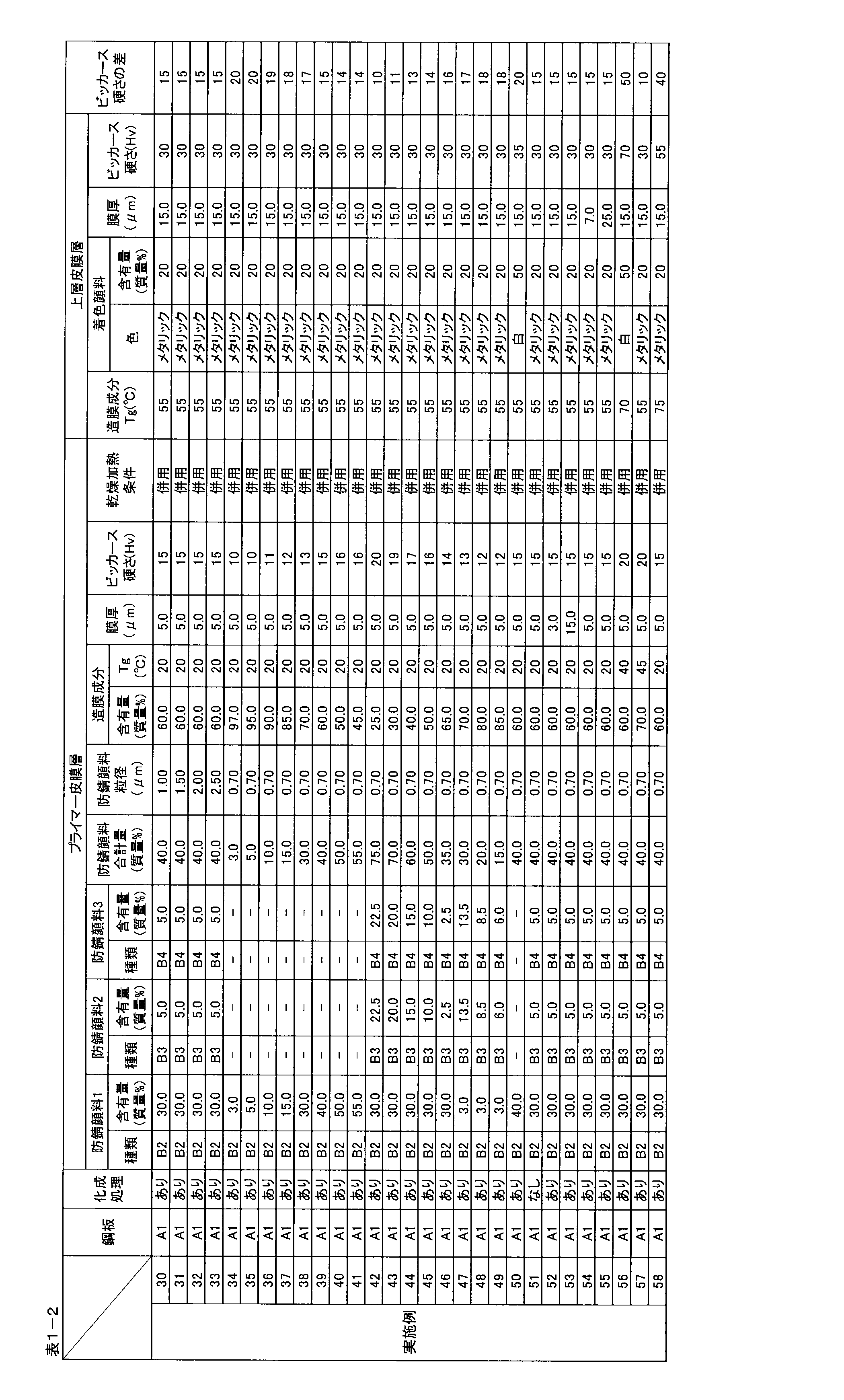
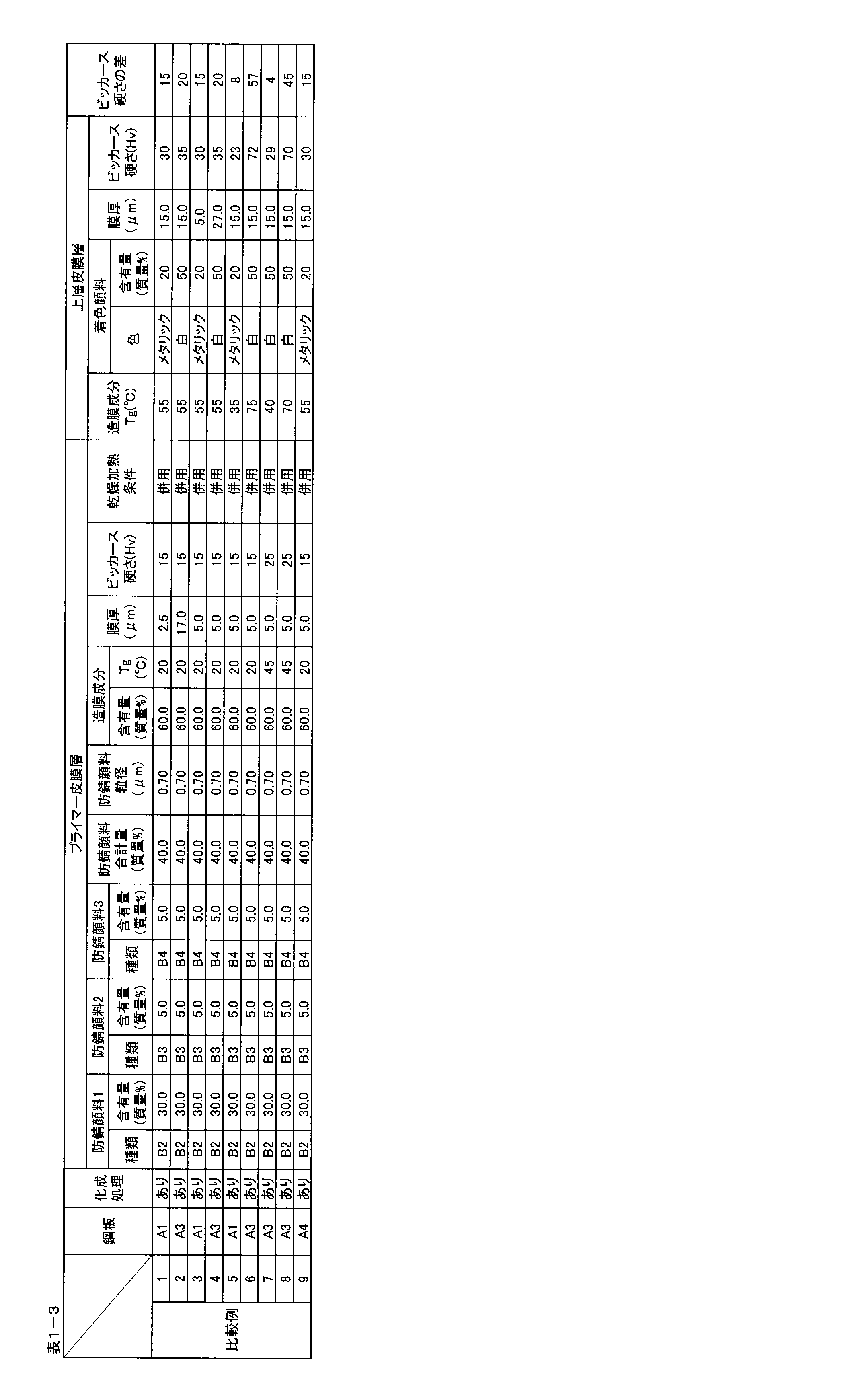
上記のようにして得られたサンプルのそれぞれから、試験板を複数切り出した上で、各試験板について、耐熱黄変性、耐食性、及び、加工密着性の観点で、以下のように評価を行った。得られた結果は、以下の表2-1~表2-3にまとめて示した。A number of test plates were cut out from each of the samples obtained as described above, and each test plate was evaluated in terms of heat yellowing resistance, corrosion resistance, and processing adhesion as follows. The results are summarized in Tables 2-1 to 2-3 below.
<耐熱黄変性>
以下のような基準に基づき、耐熱黄変性を評価した。試験板を、温度180℃で20時間保持し、試験前後での色調の変化(△E)を分光測色計(スガ試験機株式会社製カラーメーターSC-T45)にて測定した。以下の評価基準で評価し、評点1を不合格とした
。
評点5:△Eが2未満
4:△Eが2以上3未満
3:△Eが3以上5未満
2:△Eが5以上6未満
1:△Eが6以上<Heat yellowing resistance>
The heat yellowing resistance was evaluated based on the following criteria: The test plate was kept at a temperature of 180° C. for 20 hours, and the change in color tone (ΔE) before and after the test was measured using a spectrophotometer (color meter SC-T45 manufactured by Suga Test Instruments Co., Ltd.). Evaluation was performed based on the following criteria, with a score of 1 being a failure.
Rating: 5: △E is less than 2; 4: △E is 2 or more but less than 3; 3: △E is 3 or more but less than 5; 2: △E is 5 or more but less than 6; 1: △E is 6 or more
<耐食性>
以下のような基準に基づき、耐食性を評価した。試験板の端面をシールした後、鋼板表面の塗膜にカッターナイフで鉄地に至るまでの深い傷をX形状に入れ、JIS Z 2371:2015に準拠した塩水噴霧試験(SST)を360時間行った。Xカット部からの片側最大膨れ幅を測定し、下記の評価基準で評価した。このとき、評点1を不合格とした。
評点5:3mm未満
4:3mm以上4mm未満
3:4mm以上5mm未満
2:5mm以上6mm未満
1:6mm以上<Corrosion resistance>
The corrosion resistance was evaluated based on the following criteria. After sealing the end face of the test plate, a deep scratch was made in an X-shape on the coating film on the surface of the steel plate with a cutter knife down to the iron base, and a salt spray test (SST) in accordance with JIS Z 2371:2015 was performed for 360 hours. The maximum bulge width on one side from the X-cut part was measured and evaluated based on the following criteria. In this case, a score of 1 was considered to be a failure.
Rating: 5: Less than 3 mm 4: 3 mm or more but less than 4 mm 3: 4 mm or more but less than 5 mm 2: 5 mm or more but less than 6 mm 1: 6 mm or more
<加工密着性>
以下のような基準に基づき、加工密着性を評価した。試験板に対して、20℃雰囲気中で2T曲げ加工を施し、2T曲げ加工部外側に粘着テープ(商品名:セロハンテープ(登録商標))を貼り付けて引き剥がす、テープ剥離試験を実施した。テープ剥離部の外観を観察し、以下の評価基準で評価した。このとき、評点1を不合格とした。
評点5:塗膜剥離はほぼ認められない(曲げ加工部からの剥離面積2%未満)。
4:ごく一部に塗膜剥離が認められる(曲げ加工部からの剥離面積2%以上5%未満)。
3:一部に塗膜剥離が認められる(曲げ加工部からの剥離面積5%以上10%未満)。
2:部分的に塗膜剥離が認められる(曲げ加工部からの剥離面積10%以上20%未満)。
1:全体的に塗膜剥離が認められる(曲げ加工部からの剥離面積20%以上)<Adhesion during processing>
The adhesion was evaluated based on the following criteria. The test plate was bent at 2T in an atmosphere of 20°C, and a tape peeling test was performed in which an adhesive tape (product name: Cellophane Tape (registered trademark)) was applied to the outside of the 2T bent part and then peeled off. The appearance of the tape peeled part was observed and evaluated based on the following criteria. In this case, a score of 1 was considered to be a failure.
Rating 5: Almost no peeling of the coating was observed (less than 2% of the peeled area from the bent portion).
4: Peeling of the coating was observed in a very small area (peel area from the bent portion was 2% or more but less than 5%).
3: Paint peeling is observed in some areas (peeled area from the bent portion is 5% or more but less than 10%).
2: Partial peeling of the coating film was observed (peeled area from the bent portion was 10% or more and less than 20%).
1: Paint peeling is observed throughout the entire surface (20% or more of the peeled area from the bent part)
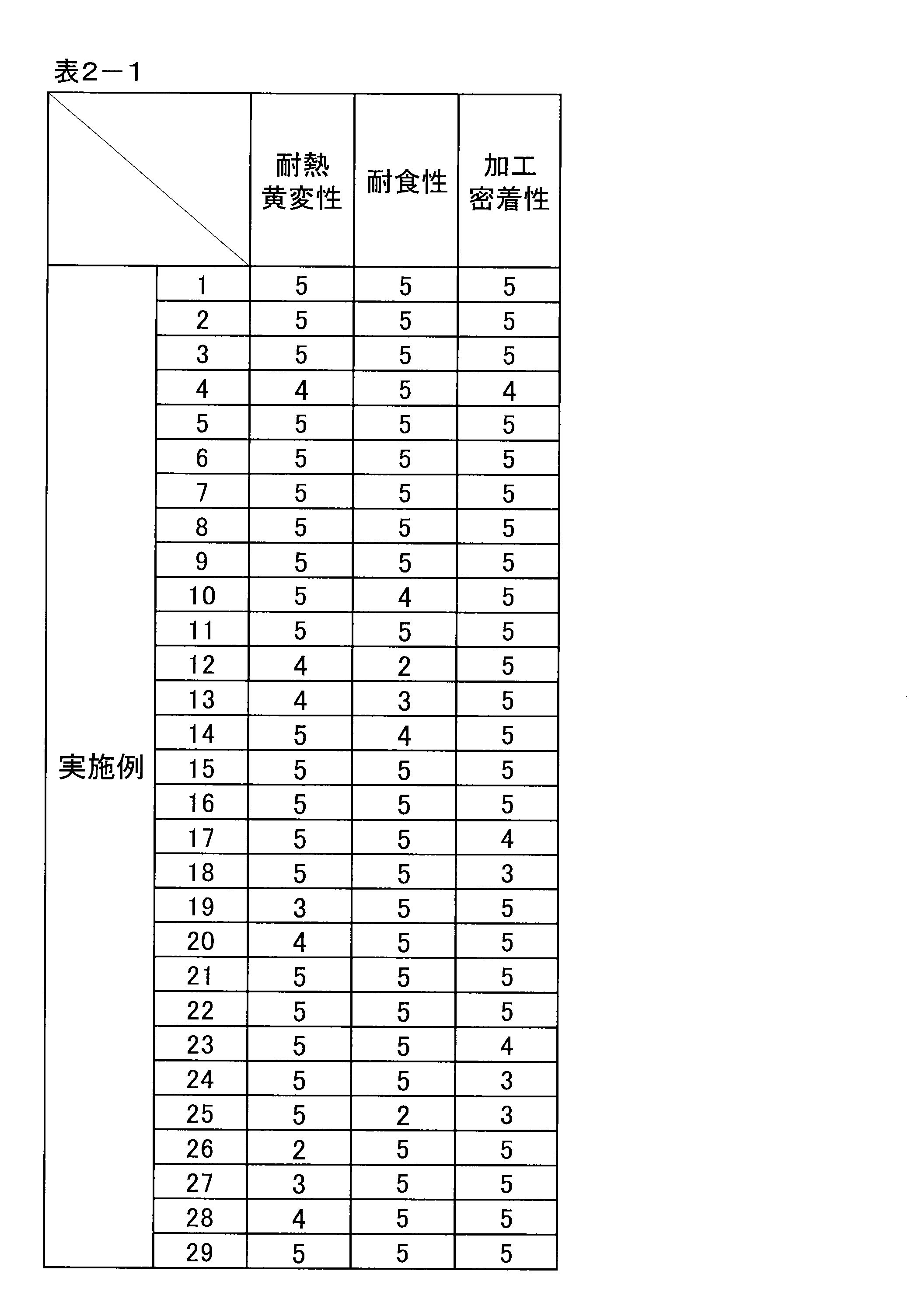


上記表2-1~表2-3から明らかなように、本発明の実施例に対応する表面処理鋼板は、優れた耐熱黄変性、耐食性、及び、加工密着性を兼ね備える一方で、本発明の比較例に対応する表面処理鋼板は、耐熱黄変性、耐食性、又は、加工密着性の何れかが十分ではなかった。As is clear from Tables 2-1 to 2-3 above, the surface-treated steel sheets corresponding to the examples of the present invention have excellent heat yellowing resistance, corrosion resistance, and processing adhesion, while the surface-treated steel sheets corresponding to the comparative examples of the present invention have insufficient heat yellowing resistance, corrosion resistance, or processing adhesion.
以上、添付図面を参照しながら本発明の好適な実施形態について詳細に説明したが、本発明はかかる例に限定されない。本発明の属する技術の分野における通常の知識を有する者であれば、特許請求の範囲に記載された技術的思想の範疇内において、各種の変更例又は修正例に想到し得ることは明らかであり、これらについても、当然に本発明の技術的範囲に属するものと了解される。Although the preferred embodiment of the present invention has been described in detail above with reference to the accompanying drawings, the present invention is not limited to such an example. It is clear that a person having ordinary knowledge in the technical field to which the present invention pertains can conceive of various modified or altered examples within the scope of the technical ideas described in the claims, and it is understood that these also naturally belong to the technical scope of the present invention.
今回開示された実施形態は、全ての点で例示であって制限的なものではない。上記の実施形態は、添付の特許請求の範囲、後述するような本発明の技術的範囲に属する構成及びその主旨を逸脱することなく、様々な形態で省略、置換、変更されてもよい。例えば、上記実施形態の構成要件は、その効果を損なわない範囲内で、任意に組み合わせることが可能である。また、当該任意の組み合せからは、組み合わせにかかるそれぞれの構成要件についての作用及び効果が当然に得られるとともに、本明細書の記載から当業者には明らかな他の作用及び他の効果が得られる。The embodiments disclosed herein are illustrative and not restrictive in all respects. The above embodiments may be omitted, substituted, or modified in various forms without departing from the scope of the appended claims, the technical scope of the present invention as described below, and the spirit thereof. For example, the components of the above embodiments can be arbitrarily combined within a range that does not impair the effects of the components. Furthermore, the arbitrary combination naturally provides the actions and effects of each of the components in the combination, and also provides other actions and effects that are obvious to a person skilled in the art from the description of this specification.
また、本明細書に記載された効果は、あくまで説明的又は例示的なものであって、限定的ではない。つまり、本発明に係る技術は、上記の効果とともに、又は、上記の効果に代えて、本明細書の記載から当業者には明らかな他の効果を奏しうる。In addition, the effects described in this specification are merely explanatory or exemplary, and are not limiting. In other words, the technology according to the present invention may achieve other effects that are apparent to a person skilled in the art from the description of this specification, in addition to or in place of the above effects.
なお、以下のような構成も、本発明の技術的範囲に属する。
(1)
母材となる鋼板の表面に位置する、Zn含有めっき層と、
前記Zn含有めっき層上に位置し、バナジウム化合物を少なくとも含有するプライマー皮膜層と、
前記プライマー皮膜層上に位置する、上層皮膜層と、
を有し、
前記プライマー皮膜層の平均厚みは、3.0~15.0μmの範囲内であり、
前記上層皮膜層の平均厚みは、7.0~25.0μmの範囲内であり、
前記上層皮膜層のビッカース硬さは、25~70Hvの範囲内であり、前記プライマー皮膜層のビッカース硬さは、20Hv以下であり、かつ、前記プライマー皮膜層のビッカース硬さは、前記上層皮膜層のビッカース硬さよりも低く、前記上層皮膜層のビッカース硬さと、前記プライマー皮膜層のビッカース硬さとの差は、5~50Hvの範囲内である、表面処理鋼板。
(2)
前記プライマー皮膜層の造膜成分のガラス転移点Tgは、0~40℃の範囲内であり、
前記上層皮膜層の造膜成分のガラス転移点Tgは、40~70℃の範囲内である、(1)に記載の表面処理鋼板。
(3)
前記バナジウム化合物の平均粒径は、0.05~2.00μmの範囲内である、(1)又は(2)に記載の表面処理鋼板。
(4)
前記プライマー皮膜層における前記バナジウム化合物の含有量は、前記プライマー皮膜層の全固形分質量に対して、5~50質量%の範囲内であり、
前記プライマー皮膜層における造膜成分の含有量は、前記プライマー皮膜層の全固形分質量に対して、30~80質量%の範囲内であり、かつ、
前記バナジウム化合物と前記造膜成分の合計含有量が、前記プライマー皮膜層の全固形分質量の100質量%以下となるように、前記バナジウム化合物と前記造膜成分とを含有する、(1)~(3)の何れか1つに記載の表面処理鋼板。
(5)
前記上層皮膜層は、アルミ顔料を含有する、(1)~(4)の何れか1つに記載の表面処理鋼板。
(6)
前記Zn含有めっき層と、前記プライマー皮膜層との間に、更に化成処理皮膜層を有する、(1)~(5)の何れか1つに記載の表面処理鋼板。 The following configurations also fall within the technical scope of the present invention.
(1)
A Zn-containing plating layer located on a surface of a steel sheet serving as a base material;
a primer coating layer located on the Zn-containing plating layer and containing at least a vanadium compound;
an upper coating layer positioned on the primer coating layer;
having
The average thickness of the primer coating layer is within a range of 3.0 to 15.0 μm;
The average thickness of the upper coating layer is within a range of 7.0 to 25.0 μm,
A surface-treated steel sheet, wherein the Vickers hardness of the upper coating layer is within a range of 25 to 70 Hv, the Vickers hardness of the primer coating layer is 20 Hv or less and is lower than the Vickers hardness of the upper coating layer, and the difference between the Vickers hardness of the upper coating layer and the Vickers hardness of the primer coating layer is within a range of 5 to 50 Hv.
(2)
The glass transition temperature Tg of the film-forming component of the primer coating layer is within the range of 0 to 40° C.,
The surface-treated steel sheet according to (1), wherein the glass transition temperature Tg of the film-forming component of the upper coating layer is within a range of 40 to 70° C.
(3)
The surface-treated steel sheet according to (1) or (2), wherein the vanadium compound has an average particle size in the range of 0.05 to 2.00 μm.
(4)
the content of the vanadium compound in the primer coating layer is within a range of 5 to 50 mass% based on the total solid content mass of the primer coating layer;
The content of the film-forming component in the primer coating layer is within a range of 30 to 80% by mass based on the total solid content mass of the primer coating layer, and
The surface-treated steel sheet according to any one of (1) to (3), comprising the vanadium compound and the film-forming component such that the total content of the vanadium compound and the film-forming component is 100 mass% or less of the total solid mass of the primer coating layer.
(5)
The surface-treated steel sheet according to any one of (1) to (4), wherein the upper coating layer contains an aluminum pigment.
(6)
The surface-treated steel sheet according to any one of (1) to (5), further comprising a chemical conversion coating layer between the Zn-containing plating layer and the primer coating layer.
1 表面処理鋼板
10 母材鋼板
20 Zn含有めっき層
30 プライマー皮膜層
40 上層皮膜層
50 化成処理皮膜層
Claims (5)
前記Zn含有めっき層上に位置し、バナジウム化合物を少なくとも含有するプライマー皮膜層と、
前記プライマー皮膜層上に位置する、上層皮膜層と、
を有し、
前記プライマー皮膜層の平均厚みは、3.0~15.0μmの範囲内であり、
前記上層皮膜層の平均厚みは、7.0~25.0μmの範囲内であり、
前記上層皮膜層のビッカース硬さは、25~70Hvの範囲内であり、前記プライマー皮膜層のビッカース硬さは、20Hv以下であり、かつ、前記プライマー皮膜層のビッカース硬さとの差は、5~50Hvの範囲内であり、
前記プライマー皮膜層の造膜成分のガラス転移点Tgは、0~40℃の範囲内であり、
前記上層皮膜層の造膜成分のガラス転移点Tgは、40~70℃の範囲内である、表面処理鋼板。 A Zn-containing plating layer located on a surface of a steel sheet serving as a base material;
a primer coating layer located on the Zn-containing plating layer and containing at least a vanadium compound;
an upper coating layer positioned on the primer coating layer;
having
The average thickness of the primer coating layer is within a range of 3.0 to 15.0 μm;
The average thickness of the upper coating layer is within a range of 7.0 to 25.0 μm,
the Vickers hardness of the upper coating layer is within a range of 25 to 70 Hv, the Vickers hardness of the primer coating layer is 20 Hv or less, and the difference between the Vickers hardness of the upper coating layer and the Vickers hardness of the primer coating layer is within a range of 5 to 50 Hv;
The glass transition temperature Tg of the film-forming component of the primer coating layer is within the range of 0 to 40° C.,
The glass transition temperature Tg of the film-forming component of the upper coating layer is within the range of 40 to 70°C .
前記プライマー皮膜層における造膜成分の含有量は、前記プライマー皮膜層の全固形分質量に対して、30~80質量%の範囲内であり、かつ、
前記バナジウム化合物と前記造膜成分の合計含有量が、前記プライマー皮膜層の全固形分質量の100質量%以下となるように、前記バナジウム化合物と前記造膜成分とを含有する、請求項1又は2に記載の表面処理鋼板。 the content of the vanadium compound in the primer coating layer is within a range of 5 to 50 mass% based on the total solid content mass of the primer coating layer;
The content of the film-forming component in the primer coating layer is within a range of 30 to 80% by mass based on the total solid content mass of the primer coating layer, and
3. The surface-treated steel sheet according to claim 1, wherein the vanadium compound and the film-forming component are contained such that the total content of the vanadium compound and the film-forming component is 100 mass% or less of the total solid mass of the primer coating layer.
The surface-treated steel sheet according to claim 1 or 2, further comprising a chemical conversion coating layer between the Zn-containing plating layer and the primer coating layer.
Applications Claiming Priority (3)
| Application Number | Priority Date | Filing Date | Title |
|---|---|---|---|
| JP2023060764 | 2023-04-04 | ||
| JP2023060764 | 2023-04-04 | ||
| PCT/JP2024/013747 WO2024210149A1 (en) | 2023-04-04 | 2024-04-03 | Surface-treated steel sheet |
Publications (2)
| Publication Number | Publication Date |
|---|---|
| JPWO2024210149A1 JPWO2024210149A1 (en) | 2024-10-10 |
| JP7688317B2 true JP7688317B2 (en) | 2025-06-04 |
Family
ID=92972141
Family Applications (1)
| Application Number | Title | Priority Date | Filing Date |
|---|---|---|---|
| JP2024557217A Active JP7688317B2 (en) | 2023-04-04 | 2024-04-03 | Surface-treated steel sheet |
Country Status (6)
| Country | Link |
|---|---|
| EP (1) | EP4644115A4 (en) |
| JP (1) | JP7688317B2 (en) |
| KR (1) | KR20250162858A (en) |
| CN (1) | CN120936491A (en) |
| AU (1) | AU2024243128A1 (en) |
| WO (1) | WO2024210149A1 (en) |
Citations (8)
| Publication number | Priority date | Publication date | Assignee | Title |
|---|---|---|---|---|
| JP2012180591A (en) | 2011-02-09 | 2012-09-20 | Nippon Steel Corp | Substrate treating agent for precoated metal sheet, coated substrate-treated metal sheet coated with the same, and precoated metal sheet produced by using the coated substrate-treated metal sheet |
| WO2018062515A1 (en) | 2016-09-30 | 2018-04-05 | 新日鐵住金株式会社 | Precoated metal sheet |
| CN109338267A (en) | 2018-12-15 | 2019-02-15 | 山东建筑大学 | A kind of preparation method of synchronous gear ring coating with self-lubricating high strength and high hardness |
| WO2019130772A1 (en) | 2017-12-26 | 2019-07-04 | 三菱マテリアル電子化成株式会社 | Powder for forming black light-shielding film and method for manufacturing same |
| WO2019194136A1 (en) | 2018-04-06 | 2019-10-10 | 富士フイルム株式会社 | Photosensitive composition, cured film, method for manufacturing color filter, color filter, solid-state imaging element, and image display device |
| WO2022210200A1 (en) | 2021-03-31 | 2022-10-06 | 日本製鉄株式会社 | Precoated plated steel sheet and molded product |
| JP2024048206A (en) | 2022-09-27 | 2024-04-08 | 日本製鉄株式会社 | Painted steel plate |
| JP7553880B2 (en) | 2022-09-27 | 2024-09-19 | 日本製鉄株式会社 | Pre-coated steel sheet |
Family Cites Families (3)
| Publication number | Priority date | Publication date | Assignee | Title |
|---|---|---|---|---|
| JPS61201610A (en) * | 1985-02-28 | 1986-09-06 | Mitsubishi Metal Corp | Black powder and its preparation |
| KR101197965B1 (en) * | 2010-10-26 | 2012-11-06 | 주식회사 포스코 | Black Colored Resin Coated Steel with Improved Workability, Corrosion Resistance and Anti-Fingerprint |
| CN108138811B (en) | 2015-09-04 | 2020-07-21 | 伟尔矿物澳大利亚私人有限公司 | Hydraulically driven rotary actuator |
-
2024
- 2024-04-03 AU AU2024243128A patent/AU2024243128A1/en active Pending
- 2024-04-03 CN CN202480021801.8A patent/CN120936491A/en active Pending
- 2024-04-03 WO PCT/JP2024/013747 patent/WO2024210149A1/en not_active Ceased
- 2024-04-03 EP EP24784933.4A patent/EP4644115A4/en active Pending
- 2024-04-03 JP JP2024557217A patent/JP7688317B2/en active Active
- 2024-04-03 KR KR1020257034602A patent/KR20250162858A/en active Pending
Patent Citations (9)
| Publication number | Priority date | Publication date | Assignee | Title |
|---|---|---|---|---|
| JP2012180591A (en) | 2011-02-09 | 2012-09-20 | Nippon Steel Corp | Substrate treating agent for precoated metal sheet, coated substrate-treated metal sheet coated with the same, and precoated metal sheet produced by using the coated substrate-treated metal sheet |
| WO2018062515A1 (en) | 2016-09-30 | 2018-04-05 | 新日鐵住金株式会社 | Precoated metal sheet |
| WO2019130772A1 (en) | 2017-12-26 | 2019-07-04 | 三菱マテリアル電子化成株式会社 | Powder for forming black light-shielding film and method for manufacturing same |
| WO2019194136A1 (en) | 2018-04-06 | 2019-10-10 | 富士フイルム株式会社 | Photosensitive composition, cured film, method for manufacturing color filter, color filter, solid-state imaging element, and image display device |
| CN109338267A (en) | 2018-12-15 | 2019-02-15 | 山东建筑大学 | A kind of preparation method of synchronous gear ring coating with self-lubricating high strength and high hardness |
| WO2022210200A1 (en) | 2021-03-31 | 2022-10-06 | 日本製鉄株式会社 | Precoated plated steel sheet and molded product |
| JP7436943B2 (en) | 2021-03-31 | 2024-02-22 | 日本製鉄株式会社 | Prepainted plated steel sheets and molded products |
| JP2024048206A (en) | 2022-09-27 | 2024-04-08 | 日本製鉄株式会社 | Painted steel plate |
| JP7553880B2 (en) | 2022-09-27 | 2024-09-19 | 日本製鉄株式会社 | Pre-coated steel sheet |
Also Published As
| Publication number | Publication date |
|---|---|
| WO2024210149A1 (en) | 2024-10-10 |
| AU2024243128A1 (en) | 2025-08-07 |
| JPWO2024210149A1 (en) | 2024-10-10 |
| KR20250162858A (en) | 2025-11-19 |
| EP4644115A1 (en) | 2025-11-05 |
| EP4644115A4 (en) | 2026-03-18 |
| CN120936491A (en) | 2025-11-11 |
Similar Documents
| Publication | Publication Date | Title |
|---|---|---|
| JP5600417B2 (en) | Surface treatment composition and surface treated steel sheet | |
| JP5075321B2 (en) | Aqueous treatment agent for metal surface | |
| JP5431721B2 (en) | Surface treatment composition for zinc-based plated steel sheet or aluminum-based plated steel sheet and surface-treated steel sheet | |
| JP2011111638A (en) | Surface treatment composition and surface-treated steel sheet | |
| JP6796101B2 (en) | Manufacturing method of coated plated steel sheet and coated plated steel sheet | |
| JP6350768B1 (en) | Pre-coated metal plate | |
| JP4972240B2 (en) | Surface-treated steel sheet | |
| WO2023166858A1 (en) | HOT-DIP Al-Zn PLATED STEEL SHEET, METHOD FOR PRODUCING SAME, SURFACE-TREATED STEEL SHEET, AND COATED STEEL SHEET | |
| JP7553880B2 (en) | Pre-coated steel sheet | |
| JP5097311B2 (en) | Surface-treated steel sheet and organic resin-coated steel sheet | |
| WO2024210149A1 (en) | Surface-treated steel sheet | |
| WO2024210152A1 (en) | Surface-treated steel sheet | |
| JP7617410B2 (en) | Pre-coated plated steel sheet | |
| JP2024048206A (en) | Painted steel plate | |
| JP6772943B2 (en) | Painted steel plate | |
| JP4916913B2 (en) | Surface-treated steel sheet and organic resin-coated steel sheet | |
| JP7583349B2 (en) | Surface-treated steel sheet | |
| KR102936373B1 (en) | Pre-coated metal plate | |
| JP2024086178A (en) | Coated steel sheets and water heaters | |
| JP2025161754A (en) | Pre-coated metal sheets, components and surface-treated metal sheets |
Legal Events
| Date | Code | Title | Description |
|---|---|---|---|
| A621 | Written request for application examination |
Free format text: JAPANESE INTERMEDIATE CODE: A621 Effective date: 20240926 |
|
| A871 | Explanation of circumstances concerning accelerated examination |
Free format text: JAPANESE INTERMEDIATE CODE: A871 Effective date: 20240926 |
|
| A131 | Notification of reasons for refusal |
Free format text: JAPANESE INTERMEDIATE CODE: A131 Effective date: 20250107 |
|
| A521 | Request for written amendment filed |
Free format text: JAPANESE INTERMEDIATE CODE: A523 Effective date: 20250128 |
|
| TRDD | Decision of grant or rejection written | ||
| A01 | Written decision to grant a patent or to grant a registration (utility model) |
Free format text: JAPANESE INTERMEDIATE CODE: A01 Effective date: 20250422 |
|
| A61 | First payment of annual fees (during grant procedure) |
Free format text: JAPANESE INTERMEDIATE CODE: A61 Effective date: 20250505 |
|
| R150 | Certificate of patent or registration of utility model |
Ref document number: 7688317 Country of ref document: JP Free format text: JAPANESE INTERMEDIATE CODE: R150 |