JP7669727B2 - Product Management System - Google Patents
Product Management System Download PDFInfo
- Publication number
- JP7669727B2 JP7669727B2 JP2021035717A JP2021035717A JP7669727B2 JP 7669727 B2 JP7669727 B2 JP 7669727B2 JP 2021035717 A JP2021035717 A JP 2021035717A JP 2021035717 A JP2021035717 A JP 2021035717A JP 7669727 B2 JP7669727 B2 JP 7669727B2
- Authority
- JP
- Japan
- Prior art keywords
- unit
- products
- product
- surplus
- conveying direction
- Prior art date
- Legal status (The legal status is an assumption and is not a legal conclusion. Google has not performed a legal analysis and makes no representation as to the accuracy of the status listed.)
- Active
Links
- 238000000034 method Methods 0.000 claims description 111
- 230000008569 process Effects 0.000 claims description 110
- 238000012545 processing Methods 0.000 claims description 41
- 230000006870 function Effects 0.000 claims description 21
- 230000007812 deficiency Effects 0.000 claims description 9
- 238000003384 imaging method Methods 0.000 claims 2
- 238000007726 management method Methods 0.000 description 135
- 238000010191 image analysis Methods 0.000 description 56
- 238000010586 diagram Methods 0.000 description 20
- 238000012549 training Methods 0.000 description 8
- 238000013473 artificial intelligence Methods 0.000 description 5
- 230000004044 response Effects 0.000 description 5
- 238000001514 detection method Methods 0.000 description 4
- 238000005259 measurement Methods 0.000 description 3
- 238000005401 electroluminescence Methods 0.000 description 2
- 238000005516 engineering process Methods 0.000 description 2
- 238000009434 installation Methods 0.000 description 2
- 230000009471 action Effects 0.000 description 1
- 238000004891 communication Methods 0.000 description 1
- 239000004973 liquid crystal related substance Substances 0.000 description 1
- 238000012423 maintenance Methods 0.000 description 1
- 238000012986 modification Methods 0.000 description 1
- 230000004048 modification Effects 0.000 description 1
- 238000004806 packaging method and process Methods 0.000 description 1
- 239000007787 solid Substances 0.000 description 1
Images



Classifications
-
- Y—GENERAL TAGGING OF NEW TECHNOLOGICAL DEVELOPMENTS; GENERAL TAGGING OF CROSS-SECTIONAL TECHNOLOGIES SPANNING OVER SEVERAL SECTIONS OF THE IPC; TECHNICAL SUBJECTS COVERED BY FORMER USPC CROSS-REFERENCE ART COLLECTIONS [XRACs] AND DIGESTS
- Y02—TECHNOLOGIES OR APPLICATIONS FOR MITIGATION OR ADAPTATION AGAINST CLIMATE CHANGE
- Y02P—CLIMATE CHANGE MITIGATION TECHNOLOGIES IN THE PRODUCTION OR PROCESSING OF GOODS
- Y02P90/00—Enabling technologies with a potential contribution to greenhouse gas [GHG] emissions mitigation
- Y02P90/02—Total factory control, e.g. smart factories, flexible manufacturing systems [FMS] or integrated manufacturing systems [IMS]
Description
本発明は、製品管理システムに関する。 The present invention relates to a product management system .
近年、RFID(Radio-Frequency Identification)を用いた製品管理が増加している。RFIDは、製品に貼られたRFタグを、専用のリーダから非接触で読み出す技術である。RFIDによる製品管理は、例えば、倉庫への製品の入出庫の管理(入出庫管理)に用いられる。入出庫管理は、例えば、商品が通過するRFリーダの機能を有したゲートを設置し、ゲートを通過する際に製品のRFタグを読み取ることで実行される。 In recent years, product management using RFID (Radio-Frequency Identification) has become more common. RFID is a technology that uses a dedicated reader to read RF tags attached to products without contact. Product management using RFID is used, for example, to manage the entry and exit of products into a warehouse (entry and exit management). Entry and exit management is carried out, for example, by installing a gate with an RF reader function through which products pass, and reading the RF tags of products as they pass through the gate.
RFIDによる製品管理に関する技術は、以下の先行技術文献に開示されている。 Technology related to product management using RFID is disclosed in the following prior art documents:
しかし、RFIDで入庫と出庫を区別して管理しようとすると、入庫用のゲートと出庫用のゲートの両方を設置する必要がある。ゲートは、複数の製品を通過させるものであるため、相応の大きさとなり、複数設置するのには広いスペースが必要となる場合がある。また、ゲートは、大型であり、RFリーダ機能を有するため、高価であるため、複数設置する場合は費用が増大となる。 However, if RFID is used to manage incoming and outgoing products separately, it is necessary to install both an incoming gate and an outgoing gate. Since the gates are used to allow multiple products to pass through, they are fairly large, and installing multiple gates can require a large space. In addition, gates are expensive because they are large and have RF reader functions, so installing multiple gates increases costs.
そこで、RFIDを用いた製品管理において、設置費用及び設置スペースを抑制しつつ、入庫及び出庫を区別した製品管理を行うことができる製品管理システム、製品管理方法、及び製品管理プログラムを提供する。 Therefore, we provide a product management system, a product management method, and a product management program that can manage products by distinguishing between incoming and outgoing products while reducing installation costs and space required for product management using RFID.
本発明の一つの実施の形態によれば、製品に付されたRFタグから製品の識別情報を読み出すRFIDリーダ機能を有するゲート部と、前記ゲート部の周辺を撮影する撮影部と、前記撮影部が撮影したデータと前記ゲート部が読み出した識別情報に基づき、前記ゲート部を通過する製品を管理する管理部と、を有する製品管理システムであって、前記管理部は、前記撮影部が撮影した画像データに基づき、搬送される製品が入庫であるか出庫であるかを示す搬送方向を判定する搬送方向判定処理と、前記搬送される製品の個数を判定する個数判定処理と、を実行する画像処理部と、前記ゲート部が読み出した識別情報の個数と、前記画像処理部によって判定された前記搬送される製品の個数とを比較し、前記搬送される製品の過不足を前記搬送方向ごとに判定する過不足判定部とを有する。 According to one embodiment of the present invention, a product management system includes a gate unit having an RFID reader function that reads product identification information from an RF tag attached to a product, an image capture unit that captures the periphery of the gate unit, and a management unit that manages products passing through the gate unit based on the data captured by the image capture unit and the identification information read by the gate unit. The management unit includes an image processing unit that executes a conveying direction determination process that determines the conveying direction indicating whether the conveyed product is entering or leaving the warehouse based on the image data captured by the image capture unit, and a quantity determination process that determines the number of the conveyed products, and an excess/shortage determination unit that compares the number of pieces of identification information read by the gate unit with the number of the conveyed products determined by the image processing unit, and determines whether there is an excess or shortage of the conveyed products for each of the conveying directions.
上記の本発明の一つの実施の形態によれば、設置費用及び設置スペースを抑制しつつ、入庫及び出庫を区別した製品管理を行うことができる。 According to one embodiment of the present invention described above, it is possible to perform product management that distinguishes between incoming and outgoing products while reducing installation costs and space.
以下、発明を実施するための形態について説明する。 The following describes the form for implementing the invention.
<製品管理システム1の構成例>
図1は、製品管理システム1の構成例を示す図である。製品管理システム1は、管理装置100、ゲート200、及びカメラ300を有する。製品管理システム1は、ゲート200を通過する製品の入出庫を管理するシステムである。製品は、ゲート200を右方向から左方向(D1)に搬送される場合、出庫されており、逆方向(D2)に搬送されている場合、入庫されていると判定される。
<Configuration example of product management system 1>
1 is a diagram showing an example of the configuration of a product management system 1. The product management system 1 has a
製品T1~T3は、例えば、段ボールに梱包されており、それぞれRFタグR1~R3が梱包外面に貼り付けられている。 Products T1 to T3 are packaged, for example, in cardboard boxes, and RF tags R1 to R3 are attached to the outer surface of the packages, respectively.
RFタグは、製品に関する情報が記憶されたIC(Integrated Circuit)チップを有する。製品に関する情報は、例えば、製品の識別子を含む。RFタグは、例えば、パッシブタブである。パッシブタブは、バッテリーを搭載せず、RFIDリーダから送信される電波を動力源として、RFIDリーダに電波を送信するタブである。また、RFタグは、自身が有するバッテリーを動力源として電波を送信するアクティブタブやセミアクティブタブであってもよい。 The RF tag has an IC (Integrated Circuit) chip that stores information about the product. The information about the product includes, for example, a product identifier. The RF tag is, for example, a passive tag. A passive tag is a tag that does not have a battery and uses the radio waves transmitted from the RFID reader as its power source to transmit radio waves to the RFID reader. The RF tag may also be an active tab or semi-active tab that transmits radio waves using its own battery as its power source.
ゲート200は、RFIDリーダ機能を有し、ゲート内を通過する製品のRFタグを読み出す装置である。ゲート200は、例えば、RFタグを読み出すための電波を送信し、RFタグから返信された電波を受信することで、近接(所定距離内)に製品が存在することを認識する。なお、ゲート200が電波を送信するタイミングは、例えば、常時、所定間隔、あるいは管理者の操作や他の装置から指示されたタイミングなどである。
Gate 200 is a device that has an RFID reader function and reads the RF tags of products that pass through the gate.
カメラ300は、ゲート200及びその周辺の所定範囲内の映像を撮影する撮影装置である。映像は、例えば、動画、静止画の一方または両方である。カメラ300の撮影タイミングは、常時、所定間隔、あるいは管理者の操作や他の装置から指示されたタイミングなどである。また、カメラは、モーション機能(移動する物品の移動方向の判定を行うことができる機能)付きのカメラであってもよい。
Camera 300 is a photographing device that captures images of
管理装置100は、ゲート200を通して搬送(入庫及び出庫)される製品を管理する装置であり、例えば、コンピュータやサーバマシンである。管理装置100は、カメラ300が撮影した映像の画像データを取得する。管理装置100は、画像データについての画像解析を行い、製品の数、製品の搬送方向(入庫又は出庫)などを判定する。
The
また、管理装置100は、ゲート200が、一連の処理において、又は所定時間内に読み出したRFIDを取得する。そして、画像解析の判定結果と、RFIDの読み出し結果を使用し、製品の入庫及び出庫を管理する。
The
管理装置100、ゲート200、及びカメラ300は、例えば、それぞれネットワークやケーブルを介して接続され、通信を行う。管理装置100は、ゲート200やカメラ300と通信を行い、画像データやRFID読み出し結果を取得する。
The
なお、図1において、管理装置100、ゲート200、及びカメラ300は、それぞれ異なる装置であるが、全て、あるいはいずれかの2つの装置が同一装置であってもよい。
In FIG. 1, the
<製品管理システムのソフトウェ構成例>
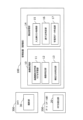
図2は、製品管理システム1のソフトウェア構成の例を示す図である。
<Example of software configuration for product management system>
FIG. 2 is a diagram showing an example of the software configuration of the product management system 1.
カメラ300は、撮影部30を有する。撮影部30は、所定範囲内を撮影し、撮影した映像データを内部メモリに記憶したり、管理装置100の画像処理部10に引き渡したりする。
The
ゲート(ゲート部)200は、RFID読出部20を有する。RFID読出部20は、読み出し契機に応じて、RFタグを読み出すための電波を送信し、送信した電波に応答してRFタグから返信された電波を受信する。そして、RFID読出部20は、受信した電波に含まれる、RFタグの読み出しに成功したRFIDに関する情報(例えば、RFIDの読み出した個数、製品に関する情報を含む)を、データを管理装置100の製品管理部14に引き渡す。
The gate (gate unit) 200 has an
管理装置(管理部)100は、画像処理部10及び製品管理部14を有する。画像処理部10は、カメラ300が撮影した画像データを取得し、画像解析を行う。製品管理部14は、画像解析及びRFIDの読み出し結果に基づき、製品の入庫及び出庫を管理する。
The management device (management unit) 100 has an
画像処理部10は、画像解析用学習モデル学習部11、個数判定部12、及び搬送方向判定部13を有する。
The
画像解析用学習モデル学習部11は、画像解析を行う画像解析用学習モデルの学習を行う。画像解析モデルは、例えば、画像解析用のAI(Artificial Intelligence)である。画像解析用学習モデル学習部11は、製品管理システム1の運用中の学習済み画像解析用学習モデルの判定精度の向上、又は製品管理システム1の運用前の画像解析用学習モデルの事前学習を行う。
The image analysis learning
個数判定部12は、画像解析用学習モデルを使用し、画像データに映る製品の個数を判定する。個数判定部12は、個数の判定結果を製品管理部14に引き渡す。
The
搬送方向判定部13は、製品の搬送方向(入庫又は出庫)を判定する。搬送方向判定部13は、搬送方向の判定結果を製品管理部14に引き渡す。
The conveying
製品管理部14は、入出庫リスト取得部15、過不足判定部16、及び学習用データ作成部17を有する。
The
入出庫リスト取得部15は、入庫及び出庫する製品に関する情報をリスト化した入出庫リストを取得する。入出庫リストは、例えば、管理装置100と接続する基幹システムから取得する。
The incoming/outgoing inventory
過不足判定部16は、入庫及び出庫において、搬送する製品に過不足かあるか否かを判定する。過不足判定部16は、少なくとも、個数判定部12における判定個数、RFID読出部20によるRFIDの読み出しに成功した製品の個数に基づき、過不足の判定を行う。
The shortage/
学習用データ作成部17は、製品管理システム1の運用中に撮影した画像データと、過不足の判定結果などから、画像解析用学習モデルを学習させる教師データ(学習用データ)を作成する。
The learning
なお、各部は、例えば、専用のハードウェアで構成されてもよいし、ロードしたプログラムをプロセッサが実行することで構築されてもよい。 Each unit may be configured, for example, with dedicated hardware, or may be constructed by a processor executing a loaded program.
<製品管理システムのハードウェア構成例>
図3は、製品管理システム1の構成例を表す図である。製品管理システム1は、CPU(Central Processing Unit)110、ストレージ120、メモリ130、カメラ300、ゲート200、及びディスプレイ160を有する。
<Example of hardware configuration for product management system>
3 is a diagram showing an example of the configuration of the product management system 1. The product management system 1 has a CPU (Central Processing Unit) 110, a
ストレージ120は、プログラムやデータを記憶する、フラッシュメモリ、HDD(Hard Disk Drive)、又はSSD(Solid State Drive)などの補助記憶装置である。ストレージ120は、RFID読出プログラム121、撮影プログラム122、画像処理プログラム123、製品管理プログラム124、及び画像解析用学習モデル学習プログラム125を記憶する。
メモリ130は、ストレージ120に記憶されているプログラムをロードする領域である。また、メモリ130は、プログラムがデータを記憶する領域としても使用されてもよい。
CPU110は、ストレージ120に記憶されているプログラムを、メモリ130にロードし、ロードしたプログラムを実行し、各部を構築し、各処理を実行するプロセッサである。
The
カメラ300は、ゲート200周辺の製品を撮影する装置である。カメラ300は、例えば、製品管理システム1を構成するコンピュータの外部に接続されてもよいし、コンピュータに内蔵されていてもよい。
The
ゲート200は、RFIDリーダ機能を有し、RFIDリーダ機能を用いて製品に貼り付けられたRFタグが発信(返信)する電波を受信し、RFタグの情報(製品情報)を取得する装置である。ゲート200は、例えば、製品管理システム1を構成するコンピュータの外部に接続されてもよいし、コンピュータに内蔵されていてもよい。また、ゲート200は、例えば、ゲートタイプであり、ゲート内に位置する、又はゲート200と所定距離内に位置する製品のRFタグからRFIDを読み出す。
ディスプレイ160は、画像や動画を表示する表示部である。ディスプレイ160は、例えば、液晶や有機EL(Electro Luminescence)である。ディスプレイ160は、例えば、過不足判定の結果を表示する。
The
CPU110は、RFID読出プログラム121を実行することで、RFID読出部20を構築し、RFID読出処理を行う。RFID読出処理は、ゲート200のRFID読み出し機能を使用し、RFタグから製品情報を読み出す処理である。
The
CPU110は、撮影プログラム122を実行することで、撮影部30を構築し、撮影処理を行う。撮影処理は、カメラ300を使用し、ゲート200の周辺を含む映像を撮影する処理である。
The
CPU110は、画像処理プログラム123を実行することで、画像処理部10を構築し、画像処理を行う。画像処理は、画像データを解析し、画像データに映る製品の個数や、製品の搬入方向(入庫又は出庫)を判定する処理である。
The
CPU110は、製品管理プログラム124を実行することで、製品管理部14を構築し、製品管理処理を行う。製品管理処理は、入庫及び出庫において、製品の過不足判定を判定する処理である。
The
CPU110は、画像解析用学習モデル学習プログラム125を実行することで、画像解析用学習モデル学習部11及び学習用データ作成部17を構築し、画像解析用学習モデル学習処理を行う。画像解析用学習モデル学習処理は、画像解析用学習モデルに学習させる教師データの選択や、教師データの入力など、画像解析用学習モデルの学習に関する処理を行う。なお、画像解析用学習モデル学習処理は、製品管理システム1の運用前に、画像解析用学習モデルの事前学習を含んでもよい。
By executing the image analysis learning
<製品管理処理シーケンス>
図4は、製品管理処理のシーケンスの例を示す図である。以下、各部の処理について説明する。
<Product management processing sequence>
4 is a diagram showing an example of a sequence of a product management process. The process of each unit will be described below.
撮影部30は、ゲート200周辺(製品を含む)撮影を行い、撮影した画像データを画像処理部10に送信する(S10)。
The photographing
画像処理部10は、画像解析用学習モデル50を使用し(S11)、個数判定処理S12を実行し、実行結果を製品管理部14に送信する(S13)。画像解析用学習モデル50は、例えば、AI(Artificial Intelligence)である。
The
個数判定処理S12は、画像データに映る製品の個数を判定する処理である。個数判定処理S12の実行結果は、製品の個数(以降、画像個数と呼ぶ場合がある)を含む。なお、個数判定処理S12は、移動している(搬送されている)製品の個数を判定する。移動していない製品(同一位置に滞留している製品)は、搬送されている製品とはみなされず、搬送する製品の個数としてカウントされない。 The number determination process S12 is a process for determining the number of products shown in the image data. The execution result of the number determination process S12 includes the number of products (hereinafter, may be referred to as the number of images). The number determination process S12 determines the number of products that are moving (being transported). Products that are not moving (products that are staying in the same position) are not considered to be products that are being transported, and are not counted in the number of products to be transported.
また、画像処理部10は、モーション機能付きカメラからの製品の動く方向に関する移動方向情報を取得し(S14)、搬送方向判定処理S15を実行し、実行結果を製品管理部14に送信する(S16)。
The
搬送方向判定処理S15は、移動方向情報に基づき、製品の搬送方向(入庫されているのか出庫されているのか)を判定する処理である。搬送方向判定処理S15の実行結果は、入庫又は出庫である旨(以降、画像搬送方向と呼ぶ場合がある)を含む。 The conveying direction determination process S15 is a process that determines the conveying direction of the product (whether it is entering or leaving the warehouse) based on the movement direction information. The execution result of the conveying direction determination process S15 includes whether it is entering or leaving the warehouse (hereinafter, this may be referred to as the image conveying direction).
RFID読出部20は、RFIDを読み出し、読み出した結果を製品管理部14に送信する(S20)。読み出した結果は、RFID読み出しに成功した個数(以降、読出個数と呼ぶ場合がある)や、読み出したRFIDに含まれる製品情報を含む。
The
製品管理部14は、画像個数、読出個数、及び画像搬送方向を受信すると、過不足判定処理S30を行い、学習用データ作成処理S40を行う。
When the
過不足判定処理S30は、画像個数、読出個数、及び画像搬送方向に基づき、入庫及び出庫ごとに、搬送される製品に過不足があるか否かを判定する処理である。また、過不足判定処理S30は、過不足を判定した結果を、ディスプレイ160に表示する処理を含んでもよい。
The surplus/shortage determination process S30 is a process for determining whether there is a surplus or shortage of products being transported for each incoming and outgoing shipment based on the number of images, the number of readouts, and the image transport direction. The surplus/shortage determination process S30 may also include a process for displaying the results of the surplus/shortage determination on the
学習用データ作成処理S40は、画像解析用学習モデル50が画像解析に使用した画像データと、当該画像データの画像解析の正誤の結果などを、教師データとする(教師データを作成する)処理である。学習用データ作成処理S40は、画像解析用学習モデル学習処理S42に教師データを送信する(S41)。なお、学習用データ作成処理S40において作成する教師データは、画像個数の判定に関するものである。モーション機能付きカメラで移動方向を判定している場合、学習用データ作成処理S40において、搬送方向判定に関する教師データは作成されない。 The learning data creation process S40 is a process that uses the image data used by the image analysis learning model 50 for image analysis and the results of the image analysis of the image data as teacher data (creates teacher data). The learning data creation process S40 transmits the teacher data to the image analysis learning model learning process S42 (S41). Note that the teacher data created in the learning data creation process S40 is related to determining the number of images. If the movement direction is determined by a camera with a motion function, teacher data related to transport direction determination is not created in the learning data creation process S40.
画像解析用学習モデル学習処理S42は、教師データを入力し、画像解析用学習モデル50を学習させ、画像解析用学習モデル50を更新する(S43)処理である。学習タイミングは、例えば、製品管理システム1の運用中であってもよいし、製品管理システム1の停止中(夜間やシステムメンテナンス時間など)であってもよい。製品管理システム1では、画像解析を行った画像データを使用し、画像解析用学習モデル50を繰り返し学習させることで、画像解析の精度(個数判定処理S12の実行結果が正しくなる割合)を向上させる。 The image analysis learning model learning process S42 is a process in which teacher data is input, the image analysis learning model 50 is trained, and the image analysis learning model 50 is updated (S43). The learning timing may be, for example, while the product management system 1 is in operation, or while the product management system 1 is stopped (at night, during system maintenance, etc.). The product management system 1 uses image data that has been subjected to image analysis and repeatedly trains the image analysis learning model 50, thereby improving the accuracy of the image analysis (the proportion of times that the result of the number determination process S12 is correct).
なお、モーション機能を有さないカメラで画像を撮影する場合、例えば、画像解析用学習モデル50を使用し、製品の動く方向及び入庫又は出庫を判定してもよい。この場合、搬送方向判定処理S15についても学習用データを生成し、学習させてもよい。 When images are captured using a camera without a motion function, for example, a learning model for image analysis 50 may be used to determine the direction in which the product moves and whether it is entering or leaving the warehouse. In this case, learning data may also be generated for the conveying direction determination process S15 and used to learn the data.
さらに、画像解析用学習モデル50のシステム運用中の学習については、実施しなくてもよい。運用中に学習しない例として、事前学習が十分に行われ、AIとしての精度が相当に高い場合や、処理負荷や通信速度の関係から、運用中の学習が困難な場合などが挙げられる。また、システムの構成として、必ずしも運用中の学習機能を有さなくてもよい。 Furthermore, learning of the image analysis learning model 50 during system operation does not have to be performed. Examples of when learning is not performed during operation include when sufficient advance learning has been performed and the accuracy of the AI is quite high, or when learning during operation is difficult due to processing load or communication speed. Also, the system does not necessarily have to be configured to have a learning function during operation.
[第1の実施の形態]
第1の実施の形態について説明する。第1の実施の形態において、撮影データは動画データを使用する。管理装置100は、動画データに基づき、製品の動きを検出し、製品の動きの検出を契機として、製品管理処理を実行する。
[First embodiment]
A first embodiment will be described. In the first embodiment, video data is used as the photographed data. The
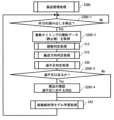
図5は、第1の実施の形態における製品管理処理S100の処理フローチャートの例を示す図である。 Figure 5 shows an example of a processing flowchart for product management process S100 in the first embodiment.
管理装置100は、動画の撮影データを解析し、製品の動き(製品が搬入あるいは搬出されようとしていること)を検出するのを待ち受ける(S100-1のNo)。管理装置100は、製品が動き始めたことを検出すると(S100-1のYes)、個数判定処理S12を実行する。
The
管理装置100は、個数判定処理S12において、動画データにおけるある瞬間の静止画から、製品の画像個数を判定する。個数判定処理S12は、例えば、複数タイミングにおける複数の静止画に基づき、画像個数を判定する処理である。また、個数判定処理S12は、例えば、複数のカメラ300を用いて、複数方向から撮影した映像データを用いて、画像個数を判定する処理であってもよい。さらに、個数判定処理S12は、カメラ300が深度測定機能を有する場合、深度測定の結果を画像個数の判定に流用する処理を含んでもよい。深度測定機能は、物体までの距離を検出する機能であって、例えば、複数の段ボールに囲まれた領域が、空間であるのか段ボールであるのかを判定することを可能とする機能である。
In the number determination process S12, the
管理装置100は、搬送方向判定処理S15を実行する。管理装置100は、搬送方向判定処理S15において、カメラから取得した移動方向に関する情報に応じて、製品の搬送方向が入庫であるのか出庫であるのかを判定する。搬送方向判定処理S15は、カメラのモーション機能によって取得した移動方向から、製品が入庫されているのか、あるいは出庫されているのかを判定する処理である。
The
管理装置100は、RFIDの読み出しが完了するのを待ち受ける(S100-2のNo)。RFIDの読み出しは、例えば、1つのRFIDを読み出してから、所定時間が経過するまでの間、RFIDの読み出しを継続する。所定時間だけRFIDの読み出しを継続するのは、例えば、製品自体の大きさや、ゲート200付近の電波状況によって、複数の製品のRIタグの読み出しが成功するまでに、相応の時間が必要である可能性があるためである。
The
管理装置100は、RFIDの読み出しが完了すると(S100-2のYes)、過不足判定処理S30を実行する。過不足判定処理S30の詳細については、後述する。
When the
管理装置100は、過不足判定処理S30において、製品に過不足があった場合(S100-3のYes)、製品の確認や、過不足に対する対応を行う(S100-4)。処理S100-4は、例えば、画像個数と読出個数が不一致であること、及び入庫又は出庫などの画像搬送方向をディスプレイ160などに表示し、管理者に製品に過不足に対する確認又は対応を行うように促す処理を含む。
If there is a shortage or surplus of products in the shortage/surplus determination process S30 (Yes in S100-3), the
管理装置100は、画像データと過不足判定結果から、教師データを作成し、画像解析用学習モデル学習処理S42を実行し、再度製品の動きの検出待ち(S100-1)を行う。なお、教師データは、例えば、学習用データ作成処理S40で作成される。
The
<過不足判定処理>
図6は、過不足判定処理S30の処理フローチャートの例を示す図である。管理装置100は、画像個数と読出個数が一致しているか否かを判定する(S30-1)。
<Excess/Shortage Judgment Process>
6 is a diagram showing an example of a processing flowchart of the excess/shortage determination process S30. The
管理装置100は、画像個数と読出個数が一致している場合(S30-1のYes)、画像搬送方向が出庫であれば(S30-2の「出庫」)、出庫において製品に過不足はないと判定し(S30-3)、画像搬送方向が入庫であれば(S30-2の「入庫」)、入庫において製品に過不足はないと判定し(S30-4)、処理を終了する。
If the number of images and the number of reads match (Yes in S30-1), and if the image transport direction is outbound ("Outbound" in S30-2), the
一方、管理装置100は、画像個数と読出個数が一致していない場合(S30-1のNo)、画像搬送方向が出庫であれば(S30-5の「出庫」)、出庫において製品に過不足があると判定し(S30-7)、画像搬送方向が入庫であれば(S30-5の「入庫」)、入庫において製品に過不足があると判定し(S30-6)、処理を終了する。
On the other hand, if the number of images and the number of readouts do not match (No in S30-1), and if the image transport direction is outbound ("Outbound" in S30-5), the
第1の実施の形態において、管理装置100は、動画データから製品の動き(搬送)を検出すると、画像個数及び画像搬送方向を動画データから判定する。そして、管理装置100は、RFIDの読み出し結果を取得し、読出個数と画像個数を比較し、画像搬送方向ごとに製品の過不足があるか否かを判定する。これにより、1つのゲート200を設置することで、入庫及び出庫の両方向について、製品の過不足を判定でき、製品管理を行うことが可能となる。また、管理装置100が画像から入庫及び出庫を判定することで、例えば、管理者が入庫又は出庫を入力する手間や、誤って入力してしまうリスクを削減することができる。
In the first embodiment, when the
[第2の実施の形態]
第2の実施の形態について説明する。第2の実施の形態において、管理装置100は、第1の実施の形態における過不足判定処理S30に代替し、過不足判定処理S60を実行する。過不足判定処理S60は、入庫及び出庫する製品の一覧を含む入出庫リスト(製品リスト)を、過不足判定に使用する処理である。入出庫リストは、例えば、搬送方向、搬送する製品の識別子を含む識別情報、搬送する製品の個数(個数情報)などの情報を含む。
[Second embodiment]
A second embodiment will be described. In the second embodiment, the
図7は、第2の実施の形態における過不足判定処理S60の処理フローチャートの例を示す図である。管理装置100は、入出庫リストを取得する(S60-1)。管理装置100は、例えば、入出庫リストを作成及び管理する基幹システムから、入出庫リストを取得する。また、管理装置100は、例えば、管理者の入力によって、入出庫リストを取得してもよい。
Figure 7 is a diagram showing an example of a processing flowchart for the surplus/shortage determination process S60 in the second embodiment. The
管理装置100は、入出庫リストの搬送方向は、画像搬送方向と一致しているか否かを判定する(S60-2)。管理装置100は、入出庫リストの搬送方向が画像搬送方向と一致していない場合(S60-2のNo)、製品に過不足があると判定し(S60-5)、処理を終了する。なお、製品に過不足があるという判定は、搬送方向の誤りや、余って製品を動かしてしまったことなど、製品の過不足以外のエラーが発生したという判定を含む。
The
一方、管理装置100は、入出庫リストの搬送方向が画像搬送方向と一致している場合(S60-2のYes)、画像個数、読出個数、及び入出庫リストの搬送個数が、全て一致しているか否かを判定する(S60-3)。
On the other hand, if the transport direction in the incoming/outgoing list matches the image transport direction (Yes in S60-2), the
管理装置100は、画像個数、読出個数、及び入出庫リストの搬送個数が、全て一致している場合(S60-3のYes)、製品に過不足がないと判定し(S60-4)、処理を終了する。
If the number of images, the number of reads, and the number of transported items in the inventory list all match (Yes in S60-3), the
一方、管理装置100は、画像個数、読出個数、及び入出庫リストの搬送個数が、一部一致しない場合(S60-3のNo)、製品に過不足があると判定し(S60-5)、処理を終了する。
On the other hand, if there is a partial mismatch between the number of images, the number of read items, and the number of items transported in the inventory list (No in S60-3), the
図8は、入出庫リストと判定結果の例を示す図である。図8(A)は、過不足なしと判定する場合の例を示す図である。管理装置100は、入出庫リストL1の搬送方向は入庫であり、画像搬送方向も入庫であるため、搬送方向は一致すると判定する(表1、図7のS60-2のYes)。管理装置100は、入出庫リストL1の搬送個数は7個、画像個数も7個、読出個数も7個であり、全て同じ個数であるため(表2、図7のS60-3のYes)、過不足はないと判定する(図7のS60-4)。
Figure 8 shows an example of an incoming/outgoing list and a judgment result. Figure 8 (A) shows an example of a case where it is judged that there is no surplus or shortage. The
図8(B)は、過不足ありと判定される場合の例を示す図である。管理装置100は、入出庫リストL1の搬送方向は入庫であり、画像搬送方向も入庫であるため、搬送方向は一致すると判定する(表3、図7のS60-2のYes)。管理装置100は、入出庫リストL1の搬送個数は7個、画像個数は6個、読出個数は6個であり、全てが一致しないためるため(表4、図7のS60-3のNo)、過不足があると判定する(図7のS60-5)。
Figure 8 (B) is a diagram showing an example of a case where it is determined that there is a surplus or shortage. The
<変形例>
管理装置100は、過不足判定処理S60において、入出庫リストの搬送個数に代替し、入出庫リストの搬送製品の識別子(ID)を用いてもよい。この場合、管理装置100は、入出庫リストの搬送製品の識別子と、RFIDの読出結果における製品の識別子が全て一致(過不足なく一致)するか否かを確認する。そして、管理装置100は、識別子が全て一致する場合、さらに、画像個数と入出庫リストの搬送個数(読出個数と同じ)が一致するか否かを判定する。管理装置100は、識別子、搬送個数の全てが一致する場合、製品に過不足がないと判定し、一部でも一致しない場合、製品に過不足があると判定する。
<Modification>
In the surplus/shortage determination process S60, the
また、入出庫リストとの比較は、出庫時のみ実行されてもよい。入庫は、どのタイミングでどれだけの製品が運び込まれるのかが不明確である場合があるため、入庫については入出庫リストが作成されない場合がある。一方、出庫は、例えば、顧客に製品を配送するタイミングで行われるため、運び出すタイミングや対象製品が明確であり、厳密に管理されるため、リスト化されることが多い。 Also, comparison with the inbound/outbound list may only be performed at the time of outbound. Inbound/outbound lists may not be created for inbound products because it is unclear when and how many products will be brought in. On the other hand, outbound products are often listed because they are delivered to customers, for example, and therefore the timing and products to be shipped out are clear and strictly managed.
さらに、出庫時のみ、過不足判定処理を行ってもよい。上述したように、出庫時の方が、厳密な製品管理が要求されるためである。例えば、管理装置100は、図5の製品管理処理S100における搬送方向判定処理S15において、画像搬送方向が入庫である場合、過不足判定処理S30(S60)や個数判定処理S12などを実行しなくてもよい。
Furthermore, the surplus/shortage determination process may be performed only at the time of shipment. As described above, this is because stricter product management is required at the time of shipment. For example, in the conveying direction determination process S15 in the product management process S100 of FIG. 5, if the image conveying direction is entry, the
[第3の実施の形態]
第3の実施の形態について説明する。第3の実施の形態において、撮影データは静止画データを使用する。管理装置100は、RFIDの読み出しを検出すると、少なくとも2つのタイミングで撮影した静止画データに基づき、製品の搬送方向を判定し、製品管理を実行する。
[Third embodiment]
A third embodiment will be described. In the third embodiment, still image data is used as the photographed data. When the
図9は、第3の実施の形態における製品管理処理S200の処理フローチャートの例を示す図である。 Figure 9 shows an example of a processing flowchart for product management process S200 in the third embodiment.
管理装置100は、RFIDの読み出しを検出するのを待ち受ける(S200-1のNo)。管理装置100は、RFIDの読み出しを検出すると(S200-1のYes)、複数タイミングで撮影した撮影データ(静止画データ)を取得する(S200-2)。
The
管理装置100は、撮影データに基づき、個数判定処理S12を実行する。管理装置100は、個数判定処理S12において、複数の画像データのある1つの画像データから画像個数を判定してもよいし、複数の画像データから総合的に画像個数を判定してもよい。
The
管理装置100は、搬送方向判定処理S15を実行する。管理装置100は、搬送方向判定処理S15において、静止画データに基づき、製品の搬送方向が入庫であるのか出庫であるのかを判定する。搬送方向判定処理S15は、撮影した製品の画像データ内の位置を、時系列で把握することで、製品の移動方向を判定する。
The
管理装置100は、過不足判定処理S30を実行する。管理装置100は、過不足判定処理S30において、製品に過不足があった場合(S200-3のYes)、製品の確認や、過不足に対する対応を行う(S200-4)。
The
管理装置100は、画像データと過不足判定結果から、教師データを作成し、画像解析用学習モデル学習処理S42を実行し、再度RFIDの読み出しの検出待ち(S200-1)を行う。
The
第1の実施の形態において、管理装置100は、動画の画像解析による製品の動きの検出を契機として、製品管理処理を実行した。しかし、撮影する画像が静止画である場合、動画のように製品の動きをリアルタイムで検出することができない場合がある。そこで、第3の実施の形態において、管理装置100は、RFIDの読み出しを契機として、静止画の撮影(連続した撮影)を行うことで、静止画を常時撮影せずに、製品の動きを検出することができる。
In the first embodiment, the
[第4の実施の形態]
第4の実施の形態について説明する。第4の実施の形態では、画像解析用学習モデルの学習方法について説明する。
[Fourth embodiment]
A fourth embodiment will now be described. In the fourth embodiment, a learning method for an image analysis learning model will be described.
<画像解析用学習モデル学習処理>
画像解析用学習モデル学習処理S42について説明する。画像解析用学習モデル学習処理S42は、以下の2つのパターンにおいて実行される処理である。
<Image analysis learning model learning process>
The image analysis learning model learning process S42 will be described below. The image analysis learning model learning process S42 is a process that is executed in the following two patterns.
1つ目のパターンは、製品管理システム1の運用中に、撮影した画像データを用いて、学習を行うパターンである。例えば、画像個数と読出個数が異なる場合がある。この場合、RFIDの読み出し漏れ、あるいは対象以外の製品のRFIDを誤って読み出してしまった場合など、RFIDの読み出しにエラーが発生したことが考えられる。一方、この場合、画像解析用学習モデルが、誤って画像個数を判定したことも考えられる。ここで、例えば、RFIDが製品以外のRFIDを読み出してしまうエラーが発生する可能性は相当低いと想定した場合、読出個数が画像個数より多い場合、画像個数の判定が誤っている可能性が高い。そこで、管理装置100は、読出個数が画像個数より多い場合、読出個数を正しいと仮定し、学習用データ作成処理S40において、読出個数が正解数であることと画像解析に使用した画像データを、学習用データ(教師データ)として、画像解析用学習モデル学習処理を行う。
The first pattern is a pattern in which learning is performed using image data captured during operation of the product management system 1. For example, the number of images and the number of reads may differ. In this case, it is possible that an error occurred in reading the RFID, such as an RFID not being read or an RFID of a product other than the target being read by mistake. On the other hand, in this case, it is also possible that the learning model for image analysis has erroneously determined the number of images. Here, if it is assumed that the possibility of an error occurring in which the RFID reads an RFID of a product other than the target is quite low, for example, if the number of reads is greater than the number of images, it is highly likely that the determination of the number of images is incorrect. Therefore, if the number of reads is greater than the number of images, the
また、管理装置100は、モーション機能を有さないカメラで撮影した画像を用いて、画像解析用学習モデルが画像搬送方向を判定する場合、画像搬送方向(製品の移動方向)に関して学習を行ってもよい。画像搬送方向は、製品の移動方向から判定される。そのため、移動方向の判定が誤ると、画像搬送方向も誤った判定となる。そこで、管理装置100は、画像搬送方向の学習として、製品の移動方向の学習を行う。なお、モーション機能付きカメラが使用されている場合、管理装置100は、移動方向の判定をカメラから取得するため、画像搬送方向の学習は行わない。
In addition, when the image analysis learning model determines the image transport direction using images captured by a camera without a motion function, the
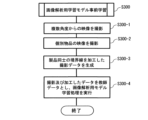
2つめのパターンは、製品管理システム1の運用前に、事前学習を行うパターンである。図10は、画像解析用学習モデル事前学習処理S300の処理フローチャートの例を示す図である。 The second pattern is a pattern in which pre-learning is performed before the product management system 1 is put into operation. Figure 10 is a diagram showing an example of a processing flowchart of the image analysis learning model pre-learning process S300.
管理装置100は、複数角度から製品(複数、単数)の映像を撮影する(S300-1)。処理S300-1は、例えば、複数の製品を積み重ね、前後左右の4方向から撮影する。
The
管理装置100は、個別物品の映像を撮影する(S300-2)。個別物品は、例えば、様々な形状、大きさの製品(梱包を含む)である。また、個別物品は、製品以外に、製品を運ぶための台車や、製品を運ぶ人物、倉庫内にある物体などを含む。すなわち、個別物品は、製品以外で、ゲート200の周辺に存在する(位置する)可能性があるものを対象とする。個別物品の映像データを事前学習に使用することで、製品か否かを判定する精度が向上する。
The
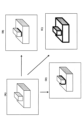
管理装置100は、製品同士の境界線を加工した画像データ(加工画像データ)を生成する(S300-3)。図11は、加工した画像データの例を示す図である。管理装置100は、処理S300-3において、図11(A)の画像データを、図11(B)、(C)、(D)のように加工する。
The
図11(B)は、製品同士が接触する線を強調した加工データの例を示す図である。下の製品と上に積まれた製品とが接触する境界線を、太い線とする。 Figure 11 (B) shows an example of processing data in which the lines where products come into contact are emphasized. The boundary line where the product below meets the product stacked on top is shown as a thick line.
図11(C)は、画像上の製品同士の境界線を強調した加工データの例を示す図である。下の製品と上に積まれた製品が実際に接触する境界線に加え、映像上で製品同士が重なる境界線についても、太い線とする。 Figure 11 (C) shows an example of processed data in which the boundaries between products on the image are emphasized. In addition to the boundaries where the product on the bottom and the product on top actually come into contact, the boundaries where products overlap on the image are also made thicker.
図11(D)は、製品の線の全てを強調した加工データの例を示す図である。例えば、製品が直方体である場合、両製品の映っている範囲の全ての辺を太い線とする。 Figure 11 (D) shows an example of processed data in which all of the product's lines are emphasized. For example, if the product is a rectangular prism, all of the sides in the area in which both products are shown are shown with thick lines.
このように、製品同士、又は製品と空間、あるいは製品の形状がより明確となるようにした加工データを教師データとして用いることで、製品の個数認識の精度が向上する。 In this way, by using processed data that makes the relationships between products, between products and the space, or between products and the shapes of the products clearer as training data, the accuracy of recognizing the number of products is improved.
管理装置100は、撮影したデータや加工データを教師データとし、画像解析用学習モデルの学習を行い(S300-4)、処理を終了する。
The
このように、管理装置100は、事前学習において、製品の個数そのものを学習させない。これは、個数の学習を行うためには、膨大な数の教師データが必要となり、時間や工数が増大する。第4の実施の形態において、管理装置100は、個別の製品、物品を学習させ、一部線を強調した加工データを用いて境界線を学習させることで、製品の個数そのものを学習させなくても、製品の個数が判定できる(個別の製品を認識できる)画像解析用学習モデルを構築することができる。
In this way, the
[その他の実施の形態]
上述した実施の形態は、それぞれ組み合わせて実行されてもよい。例えば、第1の実施の形態における動画に代替し、静止画を使用してもよい。この場合、定期的に静止画を撮影し、製品が動いたことを判定するようにしてもよい。また、事前学習、運用中の学習など、学習に要する時間や工数を考慮し、適宜実施するようにしてもよい。
[Other embodiments]
The above-described embodiments may be combined and executed. For example, still images may be used instead of the moving images in the first embodiment. In this case, still images may be taken periodically to determine whether the product has moved. In addition, learning may be performed as appropriate, taking into consideration the time and man-hours required for learning, such as pre-learning and learning during operation.
1 :製品管理システム
10 :画像処理部
11 :画像解析用学習モデル学習部
12 :個数判定部
13 :搬送方向判定部
14 :製品管理部
15 :入出庫リスト取得部
16 :過不足判定部
17 :学習用データ作成部
20 :RFID読出部
30 :撮影部
50 :画像解析用学習モデル
100 :管理装置
110 :CPU
120 :ストレージ
121 :RFID読出プログラム
122 :撮影プログラム
123 :画像処理プログラム
124 :製品管理プログラム
125 :画像解析用学習モデル学習プログラム
130 :メモリ
160 :ディスプレイ
200 :ゲート
300 :カメラ
1: Product management system 10: Image processing unit 11: Learning model for image analysis learning unit 12: Quantity determination unit 13: Conveying direction determination unit 14: Product management unit 15: In-stock/out-stock list acquisition unit 16: Excess/shortage determination unit 17: Learning data creation unit 20: RFID reading unit 30: Photography unit 50: Learning model for image analysis 100: Management device 110: CPU
120: Storage 121: RFID reading program 122: Photography program 123: Image processing program 124: Product management program 125: Image analysis learning model learning program 130: Memory 160: Display 200: Gate 300: Camera
Claims (6)
前記ゲート部の周辺を撮影する撮影部と、
前記撮影部が撮影したデータと前記ゲート部が読み出した識別情報に基づき、前記ゲート部を通過する製品を管理する管理部と、を有する製品管理システムであって、
前記管理部は、
前記撮影部が撮影した画像データに基づき、搬送される製品が入庫であるか出庫であるかを示す搬送方向を判定する搬送方向判定処理と、前記搬送される製品の個数を判定する個数判定処理とを実行する画像処理部と、
前記ゲート部が読み出した識別情報の個数と、前記画像処理部によって判定された前記搬送される製品の個数とを比較し、前記識別情報の個数と前記画像処理部によって判定された個数との一致又は不一致を判定したのち、前記搬送される製品が入庫であるか出庫であるかをさらに判定することにより、前記搬送される製品の過不足を前記搬送方向ごとに判定する過不足判定部とを有する
製品管理システム。 a gate unit having an RFID reader function for reading product identification information from an RF tag attached to the product;
an imaging unit that images the periphery of the gate unit;
a management unit that manages products passing through the gate unit based on data photographed by the photographing unit and identification information read by the gate unit,
The management unit
an image processing unit that executes a conveying direction determination process that determines a conveying direction indicating whether the conveyed product is entering or leaving the warehouse based on image data captured by the photographing unit, and a number determination process that determines the number of the conveyed products;
a surplus/deficiency determination unit that compares the number of pieces of identification information read by the gate unit with the number of products being transported determined by the image processing unit, determines whether the number of pieces of identification information matches or does not match the number determined by the image processing unit, and then determines whether the products being transported are being stocked or shipped, thereby determining whether there is a surplus or shortage of the products being transported for each of the transport directions.
前記ゲート部の周辺を撮影する撮影部と、an imaging unit that images the periphery of the gate unit;
前記撮影部が撮影したデータと前記ゲート部が読み出した識別情報に基づき、前記ゲート部を通過する製品を管理する管理部と、を有する製品管理システムであって、a management unit that manages products passing through the gate unit based on data photographed by the photographing unit and identification information read by the gate unit,
前記管理部は、The management unit
前記撮影部が撮影した画像データに基づき、搬送される製品が入庫であるか出庫であるかを示す搬送方向を判定する搬送方向判定処理と、前記搬送される製品の個数を判定する個数判定処理とを実行する画像処理部と、an image processing unit that executes a conveying direction determination process that determines a conveying direction indicating whether the conveyed product is entering or leaving the warehouse based on image data captured by the photographing unit, and a number determination process that determines the number of the conveyed products;
前記ゲート部が読み出した識別情報の個数と、前記画像処理部によって判定された前記搬送される製品の個数とを比較し、前記搬送される製品の過不足を前記搬送方向ごとに判定する過不足判定部とを有し、an excess/shortage determination unit that compares the number of pieces of identification information read by the gate unit with the number of the conveyed products determined by the image processing unit, and determines whether the conveyed products are insufficient or excessive for each conveying direction,
前記画像処理部は、前記撮影部が撮影したデータと、前記データに基づき判定された搬送方向の結果とから生成された学習用データによって学習されるモデルを用いて、前記搬送される製品の搬送方向を判定する、The image processing unit determines a conveying direction of the conveyed product by using a model trained by learning data generated from the data photographed by the photographing unit and the result of the conveying direction determined based on the data.
製品管理システム。Product management system.
前記画像処理部は、前記動画データにおいて、前記搬送される製品の搬送が開始されたことを認識したとき、前記ゲート部に前記RFタグの読み出しを行うよう指示する
請求項1又は2に記載の製品管理システム。 The image data is video data,
The product management system according to claim 1 or 2, wherein the image processing unit instructs the gate unit to read the RF tag when it recognizes in the video data that transportation of the transported product has started.
請求項1又は2に記載の製品管理システム。 The product management system of claim 1 or 2, wherein the surplus/shortage determination unit further obtains a product list including quantity information regarding the number of products to be transported, compares the number of products to be transported in the product list with the number of pieces of identification information read by the gate unit, and the number of products to be transported determined by the image processing unit, and if all match, determines that there is no surplus or shortage of products to be transported.
前記過不足判定部は、前記製品リストの前記搬送する製品の識別情報と、前記ゲート部が読み出した識別情報とが全て一致し、さらに、前記画像処理部によって判定された前記搬送される製品の個数と前記ゲート部が読み出した識別情報の個数とが一致した場合、前記搬送される製品に過不足はないと判定する
請求項4記載の製品管理システム。 the product list includes identification information of the products to be delivered;
The product management system of claim 4, wherein the surplus/shortage determination unit determines that there is no surplus or shortage of the products to be transported when the identification information of the products to be transported in the product list matches all of the identification information read by the gate unit, and further when the number of the products to be transported determined by the image processing unit matches the number of pieces of identification information read by the gate unit.
前記過不足判定部は、さらに、前記製品リストの搬送方向と、前記画像処理部によって判定された搬送方向とが一致するとき、前記搬送される製品に過不足はないと判定する
請求項5記載の製品管理システム。 The product list includes information regarding a conveying direction,
The product management system according to claim 5 , wherein the surplus/deficiency determination unit further determines that there is no surplus or deficiency in the conveyed products when the conveying direction in the product list coincides with the conveying direction determined by the image processing unit.
Priority Applications (1)
| Application Number | Priority Date | Filing Date | Title |
|---|---|---|---|
| JP2021035717A JP7669727B2 (en) | 2021-03-05 | 2021-03-05 | Product Management System |
Applications Claiming Priority (1)
| Application Number | Priority Date | Filing Date | Title |
|---|---|---|---|
| JP2021035717A JP7669727B2 (en) | 2021-03-05 | 2021-03-05 | Product Management System |
Publications (2)
| Publication Number | Publication Date |
|---|---|
| JP2022135731A JP2022135731A (en) | 2022-09-15 |
| JP7669727B2 true JP7669727B2 (en) | 2025-04-30 |
Family
ID=83232120
Family Applications (1)
| Application Number | Title | Priority Date | Filing Date |
|---|---|---|---|
| JP2021035717A Active JP7669727B2 (en) | 2021-03-05 | 2021-03-05 | Product Management System |
Country Status (1)
| Country | Link |
|---|---|
| JP (1) | JP7669727B2 (en) |
Cited By (1)
| Publication number | Priority date | Publication date | Assignee | Title |
|---|---|---|---|---|
| JP2025535680A (en) * | 2022-09-29 | 2025-10-28 | ノマド ゴー,インコーポレイテッド | Methods and Apparatus for Machine Learning Systems for Edge Computer Vision and Active Reality |
Families Citing this family (1)
| Publication number | Priority date | Publication date | Assignee | Title |
|---|---|---|---|---|
| JP7580537B1 (en) | 2023-07-05 | 2024-11-11 | 北海道電力株式会社 | Control device, article management device, article management system, article management method and program |
Citations (8)
| Publication number | Priority date | Publication date | Assignee | Title |
|---|---|---|---|---|
| JP2004352436A (en) | 2003-05-29 | 2004-12-16 | Hitachi Kokusai Electric Inc | Article confirmation system |
| JP2005100372A (en) | 2003-09-02 | 2005-04-14 | Fuji Photo Film Co Ltd | Imaging system and program |
| JP2006103812A (en) | 2004-09-30 | 2006-04-20 | Ricoh Co Ltd | Loading management system, loading management method, and sheet management member for loading management |
| JP2012108777A (en) | 2010-11-18 | 2012-06-07 | Nec Software Kyushu Ltd | Monitoring system, monitoring device, monitoring method and program |
| CN106202333A (en) | 2016-07-02 | 2016-12-07 | 北京工业大学 | A kind of method of store in a warehouse Video processing and quick-searching |
| JP2017001835A (en) | 2015-06-11 | 2017-01-05 | 株式会社デンソーエスアイ | Wireless tag management system |
| JP2018146177A (en) | 2017-03-06 | 2018-09-20 | 株式会社ロボ・ガレージ | Inventory management device for goods storage |
| JP2021031222A (en) | 2019-08-21 | 2021-03-01 | Necプラットフォームズ株式会社 | Information processing equipment, reading system, information processing method, and program |
-
2021
- 2021-03-05 JP JP2021035717A patent/JP7669727B2/en active Active
Patent Citations (8)
| Publication number | Priority date | Publication date | Assignee | Title |
|---|---|---|---|---|
| JP2004352436A (en) | 2003-05-29 | 2004-12-16 | Hitachi Kokusai Electric Inc | Article confirmation system |
| JP2005100372A (en) | 2003-09-02 | 2005-04-14 | Fuji Photo Film Co Ltd | Imaging system and program |
| JP2006103812A (en) | 2004-09-30 | 2006-04-20 | Ricoh Co Ltd | Loading management system, loading management method, and sheet management member for loading management |
| JP2012108777A (en) | 2010-11-18 | 2012-06-07 | Nec Software Kyushu Ltd | Monitoring system, monitoring device, monitoring method and program |
| JP2017001835A (en) | 2015-06-11 | 2017-01-05 | 株式会社デンソーエスアイ | Wireless tag management system |
| CN106202333A (en) | 2016-07-02 | 2016-12-07 | 北京工业大学 | A kind of method of store in a warehouse Video processing and quick-searching |
| JP2018146177A (en) | 2017-03-06 | 2018-09-20 | 株式会社ロボ・ガレージ | Inventory management device for goods storage |
| JP2021031222A (en) | 2019-08-21 | 2021-03-01 | Necプラットフォームズ株式会社 | Information processing equipment, reading system, information processing method, and program |
Cited By (1)
| Publication number | Priority date | Publication date | Assignee | Title |
|---|---|---|---|---|
| JP2025535680A (en) * | 2022-09-29 | 2025-10-28 | ノマド ゴー,インコーポレイテッド | Methods and Apparatus for Machine Learning Systems for Edge Computer Vision and Active Reality |
Also Published As
| Publication number | Publication date |
|---|---|
| JP2022135731A (en) | 2022-09-15 |
Similar Documents
| Publication | Publication Date | Title |
|---|---|---|
| US11049278B2 (en) | System and method for visual identification, and system and method for classifying and sorting | |
| US20210374659A1 (en) | Real Time Event Tracking and Digitization for Warehouse Inventory Management | |
| US20190087663A1 (en) | Information processing apparatus, information processing method, and information processing system | |
| JP7669727B2 (en) | Product Management System | |
| KR101679381B1 (en) | Method for providing inventory management service | |
| CN114819821B (en) | Cargo delivery verification method, cargo delivery verification device, computer equipment and storage medium | |
| WO2005041118A1 (en) | Target having radio tag, and apparatus and method for processing the same | |
| CN117557968B (en) | Monitoring method, monitoring device, storage medium and computer equipment | |
| US20150066201A1 (en) | Real-time 3-d identification of seemingly identical objects | |
| JP2015042586A (en) | Goods storage facility | |
| Naumann et al. | Literature review: Computer vision applications in transportation logistics and warehousing | |
| CN114255435B (en) | Methods, devices, electronic equipment and storage media for detecting abnormalities in transmission devices | |
| US20240127177A1 (en) | Methods and devices for item tracking in closed environments | |
| CN102567755A (en) | Reader/writer control apparatus | |
| EP2588391A1 (en) | Method and arrangement for positioning of an object in a warehouse | |
| KR20120046651A (en) | Scaner capable of photographing image and method for checking delivery of goods using the same | |
| KR20210012783A (en) | Carrier status check system of international multimodal transport using blockchain technology | |
| CN108256803A (en) | Information physical system | |
| CN112116286A (en) | RFID-based unmanned induction checking method, device, equipment and storage medium | |
| US12142049B2 (en) | Freight management systems and methods | |
| CN116563989A (en) | Dual-verification control method and system based on RFID acquisition and machine vision combination | |
| KR20230174128A (en) | Smart inventory management system using object recognition | |
| CN119404213A (en) | Food management methods, procedures, food management systems, and food management labels | |
| TWI814100B (en) | Delivery identification and picking system | |
| CN113673925A (en) | Method, device and equipment for verifying delivery of goods and storage medium |
Legal Events
| Date | Code | Title | Description |
|---|---|---|---|
| RD02 | Notification of acceptance of power of attorney |
Free format text: JAPANESE INTERMEDIATE CODE: A7422 Effective date: 20220210 |
|
| RD04 | Notification of resignation of power of attorney |
Free format text: JAPANESE INTERMEDIATE CODE: A7424 Effective date: 20220228 |
|
| A521 | Request for written amendment filed |
Free format text: JAPANESE INTERMEDIATE CODE: A821 Effective date: 20220228 |
|
| A711 | Notification of change in applicant |
Free format text: JAPANESE INTERMEDIATE CODE: A711 Effective date: 20240209 |
|
| RD02 | Notification of acceptance of power of attorney |
Free format text: JAPANESE INTERMEDIATE CODE: A7422 Effective date: 20240214 |
|
| A621 | Written request for application examination |
Free format text: JAPANESE INTERMEDIATE CODE: A621 Effective date: 20240222 |
|
| A977 | Report on retrieval |
Free format text: JAPANESE INTERMEDIATE CODE: A971007 Effective date: 20241028 |
|
| A131 | Notification of reasons for refusal |
Free format text: JAPANESE INTERMEDIATE CODE: A131 Effective date: 20241029 |
|
| A521 | Request for written amendment filed |
Free format text: JAPANESE INTERMEDIATE CODE: A523 Effective date: 20241205 |
|
| TRDD | Decision of grant or rejection written | ||
| A01 | Written decision to grant a patent or to grant a registration (utility model) |
Free format text: JAPANESE INTERMEDIATE CODE: A01 Effective date: 20250318 |
|
| A61 | First payment of annual fees (during grant procedure) |
Free format text: JAPANESE INTERMEDIATE CODE: A61 Effective date: 20250331 |
|
| R150 | Certificate of patent or registration of utility model |
Ref document number: 7669727 Country of ref document: JP Free format text: JAPANESE INTERMEDIATE CODE: R150 |