JP7655893B2 - Molded body for use in wet areas and method - Google Patents
Molded body for use in wet areas and method Download PDFInfo
- Publication number
- JP7655893B2 JP7655893B2 JP2022500384A JP2022500384A JP7655893B2 JP 7655893 B2 JP7655893 B2 JP 7655893B2 JP 2022500384 A JP2022500384 A JP 2022500384A JP 2022500384 A JP2022500384 A JP 2022500384A JP 7655893 B2 JP7655893 B2 JP 7655893B2
- Authority
- JP
- Japan
- Prior art keywords
- acid
- polyamide
- units
- mass
- parts
- Prior art date
- Legal status (The legal status is an assumption and is not a legal conclusion. Google has not performed a legal analysis and makes no representation as to the accuracy of the status listed.)
- Active
Links
Classifications
-
- C—CHEMISTRY; METALLURGY
- C08—ORGANIC MACROMOLECULAR COMPOUNDS; THEIR PREPARATION OR CHEMICAL WORKING-UP; COMPOSITIONS BASED THEREON
- C08L—COMPOSITIONS OF MACROMOLECULAR COMPOUNDS
- C08L77/00—Compositions of polyamides obtained by reactions forming a carboxylic amide link in the main chain; Compositions of derivatives of such polymers
- C08L77/06—Polyamides derived from polyamines and polycarboxylic acids
-
- C—CHEMISTRY; METALLURGY
- C08—ORGANIC MACROMOLECULAR COMPOUNDS; THEIR PREPARATION OR CHEMICAL WORKING-UP; COMPOSITIONS BASED THEREON
- C08G—MACROMOLECULAR COMPOUNDS OBTAINED OTHERWISE THAN BY REACTIONS ONLY INVOLVING UNSATURATED CARBON-TO-CARBON BONDS
- C08G69/00—Macromolecular compounds obtained by reactions forming a carboxylic amide link in the main chain of the macromolecule
- C08G69/02—Polyamides derived from amino-carboxylic acids or from polyamines and polycarboxylic acids
- C08G69/26—Polyamides derived from amino-carboxylic acids or from polyamines and polycarboxylic acids derived from polyamines and polycarboxylic acids
- C08G69/265—Polyamides derived from amino-carboxylic acids or from polyamines and polycarboxylic acids derived from polyamines and polycarboxylic acids from at least two different diamines or at least two different dicarboxylic acids
-
- C—CHEMISTRY; METALLURGY
- C08—ORGANIC MACROMOLECULAR COMPOUNDS; THEIR PREPARATION OR CHEMICAL WORKING-UP; COMPOSITIONS BASED THEREON
- C08K—Use of inorganic or non-macromolecular organic substances as compounding ingredients
- C08K5/00—Use of organic ingredients
- C08K5/04—Oxygen-containing compounds
- C08K5/13—Phenols; Phenolates
- C08K5/134—Phenols containing ester groups
- C08K5/1345—Carboxylic esters of phenolcarboxylic acids
-
- C—CHEMISTRY; METALLURGY
- C08—ORGANIC MACROMOLECULAR COMPOUNDS; THEIR PREPARATION OR CHEMICAL WORKING-UP; COMPOSITIONS BASED THEREON
- C08K—Use of inorganic or non-macromolecular organic substances as compounding ingredients
- C08K7/00—Use of ingredients characterised by shape
- C08K7/02—Fibres or whiskers
- C08K7/04—Fibres or whiskers inorganic
- C08K7/14—Glass
-
- C—CHEMISTRY; METALLURGY
- C08—ORGANIC MACROMOLECULAR COMPOUNDS; THEIR PREPARATION OR CHEMICAL WORKING-UP; COMPOSITIONS BASED THEREON
- C08K—Use of inorganic or non-macromolecular organic substances as compounding ingredients
- C08K3/00—Use of inorganic substances as compounding ingredients
- C08K3/02—Elements
- C08K3/04—Carbon
-
- C—CHEMISTRY; METALLURGY
- C08—ORGANIC MACROMOLECULAR COMPOUNDS; THEIR PREPARATION OR CHEMICAL WORKING-UP; COMPOSITIONS BASED THEREON
- C08K—Use of inorganic or non-macromolecular organic substances as compounding ingredients
- C08K3/00—Use of inorganic substances as compounding ingredients
- C08K3/34—Silicon-containing compounds
- C08K3/346—Clay
-
- C—CHEMISTRY; METALLURGY
- C08—ORGANIC MACROMOLECULAR COMPOUNDS; THEIR PREPARATION OR CHEMICAL WORKING-UP; COMPOSITIONS BASED THEREON
- C08L—COMPOSITIONS OF MACROMOLECULAR COMPOUNDS
- C08L2205/00—Polymer mixtures characterised by other features
- C08L2205/02—Polymer mixtures characterised by other features containing two or more polymers of the same C08L -group
- C08L2205/025—Polymer mixtures characterised by other features containing two or more polymers of the same C08L -group containing two or more polymers of the same hierarchy C08L, and differing only in parameters such as density, comonomer content, molecular weight, structure
-
- E—FIXED CONSTRUCTIONS
- E03—WATER SUPPLY; SEWERAGE
- E03C—DOMESTIC PLUMBING INSTALLATIONS FOR FRESH WATER OR WASTE WATER; SINKS
- E03C1/00—Domestic plumbing installations for fresh water or waste water; Sinks
- E03C1/02—Plumbing installations for fresh water
- E03C1/025—Water supply lines as such, e.g. shower hoses
Landscapes
- Chemical & Material Sciences (AREA)
- Health & Medical Sciences (AREA)
- Chemical Kinetics & Catalysis (AREA)
- Medicinal Chemistry (AREA)
- Polymers & Plastics (AREA)
- Organic Chemistry (AREA)
- Compositions Of Macromolecular Compounds (AREA)
Description
本発明は、水回り用成形体及び方法に関する。 The present invention relates to a molding for use in wet areas and a method thereof.
ポリアミドに無機充填剤を含む材料は、その優れた特性と溶融成形の容易さから、幅広く用いられており、水道水と接触する環境下で使用される水回り用途として用いられることもある。斯かる水回り用途では、耐水性のみならず、水道水に殺菌用として含まれる次亜塩素酸や次亜塩素酸塩等の塩素系酸化物質に対する耐性も必要となる。しかし、ポリアミドは、水道水に殺菌用として含まれる塩素系酸化物質に起因するラジカル発生により分子切断されて性能が低下してしまうという問題を抱えている。そこで、耐水性及び耐塩素系酸化物質に優れたポリアミド材料が強く望まれている。 Materials containing inorganic fillers in polyamide are widely used due to their excellent properties and ease of melt molding, and are sometimes used for wet applications in environments where they come into contact with tap water. In such wet applications, not only water resistance is required, but also resistance to chlorine-based oxidizing substances such as hypochlorous acid and hypochlorites, which are contained in tap water for sterilization. However, polyamides have the problem that their performance is reduced due to molecular scission caused by radical generation due to chlorine-based oxidizing substances contained in tap water for sterilization. Therefore, there is a strong demand for polyamide materials that are excellent in water resistance and resistance to chlorine-based oxidizing substances.
例えば、特許文献1には、不飽和モノカルボン酸或いは不飽和ジカルボン酸と1種類以上の不飽和単量体との共重合及びシラン系カップリング剤からなる処理剤により表面処理を施したガラス繊維束に、ポリアミド樹脂を溶融して含浸させてなる長繊維強化材が開示されている。また、特許文献2には、ポリアミド樹脂40~20重量部、偏平度1.5~8の偏平断面ガラス繊維60~80重量部、ならびに溶融混錬時にポリアミド反応性シランカップリング剤をガラス繊維束の0.1~1.0重量%添加するガラス繊維強化ポリアミド樹脂組成物が開示されている。さらに、特許文献3には、飲料水部門の部品に用いるポリアミド成形組成物が開示されている。For example, Patent Document 1 discloses a long fiber reinforcement material obtained by melting and impregnating a polyamide resin into a glass fiber bundle that has been surface-treated with a treatment agent consisting of a copolymer of an unsaturated monocarboxylic acid or an unsaturated dicarboxylic acid with one or more unsaturated monomers and a silane coupling agent. Patent Document 2 discloses a glass fiber-reinforced polyamide resin composition that contains 40 to 20 parts by weight of polyamide resin, 60 to 80 parts by weight of flat cross-section glass fibers with an aspect ratio of 1.5 to 8, and 0.1 to 1.0% by weight of a polyamide-reactive silane coupling agent added to the glass fiber bundle during melt kneading. Patent Document 3 discloses a polyamide molding composition for use in parts for the drinking water department.
上記特許文献1の長繊維強化材では、耐水性を向上させているが、耐塩素系酸化物質に関する言及はない。また、特許文献2のガラス繊維強化ポリアミド樹脂組成物では、溶融混錬時にシランカップリング剤を添加し、密着性を上げているが、耐水性及び耐塩素系酸化物質に関する言及はない。さらに、特許文献3のポリアミド成形組成物では、耐塩素系酸化物質に関する言及はない。In the long fiber reinforcement material of Patent Document 1, water resistance is improved, but there is no mention of chlorine-based oxidation substances. In the glass fiber reinforced polyamide resin composition of Patent Document 2, a silane coupling agent is added during melt kneading to improve adhesion, but there is no mention of water resistance or resistance to chlorine-based oxidation substances. Furthermore, in the polyamide molding composition of Patent Document 3, there is no mention of chlorine-based oxidation substances.
本発明は、このような実情に鑑みてなされたものであり、水道水に殺菌用として含まれる塩素系酸化物質に起因するラジカル発生によるポリアミドの分子切断を抑制することができ、ひいては成形体の性能が低下するのを抑制することができる水回り用成形体、該水回り用成形体を使用する方法、並びに、所定の樹脂組成物又は該樹脂組成物からなる成形体を使用する方法を提供することを目的とする。The present invention has been made in consideration of these circumstances, and aims to provide a molded body for wet areas that can suppress molecular scission of polyamide due to radical generation caused by chlorine-based oxidizing substances contained in tap water for sterilization purposes, and thus suppress deterioration of the performance of the molded body, a method of using the molded body for wet areas, and a method of using a specified resin composition or a molded body made of the resin composition.
本発明者らは鋭意検討した結果、樹脂組成物に特定構造のフェノール系酸化防止剤を添加することより、上記課題を解決できることを見出し、当該知見に基づいてさらに検討を重ねて本発明を完成させた。As a result of extensive research, the inventors discovered that the above-mentioned problems could be solved by adding a phenolic antioxidant with a specific structure to the resin composition, and after further research based on this knowledge, they completed the present invention.
すなわち、本発明は、次の[1]~[10]を提供するものである。
[1]半芳香族ポリアミド(A)100質量部に対して、無機充填剤(B)10~200質量部及びフェノール系酸化防止剤(C)0.1~2.0質量部の割合で含む樹脂組成物からなる水回り用成形体であって、前記半芳香族ポリアミド(A)は、芳香族ジカルボン酸単位を主成分とするジカルボン酸単位と、脂肪族ジアミン単位を主成分とするジアミン単位とを含み、前記フェノール系酸化防止剤(C)が、分子中に下記式(1)で表される構造を有する、水回り用成形体。

(式(1)中、**は結合部を表す。)
[2]前記半芳香族ポリアミド(A)100質量部に対して、前記フェノール系酸化防止剤(C)を0.1~1.0質量部の割合で含む、上記〔1〕に記載の水回り用成形体。
[3]前記ジカルボン酸単位の50~100モル%が、テレフタル酸及びナフタレンジカルボン酸の少なくともいずれかに由来する構造単位であり、前記ジアミン単位の60~100モル%が、炭素数4~10の脂肪族ジアミンに由来する構造単位である、上記〔1〕又は〔2〕に記載の水回り用成形体。
[4]フェノール系酸化防止剤(C)がエステル基及びアミド基の少なくともいずれかを更に有する、上記〔1〕~〔3〕のいずれかに記載の水回り用成形体。
[5]厚みが0.5mm以上である、上記〔1〕~〔4〕のいずれかに記載の水回り用成形体。
[6]上記〔1〕~〔5〕のいずれかに記載の水回り用成形体を、次亜塩素酸及び次亜塩素酸塩の少なくともいずれかを含む水と接触する環境下で使用する方法。
[7]樹脂組成物又は該樹脂組成物からなる成形体を、次亜塩素酸及び次亜塩素酸塩の少なくともいずれかを含む水と接触する環境下で使用する方法であって、前記樹脂組成物が、分子中に下記式(1)で表される構造を有するフェノール系酸化防止剤(C)を含む、方法。

(式(1)中、**は結合部を表す。)
[8]前記樹脂組成物がポリアミド(D)を更に含む、上記〔7〕に記載の方法。
[9]前記ポリアミド(D)は、芳香族ジカルボン酸単位を主成分とするジカルボン酸単位と脂肪族ジアミン単位を主成分とするジアミン単位とを含む半芳香族ポリアミド(A)である、上記〔8〕に記載の方法。
[10]前記半芳香族ポリアミド(A)は、芳香族ジカルボン酸単位を主成分とするジカルボン酸単位と、炭素数4~10の脂肪族ジアミン単位を主成分とするジアミン単位とを含む、上記〔9〕に記載の方法。
That is, the present invention provides the following [1] to [10].
[1] A molded body for use in wet environments, comprising a resin composition containing 100 parts by mass of a semi-aromatic polyamide (A), 10 to 200 parts by mass of an inorganic filler (B), and 0.1 to 2.0 parts by mass of a phenolic antioxidant (C), wherein the semi-aromatic polyamide (A) contains a dicarboxylic acid unit mainly composed of an aromatic dicarboxylic acid unit and a diamine unit mainly composed of an aliphatic diamine unit, and the phenolic antioxidant (C) has a structure represented by the following formula (1) in its molecule:
(In formula (1), ** represents a bond.)
[2] The molded body for use in a water environment according to the above [1], comprising 0.1 to 1.0 parts by mass of the phenol-based antioxidant (C) relative to 100 parts by mass of the semi-aromatic polyamide (A).
[3] The molded body for use in water according to the above [1] or [2], wherein 50 to 100 mol % of the dicarboxylic acid units are structural units derived from at least one of terephthalic acid and naphthalenedicarboxylic acid, and 60 to 100 mol % of the diamine units are structural units derived from an aliphatic diamine having 4 to 10 carbon atoms.
[4] The molded article for use in a water environment according to any one of [1] to [3] above, wherein the phenol-based antioxidant (C) further has at least one of an ester group and an amide group.
[5] The molded article for use in a water environment according to any one of [1] to [4] above, having a thickness of 0.5 mm or more.
[6] A method for using the molded article for use in water according to any one of [1] to [5] above in an environment in which it comes into contact with water containing at least one of hypochlorous acid and hypochlorite.
[7] A method for using a resin composition or a molded body made of the resin composition in an environment in which it comes into contact with water containing at least one of hypochlorous acid and a hypochlorite, the method comprising the step of:
(In formula (1), ** represents a bond.)
[8] The method according to [7] above, wherein the resin composition further contains a polyamide (D).
[9] The method according to [8] above, wherein the polyamide (D) is a semi-aromatic polyamide (A) containing dicarboxylic acid units mainly composed of aromatic dicarboxylic acid units and diamine units mainly composed of aliphatic diamine units.
[10] The method according to [9] above, wherein the semi-aromatic polyamide (A) contains dicarboxylic acid units mainly composed of aromatic dicarboxylic acid units and diamine units mainly composed of aliphatic diamine units having 4 to 10 carbon atoms.
本発明によれば、水道水に殺菌用として含まれる塩素系酸化物質に起因するラジカル発生によるポリアミドの分子切断を抑制することができ、ひいては成形体の性能が低下するのを抑制することができる水回り用成形体、該水回り用成形体を使用する方法、並びに、所定の樹脂組成物又は該樹脂組成物からなる成形体を使用する方法を提供することができる。 According to the present invention, it is possible to provide a molded body for wet areas that can suppress molecular scission of polyamide due to radical generation caused by chlorine-based oxidizing substances contained in tap water for sterilization, and thus suppress deterioration of the performance of the molded body, a method of using the molded body for wet areas, and a method of using a specified resin composition or a molded body made of the resin composition.
本発明の水回り用成形体は、水道水に殺菌用として含まれる塩素系酸化物質に起因するラジカル発生によるポリアミドの分子切断を抑制することができ、ひいては成形体の性能が低下するのを抑制することができるため、水道水、水道水を含有する流体、又は、水道水を含有する食品と接触し得る、水栓用途や調理家電用途として好適に用いられる。
水栓用途の具体例としては、例えば、水道水の運搬用部品のハウジング;水道水の貯蔵用部品のハウジング;フィルターケーシングのハウジング;蛇口のハウジング;パイプのハウジング;浴室水栓(湯水の切換え弁、水量切り替えバルブ等)のハウジング;衛生部品のハウジング;キッチン水栓のハウジング;温水器のハウジング;弁部品(シャットオフボール、スライド、シリンダー)および弁部品ハウジング;トイレ止水栓のハウジング;シャワーヘッド内のハウジング;給湯器のバルブハウジング;住設配管(床下配管等)の継手;浴室水栓の継手;水道配管の継手;パイプジョイント;水道メーターのハウジング;水道メーター部品(軸受、プロペラ、ピン)および水道メーター;ガスメーターのハウジング;分配器のハウジング;家庭用装置のバルブ/ポンプハウジング;スチームアイロンの耐スチーム部品;ポンプのハウジング;ポンプ部品(例えばタービン・ホイール、インペラ);水供給システム(温水タンク等)のハウジング;加熱システムのハウジング;冷却システムのハウジング;水量調節弁;減圧弁;逃がし弁;電磁弁;三方弁;サーモバルブ;湯温センサー;水量センサー;浴槽用アダプタ;などが挙げられる。
調理家電用途の具体例としては、紅茶及びコーヒーメーカーのバルブ/ポンプハウジング;調理家電(炊飯器、蒸し器等)のバルブ/ポンプハウジング;調理家電(炊飯器、蒸し器等)の耐スチーム部品(炊飯器の上蓋等);調理家電(炊飯器、蒸し器等)の摺動部品(ギア等);業務用調理器具の摺動部品(ギアポンプ用ギア等);業務用調理器具の耐スチーム部品(業務用炊飯器のパイプ等);などが挙げられる。
The wet-use molded article of the present invention can suppress molecular scission of polyamide caused by radical generation resulting from chlorine-based oxidizing substances contained in tap water for sterilization purposes, and can thus suppress deterioration of the performance of the molded article, and is therefore suitable for use in faucets and cooking appliances that may come into contact with tap water, fluids containing tap water, or foods containing tap water.
Specific examples of water faucet applications include, for example, housings for parts that transport tap water; housings for parts that store tap water; housings for filter casings; faucet housings; pipe housings; housings for bathroom faucets (hot and cold water switching valves, water volume switching valves, etc.); housings for sanitary parts; housings for kitchen faucets; housings for water heaters; valve parts (shut-off balls, slides, cylinders) and valve part housings; housings for toilet stop valves; housings inside shower heads; valve housings for water heaters; fittings for residential piping (underfloor piping, etc.); fittings for bathroom faucets; water piping joints. hands; pipe joints; water meter housings; water meter parts (bearings, propellers, pins) and water meters; gas meter housings; distributor housings; valve/pump housings for domestic appliances; steam-resistant parts for steam irons; pump housings; pump parts (e.g. turbine wheels, impellers); housings for water supply systems (hot water tanks, etc.); heating system housings; cooling system housings; water control valves; pressure reducing valves; relief valves; solenoid valves; three-way valves; thermovalves; water temperature sensors; water level sensors; bathtub adapters; etc.
Specific examples of cooking appliance applications include valve/pump housings for tea and coffee makers; valve/pump housings for cooking appliances (rice cookers, steamers, etc.); steam-resistant parts for cooking appliances (rice cookers, steamers, etc.) (such as rice cooker top lids); sliding parts (such as gears) for cooking appliances (rice cookers, steamers, etc.); sliding parts for commercial cooking appliances (such as gears for gear pumps); steam-resistant parts for commercial cooking appliances (such as pipes for commercial rice cookers); and the like.
以下、本発明を適用した実施形態の一例について説明する。本明細書において特定する数値は、実施形態または実施例に開示した方法により求められる値である。なお、本発明の趣旨に合致する限り、他の実施形態も本発明の範疇に含まれる。An example of an embodiment to which the present invention is applied is described below. The numerical values specified in this specification are values obtained by the method disclosed in the embodiment or example. Note that other embodiments are also included in the scope of the present invention as long as they are consistent with the spirit of the present invention.
以下、本発明について詳細に説明する。本明細書において、好ましいとされている規定は任意に採用することができ、好ましいもの同士の組み合わせはより好ましいといえる。
本明細書において、「XX~YY」との記載は、「XX以上YY以下」を意味する。
本明細書において、好ましい数値範囲(例えば、含有量等の範囲)について、段階的に記載された下限値及び上限値は、それぞれ独立して組み合わせることができる。例えば、「好ましくは10~90、より好ましくは30~60」という記載から、「好ましい下限値(10)」と「より好ましい上限値(60)」とを組み合わせて、「10~60」とすることもできる。
また、本明細書において、「~単位」(ここで「~」は単量体を示す)とは「~に由来する構造単位」を意味し、例えば「プロピレン単位」とは「プロピレンに由来する構造単位」を意味する。
また、本明細書において、「主成分とする」とは、全単位中の50~100モル%、好ましくは60~100モル%を構成することをいう。
また、本明細書において、「アミド基1個当たりの炭素数」は、アミド基1個当たりの各繰り返し単位中に含まれる全炭素数(アミド基の炭素も含む)の平均値である。
さらに、本明細書において、微量であっても次亜塩素酸及び次亜塩素酸塩の少なくともいずれかを含む水であれば、「次亜塩素酸及び次亜塩素酸塩の少なくともいずれかを含む水」に該当するが、次亜塩素酸及び次亜塩素酸塩の合計含有量は、通常、0.01ppm以上10000ppm以下である。
The present invention will be described in detail below. In this specification, the preferred definitions can be adopted arbitrarily, and it can be said that a combination of preferred definitions is more preferable.
In this specification, the expression "XX to YY" means "at least XX and at most YY."
In this specification, the lower limit and upper limit described in stages for the preferred numerical range (e.g., range of content, etc.) can be independently combined. For example, the description "preferably 10 to 90, more preferably 30 to 60" can be combined with the "preferable lower limit (10)" and the "more preferable upper limit (60)" to form "10 to 60."
In addition, in this specification, the term "unit" (where "unit" indicates a monomer) means "a structural unit derived from", for example, "propylene unit" means "a structural unit derived from propylene".
In the present specification, the term "main component" means that the unit constitutes 50 to 100 mol %, preferably 60 to 100 mol %, of all units.
In addition, in this specification, "the number of carbon atoms per amide group" refers to the average number of all carbon atoms (including the carbon atoms of the amide group) contained in each repeating unit per amide group.
Furthermore, in this specification, water that contains at least one of hypochlorous acid and hypochlorite, even in small amounts, falls under the category of "water containing at least one of hypochlorous acid and hypochlorite," and the total content of hypochlorous acid and hypochlorite is usually 0.01 ppm or more and 10,000 ppm or less.
<水回り用成形体>
本発明の水回り用成形体は、半芳香族ポリアミド(A)100質量部に対して、無機充填剤(B)10~200質量部及びフェノール系酸化防止剤(C)0.1~2.0質量部の割合で含む樹脂組成物からなる水回り用成形体であって、前記半芳香族ポリアミド(A)は、芳香族ジカルボン酸単位を主成分とするジカルボン酸単位と、脂肪族ジアミン単位を主成分とするジアミン単位とを含み、前記フェノール系酸化防止剤(C)が、分子中に下記式(1)で表される構造を有することを特徴とする。

(式(1)中、**は結合部を表す。)
本発明によれば、樹脂組成物に特定構造のフェノール系酸化防止剤を添加することにより、水道水に殺菌用として含まれる塩素系酸化物質に起因するラジカル発生によるポリアミドの分子切断を抑制することができ、ひいては成形体の性能が低下するのを抑制することができる。
<Molded body for use around water>
The molded article for wet areas of the present invention is a molded article for wet areas made of a resin composition containing 100 parts by mass of semi-aromatic polyamide (A), 10 to 200 parts by mass of inorganic filler (B), and 0.1 to 2.0 parts by mass of a phenolic antioxidant (C), wherein the semi-aromatic polyamide (A) contains dicarboxylic acid units mainly composed of aromatic dicarboxylic acid units and diamine units mainly composed of aliphatic diamine units, and the phenolic antioxidant (C) has a structure represented by the following formula (1) in its molecule:
(In formula (1), ** represents a bond.)
According to the present invention, by adding a phenolic antioxidant having a specific structure to a resin composition, it is possible to suppress molecular scission of polyamide caused by radical generation due to chlorine-based oxidizing substances contained in tap water for sterilization, and thus to suppress deterioration of the performance of the molded body.
本明細書において、「水回り用成形体」における「水」には、液体の水のみならず、水蒸気も含まれ、「水回り用成形体」には、液体の水と接触する成形体のみならず、水蒸気と接触する成形体(例えば、炊飯器の上蓋、アイロン部材の耐スチーム部材)も含まれる。
前記水回り用成形体は、上述の樹脂組成物を用いて、射出成形法、ブロー成形法、押出成形法、圧縮成形法、延伸成形法、真空成形法、発泡成形法、回転成形法、含浸法、レーザー焼結法、熱溶解積層法等の各種成形方法で成形することにより得ることができる。さらに、上述の樹脂組成物と他のポリマー等とを複合成形して水回り用成形体を得ることもできる。
前記水回り用成形体の具体例としては、水と接触する環境下で用いられる成形体である限り、特に制限はなく、例えば、継手、耐スチーム部品、フィルム、シート、チューブ、パイプ、ギア等の摺動部品、カム、各種ハウジング、ローラー、インペラー、ベアリングリテーナー、スプリングホルダー、クラッチパーツ、チェインテンショナー、タンク、ホイール、コンデンサー、ジャック、LEDリフレクタ、などが挙げられる。
前記水回り用成形体の厚みとしては、特に制限はないが、耐水圧の観点で、0.5mm以上であることが好ましく、0.8mm以上がより好ましく、1.0mm以上が特に好ましい。
In this specification, the "water" in "molded body for wet areas" includes not only liquid water but also water vapor, and the "molded body for wet areas" includes not only molded bodies that come into contact with liquid water but also molded bodies that come into contact with water vapor (for example, the top lid of a rice cooker, and the steam-resistant components of ironing parts).
The molded article for use in water-related applications can be obtained by molding the above-mentioned resin composition by various molding methods such as injection molding, blow molding, extrusion molding, compression molding, stretch molding, vacuum molding, foam molding, rotational molding, impregnation, laser sintering, fused deposition modeling, etc. Furthermore, the above-mentioned resin composition can also be composite-molded with other polymers to obtain a molded article for use in water-related applications.
Specific examples of the molded article for use in wet environments are not particularly limited, so long as the molded article is used in an environment in which it comes into contact with water, and include, for example, joints, steam-resistant parts, films, sheets, tubes, pipes, sliding parts such as gears, cams, various housings, rollers, impellers, bearing retainers, spring holders, clutch parts, chain tensioners, tanks, wheels, condensers, jacks, LED reflectors, and the like.
The thickness of the molded article for use in wet environments is not particularly limited, but from the viewpoint of water pressure resistance, the thickness is preferably 0.5 mm or more, more preferably 0.8 mm or more, and particularly preferably 1.0 mm or more.
[半芳香族ポリアミド]
半芳香族ポリアミドは、芳香族ジカルボン酸単位を主成分とするジカルボン酸単位と、脂肪族ジアミン単位を主成分とするジアミン単位とを含むポリアミドである。
[Semi-aromatic polyamide]
The semi-aromatic polyamide is a polyamide containing dicarboxylic acid units mainly composed of aromatic dicarboxylic acid units and diamine units mainly composed of aliphatic diamine units.
半芳香族ポリアミドを構成するジカルボン酸単位における芳香族ジカルボン酸単位の含有率は、耐薬品性及び耐熱性が良好な半芳香族ポリアミドとなる観点から、50~100モル%の範囲にあることが好ましく、60~100モル%がより好ましく、75~100モル%の範囲にあることが更に好ましく、90~100モル%の範囲にあることが特に好ましい。From the viewpoint of obtaining a semi-aromatic polyamide having good chemical resistance and heat resistance, the content of aromatic dicarboxylic acid units in the dicarboxylic acid units constituting the semi-aromatic polyamide is preferably in the range of 50 to 100 mol%, more preferably 60 to 100 mol%, even more preferably 75 to 100 mol%, and particularly preferably 90 to 100 mol%.
芳香族ジカルボン酸単位としては、例えば、テレフタル酸;2,6-ナフタレンジカルボン酸、2,7-ナフタレンジカルボン酸、1,4-ナフタレンジカルボン酸等のナフタレンジカルボン酸;イソフタル酸;1,4-フェニレンジオキシジ酢酸;1,3-フェニレンジオキシジ酢酸;ジフェン酸;ジフェニルメタン-4,4’-ジカルボン酸;ジフェニルスルホン-4,4’-ジカルボン酸;4,4’-ビフェニルジカルボン酸;などに由来する単位が挙げられる。これらは、1種を単独で用いてもよく、2種以上を併用してもよい。
これらの中でも、テレフタル酸、ナフタレンジカルボン酸が好ましい。なお、上記ナフタレンジカルボン酸としては、2,6-ナフタレンジカルボン酸が好ましい。
Examples of the aromatic dicarboxylic acid unit include units derived from terephthalic acid, naphthalenedicarboxylic acids such as 2,6-naphthalenedicarboxylic acid, 2,7-naphthalenedicarboxylic acid, and 1,4-naphthalenedicarboxylic acid, isophthalic acid, 1,4-phenylenedioxydiacetic acid, 1,3-phenylenedioxydiacetic acid, diphenic acid, diphenylmethane-4,4'-dicarboxylic acid, diphenylsulfone-4,4'-dicarboxylic acid, and 4,4'-biphenyldicarboxylic acid. These may be used alone or in combination of two or more.
Among these, terephthalic acid and naphthalenedicarboxylic acid are preferred, and as the naphthalenedicarboxylic acid, 2,6-naphthalenedicarboxylic acid is preferred.
半芳香族ポリアミドを構成するジカルボン酸単位に対するテレフタル酸単位及びナフタレンジカルボン酸単位の合計含有量は、50~100モル%が好ましく、60~100モル%がより好ましく、75~100モル%が更に好ましく、90~100モル%が特に好ましい。ジカルボン酸単位に対するテレフタル酸単位及びナフタレンジカルボン酸単位の合計含有量が前記範囲内であると、成形体の強度が高くなり、かつ吸水率が低くなる。The total content of terephthalic acid units and naphthalenedicarboxylic acid units relative to the dicarboxylic acid units constituting the semi-aromatic polyamide is preferably 50 to 100 mol%, more preferably 60 to 100 mol%, even more preferably 75 to 100 mol%, and particularly preferably 90 to 100 mol%. When the total content of terephthalic acid units and naphthalenedicarboxylic acid units relative to the dicarboxylic acid units is within the above range, the strength of the molded body is increased and the water absorption rate is reduced.
半芳香族ポリアミドを構成するジカルボン酸単位は、好ましくは50モル%未満の範囲で、芳香族ジカルボン酸単位以外の他のジカルボン酸単位を含んでもよい。かかる他のジカルボン酸単位としては、例えば、シュウ酸、マロン酸、コハク酸、グルタル酸、アジピン酸、ピメリン酸、スベリン酸、アゼライン酸、セバシン酸、ウンデカンジカルボン酸、ドデカンジカルボン酸、ジメチルマロン酸、2,2-ジエチルコハク酸、2,2-ジメチルグルタル酸、2-メチルアジピン酸、トリメチルアジピン酸等の脂肪族ジカルボン酸;1,3-シクロペンタンジカルボン酸、1,3-シクロヘキサンジカルボン酸、1,4-シクロヘキサンジカルボン酸、シクロヘプタンジカルボン酸、シクロオクタンジカルボン酸、シクロデカンジカルボン酸等の脂環式ジカルボン酸;などに由来する単位が挙げられる。これらは、1種を単独で用いてもよく、2種以上を併用してもよい。ジカルボン酸単位におけるこれらの他のジカルボン酸単位の含有率は、25モル%以下であることが好ましく、10モル%以下であることがより好ましい。本発明で用いる半芳香族ポリアミドは、トリメリット酸、トリメシン酸、ピロメリット酸等の多価カルボン酸に由来する単位を溶融成形が可能な範囲内で更に含んでいてもよい。The dicarboxylic acid units constituting the semi-aromatic polyamide may contain other dicarboxylic acid units other than aromatic dicarboxylic acid units, preferably in a range of less than 50 mol%. Examples of such other dicarboxylic acid units include units derived from aliphatic dicarboxylic acids such as oxalic acid, malonic acid, succinic acid, glutaric acid, adipic acid, pimelic acid, suberic acid, azelaic acid, sebacic acid, undecanedicarboxylic acid, dodecanedicarboxylic acid, dimethylmalonic acid, 2,2-diethylsuccinic acid, 2,2-dimethylglutaric acid, 2-methyladipic acid, and trimethyladipic acid; alicyclic dicarboxylic acids such as 1,3-cyclopentanedicarboxylic acid, 1,3-cyclohexanedicarboxylic acid, 1,4-cyclohexanedicarboxylic acid, cycloheptanedicarboxylic acid, cyclooctanedicarboxylic acid, and cyclodecanedicarboxylic acid; and the like. These may be used alone or in combination of two or more types. The content of these other dicarboxylic acid units in the dicarboxylic acid units is preferably 25 mol % or less, more preferably 10 mol % or less. The semi-aromatic polyamide used in the present invention may further contain units derived from polyvalent carboxylic acids such as trimellitic acid, trimesic acid, and pyromellitic acid within the range that allows melt molding.
半芳香族ポリアミドを構成するジアミン単位における脂肪族ジアミン単位の含有量は、靭性、耐熱性、耐薬品性、軽量性に優れた樹脂組成物が得られる観点から、60~100モル%が好ましく、75~100モル%がより好ましく、90~100モル%が特に好ましい。The content of aliphatic diamine units in the diamine units constituting the semi-aromatic polyamide is preferably 60 to 100 mol %, more preferably 75 to 100 mol %, and particularly preferably 90 to 100 mol %, from the viewpoint of obtaining a resin composition excellent in toughness, heat resistance, chemical resistance, and light weight.
脂肪族ジアミン単位としては、特に制限はないが、成形体の優れた強度および低吸水性の観点から、炭素数4~10の脂肪族ジアミンに由来する構造単位が好ましく、炭素数6~10の脂肪族ジアミンに由来する構造単位がより好ましく、吸水による寸法変化を抑える観点から、炭素数9~10の脂肪族ジアミンに由来する構造単位が特に好ましい。There are no particular limitations on the aliphatic diamine unit, but from the viewpoint of excellent strength and low water absorption of the molded body, structural units derived from aliphatic diamines having 4 to 10 carbon atoms are preferred, structural units derived from aliphatic diamines having 6 to 10 carbon atoms are more preferred, and from the viewpoint of suppressing dimensional changes due to water absorption, structural units derived from aliphatic diamines having 9 to 10 carbon atoms are particularly preferred.
半芳香族ポリアミドを構成するジアミン単位に対する炭素数4~10の脂肪族ジアミンに由来する構造単位の含有量は、60~100モル%が好ましく、75~100モル%がより好ましく、90~100モル%が特に好ましい。ジアミン単位に対する炭素数4~10の脂肪族ジアミンに由来する構造単位の含有量が前記範囲内であると、靭性、耐熱性、耐薬品性、軽量性に優れた樹脂組成物が得られる。The content of structural units derived from aliphatic diamines having 4 to 10 carbon atoms relative to the diamine units constituting the semi-aromatic polyamide is preferably 60 to 100 mol%, more preferably 75 to 100 mol%, and particularly preferably 90 to 100 mol%. When the content of structural units derived from aliphatic diamines having 4 to 10 carbon atoms relative to the diamine units is within the above range, a resin composition having excellent toughness, heat resistance, chemical resistance, and light weight can be obtained.
上記の炭素数4~10の脂肪族ジアミンとしては、例えば、1,4-ブタンジアミン、1,5-ペンタンジアミン、1,6-ヘキサンジアミン、1,7-ヘプタンジアミン、1,8-オクタンジアミン、1,9-ノナンジアミン、1,10-デカンジアミン等の直鎖状脂肪族ジアミン;2-メチル-1,5-ペンタンジアミン、3-メチル-1,5-ペンタンジアミン、2,2,4-トリメチル-1,6-ヘキサンジアミン、2,4,4-トリメチル-1,6-ヘキサンジアミン、2-メチル-1,8-オクタンジアミン、5-メチル-1,9-ノナンジアミン等の分岐鎖状脂肪族ジアミン;などが挙げられる。これらは、1種を単独で用いてもよく、2種以上を併用してもよい。
これらの中でも、1,4-ブタンジアミン、1,6-ヘキサンジアミン、1,9-ノナンジアミン、2-メチル-1,8-オクタンジアミン及び1,10-デカンジアミンから選ばれる少なくとも1種であることがより好ましく、耐熱性、低吸水性及び耐薬液性により一層優れる樹脂組成物が得られることから、1,9-ノナンジアミンと2-メチル-1,8-オクタンジアミンとの少なくとも一方を使用することが好ましく、両者を併用することがより好ましい。1,9-ノナンジアミン及び2-メチル-1,8-オクタンジアミンを併用する場合、1,9-ノナンジアミン:2-メチル-1,8-オクタンジアミンのモル比は、99:1~1:99が好ましく、95:5~50:50がより好ましく、90:10~75:25が更に好ましく、85:15~78:22が特に好ましい。1,9-ノナンジアミン及び2-メチル-1,8-オクタンジアミンのモル比が前記範囲内であると、成形体の強度が高くなり、低吸水性も実現できる。
Examples of the aliphatic diamines having 4 to 10 carbon atoms include linear aliphatic diamines such as 1,4-butanediamine, 1,5-pentanediamine, 1,6-hexanediamine, 1,7-heptanediamine, 1,8-octanediamine, 1,9-nonanediamine, and 1,10-decanediamine; and branched aliphatic diamines such as 2-methyl-1,5-pentanediamine, 3-methyl-1,5-pentanediamine, 2,2,4-trimethyl-1,6-hexanediamine, 2,4,4-trimethyl-1,6-hexanediamine, 2-methyl-1,8-octanediamine, and 5-methyl-1,9-nonanediamine. These may be used alone or in combination of two or more.
Among these, at least one selected from 1,4-butanediamine, 1,6-hexanediamine, 1,9-nonanediamine, 2-methyl-1,8-octanediamine and 1,10-decanediamine is more preferable, and since a resin composition having better heat resistance, low water absorption and chemical resistance can be obtained, it is preferable to use at least one of 1,9-nonanediamine and 2-methyl-1,8-octanediamine, and it is more preferable to use both in combination. When 1,9-nonanediamine and 2-methyl-1,8-octanediamine are used in combination, the molar ratio of 1,9-nonanediamine:2-methyl-1,8-octanediamine is preferably 99:1 to 1:99, more preferably 95:5 to 50:50, even more preferably 90:10 to 75:25, and particularly preferably 85:15 to 78:22. When the molar ratio of 1,9-nonanediamine and 2-methyl-1,8-octanediamine is within the above range, the strength of the molded article is increased and low water absorbency can be achieved.
また、半芳香族ポリアミドを構成するモノマー全量における、前記脂肪族ジアミンの含有量は30~55モル%が好ましく、40~55モル%がより好ましく、前記芳香族ジカルボン酸の含有量は30~55モル%が好ましく、40~55モル%がより好ましい。In addition, the content of the aliphatic diamine in the total amount of monomers constituting the semi-aromatic polyamide is preferably 30 to 55 mol%, more preferably 40 to 55 mol%, and the content of the aromatic dicarboxylic acid is preferably 30 to 55 mol%, more preferably 40 to 55 mol%.
半芳香族ポリアミドを構成するジアミン単位は、好ましくは50モル%未満の範囲で、脂肪族ジアミン単位以外の他のジアミン単位を含んでもよい。かかる他のジアミン単位としては、例えば、シクロヘキサンジアミン、メチルシクロヘキサンジアミン、イソホロンジアミン等の脂環式ジアミン;p-フェニレンジアミン、m-フェニレンジアミン、キシリレンジアミン、4,4’-ジアミノジフェニルメタン、4,4’-ジアミノジフェニルスルホン、4,4’-ジアミノジフェニルエーテル等の芳香族ジアミンなどに由来する単位が挙げられる。これらは1種を単独で用いてもよく、2種以上を併用してもよい。ジアミン単位におけるこれらの他のジアミン単位の含有率は25モル%以下であることが好ましく、10モル%以下であることがより好ましい。The diamine units constituting the semi-aromatic polyamide may contain other diamine units other than aliphatic diamine units, preferably in a range of less than 50 mol%. Examples of such other diamine units include units derived from alicyclic diamines such as cyclohexanediamine, methylcyclohexanediamine, and isophoronediamine; and aromatic diamines such as p-phenylenediamine, m-phenylenediamine, xylylenediamine, 4,4'-diaminodiphenylmethane, 4,4'-diaminodiphenylsulfone, and 4,4'-diaminodiphenylether. These may be used alone or in combination of two or more. The content of these other diamine units in the diamine units is preferably 25 mol% or less, and more preferably 10 mol% or less.
半芳香族ポリアミドは、本発明の効果を阻害しない範囲内で、さらにアミノカルボン酸単位及びラクタム単位の少なくともいずれかを含んでいてもよい。
当該アミノカルボン酸単位としては、例えば、11-アミノウンデカン酸、12-アミノドデカン酸などに由来する単位を挙げることができ、アミノカルボン酸単位は、2種以上含まれていてもよい。半芳香族ポリアミドにおけるアミノカルボン酸単位の含有率は、半芳香族ポリアミドを構成する全モノマー単位100モル%に対して、40モル%以下であることが好ましく、20モル%以下であることがより好ましく、10モル%以下であることがさらに好ましい。
The semi-aromatic polyamide may further contain at least one of an aminocarboxylic acid unit and a lactam unit within a range that does not impair the effects of the present invention.
Examples of the amino carboxylic acid unit include units derived from 11-aminoundecanoic acid, 12-aminododecanoic acid, etc., and two or more types of amino carboxylic acid units may be included. The content of the amino carboxylic acid unit in the semi-aromatic polyamide is preferably 40 mol % or less, more preferably 20 mol % or less, and even more preferably 10 mol % or less, based on 100 mol % of all monomer units constituting the semi-aromatic polyamide.
半芳香族ポリアミドは、本発明の効果を阻害しない範囲内で、ラクタム単位を含んでいてもよい。また、当該ラクタム単位としては、例えば、ε-カプロラクタム、エナントラクタム、ウンデカンラクタム、ラウリルラクタム、α-ピロリドン、α-ピペリドン等などに由来する単位を挙げることができ、ラクタム単位は2種以上含まれていてもよい。半芳香族ポリアミドにおけるラクタム単位の含有率は、半芳香族ポリアミドを構成する全モノマー単位100モル%に対して、40モル%以下であることが好ましく、20モル%以下であることがより好ましく、10モル%以下であることがさらに好ましい。The semi-aromatic polyamide may contain lactam units within a range that does not impair the effects of the present invention. Examples of the lactam units include units derived from ε-caprolactam, enantholactam, undecane lactam, lauryllactam, α-pyrrolidone, α-piperidone, etc., and two or more types of lactam units may be contained. The content of lactam units in the semi-aromatic polyamide is preferably 40 mol% or less, more preferably 20 mol% or less, and even more preferably 10 mol% or less, relative to 100 mol% of all monomer units constituting the semi-aromatic polyamide.
芳香族ジカルボン酸単位を主成分とするジカルボン酸単位と、脂肪族ジアミン単位を主成分とするジアミン単位とを含む代表的な半芳香族ポリアミドとしては、ポリテトラメチレンテレフタルアミド(ポリアミド4T)、ポリペンタメチレンテレフタルアミド(ポリアミド5T)、ポリヘキサメチレンテレフタルアミド(ポリアミド6T)、ポリノナメチレンテレフタルアミド(ポリアミド9T)、ポリ(2-メチルオクタメチレン)テレフタルアミド(ナイロンM8T)、ポリノナメチレンテレフタルアミド/ポリ(2-メチルオクタメチレン)テレフタルアミドコポリマー(ナイロン9T/M8T)、ポリノナメチレンナフタレンジカルボキサミド(ポリアミド9N)、ポリノナメチレンナフタレンジカルボキサミド/ポリ(2-メチルオクタメチレン)ナフタレンジカルボキサミドコポリマー(ナイロン9N/M8N)、ポリデカメチレンテレフタルアミド(ポリアミド10T)、ポリヘキサメチレンイソフタルアミド(ポリアミド6I)、ポリアミド6Iとポリアミド6Tとの共重合体(ポリアミド6I/6T)、ポリアミド66とポリアミド6Iとポリアミド6Tとの共重合体(ポリアミド66/ポリアミド6I/6T)、ポリアミド6Tとポリウンデカンアミド(ポリアミド11)との共重合体(ポリアミド6T/11)、ポリアミド6Tとポリアミド10Tとの共重合体(ポリアミド6T/10T)、及びポリアミド10Tとポリウンデカンアミド(ポリアミド11)との共重合体(ポリアミド10T/11)などが挙げられる。
これらの中でも、ポリノナメチレンナフタレンジカルボキサミド(ポリアミド9N)、ポリノナメチレンナフタレンジカルボキサミド/ポリ(2-メチルオクタメチレン)ナフタレンジカルボキサミドコポリマー(ナイロン9N/M8N)、ポリノナメチレンテレフタルアミド(ポリアミド9T)、ポリノナメチレンテレフタルアミド/ポリ(2-メチルオクタメチレン)テレフタルアミドコポリマー(ナイロン9T/M8T)及びポリデカメチレンテレフタルアミド(ポリアミド10T)から選ばれる少なくとも1種が好ましく、ポリノナメチレンナフタレンジカルボキサミド/ポリ(2-メチルオクタメチレン)ナフタレンジカルボキサミドコポリマー(ナイロン9N/M8N)、及びポリノナメチレンテレフタルアミド/ポリ(2-メチルオクタメチレン)テレフタルアミドコポリマー(ナイロン9T/M8T)から選ばれる少なくとも1種がより好ましく、ポリノナメチレンテレフタルアミド(ポリアミド9T)、ポリノナメチレンテレフタルアミド/ポリ(2-メチルオクタメチレン)テレフタルアミドコポリマー(ナイロン9T/M8T)がさらに好ましい。
Representative semi-aromatic polyamides containing dicarboxylic acid units mainly composed of aromatic dicarboxylic acid units and diamine units mainly composed of aliphatic diamine units include polytetramethylene terephthalamide (polyamide 4T), polypentamethylene terephthalamide (polyamide 5T), polyhexamethylene terephthalamide (polyamide 6T), polynonamethylene terephthalamide (polyamide 9T), poly(2-methyloctamethylene) terephthalamide (nylon M8T), polynonamethylene terephthalamide/poly(2-methyloctamethylene) terephthalamide copolymer (nylon 9T/M8T), polynonamethylene naphthalene dicarboxamide (polyamide 9N), polynonamethylene naphthalene dicarboxamide/poly(2-methyloctamethylene) terephthalamide copolymer (nylon 9T/M8T ... Examples of such copolymers include poly(2-methyloctamethylene)naphthalene dicarboxamide copolymer (nylon 9N/M8N), polydecamethylene terephthalamide (polyamide 10T), polyhexamethylene isophthalamide (polyamide 6I), a copolymer of polyamide 6I and polyamide 6T (polyamide 6I/6T), a copolymer of polyamide 66, polyamide 6I and polyamide 6T (polyamide 66/polyamide 6I/6T), a copolymer of polyamide 6T and polyundecane amide (polyamide 11) (polyamide 6T/11), a copolymer of polyamide 6T and polyamide 10T (polyamide 6T/10T), and a copolymer of polyamide 10T and polyundecane amide (polyamide 11) (polyamide 10T/11).
Among these, at least one selected from polynonamethylene naphthalene dicarboxamide (polyamide 9N), polynonamethylene naphthalene dicarboxamide/poly(2-methyloctamethylene) naphthalene dicarboxamide copolymer (nylon 9N/M8N), polynonamethylene terephthalamide (polyamide 9T), polynonamethylene terephthalamide/poly(2-methyloctamethylene) terephthalamide copolymer (nylon 9T/M8T) and polydecamethylene terephthalamide (polyamide 10T) is preferred; At least one selected from nonamethylene naphthalene dicarboxamide/poly(2-methyloctamethylene) naphthalene dicarboxamide copolymer (nylon 9N/M8N) and polynonamethylene terephthalamide/poly(2-methyloctamethylene) terephthalamide copolymer (nylon 9T/M8T) is more preferable, and polynonamethylene terephthalamide (polyamide 9T) and polynonamethylene terephthalamide/poly(2-methyloctamethylene) terephthalamide copolymer (nylon 9T/M8T) are even more preferable.
半芳香族ポリアミドは、その分子鎖の末端が末端封止剤により封止されていることが好ましい。末端が封止されていると、得られる樹脂組成物の溶融成形性等がより優れたものとなる。なお、末端封止率が10モル%以上の半芳香族ポリアミドを使用すると、溶融安定性、耐熱水性などの物性がより優れた樹脂組成物が得られる。It is preferable that the molecular chain ends of the semi-aromatic polyamide are capped with a terminal capping agent. If the ends are capped, the melt moldability of the resulting resin composition will be superior. If a semi-aromatic polyamide with a terminal capping rate of 10 mol % or more is used, a resin composition with superior physical properties such as melt stability and hot water resistance will be obtained.
末端封止剤としては、末端アミノ基又は末端カルボキシル基との反応性を有する単官能性の化合物を用いることができる。具体的には、モノカルボン酸、酸無水物、モノイソシアネート、モノ酸ハロゲン化物、モノエステル類、モノアルコール類、モノアミンなどが挙げられる。反応性及び封止末端の安定性などの観点から、末端アミノ基に対する末端封止剤としては、モノカルボン酸が好ましく、末端カルボキシル基に対する末端封止剤としては、モノアミンが好ましい。取り扱いの容易さなどの観点からは、末端封止剤としてはモノカルボン酸がより好ましい。As the terminal blocking agent, a monofunctional compound having reactivity with terminal amino groups or terminal carboxyl groups can be used. Specific examples include monocarboxylic acids, acid anhydrides, monoisocyanates, monoacid halides, monoesters, monoalcohols, and monoamines. From the viewpoints of reactivity and stability of blocked ends, monocarboxylic acids are preferred as terminal blocking agents for terminal amino groups, and monoamines are preferred as terminal blocking agents for terminal carboxyl groups. From the viewpoints of ease of handling, monocarboxylic acids are more preferred as terminal blocking agents.
末端封止剤として使用されるモノカルボン酸としては、アミノ基との反応性を有するものであれば特に制限はなく、例えば、酢酸、プロピオン酸、酪酸、吉草酸、カプロン酸、カプリル酸、ラウリン酸、トリデカン酸、ミリスチン酸、パルミチン酸、ステアリン酸、ピバリン酸、イソ酪酸等の脂肪族モノカルボン酸;シクロペンタンカルボン酸、シクロヘキサンカルボン酸等の脂環式モノカルボン酸;安息香酸、トルイル酸、α-ナフタレンカルボン酸、β-ナフタレンカルボン酸、メチルナフタレンカルボン酸、フェニル酢酸等の芳香族モノカルボン酸;これらの任意の混合物などを挙げることができる。これらは1種を単独で用いてもよく、2種以上を併用してもよい。
これらの中でも、反応性、封止末端の安定性、価格などの点から、酢酸、プロピオン酸、酪酸、吉草酸、カプロン酸、カプリル酸、ラウリン酸、トリデカン酸、ミリスチン酸、パルミチン酸、ステアリン酸、及び安息香酸から選ばれる少なくとも1種が好ましい。
The monocarboxylic acid used as the end-capping agent is not particularly limited as long as it is reactive with an amino group, and examples thereof include aliphatic monocarboxylic acids such as acetic acid, propionic acid, butyric acid, valeric acid, caproic acid, caprylic acid, lauric acid, tridecanoic acid, myristic acid, palmitic acid, stearic acid, pivalic acid, and isobutyric acid; alicyclic monocarboxylic acids such as cyclopentane carboxylic acid and cyclohexane carboxylic acid; aromatic monocarboxylic acids such as benzoic acid, toluic acid, α-naphthalene carboxylic acid, β-naphthalene carboxylic acid, methyl naphthalene carboxylic acid, and phenyl acetic acid; any mixtures of these, etc. These may be used alone or in combination of two or more.
Among these, from the standpoints of reactivity, stability of the blocked terminal, cost, and the like, at least one selected from acetic acid, propionic acid, butyric acid, valeric acid, caproic acid, caprylic acid, lauric acid, tridecanoic acid, myristic acid, palmitic acid, stearic acid, and benzoic acid is preferred.
末端封止剤として使用されるモノアミンとしては、カルボキシル基との反応性を有するものであれば特に制限はなく、例えば、メチルアミン、エチルアミン、プロピルアミン、ブチルアミン、ヘキシルアミン、オクチルアミン、デシルアミン、ステアリルアミン、ジメチルアミン、ジエチルアミン、ジプロピルアミン、ジブチルアミン等の脂肪族モノアミン;シクロヘキシルアミン、ジシクロヘキシルアミン等の脂環式モノアミン;アニリン、トルイジン、ジフェニルアミン、ナフチルアミン等の芳香族モノアミン;これらの任意の混合物などを挙げることができる。これらは1種を単独で用いてもよく、2種以上を併用してもよい。
これらの中でも、反応性、沸点、封止末端の安定性及び価格などの観点から、ブチルアミン、ヘキシルアミン、オクチルアミン、デシルアミン、ステアリルアミン、シクロヘキシルアミン、及びアニリンから選ばれる少なくとも1種が好ましい。
The monoamine used as the terminal blocking agent is not particularly limited as long as it is reactive with a carboxyl group, and examples thereof include aliphatic monoamines such as methylamine, ethylamine, propylamine, butylamine, hexylamine, octylamine, decylamine, stearylamine, dimethylamine, diethylamine, dipropylamine, dibutylamine, etc.; alicyclic monoamines such as cyclohexylamine, dicyclohexylamine, etc.; aromatic monoamines such as aniline, toluidine, diphenylamine, naphthylamine, etc.; any mixtures of these, etc. These may be used alone or in combination of two or more.
Among these, from the viewpoints of reactivity, boiling point, stability of the blocked terminal, cost, and the like, at least one selected from butylamine, hexylamine, octylamine, decylamine, stearylamine, cyclohexylamine, and aniline is preferred.
半芳香族ポリアミドは、濃硫酸を溶媒とし、濃度0.2g/dl、温度30℃で測定した固有粘度[ηinh]が0.6dl/g以上であることが好ましく、0.8dl/g以上であることがより好ましく、1.0dl/g以上であることが特に好ましく、また、2.0dl/g以下であることが好ましく、1.8dl/g以下であることがより好ましく、1.6dl/g以下であることがさらに好ましい。半芳香族ポリアミドの固有粘度[ηinh]が上記の範囲内であれば、成形性などの諸物性がより向上する。固有粘度[ηinh]は、溶媒(濃硫酸)の流下時間t0(秒)、試料溶液の流下時間t1(秒)及び試料溶液における試料濃度c(g/dl)(すなわち、0.2g/dl)から、ηinh=[ln(t1/t0)]/cの関係式により求めることができる。 The semi-aromatic polyamide preferably has an intrinsic viscosity [η inh ] of 0.6 dl/g or more, more preferably 0.8 dl/g or more, particularly preferably 1.0 dl/g or more, and preferably 2.0 dl/g or less, more preferably 1.8 dl/g or less, and even more preferably 1.6 dl/g or less, when measured using concentrated sulfuric acid as a solvent at a concentration of 0.2 g/dl and a temperature of 30° C. If the intrinsic viscosity [η inh ] of the semi-aromatic polyamide is within the above range, various physical properties such as moldability are further improved. The intrinsic viscosity [η inh ] can be calculated from the flow time t 0 (seconds) of the solvent (concentrated sulfuric acid), the flow time t 1 (seconds) of the sample solution, and the sample concentration c (g/dl) (i.e., 0.2 g/dl) in the sample solution by the relational expression η inh = [ln (t 1 /t 0 )] / c.
樹脂組成物100質量%に対して、半芳香族ポリアミドを50~80質量%含むことが好ましい。半芳香族ポリアミドの上記含有量が、50質量%以上であると十分な耐熱性を発現することができ、また、80質量%以下であると柔軟性や成形時の流動性を発現することができる。半芳香族ポリアミドの上記含有量は、60質量%以上が好ましく、62質量%以上がより好ましく、70質量%以下が好ましく、65質量%以下が好ましい。It is preferable that the semi-aromatic polyamide is contained in an amount of 50 to 80% by mass relative to 100% by mass of the resin composition. If the content of the semi-aromatic polyamide is 50% by mass or more, sufficient heat resistance can be exhibited, and if it is 80% by mass or less, flexibility and flowability during molding can be exhibited. The content of the semi-aromatic polyamide is preferably 60% by mass or more, more preferably 62% by mass or more, preferably 70% by mass or less, and preferably 65% by mass or less.
[無機充填剤(B)]
本発明における樹脂組成物は、無機充填剤(B)を含有する。無機充填剤(B)を含有することにより、強度に優れ、低吸水性の樹脂組成物となる。
[Inorganic filler (B)]
The resin composition of the present invention contains an inorganic filler (B). By containing the inorganic filler (B), the resin composition has excellent strength and low water absorption.
無機充填剤(B)に特に制限はなく、本発明の効果を損なわない範囲において、公知のものを使用することができる。
無機充填剤(B)としては、例えば、ガラス繊維、炭素繊維、ケイ酸カルシウム繊維、チタン酸カリウム繊維、ホウ酸アルミニウム繊維等の繊維状充填剤;ガラスフレーク、タルク、カオリン、マイカ、窒化珪素、ハイドロタルサイト、炭酸カルシウム、炭酸亜鉛、酸化チタン、リン酸一水素カルシウム、ウォラストナイト、シリカ、ゼオライト、アルミナ、ベーマイト、水酸化アルミニウム、ケイ酸カルシウム、アルミノケイ酸ナトリウム、ケイ酸マグネシウム、ケッチェンブラック、アセチレンブラック、ファーネスブラック、カーボンナノチューブ、グラファイト、グラフェン、黄銅、銅、銀、アルミニウム、ニッケル、鉄、フッ化カルシウム、モンモリロナイト、膨潤性フッ素雲母、アパタイト等が挙げられる。これらの無機充填剤(B)は1種を単独で用いてもよく、2種以上を併用してもよい。
There is no particular limitation on the inorganic filler (B), and any known inorganic filler can be used as long as it does not impair the effects of the present invention.
Examples of the inorganic filler (B) include fibrous fillers such as glass fiber, carbon fiber, calcium silicate fiber, potassium titanate fiber, and aluminum borate fiber; glass flakes, talc, kaolin, mica, silicon nitride, hydrotalcite, calcium carbonate, zinc carbonate, titanium oxide, calcium hydrogen phosphate, wollastonite, silica, zeolite, alumina, boehmite, aluminum hydroxide, calcium silicate, sodium aluminosilicate, magnesium silicate, ketjen black, acetylene black, furnace black, carbon nanotubes, graphite, graphene, brass, copper, silver, aluminum, nickel, iron, calcium fluoride, montmorillonite, swellable fluoromica, and apatite. These inorganic fillers (B) may be used alone or in combination of two or more.
上記無機充填剤(B)の中でも、剛性等に優れる観点から、繊維状充填剤、ガラスフレーク、タルク、カオリン、マイカ、炭酸カルシウム、リン酸一水素カルシウム、ウォラストナイト、シリカ、カーボンナノチューブ、グラファイト、フッ化カルシウム、モンモリロナイト、膨潤性フッ素雲母、及びアパタイトからなる群より選ばれる少なくとも1種が好ましく、繊維状充填剤、ウォラストナイト、及びマイカからなる群より選ばれる少なくとも1種がより好ましく、繊維状充填剤がさらに好ましい。また、繊維状充填剤の中でも、ガラス繊維及び炭素繊維が好ましい。Among the inorganic fillers (B), from the viewpoint of excellent rigidity, etc., at least one selected from the group consisting of fibrous fillers, glass flakes, talc, kaolin, mica, calcium carbonate, calcium hydrogen phosphate, wollastonite, silica, carbon nanotubes, graphite, calcium fluoride, montmorillonite, swellable fluoromica, and apatite is preferred, at least one selected from the group consisting of fibrous fillers, wollastonite, and mica is more preferred, and fibrous fillers are even more preferred. Among fibrous fillers, glass fiber and carbon fiber are preferred.
使用する繊維状充填剤の平均繊維径は、通常0.5~250μm程度であるが、ポリアミド(A)との接触面積が良好となり、成形品の機械的強度を高める観点から、3~100μmが好ましく、3~30μmがより好ましい。また、使用する繊維状充填剤の平均繊維長は、通常0.1~10mm程度であるが、樹脂組成物の高温強度、耐熱性、及び機械的強度を高める観点から、0.2~5mmが好ましく、1~5mmがより好ましい。上記平均繊維長と平均繊維径とのアスペクト比(L/D)は、好ましくは10~500である。
これらの平均繊維径、平均繊維長、及びアスペクト比のいずれか2つ以上の好ましい態様の組み合わせを有する繊維状充填剤が、樹脂組成物の高温強度、耐熱性、及び機械的強度等に優れる観点からさらに好ましい。
なお、繊維状充填剤の平均繊維径及び平均繊維長は、光学顕微鏡により観察、測定することができる。
また、繊維状充填剤の断面形状に特に制限はなく、正方形又は円形でもよいし、扁平でもよい。断面形状が扁平のものとしては、例えば、長方形、長方形に近い長円形、楕円形、繭型、長手方向の中央部がくびれた繭型等が挙げられる。断面の最長径と最短径の比率である扁平度は1以上5未満が好ましく、1であることが更に好ましい。
The average fiber diameter of the fibrous filler used is usually about 0.5 to 250 μm, but from the viewpoint of improving the contact area with the polyamide (A) and increasing the mechanical strength of the molded product, it is preferably 3 to 100 μm, more preferably 3 to 30 μm. The average fiber length of the fibrous filler used is usually about 0.1 to 10 mm, but from the viewpoint of increasing the high-temperature strength, heat resistance, and mechanical strength of the resin composition, it is preferably 0.2 to 5 mm, more preferably 1 to 5 mm. The aspect ratio (L/D) of the average fiber length and the average fiber diameter is preferably 10 to 500.
A fibrous filler having a combination of two or more of these preferred average fiber diameters, average fiber lengths, and aspect ratios is more preferred from the viewpoint of providing a resin composition with excellent high-temperature strength, heat resistance, mechanical strength, etc.
The average fiber diameter and average fiber length of the fibrous filler can be observed and measured by an optical microscope.
The cross-sectional shape of the fibrous filler is not particularly limited, and may be square, circular, or flat. Examples of flat cross-sectional shapes include rectangular, oval close to rectangular, elliptical, cocoon-shaped, and cocoon-shaped with a narrowed central portion in the longitudinal direction. The flatness, which is the ratio of the longest diameter to the shortest diameter of the cross section, is preferably 1 or more and less than 5, and more preferably 1.
無機充填剤(B)は、必要に応じ、シランカップリング剤やチタネート系カップリング剤などにより表面処理が施されていてもよい。前記シランカップリング剤としては、特に制限されないが、例えばγ-アミノプロピルトリエトキシシラン、γ-アミノプロピルトリメトキシシラン、N-β-(アミノエチル)-γ-アミノプロピルメチルジメトキシシラン等のアミノシラン系カップリング剤;γ-メルカプトプロピルトリメトキシシラン、γ-メルカプトプロピルトリエトキシシラン等のメルカプトシラン系カップリング剤;エポキシシラン系カップリング剤;ビニルシラン系カップリング剤などが挙げられる。これらのシランカップリング剤は1種を単独で用いてもよいし、2種以上を併用してもよい。上記シランカップリング剤の中でも、アミノシラン系カップリング剤が好ましい。 The inorganic filler (B) may be surface-treated with a silane coupling agent or a titanate coupling agent, if necessary. The silane coupling agent is not particularly limited, but examples thereof include aminosilane coupling agents such as γ-aminopropyltriethoxysilane, γ-aminopropyltrimethoxysilane, and N-β-(aminoethyl)-γ-aminopropylmethyldimethoxysilane; mercaptosilane coupling agents such as γ-mercaptopropyltrimethoxysilane and γ-mercaptopropyltriethoxysilane; epoxysilane coupling agents; and vinylsilane coupling agents. These silane coupling agents may be used alone or in combination of two or more. Among the above silane coupling agents, aminosilane coupling agents are preferred.
無機充填剤(B)、好ましくは繊維状充填剤は、必要に応じ、集束剤による処理が施されていてもよい。集束剤としては、例えばカルボン酸無水物含有不飽和ビニル単量体単位と当該カルボン酸無水物含有不飽和ビニル単量体を除く不飽和ビニル単量体単位とを構成単位として含む共重合体、エポキシ化合物、ポリウレタン樹脂、アクリル酸のホモポリマー、アクリル酸とその他の共重合性モノマーとのコポリマー、これらの第1級、第2級又は第3級アミンとの塩などが挙げられる。これらの集束剤は、1種を単独で用いてもよいし、2種以上を併用してもよい。The inorganic filler (B), preferably a fibrous filler, may be treated with a bundling agent as necessary. Examples of bundling agents include copolymers containing carboxylic anhydride-containing unsaturated vinyl monomer units and unsaturated vinyl monomer units other than the carboxylic anhydride-containing unsaturated vinyl monomer as constituent units, epoxy compounds, polyurethane resins, homopolymers of acrylic acid, copolymers of acrylic acid and other copolymerizable monomers, and salts of these with primary, secondary or tertiary amines. These bundling agents may be used alone or in combination of two or more.
樹脂組成物における半芳香族ポリアミド(A)100質量部に対する、無機充填剤(B)の含有量は、10質量部以上200質量部以下である。無機充填剤(B)の含有量が10質量部未満であると無機充填剤(B)が有する強度向上効果及び低吸水性効果が得られにくく、強度および耐熱水性向上の効果が小さくなるおそれがある。また、無機充填剤(B)の含有量が200質量部を超えると樹脂組成物の成形性や表面性が低下するおそれがある。このような観点から、無機充填剤(B)の含有量は、15質量部以上が好ましく、20質量部以上がより好ましく、25質量部以上がさらに好ましく、35質量部以上がよりさらに好ましく、45質量部以上がよりさらに好ましく、そして、140質量部以下が好ましく、120質量部以下がより好ましく、100質量部以下がさらに好ましく、60質量部以下がよりさらに好ましい。The content of inorganic filler (B) relative to 100 parts by mass of semi-aromatic polyamide (A) in the resin composition is 10 parts by mass or more and 200 parts by mass or less. If the content of inorganic filler (B) is less than 10 parts by mass, it is difficult to obtain the strength improving effect and low water absorption effect of inorganic filler (B), and the effect of improving strength and hot water resistance may be small. In addition, if the content of inorganic filler (B) exceeds 200 parts by mass, the moldability and surface properties of the resin composition may be reduced. From this viewpoint, the content of inorganic filler (B) is preferably 15 parts by mass or more, more preferably 20 parts by mass or more, even more preferably 25 parts by mass or more, even more preferably 35 parts by mass or more, even more preferably 45 parts by mass or more, and preferably 140 parts by mass or less, more preferably 120 parts by mass or less, even more preferably 100 parts by mass or less, and even more preferably 60 parts by mass or less.
[フェノール系酸化防止剤(C)]
樹脂組成物に特定構造のフェノール系酸化防止剤(C)を添加することにより、水道水に殺菌用として含まれる塩素系酸化物質に起因するラジカル発生によるポリアミドの分子切断を抑制することができ、ひいては成形体の性能が低下するのを抑制することができる。
詳述すると、水(水酸基)の存在下において、特定構造のフェノール系酸化防止剤(C)を含まない樹脂組成物では、塩素系酸化物質によりヒドロキシラジカルが発生し、該生成したラジカルが半芳香族ポリアミド(A)の主鎖中にラジカルを発生させ、その結果として分子鎖を切断するものと推定される。これに対し、特定構造のフェノール系酸化防止剤(C)を含む樹脂組成物では、特定構造のフェノール系酸化防止剤(C)が、塩素系酸化物質により発生したヒドロキシラジカルの酸化反応を阻害して、ラジカル(O2・)の発生を抑制するので、水中での半芳香族ポリアミド(A)の分子切断(分解)を抑制することができるものと推定される。
[Phenol-based antioxidant (C)]
By adding a phenolic antioxidant (C) having a specific structure to the resin composition, molecular scission of polyamide caused by radical generation due to chlorine-based oxidizing substances contained in tap water for sterilization purposes can be suppressed, and thus deterioration of the performance of the molded body can be suppressed.
In detail, in the presence of water (hydroxyl group), in a resin composition that does not contain a phenol-based antioxidant (C) having a specific structure, it is presumed that hydroxyl radicals are generated by chlorine-based oxidizing substances, and the generated radicals generate radicals in the main chain of the semi-aromatic polyamide (A), resulting in scission of the molecular chain. On the other hand, in a resin composition that contains a phenol-based antioxidant (C) having a specific structure, the phenol-based antioxidant (C) having a specific structure inhibits the oxidation reaction of the hydroxyl radicals generated by the chlorine-based oxidizing substances, suppressing the generation of radicals ( O2 .), and therefore it is presumed that the molecular scission (decomposition) of the semi-aromatic polyamide (A) in water can be suppressed.
また、フェノール系酸化防止剤(C)を含まない樹脂組成物における半芳香族ポリアミド(A)は、塩素系酸化物質によってN-塩素化が進行し、さらに、非可逆反応であるオルトン転位によって環塩素化が進行することによっても、半芳香族ポリアミド(A)の主鎖が切断されるものと推定される。これに対し、フェノール系酸化防止剤(C)を含む樹脂組成物では、フェノール系酸化防止剤(C)が、半芳香族ポリアミド(A)のN-塩素化を抑制するので、半芳香族ポリアミド(A)の分子切断(分解)の進行を抑制することができるものと推定される。Furthermore, it is presumed that in the case of semi-aromatic polyamide (A) in a resin composition that does not contain a phenolic antioxidant (C), N-chlorination proceeds due to chlorine-based oxidizing substances, and further ring chlorination proceeds due to the Orton rearrangement, which is an irreversible reaction, and thus the main chain of the semi-aromatic polyamide (A) is scissioned. In contrast, in the case of a resin composition that contains a phenolic antioxidant (C), it is presumed that the phenolic antioxidant (C) inhibits N-chlorination of the semi-aromatic polyamide (A), and therefore inhibits the progression of molecular scission (decomposition) of the semi-aromatic polyamide (A).
フェノール系酸化防止剤(C)は、上記効果を得る観点から、分子中にフェノール構造を有する。フェノール系酸化防止剤(C)の分子中におけるフェノール構造の数としては、特に制限はないが、1~4個が好ましく、2~3個がより好ましく、2個が特に好ましい。
上記「フェノール構造」とは、好ましくは下記式(1)で示される構造である。
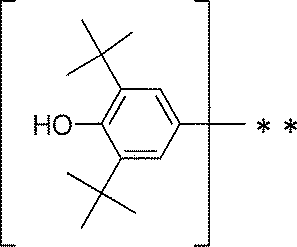
(式(1)中、**は結合部を表す。)
前記式(1)で表される構造を有するヒンダートフェノール系酸化防止剤の方が、該構造を有さないセミヒンダードフェノール系よりも、安定性が高く、分解しにくく、寿命が長いため、長期にわたって効果を発揮する。
From the viewpoint of obtaining the above-mentioned effect, the phenol-based antioxidant (C) has a phenol structure in the molecule. The number of phenol structures in the molecule of the phenol-based antioxidant (C) is not particularly limited, but is preferably 1 to 4, more preferably 2 to 3, and particularly preferably 2.
The above "phenol structure" is preferably a structure represented by the following formula (1).
(In formula (1), ** represents a bond.)
A hindered phenol-based antioxidant having the structure represented by the formula (1) is more stable, less susceptible to decomposition, and has a longer life than a semi-hindered phenol-based antioxidant not having this structure, and therefore exerts its effect over a long period of time.
前記フェノール系酸化防止剤(C)としては、半芳香族ポリアミド(A)に対する相容性を向上させる観点から、前記式(1)で表される構造以外の部分(「リンカー」ということもある)にエステル基及びアミド基の少なくともいずれかを有することが好ましく、下記式(2)で表される構造を有することがより好ましい。From the viewpoint of improving compatibility with the semi-aromatic polyamide (A), the phenol-based antioxidant (C) preferably has at least one of an ester group and an amide group in the portion other than the structure represented by formula (1) (sometimes referred to as the "linker"), and more preferably has a structure represented by the following formula (2).
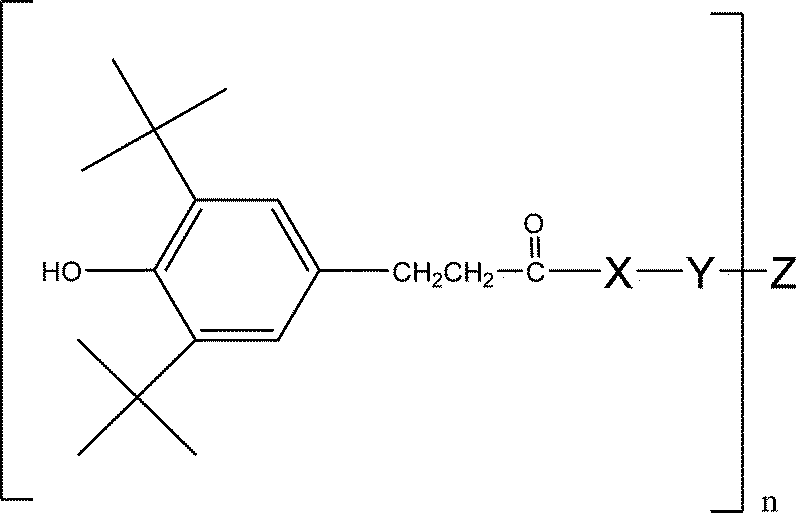
(式(2)中、Xは酸素原子又は-NH-で示される基を表し、Yは単結合又は炭素数1~17のアルキレン基を表し、Zは1~4価の有機基を表し、nは、1~4の整数である。)
(In formula (2), X represents an oxygen atom or a group represented by -NH-, Y represents a single bond or an alkylene group having 1 to 17 carbon atoms, Z represents a monovalent to tetravalent organic group, and n is an integer of 1 to 4.)
前記式(2)で示されるフェノール系酸化防止剤は、nが1である場合、Zは1価の有機基であり、フェノール性水酸基の両オルト位にそれぞれt-ブチル基を有する単官能フェノール系酸化防止剤(以下、「単官能フェノール系酸化防止剤」ともいう)である。Yは炭素数1~17のアルキレン基であることが好ましい。The phenolic antioxidant represented by the formula (2) is a monofunctional phenolic antioxidant (hereinafter also referred to as "monofunctional phenolic antioxidant") in which, when n is 1, Z is a monovalent organic group and both ortho positions of the phenolic hydroxyl group have t-butyl groups. Y is preferably an alkylene group having 1 to 17 carbon atoms.
前記式(2)で示されるフェノール系酸化防止剤は、nが2である場合、Zは2価の有機基であり、フェノール性水酸基の両オルト位にそれぞれt-ブチル基を有する2官能フェノール系酸化防止剤(以下、「2官能フェノール系酸化防止剤」ともいう)である。Yは炭素数1~17のアルキレン基であることが好ましい。The phenolic antioxidant represented by the formula (2) is a bifunctional phenolic antioxidant (hereinafter also referred to as "bifunctional phenolic antioxidant") in which, when n is 2, Z is a divalent organic group and both ortho positions of the phenolic hydroxyl group have t-butyl groups. Y is preferably an alkylene group having 1 to 17 carbon atoms.
前記式(2)で示されるフェノール系酸化防止剤は、nが3である場合、Zは3価の有機基であり、フェノール性水酸基の両オルト位にそれぞれt-ブチル基を有する3官能フェノール系酸化防止剤(以下、「3官能フェノール系酸化防止剤」ともいう)である。Yは炭素数1~17のアルキレン基であることが好ましい。The phenolic antioxidant represented by the formula (2) is a trifunctional phenolic antioxidant in which, when n is 3, Z is a trivalent organic group and both ortho positions of the phenolic hydroxyl group have t-butyl groups (hereinafter also referred to as "trifunctional phenolic antioxidant"). It is preferable that Y is an alkylene group having 1 to 17 carbon atoms.
前記式(2)で示されるフェノール系酸化防止剤は、nが4である場合、Zは4価の有機基であり、フェノール性水酸基の両オルト位にそれぞれt-ブチル基を有する4官能フェノール系酸化防止剤(以下、「4官能フェノール系酸化防止剤」ともいう)である。Yはメチレン基であることが好ましい。The phenolic antioxidant represented by the formula (2) is a tetrafunctional phenolic antioxidant in which, when n is 4, Z is a tetravalent organic group and both ortho positions of the phenolic hydroxyl group have t-butyl groups (hereinafter also referred to as "tetrafunctional phenolic antioxidant"). It is preferable that Y is a methylene group.
フェノール系酸化防止剤(C)の具体例としては、例えば、1,6-ヘキサンジオールビス-[3-(3,5-ジ-tert-ブチル-4-ヒドロキシフェニル)プロピオネート]、2,2-チオジエチレンビス-[3-(3,5-ジ-tert-ブチル-4-ヒドロキシフェニル)プロピオネート]、3,5-ジ-tert-ブチル-4-ヒドロキシベンジルホスホネートジエチルエステル、トリス(3,5-ジ-tert-ブチル-4-ヒドロキシベンジル)イソシアヌレート、トリス[(3,5-ジ-tert-ブチル-4-ヒドロキシフェニル) プロピオニルオキシエチル]イソシアヌレート、1,3,5-トリメチル-2,4,6-トリス(3,5-ジ-tert-ブチル-4-ヒドロキシベンジル)ベンゼン、3-(3,5-ジ-tert-ブチル-4-ヒドロキシフェニル)プロピオン酸ステアリル、N,N’-ヘキサメチレンビス[3-(3,5-ジ-tert-ブチル-4-ヒドロキシフェニル)プロパンアミド]、ペンタエリトリトールテトラキス[3-(3,5-ジ-tert-ブチル-4-ヒドロキシフェニル)プロピオナート]、イソシアヌル酸トリス(3,5-ジ-tert-ブチル-4-ヒドロキシベンジル)、が挙げられる。これらは、1種を単独で用いてもよいし、2種以上を併用してもよい。
これらの中でも、N,N’-ヘキサメチレンビス[3-(3,5-ジ-tert-ブチル-4-ヒドロキシフェニル)プロパンアミド]、ペンタエリトリトールテトラキス[3-(3,5-ジ-tert-ブチル-4-ヒドロキシフェニル)プロピオナート]が好ましく、N,N’-ヘキサメチレンビス[3-(3,5-ジ-tert-ブチル-4-ヒドロキシフェニル)プロパンアミド]がより好ましい。
Specific examples of the phenol-based antioxidant (C) include 1,6-hexanediol bis-[3-(3,5-di-tert-butyl-4-hydroxyphenyl)propionate], 2,2-thiodiethylene bis-[3-(3,5-di-tert-butyl-4-hydroxyphenyl)propionate], 3,5-di-tert-butyl-4-hydroxybenzylphosphonate diethyl ester, tris(3,5-di-tert-butyl-4-hydroxybenzyl)isocyanurate, tris[(3,5-di-tert-butyl-4-hydroxyphenyl) propionyloxyethyl] isocyanurate, 1,3,5-trimethyl-2,4,6-tris(3,5-di-tert-butyl-4-hydroxybenzyl)benzene, 3-(3,5-di-tert-butyl-4-hydroxyphenyl)stearyl propionate, N,N'-hexamethylenebis[3-(3,5-di-tert-butyl-4-hydroxyphenyl)propanamide], pentaerythritol tetrakis[3-(3,5-di-tert-butyl-4-hydroxyphenyl)propionate], tris(3,5-di-tert-butyl-4-hydroxybenzyl) isocyanurate. These may be used alone or in combination of two or more.
Among these, N,N'-hexamethylenebis[3-(3,5-di-tert-butyl-4-hydroxyphenyl)propanamide] and pentaerythritol tetrakis[3-(3,5-di-tert-butyl-4-hydroxyphenyl)propionate] are preferred, and N,N'-hexamethylenebis[3-(3,5-di-tert-butyl-4-hydroxyphenyl)propanamide] is more preferred.
フェノール系酸化防止剤(C)の市販品の具体例としては、例えば、下記式(3)で表されるN,N’-ヘキサメチレンビス[3-(3,5-ジ-tert-ブチル-4-ヒドロキシフェニル)プロパンアミド](BASFジャパン株式会社製、商品名:「Irganox 1098」)、下記式(4)で表されるペンタエリトリトールテトラキス[3-(3,5-ジ-tert-ブチル-4-ヒドロキシフェニル)プロピオナート](BASFジャパン株式会社製、商品名「Irganox 1010」)、などが挙げられる。Specific examples of commercially available phenol-based antioxidants (C) include N,N'-hexamethylenebis[3-(3,5-di-tert-butyl-4-hydroxyphenyl)propanamide] represented by the following formula (3) (manufactured by BASF Japan Ltd., product name: "Irganox 1098"), and pentaerythritol tetrakis[3-(3,5-di-tert-butyl-4-hydroxyphenyl)propionate] represented by the following formula (4) (manufactured by BASF Japan Ltd., product name: "Irganox 1010"), etc.


半芳香族ポリアミド(A)100質量部に対するフェノール系酸化防止剤(C)の含有量としては、0.1質量部以上2.0質量部以下である限り、特に制限はなく、0.15質量部以上が好ましく、0.2質量部以上がより好ましく、1.5質量部以下が好ましく、1.0質量部以下がより好ましい。
半芳香族ポリアミド(A)100質量部に対するフェノール系酸化防止剤(C)の含有量が、0.1質量部未満であると、フェノール系酸化防止剤(C)の配合の効果が得られないおそれがあり、また、2.0質量部を超えると酸化防止剤の分解物が増え、樹脂の分子切断(分解)を助長するおそれがある。
The content of the phenol-based antioxidant (C) relative to 100 parts by mass of the semi-aromatic polyamide (A) is not particularly limited, as long as it is 0.1 parts by mass or more and 2.0 parts by mass or less, and is preferably 0.15 parts by mass or more, more preferably 0.2 parts by mass or more, and is preferably 1.5 parts by mass or less, and more preferably 1.0 part by mass or less.
When the content of the phenol-based antioxidant (C) relative to 100 parts by mass of the semi-aromatic polyamide (A) is less than 0.1 parts by mass, the effect of blending the phenol-based antioxidant (C) may not be obtained. On the other hand, when the content exceeds 2.0 parts by mass, the amount of decomposition products of the antioxidant increases, which may promote molecular cleavage (decomposition) of the resin.
〔半芳香族ポリアミド(A)、無機充填剤(B)及びフェノール系酸化防止剤(C)の合計含有量〕
樹脂組成物中における、半芳香族ポリアミド(A)、無機充填剤(B)及びフェノール系酸化防止剤(C)の合計含有量としては、80質量%以上が好ましく、90質量%以上がより好ましく、95質量%以上が特に好ましい。
[Total Content of Semi-aromatic Polyamide (A), Inorganic Filler (B) and Phenolic Antioxidant (C)]
The total content of the semi-aromatic polyamide (A), the inorganic filler (B), and the phenolic antioxidant (C) in the resin composition is preferably 80 mass% or more, more preferably 90 mass% or more, and particularly preferably 95 mass% or more.
[その他の添加剤]
樹脂組成物は、上記半芳香族ポリアミド(A)、無機充填剤(B)及びフェノール系酸化防止剤(C)以外にその他の添加剤を必要に応じて含んでいてもよい。
その他の添加剤としては、例えば、ビス(2-トリメトキシシリルエチル)アミン、ビス(2-トリエトキシシリルエチル)アミン、ビス(3-トリメトキシシリルプロピル)アミン、ビス(3-トリエトキシシリルプロピル)アミン等のシランカップリング剤;銅化合物等の安定剤;フェノール系酸化防止剤(C)以外の酸化防止剤(例えば、アミン系酸化防止剤、リン系酸化防止剤、チオ系酸化防止剤等);カーボンブラック等の着色剤;顔料;流動性改善剤;紫外線吸収剤;光安定化剤;熱安定剤;帯電防止剤;臭素化ポリマー、酸化アンチモン、金属水酸化物、ホスフィン酸塩等の難燃剤;難燃助剤;タルク等の結晶核剤;可塑剤;滑剤;分散剤;酸素吸収剤;硫化水素吸着剤;超高分子量ポリエチレンやPTFE等の潤滑剤;アラミド繊維等の全芳香族ポリアミド繊維等の有機繊維状充填剤;α-オレフィン系共重合体、ゴム等の衝撃改質剤などが挙げられる。
上記その他の添加剤の含有量は、本発明の効果を損なわない限りにおいて特に限定されないが、半芳香族ポリアミド(A)100質量部に対して、0.02~200質量部が好ましく、0.03~100質量部がより好ましい。
その他の添加剤の含有量を半芳香族ポリアミド(A)100質量部に対して0.02質量部以上とすることで、製造上のメリットにより分子量保持率を向上させることができる。
[Other additives]
The resin composition may contain other additives, if necessary, in addition to the semi-aromatic polyamide (A), the inorganic filler (B) and the phenolic antioxidant (C).
Examples of other additives include silane coupling agents such as bis(2-trimethoxysilylethyl)amine, bis(2-triethoxysilylethyl)amine, bis(3-trimethoxysilylpropyl)amine, and bis(3-triethoxysilylpropyl)amine; stabilizers such as copper compounds; antioxidants other than the phenol-based antioxidant (C) (e.g., amine-based antioxidants, phosphorus-based antioxidants, thio-based antioxidants, etc.); colorants such as carbon black; pigments; flow improvers; ultraviolet absorbers; light stabilizers; heat stabilizers; antistatic agents; flame retardants such as brominated polymers, antimony oxide, metal hydroxides, and phosphinates; flame retardant assistants; crystal nucleating agents such as talc; plasticizers; lubricants; dispersants; oxygen absorbers; hydrogen sulfide adsorbents; lubricants such as ultra-high molecular weight polyethylene and PTFE; organic fibrous fillers such as wholly aromatic polyamide fibers such as aramid fibers; impact modifiers such as α-olefin copolymers and rubber.
The content of the above other additives is not particularly limited as long as it does not impair the effects of the present invention, but is preferably 0.02 to 200 parts by mass, more preferably 0.03 to 100 parts by mass, per 100 parts by mass of the semi-aromatic polyamide (A).
By setting the content of the other additives to 0.02 parts by mass or more per 100 parts by mass of the semi-aromatic polyamide (A), it is possible to improve the molecular weight retention rate due to the merit in production.
[樹脂組成物の製造方法]
樹脂組成物の製造方法としては、特に制限はなく、半芳香族ポリアミド(A)、無機充填剤(B)、フェノール系酸化防止剤(C)及び必要に応じて用いられる上記その他の添加剤等を均一に混合することのできる方法を好ましく採用することができる。混合は、通常、単軸押出機、二軸押出機、ニーダー、バンバリーミキサーなどを使用して溶融混練する方法が好ましく採用される。溶融混練条件は特に限定されないが、例えば、半芳香族ポリアミド(A)の融点よりも10~60℃程度高い温度範囲で、約1~30分間溶融混練する方法が挙げられる。
[Method of producing resin composition]
The method for producing the resin composition is not particularly limited, and a method capable of uniformly mixing the semi-aromatic polyamide (A), the inorganic filler (B), the phenolic antioxidant (C), and the other additives used as necessary can be preferably adopted. The mixing is usually preferably performed by melt-kneading using a single-screw extruder, a twin-screw extruder, a kneader, a Banbury mixer, or the like. The melt-kneading conditions are not particularly limited, and examples thereof include a method of melt-kneading for about 1 to 30 minutes at a temperature range about 10 to 60° C. higher than the melting point of the semi-aromatic polyamide (A).
特に、上述の樹脂組成物は、次亜塩素酸及び次亜塩素酸塩の少なくともいずれかを含む水と接触する環境下が想定される水回り用成形体を製造するのに最適であり、水栓用途や調理家電用途として用いられる水回り用成形体を製造するのに好適に使用することができる。In particular, the above-mentioned resin composition is ideal for producing molded articles for use in wet areas that are expected to be used in environments where they will come into contact with water containing at least one of hypochlorous acid and hypochlorite, and can be suitably used for producing molded articles for use in wet areas such as faucets and cooking appliances.
<第1の使用方法>
本発明の第1の使用方法は、本発明の水回り用成形体を、次亜塩素酸及び次亜塩素酸塩の少なくともいずれかを含む水と接触する環境下で使用する方法である。
<First method of use>
The first method of use of the present invention is a method of using the molded article for use around water of the present invention in an environment in which it comes into contact with water containing at least one of hypochlorous acid and hypochlorite.
<第2の使用方法>
本発明の第2の使用方法は、上述のフェノール系酸化防止剤(C)を含む樹脂組成物又は該樹脂組成物からなる成形体を、次亜塩素酸及び次亜塩素酸塩の少なくともいずれかを含む水と接触する環境下で使用する方法である。
<Second method of use>
The second method of use of the present invention is a method of using a resin composition containing the above-mentioned phenolic antioxidant (C) or a molded article made of the resin composition in an environment in which it comes into contact with water containing at least one of hypochlorous acid and a hypochlorite.
[樹脂組成物]
本発明の第2の使用方法で用いられる樹脂組成物としては、「水回り用成形体」の欄で上述した「フェノール系酸化防止剤(C)」を含む樹脂組成物である限り、特に制限はないが、ポリアミド(D)を更に含むことが好ましい。また、本発明の第2の使用方法で用いられる樹脂組成物は、「水回り用成形体」の欄で上述した「無機充填剤(B)」、及び、「水回り用成形体」の欄で上述した「その他の添加剤」を更に含んでいてもよい。
フェノール系酸化防止剤(C)の含有量としては、特に制限はないが、ポリアミド(D)100質量部に対して、0.1質量部以上2.0質量部以下が好ましく、0.15質量部以上1.5質量部以下がより好ましく、0.2質量部以上1.0質量部以下が特に好ましい。
任意成分としての無機充填剤(B)の含有量としては、特に制限はないが、ポリアミド(D)100質量部に対して、10質量部以上200質量部以下が好ましく、15質量部以上がより好ましく、20質量部以上がさらに好ましく、25質量部以上がよりさらに好ましく、35質量部以上がよりさらに好ましく、45質量部以上がよりさらに好ましく、そして、140質量部以下がより好ましく、120質量部以下がさらに好ましく、100質量部以下がよりさらに好ましく、60質量部以下がよりさらに好ましい。
任意成分としてのその他の添加剤の含有量としては、特に制限はないが、ポリアミド(D)100質量部に対して、0.02~200質量部が好ましく、0.03~100質量部がより好ましい。
本発明の第2の使用方法で用いられる樹脂組成物は、射出成形、押出し成形、ブロー成形のいずれの成形タイプにも適している。
[Resin composition]
The resin composition used in the second method of use of the present invention is not particularly limited as long as it is a resin composition containing the "phenolic antioxidant (C)" described above in the section "molded body for wet areas", but it is preferable that it further contains polyamide (D). The resin composition used in the second method of use of the present invention may further contain the "inorganic filler (B)" described above in the section "molded body for wet areas" and the "other additives" described above in the section "molded body for wet areas".
The content of the phenol-based antioxidant (C) is not particularly limited, but is preferably from 0.1 to 2.0 parts by mass, more preferably from 0.15 to 1.5 parts by mass, and particularly preferably from 0.2 to 1.0 parts by mass, relative to 100 parts by mass of the polyamide (D).
The content of the inorganic filler (B) as an optional component is not particularly limited, but is preferably 10 parts by mass or more and 200 parts by mass or less, more preferably 15 parts by mass or more, even more preferably 20 parts by mass or more, even more preferably 25 parts by mass or more, even more preferably 35 parts by mass or more, even more preferably 45 parts by mass or more, and more preferably 140 parts by mass or less, even more preferably 120 parts by mass or less, even more preferably 100 parts by mass or less, and even more preferably 60 parts by mass or less, relative to 100 parts by mass of polyamide (D).
The content of other additives as optional components is not particularly limited, but is preferably 0.02 to 200 parts by mass, and more preferably 0.03 to 100 parts by mass, per 100 parts by mass of polyamide (D).
The resin composition used in the second method of use of the present invention is suitable for any of the molding types including injection molding, extrusion molding and blow molding.
[[ポリアミド(D)]]
ポリアミド(D)は、特に制限はないが、ポリアミドの繰り返し単位中におけるアミド基1個当たりの炭素数が6~13であるポリアミドが好ましい。ポリアミドの繰り返し単位中におけるアミド基1個当たりの炭素数が前記範囲内であると、成形体が低吸水性になり、吸水による寸法変化などを抑えることができる。これらの観点から、繰り返し単位中におけるアミド基1個当たりの炭素数は7~13がより好ましく、8~13がさらに好ましい。
[[Polyamide (D)]]
The polyamide (D) is not particularly limited, but is preferably a polyamide having a carbon number per amide group in the repeating unit of the polyamide of 6 to 13. When the carbon number per amide group in the repeating unit of the polyamide is within the above range, the molded article has low water absorption, and dimensional changes due to water absorption can be suppressed. From these viewpoints, the carbon number per amide group in the repeating unit is more preferably 7 to 13, and even more preferably 8 to 13.
ポリアミド(D)は、例えばアミノカルボン酸、ラクタム、ジアミン、及びジカルボン酸を主たる原料とすることにより製造することができる。
前記原料としては、例えば、6-アミノカプロン酸、11-アミノウンデカン酸、12-アミノドデカン酸、パラアミノメチル安息香酸等のアミノカルボン酸;ε-カプロラクタム、ω-ラウロラクタム等のラクタム;1,6-ヘキサメチレンジアミン、2-メチルペンタメチレンジアミン、1,7-ヘプタメチレンジアミン、1,8-オクタメチレンジアミン、1,9-ノナメチレンジアミン、2-メチル-1,8-オクタメチレンジアミン、2-エチル-1,7-ヘプタンジアミン、1,10-デカメチレンジアミン、1,11-ウンデカメチレンジアミン、1,12-ドデカメチレンジアミン、1,13-トリデカメチレンジアミン、5-メチルノナメチレンジアミン等の脂肪族ジアミン;1,3-ビス(アミノメチル)シクロヘキサン、1,4-ビス(アミノメチル)シクロヘキサン、1-アミノ-3-アミノメチル-3,5,5-トリメチルシクロヘキサン、ビス(4-アミノシクロヘキシル)メタン、ビス(3-メチル-4-アミノシクロヘキシル)メタン、2,2-ビス(4-アミノシクロヘキシル)プロパン、ビス(アミノプロピル)ピペラジン、アミノエチルピペラジン等の脂環族ジアミン;メタキシリレンジアミン、パラキシリレンジアミン等の芳香族ジアミン、及びシュウ酸、マロン酸、ジメチルマロン酸、コハク酸、グルタル酸、アジピン酸、2-メチルアジピン酸、ピメリン酸、2,2-ジメチルグルタル酸、スペリン酸、3,3-ジエチルコハク酸、アゼライン酸、セバシン酸、ドデカン二酸、ダイマー酸等の脂肪族ジカルボン酸;1,3-シクロヘキサンジカルボン酸、1,4-シクロヘキサンジカルボン酸等の脂環族ジカルボン酸;テレフタル酸、イソフタル酸、フタル酸、1,4-ナフタレンジカルボン酸、2,6-ナフタレンジカルボン酸、2,7-ナフタレンジカルボン酸、1,4-フェニレンジオキシジ酢酸、1,3-フェニレンジオキシジ酢酸、ジフェン酸、4,4’-オキシジ安息香酸、ジフェニルメタン-4,4’-ジカルボン酸、ジフェニルスルホン-4,4’-ジカルボン酸、4,4’-ビフェニルジカルボン酸等の芳香族ジカルボン酸等が挙げられる。
これらの原料から誘導されるホモポリマー又はコポリマーの1種を単独で用いてもよく、2種以上を併用してもよい。
The polyamide (D) can be produced, for example, by using an aminocarboxylic acid, a lactam, a diamine, and a dicarboxylic acid as main raw materials.
Examples of the raw material include aminocarboxylic acids such as 6-aminocaproic acid, 11-aminoundecanoic acid, 12-aminododecanoic acid, and para-aminomethylbenzoic acid; lactams such as ε-caprolactam and ω-laurolactam; 1,6-hexamethylenediamine, 2-methylpentamethylenediamine, 1,7-heptamethylenediamine, 1,8-octamethylenediamine, 1,9-nonamethylenediamine, 2-methyl-1,8-octamethylenediamine, 2-ethyl-1,7-heptanediamine, and 1,10-decamethylphenyl diamine. aliphatic diamines such as methylenediamine, 1,11-undecamethylenediamine, 1,12-dodecamethylenediamine, 1,13-tridecamethylenediamine, and 5-methylnonamethylenediamine; 1,3-bis(aminomethyl)cyclohexane, 1,4-bis(aminomethyl)cyclohexane, 1-amino-3-aminomethyl-3,5,5-trimethylcyclohexane, bis(4-aminocyclohexyl)methane, bis(3-methyl-4-aminocyclohexyl)methane, 2,2-bis(4-aminocyclo alicyclic diamines such as bis(aminopropyl)piperazine and aminoethylpiperazine; aromatic diamines such as metaxylylenediamine and paraxylylenediamine; and aliphatic dicarboxylic acids such as oxalic acid, malonic acid, dimethylmalonic acid, succinic acid, glutaric acid, adipic acid, 2-methyladipic acid, pimelic acid, 2,2-dimethylglutaric acid, suberic acid, 3,3-diethylsuccinic acid, azelaic acid, sebacic acid, dodecanedioic acid, and dimer acid; 1,3-cyclohexanedicarboxylic acid, 1, alicyclic dicarboxylic acids such as 4-cyclohexanedicarboxylic acid; and aromatic dicarboxylic acids such as terephthalic acid, isophthalic acid, phthalic acid, 1,4-naphthalenedicarboxylic acid, 2,6-naphthalenedicarboxylic acid, 2,7-naphthalenedicarboxylic acid, 1,4-phenylenedioxydiacetic acid, 1,3-phenylenedioxydiacetic acid, diphenic acid, 4,4'-oxydibenzoic acid, diphenylmethane-4,4'-dicarboxylic acid, diphenylsulfone-4,4'-dicarboxylic acid, and 4,4'-biphenyldicarboxylic acid.
The homopolymers or copolymers derived from these raw materials may be used alone or in combination of two or more kinds.
ポリアミド(D)の具体例としては、ポリカプロアミド(ナイロン6)、ポリヘキサメチレンアジパミド(ナイロン66)、ポリテトラメチレンアジパミド(ナイロン46)、ポリテトラメチレンセバカミド(ナイロン410)、ポリペンタメチレンアジパミド(ナイロン56)、ポリペンタメチレンセバカミド(ナイロン510)、ポリヘキサメチレンセバカミド(ナイロン610)、ポリヘキサメチレンドデカミド(ナイロン612)、ポリデカメチレンアジパミド(ナイロン106)、ポリデカメチレンセバカミド(ナイロン1010)、ポリデカメチレンドデカミド(ナイロン1012)、ポリウンデカンアミド(ナイロン11)、ポリドデカンアミド(ナイロン12)、ポリカプロアミド/ポリヘキサメチレンアジパミドコポリマー(ナイロン6/66)、ポリテトラメチレンテレフタルアミド(ポリアミド4T)、ポリペンタメチレンテレフタルアミド(ポリアミド5T)、ポリヘキサメチレンテレフタルアミド(ポリアミド6T)、ポリテトラメチレンテレフタルアミド/ポリヘキサメチレンテレフタルアミド(ナイロン6T/4T)、ポリヘキサメチレンアジパミド/ポリヘキサメチレンテレフタルアミド/ポリテトラメチレンテレフタルアミド/ポリテトラメチレンアジパミド(ナイロン66/6T/4T/46)、ポリヘキサメチレンテレフタルアミド/ポリカプロアミドコポリマー(ナイロン6T/6)、ポリヘキサメチレンテレフタルアミド/ポリウンデカンアミドコポリマー(ナイロン6T/11)、ポリヘキサメチレンテレフタルアミド/ポリドデカンアミドコポリマー(ナイロン6T/12)、ポリヘキサメチレンアジパミド/ポリヘキサメチレンテレフタルアミドコポリマー(ナイロン66/6T)、ポリヘキサメチレンアジパミド/ポリヘキサメチレンイソフタルアミドコポリマー(ナイロン66/6I)、ポリヘキサメチレンアジパミド/ポリヘキサメチレンイソフタルアミド/ポリカプロアミドコポリマー(ナイロン66/6I/6)、ポリヘキサメチレンアジパミド/ポリヘキサメチレンテレフタルアミド/ポリヘキサメチレンイソフタルアミドコポリマー(ナイロン66/6T/6I)、ポリヘキサメチレンテレフタルアミド/ポリヘキサメチレンイソフタルアミドコポリマー(ナイロン6T/6I)、ポリヘキサメチレンテレフタルアミド/ポリ(2-メチルペンタメチレン)テレフタルアミドコポリマー(ナイロン6T/M5T)、ポリノナメチレンテレフタルアミド(ポリアミド9T)、ポリ(2-メチルオクタメチレン)テレフタルアミド(ナイロンM8T)、ポリノナメチレンテレフタルアミド/ポリ(2-メチルオクタメチレン)テレフタルアミドコポリマー(ナイロン9T/M8T)、ポリデカメチレンテレフタルアミド(ポリアミド10T)、ポリウンデカメチレンテレフタルアミド(ポリアミド11T)、ポリドデカメチレンテレフタルアミド(ポリアミド12T)、ポリペンタメチレンテレフタルアミド/ポリデカメチレンテレフタルアミドコポリマー(ポリアミド5T/10T)、ポリデカメチレンテレフタルアミド/ポリヘキサメチレンドデカンアミドコポリマー(ポリアミド10T/ナイロン612)、ポリアミド6Tとポリアミド10Tとの共重合体(ポリアミド6T/10T)、ポリデカメチレンテレフタルアミド/ポリヘキサメチレンアジパミドコポリマー(ポリアミド10T/ナイロン66)、ポリヘキサメチレンアジパミド/ポリヘキサメチレンテレフタルアミド/ポリデカメチレンテレフタルアミド/ポリデカメチレンメチレンアジパミド(ナイロン66/ポリアミド6T/ポリアミド10T/ナイロン106)、ポリアミド10Tとポリウンデカンアミド(ポリアミド11)との共重合体(ポリアミド10T/11)、ポリノナメチレンナフタレンジカルボキサミド(ポリアミド9N)、ポリ(2-メチルオクタメチレン)ナフタレンアミド(ナイロンM8N)、ポリノナメチレンナフタレンジカルボキサミド/ポリ(2-メチルオクタメチレン)ナフタレンジカルボキサミドコポリマー(ナイロン9N/M8N)、ポリヘキサメチレンイソフタルアミド(ポリアミド6I)、ポリアミド6Iとポリアミド6Tとの共重合体(ポリアミド6I/6T)、ポリアミド66とポリアミド6Iとポリアミド6Tとの共重合体(ポリアミド66/ポリアミド6I/6T)、ポリアミド6Tとポリウンデカンアミド(ポリアミド11)との共重合体(ポリアミド6T/11)、ポリヘキサメチレンシクロヘキサンカルボアミド(ナイロン6C)、ポリヘキサメチレンシクロヘキサンカルボアミド/ポリ(2-メチルペンタメチレン)シクロヘキサンカルボアミドコポリマー(ナイロン6C/M5C)、ポリノナメチレンシクロヘキサンカルボアミド(ナイロン9C)、ポリ(2-メチルオクタメチレン)シクロヘキサンカルボアミド(ナイロンM8C)、ポリノナメチレンシクロヘキサンカルボアミド/ポリ(2-メチルオクタメチレン)シクロヘキサンカルボアミドコポリマー(ナイロン9C/M8C)及びこれらの混合物や共重合体等が挙げられる。これらは1種単独で用いてもよく、2種以上を併用してもよい。 Specific examples of polyamide (D) include polycaproamide (nylon 6), polyhexamethylene adipamide (nylon 66), polytetramethylene adipamide (nylon 46), polytetramethylene sebacamide (nylon 410), polypentamethylene adipamide (nylon 56), polypentamethylene sebacamide (nylon 510), polyhexamethylene sebacamide (nylon 610), polyhexamethylene dodecamide (nylon 612), polydecamethylene adipamide (nylon 106), polydecamethylene sebacamide (nylon 1010), polydecamethylene dodecamide (nylon 101). 2), polyundecaneamide (nylon 11), polydodecanamide (nylon 12), polycaproamide/polyhexamethylene adipamide copolymer (nylon 6/66), polytetramethylene terephthalamide (polyamide 4T), polypentamethylene terephthalamide (polyamide 5T), polyhexamethylene terephthalamide (polyamide 6T), polytetramethylene terephthalamide/polyhexamethylene terephthalamide (nylon 6T/4T), polyhexamethylene adipamide/polyhexamethylene terephthalamide/polytetramethylene terephthalamide/polytetramethylene Polyhexamethylene adipamide (Nylon 66/6T/4T/46), Polyhexamethylene terephthalamide/Polycaproamide copolymer (Nylon 6T/6), Polyhexamethylene terephthalamide/Polyundecaneamide copolymer (Nylon 6T/11), Polyhexamethylene terephthalamide/Polydodecaneamide copolymer (Nylon 6T/12), Polyhexamethylene adipamide/Polyhexamethylene terephthalamide copolymer (Nylon 66/6T), Polyhexamethylene adipamide/Polyhexamethylene isophthalamide copolymer (Nylon 66/6I), Polyhexamethylene adipamide Polyhexamethylene isophthalamide/polycaproamide copolymer (nylon 66/6I/6), polyhexamethylene adipamide/polyhexamethylene terephthalamide/polyhexamethylene isophthalamide copolymer (nylon 66/6T/6I), polyhexamethylene terephthalamide/polyhexamethylene isophthalamide copolymer (nylon 6T/6I), polyhexamethylene terephthalamide/poly(2-methylpentamethylene) terephthalamide copolymer (nylon 6T/M5T), polynonamethylene terephthalamide (polyamide 9T), poly(2-methyloctamethyl) terephthalamide copolymer (nylon 6T/M5T), Poly(2-methyloctamethylene) terephthalamide (nylon M8T), polynonamethylene terephthalamide/poly(2-methyloctamethylene) terephthalamide copolymer (nylon 9T/M8T), polydecamethylene terephthalamide (polyamide 10T), polyundecamethylene terephthalamide (polyamide 11T), polydodecamethylene terephthalamide (polyamide 12T), polypentamethylene terephthalamide/polydecamethylene terephthalamide copolymer (polyamide 5T/10T), polydecamethylene terephthalamide/polyhexamethylene dodecane amide copolymer (polyamide 10T/ Nylon 612), copolymer of polyamide 6T and polyamide 10T (Polyamide 6T/10T), polydecamethylene terephthalamide/polyhexamethylene adipamide copolymer (Polyamide 10T/Nylon 66), polyhexamethylene adipamide/polyhexamethylene terephthalamide/polydecamethylene terephthalamide/polydecamethylene methylene adipamide (Nylon 66/Polyamide 6T/Polyamide 10T/Nylon 106), copolymer of polyamide 10T and polyundecane amide (Polyamide 11) (Polyamide 10T/11), polynonamethylene naphthalene dicarboxamide Polyamide 9N, poly(2-methyloctamethylene)naphthalene amide (nylon M8N), polynonamethylene naphthalene dicarboxamide/poly(2-methyloctamethylene)naphthalene dicarboxamide copolymer (nylon 9N/M8N), polyhexamethylene isophthalamide (polyamide 6I), copolymer of polyamide 6I and polyamide 6T (polyamide 6I/6T), copolymer of polyamide 66, polyamide 6I and polyamide 6T (polyamide 66/polyamide 6I/6T), copolymer of polyamide 6T and polyundecane amide (polyamide 11) (polyamide 6T/11), polyhexamethylenecyclohexanecarboxamide (nylon 6C), polyhexamethylenecyclohexanecarboxamide/poly(2-methylpentamethylene)cyclohexanecarboxamide copolymer (nylon 6C/M5C), polynonamethylenecyclohexanecarboxamide (nylon 9C), poly(2-methyloctamethylene)cyclohexanecarboxamide (nylon M8C), polynonamethylenecyclohexanecarboxamide/poly(2-methyloctamethylene)cyclohexanecarboxamide copolymer (nylon 9C/M8C), and mixtures and copolymers thereof. These may be used alone or in combination of two or more.
これらの中でも、成形体の強度向上および低吸水性の観点から、ポリノナメチレンテレフタルアミド(ポリアミド9T)、ポリノナメチレンテレフタルアミド/ポリ(2-メチルオクタメチレン)テレフタルアミドコポリマー(ナイロン9T/M8T)、ポリデカメチレンテレフタルアミド(ポリアミド10T)、ポリノナメチレンナフトアミド(ナイロン9N)、ポリ(2-メチルオクタメチレン)ナフタレンアミド(ナイロンM8N)、ポリノナメチレンナフトアミド/ポリ(2-メチルオクタメチレン)ナフトアミドコポリマー(ナイロン9N/M8N)、ポリノナメチレンシクロヘキサンカルボアミド(ナイロン9C)、ポリ(2-メチルオクタメチレン)シクロヘキサンカルボアミド(ナイロンM8C)、ポリノナメチレンシクロヘキサンカルボアミド/ポリ(2-メチルオクタメチレン)シクロヘキサンカルボアミドコポリマー(ナイロン9C/M8C)が好ましい。Among these, from the viewpoints of improving the strength of the molded body and reducing water absorption, polynonamethylene terephthalamide (polyamide 9T), polynonamethylene terephthalamide/poly(2-methyloctamethylene) terephthalamide copolymer (nylon 9T/M8T), polydecamethylene terephthalamide (polyamide 10T), polynonamethylene naphthamide (nylon 9N), poly(2-methyloctamethylene) naphthalene amide (nylon M8N), polynonamethylene naphthamide/poly(2-methyloctamethylene) naphthamide copolymer (nylon 9N/M8N), polynonamethylene cyclohexanecarboxamide (nylon 9C), poly(2-methyloctamethylene) cyclohexanecarboxamide (nylon M8C), and polynonamethylene cyclohexanecarboxamide/poly(2-methyloctamethylene) cyclohexanecarboxamide copolymer (nylon 9C/M8C) are preferred.
ポリアミド(D)は、成形体の強度向上および低吸水性の観点から、繰り返し構造単位中に芳香環を含む半芳香族ポリアミドが好ましく、中でも、「水回り用成形体」の欄で上述した芳香族ジカルボン酸単位を主成分とするジカルボン酸単位と、脂肪族ジアミン単位を主成分とするジアミン単位とを含む半芳香族ポリアミド(A)がより好ましい。From the viewpoint of improving the strength of the molded body and reducing water absorption, the polyamide (D) is preferably a semi-aromatic polyamide containing an aromatic ring in the repeating structural unit, and among these, semi-aromatic polyamide (A) containing dicarboxylic acid units mainly composed of aromatic dicarboxylic acid units and diamine units mainly composed of aliphatic diamine units as described above in the section on "Molded bodies for use in wet areas" is more preferable.
-半芳香族ポリアミド(A)-
前記半芳香族ポリアミド(A)は、芳香族ジカルボン酸単位を主成分とするジカルボン酸単位と、脂肪族ジアミン単位を主成分とするジアミン単位とを含むポリアミドである限り、特に制限はないが、芳香族ジカルボン酸単位を主成分とするジカルボン酸単位と、炭素数4~10の脂肪族ジアミン単位を主成分とするジアミン単位とを含むポリアミドであることが好ましい。
ここで、「芳香族ジカルボン酸単位」及び「炭素数4~10の脂肪族ジアミン単位(炭素数4~10の脂肪族ジアミンに由来する構造単位)」は「水回り用成形体」の欄で上述した通りである。
-Semi-aromatic polyamide (A)-
The semi-aromatic polyamide (A) is not particularly limited as long as it is a polyamide containing dicarboxylic acid units mainly composed of aromatic dicarboxylic acid units and diamine units mainly composed of aliphatic diamine units, but is preferably a polyamide containing dicarboxylic acid units mainly composed of aromatic dicarboxylic acid units and diamine units mainly composed of aliphatic diamine units having 4 to 10 carbon atoms.
Here, the "aromatic dicarboxylic acid unit" and the "aliphatic diamine unit having 4 to 10 carbon atoms (structural unit derived from an aliphatic diamine having 4 to 10 carbon atoms)" are as described above in the section "molded article for use in wet areas."
以下、本発明を実施例及び比較例により具体的に説明するが、本発明はこれらに限定されるものではない。The present invention will be described in detail below with reference to examples and comparative examples, but the present invention is not limited to these.
製造例、実施例、及び比較例における各評価は、以下に示す方法に従って行った。 Each evaluation in the manufacturing examples, working examples, and comparative examples was carried out according to the methods shown below.
(試験片の作製)
住友重機械工業株式会社製の射出成形機(型締力:100トン、スクリュー径:φ32mm)を使用し、シリンダー温度を320℃とし、実金型温度140℃の条件下で、Tランナー金型を用いて、実施例及び比較例で得られた樹脂組成物(ペレット)から、ISO多目的試験片A型ダンベル(4mm厚、全長170mm、平行部長さ80mm、平行部幅10mm)を作製して評価用試験片とした。
(Preparation of test specimens)
Using an injection molding machine (clamping force: 100 tons, screw diameter: φ32 mm) manufactured by Sumitomo Heavy Industries, Ltd., a cylinder temperature was set at 320°C, and an actual mold temperature was set at 140°C. Using a T-runner mold, ISO multipurpose test specimens A-type dumbbells (4 mm thick, total length 170 mm, parallel portion length 80 mm, parallel portion width 10 mm) were produced from the resin compositions (pellets) obtained in the examples and comparative examples as test specimens for evaluation.
<引張強度の測定>
上記の方法で作製した評価用試験片を用いて、ISO527-1に準じて、オートグラフ(株式会社島津製作所製)を使用して、23℃における引張強度(引張降伏強度)を測定した。
<Measurement of tensile strength>
The evaluation test pieces prepared by the above method were used to measure the tensile strength (tensile yield strength) at 23° C. in accordance with ISO 527-1 using an autograph (manufactured by Shimadzu Corporation).
<分子量保持率の測定>
上記の方法で作製した評価用試験片を、次亜塩素酸ナトリウム濃度1000ppmの水溶液を80℃に調整したものに96時間浸漬した。前記水溶液は24時間おきに交換した。浸漬前後で分子量測定を実施し、浸漬前の評価用試験片の数平均分子量をMn1、浸漬後の評価用試験片の数平均分子量をMn2とし、分子量保持率(%)を下記式で求めた。
分子量保持率(%)=Mn2/Mn1×100
なお、各数平均分子量は、東ソー株式会社製HLC-8320GPC、東ソー株式会社製カラムTSK-gel SuperHM-Nを用いて、トリフルオロ酢酸10mMのヘキサフルオロ-2-プロパノールを溶離液とし、測定温度40℃で測定し、ポリメチルメタクリレート換算で算出した。
<Measurement of molecular weight retention>
The evaluation test piece prepared by the above method was immersed for 96 hours in an aqueous solution of sodium hypochlorite with a concentration of 1000 ppm adjusted to 80° C. The aqueous solution was replaced every 24 hours. Molecular weight measurements were performed before and after immersion, and the number average molecular weight of the evaluation test piece before immersion was defined as M n1 and the number average molecular weight of the evaluation test piece after immersion was defined as M n2 , and the molecular weight retention rate (%) was calculated by the following formula.
Molecular weight retention rate (%) = M n2 /M n1 ×100
Each number average molecular weight was measured using HLC-8320GPC manufactured by Tosoh Corporation and a column TSK-gel Super HM-N manufactured by Tosoh Corporation, using hexafluoro-2-propanol containing 10 mM trifluoroacetic acid as an eluent at a measurement temperature of 40° C., and calculated in terms of polymethyl methacrylate.
実施例及び比較例における樹脂組成物を調製するために用いた各成分を示す。 The components used to prepare the resin compositions in the examples and comparative examples are shown below.
(半芳香族ポリアミド(A))
[製造例1:ポリアミド9T(PA9T)(ポリアミド9T、繰り返し単位中のアミド基1個当たりの炭素数:8.5)の製造]
7917gの1,9-ノナンジアミン、1979gの2-メチル-1,8-オクタンジアミン(1,9-ノナンジアミン:2-メチル-1,8-オクタンジアミン=80:20(モル比))、10031gのテレフタル酸、149gの安息香酸、20gの次亜燐酸ナトリウム一水和物、5000gの水を反応装置に入れ、窒素置換した。3時間かけて内部温度を220℃に昇温した。この時、オートクレーブは2MPaまで昇圧した。その後4時間、水蒸気を徐々に抜いて圧力を2MPaに保ちながら反応させた。次いで、30分間かけて圧力を1.2MPaまで下げ、プレポリマーを得た。このプレポリマーを粉砕し、120℃、減圧下で12時間乾燥した。これを200℃、13.3Paの条件で2時間、続いて235℃、13.3Paの条件で固相重合し、融点が300℃のポリアミド9T(PA9T)を得た。
(Semi-aromatic polyamide (A))
[Production Example 1: Production of Polyamide 9T (PA9T) (Polyamide 9T, number of carbon atoms per amide group in repeating unit: 8.5)]
7917 g of 1,9-nonanediamine, 1979 g of 2-methyl-1,8-octanediamine (1,9-nonanediamine:2-methyl-1,8-octanediamine=80:20 (molar ratio)), 10031 g of terephthalic acid, 149 g of benzoic acid, 20 g of sodium hypophosphite monohydrate, and 5000 g of water were placed in a reactor and substituted with nitrogen. The internal temperature was raised to 220° C. over 3 hours. At this time, the autoclave was pressurized to 2 MPa. Thereafter, the reaction was carried out for 4 hours while gradually releasing water vapor to maintain the pressure at 2 MPa. Next, the pressure was lowered to 1.2 MPa over 30 minutes to obtain a prepolymer. This prepolymer was pulverized and dried at 120° C. under reduced pressure for 12 hours. This was polymerized in a solid phase at 200°C and 13.3 Pa for 2 hours, and then at 235°C and 13.3 Pa to obtain polyamide 9T (PA9T) having a melting point of 300°C.
(無機充填剤(B))
・ガラス繊維:(日本電気硝子株式会社製、T-251H、平均繊維径10.5μm、平均繊維長3mm、扁平度1)
(Inorganic Filler (B))
Glass fiber: (Nippon Electric Glass Co., Ltd., T-251H, average fiber diameter 10.5 μm, average fiber length 3 mm, flatness 1)
(酸化防止剤(C))
・ヒンダードフェノール系:N,N’-ヘキサメチレンビス[3-(3,5-ジ-tert-ブチル-4-ヒドロキシフェニル)プロパンアミド](BASFジャパン株式会社製、Irganox 1098)
・セミヒンダードフェノール系:3,9-ビス[2-〔3-(3-tert-ブチル-4-ヒドロキシ-5-メチルフェニル)プロピオニロキシ〕-1,1-ジメチルエチル]-2,4,8,10-テトラオキサスピロ[5.5]ウンデカン(住友化学株式会社製、スミライザー(登録商標)GA-80)
(Antioxidant (C))
Hindered phenol type: N,N'-hexamethylenebis[3-(3,5-di-tert-butyl-4-hydroxyphenyl)propanamide] (manufactured by BASF Japan Ltd., Irganox 1098)
Semi-hindered phenol: 3,9-bis[2-[3-(3-tert-butyl-4-hydroxy-5-methylphenyl)propionyloxy]-1,1-dimethylethyl]-2,4,8,10-tetraoxaspiro[5.5]undecane (Sumitomo Chemical Co., Ltd., Sumilizer (registered trademark) GA-80)
(その他の添加剤)
・結晶核剤:タルク(IMI Fabi S.p.A製、HM4)
・着色剤:カーボンブラック(キャボット社製、モナーク4750)
(Other additives)
Nucleating agent: Talc (IMI Fabi S.p.A., HM4)
Colorant: Carbon black (Monarch 4750, manufactured by Cabot Corporation)
(実施例1)
半芳香族ポリアミド(A)としての製造例1で製造したポリアミド9T(PA9T)100質量部、酸化防止剤(C)としてのN,N’-ヘキサメチレンビス[3-(3,5-ジ-tert-ブチル-4-ヒドロキシフェニル)プロパンアミド](BASFジャパン株式会社製、Irganox 1098)0.2質量部、結晶核剤としてのタルク(IMI Fabi S.p.A製、HM4)0.1質量部、及び着色剤としてのカーボンブラック(キャボット社製、モナーク4750)0.2質量部を予め混合して、二軸押出機(東芝機械株式会社製「TEM-26SS」)の上流部ホッパーからフィードするとともに、押出機下流側のサイドフィード口から、無機充填剤(B)としてのT-251H(ガラス繊維)54質量部をフィードした。シリンダー温度320℃の条件で溶融混練して押出し、冷却及び切断してペレット状の樹脂組成物を製造した。
Example 1
100 parts by mass of polyamide 9T (PA9T) produced in Production Example 1 as the semi-aromatic polyamide (A), 0.2 parts by mass of N,N'-hexamethylenebis[3-(3,5-di-tert-butyl-4-hydroxyphenyl)propanamide] (manufactured by BASF Japan Ltd., Irganox 1098) as the antioxidant (C), 0.1 parts by mass of talc (manufactured by IMI Fabi S.p.A, HM4) as the crystal nucleating agent, and 0.2 parts by mass of carbon black (manufactured by Cabot Corporation, Monarch 4750) as the colorant were mixed in advance and fed from the upstream hopper of a twin-screw extruder (Toshiba Machine Co., Ltd., "TEM-26SS"), and 54 parts by mass of T-251H (glass fiber) as the inorganic filler (B) was fed from the side feed port on the downstream side of the extruder. The mixture was melt-kneaded at a cylinder temperature of 320° C., extruded, cooled and cut into pellets to produce a resin composition in the form of pellets.
(実施例2~3及び比較例1)
表1に記載の種類及び配合量(含有量)の各成分を配合することにより実施例1と同様にして樹脂組成物を製造した。
(Examples 2 to 3 and Comparative Example 1)
A resin composition was produced in the same manner as in Example 1 by blending the components having the types and amounts (contents) shown in Table 1.
上記実施例及び比較例において得られた樹脂組成物を用いて評価用試験片を作製し、前述の各種物性評価を行った。結果を表1に示す。The resin compositions obtained in the above examples and comparative examples were used to prepare test pieces for evaluation, and the various physical properties described above were evaluated. The results are shown in Table 1.
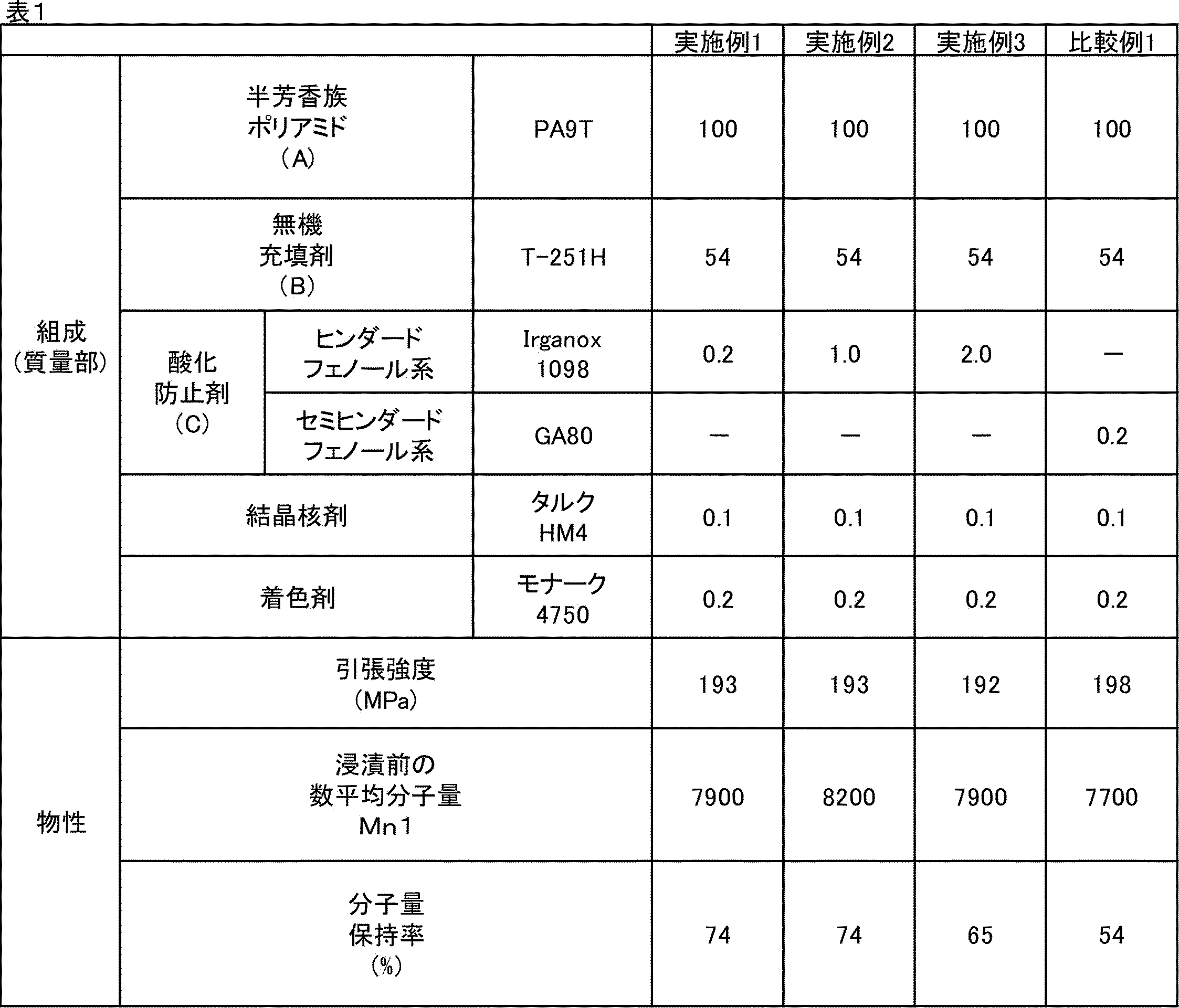
表1から、式(1)で表される構造を分子中に有するヒンダードフェノール系酸化防止剤(Irganox 1098)を0.1~2.0質量部の割合で含む樹脂組成物を用いた実施例1~3は、式(1)で表される構造を分子中に有さないセミヒンダードフェノール系酸化防止剤(GA-80)を含む樹脂組成物を用いた比較例1と比較して、引張強度を維持した上で、分子量保持率を向上させることができることが分かる。分子量保持率が高いことは長期の耐酸化性に優れることを意味することから、本発明の水回り用成形体は、長期の耐酸化性に優れることが分かる。
上記結果は、式(1)で表される構造を分子中に有するヒンダードフェノール系酸化防止剤(Irganox 1098)が、式(1)で表される構造を分子中に有さないセミヒンダードフェノール系酸化防止剤(GA-80)よりも寿命が長い(長期に亘って活性を有する)ことに基づくものと推定される。
なお、実施例3は、実施例1及び2と比較して、酸化防止剤(C)の含有量が2.0質量部と多いため、実施例1及び2よりも、分子量保持率が低くなっている。
From Table 1, it can be seen that Examples 1 to 3, which use a resin composition containing 0.1 to 2.0 parts by mass of a hindered phenol-based antioxidant (Irganox 1098) having a structure represented by formula (1) in the molecule, can improve the molecular weight retention rate while maintaining the tensile strength, compared to Comparative Example 1, which uses a resin composition containing a semi-hindered phenol-based antioxidant (GA-80) not having a structure represented by formula (1) in the molecule. Since a high molecular weight retention rate means excellent long-term oxidation resistance, it can be seen that the molded article for use in water-related applications of the present invention has excellent long-term oxidation resistance.
The above results are presumably due to the fact that the hindered phenol-based antioxidant (Irganox 1098) having the structure represented by formula (1) in its molecule has a longer life (has activity over a longer period of time) than the semi-hindered phenol-based antioxidant (GA-80) not having the structure represented by formula (1) in its molecule.
In addition, in Example 3, the content of the antioxidant (C) is 2.0 parts by mass, which is larger than in Examples 1 and 2, and therefore the molecular weight retention is lower than in Examples 1 and 2.
Claims (6)
前記半芳香族ポリアミド(A)は、芳香族ジカルボン酸単位を主成分とするジカルボン酸単位と、脂肪族ジアミン単位を主成分とするジアミン単位とを含み、
前記フェノール系酸化防止剤(C)が、分子中に下記式(1)で表される構造を有し、
前記ジカルボン酸単位の50~100モル%が、テレフタル酸及びナフタレンジカルボン酸の少なくともいずれかに由来する構造単位であり、前記ジアミン単位の60~100モル%が、炭素数4~10の脂肪族ジアミンに由来する構造単位であり、
前記炭素数4~10の脂肪族ジアミンは、1,9-ノナンジアミン及び2-メチル-1,8-オクタンジアミンを含み、1,9-ノナンジアミン:2-メチル-1,8-オクタンジアミンのモル比が95:5~50:50である、水回り用成形体。
(式(1)中、**は結合部を表す。) A molded article for use in wet environments, comprising a resin composition containing 100 parts by mass of a semi-aromatic polyamide (A), 10 to 200 parts by mass of an inorganic filler (B), and 0.1 to 2.0 parts by mass of a phenol-based antioxidant (C),
The semi-aromatic polyamide (A) contains dicarboxylic acid units mainly composed of aromatic dicarboxylic acid units and diamine units mainly composed of aliphatic diamine units,
The phenol-based antioxidant (C) has a structure represented by the following formula (1) in a molecule,
50 to 100 mol % of the dicarboxylic acid units are structural units derived from at least one of terephthalic acid and naphthalenedicarboxylic acid, and 60 to 100 mol % of the diamine units are structural units derived from an aliphatic diamine having 4 to 10 carbon atoms,
The aliphatic diamine having 4 to 10 carbon atoms contains 1,9-nonanediamine and 2-methyl-1,8-octanediamine, and the molar ratio of 1,9-nonanediamine:2-methyl-1,8-octanediamine is 95:5 to 50:50.
(In formula (1), ** represents a bond.)
前記樹脂組成物が、無機充填剤(B)、ポリアミド(D)、及び分子中に下記式(1)で表される構造を有するフェノール系酸化防止剤(C)を含み、
前記ポリアミド(D)は、芳香族ジカルボン酸単位を主成分とするジカルボン酸単位と脂肪族ジアミン単位を主成分とするジアミン単位とを含む半芳香族ポリアミド(A)であり、
前記半芳香族ポリアミド(A)は、芳香族ジカルボン酸単位を主成分とするジカルボン酸単位と、炭素数4~10を有する脂肪族ジアミン単位を主成分とするジアミン単位とを含み、
前記ジカルボン酸単位の50~100モル%が、テレフタル酸及びナフタレンジカルボン酸の少なくともいずれかに由来する構造単位であり、前記ジアミン単位の60~100モル%が、炭素数4~10の脂肪族ジアミンに由来する構造単位であり、
前記炭素数4~10の脂肪族ジアミンは、1,9-ノナンジアミン及び2-メチル-1,8-オクタンジアミンを含み、1,9-ノナンジアミン:2-メチル-1,8-オクタンジアミンのモル比が95:5~50:50である、方法。
(式(1)中、**は結合部を表す。) A method for using a resin composition or a molded body made of the resin composition in an environment in which the resin composition comes into contact with water containing at least one of hypochlorous acid and a hypochlorite, comprising:
The resin composition contains an inorganic filler (B), a polyamide (D), and a phenol-based antioxidant (C) having a structure represented by the following formula (1) in its molecule ,
The polyamide (D) is a semi-aromatic polyamide (A) containing dicarboxylic acid units mainly composed of aromatic dicarboxylic acid units and diamine units mainly composed of aliphatic diamine units,
The semi-aromatic polyamide (A) contains dicarboxylic acid units mainly composed of aromatic dicarboxylic acid units and diamine units mainly composed of aliphatic diamine units having 4 to 10 carbon atoms,
50 to 100 mol % of the dicarboxylic acid units are structural units derived from at least one of terephthalic acid and naphthalenedicarboxylic acid, and 60 to 100 mol % of the diamine units are structural units derived from an aliphatic diamine having 4 to 10 carbon atoms,
The aliphatic diamine having 4 to 10 carbon atoms comprises 1,9-nonanediamine and 2-methyl-1,8-octanediamine, and the molar ratio of 1,9-nonanediamine:2-methyl-1,8-octanediamine is 95:5 to 50:50 .
(In formula (1), ** represents a bond.)
Applications Claiming Priority (3)
| Application Number | Priority Date | Filing Date | Title |
|---|---|---|---|
| JP2020020926 | 2020-02-10 | ||
| JP2020020926 | 2020-02-10 | ||
| PCT/JP2021/004474 WO2021161937A1 (en) | 2020-02-10 | 2021-02-08 | Molded article for plumbing and method |
Publications (2)
| Publication Number | Publication Date |
|---|---|
| JPWO2021161937A1 JPWO2021161937A1 (en) | 2021-08-19 |
| JP7655893B2 true JP7655893B2 (en) | 2025-04-02 |
Family
ID=77292232
Family Applications (1)
| Application Number | Title | Priority Date | Filing Date |
|---|---|---|---|
| JP2022500384A Active JP7655893B2 (en) | 2020-02-10 | 2021-02-08 | Molded body for use in wet areas and method |
Country Status (6)
| Country | Link |
|---|---|
| US (1) | US20230060402A1 (en) |
| EP (1) | EP4105399A4 (en) |
| JP (1) | JP7655893B2 (en) |
| CN (1) | CN115052931A (en) |
| TW (1) | TWI874581B (en) |
| WO (1) | WO2021161937A1 (en) |
Citations (4)
| Publication number | Priority date | Publication date | Assignee | Title |
|---|---|---|---|---|
| JP2007246563A (en) | 2006-03-13 | 2007-09-27 | Asahi Kasei Chemicals Corp | Weather-resistant polyamide resin composition and molded article |
| JP2008266434A (en) | 2007-04-19 | 2008-11-06 | Mitsubishi Engineering Plastics Corp | Black laser welding polyamide resin composition and molded article using the same |
| JP2015196836A (en) | 2014-04-01 | 2015-11-09 | エーエムエス−パテント アクチェンゲゼルシャフト | Polyamide molding composition for manufacturing a molded article especially in drinking water category |
| JP2017193703A (en) | 2016-03-23 | 2017-10-26 | エーエムエス−パテント アクチェンゲゼルシャフト | High temperature-resistant polyamide molding material and use thereof especially in automotive industry sector |
Family Cites Families (5)
| Publication number | Priority date | Publication date | Assignee | Title |
|---|---|---|---|---|
| JPS5575437A (en) * | 1978-12-01 | 1980-06-06 | Sumitomo Chem Co Ltd | Halogen water-resistant polyethylene tube |
| KR101745977B1 (en) * | 2011-09-22 | 2017-06-12 | 유니띠까 가부시키가이샤 | Semi-aromatic polyamide and molded body comprising same |
| KR101932808B1 (en) * | 2013-08-05 | 2018-12-27 | 도요보 가부시키가이샤 | Flame-retardant polyamide resin composition |
| WO2015087886A1 (en) * | 2013-12-13 | 2015-06-18 | 旭化成ケミカルズ株式会社 | Polyamide composition, molded article, reflective board for leds, and method for preventing heat-induced reflectivity reduction |
| WO2019059357A1 (en) * | 2017-09-25 | 2019-03-28 | 東洋紡株式会社 | Compact including, as constituent, molded article formed of semiaromatic polyamide resin composition |
-
2021
- 2021-02-08 WO PCT/JP2021/004474 patent/WO2021161937A1/en not_active Ceased
- 2021-02-08 US US17/797,513 patent/US20230060402A1/en active Pending
- 2021-02-08 CN CN202180012902.5A patent/CN115052931A/en active Pending
- 2021-02-08 JP JP2022500384A patent/JP7655893B2/en active Active
- 2021-02-08 EP EP21753328.0A patent/EP4105399A4/en active Pending
- 2021-02-09 TW TW110104918A patent/TWI874581B/en active
Patent Citations (4)
| Publication number | Priority date | Publication date | Assignee | Title |
|---|---|---|---|---|
| JP2007246563A (en) | 2006-03-13 | 2007-09-27 | Asahi Kasei Chemicals Corp | Weather-resistant polyamide resin composition and molded article |
| JP2008266434A (en) | 2007-04-19 | 2008-11-06 | Mitsubishi Engineering Plastics Corp | Black laser welding polyamide resin composition and molded article using the same |
| JP2015196836A (en) | 2014-04-01 | 2015-11-09 | エーエムエス−パテント アクチェンゲゼルシャフト | Polyamide molding composition for manufacturing a molded article especially in drinking water category |
| JP2017193703A (en) | 2016-03-23 | 2017-10-26 | エーエムエス−パテント アクチェンゲゼルシャフト | High temperature-resistant polyamide molding material and use thereof especially in automotive industry sector |
Also Published As
| Publication number | Publication date |
|---|---|
| TWI874581B (en) | 2025-03-01 |
| US20230060402A1 (en) | 2023-03-02 |
| EP4105399A4 (en) | 2023-12-27 |
| TW202136417A (en) | 2021-10-01 |
| EP4105399A1 (en) | 2022-12-21 |
| JPWO2021161937A1 (en) | 2021-08-19 |
| CN115052931A (en) | 2022-09-13 |
| WO2021161937A1 (en) | 2021-08-19 |
Similar Documents
| Publication | Publication Date | Title |
|---|---|---|
| JP7322983B2 (en) | laminated tube | |
| US10663092B2 (en) | Multilayer tube | |
| US11254082B2 (en) | Multi-layer tube | |
| JP5113910B2 (en) | Polyamide molding compounds, in particular polyamide molding compounds for producing molded parts applied for drinking water | |
| CN104448810B (en) | The moulding compound of copolyamide based on partially aromatic | |
| CN104448794B (en) | The moulding compound of copolyamide based on partially aromatic | |
| KR101998532B1 (en) | A semi-aromatic copolyamide resin and a polyamide molding composition comprising the same | |
| TWI772581B (en) | Use of a polyamide molding compound having a low extract value for manufacturing moldings in the drinking water sector and corresponding moldings | |
| JPWO2020040283A1 (en) | Polyamide composition | |
| JP2017014388A (en) | Polyamide resin composition and molded body | |
| JP2022030403A (en) | Polyamide resin composition and its compact | |
| CN109627756B (en) | Water heater liner material and preparation method thereof | |
| JP7655893B2 (en) | Molded body for use in wet areas and method | |
| JP7141015B2 (en) | Polyamide composition | |
| WO2023120459A1 (en) | Polyamide composition | |
| WO2023120460A1 (en) | Polyamide composition | |
| CN118414382A (en) | Polyamide composition | |
| WO2015040863A1 (en) | Molded article manufacturing method, injection welding material, and molded article | |
| JP7300843B2 (en) | Fiber-reinforced polyamide resin composition and molded article | |
| JP2017193101A (en) | Laminated tube | |
| CN112639024B (en) | Thermoplastic resin composition | |
| JP5977598B2 (en) | Method for improving flowability of polyamide resin composition | |
| JP6896551B2 (en) | Polyamide resin composition for visibility tank and visibility tank | |
| JP2020041163A (en) | Polyamide resin composition and molded article | |
| WO2023120461A1 (en) | Polyamide composition |
Legal Events
| Date | Code | Title | Description |
|---|---|---|---|
| A621 | Written request for application examination |
Free format text: JAPANESE INTERMEDIATE CODE: A621 Effective date: 20231130 |
|
| A131 | Notification of reasons for refusal |
Free format text: JAPANESE INTERMEDIATE CODE: A131 Effective date: 20240924 |
|
| A521 | Request for written amendment filed |
Free format text: JAPANESE INTERMEDIATE CODE: A523 Effective date: 20241122 |
|
| TRDD | Decision of grant or rejection written | ||
| A01 | Written decision to grant a patent or to grant a registration (utility model) |
Free format text: JAPANESE INTERMEDIATE CODE: A01 Effective date: 20250225 |
|
| A61 | First payment of annual fees (during grant procedure) |
Free format text: JAPANESE INTERMEDIATE CODE: A61 Effective date: 20250321 |
|
| R150 | Certificate of patent or registration of utility model |
Ref document number: 7655893 Country of ref document: JP Free format text: JAPANESE INTERMEDIATE CODE: R150 |