JP7653759B2 - Compositions and methods for immune cell modulation in adoptive immunotherapy - Google Patents
Compositions and methods for immune cell modulation in adoptive immunotherapy Download PDFInfo
- Publication number
- JP7653759B2 JP7653759B2 JP2018537803A JP2018537803A JP7653759B2 JP 7653759 B2 JP7653759 B2 JP 7653759B2 JP 2018537803 A JP2018537803 A JP 2018537803A JP 2018537803 A JP2018537803 A JP 2018537803A JP 7653759 B2 JP7653759 B2 JP 7653759B2
- Authority
- JP
- Japan
- Prior art keywords
- cells
- cell
- pge
- population
- composition
- Prior art date
- Legal status (The legal status is an assumption and is not a legal conclusion. Google has not performed a legal analysis and makes no representation as to the accuracy of the status listed.)
- Active
Links
Classifications
-
- A—HUMAN NECESSITIES
- A61—MEDICAL OR VETERINARY SCIENCE; HYGIENE
- A61K—PREPARATIONS FOR MEDICAL, DENTAL OR TOILETRY PURPOSES
- A61K31/00—Medicinal preparations containing organic active ingredients
- A61K31/33—Heterocyclic compounds
- A61K31/395—Heterocyclic compounds having nitrogen as a ring hetero atom, e.g. guanethidine or rifamycins
- A61K31/435—Heterocyclic compounds having nitrogen as a ring hetero atom, e.g. guanethidine or rifamycins having six-membered rings with one nitrogen as the only ring hetero atom
- A61K31/4353—Heterocyclic compounds having nitrogen as a ring hetero atom, e.g. guanethidine or rifamycins having six-membered rings with one nitrogen as the only ring hetero atom ortho- or peri-condensed with heterocyclic ring systems
- A61K31/436—Heterocyclic compounds having nitrogen as a ring hetero atom, e.g. guanethidine or rifamycins having six-membered rings with one nitrogen as the only ring hetero atom ortho- or peri-condensed with heterocyclic ring systems the heterocyclic ring system containing a six-membered ring having oxygen as a ring hetero atom, e.g. rapamycin
-
- A—HUMAN NECESSITIES
- A61—MEDICAL OR VETERINARY SCIENCE; HYGIENE
- A61K—PREPARATIONS FOR MEDICAL, DENTAL OR TOILETRY PURPOSES
- A61K35/00—Medicinal preparations containing materials or reaction products thereof with undetermined constitution
- A61K35/12—Materials from mammals; Compositions comprising non-specified tissues or cells; Compositions comprising non-embryonic stem cells; Genetically modified cells
- A61K35/28—Bone marrow; Haematopoietic stem cells; Mesenchymal stem cells of any origin, e.g. adipose-derived stem cells
-
- A—HUMAN NECESSITIES
- A61—MEDICAL OR VETERINARY SCIENCE; HYGIENE
- A61K—PREPARATIONS FOR MEDICAL, DENTAL OR TOILETRY PURPOSES
- A61K35/00—Medicinal preparations containing materials or reaction products thereof with undetermined constitution
- A61K35/12—Materials from mammals; Compositions comprising non-specified tissues or cells; Compositions comprising non-embryonic stem cells; Genetically modified cells
- A61K35/48—Reproductive organs
- A61K35/54—Ovaries; Ova; Ovules; Embryos; Foetal cells; Germ cells
- A61K35/545—Embryonic stem cells; Pluripotent stem cells; Induced pluripotent stem cells; Uncharacterised stem cells
-
- A—HUMAN NECESSITIES
- A61—MEDICAL OR VETERINARY SCIENCE; HYGIENE
- A61K—PREPARATIONS FOR MEDICAL, DENTAL OR TOILETRY PURPOSES
- A61K38/00—Medicinal preparations containing peptides
- A61K38/04—Peptides having up to 20 amino acids in a fully defined sequence; Derivatives thereof
- A61K38/08—Peptides having 5 to 11 amino acids
- A61K38/09—Luteinising hormone-releasing hormone [LHRH], i.e. Gonadotropin-releasing hormone [GnRH]; Related peptides
-
- A—HUMAN NECESSITIES
- A61—MEDICAL OR VETERINARY SCIENCE; HYGIENE
- A61K—PREPARATIONS FOR MEDICAL, DENTAL OR TOILETRY PURPOSES
- A61K38/00—Medicinal preparations containing peptides
- A61K38/04—Peptides having up to 20 amino acids in a fully defined sequence; Derivatives thereof
- A61K38/14—Peptides containing saccharide radicals; Derivatives thereof, e.g. bleomycin, phleomycin, muramylpeptides or vancomycin
-
- A—HUMAN NECESSITIES
- A61—MEDICAL OR VETERINARY SCIENCE; HYGIENE
- A61K—PREPARATIONS FOR MEDICAL, DENTAL OR TOILETRY PURPOSES
- A61K38/00—Medicinal preparations containing peptides
- A61K38/16—Peptides having more than 20 amino acids; Gastrins; Somatostatins; Melanotropins; Derivatives thereof
- A61K38/17—Peptides having more than 20 amino acids; Gastrins; Somatostatins; Melanotropins; Derivatives thereof from animals; from humans
- A61K38/19—Cytokines; Lymphokines; Interferons
- A61K38/21—Interferons [IFN]
- A61K38/212—IFN-alpha
-
- A—HUMAN NECESSITIES
- A61—MEDICAL OR VETERINARY SCIENCE; HYGIENE
- A61K—PREPARATIONS FOR MEDICAL, DENTAL OR TOILETRY PURPOSES
- A61K38/00—Medicinal preparations containing peptides
- A61K38/16—Peptides having more than 20 amino acids; Gastrins; Somatostatins; Melanotropins; Derivatives thereof
- A61K38/43—Enzymes; Proenzymes; Derivatives thereof
- A61K38/46—Hydrolases (3)
- A61K38/50—Hydrolases (3) acting on carbon-nitrogen bonds, other than peptide bonds (3.5), e.g. asparaginase
-
- A—HUMAN NECESSITIES
- A61—MEDICAL OR VETERINARY SCIENCE; HYGIENE
- A61K—PREPARATIONS FOR MEDICAL, DENTAL OR TOILETRY PURPOSES
- A61K40/00—Cellular immunotherapy
- A61K40/10—Cellular immunotherapy characterised by the cell type used
- A61K40/11—T-cells, e.g. tumour infiltrating lymphocytes [TIL] or regulatory T [Treg] cells; Lymphokine-activated killer [LAK] cells
-
- A—HUMAN NECESSITIES
- A61—MEDICAL OR VETERINARY SCIENCE; HYGIENE
- A61K—PREPARATIONS FOR MEDICAL, DENTAL OR TOILETRY PURPOSES
- A61K40/00—Cellular immunotherapy
- A61K40/30—Cellular immunotherapy characterised by the recombinant expression of specific molecules in the cells of the immune system
- A61K40/31—Chimeric antigen receptors [CAR]
-
- A—HUMAN NECESSITIES
- A61—MEDICAL OR VETERINARY SCIENCE; HYGIENE
- A61K—PREPARATIONS FOR MEDICAL, DENTAL OR TOILETRY PURPOSES
- A61K40/00—Cellular immunotherapy
- A61K40/40—Cellular immunotherapy characterised by antigens that are targeted or presented by cells of the immune system
- A61K40/41—Vertebrate antigens
- A61K40/42—Cancer antigens
-
- A—HUMAN NECESSITIES
- A61—MEDICAL OR VETERINARY SCIENCE; HYGIENE
- A61P—SPECIFIC THERAPEUTIC ACTIVITY OF CHEMICAL COMPOUNDS OR MEDICINAL PREPARATIONS
- A61P31/00—Antiinfectives, i.e. antibiotics, antiseptics, chemotherapeutics
-
- A—HUMAN NECESSITIES
- A61—MEDICAL OR VETERINARY SCIENCE; HYGIENE
- A61P—SPECIFIC THERAPEUTIC ACTIVITY OF CHEMICAL COMPOUNDS OR MEDICINAL PREPARATIONS
- A61P35/00—Antineoplastic agents
-
- A—HUMAN NECESSITIES
- A61—MEDICAL OR VETERINARY SCIENCE; HYGIENE
- A61P—SPECIFIC THERAPEUTIC ACTIVITY OF CHEMICAL COMPOUNDS OR MEDICINAL PREPARATIONS
- A61P43/00—Drugs for specific purposes, not provided for in groups A61P1/00-A61P41/00
-
- C—CHEMISTRY; METALLURGY
- C07—ORGANIC CHEMISTRY
- C07K—PEPTIDES
- C07K14/00—Peptides having more than 20 amino acids; Gastrins; Somatostatins; Melanotropins; Derivatives thereof
- C07K14/435—Peptides having more than 20 amino acids; Gastrins; Somatostatins; Melanotropins; Derivatives thereof from animals; from humans
- C07K14/705—Receptors; Cell surface antigens; Cell surface determinants
- C07K14/70503—Immunoglobulin superfamily
- C07K14/7051—T-cell receptor (TcR)-CD3 complex
-
- C—CHEMISTRY; METALLURGY
- C12—BIOCHEMISTRY; BEER; SPIRITS; WINE; VINEGAR; MICROBIOLOGY; ENZYMOLOGY; MUTATION OR GENETIC ENGINEERING
- C12N—MICROORGANISMS OR ENZYMES; COMPOSITIONS THEREOF; PROPAGATING, PRESERVING, OR MAINTAINING MICROORGANISMS; MUTATION OR GENETIC ENGINEERING; CULTURE MEDIA
- C12N5/00—Undifferentiated human, animal or plant cells, e.g. cell lines; Tissues; Cultivation or maintenance thereof; Culture media therefor
- C12N5/06—Animal cells or tissues; Human cells or tissues
- C12N5/0602—Vertebrate cells
- C12N5/0634—Cells from the blood or the immune system
- C12N5/0636—T lymphocytes
-
- A—HUMAN NECESSITIES
- A61—MEDICAL OR VETERINARY SCIENCE; HYGIENE
- A61K—PREPARATIONS FOR MEDICAL, DENTAL OR TOILETRY PURPOSES
- A61K2239/00—Indexing codes associated with cellular immunotherapy of group A61K40/00
- A61K2239/31—Indexing codes associated with cellular immunotherapy of group A61K40/00 characterized by the route of administration
-
- A—HUMAN NECESSITIES
- A61—MEDICAL OR VETERINARY SCIENCE; HYGIENE
- A61K—PREPARATIONS FOR MEDICAL, DENTAL OR TOILETRY PURPOSES
- A61K2239/00—Indexing codes associated with cellular immunotherapy of group A61K40/00
- A61K2239/38—Indexing codes associated with cellular immunotherapy of group A61K40/00 characterised by the dose, timing or administration schedule
-
- A—HUMAN NECESSITIES
- A61—MEDICAL OR VETERINARY SCIENCE; HYGIENE
- A61K—PREPARATIONS FOR MEDICAL, DENTAL OR TOILETRY PURPOSES
- A61K45/00—Medicinal preparations containing active ingredients not provided for in groups A61K31/00 - A61K41/00
- A61K45/06—Mixtures of active ingredients without chemical characterisation, e.g. antiphlogistics and cardiaca
-
- C—CHEMISTRY; METALLURGY
- C07—ORGANIC CHEMISTRY
- C07K—PEPTIDES
- C07K2319/00—Fusion polypeptide
- C07K2319/01—Fusion polypeptide containing a localisation/targetting motif
- C07K2319/03—Fusion polypeptide containing a localisation/targetting motif containing a transmembrane segment
-
- C—CHEMISTRY; METALLURGY
- C12—BIOCHEMISTRY; BEER; SPIRITS; WINE; VINEGAR; MICROBIOLOGY; ENZYMOLOGY; MUTATION OR GENETIC ENGINEERING
- C12N—MICROORGANISMS OR ENZYMES; COMPOSITIONS THEREOF; PROPAGATING, PRESERVING, OR MAINTAINING MICROORGANISMS; MUTATION OR GENETIC ENGINEERING; CULTURE MEDIA
- C12N2510/00—Genetically modified cells
-
- Y—GENERAL TAGGING OF NEW TECHNOLOGICAL DEVELOPMENTS; GENERAL TAGGING OF CROSS-SECTIONAL TECHNOLOGIES SPANNING OVER SEVERAL SECTIONS OF THE IPC; TECHNICAL SUBJECTS COVERED BY FORMER USPC CROSS-REFERENCE ART COLLECTIONS [XRACs] AND DIGESTS
- Y02—TECHNOLOGIES OR APPLICATIONS FOR MITIGATION OR ADAPTATION AGAINST CLIMATE CHANGE
- Y02A—TECHNOLOGIES FOR ADAPTATION TO CLIMATE CHANGE
- Y02A50/00—TECHNOLOGIES FOR ADAPTATION TO CLIMATE CHANGE in human health protection, e.g. against extreme weather
- Y02A50/30—Against vector-borne diseases, e.g. mosquito-borne, fly-borne, tick-borne or waterborne diseases whose impact is exacerbated by climate change
Landscapes
- Health & Medical Sciences (AREA)
- Life Sciences & Earth Sciences (AREA)
- General Health & Medical Sciences (AREA)
- Chemical & Material Sciences (AREA)
- Animal Behavior & Ethology (AREA)
- Public Health (AREA)
- Veterinary Medicine (AREA)
- Immunology (AREA)
- Engineering & Computer Science (AREA)
- Epidemiology (AREA)
- Medicinal Chemistry (AREA)
- Pharmacology & Pharmacy (AREA)
- Cell Biology (AREA)
- Bioinformatics & Cheminformatics (AREA)
- Zoology (AREA)
- Biomedical Technology (AREA)
- Developmental Biology & Embryology (AREA)
- Proteomics, Peptides & Aminoacids (AREA)
- Gastroenterology & Hepatology (AREA)
- Organic Chemistry (AREA)
- Biotechnology (AREA)
- Reproductive Health (AREA)
- Genetics & Genomics (AREA)
- Hematology (AREA)
- Virology (AREA)
- Wood Science & Technology (AREA)
- Biochemistry (AREA)
- Nuclear Medicine, Radiotherapy & Molecular Imaging (AREA)
- General Chemical & Material Sciences (AREA)
- Chemical Kinetics & Catalysis (AREA)
- Endocrinology (AREA)
- General Engineering & Computer Science (AREA)
- Microbiology (AREA)
- Gynecology & Obstetrics (AREA)
- Molecular Biology (AREA)
- Biophysics (AREA)
- Toxicology (AREA)
- Oncology (AREA)
- Communicable Diseases (AREA)
- Medicines Containing Material From Animals Or Micro-Organisms (AREA)
Description
関連出願
本出願は、2016年1月20日に出願された米国仮出願第62/281,064号、および2016年9月30日に出願された米国仮出願第62/402,883号の優先権を主張し、その開示は、参照により全体が本明細書に組み込まれる。
RELATED APPLICATIONS This application claims priority to U.S. Provisional Application No. 62/281,064, filed January 20, 2016, and U.S. Provisional Application No. 62/402,883, filed September 30, 2016, the disclosures of which are incorporated herein by reference in their entireties.
本開示は、養子免疫細胞療法の分野と広く関係する。より具体的には、本開示は、養子細胞療法に適した免疫細胞を調節するための小分子の使用と関係する。 The present disclosure relates generally to the field of adoptive immune cell therapy. More specifically, the present disclosure relates to the use of small molecules to modulate immune cells suitable for adoptive cell therapy.
養子免疫療法は、癌、腫瘍、または感染症を有する患者への免疫細胞の投与を含み、これにより、投与された免疫細胞が、患者に治療効果をもたらす。一般的に言うと、免疫療法に適した免疫細胞は、B細胞、樹状細胞(DC)、T細胞、ナチュラルキラー(NK)細胞、NKT(ナチュラルキラーT)細胞、および造血幹細胞または造血前駆細胞を含むが、これらに限定されない。患者において完全かつ永続的な疾患応答を仲介することは、これらの細胞ベースの免疫療法の中心となる目標である。 Adoptive immunotherapy involves the administration of immune cells to a patient with cancer, tumor, or infectious disease, such that the administered immune cells provide a therapeutic benefit to the patient. Generally speaking, immune cells suitable for immunotherapy include, but are not limited to, B cells, dendritic cells (DCs), T cells, natural killer (NK) cells, NKT (natural killer T) cells, and hematopoietic stem or progenitor cells. Mediating a complete and durable disease response in the patient is a central goal of these cell-based immunotherapies.
CAR-T細胞、TCR-T細胞、ウイルス特異的T細胞(VST)および腫瘍浸潤T細胞(TIL)を含むが、これらに限定されない、養子T細胞療法の有効性の背景にある生物学的機序の我々の理解の進歩は、導入されたT細胞と関連するある種の特性の重要性を明確に示し、宿主、および癌の処置の成功のため克服されることを必要とする腫瘍細胞により引き起こされる阻害バリアの複雑さを明らかにした。T細胞因子の中で、T細胞受容体(TCR)またはキメラ抗原受容体(CAR)の結合活性、増殖および生存能力、腫瘍部位への遊走、ならびに腫瘍内でエフェクター機能を持続する能力は、相関研究において、悪性細胞の根絶の引き金を引くための重大な決定要因であることが示された。しかしながら、別の階層の複雑さに加えて、これらの望ましい特性のいくつかは認識されたが、これらの特性をもたらす経路またはプレーヤーはまだ不明確であり、それが、人の、介入する能力、ならびにそれらの治療上の使用のため所望される量および質を有する細胞を得る能力を制限する。 Advances in our understanding of the biological mechanisms behind the efficacy of adoptive T cell therapy, including but not limited to CAR-T cells, TCR-T cells, virus-specific T cells (VSTs) and tumor-infiltrating T cells (TILs), have clearly demonstrated the importance of certain properties associated with the transferred T cells and revealed the complexity of the inhibitory barriers posed by the host and tumor cells that need to be overcome for successful cancer treatment. Among the T cell factors, T cell receptor (TCR) or chimeric antigen receptor (CAR) avidity, proliferation and survival capacity, migration to the tumor site, and ability to sustain effector functions within the tumor have been shown in correlation studies to be critical determinants for triggering eradication of malignant cells. However, in addition to another layer of complexity, although some of these desirable properties have been recognized, the pathways or players that bring about these properties are still unclear, which limits one's ability to intervene and obtain cells with the desired quantity and quality for their therapeutic use.
CAR-T細胞療法を例として使用すると、療法は、CAR-T能力および持続性、腫瘍への遊走、免疫抑制腫瘍微小環境、腫瘍不均一性、および患者の安全性を含む複数の課題を克服しなければならない。これらの課題を克服するために、複数のアプローチが適用されている。例えば、特異的T細胞サブセットを、治療上の使用のため選択し、CARのさらなる操作を使用して、腫瘍ターゲティング、CAR能力、および的中した/腫瘍を離れた安全性の問題が改善されてもよい。しかしながら、CAR-T持続性および遊走を含む、CAR-T治療能力の改善は、解消されるべきままである。T細胞療法の生体内有効性は、プロセスまたは原料に入れるT細胞の開始集団と、利用される生体外拡大および活性化方法の両方に依存性である製造プロセスにより、強く影響され得ることが示されている。投与されたT細胞の分化状態は、生体内持続性および抗腫瘍活性に有意に影響し得ることが示されている。Tヘルパー(CD4+T細胞)ならびに細胞傷害性T細胞(CD8+)、具体的には、CCR7およびCD62Lマーカーの発現により特徴付けられる、ナイーブ(Tn)、幹細胞メモリー(Tscm)ならびにセントラルメモリー(Tcm)T細胞は、マウスモデルにおいて(Sommermeyer et al. 2015)、と非ヒト霊長類モデルにおいて(Berger et al. 2008)の両方で優れた抗腫瘍活性を仲介する。 Using CAR-T cell therapy as an example, the therapy must overcome multiple challenges including CAR-T capacity and persistence, migration to the tumor, immunosuppressive tumor microenvironment, tumor heterogeneity, and patient safety. To overcome these challenges, multiple approaches have been applied. For example, specific T cell subsets may be selected for therapeutic use and further engineering of the CAR may be used to improve tumor targeting, CAR capacity, and on-target/off-tumor safety issues. However, improvements in CAR-T therapeutic capacity, including CAR-T persistence and migration, remain to be resolved. It has been shown that the in vivo efficacy of T cell therapy can be strongly influenced by the manufacturing process, which is dependent on both the starting population of T cells put into the process or feedstock, and the ex vivo expansion and activation method utilized. It has been shown that the differentiation state of the administered T cells can significantly affect in vivo persistence and anti-tumor activity. T helper (CD4 + T cells) and cytotoxic T cells (CD8 + ), specifically naive (Tn), stem cell memory (Tscm) and central memory (Tcm) T cells, characterized by expression of CCR7 and CD62L markers, mediate potent antitumor activity in both mouse (Sommermeyer et al. 2015) and non-human primate models (Berger et al. 2008).
製造プロセス中に、治療細胞(または細胞集団)は、典型的には活性化され、拡大される。このプロセスは、一般的に、細胞の分化をもたらし、より分化した状態にある細胞の割合の増大につながり、T細胞の場合、より分化した細胞は、エフェクターメモリーまたはエフェクターT細胞として表現型の上で特徴付けられる。患者に注入されると、これらのより分化した細胞は、より少なく分化した状態にある細胞と比較して、より低い増殖する能力、およびより低い、長期間生存するかまたは持続する集団として持続する能力を有する。したがって、所望される免疫細胞サブセットを維持し、拡大するのに有用な組成物および方法だけでなく、拡大中に細胞分化を低減し、細胞をより少なく分化した細胞に脱分化させ、これにより、様々な養子免疫療法の有効性を改善するために、より高い増殖し、持続する能力を有し、持続する所望される免疫細胞サブセットを得ることも、当該技術分野において、急ぎ必要である。 During the manufacturing process, the therapeutic cells (or cell populations) are typically activated and expanded. This process generally results in differentiation of the cells, leading to an increase in the proportion of cells in a more differentiated state, in the case of T cells, the more differentiated cells being phenotypically characterized as effector memory or effector T cells. When infused into a patient, these more differentiated cells have a lower ability to proliferate and a lower ability to persist as a long-term surviving or persistent population compared to cells in a less differentiated state. Thus, there is an urgent need in the art for compositions and methods useful for maintaining and expanding desired immune cell subsets, as well as for reducing cell differentiation during expansion and dedifferentiating cells into less differentiated cells, thereby obtaining desired immune cell subsets that have a higher ability to proliferate and persist, in order to improve the efficacy of various adoptive immunotherapies.
同様の有効性の問題は、NK細胞ベースの療法において同じく存在する。ナチュラルキラー細胞は、比較的短期間生存するとして特徴付けられ、刺激への二次的曝露に応答して最小の変化を提示し、すなわち、制限された標的メモリー応答を提示する固有の免疫細胞として伝統的に分類された。しかしながら、近年の研究が、自己寛容および持続するNK細胞活性を含む重要な役割を果たす活性化するNK細胞受容体と阻害性NK細胞受容体の両方についての情報を明らかにした。データは、周辺環境に容易に順応し、同じ抗原への二次的曝露に応答するための基本である抗原特異的免疫記憶を編成する、NK細胞の能力を示した。現在養子NK細胞またはメモリーNK細胞と呼ばれる、NK細胞の亜集団が、幾つかのグループにより同定された。これらの細胞は、より長期間生存すること、および初回曝露後に刺激への増強された応答を有することを含む、CD8+T細胞に類似する多くの機能的特徴を有する。これらの特性は、基準のNK細胞と比較して、より有効な細胞療法ストラテジーをもたらし得る。生体内での永続的な抗原特異的認識を仲介する養子/メモリーNK細胞の拡大および維持は、NK細胞ベースの養子免疫療法の改善の鍵となるだろう。 Similar efficacy issues also exist in NK cell-based therapies. Natural killer cells have been characterized as living for a relatively short period of time and have traditionally been classified as innate immune cells that exhibit minimal changes in response to secondary exposure to stimuli, i.e., limited targeted memory responses. However, recent studies have revealed information about both activating and inhibitory NK cell receptors that play important roles, including self-tolerance and sustained NK cell activity. Data have demonstrated the ability of NK cells to easily adapt to the surrounding environment and to orchestrate antigen-specific immune memory that is the basis for responding to secondary exposure to the same antigen. A subpopulation of NK cells, now called adoptive or memory NK cells, has been identified by several groups. These cells have many functional characteristics similar to CD8 + T cells, including surviving for a longer period of time and having an enhanced response to stimuli after initial exposure. These properties may lead to more effective cell therapy strategies compared to standard NK cells. The expansion and maintenance of adoptive/memory NK cells that mediate durable antigen-specific recognition in vivo will be key to improving NK cell-based adoptive immunotherapy.
さらに、TおよびNK細胞の様に、改善された細胞療法を生じるための調節の標的とされ得る、自然免疫系と養子免疫系の両方において役割を果たすCD1d拘束性T細胞の一種である、より有効なNKT細胞を単離するための改善が成され得ることが考えられる。 Furthermore, it is believed that improvements can be made to isolate more effective NKT cells, a type of CD1d-restricted T cell that plays a role in both the innate and adaptive immune systems, which, like T and NK cells, can be targeted for modulation to produce improved cell therapies.
患者に入れられる細胞の最終的な状態、または具体的には、細胞サブタイプは、製造プロセスにより大部分において規定され得るので、そのプロセスの重要性を誇張し過ぎることはない。細胞培養および拡大中に、所望される分化状態、ならびに/もしくは養子免疫細胞特徴を有する細胞亜集団を優先的に維持または拡大することは、細胞ベースの療法の有効性を増強するのに極めて有益であり得る。したがって、所望されるT、NKまたはNKT細胞サブセットを量と質の両方で増強することができる製造アプローチは、それらの治療有効性の有意な強化をもたらし得る。 The importance of the manufacturing process cannot be overstated, as the final state of the cells, or specifically, the cell subtype, put into the patient can be defined in large part by that process. Preferentially maintaining or expanding cell subpopulations with desired differentiation states and/or adoptive immune cell characteristics during cell culture and expansion can be extremely beneficial in enhancing the efficacy of cell-based therapies. Thus, manufacturing approaches that can enhance both the quantity and quality of desired T, NK or NKT cell subsets can result in a significant enhancement of their therapeutic efficacy.
当該技術分野において、改善された治療有効性を有する免疫細胞サブセットが実質的に必要である。しかしながら、治療免疫細胞のある種の望ましい特性が公知である一方、これらの特性を達成するのに関与する経路および/またはプレーヤーは、多くが未知である。本発明の方法および組成物は、免疫細胞療法の分野において、これらの要求に対処し、他の関連する利点をもたらす。 There is a substantial need in the art for immune cell subsets with improved therapeutic efficacy. However, while certain desirable properties of therapeutic immune cells are known, the pathways and/or players involved in achieving these properties are largely unknown. The methods and compositions of the present invention address these needs and provide other related advantages in the field of immune cell therapy.
本発明は、免疫細胞の1つもしくは複数の集団または亜集団を、養子免疫療法のそれらの治療可能性を改善するために調節するための組成物および方法を提供する。例えば、より良好な免疫療法結果をもたらすことが予想される以下の性質:遊走、ホーミング、細胞毒性、維持、拡大、持続性、寿命延長、所望される状態の分化の少なくとも1つにおける改善を提示する細胞の亜集団の数もしくは割合を増大させることにより、治療免疫細胞の増殖、持続性、細胞毒性、および/または細胞リコール/メモリーを改善するための単独あるいは組み合わせのいずれかで、1つあるいは複数の化合物を提供することが、本発明の目的である。 The present invention provides compositions and methods for modulating one or more populations or subpopulations of immune cells to improve their therapeutic potential for adoptive immunotherapy. For example, it is an object of the present invention to provide one or more compounds, either alone or in combination, for improving the proliferation, persistence, cytotoxicity, and/or cellular recall/memory of therapeutic immune cells by increasing the number or proportion of a subpopulation of cells that exhibits improvements in at least one of the following properties that are predicted to result in better immunotherapy outcomes: migration, homing, cytotoxicity, maintenance, expansion, persistence, longevity extension, differentiation to a desired state.
本発明の1つの態様は、養子細胞ベースの療法に適した免疫細胞の治療可能性を改善するための組成物を提供し、組成物は、表1において挙げられる化合物:ドルソモルフィン;ヘプテリジン酸;1-ピロリジンカルボジチオ酸、アンモニウム塩;2-デオキシグルコース(2-DG);GSK3阻害剤;Rhoキナーゼ阻害剤;MEK阻害剤;PDK1アゴニスト;TGFβ阻害剤;6-メルカプトプリン;AC-93253ヨウ化物;チラトリコール;PI-103;フルベストラント;タプシガルジン;SU4312;テルミサルタン;サイクロスポリンA;1,3,5-トリス(4-ヒドロキシフェニル)-4-プロピル-1H-ピラゾール;BAY61-3606;プロトポルフィリンIX二ナトリウム;mTOR阻害剤;HS173;LY294002;ピクチリシブ;5-アザシチジン;フルダラビン;ロスコビチン、(S)-異性体;PAC-1、8-キノリノール、5,7-ジクロロ-;ニトロフラントイン;8-キノリノール、5-クロロ-7-ヨード-;2-ナフタセンカルボキサミド,7-クロロ-4-(ジメチルアミノ)-1,4,4a,5,5a,6,11,12a-オクタヒ;ニフロキサジド;トスフロキサシン塩酸塩;セルトラリン;ジエチレントリアミンペンタ酢酸、ペンタナトリウム;塩化エドロホニウム;BIX01294;テルフェナジン;およびdmPGE2からなる群から選択される1つまたは複数の薬剤を含む。表1において挙げられる化合物からなる群から選択される1つまたは複数の薬剤は、1つもしくは複数の薬剤を使用した免疫細胞の調節を介して、免疫細胞あるいはその1つまたは複数の亜集団の治療可能性を改善する。幾つかの実施形態において、免疫細胞の調節は生体外でである。 One aspect of the present invention provides a composition for improving the therapeutic potential of immune cells suitable for adoptive cell-based therapy, the composition comprising a compound selected from the group consisting of dorsomorphin, hepteridic acid, 1-pyrrolidinecarbodithioic acid, ammonium salt, 2-deoxyglucose (2-DG), GSK3 inhibitors, Rho kinase inhibitors, MEK inhibitors, PDK1 agonists, TGFβ inhibitors, 6-mercaptopurine, AC-93253 iodide, tiratricol, PI-103, fulvestrant, thapsigargin, SU4312, telmisartan, cyclosporin A, 1,3,5-tris(4-hydroxyphenyl)-4-propyl-1H-pyrazole, BAY 61-3606, and protease inhibitors. The invention includes one or more agents selected from the group consisting of: toporphyrin IX disodium; mTOR inhibitors; HS173; LY294002; pictilisib; 5-azacytidine; fludarabine; roscovitine, (S)-isomer; PAC-1, 8-quinolinol, 5,7-dichloro-; nitrofurantoin; 8-quinolinol, 5-chloro-7-iodo-; 2-naphthacenecarboxamide, 7-chloro-4-(dimethylamino)-1,4,4a,5,5a,6,11,12a-octahy; nifuroxazide; tosufloxacin hydrochloride; sertraline; diethylenetriaminepentaacetic acid, pentasodium; edrophonium chloride; BIX01294; terfenadine; and dmPGE2. One or more agents selected from the group consisting of the compounds listed in Table 1 improve the treatability of immune cells or one or more subpopulations thereof via modulation of the immune cells using the one or more agents. In some embodiments, the modulation of the immune cells is ex vivo.
幾つかの実施形態において、表1において挙げられる化合物の1つまたは複数は、細胞拡大、維持、および/または分化を調節し、これにより、免疫細胞、またはその1つもしくは複数の亜集団の増殖、細胞毒性、サイトカイン応答および分泌、細胞リコール、ならびに/あるいは持続性を改善する。 In some embodiments, one or more of the compounds listed in Table 1 modulate cell expansion, maintenance, and/or differentiation, thereby improving proliferation, cytotoxicity, cytokine response and secretion, cell recall, and/or persistence of immune cells, or one or more subpopulations thereof.
1つの実施形態において、表1において挙げられる化合物の1つまたは複数は、生体外と生体内の両方で、免疫細胞、またはその1つもしくは複数の亜集団の細胞生存率を改善する。 In one embodiment, one or more of the compounds listed in Table 1 improve cell viability of immune cells, or one or more subpopulations thereof, both in vitro and in vivo.
1つの実施形態において、表1において挙げられる化合物の1つまたは複数は、免疫細胞の1つまたは複数の所望される細胞亜集団の割合を増大する。 In one embodiment, one or more of the compounds listed in Table 1 increase the proportion of one or more desired cell subpopulations of immune cells.
幾つかの実施形態において、本発明は、T、NKおよびNKT細胞を含むが、これらに限定されない、免疫細胞の集団もしくは亜集団の治療効果を改善するための1つまたは複数の選択された薬剤を本明細書において提供する。幾つかの実施形態において、養子細胞ベースの療法に適した免疫細胞免疫細胞は、T細胞、NKT細胞、またはNK細胞を含む。幾つかの実施形態において、処置の対象となる免疫細胞はT細胞を含み、したがって、1つまたは複数の所望される細胞亜集団は、ナイーブT細胞、幹細胞メモリーT細胞、および/またはセントラルメモリーT細胞を含む増大した割合を有する。幾つかの実施形態において、薬剤を使用した処理の対象となる免疫細胞は、NKT細胞を含み、したがって、1つまたは複数の所望される細胞亜集団は、タイプI NKT細胞を含む増大した割合を有する。幾つかの他の実施形態において、薬剤を使用した処理の対象となる免疫細胞は、NK細胞を含み、ここで、1つまたは複数の所望される細胞亜集団は、養子NK細胞を含む増大した割合を有する。 In some embodiments, the present invention provides herein one or more selected agents for improving the therapeutic effect of a population or subpopulation of immune cells, including, but not limited to, T, NK, and NKT cells. In some embodiments, the immune cells immune cells suitable for adoptive cell-based therapy include T cells, NKT cells, or NK cells. In some embodiments, the immune cells to be treated include T cells, and thus one or more desired cell subpopulations have an increased proportion of naive T cells, stem cell memory T cells, and/or central memory T cells. In some embodiments, the immune cells to be treated with the agent include NKT cells, and thus one or more desired cell subpopulations have an increased proportion of type I NKT cells. In some other embodiments, the immune cells to be treated with the agent include NK cells, and thus one or more desired cell subpopulations have an increased proportion of adoptive NK cells.
幾つかの実施形態において、組成物は、表1において挙げられる、化合物、またはその誘導体、類似体もしくは医薬的に許容される塩からなる群から選択される1つあるいは複数の薬物を含む。化合物、またはその誘導体、類似体もしくは医薬的に許容される塩は、表1の化合物のエステル、エーテル、溶媒和物、水和物、立体異性体、およびプロドラッグをさらに含む。 In some embodiments, the composition comprises one or more drugs selected from the group consisting of the compounds, or derivatives, analogs, or pharma- ceutically acceptable salts thereof, listed in Table 1. The compounds, or derivatives, analogs, or pharma- ceutically acceptable salts thereof, further include esters, ethers, solvates, hydrates, stereoisomers, and prodrugs of the compounds in Table 1.
幾つかの実施形態において、免疫細胞の治療可能性を改善するための組成物は、群Iから選択される少なくとも1つの薬剤、ならびに群II、群III、群IV、および/もしくは群Vから選択される1つまたは複数の薬剤を含む。 In some embodiments, a composition for improving the therapeutic potential of immune cells comprises at least one agent selected from Group I and one or more agents selected from Group II, Group III, Group IV, and/or Group V.
群Iは、ドルソモルフィン、ヘプテリジン酸、1-ピロリジンカルボジチオ酸、および2-DGを含む。理論に制限されるものではないが、群Iの薬剤は、他の可能性のある役割の中でも、細胞代謝および栄養素センシングに影響を及ぼす。 Group I includes dorsomorphin, hepteridic acid, 1-pyrrolidinecarbodithioic acid, and 2-DG. Without being limited by theory, Group I agents affect cellular metabolism and nutrient sensing, among other possible roles.
群IIは、GSK3阻害剤、ROCK阻害剤、TGFβ受容体阻害剤、MEK阻害剤、PDK1アゴニスト、6-メルカプトプリン、AC-93253ヨウ化物、チラトリコール、PI-103、フルベストラント、タプシガルジン、SU4312、U0126、テルミサルタン、サイクロスポリンA、1,3,5-トリス(4-ヒドロキシフェニル)-4-プロピル-1H-ピラゾール、BAY61-3606、プロトポルフィリンIX二ナトリウム、mTOR阻害剤、TWS119、HS173、LY294002、およびピクチリシブを含む。理論に制限されるものではないが、群IIの薬剤は、他の可能性のある役割の中でも、様々な機能的経路におけるシグナル伝達に影響を及ぼす。 Group II includes GSK3 inhibitors, ROCK inhibitors, TGFβ receptor inhibitors, MEK inhibitors, PDK1 agonists, 6-mercaptopurine, AC-93253 iodide, tiratricol, PI-103, fulvestrant, thapsigargin, SU4312, U0126, telmisartan, cyclosporine A, 1,3,5-tris(4-hydroxyphenyl)-4-propyl-1H-pyrazole, BAY 61-3606, protoporphyrin IX disodium, mTOR inhibitors, TWS119, HS173, LY294002, and pictilisib. Without being limited by theory, Group II agents affect signaling in various functional pathways, among other possible roles.
群IIIは、5-アザシチジン、フルダラビン、ロスコビチン、およびPAC-1を含む。理論に制限されるものではないが、群IIIの薬剤は、他の可能性のある役割の中でも、細胞増殖およびアポトーシスに影響を及ぼす。 Group III includes 5-azacytidine, fludarabine, roscovitine, and PAC-1. Without being limited by theory, Group III drugs affect cell proliferation and apoptosis, among other possible roles.
群IVは、5,7-ジクロロ-8-キノリノール、2-ナフタセンカルボキサミド,7-クロロ-4-(ジメチルアミノ)-1,4,4a,5,5a,6,11,12a-オクタヒ、ニフロキサジド、およびトスフロキサシン塩酸塩を含む。理論に制限されるものではないが、群IVの薬剤は、他の可能性のある役割の中でも、感染過程に関連する細胞特性に影響を及ぼし得る。 Group IV includes 5,7-dichloro-8-quinolinol, 2-naphthacenecarboxamide, 7-chloro-4-(dimethylamino)-1,4,4a,5,5a,6,11,12a-octadecane, nifuroxazid, and tosufloxacin hydrochloride. Without being limited by theory, Group IV agents may affect cellular properties related to the infectious process, among other possible roles.
群Vは、セルトラリン、ジエチレントリアミンペンタ酢酸、塩化エドロホニウム、BIX01294、テルフェナジン、およびdmPGE2を含む。理論に制限されるものではないが、群Vの薬剤は、他の可能性のある役割の中でも、拡大、維持、分化、増殖、生存率、細胞毒性、細胞リコール、および/または持続性に関連する他の細胞特性に一般的に影響を及ぼす。 Group V includes sertraline, diethylenetriaminepentaacetic acid, edrophonium chloride, BIX01294, terfenadine, and dmPGE2. Without being limited by theory, Group V agents generally affect other cellular properties related to expansion, maintenance, differentiation, proliferation, viability, cytotoxicity, cell recall, and/or persistence, among other possible roles.
幾つかの他の実施形態において、免疫細胞の治療可能性を改善するための組成物は、群IIから選択される少なくとも1つの薬剤、ならびに群I、群III、群IV、および/もしくは群Vから選択される1つまたは複数の薬剤を含む。 In some other embodiments, the composition for improving the therapeutic potential of immune cells comprises at least one agent selected from Group II and one or more agents selected from Group I, Group III, Group IV, and/or Group V.
なお他の実施形態において、免疫細胞の治療可能性を改善するための組成物は、群IIIから選択される少なくとも1つの薬剤、ならびに群I、群II、群IV、および/もしくは群Vから選択される1つまたは複数の薬剤を含む。 In yet other embodiments, a composition for improving the therapeutic potential of immune cells comprises at least one agent selected from Group III and one or more agents selected from Group I, Group II, Group IV, and/or Group V.
さらに他の実施形態において、免疫細胞の治療可能性を改善するための組成物は、群IVから選択される少なくとも1つの薬剤、ならびに群I、群II、群III、および/もしくは群Vから選択される1つまたは複数の薬剤を含む。 In yet other embodiments, a composition for improving the therapeutic potential of immune cells comprises at least one agent selected from Group IV and one or more agents selected from Group I, Group II, Group III, and/or Group V.
なお幾つかの他の実施形態において、免疫細胞の治療可能性を改善するための組成物は、群Vから選択される少なくとも1つの薬剤、ならびに群I、群II、群III、および/もしくは群IVから選択される1つまたは複数の薬剤を含む。 In yet some other embodiments, the composition for improving the therapeutic potential of immune cells comprises at least one agent selected from Group V and one or more agents selected from Group I, Group II, Group III, and/or Group IV.
幾つかの実施形態において、免疫細胞の治療可能性を改善するための組成物は、TWS119、HS173、LY294002、ピクチリシブ、および2-DGからなる群から選択される少なくとも1つの薬剤と、表1において挙げられる化合物からなる群から選択される1つまたは複数の追加薬剤の組み合わせを含む。幾つかの特定の実施形態において、組成物は、TWS119、HS173、LY294002、ピクチリシブ、および2-DGからなる群から選択される2つまたはそれ以上の薬剤の相乗的組み合わせを含む。 In some embodiments, a composition for improving the therapeutic potential of immune cells comprises a combination of at least one agent selected from the group consisting of TWS119, HS173, LY294002, pictilisib, and 2-DG, and one or more additional agents selected from the group consisting of the compounds listed in Table 1. In some specific embodiments, the composition comprises a synergistic combination of two or more agents selected from the group consisting of TWS119, HS173, LY294002, pictilisib, and 2-DG.
幾つかの実施形態において、表1において挙げられる化合物からなる群から選択される1つまたは複数の薬剤を含む組成物は、ジメチルスルホキシド(DMSO)、N,N-ジメチルホルムアミド(DMF)、ジメトキシエタン(DME)、ジメチルアセトアミド、エタノールおよびその組み合わせからなる群から選択される少なくとも1つの有機溶媒をさらに含む。 In some embodiments, the composition comprising one or more agents selected from the group consisting of the compounds listed in Table 1 further comprises at least one organic solvent selected from the group consisting of dimethylsulfoxide (DMSO), N,N-dimethylformamide (DMF), dimethoxyethane (DME), dimethylacetamide, ethanol, and combinations thereof.
幾つかの実施形態において、組成物は、群IIから選択される少なくとも1つの薬剤を含む。幾つかの実施形態において、組成物は、mTOR阻害剤を含む。幾つかの実施形態において、組成物は、群IIから選択される少なくとも1つの薬剤、および群Vから選択される1つまたは複数の薬剤を含む。1つの実施形態において、組成物は、mTOR阻害剤、およびdmPGE2、またはdmPGE2の類似体もしくは誘導体を含む。幾つかの実施形態において、mTOR阻害剤は、ラパマイシン、ならびにシロリムス、シロリムス誘導体、テムシロリムス、40-O-(2-ヒドロキシ)エチル-ラパマイシン(エベロリムス)、40-O-(3-ヒドロキシ)プロピル-ラパマイシン、40-O-[2-(2-ヒドロキシ)エトキシ]エチル-ラパマイシン、40-O-テトラゾール-ラパマイシン、もしくは他のO-アルキル化およびO-メチル化ラパマイシン誘導体を含む、その類似体または誘導体から選択される。1つの実施形態において、dmPGE2は、16,16-ジメチルプロスタグランジンE2である。幾つかの他の実施形態において、dmPGE2の類似体または誘導体は、PGE2、16,16-ジメチルPGE2p-(p-アセタミドベンズアミド)フェニルエステル、11-デオキシ-16,16-ジメチルPGE2、9-デオキシ-9-メチレン-16,16-ジメチルPGE2、9-デオキシ-9-メチレンPGE2、9-ケトフルプロステノール、5-トランスPGE2、17-フェニル-オメガ-トリノルPGE2、PGE2セリノールアミド、PGE2メチルエステル、16-フェニルテトラノルPGE2、15(S)-15-メチルPGE2、15(R)-15-メチルPGE2、8-イソ-15-ケトPGE2、8-イソPGE2イソプロピルエステル、8-イソ-16-シクロヘキシル-テトラノルPGE2、20-ヒドロキシPGE2、20-エチルPGE2、11-デオキシPGEi、ノクロプロスト、スルプロストン、ブタプロスト、15-ケトPGE2、および19(R)ヒドロキシPGE2からなる群から選択される。1つの特定の実施形態において、組成物は、ラパマイシンおよびdmPGE2を含む。 In some embodiments, the composition comprises at least one agent selected from Group II. In some embodiments, the composition comprises an mTOR inhibitor. In some embodiments, the composition comprises at least one agent selected from Group II and one or more agents selected from Group V. In one embodiment, the composition comprises an mTOR inhibitor and dmPGE2, or an analog or derivative of dmPGE2. In some embodiments, the mTOR inhibitor is selected from rapamycin and analogs or derivatives thereof including sirolimus, sirolimus derivatives, temsirolimus, 40-O-(2-hydroxy)ethyl-rapamycin (everolimus), 40-O-(3-hydroxy)propyl-rapamycin, 40-O-[2-(2-hydroxy)ethoxy]ethyl-rapamycin, 40-O-tetrazole-rapamycin, or other O-alkylated and O-methylated rapamycin derivatives. In one embodiment, the dmPGE2 is 16,16-dimethyl prostaglandin E2. In some other embodiments, the analog or derivative of dmPGE2 is PGE 2 , 16,16-dimethyl PGE 2 p-(p-acetamidobenzamido)phenyl ester, 11-deoxy-16,16-dimethyl PGE 2 , 9-deoxy-9-methylene-16,16-dimethyl PGE 2 , 9-deoxy-9-methylene PGE 2 , 9-ketofluprostenol, 5-trans PGE 2 , 17-phenyl-omega-trinor PGE 2 , PGE 2 serinoleamide, PGE 2 methyl ester, 16-phenyltetranor PGE 2 , 15(S)-15-methyl PGE 2 , 15(R)-15-methyl PGE 2 , 8-iso-15-keto PGE 2 , 8-iso PGE2 isopropyl ester, 8-iso-16-cyclohexyl-tetranor PGE 2 , 20-hydroxy PGE 2 , 20-ethyl PGE 2 , 11-deoxy PGEi, nocloprost, sulprostone, butaprost, 15-keto PGE 2 , and 19(R)hydroxy PGE 2. In one particular embodiment, the composition comprises rapamycin and dmPGE2.
本発明の別の態様は、免疫細胞の集団または亜集団、ならびに表1において挙げられる化合物、ならびにその誘導体および類似体からなる群から選択される1つまたは複数の薬剤を含む組成物を提供する。幾つかの実施形態において、免疫細胞を1つまたは複数の薬剤と接触させて、かかる接触をしない免疫細胞と比較し、養子細胞療法の免疫細胞の治療可能性が改善される。幾つかの実施形態において、免疫細胞を1つまたは複数の薬剤と接触させて、同じ処理をしない免疫細胞と比較し、細胞拡大、維持、分化、脱分化、および/または生存率が改善される。さらに幾つかの他の実施形態において、免疫細胞を1つまたは複数の薬剤と接触させて、同じ処理をしない免疫細胞と比較し、細胞増殖、細胞毒性、持続性、および/またはリコールが改善される。 Another aspect of the invention provides compositions comprising a population or subpopulation of immune cells and one or more agents selected from the group consisting of the compounds listed in Table 1, and derivatives and analogs thereof. In some embodiments, the immune cells are contacted with the one or more agents to improve the therapeutic potential of the immune cells for adoptive cell therapy, as compared to immune cells not so contacted. In some embodiments, the immune cells are contacted with the one or more agents to improve cell expansion, maintenance, differentiation, dedifferentiation, and/or survival, as compared to immune cells not treated with the same treatment. In yet some other embodiments, the immune cells are contacted with the one or more agents to improve cell proliferation, cytotoxicity, persistence, and/or recall, as compared to immune cells not treated with the same treatment.
幾つかの実施形態において、1つまたは複数の薬剤と接触させた免疫細胞は、同じ処理をしない免疫細胞と比較し、増大した数または割合の、免疫細胞の所望される亜集団を有する。幾つかの実施形態において、免疫細胞は、T、NKまたはNKT細胞を含む。1つの実施形態において、組成物はT細胞の集団を含み、したがって、薬剤と接触させた後の免疫細胞の所望される亜集団は、ナイーブT細胞、幹細胞メモリーT細胞、および/またはセントラルメモリーT細胞を含む。幾つかの実施形態において、組成物はNKT細胞の集団を含み、したがって、薬剤と接触させた後の免疫細胞の所望される亜集団は、タイプI NKT細胞を含む。さらに幾つかの他の実施形態において、免疫細胞はNK細胞の集団を含み、したがって、薬剤と接触させた後の免疫細胞の所望される亜集団は、養子NK細胞を含む。他の実施形態において、養子NK細胞は、CD57+ 、ならびにNKG2C+、低PLZF、低SYK、低FcεRγ、低EAT-2、低TIGIT、低PD1、低CD7、低CD161、高LILRB1、高CD45RO、および低CD45RAの少なくとも1つを含む。 In some embodiments, immune cells contacted with one or more agents have an increased number or percentage of a desired subpopulation of immune cells compared to immune cells not treated with the same. In some embodiments, the immune cells comprise T, NK or NKT cells. In one embodiment, the composition comprises a population of T cells, and thus the desired subpopulation of immune cells after contact with the agent comprises naive T cells, stem cell memory T cells, and/or central memory T cells. In some embodiments, the composition comprises a population of NKT cells, and thus the desired subpopulation of immune cells after contact with the agent comprises type I NKT cells. In yet some other embodiments, the immune cells comprise a population of NK cells, and thus the desired subpopulation of immune cells after contact with the agent comprises adoptive NK cells. In other embodiments, the adoptive NK cells comprise CD57 + and at least one of NKG2C + , low PLZF, low SYK, low FcεRγ, low EAT-2, low TIGIT, low PD1, low CD7, low CD161, high LILRB1, high CD45RO, and low CD45RA.
幾つかの実施形態において、組成物の免疫細胞の集団または亜集団は、対象の末梢血、骨髄、リンパ節組織、臍帯血、胸腺組織、感染の部位由来の組織、腹水、胸水、脾臓組織、もしくは腫瘍から単離されるか、またはそれに含まれる。対象は、健常であってもよく、自己免疫疾患、造血器悪性腫瘍、ウイルス感染症もしくは固形腫瘍を有していてもよいか、または遺伝子的に修飾された免疫細胞を既に投与されていてもよい。幾つかの実施形態において、対象は、CMV血清陽性であってもよい。幾つかの他の実施形態において、調節のため単離された免疫細胞は、遺伝子的に修飾される(遺伝子的に操作されるか、または再編成、変異、遺伝子インプリンティングおよび/もしくはエピジェネティック修飾から天然にもたらされる)。幾つかの実施形態において、調節のため単離された免疫細胞は、少なくとも1つの遺伝子的に修飾されたモダリティを含む。幾つかの実施形態において、免疫細胞の単離された集団は、ゲノム的に操作され、挿入、欠失、および/または核酸置換を含む。幾つかの特定の実施形態において、免疫細胞は、T細胞受容体(TCR)、キメラ抗原受容体(CAR)、および/または過剰発現のCD16もしくはそのバリアントをコードする外来核酸を含む。したがって、遺伝子的に修飾された免疫細胞は、開示される本組成物および方法を使用した生体外での調節のため単離される。幾つかの実施形態において、調節後、対象から単離された、遺伝子的に修飾された免疫細胞は、同じドナーまたは異なる患者に投与されてもよい。 In some embodiments, the population or subpopulation of immune cells of the composition is isolated from or contained in peripheral blood, bone marrow, lymph node tissue, umbilical cord blood, thymus tissue, tissue from a site of infection, ascites, pleural effusion, splenic tissue, or tumor of a subject. The subject may be healthy, have an autoimmune disease, hematopoietic malignancy, viral infection, or solid tumor, or may have already been administered genetically modified immune cells. In some embodiments, the subject may be CMV seropositive. In some other embodiments, the immune cells isolated for modulation are genetically modified (genetically engineered or naturally resulting from rearrangements, mutations, genetic imprinting, and/or epigenetic modifications). In some embodiments, the immune cells isolated for modulation include at least one genetically modified modality. In some embodiments, the isolated population of immune cells is genomically engineered to include insertions, deletions, and/or nucleic acid substitutions. In some specific embodiments, the immune cells comprise exogenous nucleic acids encoding a T cell receptor (TCR), a chimeric antigen receptor (CAR), and/or overexpressed CD16 or a variant thereof. Thus, the genetically modified immune cells are isolated for ex vivo modulation using the disclosed compositions and methods. In some embodiments, after modulation, the genetically modified immune cells isolated from the subject may be administered to the same donor or a different patient.
さらに別の実施形態において、免疫細胞は、幹細胞、造血幹細胞もしくは造血前駆細胞、または前駆細胞から試験管内で分化するか、あるいは造血系または非造血系の非多能性細胞から試験管内で分化転換する。幾つかの実施形態において、組成物の免疫細胞は、ゲノム的に操作され、挿入、欠失、または核酸置換(置換、もしくはインデル)を含む。幾つかの特定の実施形態において、組成物の免疫細胞は、T細胞受容体(TCR)、および/またはキメラ抗原受容体(CAR)をコードする外来核酸を含む。幾つかの実施形態において、対象の組織から単離された免疫細胞は、遺伝子的に操作され、TCRまたはCARを含んでもよい。幾つかの実施形態において、組織または対象から単離された免疫細胞は、CAR-T細胞である。 In yet another embodiment, the immune cells are differentiated in vitro from stem cells, hematopoietic stem or progenitor cells, or progenitor cells, or transdifferentiated in vitro from hematopoietic or non-hematopoietic non-pluripotent cells. In some embodiments, the immune cells of the composition are genomically engineered to include insertions, deletions, or nucleic acid substitutions (substitutions, or indels). In some specific embodiments, the immune cells of the composition include exogenous nucleic acids encoding a T cell receptor (TCR) and/or a chimeric antigen receptor (CAR). In some embodiments, the immune cells isolated from a tissue of a subject may be genetically engineered to include a TCR or a CAR. In some embodiments, the immune cells isolated from a tissue or subject are CAR-T cells.
さらに幾つかの他の実施形態において、組成物の免疫細胞は、幹細胞、造血幹細胞もしくは造血前駆細胞、または前駆細胞から試験管内で分化する。1つの実施形態において、幹細胞は、誘導された多能性幹細胞(iPSC)または胚性幹細胞(ESC)である。1つの実施形態において、前駆細胞は、CD34+造血性内皮細胞、多能性前駆細胞、T細胞前駆細胞、NK前駆細胞、またはNKT前駆細胞である。幾つかの実施形態において、幹細胞、造血幹細胞もしくは造血前駆細胞、または前駆細胞は、ゲノム的に操作され、挿入、欠失、もしくは核酸置換を含むか、または少なくとも1つの遺伝子的に修飾されたモダリティを含む。1つの特定の実施形態において、幹細胞、造血幹細胞もしくは造血前駆細胞、または前駆細胞は、T細胞受容体(TCR)、キメラ抗原受容体(CAR)、および/または過剰発現のCD16をコードする外来核酸を含む。幾つかの他の実施形態において、組成物の免疫細胞は、造血系または非造血系の非多能性細胞から試験管内で分化転換する。幾つかの実施形態において、調節後の免疫細胞の所望される細胞亜集団は、少なくとも1つの遺伝子的に修飾されたモダリティを有する免疫細胞を含む。幾つかの実施形態において、遺伝子的に修飾されたモダリティは、セーフティスイッチタンパク質、ターゲティングモダリティ、受容体、シグナル伝達分子、転写因子、医薬的に有効なタンパク質およびペプチド、薬物標的候補;または免疫細胞の生着、輸送、ホーミング、バイアビリティー、自己再生、持続性、免疫応答制御および調節、ならびに/もしくは生存を促進するタンパク質の少なくとも1つを含む。幾つかの他の実施形態において、遺伝子的に修飾されたモダリティは、(i)欠失もしくは低減した発現のB2M、TAP1、TAP2、タパシン、NLRC5、PD1、LAG3、TIM3、RFXANK、CIITA、RFX5、またはRFXAP、および染色体6p21領域中の任意の遺伝子;ならびに(ii)誘導されたまたは増大した発現のHLA-E、HLA-G、HACD16、hnCD16、41BBL、CD3、CD4、CD8、CD47、CD113、CD131、CD137、CD80、PDL1、A2AR、Fc受容体、あるいは二重もしくは多特異性または普遍的エンゲイジャーとのカップリングのための表面トリガー受容体の1つあるいは複数を含む。 In yet some other embodiments, the immune cells of the composition are differentiated in vitro from stem cells, hematopoietic stem or progenitor cells, or progenitor cells. In one embodiment, the stem cells are induced pluripotent stem cells (iPSCs) or embryonic stem cells (ESCs). In one embodiment, the progenitor cells are CD34+ hemogenic endothelial cells, pluripotent progenitor cells, T cell progenitors, NK progenitors, or NKT progenitors. In some embodiments, the stem cells, hematopoietic stem or progenitor cells, or progenitor cells are genomically engineered and include insertions, deletions, or nucleic acid substitutions or at least one genetically modified modality. In one particular embodiment, the stem cells, hematopoietic stem or progenitor cells, or progenitor cells include exogenous nucleic acids encoding a T cell receptor (TCR), a chimeric antigen receptor (CAR), and/or overexpression of CD16. In some other embodiments, the immune cells of the composition are transdifferentiated in vitro from hematopoietic or non-hematopoietic non-pluripotent cells. In some embodiments, the desired cell subpopulation of immune cells after modulation comprises immune cells having at least one genetically modified modality. In some embodiments, the genetically modified modality comprises at least one of a safety switch protein, a targeting modality, a receptor, a signaling molecule, a transcription factor, a medicamentously effective protein and peptide, a drug target candidate; or a protein that promotes immune cell engraftment, trafficking, homing, viability, self-renewal, persistence, immune response control and regulation, and/or survival. In some other embodiments, the genetically modified modality includes (i) deleted or reduced expression of B2M, TAP1, TAP2, tapasin, NLRC5, PD1, LAG3, TIM3, RFXANK, CIITA, RFX5, or RFXAP, and any gene in the chromosome 6p21 region; and (ii) induced or increased expression of one or more of HLA-E, HLA-G, HACD16, hnCD16, 41BBL, CD3, CD4, CD8, CD47, CD113, CD131, CD137, CD80, PDL1, A2AR, Fc receptors, or surface triggering receptors for coupling with bi- or multispecific or universal engagers.
幾つかの実施形態において、免疫細胞、および表1において挙げられる化合物からなる群から選択される1つまたは複数の薬剤を含む組成物は、ペプチド、サイトカイン、マイトジェン、成長因子、スモールRNA、dsRNA(2本鎖RNA)、単核血液細胞、フィーダー細胞、フィーダー細胞成分もしくは置換因子、対象となる1つもしくは複数のポリ核酸を含むベクター;抗体、もしくは抗体フラグメント;および化学療法剤、放射性部分、もしくは免疫調節薬(IMiD)からなる群から選択される1つまたは複数の追加の添加剤をさらに含む。これらの実施形態の幾つかにおいて、抗体、または抗体フラグメントは、ウイルス抗原に特異的に結合する。他の実施形態において、抗体、または抗体フラグメントは、腫瘍抗原に特異的に結合する。幾つかの実施形態において、追加の添加剤は含む。化学療法剤は、細胞毒性抗腫瘍薬、すなわち、腫瘍細胞を優先的に殺傷するか、もしくは迅速に増殖する細胞の細胞サイクルを妨害する化学薬剤、または癌幹細胞を根絶することが見出されている化学薬剤、および腫瘍細胞の成長を妨げるかまたは低減するために治療上使用される化学薬剤を指す。化学療法剤はまた、抗腫瘍または細胞毒性薬もしくは薬剤としてもときに言及され、当該技術分野において周知である。 In some embodiments, the composition comprising immune cells and one or more agents selected from the group consisting of the compounds listed in Table 1 further comprises one or more additional additives selected from the group consisting of peptides, cytokines, mitogens, growth factors, small RNA, dsRNA (double stranded RNA), mononuclear blood cells, feeder cells, feeder cell components or replacement factors, vectors comprising one or more polynucleic acids of interest; antibodies, or antibody fragments; and chemotherapeutic agents, radioactive moieties, or immunomodulatory drugs (IMiDs). In some of these embodiments, the antibody or antibody fragment specifically binds to a viral antigen. In other embodiments, the antibody or antibody fragment specifically binds to a tumor antigen. In some embodiments, the additional additives include. Chemotherapeutic agents refer to cytotoxic antitumor drugs, i.e., chemical agents that preferentially kill tumor cells or disrupt the cell cycle of rapidly proliferating cells, or chemical agents that have been found to eradicate cancer stem cells, and chemical agents used therapeutically to prevent or reduce the growth of tumor cells. Chemotherapeutic agents are also sometimes referred to as antitumor or cytotoxic drugs or agents, and are well known in the art.
1つの特定の実施形態において、組成物は、免疫細胞の集団または亜集団と、GSK3阻害剤、TGFβ受容体阻害剤、ROCK阻害剤、MEK阻害剤、PDK1アゴニスト、およびmTOR阻害剤の1つまたは複数の混合物を含み、ここで、免疫細胞は、T細胞、NK細胞またはNKT細胞を含む。1つの実施形態において、組成物はmTOR阻害剤を含み、ここで、免疫細胞はT細胞を含む。1つの実施形態において、T細胞はCAR-T細胞を含む。幾つかの実施形態において、mTOR阻害剤は、ラパマイシン、およびその類似体または誘導体から選択される。 In one particular embodiment, the composition comprises a mixture of a population or subpopulation of immune cells and one or more of a GSK3 inhibitor, a TGFβ receptor inhibitor, a ROCK inhibitor, a MEK inhibitor, a PDK1 agonist, and an mTOR inhibitor, where the immune cells comprise T cells, NK cells, or NKT cells. In one embodiment, the composition comprises an mTOR inhibitor, where the immune cells comprise T cells. In one embodiment, the T cells comprise CAR-T cells. In some embodiments, the mTOR inhibitor is selected from rapamycin, and analogs or derivatives thereof.
幾つかの実施形態において、免疫細胞および表1において挙げられる1つまたは複数の薬剤を含む組成物は、群IIから選択される少なくとも1つの薬剤、および群Vから選択される1つまたは複数の薬剤を含む。1つの実施形態において、組成物は、mTOR阻害剤、およびdmPGE2、またはdmPGE2の類似体もしくは誘導体を含む。幾つかの実施形態において、mTOR阻害剤は、ラパマイシン、ならびにシロリムス、シロリムス誘導体、テムシロリムス、40-O-(2-ヒドロキシ)エチル-ラパマイシン(エベロリムス)、40-O-(3-ヒドロキシ)プロピル-ラパマイシン、40-O-[2-(2-ヒドロキシ)エトキシ]エチル-ラパマイシン、40-O-テトラゾール-ラパマイシン、および他のO-アルキル化もしくはO-メチル化ラパマイシン誘導体を含む、その類似体または誘導体から選択される。1つの実施形態において、dmPGE2は、16,16-ジメチルプロスタグランジンE2である。幾つかの他の実施形態において、dmPGE2の類似体または誘導体は、PGE2、16,16-ジメチルPGE2p-(p-アセタミドベンズアミド)フェニルエステル、11-デオキシ-16,16-ジメチルPGE2、9-デオキシ-9-メチレン-16,16-ジメチルPGE2、9-デオキシ-9-メチレンPGE2、9-ケトフルプロステノール、5-トランスPGE2、17-フェニル-オメガ-トリノルPGE2、PGE2セリノールアミド、PGE2メチルエステル、16-フェニルテトラノルPGE2、15(S)-15-メチルPGE2、15(R)-15-メチルPGE2、8-イソ-15-ケトPGE2、8-イソPGE2イソプロピルエステル、8-イソ-16-シクロヘキシル-テトラノルPGE2、20-ヒドロキシPGE2、20-エチルPGE2、11-デオキシPGEi、ノクロプロスト、スルプロストン、ブタプロスト、15-ケトPGE2、および19(R)ヒドロキシPGE2からなる群から選択される。1つの特定の実施形態において、組成物は、CAR-T細胞、ラパマイシンおよびdmPGE2を含む。 In some embodiments, the composition comprising immune cells and one or more agents listed in Table 1 comprises at least one agent selected from Group II and one or more agents selected from Group V. In one embodiment, the composition comprises an mTOR inhibitor and dmPGE2, or an analog or derivative of dmPGE2. In some embodiments, the mTOR inhibitor is selected from rapamycin and analogs or derivatives thereof including sirolimus, sirolimus derivatives, temsirolimus, 40-O-(2-hydroxy)ethyl-rapamycin (everolimus), 40-O-(3-hydroxy)propyl-rapamycin, 40-O-[2-(2-hydroxy)ethoxy]ethyl-rapamycin, 40-O-tetrazole-rapamycin, and other O-alkylated or O-methylated rapamycin derivatives. In one embodiment, the dmPGE2 is 16,16-dimethyl prostaglandin E2. In some other embodiments, the analog or derivative of dmPGE2 is PGE 2 , 16,16-dimethyl PGE 2 p-(p-acetamidobenzamido)phenyl ester, 11-deoxy-16,16-dimethyl PGE 2 , 9-deoxy-9-methylene-16,16-dimethyl PGE 2 , 9-deoxy-9-methylene PGE 2 , 9-ketofluprostenol, 5-trans PGE 2 , 17-phenyl-omega-trinor PGE 2 , PGE 2 serinoleamide, PGE 2 methyl ester, 16-phenyltetranor PGE 2 , 15(S)-15-methyl PGE 2 , 15(R)-15-methyl PGE 2 , 8-iso-15-keto PGE 2 , 8-iso PGE2 isopropyl ester, 8-iso-16-cyclohexyl-tetranor PGE 2 , 20-hydroxy PGE 2 , 20-ethyl PGE 2 , 11-deoxy PGEi, nocloprost, sulprostone, butaprost, 15-keto PGE 2 , and 19(R)hydroxy PGE 2. In one particular embodiment, the composition comprises CAR-T cells, rapamycin, and dmPGE2.
本発明のなお別の態様は、表1において挙げられる1つもしくは複数の薬剤、またはその誘導体もしくは類似体を含む組成物と接触させたか、あるいは調節された免疫細胞の単離された集団を含む組成物を提供する。幾つかの実施形態において、提供される組成物は、T、NKおよびNKT細胞を含むが、これらに限定されない、免疫細胞の処理された単離された集団または亜集団を有する治療組成物である。治療組成物は、調節薬剤を実質的に含まない緩衝液で洗浄することができる。 Yet another aspect of the invention provides a composition comprising an isolated population of immune cells contacted or modulated with a composition comprising one or more agents listed in Table 1, or derivatives or analogs thereof. In some embodiments, the compositions provided are therapeutic compositions having treated isolated populations or subpopulations of immune cells, including, but not limited to, T, NK and NKT cells. The therapeutic composition can be washed with a buffer substantially free of the modulating agent.
幾つかの実施形態において、調節された細胞集団は、調節されていない細胞集団と比較し、養子細胞療法の改善された治療可能性を有する免疫細胞を含む。幾つかの実施形態において、免疫細胞の単離された集団は、1つまたは複数の薬剤による処理をしない免疫細胞と比較し、改善された細胞拡大、維持、分化、脱分化、および/または生存率を有する。幾つかの実施形態において、免疫細胞の単離された集団は、1つまたは複数の薬剤による処理をしない免疫細胞と比較し、改善された細胞増殖、細胞毒性、サイトカイン応答および分泌、細胞リコール、ならびに持続性を有する。幾つかの他の実施形態において、免疫細胞の単離された集団は、同じ処理をしない免疫細胞と比較し、増大した数もしくは割合の、免疫細胞の1つまたは複数の所望される亜集団を有する。 In some embodiments, the regulated cell population comprises immune cells that have improved therapeutic potential for adoptive cell therapy compared to a non-regulated cell population. In some embodiments, the isolated population of immune cells has improved cell expansion, maintenance, differentiation, dedifferentiation, and/or viability compared to immune cells not treated with one or more agents. In some embodiments, the isolated population of immune cells has improved cell proliferation, cytotoxicity, cytokine response and secretion, cell recall, and persistence compared to immune cells not treated with one or more agents. In some other embodiments, the isolated population of immune cells has an increased number or percentage of one or more desired subpopulations of immune cells compared to immune cells not treated with the same agent.
幾つかの実施形態において、表1において挙げられる化合物からなる群から選択される1つまたは複数の薬剤で処理された免疫細胞の単離された集団は、T細胞を含み、したがって、免疫細胞の得られた1つまたは複数の所望される亜集団は、ナイーブT細胞、幹細胞メモリーT細胞、および/またはセントラルメモリーT細胞を含む。幾つかの実施形態において、1つまたは複数の薬剤で処理された免疫細胞の単離された集団は、NKT細胞を含み、したがって、免疫細胞の得られた1つまたは複数の所望される亜集団は、タイプI NKT細胞を含む。さらに幾つかの他の実施形態において、1つまたは複数の薬剤で処理された免疫細胞の単離された集団は、NK細胞を含み、したがって、免疫細胞の1つまたは複数の所望される亜集団は、養子NK細胞を含む。 In some embodiments, the isolated population of immune cells treated with one or more agents selected from the group consisting of the compounds listed in Table 1 comprises T cells, and thus the resulting one or more desired subpopulations of immune cells comprise naive T cells, stem cell memory T cells, and/or central memory T cells. In some embodiments, the isolated population of immune cells treated with one or more agents comprises NK T cells, and thus the resulting one or more desired subpopulations of immune cells comprise type I NK T cells. In yet some other embodiments, the isolated population of immune cells treated with one or more agents comprises NK cells, and thus the resulting one or more desired subpopulations of immune cells comprise adoptive NK cells.
提供される組成物の幾つかの実施形態において、免疫細胞の単離された集団は、対象の末梢血、骨髄、リンパ節組織、臍帯血、胸腺組織、感染症の部位由来の組織、腹水、胸水、脾臓組織、または腫瘍から単離されてもよい。対象は、健常であってもよく、自己免疫疾患、造血器悪性腫瘍、ウイルス感染症もしくは固形腫瘍を有していてもよいか、または遺伝子的に修飾された免疫細胞を既に投与されていてもよい。幾つかの実施形態において、対象は、CMV血清陽性であってもよい。幾つかの他の実施形態において、調節のため単離された免疫細胞は、遺伝子的に修飾される(遺伝子的に操作されるか、または再編成、変異、遺伝子インプリンティングおよび/もしくはエピジェネティック修飾から天然にもたらされる)。幾つかの実施形態において、調節のため単離された免疫細胞は、少なくとも1つの遺伝子的に修飾されたモダリティを含む。幾つかの実施形態において、免疫細胞の単離された集団は、ゲノム的に操作され、挿入、欠失、および/または核酸置換を含む。幾つかの特定の実施形態において、免疫細胞は、T細胞受容体(TCR)、キメラ抗原受容体(CAR)、および/または過剰発現のCD16もしくはそのバリアントをコードする外来核酸を含む。したがって、遺伝子的に修飾された免疫細胞は、開示される本組成物および方法を使用した生体外での調節のため単離される。幾つかの実施形態において、調節後、対象から単離された、遺伝子的に修飾された免疫細胞は、同じドナーまたは異なる患者に投与されてもよい。 In some embodiments of the provided compositions, the isolated population of immune cells may be isolated from peripheral blood, bone marrow, lymph node tissue, umbilical cord blood, thymus tissue, tissue from a site of infection, ascites, pleural effusion, spleen tissue, or tumor of a subject. The subject may be healthy, have an autoimmune disease, hematopoietic malignancy, viral infection, or solid tumor, or may have already been administered genetically modified immune cells. In some embodiments, the subject may be CMV seropositive. In some other embodiments, the immune cells isolated for modulation are genetically modified (genetically engineered or naturally resulting from rearrangements, mutations, genetic imprinting, and/or epigenetic modifications). In some embodiments, the immune cells isolated for modulation include at least one genetically modified modality. In some embodiments, the isolated population of immune cells are genomically engineered, including insertions, deletions, and/or nucleic acid substitutions. In some specific embodiments, the immune cells comprise exogenous nucleic acids encoding a T cell receptor (TCR), a chimeric antigen receptor (CAR), and/or overexpressed CD16 or a variant thereof. Thus, the genetically modified immune cells are isolated for ex vivo modulation using the disclosed compositions and methods. In some embodiments, after modulation, the genetically modified immune cells isolated from the subject may be administered to the same donor or a different patient.
提供される組成物の幾つかの実施形態において、免疫細胞の単離された集団は、幹細胞、造血幹細胞もしくは造血前駆細胞、または前駆細胞から分化してもよい。幾つかの実施形態において、免疫細胞の単離された集団は、薬剤での処理に先立ち、または処理中に、幹細胞、造血幹細胞もしくは造血前駆細胞、または前駆細胞から分化してもよい。幾つかの実施形態において、幹細胞は、誘導された多能性幹細胞(iPSC)または胚性幹細胞(ESC)である。幾つかの実施形態において、前駆細胞は、CD34+造血性内皮細胞、多能性前駆細胞、T細胞前駆細胞、NK前駆細胞、またはNKT前駆細胞である。幾つかのさらなる実施形態において、幹細胞、造血幹細胞もしくは造血前駆細胞、前駆細胞、調節のためもたらされた免疫細胞、または調節された、もたらされた免疫細胞は、ゲノム的に操作され、例えば、挿入、欠失、および/または核酸置換を含む。1つの特定の実施形態において、幹細胞、造血幹細胞もしくは造血前駆細胞、または前駆細胞は、T細胞受容体(TCR)、キメラ抗原受容体(CAR)、および/または過剰発現のCD16をコードする外来核酸を含む。 In some embodiments of the provided compositions, the isolated population of immune cells may be differentiated from stem cells, hematopoietic stem or progenitor cells, or progenitor cells. In some embodiments, the isolated population of immune cells may be differentiated from stem cells, hematopoietic stem or progenitor cells, or progenitor cells prior to or during treatment with the agent. In some embodiments, the stem cells are induced pluripotent stem cells (iPSCs) or embryonic stem cells (ESCs). In some embodiments, the progenitor cells are CD34 + hemogenic endothelial cells, pluripotent progenitor cells, T cell progenitors, NK progenitors, or NKT progenitors. In some further embodiments, the stem cells, hematopoietic stem or progenitor cells, progenitor cells, immune cells delivered for modulation, or delivered immune cells delivered for modulation are genomically engineered, e.g., including insertions, deletions, and/or nucleic acid substitutions. In one particular embodiment, the stem cell, hematopoietic stem or progenitor cell, or progenitor cell comprises exogenous nucleic acid encoding a T cell receptor (TCR), a chimeric antigen receptor (CAR), and/or overexpression of CD16.
提供される組成物の幾つかの他の実施形態において、免疫細胞の単離された集団は、造血系または非造血系の非多能性細胞から分化転換してもよい。幾つかの実施形態において、免疫細胞の単離された集団は、薬剤による処理に先立ち、もしくは処理中に、造血系または非造血系の非多能性細胞から分化転換してもよい。 In some other embodiments of the provided compositions, the isolated population of immune cells may be transdifferentiated from hematopoietic or non-hematopoietic non-pluripotent cells. In some embodiments, the isolated population of immune cells may be transdifferentiated from hematopoietic or non-hematopoietic non-pluripotent cells prior to or during treatment with the agent.
提供される組成物の幾つかの実施形態において、免疫細胞の単離された集団は、mTOR阻害剤を含む組成物で調節されたT細胞を含む。提供される組成物の幾つかの実施形態において、免疫細胞の単離された集団は、mTOR阻害剤、およびdmPGE2またはdmPGE2の類似体もしくは誘導体を含む組成物で調節されたT細胞を含む。幾つかの実施形態において、mTOR阻害剤は、ラパマイシン、ならびにシロリムス、シロリムス誘導体、テムシロリムス、40-O-(2-ヒドロキシ)エチル-ラパマイシン(エベロリムス)、40-O-(3-ヒドロキシ)プロピル-ラパマイシン、40-O-[2-(2-ヒドロキシ)エトキシ]エチル-ラパマイシン、40-O-テトラゾール-ラパマイシン、および他のO-アルキル化もしくはO-メチル化ラパマイシン誘導体を含む、その類似体および誘導体から選択される。幾つかの実施形態において、dmPGE2の類似体または誘導体は、PGE2、16,16-ジメチルPGE2p-(p-アセタミドベンズアミド)フェニルエステル、11-デオキシ-16,16-ジメチルPGE2、9-デオキシ-9-メチレン-16,16-ジメチルPGE2、9-デオキシ-9-メチレンPGE2、9-ケトフルプロステノール、5-トランスPGE2、17-フェニル-オメガ-トリノルPGE2、PGE2セリノールアミド、PGE2メチルエステル、16-フェニルテトラノルPGE2、15(S)-15-メチルPGE2、15(R)-15-メチルPGE2、8-イソ-15-ケトPGE2、8-イソPGE2イソプロピルエステル、8-イソ-16-シクロヘキシル-テトラノルPGE2、20-ヒドロキシPGE2、20-エチルPGE2、11-デオキシPGEi、ノクロプロスト、スルプロストン、ブタプロスト、15-ケトPGE2、および19(R)ヒドロキシPGE2からなる群から選択される。さらに幾つかの他の実施形態において、組成物は、ラパマイシンおよびdmPGE2を含む。 In some embodiments of the compositions provided, the isolated population of immune cells comprises T cells modulated with a composition comprising an mTOR inhibitor. In some embodiments of the compositions provided, the isolated population of immune cells comprises T cells modulated with a composition comprising an mTOR inhibitor and dmPGE2 or an analog or derivative of dmPGE2. In some embodiments, the mTOR inhibitor is selected from rapamycin and analogs and derivatives thereof, including sirolimus, sirolimus derivatives, temsirolimus, 40-O-(2-hydroxy)ethyl-rapamycin (everolimus), 40-O-(3-hydroxy)propyl-rapamycin, 40-O-[2-(2-hydroxy)ethoxy]ethyl-rapamycin, 40-O-tetrazole-rapamycin, and other O-alkylated or O-methylated rapamycin derivatives. In some embodiments, the analog or derivative of dmPGE2 is PGE 2 , 16,16-dimethyl PGE 2 p-(p-acetamidobenzamido)phenyl ester, 11-deoxy-16,16-dimethyl PGE 2 , 9-deoxy-9-methylene-16,16-dimethyl PGE 2 , 9-deoxy-9-methylene PGE 2 , 9-ketofluprostenol, 5-trans PGE 2 , 17-phenyl-omega-trinor PGE 2 , PGE 2 serinoleamide, PGE 2 methyl ester, 16-phenyltetranor PGE 2 , 15(S)-15-methyl PGE 2 , 15(R)-15-methyl PGE 2 , 8-iso-15-keto PGE 2 , 8-iso PGE2 isopropyl ester, 8-iso-16-cyclohexyl-tetranor PGE 2 , 20-hydroxy PGE 2 , 20-ethyl PGE 2 , 11-deoxy PGEi, nocloprost, sulprostone, butaprost, 15-keto PGE 2 , and 19(R)hydroxy PGE 2. In yet some other embodiments, the composition comprises rapamycin and dmPGE 2 .
提供される組成物の幾つかの実施形態において、免疫細胞の単離された集団は、T細胞を含む。幾つかの実施形態において、免疫細胞の単離された集団は、CAR-T細胞を含む。幾つかの実施形態において、調節された免疫細胞は、mTOR阻害剤、および場合によりdmPGE2またはdmPGE2の類似体もしくは誘導体を含む組成物で調節されていないT細胞と比較したとき、以下の特性:(1)CD27、CCR7、CD62L、TCF7、LEF1、BLIMP-1、ALDOC、およびENO2の少なくとも1つにおける増大した遺伝子発現;(2)PD-1およびTim-3の少なくとも1つにおける低下した遺伝子発現;(3)増大した予備呼吸容量(SRC);(4)増大したセントラルメモリーT細胞亜集団;(5)減少したエフェクターT細胞亜集団;(6)改善された拡大およびバイアビリティー;ならびに(7)腫瘍クリアランスおよび持続性における改善された能力の少なくとも1つを有するT細胞を含む。幾つかの実施形態において、上記特性の少なくとも1つを有するT細胞は、CAR-T細胞である。 In some embodiments of the provided compositions, the isolated population of immune cells comprises T cells. In some embodiments, the isolated population of immune cells comprises CAR-T cells. In some embodiments, the modulated immune cells comprise T cells having at least one of the following characteristics when compared to T cells not modulated with a composition comprising an mTOR inhibitor, and optionally dmPGE2 or an analog or derivative of dmPGE2: (1) increased gene expression in at least one of CD27, CCR7, CD62L, TCF7, LEF1, BLIMP-1, ALDOC, and ENO2; (2) decreased gene expression in at least one of PD-1 and Tim-3; (3) increased spare respiratory capacity (SRC); (4) increased central memory T cell subpopulations; (5) decreased effector T cell subpopulations; (6) improved expansion and viability; and (7) improved ability in tumor clearance and persistence. In some embodiments, the T cells having at least one of the above characteristics are CAR-T cells.
本発明の別の態様は、調節されていないT細胞と比較したとき、特性:(1)CD27、CCR7、CD62L、TCF7、LEF1、BLIMP-1、ALDOC、およびENO2の少なくとも1つにおける増大した遺伝子発現;(2)PD-1およびTim-3の少なくとも1つにおける低下した遺伝子発現;(3)増大した予備呼吸容量(SRC);(4)増大したセントラルメモリーT細胞亜集団;ならびに(5)減少したエフェクターT細胞亜集団の少なくとも1つを有するT細胞の単離された集団を含む組成物を提供する。幾つかの実施形態において、組成物におけるT細胞の単離された集団は、CAR-T細胞を含む。幾つかの実施形態において、組成物におけるT細胞の単離された集団は、拡大;バイアビリティー;持続性;および腫瘍クリアランスの少なくとも1つにおいて改善された能力を有する。 Another aspect of the invention provides a composition comprising an isolated population of T cells having at least one of the following characteristics when compared to unregulated T cells: (1) increased gene expression in at least one of CD27, CCR7, CD62L, TCF7, LEF1, BLIMP-1, ALDOC, and ENO2; (2) decreased gene expression in at least one of PD-1 and Tim-3; (3) increased spare respiratory capacity (SRC); (4) increased central memory T cell subpopulation; and (5) decreased effector T cell subpopulation. In some embodiments, the isolated population of T cells in the composition comprises CAR-T cells. In some embodiments, the isolated population of T cells in the composition has an improved capacity for at least one of expansion; viability; persistence; and tumor clearance.
本発明の別の態様は、免疫細胞の集団を、表1において挙げられる化合物、ならびにその誘導体および類似体からなる群から選択される少なくとも1つの薬剤を含む、十分量の組成物と、調節されていない免疫細胞と比較し、養子細胞療法の改善された治療可能性を有する調節された免疫細胞の集団を得るのに十分な時間、接触させることを一般的に含む、養子療法のための免疫細胞の集団を調節する方法を提供する。幾つかの実施形態において、養子療法のための調節された免疫細胞は、自家性である。幾つかの実施形態において、養子療法のための調節された免疫細胞は、同種である。 Another aspect of the invention provides a method of modulating a population of immune cells for adoptive therapy, generally comprising contacting a population of immune cells with a sufficient amount of a composition comprising at least one agent selected from the group consisting of the compounds listed in Table 1, and derivatives and analogs thereof, for a sufficient time to obtain a population of modulated immune cells having improved therapeutic potential for adoptive cell therapy compared to unmodulated immune cells. In some embodiments, the modulated immune cells for adoptive therapy are autologous. In some embodiments, the modulated immune cells for adoptive therapy are allogeneic.
方法の幾つかの実施形態において、免疫細胞を1つまたは複数の薬剤と接触させることは、表1の1つもしくは複数の薬剤、およびその誘導体もしくは類似体による処理をしていない免疫細胞と比較し、増殖、細胞毒性、サイトカイン応答、サイトカイン放出、細胞リコール、ならびに/または持続性を改善し;ならびに/あるいは細胞拡大、維持、分化、脱分化、ならびに/または生存率を改善する。方法の幾つかの実施形態において、免疫細胞の集団を表1の1つまたは複数の薬剤、およびその誘導体または類似体と接触させることは、同じ1つもしくは複数の薬剤による処理をしない免疫細胞と比較し、免疫細胞の1つまたは複数の所望される亜集団の数あるいは割合を増大する。 In some embodiments of the method, contacting immune cells with one or more agents improves proliferation, cytotoxicity, cytokine response, cytokine release, cell recall, and/or persistence; and/or improves cell expansion, maintenance, differentiation, dedifferentiation, and/or viability, compared to immune cells not treated with one or more agents of Table 1, and derivatives or analogs thereof. In some embodiments of the method, contacting a population of immune cells with one or more agents of Table 1, and derivatives or analogs thereof, increases the number or proportion of one or more desired subpopulations of immune cells, compared to immune cells not treated with the same one or more agents.
幾つかの実施形態において、上記方法は、(b)表1の1つもしくは複数の薬剤と接触させた免疫細胞の1つまたは複数の所望される亜集団を単離することをさらに含む。 In some embodiments, the method further comprises (b) isolating one or more desired subpopulations of immune cells contacted with one or more agents of Table 1.
幾つかの実施形態において、上記方法は、工程(a)の処理された免疫細胞の集団もしくは亜集団、または工程(b)の免疫細胞の単離された1つもしくは複数の所望される亜集団、またはその治療組成物を、細胞療法を必要とする対象に投与することをさらに含む。幾つかの実施形態において、対象は、自己免疫異常、血液系腫瘍、固形腫瘍、または感染症を有する。幾つかの実施形態において、対象は、化学療法もしくは放射線療法で処置されたか、その下にあるか、またはそれで処置されるだろう。 In some embodiments, the method further comprises administering the population or subpopulation of treated immune cells of step (a), or the isolated one or more desired subpopulations of immune cells of step (b), or a therapeutic composition thereof, to a subject in need of cell therapy. In some embodiments, the subject has an autoimmune disorder, a hematological tumor, a solid tumor, or an infectious disease. In some embodiments, the subject has been treated, is under, or will be treated with chemotherapy or radiation therapy.
幾つかの実施形態において、免疫細胞の集団は、T細胞、NKT細胞、またはNK細胞を含む。方法の1つの実施形態において、免疫細胞の集団はT細胞を含み、処理後の1つまたは複数の所望される亜集団は、ナイーブT細胞、幹細胞メモリーT細胞、および/またはセントラルメモリーT細胞を含む。方法の1つの実施形態において、免疫細胞の集団はNKT細胞を含み、処理後の1つまたは複数の所望される亜集団は、タイプI NKT細胞を含む。方法の1つの実施形態において、免疫細胞の集団はNK細胞を含み、処理後の1つまたは複数の所望される亜集団は、養子NK細胞を含む。 In some embodiments, the population of immune cells comprises T cells, NKT cells, or NK cells. In one embodiment of the method, the population of immune cells comprises T cells, and the one or more desired subpopulations after treatment comprise naive T cells, stem cell memory T cells, and/or central memory T cells. In one embodiment of the method, the population of immune cells comprises NKT cells, and the one or more desired subpopulations after treatment comprise type I NKT cells. In one embodiment of the method, the population of immune cells comprises NK cells, and the one or more desired subpopulations after treatment comprise adoptive NK cells.
当該一般的な方法の幾つかの実施形態において、調節のための免疫細胞は、末梢血、骨髄、リンパ節組織、臍帯血、胸腺組織、感染の部位由来の組織、腹水、胸水、脾臓組織、もしくは腫瘍から単離されるか、またはそれに含まれる。幾つかの実施形態において、調節のための免疫細胞は、健常対象;自己免疫疾患、造血器悪性腫瘍、ウイルス感染症もしくは固形腫瘍を有する対象;遺伝子的に修飾された免疫細胞を既に投与された対象;またはCMV血清陽性である対象から単離される。幾つかの他の実施形態において、調節のための単離された免疫細胞は、遺伝子的に修飾される(遺伝子的に操作されるか、または再編成、変異、遺伝子インプリンティングおよび/もしくはエピジェネティック修飾から天然にもたらされる)。幾つかの実施形態において、調節のための単離された免疫細胞は、少なくとも1つの遺伝子的に修飾されたモダリティを含む。幾つかの実施形態において、免疫細胞の単離された集団は、ゲノム的に操作され、挿入、欠失、および/または核酸置換を含む。幾つかの特定の実施形態において、免疫細胞は、T細胞受容体(TCR)、キメラ抗原受容体(CAR)、および/または過剰発現のCD16もしくはそのバリアントをコードする外来核酸を含む。したがって、ゲノム的に修飾された免疫細胞は、開示される本組成物および方法を使用した生体外での調節のため単離される。幾つかの実施形態において、調節後、対象から単離された、ゲノム的に修飾された免疫細胞は、同じドナーまたは異なる患者に投与されてもよい。 In some embodiments of the general method, the immune cells for modulation are isolated from or contained in peripheral blood, bone marrow, lymph node tissue, umbilical cord blood, thymus tissue, tissue from a site of infection, ascites, pleural effusion, splenic tissue, or tumor. In some embodiments, the immune cells for modulation are isolated from a healthy subject; a subject with an autoimmune disease, hematopoietic malignancy, viral infection, or solid tumor; a subject who has already been administered genetically modified immune cells; or a subject who is CMV seropositive. In some other embodiments, the isolated immune cells for modulation are genetically modified (genetically engineered or naturally resulting from rearrangements, mutations, genetic imprinting, and/or epigenetic modifications). In some embodiments, the isolated immune cells for modulation include at least one genetically modified modality. In some embodiments, the isolated population of immune cells is genomically engineered to include insertions, deletions, and/or nucleic acid substitutions. In some specific embodiments, the immune cells comprise exogenous nucleic acid encoding a T cell receptor (TCR), a chimeric antigen receptor (CAR), and/or overexpressed CD16 or a variant thereof. Thus, the genomically modified immune cells are isolated for ex vivo modulation using the disclosed compositions and methods. In some embodiments, after modulation, the genomically modified immune cells isolated from the subject may be administered to the same donor or a different patient.
幾つかの実施形態において、調節のための免疫細胞は、幹細胞、造血幹細胞もしくは造血前駆細胞、または前駆細胞から試験管内で分化する。幾つかの実施形態において、調節のための免疫細胞は、造血系または非造血系の非多能性細胞から試験管内で分化転換する。幾つかの実施形態において、当該幹細胞は、誘導された多能性幹細胞(iPSC)または胚性幹細胞(ESC)を含む。幾つかの実施形態において、当該前駆細胞は、CD34+造血性内皮細胞、多能性前駆細胞、T細胞前駆細胞、NK前駆細胞、またはNKT前駆細胞である。さらに幾つかの他の実施形態において、幹細胞、造血幹細胞もしくは造血前駆細胞、または前駆細胞は、ゲノム的に操作され、挿入、欠失、もしくは核酸置換を含む、および/または少なくとも1つの遺伝子的に修飾されたモダリティを含む。したがって、それからもたらされた調節された免疫細胞の所望される細胞亜集団は、少なくとも1つの遺伝子的に修飾されたモダリティを有する免疫細胞を含む。 In some embodiments, the immune cells for regulation are differentiated in vitro from stem cells, hematopoietic stem or progenitor cells, or progenitor cells. In some embodiments, the immune cells for regulation are transdifferentiated in vitro from hematopoietic or non-hematopoietic non-pluripotent cells. In some embodiments, the stem cells include induced pluripotent stem cells (iPSCs) or embryonic stem cells (ESCs). In some embodiments, the progenitor cells are CD34+ hemogenic endothelial cells, pluripotent progenitor cells, T cell progenitors, NK progenitors, or NKT progenitors. In yet some other embodiments, the stem cells, hematopoietic stem or progenitor cells, or progenitor cells are genomically engineered, include insertions, deletions, or nucleic acid substitutions, and/or include at least one genetically modified modality. Thus, the desired cell subpopulation of regulated immune cells resulting therefrom includes immune cells having at least one genetically modified modality.
幾つかの実施形態において、当該遺伝子的に修飾されたモダリティは、セーフティスイッチタンパク質、ターゲティングモダリティ、受容体、シグナル伝達分子、転写因子、医薬的に有効なタンパク質およびペプチド、薬物標的候補;または免疫細胞の生着、輸送、ホーミング、バイアビリティー、自己再生、持続性、免疫応答制御および調節、ならびに/もしくは生存を促進するタンパク質の少なくとも1つを含む。幾つかの他の実施形態において、遺伝子的に修飾されたモダリティは、1つまたは複数の欠失もしくは低減した発現のB2M、TAP1、TAP2、タパシン、NLRC5、PD1、LAG3、TIM3、RFXANK、CIITA、RFX5、あるいはRFXAP、および染色体6p21領域中の任意の遺伝子を含む。幾つかの他の実施形態において、遺伝子的に修飾されたモダリティは、1つもしくは複数の誘導されたまたは増大した発現のHLA-E、HLA-G、HACD16、hnCD16、41BBL、CD3、CD4、CD8、CD47、CD113、CD131、CD137、CD80、PDL1、A2AR、Fc受容体、あるいは二重もしくは多特異性または普遍的エンゲイジャーとのカップリングのための表面トリガー受容体を含む。 In some embodiments, the genetically modified modality comprises at least one of a safety switch protein, a targeting modality, a receptor, a signaling molecule, a transcription factor, a medicamentously effective protein and peptide, a drug target candidate; or a protein that promotes immune cell engraftment, trafficking, homing, viability, self-renewal, persistence, immune response control and regulation, and/or survival. In some other embodiments, the genetically modified modality comprises one or more deleted or reduced expression of B2M, TAP1, TAP2, tapasin, NLRC5, PD1, LAG3, TIM3, RFXANK, CIITA, RFX5, or RFXAP, and any gene in the chromosome 6p21 region. In some other embodiments, the genetically modified modality includes one or more induced or increased expression of HLA-E, HLA-G, HACD16, hnCD16, 41BBL, CD3, CD4, CD8, CD47, CD113, CD131, CD137, CD80, PDL1, A2AR, Fc receptors, or surface triggering receptors for coupling with bi- or multispecific or universal engagers.
免疫細胞を調節する方法の幾つかの実施形態において、当該「十分な時間」または「十分な長さの時間」は、16時間以上、14時間以上、12時間以上、10時間以上、8時間以上、6時間以上、4時間以上、2時間以上、1時間以上、0.5時間以上、0.1時間以上、または間の任意の長さの時間以上である。したがって、当該十分な長さの時間は、例えば、15時間以上、13時間以上、11時間以上、9時間以上、7時間以上、5時間以上、3時間以上、1時間以上、0.5時間以上、または0.1時間以上である。方法の幾つかの他の実施形態において、当該十分な長さの時間は、24時間以上、36時間以上、48時間以上、60時間以上、72時間以上、または間の任意の長さの時間以上である。したがって、当該十分な長さの時間は、例えば、30時間以上、42時間以上、54時間以上、66時間以上、78時間以上、90時間以上である。 In some embodiments of the method of modulating immune cells, the "sufficient time" or "sufficient length of time" is 16 hours or more, 14 hours or more, 12 hours or more, 10 hours or more, 8 hours or more, 6 hours or more, 4 hours or more, 2 hours or more, 1 hour or more, 0.5 hours or more, 0.1 hours or more, or any length of time in between. Thus, the sufficient length of time is, for example, 15 hours or more, 13 hours or more, 11 hours or more, 9 hours or more, 7 hours or more, 5 hours or more, 3 hours or more, 1 hour or more, 0.5 hours or more, or 0.1 hours or more. In some other embodiments of the method, the sufficient length of time is 24 hours or more, 36 hours or more, 48 hours or more, 60 hours or more, 72 hours or more, or any length of time in between. Thus, the sufficient length of time is, for example, 30 hours or more, 42 hours or more, 54 hours or more, 66 hours or more, 78 hours or more, 90 hours or more.
当該方法の幾つかの実施形態において、免疫細胞は、調節中および/または後、フィーダーフリーな環境にある。フィーダーフリーな条件は、フィーダー細胞フリー、およびフィーダー馴化培地フリーを含む。当該方法の幾つかの実施形態において、免疫細胞は、調節中、フィーダー細胞と共培養される。 In some embodiments of the method, the immune cells are in a feeder-free environment during and/or after conditioning. Feeder-free conditions include feeder cell-free and feeder-conditioned medium-free. In some embodiments of the method, the immune cells are co-cultured with feeder cells during conditioning.
幾つかの実施形態において、対象は、養子細胞移植の候補であり得る。幾つかの実施形態において、対象は、骨髄または幹細胞移植の候補であり得る。幾つかの実施形態において、対象は、骨髄または幹細胞移植を既に受けている。幾つかの実施形態において、対象は、骨髄除去もしくは骨髄非破壊的化学療法または放射線療法を受けている。 In some embodiments, the subject may be a candidate for adoptive cell transfer. In some embodiments, the subject may be a candidate for bone marrow or stem cell transplant. In some embodiments, the subject has already undergone bone marrow or stem cell transplant. In some embodiments, the subject has undergone myeloablative or non-myeloablative chemotherapy or radiation therapy.
方法の幾つかの実施形態において、免疫細胞と接触させるための組成物は、mTOR阻害剤を含む。方法の幾つかの実施形態において、免疫細胞と接触させるための組成物は、mTOR阻害剤、およびdmPGE2またはdmPGE2の類似体もしくは誘導体を含む。幾つかの実施形態において、mTOR阻害剤は、ラパマイシン、ならびにシロリムス、シロリムス誘導体、テムシロリムス、40-O-(2-ヒドロキシ)エチル-ラパマイシン(エベロリムス)、40-O-(3-ヒドロキシ)プロピル-ラパマイシン、40-O-[2-(2-ヒドロキシ)エトキシ]エチル-ラパマイシン、40-O-テトラゾール-ラパマイシン、および他のO-アルキル化もしくはO-メチル化ラパマイシン誘導体を含む、その類似体および誘導体から選択される。幾つかの実施形態において、dmPGE2の類似体または誘導体は、PGE2、16,16-ジメチルPGE2p-(p-アセタミドベンズアミド)フェニルエステル、11-デオキシ-16,16-ジメチルPGE2、9-デオキシ-9-メチレン-16,16-ジメチルPGE2、9-デオキシ-9-メチレンPGE2、9-ケトフルプロステノール、5-トランスPGE2、17-フェニル-オメガ-トリノルPGE2、PGE2セリノールアミド、PGE2メチルエステル、16-フェニルテトラノルPGE2、15(S)-15-メチルPGE2、15(R)-15-メチルPGE2、8-イソ-15-ケトPGE2、8-イソPGE2イソプロピルエステル、8-イソ-16-シクロヘキシル-テトラノルPGE2、20-ヒドロキシPGE2、20-エチルPGE2、11-デオキシPGEi、ノクロプロスト、スルプロストン、ブタプロスト、15-ケトPGE2、および19(R)ヒドロキシPGE2からなる群から選択される。さらに幾つかの他の実施形態において、免疫細胞を接触させるための組成物は、ラパマイシンおよびdmPGE2を含む。 In some embodiments of the method, the composition for contacting the immune cells comprises an mTOR inhibitor. In some embodiments of the method, the composition for contacting the immune cells comprises an mTOR inhibitor and dmPGE2 or an analog or derivative of dmPGE2. In some embodiments, the mTOR inhibitor is selected from rapamycin and analogs and derivatives thereof including sirolimus, sirolimus derivatives, temsirolimus, 40-O-(2-hydroxy)ethyl-rapamycin (everolimus), 40-O-(3-hydroxy)propyl-rapamycin, 40-O-[2-(2-hydroxy)ethoxy]ethyl-rapamycin, 40-O-tetrazole-rapamycin, and other O-alkylated or O-methylated rapamycin derivatives. In some embodiments, the analog or derivative of dmPGE2 is PGE 2 , 16,16-dimethyl PGE 2 p-(p-acetamidobenzamido)phenyl ester, 11-deoxy-16,16-dimethyl PGE 2 , 9-deoxy-9-methylene-16,16-dimethyl PGE 2 , 9-deoxy-9-methylene PGE 2 , 9-ketofluprostenol, 5-trans PGE 2 , 17-phenyl-omega-trinor PGE 2 , PGE 2 serinoleamide, PGE 2 methyl ester, 16-phenyltetranor PGE 2 , 15(S)-15-methyl PGE 2 , 15(R)-15-methyl PGE 2 , 8-iso-15-keto PGE 2 , 8-iso PGE2 isopropyl ester, 8-iso-16-cyclohexyl-tetranor PGE 2 , 20-hydroxy PGE 2 , 20-ethyl PGE 2 , 11-deoxy PGEi, nocloprost, sulprostone, butaprost, 15-keto PGE 2 , and 19(R)hydroxy PGE 2. In yet some other embodiments, the composition for contacting an immune cell comprises rapamycin and dmPGE 2 .
提供される方法の幾つかの実施形態において、免疫細胞の集団は、T細胞を含む。幾つかの実施形態において、免疫細胞の集団は、CAR-T細胞を含む。幾つかの実施形態において、調節された細胞集団は、mTOR阻害剤、およびdmPGE2またはdmPGE2の類似体もしくは誘導体を含む組成物で調節されていないT細胞と比較したとき、以下の特性:(1)CD27、CCR7、CD62L、TCF7、LEF1、BLIMP-1、ALDOC、およびENO2の少なくとも1つにおける増大した遺伝子発現;(2)PD-1およびTim-3の少なくとも1つにおける低下した遺伝子発現;(3)増大した予備呼吸容量(SRC);(4)増大したセントラルメモリーT細胞亜集団;(5)減少したエフェクターT細胞亜集団;(6)改善された拡大およびバイアビリティー;ならびに(7)腫瘍クリアランスおよび持続性における改善された能力の少なくとも1つを有するT細胞を含む。幾つかの実施形態において、上記特性の少なくとも1つを有するT細胞は、CAR-T細胞である。 In some embodiments of the provided methods, the population of immune cells comprises T cells. In some embodiments, the population of immune cells comprises CAR-T cells. In some embodiments, the regulated cell population comprises T cells having at least one of the following characteristics when compared to T cells not regulated with a composition comprising an mTOR inhibitor and dmPGE2 or an analog or derivative of dmPGE2: (1) increased gene expression in at least one of CD27, CCR7, CD62L, TCF7, LEF1, BLIMP-1, ALDOC, and ENO2; (2) decreased gene expression in at least one of PD-1 and Tim-3; (3) increased spare respiratory capacity (SRC); (4) increased central memory T cell subpopulations; (5) decreased effector T cell subpopulations; (6) improved expansion and viability; and (7) improved ability in tumor clearance and persistence. In some embodiments, the T cells having at least one of the above characteristics are CAR-T cells.
本発明のさらなる態様は、免疫細胞の集団を調節する上記方法のいずれかによる細胞療法のための治療組成物を製造する方法を提供する。 A further aspect of the invention provides a method for producing a therapeutic composition for cell therapy by any of the above methods for modulating immune cell populations.
本発明のさらなる態様は、細胞療法のための調節された免疫細胞を含む治療組成物を作製する上記免疫細胞調節方法の使用を提供する。幾つかの実施形態において、調節された免疫細胞は、T、NK/またはNKT細胞を含む。幾つかの実施形態において、調節されたNK細胞は、養子NK細胞を含む。本発明の追加の態様は、本明細書において提供される方法により作製される選択的に拡大されたNK細胞を含む調節された免疫細胞の集団を提供する。 A further aspect of the invention provides for the use of the immune cell modulation method described above to generate a therapeutic composition comprising regulated immune cells for cell therapy. In some embodiments, the regulated immune cells comprise T, NK and/or NKT cells. In some embodiments, the regulated NK cells comprise adoptive NK cells. An additional aspect of the invention provides a population of regulated immune cells comprising selectively expanded NK cells generated by the methods provided herein.
本発明のまだ別の態様は、本明細書において開示される方法および組成物を使用して得られる調節された細胞、ならびに治療上許容される培地を含む治療組成物を提供する。治療組成物の幾つかの実施形態において、組成物は、ペプチド、サイトカイン、マイトジェン、成長因子、スモールRNA、dsRNA(2本鎖RNA)、単核血液細胞、フィーダー細胞、フィーダー細胞成分もしくは置換因子、対象となる1つもしくは複数のポリ核酸を含むベクター、抗体、化学療法剤もしくは放射性部分、および免疫調節薬(IMiD)からなる群から選択される1つまたは複数の追加の添加剤をさらに含む。 Yet another aspect of the invention provides a therapeutic composition comprising regulated cells obtained using the methods and compositions disclosed herein, and a therapeutically acceptable medium. In some embodiments of the therapeutic composition, the composition further comprises one or more additional additives selected from the group consisting of peptides, cytokines, mitogens, growth factors, small RNA, dsRNA (double stranded RNA), mononuclear blood cells, feeder cells, feeder cell components or replacement factors, vectors comprising one or more polynucleic acids of interest, antibodies, chemotherapeutic agents or radioactive moieties, and immunomodulatory drugs (IMiDs).
治療上十分量の上記当該治療組成物を養子細胞療法を必要とする対象に投与することにより、対象を処置する方法がさらに提供される。幾つかの実施形態において、細胞療法は自家性である。幾つかの他の実施形態において、細胞療法は同種である。幾つかの実施形態において、療法を必要とする対象は、自己免疫異常、血液系腫瘍、固形腫瘍、癌、またはHIV、RSV、EBV、CMV、アデノウイルス、もしくはBKポリオーマウイルスと関連する感染症を有する。幾つかの実施形態において、調節された免疫細胞を使用した対象を処置する方法は、抗体、化学療法処置、または放射性処置と組み合わせて当該治療組成物を投与することにより、実行され、ここで、抗体、化学療法処置、または放射性処置は、治療組成物の投与に先立ち、投与中、または投与後である。 Further provided is a method of treating a subject by administering a therapeutically sufficient amount of the therapeutic composition to a subject in need of adoptive cell therapy. In some embodiments, the cell therapy is autologous. In some other embodiments, the cell therapy is allogeneic. In some embodiments, the subject in need of therapy has an autoimmune disorder, a hematological tumor, a solid tumor, a cancer, or an infection associated with HIV, RSV, EBV, CMV, adenovirus, or BK polyomavirus. In some embodiments, the method of treating a subject using regulated immune cells is carried out by administering the therapeutic composition in combination with an antibody, a chemotherapy treatment, or a radioactive treatment, where the antibody, chemotherapy treatment, or radioactive treatment precedes, follows, or is administered after administration of the therapeutic composition.
本発明のさらに別の態様は、細胞療法のための治療組成物を製造するための混合物の使用を提供し、ここで、混合物は、(a)免疫細胞の単離された集団、および(b)mTOR阻害剤、またはmTOR阻害剤と、dmPGE2またはdmPGE2の類似体もしくは誘導体の組み合わせを含む組成物を含む。幾つかの実施形態において、mTOR阻害剤は、ラパマイシン、ならびにその類似体および誘導体から選択される。幾つかの実施形態において、ラパマイシンの類似体および誘導体は、シロリムス、シロリムス誘導体、テムシロリムス、40-O-(2-ヒドロキシ)エチル-ラパマイシン(エベロリムス)、40-O-(3-ヒドロキシ)プロピル-ラパマイシン、40-O-[2-(2-ヒドロキシ)エトキシ]エチル-ラパマイシン、40-O-テトラゾール-ラパマイシン、または他のO-アルキル化もしくはO-メチル化ラパマイシン誘導体からなる群から選択される。幾つかの他の実施形態において、dmPGE2の類似体または誘導体は、PGE2、16,16-ジメチルPGE2p-(p-アセタミドベンズアミド)フェニルエステル、11-デオキシ-16,16-ジメチルPGE2、9-デオキシ-9-メチレン-16,16-ジメチルPGE2、9-デオキシ-9-メチレンPGE2、9-ケトフルプロステノール、5-トランスPGE2、17-フェニル-オメガ-トリノルPGE2、PGE2セリノールアミド、PGE2メチルエステル、16-フェニルテトラノルPGE2、15(S)-15-メチルPGE2、15(R)-15-メチルPGE2、8-イソ-15-ケトPGE2、8-イソPGE2イソプロピルエステル、8-イソ-16-シクロヘキシル-テトラノルPGE2、20-ヒドロキシPGE2、20-エチルPGE2、11-デオキシPGEi、ノクロプロスト、スルプロストン、ブタプロスト、15-ケトPGE2、および19(R)ヒドロキシPGE2からなる群から選択される。1つの特定の実施形態において、細胞療法のための治療組成物を製造するための混合物は、ラパマイシンとdmPGE2の組み合わせを含む。 Yet another aspect of the invention provides for the use of a mixture to manufacture a therapeutic composition for cell therapy, wherein the mixture comprises (a) an isolated population of immune cells, and (b) a composition comprising an mTOR inhibitor, or a combination of an mTOR inhibitor and dmPGE2 or an analog or derivative of dmPGE2. In some embodiments, the mTOR inhibitor is selected from rapamycin and analogs and derivatives thereof. In some embodiments, the analogs and derivatives of rapamycin are selected from the group consisting of sirolimus, sirolimus derivatives, temsirolimus, 40-O-(2-hydroxy)ethyl-rapamycin (everolimus), 40-O-(3-hydroxy)propyl-rapamycin, 40-O-[2-(2-hydroxy)ethoxy]ethyl-rapamycin, 40-O-tetrazole-rapamycin, or other O-alkylated or O-methylated rapamycin derivatives. In some other embodiments, the analog or derivative of dmPGE2 is PGE 2 , 16,16-dimethyl PGE 2 p-(p-acetamidobenzamido)phenyl ester, 11-deoxy-16,16-dimethyl PGE 2 , 9-deoxy-9-methylene-16,16-dimethyl PGE 2 , 9-deoxy-9-methylene PGE 2 , 9-ketofluprostenol, 5-trans PGE 2 , 17-phenyl-omega-trinor PGE 2 , PGE 2 serinoleamide, PGE 2 methyl ester, 16-phenyltetranor PGE 2 , 15(S)-15-methyl PGE 2 , 15(R)-15-methyl PGE 2 , 8-iso-15-keto PGE 2 , 8-iso PGE2 isopropyl ester, 8-iso-16-cyclohexyl-tetranor PGE 2 , 20-hydroxy PGE 2 , 20-ethyl PGE 2 , 11-deoxy PGEi, nocloprost, sulprostone, butaprost, 15-keto PGE 2 , and 19(R)hydroxy PGE 2. In one particular embodiment, a mixture for producing a therapeutic composition for cell therapy comprises a combination of rapamycin and dmPGE2.
提供される通り、細胞療法のための治療組成物の製造のための混合物において、mTOR阻害剤とdmPGE2またはdmPGE2の類似体もしくは誘導体の組み合わせを含む組成物は、免疫細胞の単離された集団を調節する能力がある。幾つかの実施形態において、細胞療法のための治療組成物を製造するための混合物は、T細胞の単離された集団を含む。幾つかの実施形態において、T細胞は、CAR-T細胞を含む。 As provided, in a mixture for the manufacture of a therapeutic composition for cell therapy, a composition comprising a combination of an mTOR inhibitor and dmPGE2 or an analog or derivative of dmPGE2 is capable of modulating an isolated population of immune cells. In some embodiments, the mixture for the manufacture of a therapeutic composition for cell therapy comprises an isolated population of T cells. In some embodiments, the T cells comprise CAR-T cells.
幾つかの実施形態において、mTOR阻害剤とdmPGE2またはdmPGE2の類似体もしくは誘導体の組み合わせにより調節された後、調節された免疫細胞は、調節されていないT細胞と比較したとき、以下の特性:(1)CD27、CCR7、CD62L、TCF7、LEF1、BLIMP-1、ALDOC、およびENO2の少なくとも1つにおける増大した遺伝子発現;(2)PD-1およびTim-3の少なくとも1つにおける低下した遺伝子発現;(3)増大した予備呼吸容量(SRC);(4)増大したセントラルメモリーT細胞亜集団;(5)減少したエフェクターT細胞亜集団;(6)改善された拡大およびバイアビリティー;ならびに(7)腫瘍クリアランスおよび持続性における改善された能力の少なくとも1つを有するT細胞を含む。 In some embodiments, after modulation with a combination of an mTOR inhibitor and dmPGE2 or an analog or derivative of dmPGE2, the modulated immune cells comprise T cells that have at least one of the following characteristics when compared to non-modulated T cells: (1) increased gene expression in at least one of CD27, CCR7, CD62L, TCF7, LEF1, BLIMP-1, ALDOC, and ENO2; (2) decreased gene expression in at least one of PD-1 and Tim-3; (3) increased spare respiratory capacity (SRC); (4) increased central memory T cell subpopulations; (5) decreased effector T cell subpopulations; (6) improved expansion and viability; and (7) improved ability in tumor clearance and persistence.
この使用の様々な目的および利点は、説明および例示の目的で、本発明のある種の実施形態を説明する添付の図面と併せて以下の説明から明らかになるだろう。 Various objects and advantages of this use will become apparent from the following description taken in conjunction with the accompanying drawings which illustrate, by way of illustration and example, certain embodiments of the invention.
本発明は、養子免疫療法の改善された治療可能性を得るために免疫細胞集団または亜集団を調節するための組成物および方法を提供する。本発明はまた、改善された治療可能性を有する調節された免疫細胞を使用する方法を提供する。一般に、改善された治療可能性を有する免疫細胞は、以下の:改善された増殖、持続性、細胞毒性、および/または細胞リコール/メモリーの少なくとも1つを提示する。本発明は、免疫細胞の性質に対する改善を介して免疫細胞の治療可能性を改善する方法を提供し、例えば、以下の性質:同じ細胞の遊走、ホーミング、細胞毒性、維持、拡大、持続性、寿命、分化、および/もしくは脱分化の少なくとも1つにおいて改善を提示する細胞の亜集団の数または割合における増大が、より良好な免疫療法の結果をもたらすことが予想されるだろう。 The present invention provides compositions and methods for modulating immune cell populations or subpopulations to obtain improved therapeutic potential for adoptive immunotherapy. The present invention also provides methods of using modulated immune cells with improved therapeutic potential. In general, immune cells with improved therapeutic potential exhibit at least one of the following: improved proliferation, persistence, cytotoxicity, and/or cell recall/memory. The present invention provides methods of improving the therapeutic potential of immune cells via improvements to immune cell properties, for example, an increase in the number or proportion of subpopulations of cells exhibiting improvements in at least one of the following properties: migration, homing, cytotoxicity, maintenance, expansion, persistence, longevity, differentiation, and/or dedifferentiation of the same cells would be expected to result in better immunotherapy outcomes.
定義 Definition
本明細書において特に定義されない限り、本出願と関連して使用される科学用語および技術用語は、当業者により一般に理解される意味を有するだろう。さらに、文脈が特に必要としない限り、単数の用語は複数を含むだろうし、複数の用語は単数を含むだろう。 Unless otherwise defined herein, scientific and technical terms used in connection with this application will have the meanings commonly understood by those of ordinary skill in the art. Further, unless otherwise required by context, singular terms will include pluralities and plural terms will include the singular.
本発明は、本明細書において記載される特定の方法論、プロトコール、および試薬などに制限されず、したがって、変動してもよいことは、理解されなければならない。本明細書において使用される専門用語は、特定の実施形態を記載することのみの目的であり、請求項により単に定義される本発明の範囲を制限することは意図されない。 It should be understood that the present invention is not limited to the particular methodology, protocols, and reagents, etc. described herein, and as such may vary. The terminology used herein is for the purpose of describing particular embodiments only, and is not intended to limit the scope of the present invention, which is defined solely by the claims.
本明細書において使用される、冠詞「a」、「an」、および「the」は、冠詞の文法上の対象の1つまたは、1つより多くを指す。例示の目的で、T細胞は、1つのT細胞、または1つより多くのT細胞を意味する。 As used herein, the articles "a," "an," and "the" refer to one or to more than one of the grammatical object of the article. For purposes of illustration, a T cell means one T cell or more than one T cell.
本明細書において使用される、用語「Tリンパ球」および「T細胞」は、互換的に使用され、胸腺において成熟を完了し、身体における特異的な外来抗原の同定、ならびに他の免疫細胞の活性化および不活性化を含む免疫系における様々な役割を有する主要なタイプの白血球を指す。T細胞は、培養されたT細胞のような任意のT細胞、例えば、初代T細胞、または培養されたT細胞株、例えば、ジャーカット、SupT1など由来のT細胞、または哺乳類から得られたT細胞のような任意のT細胞であり得る。T細胞は、CD3+細胞であり得る。T細胞は、任意のタイプのT細胞であり得、CD4+/CD8+二重陽性T細胞、CD4+ヘルパーT細胞(例えば、Th1およびTh2細胞)、CD8+T細胞(例えば、細胞傷害性T細胞)、末梢血単核細胞(PBMC)、末梢血白血球(PBL)、腫瘍浸潤リンパ球(TIL)、メモリーT細胞、ナイーブT細胞、制御性T細胞、ガンマーデルタT細胞(γδT細胞)などを含むが、これらに限定されない、任意の発生ステージのものであり得る。追加のタイプのヘルパーT細胞は、Th3、Th17、Th9、またはTfh細胞のような細胞を含む。追加のタイプのメモリーT細胞は、セントラルメモリーT細胞(Tcm細胞)、エフェクターメモリーT細胞(Tem細胞およびTEMRA細胞)のような細胞を含む。T細胞はまた、T細胞受容体(TCR)またはキメラ抗原受容体(CAR)を発現するよう修飾されたT細胞のような、遺伝子的に操作されたT細胞を指すことができる。T細胞はまた、幹細胞または前駆細胞から分化することができる。 As used herein, the terms "T lymphocyte" and "T cell" are used interchangeably and refer to a major type of white blood cell that completes maturation in the thymus and has a variety of roles in the immune system, including identifying specific foreign antigens in the body, and activating and inactivating other immune cells. The T cell can be any T cell, such as a cultured T cell, e.g., a primary T cell, or a T cell from a cultured T cell line, e.g., Jurkat, SupT1, etc., or a T cell obtained from a mammal. The T cell can be a CD3 + cell. T cells can be any type of T cell and can be at any stage of development, including, but not limited to, CD4 + /CD8 + double positive T cells, CD4 + helper T cells (e.g., Th1 and Th2 cells), CD8 + T cells (e.g., cytotoxic T cells), peripheral blood mononuclear cells (PBMCs), peripheral blood leukocytes (PBLs), tumor infiltrating lymphocytes (TILs), memory T cells, naive T cells, regulatory T cells, gamma delta T cells (γδ T cells), and the like. Additional types of helper T cells include cells such as Th3, Th17, Th9, or Tfh cells. Additional types of memory T cells include cells such as central memory T cells (Tcm cells), effector memory T cells (Tem cells and TEMRA cells). T cells can also refer to genetically engineered T cells, such as T cells modified to express a T cell receptor (TCR) or a chimeric antigen receptor (CAR). T cells can also be differentiated from stem or progenitor cells.
本明細書において使用される、用語「ナイーブT細胞」またはTnは、活性化された、またはメモリーT細胞と異なり、末梢内でそれらの同族抗原と遭遇していない、成熟T細胞を指す。ナイーブT細胞は、L-セレクチン(CD62L)の表面発現;活性化マーカーCD25、CD44またはCD69の不在;およびメモリーCD45ROアイソフォームの不在により一般に特徴付けられる。それらはまた、サブユニットIL-7受容体-α、CD127、および共通のγ鎖、CD132からなる、機能的IL-7受容体を発現する。ナイーブ状態において、T細胞は、恒常的生存機序のため共通のガンマー鎖サイトカインIL-7およびIL-15を必要とする、静止状態であり、分裂していないと考えられている。 As used herein, the term "naive T cells" or Tn refers to mature T cells that, unlike activated or memory T cells, have not encountered their cognate antigen in the periphery. Naive T cells are generally characterized by surface expression of L-selectin (CD62L); absence of activation markers CD25, CD44, or CD69; and absence of memory CD45RO isoforms. They also express a functional IL-7 receptor, consisting of subunits IL-7 receptor-α, CD127, and the common gamma chain, CD132. In the naive state, T cells are considered to be quiescent and non-dividing, requiring the common gamma chain cytokines IL-7 and IL-15 for homeostatic survival.
本明細書において使用される、用語「セントラルメモリーT細胞」またはTcmは、エフェクターメモリーT細胞、もしくはTemと比較し、より低い発現またはアポトーシス促進性シグナル伝達遺伝子、例えば、Bid、Bnip3およびBadを有し、遺伝子がCD62L、CXCR3、CCR7を含む、二次リンパ器官への輸送と関連する、より高発現の遺伝子を有するT細胞の亜群あるいは亜集団を指す。 As used herein, the term "central memory T cells" or Tcm refers to a subgroup or subpopulation of T cells that have lower expression or pro-apoptotic signaling genes, e.g., Bid, Bnip3, and Bad, and higher expression of genes associated with trafficking to secondary lymphoid organs, including CD62L, CXCR3, CCR7, compared to effector memory T cells, or Tems.
本明細書において使用される、用語「幹メモリーT細胞」、または「幹細胞メモリーT細胞」、またはTscmは、自己再生し、Tcm、TemおよびTeff(エフェクターT細胞)を生み出す能力があり、CD27、ならびに長期免疫を仲介するのに重要な特性であるCCR7およびCD62Lのようなリンパ球系ホーミング分子を発現するT細胞の亜群または亜集団を指す。本明細書において使用される、用語「NK細胞」または「ナチュラルキラー細胞」は、CD56またはCD16の発現、およびT細胞受容体(CD3)の不在により定義される末梢血リンパ球のサブセットを指す。本明細書において使用される、用語「養子NK細胞」および「メモリーNK細胞」は、互換可能であり、表現型の上でCD3-かつCD56+であり、CD57+、NKG2CおよびCD57、ならびに場合により、CD16の少なくとも1つを発現し、有するが、以下の:+、低PLZF、低SYK、FceRγ、および低FcεRγ、低EAT-2、低TIGIT、低PD1、低CD7、低CD161、高LILRB1、高CD45RO、ならびに低CD45RAの1つまたは複数の発現を欠くNK細胞のサブセットを指す。幾つかの実施形態において、CD56+NK細胞の単離された亜集団は、NKG2CおよびCD57の発現を含む。幾つかの他の実施形態において、CD56+NK細胞の単離された亜集団は、CD57、CD16、NKG2C、CD57、NKG2D、NCRリガンド、NKp30、NKp40、NKp46、活性化するおよび阻害性KIR、NKG2A、ならびに/またはDNAM-1の発現を含む。CD56+は、弱い発現または完全な発現であり得る。 As used herein, the term "stem memory T cells", or "stem cell memory T cells", or Tscm, refers to a subgroup or subpopulation of T cells that are capable of self-renewal and generating Tcm, Tem and Teff (effector T cells) and express CD27, as well as lymphoid homing molecules such as CCR7 and CD62L, properties important in mediating long-term immunity. As used herein, the term "NK cells" or "natural killer cells" refers to a subset of peripheral blood lymphocytes defined by expression of CD56 or CD16 and the absence of the T cell receptor (CD3). As used herein, the terms "adoptive NK cells" and "memory NK cells" are used interchangeably and refer to a subset of NK cells that are phenotypically CD3- and CD56+, express and have at least one of CD57+, NKG2C and CD57, and optionally CD16, but lack expression of one or more of the following:+, low PLZF, low SYK, FceRγ, and low FcεRγ, low EAT-2, low TIGIT, low PD1, low CD7, low CD161, high LILRB1, high CD45RO, and low CD45RA. In some embodiments, an isolated subpopulation of CD56+ NK cells comprises expression of NKG2C and CD57. In some other embodiments, the isolated subpopulation of CD56+ NK cells comprises expression of CD57, CD16, NKG2C, CD57, NKG2D, NCR ligands, NKp30, NKp40, NKp46, activating and inhibitory KIR, NKG2A, and/or DNAM-1. CD56+ may be weakly expressed or fully expressed.
本明細書において使用される、用語「NKT細胞」または「ナチュラルキラーT細胞」は、T細胞受容体(TCR)を発現する、CD1d拘束T細胞を指す。従来の主要組織適合性(MHC)分子により提示されるペプチド抗原を検出する従来のT細胞と異なり、NKT細胞は、CD1d、非古典的MHC分子により提示される脂質抗原を認識する。2つのタイプのNKT細胞が、現在認められている。インバリアントまたはタイプI NKT細胞は、非常に制限されたTCRレパートリー、β鎖の制限されたスペクトル(ヒトにおいてVβ11)と関連する古典的α-鎖(ヒトにおいてVα24-Jα18)を発現する。非古典的または非インバリアントなタイプII NKT細胞と呼ばれる、NKT細胞の第2の集団は、より不均一なTCRαβ使用を提示する。タイプI NKT細胞は、現在、免疫療法に適していると考えられている。養子またはインバリアントな(タイプI)NKT細胞は、以下のマーカー、TCR Va24-Ja18、Vb11、CD1d、CD3、CD4、CD8、aGalCer、CD161およびCD56の少なくとも1つまたは複数の発現で同定することができる。 As used herein, the term "NKT cells" or "natural killer T cells" refers to CD1d-restricted T cells that express the T cell receptor (TCR). Unlike conventional T cells, which detect peptide antigens presented by conventional major histocompatibility (MHC) molecules, NKT cells recognize lipid antigens presented by CD1d, a nonclassical MHC molecule. Two types of NKT cells are currently recognized. Invariant or type I NKT cells express a very restricted TCR repertoire, a classical α-chain (Vα24-Jα18 in humans) associated with a restricted spectrum of β-chains (Vβ11 in humans). A second population of NKT cells, termed nonclassical or non-invariant type II NKT cells, displays more heterogeneous TCRαβ usage. Type I NKT cells are currently considered suitable for immunotherapy. Adoptive or invariant (Type I) NKT cells can be identified by expression of at least one or more of the following markers: TCR Va24-Ja18, Vb11, CD1d, CD3, CD4, CD8, aGalCer, CD161, and CD56.
本明細書において使用される、用語「単離された」などは、その本来の環境から分けられた細胞、または細胞の集団を指し、すなわち、単離された細胞の環境は、「単離されていない」参照細胞が存在する環境において見られる少なくとも1つの成分を実質的に含まない。用語は、その天然の環境、例えば、組織、生検において見られる幾つかまたは全ての成分から取り出された細胞を含む。用語はまた、細胞が天然に存在しない環境、例えば、培養液、細胞懸濁液において見られる、少なくとも1つ、幾つか、または全ての成分から取り出された細胞を含む。それ故、単離された細胞は、天然で見られるか、または天然に存在しない環境において成長するか、保存されるか、もしくは存在する、他の物質、細胞あるいは細胞集団を含む、少なくとも1つの成分から部分的あるいは完全に分けられる。単離された細胞の具体的な例は、部分的に純粋な細胞、実質的に純粋な細胞、および天然に存在しない培地において培養された細胞を含む。単離された細胞は、所望される細胞、またはその集団を環境内の他の物質または細胞から分けることから、あるいは環境から1つもしくは複数の他の細胞集団または亜集団を取り出すことから、得られてもよい。本明細書において使用される、用語「精製する」などは、純度を増大させることを指す。例えば、純度は、少なくとも50%、60%、70%、80%、90%、95%、99%、または100%まで増大され得る。 As used herein, the term "isolated" or the like refers to a cell or population of cells that has been separated from its native environment, i.e., the environment of the isolated cell is substantially free of at least one component found in the environment in which the "non-isolated" reference cell resides. The term includes cells that have been removed from some or all components found in their natural environment, e.g., tissue, biopsy. The term also includes cells that have been removed from at least one, some, or all components found in the environment in which the cell does not naturally occur, e.g., culture medium, cell suspension. Thus, an isolated cell is partially or completely separated from at least one component, including other substances, cells, or cell populations, found in nature or grown, stored, or present in the non-naturally occurring environment. Specific examples of isolated cells include partially pure cells, substantially pure cells, and cells cultured in a non-naturally occurring medium. Isolated cells may be obtained from separating the desired cell, or population thereof, from other substances or cells in the environment, or from removing one or more other cell populations or subpopulations from the environment. As used herein, the term "purify" refers to increasing purity. For example, purity can be increased to at least 50%, 60%, 70%, 80%, 90%, 95%, 99%, or 100%.
本明細書において使用される、用語「集団」は、T、NKまたはNKT細胞に関して使用されるとき、それぞれ、2つもしくはそれ以上のT、NK、またはNKT細胞を含む細胞の群を指す。T細胞を例として使用すると、T細胞の単離された、または濃縮された集団は、唯一1つのタイプのT細胞を含み得るか、または2つもしくはそれ以上のタイプのT細胞の混合物を含み得る。T細胞の単離された集団は、1つのタイプのT細胞の均一な集団、または2つもしくはそれ以上のタイプのT細胞の不均一な集団であり得る。T細胞の単離された集団はまた、T細胞、および少なくともT細胞以外の細胞、例えば、B細胞、マクロファージ、好中球、赤血球、肝細胞、内皮細胞、上皮細胞、筋細胞、脳細胞などを有する不均一な集団であり得る。不均一な集団は、0.01%~約100%のT細胞を有し得る。したがって、T細胞の単離された集団は、少なくとも50%、60%、70%、80%、90%、95%、98%、または99%のT細胞を有し得る。T細胞の単離された集団は、本明細書において開示されるものを含むが、これらに限定されない、1つもしくは複数、または全ての異なるタイプのT細胞を含み得る。1つより多くのタイプのT細胞を含むT細胞の単離された集団において、それぞれのタイプのT細胞の割合は、0.01%~99.99%の範囲にあり得る。単離された集団はまた、T細胞のクローナルな集団であり得、ここで、集団の全てのT細胞は、単一のT細胞のクローンである。 As used herein, the term "population," when used in reference to T, NK, or NKT cells, refers to a group of cells that includes two or more T, NK, or NKT cells, respectively. Using T cells as an example, an isolated or enriched population of T cells can include only one type of T cell or can include a mixture of two or more types of T cells. An isolated population of T cells can be a homogenous population of one type of T cell, or a heterogenous population of two or more types of T cells. An isolated population of T cells can also be a heterogenous population having T cells and at least cells other than T cells, such as B cells, macrophages, neutrophils, red blood cells, liver cells, endothelial cells, epithelial cells, muscle cells, brain cells, etc. A heterogenous population can have 0.01% to about 100% T cells. Thus, an isolated population of T cells may have at least 50%, 60%, 70%, 80%, 90%, 95%, 98%, or 99% T cells. An isolated population of T cells may include one or more, or all, different types of T cells, including but not limited to those disclosed herein. In an isolated population of T cells that includes more than one type of T cell, the percentage of each type of T cell may range from 0.01% to 99.99%. An isolated population may also be a clonal population of T cells, where all T cells in the population are clones of a single T cell.
T、NKまたはNKT細胞の単離された集団は、ヒト末梢血または臍帯血のような天然供給源から得られてもよい。細胞を組織または細胞混合物から分離して様々な細胞タイプを分ける様々な方法が、当該技術分野において開発された。幾つかの場合において、これらの操作は、細胞の比較的均一な集団をもたらす。T細胞は、本明細書において記載されるソーティングもしくはセレクションプロセスにより、または当該技術分野において公知の他の方法により単離することができる。単離された集団におけるT細胞の割合は、天然の供給源におけるT細胞の割合より、少なくとも約10%、約20%、約30%、約40%、約50%、約60%、約70%、約80%、約85%、約90%、または約95%高くなり得る。単離された集団のT細胞は、一般的なT細胞、または1つもしくは複数の特異的なタイプのT細胞であり得る。 The isolated population of T, NK or NKT cells may be obtained from a natural source such as human peripheral blood or umbilical cord blood. Various methods have been developed in the art to separate cells from tissues or cell mixtures to separate the various cell types. In some cases, these procedures result in a relatively homogenous population of cells. T cells can be isolated by sorting or selection processes described herein or by other methods known in the art. The percentage of T cells in the isolated population can be at least about 10%, about 20%, about 30%, about 40%, about 50%, about 60%, about 70%, about 80%, about 85%, about 90%, or about 95% higher than the percentage of T cells in the natural source. The T cells of the isolated population can be general T cells or one or more specific types of T cells.
本明細書において使用される、用語「亜集団」は、T、NKまたはNKT細胞に関して使用されるとき、天然で見られる、決して全てではないタイプのT、NK、もしくはNKT細胞をそれぞれ含むT、NKまたはNKT細胞の集団を指す。 As used herein, the term "subpopulation," when used with respect to T, NK, or NKT cells, refers to a population of T, NK, or NKT cells that includes, but is not limited to, all types of T, NK, or NKT cells, respectively, found in nature.
本明細書において使用される、用語「多能性」は、身体または体細胞(すなわち、胚本体)の全ての系列を形成する細胞の能力を指す。例えば、胚性幹細胞は、3種の胚葉、外胚葉、中胚葉、および内胚葉のそれぞれから細胞を形成することができる、多能性幹細胞の一種である。多能性は、完全な生物を生じることができない不完全または部分的に多能性の細胞(例えば、エピブラスト幹細胞もしくはEpiSC)から、完全な生物を生じることができるより原始的な、より多能性の細胞(例えば、胚性幹細胞)までの範囲にある一連の発生能力である。 As used herein, the term "pluripotency" refers to the ability of a cell to form all lineages of the body or somatic cells (i.e., the embryonic body). For example, embryonic stem cells are a type of pluripotent stem cell that can form cells from each of the three germ layers, ectoderm, mesoderm, and endoderm. Pluripotency is a continuum of developmental potential ranging from incompletely or partially pluripotent cells (e.g., epiblast stem cells or EpiSCs) that cannot give rise to a complete organism, to more primitive, more pluripotent cells (e.g., embryonic stem cells) that can give rise to a complete organism.
本明細書において使用される、用語「誘導多能性幹細胞」または「iPSC」は、全3種の胚もしくは胚葉:中胚葉、内胚葉、および外胚葉の組織に分化する能力がある細胞に誘導されたか、または変化させた(すなわち、リプログラミングされた)、分化した成熟細胞から生み出された幹細胞を指す。 As used herein, the term "induced pluripotent stem cells" or "iPSCs" refers to stem cells generated from differentiated adult cells that have been induced or changed (i.e., reprogrammed) into cells capable of differentiating into tissues of all three embryonic or germ layers: mesoderm, endoderm, and ectoderm.
本明細書において使用される、用語「胚性幹細胞」は、胚胎盤の内部細胞塊の天然に存在する多能性幹細胞を指す。胚性幹細胞は、多能性であり、3種の原始胚葉:外胚葉、内胚葉および中胚葉の全ての派生物への発生中に生じる。それらは、胚体外膜または胎盤には関与せず、全能性ではない。 As used herein, the term "embryonic stem cells" refers to naturally occurring pluripotent stem cells of the inner cell mass of the embryonic placenta. Embryonic stem cells are pluripotent and arise during development into all derivatives of the three primitive germ layers: ectoderm, endoderm and mesoderm. They do not commit to the extraembryonic membranes or placenta and are not totipotent.
本明細書において使用される、用語「前駆細胞」は、より高い発生ポテンシャル、すなわち、それが分化により生じ得る細胞と比べ、より原始的である(例えば、発生経路または進行に沿った初期の段階にある)細胞の表現型を有する細胞を指す。しばしば、前駆細胞は、有意または非常に高い増殖ポテンシャルを有する。前駆細胞は、より低い発生ポテンシャルを有する複数の別々の細胞、すなわち、分化した細胞タイプ、または発生経路、および細胞が発生し、分化する環境に依存し、単一の分化した細胞タイプを生じることができる。 As used herein, the term "progenitor cell" refers to a cell that has a higher developmental potential, i.e., a cellular phenotype that is more primitive (e.g., at an earlier stage along a developmental pathway or progression) than the cells it can give rise to by differentiation. Often, progenitor cells have significant or very high proliferation potential. Progenitor cells can give rise to multiple separate cells with lower developmental potential, i.e., differentiated cell types, or, depending on the developmental pathway and the environment in which the cell develops and differentiates, a single differentiated cell type.
本明細書において使用される、用語「リプログラミング」または「脱分化」または「細胞能力を増大すること」または「発生能力を増大すること」は、細胞の能力を増大させる方法、または細胞をより少なく分化した状態に脱分化させる方法を指す。例えば、増大した細胞能力を有する細胞は、リプログラミングされていない状態にある同じ細胞と比較して、より発生的柔軟性を有する(すなわち、より多くの細胞タイプに分化することができる)。言い換えると、リプログラミングされた細胞は、リプログラミングされていない状態にある同じ細胞より少なく分化した状態にあるものである。 As used herein, the terms "reprogramming" or "dedifferentiation" or "increasing cell potential" or "increasing developmental potential" refer to methods of increasing the potential of a cell or dedifferentiating a cell to a less differentiated state. For example, a cell with increased cell potential has more developmental plasticity (i.e., can differentiate into more cell types) compared to the same cell in a non-reprogrammed state. In other words, a reprogrammed cell is one that is in a less differentiated state than the same cell in a non-reprogrammed state.
本明細書において使用される、用語「分化」は、特化されていない(「確約されていない」)またはより少なく特化された細胞が、例えば、血液細胞または筋細胞のような、特化された細胞の特性を取得するプロセスである。分化したまたは分化を誘導された細胞は、細胞の系列内のより特化された(「確約された」)位置を得たものである。用語「確約された」は、分化のプロセスに適用されるとき、分化の経路において、通常の状況下で、それらが、特定の細胞タイプまたは細胞タイプのサブセットに継続して分化するであろうポイント、および通常の状況下で、異なる細胞タイプに分化することができないか、またはより少なく分化した細胞タイプに戻ることができないポイントに進んだ細胞を指す。 As used herein, the term "differentiation" is the process by which an unspecialized ("uncommitted") or less specialized cell acquires the properties of a specialized cell, such as, for example, a blood cell or a muscle cell. A differentiated or differentiated cell has acquired a more specialized ("committed") position in the lineage of a cell. The term "committed" as applied to the process of differentiation refers to cells that have progressed in the differentiation pathway to a point where, under normal circumstances, they would continue to differentiate into a particular cell type or subset of cell types, and where, under normal circumstances, they are unable to differentiate into a different cell type or revert to a less differentiated cell type.
本明細書において使用される、用語「コードする」は、遺伝子、cDNA、またはmRNAのような、ポリヌクレオチド中のヌクレオチドの特具体的な配列の、所定の配列のヌクレオチド(すなわち、rRNA、tRNAおよびmRNA)または所定の配列のアミノ酸およびそれから生じる生物学的特性のいずれかを有する、生物学的プロセスにおいて他のポリマーならびに高分子の合成の鋳型として機能を果たす、固有の特性を指す。したがって、遺伝子は、その遺伝子に対応するmRNAの転写および翻訳が、細胞または他の生物学的システムにおいてタンパク質を産生するなら、タンパク質をコードする。mRNA配列と同一であり、配列表において通常提供されるもののヌクレオチド配列であるコード鎖と、遺伝子またはcDNAの転写の鋳型として使用される非コード鎖の両方が、その遺伝子もしくはcDNAのタンパク質または他の産物をコードするとして言及され得る。 As used herein, the term "encode" refers to the inherent property of a particular sequence of nucleotides in a polynucleotide, such as a gene, cDNA, or mRNA, to serve as a template for the synthesis of other polymers and macromolecules in biological processes, either having a predetermined sequence of nucleotides (i.e., rRNA, tRNA, and mRNA) or a predetermined sequence of amino acids and the biological properties resulting therefrom. Thus, a gene encodes a protein if transcription and translation of the mRNA corresponding to that gene produces a protein in a cell or other biological system. Both the coding strand, which is the nucleotide sequence identical to the mRNA sequence and usually provided in a sequence listing, and the non-coding strand, which is used as a template for transcription of a gene or cDNA, may be referred to as encoding the protein or other product of that gene or cDNA.
本明細書において使用される、用語「外来」は、言及される分子または言及される活性が、宿主細胞に導入されることを意味することが意図される。分子は、例えば、宿主染色体への組込みにより、またはプラスミドのような非染色体遺伝子物質としてのような、コード核酸の宿主遺伝子物質への導入により、導入することができる。それ故、コード核酸の発現に関して使用される用語は、発現可能な形態のコード核酸の細胞への導入を指す。用語「内在性」は、宿主細胞に存在する言及された分子または活性を指す。同様に、用語は、コード核酸の発現に関して使用されるとき、細胞内に含まれ、外来で導入されないコード核酸の発現を指す。 As used herein, the term "exogenous" is intended to mean that the referenced molecule or referenced activity is introduced into the host cell. The molecule can be introduced, for example, by integration into a host chromosome or by introduction of an encoding nucleic acid into the host genetic material, such as as non-chromosomal genetic material such as a plasmid. Thus, the term used in reference to expression of an encoding nucleic acid refers to the introduction of the encoding nucleic acid in an expressible form into the cell. The term "endogenous" refers to the referenced molecule or activity that is present in the host cell. Similarly, the term, when used in reference to expression of an encoding nucleic acid, refers to expression of an encoding nucleic acid that is contained within the cell and not introduced exogenously.
本明細書において使用される、用語「ポリヌクレオチド」は、任意の長さのヌクレオチドの重合形態、デオキシリボヌクレオチドもしくはリボヌクレオチドのいずれか、またはその類似体を指す。ポリヌクレオチドの配列は、4種のヌクレオチド塩基:アデニン(A);シトシン(C);グアニン(G);チミン(T);およびポリヌクレオチドがRNAであるとき、チミンの代わりにウラシル(U)からなる。ポリヌクレオチドは、遺伝子または遺伝子フラグメント(例えば、プローブ、プライマー、ESTもしくはSAGEタグ)、エクソン、イントロン、メッセンジャーRNA(mRNA)、トランスファーRNA、リボソームRNA、リボザイム、cDNA、組換えポリヌクレオチド、分岐ポリヌクレオチド、プラスミド、ベクター、任意の配列の単離されたDNA、任意の配列の単離されたRNA、核酸プローブ、およびプライマーを含み得る。ポリヌクレオチドはまた、2本鎖分子と1本鎖分子の両方を指す。 As used herein, the term "polynucleotide" refers to a polymeric form of nucleotides of any length, either deoxyribonucleotides or ribonucleotides, or analogs thereof. The sequence of a polynucleotide consists of the four nucleotide bases: adenine (A); cytosine (C); guanine (G); thymine (T); and, when the polynucleotide is RNA, uracil (U) in place of thymine. Polynucleotides can include genes or gene fragments (e.g., probes, primers, ESTs or SAGE tags), exons, introns, messenger RNA (mRNA), transfer RNA, ribosomal RNA, ribozymes, cDNA, recombinant polynucleotides, branched polynucleotides, plasmids, vectors, isolated DNA of any sequence, isolated RNA of any sequence, nucleic acid probes, and primers. Polynucleotides also refer to both double-stranded and single-stranded molecules.
本明細書において使用される、用語「ペプチド」、「ポリペプチド」、および「タンパク質」は、互換的に使用され、ペプチド結合により共有結合したアミノ酸残基を有する分子を指す。ポリペプチドは、少なくとも2つのアミノ酸を含まなければならず、ポリペプチドのアミノ酸の最大数に制限は設けられない。本明細書において使用される、用語は、ペプチド、オリゴペプチドおよびオリゴマーなどとして当該技術分野において一般にまた言及される短鎖と、ポリペプチドまたはタンパク質として当該技術分野において一般的に言及されるより長い鎖の両方を指す。「ポリペプチド」は、数ある中でも、例えば、生物学的に活性なフラグメント、実質的に相同なポリペプチド、オリゴペプチド、ホモダイマー、ヘテロダイマー、ポリペプチドのバリアント、修飾されたポリペプチド、誘導体、類似体、融合タンパク質を含む。ポリペプチドは、天然のポリペプチド、組換えポリペプチド、合成ポリペプチド、またはその組み合わせを含む。 As used herein, the terms "peptide," "polypeptide," and "protein" are used interchangeably and refer to molecules having amino acid residues covalently linked by peptide bonds. A polypeptide must contain at least two amino acids, and no limit is placed on the maximum number of amino acids in a polypeptide. As used herein, the term refers to both short chains, also commonly referred to in the art as peptides, oligopeptides, and oligomers, and the like, and longer chains, also commonly referred to in the art as polypeptides or proteins. "Polypeptides" include, for example, biologically active fragments, substantially homologous polypeptides, oligopeptides, homodimers, heterodimers, variants of polypeptides, modified polypeptides, derivatives, analogs, fusion proteins, among others. Polypeptides include natural polypeptides, recombinant polypeptides, synthetic polypeptides, or combinations thereof.
本明細書において使用される、用語「生体外で」は、生物、好ましくは、天然の状態の最小の変化を有する生物の外側の人工的な環境内の生きている組織内もしくは組織上で行われる実験または測定のような、生物の外側で生じる活動を指す。「生体外での」手法は、生物から採取され、実験装置において、通常無菌条件下で、典型的には数時間もしくは最大約24時間だが、状況に依存して、最大2~28日間を含む間、培養された生きている細胞または組織を含み得る。かかる組織または細胞はまた、収集され、凍結され、生体外での処理のため後に融解され得る。生きている細胞もしくは組織を使用した数日より長く続く組織培養実験または手法は、典型的には、「試験管内」であるとみなされるが、ある種の実施形態において、この用語は、生体外と互換的に使用することができる。一方で、細胞生着、細胞ホーミング、細胞の自己再生、および細胞の拡大のような「生体内」活動は、生物の内部で生じる。 As used herein, the term "in vitro" refers to activities that occur outside of an organism, such as experiments or measurements performed in or on living tissue in an artificial environment outside the organism with minimal changes from its natural state. "In vitro" procedures can include living cells or tissues taken from an organism and cultured in a laboratory setting, usually under sterile conditions, typically for a few hours or up to about 24 hours, but including up to 2-28 days, depending on the circumstances. Such tissues or cells can also be harvested, frozen, and later thawed for processing in vitro. Tissue culture experiments or procedures that use living cells or tissues and last longer than a few days are typically considered to be "in vitro", although in certain embodiments, the term can be used interchangeably with in vitro. "In vivo" activities, such as cell engraftment, cell homing, cell self-renewal, and cell expansion, on the other hand, occur inside of an organism.
本明細書において使用される、用語「試験管内」は、試験管内、培養皿内、または生きている生物の外側のどこかで行われるか、または生じる活動を指す。 As used herein, the term "in vitro" refers to activities carried out or occurring in a test tube, in a culture dish, or anywhere outside a living organism.
本明細書において使用される、用語「薬剤」、「調節薬剤」、および「モジュレーター」は、本明細書において互換的に使用され、免疫細胞を含む細胞の遺伝子発現特性もしくは生物学的特性を修飾する能力がある化合物または分子を指す。薬剤は、単一の化合物もしくは分子、または1つより多くの化合物もしくは分子の組み合わせであり得る。 As used herein, the terms "agent," "regulatory agent," and "modulator" are used interchangeably herein and refer to a compound or molecule capable of modifying the gene expression or biological properties of a cell, including an immune cell. An agent can be a single compound or molecule, or a combination of more than one compound or molecule.
本明細書において使用される、用語「接触する」、「処理する」、または「調節する」は、免疫細胞に関して使用されるとき、本明細書において互換的に使用され、免疫細胞を本明細書において開示される薬剤の1つまたは複数と共に培養すること、インキュベーションすること、または曝露することを指す。 As used herein, the terms "contacting," "treating," or "modulating," when used in reference to immune cells, are used interchangeably herein and refer to culturing, incubating, or exposing immune cells with one or more of the agents disclosed herein.
本明細書において使用される、「接触されていない」または「処理されていない」細胞は、対照薬剤以外の薬剤で処理されていない、例えば、培養されていない、接触されていない、またはインキュベーションされていない細胞である。DMSOのような対照薬剤と接触させた、または別のビヒクルと接触させた細胞は、接触させていない細胞の例である。 As used herein, "uncontacted" or "untreated" cells are cells that have not been treated, e.g., cultured, contacted, or incubated, with an agent other than a control agent. Cells that have been contacted with a control agent such as DMSO or with another vehicle are examples of uncontacted cells.
本明細書において使用される、「フィーダー細胞」または「フィーダー」は、フィーダー細胞が、もう一つの細胞タイプのサポートのための刺激、成長因子および栄養をもたらすので、もう一つのタイプの細胞が成長することができる環境をもたらすために、もう一つのタイプの細胞と共培養される片方のタイプの細胞を記載する用語である。フィーダー細胞は、場合により、それらがサポートする細胞と異なる種由来である。例えば、幹細胞を含む、ある種のタイプのヒト細胞は、マウス胚線維芽細胞、または不死化マウス胚線維芽細胞の初代培養物により、サポートされ得る。別の例では、末梢血由来細胞または形質転換された白血病細胞が、ナチュラルキラー細胞の拡大および成熟をサポートする。フィーダー細胞は、典型的には、他の細胞と共培養されるとき、それらがサポートする細胞をそれらが成長させ過ぎるのを防ぐために照射またはマイトマイシンのような抗有糸分裂剤での処理により不活化され得る。フィーダー細胞は、内皮細胞、ストロマ細胞(例えば、上皮細胞または線維芽細胞)、および白血病細胞を含み得る。前述のものに限定されることなく、1つの具体的なフィーダー細胞タイプは、ヒト皮膚線維芽細胞のような、ヒトフィーダーであり得る。別のフィーダー細胞タイプは、マウス胚線維芽細胞(MEF)であり得る。一般に、様々なフィーダー細胞を部分的に使用して、多能性を維持し、ある種の系列への分化を指示し、増殖能力を増強し、エフェクター細胞のような、固有の細胞タイプへの成熟を促進することができる。 As used herein, "feeder cells" or "feeders" are terms describing one type of cell that is co-cultured with another type of cell to provide an environment in which the other type of cell can grow, as the feeder cells provide stimuli, growth factors, and nutrients for the support of the other cell type. Feeder cells are optionally from a different species than the cells they support. For example, certain types of human cells, including stem cells, can be supported by primary cultures of mouse embryonic fibroblasts, or immortalized mouse embryonic fibroblasts. In another example, peripheral blood-derived cells or transformed leukemia cells support the expansion and maturation of natural killer cells. Feeder cells, when co-cultured with other cells, can typically be inactivated by irradiation or treatment with antimitotic agents such as mitomycin to prevent them from overgrowing the cells they support. Feeder cells can include endothelial cells, stromal cells (e.g., epithelial cells or fibroblasts), and leukemia cells. Without being limited to the foregoing, one specific feeder cell type can be a human feeder, such as human dermal fibroblasts. Another feeder cell type can be mouse embryonic fibroblasts (MEFs). In general, various feeder cells can be used in part to maintain pluripotency, direct differentiation into certain lineages, enhance proliferation capacity, and promote maturation into specific cell types, such as effector cells.
本明細書において使用される、「フィーダーフリー」(FF)な環境は、フィーダーもしくはストロマ細胞を本質的に含まず、および/またはフィーダー細胞の培養により事前に馴化させていない培養条件、細胞培養あるいは培地のような環境を指す。「予め条件付けられた」培地は、フィーダー細胞が、培地内で少なくとも1日間のような期間培養された後に回収された培地を指す。事前に馴化させた培地は、培地において培養されたフィーダー細胞により分泌された成長因子およびサイトカインを含む、多くのメディエーター物質を含有する。幾つかの実施形態において、フィーダーフリーな環境は、フィーダーまたはストロマ細胞の両方を含まず、またフィーダー細胞の培養により事前に馴化させていない。 As used herein, a "feeder-free" (FF) environment refers to an environment, such as a culture condition, cell culture, or medium, that is essentially free of feeder or stromal cells and/or has not been previously conditioned by culturing feeder cells. "Preconditioned" medium refers to medium that has been harvested after feeder cells have been cultured in the medium for a period of time, such as at least one day. Preconditioned medium contains many mediator substances, including growth factors and cytokines, secreted by feeder cells cultured in the medium. In some embodiments, a feeder-free environment is free of both feeder or stromal cells and has not been previously conditioned by culturing feeder cells.
本明細書において使用される、用語「類似体」は、それが、親化学物質と同じ化学骨格および機能を保持するなら、1つの単一エレメントもしくは基、または1つより多くの基(例えば、2、3、もしくは4つの基)で構造上異なる、構造および機能において別の化学物質に類似する化学分子を指す。かかる修飾は、当業者にとって日常的なことであり、例えば、酸のエステルもしくはアミド、アルコールもしくはチオールについてのベンジル基のような保護基、およびアミンについてのtert-ブトキシルカルボニル基のような、追加または置換された化学物質部分を含む。アルキル置換(例えば、メチル、ジメチル、エチルなど)のようなアルキル側鎖に対する修飾、側鎖の飽和または不飽和のレベルに対する修飾、ならびに置換されたフェニルおよびフェノキシのような修飾された基の付加もまた、含まれる。類似体はまた、ビオチンまたはアビジン部分のような抱合体、西洋ワサビペルオキシダーゼなどのような酵素を含み得、放射標識された部分、生物発光部分、化学発光部分、または蛍光部分を含む。また、部分を、本明細書において記載される薬剤に加えて、他の望ましい特性の中でも、生体内もしくは生体外で半減期を増大すること、またはそれらの細胞侵入特性を増大することのような、それらの薬物動態特性を変更することができる。医薬の多数の望ましい性質(例えば、溶解性、バイオアベイラビリティ、製造など)を増強することが知られているプロドラッグも含まれる。 As used herein, the term "analog" refers to a chemical molecule similar in structure and function to another chemical, differing structurally in one single element or group, or in more than one group (e.g., two, three, or four groups), provided that it retains the same chemical backbone and function as the parent chemical. Such modifications are routine to those of skill in the art and include, for example, additional or substituted chemical moieties, such as esters or amides of acids, protecting groups such as benzyl groups for alcohols or thiols, and tert-butoxylcarbonyl groups for amines. Modifications to the alkyl side chain, such as alkyl substitutions (e.g., methyl, dimethyl, ethyl, etc.), modifications to the level of saturation or unsaturation of the side chain, and the addition of modified groups such as substituted phenyl and phenoxy, are also included. Analogs may also include conjugates such as biotin or avidin moieties, enzymes such as horseradish peroxidase, and include radiolabeled, bioluminescent, chemiluminescent, or fluorescent moieties. Moieties can also be added to the drugs described herein to modify their pharmacokinetic properties, such as increasing their half-life in vivo or in vitro, or increasing their cell-penetrating properties, among other desirable properties. Also included are prodrugs, which are known to enhance many desirable properties of pharmaceuticals (e.g., solubility, bioavailability, manufacturing, etc.).
本明細書において使用される、用語「増大」は、ビヒクルもしくは対照分子/組成物のいずれかにより引き起こされる応答と比較して、細胞においてより大きな生理的応答(すなわち、下流の効果)を生み出すか、または引き起こす薬剤の能力を指し、例えば、インターロイキン4またはインターロイキン10の産生は、T細胞の単離された集団により増大される。増大は、ある種の細胞シグナル伝達経路を介したシグナル伝達経路の増加の結果としての遺伝子発現における増大であり得る。「増大した」量は、典型的には、統計上有意な量であり、ビヒクル(薬剤の不在)もしくは対照組成物により生み出される応答と比較して、1.1、1.2、1.5、2、3、4、5、6、7、8、9、10、15、20、30またはそれ以上の倍数(例えば、500、1000倍)(1の間かつ1より上の全ての整数および小数点、例えば、1.5、1.6、1.7、1.8など)である増大を含み得る。 As used herein, the term "enhancement" refers to the ability of an agent to produce or cause a greater physiological response (i.e., downstream effect) in a cell compared to the response produced by either a vehicle or a control molecule/composition, e.g., interleukin 4 or interleukin 10 production is increased by an isolated population of T cells. The increase can be an increase in gene expression as a result of increased signaling through certain cell signaling pathways. The amount of "enhancement" is typically a statistically significant amount and can include an increase that is 1.1, 1.2, 1.5, 2, 3, 4, 5, 6, 7, 8, 9, 10, 15, 20, 30 or more fold (e.g., 500, 1000 fold) (all integers and decimals between and above 1, e.g., 1.5, 1.6, 1.7, 1.8, etc.) compared to the response produced by the vehicle (absence of agent) or a control composition.
本明細書において使用される、用語「低下」は、ビヒクルもしくは対照分子/組成物のいずれかにより引き起こされる応答と比較して、細胞においてより小さい生理的応答(すなわち、下流の効果)を生み出すか、または引き起こす薬剤の能力を指す。低下は、遺伝子発現における低下、細胞シグナル伝達における低下、または細胞増殖における低下であり得る。「低下した」量は、典型的には、「統計上有意な」量であり、ビヒクル(薬剤の不在)もしくは対照組成物により生み出される応答の、1.1、1.2、1.5、2、3、4、5、6、7、8、9、10、15、20、30またはそれ以上の倍数(例えば、500、1000倍)(1の間かつ1より上の全ての整数および小数点、例えば、1.5、1.6、1.7、1.8など)である低下を含み得る。 As used herein, the term "reduction" refers to the ability of an agent to produce or cause a smaller physiological response (i.e., downstream effect) in a cell compared to the response caused by either a vehicle or a control molecule/composition. The reduction can be a reduction in gene expression, a reduction in cell signaling, or a reduction in cell proliferation. The amount of "reduced" is typically a "statistically significant" amount and can include reductions that are 1.1, 1.2, 1.5, 2, 3, 4, 5, 6, 7, 8, 9, 10, 15, 20, 30 or more multiples (e.g., 500, 1000 fold) (all integers and decimals between and above 1, e.g., 1.5, 1.6, 1.7, 1.8, etc.) of the response produced by the vehicle (absence of agent) or a control composition.
本明細書において使用される、用語「相乗効果」または「相乗的」は、2つもしくはそれ以上の実体が一緒に働くことが、組み合わせにおける2つまたはそれ以上の実体が、それぞれ他の効果を弱めるか、または中和するとき使用される「拮抗的」と比較して、および組み合わせにおける2つまたはそれ以上の実体が、それらの個々の効果の合計とほぼ等しい効果を生じるとき使用される「相加的」と比較して、それらの個々の効果の合計より大きな効果を生じるような、増強された効果についての2つまたはそれ以上の実体の組み合わせを指す。 As used herein, the term "synergy" or "synergistic" refers to a combination of two or more entities for an enhanced effect such that two or more entities working together produce an effect that is greater than the sum of their individual effects, as compared to "antagonistic," which is used when two or more entities in the combination attenuate or neutralize the effect of each other, and as compared to "additive," which is used when two or more entities in the combination produce an effect that is approximately equal to the sum of their individual effects.
本明細書において使用される、用語「実質的に含まない」は、細胞集団または培地のような組成物を記載するために使用されるとき、特定の物質の95%フリー、96%フリー、97%フリー、98%フリー、99%フリー、または従来の手段により測定され、検出可能でない特定の物質のような、任意の供給源の特定の物質を含まない組成物を指す。組成物の特定の物質または成分の不在に言及する場合、同様の意味が、用語「の不在」に適用され得る。 As used herein, the term "substantially free," when used to describe a composition such as a cell population or culture medium, refers to a composition that is 95% free, 96% free, 97% free, 98% free, 99% free of a particular substance, or free of a particular substance from any source, such as no detectable particular substance as measured by conventional means. A similar meaning may be applied to the term "absence of" when referring to the absence of a particular substance or component of a composition.
本明細書において使用される、用語「約」または「およそ」は、参照の量、レベル、値、数、頻度、パーセンテージ、寸法、大きさ、量、重さもしくは長さに対して15%、10%、9%、8%、7%、6%、5%、4%、3%、2%または1%と同じくらいで変動する、量、レベル、値、数、頻度、パーセンテージ、寸法、大きさ、量、重さあるいは長さを指す。量、レベル、値、数、頻度、パーセンテージ、寸法、大きさ、量、重さまたは長さの範囲は、±15%、±10%、±9%、±8%、±7%、±6%、±5%、±4%、±3%、±2%、もしくは±1%のおよそ参照の量、レベル、値、数、出現頻度、パーセンテージ、寸法、大きさ、量、重さまたは長さであり得る。 As used herein, the term "about" or "approximately" refers to an amount, level, value, number, frequency, percentage, dimension, size, amount, weight, or length that varies by as much as 15%, 10%, 9%, 8%, 7%, 6%, 5%, 4%, 3%, 2%, or 1% of a reference amount, level, value, number, frequency, percentage, dimension, size, amount, weight, or length. The amount, level, value, number, frequency, percentage, dimension, size, amount, weight, or length range can be ±15%, ±10%, ±9%, ±8%, ±7%, ±6%, ±5%, ±4%, ±3%, ±2%, or ±1% of the reference amount, level, value, number, frequency, percentage, dimension, size, amount, weight, or length.
本明細書において使用される、用語「対象」は、哺乳類を指す。対象は、ヒト、またはイヌ、ネコ、ウシ、ウマ、マウス、ラット、ウサギ、もしくはその遺伝子導入種のような非ヒトであり得る。 As used herein, the term "subject" refers to a mammal. A subject may be a human or a non-human, such as a dog, cat, cow, horse, mouse, rat, rabbit, or a transgenic species thereof.
本明細書において使用される、用語「処置する」などは、対象に関して使用されるとき、疾患の症状の改善または除去を達成することを含むが、これらに制限されることなく、所望される薬理的および/または生理的効果を得ることを指す。効果は、疾患もしくはその症状を完全または部分的に妨げるという観点で、予防的であり得、ならびに/あるいは症状の改善または除去を達成するか、あるいは疾患および/もしくは疾患に起因する副作用の部分的または完全な治癒をもたらすという観点で治療的であり得る。用語「処置」は、哺乳類における、特に、ヒトにおける疾患の任意の処置を含み、(a)疾患の素因があり得るが、まだそれを有すると診断されていない対象において疾患が生じるのを妨げること;(b)疾患を阻害すること、またはその発症を止めること;(c)疾患を軽減すること、または疾患の退縮を引き起こすこと、または疾患の症状を完全もしくは部分的に除去すること;および(d)造血系を元に戻すことのような、個体を前疾患状態に回復させることを含む。 As used herein, the term "treat" and the like, when used in reference to a subject, refers to obtaining a desired pharmacological and/or physiological effect, including, but not limited to, achieving an improvement or elimination of symptoms of a disease. The effect may be prophylactic, in terms of completely or partially preventing a disease or its symptoms, and/or therapeutic, in terms of achieving an improvement or elimination of symptoms or resulting in a partial or complete cure of a disease and/or side effects resulting from a disease. The term "treatment" includes any treatment of a disease in a mammal, particularly a human, including (a) preventing a disease from arising in a subject who may be predisposed to the disease but has not yet been diagnosed as having it; (b) inhibiting a disease or halting its development; (c) relieving a disease or causing regression of a disease or completely or partially eliminating symptoms of a disease; and (d) restoring an individual to a pre-disease state, such as restoring the hematopoietic system.
本明細書において使用される、「遺伝子修飾」は、(1)再編成、変異、遺伝子インプリンティングおよび/もしくはエピジェネティック修飾から天然にもたらされるもの、または(2)細胞のゲノムにおける挿入、欠失もしくは置換を介したゲノム操作を介して得られるものを含む、遺伝子編集を指す。本明細書において使用される、遺伝子修飾はまた、ドナー、疾患、もしくは処置応答に特異的である、供給源特異的免疫細胞の1つまたは複数の保持可能な治療特質を含む。 As used herein, "genetic modification" refers to gene editing, including (1) that which naturally results from rearrangements, mutations, genetic imprinting and/or epigenetic modifications, or (2) that which is obtained via genomic engineering via insertions, deletions or substitutions in the genome of a cell. As used herein, genetic modification also includes one or more retainable therapeutic attributes of source-specific immune cells that are donor, disease, or treatment response specific.
本明細書において使用される、用語「遺伝子インプリント」は、供給源細胞における優先的な治療特質に関与する遺伝子またはエピジェネティック情報を指す。具体的に選択されたドナー、疾患または処置状況から得られる供給源細胞の態様において、優先的な治療特性に関与する遺伝子インプリントは、同定されるかもしくはされない基本的な分子現象に関わりない、保存可能な表現型、すなわち、優先的な治療特性を明らかにする任意の状況特異的遺伝子またはエピジェネティック修飾を含んでもよい。ドナー、疾患、または処理応答に特異的な供給源細胞は、iPSCおよびもたらされた造血系細胞において保持可能である遺伝子インプリントを含んでもよく、遺伝子インプリントは、例えば、ウイルス特異的T細胞またはインバリアントなナチュラルキラーT(iNKT)細胞由来の事前に決められた単一特異的TCR;例えば、選択されたドナーにおいて高親和性CD16受容体をコードする点変異についてホモ接合性である、トラッキング可能かつ望ましい遺伝子多型;ならびに事前に決定されたHLA要求、すなわち、増大した集団を伴って表現型を提示する、選択されたHLA一致ドナー細胞を含むが、これらに限定されない。本明細書において使用される、優先的な治療特性は、もたらされた細胞の改善された生着、輸送、ホーミング、バイアビリティー、自己再生、持続性、免疫応答制御および調節、生存、ならびに細胞毒性を含む。優先的な治療特性はまた、抗原ターゲティング受容体発現;HLA提示またはその欠如;腫瘍微小環境に対する抵抗性;バイスタンダー免疫細胞の導入および免疫調節;腫瘍を離れた効果の低減を伴った改善された的中した特異性;化学療法のような処置に対する抵抗性に関するものであってもよい。 As used herein, the term "genetic imprint" refers to genetic or epigenetic information responsible for preferential therapeutic traits in source cells. In the embodiment of source cells obtained from a specifically selected donor, disease, or treatment situation, the genetic imprint responsible for the preferential therapeutic trait may include any situation-specific genetic or epigenetic modification that reveals a conservable phenotype, i.e., preferential therapeutic trait, regardless of the underlying molecular events that may or may not be identified. The donor, disease, or treatment response-specific source cells may include genetic imprints that are retainable in iPSCs and derived hematopoietic cells, including, but not limited to, a predetermined monospecific TCR, e.g., from virus-specific T cells or invariant natural killer T (iNKT) cells; a trackable and desirable genetic polymorphism, e.g., homozygous for a point mutation encoding a high affinity CD16 receptor in the selected donor; and a predetermined HLA requirement, i.e., selected HLA-matched donor cells that present a phenotype with an expanded population. As used herein, preferential therapeutic properties include improved engraftment, trafficking, homing, viability, self-renewal, persistence, immune response control and modulation, survival, and cytotoxicity of the resulting cells. Preferential therapeutic properties may also relate to antigen targeting receptor expression; HLA presentation or lack thereof; resistance to the tumor microenvironment; induction and immunomodulation of bystander immune cells; improved on-target specificity with reduced off-tumor effects; and resistance to treatments such as chemotherapy.
本明細書において使用される、用語「セーフティスイッチタンパク質」は、細胞療法の可能性のある毒性またはそうでなければ副作用を妨げるよう設計された操作されたタンパク質を指す。ある場合において、セーフティスイッチタンパク質発現は、セーフティスイッチタンパク質をコードする遺伝子をそのゲノムに持続的に取り込んだ移植された操作された細胞についての安全性の関心に対処するよう条件付きで調節される。この条件付き制御は、可変であり得、小分子により仲介される翻訳後活性化ならびに組織特異的および/または一時的な転写制御を介した調節を含んでもよい。セーフティスイッチは、アポトーシスの誘導、タンパク質合成の阻害、DNA複製、成長停止、転写および転写後遺伝子制御、ならびに/または抗体により仲介される枯渇を仲介することができる。ある場合において、セーフティスイッチタンパク質は、活性化されたとき、治療細胞のアポトーシスおよび/または細胞死の引き金を引く、外来分子、例えば、プロドラッグにより活性化される。セーフティスイッチタンパク質の例は、カスパーゼ9(またはカスパーゼ3もしくは7)、チミジンキナーゼ、シトシンデアミナーゼ、B-細胞CD20、修飾されたEGFR、およびその任意の組み合わせのような、自殺遺伝子を含むが、これらに限定されない。このストラテジーにおいて、有害現象の場合に投与されるプロドラッグは、自殺遺伝子産生により活性化され、導入された細胞を殺傷する。 As used herein, the term "safety switch protein" refers to an engineered protein designed to prevent potential toxicity or otherwise side effects of a cell therapy. In some cases, safety switch protein expression is conditionally regulated to address safety concerns for transplanted engineered cells that have persistently incorporated into their genome a gene encoding the safety switch protein. This conditional control can be variable and may include regulation via small molecule mediated post-translational activation as well as tissue specific and/or temporal transcriptional control. The safety switch can mediate induction of apoptosis, inhibition of protein synthesis, DNA replication, growth arrest, transcriptional and post-transcriptional gene control, and/or antibody mediated depletion. In some cases, the safety switch protein is activated by an exogenous molecule, e.g., a prodrug, which when activated triggers apoptosis and/or cell death of the therapeutic cell. Examples of safety switch proteins include, but are not limited to, suicide genes, such as caspase 9 (or caspase 3 or 7), thymidine kinase, cytosine deaminase, B-cell CD20, modified EGFR, and any combination thereof. In this strategy, a prodrug is administered in the event of an adverse event, which is activated by suicide gene production and kills the transfected cell.
本明細書において使用される、「治療上十分量」は、その意味において、所望される治療効果をもたらすことが言及されている特定の治療および/もしくは医薬組成物の非毒性だが、十分量ならびに/または有効量を含む。要求される正確な量は、患者の一般的な健康状態、患者の年齢、ならびに状態のステージおよび重症度のような要因に依存して、対象から対象で変動するだろう。特定の実施形態において、治療上十分量は、処置されている対象の疾患または状態と関連する少なくとも1つの症状を向上させる、低減する、および/もしくは改善するのに十分ならびに/または有効である。 As used herein, a "therapeutically sufficient amount" includes, within its meaning, a non-toxic but sufficient and/or effective amount of the particular treatment and/or pharmaceutical composition referred to to produce the desired therapeutic effect. The exact amount required will vary from subject to subject, depending on factors such as the patient's general health, the patient's age, and the stage and severity of the condition. In certain embodiments, a therapeutically sufficient amount is sufficient and/or effective to enhance, reduce, and/or ameliorate at least one symptom associated with the disease or condition of the subject being treated.
I.細胞ベースの養子免疫療法の有効性を改善するための薬剤
本発明は、養子細胞ベースの療法に適した免疫細胞の治療可能性を改善するための1つまたは複数の薬剤を十分量で含む組成物を提供する。改善された治療可能性を有する免疫細胞は、改善された増殖、持続性、細胞毒性、および/または細胞リコール/メモリーを提示する。免疫細胞は、特異的に改善された生体内増殖、生体内持続性、生体内細胞毒性、および/または生体内細胞リコール/メモリーを有してもよい。免疫細胞を改善するために、治療可能性は、T細胞集団におけるより良好な性質の免疫細胞を一般的に必要とし、例えば、ナイーブT細胞、幹細胞メモリーT細胞、ならびに/またはセントラルメモリーT細胞の、その維持、拡大、分化、および/もしくは脱分化を介した数あるいは割合の増大は、改善された生体内養子治療可能性についての、T細胞のより良好な性質の指標である。NK細胞集団において、例えば、その維持、サブタイプ偏向、拡大、分化、および/もしくは脱分化を介した養子NK細胞の数または割合の増大は、改善された生体内養子治療可能性についての、NK細胞のより良好な性質の指標である。NKT細胞集団に関して、例えば、その維持、サブタイプスイッチング、拡大、分化、および/もしくは脱分化を介したタイプI NKT細胞の数または割合の増大は、改善された生体内養子治療可能性についての、NKT細胞のより良好な性質の指標である。
I. Agents for Improving the Efficacy of Cell-Based Adoptive Immunotherapy The present invention provides compositions comprising a sufficient amount of one or more agents for improving the therapeutic potential of immune cells suitable for adoptive cell-based therapy. Immune cells with improved therapeutic potential exhibit improved proliferation, persistence, cytotoxicity, and/or cell recall/memory. Immune cells may specifically have improved in vivo proliferation, in vivo persistence, in vivo cytotoxicity, and/or in vivo cell recall/memory. To improve immune cell therapeutic potential, better quality immune cells in the T cell population are generally required, e.g., an increase in the number or percentage of naive T cells, stem cell memory T cells, and/or central memory T cells through their maintenance, expansion, differentiation, and/or dedifferentiation is an indication of better quality of T cells for improved in vivo adoptive therapeutic potential. In an NK cell population, an increase in the number or percentage of adoptive NK cells, e.g., via their maintenance, subtype bias, expansion, differentiation, and/or dedifferentiation, is indicative of a better disposition of the NK cells for improved in vivo adoptive therapeutic potential. In an NKT cell population, an increase in the number or percentage of type I NKT cells, e.g., via their maintenance, subtype switching, expansion, differentiation, and/or dedifferentiation, is indicative of a better disposition of the NKT cells for improved in vivo adoptive therapeutic potential.
養子細胞ベースの療法に適した免疫細胞は、表1において含まれる1つまたは複数の薬剤と接触させられるか、それで処理されるか、または調節される。薬剤(複数を含む)での処理は、細胞拡大、維持、分化、脱分化、および/もしくは生存率を調節することによる、ならびに/または増殖、細胞毒性、持続性、および/もしくは細胞リコール/メモリー、そしてこれにより、処理された細胞の治療可能性を増大させることによる、を含む、細胞、あるいは細胞の亜集団の生物学的特性を修飾することができる。例えば、処理は、試験管内と生体内の両方で治療免疫細胞の生存率を改善することができる。さらに、処理は、処理された細胞集団の異なる亜集団の割合を変化させることができる。例えば、1つの実施形態において、ナイーブT細胞、幹細胞メモリーT細胞、および/またはセントラルメモリーT細胞の数ならびに割合は、表1から選択される薬剤、ならびにその誘導体および類似体の1つまたは複数を使用した処理の際、単離されたT細胞集団において増大する。別の実施形態において、表1から選択される薬剤、ならびにその誘導体および類似体の1つまたは複数を使用したNK細胞集団の処理の際、養子NK細胞の数およびパーセンテージは、集団において増大される。 Immune cells suitable for adoptive cell-based therapy are contacted, treated, or regulated with one or more of the agents included in Table 1. Treatment with the agent(s) can modify the biological properties of the cells, or subpopulations of cells, including by modulating cell expansion, maintenance, differentiation, dedifferentiation, and/or viability, and/or by increasing proliferation, cytotoxicity, persistence, and/or cell recall/memory, and thereby the therapeutic potential of the treated cells. For example, treatment can improve the viability of therapeutic immune cells both in vitro and in vivo. Furthermore, treatment can change the proportions of different subpopulations of the treated cell population. For example, in one embodiment, the number and proportion of naive T cells, stem cell memory T cells, and/or central memory T cells are increased in an isolated T cell population upon treatment with one or more of the agents selected from Table 1, and derivatives and analogs thereof. In another embodiment, upon treatment of the NK cell population with one or more of the agents selected from Table 1, and derivatives and analogs thereof, the number and percentage of adoptive NK cells are increased in the population.


理論により制限されるものではないが、表1の薬剤は、細胞代謝、栄養素センシング、増殖、アポトーシス、シグナル伝達、感染過程に関与する特性、および/もしくは他の態様の細胞機能の制御を介して細胞拡大、代謝、ならびに/または細胞分化を調節することにより、養子療法の免疫細胞の治療可能性を改善する。当業者により理解される通り、本発明の範囲はまた、表1において挙げられた薬剤の塩、エステル、エーテル、溶媒和物、水和物、立体異性体もしくはプロドラッグを含むが、これらに限定されない、類似体または誘導体を含む。例えば、表1の薬剤、dmPGE2(16,16-ジメチルプロスタグランジンE2)の類似体および誘導体の実例は、PGE2、16,16-ジメチルPGE2p-(p-アセタミドベンズアミド)フェニルエステル、11-デオキシ-16,16-ジメチルPGE2、9-デオキシ-9-メチレン-16,16-ジメチルPGE2、9-デオキシ-9-メチレンPGE2、9-ケトフルプロステノール、5-トランスPGE2、17-フェニル-オメガ-トリノルPGE2、PGE2セリノールアミド、PGE2メチルエステル、16-フェニルテトラノルPGE2、15(S)-15-メチルPGE2、15(R)-15-メチルPGE2、8-イソ-15-ケトPGE2、8-イソPGE2イソプロピルエステル、8-イソ-16-シクロヘキシル-テトラノルPGE2、20-ヒドロキシPGE2、20-エチルPGE2、11-デオキシPGEi、ノクロプロスト、スルプロストン、ブタプロスト、15-ケトPGE2、および19(R)ヒドロキシPGE2を含むが、これらに限定されない。9位においてハロゲンで置換されているPGE2(例えば、国際公開第2001/12596号を参照、その開示は参照により全体が本明細書に取り込まれる)、ならびに米国公開第2006/0247214号(その開示は参照により全体が本明細書に取り込まれる)において記載されるもののような2-デカルボキシ-2-ホスフィニコプロスタグランジン誘導体に類似する構造を有するPG類似体または誘導体もまた含まれる。 Without being limited by theory, the agents in Table 1 improve the therapeutic potential of immune cells for adoptive therapy by modulating cell expansion, metabolism, and/or cell differentiation through control of cell metabolism, nutrient sensing, proliferation, apoptosis, signal transduction, properties involved in the infectious process, and/or other aspects of cell function. As will be appreciated by one of skill in the art, the scope of the present invention also includes analogs or derivatives, including, but not limited to, salts, esters, ethers, solvates, hydrates, stereoisomers, or prodrugs of the agents listed in Table 1. For example, illustrative examples of analogs and derivatives of the agents of Table 1, dmPGE 2 (16,16-dimethyl prostaglandin E2), are PGE 2 , 16,16-dimethyl PGE 2 p-(p-acetamidobenzamido)phenyl ester, 11-deoxy-16,16-dimethyl PGE 2 , 9-deoxy-9-methylene-16,16-dimethyl PGE 2 , 9-deoxy-9-methylene PGE 2 , 9-ketofluprostenol, 5-trans PGE 2 , 17-phenyl-omega-trinor PGE 2 , PGE 2 serinoleamide, PGE 2 methyl ester, 16-phenyltetranor PGE 2 , 15(S)-15-methyl PGE 2 , 15(R)-15-methyl PGE 2 . , 8-iso-15-keto PGE 2 , 8-iso PGE2 isopropyl ester, 8-iso-16-cyclohexyl-tetranor PGE 2 , 20-hydroxy PGE 2 , 20-ethyl PGE 2 , 11-deoxy PGEi, nocloprost, sulprostone, butaprost, 15-keto PGE 2 , and 19(R)hydroxy PGE 2. Also included are PGE 2 substituted with a halogen at the 9-position (see, e.g., WO 2001/12596, the disclosure of which is incorporated herein by reference in its entirety), as well as PG analogs or derivatives having a structure similar to 2-decarboxy-2-phosphinico prostaglandin derivatives such as those described in U.S. Publication No. 2006/0247214, the disclosure of which is incorporated herein by reference in its entirety.
GSK3(グリコーゲン合成酵素キナーゼ3)阻害剤は、GSK3を標的にするsiRNA、microRNA、アンチセンス核酸、および他のポリヌクレオチドのドミナントネガティブバリアントに結合する抗体を含み得る。本明細書において考慮される組成物における使用に適したGSK3阻害剤(GSK3i)は、ケンパウロン、l-アザケンパウロン、CHIR99021、CHIR98014、AR-A014418、CT99021、CT20026、SB216763、AR-A014418、リチウム、TDZD-8、BIO、BIO-アセトキシム、(5-メチル-lH-ピラゾール-3-イル)-(2-フェニルキナゾリン-4-イル)アミン、ピリドカルバゾール-シクロペナジエニルルテニウム錯体、TDZD-8 4-ベンジル-2-メチル-l,2,4-チアジアゾリジン-3,5-ジオン、2-チオ(3-ヨードベンジル)-5-(l-ピリジル)-[l,3,4]-オキサジアゾール、OTDZT、アルファ-4-ジブロモアセトフェノン、AR-AO144-18,3-(l-(3-ヒドロキシプロピル)-lH-ピロロ[2,3-b]ピリジン-3-イル)-4-ピラジン-2-イル-ピロール-2,5-ジオン;TWS119、L803H-KEAPPAPPQSpP-NH2またはそのミリストイル化形態;2-クロロ-l-(4,5-ジブロモ-チオフェン-2-イル)-エタノン;GF109203X;RO318220;TDZD-8;TIBPO;およびOTDZTを含むが、これらに限定されない。1つの実施形態において、GSK-3阻害剤は、CHIR99021、BIO、TWS119、またはケンパウロンである。1つの実施形態において、GSK3阻害剤は、TWS119である。別の実施形態において、GSK-3阻害剤は、CHIR99021である。まだ別の実施形態において、GSK3阻害剤は、BIOである。 GSK3 (glycogen synthase kinase 3) inhibitors may include antibodies that bind to dominant negative variants of siRNA, microRNA, antisense nucleic acids, and other polynucleotides that target GSK3. GSK3 inhibitors (GSK3i) suitable for use in the compositions contemplated herein include Kenpaullone, l-Azakenpaullone, CHIR99021, CHIR98014, AR-A014418, CT99021, CT20026, SB216763, AR-A014418, lithium, TDZD-8, BIO, BIO-acetoxime, (5-methyl-lH-pyrazol-3-yl)-(2-phenylquinazolin-4-yl)amine, pyridocarbazole-cyclopenadienyl ruthenium complex, TDZD-8 These include, but are not limited to, 4-benzyl-2-methyl-l,2,4-thiadiazolidine-3,5-dione, 2-thio(3-iodobenzyl)-5-(l-pyridyl)-[l,3,4]-oxadiazole, OTDZT, alpha-4-dibromoacetophenone, AR-AO144-18, 3-(l-(3-hydroxypropyl)-lH-pyrrolo[2,3-b]pyridin-3-yl)-4-pyrazin-2-yl-pyrrole-2,5-dione; TWS119, L803H-KEAPPAPPQSpP-NH2 or its myristoylated form; 2-chloro-l-(4,5-dibromo-thiophen-2-yl)-ethanone; GF109203X; RO318220; TDZD-8; TIBPO; and OTDZT. In one embodiment, the GSK-3 inhibitor is CHIR99021, BIO, TWS119, or Kenpaullone. In one embodiment, the GSK3 inhibitor is TWS119. In another embodiment, the GSK-3 inhibitor is CHIR99021. In yet another embodiment, the GSK3 inhibitor is BIO.
MEK/ERK経路阻害剤は、Raf/MEK/ERK経路の一部であるMEKまたはERKセリン/スレオニンキナーゼいずれかの阻害剤を指す。本明細書において考慮される組成物における使用に適したERK/MEK阻害剤は、PD0325901、PD98059、UO126、SL327、ARRY-162、PD184161、PD184352、スニチニブ、ソラフェニブ、バンデタニブ、パゾパニブ、アキシチニブ、GSKl 120212、ARRY-438162、RO5126766、XL518、AZD8330、RDEAl 19、AZD6244、FR180204、PTK787、6-(4-ブロモ-2-クロロ-フェニルアミノ)-7-フルオロ-3-メチル-3H-ベンゾイミダゾール-e-5-カルボン酸(2,3-ジヒドロキシ-プロポキシ)-アミド;6-(4-ブロモ-2-クロロ-フェニルアミノ)-7-フルオロ-3-(テトラヒドロ-ピラン-2-イルm-エチル)-3H-ベンゾイミダゾール-5-カルボン酸(2-ヒドロキシ-エトキシ)-アミド、1-[6-(4-ブロモ-2-クロロ-フェニルアミノ)-7-フルオロ-3-メチル-3H-ベンゾイミダ-ゾール-5-イル]-2-ヒドロキシ-エタノン、6-(4-ブロモ-2-クロロ-フェニルアミノ)-7-フルオロ-3-メチル-3H-ベンゾイミダゾール-e-5-カルボン酸(2-ヒドロキシ-1、1-ジメチル-エトキシ)-アミド、6-(4-ブロモ-2-クロロ-フェニルアミノ)-7-フルオロ-3-(テトラヒドロ-フラン-2-イルm-エチル)-3H-ベンゾイミダゾール-5-カルボン酸(2-ヒドロキシ-エトキシ)-アミド、6-(4-ブロモ-2-フルオロ-フェニルアミノ)-7-フルオロ-3-メチル-3H-ベンゾイミダゾール-e-5-カルボン酸(2-ヒドロキシ-エトキシ)-アミド、6-(2,4-ジクロロ-フェニルアミノ)-7-フルオロ-3-メチル-3H-ベンゾイミダゾール-5-カルボン酸(2-ヒドロキシ-エトキシ)-アミド、6-(4-ブロモ-2-クロロ-フェニルアミノ)-7-フルオロ-3-メチル-3H-ベンゾイミダゾール-e-5-カルボン酸(2-ヒドロキシ-エトキシ)-アミド、2-[(2-フルオロ-4-ヨードフェニル)アミノ]-N-(2-ヒドロキシエトキシ)-1、5-ジメチル-6--オキソ-1,6-ジヒドロピリジン-3-カルボキサミド;本明細書において以下でMEK阻害剤2として言及される;および4-(4-ブロモ-2-フルオロフェニルアミノ)-N-(2-ヒドロキシエトキシ)-1,5-ジメチル-6-オキソ-1,6-ジヒドロピリダジン-3-カルボキサミド、またはその医薬的に許容される塩を含むが、これらに限定されない。さらなる説明としてのMEK/ERK阻害剤は、国際公開第99/01426号、第02/06213号、第03/077914号、第05/051301号および第2007/044084号において開示されるそれらの化合物を含む。1つの実施形態において、MEK阻害剤は、PD0325901である。別の実施形態において、MEK阻害剤は、U0126である。 MEK/ERK pathway inhibitors refer to inhibitors of either MEK or ERK serine/threonine kinases that are part of the Raf/MEK/ERK pathway. ERK/MEK inhibitors suitable for use in the compositions contemplated herein include PD0325901, PD98059, UO126, SL327, ARRY-162, PD184161, PD184352, sunitinib, sorafenib, vandetanib, pazopanib, axitinib, GSKl 120212, ARRY-438162, RO5126766, XL518, AZD8330, RDEA1. 19, AZD6244, FR180204, PTK787, 6-(4-bromo-2-chloro-phenylamino)-7-fluoro-3-methyl-3H-benzimidazole-e-5-carboxylic acid (2,3-dihydroxy-propoxy)-amide; 6-(4-bromo-2-chloro-phenylamino)-7-fluoro-3-(tetrahydro-pyran-2-yl m-ethyl)-3H-benzimidazole-5-carboxylic acid (2-hydroxy-ethoxy)-amide, 1-[6-(4-bromo-2-chloro-phenylamino)-7-fluoro-3-(tetrahydro-pyran-2-yl m-ethyl)-3H-benzimidazole-5-carboxylic acid (2-hydroxy-ethoxy)-amide, amino)-7-fluoro-3-methyl-3H-benzimidazol-5-yl]-2-hydroxy-ethanone, 6-(4-bromo-2-chloro-phenylamino)-7-fluoro-3-methyl-3H-benzimidazole-e-5-carboxylic acid (2-hydroxy-1,1-dimethyl-ethoxy)-amide, 6-(4-bromo-2-chloro-phenylamino)-7-fluoro-3-(tetrahydro-furan-2-yl m-ethyl)-3H-benzimidazole-5-carboxylic acid (2-hydroxy-ethoxy)- amide, 6-(4-bromo-2-fluoro-phenylamino)-7-fluoro-3-methyl-3H-benzimidazole-e-5-carboxylic acid (2-hydroxy-ethoxy)-amide, 6-(2,4-dichloro-phenylamino)-7-fluoro-3-methyl-3H-benzimidazole-5-carboxylic acid (2-hydroxy-ethoxy)-amide, 6-(4-bromo-2-chloro-phenylamino)-7-fluoro-3-methyl-3H-benzimidazole-e-5-carboxylic acid (2-hydroxy-ethoxy)-amide MEK/ERK inhibitors include, but are not limited to, 4-(4-bromo-2-fluorophenylamino)-N-(2-hydroxyethoxy)-1,5-dimethyl-6-oxo-1,6-dihydropyridazine-3-carboxamide, 2-[(2-fluoro-4-iodophenyl)amino]-N-(2-hydroxyethoxy)-1,5-dimethyl-6-oxo-1,6-dihydropyridazine-3-carboxamide, hereinafter referred to as MEK inhibitor 2, and 4-(4-bromo-2-fluorophenylamino)-N-(2-hydroxyethoxy)-1,5-dimethyl-6-oxo-1,6-dihydropyridazine-3-carboxamide, or a pharma- ceutically acceptable salt thereof. Further illustrative MEK/ERK inhibitors include those compounds disclosed in WO 99/01426, WO 02/06213, WO 03/077914, WO 05/051301 and WO 2007/044084. In one embodiment, the MEK inhibitor is PD0325901. In another embodiment, the MEK inhibitor is U0126.
ROCK(Rho関連キナーゼ)阻害剤は、Rho-GTPase/ROCK経路の阻害剤を指す。経路は、ROCKのさらに下流である(Rho-ROCK-ミオシンIIが経路/系を形成する)、下流タンパク質ミオシンIIを含む。したがって、人は、本明細書において記載される効果を達成するためのRho GTPase阻害剤、ROCK阻害剤、もしくはミオシンII阻害剤のいずれかまたは全てを使用することができる。本明細書において考慮される組成物における使用に適したROCK阻害剤は、チアゾビビン、Y27632、ファスジル、AR122-86、Y27632 H-1152、Y-30141、Wf-536、HA-1077、ヒドロキシル-HA-1077、GSK269962A、SB-772077-B、N-(4-ピリジル)-N’-(2,4,6-トリクロロフェニル)ウレア、3-(4-ピリジル)-1H-インドール、(R)-(+)-トランス-N-(4-ピリジル)-4-(1-アミノエチル)-シクロヘキサンカルボキサミド、および米国特許第8,044,201号(参照により全体が本明細書に取り込まれる)において開示されるROCK阻害剤を含むが、これらに限定されない。1つの実施形態において、ROCK阻害剤は、チアゾビビン、Y27632、またはピリンテグリンである。1つの実施形態において、ROCK阻害剤は、チアゾビビンである。 ROCK (Rho-associated kinase) inhibitors refer to inhibitors of the Rho-GTPase/ROCK pathway. The pathway includes the downstream protein myosin II, which is further downstream of ROCK (Rho-ROCK-myosin II forms the pathway/system). Thus, one can use any or all of Rho GTPase inhibitors, ROCK inhibitors, or myosin II inhibitors to achieve the effects described herein. ROCK inhibitors suitable for use in the compositions contemplated herein include, but are not limited to, thiazovivin, Y27632, fasudil, AR122-86, Y27632 H-1152, Y-30141, Wf-536, HA-1077, hydroxyl-HA-1077, GSK269962A, SB-772077-B, N-(4-pyridyl)-N'-(2,4,6-trichlorophenyl)urea, 3-(4-pyridyl)-1H-indole, (R)-(+)-trans-N-(4-pyridyl)-4-(1-aminoethyl)-cyclohexanecarboxamide, and the ROCK inhibitors disclosed in U.S. Pat. No. 8,044,201, which is incorporated herein by reference in its entirety. In one embodiment, the ROCK inhibitor is thiazovivin, Y27632, or pyrin tegrin. In one embodiment, the ROCK inhibitor is thiazovivin.
アクチビン受容体様キナーゼ5(ALK5)は、TGFβに対する細胞応答を仲介する主なTGFβ受容体である。リガンド結合の際、恒常的に活性なTβRIIキナーゼが、ALK5をリン酸化し、消化管において、下流のシグナル伝達カスケードを活性化する。TGFβ受容体/ALK5阻害剤は、TGFβ/ALK5受容体に対する抗体、TGFβ/ALK5受容体のドミナントネガティブバリアント、およびsiRNA、microRNA、アンチセンス核酸、ならびにTGFβ/ALK5受容体の発現を抑制する他のポリヌクレオチドを含み得る。本明細書において考慮される組成物における使用に適したTGFβ受容体/ALK5阻害剤は、SB431542;A-83-01 (3-(6-メチル-2-ピリジニル)-N-フェニル-4-(4-キノリニル)-1H-ピラゾール-1-カルボチオアミド;2-(3-(6-メチルピリジン-2-イル)-1H-ピラゾール-4-イル)-1,5-ナフチリジン、Wnt3a/BIO、GW788388(-{4-[3-(ピリジン-2-イル)-1H-ピラゾール-4-イル]ピリジン-2-イル}-N-(テトラヒドロ-2H-ピラン-4-イル)ベンズアミド)、SM16、IN-1130(3-((5-(6-メチルピリジン-2-イル)-4-(キノキサリン-6-イル)-1H-イミダゾール-2-イル)メチル)ベンズアミド)、GW6604(2-フェニル-4-(3-ピリジン-2-イル-1H-ピラゾール-4-イル)ピリジン)、SB-505124 (2-(5-ベンゾ[1,3]ジオキソール-5-イル-2-tert-ブチル-3H-イミダゾール-4-イル)-6-メチルピリジンヒドロクロリド);SU5416;2-(5-ベンゾ[1,3]ジオキソール-5-イル-2-tert-ブチル-3H-イミダゾール-4-イル)-6-メチルピリジンヒドロクロリド(SB-505124);レルデリムマブ(lerdelimumb)(CAT-152);メテリムマブ(CAT-192);GC-1008;ID11;AP-12009;AP-11014;LY550410;LY580276;LY364947;LY2109761;SD-208;SM16;NPC-30345;Ki26894;SB-203580;SD-093;グリベック;3,5,7,2’,4’-ペンタヒドロキシフラボン(モリン);アクチビン-M108A;P144;溶解性TBR2-Fc;およびピリミジン誘導体(例えば、参照により本明細書に取り込まれる、Stiefl等の国際公開第2008/006583号において挙げられるもの)を含むが、これらに限定されない。さらに、「ALK5阻害剤」は、非特異的なキナーゼ阻害剤を包含することは意図されていないが、「ALK5阻害剤」は、例えば、SB-431542(例えば、Inman, et al., J, Mol. Pharmacol. 62(1): 65-74 (2002)を参照)のような、ALK5に加えてALK4および/またはALK7を阻害する阻害剤を包含することは理解されるべきである。TGFβ/アクチビン経路の阻害は、ALK5を阻害する同様の効果を有するであろうことはさらに確信される。したがって、TGFβ/アクチビン経路の任意の阻害剤(例えば、上流もしくは下流)は、本明細書におけるそれぞれの段落において記載されるALK5阻害剤と組み合わせて、または代わりに使用することができる。典型的なTGFβ/アクチビン経路阻害剤は、TGFβ受容体阻害剤、SMAD2/3リン酸化の阻害剤、SMAD2/3とSMAD4の相互作用の阻害剤、およびSMAD6およびSMAD7の活性化因子/アゴニストを含むが、これらに限定されない。さらに、本明細書において記載される分類は、単に、組織的な目的のために過ぎず、当業者は、化合物が経路内の1つまたは複数のポイントに影響することができ、これにより、化合物が定義された分類の1つより多くにおいて機能し得ることを知っているだろう。1つの実施形態において、TGFβ受容体阻害剤は、SB431542を含む。 Activin receptor-like kinase 5 (ALK5) is the primary TGFβ receptor that mediates cellular responses to TGFβ. Upon ligand binding, the constitutively active TβRII kinase phosphorylates ALK5, activating downstream signaling cascades in the gastrointestinal tract. TGFβ receptor/ALK5 inhibitors may include antibodies against the TGFβ/ALK5 receptor, dominant negative variants of the TGFβ/ALK5 receptor, and siRNA, microRNA, antisense nucleic acids, and other polynucleotides that suppress expression of the TGFβ/ALK5 receptor. TGFβ receptor/ALK5 inhibitors suitable for use in the compositions contemplated herein include SB431542; A-83-01 (3-(6-methyl-2-pyridinyl)-N-phenyl-4-(4-quinolinyl)-1H-pyrazole-1-carbothioamide; 2-(3-(6-methylpyridin-2-yl)-1H-pyrazol-4-yl)-1,5-naphthyridine, Wnt3a/BIO, GW788388 (-{4-[3-(pyridin-2-yl)-1H-pyrazol-4-yl]pyridin-2-yl} -N-(tetrahydro-2H-pyran-4-yl)benzamide), SM16, IN-1130 (3-((5-(6-methylpyridin-2-yl)-4-(quinoxalin-6-yl)-1H-imidazol-2-yl)methyl)benzamide), GW6604 (2-phenyl-4-(3-pyridin-2-yl-1H-pyrazol-4-yl)pyridine), SB-505124 (2-(5-benzo[1,3]dioxol-5-yl-2-tert-butyl-3H-imidazol-4-yl)-6-methylpyridine hydrochloride); SU5416; 2-(5-benzo[1,3]dioxol-5-yl-2-tert-butyl-3H-imidazol-4-yl)-6-methylpyridine hydrochloride (SB-505124); lerdelimumb (CAT-152); methelimumab (CAT-192); GC-1008; ID11; AP-12009; AP-11014; LY550410; LY580276; LY364947; LY2109761; SD -208; SM16; NPC-30345; Ki26894; SB-203580; SD-093; Gleevec; 3,5,7,2',4'-pentahydroxyflavone (morin); activin-M108A; P144; soluble TBR2-Fc; and pyrimidine derivatives (e.g., those listed in WO 2008/006583 by Stiefl et al., incorporated herein by reference). Additionally, "ALK5 inhibitors" is not intended to encompass non-specific kinase inhibitors, although "ALK5 inhibitors" may include, for example, SB-431542 (e.g., Inman, It should be understood that the term "ALK5 inhibitors" encompasses inhibitors that inhibit ALK4 and/or ALK7 in addition to ALK5, such as ALK5 inhibitors ... Additionally, the classifications described herein are merely for organizational purposes, and one of skill in the art will know that a compound can affect one or more points in a pathway, thereby allowing the compound to function in more than one of the defined classifications. In one embodiment, the TGFβ receptor inhibitor includes SB431542.
PDK1または3’-ホスホイノシチド依存性キナーゼ-1は、AKT/PKBおよびPKC、S6K、SGKを含む多くの他のAGCキナーゼの活性化と関連する優れたキナーゼである。PDK1の重要な役割は、幾つかの成長因子およびインスリンシグナル伝達を含むホルモンにより活性化されるシグナル伝達経路におけるものである。典型的なPDKlアゴニストは、スフィンゴシンを含む(King et al, Journal of Biological Chemistry, 275: 18108-18113, 2000)。PDKlの典型的なアロステリック活性化因子は、PS48((Z)-5-(4-クロロフェニル)-3-フェニルペンタ-2-エン酸)、PS08((Z)-5-(4-ブロモ-2-フルオロフェニル)-3-フェニルペンタ-2-エン酸)、1-(2-(3-(4-クロロフェニル)-3-オキソ-l-フェニルプロピルチオ)酢酸;化合物12Z(2-(3-(4-クロロフェニル)-3-オキソ-l-フェニルプロピルチオ)酢酸、(Z)-5-(ナフタレン(Napthalen)-2-イル)-3-フェニルペンタ-2-エン酸)、および化合物13Z((Z)-5-(lH-インドール-3-イル)-3-フェニルペンタ-2-エン酸)のような3,5-ジフェニルペンタ-2-エン酸を含む。1つの実施形態において、PDK1アゴニストは、PS48を含む。 PDK1 or 3'-phosphoinositide-dependent kinase-1 is the predominant kinase associated with the activation of AKT/PKB and many other AKT kinases including PKC, S6K, and SGK. An important role of PDK1 is in several growth factor and hormone-activated signaling pathways including insulin signaling. Exemplary PDK1 agonists include sphingosine (King et al, Journal of Biological Chemistry, 275: 18108-18113, 2000). Exemplary allosteric activators of PDK1 include 3,5-diphenylpent-2-enoic acids such as PS48 ((Z)-5-(4-chlorophenyl)-3-phenylpent-2-enoic acid), PS08 ((Z)-5-(4-bromo-2-fluorophenyl)-3-phenylpent-2-enoic acid), 1-(2-(3-(4-chlorophenyl)-3-oxo-1-phenylpropylthio)acetic acid; compound 12Z (2-(3-(4-chlorophenyl)-3-oxo-1-phenylpropylthio)acetic acid, (Z)-5-(naphthalen-2-yl)-3-phenylpent-2-enoic acid), and compound 13Z ((Z)-5-(1H-indol-3-yl)-3-phenylpent-2-enoic acid). In one embodiment, the PDK1 agonist includes PS48.
ラパマイシン(mTOR)阻害剤の哺乳類標的は、ラパマイシンの哺乳類標的の活性をブロックする。mTORは、細胞成長および血管新生を刺激する成長因子を制御する、タンパク質キナーゼである。本発明の組成物および方法に適したmTOR阻害剤は、ラパマイシン、ならびにシロリムス、シロリムス誘導体、テムシロリムス、40-O-(2-ヒドロキシ)エチル-ラパマイシン(エベロリムス)、40-O-(3-ヒドロキシ)プロピル-ラパマイシン、40-O-[2-(2-ヒドロキシ)エトキシ]エチル-ラパマイシン、40-O-テトラゾール-ラパマイシン、ならびに他のO-アルキル化またはO-メチル化ラパマイシン誘導体を含むその類似体および誘導体を含むが、これらに限定されない。 Mammalian target of rapamycin (mTOR) inhibitors block the activity of the mammalian target of rapamycin. mTOR is a protein kinase that controls growth factors that stimulate cell growth and angiogenesis. mTOR inhibitors suitable for the compositions and methods of the present invention include, but are not limited to, rapamycin and its analogs and derivatives, including sirolimus, sirolimus derivatives, temsirolimus, 40-O-(2-hydroxy)ethyl-rapamycin (everolimus), 40-O-(3-hydroxy)propyl-rapamycin, 40-O-[2-(2-hydroxy)ethoxy]ethyl-rapamycin, 40-O-tetrazole-rapamycin, and other O-alkylated or O-methylated rapamycin derivatives.
幾つかの実施形態において、養子細胞ベースの療法に適した免疫細胞の治療可能性を改善するための組成物は、表1から選択される少なくとも1つの薬剤、ならびにその誘導体および類似体を含む。1つの実施形態において、免疫細胞の治療可能性を改善するための組成物は、表1から選択される薬剤、ならびにその誘導体および類似体の少なくとも2つ、3つ、4つ、5つもしくは6つ、または任意の数の組み合わせを含む。 In some embodiments, a composition for improving the therapeutic potential of immune cells suitable for adoptive cell-based therapy comprises at least one agent selected from Table 1, and derivatives and analogs thereof. In one embodiment, a composition for improving the therapeutic potential of immune cells comprises at least two, three, four, five, or six, or any number of combinations of agents selected from Table 1, and derivatives and analogs thereof.
1つの実施形態において、表1から選択される少なくとも1つの薬剤を含む組成物は、有機溶媒をさらに含む。ある種の実施形態において、有機溶媒は、酢酸メチルを実質的に含まない。ある種の実施形態において、有機溶媒は、ジメチルスルホキシド(DMSO)、N,N-ジメチルホルムアミド(DMF)、ジメトキシエタン(DME)、ジメチルアセトアミド、エタノール、およびその組み合わせからなる群から選択される。幾つかの実施形態において、有機溶媒はDMSOである。幾つかの実施形態において、有機溶媒はエタノールである。幾つかの他の実施形態において、有機溶媒は、DMSOとエタノールの混合物である。 In one embodiment, the composition comprising at least one agent selected from Table 1 further comprises an organic solvent. In certain embodiments, the organic solvent is substantially free of methyl acetate. In certain embodiments, the organic solvent is selected from the group consisting of dimethyl sulfoxide (DMSO), N,N-dimethylformamide (DMF), dimethoxyethane (DME), dimethylacetamide, ethanol, and combinations thereof. In some embodiments, the organic solvent is DMSO. In some embodiments, the organic solvent is ethanol. In some other embodiments, the organic solvent is a mixture of DMSO and ethanol.
幾つかの実施形態において、養子細胞ベースの療法に適した免疫細胞の治療可能性を改善するための組成物は、群I:ドルソモルフィン、ヘプテリジン酸、1-ピロリジンカルボジチオ酸、および2-DGから選択される少なくとも1つの薬剤を含む。理論に制限されるものではないが、群Iの薬剤は、他の可能性のある役割の中でも、細胞代謝および栄養素センシングに影響を及ぼし得る。 In some embodiments, a composition for improving the therapeutic potential of immune cells suitable for adoptive cell-based therapy includes at least one agent selected from Group I: dorsomorphin, hepteridic acid, 1-pyrrolidinecarbodithioic acid, and 2-DG. Without being limited by theory, Group I agents may affect cellular metabolism and nutrient sensing, among other possible roles.
幾つかの実施形態において、養子細胞ベースの療法に適した免疫細胞の治療可能性を改善するための組成物は、群II:GSK3阻害剤、ROCK阻害剤、TGFβ受容体阻害剤、MEK阻害剤、PDK1アゴニスト、6-メルカプトプリン、AC-93253ヨウ化物、チラトリコール、PI-103、フルベストラント、タプシガルジン、SU4312、U0126、テルミサルタン、サイクロスポリンA、1,3,5-トリス(4-ヒドロキシフェニル)-4-プロピル-1H-ピラゾール、BAY61-3606、プロトポルフィリンIX二ナトリウム、mTOR阻害剤、TWS119、HS173、LY294002、およびピクチリシブから選択される少なくとも1つの薬剤を含む。理論に制限されるものではないが、群IIの薬剤は、他の可能性のある役割の中でも、様々な機能的経路におけるシグナル伝達に影響を及ぼし得る。1つの実施形態において、群IIから選択される薬剤は、mTOR阻害剤である。1つの実施形態において、群IIから選択される薬剤は、ラパマイシン、またはその類似体もしくは誘導体である。幾つかの実施形態において、ラパマイシンの類似体または誘導体は、シロリムス、シロリムス誘導体、テムシロリムス、40-O-(2-ヒドロキシ)エチル-ラパマイシン(エベロリムス)、40-O-(3-ヒドロキシ)プロピル-ラパマイシン、40-O-[2-(2-ヒドロキシ)エトキシ]エチル-ラパマイシン、40-O-テトラゾール-ラパマイシン、および他のO-アルキル化またはO-メチル化ラパマイシン誘導体を含むが、これらに限定されない。 In some embodiments, a composition for improving the therapeutic potential of immune cells suitable for adoptive cell-based therapy includes at least one agent selected from Group II: GSK3 inhibitors, ROCK inhibitors, TGFβ receptor inhibitors, MEK inhibitors, PDK1 agonists, 6-mercaptopurine, AC-93253 iodide, tiratricol, PI-103, fulvestrant, thapsigargin, SU4312, U0126, telmisartan, cyclosporine A, 1,3,5-tris(4-hydroxyphenyl)-4-propyl-1H-pyrazole, BAY61-3606, protoporphyrin IX disodium, mTOR inhibitors, TWS119, HS173, LY294002, and pictilisib. Without being limited by theory, Group II agents may affect signaling in various functional pathways, among other possible roles. In one embodiment, the agent selected from Group II is an mTOR inhibitor. In one embodiment, the agent selected from Group II is rapamycin, or an analog or derivative thereof. In some embodiments, the analog or derivative of rapamycin includes, but is not limited to, sirolimus, sirolimus derivatives, temsirolimus, 40-O-(2-hydroxy)ethyl-rapamycin (everolimus), 40-O-(3-hydroxy)propyl-rapamycin, 40-O-[2-(2-hydroxy)ethoxy]ethyl-rapamycin, 40-O-tetrazole-rapamycin, and other O-alkylated or O-methylated rapamycin derivatives.
幾つかの実施形態において、養子細胞ベースの療法に適した免疫細胞の治療可能性を改善するための組成物は、群III:5-アザシチジン、フルダラビン、ロスコビチン、およびPAC-1から選択される少なくとも1つの薬剤を含む。理論に制限されるものではないが、群IIIの薬剤は、他の可能性のある役割の中でも、細胞増殖およびアポトーシスに影響を及ぼし得る。 In some embodiments, a composition for improving the therapeutic potential of immune cells suitable for adoptive cell-based therapy includes at least one agent selected from Group III: 5-azacytidine, fludarabine, roscovitine, and PAC-1. Without being limited by theory, Group III agents may affect cell proliferation and apoptosis, among other possible roles.
幾つかの実施形態において、養子細胞ベースの療法に適した免疫細胞の治療可能性を改善するための組成物は、群IV:5,7-ジクロロ-8-キノリノール、2-ナフタセンカルボキサミド,7-クロロ-4-(ジメチルアミノ)-1,4,4a,5,5a,6,11,12a-オクタヒ、ニフロキサジド、およびトスフロキサシン塩酸塩から選択される少なくとも1つの薬剤を含む。理論に制限されるものではないが、群IVの薬剤は、他の可能性のある役割の中でも、感染過程に関連する細胞特性に影響を及ぼし得る。 In some embodiments, a composition for improving the therapeutic potential of immune cells suitable for adoptive cell-based therapy includes at least one agent selected from Group IV: 5,7-dichloro-8-quinolinol, 2-naphthacenecarboxamide, 7-chloro-4-(dimethylamino)-1,4,4a,5,5a,6,11,12a-octahy, nifuroxazide, and tosufloxacin hydrochloride. Without being limited by theory, Group IV agents may affect cellular properties related to the infection process, among other possible roles.
幾つかの実施形態において、養子細胞ベースの療法に適した免疫細胞の治療可能性を改善するための組成物は、群V:セルトラリン、ジエチレントリアミンペンタ酢酸、塩化エドロホニウム、BIX01294、テルフェナジン、およびdmPGE2から選択される少なくとも1つの薬剤を含む。理論に制限されるものではないが、群Vの薬剤は、他の可能性のある役割の中でも、拡大、維持、分化、脱分化、生存率、増殖、細胞毒性、細胞リコール、および/または持続性に関連する他の細胞特性に一般的に影響を及ぼし得る。 In some embodiments, a composition for improving the therapeutic potential of immune cells suitable for adoptive cell-based therapy includes at least one agent selected from Group V: sertraline, diethylenetriaminepentaacetic acid, edrophonium chloride, BIX01294, terfenadine, and dmPGE2. Without being limited by theory, Group V agents may generally affect other cellular properties related to expansion, maintenance, differentiation, dedifferentiation, viability, proliferation, cytotoxicity, cell recall, and/or persistence, among other possible roles.
さらに幾つかの他の実施形態において、養子細胞ベースの療法に適した免疫細胞の治療可能性を改善するための組成物は、群Iから選択される少なくとも1つの薬剤、ならびに群II、群III、群IV、および/または群Vから選択される1つまたは複数の薬剤を含む。 In yet some other embodiments, a composition for improving the therapeutic potential of immune cells suitable for adoptive cell-based therapy comprises at least one agent selected from Group I, and one or more agents selected from Group II, Group III, Group IV, and/or Group V.
幾つかの他の実施形態において、養子細胞ベースの療法に適した免疫細胞の治療可能性を改善するための組成物は、群IIから選択される少なくとも1つの薬剤、ならびに群I、群III、群IV、および/もしくは群Vから選択される1つまたは複数の薬剤を含む。1つの実施形態において、組成物は、群IIから選択される薬剤、および群Vから選択される薬剤を含む。1つの実施形態において、群IIから選択される薬剤は、mTOR阻害剤である。1つの実施形態において、群IIから選択される薬剤は、ラパマイシン、またはその類似体もしくは誘導体である。幾つかの実施形態において、ラパマイシンの類似体または誘導体は、シロリムス、シロリムス誘導体、テムシロリムス、40-O-(2-ヒドロキシ)エチル-ラパマイシン(エベロリムス)、40-O-(3-ヒドロキシ)プロピル-ラパマイシン、40-O-[2-(2-ヒドロキシ)エトキシ]エチル-ラパマイシン、40-O-テトラゾール-ラパマイシン、および他のO-アルキル化またはO-メチル化ラパマイシン誘導体を含むが、これらに限定されない。1つの実施形態において、群Vから選択される薬剤は、dmPGE2、またはその類似体もしくは誘導体である。 In some other embodiments, a composition for improving the therapeutic potential of immune cells suitable for adoptive cell-based therapy comprises at least one agent selected from Group II, and one or more agents selected from Group I, Group III, Group IV, and/or Group V. In one embodiment, the composition comprises an agent selected from Group II, and an agent selected from Group V. In one embodiment, the agent selected from Group II is an mTOR inhibitor. In one embodiment, the agent selected from Group II is rapamycin, or an analog or derivative thereof. In some embodiments, the analog or derivative of rapamycin includes, but is not limited to, sirolimus, sirolimus derivatives, temsirolimus, 40-O-(2-hydroxy)ethyl-rapamycin (everolimus), 40-O-(3-hydroxy)propyl-rapamycin, 40-O-[2-(2-hydroxy)ethoxy]ethyl-rapamycin, 40-O-tetrazole-rapamycin, and other O-alkylated or O-methylated rapamycin derivatives. In one embodiment, the agent selected from Group V is dmPGE2, or an analog or derivative thereof.
さらに幾つかの他の実施形態において、養子細胞ベースの療法に適した免疫細胞の治療可能性を改善するための組成物は、群IIIから選択される少なくとも1つの薬剤、ならびに群I、群II、群IV、および/または群Vから選択される1つまたは複数の薬剤を含む。 In yet some other embodiments, a composition for improving the therapeutic potential of immune cells suitable for adoptive cell-based therapy comprises at least one agent selected from Group III, and one or more agents selected from Group I, Group II, Group IV, and/or Group V.
さらに幾つかの他の実施形態において、養子細胞ベースの療法に適した免疫細胞の治療可能性を改善するための組成物は、群IVから選択される少なくとも1つの薬剤、ならびに群I、群II、群III、および/もしくは群Vから選択される1つまたは複数の薬剤を含む。 In yet some other embodiments, a composition for improving the therapeutic potential of immune cells suitable for adoptive cell-based therapy comprises at least one agent selected from Group IV and one or more agents selected from Group I, Group II, Group III, and/or Group V.
さらに幾つかの他の実施形態において、養子細胞ベースの療法に適した免疫細胞の治療可能性を改善するための組成物は、群IVから選択される少なくとも1つの薬剤、ならびに群I、群II、群III、および/もしくは群IVから選択される1つまたは複数の薬剤を含む。 In yet some other embodiments, a composition for improving the therapeutic potential of immune cells suitable for adoptive cell-based therapy comprises at least one agent selected from Group IV, and one or more agents selected from Group I, Group II, Group III, and/or Group IV.
幾つかの実施形態において、養子細胞ベースの療法に適した免疫細胞の治療可能性を改善するための組成物は、GSK3阻害剤、MEK阻害剤、ROCK阻害剤、TGFβ阻害剤、PDK1アゴニスト、およびmTOR阻害剤からなる群から選択される少なくとも1つの薬剤を含む。 In some embodiments, a composition for improving the therapeutic potential of immune cells suitable for adoptive cell-based therapy comprises at least one agent selected from the group consisting of a GSK3 inhibitor, a MEK inhibitor, a ROCK inhibitor, a TGFβ inhibitor, a PDK1 agonist, and an mTOR inhibitor.
幾つかの実施形態において、組成物は、表1から選択される2つまたはそれ以上の薬剤の組み合わせであって、薬剤が組み合わせにおいて相加効果を有する、組み合わせを含む。定義される、「相加的」は、組み合わせにおける2つまたはそれ以上の薬剤が、個々の効果の合計とほぼ等しい効果を生み出すときを指す。幾つかの実施形態において、組み合わせにおける1つまたは複数の薬剤は、同じ群:群I、II、III、IV、またはVに由来する。幾つかの実施形態において、組み合わせにおける1つまたは複数の薬剤は、異なる群に由来する。 In some embodiments, the composition comprises a combination of two or more agents selected from Table 1, where the agents have an additive effect in combination. As defined, "additive" refers to when two or more agents in a combination produce an effect that is approximately equal to the sum of their individual effects. In some embodiments, one or more agents in the combination are from the same group: Group I, II, III, IV, or V. In some embodiments, one or more agents in the combination are from different groups.
幾つかの実施形態において、免疫細胞の治療可能性を改善するための組成物は、ラパマイシンとdmPGE2の組み合わせ、またはそれらのそれぞれの類似体および誘導体の組み合わせを含む。 In some embodiments, a composition for improving the therapeutic potential of immune cells comprises a combination of rapamycin and dmPGE2, or a combination of their respective analogs and derivatives.
幾つかの実施形態において、組成物は、表1から選択される2つまたはそれ以上の薬剤の相乗的な組み合わせを含む。定義される、「相乗効果」は、それらの個々の効果の合計より高い効果を生み出すように2つもしくはそれ以上の薬剤が一緒に働くことのような、増強された効果である。1つの実施形態において、相乗的な組み合わせを含む組成物は、TWS119、HS173、LY294002、ピクチリシブ、および2-DGからなる群から選択される少なくとも1つの薬剤を含む。1つの実施形態において、組成物は、TWS119、HS173、LY294002、ピクチリシブ、および2-DGからなる群から選択される少なくとも1つの薬剤、ならびに表1において挙げられる化合物から選択される1つまたは複数の追加薬剤を含む組み合わせを含む。1つの実施形態において、TWS119を含む組成物は、表1から選択される2つまたはそれ以上の追加薬剤をさらに含む。1つの実施形態において、HS173を含む組成物は、表1から選択される2つまたはそれ以上の追加薬剤をさらに含む。1つの実施形態において、LY294002を含む組成物は、表1から選択される2つまたはそれ以上の追加薬剤をさらに含む。1つの実施形態において、ピクチリシブを含む組成物は、表1から選択される2つまたはそれ以上の追加薬剤をさらに含む。1つの実施形態において、2-DGを含む組成物は、表1から選択される2つまたはそれ以上の追加薬剤をさらに含む。 In some embodiments, the composition comprises a synergistic combination of two or more agents selected from Table 1. As defined, a "synergistic effect" is an enhanced effect, such as two or more agents working together to produce an effect greater than the sum of their individual effects. In one embodiment, a composition comprising a synergistic combination comprises at least one agent selected from the group consisting of TWS119, HS173, LY294002, pictilisib, and 2-DG. In one embodiment, a composition comprises a combination comprising at least one agent selected from the group consisting of TWS119, HS173, LY294002, pictilisib, and 2-DG, and one or more additional agents selected from the compounds listed in Table 1. In one embodiment, a composition comprising TWS119 further comprises two or more additional agents selected from Table 1. In one embodiment, a composition comprising HS173 further comprises two or more additional agents selected from Table 1. In one embodiment, the composition comprising LY294002 further comprises two or more additional agents selected from Table 1. In one embodiment, the composition comprising pictilisib further comprises two or more additional agents selected from Table 1. In one embodiment, the composition comprising 2-DG further comprises two or more additional agents selected from Table 1.
幾つかの実施形態において、表1において挙げられる化合物からなる群から選択される1つまたは複数の薬剤を含む組成物は、ペプチド、サイトカイン、マイトジェン、成長因子、スモールRNA、dsRNA(2本鎖RNA)、単核血液細胞、フィーダー細胞、フィーダー細胞成分もしくは置換因子、対象となる1つもしくは複数のポリ核酸を含むベクター、抗体およびその抗体フラグメント、ならびに/または化学療法剤もしくは放射性部分からなる群から選択されるさらなる追加の添加剤の1つをさらに含む。幾つかの実施形態において、追加の添加剤は、抗体、または抗体フラグメントを含む。これらの実施形態の幾つかにおいて、抗体、または抗体フラグメントは、ウイルス抗原に特異的に結合する。他の実施形態において、抗体、または抗体フラグメントは、腫瘍抗原に特異的に結合する。 In some embodiments, the composition comprising one or more agents selected from the group consisting of the compounds listed in Table 1 further comprises one of the further additional additives selected from the group consisting of peptides, cytokines, mitogens, growth factors, small RNA, dsRNA (double stranded RNA), mononuclear blood cells, feeder cells, feeder cell components or replacement factors, vectors comprising one or more polynucleic acids of interest, antibodies and antibody fragments thereof, and/or chemotherapeutic agents or radioactive moieties. In some embodiments, the additional additive comprises an antibody, or an antibody fragment. In some of these embodiments, the antibody, or antibody fragment, specifically binds to a viral antigen. In other embodiments, the antibody, or antibody fragment, specifically binds to a tumor antigen.
幾つかの実施形態において、サイトカインおよび成長因子は、以下のサイトカインまたは成長因子:上皮成長因子(EGF)、酸性線維芽細胞増殖因子(aFGF)、塩基性線維芽細胞増殖因子(bFGF)、白血病抑制因子(LIF)、肝細胞成長因子(HGF)、インスリン様成長因子1(IGF-1)、インスリン様成長因子2(IGF-2)、ケラチノサイト成長因子(KGF)、神経成長因子(NGF)、血小板由来成長因子(PDGF)、トランスフォーミング成長因子ベータ(TGF-β)、血管内皮細胞成長因子(VEGF)トランスフェリン、様々なインターロイキン(例えば、IL-1~IL-18)、様々なコロニー刺激因子(例えば、顆粒球/マクロファージコロニー刺激因子(GM-CSF))、様々なインターフェロン(例えば、IFN-γ)、幹細胞因子(SCF)およびエリスロポエチン(Epo)の1つまたは複数を含む。幾つかの実施形態において、サイトカインは、少なくともインターロイキン-2(IL-2)、インターロイキン7(IL-7)、インターロイキン-12(IL-12)、インターロイキン-15、インターロイキン18(IL-18)、インターロイキン21(IL-21)、またはその任意の組み合わせを含む。幾つかの実施形態において、組成物の成長因子は、線維芽細胞増殖因子を含む。これらのサイトカインは、市販で、例えば、R&D Systems(ミネアポリス、ミネアポリス)から得られてもよく、天然または組換えのいずれかであってもよい。特定の実施形態において、成長因子およびサイトカインは、本明細書において考慮される濃度にて加えられてもよい。ある種の実施形態において、成長因子およびサイトカインは、実験的に決定される、または確立されたサイトカインの技術分野により導かれる濃度にて加えられてもよい。 In some embodiments, the cytokines and growth factors include one or more of the following cytokines or growth factors: epidermal growth factor (EGF), acidic fibroblast growth factor (aFGF), basic fibroblast growth factor (bFGF), leukemia inhibitory factor (LIF), hepatocyte growth factor (HGF), insulin-like growth factor 1 (IGF-1), insulin-like growth factor 2 (IGF-2), keratinocyte growth factor (KGF), nerve growth factor (NGF), platelet-derived growth factor (PDGF), transforming growth factor beta (TGF-β), vascular endothelial growth factor (VEGF) transferrin, various interleukins (e.g., IL-1 through IL-18), various colony stimulating factors (e.g., granulocyte/macrophage colony stimulating factor (GM-CSF)), various interferons (e.g., IFN-γ), stem cell factor (SCF), and erythropoietin (Epo). In some embodiments, the cytokines include at least interleukin-2 (IL-2), interleukin-7 (IL-7), interleukin-12 (IL-12), interleukin-15, interleukin-18 (IL-18), interleukin-21 (IL-21), or any combination thereof. In some embodiments, the growth factors of the composition include fibroblast growth factors. These cytokines may be obtained commercially, for example, from R&D Systems (Minneapolis, MN), and may be either natural or recombinant. In certain embodiments, the growth factors and cytokines may be added at concentrations contemplated herein. In certain embodiments, the growth factors and cytokines may be added at concentrations determined empirically or guided by established cytokine art knowledge.
幾つかの実施形態において、組成物のマイトジェンは、コンカナバリンAを含む。幾つかの他の実施形態において、フィーダー細胞は、遺伝子的に修飾される。幾つかの実施形態において、フィーダー細胞は、以下:単核血液細胞、胸腺上皮性細網細胞、内皮細胞、線維芽細胞、白血病細胞K562、ラージ細胞、またはフィーダー細胞成分もしくはその置換因子の1つあるいは複数を含む。 In some embodiments, the mitogen of the composition comprises concanavalin A. In some other embodiments, the feeder cells are genetically modified. In some embodiments, the feeder cells comprise one or more of the following: mononuclear blood cells, thymic epithelial reticular cells, endothelial cells, fibroblasts, leukemia cells K562, Raji cells, or feeder cell components or replacement factors thereof.
幾つかの実施形態において、1つまたは複数のスモールRNAは、siRNA、shRNA、miRNAおよびアンチセンス核酸を含む。幾つかの他の実施形態において、スモールRNAは、以下:miR-362-5p、miR-483-3p、miR-210およびmiR-598の1つまたは複数を含む。 In some embodiments, the one or more small RNAs include siRNA, shRNA, miRNA, and antisense nucleic acids. In some other embodiments, the small RNAs include one or more of the following: miR-362-5p, miR-483-3p, miR-210, and miR-598.
幾つかの実施形態において、対象となる1つまたは複数のポリ核酸を含むベクターは、組み込みまたは非組み込みである。幾つかの実施形態において、対象となる1つまたは複数のポリ核酸を含むベクターは、アデノウイルスベクター、プラスミドベクター、アデノ随伴ウイルスベクター、レトロウイルスベクター、レンチウイルスベクター、センダイウイルスベクター、エピソームベクターなどの骨格をさらに含む。幾つかの実施形態において、動物細胞における発現のためのプラスミドベクターは、例えば、pAl-11、pXTl、pRc/CMV、pRc/RSV、pcDNAI/Neoなどを含む。幾つかの実施形態において、ベクターにおいて含まれる1つまたは複数のポリ核酸は、1つまたは複数のタンパク質もしくはポリペプチドをコードする。幾つかの実施形態において、1つまたは複数のポリ核酸は、デルタ様1(DLL1)、デルタ様3(DLL3)、デルタ様4(DLL4)、Jagged1(Jag1)、またはJagged2をコードする。幾つかの実施形態において、1つまたは複数のポリ核酸は、Jagged1をコードする。 In some embodiments, the vector containing one or more polynucleic acids of interest is integrating or non-integrating. In some embodiments, the vector containing one or more polynucleic acids of interest further comprises a backbone, such as an adenoviral vector, a plasmid vector, an adeno-associated viral vector, a retroviral vector, a lentiviral vector, a Sendai viral vector, an episomal vector, or the like. In some embodiments, plasmid vectors for expression in animal cells include, for example, pAl-11, pXTl, pRc/CMV, pRc/RSV, pcDNAI/Neo, or the like. In some embodiments, the one or more polynucleic acids contained in the vector encode one or more proteins or polypeptides. In some embodiments, the one or more polynucleic acids encode Delta-like 1 (DLL1), Delta-like 3 (DLL3), Delta-like 4 (DLL4), Jagged 1 (Jag1), or Jagged 2. In some embodiments, the one or more polynucleic acids encode Jagged 1.
II.養子細胞療法のための免疫細胞
本発明は、表1から選択される1つもしくは複数の薬剤と接触させた免疫細胞の単離された集団または亜集団を含む組成物を提供する。1つの実施形態において、免疫細胞の単離された集団または亜集団は、表1から選択される1つまたは複数の薬剤と免疫細胞の治療可能性を改善するのに十分な量で接触された。幾つかの実施形態において、処理された免疫細胞は、細胞ベースの養子療法において使用される。本発明は、免疫細胞の集団または亜集団、および表1において挙げられる薬剤から選択される1つまたは複数の薬剤をさらに提供し、ここで、表1において挙げられる薬剤から選択される1つもしくは複数の薬剤を使用した免疫細胞の集団または亜集団の処理が、養子療法の免疫細胞の治療可能性を改善する。処理は、細胞増殖、細胞毒性、および持続性を改善する、ならびに/または細胞療法の再発率を低減する免疫細胞の生物学的な特性を修飾することができる。
II. Immune Cells for Adoptive Cell Therapy The present invention provides compositions comprising an isolated population or subpopulation of immune cells contacted with one or more agents selected from Table 1. In one embodiment, the isolated population or subpopulation of immune cells is contacted with one or more agents selected from Table 1 in an amount sufficient to improve the therapeutic potential of the immune cells. In some embodiments, the treated immune cells are used in cell-based adoptive therapy. The present invention further provides a population or subpopulation of immune cells and one or more agents selected from those listed in Table 1, wherein treatment of the population or subpopulation of immune cells with one or more agents selected from those listed in Table 1 improves the therapeutic potential of the immune cells for adoptive therapy. The treatment can modify biological properties of the immune cells to improve cell proliferation, cytotoxicity, and persistence, and/or reduce relapse rates of cell therapy.
幾つかの実施形態において、免疫細胞の集団は、T細胞を含む。幾つかの実施形態において、免疫細胞の集団は、NK細胞を含む。幾つかの実施形態において、免疫細胞の集団は、NKT細胞を含む。 In some embodiments, the population of immune cells comprises T cells. In some embodiments, the population of immune cells comprises NK cells. In some embodiments, the population of immune cells comprises NKT cells.
幾つかの実施形態において、表1から選択される1つもしくは複数の薬剤と接触させたT細胞の集団または亜集団は、同じ処理をしていないT細胞と比較し、増大した数もしくは割合のナイーブT細胞(Tn)、幹細胞メモリーT細胞(Tscm)、および/またはセントラルメモリーT細胞(Tcm)、ならびに/あるいは改善された細胞増殖、細胞毒性、細胞リコール、および/または持続性を含む。幾つかの実施形態において、Tn、Tscm、および/またはTcmの数は、表1から選択される1つもしくは複数の薬剤での同じ処理をしていない細胞集団におけるTn、Tscm、および/またはTcmの数と比較して、少なくとも10%、20%、30%、40%、50%、60%、70%、80%、90%増大されるか、あるいは少なくとも5、10、15、あるいは20倍増大される。 In some embodiments, a population or subpopulation of T cells contacted with one or more agents selected from Table 1 comprises an increased number or percentage of naive T cells (Tn), stem cell memory T cells (Tscm), and/or central memory T cells (Tcm), and/or improved cell proliferation, cytotoxicity, cell recall, and/or persistence, compared to the same untreated T cells. In some embodiments, the number of Tn, Tscm, and/or Tcm is increased by at least 10%, 20%, 30%, 40%, 50%, 60%, 70%, 80%, 90%, or is increased by at least 5, 10, 15, or 20-fold, compared to the number of Tn, Tscm, and/or Tcm in a cell population not treated with the same agent or agents selected from Table 1.
幾つかの実施形態において、表1から選択される1つまたは複数の薬剤と接触させたNK細胞の集団または亜集団は、同じ処理をしていないNK細胞と比較し、増大した数もしくは割合の養子(もしくはメモリー)NK細胞、ならびに/または改善された細胞増殖、細胞毒性、細胞リコール、および/もしくは持続性を含む。幾つかの実施形態において、養子NK細胞の数は、表1から選択される1つもしくは複数の薬剤での同じ処理をしていない細胞集団における養子NK細胞の数と比較して、少なくとも10%、20%、30%、40%、50%、60%、70%、80%、90%増大されるか、あるいは少なくとも5、10、15、または20倍増大される。1つの実施形態において、GSK3阻害剤、MEK阻害剤、ROCK阻害剤、TGFβ阻害剤、PDK1アゴニスト、および/もしくはラパマイシンと接触させたNK細胞の集団または亜集団は、増大した数または割合の養子NK細胞を含む。1つの実施形態において、養子NK細胞は、CD3-およびCD56+、ならびにCD57+、NKG2C+、低PLZF、低SYK、低FcεRγ、低EAT-2、低TIGIT、低PD1、低CD7、低CD161、高LILRB1、高CD45RO、および低CD45RAの少なくとも1つにより特徴付けられる。幾つかの実施形態において、養子NK細胞は、CD57+、NKG2C+、低PLZF、低SYK、低FcεRγ、低EAT-2、低TIGIT、低PD1、低CD7、低CD161、高LILRB1、高CD45RO、および低CD45RAの少なくとも2つである。例えば、養子NK細胞は、CD57+かつNKG2C+であり得る。幾つかの実施形態において、養子NK細胞は、CD57+、NKG2C+、低PLZF、低SYK、低FcεRγ、低EAT-2、低TIGIT、低PD1、低CD7、低CD161、高LILRB1、高CD45RO、および低CD45RAの少なくとも3つである。例えば、養子NK細胞は、SYK-、FcεRγ-、かつEAT-2-であることができる。1つの実施形態において、GSK-3β阻害剤は、CHIR99021、BIO、TWS119、またはケンパウロンである。1つの実施形態において、GSK-3β阻害剤は、TWS119である。別の実施形態において、GSK-3β阻害剤は、CHIR99021である。まだ別の実施形態において、GSK-3β阻害剤は、BIOである。1つの実施形態において、mTOR阻害剤は、ラパマイシン、あるいはシロリムス、シロリムス誘導体、テムシロリムス、40-O-(2-ヒドロキシ)エチル-ラパマイシン(エベロリムス)、40-O-(3-ヒドロキシ)プロピル-ラパマイシン、40-O-[2-(2-ヒドロキシ)エトキシ]エチル-ラパマイシン、40-O-テトラゾール-ラパマイシン、および他のO-アルキル化もしくはO-メチル化ラパマイシン誘導体を含むその類似体または誘導体である。 In some embodiments, a population or subpopulation of NK cells contacted with one or more agents selected from Table 1 comprises an increased number or percentage of adoptive (or memory) NK cells and/or improved cell proliferation, cytotoxicity, cell recall, and/or persistence compared to NK cells that have not been treated with the same treatment. In some embodiments, the number of adoptive NK cells is increased by at least 10%, 20%, 30%, 40%, 50%, 60%, 70%, 80%, 90%, or is increased by at least 5, 10, 15, or 20 fold compared to the number of adoptive NK cells in a cell population that has not been treated with the same treatment with one or more agents selected from Table 1. In one embodiment, a population or subpopulation of NK cells contacted with a GSK3 inhibitor, a MEK inhibitor, a ROCK inhibitor, a TGFβ inhibitor, a PDK1 agonist, and/or rapamycin comprises an increased number or percentage of adoptive NK cells. In one embodiment, the adoptive NK cells are characterized by CD3 - and CD56 + , and at least one of CD57 + , NKG2C + , low PLZF, low SYK, low FcεRγ, low EAT-2, low TIGIT, low PD1, low CD7, low CD161, high LILRB1, high CD45RO, and low CD45RA. In some embodiments, the adoptive NK cells are at least two of CD57 + , NKG2C + , low PLZF, low SYK, low FcεRγ, low EAT-2, low TIGIT, low PD1, low CD7, low CD161, high LILRB1, high CD45RO, and low CD45RA. For example, the adoptive NK cells can be CD57 + and NKG2C + . In some embodiments, the adoptive NK cells are at least three of CD57 + , NKG2C + , low PLZF, low SYK, low FcεRγ, low EAT-2, low TIGIT, low PD1, low CD7, low CD161, high LILRB1, high CD45RO, and low CD45RA. For example, the adoptive NK cells can be SYK − , FcεRγ − , and EAT-2 − . In one embodiment, the GSK-3β inhibitor is CHIR99021, BIO, TWS119, or Kenpaullone. In one embodiment, the GSK-3β inhibitor is TWS119. In another embodiment, the GSK-3β inhibitor is CHIR99021. In yet another embodiment, the GSK-3β inhibitor is BIO. In one embodiment, the mTOR inhibitor is rapamycin or an analogue or derivative thereof including sirolimus, sirolimus derivatives, temsirolimus, 40-O-(2-hydroxy)ethyl-rapamycin (everolimus), 40-O-(3-hydroxy)propyl-rapamycin, 40-O-[2-(2-hydroxy)ethoxy]ethyl-rapamycin, 40-O-tetrazole-rapamycin, and other O-alkylated or O-methylated rapamycin derivatives.
幾つかの他の実施形態において、表1から選択される1つもしくは複数の薬剤と接触させたNKT細胞の集団または亜集団は、表1から選択される1つもしくは複数の薬剤での処理をしていないNKT細胞の単離された集団または亜集団と比較し、タイプI NKT細胞の増大した数あるいはタイプIIに対するタイプI NKT細胞の増大した割合、ならびに/あるいは改善された細胞増殖、細胞毒性、細胞リコール、および/または持続性を含む。幾つかの実施形態において、タイプI NKT細胞の数は、表1から選択される1つもしくは複数の薬剤での同じ処理をしていない細胞集団におけるタイプI NKT細胞の数と比較して、少なくとも10%、20%、30%、40%、50%、60%、70%、80%、90%増大されるか、あるいは少なくとも5、10、15、または20倍増大される。 In some other embodiments, a population or subpopulation of NKT cells contacted with one or more agents selected from Table 1 comprises an increased number of type I NKT cells or an increased ratio of type I to type II NKT cells, and/or improved cell proliferation, cytotoxicity, cell recall, and/or persistence, compared to an isolated population or subpopulation of NKT cells not treated with one or more agents selected from Table 1. In some embodiments, the number of type I NKT cells is increased by at least 10%, 20%, 30%, 40%, 50%, 60%, 70%, 80%, 90%, or is increased by at least 5, 10, 15, or 20 fold, compared to the number of type I NKT cells in the same cell population not treated with one or more agents selected from Table 1.
幾つかの実施形態において、増大した数もしくは割合のナイーブT細胞(Tn)、幹細胞メモリーT細胞(Tscm)、セントラルメモリーT細胞(Tcm)、養子NK細胞、および/またはタイプI NKT細胞は、これらの細胞タイプの改善された維持および拡大、ならびに/またはより成熟な細胞サブタイプから所望される分化状態にある細胞サブタイプまでの増大した細胞脱分化/リプログラミングに起因するものである。 In some embodiments, the increased numbers or proportions of naive T cells (Tn), stem cell memory T cells (Tscm), central memory T cells (Tcm), adoptive NK cells, and/or type I NKT cells result from improved maintenance and expansion of these cell types and/or increased cell dedifferentiation/reprogramming from more mature cell subtypes to cell subtypes in a desired differentiated state.
幾つかの実施形態において、免疫細胞の集団を、表1において含まれる薬剤の1つまたは複数と接触させた後、集団におけるナイーブT細胞(Tn)、幹細胞メモリーT細胞(Tscm)、セントラルメモリーT細胞(Tcm)の数は、処理されていない免疫細胞集団と比較し、増大され、ここで、Tn、TscmおよびTcmは、CCR7および/またはCD62Lの共発現により特徴付けられる。 In some embodiments, after contacting a population of immune cells with one or more of the agents included in Table 1, the number of naive T cells (Tn), stem cell memory T cells (Tscm), and central memory T cells (Tcm) in the population is increased compared to an untreated immune cell population, where the Tn, Tscm, and Tcm are characterized by co-expression of CCR7 and/or CD62L.
幾つかの実施形態において、免疫細胞の集団を表1において含まれる薬剤の1つまたは複数と接触させた後、集団における養子NK細胞の数は、処理されていない免疫細胞集団と比較し、増大され、ここで、タイプI 養子NK細胞は、CD3-、CD56+、CD16+、NKG2C+、およびCD57+により特徴付けられる。幾つかの他の実施形態において、養子NK細胞は、CD3-、CD56+、ならびにCD57+、NKG2C+、低PLZF、低SYK、低FcεRγ、低EAT-2、低TIGIT、低PD1、低CD7、低CD161、高LILRB1、高CD45RO、および低CD45RAの少なくとも1つ、2つまたは3つにより特徴付けられる。 In some embodiments, after contacting a population of immune cells with one or more of the agents included in Table 1, the number of adoptive NK cells in the population is increased compared to an untreated immune cell population, and wherein the type I adoptive NK cells are characterized by CD3 − , CD56 + , CD16 + , NKG2C + , and CD57 + . In some other embodiments, the adoptive NK cells are characterized by CD3 − , CD56 + , and at least one, two, or three of CD57 + , NKG2C + , low PLZF, low SYK, low FcεRγ, low EAT-2, low TIGIT, low PD1, low CD7, low CD161, high LILRB1, high CD45RO, and low CD45RA.
幾つかの実施形態において、免疫細胞の集団を表1において含まれる薬剤の1つまたは複数と接触させた後、集団におけるタイプI 養子NKT細胞の数は、処理されていない免疫細胞集団と比較し、増大され、ここで、養子NKT細胞は、CD3+、CD56+、TCR Vα24+、およびTCR Vβ11+により特徴付けられる。 In some embodiments, after contacting a population of immune cells with one or more of the agents included in Table 1, the number of type I adoptive NKT cells in the population is increased compared to an untreated immune cell population, wherein the adoptive NKT cells are characterized by CD3 + , CD56 + , TCR Vα24 + , and TCR Vβ11 + .
幾つかの実施形態において、本明細書において開示される薬剤による処理のためのT、NKもしくはNKT細胞の集団または亜集団は、ヒトまたは非ヒト哺乳類から単離することができる。かかる非ヒト哺乳類の例は、ウサギ、ウマ、ウシ、ヒツジ、ブタ、イヌ、ネコ、マウス、ラット、およびその遺伝子導入種を含むが、これらに限定されない。 In some embodiments, populations or subpopulations of T, NK or NKT cells for treatment with the agents disclosed herein can be isolated from humans or non-human mammals. Examples of such non-human mammals include, but are not limited to, rabbits, horses, cows, sheep, pigs, dogs, cats, mice, rats, and transgenic species thereof.
T細胞の集団または亜集団は、末梢血、骨髄、リンパ節組織、臍帯血、胸腺組織、および感染の部位由来の組織、腹水、胸水、脾臓組織、ならびに腫瘍を含むが、これらに限定されない、多数の供給源から得られるか、または単離され得る。骨髄は、大腿骨、腸骨稜、臀部、肋骨、および他の骨から得ることができる。加えて、ジャーカット、SupT1、および他のもののような、当該技術分野において入手可能なT細胞株をまた使用することができる。 Populations or subpopulations of T cells can be obtained or isolated from a number of sources, including, but not limited to, peripheral blood, bone marrow, lymph node tissue, umbilical cord blood, thymus tissue, and tissue from sites of infection, ascites, pleural effusion, splenic tissue, and tumors. Bone marrow can be obtained from the femur, iliac crest, hip, ribs, and other bones. In addition, T cell lines available in the art, such as Jurkat, SupT1, and others, can also be used.
NK細胞の集団または亜集団は、末梢血、臍帯血、および腫瘍を含むが、これらに限定されない、多数の供給源から得ることができるか、または濃縮することができる。 Populations or subpopulations of NK cells can be obtained or enriched from a number of sources, including, but not limited to, peripheral blood, umbilical cord blood, and tumors.
完全に成熟なNKT細胞は、骨髄、リンパ節組織および臍帯血、胸腺組織に潜在的にみられる成熟NKT細胞のより小さな集団を含む末梢血から得ることができるか、または濃縮することができる。 Fully mature NKT cells can be obtained or enriched from peripheral blood, which contains bone marrow, lymph node tissue and umbilical cord blood, a smaller population of mature NKT cells potentially found in thymic tissue.
本発明のある種の実施形態において、T、NK、NKT細胞の単離された、もしくは濃縮された集団または亜集団は、Ficoll(商標)分離のような、任意の数の当業者に公知の技術を使用して、血液ユニットから得ることができる。1つの実施形態において、個体の循環血液由来のT、NKまたはNKT細胞は、アフェレーシスにより得られる。アフェレーシス産物は、典型的には、T細胞、単球、顆粒球、B細胞、NK細胞、NKT細胞、他の有核白血球、赤血球、および血小板を含む、細胞を含有する。1つの実施形態において、アフェレーシスにより集められた細胞を洗浄して、血漿分画を取り除き、細胞を、続くプロセッシング工程のため適当な緩衝液または培地に置くことができる。本発明の1つの実施形態において、細胞は、リン酸緩衝食塩水(PBS)で洗浄される。代わりの実施形態において、洗浄溶液は、カルシウムを欠き、マグネシウムを欠き得るか、または全部ではないが多くの2価カチオンを欠き得る。当業者は容易に理解するであろうが、洗浄工程は、製造元の指示に従い、半自動「フロースルー」遠心分離機(例えば、Cobe 2991 cell processor、Baxter CytoMate、またはHaemonetics Cell Saver 5)を使用することによるような、当業者に公知の方法により、達成され得る。洗浄後、細胞は、例えば、Caフリー、MgフリーなPBS、PlasmaLyte A、または他の食塩水溶液を含むかもしくは含まない緩衝液のような様々な生体適合性緩衝液に再懸濁することができる。あるいは、アフェレーシス試料の望ましくない成分が取り除かれ、細胞は培地に直接再懸濁される。 In certain embodiments of the invention, isolated or enriched populations or subpopulations of T, NK, NKT cells can be obtained from a blood unit using any number of techniques known to those of skill in the art, such as Ficoll™ separation. In one embodiment, T, NK or NKT cells from an individual's circulating blood are obtained by apheresis. The apheresis product typically contains cells, including T cells, monocytes, granulocytes, B cells, NK cells, NKT cells, other nucleated white blood cells, red blood cells, and platelets. In one embodiment, cells collected by apheresis can be washed to remove the plasma fraction and the cells placed in an appropriate buffer or medium for subsequent processing steps. In one embodiment of the invention, the cells are washed with phosphate buffered saline (PBS). In an alternative embodiment, the wash solution lacks calcium, may lack magnesium, or may lack many, but not all, divalent cations. As one of skill in the art would readily appreciate, the washing step can be accomplished by methods known to those of skill in the art, such as by using a semi-automated "flow-through" centrifuge (e.g., Cobe 2991 cell processor, Baxter CytoMate, or Haemonetics Cell Saver 5) following the manufacturer's instructions. After washing, the cells can be resuspended in a variety of biocompatible buffers, such as, for example, Ca-free, Mg-free PBS, PlasmaLyte A, or other buffers with or without saline solutions. Alternatively, undesirable components of the apheresis sample are removed and the cells are resuspended directly in culture medium.
別の実施形態において、T、NKもしくはNKT細胞の集団または亜集団は、赤血球を溶解し、例えば、PERCOLL(商標)勾配を介した遠心分離により、もしくは向流遠心水簸により、単球を枯渇させることにより、末梢血リンパ球から単離されるか、または濃縮される。 In another embodiment, a population or subpopulation of T, NK or NKT cells is isolated or enriched from peripheral blood lymphocytes by lysing red blood cells and depleting monocytes, e.g., by centrifugation through a PERCOLL™ gradient or by counterflow centrifugal elutriation.
1つの実施形態において、T細胞の特異的な亜集団は、CD3、CD28、CD4、CD8、CD45RA、CD45RO、CD62L、CCR7、CD27、および/もしくはCD122抗体のようなポジティブまたはネガティブセレクションにより、さらに単離されるか、あるいは濃縮され得る。例えば、1つの実施形態において、T細胞の単離された、もしくは濃縮された集団または亜集団は、DYNABEADS(登録商標)M-450 CD3/CD28 Tのような、抗CD3/抗CD28(すなわち、3×28)抱合ビーズと、所望されるT細胞のポジティブセレクションに十分な期間インキュベーションすることにより、拡大され、活性化される。1つの実施形態において、期間は、約30分間である。さらなる実施形態において、期間は、30分間から72時間またはそれより長いおよびその間の全ての整数値までの範囲にある。さらなる実施形態において、期間は、少なくとも1、2、3、4、5、または6時間である。さらに別の好ましい実施形態において、期間は、10~72時間である。1つの好ましい実施形態において、インキュベーション期間は、24時間である。白血病を有する患者からT細胞を単離するため、24時間のような、より長いインキュベーション時間の使用は、細胞収量を増大することができる。より長いインキュベーション時間を使用して、腫瘍浸潤リンパ球(TIL)を腫瘍組織から、または免疫不全状態の個体から単離する際のような、他の細胞タイプと比較して、T細胞があまり存在しないいずれかの状況においてT細胞を単離することができる。さらに、より長いインキュベーション時間を使用して、CD8+T細胞の補足の効率を増大することができる。したがって、時間を単に短縮するか、もしくは延長することにより、T細胞を、CD3/CD28ビーズに結合させ、および/あるいはT細胞に対するビーズの割合(本明細書においてさらに記載される)を増やすか、もしくは減らすことにより、T細胞の特異的な集団または亜集団は、培養開始時に、またはプロセスの間の他の時間ポイントにてそれについて、またはそれに対してさらに選択され得る。加えて、ビーズまたは他の表面上の抗CD3および/もしくは抗CD28抗体の割合を増やすこと、または減らすことにより、T細胞の特異的な集団あるいは亜集団は、培養開始時に、または他の所望される時間ポイントにてそれについて、またはそれに対して優先的に選択され得る。当業者は、複数ラウンドのセレクションがまた、本発明の状況において使用され得ることを認識するだろう。ある種の実施形態において、セレクション手法を行うこと、ならびに活性化および拡大プロセスにおいて「選択されない」細胞を使用することが望ましくあり得る。「選択されていない」細胞はまた、さらなるラウンドのセレクションの対象にすることができる。 In one embodiment, specific subpopulations of T cells can be further isolated or enriched by positive or negative selection, such as with CD3, CD28, CD4, CD8, CD45RA, CD45RO, CD62L, CCR7, CD27, and/or CD122 antibodies. For example, in one embodiment, the isolated or enriched population or subpopulation of T cells is expanded and activated by incubation with anti-CD3/anti-CD28 (i.e., 3x28) conjugated beads, such as DYNABEADS® M-450 CD3/CD28 T, for a period of time sufficient for positive selection of the desired T cells. In one embodiment, the period is about 30 minutes. In a further embodiment, the period ranges from 30 minutes to 72 hours or more and all integer values therebetween. In a further embodiment, the period is at least 1, 2, 3, 4, 5, or 6 hours. In yet another preferred embodiment, the period is 10-72 hours. In one preferred embodiment, the incubation period is 24 hours. For isolating T cells from patients with leukemia, the use of longer incubation times, such as 24 hours, can increase cell yield. Longer incubation times can be used to isolate T cells in any situation where T cells are underrepresented compared to other cell types, such as when isolating tumor infiltrating lymphocytes (TILs) from tumor tissue or from immunocompromised individuals. Additionally, longer incubation times can be used to increase the efficiency of capture of CD8 + T cells. Thus, by simply shortening or extending the time that T cells are allowed to bind to the CD3/CD28 beads and/or increasing or decreasing the ratio of beads to T cells (as further described herein), specific populations or subpopulations of T cells can be further selected for or against at the start of culture or at other time points during the process. Additionally, by increasing or decreasing the proportion of anti-CD3 and/or anti-CD28 antibodies on the beads or other surface, specific populations or subpopulations of T cells can be selected for or against at the initiation of culture or at other desired time points. Those skilled in the art will recognize that multiple rounds of selection can also be used in the context of the present invention. In certain embodiments, it may be desirable to perform the selection procedure and to use "unselected" cells in the activation and expansion process. The "unselected" cells can also be subject to additional rounds of selection.
ネガティブセレクションによる、T、NKもしくはNKT細胞の集団または亜集団の単離あるいは濃縮は、ネガティブセレクションされた細胞に固有の表面マーカーに対する抗体の組み合わせで達成され得る。1つの方法は、ネガティブセレクションされた細胞に存在する細胞表面マーカーに対するモノクローナル抗体のカクテルを使用するネガティブ磁気免疫結合または蛍光活性化細胞ソーティングを介した細胞ソーティングおよび/またはセレクションである。例えば、ネガティブセレクションにより、CD3+細胞について濃縮するために、モノクローナル抗体カクテルは、典型的には、CD14、CD20、CD11b、CD16、およびHLA-DRに対する抗体を含む。ある種の実施形態において、典型的には、CD4+、CD25+、CD62Lhi、GITR+、およびFoxP3+を発現する制御性T細胞について濃縮するか、またはポジティブセレクションすることが望ましくあり得る。あるいは、ある種の実施形態において、T制御性細胞は、抗CD25抱合ビーズまたはセレクションの他の同様の方法により、枯渇される。幾つかの実施形態において、免疫療法のため所望されるT細胞亜集団は、CCR7およびCD62Lにより、T細胞を含む調節された免疫細胞から濃縮されるか、または選択される。あるいは、対象となる細胞は、サイズ、密度、粒度、変形能、抵抗性または容量の差異を含む物理的パラメーターに従い、選択されてもよい。 Isolation or enrichment of populations or subpopulations of T, NK or NKT cells by negative selection can be accomplished with a combination of antibodies against surface markers unique to the negatively selected cells. One method is cell sorting and/or selection via negative magnetic immunobinding or fluorescence activated cell sorting using a cocktail of monoclonal antibodies against cell surface markers present on the negatively selected cells. For example, to enrich for CD3 + cells by negative selection, the monoclonal antibody cocktail typically includes antibodies against CD14, CD20, CD11b, CD16, and HLA-DR. In certain embodiments, it may be desirable to enrich for or positively select for regulatory T cells, which typically express CD4 + , CD25 + , CD62Lhi, GITR + , and FoxP3 + . Alternatively, in certain embodiments, T regulatory cells are depleted by anti-CD25-conjugated beads or other similar methods of selection. In some embodiments, the desired T cell subpopulation for immunotherapy is enriched or selected from regulated immune cells, including T cells, by CCR7 and CD62L. Alternatively, cells of interest may be selected according to physical parameters, including differences in size, density, granularity, deformability, resistance or volume.
1つの実施形態において、養子NK細胞の集団または亜集団は、NK細胞を含む調節された免疫細胞内で、それらの表現型の上でのCD3-およびCD56+について、CD16、NKG2C、およびCD57の陽性発現を含むような、識別子を使用して、セレクションすることにより、濃縮される。さらに、養子亜集団のネガティブセレクションは、NKG2Cおよび/またはCD57の発現の欠如、加えて、以下の:低PLZF、低SYK、低FcεRγ、低EAT-2、低TIGIT、低PD1、低CD7、低CD161、高LILRB1、高CD45RO、および低CD45RAの1つまたは複数の発現の欠如に基づき得る。 In one embodiment, a population or subpopulation of adoptive NK cells is enriched within regulated immune cells, including NK cells, by selection for their phenotype of CD3- and CD56 + using identifiers such as those including positive expression of CD16, NKG2C, and CD57. Additionally, negative selection of the adoptive subpopulation can be based on lack of expression of NKG2C and/or CD57, as well as lack of expression of one or more of the following: low PLZF, low SYK, low FcεRγ, low EAT-2, low TIGIT, low PD1, low CD7, low CD161, high LILRB1, high CD45RO, and low CD45RA.
1つの実施形態において、NKT細胞の集団または亜集団は、NK細胞の集団内で、インバリアントなTCRα鎖を表現型の上で発現するもの、具体的には、以下のマーカー:CD3+、CD56+、TCR Vα24+、および/またはTCR Vβ11+の組み合わせについてセレクションすることにより、濃縮される。あるいは、NKT細胞は、インバリアントなTCRα鎖の発現と合わせた表現型の組み合わせに基づき選択することができる。 In one embodiment, a population or subpopulation of NK T cells is enriched within a population of NK cells by selecting for those that phenotypically express the invariant TCR α chain, specifically a combination of the following markers: CD3 + , CD56 + , TCR Vα24 + , and/or TCR Vβ11 + . Alternatively, NK T cells can be selected based on a combination of phenotypes coupled with expression of the invariant TCR α chain.
対象由来の血液試料またはアフェレーシス産物は、本明細書において記載される免疫細胞が単離されるときに先立つ期間にて、集めることができる。したがって、調節されるべき細胞の供給源は、必須の任意の時間ポイントにて集められ、T細胞、NK細胞およびNKT細胞のような所望される細胞が、単離され、本明細書において記載されるもののような、かかる細胞療法から恩恵を受ける、任意の数の疾患または状態のための細胞ベースの免疫療法において後に使用するため、凍結され得る。1つの実施形態において、血液試料またはアフェレーシス産物は、一般的な健常対象から集められる。ある種の実施形態において、血液またはアフェレーシス産物は、疾患を発症するリスクがあるが、まだ疾患を発症していない一般的な健常対象から集められ、対象となる細胞が、単離され、後の使用のため凍結される。他の実施形態において、血液試料またはアフェレーシス産物は、遺伝子的に修飾された免疫細胞(遺伝子的に操作された、または再編成、変異、遺伝子インプリンティングおよび/もしくはエピジェネティック修飾から天然にもたらされる)を既に投与された対象から集められる。ある種の実施形態において、T、NK、NKTまたは他の免疫細胞は、拡大され、凍結され、そして後に処理され、使用され得る。ある種の実施形態において、試料は、本明細書において記載される特定の疾患の診断の直後だが、任意の処置に先立ち、患者から集められる。幾つかの実施形態において、細胞は、CMV(サイトメガロウイルス)血清陽性を提示する対象から単離される。さらなる実施形態において、細胞は、ナタリズマブ、エファリズマブ、抗ウイルス薬、化学療法、放射線、サイクロスポリン、アザチオプリン、メトトレキサート、ミコフェノール酸塩、およびFK506のような免疫抑制薬、抗体、またはCAMPATH、抗CD3抗体、シトキサン、フルダラビン、サイクロスポリン、FK506、ミコフェノール酸、ステロイド、FR901228、および照射のような他の免疫除去剤のような薬剤での処置を含むが、これらに限定されない、任意の数の関連する処置モダリティに先立ち、対象由来の血液またはアフェレーシス産物から単離される。さらなる実施形態において、細胞は、患者から単離され、フルダラビンのような化学療法薬、外照射療法(XRT)、シクロホスファミド、またはOKT3もしくはCAMPATHのような抗体のいずれかを使用した骨髄または幹細胞移植、T細胞除去療法と併せた(例えば、前、同時、または後)後の使用のため、凍結される。別の実施形態において、細胞は、処置に先立ち単離され、CD20と反応する薬剤、例えば、リツキサンのようなB細胞除去療法後の処置の後の使用のため凍結され得る。 A blood sample or apheresis product from a subject can be collected at a time prior to when the immune cells described herein are isolated. Thus, a source of cells to be regulated can be collected at any time point required, and the desired cells, such as T cells, NK cells, and NKT cells, can be isolated and frozen for later use in cell-based immunotherapy for any number of diseases or conditions that would benefit from such cell therapy, such as those described herein. In one embodiment, the blood sample or apheresis product is collected from a typical healthy subject. In certain embodiments, blood or apheresis products are collected from a typical healthy subject who is at risk of developing a disease, but has not yet developed the disease, and the cells of interest are isolated and frozen for later use. In other embodiments, the blood sample or apheresis product is collected from a subject who has already been administered genetically modified immune cells (genetically engineered or naturally resulting from rearrangements, mutations, genetic imprinting, and/or epigenetic modifications). In certain embodiments, T, NK, NKT or other immune cells can be expanded, frozen, and later processed and used. In certain embodiments, samples are collected from patients immediately after diagnosis of a particular disease described herein, but prior to any treatment. In some embodiments, cells are isolated from subjects presenting CMV (cytomegalovirus) seropositivity. In further embodiments, cells are isolated from blood or apheresis products from subjects prior to any number of relevant treatment modalities, including, but not limited to, treatment with agents such as natalizumab, efalizumab, antiviral drugs, chemotherapy, radiation, immunosuppressants such as cyclosporine, azathioprine, methotrexate, mycophenolate, and FK506, antibodies, or other immunoablative agents such as CAMPATH, anti-CD3 antibodies, cytoxan, fludarabine, cyclosporine, FK506, mycophenolic acid, steroids, FR901228, and irradiation. In a further embodiment, the cells are isolated from the patient and frozen for use following bone marrow or stem cell transplantation, T cell depletion therapy, (e.g., before, simultaneously, or after) using either chemotherapy drugs such as fludarabine, external beam radiation therapy (XRT), cyclophosphamide, or antibodies such as OKT3 or CAMPATH. In another embodiment, the cells can be isolated prior to treatment and frozen for use following treatment with drugs that react with CD20, e.g., B cell depletion therapy, such as Rituxan.
幾つかの実施形態において、T、NKもしくはNKT細胞の集団または亜集団は、ゲノム的に操作され、挿入、欠失、または核酸置換を含む。修飾された免疫細胞は、サイトカイン導入遺伝子、発現抑制された阻害性受容体を発現するか;または活性化受容体、もしくは免疫細胞を再ターゲティングするためのCARを過剰発現してもよい。幾つかの実施形態において、対象、もしくはドナーから調節のため単離されるか、または対象/ドナーの末梢血、骨髄、リンパ節組織、臍帯血、胸腺組織、感染の部位由来の組織、腹水、胸水、脾臓組織、腫瘍から単離されるか、もしくはそこに含まれる免疫細胞の集団は、遺伝子的に修飾されていてもよい。幾つかの実施形態において、免疫細胞の単離された集団は、ゲノム的に操作され、挿入、欠失、および/または核酸置換を含む。幾つかの特定の実施形態において、免疫細胞は、T細胞受容体(TCR)、キメラ抗原受容体(CAR)、および/または過剰発現のCD16もしくはそのバリアントをコードする外来核酸を含む。 In some embodiments, the population or subpopulation of T, NK or NKT cells is genomically engineered and includes insertions, deletions, or nucleic acid substitutions. The modified immune cells may express a cytokine transgene, a silenced inhibitory receptor; or overexpress an activating receptor, or a CAR for retargeting the immune cells. In some embodiments, the population of immune cells isolated for conditioning from a subject or donor, or isolated or contained in the peripheral blood, bone marrow, lymph node tissue, umbilical cord blood, thymus tissue, tissue from a site of infection, ascites, pleural effusion, spleen tissue, tumor of the subject/donor, may be genetically modified. In some embodiments, the isolated population of immune cells is genomically engineered and includes insertions, deletions, and/or nucleic acid substitutions. In some specific embodiments, the immune cells include an exogenous nucleic acid encoding a T cell receptor (TCR), a chimeric antigen receptor (CAR), and/or overexpressed CD16 or a variant thereof.
ゲノム的に操作された免疫細胞は、セーフティスイッチタンパク質、ターゲティングモダリティ、受容体、シグナル伝達分子、転写因子、医薬的に有効なタンパク質およびペプチド、薬物標的候補;免疫細胞の生着、輸送、ホーミング、バイアビリティー、自己再生、持続性、免疫応答制御および調節、および/もしくは生存を促進するタンパク質の1つまたは複数を含む、遺伝子的に修飾されたモダリティを含む。幾つかの他の実施形態において、遺伝子的に修飾されたモダリティは、(i)欠失もしくは低減した発現のB2M、TAP1、TAP2、タパシン、NLRC5、PD1、LAG3、TIM3、RFXANK、CIITA、RFX5、またはRFXAP、および染色体6p21領域中の任意の遺伝子;(ii)誘導されたまたは増大した発現のHLA-E、HLA-G、HACD16、hnCD16、41BBL、CD3、CD4、CD8、CD47、CD113、CD131、CD137、CD80、PDL1、A2AR、Fc受容体、あるいは二重もしくは多特異性または普遍的エンゲイジャーとのカップリングのための表面トリガー受容体の1つあるいは複数を含む。幾つかの実施形態において、T、NKまたはNKT細胞は、外来核酸を含む。幾つかの実施形態において、外来核酸は、細胞の直接ゲノム編集を介して免疫細胞に導入される。幾つかの他の実施形態において、外来核酸は、分化を通じて免疫細胞を生じる、ゲノム的に操作された造血幹細胞もしくは造血前駆細胞、またはiPSCから同じものを保持することを介して免疫細胞に導入される。幾つかの実施形態において、T細胞についての外来核酸は、TCR(T細胞受容体)、CAR(キメラ抗原受容体)、二重特異性T細胞エンゲイジャー(BiTE)、三重特異性T細胞エンゲイジャー、多特異性T細胞エンゲイジャー、または複数の免疫細胞タイプと適合する普遍的エンゲイジャーをコードすることができる。幾つかの実施形態において、NK細胞についての外来核酸は、TCR、CAR、CD16もしくはそのバリアント、NY-ESO、二重特異性キラー細胞エンゲイジャー(BiKE)、三重特異性キラー細胞エンゲイジャー(TriKE)、多特異性キラー細胞エンゲイジャー、または複数の免疫細胞タイプと適合する普遍的エンゲイジャーをコードすることができる。幾つかの実施形態において、NKT細胞についての外来核酸は、変更されたTCRまたはCARであり得る。幾つかの実施形態において、外来核酸はCAR19をコードする。幾つかの実施形態において、CD16バリアントは、高親和性CD16(HACD16)、切断不可能なCD16、および高親和性切断不可能なCD16(hnCD16)を含む。 Genomically engineered immune cells include genetically modified modalities including one or more of safety switch proteins, targeting modalities, receptors, signaling molecules, transcription factors, pharmacologic active proteins and peptides, drug target candidates; proteins that promote immune cell engraftment, trafficking, homing, viability, self-renewal, persistence, immune response control and regulation, and/or survival. In some other embodiments, the genetically modified modality comprises: (i) deleted or reduced expression of B2M, TAP1, TAP2, tapasin, NLRC5, PD1, LAG3, TIM3, RFXANK, CIITA, RFX5, or RFXAP, and any gene in the chromosome 6p21 region; (ii) induced or increased expression of one or more of HLA-E, HLA-G, HACD16, hnCD16, 41BBL, CD3, CD4, CD8, CD47, CD113, CD131, CD137, CD80, PDL1, A2AR, Fc receptors, or surface triggering receptors for coupling with bi- or multispecific or universal engagers. In some embodiments, the T, NK, or NKT cells comprise an exogenous nucleic acid. In some embodiments, the exogenous nucleic acid is introduced into the immune cell via direct genome editing of the cell. In some other embodiments, the exogenous nucleic acid is introduced into the immune cells via carrying the same from genomically engineered hematopoietic stem or progenitor cells, or iPSCs, which give rise to the immune cells through differentiation. In some embodiments, the exogenous nucleic acid for the T cells can encode a TCR (T cell receptor), a CAR (chimeric antigen receptor), a bispecific T cell engager (BiTE), a trispecific T cell engager, a multispecific T cell engager, or a universal engager compatible with multiple immune cell types. In some embodiments, the exogenous nucleic acid for the NK cells can encode a TCR, a CAR, CD16 or a variant thereof, NY-ESO, a bispecific killer cell engager (BiKE), a trispecific killer cell engager (TriKE), a multispecific killer cell engager, or a universal engager compatible with multiple immune cell types. In some embodiments, the exogenous nucleic acid for the NKT cells can be an altered TCR or CAR. In some embodiments, the exogenous nucleic acid encodes CAR19. In some embodiments, CD16 variants include high affinity CD16 (HACD16), non-cleavable CD16, and high affinity non-cleavable CD16 (hnCD16).
幾つかの実施形態において、調節のための免疫細胞の集団または亜集団は、幹細胞または前駆細胞から試験管内で分化する。幾つかの実施形態において、T、NKもしくはNKT細胞の単離された集団または亜集団は、幹細胞、造血幹細胞もしくは造血前駆細胞(HSC)、または前駆細胞から分化することができる。前駆細胞は、CD34+造血性内皮細胞、多能性前駆細胞、T細胞前駆細胞、NK細胞前駆細胞、またはNKT細胞前駆細胞であり得る。幹細胞は、誘導された多能性幹細胞(iPSC)および胚性幹細胞(ESC)のような多能性幹細胞であり得る。iPSCは、天然に存在しないリプログラミングされた多能性細胞である。対象の細胞が、多能性状態にリプログラミングされると、次に、細胞は、T、NK、もしくはNKT細胞のような所望される細胞タイプまたはサブタイプにプログラムされるか、あるいは分化し得る。 In some embodiments, the population or subpopulation of immune cells for regulation is differentiated in vitro from stem or progenitor cells. In some embodiments, the isolated population or subpopulation of T, NK or NKT cells can be differentiated from stem cells, hematopoietic stem or progenitor cells (HSC), or progenitor cells. The progenitor cells can be CD34+ hemogenic endothelial cells, pluripotent progenitor cells, T cell progenitors, NK cell progenitors, or NKT cell progenitors. The stem cells can be pluripotent stem cells, such as induced pluripotent stem cells (iPSCs) and embryonic stem cells (ESCs). iPSCs are reprogrammed pluripotent cells that do not occur in nature. Once the cells of interest have been reprogrammed to a pluripotent state, the cells can then be programmed or differentiated into a desired cell type or subtype, such as a T, NK, or NKT cell.
幾つかの実施形態において、iPSCは、発症の様々なステージ由来の細胞が、中胚葉幹細胞から完全に分化したT、NKまたはNKT細胞の範囲に渡る造血表現型を想定して誘導され得る、複数のステージの分化プラットフォームにより、T、NKまたはNKT細胞に分化し得る(例えば、米国特許出願第62/107,517号および第62/251,016号を参照、その開示は、全体が本明細書に取り込まれる)。幾つかの実施形態において、T、NKもしくはNKT細胞分化のためのiPSC、HSC、または前駆細胞は、ゲノム的に操作され、挿入、欠失、または核酸置換を含む。 In some embodiments, iPSCs can be differentiated into T, NK or NKT cells through a multi-stage differentiation platform in which cells from various stages of development can be induced to assume hematopoietic phenotypes ranging from mesodermal stem cells to fully differentiated T, NK or NKT cells (see, e.g., U.S. Patent Application Nos. 62/107,517 and 62/251,016, the disclosures of which are incorporated herein in their entirety). In some embodiments, iPSCs, HSCs, or progenitor cells for T, NK or NKT cell differentiation are genomically engineered to include insertions, deletions, or nucleic acid substitutions.
幾つかの実施形態において、ゲノム的に操作されるiPSC、HSCまたは造血前駆細胞は、セーフティスイッチタンパク質、ターゲティングモダリティ、受容体、シグナル伝達分子、転写因子、医薬的に有効なタンパク質およびペプチド、薬物標的候補;あるいはiPSC、HSC、前駆細胞、もしくはそれらのもたらされた細胞の生着、輸送、ホーミング、バイアビリティー、自己再生、持続性、免疫応答制御および調節、および/または生存を促進するタンパク質の1つあるいは複数を含む、遺伝子的に修飾されたモダリティを含む。幾つかの他の実施形態において、遺伝子的に修飾されたモダリティは、(i)欠失もしくは低減した発現のB2M、TAP1、TAP2、タパシン、NLRC5、PD1、LAG3、TIM3、RFXANK、CIITA、RFX5、またはRFXAP、および染色体6p21領域中の任意の遺伝子;(ii)誘導されたまたは増大した発現のHLA-E、HLA-G、HACD16、hnCD16、41BBL、CD3、CD4、CD8、CD47、CD113、CD131、CD137、CD80、PDL1、A2AR、Fc受容体、二重もしくは多特異性または普遍的エンゲイジャーとのカップリングのための表面トリガー受容体、TCR(T細胞受容体)、あるいはCAR(キメラ抗原受容体)の1つあるいは複数を含む。幾つかの実施形態において、T、NKもしくはNKT細胞分化のためのiPSC、HSC、または前駆細胞は、修飾されたHLAクラスIおよび/またはIIを含む。幾つかの実施形態において、修飾されたHLAクラスIおよび/もしくはIIを有するT、NKまたはNKT細胞分化のためのiPSC、HSC、あるいは前駆細胞は、B2M、HLA-E/G、PDL1、A2AR、CD47、LAG3、TIM3、TAP1、TAP2、タパシン、NLRC5、PD1、RFKANK、CIITA、RFX5、およびRFXAPの少なくとも1つの無発現または低発現を含む。幾つかの実施形態において、T、NKもしくはNKT細胞分化のためのiPSC、HSC、または前駆細胞は、外来核酸を有する。幾つかの実施形態において、外来核酸は、二重特異性T細胞エンゲイジャー(BiTE)、三重特異性T細胞エンゲイジャー、多特異性T細胞エンゲイジャー、CD16もしくはそのバリアント、NY-ESO、二重特異性キラー細胞エンゲイジャー(BiKE)、三重特異性キラー細胞エンゲイジャー(TriKE)、多特異性キラー細胞エンゲイジャー、または複数の免疫細胞タイプと適合する普遍的エンゲイジャーをコードすることができる。幾つかの実施形態において、外来核酸は、T、NKもしくはNKT細胞分化のためiPSC、HSC、または前駆細胞においてhnCD16をコードする。幾つかの実施形態において、外来核酸は、T、NKもしくはNKT細胞分化のためiPSC、HSC、または前駆細胞においてCAR19をコードする。 In some embodiments, the genomically engineered iPSCs, HSCs or hematopoietic progenitor cells include genetically modified modalities including one or more of safety switch proteins, targeting modalities, receptors, signaling molecules, transcription factors, pharmacologic active proteins and peptides, drug target candidates; or proteins that promote engraftment, trafficking, homing, viability, self-renewal, persistence, immune response control and regulation, and/or survival of the iPSCs, HSCs, progenitor cells, or their derived cells. In some other embodiments, the genetically modified modality comprises one or more of: (i) deleted or reduced expression of B2M, TAP1, TAP2, tapasin, NLRC5, PD1, LAG3, TIM3, RFXANK, CIITA, RFX5, or RFXAP, and any genes in the chromosome 6p21 region; (ii) induced or increased expression of HLA-E, HLA-G, HACD16, hnCD16, 41BBL, CD3, CD4, CD8, CD47, CD113, CD131, CD137, CD80, PDL1, A2AR, Fc receptors, surface triggering receptors for coupling with bi- or multispecific or universal engagers, TCRs (T cell receptors), or CARs (chimeric antigen receptors). In some embodiments, the iPSCs, HSCs, or progenitor cells for T, NK, or NKT cell differentiation comprise modified HLA class I and/or II. In some embodiments, the iPSCs, HSCs, or progenitor cells for T, NK, or NKT cell differentiation with modified HLA class I and/or II comprise no or low expression of at least one of B2M, HLA-E/G, PDL1, A2AR, CD47, LAG3, TIM3, TAP1, TAP2, tapasin, NLRC5, PD1, RFKANK, CIITA, RFX5, and RFXAP. In some embodiments, the iPSCs, HSCs, or progenitor cells for T, NK, or NKT cell differentiation comprise exogenous nucleic acid. In some embodiments, the exogenous nucleic acid can encode a bispecific T cell engager (BiTE), a trispecific T cell engager, a multispecific T cell engager, CD16 or a variant thereof, NY-ESO, a bispecific killer cell engager (BiKE), a trispecific killer cell engager (TriKE), a multispecific killer cell engager, or a universal engager compatible with multiple immune cell types. In some embodiments, the exogenous nucleic acid encodes hnCD16 in iPSCs, HSCs, or progenitor cells for T, NK, or NKT cell differentiation. In some embodiments, the exogenous nucleic acid encodes CAR19 in iPSCs, HSCs, or progenitor cells for T, NK, or NKT cell differentiation.
幾つかの実施形態において、免疫細胞の集団または亜集団は、T、NK、もしくはNKT前駆細胞、またはT、NK、もしくはNKT細胞のような完全に分化した特異的なタイプの免疫細胞であり得る、非造血運命の非多能性細胞から造血系細胞に、または第一の造血細胞タイプの非多能性細胞から異なる造血細胞タイプに試験管内で分化転換する(例えば、米国特許第9,376,664号および米国特許出願第15/072,769号を参照、その開示は、全体が本明細書に取り込まれる)。幾つかの実施形態において、非造血運命の非多能性細胞は、皮膚線維芽細胞、脂肪組織由来の細胞およびヒト臍帯静脈内皮細胞(HUVEC)のような体細胞である。分化転換に有用な体細胞は、不死化体細胞であってもよい。 In some embodiments, the population or subpopulation of immune cells can be T, NK, or NKT progenitor cells, or fully differentiated specific types of immune cells such as T, NK, or NKT cells, transdifferentiated in vitro from non-pluripotent cells of non-hematopoietic fate to hematopoietic lineage cells, or from non-pluripotent cells of a first hematopoietic cell type to a different hematopoietic cell type (see, e.g., U.S. Pat. No. 9,376,664 and U.S. Patent Application No. 15/072,769, the disclosures of which are incorporated herein in their entireties). In some embodiments, the non-pluripotent cells of non-hematopoietic fate are somatic cells, such as skin fibroblasts, cells derived from adipose tissue, and human umbilical vein endothelial cells (HUVEC). Somatic cells useful for transdifferentiation can be immortalized somatic cells.
様々なストラテジーを追及して、細胞において多能性を誘導するか、または能力を増大させる(Takahashi, K., and Yamanaka, S., Cell 126, 663-676 (2006);Takahashi et al., Cell 131, 861-872 (2007);Yu et al., Science 318, 1917-1920 (2007);Zhou et al., Cell Stem Cell 4, 381-384 (2009);Kim et al., Cell Stem Cell 4, 472-476 (2009);Yamanaka et al., 2009;Saha, K., Jaenisch, R., Cell Stem Cell 5, 584-595 (2009))、ならびにリプログラミングの効率を改善する(Shi et al., Cell Stem Cell 2, 525-528 (2008a);Shi et al., Cell Stem Cell 3, 568-574 (2008b);Huangfu et al., Nat Biotechnol 26, 795-797 (2008a);Huangfu et al., Nat Biotechnol 26, 1269-1275 (2008b);Silva et al., Plos Bio 6, e253. Doi: 10.1371/journal. Pbio. 0060253 (2008);Lyssiotis et al., PNAS 106, 8912-8917 (2009);Ichida et al., Cell Stem Cell 5, 491-503 (2009);Maherali, N., Hochedlinger, K., Curr Biol 19, 1718-1723 (2009b);Esteban et al., Cell Stem Cell 6, 71-79 (2010);およびFeng et al., Cell Stem Cell 4, 301-312 (2009))、その開示は、参照により全体が本明細書に取り込まれる。 Various strategies have been pursued to induce pluripotency or increase capacity in cells (Takahashi, K., and Yamanaka, S., Cell 126, 663-676 (2006); Takahashi et al., Cell 131, 861-872 (2007); Yu et al., Science 318, 1917-1920 (2007); Zhou et al., Cell Stem Cell 4, 381-384 (2009); Kim et al., Cell Stem Cell 4, 472-476 (2009); Yamanaka et al. , 2009; Saha, K. , Jaenisch, R. , Cell Stem Cell 5, 584-595 (2009)), as well as improving reprogramming efficiency (Shi et al., Cell Stem Cell 2, 525-528 (2008a); Shi et al., Cell Stem Cell 3, 568-574 (2008b); Huangfu et al., Nat Biotechnol 26, 795-797 (2008a); 1269-1275 (2008b); Silva et al. , Plos Bio 6, e253. Doi: 10.1371/journal. Pbio. 0060253 (2008); Lyssiotis et al. , PNAS 106, 8912-8917 (2009); Ichida et al. , Cell Stem Cell 5, 491-503 (2009); Maherali, N. , Hochedlinger, K. , Curr Biol 19, 1718-1723 (2009b); Esteban et al. , Cell Stem Cell 6, 71-79 (2010); and Feng et al., Cell Stem Cell 4, 301-312 (2009), the disclosures of which are incorporated herein by reference in their entireties.
III.養子療法のため免疫細胞を調節する方法
本発明は、養子細胞ベースの療法に適した免疫細胞の集団または亜集団を調節する方法を提供し、方法は、免疫細胞を表1から選択される少なくとも1つの薬剤を含む組成物と接触させることを含む。
III. Methods of Modulating Immune Cells for Adoptive Therapy The present invention provides methods of modulating a population or subpopulation of immune cells suitable for adoptive cell-based therapy, the method comprising contacting an immune cell with a composition comprising at least one agent selected from Table 1.
1つの実施形態において、養子細胞ベースの療法に適した免疫細胞の集団または亜集団を調節する方法は、免疫細胞を表1から選択される少なくとも1つの薬剤を含む組成物と接触させることを含み、ここで、接触された免疫細胞は、表1の薬剤と接触させていない免疫細胞と比較し、増大した細胞拡大、増大した数もしくは割合の1つまたは複数の所望される細胞亜集団、ならびに/あるいは改善された増殖、細胞毒性、細胞リコール、および/または持続性を有する。 In one embodiment, a method of modulating a population or subpopulation of immune cells suitable for adoptive cell-based therapy comprises contacting immune cells with a composition comprising at least one agent selected from Table 1, wherein the contacted immune cells have increased cell expansion, increased numbers or percentages of one or more desired cell subpopulations, and/or improved proliferation, cytotoxicity, cell recall, and/or persistence compared to immune cells not contacted with an agent of Table 1.
幾つかの実施形態において、養子細胞ベースの療法に適した免疫細胞の集団または亜集団を調節する方法は、免疫細胞を表1から選択される少なくとも1つの薬剤を含む組成物と接触させることを含み、ここで、細胞の1つまたは複数の所望される亜集団の維持および拡大は、表1の薬剤と接触させていない免疫細胞と比較し、改善される。 In some embodiments, a method of modulating a population or subpopulation of immune cells suitable for adoptive cell-based therapy comprises contacting immune cells with a composition comprising at least one agent selected from Table 1, wherein maintenance and expansion of one or more desired subpopulations of cells is improved compared to immune cells not contacted with an agent of Table 1.
幾つかの実施形態において、養子細胞ベースの療法に適した免疫細胞の集団または亜集団を調節する方法は、免疫細胞を表1から選択される少なくとも1つの薬剤を含む組成物と接触させることを含み、ここで、分化の所望される状態にリプログラミングされた集団における免疫細胞の数または割合は、表1の薬剤と接触させていない免疫細胞と比較し、増大される。 In some embodiments, a method of modulating a population or subpopulation of immune cells suitable for adoptive cell-based therapy comprises contacting immune cells with a composition comprising at least one agent selected from Table 1, wherein the number or percentage of immune cells in the population reprogrammed to a desired state of differentiation is increased compared to immune cells not contacted with an agent from Table 1.
幾つかの実施形態において、養子細胞ベースの療法に適した免疫細胞の集団または亜集団を調節する方法は、免疫細胞を表1から選択される少なくとも1つの薬剤を含む組成物と、表1の薬剤と接触させていない免疫細胞と比較し、細胞拡大を増大させる、1つもしくは複数の所望される免疫細胞亜集団の数または割合を増大させる、ならびに/あるいは免疫細胞の増殖、細胞毒性、細胞リコール、および/または持続性を改善するのに十分な量で、接触させることを含む。1つの実施形態において、免疫細胞処置のための薬剤は、約0.1nM~約50μMである。1つの実施形態において、免疫細胞処置のための薬剤は、約0.1nM、0.5nM、1nM、5nM、10nM、50nM、100nM、500nM、1μΜ、5μΜ、10μΜ、20μΜ、もしくは25μΜ、または間の任意の濃度である。1つの実施形態において、免疫細胞処置のための薬剤は、約0.1nM~約5nMであり、約1nM~約100nMであり、約50nM~約250nMであり、約100nM~約500nMであり、約250nM~約1μΜであり、約500nM~約5μΜであり、約3μΜ~約10μΜであり、約5μΜ~約15μΜであり、約12μΜ~約20μΜであるか、または約18μΜ~約25μΜである。 In some embodiments, a method of modulating a population or subpopulation of immune cells suitable for adoptive cell-based therapy includes contacting immune cells with a composition comprising at least one agent selected from Table 1 in an amount sufficient to increase cell expansion, increase the number or percentage of one or more desired immune cell subpopulations, and/or improve immune cell proliferation, cytotoxicity, cell recall, and/or persistence compared to immune cells not contacted with an agent of Table 1. In one embodiment, the agent for immune cell treatment is about 0.1 nM to about 50 μM. In one embodiment, the agent for immune cell treatment is about 0.1 nM, 0.5 nM, 1 nM, 5 nM, 10 nM, 50 nM, 100 nM, 500 nM, 1 μM, 5 μM, 10 μM, 20 μM, or 25 μM, or any concentration therebetween. In one embodiment, the agent for immune cell treatment is about 0.1 nM to about 5 nM, about 1 nM to about 100 nM, about 50 nM to about 250 nM, about 100 nM to about 500 nM, about 250 nM to about 1 μM, about 500 nM to about 5 μM, about 3 μM to about 10 μM, about 5 μM to about 15 μM, about 12 μM to about 20 μM, or about 18 μM to about 25 μM.
幾つかの実施形態において、養子細胞ベースの療法に適した免疫細胞の集団または亜集団を調節する方法は、免疫細胞を表1から選択される少なくとも1つの薬剤を含む組成物と、表1の薬剤と接触させていない免疫細胞と比較し、細胞拡大を増大させる、1つもしくは複数の所望される免疫細胞亜集団の数または割合を増大させる、ならびに/あるいは免疫細胞の増殖、細胞毒性、細胞リコール、および/または持続性を改善するのに十分な時間、接触させることを含む。1つの実施形態において、免疫細胞は、表1の1つまたは複数の薬剤と、少なくとも10分間、30分間、1時間、2時間、5時間、12時間、16時間、18時間、1日間、2日間、3日間、4日間、5日間、6日間、7日間、10日間、15日間、20日間、25日間、30日間、または間の任意の長さの期間、接触される。1つの実施形態において、免疫細胞は、表1の1つまたは複数の薬剤と、約0.5時間~約2時間、約1時間~約12時間、約10時間~約2日間、約1日~約3日間、約2日~約5日間、約3日~約6日間、約5日~約8日間、約7日~約14日間、約12日~約22日間、約14日~約25日間、約20日~約30日間、接触される。幾つかの実施形態において、免疫細胞は、表1の1つまたは複数の薬剤と、16時間以上、14時間以上、12時間以上、10時間以上、8時間以上、6時間以上、4時間以上、2時間以上、または間の任意の長さの時間、接触される。したがって、当該十分な長さの時間は、例えば、15時間以上、13時間以上、11時間以上、9時間以上、7時間以上、5時間以上、3時間以上、または1時間以上である。方法の幾つかの他の実施形態において、当該十分な長さの時間は、24時間以上、36時間以上、48時間以上、60時間以上、72時間以上、または間の任意の長さの時間以上である。したがって、当該十分な長さの時間は、例えば、30時間以上、42時間以上、54時間以上、66時間以上、78時間以上、90時間以上である。 In some embodiments, a method of modulating a population or subpopulation of immune cells suitable for adoptive cell-based therapy comprises contacting immune cells with a composition comprising at least one agent selected from Table 1 for a time sufficient to increase cell expansion, increase the number or percentage of one or more desired immune cell subpopulations, and/or improve immune cell proliferation, cytotoxicity, cell recall, and/or persistence compared to immune cells not contacted with an agent of Table 1. In one embodiment, immune cells are contacted with one or more agents of Table 1 for a period of at least 10 minutes, 30 minutes, 1 hour, 2 hours, 5 hours, 12 hours, 16 hours, 18 hours, 1 day, 2 days, 3 days, 4 days, 5 days, 6 days, 7 days, 10 days, 15 days, 20 days, 25 days, 30 days, or any length of time in between. In one embodiment, the immune cells are contacted with one or more agents of Table 1 for about 0.5 hours to about 2 hours, about 1 hour to about 12 hours, about 10 hours to about 2 days, about 1 day to about 3 days, about 2 days to about 5 days, about 3 days to about 6 days, about 5 days to about 8 days, about 7 days to about 14 days, about 12 days to about 22 days, about 14 days to about 25 days, about 20 days to about 30 days. In some embodiments, the immune cells are contacted with one or more agents of Table 1 for 16 hours or more, 14 hours or more, 12 hours or more, 10 hours or more, 8 hours or more, 6 hours or more, 4 hours or more, 2 hours or more, or any length of time in between. Thus, the sufficient length of time can be, for example, 15 hours or more, 13 hours or more, 11 hours or more, 9 hours or more, 7 hours or more, 5 hours or more, 3 hours or more, or 1 hour or more. In some other embodiments of the method, the sufficient length of time is 24 hours or more, 36 hours or more, 48 hours or more, 60 hours or more, 72 hours or more, or any length of time in between. Thus, the sufficient length of time can be, for example, 30 hours or more, 42 hours or more, 54 hours or more, 66 hours or more, 78 hours or more, 90 hours or more.
免疫細胞を表1から選択される少なくとも1つの薬剤を含む組成物と接触させることを含む、養子細胞ベースの療法に適した免疫細胞の集団または亜集団を調節する方法は、接触後、1つもしくは複数の所望される亜集団を免疫細胞から濃縮するか、または単離することをさらに含み、ここで、1つまたは複数の所望される亜集団は、ナイーブT細胞、幹細胞メモリーT細胞、セントラルメモリーT細胞、養子NK細胞、およびタイプI NKT細胞からなる群から選択される。 A method of modulating a population or subpopulation of immune cells suitable for adoptive cell-based therapy comprising contacting immune cells with a composition comprising at least one agent selected from Table 1 further comprises enriching or isolating one or more desired subpopulations from the immune cells after contacting, where the one or more desired subpopulations are selected from the group consisting of naive T cells, stem cell memory T cells, central memory T cells, adoptive NK cells, and type I NKT cells.
幾つかの実施形態において、対象は、CMV血清陽性であるか、または遺伝子的に修飾された免疫細胞を既に投与されていてもよい。幾つかの実施形態において、対象は、CMV血清陽性であってもよい。幾つかの他の実施形態において、調節のため単離された免疫細胞は、遺伝子的に修飾される(遺伝子的に操作されるか、または再編成、変異、遺伝子インプリンティングおよび/もしくはエピジェネティック修飾から天然にもたらされる)。幾つかの実施形態において、調節のため単離された免疫細胞は、少なくとも1つの遺伝子的に修飾されたモダリティを含む。幾つかの実施形態において、免疫細胞の単離された集団は、ゲノム的に操作され、挿入、欠失、および/または核酸置換を含む。幾つかの特定の実施形態において、免疫細胞は、T細胞受容体(TCR)、キメラ抗原受容体(CAR)、および/または過剰発現のCD16もしくはそのバリアントをコードする外来核酸を含む。したがって、遺伝子的に修飾された免疫細胞は、開示される本組成物および方法を使用した生体外での調節のため単離される。幾つかの実施形態において、調節後、対象から単離された、遺伝子的に修飾された免疫細胞は、同じドナーまたは異なる患者に投与されてもよい。幾つかの特定の実施形態において、調節のためのドナー由来免疫細胞は、T細胞受容体(TCR)、および/またはキメラ抗原受容体(CAR)をコードする外来核酸を含む。 In some embodiments, the subject may be CMV seropositive or may have already been administered genetically modified immune cells. In some embodiments, the subject may be CMV seropositive. In some other embodiments, the immune cells isolated for modulation are genetically modified (genetically engineered or naturally resulting from rearrangements, mutations, genetic imprinting and/or epigenetic modifications). In some embodiments, the immune cells isolated for modulation include at least one genetically modified modality. In some embodiments, the isolated population of immune cells is genomically engineered, including insertions, deletions, and/or nucleic acid substitutions. In some specific embodiments, the immune cells include exogenous nucleic acids encoding a T cell receptor (TCR), a chimeric antigen receptor (CAR), and/or overexpression of CD16 or a variant thereof. Thus, the genetically modified immune cells are isolated for ex vivo modulation using the disclosed compositions and methods. In some embodiments, after modulation, the genetically modified immune cells isolated from the subject may be administered to the same donor or to a different patient. In some specific embodiments, the donor-derived immune cells for modulation contain exogenous nucleic acid encoding a T cell receptor (TCR) and/or a chimeric antigen receptor (CAR).
あるいは、調節のための免疫細胞の集団は、幹細胞、造血幹細胞もしくは造血前駆細胞、または前駆細胞から試験管内で分化するか;あるいは造血系または非造血系の非多能性細胞から分化転換してもよい。幾つかの実施形態において、調節のための免疫細胞をもたらす、幹細胞、造血幹細胞もしくは造血前駆細胞、前駆細胞、または非多能性細胞は、ゲノム操作され、挿入、欠失、および/または核酸置換を含み、したがって、調節のためもたらされた免疫細胞は、供給源細胞においてゲノム操作することにより導入された同じ遺伝子モダリティを含む。 Alternatively, the population of immune cells for modulation may be differentiated in vitro from stem cells, hematopoietic stem or progenitor cells, or progenitor cells; or transdifferentiated from hematopoietic or non-hematopoietic non-pluripotent cells. In some embodiments, the stem cells, hematopoietic stem or progenitor cells, progenitor cells, or non-pluripotent cells that provide the immune cells for modulation are genomically engineered to include insertions, deletions, and/or nucleic acid substitutions, such that the immune cells provided for modulation include the same genetic modalities introduced by genomic engineering in the source cells.
IV.処理された免疫細胞、免疫細胞集団または亜集団の治療上の使用 IV. Therapeutic Uses of Treated Immune Cells, Immune Cell Populations, or Subpopulations
本発明は、細胞ベースの養子療法において使用されるとき、免疫細胞の治療可能性を改善するのに十分な量で、表1から選択される1つもしくは複数の薬剤と接触させた免疫細胞の単離された集団または亜集団を含む組成物を提供する。1つの実施形態において、処理された免疫細胞の単離された集団または亜集団は、増大した数もしくは割合のナイーブT細胞、幹細胞メモリーT細胞、および/またはセントラルメモリーT細胞を含む。1つの実施形態において、接触された免疫細胞の単離された集団または亜集団は、増大した数または割合のタイプI NKT細胞を含む。別の実施形態において、接触された免疫細胞の単離された集団または亜集団は、増大した数または割合の養子NK細胞を含む。腫瘍細胞を標的にするか、またはNK細胞の細胞毒性活性調節する他の薬剤と一緒にNK細胞療法製品を使用する併用治療が、本明細書において考慮される。組成物の幾つかの実施形態において、組成物は、ペプチド、サイトカイン、マイトジェン、成長因子、スモールRNA、dsRNA(2本鎖RNA)、単核血液細胞、フィーダー細胞、フィーダー細胞成分もしくは置換因子、対象となる1つもしくは複数のポリ核酸を含むベクター、抗体、化学療法剤もしくは放射性部分、および免疫調節薬(IMiD)からなる群から選択される1つまたは複数の追加の添加剤をさらに含む。 The present invention provides compositions comprising an isolated population or subpopulation of immune cells contacted with one or more agents selected from Table 1 in an amount sufficient to improve the therapeutic potential of the immune cells when used in cell-based adoptive therapy. In one embodiment, the isolated population or subpopulation of treated immune cells comprises an increased number or proportion of naive T cells, stem cell memory T cells, and/or central memory T cells. In one embodiment, the isolated population or subpopulation of contacted immune cells comprises an increased number or proportion of type I NK T cells. In another embodiment, the isolated population or subpopulation of contacted immune cells comprises an increased number or proportion of adoptive NK cells. Combination therapies using NK cell therapy products together with other agents that target tumor cells or modulate the cytotoxic activity of NK cells are contemplated herein. In some embodiments of the composition, the composition further comprises one or more additional additives selected from the group consisting of peptides, cytokines, mitogens, growth factors, small RNA, dsRNA (double stranded RNA), mononuclear blood cells, feeder cells, feeder cell components or replacement factors, vectors comprising one or more polynucleic acids of interest, antibodies, chemotherapeutic agents or radioactive moieties, and immunomodulatory drugs (IMiDs).
本発明はまた、表1において挙げられる化合物、および追加の治療薬剤を含む1つまたは複数の薬剤で調節された免疫細胞を含む併用治療の組成物ならびに方法を提供する。幾つかの実施形態において、追加の治療薬剤は、抗体、または抗体フラグメントを含む。幾つかの実施形態において、抗体は、ヒト化抗体、ヒト化モノクローナル抗体、キメラ抗体であってもよい。幾つかの実施形態において、抗体、または抗体フラグメントは、ウイルス抗原に特異的に結合する。他の実施形態において、抗体、または抗体フラグメントは、腫瘍抗原に特異的に結合する。幾つかの実施形態において、腫瘍またはウイルス特異的抗原は、調節されたNK細胞を活性化して、抗体依存性細胞障害(ADCC)を使用し、標的細胞を溶解する。モノクローナル抗体(mAb)は、標的細胞プラスNK細胞および他の細胞タイプ上の動員CD16に結合し、これにより、生体内と試験管内の両方でADCCによる腫瘍細胞の殺傷をもたらす。mAbはまた、NK細胞阻害をブロッキングすることにより、ADCCを増強し、NK細胞を刺激することができる。幾つかの実施形態において、NK細胞により仲介されるADCCは、調節されたNK細胞により、発現されたCD16および遺伝子的に操作されたそのバリアントを介してである。Cd16の遺伝子的に操作されたバリアントは、切断不可能なCD16、高親和性CD16(haCD16)、および高親和性切断不可能なCD16(hnCD16)を含むが、これらに限定されない。したがって、本発明の上記態様は、抗体併用癌治療においてADCCを果たす能力があるGSK3iにより調節されたNK細胞を提供する。幾つかの実施形態において、本明細書において提供される抗癌NK細胞での併用処置に適した抗体は、抗CD20(リツキシマブ、ベルツズマブ、オファツムマブ、ウブリツキシマブ、オカラツズマブ、オビヌツズマブ)、抗Her2(トラスツズマブ)、抗CD52(アレムツズマブ)、抗EGFR(セルツキシマブ)、および抗CD38(ダラツムマブ)、ならびにそれらのヒト化およびFc修飾されたバリアントを含むが、これらに限定されない。加えて、NK細胞上のCD16を認識する別のFab領域と組み合わせた、抗CD19、CD20、およびCD33抗原のような腫瘍細胞抗原を標的にする抗体のFab領域を融合する、二重ならびに三重特異性抗体の設計は、NK細胞の刺激、その後の腫瘍殺傷につながる。 The present invention also provides compositions and methods of combination therapy comprising immune cells modulated with one or more agents, including the compounds listed in Table 1 and additional therapeutic agents. In some embodiments, the additional therapeutic agent comprises an antibody, or an antibody fragment. In some embodiments, the antibody may be a humanized antibody, a humanized monoclonal antibody, or a chimeric antibody. In some embodiments, the antibody or antibody fragment specifically binds to a viral antigen. In other embodiments, the antibody or antibody fragment specifically binds to a tumor antigen. In some embodiments, the tumor or virus specific antigen activates the modulated NK cells to lyse the target cells using antibody-dependent cellular cytotoxicity (ADCC). Monoclonal antibodies (mAbs) bind to mobilized CD16 on target cells plus NK cells and other cell types, resulting in tumor cell killing by ADCC both in vivo and in vitro. mAbs can also enhance ADCC and stimulate NK cells by blocking NK cell inhibition. In some embodiments, NK cell-mediated ADCC is via CD16 and its genetically engineered variants expressed by regulated NK cells. Genetically engineered variants of CD16 include, but are not limited to, uncleavable CD16, high affinity CD16 (haCD16), and high affinity uncleavable CD16 (hnCD16). Thus, the above aspects of the present invention provide GSK3i-regulated NK cells capable of performing ADCC in antibody-combined cancer therapy. In some embodiments, antibodies suitable for combination treatment with anti-cancer NK cells provided herein include, but are not limited to, anti-CD20 (rituximab, veltuzumab, ofatumumab, ublituximab, ocaratuzumab, obinutuzumab), anti-Her2 (trastuzumab), anti-CD52 (alemtuzumab), anti-EGFR (certuximab), and anti-CD38 (daratumumab), as well as humanized and Fc-modified variants thereof. In addition, the design of bi- and trispecific antibodies fusing the Fab region of an antibody targeting a tumor cell antigen, such as anti-CD19, CD20, and CD33 antigens, combined with another Fab region that recognizes CD16 on NK cells, leads to stimulation of NK cells and subsequent tumor killing.
幾つかの実施形態において、追加の治療薬剤は、1つもしくは複数の化学療法剤または放射性部分を含む。化学療法剤は、細胞毒性抗腫瘍薬、すなわち、腫瘍細胞を優先的に殺傷するか、もしくは迅速に増殖する細胞の細胞サイクルを妨害する化学薬剤、または癌幹細胞を根絶することが見出されている化学薬剤、および腫瘍細胞の成長を妨げるかまたは低減するために治療上使用される化学薬剤を指す。化学療法剤はまた、抗腫瘍または細胞毒性薬もしくは薬剤としてもときに言及され、当該技術分野において周知である。 In some embodiments, the additional therapeutic agent comprises one or more chemotherapeutic agents or radioactive moieties. Chemotherapeutic agents refer to cytotoxic antitumor agents, i.e., chemical agents that preferentially kill tumor cells or disrupt the cell cycle of rapidly proliferating cells, or chemical agents that have been found to eradicate cancer stem cells, and chemical agents used therapeutically to prevent or reduce the growth of tumor cells. Chemotherapeutic agents are also sometimes referred to as antitumor or cytotoxic drugs or agents, and are well known in the art.
幾つかの実施形態において、化学療法剤は、アントラサイクリン、アルキル化剤、スルホン酸アルキル、アジリジン、エチレンイミン、メチルメラミン、ナイトロジェンマスタード、ニトロソウレア、抗生物質、代謝拮抗物質、葉酸類似体、プリン類似体、ピリミジン類似体、酵素、ポドフィロトキシン、白金含有薬剤、インターフェロン、およびインターロイキンを含む。典型的な化学療法剤は、アルキル化剤(シクロホスファミド、メクロレタミン、メファリン(mephalin)、クロラムブチル、ヘキサメチルメラミン、チオテパ、ブスルファン、カルムスチン、ロムスチン、セムスチン)、代謝拮抗物質(メトトレキサート、フルオロウラシル、フロクスウリジン、シタラビン、6-メルカプトプリン、チオグアニン、ペントスタチン)、ビンカアルカロイド(ビンクリスチン、ビンブラスチン、ビンデシン)、エピポドフィロトキシン(エトポシド、エトポシドオルトキノン、およびテニポシド)、抗生物質(ダウノルビシン、ドキソルビシン、ミトキサントロン、ビスアンスレン、アクチノマイシンD、プリカマイシン、ピューロマイシン、およびグラミシジンD)、パクリタキセル、コルヒチン、サイトカラシンB、エメチン、メイタンシン、ならびにアムサクリンを含むが、これらに限定されない。追加の薬剤は、アミノグルテチミド、シスプラチン、カルボプラチン、マイトマイシン、アルトレタミン、シクロホスファミド、ロムスチン(CCNU)、カルムスチン(BCNU)、イリノテカン(CPT-11)、アレムツザマブ、アルトレタミン、アナストロゾール、L-アスパラギナーゼ、アザシチジン、ベバシズマブ、ベキサロテン、ブレオマイシン、ボルテゾミブ、ブスルファン、カルステロン、カペシタビン、セレコキシブ、セツキシマブ、クラドリビン、クロファラビン、シタラビン、ダカルバジン、デニロイキンジフチトクス、ジエチルスチルベストロール、ドセタキセル、ドロモスタノロン、エピルビシン、エルロチニブ、エストラムスチン、エトポシド、エチニルエストラジオール、エキセメスタン、フロクスウリジン、5-フルオロウラシル、フルダラビン、フルタミド、フルベストラント、ゲフィチニブ、ゲムシタビン、ゴセレリン、ヒドロキシウレア、イブリツモマブ、イダルビシン、イホスファミド、イマチニブ、インターフェロンアルファ(2a、2b)、イリノテカン、レトロゾール、ロイコボリン、ロイプロリド、レバミソール、メクロレタミン、メゲストロール、メルファリン、メルカプトプリン、メトトレキサート、メトキサレン、マイトマイシンC、ミトタン、ミトキサントロン、ナンドロロン、ノフェツモマブ、オキサリプラチン、パクリタキセル、パミドロネート、ペメトレキセド、ペガデマーゼ、ペグアスパラガーゼ、ペントスタチン、ピポブロマン、プリカマイシン、ポリフェプロザン、ポルフィマー、プロカルバジン、キナクリン、リツキシマブ、サルグラモスチム、ストレプトゾシン、タモキシフェン、テモゾロミド、テニポシド、テストラクトン、チオグアニン、チオテパ、トペテカン、トレミフェン、トシツモマブ、トラスツズマブ、トレチノイン、ウラシルマスタード、バルルビシン、ビノレルビン、およびゾレドロネートを含む。他の適当な薬剤は、化学療法剤または放射線療法剤として承認されるもの、および当該技術分野において公知のものを含む、ヒト使用を承認されたものである。かかる薬剤は、共に時々アップデートされる、多数の標準的な医師および腫瘍学者の参考文献(例えば、Goodman & Gilman’s The Pharmacological Basis of Therapeutics, Ninth Edition, McGraw-Hill, N.Y., 1995)のいずれかを通じて、または国立がん研究所のウェブサイト(fda.gov/cder/cancer/druglistfrarne.htm)を通じて参照することができる。 In some embodiments, the chemotherapeutic agents include anthracyclines, alkylating agents, alkyl sulfonates, aziridines, ethylenimines, methylmelamine, nitrogen mustards, nitrosoureas, antibiotics, antimetabolites, folate analogs, purine analogs, pyrimidine analogs, enzymes, podophyllotoxins, platinum-containing agents, interferons, and interleukins. Exemplary chemotherapeutic agents include, but are not limited to, alkylating agents (cyclophosphamide, mechlorethamine, mephalin, chlorambucil, hexamethylmelamine, thiotepa, busulfan, carmustine, lomustine, semustine), antimetabolites (methotrexate, fluorouracil, floxuridine, cytarabine, 6-mercaptopurine, thioguanine, pentostatin), vinca alkaloids (vincristine, vinblastine, vindesine), epipodophyllotoxins (etoposide, etoposide orthoquinone, and teniposide), antibiotics (daunorubicin, doxorubicin, mitoxantrone, bisanthrene, actinomycin D, plicamycin, puromycin, and gramicidin D), paclitaxel, colchicine, cytochalasin B, emetine, maytansine, and amsacrine. Additional agents include aminoglutethimide, cisplatin, carboplatin, mitomycin, altretamine, cyclophosphamide, lomustine (CCNU), carmustine (BCNU), irinotecan (CPT-11), alemtuzamab, altretamine, anastrozole, L-asparaginase, azacitidine, bevacizumab, bexarotene, bleomycin, bortezomib, busulfan, calcitabine, capecitabine, celecoxib, and cetaxel. Mab, cladribine, clofarabine, cytarabine, dacarbazine, denileukin diftitox, diethylstilbestrol, docetaxel, dromostanolone, epirubicin, erlotinib, estramustine, etoposide, ethinyl estradiol, exemestane, floxuridine, 5-fluorouracil, fludarabine, flutamide, fulvestrant, gefitinib, gemcitabine, goserelin, hydroxyurea, ibritumomab , idarubicin, ifosfamide, imatinib, interferon alpha (2a, 2b), irinotecan, letrozole, leucovorin, leuprolide, levamisole, mechlorethamine, megestrol, melphalin, mercaptopurine, methotrexate, methoxsalen, mitomycin C, mitotane, mitoxantrone, nandrolone, nofetumomab, oxaliplatin, paclitaxel, pamidronate, pemetrexed, pegadome , pegaspargase, pentostatin, pipobroman, plicamycin, porifeprozan, porfimer, procarbazine, quinacrine, rituximab, sargramostim, streptozocin, tamoxifen, temozolomide, teniposide, testolactone, thioguanine, thiotepa, topetecan, toremifene, tositumomab, trastuzumab, tretinoin, uracil mustard, valrubicin, vinorelbine, and zoledronate. Other suitable agents are those approved for human use, including those approved as chemotherapeutic or radiotherapeutic agents and those known in the art. Such drugs can be found in any of a number of standard physician and oncologist reference works (e.g., Goodman & Gilman's The Pharmacological Basis of Therapeutics, Ninth Edition, McGraw-Hill, N.Y., 1995), both of which are updated from time to time, or through the National Cancer Institute's website (fda.gov/cder/cancer/druglistfran.htm).
サリドマイド、レナリドミド、およびポマリドミドのような免疫調節薬(IMiD)は、NK細胞とT細胞の両方を刺激する。本明細書において提供される通り、IMiDは、癌処置のため調節された治療免疫細胞と共に使用されていてもよい。 Immunomodulatory drugs (IMiDs), such as thalidomide, lenalidomide, and pomalidomide, stimulate both NK cells and T cells. As provided herein, IMiDs may be used in conjunction with regulated therapeutic immune cells for cancer treatment.
様々な疾患は、本発明の細胞を養子細胞療法に適した対象に導入することにより、改善され得る。疾患の例は、円形脱毛症、自己免疫溶血性貧血、自己免疫性肝炎筋炎、糖尿病(1型)、幾つかの形態の若年性特発性関節炎、糸球体腎炎、グレーヴス病、ギランバレー症候群、特発性血小板減少性紫斑病、重症筋無力症、幾つかの形態の心筋炎、多発性硬化症、天疱瘡/類天疱瘡、悪性貧血、結節性多発性動脈炎、多発性筋炎、原発性胆汁性肝硬変、乾癬、関節リウマチ、強皮症/全身性硬化症、シェーグレン症候群、全身性エリテマトーデス、幾つかの形態の甲状腺炎、幾つかの形態のぶどう膜炎、白斑、多発性血管炎を伴う肉芽腫症(ウェゲナーの)を含むが、これらに限定されない様々な自己免疫異常;急性および慢性白血病、リンパ腫、多発性骨髄腫および骨髄異形成症候群を含むが、これらに限定されない造血器腫瘍;脳、前立腺、乳房、肺、結腸、子宮、皮膚、肝臓、骨、膵臓、卵巣、精巣、膀胱、腎臓、頭部、頸部、胃、子宮頸部、直腸、咽頭、または食道の腫瘍を含むが、これらに限定されない固形腫瘍;およびHIV-(ヒト免疫不全ウイルス)、RSV-(呼吸器多核体ウイルス)、EBV-(エプスタイン・バーウイルス)、CMV-(サイトメガロウイルス)、アデノウイルス-およびBKポリオーマウイルス-関連異常を含むが、これらに限定されない感染症を含む。 A variety of diseases may be ameliorated by introducing the cells of the present invention into a subject suitable for adoptive cell therapy. Examples of diseases include, but are not limited to, various autoimmune diseases, including alopecia areata, autoimmune hemolytic anemia, autoimmune hepatitis myositis, diabetes mellitus (type 1), some forms of juvenile idiopathic arthritis, glomerulonephritis, Graves' disease, Guillain-Barre syndrome, idiopathic thrombocytopenic purpura, myasthenia gravis, some forms of myocarditis, multiple sclerosis, pemphigus/pemphigoid, pernicious anemia, polyarteritis nodosa, polymyositis, primary biliary cirrhosis, psoriasis, rheumatoid arthritis, scleroderma/systemic sclerosis, Sjogren's syndrome, systemic lupus erythematosus, some forms of thyroiditis, some forms of uveitis, vitiligo, granulomatosis with polyangiitis (Wegener's). autoimmune disorders; hematopoietic tumors, including but not limited to acute and chronic leukemia, lymphoma, multiple myeloma, and myelodysplastic syndromes; solid tumors, including but not limited to tumors of the brain, prostate, breast, lung, colon, uterus, skin, liver, bone, pancreas, ovary, testis, bladder, kidney, head, neck, stomach, cervix, rectum, pharynx, or esophagus; and infectious diseases, including but not limited to HIV- (human immunodeficiency virus), RSV- (respiratory syncytial virus), EBV- (Epstein-Barr virus), CMV- (cytomegalovirus), adenovirus-, and BK polyomavirus-associated disorders.
以下の実施例は、説明の目的だが、制限の目的ではなく、与えられる。 The following examples are given by way of illustration, but not by way of limitation.
実施例1-方法および材料
試験管内細胞培養。フレッシュleukopak(AllCells、アラメダ、カリフォルニア州)を健常ドナーから得て、それから、EasySep Human T cell Enrichment Kit(ステムセルテクノロジーズ、バンクーバー、カナダ)を使用して、T細胞をネガティブセレクションした。新たに単離したT細胞を等分し、凍結保存した。スクリーニングを開始した日に、T細胞を解凍し、5%ヒトAB血清、IL-2、ペニシリン/ストレプトマイシン、およびさらに上清を含むX-Vivo 15に注いだ。細胞を、平底384ウェルプレートに、5×10⁵細胞/mlにて、ビーズ対細胞比3:1の抗CD3/抗CD28dynabead(サーモフィッシャー、ウォルサム、マサチューセッツ州)と共に分注した。各プレートのカラム3からカラム22までの各ウェルに、終濃度10μMにて、個々の化合物を加えた。陽性および陰性対照をさらなるウェルに加えた。細胞を、約6日間、37℃にて、5%CO2でインキュベーションした。
Example 1 - Methods and Materials In vitro cell culture. Fresh leukopaks (AllCells, Alameda, CA) were obtained from healthy donors and T cells were negatively selected using the EasySep Human T cell Enrichment Kit (Stem Cell Technologies, Vancouver, Canada). Freshly isolated T cells were aliquoted and cryopreserved. On the day that screening began, T cells were thawed and poured into X-Vivo 15 containing 5% human AB serum, IL-2, penicillin/streptomycin, and additional supernatant. Cells were dispensed into flat-bottom 384-well plates at 5x10⁵ cells/ml with anti-CD3/anti-CD28 dynabeads (Thermo Fisher, Waltham, MA) at a bead-to-cell ratio of 3:1. Individual compounds were added to each well from column 3 to column 22 of each plate at a final concentration of 10 μM. Positive and negative controls were added to additional wells. Cells were incubated for approximately 6 days at 37° C., 5% CO2.
フローサイトメトリー。培養6日目に、細胞を、固定可能なバイアビリティーマーカーならびにフルオロフォア抱合抗体:CD3、CD4、CD8、CD45RA、CD45RO、CD62L、CCR7、CD27、およびCD122(ベクトン・デッキンソンバイオサイエンス、サンノゼ、カリフォルニア州;およびBioLegend、サンディエゴ、カリフォルニア州)で染色した。取得の直前に、Fluorescent absolute counting bead(Spherotech、レークフォレスト、イリノイ州)を加えた。BD Fortessa X-20(ベクトン・デッキンソンバイオサイエンス)にて、データ取得を行い、Treestar software(FlowJo、アシュランド、オレゴン州)およびSpotfire(Tibco、ボストン、マサチューセッツ州)を使用して、データを解析した。 Flow cytometry. On day 6 of culture, cells were stained with fixable viability markers and fluorophore-conjugated antibodies: CD3, CD4, CD8, CD45RA, CD45RO, CD62L, CCR7, CD27, and CD122 (Becton Dickinson Biosciences, San Jose, CA; and BioLegend, San Diego, CA). Fluorescent absolute counting beads (Spherotech, Lake Forest, IL) were added immediately prior to acquisition. Data acquisition was performed on a BD Fortessa X-20 (Becton Dickinson Biosciences) and data were analyzed using Treestar software (FlowJo, Ashland, OR) and Spotfire (Tibco, Boston, MA).
表現型および枯渇マーカー評価のため大規模での細胞の培養。単離したCD8 T細胞を、IL-2を添加したT細胞培地においてCTS(Cell Therapy Systems)Dynabeads(商標)CD3/CD28(サーモフィッシャーサイエンティフィック、ウォルサム、マサチューセッツ州)を使用して、0日目にバルクで活性化した。1日目に、細胞をCARコンストラクトで形質導入し、細胞密度を0.5×106/mlに調整し、106細胞を、12ウェルプレートにビヒクル、TWS119、またはDCC-2036の存在下で播種した。4日目に、細胞を6ウェルプレートに移し、T細胞培地2mlを、各ウェルに加えた。6日目に、培地さらに2mlを、各ウェルに加えた。8日目に、CAR T細胞を、表現型マーカー(CD62L、CCR7、およびCD27)ならびに枯渇マーカー(PD-1およびTim-3)の表面発現についてフローサイトメーターにおいて解析した。 Culturing of cells on a large scale for phenotype and exhaustion marker assessment. Isolated CD8 T cells were activated in bulk on day 0 using CTS (Cell Therapy Systems) Dynabeads™ CD3/CD28 (Thermo Fisher Scientific, Waltham, MA) in T cell media supplemented with IL-2. On day 1, cells were transduced with CAR constructs, cell density was adjusted to 0.5×10 6 /ml, and 10 6 cells were seeded in 12-well plates in the presence of vehicle, TWS119, or DCC-2036. On day 4, cells were transferred to 6-well plates and 2 ml of T cell media was added to each well. On day 6, an additional 2 ml of media was added to each well. On day 8, CAR T cells were analyzed in a flow cytometer for surface expression of phenotypic markers (CD62L, CCR7, and CD27) and exhaustion markers (PD-1 and Tim-3).
実施例2-免疫細胞調節のための薬剤
データを解析して、より高い割合もしくはより大きい絶対数のいずれかの、表現型の上で同定したナイーブ、幹細胞メモリー、またはセントラルメモリーT細胞を生じた化合物を同定した。これらの細胞を、CCR7およびCD62Lの発現により特徴付ける。それ故、これらの同定マーカーの両方を共発現する細胞を評価した。生CD4+集団および生CD8+集団内で、CCR7およびCD62Lを共発現する細胞のパーセントを決定した。所望されるT細胞サブセットの指標として、T細胞上でのCD62LまたはCCR7のいずれかの発現を、CAR-T細胞療法、および可能性のある他の養子T細胞療法の好ましい機能的特徴を有すると記載した。ドルソモルフィン、ヘプテリジン酸、GSK3阻害剤、6-メルカプトプリン、AC-93253ヨウ化物、チラトリコール、PI-103、5-アザシチジン、5,7-ジクロロ-8-キノリノール、ニトロフラントイン、5-クロロ-7-ヨード-8-キノリノール、またはジエチレントリアミンペンタ酢酸の処理の下で、CCR7およびCD62Lを共発現する細胞の数または割合は、生存CD4+集団と生存CD8+集団の両方において増大した(表2)。フルベストラント、タプシガルジン、SU4312、フルダラビン、2-ナフタセンカルボキサミド、7-クロロ-4-(ジメチルアミノ)-1,4,4a,5,5a,6,11,12a-オクタヒ、ニフロキサジド、塩化エドロホニウムの処理の下で、CCR7およびCD62Lを共発現する細胞の数または割合は、少なくとも生存CD8+集団において増大した(表2)。1-ピロリジンカルボジチオ酸、アンモニウム塩、U0126、テルミサルタン、サイクロスポリンA、1,3,5-トリス(4-ヒドロキシフェニル)-4-プロピル-1H-ピラゾール、BAY61-3606、プロトポルフィリンIX二ナトリウム、ラパマイシン、ロスコビチン、PAC-1、トスフロキサシン塩酸塩、BIX01294、およびテルフェナジンの処理の下で、CCR7およびCD62Lを共発現する細胞の数または割合は、少なくとも生存CD8+集団において増大した(表2)。
Example 2 - Agents for immune cell modulation Data was analyzed to identify compounds that resulted in either a higher percentage or a greater absolute number of phenotypically identified naive, stem cell memory, or central memory T cells. These cells are characterized by expression of CCR7 and CD62L. Therefore, cells that co-express both of these identifying markers were evaluated. The percentage of cells co-expressing CCR7 and CD62L within the live CD4 + and live CD8 + populations was determined. Expression of either CD62L or CCR7 on T cells, as an indication of the desired T cell subset, has been described as having favorable functional characteristics for CAR-T cell therapy, and potentially other adoptive T cell therapies. Under treatment with dorsomorphin, hepteridic acid, the GSK3 inhibitor, 6-mercaptopurine, AC-93253 iodide, tiratricol, PI-103, 5-azacytidine, 5,7-dichloro-8-quinolinol, nitrofurantoin, 5-chloro-7-iodo-8-quinolinol, or diethylenetriaminepentaacetic acid, the number or percentage of cells coexpressing CCR7 and CD62L was increased in both the viable CD4 + and viable CD8 + populations (Table 2 ). Under treatment with fulvestrant, thapsigargin, SU4312, fludarabine, 2-naphthacenecarboxamide, 7-chloro-4-(dimethylamino)-1,4,4a,5,5a,6,11,12a-octahy, nifuroxazide, and edrophonium chloride, the number or proportion of cells coexpressing CCR7 and CD62L was increased, at least in the viable CD8 + population (Table 2 ). Under treatment with 1-pyrrolidinecarbodithioic acid, ammonium salt, U0126, telmisartan, cyclosporin A, 1,3,5-tris(4-hydroxyphenyl)-4-propyl-1H-pyrazole, BAY 61-3606, protoporphyrin IX disodium, rapamycin, roscovitine, PAC-1, tosufloxacin hydrochloride, BIX01294, and terfenadine, the number or percentage of cells coexpressing CCR7 and CD62L was increased, at least in the viable CD8 + population (Table 2 ).
加えて、GSK3(グリコーゲン合成酵素キナーゼ3)阻害剤は、CD3-CD19-CD56+NK細胞を保存することを示し、CD57+およびNKG2C+発現を含むが、これらに限定されない、観察に基づき、細胞成熟およびサブタイプ偏向に影響することにより、養子NK細胞亜集団を増大した。 In addition, GSK3 (glycogen synthase kinase 3) inhibitors have been shown to preserve CD3 − CD19 − CD56 + NK cells and expanded adoptive NK cell subpopulations by affecting cell maturation and subtype bias based on observations including, but not limited to, CD57 + and NKG2C + expression.
各試料中のビーズのカウントの絶対数に相関するこれらのゲートのそれぞれにおける現象の数を計算し、CD4+および/もしくはCD8+集団内でのナイーブ、幹細胞メモリー、またはセントラルメモリーT細胞の絶対数の相対的測定を定義する。各384ウェルプレート内のスクリーニングされた化合物試料に相関するz値を、これらの4種の値:1)CD4+におけるパーセントCCR7+CD62L+、2)CD8+におけるパーセントCCR7+CD62L+、3)CD4+におけるCCR7+CD62L+の絶対相対数、および4)CD8+におけるCCR7+CD62L+の絶対相対数のそれぞれについて計算した(図1Aおよび1B)。各試料内の全ての細胞のパーセントバイアビリティー、および各試料内の細胞の相対絶対数について、Zスコアを計算した。「Zスコア」は、スコアの群における平均とのスコアの関連の統計的測定値である。Z値0は、スコアが、平均と同じであることを意味する。Zスコアはまた、それが、平均より上かもしくは下であるかどうかを、かつどれだけ多くの標準偏差かにより示す、正または負であり得る。 The number of events in each of these gates, which correlates with the absolute number of bead counts in each sample, was calculated, defining a relative measure of the absolute number of naive, stem cell memory, or central memory T cells within the CD4+ and/or CD8+ populations. Z-scores correlating to the screened compound samples in each 384-well plate were calculated for each of these four values: 1) percent CCR7+CD62L+ in CD4+, 2) percent CCR7+CD62L+ in CD8+, 3) absolute relative number of CCR7+CD62L+ in CD4+, and 4) absolute relative number of CCR7+CD62L+ in CD8+ (Figures 1A and 1B). Z-scores were calculated for the percent viability of all cells in each sample, and for the relative absolute number of cells in each sample. The "Z-score" is a statistical measure of the association of a score with the mean of the group of scores. A Z-score of 0 means that the score is the same as the mean. A Z-score can also be positive or negative, indicating whether it is above or below the mean and by how many standard deviations.
T細胞増殖またはバイアビリティーに対する有害な影響を有する化合物の排除は、最も恐らくT細胞製造方法に適している化合物に対する成果に焦点を当てたものである。以下の基準:-1より大きい「パーセントバイアビリティー」Z-スコア、-1より大きい細胞のZ-スコアの「相対絶対数」、および+2より大きい4つの値の1つのZ-スコアにより、第一のヒット化合物を選択した。ずっと高いZ-スコアを有し、かつ4つの第一の値の1つより多くについて上記基準を満たすという点で、34種の化合物(表2)を選択した。さらに5種の化合物をまた、T細胞を調節するそれらの能力の点で含める(表3)。 Elimination of compounds with deleterious effects on T cell proliferation or viability focused efforts on compounds most likely suitable for T cell manufacturing methods. First hit compounds were selected by the following criteria: "Percent Viability" Z-score greater than -1, "Relative Absolute Number" of Cells Z-score greater than -1, and Z-score of one of four values greater than +2. Thirty-four compounds (Table 2) were selected in that they had much higher Z-scores and fulfilled the above criteria for more than one of the four first values. Five more compounds were also included in terms of their ability to modulate T cells (Table 3).

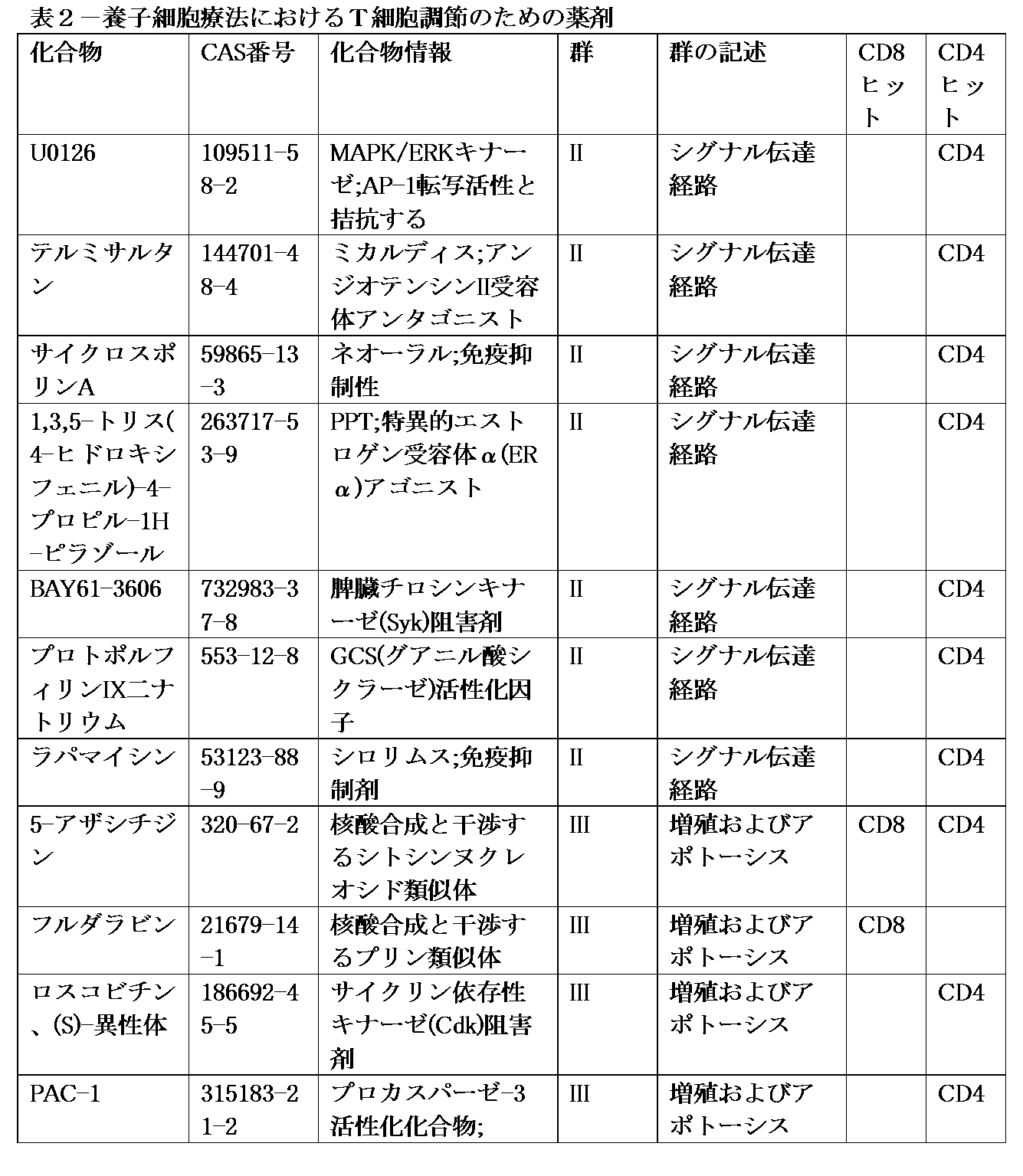
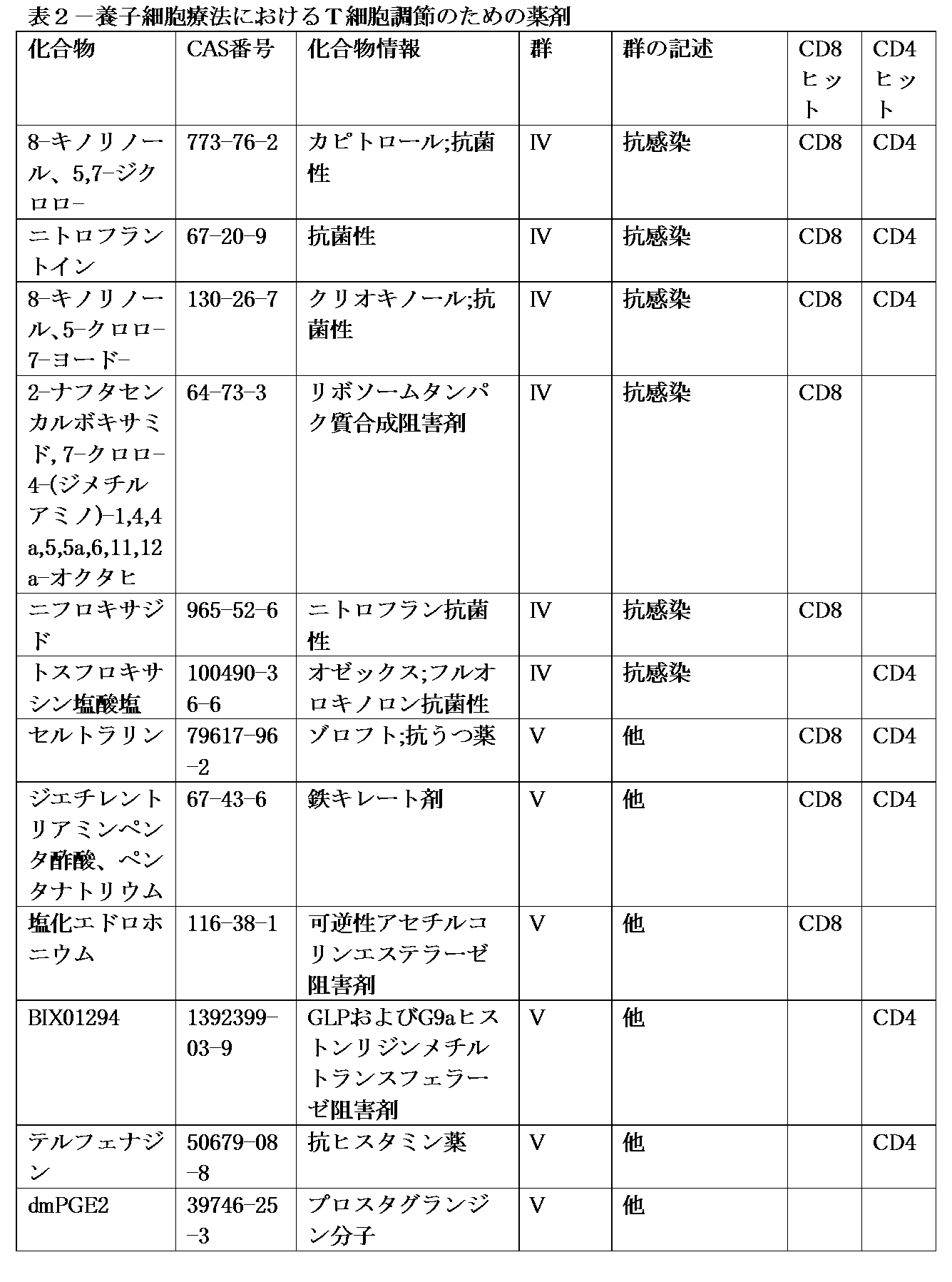

実施例3-選択した化合物の試験管内トリアージ実験
試験管内実験を行い、T細胞機能に対して決定的な影響を有する化合物曝露およびトリアージ化合物の方法を最適化する。第一の試験が、既に観察したナイーブ、幹細胞メモリー、およびセントラルメモリーT細胞に対する影響が、さらなるドナーにおいて繰り返されるかどうかを評価しながら、個々の化合物の最適な用量を決定する。T細胞に対する可能性のある決定的な機能的影響を有する化合物をトリアージするために、増殖能力、Th1およびTh17に二極化させる能力、凍結保存/解凍サイクルを通じた生存、伝達効率、ならびにCARにより伝達されたT細胞の殺腫瘍活性についての試験管内評価を行う。T細胞機能に対して有意な負の影響を伴わないで、拡大中にナイーブ、幹細胞メモリー、もしくはセントラルメモリーT細胞の割合または数を再生可能な方法で改善する化合物を、組み合わせで試験し、相加または相乗効果について評価する。これらの評価を通じて、有力候補または組み合わせを、生体内での追加試験に優先させる。
Example 3 - In Vitro Triage Studies of Selected Compounds In vitro studies are performed to optimize methods of compound exposure and triage compounds with critical impact on T cell function. Optimal doses of individual compounds are determined while evaluating whether the impacts on naive, stem cell memory, and central memory T cells previously observed in the first study are repeated in additional donors. In order to triage compounds with possible critical functional impact on T cells, in vitro evaluations are performed for proliferation capacity, ability to polarize to Th1 and Th17, survival through cryopreservation/thaw cycles, transfer efficiency, and tumoricidal activity of CAR-transduced T cells. Compounds that reproducibly improve the proportion or number of naive, stem cell memory, or central memory T cells during expansion without significant negative impact on T cell function are tested in combination and evaluated for additive or synergistic effects. Through these evaluations, promising candidates or combinations are prioritized for further testing in vivo.
実施例4-選択した化合物を使用した養子細胞療法の生体内モデル
生体内スクリーニングおよび追跡試験管内トリアージ実験の結果を説明するために、選択した化合物の有力候補を、養子細胞療法の生体内モデルに適用する。具体的には、生着、殺腫瘍活性、2次的な殺腫瘍応答、遊走、細胞持続性、および移植片対宿主疾患に関して、養子細胞療法に対する小分子調節の影響を調べる。臨床において有効な応答と相関することが見い出された永続的養子細胞療法の特徴である他の読み取り情報もまた、調べる。
Example 4 - In vivo model of adoptive cell therapy using selected compounds To explain the results of the in vivo screening and follow-up in vitro triage experiments, selected potential compound candidates are applied to an in vivo model of adoptive cell therapy. Specifically, the impact of small molecule modulation on adoptive cell therapy is examined with respect to engraftment, tumoricidal activity, secondary tumoricidal responses, migration, cell persistence, and graft-versus-host disease. Other readouts characteristic of durable adoptive cell therapy that have been found to correlate with effective responses in the clinic are also examined.
これらの実験を、ヒト細胞を、ヒト腫瘍を生じる免疫不全NSGマウスに養子性に移植するヒト化システムにおいて、または免疫コンピテント動物が、同系腫瘍を生じ、同系細胞療法で処置される代替マウスモデルにおいてのいずれかで、行う。 These experiments will be performed either in a humanized system in which human cells are adoptively transferred into immunodeficient NSG mice that develop human tumors, or in an alternative mouse model in which immune-competent animals develop syngeneic tumors and are treated with syngeneic cell therapy.
代替またはヒト化モデルシステムのいずれかにおいて、マウスに対象となるルシフェラーゼ標識リンパ腫または他の腫瘍を注入する。その後すぐに、本明細書において開示されるビヒクルまたは調節化合物によって前処理された養子細胞療法を行う。細胞療法と腫瘍の両方の用量を、化合物処理の正または有害な効果を観察するウインドウを可能にするように最適化する。動物の重さ、血漿サイトカイン濃度、腫瘍の量、および末梢血、二次リンパ器官および腫瘍塊における養子細胞療法;全身腫瘍組織量、腫瘍転移、および細胞療法の表現型を、実験の持続のためモニターする。 In either the alternative or humanized model system, mice are injected with luciferase-labeled lymphoma or other tumor of interest. Adoptive cell therapy is administered immediately thereafter, pretreated with vehicle or regulatory compounds disclosed herein. Doses of both cell therapy and tumor are optimized to allow a window to observe positive or adverse effects of compound treatment. Animal weight, plasma cytokine concentrations, tumor volume, and adoptive cell therapy in peripheral blood, secondary lymphoid organs, and tumor mass; tumor burden, tumor metastasis, and cell therapy phenotype are monitored for the duration of the experiment.
生体内での1つまたは多数の腫瘍関連パラメーターを向上させることができる化合物は、有効な腫瘍クリアランスに必要な細胞療法の用量を低下させること、末梢血において養子細胞療法の持続性を増大させること、腫瘍部位への遊走を増強させること、および/または高腫瘍用量での負荷に対する増大した生存を含むが、これらに限定されない予想される効果を有する。 Compounds capable of improving one or multiple tumor-associated parameters in vivo have anticipated effects including, but not limited to, lowering the dose of cell therapy required for effective tumor clearance, increasing the persistence of adoptive cell therapy in peripheral blood, enhancing migration to tumor sites, and/or increased survival against high tumor dose challenges.
実施例5-T細胞におけるラパ+dmPGE2処理でのCD27における相乗的増大
CD27は、4-1BBおよびOX-40も誘導するTRA結合TNF(腫瘍壊死因子)受容体ファミリーのメンバーである。これらの膜貫通型タンパク質は、リンパ球機能の制御に関与する。ヒトにおいて、大部分のナイーブ末梢T細胞(Tn)は、CD27を発現する。ナイーブ末梢T細胞が活性化されると、CD27の発現は有意に増大する。しかしながら、T細胞の最終エフェクター分化は、CD27の不可逆的な喪失と関連する(Hintzen et al. 1994)。CD27の役割のさらなる解明は、それが、T細胞免疫の発生および長期維持に必要であったことを示した(Hendriks et al. 2000)。
Example 5 - Synergistic Increase in CD27 with Rapa+dmPGE2 Treatment in T Cells CD27 is a member of the TRA-binding TNF (tumor necrosis factor) receptor family that also induces 4-1BB and OX-40. These transmembrane proteins are involved in the control of lymphocyte function. In humans, most naive peripheral T cells (Tn) express CD27. Upon activation of naive peripheral T cells, CD27 expression increases significantly. However, terminal effector differentiation of T cells is associated with irreversible loss of CD27 (Hintzen et al. 1994). Further elucidation of the role of CD27 showed that it was necessary for the development and long-term maintenance of T cell immunity (Hendriks et al. 2000).
ラパマイシン(時々「ラパ」として言及する)、ジメチルプロスタグランジンE2(dmPGE2)、または両方の化合物の組み合わせで処理した細胞は、ビヒクル単独(DMSO)で処理した細胞と比較したとき、多くの態様において有意差を示した。しかしながら、観察した最大の変化の1つは、ビヒクルまたはいずれかの化合物単独で処理したCD8 T細胞上のCD27の発現と比べ、ラパ+dmPGE2で処理したCD8 T細胞の表面上で発現したCD27のレベルにおける相乗的増大であった。これらの研究を行うために、単離したCD8 T細胞を、IL-2を添加したT細胞培地においてCTS(Cell Therapy Systems)Dynabeads(商標)CD3/CD28(サーモフィッシャーサイエンティフィック、ウォルサム、マサチューセッツ州)を使用して、0日目にバルクで活性化した。1日目に、細胞を、図2において示すCARコンストラクト1で形質導入し、細胞密度を0.5×106/mlに調整し、106細胞を、12ウェルプレートにビヒクル、20nMラパ、10μM dmPGE2または同じ濃度の両方の化合物の存在下で播種した。4日目に、細胞を6ウェルプレートに移し、培地2mlを、各ウェルに加えた。6日目に、培地さらに2mlを、各ウェルに加えた。8日目に、細胞を、CD27の細胞表面発現についてフローサイトメーターにおいて解析した。 Cells treated with rapamycin (sometimes referred to as "rapa"), dimethyl prostaglandin E2 (dmPGE2), or a combination of both compounds showed significant differences in many aspects when compared to cells treated with vehicle alone (DMSO). However, one of the largest changes observed was a synergistic increase in the levels of CD27 expressed on the surface of CD8 T cells treated with rapa + dmPGE2 compared to the expression of CD27 on CD8 T cells treated with vehicle or either compound alone. To perform these studies, isolated CD8 T cells were activated in bulk on day 0 using CTS (Cell Therapy Systems) Dynabeads™ CD3/CD28 (Thermo Fisher Scientific, Waltham, MA) in T cell medium supplemented with IL-2. On day 1, cells were transduced with CAR construct 1 shown in Figure 2, cell density was adjusted to 0.5x10⁶ /ml, and 106 cells were seeded in 12-well plates in the presence of vehicle, 20nM Rapa, 10μM dmPGE2 or both compounds at the same concentration. On day 4, cells were transferred to 6-well plates and 2ml of medium was added to each well. On day 6, an additional 2ml of medium was added to each well. On day 8, cells were analyzed in a flow cytometer for cell surface expression of CD27.
2人の独立したドナー由来の処理したT細胞および処理していないT細胞におけるCD27の発現を、図3において示す。ビヒクル処理で観察したCD27の発現を、MFI(平均蛍光強度)1として定義し、化合物で処理した細胞の相対的MFIを計算した。CD8 T細胞をラパ単独とインキュベーションしたとき、CD27発現はおよそ2倍増大し、dmPGE2単独では、増大は存在せず、すなわち、dmPGE2単独は、CD27発現に影響を及ぼさない。しかしながら、CD8 T細胞を、ラパマイシンとdmPGE2の組み合わせ(ラパ+dmPGE2)の存在下でインキュベーションするとき、ビヒクルと比べた、CD27発現における増大は、ほぼ6倍のレベルであり、これは、2種の個々の化合物の相加効果を通じてであると単純に説明することができない。したがって、化合物の組み合わせにより誘導されたCD27の細胞表面発現は相乗的であると思われ、化合物の組み合わせが、Tエフェクター細胞よりむしろナイーブT細胞の表現型をもたらすように思われる。 CD27 expression in treated and untreated T cells from two independent donors is shown in Figure 3. CD27 expression observed with vehicle treatment was defined as an MFI (mean fluorescence intensity) of 1, and the relative MFI of compound-treated cells was calculated. When CD8 T cells were incubated with Rapa alone, CD27 expression increased approximately 2-fold, and there was no increase with dmPGE2 alone, i.e., dmPGE2 alone does not affect CD27 expression. However, when CD8 T cells were incubated in the presence of a combination of Rapamycin and dmPGE2 (Rapa + dmPGE2), the increase in CD27 expression compared to vehicle was at a level of almost 6-fold, which cannot be simply explained through the additive effect of the two individual compounds. Thus, the cell surface expression of CD27 induced by the compound combination appears to be synergistic, and the compound combination appears to result in a naive T cell phenotype rather than a T effector cell phenotype.
実施例6-ラパ+dmPGE2処理はT細胞セントラルメモリーサブセットを増大する
非ヒト霊長類モデルとNOD/Scid IL-2RγCnull(NSG)マウスモデルの両方における研究は、セントラルメモリー(Tcm)表現型を有するT細胞が、養子移植後、改善された持続性を有することを示した(Berger et al. 2008; Wang et al. 2011)。加えて、CARを発現するCD4かつCD8セントラルメモリーT細胞(Tcm)サブセットを、造血幹細胞移植後の非ホジキンリンパ腫患者に投与し、Tcm由来のCAR-T細胞が、改善された拡大を示し、これは、Tcmが、ヒトの癌の処置において治療上の利点を有し得ることを示している。Tcm表現型に集団を偏向させる際のラパマイシンとdmPGE2の組み合わせの能力を評価した。CD8 Tcmサブセットを、細胞表面マーカーCD45RAおよびCCR7の発現に基づき定義した。図4Aは、活性化されていないT細胞におけるCD45RAおよびCCR7発現の散布図を示し、次に、それを、Tcm、ナイーブ(Tn)、エフェクターメモリー(Tem)およびCD45RA+エフェクターメモリー(Temra)細胞を含むT細胞サブセットのゲーティングのため使用した。TnおよびTcm細胞は最低限分化し、最大の増殖可能性を有し、一方、Temra細胞は、最も十分に分化し、乏しい増殖可能性を有するが、強力なエフェクター機能を有する(D’Asaro et al. 2006)。
Example 6 - Rapa + dmPGE2 Treatment Expands T Cell Central Memory Subsets Studies in both non-human primate and NOD/Scid IL-2RγC null (NSG) mouse models have shown that T cells with a central memory (Tcm) phenotype have improved persistence after adoptive transfer (Berger et al. 2008; Wang et al. 2011). In addition, CD4 and CD8 central memory T cell (Tcm) subsets expressing CAR were administered to non-Hodgkin's lymphoma patients after hematopoietic stem cell transplantation, and Tcm-derived CAR-T cells showed improved expansion, indicating that Tcm may have therapeutic benefits in the treatment of human cancers. The ability of the combination of rapamycin and dmPGE2 in biasing the population towards the Tcm phenotype was evaluated. CD8 Tcm subsets were defined based on the expression of cell surface markers CD45RA and CCR7. Figure 4A shows a scatter plot of CD45RA and CCR7 expression in non-activated T cells, which was then used to gate T cell subsets including Tcm, naive (Tn), effector memory (Tem) and CD45RA + effector memory (Temra) cells. Tn and Tcm cells are the least differentiated and have the greatest proliferative potential, whereas Temra cells are the most well differentiated and have poor proliferative potential but potent effector function (D'Asaro et al. 2006).
CD8 T細胞を、実施例5において記載した通り、ビヒクル、ラパ、dmPGE2またはラパ+dmPGE2で処理した。図4Bは、それぞれの処理後に培養物に存在するT細胞サブセットの略図を示す。図4Cは、異なるサブセットを同定するために使用されるフローサイトメトリー解析を示す。ビヒクルまたはいずれかの化合物単独と比べ、ラパマイシンとdmPGE2の組み合わせでの処理後、より分化したTemサブセットにおける喪失により説明される、Tcmサブセットのパーセンテージにおける増大が存在する。したがって、ラパ+dmPGE2での処理は、CAR-T細胞療法のためより望ましいT細胞サブセット(Tcm)において増大を引き起こす。理論により制限されるものではないが、TemからTcmへの表現型変化および/または促進されたTcm拡大は、調節した集団におけるTcmの増大したパーセンテージに関与し得た。 CD8 T cells were treated with vehicle, rapamycin, dmPGE2 or rapam+dmPGE2 as described in Example 5. Figure 4B shows a schematic representation of the T cell subsets present in the culture after each treatment. Figure 4C shows the flow cytometry analysis used to identify the different subsets. Compared to vehicle or either compound alone, after treatment with the combination of rapamycin and dmPGE2, there is an increase in the percentage of the Tcm subset, explained by a loss in the more differentiated Tem subset. Thus, treatment with rapamycin+dmPGE2 causes an increase in the more desirable T cell subsets (Tcm) for CAR-T cell therapy. Without being limited by theory, a phenotypic change from Tem to Tcm and/or enhanced Tcm expansion could be responsible for the increased percentage of Tcm in the conditioned population.
実施例7-ラパ+dmPGE2処理はT細胞枯渇マーカー発現を低減する
「枯渇」に起因したT細胞不全は、癌または感染症の十分な制御を起きないようにすることができる状態である。T細胞枯渇は、乏しいエフェクター細胞機能、ならびにPD-1およびTim-3を含む枯渇マーカーとして集合的に公知の、複数の細胞表面タンパク質の増大した発現により特徴付けられる(Wherry and Kurachi 2015)。枯渇マーカー発現に対するCAR-T細胞の化合物処理の効果を決定するために、実施例5において記載した通り、2人の異なるドナー由来の細胞を調製し、処理し、次に、PD-1およびTim-3について染色し、発現を、フローサイトメトリーを使用して決定した。図5において示した通り、ラパマイシンまたはdmPGE2のいずれかでの処理は、PD-1発現を低下させ、一方、ラパマイシンとdmPGE2の組み合わせでの処理は、ビヒクル、またはそれぞれの個々の化合物処理と比べ、PD-1発現においてわずかに大きな低減に至った。様々な処理下でのTim-3発現に関して、ビヒクルと比較したとき、ラパマイシン単独はTim-3発現を低下させ、一方、dmPGE2単独は効果を示さなかった。しかしながら、ラパマイシンとdmPGE2の組み合わせは、任意の単一の化合物処理または処理なしと比較して、Tim-3発現をより顕著に低減した。単独で使用したとき、dmPGE2は、Tim-3発現に対する効果を有しないという事実にも関らず、ビヒクル、ラパマイシン、およびdmPGE2と比べ、ラパ+dmPGE2の組み合わせによりTim-3発現において増強された低減を観察した。このデータは、ラパマイシンとdmPGE2の組み合わせでのT細胞の処理が、免疫不全に関与するT細胞枯渇を低減することにより、細胞の抗腫瘍能を増強することを示した。
Example 7 - Rapa + dmPGE2 Treatment Reduces T Cell Exhaustion Marker Expression T cell failure due to "exhaustion" is a condition that can result in inadequate control of cancer or infection. T cell exhaustion is characterized by poor effector cell function and increased expression of several cell surface proteins collectively known as exhaustion markers, including PD-1 and Tim-3 (Wherry and Kurachi 2015). To determine the effect of compound treatment of CAR-T cells on exhaustion marker expression, cells from two different donors were prepared and treated as described in Example 5, then stained for PD-1 and Tim-3, and expression was determined using flow cytometry. As shown in Figure 5, treatment with either rapamycin or dmPGE2 reduced PD-1 expression, while treatment with the combination of rapamycin and dmPGE2 led to a slightly greater reduction in PD-1 expression compared to vehicle or each individual compound treatment. With regard to Tim-3 expression under the various treatments, rapamycin alone reduced Tim-3 expression when compared to vehicle, while dmPGE2 alone showed no effect. However, the combination of rapamycin and dmPGE2 reduced Tim-3 expression more significantly compared to any single compound treatment or no treatment. Despite the fact that dmPGE2 has no effect on Tim-3 expression when used alone, an enhanced reduction in Tim-3 expression was observed with the combination of rapamycin + dmPGE2 compared to vehicle, rapamycin, and dmPGE2. This data demonstrated that treatment of T cells with a combination of rapamycin and dmPGE2 enhanced the antitumor capacity of the cells by reducing T cell exhaustion involved in immune deficiency.
実施例8-ラパ+dmPGE2処理はT細胞ミトコンドリア予備呼吸容量を増大する
細胞は、一般的に、2つの主要なエネルギー経路、解糖およびミトコンドリア呼吸を利用する。増大したストレスまたは労働に応答してエネルギーを生じるための細胞において利用可能な特別な能力である、ミトコンドリア予備呼吸容量(SRC)は、Tメモリー細胞において増大するが、TemraのようなTエフェクター細胞において増大しないことが示された(van der Windt et al. 2012)。
Example 8 - Rapa + dmPGE2 treatment increases T cell mitochondrial spare respiratory capacity Cells generally utilize two major energy pathways, glycolysis and mitochondrial respiration. Mitochondrial spare respiratory capacity (SRC), the special capacity available in cells to generate energy in response to increased stress or work, has been shown to be increased in T memory cells but not in T effector cells such as Temra (van der Windt et al. 2012).
本発明者らは、実施例5において記載した通り、形質導入し、処理した細胞を使用して、化合物処理が、SRCに対する効果を有したかどうかを決定した。処理後、ミトコンドリア呼吸の測定値である酸素消費速度(OCR)を、Seahorse(商標)XFe96システム(Seahorse Bioscience、サンタクララ、カリフォルニア州)を使用して決定した。これを行うために、細胞を洗浄し、非緩衝アッセイ培地に再懸濁した。次に、細胞を96ウェルプレートに播種し、Seahorse(商標)ミトストレス試験アッセイの対象にした。SRCを、基礎OCRと最大呼吸速度のOCRの間の差に基づき、決定する。図6は、SRCが、ビヒクル対照と比べ、ラパ+dmPGE2で処理した細胞においてほぼ2倍増大し、一方、それぞれ個々の化合物での処理は、約20~50%の若干の増大のみを示すことを示す。これらのデータは、ラパ+dmPGE2で処理したCAR-T細胞は、増大するか、またはTcm表現型に偏向されているばかりでなく、メモリーT細胞サブセットに関連する所望される代謝特性も提示すことを示す。 We used cells transduced and treated as described in Example 5 to determine whether compound treatment had an effect on SRC. After treatment, oxygen consumption rate (OCR), a measure of mitochondrial respiration, was determined using a Seahorse™ XFe96 system (Seahorse Bioscience, Santa Clara, CA). To do this, cells were washed and resuspended in unbuffered assay medium. Cells were then seeded into 96-well plates and subjected to the Seahorse™ Mitostress Test assay. SRC is determined based on the difference between basal OCR and OCR at maximum respiration rate. Figure 6 shows that SRC is increased nearly 2-fold in cells treated with Rapa+dmPGE2 compared to vehicle control, while treatment with each individual compound shows only a modest increase of about 20-50%. These data indicate that CAR-T cells treated with rapa+dmPGE2 are not only expanded or biased toward a Tcm phenotype, but also display desirable metabolic properties associated with memory T cell subsets.
実施例9-ラパ+dmPGE2で処理したCD8+T細胞のゲノム全体での発現特徴
試験管内T細胞拡大プロセス中の、個々または組み合わせでのラパマイシンおよびdmPGE2処理のゲノム全体での影響を特徴付けるために、実施例5において記載した通り、形質導入し、処理した細胞からRNAを抽出し、Human Transcriptome Array gene(マイクロアレイ)チップ(アフィメトリクス、サンタクララ、カリフォルニア州)において解析し、結果を、ビヒクルで処理した試料と比較した。図7Aは、個々および組み合わせでの小分子により誘導された遺伝子プローブの転写変化を示すために、マイクロアレイチップを使用したゲノム全体での転写変化を描写する。図7Bにおいて模式的に示す通り、ラパ+dmPGE2処理下で、ビヒクル対照と比較して2倍より多く上方制御される遺伝子の総数は377であり、一方、それぞれ、ラパマイシン単独およびdmPGE2単独の処理下で215ならびに71であることは注目に値する。377種の上方制御された遺伝子のうち、264種の遺伝子は、組み合わせ処理で固有に上方制御されるが、いずれかの個々の化合物処理によってはされない。下方制御された遺伝子に関して、計581種の遺伝子が、ラパ+dmPGE2処理の下で、ビヒクル対照と比較して2倍より大きく下方制御され、一方、284種および38種のみの遺伝子が、それぞれ、ラパマイシン単独、およびdmPGE2単独処理下で下方制御される。581種の下方制御された遺伝子のうち、351種の遺伝子は、組み合わせ処理で固有に下方制御されるが、いずれかの個々の化合物処理によってはされない。単一または組み合わせの化合物処理下の差次的遺伝子発現特性は、両方の小分子を使用した組み合わせ処理が、それぞれの個々の処理の合計より有意に大きい、予め見い出された転写効果を有することを示し、これは、両方の経路の調節薬の存在下での相乗的応答を示している。
Example 9 - Genome-wide expression profile of CD8 + T cells treated with rapamycin + dmPGE2 To characterize the genome-wide effects of rapamycin and dmPGE2 treatment, individually or in combination, during the in vitro T cell expansion process, RNA was extracted from cells transduced and treated as described in Example 5 and analyzed on Human Transcriptome Array gene (microarray) chips (Affymetrix, Santa Clara, Calif.) and results were compared to vehicle-treated samples. Figure 7A depicts genome-wide transcriptional changes using microarray chips to show transcriptional changes of gene probes induced by small molecules individually and in combination. As shown diagrammatically in FIG. 7B, it is noteworthy that the total number of genes upregulated more than 2-fold under rapamycin + dmPGE2 treatment compared to vehicle control is 377, compared to 215 and 71 under rapamycin and dmPGE2 treatments, respectively. Of the 377 upregulated genes, 264 genes are uniquely upregulated by the combination treatment but not by any individual compound treatment. With regard to the downregulated genes, a total of 581 genes are downregulated more than 2-fold under rapamycin + dmPGE2 treatment compared to vehicle control, compared to only 284 and 38 genes, respectively, under rapamycin and dmPGE2 treatments. Of the 581 downregulated genes, 351 genes are uniquely downregulated by the combination treatment but not by any individual compound treatment. Differential gene expression profiles under single or combined compound treatments showed that the combined treatment using both small molecules had the previously found transcriptional effect that was significantly greater than the sum of each individual treatment, indicating a synergistic response in the presence of modulators of both pathways.
単一または組み合わせ化合物処理下で差次的に発現する、T細胞機能(例えば、サイトカイン分泌、細胞毒性、枯渇、共刺激)、分化(例えば、細胞分化、成熟、およびメモリー細胞表現型)、ならびに代謝(例えば、解糖、アミノ酸代謝、細胞増殖)に関連する幾つかの典型的な鍵となる遺伝子を、図8A、および表4において示す。 Some representative key genes related to T cell function (e.g., cytokine secretion, cytotoxicity, exhaustion, costimulation), differentiation (e.g., cell differentiation, maturation, and memory cell phenotype), and metabolism (e.g., glycolysis, amino acid metabolism, cell proliferation) that are differentially expressed under single or combination compound treatment are shown in Figure 8A and Table 4.


実施例10-ラパ+dmPGE2で処理したCD8+T細胞の遺伝子パネル特徴
T細胞成熟に重要な遺伝子のパネルについての発現変化に対する、組み合わせでの両方の小分子の影響をさらに特徴付けるために、実施例5において形質導入し、調製した細胞から、トータルRNAを抽出した。RNAを、アフィメトリクスヒトトランスクリプトームアレイにおいて解析し、パネル中の遺伝子の(ビヒクル処理と比べた)変化の倍数を決定した。両方の小分子を含めることは、そのうち幾つかがメモリー表現型を促進することが公知である多くの鍵となるT細胞遺伝子に対する予め見いだされた転写の影響、同じく代謝への影響を有した(図8A)。ラパマイシンとdmPGE2の両方での処理は、転写因子遺伝子(図8B)と解糖に関与する遺伝子(図8B)の両方に対して相乗的効果をもたらした。転写因子TCF7およびLEF1は、機能的メモリー細胞の発生に重要であり(Zhou et al., J Immunol. 2012; 189(6): 2722-2726)、ラパマイシンとdmPGE2の両方での処理は、いずれかの化合物単独よりこれらの遺伝子の発現を増大した(図8B)。BLIMP-1は、最後まで分化したT細胞およびエフェクターメモリーT細胞において発現した転写抑制性遺伝子であり、BLIMP-1欠損は、セントラルメモリーT細胞特性の獲得を促進する(Rutishauser et al., Immunity. 2009; 31(2): 296-308)。ラパマイシンとdmPGE2の組み合わせでの処理は、いずれかの化合物単独と比較して、BLIMP-1発現のよりおおきな低下をもたらした(図8B)。興味深いことに、BLIMP-1は、dmPGE2単独で処理したとき、わずかに上方制御され、それは、dmPGE2がエフェクターT細胞分化を促進するという観察と一致する(Sreeramkumar et al., 2015)。故に、ラパマイシンとdmPGE2の両方を使用した組み合わせ処理は、T細胞分化をもたらす際のdmPGE2の傾向を「正す」だけでなく、下方制御されているBLIMP-1発現において、ラパマイシンと組み合わされたとき相乗的効果を達成することは驚くべきことである。
Example 10 - Gene Panel Characterization of CD8 + T Cells Treated with Rapamycin + dmPGE2 To further characterize the effect of both small molecules in combination on expression changes for a panel of genes important for T cell maturation, total RNA was extracted from cells transduced and prepared in Example 5. RNA was analyzed on Affymetrix human transcriptome arrays and the fold change (relative to vehicle treatment) of genes in the panel was determined. Inclusion of both small molecules had previously found transcriptional effects on many key T cell genes, some of which are known to promote the memory phenotype, as well as metabolic effects (Figure 8A). Treatment with both rapamycin and dmPGE2 produced synergistic effects on both transcription factor genes (Figure 8B) and genes involved in glycolysis (Figure 8B). The transcription factors TCF7 and LEF1 are important for the development of functional memory cells (Zhou et al., J Immunol. 2012; 189(6): 2722-2726), and treatment with both rapamycin and dmPGE2 increased the expression of these genes more than either compound alone (Figure 8B). BLIMP-1 is a transcriptionally repressor gene expressed in terminally differentiated and effector memory T cells, and BLIMP-1 deficiency promotes the acquisition of central memory T cell characteristics (Rutishauser et al., Immunity. 2009; 31(2): 296-308). Treatment with the combination of rapamycin and dmPGE2 resulted in a greater reduction in BLIMP-1 expression compared to either compound alone (Figure 8B). Interestingly, BLIMP-1 was slightly upregulated when treated with dmPGE2 alone, which is consistent with the observation that dmPGE2 promotes effector T cell differentiation (Sreeramkumar et al., 2015). Thus, it is surprising that combined treatment with both rapamycin and dmPGE2 not only "corrects" the tendency of dmPGE2 in effecting T cell differentiation, but also achieves a synergistic effect when combined with rapamycin on downregulated BLIMP-1 expression.
転写因子発現における変化に加えて、ラパマイシンとdmPGE2の組み合わせはまた、代謝に関与する遺伝子の発現に影響した。遺伝子ALDOC、ENO2、およびPGK1は全て、解糖経路の異なる工程に関与し、ラパマイシンおよびdmPGE2での組み合わせ処理は、これらの遺伝子の下方制御をもたらした(図8C)。対照的に、いずれかの化合物単独での処理は、これらの解糖に関連する遺伝子の全3種の上方制御を引き起こした(図8C)。活性化されたT細胞は、全エフェクター機能をサポートするのにより適している好気的解糖に優先的に切り替わる(Chang et al., Cell. 2013; 153(6): 1239-1251)。CD8+T細胞における高い解糖活性の誘導は、メモリー細胞よりむしろ最後まで分化した状態にT細胞を至らせる(Sukumar et al., J Clin Invest. 2013; 123(10): 4479-4488)。実施例8において示した予備呼吸容量における増大と共に、ALDOC、ENO2、およびPGK1の低減した発現を介して解糖を経験するラパマイシンおよびdmPGE2で処理した細胞の能力における低減は、組み合わせ処理が、セントラルメモリー表現型に細胞を偏向させるという見解をサポートする。 In addition to changes in transcription factor expression, the combination of rapamycin and dmPGE2 also affected the expression of genes involved in metabolism. The genes ALDOC, ENO2, and PGK1 are all involved in different steps of the glycolysis pathway, and combined treatment with rapamycin and dmPGE2 resulted in downregulation of these genes (Figure 8C). In contrast, treatment with either compound alone caused upregulation of all three of these glycolysis-related genes (Figure 8C). Activated T cells preferentially switch to aerobic glycolysis, which is more suitable for supporting full effector function (Chang et al., Cell. 2013; 153(6): 1239-1251). Induction of high glycolytic activity in CD8 + T cells drives T cells towards a fully differentiated state rather than memory cells (Sukumar et al., J Clin Invest. 2013; 123(10): 4479-4488). The reduction in the ability of rapamycin and dmPGE2 treated cells to undergo glycolysis via reduced expression of ALDOC, ENO2, and PGK1, along with the increase in spare respiratory capacity shown in Example 8, supports the notion that the combined treatment biases cells towards a central memory phenotype.
実施例11-ラパ+dmPGE2で処理したCD8+T細胞におけるCCR7およびCD62LのRT-qPCR定量
メモリー細胞偏向におけるラパ+dmPGE2の影響をさらに特徴付けるために、メモリーT細胞において高度に発現することが公知の、2つの鍵となる遺伝子CCR7およびCD62Lについての発現変化を調べた。トータルRNAを、実施例5において記載した通り、化合物で処理した細胞から抽出した。RNAを、各遺伝子に特異的なRT-qPCRおよびTaqMan遺伝子発現アッセイを使用して解析した。各遺伝子転写物の相対量を、各試験管内処理について決定した。図9Aおよび9Bは、ラパ+dmPGE2処理での両方の鍵となるメモリーT細胞遺伝子の発現における劇的な増大を示し、一方、個々の化合物は、これらの遺伝子の両方について比較的最小限の転写の増大を誘導した。図9Cは、実施例5および図3におけるCD27の細胞表面発現を裏付ける、CD27遺伝子発現に対するラパ+dmPGE2処理の同様の効果を示した。ラパマイシンとdmPGE2の両方について観察した要件は、発現の変化をメモリーT細胞に向けて促進する経路間の相乗的応答を暗示する。
Example 11 - RT-qPCR quantification of CCR7 and CD62L in CD8 + T cells treated with Rapa + dmPGE2 To further characterize the impact of Rapa + dmPGE2 on memory cell polarization, expression changes were examined for two key genes known to be highly expressed in memory T cells, CCR7 and CD62L. Total RNA was extracted from compound treated cells as described in Example 5. RNA was analyzed using RT-qPCR and TaqMan gene expression assays specific for each gene. The relative amount of each gene transcript was determined for each in vitro treatment. Figures 9A and 9B show a dramatic increase in expression of both key memory T cell genes with Rapa + dmPGE2 treatment, while the individual compounds induced relatively minimal increases in transcription for both of these genes. Figure 9C showed a similar effect of rapamycin + dmPGE2 treatment on CD27 gene expression, corroborating the cell surface expression of CD27 in Example 5 and Figure 3. The observed requirement for both rapamycin and dmPGE2 suggests a synergistic response between pathways that drive changes in expression towards memory T cells.
実施例12-ラパ+dmPGE2での処理は連続殺傷アッセイにおいてCAR-T細胞拡大を改善する
臨床試験におけるCAR-T細胞療法の臨床上の診断マーカーは、処置後の患者においてCAR-T細胞の拡大である(Porter et al. 2015)。CAR-T細胞が、複数回のラウンド後に試験管内で腫瘍細胞を「排除する」ことを可能にする、試験管内連続殺傷アッセイは、CARにより認識される抗原を発現する腫瘍細胞の存在下でのCAR-T拡大を評価することができるモデルである。この終わりに、CD8 T細胞を形質導入して、CAR-T細胞を得て、実施例5において記載する通り処理し、次に、凍結保存した。解凍後、CAR-T細胞を、内在性CD19および遺伝子導入mKate2遠赤色蛍光タンパク質を発現するNalm6腫瘍細胞と共培養した。CAR-T細胞におけるeGFP、およびNalm6標的細胞におけるmKate2の発現は、連続殺傷アッセイにおいて両方の細胞タイプの容易かつ信頼性のある同定およびカウントを可能にする。殺傷の各ラウンドを開始する前に、Nalm6標的細胞に対するCAR-T細胞の同じ比が、異なる化合物処理から生じたCAR-T細胞培養に渡り維持されるように、細胞数を調整した。
Example 12 - Treatment with Rapa + dmPGE2 improves CAR-T cell expansion in a serial killing assay A clinical diagnostic marker for CAR-T cell therapy in clinical trials is the expansion of CAR-T cells in patients after treatment (Porter et al. 2015). The in vitro serial killing assay, which allows CAR-T cells to "eliminate" tumor cells in vitro after multiple rounds, is a model that can evaluate CAR-T expansion in the presence of tumor cells expressing the antigen recognized by the CAR. At the end of this, CD8 T cells were transduced to obtain CAR-T cells, which were treated as described in Example 5 and then cryopreserved. After thawing, CAR-T cells were co-cultured with Nalm6 tumor cells expressing endogenous CD19 and transgenic mKate2 far-red fluorescent protein. Expression of eGFP in CAR-T cells and mKate2 in Nalm6 target cells allows for easy and reliable identification and counting of both cell types in the sequential killing assay. Prior to the start of each round of killing, cell numbers were adjusted so that the same ratio of CAR-T cells to Nalm6 target cells was maintained across CAR-T cell cultures resulting from different compound treatments.
図10Aは、腫瘍細胞殺傷の各ラウンド後、2人のドナー由来のCAR-T細胞の拡大の倍数を示す。ラパ+dmPGE2で処理したCAR-T細胞は、ビヒクル、または個々のいずれかの化合物と比べて、一貫して改善された拡大を示す。全3ラウンドの連続殺傷後のトータルの拡大を決定するとき(図10B)、ラパ+dmPGE2は、個々のいずれかの化合物よりずっと大きな拡大を示し、これは、この重要なパラメーターにおける可能性のある相乗的効果を示している。
拡大における観察した相違に関らず、試験管内で腫瘍細胞を殺傷するCAR-T細胞の能力は、3ラウンドの試験管内殺傷について影響しなかった。ラパ、dmPGE2、またはラパ+dmPGE2で予め処理したCAR-T細胞は、時間と共に標的細胞を首尾よく排除した(図11A)。3ラウンドの終わりに、共培養物における生存細胞のフローサイトメトリー解析は、ビヒクルおよび全ての、化合物で処理した細胞について非常にわずかのmKate2陽性細胞を示した(図11B)。
Figure 10A shows the fold expansion of CAR-T cells from two donors after each round of tumor cell killing. CAR-T cells treated with rapa+dmPGE2 show consistently improved expansion compared to vehicle or either individual compound. When determining total expansion after all three rounds of sequential killing (Figure 10B), rapa+dmPGE2 showed much greater expansion than either individual compound, indicating a possible synergistic effect in this important parameter.
Despite the observed differences in expansion, the ability of CAR-T cells to kill tumor cells in vitro was not affected after three rounds of in vitro killing. CAR-T cells pre-treated with rapa, dmPGE2, or rapa + dmPGE2 successfully eliminated target cells over time (FIG. 11A). At the end of three rounds, flow cytometry analysis of viable cells in the co-cultures showed very few mKate2 positive cells for vehicle and all compound-treated cells (FIG. 11B).
実施例13-大規模培養フォーマットでのラパ+dmPGE2での改善されたCAR-T細胞拡大の証明
CD4 T細胞に対するラパ+dmPGE2の効果を決定するために、およびラパ+dmPGE2の増大した拡大が、より大きな拡大フォーマットまで増えるであろうことを示すために、CD4かつCD8 T細胞を、別々に活性化し、試験管内で拡大させた。活性化の1日後、細胞をCAR-2コンストラクト(図2)で形質導入し、次に、化合物を含むかまたは含まない24ウェルGREXプレートに再度蒔いた。半分の培地を、活性化の1週間後の回収までその後2日毎に置き換えた。図12は、ラパ+dmPGE2の添加が、DMSOと比べ、活性化の1週間後に増大したCD4かつCD8 T細胞拡大(図12A)およびばバイアビリティー(図12B)をもたらすことを示す。
Example 13 - Demonstration of improved CAR-T cell expansion with rapa+dmPGE2 in large scale culture format To determine the effect of rapa+dmPGE2 on CD4 T cells and to demonstrate that the enhanced expansion of rapa+dmPGE2 would scale to a larger expansion format, CD4 and CD8 T cells were separately activated and expanded in vitro. One day after activation, cells were transduced with CAR-2 constructs (Figure 2) and then replated into 24-well GREX plates with or without compound. Half the media was replaced every 2 days thereafter until harvest one week after activation. Figure 12 shows that the addition of rapa+dmPGE2 results in increased CD4 and CD8 T cell expansion (Figure 12A) and viability (Figure 12B) one week after activation compared to DMSO.
実施例14-ラパ+dmPGE2で処理したCAR-T細胞の改善された生体内有効性
ラパ+dmPGE2処理が、CAR-T細胞の生体内腫瘍クリアランスおよび持続性を増大したかどうかを決定するために、NSGマウスに、ホタルルシフェラーゼを発現するように操作したNalm-6-luc、CD19+ヒト腫瘍株を注射した。CAR-T細胞を、別々に活性化させ、試験管内で拡大させたCD4+かつCD8+T細胞から生じさせた。活性化の1日後、細胞をCAR-2コンストラクト(図2)で形質導入し、次に、化合物を含むかまたは含まない24ウェルGREXプレートに再度蒔いた。半分の培地を、活性化の1週間後の回収までその後2日毎に置き換えた。腫瘍注入の1週間後、NSGマウスを、後眼窩注射を介して、比1:1で混合した0.2×10⁶CD4かつCD8 CAR-T細胞で処置した。マウスを、定期的に画像処理し、腫瘍負荷量を決定した。図13Aは、ラパ+dmPGE2またはPI3K阻害剤PI-103で処理したCAR-T細胞が、マウスの大部分から腫瘍を排除することができたが、一方、形質導入していないT細胞、またはDMSO、U0126もしくはTWS119で処理したCAR-T細胞で処置したものは、最小の腫瘍制御を示した。
Example 14 - Improved in vivo efficacy of CAR-T cells treated with rapa + dmPGE2 To determine whether rapa + dmPGE2 treatment increased in vivo tumor clearance and persistence of CAR-T cells, NSG mice were injected with Nalm-6-luc, a CD19 + human tumor line engineered to express firefly luciferase. CAR-T cells were generated from separately activated and in vitro expanded CD4 + and CD8 + T cells. One day after activation, cells were transduced with the CAR-2 construct (Figure 2) and then replated in 24-well GREX plates with or without compound. Half the medium was replaced every 2 days thereafter until harvest one week after activation. One week after tumor injection, NSG mice were treated with 0.2x10⁶ CD4 and CD8 CAR-T cells mixed at a 1:1 ratio via retro-orbital injection. Mice were imaged periodically to determine tumor burden. Figure 13A shows that CAR-T cells treated with rapa + dmPGE2 or the PI3K inhibitor PI-103 were able to eliminate tumors from the majority of mice, whereas those treated with untransduced T cells or CAR-T cells treated with DMSO, U0126 or TWS119 showed minimal tumor control.
実施例15-ラパ+dmPGE2で処理したCAR-T細胞での改善された二次性腫瘍抗腫瘍応答
最初の腫瘍クリアランスを仲介したCAR-T細胞が、持続することができ、長期の保護をもたらすかどうかを決定するために、原発腫瘍注入の60日後に、原発腫瘍負荷を生存したマウス(実施例14)に、CD19を発現するよう操作したヒト骨髄性白血病株K562-CD19を再負荷した。この再負荷研究の開始まで生存したマウスを有した唯一の2群は、ラパ+dmPGE2およびPI-103で処理したコホートであった。図13Bは、二次性腫瘍での負荷の21日後に、ラパ+dmPGE2で処理したCAR-Tのマウスの75%(3/4)、およびPI103 CAR-Tで処置したマウスの60%(3/5)が、検出可能な腫瘍を有しなかったことを示す。
Example 15 - Improved Secondary Tumor Antitumor Responses with Rapa+dmPGE2 Treated CAR-T Cells To determine whether the CAR-T cells that mediated initial tumor clearance could persist and provide long-term protection, mice that survived the primary tumor challenge (Example 14) were rechallenged with the human myeloid leukemia line K562-CD19 engineered to express CD19 60 days after primary tumor injection. The only two groups that had mice that survived to the start of this rechallenge study were the Rapa+dmPGE2 and PI-103 treated cohorts. Figure 13B shows that 21 days after secondary tumor challenge, 75% (3/4) of mice with Rapa+dmPGE2 treated CAR-T and 60% (3/5) of mice treated with PI103 CAR-T had no detectable tumors.
実施例16-凍結保存したラパ+dmPGE2で処理したCAR-T細胞の改善された生体内有効性
ラパ+dmPGE2処理が、凍結保存後のCAR-T細胞の生体内腫瘍クリアランスおよび持続性を増大したかどうかを決定するために、本発明者らは、NSGマウスに、ホタルルシフェラーゼを発現するように操作した、0.5×10⁶Nalm-6-luc、CD19発現ヒト腫瘍株を注入した。4日後、マウスを、比1:1で混合した1.0×10⁶、0.5×10⁶または0.2×10⁶CD4かつCD8 CAR-T細胞で処置した。CAR-T細胞を、実施例14において記載した通り、別々に活性化し、試験管内で拡大したCD4+かつCD8+T細胞から生じさせた。活性化の1日後、細胞をCAR-2コンストラクト(図2)で形質導入し、次に、化合物を含むかまたは含まない24ウェルGREXプレートに再度蒔いた。半分の培地を、活性化の1週間後の回収までその後2日毎に置き換えた。細胞を凍結保存し、次に使用のため解凍した。NSGマウスに腫瘍細胞を注入し、続いて1週間後、後眼窩注射を介してCAR-Tを移植した。
Example 16 - Improved in vivo efficacy of cryopreserved rapa + dmPGE2 treated CAR-T cells To determine whether rapa + dmPGE2 treatment increased in vivo tumor clearance and persistence of CAR-T cells after cryopreservation, we injected NSG mice with 0.5x10 Nalm-6-luc, a CD19 expressing human tumor line engineered to express firefly luciferase. Four days later, mice were treated with 1.0x10 , 0.5x10, or 0.2x10 CD4+CD8 CAR-T cells mixed at a 1:1 ratio . CAR-T cells were derived from separately activated and in vitro expanded CD4 + and CD8 + T cells as described in Example 14. One day after activation, cells were transduced with CAR-2 constructs (Figure 2) and then replated in 24-well GREX plates with or without compound. Half the medium was replaced every 2 days thereafter until harvest one week after activation. Cells were cryopreserved and then thawed for use. NSG mice were injected with tumor cells followed one week later by implantation of CAR-T via retro-orbital injection.
1つの実験において、(1)DMSO;(2)ラパマイシン;または(3)ラパマイシンおよびdmPGE2(右のパネル、実践)の存在下で成長させた、準最適な用量のCAR-T細胞(0.2×106)を、腫瘍を生じているマウスに注射した。ラパマイシン(図15A)またはラパマイシンおよびdmPGE2(図15B)で処理したCAR-T細胞は、養子移植の1週間以内に腫瘍負荷量を低減することができたが、一方、DMSOで処理したCAR-T細胞はできなかった。DMSOで処理したCAR-T細胞を注射したマウスは、腫瘍負荷量を検出未満に低減することができず、全てのマウスは、抗腫瘍応答を持続するのに失敗し、再発した(図15Aおよび15B)。図15Aにおいて示す通り、ラパマイシンで処理したCAR-T細胞を注射した4匹のうち1匹のマウスが再発した。ラパマイシンで処理したCAR-T細胞を注射した他の2匹は、腫瘍負荷量を検出未満に低減することができ、それらの3匹のうち1匹のマウスは、長期の抗腫瘍応答を持続することができ、一方、検出不可能な腫瘍負荷量を有する3匹のうち他の2匹は、それぞれ、30日および45日を超えては生存しなかった(図15A)。ラパマイシンおよびdmPGE2で処理したCAR-T細胞を注射した4匹のマウスのうち、4匹のうち2匹が、長期の抗腫瘍応答を持続することができたが、一方他の2匹は再発した。長期の抗腫瘍応答を持続した2匹のうち1匹のマウスは、腫瘍負荷量を検出未満に低減することができた。ラパマイシンおよびdmPGE2で処理したCAR-T細胞を注射した全4匹のマウスは、60日を超えて生存した。 In one experiment, suboptimal doses of CAR-T cells (0.2×10 6 ) grown in the presence of (1) DMSO; (2) rapamycin; or ( 3 ) rapamycin and dmPGE 2 (right panel, solid) were injected into tumor-bearing mice. CAR-T cells treated with rapamycin ( FIG. 15A ) or rapamycin and dmPGE2 ( FIG. 15B ) were able to reduce tumor burden within one week of adoptive transfer, whereas DMSO-treated CAR-T cells could not. Mice injected with DMSO-treated CAR-T cells were unable to reduce tumor burden below detection, and all mice failed to sustain an anti-tumor response and relapsed ( FIGS. 15A and 15B ). As shown in FIG. 15A , one of four mice injected with rapamycin-treated CAR-T cells relapsed. The other two mice injected with rapamycin-treated CAR-T cells were able to reduce tumor burden below detection, and one of those three mice was able to sustain a long-term anti-tumor response, while the other two of the three mice with undetectable tumor burdens did not survive beyond 30 and 45 days, respectively ( FIG. 15A ). Of the four mice injected with rapamycin and dmPGE2-treated CAR-T cells, two of the four were able to sustain a long-term anti-tumor response, while the other two relapsed. One of the two mice that sustained a long-term anti-tumor response was able to reduce tumor burden below detection. All four mice injected with rapamycin and dmPGE2-treated CAR-T cells survived beyond 60 days.
当業者は、本明細書において記載される方法、組成物、および製品が、典型的な実施形態の代表であり、本発明の範囲に対する制限として意図されないことを容易に理解するだろう。様々な置換および修飾が、本発明の範囲および精神から逸脱することなく、本明細書において開示される本開示に成され得ることは、当業者に容易に明らかであるだろう。 Those skilled in the art will readily appreciate that the methods, compositions, and products described herein are representative of exemplary embodiments and are not intended as limitations on the scope of the invention. It will be readily apparent to those skilled in the art that various substitutions and modifications can be made to the disclosure disclosed herein without departing from the scope and spirit of the invention.
本明細書において述べられたすべての特許および刊行物は、本開示が関係する当業者のレベルの指標である。全ての特許および刊行物は、それぞれの個々の刊行物が、参照により組み込まれる具体的かつ個別に示されたかのように、同じ程度まで本明細書において参照により取り込まれる。 All patents and publications mentioned in this specification are indicative of the level of those skilled in the art to which the disclosure pertains. All patents and publications are herein incorporated by reference to the same extent as if each individual publication was specifically and individually indicated to be incorporated by reference.
本明細書において説明として適切に記載される本開示は、本明細書において具体的に開示されていない任意の構成要件または複数の構成要件、限定または複数の限定の不在下で、実施され得る。したがって、例えば、本明細書における各場合において、用語「含むこと」、「本質的にからなる」、および「からなる」は、他の2つの用語のいずれかで置き換えられ得る。利用されきた用語および表現は、説明の用語として使用され、制限の用語として使用されず、示され、記載される特性、またはその一部の任意の均等物を除外するというかかる用語および表現の使用において、制限は存在しないが、様々な修飾が、請求される本開示の範囲内で可能であることが、認められる。したがって、本開示は、好ましい実施形態により具体的に開示されているが、本明細書において開示される概念の場合による特性、修飾、およびバリエーションが、当業者により再分類され得ること、ならびにかかる修飾およびバリエーションが、添付の請求の範囲により定義される本発明の範囲内であるとみなされることは、理解されるべきである。 The present disclosure as properly described herein as illustrative may be practiced in the absence of any element or elements, limitation or limitations not specifically disclosed herein. Thus, for example, in each instance herein, the terms "comprising," "consisting essentially of," and "consisting of" may be replaced with either of the other two terms. The terms and expressions that have been utilized are used as terms of description and not as terms of limitation, and it is recognized that there is no limitation in the use of such terms and expressions to exclude any equivalents of the properties shown and described, or portions thereof, but that various modifications are possible within the scope of the present disclosure as claimed. Thus, although the present disclosure has been specifically disclosed by preferred embodiments, it should be understood that the properties, modifications, and variations of the concepts disclosed herein may be reclassified by those skilled in the art, and that such modifications and variations are deemed to be within the scope of the present invention as defined by the appended claims.
Claims (18)
(i) ラパマイシン;並びに
(ii) dmPGE2又はその類似体もしくは誘導体であって、PGE2、16,16-ジメチルPGE2p-(p-アセタミドベンズアミド)フェニルエステル、11-デオキシ-16,16-ジメチルPGE2、9-デオキシ-9-メチレン-16,16-ジメチルPGE2、9-デオキシ-9-メチレンPGE2、9-ケトフルプロステノール、5-トランスPGE2、17-フェニル-オメガ-トリノルPGE2、PGE2セリノールアミド、PGE2メチルエステル、16-フェニルテトラノルPGE2、15(S)-15-メチルPGE2、15(R)-15-メチルPGE2、8-イソ-15-ケトPGE2、8-イソPGE2イソプロピルエステル、8-イソ-16-シクロヘキシル-テトラノルPGE2、20-ヒドロキシPGE2、20-エチルPGE2、11-デオキシPGEi、ノクロプロスト、スルプロストン、ブタプロスト、15-ケトPGE2、及び19(R)ヒドロキシPGE2からなる群から選択されるもの
を含み、
前記2種以上の薬剤は、T細胞と接触すると、改善された治療可能性を有する調節されたT細胞を生じ、
前記T細胞の集団は、(a)キメラ抗原受容体(CAR)をコードする外来核酸を含み、(b)CD4又はCD8を発現するT細胞を含む、
組成物。 A composition comprising a population of T cells and two or more agents, the two or more agents comprising:
(i) rapamycin ; and
(ii) dmPGE2 or an analogue or derivative thereof, such as PGE 2 , 16,16-dimethyl PGE 2 p-(p-acetamidobenzamido)phenyl ester, 11-deoxy-16,16-dimethyl PGE 2 , 9-deoxy-9-methylene-16,16-dimethyl PGE 2 , 9-deoxy-9-methylene PGE 2 , 9-ketofluprostenol, 5-trans PGE 2 , 17-phenyl-omega-trinor PGE 2 , PGE 2 serinoleamide, PGE 2 methyl ester, 16-phenyltetranor PGE 2 , 15(S)-15-methyl PGE 2 , 15(R)-15-methyl PGE 2 , 8-iso-15-keto PGE 2 , 8-iso PGE2 isopropyl ester, 8-iso-16-cyclohexyl-tetranor PGE 2 , 20-hydroxy PGE 2 , 20-ethyl PGE 2 , 11-deoxy PGEi, nocloprost, sulprostone, butaprost, 15-keto PGE 2 , and 19(R)hydroxy PGE 2 ;
said two or more agents, upon contact with a T cell, resulting in a regulated T cell having improved therapeutic potential;
the population of T cells (a) comprises an exogenous nucleic acid encoding a chimeric antigen receptor (CAR); and (b) comprises T cells that express CD4 or CD8.
Composition.
(a) 前記2種以上の薬剤が、
(i) T細胞拡大、維持、分化、脱分化、及び/又は生存率を改善し;
(ii) T細胞増殖、細胞毒性、持続性、サイトカイン応答及び分泌、ならびに/又は細胞リコールを改善し;ならびに/又は
(iii) T細胞に接触すると1つもしくは複数の所望される免疫細胞亜集団の数又は割合を増大する、
ことができる薬剤であり、又は、
(b) 前記組成物が1つ又は複数の添加剤をさらに含む、
組成物。 2. The composition of claim 1 ,
(a) the two or more drugs are
(i) improving T cell expansion, maintenance, differentiation, dedifferentiation, and/or survival;
(ii) improving T cell proliferation, cytotoxicity, persistence, cytokine response and secretion, and/or cell recall; and/or
(iii) increasing the number or proportion of one or more desired immune cell subpopulations upon contacting the T cells;
or
(b) the composition further comprises one or more additives;
Composition.
(a) 1つ又は複数の所望される亜集団の数又は割合の増大が:
(i) ナイーブT細胞、幹細胞メモリーT細胞、及び/もしくはセントラルメモリーT細胞;
(ii) 少なくとも1つの遺伝子的に修飾されたモダリティ;及び/又は
(iii) 前記CARをコードする外来核酸を含むT細胞;
の数又は割合の増大を含む。 3. The composition of claim 2 having at least one of the following characteristics:
(a) An increase in the number or proportion of one or more desired subpopulations is achieved by:
(i) naive T cells, stem cell memory T cells, and/or central memory T cells;
(ii) at least one genetically modified modality; and/or
(iii) a T cell comprising an exogenous nucleic acid encoding the CAR;
This includes an increase in the number or proportion of
(b) 前記T細胞集団のT細胞は、
(A) ゲノム的に操作され、挿入、欠失、もしくは核酸置換を含む;
(B) 少なくとも1つの遺伝子的に修飾されたモダリティを含む;又は
(C) T細胞受容体(TCR)をコードする外来核酸を含む。 3. The composition of claim 2 having at least one of the following characteristics :
(b) T cells of the population of T cells
(A) is genomically engineered and contains an insertion, deletion, or nucleic acid substitution;
(B) contains at least one genetically modified modality; or
(C) contains an exogenous nucleic acid encoding a T cell receptor (TCR).
(c) 前記T細胞集団のT細胞は、遺伝子的に修飾されたモダリティを含み、該遺伝子的に修飾されたモダリティが、セーフティスイッチタンパク質、ターゲティングモダリティ、受容体、シグナル伝達分子、転写因子、医薬的に有効なタンパク質及びペプチド、薬物標的候補;又は前記免疫細胞の生着、輸送、ホーミング、バイアビリティー、自己再生、持続性、免疫応答制御及び調節、ならびに/もしくは生存を促進するタンパク質の少なくとも1つを含む。 3. The composition of claim 2, having at least one of the following characteristics :
(c) T cells of said T cell population comprise a genetically modified modality, wherein the genetically modified modality comprises at least one of a safety switch protein, a targeting modality, a receptor, a signaling molecule, a transcription factor, pharmacologic active proteins and peptides, drug target candidates; or a protein that promotes engraftment, trafficking, homing, viability, self-renewal, persistence, immune response control and regulation, and/or survival of said immune cells .
(d) 前記T細胞集団のT細胞は、遺伝子的に修飾されたモダリティを含み、該少なくとも一つの遺伝子的に修飾されたモダリティが、
(i)欠失もしくは低減した発現のB2M、TAP1、TAP2、タパシン、NLRC5、PD1、LAG3、TIM3、RFXANK、CIITA、RFX5、又はRFXAP、及び染色体6p21領域中の任意の遺伝子;ならびに
(ii)誘導されたもしくは増大した発現のHLA-E、HLA-G、HACD16、hnCD16、41BBL、CD3、CD4、CD8、CD47、CD113、CD131、CD137、CD80、PDL1、A2AR、Fc受容体、又は二重もしくは多特異性又は普遍的エンゲイジャーとのカップリングのための表面トリガー受容体の1つ又は複数を含む。 3. The composition of claim 2, having at least one of the following characteristics :
(d) the T cells of the T cell population comprise a genetically modified modality, the at least one genetically modified modality comprising:
(i) deleted or reduced expression of B2M, TAP1, TAP2, tapasin, NLRC5, PD1, LAG3, TIM3, RFXANK, CIITA, RFX5, or RFXAP, and any genes in the chromosome 6p21 region; and
(ii) induced or increased expression of one or more of HLA-E, HLA-G, HACD16, hnCD16, 41BBL, CD3, CD4, CD8, CD47, CD113, CD131, CD137, CD80, PDL1, A2AR, an Fc receptor, or a surface triggering receptor for coupling to a bi- or multispecific or universal engager .
(e) 前記組成物が、ラパマイシン及びdmPGE2を含む。 3. The composition of claim 2 having at least one of the following characteristics :
(e) the composition comprises rapamycin and dmPGE2 .
(f)前記一つ又は複数の添加剤が:
(i) ジメチルスルホキシド(DMSO)、N,N-ジメチルホルムアミド(DMF)、ジメトキシエタン(DME)、ジメチルアセトアミド、エタノール及びその組み合わせからなる群から選択される少なくとも1つの有機溶媒;
(ii) ペプチド、抗体、抗体フラグメント、サイトカイン、マイトジェン、成長因子、スモールRNA、dsRNA、単核血液細胞、フィーダー細胞、フィーダー細胞成分もしくは置換因子、対象となる1つもしくは複数のポリ核酸を含むベクター、化学療法剤もしくは放射性部分、及び免疫調節薬(IMiD)の少なくとも一つ;及び/又は
(iii) IL2、IL15、IL12、IL18及びIL21を含む刺激性サイトカインの少なくとも一つ、を含む。 3. The composition of claim 2 having at least one of the following characteristics :
(f) the one or more additives are:
(i) at least one organic solvent selected from the group consisting of dimethylsulfoxide (DMSO), N,N-dimethylformamide (DMF), dimethoxyethane (DME), dimethylacetamide, ethanol, and combinations thereof;
(ii) at least one of a peptide, an antibody, an antibody fragment, a cytokine, a mitogen, a growth factor, a small RNA, a dsRNA, a mononuclear blood cell, a feeder cell, a feeder cell component or replacement factor, a vector comprising one or more polynucleic acids of interest, a chemotherapeutic agent or a radioactive moiety, and an immunomodulatory drug (IMiD); and/or
(iii) at least one of the stimulatory cytokines, including IL2, IL15, IL12, IL18, and IL21.
(i) ラパマイシン;及び
(ii) dmPGE2又はその類似体もしくは誘導体であって、PGE2、16,16-ジメチルPGE2p-(p-アセタミドベンズアミド)フェニルエステル、11-デオキシ-16,16-ジメチルPGE2、9-デオキシ-9-メチレン-16,16-ジメチルPGE2、9-デオキシ-9-メチレンPGE2、9-ケトフルプロステノール、5-トランスPGE2、17-フェニル-オメガ-トリノルPGE2、PGE2セリノールアミド、PGE2メチルエステル、16-フェニルテトラノルPGE2、15(S)-15-メチルPGE2、15(R)-15-メチルPGE2、8-イソ-15-ケトPGE2、8-イソPGE2イソプロピルエステル、8-イソ-16-シクロヘキシル-テトラノルPGE2、20-ヒドロキシPGE2、20-エチルPGE2、11-デオキシPGEi、ノクロプロスト、スルプロストン、ブタプロスト、15-ケトPGE2、及び19(R)ヒドロキシPGE2からなる群から選択されるもの
を含み、
前記T細胞の集団は、(a)キメラ抗原受容体(CAR)をコードする外来核酸を含み、(b)CD4又はCD8を発現するT細胞を含む、
改善された治療可能性を有する調節されたT細胞集団を得る、方法。 1. A method of modulating a T cell population ex vivo, comprising contacting a population of T cells with a sufficient amount of a composition comprising two or more agents, the two or more agents being:
(i) rapamycin ; and
(ii) dmPGE2 or an analogue or derivative thereof, such as PGE 2 , 16,16-dimethyl PGE 2 p-(p-acetamidobenzamido)phenyl ester, 11-deoxy-16,16-dimethyl PGE 2 , 9-deoxy-9-methylene-16,16-dimethyl PGE 2 , 9-deoxy-9-methylene PGE 2 , 9-ketofluprostenol, 5-trans PGE 2 , 17-phenyl-omega-trinor PGE 2 , PGE 2 serinoleamide, PGE 2 methyl ester, 16-phenyltetranor PGE 2 , 15(S)-15-methyl PGE 2 , 15(R)-15-methyl PGE 2 , 8-iso-15-keto PGE 2 , 8-iso PGE2 isopropyl ester, 8-iso-16-cyclohexyl-tetranor PGE 2 , 20-hydroxy PGE 2 , 20-ethyl PGE 2 , 11-deoxy PGEi, nocloprost, sulprostone, butaprost, 15-keto PGE 2 , and 19(R)hydroxy PGE 2 ;
the population of T cells (a) comprises an exogenous nucleic acid encoding a chimeric antigen receptor (CAR); and (b) comprises T cells that express CD4 or CD8.
A method for obtaining regulated T cell populations with improved therapeutic potential.
(a) 末梢血、骨髄、リンパ節組織、臍帯血、胸腺組織、感染の部位由来の組織、腹水、胸水、脾臓組織、もしくは腫瘍から単離されるか、又はそれに含まれる;
(b)
(i)健常対象;
(ii) 自己免疫疾患、造血器悪性腫瘍、ウイルス感染症もしくは固形腫瘍を有する対象;
(iii) 遺伝子的に修飾された免疫細胞を既に投与された対象;又は
(iv) CMV血清陽性である対象;
から単離される;
(c) ゲノム的に操作され、挿入、欠失、もしくは核酸置換を含むか、又は、少なくとも1つの遺伝子的に修飾されたモダリティを含む;
(d) 少なくとも1つの遺伝子的に修飾されたモダリティを含む;
(e) T細胞受容体(TCR)、及び/又はキメラ抗原受容体(CAR)をコードする外来核酸を含む;
(f) 幹細胞、造血幹細胞もしくは造血前駆細胞、又は前駆細胞から試験管内で分化する;及び/又は、
(g) 造血系又は非造血系の非多能性細胞から試験管内で分化転換する、
方法。 11. The method of claim 10 , wherein the T cells of the T cell population prior to said contacting are:
(a) isolated from or contained in peripheral blood, bone marrow, lymph node tissue, umbilical cord blood, thymus tissue, tissue from a site of infection, ascites, pleural effusion, spleen tissue, or tumor;
(b)
(i) Healthy subjects;
(ii) Subjects with an autoimmune disease, hematopoietic malignancy, viral infection or solid tumor;
(iii) a subject who has already received genetically modified immune cells; or
(iv) a subject who is CMV seropositive;
isolated from
(c) is genomically engineered and contains an insertion, deletion, or nucleic acid substitution or contains at least one genetically modified modality;
(d) includes at least one genetically modified modality;
(e) comprises an exogenous nucleic acid encoding a T cell receptor (TCR) and/or a chimeric antigen receptor (CAR);
(f) differentiated in vitro from stem cells, hematopoietic stem or progenitor cells, or progenitor cells; and/or
(g) transdifferentiating in vitro from hematopoietic or non-hematopoietic non-pluripotent cells;
method.
(a) 前記幹細胞が、誘導された多能性幹細胞(iPSC)又は胚性幹細胞(ESC)を含む、
(b) 前記前駆細胞が、CD34+造血性内皮細胞、多能性前駆細胞、T細胞前駆細胞である;
(c) 前記幹細胞、造血幹細胞もしくは造血前駆細胞、又は前駆細胞が、
(i) ゲノム的に操作され、挿入、欠失、もしくは核酸置換を含む、
(ii) 少なくとも1つの遺伝子的に修飾されたモダリティを含む、又は
(iii) T細胞受容体(TCR)、及び/又はキメラ抗原受容体(CAR)をコードする外来核酸を含む;
(d) 前記遺伝子的に修飾されたモダリティが、セーフティスイッチタンパク質、ターゲティングモダリティ、受容体、シグナル伝達分子、転写因子、医薬的に有効なタンパク質及びペプチド、薬物標的候補;又は前記免疫細胞の生着、輸送、ホーミング、バイアビリティー、自己再生、持続性、免疫応答制御及び調節、ならびに/もしくは生存を促進するタンパク質の少なくとも1つを含む;又は
(e) 前記遺伝子的に修飾されたモダリティが、
(i)欠失もしくは低減した発現のB2M、TAP1、TAP2、タパシン、NLRC5、PD1、LAG3、TIM3、RFXANK、CIITA、RFX5、又はRFXAP、及び染色体6p21領域中の任意の遺伝子;ならびに
(ii)誘導されたもしくは増大した発現のHLA-E、HLA-G、HACD16、hnCD16、41BBL、CD3、CD4、CD8、CD47、CD113、CD131、CD137、CD80、PDL1、A2AR、Fc受容体、又は二重もしくは多特異性又は普遍的エンゲイジャーとのカップリングのための表面トリガー受容体の1つ又は複数を含む、
方法。 14. The method of claim 13 , further comprising:
(a) the stem cells comprise induced pluripotent stem cells (iPSCs) or embryonic stem cells (ESCs);
(b) the progenitor cells are CD34+ hemogenic endothelial cells, multipotent progenitor cells, or T cell progenitor cells;
(c) the stem cells, hematopoietic stem cells or hematopoietic progenitor cells, or progenitor cells are
(i) Genomically engineered, including insertions, deletions, or nucleic acid substitutions;
(ii) contains at least one genetically modified modality; or
(iii) comprises an exogenous nucleic acid encoding a T cell receptor (TCR) and/or a chimeric antigen receptor (CAR);
(d) the genetically modified modality comprises at least one of a safety switch protein, a targeting modality, a receptor, a signaling molecule, a transcription factor, a medicamentously active protein and peptide, a potential drug target; or a protein that promotes engraftment, trafficking, homing, viability, self-renewal, persistence, immune response control and regulation, and/or survival of the immune cell; or
(e) the genetically modified modality is
(i) deleted or reduced expression of B2M, TAP1, TAP2, tapasin, NLRC5, PD1, LAG3, TIM3, RFXANK, CIITA, RFX5, or RFXAP, and any genes in the chromosome 6p21 region; and
(ii) induced or increased expression of one or more of HLA-E, HLA-G, HACD16, hnCD16, 41BBL, CD3, CD4, CD8, CD47, CD113, CD131, CD137, CD80, PDL1, A2AR, an Fc receptor, or a surface triggering receptor for coupling to a bi- or multispecific or universal engager;
method.
(a)CD27、CCR7、CD62L、TCF7及びLEF1の少なくとも1つにおける増大した遺伝子発現;
(b)増大した予備呼吸容量(SRC);
(c)増大したセントラルメモリーT細胞亜集団;
(d)低減したエフェクターT細胞亜集団;
(e)改善された拡大及びバイアビリティー;ならびに
(f)腫瘍クリアランス及び持続性における改善された能力、
の少なくとも1つを有する、方法。 11. The method of claim 10 , wherein the population of regulated T cells is compared to a population of unregulated T cells not contacted with the composition:
(a) increased gene expression in at least one of CD27, CCR7, CD62L, TCF7, and LEF1;
(b) increased spare respiratory capacity (SRC);
(c) expanded central memory T cell subpopulation;
(d) reduced effector T cell subpopulations;
(e) improved expansion and viability; and (f) improved ability in tumor clearance and persistence.
The method of claim 1, further comprising at least one of:
(b) 調節されたT細胞集団のT細胞が、調節されていないT細胞と比較して、以下の少なくとも1つを有する、請求項10~16のいずれか1項に記載の方法。
(i) CD27、CCR7、CD62L、TCF7及びLEF1の少なくとも1つにおける増大した遺伝子発現;
(ii) 増大した予備呼吸容量(SRC);
(iii) 増大したセントラルメモリーT細胞亜集団;
(iv) 低減したエフェクターT細胞亜集団;及び
(v) 腫瘍クリアランス及び持続性における改善された能力。 ( a ) the composition comprises a combination of rapamycin and dmPGE2; and/or
( b ) the T cells of the regulated T cell population have at least one of the following compared to unregulated T cells :
(i) increased gene expression in at least one of CD27, CCR7, CD62L, TCF7, and LEF1;
(ii) increased spare respiratory capacity (SRC);
(iii) expanded central memory T cell subpopulations;
(iv) reduced effector T cell subpopulations; and
(v) Improved ability in tumor clearance and persistence.
Priority Applications (2)
| Application Number | Priority Date | Filing Date | Title |
|---|---|---|---|
| JP2023000071A JP2023036919A (en) | 2016-01-20 | 2023-01-04 | Compositions and methods for immune cell modulation in adoptive immunotherapy |
| JP2024219599A JP2025038093A (en) | 2016-01-20 | 2024-12-16 | Compositions and methods for immune cell modulation in adoptive immunotherapy |
Applications Claiming Priority (5)
| Application Number | Priority Date | Filing Date | Title |
|---|---|---|---|
| US201662281064P | 2016-01-20 | 2016-01-20 | |
| US62/281,064 | 2016-01-20 | ||
| US201662402883P | 2016-09-30 | 2016-09-30 | |
| US62/402,883 | 2016-09-30 | ||
| PCT/US2017/014449 WO2017127755A1 (en) | 2016-01-20 | 2017-01-20 | Compositions and methods for immune cell modulation in adoptive immunotherapies |
Related Child Applications (1)
| Application Number | Title | Priority Date | Filing Date |
|---|---|---|---|
| JP2023000071A Division JP2023036919A (en) | 2016-01-20 | 2023-01-04 | Compositions and methods for immune cell modulation in adoptive immunotherapy |
Publications (3)
| Publication Number | Publication Date |
|---|---|
| JP2019502725A JP2019502725A (en) | 2019-01-31 |
| JP2019502725A5 JP2019502725A5 (en) | 2020-02-27 |
| JP7653759B2 true JP7653759B2 (en) | 2025-03-31 |
Family
ID=59362155
Family Applications (3)
| Application Number | Title | Priority Date | Filing Date |
|---|---|---|---|
| JP2018537803A Active JP7653759B2 (en) | 2016-01-20 | 2017-01-20 | Compositions and methods for immune cell modulation in adoptive immunotherapy |
| JP2023000071A Pending JP2023036919A (en) | 2016-01-20 | 2023-01-04 | Compositions and methods for immune cell modulation in adoptive immunotherapy |
| JP2024219599A Pending JP2025038093A (en) | 2016-01-20 | 2024-12-16 | Compositions and methods for immune cell modulation in adoptive immunotherapy |
Family Applications After (2)
| Application Number | Title | Priority Date | Filing Date |
|---|---|---|---|
| JP2023000071A Pending JP2023036919A (en) | 2016-01-20 | 2023-01-04 | Compositions and methods for immune cell modulation in adoptive immunotherapy |
| JP2024219599A Pending JP2025038093A (en) | 2016-01-20 | 2024-12-16 | Compositions and methods for immune cell modulation in adoptive immunotherapy |
Country Status (4)
| Country | Link |
|---|---|
| US (2) | US11413309B2 (en) |
| EP (1) | EP3405568A4 (en) |
| JP (3) | JP7653759B2 (en) |
| WO (1) | WO2017127755A1 (en) |
Families Citing this family (44)
| Publication number | Priority date | Publication date | Assignee | Title |
|---|---|---|---|---|
| JP7653759B2 (en) | 2016-01-20 | 2025-03-31 | フェイト セラピューティクス,インコーポレイテッド | Compositions and methods for immune cell modulation in adoptive immunotherapy |
| AU2017210031C1 (en) * | 2016-01-20 | 2020-11-26 | Fate Therapeutics, Inc. | Compositions and methods for immune cell modulation in adoptive immunotherapies |
| EP3417052B1 (en) * | 2016-02-16 | 2023-02-15 | Duke University | Methods for expanding and differentiating b cells for producing antibody |
| US11634686B2 (en) | 2016-11-01 | 2023-04-25 | Jian Feng | Method of producing naive pluripotent stem cells |
| US11932870B2 (en) | 2016-12-05 | 2024-03-19 | Fate Therapeutics, Inc. | Compositions and methods for immune cell modulation in adoptive immunotherapies |
| AU2018219895C1 (en) | 2017-02-09 | 2024-10-03 | Indapta Therapeutics, Inc. | Engineered Natural Killer (NK) cells and compositions and methods thereof |
| CN118662615A (en) | 2017-03-15 | 2024-09-20 | 浩康生物系统公司 | Compositions and methods for hematopoietic stem cell transplantation |
| EP3600357A4 (en) | 2017-03-31 | 2021-01-06 | The Board of Trustees of the Leland Stanford Junior University | METHOD OF TREATMENT OF T-CELL EMPLOYMENT BY INHIBITING OR MODULATING SIGNALING OF THE T-CELL RECEPTOR |
| KR102382431B1 (en) * | 2017-11-23 | 2022-04-01 | 베이징 이터널 머터리얼 테크놀로지 씨오., 엘티디 | Compound and organic electroluminescent device using same |
| CN111556892A (en) * | 2017-12-08 | 2020-08-18 | 菲特治疗公司 | Immunotherapy using enhanced iPSC-derived effector cells |
| BR112020011017A2 (en) | 2017-12-22 | 2020-11-17 | Fate Therapeutics, Inc. | enhanced immune effector cells and their use |
| EP3914267A1 (en) | 2018-01-25 | 2021-12-01 | Mia Levite | Methods for improved immunotherapy |
| AU2019243315A1 (en) * | 2018-03-29 | 2020-09-24 | Fate Therapeutics, Inc. | Engineered immune effector cells and use thereof |
| EP3884041A2 (en) | 2018-11-21 | 2021-09-29 | Indapta Therapeutics, Inc. | Methods for expansion of natural killer (nk) cell subset and related compositions and methods |
| CN113226340A (en) | 2018-11-26 | 2021-08-06 | 恩卡尔塔公司 | Methods of simultaneously expanding multiple immune cell types, related compositions, and uses thereof in cancer immunotherapy |
| WO2020123447A1 (en) * | 2018-12-11 | 2020-06-18 | The Regents Of The University Of California | Compositions and methods for immunotherapies |
| KR20210137085A (en) | 2019-03-05 | 2021-11-17 | 엔카르타, 인크. | CD19 induced chimeric antigen receptor and use thereof in immunotherapy |
| US11697799B2 (en) | 2019-04-15 | 2023-07-11 | Ossium Health, Inc. | System and method for extraction and cryopreservation of bone marrow |
| EP3959305A1 (en) | 2019-04-26 | 2022-03-02 | Allogene Therapeutics, Inc. | Methods of manufacturing allogeneic car t cells |
| US11162079B2 (en) | 2019-05-10 | 2021-11-02 | The Regents Of The University Of California | Blood type O Rh-hypo-immunogenic pluripotent cells |
| US20220213434A1 (en) | 2019-05-10 | 2022-07-07 | The Regents Of The University Of California | Modified pluripotent cells |
| EP4045648A4 (en) * | 2019-10-15 | 2023-11-22 | The Regents of The University of California | TRANSPLANTED CELL PROTECTION VIA FC SEQUESTRATION |
| CN110628717B (en) * | 2019-10-28 | 2020-10-30 | 上海科医联创生物科技有限公司 | Method for culturing infiltrating T cells |
| CN110592016B (en) * | 2019-10-28 | 2020-10-02 | 上海科医联创生物科技有限公司 | A method for culturing specific T cells |
| CN114867485A (en) * | 2019-10-31 | 2022-08-05 | 全国儿童医院研究所 | Generation of CD38 knockout primary and expanded human NK cells |
| JP7805928B2 (en) | 2019-11-26 | 2026-01-26 | ノバルティス アーゲー | CD19 and CD22 chimeric antigen receptors and uses thereof |
| JP7879804B2 (en) * | 2019-12-06 | 2026-06-24 | フェイト セラピューティクス,インコーポレイテッド | Enhancement of iPSC-derived effector immune cells using small compounds |
| US20230036952A1 (en) * | 2020-01-07 | 2023-02-02 | The United States Of America,As Represented By The Secretary,Department Of Health And Human Services | Methods of producing t cell populations using induced pluripotent stem cells |
| KR20230040337A (en) | 2020-06-19 | 2023-03-22 | 페이트 세러퓨틱스, 인코포레이티드 | Combinations of iPSC-derived effector cell types for immunotherapeutic use |
| EP4181675A4 (en) | 2020-07-18 | 2024-04-24 | Ossium Health, Inc. | PERMEATION OF WHOLE VERTEBRAL BODY WITH CRYOPROTECTIVE USING VACUUM-ASSISTED DIFFUSION |
| WO2022040504A2 (en) * | 2020-08-21 | 2022-02-24 | Georgetown University | Stem cell-like memory t cells and uses thereof |
| EP4228406A4 (en) | 2020-10-14 | 2024-11-13 | Ossium Health, Inc. | SYSTEMS AND METHODS FOR EXTRACTION AND CRYOPRESERVATION OF BONE MARROW |
| EP4229183A4 (en) | 2020-10-14 | 2024-12-11 | Ossium Health, Inc. | COMPOSITIONS AND METHODS FOR EXTRACTION OF MESENCHYMAL STEM CELLS |
| EP4262831A4 (en) | 2020-12-18 | 2025-01-01 | Ossium Health, Inc. | PROCEDURES FOR CELL THERAPIES |
| CN114763563B (en) * | 2021-01-12 | 2024-04-30 | 深圳华大临床检验中心 | Method for improving slow virus infection efficiency |
| EP4288069A4 (en) * | 2021-02-07 | 2025-03-12 | Baylor College of Medicine | MODIFIED NKT CELLS FOR IN VIVO EXPANSION AND MAINTENANCE AND METHODS OF USE FOR TUMOR CELL REGULATION |
| WO2022254337A1 (en) | 2021-06-01 | 2022-12-08 | Novartis Ag | Cd19 and cd22 chimeric antigen receptors and uses thereof |
| KR20250004622A (en) | 2022-04-08 | 2025-01-08 | 페이트 세러퓨틱스, 인코포레이티드 | Chimeric antigen receptors for tumor targeting |
| KR20250005097A (en) | 2022-04-08 | 2025-01-09 | 페이트 세러퓨틱스, 인코포레이티드 | Cells having solid tumor targeting scaffolds and uses thereof |
| WO2024211852A1 (en) * | 2023-04-07 | 2024-10-10 | Fate Therapeutics, Inc. | Ipsc-derived nk cell for lymphoma treatment |
| WO2024243325A2 (en) * | 2023-05-22 | 2024-11-28 | The Board Of Trustees Of The University Of Illinois | Combination of pac-1 and car t-cell treatments |
| CN116904400B (en) * | 2023-09-12 | 2023-12-01 | 成都以邦医药科技有限公司 | Application of calicheamicin in optimization of in-vitro CAR/TCR-T cell product preparation process |
| WO2025217183A1 (en) * | 2024-04-09 | 2025-10-16 | Board Of Regents, The University Of Texas System | Prepared natural killer cells and uses thereof |
| CN119161336B (en) * | 2024-07-24 | 2025-09-05 | 四川大学 | A small molecule compound as a Blimp1 inhibitor and its use |
Citations (1)
| Publication number | Priority date | Publication date | Assignee | Title |
|---|---|---|---|---|
| JP2012515213A (en) | 2009-01-14 | 2012-07-05 | ヘルス リサーチ インコーポレイテッド | Methods and compositions containing mTOR inhibitors for enhancing immune responses |
Family Cites Families (39)
| Publication number | Priority date | Publication date | Assignee | Title |
|---|---|---|---|---|
| CA2003455C (en) | 1988-11-23 | 2000-02-22 | Craig B. Thompson | Immunotherapy involving cd28 stimulation |
| ES2229515T3 (en) | 1997-07-01 | 2005-04-16 | Warner-Lambert Company Llc | 4-BROMO OR 4-IODINE DERIVATIVES OF BENZHYDROXAMIC PHENYLAMINE ACID AND ITS USE AS INHIBITORS OF THE MEK. |
| HK1048302A1 (en) | 1999-08-13 | 2003-03-28 | 大正制药株式会社 | Prostaglandin derivatives |
| US20020013294A1 (en) | 2000-03-31 | 2002-01-31 | Delong Mitchell Anthony | Cosmetic and pharmaceutical compositions and methods using 2-decarboxy-2-phosphinico derivatives |
| AU7349801A (en) | 2000-07-19 | 2002-01-30 | Warner Lambert Co | Oxygenated esters of 4-iodo phenylamino benzhydroxamic acids |
| SG2013013339A (en) | 2002-03-13 | 2014-12-30 | Array Biopharma Inc | N3 alkylated benzimidazole derivatives as mek inhibitors |
| US20040175373A1 (en) * | 2002-06-28 | 2004-09-09 | Xcyte Therapies, Inc. | Compositions and methods for eliminating undesired subpopulations of T cells in patients with immunological defects related to autoimmunity and organ or hematopoietic stem cell transplantation |
| US20050075276A1 (en) | 2003-03-14 | 2005-04-07 | Christopher Rudd | Use of inhibitors of glycogen synthase-3 to augment CD28 dependent -T-cell responses |
| KR101190912B1 (en) | 2003-11-19 | 2012-10-12 | 어레이 바이오파마 인크. | Heterocyclic inhibitors of mek and methods of use thereof |
| TWI441637B (en) | 2005-05-18 | 2014-06-21 | Array Biopharma Inc | Heterocyclic inhibitors of mek and methods of use thereof |
| WO2007103901A2 (en) | 2006-03-06 | 2007-09-13 | Government Of The United States Of America, Represented By The Secretary, Department Of Health And Human Services | Autologous natural killer cells and lymphodepleting chemotherapy for the treatment of cancer |
| CA2657227A1 (en) | 2006-07-14 | 2008-01-17 | Novartis Ag | Pyrimidine derivatives as alk-5 inhibitors |
| GB2444853B (en) | 2006-12-14 | 2010-02-24 | Medical Res Council | Methods & uses |
| JP5951254B2 (en) | 2008-03-17 | 2016-07-13 | ザ スクリプス リサーチ インスティテュート | A combination of chemical and genetic techniques to generate induced pluripotent stem cells |
| CA2728739C (en) | 2008-06-20 | 2017-07-11 | Duke University | Use of human cytomegalovirus antigens to enhance immune responses to cancer cells |
| AU2009322346B2 (en) | 2008-12-03 | 2015-07-02 | The Scripps Research Institute | Stem cell cultures |
| WO2011159726A2 (en) | 2010-06-14 | 2011-12-22 | The Scripps Research Institute | Reprogramming of cells to a new fate |
| JP5897035B2 (en) | 2010-12-14 | 2016-03-30 | ユニバーシティ オブ メリーランド,ボルチモア | General-purpose anti-tag chimeric antigen receptor-expressing T cells and methods for treating cancer |
| EP2638896A1 (en) | 2012-03-14 | 2013-09-18 | Bioneer A/S | Cationic liposomal drug delivery system for specific targeting of human cd14+ monocytes in whole blood |
| EP3789487A1 (en) | 2013-04-03 | 2021-03-10 | Memorial Sloan Kettering Cancer Center | Effective generation of tumor-targeted t-cells derived from pluripotent stem cells |
| CA2977839C (en) | 2014-02-28 | 2022-07-26 | The Royal Institution For The Advancement Of Learning / Mcgill University | Tc-ptp inhibitors as apc activators for immunotherapy |
| WO2015155738A2 (en) | 2014-04-09 | 2015-10-15 | Christopher Rudd | Use of gsk-3 inhibitors or activators which modulate pd-1 or t-bet expression to modulate t cell immunity |
| US20150320754A1 (en) | 2014-04-16 | 2015-11-12 | Infinity Pharmaceuticals, Inc. | Combination therapies |
| RS61406B1 (en) * | 2014-06-06 | 2021-03-31 | Bluebird Bio Inc | Improved t cell compositions |
| EP3191126B1 (en) | 2014-09-13 | 2020-05-13 | Novartis AG | Combination therapies of alk inhibitors |
| CA2974903A1 (en) | 2015-01-26 | 2016-08-04 | Fate Therapeutics, Inc. | Cells with increased immuno-regulatory properties and methods for their use and manufacture |
| US10626372B1 (en) | 2015-01-26 | 2020-04-21 | Fate Therapeutics, Inc. | Methods and compositions for inducing hematopoietic cell differentiation |
| CA2980592A1 (en) | 2015-03-27 | 2016-10-06 | Nantkwest, Inc. | Nk-92 cells in combination therapy with cancer drugs |
| HK1247958A1 (en) | 2015-05-05 | 2018-10-05 | 菲特治疗公司 | Modulation of t lymphocytes |
| CN107849102B (en) | 2015-05-15 | 2022-05-13 | 希望之城 | Chimeric antigen receptor compositions |
| WO2017040324A1 (en) | 2015-08-28 | 2017-03-09 | The Trustees Of The University Of Pennsylvania | Methods and compositions for cells expressing a chimeric intracellular signaling molecule |
| CN122146606A (en) | 2015-11-04 | 2026-06-05 | 菲特治疗公司 | Methods and compositions for inducing hematopoietic cell differentiation |
| AU2017210031C1 (en) * | 2016-01-20 | 2020-11-26 | Fate Therapeutics, Inc. | Compositions and methods for immune cell modulation in adoptive immunotherapies |
| JP7653759B2 (en) | 2016-01-20 | 2025-03-31 | フェイト セラピューティクス,インコーポレイテッド | Compositions and methods for immune cell modulation in adoptive immunotherapy |
| US11365392B2 (en) * | 2016-08-05 | 2022-06-21 | INSERM (Institut National de la Santé et de la Recherche Médicale) | Ex vivo generation of MHCII restricted CD4+ FOXP3+ regulatory T cells and therapeutic uses thereof |
| JP2019530470A (en) * | 2016-08-05 | 2019-10-24 | アンスティチュ ナショナル ドゥ ラ サンテ エ ドゥ ラ ルシェルシュ メディカル | Ex vivo generation of γδ Foxp3 + regulatory T cells and their therapeutic use |
| US11932870B2 (en) | 2016-12-05 | 2024-03-19 | Fate Therapeutics, Inc. | Compositions and methods for immune cell modulation in adoptive immunotherapies |
| EP3638775A1 (en) | 2017-06-13 | 2020-04-22 | Fate Therapeutics, Inc. | Compositions and methods for inducing myeloid suppressive cells and use thereof |
| CN111511762B (en) | 2017-08-21 | 2025-05-06 | 天演药业公司 | Anti-CD 137 molecules and uses thereof |
-
2017
- 2017-01-20 JP JP2018537803A patent/JP7653759B2/en active Active
- 2017-01-20 WO PCT/US2017/014449 patent/WO2017127755A1/en not_active Ceased
- 2017-01-20 US US16/071,460 patent/US11413309B2/en active Active
- 2017-01-20 EP EP17742065.0A patent/EP3405568A4/en active Pending
-
2022
- 2022-07-08 US US17/861,042 patent/US12419870B2/en active Active
-
2023
- 2023-01-04 JP JP2023000071A patent/JP2023036919A/en active Pending
-
2024
- 2024-12-16 JP JP2024219599A patent/JP2025038093A/en active Pending
Patent Citations (1)
| Publication number | Priority date | Publication date | Assignee | Title |
|---|---|---|---|---|
| JP2012515213A (en) | 2009-01-14 | 2012-07-05 | ヘルス リサーチ インコーポレイテッド | Methods and compositions containing mTOR inhibitors for enhancing immune responses |
Non-Patent Citations (3)
| Title |
|---|
| Cellular Immunology, 1981, 61, pp.52-61 |
| J Immunol., 2012年01月01日, 188(1), pp.21-28 |
| J Pharmacol Sci, 2010, 112, pp.1-5 |
Also Published As
| Publication number | Publication date |
|---|---|
| WO2017127755A1 (en) | 2017-07-27 |
| US20220401487A1 (en) | 2022-12-22 |
| JP2025038093A (en) | 2025-03-18 |
| US20190282618A1 (en) | 2019-09-19 |
| US12419870B2 (en) | 2025-09-23 |
| EP3405568A4 (en) | 2019-12-04 |
| JP2019502725A (en) | 2019-01-31 |
| JP2023036919A (en) | 2023-03-14 |
| US11413309B2 (en) | 2022-08-16 |
| EP3405568A1 (en) | 2018-11-28 |
Similar Documents
| Publication | Publication Date | Title |
|---|---|---|
| US12419870B2 (en) | Compositions and methods for immune cell modulation in adoptive immunotherapies | |
| US12281329B2 (en) | Compositions and methods for immune cell modulation in adoptive immunotherapies | |
| US20240263135A1 (en) | Compositions and methods for immune cell modulation in adoptive immunotherapies | |
| US12036241B2 (en) | Compositions and methods for immune cell modulation in adoptive immunotherapies | |
| WO2022059780A1 (en) | Method for producing regenerated t cells via ips cells | |
| HK40092133A (en) | Compositions and methods for immune cell modulation in adoptive immunotherapies | |
| HK1253869A1 (en) | Compositions and methods for immune cell modulation in adoptive immunotherapies | |
| HK1253869B (en) | Compositions and methods for immune cell modulation in adoptive immunotherapies | |
| HK40018398B (en) | Compositions and methods for inducing myeloid suppressive cells and use thereof |
Legal Events
| Date | Code | Title | Description |
|---|---|---|---|
| A521 | Request for written amendment filed |
Free format text: JAPANESE INTERMEDIATE CODE: A523 Effective date: 20200117 |
|
| A621 | Written request for application examination |
Free format text: JAPANESE INTERMEDIATE CODE: A621 Effective date: 20200117 |
|
| A131 | Notification of reasons for refusal |
Free format text: JAPANESE INTERMEDIATE CODE: A131 Effective date: 20210203 |
|
| A601 | Written request for extension of time |
Free format text: JAPANESE INTERMEDIATE CODE: A601 Effective date: 20210430 |
|
| A521 | Request for written amendment filed |
Free format text: JAPANESE INTERMEDIATE CODE: A523 Effective date: 20210803 |
|
| A131 | Notification of reasons for refusal |
Free format text: JAPANESE INTERMEDIATE CODE: A131 Effective date: 20211206 |
|
| A601 | Written request for extension of time |
Free format text: JAPANESE INTERMEDIATE CODE: A601 Effective date: 20220307 |
|
| A521 | Request for written amendment filed |
Free format text: JAPANESE INTERMEDIATE CODE: A523 Effective date: 20220606 |
|
| A02 | Decision of refusal |
Free format text: JAPANESE INTERMEDIATE CODE: A02 Effective date: 20220902 |
|
| A521 | Request for written amendment filed |
Free format text: JAPANESE INTERMEDIATE CODE: A523 Effective date: 20230104 |
|
| C60 | Trial request (containing other claim documents, opposition documents) |
Free format text: JAPANESE INTERMEDIATE CODE: C60 Effective date: 20230104 |
|
| C11 | Written invitation by the commissioner to file amendments |
Free format text: JAPANESE INTERMEDIATE CODE: C11 Effective date: 20230116 |
|
| A521 | Request for written amendment filed |
Free format text: JAPANESE INTERMEDIATE CODE: A523 Effective date: 20230113 |
|
| A521 | Request for written amendment filed |
Free format text: JAPANESE INTERMEDIATE CODE: A523 Effective date: 20230208 |
|
| A911 | Transfer to examiner for re-examination before appeal (zenchi) |
Free format text: JAPANESE INTERMEDIATE CODE: A911 Effective date: 20230228 |
|
| C092 | Termination of reconsideration by examiners before appeal proceedings |
Free format text: JAPANESE INTERMEDIATE CODE: C092 Effective date: 20230301 |
|
| C21 | Notice of transfer of a case for reconsideration by examiners before appeal proceedings |
Free format text: JAPANESE INTERMEDIATE CODE: C21 Effective date: 20230301 |
|
| A912 | Re-examination (zenchi) completed and case transferred to appeal board |
Free format text: JAPANESE INTERMEDIATE CODE: A912 Effective date: 20230414 |
|
| C211 | Notice of termination of reconsideration by examiners before appeal proceedings |
Free format text: JAPANESE INTERMEDIATE CODE: C211 Effective date: 20230418 |
|
| A521 | Request for written amendment filed |
Free format text: JAPANESE INTERMEDIATE CODE: A523 Effective date: 20241204 |
|
| A61 | First payment of annual fees (during grant procedure) |
Free format text: JAPANESE INTERMEDIATE CODE: A61 Effective date: 20250318 |
|
| R150 | Certificate of patent or registration of utility model |
Ref document number: 7653759 Country of ref document: JP Free format text: JAPANESE INTERMEDIATE CODE: R150 |