JP7635995B2 - 非メンデル表現型に対する遺伝学的リスクを決定するための親類の情報の使用 - Google Patents
非メンデル表現型に対する遺伝学的リスクを決定するための親類の情報の使用 Download PDFInfo
- Publication number
- JP7635995B2 JP7635995B2 JP2021556270A JP2021556270A JP7635995B2 JP 7635995 B2 JP7635995 B2 JP 7635995B2 JP 2021556270 A JP2021556270 A JP 2021556270A JP 2021556270 A JP2021556270 A JP 2021556270A JP 7635995 B2 JP7635995 B2 JP 7635995B2
- Authority
- JP
- Japan
- Prior art keywords
- subject
- data
- interest
- relatives
- dis
- Prior art date
- Legal status (The legal status is an assumption and is not a legal conclusion. Google has not performed a legal analysis and makes no representation as to the accuracy of the status listed.)
- Active
Links
- 230000002068 genetic effect Effects 0.000 title description 34
- 108090000623 proteins and genes Proteins 0.000 claims description 127
- 238000000034 method Methods 0.000 claims description 37
- 230000003234 polygenic effect Effects 0.000 claims description 17
- 210000004369 blood Anatomy 0.000 claims description 16
- 239000008280 blood Substances 0.000 claims description 16
- 238000012549 training Methods 0.000 claims description 13
- 102000054767 gene variant Human genes 0.000 claims description 4
- 230000035772 mutation Effects 0.000 description 55
- 201000010099 disease Diseases 0.000 description 45
- 208000037265 diseases, disorders, signs and symptoms Diseases 0.000 description 45
- 238000013459 approach Methods 0.000 description 21
- 230000000694 effects Effects 0.000 description 19
- 230000014509 gene expression Effects 0.000 description 10
- 238000004088 simulation Methods 0.000 description 8
- 208000024891 symptom Diseases 0.000 description 8
- 210000001519 tissue Anatomy 0.000 description 8
- 230000009471 action Effects 0.000 description 7
- 230000006870 function Effects 0.000 description 7
- 108090000765 processed proteins & peptides Proteins 0.000 description 7
- 238000012360 testing method Methods 0.000 description 7
- 230000003993 interaction Effects 0.000 description 6
- 238000003860 storage Methods 0.000 description 6
- 102000004169 proteins and genes Human genes 0.000 description 5
- 238000011282 treatment Methods 0.000 description 5
- 210000001124 body fluid Anatomy 0.000 description 4
- 230000001186 cumulative effect Effects 0.000 description 4
- 238000009826 distribution Methods 0.000 description 4
- 238000010801 machine learning Methods 0.000 description 4
- 108020004999 messenger RNA Proteins 0.000 description 4
- 229920001184 polypeptide Polymers 0.000 description 4
- 102000004196 processed proteins & peptides Human genes 0.000 description 4
- 108091032973 (ribonucleotides)n+m Proteins 0.000 description 3
- 108020004414 DNA Proteins 0.000 description 3
- 238000004364 calculation method Methods 0.000 description 3
- 238000009795 derivation Methods 0.000 description 3
- 238000007477 logistic regression Methods 0.000 description 3
- 150000007523 nucleic acids Chemical group 0.000 description 3
- 230000003287 optical effect Effects 0.000 description 3
- 230000008569 process Effects 0.000 description 3
- 238000012545 processing Methods 0.000 description 3
- 238000013528 artificial neural network Methods 0.000 description 2
- 230000008859 change Effects 0.000 description 2
- 238000004590 computer program Methods 0.000 description 2
- 238000003745 diagnosis Methods 0.000 description 2
- 238000010348 incorporation Methods 0.000 description 2
- 230000004777 loss-of-function mutation Effects 0.000 description 2
- 238000013507 mapping Methods 0.000 description 2
- 108020004707 nucleic acids Proteins 0.000 description 2
- 102000039446 nucleic acids Human genes 0.000 description 2
- 238000010561 standard procedure Methods 0.000 description 2
- -1 DNA or RNA Chemical class 0.000 description 1
- 108700039887 Essential Genes Proteins 0.000 description 1
- 206010064571 Gene mutation Diseases 0.000 description 1
- 108091028043 Nucleic acid sequence Proteins 0.000 description 1
- 206010036790 Productive cough Diseases 0.000 description 1
- 238000012952 Resampling Methods 0.000 description 1
- 210000001766 X chromosome Anatomy 0.000 description 1
- 210000002593 Y chromosome Anatomy 0.000 description 1
- 230000005540 biological transmission Effects 0.000 description 1
- 210000005013 brain tissue Anatomy 0.000 description 1
- 238000004422 calculation algorithm Methods 0.000 description 1
- 210000001175 cerebrospinal fluid Anatomy 0.000 description 1
- 238000013135 deep learning Methods 0.000 description 1
- 230000006866 deterioration Effects 0.000 description 1
- 238000010586 diagram Methods 0.000 description 1
- 229940126534 drug product Drugs 0.000 description 1
- 230000007613 environmental effect Effects 0.000 description 1
- 238000001914 filtration Methods 0.000 description 1
- 210000005003 heart tissue Anatomy 0.000 description 1
- 230000000968 intestinal effect Effects 0.000 description 1
- 238000002955 isolation Methods 0.000 description 1
- 238000012417 linear regression Methods 0.000 description 1
- 210000005228 liver tissue Anatomy 0.000 description 1
- 210000004072 lung Anatomy 0.000 description 1
- 238000004519 manufacturing process Methods 0.000 description 1
- 239000000463 material Substances 0.000 description 1
- 238000005259 measurement Methods 0.000 description 1
- 230000007246 mechanism Effects 0.000 description 1
- 210000004080 milk Anatomy 0.000 description 1
- 239000008267 milk Substances 0.000 description 1
- 235000013336 milk Nutrition 0.000 description 1
- 230000003278 mimic effect Effects 0.000 description 1
- 210000003097 mucus Anatomy 0.000 description 1
- 210000003205 muscle Anatomy 0.000 description 1
- 238000001151 non-parametric statistical test Methods 0.000 description 1
- 238000010606 normalization Methods 0.000 description 1
- 239000002773 nucleotide Substances 0.000 description 1
- 125000003729 nucleotide group Chemical group 0.000 description 1
- 238000001769 parametric statistical test Methods 0.000 description 1
- 239000000825 pharmaceutical preparation Substances 0.000 description 1
- 210000002381 plasma Anatomy 0.000 description 1
- 108091033319 polynucleotide Proteins 0.000 description 1
- 102000040430 polynucleotide Human genes 0.000 description 1
- 239000002157 polynucleotide Substances 0.000 description 1
- 230000002265 prevention Effects 0.000 description 1
- 230000000644 propagated effect Effects 0.000 description 1
- 230000000069 prophylactic effect Effects 0.000 description 1
- 238000007637 random forest analysis Methods 0.000 description 1
- 230000009467 reduction Effects 0.000 description 1
- 238000007670 refining Methods 0.000 description 1
- 210000005084 renal tissue Anatomy 0.000 description 1
- 210000003296 saliva Anatomy 0.000 description 1
- 238000004579 scanning voltage microscopy Methods 0.000 description 1
- 210000000582 semen Anatomy 0.000 description 1
- 239000004065 semiconductor Substances 0.000 description 1
- 210000002966 serum Anatomy 0.000 description 1
- 210000003802 sputum Anatomy 0.000 description 1
- 208000024794 sputum Diseases 0.000 description 1
- 238000013179 statistical model Methods 0.000 description 1
- 210000002784 stomach Anatomy 0.000 description 1
- 238000012706 support-vector machine Methods 0.000 description 1
- 210000004243 sweat Anatomy 0.000 description 1
- 238000002560 therapeutic procedure Methods 0.000 description 1
- 210000002700 urine Anatomy 0.000 description 1
- 210000004127 vitreous body Anatomy 0.000 description 1
Classifications
-
- G—PHYSICS
- G16—INFORMATION AND COMMUNICATION TECHNOLOGY [ICT] SPECIALLY ADAPTED FOR SPECIFIC APPLICATION FIELDS
- G16B—BIOINFORMATICS, i.e. INFORMATION AND COMMUNICATION TECHNOLOGY [ICT] SPECIALLY ADAPTED FOR GENETIC OR PROTEIN-RELATED DATA PROCESSING IN COMPUTATIONAL MOLECULAR BIOLOGY
- G16B20/00—ICT specially adapted for functional genomics or proteomics, e.g. genotype-phenotype associations
- G16B20/20—Allele or variant detection, e.g. single nucleotide polymorphism [SNP] detection
-
- G—PHYSICS
- G16—INFORMATION AND COMMUNICATION TECHNOLOGY [ICT] SPECIALLY ADAPTED FOR SPECIFIC APPLICATION FIELDS
- G16B—BIOINFORMATICS, i.e. INFORMATION AND COMMUNICATION TECHNOLOGY [ICT] SPECIALLY ADAPTED FOR GENETIC OR PROTEIN-RELATED DATA PROCESSING IN COMPUTATIONAL MOLECULAR BIOLOGY
- G16B25/00—ICT specially adapted for hybridisation; ICT specially adapted for gene or protein expression
- G16B25/10—Gene or protein expression profiling; Expression-ratio estimation or normalisation
-
- G—PHYSICS
- G16—INFORMATION AND COMMUNICATION TECHNOLOGY [ICT] SPECIALLY ADAPTED FOR SPECIFIC APPLICATION FIELDS
- G16B—BIOINFORMATICS, i.e. INFORMATION AND COMMUNICATION TECHNOLOGY [ICT] SPECIALLY ADAPTED FOR GENETIC OR PROTEIN-RELATED DATA PROCESSING IN COMPUTATIONAL MOLECULAR BIOLOGY
- G16B40/00—ICT specially adapted for biostatistics; ICT specially adapted for bioinformatics-related machine learning or data mining, e.g. knowledge discovery or pattern finding
- G16B40/20—Supervised data analysis
-
- G—PHYSICS
- G16—INFORMATION AND COMMUNICATION TECHNOLOGY [ICT] SPECIALLY ADAPTED FOR SPECIFIC APPLICATION FIELDS
- G16H—HEALTHCARE INFORMATICS, i.e. INFORMATION AND COMMUNICATION TECHNOLOGY [ICT] SPECIALLY ADAPTED FOR THE HANDLING OR PROCESSING OF MEDICAL OR HEALTHCARE DATA
- G16H10/00—ICT specially adapted for the handling or processing of patient-related medical or healthcare data
- G16H10/60—ICT specially adapted for the handling or processing of patient-related medical or healthcare data for patient-specific data, e.g. for electronic patient records
-
- G—PHYSICS
- G16—INFORMATION AND COMMUNICATION TECHNOLOGY [ICT] SPECIALLY ADAPTED FOR SPECIFIC APPLICATION FIELDS
- G16H—HEALTHCARE INFORMATICS, i.e. INFORMATION AND COMMUNICATION TECHNOLOGY [ICT] SPECIALLY ADAPTED FOR THE HANDLING OR PROCESSING OF MEDICAL OR HEALTHCARE DATA
- G16H50/00—ICT specially adapted for medical diagnosis, medical simulation or medical data mining; ICT specially adapted for detecting, monitoring or modelling epidemics or pandemics
- G16H50/30—ICT specially adapted for medical diagnosis, medical simulation or medical data mining; ICT specially adapted for detecting, monitoring or modelling epidemics or pandemics for calculating health indices; for individual health risk assessment
Landscapes
- Health & Medical Sciences (AREA)
- Engineering & Computer Science (AREA)
- Medical Informatics (AREA)
- Physics & Mathematics (AREA)
- Life Sciences & Earth Sciences (AREA)
- General Health & Medical Sciences (AREA)
- Bioinformatics & Cheminformatics (AREA)
- Public Health (AREA)
- Data Mining & Analysis (AREA)
- Theoretical Computer Science (AREA)
- Spectroscopy & Molecular Physics (AREA)
- Epidemiology (AREA)
- Evolutionary Biology (AREA)
- Biotechnology (AREA)
- Bioinformatics & Computational Biology (AREA)
- Biophysics (AREA)
- Genetics & Genomics (AREA)
- Databases & Information Systems (AREA)
- Primary Health Care (AREA)
- Molecular Biology (AREA)
- Bioethics (AREA)
- Artificial Intelligence (AREA)
- Evolutionary Computation (AREA)
- Software Systems (AREA)
- Computer Vision & Pattern Recognition (AREA)
- Biomedical Technology (AREA)
- Pathology (AREA)
- Chemical & Material Sciences (AREA)
- Analytical Chemistry (AREA)
- Proteomics, Peptides & Aminoacids (AREA)
- Measuring Or Testing Involving Enzymes Or Micro-Organisms (AREA)
Description
本願は、それらの全体において参照により本明細書中で組み込まれる2019年3月19日出願の米国特許仮出願第62/820,286号明細書の優先権を主張する。
関心のある遺伝子は、当技術分野で公知の何らかの手段により同定され得る。例えば,関心のある遺伝子は、対象の個人ゲノムに基づいて選択され得る。いくつかの態様では、関心のある遺伝子は既知の非メンデル遺伝子である。いくつかの態様では、関心のある遺伝子は、関心のある遺伝子変異体である。いくつかの態様では、関心のある遺伝子は独立に、観察される表現型と統計学的に有意に関連付けられていない。いくつかの態様では、関心のある遺伝子は、観察される表現型と関連付けられることが知られている。
リスクを判定するためのデータセットは、当技術分野で公知の何れかの手段により得られ得る。例えば、第1のデータセットは、対象に対する、及びまた対象の1人以上の血縁者に対する、遺伝子型データ及び表現型データを含み得る。遺伝子型データは、1つ以上の関心のある遺伝子に対する発現データを含み得る。表現型データは、疾患の特定の症状又は何れの疾患とも関連づけられない対象の観察可能な特徴を含め、観察可能な特徴又は疾患の形質を含み得る。
いくつかの態様は、対象に対する表現型リスクスコアを決定することを含む。表現型リスクスコアは、対象が特定の表現型(例えば疾患若しくは状態又は疾患若しくは状態の症状)を発現する見込みを示し得る。多遺伝子リスクスコアは、機械学習(教師あり及び/又は教師なし機械学習アルゴリズムを含む)を使用して決定され得る。いくつかの態様では、多遺伝子リスクスコアは、(例えば対象及び対象の1人以上の血縁者に対する遺伝子型データ及び表現型データを有する)第1のデータセット及び(例えば遺伝子型集団データ及び表現型集団データを有する)第2のデータセットにおいてモデルをトレーニングすることにより計算され得る。いくつかの態様では、トレーニングは、正規化(例えばハウスキーピング遺伝子の発現レベルに対して関心のある遺伝子の転写発現レベルを正規化する)及び/又は標準化段階(例えばゼロ平均に対して転写物の存在量をスケーリングするためにSVMを介する)を含む。
本明細書中で記載される方法は、様々なシステム上で実行され得る。例えば、いくつかの態様では、表現型リスクスコアを決定するためのシステムは、メモリに結合される1つ以上のプロセッサを含む。本方法は、1つ以上の電子デバイス上で格納され実行されるコード及びデータを使用して実行され得る。このような電子デバイスは、非一時的なコンピュータ可読記憶媒体などのコンピュータ可読媒体(例えば磁気ディスク;光学ディスク;ランダムアクセスメモリ;読み取り専用メモリ;フラッシュメモリ装置;相変化メモリ)及び一時的コンピュータ可読伝送媒体(例えば電気的、光学的、音響的又は他の形態の伝播シグナル-搬送波、赤外線シグナル、デジタルシグナルなど)を使用して、コード及びデータを(内部に及び/又はネットワーク上の他の電子デバイスで)格納し、通信し得る。
いくつかの態様では、対象(例えばヒト対象)は、表現型リスクスコアに基づき、状態若しくは疾患を有するものとして、又は状態若しくは疾患を有するリスクがあるものとして診断される。例えば、いくつかの態様では、特定の表現型リスクスコアを有する対象は、状態又は疾患を有すると診断される。いくつかの態様では、特定の表現型リスクスコアを有する対象は、状態若しくは疾患又は1つ以上のその症状を発現するリスクが上昇していると判定される。
実施例1:親類の情報を使用したリスクの精密化
単純化した実施例として、遺伝子g上の可能性のある突然変異mを考え、Xgmは、突然変異が存在するときにXgm=1であり、突然変異がないときにXgm=0である、バイナリ指標変数とする。効率性のために、Xgmは、交換可能に、突然変異、突然変異の遺伝子座を指すために、及びその遺伝子座に突然変異が存在するか否かの指標として、使用される。突然変異Xgmがあるサブ集団において、表現型は、P(Xgm)=pgmの確率で生じる(この記号は続く実施例を通じて使用する)。一元配置pgmは試験から測定され得:


二項分布の正規近似に対して-小さい数に対して正確な二項を使用し得る-


又は、pgmの経験的推定値も求められている場合:








別のアプローチは、男性及び女性の親類におけるデータを組み合わせることであり、X染色体上に存在し、Y染色体上に存在しない遺伝子は、表現型の発現での影響が最小であると仮定する。

別のアプローチは、切り離して各変異体を処理するのではなく、遺伝子レベルで突然変異の存在に対処することである。即ちXgが突然変異した遺伝子gに相当するものとし、これは例えば機能喪失など、機能遺伝子gにおいて同じ効果を有することが知られる突然変異Xgm,m=1...M全てを組み込む。この場合、機能遺伝子gにおいて機能喪失突然変異を有する人及び遺伝子gにおいて機能喪失突然変異など、そのタイプの突然変異をまた有する群r中の親類の数である、Ng,rをカウントし得る。次に遺伝子レベルでの確率を計算し得る:

別のアプローチは、データベース中の人々の年齢に対処し、Ngm,rの算出において死亡している人を考慮することのみ必要であることを取り除く。突然変異ではなく遺伝子レベルで作業するので、Ngm,rの代わりにNg,rを計算し得る。






別のアプローチは、対象が、変異体及び表現型がある複数の親類を有するという状況を含む。最も単純なアプローチは、上記と同じ方法を使用することであるが、データベースにおいて1人の親類のみを有する場合をカウントするのではなく、複数の親類の同じセットを有する全例をカウントし、この場合、親類は、対象と共通の遺伝学的データの同量を共有している、及び特定の性別であるなど、上記の群分けrに関して分類される。例えば、性別により、並びに共通する遺伝学的情報の量により群分けする場合、全てが変異体及び疾患を有する1人の父、1人の叔父及び1人の祖父を有する対象は、例えば変異体及び疾患を有する2人の息子及び1人の叔父を有する対象と一緒にカウントされ得る。別の例として、共通する遺伝学的情報の量によってのみ群分けする場合、全てが変異体及び疾患を有する1人の父、1人の叔母及び1人の祖母を有する対象は、例えば変異体及び疾患を有する2人の息子及び1人の叔父を有する対象と一緒にカウントされ得る。






表現型を発現する確率を述べる多遺伝子リスクスコア又は回帰モデルという観点から、又は表現型の確率を決定するための他の機械学習モデルにおいて、上記の技術が使用され得る。例えば、突然変異又は遺伝子レベルで以下の多遺伝子又は多変量、回帰モデルに基づいて表現型をモデル化し得る:




























(リスクスコアそれ自身ではなく)表現型の確率をモデル化するとき、本明細書中に記載のアプローチを使用して、例えばロジスティック回帰分析に基づくアプローチを使用して、個体に対してパラメータを修正することもできる。遺伝子レベルでは、ロジスティック回帰分析モデルは:




% rel_sim
% simulates training polygenic prediction using relative relationships
% simulation parameters
n = 1000000; % 1000000; % number of families
p_x1 = 1/20; %1/20; % P(X1) the probability of X1 variant in the general population
p_x2 = 1/50; %1/50; % P(X2) the probability of X2 variant in the general population
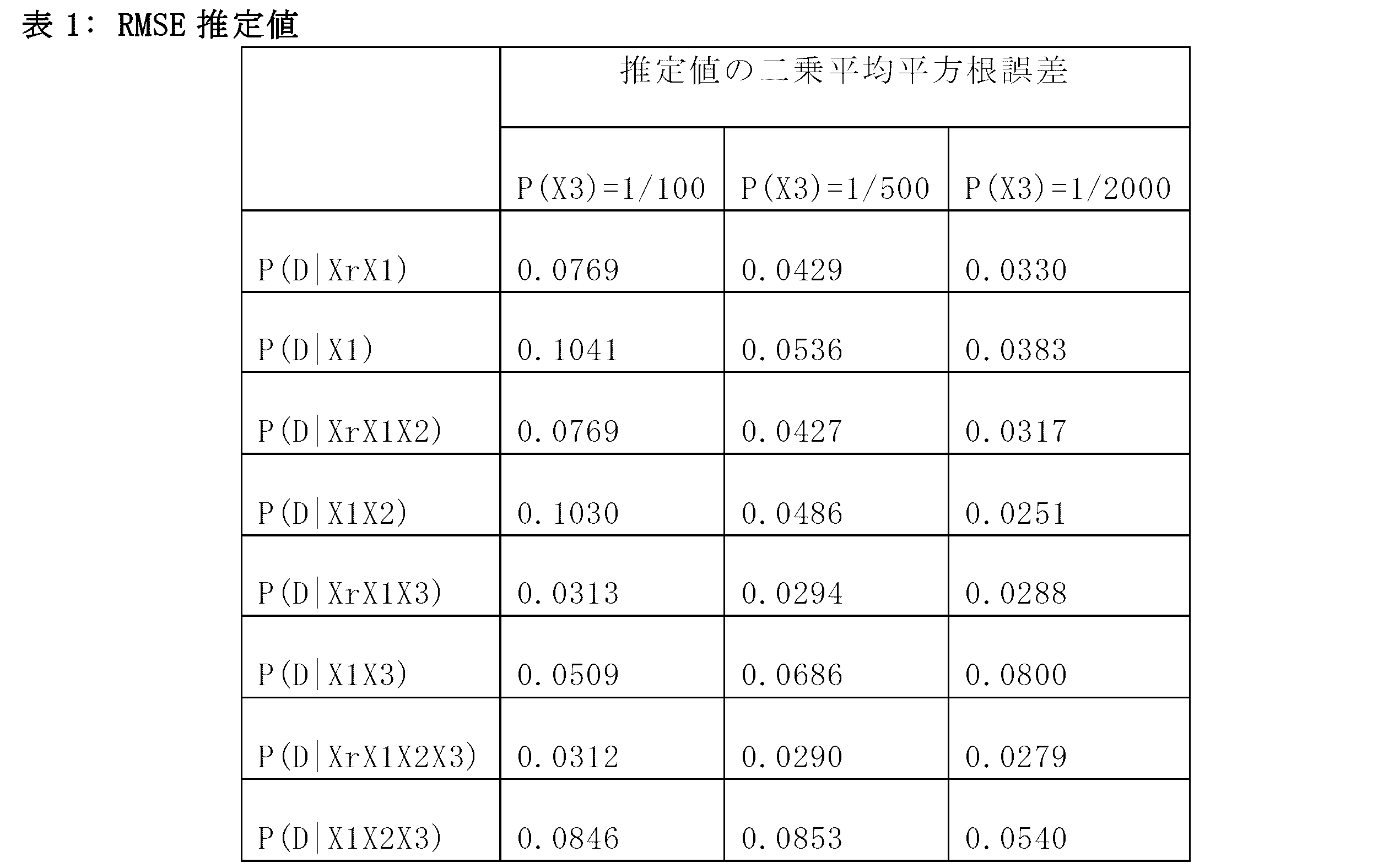
p_x3 = 1/2000; %1/100; %1/500; %1/2000; % P(X3) the probability of X3 variant in the general population
% setting up variables
% assume no denovo variants
% assume no homozygotes of variant in parents
% ph_x1 = min(roots([1 -2 p_x1])); % probability per homolog; comment out if assume no homozygotes of variant in parents
% ph_x2 = min(roots([1 -2 p_x2])); % probability per homolog; comment out if assume no homozygotes of variant in parents
% create parents
par1_vec_x1 = (rand(n,1)<p_x1); % 1 if have variant 0 if don't
par1_vec_x2 = (rand(n,1)<p_x2); % 1 if have variant 0 if don't
par1_vec_x3 = (rand(n,1)<p_x3); % 1 if have variant 0 if don't
par2_vec_x1 = (rand(n,1)<p_x1); % 1 if have variant 0 if don't
par2_vec_x2 = (rand(n,1)<p_x2); % 1 if have variant 0 if don't
par2_vec_x3 = (rand(n,1)<p_x3); % 1 if have variant 0 if don't
par1_vec_dis = (par1_vec_x1 & par1_vec_x2) | par1_vec_x3;
par2_vec_dis = (par2_vec_x1 & par2_vec_x2) | par2_vec_x3;
par_vec_dis = par1_vec_dis | par2_vec_dis;
% create children
p_inh_x1 = 0.5*par1_vec_x1 + 0.5*par2_vec_x1 - 0.25*par1_vec_x1.*par2_vec_x1;
chi_vec_x1 = (rand(n,1)<p_inh_x1);
p_inh_x2 = 0.5*par1_vec_x2 + 0.5*par2_vec_x2 - 0.25*par1_vec_x2.*par2_vec_x2;
chi_vec_x2 = (rand(n,1)<p_inh_x2);
p_inh_x3 = 0.5*par1_vec_x3 + 0.5*par2_vec_x3 - 0.25*par1_vec_x3.*par2_vec_x3;
chi_vec_x3 = (rand(n,1)<p_inh_x3);
chi_vec_dis = (chi_vec_x1 & chi_vec_x2) | chi_vec_x3; % child gets sick if either (x1 and x2) or x3
%%%% train model for phenotype using standard method: P(D/X1X2) = P(D)*P(D/X1)/P(D)*P(D/X2)/P(D)*P(D/X3)/P(D)
% just using child data for now; can do this also for parents
p_dis_h = length(find(chi_vec_dis==1))/n
chi_vec_x1e1_ind = find(chi_vec_x1==1);
p_dis_x1e1_h=length( find(chi_vec_dis(chi_vec_x1e1_ind)==1) )/length(chi_vec_x1e1_ind);
chi_vec_x1e0_ind = find(chi_vec_x1==0);
p_dis_x1e0_h=length( find(chi_vec_dis(chi_vec_x1e0_ind)==1))/length(chi_vec_x1e0_ind);
chi_vec_x2e1_ind = find(chi_vec_x2==1);
p_dis_x2e1_h=length( find(chi_vec_dis(chi_vec_x2e1_ind)==1) )/length(chi_vec_x2e1_ind);
chi_vec_x2e0_ind = find(chi_vec_x2==0);
p_dis_x2e0_h=length( find(chi_vec_dis(chi_vec_x2e0_ind)==1) )/length(chi_vec_x2e0_ind);
chi_vec_x3e1_ind = find(chi_vec_x3==1);
p_dis_x3e1_h=length( find(chi_vec_dis(chi_vec_x3e1_ind)==1) )/length(chi_vec_x3e1_ind);
chi_vec_x3e0_ind = find(chi_vec_x3==0);
p_dis_x3e0_h=length( find(chi_vec_dis(chi_vec_x3e0_ind)==1) )/length(chi_vec_x3e0_ind);
% prediction on the training data
% can also implement this on test data
p_dis_x1_h = zeros(n,1);
p_dis_x1_h(chi_vec_x1e1_ind)=p_dis_x1e1_h;
p_dis_x1_h(chi_vec_x1e0_ind)=p_dis_x1e0_h;
p_dis_x2_h = zeros(n,1);
p_dis_x2_h(chi_vec_x2e1_ind)=p_dis_x2e1_h;
p_dis_x2_h(chi_vec_x2e0_ind)=p_dis_x2e0_h;
p_dis_x3_h = zeros(n,1);
p_dis_x3_h(chi_vec_x3e1_ind)=p_dis_x3e1_h;
p_dis_x3_h(chi_vec_x3e0_ind)=p_dis_x3e0_h;
% prediction using x1 and x2
p_dis_x1x2_h = p_dis_h*(p_dis_x1_h/p_dis_h).*(p_dis_x2_h/p_dis_h);
% prediction using x1 and x3
p_dis_x1x3_h = p_dis_h*(p_dis_x1_h/p_dis_h).*(p_dis_x3_h/p_dis_h);
% prediction using x1,x2 and x3
p_dis_x1x2x3_h=p_dis_h*(p_dis_x1_h/p_dis_h).*(p_dis_x2_h/p_dis_h).*(p_dis_x3_h/p_dis_h);
%%%% train model for phenotype using relative method: P(D/Xr/X1X2) = P(D/Xr) * P(D/XrX1)/P(D/Xr) * P(D/XrX2)/P(D/Xr)
% just using child data for now to train; can train and test also for parents
par_vec_dis_ind = find(par_vec_dis==1);
p_dis_xr_h=length( find(chi_vec_dis(par_vec_dis_ind)==1) )/length(par_vec_dis_ind);
% computing P(D/XrX1) for all states
chi_vec_xre1_x1e1_ind = find(par_vec_dis==1 & chi_vec_x1==1);
p_dis_xre1_x1e1_h=length( find(chi_vec_dis(chi_vec_xre1_x1e1_ind)==1) )/length(chi_vec_xre1_x1e1_ind);
chi_vec_xre0_x1e1_ind = find(par_vec_dis==0 & chi_vec_x1==1);
p_dis_xre0_x1e1_h=length( find(chi_vec_dis(chi_vec_xre0_x1e1_ind)==1) )/length(chi_vec_xre0_x1e1_ind);
chi_vec_xre0_x1e0_ind = find(par_vec_dis==0 & chi_vec_x1==0);
p_dis_xre0_x1e0_h=length( find(chi_vec_dis(chi_vec_xre0_x1e0_ind)==1) )/length(chi_vec_xre0_x1e0_ind);
chi_vec_xre1_x1e0_ind = find(par_vec_dis==1 & chi_vec_x1==0);
p_dis_xre1_x1e0_h=length( find(chi_vec_dis(chi_vec_xre1_x1e0_ind)==1) )/length(chi_vec_xre1_x1e0_ind);
% computing P(D/XrX2) for all states
chi_vec_xre1_x2e1_ind = find(par_vec_dis==1 & chi_vec_x2==1);
p_dis_xre1_x2e1_h=length( find(chi_vec_dis(chi_vec_xre1_x2e1_ind)==1) )/length(chi_vec_xre1_x2e1_ind);
chi_vec_xre0_x2e1_ind = find(par_vec_dis==0 & chi_vec_x2==1);
p_dis_xre0_x2e1_h=length( find(chi_vec_dis(chi_vec_xre0_x2e1_ind)==1) )/length(chi_vec_xre0_x2e1_ind);
chi_vec_xre0_x2e0_ind = find(par_vec_dis==0 & chi_vec_x2==0);
p_dis_xre0_x2e0_h=length( find(chi_vec_dis(chi_vec_xre0_x2e0_ind)==1) )/length(chi_vec_xre0_x2e0_ind);
chi_vec_xre1_x2e0_ind = find(par_vec_dis==1 & chi_vec_x2==0);
p_dis_xre1_x2e0_h=length( find(chi_vec_dis(chi_vec_xre1_x2e0_ind)==1) )/length(chi_vec_xre1_x2e0_ind);
% computing P(D/XrX3) for all states
chi_vec_xre1_x3e1_ind = find(par_vec_dis==1 & chi_vec_x3==1);
p_dis_xre1_x3e1_h=length( find(chi_vec_dis(chi_vec_xre1_x3e1_ind)==1) )/length(chi_vec_xre1_x3e1_ind);
chi_vec_xre0_x3e1_ind = find(par_vec_dis==0 & chi_vec_x3==1);
p_dis_xre0_x3e1_h=length( find(chi_vec_dis(chi_vec_xre0_x3e1_ind)==1) )/length(chi_vec_xre0_x3e1_ind);
chi_vec_xre0_x3e0_ind = find(par_vec_dis==0 & chi_vec_x3==0);
p_dis_xre0_x3e0_h=length( find(chi_vec_dis(chi_vec_xre0_x3e0_ind)==1) )/length(chi_vec_xre0_x3e0_ind);
chi_vec_xre1_x3e0_ind = find(par_vec_dis==1 & chi_vec_x3==0);
p_dis_xre1_x3e0_h=length( find(chi_vec_dis(chi_vec_xre1_x3e0_ind)==1) )/length(chi_vec_xre1_x3e0_ind);
% prediction on the training data
% could also implement this on separate test data
% computing P(D/XrX1)
p_dis_xr_x1_h = zeros(n,1);
p_dis_xr_x1_h(chi_vec_xre1_x1e1_ind)=p_dis_xre1_x1e1_h;
p_dis_xr_x1_h(chi_vec_xre0_x1e1_ind)=p_dis_xre0_x1e1_h;
p_dis_xr_x1_h(chi_vec_xre0_x1e0_ind)=p_dis_xre0_x1e0_h;
p_dis_xr_x1_h(chi_vec_xre1_x1e0_ind)=p_dis_xre1_x1e0_h;
% computing P(D/XrX2)
p_dis_xr_x2_h = zeros(n,1);
p_dis_xr_x2_h(chi_vec_xre1_x2e1_ind)=p_dis_xre1_x2e1_h;
p_dis_xr_x2_h(chi_vec_xre0_x2e1_ind)=p_dis_xre0_x2e1_h;
p_dis_xr_x2_h(chi_vec_xre0_x2e0_ind)=p_dis_xre0_x2e0_h;
p_dis_xr_x2_h(chi_vec_xre1_x2e0_ind)=p_dis_xre1_x2e0_h;
% computing P(D/XrX3)
p_dis_xr_x3_h = zeros(n,1);
p_dis_xr_x3_h(chi_vec_xre1_x3e1_ind)=p_dis_xre1_x3e1_h;
p_dis_xr_x3_h(chi_vec_xre0_x3e1_ind)=p_dis_xre0_x3e1_h;
p_dis_xr_x3_h(chi_vec_xre0_x3e0_ind)=p_dis_xre0_x3e0_h;
p_dis_xr_x3_h(chi_vec_xre1_x3e0_ind)=p_dis_xre1_x3e0_h;
%%% computing key results
% prediction using xr, x1 and x2
p_dis_xrx1x2_h=p_dis_xr_h*(p_dis_xr_x1_h/p_dis_xr_h).*(p_dis_xr_x2_h/p_dis_xr_h);
% prediction using xr, x1 and x3
p_dis_xrx1x3_h=p_dis_xr_h*(p_dis_xr_x1_h/p_dis_xr_h).*(p_dis_xr_x3_h/p_dis_xr_h);
% prediction using xr, x1, x2 and x3
p_dis_xrx1x2x3_h=
p_dis_xr_h*(p_dis_xr_x1_h/p_dis_xr_h).*(p_dis_xr_x2_h/p_dis_xr_h).*(p_dis_xr_x3_h/p_dis_xr_h);
%%% plotting key results
%%raw data
disp_vec = [1:10000];
% figure; plot(chi_vec_dis(disp_vec),'b.'); hold on; plot(chi_vec_dis(disp_vec),'b');
%%prediction using xr, x1
% plot(p_dis_xr_x1_h(disp_vec),'gx');
% prediction using x1
% plot(p_dis_x1_h(disp_vec),'ro');
%%prediction using x1 and x2
% plot(p_dis_x1x2_h(disp_vec),'ro');
% prediction using xr, x1 and x2
% plot(p_dis_xrx1x2_h(disp_vec),'gx');
%%histograms using x1, x2 (and xr)
figure; hold on;
[t1,c1] = hist(chi_vec_dis); bar(c1, log10(t1),'b');
[t2,c2] = hist(p_dis_xrx1x2_h); bar(c2, log10(t2),'g');
[t3,c3] = hist(p_dis_x1x2_h); bar(c3, log10(t3),'r');
legend('Truth', 'Estimate of P(D|XrX1X2)', 'Estimate of P(D|X1X2)');
ylabel('log10(count)');
xlabel('probability estimate');
title('histogram of estimates P(D|X1X2), P(D|XrX1X2)');
grid;
%%prediction using x1 and x3
% plot(p_dis_x1x3_h,'ro');
% prediction using xr, x1 and x3
% plot(p_dis_xrx1x3_h,'gx');
% histograms using x1, x3 (and xr)
figure; hold on;
[tmp3,c3] = hist(p_dis_x1x3_h); bar(c3, log10(tmp3),'r');
[tmp1,c1] = hist(chi_vec_dis); bar(c1, log10(tmp1),'b');
[tmp2,c2] = hist(p_dis_xrx1x3_h); bar(c2, log10(tmp2),'g');
legend('Estimate of P(D|X1X3)', 'Truth', 'Estimate of P(D|XrX1X3)');
ylabel('log10(count)');
xlabel('probability estimate');
title('histogram of estimates P(D|X1X3), P(D|XrX1X3)');
grid;
%%prediction using x1, x2 and x3
% plot(p_dis_x1x2x3_h,'ro');
% prediction using xr, x1, x2 and x3
% plot(p_dis_xrx1x2x3_h,'gx');
% histograms using x1, x2, x3 (and xr)
figure; hold on;
[tm3,c3] = hist(p_dis_x1x2x3_h); bar(c3, log10(tm3),'r');
[tm2,c2] = hist(p_dis_xrx1x2x3_h); bar(c2, log10(tm2),'g');
[tm1,c1] = hist(chi_vec_dis); bar(c1, log10(tm1),'b');
legend('Estimate of P(D|X1X2X3)','Estimate of P(D|XrX1X2X3)','Truth');
ylabel('log10(count)');
xlabel('probability estimate');
title('histogram of estimates P(D|X1X2X3), P(D|XrX1X2X3)');
grid;
%%% comparing RMSE accuracy of results
% prediction using x1 (and xr)
p_dis_xr_x1_h_e = p_dis_xr_x1_h-chi_vec_dis;
p_dis_x1_h_e = p_dis_x1_h-chi_vec_dis;
p_dis_xr_x1_h_RMSE = sqrt(p_dis_xr_x1_h_e'*p_dis_xr_x1_h_e/n)
p_dis_x1_h_RMSE = sqrt(p_dis_x1_h_e'*p_dis_x1_h_e/n)
% prediction using x1 and x2 (and xr)
p_dis_xrx1x2_h_e = p_dis_xrx1x2_h-chi_vec_dis;
p_dis_x1x2_h_e = p_dis_x1x2_h-chi_vec_dis;
p_dis_xrx1x2_h_RMSE = sqrt(p_dis_xrx1x2_h_e'*p_dis_xrx1x2_h_e/n)
p_dis_x1x2_h_RMSE = sqrt(p_dis_x1x2_h_e'*p_dis_x1x2_h_e/n)
% prediction using x1, x3 (and xr)
p_dis_xrx1x3_h_e = p_dis_xrx1x3_h-chi_vec_dis;
p_dis_x1x3_h_e = p_dis_x1x3_h-chi_vec_dis;
p_dis_xrx1x3_h_RMSE = sqrt(p_dis_xrx1x3_h_e'*p_dis_xrx1x3_h_e/n)
p_dis_x1x3_h_RMSE = sqrt(p_dis_x1x3_h_e'*p_dis_x1x3_h_e/n)
% prediction using x1, x2, x3 (and xr)
p_dis_xrx1x2x3_h_e = p_dis_xrx1x2x3_h-chi_vec_dis;
p_dis_x1x2x3_h_e = p_dis_x1x2x3_h-chi_vec_dis;
p_dis_xrx1x2x3_h_RMSE = sqrt(p_dis_xrx1x2x3_h_e'*p_dis_xrx1x2x3_h_e/n)
p_dis_x1x2x3_h_RMSE = sqrt(p_dis_x1x2x3_h_e'*p_dis_x1x2x3_h_e/n)
Claims (17)
- 非メンデル表現型リスクスコアを出力するための方法であって、
第1のデータセットから、(i)2つ以上の関心のある非メンデル遺伝子を有する対象に対する遺伝子型データ及び(ii)前記関心のある非メンデル遺伝子の1つ以上を有する対象の1人以上の血縁者に対する遺伝子型データ及び表現型データを受け取る工程と、
第2のデータセットから、遺伝子型集団データ及び表現型集団データを受け取る工程であって、前記集団が2人以上の血縁者であって、前記2つ以上の関心のある非メンデル遺伝子を有する2人以上の血縁者の1つ以上のセットを含む、工程と、
前記対象に対する前記2つ以上の関心のある非メンデル遺伝子と関連がある前記表現型リスクスコアを、モデルを用いて決定する工程であって、(i)前記モデルは前記第2のデータセットを用いてトレーニングし、(ii)前記表現型リスクスコアは多遺伝子リスクスコアであり、かつ(iii)前記多遺伝子リスクスコアは、前記対象の前記1人以上の血縁者において表現型が観察されるか否かを示す前記第1のデータセットに基づく、工程と、
前記対象に対する前記2つ以上の関心のある非メンデル遺伝子に対して前記表現型リスクスコアを出力する工程と
を含む、方法。 - 前記第2のデータセットが、2人以上の血縁者の複数セットに対する遺伝子型集団データ及び表現型集団データを含む、請求項1に記載の方法。
- 前記第1のデータセット中の血縁者が、前記対象の母、父、兄弟、姉妹、息子、娘、祖父、祖母、叔母、叔父、姪、甥及び従兄弟姉妹(first cousin)のうち1人以上を含み、
前記第2のデータセットが、前記第1のデータセット中の前記対象と同じ血縁を有する2人以上の対象を含む、請求項1に記載の方法。 - (i)前記血縁者の1人以上が男性の親類である、又は(ii)前記血縁者の1人以上が女性の親類である、請求項1に記載の方法。
- 前記第1のデータセットが、前記対象の複数の血縁者に対するデータを含む、請求項1に記載の方法。
- 前記関心のある遺伝子が関心のある遺伝子変異体である、請求項1に記載の方法。
- 前記第1のデータセット及び第2のデータセットが、表現型の開始年齢と関連するデータを含む、請求項1に記載の方法。
- プロセッサと、
前記プロセッサにより実行される場合に、前記プロセッサに演算を実行させる命令を格納するための前記プロセッサと結合されるメモリと、
を含むシステムであって、前記演算が以下の処理、
第1のデータセットから、(i)1つ以上の関心のある非メンデル遺伝子を有する対象に対する遺伝子型データ及び(ii)前記対象の1人以上の血縁者に対する遺伝子型データ及び表現型データであって、前記1人以上の血縁者は前記関心のある非メンデル遺伝子のうち1つ以上を有する、遺伝子型データ及び表現型データを受け取る工程、
第2のデータセットから、遺伝子型集団データ及び表現型集団データを受け取る工程であって、前記集団が、前記1つ以上の関心のある非メンデル遺伝子を有する2人以上の血縁者の1つ以上のセットを含む、工程、
前記対象に対する前記1つ以上の関心のある非メンデル遺伝子と関連がある表現型リスクスコアを、モデルを用いて決定する工程であって、(i)前記モデルは前記第2のデータセットを用いてトレーニングし、(ii)前記表現型リスクスコアは、前記1つ以上の関心のある非メンデル遺伝子を有する前記1人以上の血縁者において表現型が観察されるか否かを示す前記第1のデータセットに基づく、工程、及び
前記対象に対する前記1つ以上の関心のある非メンデル遺伝子に対して前記表現型リスクスコアを出力する工程
を含む、システム。 - プロセッサにより実行される場合、前記プロセッサに演算を実施させる、そこに格納される命令を有する非一時的な機械可読媒体であって、前記演算が以下の処理、
第1のデータセットから、(i)1つ以上の関心のある非メンデル遺伝子を有する対象に対する遺伝子型データ及び(ii)前記対象の1人以上の血縁者に対する遺伝子型データ及び表現型データを受け取る工程であって、前記1人以上の血縁者は前記関心のある非メンデル遺伝子のうち1つ以上を有する、工程、
第2のデータセットから、遺伝子型集団データ及び表現型集団データを受け取る工程であって、前記集団が、前記1つ以上の関心のある非メンデル遺伝子を有する2人以上の血縁者の1つ以上のセットを含む、工程、
前記プロセッサによって、前記対象に対する前記1つ以上の関心のある非メンデル遺伝子と関連がある表現型リスクスコアを、モデルを用いて決定する工程であって、(i)前記モデルは前記第2のデータセットを用いてトレーニングし、(ii)前記表現型リスクスコアは、前記1つ以上の関心のある非メンデル遺伝子を有する前記1人以上の血縁者において表現型が観察されるか否かを示す前記第1のデータセットに基づく、工程、及び
前記対象に対する前記1つ以上の関心のある非メンデル遺伝子に対して前記表現型リスクスコアを出力する工程
を含む、非一時的な機械可読媒体。 - 前記第2のデータセットが、2人以上の血縁者の複数セットに対する遺伝子型集団データ及び表現型集団データを含む、請求項9に記載の非一時的な機械可読媒体。
- 前記第1のデータセット中の血縁者が、前記対象の母、父、兄弟、姉妹、息子、娘、祖父、祖母、叔母、叔父、姪、甥及び従兄弟姉妹(first cousin)のうち1人以上を含み、
前記第2のデータセットが、前記第1のデータセット中の前記対象と同じ血縁関係を有する2人以上の対象を含む、請求項9に記載の非一時的な機械可読媒体。 - (i)前記血縁者の1人以上が男性の親類である、又は(ii)前記血縁者の1人以上が女性の親類である、請求項9に記載の非一時的な機械可読媒体。
- 前記第1のデータセットが前記対象の複数の血縁者に対するデータを含む、請求項9に記載の非一時的な機械可読媒体。
- 前記関心のある遺伝子が関心のある遺伝子変異体である、請求項9に記載の非一時的な機械可読媒体。
- 前記第1のデータセット及び第2のデータセットが、表現型の開始年齢に関連するデータを含む、請求項9に記載の非一時的な機械可読媒体。
- 表現型リスクスコアを出力するための方法であって、
第1のデータセットから、(i)1つ以上の関心のある非メンデル遺伝子を有する対象に対する遺伝子型データ及び(ii)前記対象の1人以上の血縁者に対する遺伝子型データ及び表現型データを受け取る工程であって、前記1人以上の血縁者は前記関心のある非メンデル遺伝子のうち1つ以上を有する、工程と、
第2のデータセットから、遺伝子型集団データ及び表現型集団データを受け取る工程であって、前記集団が、前記1つ以上の関心のある非メンデル遺伝子を有する2人以上の血縁者の1つ以上のセットを含む、工程と、
前記対象に対する前記1つ以上の関心のある非メンデル遺伝子と関連がある前記表現型リスクスコアを、モデルを用いて決定する工程であって、(i)前記モデルは前記第2のデータセットを用いてトレーニングし、(ii)前記表現型リスクスコアは、前記1つ以上の関心のある非メンデル遺伝子を有する前記1人以上の血縁者において表現型が観察されるか否かを示す前記第1のデータセットに基づく、工程と、
前記対象に対する前記1つ以上の関心のある非メンデル遺伝子に対して前記表現型リスクスコアを出力する工程と
を含む、方法。 - 前記血縁者の表現型データが与えられたとき、前記対象におけるリスクと比較して、前記対象におけるリスクが1つ以上の関心のある非メンデル遺伝子によりどのように変化させられるかを予測するために、前記第1及び第2のデータセットにおいてモデルをトレーニングすること
を含む、請求項16に記載の方法。
Priority Applications (1)
| Application Number | Priority Date | Filing Date | Title |
|---|---|---|---|
| JP2025017755A JP2025069392A (ja) | 2019-03-19 | 2025-02-05 | 非メンデル表現型に対する遺伝学的リスクを決定するための親類の情報の使用 |
Applications Claiming Priority (3)
| Application Number | Priority Date | Filing Date | Title |
|---|---|---|---|
| US201962820286P | 2019-03-19 | 2019-03-19 | |
| US62/820,286 | 2019-03-19 | ||
| PCT/US2020/023633 WO2020191195A1 (en) | 2019-03-19 | 2020-03-19 | Using relatives' information to determine genetic risk for non-mendelian phenotypes |
Related Child Applications (1)
| Application Number | Title | Priority Date | Filing Date |
|---|---|---|---|
| JP2025017755A Division JP2025069392A (ja) | 2019-03-19 | 2025-02-05 | 非メンデル表現型に対する遺伝学的リスクを決定するための親類の情報の使用 |
Publications (3)
| Publication Number | Publication Date |
|---|---|
| JP2022525638A JP2022525638A (ja) | 2022-05-18 |
| JP2022525638A5 JP2022525638A5 (ja) | 2023-03-29 |
| JP7635995B2 true JP7635995B2 (ja) | 2025-02-26 |
Family
ID=72521208
Family Applications (2)
| Application Number | Title | Priority Date | Filing Date |
|---|---|---|---|
| JP2021556270A Active JP7635995B2 (ja) | 2019-03-19 | 2020-03-19 | 非メンデル表現型に対する遺伝学的リスクを決定するための親類の情報の使用 |
| JP2025017755A Pending JP2025069392A (ja) | 2019-03-19 | 2025-02-05 | 非メンデル表現型に対する遺伝学的リスクを決定するための親類の情報の使用 |
Family Applications After (1)
| Application Number | Title | Priority Date | Filing Date |
|---|---|---|---|
| JP2025017755A Pending JP2025069392A (ja) | 2019-03-19 | 2025-02-05 | 非メンデル表現型に対する遺伝学的リスクを決定するための親類の情報の使用 |
Country Status (5)
| Country | Link |
|---|---|
| US (1) | US20220157404A1 (ja) |
| EP (1) | EP3941338A4 (ja) |
| JP (2) | JP7635995B2 (ja) |
| CN (1) | CN113905660A (ja) |
| WO (1) | WO2020191195A1 (ja) |
Families Citing this family (1)
| Publication number | Priority date | Publication date | Assignee | Title |
|---|---|---|---|---|
| US12670994B2 (en) | 2020-10-16 | 2026-06-30 | Optum, Inc. | Machine learning techniques for generating hybrid risk scores |
Citations (5)
| Publication number | Priority date | Publication date | Assignee | Title |
|---|---|---|---|---|
| WO2005036443A1 (ja) | 2003-10-15 | 2005-04-21 | Signpost Corporation | 疾患危険度判定用遺伝子多型の決定方法、疾患危険度判定方法及び判定用アレイ |
| WO2010030929A1 (en) | 2008-09-12 | 2010-03-18 | Navigenics, Inc. | Methods and systems for incorporating multiple environmental and genetic risk factors |
| WO2016069771A1 (en) | 2014-10-28 | 2016-05-06 | Tapgenes, Inc. | Methods for determining health risks |
| US20160283484A1 (en) | 2013-10-03 | 2016-09-29 | Personalis, Inc. | Methods for analyzing genotypes |
| US20170137968A1 (en) | 2015-09-07 | 2017-05-18 | Global Gene Corporation Pte. Ltd. | Method and System for Diagnosing Disease and Generating Treatment Recommendations |
Family Cites Families (10)
| Publication number | Priority date | Publication date | Assignee | Title |
|---|---|---|---|---|
| AU8448591A (en) * | 1990-08-02 | 1992-03-02 | Michael R. Swift | Process for testing gene-disease associations |
| US20070027636A1 (en) * | 2005-07-29 | 2007-02-01 | Matthew Rabinowitz | System and method for using genetic, phentoypic and clinical data to make predictions for clinical or lifestyle decisions |
| US10790041B2 (en) * | 2011-08-17 | 2020-09-29 | 23Andme, Inc. | Method for analyzing and displaying genetic information between family members |
| US20150356243A1 (en) * | 2013-01-11 | 2015-12-10 | Oslo Universitetssykehus Hf | Systems and methods for identifying polymorphisms |
| WO2014113204A1 (en) * | 2013-01-17 | 2014-07-24 | Personalis, Inc. | Methods and systems for genetic analysis |
| AU2016256598A1 (en) * | 2015-04-27 | 2017-10-26 | Peter Maccallum Cancer Institute | Breast cancer risk assessment |
| AU2016324166A1 (en) * | 2015-09-18 | 2018-05-10 | Omicia, Inc. | Predicting disease burden from genome variants |
| WO2019169049A1 (en) * | 2018-02-28 | 2019-09-06 | Human Longevity, Inc. | Multimodal modeling systems and methods for predicting and managing dementia risk for individuals |
| CN112513295A (zh) * | 2018-06-15 | 2021-03-16 | Opti 西拉公司 | 用于预测疾病并发症和/或对治疗的反应的多基因风险评分 |
| US20200118647A1 (en) * | 2018-10-12 | 2020-04-16 | Ancestry.Com Dna, Llc | Phenotype trait prediction with threshold polygenic risk score |
-
2020
- 2020-03-19 JP JP2021556270A patent/JP7635995B2/ja active Active
- 2020-03-19 WO PCT/US2020/023633 patent/WO2020191195A1/en not_active Ceased
- 2020-03-19 EP EP20774798.1A patent/EP3941338A4/en active Pending
- 2020-03-19 US US17/440,548 patent/US20220157404A1/en active Pending
- 2020-03-19 CN CN202080033145.5A patent/CN113905660A/zh active Pending
-
2025
- 2025-02-05 JP JP2025017755A patent/JP2025069392A/ja active Pending
Patent Citations (5)
| Publication number | Priority date | Publication date | Assignee | Title |
|---|---|---|---|---|
| WO2005036443A1 (ja) | 2003-10-15 | 2005-04-21 | Signpost Corporation | 疾患危険度判定用遺伝子多型の決定方法、疾患危険度判定方法及び判定用アレイ |
| WO2010030929A1 (en) | 2008-09-12 | 2010-03-18 | Navigenics, Inc. | Methods and systems for incorporating multiple environmental and genetic risk factors |
| US20160283484A1 (en) | 2013-10-03 | 2016-09-29 | Personalis, Inc. | Methods for analyzing genotypes |
| WO2016069771A1 (en) | 2014-10-28 | 2016-05-06 | Tapgenes, Inc. | Methods for determining health risks |
| US20170137968A1 (en) | 2015-09-07 | 2017-05-18 | Global Gene Corporation Pte. Ltd. | Method and System for Diagnosing Disease and Generating Treatment Recommendations |
Non-Patent Citations (1)
| Title |
|---|
| LAUTENBACHほか,"Communicating Genetic Risk Information for Common Disorders in the Era of Genomic Medicine",Annual Review of Genomic and Human Genetics,2013年08月31日,Vol. 14,P.491-513 |
Also Published As
| Publication number | Publication date |
|---|---|
| JP2025069392A (ja) | 2025-04-30 |
| EP3941338A1 (en) | 2022-01-26 |
| EP3941338A4 (en) | 2022-12-28 |
| CN113905660A (zh) | 2022-01-07 |
| JP2022525638A (ja) | 2022-05-18 |
| US20220157404A1 (en) | 2022-05-19 |
| WO2020191195A1 (en) | 2020-09-24 |
Similar Documents
| Publication | Publication Date | Title |
|---|---|---|
| US11664126B2 (en) | Clinical predictor based on multiple machine learning models | |
| CN112888459B (zh) | 卷积神经网络系统及数据分类方法 | |
| US20220130541A1 (en) | Disease-gene prioritization method and system | |
| WO2020077232A1 (en) | Methods and systems for nucleic acid variant detection and analysis | |
| WO2019169049A1 (en) | Multimodal modeling systems and methods for predicting and managing dementia risk for individuals | |
| US20200251193A1 (en) | System and method for integrating genotypic information and phenotypic measurements for precision health assessments | |
| CA2900551A1 (en) | Systems and methods for disease associated human genomic variant analysis and reporting | |
| RU2699284C2 (ru) | Система и способ интерпретации данных и предоставления рекомендаций пользователю на основе его генетических данных и данных о составе микробиоты кишечника | |
| Anderson et al. | Personalised analytics for rare disease diagnostics | |
| US20200327957A1 (en) | Detection of deletions and copy number variations in dna sequences | |
| Wang et al. | Benchmarking omics-based prediction of asthma development in children | |
| JP2025069392A (ja) | 非メンデル表現型に対する遺伝学的リスクを決定するための親類の情報の使用 | |
| US20220180966A1 (en) | Use of gene expression data and gene signaling networks along with gene editing to determine which variants harm gene function | |
| Sebastiani et al. | Bayesian networks for genomic analysis | |
| Işık et al. | The Determination of Distinctive Single Nucleotide Polymorphism Sets for the Diagnosis of Behçet's Disease | |
| Guan et al. | Prediction of hereditary cancers using neural networks | |
| EP4589597A1 (en) | Method and apparatus for training machine learning model for removing noise in data | |
| EP4517759A1 (en) | Medical decision support system using protein and dna language models | |
| US20240371467A1 (en) | Methylation biomarker selection apparatuses and methods | |
| Gao et al. | Unsupervised ensemble learning for efficient integration of pre-trained polygenic risk scores | |
| Madahian et al. | A Bayesian approach for inducing sparsity in generalized linear models with multi-category response | |
| US20260196300A1 (en) | Determining splice sites in nucleotide sequences using conditional probabilities generated via a neural network | |
| Arulanandham et al. | Role of Data Science in Healthcare | |
| Fonseca Ferreira | Analysis of epistasis in human complex traits | |
| Duan | Unsupervised Ensemble Learning for E cient Integration of Pre-trained Polygenic Risk Scores |
Legal Events
| Date | Code | Title | Description |
|---|---|---|---|
| A521 | Request for written amendment filed |
Free format text: JAPANESE INTERMEDIATE CODE: A523 Effective date: 20230320 |
|
| A621 | Written request for application examination |
Free format text: JAPANESE INTERMEDIATE CODE: A621 Effective date: 20230320 |
|
| A131 | Notification of reasons for refusal |
Free format text: JAPANESE INTERMEDIATE CODE: A131 Effective date: 20240514 |
|
| A601 | Written request for extension of time |
Free format text: JAPANESE INTERMEDIATE CODE: A601 Effective date: 20240809 |
|
| A521 | Request for written amendment filed |
Free format text: JAPANESE INTERMEDIATE CODE: A523 Effective date: 20241011 |
|
| TRDD | Decision of grant or rejection written | ||
| A01 | Written decision to grant a patent or to grant a registration (utility model) |
Free format text: JAPANESE INTERMEDIATE CODE: A01 Effective date: 20250107 |
|
| A61 | First payment of annual fees (during grant procedure) |
Free format text: JAPANESE INTERMEDIATE CODE: A61 Effective date: 20250205 |
|
| R150 | Certificate of patent or registration of utility model |
Ref document number: 7635995 Country of ref document: JP Free format text: JAPANESE INTERMEDIATE CODE: R150 |