JP7633397B2 - Bispecific anti-VEGF and anti-TrkB binding molecules for the treatment of ocular diseases - Patents.com - Google Patents
Bispecific anti-VEGF and anti-TrkB binding molecules for the treatment of ocular diseases - Patents.com Download PDFInfo
- Publication number
- JP7633397B2 JP7633397B2 JP2023524323A JP2023524323A JP7633397B2 JP 7633397 B2 JP7633397 B2 JP 7633397B2 JP 2023524323 A JP2023524323 A JP 2023524323A JP 2023524323 A JP2023524323 A JP 2023524323A JP 7633397 B2 JP7633397 B2 JP 7633397B2
- Authority
- JP
- Japan
- Prior art keywords
- seq
- amino acid
- acid sequence
- heavy chain
- tpp
- Prior art date
- Legal status (The legal status is an assumption and is not a legal conclusion. Google has not performed a legal analysis and makes no representation as to the accuracy of the status listed.)
- Active
Links
Images





















Classifications
-
- A—HUMAN NECESSITIES
- A61—MEDICAL OR VETERINARY SCIENCE; HYGIENE
- A61P—SPECIFIC THERAPEUTIC ACTIVITY OF CHEMICAL COMPOUNDS OR MEDICINAL PREPARATIONS
- A61P27/00—Drugs for disorders of the senses
- A61P27/02—Ophthalmic agents
-
- C—CHEMISTRY; METALLURGY
- C07—ORGANIC CHEMISTRY
- C07K—PEPTIDES
- C07K16/00—Immunoglobulins [IG], e.g. monoclonal or polyclonal antibodies
- C07K16/18—Immunoglobulins [IG], e.g. monoclonal or polyclonal antibodies against material from animals or humans
- C07K16/22—Immunoglobulins [IG], e.g. monoclonal or polyclonal antibodies against material from animals or humans against growth factors ; against growth regulators
-
- C—CHEMISTRY; METALLURGY
- C07—ORGANIC CHEMISTRY
- C07K—PEPTIDES
- C07K16/00—Immunoglobulins [IG], e.g. monoclonal or polyclonal antibodies
- C07K16/18—Immunoglobulins [IG], e.g. monoclonal or polyclonal antibodies against material from animals or humans
- C07K16/28—Immunoglobulins [IG], e.g. monoclonal or polyclonal antibodies against material from animals or humans against receptors, cell surface antigens or cell surface determinants
- C07K16/2863—Immunoglobulins [IG], e.g. monoclonal or polyclonal antibodies against material from animals or humans against receptors, cell surface antigens or cell surface determinants against receptors for growth factors, growth regulators
-
- A—HUMAN NECESSITIES
- A61—MEDICAL OR VETERINARY SCIENCE; HYGIENE
- A61K—PREPARATIONS FOR MEDICAL, DENTAL OR TOILETRY PURPOSES
- A61K39/00—Medicinal preparations containing antigens or antibodies
- A61K2039/505—Medicinal preparations containing antigens or antibodies comprising antibodies
-
- C—CHEMISTRY; METALLURGY
- C07—ORGANIC CHEMISTRY
- C07K—PEPTIDES
- C07K2317/00—Immunoglobulins specific features
- C07K2317/10—Immunoglobulins specific features characterized by their source of isolation or production
- C07K2317/14—Specific host cells or culture conditions, e.g. components, pH or temperature
-
- C—CHEMISTRY; METALLURGY
- C07—ORGANIC CHEMISTRY
- C07K—PEPTIDES
- C07K2317/00—Immunoglobulins specific features
- C07K2317/20—Immunoglobulins specific features characterized by taxonomic origin
- C07K2317/24—Immunoglobulins specific features characterized by taxonomic origin containing regions, domains or residues from different species, e.g. chimeric, humanized or veneered
-
- C—CHEMISTRY; METALLURGY
- C07—ORGANIC CHEMISTRY
- C07K—PEPTIDES
- C07K2317/00—Immunoglobulins specific features
- C07K2317/30—Immunoglobulins specific features characterized by aspects of specificity or valency
-
- C—CHEMISTRY; METALLURGY
- C07—ORGANIC CHEMISTRY
- C07K—PEPTIDES
- C07K2317/00—Immunoglobulins specific features
- C07K2317/30—Immunoglobulins specific features characterized by aspects of specificity or valency
- C07K2317/31—Immunoglobulins specific features characterized by aspects of specificity or valency multispecific
-
- C—CHEMISTRY; METALLURGY
- C07—ORGANIC CHEMISTRY
- C07K—PEPTIDES
- C07K2317/00—Immunoglobulins specific features
- C07K2317/30—Immunoglobulins specific features characterized by aspects of specificity or valency
- C07K2317/35—Valency
-
- C—CHEMISTRY; METALLURGY
- C07—ORGANIC CHEMISTRY
- C07K—PEPTIDES
- C07K2317/00—Immunoglobulins specific features
- C07K2317/50—Immunoglobulins specific features characterized by immunoglobulin fragments
- C07K2317/52—Constant or Fc region; Isotype
- C07K2317/53—Hinge
-
- C—CHEMISTRY; METALLURGY
- C07—ORGANIC CHEMISTRY
- C07K—PEPTIDES
- C07K2317/00—Immunoglobulins specific features
- C07K2317/50—Immunoglobulins specific features characterized by immunoglobulin fragments
- C07K2317/54—F(ab')2
-
- C—CHEMISTRY; METALLURGY
- C07—ORGANIC CHEMISTRY
- C07K—PEPTIDES
- C07K2317/00—Immunoglobulins specific features
- C07K2317/50—Immunoglobulins specific features characterized by immunoglobulin fragments
- C07K2317/55—Fab or Fab'
-
- C—CHEMISTRY; METALLURGY
- C07—ORGANIC CHEMISTRY
- C07K—PEPTIDES
- C07K2317/00—Immunoglobulins specific features
- C07K2317/50—Immunoglobulins specific features characterized by immunoglobulin fragments
- C07K2317/56—Immunoglobulins specific features characterized by immunoglobulin fragments variable (Fv) region, i.e. VH and/or VL
- C07K2317/565—Complementarity determining region [CDR]
-
- C—CHEMISTRY; METALLURGY
- C07—ORGANIC CHEMISTRY
- C07K—PEPTIDES
- C07K2317/00—Immunoglobulins specific features
- C07K2317/60—Immunoglobulins specific features characterized by non-natural combinations of immunoglobulin fragments
- C07K2317/62—Immunoglobulins specific features characterized by non-natural combinations of immunoglobulin fragments comprising only variable region components
- C07K2317/622—Single chain antibody (scFv)
-
- C—CHEMISTRY; METALLURGY
- C07—ORGANIC CHEMISTRY
- C07K—PEPTIDES
- C07K2317/00—Immunoglobulins specific features
- C07K2317/60—Immunoglobulins specific features characterized by non-natural combinations of immunoglobulin fragments
- C07K2317/64—Immunoglobulins specific features characterized by non-natural combinations of immunoglobulin fragments comprising a combination of variable region and constant region components
-
- C—CHEMISTRY; METALLURGY
- C07—ORGANIC CHEMISTRY
- C07K—PEPTIDES
- C07K2317/00—Immunoglobulins specific features
- C07K2317/70—Immunoglobulins specific features characterized by effect upon binding to a cell or to an antigen
- C07K2317/73—Inducing cell death, e.g. apoptosis, necrosis or inhibition of cell proliferation
-
- C—CHEMISTRY; METALLURGY
- C07—ORGANIC CHEMISTRY
- C07K—PEPTIDES
- C07K2317/00—Immunoglobulins specific features
- C07K2317/70—Immunoglobulins specific features characterized by effect upon binding to a cell or to an antigen
- C07K2317/75—Agonist effect on antigen
-
- C—CHEMISTRY; METALLURGY
- C07—ORGANIC CHEMISTRY
- C07K—PEPTIDES
- C07K2317/00—Immunoglobulins specific features
- C07K2317/70—Immunoglobulins specific features characterized by effect upon binding to a cell or to an antigen
- C07K2317/76—Antagonist effect on antigen, e.g. neutralization or inhibition of binding
-
- C—CHEMISTRY; METALLURGY
- C07—ORGANIC CHEMISTRY
- C07K—PEPTIDES
- C07K2317/00—Immunoglobulins specific features
- C07K2317/90—Immunoglobulins specific features characterized by (pharmaco)kinetic aspects or by stability of the immunoglobulin
- C07K2317/92—Affinity (KD), association rate (Ka), dissociation rate (Kd) or EC50 value
Landscapes
- Health & Medical Sciences (AREA)
- Chemical & Material Sciences (AREA)
- Organic Chemistry (AREA)
- Medicinal Chemistry (AREA)
- Immunology (AREA)
- General Health & Medical Sciences (AREA)
- Life Sciences & Earth Sciences (AREA)
- Proteomics, Peptides & Aminoacids (AREA)
- Biochemistry (AREA)
- Molecular Biology (AREA)
- Genetics & Genomics (AREA)
- Biophysics (AREA)
- Bioinformatics & Cheminformatics (AREA)
- Pharmacology & Pharmacy (AREA)
- Public Health (AREA)
- Veterinary Medicine (AREA)
- Engineering & Computer Science (AREA)
- Animal Behavior & Ethology (AREA)
- Chemical Kinetics & Catalysis (AREA)
- Nuclear Medicine, Radiotherapy & Molecular Imaging (AREA)
- General Chemical & Material Sciences (AREA)
- Ophthalmology & Optometry (AREA)
- Peptides Or Proteins (AREA)
- Micro-Organisms Or Cultivation Processes Thereof (AREA)
- Medicines Containing Antibodies Or Antigens For Use As Internal Diagnostic Agents (AREA)
- Preparation Of Compounds By Using Micro-Organisms (AREA)
- Medicines That Contain Protein Lipid Enzymes And Other Medicines (AREA)
- Pharmaceuticals Containing Other Organic And Inorganic Compounds (AREA)
Description
発明の分野
本発明は、血管内皮増殖因子(VEGF)及びトロポミオシンレセプターキナーゼB(TrkB)に結合する結合分子並びに医薬におけるその使用、それを含む医薬組成物並びに眼の疾患の治療及び/又は予防のための薬剤としてそれを使用する方法に関する。
FIELD OF THEINVENTION The present invention relates to binding molecules which bind to vascular endothelial growth factor (VEGF) and tropomyosin receptor kinase B (TrkB) and to their use in medicine, pharmaceutical compositions containing same and methods of their use as medicaments for the treatment and/or prevention of eye diseases.
発明の背景
黄斑変性症、特に、加齢黄斑変性症(AMD)は、先進諸国における失明の主な原因である。その進行期は、滲出性新生血管AMDと萎縮型地図状萎縮(GA)とに分けられる。wAMDは、眼の新生血管形成及び血管漏出の増加並びに進行性神経変性及び光レセプター喪失を特徴とする。抗VEGF処置は、この疾患のための現在の標準治療である。治療は、典型的には、VEGFをターゲットとする薬剤(Avastin、Lucentis、Eylea及び近年は、Beovu)からなり、これらは、眼の後部に注射により投与される。
Background of the invention Macular degeneration, particularly age-related macular degeneration (AMD), is the leading cause of blindness in developed countries. Its advanced stages are divided into wet neovascular AMD and dry geographic atrophy (GA). wAMD is characterized by increased ocular neovascularization and vascular leakage as well as progressive neurodegeneration and photoreceptor loss. Anti-VEGF treatment is the current standard of care for this disease. Treatment typically consists of drugs that target VEGF (Avastin, Lucentis, Eylea, and more recently, Beovu), which are administered by injection into the back of the eye.
VEGF捕捉により、血管漏出が低減し、それにより、最初は視力が改善されるが、網膜は、損なわれた状態のままであり、更なる細胞喪失をもたらす。過去10年間、wAMDに対しては、硝子体内抗VEGFによる画期的な処置が行われてきたが、最終的に失明にいたる緩徐進行性疾患である地図状萎縮に対しては処置の選択肢が存在しない。 VEGF sequestration reduces vascular leakage, which initially improves vision, but the retina remains compromised, leading to further cell loss. Although intravitreal anti-VEGF therapy has been a breakthrough for wAMD over the past decade, no treatment options exist for geographic atrophy, a slowly progressive disease that ultimately leads to blindness.
wAMD診断後2年以内に、抗VEGF処置が成功したにもかかわらず、患者のほぼ3分の1が、進行性地図状萎縮を発症する。進行性視覚障害に関連するのは後期段階である。患者は、視力と自立性とを失うことになる。彼らの日常生活は、運転、読書、テレビの視聴、顔の認識ができないことにより深刻な影響を受ける。wAMD患者は、多くの場合、現実の環境において処置を受けておらず、頻繁な硝子体内注射のために医院に戻る必要がある。 Within two years of wAMD diagnosis, nearly one-third of patients develop progressive geographic atrophy despite successful anti-VEGF treatment. It is the later stages that are associated with progressive visual impairment. Patients lose vision and independence. Their daily life is severely affected by the inability to drive, read, watch television, and recognize faces. wAMD patients are often not treated in the real-world environment and must return to the clinic for frequent intravitreal injections.
現在、wAMD中に発症した地理状萎縮を含む、あらゆるタイプの地理状萎縮に利用可能な処置は存在しない。さらに、より頻繁な抗VEGF処置が、より高い割合の地理状萎縮発症に関連する場合があるという幾つかの証拠が存在する。 Currently, there is no treatment available for any type of geographic atrophy, including that which occurs during wAMD. Furthermore, there is some evidence that more frequent anti-VEGF treatments may be associated with a higher rate of geographic atrophy development.
したがって、抗VEGF処置において頻繁に使用することができ、一方で同時に、同時進行する地理状萎縮発症のリスクを軽減する、新規な治療用生物学的分子を提供するための、満たされていない高い必要性が存在する。 Therefore, there is a high unmet need to provide novel therapeutic biological molecules that can be frequently used in anti-VEGF treatments while at the same time reducing the risk of concurrent geographic atrophy development.
発明の概要
本発明は、単一の結合分子内で、血管内皮増殖因子(VEGF)に特異的に結合する抗原結合部位と、トロポミオシンレセプターキナーゼB(TrkB)に特異的に結合する抗原結合部位とを組み合わせるという概念に基づいている。
SUMMARY OF THEINVENTION The present invention is based on the concept of combining, in a single binding molecule, an antigen-binding site that specifically binds vascular endothelial growth factor (VEGF) and an antigen-binding site that specifically binds tropomyosin receptor kinase B (TrkB).
第1の態様では、本発明は、血管内皮増殖因子(VEGF)に特異的に結合する少なくとも1つの抗原結合部位と、トロポミオシンレセプターキナーゼB(TrkB)に特異的に結合する少なくとも1つの抗原結合部位とを含む、結合分子に関する。第1の態様に関する一実施態様では、結合分子は、二重特異性かつ四価である。第1の態様又はその実施態様のいずれかの結合分子に関する更なる実施態様では、VEGFに特異的に結合する少なくとも1つの抗原結合部位は、免疫グロブリン(Ig)分子である。第1の態様又はその実施態様のいずれかの結合分子に関する更なる実施態様では、TrkBに特異的に結合する少なくとも1つの抗原結合部位は、Ig分子の重鎖のC末端に融合している。第1の態様又はその実施態様のいずれかの結合分子に関する更なる実施態様では、TrkBに特異的に結合する少なくとも1つの抗原結合部位は、1つ以上のscFvを含む。第1の態様又はその実施態様のいずれかの結合分子に関する更なる実施態様では、VEGFに特異的に結合する少なくとも1つの抗原結合部位は、免疫グロブリン(Ig)分子であり、TrkBに特異的に結合する少なくとも1つの抗原結合部位が、1つ以上のscFvを含む。関連する実施態様では、1つ以上のscFvは、N末端からC末端へのVL-VH配向を有する。さらに別の関連する実施態様では、1つ以上のscFvは、Ig分子の重鎖のC末端に融合している。第1の態様又はその実施態様のいずれかの結合分子に関する更なる実施態様では、Ig分子は、モノクローナル抗体、ヒトモノクローナル抗体、ヒト化モノクローナル抗体、キメラ抗体、(scFv)2又は抗体のフラグメント、例えば、F(ab’)2フラグメントである。第1の態様又はその実施態様のいずれかの結合分子に関する更なる実施態様では、Ig分子は、IgG又はF(ab’)2である。第1の態様又はその実施態様のいずれかの結合分子に関する別の更なる実施態様では、1つ以上のscFvは、ペプチドリンカー、好ましくは、約4~20個のアミノ酸の長さを有するペプチドリンカーによりIg分子に融合している。 In a first aspect, the invention relates to a binding molecule comprising at least one antigen-binding site that specifically binds to vascular endothelial growth factor (VEGF) and at least one antigen-binding site that specifically binds to tropomyosin receptor kinase B (TrkB). In one embodiment of the first aspect, the binding molecule is bispecific and tetravalent. In a further embodiment of the binding molecule of the first aspect or any of its embodiments, the at least one antigen-binding site that specifically binds to VEGF is an immunoglobulin (Ig) molecule. In a further embodiment of the binding molecule of the first aspect or any of its embodiments, the at least one antigen-binding site that specifically binds to TrkB is fused to the C-terminus of the heavy chain of the Ig molecule. In a further embodiment of the binding molecule of the first aspect or any of its embodiments, the at least one antigen-binding site that specifically binds to TrkB comprises one or more scFvs. In a further embodiment of the binding molecule of the first aspect or any of its embodiments, the at least one antigen-binding site that specifically binds VEGF is an immunoglobulin (Ig) molecule and the at least one antigen-binding site that specifically binds TrkB comprises one or more scFvs. In a related embodiment, the one or more scFvs have a VL-VH orientation from N-terminus to C-terminus. In yet another related embodiment, the one or more scFvs are fused to the C-terminus of a heavy chain of the Ig molecule. In a further embodiment of the binding molecule of the first aspect or any of its embodiments, the Ig molecule is a monoclonal antibody, a human monoclonal antibody, a humanized monoclonal antibody, a chimeric antibody, a (scFv) 2 or a fragment of an antibody, such as a F(ab')2 fragment. In a further embodiment of the binding molecule of the first aspect or any of its embodiments, the Ig molecule is an IgG or a F(ab')2. In another further embodiment of the binding molecule of the first aspect or any of its embodiments, one or more scFvs are fused to the Ig molecule by a peptide linker, preferably a peptide linker having a length of about 4-20 amino acids.
第1の態様又はその実施態様のいずれかの結合分子に関する更なる実施態様では、TrkBに特異的に結合する抗原結合部位は、
a)配列番号:201(CDR1)、配列番号:202(CDR2)及び配列番号:203(CDR3)のアミノ酸配列を含む軽鎖CDRを含む抗原結合部位並びに
配列番号:204(CDR1)、配列番号:205(CDR2)及び配列番号:206(CDR3)のアミノ酸配列を含む重鎖CDRを含む抗原結合部位又は
配列番号:207(CDR1)、配列番号:208(CDR2)及び配列番号:209(CDR3)のアミノ酸配列を含む重鎖CDRを含む抗原結合部位又は
配列番号:210(CDR1)、配列番号:211(CDR2)及び配列番号:212(CDR3)のアミノ酸配列を含む重鎖CDRを含む抗原結合部位
から選択される。
In a further embodiment of the binding molecule of the first aspect or any of its embodiments, the antigen-binding site that specifically binds to TrkB comprises:
a) an antigen-binding site comprising light chain CDRs comprising the amino acid sequences of SEQ ID NO:201 (CDR1), SEQ ID NO:202 (CDR2) and SEQ ID NO:203 (CDR3); and an antigen-binding site comprising heavy chain CDRs comprising the amino acid sequences of SEQ ID NO:204 (CDR1), SEQ ID NO:205 (CDR2) and SEQ ID NO:206 (CDR3); or an antigen-binding site comprising heavy chain CDRs comprising the amino acid sequences of SEQ ID NO:207 (CDR1), SEQ ID NO:208 (CDR2) and SEQ ID NO:209 (CDR3); or an antigen-binding site comprising heavy chain CDRs comprising the amino acid sequences of SEQ ID NO:210 (CDR1), SEQ ID NO:211 (CDR2) and SEQ ID NO:212 (CDR3).
第1の態様又はその実施態様のいずれかの結合分子に関する更なる実施態様では、TrkBに特異的に結合する抗原結合部位は、
a)配列番号:213又は215のアミノ酸配列と少なくとも80%、81%、82%、83%、84%、85%、86%、87%、88%、89%、90%、91%、92%、93%、94%、95%、96%、97%、98%又は少なくとも99%同一のアミノ酸配列を含む軽鎖可変ドメインと、配列番号:214又は216のアミノ酸配列と少なくとも80%、81%、82%、83%、84%、85%、86%、87%、88%、89%、90%、91%、92%、93%、94%、95%、96%、97%、98%又は少なくとも99%同一のアミノ酸配列を含む重鎖可変ドメインとを含む抗原結合部位
から選択される。
In a further embodiment of the binding molecule of the first aspect or any of its embodiments, the antigen-binding site that specifically binds to TrkB comprises:
a) an antigen-binding site comprising a light chain variable domain comprising an amino acid sequence at least 80%, 81%, 82%, 83%, 84%, 85%, 86%, 87%, 88%, 89%, 90%, 91%, 92%, 93%, 94%, 95%, 96%, 97%, 98% or at least 99% identical to the amino acid sequence of SEQ ID NO: 213 or 215, and a heavy chain variable domain comprising an amino acid sequence at least 80%, 81%, 82%, 83%, 84%, 85%, 86%, 87%, 88%, 89%, 90%, 91%, 92%, 93%, 94%, 95%, 96%, 97%, 98% or at least 99% identical to the amino acid sequence of SEQ ID NO: 214 or 216.
第1の態様又はその実施態様のいずれかの結合分子に関する更なる実施態様では、結合分子は、配列番号:222のアミノ酸配列又は配列番号:223のアミノ酸配列又は配列番号:224のアミノ酸配列又は配列番号:225のアミノ酸配列を含む。 In a further embodiment of the binding molecule of the first aspect or any of its embodiments, the binding molecule comprises the amino acid sequence of SEQ ID NO:222 or the amino acid sequence of SEQ ID NO:223 or the amino acid sequence of SEQ ID NO:224 or the amino acid sequence of SEQ ID NO:225.
第1の態様又はその実施態様のいずれかの結合分子に関する更なる実施態様では、VEGFに特異的に結合する抗原結合部位は、抗原結合部位a)~c):
a)配列番号:145(CDR1)、配列番号:146(CDR2)及び配列番号:147(CDR3)のアミノ酸配列を含む軽鎖CDRを含む抗原結合部位並びに
配列番号:148(CDR1)、配列番号:149(CDR2)及び配列番号:150(CDR3)のアミノ酸配列を含む重鎖CDRを含む抗原結合部位又は
配列番号:151(CDR1)、配列番号:152(CDR2)及び配列番号:153(CDR3)のアミノ酸配列を含む重鎖CDRを含む抗原結合部位又は
配列番号:154(CDR1)、配列番号:155(CDR2)及び配列番号:156(CDR3)のアミノ酸配列を含む重鎖CDRを含む抗原結合部位;
b)配列番号:157(CDR1)、配列番号:158(CDR2)及び配列番号:159(CDR3)のアミノ酸配列を含む軽鎖CDRを含む抗原結合部位並びに
配列番号:160(CDR1)、配列番号:161(CDR2)及び配列番号:162(CDR3)のアミノ酸配列を含む重鎖CDRを含む抗原結合部位又は
配列番号:163(CDR1)、配列番号:164(CDR2)及び配列番号:165(CDR3)のアミノ酸配列を含む重鎖CDRを含む抗原結合部位又は
配列番号:166(CDR1)、配列番号:167(CDR2)及び配列番号:168(CDR3)のアミノ酸配列を含む重鎖CDRを含む抗原結合部位;
c)配列番号:169(CDR1)、配列番号:170(CDR2)及び配列番号:171(CDR3)のアミノ酸配列を含む軽鎖CDRを含む抗原結合部位並びに
配列番号:172(CDR1)、配列番号:173(CDR2)及び配列番号:174(CDR3)のアミノ酸配列を含む重鎖CDRを含む抗原結合部位又は
配列番号:175(CDR1)、配列番号:176(CDR2)及び配列番号:177(CDR3)のアミノ酸配列を含む重鎖CDRを含む抗原結合部位又は
配列番号:178(CDR1)、配列番号:179(CDR2)及び配列番号:180(CDR3)のアミノ酸配列を含む重鎖CDRを含む抗原結合部位
からなる群より選択される。
In a further embodiment of the binding molecule of the first aspect or any of its embodiments, the antigen-binding site that specifically binds to VEGF comprises antigen-binding sites a) to c):
a) an antigen-binding site comprising light chain CDRs comprising the amino acid sequences of SEQ ID NO: 145 (CDR1), SEQ ID NO: 146 (CDR2) and SEQ ID NO: 147 (CDR3) and an antigen-binding site comprising heavy chain CDRs comprising the amino acid sequences of SEQ ID NO: 148 (CDR1), SEQ ID NO: 149 (CDR2) and SEQ ID NO: 150 (CDR3), or an antigen-binding site comprising heavy chain CDRs comprising the amino acid sequences of SEQ ID NO: 151 (CDR1), SEQ ID NO: 152 (CDR2) and SEQ ID NO: 153 (CDR3), or an antigen-binding site comprising heavy chain CDRs comprising the amino acid sequences of SEQ ID NO: 154 (CDR1), SEQ ID NO: 155 (CDR2) and SEQ ID NO: 156 (CDR3);
b) an antigen-binding site comprising light chain CDRs comprising the amino acid sequences of SEQ ID NO: 157 (CDR1), SEQ ID NO: 158 (CDR2) and SEQ ID NO: 159 (CDR3) and an antigen-binding site comprising heavy chain CDRs comprising the amino acid sequences of SEQ ID NO: 160 (CDR1), SEQ ID NO: 161 (CDR2) and SEQ ID NO: 162 (CDR3), or an antigen-binding site comprising heavy chain CDRs comprising the amino acid sequences of SEQ ID NO: 163 (CDR1), SEQ ID NO: 164 (CDR2) and SEQ ID NO: 165 (CDR3), or an antigen-binding site comprising heavy chain CDRs comprising the amino acid sequences of SEQ ID NO: 166 (CDR1), SEQ ID NO: 167 (CDR2) and SEQ ID NO: 168 (CDR3);
c) an antigen-binding site comprising a light chain CDR comprising the amino acid sequences of SEQ ID NO: 169 (CDR1), SEQ ID NO: 170 (CDR2) and SEQ ID NO: 171 (CDR3); and an antigen-binding site comprising a heavy chain CDR comprising the amino acid sequences of SEQ ID NO: 172 (CDR1), SEQ ID NO: 173 (CDR2) and SEQ ID NO: 174 (CDR3); or an antigen-binding site comprising a heavy chain CDR comprising the amino acid sequences of SEQ ID NO: 175 (CDR1), SEQ ID NO: 176 (CDR2) and SEQ ID NO: 177 (CDR3); or an antigen-binding site comprising a heavy chain CDR comprising the amino acid sequences of SEQ ID NO: 178 (CDR1), SEQ ID NO: 179 (CDR2) and SEQ ID NO: 180 (CDR3).
第1の態様又はその実施態様のいずれかの結合分子に関する更なる実施態様では、VEGFに特異的に結合する抗原結合部位は、抗原結合部位a)~d):
a)配列番号:181のアミノ酸配列と少なくとも80%、81%、82%、83%、84%、85%、86%、87%、88%、89%、90%、91%、92%、93%、94%、95%、96%、97%、98%又は少なくとも99%同一のアミノ酸配列を含む軽鎖可変ドメインと、配列番号:182のアミノ酸配列と少なくとも80%、81%、82%、83%、84%、85%、86%、87%、88%、89%、90%、91%、92%、93%、94%、95%、96%、97%、98%又は少なくとも99%同一のアミノ酸配列を含む重鎖可変ドメインとを含む抗原結合部位;
b)配列番号:183のアミノ酸配列と少なくとも80%、81%、82%、83%、84%、85%、86%、87%、88%、89%、90%、91%、92%、93%、94%、95%、96%、97%、98%又は少なくとも99%同一のアミノ酸配列を含む軽鎖可変ドメインと、配列番号:184のアミノ酸配列と少なくとも80%、81%、82%、83%、84%、85%、86%、87%、88%、89%、90%、91%、92%、93%、94%、95%、96%、97%、98%又は少なくとも99%同一のアミノ酸配列を含む重鎖可変ドメインとを含む抗原結合部位;
c)配列番号:189のアミノ酸配列と少なくとも80%、81%、82%、83%、84%、85%、86%、87%、88%、89%、90%、91%、92%、93%、94%、95%、96%、97%、98%又は少なくとも99%同一のアミノ酸配列を含む軽鎖可変ドメインと、配列番号:190、191、192又は194のアミノ酸配列と少なくとも80%、81%、82%、83%、84%、85%、86%、87%、88%、89%、90%、91%、92%、93%、94%、95%、96%、97%、98%又は少なくとも99%同一のアミノ酸配列を含む重鎖可変ドメインとを含む抗原結合部位;
d)配列番号:193のアミノ酸配列と少なくとも80%、81%、82%、83%、84%、85%、86%、87%、88%、89%、90%、91%、92%、93%、94%、95%、96%、97%、98%又は少なくとも99%同一のアミノ酸配列を含む軽鎖可変ドメインと、配列番号:190、191、192又は194のアミノ酸配列と少なくとも80%、81%、82%、83%、84%、85%、86%、87%、88%、89%、90%、91%、92%、93%、94%、95%、96%、97%、98%又は少なくとも99%同一のアミノ酸配列を含む重鎖可変ドメインとを含む抗原結合部位
からなる群より選択される。
In a further embodiment of the binding molecule of the first aspect or any of its embodiments, the antigen-binding site that specifically binds to VEGF comprises antigen-binding sites a) to d):
a) an antigen-binding site comprising a light chain variable domain comprising an amino acid sequence at least 80%, 81%, 82%, 83%, 84%, 85%, 86%, 87%, 88%, 89%, 90%, 91%, 92%, 93%, 94%, 95%, 96%, 97%, 98% or at least 99% identical to the amino acid sequence of SEQ ID NO: 181, and a heavy chain variable domain comprising an amino acid sequence at least 80%, 81%, 82%, 83%, 84%, 85%, 86%, 87%, 88%, 89%, 90%, 91%, 92%, 93%, 94%, 95%, 96%, 97%, 98% or at least 99% identical to the amino acid sequence of SEQ ID NO: 182;
b) an antigen-binding site comprising a light chain variable domain comprising an amino acid sequence at least 80%, 81%, 82%, 83%, 84%, 85%, 86%, 87%, 88%, 89%, 90%, 91%, 92%, 93%, 94%, 95%, 96%, 97%, 98% or at least 99% identical to the amino acid sequence of SEQ ID NO: 183, and a heavy chain variable domain comprising an amino acid sequence at least 80%, 81%, 82%, 83%, 84%, 85%, 86%, 87%, 88%, 89%, 90%, 91%, 92%, 93%, 94%, 95%, 96%, 97%, 98% or at least 99% identical to the amino acid sequence of SEQ ID NO: 184;
c) an antigen-binding site comprising a light chain variable domain comprising an amino acid sequence at least 80%, 81%, 82%, 83%, 84%, 85%, 86%, 87%, 88%, 89%, 90%, 91%, 92%, 93%, 94%, 95%, 96%, 97%, 98% or at least 99% identical to the amino acid sequence of SEQ ID NO: 189, and a heavy chain variable domain comprising an amino acid sequence at least 80%, 81%, 82%, 83%, 84%, 85%, 86%, 87%, 88%, 89%, 90%, 91%, 92%, 93%, 94%, 95%, 96%, 97%, 98% or at least 99% identical to the amino acid sequence of SEQ ID NO: 190, 191, 192 or 194;
d) an antigen-binding site comprising a light chain variable domain comprising an amino acid sequence at least 80%, 81%, 82%, 83%, 84%, 85%, 86%, 87%, 88%, 89%, 90%, 91%, 92%, 93%, 94%, 95%, 96%, 97%, 98% or at least 99% identical to the amino acid sequence of SEQ ID NO: 193; and a heavy chain variable domain comprising an amino acid sequence at least 80%, 81%, 82%, 83%, 84%, 85%, 86%, 87%, 88%, 89%, 90%, 91%, 92%, 93%, 94%, 95%, 96%, 97%, 98% or at least 99% identical to the amino acid sequence of SEQ ID NO: 190, 191, 192 or 194.
第1の態様又はその実施態様のいずれかの結合分子に関する更なる実施態様では、VEGFに特異的に結合する抗原結合部位は、抗原結合部位a)~d):
a)配列番号:185のアミノ酸配列と少なくとも80%、81%、82%、83%、84%、85%、86%、87%、88%、89%、90%、91%、92%、93%、94%、95%、96%、97%、98%又は少なくとも99%同一のアミノ酸配列を含む軽鎖と、配列番号:186のアミノ酸配列と少なくとも80%、81%、82%、83%、84%、85%、86%、87%、88%、89%、90%、91%、92%、93%、94%、95%、96%、97%、98%又は少なくとも99%同一のアミノ酸配列を含む重鎖とを含む抗原結合部位;
b)配列番号:187のアミノ酸配列と少なくとも80%、81%、82%、83%、84%、85%、86%、87%、88%、89%、90%、91%、92%、93%、94%、95%、96%、97%、98%又は少なくとも99%同一のアミノ酸配列を含む軽鎖と、配列番号:188のアミノ酸配列と少なくとも80%、81%、82%、83%、84%、85%、86%、87%、88%、89%、90%、91%、92%、93%、94%、95%、96%、97%、98%又は少なくとも99%同一のアミノ酸配列を含む重鎖とを含む抗原結合部位;
c)配列番号:195のアミノ酸配列と少なくとも80%、81%、82%、83%、84%、85%、86%、87%、88%、89%、90%、91%、92%、93%、94%、95%、96%、97%、98%又は少なくとも99%同一のアミノ酸配列を含む軽鎖と、配列番号:196、197、198又は200のアミノ酸配列と少なくとも80%、81%、82%、83%、84%、85%、86%、87%、88%、89%、90%、91%、92%、93%、94%、95%、96%、97%、98%又は少なくとも99%同一のアミノ酸配列を含む重鎖とを含む抗原結合部位;
d)配列番号:199のアミノ酸配列と少なくとも80%、81%、82%、83%、84%、85%、86%、87%、88%、89%、90%、91%、92%、93%、94%、95%、96%、97%、98%又は少なくとも99%同一のアミノ酸配列を含む軽鎖と、配列番号:196、197、198又は200のアミノ酸配列と少なくとも80%、81%、82%、83%、84%、85%、86%、87%、88%、89%、90%、91%、92%、93%、94%、95%、96%、97%、98%又は少なくとも99%同一のアミノ酸配列を含む重鎖とを含む抗原結合部位
からなる群より選択される。
In a further embodiment of the binding molecule of the first aspect or any of its embodiments, the antigen-binding site that specifically binds to VEGF comprises antigen-binding sites a) to d):
a) an antigen-binding site comprising a light chain comprising an amino acid sequence at least 80%, 81%, 82%, 83%, 84%, 85%, 86%, 87%, 88%, 89%, 90%, 91%, 92%, 93%, 94%, 95%, 96%, 97%, 98% or at least 99% identical to the amino acid sequence of SEQ ID NO: 185, and a heavy chain comprising an amino acid sequence at least 80%, 81%, 82%, 83%, 84%, 85%, 86%, 87%, 88%, 89%, 90%, 91%, 92%, 93%, 94%, 95%, 96%, 97%, 98% or at least 99% identical to the amino acid sequence of SEQ ID NO: 186;
b) an antigen-binding site comprising a light chain comprising an amino acid sequence at least 80%, 81%, 82%, 83%, 84%, 85%, 86%, 87%, 88%, 89%, 90%, 91%, 92%, 93%, 94%, 95%, 96%, 97%, 98% or at least 99% identical to the amino acid sequence of SEQ ID NO: 187, and a heavy chain comprising an amino acid sequence at least 80%, 81%, 82%, 83%, 84%, 85%, 86%, 87%, 88%, 89%, 90%, 91%, 92%, 93%, 94%, 95%, 96%, 97%, 98% or at least 99% identical to the amino acid sequence of SEQ ID NO: 188;
c) an antigen-binding site comprising a light chain comprising an amino acid sequence at least 80%, 81%, 82%, 83%, 84%, 85%, 86%, 87%, 88%, 89%, 90%, 91%, 92%, 93%, 94%, 95%, 96%, 97%, 98% or at least 99% identical to the amino acid sequence of SEQ ID NO: 195, and a heavy chain comprising an amino acid sequence at least 80%, 81%, 82%, 83%, 84%, 85%, 86%, 87%, 88%, 89%, 90%, 91%, 92%, 93%, 94%, 95%, 96%, 97%, 98% or at least 99% identical to the amino acid sequence of SEQ ID NO: 196, 197, 198 or 200;
d) an antigen-binding site comprising a light chain comprising an amino acid sequence at least 80%, 81%, 82%, 83%, 84%, 85%, 86%, 87%, 88%, 89%, 90%, 91%, 92%, 93%, 94%, 95%, 96%, 97%, 98% or at least 99% identical to the amino acid sequence of SEQ ID NO: 199; and a heavy chain comprising an amino acid sequence at least 80%, 81%, 82%, 83%, 84%, 85%, 86%, 87%, 88%, 89%, 90%, 91%, 92%, 93%, 94%, 95%, 96%, 97%, 98% or at least 99% identical to the amino acid sequence of SEQ ID NO: 196, 197, 198 or 200.
第2の態様では、本発明は、配列番号:1、3、5、7、9、11、13、15、17、19、21、23、25、27、29、31、33、35、37、39、41、43、45、47、49、51、53、55、57、59、61、63、65、67、69、71、73、75、77、79、81、83、85、87、89、91、93、95、97、99、101、103、105、107、109、111、113、115、117、119、121、123、125、127、129、131、133、135、137、139、141又は143のアミノ酸配列と少なくとも80%、81%、82%、83%、84%、85%、86%、87%、88%、89%、90%、91%、92%、93%、94%、95%、96%、97%、98%又は少なくとも99%同一のアミノ酸配列を含む軽鎖と、配列番号:2、4、6、8、10、12、14、16、18、20、22、24、26、28、30、32、34、36、38、40、42、44、46、48、50、52、54、56、58、60、62、64、66、68、70、72、74、76、78、80、82、84、86、88、90、92、94、96、98、100、102,104、106、108、110、112、114、116、118、120、122、124、126、128、130、132、134、136、138、140、142又は144のアミノ酸配列と少なくとも80%、81%、82%、83%、84%、85%、86%、87%、88%、89%、90%、91%、92%、93%、94%、95%、96%、97%、98%又は少なくとも99%同一のアミノ酸配列を含む重鎖とを含む、結合分子に関する。 In a second aspect, the present invention provides a method for the preparation of a medicament comprising the steps of: SEQ ID NO: 1, 3, 5, 7, 9, 11, 13, 15, 17, 19, 21, 23, 25, 27, 29, 31, 33, 35, 37, 39, 41, 43, 45, 47, 49, 51, 53, 55, 57, 59, 61, 63, 65, 67, 69, 71, 73, 75, 77, 79, 81, 83, 85, 87, 89, 91, 93, 95, 97, 99, 101, 103, 105, 107, 109 , 111, 113, 115, 117, 119, 121, 123, 125, 127, 129, 131, 133, 135, 137, 139, 141 or 143; and SEQ ID NO: 2, 4, 6, 8, 10, 12, 14, 16, 18, 20, 22, 24, 26, 28, 30, 32, 34, 36, 38, 40, 42, 44, 46, 48, 50, 52, 54, 56, 58, 60, 62, 64, 66, 68, 70, 72, 74, 76, 78, 80, 82, 84, 86, 88, 90, 92, 94, 96, 98, 100, 102, 104, 106, 108, 110, 112, 114, 116 , 118, 120, 122, 124, 126, 128, 130, 132, 134, 136, 138, 140, 142 or 144, and a heavy chain comprising an amino acid sequence at least 80%, 81%, 82%, 83%, 84%, 85%, 86%, 87%, 88%, 89%, 90%, 91%, 92%, 93%, 94%, 95%, 96%, 97%, 98% or at least 99% identical to the amino acid sequence of
第3の態様では、本発明は、(i)配列番号:41のアミノ酸配列を含む軽鎖及び配列番号:42のアミノ酸配列を含む重鎖又は(ii)配列番号:43のアミノ酸配列を含む軽鎖及び配列番号:44のアミノ酸配列を含む重鎖又は(iii)配列番号:45のアミノ酸配列を含む軽鎖及び配列番号:46のアミノ酸配列を含む重鎖又は(iv)配列番号:47のアミノ酸配列を含む軽鎖及び配列番号:48のアミノ酸配列を含む重鎖又は(v)配列番号:49のアミノ酸配列を含む軽鎖及び配列番号:50のアミノ酸配列を含む重鎖又は(vi)配列番号:51のアミノ酸配列を含む軽鎖及び配列番号:52のアミノ酸配列を含む重鎖又は(vii)配列番号:53のアミノ酸配列を含む軽鎖及び配列番号:54のアミノ酸配列を含む重鎖又は(viii)配列番号:55のアミノ酸配列を含む軽鎖及び配列番号:56のアミノ酸配列を含む重鎖又は(ix)配列番号:57のアミノ酸配列を含む軽鎖及び配列番号:58のアミノ酸配列を含む重鎖又は(x)配列番号:59のアミノ酸配列を含む軽鎖及び配列番号:60のアミノ酸配列を含む重鎖又は(xi)配列番号:61のアミノ酸配列を含む軽鎖及び配列番号:62のアミノ酸配列を含む重鎖又は(xii)配列番号:63のアミノ酸配列を含む軽鎖及び配列番号:64のアミノ酸配列を含む重鎖又は(xiii)配列番号:65のアミノ酸配列を含む軽鎖及び配列番号:66のアミノ酸配列を含む重鎖又は(xiv)配列番号:67のアミノ酸配列を含む軽鎖及び配列番号:68のアミノ酸配列を含む重鎖又は(xv)配列番号:69のアミノ酸配列を含む軽鎖及び配列番号:70のアミノ酸配列を含む重鎖又は(xvi)配列番号:71のアミノ酸配列を含む軽鎖及び配列番号:72のアミノ酸配列を含む重鎖又は(xvii)配列番号:73のアミノ酸配列を含む軽鎖及び配列番号:74のアミノ酸配列を含む重鎖又は(xviii)配列番号:75のアミノ酸配列を含む軽鎖及び配列番号:76のアミノ酸配列を含む重鎖又は(xix)配列番号:77のアミノ酸配列を含む軽鎖及び配列番号:78のアミノ酸配列を含む重鎖又は(xx)配列番号:79のアミノ酸配列を含む軽鎖及び配列番号:80のアミノ酸配列を含む重鎖又は(xxi)配列番号:81のアミノ酸配列を含む軽鎖及び配列番号:82のアミノ酸配列を含む重鎖又は(xxii)配列番号:83のアミノ酸配列を含む軽鎖及び配列番号:84のアミノ酸配列を含む重鎖又は(xxiii)配列番号:85のアミノ酸配列を含む軽鎖及び配列番号:86のアミノ酸配列を含む重鎖又は(xxiv)配列番号:87のアミノ酸配列を含む軽鎖及び配列番号:88のアミノ酸配列を含む重鎖又は(xxv)配列番号:89のアミノ酸配列を含む軽鎖及び配列番号:90のアミノ酸配列を含む重鎖又は(xxvi)配列番号:91のアミノ酸配列を含む軽鎖及び配列番号:92のアミノ酸配列を含む重鎖又は(xxvii)配列番号:93のアミノ酸配列を含む軽鎖及び配列番号:94のアミノ酸配列を含む重鎖又は(xxviii)配列番号:95のアミノ酸配列を含む軽鎖及び配列番号:96のアミノ酸配列を含む重鎖又は(xxix)配列番号:97のアミノ酸配列を含む軽鎖及び配列番号:98のアミノ酸配列を含む重鎖又は(xxx)配列番号:99のアミノ酸配列を含む軽鎖及び配列番号:100のアミノ酸配列を含む重鎖又は(xxxi)配列番号:101のアミノ酸配列を含む軽鎖及び配列番号:102のアミノ酸配列を含む重鎖又は(xxxii)配列番号:103のアミノ酸配列を含む軽鎖及び配列番号:104のアミノ酸配列を含む重鎖又は(xxxiii)配列番号:105のアミノ酸配列を含む軽鎖及び配列番号:106のアミノ酸配列を含む重鎖又は(xxxiv)配列番号:107のアミノ酸配列を含む軽鎖及び配列番号:108のアミノ酸配列を含む重鎖又は(xxxv)配列番号:109のアミノ酸配列を含む軽鎖及び配列番号:110のアミノ酸配列を含む重鎖又は(xxxvi)配列番号:111のアミノ酸配列を含む軽鎖及び配列番号:112のアミノ酸配列を含む重鎖又は(xxxvii)配列番号:113のアミノ酸配列を含む軽鎖及び配列番号:114のアミノ酸配列を含む重鎖又は(xxxviii)配列番号:115のアミノ酸配列を含む軽鎖及び配列番号:116のアミノ酸配列を含む重鎖又は(xxxix)配列番号:117のアミノ酸配列を含む軽鎖及び配列番号:118のアミノ酸配列を含む重鎖又は(xl)配列番号:119のアミノ酸配列を含む軽鎖及び配列番号:120のアミノ酸配列を含む重鎖又は(xli)配列番号:121のアミノ酸配列を含む軽鎖及び配列番号:122のアミノ酸配列を含む重鎖又は(xlii)配列番号:123のアミノ酸配列を含む軽鎖及び配列番号:124のアミノ酸配列を含む重鎖又は(xliii)配列番号:125のアミノ酸配列を含む軽鎖及び配列番号:126のアミノ酸配列を含む重鎖又は(xliv)配列番号:127のアミノ酸配列を含む軽鎖及び配列番号:128のアミノ酸配列を含む重鎖又は(xlv)配列番号:129のアミノ酸配列を含む軽鎖及び配列番号:130のアミノ酸配列を含む重鎖又は(xlvi)配列番号:131のアミノ酸配列を含む軽鎖及び配列番号:132のアミノ酸配列を含む重鎖又は(xlvii)配列番号:133のアミノ酸配列を含む軽鎖及び配列番号:134のアミノ酸配列を含む重鎖又は(xlviii)配列番号:135のアミノ酸配列を含む軽鎖及び配列番号:136のアミノ酸配列を含む重鎖又は(xlix)配列番号:137のアミノ酸配列を含む軽鎖及び配列番号:138のアミノ酸配列を含む重鎖又は(l)配列番号:139のアミノ酸配列を含む軽鎖及び配列番号:140のアミノ酸配列を含む重鎖又は(li)配列番号:141のアミノ酸配列を含む軽鎖及び配列番号:142のアミノ酸配列を含む重鎖又は(lii)配列番号:143のアミノ酸配列を含む軽鎖及び配列番号:144のアミノ酸配列を含む重鎖
を含む、結合分子に関する。
In a third aspect, the present invention relates to a method for the production of a medicament for ... or (viii) a light chain comprising the amino acid sequence of SEQ ID NO:55 and a heavy chain comprising the amino acid sequence of SEQ ID NO:56, or (ix) a light chain comprising the amino acid sequence of SEQ ID NO:57 and a heavy chain comprising the amino acid sequence of SEQ ID NO:58, or (x) a light chain comprising the amino acid sequence of SEQ ID NO:59 and a heavy chain comprising the amino acid sequence of SEQ ID NO:60, or (xi) a light chain comprising the amino acid sequence of SEQ ID NO:61 and a heavy chain comprising the amino acid sequence of SEQ ID NO:62, or (xii) a light chain comprising the amino acid sequence of SEQ ID NO:63 and a heavy chain comprising the amino acid sequence of SEQ ID NO:64, or (xiii) a light chain comprising the amino acid sequence of SEQ ID NO:65 and a heavy chain comprising the amino acid sequence of SEQ ID NO:66, or (xiv) an amino acid sequence of SEQ ID NO:67. or (xv) a light chain comprising the amino acid sequence of SEQ ID NO: 69 and a heavy chain comprising the amino acid sequence of SEQ ID NO: 70, or (xvi) a light chain comprising the amino acid sequence of SEQ ID NO: 71 and a heavy chain comprising the amino acid sequence of SEQ ID NO: 72, or (xvii) a light chain comprising the amino acid sequence of SEQ ID NO: 73 and a heavy chain comprising the amino acid sequence of SEQ ID NO: 74, or (xviii) a light chain comprising the amino acid sequence of SEQ ID NO: 75 and a heavy chain comprising the amino acid sequence of SEQ ID NO: 76, or (xix) a light chain comprising the amino acid sequence of SEQ ID NO: 77 and a heavy chain comprising the amino acid sequence of SEQ ID NO: 78, or (xx) a light chain comprising the amino acid sequence of SEQ ID NO: 79 and a heavy chain comprising the amino acid sequence of SEQ ID NO: 80, or (xxi) a light chain comprising the amino acid sequence of SEQ ID NO: or (xxii) a light chain comprising the amino acid sequence of SEQ ID NO:81 and a heavy chain comprising the amino acid sequence of SEQ ID NO:82, or (xxii) a light chain comprising the amino acid sequence of SEQ ID NO:83 and a heavy chain comprising the amino acid sequence of SEQ ID NO:84, or (xxiii) a light chain comprising the amino acid sequence of SEQ ID NO:85 and a heavy chain comprising the amino acid sequence of SEQ ID NO:86, or (xxiv) a light chain comprising the amino acid sequence of SEQ ID NO:87 and a heavy chain comprising the amino acid sequence of SEQ ID NO:88, or (xxv) a light chain comprising the amino acid sequence of SEQ ID NO:89 and a heavy chain comprising the amino acid sequence of SEQ ID NO:90, or (xxvi) a light chain comprising the amino acid sequence of SEQ ID NO:91 and a heavy chain comprising the amino acid sequence of SEQ ID NO:92, or (xxvii) a light chain comprising the amino acid sequence of SEQ ID NO:93 and a heavy chain comprising the amino acid sequence of SEQ ID NO:94. or (xxviii) a light chain comprising the amino acid sequence of SEQ ID NO:95 and a heavy chain comprising the amino acid sequence of SEQ ID NO:96, or (xxix) a light chain comprising the amino acid sequence of SEQ ID NO:97 and a heavy chain comprising the amino acid sequence of SEQ ID NO:98, or (xxx) a light chain comprising the amino acid sequence of SEQ ID NO:99 and a heavy chain comprising the amino acid sequence of SEQ ID NO:100, or (xxxi) a light chain comprising the amino acid sequence of SEQ ID NO:101 and a heavy chain comprising the amino acid sequence of SEQ ID NO:102, or (xxxii) a light chain comprising the amino acid sequence of SEQ ID NO:103 and a heavy chain comprising the amino acid sequence of SEQ ID NO:104, or (xxxiii) a light chain comprising the amino acid sequence of SEQ ID NO:105 and a heavy chain comprising the amino acid sequence of SEQ ID NO:106, or (xxxiv) a sequence or (xxxv) a light chain comprising the amino acid sequence of SEQ ID NO: 109 and a heavy chain comprising the amino acid sequence of SEQ ID NO: 110, or (xxxvi) a light chain comprising the amino acid sequence of SEQ ID NO: 111 and a heavy chain comprising the amino acid sequence of SEQ ID NO: 112, or (xxxvii) a light chain comprising the amino acid sequence of SEQ ID NO: 113 and a heavy chain comprising the amino acid sequence of SEQ ID NO: 114, or (xxxviii) a light chain comprising the amino acid sequence of SEQ ID NO: 115 and a heavy chain comprising the amino acid sequence of SEQ ID NO: 116, or (xxxix) a light chain comprising the amino acid sequence of SEQ ID NO: 117 and a heavy chain comprising the amino acid sequence of SEQ ID NO: 118, or (xl) an amino acid sequence of SEQ ID NO: 119. or (xli) a light chain comprising the amino acid sequence of SEQ ID NO: 121 and a heavy chain comprising the amino acid sequence of SEQ ID NO: 122, or (xlii) a light chain comprising the amino acid sequence of SEQ ID NO: 123 and a heavy chain comprising the amino acid sequence of SEQ ID NO: 124, or (xliiii) a light chain comprising the amino acid sequence of SEQ ID NO: 125 and a heavy chain comprising the amino acid sequence of SEQ ID NO: 126, or (xliv) a light chain comprising the amino acid sequence of SEQ ID NO: 127 and a heavy chain comprising the amino acid sequence of SEQ ID NO: 128, or (xlv) a light chain comprising the amino acid sequence of SEQ ID NO: 129 and a heavy chain comprising the amino acid sequence of SEQ ID NO: 130, or (xlvi) a light chain comprising the amino acid sequence of SEQ ID NO: 131 and a heavy chain comprising the amino acid sequence of SEQ ID NO: 132. or (xlvii) a light chain comprising the amino acid sequence of SEQ ID NO: 133 and a heavy chain comprising the amino acid sequence of SEQ ID NO: 134, or (xlviii) a light chain comprising the amino acid sequence of SEQ ID NO: 135 and a heavy chain comprising the amino acid sequence of SEQ ID NO: 136, or (xlix) a light chain comprising the amino acid sequence of SEQ ID NO: 137 and a heavy chain comprising the amino acid sequence of SEQ ID NO: 138, or (l) a light chain comprising the amino acid sequence of SEQ ID NO: 139 and a heavy chain comprising the amino acid sequence of SEQ ID NO: 140, or (li) a light chain comprising the amino acid sequence of SEQ ID NO: 141 and a heavy chain comprising the amino acid sequence of SEQ ID NO: 142, or (lii) a light chain comprising the amino acid sequence of SEQ ID NO: 143 and a heavy chain comprising the amino acid sequence of SEQ ID NO: 144.
第4の態様では、本発明は、2つのscFvを含むか又はそれからなり、ここで、各scFvがTrkBに特異的に結合する、TrkB結合分子に関する。 In a fourth aspect, the present invention relates to a TrkB binding molecule comprising or consisting of two scFvs, wherein each scFv specifically binds to TrkB.
第4の態様に関する更なる実施態様では、TrkB結合分子は、Ig分子をさらに含む。 In a further embodiment of the fourth aspect, the TrkB binding molecule further comprises an Ig molecule.
第4の態様又はその実施態様のいずれかに関する更なる実施態様では、Ig分子は、モノクローナル抗体、ヒトモノクローナル抗体、ヒト化モノクローナル抗体、キメラ抗体、抗体のフラグメント、例えば、Fv、Fab、Fab’もしくはF(ab’)2フラグメント、一本鎖抗体、例えば、一本鎖可変フラグメント(scFv)、小モデュラー免疫薬(SMIP)、ドメイン抗体、ナノボディ又はダイアボディである。 In a further embodiment of the fourth aspect or any of its embodiments, the Ig molecule is a monoclonal antibody, a human monoclonal antibody, a humanized monoclonal antibody, a chimeric antibody, a fragment of an antibody, such as an Fv, Fab, Fab' or F(ab')2 fragment, a single chain antibody, such as a single chain variable fragment (scFv), a small modular immunopharmaceutical (SMIP), a domain antibody, a nanobody or a diabody.
第4の態様又はその実施態様のいずれかに関する更なる実施態様では、各scFvは、Ig分子の重鎖のC末端に融合している。第4の態様又はその実施態様のいずれかに関する更なる実施態様では、Ig分子は、IgG、F(ab)又はF(ab’)2である。第4の態様又はその実施態様のいずれかに関する更なる実施態様では、Ig分子は、Fc領域を含むか又はそれからなる。第4の態様又はその実施態様のいずれかに関する更なる実施態様では、TrkB結合分子は、二重特異性かつ四価である。 In a further embodiment of the fourth aspect or any of its embodiments, each scFv is fused to the C-terminus of a heavy chain of an Ig molecule. In a further embodiment of the fourth aspect or any of its embodiments, the Ig molecule is an IgG, F(ab) or F(ab')2. In a further embodiment of the fourth aspect or any of its embodiments, the Ig molecule comprises or consists of an Fc region. In a further embodiment of the fourth aspect or any of its embodiments, the TrkB binding molecule is bispecific and tetravalent.
第5の態様では、本発明は、(i)配列番号:213のアミノ酸配列を含む軽鎖可変ドメイン及び配列番号:214のアミノ酸配列を含む重鎖可変ドメイン又は(ii)配列番号:215のアミノ酸配列を含む軽鎖可変ドメイン及び配列番号:216のアミノ酸配列を含む重鎖可変ドメインを含む、TrkBに特異的に結合するscFvに関する。 In a fifth aspect, the present invention relates to an scFv that specifically binds to TrkB, comprising (i) a light chain variable domain comprising the amino acid sequence of SEQ ID NO: 213 and a heavy chain variable domain comprising the amino acid sequence of SEQ ID NO: 214, or (ii) a light chain variable domain comprising the amino acid sequence of SEQ ID NO: 215 and a heavy chain variable domain comprising the amino acid sequence of SEQ ID NO: 216.
第5の態様に関する更なる実施態様では、scFvは、配列番号:222のアミノ酸配列又は配列番号:223のアミノ酸配列又は配列番号:224のアミノ酸配列又は配列番号:225のアミノ酸配列を含む。 In a further embodiment of the fifth aspect, the scFv comprises the amino acid sequence of SEQ ID NO:222 or the amino acid sequence of SEQ ID NO:223 or the amino acid sequence of SEQ ID NO:224 or the amino acid sequence of SEQ ID NO:225.
第6の態様では、本発明は、
(i)配列番号:189のアミノ酸配列を含む軽鎖可変ドメイン及び
配列番号:191のアミノ酸配列を含む重鎖可変ドメイン又は
配列番号:192のアミノ酸配列を含む重鎖可変ドメイン又は
配列番号:194のアミノ酸配列を含む重鎖可変ドメイン
(ii)配列番号:190のアミノ酸配列を含む重鎖可変ドメイン及び
配列番号:192のアミノ酸配列を含む軽鎖可変ドメイン又は
配列番号:193のアミノ酸配列を含む軽鎖可変ドメイン
を含む、VEGFに特異的に結合する抗体分子に関する。
In a sixth aspect, the present invention provides a method for producing a composition comprising the steps of:
(i) an antibody molecule that specifically binds to VEGF, comprising: (i) a light chain variable domain comprising the amino acid sequence of SEQ ID NO: 189; and a heavy chain variable domain comprising the amino acid sequence of SEQ ID NO: 191, or a heavy chain variable domain comprising the amino acid sequence of SEQ ID NO: 192, or a heavy chain variable domain comprising the amino acid sequence of SEQ ID NO: 194; or (ii) a heavy chain variable domain comprising the amino acid sequence of SEQ ID NO: 190; and a light chain variable domain comprising the amino acid sequence of SEQ ID NO: 192, or a light chain variable domain comprising the amino acid sequence of SEQ ID NO: 193.
第6の態様に関する更なる実施態様では、抗体分子は、配列番号:195又は199のアミノ酸配列を含む軽鎖と、配列番号:196、197、198又は200のアミノ酸配列を含む重鎖とを含む。 In a further embodiment of the sixth aspect, the antibody molecule comprises a light chain comprising the amino acid sequence of SEQ ID NO: 195 or 199 and a heavy chain comprising the amino acid sequence of SEQ ID NO: 196, 197, 198 or 200.
第7の態様では、本発明は、前述の態様及び実施態様のいずれか1つの結合分子の(i)重鎖もしくは重鎖可変ドメイン及び/又は(ii)軽鎖もしくは軽鎖可変ドメインをコードする、単離された核酸分子に関する。 In a seventh aspect, the present invention relates to an isolated nucleic acid molecule encoding (i) a heavy chain or a heavy chain variable domain and/or (ii) a light chain or a light chain variable domain of a binding molecule of any one of the preceding aspects and embodiments.
第8の態様では、本発明は、前述の態様及び実施態様のいずれか1つのTrkB結合分子の(i)重鎖もしくは重鎖可変ドメイン及び/又は(ii)軽鎖もしくは軽鎖可変ドメインをコードする、単離された核酸分子に関する。 In an eighth aspect, the present invention relates to an isolated nucleic acid molecule encoding (i) a heavy chain or a heavy chain variable domain and/or (ii) a light chain or a light chain variable domain of a TrkB binding molecule of any one of the preceding aspects and embodiments.
第9の態様では、本発明は、前述の態様及び実施態様のいずれか1つのscFvの(i)重鎖可変ドメイン及び/又は(ii)軽鎖可変ドメインをコードする、単離された核酸分子に関する。 In a ninth aspect, the present invention relates to an isolated nucleic acid molecule encoding (i) the heavy chain variable domain and/or (ii) the light chain variable domain of an scFv of any one of the preceding aspects and embodiments.
第10の態様では、本発明は、前述の態様及び実施態様のいずれか1つの抗体分子の(i)重鎖もしくは重鎖可変ドメイン及び/又は(ii)軽鎖もしくは軽鎖可変ドメインをコードする、単離された核酸分子に関する。 In a tenth aspect, the present invention relates to an isolated nucleic acid molecule encoding (i) a heavy chain or a heavy chain variable domain and/or (ii) a light chain or a light chain variable domain of an antibody molecule of any one of the preceding aspects and embodiments.
第11の態様では、本発明は、第7、第8、第9又は第10の態様の単離された核酸分子を含む、ウイルスベクターに関する。 In an eleventh aspect, the present invention relates to a viral vector comprising the isolated nucleic acid molecule of the seventh, eighth, ninth or tenth aspect.
第12の態様では、本発明は、第11の態様の核酸分子を含む、発現ベクターに関する。 In a twelfth aspect, the present invention relates to an expression vector comprising the nucleic acid molecule of the eleventh aspect.
第13の態様では、本発明は、第12の態様の発現ベクターでトランスフェクションされた、宿主細胞に関する。 In a thirteenth aspect, the present invention relates to a host cell transfected with an expression vector according to the twelfth aspect.
第14の態様では、本発明は、
(a)以下の分子の発現を可能にする条件下で、第13の態様の宿主細胞を培養することと、
(b)該分子を回収することと、場合により、
(c)該分子をさらに精製しかつ/又は修飾しかつ/又は製剤化することとを含む、
前述の態様及び実施態様のいずれかの結合分子、TrkB結合分子、scFv又は抗体分子を製造する方法に関する。
In a fourteenth aspect, the present invention provides a method for producing a composition comprising the steps of:
(a) culturing the host cell of the thirteenth aspect under conditions allowing expression of a molecule:
(b) recovering the molecule, and optionally,
(c) further purifying and/or modifying and/or formulating the molecule.
The present invention relates to a method for producing the binding molecule, TrkB binding molecule, scFv or antibody molecule of any of the preceding aspects and embodiments.
第15の態様では、本発明は、医薬に使用するための、前述の態様及び実施態様のいずれかの結合分子、TrkB結合分子、scFv又は抗体分子に関する。 In a fifteenth aspect, the present invention relates to a binding molecule, TrkB binding molecule, scFv or antibody molecule of any of the preceding aspects and embodiments for use in medicine.
第15の態様に関する実施態様では、本発明は、該使用が眼もしくは網膜の疾患又は神経変性疾患の処置である、第15の態様の使用のための、結合分子、TrkB結合分子、scFv又は抗体分子に関する。 In an embodiment of the fifteenth aspect, the present invention relates to a binding molecule, a TrkB binding molecule, a scFv or an antibody molecule for use according to the fifteenth aspect, wherein the use is for the treatment of an ocular or retinal disease or a neurodegenerative disease.
第15の態様に関する更なる実施態様では、本発明は、該使用が神経/神経眼又は網膜の疾患の処置のためのものである、第15の態様の使用のための、結合分子、TrkB結合分子、scFv又は抗体分子に関する。 In a further embodiment of the fifteenth aspect, the invention relates to a binding molecule, a TrkB binding molecule, a scFv or an antibody molecule for use according to the fifteenth aspect, wherein the use is for the treatment of a neurological/neuro-ocular or retinal disease.
第15の態様に関する別の実施態様では、本発明は、該使用が黄斑変性症、加齢黄斑変性症、糖尿病性網膜症、糖尿病性黄斑浮腫、網膜色素変性症、遺伝性網膜ジストロフィー、遺伝性黄斑ジストロフィー、近視性変性症、地図状萎縮症、網膜動脈閉塞症、眼内炎、ブドウ膜炎、嚢胞様黄斑浮腫、任意の網膜疾患に続発する脈絡膜新生血管膜、視神経症、緑内障、網膜剥離、中毒性網膜症、放射線網膜症並びに外傷性網膜症、前駆型及び軽度から中等度のアルツハイマー病、アルツハイマー病を有する患者の疾患進行の遅延、ハンチントン病、パーキンソン病、大うつ病性障害、統合失調症、統合失調症に関連する認知障害の処置、減弱精神病症候群を有する個体における初発精神病の予防、統合失調症を有する患者における再発の予防、処置抵抗性うつ病、過食症、肥満又はメタボリックシンドロームの処置のためのものである、第15の態様の使用のための、結合分子、TrkB結合分子、scFv又は抗体分子に関する。 In another embodiment of the fifteenth aspect, the present invention relates to a method for treating macular degeneration, age-related macular degeneration, diabetic retinopathy, diabetic macular edema, retinitis pigmentosa, hereditary retinal dystrophies, hereditary macular dystrophies, myopic degeneration, geographic atrophy, retinal artery occlusion, endophthalmitis, uveitis, cystoid macular edema, choroidal neovascular membrane secondary to any retinal disease, optic neuropathy, glaucoma, retinal detachment, toxic retinopathy, radiation retinopathy and traumatic retinopathy, precursor and mild to moderate Alzheimer's disease. The present invention relates to a binding molecule, TrkB binding molecule, scFv or antibody molecule for use according to the fifteenth aspect, which is for treating Alzheimer's disease, delaying disease progression in patients with Alzheimer's disease, Huntington's disease, Parkinson's disease, major depressive disorder, schizophrenia, cognitive impairment associated with schizophrenia, preventing first-episode psychosis in individuals with attenuated psychotic syndromes, preventing relapse in patients with schizophrenia, treatment-resistant depression, bulimia, obesity or metabolic syndrome.
第15の態様に関する実施態様では、本発明は、該使用が黄斑変性症、特に、滲出性加齢黄斑変性症(wAMD)の処置のためのものである、第15の態様の使用のための、結合分子、TrkB結合分子、scFv又は抗体分子に関する。 In an embodiment of the fifteenth aspect, the present invention relates to a binding molecule, a TrkB binding molecule, a scFv or an antibody molecule for use according to the fifteenth aspect, wherein the use is for the treatment of macular degeneration, in particular wet age-related macular degeneration (wAMD).
第15の態様に関する実施態様では、本発明は、該使用が網膜静脈閉塞症(RVO)の処置のためのものである、第15の態様の使用のための、結合分子、TrkB結合分子、scFv又は抗体分子に関する。 In an embodiment of the fifteenth aspect, the present invention relates to a binding molecule, a TrkB binding molecule, a scFv or an antibody molecule for use of the fifteenth aspect, wherein the use is for the treatment of retinal vein occlusion (RVO).
第15の態様に関する実施態様では、本発明は、該使用が地図状萎縮の治療及び/又は予防のためのものである、第15の態様の使用のための、結合分子、TrkB結合分子、scFv又は抗体分子に関する。 In an embodiment of the fifteenth aspect, the present invention relates to a binding molecule, a TrkB binding molecule, a scFv or an antibody molecule for use according to the fifteenth aspect, wherein the use is for the treatment and/or prevention of geographic atrophy.
第16の態様では、本発明は、薬学的に許容し得る担体と、前述の態様及び実施態様のいずれかの結合分子、TrkB結合分子、scFv又は抗体分子とを含む、医薬組成物に関する。 In a sixteenth aspect, the present invention relates to a pharmaceutical composition comprising a pharma- ceutical acceptable carrier and a binding molecule, TrkB binding molecule, scFv or antibody molecule of any of the preceding aspects and embodiments.
第17の態様では、本発明は、眼もしくは網膜の疾患又は神経変性疾患を治療し又は予防する方法であって、治療上有効量の、前述の態様及び実施態様のいずれかの結合分子、TrkB結合分子、scFv又は抗体分子を、それを必要とする患者に投与することを含む、方法に関する。 In a seventeenth aspect, the present invention relates to a method for treating or preventing an ocular or retinal disease or a neurodegenerative disease, comprising administering to a patient in need thereof a therapeutically effective amount of a binding molecule, TrkB binding molecule, scFv or antibody molecule of any of the preceding aspects and embodiments.
第18の態様では、本発明は、眼もしくは網膜の疾患又は神経変性疾患を治療し又は予防するための医薬組成物を製造するための、前述の態様及び実施態様のいずれかの結合分子、TrkB結合分子、scFv又は抗体分子の使用に関する。 In an eighteenth aspect, the present invention relates to the use of a binding molecule, TrkB binding molecule, scFv or antibody molecule of any of the preceding aspects and embodiments for the manufacture of a pharmaceutical composition for treating or preventing an ocular or retinal disease or a neurodegenerative disease.
発明の詳細な説明
本発明は、単一の結合分子内で、血管内皮増殖因子(VEGF)に特異的に結合する抗原結合部位と、トロポミオシンレセプターキナーゼB(TrkB)に特異的に結合する抗原結合部位とを組み合わせるという概念に基づいている。
DETAILED DESCRIPTION OF THE PRESENTINVENTION The present invention is based on the concept of combining, in a single binding molecule, an antigen-binding site that specifically binds vascular endothelial growth factor (VEGF) and an antigen-binding site that specifically binds tropomyosin receptor kinase B (TrkB).
本発明まで、これらの2つの抗原をターゲットとする結合分子を調製することは開示されておらず又は間接的にも企図されていなかったことを指摘することが重要である。したがって、本発明者らにより、VEGFに特異的に結合する少なくとも1つの抗原結合部位と、TrkBに特異的に結合する少なくとも1つの抗原結合部位とを含む、結合分子が調製された。 It is important to point out that until the present invention, the preparation of binding molecules targeting these two antigens had not been disclosed or even indirectly contemplated. Thus, the present inventors have prepared a binding molecule comprising at least one antigen binding site that specifically binds to VEGF and at least one antigen binding site that specifically binds to TrkB.
本発明者らの最初の目標は、それぞれの個々のバインダー、すなわち、それぞれのターゲットにのみ結合する個々のVEGF又はTrkBバインダーと比較した場合、同等の有効性及び/又は効力を有する単一の結合分子を設計することであった。これは、単一の結合分子内での個々のバインダーのフォーマット化が単一の結合分子内の個々のバインダーの元の有効性及び/又は効力に悪影響を及ぼすであろうことが完全には理解されていなかったが、そのようなことが予想されるため、それ自体は困難であると既に考えられていた。 Our initial goal was to design a single binding molecule that would have comparable efficacy and/or potency when compared to each individual binder, i.e., individual VEGF or TrkB binders that bind only to their respective targets. This was already considered difficult in itself, since it was expected, but not fully understood, that formatting the individual binders within a single binding molecule would adversely affect the original efficacy and/or potency of the individual binders within the single binding molecule.
驚くべきことに、単一の結合分子においてTrkB活性化をVEGF捕捉と組み合わせると、TrkB活性化の有効性と効力との両方の予想外の上昇がもたらされることが見出された。本発明の単一の結合分子は、完全なTrkBアゴニスト活性を示し、個々のTrkBバインダーの部分的なアゴニスト活性とは対照的である。さらに、TrkB活性化の効力は、単一の結合分子へのVEGFの結合後にさらに上昇する。 Surprisingly, it has been found that combining TrkB activation with VEGF capture in a single binding molecule results in an unexpected increase in both the efficacy and potency of TrkB activation. The single binding molecules of the invention exhibit full TrkB agonist activity, in contrast to the partial agonist activity of individual TrkB binders. Furthermore, the potency of TrkB activation is further increased following binding of VEGF to the single binding molecule.
理論に拘束されることを望むものではないが、本発明の単一の結合分子によるVEGF誘発クラスター形成は、TrkB活性化の効力の観察された上昇を担っている場合があると考えられる。加えて、提案されたVEGF誘発クラスター形成メカニズムとは無関係に、明らかに、本発明の結合分子におけるTrkB結合部位の設計により、観察された完全なTrkBアゴニスト活性をもたらすTrkB結合の最適な立体形成が支持される。有利には、VEGF捕捉(結果として、血管機能不全及び漏出の阻害)を神経保護TrkBレセプターの活性化(結果として、神経細胞死の減少)と組み合わせることにより、患者は、直ちに、単回注射の恩恵を受ける。これは、網膜専門家が同じ日に2回以上の処置で同じ眼に注射することを好まないため、重要である。したがって、wAMD及びGAに対処する2つの別個の処置には、一方の眼につき2回の別個の処置訪問が必要である。まとめると、本発明の結合分子は、視覚機能の喪失の治療及び/又は予防、それによる生活の質の改善に有用である。 Without wishing to be bound by theory, it is believed that VEGF-induced clustering by a single binding molecule of the invention may be responsible for the observed increase in efficacy of TrkB activation. In addition, regardless of the proposed VEGF-induced clustering mechanism, it is clear that the design of the TrkB binding site in the binding molecule of the invention supports an optimal conformation of TrkB binding that results in the observed full TrkB agonist activity. Advantageously, by combining VEGF scavenging (resulting in inhibition of vascular dysfunction and leakage) with activation of neuroprotective TrkB receptors (resulting in reduced neuronal cell death), patients immediately benefit from a single injection. This is important because retina specialists do not like to inject the same eye with more than one treatment on the same day. Thus, two separate treatments addressing wAMD and GA require two separate treatment visits per eye. In summary, the binding molecules of the invention are useful for treating and/or preventing loss of visual function, thereby improving quality of life.
一態様では、本発明は、本明細書において以下に記載される特性のうちの1つ以上を有する、結合分子、特に、血管内皮増殖因子VEGF、好ましくは、VEGF-Aに特異的に結合する少なくとも1つの抗原結合部位と、トロポミオシンレセプターキナーゼB(TrkB)に特異的に結合する少なくとも1つの抗原結合部位とを有する分子を提供する。 In one aspect, the present invention provides a binding molecule, in particular a molecule having at least one antigen binding site that specifically binds to vascular endothelial growth factor VEGF, preferably VEGF-A, and at least one antigen binding site that specifically binds to tropomyosin receptor kinase B (TrkB), having one or more of the properties described herein below.
別の態様では、本発明の結合分子は、ヒトTrkBに高い親和性で結合する。この態様に関する実施態様では、本発明の結合分子は、ヒトTrkBにKD<500nMで結合する。別の実施態様では、本発明の結合分子は、ヒトTrkBにKD<450nMで結合する。別の実施態様では、本発明の結合分子は、ヒトTrkBにKD<400nMで結合する。別の実施態様では、本発明の結合分子は、ヒトTrkBにKD<300nMで結合する。別の実施態様では、本発明の結合分子は、ヒトTrkBにKD<250nMで結合する。この態様に関する実施態様では、本発明の結合分子は、ヒトTrkBにKD<200nMで結合する。別の実施態様では、本発明の結合分子は、ヒトTrkBにKD<150nMで結合する。別の実施態様では、本発明の結合分子は、ヒトTrkBにKD<100nMで結合する。別の実施態様では、本発明の結合分子は、ヒトTrkBにKD<50nMで結合する。 In another aspect, a binding molecule of the invention binds to human TrkB with high affinity. In an embodiment of this aspect, a binding molecule of the invention binds to human TrkB with a KD < 500 nM. In another embodiment, a binding molecule of the invention binds to human TrkB with a KD < 450 nM. In another embodiment, a binding molecule of the invention binds to human TrkB with a KD < 400 nM. In another embodiment, a binding molecule of the invention binds to human TrkB with a KD < 300 nM. In another embodiment, a binding molecule of the invention binds to human TrkB with a KD < 250 nM. In an embodiment of this aspect, a binding molecule of the invention binds to human TrkB with a KD < 200 nM. In another embodiment, a binding molecule of the invention binds to human TrkB with a KD < 150 nM. In another embodiment, a binding molecule of the invention binds to human TrkB with a K D <100 nM.In another embodiment, a binding molecule of the invention binds to human TrkB with a K D <50 nM.
別の態様では、本発明の結合分子は、200ng/mL ヒトVEGF-Aとのプレインキュベーションを含む条件下で、TrkBを高い効力で活性化する。この態様に関する実施態様では、本発明の結合分子は、ヒトTrkBをEC50<100nMで活性化する。更なる実施態様では、本発明の結合分子は、ヒトTrkBをEC50<90nMで活性化する。更なる実施態様では、本発明の結合分子は、ヒトTrkBをEC50<80nMで活性化する。更なる実施態様では、本発明の結合分子は、ヒトTrkBをEC50<70nMで活性化する。更なる実施態様では、本発明の結合分子は、ヒトTrkBをEC50<60nMで活性化する。更なる実施態様では、本発明の結合分子は、ヒトTrkBをEC50<50nMで活性化する。更なる実施態様では、本発明の結合分子は、ヒトTrkBをEC50<40nMで活性化する。更なる実施態様では、本発明の結合分子は、ヒトTrkBをEC50<30nMで活性化する。更なる実施態様では、本発明の結合分子は、ヒトTrkBをEC50<20nMで活性化する。更なる実施態様では、本発明の結合分子は、ヒトTrkBをEC50<10nMで活性化する。 In another aspect, a binding molecule of the invention activates TrkB with high potency under conditions comprising pre-incubation with 200 ng/mL human VEGF-A. In an embodiment related to this aspect, a binding molecule of the invention activates human TrkB with an EC 50 <100 nM. In a further embodiment, a binding molecule of the invention activates human TrkB with an EC 50 <90 nM. In a further embodiment, a binding molecule of the invention activates human TrkB with an EC 50 <80 nM. In a further embodiment, a binding molecule of the invention activates human TrkB with an EC 50 <70 nM. In a further embodiment, a binding molecule of the invention activates human TrkB with an EC 50 <60 nM. In a further embodiment, a binding molecule of the invention activates human TrkB with an EC 50 <50 nM. In a further embodiment, a binding molecule of the invention activates human TrkB with an EC50 < 40 nM. In a further embodiment, a binding molecule of the invention activates human TrkB with an EC50 < 30 nM. In a further embodiment, a binding molecule of the invention activates human TrkB with an EC50 < 20 nM. In a further embodiment, a binding molecule of the invention activates human TrkB with an EC50 < 10 nM.
別の態様では、本発明の結合分子は、ヒトVEGF、好ましくは、VEGF-Aに高い親和性で結合する。この態様に関する実施態様では、本発明の結合分子は、ヒトVEGF-AにKD<1nMで結合する。別の実施態様では、本発明の結合分子は、ヒトVEGF-AにKD<900pMで結合する。別の実施態様では、本発明の結合分子は、ヒトVEGF-AにKD<800pMで結合する。別の実施態様では、本発明の結合分子は、ヒトVEGF-AにKD<700pMで結合する。別の実施態様では、本発明の結合分子は、ヒトVEGF-AにKD<600pMで結合する。別の実施態様では、本発明の結合分子は、ヒトVEGF-AにKD<500pMで結合する。別の実施態様では、本発明の結合分子は、ヒトVEGF-AにKD<400pMで結合する。 In another aspect, a binding molecule of the invention binds to human VEGF, preferably VEGF-A, with high affinity. In an embodiment related to this aspect, a binding molecule of the invention binds to human VEGF-A with a K D <1 nM. In another embodiment, a binding molecule of the invention binds to human VEGF-A with a K D <900 pM. In another embodiment, a binding molecule of the invention binds to human VEGF-A with a K D <800 pM. In another embodiment, a binding molecule of the invention binds to human VEGF-A with a K D <700 pM. In another embodiment, a binding molecule of the invention binds to human VEGF-A with a K D <600 pM. In another embodiment, a binding molecule of the invention binds to human VEGF-A with a K D <500 pM. In another embodiment, a binding molecule of the invention binds to human VEGF-A with a K D <400 pM.
別の態様では、本発明の結合分子は、VEGF-Aリン酸化(Tyr1175)を高い効力で阻害する。この態様に関する実施態様では、本発明の結合分子は、ヒトVEGF-Aリン酸化(Tyr1175)をIC50<1nMで阻害する。この態様に関する実施態様では、本発明の結合分子は、ヒトVEGF-Aリン酸化(Tyr1175)をIC50<900pMで阻害する。この態様に関する実施態様では、本発明の結合分子は、ヒトVEGF-Aリン酸化(Tyr1175)をIC50<800pMで阻害する。この態様に関する実施態様では、本発明の結合分子は、ヒトVEGF-Aリン酸化(Tyr1175)をIC50<700pMで阻害する。この態様に関する実施態様では、本発明の結合分子は、ヒトVEGF-Aリン酸化(Tyr1175)をIC50<600pMで阻害する。この態様に関する実施態様では、本発明の結合分子は、ヒトVEGF-Aリン酸化(Tyr1175)をIC50<500pMで阻害する。この態様に関する実施態様では、本発明の結合分子は、ヒトVEGF-Aリン酸化(Tyr1175)をIC50<400pMで阻害する。この態様に関する実施態様では、本発明の結合分子は、ヒトVEGF-Aリン酸化(Tyr1175)をIC50<300pMで阻害する。 In another aspect, a binding molecule of the invention inhibits VEGF-A phosphorylation (Tyr1175) with high potency. In an embodiment of this aspect, a binding molecule of the invention inhibits human VEGF-A phosphorylation (Tyr1175) with an IC 50 <1 nM. In an embodiment of this aspect, a binding molecule of the invention inhibits human VEGF-A phosphorylation (Tyr1175) with an IC 50 <900 pM. In an embodiment of this aspect, a binding molecule of the invention inhibits human VEGF-A phosphorylation (Tyr1175) with an IC 50 <800 pM. In an embodiment of this aspect, a binding molecule of the invention inhibits human VEGF-A phosphorylation (Tyr1175) with an IC 50 <700 pM. In an embodiment of this aspect, a binding molecule of the invention inhibits human VEGF-A phosphorylation (Tyr1175) with an IC 50 <600 pM. In an embodiment of this aspect, a binding molecule of the invention inhibits human VEGF-A phosphorylation (Tyr1175) with an IC 50 <500 pM. In an embodiment of this aspect, a binding molecule of the invention inhibits human VEGF-A phosphorylation (Tyr1175) with an IC 50 <400 pM. In an embodiment of this aspect, a binding molecule of the invention inhibits human VEGF-A phosphorylation (Tyr1175) with an IC 50 <300 pM.
別の態様では、本発明の結合分子は、天然のTrkBリガンドであるBDNFよりTrkB下流シグナル伝達経路の活性化を誘導するのに強力である。更なる態様では、本発明の結合分子は、BDNFのものと同等のパターンで、TrkB媒介性シグナル伝達経路を介して遺伝子発現をレギュレーションする。 In another aspect, the binding molecules of the invention are more potent at inducing activation of TrkB downstream signaling pathways than the natural TrkB ligand, BDNF. In a further aspect, the binding molecules of the invention regulate gene expression through TrkB-mediated signaling pathways in a pattern comparable to that of BDNF.
さらに別の態様では、本発明の結合分子は、BDNF誘発ERKリン酸化を低減しない。更なる態様では、本発明の結合分子は、TrkBリン酸化及び/又は活性化に特異的であり、TrkA又はTrkCを非特異的にリン酸化/活性化しない。 In yet another aspect, the binding molecules of the invention do not reduce BDNF-induced ERK phosphorylation. In a further aspect, the binding molecules of the invention are specific for TrkB phosphorylation and/or activation and do not nonspecifically phosphorylate/activate TrkA or TrkC.
一態様では、本発明の結合分子は、疾患関連動物モデルにおける神経変性及び網膜機能の喪失を予防するのに有用である。更なる態様では、本発明の結合分子は、TrkB依存性生存シグナル伝達経路を刺激し、それにより、神経保護を提供することにより、例えば、黄斑変性症、加齢黄斑変性症、地図状萎縮又は糖尿病性網膜症を有する患者の網膜におけるニューロン、グリア細胞及び/又は神経血管単位を保護する。 In one aspect, the binding molecules of the invention are useful for preventing neurodegeneration and loss of retinal function in disease-relevant animal models. In a further aspect, the binding molecules of the invention stimulate the TrkB-dependent survival signaling pathway, thereby providing neuroprotection, thereby protecting neurons, glial cells and/or neurovascular units in the retina of patients with, for example, macular degeneration, age-related macular degeneration, geographic atrophy or diabetic retinopathy.
別の態様では、本発明の結合分子は、例えば、黄斑変性症、加齢黄斑変性症、地図状萎縮又は糖尿病性網膜症において発症後に網膜において軸索/樹状突起及び/又はシナプスを再生し、それにより、神経再生をもたらす。一態様では、本発明の結合分子を眼への硝子体内注射のために高濃度に製剤化することができる。 In another aspect, the binding molecules of the invention regenerate axons/dendrites and/or synapses in the retina after onset, e.g., in macular degeneration, age-related macular degeneration, geographic atrophy, or diabetic retinopathy, thereby resulting in neuronal regeneration. In one aspect, the binding molecules of the invention can be formulated at high concentrations for intravitreal injection into the eye.
別の態様では、本発明の結合分子は、ラット網膜におけるVEGF誘発シグナル伝達の阻害、内皮細胞増殖/発芽及び/又はVEGF誘発透過性亢進の阻害に関して、現在の抗VEGF標準治療化合物であるaflibercept(Eylea)と比較して、優れたVEGF-Aの捕捉を示す。 In another aspect, the binding molecules of the present invention exhibit superior capture of VEGF-A compared to the current anti-VEGF standard of care compound, aflibercept (Eylea), with respect to inhibition of VEGF-induced signaling, endothelial cell proliferation/sprouting and/or inhibition of VEGF-induced hyperpermeability in rat retina.
別の態様では、本発明の結合分子は、例えば、Eylea又は他のIgG抗体と比較して、ウサギPK研究において、実質的により長い硝子体半減期を示す。したがって、本発明の結合分子は、年4回の注射又はより低い頻度の注射に適している。 In another aspect, the binding molecules of the invention exhibit substantially longer vitreous half-lives in rabbit PK studies, e.g., compared to Eylea or other IgG antibodies. Thus, the binding molecules of the invention are suitable for quarterly or less frequent injections.
別の態様では、本発明の結合分子は、wAMDを有しかつ地理状萎縮を発症するリスクがある患者の満たされていない高い必要性をターゲットとするのに有用である。関連する実施態様では、本発明の結合分子は、wAMDを有する患者を処置し、地理状萎縮の発症を予防するのに固有に有用である。更なる関連する実施態様では、地理状萎縮の発症が遅延され又は疾患の重症度が低減される、すなわち、地理状萎縮の発症及び/又は進行速度が低減される。この点において、本発明の結合分子による患者の処置を地理状萎縮の確定診断の前に、すなわち、地理状萎縮を発症するリスクがある患者のために、予め開始することができる。 In another aspect, the binding molecules of the invention are useful for targeting the high unmet need of patients with wAMD and at risk of developing geographic atrophy. In a related embodiment, the binding molecules of the invention are uniquely useful for treating patients with wAMD and preventing the onset of geographic atrophy. In a further related embodiment, the onset of geographic atrophy is delayed or the severity of the disease is reduced, i.e., the onset and/or progression rate of geographic atrophy is reduced. In this regard, treatment of patients with the binding molecules of the invention can be initiated prior to a definitive diagnosis of geographic atrophy, i.e., in advance, for patients at risk of developing geographic atrophy.
別の態様では、本発明の結合分子は、網膜静脈閉塞(CRVO)を有する患者の満たされていない高い必要性をターゲットとするのに有用である。 In another aspect, the binding molecules of the invention are useful for targeting the high unmet need of patients with retinal vein occlusion (CRVO).
別の態様では、本発明の結合分子は、現在の標準治療(Eylea)と比較した場合、ERG欠損暗示時間を改善する。 In another aspect, the binding molecules of the invention improve ERG defect implicit time when compared to the current standard of care (Eylea).
一態様では、本発明の結合分子のTrkBへの結合によっては、レセプター内部移行は誘引されない。関連する態様では、本発明の結合分子のTrkBへの結合により、天然のリガンドであるBDNFと比較して、より少ないレセプター内部移行がもたらされるであろう。 In one aspect, binding of the binding molecules of the invention to TrkB does not induce receptor internalization. In a related aspect, binding of the binding molecules of the invention to TrkB will result in less receptor internalization compared to the natural ligand, BDNF.
一態様では、本発明の結合分子にVEGF-Aが結合することにより、TrkB活性化の効力が上昇する。 In one aspect, binding of VEGF-A to the binding molecule of the present invention increases the efficacy of TrkB activation.
前記効力の上昇を、例えば、単一の結合分子により、例えば、(ヒト)TrkBを過剰発現するCHO細胞等(実施例を参照のこと)における単一の結合分子による処理後に、適切な細胞モデルにおいて、TrkB又はErk1/2リン酸化についてのEC50を決定することにより、in vitroで測定することができる。単一の結合分子を適切な濃度、例えば、200ng/mL、50ng/mL、10ng/mL又は2ng/mL ヒトVEGF-A(hVEGF)との細胞のプレインキュベーションの有無で試験するものとする。細胞をヒトVEGF-Aとプレインキュベーションした後に、本発明の単一の結合分子は、TrkB又はErk1/2リン酸化についてのEC50により測定された場合、VEGF-Aとプレインキュベーションされていない細胞と比較して、効力の上昇、少なくとも約2倍、3倍、4倍、5倍、6倍、7倍、8倍、9倍又は少なくとも約10倍の効力の上昇を示す。
Said increased potency can be measured in vitro, for example by a single binding molecule, by determining the
別の態様では、本発明の結合分子は、完全なTrkBアゴニスト活性を示す。したがって、本発明の結合分子は、天然のリガンドであるBDNFと同様にTrkBの活性化に有効である。 In another aspect, the binding molecules of the invention exhibit full TrkB agonist activity. Thus, the binding molecules of the invention are as effective at activating TrkB as the natural ligand, BDNF.
別の態様では、本発明の結合分子は、TrkBレセプターの活性化と、VEGF、好ましくは、VEGF-Aの捕捉を同時に行うことができる。 In another embodiment, the binding molecule of the present invention can simultaneously activate the TrkB receptor and capture VEGF, preferably VEGF-A.
定義
本明細書で具体的に定義されていない用語は、本開示及び文脈に照らして、当業者によりそれらに与えられるであろう意味を与えられるべきである。ただし、本明細書で使用する場合、特に断りない限り、下記用語は、示された意味を有し、下記慣例に従う。
Definitions Terms not specifically defined herein should be given the meaning that would be given to them by one of ordinary skill in the art in light of this disclosure and the context, except that as used herein, unless otherwise indicated, the following terms have the meanings indicated and follow the following conventions:
本明細書で使用する場合、「抗原結合部位」という用語は、抗体に由来する重鎖可変ドメイン(VH)及び軽鎖可変ドメイン(VL)を含む。このような場合、各可変ドメインは、3つのCDRを含む。一態様では、本発明の抗原結合部位又はタンパク質の特定の部分は、一般的には、抗体に由来する。抗体又は免疫グロブリン分子の一般的な構造は、当業者に周知である。 As used herein, the term "antigen-binding site" includes a heavy chain variable domain (VH) and a light chain variable domain (VL) derived from an antibody. In such cases, each variable domain includes three CDRs. In one aspect, the antigen-binding site or specific portion of the protein of the invention is generally derived from an antibody. The general structure of an antibody or immunoglobulin molecule is well known to those skilled in the art.
「抗体」又は「免疫グロブリン分子」(Igと省略される免疫グロブリンとしても公知)は、脊椎動物の血液又は他の体液中に見出すことができるガンマグロブリンタンパク質であり、異物、例えば、細菌及びウイルスを識別し、中和するために、免疫系により使用される。それらは、典型的には、基本構造単位-それぞれが2つの大きな重鎖及び2つの小さな軽鎖を有する-から形成され、例えば、1つの単位を有するモノマー、2つの単位を有するダイマー又は5つの単位を有するペンタマーを形成する。抗体は、非共有結合的相互作用により、抗原として公知の他の分子又は構造に結合することができる。この結合は、抗体が高親和性で特定の構造にのみ結合するであろうという意味で特異的である。抗体により認識される抗原の固有の部分は、エピトープ又は抗原決定基と呼ばれる。エピトープに結合する抗体の部分は、パラトープと呼ばれる場合があり、抗体のいわゆる可変ドメイン又は可変領域(Fv)に存在する。可変ドメインは、フレームワーク領域(FR)により離間された3つのいわゆる相補性決定領域(CDR)を含む。 "Antibodies" or "immunoglobulin molecules" (also known as immunoglobulins, abbreviated Ig) are gamma globulin proteins that can be found in the blood or other body fluids of vertebrates and are used by the immune system to recognize and neutralize foreign substances, such as bacteria and viruses. They are typically formed from basic structural units - each with two large heavy chains and two small light chains - forming, for example, monomers with one unit, dimers with two units, or pentamers with five units. Antibodies can bind to other molecules or structures, known as antigens, by non-covalent interactions. This binding is specific in the sense that the antibody will bind only to a particular structure with high affinity. The unique part of an antigen that is recognized by an antibody is called the epitope or antigenic determinant. The part of an antibody that binds to the epitope is sometimes called the paratope and is present in the so-called variable domain or variable region (Fv) of the antibody. The variable domain contains three so-called complementarity determining regions (CDRs) spaced by framework regions (FRs).
本発明の文脈において、CDRへの言及は、種々の定義、例えば、IMGTとも呼ばれるCCG(Lefranc MP, Pommie C, Ruiz M, Giudicelli V, Foulquier E, Truong L, Thouvenin-Contet V, Lefranc G. 「IMGT unique numbering for immunoglobulin and T cell receptor variable domains and Ig superfamily V-like domains.」 Dev Comp Immunol. 2003 Jan;27(1):55-77;Giudicelli V, Brochet X, Lefranc MP. 「IMGT/V-QUEST: IMGT standardized analysis of the immunoglobulin (IG) and T cell receptor (TR) nucleotide sequences」. Cold Spring Harb Protoc. 2011;2011(6):695-715)に基づいている。CDRの代替的な定義は、Kabat(E.A. Kabat, T.T. Wu, H. Bilofsky, M. Reid-Miller and H. Perry, Sequence of Proteins of Immunological Interest, National Institutes of Health, Bethesda (1983))と共に、Chothia(Chothia and Lesk, J. Mol. Biol. 1987, 196: 901-917)に基づいている。 In the context of the present invention, references to CDRs are based on various definitions, e.g. CCG, also called IMGT (Lefranc MP, Pommie C, Ruiz M, Giudicelli V, Foulquier E, Truong L, Thouvenin-Contet V, Lefranc G. "IMGT unique numbering for immunoglobulin and T cell receptor variable domains and Ig superfamily V-like domains." Dev Comp Immunol. 2003 Jan;27(1):55-77; Giudicelli V, Brochet X, Lefranc MP. "IMGT/V-QUEST: IMGT standardized analysis of the immunoglobulin (IG) and T cell receptor (TR) nucleotide sequences". Cold Spring Harb Protoc. 2011;2011(6):695-715). An alternative definition of CDR is based on Chothia (Chothia and Lesk, J. Mol. Biol. 1987, 196: 901-917) along with Kabat (E.A. Kabat, T.T. Wu, H. Bilofsky, M. Reid-Miller and H. Perry, Sequence of Proteins of Immunological Interest, National Institutes of Health, Bethesda (1983)).
本明細書で使用する場合、「可変ドメイン」もしくは「可変領域」又はFvという表現は、抗体の抗原への結合に直接関与する軽鎖及び重鎖の対のそれぞれを示す。軽鎖の可変ドメインは「VL」と略され、重鎖の可変ドメインは、「VH」と略される。可変軽鎖ドメイン及び重鎖ドメインは、同じ一般構造を有し、各ドメインは、4つのフレームワーク(FR)領域を含み、それらの配列は、広く保存され、3つのHVR(又はCDR)により連結されている。フレームワーク領域は、β-シートコンホーメーションをとり、CDRは、β-シート構造を連結するループを形成する場合がある。各鎖のCDRは、フレームワーク領域により三次元構造に保持され、他の鎖のCDRと共に、抗原結合部位を形成する。抗体の重鎖及び軽鎖CDR3領域は、本発明の抗体の結合特異性/親和性において特に重要な役割を果たし、したがって、本発明の更なる目的を提供する。本出願で使用する場合、「定常ドメイン」又は「定常領域」という用語は、可変領域以外の抗体のドメインの合計を示す。このような定常ドメイン及び領域は、当技術分野の現状において周知であり、例えば、Kabat et al.(「Sequence of proteins of immunological interest」, US Public Health Services, NIH Bethesda, MD, Publication No. 91)に記載されている。 As used herein, the expressions "variable domain" or "variable region" or Fv refer to each of a pair of light and heavy chains that are directly involved in binding the antibody to the antigen. The variable domain of the light chain is abbreviated as "VL" and the variable domain of the heavy chain is abbreviated as "VH". The variable light and heavy chain domains have the same general structure, each domain containing four framework (FR) regions whose sequences are widely conserved and connected by three HVRs (or CDRs). The framework regions adopt a β-sheet conformation and the CDRs may form loops connecting the β-sheet structure. The CDRs of each chain are held in a three-dimensional structure by the framework regions and, together with the CDRs of the other chain, form the antigen-binding site. The heavy and light chain CDR3 regions of an antibody play a particularly important role in the binding specificity/affinity of the antibody of the invention and therefore provide a further object of the invention. As used in this application, the term "constant domain" or "constant region" refers to the sum of the domains of an antibody other than the variable regions. Such constant domains and regions are well known in the current state of the art and are described, for example, in Kabat et al. ("Sequence of proteins of immunological interest", US Public Health Services, NIH Bethesda, MD, Publication No. 91).
抗体の「Fc部分」は、抗体の抗原への結合には直接関与しないが、種々のエフェクター機能を示す。「抗体のFc部分」は、当業者に周知の用語であり、抗体のパパイン開裂に基づいて定義される。それらの重鎖の定常領域のアミノ酸配列に応じて、抗体又は免疫グロブリンは、クラス:IgA、IgD、IgE、IgG及びIgMに分けられる。重鎖定常領域によれば、種々のクラスの免疫グロブリンはそれぞれ、α、δ、ε、γ及びμと呼ばれる。これらのうちのいくつかを、サブクラス(アイソタイプ)、例えば、IgGl、IgG2、IgG3及びIgG4、IgAl及びIgA2にさらに分けることができる。抗体のFc部分は、補体活性化、Clq結合及びFcレセプター結合に基づいて、ADCC(抗体依存性細胞媒介性細胞傷害)及びCDC(補体依存性細胞傷害)に直接関与する。補体活性化(CDC)は、ほとんどのIgG抗体サブクラスのFc部分への補体因子Clqの結合により開始される。補体系に対する抗体の影響は、特定の条件に依存するが、Clqへの結合は、Fc部分における定義された結合部位により生じる。このような結合部位は、当技術分野の現状において公知であり、例えば、Boakle et al., Nature 282 (1975) 742-743、Lukas et al., J. Immunol. 127 (1981) 2555-2560、Brunhouse and Cebra, Mol. Immunol. 16 (1979) 907-917、Burton et al., Nature 288 (1980) 338-344、Thommesen et al., Mol. Immunol. 37 (2000) 995-1004、Idusogie et al., J. Immunol.164 (2000) 4178-4184、Hezareh et al., J. Virology 75 (2001) 12161- 12168、Morgan et al., Immunology 86 (1995) 319-324、EP第0307434号に記載されている。このような結合部位は、例えば、L234、L235、D270、N297、E318、K320、K322、P331及びP329(KabatのEUインデックスに従ったナンバリング、以下を参照のこと)である。IgG1におけるC1q及びFcガンマレセプター結合を媒介するこれらの残基の中で最も重要なものは、L234及びL235である(Hezareh et al., J. Virology 75 (2001) 12161- 12168)。サブクラスIgGl及びIgG3の抗体は、通常、補体活性化並びにClq及びC3結合を示す。一方、IgG2及びIgG4は、補体系を活性化せず、Clq及びC3に結合しない。
The "Fc portion" of an antibody is not directly involved in the binding of the antibody to an antigen, but exhibits various effector functions. "Fc portion of an antibody" is a term well known to those skilled in the art and is defined based on papain cleavage of an antibody. Depending on the amino acid sequence of the constant region of their heavy chains, antibodies or immunoglobulins are divided into classes: IgA, IgD, IgE, IgG and IgM. According to the heavy chain constant region, the various classes of immunoglobulins are called α, δ, ε, γ and μ, respectively. Some of these can be further divided into subclasses (isotypes), e.g., IgG1, IgG2, IgG3 and IgG4, IgAl and IgA2. The Fc portion of an antibody is directly involved in ADCC (antibody-dependent cell-mediated cytotoxicity) and CDC (complement-dependent cytotoxicity) based on complement activation, Clq binding and Fc receptor binding. Complement activation (CDC) is initiated by the binding of complement factor Clq to the Fc portion of most IgG antibody subclasses. Although the effect of antibodies on the complement system depends on the specific conditions, binding to Clq occurs through a defined binding site in the Fc portion. Such binding sites are known in the state of the art and are described, for example, in Boakle et al., Nature 282 (1975) 742-743; Lukas et al., J. Immunol. 127 (1981) 2555-2560; Brunhouse and Cebra, Mol. Immunol. 16 (1979) 907-917; Burton et al., Nature 288 (1980) 338-344; Thommesen et al., Mol. Immunol. 37 (2000) 995-1004; Idusogie et al., J. Immunol.164 (2000) 4178-4184; Hezareh et al., J. Virology 75 (2001) 12161- 12168; Morgan et al., Immunology 86 (1995) 319-324,
当技術分野では、抗体がさらに開発されており、医学及び技術における多用途のツールとなった。このため、本発明の文脈において、「抗体分子」又は「抗体」又は「Ig分子」(本明細書において同義語として使用される)という用語は、天然に見出すことができるような抗体を含むだけでなく、例えば、2つの軽鎖及び2つの重鎖又はラクダ科におけるような2つの重鎖のみを含む抗体を含み、さらに、抗原に対する結合特異性及び免疫グロブリンの可変ドメインに対する構造的類似性を有する少なくとも1つのパラトープを含む全ての分子を包含する。 In the art, antibodies have been further developed and have become versatile tools in medicine and technology. Thus, in the context of the present invention, the term "antibody molecule" or "antibody" or "Ig molecule" (used synonymously herein) not only includes antibodies as they can be found in nature, but also includes antibodies that contain, for example, two light chains and two heavy chains or only two heavy chains as in camelids, and further encompasses all molecules that contain at least one paratope with binding specificity for an antigen and structural similarity to the variable domain of an immunoglobulin.
このため、抗体又は免疫グロブリン又はIg分子は、モノクローナル抗体、ヒト抗体、ヒト化抗体、キメラ抗体、抗体のフラグメント、特に、Fv、Fab、Fab’又はF(ab’)2フラグメント、一本鎖抗体、特に、一本鎖可変フラグメント(scFv)、小モデュラー免疫薬(SMIP)、ドメイン抗体、ナノボディ、ダイアボディを含むことができる。抗体は、通常、抗体のFc部分(抗体定常領域)により媒介されるエフェクター機能、例えば、ADCC又はCDCを有する場合があり又は例えば、Fc部分を欠くかもしくはブロックされ、マスクされたFc部分、本質的には、免疫細胞又は免疫系成分、例えば、補体系により認識されないか又は十分に認識されないFc部分を有することにより、エフェクター機能を有さない場合がある。モノクローナル抗体(mAb)は、アミノ酸配列が同一である単一特異性抗体である。それらをハイブリドーマ技術により、特定の抗体産生B細胞と骨髄腫(B細胞ガン)細胞との融合体のクローンを表わすハイブリッド細胞系統(ハイブリドーマと呼ばれる)から産生することができる(Kohler G, Milstein C. Continuous culture of fused cells secreting antibody of predefined specificity. Nature 1975; 256:495-7)。代替的には、モノクローナル抗体を宿主細胞におけるリコンビナント発現により産生することができる(Norderhaug L, Olafsen T, Michaelsen TE, Sandlie I.(May 1997).「Versatile vectors for transient and stable expression of recombinant antibody molecules in mammalian cells.」 J Immunol Methods 204 (1): 77-87;以下も参照のこと。「リコンビナント抗体」又は「リコンビナント結合分子」は、リコンビナントに操作された宿主細胞により産生された抗体又は結合分子である。それは、場合により、単離され又は精製される。 Thus, an antibody or immunoglobulin or Ig molecule can include a monoclonal antibody, a human antibody, a humanized antibody, a chimeric antibody, a fragment of an antibody, in particular an Fv, Fab, Fab' or F(ab')2 fragment, a single chain antibody, in particular a single chain variable fragment (scFv), a small modular immunopharmaceutical (SMIP), a domain antibody, a nanobody, a diabody. An antibody may have effector functions, such as ADCC or CDC, that are typically mediated by the Fc portion (antibody constant region) of the antibody, or may have no effector function, for example, by lacking an Fc portion or having a blocked or masked Fc portion, essentially an Fc portion that is not recognized or is not sufficiently recognized by immune cells or immune system components, such as the complement system. A monoclonal antibody (mAb) is a monospecific antibody with identical amino acid sequences. They can be produced by hybridoma technology from hybrid cell lines (called hybridomas) that represent clones of the fusion of specific antibody-producing B cells with myeloma (B cell cancer) cells (Kohler G, Milstein C. Continuous culture of fused cells secreting antibody of predefined specificity. Nature 1975; 256:495-7). Alternatively, monoclonal antibodies can be produced by recombinant expression in host cells (Norderhaug L, Olafsen T, Michaelsen TE, Sandlie I. (May 1997). "Versatile vectors for transient and stable expression of recombinant antibody molecules in mammalian cells." J Immunol Methods 204 (1): 77-87; see also below. A "recombinant antibody" or "recombinant binding molecule" is an antibody or binding molecule produced by recombinantly engineered host cells, which may be isolated or purified.
ヒトにおける適用のために、多くの場合、他の種、例えば、マウスに元々由来する抗体の免疫原性を低減することが望ましい。これをキメラ抗体の構築により又は「ヒト化」と呼ばれるプロセスにより行うことができる。この文脈において、「キメラ抗体」は、異なる種(例えば、ヒト)に由来する配列部分(例えば、定常ドメイン)に融合した1つの種(例えば、マウス)に由来する配列部分(例えば、可変ドメイン)を含む抗体であると理解される。「ヒト化抗体」は、元々非ヒト種に由来する可変ドメインを含む抗体であり、ここで、特定のアミノ酸を変異させて、その可変ドメインの全配列がヒト可変ドメインの配列により密接に類似するようになっている。抗体のキメラ化及びヒト化の方法は、当技術分野において周知である(Billetta R, Lobuglio AF. 「Chimeric antibodies」. Int Rev Immunol. 1993;10(2-3):165-76;Riechmann L, Clark M, Waldmann H, Winter G (1988). 「Reshaping human antibodies for therapy」. Nature: 332:323)。 For applications in humans, it is often desirable to reduce the immunogenicity of antibodies originally derived from other species, e.g. mice. This can be done by constructing chimeric antibodies or by a process called "humanization". In this context, a "chimeric antibody" is understood to be an antibody that comprises a sequence portion (e.g. variable domain) derived from one species (e.g. mouse) fused to a sequence portion (e.g. constant domain) derived from a different species (e.g. human). A "humanized antibody" is an antibody that comprises a variable domain originally derived from a non-human species, in which certain amino acids have been mutated so that the overall sequence of the variable domain more closely resembles the sequence of the human variable domain. Methods for chimerizing and humanizing antibodies are well known in the art (Billetta R, Lobuglio AF. "Chimeric antibodies". Int Rev Immunol. 1993;10(2-3):165-76; Riechmann L, Clark M, Waldmann H, Winter G (1988). "Reshaping human antibodies for therapy". Nature: 332:323).
「ヒト化」抗体は、非ヒト超可変領域(HVR)由来のアミノ酸残基及びヒトFR由来のアミノ酸残基を含む抗体を指す。特定の実施態様では、ヒト化抗体は、HVR(例えば、相補性決定領域(CDR))の全て又は実質的に全てが非ヒト抗体のものに対応し、フレームワーク領域(FR)の全て又は実質的に全体がヒト抗体のものに対応する、少なくとも1つ、典型的には、2つの可変ドメインのうちの実質的に全てを含むであろう。ヒト化抗体は、場合により、ヒト抗体に由来する抗体定常領域の少なくとも一部を含むことができる。抗体、例えば、非ヒト抗体の「ヒト化形態」は、ヒト化を受けた抗体を指す。 A "humanized" antibody refers to an antibody that comprises amino acid residues from a non-human hypervariable region (HVR) and amino acid residues from a human FR. In certain embodiments, a humanized antibody will comprise substantially all of at least one, and typically two, variable domains, in which all or substantially all of the HVRs (e.g., complementarity determining regions (CDRs)) correspond to those of a non-human antibody and all or substantially all of the framework regions (FRs) correspond to those of a human antibody. A humanized antibody can optionally comprise at least a portion of an antibody constant region derived from a human antibody. A "humanized form" of an antibody, e.g., a non-human antibody, refers to an antibody that has undergone humanization.
さらに、例えば、ファージディスプレイ又はトランスジェニック動物の使用により、ヒトゲノムに由来する配列に基づいて抗体を作製するための技術が開発されている(WO第90/05144号;D. Marks, H.R. Hoogenboom, T.P. Bonnert, J. McCafferty, A.D. Griffiths and G. Winter (1991) 「By-passing immunisation. Human antibodies from V-gene libraries displayed on phage.」 J.Mol.Biol., 222, 581-597;Knappik et al., J. Mol. Biol. 296: 57-86, 2000;S. Carmen and L. Jermutus, 「Concepts in antibody phage display」. Briefings in Functional Genomics and Proteomics 2002 1(2):189-203;Lonberg N, Huszar D. 「Human antibodies from transgenic mice」. Int Rev Immunol. 1995;13(1):65-93.; M, Taussig MJ. 「Production of human antibody repertoires in transgenic mice」. Curr Opin Biotechnol. 1997 Aug;8(4):455-8.)。このような抗体は、本発明の文脈における「ヒト抗体」である。 Furthermore, techniques have been developed for generating antibodies based on sequences derived from the human genome, for example by using phage display or transgenic animals (WO 90/05144; D. Marks, H.R. Hoogenboom, T.P. Bonnert, J. McCafferty, A.D. Griffiths and G. Winter (1991) "By-passing immunisation. Human antibodies from V-gene libraries displayed on phage." J.Mol.Biol., 222, 581-597; Knappik et al., J. Mol. Biol. 296: 57-86, 2000; S. Carmen and L. Jermutus, "Concepts in antibody phage display". Briefings in Functional Genomics and Proteomics 2002 1(2):189-203; Lonberg N, Huszar D. "Human antibodies from transgenic M, Taussig MJ. "Production of human antibody repertoires in transgenic mice". Curr Opin Biotechnol. 1997 Aug;8(4):455-8.) Such antibodies are "human antibodies" in the context of the present invention.
また、抗体は、抗原結合特性を保持している免疫グロブリンのフラグメント、例えば、Fab、Fab’又はF(ab’)2フラグメントも含むことができる。このようなフラグメントは、免疫グロブリンの断片化により、例えば、タンパク質分解消化により又はこのようなフラグメントのリコンビナント発現により得ることができる。例えば、免疫グロブリン消化を、ありふれた技術、例えば、パパイン又はペプシンを使用することにより達成することができる(WO第94/29348号)。抗体のパパイン消化により、典型的には、2つの同一の抗原結合フラグメント、いわゆる、Fabフラグメントが産生される。このフラグメントはそれぞれ、単一の抗原結合部位及び残存Fcフラグメントを有する。ペプシン処理により、F(ab’)2が得られる。Fab分子において、可変ドメインはそれぞれ、好ましくは、ヒト起源の免疫グロブリン定常ドメインに融合している。このため、重鎖可変ドメインは、CH1ドメイン(いわゆる、Fdフラグメント)に融合している場合があり、軽鎖可変ドメインは、CLドメインに融合している場合がある。Fab分子を宿主細胞におけるそれぞれの核酸のリコンビナント発現により産生することができる。以下を参照のこと。 Antibodies may also include fragments of immunoglobulins that retain antigen-binding properties, such as Fab, Fab' or F(ab')2 fragments. Such fragments can be obtained by fragmentation of immunoglobulins, for example by proteolytic digestion or by recombinant expression of such fragments. For example, immunoglobulin digestion can be achieved by common techniques, such as by using papain or pepsin (WO 94/29348). Papain digestion of antibodies typically produces two identical antigen-binding fragments, the so-called Fab fragments. Each of these fragments has a single antigen-binding site and a remaining Fc fragment. Pepsin treatment results in F(ab')2. In Fab molecules, the variable domains are each fused to an immunoglobulin constant domain, preferably of human origin. Thus, the heavy chain variable domain may be fused to the CH1 domain (the so-called Fd fragment) and the light chain variable domain may be fused to the CL domain. Fab molecules can be produced by recombinant expression of the respective nucleic acids in a host cell; see below.
免疫グロブリンの可変ドメイン又はこのような可変ドメインに由来する分子を、異なる分子状況に置くための多くの技術が開発されてきた。それらも、本発明の「抗体」とみなされるべきである。一般的には、これらの抗体分子は、免疫グロブリンと比較してサイズがより小さく、単一のアミノ酸鎖又は幾つかのアミノ酸鎖を含む場合がある。例えば、一本鎖可変フラグメント(scFv)は、短いリンカー、通常、セリン(S)又はグリシン(G)と共に連結された、免疫グロブリンの重鎖及び軽鎖の可変領域の融合物である(WO第88/01649号;同第91/17271号;Huston et al; International Reviews of Immunology, Volume 10, 1993, 195 - 217)。「単一ドメイン抗体」又は「ナノボディ」は、単一のIg様ドメイン中に抗原結合部位を有する(WO第94/04678号;同第03/050531号、Ward et al., Nature. 1989 Oct 12;341(6242):544-6;Revets et al., Expert Opin Biol Ther. 5(1):111-24, 2005)。同じか又は異なる抗原に対する結合特異性を有する1つ以上の単一ドメイン抗体同士を連結させることができる。ダイアボディは、2つの可変ドメインを含む2つのアミノ酸鎖からなる二価の抗体分子である(WO第94/13804号、Holliger et al., Proc Natl Acad Sci U S A. 1993 Jul 15;90(14):6444-8)。抗体様分子の他の例は、免疫グロブリンスーパーファミリー抗体である(IgSF;Srinivasan and Roeske, Current Protein Pept. Sci. 2005, 6(2): 185-96)。異なる概念により、定常ドメインCH1を欠く一本鎖ヒンジ及びエフェクタードメインに連結されたFvドメインを含む、いわゆる、小モデュラー免疫薬(SMIP)がもたらされる(WO第02/056910号)。
Many techniques have been developed to place immunoglobulin variable domains or molecules derived from such variable domains in different molecular contexts, which should also be considered as "antibodies" of the present invention. Generally, these antibody molecules are smaller in size compared to immunoglobulins and may contain a single amino acid chain or several amino acid chains. For example, single chain variable fragments (scFv) are fusions of the variable regions of the heavy and light chains of immunoglobulins linked together with a short linker, usually serine (S) or glycine (G) (WO 88/01649; WO 91/17271; Huston et al; International Reviews of Immunology,
本明細書で使用する場合、「結合する」又は「特異的に結合する」という用語は、in vitroアッセイにおいて、抗体又は(例えば、本明細書に記載される結合分子中の)抗原結合部位が抗原のエピトープに結合することを指す。親和性は、抗体分子上の単一の抗原結合部位と単一のエピトープとの間の相互作用である。これは、平衡会合定数Ka=kon/koff又は平衡解離定数Kd=koff/konにより表わされる。 As used herein, the terms "bind" or "specifically bind" refer to the binding of an antibody or an antigen-binding site (e.g., in a binding molecule described herein) to an epitope of an antigen in an in vitro assay. Affinity is the interaction between a single antigen-binding site on an antibody molecule and a single epitope. It is represented by the equilibrium association constant Ka=kon/koff or the equilibrium dissociation constant Kd=koff/kon.
抗体分子の結合親和性を親和性成熟として公知のプロセスにより増強することができる(Marks et al., 1992, Biotechnology 10:779-783;Barbas, et al., 1994, Proc. Nat. Acad. Sci, USA 91:3809-3813;Shier et al., 1995, Gene 169:147-155)。したがって、親和性成熟抗体も、本発明に包含される。 The binding affinity of an antibody molecule can be increased by a process known as affinity maturation (Marks et al., 1992, Biotechnology 10:779-783; Barbas, et al., 1994, Proc. Nat. Acad. Sci, USA 91:3809-3813; Shier et al., 1995, Gene 169:147-155). Thus, affinity matured antibodies are also encompassed by the present invention.
エピトープは、抗体又は抗原結合部分により結合される抗原の領域である。「エピトープ」という用語は、抗体又は抗原結合部分に特異的に結合可能な任意のポリペプチド決定基を含む。特定の実施態様では、エピトープ決定基は、分子の化学的に活性な表面基、例えば、アミノ酸、グリカン側鎖、ホスホリル又はスルホニルを含み、特定の実施態様では、特定の三次元構造特性及び/又は特定の電荷特性を有する場合がある。立体配座エピトープと非立体配座エピトープとは、変性溶媒の存在下では前者への結合は失われるが後者への結合は失われないという点で区別される。本明細書で使用する場合、「結合する」及び「特異的に結合する」という用語は、精製された野生型抗原を使用したin vitroアッセイ、好ましくは、プラズモン共鳴アッセイ(BIAcore(登録商標), GE-Healthcare Uppsala, Sweden)における、抗体又は抗原結合部分の抗原のエピトープへの結合を指す。 An epitope is a region of an antigen that is bound by an antibody or antigen-binding moiety. The term "epitope" includes any polypeptide determinant capable of specific binding to an antibody or antigen-binding moiety. In certain embodiments, epitopic determinants include chemically active surface groups of molecules, such as amino acids, glycan side chains, phosphoryl or sulfonyl, and in certain embodiments may have specific three-dimensional structural characteristics and/or specific charge characteristics. Conformational and non-conformational epitopes are distinguished in that binding to the former but not the latter is lost in the presence of denaturing solvents. As used herein, the terms "bind" and "specifically bind" refer to the binding of an antibody or antigen-binding moiety to an epitope of an antigen in an in vitro assay using purified wild-type antigen, preferably a plasmon resonance assay (BIAcore®, GE-Healthcare Uppsala, Sweden).
「一本鎖Fvフラグメント」(scFv)は、抗体重鎖可変ドメイン(VH)、リンカー及び抗体軽鎖可変ドメイン(VL)を含むポリペプチドであり、ここで、前記抗体ドメイン及び前記リンカーは、N末端からC末端方向に下記順序:a)VH-リンカー-VL、b)VL-リンカー-VHのうちの1つを有し、ここで、前記リンカーは、長さが15~25個のアミノ酸、好ましくは、20個のアミノ酸のポリペプチドである。 A "single chain Fv fragment" (scFv) is a polypeptide comprising an antibody heavy chain variable domain (VH), a linker and an antibody light chain variable domain (VL), where the antibody domains and the linker have one of the following orders from N-terminus to C-terminus: a) VH-linker-VL, b) VL-linker-VH, where the linker is a polypeptide 15-25 amino acids in length, preferably 20 amino acids in length.
本明細書で使用する場合、2つ以上の核酸又はポリペプチド配列の文脈における「同一」又は「% 同一性」という用語は、最大の対応について比較され、アライメントされる場合、同じか又は同じである特定の割合のヌクレオチドもしくはアミノ酸残基を有する2つ以上の配列又は部分配列を指す。% 同一性を決定するために、配列を最適な比較目的でアラインメントする(例えば、第2のアミノ酸又は核酸配列との最適なアラインメントのために、第1のアミノ酸又は核酸配列の配列にギャップを導入することができる)。ついで、対応するアミノ酸位置又はヌクレオチド位置におけるアミノ酸残基又はヌクレオチドを比較する。第1の配列中の位置が、第2の配列中の対応する位置と同じアミノ酸残基又はヌクレオチドにより占められる場合には、分子は、その位置で同一である。2つの配列間の% 同一性は、配列により共有される同一位置の数の関数である(すなわち、% 同一性=同一位置の数/位置の総数(例えば、重複する位置)×100)。一部の実施態様では、比較される2つの配列は、必要に応じてギャップが配列内に導入された後、同じ長さである(例えば、比較される配列を超えて伸長する更なる配列を除く)。例えば、可変領域配列が比較される場合、リーダー及び/又は定常ドメイン配列は考慮されない。2つの配列間の配列比較のために、「対応する」CDRは、両方の配列中の同じ位置にあるCDR(例えば、各配列のCDR-H1)を指す。 As used herein, the term "identical" or "% identity" in the context of two or more nucleic acid or polypeptide sequences refers to two or more sequences or subsequences that have the same or a specified percentage of nucleotides or amino acid residues that are the same when compared and aligned for maximum correspondence. To determine % identity, the sequences are aligned for optimal comparison purposes (e.g., gaps can be introduced into the sequence of the first amino acid or nucleic acid sequence for optimal alignment with the second amino acid or nucleic acid sequence). The amino acid residues or nucleotides at corresponding amino acid positions or nucleotide positions are then compared. If a position in the first sequence is occupied by the same amino acid residue or nucleotide as the corresponding position in the second sequence, the molecules are identical at that position. The % identity between the two sequences is a function of the number of identical positions shared by the sequences (i.e., % identity = number of identical positions / total number of positions (e.g., overlapping positions) x 100). In some embodiments, the two sequences being compared are the same length (e.g., excluding additional sequences that extend beyond the sequence being compared), after gaps are introduced into the sequences as necessary. For example, when variable region sequences are compared, leader and/or constant domain sequences are not considered. For sequence comparison between two sequences, a "corresponding" CDR refers to the CDR that is in the same position in both sequences (e.g., CDR-H1 in each sequence).
2つの配列間の% 同一性又は% 類似性の決定を、数学的アルゴリズムを使用して達成することができる。2つの配列の比較に利用される数学的アルゴリズムの好ましい非限定的な例は、Karlin and Altschul, 1990, Proc. Natl. Acad. Sci. USA 87:2264-2268のアルゴリズムであり、Karlin and Altschul, 1993, Proc. Natl. Acad. Sci. USA 90:5873-5877において修飾されている。このようなアルゴリズムは、Altschul et al., 1990, J. Mol. Biol. 215:403-410のNBLAST及びXBLASTプログラムに組み込まれている。BLASTヌクレオチド検索をNBLASTプログラム、スコア=100、ワード長=12を使用して行い、目的のタンパク質をコードする核酸に相同なヌクレオチド配列を得ることができる。BLASTタンパク質検索を、XBLASTプログラム、スコア=50、ワード長=3を使用して行い、目的のタンパク質に相同なアミノ酸配列を得ることができる。比較目的のためのギャップ付きアラインメントを得るために、Gapped BLASTをAltschul et al., 1997, Nucleic Acids Res. 25:3389-3402に記載されるように利用することができる。代替的には、PSI-Blastを使用して、分子間の距離関係(Id.)を検出する反復検索を行うことができる。BLAST、Gapped BLAST及びPSI-Blastプログラムを利用する場合、各プログラム(例えば、XBLAST及びNBLAST)のデフォルトパラメータを使用することができる。配列の比較に利用される数学的アルゴリズムの別の好ましい非限定的な例は、Myers and Miller, CABIOS(1989)のアルゴリズムである。このようなアルゴリズムは、GCG配列アラインメントソフトウェアパッケージの一部であるALIGNプログラム(バージョン2.0)に組み込まれている。アミノ酸配列を比較するためにALIGNプログラムを利用する場合、PAM120重み残基表、ギャップ長ペナルティー12及びギャップペナルティー4を使用することができる。配列分析のための更なるアルゴリズムは、当技術分野において公知であり、Torellis and Robotti, 1994, Comput. Appl. Biosci. 10:3-5に記載されているようなADVANCE及びADAM並びにPearson and Lipman, 1988, Proc. Natl. Acad. Sci. USA 85:2444-8に記載されているFASTAを含む。FASTA内では、ktupが検索の感度及び速度を設定する制御オプションである。ktup=2の場合、比較される2つの配列中の類似領域は、アライメントされた残基の対を見ることにより見つけられる。ktup=1の場合、単一のアライメントされたアミノ酸を調べる。ktupをタンパク質配列について2もしくは1に又はDNA配列について1~6に設定することができる。ktupが指定されていない場合のデフォルトは、タンパク質では2、DNAでは6である。代替的には、タンパク質配列アラインメントをHiggins et al., 1996, Methods Enzymol. 266:383-402に記載されているように、CLUSTAL Wアルゴリズムを使用して行うことができる。 Determining the percent identity or percent similarity between two sequences can be accomplished using a mathematical algorithm. A preferred, non-limiting example of a mathematical algorithm utilized to compare two sequences is the algorithm of Karlin and Altschul, 1990, Proc. Natl. Acad. Sci. USA 87:2264-2268, as modified in Karlin and Altschul, 1993, Proc. Natl. Acad. Sci. USA 90:5873-5877. Such an algorithm is incorporated into the NBLAST and XBLAST programs of Altschul et al., 1990, J. Mol. Biol. 215:403-410. BLAST nucleotide searches can be performed using the NBLAST program, score=100, wordlength=12, to obtain nucleotide sequences homologous to a nucleic acid encoding a protein of interest. BLAST protein searches can be performed using the XBLAST program, score=50, wordlength=3, to obtain amino acid sequences homologous to a protein of interest. To obtain gapped alignments for comparison purposes, Gapped BLAST can be utilized as described in Altschul et al., 1997, Nucleic Acids Res. 25:3389-3402. Alternatively, PSI-Blast can be used to perform an iterated search that detects distant relationships (Id.) between molecules. When utilizing BLAST, Gapped BLAST, and PSI-Blast programs, the default parameters of the respective programs (e.g., XBLAST and NBLAST) can be used. Another preferred, non-limiting example of a mathematical algorithm utilized for the comparison of sequences is the algorithm of Myers and Miller, CABIOS (1989). Such an algorithm is incorporated into the ALIGN program (version 2.0), which is part of the GCG sequence alignment software package. When utilizing the ALIGN program to compare amino acid sequences, a PAM120 weight residue table, a gap length penalty of 12, and a gap penalty of 4 can be used. Additional algorithms for sequence analysis are known in the art and include ADVANCE and ADAM, as described in Torellis and Robotti, 1994, Comput. Appl. Biosci. 10:3-5, and FASTA, as described in Pearson and Lipman, 1988, Proc. Natl. Acad. Sci. USA 85:2444-8. Within FASTA, ktup is a control option that sets the sensitivity and speed of the search. When ktup=2, similar regions in the two sequences being compared are found by looking at pairs of aligned residues. When ktup=1, a single aligned amino acid is examined. ktup can be set to 2 or 1 for protein sequences or 1-6 for DNA sequences. If ktup is not specified, the default is 2 for proteins and 6 for DNA. Alternatively, protein sequence alignments can be performed using the CLUSTAL W algorithm as described in Higgins et al., 1996, Methods Enzymol. 266:383-402.
投与される分子の「治療上有効量」は、例えば、眼もしくは網膜の疾患又は神経変性疾患の臨床症状を予防し、改善し又は治療するのに必要な最少量、特に、これらの障害に有効な最少量である。 A "therapeutically effective amount" of an administered molecule is, for example, the minimum amount required to prevent, ameliorate, or treat a clinical symptom of an ocular or retinal disease or a neurodegenerative disease, particularly the minimum amount effective in treating such disorders.
本明細書で使用する場合、「一価」、「二価」、「四価」という用語は、結合分子中の抗原結合要素の数(それぞれ1、2又は4)を指す。 As used herein, the terms "monovalent," "bivalent," and "tetravalent" refer to the number of antigen-binding elements in a binding molecule (one, two, or four, respectively).
本明細書で使用する場合、「単一特異性」、「二重特異性」という用語は、結合分子が特異的に結合する異なる抗原又はエピトープの数(1、2)を指す。 As used herein, the terms "monospecific" and "bispecific" refer to the number (1, 2) of different antigens or epitopes to which a binding molecule specifically binds.
例として、典型的なモノクローナル抗体(MAb)は、二価かつ単一特異性であり、両方とも同じエピトープを認識する2つの抗原結合アームを有する。二重特異性抗体は、2つの異なる抗原又はエピトープを認識し、結合することが可能な2つの抗原結合部位を有する。 By way of example, a typical monoclonal antibody (MAb) is bivalent and monospecific, having two antigen-binding arms that both recognize the same epitope. A bispecific antibody has two antigen-binding sites capable of recognizing and binding to two different antigens or epitopes.
TrkB結合
トロポミオシンレセプターキナーゼB(TrkB)は、チロシンレセプターキナーゼB又はBDNF/NT-3増殖因子レセプター又は神経栄養チロシンキナーゼレセプター2型としても公知であり、ヒトにおいてNTRK2遺伝子(Genbank ID:4915)によりコードされるタンパク質である。TrkBは脳由来神経栄養因子(BDNF)についてのレセプターである。
Tropomyosin receptor kinase B (TrkB), also known as tyrosine receptor kinase B or BDNF/NT-3 growth factor receptor or neurotrophic tyrosine
神経栄養チロシンキナーゼレセプターB(TrkB;遺伝子記号:NTRK2)は、網膜ニューロン及びグリア細胞により発現される。正常な網膜では、TrkBシグナル伝達は、細胞ストレスに対抗し、細胞生存を促進する。病気にかかった眼、例えば、糖尿病性網膜症又は地図状萎縮において、視力障害及び視力喪失を引き起こす網膜ニューロン及びグリア細胞の喪失及び機能障害が生じる。ベースレベル(糖尿病性網膜症では低下する)を上回るTrkBシグナル伝達の活性化により、ニューロン及びグリア細胞の喪失及び機能障害が打ち消され、このため、視覚機能を改善することができる。さらに、TrkB活性化は、病気にかかった眼において失われたシナプス結合を再生し、それにより、視覚機能の回復を促進する可能性を有する。リガンドが結合すると、TrkBは、ホモ二量体化を受け、続けて、自己リン酸化を受ける。リン酸化部位(Y516、Y702、Y706、Y707又はY817)に応じて、種々のシグナル伝達経路が活性化され、軸索/神経突起伸長を誘引し、シナプス可塑性を向上させ又は細胞生存を増加させる別個の重複シグナル伝達カスケードをレギュレーションするPLCγ1又はAKT及びERKの異なるサブフォームの活性を含む。 Neurotrophic tyrosine kinase receptor B (TrkB; gene symbol: NTRK2) is expressed by retinal neurons and glial cells. In the normal retina, TrkB signaling counters cellular stress and promotes cell survival. In diseased eyes, such as diabetic retinopathy or geographic atrophy, there is loss and dysfunction of retinal neurons and glial cells that leads to visual impairment and loss of vision. Activation of TrkB signaling above basal levels (which are reduced in diabetic retinopathy) can counteract the loss and dysfunction of neurons and glial cells, thus improving visual function. Furthermore, TrkB activation has the potential to regenerate lost synaptic connections in diseased eyes, thereby promoting the recovery of visual function. Upon ligand binding, TrkB undergoes homodimerization and subsequent autophosphorylation. Depending on the phosphorylation site (Y516, Y702, Y706, Y707 or Y817), various signaling pathways are activated, including the activity of different subforms of PLCγ1 or AKT and ERK that regulate separate and overlapping signaling cascades that induce axon/neurite outgrowth, improve synaptic plasticity or increase cell survival.
本発明の結合分子のTrkB結合成分、例えば、scFv又はscFv2は、天然又はリコンビナントヒトTrkBに特異的に結合する。TrkBに結合することにより、本発明の結合分子は、TrkBシグナル伝達を活性化し、したがって、本発明の結合分子は、TrkBアゴニストとして作用する。 The TrkB binding component of the binding molecules of the invention, e.g., scFv or scFv2 , specifically binds to native or recombinant human TrkB. By binding to TrkB, the binding molecules of the invention activate TrkB signaling and thus, the binding molecules of the invention act as TrkB agonists.
本発明の結合分子は、特定の「TrkB抗原エピトープ」及び「TrkBエピトープ」を認識することができる。特に、本発明の結合分子は、ヒトTrkBの細胞外ドメイン中のエピトープに結合する。好ましくは、結合分子のTrkB結合成分は、TrkBアゴニストであり、より好ましくは、完全なアゴニストである。 The binding molecules of the invention can recognize specific "TrkB antigen epitopes" and "TrkB epitopes." In particular, the binding molecules of the invention bind to epitopes in the extracellular domain of human TrkB. Preferably, the TrkB binding component of the binding molecule is a TrkB agonist, more preferably a full agonist.
ヒトTrkBの細胞外ドメインは、下記配列(配列番号:226)を本質的に含む。 The extracellular domain of human TrkB essentially comprises the following sequence (SEQ ID NO:226):
CPTSCKCSASRIWCSDPSPGIVAFPRLEPNSVDPENITEIFIANQKRLEIINEDDVEAYVGLRNLTIVDSGLKFVAHKAFLKNSNLQHINFTRNKLTSLSRKHFRHLDLSELILVGNPFTCSCDIMWIKTLQEAKSSPDTQDLYCLNESSKNIPLANLQIPNCGLPSANLAAPNLTVEEGKSITLSCSVAGDPVPNMYWDVGNLVSKHMNETSHTQGSLRITNISSDDSGKQISCVAENLVGEDQDSVNLTVHFAPTITFLESPTSDHHWCIPFTVKGNPKPALQWFYNGAILNESKYICTKIHVTNHTEYHGCLQLDNPTHMNNGDYTLIAKNEYGKDEKQISAHFMGWPGIDDGANPNYPDVIYEDYGTAANDIGDTTNRSNEIPSTDVTDKTGREH CPTSCKCSASRIWCSDPSPGIVAFPRLEPNSVDPENITEIFIANQKRLEIINEDDVEAYVGLRNLTIVDSGLKFVAHKAFLKNSNLQHINFTRNKLTSLSRKHFRHLDLSELILVGNPFTCSCDIMWIKTLQEAKSSPDTQDLYCLNESSKNIPLANLQIPNCGLPSANLAAPNLTVEEGKSITLSCSVAGDPVPNMYW DVGNLVSKHMNETSHTQGSLRITNISSDDSGKQISCVAENLVGEDQDSVNLTVHFAPTITFLESPTSDHHWCIPFTVKGNPKPALQWFYNGAILNESKYICTKIHVTNHTEYHGCLQLDNPTHMNNGDYTLIAKNEYGKDEKQISAHFMGWPGIDDGANPNYPDVIYEDYGTAANDIGDTTNRSNEIPSTDVTDKTGREH
本明細書で使用する場合、「TrkB抗原エピトープ」及び「TrkBエピトープ」という用語は、トロポミオシンレセプターキナーゼBに特異的に結合する、本発明の結合分子又は結合分子フラグメントの抗原結合部位に結合可能な分子(例えば、ペプチド)又は分子のフラグメントを指す。これらの用語は、例えば、本発明の結合分子又は結合分子フラグメントのいずれかにより認識されるTrkB抗原決定基をさらに含む。本発明の結合分子又は結合分子フラグメントは、
配列番号:201(CDR1)、配列番号:202(CDR2)及び配列番号:203(CDR3)のアミノ酸配列を含む軽鎖CDR並びに
配列番号:204(CDR1)、配列番号:205(CDR2)及び配列番号:206(CDR3)のアミノ酸配列を含む重鎖CDR又は
配列番号:207(CDR1)、配列番号:208(CDR2)及び配列番号:209(CDR3)のアミノ酸配列を含む重鎖CDR又は
配列番号:210(CDR1)、配列番号:211(CDR2)及び配列番号:212(CDR3)のアミノ酸配列を含む重鎖CDR
から選択される軽鎖CDRと重鎖CDRとの組み合わせを有する。
As used herein, the terms "TrkB antigenic epitope" and "TrkB epitope" refer to a molecule (e.g., a peptide) or a fragment of a molecule capable of binding to the antigen binding site of a binding molecule or binding molecule fragment of the invention that specifically binds to tropomyosin receptor kinase B. These terms further include, for example, a TrkB antigenic determinant recognized by any of the binding molecules or binding molecule fragments of the invention. A binding molecule or binding molecule fragment of the invention may be
Light chain CDRs comprising the amino acid sequences of SEQ ID NO: 201 (CDR1), SEQ ID NO: 202 (CDR2) and SEQ ID NO: 203 (CDR3) and heavy chain CDRs comprising the amino acid sequences of SEQ ID NO: 204 (CDR1), SEQ ID NO: 205 (CDR2) and SEQ ID NO: 206 (CDR3) or heavy chain CDRs comprising the amino acid sequences of SEQ ID NO: 207 (CDR1), SEQ ID NO: 208 (CDR2) and SEQ ID NO: 209 (CDR3) or heavy chain CDRs comprising the amino acid sequences of SEQ ID NO: 210 (CDR1), SEQ ID NO: 211 (CDR2) and SEQ ID NO: 212 (CDR3).
The combination of light chain CDRs and heavy chain CDRs is selected from:
TrkB抗原エピトープは、タンパク質、タンパク質フラグメント、ペプチド等に含まれる場合がある。エピトープは、最も一般的には、タンパク質、短いオリゴペプチド、オリゴペプチド模倣物(すなわち、TrkB抗原の抗体結合特性を模倣する有機化合物)又はそれらの組み合わせである。 TrkB antigen epitopes may be contained in proteins, protein fragments, peptides, etc. Epitopes are most commonly proteins, short oligopeptides, oligopeptide mimetics (i.e., organic compounds that mimic the antibody binding properties of the TrkB antigen), or combinations thereof.
VEGF結合
血管内皮増殖因子(VEGF)は、VEGF-A又は血管透過性因子(VPF)とも呼ばれる最も重要な血管新生促進因子の1つである。VEGFは、胎盤増殖因子(PlGF)、VEGF-B、VEGF-C、VEGF-D、VEGF-E及びVEGF-Fを含む遺伝子ファミリーに属する。ヒトVEGFの単一遺伝子のmRNAの選択的スプライシングにより、少なくとも6つのアイソフォーム(VEGF121、VEGF145、VEGF165、VEGF183、VEGF189及びVEGF206)がもたらされ、VEGF165が、最も豊富なアイソフォームである。
VEGF Binding Vascular endothelial growth factor (VEGF), also called VEGF-A or vascular permeability factor (VPF), is one of the most important pro-angiogenic factors. VEGF belongs to a gene family that includes placental growth factor (PlGF), VEGF-B, VEGF-C, VEGF-D, VEGF-E and VEGF-F. Alternative splicing of the mRNA of a single human VEGF gene results in at least six isoforms (VEGF121, VEGF145, VEGF165, VEGF183, VEGF189 and VEGF206), with VEGF165 being the most abundant isoform.
VEGFと相互作用する2つのVEGFチロシンキナーゼレセプター(VEGFR)、すなわち、VEGFR-1(Flt-1としても公知)及びVEGFR-2(KDR又はFIK-1としても公知)が特定されている。VEGFR-1は、VEGFに対して最も高い親和性を有するが、VEGFR-2は、VEGFに対して幾らか低い親和性を有する。Ferrara(Endocrine Rev. 2004, 25: 581-611)により、VEGFの詳細な説明が提供されており、正常及び病理学的プロセスにおけるそのレセプターとの相互作用及びその機能をHoeben et al. Pharmacol. Rev. 2004, 56: 549-580に見出すことができる。 Two VEGF tyrosine kinase receptors (VEGFRs) that interact with VEGF have been identified: VEGFR-1 (also known as Flt-1) and VEGFR-2 (also known as KDR or FIK-1). VEGFR-1 has the highest affinity for VEGF, while VEGFR-2 has a somewhat lower affinity for VEGF. A detailed description of VEGF is provided by Ferrara (Endocrine Rev. 2004, 25: 581-611), and its interactions with its receptors and its functions in normal and pathological processes can be found in Hoeben et al. Pharmacol. Rev. 2004, 56: 549-580.
VEGFは、正常な血管新生及び異常な血管新生の両方の重要なレギュレーターであることが報告されている(Ferrara and Davis-Smyth, Endocrine Rev. 1997, 18: 4-25;Ferrara J. MoL Med. 1999, 77: 527-543)。血管形成のプロセスに寄与する他の成長因子と比較して、VEGFは、血管系内の内皮細胞に対するその高い特異性において固有である。 VEGF has been reported to be a key regulator of both normal and abnormal angiogenesis (Ferrara and Davis-Smyth, Endocrine Rev. 1997, 18: 4-25; Ferrara J. MoL Med. 1999, 77: 527-543). Compared to other growth factors that contribute to the process of angiogenesis, VEGF is unique in its high specificity for endothelial cells within the vasculature.
VEGFは、特に、眼疾患に関与する。眼液中のVEGF濃度は、糖尿病性網膜症及び他の虚血関連網膜症を有する患者における血管の活性増殖の存在と高度に相関している。さらに、研究から、加齢性黄斑変性症(AMD)に罹患した患者の脈絡膜新生血管膜におけるVEGFの局在を実証されている。 VEGF is particularly involved in ocular diseases. VEGF concentrations in ocular fluids are highly correlated with the presence of active proliferation of blood vessels in patients with diabetic retinopathy and other ischemia-related retinopathies. Furthermore, studies have demonstrated the localization of VEGF in the choroidal neovascular membranes of patients with age-related macular degeneration (AMD).
本発明の結合分子、例えば、免疫グロブリン(Ig)分子のVEGF結合成分は、VEGF分子内の1つ以上のエピトープに特異的に結合するという点で、VEGFに対する特異性を有する。VEGFに結合することにより、本発明の結合分子は、VEGFアンタゴニストとして作用する。好ましくは、本発明の結合分子は、VEGF-Aに特異的に結合する。 The binding molecules of the invention, e.g., the VEGF-binding component of an immunoglobulin (Ig) molecule, have specificity for VEGF in that they specifically bind to one or more epitopes within the VEGF molecule. By binding to VEGF, the binding molecules of the invention act as VEGF antagonists. Preferably, the binding molecules of the invention specifically bind to VEGF-A.
VEGF結合成分のその抗原であるVEGFへの特異的結合を例えば、本明細書に記載されたアッセイ、散乱分析及び/又は競合的結合アッセイ、例えば、ラジオイムノアッセイ(RIA)、酵素イムノアッセイ(EIA及びELISA)及びサンドイッチ競合アッセイ並びに当技術分野においてそれ自体公知のその種々の変形形態を含む、それ自体公知の任意の適切な方法で決定することができる。同じことが、TrkB結合成分がその抗原に結合する場合にも当てはまる。 Specific binding of a VEGF-binding component to its antigen, VEGF, can be determined by any suitable method known per se, including, for example, the assays described herein, scatter assays and/or competitive binding assays, such as radioimmunoassays (RIA), enzyme immunoassays (EIA and ELISA) and sandwich competition assays and their various modifications known per se in the art. The same is true for the binding of a TrkB-binding component to its antigen.
抗原VEGFに関して、本発明のVEGF結合成分、例えば、免疫グロブリン(Ig)分子は、種に関して限定されない。このため、免疫グロブリン(Ig)分子は、好ましくは、ヒトにおける治療目的が意図される場合、ヒトVEGFに結合する。ただし、別のほ乳類種由来のVEGFに結合する免疫グロブリン(Ig)分子も、本発明の範囲内である。ある種形態のVEGFに結合する免疫グロブリン(Ig)分子は、1つ以上の他の種に由来する、ヒトのものとは異なる配列を有するVEGFと交差反応する場合がある。例えば、ヒトVEGFに結合する免疫グロブリン(Ig)分子は、霊長類の1つ以上の他の種由来のVEGF及び/又疾患のための動物モデル、特に、血管新生に対するVEGF媒介作用に関連する疾患及び障害のための動物モデル(例えば、本明細書で言及された種及び動物モデル)に使用される動物の1つ以上の種、例えば、サル、マウス、ラット、ウサギ、ブタ、イヌ由来のVEGFはとの交差反応性を示す場合がある。このような交差反応性を示す免疫グロブリン(Ig)分子は、研究及び/又は薬剤開発において有利である。本発明の免疫グロブリン単一可変ドメインを認知された疾患モデル、例えば、サル、特に、カニクイザルもしくはアカゲザル又はマウス及びラットにおいて試験することが可能であるためである。 With respect to the antigen VEGF, the VEGF-binding components, e.g., immunoglobulin (Ig) molecules, of the present invention are not limited with respect to species. Thus, the immunoglobulin (Ig) molecules preferably bind human VEGF when intended for therapeutic purposes in humans. However, immunoglobulin (Ig) molecules that bind VEGF from another mammalian species are also within the scope of the present invention. Immunoglobulin (Ig) molecules that bind a certain form of VEGF may cross-react with VEGF from one or more other species that have a sequence different from that of humans. For example, an immunoglobulin (Ig) molecule that binds human VEGF may exhibit cross-reactivity with VEGF from one or more other species of primates and/or VEGF from one or more species of animals used in animal models for diseases, particularly animal models for diseases and disorders related to VEGF-mediated effects on angiogenesis (e.g., the species and animal models mentioned herein), e.g., monkey, mouse, rat, rabbit, pig, dog. Immunoglobulin (Ig) molecules that exhibit such cross-reactivity are advantageous in research and/or drug development. This is because the immunoglobulin single variable domains of the invention can be tested in recognized disease models, such as monkeys, in particular cynomolgus or rhesus monkeys, or mice and rats.
好ましくは、治療用VEGFアンタゴニストの開発中の動物モデルとしての使用が意図される、ヒト以外の種由来の1つ以上のVEGF分子との交差反応性を考慮して、VEGF結合成分は、ヒトVEGFと高度の同一性を有する目的のVEGFの領域中のエピトープを認識する。 Preferably, the VEGF binding component recognizes an epitope in a region of the VEGF of interest that has a high degree of identity with human VEGF, taking into account cross-reactivity with one or more VEGF molecules from species other than human that are intended for use as animal models during development of therapeutic VEGF antagonists.
したがって、本発明の結合分子、例えば、免疫グロブリン(Ig)分子のVEGF結合成分は、そのレセプターへの結合に関連するVEGFの領域に全体的に又は部分的に位置するエピトープを認識する。好ましい態様によれば、本発明の結合分子のVEGF結合成分は、VEGFレセプター活性化を、好ましくは実質的に、最も好ましくは完全に遮断する。 Thus, the VEGF-binding component of a binding molecule of the invention, e.g., an immunoglobulin (Ig) molecule, recognizes an epitope located in whole or in part in a region of VEGF that is involved in binding to its receptor. According to a preferred embodiment, the VEGF-binding component of a binding molecule of the invention blocks VEGF receptor activation, preferably substantially, and most preferably completely.
上記されたように、VEGFとそのレセプターとの間の相互作用を遮断するVEGF結合成分の能力を実施例に記載されるように、増幅発光近接ホモジニアスアッセイ(AlphaScreen(登録商標))、競合ELISA又はプラズモン共鳴(SPR)ベースのアッセイ(Biacore(登録商標))により決定することができる。 As described above, the ability of a VEGF binding component to block the interaction between VEGF and its receptor can be determined by an amplified luminescence proximity homogeneous assay (AlphaScreen®), a competitive ELISA, or a surface plasmon resonance (SPR)-based assay (Biacore®), as described in the Examples.
TrkB及びVEGF結合分子
本発明は、少なくとも2つの異なるターゲットに対する結合特異性を有する結合分子に関する。本発明に関して、結合分子は、抗体に由来する。結合分子を調製するための技術は、異なる特異性を有する2つの免疫グロブリン重鎖-軽鎖対のリコンビナント共発現(Milstein and Cuello, Nature 305: 537 (1983)、WO第93/08829号及びTraunecker et al., EMBO J. 10: 3655 (1991)を参照のこと)及び「ノブ-イン-ホール」操作(例えば、US第5,731,168号を参照のこと)を含むが、これらに限定されない。また、本発明の結合分子を、抗体Fc-ヘテロ二量体分子を調製するための静電的ステアリング効果を操作すること(WO第2009/089004号);2つ以上の抗体又はフラグメントを架橋すること(例えば、US第4,676,980号及びBrennan et al., Science, 229: 81 (1985)を参照のこと);ロイシンジッパーを使用して、二重特異性抗体を産生すること(例えば、Kostelny et al., Immunol., 148(5): 1547-1553 (1992)を参照のこと);二重特異性抗体フラグメントを調製するための「ダイアボディ」技術を使用すること(例えば、Hollinger et al., Proc. Natl. Acad. Sci. USA, 90:6444- 6448 (1993)を参照のこと)及び一本鎖Fv(sFv)二量体を使用すること(例えば、Gruber et al., /. Immunol., 152:5368 (1994)を参照のこと)及び例えば、Tutt et al. /. Immunol. 147: 60 (1991)に記載されているような三重特異性抗体を調製することによっても調製することができる。
TrkB and VEGF Binding Molecules The present invention relates to binding molecules having binding specificities for at least two different targets. In the context of the present invention, the binding molecules are derived from antibodies. Techniques for preparing binding molecules include, but are not limited to, recombinant co-expression of two immunoglobulin heavy-light chain pairs with different specificities (see Milstein and Cuello, Nature 305: 537 (1983), WO 93/08829 and Traunecker et al., EMBO J. 10: 3655 (1991)) and "knobs-in-holes" engineering (see, e.g., U.S. Pat. No. 5,731,168). The binding molecules of the present invention can also be synthesized by manipulating electrostatic steering effects to prepare antibody Fc-heterodimeric molecules (WO 2009/089004); cross-linking two or more antibodies or fragments (see, e.g., US Pat. No. 4,676,980 and Brennan et al., Science, 229: 81 (1985)); using leucine zippers to produce bispecific antibodies (see, e.g., Kostelny et al., Immunol., 148(5): 1547-1553 (1992)); using "diabody" technology to prepare bispecific antibody fragments (see, e.g., Hollinger et al., Proc. Natl. Acad. Sci. USA, 90:6444- 6448 (1993)) and using single-chain Fv (sFv) dimers (see, e.g., Gruber et al., /. Immunol., 152:5368 (1994)) and by preparing trispecific antibodies as described, for example, in Tutt et al. /. Immunol. 147: 60 (1991).
一実施態様では、結合分子は、血管内皮増殖因子(VEGF)、好ましくは、VEGF-Aに特異的に結合する少なくとも1つの抗原結合部位と、トロポミオシンレセプターキナーゼB(TrkB)に特異的に結合する少なくとも1つの抗原結合部位を含むか又はそれらからなる。関連する実施態様では、結合分子は、二重特異性かつ四価である。 In one embodiment, the binding molecule comprises or consists of at least one antigen binding site that specifically binds vascular endothelial growth factor (VEGF), preferably VEGF-A, and at least one antigen binding site that specifically binds tropomyosin receptor kinase B (TrkB). In a related embodiment, the binding molecule is bispecific and tetravalent.
別の実施態様では、結合分子は、血管内皮増殖因子(VEGF)に特異的に結合する少なくとも1つの抗原結合部位と、トロポミオシンレセプターキナーゼB(TrkB)に特異的に結合する少なくとも1つの抗原結合部位とを含むか又はそれらからなり、ここで、VEGFに特異的に結合する少なくとも1つの抗原結合部位は、免疫グロブリン(Ig)分子、好ましくは、IgG分子である。関連する実施態様では、結合分子は、二重特異性かつ四価である。 In another embodiment, the binding molecule comprises or consists of at least one antigen binding site that specifically binds vascular endothelial growth factor (VEGF) and at least one antigen binding site that specifically binds tropomyosin receptor kinase B (TrkB), where the at least one antigen binding site that specifically binds VEGF is an immunoglobulin (Ig) molecule, preferably an IgG molecule. In a related embodiment, the binding molecule is bispecific and tetravalent.
別の実施態様では、結合分子は、血管内皮増殖因子(VEGF)に特異的に結合する少なくとも1つの抗原結合部位と、トロポミオシンレセプターキナーゼB(TrkB)に特異的に結合する少なくとも1つの抗原結合部位とを含むか又はそれらからなり、ここで、TrkBに特異的に結合する少なくとも1つの抗原結合部位は、1つ以上のscFvを好ましくは、N末端からC末端へのVL-VH配向で含む。関連する実施態様では、結合分子は、二重特異性かつ四価である。 In another embodiment, the binding molecule comprises or consists of at least one antigen binding site that specifically binds vascular endothelial growth factor (VEGF) and at least one antigen binding site that specifically binds tropomyosin receptor kinase B (TrkB), where the at least one antigen binding site that specifically binds TrkB comprises one or more scFvs, preferably in a VL-VH orientation from N-terminus to C-terminus. In a related embodiment, the binding molecule is bispecific and tetravalent.
別の実施態様では、結合分子は、血管内皮増殖因子(VEGF)に特異的に結合する少なくとも1つの抗原結合部位と、トロポミオシンレセプターキナーゼB(TrkB)に特異的に結合する少なくとも1つの抗原結合部位とを含むか又はそれらからなり、ここで、VEGFに特異的に結合する少なくとも1つの抗原結合部位は、免疫グロブリン(Ig)分子、好ましくは、IgG分子であり、ここで、TrkBに特異的に結合する少なくとも1つの抗原結合部位は、Ig分子の重鎖のC末端に融合している。関連する実施態様では、結合分子は、二重特異性かつ四価である。 In another embodiment, the binding molecule comprises or consists of at least one antigen binding site that specifically binds vascular endothelial growth factor (VEGF) and at least one antigen binding site that specifically binds tropomyosin receptor kinase B (TrkB), where the at least one antigen binding site that specifically binds VEGF is an immunoglobulin (Ig) molecule, preferably an IgG molecule, where the at least one antigen binding site that specifically binds TrkB is fused to the C-terminus of the heavy chain of the Ig molecule. In a related embodiment, the binding molecule is bispecific and tetravalent.
別の実施態様では、結合分子は、血管内皮増殖因子(VEGF)に特異的に結合する少なくとも1つの抗原結合部位と、トロポミオシンレセプターキナーゼB(TrkB)に特異的に結合する少なくとも1つの抗原結合部位とを含むか又はそれらからなり、VEGFに特異的に結合する少なくとも1つの抗原結合部位は、免疫グロブリン(Ig)分子、好ましくは、IgG分子であり、ここで、TrkBに特異的に結合する少なくとも1つの抗原結合部位は、1つ以上のscFvを好ましくは、N末端からC末端へのVL-VH配向で含む。関連する実施態様では、結合分子は、二重特異性かつ四価である。 In another embodiment, the binding molecule comprises or consists of at least one antigen binding site that specifically binds vascular endothelial growth factor (VEGF) and at least one antigen binding site that specifically binds tropomyosin receptor kinase B (TrkB), where the at least one antigen binding site that specifically binds VEGF is an immunoglobulin (Ig) molecule, preferably an IgG molecule, and where the at least one antigen binding site that specifically binds TrkB comprises one or more scFvs, preferably in a VL-VH orientation from N-terminus to C-terminus. In a related embodiment, the binding molecule is bispecific and tetravalent.
別の実施態様では、結合分子は、血管内皮増殖因子(VEGF)に特異的に結合する少なくとも1つの抗原結合部位と、トロポミオシンレセプターキナーゼB(TrkB)に特異的に結合する少なくとも1つの抗原結合部位とを含むか又はそれらからなり、ここで、VEGFに特異的に結合する少なくとも1つの抗原結合部位は、免疫グロブリン(Ig)分子、好ましくは、IgG分子であり、ここで、TrkBに特異的に結合する少なくとも1つの抗原結合部位は、1つ以上のscFvを好ましくは、N末端からC末端へのVL-VH配向で含み、Ig分子の重鎖のC末端に融合している。関連する実施態様では、結合分子は、二重特異性かつ四価である。 In another embodiment, the binding molecule comprises or consists of at least one antigen binding site that specifically binds vascular endothelial growth factor (VEGF) and at least one antigen binding site that specifically binds tropomyosin receptor kinase B (TrkB), where the at least one antigen binding site that specifically binds VEGF is an immunoglobulin (Ig) molecule, preferably an IgG molecule, where the at least one antigen binding site that specifically binds TrkB comprises one or more scFvs, preferably in an N-terminal to C-terminal VL-VH orientation, fused to the C-terminus of the heavy chain of the Ig molecule. In a related embodiment, the binding molecule is bispecific and tetravalent.
好ましい実施態様では、本発明の結合分子は、(i)それぞれがVEGFに特異的な重鎖可変領域、定常IgGドメイン及びTrkBに特異的なscFvを含むか又はそれらからなる2つの重鎖と、(ii)それぞれがVEGFに特異的な軽鎖可変領域を含むか又はそれからなる2つの軽鎖とを含むか又はそれらからなる。 In a preferred embodiment, the binding molecule of the invention comprises or consists of (i) two heavy chains, each of which comprises or consists of a heavy chain variable region specific for VEGF, a constant IgG domain, and an scFv specific for TrkB, and (ii) two light chains, each of which comprises or consists of a light chain variable region specific for VEGF.
加えて、これらの一本鎖Fvフラグメントを、システイン残基の取り込みを介して、VHドメインとVLドメインとの間、VHドメイン内又はVLドメイン内のジスルフィド結合の取り込みによりさらに安定化させることができる。N末端という用語は、ポリペプチド鎖の最初のアミノ酸を示す。一方、C末端という用語は、ポリペプチド鎖のC末端の最後のアミノ酸を示す。したがって、本発明の実施態様は、1つ以上のscFvがジスルフィド結合を形成するための追加のシステイン残基を含むものである。 In addition, these single chain Fv fragments can be further stabilized by incorporation of disulfide bonds between the VH and VL domains, within the VH domain or within the VL domain via incorporation of cysteine residues. The term N-terminus refers to the first amino acid of the polypeptide chain, whereas the term C-terminus refers to the last amino acid at the C-terminus of the polypeptide chain. Thus, an embodiment of the invention is one in which one or more scFvs contain an additional cysteine residue for disulfide bond formation.
一実施態様では、本発明は、(i)2つの重鎖及び2つの軽鎖を有し、VEGFに特異的に結合するIg分子と、(ii)それぞれがTrkBに特異的に結合する2つのscFv分子(scFv)とを含む多重特異的結合タンパク質である、結合分子を提供する。好ましくは、Ig分子の各重鎖は、そのC末端に融合している1つのscFvを有し、それにより、二重特異性で四価の結合タンパク質を形成している。 In one embodiment, the invention provides a binding molecule that is a polyspecific binding protein comprising (i) an Ig molecule having two heavy chains and two light chains and specifically binding to VEGF, and (ii) two scFv molecules (scFvs), each of which specifically binds to TrkB. Preferably, each heavy chain of the Ig molecule has one scFv fused to its C-terminus, thereby forming a bispecific, tetravalent binding protein.
一実施態様では、本発明は、
(i)それぞれがN末端からC末端に向かって、
-VEGFに特異的な重鎖可変ドメイン(例えば、マウス、ヒト化又はヒトVHドメイン)
-IgG(例えば、ヒトIgG1又はIgG4)の定常ドメイン
-ペプチドリンカー(例えば、GSミニリンカー)及び
-TrkBに特異的なscFv(例えば、N末端からC末端へのVHドメイン(例えば、マウス、ヒト化又はヒトVHドメイン)を含むscFv)、リンカー及びVLドメイン(例えば、マウス、ヒト化又はヒトVLドメイン)又はその逆に、VLドメイン、リンカー及びVHドメイン)
含む2つの重鎖と、
(ii)それぞれがN末端からC末端に向かって
VEGFに特異的な軽鎖可変ドメイン(例えば、マウス、ヒト化又はヒトVLドメイン)、
軽鎖定常ドメイン(例えば、ヒトカッパ鎖)
を含む2つの軽鎖と
を有する、結合分子(本明細書において、多重特異性結合タンパク質又は修飾Ig分子とも呼ばれる)を提供する。
In one embodiment, the present invention provides a method for producing a composition comprising:
(i) each from the N-terminus to the C-terminus:
- a heavy chain variable domain specific for VEGF (e.g. a murine, humanized or human VH domain)
- a constant domain of IgG (e.g. human IgG1 or IgG4) - a peptide linker (e.g. GS minilinker) and - an scFv specific for TrkB (e.g. an scFv comprising from N-terminus to C-terminus a VH domain (e.g. a murine, humanized or human VH domain), a linker and a VL domain (e.g. a murine, humanized or human VL domain) or vice versa, a VL domain, a linker and a VH domain).
and two heavy chains comprising
(ii) a light chain variable domain, each of which, from N-terminus to C-terminus, is specific for VEGF (e.g., a murine, humanized or human VL domain);
Light chain constant domain (e.g., human kappa chain)
and two light chains comprising:
本発明は、血管内皮増殖因子(VEGF)に特異的に結合する少なくとも1つの抗原結合部位と、トロポミオシンレセプターキナーゼB(TrkB)に特異的に結合する少なくとも1つの抗原結合部位とを有する、結合分子を提供する。 The present invention provides a binding molecule having at least one antigen-binding site that specifically binds to vascular endothelial growth factor (VEGF) and at least one antigen-binding site that specifically binds to tropomyosin receptor kinase B (TrkB).
特異的なターゲット抗原に結合する結合部位を調製する方法は、当技術分野において周知である。当業者であれば、これらの方法を容易に使用して、VEGF又はTrkBターゲット抗原に対して必要な特異性を有する抗原結合部位を考案することができる。 Methods for preparing binding sites that bind specific target antigens are well known in the art. Those skilled in the art can readily use these methods to devise antigen binding sites with the required specificity for VEGF or TrkB target antigens.
抗体及び抗体フラグメントを生成する方法は、当技術分野において周知である。例えば、抗体を抗体分子のin vivo産生の誘導、免疫グロブリンライブラリーのスクリーニング(Orlandi et al, 1989. Proc. Natl. Acad. Sci. U.S.A. 86:3833-3837;Winter et al 1991, Nature 349:293-299)又は培養中の細胞系統によるモノクローナル抗体分子の生成を利用する幾つかの方法のいずれか1つにより生成することができる。これらは、ハイブリドーマ技術、ヒトB細胞ハイブリドーマ技術及びエプスタイン-バーウイルス(EBV)-ハイブリドーマ技術(Kohler et al 1975. Nature 256:4950497;Kozbor et al 1985. J. Immunol. Methods 81 :31 -42;Cote et al 1983. Proc. Natl. Acad. Sci. USA 80:2026-2030;Cole et al 1984. Mol. Cell. Biol. 62:109-120)を含むが、これらに限定されない。 Methods for producing antibodies and antibody fragments are well known in the art. For example, antibodies can be produced by any one of several methods utilizing inducing in vivo production of antibody molecules, screening immunoglobulin libraries (Orlandi et al, 1989. Proc. Natl. Acad. Sci. U.S.A. 86:3833-3837; Winter et al 1991, Nature 349:293-299), or production of monoclonal antibody molecules by cell lines in culture. These include, but are not limited to, hybridoma technology, human B cell hybridoma technology, and Epstein-Barr Virus (EBV)-hybridoma technology (Kohler et al 1975. Nature 256:4950497; Kozbor et al 1985. J. Immunol. Methods 81:31-42; Cote et al 1983. Proc. Natl. Acad. Sci. USA 80:2026-2030; Cole et al 1984. Mol. Cell. Biol. 62:109-120).
当技術分野において公知であり、本明細書に記載された方法を使用して、VEGF及び/又はTrkBターゲット抗原に対して必要な特異性を有する結合部位を有する抗体並びに本明細書に記載された結合分子を調製することは、当業者には日常的であろう。このような抗体からの結合ドメインの単離は、日常的な実践であり、実際、本明細書に記載された抗体及び結合分子を生成するのに使用することができる方法に関する更なる情報が、添付の実施例において提供される。 It would be routine for one of ordinary skill in the art to prepare antibodies having binding sites with the requisite specificity for VEGF and/or TrkB target antigens, as well as the binding molecules described herein, using methods known in the art and described herein. Isolation of binding domains from such antibodies is routine practice, and indeed further information regarding methods that can be used to generate the antibodies and binding molecules described herein is provided in the accompanying Examples.
本発明者らは、表1に示されるように、本発明のVEGF/TrkBに対する結合分子を考案し、これらの分子の選択を準備し、添付の実施例において検討する。 The inventors have devised binding molecules to VEGF/TrkB of the present invention, as shown in Table 1, and have prepared a selection of these molecules, which are discussed in the accompanying Examples.


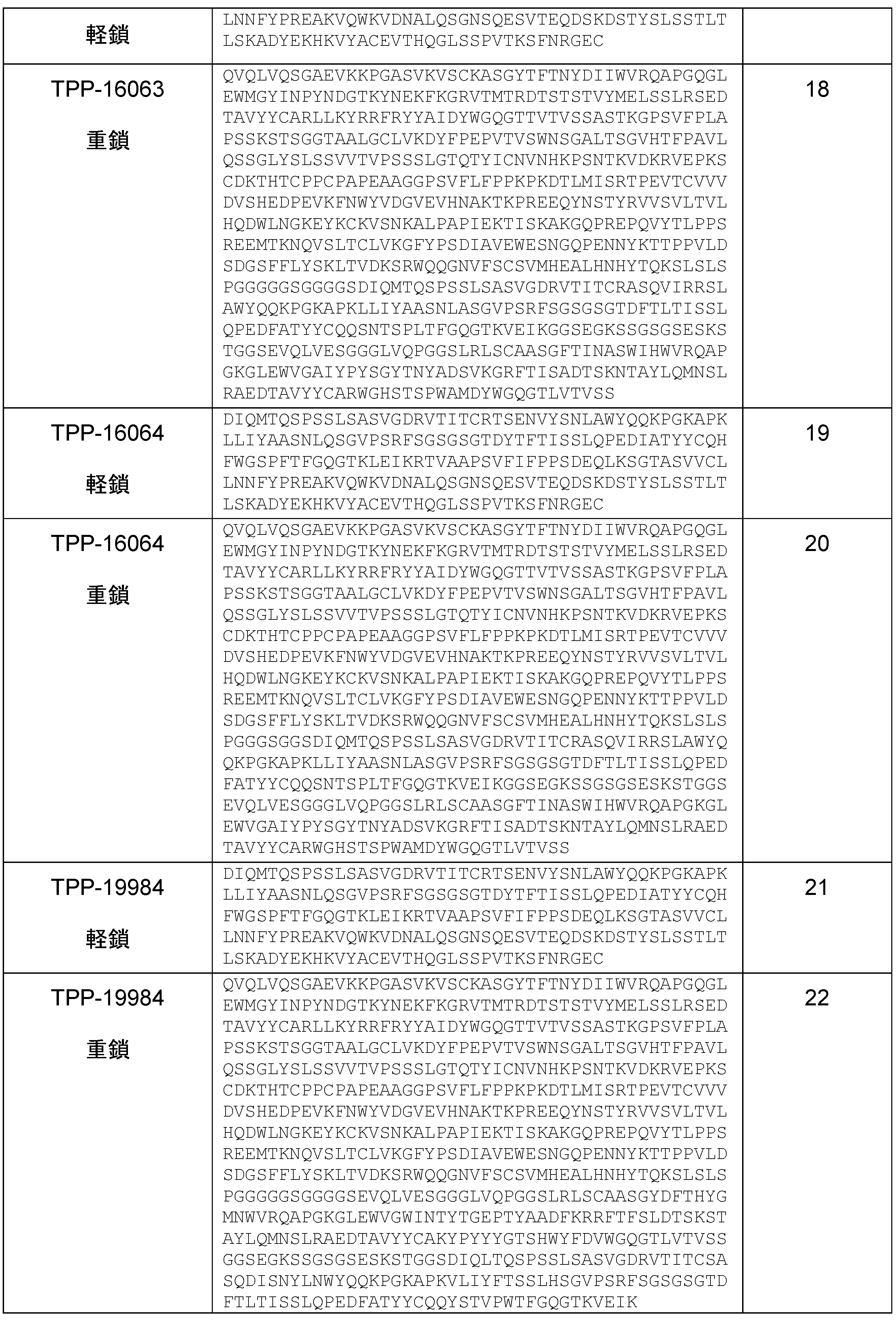


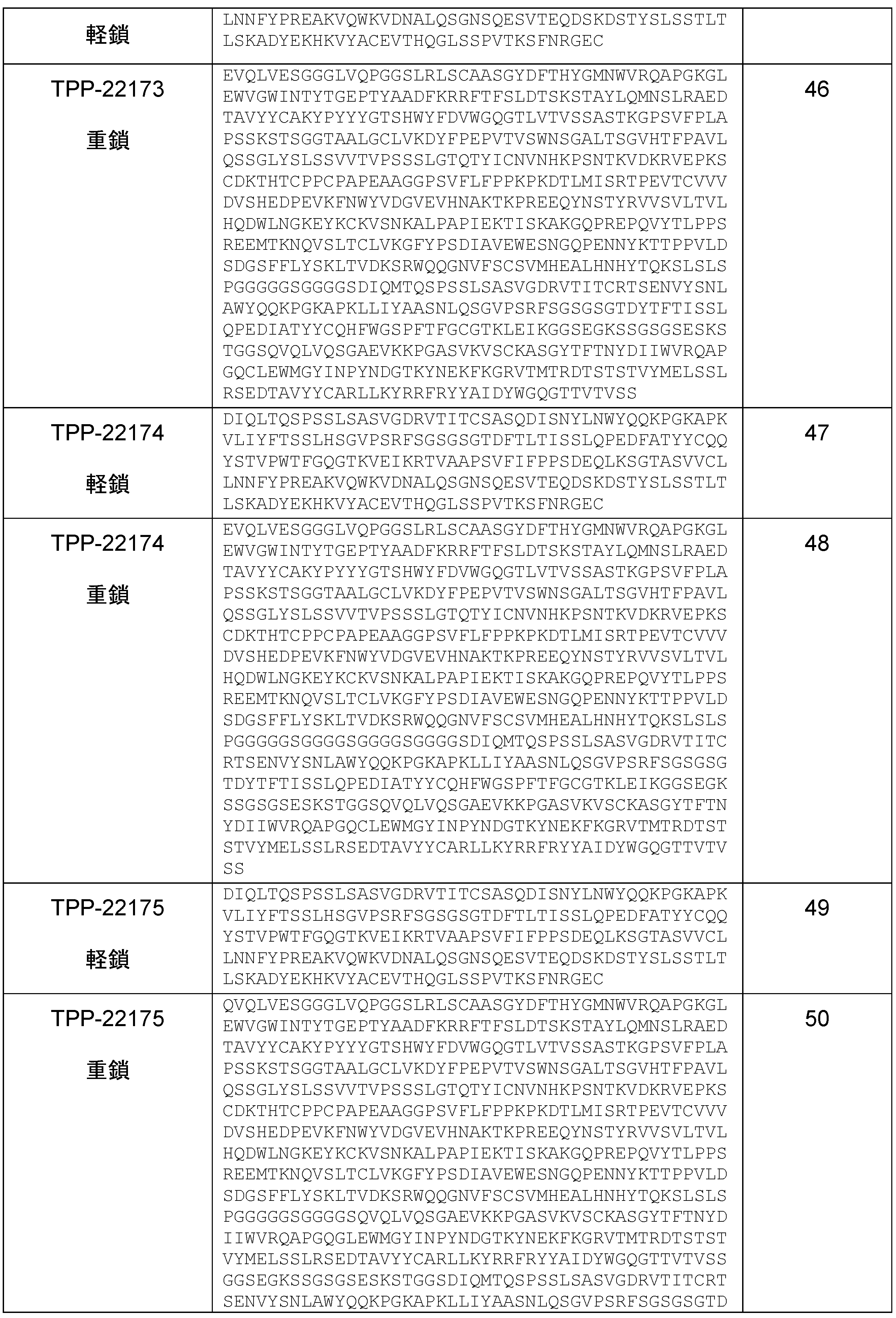


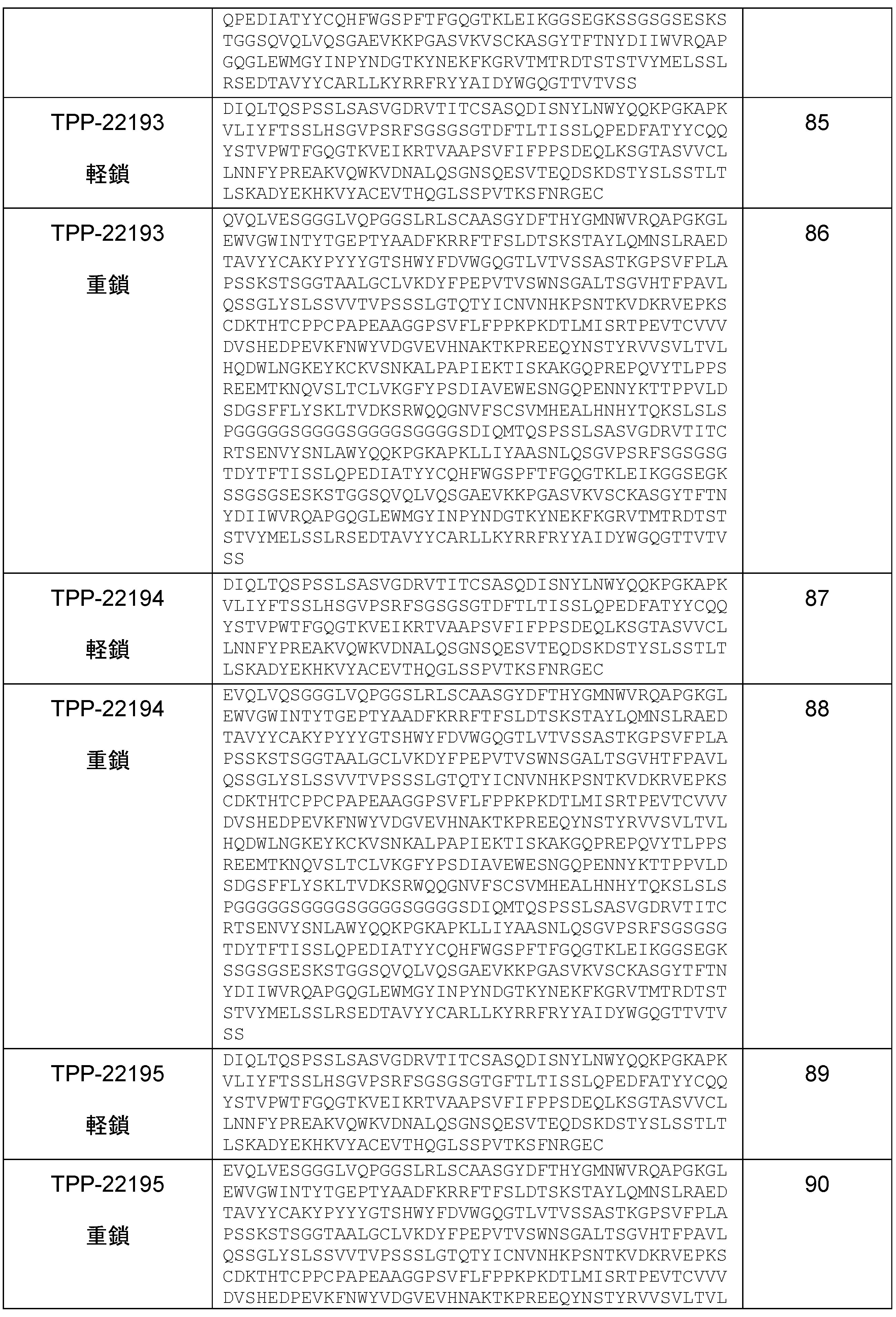


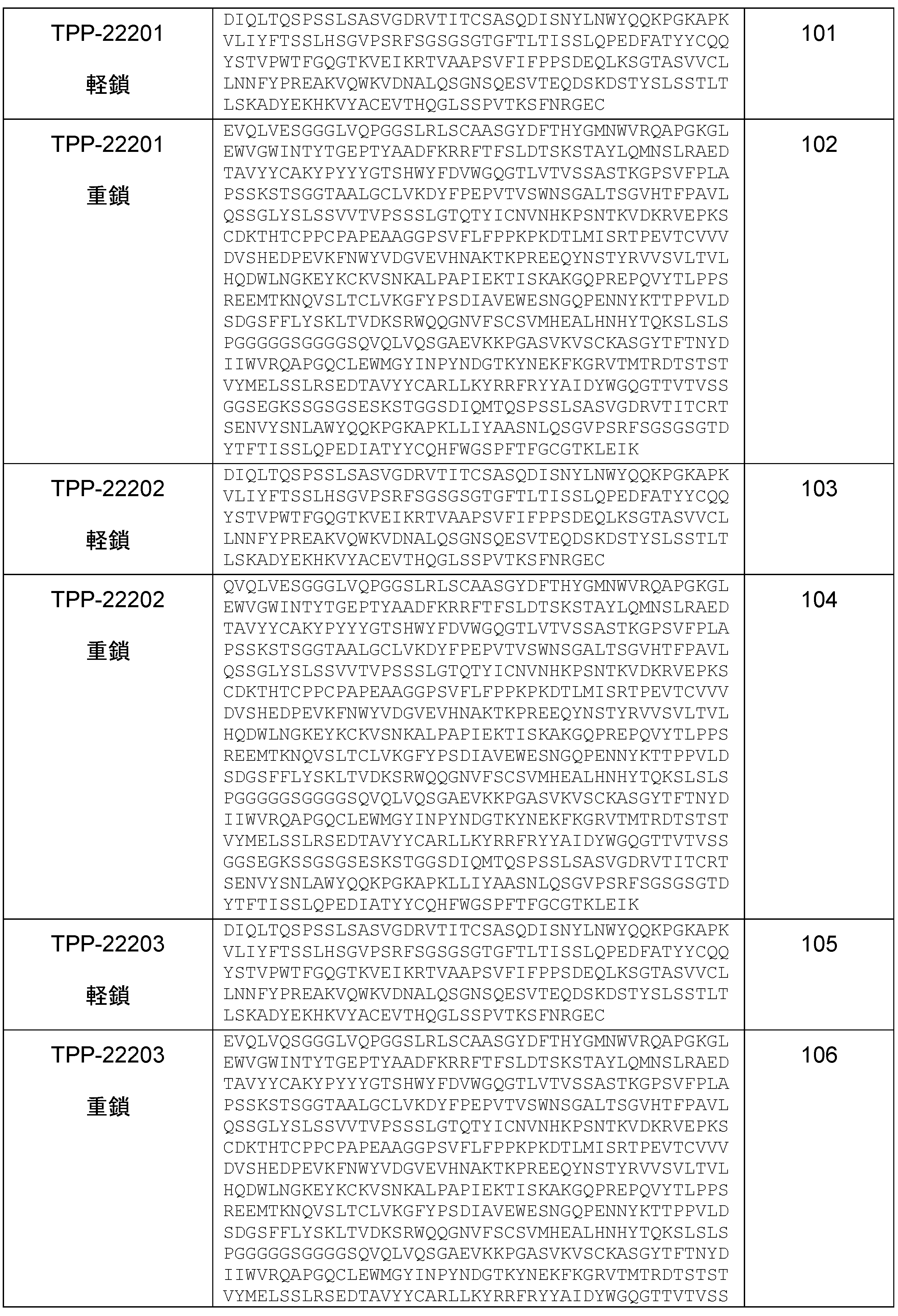

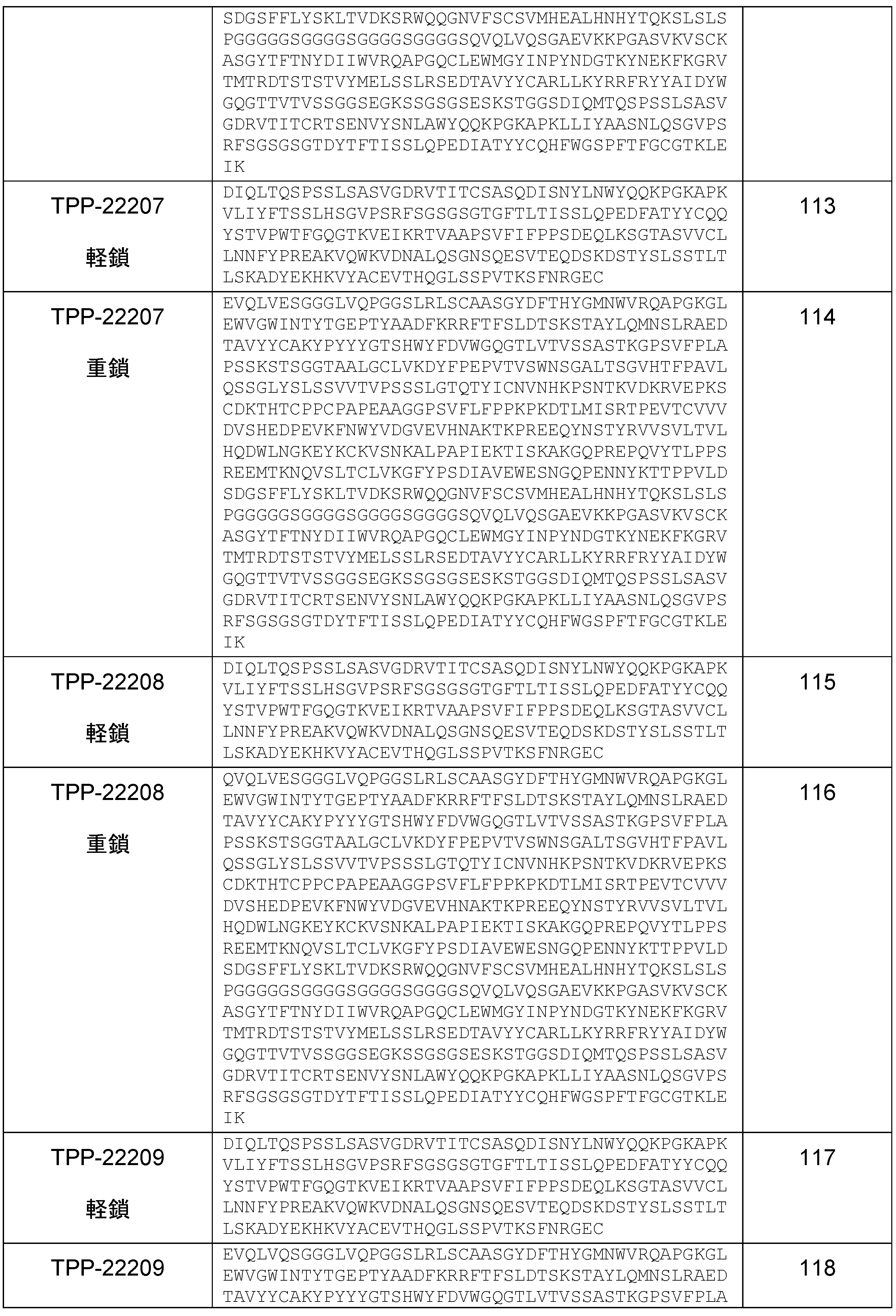


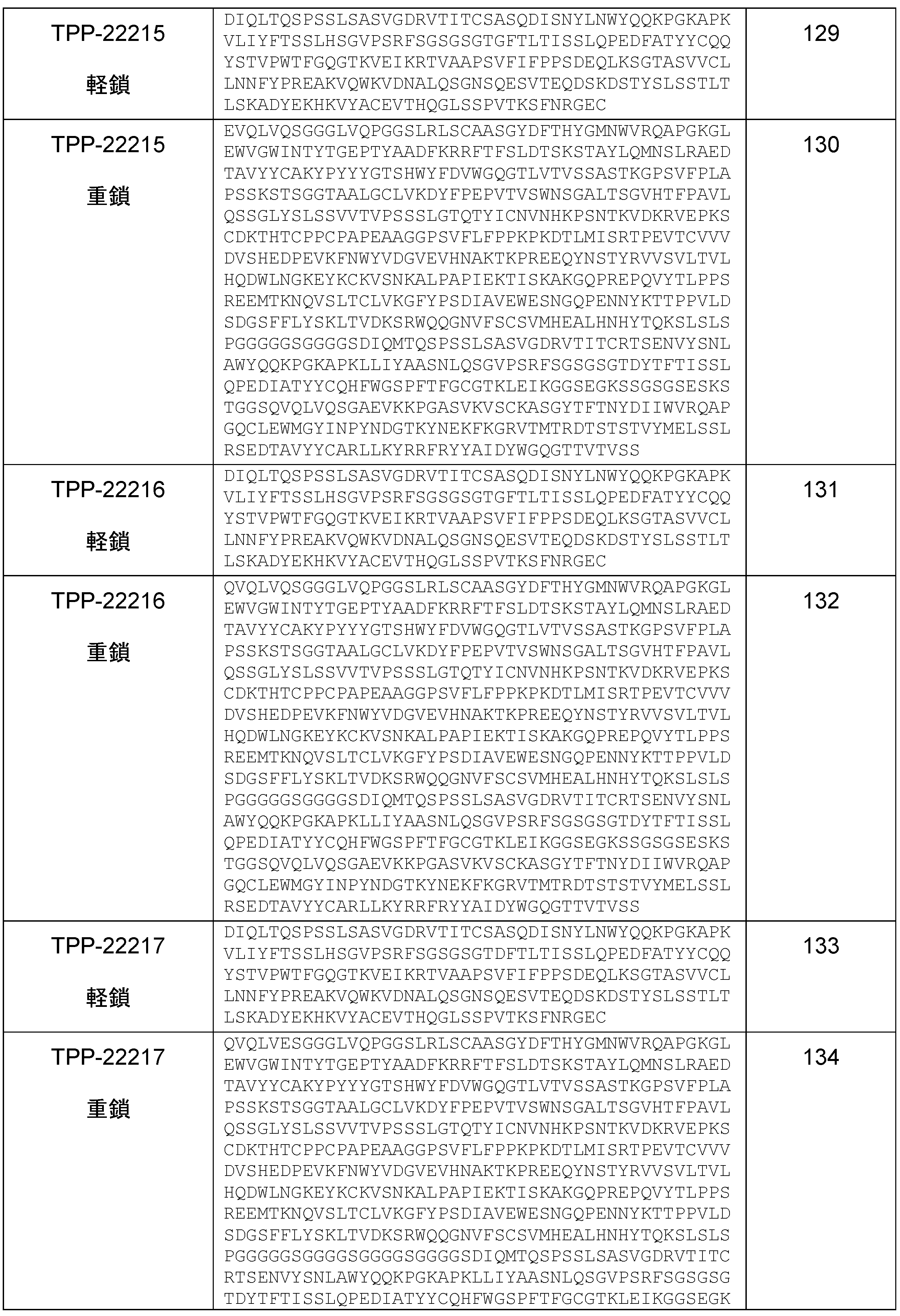


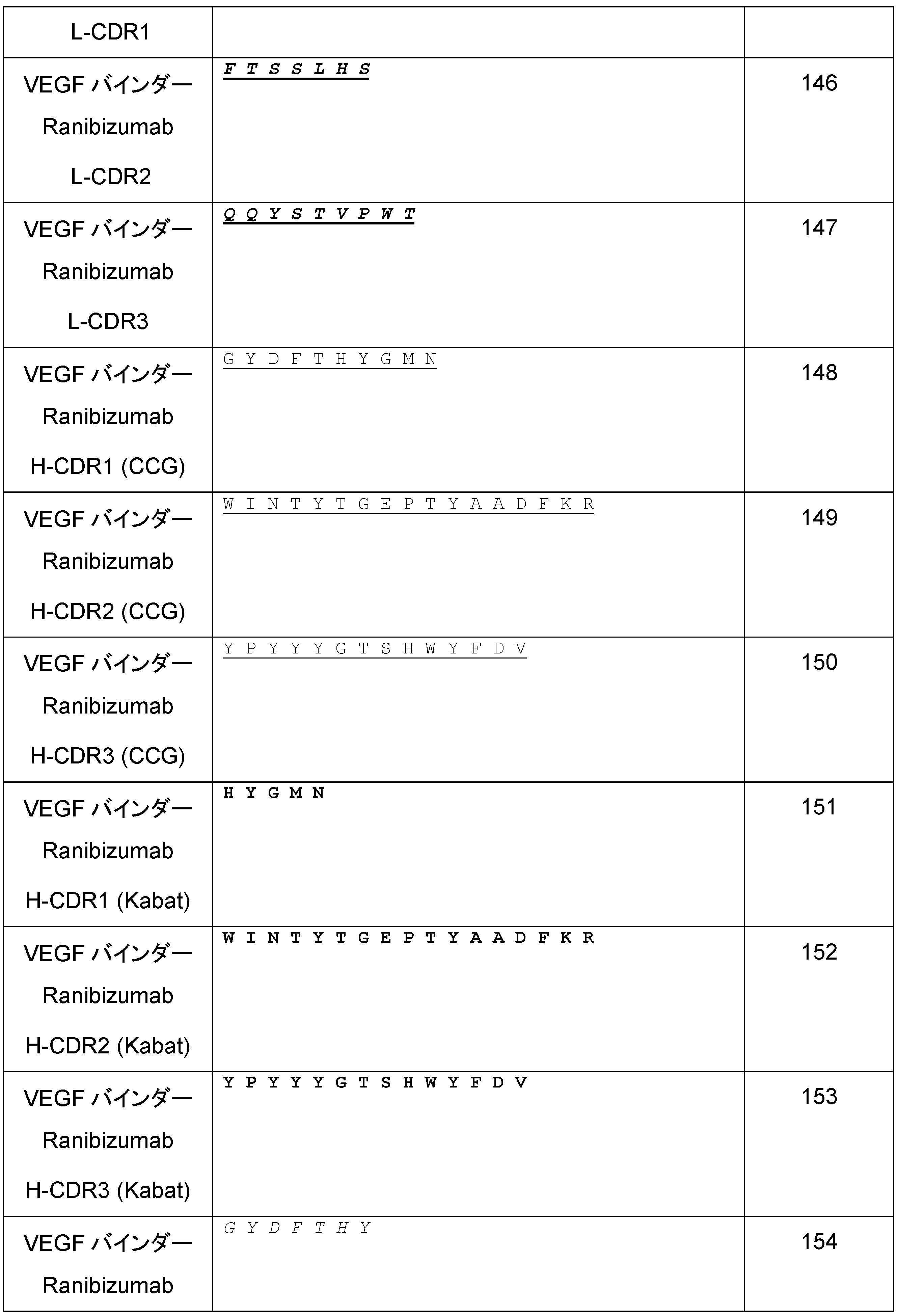


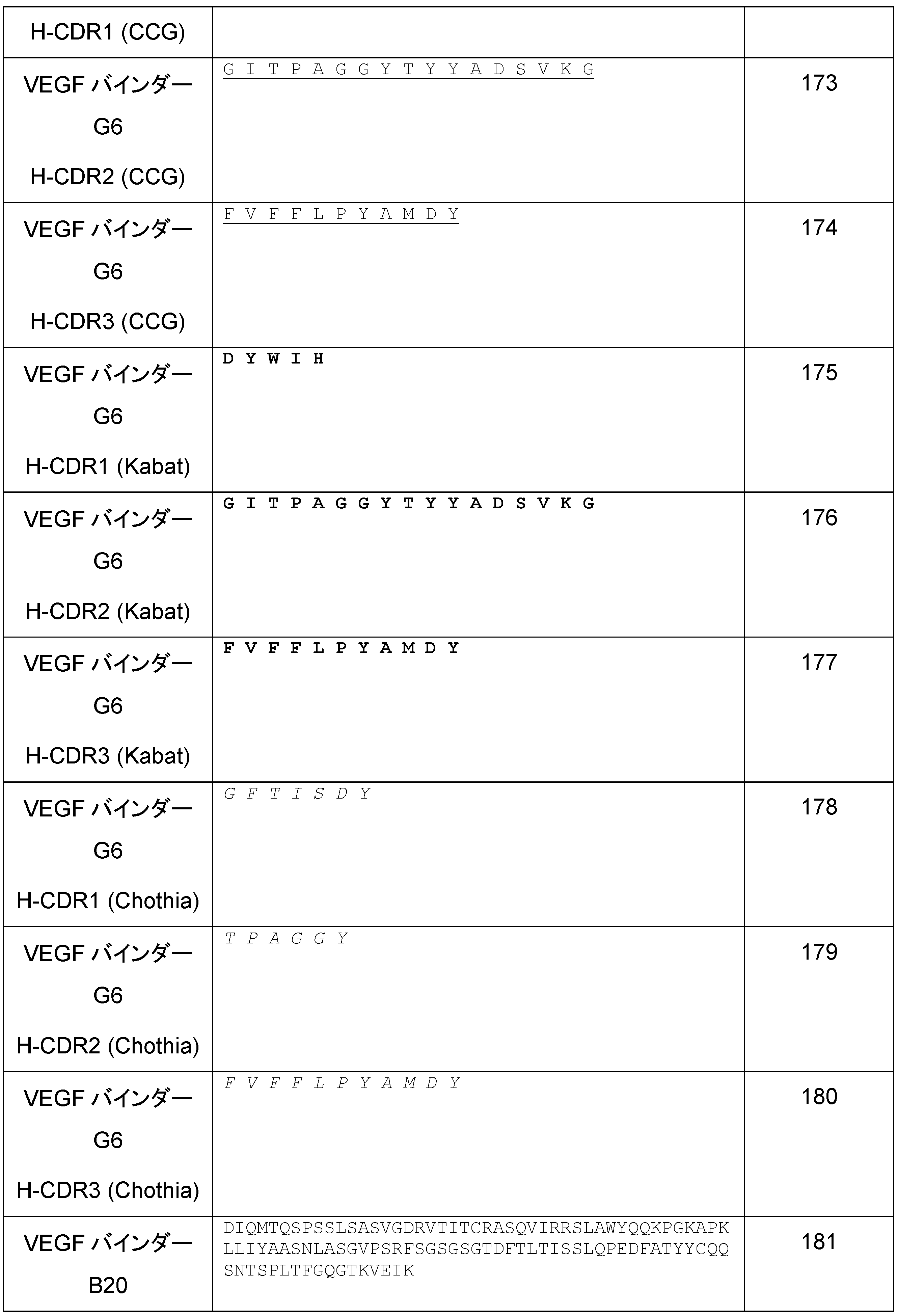

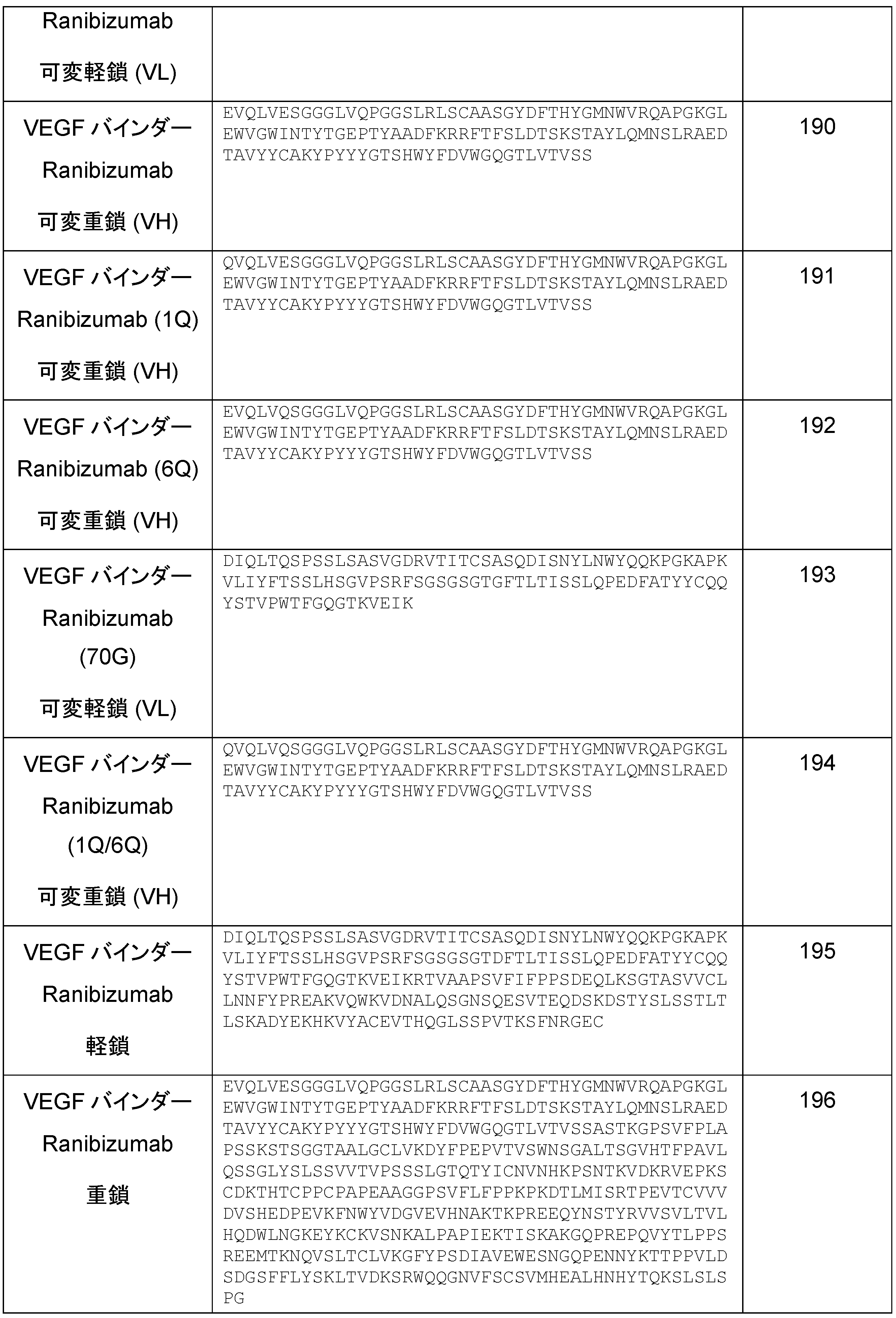


更なる実施態様では、本発明の結合分子又はTrkB結合分子は、以下に開示されるTrkBバインダーのいずれかに基づくことができる。これらのバインダーは、WO第2018/224630号にも開示されている。 In a further embodiment, the binding molecule or TrkB binding molecule of the invention can be based on any of the TrkB binders disclosed below. These binders are also disclosed in WO 2018/224630.


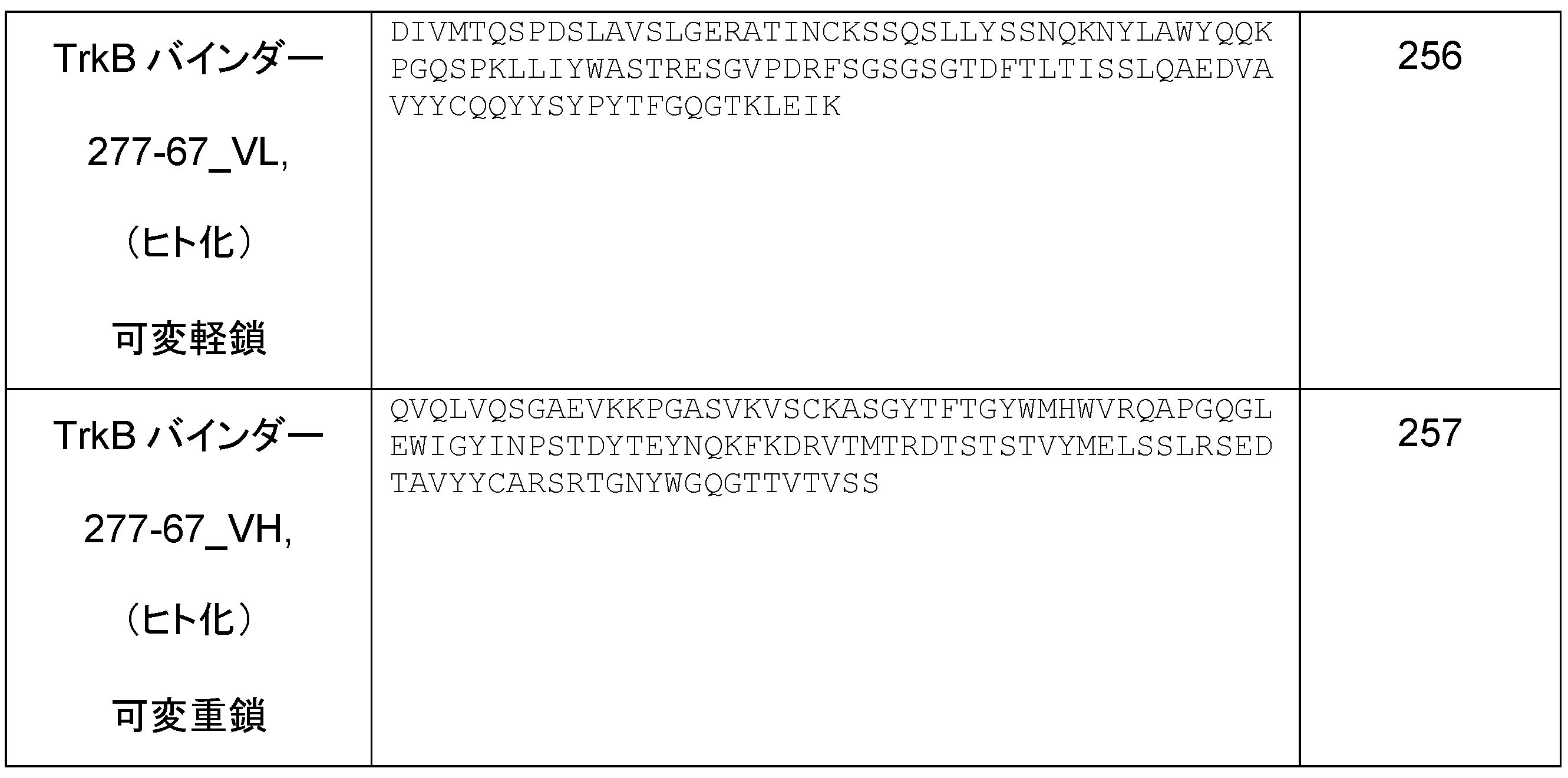
好ましい実施態様では、結合分子は、血管内皮増殖因子(VEGF)に特異的に結合する少なくとも1つの抗原結合部位と、トロポミオシンレセプターキナーゼB(TrkB)に特異的に結合する少なくとも1つの抗原結合部位とを含み、ここで、TrkBに特異的に結合する抗原結合部位は、配列番号:201(CDR1)、配列番号:202(CDR2)及び配列番号:203(CDR3)のアミノ酸配列を含むかもしくはそれらからなる軽鎖CDR並びに配列番号:204(CDR1)、配列番号:205(CDR2)及び配列番号:206(CDR3)のアミノ酸配列を含むかもしくはそれらからなる重鎖CDR又は配列番号:207(CDR1)、配列番号:208(CDR2)及び配列番号:209(CDR3)のアミノ酸配列を含むかもしくはそれらからなる重鎖CDR又は配列番号:210(CDR1)、配列番号:211(CDR2)及び配列番号:212(CDR3)のアミノ酸配列を含むかもしくはそれらからなる重鎖CDRを含み、ここで、VEGFに特異的に結合する抗原結合部位は、配列番号:145(CDR1)、配列番号:146(CDR2)及び配列番号:147(CDR3)のアミノ酸配列を含むかもしくはそれらからなる軽鎖CDR並びに配列番号:148(CDR1)、配列番号:149(CDR2)及び配列番号:150(CDR3)のアミノ酸配列を含むかもしくはそれらからなる重鎖CDR又は配列番号:151(CDR1)、配列番号:152(CDR2)及び配列番号:153(CDR3)のアミノ酸配列を含むかもしくはそれらからなる重鎖CDR又は配列番号:154(CDR1)、配列番号:155(CDR2)及び配列番号:156(CDR3)のアミノ酸配列を含むかもしくはそれらからなる重鎖CDRを含む。 In a preferred embodiment, the binding molecule comprises at least one antigen-binding site that specifically binds to vascular endothelial growth factor (VEGF) and at least one antigen-binding site that specifically binds to tropomyosin receptor kinase B (TrkB), wherein the antigen-binding site that specifically binds to TrkB comprises a light chain CDR comprising or consisting of the amino acid sequences of SEQ ID NO: 201 (CDR1), SEQ ID NO: 202 (CDR2) and SEQ ID NO: 203 (CDR3) and a heavy chain CDR comprising or consisting of the amino acid sequences of SEQ ID NO: 204 (CDR1), SEQ ID NO: 205 (CDR2) and SEQ ID NO: 206 (CDR3) or a heavy chain CDR comprising or consisting of the amino acid sequences of SEQ ID NO: 207 (CDR1), SEQ ID NO: 208 (CDR2) and SEQ ID NO: 209 (CDR3) or a heavy chain CDR comprising or consisting of the amino acid sequences of SEQ ID NO: 210 (CDR1), SEQ ID NO: 211 (CDR2), SEQ ID NO: 212 (CDR3), The heavy chain CDRs include or consist of the amino acid sequences of SEQ ID NO: 1 (CDR1), SEQ ID NO: 146 (CDR2) and SEQ ID NO: 147 (CDR3), and the heavy chain CDRs include or consist of the amino acid sequences of SEQ ID NO: 148 (CDR1), SEQ ID NO: 149 (CDR2) and SEQ ID NO: 150 (CDR3), or the heavy chain CDRs include or consist of the amino acid sequences of SEQ ID NO: 151 (CDR1), SEQ ID NO: 152 (CDR2) and SEQ ID NO: 153 (CDR3), or the heavy chain CDRs include or consist of the amino acid sequences of SEQ ID NO: 154 (CDR1), SEQ ID NO: 155 (CDR2) and SEQ ID NO: 156 (CDR3).
さらに好ましい実施態様では、結合分子は、血管内皮増殖因子(VEGF)に特異的に結合する少なくとも1つの抗原結合部位と、トロポミオシンレセプターキナーゼB(TrkB)に特異的に結合する少なくとも1つの抗原結合部位とを含み、ここで、TrkBに特異的に結合する抗原結合部位は、配列番号:213又は215のアミノ酸配列と少なくとも80%、81%、82%、83%、84%、85%、86%、87%、88%、89%、90%、91%、92%、93%、94%、95%、96%、97%、98%又は少なくとも99%同一のアミノ酸配列を含むかもしくはそれらからなる軽鎖可変ドメインと、配列番号:214又は216のアミノ酸配列と少なくとも80%、81%、82%、83%、84%、85%、86%、87%、88%、89%、90%、91%、92%、93%、94%、95%、96%、97%、98%又は少なくとも99%同一のアミノ酸配列を含むかもしくはそれらからなる重鎖可変ドメインとを含み、VEGFに特異的に結合する抗原結合部位は、配列番号:189又は193のアミノ酸配列と少なくとも80%、81%、82%、83%、84%、85%、86%、87%、88%、89%、90%、91%、92%、93%、94%、95%、96%、97%、98%又は少なくとも99%同一のアミノ酸配列を含むかもしくはそれらからなる軽鎖可変ドメインと、配列番号:190、191、192又は194のアミノ酸配列と少なくとも80%、81%、82%、83%、84%、85%、86%、87%、88%、89%、90%、91%、92%、93%、94%、95%、96%、97%、98%又は少なくとも99%同一のアミノ酸配列を含むかもしくはそれらからなる重鎖可変ドメインとを含む。 In a further preferred embodiment, the binding molecule comprises at least one antigen-binding site that specifically binds to vascular endothelial growth factor (VEGF) and at least one antigen-binding site that specifically binds to tropomyosin receptor kinase B (TrkB), wherein the antigen-binding site that specifically binds to TrkB has at least 80%, 81%, 82%, 83%, 84%, 85%, 86%, 88%, 90%, 92%, 94%, 96%, 98%, 99%, 100%, 101%, 102%, 103%, 104%, 105%, 106%, 107%, 108%, 109%, 110%, 111%, 112%, 113%, 114%, 115%, 116%, 117%, 118%, 119%, 120%, 121%, 122%, 123%, 124%, 125%, 126%, 127%, 128%, 129%, 130%, 131%, 132%, 133%, 134%, 135%, 136%, 137%, 138%, 139%, 140%, 141%, 142%, 143%, 144%, 145%, 146%, 147%, 148%, 149%, 150%, 151%, 152%, 153%, 154%, 155, 155, 156, 157, 158, 159, 160%, 161%, 162%, 163%, 164%, 165%, 166%, 167%, 168%, 169%, 170%, 171%, 172%, 173%, a light chain variable domain comprising or consisting of an amino acid sequence that is at least 80%, 81%, 82%, 83%, 84%, 85%, 86%, 87%, 88%, 89%, 90%, 91%, 92%, 93%, 94%, 95%, 96%, 97%, 98% or at least 99% identical to the amino acid sequence of SEQ ID NO: 214 or 216; and a heavy chain variable domain comprising or consisting of an amino acid sequence that is at least 80%, 81%, 82%, 83%, 84%, 85%, 86%, 87%, 88%, 89%, 90%, 91%, 92%, 93%, 94%, 95%, 96%, 97%, 98% or at least 99% identical to the amino acid sequence of SEQ ID NO: 189 or 193. and a heavy chain variable domain comprising or consisting of an amino acid sequence at least 80%, 81%, 82%, 83%, 84%, 85%, 86%, 87%, 88%, 89%, 90%, 91%, 92%, 93%, 94%, 95%, 96%, 97%, 98% or at least 99% identical to the amino acid sequence of SEQ ID NO: 190, 191, 192 or 194.
さらに好ましい実施態様では、結合分子は、血管内皮増殖因子(VEGF)に特異的に結合する少なくとも1つの抗原結合部位と、トロポミオシンレセプターキナーゼB(TrkB)に特異的に結合する少なくとも1つの抗原結合部位とを含み、ここで、TrkBに特異的に結合する抗原結合部位は、配列番号:213又は215のアミノ酸配列を含むかもしくはそれらからなる軽鎖可変ドメインと、配列番号:214又は216のアミノ酸配列を含むかもしくはそれらからなる重鎖可変ドメインとを含み、ここで、VEGFに特異的に結合する抗原結合部位は、配列番号:189又は193のアミノ酸配列を含むかもしくはそれらからなる軽鎖可変ドメインと、配列番号:190、191、192又は194のアミノ酸配列を含むかもしくはそれらからなる重鎖可変ドメインとを含む。 In a further preferred embodiment, the binding molecule comprises at least one antigen-binding site that specifically binds to vascular endothelial growth factor (VEGF) and at least one antigen-binding site that specifically binds to tropomyosin receptor kinase B (TrkB), wherein the antigen-binding site that specifically binds to TrkB comprises a light chain variable domain that comprises or consists of the amino acid sequence of SEQ ID NO: 213 or 215 and a heavy chain variable domain that comprises or consists of the amino acid sequence of SEQ ID NO: 214 or 216, and wherein the antigen-binding site that specifically binds to VEGF comprises a light chain variable domain that comprises or consists of the amino acid sequence of SEQ ID NO: 189 or 193 and a heavy chain variable domain that comprises or consists of the amino acid sequence of SEQ ID NO: 190, 191, 192 or 194.
さらに好ましい実施態様では、結合分子は、血管内皮増殖因子(VEGF)に特異的に結合する少なくとも1つの抗原結合部位と、トロポミオシンレセプターキナーゼB(TrkB)に特異的に結合する少なくとも1つの抗原結合部位とを含み、ここで、TrkBに特異的に結合する抗原結合部位は、配列番号:213のアミノ酸配列を含むかもしくはそれらからなる軽鎖可変ドメインと、配列番号:214のアミノ酸配列を含むかもしくはそれらからなる重鎖可変ドメインとを含み、ここで、VEGFに特異的に結合する抗原結合部位は、配列番号:193のアミノ酸配列を含むかもしくはそれらからなる軽鎖可変ドメインと、配列番号:191のアミノ酸配列を含むかもしくはそれらからなる重鎖可変ドメインとを含む。 In a further preferred embodiment, the binding molecule comprises at least one antigen-binding site that specifically binds to vascular endothelial growth factor (VEGF) and at least one antigen-binding site that specifically binds to tropomyosin receptor kinase B (TrkB), wherein the antigen-binding site that specifically binds to TrkB comprises a light chain variable domain that comprises or consists of the amino acid sequence of SEQ ID NO:213 and a heavy chain variable domain that comprises or consists of the amino acid sequence of SEQ ID NO:214, and wherein the antigen-binding site that specifically binds to VEGF comprises a light chain variable domain that comprises or consists of the amino acid sequence of SEQ ID NO:193 and a heavy chain variable domain that comprises or consists of the amino acid sequence of SEQ ID NO:191.
さらに好ましい実施態様では、結合分子は、血管内皮増殖因子(VEGF)に特異的に結合する少なくとも1つの抗原結合部位と、トロポミオシンレセプターキナーゼB(TrkB)に特異的に結合する少なくとも1つの抗原結合部位とを含み、ここで、TrkBに特異的に結合する抗原結合部位は、配列番号:213又は215のアミノ酸配列と少なくとも80%、81%、82%、83%、84%、85%、86%、87%、88%、89%、90%、91%、92%、93%、94%、95%、96%、97%、98%又は少なくとも99%同一のアミノ酸配列を含むかもしくはそれらからなる軽鎖可変ドメインと、配列番号:214又は216のアミノ酸配列と少なくとも80%、81%、82%、83%、84%、85%、86%、87%、88%、89%、90%、91%、92%、93%、94%、95%、96%、97%、98%又は少なくとも99%同一のアミノ酸配列を含むかもしくはそれらからなる重鎖可変ドメインとを含み、ここで、軽鎖可変ドメインにおける軽鎖CDRは、sa配列番号:201(CDR1)、配列番号:202(CDR2)及び配列番号:203(CDR3)のアミノ酸配列からなり、重鎖可変ドメインにおける重鎖CDRは、配列番号:204(CDR1)、配列番号:205(CDR2)及び配列番号:206(CDR3)のアミノ酸配列からなり又は重鎖可変ドメインにおける重鎖CDRは、配列番号:207(CDR1)、配列番号:208(CDR2)及び配列番号:209(CDR3)のアミノ酸配列からなり又は重鎖可変ドメインにおける重鎖CDRは、配列番号:210(CDR1)、配列番号:211(CDR2)及び配列番号:212(CDR3)のアミノ酸配列からなり、ここで、VEGFに特異的に結合する抗原結合部位は、配列番号:189又は193のアミノ酸配列と少なくとも80%、81%、82%、83%、84%、85%、86%、87%、88%、89%、90%、91%、92%、93%、94%、95%、96%、97%、98%又は少なくとも99%同一のアミノ酸配列を含むかもしくはそれらからなる軽鎖可変ドメインと、配列番号:190、191、192又は194のアミノ酸配列と少なくとも80%、81%、82%、83%、84%、85%、86%、87%、88%、89%、90%、91%、92%、93%、94%、95%、96%、97%、98%又は少なくとも99%同一のアミノ酸配列を含むかもしくはそれらからなる重鎖可変ドメインとを含み、ここで、軽鎖可変ドメインにおける軽鎖CDRは、配列番号:145(CDR1)、配列番号:146(CDR2)及び配列番号:147(CDR3)のアミノ酸配列からなり、重鎖可変ドメインにおける重鎖CDRは、配列番号:148(CDR1)、配列番号:149(CDR2)及び配列番号:150(CDR3)のアミノ酸配列からなり又は重鎖可変ドメインにおける重鎖CDRは、配列番号:151(CDR1)、配列番号:152(CDR2)及び配列番号:153(CDR3)のアミノ酸配列からなり又は重鎖可変ドメインにおける重鎖CDRは、配列番号:154(CDR1)、配列番号:155(CDR2)及び配列番号:156(CDR3)のアミノ酸配列からなる。 In a further preferred embodiment, the binding molecule comprises at least one antigen-binding site that specifically binds vascular endothelial growth factor (VEGF) and at least one antigen-binding site that specifically binds tropomyosin receptor kinase B (TrkB), wherein the antigen-binding site that specifically binds TrkB comprises a light chain variable domain that comprises or consists of an amino acid sequence that is at least 80%, 81%, 82%, 83%, 84%, 85%, 86%, 87%, 88%, 89%, 90%, 91%, 92%, 93%, 94%, 95%, 96%, 97%, 98% or at least 99% identical to the amino acid sequence of SEQ ID NO: 213 or 215, and at least 80%, 81%, 82%, 83%, 84%, 85%, 86%, 87%, 88%, 89%, 90%, 91%, 92%, 93%, 94%, 95%, 96%, 97%, 98% or at least 99% identical to the amino acid sequence of SEQ ID NO: 214 or 216. and a heavy chain variable domain comprising or consisting of an amino acid sequence which is 90%, 91%, 92%, 93%, 94%, 95%, 96%, 97%, 98% or at least 99% identical to said amino acid sequence, wherein the light chain CDRs in the light chain variable domain consist of the amino acid sequences of SEQ ID NO:201 (CDR1), SEQ ID NO:202 (CDR2) and SEQ ID NO:203 (CDR3), the heavy chain CDRs in the heavy chain variable domain consist of the amino acid sequences of SEQ ID NO:204 (CDR1), SEQ ID NO:205 (CDR2) and SEQ ID NO:206 (CDR3), or the heavy chain CDRs in the heavy chain variable domain consist of the amino acid sequences of SEQ ID NO:207 (CDR1), SEQ ID NO:208 (CDR2) and SEQ ID NO:209 (CDR3), or the heavy chain CDRs in the heavy chain variable domain consist of the amino acid sequences of SEQ ID NO:209 (CDR1), SEQ ID NO:210 (CDR2) and SEQ ID NO:211 (CDR3), 210 (CDR1), SEQ ID NO: 211 (CDR2) and SEQ ID NO: 212 (CDR3), wherein the antigen-binding site that specifically binds to VEGF has at least 80%, 81%, 82%, 83%, 84%, 85%, 86%, 87%, 88%, 89%, 90%, 91%, 92%, 93%, 94%, 95%, 96%, 97%, 98%, 99%, 100%, 101%, 102%, 103%, 104%, 105%, 106%, 107%, 108%, 109%, 110%, 111%, 112%, 113%, 114%, 115%, 116%, 117%, 118%, 119%, 120%, 121%, 122%, 123%, 124%, 125%, 126%, 127%, 128%, 129%, 130%, 131%, 132%, 133%, 134%, 135%, 136%, 137%, 138%, 139%, 140%, 141%, 142%, 143%, 144%, 145%, 146%, 147%, 148%, 149%, 150%, 151%, 152%, 153%, 154%, 155%, 156%, 157%, 158%, 159%, 160%, 161%, 162%, 163%, 164%, 165%, 166%, 167%, 168%, 169%, 170%, 171%, 172%, 173%, 174%, a light chain variable domain comprising or consisting of an amino acid sequence that is at least 80%, 81%, 82%, 83%, 84%, 85%, 86%, 87%, 88%, 89%, 90%, 91%, 92%, 93%, 94%, 95%, 96%, 97%, 98% or at least 99% identical to the amino acid sequence of SEQ ID NO: 190, 191, 192 or 194; and a heavy chain variable domain comprising or consisting of the amino acid sequences, wherein the light chain CDRs in the light chain variable domain consist of the amino acid sequences of SEQ ID NO: 145 (CDR1), SEQ ID NO: 146 (CDR2) and SEQ ID NO: 147 (CDR3), and the heavy chain CDRs in the heavy chain variable domain consist of the amino acid sequences of SEQ ID NO: 148 (CDR1), SEQ ID NO: 149 (CDR2) and SEQ ID NO: 150 (CDR3), or the heavy chain CDRs in the heavy chain variable domain consist of the amino acid sequences of SEQ ID NO: 151 (CDR1), SEQ ID NO: 152 (CDR2) and SEQ ID NO: 153 (CDR3), or the heavy chain CDRs in the heavy chain variable domain consist of the amino acid sequences of SEQ ID NO: 154 (CDR1), SEQ ID NO: 155 (CDR2) and SEQ ID NO: 156 (CDR3).
さらに好ましい実施態様では、結合分子は、血管内皮増殖因子(VEGF)に特異的に結合する少なくとも1つの抗原結合部位と、トロポミオシンレセプターキナーゼB(TrkB)に特異的に結合する少なくとも1つの抗原結合部位とを含み、ここで、TrkBに特異的に結合する抗原結合部位は、配列番号:213のアミノ酸配列を含むかもしくはそれらからなる軽鎖可変ドメインと、配列番号:214のアミノ酸配列を含むかもしくはそれらからなる重鎖可変ドメインとを含み、ここで、軽鎖可変ドメインにおける軽鎖CDRは、配列番号:201(CDR1)、配列番号:202(CDR2)及び配列番号:203(CDR3)のアミノ酸配列からなり、重鎖可変ドメインにおける重鎖CDRは、配列番号:204(CDR1)、配列番号:205(CDR2)及び配列番号:206(CDR3)のアミノ酸配列からなり又は重鎖可変ドメインにおける重鎖CDRは、配列番号:207(CDR1)、配列番号:208(CDR2)及び配列番号:209(CDR3)のアミノ酸配列からなり又は重鎖可変ドメインにおける重鎖CDRは、配列番号:210(CDR1)、配列番号:211(CDR2)及び配列番号:212(CDR3)のアミノ酸配列からなり、ここで、VEGFに特異的に結合する抗原結合部位は、配列番号:193のアミノ酸配列のアミノ酸配列を含むかもしくはそれらからなる軽鎖可変ドメインと、配列番号:191のアミノ酸配列を含むかもしくはそれらからなる重鎖可変ドメインとを含み、ここで、軽鎖可変ドメインにおける軽鎖CDRは、配列番号:145(CDR1)、配列番号:146(CDR2)及び配列番号:147(CDR3)のアミノ酸配列からなり、重鎖可変ドメインにおける重鎖CDRは、配列番号:148(CDR1)、配列番号:149(CDR2)及び配列番号:150(CDR3)のアミノ酸配列からなり又は重鎖可変ドメインにおける重鎖CDRは、配列番号:151(CDR1)、配列番号:152(CDR2)及び配列番号:153(CDR3)のアミノ酸配列からなり又は重鎖可変ドメインにおける重鎖CDRは、配列番号:154(CDR1)、配列番号:155(CDR2)及び配列番号:156(CDR3)のアミノ酸配列からなる。 In a further preferred embodiment, the binding molecule comprises at least one antigen-binding site that specifically binds to vascular endothelial growth factor (VEGF) and at least one antigen-binding site that specifically binds to tropomyosin receptor kinase B (TrkB), wherein the antigen-binding site that specifically binds to TrkB comprises a light chain variable domain comprising or consisting of the amino acid sequence of SEQ ID NO: 213 and a heavy chain variable domain comprising or consisting of the amino acid sequence of SEQ ID NO: 214, wherein the light chain CD4 in the light chain variable domain R consists of the amino acid sequences of SEQ ID NO: 201 (CDR1), SEQ ID NO: 202 (CDR2) and SEQ ID NO: 203 (CDR3), and the heavy chain CDRs in the heavy chain variable domain consist of the amino acid sequences of SEQ ID NO: 204 (CDR1), SEQ ID NO: 205 (CDR2) and SEQ ID NO: 206 (CDR3), or the heavy chain CDRs in the heavy chain variable domain consist of the amino acid sequences of SEQ ID NO: 207 (CDR1), SEQ ID NO: 208 (CDR2) and SEQ ID NO: 209 (CDR3), or the heavy chain CDRs in the heavy chain variable domain consist of the amino acid sequences of SEQ ID NO: and an antigen-binding site that specifically binds to VEGF comprises a light chain variable domain comprising or consisting of the amino acid sequence of SEQ ID NO: 193, and a heavy chain variable domain comprising or consisting of the amino acid sequence of SEQ ID NO: 191, wherein the light chain CDRs in the light chain variable domain comprise the amino acid sequences of SEQ ID NO: 145 (CDR1), SEQ ID NO: 146 (CDR2), and SEQ ID NO: 147 (CDR3). The heavy chain CDR in the heavy chain variable domain consists of the amino acid sequences of SEQ ID NO: 148 (CDR1), SEQ ID NO: 149 (CDR2) and SEQ ID NO: 150 (CDR3), or the heavy chain CDR in the heavy chain variable domain consists of the amino acid sequences of SEQ ID NO: 151 (CDR1), SEQ ID NO: 152 (CDR2) and SEQ ID NO: 153 (CDR3), or the heavy chain CDR in the heavy chain variable domain consists of the amino acid sequences of SEQ ID NO: 154 (CDR1), SEQ ID NO: 155 (CDR2) and SEQ ID NO: 156 (CDR3).
一実施態様では、結合分子は、血管内皮増殖因子(VEGF)に特異的に結合する少なくとも1つの抗原結合部位と、トロポミオシンレセプターキナーゼB(TrkB)に特異的に結合する少なくとも1つの抗原結合部位とを含み、ここで、TrkBに特異的に結合する抗原結合部位は、配列番号:228(CDR1)、配列番号:229(CDR2)及び配列番号:230(CDR3)のアミノ酸配列を含むかもしくはそれらからなる軽鎖CDR並びに配列番号:231(CDR1)、配列番号:232(CDR2)及び配列番号:233(CDR3)のアミノ酸配列を含むかもしくはそれらからなる重鎖CDR又は配列番号:234(CDR1)、配列番号:235(CDR2)及び配列番号:236(CDR3)のアミノ酸配列を含むかもしくはそれらからなる重鎖CDR又は配列番号:237(CDR1)、配列番号:238(CDR2)及び配列番号:239(CDR3)のアミノ酸配列を含むかもしくはそれらからなる重鎖CDRを含み、ここで、VEGFに特異的に結合する抗原結合部位は、配列番号:145(CDR1)、配列番号:146(CDR2)及び配列番号:147(CDR3)のアミノ酸配列を含むかもしくはそれらからなる軽鎖CDR並びに配列番号:148(CDR1)、配列番号:149(CDR2)及び配列番号:150(CDR3)のアミノ酸配列を含むかもしくはそれらからなる重鎖CDR又は配列番号:151(CDR1)、配列番号:152(CDR2)及び配列番号:153(CDR3)のアミノ酸配列を含むかもしくはそれらからなる重鎖CDR又は配列番号:154(CDR1)、配列番号:155(CDR2)及び配列番号:156(CDR3)のアミノ酸配列を含むかもしくはそれらからなる重鎖CDRを含む。 In one embodiment, the binding molecule comprises at least one antigen-binding site that specifically binds to vascular endothelial growth factor (VEGF) and at least one antigen-binding site that specifically binds to tropomyosin receptor kinase B (TrkB), wherein the antigen-binding site that specifically binds to TrkB comprises a light chain CDR comprising or consisting of the amino acid sequences of SEQ ID NO: 228 (CDR1), SEQ ID NO: 229 (CDR2) and SEQ ID NO: 230 (CDR3), and a heavy chain CDR comprising or consisting of the amino acid sequences of SEQ ID NO: 231 (CDR1), SEQ ID NO: 232 (CDR2) and SEQ ID NO: 233 (CDR3), or a heavy chain CDR comprising or consisting of the amino acid sequences of SEQ ID NO: 234 (CDR1), SEQ ID NO: 235 (CDR2) and SEQ ID NO: 236 (CDR3), or a heavy chain CDR comprising or consisting of the amino acid sequences of SEQ ID NO: 237 (CDR1), SEQ ID NO: 238 (CDR3), or a heavy chain CDR comprising or consisting of the amino acid sequences of SEQ ID NO: 239 (CDR1), SEQ ID NO: 240 (CDR3), or a heavy chain CDR comprising or consisting of the amino acid sequences of SEQ ID NO: 241 (CDR1), SEQ ID NO: 242 (CDR2) and SEQ ID NO: 243 (CDR3), or a heavy chain CDR comprising or consisting of the amino acid sequences of SEQ ID NO: 244 (CDR1), SEQ ID NO: 245 (CDR2) and SEQ ID NO: 246 (CDR3), or a heavy chain CDR comprising or consisting of the amino acid sequences of SEQ ID NO: 247 (CDR1), SEQ ID NO: 248 (CDR3), or a heavy chain CDR comprising or consisting of the amino acid sequences of SEQ ID wherein the antigen-binding site that specifically binds to VEGF comprises a light chain CDR comprising or consisting of the amino acid sequences of SEQ ID NO: 145 (CDR1), SEQ ID NO: 146 (CDR2) and SEQ ID NO: 147 (CDR3), and a heavy chain CDR comprising or consisting of the amino acid sequences of SEQ ID NO: 148 (CDR1), SEQ ID NO: 149 (CDR2) and SEQ ID NO: 150 (CDR3), or a heavy chain CDR comprising or consisting of the amino acid sequences of SEQ ID NO: 151 (CDR1), SEQ ID NO: 152 (CDR2) and SEQ ID NO: 153 (CDR3), or a heavy chain CDR comprising or consisting of the amino acid sequences of SEQ ID NO: 154 (CDR1), SEQ ID NO: 155 (CDR2) and SEQ ID NO: 156 (CDR3).
別の実施態様では、結合分子は、血管内皮増殖因子(VEGF)に特異的に結合する少なくとも1つの抗原結合部位と、トロポミオシンレセプターキナーゼB(TrkB)に特異的に結合する少なくとも1つの抗原結合部位とを含み、ここで、TrkBに特異的に結合する抗原結合部位は、軽鎖可変ドメイン及び重鎖可変ドメインを含み、それぞれが、配列番号:240及び241、242及び243、244及び245、246及び247、248及び249、250及び251、252及び253、254及び255又は256及び257のアミノ酸配列と少なくとも80%、81%、82%、83%、84%、85%、86%、87%、88%、89%、90%、91%、92%、93%、94%、95%、96%、97%、98%又は少なくとも99%同一のアミノ酸配列を含むか又はそれらからなり、ここで、VEGFに特異的に結合する抗原結合部位は、配列番号:189又は193のアミノ酸配列と少なくとも80%、81%、82%、83%、84%、85%、86%、87%、88%、89%、90%、91%、92%、93%、94%、95%、96%、97%、98%又は少なくとも99%同一のアミノ酸配列を含むか又はそれらからなる軽鎖可変ドメインと、配列番号:190、191、192又は194のアミノ酸配列と少なくとも80%、81%、82%、83%、84%、85%、86%、87%、88%、89%、90%、91%、92%、93%、94%、95%、96%、97%、98%又は少なくとも99%同一のアミノ酸配列を含むか又はそれらからなる重鎖可変ドメインとを含む。 In another embodiment, the binding molecule comprises at least one antigen binding site that specifically binds vascular endothelial growth factor (VEGF) and at least one antigen binding site that specifically binds tropomyosin receptor kinase B (TrkB), wherein the antigen binding site that specifically binds TrkB comprises a light chain variable domain and a heavy chain variable domain, each of which is at least 80%, 81%, 82%, 83%, 84%, 85%, 86%, 87%, 88%, 89%, 90%, 91%, 92%, 93%, 94%, 95%, 96%, 97%, 98% or at least 99% identical to the amino acid sequence of SEQ ID NOs: 240 and 241, 242 and 243, 244 and 245, 246 and 247, 248 and 249, 250 and 251, 252 and 253, 254 and 255, or 256 and 257. and wherein the antigen-binding site that specifically binds to VEGF comprises or consists of an amino acid sequence at least 80%, 81%, 82%, 83%, 84%, 85%, 86%, 87%, 88%, 89%, 90%, 91%, 92%, 93%, 94%, 95%, 96%, 97%, 98% or at least 99% identical to the amino acid sequence of SEQ ID NO: 189 or 193. comprises a light chain variable domain consisting of them, and a heavy chain variable domain comprising or consisting of an amino acid sequence at least 80%, 81%, 82%, 83%, 84%, 85%, 86%, 87%, 88%, 89%, 90%, 91%, 92%, 93%, 94%, 95%, 96%, 97%, 98% or at least 99% identical to the amino acid sequence of SEQ ID NO: 190, 191, 192 or 194.
前述の実施態様のいずれかに関するさらに好ましい実施態様では、結合分子は、二重特異性かつ四価である。疑義を避けるために、本発明の結合分子をそれぞれのターゲットであるVEGF及びTrkBに結合させることにより、本発明の結合分子は、VEGFアンタゴニスト又はTrkBアゴニストそれぞれとして作用する。 In a further preferred embodiment of any of the preceding embodiments, the binding molecules are bispecific and tetravalent. For the avoidance of doubt, by binding the binding molecules of the invention to their respective targets VEGF and TrkB, the binding molecules of the invention act as VEGF antagonists or TrkB agonists, respectively.
前述の実施態様のいずれかに関するさらに好ましい実施態様では、VEGFに特異的に結合する抗原結合部位は、免疫グロブリン(Ig)分子であり、TrkBに特異的に結合する少なくとも1つの抗原結合部位は、1つ以上のscFvを含む。 In a further preferred embodiment of any of the preceding embodiments, the antigen binding site that specifically binds VEGF is an immunoglobulin (Ig) molecule, and at least one antigen binding site that specifically binds TrkB comprises one or more scFvs.
前述の実施態様のいずれかに関するさらに好ましい実施態様では、1つ以上のscFvは、Ig分子の重鎖のC末端に融合している。 In a further preferred embodiment of any of the preceding embodiments, one or more scFvs are fused to the C-terminus of a heavy chain of the Ig molecule.
前述の実施態様のいずれかに関するさらに好ましい実施態様では、VEGFに特異的に結合する少なくとも1つの抗原結合部位は、免疫グロブリン(Ig)分子、より好ましくは、IgGであり、TrkBに特異的に結合する少なくとも1つの抗原結合部位は、1つ以上のscFv、より好ましくは、2つのscFvを含む。 In a further preferred embodiment of any of the preceding embodiments, the at least one antigen-binding site that specifically binds to VEGF is an immunoglobulin (Ig) molecule, more preferably an IgG, and the at least one antigen-binding site that specifically binds to TrkB comprises one or more scFvs, more preferably two scFvs.
本明細書に記載された抗体分子又は結合分子は、抗体分子の特性に所望の影響を有する他の分子実体に(融合タンパク質として)融合しているか又はそうでなければ(共有結合又は非共有結合により)連結されている場合がある。例えば、本明細書に記載された抗体又は結合分子の薬物動態特性、特に、一本鎖抗体又はドメイン抗体の場合、例えば、体液、例えば、血液中での安定性を改善するのが望ましい場合がある。これに関して、特に、循環中のこのような抗体分子の半減期を延長するための多くの技術、例えば、ペグ化(WO第98/25971号;同第98/48837号;同第2004081026号)、血清タンパク質、例えば、アルブミンに対する親和性を有する別の抗体分子への抗体分子の融合もしくは他の共有結合(WO第2004041865号;WO第2004003019号)又は血清タンパク質、例えば、アルブミンもしくはトランスフェリンの全部もしくは一部との融合タンパク質としての抗体分子の発現(WO第01/79258号)が開発されてきた。 The antibody molecules or binding molecules described herein may be fused (as fusion proteins) or otherwise linked (covalently or non-covalently) to other molecular entities that have a desired effect on the properties of the antibody molecule. For example, it may be desirable to improve the pharmacokinetic properties of the antibodies or binding molecules described herein, particularly in the case of single chain or domain antibodies, e.g., their stability in body fluids, e.g., blood. In this regard, many techniques have been developed, particularly for extending the half-life of such antibody molecules in the circulation, such as pegylation (WO 98/25971; WO 98/48837; WO 2004081026), fusion or other covalent attachment of the antibody molecule to another antibody molecule having affinity for a serum protein, such as albumin (WO 2004041865; WO 2004003019), or expression of the antibody molecule as a fusion protein with all or part of a serum protein, such as albumin or transferrin (WO 01/79258).
抗体のFc領域は、多くの重要な機能的能力(「エフェクター機能」と呼ばれる)をもたらす多くのFcレセプターと相互作用するため、特定の実施態様では、抗体は、全長別紙又はFc領域の一部を含有する抗体である。後者は、抗体が抗原の関連部分とFcレセプター及び補体との両方に特異的結合を示す限りである。定常領域のタイプ及び長さの選択は、エフェクター機能、例えば、補体固定又は抗体依存性細胞媒介性細胞傷害が望ましい特徴であるかどうか及び抗体タンパク質の所望の薬理学的特性により決まる。 Because the Fc region of an antibody interacts with many Fc receptors providing many important functional capabilities (called "effector functions"), in certain embodiments the antibody is a full-length antibody or an antibody containing a portion of the Fc region, as long as the antibody exhibits specific binding to both the relevant portion of the antigen and the Fc receptor and complement. The choice of type and length of the constant region depends on whether effector function, e.g., complement fixation or antibody-dependent cell-mediated cytotoxicity, is a desired feature and on the desired pharmacological properties of the antibody protein.
本発明の実施態様では、scFv部分の安定性をscFv内にジスルフィド結合を形成するために、2つのシステイン残基を極めて3次元的に近接して組み込むことにより工場させることができる。操作されたジスルフィド結合を介して安定化を達成するために、これらの位置における残基は、好ましくは、システイン残基で置換される。 In an embodiment of the invention, the stability of the scFv portion can be improved by incorporating two cysteine residues in close three-dimensional proximity to form disulfide bonds within the scFv. To achieve stabilization via engineered disulfide bonds, the residues at these positions are preferably substituted with cysteine residues.
添付の実施例において実証されているように、本発明者らは、N末端からC末端へのVL-VH配向を有するTrkB scFvがTrkBシグナル伝達を活性化するために、本発明の結合分子において機能することができることを示した。N末端からC末端へのVH-VL配向を有するTrkB scFvも機能することができるが、この配向では、活性が低下してしまう場合がある。したがって、本発明の好ましい実施態様は、順序がN末端からC末端へのVL-VHである場合である。 As demonstrated in the accompanying examples, the inventors have shown that TrkB scFv with an N- to C-terminal VL-VH orientation can function in the binding molecules of the invention to activate TrkB signaling. TrkB scFv with an N- to C-terminal VH-VL orientation can also function, but this orientation may result in reduced activity. Thus, a preferred embodiment of the invention is where the order is N- to C-terminal VL-VH.
本発明のさらに好ましい実施態様は、TrkBに特異的に結合する1つ以上のscFvがペプチドリンカー、好ましくは、約4~20個のアミノ酸の長さ(例えば、6、9、10、12又は15のいずれか1つ)を有するペプチドリンカーにより、VEGFに特異的に結合するIg分子(例えば、ヒトIgG1、IgG1(KO)、IgG1FcRnmut、IgG4Pro)に融合している。好ましくは、scFvは、Ig分子の重鎖のC末端に融合している。好ましくは、Ig分子は、IgGである。 In a further preferred embodiment of the invention, one or more scFvs that specifically bind to TrkB are fused to an Ig molecule (e.g., human IgG1, IgG1(KO), IgG1FcRnmut, IgG4Pro) that specifically binds to VEGF by a peptide linker, preferably a peptide linker having a length of about 4-20 amino acids (e.g., any one of 6, 9, 10, 12, or 15). Preferably, the scFv is fused to the C-terminus of the heavy chain of the Ig molecule. Preferably, the Ig molecule is an IgG.
scFv分子をIgG分子の重鎖のC末端に連結させる方法又は可変ドメインをscFv分子に連結させる方法は、当技術分野において周知である。典型的には、グリシン及びセリンの小さなリンカー配列(GSミニリンカーと呼ばれる)のアミノ酸が使用される。リンカー中のアミノ酸の数は、4(GGGS)(配列番号:227)、6(GGSGGS)(配列番号:217)、10(GGGGSGGGGS)(配列番号:218)、15(GGGGSGGGGSGGGGS)(配列番号:219)、20(GGGGSGGGGSGGGGSGGGGS)(配列番号:220)又はそれ以上で変動させることができる。実際には、通常、リンカーは、目的のIgGをコードする核酸分子(この場合、VEGF結合部位の重鎖の可変ドメイン及びIgGタイプの定常ドメインをコードする核酸を含むであろう)を、リンカー配列(例えば、5、10、15又は20個のアミノ酸のうちのいずれか1つのGSミニリンカー、好ましくは、配列番号:218のリンカー)をコードする核酸分子により離間された所望のscFvをコードする核酸(この場合、TrkB結合部位についてのVL-VH配向又はVH-VL配向のいずれかの重鎖及び軽鎖の可変ドメインをコードする核酸を含むであろう)と組み合わせることにより形成される。ついで、以下でさらに説明されるように、この完全なHC-scFvコード核酸分子を発現ベクター内に配置し、適切な宿主細胞に導入して、完全なIgG重鎖-scFv単一ポリペプチドが形成される。 Methods for linking scFv molecules to the C-terminus of the heavy chain of an IgG molecule or linking variable domains to scFv molecules are well known in the art. Typically, a small linker sequence of glycine and serine amino acids (called a GS mini-linker) is used. The number of amino acids in the linker can vary from 4 (GGGS) (SEQ ID NO: 227), 6 (GGSGGS) (SEQ ID NO: 217), 10 (GGGGSGGGGS) (SEQ ID NO: 218), 15 (GGGGSGGGGSGGGGGS) (SEQ ID NO: 219), 20 (GGGGSGGGGSGGGGGSGGGGGS) (SEQ ID NO: 220) or more. In practice, the linker is typically formed by combining a nucleic acid molecule encoding the IgG of interest (which in this case would include nucleic acid encoding the heavy chain variable domain and IgG-type constant domains of the VEGF binding site) with a nucleic acid encoding the desired scFv (which in this case would include nucleic acid encoding the heavy and light chain variable domains in either a VL-VH or VH-VL orientation for the TrkB binding site) spaced by a nucleic acid molecule encoding a linker sequence (e.g., a GS minilinker of any one of 5, 10, 15 or 20 amino acids, preferably a linker of SEQ ID NO: 218). This complete HC-scFv encoding nucleic acid molecule is then placed into an expression vector and introduced into a suitable host cell to form the complete IgG heavy chain-scFv single polypeptide, as further described below.
好ましくは、scFV分子とIgG分子の重鎖のC末端との間のGSミニリンカーは、10L1(配列番号:218)である。 Preferably, the GS minilinker between the scFv molecule and the C-terminus of the heavy chain of the IgG molecule is 10L1 (SEQ ID NO: 218).
本発明の実施態様では、本発明における結合分子による補体産物C1q又はFcガンマレセプターへの結合が、234位及び235位においてLからAへの定方向突然変異誘発を有するIgG4定常領域又はIgG1定常領域の利用により除去される。 In an embodiment of the invention, binding to the complement product C1q or Fc gamma receptor by the binding molecules of the invention is eliminated by use of an IgG4 constant region or an IgG1 constant region with directed L to A mutagenesis at positions 234 and 235.
本発明の実施態様では、本発明の結合分子は、可溶性Fcガンマレセプター又は補体C1qによる意図しない架橋を回避するように操作されたFc領域又はその関連セクションを有する場合がある。一実施態様では、このような結合分子又は抗体変異体は、親抗体よりはるかに低いFcガンマレセプター及び補体C1qに対する親和性を有する(以下において、特に断りない限り、抗体分子の文脈における又はIgGもしくはFc領域の文脈における「親」という用語はそれぞれ、突然変異(操作)分子が由来する非操作抗体分子、Fc領域又はIgGを指す。したがって、本発明の実施態様は、Ig分子が野生型Fc領域と比較して、Fcガンマレセプターもしくは補体レセプター又はその両方に対して低下した親和性を有するFc変異体を含むものである。このようなIg分子は、本明細書において、IgG1(KO)と呼ばれる。 In an embodiment of the invention, the binding molecules of the invention may have an Fc region or relevant sections thereof that are engineered to avoid unintended cross-linking by soluble Fc gamma receptors or complement C1q. In one embodiment, such binding molecules or antibody variants have a much lower affinity for Fc gamma receptors and complement C1q than the parent antibody (hereinafter, unless otherwise stated, the term "parent" in the context of an antibody molecule or in the context of an IgG or Fc region refers to the unengineered antibody molecule, Fc region or IgG, respectively, from which the mutant (engineered) molecule is derived. Thus, an embodiment of the invention includes Fc variants in which the Ig molecule has reduced affinity for Fc gamma receptors or complement receptors or both, compared to the wild-type Fc region. Such Ig molecules are referred to herein as IgG1(KO).
新生児Fcレセプター(FcRn)とのその相互作用を最適化することにより、例えば、H310A位のCH2ドメインにおける点突然変異又はH435A位での点突然変異により、血清レベル(半減期)を改変するように操作されたFc領域又はその関連セクションを含む結合分子も企図される。このようなIg分子は、本明細書において、IgG1FcRnmutと呼ばれる。 Binding molecules comprising an Fc region or a relevant section thereof engineered to modify serum levels (half-life) by optimizing its interaction with the neonatal Fc receptor (FcRn), for example, by a point mutation in the CH2 domain at position H310A or a point mutation at position H435A, are also contemplated. Such Ig molecules are referred to herein as IgG1FcRnmut.
重鎖の他のIgG4分子とのスワッピングを除去するIgG4のヒンジ領域変異体を含むIg分子を含む結合分子がさらに企図される。このようなIg分子は、本明細書において、IgG4Proと呼ばれる。 Further contemplated are binding molecules that include Ig molecules that include IgG4 hinge region mutants that eliminate swapping of heavy chains with other IgG4 molecules. Such Ig molecules are referred to herein as IgG4Pro.
本発明の更なる態様は、本発明の結合分子もしくは本発明の抗体分子をコードする単離された核酸分子又はこのような核酸分子を含む発現ベクターを提供する。 A further aspect of the invention provides an isolated nucleic acid molecule encoding a binding molecule of the invention or an antibody molecule of the invention, or an expression vector comprising such a nucleic acid molecule.
一部の実施態様では、本発明の結合分子又は本発明の抗体分子は、抗体重鎖及び/又は軽鎖ポリペプチドを含む。当業者であれば理解することができるように、重鎖ポリペプチド、軽鎖ポリペプチド又は重鎖ポリペプチド及び軽鎖ポリペプチドをコードする核酸分子を容易に調製することができる。 In some embodiments, a binding molecule of the invention or an antibody molecule of the invention comprises an antibody heavy chain and/or light chain polypeptide. As can be appreciated by those skilled in the art, nucleic acid molecules encoding heavy chain polypeptides, light chain polypeptides, or heavy and light chain polypeptides can be readily prepared.
軽鎖及び重鎖をコードする核酸分子を、標準的な方法を使用して、ポリメラーゼ連鎖反応(PCR)により化学的かつ酵素的に合成することができる。まず、合成遺伝子を生成するのに使用することができ、当技術分野において公知の方法(例えば、Gait, 1984)を使用して、適切なオリゴヌクレオチドを合成することができる。オリゴヌクレオチドから合成遺伝子を生成する方法は、当技術分野において公知である(例えば、Stemmer et al., 1995;Ye et al., 1992; Hayden et Mandecki、1988; Frank et al., 1987)。 Nucleic acid molecules encoding the light and heavy chains can be chemically and enzymatically synthesized by polymerase chain reaction (PCR) using standard methods. First, suitable oligonucleotides can be synthesized using methods known in the art (e.g., Gait, 1984) that can be used to generate synthetic genes. Methods for generating synthetic genes from oligonucleotides are known in the art (e.g., Stemmer et al., 1995; Ye et al., 1992; Hayden et Mandecki, 1988; Frank et al., 1987).
本発明の核酸分子は、配列表に示されたポリペプチド配列をコードするDNA分子を含むが、これらに限定されない。また、本発明は、WO第2007/042309号に定義されているように、高ストリンジェンシー結合及び洗浄条件下で、配列表に示されたポリペプチド配列をコードするDNA分子にハイブリダイゼーションする核酸分子に関する。好ましい分子(mRNAの観点から)は、本明細書に記載されたDNA分子のうちの1つと少なくとも75%又は80%(好ましくは、少なくとも85%、より好ましくは、少なくとも90%、最も好ましくは、少なくとも95%)の相同性又は配列同一性を有する分子である。例として、真核細胞における抗体の発現を考慮して、配列表に示されたDNA配列は、真核細胞におけるコドン使用頻度に一致するように設計されている。E. coli中で抗体を発現させるのが望ましい場合、これらの配列をE. coliコドン使用頻度に一致するように変更することができる。本発明のDNA分子の変異体を例えば、WO第2007/042309号に記載されているように、幾つかの異なる方法で構築することができる。 Nucleic acid molecules of the invention include, but are not limited to, DNA molecules encoding the polypeptide sequences shown in the sequence listing. The invention also relates to nucleic acid molecules that hybridize under high stringency binding and washing conditions, as defined in WO 2007/042309, to DNA molecules encoding the polypeptide sequences shown in the sequence listing. Preferred molecules (in terms of mRNA) are those that have at least 75% or 80% (preferably at least 85%, more preferably at least 90%, most preferably at least 95%) homology or sequence identity with one of the DNA molecules described herein. By way of example, with the expression of antibodies in eukaryotic cells in mind, the DNA sequences shown in the sequence listing have been designed to match the codon usage in eukaryotic cells. If it is desired to express the antibodies in E. coli, these sequences can be modified to match the E. coli codon usage. Variants of the DNA molecules of the invention can be constructed in several different ways, for example as described in WO 2007/042309.
本発明の更なる態様は、
(a)以下の分子の発現を可能にする条件下で、本発明の宿主細胞を培養することと、
(b)該分子を回収することと、場合により、
を含む、本明細書に記載された結合分子又は抗体分子の製造方法を提供する。
A further aspect of the present invention is
(a) culturing a host cell of the invention under conditions allowing expression of
(b) recovering the molecule, and optionally,
The present invention provides a method for producing a binding molecule or antibody molecule described herein, comprising:
本発明のこの態様の実施態様は、この製造方法が本発明の結合分子をさらに精製しかつ/又は修飾しかつ/又は製剤化する工程(c)をさらに含むものである。 An embodiment of this aspect of the invention is that the method further comprises step (c) of further purifying and/or modifying and/or formulating the binding molecule of the invention.
本発明の結合分子又は抗体を製造するために、全長軽鎖及び/もしくは重鎖又はそれらのフラグメントをコードするDNA分子は、配列が転写制御配列及び翻訳制御配列に操作可能に連結されるように、発現ベクター内に挿入される。 To produce a binding molecule or antibody of the invention, a DNA molecule encoding the full-length light and/or heavy chain or fragments thereof is inserted into an expression vector such that the sequences are operably linked to transcriptional and translational control sequences.
本発明の結合分子又は抗体を製造するために、当業者であれば、当技術分野において周知の非常に多様な発現系、例えば、Kipriyanov and Le Gall, Curr Opin Drug Discov Devel. 2004 Mar;7(2):233-42にレビューされた発現系から選択することができる。 To produce the binding molecules or antibodies of the invention, the skilled artisan can select from the wide variety of expression systems known in the art, e.g., those reviewed in Kipriyanov and Le Gall, Curr Opin Drug Discov Devel. 2004 Mar;7(2):233-42.
発現ベクターは、プラスミド、レトロウイルス、コスミド、EBV由来エピソーム等を含む。発現ベクター及び発現制御配列は、宿主細胞と適合するように選択される。本明細書に記載された抗体軽鎖遺伝子及び抗体重鎖遺伝子又は結合分子の重鎖の遺伝子(例えば、そのC末端がscFv配列に付着した免疫グロブリン重鎖配列を含む遺伝子)を別々のベクター内に挿入することができる。特定の実施態様では、軽鎖配列及び重鎖配列の両方のDNA配列が、同じ発現ベクター内に挿入される。好都合なベクターは、機能的に完全なヒトCH又はCL免疫グロブリン配列をコードするものであり、上記されたように、任意のVH又はVL配列を容易に挿入し、発現させることができるように操作された適切な制限部位を有するものである。定常鎖は、通常、抗体軽鎖について、カッパ又はラムダであり、抗体重鎖については、任意のIgGアイソタイプ(IgG1、IgG2、IgG3、IgG4)又はアレル変異体を含む他の免疫グロブリンである場合があるが、これらに限定されない。 Expression vectors include plasmids, retroviruses, cosmids, EBV-derived episomes, and the like. The expression vector and expression control sequences are selected to be compatible with the host cell. The antibody light chain gene and the antibody heavy chain gene or binding molecule heavy chain gene (e.g., a gene comprising an immunoglobulin heavy chain sequence attached at its C-terminus to an scFv sequence) described herein can be inserted into separate vectors. In certain embodiments, DNA sequences of both the light and heavy chain sequences are inserted into the same expression vector. Convenient vectors are those that encode a functionally complete human CH or CL immunoglobulin sequence, and have suitable restriction sites engineered as described above to allow easy insertion and expression of any VH or VL sequence. The constant chains are typically kappa or lambda for antibody light chains, and may be, but are not limited to, any IgG isotype (IgG1, IgG2, IgG3, IgG4) or other immunoglobulins, including allelic variants, for antibody heavy chains.
また、リコンビナント発現ベクターは、宿主細胞からの抗体鎖(例えば、本明細書に記載された結合分子又は抗体の重鎖及び軽鎖)の分泌を促進するシグナルペプチドもコードすることができる。抗体鎖をコードするDNAを、シグナルペプチドが成熟抗体鎖DNAのアミノ末端にインフレームで連結されるようにベクター内にクローニングすることができる。シグナルペプチドは、免疫グロブリンシグナルペプチド又は非免疫グロブリンタンパク質由来の異種ペプチドである場合がある。代替的には、抗体鎖(例えば、本明細書に記載された結合分子又は抗体の重鎖及び軽鎖)をコードするDNA配列は、シグナルペプチド配列を予め含有することができる。 The recombinant expression vector can also encode a signal peptide that facilitates secretion of the antibody chain (e.g., the heavy and light chains of a binding molecule or antibody described herein) from a host cell. The DNA encoding the antibody chain can be cloned into the vector such that the signal peptide is linked in-frame to the amino terminus of the mature antibody chain DNA. The signal peptide can be an immunoglobulin signal peptide or a heterologous peptide derived from a non-immunoglobulin protein. Alternatively, the DNA sequence encoding the antibody chain (e.g., the heavy and light chains of a binding molecule or antibody described herein) can already contain a signal peptide sequence.
抗体鎖(例えば、本明細書に記載された結合分子又は抗体の重鎖及び軽鎖)をコードするDNA配列に加えて、リコンビナント発現ベクターは、プロモーター、エンハンサー、終止シグナル及びポリアデニル化シグナル並びに宿主細胞における抗体鎖の発現を制御する他の発現制御エレメントを含むレギュラトリー配列を保有する。プロモーター配列(ほ乳類細胞における発現のために例示される)についての例は、(CMV)由来のプロモーター及び/又はエンハンサー(例えば、CMVシミアンウイルス40(SV40)(例えば、SV40プロモーター/エンハンサー)、アデノウイルス(例えば、アデノウイルス主要後期プロモーター(AdMLP))、ポリオーマ並びに強力なほ乳類プロモーター、例えば、ネイティブな免疫グロブリンプロモーター及びアクチンプロモーターである。ポリアデニル化シグナルについての例は、BGHポリA、SV40後期又は初期ポリAであり、代替的には、免疫グロブリン遺伝子の3’UTR等を使用することができる。 In addition to the DNA sequence encoding the antibody chains (e.g., the heavy and light chains of the binding molecules or antibodies described herein), the recombinant expression vector carries regulatory sequences including promoters, enhancers, termination and polyadenylation signals and other expression control elements that control the expression of the antibody chains in a host cell. Examples of promoter sequences (exemplified for expression in mammalian cells) are promoters and/or enhancers from (CMV) (e.g., CMV Simian Virus 40 (SV40) (e.g., SV40 promoter/enhancer), adenovirus (e.g., adenovirus major late promoter (AdMLP)), polyoma and strong mammalian promoters such as the native immunoglobulin promoter and the actin promoter. Examples of polyadenylation signals are BGH polyA, SV40 late or early polyA, alternatively, the 3'UTR of an immunoglobulin gene, etc. can be used.
また、リコンビナント発現ベクターは、宿主細胞におけるベクターの複製をレギュレーションする配列(例えば、複製起点)及び選択可能なマーカー遺伝子を保有する場合がある。本明細書に記載された結合分子又は抗体の重鎖もしくはその抗原結合部分及び/又は軽鎖もしくはその抗原結合部分をコードする核酸分子並びにこれらのDNA分子を含むベクターを宿主細胞、例えば、細菌細胞又は高等真核細胞、例えば、ほ乳類細胞内に、リポソーム媒介性トランスフェクション、ポリカチオン媒介性トランスフェクション、プロトプラスト融合、マイクロインジェクション、リン酸カルシウム沈殿、エレクトロポレーション又はウイルスベクターによる移入を含む当技術分野において周知のトランスフェクション法に従って導入することができる。 Recombinant expression vectors may also carry sequences regulating replication of the vector in a host cell (e.g., origin of replication) and selectable marker genes. Nucleic acid molecules encoding the heavy chain or antigen-binding portion thereof and/or the light chain or antigen-binding portion thereof of the binding molecules or antibodies described herein, as well as vectors containing these DNA molecules, can be introduced into host cells, e.g., bacterial cells or higher eukaryotic cells, e.g., mammalian cells, according to transfection methods well known in the art, including liposome-mediated transfection, polycation-mediated transfection, protoplast fusion, microinjection, calcium phosphate precipitation, electroporation, or transfer with viral vectors.
好ましくは、本明細書に記載された結合分子又は抗体の重鎖及び軽鎖をコードする核酸分子は、宿主細胞、好ましくは、ほ乳類細胞に同時トランスフェクトされる2つのベクター上に存在する。 Preferably, the nucleic acid molecules encoding the heavy and light chains of the binding molecules or antibodies described herein are present on two vectors that are co-transfected into a host cell, preferably a mammalian cell.
したがって、更なる態様は、本明細書に記載された結合分子又は抗体の、重鎖をコードする核酸分子を含む発現ベクター及び軽鎖をコードする核酸分子を含む発現ベクターを含む、宿主細胞を提供する。 Thus, a further aspect provides a host cell comprising an expression vector comprising a nucleic acid molecule encoding a heavy chain and an expression vector comprising a nucleic acid molecule encoding a light chain of a binding molecule or antibody described herein.
発現のための宿主として利用可能なほ乳類細胞系統は、当技術分野において周知であり、とりわけ、チャイニーズハムスター卵巣(CHO、CHO-DG44)細胞、NSO、SP2/0細胞、HeLa細胞、ベビーハムスター腎臓(BHK)細胞、サル腎臓細胞(COS)、ヒトガン細胞(例えば、Hep G2)、A549細胞、3T3細胞又は任意のこのような細胞系統の派生体/子孫を含む。ヒト、マウス、ラット、サル及びげっ歯類細胞系統を含む(が、これらに限定されない)他のほ乳類細胞又は酵母、昆虫及び植物細胞を含む(が、これらに限定されない)他の真核細胞又は原核細胞、例えば、細菌を使用することができる。本発明の結合分子は、宿主細胞における結合分子の発現を可能にするのに十分な期間、宿主細胞を培養することにより産生される。 Mammalian cell lines available as hosts for expression are well known in the art and include, among others, Chinese hamster ovary (CHO, CHO-DG44) cells, NSO, SP2/0 cells, HeLa cells, baby hamster kidney (BHK) cells, monkey kidney cells (COS), human cancer cells (e.g., Hep G2), A549 cells, 3T3 cells or derivatives/progeny of any such cell lines. Other mammalian cells, including (but not limited to) human, mouse, rat, monkey and rodent cell lines, or other eukaryotic or prokaryotic cells, including (but not limited to) yeast, insect and plant cells, e.g., bacteria, can be used. The binding molecules of the invention are produced by culturing the host cells for a period of time sufficient to allow expression of the binding molecule in the host cells.
本明細書に記載された結合分子及び抗体分子は、好ましくは、分泌ポリペプチドとして培養培地から回収されるか又は例えば、分泌シグナルなしで発現される場合、宿主細胞のライゼートから回収される場合がある。本明細書に記載された結合分子又は抗体の実質的に均質な調製物が得られるように、リコンビナントタンパク質及び宿主細胞タンパク質に使用される標準的なタンパク質精製法を使用して、本明細書に記載された結合分子又は抗体分子を精製する必要がある。例として、本発明の結合分子及び抗体を得るのに有用な最新技術の精製法は、第1の工程として、培養培地又はライゼートからの細胞及び/又は微粒子細胞デブリの除去を含む。ついで、結合分子又は抗体は、夾雑可溶性タンパク質、ポリペプチド及び核酸から、例えば、免疫親和性又はイオン交換カラムでの分画、エタノール沈殿、逆相HPLC、Sephadexクロマトグラフィー、シリカ又はカチオン交換樹脂でのクロマトグラフィーにより精製される。本明細書に記載されたVEGF及びTrkB単一結合分子を得るための工程における最終工程として、精製された結合分子を治療用途について以下に記載されるように、乾燥させ、例えば、凍結乾燥させることができる。 The binding molecules and antibody molecules described herein are preferably recovered from the culture medium as secreted polypeptides or may be recovered from host cell lysates, for example, when expressed without a secretion signal. To obtain substantially homogeneous preparations of the binding molecules or antibodies described herein, the binding molecules or antibody molecules described herein should be purified using standard protein purification methods used for recombinant proteins and host cell proteins. By way of example, state-of-the-art purification methods useful for obtaining the binding molecules and antibodies of the invention include, as a first step, the removal of cells and/or particulate cell debris from the culture medium or lysate. The binding molecules or antibodies are then purified from contaminating soluble proteins, polypeptides and nucleic acids, for example, by fractionation on immunoaffinity or ion exchange columns, ethanol precipitation, reverse phase HPLC, Sephadex chromatography, chromatography on silica or cation exchange resins. As a final step in the process for obtaining the VEGF and TrkB single binding molecules described herein, the purified binding molecules can be dried, for example lyophilized, as described below for therapeutic applications.
本発明の更なる態様は、医薬に使用するための、本発明の結合分子を提供する。また、医薬におけるこの使用及び以下に記載される疾患の処置のための使用も、本発明のTrkB結合分子、scFv及び抗体を含むと理解されたい。 A further aspect of the invention provides a binding molecule of the invention for use in medicine. This use in medicine and for the treatment of diseases as described below is also understood to include the TrkB binding molecules, scFvs and antibodies of the invention.
本発明の結合分子は、例えば、眼もしくは網膜の疾患又は神経変性疾患の治療/処置における使用のために、好ましくは、神経/神経眼又は網膜の疾患の処置のために示される。更なる態様では、本発明は、眼もしくは網膜の疾患又は神経変性疾患の治療及び/又は予防のための方法に関し、この方法は、ヒト(例えば、wAMDに患っているか又は地理状萎縮を発症するリスクがある個体)に有効量の本発明の結合分子を投与し、それにより、眼もしくは網膜の疾患又は神経変性疾患の1つ以上の症状を改善することを含む。 The binding molecules of the invention are indicated, for example, for use in the treatment/treatment of ocular or retinal diseases or neurodegenerative diseases, preferably for the treatment of neuro/neuro-ocular or retinal diseases. In a further aspect, the invention relates to a method for the treatment and/or prevention of ocular or retinal diseases or neurodegenerative diseases, comprising administering to a human (e.g., an individual suffering from wAMD or at risk of developing geographic atrophy) an effective amount of a binding molecule of the invention, thereby improving one or more symptoms of the ocular or retinal disease or neurodegenerative disease.
「処置」及び「治療」等の用語は、本明細書で使用する場合、1つ以上の症状の緩和又は軽減、疾患又は障害の退行、それらの進行の遅延又は停止を含む(が、これらに限定されない)任意の臨床的に望ましい又は有益な効果をもたらす疾患又は障害の治療的及び予防的又はサプレッション的手段を含むことを意味する。このため、例えば、処置という用語は、疾患又は障害の症状の発症前又は発症後に結合分子を投与し、それにより、疾患又は障害の1つ以上の徴候を予防し又は除去することを含む。別の例として、この用語は、疾患の症状と闘うための、疾患の臨床症状発現後に結合分子を投与することを含む。さらに、処置が疾患の改善をもたらすか否かにかかわらず、投与が疾患又は障害の臨床パラメータ、例えば、組織傷害の程度又は転移の量もしくは程度に影響を及ぼす臨床症状の発症後及び臨床症状の発症後の結合分子の投与は、本明細書で使用する場合、「処置」又は「治療」を含む。さらに、本発明の組成物が、単独で又は別の治療剤と組み合わせて、結合分子を使用しない場合の症状と比較して、処置される障害の少なくとも1つの症状を軽減し又は改善する限り、その結果は、その障害の全ての症状が軽減されるかどうかにかかわらず、根底にある障害の有効な処置とみなされるべきである。 Terms such as "treatment" and "therapy" as used herein are meant to include therapeutic and prophylactic or suppressive measures of a disease or disorder that result in any clinically desirable or beneficial effect, including (but not limited to) alleviation or relief of one or more symptoms, regression of a disease or disorder, slowing or halting its progression. Thus, for example, the term treatment includes administering a binding molecule before or after the onset of symptoms of a disease or disorder, thereby preventing or eliminating one or more signs of a disease or disorder. As another example, the term includes administering a binding molecule after clinical manifestation of a disease to combat a symptom of the disease. Additionally, administration of a binding molecule after the onset of clinical symptoms, where administration affects a clinical parameter of a disease or disorder, such as the extent of tissue damage or the amount or extent of metastasis, includes "treatment" or "therapy" as used herein, regardless of whether the treatment results in an improvement of the disease. Furthermore, so long as the compositions of the invention, alone or in combination with another therapeutic agent, reduce or ameliorate at least one symptom of the disorder being treated compared to the symptom in the absence of the binding molecule, the result should be considered an effective treatment of the underlying disorder, regardless of whether all symptoms of the disorder are reduced.
本発明の結合分子を眼又は網膜の疾患を有するか又はそれを有するリスクがある対象に投与することができる。本発明は、さらに、眼又は網膜の疾患の予防及び/又は治療のための医薬の製造における結合分子の使用を提供する。本明細書で使用する場合、「対象」という用語は、例えば、ヒト及び非ヒトほ乳類、例えば、霊長類、げっ歯類及びイヌを含む、結合分子を投与することができる任意のほ乳類患者を意味する。本明細書に記載された方法を使用する処置が特に意図された対象は、ヒトを含む。結合分子を単独で又は他の組成と組み合わせて投与することができる。 The binding molecules of the invention can be administered to a subject having or at risk of having an ocular or retinal disease. The invention further provides for the use of the binding molecules in the manufacture of a medicament for the prevention and/or treatment of an ocular or retinal disease. As used herein, the term "subject" means any mammalian patient to which the binding molecules can be administered, including, for example, humans and non-human mammals, such as primates, rodents, and dogs. Subjects specifically intended for treatment using the methods described herein include humans. The binding molecules can be administered alone or in combination with other compositions.
一実施態様では、本発明の結合分子は、黄斑変性症、加齢黄斑変性症、糖尿病性網膜症、糖尿病性黄斑浮腫、網膜色素変性症、遺伝性網膜ジストロフィー、遺伝性黄斑ジストロフィー、近視性変性症、地図状萎縮症、加齢黄斑変性症に続発する地図状萎縮症、網膜動脈閉塞症、眼内炎、ブドウ膜炎、嚢胞様黄斑浮腫、任意の網膜疾患に続発する脈絡膜新生血管膜、視神経症、緑内障、網膜剥離、中毒性網膜症、放射線網膜症並びに外傷性網膜症、前駆型及び軽度から中等度のアルツハイマー病、アルツハイマー病を有する患者の疾患進行の遅延、ハンチントン病、パーキンソン病、大うつ病性障害、統合失調症、統合失調症に関連する認知障害の処置、減弱精神病症候群を有する個体における初発精神病の予防、統合失調症を有する患者における再発の予防、処置抵抗性うつ病、過食症、肥満又はメタボリックシンドロームの処置に使用される。 In one embodiment, the binding molecule of the present invention is used to treat macular degeneration, age-related macular degeneration, diabetic retinopathy, diabetic macular edema, retinitis pigmentosa, hereditary retinal dystrophies, hereditary macular dystrophies, myopic degeneration, geographic atrophy, geographic atrophy secondary to age-related macular degeneration, retinal artery occlusion, endophthalmitis, uveitis, cystoid macular edema, choroidal neovascular membrane secondary to any retinal disease, optic neuropathy, glaucoma, retinal detachment, toxic retinopathy, radiation retinopathy and for use in the treatment of traumatic retinopathy, prodromal and mild to moderate Alzheimer's disease, delaying disease progression in patients with Alzheimer's disease, Huntington's disease, Parkinson's disease, major depressive disorder, schizophrenia, cognitive impairment associated with schizophrenia, preventing first-episode psychosis in individuals with attenuated psychotic syndromes, preventing relapse in patients with schizophrenia, treatment-resistant depression, bulimia, obesity, or metabolic syndrome.
好ましい実施態様では、本発明の結合分子は、wAMDの処置に有用性を有する。さらに好ましくは、本発明の結合分子は、wAMDの処置及び地理状萎縮の処置に有用性を有する。さらに好ましい実施態様では、本発明の結合分子は、加齢性黄斑変性症に続発する地図状萎縮の処置に有用性を有する。さらに好ましい実施態様では、本発明の結合分子は、地理状萎縮の処置又は地理状萎縮を発症するリスクがある患者の処置に有用性を有する。さらに好ましい実施態様では、本発明の結合分子は、地理状萎縮の予防に有用性を有する。最も好ましい実施態様では、本発明の結合分子は、地理状萎縮を発症するリスクがある患者におけるwAMDの処置に有用性を有する。 In a preferred embodiment, the binding molecules of the invention have utility in the treatment of wAMD. More preferably, the binding molecules of the invention have utility in the treatment of wAMD and in the treatment of geographic atrophy. In a further preferred embodiment, the binding molecules of the invention have utility in the treatment of geographic atrophy secondary to age-related macular degeneration. In a further preferred embodiment, the binding molecules of the invention have utility in the treatment of geographic atrophy or in the treatment of patients at risk for developing geographic atrophy. In a further preferred embodiment, the binding molecules of the invention have utility in the prevention of geographic atrophy. In a most preferred embodiment, the binding molecules of the invention have utility in the treatment of wAMD in patients at risk for developing geographic atrophy.
別の実施態様では、本発明の結合分子は、難聴の処置、特にシスプラチン誘発性難聴並びに騒音性及び加齢性難聴の処置に有用である場合がある。 In another embodiment, the binding molecules of the invention may be useful in the treatment of hearing loss, particularly in the treatment of cisplatin-induced hearing loss and noise-induced and age-related hearing loss.
本発明の結合分子は、硝子体内、経口、非経口、皮下、腹腔内、肺内及び鼻腔内を含む、任意の適切な手段により投与される。非経口注入は、筋肉内、静脈内、動脈内、腹腔内又は皮下投与を含む。加えて、本発明の結合分子は、パルス注入により、特に、用量を減らして適切に投与される。一態様では、投与は、投与が短期であるか又は慢性であるかに部分的に依存して、注射、最も好ましくは、静脈内注射又は皮下注射により提供される。好ましくは、本発明の結合分子は、眼への硝子体内注射により提供される。 The binding molecules of the invention are administered by any suitable means, including intravitreal, oral, parenteral, subcutaneous, intraperitoneal, intrapulmonary, and intranasal. Parenteral infusions include intramuscular, intravenous, intraarterial, intraperitoneal, or subcutaneous administration. In addition, the binding molecules of the invention are suitably administered by pulse infusion, particularly at decreasing doses. In one aspect, administration is provided by injection, most preferably intravenous or subcutaneous injection, depending in part on whether administration is brief or chronic. Preferably, the binding molecules of the invention are provided by intravitreal injection into the eye.
更なる態様では、本発明の結合分子は、結合分子の投与に有用な装置、例えば、シリンジ、注射ペン又は他の装置と組み合わせて使用される。更なる態様では、本発明の結合分子は、例えば、結合分子の使用のための説明書を伴う添付文書も含む、パーツキットに含まれる。 In a further aspect, the binding molecules of the invention are used in combination with a device, e.g., a syringe, injection pen, or other device, useful for administration of the binding molecules. In a further aspect, the binding molecules of the invention are included in a kit of parts, which also includes, e.g., a package insert with instructions for use of the binding molecules.
本発明の結合分子及びそれを含む組成物の有効性を関与する具体的な疾患に応じて、それ自体公知の任意の適切なin vitroアッセイ、細胞ベースアッセイ、in vivoアッセイ及び/もしくは動物モデル又はそれらの任意の組み合わせを使用して試験することができる。適切なアッセイ及び動物モデルは、当業者に明らかであろうし、例えば、以下の実施例で使用されるアッセイ及び動物モデルを含む。 The efficacy of the binding molecules of the invention and compositions comprising same can be tested using any suitable in vitro assay, cell-based assay, in vivo assay and/or animal model known per se, or any combination thereof, depending on the specific disease involved. Suitable assays and animal models will be apparent to the skilled artisan and include, for example, the assays and animal models used in the examples below.
実際の医薬上有効量又は治療用量は、当然、当業者に公知の要因、例えば、患者の年齢及び体重、投与経路並びに疾患の重症度により決まるであろう。いずれにしも、本発明の結合分子は、患者の固有の状態に基づいて、医薬上有効量を送達することが可能となる用量及び様式で投与されるであろう。 The actual pharmacologic or therapeutic dose will, of course, depend on factors known to those of skill in the art, such as the age and weight of the patient, the route of administration, and the severity of the disease. In any event, the binding molecules of the present invention will be administered in a dose and manner that allows for the delivery of a pharmacologic effective amount based on the patient's unique condition.
本発明の結合分子をそれ自体で又は他の薬理学的に活性な成分、例えば、最新技術もしくは標準治療化合物と組み合わせて使用することができる。 The binding molecules of the present invention can be used by themselves or in combination with other pharmacologically active ingredients, e.g., state of the art or standard therapeutic compounds.
したがって、本発明の更なる態様は、本発明の結合分子を薬学的に許容し得る担体及び場合により、1種以上の更なる有効成分と共に含む、医薬組成物を提供する。 Thus, a further aspect of the invention provides a pharmaceutical composition comprising a binding molecule of the invention together with a pharma- ceutically acceptable carrier and, optionally, one or more further active ingredients.
結合分子の硝子体内注射のために、一般的には、処置の間のより長い間隔が好ましい。一実施態様では、本発明の結合分子は、6週間毎、好ましくは、7週間毎、また好ましくは、8週間毎、さらに好ましくは、9週間毎、より好ましくは、10週間毎、さらに好ましくは、11週間毎、より好ましくは、12週間毎に投与される。さらに好ましい実施態様では、TrkB抗体は、3か月に1回投与される。本発明の具体的な結合分子及びその具体的な薬物動態及び他の特性に応じて、投与頻度は、さらに長い、例えば、13週間毎、14週間毎、15週間毎、16週間毎、17週間毎、18週間毎、19週間毎又は20週間毎である場合がある。 For intravitreal injections of binding molecules, generally longer intervals between treatments are preferred. In one embodiment, the binding molecules of the invention are administered every 6 weeks, preferably every 7 weeks, also preferably every 8 weeks, more preferably every 9 weeks, more preferably every 10 weeks, even more preferably every 11 weeks, more preferably every 12 weeks. In a further preferred embodiment, the TrkB antibody is administered once every three months. Depending on the specific binding molecule of the invention and its specific pharmacokinetic and other properties, the administration frequency may be even longer, for example, every 13 weeks, every 14 weeks, every 15 weeks, every 16 weeks, every 17 weeks, every 18 weeks, every 19 weeks, or every 20 weeks.
代替的には、例えば、負荷用量を含む他の投与計画を適用することができ、ここで、本発明の結合分子を3つの負荷用量について毎月、ついで、12週間毎に注射することができる。同様に、投与頻度をこのような場合にも延長することができ、さらに長い、例えば、13週間毎、14週間毎、15週間毎、16週間毎、17週間毎、18週間毎、19週間毎又は20週間毎である場合がある。 Alternatively, other dosing regimens can be applied, including, for example, a loading dose, where the binding molecule of the invention can be injected monthly for three loading doses, then every 12 weeks. Similarly, the dosing frequency can be extended in such cases, and may be even longer, for example, every 13 weeks, 14 weeks, 15 weeks, 16 weeks, 17 weeks, 18 weeks, 19 weeks or every 20 weeks.
約2.5mg/眼の予想推定ヒト用量は、50μLが眼内に注射されるであろう50mg/mL 製剤に相当する。 The expected estimated human dose of approximately 2.5 mg/eye corresponds to a 50 mg/mL formulation of which 50 μL would be injected intraocularly.
治療に使用するために、本発明の結合分子は、動物又はヒトへの投与を容易にするのに適した医薬組成物に製剤化される。本明細書に記載された結合分子又は抗体分子の典型的な製剤を、結合分子を生理学的に許容し得る担体、賦形剤又は安定剤と混合することにより、凍結乾燥もしくは何等かの乾燥製剤又は水溶液もしくは水性もしくは非水性懸濁液の形態に調製することができる。担体、賦形剤、修飾剤又は安定剤は、利用される用量及び濃度で無毒である。それらは、バッファー系、例えば、ホスファート、シトラート、アセタート並びに他の無機又は有機酸及びそれらの塩;アスコルビン酸及びメチオニンを含む酸化防止剤;保存剤、例えば、塩化オクタデシルジメチルベンジルアンモニウム、塩化ヘキサメトニウム、塩化ベンザルコニウム、塩化ベンゼトニウム、フェノール、ブチルアルコール又はベンジルアルコール;アルキルパラベン、例えば、メチルパラベン又はプロピルパラベン;カテコール、レゾルシノール、シクロヘキサノール、3-ペンタノール及びm-クレゾール;タンパク質、例えば、血清アルブミン、ゼラチンもしくは免疫グロブリン;親水性ポリマー、例えば、ポリビニルピロリドンもしくはポリエチレングリコール(PEG);アミノ酸、例えば、グリシン、グルタミン、アスパラギン、ヒスチジン、アルギニンもしくはリシン;グルコース、マンノース、スクロース、トレハロース、デキストリンもしくはデキストランを含む単糖類、二糖類、オリゴ糖類もしくは多糖類及び他の炭水化物;キレート剤、例えば、EDTA;糖アルコール、例えば、マンニトールもしくはソルビトール;塩形成カウンターイオン、例えば、ナトリウム;金属錯体(例えば、Zn-タンパク質錯体)並びに/又はイオン性もしくは非イオン性界面活性剤、例えば、TWEEN(商標)(ポリソルベート)、PLURONICS(商標)もしくは脂肪酸エステル、脂肪酸エーテルもしくは糖エステルを含む。また、有機溶媒、例えば、エタノール又はイソプロパノールも製剤中に含有させることができる。また、賦形剤は、放出修飾又は吸収修飾機能を有する場合もある。 For therapeutic use, the binding molecules of the invention are formulated into pharmaceutical compositions suitable for easy administration to animals or humans. Exemplary formulations of the binding molecules or antibody molecules described herein can be prepared by mixing the binding molecules with physiologically acceptable carriers, excipients or stabilizers in the form of lyophilized or any dry formulation or aqueous or non-aqueous suspensions. The carriers, excipients, modifiers or stabilizers are non-toxic at the dosages and concentrations employed. They may contain buffer systems such as phosphate, citrate, acetate and other inorganic or organic acids and their salts; antioxidants including ascorbic acid and methionine; preservatives such as octadecyldimethylbenzylammonium chloride, hexamethonium chloride, benzalkonium chloride, benzethonium chloride, phenol, butyl alcohol or benzyl alcohol; alkylparabens such as methylparaben or propylparaben; catechol, resorcinol, cyclohexanol, 3-pentanol and m-cresol; proteins such as serum albumin, gelatin or immunoglobulins; hydrophilic polymers such as polyvinylpyrrolidone or polyethylene glycol. Examples of suitable excipients include polysaccharides, such as PEG, glycine, glutamine, asparagine, histidine, arginine, or lysine; monosaccharides, disaccharides, oligosaccharides, or polysaccharides, including glucose, mannose, sucrose, trehalose, dextrin, or dextran, and other carbohydrates; chelating agents, such as EDTA; sugar alcohols, such as mannitol or sorbitol; salt-forming counterions, such as sodium; metal complexes (e.g., Zn-protein complexes), and/or ionic or non-ionic surfactants, such as TWEEN™ (polysorbates), PLURONICS™, or fatty acid esters, fatty acid ethers, or sugar esters. Organic solvents, such as ethanol or isopropanol, may also be included in the formulation. Excipients may also have release-modifying or absorption-modifying functions.
通常、水溶液又は懸濁液が好ましいであろう。一般的には、治療用タンパク質、例えば、本発明の結合分子に適した製剤は、緩衝タンパク質溶液、例えば、適切な濃度(例えば、0.001~400mg/ml、好ましくは、0.005~200mg/ml、より好ましくは、0.01~200mg/ml、より好ましくは、1.0~100mg/ml)のタンパク質を含む溶液である。 Typically, an aqueous solution or suspension would be preferred. In general, a suitable formulation for a therapeutic protein, e.g., a binding molecule of the invention, is a buffered protein solution, e.g., a solution containing the protein at an appropriate concentration (e.g., 0.001-400 mg/ml, preferably 0.005-200 mg/ml, more preferably 0.01-200 mg/ml, more preferably 1.0-100 mg/ml).
ただし、上記与えられた成分及びその量は、1つの好ましい選択肢のみを表わすことは、当業者には明らかであろう。その代替形態及び変形形態は、当業者には直ちに明らかであろうし又は上記開示から出発して容易に想到することができる。 However, it will be clear to those skilled in the art that the above given ingredients and amounts thereof represent only one preferred option. Alternatives and variations thereof will be immediately apparent to those skilled in the art or can be easily conceived starting from the above disclosure.
TrkB結合分子
本発明の結合分子におけるTrkB結合部位(2つのscFv)の設計が、TrkB結合及び活性化の最適な立体形成を明らかに支持するという驚くべき知見(これは、更なる抗原結合部位、例えば、VEGF結合部位又はVEGF誘発クラスター形成メカニズムとは無関係である場合がある)に基づいて、さらに、本発明は、2つのscFvを含むか又はそれからなり、ここで、各scFvがTrkBに特異的に結合し、両方ともTrkBアゴニストとして作用する、TrkB結合分子に関する。
TrkB Binding Molecules Based on the surprising finding that the design of the TrkB binding site (two scFvs) in the binding molecules of the invention clearly favors an optimal conformation for TrkB binding and activation (which may be independent of additional antigen binding sites, e.g., a VEGF binding site or a VEGF-induced clustering mechanism), the present invention further relates to TrkB binding molecules comprising or consisting of two scFvs, wherein each scFv specifically binds to TrkB and both act as TrkB agonists.
理論に拘束されることを望むものではないが、本発明者らは、2つのscFvをTrkB結合分子内で組み合わせることにより、観察された完全なTrkBアゴニスト活性をもたらす最適な立体形成が達成されると考える。このため、一態様では、TrkB結合分子は、完全なTrkBアゴニストであり、すなわち、TrkB結合分子は、天然のリガンドであるBDNFと同様にTrkBの活性化に有効である。 Without wishing to be bound by theory, the inventors believe that combining two scFvs in the TrkB binding molecule achieves an optimal conformation that results in the full TrkB agonist activity observed. Thus, in one aspect, the TrkB binding molecule is a full TrkB agonist, i.e., the TrkB binding molecule is as effective at activating TrkB as the natural ligand, BDNF.
TrkB結合分子中の2つのscFv同士が結合して、TrkB結合分子を形成していると理解される。Trkb結合分子中の2つのscFv同士が融合しているか又はそうでなければ共有結合している場合がある。代替的には、2つのscFvは、ペプチドリンカー、好ましくは、例えば、約4~20個のアミノ酸の長さを有するペプチドリンカー、より好ましくは、フレキシブルペプチドリンカーを介して連結されている場合がある。 It is understood that the two scFvs in the TrkB binding molecule are linked together to form the TrkB binding molecule. The two scFvs in the TrkB binding molecule may be fused or otherwise covalently linked together. Alternatively, the two scFvs may be linked via a peptide linker, preferably a peptide linker having a length of, for example, about 4-20 amino acids, more preferably a flexible peptide linker.
TrkB結合分子中の各scFvは、TrkBタンパク質内の同じか又は異なるエピトープに結合することができる。好ましくは、両方のscFvが、同じTrkBエピトープに結合する。 Each scFv in the TrkB binding molecule can bind to the same or different epitopes in the TrkB protein. Preferably, both scFvs bind to the same TrkB epitope.
TrkB結合分子中のscFvは、N末端からC末端に向かって、VHドメイン(例えば、マウス、ヒト化又はヒトVHドメイン)、リンカー及びVLドメイン(例えば、マウス、ヒト化又はヒトVLドメイン)又はその逆に、VLドメイン、リンカー及びVHドメインを含むことができる。好ましくは、TrkB結合分子中のscFvは、N末端からC末端へのVL-VH配向を有する。 The scFv in the TrkB binding molecule may comprise, from N-terminus to C-terminus, a VH domain (e.g., a murine, humanized or human VH domain), a linker and a VL domain (e.g., a murine, humanized or human VL domain), or vice versa, a VL domain, a linker and a VH domain. Preferably, the scFv in the TrkB binding molecule has a VL-VH orientation from N-terminus to C-terminus.
加えて、一本鎖Fvフラグメントを、システイン残基の取り込みを介して、VHドメインとVLドメインとの間、VHドメイン内又はVLドメイン内のジスルフィド結合の取り込みによりさらに安定化させることができる。N末端という用語は、ポリペプチド鎖の最初のアミノ酸を示す。一方、C末端という用語は、ポリペプチド鎖のC末端の最後のアミノ酸を示す。したがって、一実施態様では、一方又は両方のscFvは、ジスルフィド結合を形成するための追加のシステイン残基を含む。 In addition, single chain Fv fragments can be further stabilized by incorporation of disulfide bonds between the VH and VL domains, within the VH domain or within the VL domain via incorporation of cysteine residues. The term N-terminus refers to the first amino acid of the polypeptide chain, whereas the term C-terminus refers to the last amino acid at the C-terminus of the polypeptide chain. Thus, in one embodiment, one or both scFvs contain an additional cysteine residue for disulfide bond formation.
さらに関連する態様では、TrkB結合分子は、Ig分子をさらに含むことができる。この点において、Ig分子は、モノクローナル抗体、ヒトモノクローナル抗体、ヒト化モノクローナル抗体、キメラ抗体、抗体のフラグメント、例えば、Fv、Fab、Fab’又はF(ab’)2フラグメント、一本鎖抗体、例えば、一本鎖可変フラグメント(scFv)、小モデュラー免疫薬(SMIP)、ドメイン抗体、ナノボディ又はダイアボディであることができる。 In a further related aspect, the TrkB binding molecule can further comprise an Ig molecule. In this regard, the Ig molecule can be a monoclonal antibody, a human monoclonal antibody, a humanized monoclonal antibody, a chimeric antibody, a fragment of an antibody, such as an Fv, Fab, Fab' or F(ab')2 fragment, a single chain antibody, such as a single chain variable fragment (scFv), a small modular immunopharmaceutical (SMIP), a domain antibody, a nanobody or a diabody.
更なるIg分子を加えることにより、完全なTrkBアゴニスト効果を達成するためのTrkB結合分子内の2つのscFvの最適な立体形成が支持される。この効果は、TrkB結合分子の立体形成に基づくものであり、Ig分子の特異性に基づくものではないため、Ig分子の特異性に依存しないと考えられる。したがって、Ig分子を任意のターゲットに結合するように設計することができる。観察された完全なアゴニスト効果は、主に、TrkB結合分子内のscFvの立体形成に基づいていると考えられるため、Ig分子は、任意のターゲットに特異的に結合しない場合もあるということになる。 The addition of additional Ig molecules supports optimal conformation of the two scFvs within the TrkB binding molecule to achieve the full TrkB agonist effect. This effect is based on the conformation of the TrkB binding molecule and not on the specificity of the Ig molecule and is therefore believed to be independent of the specificity of the Ig molecule. Thus, the Ig molecule can be designed to bind to any target. Since the observed full agonist effect is believed to be primarily based on the conformation of the scFvs within the TrkB binding molecule, it follows that the Ig molecule may not specifically bind to any target.
さらに好ましい実施態様では、Ig分子は、Fc領域を含むか又はそれからなる。好ましくは、この実施態様では、各scFvは、Fc領域の重鎖のC末端に融合している。この実施態様に関する更なる実施態様では、各scFvは、ペプチドリンカー、好ましくは、約4~20個のアミノ酸の長さを有するペプチドリンカーにより、Fc領域に融合している。 In a further preferred embodiment, the Ig molecule comprises or consists of an Fc region. Preferably, in this embodiment, each scFv is fused to the C-terminus of the heavy chain of the Fc region. In a further embodiment of this embodiment, each scFv is fused to the Fc region by a peptide linker, preferably a peptide linker having a length of about 4 to 20 amino acids.
また、ここで、TrkB結合分子中の2つのscFv及びIg分子同士が結合して、TrkB結合分子を形成していると理解される。scFvは、Ig分子に直接融合しているかもしくはそうでなければ共有結合している場合があり又はそれらは、リンカー、好ましくは、例えば、約4~20個のアミノ酸の長さを有するペプチドリンカー、より好ましくは、フレキシブルペプチドリンカーを介してIg分子に連結されている場合がある。 It is also understood herein that the two scFv and Ig molecules in the TrkB binding molecule are bound to each other to form the TrkB binding molecule. The scFvs may be directly fused or otherwise covalently bound to the Ig molecule or they may be linked to the Ig molecule via a linker, preferably a peptide linker having a length of, for example, about 4-20 amino acids, more preferably a flexible peptide linker.
好ましくは、scFvは、Ig分子の重鎖のC末端に融合している。好ましくは、Ig分子は、IgG、F(ab)又はF(ab’)2である。したがって、好ましい実施態様では、TrkB結合分子は、2つのscFv及びIgG、F(ab)又はF(ab’)2を含むか又はそれらからなり、ここで、各scFvは、TrkBに特異的に結合する。関連する好ましい実施態様では、TrkB結合分子は、二重特異性かつ四価であり、2つのscFv及び1つのIgG又はF(ab’)2を含むか又はそれらからなり、ここで、各scFvは、TrkBに特異的に結合する。好ましい実施態様では、Ig分子、より好ましくは、IgG、F(ab)又はF(ab’)2は、VEGFに特異的に結合する。 Preferably, the scFv is fused to the C-terminus of the heavy chain of the Ig molecule. Preferably, the Ig molecule is an IgG, F(ab) or F(ab')2. Thus, in a preferred embodiment, the TrkB binding molecule comprises or consists of two scFvs and an IgG, F(ab) or F(ab') 2 , where each scFv specifically binds to TrkB. In a related preferred embodiment, the TrkB binding molecule is bispecific and tetravalent and comprises or consists of two scFvs and an IgG or F(ab') 2 , where each scFv specifically binds to TrkB. In a preferred embodiment, the Ig molecule, more preferably an IgG, F(ab) or F(ab') 2 , specifically binds to VEGF.
scFv分子をIg分子、例えば、IgG分子等の重鎖のC末端に連結させる方法又は可変ドメインをscFv分子に連結させる方法は、当技術分野において周知である。典型的には、グリシン及びセリンの小さなリンカー配列(GSミニリンカーと呼ばれる)のアミノ酸が使用される。リンカー中のアミノ酸の数は、4(GGGS)(配列番号:227)、6(GGSGGS)(配列番号:217)、10(GGGGSGGGGS)(配列番号:218)、15(GGGGSGGGGSGGGGS)(配列番号:219)、20(GGGGSGGGGSGGGGSGGGGS)(配列番号:220)又はそれ以上で変動させることができる。実際には、通常、リンカーは、目的のIgをコードする核酸分子を、リンカー配列(例えば、5、10、15又は20個のアミノ酸のうちのいずれか1つのGSミニリンカー、好ましくは、配列番号:218のリンカー)をコードする核酸分子により離間された所望のscFvをコードする核酸(この場合、TrkB結合部位についてのVL-VH配向又はVH-VL配向のいずれかの重鎖及び軽鎖の可変ドメインをコードする核酸を含むであろう)と組み合わせることにより形成される。ついで、先で説明されたように、この完全なHC-scFvコード核酸分子を発現ベクター内に配置し、適切な宿主細胞に導入して、完全なIg重鎖-scFv単一ポリペプチドが形成される。 Methods for linking scFv molecules to the C-terminus of the heavy chain of an Ig molecule, such as an IgG molecule, or linking a variable domain to an scFv molecule are well known in the art. Typically, a small linker sequence of glycine and serine amino acids (called a GS mini-linker) is used. The number of amino acids in the linker can vary from 4 (GGGS) (SEQ ID NO: 227), 6 (GGSGGS) (SEQ ID NO: 217), 10 (GGGGSGGGGS) (SEQ ID NO: 218), 15 (GGGGSGGGGSGGGGGS) (SEQ ID NO: 219), 20 (GGGGSGGGGSGGGGGSGGGGGS) (SEQ ID NO: 220) or more. In practice, the linker is typically formed by combining a nucleic acid molecule encoding the Ig of interest with a nucleic acid encoding the desired scFv (which in this case would include nucleic acids encoding the heavy and light chain variable domains in either a VL-VH or VH-VL orientation for the TrkB binding site) spaced by a nucleic acid molecule encoding a linker sequence (e.g., a GS minilinker of any one of 5, 10, 15 or 20 amino acids, preferably the linker of SEQ ID NO:218). This complete HC-scFv encoding nucleic acid molecule is then placed into an expression vector and introduced into a suitable host cell to form the complete Ig heavy chain-scFv single polypeptide, as described above.
好ましくは、scFv分子とIg分子の重鎖のC末端との間のGSミニリンカーは、10L1(配列番号:218)である。 Preferably, the GS minilinker between the scFv molecule and the C-terminus of the heavy chain of the Ig molecule is 10L1 (SEQ ID NO: 218).
一態様では、TrkB結合分子は、天然のTrkBリガンドであるBDNFより、TrkB下流シグナル伝達経路の活性化を強力に誘引する。更なる態様では、TrkB結合分子は、BDNFのものと同等のパターンで、TrkB媒介性シグナル伝達経路を介して遺伝子発現をレギュレーションする。 In one aspect, the TrkB binding molecule induces activation of TrkB downstream signaling pathways more potently than the natural TrkB ligand, BDNF. In a further aspect, the TrkB binding molecule regulates gene expression through TrkB-mediated signaling pathways in a pattern comparable to that of BDNF.
更なる態様では、TrkB結合分子は、TrkBリン酸化及び/又は活性化に特異的であり、TrkA又はTrkCを非特異的にリン酸化せず/活性化しない。 In a further aspect, the TrkB binding molecule is specific for TrkB phosphorylation and/or activation and does not non-specifically phosphorylate/activate TrkA or TrkC.
一実施態様では、TrkB結合分子は、
(i)それぞれがN末端からC末端に向かって、
-(場合により)重鎖可変ドメイン(例えば、マウス、ヒト化又はヒトVHドメイン)
-好ましくは、IgG(例えば、ヒトIgG1又はIgG4)の定常ドメイン
-(場合により)ペプチドリンカー(例えば、GSミニリンカー)及び
-TrkBに特異的なscFv(例えば、N末端からC末端へのVHドメイン(例えば、マウス、ヒト化又はヒトVHドメイン)を含むscFv)、リンカー及びVLドメイン(例えば、マウス、ヒト化又はヒトVLドメイン)又はその逆に、VLドメイン、リンカー及びVHドメイン
含む2つの重鎖と、
(ii)それぞれがN末端からC末端に向かって
(場合により)軽鎖可変ドメイン(例えば、マウス、ヒト化又はヒトVLドメイン)、
好ましくは、IgGの軽鎖定常ドメイン(例えば、ヒトカッパ鎖)
を含む2つの軽鎖と
を含むか又はそれらからなる。
In one embodiment, the TrkB binding molecule comprises:
(i) each from the N-terminus to the C-terminus:
- (optionally) a heavy chain variable domain (e.g. a murine, humanized or human VH domain)
- preferably a constant domain of IgG (e.g. human IgG1 or IgG4), - (optionally) a peptide linker (e.g. a GS minilinker), and - two heavy chains comprising a VL domain, a linker and a VH domain, preferably a scFv specific for TrkB (e.g. a scFv comprising from N-terminus to C-terminus a VH domain (e.g. a murine, humanized or human VH domain), a linker and a VL domain (e.g. a murine, humanized or human VL domain) or vice versa,
(ii) each, optionally from N-terminus to C-terminus, a light chain variable domain (e.g., a murine, humanized or human VL domain);
Preferably, the light chain constant domain of IgG (e.g., the human kappa chain).
and two light chains comprising:
ここから、本発明を、下記非限定的な実施例により説明する。 The present invention will now be described with reference to the following non-limiting examples.
実施例
方法
Trkレセプターを発現するCHO細胞の培養
ヒトTrkBレセプターを発現するCHO細胞(ThermoFisher Scientific, #K1491)及びヒトTrkA又はTrkCレセプターを発現するカスタマイズされたCHO細胞を、10% ウシ胎児血清、glutamax、非必須アミノ酸、20mM HEPES、5μg/mL ブラストサイジン及び200μg/mL ゼオシンを補充したDMEM(Lonza, #BE12-604F)中で培養した。カニクイザル、ウサギ又はラットTrkBレセプターを発現するカスタマイズされたCHO細胞を、Hams F12(Lonza #BE12-615F)と、5% ウシ胎仔血清、8mM グルタミン、0.5mg/mL G418を含むDMEM(Lonza #BE12-604F)との1:1混合物中で培養した。マウスTrkBレセプターを発現するカスタマイズされたCHO細胞を、10% ウシ胎仔血清、glutamax、10mM HEPES及び0.8mg/mL G418を補充したDMEM(Lonza #BE12-604F)で培養した。
EXAMPLES Methods Culture of CHO cells expressing Trk receptors CHO cells expressing human TrkB receptor (ThermoFisher Scientific, #K1491) and customized CHO cells expressing human TrkA or TrkC receptors were cultured in DMEM (Lonza, #BE12-604F) supplemented with 10% fetal bovine serum, glutamax, non-essential amino acids, 20 mM HEPES, 5 μg/mL blasticidin and 200 μg/mL zeocin. Customized CHO cells expressing cynomolgus monkey, rabbit or rat TrkB receptors were cultured in a 1:1 mixture of Hams F12 (Lonza #BE12-615F) and DMEM (Lonza #BE12-604F) containing 5% fetal bovine serum, 8 mM glutamine, 0.5 mg/mL G418. Customized CHO cells expressing mouse TrkB receptors were cultured in DMEM (Lonza #BE12-604F) supplemented with 10% fetal bovine serum, glutamax, 10 mM HEPES and 0.8 mg/mL G418.
ヒト、カニクイザル、ウサギ、ラット又はマウスTrkレセプターを発現するCHO細胞におけるTrkA/B/C及びERK1/2リン酸化の分析
各Trkレセプターを発現する5000個のCHO細胞を、384ウェル透明組織培養プレート(BD Falcon, #353963)の各キャビティに播種し、37℃及び5% CO2での加湿インキュベーター中でインキュベーションした。播種の24時間後、細胞の上清を室温飢餓培地(0.1% BSA(Sigma, #A-3059)を含むが、他に補充しないDMEM)で置き換えた。15分後、上昇する濃度のヒトBDNF(R&D #248-BD又はBachem #H-5594)、ヒトNGF(Biovision #4303R-20)、ヒトNT-3(Sigma #N1905)、アゴニスト性抗体又はアイソタイプ対照を含む飢餓培地を室温において45分間トリプリケートで加えて、TrkB及びERK1/2リン酸化を刺激した。飢餓培地単独を対照とした。
Analysis of TrkA/B/C and ERK1/2 phosphorylation in CHO cells expressing human, cynomolgus monkey, rabbit, rat or mouse Trk receptors Five thousand CHO cells expressing each Trk receptor were seeded into each cavity of a 384-well clear tissue culture plate (BD Falcon, #353963) and incubated in a humidified incubator at 37° C. and 5% CO2 . 24 hours after seeding, cell supernatant was replaced with room temperature starvation medium (DMEM containing 0.1% BSA (Sigma, #A-3059) but no other supplements). After 15 min, starvation medium containing increasing concentrations of human BDNF (R&D #248-BD or Bachem #H-5594), human NGF (Biovision #4303R-20), human NT-3 (Sigma #N1905), agonistic antibodies or isotype controls were added in triplicate for 45 min at room temperature to stimulate TrkB and ERK1/2 phosphorylation. Starvation medium alone served as control.
一部の実験では、BDNF又はアゴニスト性抗体を細胞の刺激の前に、2、10、50又は200ng/mL ヒトVEGF(R&D Systems #293-VE-050)の有無で、1時間プレインキュベーションした。これらの実験では、ヒトVEGF単独とのインキュベーションを対照とした。 In some experiments, BDNF or agonistic antibodies were preincubated for 1 hour with or without 2, 10, 50, or 200 ng/mL human VEGF (R&D Systems #293-VE-050) prior to cell stimulation. In these experiments, incubation with human VEGF alone served as a control.
アゴニスト性TrkB抗体が、TrkBのBDNF誘発リン酸化及び/又は下流ERK1/2リン酸化を制限するか否かを分析するために、ヒトTrkBレセプターを発現するCHO細胞をBDNFなし又は一定濃度の0.3nM、1nMもしくは3nM BDNFで、上昇する濃度の抗体と共にインキュベーションした。 To analyze whether agonistic TrkB antibodies limit BDNF-induced phosphorylation of TrkB and/or downstream ERK1/2 phosphorylation, CHO cells expressing human TrkB receptors were incubated with increasing concentrations of antibodies without BDNF or at constant concentrations of 0.3 nM, 1 nM, or 3 nM BDNF.
刺激後、細胞上清を除去し、細胞を、完全ミニプロテアーゼ阻害剤錠剤(Roche #04693124001)並びにホスファターゼ阻害剤カクテル2(Sigma #P5726)及び3(Sigma #P0044)並びに1mM PMSF(Sigma #93482)を補充した溶解バッファー(1×Triton溶解バッファー(Cell Signaling Technology #9803-S)中において、ウェットアイス上で20分間溶解させた。得られたライゼートを製造業者の説明書に従って、市販のアッセイ(Perkin Elmer #ALSU-PTRKAB-A10K)を使用する、Y680/681でのTrkAリン酸化、Y706/707でのTrkBリン酸化又はY709/710でのTrkCリン酸化の定量に使用した。T202/Y204(ERK1)及びT185/Y187(ERK2)でのERK1/2リン酸化の定量を製造業者の説明書に従って、別の市販のアッセイ(Perkin Elmer #TGRES10K又はALSU-PERK-A10K)を使用して同様に行った。リン酸化事象を反映するアクセプタービーズの発光をPerkin Elmer EnVisionマイクロプレートリーダーにおいて、570nmで記録した。生データ(平均±SEM)及び非線形回帰(log(アゴニスト)対応答(3つのパラメータ))を含むデータをGraphPad Prism(バージョン8)による提示のために作成した。 After stimulation, cell supernatants were removed and cells were lysed for 20 min on wet ice in lysis buffer (1x Triton lysis buffer (Cell Signaling Technology #9803-S) supplemented with Complete Mini Protease Inhibitor Tablets (Roche #04693124001) and phosphatase inhibitor cocktails 2 (Sigma #P5726) and 3 (Sigma #P0044) and 1 mM PMSF (Sigma #93482). The resulting lysates were analyzed using a commercial assay (Perkin Elmer) according to the manufacturer's instructions. The assay was used to quantify TrkA phosphorylation at Y680/681, TrkB phosphorylation at Y706/707, or TrkC phosphorylation at Y709/710 using Perkin Elmer #ALSU-PTRKAB-A10K. Quantification of ERK1/2 phosphorylation at T202/Y204 (ERK1) and T185/Y187 (ERK2) was similarly performed using another commercially available assay (Perkin Elmer #TGRES10K or ALSU-PERK-A10K) following the manufacturer's instructions. Emission of the acceptor beads, reflecting phosphorylation events, was recorded at 570 nm in a Perkin Elmer EnVision microplate reader. Data, including raw data (mean ± SEM) and nonlinear regression (log(agonist) vs. response (three parameters)), were generated for presentation with GraphPad Prism (version 8).
TrkB細胞外ドメイン(TrkB-ECD)の機能的特徴
ヒトTrkBを安定に発現するCHO細胞を上昇する濃度のTrkB-ECD(R&D Systems #1494-TB)を伴う、上昇する濃度の天然のリガンドであるBDNF又は10nM BDNFと共にインキュベーションした。TrkB活性化を、上記概説されたY706/707でのTrkBリン酸化を測定することにより評価した。データは、平均+/-SEMを表わす。
Functional Characterization of TrkB Extracellular Domain (TrkB-ECD) CHO cells stably expressing human TrkB were incubated with increasing concentrations of the natural ligand BDNF or 10 nM BDNF with increasing concentrations of TrkB-ECD (R&D Systems #1494-TB). TrkB activation was assessed by measuring TrkB phosphorylation at Y706/707 as outlined above. Data represent the mean +/- SEM.
TrkBレセプターの内部移行アッセイ
刺激の24時間前に、25000個のヒトTrkBレセプターを発現するCHO細胞を、96ウェル黒色透明底部組織培養プレート(PerkinElmer, #6055300)の各キャビティに播種し、37℃及び5% CO2の加湿インキュベーター中でインキュベーションした。CHO/hTrkB細胞の上清を飢餓培地(0.1% BSA(Sigma, #A-3059)及び20mM Hepes(Lonza, # BE17-737F)を含むDMEM)で置き換え、細胞を37℃で30分間インキュベーションした。ついで、細胞を、上昇する濃度のBDNF(R&D #248-BD又はBachem #H-5594)又はアゴニスト性TrkB抗体単独又は1nM BDNFと飢餓培地中の上昇する濃度のアゴニスト性抗体との組み合わせで、37℃において50分間刺激した。細胞を4% パラホルムアルデヒド中で20分間固定し、洗浄し、PBS中の5% 正常ロバ血清中において1時間ブロッキングし、1μg/mL ヤギ抗TrkB抗体(R&D Systems, #AF-397)と共に、室温で一晩インキュベーションし、続けて、徹底的に洗浄し、2μg/mL AlexaFluor 647ロバ抗ヤギ抗体(ThermoFisher Scientific, #A21447)及び1μg/mL Hoechst #H3570中において、室温で2時間インキュベーションした。徹底的な洗浄後、細胞をPBS/0.05% Tween-20中の2μg/mL HCS-Cellmask green(ThermoFisher Scientific, #H32714)で1時間染色した。細胞表面レセプターを、20×水対物レンズを備えたPerkinElmer Opera Phenix High Content Screening Systemで撮像し、PerkinElmer Harmony High-Content Imaging and Analysisソフトウェアで分析した。データを、蛍光閾値を上回る細胞の割合の高低をそれぞれ表わすヒートマップの暗視野及び明視野を有するヒートマップとして又は閾値を上回る表面TrkB染色強度を有する細胞の割合を表わす図としてのいずれかで提示する。後者の場合、生データ(平均±SEM)及び非線形回帰(log(アゴニスト)対応答(3つのパラメータ))を含むデータをGraphPad Prism(バージョン8)による提示のために作成した。
TrkB Receptor Internalization Assay 25,000 human TrkB receptor expressing CHO cells were seeded into each cavity of a 96-well black clear bottom tissue culture plate (PerkinElmer, #6055300) 24 hours prior to stimulation and incubated in a humidified incubator at 37° C. and 5% CO 2. The supernatant of CHO/hTrkB cells was replaced with starvation medium (DMEM containing 0.1% BSA (Sigma, #A-3059) and 20 mM Hepes (Lonza, #BE17-737F)) and the cells were incubated at 37° C. for 30 minutes. Cells were then stimulated with increasing concentrations of BDNF (R&D #248-BD or Bachem #H-5594) or agonistic TrkB antibodies alone or in combination with 1 nM BDNF and increasing concentrations of agonistic antibodies in starvation medium for 50 minutes at 37° C. Cells were fixed in 4% paraformaldehyde for 20 minutes, washed, blocked for 1 hour in 5% normal donkey serum in PBS, incubated overnight at room temperature with 1 μg/mL goat anti-TrkB antibody (R&D Systems, #AF-397), followed by extensive washing and incubation in 2 μg/mL AlexaFluor 647 donkey anti-goat antibody (ThermoFisher Scientific, #A21447) and 1 μg/mL Hoechst #H3570 for 2 hours at room temperature. After extensive washing, cells were stained with 2 μg/mL HCS-Cellmask green (ThermoFisher Scientific, #H32714) in PBS/0.05% Tween-20 for 1 hour. Cell surface receptors were imaged with a PerkinElmer Opera Phenix High Content Screening System equipped with a 20× water objective and analyzed with PerkinElmer Harmony High-Content Imaging and Analysis software. Data are presented either as heat maps with dark and bright fields of the heat map representing high and low percentages of cells above the fluorescence threshold, respectively, or as figures representing the percentage of cells with surface TrkB staining intensity above the threshold. In the latter case, data including raw data (mean±SEM) and nonlinear regression (log(agonist) vs. response (three parameters)) were prepared for presentation with GraphPad Prism (version 8).
VEGF誘発VEGFレセプター2リン酸化及び下流シグナル伝達の阻害
ヒト網膜微小血管内皮細胞(HRMEC;Cell Systems #ACBRI181)を、サプリメント(Promocell #C-39210)及び10U/mL ペニシリン/ストレプトマイシンそれぞれを含む内皮細胞基礎培地(Promocell #C-22210)中においてゼラチン(Millipore #ES-006B)被覆プレート上で培養した。VEGF捕捉の分析のために、12000個の細胞を、通常の増殖培地を使用して、96ウェル透明組織培養プレートの各キャビティに播種し、37℃及び5% CO2での加湿インキュベーター中でインキュベーションした。24時間後、培地を飢餓培地(0.1% BSA(Sigma, #A-3059)及び10U/mL ペニシリン/ストレプトマイシンを補充したPromocell #C-22210)で置き換え、細胞を37℃及び5% CO2での加湿インキュベーター中で20時間飢餓状態にした。VEGFR2シグナル伝達の刺激前に、50ng/mL ヒトVEGF(R&D Systems #293-VE-050)を、アンタゴニスト性抗体又はEyleaの有無で、室温において飢餓培地中で30~60分間プレインキュベーションし、ついで、37℃に15分間予め温めた。細胞刺激を、予め形成されたVEGF-抗体/Eylea複合体又はVEGF単独を細胞に加えることにより、37℃に温めたプレート上において5分間で達成した。飢餓培地単独を対照とした。細胞を溶解バッファー(Perkin Elmer #ALSU-PVGFR-A500)中において、室温で10分間溶解し、ついで、氷上でさらに10分間インキュベーションした。製造業者の説明書に従い、市販のアッセイを使用して、Y1175でのVEGFR2リン酸化(Perkin Elmer #ALSU-A500又は#ALSU-PVGFR-A10K)、Y951でのVEGFR2リン酸化(Perkin Elmer #ALSU-PVGFR-B500)、T202/Y204(ERK1)及びT185/Y187(ERK2)でのERK1/2リン酸化(Perkin Elmer #TGRES10K又はALSU-PERK-A10K)、Y419でのSrcリン酸化(Perkin Elmer #ALSU-PSRC-A10K)、Thr180/Tyr182でのp38-MAPKリン酸化(Perkin Elmer #ALSU-PP38-B500)を定量した。上記言及されたリン酸化事象を反映するアクセプタービーズの発光をPerking Elmer EnVisionマイクロプレートリーダーにおいて、570nmで記録し、生データ(平均±SEM)及び非線形回帰(log(アゴニスト)対応答(3つのパラメータ))を含むデータをGraphPad Prism(バージョン8)による提示のために作成した。
Inhibition of VEGF-induced
二重特異性かつ四価のDoppelmabによるVEGF捕捉に対するTrkB結合の影響を調べるために、VEGF誘発VEGFR2リン酸化の阻害をTrkB-ECDの非存在下又は存在下で、飢餓状態のHRMECにおいて評価した。刺激前に、上昇する濃度の各Doppelmabを100nM TrkB-ECD(R&D Systems #1494-TB)と共に、飢餓培地中において、室温で1時間インキュベーションし、続けて、50ng/mL ヒトVEGFと共にさらに1時間インキュベーションした。対照として、HRMECを(i)飢餓培地単独、(ii)50ng/mL ヒトVEGF、(iii)50ng/mL ヒトVEGFと上昇する濃度のTrkB-ECDとの予め形成された複合体(室温で1時間)、(iv)50ng/mL ヒトVEGFと上昇する濃度の各Doppelmabとの予め形成された複合体(室温で1時間)及び(v)上昇する濃度のTrkB-ECD単独と共にインキュベーションした。VEGF-Aの捕捉を上記概説されたように、Y1175でのVEGFレセプター2(VEGFR2)リン酸化を測定することにより評価した。 To examine the effect of TrkB binding on VEGF uptake by bispecific and tetravalent Doppelmab, inhibition of VEGF-induced VEGFR2 phosphorylation was assessed in starved HRMECs in the absence or presence of TrkB-ECD. Prior to stimulation, increasing concentrations of each Doppelmab were incubated with 100 nM TrkB-ECD (R&D Systems #1494-TB) in starvation medium for 1 h at room temperature, followed by an additional 1 h incubation with 50 ng/mL human VEGF. As controls, HRMEC were incubated with (i) starvation medium alone, (ii) 50 ng/mL human VEGF, (iii) 50 ng/mL human VEGF preformed complexes with increasing concentrations of TrkB-ECD (1 h at room temperature), (iv) 50 ng/mL human VEGF preformed complexes with increasing concentrations of each Doppelmab (1 h at room temperature), and (v) increasing concentrations of TrkB-ECD alone. VEGF-A capture was assessed by measuring VEGF receptor 2 (VEGFR2) phosphorylation at Y1175 as outlined above.
VEGF誘発HRMEC増殖の阻害
3000個のHRMECを、サプリメント(Promocell #C-39210)及び10U/mL ペニシリン/ストレプトマイシンを含む内皮細胞基礎培地(Promocell #C-22210)を使用して、透明平底96ウェルプレートの各キャビティに播種し、37℃及び5% CO2の加湿インキュベーター中でインキュベーションした。16時間後、増殖培地を飢餓培地(2% ウシ胎児血清を補充した内皮細胞基礎培地(Promocell #C-22210))で置き換え、細胞を37℃、5% CO2での加湿インキュベーター中において、8時間飢餓状態にした。刺激前に、ヒトVEGF(R&D Systems #293-VE-050)を、アンタゴニスト性抗体又はEyleaの有無で、室温において飢餓培地中で60分間プレインキュベーションした。細胞刺激を、予め形成されたVEGF-抗体/Eylea複合体又はVEGF単独を細胞に加えることにより行った。飢餓培地単独を対照とした(ベース増殖)。細胞増殖を総HRMEC核面積の自動位相コントラスト画像ベース定量化により評価した(Essen Bioscience, IncuCyte S3)。総HRMEC核面積は、HRMEC数に比例すると考えられた。ウェル当たりに4つの画像を4時間毎に、10×対物レンズを使用して、合計96時間記録した。データは、時間の関数としての相対細胞数(時点tでの細胞数/t=0での細胞数)を表わし、t=0での細胞数を1に設定した。一部の実験では、各増殖曲線とベース成長曲線(飢餓培地中での増殖)との間の面積を、各化合物濃度の10を底とする対数に対してプロットした。必要に応じて、生データ(平均±SEM)及び非線形回帰(log(アゴニスト)対応答(3つのパラメータ))を含むデータをGraphPad Prism(バージョン8)による提示のために作成した。
Inhibition of VEGF-induced
VEGF誘発HRMEC発芽の阻害
VEGF誘発発芽の阻害を、HRMECに基づくスフェロイドアッセイにおいて評価した。HRMECを、20% Methocoel(内皮基礎培地中の1.2% メチルセルロース及び10% ウシ胎児血清)を含有する通常の増殖培地に再懸濁させ、500個のHRMECを含有する滴 25μlを正方形ペトリ皿に適用した。プレートを上下逆さまにして、細胞を吊り下げた滴中で培養した。これにより、スフェロイドの自発的な形成が可能となった。24時間後、スフェロイドを収集し、48ウェルプレートにおいて、Methocoel-コラーゲン混合物(M199培地中の3mg/mL ラットテールコラーゲンI(Corning #354236)と混合した、80% Methocoel及び20% FCS 1:1)に包埋し、37℃及び5% CO2での加湿インキュベーター中で30分間インキュベーションして、コラーゲン重合を達成した。刺激前に、ヒトVEGF(R&D Systems #293-VE-050)を、2% ウシ胎児血清を補充した基礎内皮増殖培地中において、アンタゴニスト性抗体又はEyleaの有無で、室温において60分間プレインキュベーションした。発芽の刺激を、予め形成されたVEGF-抗体/Eylea複合体又はVEGF単独をスフェロイドに24時間加えることにより行った。2% ウシ胎児血清を補充し、VEGFを含まない基礎内皮増殖培地を対照とした。4% パラホルムアルデヒド中に固定した後、細胞を徹底的に洗浄し、0.2% Triton X-100を含有するPBS中の2μg/mL HCS-Cellmask green(ThermoFisher Scientific, #H32714)で一晩染色した。スフェロイドをZEISS LSM 780共焦点顕微鏡で分析した。HRMECの三次元発芽をZスタックの最大投影画像から、手作業で定量化し、スフェロイド当たりの累積発芽長(mm)として表わすか又はZeiss ZEN撮像ソフトウェアで半自動化し、スフェロイド外周長(ピクセル)として表わすかのいずれかをした。データをGraphPad Prism(バージョン8)による提示のために作成し、平均+/-SEMを表わす。
Inhibition of VEGF-induced HRMEC sprouting Inhibition of VEGF-induced sprouting was evaluated in an HRMEC-based spheroid assay. HRMEC were resuspended in regular growth medium containing 20% Methocoel (1.2% methylcellulose and 10% fetal bovine serum in endothelial basal medium) and 25 μl drops containing 500 HRMEC were applied to square Petri dishes. The plates were inverted and the cells were cultured in hanging drops. This allowed the spontaneous formation of spheroids. After 24 hours, spheroids were harvested and embedded in Methocoel-collagen mixture (80% Methocoel and 20% FCS 1:1 mixed with 3 mg/mL rat tail collagen I (Corning #354236) in M199 medium) in 48-well plates and incubated for 30 minutes in a humidified incubator at 37°C and 5% CO2 to achieve collagen polymerization. Prior to stimulation, human VEGF (R&D Systems #293-VE-050) was pre-incubated for 60 minutes at room temperature in basal endothelial growth medium supplemented with 2% fetal bovine serum with or without antagonistic antibodies or Eylea. Stimulation of sprouting was performed by adding preformed VEGF-antibody/Eylea complexes or VEGF alone to the spheroids for 24 hours. Basal endothelial growth medium supplemented with 2% fetal bovine serum and lacking VEGF served as control. After fixation in 4% paraformaldehyde, cells were washed extensively and stained overnight with 2 μg/mL HCS-Cellmask green (ThermoFisher Scientific, #H32714) in PBS containing 0.2% Triton X-100. Spheroids were analyzed on a ZEISS LSM 780 confocal microscope. Three-dimensional sprouting of HRMEC was quantified from maximum projection images of Z-stacks either manually and expressed as cumulative sprout length per spheroid (mm) or semi-automated with Zeiss ZEN imaging software and expressed as spheroid circumference (pixels). Data were prepared for presentation with GraphPad Prism (version 8) and represent the mean +/- SEM.
網膜電図
一般的な手法
網膜電図(ERG)は、種々の網膜ニューロンの光誘発電気的活動を評価するための非侵襲的電気生理学的技術であり、これにより、網膜機能の種々の態様、例えば、薄暗い光又は色覚を定量することが可能となる。ERGは、Espion E3 ERG記録システム(Diagnosys LLC)を使用して、角膜と参照電極との間の電位変化として測定した。ERG記録前に、動物を少なくとも2時間暗順応させ、ケタミン(Ketanest、約100mg/kg)及びキシラジン(Rompun、約7mg/kg)のi.p.注射により麻酔した。動物を、体温を37℃で一定に保つため、加熱したステージに置いた。瞳孔を局所トロピカミド及び10% フェニレフリンで拡張させた。角膜に2% Methocel溶液(OmniVision)の滴を載せて、記録中に角膜眼が乾燥しないようにした。記録を、金ループ電極を使用して、両眼で同時に行った。参照電極をMethocelで湿らせ、動物の頬に取り付けた、歯のないワニ口クリップとした。電気的接地のために、クリップを動物の尾部に取り付けた。ERGシグナルを1kHzでサンプリングし、0.15Hzの低周波数及び500Hzの高周波カットオフを使用して記録した。光刺激は、発光ダイオードのセット又はキセノン電球(1cd・s/m2以上のフラッシュの場合)により発せられる全視野フラッシュ(持続時間約4ms)からなった。全てのフラッシュを暗所又はバックグラウンド光のいずれかにおいて、Ganzfeld刺激装置(ColorDome; Diagnosys)により発生させた。
Electroretinogram General Technique Electroretinogram (ERG) is a non-invasive electrophysiological technique for assessing light-evoked electrical activity of various retinal neurons, allowing for quantification of various aspects of retinal function, such as dim light or color vision. ERG was measured as the change in potential between the cornea and a reference electrode using an Espion E3 ERG recording system (Diagnosys LLC). Prior to ERG recording, animals were dark-adapted for at least 2 hours and anesthetized with an i.p. injection of ketamine (Ketanest, approx. 100 mg/kg) and xylazine (Rompun, approx. 7 mg/kg). Animals were placed on a heated stage to maintain a constant body temperature at 37°C. Pupils were dilated with topical tropicamide and 10% phenylephrine. A drop of 2% Methocel solution (OmniVision) was placed on the cornea to prevent the corneal eye from drying out during recording. Recordings were made simultaneously in both eyes using gold loop electrodes. The reference electrode was a toothless alligator clip moistened with Methocel and attached to the animal's cheek. For electrical ground, a clip was attached to the animal's tail. ERG signals were sampled at 1 kHz and recorded using a low frequency of 0.15 Hz and a high frequency cutoff of 500 Hz. Light stimuli consisted of full-field flashes (approximately 4 ms duration) delivered by a set of light-emitting diodes or a xenon bulb (for flashes of 1 cd·s/m2 or more ). All flashes were generated by a Ganzfeld stimulator (ColorDome; Diagnosys) in either the dark or background light.
ERGプロトコール
まず、ERG応答を暗順応動物(桿体駆動応答を単離するため)から記録し、続けて、赤色バックグラウンド光(50cd/m2、紫外線錐体駆動ERG応答を単離するため)に順応させた動物から記録し、最後に、緑色-青色バックグラウンド光(25.5cd/m2、M錐体駆動ERG応答を単離するため)に順応させた。
ERG protocol ERG responses were first recorded from dark-adapted animals (to isolate rod-driven responses), followed by animals adapted to red background light (50 cd/ m2 , to isolate UV-cone-driven ERG responses), and finally adapted to green-blue background light (25.5 cd/ m2 , to isolate M-cone-driven ERG responses).
暗順応ERGの場合、応答を1・10-5~100cd・s/m2の範囲の一連の閃光により誘発した。1・10-5及び3・10-5cd・s/m2の輝度を有するフラッシュについて、20回の試行の応答を平均した。0.05cd・s/m2までの1・10-4間のフラッシュについて、10回の試行の応答を平均し、0.1cd・s/m2のフラッシュについて、8回の試行の応答を平均し、1cd・s/m2のフラッシュについて、5回の試行を平均した。10cd・s/m2の最後のフラッシュについて、3回の試行の反応を記録し、100cd・s/m2の最後のフラッシュについて、1回のフラッシュを記録した。 For dark-adapted ERGs, responses were elicited by a train of light flashes ranging from 1·10 −5 to 100 cd·s/m 2. For flashes with luminances of 1·10 −5 and 3·10 −5 cd·s/m 2 , responses of 20 trials were averaged. For flashes between 1·10 −4 up to 0.05 cd·s/m 2 , responses of 10 trials were averaged, for flashes of 0.1 cd·s/m 2 , responses of 8 trials were averaged, and for flashes of 1 cd·s/m 2 , responses of 5 trials were averaged. For a final flash of 10 cd·s/m 2 , responses of 3 trials were recorded, and for a final flash of 100 cd·s/m 2 , responses of 1 flash were recorded.
個々のフラッシュ間の間隔を網膜が各フラッシュから完全に回復する(フラッシュにより誘発される応答振幅の低下又は暗示時間の短縮の兆候はない)ことを確実にするように選択した。これらの基準に基づいて、フラッシュ間の間隔を1・10-5及び3・10-5cd・s/m2のフラッシュについて2秒、0.05cd・s/m2までの1・10-4間のフラッシュについて5秒、0.1cd・s/m2のフラッシュについて10秒及び1cd・s/m2のフラッシュについて20秒とした。10cd・s/m2及び100cd・s/m2の1回のフラッシュ後、それぞれ30秒及び120秒の回復期間を取った。 The intervals between the individual flashes were chosen to ensure that the retina fully recovered from each flash (no sign of a flash-induced decrease in response amplitude or shortening of the implicit time). Based on these criteria, the intervals between flashes were 2 s for 1· 10-5 and 3· 10-5 cd·s/ m2 flashes, 5 s for flashes between 1· 10-4 up to 0.05 cd·s/ m2 , 10 s for flashes of 0.1 cd·s/ m2 and 20 s for flashes of 1 cd·s/ m2 . After a single flash of 10 cd·s/ m2 and 100 cd·s/ m2 , recovery periods of 30 and 120 s were allowed, respectively.
UV錐体駆動及びM錐体駆動応答の記録のために、まず、動物を赤色バックグラウンド光に、その後、緑色バックグラウンド光に2分間光適応させた。光応答を0.02、0.04、0.08、0.17、0.35、0.83、1.66、2.90及び4.15μW/m2それぞれのUVフラッシュ及び0.1~最大110cd・s/m2のフラッシュのM錐体フラッシュにより誘発した。10回の試行の全ての応答を、3秒のフラッシュ間隔で平均した。 For recording of UV- and M-cone-driven responses, animals were first photoadapted to red background light and then to green background light for 2 min. Light responses were elicited by UV flashes of 0.02, 0.04, 0.08, 0.17, 0.35, 0.83, 1.66, 2.90 and 4.15 μW/ m2 respectively and M-cone flashes of 0.1 to a maximum of 110 cd·s/ m2 . All responses of 10 trials were averaged with an inter-flash interval of 3 s.
動物及びSTZ処置
オスのBrown Norwayラット(BNラット)をCharles River(Germany)から入手した。高血糖をSTZのi.p.注射(65mg/kg 体重)により誘発した。試験には、応答しない動物又は応答が不十分な動物、すなわち、STZ適用後7日目の血糖濃度が20mM未満の動物を含めなかった。体重及び血糖値を定期的にモニターした。STZを硝子体内投与の約3週間前に投与した。
Animals and STZ treatment Male Brown Norway rats (BN rats) were obtained from Charles River (Germany). Hyperglycemia was induced by i.p. injection of STZ (65 mg/kg body weight). Non-responders or poor responders, i.e., animals with blood glucose concentrations below 20
用量及び硝子体内注射
ivt注射のために、ラットを2.5~3% イソフルラン(Forene; Abbvie)で麻酔した。局所麻酔のために、4mg/mL オキシブプロカイン塩酸塩(Novesine; Omnivision)の滴を投与した。5μLを、(10μlのHamiltonガラスシリンジに取り付けた)34ゲージ針により、各眼の角膜縁のすぐ後ろの硝子体内に注射した。
Dose and Intravitreal Injection For ivt injections, rats were anesthetized with 2.5-3% isoflurane (Forene; Abbvie). For local anesthesia, a drop of 4 mg/mL oxybuprocaine hydrochloride (Novesine; Omnivision) was administered. 5 μL was injected intravitreally just posterior to the limbus of each eye with a 34-gauge needle (attached to a 10 μL Hamilton glass syringe).
データ分析
ERGを、Espion E3 ERG記録システム(Diagnosys LLC)を使用して、角膜と参照電極との間の電位変化として測定した。
Data Analysis ERGs were measured as potential changes between the cornea and a reference electrode using an Espion E3 ERG recording system (Diagnosys LLC).
Matlabソフトウェアを使用して計算する前に、種々のセットの各ERGフラッシュが一貫していることを証明した。その後、各フラッシュから平均曲線を計算した。 Before calculations, each ERG flash from the various sets was verified to be consistent using Matlab software. Then, the average curve was calculated from each flash.
ERG a/b波振幅を決定するために、ERGデータを処理し、MATLABソフトウェア(バージョンR2014a;MathWorks)を使用して分析した。この場合、データを個々のマクロでソートし、Matlabルーチン用のファイルを作成した。 To determine ERG a/b-wave amplitudes, ERG data were processed and analyzed using MATLAB software (version R2014a; MathWorks), where data were sorted by individual macros to generate files for Matlab routines.
b波振幅をa波応答の底部からb波ピークのピークまで計算した。b波暗示時間をb波のピークに達するのに必要なフラッシュ刺激後の時間として測定した。 The b-wave amplitude was calculated from the trough of the a-wave response to the peak of the b-wave peak. The b-wave implied time was measured as the time after the flash stimulus required for the b-wave to reach its peak.
刺激強度の関数としてのb波の振幅を、最小二乗フィッティング法(GraphPad Prism、バージョン6.01及びそれ以降のバージョンのGraphPad Prism)を使用することによりフィットさせた。a波振幅をベースライン(ゼロライン)から負のa波応答まで計算した。 The b-wave amplitude as a function of stimulus intensity was fitted by using a least-squares fitting method (GraphPad Prism, version 6.01 and later versions of GraphPad Prism). The a-wave amplitude was calculated from the baseline (zero line) to the negative a-wave response.
統計分析を一元配置分散分析により行った。 Statistical analysis was performed using one-way analysis of variance.
実施例1
ヒトVEGF及びヒトTrkBを認識する結合分子の全体的な設計
図1
本発明者らは、VEGF及びTrkBに結合し、それぞれVEGFアンタゴニスト及びTrkBアゴニストとして作用する、結合分子を開発した。使用された分子設計は、重鎖のC末端に結合された異なる特異性のscFvを有する、1つのターゲット抗原に対する特異性を有するIgG抗体(「マスター抗体」と呼ばれる)を有する。図1に、設計模式図を示す。好ましくは、結合分子は、二重特異性かつ四価である。
Example 1
Overall design of the binding molecule that recognizes human VEGF and human TrkB.
The present inventors have developed binding molecules that bind to VEGF and TrkB and act as VEGF antagonists and TrkB agonists, respectively. The molecular design used has an IgG antibody with specificity for one target antigen (called the "master antibody") with a scFv of different specificity attached to the C-terminus of the heavy chain. The design scheme is shown in Figure 1. Preferably, the binding molecule is bispecific and tetravalent.
二重特異性分子は、scFvの可変重(VH)ドメインと可変軽(VL)ドメインとの間に柔軟なペプチド配列を含有し、scFvドメインは、更なる一連のリンカーを介して、マスターIgG抗体に連結される。一構成では、scFvは、VLドメインがscFvの「N末端」を形成し、このため、マスター抗体の重鎖のC末端に融合し、一方、VHがscFvのC末端、実際には、重鎖ポリペプチド全体を形成するように配向される。ただし、この「N-VL-VH-C」構造を逆にすることができる、すなわち、「N-VH-VL-C」とすることができると理解することができる。 The bispecific molecule contains a flexible peptide sequence between the variable heavy (VH) and variable light (VL) domains of the scFv, which is linked to a master IgG antibody via an additional series of linkers. In one configuration, the scFv is oriented such that the VL domain forms the "N-terminus" of the scFv and is thus fused to the C-terminus of the heavy chain of the master antibody, while the VH forms the C-terminus of the scFv, and in fact the entire heavy chain polypeptide. However, it can be understood that this "N-VL-VH-C" structure can be reversed, i.e., "N-VH-VL-C".
この概念の実現可能性を試験するために、図1に示されたフォーマットに基づく数多くの異なる二重特異性分子を調製し、シリーズ1から出発してシリーズ4までの数サイクルの分子設計にわたってさらに最適化した。
To test the feasibility of this concept, a number of different bispecific molecules based on the format shown in Figure 1 were prepared and further optimized over several cycles of molecular design starting from
下記実施例では、VEGF及びTrkBに結合する種々のシリーズの二重特異性分子及びこのフォーマットの変形形態を生成するのに使用される方法並びにこれらの分子の生体活性を説明する。 The following examples describe a diverse series of bispecific molecules that bind VEGF and TrkB and the methods used to generate variations of this format, as well as the biological activity of these molecules.
実施例2
VEGF及びTrkBを認識する結合ドメインの調製
図1
理解することができるように、ヒトVEGF及びTrkBに結合する二重特異性分子を調製するために、それらの個々のターゲット抗原に結合する可変ドメインを得る必要がある。
Example 2
Preparation of binding domains that recognize VEGF and TrkB
As can be seen, in order to prepare a bispecific molecule that binds human VEGF and TrkB, it is necessary to obtain the variable domains that bind to their respective target antigens.
この目的で、免疫グロブリン(Ig)VH及びVL遺伝子を種々のVEGF及びTrkBバインダーから取得し、本発明の二重特異性分子にフォーマットした。全体として、3種類のVEGF結合ドメインをB20、G6及びRanibizumabと呼ばれる個々のVEGFバインダーから得た。TrkBへの結合のために、結合ドメインをC2と呼ばれる個々のTrkBバインダーから得た(WO第2010086828号)。 For this purpose, immunoglobulin (Ig) VH and VL genes were obtained from various VEGF and TrkB binders and formatted into the bispecific molecules of the invention. Overall, three VEGF binding domains were obtained from individual VEGF binders called B20, G6 and Ranibizumab. For binding to TrkB, a binding domain was obtained from an individual TrkB binder called C2 (WO 2010086828).
本発明の二重特異性分子への個々のバインダーのフォーマット化を当業者に公知の日常的な方法により行う。簡潔に、scFvをコードする遺伝子セグメントを構築するために、可変ドメインをコードするVL遺伝子とVH遺伝子とのペアを、ペプチド配列GGSEGKSSGSGSESKSTGGS(配列番号:221)のフレキシブルリンカーをコードする遺伝子セグメントにより連結させた。次に、得られたscFvをコードする遺伝子セグメントを、ヒトIgG抗体の重鎖をコードする遺伝子の3’末端にインフレームでクローニングした。これらのコードセグメントをオーバーラップPCR法により合成し、発現ベクターpTT5内にクローニングした。 Formatting of individual binders into bispecific molecules of the invention is performed by routine methods known to those skilled in the art. Briefly, to construct gene segments encoding scFvs, pairs of VL and VH genes encoding the variable domains were linked by a gene segment encoding a flexible linker of the peptide sequence GGSEGKSSGSGSESKSTGGS (SEQ ID NO: 221). The resulting gene segment encoding scFvs was then cloned in frame at the 3' end of a gene encoding the heavy chain of a human IgG antibody. These coding segments were synthesized by overlap PCR and cloned into the expression vector pTT5.
ついで、Fab(2)部分をコードするVL遺伝子とVH遺伝子とのペアを実施例1に概説された二重特異性フォーマットにフォーマットした。VH遺伝子を、ヒトIgγをコードする遺伝子の5’末端でインフレーム融合物として、pTT5発現ベクター内にクローニングした。scFvバインダーをコードする遺伝子を、同じIgγをコードするセグメントの3’末端にインフレームでクローニングした。同様に、VL遺伝子を、ヒトIgGカッパ軽鎖をコードする遺伝子とのインフレーム融合物としてpTT5発現ベクター内にクローニングした。 The VL and VH gene pairs encoding the Fab (2) portion were then formatted into the bispecific format outlined in Example 1. The VH gene was cloned into the pTT5 expression vector as an in-frame fusion at the 5' end of the gene encoding human Igγ. The gene encoding the scFv binder was cloned in frame at the 3' end of the same Igγ-encoding segment. Similarly, the VL gene was cloned into the pTT5 expression vector as an in-frame fusion with the gene encoding the human IgG kappa light chain.
In-Fusion(登録商標)HDクローニングキット(Clonetech, U.S.A.)をVH遺伝子及びVL遺伝子の方向性クローニングのために、上記手法において使用した。線状化ベクターの末端に相補的な15bpの伸長を有するVL/VH用のPCRプライマーを合成した。PCRを、製造業者の標準プロトコールを使用して行い、アンプリコンを精製するか又はクローニングエンハンサーで処理し、ついで、適切なベクター内にクローニングした。ついで、E. coliを製造業者の説明書(Clonetech, U.S.A.)に従ってトランスフォーメーションした。DNAミニプレップを配列決定した。 The In-Fusion® HD Cloning Kit (Clonetech, U.S.A.) was used in the above procedure for directional cloning of the VH and VL genes. PCR primers for VL/VH were synthesized with 15 bp extensions complementary to the ends of the linearized vector. PCR was performed using the manufacturer's standard protocol, and amplicons were purified or treated with cloning enhancers and then cloned into the appropriate vector. E. coli was then transformed according to the manufacturer's instructions (Clonetech, U.S.A.). DNA minipreps were sequenced.
各発現ベクターは、鎖をコードする遺伝子のための真核生物プロモーターエレメント、シグナル配列及び重鎖又は軽鎖をコードする遺伝子、原核生物選択マーカー遺伝子、例えば、アンピシリンのための発現カセット並びに複製起点を含有する。これらのDNAプラスミドをアンピシリン耐性E. coliコロニー中で増殖させ、精製した。 Each expression vector contains a eukaryotic promoter element for the chain-encoding gene, a signal sequence and a gene encoding a heavy or light chain, an expression cassette for a prokaryotic selection marker gene, e.g., ampicillin, and an origin of replication. These DNA plasmids were propagated in ampicillin-resistant E. coli colonies and purified.
発現ベクターをCHO-E細胞にトランスフェクションした。無血清培地における懸濁液中で増殖するトランスフェクションされたCHO-E細胞を140rpmでの撹拌下での振とうフラスコ中において、37℃及び5% CO2で培養し、指数増殖の条件で維持した。トランスフェクションの日に、細胞を1mg 軽鎖プラスミド及び0.5mg 重鎖プラスミドで化学的にトランスフェクションした。ついで、それらをGibco(登録商標)FreeStyle(商標)CHO発現培地(LifeTechnologies, NY, US) 1L中において、1~2×10⁶個/mlで播種した。ついで、細胞をオービタル振とう下で、10~12日間インキュベーションし、市販の供給溶液 150mlを1回供給して、タンパク質を発現させた。細胞培養上清中の結合分子力価を、Octet(登録商標)機器(Pall ForteBio, CA, US)及びprotAバイオセンサーチップを使用し、製造業者の説明書に従って決定した。 The expression vector was transfected into CHO-E cells. Transfected CHO-E cells growing in suspension in serum-free medium were cultured at 37°C and 5% CO2 in shake flasks under agitation at 140 rpm and maintained in exponential growth conditions. On the day of transfection, cells were chemically transfected with 1 mg light chain plasmid and 0.5 mg heavy chain plasmid. They were then seeded at 1-2 x 10⁶ cells/ml in 1 L of Gibco® FreeStyle™ CHO Expression Medium (LifeTechnologies, NY, US). Cells were then incubated under orbital shaking for 10-12 days and fed once with 150 ml of commercial feed solution to allow protein expression. Binding molecule titers in cell culture supernatants were determined using an Octet® instrument (Pall ForteBio, CA, US) and a protA biosensor chip according to the manufacturer's instructions.
リコンビナント結合分子を、MabSelect(商標)SuRe(商標)(Cytiva)を使用するプロテインA親和性クロマトグラフィー、続けて、サイズ排除クロマトグラフィー(Superdex 200, Cytiva)又はカチオン交換クロマトグラフィー(POROS(商標)50 HS, ThermoFisher)のいずれかにより、培養上清から精製し、60mM NaOAcバッファー、100mM NaCl(pH5.0)中で保存した。サンプルの純度及び不均質性の程度を質量分光法及び分析用サイズ排除クロマトグラフィーにより評価した。全てのサンプルは、機能試験前に、≧90%のモノマー含量を有し、<10%の不純物を含有することが確認された。
Recombinant binding molecules were purified from culture supernatants by Protein A affinity chromatography using MabSelect™ SuRe™ (Cytiva) followed by either size exclusion chromatography (
この結果、以下の表3に示されるように、異なるシリーズ1~シリーズ4による二重特異性で四価の結合分子が生成され、以下、Doppelmab(DMab)とも呼ばれる(Vekataramani et al., Biochemical and Biophysical Research ComMunications, Volume 504, Issue 1, 26 September 2018, Pages 19-24も参照のこと)。
This resulted in the generation of bispecific, tetravalent binding molecules with


簡潔に、下記設計活動を行った。 Briefly, the following design activities were carried out:
シリーズ1
シリーズ1において、二重特異性結合分子中にTrkB結合部分として抗原結合フラグメント(Fab)を有する結合分子を生成した。VEGF結合部分をscFv(2)としてフォーマットし、種々のVEGFバインダー、例えば、B20、G6又はRanibizumabを評価した。さらに、種々のVL-VH又はVH-VL配向を試験し、複数のリンカー、例えば、20L3、20L1、15L1、10L1、6GSを結合分子の設計に使用した。
In
シリーズ2
シリーズ2において、二重特異性結合分子中にVEGF結合部分として抗原結合フラグメント(Fab)を有する結合分子を生成し、再度、種々のVEGFバインダーを評価した。今回、TrkB結合部分をscFv(2)としてフォーマットし、種々のVL-VH又はVH-VL配向を試験した。
In
シリーズ3
シリーズ3において、結合分子を二重特異性結合分子中の抗原結合フラグメント(Fab)及びVEGF結合部分としてのRanibizumabに基づいて生成した。再度、TrkB結合部分をscFv(2)としてかつC2 TrkBバインダーに基づいてフォーマットした。VL-VH又はVH-VL配向における並べ替え及び種々のリンカーを試験した。
In
シリーズ4
最後のシリーズ4において、種々の突然変異、例えば、VHE1Q、VHE6Q及び/又はVLD70GをRanibizumabの結合部分に導入し、CC架橋の安定化効果をTrkB結合scFv部分において分析した。
In the
ここから、これらの設計活動の結果並びに特性及び生体活性に対するそれらの影響を下記実施例においてより詳細に記載する。 The results of these design activities and their impact on properties and bioactivity are now described in more detail in the Examples below.
実施例3
C2、BDNF並びに第1シリーズの4種類のDoppelmab TPP-11735、736、737及び738によるヒトTrkB活性化の比較
図2A~図2B
ヒトTrkBを安定に発現するCHO細胞を、上昇する濃度の天然のTrkBリガンドであるBDNF、C2抗体、IgG1アイソタイプ対照又は4つのDoppelmab TPP-11735、TPP-11736、TPP-11737、TPP-11738と共にインキュベーションした。TrkB活性化を、(A)Y706/707でのTrkBリン酸化又はTrkBの下流である(B)T202/Y204(ERK1)及びT185/Y187(ERK2)それぞれでのERK1/2リン酸化を測定することにより評価した。最低化合物濃度を溶媒単独とする。
Example 3
Comparison of human TrkB activation by C2, BDNF, and the four members of the first series of Doppelmab TPP-11735, 736, 737, and 738. Figures 2A-2B
CHO cells stably expressing human TrkB were incubated with increasing concentrations of the natural TrkB ligands BDNF, C2 antibody, IgG1 isotype control or the four Doppelmab TPP-11735, TPP-11736, TPP-11737, TPP-11738. TrkB activation was assessed by measuring (A) TrkB phosphorylation at Y706/707 or (B) ERK1/2 phosphorylation downstream of TrkB at T202/Y204 (ERK1) and T185/Y187 (ERK2), respectively. The lowest compound concentration was solvent alone.
結果
DMabによるTrkB活性化は、親C2分子と実質的に同一であった。また、DMabは、親C2分子と同じ性質も示し、BDNFの約40~50%でTrkB活性化の有効性を有する部分的TrkBアゴニスト(pTrkB)として作用した。しかし、DMabは、配列又は配向/レイアウトを変化させることなく、親C2抗体の(Fab)2部分全体を組み込んだが、これは、非常に有望な結果であった。この特異的なフォーマットへのフォーマット化が、TrkBバインダーのTrkB及びTrkB下流シグナル伝達を活性化する能力に負の影響を及ぼさないことを示したためである。予想どおり、アイソタイプ対照はTrkBを活性化しなかった。
Results TrkB activation by DMab was virtually identical to the parent C2 molecule. DMab also displayed the same properties as the parent C2 molecule, acting as a partial TrkB agonist (pTrkB) with approximately 40-50% of the efficacy of BDNF in activating TrkB. However, DMab incorporated the entire (Fab) 2 portion of the parent C2 antibody without altering the sequence or orientation/layout, a very encouraging result, as it demonstrated that formatting into this specific format did not negatively affect the ability of the TrkB binder to activate TrkB and TrkB downstream signaling. As expected, the isotype control did not activate TrkB.
実施例4
C2、BDNF及び第1シリーズのDoppelmab TPP-11735/736によるカニクイザル/ウサギ/ラット/マウスTrkB活性化の比較
図3A~図3D
(A)カニクイザルTrkB、(B)ウサギTrkB、(C)ラットTrkB又は(D)マウスTrkBを安定に発現するCHO細胞を上昇する濃度の天然のTrkBリガンドであるBDNF、C2抗体又はDoppelmab TPP-11735もしくはTPP-11736と共にインキュベーションした。TrkB活性化をY706/707でのTrkBリン酸化を測定することにより評価した。最低化合物濃度を溶媒単独とする。データは、平均+/-SEMを表わす。
Example 4
Comparison of Cynomolgus Monkey/Rabbit/Rat/Mouse TrkB Activation by C2, BDNF, and the First Series of Doppelmab TPP-11735/736. Figures 3A-3D
CHO cells stably expressing (A) Cynomolgus TrkB, (B) Rabbit TrkB, (C) Rat TrkB or (D) Mouse TrkB were incubated with increasing concentrations of the natural TrkB ligands BDNF, C2 antibody or Doppelmab TPP-11735 or TPP-11736. TrkB activation was assessed by measuring TrkB phosphorylation at Y706/707. The lowest compound concentration represents vehicle alone. Data represent the mean +/- SEM.
結果
再度、DMabによるTrkB活性化は、親C2分子と実質的に同一であり、活性化は、ヒトTrkBレセプターの活性化と同等であった。このアッセイにおいても、DMabは、親C2分子と同じ特性を示し、BDNFの約40~50%でTrkB活性化の有効性を有する部分的TrkBアゴニスト(pTrkB)として作用した。
Results: Again, TrkB activation by DMab was virtually identical to that of the parent C2 molecule, with activation comparable to that of the human TrkB receptor. In this assay, DMab again displayed the same properties as the parent C2 molecule, acting as a partial TrkB agonist (pTrkB) with approximately 40-50% of the efficacy of BDNF in activating TrkB.
実施例5
TPP-11735/736/737/738媒介性TrkB活性化の選択性
図4A~図4C
(A)ヒトTrkA、(B)ヒトTrkB又は(C)ヒトTrkCを安定に発現するCHO細胞を上昇する濃度のC2抗体又は4つのDoppelmab TPP-11735、TPP-11736、TPP-11737、TPP-11738と共にインキュベーションした。Trkレセプターの活性化を、Y706/707でのレセプターリン酸化を測定することにより評価した。上昇する濃度のTrkA(NGF)、TrkB(BDNF)及びTrkC(NT-3)についての天然のリガンドとのインキュベーションを対照として使用した。最低化合物濃度を溶媒単独とする。データは、平均+/-SEMを表わす。
Example 5
Selectivity of TPP-11735/736/737/738-Mediated TrkB Activation.
CHO cells stably expressing (A) human TrkA, (B) human TrkB or (C) human TrkC were incubated with increasing concentrations of C2 antibody or the four Doppelmab TPP-11735, TPP-11736, TPP-11737, TPP-11738. Activation of Trk receptors was assessed by measuring receptor phosphorylation at Y706/707. Incubation with increasing concentrations of the natural ligands for TrkA (NGF), TrkB (BDNF) and TrkC (NT-3) were used as controls. The lowest compound concentration represents solvent alone. Data represent the mean +/- SEM.
結果
試験されたDoppelmabはいずれも、TrkA又はTrkCを活性化しなかった。全てのDoppelmabは、TrkBに対して非常に特異的/選択的であった。
Results None of the Doppelmas tested activated TrkA or TrkC. All Doppelmas were highly specific/selective for TrkB.
実施例6
ヒトTrkBレセプターのC2、TPP-11736及び/又はBDNF誘発内部移行の比較
図5A~図5B
(A)ヒトTrkBを安定に発現するCHO細胞を上昇する濃度の天然のTrkBリガンドであるBDNF又は上昇する濃度のC2抗体もしくはDoppelmab TPP-11736を伴う1nM BDNFと共にインキュベーションした。(B)TrkB内部移行を、細胞の透過化を伴わない表面TrkBレセプターの免疫蛍光染色、続けて、共焦点顕微鏡分析により評価した。ヒートマップの暗視野及び明視野はそれぞれ、蛍光閾値を上回る細胞の割合の高低を表わす。
Example 6
Comparison of C2, TPP-11736 and/or BDNF-induced internalization of human TrkB receptors. Figures 5A-B
(A) CHO cells stably expressing human TrkB were incubated with increasing concentrations of the natural TrkB ligand BDNF or 1 nM BDNF with increasing concentrations of C2 antibody or Doppelmab TPP-11736. (B) TrkB internalization was assessed by immunofluorescence staining of surface TrkB receptors without cell permeabilization followed by confocal microscopy analysis. Dark and bright fields in the heatmap represent high and low percentages of cells above the fluorescence threshold, respectively.
結果
BDNFは、TrkBレセプター内部移行を誘発した(レーン1+2;ヒートマップフィールドは、上から下に暗くなっている)。
Results BDNF induced TrkB receptor internalization (
抗体C2及びTPP-11736は、TrkBレセプターのBDNF誘発内部移行を低下させた(レーン3~5及び6~8;ヒートマップフィールドは、下から上に暗くなっていることが留意される)。 Antibodies C2 and TPP-11736 reduced BDNF-induced internalization of the TrkB receptor (lanes 3-5 and 6-8; note that the heatmap fields are darkened from bottom to top).
実施例7
ヒトVEGFの存在下又は非存在下でのC2及びTPP-11736(第1のシリーズ)によるヒトTrkB活性化の比較
図6
ヒトTrkBを安定に発現するCHO細胞を200ng/mL ヒトVEGF-A(hVEGF)とのプレインキュベーションの有無で、上昇する濃度のC2ツール抗体又はDoppelmab TPP-11736と共にインキュベーションした。TrkB活性化を、TrkBの下流であるT202/Y204(ERK1)及びT185/Y187(ERK2)でのERK1/2リン酸化を測定することにより評価した。抗体を伴わない、上昇する濃度のヒトVEGF-Aとのインキュベーションを対照とした。最低化合物濃度を溶媒単独とした。データは、平均を表わす。明確にするために、エラーバーを省略する。
Example 7
Comparison of human TrkB activation by C2 and TPP-11736 (first series) in the presence or absence of human VEGF. FIG. 6
CHO cells stably expressing human TrkB were incubated with increasing concentrations of C2tool antibody or Doppelmab TPP-11736 with or without preincubation with 200 ng/mL human VEGF-A (hVEGF). TrkB activation was assessed by measuring ERK1/2 phosphorylation at T202/Y204 (ERK1) and T185/Y187 (ERK2), downstream of TrkB. Incubation with increasing concentrations of human VEGF-A without antibody served as control. The lowest compound concentration was solvent alone. Data represent the mean. Error bars are omitted for clarity.
結果
ヒトVEGF単独とのインキュベーションにより、ERK1/2リン酸化は変化しなかった。
Results Incubation with human VEGF alone did not alter ERK1/2 phosphorylation.
また、ヒトVEGFとのプレインキュベーションにより、C2又はTPP-11736によるERK1/2リン酸化の効力も有効性も実質的に変化しなかった。 Furthermore, preincubation with human VEGF did not substantially alter the potency or efficacy of ERK1/2 phosphorylation by C2 or TPP-11736.
実施例8
STZ誘発糖尿病ラットにおけるDMab 11736及びC2の神経保護の有効性
図7
アゴニスト性TrkBツール抗体(C2)及びDoppelmab TPP-11736のIVT注射を使用した糖尿病誘発網膜神経変性のラットモデルにおけるTrkB活性化の神経保護機能。動物をSTZで処置して、高血糖を誘発した。網膜機能を処置の前後に、網膜電図(ERG)により評価した。糖尿病誘発により、STZ処置後3週間以内に暗示時間の遅延がもたらされた。この時点で、動物に、アイソタイプ対照抗体(抗TNP)もしくはC2(それぞれ19μg/5μL)又は等モル量のTPP-11736(25μg/5μL)を硝子体内投与した。処置の2週間後、ERG記録を繰り返し、分析した。抗体の硝子体内適用の直前及び同適用後2週間での桿体駆動B波暗示置換遅延を図7に示す。平均+/-SEM;n.s.p>0.05、有意差なし;**p<0.01;***p<0.001;テューキーの多重比較検定を使用した一元配置分散分析。
Example 8
Neuroprotective efficacy of
Neuroprotective function of TrkB activation in a rat model of diabetes-induced retinal neurodegeneration using IVT injection of an agonistic TrkB tool antibody (C2) and Doppelmab TPP-11736. Animals were treated with STZ to induce hyperglycemia. Retinal function was assessed by electroretinogram (ERG) before and after treatment. Diabetes induction resulted in a delayed implicit time within 3 weeks of STZ treatment. At this time, animals were intravitreally administered isotype control antibody (anti-TNP) or C2 (19 μg/5 μL, respectively) or an equimolar amount of TPP-11736 (25 μg/5 μL). After 2 weeks of treatment, ERG recordings were repeated and analyzed. Rod-driven B-wave implicit substitution latencies immediately before and 2 weeks after intravitreal application of the antibodies are shown in FIG. 7. Mean +/- SEM; n.s. p>0.05, not significant; ** p<0.01; *** p<0.001; one-way ANOVA with Tukey's multiple comparison test.
結果
投与の2週間後、抗TNP抗体処置では、抗TNP処置前の時点と比較して、糖尿病誘発桿体駆動b波暗示時間は短縮しなかった(t=2週間で15.4ms対t=0で13.3ms;p>0.05、有意差なし)。
Results After 2 weeks of dosing, anti-TNP antibody treatment did not shorten diabetes-induced rod-driven b-wave implicit duration compared to the time point before anti-TNP treatment (15.4 ms at t=2 weeks vs. 13.3 ms at t=0; p>0.05, not significant).
投与の2週間後、TPP-11736及びC2処置動物は、抗体処置前の時点と比較して、糖尿病誘発桿体駆動b波暗示時間遅延の有意な短縮を示した(C2:t=2週間で8.62ms対t=0で14.4ms;***p<0.01;TPP-11736 t=2週間で10.3ms対t=0で16.1ms;**p<0.01)。 After 2 weeks of treatment, TPP-11736 and C2 treated animals showed a significant shortening of diabetes-induced rod-driven b-wave implicit time latency compared to pre-antibody treatment time points (C2: 8.62 ms at t=2 weeks vs. 14.4 ms at t=0; *** p<0.01; TPP-11736: 10.3 ms at t=2 weeks vs. 16.1 ms at t=0; ** p<0.01).
TrkB活性化のin vitroアッセイにおける初期の測定と一致して、C2及びTPP-11736は、in vivoにおいて同様の神経保護効果を示した。 Consistent with earlier measurements in in vitro assays of TrkB activation, C2 and TPP-11736 demonstrated similar neuroprotective effects in vivo.
実施例9
Eylea並びに第1のシリーズの4つのDoppelmab TPP-11735、736、737及び738によるヒトVEGF-Aの捕捉の比較-VEGF誘発VEGFR2リン酸化の阻害
図8A~図8B
ヒト網膜微小血管内皮細胞(HRMEC)を飢餓状態にし、ついで、上昇する濃度の示された結合分子又はEyleaとのプレインキュベーションの有無で、50ng/mL ヒトVEGFと共にインキュベーションした。
Example 9
Comparison of human VEGF-A uptake by Eylea and the first series of four Doppelmab TPP-11 735, 736, 737 and 738 - inhibition of VEGF-induced VEGFR2 phosphorylation. Figures 8A-B
Human retinal microvascular endothelial cells (HRMEC) were starved and then incubated with 50 ng/mL human VEGF with or without preincubation with increasing concentrations of the indicated binding molecules or Eylea.
VEGF-Aの捕捉を、Y1175でのVEGFレセプター2(VEGFR2)リン酸化を測定することにより評価した。(A)Doppelmab TPP-11735、-736、-737及び-738の比較。(B)TPP-11736及びTPP-11738とEyleaとの比較。非刺激細胞(ベース)及び抗体処理を伴わない50ng/ml ヒトVEGFを対照とした。データは、平均+/-SEMを表わす。 VEGF-A capture was assessed by measuring VEGF receptor 2 (VEGFR2) phosphorylation at Y1175. (A) Comparison of Doppelmab TPP-11735, -736, -737 and -738. (B) Comparison of TPP-11736 and TPP-11738 with Eylea. Unstimulated cells (basal) and 50 ng/ml human VEGF without antibody treatment served as controls. Data represent mean +/- SEM.
結果
TPP-11737対TPP-11738:これらの分子は両方とも、scFvとしてG6抗VEGF分子を有した。737は、VH-VL配向で連結されており、一方、738は、VL-VH配向を有する。VL-VH配向は、G6抗VEGF抗体に基づいて、はるかに良好に作用したことが判明した。
Results TPP-11737 vs. TPP-11738: Both of these molecules had the G6 anti-VEGF molecule as the scFv. 737 is linked in a VH-VL orientation, while 738 has a VL-VH orientation. It turned out that the VL-VH orientation worked much better, based on the G6 anti-VEGF antibody.
TPP-11735対TPP-11736:これらの分子は両方とも、scFvとしてB20抗VEGF分子を有した。このアッセイにおけるB20 VEGF抗体について、2つの配向の間に性能差はほとんど無かった。 TPP-11735 vs. TPP-11736: Both of these molecules had the B20 anti-VEGF molecule as the scFv. There was little performance difference between the two orientations for the B20 VEGF antibody in this assay.
TPP-11736対TPP-11738:これらの分子は、scFvとしてB20(VL-VH)又はG6(VL-VH)抗VEGF分子のいずれかを有した。両結合分子は、同様の効力(IC50 約4nM)を示したが、TPP-11736はより有効であった。 TPP-11736 vs. TPP-11738: These molecules had either the B20 (VL-VH) or G6 (VL-VH) anti-VEGF molecule as the scFv. Both binding molecules showed similar potency (IC50 ~ 4 nM), but TPP-11736 was more effective.
Eylea(IC50=0.7nM)は、TPP-11736又はTPP-11738(約4nM)のいずれかと比較して、より強力である。 Eylea (IC50 = 0.7 nM) is more potent than either TPP-11736 or TPP-11738 (approximately 4 nM).
実施例10
Eylea並びに第1のシリーズの4つのDoppelmab TPP-11735、736、737及び738によるヒトVEGF-Aの捕捉の比較-VEGF誘発ERK1/2リン酸化の阻害
図9A~図9B
ヒト網膜微小血管内皮細胞(HRMEC)を飢餓状態にし、ついで、上昇する濃度の示された抗体又はEyleaとのプレインキュベーションの有無で、50ng/mL ヒトVEGFと共にインキュベーションした。
Example 10
Comparison of human VEGF-A uptake by Eylea and the first series of four Doppelmab TPP-11 735, 736, 737 and 738 - inhibition of VEGF-induced ERK1/2 phosphorylation. Figure 9A-B
Human retinal microvascular endothelial cells (HRMEC) were starved and then incubated with 50 ng/mL human VEGF with or without preincubation with increasing concentrations of the indicated antibodies or Eylea.
VEGF-Aの捕捉を、T202/Y204(ERK1)及びT185/Y187(ERK2)でのERK1/2リン酸化を測定することにより評価したTrkB活性化により評価した。(A)Doppelmab TPP-11735、-736、-737及び-738の比較。(B)TPP-11736、-738とEyleaとの比較。非刺激細胞(ベース)及び抗体処理を伴わない50ng/ml ヒトVEGFを対照とした。データは、平均+/-SEMを表わす。 VEGF-A uptake was assessed by TrkB activation assessed by measuring ERK1/2 phosphorylation at T202/Y204 (ERK1) and T185/Y187 (ERK2). (A) Comparison of Doppelmab TPP-11735, -736, -737 and -738. (B) Comparison of TPP-11736, -738 with Eylea. Unstimulated cells (basal) and 50 ng/ml human VEGF without antibody treatment served as controls. Data represent mean +/- SEM.
結果
TPP-11737対TPP-11738:これらの分子は両方とも、scFvとしてG6抗VEGF分子を有した。737は、VH-VL配向で連結されており、一方、738は、VL-VH配向を有する。VL-VH配向は、G6抗VEGF抗体に基づいて、はるかに良好に作用したことが判明した。
Results TPP-11737 vs. TPP-11738: Both of these molecules had the G6 anti-VEGF molecule as the scFv. 737 is linked in a VH-VL orientation, while 738 has a VL-VH orientation. It turned out that the VL-VH orientation worked much better, based on the G6 anti-VEGF antibody.
TPP-11735対TPP-11736:これらの分子は両方とも、scFvとしてB20抗VEGF分子を有した。このアッセイにおけるB20 VEGF抗体について、2つの配向の間に性能差はほとんど無かった。 TPP-11735 vs. TPP-11736: Both of these molecules had the B20 anti-VEGF molecule as the scFv. There was little performance difference between the two orientations for the B20 VEGF antibody in this assay.
TPP-11736対TPP-11738:これらの分子は、scFvとしてB20(VL-VH)又はG6(VL-VH)抗VEGF分子のいずれかを有した。両結合分子は、同様の効力(IC50 約4nM)を示したが、TPP-11736はより有効であった。 TPP-11736 vs. TPP-11738: These molecules had either the B20 (VL-VH) or G6 (VL-VH) anti-VEGF molecule as the scFv. Both binding molecules showed similar potency (IC50 ~ 4 nM), but TPP-11736 was more effective.
Eylea(IC50=2nM)は、TPP-11736又はTPP-11738(約10nM)のいずれかと比較して、より強力である。 Eylea (IC50 = 2 nM) is more potent than either TPP-11736 or TPP-11738 (approximately 10 nM).
実施例11
Eylea及び第1のシリーズの4つのDoppelmab TPP-11736によるヒトVEGF-Aの捕捉の比較-VEGF誘発p38 MAPKリン酸化の阻害
図10
ヒト網膜微小血管内皮細胞(HRMEC)を飢餓状態にし、ついで、上昇する濃度のTPP-11736又はEyleaとのプレインキュベーションの有無で、50ng/mL ヒトVEGFと共にインキュベーションした。VEGF-Aの捕捉を、T180/Y182でのp38 MAPKリン酸化を測定することにより評価した。非刺激細胞(ベース)及び抗体処理を伴わない50ng/ml ヒトVEGFを対照とした。データは、平均+/-SEMを表わす。
Example 11
Comparison of human VEGF-A uptake by Eylea and the first series of four Doppelmab TPP-11736 - inhibition of VEGF-induced p38 MAPK phosphorylation.
Human retinal microvascular endothelial cells (HRMEC) were starved and then incubated with 50 ng/mL human VEGF with or without preincubation with increasing concentrations of TPP-11736 or Eylea. VEGF-A uptake was assessed by measuring p38 MAPK phosphorylation at T180/Y182. Unstimulated cells (basal) and 50 ng/ml human VEGF without antibody treatment served as controls. Data represent the mean +/- SEM.
結果
Eylea(IC50=約0.74nM)は、TPP-11736(約7.4nM)より約10倍強力であった
result
Eylea (IC 50 = approx. 0.74 nM) was approximately 10-fold more potent than TPP-11736 (approx. 7.4 nM).
実施例12
第1のシリーズの4つのDoppelmab TPP-11735、736、737及び738並びにEyleaによるヒトVEGF-Aの捕捉の比較-VEGF誘発性HRMEC増殖の阻害
図11A~図11E
ヒト網膜微小血管内皮細胞(HRMEC)を飢餓状態にし、ついで、上昇する濃度の示された結合分子又はEyleaとのプレインキュベーションの有無で、10ng/mL ヒトVEGFと共にインキュベーションした。分子濃度をmol/Lで示す。VEGF-Aの捕捉を、HRMEC細胞数の自動化された画像ベースの定量化により評価した(IncuCyte)。画像を合計96時間にわたって4時間毎に記録した。相対細胞数を示す。t=0での細胞数を1に設定した。非刺激細胞を対照(ベース)とした。データは、平均+/-SEMを表わす。
Example 12
Comparison of human VEGF-A capture by the first series of four Doppelmab TPP-11 735, 736, 737 and 738 and Eylea - inhibition of VEGF-induced HRMEC proliferation Figures 11A-11E
Human retinal microvascular endothelial cells (HRMEC) were starved and then incubated with 10 ng/mL human VEGF with or without preincubation with increasing concentrations of the indicated binding molecules or Eylea. Molecule concentrations are shown in mol/L. VEGF-A uptake was assessed by automated image-based quantification of HRMEC cell number (IncuCyte). Images were recorded every 4 hours for a total of 96 hours. Relative cell numbers are shown. Cell number at t=0 was set to 1. Unstimulated cells served as control (basal). Data represent mean +/- SEM.
結果
TPP-11737対TPP-11738:これらの分子は両方とも、scFvとしてG6抗VEGF分子を有した。TPP-11737は、VH-VL配向で連結されており、一方、TPP-11738は、VL-VH配向を有する。明らかに、VL-VH配向は、G6の場合に非常に良好に機能した。TPP-11737の効果は実質的に無かった。
Results TPP-11737 vs. TPP-11738: Both of these molecules had the G6 anti-VEGF molecule as a scFv. TPP-11737 is linked in a VH-VL orientation, while TPP-11738 has a VL-VH orientation. Clearly, the VL-VH orientation worked much better for G6. TPP-11737 had virtually no effect.
TPP-11735(VH-VL)対TPP-11736(VL-VH):これらの分子は両方とも、scFvとしてB20抗VEGF分子を有する。再度、VL-VH配向は、より良好に機能した。 TPP-11735 (VH-VL) vs. TPP-11736 (VL-VH): Both of these molecules have the B20 anti-VEGF molecule as the scFv. Again, the VL-VH orientation performed better.
736対738:B20(VL-VH)対G6(VL-VH):このアッセイにおいて、TPP-11736(B20)は明らかにより有効であった。 736 vs. 738: B20 (VL-VH) vs. G6 (VL-VH): TPP-11736 (B20) was clearly more effective in this assay.
最後に、Eyleaは、TPP-11736より有効であった。 Finally, Eylea was more effective than TPP-11736.
シリーズ1-TPP-11735、TPP-11736、TPP-11737、TPP-11738の知見の概要
TrkB活性化
DMabによるTrkB活性化は、親C2分子と実質的に同一であった。これは、予想されなかったことである。C2 TrkBバインダーの(Fab)2部全体が、配列又は配向/レイアウトを変化させることなく、DMabに組み込まれたためである。また、全てのDoppelmab(及びC2)は、部分的TrkBアゴニストに過ぎなかった。
Summary of findings for Series 1 - TPP-11735, TPP-11736, TPP-11737, TPP-11738 TrkB activation TrkB activation by DMab was virtually identical to the parent C2 molecule. This was unexpected since the entire (Fab) 2 part of the C2 TrkB binder was incorporated into the DMab without altering the sequence or orientation/layout. Also, all Doppelmab (and C2) were only partial TrkB agonists.
VEGF捕捉
明らかに、VL-VH配向は、VEGFバインダーとしてG6及びB20に対してより良好に作用し、B20(VL-VH)は、G6(VL-VH)より有効であった。また、両方のDoppelmab(B20及びG6)は、in vitroにおいてEyleaより劣っていた。
VEGF Capture Apparently, the VL-VH orientation performed better for G6 and B20 as VEGF binders, with B20 (VL-VH) being more effective than G6 (VL-VH), and both Doppelmab (B20 and G6) were inferior to Eylea in vitro.
これらの最初の知見に基づいて、本発明者らは、下記実施例において、Doppelmab(TPP-16061~TPP-16064)のVEGF捕捉を改善するために、VL-VH配向におけるB20の種々のリンカーを生成し、試験することを開始した。 Based on these initial findings, the inventors set out to generate and test various linkers of B20 in the VL-VH orientation to improve VEGF capture of Doppelmab (TPP-16061 to TPP-16064) in the Examples below.
実施例13
C2、BDNF並びに第1のシリーズの4つのDoppelmab TPP-16061、16062、16063及び16064によるヒトTrkB活性化の比較;TrkBリン酸化
図12
Example 13
Comparison of human TrkB activation by C2, BDNF and the first series of four Doppelmab TPP-16061, 16062, 16063 and 16064; TrkB phosphorylation FIG. 12
ヒトTrkBを安定に発現するヒトCHO細胞を、上昇する濃度の天然のTrkBリガンドであるBDNF、C2抗体、TPP-11736(B20、scFv、20L3、VL-VH)又は種々のリンカーを有する4つのDoppelmab TPP-16061(B20、scFv、20L1、VL-VH)、TPP-16062(B20、scFv、15L1、VL-VH)、TPP-16063(B20、scFv、10L1、VL-VH)、TPP-16064(B20、scFv、6GS、VL-VH)と共にインキュベーションした。TrkB活性化をY706/707でのTrkBリン酸化を測定することにより評価した。最低化合物濃度を溶媒単独とした。データは、平均を表わす。明確にするために、エラーバーを省略した。 Human CHO cells stably expressing human TrkB were incubated with increasing concentrations of the natural TrkB ligands BDNF, C2 antibody, TPP-11736 (B20, scFv, 20L3, VL-VH) or four Doppelmab antibodies with different linkers: TPP-16061 (B20, scFv, 20L1, VL-VH), TPP-16062 (B20, scFv, 15L1, VL-VH), TPP-16063 (B20, scFv, 10L1, VL-VH), TPP-16064 (B20, scFv, 6GS, VL-VH). TrkB activation was assessed by measuring TrkB phosphorylation at Y706/707. The lowest compound concentration was solvent alone. Data represent means. Error bars have been omitted for clarity.
結果
DMab TPP-16061~16064によるTrkB活性化は、親C2分子及びTPP-11736と実質的に同一であった。TrkB活性化は、タンパク質のFcとscFv(抗VEGF)部分との間のリンカーの差異とはほぼ無関係なようであった。これは、予想されたことであった。リンカーが、タンパク質のFcとscFv(抗VEGF)部との間のTrkB(Fab)2フラグメントから離れて位置していたためである。それにもかかわらず、結合分子の活性に影響を及ぼすことなく、種々のリンカーを利用することができるという良好な確証であった。最後に、全ての提示された結合分子は、部分的TrkBアゴニスト活性のみを示した。
Results TrkB activation by DMab TPP-16061-16064 was virtually identical to the parent C2 molecule and to TPP-11736. TrkB activation appeared to be largely independent of differences in the linker between the Fc and scFv (anti-VEGF) parts of the protein. This was expected, since the linker was located away from the TrkB(Fab) 2 fragment between the Fc and scFv (anti-VEGF) parts of the protein. Nevertheless, it was good confirmation that different linkers can be utilized without affecting the activity of the binding molecules. Finally, all presented binding molecules showed only partial TrkB agonist activity.
実施例14
BDNF、TPP-11736並びに第1のシリーズの2つのDoppelmab TPP-16061及び16062によるヒトTrkB活性化の比較;ERK1/2リン酸化
図13
ヒトTrkBを安定に発現するCHO細胞を上昇する濃度の天然のTrkBリガンドであるBDNF、TPP-11736(B20、scFv、20L3、VL-VH)又は種々のリンカーを有する2つのDoppelmab TPP-16061(B20、scFv、20L1、VL-VH)及びTPP-16062(B20、scFv、15L1、VL-VH)と共にインキュベーションした。TrkB活性化を、T202/Y204(ERK1)及びT185/Y187(ERK2)でのERK1/2リン酸化を測定することにより評価した。最低化合物濃度を溶媒単独とした。データは、平均+/-SEMを表わす。
Example 14
Comparison of human TrkB activation by BDNF, TPP-11736, and the two Doppelmab agents of the first series, TPP-16061 and 16062; ERK1/2 phosphorylation. FIG. 13
CHO cells stably expressing human TrkB were incubated with increasing concentrations of the natural TrkB ligand BDNF, TPP-11736 (B20, scFv, 20L3, VL-VH) or two Doppelmab ligands with different linkers, TPP-16061 (B20, scFv, 20L1, VL-VH) and TPP-16062 (B20, scFv, 15L1, VL-VH). TrkB activation was assessed by measuring ERK1/2 phosphorylation at T202/Y204 (ERK1) and T185/Y187 (ERK2). The lowest compound concentration was solvent alone. Data represent the mean +/- SEM.
結果
DMab TPP-16061及び16062によるTrkB活性化は、TPP-11736と実質的に同一であった。また、ここで、TrkB活性化は、リンカーの差異とはほぼ無関係なようであり、提示された結合分子は、部分的TrkBアゴニスト活性のみを示した。
Results TrkB activation by DMabs TPP-16061 and 16062 was virtually identical to TPP-11736, and here TrkB activation appeared largely independent of linker differences, with the presented binding molecules exhibiting only partial TrkB agonist activity.
実施例15
第1のシリーズの4つのDoppelmab TPP-16061、062、063及び064とTPP-11736とによるヒトVEGF-A捕捉の比較-(A)VEGF誘発VEGFR2リン酸化の阻害、(B)ERK1/2リン酸化
図14A~図14B
ヒト網膜微小血管内皮細胞(HRMEC)を飢餓状態にし、ついで、上昇する濃度の示された抗体;TPP-11736(B20、scFv、20L3、VL-VH)又は種々のリンカーを有する4つのDoppelmab TPP-16061(B20、scFv、20L1、VL-VH)、TPP-16062(B20、scFv、15L1、VL-VH)、TPP-16063(B20、scFv、10L1、VL-VH)、TPP-16064(B20、scFv、6GS、VL-VH)とのプレインキュベーションの有無で、50ng/mL ヒトVEGFと共にインキュベーションした。VEGF-Aの捕捉を、(A)Y1175でのVEGFレセプター2(VEGFR2)リン酸化又は(B)T202/Y204(ERK1)及びT185/Y187(ERK2)それぞれでのERK1/2リン酸化を測定することにより評価した。非刺激細胞(ベース)及び抗体処理を伴わない50ng/ml ヒトVEGFを対照とした。データは、平均+/-SEMを表わす。
Example 15
Comparison of human VEGF-A uptake by the first series of four Doppelmab TPP-16061, 062, 063 and 064 with TPP-11736 - (A) Inhibition of VEGF-induced VEGFR2 phosphorylation, (B) ERK1/2 phosphorylation. FIG. 14A-B
Human retinal microvascular endothelial cells (HRMEC) were starved and then incubated with 50 ng/mL human VEGF with or without preincubation with increasing concentrations of the indicated antibodies; TPP-11736 (B20, scFv, 20L3, VL-VH) or four Doppelmab antibodies with different linkers: TPP-16061 (B20, scFv, 20L1, VL-VH), TPP-16062 (B20, scFv, 15L1, VL-VH), TPP-16063 (B20, scFv, 10L1, VL-VH), TPP-16064 (B20, scFv, 6GS, VL-VH). VEGF-A uptake was assessed by measuring (A) VEGF receptor 2 (VEGFR2) phosphorylation at Y1175 or (B) ERK1/2 phosphorylation at T202/Y204 (ERK1) and T185/Y187 (ERK2), respectively. Unstimulated cells (basal) and 50 ng/ml human VEGF without antibody treatment served as controls. Data represent the mean +/- SEM.
結果
リンカーの差異は、VEGF捕捉の効力又は有効性に実質的に影響を及ぼさなかった。これは、リンカーがVEGF結合部位に近接して位置していたことを考えると、やや予想外であったが、種々のリンカーを結合分子の活性に影響を及ぼすことなく、利用することができることをさらに確認された。
Results: The differences in linker did not substantially affect the potency or efficacy of VEGF capture, which was somewhat unexpected given that the linkers were located in close proximity to the VEGF binding site, but further confirmed that a variety of linkers can be utilized without affecting the activity of the binding molecule.
実施例16
第1のシリーズの4つのDoppelmab TPP-16061、062、063及び064によるヒトVEGF-Aの捕捉の比較-VEGF誘発HRMEC増殖の阻害
図15
ヒト網膜微小血管内皮細胞(HRMEC)を飢餓状態にし、ついで、0.5nM Doppelmab又は1nM Eyleaとのプレインキュベーションの有無で、10ng/mL ヒトVEGFと共にインキュベーションした。VEGF-Aの捕捉を、HRMEC細胞数の自動化された画像ベースの定量化により評価した(IncuCyte)。画像を合計96時間にわたって4時間毎に記録した。相対細胞数を示す。t=0での細胞数を1に設定した。非刺激細胞を対照(ベース)とした。データは、平均+/-SEMを表わす。
Example 16
Comparison of human VEGF-A capture by the first series of four Doppelmab TPP-16061, 062, 063 and 064 - inhibition of VEGF-induced HRMEC proliferation FIG. 15
Human retinal microvascular endothelial cells (HRMEC) were starved and then incubated with 10 ng/mL human VEGF with or without preincubation with 0.5 nM Doppelmab or 1 nM Eylea. VEGF-A uptake was assessed by automated image-based quantification of HRMEC cell number (IncuCyte). Images were recorded every 4 hours for a total of 96 hours. Relative cell numbers are shown. Cell number at t=0 was set to 1. Unstimulated cells served as control (base). Data represent mean +/- SEM.
結果
実施例15に示されたリン酸化アッセイと同様に、リンカーの差異は、親分子であるTPP-11736と比較して、より良好に(又はより悪く)は機能しなかった。Eyleaを1nMで使用した。Eyleaは一価の分子であると考えられ、一方、Doppelmabは二価であるためである。これらの条件下で、Eyleaは、HRMECのVEGF誘発増殖の阻害においてより良好に機能した。
Results Similar to the phosphorylation assay shown in Example 15, the differences in linkers did not perform better (or worse) compared to the parent molecule, TPP-11736. Eylea was used at 1 nM, as it is considered to be a monovalent molecule, whereas Doppelmab is bivalent. Under these conditions, Eylea performed better in inhibiting VEGF-induced proliferation of HRMEC.
実施例17
Eylea、TPP-11736並びに第1のシリーズの4つのDoppelmab TPP-16061、062、063及び064によるヒトVEGF-Aの捕捉の比較-VEGF誘発HRMEC発芽の阻害
図16
ヒト網膜微小血管内皮細胞(HRMEC)のスフェロイドをコラーゲンマトリックス中に包埋した。内皮の発芽を2.5nM 示されたDoppelmab又は5nM Eyleaとの24時間のプレインキュベーションの有無で、50ng/mL ヒトVEGFとのインキュベーションにより24時間誘発した。内皮の発芽を共焦点顕微鏡により評価し、Zスタックの最大投影から得られたスフェロイド外周を示した。非刺激細胞を対照(ベース)とした。データは、平均+/-SEMを表わす。n.s. p>0.05 有意差なし対50ng/mL hVEGF+2.5nM TPP-11736。
Example 17
Comparison of human VEGF-A capture by Eylea, TPP-11736 and the first series of four Doppelmab TPP-16061, 062, 063 and 064 - inhibition of VEGF-induced HRMEC sprouting FIG. 16
Human retinal microvascular endothelial cell (HRMEC) spheroids were embedded in a collagen matrix. Endothelial sprouting was induced by incubation with 50 ng/mL human VEGF for 24 hours with or without 24 hours preincubation with 2.5 nM Doppelmab or 5 nM Eylea as indicated. Endothelial sprouting was assessed by confocal microscopy and spheroid circumferences obtained from maximum projections of Z-stacks are shown. Unstimulated cells served as control (basal). Data represent mean +/- SEM. n.s. p>0.05 not significant vs. 50 ng/mL hVEGF + 2.5 nM TPP-11736.
結果
実施例15に示されたリン酸化アッセイと同様に、リンカーの差異は、親分子であるTPP-11736と比較して、より良好に(又はより悪く)は機能しなかった。Eyleaを1nMで使用した。Eyleaは一価の分子であると考えられ、一方、Doppelmabは二価であるためである。これらの条件下で、Eyleaは、HRMECのVEGF誘発増殖の阻害においてより良好に機能した。
Results Similar to the phosphorylation assay shown in Example 15, the differences in linkers did not perform better (or worse) compared to the parent molecule, TPP-11736. Eylea was used at 1 nM, as it is considered to be a monovalent molecule, whereas Doppelmab is bivalent. Under these conditions, Eylea performed better in inhibiting VEGF-induced proliferation of HRMEC.
シリーズ1-TPP-16061、TPP-16062、TPP-16063、TPP-16064の知見の概要
TrkB活性化:親分子であるTPP-11736と比較して差異/改善は観察されなかった。
Summary of findings for Series 1 - TPP-16061, TPP-16062, TPP-16063, TPP-16064 TrkB activation: No differences/improvements were observed compared to the parent molecule, TPP-11736.
VEGF捕捉:親分子であるTPP-11736と比較して差異/改善が無かった。 VEGF capture: No difference/improvement compared to parent molecule TPP-11736.
これらの知見に基づいて、本発明者らは、TPP-11736(scFvとしてのB20)のVEGF捕捉をTPP-13788(B20 IgG)と比較して、FabとしてのB20の再フォーマット化がVEGF捕捉を改善するであろうかどうかを試験することを開始した。 Based on these findings, we set out to compare VEGF capture of TPP-11736 (B20 as scFv) with TPP-13788 (B20 IgG) to test whether reformatting B20 as a Fab would improve VEGF capture.
実施例18
TPP-11736及びTPP-13788(B20 IgG)によるヒトVEGF-Aの捕捉の比較-VEGFR2、ERK1/2及びp38 MAPKのVEGF誘発リン酸化の阻害
図17A~図17C
ヒト網膜微小血管内皮細胞(HRMEC)を飢餓状態にし、ついで、上昇する濃度のDoppelmab TPP-11736(scFvとしてB20抗VEGF)又はTPP-13788(B20 IgG)とのプレインキュベーションの有無で、50ng/mL ヒトVEGFと共にインキュベーションした。VEGF-Aの捕捉を、(A)Y1175でのVEGFレセプター2(VEGFR2)リン酸化、(B)T202/Y204(ERK1)及びT185/Y187(ERK2)でのERK1/2リン酸化又は(C)T180/Y182でのp38 MAPKリン酸化を測定することにより評価した。分子処理を伴わない50ng/ml ヒトVEGFを対照とした。データは、平均+/-SEMを表わす。以下の表4に、対応するベストフィットIC50(非線形回帰;log(アゴニスト)対応答(3つのパラメータ))を報告する。
Example 18
Comparison of capture of human VEGF-A by TPP-11736 and TPP-13788 (B20 IgG) - inhibition of VEGF-induced phosphorylation of VEGFR2, ERK1/2 and p38 MAPK. Figure 17A-C
Human retinal microvascular endothelial cells (HRMEC) were starved and then incubated with 50 ng/mL human VEGF with or without preincubation with increasing concentrations of Doppelmab TPP-11736 (B20 anti-VEGF as scFv) or TPP-13788 (B20 IgG). VEGF-A uptake was assessed by measuring (A) VEGF receptor 2 (VEGFR2) phosphorylation at Y1175, (B) ERK1/2 phosphorylation at T202/Y204 (ERK1) and T185/Y187 (ERK2) or (C) p38 MAPK phosphorylation at T180/Y182. 50 ng/mL human VEGF without molecular treatment served as control. Data represent mean +/- SEM. The corresponding best fit IC 50 (non-linear regression; log(agonist) vs. response (three parameters)) is reported in Table 4 below.

結果
試験されたB20 IgGであるTPP-13788は、TPP-11736に対して約3倍向上したVEGF-A捕捉能を示す。
Results The B20 IgG tested, TPP-13788, exhibits approximately 3-fold improved VEGF-A capture capacity versus TPP-11736.
実施例19
TPP-11736及びTPP-13788(B20 IgG)によるヒトVEGF-Aの捕捉の比較-VEGF誘発HRMEC発芽の阻害
図18
ヒト網膜微小血管内皮細胞(HRMEC)のスフェロイドをコラーゲンマトリックスに包埋した。内皮の発芽を2.5nM Doppelmab TPP-11736又は2.5nM TPP-13788(B20 IgG)とのプレインキュベーションの有無で、50ng/mL ヒトVEGFとのインキュベーションにより24時間誘発した。内皮の発芽を共焦点顕微鏡により評価し、Zスタックの最大投影から得られたスフェロイド外周を示した。非刺激細胞を対照(ベース)とした。データは、平均+/-SEMを表わす。n.s. p>0.05 有意差なし対50ng/mL hVEGF+2.5nM TPP-11736。
Example 19
Comparison of human VEGF-A capture by TPP-11736 and TPP-13788 (B20 IgG) - Inhibition of VEGF-induced HRMEC sprouting FIG. 18
Human retinal microvascular endothelial cell (HRMEC) spheroids were embedded in a collagen matrix. Endothelial sprouting was induced by incubation with 50 ng/mL human VEGF for 24 hours with or without preincubation with 2.5 nM Doppelmab TPP-11736 or 2.5 nM TPP-13788 (B20 IgG). Endothelial sprouting was assessed by confocal microscopy and spheroid circumferences obtained from maximum projections of Z-stacks are shown. Unstimulated cells served as control (basal). Data represent mean +/- SEM. n.s. p>0.05 not significant vs. 50 ng/mL hVEGF + 2.5 nM TPP-11736.
結果
VEGFR2、ERK1/2及びp38 MAPKリン酸化アッセイにおけるVEGF捕捉の改善にもかかわらず、VEGF誘発発芽のTPP-13788(B20 IgG)媒介性阻害は、TPP-11736の阻害より良好ではなかった。
Results Despite improved VEGF capture in VEGFR2, ERK1/2 and p38 MAPK phosphorylation assays, TPP-13788 (B20 IgG)-mediated inhibition of VEGF-induced sprouting was not better than that of TPP-11736.
実施例20
BDNF、TPP-11736並びに第1のシリーズの2つのDoppelmab TPP-14936及びTPP-14937によるヒトTrkB活性化の比較;TrkB及びERK1/2のリン酸化
図19A~図19C
ヒトTrkBを安定に発現するCHO細胞を、上昇する濃度の天然のTrkBリガンドであるBDNF、TPP-11736(B20、scFv、20L3、VL-VH)又は2つのDoppelmab TPP-13936(Ranibizumab、scFv、20L3、VH-VL)又はTPP-14937(Ranibizumab、scFv、20L3、VL-VH)と共にインキュベーションした。TrkB活性化を、(A)Y706/707でのTrkBリン酸化、(B及びC)T202/Y204(ERK1)及びT185/Y187(ERK2)それぞれでのERK1/2リン酸化を測定することにより評価した。最低化合物濃度を溶媒単独とした。データは、平均+/-SEMを表わす。
Example 20
Comparison of human TrkB activation by BDNF, TPP-11736, and two doppelmabs from the first series, TPP-14936 and TPP-14937; phosphorylation of TrkB and ERK1/2.
CHO cells stably expressing human TrkB were incubated with increasing concentrations of the natural TrkB ligands BDNF, TPP-11736 (B20, scFv, 20L3, VL-VH) or the two Doppelmab TPP-13936 (Ranibizumab, scFv, 20L3, VH-VL) or TPP-14937 (Ranibizumab, scFv, 20L3, VL-VH). TrkB activation was assessed by measuring (A) TrkB phosphorylation at Y706/707, (B and C) ERK1/2 phosphorylation at T202/Y204 (ERK1) and T185/Y187 (ERK2), respectively. The lowest compound concentration was solvent alone. Data represent the mean +/- SEM.
結果
DMab TPP-14936及びTPP-14937によるTrkB活性化は、TPP-11736と実質的に同一であった。これは、予想されたことであった。結合分子のTrkB結合成分が、常に、FabフラグメントとしてのC2であったためである。
Results TrkB activation by DMabs TPP-14936 and TPP-14937 was virtually identical to TPP-11736. This was expected since the TrkB-binding component of the binding molecules was always C2 as a Fab fragment.
実施例21
BDNF、TPP-11736及びDoppelmab TPP-14936によるカニクイザルとラットのTrkB活性化の比較;TrkBリン酸化
図20A~図20B
(A)カニクイザルTrkB又は(B)ラットTrkBを安定に発現するCHO細胞を、上昇する濃度の天然のTrkBリガンドであるBDNF、TPP-11736(B20、scFv、20L3、VL-VH)又はTPP-14936(Ranibizumab、scFv、20L3、VH-VL)と共にインキュベーションした。TrkB活性化を、Y706/707でのTrkBリン酸化を測定することにより評価した。最低化合物濃度を溶媒単独とした。データは、平均+/-SEMを表わす。
Example 21
Comparison of TrkB activation in cynomolgus monkeys and rats by BDNF, TPP-11736 and Doppelmab TPP-14936; TrkB phosphorylation.
CHO cells stably expressing (A) cynomolgus monkey TrkB or (B) rat TrkB were incubated with increasing concentrations of the natural TrkB ligands BDNF, TPP-11736 (B20, scFv, 20L3, VL-VH) or TPP-14936 (Ranibizumab, scFv, 20L3, VH-VL). TrkB activation was assessed by measuring TrkB phosphorylation at Y706/707. The lowest compound concentration was solvent alone. Data represent the mean +/- SEM.
結果
DMab TPP-14936によるTrkB活性化は、TPP-11736と実質的に同一であった。再度、これは、予想されたことであった。2つの分子のTrkB結合成分が、両方の場合において、FabフラグメントとしてのC2であるためである。
Results TrkB activation by DMab TPP-14936 was virtually identical to that of TPP-11736. Again, this was expected since the TrkB-binding component of the two molecules is C2, in both cases as a Fab fragment.
実施例22
TPP-11736、TPP-14936又はTPP-14937によるヒトVEGF-A捕捉の比較-VEGFR2、ERK1/2及びSrcのVEGF誘発リン酸化の阻害
図21A~図21C
ヒト網膜微小血管内皮細胞(HRMEC)を飢餓状態にし、ついで、上昇する濃度のDoppelmab TPP-11736(B20、scFv、20L3、VL-VH)、TPP-14936(Ranibizumab、scFv、20L3、VH-VL)又はTPP-14937(Ranibizumab、scFv、20L3、VL-VH)とのプレインキュベーションの有無で、50ng/mL ヒトVEGFと共にインキュベーションした。VEGF-A捕捉を、(A)Y1175でのVEGFレセプター2(VEGFR2)リン酸化、(B)T202/Y204及びT185/Y187でのERK1/2リン酸化又は(C)Y419でのSrcリン酸化を測定することにより評価した。抗体処理を伴わない50ng/ml ヒトVEGFを対照とした。データは、平均+/-SEMを表わす。以下の表5に、対応するベストフィットIC50値及び絶対有効性値(底部のプラトー)をそれぞれ報告する(非線形回帰;log(アゴニスト)対応答(3つのパラメータ))。
Example 22
Comparison of Human VEGF-A Capture by TPP-11736, TPP-14936, or TPP-14937 - Inhibition of VEGF-Induced Phosphorylation of VEGFR2, ERK1/2, and Src. FIG. 21A-C
Human retinal microvascular endothelial cells (HRMEC) were starved and then incubated with 50 ng/mL human VEGF with or without preincubation with increasing concentrations of Doppelmab TPP-11736 (B20, scFv, 20L3, VL-VH), TPP-14936 (Ranibizumab, scFv, 20L3, VH-VL) or TPP-14937 (Ranibizumab, scFv, 20L3, VL-VH). VEGF-A uptake was assessed by measuring (A) VEGF receptor 2 (VEGFR2) phosphorylation at Y1175, (B) ERK1/2 phosphorylation at T202/Y204 and T185/Y187 or (C) Src phosphorylation at Y419. 50 ng/ml human VEGF without antibody treatment served as a control. Data represent the mean +/- SEM. The corresponding best-fit IC50 values and absolute efficacy values (lower plateau), respectively, are reported in Table 5 below (nonlinear regression; log(agonist) vs. response (three parameters)).

結果
VEGF捕捉の効力(IC50)は、TPP-11736とTPP-14936/TPP-14937との間で同様である。
Results The potency (IC 50 ) of VEGF capture is similar between TPP-11736 and TPP-14936/TPP-14937.
TPP-14936によるVEGF捕捉の効力(IC50)は、TPP-14937より幾らか良好である→Ranibizumab scFvのVL-VH配向よりVH-VLがより良好である。 The potency (IC 50 ) of VEGF capture by TPP-14936 is somewhat better than TPP-14937→Better in the VH-VL than the VL-VH orientation of Ranibizumab scFv.
TPP-14936及びTPP-14937によるVEGF捕捉は、TPP-11736より有効であった(底値はより小さかった)。 VEGF capture by TPP-14936 and TPP-14937 was more effective (the trough value was smaller) than TPP-11736.
実施例23
TPP-11736及びDoppelmab TPP-14936及びTPP-14937によるヒトVEGF-A捕捉の比較-VEGF誘発HRMEC発芽の阻害
図22
ヒト網膜微小血管内皮細胞(HRMEC)のスフェロイドをコラーゲンマトリックス中に包埋した。内皮の発芽を2.5nM Doppelmab TPP-11736(B20、scFv、20L3、VL-VH)、TPP-14936(Ranibizumab、scFv、20L3、VH-VL)又はTPP-14937(Ranibizumab、scFv、20L3、VL-VH)とのプレインキュベーションの有無で、50ng/mL ヒトVEGFとのインキュベーションにより24時間誘発した。内皮の発芽を共焦点顕微鏡により評価し、Zスタックの最大投影から得られたスフェロイド外周を示した。非刺激細胞を対照(ベース)とした。データは、平均+/-SEMを表わす。n.s. p>0.05 有意差なし、****p<0.0001。
Example 23
Comparison of Human VEGF-A Capture by TPP-11736 and Doppelmab TPP-14936 and TPP-14937 - Inhibition of VEGF-Induced HRMEC Sprouting FIG.
Human retinal microvascular endothelial cell (HRMEC) spheroids were embedded in a collagen matrix. Endothelial sprouting was induced by incubation with 50 ng/mL human VEGF for 24 h with or without preincubation with 2.5 nM Doppelmab TPP-11736 (B20, scFv, 20L3, VL-VH), TPP-14936 (Ranibizumab, scFv, 20L3, VH-VL) or TPP-14937 (Ranibizumab, scFv, 20L3, VL-VH). Endothelial sprouting was assessed by confocal microscopy and spheroid circumferences obtained from maximum projections of Z-stacks are shown. Unstimulated cells served as control (basal). Data represent mean +/- SEM. n.s. p>0.05 not significant, **** p<0.0001.
結果
TPP-14936及びTPP-14937によるVEGF捕捉は、VEGFR2/ERK1_2/Srcリン酸化アッセイにおいて同様であったが、VEGF誘発発芽の阻害には、劇的な差があった。TPP-11736とTPP-14937との間に有意差はなかったが、TPP-14936によるVEGF誘発HRMEC発芽の阻害は、TPP-14937又はTPP-11736よりはるかに有効であった。
Results: VEGF sequestering by TPP-14936 and TPP-14937 was similar in the VEGFR2/ERK1_2/Src phosphorylation assay, but there were dramatic differences in inhibition of VEGF-induced sprouting. There was no significant difference between TPP-11736 and TPP-14937, but TPP-14936 was much more effective than TPP-14937 or TPP-11736 in inhibiting VEGF-induced HRMEC sprouting.
この予想外の知見から、抗VEGF scFvのVH-VL配向が、このアッセイにおける性能に重要であることが示された。VH-VLは、VL-VHよりはるかに良好である。興味深いことに、VL-VH配向は、TPP-11735対736(B20)の場合、また、TPP-11737対738(G6)の場合にも、VH-VLより良好であった。 This unexpected finding indicates that the VH-VL orientation of the anti-VEGF scFv is important for performance in this assay. VH-VL is much better than VL-VH. Interestingly, the VL-VH orientation was better than VH-VL in the case of TPP-11735 vs. 736 (B20) and also in the case of TPP-11737 vs. 738 (G6).
実施例24
Doppelmab TPP-11736、TPP-14936及びTPP-14937並びにEyleaによるヒトVEGF-A捕捉の比較-VEGF誘発HRMEC増殖の阻害
図23A~図23D
ヒト網膜微小血管内皮細胞(HRMEC)を飢餓状態にし、ついで、上昇する濃度の示された結合分子又はEyleaとのプレインキュベーションの有無で、10ng/mL ヒトVEGFと共にインキュベーションした。結合分子/Eylea濃度をmol/Lで示す。VEGF-Aの捕捉を、HRMEC細胞数の自動化された画像ベースの定量化により評価した(IncuCyte)。画像を合計84時間にわたって4時間毎に記録した。相対細胞数を示す。t=0での細胞数を1に設定した。非刺激細胞を対照(ベース)とした。データは、平均+/-SEMを表わす。
Example 24
Comparison of Human VEGF-A Capture by Doppelmab TPP-11736, TPP-14936, and TPP-14937 and Eylea - Inhibition of VEGF-Induced HRMEC Proliferation Figures 23A-D
Human retinal microvascular endothelial cells (HRMEC) were starved and then incubated with 10 ng/mL human VEGF with or without preincubation with increasing concentrations of the indicated binding molecule or Eylea. Binding molecule/Eylea concentrations are shown in mol/L. VEGF-A uptake was assessed by automated image-based quantification of HRMEC cell number (IncuCyte). Images were recorded every 4 hours for a total of 84 hours. Relative cell numbers are shown. Cell number at t=0 was set to 1. Unstimulated cells served as control (base). Data represent mean +/- SEM.
結果
TPP-14936及びTPP-14937は、TPP-11736と比較して、より良好な効力、特に、VEGF誘発HRMEC増殖の阻害の有効性を示した。TPP-14936は、TPP-14937より強力であった。
Results TPP-14936 and TPP-14937 showed better efficacy compared to TPP-11736, especially in the inhibition of VEGF-induced HRMEC proliferation. TPP-14936 was more potent than TPP-14937.
非常に驚くべきことに、TPP-14936及びTPP-14937は、Eyleaより有効であった。両Doppelmabは、ベースライン以下でも増殖を減少させた。Eyleaとは対照的に、それらは、VEGF誘発増殖の完全な阻害を示した。ただし、Eyleaは、TPP-14936及び14937よりさらに強力であった。 Quite surprisingly, TPP-14936 and TPP-14937 were more effective than Eylea. Both Doppelmabs reduced proliferation even below baseline. In contrast to Eylea, they showed complete inhibition of VEGF-induced proliferation. However, Eylea was even more potent than TPP-14936 and 14937.
シリーズ1-TPP-14936/14937の知見の概要
TrkB活性化:TPP-11736と比較して、差異/改善は観察されなかった。両方の結合分子が、FabフラグメントとしてC2バインダーを有していたため、この種のことは、予想されたことであった。
Series 1 - Summary of TPP-14936/14937 findings TrkB activation: No differences/improvements were observed compared to TPP-11736. This was expected since both binding molecules had the C2 binder as a Fab fragment.
VEGF捕捉
リン酸化アッセイ:VEGF捕捉の効力(IC50)は、TPP-11736とTPP-14936/TPP-14937との間で同様であった。TPP-14936及びTPP-14937によるVEGF捕捉は、TPP-11736より有効であった(底部の値)。
VEGF trapping Phosphorylation assay: The potency (IC 50 ) of VEGF trapping was similar between TPP-11736 and TPP-14936/TPP-14937. VEGF trapping by TPP-14936 and TPP-14937 was more effective than TPP-11736 (bottom values).
発芽アッセイ:TPP-11736とTPP-14937との間に有意差は無かった。TPP-14936によるVEGF誘発HRMEC発芽の阻害は、TPP-14937又はTPP-11736よりはるかに有効であった。予想外に、抗VEGFであるRanibizumabのVH-VL配向は、VL-VHよりはるかに良好であった。 Sprouting assay: There was no significant difference between TPP-11736 and TPP-14937. Inhibition of VEGF-induced HRMEC sprouting by TPP-14936 was much more effective than TPP-14937 or TPP-11736. Unexpectedly, the VH-VL orientation of the anti-VEGF Ranibizumab was much better than VL-VH.
増殖アッセイ:TPP-14936及びTPP-14937は、TPP-11736と比較して、より良好な効力、特に、VEGF誘発HRMEC増殖の阻害の有効性を示した。TPP-14936は、TPP-14937より強力であり、TPP-14936及びTPP-14937は両方とも、Eyleaより有効であった。 Proliferation assay: TPP-14936 and TPP-14937 showed better efficacy compared to TPP-11736, especially in inhibiting VEGF-induced HRMEC proliferation. TPP-14936 was more potent than TPP-14937, and both TPP-14936 and TPP-14937 were more effective than Eylea.
これらの知見に基づいて、本発明者らは、Doppelmabの逆のレイアウトをより良く理解することを開始し、VEGF捕捉及びscFvとしてのC2 TrkBバインダーの効力(有効性)を改善するために、FabとしてのRanibizumab/B20を試みた。ここから、下記結合分子を生成し、下記実施例(シリーズ2)において試験した:TPP-14938(B20 Fab)、TPP-14939(B20 Fab)、TPP-14940(Ranibizumab Fab)、TPP-14941(Ranibizumab Fab)。 Based on these findings, we set out to better understand the inverse layout of Doppelmab and Ranibizumab/B20 as Fab to improve the VEGF capture and efficacy of C2 TrkB binder as scFv. From this, the following binding molecules were generated and tested in the following examples (series 2): TPP-14938 (B20 Fab), TPP-14939 (B20 Fab), TPP-14940 (Ranibizumab Fab), TPP-14941 (Ranibizumab Fab).
実施例25
BDNF、TPP-11736並びに第2のシリーズの4つのDoppelmab TPP-14938、TPP-14939、TPP-14940及びTPP-14941によるヒトTrkB活性化の比較;TrkB及びERK1/2のリン酸化
図24A~図24B及び図25
ヒトTrkBを安定に発現するCHO細胞を、上昇する濃度の天然のTrkBリガンドであるBDNF、TPP-11736(FabとしてのC2)又は第2のシリーズの4つのDoppelmab TPP-14938(scFvとしてのC2、20L3、VH-VL)、TPP-14939(scFvとしてのC2、20L3、VL-VH)、TPP-14940(scFvとしてのC2、20L3、VH-VL)及びTPP-14941(scFvとしてのC2、20L3、VL-VH)と共にインキュベーションした。TrkB活性化を、(A)Y706/707でのTrkBリン酸化を測定することにより又は(B)T202/Y204(ERK1)及びT185/Y187(ERK2)それぞれでのERK1/2リン酸化を測定することにより評価した。最低化合物濃度を溶媒単独とした。データは、平均+/-SEMを表わす。
Example 25
Comparison of human TrkB activation by BDNF, TPP-11736 and the second series of four Doppelmab TPP-14938, TPP-14939, TPP-14940 and TPP-14941; phosphorylation of TrkB and ERK1/2.
CHO cells stably expressing human TrkB were incubated with increasing concentrations of the natural TrkB ligand BDNF, TPP-11736 (C2 as Fab) or a second series of four Doppelmab TPP-14938 (C2, 20L3, VH-VL as scFv), TPP-14939 (C2, 20L3, VL-VH as scFv), TPP-14940 (C2, 20L3, VH-VL as scFv) and TPP-14941 (C2, 20L3, VL-VH as scFv). TrkB activation was assessed by measuring (A) TrkB phosphorylation at Y706/707 or (B) ERK1/2 phosphorylation at T202/Y204 (ERK1) and T185/Y187 (ERK2), respectively. The lowest compound concentration was solvent alone. Data represent the mean +/- SEM.
結果
TPP-11736は、FabとしてC2 CDRを含有した。4つのDoppelmab TPP-14938、TPP-14939、TPP-14940及びTPP-14941は、scFvとしてC2を含有した。
Results TPP-11736 contained the C2 CDRs as a Fab. The four Doppelmab antibodies TPP-14938, TPP-14939, TPP-14940 and TPP-14941 contained C2 as a scFv.
TPP-11736又は元のC2抗体-両方とも、部分的TrkBレセプターアゴニストである-とは非常に対照的に、ここでは、4つの新規なDoppelmabは全て、完全なTrkBレセプターアゴニスト活性を示した。ここでは、これらのDoppelmabによるTrkB活性化は、天然のリガンドであるBDNFと同様に有効であった。これは、全く予想外であった。元のC2抗体単独では、部分的TrkBレセプターアゴニストを示したためである。理論に拘束されることを望むものではないが、単一の結合分子とのVEGF誘発クラスター形成及び結合分子の立体形成をTrkB活性化の有効性及び効力の観察された向上が担っている場合があると考えられる(図25も参照のこと)。 In stark contrast to TPP-11736 or the original C2 antibody - both of which are partial TrkB receptor agonists - here, all four novel Doppelmabs showed full TrkB receptor agonist activity. Here, TrkB activation by these Doppelmabs was as effective as the natural ligand BDNF. This was completely unexpected, since the original C2 antibody alone showed partial TrkB receptor agonism. Without wishing to be bound by theory, it is believed that VEGF-induced clustering and conformation of the binding molecules with single binding molecules may be responsible for the observed improvement in the efficacy and potency of TrkB activation (see also Figure 25).
また、TrkB活性化の効力も、TPP-14939及びTPP-14941と比較して、Doppelmab TPP-14938及びTPP-14940で幾らか良好であった。このため、C2 scFvの「VH-VL」配向は、TrkB活性化のより良好な効力を示した。 The potency of TrkB activation was also somewhat better for Doppelmab TPP-14938 and TPP-14940 compared to TPP-14939 and TPP-14941. Thus, the "VH-VL" orientation of C2 scFv showed better potency of TrkB activation.
実施例26
BDNF、TPP-11736並びに第2のシリーズの4つのDoppelmab TPP-14938、TPP-14939、TPP-14940及びTPP-14941によるカニクイザル/ラットTrkB活性化の比較;TrkB及びERK1/2リン酸化
図26A~図26B
(A)カニクイザルTrkB又は(B)ラットTrkBを安定に発現するCHO細胞を、上昇する濃度の天然のTrkBリガンドであるBDNF、TPP-11736(FabとしてのC2)又は第2のシリーズの2つのDoppelmab TPP-14940(scFvとしてのC2、20L3、VH-VL)及びTPP-14941(scFvとしてのC2、20L3、VL-VH)と共にインキュベーションした。TrkB活性化を、Y706/707でのTrkBリン酸化を測定することにより評価した。最低化合物濃度を溶媒単独とした。データは、平均+/-SEMを表わす。
Example 26
Comparison of Cynomolgus/Rat TrkB Activation by BDNF, TPP-11736, and a Second Series of Four Doppelmabs TPP-14938, TPP-14939, TPP-14940, and TPP-14941; TrkB and ERK1/2 Phosphorylation. Figures 26A-B
CHO cells stably expressing (A) cynomolgus monkey TrkB or (B) rat TrkB were incubated with increasing concentrations of the natural TrkB ligands BDNF, TPP-11736 (C2 as Fab) or a second series of two Doppelmab TPP-14940 (C2, 20L3, VH-VL as scFv) and TPP-14941 (C2, 20L3, VL-VH as scFv). TrkB activation was assessed by measuring TrkB phosphorylation at Y706/707. The lowest compound concentration was solvent alone. Data represent the mean +/- SEM.
結果
ヒトTrkBについての実施例25の結果をカニクイザル及びラットのモデルにおいて再現することができた。また、ここでは、TPP-11736とは非常に対照的に、新規なDoppelmabは、完全なTrkBレセプターアゴニストであった。これらのDoppelmabによるTrkB活性化は、天然のリガンドであるBDNFと同様に有効であった。
Results The results of Example 25 on human TrkB could be reproduced in cynomolgus monkey and rat models, and here, in stark contrast to TPP-11736, the novel Doppelmab was a full TrkB receptor agonist. TrkB activation by these Doppelmab was as effective as the natural ligand BDNF.
同様に、TrkB活性化の効力は、TPP-14941と比較して、Doppelmab TPP-14940で幾らか良好であった。このため、C2 scFvのVH-VL配向は、TrkB活性化のより良好な効力を示した。 Similarly, the potency of TrkB activation was somewhat better with Doppelmab TPP-14940 compared to TPP-14941. Thus, the VH-VL orientation of C2 scFv demonstrated better potency of TrkB activation.
実施例27
ヒトVEGFの存在下又は非存在下における、C2、TPP-14940及びTPP-14941(第2のシリーズ)によるヒトTrkB活性化(TrkBリン酸化)の比較-相乗効果
図27A~図27C
ヒトTrkBを安定に発現するCHO細胞を200ng/mL ヒトVEGF-A(hVEGF)とのプレインキュベーションの有無で、上昇する濃度のDoppelmab(A)TPP-14940、(B)TPP-14941又は(C)C2と共にインキュベーションした。TrkB活性化を、Y706/707でのTrkBリン酸化を測定することにより評価した。最低化合物濃度を溶媒単独とした。データは、平均+/-SEMを表わす。
Example 27
Comparison of human TrkB activation (TrkB phosphorylation) by C2, TPP-14940 and TPP-14941 (second series) in the presence or absence of human VEGF - Synergistic effect. Figures 27A-C
CHO cells stably expressing human TrkB were incubated with increasing concentrations of Doppelmab (A) TPP-14940, (B) TPP-14941, or (C) C2, with or without preincubation with 200 ng/mL human VEGF-A (hVEGF). TrkB activation was assessed by measuring TrkB phosphorylation at Y706/707. The lowest compound concentration was solvent alone. Data represent the mean +/- SEM.
結果
驚くべきことに、ヒトVEGFとのプレインキュベーションにより、TPP-14941(scFvとしてのC2、20L3、VL-VH)によるTrkBリン酸化(TrkB活性化)の効力が劇的に改善された。
Results Surprisingly, pre-incubation with human VEGF dramatically improved the efficacy of TrkB phosphorylation (TrkB activation) by TPP-14941 (C2, 20L3, VL-VH as scFv).
TrkBリン酸化(TrkB活性化)の効力に対するVEGFの影響は、TPP-14940と比較して、TPP-14941についてより大きかった。このため、両方の分子が、TrkBリン酸化の効力に対して相乗効果を示したが、DoppelmabのTrkB活性化部分の配向/幾何形状(scFv VL-VH対scFv VH-VL対Fab)は、相乗効果に対して影響を有すると考えられ、VL-VH配向を有するscFvが好ましい。 The effect of VEGF on the potency of TrkB phosphorylation (TrkB activation) was greater for TPP-14941 compared to TPP-14940. Thus, although both molecules showed synergistic effects on the potency of TrkB phosphorylation, the orientation/geometry of the TrkB activation portion of Doppelmab (scFv VL-VH vs. scFv VH-VL vs. Fab) appears to have an effect on synergy, with scFv with a VL-VH orientation being preferred.
VEGFプレインキュベーションは、C2(対照)によるTrkBリン酸化(TrkB活性化)の効力に影響を及ぼさなかった。 VEGF preincubation did not affect the efficacy of TrkB phosphorylation (TrkB activation) by C2 (control).
実施例28
ヒトVEGFの存在下又は非存在下における、C2、TPP-14940及びTPP-14941(第2のシリーズ)によるヒトTrkB活性化(ERK1/2リン酸)の比較-相乗効果
図28A~図28C
ヒトTrkBを安定に発現するCHO細胞を200ng/mL ヒトVEGF-A(hVEGF)とのプレインキュベーションの有無で、上昇する濃度のDoppelmab(A)TPP-14940、(B)TPP-14941又は(C)C2と共にインキュベーションした。TrkB活性化を、TrkBの下流であるT202/Y204(ERK1)及びT185/Y187(ERK2)でのERK1/2リン酸化を測定することにより評価した。最低化合物濃度を溶媒単独とする。データは、平均+/-SEMを表わす。
Example 28
Comparison of human TrkB activation (ERK1/2 phosphorylation) by C2, TPP-14940 and TPP-14941 (second series) in the presence or absence of human VEGF - Synergistic effect Figures 28A-C
CHO cells stably expressing human TrkB were incubated with increasing concentrations of Doppelmab (A) TPP-14940, (B) TPP-14941, or (C) C2, with or without preincubation with 200 ng/mL human VEGF-A (hVEGF). TrkB activation was assessed by measuring ERK1/2 phosphorylation at T202/Y204 (ERK1) and T185/Y187 (ERK2), downstream of TrkB. The lowest compound concentration represents vehicle alone. Data represent the mean +/- SEM.
結果
ここでも、驚くべきことに、ヒトVEGFとのプレインキュベーションにより、TPP-14941(scFvとしてのC2、20L3、VL-VH)によるERK1/2リン酸化(TrkB活性化)の効力が劇的に改善された。
Results Again, surprisingly, pre-incubation with human VEGF dramatically improved the efficacy of ERK1/2 phosphorylation (TrkB activation) by TPP-14941 (C2, 20L3, VL-VH as scFv).
また、ここでは、ERK1/2リン酸化(TrkB活性化)の効力に対するVEGFの影響は、TPP-14940と比較して、TPP-14941についてより大きかった。再度、両方の分子が、TrkBリン酸化の効力に対して相乗効果を示したが、DoppelmabのTrkB活性化部分の配向/幾何形状(scFv VL-VH対scFv VH-VL対Fab)は、相乗効果に対して影響を有すると考えられ、VL-VH配向を有するscFvが好ましい。 Also here, the effect of VEGF on the potency of ERK1/2 phosphorylation (TrkB activation) was greater for TPP-14941 compared to TPP-14940. Again, both molecules showed synergistic effects on the potency of TrkB phosphorylation, but the orientation/geometry of the TrkB activation portion of Doppelmab (scFv VL-VH vs. scFv VH-VL vs. Fab) appears to have an effect on synergy, with scFv with a VL-VH orientation being preferred.
先に示されたように、VEGFプレインキュベーションは、TPP-11736(シリーズ1、FabとしてのC2)によるERK1/2リン酸化(TrkB活性化)の効力にも影響を及ぼさなかった。最後に、VEGFプレインキュベーションは、C2(対照)によるERK1/2リン酸化(TrkB活性化)の効力に影響を及ぼさなかった。
As shown previously, VEGF preincubation also did not affect the potency of ERK1/2 phosphorylation (TrkB activation) by TPP-11736 (
実施例29
VEGF単独及びBDNFとの組み合わせによるヒトTrkB活性化(TrkB/ERKリン酸化)の比較-相乗効果についての対照実験
図29A~図29B
ヒトTrkBを安定に発現するCHO細胞を、固定濃度の200ng/mL hVEGFを伴って又は伴わずに、上昇する濃度のヒトVEGF-A(hVEGF)単独又は上昇する濃度のBDNFと共にインキュベーションした。TrkBの活性化を、(A)Y706/707でのTrkBリン酸化又は(B)TrkBの下流であるT202/Y204(ERK1)及びT185/Y187(ERK2)それぞれでのERK1/2リン酸化を測定することにより評価した。最低化合物濃度を溶媒単独とした。データは、平均+/-SEMを表わす。
Example 29
Comparison of human TrkB activation (TrkB/ERK phosphorylation) by VEGF alone and in combination with BDNF - control experiment for synergy. Figures 29A-B
CHO cells stably expressing human TrkB were incubated with increasing concentrations of human VEGF-A (hVEGF) alone or increasing concentrations of BDNF, with or without a fixed concentration of 200 ng/mL hVEGF. Activation of TrkB was assessed by measuring (A) TrkB phosphorylation at Y706/707 or (B) ERK1/2 phosphorylation downstream of TrkB at T202/Y204 (ERK1) and T185/Y187 (ERK2), respectively. The lowest compound concentration was solvent alone. Data represent the mean +/- SEM.
結果
hVEGF単独では、TrkB又はERK1/2のリン酸化が誘発されなかった。
Results hVEGF alone did not induce phosphorylation of TrkB or ERK1/2.
BDNFの用量-応答曲線は、hVEGFとはほぼ無関係である。 The dose-response curve for BDNF is nearly independent of hVEGF.
実施例30
ヒトVEGFの存在下又は非存在下における、C2、TPP-14940及びTPP-14941(第2のシリーズ)によるカニクイザルTrkB活性化(TrkBリン酸)の比較-相乗効果
図30A~図30C
カニクイザルTrkBを安定に発現するCHO細胞を200ng/mL ヒトVEGF-A(hVEGF)とのプレインキュベーションの有無で、上昇する濃度のDoppelmab(A)TPP-14940、(B)TPP-14941又は(C)C2と共にインキュベーションした。TrkB活性化を、Y706/707でのTrkBリン酸化を測定することにより評価した。最低化合物濃度を溶媒単独とした。データは、平均+/-SEMを表わす。
Example 30
Comparison of Cynomolgus TrkB activation (TrkB phosphorylation) by C2, TPP-14940 and TPP-14941 (second series) in the presence or absence of human VEGF - Synergistic effect Figures 30A-C
CHO cells stably expressing cynomolgus TrkB were incubated with increasing concentrations of Doppelmab (A) TPP-14940, (B) TPP-14941, or (C) C2, with or without preincubation with 200 ng/mL human VEGF-A (hVEGF). TrkB activation was assessed by measuring TrkB phosphorylation at Y706/707. The lowest compound concentration was solvent alone. Data represent the mean +/- SEM.
結果
また、このモデルでも、ヒトVEGFとのプレインキュベーションにより、TPP-14941(scFvとしてのC2、20L3、VL-VH)によるTrkBリン酸化(TrkB活性化)の効力が劇的に改善された。TPP-14940(scFvとしてのC2、20L3、HL)によるTrkBリン酸化(TrkB活性化)の効力に対するVEGFの影響はより小さかった。
Results Also in this model, preincubation with human VEGF dramatically improved the efficacy of TrkB phosphorylation (TrkB activation) by TPP-14941 (C2, 20L3, VL-VH as scFv). VEGF had less effect on the efficacy of TrkB phosphorylation (TrkB activation) by TPP-14940 (C2, 20L3, HL as scFv).
実施例31
ヒトVEGFの存在下又は非存在下における、C2、TPP-14940及びTPP-14941(第2のシリーズ)によるカニクイザルTrkB活性化(ERK1/2リン酸化)の比較-相乗効果
図31A~図31C
カニクイザルTrkBを安定に発現するCHO細胞を200ng/mL ヒトVEGF-A(hVEGF)とのプレインキュベーションの有無で、上昇する濃度のDoppelmab(A)TPP-14940、(B)TPP-14941又は(C)C2と共にインキュベーションした。TrkB活性化を、TrkBの下流であるT202/Y204(ERK1)及びT185/Y187(ERK2)でのERK1/2リン酸化を測定することにより評価した。最低化合物濃度を溶媒単独とした。データは、平均+/-SEMを表わす。
Example 31
Comparison of Cynomolgus TrkB Activation (ERK1/2 Phosphorylation) by C2, TPP-14940 and TPP-14941 (Second Series) in the Presence or Absence of Human VEGF - Synergistic Effects Figures 31A-C
CHO cells stably expressing cynomolgus TrkB were incubated with increasing concentrations of Doppelmab (A) TPP-14940, (B) TPP-14941, or (C) C2, with or without preincubation with 200 ng/mL human VEGF-A (hVEGF). TrkB activation was assessed by measuring ERK1/2 phosphorylation at T202/Y204 (ERK1) and T185/Y187 (ERK2), downstream of TrkB. The lowest compound concentration was vehicle alone. Data represent the mean +/- SEM.
結果
また、このモデルでも、ヒトVEGFとのプレインキュベーションにより、TPP-14941(scFvとしてのC2、20L3、VL-VH)によるERK1/2リン酸化(TrkB活性化)の効力が劇的に改善された。TPP-14940(scFvとしてのC2、20L3、HL)によるERK1/2リン酸化(TrkB活性化)の効力に対するVEGFの影響はより小さかった。
Results Also in this model, preincubation with human VEGF dramatically improved the potency of ERK1/2 phosphorylation (TrkB activation) by TPP-14941 (C2, 20L3, VL-VH as scFv). VEGF had less effect on the potency of ERK1/2 phosphorylation (TrkB activation) by TPP-14940 (C2, 20L3, HL as scFv).
実施例32
TPP-11736(scFvとしてB20)、TPP-14938(FabとしてB20)又はTPP-14939(FabとしてB20)によるヒトVEGF-A捕捉の比較-VEGFR2、ERK1/2及びSrcのVEGF誘発リン酸化の阻害
図32A~図32C
ヒト網膜微小血管内皮細胞(HRMEC)を飢餓状態にし、ついで、上昇する濃度のDoppelmab TPP-11736(scFvとしてのB20)、TPP-14938(FabとしてのB20)又はTPP-14939(FabとしてのB20)とのプレインキュベーションの有無で、50ng/mL ヒトVEGFと共にインキュベーションした。VEGF-A捕捉を、(A)Y1175でのVEGFレセプター2(VEGFR2)リン酸化、(B)T202/Y204(ERK1)及びT185/Y187(ERK2)でのERK1/2リン酸化又は(C)Y419でのSrcリン酸化を測定することにより評価した。抗体処理を伴わない50ng/ml ヒトVEGFを対照とした。データは、平均+/-SEMを表わす。以下の表6に、対応するベストフィットIC50値及び絶対有効性値(底部のプラトー)をそれぞれ報告する(非線形回帰;log(アゴニスト)対応答(3つのパラメータ))。
Example 32
Comparison of Human VEGF-A Capture by TPP-11736 (B20 as scFv), TPP-14938 (B20 as Fab) or TPP-14939 (B20 as Fab) - Inhibition of VEGF-Induced Phosphorylation of VEGFR2, ERK1/2 and Src. FIG. 32A-C
Human retinal microvascular endothelial cells (HRMEC) were starved and then incubated with 50 ng/mL human VEGF with or without preincubation with increasing concentrations of Doppelmab TPP-11736 (B20 as scFv), TPP-14938 (B20 as Fab) or TPP-14939 (B20 as Fab). VEGF-A uptake was assessed by measuring (A) VEGF receptor 2 (VEGFR2) phosphorylation at Y1175, (B) ERK1/2 phosphorylation at T202/Y204 (ERK1) and T185/Y187 (ERK2) or (C) Src phosphorylation at Y419. 50 ng/mL human VEGF without antibody treatment served as a control. Data represent the mean +/- SEM. The corresponding best-fit IC50 values and absolute efficacy values (lower plateau), respectively, are reported in Table 6 below (non-linear regression; log(agonist) vs. response (three parameters)).

結果
TPP-14938/39によるVEGF捕捉の効力(IC50)は、TPP-11736より幾らか良好であった。
Results The potency (IC 50 ) of VEGF capture by TPP-14938/39 was somewhat better than that of TPP-11736.
TPP-14938及びTPP-14939によるVEGF捕捉は、TPP-11736より有効であった(底値はより小さい)。 VEGF capture by TPP-14938 and TPP-14939 was more effective than TPP-11736 (lower trough value).
全体として、B20 scFvとB20 Fabとの間の差異はかなり小さく、図17/18に示された先の結果:TPP-11736対TPP-13788(B20 IgG)によく対応する。結論として、B20は、FabからscFvへの再フォーマット化を明らかに比較的良好に許容する。 Overall, the differences between B20 scFv and B20 Fab are rather small and correspond well to previous results shown in Figures 17/18: TPP-11736 vs. TPP-13788 (B20 IgG). In conclusion, B20 apparently tolerates reformatting from Fab to scFv relatively well.
実施例33
TPP-11736(B20 scFv)、TPP-14938(B20 Fab)又はTPP-14939(B20 Fab)によるヒトVEGF-A捕捉の比較-HRMECのVEGF誘発増殖の阻害
図33A~図33C
ヒト網膜微小血管内皮細胞(HRMEC)を飢餓状態にし、ついで、上昇する濃度の示された結合分子とのプレインキュベーションの有無で、10ng/mL ヒトVEGFと共にインキュベーションした。分子濃度をmol/Lで示す。VEGF-A捕捉を、HRMEC細胞数の自動化された画像ベースの定量化により評価した(IncuCyte)。画像を合計84時間にわたって4時間毎に記録した。相対細胞数を示す。t=0での細胞数を1に設定した。非刺激細胞を対照(ベース)とした。データは、平均+/-SEMを表わす。
Example 33
Comparison of Human VEGF-A Capture by TPP-11736 (B20 scFv), TPP-14938 (B20 Fab) or TPP-14939 (B20 Fab) - Inhibition of VEGF-induced Proliferation of HRMEC Figures 33A-C
Human retinal microvascular endothelial cells (HRMEC) were starved and then incubated with 10 ng/mL human VEGF with or without preincubation with increasing concentrations of the indicated binding molecules. Molecule concentrations are shown in mol/L. VEGF-A capture was assessed by automated image-based quantification of HRMEC cell number (IncuCyte). Images were recorded every 4 hours for a total of 84 hours. Relative cell numbers are shown. Cell number at t=0 was set to 1. Unstimulated cells served as control (basal). Data represent mean +/- SEM.
結果
B20 scFv(TPP-11736)をB20 Fab(TPP-14938及びTPP-14939)に再フォーマット化することによっては、増殖アッセイにおいて、VEGF-A捕捉の効力も有効性も改善されなかった。実際、B20 Fabベースの抗体は、TPP-11736より効力/有効性が幾らか低いと考えられた。
Results Reformatting the B20 scFv (TPP-11736) into a B20 Fab (TPP-14938 and TPP-14939) did not improve potency or efficacy of VEGF-A capture in proliferation assays. Indeed, the B20 Fab-based antibodies appeared to be somewhat less potent/effective than TPP-11736.
実施例34
TPP-14936(Ranibizumab、scFv、HL)又はTPP-14937(Ranibizumab、scFv、LH)とTPP-14940及びTPP-14941(Ranibizumab Fab)とによるヒトVEGF-A捕捉の比較-VEGFR2、ERK1/2及びSrcのVEGF誘発リン酸化の阻害
図34A~図34C
ヒト網膜微小血管内皮細胞(HRMEC)を飢餓状態にし、ついで、上昇する濃度のDoppelmab TPP-11736(scFvとしてのB20)、TPP-14936(scFvとしてのRanibizumab VH-VL)、TPP-14937(scFvとしてのRanibizumab、VL-VH)、TPP-14940(FabとしてのRanibizumab)又はTPP-14941(FabとしてのRanibizumab)とのプレインキュベーションの有無で、50ng/mL ヒトVEGFと共にインキュベーションした。VEGF-A捕捉を、(A)Y1175でのVEGFレセプター2(VEGFR2)リン酸化、(B)T202/Y204(ERK1)及びT185/Y187(ERK2)でのERK1/2リン酸化又は(C)Y419でのSrcリン酸化を測定することにより評価した。抗体処理を伴わない50ng/ml ヒトVEGFを対照とした。データは、平均+/-SEMを表わす。以下の表7に、対応するベストフィットIC50値及び絶対有効性値(底部のプラトー)をそれぞれ報告する(非線形回帰;log(アゴニスト)対応答(3つのパラメータ))。
Example 34
Comparison of human VEGF-A capture by TPP-14936 (Ranibizumab, scFv, HL) or TPP-14937 (Ranibizumab, scFv, LH) with TPP-14940 and TPP-14941 (Ranibizumab Fab) - Inhibition of VEGF-induced phosphorylation of VEGFR2, ERK1/2 and Src Figures 34A-C
Human retinal microvascular endothelial cells (HRMEC) were starved and then incubated with 50 ng/mL human VEGF with or without preincubation with increasing concentrations of Doppelmab TPP-11736 (B20 as scFv), TPP-14936 (Ranibizumab VH-VL as scFv), TPP-14937 (Ranibizumab as scFv, VL-VH), TPP-14940 (Ranibizumab as Fab) or TPP-14941 (Ranibizumab as Fab). VEGF-A capture was assessed by measuring (A) VEGF receptor 2 (VEGFR2) phosphorylation at Y1175, (B) ERK1/2 phosphorylation at T202/Y204 (ERK1) and T185/Y187 (ERK2) or (C) Src phosphorylation at Y419. 50 ng/ml human VEGF without antibody treatment served as control. Data represent mean +/- SEM. The corresponding best fit IC50 values and absolute efficacy values (bottom plateau), respectively, are reported in Table 7 below (nonlinear regression; log(agonist) vs. response (three parameters)).
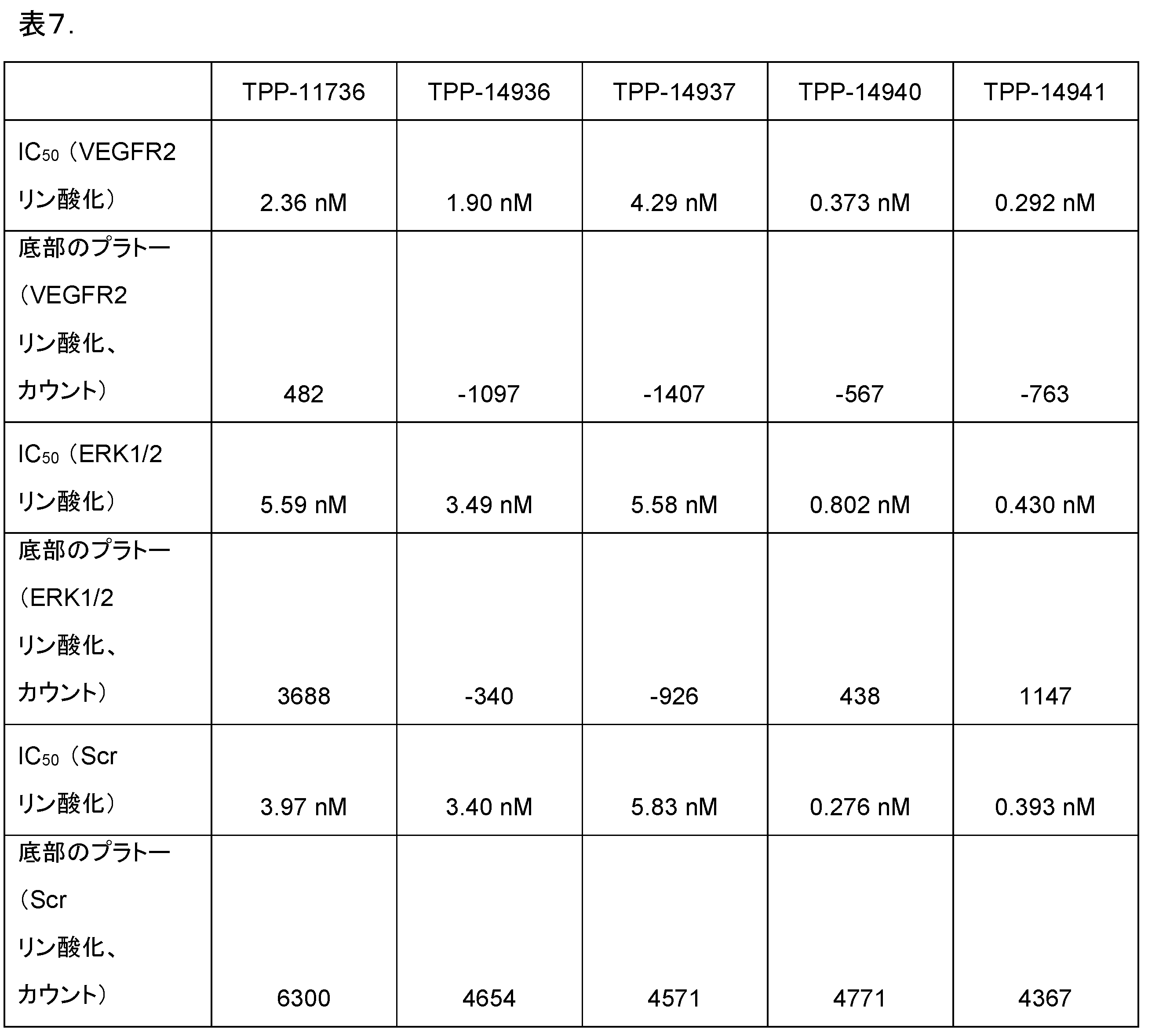
結果
scFvからFabにRanibizumabに再フォーマット化することにより、3つ全てのアッセイにおいて、VEGF捕捉の効力が劇的に改善された(Ranibizumab scFv又は参照である分子TPP-11736より10倍良好なIC50)。
Results Reformatting Ranibizumab from scFv to Fab dramatically improved its potency for VEGF capture in all three assays (10-fold better IC 50 than either Ranibizumab scFv or the reference molecule TPP-11736).
Ranibizumabベースの分子によるVEGF捕捉の有効性は、TPP-11736(底値)よりもはるかに良好であった。 The efficacy of VEGF capture by ranibizumab-based molecules was much better than that of TPP-11736 (bottom price).
しかしながら、Ranibizumabは、FabからscFvへの再フォーマット化には非常によく耐えなかった(B20とは対照的、先の実施例を参照のこと)。 However, Ranibizumab did not tolerate reformatting from Fab to scFv very well (in contrast to B20, see previous example).
実施例35
TPP-14936(scFvとしてのRanibizumab、VH-VL)又はTPP-14937(scFvとしてのRanibizumab、VL-VH)とTPP-14940及びTPP-14941(Ranibizumab Fab)とによるヒトVEGF-A捕捉の比較-HRMECのVEGF誘発増殖の阻害
図35A~図35D
ヒト網膜微小血管内皮細胞(HRMEC)を飢餓状態にし、ついで、上昇する濃度の示された結合分子のプレインキュベーションの有無で、10ng/mL ヒトVEGFと共にインキュベーションした。分子濃度をmol/Lで示す。VEGF-A捕捉を、HRMEC細胞数の自動化された画像ベースの定量化により評価した(IncuCyte)。画像を合計84時間にわたって4時間毎に記録した。相対細胞数を示す。t=0での細胞数を1に設定した。非刺激細胞を対照(ベース)とした。データは、平均+/-SEMを表わす。
Example 35
Comparison of Human VEGF-A Capture by TPP-14936 (Ranibizumab as scFv, VH-VL) or TPP-14937 (Ranibizumab as scFv, VL-VH) with TPP-14940 and TPP-14941 (Ranibizumab Fab) - Inhibition of VEGF-induced Proliferation of HRMEC Figures 35A-D
Human retinal microvascular endothelial cells (HRMEC) were starved and then incubated with 10 ng/mL human VEGF with or without preincubation of increasing concentrations of the indicated binding molecules. Molecule concentrations are shown in mol/L. VEGF-A capture was assessed by automated image-based quantification of HRMEC cell number (IncuCyte). Images were recorded every 4 hours for a total of 84 hours. Relative cell numbers are shown. Cell number at t=0 was set to 1. Unstimulated cells served as control (basal). Data represent mean +/- SEM.
結果
scFvとしてのRanibizumab(TPP-11736/TPP-14937)をRanibizumab Fab(TPP-14940及びTPP-14941)に再フォーマット化することにより、増殖アッセイにおいて、VEGF-A捕捉の効力が顕著に改善された。
Results Reformatting Ranibizumab as scFv (TPP-11736/TPP-14937) into Ranibizumab Fab (TPP-14940 and TPP-14941) significantly improved the potency of VEGF-A capture in the proliferation assay.
TPP-14940及びTPP-14941では、完全なVEGF阻害が、0.25nMの濃度で既に見られた。一方、完全な阻害には、それぞれ1nM TPP-14936及び4nM TPP-14937が必要であった。 For TPP-14940 and TPP-14941, complete VEGF inhibition was already seen at a concentration of 0.25 nM, whereas complete inhibition required 1 nM TPP-14936 and 4 nM TPP-14937, respectively.
VEGF-A阻害の有効性は、4つ全ての分子(全て完全な阻害剤)の間で同様であった。 The efficacy of VEGF-A inhibition was similar among all four molecules (all full inhibitors).
実施例36
TPP-14938又はTPP-14939(B20 Fab)とTPP-14940及びTPP-14941(Ranibizumab Fab)とによるヒトVEGF-A捕捉の比較-VEGFR2、ERK1/2及びSrcのVEGF誘発リン酸化の阻害
図36A~図36C
ヒト網膜微小血管内皮細胞(HRMEC)を飢餓状態にし、ついで、上昇する濃度のDoppelmab TPP-11736(scFvとしてのB20)、TPP-13938(FabとしてのB20)又はTPP-13939(FabとしてのB20)、TPP-14940(FabとしてのRanibizumab)又はTPP-14941(FabとしてのRanibizumab)とのプレインキュベーションの有無で、50ng/mL ヒトVEGFと共にインキュベーションした。VEGF-A捕捉を、(A)Y1175でのVEGFレセプター2(VEGFR2)リン酸化、(B)T202/Y204(ERK1)及びT185/Y187(ERK2)でのERK1/2リン酸化又は(C)Y419でのSrcリン酸化を測定することにより評価した。分子処理を伴わない50ng/ml ヒトVEGFを対照とした。データは、平均+/-SEMを表わす。以下の表8に、対応するベストフィットIC50値及び絶対有効性値(底部のプラトー)をそれぞれ報告する(非線形回帰;log(アゴニスト)対応答(3つのパラメータ))。
Example 36
Comparison of human VEGF-A capture by TPP-14938 or TPP-14939 (B20 Fab) with TPP-14940 and TPP-14941 (Ranibizumab Fab) - Inhibition of VEGF-induced phosphorylation of VEGFR2, ERK1/2 and Src. Figure 36A-C
Human retinal microvascular endothelial cells (HRMEC) were starved and then incubated with 50 ng/mL human VEGF with or without preincubation with increasing concentrations of Doppelmab TPP-11736 (B20 as scFv), TPP-13938 (B20 as Fab) or TPP-13939 (B20 as Fab), TPP-14940 (Ranibizumab as Fab) or TPP-14941 (Ranibizumab as Fab). VEGF-A capture was assessed by measuring (A) VEGF receptor 2 (VEGFR2) phosphorylation at Y1175, (B) ERK1/2 phosphorylation at T202/Y204 (ERK1) and T185/Y187 (ERK2) or (C) Src phosphorylation at Y419. 50 ng/ml human VEGF without molecule treatment served as control. Data represent mean +/- SEM. The corresponding best fit IC50 values and absolute efficacy values (bottom plateau), respectively, are reported in Table 8 below (nonlinear regression; log(agonist) vs. response (three parameters)).

結果
Ranibizumab Fabを有するDoppelmabは、3つのアッセイ全てにおいて、B20 Fabに基づくDoppelmabよりVEGF捕捉の効力が明らかに良好であることを示した。
result
Doppelmab with the Ranibizumab Fab demonstrated clearly better efficacy in capturing VEGF than the B20 Fab-based Doppelmab in all three assays.
Ranobizumab Fabを有するDoppelmabは、3つのアッセイ全てにおいて、B20 Fabに基づくDoppelmabよりVEGF捕捉の有効性が明らかに良好ことを示した(底値)。 Doppelmab with Ranobizumab Fab demonstrated significantly better efficacy in capturing VEGF than Doppelmab based on B20 Fab in all three assays (bottom values).
実施例37
TPP-14938又はTPP-14939(FabとしてのB20)とTPP-14940及びTPP-14941(FabとしてのRanibizumab)とによるヒトVEGF-A捕捉の比較-HRMECのVEGF誘発増殖の阻害
図37A~図37D
ヒト網膜微小血管内皮細胞(HRMEC)を飢餓状態にし、ついで、上昇する濃度の示された結合分子とのプレインキュベーションの有無で、10ng/mL ヒトVEGFと共にインキュベーションした。分子濃度をmol/Lで示す。VEGF-A捕捉を、HRMEC細胞数の自動化された画像ベースの定量化により評価した(IncuCyte)。画像を合計84時間にわたって4時間毎に記録した。相対細胞数を示す。t=0での細胞数を1に設定した。非刺激細胞を対照(ベース)とした。データは、平均+/-SEMを表わす。
Example 37
Comparison of Human VEGF-A Capture by TPP-14938 or TPP-14939 (B20 as Fab) with TPP-14940 and TPP-14941 (Ranibizumab as Fab) - Inhibition of VEGF-Induced Proliferation of HRMEC. FIG. 37A-D
Human retinal microvascular endothelial cells (HRMEC) were starved and then incubated with 10 ng/mL human VEGF with or without preincubation with increasing concentrations of the indicated binding molecules. Molecule concentrations are shown in mol/L. VEGF-A capture was assessed by automated image-based quantification of HRMEC cell number (IncuCyte). Images were recorded every 4 hours for a total of 84 hours. Relative cell numbers are shown. Cell number at t=0 was set to 1. Unstimulated cells served as control (basal). Data represent mean +/- SEM.
結果
RanibizumabFabベースの分子であるTPP-14940及びTPP-14941によるVEGF誘発増殖の阻害の効力及び有効性は、B20 Fabベースの分子であるTPP-14938及びTPP-14939と比較して明らかに優れていた。
result
The potency and efficacy of inhibition of VEGF-induced proliferation by the Ranibizumab Fab-based molecules TPP-14940 and TPP-14941 was clearly superior to that of the B20 Fab-based molecules TPP-14938 and TPP-14939.
最高濃度(16nM)であっても、TPP-14938及びTPP-14939は、VEGF誘発発芽を完全には阻害できなかった。 Even at the highest concentration (16 nM), TPP-14938 and TPP-14939 were unable to completely inhibit VEGF-induced sprouting.
対照的に、TPP-14940及びTPP-14941は、0.25nMという64倍低い濃度で既に、VEGF誘発増殖を完全に阻害した。 In contrast, TPP-14940 and TPP-14941 completely inhibited VEGF-induced proliferation already at a 64-fold lower concentration of 0.25 nM.
実施例38
Doppelmab TPP-11736(scFvとしてのB20)、TPP-14936(scFvとしてのRanibizumab、VH-VL)、TPP-14937(scFvとしてのRanibizumab、VL-VH)、TPP-14938(FabとしてのB20)もしくはTPP-14939(B20 Fab)、TPP-14940(FabとしてのRanibizumab)、TPP-14941(FabとしてのRanibizumab)又はEyleaによるヒトVEGF-A捕捉の比較-VEGF誘発HRMEC発芽の阻害
図38
ヒト網膜微小血管内皮細胞(HRMEC)のスフェロイドをコラーゲンマトリックス中に包埋した。内皮の発芽を2.5nM Doppelmab TPP-11736(B20 scFv)、TPP-14936(Ranibizumab scFv、VH-VL)、TPP-14937(Ranibizumab scFv、VL-VH)、TPP-14938(B20 Fab)、TPP-14939(B20 Fab)、TPP-14940(Ranibizumab Fab)、TPP-14941(Ranibizumab Fab)又は5nM Eyleaとのプレインキュベーションの有無で、50ng/mL ヒトVEGFとのインキュベーションにより24時間誘発した。内皮の発芽を共焦点顕微鏡により評価し、Zスタックの最大投影から得られたスフェロイド外周を示した。非刺激細胞を対照(ベース)とした。データは、平均+/-SEMを表わす。n.s. p>0.05 有意差なし;50ng/mL hVEGFと比較して、§p<0.0001;50ng/mL hVEGFと比較して、#p>0.05 有意差なし。***p<0.001;テューキーの多重比較検定を使用した一元配置分散分析。
Example 38
Comparison of Human VEGF-A Capture by Doppelmab TPP-11736 (B20 as scFv), TPP-14936 (Ranibizumab as scFv, VH-VL), TPP-14937 (Ranibizumab as scFv, VL-VH), TPP-14938 (B20 as Fab) or TPP-14939 (B20 Fab), TPP-14940 (Ranibizumab as Fab), TPP-14941 (Ranibizumab as Fab) or Eylea - Inhibition of VEGF-induced HRMEC Sprouting FIG. 38.
Human retinal microvascular endothelial cell (HRMEC) spheroids were embedded in a collagen matrix. Endothelial sprouting was induced by incubation with 50 ng/mL human VEGF for 24 h with or without preincubation with 2.5 nM Doppelmab TPP-11736 (B20 scFv), TPP-14936 (Ranibizumab scFv, VH-VL), TPP-14937 (Ranibizumab scFv, VL-VH), TPP-14938 (B20 Fab), TPP-14939 (B20 Fab), TPP-14940 (Ranibizumab Fab), TPP-14941 (Ranibizumab Fab) or 5 nM Eylea. Endothelial sprouting was assessed by confocal microscopy and spheroid perimeters obtained from maximum projections of Z-stacks are shown. Unstimulated cells served as control (base). Data represent mean +/- SEM. n.s. p>0.05 not significant; compared to 50 ng/mL hVEGF, § p<0.0001; compared to 50 ng/mL hVEGF, # p>0.05 not significant. *** p<0.001; one-way ANOVA with Tukey's multiple comparison test.
結果
Ranibizumab FabベースのDoppelmab TPP-14940及びTPP-14941は、明らかに、このアッセイにおいて、最良のVEGF捕捉剤であった。Eyleaとは対照的に、TPP-14940及びTPP-14941は、VEGF誘発発芽を完全に阻害した。VEGFの非存在下(ベース)での内皮発芽と2.5nM TPP-14940又はTPP-14941と共にプレインキュベーションされた50ng/mL hVEGFとの間に統計的有意差は見られなかった。
result
The Ranibizumab Fab-based Doppelmab TPP-14940 and TPP-14941 were clearly the best VEGF capture agents in this assay. In contrast to Eylea, TPP-14940 and TPP-14941 completely inhibited VEGF-induced sprouting. No statistically significant differences were observed between endothelial sprouting in the absence of VEGF (basal) and 50 ng/mL hVEGF preincubated with 2.5 nM TPP-14940 or TPP-14941.
TPP-14940及びTPP-14941によるVEGF誘発EC発芽の阻害は、他のいずれのDoppelmabによる阻害より有意に良好であった。 Inhibition of VEGF-induced EC sprouting by TPP-14940 and TPP-14941 was significantly better than that by any of the other Doppelmab treatments.
TPP-14940及びTPP-14941によるVEGF誘発EC発芽の阻害は、Eyleaによる阻害より有意に良好であった。 Inhibition of VEGF-induced EC sprouting by TPP-14940 and TPP-14941 was significantly better than that by Eylea.
さらに、50ng/mL hVEGFとEyleaと共にプレインキュベーションされた50ng/mL hVEGFとで刺激された内皮発芽の間には、統計的有意差は無かった。 Furthermore, there was no statistically significant difference between endothelial sprouting stimulated with 50 ng/mL hVEGF and 50 ng/mL hVEGF preincubated with Eylea.
実施例39
Doppelmab TPP-11940及びEyleaによるヒトVEGF-A捕捉の比較-Brown NorwayラットにおけるヒトVEGF-A誘発網膜透過性亢進の阻害
図39A~図39B
TPP-14940(Eyleaではない)は、ラット網膜におけるヒトVEGF-A誘発透過性亢進を予防した。(A)実験手法を示す時間プロトコール。抗VEGF化合物(13又は26pmol/眼 Eylea又はTPP-14940)又は対照(26pmol TPP-11737)の硝子体内(ivt)投与の15分後、13pmol ヒトVEGF-A/眼をivt注射により投与した。PBS注射を対照とした。24時間後、1mL/kg エバンスブルー(EB)溶液(0.9% 生理食塩水中の45mg/mL)を静脈内(iv)注射により30分間投与し、その後、眼を単離し、固定した。同じ時点で、血漿サンプルを収集し、全身EB曝露量が等しいことを確認した。(B)Brown Norwayラットの網膜におけるVEGF-A誘発透過性亢進の定量を、共焦点顕微鏡により網膜フラットマウントにおけるEB血管外漏出を測定することにより行った。眼を鋸状縁に沿って切断し、水晶体及び硝子体を除去し、眼杯をパラホルムアルデヒド(4%)中において、4℃で1時間固定し、ついで、4℃で一晩PBSに移した。網膜を外側セグメント(強膜及び脈絡膜)から分離し、スライドガラスに移し、4回切断して、平坦なクローバー葉様構造を達成した。組織をマウンティング媒体(DNA染色DAPIを含有するVectashield H-1200)で覆い、カバースリップを上に置き、網膜フラットマウントを得た。サンプルを639nmの波長で励起し、669nmでのエバンスブルーの発光をLSM 700共焦点レーザー走査顕微鏡(Carl Zeiss, Jena;ゲイン800、レーザー強度2%、5スタック 60μm)で記録し、最大強度投影を有する網膜フラットマウントの画像を得た。蛍光強度の合計の分析を30の閾値でプログラムImageJ中において画像を開いた後に行った。***p<0.001;*p<0.05;n.s. p>0.05;#p>0.05 TPP-11737+PBSに対して有意差なし。テューキーの多重比較検定を使用した一元配置分散分析。n=9~17。
Example 39
Comparison of human VEGF-A uptake by Doppelmab TPP-11940 and Eylea - Inhibition of human VEGF-A-induced retinal hyperpermeability in Brown Norway rats. Figures 39A-B
TPP-14940, but not Eylea, prevented human VEGF-A-induced hyperpermeability in rat retina. (A) Time protocol showing experimental procedure. 15 min after intravitreal (ivt) administration of anti-VEGF compounds (13 or 26 pmol/eye Eylea or TPP-14940) or control (26 pmol TPP-11737), 13 pmol human VEGF-A/eye was administered by ivt injection. PBS injection served as control. 24 h later, 1 mL/kg Evans Blue (EB) solution (45 mg/mL in 0.9% saline) was administered by intravenous (iv) injection for 30 min, after which the eyes were isolated and fixed. Plasma samples were collected at the same time points to ensure equal systemic EB exposure. (B) Quantification of VEGF-A-induced hyperpermeability in Brown Norway rat retinas was performed by measuring EB extravasation in retinal flatmounts by confocal microscopy. Eyes were dissected along the ora serrata, the lens and vitreous were removed, and the eyecups were fixed in paraformaldehyde (4%) for 1 h at 4°C, then transferred to PBS overnight at 4°C. Retinas were separated from the outer segment (sclera and choroid), transferred to glass slides, and cut four times to achieve a flat cloverleaf-like structure. Tissues were covered with mounting medium (Vectashield H-1200 containing the DNA stain DAPI) and topped with a coverslip to obtain retinal flatmounts. Samples were excited at a wavelength of 639 nm and the emission of Evans Blue at 669 nm was recorded with a LSM 700 confocal laser scanning microscope (Carl Zeiss, Jena; gain 800,
結果
対照条件下で、硝子体内VEGF-A注射により、血管透過性が約60%向上した。TPP-14940と同じ分子フォーマット(Doppelmab)を有するため、TPP-11737を対照抗体として使用したが、初期のin vitroアッセイでは、この化合物はVEGFを捕捉しなかった。
Results: Under control conditions, intravitreal VEGF-A injection increased vascular permeability by approximately 60%. TPP-11737 was used as a control antibody because it has the same molecular format (Doppelmab) as TPP-14940, but this compound did not capture VEGF in initial in vitro assays.
1:1及び2:1の分子比の結合分子対VEGFにおいて、TPP-14940は、血管透過性亢進を完全に遮断した。一方、はっきりと対照的に、Eyleaは、同じ条件下でかつ2倍の濃度でさえも、血管漏出を顕著に減少させることができなかった。 At molecular ratios of 1:1 and 2:1 binding molecule to VEGF, TPP-14940 completely blocked vascular hyperpermeability, whereas, in sharp contrast, Eylea failed to significantly reduce vascular leakage under the same conditions and even at twice the concentration.
シリーズ2-TPP-14938、TPP-14939、TPP-14940、TPP-14941の知見の概要
TrkB活性化
TPP-11736とは非常に対照的に、4つの新規な「Doppelmabは全て、完全なTrkBレセプターアゴニストであった。これらのDoppelmabによるTrkB活性化は、天然のリガンドであるBDNFと同様に有効であった。
Series 2 - Summary of findings for TPP-14938, TPP-14939, TPP-14940, TPP-14941 TrkB activation In sharp contrast to TPP-11736, all four novel "Doppelmabs" were full TrkB receptor agonists. TrkB activation by these Doppelmabs was as effective as the natural ligand BDNF.
TrkB活性化の効力は、「VH-VL」配向を有するDoppelmab TPP-14938/40対TPP-14939及びTPP-14941において幾らか良好であった。 The efficacy of TrkB activation was somewhat better with Doppelmab TPP-14938/40 versus TPP-14939 and TPP-14941, both of which have a "VH-VL" orientation.
驚くべきことに、ヒトVEGFとのプレインキュベーションにより、相乗効果を示して、TPP-14941[C2、scFv、20L3、VL-VH]によるTrkBリン酸化(TrkB活性化)の効力が劇的に改善された。 Surprisingly, preincubation with human VEGF dramatically improved the efficacy of TrkB phosphorylation (TrkB activation) by TPP-14941 [C2, scFv, 20L3, VL-VH], demonstrating a synergistic effect.
TPP-14941とは対照的に、TPP-14940[C2、scFv、20L3、VH-VL]によるTrkBリン酸化(TrkB活性化)の効力に対するVEGFの影響は、比較的小さかった。 In contrast to TPP-14941, the effect of VEGF on the efficacy of TrkB phosphorylation (TrkB activation) by TPP-14940 [C2, scFv, 20L3, VH-VL] was relatively small.
VEGF捕捉
B20 scFv(TPP-11736)をB20 Fab(TPP-14938及びTPP-14939)に再フォーマット化することによっては、増殖アッセイにおいて、VEGF-A捕捉の効力も有効性も改善されなかった。
VEGF Capture Reformatting the B20 scFv (TPP-11736) into a B20 Fab (TPP-14938 and TPP-14939) did not improve the potency or efficacy of VEGF-A capture in proliferation assays.
Ranibizumab scFv(TPP-11736/TPP-14937)をRanibizumab Fab(TPP-14940及びTPP-14941)に再フォーマット化することにより、増殖アッセイにおいて、VEGF-A捕捉の効力が顕著に改善された。 Reformatting ranibizumab scFv (TPP-11736/TPP-14937) into ranibizumab Fab (TPP-14940 and TPP-14941) significantly improved the efficacy of VEGF-A capture in proliferation assays.
完全なVEGF阻害は、TPP-14940及びTPP-14941を使用して、0.25nMという低い濃度で既に見られた。 Complete VEGF inhibition was already seen at concentrations as low as 0.25 nM using TPP-14940 and TPP-14941.
Ranibizumab Fabベースの分子であるTPP-14940及びTPP-14941によるVEGF誘発増殖の阻害の効力及び有効性は、B20 Fabベースの分子であるTPP-14938及びTPP-14939と比較して優れていた。 The potency and efficacy of the ranibizumab Fab-based molecules TPP-14940 and TPP-14941 in inhibiting VEGF-induced proliferation was superior to that of the B20 Fab-based molecules TPP-14938 and TPP-14939.
本発明者らは、下記実施例において結合分子におけるリンカークリッピングを観察した(データは示さず)ため、TPP-14940に基づいて、更なる分子:TPP-19986(VH-VL、10L1)、TPP-19987(VH-VL、20L1)及びTPP-14941に基づいて、TPP-19988(VL-VH、10L1)、TPP-19989(VL-VH、20L1)を導き出した。これらは全て、FabとしてのRanibizumab及びscFvとしてのC2に基づいた。 Since the inventors observed linker clipping in the binding molecules in the examples below (data not shown), they derived further molecules based on TPP-14940: TPP-19986 (VH-VL, 10L1), TPP-19987 (VH-VL, 20L1) and based on TPP-14941: TPP-19988 (VL-VH, 10L1), TPP-19989 (VL-VH, 20L1). All of these were based on Ranibizumab as Fab and C2 as scFv.
実施例40
BDNF、TPP-14940[C2、scFv、20L3、VH-VL]又はそのリンカー変形形態であるTPP-19986[C2、scFv、10L1、VH-VL]もしくはTPP-19987[C2、scFv、20L1、VH-VL]又はTPP-14941[C2、scFv、20L3、VL-VH]及びそのリンカー変形形態であるTPP-19988[C2、scFv、10L1、VL-VH]もしくはTPP-19989[C2、scFv、20L1、VL-VH]によるヒトTrkB活性化の比較;TrkB及びERK1/2のリン酸化-シリーズ3
図40A~図40D
ヒトTrkBを安定に発現するヒトCHO細胞を上昇する濃度の天然のTrkBリガンドであるBDNF、TPP-14940[C2、scFv、20L3、VH-VL]又はそのリンカー変形形態であるTPP-19986[C2、scFv、10L1、VH-VL]もしくはTPP-19987[C2、scFv、20L1、VH-VL]又はTPP-14941[C2、scFv、20L3、V-VH]及びそのリンカー変形形態であるTPP-19988[C2、scFv、10L1、VL-VH]もしくはTPP-19989[C2、scFv、20L1、VL-VH]と共にインキュベーションした。TrkB活性化を、(A及びB)Y706/707でのTrkBリン酸化を測定することにより又は(C及びD)T202/Y204(ERK1)及びT185/Y187(ERK2)でのERK1/2リン酸化をそれぞれ測定することにより評価した。最低化合物濃度を溶媒単独とした。データは、平均+/-SEMを表わす。以下の表9及び表10に、TrkB及びERK1/2リン酸化の対応するベストフィットIC50値及び絶対有効性値(底部のプラトー)をそれぞれ報告する(非線形回帰;log(アゴニスト)対応答(3つのパラメータ))。
Example 40
Comparison of human TrkB activation by BDNF, TPP-14940 [C2, scFv, 20L3, VH-VL] or its linker variants TPP-19986 [C2, scFv, 10L1, VH-VL] or TPP-19987 [C2, scFv, 20L1, VH-VL] or TPP-14941 [C2, scFv, 20L3, VL-VH] and its linker variants TPP-19988 [C2, scFv, 10L1, VL-VH] or TPP-19989 [C2, scFv, 20L1, VL-VH]; phosphorylation of TrkB and ERK1/2 -
Figures 40A to 40D
Human CHO cells stably expressing human TrkB were incubated with increasing concentrations of the natural TrkB ligand BDNF, TPP-14940 [C2, scFv, 20L3, VH-VL] or its linker variants TPP-19986 [C2, scFv, 10L1, VH-VL] or TPP-19987 [C2, scFv, 20L1, VH-VL] or TPP-14941 [C2, scFv, 20L3, V-VH] and its linker variants TPP-19988 [C2, scFv, 10L1, VL-VH] or TPP-19989 [C2, scFv, 20L1, VL-VH]. TrkB activation was assessed by measuring (A and B) TrkB phosphorylation at Y706/707 or (C and D) ERK1/2 phosphorylation at T202/Y204 (ERK1) and T185/Y187 (ERK2), respectively. The lowest compound concentration was solvent alone. Data represent the mean +/- SEM. The corresponding best fit IC50 values and absolute efficacy values (lower plateau) for TrkB and ERK1/2 phosphorylation, respectively, are reported in Tables 9 and 10 below (nonlinear regression; log(agonist) vs. response (three parameters)).


結果
親分子と各リンカー変形形態との間に有意差は無かった。TrkB及びERK1/2のリン酸化の効力及び有効性は、実質的に同一であった。これは、注目に値する。リンカーが、TrkB結合部位の近くに位置していたが、結合分子の生体活性には影響を及ぼさなかったためである。
Results: There were no significant differences between the parent molecule and each linker variant. The potency and efficacy of phosphorylation of TrkB and ERK1/2 were virtually identical. This is noteworthy because the linker was located close to the TrkB binding site but did not affect the biological activity of the binding molecule.
全ての試験分子が、完全TrkBアゴニストであった。 All test molecules were full TrkB agonists.
再度、先に示されたように、TrkB/ERKリン酸化の効力は、TPP-14941分子及びそのリンカー変形形態(VL-VH配向)と比較して、TPP-14940分子及びそのリンカー変形形態(VH-VL配向)についてより良好であった。 Again, as shown above, the efficacy of TrkB/ERK phosphorylation was better for the TPP-14940 molecule and its linker variants (VH-VL orientation) compared to the TPP-14941 molecule and its linker variants (VL-VH orientation).
実施例41
BDNF、TPP-14940[C2、scFv、20L3、VH-VL]又はTPP-14941[C2、scFv、20L3、VL-VH]及びリンカー変形形態であるTPP-19988[C2、scFv、10L1、VL-VH]もしくはTPP-19989[C2、scFv、20L1、VL-VH]によるヒトTrkB内部移行の比較-シリーズ3
図41A~図41B
カニクイザルTrkBを安定に発現するCHO細胞を、上昇する濃度の天然のTrkBリガンドであるBDNF又は上昇する濃度の第1のシリーズのDoppelmab TPP-14940[C2、scFv、20L3、VH-VL]もしくはTPP-14941[C2、scFv、20L3、VL-VH]及びリンカー変形形態であるTPP-19988[C2、scFv、10L1、VL-VH]もしくはTPP-19989[C2、scFv、20L1、VL-VH]を伴う1nM BDNFと共にインキュベーションした。TrkB内部移行を細胞の透過化を伴わない表面TrkBレセプターの免疫蛍光染色、続けて、共焦点顕微鏡分析により評価した。ヒートマップの暗視野及び明視野はそれぞれ、蛍光閾値を上回る細胞の割合の高低を表わす。
Example 41
Comparison of human TrkB internalization by BDNF, TPP-14940 [C2, scFv, 20L3, VH-VL] or TPP-14941 [C2, scFv, 20L3, VL-VH] and linker variants TPP-19988 [C2, scFv, 10L1, VL-VH] or TPP-19989 [C2, scFv, 20L1, VL-VH] -
Figures 41A to 41B
CHO cells stably expressing cynomolgus TrkB were incubated with increasing concentrations of the natural TrkB ligand BDNF or 1 nM BDNF with increasing concentrations of the first series of Doppelmab TPP-14940 [C2, scFv, 20L3, VH-VL] or TPP-14941 [C2, scFv, 20L3, VL-VH] and linker variants TPP-19988 [C2, scFv, 10L1, VL-VH] or TPP-19989 [C2, scFv, 20L1, VL-VH]. TrkB internalization was assessed by immunofluorescence staining of surface TrkB receptor without cell permeabilization followed by confocal microscopy analysis. The dark and bright fields of the heatmap represent high and low percentages of cells above the fluorescence threshold, respectively.
結果
BDNFにより、TrkBレセプター内部移行が誘発された。TPP-14940、TPP-14941、TPP-19988及びTPP-19989は、完全なTrkBレセプターアゴニストであったが、Doppelmabのいずれによっても、BDNF誘発レセプター内部移行を増加せず、むしろ、TrkBレセプターのBDNF誘発内部移行が減少した(注:ヒートマップフィールドは、下から上へ暗くなっている)。
Results: BDNF induced TrkB receptor internalization. TPP-14940, TPP-14941, TPP-19988 and TPP-19989 were full TrkB receptor agonists, but none of them, Doppelmab, increased BDNF-induced receptor internalization, but rather reduced BDNF-induced internalization of TrkB receptors (Note: heatmap fields are darkened from bottom to top).
実施例42
TPP-14940並びにそのリンカー変形形態であるTPP-19986及びTPP-14941並びにそのリンカー変形形態であるTPP-19988によるヒトVEGF-A捕捉の比較-VEGFR2のVEGF誘発リン酸化の阻害-シリーズ3
図42
ヒト網膜微小血管内皮細胞(HRMEC)を飢餓状態にし、ついで、上昇する濃度のDoppelmab TPP-14940並びにそのリンカー変形形態であるTPP-19986及びTPP-14941並びにそのリンカー変形形態であるTPP-19988とのプレインキュベーションの有無で、50ng/mL ヒトVEGFと共にインキュベーションした。VEGF-A捕捉を、Y1175でのVEGFレセプター2(VEGFR2)リン酸化を測定することにより評価した。分子処理を伴わない50ng/ml ヒトVEGFを対照とした。データは、平均+/-SEMを表わす。以下の表11に、VEGFR2リン酸化の阻害の対応するベストフィットIC50値(非線形回帰;log(アゴニスト)対応答(3つのパラメータ))を報告する。
Example 42
Comparison of Human VEGF-A Capture by TPP-14940 and Its Linker Variants TPP-19986 and TPP-14941 and Its Linker Variants TPP-19988 - Inhibition of VEGF-Induced Phosphorylation of VEGFR2 -
FIG.
Human retinal microvascular endothelial cells (HRMEC) were starved and then incubated with 50 ng/mL human VEGF with or without preincubation with increasing concentrations of Doppelmab TPP-14940 and its linker variants TPP-19986 and TPP-14941 and its linker variants TPP-19988. VEGF-A uptake was assessed by measuring VEGF receptor 2 (VEGFR2) phosphorylation at Y1175. 50 ng/ml human VEGF without any molecular treatment served as control. Data represent mean +/- SEM. The corresponding best fit IC50 values (nonlinear regression; log(agonist) vs. response (three parameters)) for inhibition of VEGFR2 phosphorylation are reported in Table 11 below.

結果
親分子であるTPP-14940/TPP-14941と各リンカー変形形態との間に有意差は無かった。VEGF誘発VEGFR2リン酸化の阻害の効力及び有効性は、実質的に同一であった。
Results There were no significant differences between the parent molecules TPP-14940/TPP-14941 and each linker variant. The potency and efficacy of inhibition of VEGF-induced VEGFR2 phosphorylation were virtually identical.
実施例43
Doppelmab TPP-14940[C2、scFv、20L3、VH-VL]又はそのリンカー変形形態であるTPP-19986[C2、scFv、10L1、VH-VL]もしくはTPP-19987[C2、scFv、20L1、VH-VL]又はTPP-14941[C2、scFv、20L3、VL-VH]及びそのリンカー変形形態であるTPP-19988[C2、scFv、10L1、VL-VH]もしくはTPP-19989[C2、scFv、20L1、VL-VH]によるヒトVEGF-A捕捉の比較-VEGF誘発HRMEC発芽の阻害-シリーズ3
図43
ヒト網膜微小血管内皮細胞(HRMEC)のスフェロイドをコラーゲンマトリックスに包埋した。内皮の発芽を2.5nM Doppelmab TPP-11736(B20 scFv)、TPP-14940[C2、scFv、20L3、VH-VL]又はそのリンカー変形形態であるTPP-19986[C2、scFv、10L1、VH-VL]もしくはTPP-19987[C2、scFv、20L1、VH-VL]又はTPP-14941[C2、scFv、20L3、VL-VH]及びそのリンカー変形形態であるTPP-19988[C2、scFv、20L1、VL-VH]もしくはTPP-19989[C2、scFv、20L1、VL-VH]とのプレインキュベーションの有無で、50ng/mL ヒトVEGFとのインキュベーションにより24時間誘発した。内皮の発芽を共焦点顕微鏡により評価し、Zスタックの最大投影から得られたスフェロイド外周を示した。非刺激細胞を対照(ベース)とした。データは、平均+/-SEMを表わす。n.s. p>0.05 有意差なし;50ng/mL hVEGFと比較して、§p<0.0001;50ng/mL hVEGFと比較して、#p>0.05 有意差なし。***p<0.001;テューキーの多重比較検定を使用した一元配置分散分析。
Example 43
Comparison of Human VEGF-A Capture by Doppelmab TPP-14940 [C2, scFv, 20L3, VH-VL] or its linker variants TPP-19986 [C2, scFv, 10L1, VH-VL] or TPP-19987 [C2, scFv, 20L1, VH-VL] or TPP-14941 [C2, scFv, 20L3, VL-VH] and its linker variants TPP-19988 [C2, scFv, 10L1, VL-VH] or TPP-19989 [C2, scFv, 20L1, VL-VH] - Inhibition of VEGF-induced HRMEC Sprouting -
FIG.
Human retinal microvascular endothelial cell (HRMEC) spheroids were embedded in a collagen matrix. Endothelial sprouting was monitored with or without preincubation with 2.5 nM Doppelmab TPP-11736 (B20 scFv), TPP-14940 [C2, scFv, 20L3, VH-VL] or its linker variants TPP-19986 [C2, scFv, 10L1, VH-VL] or TPP-19987 [C2, scFv, 20L1, VH-VL] or TPP-14941 [C2, scFv, 20L3, VL-VH] and its linker variants TPP-19988 [C2, scFv, 20L1, VL-VH] or TPP-19989 [C2, scFv, 20L1, VL-VH] at 50 ng/mL Cells were induced by incubation with human VEGF for 24 hours. Endothelial sprouting was assessed by confocal microscopy and spheroid circumferences obtained from maximum projections of Z-stacks are shown. Unstimulated cells served as control (base). Data represent mean +/- SEM. n.s. p>0.05 not significant; compared to 50 ng/mL hVEGF, § p<0.0001; compared to 50 ng/mL hVEGF, # p>0.05 not significant. *** p<0.001; one-way ANOVA with Tukey's multiple comparison test.
結果
親分子であるTPP-14940/TPP-14941と各リンカー変形形態との間に、有意差は観察されなかった。全ての分子が、HRMECのVEGF誘発発芽を完全に阻害した。
Results No significant differences were observed between the parent molecules TPP-14940/TPP-14941 and each linker variant. All molecules completely inhibited VEGF-induced sprouting of HRMEC.
シリーズ3-TPP-19986、19987、19988、19989の知見の概要
TrkB活性化
親分子(TPP-14940/14941)と各リンカー変形形態との間に、有意差は観察されなかった。
Series 3 - Summary of Findings for TPP-19986, 19987, 19988, 19989 TrkB Activation No significant differences were observed between the parent molecule (TPP-14940/14941) and each linker variant.
全ての試験された結合分子は、完全なTrkBレセプターアゴニストであった。VH-VL配向及びそのリンカー変形形態は、さらにより強力であった。 All tested binding molecules were full TrkB receptor agonists. The VH-VL orientation and its linker variants were even more potent.
レセプター内部移行の変化は観察されなかった。これは、新規なDoppelmabが完全なTrkBレセプターアゴニストであるBDNFと同様であったことを考慮すると、非常に驚くべきことであった。 No changes in receptor internalization were observed, which was quite surprising given that the novel Doppelmab was similar to BDNF, a full TrkB receptor agonist.
VEGF捕捉
親分子(TPP-14940/14941)とそれぞれのリンカー変形形態との間に、有意差は観察されなかった。
VEGF Capture No significant differences were observed between the parent molecule (TPP-14940/14941) and each linker variant.
CMC特性
リンカー10L1及び20L1リンカーの使用により、リンカークリッピングは、もはや観察されなかった(データを示さず)。
CMC Properties With the use of the 10L1 and 20L1 linkers, linker clipping was no longer observed (data not shown).
次の段階として、結合分子のCMC及び生物物理学的特性を改善するために、最終シリーズの結合分子を設計した(シリーズ4)。ただし、本発明の結合分子の優れた生物学的機能を常に保存しようとした。 As a next step, a final series of binding molecules was designed (series 4) to improve the CMC and biophysical properties of the binding molecules, while always trying to preserve the excellent biological function of the binding molecules of the present invention.
実施例44
TrkB scFv部分におけるジスルフィド架橋(CC)の有無でのDoppelmabによるヒトTrkB活性化の比較;TrkBリン酸化-シリーズ4
図44A~図44D
ヒトTrkBを安定に発現するCHO細胞を抗TrkB scFv部分におけるCC架橋の有無で、上昇する濃度の示されたDoppelmabと共にインキュベーションした。(A)TPP-22180対TPP-22204;(B)TPP-22192対TPP-22216;(C)TPP-22190対TPP-22214;(D)TPP-22191対TPP-22215。TrkB活性化を、Y706/707でのTrkBリン酸化を測定することにより評価した。最低化合物濃度を溶媒単独とした。データは、平均+/-SEMを表わす。以下の表12に、TrkB活性化の対応するベストフィットIC50値及び絶対又は相対有効性値(上部のプラトー)をそれぞれ報告する(非線形回帰;log(アゴニスト)対応答(3つのパラメータ))。
Example 44
Comparison of human TrkB activation by Doppelmab with or without disulfide bridge (CC) in the TrkB scFv portion; TrkB phosphorylation -
Figures 44A to 44D
CHO cells stably expressing human TrkB were incubated with increasing concentrations of the indicated Doppelmab with or without CC-linking on the anti-TrkB scFv moiety. (A) TPP-22180 vs. TPP-22204; (B) TPP-22192 vs. TPP-22216; (C) TPP-22190 vs. TPP-22214; (D) TPP-22191 vs. TPP-22215. TrkB activation was assessed by measuring TrkB phosphorylation at Y706/707. The lowest compound concentration was solvent alone. Data represent the mean +/- SEM. Table 12 below reports the corresponding best-fit IC 50 values and absolute or relative efficacy values (upper plateau) of TrkB activation, respectively (non-linear regression; log(agonist) vs. response (three parameters)).

結果
ジスルフィド架橋を主に、結合分子のCMC特性を改善するのに導入した。驚くべきことに、scFv抗TrkB部分にジスルフィド架橋を含ませることにより、TrkB活性化の効力及び有効性の両方がさらに改善された。VL-VH配向を有する結合分子において、より大きな影響が観察された。
Results Disulfide bridges were introduced primarily to improve the CMC properties of the binding molecules. Surprisingly, the inclusion of disulfide bridges in the scFv anti-TrkB moiety further improved both the potency and efficacy of TrkB activation. A greater effect was observed in binding molecules with a VL-VH orientation.
実施例45
TrkB scFv部分におけるジスルフィド架橋(CC)の有無でのDoppelmabによるラットTrkB活性化の比較;TrkBリン酸化-シリーズ4
図45A~図45B
ラットTrkBを安定に発現するCHO細胞を抗TrkB scFv部分におけるCC架橋の有無で、上昇する濃度の示されたDoppelmabと共にインキュベーションした。(A)TPP-22180対TPP-22204;(B)TPP-22192対TPP-22216。TrkB活性化を、Y706/707でのTrkBリン酸化を測定することにより評価した。最低化合物濃度を溶媒単独とした。データは、平均+/-SEMを表わす。以下の表13に、TrkB活性化の対応するベストフィットIC50値及び絶対又は相対有効性値(上部のプラトー)をそれぞれ報告する(非線形回帰;log(アゴニスト)対応答(3つのパラメータ))。
Example 45
Comparison of rat TrkB activation by Doppelmab with or without disulfide bridge (CC) in the TrkB scFv portion; TrkB phosphorylation -
Figures 45A to 45B
CHO cells stably expressing rat TrkB were incubated with increasing concentrations of the indicated Doppelmab with or without CC-linking in the anti-TrkB scFv moiety. (A) TPP-22180 vs. TPP-22204; (B) TPP-22192 vs. TPP-22216. TrkB activation was assessed by measuring TrkB phosphorylation at Y706/707. The lowest compound concentration was solvent alone. Data represent the mean +/- SEM. The corresponding best-fit IC50 values and absolute or relative efficacy values (upper plateau) of TrkB activation, respectively, are reported in Table 13 below (nonlinear regression; log(agonist) vs. response (three parameters)).

結果
scFv抗TrkB部品にジスルフィド架橋を含ませることにより、TrkB活性化の効力及び有効性の両方が改善された。再度、VL-VH配向の結合分子に対する影響は、より大きいようであった。全体として、データは、ヒトTrkBについて得られたデータと良好に一致した。
Results: The inclusion of disulfide bridges in the scFv anti-TrkB component improved both the potency and efficacy of TrkB activation. Again, the impact of the VL-VH orientation on the binding molecules appeared to be greater. Overall, the data were in good agreement with those obtained for human TrkB.
実施例46
TPP-22204/22214媒介性TrkB活性化の選択性
図46
(A)ヒトTrkA、(B)ヒトTrkB又は(C)ヒトTrkCを安定に発現するCHO細胞を上昇する濃度のC2抗体又はDoppelmab TPP-22204もしくはTPP-22214と共にインキュベーションした。Trkレセプターの活性化を、Y706/707でのレセプターリン酸化を測定することにより評価した。上昇する濃度のTrkA(NGF)、TrkB(BDNF)及びTrkC(NT-3)についての天然のリガンドとのインキュベーションを対照として使用した。最低化合物濃度を溶媒単独とした。データは、平均+/-SEMを表わす。
Example 46
Selectivity of TPP-22204/22214-mediated TrkB activation
CHO cells stably expressing (A) human TrkA, (B) human TrkB or (C) human TrkC were incubated with increasing concentrations of C2 antibody or Doppelmab TPP-22204 or TPP-22214. Trk receptor activation was assessed by measuring receptor phosphorylation at Y706/707. Incubation with increasing concentrations of the natural ligands for TrkA (NGF), TrkB (BDNF) and TrkC (NT-3) were used as controls. The lowest compound concentration was solvent alone. Data represent the mean +/- SEM.
結果
両方のDoppelmabとも、TrkBに非常に特異的/選択的であった-それらは、TrkA又はTrkCのいずれも活性化しなかった。
Results Both Doppelmabs were highly specific/selective for TrkB - they did not activate either TrkA or TrkC.
実施例47
BDNF誘発TrkB活性化に対するTPP-22214の影響
図47A~図47B
ヒトTrkBレセプターを安定に発現するCHO細胞を、一定濃度の0.3nM、1nM又は3nM BDNFの有無で、上昇する濃度の(A)C2抗体又は(B)Doppelmab TPP-22214と共にインキュベーションした。TrkBの活性化を、Y706/707でのレセプターリン酸化を測定することにより評価した。データは、平均+/-SEMを表わす。
Example 47
Effect of TPP-22214 on BDNF-induced TrkB activation.
CHO cells stably expressing the human TrkB receptor were incubated with increasing concentrations of (A) C2 antibody or (B) Doppelmab TPP-22214 in the presence or absence of constant concentrations of 0.3 nM, 1 nM or 3 nM BDNF. Activation of TrkB was assessed by measuring receptor phosphorylation at Y706/707. Data represent the mean +/- SEM.
結果
C2とは非常に対照的に、TPP-22214は、BDNF誘発TrkB活性化を制限しなかった。
Results In sharp contrast to C2, TPP-22214 did not limit BDNF-induced TrkB activation.
実施例48
ヒトVEGFの存在下又は非存在下におけるTPP-22214によるヒトTrkB活性化(TrkBリン酸化)の比較
図48A~図48D
ヒトTrkBを安定に発現するCHO細胞を、(A)200ng/mL ヒトVEGF-A(hVEGF)、(B)50ng/mL hVEGF、(C)10ng/mL hVEGF、又は(D)2ng/mL hVEGFとのプレインキュベーションの有無で、上昇する濃度のDoppelmab TPP-22214と共にインキュベーションした。TrkB活性化を、Y706/707でのTrkBリン酸化を測定することにより評価した。最低化合物濃度を溶媒単独とした。データは、平均+/-SEMを表わす。
Example 48
Comparison of human TrkB activation (TrkB phosphorylation) by TPP-22214 in the presence or absence of human VEGF.
CHO cells stably expressing human TrkB were incubated with increasing concentrations of Doppelmab TPP-22214 with or without preincubation with (A) 200 ng/mL human VEGF-A (hVEGF), (B) 50 ng/mL hVEGF, (C) 10 ng/mL hVEGF, or (D) 2 ng/mL hVEGF. TrkB activation was assessed by measuring TrkB phosphorylation at Y706/707. The lowest compound concentration was solvent alone. Data represent the mean +/- SEM.
結果
先に示されたように、200ng/mL ヒトVEGFとのプレインキュベーションにより、TPP-22214によるTrkBリン酸化(TrkB活性化)の効力が改善された。より重要なことには、この相乗効果が、50、10、さらには2ng/mL hVEGFでほぼ保持された。また、同様の効果が、他の種、例えば、カニクイザルでも得られた(データを示さず)。
Results: As shown previously, preincubation with 200 ng/mL human VEGF improved the efficacy of TPP-22214-induced TrkB phosphorylation (TrkB activation). More importantly, this synergistic effect was largely preserved with 50, 10, and even 2 ng/mL hVEGF. Similar effects were also obtained in other species, e.g., cynomolgus monkeys (data not shown).
実施例49
ヒトVEGFの存在下又は非存在下におけるTPP-22214によるヒトTrkB活性化(ERKリン酸化)の比較
図49A~図49D
ヒトTrkBを安定に発現するCHO細胞を(A)200ng/mL ヒトVEGF-A(hVEGF)、(B)50ng/mL hVEGF、(C)10ng/mL hVEGF又は(D)2ng/mL hVEGFとのプレインキュベーションの有無で、上昇する濃度のDoppelmab TPP-22214と共にインキュベーションした。TrkBの活性化を、TrkBの下流であるT202/Y204(ERK1)及びT185/Y187(ERK2)でのERK1/2リン酸化を測定することにより評価した。最低化合物濃度を溶媒単独とした。データは、平均+/-SEMを表わす。
Example 49
Comparison of human TrkB activation (ERK phosphorylation) by TPP-22214 in the presence or absence of human VEGF.
CHO cells stably expressing human TrkB were incubated with increasing concentrations of Doppelmab TPP-22214 with or without preincubation with (A) 200 ng/mL human VEGF-A (hVEGF), (B) 50 ng/mL hVEGF, (C) 10 ng/mL hVEGF, or (D) 2 ng/mL hVEGF. Activation of TrkB was assessed by measuring ERK1/2 phosphorylation at T202/Y204 (ERK1) and T185/Y187 (ERK2), downstream of TrkB. The lowest compound concentration was vehicle alone. Data represent the mean +/- SEM.
結果
同様に、200ng/mL ヒトVEGFとのプレインキュベーションにより、TPP-22214によるTrkB活性化の下流のERKリン酸化の効力も改善された。また、このアッセイにおいて、相乗効果は、2ng/mL hVEGFという低い濃度でほぼ保持された。同様の効果が、他の種、例えば、カニクイザルでも得られた(データを示さず)。
Results: Similarly, preincubation with 200 ng/mL human VEGF improved the potency of ERK phosphorylation downstream of TrkB activation by TPP-22214. Also, synergistic effects were largely preserved at concentrations as low as 2 ng/mL hVEGF in this assay. Similar effects were obtained in other species, e.g., cynomolgus monkeys (data not shown).
実施例50
VEGF結合によりTrkB活性化が増強される-提案されたメカニズムの研究
図50
TPP-22214とhVEGFとの複合体を1×ダルベッコPBS中において、記載されたモル比(1:1、4:1又は20:1)でサンプル同士を混合することにより調製した。サンプルを室温で1時間インキュベーションし、その後、分析した。Agilent 1200をmini DAWN TREOS及びOptilab REXと繋げて使用した。サンプルを、移動相としての1×ダルベッコPBS中において、0.6ml/分の流量で流した。複合体又はTPP-22214単独 100μlをSuperose 6 Increaseカラム(30cm×10mm)に注入し、そこで、分子を流体力学的体積による分離に供した。ついで、データを、Astra 6.1.1.17を使用して分析した。
Example 50
VEGF binding enhances TrkB activation - a proposed mechanistic study.
Complexes of TPP-22214 and hVEGF were prepared in 1× Dulbecco's PBS by mixing the samples together at the indicated molar ratios (1:1, 4:1 or 20:1). Samples were incubated at room temperature for 1 hour before analysis. An Agilent 1200 was used in conjunction with a mini DAWN TREOS and an Optilab REX. Samples were run at a flow rate of 0.6 ml/min in 1× Dulbecco's PBS as the mobile phase. 100 μl of the complex or TPP-22214 alone were injected onto a
結果
TPP-22214は、VEGF-Aの存在下で複合体を形成する。最大の複合体は、1:1のモル比で形成される。これらの複合体は、DoppelmabとVEGFとの1:1の比を超える複合体形成を示唆している。これらのより大きな複合体は、細胞表面上のTrkBレセプターのクラスター形成をもたらす場合がある。実験データは、提案されたメカニズムを支持している。
Results TPP-22214 forms complexes in the presence of VEGF-A. The largest complexes are formed at a 1:1 molar ratio. These complexes suggest complex formation between Doppelmab and VEGF in greater than 1:1 ratios. These larger complexes may result in clustering of TrkB receptors on the cell surface. Experimental data support the proposed mechanism.
実施例51
上昇する濃度のBDNF又はTPP-22214及び1nM BDNFの存在下での上昇する濃度のTPP-22214によるヒトTrkB内部移行の比較
図51A~図51C
ヒトTrkBを安定に発現するCHO細胞を(A)上昇する濃度の天然のTrkBリガンドであるBDNF、(B)上昇する濃度のTPP-22214又は(C)上昇する濃度のTPP-22214を伴う1nM BDNFと共にインキュベーションした。TrkB内部移行を、細胞の透過化を伴わない表面TrkBレセプターの免疫蛍光染色、続けて、共焦点顕微鏡分析により評価した。データは、閾値を上回る表面TrkB染色強度を有する細胞の割合を表わす;平均+/-SEM。
Example 51
Comparison of human TrkB internalization by increasing concentrations of BDNF or TPP-22214 and by increasing concentrations of TPP-22214 in the presence of 1 nM BDNF.
CHO cells stably expressing human TrkB were incubated with (A) increasing concentrations of the natural TrkB ligand BDNF, (B) increasing concentrations of TPP-22214, or (C) 1 nM BDNF with increasing concentrations of TPP-22214. TrkB internalization was assessed by immunofluorescence staining of surface TrkB receptors without cell permeabilization followed by confocal microscopy analysis. Data represent the percentage of cells with surface TrkB staining intensity above threshold; mean +/- SEM.
結果
(A)BDNFとのインキュベーションにより、TrkBレセプター内部移行が誘発された。
Results (A) Incubation with BDNF induced TrkB receptor internalization.
(B)TPP-22214は、TrkBレセプター内部移行を誘発しなかった。 (B) TPP-22214 did not induce TrkB receptor internalization.
(C)上昇する濃度のTPP-22214により、BDNF誘発レセプター内部移行は減少し/消失した。 (C) Increasing concentrations of TPP-22214 reduced/abolished BDNF-induced receptor internalization.
実施例52
STZ誘発糖尿病ラットにおけるTPP-22214及びC2の神経保護効果
図52
アゴニスト性TrkB抗体(C2)及びDoppelmab TPP-22214のIVT注射を使用した糖尿病誘発網膜神経変性のラットモデルにおけるTrkB活性化の神経保護機能。動物をSTZで処置して、高血糖を誘発した。網膜機能を処置の前後に、網膜電図(ERG)により評価した。糖尿病誘発により、STZ処置後3週間以内に暗示時間の遅延がもたらされた。この時点で、動物に、アイソタイプ対照抗体(抗TNP)もしくはC2(それぞれ19μg/5μL)又は等モル量のTPP-22214(25μg/5μL)を硝子体内投与した。桿体駆動B波暗示時間は、分子の硝子体内適用の直前及び2週間後に遅延することが示された;平均+/-SEM;n.s. p>0.05;有意差なし(n.s.)、****p<0.0001;テューキーの多重比較検定を使用した一元配置分散分析。
Example 52
Neuroprotective effects of TPP-22214 and C2 in STZ-induced diabetic rats.
Neuroprotective function of TrkB activation in a rat model of diabetes-induced retinal neurodegeneration using IVT injection of an agonistic TrkB antibody (C2) and Doppelmab TPP-22214. Animals were treated with STZ to induce hyperglycemia. Retinal function was assessed by electroretinogram (ERG) before and after treatment. Diabetes induction resulted in a delay in the implicit time within 3 weeks after STZ treatment. At this time, animals were intravitreally administered an isotype control antibody (anti-TNP) or C2 (19 μg/5 μL, respectively) or an equimolar amount of TPP-22214 (25 μg/5 μL). Rod-driven B-wave implicit time was shown to be delayed immediately before and 2 weeks after intravitreal application of the molecules; mean +/- SEM; n.s. p>0.05; not significant (ns), **** p<0.0001; one-way ANOVA with Tukey's multiple comparison test.
結果
投与の2週間後、抗TNP抗体処置では、抗TNP処置前の時点と比較して、糖尿病誘発桿体駆動b波暗示時間は短縮しなかった。実際、暗示遅延時間は、抗TNP抗体適用前の時点と比較して、有意に延長さえした(t=2週間で17.1ms対t=0週間で11.2ms;****p<0.0001)。これは、STZ誘発網膜損傷がt=0週で完全には確立されなかったこと及び抗TNP処置が暗示時間遅延の更なる増加を止めることができなかったことを示す。
Results After 2 weeks of administration, anti-TNP antibody treatment did not shorten the diabetes-induced rod-driven b-wave implicit time compared to the time point before anti-TNP treatment. In fact, the implicit delay time was even significantly prolonged compared to the time point before anti-TNP antibody application (17.1 ms at t=2 weeks vs. 11.2 ms at t=0 weeks; *** p<0.0001). This indicates that STZ-induced retinal damage was not fully established at t=0 weeks and that anti-TNP treatment was unable to halt the further increase in the implicit time delay.
投与の2週間後、C2抗体処置により、暗示時間遅延の更なる増加が防止された。一方、C2抗体処置では、C2処置前の時点と比較して、糖尿病誘発桿体駆動b波暗示時間は有意に短縮しなかった(t=2週間で10.3ms対t=0週間で12.8ms、n.s. p>0.05;有意差なし)。 After 2 weeks of treatment, C2 antibody treatment prevented further increases in implicit time delays, whereas C2 antibody treatment did not significantly shorten diabetes-induced rod-driven b-wave implicit time compared to pre-C2 treatment time points (10.3 ms at t=2 weeks vs. 12.8 ms at t=0 weeks, n.s. p>0.05; not significant).
投与の2週間後、TPP-22214抗体処置により、TPP-22214処置前の時点と比較して、暗示時間遅延の更なる増加が防止され、糖尿病誘発桿体駆動b波暗示時間は40%超まで有意に短縮さえした(t=2週間で8.3ms対t=0週間で14.2ms、****p<0.0001)。 Two weeks after dosing, TPP-22214 antibody treatment prevented further increases in implicit time delays compared to pre-TPP-22214 treatment time points and even significantly shortened diabetes-induced rod-driven b-wave implicit time by more than 40% (8.3 ms at t=2 weeks vs. 14.2 ms at t=0 weeks, **** p<0.0001).
実施例53
ジスルフィド架橋(CC)の有無でのDoppelmab及び親分子であるTPP-14940/TPP-14941によるヒトVEGF-A捕捉の比較-VEGFR2のVEGF誘発リン酸化の阻害
図53A~図53B
VEGF-A捕捉を、Y1175でのVEGFレセプター2(VEGFR2)リン酸化を測定することにより評価した。分子処理を伴わない50ng/ml ヒトVEGFを対照とした。データは、平均+/-SEMを表わす。以下の表14に、対応するベストフィットIC50値を報告する(非線形回帰;log(アゴニスト)対応答(3つのパラメータ))。
Example 53
Comparison of human VEGF-A capture by Doppelmab and parent molecules TPP-14940/TPP-14941 with and without disulfide bridge (CC) - inhibition of VEGF-induced phosphorylation of VEGFR2 Figure 53A-B
VEGF-A uptake was assessed by measuring VEGF receptor 2 (VEGFR2) phosphorylation at Y1175. 50 ng/ml human VEGF without molecule treatment served as control. Data represent mean +/- SEM. The corresponding best fit IC50 values are reported in Table 14 below (nonlinear regression; log(agonist) vs. response (three parameters)).

結果
親分子であるTPP-14940/TPP-14941とジスルフィド架橋の有無での各Doppelmab変形形態との間に、有意差は無かった。VEGF誘発VEGFR2リン酸化の阻害の効力及び有効性は、実質的に同一であった。
Results: There were no significant differences between the parent molecules TPP-14940/TPP-14941 and each of the Doppelmab variants with and without the disulfide bridge. The potency and efficacy of inhibition of VEGF-induced VEGFR2 phosphorylation were virtually identical.
実施例54
TPP-22214又はEyleaによるヒトVEGF-A捕捉の比較-Y1175でのVEGFR2及びERK1/2のVEGF誘発リン酸化(両方ともEC増殖に関連する)の阻害
図54A~図54B
ヒト網膜微小血管内皮細胞(HRMEC)を飢餓状態にし、ついで、上昇する濃度のTPP-22214又はEyleaとのプレインキュベーションの有無で、50ng/mL ヒトVEGFと共にインキュベーションした。VEGF-A捕捉を、(A)Y1175でのVEGFレセプター2(VEGFR2)リン酸化又は(B)T202/Y204(ERK1)及びT185/Y187(ERK2)でのERK1/2リン酸化を測定することにより評価した。分子処理を伴わない50ng/ml ヒトVEGFを対照とした。データは、平均+/-SEMを表わす。以下の表15に、対応するベストフィット値を報告する(非線形回帰(log(アゴニスト)対応答(3つのパラメータ))。EyleaとTPP-22214との間で有意に異なるベストフィット値(P<0.05)を太字で示す。P値も、表15に報告する。
Example 54
Comparison of human VEGF-A uptake by TPP-22214 or Eylea - Inhibition of VEGF-induced phosphorylation of VEGFR2 and ERK1/2 (both associated with EC proliferation) with Y1175 Figure 54A-B
Human retinal microvascular endothelial cells (HRMEC) were starved and then incubated with 50 ng/mL human VEGF with or without preincubation with increasing concentrations of TPP-22214 or Eylea. VEGF-A uptake was assessed by measuring (A) VEGF receptor 2 (VEGFR2) phosphorylation at Y1175 or (B) ERK1/2 phosphorylation at T202/Y204 (ERK1) and T185/Y187 (ERK2). 50 ng/mL human VEGF without molecular treatment served as control. Data represent mean +/- SEM. The corresponding best fit values are reported in Table 15 below (nonlinear regression (log(agonist) vs. response (three parameters)). Best fit values that are significantly different between Eylea and TPP-22214 (P<0.05) are shown in bold. P values are also reported in Table 15.

結果
Eyleaと比較して、TPP-22214は、Y1175でのVEGFR2及びERK1/2のVEGF誘発リン酸化を完全に阻害した。また、TPP-22214のVEGF捕捉における改善された有効性も、底部のプラトーの値の大きな有意差に見ることができる(表15を参照のこと)。最後に、TPP-22214は、EyleaよりVEGF捕捉において有意により強力であった。
result
Compared to Eylea, TPP-22214 completely inhibited VEGF-induced phosphorylation of VEGFR2 and ERK1/2 at Y1175. The improved efficacy of TPP-22214 in VEGF sequestering can also be seen in the highly significant difference in the bottom plateau values (see Table 15). Finally, TPP-22214 was significantly more potent in VEGF sequestering than Eylea.
実施例55
TPP-22204、TPP-22214又はTPP-22216とEyleaとによるヒトVEGF-A捕捉の比較-HRMECのVEGF誘発増殖の阻害
図55A~図55E
ヒト網膜微小血管内皮細胞(HRMEC)を飢餓状態にし、ついで、上昇する濃度の示された結合分子:(A)TPPP-22204、(B)TPP-22214、(C)TPP-22216又は(D)Eyleaとのプレインキュベーションの有無で、10ng/mL ヒトVEGFと共にインキュベーションした。VEGF-A捕捉を、HRMEC細胞数の自動化された画像ベースの定量化により評価した(IncuCyte)。画像を合計84時間にわたって4時間毎に記録した。相対細胞数を示す。t=0での細胞数を1に設定した。非刺激細胞を対照(ベース)とした。データは、平均+/-SEMを表わす。(E)Eylea又はTPP-22214の濃度に対する増殖曲線下面積とベース曲線下面積との差のプロット。以下の表16に、対応するベストフィット値を報告する(非線形回帰(log(アゴニスト)対応答(3つのパラメータ))。EyleaとTPP-22214との間で有意に異なるベストフィット値(P<0.05)を太字で示す。P値も、表16に報告する。
Example 55
Comparison of Human VEGF-A Uptake by TPP-22204, TPP-22214, or TPP-22216 with Eylea - Inhibition of VEGF-Induced Proliferation of HRMEC (Figures 55A-E)
Human retinal microvascular endothelial cells (HRMEC) were starved and then incubated with 10 ng/mL human VEGF with or without preincubation with increasing concentrations of the indicated binding molecules: (A) TPPP-22204, (B) TPP-22214, (C) TPP-22216 or (D) Eylea. VEGF-A capture was assessed by automated image-based quantification of HRMEC cell number (IncuCyte). Images were recorded every 4 hours for a total of 84 hours. Relative cell numbers are shown. Cell number at t=0 was set to 1. Unstimulated cells served as control (basal). Data represent mean +/- SEM. (E) Plot of the difference between the area under the growth curve and the area under the basal curve against the concentration of Eylea or TPP-22214. The corresponding best fit values are reported in Table 16 below (nonlinear regression (log(agonist) vs. response (three parameters)). Best fit values that are significantly different between Eylea and TPP-22214 (P<0.05) are shown in bold. P values are also reported in Table 16.

結果
DoppelmabによるVEGF誘発増殖の阻害の効力及び有効性は、Eyleaより明らかに優れていた(TPP-22214とEyleaとの間のLogIC50及び底部のプラトーの数値における大きな有意差)。
result
The potency and efficacy of Doppelmab in inhibiting VEGF-induced proliferation was clearly superior to Eylea (highly significant differences in Log IC 50 and nadir plateau values between TPP-22214 and Eylea).
最高濃度(16 nm)でさえ、Eyleaは、VEGF誘発発芽を完全には阻害することができなかった。対照的に、全てのDoppelmabは、0.25nMという64倍低い濃度で既に、VEGF誘発増殖を完全に阻害する。 Even at the highest concentration (16 nM), Eylea was not able to completely inhibit VEGF-induced sprouting. In contrast, all Doppelmab completely inhibited VEGF-induced proliferation already at a 64-fold lower concentration of 0.25 nM.
実施例56
TPP-22214又はEyleaによるヒトVEGF-A捕捉の比較-Y1214でのVEGFR2及びp38-MAPKのVEGF誘発リン酸化の阻害
図56A~図56B
ヒト網膜微小血管内皮細胞(HRMEC)を飢餓状態にし、ついで、上昇する濃度のTPP-22214又はEyleaとのプレインキュベーションの有無で、50ng/mL ヒトVEGFと共にインキュベーションした。VEGF-A捕捉を、(A)Y1214でのVEGFレセプター2(VEGFR2)リン酸化又は(B)T180/Y182でのp38-MAPKリン酸化を測定することにより評価した。分子処理を伴わない50ng/ml ヒトVEGFを対照とした。データは、平均+/-SEMを表わす。以下の表17に、対応するベストフィットIC50値(非線形回帰;(log(アゴニスト)対応答(3つのパラメータ))を報告する。EyleaとTPP-22214との間で有意に異なるベストフィット値(P<0.05)を太字で示す。P値も、表17に報告する。
Example 56
Comparison of human VEGF-A uptake by TPP-22214 or Eylea - Inhibition of VEGF-induced phosphorylation of VEGFR2 and p38-MAPK with Y1214 Figure 56A-B
Human retinal microvascular endothelial cells (HRMEC) were starved and then incubated with 50 ng/mL human VEGF with or without preincubation with increasing concentrations of TPP-22214 or Eylea. VEGF-A uptake was assessed by measuring (A) VEGF receptor 2 (VEGFR2) phosphorylation at Y1214 or (B) p38-MAPK phosphorylation at T180/Y182. 50 ng/mL human VEGF without molecular treatment served as control. Data represent mean +/- SEM. The corresponding best-fit IC50 values (non-linear regression; (log(agonist) vs. response (three parameters)) are reported in Table 17 below. Best-fit values that are significantly different between Eylea and TPP-22214 (P<0.05) are shown in bold. P-values are also reported in Table 17.

結果
Eyleaとは非常に対照的に、TPP-22214は、Y1214でのVEGFR2及びp38-MAPKのVEGF誘発リン酸化を完全に阻害した。TPP-22214のより有効なVEGF捕捉は、表17における底部のプラトーの値の大きな有意差に見ることができる。さらに、TPP-22214によるVEGF捕捉の効力がEyleaの効力より良好であるという傾向が観察された。
result
In sharp contrast to Eylea, TPP-22214 completely inhibited VEGF-induced phosphorylation of VEGFR2 and p38-MAPK at Y1214. The more effective VEGF sequestering of TPP-22214 can be seen in the highly significant difference in the bottom plateau values in Table 17. Furthermore, a trend was observed in which the efficacy of VEGF sequestering by TPP-22214 was better than that of Eylea.
実施例57
TPP-22204、TPP-22214、TPP-22215又はTPP-22216とEyleaとによるヒトVEGF-A捕捉の比較-VEGF誘発HRMEC発芽の阻害
図57A~図57B
ヒト網膜微小血管内皮細胞(HRMEC)のスフェロイドをコラーゲンマトリックス中に包埋した。内皮の発芽を2.5nM TPP-22204、TPP-22214、TPP-22215もしくはTPP-22216又は5nM Eyleaとのプレインキュベーションの有無で、50ng/mL ヒトVEGFとのインキュベーションにより24時間誘発した。(A)内皮の発芽を共焦点顕微鏡により評価し、Zスタックの最大投影から得られたスフェロイド外周を示した。非刺激細胞を対照(ベース)とした。データは、平均+/-SEMを表わす。n.s. p>0.05 有意差なし、****p<0.0001。(B)ベース条件下又は2.5nM TPP-22214もしくは5nM Eyleaとのプレインキュベーションの有無での50ng/mL ヒトVEGFにより刺激後の24時間の発芽後のスフェロイドからの代表的な最大投影画像を示す。バー=100μm。
Example 57
Comparison of Human VEGF-A Uptake by TPP-22204, TPP-22214, TPP-22215 or TPP-22216 with Eylea - Inhibition of VEGF-Induced HRMEC Sprouting Figure 57A-B
Human retinal microvascular endothelial cell (HRMEC) spheroids were embedded in a collagen matrix. Endothelial sprouting was induced by incubation with 50 ng/mL human VEGF for 24 h with or without preincubation with 2.5 nM TPP-22204, TPP-22214, TPP-22215 or TPP-22216 or 5 nM Eylea. (A) Endothelial sprouting was assessed by confocal microscopy and spheroid circumferences obtained from maximum projections of Z-stacks are shown. Unstimulated cells served as control (basal). Data represent mean +/- SEM. n.s. p>0.05 not significant, *** p<0.0001. (B) Representative maximum projection images from spheroids after 24 h of sprouting under basal conditions or after stimulation with 50 ng/mL human VEGF with or without preincubation with 2.5 nM TPP-22214 or 5 nM Eylea. Bar = 100 μm.
結果
Y1214 VEGFR2リン酸化アッセイと同様に、Doppelmabは、VEGF誘発HRMEC発芽の阻害において、常に有効であった。さらに、Doppelmabは、VEGF誘発内皮細胞発芽を完全に阻害することが可能であった。注目すべきことに、EyleaをDoppelmabと比較して2倍の分子濃度で使用したが、依然として、細胞発芽を完全には阻害することができなかった。
Results Y1214 As with the VEGFR2 phosphorylation assay, Doppelmab was consistently effective in inhibiting VEGF-induced HRMEC sprouting. Moreover, Doppelmab was able to completely inhibit VEGF-induced endothelial cell sprouting. Of note, Eylea was used at twice the molecular concentration compared to Doppelmab, but still could not completely inhibit cell sprouting.
実施例58
TPP-22214又はEyleaによるヒトVEGF-A捕捉の比較-Y951でのVEGFR2及びSrcのVEGF誘発リン酸化の阻害
図58A~図58B
ヒト網膜微小血管内皮細胞(HRMEC)を飢餓状態にし、ついで、上昇する濃度のTPP-22214又はEyleaとのプレインキュベーションの有無で、50ng/mL ヒトVEGFと共にインキュベーションした。VEGF-A捕捉を、(A)Y951でのVEGFレセプター2(VEGFR2)リン酸化又は(B)Y419でのSrcリン酸化を測定することにより評価した。抗体処理を伴わない50ng/ml ヒトVEGFを対照とした。データは、平均+/-SEMを表わす。以下の表18に、対応するベストフィット値を報告する(非線形回帰;(log(アゴニスト)対応答(3つのパラメータ))。EyleaとTPP-22214との間で有意に異なるベストフィット値(P<0.05)を太字で示す。P値も、表18に報告する。
Example 58
Comparison of human VEGF-A uptake by TPP-22214 or Eylea - Inhibition of VEGF-induced phosphorylation of VEGFR2 and Src with Y951 Figure 58A-B
Human retinal microvascular endothelial cells (HRMEC) were starved and then incubated with 50 ng/mL human VEGF with or without preincubation with increasing concentrations of TPP-22214 or Eylea. VEGF-A uptake was assessed by measuring (A) VEGF receptor 2 (VEGFR2) phosphorylation at Y951 or (B) Src phosphorylation at Y419. 50 ng/mL human VEGF without antibody treatment served as control. Data represent mean +/- SEM. The corresponding best fit values are reported in Table 18 below (nonlinear regression; (log(agonist) vs. response (three parameters)). Best fit values that are significantly different (P<0.05) between Eylea and TPP-22214 are indicated in bold. P values are also reported in Table 18.

結果
Eyleaとは非常に対照的に、TPP-22214は、Y951でのVEGFR2及びY419でのSrcのVEGF誘発リン酸化を完全に阻害した。TPP-22214のより有効なVEGF-捕捉は、底部のプラトーの値の大きな有意差に見ることができる(表18)。
result
In sharp contrast to Eylea, TPP-22214 completely inhibited VEGF-induced phosphorylation of VEGFR2 at Y951 and Src at Y419. The more effective VEGF-sequestering of TPP-22214 can be seen in the highly significant difference in the bottom plateau values (Table 18).
実施例59
Doppelmab TPP-22214及びEyleaによるヒトVEGF-A捕捉の比較-Brown NorwayラットにおけるヒトVEGF-A誘発網膜透過性亢進の阻害
図59A~図59B
TPP-22214により、ラット網膜におけるヒトVEGF-A誘発透過性亢進が防止された。(A)実験手法を示す時間プロトコール。抗VEGF化合物(13又は26pmol/眼 Eylea又はTPP-14940)又は対照(26pmol TPP-11737)の硝子体内(ivt)投与の15分後、13pmol/眼 ヒトVEGF-Aをivt注射により投与した。PBS注射を対照とした。24時間後、1mL/kg エバンスブルー(EB)溶液(0.9% 生理食塩水中の45mg/mL)を静脈内(iv)注射により30分間投与し、その後、眼を単離し、固定した。同じ時点で、血漿サンプルを収集し、全身EB曝露量が等しいことを確認した。(B)Brown Norwayラットの網膜におけるVEGF-A誘発透過性亢進の定量を、共焦点顕微鏡により網膜フラットマウントにおけるEB血管外漏出を測定することにより行った。眼を鋸状縁に沿って切断し、水晶体及び硝子体を除去し、眼杯をパラホルムアルデヒド(4%)中において、4℃で1時間固定し、ついで、4℃で一晩PBSに移した。網膜を外側セグメント(強膜及び脈絡膜)から分離し、スライドガラスに移し、4回切断して、平坦なクローバー葉様構造を達成した。組織をマウンティング媒体(DNA染色DAPIを含有するVectashield H-1200)で覆い、カバースリップを上に置き、網膜フラットマウントを得た。サンプルを639nmの波長で励起し、669nmでのエバンスブルーの発光をLSM 700共焦点レーザー走査顕微鏡(Carl Zeiss, Jena;ゲイン800、レーザー強度2%、5スタック 60μm)で記録し、最大強度投影を有する網膜フラットマウントの画像を得た。蛍光強度の合計の分析を30の閾値でプログラムImageJ中において画像を開いた後に行った。***p<0.001;*p<0.05;n.s. p>0.05。テューキーの多重比較検定を使用した一元配置分散分析。n=9~17。67:1のモル比のEyleaと共にインキュベーション。VEGFを比較のために示す。
Example 59
Comparison of human VEGF-A uptake by Doppelmab TPP-22214 and Eylea - Inhibition of human VEGF-A-induced retinal hyperpermeability in Brown Norway rats. Figures 59A-B
TPP-22214 prevented human VEGF-A-induced hyperpermeability in rat retina. (A) Time protocol showing experimental procedure. 15 min after intravitreal (ivt) administration of anti-VEGF compounds (13 or 26 pmol/eye Eylea or TPP-14940) or control (26 pmol TPP-11737), 13 pmol/eye human VEGF-A was administered by ivt injection. PBS injection served as control. 24 h later, 1 mL/kg Evans Blue (EB) solution (45 mg/mL in 0.9% saline) was administered by intravenous (iv) injection for 30 min, after which the eyes were isolated and fixed. Plasma samples were collected at the same time points to ensure equal systemic EB exposure. (B) Quantification of VEGF-A-induced hyperpermeability in Brown Norway rat retinas was performed by measuring EB extravasation in retinal flatmounts by confocal microscopy. Eyes were dissected along the ora serrata, the lens and vitreous were removed, and the eyecups were fixed in paraformaldehyde (4%) for 1 h at 4°C, then transferred to PBS overnight at 4°C. Retinas were separated from the outer segment (sclera and choroid), transferred to glass slides, and cut four times to achieve a flat cloverleaf-like structure. Tissues were covered with mounting medium (Vectashield H-1200 containing the DNA stain DAPI) and topped with a coverslip to obtain retinal flatmounts. Samples were excited at a wavelength of 639 nm and the emission of Evans Blue at 669 nm was recorded with a LSM 700 confocal laser scanning microscope (Carl Zeiss, Jena; gain 800,
結果
対象条件下において、硝子体内VEGF-A注射により、血管透過性が約60%向上した。注:TPP-11737を対照分子として使用した。TPP-22214と同じ分子フォーマット(Doppelmab)を有したが、初期のin vitroアッセイにおいて、VEGFを捕捉しなかったためである(上記を参照のこと)。
Results: Under control conditions, intravitreal VEGF-A injection increased vascular permeability by approximately 60%. Note: TPP-11737 was used as a control molecule because it has the same molecular format (Doppelmab) as TPP-22214 but did not capture VEGF in initial in vitro assays (see above).
結合分子対VEGFの1:1の分子比で、TPP-22214は血管透過性亢進を完全に遮断した。一方、はっきりと対照的に、Eyleaは、同じ条件下でかつ2倍の濃度でさえも、血管漏出を顕著に減少させることができなかった。67:1の非常に高い分子比でのみ、Eyleaにより、ヒトVEGF誘発血管漏出を阻害することが可能であった。 At a 1:1 molecular ratio of binding molecule to VEGF, TPP-22214 completely blocked vascular hyperpermeability. In sharp contrast, Eylea failed to significantly reduce vascular leakage under the same conditions and even at twice the concentration. Only at a very high molecular ratio of 67:1 was Eylea able to inhibit human VEGF-induced vascular leakage.
実施例60
TPP-22214によるVEGF捕捉に対するTrkB結合の影響-TrkB細胞外ドメインの存在下又は非存在下でのTPP-22214によるヒトVEGF-A捕捉の比較
図60A~図60B
(A)TkrB細胞外ドメイン(TrkB-ECD)の機能的特徴。ヒトTrkBを安定に発現するCHO細胞を上昇する濃度の天然のリガンドであるBDNF又は上昇する濃度のTrkB-ECDを伴う10nM BDNFと共にインキュベーションした。TrkB活性化を、Y706/707でのTrkBリン酸化を測定することにより評価した。最低化合物濃度を溶媒単独とする。データは、平均+/-SEMを表わす。
Example 60
Effect of TrkB binding on VEGF uptake by TPP-22214 - Comparison of human VEGF-A uptake by TPP-22214 in the presence or absence of TrkB extracellular domain Figures 60A-B
(A) Functional characterization of the TrkB extracellular domain (TrkB-ECD). CHO cells stably expressing human TrkB were incubated with increasing concentrations of the natural ligand BDNF or 10 nM BDNF with increasing concentrations of TrkB-ECD. TrkB activation was assessed by measuring TrkB phosphorylation at Y706/707. The lowest compound concentration represents solvent alone. Data represent the mean +/- SEM.
(B)TPP-22214のTrkB-ECD結合がVEGF誘発VEGFR2リン酸化の阻害に及ぼす影響。ヒト網膜微小血管内皮細胞(HRMEC)を飢餓状態にし、ついで、50ng/mL ヒトVEGF、上昇する濃度のTPP-22214を伴う50ng/mL ヒトVEGF又は上昇する濃度のTPP-22214及び100nM TrkB-ECDを伴う50ng/mL ヒトVEGFと共にインキュベーションした。50ng/mL VEGFの有無での上昇する濃度のTrkB-ECDとのHRMECインキュベーション及び非刺激細胞(ベース)を対照とした。VEGF-Aの捕捉を、Y1175でのVEGFレセプター2(VEGFR2)リン酸化を測定することにより評価した。データは、平均+/-SEMを表わす。 (B) Effect of TPP-22214 binding to TrkB-ECD on inhibition of VEGF-induced VEGFR2 phosphorylation. Human retinal microvascular endothelial cells (HRMEC) were starved and then incubated with 50 ng/mL human VEGF, 50 ng/mL human VEGF with increasing concentrations of TPP-22214, or 50 ng/mL human VEGF with increasing concentrations of TPP-22214 and 100 nM TrkB-ECD. HRMEC incubation with increasing concentrations of TrkB-ECD in the absence or presence of 50 ng/mL VEGF and unstimulated cells (basal) served as controls. VEGF-A uptake was assessed by measuring VEGF receptor 2 (VEGFR2) phosphorylation at Y1175. Data represent the mean +/- SEM.
結果
図(A):BDNFを上昇する濃度のTrkB-ECDと共にプレインキュベーションすると、TrkBレセプターの活性化が劇的に低下した。これは、BDNFに結合し、これを捕捉することが可能であることを示した。これは、機能的TrkB-ECDから期待されたことである。
Results Figure (A): Preincubation of BDNF with increasing concentrations of TrkB-ECD dramatically reduced activation of the TrkB receptor, indicating that it is able to bind and capture BDNF, as would be expected from a functional TrkB-ECD.
図(B):TPP-22214によるVEGF捕捉は、TrkB-ECDの有無とは無関係であった。両曲線は、ほぼ同一であった。これは、TPP-22214のTrkB結合自体がDoppelmabのVEGF捕捉を制限しなかったことを示した。これは、DoppelmabがTrkBレセプターを同時に活性化し、VEGFを捕捉することができることを示唆している。 Figure (B): VEGF capture by TPP-22214 was independent of the presence or absence of TrkB-ECD. Both curves were nearly identical. This indicated that TrkB binding of TPP-22214 itself did not limit VEGF capture by Doppelmab. This suggests that Doppelmab can simultaneously activate the TrkB receptor and capture VEGF.
実施例61
CMC特性を改善するための操作の取り組み
シリーズ3~シリーズ4
シリーズ3及びシリーズ4からの分子の生物物理学的特性を評価した。分子の製造中、プロテインAがモノマーの割合により測定された後の品質を、分析用サイズ排除クロマトグラフィーを使用して試験した。さらに、各分子の熱安定性及び凝集開始を10mM ヒスチジンpH6.0中で評価した。熱安定性を、Sypro-orange色素を使用して温度によるタンパク質のアンフォールディングを測定する熱シフトアッセイを使用して測定した。各Tmを温度にわたる蛍光シグナルの一次導関数のピーク最大値として計算した。凝集開始を、動的光散乱を使用して測定し、流体力学的半径を温度の関数として測定した。最後に、種々のDoppelmabの保存安定性を、40℃又は5℃のいずれかで、2週間後の凝集を測定することにより試験した。凝集を、分析用サイズ排除クロマトグラフィーを使用して測定した。
Example 61
Operational Efforts to Improve
The biophysical properties of the molecules from
分子モデリングを使用して、RanibizumabのFv部分のpIを潜在的に上昇させることができ、したがって、その立体配座安定性に影響を及ぼすことなく、その溶解度を潜在的に改善することができる単一の点突然変異を特定した。この計算設計演習は、3つのフレームワーク突然変異、すなわち、VH E1→Q、VH E6→Q及びVL D70Gを示唆する。ここで、VH及びVLはそれぞれ、Ranibizumab Fvにおける重鎖及び軽鎖の可変部分を指す。重鎖における突然変異であるVH E1→Q及びVH E6→Qは、これらの位置でのヒト生殖系列残基に対応する。軽鎖における突然変異であるVL D70→Gは、Ranibizumab Fvの負に帯電したパッチに曝露された溶媒を破壊すると予想される。 Molecular modeling was used to identify single point mutations that could potentially increase the pI of the Fv portion of Ranibizumab and therefore potentially improve its solubility without affecting its conformational stability. This computational design exercise suggested three framework mutations, namely VH E1→Q, VH E6→Q and VL D70G, where VH and VL refer to the variable portions of the heavy and light chains in Ranibizumab Fv, respectively. The mutations in the heavy chain, VH E1→Q and VH E6→Q, correspond to the human germline residues at these positions. The mutation in the light chain, VL D70→G, is predicted to disrupt the solvent exposed negatively charged patch of Ranibizumab Fv.
操作の取り組みにより、Doppelmabの全体的な生物物理学的特性が向上し、分子全体についての改善されたCMC特性に変換された。プロテインA後のモノマーの割合の向上が、試験されたほとんどの分子について見られた。これにより、分子の全体的な製造可能性が改善される。Tm1及びTaggに見られる改良により、操作が分子の立体配座及びコロイド安定性を改善したことが示される。これにより、40℃及び5℃の両方において、より良好な安定性プロファイルがさらにもたらされる。 The engineering efforts improved the overall biophysical properties of Doppelmab, translating into improved CMC properties for the entire molecule. An improvement in the percentage of monomer after Protein A was seen for most molecules tested, improving the overall manufacturability of the molecule. The improvements seen in Tm1 and T agg indicate that the engineering improved the conformation and colloidal stability of the molecule, further resulting in a better stability profile at both 40°C and 5°C.

実施例62
TPP-22214の硝子体半減期の測定
ニュージーランド白色メスのウサギに、TPP-22214又はBevacizumabの両側硝子体内投与を受けさせた。硝子体サンプルを種々の時点で収集し、TPP-22214又はBevacizumabについての濃度をELISAにより測定した。動物に、硝子体内投与前及び硝子体内投与後一定期間ごとに眼の検査を受けさせた。
Example 62
Measurement of Vitreous Half-Life of TPP-22214 Female New Zealand White rabbits received bilateral intravitreal injections of TPP-22214 or Bevacizumab. Vitreous samples were collected at various time points and concentrations of TPP-22214 or Bevacizumab were measured by ELISA. Animals underwent ocular examinations prior to and at regular intervals after intravitreal dosing.
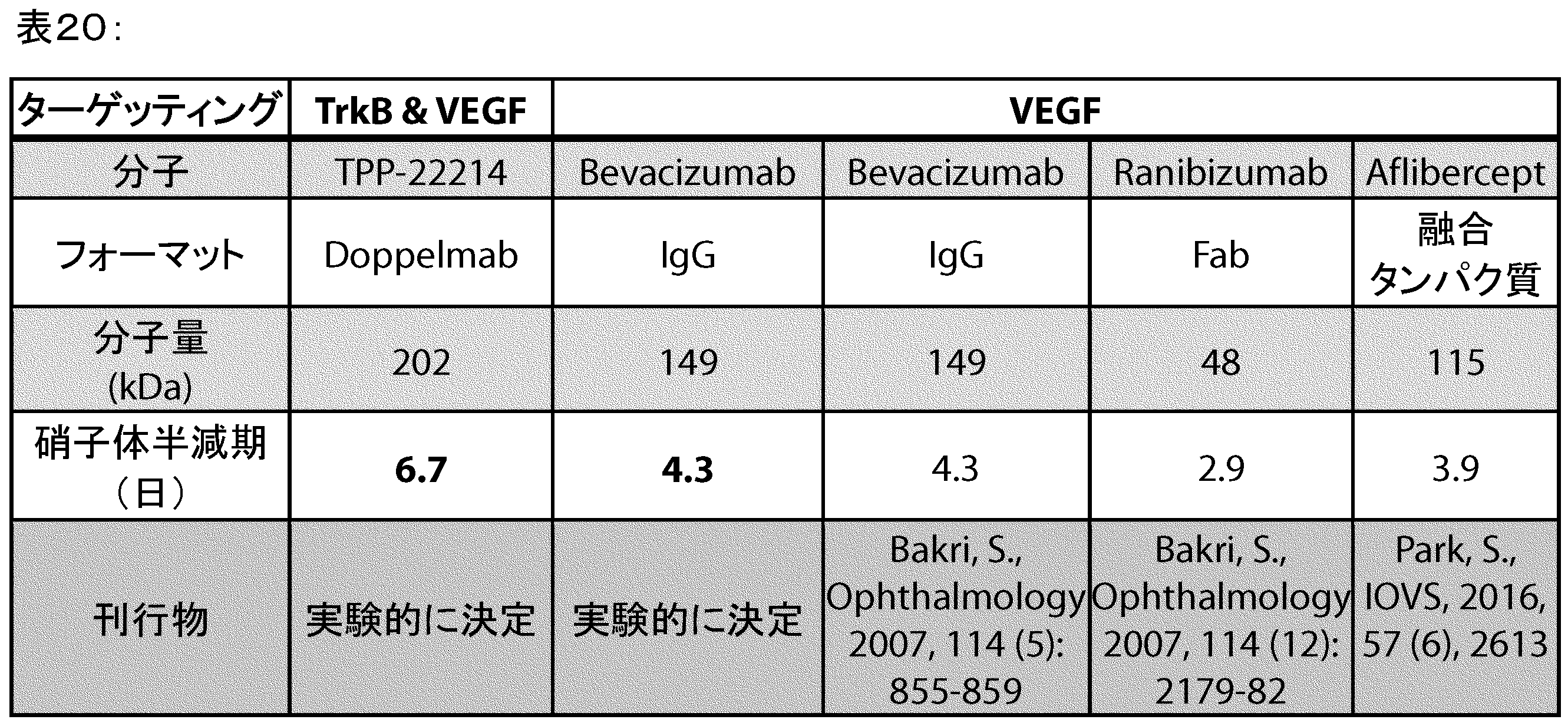
表20に、TPP-22214及びBevacizumabの実験的に決定された硝子体半減期の結果を示し、社内で実験的に決定された値を、Bevacizumab、Ranibizumab及びAfliberceptの公知の文献値と比較する。Bevacizumabの報告された半減期は、適用された方法の正確性及びデータセットの比較可能性を確認する、社内/実験的に導出された値と同一である。TPP-22214は、ウサギにおいて、例えば、Bevacizumabと比較して約50%高いin vivo半減期を有することが示された(6.7日対4.3日)。 Table 20 shows the experimentally determined vitreous half-life results for TPP-22214 and Bevacizumab, comparing the in-house experimentally determined values with the known literature values for Bevacizumab, Ranibizumab and Aflibercept. The reported half-life of Bevacizumab is identical to the in-house/experimentally derived value, confirming the accuracy of the applied method and the comparability of the data sets. TPP-22214 was shown to have an approximately 50% higher in vivo half-life in rabbits compared to Bevacizumab, for example (6.7 days vs. 4.3 days).

表21に、滲出加齢黄斑変性症(wAMD)患者における眼のVEGF濃度の文献値を報告する。 Table 21 reports literature values for ocular VEGF concentrations in patients with wet age-related macular degeneration (wAMD).

表21に示された値に基づいて、Bevacizumabのヒト硝子体内半減期(t1/2)(9.7日;Hutton-Smith, L., Mol. Pharmaceutics, 2016, 13, 2941-2950)を使用することによってのみ、TPP-22214のヒト投与頻度の保存的推定を計算した(表21)。2mg/眼の用量では、4か月の投与間隔が妥当である。 Based on the values shown in Table 21, a conservative estimate of the human dosing frequency of TPP-22214 was calculated (Table 21 ) only by using the human vitreous half-life (t ) of bevacizumab (9.7 days; Hutton-Smith, L., Mol. Pharmaceutics, 2016, 13, 2941-2950). At a dose of 2 mg/eye, a dosing interval of 4 months is reasonable.
実施例63
BDNF、TPP-6830並びに2つのDoppelmab TPP-23457及びTPP-23459によるヒトTrkB活性化の比較
図61A~図61B
ヒトTrkBを安定に発現するCHO細胞を上昇する濃度の天然のTrkBリガンドであるBDNF、TPP-6830(更なるモノクローナルTrkB抗体)又は2つのDoppelmab TPP-23457(scFvとしてのTPP-6380、10L1、VH-VL;FabとしてのRanibizumab)及びTPP-23459(scFvとしてのTPP6380、10L1、VL-VH;FabとしてのRanibizumab)と共にインキュベーションした。
Example 63
Comparison of human TrkB activation by BDNF, TPP-6830, and the two doppelmab TPP-23457 and TPP-23459.
CHO cells stably expressing human TrkB were incubated with increasing concentrations of the natural TrkB ligand BDNF, TPP-6830 (an additional monoclonal TrkB antibody) or the two Doppelmab antibodies TPP-23457 (TPP-6380 as scFv, 10L1, VH-VL; Ranibizumab as Fab) and TPP-23459 (TPP6380 as scFv, 10L1, VL-VH; Ranibizumab as Fab).
ここで、新規なDoppelmab分子は、C2 TrkBバインダーに基づくDoppelmabで観察された効果が異なるTrkBバインダーでも再現することができるかどうかを評価するために、異なるTrkBバインダー(TPP-6830)に基づいていた。 Here, the novel Doppelmab molecule was based on a different TrkB binder (TPP-6830) to assess whether the effects observed with Doppelmab based on the C2 TrkB binder could be reproduced with a different TrkB binder.
結果
再度、TPP-6830(元のTrkB抗体は、部分的TrkBレセプターアゴニストである)とは非常に対照的に、2つの新規なDoppelmab TPP-23457及びTPP-23459 Doppelmabは、ここでは、完全なTrkBレセプターアゴニスト活性を示した。これらのDoppelmabによるTrkB活性化は、天然のリガンドであるBDNFと少なくとも同じ効果があった。
Results: Again, in stark contrast to TPP-6830 (the original TrkB antibody, which is a partial TrkB receptor agonist), the two novel Doppelmab TPP-23457 and TPP-23459 Doppelmab now showed full TrkB receptor agonist activity. TrkB activation by these Doppelmab was at least as effective as the natural ligand, BDNF.
これは、結合分子の立体形成が特定のTrkBバインダーとは無関係に、観察された有効性の向上を担う場合があるという理論をさらに支持している。 This further supports the theory that conformation of the binding molecule may be responsible for the observed increased efficacy, independent of the specific TrkB binder.
実施例64
ヒトVEGFの存在下又は非存在下でのTPP-6830(TrkBモノクローナル抗体)並びに2つのDoppelmab TPP-23457及びTPP-23459によるヒトTrkB活性化(TrkBリン酸化)の比較
図62A~図62C
ヒトTrkBを安定に発現するCHO細胞を200ng/mL ヒトVEGF-A(hVEGF)とのプレインキュベーションの有無で、上昇する濃度のDoppelmab(A)TPP-23457、(B)TPP-23459又は(C)TPP-6830と共にインキュベーションした。TrkB活性化を、Y706/707でのTrkBリン酸化を測定することにより評価した。最低化合物濃度を溶媒単独とした。データは、平均+/-SEMを表わす。
Example 64
Comparison of human TrkB activation (TrkB phosphorylation) by TPP-6830 (a TrkB monoclonal antibody) and the two Doppelmab antibodies TPP-23457 and TPP-23459 in the presence or absence of human VEGF.
CHO cells stably expressing human TrkB were incubated with increasing concentrations of Doppelmab (A) TPP-23457, (B) TPP-23459, or (C) TPP-6830, with or without preincubation with 200 ng/mL human VEGF-A (hVEGF). TrkB activation was assessed by measuring TrkB phosphorylation at Y706/707. The lowest compound concentration was solvent alone. Data represent the mean +/- SEM.
結果
再度、ヒトVEGFとのプレインキュベーションにより、TPP-23457(scFvとしてのTPP-6830、10L1、VH-VL;FabとしてのRanibizumab)及びTPP-23459(scFvとしてのTPP-6380、10L1、VL-VH;FabとしてのRanibizumab)によるTrkBリン酸化(TrkB活性化)の効力が、劇的に改善された。
Results Again, preincubation with human VEGF dramatically improved the efficacy of TrkB phosphorylation (TrkB activation) by TPP-23457 (TPP-6830 as scFv, 10L1, VH-VL; Ranibizumab as Fab) and TPP-23459 (TPP-6380 as scFv, 10L1, VL-VH; Ranibizumab as Fab).
VEGFプレインキュベーションは、TPP-6830(対照)によるTrkBリン酸化(TrkB活性化)の効力に影響を及ぼさなかった。 VEGF preincubation did not affect the efficacy of TrkB phosphorylation (TrkB activation) by TPP-6830 (control).
これは、観察された効力の向上が特定のTrkBバインダーとは無関係であるという理論をさらに支持している。 This further supports the theory that the observed increased efficacy is independent of the specific TrkB binder.
実施例65
ヒトVEGFの存在下又は非存在下でのTPP-6830(TrkBモノクローナル抗体)並びに2つのDoppelmab TPP-23457及びTPP-23459によるヒトTrkB活性化(ERKリン酸化)の比較
図63A~図63C
ヒトTrkBを安定に発現するCHO細胞を200ng/mL ヒトVEGF-A(hVEGF)とのプレインキュベーションの有無で、上昇する濃度のDoppelmab(A)TPP-23457、(B)TPP-23459又は(C)TPP-6830と共にインキュベーションした。TrkB活性化を、TrkBの下流であるT202/Y204(ERK1)及びT185/Y187(ERK2)でのERK1/2リン酸化を測定することにより評価した。最低化合物濃度を溶媒単独とした。データは、平均+/-SEMを表わす。
Example 65
Comparison of human TrkB activation (ERK phosphorylation) by TPP-6830 (a TrkB monoclonal antibody) and the two Doppelmab antibodies TPP-23457 and TPP-23459 in the presence or absence of human VEGF.
CHO cells stably expressing human TrkB were incubated with increasing concentrations of Doppelmab (A) TPP-23457, (B) TPP-23459, or (C) TPP-6830, with or without preincubation with 200 ng/mL human VEGF-A (hVEGF). TrkB activation was assessed by measuring ERK1/2 phosphorylation at T202/Y204 (ERK1) and T185/Y187 (ERK2), downstream of TrkB. The lowest compound concentration was solvent alone. Data represent the mean +/- SEM.
結果
ここでも、ヒトVEGFとのプレインキュベーションにより、TPP-23457(scFvとしてのTPP-6830、10L1、VH-VL;FabとしてのRanibizumab)及びTPP-23459(scFvとしてのTPP-6380、10L1、VL-VH;FabとしてのRanibizumab)によるERK1/2リン酸化(TrkB活性化)の効力が、劇的に改善された。
Results Again, preincubation with human VEGF dramatically improved the potency of ERK1/2 phosphorylation (TrkB activation) by TPP-23457 (TPP-6830 as scFv, 10L1, VH-VL; Ranibizumab as Fab) and TPP-23459 (TPP-6380 as scFv, 10L1, VL-VH; Ranibizumab as Fab).
先に示されたように、VEGFプレインキュベーションは、TPP-6830(対照)によるERK1/2リン酸化(TrkB活性化)の効力に影響を及ぼさなかった。これは、観察された効力の向上が特定のTrkBバインダーとは無関係であるという理論をさらに支持している。 As shown previously, VEGF preincubation did not affect the potency of ERK1/2 phosphorylation (TrkB activation) by TPP-6830 (control), further supporting the theory that the observed enhancement in potency is independent of a specific TrkB binder.
実施例66
BDNF誘発TrkB活性化(TrkBリン酸化)に対するTPP-23457の影響
図64A~図64B
ヒトTrkBレセプターを安定に発現するCHO細胞を一定濃度の0.3nM、1nM又は3nM BDNFの有無で、上昇する濃度の(A)C2抗体又は(B)Doppelmab TPP-23457と共にインキュベーションした。TrkBの活性化を、Y706/707でのレセプターリン酸化を測定することにより評価した。データは、平均+/-SEMを表わす。
Example 66
Effect of TPP-23457 on BDNF-induced TrkB activation (TrkB phosphorylation) Figures 64A-B
CHO cells stably expressing the human TrkB receptor were incubated with increasing concentrations of (A) C2 antibody or (B) Doppelmab TPP-23457 in the presence or absence of constant concentrations of 0.3 nM, 1 nM or 3 nM BDNF. Activation of TrkB was assessed by measuring receptor phosphorylation at Y706/707. Data represent the mean +/- SEM.
結果
C2とは非常に対照的に、TPP-23457は、BDNF誘導TrkB活性化を制限しなかった。
Results In sharp contrast to C2, TPP-23457 did not limit BDNF-induced TrkB activation.
実施例67
BDNF誘発TrkB活性化(Erkリン酸化)に対するTPP-23457の影響
図65A~図65B
ヒトTrkBレセプターを安定に発現するCHO細胞を一定濃度の0.3nM、1nM又は3nM BDNFの有無で、上昇する濃度の(A)C2抗体又は(B)Doppelmab TPP-23457と共にインキュベーションした。TrkBの活性化を、TrkBの下流であるT202/Y204(ERK1)及びT185/Y187(ERK2)でのERK1/2リン酸化を測定することにより評価した。データは、平均+/-SEMを表わす。
Example 67
Effect of TPP-23457 on BDNF-induced TrkB activation (Erk phosphorylation) Figures 65A-B
CHO cells stably expressing human TrkB receptor were incubated with increasing concentrations of (A) C2 antibody or (B) Doppelmab TPP-23457 in the presence or absence of constant concentrations of 0.3 nM, 1 nM or 3 nM BDNF. Activation of TrkB was assessed by measuring ERK1/2 phosphorylation at T202/Y204 (ERK1) and T185/Y187 (ERK2), downstream of TrkB. Data represent the mean +/- SEM.
結果
C2とは非常に対照的に、TPP-23457は、TrkBの下流であるBDNF誘発Erkリン酸化を制限しなかった。
Results In sharp contrast to C2, TPP-23457 did not limit BDNF-induced Erk phosphorylation, which is downstream of TrkB.
実施例68
Y1175でのVEGFR2及びERK1/2のVEGF誘発リン酸化(両方ともEC増殖に関連する)のTPP-22214、TPP-23457又はTPP-23459の阻害によるヒトVEGF-A捕捉の比較
図66A~図66B
ヒト網膜微小血管内皮細胞(HRMEC)を飢餓状態にし、ついで、上昇する濃度のTPP-22214、TPP-23457又はTPP23459とのプレインキュベーションの有無で、50ng/mL ヒトVEGFと共にインキュベーションした。VEGF-A捕捉を、(A)Y1175でのVEGFレセプター2(VEGFR2)リン酸化又は(B)T202/Y204(ERK1)及びT185/Y187(ERK2)でのERK1/2リン酸化を測定することにより評価した。分子処理を伴わない50ng/ml ヒトVEGFを対照とした。データは、平均+/-SEMを表わす。
Example 68
Comparison of human VEGF-A capture by TPP-22214, TPP-23457, or TPP-23459 inhibition of VEGF-induced phosphorylation of VEGFR2 and ERK1/2 at Y1175 (both associated with EC proliferation) Figure 66A-B
Human retinal microvascular endothelial cells (HRMEC) were starved and then incubated with 50 ng/mL human VEGF with or without preincubation with increasing concentrations of TPP-22214, TPP-23457, or TPP23459. VEGF-A uptake was assessed by measuring (A) VEGF receptor 2 (VEGFR2) phosphorylation at Y1175 or (B) ERK1/2 phosphorylation at T202/Y204 (ERK1) and T185/Y187 (ERK2). 50 ng/mL human VEGF without molecular treatment served as control. Data represent mean +/- SEM.
結果
Doppelmab TPP-23457及びTPP-23459のVEGF捕捉は、TPP-22215と実質的に同一であった。
result
VEGF capture by Doppelmab TPP-23457 and TPP-23459 was virtually identical to TPP-22215.
予想どおり、種々のTrkB scFvバインダー(TPP-6830及びC2ではない)に基づくDoppelmbabも、FabのVEGF捕捉機能に影響を及ぼさなかった。 As expected, Doppelmbab, based on various TrkB scFv binders (but not TPP-6830 and C2), also did not affect the VEGF capture function of the Fab.
Claims (17)
VEGFに特異的に結合する抗原結合部位が、抗原結合部位a)~c):
a)配列番号:145(CDR1)、配列番号:146(CDR2)及び配列番号:147(CDR3)のアミノ酸配列を含む軽鎖CDRを含む抗原結合部位並びに
配列番号:148(CDR1)、配列番号:149(CDR2)及び配列番号:150(CDR3)のアミノ酸配列を含む重鎖CDRを含む抗原結合部位又は
配列番号:151(CDR1)、配列番号:152(CDR2)及び配列番号:153(CDR3)のアミノ酸配列を含む重鎖CDRを含む抗原結合部位又は
配列番号:154(CDR1)、配列番号:155(CDR2)及び配列番号:156(CDR3)のアミノ酸配列を含む重鎖CDRを含む抗原結合部位;
b)配列番号:157(CDR1)、配列番号:158(CDR2)及び配列番号:159(CDR3)のアミノ酸配列を含む軽鎖CDRを含む抗原結合部位並びに
配列番号:160(CDR1)、配列番号:161(CDR2)及び配列番号:162(CDR3)のアミノ酸配列を含む重鎖CDRを含む抗原結合部位又は
配列番号:163(CDR1)、配列番号:164(CDR2)及び配列番号:165(CDR3)のアミノ酸配列を含む重鎖CDRを含む抗原結合部位又は
配列番号:166(CDR1)、配列番号:167(CDR2)及び配列番号:168(CDR3)のアミノ酸配列を含む重鎖CDRを含む抗原結合部位;
c)配列番号:169(CDR1)、配列番号:170(CDR2)及び配列番号:171(CDR3)のアミノ酸配列を含む軽鎖CDRを含む抗原結合部位並びに
配列番号:172(CDR1)、配列番号:173(CDR2)及び配列番号:174(CDR3)のアミノ酸配列を含む重鎖CDRを含む抗原結合部位又は
配列番号:175(CDR1)、配列番号:176(CDR2)及び配列番号:177(CDR3)のアミノ酸配列を含む重鎖CDRを含む抗原結合部位又は
配列番号:178(CDR1)、配列番号:179(CDR2)及び配列番号:180(CDR3)のアミノ酸配列を含む重鎖CDRを含む抗原結合部位
からなる群より選択され、
TrkBに特異的に結合する抗原結合部位が、
a)配列番号:201(CDR1)、配列番号:202(CDR2)及び配列番号:203(CDR3)のアミノ酸配列を含む軽鎖CDRを含む抗原結合部位並びに
配列番号:204(CDR1)、配列番号:205(CDR2)及び配列番号:206(CDR3)のアミノ酸配列を含む重鎖CDRを含む抗原結合部位又は
配列番号:207(CDR1)、配列番号:208(CDR2)及び配列番号:209(CDR3)のアミノ酸配列を含む重鎖CDRを含む抗原結合部位又は
配列番号:210(CDR1)、配列番号:211(CDR2)及び配列番号:212(CDR3)のアミノ酸配列を含む重鎖CDRを含む抗原結合部位
から選択され、
前記結合分子が、配列番号:1、3、5、7、9、11、13、15、17、19、21、23、25、27、29、31、33、35、37、39、41、43、45、47、49、51、53、55、57、59、61、63、65、67、69、71、73、75、77、79、81、83、85、87、89、91、93、95、97、99、101、103、105、107、109、111、113、115、117、119、121、123、125、127、129、131、133、135、137、139、141又は143のアミノ酸配列と少なくとも90%同一のアミノ酸配列を含む軽鎖と、配列番号:2、4、6、8、10、12、14、16、18、20、22、24、26、28、30、32、34、36、38、40、42、44、46、48、50、52、54、56、58、60、62、64、66、68、70、72、74、76、78、80、82、84、86、88、90、92、94、96、98、100、102,104、106、108、110、112、114、116、118、120、122、124、126、128、130、132、134、136、138、140、142又は144のアミノ酸配列と少なくとも90%同一のアミノ酸配列を含む重鎖とを含む、
結合分子。 A bispecific and tetravalent binding molecule comprising at least one antigen-binding site that specifically binds to vascular endothelial growth factor (VEGF) and at least one antigen-binding site that specifically binds to tropomyosin receptor kinase B (TrkB);
The antigen-binding site that specifically binds to VEGF is antigen-binding sites a) to c):
a) an antigen-binding site comprising light chain CDRs comprising the amino acid sequences of SEQ ID NO: 145 (CDR1), SEQ ID NO: 146 (CDR2) and SEQ ID NO: 147 (CDR3); and
An antigen-binding site comprising heavy chain CDRs comprising the amino acid sequences of SEQ ID NO: 148 (CDR1), SEQ ID NO: 149 (CDR2) and SEQ ID NO: 150 (CDR3); or
An antigen-binding site comprising heavy chain CDRs comprising the amino acid sequences of SEQ ID NO: 151 (CDR1), SEQ ID NO: 152 (CDR2) and SEQ ID NO: 153 (CDR3); or
An antigen-binding site comprising heavy chain CDRs comprising the amino acid sequences of SEQ ID NO: 154 (CDR1), SEQ ID NO: 155 (CDR2), and SEQ ID NO: 156 (CDR3);
b) an antigen-binding site comprising light chain CDRs comprising the amino acid sequences of SEQ ID NO: 157 (CDR1), SEQ ID NO: 158 (CDR2) and SEQ ID NO: 159 (CDR3); and
An antigen-binding site comprising heavy chain CDRs comprising the amino acid sequences of SEQ ID NO: 160 (CDR1), SEQ ID NO: 161 (CDR2) and SEQ ID NO: 162 (CDR3); or
An antigen-binding site comprising heavy chain CDRs comprising the amino acid sequences of SEQ ID NO: 163 (CDR1), SEQ ID NO: 164 (CDR2) and SEQ ID NO: 165 (CDR3); or
An antigen-binding site comprising heavy chain CDRs comprising the amino acid sequences of SEQ ID NO: 166 (CDR1), SEQ ID NO: 167 (CDR2), and SEQ ID NO: 168 (CDR3);
c) an antigen-binding site comprising light chain CDRs comprising the amino acid sequences of SEQ ID NO: 169 (CDR1), SEQ ID NO: 170 (CDR2) and SEQ ID NO: 171 (CDR3); and
An antigen-binding site comprising heavy chain CDRs comprising the amino acid sequences of SEQ ID NO: 172 (CDR1), SEQ ID NO: 173 (CDR2) and SEQ ID NO: 174 (CDR3); or
An antigen-binding site comprising heavy chain CDRs comprising the amino acid sequences of SEQ ID NO: 175 (CDR1), SEQ ID NO: 176 (CDR2) and SEQ ID NO: 177 (CDR3); or
An antigen-binding site comprising heavy chain CDRs comprising the amino acid sequences of SEQ ID NO: 178 (CDR1), SEQ ID NO: 179 (CDR2), and SEQ ID NO: 180 (CDR3).
is selected from the group consisting of
An antigen-binding site that specifically binds to TrkB,
a) an antigen-binding site comprising light chain CDRs comprising the amino acid sequences of SEQ ID NO:201 (CDR1), SEQ ID NO:202 (CDR2) and SEQ ID NO:203 (CDR3); and
An antigen-binding site comprising heavy chain CDRs comprising the amino acid sequences of SEQ ID NO: 204 (CDR1), SEQ ID NO: 205 (CDR2) and SEQ ID NO: 206 (CDR3); or
An antigen-binding site comprising heavy chain CDRs comprising the amino acid sequences of SEQ ID NO: 207 (CDR1), SEQ ID NO: 208 (CDR2) and SEQ ID NO: 209 (CDR3); or
An antigen-binding site comprising heavy chain CDRs comprising the amino acid sequences of SEQ ID NO: 210 (CDR1), SEQ ID NO: 211 (CDR2) and SEQ ID NO: 212 (CDR3).
is selected from
The binding molecule has at least 9 amino acid sequences selected from the group consisting of: 1, 3, 5, 7, 9, 11, 13, 15, 17, 19, 21, 23, 25, 27, 29, 31, 33, 35, 37, 39, 41, 43, 45, 47, 49, 51, 53, 55, 57, 59, 61, 63, 65, 67, 69, 71, 73, 75, 77, 79, 81, 83, 85, 87, 89, 91, 93, 95, 97, 99, 101, 103, 105, 107, 109, 111, 113, 115, 117, 119, 121, 123, 125, 127, 129, 131, 133, 135, 137, 139, 141, or 143. and a light chain having an amino acid sequence identical to SEQ ID NO: 2, 4, 6, 8, 10, 12, 14, 16, 18, 20, 22, 24, 26, 28, 30, 32, 34, 36, 38, 40, 42, 44, 46, 48, 50, 52, 54, 56, 58, 60, 62, 64, 66, 68, 70, 72, 74, 76, 78, and a heavy chain comprising an amino acid sequence at least 90 % identical to the amino acid sequence of SEQ ID NO: 80, 82, 84, 86, 88, 90, 92, 94, 96, 98, 100, 102, 104, 106, 108, 110, 112, 114, 116, 118, 120, 122, 124, 126, 128, 130, 132, 134, 136, 138, 140, 142 or 144,
Binding molecule.
(i)配列番号:41のアミノ酸配列を含む軽鎖及び配列番号:42のアミノ酸配列を含む重鎖又は(ii)配列番号:43のアミノ酸配列を含む軽鎖及び配列番号:44のアミノ酸配列を含む重鎖又は(iii)配列番号:45のアミノ酸配列を含む軽鎖及び配列番号:46のアミノ酸配列を含む重鎖又は(iv)配列番号:47のアミノ酸配列を含む軽鎖及び配列番号:48のアミノ酸配列を含む重鎖又は(v)配列番号:49のアミノ酸配列を含む軽鎖及び配列番号:50のアミノ酸配列を含む重鎖又は(vi)配列番号:51のアミノ酸配列を含む軽鎖及び配列番号:52のアミノ酸配列を含む重鎖又は(vii)配列番号:53のアミノ酸配列を含む軽鎖及び配列番号:54のアミノ酸配列を含む重鎖又は(viii)配列番号:55のアミノ酸配列を含む軽鎖及び配列番号:56のアミノ酸配列を含む重鎖又は(ix)配列番号:57のアミノ酸配列を含む軽鎖及び配列番号:58のアミノ酸配列を含む重鎖又は(x)配列番号:59のアミノ酸配列を含む軽鎖及び配列番号:60のアミノ酸配列を含む重鎖又は(xi)配列番号:61のアミノ酸配列を含む軽鎖及び配列番号:62のアミノ酸配列を含む重鎖又は(xii)配列番号:63のアミノ酸配列を含む軽鎖及び配列番号:64のアミノ酸配列を含む重鎖又は(xiii)配列番号:65のアミノ酸配列を含む軽鎖及び配列番号:66のアミノ酸配列を含む重鎖又は(xiv)配列番号:67のアミノ酸配列を含む軽鎖及び配列番号:68のアミノ酸配列を含む重鎖又は(xv)配列番号:69のアミノ酸配列を含む軽鎖及び配列番号:70のアミノ酸配列を含む重鎖又は(xvi)配列番号:71のアミノ酸配列を含む軽鎖及び配列番号:72のアミノ酸配列を含む重鎖又は(xvii)配列番号:73のアミノ酸配列を含む軽鎖及び配列番号:74のアミノ酸配列を含む重鎖又は(xviii)配列番号:75のアミノ酸配列を含む軽鎖及び配列番号:76のアミノ酸配列を含む重鎖又は(xix)配列番号:77のアミノ酸配列を含む軽鎖及び配列番号:78のアミノ酸配列を含む重鎖又は(xx)配列番号:79のアミノ酸配列を含む軽鎖及び配列番号:80のアミノ酸配列を含む重鎖又は(xxi)配列番号:81のアミノ酸配列を含む軽鎖及び配列番号:82のアミノ酸配列を含む重鎖又は(xxii)配列番号:83のアミノ酸配列を含む軽鎖及び配列番号:84のアミノ酸配列を含む重鎖又は(xxiii)配列番号:85のアミノ酸配列を含む軽鎖及び配列番号:86のアミノ酸配列を含む重鎖又は(xxiv)配列番号:87のアミノ酸配列を含む軽鎖及び配列番号:88のアミノ酸配列を含む重鎖又は(xxv)配列番号:89のアミノ酸配列を含む軽鎖及び配列番号:90のアミノ酸配列を含む重鎖又は(xxvi)配列番号:91のアミノ酸配列を含む軽鎖及び配列番号:92のアミノ酸配列を含む重鎖又は(xxvii)配列番号:93のアミノ酸配列を含む軽鎖及び配列番号:94のアミノ酸配列を含む重鎖又は(xxviii)配列番号:95のアミノ酸配列を含む軽鎖及び配列番号:96のアミノ酸配列を含む重鎖又は(xxix)配列番号:97のアミノ酸配列を含む軽鎖及び配列番号:98のアミノ酸配列を含む重鎖又は(xxx)配列番号:99のアミノ酸配列を含む軽鎖及び配列番号:100のアミノ酸配列を含む重鎖又は(xxxi)配列番号:101のアミノ酸配列を含む軽鎖及び配列番号:102のアミノ酸配列を含む重鎖又は(xxxii)配列番号:103のアミノ酸配列を含む軽鎖及び配列番号:104のアミノ酸配列を含む重鎖又は(xxxiii)配列番号:105のアミノ酸配列を含む軽鎖及び配列番号:106のアミノ酸配列を含む重鎖又は(xxxiv)配列番号:107のアミノ酸配列を含む軽鎖及び配列番号:108のアミノ酸配列を含む重鎖又は(xxxv)配列番号:109のアミノ酸配列を含む軽鎖及び配列番号:110のアミノ酸配列を含む重鎖又は(xxxvi)配列番号:111のアミノ酸配列を含む軽鎖及び配列番号:112のアミノ酸配列を含む重鎖又は(xxxvii)配列番号:113のアミノ酸配列を含む軽鎖及び配列番号:114のアミノ酸配列を含む重鎖又は(xxxviii)配列番号:115のアミノ酸配列を含む軽鎖及び配列番号:116のアミノ酸配列を含む重鎖又は(xxxix)配列番号:117のアミノ酸配列を含む軽鎖及び配列番号:118のアミノ酸配列を含む重鎖又は(xl)配列番号:119のアミノ酸配列を含む軽鎖及び配列番号:120のアミノ酸配列を含む重鎖又は(xli)配列番号:121のアミノ酸配列を含む軽鎖及び配列番号:122のアミノ酸配列を含む重鎖又は(xlii)配列番号:123のアミノ酸配列を含む軽鎖及び配列番号:124のアミノ酸配列を含む重鎖又は(xliii)配列番号:125のアミノ酸配列を含む軽鎖及び配列番号:126のアミノ酸配列を含む重鎖又は(xliv)配列番号:127のアミノ酸配列を含む軽鎖及び配列番号:128のアミノ酸配列を含む重鎖又は(xlv)配列番号:129のアミノ酸配列を含む軽鎖及び配列番号:130のアミノ酸配列を含む重鎖又は(xlvi)配列番号:131のアミノ酸配列を含む軽鎖及び配列番号:132のアミノ酸配列を含む重鎖又は(xlvii)配列番号:133のアミノ酸配列を含む軽鎖及び配列番号:134のアミノ酸配列を含む重鎖又は(xlviii)配列番号:135のアミノ酸配列を含む軽鎖及び配列番号:136のアミノ酸配列を含む重鎖又は(xlix)配列番号:137のアミノ酸配列を含む軽鎖及び配列番号:138のアミノ酸配列を含む重鎖又は(l)配列番号:139のアミノ酸配列を含む軽鎖及び配列番号:140のアミノ酸配列を含む重鎖又は(li)配列番号:141のアミノ酸配列を含む軽鎖及び配列番号:142のアミノ酸配列を含む重鎖又は(lii)配列番号:143のアミノ酸配列を含む軽鎖及び配列番号:144のアミノ酸配列を含む重鎖
を含む、
結合分子。 A bispecific and tetravalent binding molecule comprising at least one antigen-binding site that specifically binds to vascular endothelial growth factor (VEGF) and at least one antigen-binding site that specifically binds to tropomyosin receptor kinase B (TrkB);
(i) a light chain comprising the amino acid sequence of SEQ ID NO:41 and a heavy chain comprising the amino acid sequence of SEQ ID NO:42, or (ii) a light chain comprising the amino acid sequence of SEQ ID NO:43 and a heavy chain comprising the amino acid sequence of SEQ ID NO:44, or (iii) a light chain comprising the amino acid sequence of SEQ ID NO:45 and a heavy chain comprising the amino acid sequence of SEQ ID NO:46, or (iv) a light chain comprising the amino acid sequence of SEQ ID NO:47 and a heavy chain comprising the amino acid sequence of SEQ ID NO:48, or (v) a light chain comprising the amino acid sequence of SEQ ID NO:49 and a heavy chain comprising the amino acid sequence of SEQ ID NO:50, or (vi) a light chain comprising the amino acid sequence of SEQ ID NO:51 and a heavy chain comprising the amino acid sequence of SEQ ID NO:52, or (vii) a light chain comprising the amino acid sequence of SEQ ID NO:53 and the amino acid sequence of SEQ ID NO:54. or (viii) a light chain comprising the amino acid sequence of SEQ ID NO:55 and a heavy chain comprising the amino acid sequence of SEQ ID NO:56, or (ix) a light chain comprising the amino acid sequence of SEQ ID NO:57 and a heavy chain comprising the amino acid sequence of SEQ ID NO:58, or (x) a light chain comprising the amino acid sequence of SEQ ID NO:59 and a heavy chain comprising the amino acid sequence of SEQ ID NO:60, or (xi) a light chain comprising the amino acid sequence of SEQ ID NO:61 and a heavy chain comprising the amino acid sequence of SEQ ID NO:62, or (xii) a light chain comprising the amino acid sequence of SEQ ID NO:63 and a heavy chain comprising the amino acid sequence of SEQ ID NO:64, or (xiii) a light chain comprising the amino acid sequence of SEQ ID NO:65 and a heavy chain comprising the amino acid sequence of SEQ ID NO:66, or (xiv) a light chain comprising the amino acid sequence of SEQ ID NO:67 and a heavy chain comprising the amino acid sequence of SEQ ID NO:68. or (xv) a light chain comprising the amino acid sequence of SEQ ID NO:69 and a heavy chain comprising the amino acid sequence of SEQ ID NO:70, or (xvi) a light chain comprising the amino acid sequence of SEQ ID NO:71 and a heavy chain comprising the amino acid sequence of SEQ ID NO:72, or (xvii) a light chain comprising the amino acid sequence of SEQ ID NO:73 and a heavy chain comprising the amino acid sequence of SEQ ID NO:74, or (xviii) a light chain comprising the amino acid sequence of SEQ ID NO:75 and a heavy chain comprising the amino acid sequence of SEQ ID NO:76, or (xix) a light chain comprising the amino acid sequence of SEQ ID NO:77 and a heavy chain comprising the amino acid sequence of SEQ ID NO:78, or (xx) a light chain comprising the amino acid sequence of SEQ ID NO:79 and a heavy chain comprising the amino acid sequence of SEQ ID NO:80, or (xxi) a light chain comprising the amino acid sequence of SEQ ID NO:81 or (xxii) a light chain comprising the amino acid sequence of SEQ ID NO: 83 and a heavy chain comprising the amino acid sequence of SEQ ID NO: 84, or (xxiii) a light chain comprising the amino acid sequence of SEQ ID NO: 85 and a heavy chain comprising the amino acid sequence of SEQ ID NO: 86, or (xxiv) a light chain comprising the amino acid sequence of SEQ ID NO: 87 and a heavy chain comprising the amino acid sequence of SEQ ID NO: 88, or (xxv) a light chain comprising the amino acid sequence of SEQ ID NO: 89 and a heavy chain comprising the amino acid sequence of SEQ ID NO: 90, or (xxvi) a light chain comprising the amino acid sequence of SEQ ID NO: 91 and a heavy chain comprising the amino acid sequence of SEQ ID NO: 92, or (xxvii) a light chain comprising the amino acid sequence of SEQ ID NO: 93 and the amino acid sequence of SEQ ID NO: 94. or (xxviii) a light chain comprising the amino acid sequence of SEQ ID NO:95 and a heavy chain comprising the amino acid sequence of SEQ ID NO:96, or (xxix) a light chain comprising the amino acid sequence of SEQ ID NO:97 and a heavy chain comprising the amino acid sequence of SEQ ID NO:98, or (xxx) a light chain comprising the amino acid sequence of SEQ ID NO:99 and a heavy chain comprising the amino acid sequence of SEQ ID NO:100, or (xxxi) a light chain comprising the amino acid sequence of SEQ ID NO:101 and a heavy chain comprising the amino acid sequence of SEQ ID NO:102, or (xxxii) a light chain comprising the amino acid sequence of SEQ ID NO:103 and a heavy chain comprising the amino acid sequence of SEQ ID NO:104, or (xxxiii) a light chain comprising the amino acid sequence of SEQ ID NO:105 and a heavy chain comprising the amino acid sequence of SEQ ID NO:106, or (xxxiv) a light chain comprising the amino acid sequence of SEQ ID NO:106 and a heavy chain comprising the amino acid sequence of SEQ ID NO:107, or (xxxv) a light chain comprising the amino acid sequence of SEQ ID NO: 109 and a heavy chain comprising the amino acid sequence of SEQ ID NO: 110, or (xxxvi) a light chain comprising the amino acid sequence of SEQ ID NO: 111 and a heavy chain comprising the amino acid sequence of SEQ ID NO: 112, or (xxxvii) a light chain comprising the amino acid sequence of SEQ ID NO: 113 and a heavy chain comprising the amino acid sequence of SEQ ID NO: 114, or (xxxviii) a light chain comprising the amino acid sequence of SEQ ID NO: 115 and a heavy chain comprising the amino acid sequence of SEQ ID NO: 116, or (xxxix) a light chain comprising the amino acid sequence of SEQ ID NO: 117 and a heavy chain comprising the amino acid sequence of SEQ ID NO: 118, or (xl) a light chain comprising the amino acid sequence of SEQ ID NO: 119. or (xli) a light chain comprising the amino acid sequence of SEQ ID NO: 121 and a heavy chain comprising the amino acid sequence of SEQ ID NO: 122, or (xlii) a light chain comprising the amino acid sequence of SEQ ID NO: 123 and a heavy chain comprising the amino acid sequence of SEQ ID NO: 124, or (xliiii) a light chain comprising the amino acid sequence of SEQ ID NO: 125 and a heavy chain comprising the amino acid sequence of SEQ ID NO: 126, or (xliv) a light chain comprising the amino acid sequence of SEQ ID NO: 127 and a heavy chain comprising the amino acid sequence of SEQ ID NO: 128, or (xlv) a light chain comprising the amino acid sequence of SEQ ID NO: 129 and a heavy chain comprising the amino acid sequence of SEQ ID NO: 130, or (xlvi) a light chain comprising the amino acid sequence of SEQ ID NO: 131 and a heavy chain comprising the amino acid sequence of SEQ ID NO: or (xlvii) a light chain comprising the amino acid sequence of SEQ ID NO: 133 and a heavy chain comprising the amino acid sequence of SEQ ID NO: 134, or (xlviii) a light chain comprising the amino acid sequence of SEQ ID NO: 135 and a heavy chain comprising the amino acid sequence of SEQ ID NO: 136, or (xlix) a light chain comprising the amino acid sequence of SEQ ID NO: 137 and a heavy chain comprising the amino acid sequence of SEQ ID NO: 138, or (l) a light chain comprising the amino acid sequence of SEQ ID NO: 139 and a heavy chain comprising the amino acid sequence of SEQ ID NO: 140, or (li) a light chain comprising the amino acid sequence of SEQ ID NO: 141 and a heavy chain comprising the amino acid sequence of SEQ ID NO: 142, or (lii) a light chain comprising the amino acid sequence of SEQ ID NO: 143 and a heavy chain comprising the amino acid sequence of SEQ ID NO: 144,
Binding molecule.
単離された核酸分子。 3. An antibody encoding (i) a heavy chain or a heavy chain variable domain and/or (ii) a light chain or a light chain variable domain of the binding molecule of claim 1 or 2 ,
An isolated nucleic acid molecule.
ウイルスベクター。 The isolated nucleic acid molecule of claim 3 ,
Viral vector.
発現ベクター。 The nucleic acid molecule according to claim 3 ,
Expression vector.
宿主細胞。 A vector transfected with the expression vector according to claim 5 .
Host cell.
(b)該分子を回収することとを含む、
請求項1又は2記載の結合分子を製造する方法。 (a) culturing the host cell of claim 6 under conditions allowing expression of the following molecule:
(b) recovering the molecule.
A method for producing a binding molecule according to claim 1 or 2 .
医薬組成物。 A pharmaceutical composition comprising a pharma- ceutically acceptable carrier and a binding molecule according to claim 1 or 2 .
Pharmaceutical compositions.
Applications Claiming Priority (3)
| Application Number | Priority Date | Filing Date | Title |
|---|---|---|---|
| EP20203030 | 2020-10-21 | ||
| EP20203030.0 | 2020-10-21 | ||
| PCT/EP2021/079010 WO2022084354A1 (en) | 2020-10-21 | 2021-10-20 | Bispecific anti-vegf and anti-trkb binding molecules for the treatment of eye diseases |
Publications (2)
| Publication Number | Publication Date |
|---|---|
| JP2023546228A JP2023546228A (en) | 2023-11-01 |
| JP7633397B2 true JP7633397B2 (en) | 2025-02-19 |
Family
ID=73005392
Family Applications (3)
| Application Number | Title | Priority Date | Filing Date |
|---|---|---|---|
| JP2023524324A Pending JP2023546229A (en) | 2020-10-21 | 2021-10-20 | Agonistic TrkB binding molecules for the treatment of ocular diseases |
| JP2023524323A Active JP7633397B2 (en) | 2020-10-21 | 2021-10-20 | Bispecific anti-VEGF and anti-TrkB binding molecules for the treatment of ocular diseases - Patents.com |
| JP2024179996A Pending JP2025011251A (en) | 2020-10-21 | 2024-10-15 | Agonistic TrkB binding molecules for the treatment of ocular diseases - Patents.com |
Family Applications Before (1)
| Application Number | Title | Priority Date | Filing Date |
|---|---|---|---|
| JP2023524324A Pending JP2023546229A (en) | 2020-10-21 | 2021-10-20 | Agonistic TrkB binding molecules for the treatment of ocular diseases |
Family Applications After (1)
| Application Number | Title | Priority Date | Filing Date |
|---|---|---|---|
| JP2024179996A Pending JP2025011251A (en) | 2020-10-21 | 2024-10-15 | Agonistic TrkB binding molecules for the treatment of ocular diseases - Patents.com |
Country Status (7)
| Country | Link |
|---|---|
| US (3) | US12110335B2 (en) |
| EP (2) | EP4232474A1 (en) |
| JP (3) | JP2023546229A (en) |
| CN (2) | CN117043186A (en) |
| AR (1) | AR123862A1 (en) |
| TW (1) | TW202233668A (en) |
| WO (2) | WO2022084355A2 (en) |
Families Citing this family (1)
| Publication number | Priority date | Publication date | Assignee | Title |
|---|---|---|---|---|
| TW202233668A (en) | 2020-10-21 | 2022-09-01 | 德商百靈佳殷格翰國際股份有限公司 | Bispecific anti-vegf and anti-trkb binding molecules for the treatment of eye diseases |
Citations (9)
| Publication number | Priority date | Publication date | Assignee | Title |
|---|---|---|---|---|
| WO2010086828A2 (en) | 2009-02-02 | 2010-08-05 | Rinat Neuroscience Corporation | Agonist anti-trkb monoclonal antibodies |
| WO2012061558A2 (en) | 2010-11-04 | 2012-05-10 | Abbott Laboratories | Dual variable domain immunoglobulins and uses thereof |
| JP2014193864A (en) | 2013-03-28 | 2014-10-09 | Samsung Electronics Co Ltd | Fusion protein with anti-c-met antibody and vegf-binding fragment coupled |
| JP2018531005A (en) | 2015-09-23 | 2018-10-25 | ジェネンテック, インコーポレイテッド | Optimized variant of anti-VEGF antibody |
| JP2019531762A (en) | 2016-09-07 | 2019-11-07 | サクシン ライフサイエンシス ピーヴィーティー エルティディーSaksin Lifesciences Pvt Ltd | Synthetic antibodies against VEGF and their use |
| JP2020514376A (en) | 2017-03-22 | 2020-05-21 | ジェネンテック, インコーポレイテッド | Antibody composition optimized for the treatment of eye disorders |
| JP2020513806A (en) | 2017-03-15 | 2020-05-21 | チンファ ユニバーシティTsinghua University | Novel anti-TrkB antibody |
| JP2020522270A (en) | 2017-06-09 | 2020-07-30 | ベーリンガー インゲルハイム インターナショナル ゲゼルシャフト ミット ベシュレンクテル ハフツング | Anti-TRKB antibody |
| WO2020187202A1 (en) | 2019-03-18 | 2020-09-24 | 江苏恒瑞医药股份有限公司 | Bispecific antibody specifically bound to vegf and ang2 |
Family Cites Families (28)
| Publication number | Priority date | Publication date | Assignee | Title |
|---|---|---|---|---|
| US5731A (en) | 1848-08-22 | Elisha k | ||
| US168A (en) | 1837-04-17 | Improvement in fire-arms | ||
| US4676980A (en) | 1985-09-23 | 1987-06-30 | The United States Of America As Represented By The Secretary Of The Department Of Health And Human Services | Target specific cross-linked heteroantibodies |
| EP0281604B1 (en) | 1986-09-02 | 1993-03-31 | Enzon Labs Inc. | Single polypeptide chain binding molecules |
| JP3101690B2 (en) | 1987-03-18 | 2000-10-23 | エス・ビィ・2・インコーポレイテッド | Modifications of or for denatured antibodies |
| FI903489A7 (en) | 1988-11-11 | 1990-07-10 | Medical Res Council | Ligands containing one moiety, receptors containing these ligands, methods for their preparation and uses of the ligands and receptors |
| US5427908A (en) | 1990-05-01 | 1995-06-27 | Affymax Technologies N.V. | Recombinant library screening methods |
| WO1993008829A1 (en) | 1991-11-04 | 1993-05-13 | The Regents Of The University Of California | Compositions that mediate killing of hiv-infected cells |
| DE69334275D1 (en) | 1992-08-21 | 2009-05-20 | Univ Bruxelles | Immunoglobulins without a light chain |
| ATE199392T1 (en) | 1992-12-04 | 2001-03-15 | Medical Res Council | MULTIVALENT AND MULTI-SPECIFIC BINDING PROTEINS, THEIR PRODUCTION AND USE |
| CA2163032C (en) | 1993-06-03 | 2001-02-06 | John Landon | Antibody fragments in therapy |
| US5731168A (en) | 1995-03-01 | 1998-03-24 | Genentech, Inc. | Method for making heteromultimeric polypeptides |
| GB9625640D0 (en) | 1996-12-10 | 1997-01-29 | Celltech Therapeutics Ltd | Biological products |
| US6323322B1 (en) | 1997-04-30 | 2001-11-27 | Enzon, Inc. | Single-chain antigen-binding proteins capable of glycosylation, production and uses thereof |
| US6926898B2 (en) | 2000-04-12 | 2005-08-09 | Human Genome Sciences, Inc. | Albumin fusion proteins |
| EP1361892A4 (en) | 2001-01-17 | 2004-10-13 | Trubion Pharmaceuticals Inc | Binding domain-immunoglobulin fusion proteins |
| EP1456410A2 (en) | 2001-12-11 | 2004-09-15 | AlgoNomics N.V. | Method for displaying loops from immunoglobulin domains in different contexts |
| CN1678634A (en) | 2002-06-28 | 2005-10-05 | 多曼蒂斯有限公司 | Immunoglobulin single variant antigen-binding region and specific constructs thereof |
| NZ540194A (en) | 2002-11-08 | 2008-07-31 | Ablynx Nv | Single domain antibodies directed against tumour necrosis factor-alpha and uses therefor |
| JP5087274B2 (en) | 2003-06-30 | 2012-12-05 | ドマンティス リミテッド | Polypeptide |
| CN101287764B (en) | 2005-10-12 | 2013-11-13 | 莫佛塞斯公司 | Generation and characterization of a fully human HuCAL GOLD-derived therapeutic antibody specific for human CD38 |
| EA015992B1 (en) * | 2006-03-17 | 2012-01-30 | Байоджен Айдек Эмэй Инк. | Stabilized antibody and multivalent antibinding molecule based thereon, methods for making thereof and use such stabilized antibody |
| KR20090088896A (en) | 2006-11-09 | 2009-08-20 | 아이알엠 엘엘씨 | Agonist TV antibodies and uses thereof |
| EP3663318A1 (en) | 2008-01-07 | 2020-06-10 | Amgen Inc. | Method for making antibody fc-heterodimeric molecules using electrostatic steering effects |
| US8268314B2 (en) * | 2008-10-08 | 2012-09-18 | Hoffmann-La Roche Inc. | Bispecific anti-VEGF/anti-ANG-2 antibodies |
| WO2017192538A1 (en) | 2016-05-03 | 2017-11-09 | The Scripps Research Institute | Trkb agonist antibodies for treating neurodegenerative disorders |
| JP2020187202A (en) | 2019-05-13 | 2020-11-19 | キヤノン株式会社 | Image forming apparatus |
| TW202233668A (en) * | 2020-10-21 | 2022-09-01 | 德商百靈佳殷格翰國際股份有限公司 | Bispecific anti-vegf and anti-trkb binding molecules for the treatment of eye diseases |
-
2021
- 2021-10-20 TW TW110138827A patent/TW202233668A/en unknown
- 2021-10-20 JP JP2023524324A patent/JP2023546229A/en active Pending
- 2021-10-20 JP JP2023524323A patent/JP7633397B2/en active Active
- 2021-10-20 WO PCT/EP2021/079011 patent/WO2022084355A2/en not_active Ceased
- 2021-10-20 AR ARP210102899A patent/AR123862A1/en not_active Application Discontinuation
- 2021-10-20 CN CN202180078806.0A patent/CN117043186A/en active Pending
- 2021-10-20 EP EP21798332.9A patent/EP4232474A1/en active Pending
- 2021-10-20 US US17/505,672 patent/US12110335B2/en active Active
- 2021-10-20 WO PCT/EP2021/079010 patent/WO2022084354A1/en not_active Ceased
- 2021-10-20 US US17/505,763 patent/US20220119536A1/en not_active Abandoned
- 2021-10-20 EP EP21798613.2A patent/EP4232476A2/en active Pending
- 2021-10-20 CN CN202180070390.8A patent/CN116829586A/en active Pending
-
2024
- 2024-08-19 US US18/808,311 patent/US20250051460A1/en active Pending
- 2024-10-15 JP JP2024179996A patent/JP2025011251A/en active Pending
Patent Citations (9)
| Publication number | Priority date | Publication date | Assignee | Title |
|---|---|---|---|---|
| WO2010086828A2 (en) | 2009-02-02 | 2010-08-05 | Rinat Neuroscience Corporation | Agonist anti-trkb monoclonal antibodies |
| WO2012061558A2 (en) | 2010-11-04 | 2012-05-10 | Abbott Laboratories | Dual variable domain immunoglobulins and uses thereof |
| JP2014193864A (en) | 2013-03-28 | 2014-10-09 | Samsung Electronics Co Ltd | Fusion protein with anti-c-met antibody and vegf-binding fragment coupled |
| JP2018531005A (en) | 2015-09-23 | 2018-10-25 | ジェネンテック, インコーポレイテッド | Optimized variant of anti-VEGF antibody |
| JP2019531762A (en) | 2016-09-07 | 2019-11-07 | サクシン ライフサイエンシス ピーヴィーティー エルティディーSaksin Lifesciences Pvt Ltd | Synthetic antibodies against VEGF and their use |
| JP2020513806A (en) | 2017-03-15 | 2020-05-21 | チンファ ユニバーシティTsinghua University | Novel anti-TrkB antibody |
| JP2020514376A (en) | 2017-03-22 | 2020-05-21 | ジェネンテック, インコーポレイテッド | Antibody composition optimized for the treatment of eye disorders |
| JP2020522270A (en) | 2017-06-09 | 2020-07-30 | ベーリンガー インゲルハイム インターナショナル ゲゼルシャフト ミット ベシュレンクテル ハフツング | Anti-TRKB antibody |
| WO2020187202A1 (en) | 2019-03-18 | 2020-09-24 | 江苏恒瑞医药股份有限公司 | Bispecific antibody specifically bound to vegf and ang2 |
Non-Patent Citations (2)
| Title |
|---|
| Biochemical and Biophysical Research Communications,2018年,Vol.504,p.19-24 |
| MABS,2017年,Vol.9, No.2,p.182-212 |
Also Published As
| Publication number | Publication date |
|---|---|
| CN117043186A (en) | 2023-11-10 |
| WO2022084355A3 (en) | 2022-06-02 |
| US12110335B2 (en) | 2024-10-08 |
| US20250051460A1 (en) | 2025-02-13 |
| AR123862A1 (en) | 2023-01-18 |
| JP2023546229A (en) | 2023-11-01 |
| WO2022084355A2 (en) | 2022-04-28 |
| CN116829586A (en) | 2023-09-29 |
| JP2023546228A (en) | 2023-11-01 |
| EP4232474A1 (en) | 2023-08-30 |
| TW202233668A (en) | 2022-09-01 |
| WO2022084354A1 (en) | 2022-04-28 |
| JP2025011251A (en) | 2025-01-23 |
| EP4232476A2 (en) | 2023-08-30 |
| US20220119536A1 (en) | 2022-04-21 |
| US20220119535A1 (en) | 2022-04-21 |
Similar Documents
| Publication | Publication Date | Title |
|---|---|---|
| US12398204B2 (en) | Method of treating an ocular condition by administering multispecific antibodies that activates TIE2 and binds a receptor tyrosine kinase agonist | |
| JP6796184B2 (en) | Bispecific anti-VEGF / anti-ANG-2 antibodies and their use in the treatment of ocular vascular disease | |
| JP7107914B2 (en) | Humanized monoclonal antibody targeting VE-PTP (HPTP-β) | |
| RU2702553C2 (en) | New anti-human tie-2 antibody | |
| KR20150095684A (en) | Compositions and methods that utilize a peptide tag that binds to hyaluronan | |
| JP7826279B2 (en) | Anti-betacellulin antibodies, fragments thereof, and multispecific binding molecules | |
| CA2700481A1 (en) | Antigen binding proteins | |
| US12473367B2 (en) | Bispecific agonistic antibodies to activin a receptor like type 1 (ALK1) | |
| KR20210087093A (en) | Bispecific antibodies against α-SYN/IGF1R and uses thereof | |
| JP2025011251A (en) | Agonistic TrkB binding molecules for the treatment of ocular diseases - Patents.com | |
| WO2023238845A1 (en) | PHARMACEUTICAL COMPOSITION CONTAINING ANTI-INTEGRIN α11 ANTIBODY FOR TREATMENT OR PREVENTION OF AGING-RELATED DISEASES | |
| HK40099403A (en) | Anti-igf-1r igg4 antibody and its use in the treatment of thyroid eye disease |
Legal Events
| Date | Code | Title | Description |
|---|---|---|---|
| A621 | Written request for application examination |
Free format text: JAPANESE INTERMEDIATE CODE: A621 Effective date: 20230620 |
|
| A131 | Notification of reasons for refusal |
Free format text: JAPANESE INTERMEDIATE CODE: A131 Effective date: 20240521 |
|
| A601 | Written request for extension of time |
Free format text: JAPANESE INTERMEDIATE CODE: A601 Effective date: 20240807 |
|
| A601 | Written request for extension of time |
Free format text: JAPANESE INTERMEDIATE CODE: A601 Effective date: 20241021 |
|
| A521 | Request for written amendment filed |
Free format text: JAPANESE INTERMEDIATE CODE: A523 Effective date: 20241031 |
|
| TRDD | Decision of grant or rejection written | ||
| A01 | Written decision to grant a patent or to grant a registration (utility model) |
Free format text: JAPANESE INTERMEDIATE CODE: A01 Effective date: 20250121 |
|
| A61 | First payment of annual fees (during grant procedure) |
Free format text: JAPANESE INTERMEDIATE CODE: A61 Effective date: 20250206 |
|
| R150 | Certificate of patent or registration of utility model |
Ref document number: 7633397 Country of ref document: JP Free format text: JAPANESE INTERMEDIATE CODE: R150 |