JP7621657B2 - Method of manufacturing liposomes - Google Patents
Method of manufacturing liposomes Download PDFInfo
- Publication number
- JP7621657B2 JP7621657B2 JP2021566082A JP2021566082A JP7621657B2 JP 7621657 B2 JP7621657 B2 JP 7621657B2 JP 2021566082 A JP2021566082 A JP 2021566082A JP 2021566082 A JP2021566082 A JP 2021566082A JP 7621657 B2 JP7621657 B2 JP 7621657B2
- Authority
- JP
- Japan
- Prior art keywords
- ethanol
- drug
- liposomes
- phase
- aqueous phase
- Prior art date
- Legal status (The legal status is an assumption and is not a legal conclusion. Google has not performed a legal analysis and makes no representation as to the accuracy of the status listed.)
- Active
Links
Classifications
-
- A—HUMAN NECESSITIES
- A61—MEDICAL OR VETERINARY SCIENCE; HYGIENE
- A61K—PREPARATIONS FOR MEDICAL, DENTAL OR TOILETRY PURPOSES
- A61K31/00—Medicinal preparations containing organic active ingredients
- A61K31/33—Heterocyclic compounds
- A61K31/395—Heterocyclic compounds having nitrogen as a ring hetero atom, e.g. guanethidine or rifamycins
- A61K31/495—Heterocyclic compounds having nitrogen as a ring hetero atom, e.g. guanethidine or rifamycins having six-membered rings with two or more nitrogen atoms as the only ring heteroatoms, e.g. piperazine or tetrazines
- A61K31/505—Pyrimidines; Hydrogenated pyrimidines, e.g. trimethoprim
- A61K31/519—Pyrimidines; Hydrogenated pyrimidines, e.g. trimethoprim ortho- or peri-condensed with heterocyclic rings
-
- A—HUMAN NECESSITIES
- A61—MEDICAL OR VETERINARY SCIENCE; HYGIENE
- A61K—PREPARATIONS FOR MEDICAL, DENTAL OR TOILETRY PURPOSES
- A61K31/00—Medicinal preparations containing organic active ingredients
- A61K31/70—Carbohydrates; Sugars; Derivatives thereof
- A61K31/7028—Compounds having saccharide radicals attached to non-saccharide compounds by glycosidic linkages
- A61K31/7034—Compounds having saccharide radicals attached to non-saccharide compounds by glycosidic linkages attached to a carbocyclic compound, e.g. phloridzin
- A61K31/704—Compounds having saccharide radicals attached to non-saccharide compounds by glycosidic linkages attached to a carbocyclic compound, e.g. phloridzin attached to a condensed carbocyclic ring system, e.g. sennosides, thiocolchicosides, escin, daunorubicin
-
- A—HUMAN NECESSITIES
- A61—MEDICAL OR VETERINARY SCIENCE; HYGIENE
- A61K—PREPARATIONS FOR MEDICAL, DENTAL OR TOILETRY PURPOSES
- A61K45/00—Medicinal preparations containing active ingredients not provided for in groups A61K31/00 - A61K41/00
- A61K45/06—Mixtures of active ingredients without chemical characterisation, e.g. antiphlogistics and cardiaca
-
- A—HUMAN NECESSITIES
- A61—MEDICAL OR VETERINARY SCIENCE; HYGIENE
- A61K—PREPARATIONS FOR MEDICAL, DENTAL OR TOILETRY PURPOSES
- A61K47/00—Medicinal preparations characterised by the non-active ingredients used, e.g. carriers or inert additives; Targeting or modifying agents chemically bound to the active ingredient
- A61K47/06—Organic compounds, e.g. natural or synthetic hydrocarbons, polyolefins, mineral oil, petrolatum or ozokerite
- A61K47/24—Organic compounds, e.g. natural or synthetic hydrocarbons, polyolefins, mineral oil, petrolatum or ozokerite containing atoms other than carbon, hydrogen, oxygen, halogen, nitrogen or sulfur, e.g. cyclomethicone or phospholipids
-
- A—HUMAN NECESSITIES
- A61—MEDICAL OR VETERINARY SCIENCE; HYGIENE
- A61K—PREPARATIONS FOR MEDICAL, DENTAL OR TOILETRY PURPOSES
- A61K47/00—Medicinal preparations characterised by the non-active ingredients used, e.g. carriers or inert additives; Targeting or modifying agents chemically bound to the active ingredient
- A61K47/06—Organic compounds, e.g. natural or synthetic hydrocarbons, polyolefins, mineral oil, petrolatum or ozokerite
- A61K47/28—Steroids, e.g. cholesterol, bile acids or glycyrrhetinic acid
-
- A—HUMAN NECESSITIES
- A61—MEDICAL OR VETERINARY SCIENCE; HYGIENE
- A61K—PREPARATIONS FOR MEDICAL, DENTAL OR TOILETRY PURPOSES
- A61K49/00—Preparations for testing in vivo
-
- A—HUMAN NECESSITIES
- A61—MEDICAL OR VETERINARY SCIENCE; HYGIENE
- A61K—PREPARATIONS FOR MEDICAL, DENTAL OR TOILETRY PURPOSES
- A61K9/00—Medicinal preparations characterised by special physical form
- A61K9/10—Dispersions; Emulsions
- A61K9/127—Synthetic bilayered vehicles, e.g. liposomes or liposomes with cholesterol as the only non-phosphatidyl surfactant
-
- A—HUMAN NECESSITIES
- A61—MEDICAL OR VETERINARY SCIENCE; HYGIENE
- A61K—PREPARATIONS FOR MEDICAL, DENTAL OR TOILETRY PURPOSES
- A61K9/00—Medicinal preparations characterised by special physical form
- A61K9/10—Dispersions; Emulsions
- A61K9/127—Synthetic bilayered vehicles, e.g. liposomes or liposomes with cholesterol as the only non-phosphatidyl surfactant
- A61K9/1271—Non-conventional liposomes, e.g. PEGylated liposomes or liposomes coated or grafted with polymers
-
- A—HUMAN NECESSITIES
- A61—MEDICAL OR VETERINARY SCIENCE; HYGIENE
- A61K—PREPARATIONS FOR MEDICAL, DENTAL OR TOILETRY PURPOSES
- A61K9/00—Medicinal preparations characterised by special physical form
- A61K9/10—Dispersions; Emulsions
- A61K9/127—Synthetic bilayered vehicles, e.g. liposomes or liposomes with cholesterol as the only non-phosphatidyl surfactant
- A61K9/1277—Preparation processes; Proliposomes
-
- A—HUMAN NECESSITIES
- A61—MEDICAL OR VETERINARY SCIENCE; HYGIENE
- A61P—SPECIFIC THERAPEUTIC ACTIVITY OF CHEMICAL COMPOUNDS OR MEDICINAL PREPARATIONS
- A61P25/00—Drugs for disorders of the nervous system
- A61P25/28—Drugs for disorders of the nervous system for treating neurodegenerative disorders of the central nervous system, e.g. nootropic agents, cognition enhancers, drugs for treating Alzheimer's disease or other forms of dementia
-
- A—HUMAN NECESSITIES
- A61—MEDICAL OR VETERINARY SCIENCE; HYGIENE
- A61P—SPECIFIC THERAPEUTIC ACTIVITY OF CHEMICAL COMPOUNDS OR MEDICINAL PREPARATIONS
- A61P29/00—Non-central analgesic, antipyretic or antiinflammatory agents, e.g. antirheumatic agents; Non-steroidal antiinflammatory drugs [NSAID]
-
- A—HUMAN NECESSITIES
- A61—MEDICAL OR VETERINARY SCIENCE; HYGIENE
- A61P—SPECIFIC THERAPEUTIC ACTIVITY OF CHEMICAL COMPOUNDS OR MEDICINAL PREPARATIONS
- A61P31/00—Antiinfectives, i.e. antibiotics, antiseptics, chemotherapeutics
- A61P31/04—Antibacterial agents
-
- A—HUMAN NECESSITIES
- A61—MEDICAL OR VETERINARY SCIENCE; HYGIENE
- A61P—SPECIFIC THERAPEUTIC ACTIVITY OF CHEMICAL COMPOUNDS OR MEDICINAL PREPARATIONS
- A61P31/00—Antiinfectives, i.e. antibiotics, antiseptics, chemotherapeutics
- A61P31/12—Antivirals
-
- A—HUMAN NECESSITIES
- A61—MEDICAL OR VETERINARY SCIENCE; HYGIENE
- A61P—SPECIFIC THERAPEUTIC ACTIVITY OF CHEMICAL COMPOUNDS OR MEDICINAL PREPARATIONS
- A61P35/00—Antineoplastic agents
-
- A—HUMAN NECESSITIES
- A61—MEDICAL OR VETERINARY SCIENCE; HYGIENE
- A61P—SPECIFIC THERAPEUTIC ACTIVITY OF CHEMICAL COMPOUNDS OR MEDICINAL PREPARATIONS
- A61P39/00—General protective or antinoxious agents
- A61P39/06—Free radical scavengers or antioxidants
Landscapes
- Health & Medical Sciences (AREA)
- Chemical & Material Sciences (AREA)
- Life Sciences & Earth Sciences (AREA)
- Public Health (AREA)
- Animal Behavior & Ethology (AREA)
- General Health & Medical Sciences (AREA)
- Veterinary Medicine (AREA)
- Pharmacology & Pharmacy (AREA)
- Medicinal Chemistry (AREA)
- Epidemiology (AREA)
- Chemical Kinetics & Catalysis (AREA)
- General Chemical & Material Sciences (AREA)
- Dispersion Chemistry (AREA)
- Engineering & Computer Science (AREA)
- Organic Chemistry (AREA)
- Nuclear Medicine, Radiotherapy & Molecular Imaging (AREA)
- Molecular Biology (AREA)
- Oil, Petroleum & Natural Gas (AREA)
- Biophysics (AREA)
- Oncology (AREA)
- Neurosurgery (AREA)
- Bioinformatics & Cheminformatics (AREA)
- Biomedical Technology (AREA)
- Communicable Diseases (AREA)
- Neurology (AREA)
- Toxicology (AREA)
- Psychiatry (AREA)
- Biochemistry (AREA)
- Rheumatology (AREA)
- Hospice & Palliative Care (AREA)
- Pain & Pain Management (AREA)
- Virology (AREA)
- Medicinal Preparation (AREA)
- Pharmaceuticals Containing Other Organic And Inorganic Compounds (AREA)
- Medicines Containing Antibodies Or Antigens For Use As Internal Diagnostic Agents (AREA)
- Peptides Or Proteins (AREA)
- Medicines That Contain Protein Lipid Enzymes And Other Medicines (AREA)
Description
本開示は、少ない製造工程で封入される薬剤の高い封入効率を得るための、リポソームの製造方法に関する。 This disclosure relates to a method for producing liposomes that achieves high encapsulation efficiency of drugs with fewer manufacturing steps.
リポソームとは、1つ以上の同心円状のリン脂質層(ラメラ)に囲まれた水性のコアからなる人工的な微小ベシクルであると定義されている[非特許文献1]。リポソームは、自然界に存在する物質で構成されているため、毒性がなく生分解性があることから、さまざまな治療薬のキャリアとして広く注目されている[非特許文献2]。リポソームは、親水性物質(水性分画内)、疎水性物質(脂質膜内)、両親媒性物質(脂質-水界面)を取り込むことができるため、幅広い用途が期待されている[非特許文献3]。さらに、リポソームに封入されている生理活性物質は、すぐに希釈されたり分解されたりせずに保護される。これらの理由から、リポソームは発見されて以来、最も多く使用されているナノキャリアシステムとなっている。 Liposomes are defined as artificial microvesicles consisting of an aqueous core surrounded by one or more concentric phospholipid layers (lamellae) [Non-Patent Document 1]. Liposomes are composed of naturally occurring substances, and therefore are non-toxic and biodegradable, and have attracted widespread attention as carriers for various therapeutic drugs [Non-Patent Document 2]. Liposomes are expected to have a wide range of applications because they can incorporate hydrophilic substances (in the aqueous fraction), hydrophobic substances (in the lipid membrane), and amphiphilic substances (at the lipid-water interface) [Non-Patent Document 3]. Furthermore, bioactive substances encapsulated in liposomes are protected without being quickly diluted or decomposed. For these reasons, liposomes have become the most widely used nanocarrier system since their discovery.
リポソームがいくつかの目的で広く使用されるようになったことにより、効率的かつ再現性を有し、最も簡便な調製方法を開発することが求められている。リポソームの調製方法にはさまざまな方法があり、数多くの変形例がある。多くの研究室では、その簡便さから、1965年に最初に報告された脂質薄膜水和法が用いられている[非特許文献4]。しかし、薄膜法は大規模な製造には不向きな傾向がある。また、塩素系溶媒の使用も懸念される。 The widespread use of liposomes for several purposes has created a demand for the development of efficient, reproducible, and simplest methods for their preparation. There are many different methods for preparing liposomes, with numerous variations. Many laboratories use the lipid thin film hydration method, which was first reported in 1965, due to its simplicity [Non-Patent Document 4]. However, the thin film method tends to be unsuitable for large-scale production. In addition, the use of chlorinated solvents is also a concern.
エタノール注入法は、GMPに適合した大規模リポソーム製造のための興味深い技術である。この方法は、脂質の分解または酸化による変化をさせないのみならず、簡便であること、GMPに適合した溶媒であること、迅速に導入でき再現性があることなど、いくつかの利点を備える。エタノール注入法は、超音波処理を行わずにスモールユニラメラベシクル(SUV)を調製するための最初の選択肢の1つとして1973年にBatzriとKornによって報告された[非特許文献5]。水相のエタノールをすぐに希釈すると、脂質分子が沈殿し、2層の平面状の断片が形成される。これらの脂質二重膜の断片は、(撹拌および/または超音波により)系内のエネルギーを散逸させると、分子の疎水性部分の水性環境への露出を減少させようとし、その結果、これらの断片が湾曲して準球状の構造をとる。その後、いくつかの研究において、エタノール注入法の調製パラメータ(脂質の濃度および組成、注入速度、両相の温度、撹拌速度など)が、得られるリポソームの特性(サイズ分布、ゼータ電位、薬物封入効率など)に及ぼす影響が研究された[非特許文献6]。 The ethanol injection method is an interesting technique for large-scale GMP-compliant liposome production. This method has several advantages, including simplicity, GMP-compliant solvents, rapid application and reproducibility, as well as the absence of lipid degradation or oxidative changes. The ethanol injection method was reported by Batzri and Korn in 1973 as one of the first options for preparing small unilamellar vesicles (SUVs) without sonication [5]. The immediate dilution of the aqueous phase ethanol leads to the precipitation of lipid molecules, forming bilayer planar fragments. These lipid bilayer fragments, when the energy in the system is dissipated (by agitation and/or sonication), attempt to reduce the exposure of the hydrophobic parts of the molecules to the aqueous environment, which results in the fragments curving and adopting a quasi-spherical structure. Subsequently, several studies investigated the effects of the preparation parameters of the ethanol injection method (lipid concentration and composition, injection rate, temperature of both phases, stirring rate, etc.) on the properties of the resulting liposomes (size distribution, zeta potential, drug encapsulation efficiency, etc.) [Non-Patent Document 6].
従来のエタノール注入法では、エタノール相は水相に比べて割合が低く、通常5~10%である。エタノールを蒸発させた後、ベシクルのサイズを小さくするためにリポソーム分散液を押し出す。簡潔に述べると、従来のエタノール注入法は、
1.水相に脂質(エタノール)を注入する工程と、
2.押出を行ないリポソームのサイズを小さくする工程と、
3.封入されなかった薬剤を除去する工程と、の3つの主要工程を有する。
In the conventional ethanol injection method, the ethanol phase is at a low percentage compared to the aqueous phase, usually 5-10%. After ethanol evaporation, the liposome dispersion is extruded to reduce the vesicle size. In brief, the conventional ethanol injection method is as follows:
1. Injecting lipid (ethanol) into the aqueous phase;
2. Reducing the size of the liposomes by extrusion;
3. A step of removing the unencapsulated drug.
一般に、リポソーム状の治療薬またはイメージング剤のローディングは、パッシブまたはアクティブな方法で行なわれる。 Generally, loading of therapeutic or imaging agents into liposomes can be accomplished by passive or active methods.
パッシブローディングでは、目的の薬剤を含む水溶液に乾燥した脂質膜を溶解させる。この方法は、水溶性の薬剤にしか用いることができず、ローディング効率が低い(5%以下)ことが多い。この方法は、化学構造によらず、広範囲の化合物に使用することができる。 In passive loading, a dried lipid film is dissolved in an aqueous solution containing the drug of interest. This method can only be used with water-soluble drugs and often has low loading efficiency (less than 5%). This method can be used with a wide range of compounds, regardless of their chemical structure.
アクティブローディングでは、リポソーム膜間のpH勾配によって薬剤が内包化される[非特許文献7]。このプロセスは効率が非常に高く(≧95%)、リポソーム内濃度を向上させ、貴重な化学療法剤の廃棄を最小限に抑えることができる。 In active loading, drugs are encapsulated by the pH gradient across the liposome membrane [7]. This process is highly efficient (>=95%), improving intraliposomal concentrations and minimizing waste of valuable chemotherapeutic drugs.
しかし、この方法(アクティブローディング)では、リポソームの内部と外部とで緩衝液の極端なpHを用いて、分子に異なるプロトン化状態を持たせる必要がある。このように、リポソームの内外で2つの異なるpHが設定されると、特定の分子が脂質二重層に拡散する。このように、pH勾配は、両親媒性の弱い塩基および酸を移動させ、保持するための駆動力となる[非特許文献8]。 However, this method (active loading) requires that the molecules have different protonation states at the inside and outside of the liposomes using extreme pH buffers. Thus, when two different pHs are set inside and outside the liposome, certain molecules diffuse into the lipid bilayer. Thus, the pH gradient is the driving force for the transport and retention of amphipathic weak bases and acids [Non-Patent Document 8].
また、膜間の硫酸アンモニウム勾配を利用した弱塩基性アミンの治療薬またはイメージング剤のアクティブローディング手法が文献に報告されている。この場合、アンモニアの勾配によってpH勾配が生じ、リポソーム内への薬剤のアクティブな輸送が行なわれる。その後、硫酸塩がイオン化された薬剤の対イオンとして作用し、リポソーム内に沈殿する。Doxilの場合、この手法が、リポソーム状ドキソルビシンの製造に適用されている。Myocetは、リポソーム状ドキソルビシンをリモートローディングした別の例であり、クエン酸によりpH勾配を形成する[非特許文献9]。 Active loading of weakly basic amine therapeutic or imaging agents using a transmembrane ammonium sulfate gradient has also been reported in the literature. In this case, the ammonia gradient creates a pH gradient, which actively transports the drug into the liposomes. Sulfate then acts as a counterion to the ionized drug, which precipitates within the liposomes. In the case of Doxil, this approach has been applied to the production of liposomal doxorubicin. Myocet is another example of remote loading of liposomal doxorubicin, where a pH gradient is created by citrate [9].
アクティブローディングプロセスでは、従来のエタノール注入法でリポソームを調製した後、リポソーム外相(extra-liposomal phase)を除去し、次にリポソーム外相に薬剤を添加してリポソームをインキュベートすることで、リモートローディングプロセスを進行させる。簡潔に述べると、アクティブローディングのプロセスは、
1.水相に脂質(エタノール)を注入する工程と、
2.押出を行ないリポソームのサイズを小さくする工程と、
3.リポソーム外相を除去する工程と、
4.薬剤を含むリポソームをインキュベートする工程と、
5.封入されなかった薬剤を除去する工程と、の5つの主要工程を有する。
In the active loading process, liposomes are prepared by the conventional ethanol injection method, the extra-liposomal phase is removed, and then the drug is added to the extra-liposomal phase and the liposomes are incubated to allow the remote loading process to proceed. Briefly, the active loading process is as follows:
1. Injecting lipid (ethanol) into the aqueous phase;
2. Reducing the size of the liposomes by extrusion;
3. Removing the liposome external phase;
4. Incubating the liposomes containing the drug;
5. A step of removing unencapsulated drug.
特許文献1(Paulo A. et al., 2013, Liposomes and its production method)には、脂質膜水和法であるリポソームの製造方法が記載されている。 Patent Document 1 (Paulo A. et al., 2013, Liposomes and its production method) describes a method for producing liposomes using the lipid membrane hydration method.
特許文献2(Martin F. et al., 1988, High-encapsulation liposome processing method)には、クロロホルムを用いたリポソームの製造方法が記載されている。製造されるリポソームは1.5ミクロン以上で、押し出してサイズを小さくする必要がある(元々封入されていた薬剤は失われる)。 Patent Document 2 (Martin F. et al., 1988, High-encapsulation liposome processing method) describes a method for producing liposomes using chloroform. The liposomes produced are 1.5 microns or larger and must be extruded to reduce their size (the drug originally encapsulated is lost).
特許文献3(Szoka F. et al., 1994, Preparation of liposome and lipid complex compositions)には、水、アルコール、ハロゲン化炭化水素系溶媒への溶解度が低い化合物を含むリポソームを得る方法が記載されている。この方法では、脂質を非プロトン性溶媒の溶液に溶解させるが、この溶液は、脂質を可溶化するために必要な場合には追加で低級アルカノールを含んでよい。この方法では、決められたサイズのリポソームを得るために押出が必要である。 Szoka F. et al., 1994, Preparation of liposome and lipid complex compositions, describes a method for obtaining liposomes containing compounds that are poorly soluble in water, alcohols, and halogenated hydrocarbon solvents. In this method, lipids are dissolved in a solution of an aprotic solvent, which may additionally contain a lower alkanol if necessary to solubilize the lipids. In this method, extrusion is required to obtain liposomes of a defined size.
特許文献4(Zhang Y, 2011, Method of making liposomes, Liposome compositions made by the methods, and methods of use of the same)には、アスコルビン酸またはその塩を封入するために、水溶液がエチレンジアミン四酢酸(EDTA)を含むリポソームを得る方法が記載されている。このリポソーム組成物は、約200~約500nmの選択された平均粒径を有する。 Patent document 4 (Zhang Y, 2011, Method of making liposomes, Liposome compositions made by the methods, and methods of use of the same) describes a method for obtaining liposomes in which the aqueous solution contains ethylenediaminetetraacetic acid (EDTA) to encapsulate ascorbic acid or its salts. The liposome composition has a selected average particle size of about 200 to about 500 nm.
特許文献5(Barenholz, Y. et al., 1994, Method of amphiphatic drug loading in liposomes by ammonium ion gradient)には、膜間勾配を用いた弱両親媒性薬物のリポソームへのアクティブなローディングが記載されている。 Patent document 5 (Barenholz, Y. et al., 1994, Method of amphiphatic drug loading in liposomes by ammonium ion gradient) describes active loading of weakly amphiphilic drugs into liposomes using a transmembrane gradient.
特許文献6(Clerc, S.Y. and Barenholz, 1999, Stably encapsulating a weak acid drug in liposomes, at a high concentration)には、弱酸性薬物が高濃度で封入されているリポソームが記載されている。この方法では、内側が高く外側が低いpH勾配を得るために弱酸の塩を用いたプロトンシャトル機構を採用している。 Patent document 6 (Clerc, S.Y. and Barenholz, 1999, Stably encapsulating a weak acid drug in liposomes, at a high concentration) describes liposomes that encapsulate a weak acid drug at a high concentration. This method employs a proton shuttle mechanism using a salt of a weak acid to obtain a pH gradient that is high inside and low outside.
特許文献7は、脂質層内に封入された核酸、タンパク質、ペプチドなど、脂質に封入された負電荷を有する治療用ポリマーを製造するための方法および組成物に関する。 Patent document 7 relates to methods and compositions for producing negatively charged therapeutic polymers encapsulated in lipids, such as nucleic acids, proteins, and peptides encapsulated within the lipid layer.
特許文献8は、あらかじめ作製した脂質ベシクル、電荷を有する治療薬(脂質とは反対の電荷)、および不安定化剤を混合した後、脂質に封入された電荷を有する治療薬粒子を製造するための方法および組成物に関する。 Patent document 8 relates to a method and composition for producing lipid-encapsulated particles of a charged therapeutic agent by mixing preformed lipid vesicles, a charged therapeutic agent (opposite charge to the lipid), and a destabilizing agent.
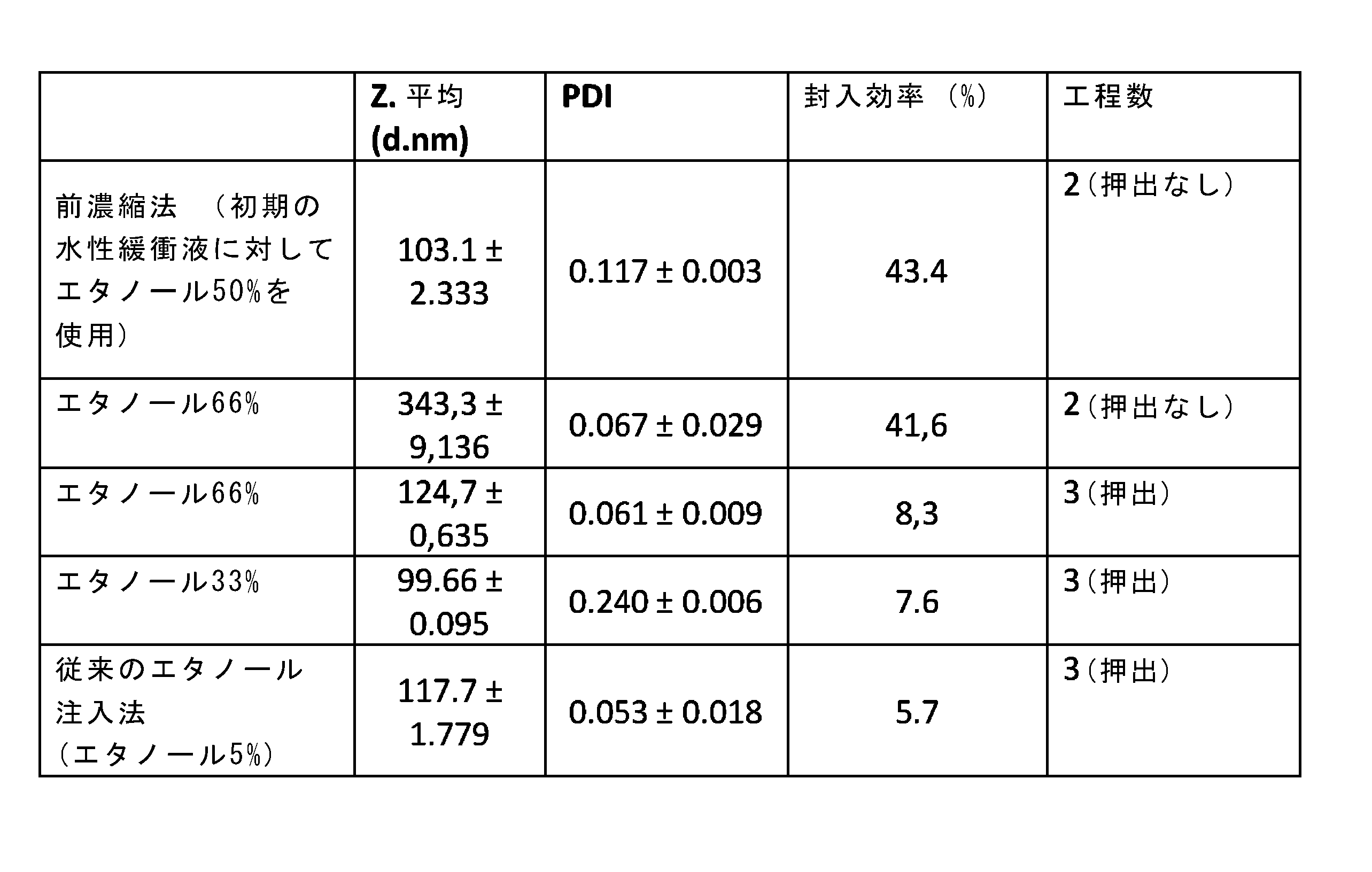
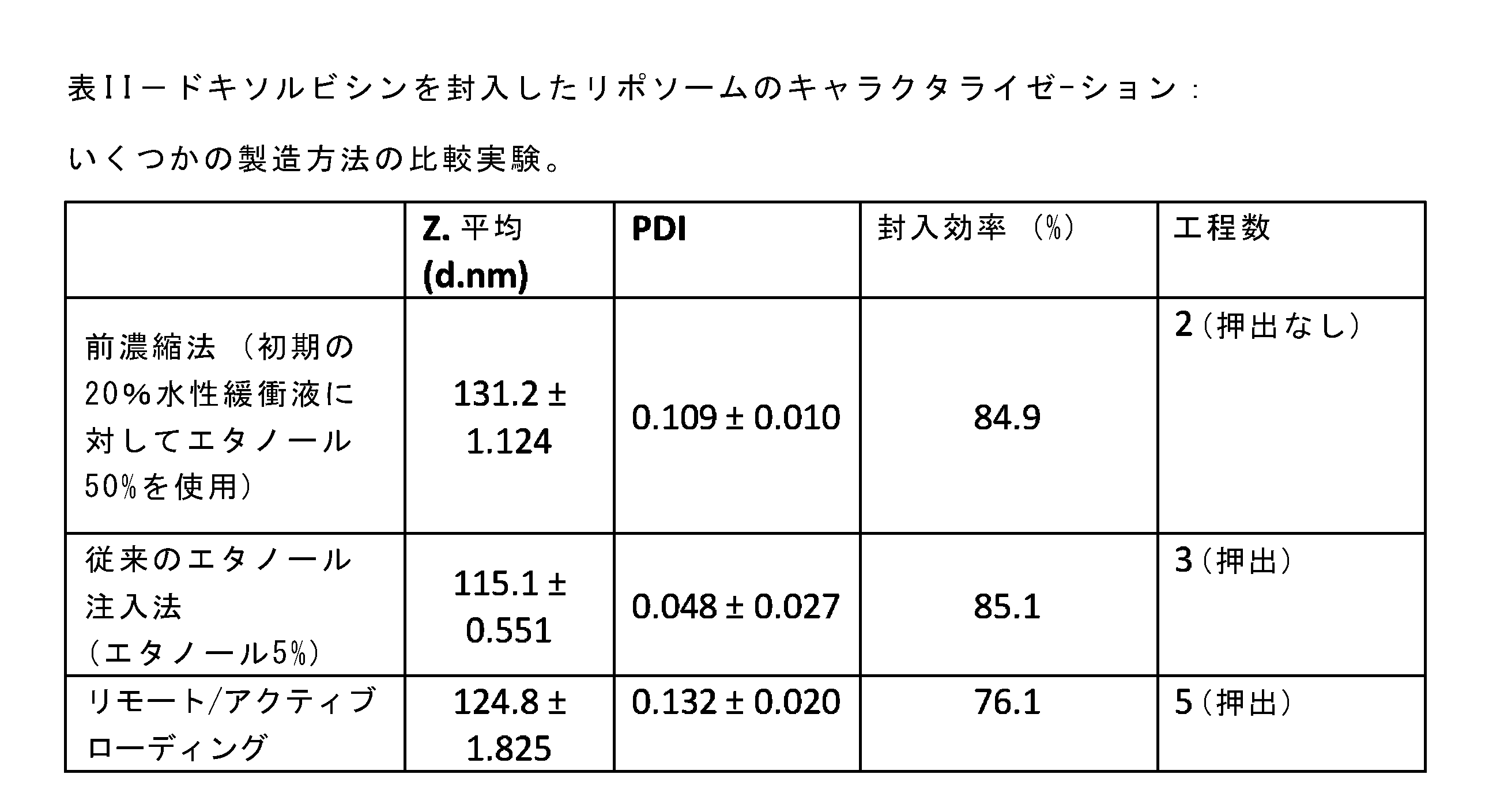
本明細書の方法は、ナノ粒子を製造するために追加の処理工程を必要とせずに、対象とするリポソームにおいて、従来の方法と同等またはそれ以上の低分子の封入効率を実現できるという利点を備える。本方法では、構造内に中性のpH(5~8)で多価の電荷を有する分子、つまり負電荷を有する分子、例えばメトテキトラートおよびドキソルビシンなどがより良好に封入される。メトテキトラートは封入率が高く、ドキソルビシンは工程数が少ない(表2および表3)。 The method herein has the advantage of achieving equivalent or better encapsulation efficiency of small molecules in the target liposomes than conventional methods without the need for additional processing steps to produce nanoparticles. The method provides better encapsulation of multiply charged molecules, i.e. negatively charged molecules, such as methoxamate and doxorubicin, at neutral pH (5-8) within the structure. Methoxamate has a higher encapsulation rate and doxorubicin has fewer steps (Tables 2 and 3).
本提案の代替方法では、同様の体積比のエタノール:水相を用いた前濃縮法を用いて、治療薬またはイメージング剤のより高い封入効率を実現し、最後にリポソームが希釈されてよい。本提案の新しい方法は、産業プロセスにおいて望ましい工程数の削減(わずか2工程)を実現する。これら特徴が、初めてこの同じ方法に集約されており、これにより、この方法は文献で報告されている方法とは差違を有するものとなる。 In the proposed alternative method, a preconcentration method using a similar volume ratio of ethanol:water phase may be used to achieve higher encapsulation efficiency of the therapeutic or imaging agent, and finally the liposomes may be diluted. The proposed new method achieves a reduction in the number of steps (only two steps), which is desirable in industrial processes. These features are brought together in the same method for the first time, which differentiates it from methods reported in the literature.
リポソームがいくつかの目的で広く使用されるようになったことにより、効率的かつ再現性を有し、最も簡便な調製方法を開発することが求められている。既存の方法では、工業的な大規模化が煩雑であり、かつ/または目的の薬剤の封入効率が低い。そのためには、工程数が少なく、かつ封入される薬剤の高い封入効率を実現する方法の開発が肝要である。 The widespread use of liposomes for several purposes necessitates the development of efficient, reproducible and most convenient methods for their preparation. Existing methods are cumbersome for industrial scale-up and/or have low encapsulation efficiency of the desired drug. It is therefore essential to develop a method that requires fewer steps and achieves high encapsulation efficiency of the drug to be encapsulated.
リポソームの表面および膜層の特性を調整するために、リポソームの製造に使用される脂質が変更または修正されてよい。脂質には、その電荷に基づき、中性、カチオン性、アニオン性という異なるクラスが存在する。リン酸頭基(phosphate head group)に有機分子を付加すると、ホスファチジルエタノールアミン(PE)、ホスファチジルセリン(PS)、ホスファチジルグリセロール(PG)、およびホスファチジルコリン(PC)など、さまざまな種類のリン脂質が得られる。これらの脂質はすべてリポソームの製造に使用することができる。 The lipids used to prepare liposomes may be changed or modified to tailor the properties of the liposome surface and membrane layer. There are different classes of lipids based on their charge: neutral, cationic, and anionic. The addition of organic molecules to the phosphate head group results in a variety of phospholipids, including phosphatidylethanolamine (PE), phosphatidylserine (PS), phosphatidylglycerol (PG), and phosphatidylcholine (PC). All of these lipids can be used to prepare liposomes.
未修飾のリポソームは、マクロファージによって除去されるため、循環に長時間残存することができない。これらの問題を課題するための最初の試みの1つは、二重膜の流動性を変更するため、ステロイドを含有させるなどの脂質膜の成分の調整が中心的であった。このように、本発明者らのリポソーム製剤は、コレステロール(CH)を好ましくは含有してよく、そのモル比は35~55%、好ましくは35~40%に変化させることができる。リポソームにコレステロールを組み込むと、脂質二重層中のリン脂質の充填が増えることにより、血中タンパク質との相互作用が低下することが示された。 Unmodified liposomes cannot remain in circulation for long periods of time because they are removed by macrophages. One of the first attempts to address these problems centered on adjusting the lipid membrane components, such as by including steroids, to alter the fluidity of the bilayer. Thus, our liposome formulations may preferably contain cholesterol (CH), the molar ratio of which can vary from 35-55%, preferably 35-40%. Incorporation of cholesterol into liposomes has been shown to reduce interactions with blood proteins by increasing the loading of phospholipids in the lipid bilayer.
さらに、好ましい実施では、合成ポリマーであるポリエチレングリコール(PEG)をリポソームに含有させた。PEG含有リポソームは、血中タンパク質との結合が少なく、RESの取り込みが減少し、そのため、循環系内にリポソームが長時間残存した。これは、薬物送達に対する従来のリポソームの血液循環を延長し、共役リン脂質であるDSPE-MPEGはこれらの新しい製剤の脂質膜に4~12%、好ましくは5~10%のモル比で組み込まれた。 Furthermore, in a preferred implementation, the synthetic polymer polyethylene glycol (PEG) was incorporated into the liposomes. The PEG-containing liposomes showed less binding to blood proteins and reduced uptake of the RES, resulting in longer persistence of the liposomes in the circulatory system. This extended the blood circulation of conventional liposomes for drug delivery, and the conjugated phospholipid DSPE-MPEG was incorporated into the lipid membrane of these new formulations at a molar ratio of 4-12%, preferably 5-10%.
また、ガングリオシドを付加した表面修飾リポソームは、非修飾リポソームに比べて血流中の循環時間が長いことも示された。これらの特徴は、免疫療法でのガングリオシドの利用に役立つ可能性がある。静脈内注射後のリポソームのRES取り込みの試験で数種類の糖脂質を試験した。糖脂質GM1(脳組織由来のモノシアロガングリオシド)は、リポソーム表面に取り込まれるとRESの取り込みを大幅に減少させ、この製剤は数時間にわたり血液循環に残存した。 It was also shown that surface-modified liposomes with gangliosides had a longer circulation time in the bloodstream than unmodified liposomes. These features may aid in the use of gangliosides in immunotherapy. Several glycolipids were tested in studies of RES uptake of liposomes after intravenous injection. The glycolipid GM1 (a monosialoganglioside derived from brain tissue) significantly reduced RES uptake when incorporated onto the liposomal surface, and the formulation remained in the bloodstream for several hours.
アクティブターゲティングとは、リポソームの表面をターゲティングリガンドで特異的に修飾することにより、標的部位への集積または標的細胞への細胞内送達を可能にするものである。リポソームが特定のリガンドを含んでいると、受容体を介したエンドサイトーシスによって内容物が細胞内に放出される。膜表面へのターゲティング剤の組み込みは、リン脂質または脂肪アシル鎖への共役、あるいは脂質膜への組み込みによって行なわれる。 Active targeting is the specific modification of the liposome surface with targeting ligands, allowing accumulation at a target site or intracellular delivery to a target cell. If the liposome contains a specific ligand, the contents are released intracellularly by receptor-mediated endocytosis. Incorporation of targeting agents into membrane surfaces can be achieved by conjugation to phospholipids or fatty acyl chains, or by incorporation into lipid membranes.
リポソームの調製法にはさまざまな方法があり、数多くの種類がある。エタノール注入法(5%エタノール)では、水溶性物質を含む水溶液の一部がベシクルの内部にパッシブに封入される。この方法の利点は、その簡便さにあるものの、この方法で封入可能な水溶性の治療薬またはイメージング剤の割合は非常に低い。 There are many different methods for preparing liposomes. In the ethanol injection method (5% ethanol), a portion of the aqueous solution containing the water-soluble substance is passively encapsulated inside the vesicle. The advantage of this method is its simplicity, but the percentage of water-soluble therapeutic or imaging agents that can be encapsulated by this method is very low.
リモートローディングでは、一般に、最初の塩または低pHの緩衝液内で空のリポソームを調製する。その後、透析またはサイズ排除クロマトグラフィーを用いる、あるいはpHをわずかに塩基性にすることで、リポソーム外相を除去する。最後に、リポソーム外相に薬剤を添加し、リポソームをインキュベートすることで、リモートローディングのプロセスを進行させる[非特許文献6]。工程数が多いため、製造プロセスの大規模化が難しく、この標準的なアプローチのさらなる開発を進める上での障壁となっている。 In remote loading, empty liposomes are typically prepared in a first salt or low pH buffer. The external liposome phase is then removed using dialysis or size exclusion chromatography or by making the pH slightly basic. Finally, the drug is added to the external liposome phase and the liposomes are incubated to allow the remote loading process to proceed [6]. The large number of steps makes the manufacturing process difficult to scale up, which is a barrier to further development of this standard approach.
そこで、本発明者らは、少ない製造工程数でリポソームに薬剤を封入する方法の最適化に注力している。実際、使用された薬剤のうち少量しか封入されず(例えばメトトレキサート薬では3~5%)、廃棄される薬剤の量が多く、大規模化の際に問題となる可能性がある。封入される薬剤を増やすために、製造方法のいくつかの工程でさまざまな条件を試した。詳細には、(逆にして)リン脂質を含有する有機相に水相を添加する、エタノールを除去しない、70℃ではなく室温で注入を行なう、注入速度を変えた試験を行なう、有機相の濃度を変える(5%~95%)などを行なった。 The inventors therefore focused on optimizing the method for encapsulating drugs in liposomes with fewer manufacturing steps. In practice, only a small amount of the drug used is encapsulated (e.g., 3-5% for the drug methotrexate), and a large amount of drug is wasted, which can be problematic when scaling up. To increase the amount of drug encapsulated, various conditions were tried at several steps of the manufacturing process. In particular, the aqueous phase was added to the organic phase containing the phospholipids (inversely), ethanol was not removed, injections were performed at room temperature instead of 70°C, different injection rates were tested, and the concentration of the organic phase was varied (5% to 95%).
本発明は、新しいリポソームの製造方法であり、リポソームの疎水性成分をエタノールに溶解させ、激しく撹拌しながら約2~4ml/分の速度で水相に注入する。エタノール:水相の初期の体積比は1/1である。エタノールを蒸発させるか、またはタンジェンシャルフローろ過を行なった後、リポソーム分散液を1~10倍に希釈して、望ましい最終濃度とする。 The present invention is a new method for preparing liposomes, in which the hydrophobic components of the liposomes are dissolved in ethanol and injected into the aqueous phase at a rate of about 2-4 ml/min under vigorous stirring. The initial volume ratio of ethanol:aqueous phase is 1/1. After ethanol evaporation or tangential flow filtration, the liposome dispersion is diluted 1-10 times to the desired final concentration.
一実施形態では、前濃縮法は、
脂質(エタノール)を水相(1:1v/v)に注入し、その後、希釈を行なう工程と、
封入されなかった薬剤を除去する工程と、の2つの主要工程を有する。
In one embodiment, the pre-concentration method comprises:
Injection of lipid (ethanol) into aqueous phase (1:1 v/v) followed by dilution;
and a step of removing the unencapsulated drug.
一実施形態では、この方法により、少ない工程数(わずか2工程)で、メトトレキサートなどの多電荷を有する薬剤の高い封入効率(例えば、約40%)を実現することができる。初期の前濃縮(少ない体積の水の使用)により、リン脂質濃度が上がり、この結果、高い封入効率が得られる。さらに、エタノール:水相の初期の体積比を1:1にすることで、極性の異なる2つの相の間をバランスさせ、薬剤の封入が促進される。 In one embodiment, this method allows for high encapsulation efficiency (e.g., about 40%) of multiply charged drugs such as methotrexate with few steps (as few as two). Initial preconcentration (use of a small volume of water) increases the phospholipid concentration, which results in high encapsulation efficiency. In addition, an initial 1:1 volume ratio of ethanol:water phase balances the two phases with different polarities, facilitating encapsulation of the drug.
一実施形態では、本開示は、リポソームに活性成分を封入する方法に関し、この方法は、
リン脂質およびステロイド、好ましくはコレステロールの疎水性分子をエタノールと混合してエタノール相を調製する工程と、
活性成分およびターゲティング剤を用いて緩衝液中に水相を調製する工程と、
約50℃~約80℃の温度で、前記水相に前記エタノール相を、前記エタノール相と前記水相との体積比を1:1~3:2として注入してリポソームを得る工程と、
前記エタノールを蒸発させるか、またはタンジェンシャルフローろ過で除去することにより、前記エタノールを除去する工程と、
残留する遊離の前記活性成分を適切な方法、具体的にはタンジェンシャルフローろ過によって除去する工程と、を逐次的に有し、
前記ターゲティング剤は、リポソーム成分と共役しているか、脂質膜に組み込まれているペプチドである。
In one embodiment, the present disclosure relates to a method for encapsulating an active ingredient in a liposome, the method comprising:
mixing hydrophobic molecules of phospholipids and steroids, preferably cholesterol, with ethanol to prepare an ethanol phase;
preparing an aqueous phase in a buffer with an active ingredient and a targeting agent;
injecting the ethanol phase into the aqueous phase at a temperature of about 50° C. to about 80° C. in a volume ratio of the ethanol phase to the aqueous phase of 1:1 to 3:2 to obtain liposomes;
removing the ethanol by evaporation or by tangential flow filtration;
removing the remaining free active ingredient by a suitable method, in particular by tangential flow filtration,
The targeting agent is a peptide that is conjugated to a liposome component or incorporated into the lipid membrane.
別の実施形態では、本開示は、前記リポソーム分散液を前記水相で1~10倍にさらに希釈する工程をさらに含む、方法に関する。 In another embodiment, the present disclosure relates to a method further comprising the step of further diluting the liposome dispersion 1-10 times with the aqueous phase.
さらなる実施形態では、本開示は、前記エタノール相が約2~4ml/分の速度で注入される方法に関する。 In a further embodiment, the present disclosure relates to a method in which the ethanol phase is injected at a rate of about 2-4 ml/min.
さらなる実施形態では、本開示は、前記注入工程が撹拌下で行なわれる方法に関する。 In a further embodiment, the present disclosure relates to a method in which the injection step is performed under stirring.
さらなる実施形態では、本開示は、前記活性成分が薬剤、特に抗がん剤、抗リウマチ剤、抗神経変性疾患剤、抗酸化剤、抗炎症剤、解熱剤、抗生剤、抗ウイルス剤、鎮痛剤、またはそれらの組み合わせである方法に関する。 In a further embodiment, the present disclosure relates to a method in which the active ingredient is a drug, in particular an anti-cancer drug, an anti-rheumatic drug, an anti-neurodegenerative disease drug, an antioxidant, an anti-inflammatory drug, an antipyretic drug, an antibiotic drug, an antiviral drug, an analgesic drug, or a combination thereof.
別の実施形態では、本開示は、前記ターゲティング剤が、配列番号1、配列番号2、配列番号3、またはその組み合わせのリストから選択される配列と少なくとも90%の同一度を有する、少なくとも95%、好ましくはまたは少なくとも96%同一である、または少なくとも97%同一である、または少なくとも98%同一である、または少なくとも99%同一である、少なくとも1種のペプチドである方法に関する。 In another embodiment, the present disclosure relates to a method, wherein the targeting agent is at least one peptide having a degree of identity of at least 90%, at least 95%, preferably or at least 96% identical, or at least 97% identical, or at least 98% identical, or at least 99% identical to a sequence selected from the list of SEQ ID NO:1, SEQ ID NO:2, SEQ ID NO:3, or a combination thereof.
比較のために配列をアラインメントする方法は当技術分野で公知であり、そのような方法にはGAP、BESTFIT、BLAST、FASTA、TFASTAなどがある。GAPは、NeedlemanおよびWunsch((1970) J Mol Biol 48: 443-453)のアルゴリズムを用いて、一致数が最大でギャップ数が最小となる2つの配列のグローバルな(配列全体の)アライメントを検出する。BLASTアルゴリズム(Altschul et al. (1990) J Mol Biol 215: 403-10)は、配列の同一性のパーセントを計算し、2つの配列の相同性の統計的分析を行なう。BLAST解析を行なうためのソフトウェアは、アメリカ国立生物工学情報センター(National Centre for Biotechnology Information;NCBI)によって公開されている。また、相同性および同一性のグローバルな割合は、MatGATソフトウェアパッケージで利用可能な方法の1つを用いて求めることもできる(Campanella et al., BMC Bioinformatics. 2003 Jul 10; 4:29. MatGAT: an application that generates similarity/identity matrices using protein or DNA sequences)。当業者にとって自明なように、わずかな手動編集を行なって保存されたモチーフ間のアラインメントを最適化することができる。本主題においてパーセンテージで示される配列の同一性の値は、BLASTを用いてデフォルトのパラメータで、アミノ酸配列全体について求めたものである。 Methods for aligning sequences for comparison are known in the art and include GAP, BESTFIT, BLAST, FASTA, TFASTA, etc. GAP uses the algorithm of Needleman and Wunsch ((1970) J Mol Biol 48: 443-453) to find a global alignment of two sequences that maximizes the number of matches and minimizes the number of gaps. The BLAST algorithm (Altschul et al. (1990) J Mol Biol 215: 403-10) calculates the percent sequence identity and performs a statistical analysis of the homology of two sequences. Software for performing BLAST analysis is published by the National Centre for Biotechnology Information (NCBI). Global percentages of homology and identity can also be determined using one of the methods available in the MatGAT software package (Campanella et al., BMC Bioinformatics. 2003 Jul 10; 4:29. MatGAT: an application that generates similarity/identity matrices using protein or DNA sequences). As will be obvious to those skilled in the art, minor manual editing can be performed to optimize alignments between conserved motifs. Percentage sequence identity values given in the present subject matter were determined for the entire amino acid sequence using BLAST with default parameters.
別の実施形態では、本開示は、前記水相の初期体積に対する前記エタノールの濃度が40%~60%、好ましくは50%である方法に関する。 In another embodiment, the present disclosure relates to a method in which the concentration of ethanol relative to the initial volume of the aqueous phase is 40% to 60%, preferably 50%.
別の実施形態では、本開示は、前記温度が60℃または70℃である方法に関する。 In another embodiment, the present disclosure relates to a method in which the temperature is 60°C or 70°C.
別の実施形態では、本開示は、前記活性成分が、pH約4~約7で少なくとも1つの負電荷を含む多荷電分子、特にメトテキトラートまたはドキソルビシンである方法に関する。 In another embodiment, the present disclosure relates to a method in which the active ingredient is a multiply charged molecule that contains at least one negative charge at a pH of about 4 to about 7, particularly methoxetate or doxorubicin.
さらなる実施形態では、本開示は、前記水相がリン酸緩衝生理食塩水(PBS)である方法に関する。 In a further embodiment, the present disclosure relates to a method in which the aqueous phase is phosphate buffered saline (PBS).
別の実施形態では、本開示は、前記エタノール相が、アニオン性、中性、またはカチオン性のリン脂質を含む方法に関する。 In another embodiment, the present disclosure relates to a method in which the ethanol phase comprises anionic, neutral, or cationic phospholipids.
さらなる実施形態では、本開示は、前記エタノール相が、ホスファチジルコリン、ホスファチジルエタノールアミン、ホスファチジルセリン、ホスファチジルグリセロール、および/またはそれらの誘導体もしくはそれらの混合物、特に1,2-ジオレオイル-sn-グリセロ-3-ホスホエタノールアミンを含む、方法に関する。 In a further embodiment, the present disclosure relates to a method, wherein the ethanol phase comprises phosphatidylcholine, phosphatidylethanolamine, phosphatidylserine, phosphatidylglycerol, and/or derivatives or mixtures thereof, in particular 1,2-dioleoyl-sn-glycero-3-phosphoethanolamine.
別の実施形態では、本開示は、前記エタノール相が、ステロイド、ステルス剤、ターゲティング剤、またはそれらの混合物を含む方法に関する。 In another embodiment, the present disclosure relates to a method wherein the ethanol phase comprises a steroid, a stealth agent, a targeting agent, or a mixture thereof.
さらなる実施形態では、本開示は、前記ステロイドがコレステロールおよび/またはその誘導体、特にヘミスコハク酸コレステリルである方法に関する。 In a further embodiment, the present disclosure relates to a method wherein the steroid is cholesterol and/or a derivative thereof, particularly cholesteryl hemisuccinate.
別の実施形態では、本開示は、前記ステルス剤がポリエチレングリコール(PEG)またはガングリオシドである方法に関する。 In another embodiment, the present disclosure relates to a method in which the stealth agent is polyethylene glycol (PEG) or a ganglioside.
さらなる実施形態では、本開示は、前記ポリエチレングリコール(PEG)が、リン脂質、特にジステアロイルホスファチジルエタノールアミンに結合されている方法に関する。 In a further embodiment, the present disclosure relates to a method in which the polyethylene glycol (PEG) is conjugated to a phospholipid, particularly distearoylphosphatidylethanolamine.
別の実施形態では、本開示は、前記ターゲティング剤が脂質膜に組み込まれている方法に関する。 In another embodiment, the present disclosure relates to a method in which the targeting agent is incorporated into a lipid membrane.
別の実施形態では、本開示は、前記活性成分がイメージング剤または治療薬である方法に関する。 In another embodiment, the present disclosure relates to a method in which the active ingredient is an imaging agent or a therapeutic agent.
さらなる実施形態では、本開示は、前記イメージングまたは治療薬が疎水性または親水性である方法に関する。 In further embodiments, the present disclosure relates to methods in which the imaging or therapeutic agent is hydrophobic or hydrophilic.
別のさらなる実施形態では、本開示は、前記イメージング剤が染料である方法に関する。 In another further embodiment, the present disclosure relates to a method in which the imaging agent is a dye.
本開示は、少ない製造工程数で、詳細には、従来のリポソーム製造プロセスの押出工程を省略して、封入される薬剤の高い封入効率を得るためのリポソームの製造方法に関する。本発明のリポソームは、抗がん剤、抗酸化剤、抗炎症剤、解熱剤、抗生剤、抗ウイルス剤、抗リウマチ剤、鎮痛剤、成長因子、またはそれらの混合物などの治療薬を運搬することを対象としている。 The present disclosure relates to a method for producing liposomes with a reduced number of manufacturing steps, specifically, omitting the extrusion step of the conventional liposome manufacturing process, to obtain high encapsulation efficiency of the encapsulated drug. The liposomes of the present invention are intended to deliver therapeutic agents such as anticancer agents, antioxidants, anti-inflammatory agents, antipyretics, antibiotics, antivirals, antirheumatic agents, analgesics, growth factors, or mixtures thereof.
本明細書の方法は、ナノ粒子を製造するために追加の処理工程を必要とせずに、対象とするリポソームにおいて、従来の方法と同等またはそれ以上の低分子の封入効率を実現できるという利点を備える。 The method described herein has the advantage of being able to achieve encapsulation efficiency of small molecules in the target liposomes that is equal to or greater than that of conventional methods, without requiring additional processing steps to produce nanoparticles.
少ない製造工程で封入される薬剤を増やすために、製造方法のいくつかの工程で多くの条件を試験した。その結果から、初期のエタノールの割合が封入効率に大きく影響することが示された。エタノールの体積を従来の5%よりも増やし(初期の水相に対して50%)、さらに薬剤の水溶液の体積を少なくすると、封入効率の大幅な向上がみられた(その後、エタノールの蒸発またはタンジェンシャルフローろ過の後、サンプルを5倍に希釈して通常の薬剤濃度とする)。この割合となった後は、ベシクルのサイズが、エタノールの体積によって正の影響を受ける。実際、エタノールの体積が多い(≧50%)バッチでは、従来法で製造されたリポソームのバッチよりも大きなベシクル(<150nm)がみられた。この結果は、水相中での体積増加に伴うエタノールの拡散が遅くなり、リン脂質の自己組織化が遅くなることで、サイズの大きなリポソームが形成されるためと考えられる。したがって、ベシクルのサイズが小さいほど、水性コアの体積が減り、得られる封入効率が低下する。これは、リポソームの水性コアに親水性の薬剤が主に封入されるためである[非特許文献10、非特許文献11]。しかし、エタノールの初期の体積として50%を使用することで、封入効率とサイズとの妥協点を得ることができた。エタノールをこの割合としたときに得られたリポソームは、サイズが小さく(<150nm)、低いPDI値(<0.1)を示した。また、これらの条件では、通常は減らすために押出工程が必要であり、ベシクルの均一なサイズが完全に拡張可能である。 In order to increase the amount of drug encapsulated with fewer manufacturing steps, many conditions were tested at several stages of the manufacturing process. The results showed that the initial ethanol percentage had a significant effect on the encapsulation efficiency. A larger volume of ethanol (50% of the initial aqueous phase) than the conventional 5% and a smaller volume of aqueous drug solution (subsequently, after evaporation of the ethanol or tangential flow filtration, the sample was diluted 5 times to the normal drug concentration) significantly increased the encapsulation efficiency after this percentage. In fact, batches with a higher volume of ethanol (≥50%) had larger vesicles (<150 nm) than batches of liposomes manufactured by the conventional method. This result is likely due to the slower diffusion of ethanol with increasing volume in the aqueous phase, which slows the self-assembly of phospholipids, resulting in the formation of larger liposomes. Thus, the smaller the vesicle size, the smaller the volume of the aqueous core and the lower the encapsulation efficiency obtained. This is because hydrophilic drugs are mainly encapsulated in the aqueous core of the liposomes [Non-Patent Document 10, Non-Patent Document 11]. However, a compromise between encapsulation efficiency and size could be obtained by using 50% as the initial volume of ethanol. The liposomes obtained with this percentage of ethanol showed small size (<150 nm) and low PDI values (<0.1). Also, under these conditions, an extrusion step is usually required to reduce and the uniform size of the vesicles is completely expandable.
(リポソームの製造)
一実施形態では、エタノール注入法を用いて、DOPE/コレステロール/DSPE-MPEG(モル比=54:36:10)から形成されるリポソームを調製した。簡潔に述べると、脂質(DOPE、コレステロール、およびDSPE-MPEG)を60℃のエタノール(従来のエタノール注入法では5%、本提案の新しい前濃縮法では初期の20%水相に対して50%)に溶解させた。
(Production of liposomes)
In one embodiment, liposomes formed from DOPE/cholesterol/DSPE-MPEG (molar ratio = 54:36:10) were prepared using the ethanol injection method. Briefly, lipids (DOPE, cholesterol, and DSPE-MPEG) were dissolved in ethanol (5% for the conventional ethanol injection method and 50% for the initial 20% aqueous phase for the proposed new preconcentration method) at 60°C.
この溶液を撹拌下で水溶液(リン酸緩衝生理食塩水(PBS))に注入した。このプロセスは70℃で行なわれ、エタノールの全体積を蒸発させるのに必要な時間の間行なわれる。 This solution was injected into an aqueous solution (phosphate buffered saline (PBS)) under stirring. The process was carried out at 70°C for the time required to evaporate the entire volume of ethanol.
従来のエタノール注入法では、サイズを小さくするためにリポソームが押し出される。前濃縮法では、エタノールの蒸発またはタンジェンシャルフローろ過の後、リポソーム分散液をPBS中で5倍に希釈する(残りの体積である80%を加える)。リポソームに取り込まれなかった遊離の治療薬またはイメージング剤は、カットオフ5kDaのゲルろ過クロマトグラフィーカラム(8.3mLのSephadex G-25媒質を含むPD-10脱塩カラム)(GEヘルスケア)にかけた後サンプルから除去した。親水性の治療薬またはイメージング剤(メトトレキサート、ドキソルビシンなど)は、従来のエタノール注入法でも、本提案の新しい前濃縮法でも、この水相に存在する。リモート/アクティブローディングでは、硫酸アンモニウム(120mM、pH=8.5)内で空のリポソームを製造した後、緩衝液をTrizma(登録商標)Baseスクロース(10%、w/v、pH9.0で緩衝)に変えて、治療薬またはイメージング剤によりインキュベートする。 In the conventional ethanol injection method, liposomes are extruded to reduce their size. In the preconcentration method, after ethanol evaporation or tangential flow filtration, the liposome dispersion is diluted 5-fold in PBS (adding the remaining volume, 80%). Free therapeutic or imaging agents not incorporated into liposomes were removed from the sample after passing it through a gel filtration chromatography column with a cut-off of 5 kDa (PD-10 desalting column with 8.3 mL of Sephadex G-25 medium) (GE Healthcare). Hydrophilic therapeutic or imaging agents (methotrexate, doxorubicin, etc.) are present in this aqueous phase in both the conventional ethanol injection method and the proposed new preconcentration method. For remote/active loading, empty liposomes are prepared in ammonium sulfate (120 mM, pH=8.5) and then buffer exchanged into Trizma® Base sucrose (10%, w/v, buffered at pH 9.0) and incubated with the therapeutic or imaging agent.
メトトレキサートを封入したリポソームのキャラクタライゼーション:いくつかの製造方法の比較実験。



範囲が示されている場合は、端点も含まれる。さらに、別段の記載のない限り、あるいは文脈および/または当業者の理解から明らかでない限り、範囲として表現されている値は、文脈から明らかにそれ以外が指示されない限り、本発明の異なる実施形態において、範囲の下限の単位の10分の1まで記載された範囲内の任意の特定の値を想定してよいことができることを理解されたい。また、別段の記載のない限り、あるいは文脈および/または当業者の理解から明らかでない限り、範囲として表現された値は、与えられた範囲内の任意の下位範囲を想定してよく、下位範囲の端点は、範囲の下限の単位の10分の1と同じ精度で表現されることを理解されたい。 When ranges are given, the endpoints are included. Furthermore, unless otherwise stated or clear from the context and/or the understanding of one of ordinary skill in the art, it should be understood that values expressed as ranges may assume any particular value within the stated range, in different embodiments of the invention, to one tenth of the unit of the lower limit of the range, unless the context clearly dictates otherwise. It should also be understood that unless otherwise stated or clear from the context and/or the understanding of one of ordinary skill in the art, values expressed as ranges may assume any subrange within the given range, with the endpoints of the subrange being expressed to the same precision as one tenth of the unit of the lower limit of the range.
本文書で使用される「含む/含有する/有する」という用語は、記載された特徴、整数、工程、構成要素の存在を示すことを意図するが、1つ以上の他の特徴、整数、工程、構成要素、またはそれらのグループの存在または追加を排除するものではない。 The term "comprises/contains/has" as used in this document is intended to indicate the presence of stated features, integers, steps, components, but does not exclude the presence or addition of one or more other features, integers, steps, components, or groups thereof.
本開示は、記載されている実施形態に何ら限定されるものではなく、当業者であれば、添付の特許請求の範囲に定義されている本開示の基本的な考え方を逸脱することなく、その修正に多くの可能性を見出すことができる。 The present disclosure is in no way limited to the described embodiments, and a person skilled in the art can see many possibilities for modifying it without departing from the basic concept of the present disclosure as defined in the appended claims.
上述した実施形態は組み合わせ可能である。 The above-mentioned embodiments can be combined.
以下の従属請求項は、本開示の特定の実施形態を規定するものである。
[配列表]
The following dependent claims define particular embodiments of the present disclosure.
[Sequence table]
配列番号1:葉酸-DRDDQAAWFSQY
配列番号2:KDEPQRRSARLSAKPAPPKPEPKPKKAPAKK-DRDDQAAWFSQY
配列番号3:YQSFWAAQDDRD-KDEPQRRSARLSAKPAPPKPEPKPKKAPAKK
SEQ ID NO: 1: Folic acid - DRDDQAAWFSQY
SEQ ID NO: 2: KDEPQRRSARLSAKPAPPKPEPKPKKAPAKK-DRDDQAAWFSQY
SEQ ID NO: 3: YQSFWAAQDDRD-KDEPQRRSARLSAKPAPPKPEPKPKKAPAKK
Claims (25)
活性成分およびターゲティング剤を用いて緩衝液中に水相を調製する工程と、
約50℃~約80℃の温度で、前記水相に前記エタノール相を、前記エタノール相と前記水相との体積比を1:1~3:2として注入してリポソームを得る工程と、
前記エタノールを除去する工程と、
残留する遊離の前記活性成分を適切な方法、具体的にはタンジェンシャルフローろ過によって除去してリポソーム分散液を得る工程と、
任意で、前記リポソーム分散液を前記水相で1~10倍にさらに希釈する工程と、
を逐次的に有し、
前記ターゲティング剤は、リポソーム成分と共役しているか、脂質膜に組み込まれているペプチドであり、
前記水相の初期体積に対する前記エタノールの濃度が40%~60%である、活性成分をリポソームに封入する方法。 mixing hydrophobic molecules of phospholipids and steroids with ethanol to prepare an ethanol phase;
preparing an aqueous phase in a buffer with an active ingredient and a targeting agent;
injecting the ethanol phase into the aqueous phase at a temperature of about 50° C. to about 80° C. in a volume ratio of the ethanol phase to the aqueous phase of 1:1 to 3:2 to obtain liposomes;
removing the ethanol;
removing the remaining free active ingredient by a suitable method, in particular by tangential flow filtration, to obtain a liposome dispersion;
Optionally, further diluting the liposome dispersion 1-10 times with the aqueous phase;
sequentially having
the targeting agent is a peptide that is conjugated to a liposome component or incorporated into a lipid membrane;
A method for encapsulating an active ingredient in liposomes, wherein the concentration of said ethanol relative to the initial volume of said aqueous phase is 40% to 60%.
Applications Claiming Priority (3)
| Application Number | Priority Date | Filing Date | Title |
|---|---|---|---|
| PT115500 | 2019-05-07 | ||
| PT11550019 | 2019-05-07 | ||
| PCT/IB2020/054346 WO2020225769A1 (en) | 2019-05-07 | 2020-05-07 | Method for production of liposomes |
Publications (2)
| Publication Number | Publication Date |
|---|---|
| JP2022531610A JP2022531610A (en) | 2022-07-07 |
| JP7621657B2 true JP7621657B2 (en) | 2025-01-27 |
Family
ID=71083668
Family Applications (1)
| Application Number | Title | Priority Date | Filing Date |
|---|---|---|---|
| JP2021566082A Active JP7621657B2 (en) | 2019-05-07 | 2020-05-07 | Method of manufacturing liposomes |
Country Status (9)
| Country | Link |
|---|---|
| US (1) | US20220241203A1 (en) |
| EP (1) | EP3965738B1 (en) |
| JP (1) | JP7621657B2 (en) |
| KR (1) | KR20220005446A (en) |
| CN (2) | CN118203546A (en) |
| AU (1) | AU2020269626B2 (en) |
| BR (1) | BR112021022182A2 (en) |
| CA (1) | CA3137789A1 (en) |
| WO (1) | WO2020225769A1 (en) |
Families Citing this family (6)
| Publication number | Priority date | Publication date | Assignee | Title |
|---|---|---|---|---|
| EP4247339A4 (en) * | 2020-12-01 | 2024-05-15 | Ege Universitesi | TARGETED DRUG DELIVERY SYSTEM WITH CURCUMIN SUPPLEMENT IN THE TREATMENT OF GLIOBLASTOMA |
| WO2023056089A1 (en) * | 2021-10-03 | 2023-04-06 | Eisai R&D Management Co., Ltd. | Immunological adjuvant formulations comprising tlr4 agonist e6020 |
| KR102980407B1 (en) * | 2023-07-26 | 2026-06-19 | 차의과학대학교 산학협력단 | A Process for preparing anticancer agent-encapsulated liposomes comprising light irradiation and a pharmaceutical composition comprising the same |
| US11926579B1 (en) | 2023-10-31 | 2024-03-12 | King Faisal University | 8-(4-methoxybenzylideneamino)naphthalene-1,3-disulfonic acid as an antioxidant compound |
| CN118580151B (en) * | 2024-08-02 | 2024-10-29 | 江苏万盛大伟化学有限公司 | A method for preparing aliphatic diamine compound |
| CN120154574B (en) * | 2025-05-07 | 2025-12-05 | 博济医药科技股份有限公司 | A diclofenac sodium pharmaceutical preparation, its preparation method and application |
Citations (3)
| Publication number | Priority date | Publication date | Assignee | Title |
|---|---|---|---|---|
| WO2013089151A1 (en) | 2011-12-12 | 2013-06-20 | 協和発酵キリン株式会社 | Lipid nanoparticles for drug delivery system containing cationic lipids |
| JP2015514692A (en) | 2012-03-16 | 2015-05-21 | メルク パテント ゲゼルシャフト ミット ベシュレンクテル ハフツングMerck Patent Gesellschaft mit beschraenkter Haftung | Amino acid lipid |
| WO2017223135A1 (en) | 2016-06-24 | 2017-12-28 | Modernatx, Inc. | Lipid nanoparticles |
Family Cites Families (10)
| Publication number | Priority date | Publication date | Assignee | Title |
|---|---|---|---|---|
| US4752425A (en) | 1986-09-18 | 1988-06-21 | Liposome Technology, Inc. | High-encapsulation liposome processing method |
| IL91664A (en) | 1988-09-28 | 1993-05-13 | Yissum Res Dev Co | Ammonium transmembrane gradient system for efficient loading of liposomes with amphipathic drugs and their controlled release |
| US5549910A (en) | 1989-03-31 | 1996-08-27 | The Regents Of The University Of California | Preparation of liposome and lipid complex compositions |
| EP0825852B1 (en) | 1995-04-18 | 2004-07-07 | Yissum Research Development Company Of The Hebrew University Of Jerusalem | Liposome drug-loading method and composition |
| WO2001005373A1 (en) | 1999-07-15 | 2001-01-25 | Inex Pharmaceuticals Corp. | Methods and apparatus for preparation of lipid vesicles |
| CN101744767B (en) * | 2008-12-05 | 2013-02-13 | 中国人民解放军军事医学科学院毒物药物研究所 | Thermal sensitive liposome preparation containing camptothecin antineoplastic agents |
| AU2011353698B2 (en) | 2011-01-05 | 2017-05-11 | Livon Laboratories | Methods of making liposomes, liposome compositions made by the methods, and methods of using the same |
| CA2853689C (en) | 2011-11-04 | 2020-06-30 | Nitto Denko Corporation | Method of producing lipid nanoparticles for drug delivery |
| EP2789348B1 (en) | 2011-12-07 | 2021-08-04 | Universidade do Minho | Liposomes and corresponding production method |
| US20160228573A1 (en) * | 2014-08-14 | 2016-08-11 | L.E.A.F. Holdings Group Llc | Liposome encapsulated affinity drug |
-
2020
- 2020-05-07 AU AU2020269626A patent/AU2020269626B2/en active Active
- 2020-05-07 CN CN202410307863.7A patent/CN118203546A/en active Pending
- 2020-05-07 WO PCT/IB2020/054346 patent/WO2020225769A1/en not_active Ceased
- 2020-05-07 BR BR112021022182A patent/BR112021022182A2/en active Search and Examination
- 2020-05-07 KR KR1020217032697A patent/KR20220005446A/en not_active Ceased
- 2020-05-07 CA CA3137789A patent/CA3137789A1/en active Pending
- 2020-05-07 JP JP2021566082A patent/JP7621657B2/en active Active
- 2020-05-07 EP EP20732313.0A patent/EP3965738B1/en active Active
- 2020-05-07 US US17/607,714 patent/US20220241203A1/en active Pending
- 2020-05-07 CN CN202080033425.6A patent/CN113825497A/en active Pending
Patent Citations (3)
| Publication number | Priority date | Publication date | Assignee | Title |
|---|---|---|---|---|
| WO2013089151A1 (en) | 2011-12-12 | 2013-06-20 | 協和発酵キリン株式会社 | Lipid nanoparticles for drug delivery system containing cationic lipids |
| JP2015514692A (en) | 2012-03-16 | 2015-05-21 | メルク パテント ゲゼルシャフト ミット ベシュレンクテル ハフツングMerck Patent Gesellschaft mit beschraenkter Haftung | Amino acid lipid |
| WO2017223135A1 (en) | 2016-06-24 | 2017-12-28 | Modernatx, Inc. | Lipid nanoparticles |
Non-Patent Citations (3)
| Title |
|---|
| Analysis of process parameters on the characteristics of liposomes prepared by ethanol injection with a view to process scale-up: Effect of temperatureand batch volume,Chemical Engineering Research and Design,2011年,89,pp.785-792 |
| Modified ethanol injection method for liposomes containing β-sterol β-D-glucoside,Journal of Liposome Research,2001年,Vol.11, No.1,pp.115-125 |
| Peptide anchor for folate-targeted liposomal delivery,Biomacromolecules,2015年,Vol.16,pp.2904-2910 |
Also Published As
| Publication number | Publication date |
|---|---|
| EP3965738C0 (en) | 2025-08-06 |
| AU2020269626B2 (en) | 2026-01-22 |
| CN113825497A (en) | 2021-12-21 |
| CN118203546A (en) | 2024-06-18 |
| JP2022531610A (en) | 2022-07-07 |
| AU2020269626A1 (en) | 2021-10-28 |
| WO2020225769A1 (en) | 2020-11-12 |
| KR20220005446A (en) | 2022-01-13 |
| EP3965738B1 (en) | 2025-08-06 |
| CA3137789A1 (en) | 2020-11-12 |
| US20220241203A1 (en) | 2022-08-04 |
| EP3965738A1 (en) | 2022-03-16 |
| BR112021022182A2 (en) | 2021-12-21 |
Similar Documents
| Publication | Publication Date | Title |
|---|---|---|
| Abbasi et al. | What we need to know about liposomes as drug nanocarriers: an updated review | |
| JP2022531610A (en) | Method for producing liposomes | |
| Jadhav et al. | Novel vesicular system: an overview | |
| JP5770336B2 (en) | Method for producing liposome composition | |
| KR101198715B1 (en) | Asymmetric liposomes with higher encapsulation efficiency of nucleic acids and hydrophilic anion chemicals | |
| CN110522917A (en) | A mannose-modified targeted nanoformulation | |
| JP2001511440A (en) | Stable granular composite with neutral or negative global charge in layered structure | |
| US20220331250A1 (en) | High-efficiency encapsulation of hydrophilic compounds in unilamellar liposomes | |
| US8871252B2 (en) | pH-responsive liposome | |
| Xu et al. | Membrane-loaded doxorubicin liposomes based on ion-pairing technology with high drug loading and pH-responsive property | |
| Somiya et al. | One-step scalable preparation method for non-cationic liposomes with high siRNA content | |
| Kalra et al. | Liposomes | |
| Bangale et al. | Stealth liposomes: a novel approach of targeted drug delivery in cancer therapy | |
| JP5085313B2 (en) | Method for producing coated fine particles | |
| JPWO2005021012A1 (en) | Gemcitabine encapsulated drug carrier | |
| JP2009132629A (en) | Method for producing liposome preparation | |
| US11077057B2 (en) | Polymer-grafted nanobins | |
| Zhang | Liposomes in drug delivery | |
| HK40057659A (en) | Method for production of liposomes | |
| ES3041502T3 (en) | Method for production of liposomes | |
| Monisha et al. | Liposomes as targeted drug delivery system: A review. | |
| Li et al. | Lipid-Based Tumor-targeted Systems | |
| KR20240123150A (en) | One-step preparing method of lipid-based liquid crystalline nanoparticles, lipid-based liquid crystalline nanoparticles produced thereby and uses thereof | |
| KR20240123163A (en) | Liquid crystalline lipid nanoparticle-based intradermal delivery system and preparing method thereof | |
| Wu et al. | Lipid-based nanoparticulate drug delivery systems |
Legal Events
| Date | Code | Title | Description |
|---|---|---|---|
| A621 | Written request for application examination |
Free format text: JAPANESE INTERMEDIATE CODE: A621 Effective date: 20230127 |
|
| A977 | Report on retrieval |
Free format text: JAPANESE INTERMEDIATE CODE: A971007 Effective date: 20231109 |
|
| A131 | Notification of reasons for refusal |
Free format text: JAPANESE INTERMEDIATE CODE: A131 Effective date: 20231121 |
|
| A601 | Written request for extension of time |
Free format text: JAPANESE INTERMEDIATE CODE: A601 Effective date: 20240220 |
|
| A601 | Written request for extension of time |
Free format text: JAPANESE INTERMEDIATE CODE: A601 Effective date: 20240419 |
|
| A521 | Request for written amendment filed |
Free format text: JAPANESE INTERMEDIATE CODE: A523 Effective date: 20240521 |
|
| A131 | Notification of reasons for refusal |
Free format text: JAPANESE INTERMEDIATE CODE: A131 Effective date: 20240709 |
|
| A521 | Request for written amendment filed |
Free format text: JAPANESE INTERMEDIATE CODE: A523 Effective date: 20240926 |
|
| TRDD | Decision of grant or rejection written | ||
| A01 | Written decision to grant a patent or to grant a registration (utility model) |
Free format text: JAPANESE INTERMEDIATE CODE: A01 Effective date: 20241217 |
|
| A61 | First payment of annual fees (during grant procedure) |
Free format text: JAPANESE INTERMEDIATE CODE: A61 Effective date: 20250107 |
|
| R150 | Certificate of patent or registration of utility model |
Ref document number: 7621657 Country of ref document: JP Free format text: JAPANESE INTERMEDIATE CODE: R150 |