JP7608873B2 - Resin composition, cured product, resin sheet, printed wiring board and semiconductor device - Google Patents
Resin composition, cured product, resin sheet, printed wiring board and semiconductor device Download PDFInfo
- Publication number
- JP7608873B2 JP7608873B2 JP2021032056A JP2021032056A JP7608873B2 JP 7608873 B2 JP7608873 B2 JP 7608873B2 JP 2021032056 A JP2021032056 A JP 2021032056A JP 2021032056 A JP2021032056 A JP 2021032056A JP 7608873 B2 JP7608873 B2 JP 7608873B2
- Authority
- JP
- Japan
- Prior art keywords
- group
- resin composition
- mass
- resin
- carbon atoms
- Prior art date
- Legal status (The legal status is an assumption and is not a legal conclusion. Google has not performed a legal analysis and makes no representation as to the accuracy of the status listed.)
- Active
Links
- 239000011342 resin composition Substances 0.000 title claims description 189
- 229920005989 resin Polymers 0.000 title claims description 159
- 239000011347 resin Substances 0.000 title claims description 159
- 239000004065 semiconductor Substances 0.000 title claims description 31
- 125000004432 carbon atom Chemical group C* 0.000 claims description 142
- 239000003822 epoxy resin Substances 0.000 claims description 134
- 229920000647 polyepoxide Polymers 0.000 claims description 134
- 125000003118 aryl group Chemical group 0.000 claims description 103
- 125000001424 substituent group Chemical group 0.000 claims description 94
- 125000000217 alkyl group Chemical group 0.000 claims description 73
- 125000000623 heterocyclic group Chemical group 0.000 claims description 64
- 150000001875 compounds Chemical class 0.000 claims description 54
- 125000005647 linker group Chemical group 0.000 claims description 48
- 125000004433 nitrogen atom Chemical group N* 0.000 claims description 40
- 125000005843 halogen group Chemical group 0.000 claims description 39
- 125000004435 hydrogen atom Chemical group [H]* 0.000 claims description 37
- 239000011256 inorganic filler Substances 0.000 claims description 32
- 229910003475 inorganic filler Inorganic materials 0.000 claims description 32
- 125000001997 phenyl group Chemical group [H]C1=C([H])C([H])=C(*)C([H])=C1[H] 0.000 claims description 31
- 125000002947 alkylene group Chemical group 0.000 claims description 30
- 125000003710 aryl alkyl group Chemical group 0.000 claims description 17
- 125000000753 cycloalkyl group Chemical group 0.000 claims description 16
- JYEUMXHLPRZUAT-UHFFFAOYSA-N 1,2,3-triazine Chemical group C1=CN=NN=C1 JYEUMXHLPRZUAT-UHFFFAOYSA-N 0.000 claims description 8
- 239000010410 layer Substances 0.000 description 168
- -1 naphthylene ether Chemical compound 0.000 description 152
- 238000001723 curing Methods 0.000 description 84
- LNEPOXFFQSENCJ-UHFFFAOYSA-N haloperidol Chemical compound C1CC(O)(C=2C=CC(Cl)=CC=2)CCN1CCCC(=O)C1=CC=C(F)C=C1 LNEPOXFFQSENCJ-UHFFFAOYSA-N 0.000 description 75
- 239000000047 product Substances 0.000 description 55
- 239000003795 chemical substances by application Substances 0.000 description 53
- 125000004122 cyclic group Chemical group 0.000 description 53
- ISWSIDIOOBJBQZ-UHFFFAOYSA-N Phenol Chemical compound OC1=CC=CC=C1 ISWSIDIOOBJBQZ-UHFFFAOYSA-N 0.000 description 49
- RYGMFSIKBFXOCR-UHFFFAOYSA-N Copper Chemical compound [Cu] RYGMFSIKBFXOCR-UHFFFAOYSA-N 0.000 description 42
- 239000000126 substance Substances 0.000 description 40
- 239000011889 copper foil Substances 0.000 description 33
- 125000003903 2-propenyl group Chemical group [H]C([*])([H])C([H])=C([H])[H] 0.000 description 32
- 230000000694 effects Effects 0.000 description 29
- 238000000034 method Methods 0.000 description 29
- 125000001931 aliphatic group Chemical group 0.000 description 28
- 239000000243 solution Substances 0.000 description 28
- 239000000758 substrate Substances 0.000 description 26
- YXFVVABEGXRONW-UHFFFAOYSA-N Toluene Chemical compound CC1=CC=CC=C1 YXFVVABEGXRONW-UHFFFAOYSA-N 0.000 description 25
- 239000004020 conductor Substances 0.000 description 25
- 229910052751 metal Inorganic materials 0.000 description 25
- 239000002184 metal Substances 0.000 description 25
- 229920003986 novolac Polymers 0.000 description 23
- 239000002966 varnish Substances 0.000 description 22
- ZWEHNKRNPOVVGH-UHFFFAOYSA-N 2-Butanone Chemical compound CCC(C)=O ZWEHNKRNPOVVGH-UHFFFAOYSA-N 0.000 description 21
- VYPSYNLAJGMNEJ-UHFFFAOYSA-N Silicium dioxide Chemical compound O=[Si]=O VYPSYNLAJGMNEJ-UHFFFAOYSA-N 0.000 description 20
- 239000010408 film Substances 0.000 description 20
- 229910052757 nitrogen Inorganic materials 0.000 description 20
- 230000015572 biosynthetic process Effects 0.000 description 19
- UFWIBTONFRDIAS-UHFFFAOYSA-N Naphthalene Chemical compound C1=CC=CC2=CC=CC=C21 UFWIBTONFRDIAS-UHFFFAOYSA-N 0.000 description 18
- IISBACLAFKSPIT-UHFFFAOYSA-N bisphenol A Chemical compound C=1C=C(O)C=CC=1C(C)(C)C1=CC=C(O)C=C1 IISBACLAFKSPIT-UHFFFAOYSA-N 0.000 description 18
- PEEHTFAAVSWFBL-UHFFFAOYSA-N Maleimide Chemical compound O=C1NC(=O)C=C1 PEEHTFAAVSWFBL-UHFFFAOYSA-N 0.000 description 17
- 125000005504 styryl group Chemical group 0.000 description 17
- RHBKJVRQCIRZGE-UHFFFAOYSA-N 2,3,3-trimethyl-1,2-dihydroindene Chemical group C1=CC=C2C(C)(C)C(C)CC2=C1 RHBKJVRQCIRZGE-UHFFFAOYSA-N 0.000 description 15
- 125000003647 acryloyl group Chemical group O=C([*])C([H])=C([H])[H] 0.000 description 15
- RAXXELZNTBOGNW-UHFFFAOYSA-N imidazole Natural products C1=CNC=N1 RAXXELZNTBOGNW-UHFFFAOYSA-N 0.000 description 15
- 229920002857 polybutadiene Polymers 0.000 description 15
- 239000004925 Acrylic resin Substances 0.000 description 14
- 125000004429 atom Chemical group 0.000 description 14
- 238000006243 chemical reaction Methods 0.000 description 14
- ZUOUZKKEUPVFJK-UHFFFAOYSA-N diphenyl Chemical compound C1=CC=CC=C1C1=CC=CC=C1 ZUOUZKKEUPVFJK-UHFFFAOYSA-N 0.000 description 14
- 150000002148 esters Chemical group 0.000 description 14
- RTZKZFJDLAIYFH-UHFFFAOYSA-N ether Substances CCOCC RTZKZFJDLAIYFH-UHFFFAOYSA-N 0.000 description 14
- 125000005439 maleimidyl group Chemical group C1(C=CC(N1*)=O)=O 0.000 description 14
- 239000007787 solid Substances 0.000 description 14
- 125000004450 alkenylene group Chemical group 0.000 description 13
- 238000003786 synthesis reaction Methods 0.000 description 13
- KJCVRFUGPWSIIH-UHFFFAOYSA-N 1-naphthol Chemical compound C1=CC=C2C(O)=CC=CC2=C1 KJCVRFUGPWSIIH-UHFFFAOYSA-N 0.000 description 12
- 229920000178 Acrylic resin Polymers 0.000 description 12
- 206010042674 Swelling Diseases 0.000 description 12
- 238000005227 gel permeation chromatography Methods 0.000 description 12
- 125000005842 heteroatom Chemical group 0.000 description 12
- 238000005259 measurement Methods 0.000 description 12
- 239000003960 organic solvent Substances 0.000 description 12
- 239000002245 particle Substances 0.000 description 12
- 150000003254 radicals Chemical class 0.000 description 12
- 230000008961 swelling Effects 0.000 description 12
- 239000000654 additive Substances 0.000 description 11
- 238000003475 lamination Methods 0.000 description 11
- 239000004850 liquid epoxy resins (LERs) Substances 0.000 description 11
- 239000000463 material Substances 0.000 description 11
- 125000002496 methyl group Chemical group [H]C([H])([H])* 0.000 description 11
- PXHVJJICTQNCMI-UHFFFAOYSA-N Nickel Chemical compound [Ni] PXHVJJICTQNCMI-UHFFFAOYSA-N 0.000 description 10
- 229910045601 alloy Inorganic materials 0.000 description 10
- 239000000956 alloy Substances 0.000 description 10
- 238000009826 distribution Methods 0.000 description 10
- 239000011888 foil Substances 0.000 description 10
- 125000002887 hydroxy group Chemical group [H]O* 0.000 description 10
- 125000001624 naphthyl group Chemical group 0.000 description 10
- 229920001721 polyimide Polymers 0.000 description 10
- 230000001681 protective effect Effects 0.000 description 10
- IJGRMHOSHXDMSA-UHFFFAOYSA-N Atomic nitrogen Chemical compound N#N IJGRMHOSHXDMSA-UHFFFAOYSA-N 0.000 description 9
- XEKOWRVHYACXOJ-UHFFFAOYSA-N Ethyl acetate Chemical compound CCOC(C)=O XEKOWRVHYACXOJ-UHFFFAOYSA-N 0.000 description 9
- ZMXDDKWLCZADIW-UHFFFAOYSA-N N,N-Dimethylformamide Chemical compound CN(C)C=O ZMXDDKWLCZADIW-UHFFFAOYSA-N 0.000 description 9
- HEMHJVSKTPXQMS-UHFFFAOYSA-M Sodium hydroxide Chemical compound [OH-].[Na+] HEMHJVSKTPXQMS-UHFFFAOYSA-M 0.000 description 9
- 229910000831 Steel Inorganic materials 0.000 description 9
- RTAQQCXQSZGOHL-UHFFFAOYSA-N Titanium Chemical compound [Ti] RTAQQCXQSZGOHL-UHFFFAOYSA-N 0.000 description 9
- 125000002723 alicyclic group Chemical group 0.000 description 9
- 125000003545 alkoxy group Chemical group 0.000 description 9
- PXKLMJQFEQBVLD-UHFFFAOYSA-N bisphenol F Chemical compound C1=CC(O)=CC=C1CC1=CC=C(O)C=C1 PXKLMJQFEQBVLD-UHFFFAOYSA-N 0.000 description 9
- 229910052799 carbon Inorganic materials 0.000 description 9
- 230000000052 comparative effect Effects 0.000 description 9
- 125000000524 functional group Chemical group 0.000 description 9
- 238000004519 manufacturing process Methods 0.000 description 9
- 125000004430 oxygen atom Chemical group O* 0.000 description 9
- 239000003505 polymerization initiator Substances 0.000 description 9
- 238000003825 pressing Methods 0.000 description 9
- 238000007788 roughening Methods 0.000 description 9
- 239000002904 solvent Substances 0.000 description 9
- 239000010959 steel Substances 0.000 description 9
- QTWJRLJHJPIABL-UHFFFAOYSA-N 2-methylphenol;3-methylphenol;4-methylphenol Chemical compound CC1=CC=C(O)C=C1.CC1=CC=CC(O)=C1.CC1=CC=CC=C1O QTWJRLJHJPIABL-UHFFFAOYSA-N 0.000 description 8
- OKTJSMMVPCPJKN-UHFFFAOYSA-N Carbon Chemical group [C] OKTJSMMVPCPJKN-UHFFFAOYSA-N 0.000 description 8
- 239000004642 Polyimide Substances 0.000 description 8
- 150000001412 amines Chemical class 0.000 description 8
- 125000000732 arylene group Chemical group 0.000 description 8
- 239000004305 biphenyl Substances 0.000 description 8
- 229910052802 copper Inorganic materials 0.000 description 8
- 239000010949 copper Substances 0.000 description 8
- 229930003836 cresol Natural products 0.000 description 8
- 239000000539 dimer Substances 0.000 description 8
- 125000005549 heteroarylene group Chemical group 0.000 description 8
- 239000007788 liquid Substances 0.000 description 8
- 238000007747 plating Methods 0.000 description 8
- 229920000139 polyethylene terephthalate Polymers 0.000 description 8
- 239000005020 polyethylene terephthalate Substances 0.000 description 8
- 239000000377 silicon dioxide Substances 0.000 description 8
- 239000003381 stabilizer Substances 0.000 description 8
- 239000012756 surface treatment agent Substances 0.000 description 8
- XLYOFNOQVPJJNP-UHFFFAOYSA-N water Substances O XLYOFNOQVPJJNP-UHFFFAOYSA-N 0.000 description 8
- 239000004593 Epoxy Substances 0.000 description 7
- OAICVXFJPJFONN-UHFFFAOYSA-N Phosphorus Chemical compound [P] OAICVXFJPJFONN-UHFFFAOYSA-N 0.000 description 7
- GTDPSWPPOUPBNX-UHFFFAOYSA-N ac1mqpva Chemical compound CC12C(=O)OC(=O)C1(C)C1(C)C2(C)C(=O)OC1=O GTDPSWPPOUPBNX-UHFFFAOYSA-N 0.000 description 7
- 125000004018 acid anhydride group Chemical group 0.000 description 7
- 150000008065 acid anhydrides Chemical class 0.000 description 7
- 150000005130 benzoxazines Chemical group 0.000 description 7
- 235000010290 biphenyl Nutrition 0.000 description 7
- 239000002270 dispersing agent Substances 0.000 description 7
- 238000001035 drying Methods 0.000 description 7
- 125000003700 epoxy group Chemical group 0.000 description 7
- 238000011156 evaluation Methods 0.000 description 7
- 150000002430 hydrocarbons Chemical group 0.000 description 7
- 239000000203 mixture Substances 0.000 description 7
- 239000007800 oxidant agent Substances 0.000 description 7
- 239000004848 polyfunctional curative Substances 0.000 description 7
- XKZQKPRCPNGNFR-UHFFFAOYSA-N 2-(3-hydroxyphenyl)phenol Chemical class OC1=CC=CC(C=2C(=CC=CC=2)O)=C1 XKZQKPRCPNGNFR-UHFFFAOYSA-N 0.000 description 6
- CMLFRMDBDNHMRA-UHFFFAOYSA-N 2h-1,2-benzoxazine Chemical compound C1=CC=C2C=CNOC2=C1 CMLFRMDBDNHMRA-UHFFFAOYSA-N 0.000 description 6
- YEJRWHAVMIAJKC-UHFFFAOYSA-N 4-Butyrolactone Chemical compound O=C1CCCO1 YEJRWHAVMIAJKC-UHFFFAOYSA-N 0.000 description 6
- CSCPPACGZOOCGX-UHFFFAOYSA-N Acetone Chemical compound CC(C)=O CSCPPACGZOOCGX-UHFFFAOYSA-N 0.000 description 6
- UHOVQNZJYSORNB-UHFFFAOYSA-N Benzene Chemical compound C1=CC=CC=C1 UHOVQNZJYSORNB-UHFFFAOYSA-N 0.000 description 6
- LYCAIKOWRPUZTN-UHFFFAOYSA-N Ethylene glycol Chemical compound OCCO LYCAIKOWRPUZTN-UHFFFAOYSA-N 0.000 description 6
- KDLHZDBZIXYQEI-UHFFFAOYSA-N Palladium Chemical compound [Pd] KDLHZDBZIXYQEI-UHFFFAOYSA-N 0.000 description 6
- VYGUBTIWNBFFMQ-UHFFFAOYSA-N [N+](#[C-])N1C(=O)NC=2NC(=O)NC2C1=O Chemical group [N+](#[C-])N1C(=O)NC=2NC(=O)NC2C1=O VYGUBTIWNBFFMQ-UHFFFAOYSA-N 0.000 description 6
- 125000003342 alkenyl group Chemical group 0.000 description 6
- MWPLVEDNUUSJAV-UHFFFAOYSA-N anthracene Chemical compound C1=CC=CC2=CC3=CC=CC=C3C=C21 MWPLVEDNUUSJAV-UHFFFAOYSA-N 0.000 description 6
- 125000004104 aryloxy group Chemical group 0.000 description 6
- VLKZOEOYAKHREP-UHFFFAOYSA-N n-Hexane Chemical compound CCCCCC VLKZOEOYAKHREP-UHFFFAOYSA-N 0.000 description 6
- 125000006574 non-aromatic ring group Chemical group 0.000 description 6
- 229910052698 phosphorus Inorganic materials 0.000 description 6
- 239000011574 phosphorus Substances 0.000 description 6
- 125000004434 sulfur atom Chemical group 0.000 description 6
- 229920001187 thermosetting polymer Polymers 0.000 description 6
- 125000003396 thiol group Chemical group [H]S* 0.000 description 6
- 125000004814 1,1-dimethylethylene group Chemical group [H]C([H])([H])C([*:1])(C([H])([H])[H])C([H])([H])[*:2] 0.000 description 5
- 125000003363 1,3,5-triazinyl group Chemical group N1=C(N=CN=C1)* 0.000 description 5
- 150000003923 2,5-pyrrolediones Chemical class 0.000 description 5
- VYZAMTAEIAYCRO-UHFFFAOYSA-N Chromium Chemical compound [Cr] VYZAMTAEIAYCRO-UHFFFAOYSA-N 0.000 description 5
- HCHKCACWOHOZIP-UHFFFAOYSA-N Zinc Chemical compound [Zn] HCHKCACWOHOZIP-UHFFFAOYSA-N 0.000 description 5
- 125000002252 acyl group Chemical group 0.000 description 5
- 125000004423 acyloxy group Chemical group 0.000 description 5
- 125000004414 alkyl thio group Chemical group 0.000 description 5
- 125000005110 aryl thio group Chemical group 0.000 description 5
- KAKZBPTYRLMSJV-UHFFFAOYSA-N butadiene group Chemical group C=CC=C KAKZBPTYRLMSJV-UHFFFAOYSA-N 0.000 description 5
- 125000003178 carboxy group Chemical group [H]OC(*)=O 0.000 description 5
- 229910052804 chromium Inorganic materials 0.000 description 5
- 239000011651 chromium Substances 0.000 description 5
- 239000004643 cyanate ester Substances 0.000 description 5
- 230000002708 enhancing effect Effects 0.000 description 5
- 125000001495 ethyl group Chemical group [H]C([H])([H])C([H])([H])* 0.000 description 5
- 229910052731 fluorine Inorganic materials 0.000 description 5
- ZFSLODLOARCGLH-UHFFFAOYSA-N isocyanuric acid Chemical compound OC1=NC(O)=NC(O)=N1 ZFSLODLOARCGLH-UHFFFAOYSA-N 0.000 description 5
- 230000003472 neutralizing effect Effects 0.000 description 5
- 229910052759 nickel Inorganic materials 0.000 description 5
- AFEQENGXSMURHA-UHFFFAOYSA-N oxiran-2-ylmethanamine Chemical compound NCC1CO1 AFEQENGXSMURHA-UHFFFAOYSA-N 0.000 description 5
- 238000012360 testing method Methods 0.000 description 5
- 229910052719 titanium Inorganic materials 0.000 description 5
- 239000010936 titanium Substances 0.000 description 5
- DZGWFCGJZKJUFP-UHFFFAOYSA-N tyramine Chemical compound NCCC1=CC=C(O)C=C1 DZGWFCGJZKJUFP-UHFFFAOYSA-N 0.000 description 5
- 125000000391 vinyl group Chemical group [H]C([*])=C([H])[H] 0.000 description 5
- 229910052725 zinc Inorganic materials 0.000 description 5
- 239000011701 zinc Substances 0.000 description 5
- KOMNUTZXSVSERR-UHFFFAOYSA-N 1,3,5-tris(prop-2-enyl)-1,3,5-triazinane-2,4,6-trione Chemical compound C=CCN1C(=O)N(CC=C)C(=O)N(CC=C)C1=O KOMNUTZXSVSERR-UHFFFAOYSA-N 0.000 description 4
- HECLRDQVFMWTQS-RGOKHQFPSA-N 1755-01-7 Chemical compound C1[C@H]2[C@@H]3CC=C[C@@H]3[C@@H]1C=C2 HECLRDQVFMWTQS-RGOKHQFPSA-N 0.000 description 4
- VHYFNPMBLIVWCW-UHFFFAOYSA-N 4-Dimethylaminopyridine Chemical compound CN(C)C1=CC=NC=C1 VHYFNPMBLIVWCW-UHFFFAOYSA-N 0.000 description 4
- 239000004641 Diallyl-phthalate Substances 0.000 description 4
- YCKRFDGAMUMZLT-UHFFFAOYSA-N Fluorine atom Chemical compound [F] YCKRFDGAMUMZLT-UHFFFAOYSA-N 0.000 description 4
- ZRALSGWEFCBTJO-UHFFFAOYSA-N Guanidine Chemical compound NC(N)=N ZRALSGWEFCBTJO-UHFFFAOYSA-N 0.000 description 4
- XEEYBQQBJWHFJM-UHFFFAOYSA-N Iron Chemical compound [Fe] XEEYBQQBJWHFJM-UHFFFAOYSA-N 0.000 description 4
- CHJJGSNFBQVOTG-UHFFFAOYSA-N N-methyl-guanidine Natural products CNC(N)=N CHJJGSNFBQVOTG-UHFFFAOYSA-N 0.000 description 4
- 239000005062 Polybutadiene Substances 0.000 description 4
- XUIMIQQOPSSXEZ-UHFFFAOYSA-N Silicon Chemical compound [Si] XUIMIQQOPSSXEZ-UHFFFAOYSA-N 0.000 description 4
- BQCADISMDOOEFD-UHFFFAOYSA-N Silver Chemical compound [Ag] BQCADISMDOOEFD-UHFFFAOYSA-N 0.000 description 4
- ATJFFYVFTNAWJD-UHFFFAOYSA-N Tin Chemical compound [Sn] ATJFFYVFTNAWJD-UHFFFAOYSA-N 0.000 description 4
- 239000006096 absorbing agent Substances 0.000 description 4
- 239000002253 acid Substances 0.000 description 4
- 229910052782 aluminium Inorganic materials 0.000 description 4
- XAGFODPZIPBFFR-UHFFFAOYSA-N aluminium Chemical compound [Al] XAGFODPZIPBFFR-UHFFFAOYSA-N 0.000 description 4
- ZFVMWEVVKGLCIJ-UHFFFAOYSA-N bisphenol AF Chemical compound C1=CC(O)=CC=C1C(C(F)(F)F)(C(F)(F)F)C1=CC=C(O)C=C1 ZFVMWEVVKGLCIJ-UHFFFAOYSA-N 0.000 description 4
- 150000001732 carboxylic acid derivatives Chemical class 0.000 description 4
- 239000007822 coupling agent Substances 0.000 description 4
- XLJMAIOERFSOGZ-UHFFFAOYSA-M cyanate Chemical compound [O-]C#N XLJMAIOERFSOGZ-UHFFFAOYSA-M 0.000 description 4
- JHIVVAPYMSGYDF-UHFFFAOYSA-N cyclohexanone Chemical compound O=C1CCCCC1 JHIVVAPYMSGYDF-UHFFFAOYSA-N 0.000 description 4
- 150000004985 diamines Chemical class 0.000 description 4
- 239000003063 flame retardant Substances 0.000 description 4
- 239000011737 fluorine Substances 0.000 description 4
- 238000010438 heat treatment Methods 0.000 description 4
- 238000009413 insulation Methods 0.000 description 4
- 239000011229 interlayer Substances 0.000 description 4
- 150000002739 metals Chemical class 0.000 description 4
- 229910000623 nickel–chromium alloy Inorganic materials 0.000 description 4
- 125000000449 nitro group Chemical group [O-][N+](*)=O 0.000 description 4
- 125000000962 organic group Chemical group 0.000 description 4
- 239000012044 organic layer Substances 0.000 description 4
- 125000002524 organometallic group Chemical group 0.000 description 4
- KJFMBFZCATUALV-UHFFFAOYSA-N phenolphthalein Chemical compound C1=CC(O)=CC=C1C1(C=2C=CC(O)=CC=2)C2=CC=CC=C2C(=O)O1 KJFMBFZCATUALV-UHFFFAOYSA-N 0.000 description 4
- XNGIFLGASWRNHJ-UHFFFAOYSA-N phthalic acid Chemical compound OC(=O)C1=CC=CC=C1C(O)=O XNGIFLGASWRNHJ-UHFFFAOYSA-N 0.000 description 4
- 229920003023 plastic Polymers 0.000 description 4
- 239000004033 plastic Substances 0.000 description 4
- 229920000642 polymer Polymers 0.000 description 4
- 229920001955 polyphenylene ether Polymers 0.000 description 4
- 229920001296 polysiloxane Polymers 0.000 description 4
- 238000002360 preparation method Methods 0.000 description 4
- 229910052710 silicon Inorganic materials 0.000 description 4
- 239000010703 silicon Substances 0.000 description 4
- 229910052709 silver Inorganic materials 0.000 description 4
- 239000004332 silver Substances 0.000 description 4
- 239000004094 surface-active agent Substances 0.000 description 4
- 229910052718 tin Inorganic materials 0.000 description 4
- KGSFMPRFQVLGTJ-UHFFFAOYSA-N 1,1,2-triphenylethylbenzene Chemical compound C=1C=CC=CC=1C(C=1C=CC=CC=1)(C=1C=CC=CC=1)CC1=CC=CC=C1 KGSFMPRFQVLGTJ-UHFFFAOYSA-N 0.000 description 3
- 125000001399 1,2,3-triazolyl group Chemical group N1N=NC(=C1)* 0.000 description 3
- FYADHXFMURLYQI-UHFFFAOYSA-N 1,2,4-triazine Chemical group C1=CN=NC=N1 FYADHXFMURLYQI-UHFFFAOYSA-N 0.000 description 3
- 125000001376 1,2,4-triazolyl group Chemical group N1N=C(N=C1)* 0.000 description 3
- LKLLNYWECKEQIB-UHFFFAOYSA-N 1,3,5-triazinane Chemical group C1NCNCN1 LKLLNYWECKEQIB-UHFFFAOYSA-N 0.000 description 3
- XZKLXPPYISZJCV-UHFFFAOYSA-N 1-benzyl-2-phenylimidazole Chemical compound C1=CN=C(C=2C=CC=CC=2)N1CC1=CC=CC=C1 XZKLXPPYISZJCV-UHFFFAOYSA-N 0.000 description 3
- HZMZYKRMMFUPMU-UHFFFAOYSA-N 3,3-bis(4-hydroxyphenyl)-2h-isoindol-1-one Chemical compound C1=CC(O)=CC=C1C1(C=2C=CC(O)=CC=2)C2=CC=CC=C2C(=O)N1 HZMZYKRMMFUPMU-UHFFFAOYSA-N 0.000 description 3
- VPWNQTHUCYMVMZ-UHFFFAOYSA-N 4,4'-sulfonyldiphenol Chemical compound C1=CC(O)=CC=C1S(=O)(=O)C1=CC=C(O)C=C1 VPWNQTHUCYMVMZ-UHFFFAOYSA-N 0.000 description 3
- ULKLGIFJWFIQFF-UHFFFAOYSA-N 5K8XI641G3 Chemical compound CCC1=NC=C(C)N1 ULKLGIFJWFIQFF-UHFFFAOYSA-N 0.000 description 3
- QTBSBXVTEAMEQO-UHFFFAOYSA-N Acetic acid Chemical compound CC(O)=O QTBSBXVTEAMEQO-UHFFFAOYSA-N 0.000 description 3
- WEVYAHXRMPXWCK-UHFFFAOYSA-N Acetonitrile Chemical compound CC#N WEVYAHXRMPXWCK-UHFFFAOYSA-N 0.000 description 3
- 229920002799 BoPET Polymers 0.000 description 3
- 125000006539 C12 alkyl group Chemical group [H]C([H])([H])C([H])([H])C([H])([H])C([H])([H])C([H])([H])C([H])([H])C([H])([H])C([H])([H])C([H])([H])C([H])([H])C([H])([H])C([H])([H])* 0.000 description 3
- XDTMQSROBMDMFD-UHFFFAOYSA-N Cyclohexane Chemical compound C1CCCCC1 XDTMQSROBMDMFD-UHFFFAOYSA-N 0.000 description 3
- LFQSCWFLJHTTHZ-UHFFFAOYSA-N Ethanol Chemical compound CCO LFQSCWFLJHTTHZ-UHFFFAOYSA-N 0.000 description 3
- OKKJLVBELUTLKV-UHFFFAOYSA-N Methanol Chemical compound OC OKKJLVBELUTLKV-UHFFFAOYSA-N 0.000 description 3
- 229910019142 PO4 Inorganic materials 0.000 description 3
- 239000006087 Silane Coupling Agent Substances 0.000 description 3
- ZMANZCXQSJIPKH-UHFFFAOYSA-N Triethylamine Chemical compound CCN(CC)CC ZMANZCXQSJIPKH-UHFFFAOYSA-N 0.000 description 3
- 239000012670 alkaline solution Substances 0.000 description 3
- 229920000180 alkyd Polymers 0.000 description 3
- 125000001118 alkylidene group Chemical group 0.000 description 3
- 125000003277 amino group Chemical group 0.000 description 3
- 125000002178 anthracenyl group Chemical group C1(=CC=CC2=CC3=CC=CC=C3C=C12)* 0.000 description 3
- 125000002102 aryl alkyloxo group Chemical group 0.000 description 3
- 150000001721 carbon Chemical group 0.000 description 3
- 125000004093 cyano group Chemical group *C#N 0.000 description 3
- 125000000000 cycloalkoxy group Chemical group 0.000 description 3
- RAABOESOVLLHRU-UHFFFAOYSA-N diazene Chemical compound N=N RAABOESOVLLHRU-UHFFFAOYSA-N 0.000 description 3
- 229910000071 diazene Inorganic materials 0.000 description 3
- 125000003963 dichloro group Chemical group Cl* 0.000 description 3
- SWSQBOPZIKWTGO-UHFFFAOYSA-N dimethylaminoamidine Natural products CN(C)C(N)=N SWSQBOPZIKWTGO-UHFFFAOYSA-N 0.000 description 3
- 239000007789 gas Substances 0.000 description 3
- 239000011521 glass Substances 0.000 description 3
- PCHJSUWPFVWCPO-UHFFFAOYSA-N gold Chemical compound [Au] PCHJSUWPFVWCPO-UHFFFAOYSA-N 0.000 description 3
- 229910052737 gold Inorganic materials 0.000 description 3
- 239000010931 gold Substances 0.000 description 3
- 238000009499 grossing Methods 0.000 description 3
- 238000010030 laminating Methods 0.000 description 3
- 238000002156 mixing Methods 0.000 description 3
- 125000004043 oxo group Chemical group O=* 0.000 description 3
- 229910052763 palladium Inorganic materials 0.000 description 3
- 239000013034 phenoxy resin Substances 0.000 description 3
- 229920006287 phenoxy resin Polymers 0.000 description 3
- 239000010452 phosphate Substances 0.000 description 3
- 229920003207 poly(ethylene-2,6-naphthalate) Polymers 0.000 description 3
- 229920003229 poly(methyl methacrylate) Polymers 0.000 description 3
- 239000011112 polyethylene naphthalate Substances 0.000 description 3
- 235000013824 polyphenols Nutrition 0.000 description 3
- 239000002243 precursor Substances 0.000 description 3
- 238000007789 sealing Methods 0.000 description 3
- 229920002050 silicone resin Polymers 0.000 description 3
- 125000003808 silyl group Chemical group [H][Si]([H])([H])[*] 0.000 description 3
- 238000003756 stirring Methods 0.000 description 3
- 125000000020 sulfo group Chemical group O=S(=O)([*])O[H] 0.000 description 3
- 239000011135 tin Substances 0.000 description 3
- LTVUCOSIZFEASK-MPXCPUAZSA-N (3ar,4s,7r,7as)-3a-methyl-3a,4,7,7a-tetrahydro-4,7-methano-2-benzofuran-1,3-dione Chemical compound C([C@H]1C=C2)[C@H]2[C@H]2[C@]1(C)C(=O)OC2=O LTVUCOSIZFEASK-MPXCPUAZSA-N 0.000 description 2
- SSUJUUNLZQVZMO-UHFFFAOYSA-N 1,2,3,4,8,9,10,10a-octahydropyrimido[1,2-a]azepine Chemical compound C1CCC=CN2CCCNC21 SSUJUUNLZQVZMO-UHFFFAOYSA-N 0.000 description 2
- FYGHSUNMUKGBRK-UHFFFAOYSA-N 1,2,3-trimethylbenzene Chemical compound CC1=CC=CC(C)=C1C FYGHSUNMUKGBRK-UHFFFAOYSA-N 0.000 description 2
- GIWQSPITLQVMSG-UHFFFAOYSA-N 1,2-dimethylimidazole Chemical compound CC1=NC=CN1C GIWQSPITLQVMSG-UHFFFAOYSA-N 0.000 description 2
- LVEYOSJUKRVCCF-UHFFFAOYSA-N 1,3-bis(diphenylphosphino)propane Chemical compound C=1C=CC=CC=1P(C=1C=CC=CC=1)CCCP(C=1C=CC=CC=1)C1=CC=CC=C1 LVEYOSJUKRVCCF-UHFFFAOYSA-N 0.000 description 2
- UCBVELLBUAKUNE-UHFFFAOYSA-N 1,3-bis(prop-2-enyl)-1,3,5-triazinane-2,4,6-trione Chemical compound C=CCN1C(=O)NC(=O)N(CC=C)C1=O UCBVELLBUAKUNE-UHFFFAOYSA-N 0.000 description 2
- OEBXWWBYZJNKRK-UHFFFAOYSA-N 1-methyl-2,3,4,6,7,8-hexahydropyrimido[1,2-a]pyrimidine Chemical compound C1CCN=C2N(C)CCCN21 OEBXWWBYZJNKRK-UHFFFAOYSA-N 0.000 description 2
- FPZWZCWUIYYYBU-UHFFFAOYSA-N 2-(2-ethoxyethoxy)ethyl acetate Chemical compound CCOCCOCCOC(C)=O FPZWZCWUIYYYBU-UHFFFAOYSA-N 0.000 description 2
- JWAZRIHNYRIHIV-UHFFFAOYSA-N 2-naphthol Chemical compound C1=CC=CC2=CC(O)=CC=C21 JWAZRIHNYRIHIV-UHFFFAOYSA-N 0.000 description 2
- FVKFHMNJTHKMRX-UHFFFAOYSA-N 3,4,6,7,8,9-hexahydro-2H-pyrimido[1,2-a]pyrimidine Chemical compound C1CCN2CCCNC2=N1 FVKFHMNJTHKMRX-UHFFFAOYSA-N 0.000 description 2
- WVRNUXJQQFPNMN-VAWYXSNFSA-N 3-[(e)-dodec-1-enyl]oxolane-2,5-dione Chemical compound CCCCCCCCCC\C=C\C1CC(=O)OC1=O WVRNUXJQQFPNMN-VAWYXSNFSA-N 0.000 description 2
- ZYEDGEXYGKWJPB-UHFFFAOYSA-N 4-[2-(4-aminophenyl)propan-2-yl]aniline Chemical compound C=1C=C(N)C=CC=1C(C)(C)C1=CC=C(N)C=C1 ZYEDGEXYGKWJPB-UHFFFAOYSA-N 0.000 description 2
- QQGYZOYWNCKGEK-UHFFFAOYSA-N 5-[(1,3-dioxo-2-benzofuran-5-yl)oxy]-2-benzofuran-1,3-dione Chemical compound C1=C2C(=O)OC(=O)C2=CC(OC=2C=C3C(=O)OC(C3=CC=2)=O)=C1 QQGYZOYWNCKGEK-UHFFFAOYSA-N 0.000 description 2
- ZCYVEMRRCGMTRW-UHFFFAOYSA-N 7553-56-2 Chemical group [I] ZCYVEMRRCGMTRW-UHFFFAOYSA-N 0.000 description 2
- PAYRUJLWNCNPSJ-UHFFFAOYSA-N Aniline Chemical compound NC1=CC=CC=C1 PAYRUJLWNCNPSJ-UHFFFAOYSA-N 0.000 description 2
- WKBOTKDWSSQWDR-UHFFFAOYSA-N Bromine atom Chemical group [Br] WKBOTKDWSSQWDR-UHFFFAOYSA-N 0.000 description 2
- VTYYLEPIZMXCLO-UHFFFAOYSA-L Calcium carbonate Chemical compound [Ca+2].[O-]C([O-])=O VTYYLEPIZMXCLO-UHFFFAOYSA-L 0.000 description 2
- 229920002284 Cellulose triacetate Polymers 0.000 description 2
- 229910000570 Cupronickel Inorganic materials 0.000 description 2
- RGSFGYAAUTVSQA-UHFFFAOYSA-N Cyclopentane Chemical compound C1CCCC1 RGSFGYAAUTVSQA-UHFFFAOYSA-N 0.000 description 2
- IAZDPXIOMUYVGZ-UHFFFAOYSA-N Dimethylsulphoxide Chemical compound CS(C)=O IAZDPXIOMUYVGZ-UHFFFAOYSA-N 0.000 description 2
- YNQLUTRBYVCPMQ-UHFFFAOYSA-N Ethylbenzene Chemical compound CCC1=CC=CC=C1 YNQLUTRBYVCPMQ-UHFFFAOYSA-N 0.000 description 2
- QIGBRXMKCJKVMJ-UHFFFAOYSA-N Hydroquinone Chemical compound OC1=CC=C(O)C=C1 QIGBRXMKCJKVMJ-UHFFFAOYSA-N 0.000 description 2
- FYYHWMGAXLPEAU-UHFFFAOYSA-N Magnesium Chemical compound [Mg] FYYHWMGAXLPEAU-UHFFFAOYSA-N 0.000 description 2
- GITRRCDKQFWZOV-UHFFFAOYSA-N N-(8-trimethoxysilyloctyl)aniline Chemical compound C1(=CC=CC=C1)NCCCCCCCC[Si](OC)(OC)OC GITRRCDKQFWZOV-UHFFFAOYSA-N 0.000 description 2
- LRHPLDYGYMQRHN-UHFFFAOYSA-N N-Butanol Chemical compound CCCCO LRHPLDYGYMQRHN-UHFFFAOYSA-N 0.000 description 2
- SECXISVLQFMRJM-UHFFFAOYSA-N N-Methylpyrrolidone Chemical compound CN1CCCC1=O SECXISVLQFMRJM-UHFFFAOYSA-N 0.000 description 2
- 239000004721 Polyphenylene oxide Substances 0.000 description 2
- OFOBLEOULBTSOW-UHFFFAOYSA-N Propanedioic acid Natural products OC(=O)CC(O)=O OFOBLEOULBTSOW-UHFFFAOYSA-N 0.000 description 2
- PPBRXRYQALVLMV-UHFFFAOYSA-N Styrene Chemical compound C=CC1=CC=CC=C1 PPBRXRYQALVLMV-UHFFFAOYSA-N 0.000 description 2
- KKEYFWRCBNTPAC-UHFFFAOYSA-N Terephthalic acid Chemical compound OC(=O)C1=CC=C(C(O)=O)C=C1 KKEYFWRCBNTPAC-UHFFFAOYSA-N 0.000 description 2
- WYURNTSHIVDZCO-UHFFFAOYSA-N Tetrahydrofuran Chemical compound C1CCOC1 WYURNTSHIVDZCO-UHFFFAOYSA-N 0.000 description 2
- 229910001069 Ti alloy Inorganic materials 0.000 description 2
- XLOMVQKBTHCTTD-UHFFFAOYSA-N Zinc monoxide Chemical compound [Zn]=O XLOMVQKBTHCTTD-UHFFFAOYSA-N 0.000 description 2
- NNLVGZFZQQXQNW-ADJNRHBOSA-N [(2r,3r,4s,5r,6s)-4,5-diacetyloxy-3-[(2s,3r,4s,5r,6r)-3,4,5-triacetyloxy-6-(acetyloxymethyl)oxan-2-yl]oxy-6-[(2r,3r,4s,5r,6s)-4,5,6-triacetyloxy-2-(acetyloxymethyl)oxan-3-yl]oxyoxan-2-yl]methyl acetate Chemical compound O([C@@H]1O[C@@H]([C@H]([C@H](OC(C)=O)[C@H]1OC(C)=O)O[C@H]1[C@@H]([C@@H](OC(C)=O)[C@H](OC(C)=O)[C@@H](COC(C)=O)O1)OC(C)=O)COC(=O)C)[C@@H]1[C@@H](COC(C)=O)O[C@@H](OC(C)=O)[C@H](OC(C)=O)[C@H]1OC(C)=O NNLVGZFZQQXQNW-ADJNRHBOSA-N 0.000 description 2
- AHZMUXQJTGRNHT-UHFFFAOYSA-N [4-[2-(4-cyanatophenyl)propan-2-yl]phenyl] cyanate Chemical compound C=1C=C(OC#N)C=CC=1C(C)(C)C1=CC=C(OC#N)C=C1 AHZMUXQJTGRNHT-UHFFFAOYSA-N 0.000 description 2
- 239000005456 alcohol based solvent Substances 0.000 description 2
- IYABWNGZIDDRAK-UHFFFAOYSA-N allene Chemical group C=C=C IYABWNGZIDDRAK-UHFFFAOYSA-N 0.000 description 2
- ADCOVFLJGNWWNZ-UHFFFAOYSA-N antimony trioxide Chemical compound O=[Sb]O[Sb]=O ADCOVFLJGNWWNZ-UHFFFAOYSA-N 0.000 description 2
- 239000003963 antioxidant agent Substances 0.000 description 2
- 239000007864 aqueous solution Substances 0.000 description 2
- 150000004982 aromatic amines Chemical class 0.000 description 2
- 150000004945 aromatic hydrocarbons Chemical class 0.000 description 2
- TZCXTZWJZNENPQ-UHFFFAOYSA-L barium sulfate Chemical compound [Ba+2].[O-]S([O-])(=O)=O TZCXTZWJZNENPQ-UHFFFAOYSA-L 0.000 description 2
- 229910021523 barium zirconate Inorganic materials 0.000 description 2
- DQBAOWPVHRWLJC-UHFFFAOYSA-N barium(2+);dioxido(oxo)zirconium Chemical compound [Ba+2].[O-][Zr]([O-])=O DQBAOWPVHRWLJC-UHFFFAOYSA-N 0.000 description 2
- WPYMKLBDIGXBTP-UHFFFAOYSA-N benzoic acid Chemical compound OC(=O)C1=CC=CC=C1 WPYMKLBDIGXBTP-UHFFFAOYSA-N 0.000 description 2
- 230000001588 bifunctional effect Effects 0.000 description 2
- 239000004841 bisphenol A epoxy resin Substances 0.000 description 2
- 125000002837 carbocyclic group Chemical group 0.000 description 2
- 150000001718 carbodiimides Chemical class 0.000 description 2
- YCIMNLLNPGFGHC-UHFFFAOYSA-N catechol Chemical compound OC1=CC=CC=C1O YCIMNLLNPGFGHC-UHFFFAOYSA-N 0.000 description 2
- 229910052801 chlorine Inorganic materials 0.000 description 2
- 229910017052 cobalt Inorganic materials 0.000 description 2
- 239000010941 cobalt Substances 0.000 description 2
- GUTLYIVDDKVIGB-UHFFFAOYSA-N cobalt atom Chemical compound [Co] GUTLYIVDDKVIGB-UHFFFAOYSA-N 0.000 description 2
- 229920001577 copolymer Polymers 0.000 description 2
- YOCUPQPZWBBYIX-UHFFFAOYSA-N copper nickel Chemical compound [Ni].[Cu] YOCUPQPZWBBYIX-UHFFFAOYSA-N 0.000 description 2
- IUYOGGFTLHZHEG-UHFFFAOYSA-N copper titanium Chemical compound [Ti].[Cu] IUYOGGFTLHZHEG-UHFFFAOYSA-N 0.000 description 2
- 125000000582 cycloheptyl group Chemical group [H]C1([H])C([H])([H])C([H])([H])C([H])([H])C([H])(*)C([H])([H])C1([H])[H] 0.000 description 2
- QYQADNCHXSEGJT-UHFFFAOYSA-N cyclohexane-1,1-dicarboxylate;hydron Chemical compound OC(=O)C1(C(O)=O)CCCCC1 QYQADNCHXSEGJT-UHFFFAOYSA-N 0.000 description 2
- VEIOBOXBGYWJIT-UHFFFAOYSA-N cyclohexane;methanol Chemical compound OC.OC.C1CCCCC1 VEIOBOXBGYWJIT-UHFFFAOYSA-N 0.000 description 2
- 125000000113 cyclohexyl group Chemical group [H]C1([H])C([H])([H])C([H])([H])C([H])(*)C([H])([H])C1([H])[H] 0.000 description 2
- 125000001511 cyclopentyl group Chemical group [H]C1([H])C([H])([H])C([H])([H])C([H])(*)C1([H])[H] 0.000 description 2
- 238000013461 design Methods 0.000 description 2
- QGBSISYHAICWAH-UHFFFAOYSA-N dicyandiamide Chemical compound NC(N)=NC#N QGBSISYHAICWAH-UHFFFAOYSA-N 0.000 description 2
- USIUVYZYUHIAEV-UHFFFAOYSA-N diphenyl ether Chemical compound C=1C=CC=CC=1OC1=CC=CC=C1 USIUVYZYUHIAEV-UHFFFAOYSA-N 0.000 description 2
- 238000005553 drilling Methods 0.000 description 2
- 229920001971 elastomer Polymers 0.000 description 2
- 239000003759 ester based solvent Substances 0.000 description 2
- 125000004185 ester group Chemical group 0.000 description 2
- LZCLXQDLBQLTDK-UHFFFAOYSA-N ethyl 2-hydroxypropanoate Chemical compound CCOC(=O)C(C)O LZCLXQDLBQLTDK-UHFFFAOYSA-N 0.000 description 2
- FKRCODPIKNYEAC-UHFFFAOYSA-N ethyl propionate Chemical compound CCOC(=O)CC FKRCODPIKNYEAC-UHFFFAOYSA-N 0.000 description 2
- NIHNNTQXNPWCJQ-UHFFFAOYSA-N fluorene Chemical compound C1=CC=C2CC3=CC=CC=C3C2=C1 NIHNNTQXNPWCJQ-UHFFFAOYSA-N 0.000 description 2
- 125000001153 fluoro group Chemical group F* 0.000 description 2
- 125000002541 furyl group Chemical group 0.000 description 2
- FFUAGWLWBBFQJT-UHFFFAOYSA-N hexamethyldisilazane Chemical compound C[Si](C)(C)N[Si](C)(C)C FFUAGWLWBBFQJT-UHFFFAOYSA-N 0.000 description 2
- 125000001165 hydrophobic group Chemical group 0.000 description 2
- 150000002440 hydroxy compounds Chemical class 0.000 description 2
- 150000002460 imidazoles Chemical class 0.000 description 2
- 239000000976 ink Substances 0.000 description 2
- 229910052742 iron Inorganic materials 0.000 description 2
- VQTUBCCKSQIDNK-UHFFFAOYSA-N iso-butene Natural products CC(C)=C VQTUBCCKSQIDNK-UHFFFAOYSA-N 0.000 description 2
- MLFHJEHSLIIPHL-UHFFFAOYSA-N isoamyl acetate Chemical compound CC(C)CCOC(C)=O MLFHJEHSLIIPHL-UHFFFAOYSA-N 0.000 description 2
- QQVIHTHCMHWDBS-UHFFFAOYSA-N isophthalic acid Chemical compound OC(=O)C1=CC=CC(C(O)=O)=C1 QQVIHTHCMHWDBS-UHFFFAOYSA-N 0.000 description 2
- RLSSMJSEOOYNOY-UHFFFAOYSA-N m-cresol Chemical compound CC1=CC=CC(O)=C1 RLSSMJSEOOYNOY-UHFFFAOYSA-N 0.000 description 2
- 239000011777 magnesium Substances 0.000 description 2
- 229910052749 magnesium Inorganic materials 0.000 description 2
- VZCYOOQTPOCHFL-UPHRSURJSA-N maleic acid Chemical compound OC(=O)\C=C/C(O)=O VZCYOOQTPOCHFL-UPHRSURJSA-N 0.000 description 2
- 239000011976 maleic acid Substances 0.000 description 2
- 239000011572 manganese Substances 0.000 description 2
- 239000000155 melt Substances 0.000 description 2
- VNWKTOKETHGBQD-UHFFFAOYSA-N methane Chemical compound C VNWKTOKETHGBQD-UHFFFAOYSA-N 0.000 description 2
- UAEPNZWRGJTJPN-UHFFFAOYSA-N methylcyclohexane Chemical compound CC1CCCCC1 UAEPNZWRGJTJPN-UHFFFAOYSA-N 0.000 description 2
- 125000001570 methylene group Chemical group [H]C([H])([*:1])[*:2] 0.000 description 2
- 238000005065 mining Methods 0.000 description 2
- 125000002950 monocyclic group Chemical group 0.000 description 2
- 239000000178 monomer Substances 0.000 description 2
- QWVGKYWNOKOFNN-UHFFFAOYSA-N o-cresol Chemical compound CC1=CC=CC=C1O QWVGKYWNOKOFNN-UHFFFAOYSA-N 0.000 description 2
- IWDCLRJOBJJRNH-UHFFFAOYSA-N p-cresol Chemical compound CC1=CC=C(O)C=C1 IWDCLRJOBJJRNH-UHFFFAOYSA-N 0.000 description 2
- 150000002978 peroxides Chemical class 0.000 description 2
- 239000005011 phenolic resin Substances 0.000 description 2
- 150000002989 phenols Chemical class 0.000 description 2
- 150000003003 phosphines Chemical class 0.000 description 2
- 150000004714 phosphonium salts Chemical class 0.000 description 2
- BASFCYQUMIYNBI-UHFFFAOYSA-N platinum Chemical compound [Pt] BASFCYQUMIYNBI-UHFFFAOYSA-N 0.000 description 2
- 239000004417 polycarbonate Substances 0.000 description 2
- 238000006068 polycondensation reaction Methods 0.000 description 2
- 125000003367 polycyclic group Chemical group 0.000 description 2
- 229920000728 polyester Polymers 0.000 description 2
- 229920000570 polyether Polymers 0.000 description 2
- 239000009719 polyimide resin Substances 0.000 description 2
- 238000006116 polymerization reaction Methods 0.000 description 2
- 239000004926 polymethyl methacrylate Substances 0.000 description 2
- 229920005672 polyolefin resin Polymers 0.000 description 2
- 150000003141 primary amines Chemical group 0.000 description 2
- 230000008569 process Effects 0.000 description 2
- QMJUKLOOIAWREN-UHFFFAOYSA-N prop-2-enyl 2-(2-prop-2-enoxycarbonylphenyl)benzoate Chemical compound C=CCOC(=O)C1=CC=CC=C1C1=CC=CC=C1C(=O)OCC=C QMJUKLOOIAWREN-UHFFFAOYSA-N 0.000 description 2
- 125000001436 propyl group Chemical group [H]C([*])([H])C([H])([H])C([H])([H])[H] 0.000 description 2
- ODLMAHJVESYWTB-UHFFFAOYSA-N propylbenzene Chemical compound CCCC1=CC=CC=C1 ODLMAHJVESYWTB-UHFFFAOYSA-N 0.000 description 2
- 125000003373 pyrazinyl group Chemical group 0.000 description 2
- 125000000714 pyrimidinyl group Chemical group 0.000 description 2
- CYIDZMCFTVVTJO-UHFFFAOYSA-N pyromellitic acid Chemical compound OC(=O)C1=CC(C(O)=O)=C(C(O)=O)C=C1C(O)=O CYIDZMCFTVVTJO-UHFFFAOYSA-N 0.000 description 2
- 238000010992 reflux Methods 0.000 description 2
- 239000005060 rubber Substances 0.000 description 2
- YGSDEFSMJLZEOE-UHFFFAOYSA-N salicylic acid Chemical compound OC(=O)C1=CC=CC=C1O YGSDEFSMJLZEOE-UHFFFAOYSA-N 0.000 description 2
- 229930195734 saturated hydrocarbon Natural products 0.000 description 2
- 229910000679 solder Inorganic materials 0.000 description 2
- 238000004381 surface treatment Methods 0.000 description 2
- 125000000999 tert-butyl group Chemical group [H]C([H])([H])C(*)(C([H])([H])[H])C([H])([H])[H] 0.000 description 2
- BJQWBACJIAKDTJ-UHFFFAOYSA-N tetrabutylphosphanium Chemical compound CCCC[P+](CCCC)(CCCC)CCCC BJQWBACJIAKDTJ-UHFFFAOYSA-N 0.000 description 2
- 125000006158 tetracarboxylic acid group Chemical group 0.000 description 2
- 238000001029 thermal curing Methods 0.000 description 2
- 229920002803 thermoplastic polyurethane Polymers 0.000 description 2
- VZCYOOQTPOCHFL-UHFFFAOYSA-N trans-butenedioic acid Natural products OC(=O)C=CC(O)=O VZCYOOQTPOCHFL-UHFFFAOYSA-N 0.000 description 2
- RIOQSEWOXXDEQQ-UHFFFAOYSA-N triphenylphosphine Chemical compound C1=CC=CC=C1P(C=1C=CC=CC=1)C1=CC=CC=C1 RIOQSEWOXXDEQQ-UHFFFAOYSA-N 0.000 description 2
- BWHDROKFUHTORW-UHFFFAOYSA-N tritert-butylphosphane Chemical compound CC(C)(C)P(C(C)(C)C)C(C)(C)C BWHDROKFUHTORW-UHFFFAOYSA-N 0.000 description 2
- 229960003732 tyramine Drugs 0.000 description 2
- 229920002554 vinyl polymer Polymers 0.000 description 2
- DEQUKPCANKRTPZ-UHFFFAOYSA-N (2,3-dihydroxyphenyl)-phenylmethanone Chemical compound OC1=CC=CC(C(=O)C=2C=CC=CC=2)=C1O DEQUKPCANKRTPZ-UHFFFAOYSA-N 0.000 description 1
- FVQMJJQUGGVLEP-UHFFFAOYSA-N (2-methylpropan-2-yl)oxy 2-ethylhexaneperoxoate Chemical compound CCCCC(CC)C(=O)OOOC(C)(C)C FVQMJJQUGGVLEP-UHFFFAOYSA-N 0.000 description 1
- QEQBMZQFDDDTPN-UHFFFAOYSA-N (2-methylpropan-2-yl)oxy benzenecarboperoxoate Chemical compound CC(C)(C)OOOC(=O)C1=CC=CC=C1 QEQBMZQFDDDTPN-UHFFFAOYSA-N 0.000 description 1
- WYTZZXDRDKSJID-UHFFFAOYSA-N (3-aminopropyl)triethoxysilane Chemical compound CCO[Si](OCC)(OCC)CCCN WYTZZXDRDKSJID-UHFFFAOYSA-N 0.000 description 1
- SDUWQMDIQSWWIE-UHFFFAOYSA-N (3-cyanato-5-methylidenecyclohexa-1,3-dien-1-yl) cyanate Chemical compound C=C1CC(OC#N)=CC(OC#N)=C1 SDUWQMDIQSWWIE-UHFFFAOYSA-N 0.000 description 1
- MUTGBJKUEZFXGO-OLQVQODUSA-N (3as,7ar)-3a,4,5,6,7,7a-hexahydro-2-benzofuran-1,3-dione Chemical compound C1CCC[C@@H]2C(=O)OC(=O)[C@@H]21 MUTGBJKUEZFXGO-OLQVQODUSA-N 0.000 description 1
- KMOUUZVZFBCRAM-OLQVQODUSA-N (3as,7ar)-3a,4,7,7a-tetrahydro-2-benzofuran-1,3-dione Chemical compound C1C=CC[C@@H]2C(=O)OC(=O)[C@@H]21 KMOUUZVZFBCRAM-OLQVQODUSA-N 0.000 description 1
- PQCPZAYVYWOSIA-UHFFFAOYSA-N (4-methylphenyl)-triphenylphosphanium Chemical compound C1=CC(C)=CC=C1[P+](C=1C=CC=CC=1)(C=1C=CC=CC=1)C1=CC=CC=C1 PQCPZAYVYWOSIA-UHFFFAOYSA-N 0.000 description 1
- AILUJKZWHGGGRF-UHFFFAOYSA-M (4-methylphenyl)-triphenylphosphanium;thiocyanate Chemical compound [S-]C#N.C1=CC(C)=CC=C1[P+](C=1C=CC=CC=1)(C=1C=CC=CC=1)C1=CC=CC=C1 AILUJKZWHGGGRF-UHFFFAOYSA-M 0.000 description 1
- DTCCVIYSGXONHU-CJHDCQNGSA-N (z)-2-(2-phenylethenyl)but-2-enedioic acid Chemical compound OC(=O)\C=C(C(O)=O)\C=CC1=CC=CC=C1 DTCCVIYSGXONHU-CJHDCQNGSA-N 0.000 description 1
- ISNICOKBNZOJQG-UHFFFAOYSA-N 1,1,2,3,3-pentamethylguanidine Chemical compound CN=C(N(C)C)N(C)C ISNICOKBNZOJQG-UHFFFAOYSA-N 0.000 description 1
- NQOFYFRKWDXGJP-UHFFFAOYSA-N 1,1,2-trimethylguanidine Chemical compound CN=C(N)N(C)C NQOFYFRKWDXGJP-UHFFFAOYSA-N 0.000 description 1
- KYVBNYUBXIEUFW-UHFFFAOYSA-N 1,1,3,3-tetramethylguanidine Chemical compound CN(C)C(=N)N(C)C KYVBNYUBXIEUFW-UHFFFAOYSA-N 0.000 description 1
- DHKHKXVYLBGOIT-UHFFFAOYSA-N 1,1-Diethoxyethane Chemical compound CCOC(C)OCC DHKHKXVYLBGOIT-UHFFFAOYSA-N 0.000 description 1
- ZFXBERJDEUDDMX-UHFFFAOYSA-N 1,2,3,5-tetrazine Chemical group C1=NC=NN=N1 ZFXBERJDEUDDMX-UHFFFAOYSA-N 0.000 description 1
- HTJMXYRLEDBSLT-UHFFFAOYSA-N 1,2,4,5-tetrazine Chemical group C1=NN=CN=N1 HTJMXYRLEDBSLT-UHFFFAOYSA-N 0.000 description 1
- LINDOXZENKYESA-UHFFFAOYSA-N 1,2-dimethylguanidine Chemical compound CNC(N)=NC LINDOXZENKYESA-UHFFFAOYSA-N 0.000 description 1
- OWRCNXZUPFZXOS-UHFFFAOYSA-N 1,3-diphenylguanidine Chemical compound C=1C=CC=CC=1NC(=N)NC1=CC=CC=C1 OWRCNXZUPFZXOS-UHFFFAOYSA-N 0.000 description 1
- WZCQRUWWHSTZEM-UHFFFAOYSA-N 1,3-phenylenediamine Chemical compound NC1=CC=CC(N)=C1 WZCQRUWWHSTZEM-UHFFFAOYSA-N 0.000 description 1
- RYHBNJHYFVUHQT-UHFFFAOYSA-N 1,4-Dioxane Chemical compound C1COCCO1 RYHBNJHYFVUHQT-UHFFFAOYSA-N 0.000 description 1
- FRASJONUBLZVQX-UHFFFAOYSA-N 1,4-dioxonaphthalene Natural products C1=CC=C2C(=O)C=CC(=O)C2=C1 FRASJONUBLZVQX-UHFFFAOYSA-N 0.000 description 1
- BOKGTLAJQHTOKE-UHFFFAOYSA-N 1,5-dihydroxynaphthalene Chemical compound C1=CC=C2C(O)=CC=CC2=C1O BOKGTLAJQHTOKE-UHFFFAOYSA-N 0.000 description 1
- SQZCAOHYQSOZCE-UHFFFAOYSA-N 1-(diaminomethylidene)-2-(2-methylphenyl)guanidine Chemical compound CC1=CC=CC=C1N=C(N)N=C(N)N SQZCAOHYQSOZCE-UHFFFAOYSA-N 0.000 description 1
- XWFPIJRFFLYWRN-UHFFFAOYSA-N 1-(diaminomethylidene)-2-ethylguanidine Chemical compound CCN=C(N)N=C(N)N XWFPIJRFFLYWRN-UHFFFAOYSA-N 0.000 description 1
- JLPWQEHTPOFCPG-UHFFFAOYSA-N 1-(diaminomethylidene)-2-methylguanidine Chemical compound CN=C(N)N=C(N)N JLPWQEHTPOFCPG-UHFFFAOYSA-N 0.000 description 1
- MNWJUMZPXYLPGT-UHFFFAOYSA-N 1-(diaminomethylidene)-2-octadecylguanidine Chemical compound CCCCCCCCCCCCCCCCCCN=C(N)N=C(N)N MNWJUMZPXYLPGT-UHFFFAOYSA-N 0.000 description 1
- UBJPWXQSHUPNPG-UHFFFAOYSA-N 1-(diaminomethylidene)-2-prop-2-enylguanidine Chemical compound NC(N)=NC(N)=NCC=C UBJPWXQSHUPNPG-UHFFFAOYSA-N 0.000 description 1
- FBHPRUXJQNWTEW-UHFFFAOYSA-N 1-benzyl-2-methylimidazole Chemical compound CC1=NC=CN1CC1=CC=CC=C1 FBHPRUXJQNWTEW-UHFFFAOYSA-N 0.000 description 1
- PBODPHKDNYVCEJ-UHFFFAOYSA-M 1-benzyl-3-dodecyl-2-methylimidazol-1-ium;chloride Chemical compound [Cl-].CCCCCCCCCCCCN1C=C[N+](CC=2C=CC=CC=2)=C1C PBODPHKDNYVCEJ-UHFFFAOYSA-M 0.000 description 1
- DURPTKYDGMDSBL-UHFFFAOYSA-N 1-butoxybutane Chemical compound CCCCOCCCC DURPTKYDGMDSBL-UHFFFAOYSA-N 0.000 description 1
- UAXNXOMKCGKNCI-UHFFFAOYSA-N 1-diphenylphosphanylethyl(diphenyl)phosphane Chemical compound C=1C=CC=CC=1P(C=1C=CC=CC=1)C(C)P(C=1C=CC=CC=1)C1=CC=CC=C1 UAXNXOMKCGKNCI-UHFFFAOYSA-N 0.000 description 1
- ARXJGSRGQADJSQ-UHFFFAOYSA-N 1-methoxypropan-2-ol Chemical compound COCC(C)O ARXJGSRGQADJSQ-UHFFFAOYSA-N 0.000 description 1
- 125000005978 1-naphthyloxy group Chemical group 0.000 description 1
- FCHGUOSEXNGSMK-UHFFFAOYSA-N 1-tert-butylperoxy-2,3-di(propan-2-yl)benzene Chemical compound CC(C)C1=CC=CC(OOC(C)(C)C)=C1C(C)C FCHGUOSEXNGSMK-UHFFFAOYSA-N 0.000 description 1
- HTQNYBBTZSBWKL-UHFFFAOYSA-N 2,3,4-trihydroxbenzophenone Chemical compound OC1=C(O)C(O)=CC=C1C(=O)C1=CC=CC=C1 HTQNYBBTZSBWKL-UHFFFAOYSA-N 0.000 description 1
- RUFZNDNBXKOZQV-UHFFFAOYSA-N 2,3-dihydro-1h-pyrrolo[1,2-a]benzimidazole Chemical compound C1=CC=C2N(CCC3)C3=NC2=C1 RUFZNDNBXKOZQV-UHFFFAOYSA-N 0.000 description 1
- AHDSRXYHVZECER-UHFFFAOYSA-N 2,4,6-tris[(dimethylamino)methyl]phenol Chemical compound CN(C)CC1=CC(CN(C)C)=C(O)C(CN(C)C)=C1 AHDSRXYHVZECER-UHFFFAOYSA-N 0.000 description 1
- PISLZQACAJMAIO-UHFFFAOYSA-N 2,4-diethyl-6-methylbenzene-1,3-diamine Chemical compound CCC1=CC(C)=C(N)C(CC)=C1N PISLZQACAJMAIO-UHFFFAOYSA-N 0.000 description 1
- FICGDJHCEMQYJJ-UHFFFAOYSA-M 2,6-bis[(2-hydroxy-5-methylphenyl)methyl]-4-methylphenolate tetrabutylphosphanium Chemical compound OC1=C(CC2=C(C(=CC(=C2)C)CC2=C(C=CC(=C2)C)O)[O-])C=C(C=C1)C.C(CCC)[P+](CCCC)(CCCC)CCCC FICGDJHCEMQYJJ-UHFFFAOYSA-M 0.000 description 1
- OAYXUHPQHDHDDZ-UHFFFAOYSA-N 2-(2-butoxyethoxy)ethanol Chemical compound CCCCOCCOCCO OAYXUHPQHDHDDZ-UHFFFAOYSA-N 0.000 description 1
- VVFVRTNNLLZXAL-UHFFFAOYSA-N 2-(2-methylphenyl)guanidine Chemical compound CC1=CC=CC=C1N=C(N)N VVFVRTNNLLZXAL-UHFFFAOYSA-N 0.000 description 1
- JAHNSTQSQJOJLO-UHFFFAOYSA-N 2-(3-fluorophenyl)-1h-imidazole Chemical compound FC1=CC=CC(C=2NC=CN=2)=C1 JAHNSTQSQJOJLO-UHFFFAOYSA-N 0.000 description 1
- WFTJZQLEQGPZBC-UHFFFAOYSA-N 2-(4-hydroxyphenyl)-1-(1,3,4,9-tetrahydropyrido[3,4-b]indol-2-yl)ethanone Chemical compound C1=CC(O)=CC=C1CC(=O)N1CC(NC=2C3=CC=CC=2)=C3CC1 WFTJZQLEQGPZBC-UHFFFAOYSA-N 0.000 description 1
- DJOYTAUERRJRAT-UHFFFAOYSA-N 2-(n-methyl-4-nitroanilino)acetonitrile Chemical compound N#CCN(C)C1=CC=C([N+]([O-])=O)C=C1 DJOYTAUERRJRAT-UHFFFAOYSA-N 0.000 description 1
- XNWFRZJHXBZDAG-UHFFFAOYSA-N 2-METHOXYETHANOL Chemical compound COCCO XNWFRZJHXBZDAG-UHFFFAOYSA-N 0.000 description 1
- KUAUJXBLDYVELT-UHFFFAOYSA-N 2-[[2,2-dimethyl-3-(oxiran-2-ylmethoxy)propoxy]methyl]oxirane Chemical compound C1OC1COCC(C)(C)COCC1CO1 KUAUJXBLDYVELT-UHFFFAOYSA-N 0.000 description 1
- ZGDMDBHLKNQPSD-UHFFFAOYSA-N 2-amino-5-(4-amino-3-hydroxyphenyl)phenol Chemical compound C1=C(O)C(N)=CC=C1C1=CC=C(N)C(O)=C1 ZGDMDBHLKNQPSD-UHFFFAOYSA-N 0.000 description 1
- XKBHBVFIWWDGQX-UHFFFAOYSA-N 2-bromo-3,3,4,4,5,5,5-heptafluoropent-1-ene Chemical compound FC(F)(F)C(F)(F)C(F)(F)C(Br)=C XKBHBVFIWWDGQX-UHFFFAOYSA-N 0.000 description 1
- POAOYUHQDCAZBD-UHFFFAOYSA-N 2-butoxyethanol Chemical compound CCCCOCCO POAOYUHQDCAZBD-UHFFFAOYSA-N 0.000 description 1
- USGCMNLQYSXCDU-UHFFFAOYSA-N 2-cyclohexyl-1-(diaminomethylidene)guanidine Chemical compound NC(N)=NC(N)=NC1CCCCC1 USGCMNLQYSXCDU-UHFFFAOYSA-N 0.000 description 1
- AJGAPBXTFUSKNJ-UHFFFAOYSA-N 2-cyclohexylguanidine Chemical compound NC(=N)NC1CCCCC1 AJGAPBXTFUSKNJ-UHFFFAOYSA-N 0.000 description 1
- FOWZHJNBFVLJGP-UHFFFAOYSA-N 2-diphenylphosphanylethynyl(diphenyl)phosphane Chemical group C1=CC=CC=C1P(C=1C=CC=CC=1)C#CP(C=1C=CC=CC=1)C1=CC=CC=C1 FOWZHJNBFVLJGP-UHFFFAOYSA-N 0.000 description 1
- ZNQVEEAIQZEUHB-UHFFFAOYSA-N 2-ethoxyethanol Chemical compound CCOCCO ZNQVEEAIQZEUHB-UHFFFAOYSA-N 0.000 description 1
- 229940093475 2-ethoxyethanol Drugs 0.000 description 1
- SVONRAPFKPVNKG-UHFFFAOYSA-N 2-ethoxyethyl acetate Chemical compound CCOCCOC(C)=O SVONRAPFKPVNKG-UHFFFAOYSA-N 0.000 description 1
- KEWLVUBYGUZFKX-UHFFFAOYSA-N 2-ethylguanidine Chemical compound CCNC(N)=N KEWLVUBYGUZFKX-UHFFFAOYSA-N 0.000 description 1
- YTWBFUCJVWKCCK-UHFFFAOYSA-N 2-heptadecyl-1h-imidazole Chemical compound CCCCCCCCCCCCCCCCCC1=NC=CN1 YTWBFUCJVWKCCK-UHFFFAOYSA-N 0.000 description 1
- YTTFFPATQICAQN-UHFFFAOYSA-N 2-methoxypropan-1-ol Chemical compound COC(C)CO YTTFFPATQICAQN-UHFFFAOYSA-N 0.000 description 1
- LXBGSDVWAMZHDD-UHFFFAOYSA-N 2-methyl-1h-imidazole Chemical compound CC1=NC=CN1 LXBGSDVWAMZHDD-UHFFFAOYSA-N 0.000 description 1
- VWSLLSXLURJCDF-UHFFFAOYSA-N 2-methyl-4,5-dihydro-1h-imidazole Chemical compound CC1=NCCN1 VWSLLSXLURJCDF-UHFFFAOYSA-N 0.000 description 1
- 125000005979 2-naphthyloxy group Chemical group 0.000 description 1
- ZCUJYXPAKHMBAZ-UHFFFAOYSA-N 2-phenyl-1h-imidazole Chemical compound C1=CNC(C=2C=CC=CC=2)=N1 ZCUJYXPAKHMBAZ-UHFFFAOYSA-N 0.000 description 1
- RJIQELZAIWFNTQ-UHFFFAOYSA-N 2-phenyl-1h-imidazole;1,3,5-triazinane-2,4,6-trione Chemical compound O=C1NC(=O)NC(=O)N1.C1=CNC(C=2C=CC=CC=2)=N1 RJIQELZAIWFNTQ-UHFFFAOYSA-N 0.000 description 1
- BKCCAYLNRIRKDJ-UHFFFAOYSA-N 2-phenyl-4,5-dihydro-1h-imidazole Chemical compound N1CCN=C1C1=CC=CC=C1 BKCCAYLNRIRKDJ-UHFFFAOYSA-N 0.000 description 1
- QRJZGVVKGFIGLI-UHFFFAOYSA-N 2-phenylguanidine Chemical compound NC(=N)NC1=CC=CC=C1 QRJZGVVKGFIGLI-UHFFFAOYSA-N 0.000 description 1
- BIISIZOQPWZPPS-UHFFFAOYSA-N 2-tert-butylperoxypropan-2-ylbenzene Chemical compound CC(C)(C)OOC(C)(C)C1=CC=CC=C1 BIISIZOQPWZPPS-UHFFFAOYSA-N 0.000 description 1
- LLEASVZEQBICSN-UHFFFAOYSA-N 2-undecyl-1h-imidazole Chemical compound CCCCCCCCCCCC1=NC=CN1 LLEASVZEQBICSN-UHFFFAOYSA-N 0.000 description 1
- CGACGSHTSCXSSO-UHFFFAOYSA-N 2h-1,3-benzoxazine Chemical group C1=CC=C2C=NCOC2=C1 CGACGSHTSCXSSO-UHFFFAOYSA-N 0.000 description 1
- NUIURNJTPRWVAP-UHFFFAOYSA-N 3,3'-Dimethylbenzidine Chemical group C1=C(N)C(C)=CC(C=2C=C(C)C(N)=CC=2)=C1 NUIURNJTPRWVAP-UHFFFAOYSA-N 0.000 description 1
- WTAVYBAEMMFITK-UHFFFAOYSA-N 3,4-dihydro-2h-1,3-benzoxazine Chemical group C1=CC=C2OCNCC2=C1 WTAVYBAEMMFITK-UHFFFAOYSA-N 0.000 description 1
- UIDDPPKZYZTEGS-UHFFFAOYSA-N 3-(2-ethyl-4-methylimidazol-1-yl)propanenitrile Chemical compound CCC1=NC(C)=CN1CCC#N UIDDPPKZYZTEGS-UHFFFAOYSA-N 0.000 description 1
- SESYNEDUKZDRJL-UHFFFAOYSA-N 3-(2-methylimidazol-1-yl)propanenitrile Chemical compound CC1=NC=CN1CCC#N SESYNEDUKZDRJL-UHFFFAOYSA-N 0.000 description 1
- BVYPJEBKDLFIDL-UHFFFAOYSA-N 3-(2-phenylimidazol-1-yl)propanenitrile Chemical compound N#CCCN1C=CN=C1C1=CC=CC=C1 BVYPJEBKDLFIDL-UHFFFAOYSA-N 0.000 description 1
- SZUPZARBRLCVCB-UHFFFAOYSA-N 3-(2-undecylimidazol-1-yl)propanenitrile Chemical compound CCCCCCCCCCCC1=NC=CN1CCC#N SZUPZARBRLCVCB-UHFFFAOYSA-N 0.000 description 1
- LJGHYPLBDBRCRZ-UHFFFAOYSA-N 3-(3-aminophenyl)sulfonylaniline Chemical compound NC1=CC=CC(S(=O)(=O)C=2C=C(N)C=CC=2)=C1 LJGHYPLBDBRCRZ-UHFFFAOYSA-N 0.000 description 1
- RTTNMYWPMMYGIS-UHFFFAOYSA-N 3-(diaminomethylidene)-1,1-diethylguanidine Chemical compound CCN(CC)C(=N)NC(N)=N RTTNMYWPMMYGIS-UHFFFAOYSA-N 0.000 description 1
- DKKYOQYISDAQER-UHFFFAOYSA-N 3-[3-(3-aminophenoxy)phenoxy]aniline Chemical compound NC1=CC=CC(OC=2C=C(OC=3C=C(N)C=CC=3)C=CC=2)=C1 DKKYOQYISDAQER-UHFFFAOYSA-N 0.000 description 1
- WCXGOVYROJJXHA-UHFFFAOYSA-N 3-[4-[4-(3-aminophenoxy)phenyl]sulfonylphenoxy]aniline Chemical compound NC1=CC=CC(OC=2C=CC(=CC=2)S(=O)(=O)C=2C=CC(OC=3C=C(N)C=CC=3)=CC=2)=C1 WCXGOVYROJJXHA-UHFFFAOYSA-N 0.000 description 1
- JYLNVJYYQQXNEK-UHFFFAOYSA-N 3-amino-2-(4-chlorophenyl)-1-propanesulfonic acid Chemical compound OS(=O)(=O)CC(CN)C1=CC=C(Cl)C=C1 JYLNVJYYQQXNEK-UHFFFAOYSA-N 0.000 description 1
- 125000004975 3-butenyl group Chemical group C(CC=C)* 0.000 description 1
- JIGUICYYOYEXFS-UHFFFAOYSA-N 3-tert-butylbenzene-1,2-diol Chemical compound CC(C)(C)C1=CC=CC(O)=C1O JIGUICYYOYEXFS-UHFFFAOYSA-N 0.000 description 1
- UUEWCQRISZBELL-UHFFFAOYSA-N 3-trimethoxysilylpropane-1-thiol Chemical compound CO[Si](OC)(OC)CCCS UUEWCQRISZBELL-UHFFFAOYSA-N 0.000 description 1
- 238000010146 3D printing Methods 0.000 description 1
- WECDUOXQLAIPQW-UHFFFAOYSA-N 4,4'-Methylene bis(2-methylaniline) Chemical compound C1=C(N)C(C)=CC(CC=2C=C(C)C(N)=CC=2)=C1 WECDUOXQLAIPQW-UHFFFAOYSA-N 0.000 description 1
- YBRVSVVVWCFQMG-UHFFFAOYSA-N 4,4'-diaminodiphenylmethane Chemical compound C1=CC(N)=CC=C1CC1=CC=C(N)C=C1 YBRVSVVVWCFQMG-UHFFFAOYSA-N 0.000 description 1
- LFBALUPVVFCEPA-UHFFFAOYSA-N 4-(3,4-dicarboxyphenyl)phthalic acid Chemical compound C1=C(C(O)=O)C(C(=O)O)=CC=C1C1=CC=C(C(O)=O)C(C(O)=O)=C1 LFBALUPVVFCEPA-UHFFFAOYSA-N 0.000 description 1
- QYIMZXITLDTULQ-UHFFFAOYSA-N 4-(4-amino-2-methylphenyl)-3-methylaniline Chemical group CC1=CC(N)=CC=C1C1=CC=C(N)C=C1C QYIMZXITLDTULQ-UHFFFAOYSA-N 0.000 description 1
- HLBLWEWZXPIGSM-UHFFFAOYSA-N 4-Aminophenyl ether Chemical compound C1=CC(N)=CC=C1OC1=CC=C(N)C=C1 HLBLWEWZXPIGSM-UHFFFAOYSA-N 0.000 description 1
- OMHOXRVODFQGCA-UHFFFAOYSA-N 4-[(4-amino-3,5-dimethylphenyl)methyl]-2,6-dimethylaniline Chemical compound CC1=C(N)C(C)=CC(CC=2C=C(C)C(N)=C(C)C=2)=C1 OMHOXRVODFQGCA-UHFFFAOYSA-N 0.000 description 1
- WUPRYUDHUFLKFL-UHFFFAOYSA-N 4-[3-(4-aminophenoxy)phenoxy]aniline Chemical compound C1=CC(N)=CC=C1OC1=CC=CC(OC=2C=CC(N)=CC=2)=C1 WUPRYUDHUFLKFL-UHFFFAOYSA-N 0.000 description 1
- JCRRFJIVUPSNTA-UHFFFAOYSA-N 4-[4-(4-aminophenoxy)phenoxy]aniline Chemical compound C1=CC(N)=CC=C1OC(C=C1)=CC=C1OC1=CC=C(N)C=C1 JCRRFJIVUPSNTA-UHFFFAOYSA-N 0.000 description 1
- KMKWGXGSGPYISJ-UHFFFAOYSA-N 4-[4-[2-[4-(4-aminophenoxy)phenyl]propan-2-yl]phenoxy]aniline Chemical compound C=1C=C(OC=2C=CC(N)=CC=2)C=CC=1C(C)(C)C(C=C1)=CC=C1OC1=CC=C(N)C=C1 KMKWGXGSGPYISJ-UHFFFAOYSA-N 0.000 description 1
- HYDATEKARGDBKU-UHFFFAOYSA-N 4-[4-[4-(4-aminophenoxy)phenyl]phenoxy]aniline Chemical group C1=CC(N)=CC=C1OC1=CC=C(C=2C=CC(OC=3C=CC(N)=CC=3)=CC=2)C=C1 HYDATEKARGDBKU-UHFFFAOYSA-N 0.000 description 1
- UTDAGHZGKXPRQI-UHFFFAOYSA-N 4-[4-[4-(4-aminophenoxy)phenyl]sulfonylphenoxy]aniline Chemical compound C1=CC(N)=CC=C1OC1=CC=C(S(=O)(=O)C=2C=CC(OC=3C=CC(N)=CC=3)=CC=2)C=C1 UTDAGHZGKXPRQI-UHFFFAOYSA-N 0.000 description 1
- GQSMMSNWAYPBIR-UHFFFAOYSA-N 4-[4-[6-(4-aminophenoxy)-1,3,3-trimethyl-2h-inden-1-yl]phenoxy]aniline Chemical compound C=1C=C2C(C)(C)CC(C)(C=3C=CC(OC=4C=CC(N)=CC=4)=CC=3)C2=CC=1OC1=CC=C(N)C=C1 GQSMMSNWAYPBIR-UHFFFAOYSA-N 0.000 description 1
- 125000004800 4-bromophenyl group Chemical group [H]C1=C([H])C(*)=C([H])C([H])=C1Br 0.000 description 1
- BCJVBDBJSMFBRW-UHFFFAOYSA-N 4-diphenylphosphanylbutyl(diphenyl)phosphane Chemical compound C=1C=CC=CC=1P(C=1C=CC=CC=1)CCCCP(C=1C=CC=CC=1)C1=CC=CC=C1 BCJVBDBJSMFBRW-UHFFFAOYSA-N 0.000 description 1
- 125000004860 4-ethylphenyl group Chemical group [H]C1=C([H])C(=C([H])C([H])=C1*)C([H])([H])C([H])([H])[H] 0.000 description 1
- 125000001255 4-fluorophenyl group Chemical group [H]C1=C([H])C(*)=C([H])C([H])=C1F 0.000 description 1
- 125000004172 4-methoxyphenyl group Chemical group [H]C1=C([H])C(OC([H])([H])[H])=C([H])C([H])=C1* 0.000 description 1
- 125000000590 4-methylphenyl group Chemical group [H]C1=C([H])C(=C([H])C([H])=C1*)C([H])([H])[H] 0.000 description 1
- VQVIHDPBMFABCQ-UHFFFAOYSA-N 5-(1,3-dioxo-2-benzofuran-5-carbonyl)-2-benzofuran-1,3-dione Chemical compound C1=C2C(=O)OC(=O)C2=CC(C(C=2C=C3C(=O)OC(=O)C3=CC=2)=O)=C1 VQVIHDPBMFABCQ-UHFFFAOYSA-N 0.000 description 1
- JYCTWJFSRDBYJX-UHFFFAOYSA-N 5-(2,5-dioxooxolan-3-yl)-3a,4,5,9b-tetrahydrobenzo[e][2]benzofuran-1,3-dione Chemical compound O=C1OC(=O)CC1C1C2=CC=CC=C2C(C(=O)OC2=O)C2C1 JYCTWJFSRDBYJX-UHFFFAOYSA-N 0.000 description 1
- DGQOZCNCJKEVOA-UHFFFAOYSA-N 5-(2,5-dioxooxolan-3-yl)-7-methyl-3a,4,5,7a-tetrahydro-2-benzofuran-1,3-dione Chemical compound C1C(C(OC2=O)=O)C2C(C)=CC1C1CC(=O)OC1=O DGQOZCNCJKEVOA-UHFFFAOYSA-N 0.000 description 1
- TYOXIFXYEIILLY-UHFFFAOYSA-N 5-methyl-2-phenyl-1h-imidazole Chemical compound N1C(C)=CN=C1C1=CC=CC=C1 TYOXIFXYEIILLY-UHFFFAOYSA-N 0.000 description 1
- JVERADGGGBYHNP-UHFFFAOYSA-N 5-phenylbenzene-1,2,3,4-tetracarboxylic acid Chemical compound OC(=O)C1=C(C(O)=O)C(C(=O)O)=CC(C=2C=CC=CC=2)=C1C(O)=O JVERADGGGBYHNP-UHFFFAOYSA-N 0.000 description 1
- MWSKJDNQKGCKPA-UHFFFAOYSA-N 6-methyl-3a,4,5,7a-tetrahydro-2-benzofuran-1,3-dione Chemical compound C1CC(C)=CC2C(=O)OC(=O)C12 MWSKJDNQKGCKPA-UHFFFAOYSA-N 0.000 description 1
- LPEKGGXMPWTOCB-UHFFFAOYSA-N 8beta-(2,3-epoxy-2-methylbutyryloxy)-14-acetoxytithifolin Natural products COC(=O)C(C)O LPEKGGXMPWTOCB-UHFFFAOYSA-N 0.000 description 1
- 108010054404 Adenylyl-sulfate kinase Proteins 0.000 description 1
- 229910052582 BN Inorganic materials 0.000 description 1
- 239000005711 Benzoic acid Substances 0.000 description 1
- BTBUEUYNUDRHOZ-UHFFFAOYSA-N Borate Chemical compound [O-]B([O-])[O-] BTBUEUYNUDRHOZ-UHFFFAOYSA-N 0.000 description 1
- PZNSFCLAULLKQX-UHFFFAOYSA-N Boron nitride Chemical compound N#B PZNSFCLAULLKQX-UHFFFAOYSA-N 0.000 description 1
- DKPFZGUDAPQIHT-UHFFFAOYSA-N Butyl acetate Natural products CCCCOC(C)=O DKPFZGUDAPQIHT-UHFFFAOYSA-N 0.000 description 1
- ZAMOUSCENKQFHK-UHFFFAOYSA-N Chlorine atom Chemical compound [Cl] ZAMOUSCENKQFHK-UHFFFAOYSA-N 0.000 description 1
- 229910000881 Cu alloy Inorganic materials 0.000 description 1
- MQJKPEGWNLWLTK-UHFFFAOYSA-N Dapsone Chemical compound C1=CC(N)=CC=C1S(=O)(=O)C1=CC=C(N)C=C1 MQJKPEGWNLWLTK-UHFFFAOYSA-N 0.000 description 1
- ZAFNJMIOTHYJRJ-UHFFFAOYSA-N Diisopropyl ether Chemical compound CC(C)OC(C)C ZAFNJMIOTHYJRJ-UHFFFAOYSA-N 0.000 description 1
- AVXURJPOCDRRFD-UHFFFAOYSA-N Hydroxylamine Chemical class ON AVXURJPOCDRRFD-UHFFFAOYSA-N 0.000 description 1
- WRYCSMQKUKOKBP-UHFFFAOYSA-N Imidazolidine Chemical group C1CNCN1 WRYCSMQKUKOKBP-UHFFFAOYSA-N 0.000 description 1
- 239000004640 Melamine resin Substances 0.000 description 1
- 229920000877 Melamine resin Polymers 0.000 description 1
- NTIZESTWPVYFNL-UHFFFAOYSA-N Methyl isobutyl ketone Chemical compound CC(C)CC(C)=O NTIZESTWPVYFNL-UHFFFAOYSA-N 0.000 description 1
- UIHCLUNTQKBZGK-UHFFFAOYSA-N Methyl isobutyl ketone Natural products CCC(C)C(C)=O UIHCLUNTQKBZGK-UHFFFAOYSA-N 0.000 description 1
- RJUFJBKOKNCXHH-UHFFFAOYSA-N Methyl propionate Chemical compound CCC(=O)OC RJUFJBKOKNCXHH-UHFFFAOYSA-N 0.000 description 1
- XYVQFUJDGOBPQI-UHFFFAOYSA-N Methyl-2-hydoxyisobutyric acid Chemical compound COC(=O)C(C)(C)O XYVQFUJDGOBPQI-UHFFFAOYSA-N 0.000 description 1
- FXHOOIRPVKKKFG-UHFFFAOYSA-N N,N-Dimethylacetamide Chemical compound CN(C)C(C)=O FXHOOIRPVKKKFG-UHFFFAOYSA-N 0.000 description 1
- CTQNGGLPUBDAKN-UHFFFAOYSA-N O-Xylene Chemical compound CC1=CC=CC=C1C CTQNGGLPUBDAKN-UHFFFAOYSA-N 0.000 description 1
- FFFPYJTVNSSLBQ-UHFFFAOYSA-N Phenolphthalin Chemical compound OC(=O)C1=CC=CC=C1C(C=1C=CC(O)=CC=1)C1=CC=C(O)C=C1 FFFPYJTVNSSLBQ-UHFFFAOYSA-N 0.000 description 1
- LGRFSURHDFAFJT-UHFFFAOYSA-N Phthalic anhydride Natural products C1=CC=C2C(=O)OC(=O)C2=C1 LGRFSURHDFAFJT-UHFFFAOYSA-N 0.000 description 1
- 101100410148 Pinus taeda PT30 gene Proteins 0.000 description 1
- 239000004696 Poly ether ether ketone Substances 0.000 description 1
- 239000004962 Polyamide-imide Substances 0.000 description 1
- 239000004695 Polyether sulfone Substances 0.000 description 1
- 239000004697 Polyetherimide Substances 0.000 description 1
- 239000004743 Polypropylene Substances 0.000 description 1
- 239000004793 Polystyrene Substances 0.000 description 1
- KWYUFKZDYYNOTN-UHFFFAOYSA-M Potassium hydroxide Chemical compound [OH-].[K+] KWYUFKZDYYNOTN-UHFFFAOYSA-M 0.000 description 1
- XBDQKXXYIPTUBI-UHFFFAOYSA-M Propionate Chemical compound CCC([O-])=O XBDQKXXYIPTUBI-UHFFFAOYSA-M 0.000 description 1
- FAPWRFPIFSIZLT-UHFFFAOYSA-M Sodium chloride Chemical compound [Na+].[Cl-] FAPWRFPIFSIZLT-UHFFFAOYSA-M 0.000 description 1
- 102100039024 Sphingosine kinase 1 Human genes 0.000 description 1
- KDYFGRWQOYBRFD-UHFFFAOYSA-N Succinic acid Natural products OC(=O)CCC(O)=O KDYFGRWQOYBRFD-UHFFFAOYSA-N 0.000 description 1
- UCKMPCXJQFINFW-UHFFFAOYSA-N Sulphide Chemical compound [S-2] UCKMPCXJQFINFW-UHFFFAOYSA-N 0.000 description 1
- DHXVGJBLRPWPCS-UHFFFAOYSA-N Tetrahydropyran Chemical compound C1CCOCC1 DHXVGJBLRPWPCS-UHFFFAOYSA-N 0.000 description 1
- ZMZDMBWJUHKJPS-UHFFFAOYSA-M Thiocyanate anion Chemical compound [S-]C#N ZMZDMBWJUHKJPS-UHFFFAOYSA-M 0.000 description 1
- GWEVSGVZZGPLCZ-UHFFFAOYSA-N Titan oxide Chemical compound O=[Ti]=O GWEVSGVZZGPLCZ-UHFFFAOYSA-N 0.000 description 1
- QCWXUUIWCKQGHC-UHFFFAOYSA-N Zirconium Chemical compound [Zr] QCWXUUIWCKQGHC-UHFFFAOYSA-N 0.000 description 1
- UOOODANZONJOKI-CMDGGOBGSA-N [(e)-but-2-enyl]-ditert-butylphosphane Chemical compound C\C=C\CP(C(C)(C)C)C(C)(C)C UOOODANZONJOKI-CMDGGOBGSA-N 0.000 description 1
- RYXZOQOZERSHHQ-UHFFFAOYSA-N [2-(2-diphenylphosphanylphenoxy)phenyl]-diphenylphosphane Chemical compound C=1C=CC=C(P(C=2C=CC=CC=2)C=2C=CC=CC=2)C=1OC1=CC=CC=C1P(C=1C=CC=CC=1)C1=CC=CC=C1 RYXZOQOZERSHHQ-UHFFFAOYSA-N 0.000 description 1
- FDLQZKYLHJJBHD-UHFFFAOYSA-N [3-(aminomethyl)phenyl]methanamine Chemical compound NCC1=CC=CC(CN)=C1 FDLQZKYLHJJBHD-UHFFFAOYSA-N 0.000 description 1
- MPIAGWXWVAHQBB-UHFFFAOYSA-N [3-prop-2-enoyloxy-2-[[3-prop-2-enoyloxy-2,2-bis(prop-2-enoyloxymethyl)propoxy]methyl]-2-(prop-2-enoyloxymethyl)propyl] prop-2-enoate Chemical compound C=CC(=O)OCC(COC(=O)C=C)(COC(=O)C=C)COCC(COC(=O)C=C)(COC(=O)C=C)COC(=O)C=C MPIAGWXWVAHQBB-UHFFFAOYSA-N 0.000 description 1
- UUQQGGWZVKUCBD-UHFFFAOYSA-N [4-(hydroxymethyl)-2-phenyl-1h-imidazol-5-yl]methanol Chemical compound N1C(CO)=C(CO)N=C1C1=CC=CC=C1 UUQQGGWZVKUCBD-UHFFFAOYSA-N 0.000 description 1
- JNCRKOQSRHDNIO-UHFFFAOYSA-N [4-[(4-cyanato-3,5-dimethylphenyl)methyl]-2,6-dimethylphenyl] cyanate Chemical compound CC1=C(OC#N)C(C)=CC(CC=2C=C(C)C(OC#N)=C(C)C=2)=C1 JNCRKOQSRHDNIO-UHFFFAOYSA-N 0.000 description 1
- SIZDMAYTWUINIG-UHFFFAOYSA-N [4-[1-(4-cyanatophenyl)ethyl]phenyl] cyanate Chemical compound C=1C=C(OC#N)C=CC=1C(C)C1=CC=C(OC#N)C=C1 SIZDMAYTWUINIG-UHFFFAOYSA-N 0.000 description 1
- INHGSGHLQLYYND-UHFFFAOYSA-N [4-[2-(4-cyanatophenyl)-1,1,1,3,3,3-hexafluoropropan-2-yl]phenyl] cyanate Chemical compound C=1C=C(OC#N)C=CC=1C(C(F)(F)F)(C(F)(F)F)C1=CC=C(OC#N)C=C1 INHGSGHLQLYYND-UHFFFAOYSA-N 0.000 description 1
- NOHQTLHHNIKWBA-UHFFFAOYSA-N [SiH4].NC(=O)N Chemical compound [SiH4].NC(=O)N NOHQTLHHNIKWBA-UHFFFAOYSA-N 0.000 description 1
- 239000011354 acetal resin Substances 0.000 description 1
- KXKVLQRXCPHEJC-UHFFFAOYSA-N acetic acid trimethyl ester Natural products COC(C)=O KXKVLQRXCPHEJC-UHFFFAOYSA-N 0.000 description 1
- 230000002378 acidificating effect Effects 0.000 description 1
- NIXOWILDQLNWCW-UHFFFAOYSA-N acrylic acid group Chemical group C(C=C)(=O)O NIXOWILDQLNWCW-UHFFFAOYSA-N 0.000 description 1
- 229920006397 acrylic thermoplastic Polymers 0.000 description 1
- 230000000996 additive effect Effects 0.000 description 1
- 150000001335 aliphatic alkanes Chemical class 0.000 description 1
- 239000004844 aliphatic epoxy resin Substances 0.000 description 1
- 150000001338 aliphatic hydrocarbons Chemical class 0.000 description 1
- HSFWRNGVRCDJHI-UHFFFAOYSA-N alpha-acetylene Natural products C#C HSFWRNGVRCDJHI-UHFFFAOYSA-N 0.000 description 1
- 150000004645 aluminates Chemical class 0.000 description 1
- WNROFYMDJYEPJX-UHFFFAOYSA-K aluminium hydroxide Chemical compound [OH-].[OH-].[OH-].[Al+3] WNROFYMDJYEPJX-UHFFFAOYSA-K 0.000 description 1
- PNEYBMLMFCGWSK-UHFFFAOYSA-N aluminium oxide Inorganic materials [O-2].[O-2].[O-2].[Al+3].[Al+3] PNEYBMLMFCGWSK-UHFFFAOYSA-N 0.000 description 1
- OJMOMXZKOWKUTA-UHFFFAOYSA-N aluminum;borate Chemical compound [Al+3].[O-]B([O-])[O-] OJMOMXZKOWKUTA-UHFFFAOYSA-N 0.000 description 1
- 150000001408 amides Chemical class 0.000 description 1
- 150000008064 anhydrides Chemical class 0.000 description 1
- 125000000129 anionic group Chemical group 0.000 description 1
- 125000005577 anthracene group Chemical group 0.000 description 1
- 125000005428 anthryl group Chemical group [H]C1=C([H])C([H])=C2C([H])=C3C(*)=C([H])C([H])=C([H])C3=C([H])C2=C1[H] 0.000 description 1
- 125000006615 aromatic heterocyclic group Chemical group 0.000 description 1
- RRZKHZBOZDIQJG-UHFFFAOYSA-N azane;manganese Chemical compound N.[Mn] RRZKHZBOZDIQJG-UHFFFAOYSA-N 0.000 description 1
- JRPBQTZRNDNNOP-UHFFFAOYSA-N barium titanate Chemical compound [Ba+2].[Ba+2].[O-][Ti]([O-])([O-])[O-] JRPBQTZRNDNNOP-UHFFFAOYSA-N 0.000 description 1
- 229910002113 barium titanate Inorganic materials 0.000 description 1
- AYJRCSIUFZENHW-DEQYMQKBSA-L barium(2+);oxomethanediolate Chemical compound [Ba+2].[O-][14C]([O-])=O AYJRCSIUFZENHW-DEQYMQKBSA-L 0.000 description 1
- 235000010233 benzoic acid Nutrition 0.000 description 1
- RWCCWEUUXYIKHB-UHFFFAOYSA-N benzophenone Chemical compound C=1C=CC=CC=1C(=O)C1=CC=CC=C1 RWCCWEUUXYIKHB-UHFFFAOYSA-N 0.000 description 1
- 239000012965 benzophenone Substances 0.000 description 1
- QRUDEWIWKLJBPS-UHFFFAOYSA-N benzotriazole Chemical compound C1=CC=C2N[N][N]C2=C1 QRUDEWIWKLJBPS-UHFFFAOYSA-N 0.000 description 1
- 239000012964 benzotriazole Substances 0.000 description 1
- USFRYJRPHFMVBZ-UHFFFAOYSA-M benzyl(triphenyl)phosphanium;chloride Chemical compound [Cl-].C=1C=CC=CC=1[P+](C=1C=CC=CC=1)(C=1C=CC=CC=1)CC1=CC=CC=C1 USFRYJRPHFMVBZ-UHFFFAOYSA-M 0.000 description 1
- QUDWYFHPNIMBFC-UHFFFAOYSA-N bis(prop-2-enyl) benzene-1,2-dicarboxylate Chemical compound C=CCOC(=O)C1=CC=CC=C1C(=O)OCC=C QUDWYFHPNIMBFC-UHFFFAOYSA-N 0.000 description 1
- 229910002115 bismuth titanate Inorganic materials 0.000 description 1
- 239000004842 bisphenol F epoxy resin Substances 0.000 description 1
- 238000007664 blowing Methods 0.000 description 1
- 229910001593 boehmite Inorganic materials 0.000 description 1
- 238000009835 boiling Methods 0.000 description 1
- WKDNYTOXBCRNPV-UHFFFAOYSA-N bpda Chemical compound C1=C2C(=O)OC(=O)C2=CC(C=2C=C3C(=O)OC(C3=CC=2)=O)=C1 WKDNYTOXBCRNPV-UHFFFAOYSA-N 0.000 description 1
- GDTBXPJZTBHREO-UHFFFAOYSA-N bromine Substances BrBr GDTBXPJZTBHREO-UHFFFAOYSA-N 0.000 description 1
- 229910052794 bromium Inorganic materials 0.000 description 1
- XCEUHXVTRJQJSR-UHFFFAOYSA-N bromo(phenyl)phosphane Chemical compound BrPC1=CC=CC=C1 XCEUHXVTRJQJSR-UHFFFAOYSA-N 0.000 description 1
- XSEUMFJMFFMCIU-UHFFFAOYSA-N buformin Chemical compound CCCC\N=C(/N)N=C(N)N XSEUMFJMFFMCIU-UHFFFAOYSA-N 0.000 description 1
- MTAZNLWOLGHBHU-UHFFFAOYSA-N butadiene-styrene rubber Chemical compound C=CC=C.C=CC1=CC=CC=C1 MTAZNLWOLGHBHU-UHFFFAOYSA-N 0.000 description 1
- KDYFGRWQOYBRFD-NUQCWPJISA-N butanedioic acid Chemical compound O[14C](=O)CC[14C](O)=O KDYFGRWQOYBRFD-NUQCWPJISA-N 0.000 description 1
- 125000004106 butoxy group Chemical group [*]OC([H])([H])C([H])([H])C(C([H])([H])[H])([H])[H] 0.000 description 1
- JHIWVOJDXOSYLW-UHFFFAOYSA-N butyl 2,2-difluorocyclopropane-1-carboxylate Chemical compound CCCCOC(=O)C1CC1(F)F JHIWVOJDXOSYLW-UHFFFAOYSA-N 0.000 description 1
- 125000000484 butyl group Chemical group [H]C([*])([H])C([H])([H])C([H])([H])C([H])([H])[H] 0.000 description 1
- WXMZPPIDLJRXNK-UHFFFAOYSA-N butyl(diphenyl)phosphane Chemical compound C=1C=CC=CC=1P(CCCC)C1=CC=CC=C1 WXMZPPIDLJRXNK-UHFFFAOYSA-N 0.000 description 1
- IKWKJIWDLVYZIY-UHFFFAOYSA-M butyl(triphenyl)phosphanium;bromide Chemical compound [Br-].C=1C=CC=CC=1[P+](C=1C=CC=CC=1)(CCCC)C1=CC=CC=C1 IKWKJIWDLVYZIY-UHFFFAOYSA-M 0.000 description 1
- DAQREMPZDNTSMS-UHFFFAOYSA-M butyl(triphenyl)phosphanium;thiocyanate Chemical compound [S-]C#N.C=1C=CC=CC=1[P+](C=1C=CC=CC=1)(CCCC)C1=CC=CC=C1 DAQREMPZDNTSMS-UHFFFAOYSA-M 0.000 description 1
- 229910000019 calcium carbonate Inorganic materials 0.000 description 1
- AOWKSNWVBZGMTJ-UHFFFAOYSA-N calcium titanate Chemical compound [Ca+2].[O-][Ti]([O-])=O AOWKSNWVBZGMTJ-UHFFFAOYSA-N 0.000 description 1
- 150000001244 carboxylic acid anhydrides Chemical class 0.000 description 1
- 150000001735 carboxylic acids Chemical class 0.000 description 1
- 125000002091 cationic group Chemical group 0.000 description 1
- 238000012512 characterization method Methods 0.000 description 1
- 239000007795 chemical reaction product Substances 0.000 description 1
- 239000000460 chlorine Substances 0.000 description 1
- 125000001309 chloro group Chemical group Cl* 0.000 description 1
- 239000004927 clay Substances 0.000 description 1
- 229910052570 clay Inorganic materials 0.000 description 1
- FCEOGYWNOSBEPV-FDGPNNRMSA-N cobalt;(z)-4-hydroxypent-3-en-2-one Chemical compound [Co].C\C(O)=C\C(C)=O.C\C(O)=C\C(C)=O FCEOGYWNOSBEPV-FDGPNNRMSA-N 0.000 description 1
- JUPWRUDTZGBNEX-UHFFFAOYSA-N cobalt;pentane-2,4-dione Chemical compound [Co].CC(=O)CC(C)=O.CC(=O)CC(C)=O.CC(=O)CC(C)=O JUPWRUDTZGBNEX-UHFFFAOYSA-N 0.000 description 1
- 239000012141 concentrate Substances 0.000 description 1
- 238000006482 condensation reaction Methods 0.000 description 1
- 238000012790 confirmation Methods 0.000 description 1
- 238000007796 conventional method Methods 0.000 description 1
- 238000001816 cooling Methods 0.000 description 1
- 239000013256 coordination polymer Substances 0.000 description 1
- PMHQVHHXPFUNSP-UHFFFAOYSA-M copper(1+);methylsulfanylmethane;bromide Chemical compound Br[Cu].CSC PMHQVHHXPFUNSP-UHFFFAOYSA-M 0.000 description 1
- ZKXWKVVCCTZOLD-FDGPNNRMSA-N copper;(z)-4-hydroxypent-3-en-2-one Chemical compound [Cu].C\C(O)=C\C(C)=O.C\C(O)=C\C(C)=O ZKXWKVVCCTZOLD-FDGPNNRMSA-N 0.000 description 1
- 229910052878 cordierite Inorganic materials 0.000 description 1
- 238000003851 corona treatment Methods 0.000 description 1
- AFYCEAFSNDLKSX-UHFFFAOYSA-N coumarin 460 Chemical compound CC1=CC(=O)OC2=CC(N(CC)CC)=CC=C21 AFYCEAFSNDLKSX-UHFFFAOYSA-N 0.000 description 1
- 229910002026 crystalline silica Inorganic materials 0.000 description 1
- MGNCLNQXLYJVJD-UHFFFAOYSA-N cyanuric chloride Chemical compound ClC1=NC(Cl)=NC(Cl)=N1 MGNCLNQXLYJVJD-UHFFFAOYSA-N 0.000 description 1
- 125000006165 cyclic alkyl group Chemical group 0.000 description 1
- 150000001925 cycloalkenes Chemical group 0.000 description 1
- 125000001995 cyclobutyl group Chemical group [H]C1([H])C([H])([H])C([H])(*)C1([H])[H] 0.000 description 1
- 125000001352 cyclobutyloxy group Chemical group C1(CCC1)O* 0.000 description 1
- RGBIPJJZHWFFGE-UHFFFAOYSA-N cyclohexa-2,5-diene-1,4-dione;triphenylphosphane Chemical class O=C1C=CC(=O)C=C1.C1=CC=CC=C1P(C=1C=CC=CC=1)C1=CC=CC=C1 RGBIPJJZHWFFGE-UHFFFAOYSA-N 0.000 description 1
- ZXKWUYWWVSKKQZ-UHFFFAOYSA-N cyclohexyl(diphenyl)phosphane Chemical compound C1CCCCC1P(C=1C=CC=CC=1)C1=CC=CC=C1 ZXKWUYWWVSKKQZ-UHFFFAOYSA-N 0.000 description 1
- 125000002933 cyclohexyloxy group Chemical group C1(CCCCC1)O* 0.000 description 1
- 125000000640 cyclooctyl group Chemical group [H]C1([H])C([H])([H])C([H])([H])C([H])([H])C([H])(*)C([H])([H])C([H])([H])C1([H])[H] 0.000 description 1
- 125000001887 cyclopentyloxy group Chemical group C1(CCCC1)O* 0.000 description 1
- 125000000131 cyclopropyloxy group Chemical group C1(CC1)O* 0.000 description 1
- DIBHLCJAJIKHGB-UHFFFAOYSA-N dec-5-ene Chemical compound [CH2]CCCC=CCCCC DIBHLCJAJIKHGB-UHFFFAOYSA-N 0.000 description 1
- DEKLIKGLDMCMJG-UHFFFAOYSA-M decanoate;tetrabutylphosphanium Chemical compound CCCCCCCCCC([O-])=O.CCCC[P+](CCCC)(CCCC)CCCC DEKLIKGLDMCMJG-UHFFFAOYSA-M 0.000 description 1
- 125000002704 decyl group Chemical group [H]C([H])([H])C([H])([H])C([H])([H])C([H])([H])C([H])([H])C([H])([H])C([H])([H])C([H])([H])C([H])([H])C([H])([H])* 0.000 description 1
- 238000007872 degassing Methods 0.000 description 1
- GUJOJGAPFQRJSV-UHFFFAOYSA-N dialuminum;dioxosilane;oxygen(2-);hydrate Chemical compound O.[O-2].[O-2].[O-2].[Al+3].[Al+3].O=[Si]=O.O=[Si]=O.O=[Si]=O.O=[Si]=O GUJOJGAPFQRJSV-UHFFFAOYSA-N 0.000 description 1
- GDVKFRBCXAPAQJ-UHFFFAOYSA-A dialuminum;hexamagnesium;carbonate;hexadecahydroxide Chemical compound [OH-].[OH-].[OH-].[OH-].[OH-].[OH-].[OH-].[OH-].[OH-].[OH-].[OH-].[OH-].[OH-].[OH-].[OH-].[OH-].[Mg+2].[Mg+2].[Mg+2].[Mg+2].[Mg+2].[Mg+2].[Al+3].[Al+3].[O-]C([O-])=O GDVKFRBCXAPAQJ-UHFFFAOYSA-A 0.000 description 1
- ORICWOYODJGJMY-UHFFFAOYSA-N dibutyl(phenyl)phosphane Chemical compound CCCCP(CCCC)C1=CC=CC=C1 ORICWOYODJGJMY-UHFFFAOYSA-N 0.000 description 1
- 229940028356 diethylene glycol monobutyl ether Drugs 0.000 description 1
- JSKIRARMQDRGJZ-UHFFFAOYSA-N dimagnesium dioxido-bis[(1-oxido-3-oxo-2,4,6,8,9-pentaoxa-1,3-disila-5,7-dialuminabicyclo[3.3.1]nonan-7-yl)oxy]silane Chemical compound [Mg++].[Mg++].[O-][Si]([O-])(O[Al]1O[Al]2O[Si](=O)O[Si]([O-])(O1)O2)O[Al]1O[Al]2O[Si](=O)O[Si]([O-])(O1)O2 JSKIRARMQDRGJZ-UHFFFAOYSA-N 0.000 description 1
- XXBDWLFCJWSEKW-UHFFFAOYSA-N dimethylbenzylamine Chemical compound CN(C)CC1=CC=CC=C1 XXBDWLFCJWSEKW-UHFFFAOYSA-N 0.000 description 1
- IPZJQDSFZGZEOY-UHFFFAOYSA-N dimethylmethylene Chemical group C[C]C IPZJQDSFZGZEOY-UHFFFAOYSA-N 0.000 description 1
- 229910001873 dinitrogen Inorganic materials 0.000 description 1
- OJLGWNFZMTVNCX-UHFFFAOYSA-N dioxido(dioxo)tungsten;zirconium(4+) Chemical compound [Zr+4].[O-][W]([O-])(=O)=O.[O-][W]([O-])(=O)=O OJLGWNFZMTVNCX-UHFFFAOYSA-N 0.000 description 1
- GWZCCUDJHOGOSO-UHFFFAOYSA-N diphenic acid Chemical compound OC(=O)C1=CC=CC=C1C1=CC=CC=C1C(O)=O GWZCCUDJHOGOSO-UHFFFAOYSA-N 0.000 description 1
- SVABQOITNJTVNJ-UHFFFAOYSA-N diphenyl-2-pyridylphosphine Chemical compound C1=CC=CC=C1P(C=1N=CC=CC=1)C1=CC=CC=C1 SVABQOITNJTVNJ-UHFFFAOYSA-N 0.000 description 1
- 239000006185 dispersion Substances 0.000 description 1
- YAWFNMSUKBTQIT-UHFFFAOYSA-N ditert-butyl(3-methylbut-2-enyl)phosphane Chemical compound CC(C)=CCP(C(C)(C)C)C(C)(C)C YAWFNMSUKBTQIT-UHFFFAOYSA-N 0.000 description 1
- XOJNEFQLMRCOMS-UHFFFAOYSA-N ditert-butyl(phenyl)phosphane Chemical compound CC(C)(C)P(C(C)(C)C)C1=CC=CC=C1 XOJNEFQLMRCOMS-UHFFFAOYSA-N 0.000 description 1
- CBLQGONGXCLTDI-UHFFFAOYSA-M dodecanoate;tetrabutylphosphanium Chemical compound CCCCCCCCCCCC([O-])=O.CCCC[P+](CCCC)(CCCC)CCCC CBLQGONGXCLTDI-UHFFFAOYSA-M 0.000 description 1
- ODQWQRRAPPTVAG-GZTJUZNOSA-N doxepin Chemical compound C1OC2=CC=CC=C2C(=C/CCN(C)C)/C2=CC=CC=C21 ODQWQRRAPPTVAG-GZTJUZNOSA-N 0.000 description 1
- 239000013013 elastic material Substances 0.000 description 1
- 238000007772 electroless plating Methods 0.000 description 1
- 238000009713 electroplating Methods 0.000 description 1
- 238000005538 encapsulation Methods 0.000 description 1
- 238000005516 engineering process Methods 0.000 description 1
- 238000005530 etching Methods 0.000 description 1
- 239000004210 ether based solvent Substances 0.000 description 1
- 125000005677 ethinylene group Chemical group [*:2]C#C[*:1] 0.000 description 1
- 125000001301 ethoxy group Chemical group [H]C([H])([H])C([H])([H])O* 0.000 description 1
- UHESRSKEBRADOO-UHFFFAOYSA-N ethyl carbamate;prop-2-enoic acid Chemical compound OC(=O)C=C.CCOC(N)=O UHESRSKEBRADOO-UHFFFAOYSA-N 0.000 description 1
- 229940116333 ethyl lactate Drugs 0.000 description 1
- WUOIAOOSKMHJOV-UHFFFAOYSA-N ethyl(diphenyl)phosphane Chemical compound C=1C=CC=CC=1P(CC)C1=CC=CC=C1 WUOIAOOSKMHJOV-UHFFFAOYSA-N 0.000 description 1
- JHYNXXDQQHTCHJ-UHFFFAOYSA-M ethyl(triphenyl)phosphanium;bromide Chemical compound [Br-].C=1C=CC=CC=1[P+](C=1C=CC=CC=1)(CC)C1=CC=CC=C1 JHYNXXDQQHTCHJ-UHFFFAOYSA-M 0.000 description 1
- 125000000816 ethylene group Chemical group [H]C([H])([*:1])C([H])([H])[*:2] 0.000 description 1
- 239000004744 fabric Substances 0.000 description 1
- 125000003983 fluorenyl group Chemical group C1(=CC=CC=2C3=CC=CC=C3CC12)* 0.000 description 1
- 125000003709 fluoroalkyl group Chemical group 0.000 description 1
- 125000004031 fumaroyl group Chemical group C(\C=C\C(=O)*)(=O)* 0.000 description 1
- ANSXAPJVJOKRDJ-UHFFFAOYSA-N furo[3,4-f][2]benzofuran-1,3,5,7-tetrone Chemical compound C1=C2C(=O)OC(=O)C2=CC2=C1C(=O)OC2=O ANSXAPJVJOKRDJ-UHFFFAOYSA-N 0.000 description 1
- 239000005350 fused silica glass Substances 0.000 description 1
- 125000003055 glycidyl group Chemical group C(C1CO1)* 0.000 description 1
- 229910052736 halogen Inorganic materials 0.000 description 1
- 150000002367 halogens Chemical class 0.000 description 1
- 238000013007 heat curing Methods 0.000 description 1
- DMEGYFMYUHOHGS-UHFFFAOYSA-N heptamethylene Natural products C1CCCCCC1 DMEGYFMYUHOHGS-UHFFFAOYSA-N 0.000 description 1
- 125000001072 heteroaryl group Chemical group 0.000 description 1
- 150000002391 heterocyclic compounds Chemical class 0.000 description 1
- 125000004836 hexamethylene group Chemical group [H]C([H])([*:2])C([H])([H])C([H])([H])C([H])([H])C([H])([H])C([H])([H])[*:1] 0.000 description 1
- FUZZWVXGSFPDMH-UHFFFAOYSA-N hexanoic acid Chemical compound CCCCCC(O)=O FUZZWVXGSFPDMH-UHFFFAOYSA-N 0.000 description 1
- 125000004051 hexyl group Chemical group [H]C([H])([H])C([H])([H])C([H])([H])C([H])([H])C([H])([H])C([H])([H])* 0.000 description 1
- ZMZDMBWJUHKJPS-UHFFFAOYSA-N hydrogen thiocyanate Natural products SC#N ZMZDMBWJUHKJPS-UHFFFAOYSA-N 0.000 description 1
- 229910001701 hydrotalcite Inorganic materials 0.000 description 1
- 229960001545 hydrotalcite Drugs 0.000 description 1
- FAHBNUUHRFUEAI-UHFFFAOYSA-M hydroxidooxidoaluminium Chemical compound O[Al]=O FAHBNUUHRFUEAI-UHFFFAOYSA-M 0.000 description 1
- BDAGIHXWWSANSR-NJFSPNSNSA-N hydroxyformaldehyde Chemical compound O[14CH]=O BDAGIHXWWSANSR-NJFSPNSNSA-N 0.000 description 1
- 125000002883 imidazolyl group Chemical group 0.000 description 1
- 229910052738 indium Inorganic materials 0.000 description 1
- APFVFJFRJDLVQX-UHFFFAOYSA-N indium atom Chemical compound [In] APFVFJFRJDLVQX-UHFFFAOYSA-N 0.000 description 1
- 150000002484 inorganic compounds Chemical class 0.000 description 1
- 239000012796 inorganic flame retardant Substances 0.000 description 1
- 229910010272 inorganic material Inorganic materials 0.000 description 1
- 239000013067 intermediate product Substances 0.000 description 1
- 229910052740 iodine Inorganic materials 0.000 description 1
- AQBLLJNPHDIAPN-LNTINUHCSA-K iron(3+);(z)-4-oxopent-2-en-2-olate Chemical compound [Fe+3].C\C([O-])=C\C(C)=O.C\C([O-])=C\C(C)=O.C\C([O-])=C\C(C)=O AQBLLJNPHDIAPN-LNTINUHCSA-K 0.000 description 1
- JEIPFZHSYJVQDO-UHFFFAOYSA-N iron(III) oxide Inorganic materials O=[Fe]O[Fe]=O JEIPFZHSYJVQDO-UHFFFAOYSA-N 0.000 description 1
- GJRQTCIYDGXPES-UHFFFAOYSA-N iso-butyl acetate Natural products CC(C)COC(C)=O GJRQTCIYDGXPES-UHFFFAOYSA-N 0.000 description 1
- 229940117955 isoamyl acetate Drugs 0.000 description 1
- FGKJLKRYENPLQH-UHFFFAOYSA-M isocaproate Chemical compound CC(C)CCC([O-])=O FGKJLKRYENPLQH-UHFFFAOYSA-M 0.000 description 1
- 239000012948 isocyanate Substances 0.000 description 1
- IQPQWNKOIGAROB-UHFFFAOYSA-N isocyanate group Chemical group [N-]=C=O IQPQWNKOIGAROB-UHFFFAOYSA-N 0.000 description 1
- 150000002513 isocyanates Chemical class 0.000 description 1
- 125000005956 isoquinolyl group Chemical group 0.000 description 1
- OQAGVSWESNCJJT-UHFFFAOYSA-N isovaleric acid methyl ester Natural products COC(=O)CC(C)C OQAGVSWESNCJJT-UHFFFAOYSA-N 0.000 description 1
- NLYAJNPCOHFWQQ-UHFFFAOYSA-N kaolin Chemical compound O.O.O=[Al]O[Si](=O)O[Si](=O)O[Al]=O NLYAJNPCOHFWQQ-UHFFFAOYSA-N 0.000 description 1
- 239000005453 ketone based solvent Substances 0.000 description 1
- 238000007561 laser diffraction method Methods 0.000 description 1
- 229940018564 m-phenylenediamine Drugs 0.000 description 1
- 229920002521 macromolecule Polymers 0.000 description 1
- ZLNQQNXFFQJAID-UHFFFAOYSA-L magnesium carbonate Chemical compound [Mg+2].[O-]C([O-])=O ZLNQQNXFFQJAID-UHFFFAOYSA-L 0.000 description 1
- 239000001095 magnesium carbonate Substances 0.000 description 1
- 229910000021 magnesium carbonate Inorganic materials 0.000 description 1
- VTHJTEIRLNZDEV-UHFFFAOYSA-L magnesium dihydroxide Chemical compound [OH-].[OH-].[Mg+2] VTHJTEIRLNZDEV-UHFFFAOYSA-L 0.000 description 1
- 239000000347 magnesium hydroxide Substances 0.000 description 1
- 229910001862 magnesium hydroxide Inorganic materials 0.000 description 1
- 239000000395 magnesium oxide Substances 0.000 description 1
- CPLXHLVBOLITMK-UHFFFAOYSA-N magnesium oxide Inorganic materials [Mg]=O CPLXHLVBOLITMK-UHFFFAOYSA-N 0.000 description 1
- AXZKOIWUVFPNLO-UHFFFAOYSA-N magnesium;oxygen(2-) Chemical compound [O-2].[Mg+2] AXZKOIWUVFPNLO-UHFFFAOYSA-N 0.000 description 1
- FPYJFEHAWHCUMM-UHFFFAOYSA-N maleic anhydride Chemical compound O=C1OC(=O)C=C1 FPYJFEHAWHCUMM-UHFFFAOYSA-N 0.000 description 1
- 125000003099 maleoyl group Chemical group C(\C=C/C(=O)*)(=O)* 0.000 description 1
- ZQZQURFYFJBOCE-FDGPNNRMSA-L manganese(2+);(z)-4-oxopent-2-en-2-olate Chemical compound [Mn+2].C\C([O-])=C\C(C)=O.C\C([O-])=C\C(C)=O ZQZQURFYFJBOCE-FDGPNNRMSA-L 0.000 description 1
- WPBNNNQJVZRUHP-UHFFFAOYSA-L manganese(2+);methyl n-[[2-(methoxycarbonylcarbamothioylamino)phenyl]carbamothioyl]carbamate;n-[2-(sulfidocarbothioylamino)ethyl]carbamodithioate Chemical compound [Mn+2].[S-]C(=S)NCCNC([S-])=S.COC(=O)NC(=S)NC1=CC=CC=C1NC(=S)NC(=O)OC WPBNNNQJVZRUHP-UHFFFAOYSA-L 0.000 description 1
- 238000000691 measurement method Methods 0.000 description 1
- XZWYZXLIPXDOLR-UHFFFAOYSA-N metformin Chemical compound CN(C)C(=N)NC(N)=N XZWYZXLIPXDOLR-UHFFFAOYSA-N 0.000 description 1
- 125000000956 methoxy group Chemical group [H]C([H])([H])O* 0.000 description 1
- BDJSOPWXYLFTNW-UHFFFAOYSA-N methyl 3-methoxypropanoate Chemical compound COCCC(=O)OC BDJSOPWXYLFTNW-UHFFFAOYSA-N 0.000 description 1
- 229940057867 methyl lactate Drugs 0.000 description 1
- 229940017219 methyl propionate Drugs 0.000 description 1
- UJNZOIKQAUQOCN-UHFFFAOYSA-N methyl(diphenyl)phosphane Chemical compound C=1C=CC=CC=1P(C)C1=CC=CC=C1 UJNZOIKQAUQOCN-UHFFFAOYSA-N 0.000 description 1
- LSEFCHWGJNHZNT-UHFFFAOYSA-M methyl(triphenyl)phosphanium;bromide Chemical compound [Br-].C=1C=CC=CC=1[P+](C=1C=CC=CC=1)(C)C1=CC=CC=C1 LSEFCHWGJNHZNT-UHFFFAOYSA-M 0.000 description 1
- GYNNXHKOJHMOHS-UHFFFAOYSA-N methyl-cycloheptane Natural products CC1CCCCCC1 GYNNXHKOJHMOHS-UHFFFAOYSA-N 0.000 description 1
- LVHBHZANLOWSRM-UHFFFAOYSA-N methylenebutanedioic acid Natural products OC(=O)CC(=C)C(O)=O LVHBHZANLOWSRM-UHFFFAOYSA-N 0.000 description 1
- VYKXQOYUCMREIS-UHFFFAOYSA-N methylhexahydrophthalic anhydride Chemical compound C1CCCC2C(=O)OC(=O)C21C VYKXQOYUCMREIS-UHFFFAOYSA-N 0.000 description 1
- 239000010445 mica Substances 0.000 description 1
- 229910052618 mica group Inorganic materials 0.000 description 1
- 239000011259 mixed solution Substances 0.000 description 1
- 239000012046 mixed solvent Substances 0.000 description 1
- 229910052901 montmorillonite Inorganic materials 0.000 description 1
- GEMHFKXPOCTAIP-UHFFFAOYSA-N n,n-dimethyl-n'-phenylcarbamimidoyl chloride Chemical compound CN(C)C(Cl)=NC1=CC=CC=C1 GEMHFKXPOCTAIP-UHFFFAOYSA-N 0.000 description 1
- KBJFYLLAMSZSOG-UHFFFAOYSA-N n-(3-trimethoxysilylpropyl)aniline Chemical compound CO[Si](OC)(OC)CCCNC1=CC=CC=C1 KBJFYLLAMSZSOG-UHFFFAOYSA-N 0.000 description 1
- GKTNLYAAZKKMTQ-UHFFFAOYSA-N n-[bis(dimethylamino)phosphinimyl]-n-methylmethanamine Chemical class CN(C)P(=N)(N(C)C)N(C)C GKTNLYAAZKKMTQ-UHFFFAOYSA-N 0.000 description 1
- 125000004370 n-butenyl group Chemical group [H]\C([H])=C(/[H])C([H])([H])C([H])([H])* 0.000 description 1
- 125000004108 n-butyl group Chemical group [H]C([H])([H])C([H])([H])C([H])([H])C([H])([H])* 0.000 description 1
- NXPPAOGUKPJVDI-UHFFFAOYSA-N naphthalene-1,2-diol Chemical compound C1=CC=CC2=C(O)C(O)=CC=C21 NXPPAOGUKPJVDI-UHFFFAOYSA-N 0.000 description 1
- FZZQNEVOYIYFPF-UHFFFAOYSA-N naphthalene-1,6-diol Chemical compound OC1=CC=CC2=CC(O)=CC=C21 FZZQNEVOYIYFPF-UHFFFAOYSA-N 0.000 description 1
- MNZMMCVIXORAQL-UHFFFAOYSA-N naphthalene-2,6-diol Chemical compound C1=C(O)C=CC2=CC(O)=CC=C21 MNZMMCVIXORAQL-UHFFFAOYSA-N 0.000 description 1
- YTVNOVQHSGMMOV-UHFFFAOYSA-N naphthalenetetracarboxylic dianhydride Chemical compound C1=CC(C(=O)OC2=O)=C3C2=CC=C2C(=O)OC(=O)C1=C32 YTVNOVQHSGMMOV-UHFFFAOYSA-N 0.000 description 1
- 150000004780 naphthols Chemical class 0.000 description 1
- 125000004957 naphthylene group Chemical group 0.000 description 1
- 238000006386 neutralization reaction Methods 0.000 description 1
- BMGNSKKZFQMGDH-FDGPNNRMSA-L nickel(2+);(z)-4-oxopent-2-en-2-olate Chemical compound [Ni+2].C\C([O-])=C\C(C)=O.C\C([O-])=C\C(C)=O BMGNSKKZFQMGDH-FDGPNNRMSA-L 0.000 description 1
- 150000002825 nitriles Chemical class 0.000 description 1
- QJGQUHMNIGDVPM-UHFFFAOYSA-N nitrogen group Chemical group [N] QJGQUHMNIGDVPM-UHFFFAOYSA-N 0.000 description 1
- JFOJYGMDZRCSPA-UHFFFAOYSA-J octadecanoate;tin(4+) Chemical compound [Sn+4].CCCCCCCCCCCCCCCCCC([O-])=O.CCCCCCCCCCCCCCCCCC([O-])=O.CCCCCCCCCCCCCCCCCC([O-])=O.CCCCCCCCCCCCCCCCCC([O-])=O JFOJYGMDZRCSPA-UHFFFAOYSA-J 0.000 description 1
- WWZKQHOCKIZLMA-UHFFFAOYSA-N octanoic acid Chemical compound CCCCCCCC(O)=O WWZKQHOCKIZLMA-UHFFFAOYSA-N 0.000 description 1
- 125000002347 octyl group Chemical group [H]C([*])([H])C([H])([H])C([H])([H])C([H])([H])C([H])([H])C([H])([H])C([H])([H])C([H])([H])[H] 0.000 description 1
- 239000012766 organic filler Substances 0.000 description 1
- 125000003566 oxetanyl group Chemical group 0.000 description 1
- JCGNDDUYTRNOFT-UHFFFAOYSA-N oxolane-2,4-dione Chemical compound O=C1COC(=O)C1 JCGNDDUYTRNOFT-UHFFFAOYSA-N 0.000 description 1
- RVTZCBVAJQQJTK-UHFFFAOYSA-N oxygen(2-);zirconium(4+) Chemical compound [O-2].[O-2].[Zr+4] RVTZCBVAJQQJTK-UHFFFAOYSA-N 0.000 description 1
- 125000003854 p-chlorophenyl group Chemical group [H]C1=C([H])C(*)=C([H])C([H])=C1Cl 0.000 description 1
- FJKROLUGYXJWQN-UHFFFAOYSA-N papa-hydroxy-benzoic acid Natural products OC(=O)C1=CC=C(O)C=C1 FJKROLUGYXJWQN-UHFFFAOYSA-N 0.000 description 1
- 230000037361 pathway Effects 0.000 description 1
- 238000000059 patterning Methods 0.000 description 1
- PRCNQQRRDGMPKS-UHFFFAOYSA-N pentane-2,4-dione;zinc Chemical compound [Zn].CC(=O)CC(C)=O.CC(=O)CC(C)=O PRCNQQRRDGMPKS-UHFFFAOYSA-N 0.000 description 1
- ALAGDBVXZZADSN-UHFFFAOYSA-N pentazine Chemical group C1=NN=NN=N1 ALAGDBVXZZADSN-UHFFFAOYSA-N 0.000 description 1
- 125000001147 pentyl group Chemical group C(CCCC)* 0.000 description 1
- 125000000951 phenoxy group Chemical group [H]C1=C([H])C([H])=C(O*)C([H])=C1[H] 0.000 description 1
- CUQCMXFWIMOWRP-UHFFFAOYSA-N phenyl biguanide Chemical compound NC(N)=NC(N)=NC1=CC=CC=C1 CUQCMXFWIMOWRP-UHFFFAOYSA-N 0.000 description 1
- LYKRPDCJKSXAHS-UHFFFAOYSA-N phenyl-(2,3,4,5-tetrahydroxyphenyl)methanone Chemical compound OC1=C(O)C(O)=CC(C(=O)C=2C=CC=CC=2)=C1O LYKRPDCJKSXAHS-UHFFFAOYSA-N 0.000 description 1
- 125000000843 phenylene group Chemical group C1(=C(C=CC=C1)*)* 0.000 description 1
- QCDYQQDYXPDABM-UHFFFAOYSA-N phloroglucinol Chemical compound OC1=CC(O)=CC(O)=C1 QCDYQQDYXPDABM-UHFFFAOYSA-N 0.000 description 1
- 229960001553 phloroglucinol Drugs 0.000 description 1
- NBIIXXVUZAFLBC-UHFFFAOYSA-K phosphate Chemical compound [O-]P([O-])([O-])=O NBIIXXVUZAFLBC-UHFFFAOYSA-K 0.000 description 1
- ACVYVLVWPXVTIT-UHFFFAOYSA-N phosphinic acid Chemical class O[PH2]=O ACVYVLVWPXVTIT-UHFFFAOYSA-N 0.000 description 1
- 230000000704 physical effect Effects 0.000 description 1
- 125000004193 piperazinyl group Chemical group 0.000 description 1
- 125000005936 piperidyl group Chemical group 0.000 description 1
- 229910052697 platinum Inorganic materials 0.000 description 1
- 229920003192 poly(bis maleimide) Polymers 0.000 description 1
- 229920001643 poly(ether ketone) Polymers 0.000 description 1
- 229920002492 poly(sulfone) Polymers 0.000 description 1
- 229920000058 polyacrylate Polymers 0.000 description 1
- 229920002312 polyamide-imide Polymers 0.000 description 1
- 229920000515 polycarbonate Polymers 0.000 description 1
- 229920005668 polycarbonate resin Polymers 0.000 description 1
- 239000004431 polycarbonate resin Substances 0.000 description 1
- 229920001225 polyester resin Polymers 0.000 description 1
- 239000004645 polyester resin Substances 0.000 description 1
- 229920006393 polyether sulfone Polymers 0.000 description 1
- 229920002530 polyetherether ketone Polymers 0.000 description 1
- 229920001601 polyetherimide Polymers 0.000 description 1
- 229920000098 polyolefin Polymers 0.000 description 1
- 229920006324 polyoxymethylene Polymers 0.000 description 1
- 229920001155 polypropylene Polymers 0.000 description 1
- 229920000734 polysilsesquioxane polymer Polymers 0.000 description 1
- 229920002223 polystyrene Polymers 0.000 description 1
- 239000012286 potassium permanganate Substances 0.000 description 1
- 239000000843 powder Substances 0.000 description 1
- KCTAWXVAICEBSD-UHFFFAOYSA-N prop-2-enoyloxy prop-2-eneperoxoate Chemical compound C=CC(=O)OOOC(=O)C=C KCTAWXVAICEBSD-UHFFFAOYSA-N 0.000 description 1
- BDERNNFJNOPAEC-UHFFFAOYSA-N propan-1-ol Chemical compound CCCO BDERNNFJNOPAEC-UHFFFAOYSA-N 0.000 description 1
- 125000004368 propenyl group Chemical group C(=CC)* 0.000 description 1
- FVSKHRXBFJPNKK-UHFFFAOYSA-N propionitrile Chemical compound CCC#N FVSKHRXBFJPNKK-UHFFFAOYSA-N 0.000 description 1
- 125000002572 propoxy group Chemical group [*]OC([H])([H])C(C([H])([H])[H])([H])[H] 0.000 description 1
- LLHKCFNBLRBOGN-UHFFFAOYSA-N propylene glycol methyl ether acetate Chemical compound COCC(C)OC(C)=O LLHKCFNBLRBOGN-UHFFFAOYSA-N 0.000 description 1
- PBMFSQRYOILNGV-UHFFFAOYSA-N pyridazine Chemical group C1=CC=NN=C1 PBMFSQRYOILNGV-UHFFFAOYSA-N 0.000 description 1
- 125000002098 pyridazinyl group Chemical group 0.000 description 1
- 125000004076 pyridyl group Chemical group 0.000 description 1
- WQGWDDDVZFFDIG-UHFFFAOYSA-N pyrogallol Chemical compound OC1=CC=CC(O)=C1O WQGWDDDVZFFDIG-UHFFFAOYSA-N 0.000 description 1
- 125000000168 pyrrolyl group Chemical group 0.000 description 1
- 125000005493 quinolyl group Chemical group 0.000 description 1
- 238000010526 radical polymerization reaction Methods 0.000 description 1
- 230000009257 reactivity Effects 0.000 description 1
- 230000009467 reduction Effects 0.000 description 1
- 238000011160 research Methods 0.000 description 1
- GHMLBKRAJCXXBS-UHFFFAOYSA-N resorcinol Chemical compound OC1=CC=CC(O)=C1 GHMLBKRAJCXXBS-UHFFFAOYSA-N 0.000 description 1
- 229960001755 resorcinol Drugs 0.000 description 1
- 229960004889 salicylic acid Drugs 0.000 description 1
- 238000000790 scattering method Methods 0.000 description 1
- 150000003335 secondary amines Chemical class 0.000 description 1
- FZHAPNGMFPVSLP-UHFFFAOYSA-N silanamine Chemical compound [SiH3]N FZHAPNGMFPVSLP-UHFFFAOYSA-N 0.000 description 1
- 235000012239 silicon dioxide Nutrition 0.000 description 1
- 229910052814 silicon oxide Inorganic materials 0.000 description 1
- 239000002356 single layer Substances 0.000 description 1
- WSFQLUVWDKCYSW-UHFFFAOYSA-M sodium;2-hydroxy-3-morpholin-4-ylpropane-1-sulfonate Chemical compound [Na+].[O-]S(=O)(=O)CC(O)CN1CCOCC1 WSFQLUVWDKCYSW-UHFFFAOYSA-M 0.000 description 1
- 125000003003 spiro group Chemical group 0.000 description 1
- PJANXHGTPQOBST-UHFFFAOYSA-N stilbene Chemical class C=1C=CC=CC=1C=CC1=CC=CC=C1 PJANXHGTPQOBST-UHFFFAOYSA-N 0.000 description 1
- 229910000018 strontium carbonate Inorganic materials 0.000 description 1
- VEALVRVVWBQVSL-UHFFFAOYSA-N strontium titanate Chemical compound [Sr+2].[O-][Ti]([O-])=O VEALVRVVWBQVSL-UHFFFAOYSA-N 0.000 description 1
- TXDNPSYEJHXKMK-UHFFFAOYSA-N sulfanylsilane Chemical compound S[SiH3] TXDNPSYEJHXKMK-UHFFFAOYSA-N 0.000 description 1
- 150000003462 sulfoxides Chemical class 0.000 description 1
- LTURHSAEWJPFAA-UHFFFAOYSA-N sulfuric acid;1,3,5-triazine-2,4,6-triamine Chemical compound OS(O)(=O)=O.NC1=NC(N)=NC(N)=N1 LTURHSAEWJPFAA-UHFFFAOYSA-N 0.000 description 1
- 239000006228 supernatant Substances 0.000 description 1
- 230000001629 suppression Effects 0.000 description 1
- 230000003746 surface roughness Effects 0.000 description 1
- 239000000454 talc Substances 0.000 description 1
- 229910052623 talc Inorganic materials 0.000 description 1
- NMOALOSNPWTWRH-UHFFFAOYSA-N tert-butyl 7,7-dimethyloctaneperoxoate Chemical compound CC(C)(C)CCCCCC(=O)OOC(C)(C)C NMOALOSNPWTWRH-UHFFFAOYSA-N 0.000 description 1
- SWAXTRYEYUTSAP-UHFFFAOYSA-N tert-butyl ethaneperoxoate Chemical compound CC(=O)OOC(C)(C)C SWAXTRYEYUTSAP-UHFFFAOYSA-N 0.000 description 1
- ISXSCDLOGDJUNJ-UHFFFAOYSA-N tert-butyl prop-2-enoate Chemical compound CC(C)(C)OC(=O)C=C ISXSCDLOGDJUNJ-UHFFFAOYSA-N 0.000 description 1
- GFZMLBWMGBLIDI-UHFFFAOYSA-M tetrabutylphosphanium;acetate Chemical compound CC([O-])=O.CCCC[P+](CCCC)(CCCC)CCCC GFZMLBWMGBLIDI-UHFFFAOYSA-M 0.000 description 1
- RKHXQBLJXBGEKF-UHFFFAOYSA-M tetrabutylphosphanium;bromide Chemical compound [Br-].CCCC[P+](CCCC)(CCCC)CCCC RKHXQBLJXBGEKF-UHFFFAOYSA-M 0.000 description 1
- IBWGNZVCJVLSHB-UHFFFAOYSA-M tetrabutylphosphanium;chloride Chemical compound [Cl-].CCCC[P+](CCCC)(CCCC)CCCC IBWGNZVCJVLSHB-UHFFFAOYSA-M 0.000 description 1
- YLQBMQCUIZJEEH-UHFFFAOYSA-N tetrahydrofuran Natural products C=1C=COC=1 YLQBMQCUIZJEEH-UHFFFAOYSA-N 0.000 description 1
- BRKFQVAOMSWFDU-UHFFFAOYSA-M tetraphenylphosphanium;bromide Chemical compound [Br-].C1=CC=CC=C1[P+](C=1C=CC=CC=1)(C=1C=CC=CC=1)C1=CC=CC=C1 BRKFQVAOMSWFDU-UHFFFAOYSA-M 0.000 description 1
- GHPYAGKTTCKKDF-UHFFFAOYSA-M tetraphenylphosphanium;thiocyanate Chemical compound [S-]C#N.C1=CC=CC=C1[P+](C=1C=CC=CC=1)(C=1C=CC=CC=1)C1=CC=CC=C1 GHPYAGKTTCKKDF-UHFFFAOYSA-M 0.000 description 1
- 229920005992 thermoplastic resin Polymers 0.000 description 1
- 239000002562 thickening agent Substances 0.000 description 1
- 125000001544 thienyl group Chemical group 0.000 description 1
- 239000010409 thin film Substances 0.000 description 1
- 150000003568 thioethers Chemical class 0.000 description 1
- RMVRSNDYEFQCLF-UHFFFAOYSA-N thiophenol Chemical class SC1=CC=CC=C1 RMVRSNDYEFQCLF-UHFFFAOYSA-N 0.000 description 1
- OGIDPMRJRNCKJF-UHFFFAOYSA-N titanium oxide Inorganic materials [Ti]=O OGIDPMRJRNCKJF-UHFFFAOYSA-N 0.000 description 1
- 125000005270 trialkylamine group Chemical group 0.000 description 1
- 125000004306 triazinyl group Chemical group 0.000 description 1
- IMFACGCPASFAPR-UHFFFAOYSA-N tributylamine Chemical compound CCCCN(CCCC)CCCC IMFACGCPASFAPR-UHFFFAOYSA-N 0.000 description 1
- TUQOTMZNTHZOKS-UHFFFAOYSA-N tributylphosphine Chemical compound CCCCP(CCCC)CCCC TUQOTMZNTHZOKS-UHFFFAOYSA-N 0.000 description 1
- WLPUWLXVBWGYMZ-UHFFFAOYSA-N tricyclohexylphosphine Chemical compound C1CCCCC1P(C1CCCCC1)C1CCCCC1 WLPUWLXVBWGYMZ-UHFFFAOYSA-N 0.000 description 1
- 125000002023 trifluoromethyl group Chemical group FC(F)(F)* 0.000 description 1
- SRPWOOOHEPICQU-UHFFFAOYSA-N trimellitic anhydride Chemical compound OC(=O)C1=CC=C2C(=O)OC(=O)C2=C1 SRPWOOOHEPICQU-UHFFFAOYSA-N 0.000 description 1
- 239000013638 trimer Substances 0.000 description 1
- JLGNHOJUQFHYEZ-UHFFFAOYSA-N trimethoxy(3,3,3-trifluoropropyl)silane Chemical compound CO[Si](OC)(OC)CCC(F)(F)F JLGNHOJUQFHYEZ-UHFFFAOYSA-N 0.000 description 1
- ZNOCGWVLWPVKAO-UHFFFAOYSA-N trimethoxy(phenyl)silane Chemical compound CO[Si](OC)(OC)C1=CC=CC=C1 ZNOCGWVLWPVKAO-UHFFFAOYSA-N 0.000 description 1
- BPSIOYPQMFLKFR-UHFFFAOYSA-N trimethoxy-[3-(oxiran-2-ylmethoxy)propyl]silane Chemical compound CO[Si](OC)(OC)CCCOCC1CO1 BPSIOYPQMFLKFR-UHFFFAOYSA-N 0.000 description 1
- RMZAYIKUYWXQPB-UHFFFAOYSA-N trioctylphosphane Chemical compound CCCCCCCCP(CCCCCCCC)CCCCCCCC RMZAYIKUYWXQPB-UHFFFAOYSA-N 0.000 description 1
- XMQSELBBYSAURN-UHFFFAOYSA-M triphenyl(propyl)phosphanium;bromide Chemical compound [Br-].C=1C=CC=CC=1[P+](C=1C=CC=CC=1)(CCC)C1=CC=CC=C1 XMQSELBBYSAURN-UHFFFAOYSA-M 0.000 description 1
- QLAGHGSFXJZWKY-UHFFFAOYSA-N triphenylborane;triphenylphosphane Chemical compound C1=CC=CC=C1B(C=1C=CC=CC=1)C1=CC=CC=C1.C1=CC=CC=C1P(C=1C=CC=CC=1)C1=CC=CC=C1 QLAGHGSFXJZWKY-UHFFFAOYSA-N 0.000 description 1
- IDXDWPWXHTXJMZ-UHFFFAOYSA-N tris(2,4,6-trimethylphenyl)phosphane Chemical compound CC1=CC(C)=CC(C)=C1P(C=1C(=CC(C)=CC=1C)C)C1=C(C)C=C(C)C=C1C IDXDWPWXHTXJMZ-UHFFFAOYSA-N 0.000 description 1
- XDHRVAHAGMMFMC-UHFFFAOYSA-N tris(2,4-dimethylphenyl)phosphane Chemical compound CC1=CC(C)=CC=C1P(C=1C(=CC(C)=CC=1)C)C1=CC=C(C)C=C1C XDHRVAHAGMMFMC-UHFFFAOYSA-N 0.000 description 1
- KAAYGTMPJQOOGY-UHFFFAOYSA-N tris(2,5-dimethylphenyl)phosphane Chemical compound CC1=CC=C(C)C(P(C=2C(=CC=C(C)C=2)C)C=2C(=CC=C(C)C=2)C)=C1 KAAYGTMPJQOOGY-UHFFFAOYSA-N 0.000 description 1
- RERMPCBBVZEPBS-UHFFFAOYSA-N tris(2,6-dimethylphenyl)phosphane Chemical compound CC1=CC=CC(C)=C1P(C=1C(=CC=CC=1C)C)C1=C(C)C=CC=C1C RERMPCBBVZEPBS-UHFFFAOYSA-N 0.000 description 1
- IIOSDXGZLBPOHD-UHFFFAOYSA-N tris(2-methoxyphenyl)phosphane Chemical compound COC1=CC=CC=C1P(C=1C(=CC=CC=1)OC)C1=CC=CC=C1OC IIOSDXGZLBPOHD-UHFFFAOYSA-N 0.000 description 1
- COIOYMYWGDAQPM-UHFFFAOYSA-N tris(2-methylphenyl)phosphane Chemical compound CC1=CC=CC=C1P(C=1C(=CC=CC=1)C)C1=CC=CC=C1C COIOYMYWGDAQPM-UHFFFAOYSA-N 0.000 description 1
- XRALRSQLQXKXKP-UHFFFAOYSA-N tris(3,5-dimethylphenyl)phosphane Chemical compound CC1=CC(C)=CC(P(C=2C=C(C)C=C(C)C=2)C=2C=C(C)C=C(C)C=2)=C1 XRALRSQLQXKXKP-UHFFFAOYSA-N 0.000 description 1
- LFNXCUNDYSYVJY-UHFFFAOYSA-N tris(3-methylphenyl)phosphane Chemical compound CC1=CC=CC(P(C=2C=C(C)C=CC=2)C=2C=C(C)C=CC=2)=C1 LFNXCUNDYSYVJY-UHFFFAOYSA-N 0.000 description 1
- RYXYUARTMQUYKV-UHFFFAOYSA-N tris(4-butylphenyl)phosphane Chemical compound C1=CC(CCCC)=CC=C1P(C=1C=CC(CCCC)=CC=1)C1=CC=C(CCCC)C=C1 RYXYUARTMQUYKV-UHFFFAOYSA-N 0.000 description 1
- SPNVODOGUAUMCA-UHFFFAOYSA-N tris(4-ethoxy-2,6-dimethylphenyl)phosphane Chemical compound CC1=CC(OCC)=CC(C)=C1P(C=1C(=CC(OCC)=CC=1C)C)C1=C(C)C=C(OCC)C=C1C SPNVODOGUAUMCA-UHFFFAOYSA-N 0.000 description 1
- LQEKTSMTEYLBLJ-UHFFFAOYSA-N tris(4-ethoxyphenyl)phosphane Chemical compound C1=CC(OCC)=CC=C1P(C=1C=CC(OCC)=CC=1)C1=CC=C(OCC)C=C1 LQEKTSMTEYLBLJ-UHFFFAOYSA-N 0.000 description 1
- PCCAGZSOGFNURV-UHFFFAOYSA-N tris(4-ethylphenyl)phosphane Chemical compound C1=CC(CC)=CC=C1P(C=1C=CC(CC)=CC=1)C1=CC=C(CC)C=C1 PCCAGZSOGFNURV-UHFFFAOYSA-N 0.000 description 1
- UYUUAUOYLFIRJG-UHFFFAOYSA-N tris(4-methoxyphenyl)phosphane Chemical compound C1=CC(OC)=CC=C1P(C=1C=CC(OC)=CC=1)C1=CC=C(OC)C=C1 UYUUAUOYLFIRJG-UHFFFAOYSA-N 0.000 description 1
- WXAZIUYTQHYBFW-UHFFFAOYSA-N tris(4-methylphenyl)phosphane Chemical compound C1=CC(C)=CC=C1P(C=1C=CC(C)=CC=1)C1=CC=C(C)C=C1 WXAZIUYTQHYBFW-UHFFFAOYSA-N 0.000 description 1
- NTUMNRFLAZXNBW-UHFFFAOYSA-N tris(4-propan-2-ylphenyl)phosphane Chemical compound C1=CC(C(C)C)=CC=C1P(C=1C=CC(=CC=1)C(C)C)C1=CC=C(C(C)C)C=C1 NTUMNRFLAZXNBW-UHFFFAOYSA-N 0.000 description 1
- JTOQWGJGVSYTTN-UHFFFAOYSA-N tris(4-propylphenyl)phosphane Chemical compound C1=CC(CCC)=CC=C1P(C=1C=CC(CCC)=CC=1)C1=CC=C(CCC)C=C1 JTOQWGJGVSYTTN-UHFFFAOYSA-N 0.000 description 1
- UQHFPPSBVOIUFM-UHFFFAOYSA-N tris(4-tert-butylphenyl)phosphane Chemical compound C1=CC(C(C)(C)C)=CC=C1P(C=1C=CC(=CC=1)C(C)(C)C)C1=CC=C(C(C)(C)C)C=C1 UQHFPPSBVOIUFM-UHFFFAOYSA-N 0.000 description 1
- UGNAOCDIZFIEQK-UHFFFAOYSA-N tris[4-[(2-methylpropan-2-yl)oxy]phenyl]phosphane Chemical compound C1=CC(OC(C)(C)C)=CC=C1P(C=1C=CC(OC(C)(C)C)=CC=1)C1=CC=C(OC(C)(C)C)C=C1 UGNAOCDIZFIEQK-UHFFFAOYSA-N 0.000 description 1
- WFKWXMTUELFFGS-UHFFFAOYSA-N tungsten Chemical compound [W] WFKWXMTUELFFGS-UHFFFAOYSA-N 0.000 description 1
- 229910052721 tungsten Inorganic materials 0.000 description 1
- 239000010937 tungsten Substances 0.000 description 1
- 238000004506 ultrasonic cleaning Methods 0.000 description 1
- 229930195735 unsaturated hydrocarbon Natural products 0.000 description 1
- 229920006337 unsaturated polyester resin Polymers 0.000 description 1
- JOYRKODLDBILNP-UHFFFAOYSA-N urethane group Chemical group NC(=O)OCC JOYRKODLDBILNP-UHFFFAOYSA-N 0.000 description 1
- 238000005303 weighing Methods 0.000 description 1
- 239000008096 xylene Substances 0.000 description 1
- 239000011787 zinc oxide Substances 0.000 description 1
- XOOUIPVCVHRTMJ-UHFFFAOYSA-L zinc stearate Chemical compound [Zn+2].CCCCCCCCCCCCCCCCCC([O-])=O.CCCCCCCCCCCCCCCCCC([O-])=O XOOUIPVCVHRTMJ-UHFFFAOYSA-L 0.000 description 1
- CHJMFFKHPHCQIJ-UHFFFAOYSA-L zinc;octanoate Chemical compound [Zn+2].CCCCCCCC([O-])=O.CCCCCCCC([O-])=O CHJMFFKHPHCQIJ-UHFFFAOYSA-L 0.000 description 1
- 229910052726 zirconium Inorganic materials 0.000 description 1
- 229910001928 zirconium oxide Inorganic materials 0.000 description 1
- 229910000166 zirconium phosphate Inorganic materials 0.000 description 1
- LEHFSLREWWMLPU-UHFFFAOYSA-B zirconium(4+);tetraphosphate Chemical compound [Zr+4].[Zr+4].[Zr+4].[O-]P([O-])([O-])=O.[O-]P([O-])([O-])=O.[O-]P([O-])([O-])=O.[O-]P([O-])([O-])=O LEHFSLREWWMLPU-UHFFFAOYSA-B 0.000 description 1
Landscapes
- Compositions Of Macromolecular Compounds (AREA)
Description
本発明は、樹脂組成物に関する。さらには、当該樹脂組成物を用いて得られる、硬化物、樹脂シート、プリント配線板及び半導体装置に関する。 The present invention relates to a resin composition. It also relates to a cured product, a resin sheet, a printed wiring board, and a semiconductor device obtained using the resin composition.
非特許文献1には、ダブルデッカー型シルセスキオキサン化合物を原料としたポリイミドが開示されている。 Non-Patent Document 1 discloses a polyimide made from a double-decker silsesquioxane compound.
ところで、近年、例えば埋め込み型の配線層を備える配線板に使用される絶縁層には、誘電特性及び銅箔との間の密着性に優れることが求められる。 In recent years, insulating layers used in wiring boards with embedded wiring layers, for example, are required to have excellent dielectric properties and adhesion to copper foil.
本発明の課題は、誘電特性及び銅箔との間の密着性(銅箔密着性)に優れる硬化物をもたらすことができる樹脂組成物;並びに、当該樹脂組成物を用いて得られる、硬化物、樹脂シート、プリント配線板及び半導体装置を提供することにある。 The object of the present invention is to provide a resin composition capable of producing a cured product having excellent dielectric properties and adhesion to copper foil (copper foil adhesion); and a cured product, a resin sheet, a printed wiring board, and a semiconductor device obtained using the resin composition.
本発明者らは、上記課題を解決すべく鋭意検討した結果、樹脂組成物が、(A)硬化性樹脂、及び、(B)窒素原子を2つ以上含むヘテロ環構造と、かご型シルセスキオキサン構造とを分子中に有する化合物を含有することにより、上記課題を解決することができることを見出し、本発明を完成させるに至った。 As a result of intensive research into solving the above problems, the inventors discovered that the above problems can be solved by a resin composition containing (A) a curable resin and (B) a compound having a heterocyclic structure containing two or more nitrogen atoms and a cage-type silsesquioxane structure in the molecule, and thus completed the present invention.
すなわち、本発明は以下の内容を含む。
[1] (A)硬化性樹脂、及び(B)窒素原子を2つ以上含むヘテロ環構造と、かご型シルセスキオキサン構造とを分子中に有する化合物を含有する樹脂組成物。
[2] ヘテロ環構造が、3つの窒素原子を含む、[1]に記載の樹脂組成物。
[3] (B)成分が、ヘテロ環構造に連結基を介して結合された、置換基を有していてもよい芳香族環構造を分子中に含む、[1]又は[2]に記載の樹脂組成物。
[4] かご型シルセスキオキサン構造が、ダブルデッカー型シルセスキオキサン構造である、[1]~[3]のいずれかに記載の樹脂組成物。
[5] かご型シルセスキオキサン構造が、下記式(B1)に示すかご型構造を含む、[1]~[4]のいずれかに記載の樹脂組成物。

Xは、それぞれ独立して、水素原子がハロゲン原子で置き換えられていてもよい炭素数1~40のアルキル基、炭素数4~10のシクロアルキル基、水素原子がハロゲン原子又は炭素数1~20のアルキル基で置き換えられていてもよいアリール基、及び、水素原子がハロゲン原子又は炭素数1~20のアルキル基で置き換えられていてもよいアリール基が炭素数1~8のアルキレン基に結合したアリールアルキル基から選択される基であり;
Yは、それぞれ独立して、水素原子がハロゲン原子で置き換えられていてもよい炭素数1~40のアルキル基、炭素数4~10のシクロアルキル基、水素原子がハロゲン原子又は炭素数1~20のアルキル基で置き換えられていてもよいアリール基、及び、水素原子がハロゲン原子又は炭素数1~20のアルキル基で置き換えられていてもよいアリール基が炭素数1~8のアルキレン基に結合したアリールアルキル基であり;
*は、結合手であり;
X又はYが炭素数1~40のアルキル基である場合、当該アルキル基に含まれる-CH2-は、-O-又は-CH=CH-で置き換えられていてもよく;
X又はYがアリール基である場合において、当該アリール基の水素原子が炭素数1~20のアルキル基で置き換えられているときは、当該炭素数1~20のアルキル基の水素原子がハロゲン原子で置き換えられていてもよく、当該炭素数1~20のアルキル基に含まれる-CH2-は、-O-又は-CH=CH-で置き換えられていてもよく;
X又はYがアリールアルキル基である場合、当該アリールアルキル基に含まれる-CH2-は、-O-で置き換えられていてもよい。]
[6] Xがいずれもフェニル基である、[5]に記載の樹脂組成物。
[7] ヘテロ環構造と、かご型シルセスキオキサン構造との間に、イミド結合が介在する、[1]~[6]のいずれかに記載の樹脂組成物。
[8] さらに、(C)無機充填材を含む、[1]~[7]のいずれかに記載の樹脂組成物。
[9] (C)成分の含有量が、樹脂組成物中の不揮発成分を100質量%とした場合、10質量%以上である、[8]に記載の樹脂組成物。
[10] (C)成分の含有量が、樹脂組成物中の不揮発成分を100質量%とした場合、90質量%以下である、[8]又は[9]に記載の樹脂組成物。
[11] (C)成分の含有量が、樹脂組成物中の不揮発成分を100質量%とした場合、40質量%以下である、[8]~[10]のいずれかに記載の樹脂組成物。
[12] (B)成分の含有量と(C)成分の含有量の合計が、樹脂組成物中の不揮発成分を100質量%とした場合、50質量%以上である、[8]~[11]のいずれかに記載の樹脂組成物。
[13] (A)成分が、(A-2)ラジカル重合性樹脂を含有する、[1]~[12]のいずれかに記載の樹脂組成物。
[14] (B)成分の含有量が、樹脂組成物中の不揮発成分を100質量%とした場合、0.01質量%以上60質量%以下である、[1]~[13]のいずれかに記載の樹脂組成物。
[15] 樹脂組成物の硬化物の誘電率(Dk)の値が3.2未満である、[1]~[14]のいずれかに記載の樹脂組成物。
[16] 樹脂組成物の硬化物の誘電正接(Df)の値が0.0032未満である、[1]~[15]のいずれかに記載の樹脂組成物。
[17] プリント配線板の絶縁層用である、[1]~[16]のいずれかに記載の樹脂組成物。
[18] [1]~[17]のいずれかに記載の樹脂組成物の硬化物。
[19] 支持体と、当該支持体上に設けられた[1]~[17]のいずれかに記載の樹脂組成物を含む樹脂組成物層とを有する樹脂シート。
[20] [1]~[17]のいずれかに記載の樹脂組成物の硬化物により形成された絶縁層を含む、プリント配線板。
[21] [20]に記載のプリント配線板を含む、半導体装置。
That is, the present invention includes the following.
[1] A resin composition comprising: (A) a curable resin; and (B) a compound having a heterocyclic structure containing two or more nitrogen atoms and a cage-type silsesquioxane structure in the molecule.
[2] The resin composition according to [1], wherein the heterocyclic structure contains three nitrogen atoms.
[3] The resin composition according to [1] or [2], wherein the component (B) contains, in the molecule, an aromatic ring structure which may have a substituent and is bonded to the heterocyclic structure via a linking group.
[4] The resin composition according to any one of [1] to [3], wherein the cage silsesquioxane structure is a double-decker silsesquioxane structure.
[5] The resin composition according to any one of [1] to [4], wherein the cage silsesquioxane structure includes a cage structure represented by the following formula (B1):
X's are each independently a group selected from an alkyl group having 1 to 40 carbon atoms in which a hydrogen atom may be replaced by a halogen atom, a cycloalkyl group having 4 to 10 carbon atoms, an aryl group in which a hydrogen atom may be replaced by a halogen atom or an alkyl group having 1 to 20 carbon atoms, and an arylalkyl group in which an aryl group in which a hydrogen atom may be replaced by a halogen atom or an alkyl group having 1 to 20 carbon atoms is bonded to an alkylene group having 1 to 8 carbon atoms;
Y's each independently represent an alkyl group having 1 to 40 carbon atoms in which a hydrogen atom may be replaced by a halogen atom, a cycloalkyl group having 4 to 10 carbon atoms, an aryl group in which a hydrogen atom may be replaced by a halogen atom or an alkyl group having 1 to 20 carbon atoms, or an arylalkyl group in which an aryl group in which a hydrogen atom may be replaced by a halogen atom or an alkyl group having 1 to 20 carbon atoms is bonded to an alkylene group having 1 to 8 carbon atoms;
* is a bond;
When X or Y is an alkyl group having 1 to 40 carbon atoms, --CH 2 -- contained in the alkyl group may be replaced by --O-- or --CH═CH--;
When X or Y is an aryl group, and a hydrogen atom of the aryl group is replaced by an alkyl group having 1 to 20 carbon atoms, a hydrogen atom of the alkyl group having 1 to 20 carbon atoms may be replaced by a halogen atom, and -CH 2 - contained in the alkyl group having 1 to 20 carbon atoms may be replaced by -O- or -CH═CH-;
When X or Y is an arylalkyl group, --CH 2 -- contained in the arylalkyl group may be replaced by --O--.]
[6] The resin composition according to [5], wherein each of X's is a phenyl group.
[7] The resin composition according to any one of [1] to [6], wherein an imide bond is present between the heterocyclic structure and the cage silsesquioxane structure.
[8] The resin composition according to any one of [1] to [7], further comprising (C) an inorganic filler.
[9] The resin composition according to [8], wherein the content of the component (C) is 10% by mass or more, based on 100% by mass of non-volatile components in the resin composition.
[10] The resin composition according to [8] or [9], wherein the content of the component (C) is 90 mass% or less, when the total amount of non-volatile components in the resin composition is 100 mass%.
[11] The resin composition according to any one of [8] to [10], wherein the content of the component (C) is 40 mass% or less, when the total amount of non-volatile components in the resin composition is 100 mass%.
[12] The resin composition according to any one of [8] to [11], wherein the total content of the (B) component and the (C) component is 50 mass% or more, when the total amount of non-volatile components in the resin composition is 100 mass%.
[13] The resin composition according to any one of [1] to [12], wherein the component (A) contains an (A-2) radical polymerizable resin.
[14] The resin composition according to any one of [1] to [13], wherein the content of the component (B) is 0.01% by mass or more and 60% by mass or less, when the total amount of non-volatile components in the resin composition is 100% by mass.
[15] The resin composition according to any one of [1] to [14], wherein the dielectric constant (Dk) of a cured product of the resin composition is less than 3.2.
[16] The resin composition according to any one of [1] to [15], wherein the cured product of the resin composition has a dielectric loss tangent (Df) value of less than 0.0032.
[17] The resin composition according to any one of [1] to [16], which is for use in an insulating layer of a printed wiring board.
[18] A cured product of the resin composition according to any one of [1] to [17].
[19] A resin sheet having a support and a resin composition layer provided on the support, the resin composition layer comprising the resin composition according to any one of [1] to [17].
[20] A printed wiring board comprising an insulating layer formed from a cured product of the resin composition according to any one of [1] to [17].
[21] A semiconductor device comprising the printed wiring board according to [20].
本発明によれば、誘電特性及び銅箔との間の密着性(銅箔密着性)をもたらすことができる樹脂組成物;並びに、当該樹脂組成物を用いて得られる、硬化物、樹脂シート、プリント配線板及び半導体装置を提供することができる。 The present invention provides a resin composition that can provide dielectric properties and adhesion to copper foil (copper foil adhesion); and a cured product, a resin sheet, a printed wiring board, and a semiconductor device obtained using the resin composition.
以下、本発明をその好適な実施形態に即して詳細に説明する。ただし、本発明は、下記実施形態及び例示物に限定されるものではなく、本発明の特許請求の範囲及びその均等の範囲を逸脱しない範囲において任意に変更して実施され得る。 The present invention will be described in detail below with reference to preferred embodiments. However, the present invention is not limited to the following embodiments and examples, and may be modified as desired without departing from the scope of the claims of the present invention and their equivalents.
[樹脂組成物]
本発明の樹脂組成物は、(A)硬化性樹脂、及び(B)窒素原子を2つ以上含むヘテロ環構造と、かご型シルセスキオキサン構造とを分子中に有する化合物を含有する。これにより、本発明の樹脂組成物は、誘電特性及び銅箔との間の密着性(銅箔密着性)に優れる硬化物をもたらすことができる。
[Resin composition]
The resin composition of the present invention contains (A) a curable resin and (B) a compound having a heterocyclic structure containing two or more nitrogen atoms and a cage-type silsesquioxane structure in the molecule, and thus the resin composition of the present invention can provide a cured product having excellent dielectric properties and adhesion to copper foil (copper foil adhesion).
本発明の樹脂組成物は、(A)成分及び(B)成分に加えて、さらに任意の成分を含有していてもよい。任意の成分としては、例えば、(C)無機充填材、(D)硬化剤(ただし、(A)成分及び(B)成分を除く。)、(E)硬化促進剤、(F)重合開始剤、(G)その他の添加剤、及び(H)有機溶剤等が挙げられる。以下、本発明の樹脂組成物に含まれる各成分について詳細に説明する。 The resin composition of the present invention may further contain optional components in addition to the components (A) and (B). Examples of optional components include (C) inorganic filler, (D) curing agent (excluding components (A) and (B)), (E) curing accelerator, (F) polymerization initiator, (G) other additives, and (H) organic solvent. Each component contained in the resin composition of the present invention will be described in detail below.
<(A)硬化性樹脂>
樹脂組成物は、(A)硬化性樹脂を含有する。(A)硬化性樹脂としては、熱硬化性樹脂、光硬化性樹脂、及び、ラジカル重合性樹脂から選択される1種以上の樹脂を用いることができる。ラジカル重合性樹脂は、場合により重合開始剤の存在のもとで、熱又は光によってラジカル重合が進行する樹脂であり、熱硬化性樹脂又は光硬化性樹脂に分類されてもよい。(A)成分は、1種類単独で用いてもよく、2種類以上を任意の比率で組み合わせて用いてもよい。プリント配線板の絶縁層を形成する観点からは、(A)硬化性樹脂は、(A-1)熱硬化性樹脂から選択される1種以上の樹脂を含むことが好ましい。誘電正接がより低い硬化物をもたらす観点からは、(A)硬化性樹脂は、熱硬化性樹脂から選択される1種以上の樹脂に加えて、(A-2)ラジカル重合性樹脂から選択される1種以上の樹脂を含むことが好ましい。ただし、(A)成分からは、後述する(B)成分に該当するものは除かれる。
<(A) Curable resin>
The resin composition contains (A) a curable resin. The (A) curable resin is at least one resin selected from a thermosetting resin, a photocurable resin, and a radical polymerizable resin. The radical polymerizable resin is a resin in which radical polymerization proceeds by heat or light, optionally in the presence of a polymerization initiator, and may be classified as a thermosetting resin or a photocurable resin. The component (A) may be used alone or in combination of two or more kinds in any ratio. From the viewpoint of forming an insulating layer of a printed wiring board, the curable composition (A) may be The resin preferably contains one or more resins selected from (A-1) thermosetting resins. From the viewpoint of producing a cured product with a lower dielectric tangent, the (A) curable resin is preferably a thermosetting resin. In addition to one or more resins selected from the radical polymerizable resins (A-2), it is preferable that the component (A) contains one or more resins selected from the radical polymerizable resins (A-3). (B) Component is excluded.
(A-1)熱硬化性樹脂としては、例えば、エポキシ樹脂、エポキシアクリレート樹脂、ウレタンアクリレート樹脂、ウレタン樹脂、シアネート樹脂、ポリイミド樹脂、ベンゾオキサジン樹脂、不飽和ポリエステル樹脂、フェノール樹脂、メラミン樹脂、シリコーン樹脂、フェノキシ樹脂等が挙げられる。一実施形態において、(A)硬化性樹脂は、エポキシ樹脂を含む。樹脂組成物が(A-1)成分を含む場合、後述する(D)成分を含有することが好ましい。 (A-1) Examples of the thermosetting resin include epoxy resin, epoxy acrylate resin, urethane acrylate resin, urethane resin, cyanate resin, polyimide resin, benzoxazine resin, unsaturated polyester resin, phenol resin, melamine resin, silicone resin, and phenoxy resin. In one embodiment, the (A) curable resin includes an epoxy resin. When the resin composition includes the (A-1) component, it is preferable that the resin composition includes the (D) component described below.
エポキシ樹脂としては、例えば、ビキシレノール型エポキシ樹脂、ビスフェノールA型エポキシ樹脂、ビスフェノールF型エポキシ樹脂、ビスフェノールS型エポキシ樹脂、ビスフェノールAF型エポキシ樹脂、水添ビスフェノールA型エポキシ樹脂、ジシクロペンタジエン型エポキシ樹脂、トリスフェノール型エポキシ樹脂、ナフトールノボラック型エポキシ樹脂、フェノールノボラック型エポキシ樹脂、tert-ブチル-カテコール型エポキシ樹脂、ナフタレン型エポキシ樹脂、ナフトール型エポキシ樹脂、アントラセン型エポキシ樹脂、グリシジルアミン型エポキシ樹脂、グリシジルエステル型エポキシ樹脂、クレゾールノボラック型エポキシ樹脂、フェノールアラルキル型エポキシ樹脂、ビフェニル型エポキシ樹脂、線状脂肪族エポキシ樹脂、ブタジエン構造を有するエポキシ樹脂、脂環式エポキシ樹脂、複素環式エポキシ樹脂、スピロ環含有エポキシ樹脂、シクロヘキサン型エポキシ樹脂、シクロヘキサンジメタノール型エポキシ樹脂、ナフチレンエーテル型エポキシ樹脂、トリメチロール型エポキシ樹脂、テトラフェニルエタン型エポキシ樹脂、イソシアヌラート型エポキシ樹脂、フェノールフタルイミジン型エポキシ樹脂、フェノールフタレイン型エポキシ樹脂等が挙げられる。 Examples of epoxy resins include bixylenol type epoxy resins, bisphenol A type epoxy resins, bisphenol F type epoxy resins, bisphenol S type epoxy resins, bisphenol AF type epoxy resins, hydrogenated bisphenol A type epoxy resins, dicyclopentadiene type epoxy resins, trisphenol type epoxy resins, naphthol novolac type epoxy resins, phenol novolac type epoxy resins, tert-butyl-catechol type epoxy resins, naphthalene type epoxy resins, naphthol type epoxy resins, anthracene type epoxy resins, glycidylamine type epoxy resins, glycidyl esters, These include aryl type epoxy resins, cresol novolac type epoxy resins, phenol aralkyl type epoxy resins, biphenyl type epoxy resins, linear aliphatic epoxy resins, epoxy resins having a butadiene structure, alicyclic epoxy resins, heterocyclic epoxy resins, spiro ring-containing epoxy resins, cyclohexane type epoxy resins, cyclohexane dimethanol type epoxy resins, naphthylene ether type epoxy resins, trimethylol type epoxy resins, tetraphenylethane type epoxy resins, isocyanurate type epoxy resins, phenolphthalimidine type epoxy resins, and phenolphthalein type epoxy resins.
樹脂組成物は、エポキシ樹脂として、1分子中に2個以上のエポキシ基を有するエポキシ樹脂を含むことが好ましい。エポキシ樹脂の不揮発成分100質量%に対して、1分子中に2個以上のエポキシ基を有するエポキシ樹脂の割合は、好ましくは50質量%以上、より好ましくは60質量%以上、特に好ましくは70質量%以上である。 The resin composition preferably contains, as the epoxy resin, an epoxy resin having two or more epoxy groups in one molecule. The proportion of the epoxy resin having two or more epoxy groups in one molecule relative to 100% by mass of the non-volatile components of the epoxy resin is preferably 50% by mass or more, more preferably 60% by mass or more, and particularly preferably 70% by mass or more.
エポキシ樹脂には、温度25℃で固体状のエポキシ樹脂(以下「固体状エポキシ樹脂」ということがある。)と、温度25℃で液状のエポキシ樹脂(以下「液状エポキシ樹脂」ということがある。)とがある。本発明の樹脂組成物は、エポキシ樹脂として、固体状エポキシ樹脂のみを含んでいてもよく、或いは液状エポキシ樹脂のみを含んでいてもよく、或いは固体状エポキシ樹脂と液状エポキシ樹脂とを組み合わせて含んでいてもよい。 Epoxy resins include epoxy resins that are solid at a temperature of 25°C (hereinafter sometimes referred to as "solid epoxy resins") and epoxy resins that are liquid at a temperature of 25°C (hereinafter sometimes referred to as "liquid epoxy resins"). The resin composition of the present invention may contain only solid epoxy resins as the epoxy resin, or may contain only liquid epoxy resins, or may contain a combination of solid and liquid epoxy resins.
固体状エポキシ樹脂としては、1分子中に3個以上のエポキシ基を有する固体状エポキシ樹脂が好ましく、1分子中に3個以上のエポキシ基を有する芳香族系の固体状エポキシ樹脂がより好ましい。 As the solid epoxy resin, a solid epoxy resin having three or more epoxy groups in one molecule is preferable, and an aromatic solid epoxy resin having three or more epoxy groups in one molecule is more preferable.
固体状エポキシ樹脂としては、ビキシレノール型エポキシ樹脂、ナフタレン型エポキシ樹脂、ナフタレン型4官能エポキシ樹脂、ナフトールノボラック型エポキシ樹脂、クレゾールノボラック型エポキシ樹脂、ジシクロペンタジエン型エポキシ樹脂、トリスフェノール型エポキシ樹脂、ナフトール型エポキシ樹脂、ビフェニル型エポキシ樹脂、ナフチレンエーテル型エポキシ樹脂、アントラセン型エポキシ樹脂、ビスフェノールA型エポキシ樹脂、ビスフェノールAF型エポキシ樹脂、フェノールアラルキル型エポキシ樹脂、テトラフェニルエタン型エポキシ樹脂、フェノールフタルイミジン型エポキシ樹脂、フェノールフタレイン型エポキシ樹脂が好ましい。 Preferred solid epoxy resins are bixylenol type epoxy resins, naphthalene type epoxy resins, naphthalene type tetrafunctional epoxy resins, naphthol novolac type epoxy resins, cresol novolac type epoxy resins, dicyclopentadiene type epoxy resins, trisphenol type epoxy resins, naphthol type epoxy resins, biphenyl type epoxy resins, naphthylene ether type epoxy resins, anthracene type epoxy resins, bisphenol A type epoxy resins, bisphenol AF type epoxy resins, phenol aralkyl type epoxy resins, tetraphenylethane type epoxy resins, phenolphthalimidine type epoxy resins, and phenolphthalein type epoxy resins.
固体状エポキシ樹脂の具体例としては、DIC社製の「HP4032H」(ナフタレン型エポキシ樹脂);DIC社製の「HP-4700」、「HP-4710」(ナフタレン型4官能エポキシ樹脂);DIC社製の「N-690」(クレゾールノボラック型エポキシ樹脂);DIC社製の「N-695」(クレゾールノボラック型エポキシ樹脂);DIC社製の「HP-7200」、「HP-7200HH」、「HP-7200H」、「HP-7200L」(ジシクロペンタジエン型エポキシ樹脂);DIC社製の「EXA-7311」、「EXA-7311-G3」、「EXA-7311-G4」、「EXA-7311-G4S」、「HP6000」(ナフチレンエーテル型エポキシ樹脂);日本化薬社製の「EPPN-502H」(トリスフェノール型エポキシ樹脂);日本化薬社製の「NC7000L」(ナフトールノボラック型エポキシ樹脂);日本化薬社製の「NC3000H」、「NC3000」、「NC3000L」、「NC3000FH」、「NC3100」(ビフェニル型エポキシ樹脂);日鉄ケミカル&マテリアル社製の「ESN475V」(ナフタレン型エポキシ樹脂);日鉄ケミカル&マテリアル社製の「ESN485」(ナフトール型エポキシ樹脂);日鉄ケミカル&マテリアル社製の「ESN375」(ジヒドロキシナフタレン型エポキシ樹脂);三菱ケミカル社製の「YX4000H」、「YX4000」、「YX4000HK」、「YL7890」(ビキシレノール型エポキシ樹脂);三菱ケミカル社製の「YL6121」(ビフェニル型エポキシ樹脂);三菱ケミカル社製の「YX8800」(アントラセン型エポキシ樹脂);三菱ケミカル社製の「YX7700」(フェノールアラルキル型エポキシ樹脂);大阪ガスケミカル社製の「PG-100」、「CG-500」;三菱ケミカル社製の「YX7760」(ビスフェノールAF型エポキシ樹脂);三菱ケミカル社製の「YL7800」(フルオレン型エポキシ樹脂);三菱ケミカル社製の「jER1010」(ビスフェノールA型エポキシ樹脂);三菱ケミカル社製の「jER1031S」(テトラフェニルエタン型エポキシ樹脂);日本化薬社製の「WHR991S」(フェノールフタルイミジン型エポキシ樹脂)等が挙げられる。これらは、1種類単独で用いてもよく、2種類以上を組み合わせて用いてもよい。 Specific examples of solid epoxy resins include DIC's "HP4032H" (naphthalene type epoxy resin); DIC's "HP-4700" and "HP-4710" (naphthalene type tetrafunctional epoxy resin); DIC's "N-690" (cresol novolac type epoxy resin); DIC's "N-695" (cresol novolac type epoxy resin); DIC's "HP-7200", "HP-7200HH", "HP-7200H", and "HP-7200L" (dicyclopentadiene type epoxy resin); DIC's "EXA-73 11", "EXA-7311-G3", "EXA-7311-G4", "EXA-7311-G4S", "HP6000" (naphthylene ether type epoxy resin); "EPPN-502H" (trisphenol type epoxy resin) manufactured by Nippon Kayaku Co., Ltd.; "NC7000L" (naphthol novolac type epoxy resin) manufactured by Nippon Kayaku Co., Ltd.; "NC3000H", "NC3000", "NC3000L", "NC3000FH", "NC3100" (biphenyl type epoxy resin) manufactured by Nippon Steel Chemical & Material Co., Ltd.; "ESN475V" manufactured by Nippon Steel Chemical & Material Co., Ltd. (naphthalene type epoxy resin); "ESN485" (naphthol type epoxy resin) manufactured by Nippon Steel Chemical & Material Co., Ltd.; "ESN375" (dihydroxynaphthalene type epoxy resin) manufactured by Nippon Steel Chemical & Material Co., Ltd.; "YX4000H", "YX4000", "YX4000HK", "YL7890" (bixylenol type epoxy resin) manufactured by Mitsubishi Chemical Co., Ltd.; "YL6121" (biphenyl type epoxy resin) manufactured by Mitsubishi Chemical Co., Ltd.; "YX8800" (anthracene type epoxy resin) manufactured by Mitsubishi Chemical Co., Ltd.; "YX77" manufactured by Mitsubishi Chemical Co., Ltd. 00" (phenol aralkyl type epoxy resin); "PG-100" and "CG-500" manufactured by Osaka Gas Chemicals; "YX7760" (bisphenol AF type epoxy resin) manufactured by Mitsubishi Chemical; "YL7800" (fluorene type epoxy resin) manufactured by Mitsubishi Chemical; "jER1010" (bisphenol A type epoxy resin) manufactured by Mitsubishi Chemical; "jER1031S" (tetraphenylethane type epoxy resin) manufactured by Mitsubishi Chemical; "WHR991S" (phenolphthalimidine type epoxy resin) manufactured by Nippon Kayaku Co., Ltd. These may be used alone or in combination of two or more types.
液状エポキシ樹脂としては、1分子中に2個以上のエポキシ基を有する液状エポキシ樹脂が好ましい。 Preferably, the liquid epoxy resin has two or more epoxy groups in one molecule.
液状エポキシ樹脂としては、ビスフェノールA型エポキシ樹脂、ビスフェノールF型エポキシ樹脂、ビスフェノールAF型エポキシ樹脂、水添ビスフェノールA型エポキシ樹脂、ナフタレン型エポキシ樹脂、グリシジルエステル型エポキシ樹脂、グリシジルアミン型エポキシ樹脂、フェノールノボラック型エポキシ樹脂、エステル骨格を有する脂環式エポキシ樹脂、シクロヘキサン型エポキシ樹脂、シクロヘキサンジメタノール型エポキシ樹脂、及びブタジエン構造を有するエポキシ樹脂が好ましい。 Preferred liquid epoxy resins are bisphenol A type epoxy resins, bisphenol F type epoxy resins, bisphenol AF type epoxy resins, hydrogenated bisphenol A type epoxy resins, naphthalene type epoxy resins, glycidyl ester type epoxy resins, glycidyl amine type epoxy resins, phenol novolac type epoxy resins, alicyclic epoxy resins having an ester skeleton, cyclohexane type epoxy resins, cyclohexane dimethanol type epoxy resins, and epoxy resins having a butadiene structure.
液状エポキシ樹脂の具体例としては、DIC社製の「HP4032」、「HP4032D」、「HP4032SS」(ナフタレン型エポキシ樹脂);三菱ケミカル社製の「828US」、「828EL」、「jER828EL」、「825」、(ビスフェノールA型エポキシ樹脂);三菱ケミカル社製の「jER807」、「1750」(ビスフェノールF型エポキシ樹脂);三菱ケミカル社製の「jER152」(フェノールノボラック型エポキシ樹脂);三菱ケミカル社製の「630」、「630LSD」、「604」(グリシジルアミン型エポキシ樹脂);ADEKA社製の「ED-523T」(グリシロール型エポキシ樹脂);ADEKA社製の「EP-3950L」、「EP-3980S」(グリシジルアミン型エポキシ樹脂);ADEKA社製の「EP-4088S」(ジシクロペンタジエン型エポキシ樹脂);日鉄ケミカル&マテリアル社製の「ZX1059」(ビスフェノールA型エポキシ樹脂とビスフェノールF型エポキシ樹脂の混合品);ナガセケムテックス社製の「EX-721」(グリシジルエステル型エポキシ樹脂);ダイセル社製の「セロキサイド2021P」(エステル骨格を有する脂環式エポキシ樹脂);ダイセル社製の「PB-3600」、日本曹達社製の「JP-100」、「JP-200」(ブタジエン構造を有するエポキシ樹脂);日鉄ケミカル&マテリアル社製の「ZX1658」、「ZX1658GS」(1,4-グリシジルシクロヘキサン型エポキシ樹脂)、三菱ケミカル社製の「YX8000」(水添ビスフェノールA型エポキシ樹脂)、信越化学社製「KF-101」(エポキシ変性シリコーン樹脂)等が挙げられる。これらは、1種類単独で用いてもよく、2種類以上を組み合わせて用いてもよい。 Specific examples of liquid epoxy resins include "HP4032", "HP4032D", and "HP4032SS" (naphthalene type epoxy resins) manufactured by DIC Corporation; "828US", "828EL", "jER828EL", and "825" (bisphenol A type epoxy resins) manufactured by Mitsubishi Chemical Corporation; "jER807" and "1750" (bisphenol F type epoxy resins) manufactured by Mitsubishi Chemical Corporation; "jER152" (phenol novolac type epoxy resin) manufactured by Mitsubishi Chemical Corporation; "630", "630LSD", and "604" (glycidylamine type epoxy resins) manufactured by Mitsubishi Chemical Corporation; "ED-523T" (glycilol type epoxy resin) manufactured by ADEKA Corporation; "EP-3950L" and "EP-3980S" (glycidylamine type epoxy resins) manufactured by ADEKA Corporation; and "EP-4088S" (glycidylamine type epoxy resin) manufactured by ADEKA Corporation. Examples of such epoxy resins include "ZX1059" (a mixture of bisphenol A and bisphenol F epoxy resins) manufactured by Nippon Steel Chemical & Material Co., Ltd.; "EX-721" (glycidyl ester epoxy resin) manufactured by Nagase Chemtex Corporation; "Celloxide 2021P" (alicyclic epoxy resin having an ester skeleton) manufactured by Daicel Corporation; "PB-3600" manufactured by Daicel Corporation, "JP-100" and "JP-200" (epoxy resin having a butadiene structure) manufactured by Nippon Steel Chemical & Material Co., Ltd.; "ZX1658" and "ZX1658GS" (1,4-glycidylcyclohexane epoxy resin) manufactured by Nippon Steel Chemical & Material Co., Ltd.; "YX8000" (hydrogenated bisphenol A epoxy resin) manufactured by Mitsubishi Chemical Corporation; and "KF-101" (epoxy modified silicone resin) manufactured by Shin-Etsu Chemical Co., Ltd. These may be used alone or in combination of two or more types.
エポキシ樹脂は、液状エポキシ樹脂、固体状エポキシ樹脂、又はそれらの組み合わせの何れであってもよいが、液状エポキシ樹脂を含むことが好ましく、液状エポキシ樹脂と固体状エポキシ樹脂との組み合わせであることが特に好ましい。 The epoxy resin may be a liquid epoxy resin, a solid epoxy resin, or a combination thereof, but preferably contains a liquid epoxy resin, and more preferably contains a combination of a liquid epoxy resin and a solid epoxy resin.
エポキシ樹脂として、固体状エポキシ樹脂と液状エポキシ樹脂とを組み合わせて用いる場合、それらの質量比(固体状エポキシ樹脂:液状エポキシ樹脂)は、好ましくは20:1~1:20、より好ましくは10:1~1:10、特に好ましくは3:1~1:3である。 When a combination of solid epoxy resin and liquid epoxy resin is used as the epoxy resin, the mass ratio between them (solid epoxy resin:liquid epoxy resin) is preferably 20:1 to 1:20, more preferably 10:1 to 1:10, and particularly preferably 3:1 to 1:3.
エポキシ樹脂のエポキシ当量は、好ましくは50g/eq.~5,000g/eq.、より好ましくは60g/eq.~1,000g/eq.、さらに好ましくは80g/eq.~500g/eq.、さらにより好ましくは100g/eq.~300g/eq.である。エポキシ当量は、エポキシ基1当量あたりの樹脂の質量である。このエポキシ当量は、JIS K7236に従って測定することができる。 The epoxy equivalent of the epoxy resin is preferably 50 g/eq. to 5,000 g/eq., more preferably 60 g/eq. to 1,000 g/eq., even more preferably 80 g/eq. to 500 g/eq., and even more preferably 100 g/eq. to 300 g/eq. The epoxy equivalent is the mass of the resin per equivalent of epoxy groups. This epoxy equivalent can be measured according to JIS K7236.
エポキシ樹脂の重量平均分子量(Mw)は、好ましくは100~5,000、より好ましくは250~3,000、さらに好ましくは400~1,500である。樹脂の重量平均分子量は、ゲルパーミエーションクロマトグラフィー(GPC)法により、ポリスチレン換算の値として測定できる。 The weight average molecular weight (Mw) of the epoxy resin is preferably 100 to 5,000, more preferably 250 to 3,000, and even more preferably 400 to 1,500. The weight average molecular weight of the resin can be measured as a polystyrene-equivalent value by gel permeation chromatography (GPC).
エポキシ樹脂の含有量は、0質量%超であり、本発明の効果を顕著に得る観点から、樹脂組成物中の不揮発成分を100質量%とした場合、好ましくは0.1質量%以上、より好ましくは1質量%以上、さらに好ましくは3質量%以上、特に好ましくは5質量%以上であり、上限は特に限定されるものではないが、例えば、60質量%以下、40質量%以下、30質量%以下又は25質量%以下とし得る。 The content of the epoxy resin is more than 0% by mass, and from the viewpoint of obtaining a significant effect of the present invention, when the non-volatile components in the resin composition are taken as 100% by mass, the content is preferably 0.1% by mass or more, more preferably 1% by mass or more, even more preferably 3% by mass or more, and particularly preferably 5% by mass or more. The upper limit is not particularly limited, but may be, for example, 60% by mass or less, 40% by mass or less, 30% by mass or less, or 25% by mass or less.
また、エポキシ樹脂の含有量は、樹脂組成物中の樹脂成分を100質量%とした場合、本発明の効果を顕著に得る観点から、好ましくは0.2質量%以上、より好ましくは2質量%以上、さらに好ましくは6質量%以上、特に好ましくは10質量%以上であり、上限は特に限定されるものではないが、例えば、85質量%以下、65質量%以下、55質量%以下又は50質量%以下とし得る。樹脂成分とは、樹脂組成物中の不揮発成分のうち(B)成分を除いた成分をいう。 In addition, the content of the epoxy resin is preferably 0.2% by mass or more, more preferably 2% by mass or more, even more preferably 6% by mass or more, and particularly preferably 10% by mass or more, from the viewpoint of obtaining a significant effect of the present invention, assuming that the resin component in the resin composition is 100% by mass. The upper limit is not particularly limited, but may be, for example, 85% by mass or less, 65% by mass or less, 55% by mass or less, or 50% by mass or less. The resin component refers to the non-volatile components in the resin composition excluding component (B).
<(A-2)ラジカル重合性樹脂>
樹脂組成物は、(A-2)成分として、ラジカル重合性樹脂を含有していてもよい。ただし、(A-2)成分からは、後述する(B)~(F)成分に該当するものは除かれる。(A-2)成分は1種単独で用いてもよく、2種以上を併用してもよい。樹脂組成物が(A-2)成分を含む場合、後述する(F)成分を含有することが好ましい。
<(A-2) Radical Polymerizable Resin>
The resin composition may contain a radical polymerizable resin as the component (A-2). However, the component (A-2) excludes components (B) to (F) described below. The component (A-2) may be used alone or in combination of two or more. When the resin composition contains the component (A-2), it is preferable that the resin composition contains the component (F) described below.
(A-2)成分は、分子中にラジカル重合性不飽和基を有する化合物(以下、「ラジカル重合性化合物」という)を含む。ラジカル重合性化合物としては、分子中にラジカル重合性不飽和基を有する限り特に限定されないが、ラジカル重合性不飽和基として、ビニル基、アリル基、スチリル基、ビニルフェニル基、アクリロイル基、メタクリロイル基、マレイミド基、フマロイル基、及びマレオイル基から選ばれる1種以上を有する化合物を含むことが好ましく、中でも、アリル基、スチリル基、ビニルフェニル基、アクリロイル基、及びメタクリロイル基から選ばれる1種以上を含む化合物を含むことがより好ましい。ラジカル重合性不飽和基を含む樹脂の例としては、SABIC社製「SA9000-111」が挙げられる。 The component (A-2) contains a compound having a radically polymerizable unsaturated group in the molecule (hereinafter referred to as "radical polymerizable compound"). The radically polymerizable compound is not particularly limited as long as it has a radically polymerizable unsaturated group in the molecule, but it is preferable to contain a compound having one or more radically polymerizable unsaturated groups selected from vinyl groups, allyl groups, styryl groups, vinylphenyl groups, acryloyl groups, methacryloyl groups, maleimide groups, fumaroyl groups, and maleoyl groups, and more preferably a compound containing one or more radically polymerizable unsaturated groups selected from allyl groups, styryl groups, vinylphenyl groups, acryloyl groups, and methacryloyl groups. An example of a resin containing a radically polymerizable unsaturated group is "SA9000-111" manufactured by SABIC.
(A-2)成分は、マレイミド樹脂、スチリル樹脂、(メタ)アクリル樹脂、アリル樹脂、及びブタジエン樹脂から選ばれる少なくとも1種であることが好ましく、マレイミド樹脂、(メタ)アクリル樹脂及びスチリル樹脂から選ばれる1種以上であることがより好ましく、マレイミド樹脂、及びスチリル樹脂のいずれかであることがより好ましい。 The (A-2) component is preferably at least one selected from maleimide resin, styryl resin, (meth)acrylic resin, allyl resin, and butadiene resin, more preferably at least one selected from maleimide resin, (meth)acrylic resin, and styryl resin, and even more preferably either maleimide resin or styryl resin.
(A-2)成分は、分子中にラジカル重合性不飽和基を2個以上有する化合物を含むことがより好ましい。上限については特に制限はないが、10個以下等とし得る。 It is more preferable that component (A-2) contains a compound having two or more radically polymerizable unsaturated groups in the molecule. There is no particular upper limit, but it can be 10 or less, for example.
(マレイミド樹脂)
本発明の樹脂組成物は、(A-2)成分として、マレイミド樹脂を含んでもよい。
(Maleimide resin)
The resin composition of the present invention may contain a maleimide resin as the component (A-2).
(A-2)成分としては、
(A2-1)マレイミドの窒素原子と直接結合している炭素原子数5以上の脂肪族基を含むマレイミド化合物、
(A2-2)トリメチルインダン骨格を含むマレイミド化合物、及び
(A2-3)マレイミドの窒素原子と直接結合している芳香族環を有するマレイミド化合物、
から選択される1種以上であることが好ましい。
Examples of the component (A-2) include:
(A2-1) a maleimide compound containing an aliphatic group having 5 or more carbon atoms directly bonded to a nitrogen atom of the maleimide;
(A2-2) a maleimide compound containing a trimethylindane skeleton, and (A2-3) a maleimide compound having an aromatic ring directly bonded to a nitrogen atom of the maleimide.
It is preferable that the compound is one or more selected from the following:
ここで、用語「直接」とは、(A2-1)成分にあっては、マレイミドの窒素原子と炭素原子数5以上の脂肪族基との間に他の基がないことをいい、(A2-3)成分にあっては、マレイミドの窒素原子と芳香族環との間に他の基がないことをいう。 The term "directly" means that in the case of component (A2-1), there is no other group between the nitrogen atom of the maleimide and the aliphatic group having 5 or more carbon atoms, and in the case of component (A2-3), there is no other group between the nitrogen atom of the maleimide and the aromatic ring.
マレイミド樹脂は、(A2-1)成分であるか、(A2-2)成分であるか、(A2-3)成分であるかの別を問わず、1分子中に2つ以上のマレイミド基(2,5-ジヒドロ-2,5-ジオキソ-1H-ピロール-1-イル基)を有することが好ましい。 Regardless of whether the maleimide resin is the (A2-1), (A2-2), or (A2-3) component, it is preferable that each molecule contains two or more maleimide groups (2,5-dihydro-2,5-dioxo-1H-pyrrol-1-yl groups).
以下、マレイミド樹脂の好適な態様である(A2-1)成分、(A2-2)成分、(A2-3)成分について説明するが、以下において、用語「置換基」は、特に説明のない限り、ハロゲン原子、アルキル基、シクロアルキル基、アルコキシ基、シクロアルキルオキシ基、アルキルチオ基、アリール基、アリールオキシ基、アリールアルキル基、アリールアルコキシ基、アリールチオ基、1価の複素環基、アルケニル基、アルキリデン基、アミノ基、シリル基、アシル基、アシルオキシ基、カルボキシ基、スルホ基、シアノ基、ニトロ基、ヒドロキシ基、メルカプト基及びオキソ基を意味する。置換基として用いられるハロゲン原子としては、例えば、フッ素原子、塩素原子、臭素原子、及びヨウ素原子が挙げられる。置換基として用いられるアルキル基やアルケニル基は、直鎖状又は分岐状のいずれであってもよい。該アルキル基の炭素原子数は、好ましくは1~20、より好ましくは1~14、さらに好ましくは1~12、さらにより好ましくは1~6、特に好ましくは1~3である。該アルキル基としては、例えば、メチル基、エチル基、プロピル基、n-ブチル基、t-ブチル基、等が挙げられる。該アルケニル基の炭素原子数は、好ましくは2~20、より好ましくは3~14、さらに好ましくは3~12、さらにより好ましくは3~6、特に好ましくは3~4である。該アルケニル基としては、例えば、エテニル基、プロペニル基、n-ブテニル基、t-ブテニル基、等が挙げられる。置換基として用いられるシクロアルキル基の炭素原子数は、好ましくは3~20、より好ましくは3~12、さらに好ましくは3~6である。該シクロアルキル基としては、例えば、シクロペンチル基、シクロヘキシル基、シクロヘプチル基等が挙げられる。置換基として用いられるアルコキシ基は、直鎖状又は分岐状のいずれであってもよい。該アルコキシ基の炭素原子数は、好ましくは1~20、より好ましくは1~12、さらに好ましくは1~6である。該アルコキシ基としては、例えば、メトキシ基、エトキシ基、プロポキシ基、ブトキシ基等が挙げられる。置換基として用いられるシクロアルキルオキシ基の炭素原子数は、好ましくは3~20、より好ましくは3~12、さらに好ましくは3~6である。該シクロアルキルオキシ基としては、例えば、シクロプロピルオキシ基、シクロブチルオキシ基、シクロペンチルオキシ基、及びシクロヘキシルオキシ基が挙げられる。置換基として用いられるアルキルチオ基の炭素原子数は、好ましくは1~20、より好ましくは1~14、さらに好ましくは1~12、さらにより好ましくは1~6、特に好ましくは1~3である。置換基として用いられるアリール基は、芳香族炭化水素から芳香環上の水素原子を1個除いた基である。置換基として用いられるアリール基の炭素原子数は、好ましくは6~24、より好ましくは6~18、さらに好ましくは6~14、さらにより好ましくは6~10である。該アリール基としては、例えば、フェニル基、ナフチル基、及びアントラセニル基が挙げられる。置換基として用いられるアリールオキシ基の炭素原子数は、好ましくは6~24、より好ましくは6~18、さらに好ましくは6~14、さらにより好ましくは6~10である。置換基として用いられるアリールオキシ基としては、例えば、フェノキシ基、1-ナフチルオキシ基、及び2-ナフチルオキシ基が挙げられる。置換基として用いられるアリールアルキル基の炭素原子数は、好ましくは7~25、より好ましくは7~19、さらに好ましくは7~15、さらにより好ましくは7~11である。該アリールアルキル基としては、例えば、フェニル-C1~C12アルキル基、ナフチル-C1~C12アルキル基、及びアントラセニル-C1~C12アルキル基が挙げられる。置換基として用いられるアリールアルコキシ基の炭素原子数は、好ましくは7~25、より好ましくは7~19、さらに好ましくは7~15、さらにより好ましくは7~11である。該アリールアルコキシ基としては、例えば、フェニル-C1~C12アルコキシ基、及びナフチル-C1~C12アルコキシ基が挙げられる。置換基として用いられるアリールチオ基の炭素原子数は、好ましくは6~24、より好ましくは6~18、さらに好ましくは6~14、さらにより好ましくは6~10である。置換基として用いられる1価の複素環基とは、複素環式化合物の複素環から水素原子1個を除いた基をいう。該1価の複素環基の炭素原子数は、好ましくは3~21、より好ましくは3~15、さらに好ましくは3~9である。該1価の複素環基には、1価の芳香族複素環基(ヘテロアリール基)も含まれる。該1価の複素環としては、例えば、チエニル基、ピロリル基、フラニル基、フリル基、ピリジル基、ピリダジニル基、ピリミジル基、ピラジニル基、トリアジニル基、ピロリジル基、ピペリジル基、キノリル基、及びイソキノリル基が挙げられる。置換基として用いられるアルキリデン基とは、アルカンの同一の炭素原子から水素原子を2個除いた基をいう。該アルキリデン基の炭素原子数は、好ましくは1~20、より好ましくは1~14、さらに好ましくは1~12、さらにより好ましくは1~6、特に好ましくは1~3である。置換基として用いられるアシル基は、式:-C(=O)-Rで表される基(式中、Rはアルキル基又はアリール基)をいう。Rで表されるアルキル基は直鎖状又は分岐状のいずれであってもよい。Rで表されるアリール基としては、例えば、フェニル基、ナフチル基、及びアントラセニル基が挙げられる。該アシル基の炭素原子数は、好ましくは2~20、より好ましくは2~13、さらに好ましくは2~7である。置換基として用いられるアシルオキシ基は、式:-O-C(=O)-Rで表される基(式中、Rはアルキル基又はアリール基)をいう。Rで表されるアルキル基は直鎖状又は分岐状のいずれであってもよい。Rで表されるアリール基としては、例えば、フェニル基、ナフチル基、及びアントラセニル基が挙げられる。該アシルオキシ基の炭素原子数は、好ましくは2~20、より好ましくは2~13、さらに好ましくは2~7である。上述の置換基は、さらに置換基(以下、「二次置換基」という場合がある。)を有していてもよい。二次置換基としては、特に記載のない限り、上述の置換基と同じものを用いてよい。 Hereinafter, the components (A2-1), (A2-2), and (A2-3) which are suitable embodiments of the maleimide resin will be described. In the following, the term "substituent" means, unless otherwise specified, a halogen atom, an alkyl group, a cycloalkyl group, an alkoxy group, a cycloalkyloxy group, an alkylthio group, an aryl group, an aryloxy group, an arylalkyl group, an arylalkoxy group, an arylthio group, a monovalent heterocyclic group, an alkenyl group, an alkylidene group, an amino group, a silyl group, an acyl group, an acyloxy group, a carboxy group, a sulfo group, a cyano group, a nitro group, a hydroxy group, a mercapto group, and an oxo group. Examples of halogen atoms used as substituents include a fluorine atom, a chlorine atom, a bromine atom, and an iodine atom. The alkyl group and the alkenyl group used as the substituent may be either linear or branched. The number of carbon atoms of the alkyl group is preferably 1 to 20, more preferably 1 to 14, even more preferably 1 to 12, even more preferably 1 to 6, and particularly preferably 1 to 3. Examples of the alkyl group include a methyl group, an ethyl group, a propyl group, an n-butyl group, and a t-butyl group. The number of carbon atoms in the alkenyl group is preferably 2 to 20, more preferably 3 to 14, even more preferably 3 to 12, even more preferably 3 to 6, and particularly preferably 3 to 4. Examples of the alkenyl group include an ethenyl group, a propenyl group, an n-butenyl group, and a t-butenyl group. The number of carbon atoms in the cycloalkyl group used as a substituent is preferably 3 to 20, more preferably 3 to 12, and even more preferably 3 to 6. Examples of the cycloalkyl group include a cyclopentyl group, a cyclohexyl group, and a cycloheptyl group. The alkoxy group used as a substituent may be either linear or branched. The number of carbon atoms in the alkoxy group is preferably 1 to 20, more preferably 1 to 12, and even more preferably 1 to 6. Examples of the alkoxy group include a methoxy group, an ethoxy group, a propoxy group, and a butoxy group. The number of carbon atoms of the cycloalkyloxy group used as a substituent is preferably 3 to 20, more preferably 3 to 12, and even more preferably 3 to 6. Examples of the cycloalkyloxy group include a cyclopropyloxy group, a cyclobutyloxy group, a cyclopentyloxy group, and a cyclohexyloxy group. The number of carbon atoms of the alkylthio group used as a substituent is preferably 1 to 20, more preferably 1 to 14, even more preferably 1 to 12, even more preferably 1 to 6, and particularly preferably 1 to 3. The aryl group used as a substituent is a group in which one hydrogen atom on the aromatic ring is removed from an aromatic hydrocarbon. The number of carbon atoms of the aryl group used as a substituent is preferably 6 to 24, more preferably 6 to 18, even more preferably 6 to 14, and even more preferably 6 to 10. Examples of the aryl group include a phenyl group, a naphthyl group, and an anthracenyl group. The number of carbon atoms of the aryloxy group used as a substituent is preferably 6 to 24, more preferably 6 to 18, even more preferably 6 to 14, and even more preferably 6 to 10. Examples of the aryloxy group used as a substituent include a phenoxy group, a 1-naphthyloxy group, and a 2-naphthyloxy group. The number of carbon atoms of the arylalkyl group used as a substituent is preferably 7 to 25, more preferably 7 to 19, even more preferably 7 to 15, and even more preferably 7 to 11. Examples of the arylalkyl group include a phenyl-C 1 to C 12 alkyl group, a naphthyl-C 1 to C 12 alkyl group, and an anthracenyl-C 1 to C 12 alkyl group. The number of carbon atoms of the arylalkoxy group used as a substituent is preferably 7 to 25, more preferably 7 to 19, even more preferably 7 to 15, and even more preferably 7 to 11. Examples of the arylalkoxy group include a phenyl-C 1 to C 12 alkoxy group, and a naphthyl-C 1 to C 12 alkoxy group. The number of carbon atoms of the arylthio group used as a substituent is preferably 6 to 24, more preferably 6 to 18, even more preferably 6 to 14, and even more preferably 6 to 10. The monovalent heterocyclic group used as a substituent refers to a group in which one hydrogen atom has been removed from the heterocycle of a heterocyclic compound. The number of carbon atoms in the monovalent heterocyclic group is preferably 3 to 21, more preferably 3 to 15, and even more preferably 3 to 9. The monovalent heterocyclic group also includes a monovalent aromatic heterocyclic group (heteroaryl group). Examples of the monovalent heterocycle include a thienyl group, a pyrrolyl group, a furanyl group, a furyl group, a pyridyl group, a pyridazinyl group, a pyrimidyl group, a pyrazinyl group, a triazinyl group, a pyrrolidyl group, a piperidyl group, a quinolyl group, and an isoquinolyl group. The alkylidene group used as a substituent refers to a group in which two hydrogen atoms have been removed from the same carbon atom of an alkane. The number of carbon atoms in the alkylidene group is preferably 1 to 20, more preferably 1 to 14, even more preferably 1 to 12, even more preferably 1 to 6, and particularly preferably 1 to 3. The acyl group used as a substituent refers to a group represented by the formula: -C(=O)-R (wherein R is an alkyl group or an aryl group). The alkyl group represented by R may be either linear or branched. Examples of the aryl group represented by R include a phenyl group, a naphthyl group, and an anthracenyl group. The number of carbon atoms in the acyl group is preferably 2 to 20, more preferably 2 to 13, and even more preferably 2 to 7. The acyloxy group used as a substituent refers to a group represented by the formula: -O-C(=O)-R (wherein R is an alkyl group or an aryl group). The alkyl group represented by R may be either linear or branched. Examples of the aryl group represented by R include a phenyl group, a naphthyl group, and an anthracenyl group. The number of carbon atoms in the acyloxy group is preferably 2 to 20, more preferably 2 to 13, and even more preferably 2 to 7. The above-mentioned substituent may further have a substituent (hereinafter, sometimes referred to as a "secondary substituent"). Unless otherwise specified, the same secondary substituent as the above-mentioned substituent may be used.
<(A2-1)成分>
(A2-1)成分は、マレイミドの窒素原子と直接結合している炭素原子数5以上の脂肪族基を含むマレイミド化合物である。斯かるマレイミド化合物は、例えば、脂肪族アミン化合物(ダイマージアミン化合物など)と、マレイン酸無水物と、必要に応じてテトラカルボン酸二無水物とを含む成分をイミド化反応させることにより得ることができる。
<(A2-1) component>
The component (A2-1) is a maleimide compound containing an aliphatic group having 5 or more carbon atoms directly bonded to a nitrogen atom of the maleimide. Such a maleimide compound is, for example, an aliphatic amine compound (dimer diamine compound The copolymer can be obtained by subjecting a component containing a tetracarboxylic dianhydride, etc., to an imidization reaction with maleic anhydride and, if necessary, a tetracarboxylic dianhydride.
一実施形態において、(A2-1)成分は、下記式(A2-1-1)で表される化合物を含む。 In one embodiment, the (A2-1) component contains a compound represented by the following formula (A2-1-1):

式(A2-1-1)中、
A1は、置換基を有していてもよい炭素原子数5以上の脂肪族基を表し、
L1は、単結合又は2価の連結基を表し、
nB1は0~20の整数を表す。A1が複数ある場合、それらは同一でも相異なってもよく、L1が複数ある場合、それらは同一でも相異なってもよい。
In formula (A2-1-1),
A 1 represents an aliphatic group having 5 or more carbon atoms which may have a substituent;
L 1 represents a single bond or a divalent linking group;
nB1 represents an integer of 0 to 20. When there are a plurality of A1's , they may be the same or different, and when there are a plurality of L1 's , they may be the same or different.
A1で表される脂肪族基の炭素原子数は、5以上であり、好ましくは10以上、15以上又は20以上である。該炭素原子数の上限は特に限定されないが、例えば、100以下、80以下、60以下又は50以下などとし得る。なお、該炭素原子数に置換基の炭素原子数は含まれない。 The number of carbon atoms in the aliphatic group represented by A1 is 5 or more, preferably 10 or more, 15 or more, or 20 or more. The upper limit of the number of carbon atoms is not particularly limited, and may be, for example, 100 or less, 80 or less, 60 or less, or 50 or less. The number of carbon atoms does not include the number of carbon atoms of the substituent.
一実施形態において、A1は、下記式(A2-1-2)で表される2価の基である。 In one embodiment, A 1 is a divalent group represented by the following formula (A2-1-2).

式(A2-1-2)中、
A11は、単結合、アルキレン基又はアルケニレン基(好ましくはアルキレン基又はアルケニレン基)を表し、
環Z1は、アルキル基及びアルケニル基から選ばれる基を有していてもよい非芳香族環(好ましくはアルキル基及びアルケニル基から選ばれる基を有していてもよいシクロアルカン環又はシクロアルケン環)を表し、
nB11は、0~3の整数(好ましくは0又は1、より好ましくは1)を表し、
*は、結合部位を示す。A11や環Z1は、それぞれ独立に、置換基を有していてもよい。A11が複数ある場合、それらは同一でも相異なってもよく、環Z1が複数ある場合、それらは同一でも相異なってもよい。
In formula (A2-1-2),
A 11 represents a single bond, an alkylene group, or an alkenylene group (preferably an alkylene group or an alkenylene group);
Ring Z1 is a non-aromatic ring which may have a group selected from an alkyl group and an alkenyl group (preferably a cycloalkane ring or a cycloalkene ring which may have a group selected from an alkyl group and an alkenyl group). ring),
nB11 represents an integer of 0 to 3 (preferably 0 or 1, more preferably 1);
* indicates a bonding site. A 11 and ring Z 1 may each independently have a substituent. When there are a plurality of A 11 , they may be the same or different, and ring Z 1 When there are multiple, they may be the same or different.
L1で表される2価の連結基としては、炭素原子、酸素原子、窒素原子、及び硫黄原子から選ばれる2個以上(例えば2~3000個、2~1000個、2~100個、2~50個)の骨格原子からなる2価の有機基(好ましくは2価の環(例えば芳香族環又は非芳香族環)含有有機基)が挙げられ、中でも、下記式(A2-1-3)で表される2価の基が好ましい。 Examples of the divalent linking group represented by L1 include divalent organic groups (preferably divalent ring-containing organic groups (e.g., aromatic rings or non-aromatic rings)) consisting of two or more (e.g., 2 to 3000, 2 to 1000, 2 to 100, or 2 to 50) skeletal atoms selected from carbon atoms, oxygen atoms, nitrogen atoms, and sulfur atoms, and among these, a divalent group represented by the following formula (A2-1-3) is preferred.
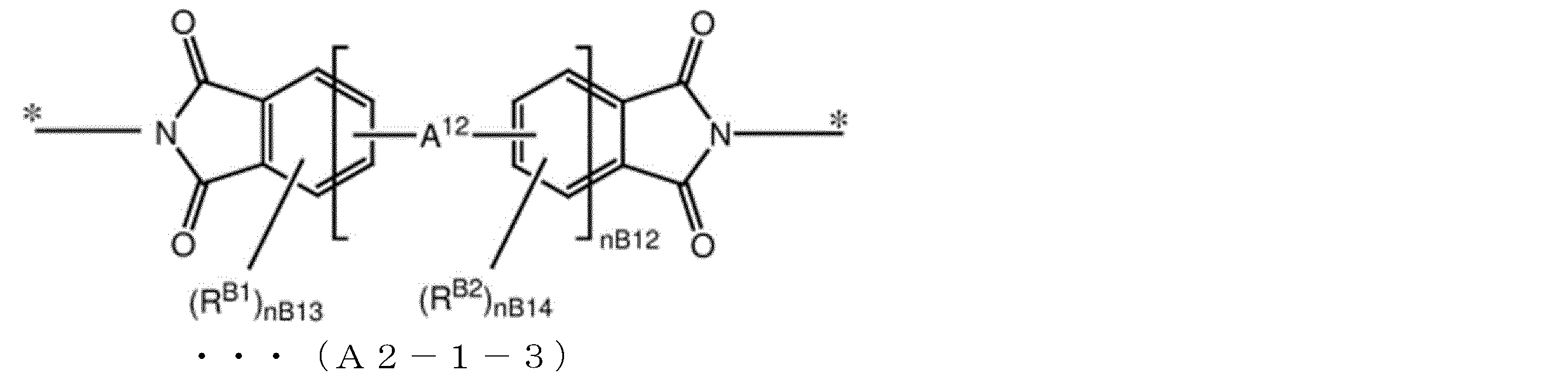
式(A2-1-3)中、
A12は、単結合、又は炭素原子、酸素原子、窒素原子、及び硫黄原子から選ばれる1個以上(例えば1~3000個、1~1000個、1~100個、1~50個)の骨格原子からなる2価の基を表し、
RB1及びRB2は、それぞれ独立に、置換基を表し、
nB12は、0又は1を表し、
nB13及びnB14は、それぞれ独立に、0~3の整数(好ましくは0又は1)を表し、
*は、結合部位を示す。RB1が複数ある場合、それらは同一でも相異なってもよく、RB2が複数ある場合、それらは同一でも相異なってもよい。
In formula (A2-1-3),
A 12 is a single bond or a skeleton having one or more (for example, 1 to 3000, 1 to 1000, 1 to 100, or 1 to 50) atoms selected from carbon atoms, oxygen atoms, nitrogen atoms, and sulfur atoms. represents a divalent group consisting of atoms,
R B1 and R B2 each independently represent a substituent.
nB12 represents 0 or 1;
nB13 and nB14 each independently represent an integer of 0 to 3 (preferably 0 or 1);
* indicates a binding site. When there are a plurality of R B1 , they may be the same or different, and when there are a plurality of R B2 , they may be the same or different.
なお、nB12が0であるとき、式(A2-1-3)で表される2価の基は、下記式(A2-1-4)で表される構造を有する2価の基を示す。式中、RB1、nB13及び*は、式(A2-1-3)にて説明したとおりである。 When nB12 is 0, the divalent group represented by formula (A2-1-3) represents a divalent group having a structure represented by the following formula (A2-1-4), in which R B1 , nB13, and * are as explained in formula (A2-1-3).

式(A2-1-3)中、nB12が1である実施形態において、A12で表される2価の基としては、下記式(A2-1-5)で表される2価の基が好ましい。 In an embodiment in which nB12 in formula (A2-1-3) is 1, the divalent group represented by A 12 is preferably a divalent group represented by the following formula (A2-1-5).

式(A2-1-5)中、
Y1は、単結合、アルキレン基、アルケニレン基、-O-、-CO-、-S-、-SO-、-SO2-、-CONH-、-NHCO-、-COO-、又は-OCO-を表し、
環Z2は、置換基を有していてもよい非芳香族環、又は置換基を有していてもよい芳香族環を表し、
nB15は、0~5の整数(好ましくは0~3)を表し、
*は、結合部位を示す。Y1や環Z2は、それぞれ独立に、置換基を有していてもよい。Y1が複数ある場合、それらは同一でも相異なってもよく、環Z2が複数ある場合、それらは同一でも相異なってもよい。
In formula (A2-1-5),
Y 1 represents a single bond, an alkylene group, an alkenylene group, -O-, -CO-, -S-, -SO-, -SO 2 -, -CONH-, -NHCO-, -COO-, or -OCO-. represents
Ring Z2 represents a non-aromatic ring which may have a substituent or an aromatic ring which may have a substituent;
nB15 represents an integer of 0 to 5 (preferably 0 to 3);
* indicates a bonding site. Y 1 and ring Z 2 may each independently have a substituent. When there are a plurality of Y 1 , they may be the same or different, and ring Z 2 When there are multiple, they may be the same or different.
A12で表される2価の基の具体例としては、特に限定されるものではないが、-CH2-、-CH(CH3)-、-CH(CH2CH3)-、-C(CH3)2-、-C(CH3)(CH2CH3)-、-C(CH2CH3)2-、-O-、-CO-、-S-、-SO-、及び-SO2-に加えて、下記で表される2価の有機基を挙げることができる。

(A2-1)成分の重量平均分子量(Mw)は、特に限定されないが、好ましくは150~50000、より好ましくは300~20000であり、より詳細には、式(A2-1-1)中のnB1が1以上の整数である態様では、好ましくは500~50000、より好ましくは1000~20000であり、nB1が0である態様では、好ましくは150~5000、より好ましくは300~1000である。(A2-1)成分のMwは、ゲルパーミエーションクロマトグラフィー(GPC)法により、ポリスチレン換算の値として測定できる。 The weight average molecular weight (Mw) of the (A2-1) component is not particularly limited, but is preferably 150 to 50,000, more preferably 300 to 20,000. More specifically, in an embodiment where nB1 in formula (A2-1-1) is an integer of 1 or more, it is preferably 500 to 50,000, more preferably 1,000 to 20,000, and in an embodiment where nB1 is 0, it is preferably 150 to 5,000, more preferably 300 to 1,000. The Mw of the (A2-1) component can be measured as a polystyrene-equivalent value by gel permeation chromatography (GPC).
また、(A2-1)成分について、マレイミド基の官能基当量は、好ましくは50~20000g/eq.、より好ましくは100~20000g/eq.であり、より詳細には、式(A2-1-1)中のnB1が1以上の整数である態様では、好ましくは300g/eq.~20000g/eq.、より好ましくは500g/eq.~10000g/eq.であり、nB1が0である態様では、好ましくは50g/eq.~2000g/eq.、より好ましくは100g/eq.~1000g/eq.さらに好ましくは200g/eq.~600g/eq.、特に好ましくは300g/eq.~400g/eq.である。 Furthermore, for the component (A2-1), the functional group equivalent of the maleimide group is preferably 50 to 20,000 g/eq., more preferably 100 to 20,000 g/eq., and more specifically, in an embodiment in which nB1 in formula (A2-1-1) is an integer of 1 or more, it is preferably 300 g/eq. to 20,000 g/eq., more preferably 500 g/eq. to 10,000 g/eq., and in an embodiment in which nB1 is 0, it is preferably 50 g/eq. to 2,000 g/eq., more preferably 100 g/eq. to 1,000 g/eq., even more preferably 200 g/eq. to 600 g/eq., and particularly preferably 300 g/eq. to 400 g/eq.
本発明の所期の効果を奏する観点から、(A2-1)成分は、下記式(A2-1-6)で表される構造、下記式(A2-1-7)で表される構造、又は下記式(A2-1-8)で表される構造の何れかを有するマレイミド化合物を含むことが好ましい。 From the viewpoint of achieving the intended effects of the present invention, it is preferable that the (A2-1) component contains a maleimide compound having a structure represented by the following formula (A2-1-6), a structure represented by the following formula (A2-1-7), or a structure represented by the following formula (A2-1-8).

式(A2-1-6)中、A11及び環Z1は、先に説明したとおりであり、A11-環Z1-A11の1ブロック当たりの炭素原子数は好ましくは20~100(より好ましくは30~60又は30~50)であり、いわゆるダイマー酸骨格(C36骨格;ダイマージアミン由来のC36脂肪族骨格)であることが特に好ましい。nB16は1~10の整数を表す。 In formula (A2-1-6), A 11 and ring Z 1 are as described above, the number of carbon atoms per block of A 11 -ring Z 1 -A 11 is preferably 20 to 100 (more preferably 30 to 60 or 30 to 50), and is particularly preferably a so-called dimer acid skeleton (C36 skeleton; C36 aliphatic skeleton derived from dimer diamine). nB16 represents an integer of 1 to 10.

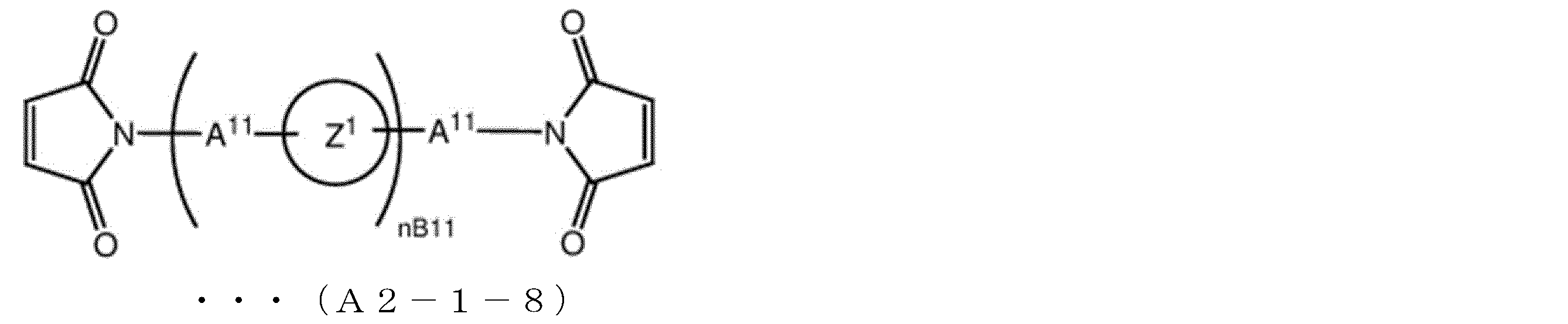
式(A2-1-8)中、A11及び環Z1は、先に説明したとおりであり、A11-環Z1-A11の1ブロック当たりの炭素原子数は好ましくは20~100(より好ましくは30~60又は30~50)であり、いわゆるダイマー酸骨格(C36骨格;ダイマージアミン由来のC36脂肪族骨格)であることが特に好ましい。nB11は0~3の整数を表す。 In formula (A2-1-8), A 11 and ring Z 1 are as described above, the number of carbon atoms per block of A 11 -ring Z 1 -A 11 is preferably 20 to 100 (more preferably 30 to 60 or 30 to 50), and is particularly preferably a so-called dimer acid skeleton (C36 skeleton; C36 aliphatic skeleton derived from dimer diamine). nB11 represents an integer of 0 to 3.
式(A2-1-6)で表される構造を有するマレイミド化合物の市販品としては、例えば、デザイナーモレキュールズ社(デジグナーモレキュールズ社)製の「BMI-3000J」、「BMI-5000」等が挙げられる。式(A2-1-7)で表される構造を有するマレイミド化合物の市販品としては、例えば、デザイナーモレキュールズ社製の「BMI-1400」、「BMI-1500」、「BMI-1700」等が挙げられる。式(A2-1-8)で表される構造を有するマレイミド化合物の市販品としては、例えば、デザイナーモレキュールズ社製の「BMI-689」等が挙げられる。Annika Wagnerら,“Cure kinetics of bismaleimides as basis for polyimide-like inks for PolyJet(登録商標)-3D-printing”,「J. APPL. POLYM. SCI.」,2018,47244に開示されるデジグナーモレキュールズ社製の「BMI-1500」、「BMI-1700」等が挙げられる。 Commercially available maleimide compounds having the structure represented by formula (A2-1-6) include, for example, "BMI-3000J" and "BMI-5000" manufactured by Designer Molecules. Commercially available maleimide compounds having the structure represented by formula (A2-1-7) include, for example, "BMI-1400", "BMI-1500", and "BMI-1700" manufactured by Designer Molecules. Commercially available maleimide compounds having the structure represented by formula (A2-1-8) include, for example, "BMI-689" manufactured by Designer Molecules. Examples of such inks include "BMI-1500" and "BMI-1700" manufactured by Designer Molecules, Inc., as disclosed in Annika Wagner et al., "Cure kinetics of bismaleimides as a basis for polyimide-like inks for PolyJet (registered trademark)-3D-printing," J. APPL. POLYM. SCI., 2018, 47244.
<(A2-2)成分>
(A2-2)成分は、トリメチルインダン骨格を含むマレイミド化合物である。トリメチルインダン骨格とは、下記式(A2-2-1)に示す骨格を表す。
<(A2-2) component>
The component (A2-2) is a maleimide compound containing a trimethylindane skeleton. The trimethylindane skeleton is represented by the following formula (A2-2-1).

トリメチルインダン骨格中のベンゼン環は、置換基を有していてもよい。トリメチルインダン骨格中のベンゼン環が置換基を有する場合、該置換基の数は、1でもよく、2以上でもよい。トリメチルインダン骨格中のベンゼン環が有する置換基の数の上限は、通常、3以下である。置換基の数が2以上である場合、それらは、互いに同一でも相異なってもよい。中でも、トリメチルインダン骨格中のベンゼン環は、置換基を有していないことが好ましい。 The benzene ring in the trimethylindane skeleton may have a substituent. When the benzene ring in the trimethylindane skeleton has a substituent, the number of the substituents may be 1 or 2 or more. The upper limit of the number of substituents that the benzene ring in the trimethylindane skeleton has is usually 3 or less. When the number of substituents is 2 or more, they may be the same or different from each other. In particular, it is preferable that the benzene ring in the trimethylindane skeleton does not have a substituent.
(A2-2)成分が1分子中に含むトリメチルインダン骨格の数は、1でもよく、2以上でもよい。上限は、例えば、10以下、8以下、7以下、又は6以下とし得る。 The number of trimethylindane structures contained in one molecule of component (A2-2) may be 1 or 2 or more. The upper limit may be, for example, 10 or less, 8 or less, 7 or less, or 6 or less.
(A2-2)成分は、上述したトリメチルインダン骨格に加えて、さらに芳香族環骨格を含むことが好ましい。芳香族環骨格としては、炭素環骨格及び複素環骨格の何れであってもよいが、炭素環骨格がより好ましい。該芳香族環骨格の環構成炭素の数は、好ましくは3~20、より好ましくは4~16、5~14又は6~10である。芳香族環骨格としては、例えば、ベンゼン環骨格、ナフタレン環骨格、アントラセン環骨格等が挙げられる。(A2-2)成分が1分子中に含む芳香族環骨格の数は、好ましくは1以上、より好ましくは2以上であり、好ましくは6以下、より好ましくは4以下、さらに好ましくは3以下である。(A2-2)成分が、トリメチルインダン骨格に加えて、2以上の芳香族環骨格を含む場合、それら芳香族環骨格は、互いに同一でも相異なってもよい。 The (A2-2) component preferably further contains an aromatic ring skeleton in addition to the above-mentioned trimethylindane skeleton. The aromatic ring skeleton may be either a carbon ring skeleton or a heterocyclic skeleton, but a carbon ring skeleton is more preferable. The number of ring carbon atoms of the aromatic ring skeleton is preferably 3 to 20, more preferably 4 to 16, 5 to 14, or 6 to 10. Examples of aromatic ring skeletons include a benzene ring skeleton, a naphthalene ring skeleton, and an anthracene ring skeleton. The number of aromatic ring skeletons contained in one molecule of the (A2-2) component is preferably 1 or more, more preferably 2 or more, and preferably 6 or less, more preferably 4 or less, and even more preferably 3 or less. When the (A2-2) component contains two or more aromatic ring skeletons in addition to the trimethylindane skeleton, the aromatic ring skeletons may be the same or different from each other.
芳香族環骨格は、置換基を有していてもよい。芳香族環骨格が置換基を有する場合、該置換基の数は、1でもよく、2以上でもよい。芳香族環骨格が有する置換基の数の上限は、通常、4以下である。置換基の数が2以上である場合、それらは、互いに同一でも相異なってもよい。 The aromatic ring skeleton may have a substituent. When the aromatic ring skeleton has a substituent, the number of the substituents may be 1 or 2 or more. The upper limit of the number of the substituents that the aromatic ring skeleton has is usually 4 or less. When the number of the substituents is 2 or more, they may be the same or different from each other.
(A2-2)成分は、トリメチルインダン骨格に加えて、さらに2価の脂肪族炭化水素基を含むことが好ましい。特に、(A2-2)成分が、トリメチルインダン骨格中のベンゼン環とは別に芳香族環骨格を含む場合、(A2-2)成分は2価の脂肪族炭化水素基を含むことが好ましい。この場合、2価の脂肪族炭化水素基は、トリメチルインダン骨格中のベンゼン環と芳香族環骨格との間を連結することが好ましい。また、2価の脂肪族炭化水素基は、芳香族環骨格同士を連結することが好ましい。 The (A2-2) component preferably further contains a divalent aliphatic hydrocarbon group in addition to the trimethylindane skeleton. In particular, when the (A2-2) component contains an aromatic ring skeleton in addition to the benzene ring in the trimethylindane skeleton, the (A2-2) component preferably contains a divalent aliphatic hydrocarbon group. In this case, the divalent aliphatic hydrocarbon group preferably connects the benzene ring and the aromatic ring skeleton in the trimethylindane skeleton. In addition, the divalent aliphatic hydrocarbon group preferably connects the aromatic ring skeletons together.
2価の脂肪族炭化水素基の炭素原子数は、好ましくは1以上であり、好ましくは12以下、より好ましくは8以下、さらに好ましくは5以下である。2価の脂肪族炭化水素基としては、2価の飽和炭化水素基及び2価の不飽和炭化水素基の何れであってもよいが、2価の飽和炭化水素基が好ましく、アルキレン基がより好ましい。2価の脂肪族炭化水素基としては、例えば、メチレン基、エチレン基、トリメチレン基、テトラメチレン基、ペンタメチレン基、ヘキサメチレン基等の直鎖アルキレン基;モノメチルメチレン基(-CH(CH3)-)、モノエチルモノメチレン基(-CH(CH2CH3)-)、ジメチルメチレン基(-C(CH3)2-)、エチルメチルメチレン基(-C(CH3)(CH2CH3)-)、ジエチルメチレン基(-C(CH2CH3)2-)等の分岐鎖アルキレン基等が挙げられる。(A2-2)成分が、トリメチルインダン骨格に加えて、2以上の2価の脂肪族炭化水素基を含む場合、それら2価の脂肪族炭化水素基は、互いに同一でも相異なってもよい。 The number of carbon atoms in the divalent aliphatic hydrocarbon group is preferably 1 or more, and preferably 12 or less, more preferably 8 or less, and even more preferably 5 or less. The divalent aliphatic hydrocarbon group may be either a divalent saturated hydrocarbon group or a divalent unsaturated hydrocarbon group, with a divalent saturated hydrocarbon group being preferred, and an alkylene group being more preferred. Examples of divalent aliphatic hydrocarbon groups include straight-chain alkylene groups such as methylene, ethylene, trimethylene, tetramethylene, pentamethylene, and hexamethylene; and branched-chain alkylene groups such as monomethylmethylene (-CH( CH3 )-), monoethylmonomethylene (-CH( CH2CH3 )-), dimethylmethylene (-C( CH3 ) 2- ), ethylmethylmethylene (-C(CH3)(CH2CH3)-), and diethylmethylene (-C(CH2CH3 ) 2- ) . When component ( A2-2 ) contains two or more divalent aliphatic hydrocarbon groups in addition to the trimethylindane skeleton, these divalent aliphatic hydrocarbon groups may be the same or different.
(A2-2)成分は、下記式(A2-2-2)で表される構造を含んでいてもよい。(A2-2)成分の全体が式(A2-2-2)で表される構造を有していてもよく、(A2-2)成分の一部が式(A2-2-2)で表される構造を有していてもよい。 The component (A2-2) may contain a structure represented by the following formula (A2-2-2). The entire component (A2-2) may have a structure represented by formula (A2-2-2), or a part of the component (A2-2) may have a structure represented by formula (A2-2-2).

式(A2-2-2)中、
Ara1は、置換基を有していてもよい2価の芳香族環基を表し、
Ra1及びRa2は、それぞれ独立に、置換基を表し、
Ra3は、2価の脂肪族炭化水素基を表し、
na1は、正の整数を表し、
na2は、それぞれ独立に、0~4の整数を表し、
na3は、それぞれ独立に、0~3の整数を表す。Ra1が複数ある場合、それらは同一でも相異なってもよく、Ra2が複数ある場合、それらは同一でも相異なってもよく、複数あるRa3は互いに同一でも相異なってもよい。
In formula (A2-2-2),
Ar a1 represents a divalent aromatic ring group which may have a substituent;
R a1 and R a2 each independently represent a substituent.
R a3 represents a divalent aliphatic hydrocarbon group;
n a1 represents a positive integer,
Each n a2 independently represents an integer of 0 to 4,
Each n a3 independently represents an integer of 0 to 3. When there are a plurality of R a1 , they may be the same or different, and when there are a plurality of R a2 , they may be the same or different; A plurality of R a3 may be the same or different.
Ara1は、置換基を有していてもよい2価の芳香族環基を表す。2価の芳香族環基の炭素原子数は、好ましくは6以上であり、好ましくは20以下、より好ましくは16以下、14以下又は10以下である。2価の芳香族環基としては、例えば、フェニレン基、ナフチレン基が挙げられる。2価の芳香族環基が有していてもよい置換基としては、先述の置換基が挙げられ、中でも、炭素原子数1~10のアルキル基、炭素原子数1~10のアルキルオキシ基、炭素原子数1~10のアルキルチオ基、炭素原子数6~10のアリール基、炭素原子数6~10のアリールオキシ基、炭素原子数6~10のアリールチオ基、炭素原子数3~10のシクロアルキル基、ハロゲン原子、ヒドロキシ基、及びメルカプト基が好ましい。各置換基の水素原子は、さらにハロゲン原子で置換されていてもよい。2価の芳香族環基が置換基を有する場合、置換基の数は、好ましくは1~4である。2価の芳香族環基が有する置換基の数が2以上である場合、それら2以上の置換基は、互いに同一でも相異なってもよい。中でも、Ara1は、置換基を有していない2価の芳香族環基であることが好ましい。 Ar a1 represents a divalent aromatic ring group which may have a substituent. The number of carbon atoms of the divalent aromatic ring group is preferably 6 or more, preferably 20 or less, more preferably 16 or less, 14 or less, or 10 or less. Examples of the divalent aromatic ring group include a phenylene group and a naphthylene group. Examples of the substituent that the divalent aromatic ring group may have include the above-mentioned substituents, among which an alkyl group having 1 to 10 carbon atoms, an alkyloxy group having 1 to 10 carbon atoms, an alkylthio group having 1 to 10 carbon atoms, an aryl group having 6 to 10 carbon atoms, an aryloxy group having 6 to 10 carbon atoms, an arylthio group having 6 to 10 carbon atoms, a cycloalkyl group having 3 to 10 carbon atoms, a halogen atom, a hydroxyl group, and a mercapto group are preferred. The hydrogen atom of each substituent may be further substituted with a halogen atom. When the divalent aromatic ring group has a substituent, the number of the substituents is preferably 1 to 4. When the divalent aromatic ring group has two or more substituents, the two or more substituents may be the same or different. In particular, Ar a1 is preferably a divalent aromatic ring group having no substituent.
Ra1は、置換基を表す。Ra1で表される置換基としては、先述の置換基が挙げられ、中でも、炭素原子数1~10のアルキル基、炭素原子数1~10のアルキルオキシ基、炭素原子数1~10のアルキルチオ基、炭素原子数6~10のアリール基、炭素原子数6~10のアリールオキシ基、炭素原子数6~10のアリールチオ基、炭素原子数3~10のシクロアルキル基、ハロゲン原子、ニトロ基、ヒドロキシ基、及びメルカプト基が好ましい。各置換基の水素原子は、さらにハロゲン原子で置換されていてもよい。 R a1 represents a substituent. Examples of the substituent represented by R a1 include the above-mentioned substituents, and among them, an alkyl group having 1 to 10 carbon atoms, an alkyloxy group having 1 to 10 carbon atoms, an alkylthio group having 1 to 10 carbon atoms, an aryl group having 6 to 10 carbon atoms, an aryloxy group having 6 to 10 carbon atoms, an arylthio group having 6 to 10 carbon atoms, a cycloalkyl group having 3 to 10 carbon atoms, a halogen atom, a nitro group, a hydroxyl group, and a mercapto group are preferred. The hydrogen atom of each substituent may be further substituted with a halogen atom.
中でも、Ra1は、炭素原子数1~4のアルキル基、炭素原子数3~6のシクロアルキル基、及び、炭素原子数6~10のアリール基からなる群より選ばれる1種類以上の基であることがより好ましく、炭素原子数1~4のアルキル基がさらに好ましい。 Among them, R a1 is more preferably one or more groups selected from the group consisting of an alkyl group having 1 to 4 carbon atoms, a cycloalkyl group having 3 to 6 carbon atoms, and an aryl group having 6 to 10 carbon atoms, and is further preferably an alkyl group having 1 to 4 carbon atoms.
Ra2は、置換基を表す。Ra2で表される置換基としては、先述の置換基が挙げられ、中でも、炭素原子数1~10のアルキル基、炭素原子数1~10のアルキルオキシ基、炭素原子数1~10のアルキルチオ基、炭素原子数6~10のアリール基、炭素原子数6~10のアリールオキシ基、炭素原子数6~10のアリールチオ基、炭素原子数3~10のシクロアルキル基、ハロゲン原子、ヒドロキシ基、及びメルカプト基が好ましい。各置換基の水素原子は、さらにハロゲン原子で置換されていてもよい。 R a2 represents a substituent. Examples of the substituent represented by R a2 include the above-mentioned substituents, and among them, an alkyl group having 1 to 10 carbon atoms, an alkyloxy group having 1 to 10 carbon atoms, an alkylthio group having 1 to 10 carbon atoms, an aryl group having 6 to 10 carbon atoms, an aryloxy group having 6 to 10 carbon atoms, an arylthio group having 6 to 10 carbon atoms, a cycloalkyl group having 3 to 10 carbon atoms, a halogen atom, a hydroxyl group, and a mercapto group are preferred. The hydrogen atom of each substituent may be further substituted with a halogen atom.
中でも、Ra2は、炭素原子数1~4のアルキル基、炭素原子数3~6のシクロアルキル基、及び、炭素原子数6~10のアリール基からなる群より選択される1種類以上の基であることがより好ましい。 Among them, R a2 is more preferably one or more groups selected from the group consisting of an alkyl group having 1 to 4 carbon atoms, a cycloalkyl group having 3 to 6 carbon atoms, and an aryl group having 6 to 10 carbon atoms.
Ra3は、2価の脂肪族炭化水素基を表す。好ましい2価の脂肪族炭化水素基の範囲は、上述したとおりである。 R a3 represents a divalent aliphatic hydrocarbon group. The preferred range of the divalent aliphatic hydrocarbon group is as described above.
na1は、正の整数を表す。na1は、好ましくは1以上であり、好ましくは10以下、より好ましくは8以下である。 n a1 represents a positive integer. n a1 is preferably 1 or more, and is preferably 10 or less, and more preferably 8 or less.
na2は、それぞれ独立に、0~4の整数を表す。na2は、好ましくは2又は3であり、より好ましくは2である。複数のna2は、相異なってもよいが、互いに同一であることが好ましい。na2が2以上の場合、複数のRa1は、互いに同一でも相異なってもよい。 Each n a2 independently represents an integer of 0 to 4. n a2 is preferably 2 or 3, and more preferably 2. Multiple n a2 may be different from each other, but are preferably the same as each other. When n a2 is 2 or more, multiple R a1 may be the same as each other or different from each other.
na3は、0~3の整数を表す。na3が複数ある場合、それらは相異なってもよいが、互いに同一であることが好ましい。na3は、好ましくは0である。 n a3 represents an integer of 0 to 3. When there are a plurality of n a3 , they may be different from each other, but are preferably the same as each other. n a3 is preferably 0.
(A2-2)成分は、下記式(A2-2-3)で表される構造を含んでいてもよい。(A2-2)成分の全体が式(A2-2-3)で表される構造を有していてもよく、(A2-2)成分の一部が式(A2-2-3)で表される構造を有していてもよい。 The component (A2-2) may contain a structure represented by the following formula (A2-2-3). The entire component (A2-2) may have a structure represented by formula (A2-2-3), or a part of the component (A2-2) may have a structure represented by formula (A2-2-3).
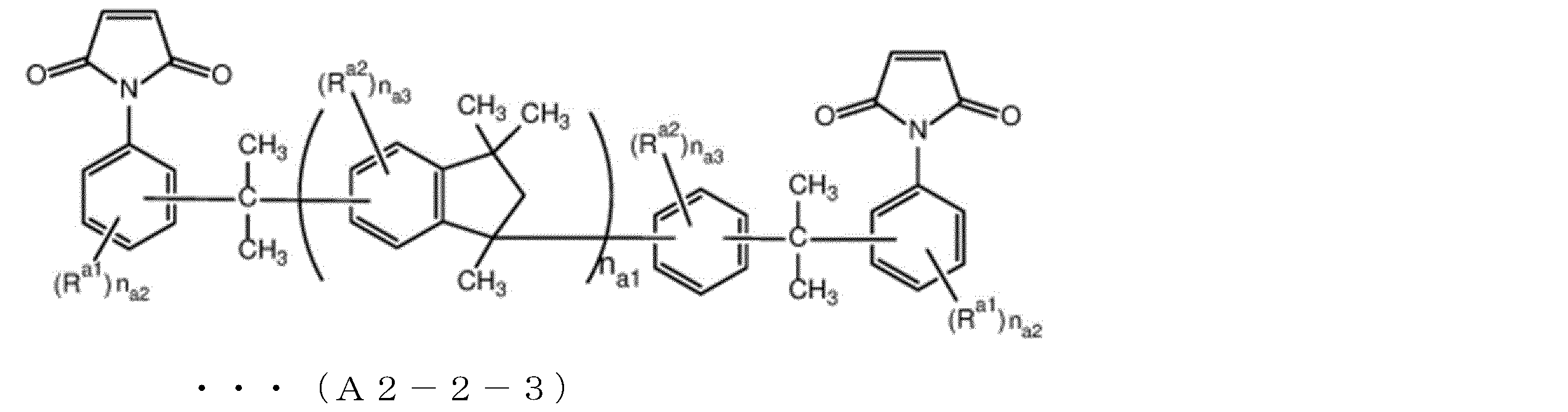
式(A2-2-3)中、Ra1、Ra2、na1、na2及びna3は、式(A2-2-2)にて説明したとおりである。 In formula (A2-2-3), R a1 , R a2 , n a1 , n a2 and n a3 are as defined in formula (A2-2-2).
(A2-2)成分は、さらに、下記式(A2-2-4)で表される構造を含んでいてもよい。 The component (A2-2) may further contain a structure represented by the following formula (A2-2-4).

式(A2-2-4)中、Ra1、Ra2、na2及びna3は、式(A2-2-2)にて説明したとおりである。またnc1は、繰り返し単位数であり、1~20の整数を表す。*は、結合手を表す。 In formula (A2-2-4), R a1 , R a2 , n a2 and n a3 are as explained in formula (A2-2-2), and n c1 is the number of repeating units and is an integer of 1 to 20. * represents a bond.
例えば、(A2-2)成分は、式(A2-2-2)において、na2が3以下であり、且つ、マレイミド基が結合するベンゼン環のマレイミド基結合位置に対するオルト位及びパラ位のうち、2つ以上に、Ra1が結合していない場合に、式(A2-2-2)で表される構造に組み合わせて上記式(A2-2-4)で表される構造を含みうる。 For example, when n a2 is 3 or less and R a1 is not bonded to two or more of the ortho-positions and para-positions relative to the bonding position of the maleimide group on the benzene ring to which the maleimide group is bonded in the formula (A2-2-2), the component (A2-2) can contain a structure represented by formula (A2-2-4) in combination with the structure represented by formula (A2-2-2).
また、例えば、(A2-2)成分は、式(A2-2-3)において、na2が3以下であり、且つ、マレイミド基が結合するベンゼン環のマレイミド基結合位置に対するオルト位及びパラ位のうち、2つ以上に、Ra1が結合していない場合に、式(A2-2-3)で表される構造に組み合わせて上記式(A2-2-4)で表される構造を含みうる。 Furthermore, for example, when n a2 is 3 or less in formula (A2-2-3) and R a1 is not bonded to two or more of the ortho-positions and para-positions relative to the bonding position of the maleimide group on the benzene ring to which the maleimide group is bonded, the component ( A2-2 ) can contain a structure represented by formula (A2-2-4) in combination with the structure represented by formula (A2-2-3).
(A2-2)成分の製造方法は、特に制限はなく、例えば、発明協会公開技報公技番号2020-500211号に記載の方法によって製造してよい。この発明協会公開技報公技番号2020-500211号に記載の製造方法によれば、トリメチルインダン骨格の繰り返し単位数に分布があるマレイミド化合物を得ることができる。この方法で得られるマレイミド化合物は、下記式(A2-2-5)で表される構造を含む。よって、マレイミド樹脂は、式(A2-2-5)で表される構造を含むマレイミド化合物を含んでいてもよい。 The method for producing component (A2-2) is not particularly limited, and it may be produced, for example, by the method described in Japan Institute of Invention and Innovation's Technical Journal No. 2020-500211. According to the production method described in Japan Institute of Invention and Innovation's Technical Journal No. 2020-500211, it is possible to obtain a maleimide compound having a distribution in the number of repeating units of the trimethylindane skeleton. The maleimide compound obtained by this method contains a structure represented by the following formula (A2-2-5). Therefore, the maleimide resin may contain a maleimide compound containing a structure represented by formula (A2-2-5).

式(A2-2-5)中、R1、R2、n2及びn3は、それぞれ、式(A2-2-2)におけるRa1、Ra2、na2及びna3と同じであり、好適な種類や範囲もまた同じである。n1は、0.95~10.0の平均繰り返し単位数を表す。 In formula (A2-2-5), R 1 , R 2 , n 2 and n 3 are the same as R a1 , R a2 , n a2 and n a3 in formula (A2-2-2), respectively, and the preferred types and ranges are also the same. n 1 represents the average number of repeating units of 0.95 to 10.0.
式(A2-2-5)において、n1は、平均繰り返し単位数を表し、その範囲は0.95~10.0である。発明協会公開技報公技番号2020-500211号に記載の製造方法によれば、式(A2-2-5)で表される構造を含む一群のマレイミド化合物が得られる。 In formula (A2-2-5), n1 represents the average number of repeating units, and its range is 0.95 to 10.0. According to the production method described in the Journal of Technical Disclosure No. 2020-500211 of the Japan Institute of Invention and Innovation, a group of maleimide compounds containing a structure represented by formula (A2-2-5) can be obtained.
式(A2-2-5)において、平均繰り返し単位数n1は、好ましくは0.95以上、より好ましくは0.98以上、さらに好ましくは1.0以上、特に好ましくは1.1以上であり、好ましくは10.0以下、より好ましくは8.0以下、さらに好ましくは7.0以下、特に好ましくは6.0以下である。 In formula (A2-2-5), the average number of repeating units n1 is preferably 0.95 or more, more preferably 0.98 or more, even more preferably 1.0 or more, and particularly preferably 1.1 or more, and is preferably 10.0 or less, more preferably 8.0 or less, even more preferably 7.0 or less, and particularly preferably 6.0 or less.
(A2-2)成分の具体的な構造の例としては、以下が挙げられる。 Specific examples of the structure of component (A2-2) include the following:
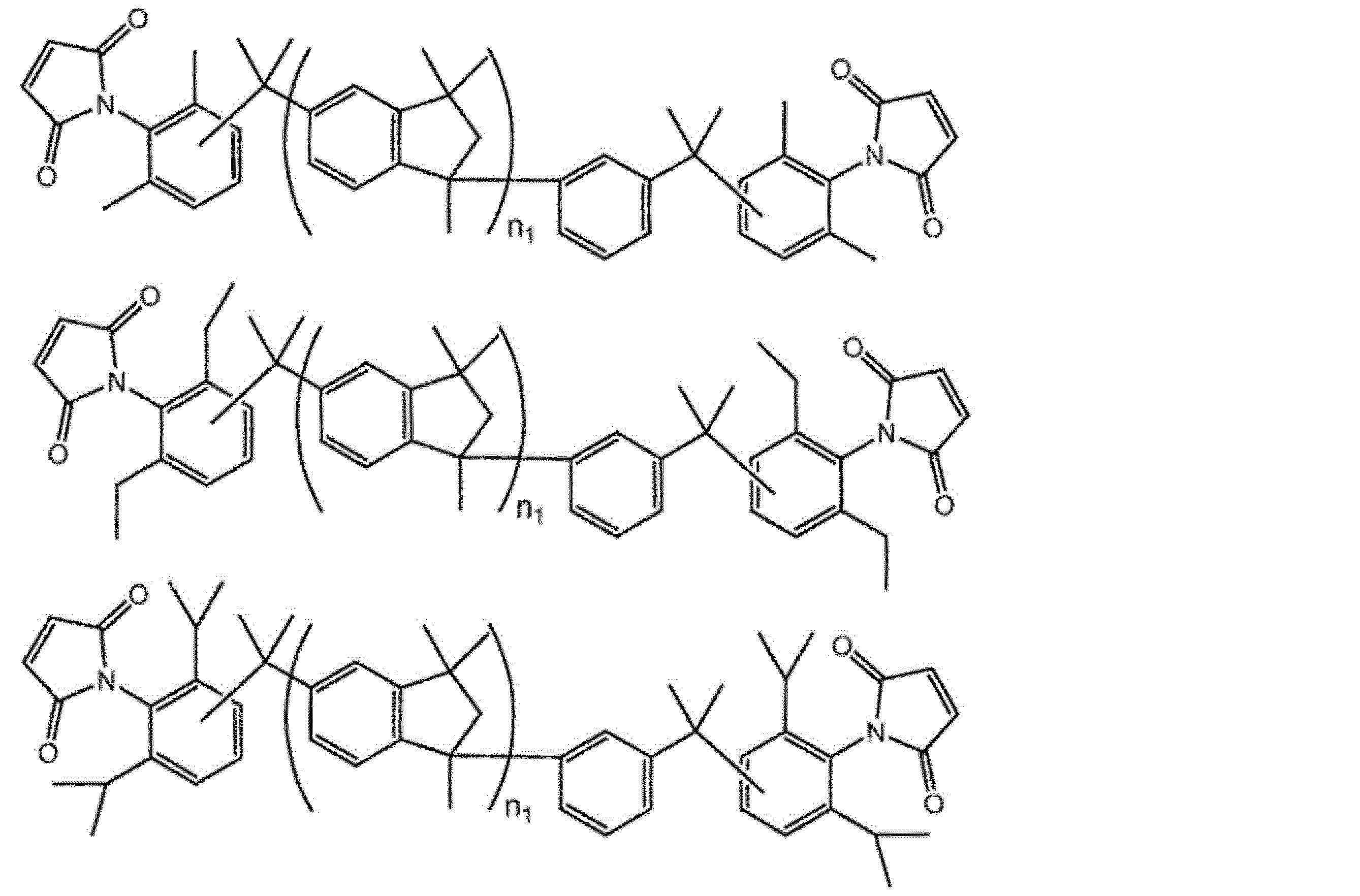
式(A2-2-5)で表される構造を含むマレイミド化合物は、さらに、上記式(A2-2-4)で示す構造を含んでいてもよい。例えば、式(A2-2-5)で表される構造を含むマレイミド化合物は、式(A2-2-5)において、n2が3以下であり、且つ、マレイミド基が結合するベンゼン環のマレイミド基結合位置に対するオルト位及びパラ位のうち、2つ以上に、R1が結合していない場合に、式(A2-2-5)で表される構造に組み合わせて式(A2-2-4)で表される構造を含みうる。 The maleimide compound containing the structure represented by formula (A2-2-5) may further contain the structure represented by formula (A2-2-4) above. For example, the maleimide compound containing the structure represented by formula (A2-2-5) may contain the structure represented by formula (A2-2-4) in combination with the structure represented by formula (A2-2-5) when n2 is 3 or less and R1 is not bonded to two or more of the ortho-positions and para-positions relative to the bonding position of the maleimide group of the benzene ring to which the maleimide group is bonded.
式(A2-2-5)で表される構造を含むマレイミド化合物は、ゲルパーミエーションクロマトグラフィー(GPC)測定から算出される分子量分布Mw/Mnが、特定の範囲にあることが好ましい。具体的には、式(A2-2-5)で表される構造を含むマレイミド化合物の分子量分布Mw/Mnは、好ましくは1.0~4.0、より好ましくは1.1~3.8、さらに好ましくは1.2~3.6、特に好ましくは1.3~3.4である。 It is preferable that the molecular weight distribution Mw/Mn of the maleimide compound containing the structure represented by formula (A2-2-5) is within a specific range as calculated by gel permeation chromatography (GPC) measurement. Specifically, the molecular weight distribution Mw/Mn of the maleimide compound containing the structure represented by formula (A2-2-5) is preferably 1.0 to 4.0, more preferably 1.1 to 3.8, even more preferably 1.2 to 3.6, and particularly preferably 1.3 to 3.4.
(A2-2)成分について、マレイミド基の官能基当量は、好ましくは50g/eq.以上、より好ましくは100g/eq.以上、さらに好ましくは200g/eq.以上であり、好ましくは2000g/eq.以下、より好ましくは1000g/eq.以下、さらに好ましくは800g/eq.以下である。 For component (A2-2), the functional group equivalent of the maleimide group is preferably 50 g/eq. or more, more preferably 100 g/eq. or more, even more preferably 200 g/eq. or more, and preferably 2000 g/eq. or less, more preferably 1000 g/eq. or less, even more preferably 800 g/eq. or less.
<(A2-3)成分>
(A2-3)成分は、マレイミドの窒素原子と直接結合している芳香族環を有するマレイミド化合物である。斯かるマレイミド化合物は、例えば、芳香族アミン化合物(芳香族ジアミン化合物など)と、マレイン酸無水物とを含む成分をイミド化反応させることにより得ることができる。
<(A2-3) component>
The component (A2-3) is a maleimide compound having an aromatic ring directly bonded to the nitrogen atom of the maleimide. Such a maleimide compound is, for example, a mixture of an aromatic amine compound (such as an aromatic diamine compound) and a maleimide. The copolymer can be obtained by subjecting a component containing an acid anhydride to an imidization reaction.
一実施形態において、(A2-3)成分は、下記式(A2-3-1)で表される化合物を含む。 In one embodiment, the component (A2-3) includes a compound represented by the following formula (A2-3-1):

式(A2-3-1)中、
環Ar1は、置換基を有していてもよい芳香族環を表し、
L2は、単結合又は2価の連結基を表し、
nB2は、1~100の整数を表す。複数ある環Ar1は同一でも相異なってもよく、L2が複数ある場合、それらは同一でも相異なってもよい。
In formula (A2-3-1),
Ring Ar 1 represents an aromatic ring which may have a substituent;
L2 represents a single bond or a divalent linking group;
nB2 represents an integer of 1 to 100. A plurality of rings Ar 1 may be the same or different, and when a plurality of L 2 are present, they may be the same or different.
環Ar1で表される芳香族環としては、炭素環及び複素環の何れであってもよいが、炭素環がより好ましい。環Ar1で表される芳香族環の炭素原子数は、好ましくは3~20、より好ましくは5~14又は6~10である。該炭素原子数に置換基の炭素原子数は含まれない。 The aromatic ring represented by ring Ar 1 may be either a carbocyclic ring or a heterocyclic ring, but is more preferably a carbocyclic ring. The number of carbon atoms in the aromatic ring represented by ring Ar 1 is preferably 3 to 20, more preferably 5 to 14 or 6 to 10. The number of carbon atoms does not include the number of carbon atoms of the substituent.
L2で表される2価の連結基としては、炭素原子、酸素原子、窒素原子及び硫黄原子から選ばれる1個以上(例えば1~3000個、1~1000個、1~100個、1~50個)の骨格原子からなる2価の基であれば特に限定されず、例えば、先述の式(A2-1-3)中のA12として記載した2価の基が挙げられる。 The divalent linking group represented by L2 is not particularly limited as long as it is a divalent group consisting of one or more (for example, 1 to 3000, 1 to 1000, 1 to 100, 1 to 50) skeletal atoms selected from carbon atoms, oxygen atoms, nitrogen atoms, and sulfur atoms, and examples thereof include the divalent groups described as A12 in the above-mentioned formula (A2-1-3).
環Ar1は、例えば、置換基を有していてもよい炭素原子数6~10の芳香族炭素環(より好ましくは置換基を有していてもよいベンゼン環で)あり、また、L2は(L2が複数ある場合、少なくとも1つのL2は)、ビフェニル骨格を有する2価の基であることが好ましい。したがって一実施形態において、(A2-3)成分はビフェニル骨格を有する。 It is preferable that ring Ar 1 is, for example, an aromatic carbocyclic ring having 6 to 10 carbon atoms which may have a substituent (more preferably a benzene ring which may have a substituent), and L 2 (when there are multiple L 2 , at least one L 2 ) is a divalent group having a biphenyl skeleton. Thus, in one embodiment, component (A2-3) has a biphenyl skeleton.
なお、(A2-3)成分において、マレイミドの窒素原子と芳香族環は直接結合している。マレイミドと芳香族環の結合位置は、芳香族環と結合しているL2を基準として、任意の位置であってよい。例えば、芳香族環がベンゼン環である場合、マレイミドと該ベンゼン環の結合位置は、該ベンゼン環と結合しているL2を基準として、オルト位、メタ位、及びパラ位のいずれであってもよく、一実施形態では、パラ位に結合している。 In the component (A2-3), the nitrogen atom of the maleimide and the aromatic ring are directly bonded. The bonding position of the maleimide and the aromatic ring may be any position based on L2 bonded to the aromatic ring. For example, when the aromatic ring is a benzene ring, the bonding position of the maleimide and the benzene ring may be any of the ortho position, meta position, and para position based on L2 bonded to the benzene ring, and in one embodiment, the maleimide is bonded to the para position.
好適な一実施形態において、(A2-3)成分は、下記式(A2-3-2)で表される化合物を含む。 In a preferred embodiment, component (A2-3) contains a compound represented by the following formula (A2-3-2):
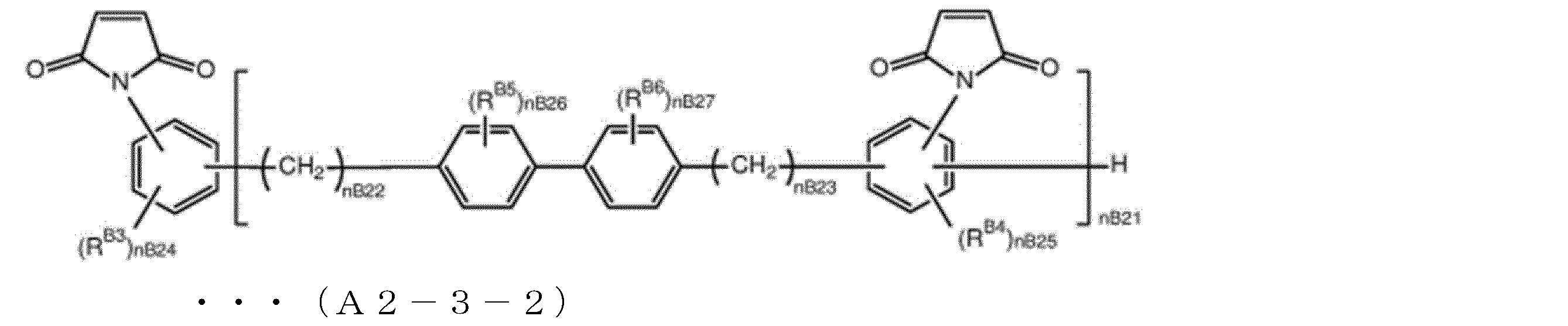
式(A2-3-2)中、
RB3、RB4、RB5及びRB6は、それぞれ独立に、置換基を表し、
nB21は1~100の整数を表し、
nB22及びnB23は、それぞれ独立に、1~10の整数を表し、
nB24及びnB25は、それぞれ独立に、0~3の整数を表し、
nB26及びnB27は、それぞれ独立に、0~4の整数を表す。RB3が複数ある場合、それらは同一でも相異なってもよく、これは、RB4、RB5及びRB6についても同様である。
In formula (A2-3-2),
R B3 , R B4 , R B5 and R B6 each independently represent a substituent;
nB21 represents an integer from 1 to 100;
nB22 and nB23 each independently represent an integer of 1 to 10;
nB24 and nB25 each independently represent an integer of 0 to 3;
nB26 and nB27 each independently represent an integer of 0 to 4. When there are a plurality of R B3 , they may be the same or different, and the same applies to R B4 , R B5 and R B6. .
nB21は、好ましくは1~50、より好ましくは1~20、さらに好ましくは1~5である。 nB21 is preferably 1 to 50, more preferably 1 to 20, and even more preferably 1 to 5.
nB22及びnB23は、それぞれ独立に、好ましくは1~6、より好ましくは1~3、さらに好ましくは1又は2である。 nB22 and nB23 are each independently preferably 1 to 6, more preferably 1 to 3, and even more preferably 1 or 2.
nB24及びnB25は、それぞれ独立に、好ましくは0~2の整数、より好ましくは0又は1である。nB24、nB25が1以上である場合、RB3及びRB4で表される置換基は、それぞれ独立に、アルキル基又はアリール基であることが好ましい。 nB24 and nB25 are each independently preferably an integer of 0 to 2, more preferably 0 or 1. When nB24 and nB25 are 1 or more, it is preferable that the substituents represented by R B3 and R B4 are each independently an alkyl group or an aryl group.
nB26及びnB27は、それぞれ独立に、好ましくは0~2の整数、より好ましくは0又は1である。nB26、nB27が1以上である場合、RB5及びRB6で表される置換基は、それぞれ独立に、アルキル基又はアリール基であることが好ましい。 nB26 and nB27 are each independently preferably an integer of 0 to 2, more preferably 0 or 1. When nB26 and nB27 are 1 or more, it is preferable that the substituents represented by R B5 and R B6 are each independently an alkyl group or an aryl group.
中でも、nB26及びnB27は0であることが好ましい。したがって好適な一実施形態において、(A2-3)成分は、下記式(A2-3-3)で表される化合物を含む。 Among them, nB26 and nB27 are preferably 0. Therefore, in a preferred embodiment, component (A2-3) contains a compound represented by the following formula (A2-3-3):

式(A2-3-3)中、RB3、RB4、nB21、nB22、nB23、nB24及びnB25は、式(A2-3-2)にて説明したとおりである。 In formula (A2-3-3), R B3 , R B4 , nB21, nB22, nB23, nB24 and nB25 are as described in formula (A2-3-2).
(A2-3)成分の分子量は、分子量分布を有する場合、重量平均分子量(Mw)にて、500以上であり、好ましくは550以上である。該Mwの上限は、特に限定されないが、好ましくは5000以下、より好ましくは2500以下である。(A2-3)成分のMwは、ゲルパーミエーションクロマトグラフィー(GPC)法により、ポリスチレン換算の値として測定できる。 When the molecular weight of the (A2-3) component has a molecular weight distribution, the weight average molecular weight (Mw) is 500 or more, preferably 550 or more. There is no particular upper limit to the Mw, but it is preferably 5000 or less, more preferably 2500 or less. The Mw of the (A2-3) component can be measured as a polystyrene-equivalent value by gel permeation chromatography (GPC).
また、(A2-3)成分について、マレイミド基の官能基当量は、好ましくは50g/eq.~2000g/eq.、より好ましくは100g/eq.~1000g/eq.さらに好ましくは150g/eq.~500g/eq.、特に好ましくは200g/eq.~300g/eq.である。 For component (A2-3), the functional group equivalent of the maleimide group is preferably 50 g/eq. to 2000 g/eq., more preferably 100 g/eq. to 1000 g/eq., even more preferably 150 g/eq. to 500 g/eq., and particularly preferably 200 g/eq. to 300 g/eq.
(A2-3)成分は、下記式(A2-3-4)で表される構造を有するマレイミド化合物であってもよい。 The (A2-3) component may be a maleimide compound having a structure represented by the following formula (A2-3-4):

式(A2-3-4)中、nB21は、先に説明したとおりである。 In formula (A2-3-4), nB21 is as explained above.
式(A2-3-4)で表される構造を有するマレイミド化合物の市販品としては、例えば、日本化薬社製の「MIR-3000-70MT」等が挙げられる。(A2-3)成分としてはまた、式(A2-3-1)で表される化合物として、大和化成社製の「BMI-4000」、ケイアイ化成社製の「BMI-80」等を使用してもよい。 Commercially available maleimide compounds having the structure represented by formula (A2-3-4) include, for example, "MIR-3000-70MT" manufactured by Nippon Kayaku Co., Ltd. As the (A2-3) component, "BMI-4000" manufactured by Daiwa Kasei Co., Ltd. and "BMI-80" manufactured by Keiai Kasei Co., Ltd. may also be used as the compound represented by formula (A2-3-1).
樹脂組成物中の(A-2)成分の含有量は、樹脂組成物中の不揮発成分の合計を100質量%としたとき、好ましくは0.5質量%以上、より好ましくは1質量%以上、2質量%、3質量%以上又は4質量%以上である。マレイミド樹脂の含有量の上限は、特に限定されないが、好ましくは30質量%以下、より好ましくは25質量%以下、20質量%以下又は15質量%以下である。 The content of component (A-2) in the resin composition is preferably 0.5% by mass or more, more preferably 1% by mass or more, 2% by mass or more, 3% by mass or more, or 4% by mass or more, when the total non-volatile components in the resin composition is taken as 100% by mass. The upper limit of the maleimide resin content is not particularly limited, but is preferably 30% by mass or less, more preferably 25% by mass or less, 20% by mass or less, or 15% by mass or less.
(スチリル樹脂)
スチリル樹脂は、分子中にスチリル基及びビニルフェニル基から選択される1種以上の基を有し、ビニルフェニル基を有することが好ましい。ビニルフェニル基とは、以下に示す構造を有する基である。

The styryl resin has one or more groups selected from a styryl group and a vinylphenyl group in the molecule, and preferably has a vinylphenyl group. The vinylphenyl group is a group having the structure shown below.
スチリル樹脂は、誘電正接が低い硬化物を得る観点から、2個以上のビニルフェニル基を有することがより好ましい。 From the viewpoint of obtaining a cured product with a low dielectric tangent, it is more preferable that the styryl resin has two or more vinyl phenyl groups.
スチリル樹脂は、誘電正接が低い硬化物を得る観点から、環状構造を有することが好ましい。環状構造としては、2価の環状基が好ましい。2価の環状基としては、非芳香族環、例えば脂環式構造を含む環状基及び芳香環構造を含む環状基のいずれであってもよい。また、2価の環状基は、複数有していてもよい。 From the viewpoint of obtaining a cured product with a low dielectric tangent, it is preferable that the styryl resin has a cyclic structure. The cyclic structure is preferably a divalent cyclic group. The divalent cyclic group may be either a cyclic group containing a non-aromatic ring, for example, an alicyclic structure, or a cyclic group containing an aromatic ring structure. In addition, the styryl resin may have a plurality of divalent cyclic groups.
2価の環状基は、本発明の所期の効果を顕著に得る観点から、好ましくは3員環以上、より好ましくは4員環以上、さらに好ましくは5員環以上であり、好ましくは20員環以下、より好ましくは15員環以下、さらに好ましくは10員環以下である。また、2価の環状基としては、単環構造であってもよく、多環構造であってもよい。 From the viewpoint of significantly obtaining the intended effect of the present invention, the divalent cyclic group is preferably a 3-membered or more ring, more preferably a 4-membered or more ring, and even more preferably a 5-membered or more ring, and is preferably a 20-membered or less ring, more preferably a 15-membered or less ring, and even more preferably a 10-membered or less ring. In addition, the divalent cyclic group may be a monocyclic structure or a polycyclic structure.
2価の環状基における環は、炭素原子以外にヘテロ原子により環の骨格が構成されていてもよい。ヘテロ原子としては、例えば、酸素原子、硫黄原子、窒素原子等が挙げられ、酸素原子が好ましい。ヘテロ原子は前記の環に1つ有していてもよく、2つ以上を有していてもよい。 The ring in the divalent cyclic group may have a ring skeleton formed by heteroatoms in addition to carbon atoms. Examples of heteroatoms include oxygen atoms, sulfur atoms, and nitrogen atoms, with oxygen atoms being preferred. The ring may have one heteroatom or two or more heteroatoms.
2価の環状基の具体例としては、下記の2価の基(xii)又は(xiii)が挙げられる。

ハロゲン原子としては、フッ素原子、塩素原子、臭素原子、ヨウ素原子が挙げられる。炭素原子数が6以下のアルキル基としては、メチル基、エチル基、プロピル基、ブチル基、ペンチル基、ヘキシル基等が挙げられ、メチル基であることが好ましい。R51、R52、R55、R56、R57、R61、及びR62としては、メチル基を表すことが好ましい。R53、R54、R58、R59、及びR60は、水素原子又はメチル基であることが好ましい。 Examples of halogen atoms include fluorine, chlorine, bromine, and iodine atoms. Examples of alkyl groups having 6 or less carbon atoms include methyl, ethyl, propyl, butyl, pentyl, and hexyl groups, and are preferably methyl. R 51 , R 52 , R 55 , R 56 , R 57 , R 61 , and R 62 are preferably methyl groups. R 53 , R 54 , R 58 , R 59 , and R 60 are preferably hydrogen atoms or methyl groups.
また、2価の環状基は、複数の2価の環状基を組み合わせてもよい。2価の環状基を組み合わせた場合の具体例としては、下記の式(A2-d)で表される2価の環状基(2価の基(a)が挙げられる。
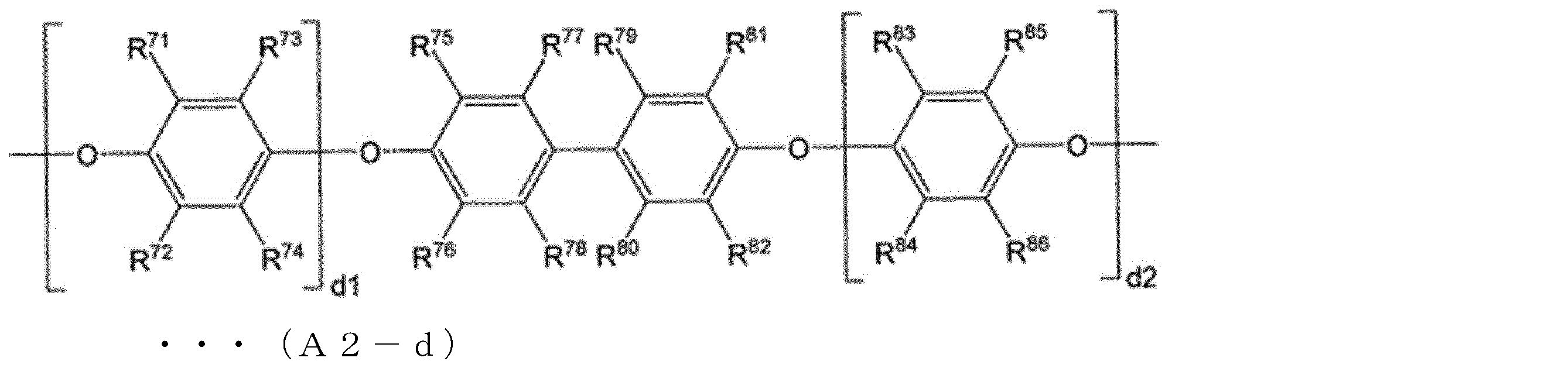
R71、R72、R85及びR86は、式(xii)中のR51と同じである。R73、R74、R83及びR84は、式(xii)中のR53と同じである。R75、R76、R77、R81、及びR82は、式(xiii)中のR55と同じである。R78、R79、及びR80は、式(xiii)中のR58と同じである。 R 71 , R 72 , R 85 and R 86 are the same as R 51 in formula (xii). R 73 , R 74 , R 83 and R 84 are the same as R 53 in formula (xii). R 75 , R 76 , R 77 , R 81 and R 82 are the same as R 55 in formula (xiii). R 78 , R 79 and R 80 are the same as R 58 in formula (xiii).
d1及びd2は0~300の整数を表す。但し、d1及びd2の一方は0である場合を除く。d1及びd2としては、1~100の整数を表すことが好ましく、1~50の整数を表すことがより好ましく、1~10の整数を表すことがさらに好ましい。d1及びd2は同じであってもよく、異なっていてもよい。 d1 and d2 represent integers from 0 to 300, except when one of d1 and d2 is 0. d1 and d2 preferably represent integers from 1 to 100, more preferably from 1 to 50, and even more preferably from 1 to 10. d1 and d2 may be the same or different.
2価の環状基は、置換基を有していてもよい。置換基としては、例えば、ハロゲン原子、アルキル基、アルコキシ基、アリール基、アリールアルキル基、シリル基、アシル基、アシルオキシ基、カルボキシ基、スルホ基、シアノ基、ニトロ基、ヒドロキシ基、メルカプト基、オキソ基等が挙げられ、アルキル基が好ましい。 The divalent cyclic group may have a substituent. Examples of the substituent include a halogen atom, an alkyl group, an alkoxy group, an aryl group, an arylalkyl group, a silyl group, an acyl group, an acyloxy group, a carboxy group, a sulfo group, a cyano group, a nitro group, a hydroxy group, a mercapto group, and an oxo group. An alkyl group is preferred.
ビニルフェニル基は、2価の環状基に直接結合していてもよく、2価の連結基を介して結合していてもよい。2価の連結基としては、例えば、アルキレン基、アルケニレン基、アリーレン基、ヘテロアリーレン基、-C(=O)O-、-O-、-NHC(=O)-、-NC(=O)N-、-NHC(=O)O-、-C(=O)-、-S-、-SO-、-NH-等が挙げられ、これらを複数組み合わせた基であってもよい。アルキレン基としては、炭素原子数1~10のアルキレン基が好ましく、炭素原子数1~6のアルキレン基がより好ましく、炭素原子数1~5のアルキレン基、又は炭素原子数1~4のアルキレン基がさらに好ましい。アルキレン基は、直鎖、分岐、環状のいずれであってもよい。このようなアルキレン基としては、例えば、メチレン基、エチレン基、プロピレン基、ブチレン基、ペンチレン基、へキシレン基、1,1-ジメチルエチレン基等が挙げられ、メチレン基、エチレン基、1,1-ジメチルエチレン基が好ましい。アルケニレン基としては、炭素原子数2~10のアルケニレン基が好ましく、炭素原子数2~6のアルケニレン基がより好ましく、炭素原子数2~5のアルケニレン基がさらに好ましい。アリーレン基、ヘテロアリーレン基としては、炭素原子数6~20のアリーレン基又はヘテロアリーレン基が好ましく、炭素原子数6~10のアリーレン基又はヘテロアリーレン基がより好ましい。2価の連結基としては、アルキレン基が好ましく、中でもメチレン基が好ましい。 The vinylphenyl group may be directly bonded to the divalent cyclic group, or may be bonded via a divalent linking group. Examples of the divalent linking group include alkylene groups, alkenylene groups, arylene groups, heteroarylene groups, -C(=O)O-, -O-, -NHC(=O)-, -NC(=O)N-, -NHC(=O)O-, -C(=O)-, -S-, -SO-, -NH-, and the like, and may be groups combining a plurality of these. As the alkylene group, an alkylene group having 1 to 10 carbon atoms is preferable, an alkylene group having 1 to 6 carbon atoms is more preferable, an alkylene group having 1 to 5 carbon atoms, or an alkylene group having 1 to 4 carbon atoms is even more preferable. The alkylene group may be linear, branched, or cyclic. Examples of such alkylene groups include methylene, ethylene, propylene, butylene, pentylene, hexylene, and 1,1-dimethylethylene groups, with methylene, ethylene, and 1,1-dimethylethylene being preferred. As the alkenylene group, an alkenylene group having 2 to 10 carbon atoms is preferred, an alkenylene group having 2 to 6 carbon atoms is more preferred, and an alkenylene group having 2 to 5 carbon atoms is even more preferred. As the arylene group and heteroarylene group, an arylene group or heteroarylene group having 6 to 20 carbon atoms is preferred, and an arylene group or heteroarylene group having 6 to 10 carbon atoms is more preferred. As the divalent linking group, an alkylene group is preferred, with a methylene group being particularly preferred.
スチリル樹脂は、下記式(A2-10)で表される化合物を含むことが好ましい。

R91及びR92はそれぞれ独立に2価の連結基を表す。2価の連結基としては、上記の2価の連結基と同様である。 R 91 and R 92 each independently represent a divalent linking group. The divalent linking group is the same as the divalent linking group described above.
環B1は、2価の環状基を表す。環Bとしては、上記の2価の環状基と同様である。 Ring B1 represents a divalent cyclic group. Ring B is the same as the divalent cyclic group described above.
環B1は、置換基を有していてもよい。置換基としては、上記の2価の環状基が有していてもよい置換基と同様である。 Ring B1 may have a substituent. The substituent is the same as the substituent that the divalent cyclic group may have.
以下、スチリル樹脂の具体例を示すが、本発明はこれに限定されるものではない。

スチリル樹脂は、市販品を用いてもよく、例えば、三菱ガス化学社製の「OPE-2St」、「OPE-2St 1200」、「OPE-2St 2200」等が挙げられる。スチリル樹脂は、1種類単独で用いてもよく、2種類以上を組み合わせて用いてもよい。 Styryl resins may be commercially available products, such as "OPE-2St", "OPE-2St 1200", and "OPE-2St 2200" manufactured by Mitsubishi Gas Chemical Co., Ltd. Styryl resins may be used alone or in combination of two or more types.
スチリル樹脂の数平均分子量は、本発明の所期の効果を顕著に得る観点から、好ましくは3000以下、より好ましくは2500以下、さらに好ましくは2000以下、1500以下である。下限は、好ましくは100以上、より好ましくは300以上、さらに好ましくは500以上、1000以上である。数平均分子量は、ゲル浸透クロマトグラフィー(GPC)を使用して測定されるポリスチレン換算の数平均分子量である。 From the viewpoint of significantly obtaining the intended effect of the present invention, the number average molecular weight of the styryl resin is preferably 3000 or less, more preferably 2500 or less, even more preferably 2000 or less, or 1500 or less. The lower limit is preferably 100 or more, more preferably 300 or more, even more preferably 500 or more, or 1000 or more. The number average molecular weight is the number average molecular weight in terms of polystyrene measured using gel permeation chromatography (GPC).
((メタ)アクリル樹脂)
(メタ)アクリル樹脂は、分子中にアクリロイル基、メタクリロイル基を有する化合物を含む。(メタ)アクリル樹脂としては、本発明の所期の効果を顕著に得る観点から、1分子あたり2個以上の(メタ)アクリロイル基を有する化合物を含むことが好ましい。用語「(メタ)アクリロイル基」とは、アクリロイル基及びメタクリロイル基の総称である。
((Meth)acrylic resin)
The (meth)acrylic resin includes a compound having an acryloyl group or a methacryloyl group in the molecule. From the viewpoint of significantly obtaining the intended effect of the present invention, the (meth)acrylic resin preferably includes a compound having two or more (meth)acryloyl groups per molecule. The term "(meth)acryloyl group" is a general term for an acryloyl group and a methacryloyl group.
(メタ)アクリル樹脂は、本発明の所期の効果を顕著に得る観点から、環状構造を有することが好ましい。環状構造としては、2価の環状基が好ましい。2価の環状基としては、非芳香族環、例えば脂環式構造を含む環状基及び芳香環構造を含む環状基のいずれであってもよい。中でも、本発明の所期の効果を顕著に得る観点から、脂環式構造を含む環状基であることが好ましい。 From the viewpoint of significantly achieving the intended effect of the present invention, the (meth)acrylic resin preferably has a cyclic structure. The cyclic structure is preferably a divalent cyclic group. The divalent cyclic group may be either a cyclic group containing a non-aromatic ring, for example, an alicyclic structure, or a cyclic group containing an aromatic ring structure. Of these, from the viewpoint of significantly achieving the intended effect of the present invention, a cyclic group containing an alicyclic structure is preferable.
2価の環状基は、本発明の所期の効果を顕著に得る観点から、好ましくは3員環以上、より好ましくは4員環以上、さらに好ましくは5員環以上であり、好ましくは20員環以下、より好ましくは15員環以下、さらに好ましくは10員環以下である。また、2価の環状基としては、単環構造であってもよく、多環構造であってもよい。 From the viewpoint of significantly obtaining the intended effect of the present invention, the divalent cyclic group is preferably a 3-membered or more ring, more preferably a 4-membered or more ring, and even more preferably a 5-membered or more ring, and is preferably a 20-membered or less ring, more preferably a 15-membered or less ring, and even more preferably a 10-membered or less ring. In addition, the divalent cyclic group may be a monocyclic structure or a polycyclic structure.
2価の環状基における環は、炭素原子以外にヘテロ原子により環の骨格が構成されていてもよい。ヘテロ原子としては、例えば、酸素原子、硫黄原子、窒素原子等が挙げられ、酸素原子が好ましい。ヘテロ原子は前記の環に1つ有していてもよく、2つ以上を有していてもよい。 The ring in the divalent cyclic group may have a ring skeleton formed by heteroatoms in addition to carbon atoms. Examples of heteroatoms include oxygen atoms, sulfur atoms, and nitrogen atoms, with oxygen atoms being preferred. The ring may have one heteroatom or two or more heteroatoms.
2価の環状基の具体例としては、下記の2価の基(i)~(xi)が挙げられる。中でも、2価の環状基としては、(x)又は(xi)が好ましい。

2価の環状基は、置換基を有していてもよい。このような置換基としては、例えば、ハロゲン原子、アルキル基、アルコキシ基、アリール基、アリールアルキル基、シリル基、アシル基、アシルオキシ基、カルボキシ基、スルホ基、シアノ基、ニトロ基、ヒドロキシ基、メルカプト基、オキソ基等が挙げられ、アルキル基が好ましい。 The divalent cyclic group may have a substituent. Examples of such a substituent include a halogen atom, an alkyl group, an alkoxy group, an aryl group, an arylalkyl group, a silyl group, an acyl group, an acyloxy group, a carboxy group, a sulfo group, a cyano group, a nitro group, a hydroxy group, a mercapto group, and an oxo group. An alkyl group is preferred.
(メタ)アクリロイル基は、2価の環状基に直接結合していてもよく、2価の連結基を介して結合していてもよい。2価の連結基としては、例えば、アルキレン基、アルケニレン基、アリーレン基、ヘテロアリーレン基、-C(=O)O-、-O-、-NHC(=O)-、-NC(=O)N-、-NHC(=O)O-、-C(=O)-、-S-、-SO-、-NH-等が挙げられ、これらを複数組み合わせた基であってもよい。アルキレン基としては、炭素原子数1~10のアルキレン基が好ましく、炭素原子数1~6のアルキレン基がより好ましく、炭素原子数1~5のアルキレン基、又は炭素原子数1~4のアルキレン基がさらに好ましい。アルキレン基は、直鎖、分岐、環状のいずれであってもよい。このようなアルキレン基としては、例えば、メチレン基、エチレン基、プロピレン基、ブチレン基、ペンチレン基、へキシレン基、1,1-ジメチルエチレン基等が挙げられ、メチレン基、エチレン基、1,1-ジメチルエチレン基が好ましい。アルケニレン基としては、炭素原子数2~10のアルケニレン基が好ましく、炭素原子数2~6のアルケニレン基がより好ましく、炭素原子数2~5のアルケニレン基がさらに好ましい。アリーレン基、ヘテロアリーレン基としては、炭素原子数6~20のアリーレン基又はヘテロアリーレン基が好ましく、炭素原子数6~10のアリーレン基又はヘテロアリーレン基がより好ましい。2価の連結基としては、アルキレン基が好ましく、中でもメチレン基、1,1-ジメチルエチレン基が好ましい。 The (meth)acryloyl group may be directly bonded to the divalent cyclic group, or may be bonded via a divalent linking group. Examples of the divalent linking group include alkylene groups, alkenylene groups, arylene groups, heteroarylene groups, -C(=O)O-, -O-, -NHC(=O)-, -NC(=O)N-, -NHC(=O)O-, -C(=O)-, -S-, -SO-, -NH-, and the like, and may be groups combining a plurality of these. As the alkylene group, an alkylene group having 1 to 10 carbon atoms is preferable, an alkylene group having 1 to 6 carbon atoms is more preferable, and an alkylene group having 1 to 5 carbon atoms or an alkylene group having 1 to 4 carbon atoms is even more preferable. The alkylene group may be linear, branched, or cyclic. Examples of such alkylene groups include methylene, ethylene, propylene, butylene, pentylene, hexylene, and 1,1-dimethylethylene groups, with methylene, ethylene, and 1,1-dimethylethylene being preferred. As the alkenylene group, an alkenylene group having 2 to 10 carbon atoms is preferred, an alkenylene group having 2 to 6 carbon atoms is more preferred, and an alkenylene group having 2 to 5 carbon atoms is even more preferred. As the arylene group and heteroarylene group, an arylene group or heteroarylene group having 6 to 20 carbon atoms is preferred, and an arylene group or heteroarylene group having 6 to 10 carbon atoms is more preferred. As the divalent linking group, an alkylene group is preferred, with a methylene group and a 1,1-dimethylethylene group being particularly preferred.
(メタ)アクリル樹脂は、下記式(A2-11)で表される化合物を含むことが好ましい。

R101及びR104はそれぞれ独立にアクリロイル基又はメタクリロイル基を表し、アクリロイル基が好ましい。 R 101 and R 104 each independently represent an acryloyl group or a methacryloyl group, and an acryloyl group is preferable.
R102及びR103はそれぞれ独立に2価の連結基を表す。2価の連結基としては、(メタ)アクリロイル基が結合していてもよい2価の連結基と同様である。 R 102 and R 103 each independently represent a divalent linking group. The divalent linking group is the same as the divalent linking group which may have a (meth)acryloyl group bonded thereto.
環B2は、2価の環状基を表す。環B2としては、上記の2価の環状基と同様である。環B2は、置換基を有していてもよい。置換基としては、上記の2価の環状基が有していてもよい置換基と同様である。 Ring B2 represents a divalent cyclic group. Ring B2 is the same as the divalent cyclic group described above. Ring B2 may have a substituent. The substituent is the same as the substituent that the divalent cyclic group may have.
(メタ)アクリル樹脂の具体例としては、以下のものが挙げられるが、本発明はこれに限定されるものではない。

(メタ)アクリル樹脂は、市販品を用いてもよく、例えば、新中村化学工業社製の「A-DOG」、共栄社化学社製の「DCP-A」、日本化薬社製「NPDGA」、「FM-400」、「R-687」、「THE-330」、「PET-30」、「DPHA」、新中村化学工業社製の「NKエステルDCP」等が挙げられる。 Commercially available (meth)acrylic resins may be used, such as "A-DOG" manufactured by Shin-Nakamura Chemical Co., Ltd., "DCP-A" manufactured by Kyoeisha Chemical Co., Ltd., "NPDGA", "FM-400", "R-687", "THE-330", "PET-30", and "DPHA" manufactured by Nippon Kayaku Co., Ltd., and "NK Ester DCP" manufactured by Shin-Nakamura Chemical Co., Ltd.
(メタ)アクリル樹脂の(メタ)アクリロイル基当量は、本発明の所期の効果を顕著に得る観点から、好ましくは30g/eq.~400g/eq.、より好ましくは50g/eq.~300g/eq.、さらに好ましくは75g/eq.~200g/eq.である。(メタ)アクリロイル基当量は、1当量の(メタ)アクリロイル基を含む化合物の質量である。 From the viewpoint of significantly achieving the intended effect of the present invention, the (meth)acryloyl group equivalent of the (meth)acrylic resin is preferably 30 g/eq. to 400 g/eq., more preferably 50 g/eq. to 300 g/eq., and even more preferably 75 g/eq. to 200 g/eq. The (meth)acryloyl group equivalent is the mass of a compound containing one equivalent of a (meth)acryloyl group.
(アリル樹脂)
アリル樹脂は、分子中にアリル基を少なくとも1つ有する。アリル樹脂は、1分子中に2個以上のアリル基を有することがより好ましい。上限は特に制限されないが、好ましくは10個以下、より好ましくは5個以下とし得る。
(Allyl resin)
The allyl resin has at least one allyl group in the molecule. The allyl resin more preferably has two or more allyl groups in one molecule. The upper limit is not particularly limited, but is preferably 10 or less, more preferably 5 or less.
また、アリル樹脂は、本発明の所期の効果を顕著に得る観点から、アリル基に加えて、ベンゾオキサジン環、フェノール環、イソシアヌル環、及び環状構造を有するカルボン酸誘導体のいずれかを有することが好ましい。 In addition, from the viewpoint of significantly achieving the intended effect of the present invention, it is preferable that the allyl resin has, in addition to the allyl group, any of a benzoxazine ring, a phenol ring, an isocyanuric ring, and a carboxylic acid derivative having a cyclic structure.
ベンゾオキサジン環を有するアリル樹脂は、ベンゾオキサジン環の窒素原子及びベンゼン環のいずれかと結合していることが好ましく、窒素原子と結合していることがより好ましい。 The allyl resin having a benzoxazine ring is preferably bonded to either the nitrogen atom of the benzoxazine ring or the benzene ring, and more preferably bonded to the nitrogen atom.
フェノール環を有するアリル樹脂としては、例えば、アリル基を含むクレゾール樹脂、アリル基を含むノボラック型フェノール樹脂、アリル基を含むクレゾールノボラック樹脂等が挙げられる。 Examples of allyl resins having a phenol ring include cresol resins containing an allyl group, novolac-type phenol resins containing an allyl group, and cresol novolac resins containing an allyl group.
イソシアヌル構造を有するアリル樹脂は、イソシアヌル構造の窒素原子とアリル基とが直接結合していることが好ましい。イソシアヌル構造を有するアリル樹脂としては、イソシアヌル酸アリル、イソシアヌル酸ジアリル、イソシアヌル酸トリアリル等が挙げられる。 In the allyl resin having an isocyanuric structure, it is preferable that the nitrogen atom of the isocyanuric structure is directly bonded to the allyl group. Examples of allyl resins having an isocyanuric structure include allyl isocyanurate, diallyl isocyanurate, triallyl isocyanurate, etc.
環状構造を有するカルボン酸誘導体を有するアリル樹脂としては、環状構造を有するカルボン酸アリルが好ましい。環状構造としては、非芳香族環、例えば脂環式構造を含む環状基及び芳香環構造を含む環状基のいずれであってもよい。また、環状基は、炭素原子以外にヘテロ原子により環の骨格が構成されていてもよい。ヘテロ原子としては、例えば、酸素原子、硫黄原子、窒素原子等が挙げられ、窒素原子が好ましい。ヘテロ原子は前記の環に1つ有していてもよく、2つ以上を有していてもよい。 As the allyl resin having a carboxylic acid derivative having a cyclic structure, an allyl carboxylate having a cyclic structure is preferable. The cyclic structure may be either a non-aromatic ring, such as a cyclic group containing an alicyclic structure, or a cyclic group containing an aromatic ring structure. In addition, the cyclic group may have a ring skeleton formed by heteroatoms other than carbon atoms. Examples of heteroatoms include oxygen atoms, sulfur atoms, and nitrogen atoms, and nitrogen atoms are preferable. The ring may have one heteroatom or two or more heteroatoms.
環状構造を有するカルボン酸としては、例えば、イソシアヌル酸、ジフェン酸、フタル酸、シクロヘキサンジカルボン酸等が挙げられる。環状構造を有するカルボン酸誘導体を有するアリル樹脂としては、例えば、イソシアヌル酸アリル、イソシアヌル酸ジアリル、イソシアヌル酸トリアリル、ジフェン酸ジアリル、ジフェン酸アリル、オルトジアリルフタレート、メタジアリルフタレート、パラジアリルフタレート、シクロヘキサンジカルボン酸アリル、シクロヘキサンジカルボン酸ジアリル等が挙げられる。 Examples of carboxylic acids having a cyclic structure include isocyanuric acid, diphenic acid, phthalic acid, and cyclohexanedicarboxylic acid. Examples of allyl resins having a carboxylic acid derivative having a cyclic structure include allyl isocyanurate, diallyl isocyanurate, triallyl isocyanurate, diallyl diphenate, allyl diphenate, ortho-diallyl phthalate, meth-diallyl phthalate, para-diallyl phthalate, allyl cyclohexanedicarboxylate, and diallyl cyclohexanedicarboxylate.
アリル樹脂は、市販品を用いることができる。市販品としては、例えば、明和化成社製「MEH-8000H」、「MEH-8005」(フェノール環を有するアリル樹脂);四国化成工業社製「ALP-d」(ベンゾオキサジン環を有するアリル樹脂);四国化成工業社製「L-DAIC」(イソシアヌル環を有するアリル樹脂);日本化成社製「TAIC」(イソシアヌル環を有するアリル樹脂(トリアリルイソシアヌレート));大阪ソーダ社製「MDAC」(シクロヘキサンジカルボン酸誘導体を有するアリル樹脂);日触テクノファインケミカル社製「DAD」(ジフェン酸ジアリル);大阪ソーダ社製「ダイソーダップモノマー」(オルトジアリルフタレート)等が挙げられる。 Allyl resins may be commercially available products. Examples of commercially available products include "MEH-8000H" and "MEH-8005" (allyl resins having a phenol ring) manufactured by Meiwa Kasei Co., Ltd.; "ALP-d" (allyl resins having a benzoxazine ring) manufactured by Shikoku Kasei Kogyo Co., Ltd.; "L-DAIC" (allyl resins having an isocyanuric ring) manufactured by Shikoku Kasei Kogyo Co., Ltd.; "TAIC" (allyl resins having an isocyanuric ring (triallyl isocyanurate)) manufactured by Nippon Kasei Co., Ltd.; "MDAC" (allyl resins having a cyclohexanedicarboxylic acid derivative) manufactured by Osaka Soda Co., Ltd.; "DAD" (diallyl diphenate) manufactured by Nissho Techno Fine Chemical Co., Ltd.; and "Daiso DAP Monomer" (ortho-diallyl phthalate) manufactured by Osaka Soda Co., Ltd.
アリル樹脂のアリル基当量は、本発明の所期の効果を顕著に得る観点から、好ましくは20g/eq.~1000g/eq.、より好ましくは50g/eq.~500g/eq.、さらに好ましくは100g/eq.~300g/eq.である。アリル基当量は、1当量のアリル基を含む化合物の質量である。 From the viewpoint of significantly obtaining the intended effect of the present invention, the allyl group equivalent of the allyl resin is preferably 20 g/eq. to 1000 g/eq., more preferably 50 g/eq. to 500 g/eq., and even more preferably 100 g/eq. to 300 g/eq. The allyl group equivalent is the mass of a compound containing one equivalent of an allyl group.
(ブタジエン樹脂)
ブタジエン樹脂は、ブタジエン骨格を有する。ポリブタジエン構造は主鎖に含まれていても側鎖に含まれていてもよい。なお、ポリブタジエン構造は、一部又は全てが水素添加されていてもよい。ブタジエン樹脂としては、水素化ポリブタジエン骨格含有樹脂、ヒドロキシ基含有ブタジエン樹脂、フェノール性水酸基含有ブタジエン樹脂、カルボキシ基含有ブタジエン樹脂、酸無水物基含有ブタジエン樹脂、イソシアネート基含有ブタジエン樹脂及びウレタン基含有ブタジエン樹脂からなる群から選択される1種以上の樹脂がより好ましい。
(Butadiene resin)
The butadiene resin has a butadiene skeleton. The polybutadiene structure may be included in the main chain or in the side chain. The polybutadiene structure may be partially or entirely hydrogenated. As the butadiene resin, one or more resins selected from the group consisting of hydrogenated polybutadiene skeleton-containing resin, hydroxyl group-containing butadiene resin, phenolic hydroxyl group-containing butadiene resin, carboxyl group-containing butadiene resin, acid anhydride group-containing butadiene resin, isocyanate group-containing butadiene resin, and urethane group-containing butadiene resin are more preferable.
ブタジエン樹脂の具体例としては、日本曹達社製の「JP-100」、CRAY VALLEY社製の「Ricon100」、「Ricon150」、「Ricon130MA8」、「Ricon130MA13」、「Ricon130MA20」、「Ricon131MA5」、「Ricon131MA10」、「Ricon131MA17」、「Ricon131MA20」、「Ricon 184MA6」等が挙げられる。 Specific examples of butadiene resins include "JP-100" manufactured by Nippon Soda Co., Ltd., and "Ricon 100," "Ricon 150," "Ricon 130MA8," "Ricon 130MA13," "Ricon 130MA20," "Ricon 131MA5," "Ricon 131MA10," "Ricon 131MA17," "Ricon 131MA20," and "Ricon 184MA6" manufactured by Cray Valley.
(A-2)成分の含有量は、0質量%以上であり、本発明の所期の効果を高める観点、特には低誘電正接の硬化物を得る観点から、樹脂組成物中の不揮発成分を100質量%とした場合、好ましくは0.5質量%以上、より好ましくは1質量%以上、さらに好ましくは1.5質量%以上であり、好ましくは60質量%以下、より好ましくは50質量%以下、さらに好ましくは40質量%以下である。 The content of component (A-2) is 0% by mass or more, and from the viewpoint of enhancing the intended effects of the present invention, particularly from the viewpoint of obtaining a cured product with a low dielectric tangent, when the non-volatile components in the resin composition are taken as 100% by mass, the content is preferably 0.5% by mass or more, more preferably 1% by mass or more, even more preferably 1.5% by mass or more, and is preferably 60% by mass or less, more preferably 50% by mass or less, even more preferably 40% by mass or less.
(A-2)成分の含有量は、本発明の所期の効果を高める観点、特には低誘電正接の硬化物を得る観点から、樹脂組成物中の樹脂成分を100質量%とした場合、好ましくは1質量%以上、より好ましくは2質量%以上、さらに好ましくは3質量%以上であり、好ましくは80質量%以下、より好ましくは70質量%以下、さらに好ましくは60質量%以下である。 From the viewpoint of enhancing the intended effects of the present invention, particularly from the viewpoint of obtaining a cured product with a low dielectric tangent, the content of component (A-2) is preferably 1% by mass or more, more preferably 2% by mass or more, and even more preferably 3% by mass or more, and is preferably 80% by mass or less, more preferably 70% by mass or less, and even more preferably 60% by mass or less, assuming that the resin components in the resin composition are 100% by mass.
(A)成分が、(A-1)成分及び(A-2)成分の双方を含む場合、(A-2)成分の含有量(質量部)は、(A-1)成分の含有量(A-2)成分に対して、本発明の所期の効果を高める観点、特には低誘電正接の硬化物を得る観点から、0.01倍以上、0.05倍以上又は0.1倍以上であり、上限は限定されるものではないが、例えば、10倍以下、7倍以下又は5倍以下とし得る。 When the (A) component contains both the (A-1) component and the (A-2) component, the content (parts by mass) of the (A-2) component is 0.01 times or more, 0.05 times or more, or 0.1 times or more, relative to the content of the (A-1) component and the (A-2) component, from the viewpoint of enhancing the intended effect of the present invention, particularly from the viewpoint of obtaining a cured product with a low dielectric tangent, and the upper limit is not limited, but can be, for example, 10 times or less, 7 times or less, or 5 times or less.
(A)硬化性樹脂の含有量は、0質量%超であり、本発明の効果を顕著に得る観点から、樹脂組成物中の不揮発成分を100質量%とした場合、好ましくは0.1質量%以上、より好ましくは1質量%以上、さらに好ましくは3質量%以上、特に好ましくは5質量%以上であり、上限は特に限定されるものではないが、例えば、65質量%以下、45質量%以下、35質量%以下又は30質量%以下とし得る。 The content of (A) the curable resin is more than 0% by mass, and from the viewpoint of obtaining a significant effect of the present invention, when the non-volatile components in the resin composition are taken as 100% by mass, the content is preferably 0.1% by mass or more, more preferably 1% by mass or more, even more preferably 3% by mass or more, and particularly preferably 5% by mass or more. The upper limit is not particularly limited, but may be, for example, 65% by mass or less, 45% by mass or less, 35% by mass or less, or 30% by mass or less.
(A)硬化性樹脂の含有量は、樹脂組成物中の樹脂成分を100質量%とした場合、本発明の効果を顕著に得る観点から、好ましくは0.2質量%以上、より好ましくは2質量%以上、さらに好ましくは6質量%以上、特に好ましくは10質量%以上であり、上限は特に限定されるものではないが、例えば、85質量%以下、70質量%以下、60質量%以下又は55質量%以下とし得る。樹脂成分とは、樹脂組成物中の不揮発成分のうち(B)成分を除いた成分をいう。 When the resin component in the resin composition is taken as 100% by mass, the content of the curable resin (A) is preferably 0.2% by mass or more, more preferably 2% by mass or more, even more preferably 6% by mass or more, and particularly preferably 10% by mass or more, from the viewpoint of obtaining a significant effect of the present invention. The upper limit is not particularly limited, but may be, for example, 85% by mass or less, 70% by mass or less, 60% by mass or less, or 55% by mass or less. The resin component refers to the non-volatile components in the resin composition excluding the component (B).
<(B)窒素原子を2つ以上含むヘテロ環構造と、かご型シルセスキオキサン構造とを分子中に有する化合物:改質かご型PSQ>
本発明の樹脂組成物は、(B)成分として、窒素原子を2つ以上含むヘテロ環構造(以下、「Nリッチヘテロ環状構造」ともいう)と、かご型シルセスキオキサン構造(以下、「かご型PSQ構造」ともいう)とを分子中に有する化合物を含有する。斯かる化合物を以下において「改質かご型PSQ」ともいう。(B)改質かご型PSQは、1種類単独で用いてもよく、2種類以上を組み合わせて用いてもよい。本発明の樹脂組成物は、(A)成分と組み合わせてこの(B)成分を含有することにより所期の効果を奏することができる。(B)改質かご型PSQは、先述のかご型PSQ構造と、先述のNリッチヘテロ環状構造との間に、通常、連結基(以下、「主鎖中連結基」ともいう)を有する。主鎖中連結基については後述する。
<(B) Compound Having a Heterocyclic Structure Containing Two or More Nitrogen Atoms and a Cage-Type Silsesquioxane Structure in the Molecule: Modified Cage-Type PSQ>
The resin composition of the present invention contains, as the component (B), a compound having a heterocyclic structure containing two or more nitrogen atoms (hereinafter also referred to as "N-rich heterocyclic structure") and a cage-type silsesquioxane structure (hereinafter also referred to as "cage-type PSQ structure") in the molecule. Such a compound is also referred to as "modified cage-type PSQ" hereinafter. The modified cage-type PSQ (B) may be used alone or in combination of two or more types. The resin composition of the present invention can achieve the desired effect by containing the component (B) in combination with the component (A). The modified cage-type PSQ (B) usually has a linking group (hereinafter also referred to as "main chain linking group") between the cage-type PSQ structure and the N-rich heterocyclic structure. The main chain linking group will be described later.
(かご型シルセスキオキサン構造:かご型PSQ構造)
(B)改質かご型PSQにおいて、かご型PSQ構造の前駆体としうるシルセスキオキサン化合物(PSQ:ポリシルセスキオキサン)は、通常、シロキサン結合を含む骨格を有し、(RSiO3/2)nで表されるケイ素含有骨格を有しうる。前記ケイ素含有骨格におけるRは、炭化水素基等の有機基を表し、nは整数を表す。シルセスキオキサン化合物には、不定形構造、ラダー構造、不完全縮合型構造及び完全縮合型構造のものが知られている。本発明の樹脂組成物が含む改質かご型PSQは、先述のとおり、かご型PSQ構造を有する。かご型PSQ構造とは、ケイ素含有骨格で構成される環状構造を複数含み、斯かる複数の環状構造によって、閉じた空間を形成するか又は反応後に閉じた空間を形成し得る構造をいう。かご型PSQ構造には、例えば、T8型シルセスキオキサン化合物が有するかご型構造、ダブルデッカー型シルセスキオキサン化合物(以下、「DDSQ」ともいう)が有するかご型構造及びT12型シルセスキオキサンが有するかご型構造が含まれ、反応により閉じた空間を形成し得るT7型シルセスキオキサン化合物が有するかご型構造が含まれてもよい。他方で、かご型PSQからは、かご型構造を有していないPSQ、例えばラダー構造を有するPSQや不定形構造を有するPSQは除外される。
(Cage-type silsesquioxane structure: cage-type PSQ structure)
In the modified cage PSQ (B), the silsesquioxane compound (PSQ: polysilsesquioxane) that can be used as a precursor of the cage PSQ structure usually has a skeleton containing a siloxane bond and can have a silicon-containing skeleton represented by (RSiO 3/2 ) n . In the silicon-containing skeleton, R represents an organic group such as a hydrocarbon group, and n represents an integer. Silsesquioxane compounds are known to have amorphous structures, ladder structures, incompletely condensed structures, and completely condensed structures. The modified cage PSQ contained in the resin composition of the present invention has a cage PSQ structure, as described above. The cage PSQ structure refers to a structure that contains a plurality of cyclic structures composed of a silicon-containing skeleton, and that can form a closed space or form a closed space after reaction by the plurality of cyclic structures. The cage PSQ structure includes, for example, the cage structure of a T8 silsesquioxane compound, the cage structure of a double-decker silsesquioxane compound (hereinafter also referred to as "DDSQ"), and the cage structure of a T12 silsesquioxane, and may also include the cage structure of a T7 silsesquioxane compound that can form a closed space by reaction. On the other hand, the cage PSQ excludes PSQ that does not have a cage structure, such as PSQ having a ladder structure or PSQ having an amorphous structure.
かご型PSQ構造は、本発明の所期の効果を高める観点から、DDSQが有するかご型構造であることが好ましい。 From the viewpoint of enhancing the intended effect of the present invention, it is preferable that the cage-type PSQ structure is the cage-type structure possessed by DDSQ.
かご型PSQ構造は、好ましくは、下記式(B1)に示されるかご型構造を含む。
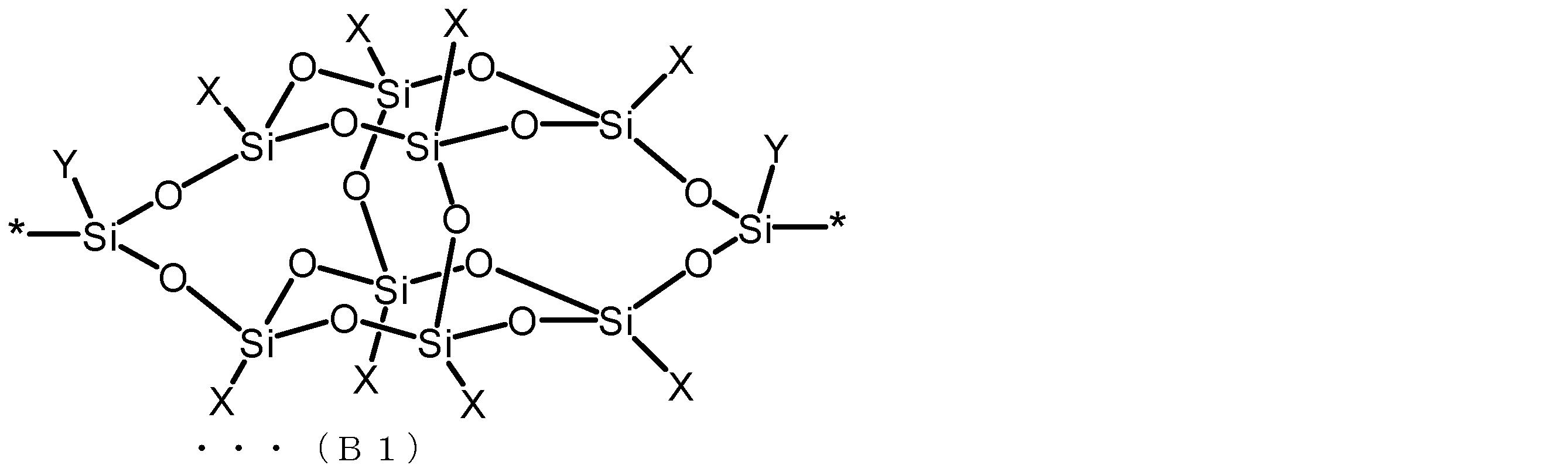
Xは、それぞれ独立して、水素原子がハロゲン原子で置き換えられていてもよい炭素数1~40のアルキル基、炭素数4~10のシクロアルキル基、水素原子がハロゲン原子又は炭素数1~20のアルキル基で置き換えられていてもよいアリール基、及び、水素原子がハロゲン原子又は炭素数1~20のアルキル基で置き換えられていてもよいアリール基が炭素数1~8のアルキレン基に結合したアリールアルキル基から選択される基であり;
Yは、それぞれ独立して、水素原子がハロゲン原子で置き換えられていてもよい炭素数1~40のアルキル基、炭素数4~10のシクロアルキル基、水素原子がハロゲン原子又は炭素数1~20のアルキル基で置き換えられていてもよいアリール基、及び、水素原子がハロゲン原子又は炭素数1~20のアルキル基で置き換えられていてもよいアリール基が炭素数1~8のアルキレン基に結合したアリールアルキル基であり;
*は、結合手であり;
X又はYが炭素数1~40のアルキル基である場合、当該アルキル基に含まれる-CH2-は、-O-又は-CH=CH-で置き換えられていてもよく;
X又はYがアリール基である場合において、当該アリール基の水素原子が炭素数1~20のアルキル基で置き換えられているときは、当該炭素数1~20のアルキル基の水素原子がハロゲン原子で置き換えられていてもよく、当該炭素数1~20のアルキル基に含まれる-CH2-は、-O-又は-CH=CH-で置き換えられていてもよく;
X又はYがアリールアルキル基である場合、当該アリールアルキル基に含まれる-CH2-は、-O-で置き換えられていてもよい。]
The cage-type PSQ structure preferably includes a cage structure represented by the following formula (B1).
X's are each independently a group selected from an alkyl group having 1 to 40 carbon atoms in which a hydrogen atom may be replaced by a halogen atom, a cycloalkyl group having 4 to 10 carbon atoms, an aryl group in which a hydrogen atom may be replaced by a halogen atom or an alkyl group having 1 to 20 carbon atoms, and an arylalkyl group in which an aryl group in which a hydrogen atom may be replaced by a halogen atom or an alkyl group having 1 to 20 carbon atoms is bonded to an alkylene group having 1 to 8 carbon atoms;
Y's each independently represent an alkyl group having 1 to 40 carbon atoms in which a hydrogen atom may be replaced by a halogen atom, a cycloalkyl group having 4 to 10 carbon atoms, an aryl group in which a hydrogen atom may be replaced by a halogen atom or an alkyl group having 1 to 20 carbon atoms, or an arylalkyl group in which an aryl group in which a hydrogen atom may be replaced by a halogen atom or an alkyl group having 1 to 20 carbon atoms is bonded to an alkylene group having 1 to 8 carbon atoms;
* is a bond;
When X or Y is an alkyl group having 1 to 40 carbon atoms, --CH 2 -- contained in the alkyl group may be replaced by --O-- or --CH═CH--;
When X or Y is an aryl group, and a hydrogen atom of the aryl group is replaced by an alkyl group having 1 to 20 carbon atoms, a hydrogen atom of the alkyl group having 1 to 20 carbon atoms may be replaced by a halogen atom, and -CH 2 - contained in the alkyl group having 1 to 20 carbon atoms may be replaced by -O- or -CH═CH-;
When X or Y is an arylalkyl group, --CH 2 -- contained in the arylalkyl group may be replaced by --O--.]
X及びYにおいて、アルキル基としては、例えば、メチル基、エチル基、t-ブチル基、オクチル基、デシル基が挙げられる。水素原子がハロゲン原子で置き換えられたアルキル基としては、例えば、3,3,3-トリフルオロプロピル基、トリデカフルオロ-1,1,2,2-テトラヒドロオクチル基が挙げられる。アルキル基に含まれる-CH2-が-O-で置き換えられた基としては、例えば、3-メトキシプロピル基、3-ヘプタフルオロイソプロポキシプロピル基が挙げられる。アルキル基に含まれる-CH2-が-CH=CH-で置き換えられた基としては、例えば、エテニル基、3-ブテニル基、アリルオキシウンデシル基などが挙げられる。 In X and Y, examples of the alkyl group include a methyl group, an ethyl group, a t-butyl group, an octyl group, and a decyl group. Examples of the alkyl group in which a hydrogen atom is replaced by a halogen atom include a 3,3,3-trifluoropropyl group and a tridecafluoro-1,1,2,2-tetrahydrooctyl group. Examples of the group in which -CH 2 - in the alkyl group is replaced by -O- include a 3-methoxypropyl group and a 3-heptafluoroisopropoxypropyl group. Examples of the group in which -CH 2 - in the alkyl group is replaced by -CH═CH- include an ethenyl group, a 3-butenyl group, and an allyloxyundecyl group.
X及びYにおいて、シクロアルキル基としては、例えば、シクロブチル基、シクロペンチル基、シクロヘキシル基、シクロヘプチル基、シクロオクチル基およびデカリル基が挙げられる。 In X and Y, examples of the cycloalkyl group include a cyclobutyl group, a cyclopentyl group, a cyclohexyl group, a cycloheptyl group, a cyclooctyl group, and a decalyl group.
X及びYにおいて、アリール基としては、例えば、フェニル基、ナフチル基、アントニル基、フルオレニル基が挙げられる。水素原子がハロゲン原子で置き換えられたアリール基としては、例えば、4-フルオロフェニル基、4-クロロフェニル基、4-ブロモフェニル基などが挙げられる。水素原子がアルキル基で置き換えられたアリール基としては、例えば、4-メチルフェニル基、4-エチルフェニル基、4-ブチルフェニル基、4-オクチルフェニル基、4-デシルフェニル基、2,4-ジメチルフェニル基、4-(1,1-ジメチルエチル)フェニル基、4-(2-エチルヘキシル)フェニル基などが挙げられる。アリール基の水素原子がアルキル基で置き換えられ、且つ、このアルキル基に含まれる-CH2-が-O-で置き換えられた基としては、例えば、4-メトキシフェニル基、4-エトキシフェニル基、4-ブトキシフェニル基、4-ヘプチルオキシフェニル基、メトキシエチルフェニル基が挙げられる。 In X and Y, examples of the aryl group include a phenyl group, a naphthyl group, an anthryl group, and a fluorenyl group. Examples of the aryl group in which a hydrogen atom is replaced by a halogen atom include a 4-fluorophenyl group, a 4-chlorophenyl group, and a 4-bromophenyl group. Examples of the aryl group in which a hydrogen atom is replaced by an alkyl group include a 4-methylphenyl group, a 4-ethylphenyl group, a 4-butylphenyl group, a 4-octylphenyl group, a 4-decylphenyl group, a 2,4-dimethylphenyl group, a 4-(1,1-dimethylethyl)phenyl group, and a 4-(2-ethylhexyl)phenyl group. Examples of the group in which a hydrogen atom of an aryl group is replaced by an alkyl group and -CH 2 - contained in this alkyl group is replaced by -O- include a 4-methoxyphenyl group, a 4-ethoxyphenyl group, a 4-butoxyphenyl group, a 4-heptyloxyphenyl group, and a methoxyethylphenyl group.
誘電正接が低い硬化物を得る観点から、好ましくは、上記式(B1)に示すかご型構造において、X及びYの少なくとも一方、より好ましくは双方が疎水性基を含む。疎水性基としては、炭素数1~40の炭化水素基、好ましくは炭素数1~20の炭化水素基が挙げられる。斯かる炭化水素基は、直鎖状であってもよいし、側鎖を含んでいてもよいし、脂肪族環を含んでいてもよいし、芳香族環を含んでいてもよい。Xは、芳香族環を含むことが好ましく、置換又は無置換のアリール基を含むことがより好ましく、置換又は無置換のアリール基が更に好ましく、無置換のアリール基が特に好ましい。また、Yは、置換又は無置換の脂肪族炭化水素基が好ましく、置換又は無置換のアルキル基がより好ましい。好適な一実施形態においては、上記式(B1)に示すかご型構造において、複数あるXがいずれもフェニル基である。より好適な一実施形態においては、上記式(B1)に示すかご型構造において、複数あるXがいずれもフェニル基であり、複数あるYがいずれもアルキル基、例えばメチル基である。 From the viewpoint of obtaining a cured product with a low dielectric tangent, preferably, in the cage structure shown in the above formula (B1), at least one of X and Y, more preferably both, contain a hydrophobic group. Examples of the hydrophobic group include a hydrocarbon group having 1 to 40 carbon atoms, preferably a hydrocarbon group having 1 to 20 carbon atoms. Such a hydrocarbon group may be linear, may contain a side chain, may contain an aliphatic ring, or may contain an aromatic ring. X preferably contains an aromatic ring, more preferably contains a substituted or unsubstituted aryl group, further preferably a substituted or unsubstituted aryl group, and particularly preferably an unsubstituted aryl group. Furthermore, Y is preferably a substituted or unsubstituted aliphatic hydrocarbon group, and more preferably a substituted or unsubstituted alkyl group. In a preferred embodiment, in the cage structure shown in the above formula (B1), all of the multiple Xs are phenyl groups. In a more preferred embodiment, in the cage structure shown in the above formula (B1), all of the multiple Xs are phenyl groups, and all of the multiple Ys are alkyl groups, such as methyl groups.
(窒素原子を2つ以上含むヘテロ環構造:Nリッチヘテロ環構造)
(B)改質かご型PSQにおいて、Nリッチヘテロ環構造は、3員環以上の環構造における骨格原子として窒素原子を2つ以上含む環構造である。一実施形態において、Nリッチヘテロ環構造は、単環構造である(すなわち縮合環構造でない)。Nリッチヘテロ環構造は、通常、先述のかご型PSQ構造との間に介在し得る連結基に結合するための結合手を任意の位置に有する。一実施形態において、斯かる結合手は、Nリッチヘテロ環構造を構成する骨格原子のうち、窒素原子以外の骨格原子(例えば炭素原子)が有する。
(Heterocyclic structure containing two or more nitrogen atoms: N-rich heterocyclic structure)
(B) In the modified cage PSQ, the N-rich heterocyclic ring structure is a ring structure containing two or more nitrogen atoms as skeletal atoms in a ring structure of three or more members. In one embodiment, the N-rich heterocyclic ring structure is a single ring structure (i.e., not a condensed ring structure). The N-rich heterocyclic ring structure usually has a bond at any position for bonding to a linking group that may be interposed between the N-rich heterocyclic ring structure and the cage PSQ structure described above. In one embodiment, such a bond is possessed by a skeletal atom (e.g., a carbon atom) other than a nitrogen atom among the skeletal atoms constituting the N-rich heterocyclic ring structure.
Nリッチヘテロ環構造を構成する骨格原子の数(環員数)は、3以上であり、好ましくは5以上、より好ましくは6以上であり、ヘテロ環構造が単環である限り上限は限定されないが、例えば9以下、8以下又は7以下としうる。Nリッチヘテロ環構造に含まれる骨格原子の数は、好適な実施形態において、5(すなわち5員環)及び6(すなわち6員環)のいずれかであり、特に好適な実施形態においては6(すなわち6員環)である。 The number of skeletal atoms (number of ring members) constituting the N-rich heterocyclic structure is 3 or more, preferably 5 or more, more preferably 6 or more, and there is no upper limit as long as the heterocyclic structure is a single ring, but it can be, for example, 9 or less, 8 or less, or 7 or less. In a preferred embodiment, the number of skeletal atoms contained in the N-rich heterocyclic structure is either 5 (i.e., a 5-membered ring) or 6 (i.e., a 6-membered ring), and in a particularly preferred embodiment, it is 6 (i.e., a 6-membered ring).
Nリッチヘテロ環構造は、イミダゾリジン構造、イミダゾール構造、1,2,3-トリアゾール構造、1,2,4-トリアゾール構造、ピペラジン構造、ピラジン構造、ピリミジン構造、ピリダジン構造、ヘキサヒドロ-1,3,5-トリアジン構造、1,2,3-トリアジン構造、1,2,4-トリアジン構造、1,3,5-トリアジン構造、1,2,3,5-テトラジン構造、1,2,4,5-テトラジン構造及びペンタジン構造からなる群から選択されることが好ましい。 The N-rich heterocyclic structure is preferably selected from the group consisting of an imidazolidine structure, an imidazole structure, a 1,2,3-triazole structure, a 1,2,4-triazole structure, a piperazine structure, a pyrazine structure, a pyrimidine structure, a pyridazine structure, a hexahydro-1,3,5-triazine structure, a 1,2,3-triazine structure, a 1,2,4-triazine structure, a 1,3,5-triazine structure, a 1,2,3,5-tetrazine structure, a 1,2,4,5-tetrazine structure, and a pentazine structure.
Nリッチヘテロ環構造において、銅箔密着性に優れる硬化物を得る観点から、骨格原子を構成する窒素原子の数は、多い方が好ましく、より好ましくは3以上である。一実施形態において、Nリッチヘテロ環構造は3つの窒素原子を含む。したがって、Nリッチヘテロ環構造の好適な例としては、1,2,3-トリアゾール構造、1,2,4-トリアゾール構造、ヘキサヒドロ-1,3,5-トリアジン構造、1,2,3-トリアジン構造、1,2,4-トリアジン構造、1,3,5-トリアジン構造が挙げられる。特定の実施形態において、Nリッチヘテロ環構造は、1,3,5-トリアジン構造である。他の実施形態において、Nリッチヘテロ環構造に代えて、骨格原子のすべてが窒素原子で構成された単素環式化合物による環構造であってもよい。 In the N-rich heterocyclic structure, from the viewpoint of obtaining a cured product with excellent copper foil adhesion, the number of nitrogen atoms constituting the skeleton atoms is preferably large, more preferably 3 or more. In one embodiment, the N-rich heterocyclic structure contains three nitrogen atoms. Therefore, suitable examples of the N-rich heterocyclic structure include a 1,2,3-triazole structure, a 1,2,4-triazole structure, a hexahydro-1,3,5-triazine structure, a 1,2,3-triazine structure, a 1,2,4-triazine structure, and a 1,3,5-triazine structure. In a specific embodiment, the N-rich heterocyclic structure is a 1,3,5-triazine structure. In another embodiment, instead of the N-rich heterocyclic structure, a ring structure of a monocyclic compound in which all of the skeleton atoms are nitrogen atoms may be used.
一実施形態において、Nリッチヘテロ環構造は3つの窒素原子を含む。したがって、Nリッチヘテロ環構造の好適な例としては、1,2,3-トリアゾール構造、1,2,4-トリアゾール構造、ヘキサヒドロ-1,3,5-トリアジン構造、1,2,3-トリアジン構造、1,2,4-トリアジン構造、1,3,5-トリアジン構造が挙げられる。銅箔密着性により優れる硬化物を得る観点から、特定の実施形態において、Nリッチヘテロ環構造は、1,3,5-トリアジン構造である。 In one embodiment, the N-rich heterocyclic structure contains three nitrogen atoms. Therefore, suitable examples of the N-rich heterocyclic structure include a 1,2,3-triazole structure, a 1,2,4-triazole structure, a hexahydro-1,3,5-triazine structure, a 1,2,3-triazine structure, a 1,2,4-triazine structure, and a 1,3,5-triazine structure. From the viewpoint of obtaining a cured product with superior copper foil adhesion, in a specific embodiment, the N-rich heterocyclic structure is a 1,3,5-triazine structure.
Nリッチヘテロ環構造には、任意の置換基(以下、「ヘテロ環結合置換基」ともいう)が結合されていてもよい。斯かるヘテロ環結合置換基は、Nリッチヘテロ環状構造を構成する骨格原子のうち、窒素原子以外の原子(例えば炭素原子)に結合されていてもよいし、窒素原子に結合されていてもよく、一実施形態では、窒素原子以外の原子に結合されている。 The N-rich heterocyclic structure may have any substituent (hereinafter also referred to as a "heterocyclic bonded substituent"). Such a heterocyclic bonded substituent may be bonded to an atom (e.g., a carbon atom) other than the nitrogen atom among the skeletal atoms constituting the N-rich heterocyclic structure, or may be bonded to a nitrogen atom, and in one embodiment, is bonded to an atom other than the nitrogen atom.
ヘテロ環結合置換基は、二次置換基で置換されていてもよい脂肪族構造、及び、二次置換基で置換されていてもよい芳香族環構造から選択された1種以上を含んでいてもよい。斯かる脂肪族構造又は斯かる芳香族環構造は、直接に、又は、任意の連結基(以下、「側鎖中連結基」ともいう)を介して、Nリッチヘテロ環構造に結合される。脂肪族構造は、直鎖状であってもよいし。分岐鎖状であってもよいし、環構造を含んでいてもよい。脂肪族構造に含まれる炭素数は、例えば1~20の範囲内、好ましくは1~6の範囲内にあり、脂肪族構造の典型例は、直鎖状、分岐状又は環状のアルキル基である。芳香族環構造の炭素数は、例えば6~14の範囲内、好ましくは6~10の範囲内にあり、芳香族環構造の典型例は、ベンゼン環構造又はナフタレン環構造である。したがって、一実施形態において、改質かご型PSQは、Nリッチヘテロ環構造に側鎖中連結基を介して結合された、二次置換基で置換されていてもよい芳香族環構造、例えばベンゼン環構造を含む。二次置換基の例としては、ハロゲン原子(例えばフッ素原子)、炭素数1~3のアルキル基、及び炭素数1~3のハロゲン化アルキル基(例えばフルオロアルキル基)を挙げることができ、ある実施形態では、誘電特性により優れた硬化物を得る観点から、二次置換基として、トリフルオロメチル基が採用される。 The heterocyclic bonded substituent may include one or more selected from an aliphatic structure which may be substituted with a secondary substituent, and an aromatic ring structure which may be substituted with a secondary substituent. Such an aliphatic structure or such an aromatic ring structure is bonded to the N-rich heterocyclic structure directly or via an arbitrary linking group (hereinafter also referred to as a "side chain linking group"). The aliphatic structure may be linear. It may be branched or may include a ring structure. The number of carbon atoms contained in the aliphatic structure is, for example, in the range of 1 to 20, preferably in the range of 1 to 6, and a typical example of the aliphatic structure is a linear, branched or cyclic alkyl group. The number of carbon atoms in the aromatic ring structure is, for example, in the range of 6 to 14, preferably in the range of 6 to 10, and a typical example of the aromatic ring structure is a benzene ring structure or a naphthalene ring structure. Thus, in one embodiment, the modified cage PSQ includes an aromatic ring structure which may be substituted with a secondary substituent, such as a benzene ring structure, bonded to the N-rich heterocyclic structure via a side chain linking group. Examples of secondary substituents include halogen atoms (e.g., fluorine atoms), alkyl groups having 1 to 3 carbon atoms, and halogenated alkyl groups having 1 to 3 carbon atoms (e.g., fluoroalkyl groups). In one embodiment, a trifluoromethyl group is used as the secondary substituent from the viewpoint of obtaining a cured product with excellent dielectric properties.
側鎖中連結基は、2価以上の任意の連結基であれば制限されず、例えば、-O-、-S-、-CO-、-NH-、-NR’-及びこれらを組み合わせた基が挙げられる。側鎖中連結基におけるR’としては、置換基を有していてもよい炭素数1~10、好ましくは1~3のアルキル基、及び、置換基を有していてもよい炭素数1~10、好ましくは1~3のハロゲン化アルキル基を挙げることができる。銅箔密着性により優れる硬化物を得る観点からは、側鎖中連結基は、窒素原子を含む基であることが好ましい。好適な実施形態において、側鎖中連結基は、-NH-、-NR’-、-NH-CO-、-CO-NH-、-NR’-、-NR’-CO-、-CO-NR’-から選択され、例えば-NH-である。したがって、特定の実施形態においては、改質かご型PSQは、Nリッチヘテロ環構造に-NH-を介して結合された、置換基を有していてもよい芳香族環構造を分子中に含むか、又は、Nリッチヘテロ環構造に-NH-を介して結合された、置換基を有していてもよい脂肪族構造と、置換基を有していてもよい芳香族環構造とを分子中に含む。 The side chain linking group is not limited as long as it is any linking group having a valence of 2 or more, and examples thereof include -O-, -S-, -CO-, -NH-, -NR'-, and combinations thereof. Examples of R' in the side chain linking group include an alkyl group having 1 to 10 carbon atoms, preferably 1 to 3 carbon atoms, which may have a substituent, and a halogenated alkyl group having 1 to 10 carbon atoms, preferably 1 to 3 carbon atoms, which may have a substituent. From the viewpoint of obtaining a cured product having excellent copper foil adhesion, it is preferable that the side chain linking group is a group containing a nitrogen atom. In a preferred embodiment, the side chain linking group is selected from -NH-, -NR'-, -NH-CO-, -CO-NH-, -NR'-, -NR'-CO-, and -CO-NR'-, for example, -NH-. Therefore, in certain embodiments, the modified cage PSQ contains an aromatic ring structure, which may have a substituent, bonded to the N-rich heterocyclic structure via -NH-, or contains an aliphatic structure, which may have a substituent, and an aromatic ring structure, which may have a substituent, bonded to the N-rich heterocyclic structure via -NH-.
(主鎖中連結基)
先述のとおり、(B)改質かご型PSQは、通常、かご型PSQ構造とNリッチヘテロ環状構造との間に、主鎖中連結基を有する。主鎖中連結基は、かご型PSQ構造とNリッチヘテロ環状構造とを連結可能である限り限定されないが、一実施形態では、主鎖中連結基は、イミド結合及びエーテル結合から選択された少なくとも一方を含み、例えば耐熱性に優れる硬化物を得る観点から好ましくはイミド結合を少なくとも含み、場合によりイミド結合及びエーテル結合の双方を含む。耐熱性に優れる硬化物を得る観点からは、主鎖中連結基は、芳香族環構造を含むことが好ましい。斯かる芳香族環構造としては、ベンゼン環構造、ナフタレン環構造を挙げることができる。
(Linking group in main chain)
As mentioned above, (B) modified cage PSQ usually has a linking group in the main chain between the cage PSQ structure and the N-rich heterocyclic structure. The linking group in the main chain is not limited as long as it can link the cage PSQ structure and the N-rich heterocyclic structure, but in one embodiment, the linking group in the main chain includes at least one selected from an imide bond and an ether bond, and preferably includes at least an imide bond from the viewpoint of obtaining a cured product having excellent heat resistance, and may include both an imide bond and an ether bond. From the viewpoint of obtaining a cured product having excellent heat resistance, the linking group in the main chain preferably includes an aromatic ring structure. Examples of such aromatic ring structures include a benzene ring structure and a naphthalene ring structure.
また、主鎖中連結基は、イミド結合を包含する構造として、下記式に表される構造のいずれかを含み得る。下記式中、*は結合手を表す。
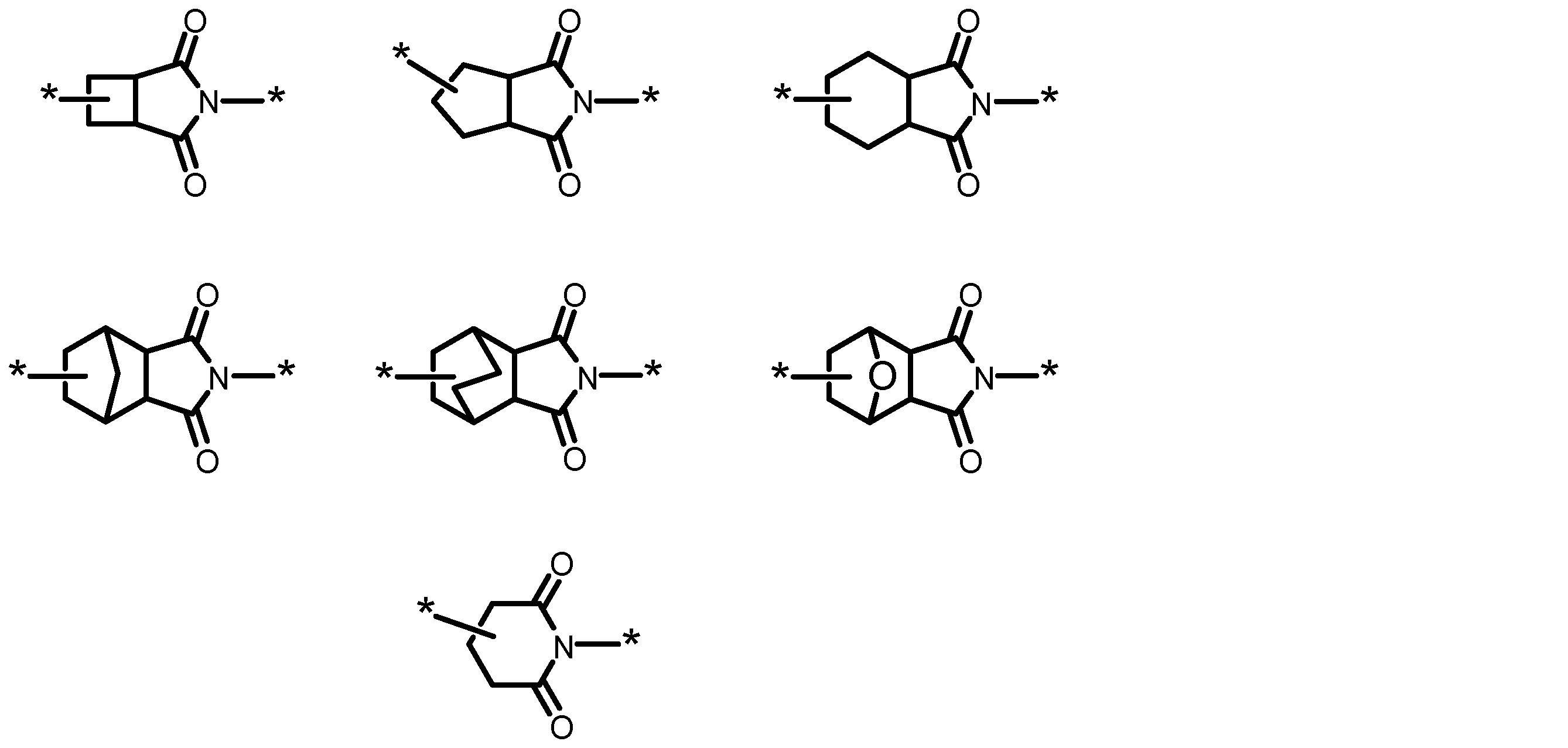
上記式に表される構造のうち、一実施形態では、主鎖中連結基は下記構造を含む。下記構造は、かご型PSQ構造の前駆体化合物(モノマー)として、相応の酸無水物基を有するかご型PSQ化合物を用いた場合に、当該かご型PSQ化合物をイミド化することによって生じ得る。斯かるかご型PSQ化合物としては、市販品を用いることができる。斯かる市販品としては、日本材料技研社製の2官能性のダブルデッカー型シルセスキオキサン「脂環式ダブルデッカーシルセスキオキサン-DDSQ-01」又は「シルセスキオキサン脂環式酸二無水物DDSQ」、CAS番号:948849-07-8)、日本材料技研社製「DDSQ-02」を挙げることができる。 In one embodiment, among the structures represented by the above formula, the linking group in the main chain includes the following structure. When a cage PSQ compound having a corresponding acid anhydride group is used as a precursor compound (monomer) of the cage PSQ structure, the following structure can be generated by imidizing the cage PSQ compound. As such a cage PSQ compound, a commercially available product can be used. Examples of such a commercially available product include a bifunctional double-decker silsesquioxane manufactured by Japan Material Technology Co., Ltd., "Alicyclic Double-Decker Silsesquioxane-DDSQ-01" or "Silsesquioxane Alicyclic Acid Dianhydride DDSQ", CAS number: 948849-07-8), and "DDSQ-02" manufactured by Japan Material Technology Co., Ltd.

主鎖中連結基は、上述したイミド結合を包含する構造を含む場合、エーテル結合及び先述の芳香族環構造を包含する構造として、下記式に表される構造のいずれかを含み得る。
*-L1-Ar-(L2)n2-O-*
[上記式中、Arは、芳香族環構造であり、L1は、単結合であるか又は芳香族環構造を含まない2価の基であり、L2は、芳香族環構造を含まない2価の基であり、n2は、0又は1であり、*は結合手を表す。]
When the linking group in the main chain contains a structure containing the above-mentioned imide bond, it may contain any of the structures represented by the following formulae as a structure containing an ether bond and the above-mentioned aromatic ring structure.
*-L 1 -Ar-(L 2 ) n2 -O-*
[In the above formula, Ar is an aromatic ring structure, L1 is a single bond or a divalent group not containing an aromatic ring structure, L2 is a divalent group not containing an aromatic ring structure, n2 is 0 or 1, and * represents a bond.]
上記式に表される構造におけるL1の一方の結合手は、イミド結合に含まれる窒素原子と結合する。上記式に表される構造におけるエーテル結合の一方の結合手は、直接に又は任意の連結基を介してNリッチヘテロ環構造と結合することが好ましい。 In the structure represented by the above formula, one of the bonds of L1 is bonded to a nitrogen atom contained in an imide bond. In the structure represented by the above formula, one of the bonds of the ether bond is preferably bonded to an N-rich heterocyclic structure directly or via an arbitrary linking group.
一実施形態では、上記式中、Arがベンゼン環構造であり、L1がエチレン基であり、n2が0である。上記構造は、かご型PSQ化合物として、酸無水物基を有するかご型PSQ化合物を用いた場合において、当該かご型PSQ化合物をイミド化するためのモノマーとして、芳香族環構造を有するモノアミンモノヒドロキシ化合物(例えば、チラミン)を用いることによって生じ得る。 In one embodiment, in the above formula, Ar is a benzene ring structure, L1 is an ethylene group, and n2 is 0. The above structure can be obtained by using a cage PSQ compound having an acid anhydride group as the cage PSQ compound, and using a monoamine monohydroxy compound having an aromatic ring structure (e.g., tyramine) as a monomer for imidizing the cage PSQ compound.
特定の実施形態では、改質かご型PSQは、先述のNリッチヘテロ環構造と、先述のかご型PSQ構造とが、互いに先述のイミド結合を少なくとも含む主鎖中連結基を介して結合された連結構造体を複数有するイミド化合物であり、好ましくは、斯かる連結構造体を複数有するポリイミド化合物である。例えば、かご型PSQ構造をX、Nリッチヘテロ環構造をY、置換基を有していてもよい芳香族環構造をZ、イミド結合を少なくとも含む主鎖中連結基をLp、側鎖中連結基をLsとしたとき、改質かご型PSQは、以下の式で表される構造を連結構造体(繰り返し単位)として含んでよい。 In a specific embodiment, the modified cage PSQ is an imide compound having a plurality of linking structures in which the aforementioned N-rich heterocyclic structure and the aforementioned cage PSQ structure are linked to each other via the aforementioned main chain linking group containing at least the imide bond, and is preferably a polyimide compound having a plurality of such linking structures. For example, when the cage PSQ structure is X, the N-rich heterocyclic structure is Y, the aromatic ring structure which may have a substituent is Z, the main chain linking group containing at least the imide bond is Lp, and the side chain linking group is Ls, the modified cage PSQ may contain a structure represented by the following formula as a linking structure (repeating unit).
[-Lp-X-Lp-Y(-Ls-Z)n-]
式中、nは0又は1である。
[-Lp-X-Lp-Y(-Ls-Z)n-]
In the formula, n is 0 or 1.
繰り返し単位の数は限定されるものではないが、斯かるポリイミド化合物が重合反応によって得られる場合、得られる重合体の重量平均分子量(Mw)が後述する範囲内にあることが好ましい。 The number of repeating units is not limited, but when such a polyimide compound is obtained by a polymerization reaction, it is preferable that the weight average molecular weight (Mw) of the resulting polymer is within the range described below.
(その他の構造)
改質かご型PSQは、先述のとおり、窒素原子を2つ以上含むヘテロ環構造と、かご型PSQ構造とを有する限り限定されず、反応性官能基を有していてもよいし、有していなくてもよい。反応性官能基は、加熱又は光照射によってその反応性を発現するものであってもよい。改質かご型PSQが反応性官能基を有することにより、(A)成分が形成する架橋構造に(B)成分を組み入れることが可能となる。反応性官能基の数は、1分子当たり1つ以上、好ましくは2つ以上であり、その上限は分子中に導入可能である限り制限されない。
(Other structures)
As described above, the modified cage PSQ is not limited as long as it has a heterocyclic structure containing two or more nitrogen atoms and a cage PSQ structure, and may or may not have a reactive functional group. The reactive functional group may be one that exhibits its reactivity by heating or light irradiation. The modified cage PSQ has a reactive functional group, which makes it possible to incorporate component (B) into the crosslinked structure formed by component (A). The number of reactive functional groups is one or more, preferably two or more, per molecule, and the upper limit is not limited as long as it can be introduced into the molecule.
反応性官能基としては、酸無水物基、エポキシ基、オキセタニル基、ヒドロキシ基、カルボキシ基、アミノ基及びビニル基並びにこれらの基のいずれか1種以上の基を含有する基(例えば、アリル基、アクリロイル基、メタクリロイル基)が挙げられる。「酸無水物基」とは、別に断らない限り、-CO-O-CO-を含む基を表す。 Reactive functional groups include acid anhydride groups, epoxy groups, oxetanyl groups, hydroxy groups, carboxy groups, amino groups, and vinyl groups, as well as groups containing one or more of these groups (e.g., allyl groups, acryloyl groups, methacryloyl groups). Unless otherwise specified, "acid anhydride group" refers to a group containing -CO-O-CO-.
反応性官能基は、先述のNリッチヘテロ環構造、側鎖中連結基、かご型構造及び主鎖中連結基から選択された1種以上の構造部位の一部をなしていてもよいし、斯かる構造部位に直接的に結合されていてもよいし、任意の連結基を介して結合されていてもよい。 The reactive functional group may be part of one or more structural moieties selected from the aforementioned N-rich heterocyclic structure, the linking group in the side chain, the cage structure, and the linking group in the main chain, or may be directly bonded to such a structural moiety or may be bonded via any linking group.
(B)成分が重合によって得られる場合、得られる重合体の重量平均分子量(Mw)は、好ましくは3000以上、より好ましくは5000以上、さらに好ましくは7000以上であり、好ましくは50000以下、より好ましくは45000以下、さらに好ましくは40000以下である。重合体の重量平均分子量は、ゲルパーミエーションクロマトグラフィー(GPC)法により、ポリスチレン換算の値として測定できる。 When component (B) is obtained by polymerization, the weight average molecular weight (Mw) of the resulting polymer is preferably 3,000 or more, more preferably 5,000 or more, even more preferably 7,000 or more, and preferably 50,000 or less, more preferably 45,000 or less, even more preferably 40,000 or less. The weight average molecular weight of the polymer can be measured as a polystyrene-equivalent value by gel permeation chromatography (GPC).
(B)成分の含有量は、0質量%超であり、本発明の効果を顕著に得る観点から、樹脂組成物中の不揮発成分を100質量%とした場合、好ましくは0.01質量%以上、より好ましくは5質量%以上、さらに好ましくは7質量%以上、特に好ましくは10質量%以上であり、好ましくは60質量%以下、より好ましくは55質量%以下、さらに好ましくは50質量%以下である。 The content of component (B) is more than 0% by mass, and from the viewpoint of obtaining a significant effect of the present invention, when the non-volatile components in the resin composition are taken as 100% by mass, the content is preferably 0.01% by mass or more, more preferably 5% by mass or more, even more preferably 7% by mass or more, particularly preferably 10% by mass or more, and is preferably 60% by mass or less, more preferably 55% by mass or less, and even more preferably 50% by mass or less.
(B)成分の含有量は、本発明の効果を顕著に得る観点から、樹脂組成物中の樹脂成分を100質量%とした場合、好ましくは10質量%以上、より好ましくは14質量%以上、さらに好ましくは20質量%以上であり、好ましくは90質量%以下、より好ましくは85質量%以下、さらに好ましくは80質量%以下である。 From the viewpoint of obtaining a significant effect of the present invention, the content of component (B) is preferably 10% by mass or more, more preferably 14% by mass or more, and even more preferably 20% by mass or more, and is preferably 90% by mass or less, more preferably 85% by mass or less, and even more preferably 80% by mass or less, assuming that the resin component in the resin composition is 100% by mass.
(B)成分と後述する(C)成分の含有量の合計は、本発明の効果を顕著に得る観点から、樹脂組成物中の不揮発成分を100質量%とした場合、好ましくは10質量%以上、より好ましくは20質量%以上、さらに好ましくは30質量%以上であり、特に好ましくは50質量%以上であり、上限は特に限定されないが、例えば98質量%以下、97質量%以下、96質量%以下又は95質量%以下とし得る。 In order to obtain a significant effect of the present invention, the total content of the (B) component and the (C) component described below is preferably 10% by mass or more, more preferably 20% by mass or more, even more preferably 30% by mass or more, and particularly preferably 50% by mass or more, when the non-volatile components in the resin composition are taken as 100% by mass. The upper limit is not particularly limited, but it can be, for example, 98% by mass or less, 97% by mass or less, 96% by mass or less, or 95% by mass or less.
<(C)無機充填材>
樹脂組成物は、(C)成分として、無機充填材を含有していてもよい。(C)無機充填材を樹脂組成物に含有させることで、機械特性に優れる硬化物(絶縁層)をもたらすことができる。また、(C)無機充填材を樹脂組成物に含有させることで、線熱膨張係数が低い硬化物を得ることが可能となる。
<(C) Inorganic filler>
The resin composition may contain an inorganic filler as component (C). By containing the inorganic filler (C) in the resin composition, a cured product (insulating layer) having excellent mechanical properties can be obtained. Furthermore, by incorporating the inorganic filler (C) in the resin composition, it is possible to obtain a cured product having a low linear thermal expansion coefficient.
無機充填材としては、無機化合物を用いる。無機充填材の材料の例としては、シリカ、アルミナ、ガラス、コーディエライト、シリコン酸化物、硫酸バリウム、炭酸バリウム、タルク、クレー、雲母粉、酸化亜鉛、ハイドロタルサイト、ベーマイト、水酸化アルミニウム、水酸化マグネシウム、炭酸カルシウム、炭酸マグネシウム、酸化マグネシウム、窒化ホウ素、窒化アルミニウム、窒化マンガン、ホウ酸アルミニウム、炭酸ストロンチウム、チタン酸ストロンチウム、チタン酸カルシウム、チタン酸マグネシウム、チタン酸ビスマス、酸化チタン、酸化ジルコニウム、チタン酸バリウム、チタン酸ジルコン酸バリウム、ジルコン酸バリウム、ジルコン酸カルシウム、リン酸ジルコニウム、及びリン酸タングステン酸ジルコニウム等が挙げられる。これらの中でもシリカが特に好適である。シリカとしては、例えば、無定形シリカ、溶融シリカ、結晶シリカ、合成シリカ、中空シリカ等が挙げられる。また、シリカとしては、球状シリカが好ましい。(C)無機充填材は、1種類単独で用いてもよく、2種類以上を組み合わせて用いてもよい。 As the inorganic filler, an inorganic compound is used. Examples of materials for the inorganic filler include silica, alumina, glass, cordierite, silicon oxide, barium sulfate, barium carbonate, talc, clay, mica powder, zinc oxide, hydrotalcite, boehmite, aluminum hydroxide, magnesium hydroxide, calcium carbonate, magnesium carbonate, magnesium oxide, boron nitride, aluminum nitride, manganese nitride, aluminum borate, strontium carbonate, strontium titanate, calcium titanate, magnesium titanate, bismuth titanate, titanium oxide, zirconium oxide, barium titanate, barium zirconate titanate, barium zirconate, calcium zirconate, zirconium phosphate, and zirconium tungstate phosphate. Among these, silica is particularly suitable. Examples of silica include amorphous silica, fused silica, crystalline silica, synthetic silica, and hollow silica. Moreover, as the silica, spherical silica is preferable. (C) The inorganic filler may be used alone or in combination of two or more types.
(C)無機充填材の市販品としては、例えば、電化化学工業社製の「UFP-30」;新日鉄住金マテリアルズ社製の「SP60-05」、「SP507-05」;アドマテックス社製の「YC100C」、「YA050C」、「YA050C-MJE」、「YA010C」;デンカ社製の「UFP-30」;トクヤマ社製の「シルフィルNSS-3N」、「シルフィルNSS-4N」、「シルフィルNSS-5N」;アドマテックス社製の「SC2500SQ」、「SO-C4」、「SO-C2」、「SO-C1」、「SC-C2」;などが挙げられる。 (C) Commercially available inorganic fillers include, for example, "UFP-30" manufactured by Denka Chemical Industry Co., Ltd.; "SP60-05" and "SP507-05" manufactured by Nippon Steel & Sumitomo Metal Materials Co., Ltd.; "YC100C", "YA050C", "YA050C-MJE", and "YA010C" manufactured by Admatechs Co., Ltd.; "UFP-30" manufactured by Denka Company, Ltd.; "Silfil NSS-3N", "Silfil NSS-4N", and "Silfil NSS-5N" manufactured by Tokuyama Corporation; "SC2500SQ", "SO-C4", "SO-C2", "SO-C1", and "SC-C2" manufactured by Admatechs Co., Ltd.
(C)無機充填材の平均粒径は、本発明の所望の効果を顕著に得る観点から、好ましくは0.01μm以上、より好ましくは0.05μm以上、特に好ましくは0.1μm以上であり、好ましくは5μm以下、より好ましくは2μm以下、さらに好ましくは1μm以下である。 The average particle size of the inorganic filler (C) is preferably 0.01 μm or more, more preferably 0.05 μm or more, and particularly preferably 0.1 μm or more, from the viewpoint of significantly obtaining the desired effects of the present invention, and is preferably 5 μm or less, more preferably 2 μm or less, and even more preferably 1 μm or less.
(C)無機充填材の平均粒径は、ミー(Mie)散乱理論に基づくレーザー回折・散乱法により測定することができる。具体的には、レーザー回折散乱式粒径分布測定装置により、無機充填材の粒径分布を体積基準で作成し、そのメディアン径を平均粒径とすることで測定することができる。測定サンプルは、無機充填材100mg、メチルエチルケトン10gをバイアル瓶に秤取り、超音波にて10分間分散させたものを使用することができる。測定サンプルを、レーザー回折式粒径分布測定装置を使用して、使用光源波長を青色及び赤色とし、フローセル方式で無機充填材の体積基準の粒径分布を測定し、得られた粒径分布からメディアン径として平均粒径を算出する。レーザー回折式粒径分布測定装置としては、例えば堀場製作所社製「LA-960」等が挙げられる。 (C) The average particle size of the inorganic filler can be measured by a laser diffraction/scattering method based on the Mie scattering theory. Specifically, a particle size distribution of the inorganic filler is created on a volume basis using a laser diffraction/scattering particle size distribution measuring device, and the median diameter is used as the average particle size. The measurement sample can be prepared by weighing 100 mg of inorganic filler and 10 g of methyl ethyl ketone into a vial and dispersing it ultrasonically for 10 minutes. The measurement sample is measured using a laser diffraction particle size distribution measuring device with blue and red light source wavelengths, and the volume-based particle size distribution of the inorganic filler is measured using a flow cell method, and the average particle size is calculated as the median diameter from the particle size distribution obtained. An example of a laser diffraction particle size distribution measuring device is the "LA-960" manufactured by Horiba, Ltd.
(C)無機充填材の比表面積は、本発明の所望の効果を顕著に得る観点から、好ましくは1m2/g以上、より好ましくは2m2/g以上、特に好ましくは3m2/g以上である。上限に特段の制限は無いが、好ましくは60m2/g以下、50m2/g以下又は40m2/g以下である。比表面積は、BET全自動比表面積測定装置(マウンテック社製「Macsorb HM-1210」)を使用して、試料表面に窒素ガスを吸着させ、BET多点法を用いて比表面積を算出することで無機充填材の比表面積を測定することで得られる。 From the viewpoint of significantly obtaining the desired effects of the present invention, the specific surface area of the inorganic filler (C) is preferably 1 m 2 /g or more, more preferably 2 m 2 /g or more, and particularly preferably 3 m 2 /g or more. There is no particular upper limit, but it is preferably 60 m 2 /g or less, 50 m 2 /g or less, or 40 m 2 /g or less. The specific surface area is obtained by measuring the specific surface area of the inorganic filler using a BET fully automatic specific surface area measuring device ("Macsorb HM-1210" manufactured by Mountech Co., Ltd.), adsorbing nitrogen gas onto the surface of a sample, and calculating the specific surface area using a BET multipoint method.
(C)無機充填材は、耐湿性及び分散性を高める観点から、表面処理剤で処理されていることが好ましい。表面処理剤としては、例えば、フッ素含有シランカップリング剤、アミノシラン系カップリング剤、エポキシシラン系カップリング剤、メルカプトシラン系カップリング剤、シラン系カップリング剤、アルコキシシラン、オルガノシラザン化合物、チタネート系カップリング剤等が挙げられる。また、表面処理剤は、1種類単独で用いてもよく、2種類以上を任意に組み合わせて用いてもよい。 (C) From the viewpoint of improving moisture resistance and dispersibility, it is preferable that the inorganic filler is treated with a surface treatment agent. Examples of the surface treatment agent include a fluorine-containing silane coupling agent, an aminosilane coupling agent, an epoxysilane coupling agent, a mercaptosilane coupling agent, a silane coupling agent, an alkoxysilane, an organosilazane compound, and a titanate coupling agent. In addition, the surface treatment agent may be used alone or in any combination of two or more types.
表面処理剤の市販品としては、例えば、信越化学工業社製「KBM403」(3-グリシドキシプロピルトリメトキシシラン)、信越化学工業社製「KBM803」(3-メルカプトプロピルトリメトキシシラン)、信越化学工業社製「KBE903」(3-アミノプロピルトリエトキシシラン)、信越化学工業社製「KBM573」(N-フェニル-3-アミノプロピルトリメトキシシラン)、信越化学工業社製「SZ-31」(ヘキサメチルジシラザン)、信越化学工業社製「KBM103」(フェニルトリメトキシシラン)、信越化学工業社製「KBM-4803」(長鎖エポキシ型シランカップリング剤)、信越化学工業社製「KBM-7103」(3,3,3-トリフルオロプロピルトリメトキシシラン)、信越化学工業社製のN-フェニル-8-アミノオクチル-トリメトキシシラン等が挙げられる。 Examples of commercially available surface treatment agents include Shin-Etsu Chemical's "KBM403" (3-glycidoxypropyltrimethoxysilane), Shin-Etsu Chemical's "KBM803" (3-mercaptopropyltrimethoxysilane), Shin-Etsu Chemical's "KBE903" (3-aminopropyltriethoxysilane), Shin-Etsu Chemical's "KBM573" (N-phenyl-3-aminopropyltrimethoxysilane), Shin-Etsu Chemical's "SZ-31" (hexamethyldisilazane), Shin-Etsu Chemical's "KBM103" (phenyltrimethoxysilane), Shin-Etsu Chemical's "KBM-4803" (long-chain epoxy-type silane coupling agent), Shin-Etsu Chemical's "KBM-7103" (3,3,3-trifluoropropyltrimethoxysilane), and Shin-Etsu Chemical's N-phenyl-8-aminooctyl-trimethoxysilane.
表面処理剤による表面処理の程度は、無機充填材の分散性向上の観点から、所定の範囲に収まることが好ましい。具体的には、無機充填材100質量部は、0.2質量部~5質量部の表面処理剤で表面処理されていることが好ましく、0.2質量部~3質量部で表面処理されていることが好ましく、0.3質量部~2質量部で表面処理されていることが好ましい。 From the viewpoint of improving the dispersibility of the inorganic filler, it is preferable that the degree of surface treatment with the surface treatment agent falls within a specified range. Specifically, 100 parts by mass of the inorganic filler is preferably surface-treated with 0.2 parts by mass to 5 parts by mass of the surface treatment agent, more preferably with 0.2 parts by mass to 3 parts by mass, and more preferably with 0.3 parts by mass to 2 parts by mass.
表面処理剤による表面処理の程度は、無機充填材の単位表面積当たりのカーボン量によって評価することができる。無機充填材の単位表面積当たりのカーボン量は、無機充填材の分散性向上の観点から、0.02mg/m2以上が好ましく、0.1mg/m2以上がより好ましく、0.2mg/m2以上が更に好ましい。一方、樹脂ワニスの溶融粘度及びシート形態での溶融粘度の上昇を抑制する観点から、1mg/m2以下が好ましく、0.8mg/m2以下がより好ましく、0.5mg/m2以下が更に好ましい。 The degree of surface treatment by the surface treatment agent can be evaluated by the amount of carbon per unit surface area of the inorganic filler. From the viewpoint of improving the dispersibility of the inorganic filler, the amount of carbon per unit surface area of the inorganic filler is preferably 0.02 mg/m 2 or more, more preferably 0.1 mg/m 2 or more, and even more preferably 0.2 mg/m 2 or more. On the other hand, from the viewpoint of suppressing the increase in the melt viscosity of the resin varnish and the melt viscosity in the sheet form, it is preferably 1 mg/m 2 or less, more preferably 0.8 mg/m 2 or less, and even more preferably 0.5 mg/m 2 or less.
(C)無機充填材の単位表面積当たりのカーボン量は、表面処理後の無機充填材を溶剤(例えば、メチルエチルケトン(MEK))により洗浄処理した後に測定することができる。具体的には、溶剤として十分な量のMEKを表面処理剤で表面処理された無機充填材に加えて、25℃で5分間超音波洗浄する。上澄液を除去し、固形分を乾燥させた後、カーボン分析計を用いて無機充填材の単位表面積当たりのカーボン量を測定することができる。カーボン分析計としては、堀場製作所社製「EMIA-320V」等を使用することができる。 (C) The amount of carbon per unit surface area of the inorganic filler can be measured after the surface-treated inorganic filler is washed with a solvent (e.g., methyl ethyl ketone (MEK)). Specifically, a sufficient amount of MEK as a solvent is added to the inorganic filler that has been surface-treated with a surface treatment agent, and ultrasonic cleaning is performed at 25°C for 5 minutes. After removing the supernatant and drying the solids, the amount of carbon per unit surface area of the inorganic filler can be measured using a carbon analyzer. An example of a carbon analyzer that can be used is the "EMIA-320V" manufactured by Horiba, Ltd.
(C)無機充填材の含有量は、0質量%超であり、本発明の効果を顕著に得る観点から、樹脂組成物中の不揮発成分を100質量%とした場合、好ましくは10質量%以上、より好ましくは15質量%以上、さらに好ましくは20質量%以上であり、上限は特に限定されないが、例えば90質量%以下、85質量%以下、又は80質量%以下とし得るが、低誘電率(Dk)の硬化物を得る観点及び銅箔密着性に優れる硬化物を得る観点の少なくとも一方の観点からは、50質量%以下、45質量%以下又は40質量%以下としてもよい。 The content of (C) inorganic filler is more than 0% by mass, and from the viewpoint of obtaining the effects of the present invention significantly, when the non-volatile components in the resin composition are taken as 100% by mass, the content is preferably 10% by mass or more, more preferably 15% by mass or more, and even more preferably 20% by mass or more. The upper limit is not particularly limited, but it can be, for example, 90% by mass or less, 85% by mass or less, or 80% by mass or less. However, from the viewpoint of obtaining a cured product with a low dielectric constant (Dk) or a cured product with excellent copper foil adhesion, it may be 50% by mass or less, 45% by mass or less, or 40% by mass or less.
<(D)硬化剤>
樹脂組成物は、(D)硬化剤を含有していてもよい。(D)成分としては、(A)成分、特には(A-1)成分を硬化する機能を有するものを用いることができる。ただし、(D)成分からは、(A)成分及び(B)成分に該当するものは除かれる。樹脂組成物が(A-1)成分を含まない場合、(D)成分を含んでいなくてもよい。樹脂組成物が(A-1)成分とともに(D)成分を含有することで、耐熱性に優れる硬化物を得ることができる。
<(D) Curing Agent>
The resin composition may contain a curing agent (D). As the (D) component, one having the function of curing the (A) component, particularly the (A-1) component, can be used. However, the (D) component excludes those that correspond to the (A) component and the (B) component. When the resin composition does not contain the (A-1) component, it does not have to contain the (D) component. When the resin composition contains the (D) component together with the (A-1) component, a cured product having excellent heat resistance can be obtained.
(D)硬化剤としては、活性エステル系硬化剤、フェノール系硬化剤、ナフトール系硬化剤、カルボジイミド系硬化剤、ベンゾオキサジン系硬化剤、酸無水物系硬化剤、アミン系硬化剤、及び、シアネートエステル系硬化剤から選択される1種以上の硬化剤などが挙げられる。めっき密着性により優れる硬化物を得る観点からは、活性エステル系硬化剤を用いることが好ましい。硬化剤は1種単独で用いてもよく、又は2種以上を併用してもよい。 (D) The curing agent may be one or more selected from active ester curing agents, phenolic curing agents, naphthol curing agents, carbodiimide curing agents, benzoxazine curing agents, acid anhydride curing agents, amine curing agents, and cyanate ester curing agents. From the viewpoint of obtaining a cured product with superior plating adhesion, it is preferable to use an active ester curing agent. The curing agents may be used alone or in combination of two or more.
活性エステル系硬化剤としては、特に制限はないが、一般にフェノールエステル類、チオフェノールエステル類、N-ヒドロキシアミンエステル類、複素環ヒドロキシ化合物のエステル類等の、反応活性の高いエステル基を1分子中に2個以上有する化合物が好ましく用いられる。当該活性エステル系硬化剤は、カルボン酸化合物及び/又はチオカルボン酸化合物とヒドロキシ化合物及び/又はチオール化合物との縮合反応によって得られるものが好ましい。特に耐熱性向上の観点から、カルボン酸化合物とヒドロキシ化合物とから得られる活性エステル系硬化剤が好ましく、カルボン酸化合物とフェノール化合物及び/又はナフトール化合物とから得られる活性エステル系硬化剤がより好ましい。カルボン酸化合物としては、例えば安息香酸、酢酸、コハク酸、マレイン酸、イタコン酸、フタル酸、イソフタル酸、テレフタル酸、ピロメリット酸等が挙げられる。フェノール化合物又はナフトール化合物としては、例えば、ハイドロキノン、レゾルシン、ビスフェノールA、ビスフェノールF、ビスフェノールS、フェノールフタリン、メチル化ビスフェノールA、メチル化ビスフェノールF、メチル化ビスフェノールS、フェノール、o-クレゾール、m-クレゾール、p-クレゾール、カテコール、α-ナフトール、β-ナフトール、1,5-ジヒドロキシナフタレン、1,6-ジヒドロキシナフタレン、2,6-ジヒドロキシナフタレン、ジヒドロキシベンゾフェノン、トリヒドロキシベンゾフェノン、テトラヒドロキシベンゾフェノン、フロログルシン、ベンゼントリオール、ジシクロペンタジエン型ジフェノール化合物、フェノールノボラック等が挙げられる。ここで、「ジシクロペンタジエン型ジフェノール化合物」とは、ジシクロペンタジエン1分子にフェノール2分子が縮合して得られるジフェノール化合物をいう。 There are no particular limitations on the active ester curing agent, but generally compounds having two or more highly reactive ester groups in one molecule, such as phenol esters, thiophenol esters, N-hydroxyamine esters, and esters of heterocyclic hydroxy compounds, are preferably used. The active ester curing agent is preferably one obtained by a condensation reaction between a carboxylic acid compound and/or a thiocarboxylic acid compound and a hydroxy compound and/or a thiol compound. In particular, from the viewpoint of improving heat resistance, an active ester curing agent obtained from a carboxylic acid compound and a hydroxy compound is preferred, and an active ester curing agent obtained from a carboxylic acid compound and a phenol compound and/or a naphthol compound is more preferred. Examples of carboxylic acid compounds include benzoic acid, acetic acid, succinic acid, maleic acid, itaconic acid, phthalic acid, isophthalic acid, terephthalic acid, and pyromellitic acid. Examples of phenol compounds or naphthol compounds include hydroquinone, resorcin, bisphenol A, bisphenol F, bisphenol S, phenolphthaline, methylated bisphenol A, methylated bisphenol F, methylated bisphenol S, phenol, o-cresol, m-cresol, p-cresol, catechol, α-naphthol, β-naphthol, 1,5-dihydroxynaphthalene, 1,6-dihydroxynaphthalene, 2,6-dihydroxynaphthalene, dihydroxybenzophenone, trihydroxybenzophenone, tetrahydroxybenzophenone, phloroglucin, benzenetriol, dicyclopentadiene-type diphenol compounds, and phenol novolak. Here, "dicyclopentadiene-type diphenol compounds" refer to diphenol compounds obtained by condensing one molecule of dicyclopentadiene with two molecules of phenol.
具体的には、ジシクロペンタジエン型ジフェノール構造を含む活性エステル化合物、ナフタレン構造を含む活性エステル化合物、フェノールノボラックのアセチル化物を含む活性エステル化合物、フェノールノボラックのベンゾイル化物を含む活性エステル化合物が好ましく、中でもナフタレン構造を含む活性エステル化合物、ジシクロペンタジエン型ジフェノール構造を含む活性エステル化合物がより好ましい。「ジシクロペンタジエン型ジフェノール構造」とは、フェニレン-ジシクロペンチレン-フェニレンからなる2価の構造単位を表す。 Specifically, active ester compounds containing a dicyclopentadiene-type diphenol structure, active ester compounds containing a naphthalene structure, active ester compounds containing an acetylated product of phenol novolac, and active ester compounds containing a benzoylated product of phenol novolac are preferred, and among these, active ester compounds containing a naphthalene structure and active ester compounds containing a dicyclopentadiene-type diphenol structure are more preferred. The term "dicyclopentadiene-type diphenol structure" refers to a divalent structural unit consisting of phenylene-dicyclopentylene-phenylene.
活性エステル系硬化剤の市販品としては、ジシクロペンタジエン型ジフェノール構造を含む活性エステル化合物として、「EXB―9451」、「EXB―9460」、「EXB―9460S」、「HPC-8000-65T」、「HPC-8000H-65TM」、「HPC-8000L-65TM」(DIC社製)、ナフタレン構造を含む活性エステル化合物として、「EXB―9416-70BK」、「EXB-8100L-65T」、「EXB-8150-65T」、「EXB-8150L-65T」、「HPC-8150-60T」、「HPC-8150-62T」、「HP-B-8151-62T」(DIC社製)、フェノールノボラックのアセチル化物を含む活性エステル化合物として「DC808」(三菱ケミカル社製)、フェノールノボラックのベンゾイル化物を含む活性エステル化合物として「YLH1026」(三菱ケミカル社製)、フェノールノボラックのアセチル化物である活性エステル系硬化剤として「DC808」(三菱ケミカル社製)、フェノールノボラックのベンゾイル化物である活性エステル系硬化剤として「YLH1026」(三菱ケミカル社製)、「YLH1030」(三菱ケミカル社製)、「YLH1048」(三菱ケミカル社製)、スチリル基を含む活性エステル化合物として「PC1300-02-65MA」(エア・ウォーター社製)等が挙げられる。 Commercially available active ester curing agents include active ester compounds containing a dicyclopentadiene-type diphenol structure such as "EXB-9451", "EXB-9460", "EXB-9460S", "HPC-8000-65T", "HPC-8000H-65TM", and "HPC-8000L-65TM" (manufactured by DIC Corporation), active ester compounds containing a naphthalene structure such as "EXB-9416-70BK", "EXB-8100L-65T", "EXB-8150-65T", "EXB-8150L-65T", "HPC-8150-60T", "HPC-8150-62T", and "HP-B-8151-62T" (manufactured by DIC Corporation), and phenol novolac Examples of active ester compounds containing acetylated compounds include "DC808" (manufactured by Mitsubishi Chemical Corporation), active ester compounds containing benzoylated phenol novolac include "YLH1026" (manufactured by Mitsubishi Chemical Corporation), active ester curing agents that are acetylated phenol novolac include "DC808" (manufactured by Mitsubishi Chemical Corporation), active ester curing agents that are benzoylated phenol novolac include "YLH1026" (manufactured by Mitsubishi Chemical Corporation), "YLH1030" (manufactured by Mitsubishi Chemical Corporation), and "YLH1048" (manufactured by Mitsubishi Chemical Corporation), and an active ester compound containing a styryl group includes "PC1300-02-65MA" (manufactured by Air Water Corporation).
フェノール系硬化剤(活性エステル化合物を除く)及びナフトール系硬化剤(活性エステル化合物を除く)としては、耐熱性及び耐水性の観点から、ノボラック構造又はクレゾールノボラック構造を有するフェノール系硬化剤、又はノボラック構造を有するナフトール系硬化剤が好ましい。また、導体層との密着性の観点から、含窒素フェノール系硬化剤が好ましく、トリアジン骨格含有フェノール系硬化剤がより好ましい。 As the phenol-based hardener (excluding active ester compounds) and naphthol-based hardener (excluding active ester compounds), from the viewpoint of heat resistance and water resistance, a phenol-based hardener having a novolac structure or a cresol novolac structure, or a naphthol-based hardener having a novolac structure is preferred. Also, from the viewpoint of adhesion to the conductor layer, a nitrogen-containing phenol-based hardener is preferred, and a triazine skeleton-containing phenol-based hardener is more preferred.
フェノール系硬化剤及びナフトール系硬化剤の具体例としては、例えば、明和化成社製の「MEH-7700」、「MEH-7810」、「MEH-7851」、日本化薬社製の「NHN」、「CBN」、「GPH」、新日鉄住金化学社製の「SN170」、「SN180」、「SN190」、「SN475」、「SN485」、「SN495」、「SN-495V」、「SN375」、「SN395」、DIC社製の「TD-2090」、「LA-7052」、「LA-7054」、「LA-1356」、「LA-3018-50P」、「EXB-9500」、「KA-1160」等が挙げられる。 Specific examples of phenol-based and naphthol-based curing agents include "MEH-7700", "MEH-7810", and "MEH-7851" manufactured by Meiwa Kasei Co., Ltd., "NHN", "CBN", and "GPH" manufactured by Nippon Kayaku Co., Ltd., "SN170", "SN180", "SN190", "SN475", "SN485", "SN495", "SN-495V", "SN375", and "SN395" manufactured by Nippon Steel & Sumikin Chemical Co., Ltd., and "TD-2090", "LA-7052", "LA-7054", "LA-1356", "LA-3018-50P", "EXB-9500", and "KA-1160" manufactured by DIC Corporation.
カルボジイミド系硬化剤の具体例としては、日清紡ケミカル社製の「V-03」、「V-05」、「V-07」、「V-09」、「Elastostab H01」等が挙げられる。 Specific examples of carbodiimide-based curing agents include "V-03," "V-05," "V-07," "V-09," and "Elastostab H01," manufactured by Nisshinbo Chemical Co., Ltd.
ベンゾオキサジン系硬化剤の具体例としては、JFEケミカル社製の「JBZ-OP100D」、「ODA-BOZ」、昭和高分子社製の「HFB2006M」、四国化成工業社製の「P-d」、「F-a」が挙げられる。ベンゾオキサジン系硬化剤は、ベンゾオキサジン構造を有する化合物である。ベンゾオキサジン構造とは、置換若しくは非置換のベンゾオキサジン環(例えば、1,2-ベンゾオキサジン環、1,3-ベンゾオキサジン環)、又は、一部の二重結合が水素化されたベンゾオキサジン環(例えば、3,4-ジヒドロ-2H-1,3-ベンゾオキサジン環)をいう。 Specific examples of benzoxazine-based curing agents include "JBZ-OP100D" and "ODA-BOZ" manufactured by JFE Chemical Corporation, "HFB2006M" manufactured by Showa Polymer Co., Ltd., and "P-d" and "F-a" manufactured by Shikoku Chemical Industry Co., Ltd. Benzoxazine-based curing agents are compounds having a benzoxazine structure. A benzoxazine structure refers to a substituted or unsubstituted benzoxazine ring (e.g., 1,2-benzoxazine ring, 1,3-benzoxazine ring), or a benzoxazine ring in which some of the double bonds are hydrogenated (e.g., 3,4-dihydro-2H-1,3-benzoxazine ring).
酸無水物系硬化剤としては、1分子内中に1個以上の酸無水物基を有する硬化剤が挙げられ、1分子内中に2個以上の酸無水物基を有する硬化剤が好ましい。酸無水物系硬化剤の具体例としては、無水フタル酸、テトラヒドロ無水フタル酸、ヘキサヒドロ無水フタル酸、メチルテトラヒドロ無水フタル酸、メチルヘキサヒドロ無水フタル酸、メチルナジック酸無水物、水素化メチルナジック酸無水物、トリアルキルテトラヒドロ無水フタル酸、ドデセニル無水コハク酸、5-(2,5-ジオキソテトラヒドロ-3-フラニル)-3-メチル-3-シクロヘキセン-1,2-ジカルボン酸無水物、無水トリメリット酸、無水ピロメリット酸、ベンソフェノンテトラカルボン酸二無水物、ビフェニルテトラカルボン酸二無水物(例えば、3,4,3’,4’-ビフェニルテトラカルボン酸ジ無水物(「BPDA」)、ナフタレンテトラカルボン酸二無水物、オキシジフタル酸二無水物、3,3’-4,4’-ジフェニルスルホンテトラカルボン酸二無水物、1,3,3a,4,5,9b-ヘキサヒドロ-5-(テトラヒドロ-2,5-ジオキソ-3-フラニル)-ナフト[1,2-C]フラン-1,3-ジオン、エチレングリコールビス(アンヒドロトリメリテート)、スチレンとマレイン酸とが共重合したスチレン・マレイン酸樹脂などのポリマー型の酸無水物などが挙げられる。酸無水物系硬化剤の市販品としては、新日本理化社製のリカシッドシリーズ「BT-100」、「HNA-100」、「MH-700」、「MTA-15」、「DDSA」、「OSA」、三菱ケミカル社製の「YH-306」、「YH-307」、日立化成社製の「HN-2200」、「HN-5500」等が挙げられる。 Examples of acid anhydride curing agents include curing agents having one or more acid anhydride groups in one molecule, and curing agents having two or more acid anhydride groups in one molecule are preferred. Specific examples of acid anhydride curing agents include phthalic anhydride, tetrahydrophthalic anhydride, hexahydrophthalic anhydride, methyltetrahydrophthalic anhydride, methylhexahydrophthalic anhydride, methylnadic anhydride, hydrogenated methylnadic anhydride, trialkyltetrahydrophthalic anhydride, dodecenyl succinic anhydride, 5-(2,5-dioxotetrahydro-3-furanyl)-3-methyl-3-cyclohexene-1,2-dicarboxylic anhydride, trimellitic anhydride, pyromellitic anhydride, benzophenone tetracarboxylic dianhydride, biphenyl tetracarboxylic dianhydride (e.g., 3,4,3',4'-biphenyl tetracarboxylic dianhydride ("BPDA"), naphthalene tetracarboxylic dianhydride, oxydiphthalic dianhydride, Examples of the acid anhydride include polymeric acid anhydrides such as 3,3'-4,4'-diphenylsulfonetetracarboxylic dianhydride, 1,3,3a,4,5,9b-hexahydro-5-(tetrahydro-2,5-dioxo-3-furanyl)-naphtho[1,2-C]furan-1,3-dione, ethylene glycol bis(anhydrotrimellitate), and styrene-maleic acid resins in which styrene and maleic acid are copolymerized. Commercially available acid anhydride curing agents include the Rikacid series "BT-100", "HNA-100", "MH-700", "MTA-15", "DDSA", and "OSA" manufactured by New Japan Chemical Co., Ltd., "YH-306" and "YH-307" manufactured by Mitsubishi Chemical Corporation, and "HN-2200" and "HN-5500" manufactured by Hitachi Chemical Co., Ltd.
アミン系硬化剤としては、1分子内中に1個以上、好ましくは2個以上のアミノ基を有する硬化剤が挙げられ、例えば、脂肪族アミン類、ポリエーテルアミン類、脂環式アミン類、芳香族アミン類等が挙げられ、中でも、本発明の所望の効果を奏する観点から、芳香族アミン類が好ましい。アミン系硬化剤は、第1級アミン又は第2級アミンが好ましく、第1級アミンがより好ましい。アミン系硬化剤の具体例としては、4,4’-メチレンビス(2,6-ジメチルアニリン)、ジフェニルジアミノスルホン、4,4’-ジアミノジフェニルメタン、4,4’-ジアミノジフェニルスルホン、3,3’-ジアミノジフェニルスルホン、m-フェニレンジアミン、m-キシリレンジアミン、ジエチルトルエンジアミン、4,4’-ジアミノジフェニルエーテル、3,3’-ジメチル-4,4’-ジアミノビフェニル、2,2’-ジメチル-4,4’-ジアミノビフェニル、3,3’-ジヒドロキシベンジジン、2,2-ビス(3-アミノ-4-ヒドロキシフェニル)プロパン、3,3-ジメチル-5,5-ジエチル-4,4-ジフェニルメタンジアミン、2,2-ビス(4-アミノフェニル)プロパン、2,2-ビス(4-(4-アミノフェノキシ)フェニル)プロパン、1,3-ビス(3-アミノフェノキシ)ベンゼン、1,3-ビス(4-アミノフェノキシ)ベンゼン、1,4-ビス(4-アミノフェノキシ)ベンゼン、4,4’-ビス(4-アミノフェノキシ)ビフェニル、ビス(4-(4-アミノフェノキシ)フェニル)スルホン、ビス(4-(3-アミノフェノキシ)フェニル)スルホン、等が挙げられる。アミン系硬化剤は市販品を用いてもよく、例えば、日本化薬社製の「KAYABOND C-200S」、「KAYABOND C-100」、「カヤハードA-A」、「カヤハードA-B」、「カヤハードA-S」、三菱ケミカル社製の「エピキュアW」等が挙げられる。 Examples of amine-based curing agents include curing agents having one or more, preferably two or more, amino groups in one molecule, such as aliphatic amines, polyether amines, alicyclic amines, and aromatic amines. Among these, aromatic amines are preferred from the viewpoint of achieving the desired effects of the present invention. The amine-based curing agent is preferably a primary amine or secondary amine, and more preferably a primary amine. Specific examples of amine-based curing agents include 4,4'-methylenebis(2,6-dimethylaniline), diphenyldiaminosulfone, 4,4'-diaminodiphenylmethane, 4,4'-diaminodiphenylsulfone, 3,3'-diaminodiphenylsulfone, m-phenylenediamine, m-xylylenediamine, diethyltoluenediamine, 4,4'-diaminodiphenylether, 3,3'-dimethyl-4,4'-diaminobiphenyl, 2,2'-dimethyl-4,4'-diaminobiphenyl, 3,3'-dihydroxybenzidine, 2,2-bis(3-amino-4-hydroxyphenyl)-2,2'-diphenyl ... bis(4-aminophenyl)propane, 3,3-dimethyl-5,5-diethyl-4,4-diphenylmethanediamine, 2,2-bis(4-aminophenyl)propane, 2,2-bis(4-(4-aminophenoxy)phenyl)propane, 1,3-bis(3-aminophenoxy)benzene, 1,3-bis(4-aminophenoxy)benzene, 1,4-bis(4-aminophenoxy)benzene, 4,4'-bis(4-aminophenoxy)biphenyl, bis(4-(4-aminophenoxy)phenyl)sulfone, bis(4-(3-aminophenoxy)phenyl)sulfone, and the like. Commercially available amine-based curing agents may be used, such as "KAYABOND C-200S", "KAYABOND C-100", "KAYAHARD A-A", "KAYAHARD A-B", and "KAYAHARD A-S" manufactured by Nippon Kayaku Co., Ltd., and "Epicure W" manufactured by Mitsubishi Chemical Corporation.
シアネートエステル系硬化剤としては、例えば、ビスフェノールAジシアネート、ポリフェノールシアネート、オリゴ(3-メチレン-1,5-フェニレンシアネート)、4,4’-メチレンビス(2,6-ジメチルフェニルシアネート)、4,4’-エチリデンジフェニルジシアネート、ヘキサフルオロビスフェノールAジシアネート、2,2-ビス(4-シアネート)フェニルプロパン、1,1-ビス(4-シアネートフェニルメタン)、ビス(4-シアネート-3,5-ジメチルフェニル)メタン、1,3-ビス(4-シアネートフェニル-1-(メチルエチリデン))ベンゼン、ビス(4-シアネートフェニル)チオエーテル、及びビス(4-シアネートフェニル)エーテル等の2官能シアネート樹脂、フェノールノボラック及びクレゾールノボラック等から誘導される多官能シアネート樹脂、これらシアネート樹脂が一部トリアジン化したプレポリマーなどが挙げられる。シアネートエステル系硬化剤の具体例としては、ロンザジャパン社製の「PT30」及び「PT60」(フェノールノボラック型多官能シアネートエステル樹脂)、「ULL-950S」(多官能シアネートエステル樹脂)、「BA230」、「BA230S75」(ビスフェノールAジシアネートの一部又は全部がトリアジン化され三量体となったプレポリマー)等が挙げられる。 Examples of cyanate ester curing agents include bifunctional cyanate resins such as bisphenol A dicyanate, polyphenol cyanate, oligo(3-methylene-1,5-phenylene cyanate), 4,4'-methylenebis(2,6-dimethylphenyl cyanate), 4,4'-ethylidene diphenyl dicyanate, hexafluorobisphenol A dicyanate, 2,2-bis(4-cyanate)phenylpropane, 1,1-bis(4-cyanate phenylmethane), bis(4-cyanate-3,5-dimethylphenyl)methane, 1,3-bis(4-cyanate phenyl-1-(methylethylidene))benzene, bis(4-cyanate phenyl)thioether, and bis(4-cyanate phenyl)ether; polyfunctional cyanate resins derived from phenol novolac and cresol novolac; and prepolymers in which these cyanate resins have been partially converted to triazine. Specific examples of cyanate ester-based hardeners include Lonza Japan's "PT30" and "PT60" (phenol novolac-type multifunctional cyanate ester resins), "ULL-950S" (multifunctional cyanate ester resin), "BA230" and "BA230S75" (prepolymers in which part or all of bisphenol A dicyanate has been converted to triazine and formed into a trimer).
(A)成分と(D)成分との量比は、[(A)成分の反応基の合計数]:[(D)成分の反応基の合計数]の比率で、1:0.01~1:20の範囲が好ましく、1:0.05~1:3がより好ましく、1:0.1~1:1.5がさらに好ましい。ここで、(D)成分の反応基とは、活性エステル基、活性水酸基等であり、(D)硬化剤の種類によって異なる。(D)成分の反応基の合計数とは、(D)成分の各々の不揮発分質量を反応基当量で除した値をすべての硬化剤について合計した値である。(A)成分の反応基の合計数とは、(A)成分の各々の不揮発分質量を反応基当量で除した値をすべての硬化剤について合計した値である。(A)成分と(D)成分との量比を斯かる範囲とすることにより、本発明の所期の効果を高めることができる。 The ratio of the amount of the (A) component to the (D) component is preferably 1:0.01 to 1:20, more preferably 1:0.05 to 1:3, and even more preferably 1:0.1 to 1:1.5, in terms of the ratio of [total number of reactive groups in the (A) component] to [total number of reactive groups in the (D) component]. Here, the reactive groups in the (D) component are active ester groups, active hydroxyl groups, etc., and vary depending on the type of the (D) curing agent. The total number of reactive groups in the (D) component is the total value of the non-volatile mass of each of the (D) components divided by the reactive group equivalent, for all curing agents. The total number of reactive groups in the (A) component is the total value of the non-volatile mass of each of the (A) components divided by the reactive group equivalent, for all curing agents. By setting the ratio of the (A) component to the (D) component in this range, the desired effect of the present invention can be enhanced.
(D)成分の含有量は、上述した(A)成分と(D)成分との量比の範囲を満たすように決定されることが好ましい。(D)成分の含有量は、0質量%以上であり、本発明の所期の効果を高める観点から、樹脂組成物中の不揮発分を100質量%とした場合、1質量%以上、2質量%以上、3質量%以上又は3.5質量%以上、50質量%以下、40質量%以下、30質量%以下、25質量%以下、20質量%以下又は15質量%以下としうる。 The content of the (D) component is preferably determined so as to satisfy the range of the ratio of the amounts of the (A) component and the (D) component described above. The content of the (D) component is 0% by mass or more, and from the viewpoint of enhancing the intended effect of the present invention, when the non-volatile content in the resin composition is taken as 100% by mass, the content may be 1% by mass or more, 2% by mass or more, 3% by mass or more, or 3.5% by mass or more, 50% by mass or less, 40% by mass or less, 30% by mass or less, 25% by mass or less, 20% by mass or less, or 15% by mass or less.
<(E)硬化促進剤>
本発明の樹脂組成物は、任意の成分として、(E)硬化促進剤を含有する場合がある。(E)硬化促進剤は、(A)成分の硬化反応を促進させる機能を有する。ただし、(E)硬化促進剤からは、(A)成分~(D)成分に該当するものは除かれる。(E)硬化促進剤は、1種単独で用いてもよく、2種以上を組み合わせて用いてもよい。
<(E) Curing Accelerator>
The resin composition of the present invention may contain (E) a curing accelerator as an optional component. The (E) curing accelerator has the function of accelerating the curing reaction of the (A) component. However, the (E) curing accelerator excludes those corresponding to the (A) components to (D) components. The (E) curing accelerator may be used alone or in combination of two or more types.
(E)硬化促進剤としては、例えば、リン系硬化促進剤、イミダゾール系硬化促進剤、アミン系硬化促進剤、グアニジン系硬化促進剤、金属系硬化促進剤等が挙げられる。中でも、(H)硬化促進剤としては、より高い光反射率を達成する観点から、リン系硬化促進剤、イミダゾール系硬化促進剤が好ましく、リン系硬化促進剤がより好ましい。 (E) Examples of the curing accelerator include phosphorus-based curing accelerators, imidazole-based curing accelerators, amine-based curing accelerators, guanidine-based curing accelerators, and metal-based curing accelerators. Among these, as the (H) curing accelerator, from the viewpoint of achieving a higher light reflectance, phosphorus-based curing accelerators and imidazole-based curing accelerators are preferred, and phosphorus-based curing accelerators are more preferred.
リン系硬化促進剤としては、より高い光反射率を達成する観点から、ホスホニウム塩及びホスフィンからなる群より選ばれる1以上を含むことが好ましい。 The phosphorus-based curing accelerator preferably contains one or more selected from the group consisting of phosphonium salts and phosphines, in order to achieve a higher light reflectance.
ホスホニウム塩としては、例えば、テトラブチルホスホニウムブロマイド、テトラブチルホスホニウムクロライド、テトラブチルホスホニウムアセテート、テトラブチルホスホニウムデカノエート、テトラブチルホスホニウムラウレート、ビス(テトラブチルホスホニウム)ピロメリテート、テトラブチルホスホニウムハイドロジェンヘキサヒドロフタレート、テトラブチルホスホニウム2,6-ビス[(2-ヒドロキシ-5-メチルフェニル)メチル]-4-メチルフェノラート、ジ-tert-ブチルメチルホスホニウムテトラフェニルボレート等の脂肪族ホスホニウム塩;メチルトリフェニルホスホニウムブロマイド、エチルトリフェニルホスホニウムブロマイド、プロピルトリフェニルホスホニウムブロマイド、ブチルトリフェニルホスホニウムブロマイド、ベンジルトリフェニルホスホニウムクロライド、テトラフェニルホスホニウムブロマイド、p-トリルトリフェニルホスホニウムテトラ-p-トリルボレート、テトラフェニルホスホニウムテトラフェニルボレート、テトラフェニルホスホニウムテトラp-トリルボレート、トリフェニルエチルホスホニウムテトラフェニルボレート、トリス(3-メチルフェニル)エチルホスホニウムテトラフェニルボレート、トリス(2-メトキシフェニル)エチルホスホニウムテトラフェニルボレート、(4-メチルフェニル)トリフェニルホスホニウムチオシアネート、テトラフェニルホスホニウムチオシアネート、ブチルトリフェニルホスホニウムチオシアネート等の芳香族ホスホニウム塩等が挙げられる。 Examples of phosphonium salts include aliphatic phosphonium salts such as tetrabutylphosphonium bromide, tetrabutylphosphonium chloride, tetrabutylphosphonium acetate, tetrabutylphosphonium decanoate, tetrabutylphosphonium laurate, bis(tetrabutylphosphonium)pyromellitate, tetrabutylphosphonium hydrogenhexahydrophthalate, tetrabutylphosphonium 2,6-bis[(2-hydroxy-5-methylphenyl)methyl]-4-methylphenolate, and di-tert-butylmethylphosphonium tetraphenylborate; methyltriphenylphosphonium bromide, ethyltriphenylphosphonium bromide, propyltriphenylphosphonium bromide, butyltriphenylphosphonium bromide, and the like. Examples of aromatic phosphonium salts include phenylphosphonium bromide, benzyltriphenylphosphonium chloride, tetraphenylphosphonium bromide, p-tolyltriphenylphosphonium tetra-p-tolylborate, tetraphenylphosphonium tetraphenylborate, tetraphenylphosphonium tetra-p-tolylborate, triphenylethylphosphonium tetraphenylborate, tris(3-methylphenyl)ethylphosphonium tetraphenylborate, tris(2-methoxyphenyl)ethylphosphonium tetraphenylborate, (4-methylphenyl)triphenylphosphonium thiocyanate, tetraphenylphosphonium thiocyanate, and butyltriphenylphosphonium thiocyanate.
ホスフィンとしては、例えば、トリブチルホスフィン、トリ-tert-ブチルホスフィン、トリオクチルホスフィン、ジ-tert-ブチル(2-ブテニル)ホスフィン、ジ-tert-ブチル(3-メチル-2-ブテニル)ホスフィン、トリシクロヘキシルホスフィン等の脂肪族ホスフィン;ジブチルフェニルホスフィン、ジ-tert-ブチルフェニルホスフィン、メチルジフェニルホスフィン、エチルジフェニルホスフィン、ブチルジフェニルホスフィン、ジフェニルシクロヘキシルホスフィン、トリフェニルホスフィン、トリ-o-トリルホスフィン、トリ-m-トリルホスフィン、トリ-p-トリルホスフィン、トリス(4-エチルフェニル)ホスフィン、トリス(4-プロピルフェニル)ホスフィン、トリス(4-イソプロピルフェニル)ホスフィン、トリス(4-ブチルフェニル)ホスフィン、トリス(4-tert-ブチルフェニル)ホスフィン、トリス(2,4-ジメチルフェニル)ホスフィン、トリス(2,5-ジメチルフェニル)ホスフィン、トリス(2,6-ジメチルフェニル)ホスフィン、トリス(3,5-ジメチルフェニル)ホスフィン、トリス(2,4,6-トリメチルフェニル)ホスフィン、トリス(2,6-ジメチル-4-エトキシフェニル)ホスフィン、トリス(2-メトキシフェニル)ホスフィン、トリス(4-メトキシフェニル)ホスフィン、トリス(4-エトキシフェニル)ホスフィン、トリス(4-tert-ブトキシフェニル)ホスフィン、ジフェニル-2-ピリジルホスフィン、1,2-ビス(ジフェニルホスフィノ)エタン、1,3-ビス(ジフェニルホスフィノ)プロパン、1,4-ビス(ジフェニルホスフィノ)ブタン、1,2-ビス(ジフェニルホスフィノ)アセチレン、2,2’-ビス(ジフェニルホスフィノ)ジフェニルエーテル等の芳香族ホスフィン;トリフェニルホスフィン・トリフェニルボラン等の芳香族ホスフィン・ボラン複合体;トリフェニルホスフィン・p-ベンゾキノン付加反応物等の芳香族ホスフィン・キノン付加反応物等が挙げられる。 Examples of phosphines include aliphatic phosphines such as tributylphosphine, tri-tert-butylphosphine, trioctylphosphine, di-tert-butyl(2-butenyl)phosphine, di-tert-butyl(3-methyl-2-butenyl)phosphine, and tricyclohexylphosphine; dibutylphenylphosphine, di-tert-butylphenylphosphine, methyldiphenylphosphine, ethyldiphenylphosphine, butyldiphenylphosphine, diphenylcyclohexylphosphine, triphenylphosphine, tri-o-tolylphosphine, tri-m-tolylphosphine, tri-p-tolylphosphine, tris(4-ethylphenyl)phosphine, tris(4-propylphenyl)phosphine, tris(4-isopropylphenyl)phosphine, tris(4-butylphenyl)phosphine, tris(4-tert-butylphenyl)phosphine, tris(2,4-dimethylphenyl)phosphine, and tris(2,5-dimethylphenyl)phosphine. tris(2,6-dimethylphenyl)phosphine, tris(3,5-dimethylphenyl)phosphine, tris(2,4,6-trimethylphenyl)phosphine, tris(2,6-dimethyl-4-ethoxyphenyl)phosphine, tris(2-methoxyphenyl)phosphine, tris(4-methoxyphenyl)phosphine, tris(4-ethoxyphenyl)phosphine, tris(4-tert-butoxyphenyl)phosphine, diphenyl-2-pyridylphosphine, 1,2-biphenylphosphine, Examples of such aromatic phosphines include bis(diphenylphosphino)ethane, 1,3-bis(diphenylphosphino)propane, 1,4-bis(diphenylphosphino)butane, 1,2-bis(diphenylphosphino)acetylene, and 2,2'-bis(diphenylphosphino)diphenylether; aromatic phosphine-borane complexes such as triphenylphosphine-triphenylborane; and aromatic phosphine-quinone adducts such as triphenylphosphine-p-benzoquinone adducts.
リン系硬化促進剤としては、市販品を用いてもよく、例えば、北興化学工業社製の「TBP-DA」等が挙げられる。 Commercially available phosphorus-based curing accelerators may be used, such as "TBP-DA" manufactured by Hokko Chemical Industry Co., Ltd.
イミダゾール系硬化促進剤としては、例えば、2-メチルイミダゾール、2-ウンデシルイミダゾール、2-ヘプタデシルイミダゾール、1,2-ジメチルイミダゾール、2-エチル-4-メチルイミダゾール、1,2-ジメチルイミダゾール、2-エチル-4-メチルイミダゾール、2-フェニルイミダゾール、2-フェニル-4-メチルイミダゾール、1-ベンジル-2-メチルイミダゾール、1-ベンジル-2-フェニルイミダゾール、1-シアノエチル-2-メチルイミダゾール、1-シアノエチル-2-ウンデシルイミダゾール、1-シアノエチル-2-エチル-4-メチルイミダゾール、1-シアノエチル-2-フェニルイミダゾール、1-シアノエチル-2-ウンデシルイミダゾリウムトリメリテイト、1-シアノエチル-2-フェニルイミダゾリウムトリメリテイト、2,4-ジアミノ-6-[2’-メチルイミダゾリル-(1’)]-エチル-s-トリアジン、2,4-ジアミノ-6-[2’-ウンデシルイミダゾリル-(1’)]-エチル-s-トリアジン、2,4-ジアミノ-6-[2’-エチル-4’-メチルイミダゾリル-(1’)]-エチル-s-トリアジン、2,4-ジアミノ-6-[2’-メチルイミダゾリル-(1’)]-エチル-s-トリアジンイソシアヌル酸付加物、2-フェニルイミダゾールイソシアヌル酸付加物、2-フェニル-4,5-ジヒドロキシメチルイミダゾール、2-フェニル-4-メチル-5-ヒドロキシメチルイミダゾール、2,3-ジヒドロ-1H-ピロロ[1,2-a]ベンズイミダゾール、1-ドデシル-2-メチル-3-ベンジルイミダゾリウムクロライド、2-メチルイミダゾリン、2-フェニルイミダゾリン等のイミダゾール化合物及びイミダゾール化合物とエポキシ樹脂とのアダクト体が挙げられ、2-エチル-4-メチルイミダゾール、1-ベンジル-2-フェニルイミダゾールが好ましい。 Examples of imidazole-based curing accelerators include 2-methylimidazole, 2-undecylimidazole, 2-heptadecylimidazole, 1,2-dimethylimidazole, 2-ethyl-4-methylimidazole, 1,2-dimethylimidazole, 2-ethyl-4-methylimidazole, 2-phenylimidazole, 2-phenyl-4-methylimidazole, 1-benzyl-2-methylimidazole, 1-benzyl-2-phenylimidazole, 1-cyanoethyl-2-methylimidazole, 1-cyanoethyl-2-undecylimidazole, 1-cyanoethyl-2-ethyl-4-methylimidazole, 1-cyanoethyl-2-phenylimidazole, 1-cyanoethyl-2-undecylimidazolium trimellitate, 1-cyanoethyl-2-phenylimidazolium trimellitate, 2,4-diamino-6-[2'-methylimidazolyl-(1')]-ethyl-s-triazine, 2,4 -diamino-6-[2'-undecylimidazolyl-(1')]-ethyl-s-triazine, 2,4-diamino-6-[2'-ethyl-4'-methylimidazolyl-(1')]-ethyl-s-triazine, 2,4-diamino-6-[2'-methylimidazolyl-(1')]-ethyl-s-triazine isocyanuric acid adduct, 2-phenylimidazole isocyanuric acid adduct, 2-phenyl-4,5-dihydroxymethylimidazole, 2-phenyl Examples of the imidazole compounds include 1-dodecyl-4-methyl-5-hydroxymethylimidazole, 2,3-dihydro-1H-pyrrolo[1,2-a]benzimidazole, 1-dodecyl-2-methyl-3-benzylimidazolium chloride, 2-methylimidazoline, 2-phenylimidazoline, and adducts of imidazole compounds and epoxy resins, with 2-ethyl-4-methylimidazole and 1-benzyl-2-phenylimidazole being preferred.
イミダゾール系硬化促進剤としては、市販品を用いてもよく、例えば、三菱ケミカル社製の「P200-H50」、四国化成社製の「1B2PZ」、「1B2PZ-10M」等が挙げられる。 Commercially available imidazole curing accelerators may be used, such as "P200-H50" manufactured by Mitsubishi Chemical Corporation, and "1B2PZ" and "1B2PZ-10M" manufactured by Shikoku Kasei Co., Ltd.
アミン系硬化促進剤としては、例えば、トリエチルアミン、トリブチルアミン等のトリアルキルアミン、4-ジメチルアミノピリジン、ベンジルジメチルアミン、2,4,6,-トリス(ジメチルアミノメチル)フェノール、1,8-ジアザビシクロ(5,4,0)-ウンデセン等が挙げられ、4-ジメチルアミノピリジン、1,8-ジアザビシクロ(5,4,0)-ウンデセンが好ましい。 Examples of amine-based curing accelerators include trialkylamines such as triethylamine and tributylamine, 4-dimethylaminopyridine, benzyldimethylamine, 2,4,6-tris(dimethylaminomethyl)phenol, and 1,8-diazabicyclo(5,4,0)-undecene, with 4-dimethylaminopyridine and 1,8-diazabicyclo(5,4,0)-undecene being preferred.
グアニジン系硬化促進剤としては、例えば、ジシアンジアミド、1-メチルグアニジン、1-エチルグアニジン、1-シクロヘキシルグアニジン、1-フェニルグアニジン、1-(o-トリル)グアニジン、ジメチルグアニジン、ジフェニルグアニジン、トリメチルグアニジン、テトラメチルグアニジン、ペンタメチルグアニジン、1,5,7-トリアザビシクロ[4.4.0]デカ-5-エン、7-メチル-1,5,7-トリアザビシクロ[4.4.0]デカ-5-エン、1-メチルビグアニド、1-エチルビグアニド、1-n-ブチルビグアニド、1-n-オクタデシルビグアニド、1,1-ジメチルビグアニド、1,1-ジエチルビグアニド、1-シクロヘキシルビグアニド、1-アリルビグアニド、1-フェニルビグアニド、1-(o-トリル)ビグアニド等が挙げられ、ジシアンジアミド、1,5,7-トリアザビシクロ[4.4.0]デカ-5-エンが好ましい。 Examples of guanidine-based curing accelerators include dicyandiamide, 1-methylguanidine, 1-ethylguanidine, 1-cyclohexylguanidine, 1-phenylguanidine, 1-(o-tolyl)guanidine, dimethylguanidine, diphenylguanidine, trimethylguanidine, tetramethylguanidine, pentamethylguanidine, 1,5,7-triazabicyclo[4.4.0]dec-5-ene, and 7-methyl-1,5,7-triazabicyclo[4.4.0]dec-5-ene. Examples include o[4.4.0]dec-5-ene, 1-methylbiguanide, 1-ethylbiguanide, 1-n-butylbiguanide, 1-n-octadecylbiguanide, 1,1-dimethylbiguanide, 1,1-diethylbiguanide, 1-cyclohexylbiguanide, 1-allylbiguanide, 1-phenylbiguanide, and 1-(o-tolyl)biguanide, and dicyandiamide and 1,5,7-triazabicyclo[4.4.0]dec-5-ene are preferred.
金属系硬化促進剤としては、例えば、コバルト、銅、亜鉛、鉄、ニッケル、マンガン、スズ等の金属の、有機金属錯体又は有機金属塩が挙げられる。有機金属錯体の具体例としては、コバルト(II)アセチルアセトナート、コバルト(III)アセチルアセトナート等の有機コバルト錯体、銅(II)アセチルアセトナート等の有機銅錯体、亜鉛(II)アセチルアセトナート等の有機亜鉛錯体、鉄(III)アセチルアセトナート等の有機鉄錯体、ニッケル(II)アセチルアセトナート等の有機ニッケル錯体、マンガン(II)アセチルアセトナート等の有機マンガン錯体等が挙げられる。有機金属塩としては、例えば、オクチル酸亜鉛、オクチル酸錫、ナフテン酸亜鉛、ナフテン酸コバルト、ステアリン酸スズ、ステアリン酸亜鉛等が挙げられる。 Metal-based curing accelerators include, for example, organometallic complexes or organometallic salts of metals such as cobalt, copper, zinc, iron, nickel, manganese, and tin. Specific examples of organometallic complexes include organocobalt complexes such as cobalt (II) acetylacetonate and cobalt (III) acetylacetonate, organocopper complexes such as copper (II) acetylacetonate, organozinc complexes such as zinc (II) acetylacetonate, organoiron complexes such as iron (III) acetylacetonate, organonickel complexes such as nickel (II) acetylacetonate, and organomanganese complexes such as manganese (II) acetylacetonate. Organometallic salts include, for example, zinc octylate, tin octylate, zinc naphthenate, cobalt naphthenate, tin stearate, and zinc stearate.
(E)硬化促進剤の含有量は、0質量%超であり、本発明の効果を顕著に得る観点又は硬化時間を制御する観点から、樹脂組成物中の不揮発成分を100質量%とした場合、好ましくは5質量%以下、より好ましくは3質量%以下、さらに好ましくは1質量%以下であり、例えば、好ましくは0.001質量%以上、より好ましくは0.01質量%以上、さらに好ましくは0.05質量%以上である。 The content of (E) the curing accelerator is more than 0% by mass, and from the viewpoint of obtaining a significant effect of the present invention or controlling the curing time, when the non-volatile components in the resin composition are taken as 100% by mass, the content is preferably 5% by mass or less, more preferably 3% by mass or less, and even more preferably 1% by mass or less. For example, it is preferably 0.001% by mass or more, more preferably 0.01% by mass or more, and even more preferably 0.05% by mass or more.
<(F)重合開始剤>
本発明において、樹脂組成物は、(F)成分として、重合開始剤をさらに含んでもよい。一実施形態においては、(A)成分が(A-2)成分を含み、かつ、樹脂組成物は(F)成分を含有する。ただし、(F)重合開始剤からは、(A)成分~(E)成分に該当するものは除かれる。(F)重合開始剤は、1種単独で用いてもよく、又は2種以上を組み合わせて用いてもよい。(F)成分としての重合開始剤の典型例は、過酸化物系重合開始剤である。
<(F) Polymerization initiator>
In the present invention, the resin composition may further contain a polymerization initiator as the component (F). In one embodiment, the component (A) contains the component (A-2), and the resin composition contains the component (F). However, the polymerization initiator (F) excludes those corresponding to the components (A) to (E). The polymerization initiator (F) may be used alone or in combination of two or more kinds. A typical example of the polymerization initiator as the component (F) is a peroxide-based polymerization initiator.
(F)成分としては、例えば、t-ブチルクミルパーオキシド、t-ブチルパーオキシアセテート、α,α’-ジ(t-ブチルパーオキシ)ジイソプロピルベンゼン、t-ブチルパーオキシラウレート、t-ブチルパーオキシ-2-エチルヘキサノエートt-ブチルパーオキシネオデカノエート、t-ブチルパーオキシベンゾエート等の過酸化物が挙げられる。 Examples of component (F) include peroxides such as t-butylcumyl peroxide, t-butyl peroxyacetate, α,α'-di(t-butylperoxy)diisopropylbenzene, t-butyl peroxylaurate, t-butylperoxy-2-ethylhexanoate, t-butylperoxyneodecanoate, and t-butyl peroxybenzoate.
(F)成分の市販品としては、例えば、日油社製の「パーブチル(登録商標)C」、「パーブチル(登録商標)A」、「パーブチル(登録商標)P」、「パーブチル(登録商標)L」、「パーブチル(登録商標)O」、「パーブチル(登録商標)ND」、「パーブチル(登録商標)Z」、「パーヘキシル(登録商標)D」、「パークミル(登録商標)P」、「パークミル(登録商標)D」等が挙げられる。 Commercially available products of component (F) include, for example, NOF Corp.'s "Perbutyl (registered trademark) C," "Perbutyl (registered trademark) A," "Perbutyl (registered trademark) P," "Perbutyl (registered trademark) L," "Perbutyl (registered trademark) O," "Perbutyl (registered trademark) ND," "Perbutyl (registered trademark) Z," "Perhexyl (registered trademark) D," "Percumyl (registered trademark) P," and "Percumyl (registered trademark) D."
樹脂組成物が(F)成分を含む場合、(F)成分の含有量は、樹脂組成物中の不揮発成分を100質量%とした場合、好ましくは0.01質量%以上、より好ましくは0.03質量%以上、さらに好ましくは0.05質量%以上であり、好ましくは5質量%以下、より好ましくは3質量%以下、さらに好ましくは2質量%以下である。 When the resin composition contains the (F) component, the content of the (F) component is preferably 0.01% by mass or more, more preferably 0.03% by mass or more, and even more preferably 0.05% by mass or more, and is preferably 5% by mass or less, more preferably 3% by mass or less, and even more preferably 2% by mass or less, assuming that the non-volatile components in the resin composition are 100% by mass.
<(G)その他の添加剤>
本発明の樹脂組成物は、不揮発成分として、さらに任意の添加剤を含有する場合がある。このような添加剤としては、例えば、フェノキシ樹脂、ポリビニルアセタール樹脂、アクリル樹脂、ポリオレフィン樹脂、ポリブタジエン樹脂、ポリイミド樹脂、ポリアミドイミド樹脂、ポリスルホン樹脂、ポリエーテルスルホン樹脂、ポリフェニレンエーテル樹脂、ポリエーテルイミド樹脂、ポリカーボネート樹脂、ポリエーテルエーテルケトン樹脂、ポリエステル樹脂が挙げられ、中でも、フェノキシ樹脂、アクリル樹脂、ポリフェニレンエーテル樹脂等の熱可塑性樹脂;ゴム粒子等の有機充填材;シリコーン系レベリング剤、アクリルポリマー系レベリング剤等のレベリング剤;ベントン、モンモリロナイト等の増粘剤;シリコーン系消泡剤、アクリル系消泡剤、フッ素系消泡剤、ビニル樹脂系消泡剤等の消泡剤;ベンゾフェノン系紫外線吸収剤、ベンゾトリアゾール系紫外線吸収剤、サリチル酸系紫外線吸収剤等の紫外線吸収剤;尿素シラン等の接着性向上剤;ヒンダードフェノール系酸化防止剤等の酸化防止剤;スチルベン誘導体等の蛍光増白剤;フッ素系界面活性剤、シリコーン系界面活性剤等の界面活性剤;リン系難燃剤(例えばリン酸エステル化合物、ホスファゼン化合物、ホスフィン酸化合物、赤リン)、窒素系難燃剤(例えば硫酸メラミン)、ハロゲン系難燃剤、無機系難燃剤(例えば三酸化アンチモン)等の難燃剤;リン酸エステル系分散剤、ポリオキシアルキレン系分散剤、アセチレン系分散剤、シリコーン系分散剤、アニオン性分散剤、カチオン性分散剤等の分散剤;ボレート系安定剤、チタネート系安定剤、アルミネート系安定剤、ジルコネート系安定剤、イソシアネート系安定剤、カルボン酸系安定剤、カルボン酸無水物系安定剤等の安定剤等が挙げられる。(G)その他の添加剤は、1種を単独で用いてもよく、2種以上を任意の比率で組み合わせて用いてもよい。(G)その他の添加剤の含有量は当業者であれば適宜設定できる。
<(G) Other Additives>
The resin composition of the present invention may further contain any additive as a non-volatile component. Examples of such additives include phenoxy resin, polyvinyl acetal resin, acrylic resin, polyolefin resin, polybutadiene resin, polyimide resin, polyamideimide resin, polysulfone resin, polyethersulfone resin, polyphenylene ether resin, polyetherimide resin, polycarbonate resin, polyetheretherketone resin, and polyester resin. Among them, thermoplastic resins such as phenoxy resin, acrylic resin, and polyphenylene ether resin; organic fillers such as rubber particles; leveling agents such as silicone-based leveling agents and acrylic polymer-based leveling agents; thickeners such as bentone and montmorillonite; defoamers such as silicone-based defoamers, acrylic defoamers, fluorine-based defoamers, and vinyl resin-based defoamers; benzophenone-based ultraviolet absorbers, benzotriazole-based ultraviolet absorbers, salicylic acid-based defoamers, and the like. Examples of the additives include ultraviolet absorbers such as thiocyanate-based ultraviolet absorbers, adhesion improvers such as urea silane, antioxidants such as hindered phenol-based antioxidants, fluorescent brighteners such as stilbene derivatives, surfactants such as fluorine-based surfactants and silicone-based surfactants, flame retardants such as phosphorus-based flame retardants (e.g., phosphate ester compounds, phosphazene compounds, phosphinic acid compounds, red phosphorus), nitrogen-based flame retardants (e.g., melamine sulfate), halogen-based flame retardants, and inorganic flame retardants (e.g., antimony trioxide), and dispersants such as phosphate ester-based dispersants, polyoxyalkylene-based dispersants, acetylene-based dispersants, silicone-based dispersants, anionic dispersants, and cationic dispersants, and stabilizers such as borate-based stabilizers, titanate-based stabilizers, aluminate-based stabilizers, zirconate-based stabilizers, isocyanate-based stabilizers, carboxylic acid-based stabilizers, and carboxylic anhydride-based stabilizers. (G) Other additives may be used alone or in combination of two or more at any ratio. (G) The content of other additives can be appropriately determined by a person skilled in the art.
<(H)有機溶剤>
本発明の樹脂組成物は、上述した不揮発成分以外に、揮発性成分として、さらに任意の有機溶剤を含有する場合がある。(H)有機溶剤としては、公知のものを適宜用いることができ、その種類は特に限定されるものではない。(H)有機溶剤としては、例えば、アセトン、メチルエチルケトン、メチルイソブチルケトン、シクロヘキサノン等のケトン系溶剤;酢酸メチル、酢酸エチル、酢酸ブチル、酢酸イソブチル、酢酸イソアミル、プロピオン酸メチル、プロピオン酸エチル、γ-ブチロラクトン等のエステル系溶剤;テトラヒドロピラン、テトラヒドロフラン、1,4-ジオキサン、ジエチルエーテル、ジイソプロピルエーテル、ジブチルエーテル、ジフェニルエーテル等のエーテル系溶剤;メタノール、エタノール、プロパノール、ブタノール、エチレングリコール等のアルコール系溶剤;酢酸2-エトキシエチル、プロピレングリコールモノメチルエーテルアセテート、ジエチレングリコールモノエチルエーテルアセテート、エチルジグリコールアセテート、γ-ブチロラクトン、メトキシプロピオン酸メチル等のエーテルエステル系溶剤;乳酸メチル、乳酸エチル、2-ヒドロキシイソ酪酸メチル等のエステルアルコール系溶剤;2-メトキシプロパノール、2-メトキシエタノール、2-エトキシエタノール、プロピレングリコールモノメチルエーテル、ジエチレングリコールモノブチルエーテル(ブチルカルビトール)等のエーテルアルコール系溶剤;N,N-ジメチルホルムアミド、N,N-ジメチルアセトアミド、N-メチル-2-ピロリドン等のアミド系溶剤;ジメチルスルホキシド等のスルホキシド系溶剤;アセトニトリル、プロピオニトリル等のニトリル系溶剤;ヘキサン、シクロペンタン、シクロヘキサン、メチルシクロヘキサン等の脂肪族炭化水素系溶剤;ベンゼン、トルエン、キシレン、エチルベンゼン、トリメチルベンゼン等の芳香族炭化水素系溶剤等を挙げることができる。(H)有機溶剤は、1種単独で用いてもよく、2種以上を任意の比率で組み合わせて用いてもよい。
<(H) Organic Solvent>
The resin composition of the present invention may further contain an arbitrary organic solvent as a volatile component in addition to the non-volatile components described above. As the (H) organic solvent, a known one may be appropriately used, and the type is not particularly limited. As the (H) organic solvent, for example, ketone-based solvents such as acetone, methyl ethyl ketone, methyl isobutyl ketone, cyclohexanone, etc.; ester-based solvents such as methyl acetate, ethyl acetate, butyl acetate, isobutyl acetate, isoamyl acetate, methyl propionate, ethyl propionate, γ-butyrolactone, etc.; ether-based solvents such as tetrahydropyran, tetrahydrofuran, 1,4-dioxane, diethyl ether, diisopropyl ether, dibutyl ether, diphenyl ether, etc.; alcohol-based solvents such as methanol, ethanol, propanol, butanol, ethylene glycol, etc.; 2-ethoxyethyl acetate, propylene glycol monomethyl ether acetate, diethylene glycol monoethyl ether acetate, ethyl diglycol acetate, γ-butyrolactone, methyl methoxypropionate, etc. Examples of the organic solvent include ether ester solvents such as methyl lactate, ethyl lactate, and methyl 2-hydroxyisobutyrate; ether alcohol solvents such as 2-methoxypropanol, 2-methoxyethanol, 2-ethoxyethanol, propylene glycol monomethyl ether, and diethylene glycol monobutyl ether (butyl carbitol); amide solvents such as N,N-dimethylformamide, N,N-dimethylacetamide, and N-methyl-2-pyrrolidone; sulfoxide solvents such as dimethyl sulfoxide; nitrile solvents such as acetonitrile and propionitrile; aliphatic hydrocarbon solvents such as hexane, cyclopentane, cyclohexane, and methylcyclohexane; and aromatic hydrocarbon solvents such as benzene, toluene, xylene, ethylbenzene, and trimethylbenzene. The organic solvent (H) may be used alone or in combination of two or more in any ratio.
(H)有機溶剤の含有量は、特に限定されるものではないが、樹脂組成物中の全成分を100質量%とした場合、例えば、60質量%以下、40質量%以下、30質量%以下、20質量%以下、15質量%以下、10質量%以下、5質量%以下等であり得る。 The content of (H) organic solvent is not particularly limited, but when all components in the resin composition are taken as 100% by mass, it can be, for example, 60% by mass or less, 40% by mass or less, 30% by mass or less, 20% by mass or less, 15% by mass or less, 10% by mass or less, 5% by mass or less, etc.
<樹脂組成物の製造方法>
本発明において、樹脂組成物は、例えば、任意の調製容器に(A)成分及び(B)成分また、必要に応じて(C)成分、(D)成分、(E)成分、(F)成分、(G)成分、(H)成分を、任意の順で及び/又は一部若しくは全部同時に加えて混合することによって、製造することができる。また、各成分を加えて混合する過程で、温度を適宜設定することができ、一時的に又は終始にわたって、加熱及び/又は冷却してもよい。また、加えて混合する過程において又はその後に、樹脂組成物を、例えば、ミキサーなどの撹拌装置又は振盪装置を用いて撹拌又は振盪し、均一に分散させてもよい。また、撹拌又は振盪と同時に、真空下等の低圧条件下で脱泡を行ってもよい。
<Method of producing resin composition>
In the present invention, the resin composition can be produced, for example, by adding and mixing the (A) component and the (B) component, and if necessary, the (C), (D), (E), (F), (G), and (H) components in any preparation vessel in any order and/or all at once. In addition, the temperature can be appropriately set during the process of adding and mixing each component, and heating and/or cooling can be performed temporarily or throughout. In addition, during or after the process of adding and mixing, the resin composition can be stirred or shaken using a stirring device or shaking device such as a mixer to disperse uniformly. In addition, degassing can be performed under low pressure conditions such as under vacuum at the same time as stirring or shaking.
<樹脂組成物の物性、用途>
先述のとおり、本発明の樹脂組成物は、(A)硬化性樹脂、及び(B)窒素原子を2つ以上含むヘテロ環構造と、かご型シルセスキオキサン構造とを分子中に有する化合物を含有することにより、誘電特性及び銅箔密着性に優れる硬化物をもたらすことができる。
<Physical properties and applications of resin composition>
As described above, the resin composition of the present invention contains (A) a curable resin and (B) a compound having a heterocyclic structure containing two or more nitrogen atoms and a cage-type silsesquioxane structure in the molecule, and thereby can provide a cured product having excellent dielectric properties and copper foil adhesion.
誘電特性は、後述する<誘電特性(誘電率、誘電正接)の評価>欄に記載の方法で評価できる。本発明の樹脂組成物は、例えば、200℃で90分間熱硬化させて得られる硬化物の誘電率(Dk)が、好ましくは3.20未満であり、より好ましくは3.15以下であり、さらに好ましくは3.1以下であり、特に好ましくは3.1未満である。同硬化物の誘電正接(Df)が、好ましくは0.0032未満であり、より好ましくは0.0031以下であり、さらに好ましくは0.0031未満である。好適な一実施形態において、200℃で90分間熱硬化させて得られる硬化物の誘電率(Dk)が、好ましくは3.2未満であり、かつ、誘電正接(Df)が、好ましくは0.0032未満である。 The dielectric properties can be evaluated by the method described in the <Evaluation of Dielectric Properties (Dielectric Constant, Dielectric Loss Tangent)> section below. The resin composition of the present invention is, for example, heat cured at 200°C for 90 minutes, and the dielectric constant (Dk) of the cured product obtained is preferably less than 3.20, more preferably 3.15 or less, even more preferably 3.1 or less, and particularly preferably less than 3.1. The dielectric loss tangent (Df) of the cured product is preferably less than 0.0032, more preferably 0.0031 or less, and even more preferably less than 0.0031. In a preferred embodiment, the dielectric constant (Dk) of the cured product obtained by heat curing at 200°C for 90 minutes is preferably less than 3.2, and the dielectric loss tangent (Df) is preferably less than 0.0032.
銅箔密着性は、後述する<銅箔引き剥がし強度(銅箔密着性)の測定>欄に記載の方法で評価できる。本発明の樹脂組成物は、例えば、当該樹脂組成物を130℃、30分間、続けて200℃、90分間熱硬化させて得られる硬化物にラミネートした銅箔の剥離強度が、好ましくは0.40kgf/cm以上であり、より好ましくは0.42kgf/cm以上であり、さらに好ましくは0.44kgf/cm以上であり、特に好ましくは0.46kgf/cm以上である。 The copper foil adhesion can be evaluated by the method described in the section <Measurement of copper foil peel strength (copper foil adhesion)> below. The resin composition of the present invention preferably has a peel strength of 0.40 kgf/cm or more, more preferably 0.42 kgf/cm or more, even more preferably 0.44 kgf/cm or more, and particularly preferably 0.46 kgf/cm or more, when laminated to a cured product obtained by thermally curing the resin composition at 130°C for 30 minutes and then at 200°C for 90 minutes.
また、本発明の樹脂組成物の一実施態様では、反りの発生が抑制されている硬化物を得ることができるという傾向を示す。反りの発生が抑制されていること(低反り性)は、後述する<低反り性の評価>欄に記載の方法で評価できる。本発明の樹脂組成物は、例えば、200℃で90分間熱硬化させて得られる硬化物に生じる反り量は、好ましくは1.0cm未満、より好ましくは0.95cm未満、さらに好ましくは0.95cm以下である。 In addition, one embodiment of the resin composition of the present invention shows a tendency to obtain a cured product in which warping is suppressed. Suppression of warping (low warping) can be evaluated by the method described in the <Evaluation of low warping> section below. For example, the resin composition of the present invention is thermally cured at 200°C for 90 minutes, and the amount of warping that occurs in the cured product is preferably less than 1.0 cm, more preferably less than 0.95 cm, and even more preferably 0.95 cm or less.
本発明の樹脂組成物は、誘電特性及び銅箔密着性に優れる硬化物を得ることができる。したがって、本発明の樹脂組成物は、プリント配線板の絶縁層用途、特には層間絶縁用途の樹脂組成物としても好適に使用することができる。したがって、本発明の樹脂組成物は、層間絶縁層を形成するための樹脂組成物として好適に使用することができる。また、本発明の樹脂組成物は、プリント配線板のソルダーレジスト層の絶縁用途の樹脂組成物(ソルダーレジスト層形成用樹脂組成物)としても好適に使用することができる。 The resin composition of the present invention can give a cured product having excellent dielectric properties and copper foil adhesion. Therefore, the resin composition of the present invention can be suitably used as a resin composition for insulating layers of printed wiring boards, particularly for interlayer insulation. Therefore, the resin composition of the present invention can be suitably used as a resin composition for forming an interlayer insulation layer. The resin composition of the present invention can also be suitably used as a resin composition for insulating the solder resist layer of a printed wiring board (resin composition for forming a solder resist layer).
樹脂組成物は、誘電特性及び銅箔密着性に優れる硬化物を得ることができる。したがって、本発明の樹脂組成物は、絶縁用途の樹脂組成物として好適に使用することができる。具体的には、絶縁層上に形成される導体層(再配線層を含む)を形成するための当該絶縁層を形成するための樹脂組成物(導体層を形成するための絶縁層形成用樹脂組成物)として好適に使用することができる。 The resin composition can give a cured product having excellent dielectric properties and copper foil adhesion. Therefore, the resin composition of the present invention can be suitably used as a resin composition for insulation purposes. Specifically, it can be suitably used as a resin composition for forming an insulating layer (resin composition for forming an insulating layer for forming a conductor layer) to form a conductor layer (including a rewiring layer) formed on the insulating layer.
また、後述する多層プリント配線板において、多層プリント配線板の絶縁層を形成するための樹脂組成物(多層プリント配線板の絶縁層形成用樹脂組成物)、プリント配線板の層間絶縁層を形成するための樹脂組成物(プリント配線板の層間絶縁層形成用樹脂組成物)として好適に使用することができる。また、本発明の樹脂組成物は、再配線層を形成するための絶縁層としての再配線形成層用の樹脂組成物(再配線形成層形成用の樹脂組成物)、及び半導体チップを封止するための樹脂組成物(半導体チップ封止用の樹脂組成物)としても好適に使用することができる。半導体チップパッケージの製造工程の一例については後述する。 In addition, in the multilayer printed wiring board described later, the resin composition can be suitably used as a resin composition for forming an insulating layer of a multilayer printed wiring board (resin composition for forming an insulating layer of a multilayer printed wiring board) and a resin composition for forming an interlayer insulating layer of a printed wiring board (resin composition for forming an interlayer insulating layer of a printed wiring board). The resin composition of the present invention can also be suitably used as a resin composition for a rewiring formation layer (resin composition for forming a rewiring formation layer) as an insulating layer for forming a rewiring layer, and a resin composition for sealing a semiconductor chip (resin composition for sealing a semiconductor chip). An example of a manufacturing process for a semiconductor chip package will be described later.
[樹脂シート]
本発明の樹脂シートは、支持体と、該支持体上に設けられた、本発明の樹脂組成物で形成された樹脂組成物層を含む。
[Resin sheet]
The resin sheet of the present invention includes a support and a resin composition layer formed from the resin composition of the present invention provided on the support.
樹脂組成物層の厚さは、プリント配線板の薄型化、及び当該樹脂組成物の硬化物が薄膜であっても絶縁性に優れた硬化物を提供できるという観点から、好ましくは50μm以下、より好ましくは40μm以下、さらに好ましくは30μm以下である。樹脂組成物層の厚さの下限は、特に限定されないが、通常、5μm以上等とし得る。 The thickness of the resin composition layer is preferably 50 μm or less, more preferably 40 μm or less, and even more preferably 30 μm or less, from the viewpoint of making the printed wiring board thinner and being able to provide a cured product with excellent insulation even if the cured product of the resin composition is a thin film. The lower limit of the thickness of the resin composition layer is not particularly limited, but can usually be 5 μm or more.
支持体としては、例えば、プラスチック材料からなるフィルム、金属箔、離型紙が挙げられ、プラスチック材料からなるフィルム、金属箔が好ましい。 Examples of the support include films made of plastic materials, metal foils, and release paper, with films made of plastic materials and metal foils being preferred.
支持体としてプラスチック材料からなるフィルムを使用する場合、プラスチック材料としては、例えば、ポリエチレンテレフタレート(以下「PET」と略称することがある。)、ポリエチレンナフタレート(以下「PEN」と略称することがある。)等のポリエステル、ポリカーボネート(以下「PC」と略称することがある。)、ポリメチルメタクリレート(PMMA)等のアクリル、環状ポリオレフィン、トリアセチルセルロース(TAC)、ポリエーテルサルファイド(PES)、ポリエーテルケトン、ポリイミド等が挙げられる。中でも、ポリエチレンテレフタレート、ポリエチレンナフタレートが好ましく、安価なポリエチレンテレフタレートが特に好ましい。 When a film made of a plastic material is used as the support, examples of the plastic material include polyesters such as polyethylene terephthalate (hereinafter sometimes abbreviated as "PET") and polyethylene naphthalate (hereinafter sometimes abbreviated as "PEN"), polycarbonate (hereinafter sometimes abbreviated as "PC"), acrylics such as polymethyl methacrylate (PMMA), cyclic polyolefins, triacetyl cellulose (TAC), polyether sulfide (PES), polyether ketone, polyimide, etc. Among these, polyethylene terephthalate and polyethylene naphthalate are preferred, with inexpensive polyethylene terephthalate being particularly preferred.
支持体として金属箔を使用する場合、金属箔としては、例えば、銅箔、アルミニウム箔等が挙げられ、銅箔が好ましい。銅箔としては、銅の単金属からなる箔を用いてもよく、銅と他の金属(例えば、スズ、クロム、銀、マグネシウム、ニッケル、ジルコニウム、ケイ素、チタン等)との合金からなる箔を用いてもよい。 When a metal foil is used as the support, examples of the metal foil include copper foil and aluminum foil, with copper foil being preferred. As the copper foil, a foil made of a single metal, copper, or an alloy of copper and another metal (e.g., tin, chromium, silver, magnesium, nickel, zirconium, silicon, titanium, etc.) may be used.
支持体は、樹脂組成物層と接合する面にマット処理、コロナ処理、帯電防止処理を施してあってもよい。 The support may be subjected to a matte treatment, corona treatment, or antistatic treatment on the surface that is to be bonded to the resin composition layer.
また、支持体としては、樹脂組成物層と接合する面に離型層を有する離型層付き支持体を使用してもよい。離型層付き支持体の離型層に使用する離型剤としては、例えば、アルキド樹脂、ポリオレフィン樹脂、ウレタン樹脂、及びシリコーン樹脂からなる群から選択される1種以上の離型剤が挙げられる。離型層付き支持体は、市販品を用いてもよく、例えば、アルキド樹脂系離型剤を主成分とする離型層を有するPETフィルムである、リンテック社製の「SK-1」、「AL-5」、「AL-7」、東レ社製の「ルミラーT60」、帝人社製の「ピューレックス」、ユニチカ社製の「ユニピール」等が挙げられる。 As the support, a support with a release layer having a release layer on the surface to be bonded to the resin composition layer may be used. Examples of the release agent used in the release layer of the support with a release layer include one or more release agents selected from the group consisting of alkyd resins, polyolefin resins, urethane resins, and silicone resins. The support with a release layer may be a commercially available product, such as "SK-1", "AL-5", and "AL-7" manufactured by Lintec Corporation, "Lumirror T60" manufactured by Toray Industries, "Purex" manufactured by Teijin Limited, and "Unipeel" manufactured by Unitika Limited, which are PET films having a release layer mainly composed of an alkyd resin-based release agent.
支持体の厚みとしては、特に限定されないが、5μm~75μmの範囲が好ましく、10μm~60μmの範囲がより好ましい。なお、離型層付き支持体を使用する場合、離型層付き支持体全体の厚さが上記範囲であることが好ましい。 The thickness of the support is not particularly limited, but is preferably in the range of 5 μm to 75 μm, and more preferably in the range of 10 μm to 60 μm. When using a support with a release layer, it is preferable that the thickness of the entire support with the release layer is in the above range.
一実施形態において、樹脂シートは、さらに必要に応じて、その他の層を含んでいてもよい。斯かるその他の層としては、例えば、樹脂組成物層の支持体と接合していない面(即ち、支持体とは反対側の面)に設けられた、支持体に準じた保護フィルム等が挙げられる。保護フィルムの厚さは、特に限定されるものではないが、例えば、1μm~40μmである。保護フィルムを積層することにより、樹脂組成物層の表面へのゴミ等の付着やキズを抑制することができる。 In one embodiment, the resin sheet may further include other layers as necessary. Examples of such other layers include a protective film similar to the support provided on the surface of the resin composition layer that is not bonded to the support (i.e., the surface opposite the support). The thickness of the protective film is not particularly limited, but is, for example, 1 μm to 40 μm. By laminating the protective film, it is possible to suppress adhesion of dirt and the like and scratches on the surface of the resin composition layer.
樹脂シートは、例えば、有機溶剤に樹脂組成物を溶解した樹脂ワニスを調製し、この樹脂ワニスを、ダイコーター等を用いて支持体上に塗布し、更に乾燥させて樹脂組成物層を形成させることにより製造することができる。 The resin sheet can be produced, for example, by preparing a resin varnish by dissolving the resin composition in an organic solvent, applying this resin varnish onto a support using a die coater or the like, and then drying it to form a resin composition layer.
乾燥は、加熱、熱風吹きつけ等の公知の方法により実施してよい。乾燥条件は特に限定されないが、樹脂組成物層中の有機溶剤の含有量が10質量%以下、好ましくは5質量%以下となるように乾燥させる。樹脂ワニス中の有機溶剤の沸点によっても異なるが、例えば30質量%~60質量%の有機溶剤を含む樹脂ワニスを用いる場合、50℃~150℃で3分間~10分間乾燥させることにより、樹脂組成物層を形成することができる。 Drying may be performed by known methods such as heating or blowing hot air. There are no particular limitations on the drying conditions, but drying is performed so that the content of organic solvent in the resin composition layer is 10% by mass or less, preferably 5% by mass or less. Although it varies depending on the boiling point of the organic solvent in the resin varnish, for example, when using a resin varnish containing 30% by mass to 60% by mass of organic solvent, the resin composition layer can be formed by drying at 50°C to 150°C for 3 to 10 minutes.
樹脂シートは、ロール状に巻きとって保存することが可能である。樹脂シートが保護フィルムを有する場合、保護フィルムを剥がすことによって使用可能となる。 The resin sheet can be stored in a roll. If the resin sheet has a protective film, it can be used by peeling off the protective film.
[プリント配線板]
本発明のプリント配線板は、本発明の樹脂組成物の硬化物により形成された絶縁層を含む。
[Printed wiring board]
The printed wiring board of the present invention includes an insulating layer formed from a cured product of the resin composition of the present invention.
プリント配線板は、例えば、上述の樹脂シートを用いて、下記(I)及び(II)の工程を含む方法により製造することができる。
(I)内層基板上に、樹脂シートの樹脂組成物層が内層基板と接合するように積層する工程
(II)樹脂組成物層を熱硬化して絶縁層を形成する工程
The printed wiring board can be produced, for example, by using the above-mentioned resin sheet by a method including the following steps (I) and (II).
(I) a step of laminating the resin sheet on the inner layer substrate so that the resin composition layer of the resin sheet is bonded to the inner layer substrate; and (II) a step of thermally curing the resin composition layer to form an insulating layer.
工程(I)で用いる「内層基板」とは、プリント配線板の基板となる部材であって、例えば、ガラスエポキシ基板、金属基板、ポリエステル基板、ポリイミド基板、BTレジン基板、熱硬化型ポリフェニレンエーテル基板等が挙げられる。また、該基板は、その片面又は両面に導体層を有していてもよく、この導体層はパターン加工されていてもよい。基板の片面または両面に導体層(回路)が形成された内層基板は「内層回路基板」ということがある。またプリント配線板を製造する際に、さらに絶縁層及び/又は導体層が形成されるべき中間製造物も本発明でいう「内層基板」に含まれる。プリント配線板が部品内蔵回路板である場合、部品を内蔵した内層基板を使用し得る。 The "inner layer substrate" used in step (I) is a member that will be the substrate of the printed wiring board, and examples thereof include glass epoxy substrates, metal substrates, polyester substrates, polyimide substrates, BT resin substrates, and thermosetting polyphenylene ether substrates. The substrate may have a conductor layer on one or both sides, and the conductor layer may be patterned. An inner layer substrate having a conductor layer (circuit) formed on one or both sides of the substrate may be called an "inner layer circuit substrate." In addition, intermediate products on which an insulating layer and/or a conductor layer is to be formed during the manufacture of a printed wiring board are also included in the "inner layer substrate" of the present invention. When the printed wiring board is a circuit board with built-in components, an inner layer substrate with built-in components may be used.
内層基板と樹脂シートの積層は、例えば、支持体側から樹脂シートを内層基板に加熱圧着することにより行うことができる。樹脂シートを内層基板に加熱圧着する部材(以下、「加熱圧着部材」ともいう。)としては、例えば、加熱された金属板(SUS鏡板等)又は金属ロール(SUSロール)等が挙げられる。なお、加熱圧着部材を樹脂シートに直接プレスするのではなく、内層基板の表面凹凸に樹脂シートが十分に追随するよう、耐熱ゴム等の弾性材を介してプレスするのが好ましい。 The inner layer substrate and the resin sheet can be laminated, for example, by heat-pressing the resin sheet to the inner layer substrate from the support side. Examples of the member for heat-pressing the resin sheet to the inner layer substrate (hereinafter also referred to as the "heat-pressing member") include a heated metal plate (such as a SUS panel) or a metal roll (SUS roll). Note that rather than pressing the heat-pressing member directly onto the resin sheet, it is preferable to press it via an elastic material such as heat-resistant rubber so that the resin sheet can sufficiently follow the surface irregularities of the inner layer substrate.
内層基板と樹脂シートの積層は、真空ラミネート法により実施してよい。真空ラミネート法において、加熱圧着温度は、好ましくは60℃~160℃、より好ましくは80℃~140℃の範囲であり、加熱圧着圧力は、好ましくは0.098MPa~1.77MPa、より好ましくは0.29MPa~1.47MPaの範囲であり、加熱圧着時間は、好ましくは20秒間~400秒間、より好ましくは30秒間~300秒間の範囲である。積層は、好ましくは圧力26.7hPa以下の減圧条件下で実施する。 The lamination of the inner layer substrate and the resin sheet may be performed by a vacuum lamination method. In the vacuum lamination method, the heat-pressure bonding temperature is preferably in the range of 60°C to 160°C, more preferably in the range of 80°C to 140°C, the heat-pressure bonding pressure is preferably in the range of 0.098MPa to 1.77MPa, more preferably in the range of 0.29MPa to 1.47MPa, and the heat-pressure bonding time is preferably in the range of 20 seconds to 400 seconds, more preferably in the range of 30 seconds to 300 seconds. The lamination is preferably performed under reduced pressure conditions of 26.7hPa or less.
積層は、市販の真空ラミネーターによって行うことができる。市販の真空ラミネーターとしては、例えば、名機製作所社製の真空加圧式ラミネーター、ニッコー・マテリアルズ社製のバキュームアップリケーター、バッチ式真空加圧ラミネーター等が挙げられる。 Lamination can be performed using a commercially available vacuum laminator. Examples of commercially available vacuum laminators include a vacuum pressure laminator manufactured by Meiki Seisakusho Co., Ltd., a vacuum applicator manufactured by Nikko Materials Co., Ltd., and a batch type vacuum pressure laminator.
積層の後に、常圧下(大気圧下)、例えば、加熱圧着部材を支持体側からプレスすることにより、積層された樹脂シートの平滑化処理を行ってもよい。平滑化処理のプレス条件は、上記積層の加熱圧着条件と同様の条件とすることができる。平滑化処理は、市販のラミネーターによって行うことができる。なお、積層と平滑化処理は、上記の市販の真空ラミネーターを用いて連続的に行ってもよい。 After lamination, the laminated resin sheets may be smoothed under normal pressure (atmospheric pressure), for example by pressing a heat-pressure bonding member from the support side. The pressing conditions for the smoothing treatment may be the same as the heat-pressure bonding conditions for the lamination. The smoothing treatment may be performed using a commercially available laminator. Note that lamination and smoothing treatment may be performed consecutively using the commercially available vacuum laminator.
支持体は、工程(I)と工程(II)の間に除去してもよく、工程(II)の後に除去してもよい。 The support may be removed between steps (I) and (II), or after step (II).
工程(II)において、樹脂組成物層を熱硬化して絶縁層を形成する。樹脂組成物層の熱硬化条件は特に限定されず、プリント配線板の絶縁層を形成するに際して通常採用される条件を使用してよい。 In step (II), the resin composition layer is thermally cured to form an insulating layer. The thermal curing conditions for the resin composition layer are not particularly limited, and conditions that are typically used when forming an insulating layer for a printed wiring board may be used.
例えば、樹脂組成物層の熱硬化条件は、樹脂組成物の種類等によっても異なるが、硬化温度は好ましくは120℃~240℃、より好ましくは150℃~220℃、さらに好ましくは170℃~210℃である。硬化時間は好ましくは5分間~120分間、より好ましくは10分間~100分間、さらに好ましくは15分間~100分間とすることができる。 For example, the thermal curing conditions for the resin composition layer vary depending on the type of resin composition, but the curing temperature is preferably 120°C to 240°C, more preferably 150°C to 220°C, and even more preferably 170°C to 210°C. The curing time is preferably 5 minutes to 120 minutes, more preferably 10 minutes to 100 minutes, and even more preferably 15 minutes to 100 minutes.
樹脂組成物層を熱硬化させる前に、樹脂組成物層を硬化温度よりも低い温度にて予備加熱してもよい。例えば、樹脂組成物層を熱硬化させるのに先立ち、50℃以上120℃未満(好ましくは60℃以上115℃以下、より好ましくは70℃以上110℃以下)の温度にて、樹脂組成物層を5分間以上(好ましくは5分間~150分間、より好ましくは15分間~120分間、さらに好ましくは15分間~100分間)予備加熱してもよい。 Before the resin composition layer is thermally cured, the resin composition layer may be preheated at a temperature lower than the curing temperature. For example, prior to thermally curing the resin composition layer, the resin composition layer may be preheated for 5 minutes or more (preferably 5 minutes to 150 minutes, more preferably 15 minutes to 120 minutes, and even more preferably 15 minutes to 100 minutes) at a temperature of 50°C or more and less than 120°C (preferably 60°C or more and 115°C or less, and more preferably 70°C or more and 110°C or less).
プリント配線板を製造するに際しては、(III)絶縁層に穴あけする工程、(IV)絶縁層を粗化処理する工程、(V)導体層を形成する工程をさらに実施してもよい。これらの工程(III)乃至工程(V)は、プリント配線板の製造に用いられる、当業者に公知の各種方法に従って実施してよい。なお、支持体を工程(II)の後に除去する場合、該支持体の除去は、工程(II)と工程(III)との間、工程(III)と工程(IV)の間、又は工程(IV)と工程(V)との間に実施してよい。また、必要に応じて、工程(II)~工程(V)の絶縁層及び導体層の形成を繰り返して実施し、多層配線板を形成してもよい。 When manufacturing a printed wiring board, the steps of (III) drilling holes in the insulating layer, (IV) roughening the insulating layer, and (V) forming a conductor layer may be further carried out. These steps (III) to (V) may be carried out according to various methods known to those skilled in the art that are used in the manufacture of printed wiring boards. When the support is removed after step (II), the removal of the support may be carried out between steps (II) and (III), between steps (III) and (IV), or between steps (IV) and (V). Furthermore, the formation of the insulating layer and the conductor layer in steps (II) to (V) may be repeated as necessary to form a multilayer wiring board.
工程(III)は、絶縁層に穴あけする工程であり、これにより絶縁層にビアホール、スルーホール等のホールを形成することができる。工程(III)は、絶縁層の形成に使用した樹脂組成物の組成等に応じて、例えば、ドリル、レーザー、プラズマ等を使用して実施してよい。ホールの寸法や形状は、プリント配線板のデザインに応じて適宜決定してよい。 Step (III) is a step of drilling holes in the insulating layer, which allows holes such as via holes and through holes to be formed in the insulating layer. Step (III) may be performed using, for example, a drill, a laser, plasma, etc., depending on the composition of the resin composition used to form the insulating layer. The dimensions and shape of the holes may be appropriately determined depending on the design of the printed wiring board.
工程(IV)は、絶縁層を粗化処理する工程である。通常、この工程(IV)において、スミアの除去も行われる。粗化処理の手順、条件は特に限定されず、プリント配線板の絶縁層を形成するに際して通常使用される公知の手順、条件を採用することができる。例えば、膨潤液による膨潤処理、酸化剤による粗化処理、中和液による中和処理をこの順に実施して絶縁層を粗化処理することができる。粗化処理に用いる膨潤液としては特に限定されないが、アルカリ溶液、界面活性剤溶液等が挙げられ、好ましくはアルカリ溶液であり、該アルカリ溶液としては、水酸化ナトリウム溶液、水酸化カリウム溶液がより好ましい。市販されている膨潤液としては、例えば、アトテックジャパン社製の「スウェリング・ディップ・セキュリガンスP」、「スウェリング・ディップ・セキュリガンスSBU」、「スウェリングディップ・セキュリガントP」等が挙げられる。膨潤液による膨潤処理は、特に限定されないが、例えば、30℃~90℃の膨潤液に絶縁層を1分間~20分間浸漬することにより行うことができる。絶縁層の樹脂の膨潤を適度なレベルに抑える観点から、40℃~80℃の膨潤液に絶縁層を5分間~15分間浸漬させることが好ましい。粗化処理に用いる酸化剤としては、特に限定されないが、例えば、水酸化ナトリウムの水溶液に過マンガン酸カリウムや過マンガン酸ナトリウムを溶解したアルカリ性過マンガン酸溶液が挙げられる。アルカリ性過マンガン酸溶液等の酸化剤による粗化処理は、60℃~100℃に加熱した酸化剤溶液に絶縁層を10分間~30分間浸漬させて行うことが好ましい。また、アルカリ性過マンガン酸溶液における過マンガン酸塩の濃度は5質量%~10質量%が好ましい。市販されている酸化剤としては、例えば、アトテックジャパン社製の「コンセントレート・コンパクトCP」、「ドージングソリューション・セキュリガンスP」等のアルカリ性過マンガン酸溶液が挙げられる。また、粗化処理に用いる中和液としては、酸性の水溶液が好ましく、市販品としては、例えば、アトテックジャパン社製の「リダクションソリューション・セキュリガントP」が挙げられる。中和液による処理は、酸化剤による粗化処理がなされた処理面を30℃~80℃の中和液に1分間~30分間浸漬させることにより行うことができる。作業性等の点から、酸化剤による粗化処理がなされた対象物を、40℃~70℃の中和液に5分間~20分間浸漬する方法が好ましい。 Step (IV) is a step of roughening the insulating layer. Usually, smears are also removed in this step (IV). The procedure and conditions of the roughening treatment are not particularly limited, and known procedures and conditions that are usually used when forming an insulating layer of a printed wiring board can be adopted. For example, the insulating layer can be roughened by performing a swelling treatment with a swelling liquid, a roughening treatment with an oxidizing agent, and a neutralization treatment with a neutralizing liquid in this order. The swelling liquid used for the roughening treatment is not particularly limited, but examples thereof include an alkaline solution, a surfactant solution, etc., and preferably an alkaline solution, and as the alkaline solution, a sodium hydroxide solution or a potassium hydroxide solution is more preferable. Examples of commercially available swelling liquids include "Swelling Dip Securigans P", "Swelling Dip Securigans SBU", and "Swelling Dip Securigant P" manufactured by Atotech Japan. The swelling treatment using the swelling liquid is not particularly limited, but can be performed by, for example, immersing the insulating layer in a swelling liquid at 30°C to 90°C for 1 to 20 minutes. From the viewpoint of suppressing the swelling of the resin of the insulating layer to an appropriate level, it is preferable to immerse the insulating layer in a swelling liquid at 40°C to 80°C for 5 to 15 minutes. The oxidizing agent used in the roughening treatment is not particularly limited, but examples thereof include an alkaline permanganate solution in which potassium permanganate or sodium permanganate is dissolved in an aqueous solution of sodium hydroxide. The roughening treatment using an oxidizing agent such as an alkaline permanganate solution is preferably performed by immersing the insulating layer in an oxidizing agent solution heated to 60°C to 100°C for 10 to 30 minutes. In addition, the concentration of the permanganate in the alkaline permanganate solution is preferably 5% by mass to 10% by mass. Examples of commercially available oxidizing agents include alkaline permanganate solutions such as "Concentrate Compact CP" and "Dosing Solution Securiganth P" manufactured by Atotech Japan. In addition, an acidic aqueous solution is preferable as the neutralizing solution used for the roughening treatment, and an example of a commercially available product is "Reduction Solution Securiganth P" manufactured by Atotech Japan. Treatment with a neutralizing solution can be performed by immersing the treated surface that has been roughened with an oxidizing agent in a neutralizing solution at 30°C to 80°C for 1 to 30 minutes. From the viewpoint of workability, etc., a method in which the object that has been roughened with an oxidizing agent is immersed in a neutralizing solution at 40°C to 70°C for 5 to 20 minutes is preferable.
一実施形態において、粗化処理後の絶縁層表面の算術平均粗さ(Ra)は、好ましくは300nm以下、より好ましくは250nm以下、さらに好ましくは200nm以下である。下限については特に限定されないが、好ましくは30nm以上、より好ましくは40nm以上、さらに好ましくは50nm以上である。絶縁層表面の算術平均粗さ(Ra)は、非接触型表面粗さ計を用いて測定することができる。 In one embodiment, the arithmetic mean roughness (Ra) of the insulating layer surface after the roughening treatment is preferably 300 nm or less, more preferably 250 nm or less, and even more preferably 200 nm or less. There is no particular lower limit, but it is preferably 30 nm or more, more preferably 40 nm or more, and even more preferably 50 nm or more. The arithmetic mean roughness (Ra) of the insulating layer surface can be measured using a non-contact surface roughness meter.
工程(V)は、導体層を形成する工程であり、絶縁層上に導体層を形成する。導体層に使用する導体材料は特に限定されない。好適な実施形態では、導体層は、金、白金、パラジウム、銀、銅、アルミニウム、コバルト、クロム、亜鉛、ニッケル、チタン、タングステン、鉄、スズ及びインジウムからなる群から選択される1種以上の金属を含む。導体層は、単金属層であっても合金層であってもよく、合金層としては、例えば、上記の群から選択される2種以上の金属の合金(例えば、ニッケル・クロム合金、銅・ニッケル合金及び銅・チタン合金)から形成された層が挙げられる。中でも、導体層形成の汎用性、コスト、パターニングの容易性等の観点から、クロム、ニッケル、チタン、アルミニウム、亜鉛、金、パラジウム、銀若しくは銅の単金属層、又はニッケル・クロム合金、銅・ニッケル合金、銅・チタン合金の合金層が好ましく、クロム、ニッケル、チタン、アルミニウム、亜鉛、金、パラジウム、銀若しくは銅の単金属層、又はニッケル・クロム合金の合金層がより好ましく、銅の単金属層が更に好ましい。 Step (V) is a step of forming a conductor layer, and the conductor layer is formed on the insulating layer. The conductor material used for the conductor layer is not particularly limited. In a preferred embodiment, the conductor layer contains one or more metals selected from the group consisting of gold, platinum, palladium, silver, copper, aluminum, cobalt, chromium, zinc, nickel, titanium, tungsten, iron, tin and indium. The conductor layer may be a single metal layer or an alloy layer, and examples of the alloy layer include layers formed from alloys of two or more metals selected from the above group (e.g., nickel-chromium alloy, copper-nickel alloy and copper-titanium alloy). Among these, from the viewpoints of versatility in forming the conductor layer, cost, ease of patterning, etc., a single metal layer of chromium, nickel, titanium, aluminum, zinc, gold, palladium, silver, or copper, or an alloy layer of a nickel-chromium alloy, a copper-nickel alloy, or a copper-titanium alloy is preferred, a single metal layer of chromium, nickel, titanium, aluminum, zinc, gold, palladium, silver, or copper, or an alloy layer of a nickel-chromium alloy is more preferred, and a single metal layer of copper is even more preferred.
導体層は、単層構造であっても、異なる種類の金属若しくは合金からなる単金属層又は合金層が2層以上積層した複層構造であってもよい。導体層が複層構造である場合、絶縁層と接する層は、クロム、亜鉛若しくはチタンの単金属層、又はニッケル・クロム合金の合金層であることが好ましい。 The conductor layer may be a single-layer structure, or a multi-layer structure in which two or more single metal layers or alloy layers made of different types of metals or alloys are laminated. When the conductor layer has a multi-layer structure, the layer in contact with the insulating layer is preferably a single metal layer of chromium, zinc, or titanium, or an alloy layer of a nickel-chromium alloy.
導体層の厚さは、所望のプリント配線板のデザインによるが、一般に3μm~35μm、好ましくは5μm~30μmである。 The thickness of the conductor layer depends on the desired printed wiring board design, but is generally between 3 μm and 35 μm, preferably between 5 μm and 30 μm.
一実施形態において、導体層は、めっきにより形成してよい。例えば、セミアディティブ法、フルアディティブ法等の従来公知の技術により絶縁層の表面にめっきして、所望の配線パターンを有する導体層を形成することができ、製造の簡便性の観点から、セミアディティブ法により形成することが好ましい。以下、導体層をセミアディティブ法により形成する例を示す。 In one embodiment, the conductor layer may be formed by plating. For example, a conductor layer having a desired wiring pattern can be formed by plating the surface of the insulating layer using a conventionally known technique such as a semi-additive method or a full-additive method, and from the viewpoint of ease of production, it is preferable to form the conductor layer by a semi-additive method. Below, an example of forming the conductor layer by a semi-additive method is shown.
まず、絶縁層の表面に、無電解めっきによりめっきシード層を形成する。次いで、形成されためっきシード層上に、所望の配線パターンに対応してめっきシード層の一部を露出させるマスクパターンを形成する。露出しためっきシード層上に、電解めっきにより金属層を形成した後、マスクパターンを除去する。その後、不要なめっきシード層をエッチング等により除去して、所望の配線パターンを有する導体層を形成することができる。 First, a plating seed layer is formed on the surface of the insulating layer by electroless plating. Next, a mask pattern is formed on the formed plating seed layer to expose a portion of the plating seed layer corresponding to the desired wiring pattern. A metal layer is formed on the exposed plating seed layer by electrolytic plating, and the mask pattern is then removed. Thereafter, unnecessary plating seed layer is removed by etching or the like, and a conductor layer having the desired wiring pattern can be formed.
[半導体装置]
本発明の半導体装置は、本発明のプリント配線板を含む。本発明の半導体装置は、本発明のプリント配線板を用いて製造することができる。本発明の半導体装置は、本発明の樹脂組成物層の硬化物を含む絶縁層を含んでいてもよい。このような半導体装置としては、例えば、プリント配線板そのもの、半導体チップパッケージ、マルチチップパッケージ、パッケージオンパッケージ、ウェハレベルパッケージ、パネルレベルパッケージ、システムインパッケージ等が挙げられる。
[Semiconductor device]
The semiconductor device of the present invention includes the printed wiring board of the present invention. The semiconductor device of the present invention can be manufactured using the printed wiring board of the present invention. The semiconductor device of the present invention may include an insulating layer containing a cured product of the resin composition layer of the present invention. Examples of such semiconductor devices include a printed wiring board itself, a semiconductor chip package, a multi-chip package, a package-on-package, a wafer-level package, a panel-level package, and a system-in-package.
半導体チップパッケージは、例えば、以下の(1)~(6)工程を経て製造される。半導体チップパッケージが製造される際、封止層上に更に再配線層を形成してもよい。
(1)基材に仮固定フィルムを積層する工程、
(2)半導体チップを、仮固定フィルム上に仮固定する工程、
(3)半導体チップ上に封止層を形成する工程、
(4)基材及び仮固定フィルムを半導体チップから剥離する工程、
(5)半導体チップの基材及び仮固定フィルムを剥離した面に、絶縁層としての再配線形成層を形成する工程、及び
(6)再配線形成層上に、導体層としての再配線層を形成する工程
The semiconductor chip package is manufactured, for example, through the following steps (1) to (6): When the semiconductor chip package is manufactured, a rewiring layer may be further formed on the sealing layer.
(1) A step of laminating a temporary fixing film on a substrate;
(2) A step of temporarily fixing a semiconductor chip on a temporary fixing film;
(3) forming an encapsulation layer on the semiconductor chip;
(4) peeling the substrate and the temporary fixing film from the semiconductor chip;
(5) forming a rewiring formation layer as an insulating layer on the surface of the semiconductor chip from which the base material and the temporary fixing film have been peeled off; and (6) forming a rewiring layer as a conductor layer on the rewiring formation layer.
半導体装置は、電気製品(例えば、コンピューター、携帯電話、デジタルカメラ及びテレビ等)及び乗物(例えば、自動二輪車、自動車、電車、船舶及び航空機等)等に供される。 Semiconductor devices are used in electrical products (e.g., computers, mobile phones, digital cameras, and televisions) and vehicles (e.g., motorcycles, automobiles, trains, ships, and aircraft).
本発明の半導体装置は、プリント配線板の導通箇所に、部品(半導体チップ)を実装することにより製造することができる。「導通箇所」とは、「プリント配線板における電気信号を伝える箇所」であって、その場所は表面であっても、埋め込まれた箇所であってもいずれでも構わない。また、半導体チップは半導体を材料とする電気回路素子であれば特に限定されない。 The semiconductor device of the present invention can be manufactured by mounting a component (semiconductor chip) on a conductive portion of a printed wiring board. A "conductive portion" is a portion of a printed wiring board that transmits an electrical signal, and the portion may be either on the surface or embedded. In addition, there are no particular limitations on the semiconductor chip, so long as it is an electrical circuit element made of semiconductor material.
半導体装置を製造する際の半導体チップの実装方法は、半導体チップが有効に機能しさえすれば、特に限定されないが、具体的には、ワイヤボンディング実装方法、フリップチップ実装方法、バンプなしビルドアップ層(BBUL)による実装方法、異方性導電フィルム(ACF)による実装方法、非導電性フィルム(NCF)による実装方法、等が挙げられる。ここで、「バンプなしビルドアップ層(BBUL)による実装方法」とは、「半導体チップをプリント配線板の凹部に直接埋め込み、半導体チップとプリント配線板上の配線とを接続させる実装方法」のことである。 The method of mounting semiconductor chips when manufacturing semiconductor devices is not particularly limited as long as the semiconductor chip functions effectively, but specific examples include wire bonding mounting, flip chip mounting, bumpless buildup layer (BBUL) mounting, anisotropic conductive film (ACF) mounting, non-conductive film (NCF) mounting, etc. Here, "bumpless buildup layer (BBUL) mounting" refers to "a mounting method in which a semiconductor chip is directly embedded in a recess in a printed wiring board and the semiconductor chip is connected to the wiring on the printed wiring board."
以下、本発明を実施例により具体的に説明する。本発明はこれらの実施例に限定されるものではない。なお、以下において、量を表す「部」及び「%」は、別途明示のない限り、それぞれ「質量部」及び「質量%」を意味する。特に温度の指定が無い場合の温度条件及び圧力条件は、室温(25℃)及び大気圧(1atm)である。 The present invention will be specifically explained below with reference to examples. The present invention is not limited to these examples. In the following, "parts" and "%" representing amounts mean "parts by mass" and "% by mass", respectively, unless otherwise specified. Unless otherwise specified, the temperature and pressure conditions are room temperature (25°C) and atmospheric pressure (1 atm).
-実施例1~6及び比較例1~2-
以下、(A)成分及び(B)成分から選択された成分を含有する樹脂組成物の態様についての実施例及びその比較例を例示的に示す。
--Examples 1 to 6 and Comparative Examples 1 to 2--
Examples and comparative examples of the resin composition containing a component selected from component (A) and component (B) are shown below.
[合成例1:イミド化合物bの合成]
(ジヒドロキシ体の合成)
ジメチルホルムアミド(DMF)中の下記式で表されるかご型シルセスキオキサン化合物(日本材料技研社製「DDSQ-02」)1モル当量に対し、2モル当量のチラミン(4-ヒドロキシフェニルエチルアミン)を加えて、室温で2時間撹拌した。
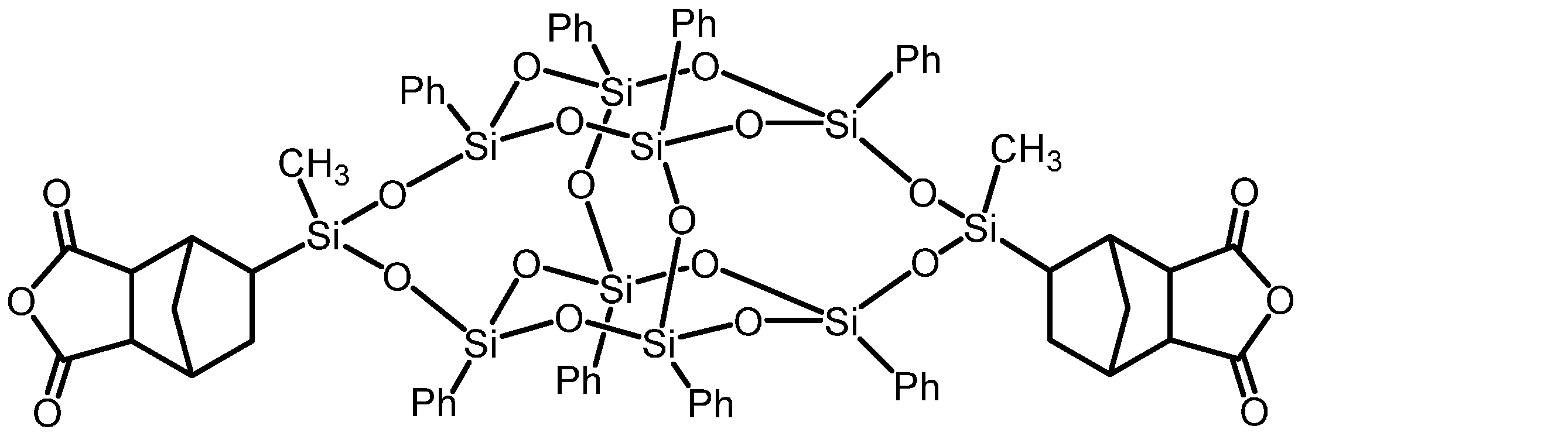
(Synthesis of dihydroxy compound)
Two molar equivalents of tyramine (4-hydroxyphenylethylamine) were added to one molar equivalent of a cage silsesquioxane compound represented by the following formula ("DDSQ-02" manufactured by Japan Materials Technology Co., Ltd.) in dimethylformamide (DMF), and the mixture was stirred at room temperature for two hours.
次いで、トルエンを加えて一晩加熱還流した。このようにしてイミド化反応を行った。得られたイミド化反応溶液に、酢酸エチル、水を加え、その後、有機層を抽出した。抽出した有機層をカラムで精製した。得られた所定留分を濃縮乾固してイミド化反応物(以下、「ジイミド体」という)を得た。反応経路から、ジイミド体は、下記式で表される構造を有するものと推定された。

(ジクロロ体の合成)
Nリッチヘテロ環構造前駆体として3つの窒素原子を含むヘテロ環構造(具体的にはトリアジン構造)を有するシアヌル酸クロリドと、芳香族環構造を有するアニリンとを常法により反応させ、カラムで精製した後にヘキサン晶析することで、下記式で表されるジクロロ体を得た。下記式で表されるように、このジクロロ体において、Nリッチヘテロ環構造と芳香族環構造とは互いに連結基-NH-を介して結合されていた。

Cyanuric chloride having a heterocyclic structure (specifically a triazine structure) containing three nitrogen atoms as an N-rich heterocyclic structure precursor was reacted with aniline having an aromatic ring structure by a conventional method, purified using a column, and then crystallized in hexane to obtain a dichloro product represented by the following formula: As represented by the following formula, in this dichloro product, the N-rich heterocyclic structure and the aromatic ring structure were bonded to each other via the linking group -NH-.
(目的化合物の合成)
上述したようにして得られたジイミド体1.9質量部(0.001モル)と、ジクロロ体0.24質量部(0.001モル)とをアセトン中に溶解し、その後、水酸化ナトリウム水溶液を加えて、室温で一晩撹拌した。このようにして縮重合反応を行った。得られた縮重合反応溶液の有機層を、酢酸エチルで抽出した。その後、抽出した有機層を、濃縮乾固した。このようにして、目的化合物であるイミド化合物bを得た。得られたイミド化合物について、先述の方法と同様の方法にて重量平均分子量(Mw)を測定したところ、11000であった。イミド化合物bは、反応経路から、下記式で表される構造を有する化合物であることが推定された。すなわち、イミド化合物bは、Nリッチヘテロ環構造とかご型PSQ構造とを分子中に有する化合物であった。
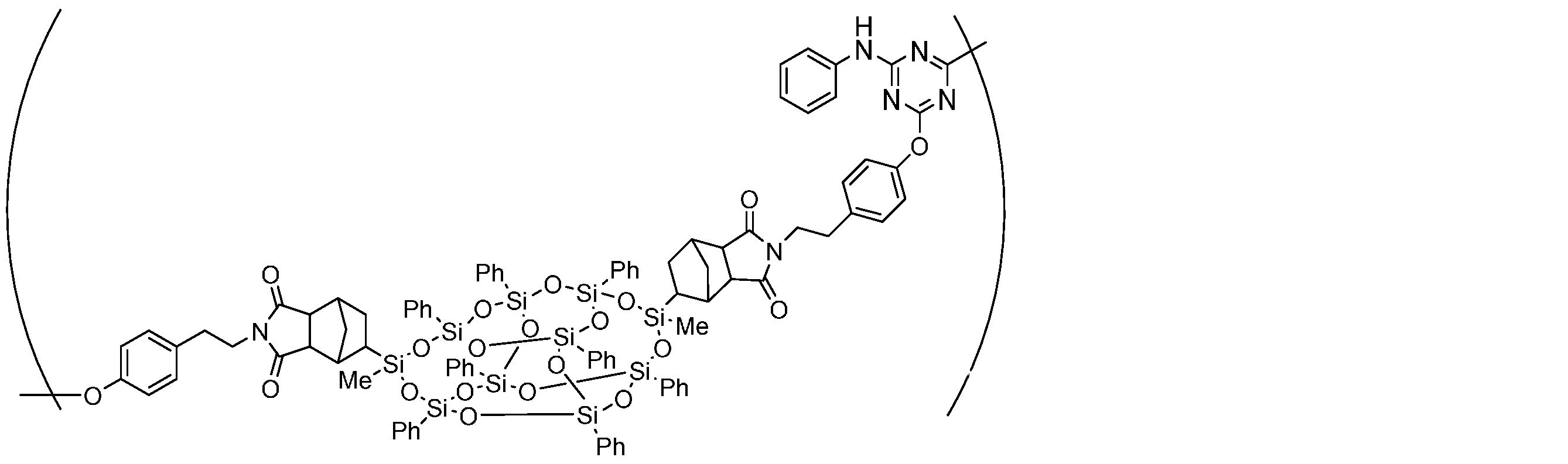
1.9 parts by mass (0.001 mol) of the diimide body obtained as described above and 0.24 parts by mass (0.001 mol) of the dichloro body were dissolved in acetone, and then an aqueous sodium hydroxide solution was added and stirred at room temperature overnight. In this way, a polycondensation reaction was performed. The organic layer of the obtained polycondensation reaction solution was extracted with ethyl acetate. Then, the extracted organic layer was concentrated to dryness. In this way, the target compound, imide compound b, was obtained. The weight average molecular weight (Mw) of the obtained imide compound was measured by the same method as the above-mentioned method, and it was 11000. It was estimated that imide compound b was a compound having a structure represented by the following formula from the reaction path. That is, imide compound b was a compound having an N-rich heterocyclic structure and a cage-type PSQ structure in the molecule.
[合成例2:イミド化合物bの比較対象化合物としてのイミド化合物b’の合成]
イミド化合物bの比較対象化合物としてのイミド化合物b’を含むワニスを以下のようにして調製した。
[Synthesis Example 2: Synthesis of imide compound b' as a comparative compound of imide compound b]
A varnish containing imide compound b' as a comparative compound for imide compound b was prepared as follows.
還流冷却器を連結した水分定量受器、窒素導入管、及び攪拌器を備えた、500mLのセパラブルフラスコを用意した。このフラスコに、4,4’-オキシジフタル酸無水物(ODPA)20.3g、γ-ブチロラクトン200g、トルエン20g、及び、5-(4-アミノフェノキシ)-3-[4-(4-アミノフェノキシ)フェニル]-1,1,3-トリメチルインダン29.6gを加えて、窒素気流下で45℃にて2時間攪拌して反応を行い、反応溶液を得た。 A 500 mL separable flask was prepared, equipped with a water content receiver connected to a reflux condenser, a nitrogen inlet tube, and a stirrer. 20.3 g of 4,4'-oxydiphthalic anhydride (ODPA), 200 g of γ-butyrolactone, 20 g of toluene, and 29.6 g of 5-(4-aminophenoxy)-3-[4-(4-aminophenoxy)phenyl]-1,1,3-trimethylindane were added to the flask, and the mixture was stirred at 45°C for 2 hours under a nitrogen stream to carry out the reaction, yielding a reaction solution.
次いで、この反応溶液を昇温し、約160℃に保持しながら、窒素気流下で縮合水をトルエンとともに共沸除去した。水分定量受器に所定量の水がたまっていること、及び水の流出が見られなくなっていることを確認した。確認後、反応溶液を更に昇温し、200℃で1時間攪拌した。その後、冷却した。このようにして、イミド化合物b’を20質量%含むワニスを得た。 Next, the reaction solution was heated and maintained at approximately 160°C while the condensed water was azeotropically removed with toluene under a nitrogen stream. It was confirmed that a specified amount of water had accumulated in the water content receiver and that no water was leaking out. After confirmation, the reaction solution was further heated and stirred at 200°C for 1 hour. It was then cooled. In this way, a varnish containing 20% by mass of imide compound b' was obtained.
イミド化合物b’は、下記式(X1)で表される繰り返し単位及び下記式(X2)で示す繰り返し単位を有していた。また、イミド化合物b’の重量平均分子量は、先述の方法と同様の方法にて測定したところ、12000であった。また、反応経路から、イミド化合物b’は、イミド化合物bとは異なり、Nリッチヘテロ環構造及びかご型PSQ構造のいずれをも分子中に有していない化合物であることは明らかであった。 Imide compound b' had a repeating unit represented by the following formula (X1) and a repeating unit represented by the following formula (X2). The weight average molecular weight of imide compound b' was measured by the same method as described above and was found to be 12,000. In addition, from the reaction path, it was clear that imide compound b', unlike imide compound b, was a compound that did not have either an N-rich heterocyclic structure or a cage-type PSQ structure in the molecule.


[実施例1]
(1)樹脂ワニスAの調製
(A-1)成分としてのエポキシ樹脂a1a(日本化薬社製のビフェニル型エポキシ樹脂「NC3000L」、エポキシ当量:271g/eq.)5部と、(A-1)成分としてのエポキシ樹脂a1b(DIC社製のナフタレン型エポキシ樹脂「HP-4032SS」、エポキシ当量:144g/eq.)5部と、混合溶剤(ソルベントナフサ20部及びシクロヘキサノン10部)中で、撹拌しながら溶解させた。これにより、エポキシ樹脂含有溶液を得た。
[Example 1]
(1) Preparation of Resin Varnish A 5 parts of epoxy resin a1a (biphenyl type epoxy resin "NC3000L" manufactured by Nippon Kayaku Co., Ltd., epoxy equivalent: 271 g/eq.) as component (A-1) and 5 parts of epoxy resin a1b (naphthalene type epoxy resin "HP-4032SS" manufactured by DIC Corporation, epoxy equivalent: 144 g/eq.) as component (A-1) were dissolved with stirring in a mixed solvent (20 parts of solvent naphtha and 10 parts of cyclohexanone). This produced an epoxy resin-containing solution.
エポキシ樹脂含有溶液へ、(C)成分としての無機充填材c(信越化学工業社製のN-フェニル-8-アミノオクチル-トリメトキシシランで表面処理されたアドマテックス社製の球形シリカ「SC-C2」、比表面積:5.9m2/g、平均粒径:0.77μm)175部と、(B)成分としてのイミド化合物b(合成例1で得たイミド化合物)50部と、(D)成分としての硬化剤da(DIC社製の活性エステル系硬化剤「HPC-8150-62T」、活性基当量:229g/eq.、不揮発成分62質量%のトルエン溶液)8.1部(不揮発成分:5部)と、(E)成分としての硬化促進剤(四国化成社製のイミダゾール系硬化促進剤「1B2PZ」(1-ベンジル-2-フェニルイミダゾール)の不揮発成分10質量%のMEK溶液)2部(不揮発成分:0.2部)とを添加し、混合し、さらに、高速回転ミキサーで均一に分散した。これにより、分散液を得た。 To the epoxy resin-containing solution, an inorganic filler c as component (C) (spherical silica "SC-C2" manufactured by Admatechs Co., Ltd., surface-treated with N-phenyl-8-aminooctyl-trimethoxysilane manufactured by Shin-Etsu Chemical Co., Ltd., specific surface area: 5.9 m2 /g, average particle size: 0.77 μm) 175 parts, (B) component imide compound b (imide compound obtained in Synthesis Example 1) 50 parts, (D) component curing agent da (DIC Corporation active ester curing agent "HPC-8150-62T", active group equivalent: 229 g / eq., toluene solution of 62 mass% nonvolatile components) 8.1 parts (nonvolatile components: 5 parts), (E) component curing accelerator (Shikoku Kasei Corporation imidazole curing accelerator "1B2PZ" (1-benzyl-2-phenylimidazole) MEK solution of 10 mass% nonvolatile components) 2 parts (nonvolatile components: 0.2 parts) were added, mixed, and further dispersed uniformly with a high-speed rotating mixer. Thereby, a dispersion was obtained.
上述したようにして、(A)成分及び(B)成分を少なくとも含有する樹脂組成物の樹脂ワニスを調製した。以下、このように調製される樹脂ワニスを「樹脂ワニスA」ともいう。 As described above, a resin varnish of a resin composition containing at least components (A) and (B) was prepared. Hereinafter, the resin varnish prepared in this manner is also referred to as "resin varnish A."
(2)樹脂シートBの作製
支持体として、アルキド樹脂系離型剤(リンテック社製「AL-5」)で離型処理したPETフィルム(東レ社製「ルミラーR80」、厚み38μm、軟化点130℃、以下「離型PET」ということがある。)を用意した。
(2) Preparation of Resin Sheet B As a support, a PET film ("Lumirror R80" manufactured by Toray Industries, Inc., thickness 38 μm, softening point 130° C., hereinafter sometimes referred to as "release PET") that had been release-treated with an alkyd resin-based release agent ("AL-5" manufactured by Lintec Corporation) was prepared.
樹脂ワニスAを、乾燥後の樹脂組成物層の厚みが25μmとなるよう、離型PET上にダイコーターにて均一に塗布し、80℃で1分間乾燥することにより、離型PET上に樹脂組成物層を得た。次いで、樹脂組成物層の支持体と接合していない面に、保護フィルムとしてポリプロピレンフィルム(王子エフテックス社製「アルファンMA-411」、厚み15μm)の粗面を、樹脂組成物層と接合するように積層した。これにより、離型PET(支持体)、樹脂組成物層、及び保護フィルムの順からなる樹脂シートを得た。以下、このように作製される樹脂シートを「樹脂シートB」ともいう。 Resin varnish A was evenly applied onto release PET using a die coater so that the thickness of the resin composition layer after drying would be 25 μm, and then dried at 80°C for 1 minute to obtain a resin composition layer on the release PET. Next, the rough surface of a polypropylene film (Oji F-Tex Co., Ltd. "Alphan MA-411", thickness 15 μm) was laminated as a protective film onto the surface of the resin composition layer not bonded to the support, so as to be bonded to the resin composition layer. This resulted in a resin sheet consisting of release PET (support), resin composition layer, and protective film in that order. Hereinafter, the resin sheet produced in this manner will also be referred to as "resin sheet B".
[実施例2]
実施例1において、(D)成分としての硬化剤da(「HPC-8150-62T」(不揮発成分:62質量%))8.1部(不揮発成分:5部)を、硬化剤db(DIC社製の活性エステル系硬化剤「HPC-8000-65T」、活性基当量:223g/eq.、不揮発成分65質量%のトルエン溶液)7.7部(不揮発成分:5部)に変更した。
以上の事項以外は実施例1と同様にして、樹脂ワニスAを調製し、樹脂シートBを作製した。
[Example 2]
In Example 1, 8.1 parts (non-volatile components: 5 parts) of curing agent da ("HPC-8150-62T" (non-volatile components: 62% by mass)) as component (D) was changed to 7.7 parts (non-volatile components: 5 parts) of curing agent db (active ester curing agent "HPC-8000-65T" manufactured by DIC Corporation, active group equivalent: 223 g/eq., toluene solution of 65% by mass of non-volatile components).
Except for the above, resin varnish A was prepared and resin sheet B was produced in the same manner as in Example 1.
[実施例3]
実施例1において、(C)成分としての無機充填材c(「SC-C2」)の配合量を175部から220部に変更し、かつ、さらに、(A-2)成分としてのラジカル重合性化合物a2a(日本化薬社製のビフェニルアラルキル型マレイミド化合物「MIR-3000-70MT」、不揮発成分70質量%のMEK/トルエン混合溶液)28.6部(不揮発成分:20部)と、(F)成分としての重合開始剤(日油社製「パーヘキシル(登録商標)D」)0.2部をエポキシ樹脂含有溶液へ配合した。
以上の事項以外は実施例1と同様にして、樹脂ワニスAを調製し、樹脂シートBを作製した。
[Example 3]
In Example 1, the amount of inorganic filler c ("SC-C2") blended as component (C) was changed from 175 parts to 220 parts, and further, 28.6 parts (non-volatile components: 20 parts) of a radically polymerizable compound a2a (biphenylaralkyl-type maleimide compound "MIR-3000-70MT" manufactured by Nippon Kayaku Co., Ltd., a MEK/toluene mixed solution with 70% by mass of non-volatile components) as component (A-2) and 0.2 parts of a polymerization initiator ("Perhexyl (registered trademark) D" manufactured by NOF Corporation) as component (F) were blended into the epoxy resin-containing solution.
Except for the above, resin varnish A was prepared and resin sheet B was produced in the same manner as in Example 1.
[実施例4]
実施例3において、(A-2)成分としてのラジカル重合性化合物a2a(「MIR-3000-70MT」(不揮発成分:70質量%))28.6部(不揮発成分:20部)を、ラジカル重合性化合物a2b(デザイナーモレキュールズ社製のマレイミド化合物「BMI-689」(ダイマージアミンに由来する骨格を有するN-アルキルビスマレイミド、溶剤不含)20部に変更した。
以上の事項以外は実施例3と同様にして、樹脂ワニスAを調製し、樹脂シートBを作製した。
[Example 4]
In Example 3, 28.6 parts (non-volatile components: 20 parts) of the radical polymerizable compound a2a ("MIR-3000-70MT" (non-volatile components: 70% by mass)) as the component (A-2) was changed to 20 parts of the radical polymerizable compound a2b (maleimide compound "BMI-689" manufactured by Designer Molecules (N-alkylbismaleimide having a skeleton derived from dimer diamine, solvent not included).
Except for the above, resin varnish A was prepared and resin sheet B was produced in the same manner as in Example 3.
[実施例5]
実施例3において、(A-2)成分としてのラジカル重合性化合物a2a(「MIR-3000-70MT」(不揮発成分:70質量%))28.6部(不揮発成分:20部)を、ラジカル重合性化合物a2c((三菱ガス化学社製のビニルベンジル変性ポリフェニレンエーテル「OPE-2St 2200」、不揮発成分65%のトルエン溶液)30.7部(不揮発成分:20部)に変更した。
以上の事項以外は実施例3と同様にして、樹脂ワニスAを調製し、樹脂シートBを作製した。
[Example 5]
In Example 3, 28.6 parts (non-volatile components: 20 parts) of the radical polymerizable compound a2a ("MIR-3000-70MT" (non-volatile components: 70% by mass)) as the component (A-2) was changed to 30.7 parts (non-volatile components: 20 parts) of the radical polymerizable compound a2c ((vinylbenzyl-modified polyphenylene ether "OPE-2St 2200" manufactured by Mitsubishi Gas Chemical Company, Inc., a toluene solution containing 65% non-volatile components).
Except for the above, resin varnish A was prepared and resin sheet B was produced in the same manner as in Example 3.
[実施例6]
実施例1において、(C)成分としての無機充填材c(「SC-C2」)の配合量を175部から35部に変更し、かつ、(E)成分としての硬化促進剤(「1B2PZ」(不揮発成分:10質量%)の配合量を2部(不揮発成分:0.2部)から1部(不揮発成分:0.1部)に変更した。
以上の事項以外は実施例1と同様にして、樹脂ワニスAを調製し、樹脂シートBを作製した。
[Example 6]
In Example 1, the amount of inorganic filler c ("SC-C2") as component (C) was changed from 175 parts to 35 parts, and the amount of curing accelerator ("1B2PZ" (non-volatile component: 10% by mass) as component (E) was changed from 2 parts (non-volatile component: 0.2 parts) to 1 part (non-volatile component: 0.1 parts).
Except for the above, resin varnish A was prepared and resin sheet B was produced in the same manner as in Example 1.
[比較例1]
実施例1において、(B)成分としてのイミド化合物b(合成例1で得たイミド化合物)50部に代えて、(B’)成分としてのイミド化合物b’含有ワニス(合成例2で得たイミド化合物のワニス(不揮発成分:20質量%))250部(不揮発成分:50部)をエポキシ樹脂含有溶液へ配合した。
以上の事項以外は実施例1と同様にして、樹脂ワニスAを調製し、樹脂シートBを作製した。
[Comparative Example 1]
In Example 1, instead of 50 parts of the imide compound b (imide compound obtained in Synthesis Example 1) as the component (B), 250 parts (non-volatile component: 50 parts) of the imide compound b'-containing varnish (the imide compound varnish obtained in Synthesis Example 2 (non-volatile component: 20 mass%)) as the component (B') was blended into the epoxy resin-containing solution.
Except for the above, resin varnish A was prepared and resin sheet B was produced in the same manner as in Example 1.
[比較例2]
実施例3において、(B)成分としてのイミド化合物b(合成例1で得たイミド化合物)50部に代えて、(B’)成分としてのイミド化合物b’含有ワニス(合成例2で得たイミド化合物のワニス(不揮発成分:20質量%))250部(不揮発成分:50部)をエポキシ樹脂含有溶液へ配合した。
以上の事項以外は実施例3と同様にして、樹脂ワニスAを調製し、樹脂シートBを作製した。
[Comparative Example 2]
In Example 3, instead of 50 parts of the imide compound b (imide compound obtained in Synthesis Example 1) as the component (B), 250 parts (non-volatile component: 50 parts) of the imide compound b'-containing varnish (the imide compound varnish obtained in Synthesis Example 2 (non-volatile component: 20% by mass)) as the component (B') was blended into the epoxy resin-containing solution.
Except for the above, resin varnish A was prepared and resin sheet B was produced in the same manner as in Example 3.
続いて、各種測定方法・評価方法について説明する。 Next, we will explain various measurement and evaluation methods.
<低反り性の評価>
(1)樹脂シートのラミネート
実施例及び比較例で作製した各樹脂シートBを9.5cm角のサイズに切り出し、保護フィルムを剥離して、バッチ式真空加圧ラミネーター(ニッコー・マテリアルズ社製、2ステージビルドアップラミネーター「CVP700」)を用いて、10cm角に切り取った三井金属鉱業製銅箔「3EC-III(厚さ35μm)」の粗化面にラミネートした。ラミネートは、30秒間減圧して気圧を13hPa以下とした後、120℃で30秒間、圧力0.74MPaにて圧着させることにより、樹脂組成物層付き金属箔を作製し、その後支持体であるPETフィルムを剥離した。
<Evaluation of low warpage>
(1) Lamination of resin sheet Each resin sheet B produced in the examples and comparative examples was cut into a size of 9.5 cm square, the protective film was peeled off, and the resin sheet B was laminated onto the roughened surface of copper foil "3EC-III (thickness 35 μm)" manufactured by Mitsui Mining & Smelting Co., Ltd., cut into a size of 10 cm square, using a batch-type vacuum pressure laminator (two-stage build-up laminator "CVP700" manufactured by Nikko Materials Co., Ltd.). The laminate was prepared by reducing the pressure for 30 seconds to 13 hPa or less, and then pressing at 120 ° C. for 30 seconds at a pressure of 0.74 MPa to produce a metal foil with a resin composition layer, and then peeling off the PET film as the support.
(2)樹脂組成物層の硬化
上記(1)で得られた樹脂組成物層付き金属箔の四辺を、樹脂組成物層が上面になるように厚さ1mmのSUS板にポリイミドテープで貼りつけ、200℃、90分間の硬化条件で樹脂組成物層を硬化させた。
(2) Curing of Resin Composition Layer The four sides of the metal foil with the resin composition layer obtained in (1) above were attached to a 1 mm thick SUS plate with polyimide tape so that the resin composition layer was on the upper surface, and the resin composition layer was cured under curing conditions of 200°C and 90 minutes.
(3)反り量の測定
上記(2)で得られた樹脂組成物層付き金属箔の四辺のうち、三辺のポリイミドテープを剥離し、SUS板から最も高い点の高さを求めることにより反り量を求め、以下の基準で評価した。
○:反り量の大きさが1cm未満。
×:反り量の大きさが1cm以上。
(3) Measurement of warpage The polyimide tape was peeled off from three of the four sides of the metal foil with the resin composition layer obtained in (2) above, and the height of the highest point from the SUS plate was measured to determine the warpage, which was then evaluated according to the following criteria.
A: The amount of warping is less than 1 cm.
×: The amount of warping is 1 cm or more.
<銅箔引き剥がし強度(銅箔密着性)の測定>
(1)銅箔の下地処理
三井金属鉱山社製「3EC-III」(電界銅箔、35μm)の光沢面をマイクロエッチング剤((メック社製「CZ8101」)にて1μmエッチングして銅表面の粗化処理を行い、次いで防錆処理(CL8300)を施した。さらに、130℃のオーブンで30分間加熱処理した。この銅箔をCZ銅箔という。
<Measurement of copper foil peel strength (copper foil adhesion)>
(1) Copper foil undercoat treatment The shiny side of "3EC-III" (electrolytic copper foil, 35 μm) manufactured by Mitsui Mining & Smelting Co., Ltd. was etched to a depth of 1 μm with a microetching agent ("CZ8101" manufactured by MEC Co., Ltd.) to roughen the copper surface, and then an anti-rust treatment (CL8300) was applied. Furthermore, the foil was heated in an oven at 130° C. for 30 minutes. This copper foil is called CZ copper foil.
(2)内層基板の用意
内層回路を形成したガラス布基材エポキシ樹脂両面銅張積層板(銅箔の厚さ18μm、基板の厚さ0.4mm、パナソニック社製「R1515A」)の両面をマイクロエッチング剤(メック社製「CZ8101」)にて1μmエッチングして銅表面の粗化処理を行った。
(2) Preparation of Inner Layer Board Both sides of a glass cloth-based epoxy resin double-sided copper-clad laminate (copper foil thickness 18 μm, board thickness 0.4 mm, Panasonic Corporation "R1515A") on which an inner layer circuit was formed was etched by 1 μm with a microetching agent (Mech Corporation "CZ8101") to roughen the copper surface.
(3)銅箔のラミネートと絶縁層の形成
作製した樹脂シートBから保護フィルムを剥がして、樹脂組成物層を露出させた。バッチ式真空加圧ラミネーター(ニッコー・マテリアルズ社製、2ステージビルドアップラミネーター「CVP700」)を用いて、樹脂組成物層が内層基板と接するように、内層基板の両面にラミネートした。ラミネートは、30秒間減圧して気圧を13hPa以下に調整した後、120℃、圧力0.74MPaにて30秒間圧着させることにより実施した。次いで、100℃、圧力0.5MPaにて60秒間熱プレスを行った。その樹脂組成物層上に、CZ銅箔の処理面を、上記と同様の条件で、ラミネートした。そして、200℃、90分の硬化条件で樹脂組成物層を硬化して絶縁層を形成することで、評価基板を作製した。
(3) Lamination of copper foil and formation of insulating layer The protective film was peeled off from the prepared resin sheet B to expose the resin composition layer. Using a batch type vacuum pressure laminator (manufactured by Nikko Materials Co., Ltd., two-stage build-up laminator "CVP700"), the resin composition layer was laminated on both sides of the inner layer substrate so that it was in contact with the inner layer substrate. The lamination was performed by reducing the pressure for 30 seconds to adjust the air pressure to 13 hPa or less, and then pressing at 120 ° C. and a pressure of 0.74 MPa for 30 seconds. Next, a heat press was performed at 100 ° C. and a pressure of 0.5 MPa for 60 seconds. The treated surface of the CZ copper foil was laminated on the resin composition layer under the same conditions as above. Then, the resin composition layer was cured under a curing condition of 200 ° C. and 90 minutes to form an insulating layer, thereby preparing an evaluation substrate.
(4)信頼性試験前の銅箔密着性の測定
作製した評価基板を150×30mmの小片に切断した。小片の銅箔部分に、カッターを用いて幅10mm、長さ100mmの部分の切込みをいれて、銅箔の一端を剥がしてつかみ具で掴み、室温中にて、50mm/分の速度で垂直方向に35mmを引き剥がした時の荷重(kgf/cm)を測定し、剥離強度を求めた。測定には、引っ張り試験機(TSE社製「AC-50C-SL」)を使用した。測定は日本工業規格(JIS C6481)に準拠して行い、信頼性試験前の銅箔密着性について以下の基準で評価した。
〇:密着性が0.40kgf/cm以上
×:密着性が0.40kgf/cm未満
(4) Measurement of copper foil adhesion before reliability test The prepared evaluation board was cut into small pieces of 150 x 30 mm. A cutter was used to make a 10 mm wide and 100 mm long cut in the copper foil part of the small piece, one end of the copper foil was peeled off and gripped with a gripper, and the load (kgf/cm) when 35 mm was peeled off in the vertical direction at a speed of 50 mm/min at room temperature was measured to determine the peel strength. A tensile tester ("AC-50C-SL" manufactured by TSE) was used for the measurement. The measurement was performed in accordance with the Japanese Industrial Standards (JIS C6481), and the copper foil adhesion before the reliability test was evaluated according to the following criteria.
Good: Adhesion is 0.40 kgf/cm or more. Bad: Adhesion is less than 0.40 kgf/cm.
<誘電特性(誘電率、誘電正接)の評価>
実施例及び比較例で作成した各樹脂シートBから、保護フィルムを剥がして、200℃にて90分間加熱して樹脂組成物層を熱硬化させた後、支持体を剥離した。得られた硬化物を、幅2mm、長さ80mmの試験片に切断した。該試験片について、アジレントテクノロジーズ社製「HP8362B」を用いて、空洞共振摂動法により測定周波数5.8GHz、測定温度23℃にて誘電率(Dk)、誘電正接(Df)を測定した。3本の試験片について測定を行い、平均値を算出した。
<Evaluation of dielectric properties (dielectric constant, dielectric tangent)>
The protective film was peeled off from each resin sheet B prepared in the examples and comparative examples, and the resin composition layer was thermally cured by heating at 200°C for 90 minutes, and then the support was peeled off. The obtained cured product was cut into a test piece having a width of 2 mm and a length of 80 mm. The dielectric constant (Dk) and dielectric loss tangent (Df) of the test piece were measured at a measurement frequency of 5.8 GHz and a measurement temperature of 23°C by a cavity resonance perturbation method using an "HP8362B" manufactured by Agilent Technologies. Measurements were performed on three test pieces, and the average value was calculated.
また、誘電特性について以下の基準で評価した。
〇:誘電率が3.2未満であり、かつ、誘電正接が0.0032未満
×:誘電率が3.2以上、及び、誘電正接が0.0032以上の少なくとも一方を満たす
The dielectric properties were evaluated according to the following criteria.
Good: The dielectric constant is less than 3.2 and the dielectric dissipation factor is less than 0.0032. Bad: At least one of the dielectric constant being 3.2 or more and the dielectric dissipation factor being 0.0032 or more is satisfied.
実施例1~6及び比較例1~2の結果を表1に示す。 The results of Examples 1 to 6 and Comparative Examples 1 and 2 are shown in Table 1.
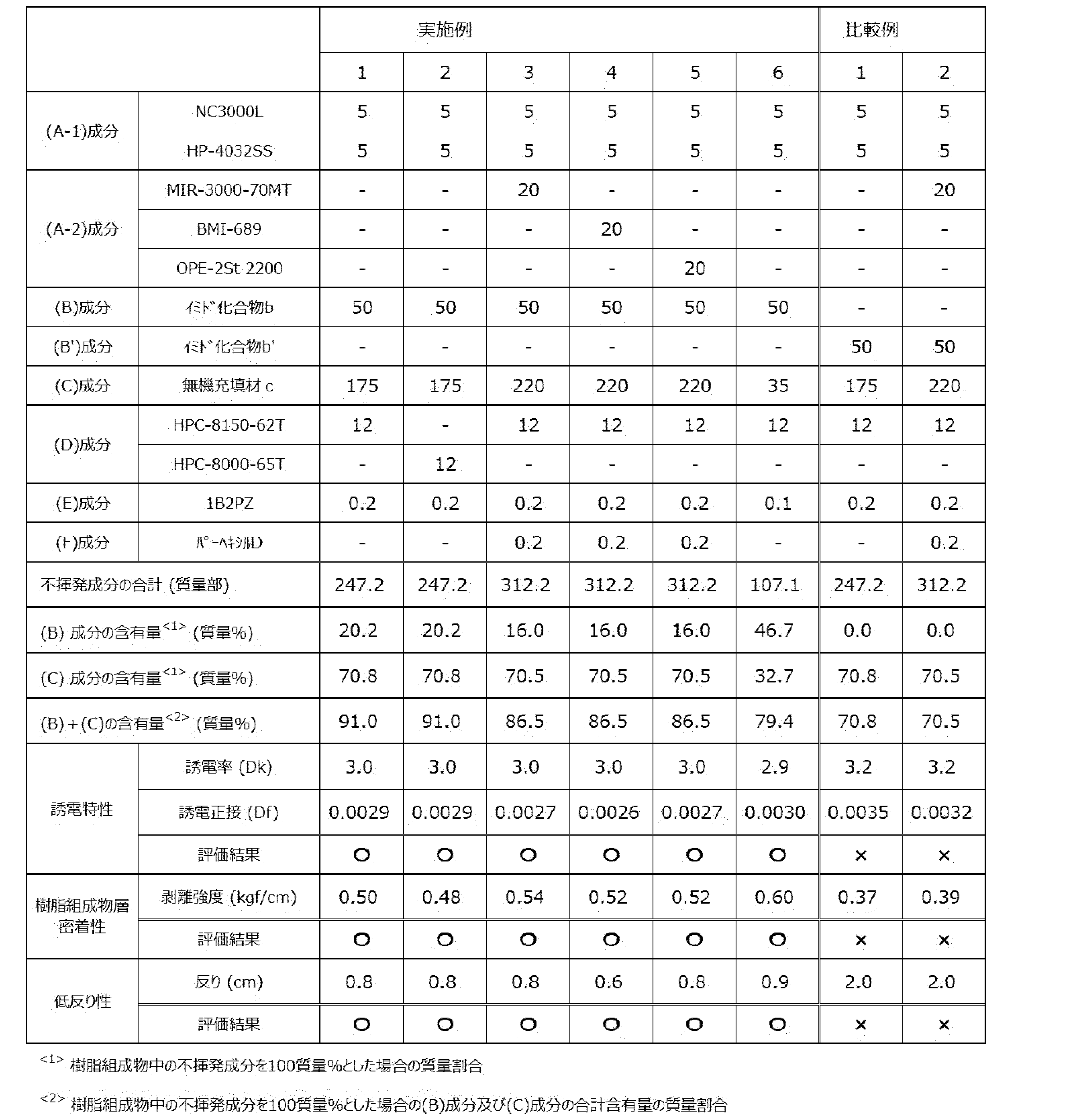
実施例1~6において、(A-1)成分及び(D)成分を含有しない場合であっても、硬化系が異なる場合、例えば(A-2)成分及び(F)成分を含む場合において、程度に差はあるものの、上記実施例と同様の結果に帰着することを確認している。 In Examples 1 to 6, even if the components (A-1) and (D) are not included, it has been confirmed that when the curing system is different, for example when the components (A-2) and (F) are included, the results are similar to those of the above examples, although to a different extent.
Claims (19)
(B)窒素原子を2つ以上含むヘテロ環構造と、かご型シルセスキオキサン構造とを分子中に有する化合物
を含有する樹脂組成物であって、
(A)成分が、エポキシ樹脂を含み、
(B)成分における、窒素原子を2つ以上含むヘテロ環構造が、トリアジン構造であり、
(B)成分において、ヘテロ環構造と、かご型シルセスキオキサン構造との間に、イミド結合が介在し、
(B)成分の重量平均分子量(Mw)が3000以上である、樹脂組成物。 A resin composition comprising: (A) a curable resin; and (B) a compound having a heterocyclic structure containing two or more nitrogen atoms and a cage-type silsesquioxane structure in the molecule,
The component (A) contains an epoxy resin,
the heterocyclic structure containing two or more nitrogen atoms in the component (B) is a triazine structure,
In the component (B), an imide bond is present between the heterocyclic structure and the cage silsesquioxane structure,
A resin composition, wherein the weight average molecular weight (Mw) of component (B) is 3,000 or more .

Xは、それぞれ独立して、水素原子がハロゲン原子で置き換えられていてもよい炭素数1~40のアルキル基、炭素数4~10のシクロアルキル基、水素原子がハロゲン原子又は炭素数1~20のアルキル基で置き換えられていてもよいアリール基、及び、水素原子がハロゲン原子又は炭素数1~20のアルキル基で置き換えられていてもよいアリール基が炭素数1~8のアルキレン基に結合したアリールアルキル基から選択される基であり;
Yは、それぞれ独立して、水素原子がハロゲン原子で置き換えられていてもよい炭素数1~40のアルキル基、炭素数4~10のシクロアルキル基、水素原子がハロゲン原子又は炭素数1~20のアルキル基で置き換えられていてもよいアリール基、及び、水素原子がハロゲン原子又は炭素数1~20のアルキル基で置き換えられていてもよいアリール基が炭素数1~8のアルキレン基に結合したアリールアルキル基から選択される基であり;
*は、結合手であり;
X又はYが炭素数1~40のアルキル基である場合、当該アルキル基に含まれる-CH2-は、-O-又は-CH=CH-で置き換えられていてもよく;
X又はYがアリール基である場合において、当該アリール基の水素原子が炭素数1~20のアルキル基で置き換えられているときは、当該炭素数1~20のアルキル基の水素原子がハロゲン原子で置き換えられていてもよく、当該炭素数1~20のアルキル基に含まれる-CH2-は、-O-又は-CH=CH-で置き換えられていてもよく;
X又はYがアリールアルキル基である場合、当該アリールアルキル基に含まれる-CH2-は、-O-で置き換えられていてもよい。] The resin composition according to any one of claims 1 to 3 , wherein the cage silsesquioxane structure comprises a cage structure represented by the following formula (B1):
X's are each independently a group selected from an alkyl group having 1 to 40 carbon atoms in which a hydrogen atom may be replaced by a halogen atom, a cycloalkyl group having 4 to 10 carbon atoms, an aryl group in which a hydrogen atom may be replaced by a halogen atom or an alkyl group having 1 to 20 carbon atoms, and an arylalkyl group in which an aryl group in which a hydrogen atom may be replaced by a halogen atom or an alkyl group having 1 to 20 carbon atoms is bonded to an alkylene group having 1 to 8 carbon atoms;
Each Y is independently a group selected from an alkyl group having 1 to 40 carbon atoms in which a hydrogen atom may be replaced by a halogen atom, a cycloalkyl group having 4 to 10 carbon atoms, an aryl group in which a hydrogen atom may be replaced by a halogen atom or an alkyl group having 1 to 20 carbon atoms, and an arylalkyl group in which an aryl group in which a hydrogen atom may be replaced by a halogen atom or an alkyl group having 1 to 20 carbon atoms is bonded to an alkylene group having 1 to 8 carbon atoms;
* is a bond;
When X or Y is an alkyl group having 1 to 40 carbon atoms, --CH 2 -- contained in the alkyl group may be replaced by --O-- or --CH═CH--;
When X or Y is an aryl group, and a hydrogen atom of the aryl group is replaced by an alkyl group having 1 to 20 carbon atoms, a hydrogen atom of the alkyl group having 1 to 20 carbon atoms may be replaced by a halogen atom, and -CH 2 - contained in the alkyl group having 1 to 20 carbon atoms may be replaced by -O- or -CH═CH-;
When X or Y is an arylalkyl group, --CH 2 -- contained in the arylalkyl group may be replaced by --O--.]
Priority Applications (1)
| Application Number | Priority Date | Filing Date | Title |
|---|---|---|---|
| JP2021032056A JP7608873B2 (en) | 2021-03-01 | 2021-03-01 | Resin composition, cured product, resin sheet, printed wiring board and semiconductor device |
Applications Claiming Priority (1)
| Application Number | Priority Date | Filing Date | Title |
|---|---|---|---|
| JP2021032056A JP7608873B2 (en) | 2021-03-01 | 2021-03-01 | Resin composition, cured product, resin sheet, printed wiring board and semiconductor device |
Publications (2)
| Publication Number | Publication Date |
|---|---|
| JP2022133145A JP2022133145A (en) | 2022-09-13 |
| JP7608873B2 true JP7608873B2 (en) | 2025-01-07 |
Family
ID=83229504
Family Applications (1)
| Application Number | Title | Priority Date | Filing Date |
|---|---|---|---|
| JP2021032056A Active JP7608873B2 (en) | 2021-03-01 | 2021-03-01 | Resin composition, cured product, resin sheet, printed wiring board and semiconductor device |
Country Status (1)
| Country | Link |
|---|---|
| JP (1) | JP7608873B2 (en) |
Families Citing this family (2)
| Publication number | Priority date | Publication date | Assignee | Title |
|---|---|---|---|---|
| CN117720396B (en) * | 2024-02-06 | 2024-04-26 | 南京道尔医药研究院有限公司 | Preparation method of cis-bicyclo [3.1.0] hex-3-ol |
| CN120535674A (en) * | 2025-07-25 | 2025-08-26 | 营口市向阳催化剂有限责任公司 | A metallocene polyethylene catalyst, preparation method, application and related products |
Citations (6)
| Publication number | Priority date | Publication date | Assignee | Title |
|---|---|---|---|---|
| JP2004196958A (en) | 2002-12-18 | 2004-07-15 | Asahi Kasei Corp | Cage-like silsesquioxane compound containing a crosslinking group |
| JP2011504525A (en) | 2007-11-15 | 2011-02-10 | 日東電工株式会社 | Light emitting device and light emitting composition |
| WO2014046095A1 (en) | 2012-09-18 | 2014-03-27 | Jnc株式会社 | Epoxy and alkoxy silyl group-containing silsesquioxane and composition thereof |
| WO2018037565A1 (en) | 2016-08-26 | 2018-03-01 | Jnc株式会社 | Epoxy resin composition and cured resin film with low curing shrinkage and excellent adhesion |
| CN111234435A (en) | 2020-03-12 | 2020-06-05 | 四川大学 | A recyclable polyethylene cable insulation material |
| WO2022004756A1 (en) | 2020-06-30 | 2022-01-06 | 味の素株式会社 | Resin composition |
Family Cites Families (1)
| Publication number | Priority date | Publication date | Assignee | Title |
|---|---|---|---|---|
| JPH04330709A (en) * | 1991-04-25 | 1992-11-18 | Matsushita Electric Ind Co Ltd | Fine-pattern formation material and pattern formation method |
-
2021
- 2021-03-01 JP JP2021032056A patent/JP7608873B2/en active Active
Patent Citations (6)
| Publication number | Priority date | Publication date | Assignee | Title |
|---|---|---|---|---|
| JP2004196958A (en) | 2002-12-18 | 2004-07-15 | Asahi Kasei Corp | Cage-like silsesquioxane compound containing a crosslinking group |
| JP2011504525A (en) | 2007-11-15 | 2011-02-10 | 日東電工株式会社 | Light emitting device and light emitting composition |
| WO2014046095A1 (en) | 2012-09-18 | 2014-03-27 | Jnc株式会社 | Epoxy and alkoxy silyl group-containing silsesquioxane and composition thereof |
| WO2018037565A1 (en) | 2016-08-26 | 2018-03-01 | Jnc株式会社 | Epoxy resin composition and cured resin film with low curing shrinkage and excellent adhesion |
| CN111234435A (en) | 2020-03-12 | 2020-06-05 | 四川大学 | A recyclable polyethylene cable insulation material |
| WO2022004756A1 (en) | 2020-06-30 | 2022-01-06 | 味の素株式会社 | Resin composition |
Also Published As
| Publication number | Publication date |
|---|---|
| JP2022133145A (en) | 2022-09-13 |
Similar Documents
| Publication | Publication Date | Title |
|---|---|---|
| JP7647636B2 (en) | Resin composition | |
| JP7639303B2 (en) | Resin composition, cured product, resin sheet, printed wiring board and semiconductor device | |
| JP7505526B2 (en) | Resin sheet and resin composition | |
| JP7532932B2 (en) | Resin composition | |
| JP7298383B2 (en) | Resin composition, cured product of resin composition, resin sheet, printed wiring board and semiconductor device | |
| JP7774963B2 (en) | resin composition | |
| JP7494715B2 (en) | Resin composition | |
| JP7593348B2 (en) | Resin composition | |
| JP7647942B2 (en) | Resin composition, cured product, sheet-like laminate material, resin sheet, printed wiring board, and semiconductor device | |
| JP7770771B2 (en) | resin composition | |
| TWI899347B (en) | Resin sheet with support | |
| JP2025028240A (en) | Resin composition | |
| JP7560398B2 (en) | Resin composition | |
| JP7601049B2 (en) | Resin composition | |
| JP2022133145A (en) | Resin composition, cured product, resin sheet, printed wiring board and semiconductor device | |
| JP7700456B2 (en) | resin composition | |
| JP7414143B2 (en) | resin composition | |
| JP2023010628A (en) | resin composition | |
| TW202534132A (en) | silicone resin | |
| JP7367720B2 (en) | Manufacturing method of printed wiring board | |
| JP7472839B2 (en) | Resin composition | |
| KR20220170772A (en) | Resin composition | |
| JP7718274B2 (en) | resin composition | |
| JP7694625B2 (en) | compound | |
| JP7826647B2 (en) | resin composition |
Legal Events
| Date | Code | Title | Description |
|---|---|---|---|
| A621 | Written request for application examination |
Free format text: JAPANESE INTERMEDIATE CODE: A621 Effective date: 20231211 |
|
| A977 | Report on retrieval |
Free format text: JAPANESE INTERMEDIATE CODE: A971007 Effective date: 20240821 |
|
| A131 | Notification of reasons for refusal |
Free format text: JAPANESE INTERMEDIATE CODE: A131 Effective date: 20240827 |
|
| A521 | Request for written amendment filed |
Free format text: JAPANESE INTERMEDIATE CODE: A523 Effective date: 20241018 |
|
| TRDD | Decision of grant or rejection written | ||
| A01 | Written decision to grant a patent or to grant a registration (utility model) |
Free format text: JAPANESE INTERMEDIATE CODE: A01 Effective date: 20241119 |
|
| A61 | First payment of annual fees (during grant procedure) |
Free format text: JAPANESE INTERMEDIATE CODE: A61 Effective date: 20241202 |
|
| R150 | Certificate of patent or registration of utility model |
Ref document number: 7608873 Country of ref document: JP Free format text: JAPANESE INTERMEDIATE CODE: R150 |