JP7592829B2 - Resin Molding - Google Patents
Resin Molding Download PDFInfo
- Publication number
- JP7592829B2 JP7592829B2 JP2023191620A JP2023191620A JP7592829B2 JP 7592829 B2 JP7592829 B2 JP 7592829B2 JP 2023191620 A JP2023191620 A JP 2023191620A JP 2023191620 A JP2023191620 A JP 2023191620A JP 7592829 B2 JP7592829 B2 JP 7592829B2
- Authority
- JP
- Japan
- Prior art keywords
- mass
- resin molded
- thermoplastic resin
- crosslinked
- expanded beads
- Prior art date
- Legal status (The legal status is an assumption and is not a legal conclusion. Google has not performed a legal analysis and makes no representation as to the accuracy of the status listed.)
- Active
Links
- 229920005989 resin Polymers 0.000 title claims description 83
- 239000011347 resin Substances 0.000 title claims description 83
- 238000000465 moulding Methods 0.000 title description 13
- 239000011324 bead Substances 0.000 claims description 76
- 229920005992 thermoplastic resin Polymers 0.000 claims description 49
- 230000006835 compression Effects 0.000 claims description 35
- 238000007906 compression Methods 0.000 claims description 35
- 239000002245 particle Substances 0.000 claims description 23
- 238000012360 testing method Methods 0.000 claims description 7
- 125000006850 spacer group Chemical group 0.000 claims description 2
- 238000004519 manufacturing process Methods 0.000 description 23
- 238000004132 cross linking Methods 0.000 description 21
- 239000006087 Silane Coupling Agent Substances 0.000 description 17
- 239000004711 α-olefin Substances 0.000 description 15
- 238000006243 chemical reaction Methods 0.000 description 14
- 238000010438 heat treatment Methods 0.000 description 14
- 238000002156 mixing Methods 0.000 description 11
- 239000011148 porous material Substances 0.000 description 11
- 229920002725 thermoplastic elastomer Polymers 0.000 description 11
- 125000005370 alkoxysilyl group Chemical group 0.000 description 10
- 230000000052 comparative effect Effects 0.000 description 10
- 239000002994 raw material Substances 0.000 description 10
- 239000004088 foaming agent Substances 0.000 description 9
- -1 polypropylene Polymers 0.000 description 9
- 229920000089 Cyclic olefin copolymer Polymers 0.000 description 8
- 229920001577 copolymer Polymers 0.000 description 7
- 238000010586 diagram Methods 0.000 description 7
- 238000000034 method Methods 0.000 description 7
- 239000013530 defoamer Substances 0.000 description 6
- 239000003999 initiator Substances 0.000 description 6
- 125000004432 carbon atom Chemical group C* 0.000 description 5
- 239000003054 catalyst Substances 0.000 description 5
- 238000011156 evaluation Methods 0.000 description 5
- 239000004611 light stabiliser Substances 0.000 description 5
- VXNZUUAINFGPBY-UHFFFAOYSA-N 1-Butene Chemical compound CCC=C VXNZUUAINFGPBY-UHFFFAOYSA-N 0.000 description 4
- KWKAKUADMBZCLK-UHFFFAOYSA-N 1-octene Chemical compound CCCCCCC=C KWKAKUADMBZCLK-UHFFFAOYSA-N 0.000 description 4
- 239000004156 Azodicarbonamide Substances 0.000 description 4
- 150000001412 amines Chemical class 0.000 description 4
- XOZUGNYVDXMRKW-AATRIKPKSA-N azodicarbonamide Chemical compound NC(=O)\N=N\C(N)=O XOZUGNYVDXMRKW-AATRIKPKSA-N 0.000 description 4
- 235000019399 azodicarbonamide Nutrition 0.000 description 4
- 239000011230 binding agent Substances 0.000 description 4
- 239000006260 foam Substances 0.000 description 4
- 150000002978 peroxides Chemical class 0.000 description 4
- 239000002530 phenolic antioxidant Substances 0.000 description 4
- 150000001336 alkenes Chemical class 0.000 description 3
- FUZZWVXGSFPDMH-UHFFFAOYSA-N hexanoic acid Chemical compound CCCCCC(O)=O FUZZWVXGSFPDMH-UHFFFAOYSA-N 0.000 description 3
- 239000000203 mixture Substances 0.000 description 3
- JRZJOMJEPLMPRA-UHFFFAOYSA-N olefin Natural products CCCCCCCC=C JRZJOMJEPLMPRA-UHFFFAOYSA-N 0.000 description 3
- 230000008569 process Effects 0.000 description 3
- SCPYDCQAZCOKTP-UHFFFAOYSA-N silanol Chemical compound [SiH3]O SCPYDCQAZCOKTP-UHFFFAOYSA-N 0.000 description 3
- 239000000126 substance Substances 0.000 description 3
- 125000000391 vinyl group Chemical group [H]C([*])=C([H])[H] 0.000 description 3
- AFFLGGQVNFXPEV-UHFFFAOYSA-N 1-decene Chemical compound CCCCCCCCC=C AFFLGGQVNFXPEV-UHFFFAOYSA-N 0.000 description 2
- LIKMAJRDDDTEIG-UHFFFAOYSA-N 1-hexene Chemical compound CCCCC=C LIKMAJRDDDTEIG-UHFFFAOYSA-N 0.000 description 2
- OZAIFHULBGXAKX-UHFFFAOYSA-N 2-(2-cyanopropan-2-yldiazenyl)-2-methylpropanenitrile Chemical compound N#CC(C)(C)N=NC(C)(C)C#N OZAIFHULBGXAKX-UHFFFAOYSA-N 0.000 description 2
- WSSSPWUEQFSQQG-UHFFFAOYSA-N 4-methyl-1-pentene Chemical compound CC(C)CC=C WSSSPWUEQFSQQG-UHFFFAOYSA-N 0.000 description 2
- WWZKQHOCKIZLMA-UHFFFAOYSA-N Caprylic acid Natural products CCCCCCCC(O)=O WWZKQHOCKIZLMA-UHFFFAOYSA-N 0.000 description 2
- VGGSQFUCUMXWEO-UHFFFAOYSA-N Ethene Chemical compound C=C VGGSQFUCUMXWEO-UHFFFAOYSA-N 0.000 description 2
- 239000005977 Ethylene Substances 0.000 description 2
- CTQNGGLPUBDAKN-UHFFFAOYSA-N O-Xylene Chemical compound CC1=CC=CC=C1C CTQNGGLPUBDAKN-UHFFFAOYSA-N 0.000 description 2
- PPBRXRYQALVLMV-UHFFFAOYSA-N Styrene Chemical compound C=CC1=CC=CC=C1 PPBRXRYQALVLMV-UHFFFAOYSA-N 0.000 description 2
- UWHZIFQPPBDJPM-FPLPWBNLSA-M Vaccenic acid Natural products CCCCCC\C=C/CCCCCCCCCC([O-])=O UWHZIFQPPBDJPM-FPLPWBNLSA-M 0.000 description 2
- 239000000654 additive Substances 0.000 description 2
- DTOSIQBPPRVQHS-PDBXOOCHSA-N alpha-linolenic acid Chemical compound CC\C=C/C\C=C/C\C=C/CCCCCCCC(O)=O DTOSIQBPPRVQHS-PDBXOOCHSA-N 0.000 description 2
- 230000015572 biosynthetic process Effects 0.000 description 2
- UWHZIFQPPBDJPM-FPLPWBNLSA-N cis-vaccenic acid Chemical compound CCCCCC\C=C/CCCCCCCCCC(O)=O UWHZIFQPPBDJPM-FPLPWBNLSA-N 0.000 description 2
- 125000004122 cyclic group Chemical group 0.000 description 2
- HOBAELRKJCKHQD-QNEBEIHSSA-N dihomo-γ-linolenic acid Chemical compound CCCCC\C=C/C\C=C/C\C=C/CCCCCCC(O)=O HOBAELRKJCKHQD-QNEBEIHSSA-N 0.000 description 2
- 230000000694 effects Effects 0.000 description 2
- 239000000155 melt Substances 0.000 description 2
- TVMXDCGIABBOFY-UHFFFAOYSA-N n-Octanol Natural products CCCCCCCC TVMXDCGIABBOFY-UHFFFAOYSA-N 0.000 description 2
- YWAKXRMUMFPDSH-UHFFFAOYSA-N pentene Chemical compound CCCC=C YWAKXRMUMFPDSH-UHFFFAOYSA-N 0.000 description 2
- 238000012545 processing Methods 0.000 description 2
- 230000009257 reactivity Effects 0.000 description 2
- 229920006395 saturated elastomer Polymers 0.000 description 2
- 235000003441 saturated fatty acids Nutrition 0.000 description 2
- 150000004671 saturated fatty acids Chemical class 0.000 description 2
- 238000010998 test method Methods 0.000 description 2
- 229920002803 thermoplastic polyurethane Polymers 0.000 description 2
- 235000021122 unsaturated fatty acids Nutrition 0.000 description 2
- 150000004670 unsaturated fatty acids Chemical class 0.000 description 2
- 239000008096 xylene Substances 0.000 description 2
- YEBDWAHEIMUJQT-ZLCLUPBPSA-N (5z,8z,11z,14z)-icosa-5,8,11,14-tetraenoic acid Chemical compound CCCCC\C=C/C\C=C/C\C=C/C\C=C/CCCC(O)=O.CCCCC\C=C/C\C=C/C\C=C/C\C=C/CCCC(O)=O YEBDWAHEIMUJQT-ZLCLUPBPSA-N 0.000 description 1
- XVEIGUQEXNENQF-LNMUMINZSA-N (6Z,9Z,12Z)-octadeca-6,9,12-trienoic acid Chemical compound CCCCC\C=C/C\C=C/C\C=C/CCCCC(O)=O.CCCCC\C=C/C\C=C/C\C=C/CCCCC(O)=O XVEIGUQEXNENQF-LNMUMINZSA-N 0.000 description 1
- HOBAELRKJCKHQD-UHFFFAOYSA-N (8Z,11Z,14Z)-8,11,14-eicosatrienoic acid Natural products CCCCCC=CCC=CCC=CCCCCCCC(O)=O HOBAELRKJCKHQD-UHFFFAOYSA-N 0.000 description 1
- DJCQJZKZUCHHAL-UHFFFAOYSA-N (Z)-9-Pentadecensaeure Natural products CCCCCC=CCCCCCCCC(O)=O DJCQJZKZUCHHAL-UHFFFAOYSA-N 0.000 description 1
- QJNQLPGSJDHSMB-GWUWOWPBSA-N (Z)-hexadec-9-enoic acid (Z)-octadec-9-enoic acid Chemical compound CCCCCC\C=C/CCCCCCCC(O)=O.CCCCCCCC\C=C/CCCCCCCC(O)=O QJNQLPGSJDHSMB-GWUWOWPBSA-N 0.000 description 1
- YZAZXIUFBCPZGB-FJEDDJBMSA-N (e)-octadec-9-enoic acid Chemical compound CCCCCCCC\C=C\CCCCCCCC(O)=O.CCCCCCCC\C=C\CCCCCCCC(O)=O YZAZXIUFBCPZGB-FJEDDJBMSA-N 0.000 description 1
- ZJVATSUMFCZSKA-QZOPMXJLSA-N (z)-docos-13-enoic acid Chemical compound CCCCCCCC\C=C/CCCCCCCCCCCC(O)=O.CCCCCCCC\C=C/CCCCCCCCCCCC(O)=O ZJVATSUMFCZSKA-QZOPMXJLSA-N 0.000 description 1
- JYDNQSLNPKOEII-BZSWNNBUSA-N (z)-hexadec-9-enoic acid Chemical compound CCCCCC\C=C/CCCCCCCC(O)=O.CCCCCC\C=C/CCCCCCCC(O)=O JYDNQSLNPKOEII-BZSWNNBUSA-N 0.000 description 1
- DHEMVUXAYZGHFQ-QZOPMXJLSA-N (z)-tetracos-15-enoic acid Chemical compound CCCCCCCC\C=C/CCCCCCCCCCCCCC(O)=O.CCCCCCCC\C=C/CCCCCCCCCCCCCC(O)=O DHEMVUXAYZGHFQ-QZOPMXJLSA-N 0.000 description 1
- VBICKXHEKHSIBG-UHFFFAOYSA-N 1-monostearoylglycerol Chemical compound CCCCCCCCCCCCCCCCCC(=O)OCC(O)CO VBICKXHEKHSIBG-UHFFFAOYSA-N 0.000 description 1
- GOOMUPCAOADBSA-UHFFFAOYSA-N 1-n,2-n-dimethyl-1-n,2-n-dinitrosobenzene-1,2-dicarboxamide Chemical compound O=NN(C)C(=O)C1=CC=CC=C1C(=O)N(C)N=O GOOMUPCAOADBSA-UHFFFAOYSA-N 0.000 description 1
- FRPZMMHWLSIFAZ-UHFFFAOYSA-N 10-undecenoic acid Chemical compound OC(=O)CCCCCCCCC=C FRPZMMHWLSIFAZ-UHFFFAOYSA-N 0.000 description 1
- ULQISTXYYBZJSJ-UHFFFAOYSA-N 12-hydroxyoctadecanoic acid Chemical compound CCCCCCC(O)CCCCCCCCCCC(O)=O ULQISTXYYBZJSJ-UHFFFAOYSA-N 0.000 description 1
- ODBCKCWTWALFKM-UHFFFAOYSA-N 2,5-bis(tert-butylperoxy)-2,5-dimethylhex-3-yne Chemical compound CC(C)(C)OOC(C)(C)C#CC(C)(C)OOC(C)(C)C ODBCKCWTWALFKM-UHFFFAOYSA-N 0.000 description 1
- DMWVYCCGCQPJEA-UHFFFAOYSA-N 2,5-bis(tert-butylperoxy)-2,5-dimethylhexane Chemical compound CC(C)(C)OOC(C)(C)CCC(C)(C)OOC(C)(C)C DMWVYCCGCQPJEA-UHFFFAOYSA-N 0.000 description 1
- XMNIXWIUMCBBBL-UHFFFAOYSA-N 2-(2-phenylpropan-2-ylperoxy)propan-2-ylbenzene Chemical compound C=1C=CC=CC=1C(C)(C)OOC(C)(C)C1=CC=CC=C1 XMNIXWIUMCBBBL-UHFFFAOYSA-N 0.000 description 1
- KIHBGTRZFAVZRV-UHFFFAOYSA-N 2-Hydroxyoctadecanoic acid Natural products CCCCCCCCCCCCCCCCC(O)C(O)=O KIHBGTRZFAVZRV-UHFFFAOYSA-N 0.000 description 1
- ATRRKUHOCOJYRX-UHFFFAOYSA-N Ammonium bicarbonate Chemical compound [NH4+].OC([O-])=O ATRRKUHOCOJYRX-UHFFFAOYSA-N 0.000 description 1
- 229910000013 Ammonium bicarbonate Inorganic materials 0.000 description 1
- 239000004604 Blowing Agent Substances 0.000 description 1
- MWRWFPQBGSZWNV-UHFFFAOYSA-N Dinitrosopentamethylenetetramine Chemical compound C1N2CN(N=O)CN1CN(N=O)C2 MWRWFPQBGSZWNV-UHFFFAOYSA-N 0.000 description 1
- OYHQOLUKZRVURQ-HZJYTTRNSA-N Linoleic acid Chemical compound CCCCC\C=C/C\C=C/CCCCCCCC(O)=O OYHQOLUKZRVURQ-HZJYTTRNSA-N 0.000 description 1
- 239000006057 Non-nutritive feed additive Substances 0.000 description 1
- 239000004698 Polyethylene Substances 0.000 description 1
- 239000004743 Polypropylene Substances 0.000 description 1
- 230000002292 Radical scavenging effect Effects 0.000 description 1
- UIIMBOGNXHQVGW-DEQYMQKBSA-M Sodium bicarbonate-14C Chemical compound [Na+].O[14C]([O-])=O UIIMBOGNXHQVGW-DEQYMQKBSA-M 0.000 description 1
- NIXOWILDQLNWCW-UHFFFAOYSA-N acrylic acid group Chemical group C(C=C)(=O)O NIXOWILDQLNWCW-UHFFFAOYSA-N 0.000 description 1
- 229920000122 acrylonitrile butadiene styrene Polymers 0.000 description 1
- 235000020661 alpha-linolenic acid Nutrition 0.000 description 1
- 235000012538 ammonium bicarbonate Nutrition 0.000 description 1
- 239000001099 ammonium carbonate Substances 0.000 description 1
- 239000003963 antioxidant agent Substances 0.000 description 1
- OGBUMNBNEWYMNJ-UHFFFAOYSA-N batilol Chemical class CCCCCCCCCCCCCCCCCCOCC(O)CO OGBUMNBNEWYMNJ-UHFFFAOYSA-N 0.000 description 1
- VJRITMATACIYAF-UHFFFAOYSA-N benzenesulfonohydrazide Chemical compound NNS(=O)(=O)C1=CC=CC=C1 VJRITMATACIYAF-UHFFFAOYSA-N 0.000 description 1
- GONOPSZTUGRENK-UHFFFAOYSA-N benzyl(trichloro)silane Chemical compound Cl[Si](Cl)(Cl)CC1=CC=CC=C1 GONOPSZTUGRENK-UHFFFAOYSA-N 0.000 description 1
- 229920001400 block copolymer Polymers 0.000 description 1
- PASOAYSIZAJOCT-UHFFFAOYSA-N butanoic acid Chemical compound CCCC(O)=O.CCCC(O)=O PASOAYSIZAJOCT-UHFFFAOYSA-N 0.000 description 1
- CJZGTCYPCWQAJB-UHFFFAOYSA-L calcium stearate Chemical compound [Ca+2].CCCCCCCCCCCCCCCCCC([O-])=O.CCCCCCCCCCCCCCCCCC([O-])=O CJZGTCYPCWQAJB-UHFFFAOYSA-L 0.000 description 1
- 239000008116 calcium stearate Substances 0.000 description 1
- 235000013539 calcium stearate Nutrition 0.000 description 1
- KHAVLLBUVKBTBG-UHFFFAOYSA-N caproleic acid Natural products OC(=O)CCCCCCCC=C KHAVLLBUVKBTBG-UHFFFAOYSA-N 0.000 description 1
- 239000003795 chemical substances by application Substances 0.000 description 1
- 238000004581 coalescence Methods 0.000 description 1
- 239000003086 colorant Substances 0.000 description 1
- 150000001875 compounds Chemical class 0.000 description 1
- 239000006258 conductive agent Substances 0.000 description 1
- 239000003431 cross linking reagent Substances 0.000 description 1
- HABLENUWIZGESP-UHFFFAOYSA-N decanoic acid Chemical compound CCCCCCCCCC(O)=O.CCCCCCCCCC(O)=O HABLENUWIZGESP-UHFFFAOYSA-N 0.000 description 1
- 238000000354 decomposition reaction Methods 0.000 description 1
- 230000006866 deterioration Effects 0.000 description 1
- 239000012933 diacyl peroxide Substances 0.000 description 1
- AYOHIQLKSOJJQH-UHFFFAOYSA-N dibutyltin Chemical compound CCCC[Sn]CCCC AYOHIQLKSOJJQH-UHFFFAOYSA-N 0.000 description 1
- 235000014113 dietary fatty acids Nutrition 0.000 description 1
- AGDANEVFLMAYGL-UHFFFAOYSA-N docosanoic acid Chemical compound CCCCCCCCCCCCCCCCCCCCCC(O)=O.CCCCCCCCCCCCCCCCCCCCCC(O)=O AGDANEVFLMAYGL-UHFFFAOYSA-N 0.000 description 1
- WLGSIWNFEGRXDF-UHFFFAOYSA-N dodecanoic acid Chemical compound CCCCCCCCCCCC(O)=O.CCCCCCCCCCCC(O)=O WLGSIWNFEGRXDF-UHFFFAOYSA-N 0.000 description 1
- 125000003700 epoxy group Chemical group 0.000 description 1
- UAUDZVJPLUQNMU-KTKRTIGZSA-N erucamide Chemical compound CCCCCCCC\C=C/CCCCCCCCCCCC(N)=O UAUDZVJPLUQNMU-KTKRTIGZSA-N 0.000 description 1
- FWDBOZPQNFPOLF-UHFFFAOYSA-N ethenyl(triethoxy)silane Chemical compound CCO[Si](OCC)(OCC)C=C FWDBOZPQNFPOLF-UHFFFAOYSA-N 0.000 description 1
- NKSJNEHGWDZZQF-UHFFFAOYSA-N ethenyl(trimethoxy)silane Chemical compound CO[Si](OC)(OC)C=C NKSJNEHGWDZZQF-UHFFFAOYSA-N 0.000 description 1
- 238000001125 extrusion Methods 0.000 description 1
- 229930195729 fatty acid Natural products 0.000 description 1
- 239000000194 fatty acid Substances 0.000 description 1
- 150000004665 fatty acids Chemical class 0.000 description 1
- 239000000945 filler Substances 0.000 description 1
- 238000011049 filling Methods 0.000 description 1
- 239000003063 flame retardant Substances 0.000 description 1
- 229920000578 graft copolymer Polymers 0.000 description 1
- KYYWBEYKBLQSFW-UHFFFAOYSA-N hexadecanoic acid Chemical compound CCCCCCCCCCCCCCCC(O)=O.CCCCCCCCCCCCCCCC(O)=O KYYWBEYKBLQSFW-UHFFFAOYSA-N 0.000 description 1
- LYOAURRGAXEXGO-GWSMSICGSA-N icosanoic acid;(5z,8z,11z,14z)-icosa-5,8,11,14-tetraenoic acid Chemical compound CCCCCCCCCCCCCCCCCCCC(O)=O.CCCCC\C=C/C\C=C/C\C=C/C\C=C/CCCC(O)=O LYOAURRGAXEXGO-GWSMSICGSA-N 0.000 description 1
- 235000020778 linoleic acid Nutrition 0.000 description 1
- OYHQOLUKZRVURQ-IXWMQOLASA-N linoleic acid Natural products CCCCC\C=C/C\C=C\CCCCCCCC(O)=O OYHQOLUKZRVURQ-IXWMQOLASA-N 0.000 description 1
- 229960004488 linolenic acid Drugs 0.000 description 1
- 239000000314 lubricant Substances 0.000 description 1
- 239000000463 material Substances 0.000 description 1
- 238000005259 measurement Methods 0.000 description 1
- 238000002844 melting Methods 0.000 description 1
- 230000008018 melting Effects 0.000 description 1
- 229910052751 metal Inorganic materials 0.000 description 1
- 239000002184 metal Substances 0.000 description 1
- 125000005395 methacrylic acid group Chemical group 0.000 description 1
- 238000012986 modification Methods 0.000 description 1
- 230000004048 modification Effects 0.000 description 1
- ALIFPGGMJDWMJH-UHFFFAOYSA-N n-phenyldiazenylaniline Chemical compound C=1C=CC=CC=1NN=NC1=CC=CC=C1 ALIFPGGMJDWMJH-UHFFFAOYSA-N 0.000 description 1
- JVDHPAUNFBGCFT-UHFFFAOYSA-N octadeca-12,15-dienoic acid Chemical compound CCC=CCC=CCCCCCCCCCCC(O)=O JVDHPAUNFBGCFT-UHFFFAOYSA-N 0.000 description 1
- RQFLGKYCYMMRMC-UHFFFAOYSA-N octadecanoic acid Chemical compound CCCCCCCCCCCCCCCCCC(O)=O.CCCCCCCCCCCCCCCCCC(O)=O RQFLGKYCYMMRMC-UHFFFAOYSA-N 0.000 description 1
- 230000000704 physical effect Effects 0.000 description 1
- 229920000728 polyester Polymers 0.000 description 1
- 229920000573 polyethylene Polymers 0.000 description 1
- 229920001155 polypropylene Polymers 0.000 description 1
- 229920000915 polyvinyl chloride Polymers 0.000 description 1
- 239000004800 polyvinyl chloride Substances 0.000 description 1
- 238000002360 preparation method Methods 0.000 description 1
- 230000001737 promoting effect Effects 0.000 description 1
- 238000000197 pyrolysis Methods 0.000 description 1
- 239000002516 radical scavenger Substances 0.000 description 1
- 229920005604 random copolymer Polymers 0.000 description 1
- WBHHMMIMDMUBKC-XLNAKTSKSA-N ricinelaidic acid Chemical compound CCCCCC[C@@H](O)C\C=C\CCCCCCCC(O)=O WBHHMMIMDMUBKC-XLNAKTSKSA-N 0.000 description 1
- 229960003656 ricinoleic acid Drugs 0.000 description 1
- FEUQNCSVHBHROZ-UHFFFAOYSA-N ricinoleic acid Natural products CCCCCCC(O[Si](C)(C)C)CC=CCCCCCCCC(=O)OC FEUQNCSVHBHROZ-UHFFFAOYSA-N 0.000 description 1
- 230000002000 scavenging effect Effects 0.000 description 1
- 239000000344 soap Substances 0.000 description 1
- 230000001629 suppression Effects 0.000 description 1
- CBYCSRICVDBHMZ-UHFFFAOYSA-N tetracosanoic acid Chemical compound CCCCCCCCCCCCCCCCCCCCCCCC(O)=O.CCCCCCCCCCCCCCCCCCCCCCCC(O)=O CBYCSRICVDBHMZ-UHFFFAOYSA-N 0.000 description 1
- ZTUXEFFFLOVXQE-UHFFFAOYSA-N tetradecanoic acid Chemical compound CCCCCCCCCCCCCC(O)=O.CCCCCCCCCCCCCC(O)=O ZTUXEFFFLOVXQE-UHFFFAOYSA-N 0.000 description 1
- 229920006346 thermoplastic polyester elastomer Polymers 0.000 description 1
- 229960002703 undecylenic acid Drugs 0.000 description 1
Images


Landscapes
- Manufacture Of Porous Articles, And Recovery And Treatment Of Waste Products (AREA)
Description
本開示は、樹脂成形体、及び樹脂成形体の製造方法に関する。 This disclosure relates to a resin molded body and a method for manufacturing a resin molded body.
複数の発泡粒子を連結してなる樹脂成形体の製造方法が知られている(例えば、特許文献1~3参照)。樹脂成形体の製造には、加圧蒸気などの加熱媒体を使用した蒸気成形が一般的である。加熱媒体の温度は、発泡粒子同士の融着が可能となるように、発泡粒子を構成する樹脂の融点付近で行うことが一般的である。
加熱媒体として、蒸気を用いた場合には、発泡粒子に未架橋部分がある程度存在しないと、発泡粒子同士が相互に融着しない。つまり、発泡粒子の架橋程度をあまり高くすることはできない。よって、架橋程度の高くない発泡粒子を用いることから、架橋程度の高い樹脂成形体は作製が困難となる。もちろん、架橋程度の高い発泡粒子を用いても、バインダーを用いて発泡粒子同士を相互に連結すれば、架橋程度の高い樹脂成形体を作製できる。ところが、バインダーは、耐熱性、圧縮強度等の樹脂成形体の性能に影響を与えてしまう。
このように、架橋程度の高い発泡粒子の蒸気成形は困難であり、バインダーを用いることも好ましくないことから、現状の発泡粒子を用いた樹脂成形体は、架橋の程度が低くなっている。
Methods for producing a resin molded body formed by connecting a plurality of expanded beads are known (see, for example, Patent Documents 1 to 3). The resin molded body is generally produced by steam molding using a heating medium such as pressurized steam. The temperature of the heating medium is generally set to be near the melting point of the resin constituting the expanded beads so that the expanded beads can be fused together.
When steam is used as the heating medium, the expanded beads will not fuse to each other unless there is a certain amount of uncrosslinked parts in the expanded beads. In other words, the degree of crosslinking of the expanded beads cannot be made very high. Therefore, it is difficult to produce a resin molded product with a high degree of crosslinking by using expanded beads with a low degree of crosslinking. Of course, even if expanded beads with a high degree of crosslinking are used, a resin molded product with a high degree of crosslinking can be produced by connecting the expanded beads to each other using a binder. However, the binder affects the performance of the resin molded product, such as heat resistance and compressive strength.
As described above, steam molding of expanded beads with a high degree of crosslinking is difficult, and the use of a binder is also undesirable, so that currently, resin molded articles using expanded beads have a low degree of crosslinking.
以上のように、現状の樹脂成形体は、架橋の程度が低いため、圧縮永久ひずみの性能が必ずしも十分ではなく、改良が求められていた。
本開示は、上記実情に鑑みてなされたものであり、架橋の程度が高く、圧縮永久ひずみが良好な樹脂成形体を提供することを目的とする。本開示は、以下の形態として実現することが可能である。
As described above, currently available resin moldings have a low degree of crosslinking, and therefore do not necessarily have sufficient compression set performance, and improvements have been required.
The present disclosure has been made in view of the above circumstances, and has an object to provide a resin molded article having a high degree of crosslinking and good compression set. The present disclosure can be realized in the following aspects.
〔1〕複数の発泡粒子が連結されてなる樹脂成形体であって、
前記発泡粒子は、熱可塑性樹脂、前記熱可塑性樹脂100質量部に対して0.4質量部以上3.5質量部以下のシランカップリング剤、破泡剤、及び発泡剤を含む原料を用いて製造されており、
前記発泡粒子は、架橋熱可塑性樹脂を含有し、
前記架橋熱可塑性樹脂は、前記熱可塑性樹脂がシロキサン結合にて架橋された架橋構造を有し、
前記発泡粒子は、表面に孔部を有し、
各前記発泡粒子同士は、シロキサン結合にて接着しており、
本樹脂成形体のゲル分率が50%以上99%以下である樹脂成形体。
[1] A resin molded article formed by connecting a plurality of foamed particles,
The expanded beads are produced using raw materials including a thermoplastic resin, a silane coupling agent in an amount of 0.4 parts by mass or more and 3.5 parts by mass or less relative to 100 parts by mass of the thermoplastic resin, a cell breaker, and a foaming agent;
The expanded beads contain a crosslinked thermoplastic resin,
The crosslinked thermoplastic resin has a crosslinked structure in which the thermoplastic resin is crosslinked by a siloxane bond,
The expanded beads have holes on a surface thereof,
The foamed particles are bonded to each other by siloxane bonds,
The resin molded article has a gel fraction of 50% or more and 99% or less.
本開示の樹脂成形体は、架橋の程度が高く、圧縮永久ひずみが低い。 The resin molded body of the present disclosure has a high degree of crosslinking and low compression set.
ここで、本開示の望ましい例を示す。
〔2〕硬さが、アスカーCスケールで5以上30以下である、〔1〕に記載の樹脂成形体。
硬さがこの範囲内であると実用性が高い。
〔3〕圧縮強度が、35kPa以上100kPa以下である、〔1〕又は〔2〕に記載の樹脂成形体。
圧縮強度がこの範囲内であると実用性が高い。
〔4〕圧縮永久歪が、5%以上50%以下である、〔1〕から〔3〕までのいずれか一項に記載の樹脂成形体。
圧縮永久歪がこの範囲内であると実用性が高い。
〔5〕熱可塑性樹脂、前記熱可塑性樹脂100質量部に対して0.4質量部以上3.5質量部以下のシランカップリング剤、破泡剤、及び発泡剤を含む原料から発泡粒子を製造する第1工程と、
型の中に前記発泡粒子を入れて、水分を含む加熱媒体で加熱し、前記発泡粒子が連結されてなる樹脂成形体を製造する第2工程と、
を備える、樹脂成形体の製造方法。
この製造方法では、架橋の程度が高く、圧縮永久ひずみが低い樹脂成形体を製造できる。
〔6〕前記発泡粒子のゲル分率は、20%以上70%以下であり、
前記樹脂成形体のゲル分率は、前記発泡粒子のゲル分率よりも大きく、かつ50%以上99%以下の範囲内である、〔5〕に記載の樹脂成形体の製造方法。
この製造方法では、架橋の程度が高く、圧縮永久ひずみが低い樹脂成形体を製造できる。
〔7〕前記加熱工程において、前記発泡粒子同士は、シロキサン結合にて接着する、〔5〕又は〔6〕に記載の樹脂成形体の製造方法。
この製造方法では、バインダーを用いていないから、耐熱性、圧縮強度等が良好な樹脂成形体を製造できる。
以下、本発明を詳しく説明する。なお、"x~y"という範囲を示す表記は、特に断りが無い限り、当該範囲にxとyが入るものとする。
Here, a preferred example of the present disclosure is given.
[2] The resin molded body according to [1], having a hardness of 5 or more and 30 or less on the Asker C scale.
If the hardness falls within this range, it is highly practical.
[3] The resin molded body according to [1] or [2], having a compressive strength of 35 kPa or more and 100 kPa or less.
If the compressive strength is within this range, it is highly practical.
[4] The resin molded article according to any one of [1] to [3], having a compression set of 5% or more and 50% or less.
If the compression set is within this range, the composition is highly practical.
[5] A first step of producing expanded particles from a raw material including a thermoplastic resin, a silane coupling agent in an amount of 0.4 parts by mass or more and 3.5 parts by mass or less per 100 parts by mass of the thermoplastic resin, a cell breaker, and a foaming agent;
a second step of placing the expanded beads in a mold and heating the molded product with a heating medium containing moisture to produce a resin molded product in which the expanded beads are bonded together;
A method for producing a resin molded body comprising the steps of:
This manufacturing method makes it possible to produce a resin molded article having a high degree of crosslinking and low compression set.
[6] The gel fraction of the expanded beads is 20% or more and 70% or less,
The method for producing a resin molded body according to [5], wherein a gel fraction of the resin molded body is greater than a gel fraction of the expanded beads and is within a range of 50% to 99%.
This manufacturing method makes it possible to produce a resin molded article having a high degree of crosslinking and low compression set.
[7] The method for producing a resin molded product according to [5] or [6], wherein in the heating step, the foamed particles are bonded to each other via siloxane bonds.
This manufacturing method does not use a binder, so that it is possible to manufacture a resin molded article having good heat resistance, compressive strength, etc.
The present invention will be described in detail below. Note that, when a range is indicated as "x to y", both x and y are included in the range unless otherwise specified.
1.樹脂成形体1
樹脂成形体1は、複数の発泡粒子3が連結されてなる(図1参照)。発泡粒子3は、熱可塑性樹脂、熱可塑性樹脂100質量部に対して0.4質量部以上3.5質量部以下のシランカップリング剤、破泡剤、及び発泡剤を含む原料を用いて製造されている。発泡粒子は、架橋熱可塑性樹脂を含有する。架橋熱可塑性樹脂は、熱可塑性樹脂がシロキサン結合にて架橋された架橋構造を有する。発泡粒子は、表面に孔部を有する。各発泡粒子同士は、シロキサン結合にて接着している。樹脂成形体のゲル分率が50%以上99%以下である。
1. Resin molded body 1
The resin molded body 1 is formed by connecting a plurality of expanded beads 3 (see FIG. 1). The expanded
(1)発泡粒子3の原料
(1.1)熱可塑性樹脂
熱可塑性樹脂は、オレフィン系熱可塑性エラストマー(TPO)、ポリプロピレン、ポリエチレン、ABS樹脂、ポリ塩化ビニル、熱可塑性ゴム架橋体(TPV)、スチレン系熱可塑性エラストマー(TPS)、TPEE(ポリエステル系熱可塑性エラストマー)、及びウレタン系熱可塑性エラストマー(TPU)からなる群より選択される1種以上であることが好ましい。流通量が多く安価で選択できる硬度、流動性の範囲が広いという観点から、オレフィン系熱可塑性エラストマー(TPO)が好ましい。
(1) Raw materials for the expanded particles 3 (1.1) Thermoplastic resin The thermoplastic resin is preferably at least one selected from the group consisting of olefin thermoplastic elastomer (TPO), polypropylene, polyethylene, ABS resin, polyvinyl chloride, thermoplastic rubber crosslinked body (TPV), styrene thermoplastic elastomer (TPS), TPEE (polyester thermoplastic elastomer), and urethane thermoplastic elastomer (TPU). Olefin thermoplastic elastomer (TPO) is preferred from the viewpoints of being widely distributed, inexpensive, and having a wide range of selectable hardness and fluidity.
オレフィン系熱可塑性エラストマー(TPO)としては、例えば、エチレン-α-オレフィン共重合体を用いることができる。
エチレン-α-オレフィン共重合体は、エチレンに由来する構造単位と炭素原子数4~10個のα-オレフィンから選ばれる少なくとも1種のα-オレフィンに由来する構造単位とを有する共重合体である。エチレン-α-オレフィン共重合体は、ランダム共重合体、ブロック共重合体、グラフト共重合体のいずれでもよい。
As the olefin-based thermoplastic elastomer (TPO), for example, an ethylene-α-olefin copolymer can be used.
The ethylene-α-olefin copolymer is a copolymer having structural units derived from ethylene and structural units derived from at least one α-olefin selected from α-olefins having 4 to 10 carbon atoms. The ethylene-α-olefin copolymer may be any of a random copolymer, a block copolymer, and a graft copolymer.
エチレン-α-オレフィン共重合体に用いられる炭素原子数4~10個のα-オレフィンとして、具体的には、1-オクテン、1-ブテン、1-ペンテン、1-ヘキセン、4-メチル-1-ペンテン、1-デセン、環状構造を有するα-オレフィン等が挙げられ、好ましくは1-オクテン、1-ブテンが用いられる。 Specific examples of α-olefins having 4 to 10 carbon atoms used in ethylene-α-olefin copolymers include 1-octene, 1-butene, 1-pentene, 1-hexene, 4-methyl-1-pentene, 1-decene, and α-olefins having a cyclic structure, with 1-octene and 1-butene being preferred.
エチレン-α-オレフィン共重合体に含有される炭素原子数4~10個のα-オレフィンから選ばれる少なくとも1種のα-オレフィンに由来する構造単位の含有量は、好ましくは1質量%以上49質量%以下であり、より好ましくは1質量%以上30質量%以下であり、更に好ましくは1質量%以上20質量%以下である(エチレン-α-オレフィン共重合体の全体の質量を100質量%とする)。 The content of structural units derived from at least one α-olefin selected from α-olefins having 4 to 10 carbon atoms contained in the ethylene-α-olefin copolymer is preferably 1% by mass to 49% by mass, more preferably 1% by mass to 30% by mass, and even more preferably 1% by mass to 20% by mass (the total mass of the ethylene-α-olefin copolymer is taken as 100% by mass).
エチレン-α-オレフィン共重合体として、具体的には、エチレン-1-オクテン共重合体、エチレン-1-ブテン共重合体、エチレン-1-ヘキセン共重合体、エチレン-1-デセン共重合体、エチレン-(3-メチル-1-ブテン)共重合体、エチレンと環状構造を有するα-オレフィンとの共重合体等が挙げられる。 Specific examples of ethylene-α-olefin copolymers include ethylene-1-octene copolymers, ethylene-1-butene copolymers, ethylene-1-hexene copolymers, ethylene-1-decene copolymers, ethylene-(3-methyl-1-butene) copolymers, and copolymers of ethylene and α-olefins having a cyclic structure.
エチレン-α-オレフィン共重合体としては、例えば、ダウ・ケミカル日本株式会社製のエンゲージ(ENGAGE 商標)を例示できる。 An example of an ethylene-α-olefin copolymer is ENGAGE (trademark) manufactured by Dow Chemical Japan Ltd.
熱可塑性樹脂のメルトフローレート(MFR)は、特に限定されない。
熱可塑性樹脂のメルトフローレート(MFR)は、押出成形性の観点から、ASTM D 1238に準拠して、190℃・2.16kg荷重で測定した値として、0.5~10g/10分であることが好ましい。
The melt flow rate (MFR) of the thermoplastic resin is not particularly limited.
From the viewpoint of extrusion moldability, the melt flow rate (MFR) of the thermoplastic resin is preferably 0.5 to 10 g/10 min, as measured at 190° C. under a load of 2.16 kg in accordance with ASTM D 1238.
(1.2)シランカップリング剤
シランカップリング剤は、特に限定されない。シランカップリング剤は、架橋剤として用いられる。シランカップリング剤は、アルコキシシリル基を有するものが好ましい。アルコキシシリル基を有するシランカップリング剤としては、ビニル基を有するアルコキシシリル化合物、エポキシ基を有するアルコキシシリル化合物、アクリル基又はメタクリル基を有するアルコキシシリル化合物等が挙げられ、1種類又は2種類上併用することができる。特に、ビニル基を有するアルコキシシリル化合物は、熱可塑性樹脂との反応性が良好であり、コストも安価であることから、より好ましい。具体的なビニル基を有するアルコキシシリル化合物としては、ビニルトリメトキシシラン、ビニルトリエトキシシラン等が挙げられる。
(1.2) Silane coupling agent The silane coupling agent is not particularly limited. The silane coupling agent is used as a crosslinking agent. The silane coupling agent is preferably one having an alkoxysilyl group. Examples of the silane coupling agent having an alkoxysilyl group include an alkoxysilyl compound having a vinyl group, an alkoxysilyl compound having an epoxy group, and an alkoxysilyl compound having an acrylic group or a methacrylic group, and one or more types can be used in combination. In particular, an alkoxysilyl compound having a vinyl group is more preferable because it has good reactivity with thermoplastic resins and is inexpensive. Specific examples of the alkoxysilyl compound having a vinyl group include vinyltrimethoxysilane and vinyltriethoxysilane.
シランカップリング剤の配合割合は、圧縮永久ひずみが抑制された樹脂成形体1とする観点から、ベース樹脂(熱可塑性樹脂)100質量部に対して、下限値に関し、0.4質量部以上であり、0.75質量部以上が好ましく、1.0質量部以上がより好ましい。上限値に関して、発泡粒子3が脆くならずに壊れにくいという観点から3.5質量部以下であり、2.5質量部以下が好ましく、1.5質量部以下がより好ましい。よって、シランカップリング剤の配合割合は、0.4質量部以上3.5質量部以下であり、0.75質量部以上2.0質量部以下が好ましく、1.0質量部以上1.5質量部以下がより好ましい。
The mixing ratio of the silane coupling agent is 0.4 parts by mass or more, preferably 0.75 parts by mass or more, and more preferably 1.0 parts by mass or more, relative to 100 parts by mass of the base resin (thermoplastic resin), from the viewpoint of obtaining a resin molded body 1 with suppressed compression set. The upper limit is 3.5 parts by mass or less, preferably 2.5 parts by mass or less, and more preferably 1.5 parts by mass or less, from the viewpoint of preventing the expanded
(1.3)発泡剤
発泡剤は、加熱により分解してガスを発生する熱分解型のものが好適に用いられ、特に制限されるものではない。例えば、アゾジカルボンアミド、2,2’-アゾビスイソブチロニトリル、ジアゾアミノベンゼン、ベンゼンスルホニルヒドラジド、ベンゼン-1,3-スルホニルヒドラジド、ジフェニルオキシド-4,4’-ジスルフォニルヒドラジド、4,4’-オキシビスベンゼンスルフォニルヒドラジド、パラトルエンスルフォニルヒドラジド、N,N’-ジニトロソペンタメチレンテトラミン、N,N’-ジニトロソ-N,N’-ジメチルフタルアミド、テレフタルアジド、p-t-ブチルベンズアジド、重炭酸ナトリウム、重炭酸アンモニウム等の一種又は二種以上が用いられる。特にアゾジカルボンアミド、4,4’-オキシビスベンゼンスルホニルヒドラジドが好適である。
発泡剤の配合割合は、ベース樹脂(熱可塑性樹脂)100質量部に対して2質量部以上6質量部以下が好ましく、3質量部以上5質量部以下がより好ましい。
(1.3) Foaming agent The foaming agent is preferably a pyrolysis type foaming agent that decomposes by heating to generate gas, and is not particularly limited. For example, one or more of azodicarbonamide, 2,2'-azobisisobutyronitrile, diazoaminobenzene, benzenesulfonylhydrazide, benzene-1,3-sulfonylhydrazide, diphenyloxide-4,4'-disulfonylhydrazide, 4,4'-oxybisbenzenesulfonylhydrazide, paratoluenesulfonylhydrazide, N,N'-dinitrosopentamethylenetetramine, N,N'-dinitroso-N,N'-dimethylphthalamide, terephthalazide, p-t-butylbenzazide, sodium bicarbonate, ammonium bicarbonate, etc. are used. In particular, azodicarbonamide and 4,4'-oxybisbenzenesulfonylhydrazide are preferred.
The mixing ratio of the foaming agent is preferably from 2 to 6 parts by mass, and more preferably from 3 to 5 parts by mass, per 100 parts by mass of the base resin (thermoplastic resin).
(1.4)破泡剤
原料は、破泡剤を含有している。破泡剤は、1種又は2種以上を組み合わせて用いることができる。
破泡剤としては、例えば、炭素原子数が30以下(より好適には、炭素原子数が8~24)の直鎖状の飽和又は不飽和脂肪酸のモノグリセリド及びジグリセリドの1種又は2種以上を組み合わせて用いることができる。直鎖状の飽和又は不飽和脂肪酸としては、例えば、酪酸(ブタン酸)、カプロン酸(ヘキサン酸)、カプリル酸(オクタン酸)、カプリン酸(デカン酸)、ラウリン酸(ドデカン酸)、ミリスチン酸(テトラデカン酸)、パルミチン酸(ヘキサデカン酸)、ステアリン酸(オクタデカン酸)、アラキドン酸(エイコサン酸)、ベヘン酸(ドコサン酸)、リグノセリン酸(テトラコサン酸)、パルミトレイン酸((Z)-9-ヘキサデセン酸)、オレイン酸((Z)-9-ヘキサデセン酸)、エライジン酸((E)-9-オクタデセン酸)、シスバクセン酸((Z)-11-オクタデセン酸)リノール酸((9Z,12Z)-9,12-オクタデカジエン酸)、α-リノレン酸((9Z,12Z,15Z)-9,12,15-オクタデカトリエン酸)、γ-リノレン酸((6Z,9Z,12Z)-6,9,12-オクタデカトリエン酸)、ジ・ホモ-γ-リノレン酸((8Z,11Z,14Z)-8,11,14-エイコサトリエン酸)、アラキドン酸((5Z,8Z,11Z,14Z)-5,8,11,14-エイコサテトラエン酸)、エルカ酸((Z)-13-ドコセン酸)、ネルボン酸((Z)-15-テトラコセン酸)、リシノール酸、ヒドロキシステアリン酸、ウンデシレン酸及びこれらの混合物が好適に例示される。破泡剤としては、例えば、グリセリンモノステアレートが好適に使用される。
破泡剤の配合割合は、発泡時にシュリンクさせることなく所望の発泡粒子を得る観点から、ベース樹脂(熱可塑性樹脂)100質量部に対して、下限値に関し、0.05質量部以上が好ましく、0.1質量部以上がより好ましく、0.25質量部以上が更に好ましい。上限値に関して、発泡時にシュリンクさせることなく所望の発泡粒子を得る観点から5質量部以下が好ましく、3.0質量部以下がより好ましく、1.5質量部以下が更に好ましい。よって、破泡剤の配合割合は、0.05質量部以上5質量部以下が好ましく、0.1質量部以上3.0質量部以下がより好ましく、0.25質量部以上1.5質量部以下が更に好ましい。
(1.4) Cell opener The raw material contains a cell opener. The cell opener may be used alone or in combination of two or more.
As the foam breaker, for example, one or a combination of two or more monoglycerides and diglycerides of linear saturated or unsaturated fatty acids having 30 or less carbon atoms (more preferably 8 to 24 carbon atoms) can be used. Examples of linear saturated or unsaturated fatty acids include butyric acid (butanoic acid), caproic acid (hexanoic acid), caprylic acid (octanoic acid), capric acid (decanoic acid), lauric acid (dodecanoic acid), myristic acid (tetradecanoic acid), palmitic acid (hexadecanoic acid), stearic acid (octadecanoic acid), arachidonic acid (eicosanoic acid), behenic acid (docosanoic acid), lignoceric acid (tetracosanoic acid), palmitoleic acid ((Z)-9-hexadecenoic acid), oleic acid ((Z)-9-hexadecenoic acid), elaidic acid ((E)-9-octadecenoic acid), cisvaccenic acid ((Z)-11-octadecenoic acid), linoleic acid ((9Z,1 Suitable examples of the foam breaker include α-linolenic acid ((9Z,12Z,15Z)-9,12,15-octadecadienoic acid), γ-linolenic acid ((6Z,9Z,12Z)-6,9,12-octadecatrienoic acid), di-homo-γ-linolenic acid ((8Z,11Z,14Z)-8,11,14-eicosatrienoic acid), arachidonic acid ((5Z,8Z,11Z,14Z)-5,8,11,14-eicosatetraenoic acid), erucic acid ((Z)-13-docosenoic acid), nervonic acid ((Z)-15-tetracosenoic acid), ricinoleic acid, hydroxystearic acid, undecylenic acid, and mixtures thereof. As the foam breaker, for example, glycerin monostearate is preferably used.
The mixing ratio of the defoamer is preferably 0.05 parts by mass or more, more preferably 0.1 parts by mass or more, and even more preferably 0.25 parts by mass or more, relative to 100 parts by mass of the base resin (thermoplastic resin), in terms of the lower limit, from the viewpoint of obtaining the desired expanded particles without shrinking during expansion. The upper limit is preferably 5 parts by mass or less, more preferably 3.0 parts by mass or less, and even more preferably 1.5 parts by mass or less, in terms of obtaining the desired expanded particles without shrinking during expansion. Therefore, the mixing ratio of the defoamer is preferably 0.05 parts by mass or more and 5 parts by mass or less, more preferably 0.1 parts by mass or more and 3.0 parts by mass or less, and even more preferably 0.25 parts by mass or more and 1.5 parts by mass or less.
(1.5)反応開始剤
原料は、反応開始剤を含有していてもよい。反応開始剤としては、ジアルキルパーオキサイド系、ジアシルパーオキサイド系、アルキルパーエステル系等が挙げられ、1種類又は2種類上併用することができる。特に、ジアルキルパーオキサイド系が反応性やコストの点から好ましい。具体的には、ジクミルパーオキサイド、2,5-ジメチル-2,5-ジ(t-ブチルパーオキシ)ヘキシン-3、2,5-ジメチル-2,5-ジ(t-ブチルパーオキシ)ヘキサン等が挙げられる。
反応開始剤の配合割合は、特に限定されない。反応開始剤の配合割合は、シランカップリング剤のグラフト化反応を十分に促進する観点から、ベース樹脂(熱可塑性樹脂)100質量部に対して、0.01質量部以上1.0質量部以下が好ましく、0.1質量部以上0.075質量部以下がより好ましい。
(1.5) Reaction initiator The raw material may contain a reaction initiator. Examples of reaction initiators include dialkyl peroxides, diacyl peroxides, and alkyl peresters, and one or more of these may be used in combination. In particular, dialkyl peroxides are preferred in terms of reactivity and cost. Specific examples include dicumyl peroxide, 2,5-dimethyl-2,5-di(t-butylperoxy)hexyne-3, and 2,5-dimethyl-2,5-di(t-butylperoxy)hexane.
The mixing ratio of the reaction initiator is not particularly limited. From the viewpoint of sufficiently promoting the grafting reaction of the silane coupling agent, the mixing ratio of the reaction initiator is preferably 0.01 parts by mass or more and 1.0 parts by mass or less, and more preferably 0.1 parts by mass or more and 0.075 parts by mass or less, relative to 100 parts by mass of the base resin (thermoplastic resin).
(1.6)反応停止剤
発泡粒子3の製造には、通常、反応停止剤(ラジカル補足剤)が用いられる。反応停止剤としては、フェノール系酸化防止剤、ヒンダードアミン系光安定剤等、ラジカル補足が可能な化合物が挙げられ、1種類又は2種類上併用することができる。ヒンダードアミン系光安定剤は、ヒンダードアミン系光安定剤自体が無色であり、ラジカルの補足性にも優れるため、より好ましい。フェノール系酸化防止剤を使用する場合、フェノール系酸化防止剤自体が着色しているグレードがあったり、着色していないグレードであっても、混練機等で加工している際に着色するグレードもあるため、混練機等で加工しても着色しないグレードを選定することが好ましい。仮に、着色しているグレードや加工時に着色するグレードを使用する場合は、熱可塑性樹脂への着色性に影響の無い配合量とすることが好ましい。
反応停止剤の配合割合は、ベース樹脂(熱可塑性樹脂)100質量部に対して0.01質量部以上0.3質量部以下が好ましく、0.05質量部以上0.2質量部以下がより好ましい。
(1.6) Reaction Terminator In the production of the expanded
The mixing ratio of the reaction terminator is preferably from 0.01 to 0.3 parts by mass, and more preferably from 0.05 to 0.2 parts by mass, per 100 parts by mass of the base resin (thermoplastic resin).
(1.7)触媒(シラノール架橋促進触媒)
原料には、触媒を配合することが好ましい。触媒としては、ジブチル錫、脂肪酸アミド等が挙げられ、1種類又は2種類上併用することができる。触媒の配合割合は、ベース樹脂(熱可塑性樹脂)100質量部に対して0.01質量部以上0.1質量部以下が好ましく、0.02質量部以上0.06質量部以下がより好ましい。
(1.7) Catalyst (Silanol Crosslinking Promotion Catalyst)
It is preferable to blend a catalyst in the raw material. Examples of the catalyst include dibutyltin and fatty acid amide, and one or more of them can be used in combination. The blending ratio of the catalyst is preferably 0.01 parts by mass or more and 0.1 parts by mass or less, and more preferably 0.02 parts by mass or more and 0.06 parts by mass or less, per 100 parts by mass of the base resin (thermoplastic resin).
(1.8)添加剤
原料には、必要に応じ、発泡粒子3の所望の物性を損なわない範囲内で、樹脂に通常用いられる添加成分、例えば、光安定剤(ヒンダードアミン系光安定剤)、酸化防止剤(フェノール系酸化防止剤等)、滑材、離型剤等の加工助剤(エルカ酸アミドやステアリン酸カルシウム等の金属石鹸等)、軟化剤、着色剤、充填材(フィラー)、導電剤、難燃剤等を添加することができる。
(1.8) Additives If necessary, additives that are usually used in resins, such as light stabilizers (hindered amine light stabilizers), antioxidants (phenolic antioxidants, etc.), processing aids such as lubricants and release agents (metal soaps such as erucic acid amide and calcium stearate), softeners, colorants, fillers, conductive agents, flame retardants, etc., can be added to the raw materials within the range that does not impair the desired physical properties of the expanded
(2)発泡粒子3
樹脂成形体1を構成する発泡粒子3の個数は、特に限定されず、樹脂成形体1の用途等に応じて適宜選択できる。
発泡粒子3は、熱可塑性樹脂がシロキサン結合(-Si-O-Si-)にて架橋された架橋構造を有する架橋熱可塑性樹脂を含有する。発泡粒子3中の架橋熱可塑性樹脂の含有量は、特に限定されない。発泡粒子3中の架橋熱可塑性樹脂の含有量は、90質量%以上が好ましく、95質量%以上がより好ましい。架橋熱可塑性樹脂の含有率は、100質量%であってもよい。
発泡粒子3は、その表面に孔部を有する。孔部の径は特に限定されない。孔部の径は、次のように求めることができる。サンプルをカットして、断面を電子顕微鏡で拡大写真をとる。一定の拡大写真のエリア内に存在する各孔部についてその面積を測定し、得られた面積から円相当径を求めて、各孔部の径とする。そして、得られた各孔部の径を算術平均し、孔部の平均径とする。このようにして求めた孔部の平均径は、シュリンク抑止の観点から、1μm以上10μm以下が好ましく、2μm以上8μm以下がより好ましく、3μm以上5μm以下が更に好ましい。
各発泡粒子3同士は、シロキサン結合にて接着している。
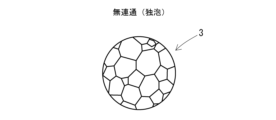
また、発泡粒子3は、複数の孔が連通した連通構造を有することが好ましい(図2参照)。図2と対比するために、図3に無連通の場合(独泡の場合)を示している。
(2)
The number of the expanded
The expanded
The expanded
The expanded
Moreover, it is preferable that the expanded
(3)樹脂成形体1のゲル分率
樹脂成形体1のゲル分率は、圧縮永久ひずみを低減する観点から、下限値に関して、50%以上であり、70%以上が好ましく、85%以上がより好ましい。樹脂成形体1のゲル分率は、50%以上99%以下であり、70%以上99%以下が好ましく、85%以上99%以下がより好ましい。
なお、本明細書におけるゲル分率は、JIS K 6796/ISO-15875-2:2003準拠(キシレン8h還流後、乾燥して測定)に基づいて測定された値である。
(3) Gel Fraction of Resin Molded Body 1 From the viewpoint of reducing compression set, the gel fraction of the resin molded body 1 is, with respect to the lower limit, 50% or more, preferably 70% or more, and more preferably 85% or more. The gel fraction of the resin molded body 1 is 50% or more and 99% or less, preferably 70% or more and 99% or less, and more preferably 85% or more and 99% or less.
The gel fraction in this specification is a value measured based on JIS K 6796/ISO-15875-2:2003 (refluxed in xylene for 8 hours, then dried and measured).
(4)本実施形態の樹脂成形体1の効果
本実施形態の樹脂成形体1は、架橋の程度が高くて、圧縮永久ひずみが低く、有用である。
(4) Effects of the Resin Molded Product 1 of the Present Embodiment The resin molded product 1 of the present embodiment is useful because it has a high degree of crosslinking and a low compression set.
2.樹脂成形体1の製造方法
樹脂成形体1の製造方法は、第1工程と、第2工程と、を備える。
2. Method for Manufacturing Resin Molded Body 1 The method for manufacturing the resin molded body 1 includes a first step and a second step.
(1)第1工程
この工程では、熱可塑性樹脂、熱可塑性樹脂100質量部に対して0.4質量部以上3.5質量部以下のシランカップリング剤、破泡剤、及び発泡剤を含む原料から発泡粒子3を製造する。
破泡剤の配合割合は、発泡時にシュリンクさせることなく所望の発泡粒子を得る観点から、ベース樹脂(熱可塑性樹脂)100質量部に対して、下限値に関し、0.05質量部以上が好ましく、0.1質量部以上がより好ましく、0.25質量部以上が更に好ましい。上限値に関して、発泡時にシュリンクさせることなく所望の発泡粒子を得る観点から5質量部以下が好ましく、3.0質量部以下がより好ましく、1.5質量部以下が更に好ましい。よって、破泡剤の配合割合は、0.05質量部以上5質量部以下が好ましく、0.1質量部以上3.0質量部以下がより好ましく、0.25質量部以上1.5質量部以下が更に好ましい。
この工程の好適な一例を説明する。熱可塑性樹脂、シランカップリング剤、過酸化物(反応開始剤)、破泡剤を溶融混錬する。この際に、過酸化物から発生するラジカルを利用して、熱可塑性エラストマーにシランカップリング剤のアルコキシシリル基がグラフト化する。
次に、アルコキシシリル基を有する熱可塑性樹脂、化学発泡剤(アゾジカルボンアミド(ADCA)等)、及び破泡剤を溶融混錬する。この際、押出機内で、化学発泡剤の分解反応により発生するCO2ガスが、アルコキシシリル基を有する熱可塑性樹脂に分散し、高圧状態が維持される。
混錬物が押出機ダイスから吐出されると、大気圧に減圧され、アルコキシシリル基を有する熱可塑性樹脂に分散したCO2ガスが膨張を開始する(発泡する)。
CO2ガスが膨張を開始する際、または膨張を開始した後に、熱可塑性樹脂の発泡粒子表面、及び内部に分散した破泡剤が界面張力を低下させる。
破泡剤が界面張力を低下させると、気泡が小さくなる上、気泡の合一も抑止できる。また破泡剤を添加することで、気泡の破泡がしやすくなり、発泡粒子3の表面及び/又は内部に空孔ができる(連通化)。
空孔ができることで、内外での圧力差が緩和されて、発泡粒子3がシュリンクしにくくなる。
このようにして、発泡粒子3が製造される。なお、発泡粒子3は、高温多湿の加熱炉内で、養生してもよい。
発泡粒子3のゲル分率は、20%以上70%以下である。発泡粒子3のゲル分率をこの範囲にすることで、未反応のアルコキシシリル基が残存することになる。そして、次に説明する加熱工程において残存したアルコキシシリル基を反応させることでシロキサン結合を形成して、発泡粒子3同士を接着させ、しかも架橋度の高い樹脂成形体1を製造できる。
(1) First Step In this step, the expanded
The mixing ratio of the defoamer is preferably 0.05 parts by mass or more, more preferably 0.1 parts by mass or more, and even more preferably 0.25 parts by mass or more, relative to 100 parts by mass of the base resin (thermoplastic resin), in terms of the lower limit, from the viewpoint of obtaining the desired expanded particles without shrinking during expansion. The upper limit is preferably 5 parts by mass or less, more preferably 3.0 parts by mass or less, and even more preferably 1.5 parts by mass or less, in terms of obtaining the desired expanded particles without shrinking during expansion. Therefore, the mixing ratio of the defoamer is preferably 0.05 parts by mass or more and 5 parts by mass or less, more preferably 0.1 parts by mass or more and 3.0 parts by mass or less, and even more preferably 0.25 parts by mass or more and 1.5 parts by mass or less.
A suitable example of this process will be described. A thermoplastic resin, a silane coupling agent, a peroxide (a reaction initiator), and a cell breaker are melted and kneaded. During this process, the alkoxysilyl group of the silane coupling agent is grafted onto the thermoplastic elastomer using radicals generated from the peroxide.
Next, the thermoplastic resin having an alkoxysilyl group, the chemical foaming agent (such as azodicarbonamide (ADCA)), and the defoamer are melt-kneaded. At this time, CO2 gas generated by the decomposition reaction of the chemical foaming agent in the extruder is dispersed in the thermoplastic resin having an alkoxysilyl group, and a high pressure state is maintained.
When the kneaded material is discharged from the extruder die, the pressure is reduced to atmospheric pressure, and the CO2 gas dispersed in the thermoplastic resin having an alkoxysilyl group starts to expand (foam).
When or after the CO2 gas starts expanding, the surface of the expanded thermoplastic resin particles and the defoamer dispersed therein reduce the interfacial tension.
When the cell opener reduces the interfacial tension, the cells become smaller and the coalescence of the cells can be suppressed. Furthermore, the addition of the cell opener facilitates the breaking of the cells, and voids are formed on the surface and/or inside of the expanded beads 3 (interconnection).
The formation of voids reduces the pressure difference between the inside and outside, making the expanded
In this manner, the expanded
The gel fraction of the expanded
(2)第2工程
この工程では、型の中に発泡粒子3を入れて、水分を含む加熱媒体で加熱し、発泡粒子3が連結されてなる樹脂成形体1を成形する。
この工程の好適な一例を説明する。
発泡粒子3を、高温の加熱媒体(水蒸気、加圧蒸気、過熱蒸気等)を流せる構造の金型に充填する。
金型内での発泡粒子3の充填高さから二次成形時の高さまで圧縮することで、圧縮率を変更する。
二次成形時の高さまで圧縮したら、加熱媒体(例えば120℃~250℃)を金型内に流す。
発泡粒子3のアルコキシシリル基が加熱媒体中の水分と反応して、発泡粒子3同士の間でシロキサン結合が形成されるとともに、発泡粒子3の内部でもシロキサン結合が形成される。
シロキサン結合の形成により、発泡粒子3同士が接着するとともに、発泡粒子3の架橋が促進され、樹脂成形体1が製造される。
樹脂成形体1のゲル分率は、発泡粒子3のゲル分率よりも大きく、かつ50%以上99%以下の範囲内であり、70%以上99%以下の範囲内であることがより好ましく、85%以上99%以下の範囲内であることが更に好ましい。
(2) Second Step In this step, the expanded
A preferred example of this process will be described.
The expanded
The compression ratio is changed by compressing the foamed
Once compressed to the height required for secondary molding, a heating medium (for example, 120°C to 250°C) is poured into the mold.
The alkoxysilyl groups of the expanded
The formation of siloxane bonds bonds the expanded
The gel fraction of the resin molding 1 is greater than the gel fraction of the expanded
(3)従来の製造方法と、本実施形態の製造方法の相違点
ここで、従来の製造方法と、本実施形態の製造方法の相違点の概念を図4~7を用いて説明する。
図4に示すように低度に架橋した発泡粒子3A,3Aは、熱膨張によって融着可能である。
図5に示すように中度に架橋した発泡粒子3B,3Bも、熱膨張によって融着可能である。
ところが、図6に示すように高度に架橋した発泡粒子3C,3Cは、加熱しても、融着しない。
このような背景から、従来、高度に架橋した複数の発泡粒子3が連結されてなる樹脂成形体の作製は困難であった。
本開示では、図7に示すように、アルコキシシリル基を残存させた中度に架橋した発泡粒子3D,3Dに蒸気を当てることで、各発泡粒子3D,3Dの内部のシラノール架橋反応を進行させつつ、発泡粒子3D,3D間のシラノール架橋反応を利用して、発泡粒子3D,3D同士を接着する。このようにして、本実施形態の製造方法では、高度に架橋した複数の発泡粒子3が連結された樹脂成形体を作製している。
(3) Differences Between the Conventional Manufacturing Method and the Manufacturing Method of the Present Embodiment Here, the concepts of the differences between the conventional manufacturing method and the manufacturing method of the present embodiment will be described with reference to FIGS.
As shown in FIG. 4, the expanded beads 3A, 3A which are cross-linked to a low degree can be fused together by thermal expansion.
As shown in FIG. 5, the moderately crosslinked expanded particles 3B, 3B can also be fused by thermal expansion.
However, as shown in FIG. 6, highly cross-linked expanded beads 3C, 3C do not fuse together even when heated.
Under these circumstances, it has been difficult to produce a resin molded article in which a plurality of highly crosslinked expanded
In the present disclosure, as shown in Fig. 7, steam is applied to the moderately crosslinked expanded beads 3D, 3D having alkoxysilyl groups remaining therein, and the silanol crosslinking reaction between the expanded beads 3D, 3D is utilized to bond the expanded beads 3D, 3D to each other while proceeding with the silanol crosslinking reaction inside each of the expanded beads 3D, 3D. In this manner, in the manufacturing method of the present embodiment, a resin molded product in which a plurality of highly crosslinked expanded
(4)樹脂成形体1の製造方法の効果
本実施形態の製造方法では、架橋の程度が高く、圧縮永久ひずみが低い樹脂成形体1を製造できる。
(4) Effects of the Manufacturing Method of the Resin Molded Article 1 According to the manufacturing method of this embodiment, it is possible to manufacture a resin molded article 1 having a high degree of crosslinking and low compression set.
実施例を示し、本開示をさらに具体的に説明する。ただし、本開示は、この実施例に限定されるものではなく、当業者の知識に基づいて種々の変更、改良を施した種々の態様で実施することができる。 The present disclosure will be explained in more detail by showing examples. However, the present disclosure is not limited to these examples, and can be implemented in various forms with various modifications and improvements based on the knowledge of those skilled in the art.
以下の説明における各種測定値は、次に挙げる試験方法による測定値である。また、総合評価は以下のように行った。 The various measurements in the following explanation were taken using the test methods listed below. The overall evaluation was performed as follows:
1.試験方法
(1)ゲル分率
JIS K 6796/ISO-15875-2:2003準拠(キシレン8h還流後、乾燥して測定)に基づいて測定された値である。
1. Test Method (1) Gel Fraction The gel fraction is a value measured in accordance with JIS K 6796/ISO-15875-2:2003 (refluxed in xylene for 8 hours, then dried and measured).
(2)圧縮永久歪
圧縮永久歪は、JIS K6262:2013(23℃×22h、25%圧縮)に準拠した。JIS K6262:2013は、ISO 815-1及びISO 815-2に対応する規格である。
永久圧縮歪(%)=100×(t0-t1)/(t0-t2)
t0:試験片の厚さ(mm)
t1:解放30min後の試験片の厚さ(mm)
t2:25%圧縮時の試験片の厚さ(スペーサー厚さ)(mm)
(2) Compression set The compression set was measured in accordance with JIS K6262:2013 (23°C x 22h, 25% compression). JIS K6262:2013 is a standard corresponding to ISO 815-1 and ISO 815-2.
Permanent compression strain (%) = 100 x (t 0 - t 1 )/(t 0 - t 2 )
t 0 : thickness of test piece (mm)
t1 : thickness of test piece after 30 min of release (mm)
t2 : thickness of test piece at 25% compression (spacer thickness) (mm)
(3)圧縮強度
圧縮強度は、JIS K6767:1999 (25%圧縮時、20秒後の圧縮応力)に準拠した。JIS K6767:1999は、ISO 3386-1に対応する規格である。
(3) Compressive strength The compressive strength was measured in accordance with JIS K6767:1999 (compressive stress after 20 seconds at 25% compression). JIS K6767:1999 is a standard corresponding to ISO 3386-1.
(4)アスカーC硬度
アスカーC硬度は、JIS K7312:1996(試験片:50×50×t20mm、接触直後の硬度)に準拠した。
(4) Asker C hardness The Asker C hardness was measured in accordance with JIS K7312:1996 (test piece: 50×50×t20 mm, hardness immediately after contact).
(5)連通度
連通度は、発泡粒子断面の最外層5mmに空いている2μm以上の空孔数(個)を計測することで算出した。発泡粒子断面を1000倍に拡大して電子顕微鏡で観察した。空孔数は、5個の発泡粒子ついて計測し、これらの平均値とした。
(5) Interconnectivity The interconnectivity was calculated by counting the number of pores of 2 μm or more in the outermost 5 mm of the cross section of an expanded bead. The cross section of the expanded bead was observed under an electron microscope at a magnification of 1000 times. The number of pores was counted for five expanded beads, and the average value was calculated.
(6)圧縮率
圧縮率は以下の式により求めた。
圧縮率(%)=100×(h0-h1)/h0
h0:充填時の高さ(mm)
h1:圧縮時の高さ(mm)
(6) Compression Ratio The compression ratio was calculated using the following formula.
Compression ratio (%)=100×(h 0 −h 1 )/h 0
h0 : Height when filled (mm)
h1 : Height when compressed (mm)
(7)成形性
以下のように評価した。
A:複数の発泡粒子が連結されてなる樹脂成形体が得られた。
B:発泡粒子同士が接着せず、樹脂成形体が得られなかった。
(7) Moldability: Evaluated as follows.
A: A resin molding in which a plurality of foamed beads were connected was obtained.
B: The foamed particles were not bonded to each other, and a resin molding was not obtained.
(8)総合評価
樹脂成形体の成形性、圧縮永久歪、圧縮強度を総合的に判断した。総合評価は、具体的には以下のように行った。
C:圧縮永久歪が50%以上、又は、樹脂成形体の成形性が悪い
B:圧縮永久歪が50%未満、かつ、圧縮強度が、50kPa~60kPa未満
A:圧縮永久歪が50%未満、かつ、圧縮強度が、50kPa未満
(8) Overall Evaluation The moldability, compression set, and compressive strength of the resin molded product were evaluated comprehensively. The overall evaluation was specifically performed as follows.
C: Compression set is 50% or more, or the moldability of the resin molding is poor. B: Compression set is less than 50%, and the compression strength is 50 kPa to less than 60 kPa. A: Compression set is less than 50%, and the compression strength is less than 50 kPa.
2.発泡粒子の作製
下記表1に記載の使用原料を用いて、表2,3,4に示す配合で、各種発泡粒子を作製した。
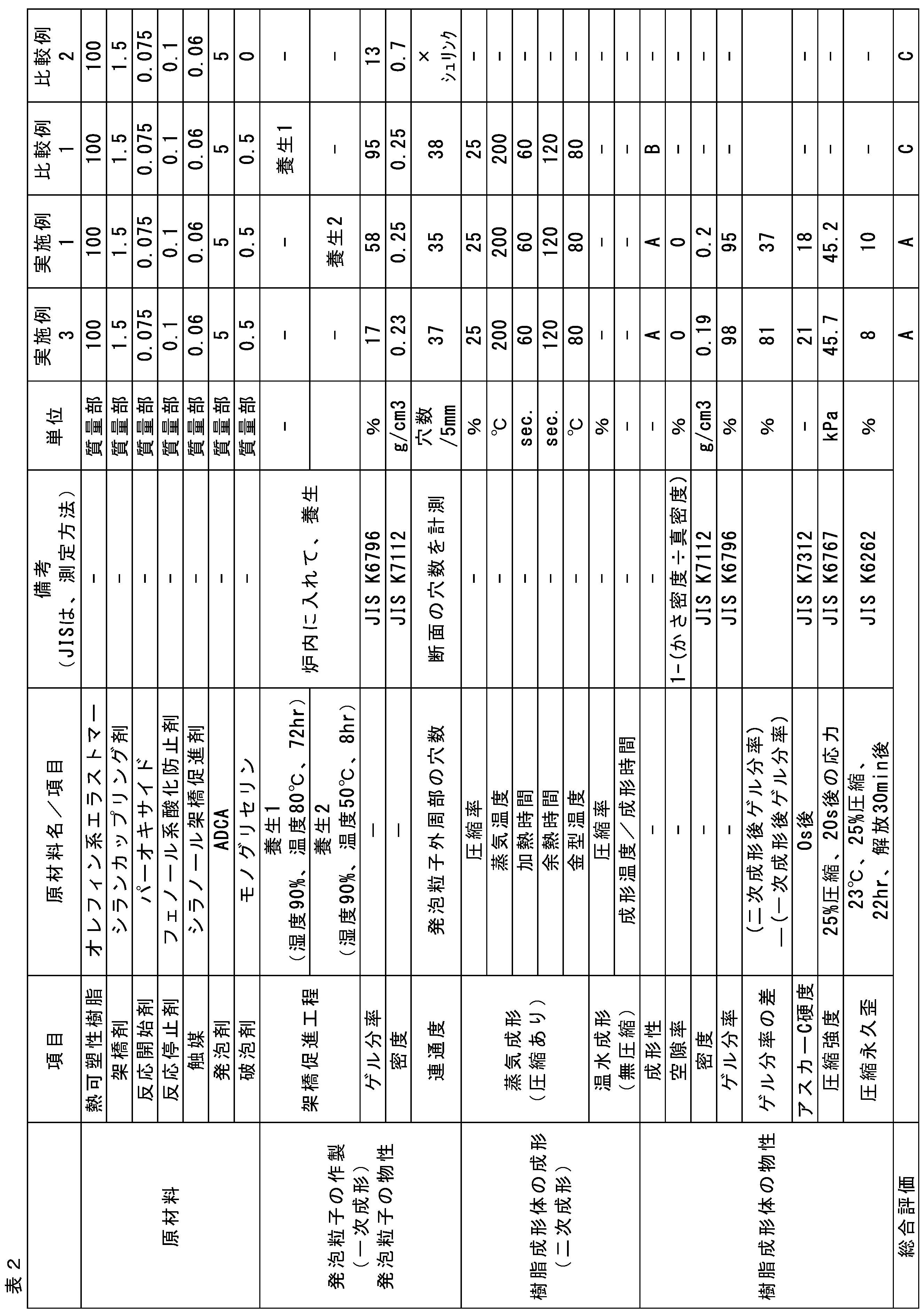
実施例1及び比較例1は、表2に記載の条件で養生した。
2. Preparation of Expanded Beads Using the raw materials shown in Table 1 below, various expanded beads were prepared according to the compositions shown in Tables 2, 3, and 4.
Example 1 and Comparative Example 1 were aged under the conditions shown in Table 2.
3.樹脂成形体の成形、及び評価
実施例及び比較例で製造された発泡粒子を用いて、上述の「樹脂成形体1を成形する加熱工程」の欄に記載に沿って、各樹脂成形体を成形して評価した。
実施例1~7のいずれの樹脂成形体も、架橋の程度が高く、圧縮永久ひずみが小さくなった。実施例1~7の総合評価は、A,Bのいずれかとなり良好であった。
比較例1は、養生させ過ぎて架橋が過度に進み、発泡粒子のゲル分率が95%と非常に高くなった。そのため、比較例1では、発泡粒子同士が接着せず、樹脂成形体が得られなかった。
比較例2は、破泡剤を含有させておらず、シュリンクしてしまい発泡粒子が得られなかった。そのため、比較例2は、樹脂成形体を作製できなかった。
比較例3は、シランカップリング剤が0.2質量部と少なすぎて発泡粒子のゲル分率が3%と非常に低かった。そのため、比較例4では、樹脂成形体のゲル分率が27%と低く、圧縮永久ひずみが大きかった。
比較例4は、シランカップリング剤が5質量部と多いため、グラフト反応しすぎて樹脂劣化が激しく、流動困難となり、樹脂成形体を作製できなかった。
比較例5は、シランカップリング剤を配合しておらず、樹脂成形体の圧縮永久ひずみが大きかった。
3. Molding and Evaluation of Resin Molded Body Using the expanded beads produced in the Examples and Comparative Examples, each resin molded body was molded and evaluated according to the description in the above-mentioned section "Heating step for molding resin molded body 1."
The resin moldings of Examples 1 to 7 all had a high degree of crosslinking and small compression set. The overall evaluation of Examples 1 to 7 was either A or B, which was good.
In Comparative Example 1, the crosslinking proceeded excessively due to excessive curing, and the gel fraction of the expanded beads was extremely high at 95%. Therefore, in Comparative Example 1, the expanded beads were not bonded to each other, and a resin molded product could not be obtained.
In Comparative Example 2, since no cell opener was added, the resin particles shrunk and no expanded beads were obtained. Therefore, in Comparative Example 2, a resin molded article could not be produced.
In Comparative Example 3, the amount of the silane coupling agent was too small at 0.2 parts by mass, and the gel fraction of the expanded beads was very low at 3%. Therefore, in Comparative Example 4, the gel fraction of the resin molded article was low at 27%, and the compression set was large.
In Comparative Example 4, the amount of the silane coupling agent was as large as 5 parts by mass, so that the graft reaction was excessive, causing severe resin deterioration and making it difficult to flow, and a resin molded article could not be produced.
In Comparative Example 5, no silane coupling agent was blended, and the compression set of the resin molded article was large.



1…樹脂成形体
3…発泡粒子
5…蒸気
1... resin molded
Claims (4)
前記発泡粒子は、架橋熱可塑性樹脂を含有し、
前記架橋熱可塑性樹脂は、前記熱可塑性樹脂がシロキサン結合にて架橋された架橋構造を有し、
各前記発泡粒子同士は、シロキサン結合にて接着しており、
本樹脂成形体のゲル分率が95%以上99%以下である、樹脂成形体。 A resin molded article formed by connecting a plurality of foamed particles,
The expanded beads contain a crosslinked thermoplastic resin,
The crosslinked thermoplastic resin has a crosslinked structure in which the thermoplastic resin is crosslinked by a siloxane bond,
The foamed particles are bonded to each other by siloxane bonds,
The resin molded article has a gel fraction of 95% or more and 99% or less.
前記発泡粒子は、架橋熱可塑性樹脂を含有し、
前記架橋熱可塑性樹脂は、前記熱可塑性樹脂がシロキサン結合にて架橋された架橋構造を有し、
各前記発泡粒子同士は、シロキサン結合にて接着しており、
本樹脂成形体のゲル分率が50%以上99%以下であり、
硬さが、アスカーCスケールで5以上30以下である、樹脂成形体。 A resin molded article formed by connecting a plurality of foamed particles,
The expanded beads contain a crosslinked thermoplastic resin,
The crosslinked thermoplastic resin has a crosslinked structure in which the thermoplastic resin is crosslinked by a siloxane bond,
The foamed particles are bonded to each other by siloxane bonds,
The resin molded body has a gel fraction of 50% or more and 99% or less,
A resin molded product having a hardness of 5 or more and 30 or less on the Asker C scale.
前記発泡粒子は、架橋熱可塑性樹脂を含有し、
前記架橋熱可塑性樹脂は、前記熱可塑性樹脂がシロキサン結合にて架橋された架橋構造を有し、
各前記発泡粒子同士は、シロキサン結合にて接着しており、
本樹脂成形体のゲル分率が50%以上99%以下であり、
JIS K6767:1999(25%圧縮時、20秒後の圧縮応力)に準拠した圧縮強度が、35kPa以上100kPa以下である、樹脂成形体。 A resin molded article formed by connecting a plurality of foamed particles,
The expanded beads contain a crosslinked thermoplastic resin,
The crosslinked thermoplastic resin has a crosslinked structure in which the thermoplastic resin is crosslinked by a siloxane bond,
The foamed particles are bonded to each other by siloxane bonds,
The resin molded body has a gel fraction of 50% or more and 99% or less,
A resin molded product having a compressive strength according to JIS K6767:1999 (compressive stress after 20 seconds at 25% compression) of 35 kPa or more and 100 kPa or less.
前記発泡粒子は、架橋熱可塑性樹脂を含有し、
前記架橋熱可塑性樹脂は、前記熱可塑性樹脂がシロキサン結合にて架橋された架橋構造を有し、
各前記発泡粒子同士は、シロキサン結合にて接着しており、
本樹脂成形体のゲル分率が50%以上99%以下であり、
JIS K6262:2013(23℃×22h、25%圧縮)に準拠し下記式で計算される圧縮永久歪が、5%以上12%以下である、樹脂成形体。
圧縮永久歪(%)=100×(t0-t1)/(t0-t2)
t0:試験片の厚さ(mm)
t1:解放30min後の試験片の厚さ(mm)
t2:25%圧縮時の試験片の厚さ(スペーサー厚さ)(mm) A resin molded article formed by connecting a plurality of foamed particles,
The expanded beads contain a crosslinked thermoplastic resin,
The crosslinked thermoplastic resin has a crosslinked structure in which the thermoplastic resin is crosslinked by a siloxane bond,
The foamed particles are bonded to each other by siloxane bonds,
The resin molded body has a gel fraction of 50% or more and 99% or less,
A resin molded product having a compression set calculated by the following formula in accordance with JIS K6262:2013 (23 ° C. × 22 h, 25% compression) of 5% or more and 12% or less.
Compression set (%) = 100 x (t 0 - t 1 )/(t 0 - t 2 )
t 0 : thickness of test piece (mm)
t1 : thickness of test piece after 30 min of release (mm)
t2 : thickness of test piece at 25% compression (spacer thickness) (mm)
Priority Applications (1)
| Application Number | Priority Date | Filing Date | Title |
|---|---|---|---|
| JP2023191620A JP7592829B2 (en) | 2019-12-24 | 2023-11-09 | Resin Molding |
Applications Claiming Priority (2)
| Application Number | Priority Date | Filing Date | Title |
|---|---|---|---|
| JP2019232539A JP7384657B2 (en) | 2019-12-24 | 2019-12-24 | Resin molded body and method for manufacturing resin molded body |
| JP2023191620A JP7592829B2 (en) | 2019-12-24 | 2023-11-09 | Resin Molding |
Related Parent Applications (1)
| Application Number | Title | Priority Date | Filing Date |
|---|---|---|---|
| JP2019232539A Division JP7384657B2 (en) | 2019-12-24 | 2019-12-24 | Resin molded body and method for manufacturing resin molded body |
Publications (2)
| Publication Number | Publication Date |
|---|---|
| JP2023184718A JP2023184718A (en) | 2023-12-28 |
| JP7592829B2 true JP7592829B2 (en) | 2024-12-02 |
Family
ID=76651363
Family Applications (2)
| Application Number | Title | Priority Date | Filing Date |
|---|---|---|---|
| JP2019232539A Active JP7384657B2 (en) | 2019-12-24 | 2019-12-24 | Resin molded body and method for manufacturing resin molded body |
| JP2023191620A Active JP7592829B2 (en) | 2019-12-24 | 2023-11-09 | Resin Molding |
Family Applications Before (1)
| Application Number | Title | Priority Date | Filing Date |
|---|---|---|---|
| JP2019232539A Active JP7384657B2 (en) | 2019-12-24 | 2019-12-24 | Resin molded body and method for manufacturing resin molded body |
Country Status (1)
| Country | Link |
|---|---|
| JP (2) | JP7384657B2 (en) |
Families Citing this family (3)
| Publication number | Priority date | Publication date | Assignee | Title |
|---|---|---|---|---|
| US20230295497A1 (en) | 2020-08-06 | 2023-09-21 | Nichia Corporation | Nitride phosphor and manufacturing method therefor |
| CN116438234A (en) * | 2020-12-14 | 2023-07-14 | 陶氏环球技术有限责任公司 | Polyolefin foam beads and production method thereof |
| JP7777945B2 (en) * | 2021-09-09 | 2025-12-01 | 株式会社イノアックコーポレーション | Cross-linked ethylene-vinyl acetate copolymer foam with open cell structure, its manufacturing method and sealing material |
Citations (11)
| Publication number | Priority date | Publication date | Assignee | Title |
|---|---|---|---|---|
| JP2000119433A (en) | 1998-10-20 | 2000-04-25 | Matsushita Electric Ind Co Ltd | Organic porous material |
| JP2000344928A (en) | 1999-04-01 | 2000-12-12 | Sekisui Chem Co Ltd | Composite foam, molded article thereof, and method for producing the same |
| JP2002256096A (en) | 2001-12-26 | 2002-09-11 | Sekisui Chem Co Ltd | Method for producing thermoplastic resin foam |
| JP2003206371A (en) | 2002-01-11 | 2003-07-22 | Tosoh Corp | Crosslinked foamable olefin resin composition |
| US20080281009A1 (en) | 2006-12-04 | 2008-11-13 | Ingenia Polymers, Inc. | Cross-linked polyolefin foam |
| JP2012214750A (en) | 2011-03-30 | 2012-11-08 | Sekisui Plastics Co Ltd | Foamable polystyrene-based resin particle and production method therefor, polystyrene-based resin pre-foamed particle, and polystyrene-based resin foamed molding |
| JP2017056361A (en) | 2012-06-11 | 2017-03-23 | グローバス メディカル インコーポレイティッド | Bioactive bone graft substitute |
| JP2018044118A (en) | 2016-09-16 | 2018-03-22 | 株式会社ジェイエスピー | Cross-linked foam particles and molded articles thereof |
| JP2019521231A (en) | 2016-07-11 | 2019-07-25 | 浙江新恒泰新材料有限公司 | High magnification thermoplastic polyurethane microporous foam sheet and method for producing the same |
| JP2020152843A (en) | 2019-03-20 | 2020-09-24 | 株式会社カネカ | Foamable polystyrene resin particle, polystyrene preliminary foam particle, and foam molding |
| JP2021147597A (en) | 2020-03-24 | 2021-09-27 | 積水化成品工業株式会社 | Foamable styrene resin particle, preliminary foamed styrene resin particle, and styrene resin foam molding |
Family Cites Families (12)
| Publication number | Priority date | Publication date | Assignee | Title |
|---|---|---|---|---|
| JPS5966432A (en) * | 1982-10-07 | 1984-04-14 | Sekisui Plastics Co Ltd | Production of crosslinked foam |
| US4702868A (en) * | 1987-02-24 | 1987-10-27 | Valcour Incorporated | Moldable silane-crosslinked polyolefin foam beads |
| JPH06104749B2 (en) * | 1990-05-15 | 1994-12-21 | アストロ―ヴァルコール インコーポレイテッド | Moldable shrinkable thermoplastic polymer foam beads |
| ATE260950T1 (en) | 1994-12-14 | 2004-03-15 | Seikisui Chemical Co Ltd | THERMOPLASTIC RESIN FOAM AND METHOD FOR PRODUCING THE SAME |
| TWI375681B (en) | 2005-03-17 | 2012-11-01 | Dow Global Technologies Llc | Foams made from interpolymers of ethylene/α-olefins |
| JP6102584B2 (en) * | 2013-07-09 | 2017-03-29 | 株式会社ジェイエスピー | Thermoplastic resin pre-foamed particles and foamed particle molded body |
| JP6370632B2 (en) * | 2014-08-07 | 2018-08-08 | Dmノバフォーム株式会社 | Water crosslinkable foamed resin composition, foam and method for producing the same |
| JP6472405B2 (en) | 2015-09-30 | 2019-02-20 | 積水化成品工業株式会社 | Olefin-based elastomer resin particles, expandable particles, expanded particles, and expanded molded articles |
| JP7041621B2 (en) | 2015-12-15 | 2022-03-24 | ダウ グローバル テクノロジーズ エルエルシー | Cross-linked foam made from ethylene / α-olefin interpolymers |
| JP6815810B2 (en) * | 2016-10-03 | 2021-01-20 | 株式会社カネカ | Expandable polystyrene resin particles |
| JP6999343B2 (en) * | 2017-09-28 | 2022-01-18 | 株式会社カネカ | Effervescent polystyrene resin particles, polystyrene pre-expanded particles and foam molded products |
| JP7399663B2 (en) * | 2019-09-30 | 2023-12-18 | 株式会社カネカ | Expandable polystyrene resin particles, pre-expanded polystyrene particles and foam molded products. |
-
2019
- 2019-12-24 JP JP2019232539A patent/JP7384657B2/en active Active
-
2023
- 2023-11-09 JP JP2023191620A patent/JP7592829B2/en active Active
Patent Citations (11)
| Publication number | Priority date | Publication date | Assignee | Title |
|---|---|---|---|---|
| JP2000119433A (en) | 1998-10-20 | 2000-04-25 | Matsushita Electric Ind Co Ltd | Organic porous material |
| JP2000344928A (en) | 1999-04-01 | 2000-12-12 | Sekisui Chem Co Ltd | Composite foam, molded article thereof, and method for producing the same |
| JP2002256096A (en) | 2001-12-26 | 2002-09-11 | Sekisui Chem Co Ltd | Method for producing thermoplastic resin foam |
| JP2003206371A (en) | 2002-01-11 | 2003-07-22 | Tosoh Corp | Crosslinked foamable olefin resin composition |
| US20080281009A1 (en) | 2006-12-04 | 2008-11-13 | Ingenia Polymers, Inc. | Cross-linked polyolefin foam |
| JP2012214750A (en) | 2011-03-30 | 2012-11-08 | Sekisui Plastics Co Ltd | Foamable polystyrene-based resin particle and production method therefor, polystyrene-based resin pre-foamed particle, and polystyrene-based resin foamed molding |
| JP2017056361A (en) | 2012-06-11 | 2017-03-23 | グローバス メディカル インコーポレイティッド | Bioactive bone graft substitute |
| JP2019521231A (en) | 2016-07-11 | 2019-07-25 | 浙江新恒泰新材料有限公司 | High magnification thermoplastic polyurethane microporous foam sheet and method for producing the same |
| JP2018044118A (en) | 2016-09-16 | 2018-03-22 | 株式会社ジェイエスピー | Cross-linked foam particles and molded articles thereof |
| JP2020152843A (en) | 2019-03-20 | 2020-09-24 | 株式会社カネカ | Foamable polystyrene resin particle, polystyrene preliminary foam particle, and foam molding |
| JP2021147597A (en) | 2020-03-24 | 2021-09-27 | 積水化成品工業株式会社 | Foamable styrene resin particle, preliminary foamed styrene resin particle, and styrene resin foam molding |
Also Published As
| Publication number | Publication date |
|---|---|
| JP2023184718A (en) | 2023-12-28 |
| JP2021100992A (en) | 2021-07-08 |
| JP7384657B2 (en) | 2023-11-21 |
Similar Documents
| Publication | Publication Date | Title |
|---|---|---|
| JP7592829B2 (en) | Resin Molding | |
| JP2000514476A (en) | Polymer mixture | |
| KR102210037B1 (en) | Polyolefin-based cable compound formulation for improved foamability and enhanced processability | |
| EP0910605A4 (en) | Cross-linked foamable compositions of silane-grafted, essentially linear polyolefins blended with polypropylene | |
| CN104470978B (en) | Resin composition for foaming containing biodegradable resin, and foam manufactured therefrom | |
| CN109843537B (en) | Method for producing thermoplastic elastomer foamed particle molded body | |
| CN1997693A (en) | Polyolefin foam material and its application | |
| CN111511819A (en) | Foam compositions with improved properties and uses thereof | |
| WO2005111125A2 (en) | Cross-linked polypropylene resins, method of making same and articles formed therefrom | |
| JP6564548B2 (en) | Resin foam and member for shoe sole using the same | |
| TW201819517A (en) | Foamed particles and molded article thereof | |
| JP7200484B2 (en) | insulation | |
| TWI780526B (en) | High-functional foaming resin composition and manufacturing method thereof | |
| JP2023508932A (en) | Crosslinked epoxy-containing ethylene interpolymer foam | |
| Sipaut et al. | The effect of different peroxide on LDPE foam properties in the presence of polyfunctional monomers | |
| JP2003082144A (en) | Polyolefin resin crosslinked foam | |
| JP7781092B2 (en) | Non-flammable resin composition and non-flammable crosslinked resin foam | |
| JP7724131B2 (en) | Foams and articles | |
| JP4190314B2 (en) | Molding | |
| CN121628245A (en) | Low-pressure steam-formed foaming polypropylene and preparation method thereof | |
| JP2025077337A (en) | Resin foam and sealing member | |
| JP2015151478A (en) | cross-linked polyolefin resin foam | |
| JP2023552049A (en) | Foam containing a blend of silicone-functionalized polyethylene and low-density polyethylene | |
| JP2023537802A (en) | Effervescent compositions and articles | |
| JPH07157586A (en) | Compression resistant crosslinked resin foam |
Legal Events
| Date | Code | Title | Description |
|---|---|---|---|
| A521 | Request for written amendment filed |
Free format text: JAPANESE INTERMEDIATE CODE: A523 Effective date: 20231109 |
|
| A621 | Written request for application examination |
Free format text: JAPANESE INTERMEDIATE CODE: A621 Effective date: 20231109 |
|
| A977 | Report on retrieval |
Free format text: JAPANESE INTERMEDIATE CODE: A971007 Effective date: 20240628 |
|
| A131 | Notification of reasons for refusal |
Free format text: JAPANESE INTERMEDIATE CODE: A131 Effective date: 20240717 |
|
| A521 | Request for written amendment filed |
Free format text: JAPANESE INTERMEDIATE CODE: A523 Effective date: 20240826 |
|
| TRDD | Decision of grant or rejection written | ||
| A01 | Written decision to grant a patent or to grant a registration (utility model) |
Free format text: JAPANESE INTERMEDIATE CODE: A01 Effective date: 20241119 |
|
| A61 | First payment of annual fees (during grant procedure) |
Free format text: JAPANESE INTERMEDIATE CODE: A61 Effective date: 20241120 |
|
| R150 | Certificate of patent or registration of utility model |
Ref document number: 7592829 Country of ref document: JP Free format text: JAPANESE INTERMEDIATE CODE: R150 |