JP7586813B2 - Anti-CD33 antibodies and methods of use thereof - Google Patents
Anti-CD33 antibodies and methods of use thereof Download PDFInfo
- Publication number
- JP7586813B2 JP7586813B2 JP2021511561A JP2021511561A JP7586813B2 JP 7586813 B2 JP7586813 B2 JP 7586813B2 JP 2021511561 A JP2021511561 A JP 2021511561A JP 2021511561 A JP2021511561 A JP 2021511561A JP 7586813 B2 JP7586813 B2 JP 7586813B2
- Authority
- JP
- Japan
- Prior art keywords
- amino acid
- seq
- acid sequence
- hvr
- chain variable
- Prior art date
- Legal status (The legal status is an assumption and is not a legal conclusion. Google has not performed a legal analysis and makes no representation as to the accuracy of the status listed.)
- Active
Links
- 238000000034 method Methods 0.000 title claims description 56
- 125000003275 alpha amino acid group Chemical group 0.000 claims description 1519
- 210000004027 cell Anatomy 0.000 claims description 137
- 238000006467 substitution reaction Methods 0.000 claims description 102
- 101000934338 Homo sapiens Myeloid cell surface antigen CD33 Proteins 0.000 claims description 69
- 208000037265 diseases, disorders, signs and symptoms Diseases 0.000 claims description 65
- 102000056982 human CD33 Human genes 0.000 claims description 62
- 206010028980 Neoplasm Diseases 0.000 claims description 47
- 201000010099 disease Diseases 0.000 claims description 47
- 102000008394 Immunoglobulin Fragments Human genes 0.000 claims description 43
- 108010021625 Immunoglobulin Fragments Proteins 0.000 claims description 43
- 239000012634 fragment Substances 0.000 claims description 35
- 150000007523 nucleic acids Chemical class 0.000 claims description 34
- 102000039446 nucleic acids Human genes 0.000 claims description 32
- 108020004707 nucleic acids Proteins 0.000 claims description 32
- 125000000539 amino acid group Chemical group 0.000 claims description 24
- 201000011510 cancer Diseases 0.000 claims description 21
- 239000013598 vector Substances 0.000 claims description 21
- 238000000338 in vitro Methods 0.000 claims description 20
- 208000035475 disorder Diseases 0.000 claims description 17
- 206010012289 Dementia Diseases 0.000 claims description 16
- 208000014674 injury Diseases 0.000 claims description 16
- 208000024827 Alzheimer disease Diseases 0.000 claims description 12
- 238000010494 dissociation reaction Methods 0.000 claims description 11
- 230000005593 dissociations Effects 0.000 claims description 11
- 230000006378 damage Effects 0.000 claims description 10
- 238000004519 manufacturing process Methods 0.000 claims description 10
- 102100025243 Myeloid cell surface antigen CD33 Human genes 0.000 claims description 9
- 201000011240 Frontotemporal dementia Diseases 0.000 claims description 8
- 201000004810 Vascular dementia Diseases 0.000 claims description 8
- 238000012575 bio-layer interferometry Methods 0.000 claims description 7
- 239000008194 pharmaceutical composition Substances 0.000 claims description 7
- 102000003839 Human Proteins Human genes 0.000 claims description 6
- 108090000144 Human Proteins Proteins 0.000 claims description 6
- 208000027418 Wounds and injury Diseases 0.000 claims description 6
- 238000000684 flow cytometry Methods 0.000 claims description 6
- 208000035473 Communicable disease Diseases 0.000 claims description 5
- 239000003937 drug carrier Substances 0.000 claims description 3
- 238000012258 culturing Methods 0.000 claims description 2
- 108090000623 proteins and genes Proteins 0.000 description 159
- 102000004169 proteins and genes Human genes 0.000 description 149
- 235000018102 proteins Nutrition 0.000 description 148
- 230000027455 binding Effects 0.000 description 142
- 210000004443 dendritic cell Anatomy 0.000 description 121
- 210000000274 microglia Anatomy 0.000 description 117
- 235000001014 amino acid Nutrition 0.000 description 101
- 239000003446 ligand Substances 0.000 description 99
- 108090000765 processed proteins & peptides Proteins 0.000 description 81
- 239000000427 antigen Substances 0.000 description 75
- 108091007433 antigens Proteins 0.000 description 75
- 102000036639 antigens Human genes 0.000 description 75
- 210000002540 macrophage Anatomy 0.000 description 70
- 230000014509 gene expression Effects 0.000 description 68
- 102000004196 processed proteins & peptides Human genes 0.000 description 62
- 229940124294 CD33 monoclonal antibody Drugs 0.000 description 55
- 102000005962 receptors Human genes 0.000 description 52
- 108020003175 receptors Proteins 0.000 description 52
- 210000001616 monocyte Anatomy 0.000 description 50
- 230000000694 effects Effects 0.000 description 48
- 210000000440 neutrophil Anatomy 0.000 description 45
- 102000014461 Ataxins Human genes 0.000 description 42
- 108010078286 Ataxins Proteins 0.000 description 42
- 210000001744 T-lymphocyte Anatomy 0.000 description 41
- 230000005764 inhibitory process Effects 0.000 description 40
- 230000001717 pathogenic effect Effects 0.000 description 39
- 230000001413 cellular effect Effects 0.000 description 36
- 210000001185 bone marrow Anatomy 0.000 description 35
- 230000002401 inhibitory effect Effects 0.000 description 34
- 210000001151 cytotoxic T lymphocyte Anatomy 0.000 description 32
- 229920001184 polypeptide Polymers 0.000 description 32
- 210000002443 helper t lymphocyte Anatomy 0.000 description 30
- -1 Lewy body Chemical compound 0.000 description 29
- 210000003690 classically activated macrophage Anatomy 0.000 description 28
- 230000003993 interaction Effects 0.000 description 25
- 230000002829 reductive effect Effects 0.000 description 25
- 230000009467 reduction Effects 0.000 description 24
- 108010073807 IgG Receptors Proteins 0.000 description 22
- 210000004985 myeloid-derived suppressor cell Anatomy 0.000 description 22
- 230000007115 recruitment Effects 0.000 description 22
- 102000009490 IgG Receptors Human genes 0.000 description 21
- 230000006870 function Effects 0.000 description 21
- 230000001965 increasing effect Effects 0.000 description 21
- 102000013455 Amyloid beta-Peptides Human genes 0.000 description 20
- 108010090849 Amyloid beta-Peptides Proteins 0.000 description 20
- 101000946889 Homo sapiens Monocyte differentiation antigen CD14 Proteins 0.000 description 20
- 102100035877 Monocyte differentiation antigen CD14 Human genes 0.000 description 20
- 230000003247 decreasing effect Effects 0.000 description 19
- 231100000491 EC50 Toxicity 0.000 description 18
- 102000009109 Fc receptors Human genes 0.000 description 18
- 108010087819 Fc receptors Proteins 0.000 description 18
- SQVRNKJHWKZAKO-UHFFFAOYSA-N beta-N-Acetyl-D-neuraminic acid Natural products CC(=O)NC1C(O)CC(O)(C(O)=O)OC1C(O)C(O)CO SQVRNKJHWKZAKO-UHFFFAOYSA-N 0.000 description 18
- 208000015181 infectious disease Diseases 0.000 description 18
- 210000002997 osteoclast Anatomy 0.000 description 18
- 210000004881 tumor cell Anatomy 0.000 description 18
- 101100407308 Mus musculus Pdcd1lg2 gene Proteins 0.000 description 17
- 108700030875 Programmed Cell Death 1 Ligand 2 Proteins 0.000 description 17
- 102100024213 Programmed cell death 1 ligand 2 Human genes 0.000 description 17
- 150000001413 amino acids Chemical class 0.000 description 17
- SQVRNKJHWKZAKO-OQPLDHBCSA-N sialic acid Chemical compound CC(=O)N[C@@H]1[C@@H](O)C[C@@](O)(C(O)=O)OC1[C@H](O)[C@H](O)CO SQVRNKJHWKZAKO-OQPLDHBCSA-N 0.000 description 17
- 108010074708 B7-H1 Antigen Proteins 0.000 description 16
- 108060003951 Immunoglobulin Proteins 0.000 description 16
- 102100024216 Programmed cell death 1 ligand 1 Human genes 0.000 description 16
- 229940024606 amino acid Drugs 0.000 description 16
- 210000003714 granulocyte Anatomy 0.000 description 16
- 102000018358 immunoglobulin Human genes 0.000 description 16
- 230000001506 immunosuppresive effect Effects 0.000 description 16
- 230000026731 phosphorylation Effects 0.000 description 16
- 238000006366 phosphorylation reaction Methods 0.000 description 16
- 230000011664 signaling Effects 0.000 description 16
- 230000004913 activation Effects 0.000 description 15
- 230000035755 proliferation Effects 0.000 description 15
- 102000043334 C9orf72 Human genes 0.000 description 14
- 108700030955 C9orf72 Proteins 0.000 description 14
- 102100022338 Integrin alpha-M Human genes 0.000 description 14
- 102000036770 Islet Amyloid Polypeptide Human genes 0.000 description 14
- 108010041872 Islet Amyloid Polypeptide Proteins 0.000 description 14
- 210000004322 M2 macrophage Anatomy 0.000 description 14
- 210000002798 bone marrow cell Anatomy 0.000 description 14
- 230000001976 improved effect Effects 0.000 description 14
- NOESYZHRGYRDHS-UHFFFAOYSA-N insulin Chemical compound N1C(=O)C(NC(=O)C(CCC(N)=O)NC(=O)C(CCC(O)=O)NC(=O)C(C(C)C)NC(=O)C(NC(=O)CN)C(C)CC)CSSCC(C(NC(CO)C(=O)NC(CC(C)C)C(=O)NC(CC=2C=CC(O)=CC=2)C(=O)NC(CCC(N)=O)C(=O)NC(CC(C)C)C(=O)NC(CCC(O)=O)C(=O)NC(CC(N)=O)C(=O)NC(CC=2C=CC(O)=CC=2)C(=O)NC(CSSCC(NC(=O)C(C(C)C)NC(=O)C(CC(C)C)NC(=O)C(CC=2C=CC(O)=CC=2)NC(=O)C(CC(C)C)NC(=O)C(C)NC(=O)C(CCC(O)=O)NC(=O)C(C(C)C)NC(=O)C(CC(C)C)NC(=O)C(CC=2NC=NC=2)NC(=O)C(CO)NC(=O)CNC2=O)C(=O)NCC(=O)NC(CCC(O)=O)C(=O)NC(CCCNC(N)=N)C(=O)NCC(=O)NC(CC=3C=CC=CC=3)C(=O)NC(CC=3C=CC=CC=3)C(=O)NC(CC=3C=CC(O)=CC=3)C(=O)NC(C(C)O)C(=O)N3C(CCC3)C(=O)NC(CCCCN)C(=O)NC(C)C(O)=O)C(=O)NC(CC(N)=O)C(O)=O)=O)NC(=O)C(C(C)CC)NC(=O)C(CO)NC(=O)C(C(C)O)NC(=O)C1CSSCC2NC(=O)C(CC(C)C)NC(=O)C(NC(=O)C(CCC(N)=O)NC(=O)C(CC(N)=O)NC(=O)C(NC(=O)C(N)CC=1C=CC=CC=1)C(C)C)CC1=CN=CN1 NOESYZHRGYRDHS-UHFFFAOYSA-N 0.000 description 14
- 231100001221 nontumorigenic Toxicity 0.000 description 14
- 102100038078 CD276 antigen Human genes 0.000 description 13
- 101710185679 CD276 antigen Proteins 0.000 description 13
- 230000001939 inductive effect Effects 0.000 description 13
- 101001046686 Homo sapiens Integrin alpha-M Proteins 0.000 description 12
- 230000004048 modification Effects 0.000 description 12
- 238000012986 modification Methods 0.000 description 12
- 208000031261 Acute myeloid leukaemia Diseases 0.000 description 11
- 230000009286 beneficial effect Effects 0.000 description 11
- 230000007423 decrease Effects 0.000 description 11
- KZNQNBZMBZJQJO-UHFFFAOYSA-N 1-(2-azaniumylacetyl)pyrrolidine-2-carboxylate Chemical compound NCC(=O)N1CCCC1C(O)=O KZNQNBZMBZJQJO-UHFFFAOYSA-N 0.000 description 10
- 229930186217 Glycolipid Natural products 0.000 description 10
- 101000851370 Homo sapiens Tumor necrosis factor receptor superfamily member 9 Proteins 0.000 description 10
- 102100040243 Microtubule-associated protein tau Human genes 0.000 description 10
- 208000001089 Multiple system atrophy Diseases 0.000 description 10
- 102100036856 Tumor necrosis factor receptor superfamily member 9 Human genes 0.000 description 10
- 230000001154 acute effect Effects 0.000 description 10
- 238000005516 engineering process Methods 0.000 description 10
- 210000004408 hybridoma Anatomy 0.000 description 10
- 230000001537 neural effect Effects 0.000 description 10
- 108010026424 tau Proteins Proteins 0.000 description 10
- 210000001519 tissue Anatomy 0.000 description 10
- 230000008733 trauma Effects 0.000 description 10
- 108010009992 CD163 antigen Proteins 0.000 description 9
- 102100021396 Cell surface glycoprotein CD200 receptor 1 Human genes 0.000 description 9
- 101000969553 Homo sapiens Cell surface glycoprotein CD200 receptor 1 Proteins 0.000 description 9
- OUYCCCASQSFEME-QMMMGPOBSA-N L-tyrosine Chemical compound OC(=O)[C@@H](N)CC1=CC=C(O)C=C1 OUYCCCASQSFEME-QMMMGPOBSA-N 0.000 description 9
- 241000699666 Mus <mouse, genus> Species 0.000 description 9
- 108091007491 NSP3 Papain-like protease domains Proteins 0.000 description 9
- 102100025831 Scavenger receptor cysteine-rich type 1 protein M130 Human genes 0.000 description 9
- 238000003556 assay Methods 0.000 description 9
- 230000001684 chronic effect Effects 0.000 description 9
- 230000001419 dependent effect Effects 0.000 description 9
- 239000003814 drug Substances 0.000 description 9
- 239000000203 mixture Substances 0.000 description 9
- 230000035772 mutation Effects 0.000 description 9
- 125000003729 nucleotide group Chemical group 0.000 description 9
- 238000011282 treatment Methods 0.000 description 9
- OUYCCCASQSFEME-UHFFFAOYSA-N tyrosine Natural products OC(=O)C(N)CC1=CC=C(O)C=C1 OUYCCCASQSFEME-UHFFFAOYSA-N 0.000 description 9
- 102000002785 Ataxin-10 Human genes 0.000 description 8
- 108010043914 Ataxin-10 Proteins 0.000 description 8
- 102100026565 Ataxin-8 Human genes 0.000 description 8
- 101710147490 Ataxin-8 Proteins 0.000 description 8
- 208000032791 BCR-ABL1 positive chronic myelogenous leukemia Diseases 0.000 description 8
- 206010005003 Bladder cancer Diseases 0.000 description 8
- 208000003174 Brain Neoplasms Diseases 0.000 description 8
- 206010006187 Breast cancer Diseases 0.000 description 8
- 208000026310 Breast neoplasm Diseases 0.000 description 8
- 206010009944 Colon cancer Diseases 0.000 description 8
- 206010014733 Endometrial cancer Diseases 0.000 description 8
- 206010014759 Endometrial neoplasm Diseases 0.000 description 8
- 201000008808 Fibrosarcoma Diseases 0.000 description 8
- 102000003886 Glycoproteins Human genes 0.000 description 8
- 108090000288 Glycoproteins Proteins 0.000 description 8
- 208000008839 Kidney Neoplasms Diseases 0.000 description 8
- 206010058467 Lung neoplasm malignant Diseases 0.000 description 8
- 241001465754 Metazoa Species 0.000 description 8
- 208000015914 Non-Hodgkin lymphomas Diseases 0.000 description 8
- 206010033128 Ovarian cancer Diseases 0.000 description 8
- 206010061535 Ovarian neoplasm Diseases 0.000 description 8
- 206010061902 Pancreatic neoplasm Diseases 0.000 description 8
- 206010060862 Prostate cancer Diseases 0.000 description 8
- 208000000236 Prostatic Neoplasms Diseases 0.000 description 8
- 208000015634 Rectal Neoplasms Diseases 0.000 description 8
- 206010038389 Renal cancer Diseases 0.000 description 8
- 208000006265 Renal cell carcinoma Diseases 0.000 description 8
- 101150069237 TYROBP gene Proteins 0.000 description 8
- 102000002689 Toll-like receptor Human genes 0.000 description 8
- 108020000411 Toll-like receptor Proteins 0.000 description 8
- 208000007097 Urinary Bladder Neoplasms Diseases 0.000 description 8
- 230000015556 catabolic process Effects 0.000 description 8
- 230000004663 cell proliferation Effects 0.000 description 8
- 208000029742 colonic neoplasm Diseases 0.000 description 8
- 238000006731 degradation reaction Methods 0.000 description 8
- 230000028993 immune response Effects 0.000 description 8
- 238000003780 insertion Methods 0.000 description 8
- 230000037431 insertion Effects 0.000 description 8
- 201000010982 kidney cancer Diseases 0.000 description 8
- 208000032839 leukemia Diseases 0.000 description 8
- 201000005202 lung cancer Diseases 0.000 description 8
- 208000020816 lung neoplasm Diseases 0.000 description 8
- 206010025135 lupus erythematosus Diseases 0.000 description 8
- 208000015486 malignant pancreatic neoplasm Diseases 0.000 description 8
- 208000020984 malignant renal pelvis neoplasm Diseases 0.000 description 8
- 201000001441 melanoma Diseases 0.000 description 8
- 239000002773 nucleotide Substances 0.000 description 8
- 201000002528 pancreatic cancer Diseases 0.000 description 8
- 208000008443 pancreatic carcinoma Diseases 0.000 description 8
- 238000003127 radioimmunoassay Methods 0.000 description 8
- 206010038038 rectal cancer Diseases 0.000 description 8
- 201000001275 rectum cancer Diseases 0.000 description 8
- 201000007444 renal pelvis carcinoma Diseases 0.000 description 8
- 230000009870 specific binding Effects 0.000 description 8
- 230000004083 survival effect Effects 0.000 description 8
- 238000002560 therapeutic procedure Methods 0.000 description 8
- 201000005112 urinary bladder cancer Diseases 0.000 description 8
- 101710137189 Amyloid-beta A4 protein Proteins 0.000 description 7
- 102100022704 Amyloid-beta precursor protein Human genes 0.000 description 7
- 101710151993 Amyloid-beta precursor protein Proteins 0.000 description 7
- 102000005666 Apolipoprotein A-I Human genes 0.000 description 7
- 108010059886 Apolipoprotein A-I Proteins 0.000 description 7
- 102000007372 Ataxin-1 Human genes 0.000 description 7
- 108010032963 Ataxin-1 Proteins 0.000 description 7
- 102000007371 Ataxin-3 Human genes 0.000 description 7
- 108010032947 Ataxin-3 Proteins 0.000 description 7
- 102000007368 Ataxin-7 Human genes 0.000 description 7
- 108010032953 Ataxin-7 Proteins 0.000 description 7
- 102000007370 Ataxin2 Human genes 0.000 description 7
- 108010032951 Ataxin2 Proteins 0.000 description 7
- 101800001288 Atrial natriuretic factor Proteins 0.000 description 7
- 101800001890 Atrial natriuretic peptide Proteins 0.000 description 7
- 102400001282 Atrial natriuretic peptide Human genes 0.000 description 7
- 101150014718 C9orf72 gene Proteins 0.000 description 7
- 102000055006 Calcitonin Human genes 0.000 description 7
- 108060001064 Calcitonin Proteins 0.000 description 7
- 102100034458 Hepatitis A virus cellular receptor 2 Human genes 0.000 description 7
- 241000282412 Homo Species 0.000 description 7
- 101001068133 Homo sapiens Hepatitis A virus cellular receptor 2 Proteins 0.000 description 7
- 108010054477 Immunoglobulin Fab Fragments Proteins 0.000 description 7
- 102000001706 Immunoglobulin Fab Fragments Human genes 0.000 description 7
- 102000004877 Insulin Human genes 0.000 description 7
- 108090001061 Insulin Proteins 0.000 description 7
- 101800003015 Medin Proteins 0.000 description 7
- 102400001156 Medin Human genes 0.000 description 7
- 102000016943 Muramidase Human genes 0.000 description 7
- 108010014251 Muramidase Proteins 0.000 description 7
- 208000033776 Myeloid Acute Leukemia Diseases 0.000 description 7
- 108010062010 N-Acetylmuramoyl-L-alanine Amidase Proteins 0.000 description 7
- 108010071690 Prealbumin Proteins 0.000 description 7
- 108091000054 Prion Proteins 0.000 description 7
- 102000029797 Prion Human genes 0.000 description 7
- 108010057464 Prolactin Proteins 0.000 description 7
- 102000003946 Prolactin Human genes 0.000 description 7
- 102000003890 RNA-binding protein FUS Human genes 0.000 description 7
- 108090000292 RNA-binding protein FUS Proteins 0.000 description 7
- 102000054727 Serum Amyloid A Human genes 0.000 description 7
- 108700028909 Serum Amyloid A Proteins 0.000 description 7
- 102000019197 Superoxide Dismutase Human genes 0.000 description 7
- 108010012715 Superoxide dismutase Proteins 0.000 description 7
- 102100040347 TAR DNA-binding protein 43 Human genes 0.000 description 7
- 101710150875 TAR DNA-binding protein 43 Proteins 0.000 description 7
- 102000009190 Transthyretin Human genes 0.000 description 7
- 102100022153 Tumor necrosis factor receptor superfamily member 4 Human genes 0.000 description 7
- 101710165473 Tumor necrosis factor receptor superfamily member 4 Proteins 0.000 description 7
- 108090000848 Ubiquitin Proteins 0.000 description 7
- 102000044159 Ubiquitin Human genes 0.000 description 7
- 102000003802 alpha-Synuclein Human genes 0.000 description 7
- 108090000185 alpha-Synuclein Proteins 0.000 description 7
- PLOPBXQQPZYQFA-AXPWDRQUSA-N amlintide Chemical compound C([C@@H](C(=O)NCC(=O)N[C@@H](C)C(=O)N[C@@H]([C@@H](C)CC)C(=O)N[C@@H](CC(C)C)C(=O)N[C@@H](CO)C(=O)N[C@@H](CO)C(=O)N[C@@H]([C@@H](C)O)C(=O)N[C@@H](CC(N)=O)C(=O)N[C@@H](C(C)C)C(=O)NCC(=O)N[C@@H](CO)C(=O)N[C@@H](CC(N)=O)C(=O)N[C@@H]([C@@H](C)O)C(=O)N[C@@H](CC=1C=CC(O)=CC=1)C(N)=O)NC(=O)[C@H](CC(N)=O)NC(=O)[C@H](CC(N)=O)NC(=O)[C@H](CO)NC(=O)[C@H](CO)NC(=O)[C@H](CC=1NC=NC=1)NC(=O)[C@@H](NC(=O)[C@H](CC(C)C)NC(=O)[C@H](CC=1C=CC=CC=1)NC(=O)[C@H](CC(N)=O)NC(=O)[C@H](C)NC(=O)[C@H](CC(C)C)NC(=O)[C@H](CCCNC(N)=N)NC(=O)[C@H](CCC(N)=O)NC(=O)[C@@H](NC(=O)[C@H](C)NC(=O)[C@H]1NC(=O)[C@H]([C@@H](C)O)NC(=O)[C@H](C)NC(=O)[C@H]([C@@H](C)O)NC(=O)[C@H](CC(N)=O)NC(=O)[C@@H](NC(=O)[C@@H](N)CCCCN)CSSC1)[C@@H](C)O)C(C)C)C1=CC=CC=C1 PLOPBXQQPZYQFA-AXPWDRQUSA-N 0.000 description 7
- DZHSAHHDTRWUTF-SIQRNXPUSA-N amyloid-beta polypeptide 42 Chemical compound C([C@@H](C(=O)N[C@@H](C)C(=O)N[C@@H](CCC(O)=O)C(=O)N[C@@H](CC(O)=O)C(=O)N[C@H](C(=O)NCC(=O)N[C@@H](CO)C(=O)N[C@@H](CC(N)=O)C(=O)N[C@@H](CCCCN)C(=O)NCC(=O)N[C@@H](C)C(=O)N[C@H](C(=O)N[C@@H]([C@@H](C)CC)C(=O)NCC(=O)N[C@@H](CC(C)C)C(=O)N[C@@H](CCSC)C(=O)N[C@@H](C(C)C)C(=O)NCC(=O)NCC(=O)N[C@@H](C(C)C)C(=O)N[C@@H](C(C)C)C(=O)N[C@@H]([C@@H](C)CC)C(=O)N[C@@H](C)C(O)=O)[C@@H](C)CC)C(C)C)NC(=O)[C@H](CC=1C=CC=CC=1)NC(=O)[C@@H](NC(=O)[C@H](CC(C)C)NC(=O)[C@H](CCCCN)NC(=O)[C@H](CCC(N)=O)NC(=O)[C@H](CC=1N=CNC=1)NC(=O)[C@H](CC=1N=CNC=1)NC(=O)[C@@H](NC(=O)[C@H](CCC(O)=O)NC(=O)[C@H](CC=1C=CC(O)=CC=1)NC(=O)CNC(=O)[C@H](CO)NC(=O)[C@H](CC(O)=O)NC(=O)[C@H](CC=1N=CNC=1)NC(=O)[C@H](CCCNC(N)=N)NC(=O)[C@H](CC=1C=CC=CC=1)NC(=O)[C@H](CCC(O)=O)NC(=O)[C@H](C)NC(=O)[C@@H](N)CC(O)=O)C(C)C)C(C)C)C1=CC=CC=C1 DZHSAHHDTRWUTF-SIQRNXPUSA-N 0.000 description 7
- 230000000259 anti-tumor effect Effects 0.000 description 7
- 210000003719 b-lymphocyte Anatomy 0.000 description 7
- 210000004369 blood Anatomy 0.000 description 7
- 239000008280 blood Substances 0.000 description 7
- BBBFJLBPOGFECG-VJVYQDLKSA-N calcitonin Chemical compound N([C@H](C(=O)N[C@@H](CC(C)C)C(=O)NCC(=O)N[C@@H](CCCCN)C(=O)N[C@@H](CC(C)C)C(=O)N[C@@H](CO)C(=O)N[C@@H](CCC(N)=O)C(=O)N[C@@H](CCC(O)=O)C(=O)N[C@@H](CC(C)C)C(=O)N[C@@H](CC=1NC=NC=1)C(=O)N[C@@H](CCCCN)C(=O)N[C@@H](CC(C)C)C(=O)N[C@@H](CCC(N)=O)C(=O)N[C@@H]([C@@H](C)O)C(=O)N[C@@H](CC=1C=CC(O)=CC=1)C(=O)N1[C@@H](CCC1)C(=O)N[C@@H](CCCNC(N)=N)C(=O)N[C@@H]([C@@H](C)O)C(=O)N[C@@H](CC(N)=O)C(=O)N[C@@H]([C@@H](C)O)C(=O)NCC(=O)N[C@@H](CO)C(=O)NCC(=O)N[C@@H]([C@@H](C)O)C(=O)N1[C@@H](CCC1)C(N)=O)C(C)C)C(=O)[C@@H]1CSSC[C@H](N)C(=O)N[C@@H](CO)C(=O)N[C@@H](CC(N)=O)C(=O)N[C@@H](CC(C)C)C(=O)N[C@@H](CO)C(=O)N[C@@H]([C@@H](C)O)C(=O)N1 BBBFJLBPOGFECG-VJVYQDLKSA-N 0.000 description 7
- 229960004015 calcitonin Drugs 0.000 description 7
- NSQLIUXCMFBZME-MPVJKSABSA-N carperitide Chemical compound C([C@H]1C(=O)NCC(=O)NCC(=O)N[C@@H](CCCNC(N)=N)C(=O)N[C@@H](CCSC)C(=O)N[C@@H](CC(O)=O)C(=O)N[C@@H](CCCNC(N)=N)C(=O)N[C@H](C(NCC(=O)N[C@@H](C)C(=O)N[C@@H](CCC(N)=O)C(=O)N[C@@H](CO)C(=O)NCC(=O)N[C@@H](CC(C)C)C(=O)NCC(=O)N[C@@H](CSSC[C@@H](C(=O)N1)NC(=O)[C@H](CO)NC(=O)[C@H](CO)NC(=O)[C@H](CCCNC(N)=N)NC(=O)[C@H](CCCNC(N)=N)NC(=O)[C@H](CC(C)C)NC(=O)[C@@H](N)CO)C(=O)N[C@@H](CC(N)=O)C(=O)N[C@@H](CO)C(=O)N[C@@H](CC=1C=CC=CC=1)C(=O)N[C@@H](CCCNC(N)=N)C(=O)N[C@@H](CC=1C=CC(O)=CC=1)C(O)=O)=O)[C@@H](C)CC)C1=CC=CC=C1 NSQLIUXCMFBZME-MPVJKSABSA-N 0.000 description 7
- 239000003795 chemical substances by application Substances 0.000 description 7
- 238000003776 cleavage reaction Methods 0.000 description 7
- 238000000586 desensitisation Methods 0.000 description 7
- 230000003828 downregulation Effects 0.000 description 7
- 229940125396 insulin Drugs 0.000 description 7
- 210000004558 lewy body Anatomy 0.000 description 7
- 239000004325 lysozyme Substances 0.000 description 7
- 235000010335 lysozyme Nutrition 0.000 description 7
- 229960000274 lysozyme Drugs 0.000 description 7
- 230000003278 mimic effect Effects 0.000 description 7
- 210000000066 myeloid cell Anatomy 0.000 description 7
- 102000007863 pattern recognition receptors Human genes 0.000 description 7
- 108010089193 pattern recognition receptors Proteins 0.000 description 7
- 229940097325 prolactin Drugs 0.000 description 7
- 230000007017 scission Effects 0.000 description 7
- 239000007790 solid phase Substances 0.000 description 7
- 241000894007 species Species 0.000 description 7
- 238000002198 surface plasmon resonance spectroscopy Methods 0.000 description 7
- 238000013519 translation Methods 0.000 description 7
- 108091032973 (ribonucleotides)n+m Proteins 0.000 description 6
- 102100035248 Alpha-(1,3)-fucosyltransferase 4 Human genes 0.000 description 6
- 108010060215 Apolipoprotein E3 Proteins 0.000 description 6
- 102000008128 Apolipoprotein E3 Human genes 0.000 description 6
- 101150076800 B2M gene Proteins 0.000 description 6
- 101150036788 CD9 gene Proteins 0.000 description 6
- 101150064066 CTSL gene Proteins 0.000 description 6
- 208000010833 Chronic myeloid leukaemia Diseases 0.000 description 6
- 101150074775 Csf1 gene Proteins 0.000 description 6
- 102000015833 Cystatin Human genes 0.000 description 6
- 108020004414 DNA Proteins 0.000 description 6
- 102000004878 Gelsolin Human genes 0.000 description 6
- 108090001064 Gelsolin Proteins 0.000 description 6
- 101001022185 Homo sapiens Alpha-(1,3)-fucosyltransferase 4 Proteins 0.000 description 6
- 101001137987 Homo sapiens Lymphocyte activation gene 3 protein Proteins 0.000 description 6
- 101000795107 Homo sapiens Triggering receptor expressed on myeloid cells 1 Proteins 0.000 description 6
- 101000795117 Homo sapiens Triggering receptor expressed on myeloid cells 2 Proteins 0.000 description 6
- 102100034980 ICOS ligand Human genes 0.000 description 6
- 101710093458 ICOS ligand Proteins 0.000 description 6
- 102000013463 Immunoglobulin Light Chains Human genes 0.000 description 6
- 108010065825 Immunoglobulin Light Chains Proteins 0.000 description 6
- 102000017578 LAG3 Human genes 0.000 description 6
- 101100262697 Mus musculus Axl gene Proteins 0.000 description 6
- 241000699670 Mus sp. Species 0.000 description 6
- 208000033761 Myelogenous Chronic BCR-ABL Positive Leukemia Diseases 0.000 description 6
- 102000038030 PI3Ks Human genes 0.000 description 6
- 108091007960 PI3Ks Proteins 0.000 description 6
- 241000700159 Rattus Species 0.000 description 6
- 208000024770 Thyroid neoplasm Diseases 0.000 description 6
- 102100021398 Transforming growth factor-beta-induced protein ig-h3 Human genes 0.000 description 6
- 102100029681 Triggering receptor expressed on myeloid cells 1 Human genes 0.000 description 6
- 102100029678 Triggering receptor expressed on myeloid cells 2 Human genes 0.000 description 6
- 230000003213 activating effect Effects 0.000 description 6
- 239000002246 antineoplastic agent Substances 0.000 description 6
- 230000001640 apoptogenic effect Effects 0.000 description 6
- 102000015736 beta 2-Microglobulin Human genes 0.000 description 6
- 108010081355 beta 2-Microglobulin Proteins 0.000 description 6
- 108700006666 betaIG-H3 Proteins 0.000 description 6
- 108050004038 cystatin Proteins 0.000 description 6
- 238000012217 deletion Methods 0.000 description 6
- 230000037430 deletion Effects 0.000 description 6
- 150000002270 gangliosides Chemical class 0.000 description 6
- 230000002519 immonomodulatory effect Effects 0.000 description 6
- 238000001727 in vivo Methods 0.000 description 6
- 230000002757 inflammatory effect Effects 0.000 description 6
- 101150062900 lpl gene Proteins 0.000 description 6
- 210000002569 neuron Anatomy 0.000 description 6
- 208000003476 primary myelofibrosis Diseases 0.000 description 6
- 239000000047 product Substances 0.000 description 6
- 210000003289 regulatory T cell Anatomy 0.000 description 6
- 102210009321 rs3865444 Human genes 0.000 description 6
- 230000001225 therapeutic effect Effects 0.000 description 6
- 201000002510 thyroid cancer Diseases 0.000 description 6
- HVCOBJNICQPDBP-UHFFFAOYSA-N 3-[3-[3,5-dihydroxy-6-methyl-4-(3,4,5-trihydroxy-6-methyloxan-2-yl)oxyoxan-2-yl]oxydecanoyloxy]decanoic acid;hydrate Chemical compound O.OC1C(OC(CC(=O)OC(CCCCCCC)CC(O)=O)CCCCCCC)OC(C)C(O)C1OC1C(O)C(O)C(O)C(C)O1 HVCOBJNICQPDBP-UHFFFAOYSA-N 0.000 description 5
- 108700028369 Alleles Proteins 0.000 description 5
- 208000010839 B-cell chronic lymphocytic leukemia Diseases 0.000 description 5
- 208000009137 Behcet syndrome Diseases 0.000 description 5
- 101150049756 CCL6 gene Proteins 0.000 description 5
- 102100027207 CD27 antigen Human genes 0.000 description 5
- 101150013553 CD40 gene Proteins 0.000 description 5
- 108010047041 Complementarity Determining Regions Proteins 0.000 description 5
- 208000011990 Corticobasal Degeneration Diseases 0.000 description 5
- 208000020406 Creutzfeldt Jacob disease Diseases 0.000 description 5
- 208000003407 Creutzfeldt-Jakob Syndrome Diseases 0.000 description 5
- 208000010859 Creutzfeldt-Jakob disease Diseases 0.000 description 5
- 102000004127 Cytokines Human genes 0.000 description 5
- 108090000695 Cytokines Proteins 0.000 description 5
- 102100039498 Cytotoxic T-lymphocyte protein 4 Human genes 0.000 description 5
- 206010067889 Dementia with Lewy bodies Diseases 0.000 description 5
- 108010016626 Dipeptides Proteins 0.000 description 5
- 108010021472 Fc gamma receptor IIB Proteins 0.000 description 5
- 102100031351 Galectin-9 Human genes 0.000 description 5
- 101100229077 Gallus gallus GAL9 gene Proteins 0.000 description 5
- 208000010412 Glaucoma Diseases 0.000 description 5
- 102100034459 Hepatitis A virus cellular receptor 1 Human genes 0.000 description 5
- 101000914511 Homo sapiens CD27 antigen Proteins 0.000 description 5
- 101000889276 Homo sapiens Cytotoxic T-lymphocyte protein 4 Proteins 0.000 description 5
- 101001068136 Homo sapiens Hepatitis A virus cellular receptor 1 Proteins 0.000 description 5
- 101000831286 Homo sapiens Protein timeless homolog Proteins 0.000 description 5
- 101000752245 Homo sapiens Rho guanine nucleotide exchange factor 5 Proteins 0.000 description 5
- 101000669511 Homo sapiens T-cell immunoglobulin and mucin domain-containing protein 4 Proteins 0.000 description 5
- 101000914514 Homo sapiens T-cell-specific surface glycoprotein CD28 Proteins 0.000 description 5
- 101000801234 Homo sapiens Tumor necrosis factor receptor superfamily member 18 Proteins 0.000 description 5
- 101000666896 Homo sapiens V-type immunoglobulin domain-containing suppressor of T-cell activation Proteins 0.000 description 5
- 102000002698 KIR Receptors Human genes 0.000 description 5
- 108010043610 KIR Receptors Proteins 0.000 description 5
- 201000002832 Lewy body dementia Diseases 0.000 description 5
- 108010061593 Member 14 Tumor Necrosis Factor Receptors Proteins 0.000 description 5
- 101100019396 Mus musculus Itgax gene Proteins 0.000 description 5
- 208000021320 Nasu-Hakola disease Diseases 0.000 description 5
- 208000018737 Parkinson disease Diseases 0.000 description 5
- 206010035226 Plasma cell myeloma Diseases 0.000 description 5
- 102100040678 Programmed cell death protein 1 Human genes 0.000 description 5
- 101710089372 Programmed cell death protein 1 Proteins 0.000 description 5
- 101100341505 Rattus norvegicus Itgad gene Proteins 0.000 description 5
- 201000007737 Retinal degeneration Diseases 0.000 description 5
- 208000007014 Retinitis pigmentosa Diseases 0.000 description 5
- 208000009106 Shy-Drager Syndrome Diseases 0.000 description 5
- 108010003723 Single-Domain Antibodies Proteins 0.000 description 5
- 208000006011 Stroke Diseases 0.000 description 5
- 102100039367 T-cell immunoglobulin and mucin domain-containing protein 4 Human genes 0.000 description 5
- 102100027213 T-cell-specific surface glycoprotein CD28 Human genes 0.000 description 5
- 101150021063 Timp2 gene Proteins 0.000 description 5
- 102000005354 Tissue Inhibitor of Metalloproteinase-2 Human genes 0.000 description 5
- 208000030886 Traumatic Brain injury Diseases 0.000 description 5
- 102100028785 Tumor necrosis factor receptor superfamily member 14 Human genes 0.000 description 5
- 102100033728 Tumor necrosis factor receptor superfamily member 18 Human genes 0.000 description 5
- 102100040245 Tumor necrosis factor receptor superfamily member 5 Human genes 0.000 description 5
- 108010079206 V-Set Domain-Containing T-Cell Activation Inhibitor 1 Proteins 0.000 description 5
- 102100038929 V-set domain-containing T-cell activation inhibitor 1 Human genes 0.000 description 5
- 102100038282 V-type immunoglobulin domain-containing suppressor of T-cell activation Human genes 0.000 description 5
- 206010064930 age-related macular degeneration Diseases 0.000 description 5
- 239000000556 agonist Substances 0.000 description 5
- 206010002026 amyotrophic lateral sclerosis Diseases 0.000 description 5
- 238000004458 analytical method Methods 0.000 description 5
- 230000003110 anti-inflammatory effect Effects 0.000 description 5
- 230000000692 anti-sense effect Effects 0.000 description 5
- 230000001580 bacterial effect Effects 0.000 description 5
- 210000004899 c-terminal region Anatomy 0.000 description 5
- 239000000969 carrier Substances 0.000 description 5
- 229940127089 cytotoxic agent Drugs 0.000 description 5
- 229940079593 drug Drugs 0.000 description 5
- 201000006517 essential tremor Diseases 0.000 description 5
- IJJVMEJXYNJXOJ-UHFFFAOYSA-N fluquinconazole Chemical compound C=1C=C(Cl)C=C(Cl)C=1N1C(=O)C2=CC(F)=CC=C2N=C1N1C=NC=N1 IJJVMEJXYNJXOJ-UHFFFAOYSA-N 0.000 description 5
- 208000002780 macular degeneration Diseases 0.000 description 5
- 201000006417 multiple sclerosis Diseases 0.000 description 5
- 201000003077 normal pressure hydrocephalus Diseases 0.000 description 5
- 238000002823 phage display Methods 0.000 description 5
- 239000013612 plasmid Substances 0.000 description 5
- 208000031334 polycystic lipomembranous osteodysplasia with sclerosing leukoencephaly Diseases 0.000 description 5
- 230000004481 post-translational protein modification Effects 0.000 description 5
- 201000002212 progressive supranuclear palsy Diseases 0.000 description 5
- 230000027425 release of sequestered calcium ion into cytosol Effects 0.000 description 5
- 230000004044 response Effects 0.000 description 5
- 230000004258 retinal degeneration Effects 0.000 description 5
- 201000000306 sarcoidosis Diseases 0.000 description 5
- 208000020431 spinal cord injury Diseases 0.000 description 5
- 230000008685 targeting Effects 0.000 description 5
- 230000009529 traumatic brain injury Effects 0.000 description 5
- TZCPCKNHXULUIY-RGULYWFUSA-N 1,2-distearoyl-sn-glycero-3-phosphoserine Chemical compound CCCCCCCCCCCCCCCCCC(=O)OC[C@H](COP(O)(=O)OC[C@H](N)C(O)=O)OC(=O)CCCCCCCCCCCCCCCCC TZCPCKNHXULUIY-RGULYWFUSA-N 0.000 description 4
- IVNJKQPHHPMONX-WCCKRBBISA-N 2-aminoacetic acid;(2s)-2-amino-5-(diaminomethylideneamino)pentanoic acid Chemical compound NCC(O)=O.OC(=O)[C@@H](N)CCCNC(N)=N IVNJKQPHHPMONX-WCCKRBBISA-N 0.000 description 4
- 102100022464 5'-nucleotidase Human genes 0.000 description 4
- 102100031585 ADP-ribosyl cyclase/cyclic ADP-ribose hydrolase 1 Human genes 0.000 description 4
- 208000024893 Acute lymphoblastic leukemia Diseases 0.000 description 4
- 239000004475 Arginine Substances 0.000 description 4
- 102100029822 B- and T-lymphocyte attenuator Human genes 0.000 description 4
- 241000894006 Bacteria Species 0.000 description 4
- 102100025221 CD70 antigen Human genes 0.000 description 4
- 206010009900 Colitis ulcerative Diseases 0.000 description 4
- 206010010904 Convulsion Diseases 0.000 description 4
- 101150118364 Crkl gene Proteins 0.000 description 4
- 102100031051 Cysteine and glycine-rich protein 1 Human genes 0.000 description 4
- AOJJSUZBOXZQNB-TZSSRYMLSA-N Doxorubicin Chemical compound O([C@H]1C[C@@](O)(CC=2C(O)=C3C(=O)C=4C=CC=C(C=4C(=O)C3=C(O)C=21)OC)C(=O)CO)[C@H]1C[C@H](N)[C@H](O)[C@H](C)O1 AOJJSUZBOXZQNB-TZSSRYMLSA-N 0.000 description 4
- 102100029722 Ectonucleoside triphosphate diphosphohydrolase 1 Human genes 0.000 description 4
- 102000007665 Extracellular Signal-Regulated MAP Kinases Human genes 0.000 description 4
- 108010007457 Extracellular Signal-Regulated MAP Kinases Proteins 0.000 description 4
- 208000001860 Eye Infections Diseases 0.000 description 4
- ZWZWYGMENQVNFU-UHFFFAOYSA-N Glycerophosphorylserin Natural products OC(=O)C(N)COP(O)(=O)OCC(O)CO ZWZWYGMENQVNFU-UHFFFAOYSA-N 0.000 description 4
- 206010018691 Granuloma Diseases 0.000 description 4
- 102000016285 Guanine Nucleotide Exchange Factors Human genes 0.000 description 4
- 108010067218 Guanine Nucleotide Exchange Factors Proteins 0.000 description 4
- 101000678236 Homo sapiens 5'-nucleotidase Proteins 0.000 description 4
- 101000777636 Homo sapiens ADP-ribosyl cyclase/cyclic ADP-ribose hydrolase 1 Proteins 0.000 description 4
- 101000864344 Homo sapiens B- and T-lymphocyte attenuator Proteins 0.000 description 4
- 101000934356 Homo sapiens CD70 antigen Proteins 0.000 description 4
- 101001012447 Homo sapiens Ectonucleoside triphosphate diphosphohydrolase 1 Proteins 0.000 description 4
- 101000868279 Homo sapiens Leukocyte surface antigen CD47 Proteins 0.000 description 4
- 101000738771 Homo sapiens Receptor-type tyrosine-protein phosphatase C Proteins 0.000 description 4
- 101000836877 Homo sapiens Sialic acid-binding Ig-like lectin 11 Proteins 0.000 description 4
- 101000863882 Homo sapiens Sialic acid-binding Ig-like lectin 7 Proteins 0.000 description 4
- 101000863883 Homo sapiens Sialic acid-binding Ig-like lectin 9 Proteins 0.000 description 4
- 101000831007 Homo sapiens T-cell immunoreceptor with Ig and ITIM domains Proteins 0.000 description 4
- 101000610604 Homo sapiens Tumor necrosis factor receptor superfamily member 10B Proteins 0.000 description 4
- 101000617285 Homo sapiens Tyrosine-protein phosphatase non-receptor type 6 Proteins 0.000 description 4
- 208000023105 Huntington disease Diseases 0.000 description 4
- 208000022559 Inflammatory bowel disease Diseases 0.000 description 4
- 102000017761 Interleukin-33 Human genes 0.000 description 4
- 108010067003 Interleukin-33 Proteins 0.000 description 4
- 108090001005 Interleukin-6 Proteins 0.000 description 4
- 102100032913 Leukocyte surface antigen CD47 Human genes 0.000 description 4
- 102100029205 Low affinity immunoglobulin gamma Fc region receptor II-b Human genes 0.000 description 4
- 241000282567 Macaca fascicularis Species 0.000 description 4
- 108010058398 Macrophage Colony-Stimulating Factor Receptor Proteins 0.000 description 4
- 102100028198 Macrophage colony-stimulating factor 1 receptor Human genes 0.000 description 4
- 208000029725 Metabolic bone disease Diseases 0.000 description 4
- 208000034578 Multiple myelomas Diseases 0.000 description 4
- 208000008589 Obesity Diseases 0.000 description 4
- 208000010191 Osteitis Deformans Diseases 0.000 description 4
- 208000001132 Osteoporosis Diseases 0.000 description 4
- 208000027067 Paget disease of bone Diseases 0.000 description 4
- 102000045595 Phosphoprotein Phosphatases Human genes 0.000 description 4
- 108700019535 Phosphoprotein Phosphatases Proteins 0.000 description 4
- 102000003923 Protein Kinase C Human genes 0.000 description 4
- 108090000315 Protein Kinase C Proteins 0.000 description 4
- 102100037422 Receptor-type tyrosine-protein phosphatase C Human genes 0.000 description 4
- 206010040047 Sepsis Diseases 0.000 description 4
- 102000001555 Sialic Acid Binding Ig-like Lectin 3 Human genes 0.000 description 4
- 102100027125 Sialic acid-binding Ig-like lectin 11 Human genes 0.000 description 4
- 102100029957 Sialic acid-binding Ig-like lectin 5 Human genes 0.000 description 4
- 101710110535 Sialic acid-binding Ig-like lectin 5 Proteins 0.000 description 4
- 102100029946 Sialic acid-binding Ig-like lectin 7 Human genes 0.000 description 4
- 102100029965 Sialic acid-binding Ig-like lectin 9 Human genes 0.000 description 4
- 102000004584 Somatomedin Receptors Human genes 0.000 description 4
- 108010017622 Somatomedin Receptors Proteins 0.000 description 4
- 101100215487 Sus scrofa ADRA2A gene Proteins 0.000 description 4
- 108010016672 Syk Kinase Proteins 0.000 description 4
- 102100024834 T-cell immunoreceptor with Ig and ITIM domains Human genes 0.000 description 4
- 102000007238 Transferrin Receptors Human genes 0.000 description 4
- 108010033576 Transferrin Receptors Proteins 0.000 description 4
- 102100040112 Tumor necrosis factor receptor superfamily member 10B Human genes 0.000 description 4
- 102100038183 Tyrosine-protein kinase SYK Human genes 0.000 description 4
- 102100033019 Tyrosine-protein phosphatase non-receptor type 11 Human genes 0.000 description 4
- 101710116241 Tyrosine-protein phosphatase non-receptor type 11 Proteins 0.000 description 4
- 102100021657 Tyrosine-protein phosphatase non-receptor type 6 Human genes 0.000 description 4
- 201000006704 Ulcerative Colitis Diseases 0.000 description 4
- 208000002552 acute disseminated encephalomyelitis Diseases 0.000 description 4
- OIRDTQYFTABQOQ-KQYNXXCUSA-N adenosine Chemical compound C1=NC=2C(N)=NC=NC=2N1[C@@H]1O[C@H](CO)[C@@H](O)[C@H]1O OIRDTQYFTABQOQ-KQYNXXCUSA-N 0.000 description 4
- 206010003246 arthritis Diseases 0.000 description 4
- 230000004071 biological effect Effects 0.000 description 4
- 230000008499 blood brain barrier function Effects 0.000 description 4
- 210000001218 blood-brain barrier Anatomy 0.000 description 4
- 208000016738 bone Paget disease Diseases 0.000 description 4
- 230000022534 cell killing Effects 0.000 description 4
- 206010009887 colitis Diseases 0.000 description 4
- 150000001875 compounds Chemical class 0.000 description 4
- 230000036461 convulsion Effects 0.000 description 4
- 230000001086 cytosolic effect Effects 0.000 description 4
- 239000012636 effector Substances 0.000 description 4
- 239000013604 expression vector Substances 0.000 description 4
- 208000011323 eye infectious disease Diseases 0.000 description 4
- 210000005260 human cell Anatomy 0.000 description 4
- 210000002865 immune cell Anatomy 0.000 description 4
- 230000005746 immune checkpoint blockade Effects 0.000 description 4
- 230000003053 immunization Effects 0.000 description 4
- 230000003834 intracellular effect Effects 0.000 description 4
- 150000002632 lipids Chemical class 0.000 description 4
- 230000006674 lysosomal degradation Effects 0.000 description 4
- 201000004792 malaria Diseases 0.000 description 4
- 230000035800 maturation Effects 0.000 description 4
- 230000002025 microglial effect Effects 0.000 description 4
- 230000005012 migration Effects 0.000 description 4
- 238000013508 migration Methods 0.000 description 4
- 206010028537 myelofibrosis Diseases 0.000 description 4
- 235000020824 obesity Nutrition 0.000 description 4
- 230000011164 ossification Effects 0.000 description 4
- 208000002865 osteopetrosis Diseases 0.000 description 4
- 238000012216 screening Methods 0.000 description 4
- 102000009076 src-Family Kinases Human genes 0.000 description 4
- 108010087686 src-Family Kinases Proteins 0.000 description 4
- 239000000126 substance Substances 0.000 description 4
- 208000024891 symptom Diseases 0.000 description 4
- 230000009885 systemic effect Effects 0.000 description 4
- 238000012360 testing method Methods 0.000 description 4
- 238000002054 transplantation Methods 0.000 description 4
- 210000004981 tumor-associated macrophage Anatomy 0.000 description 4
- 230000035899 viability Effects 0.000 description 4
- 230000029663 wound healing Effects 0.000 description 4
- MZOFCQQQCNRIBI-VMXHOPILSA-N (3s)-4-[[(2s)-1-[[(2s)-1-[[(1s)-1-carboxy-2-hydroxyethyl]amino]-4-methyl-1-oxopentan-2-yl]amino]-5-(diaminomethylideneamino)-1-oxopentan-2-yl]amino]-3-[[2-[[(2s)-2,6-diaminohexanoyl]amino]acetyl]amino]-4-oxobutanoic acid Chemical compound OC[C@@H](C(O)=O)NC(=O)[C@H](CC(C)C)NC(=O)[C@H](CCCN=C(N)N)NC(=O)[C@H](CC(O)=O)NC(=O)CNC(=O)[C@@H](N)CCCCN MZOFCQQQCNRIBI-VMXHOPILSA-N 0.000 description 3
- 108010040471 CC Chemokines Proteins 0.000 description 3
- 102000001902 CC Chemokines Human genes 0.000 description 3
- 102000017420 CD3 protein, epsilon/gamma/delta subunit Human genes 0.000 description 3
- 108050005493 CD3 protein, epsilon/gamma/delta subunit Proteins 0.000 description 3
- 241000699800 Cricetinae Species 0.000 description 3
- 208000011231 Crohn disease Diseases 0.000 description 3
- 102000006354 HLA-DR Antigens Human genes 0.000 description 3
- 108010058597 HLA-DR Antigens Proteins 0.000 description 3
- 102100026122 High affinity immunoglobulin gamma Fc receptor I Human genes 0.000 description 3
- 101000913074 Homo sapiens High affinity immunoglobulin gamma Fc receptor I Proteins 0.000 description 3
- 102100022297 Integrin alpha-X Human genes 0.000 description 3
- 108090001007 Interleukin-8 Proteins 0.000 description 3
- 102100029185 Low affinity immunoglobulin gamma Fc region receptor III-B Human genes 0.000 description 3
- 241000124008 Mammalia Species 0.000 description 3
- 206010027476 Metastases Diseases 0.000 description 3
- 241001529936 Murinae Species 0.000 description 3
- 101100273728 Mus musculus Cd33 gene Proteins 0.000 description 3
- 102220556120 Myeloid cell surface antigen CD33_A14V_mutation Human genes 0.000 description 3
- 208000012902 Nervous system disease Diseases 0.000 description 3
- 208000025966 Neurological disease Diseases 0.000 description 3
- 241000283973 Oryctolagus cuniculus Species 0.000 description 3
- 206010057249 Phagocytosis Diseases 0.000 description 3
- 108090000430 Phosphatidylinositol 3-kinases Proteins 0.000 description 3
- 102000004422 Phospholipase C gamma Human genes 0.000 description 3
- 108010056751 Phospholipase C gamma Proteins 0.000 description 3
- 241000288906 Primates Species 0.000 description 3
- 108010029485 Protein Isoforms Proteins 0.000 description 3
- 102000001708 Protein Isoforms Human genes 0.000 description 3
- 108010076504 Protein Sorting Signals Proteins 0.000 description 3
- 206010057190 Respiratory tract infections Diseases 0.000 description 3
- 102000014400 SH2 domains Human genes 0.000 description 3
- 108050003452 SH2 domains Proteins 0.000 description 3
- 101150036449 SIRPA gene Proteins 0.000 description 3
- 108010029180 Sialic Acid Binding Ig-like Lectin 3 Proteins 0.000 description 3
- 102000007073 Sialic Acid Binding Immunoglobulin-like Lectins Human genes 0.000 description 3
- 108010047827 Sialic Acid Binding Immunoglobulin-like Lectins Proteins 0.000 description 3
- 230000006052 T cell proliferation Effects 0.000 description 3
- 108060008682 Tumor Necrosis Factor Proteins 0.000 description 3
- 102000000852 Tumor Necrosis Factor-alpha Human genes 0.000 description 3
- 239000005557 antagonist Substances 0.000 description 3
- 238000013459 approach Methods 0.000 description 3
- 230000015572 biosynthetic process Effects 0.000 description 3
- 108091006374 cAMP receptor proteins Proteins 0.000 description 3
- 238000012875 competitive assay Methods 0.000 description 3
- 238000002591 computed tomography Methods 0.000 description 3
- 125000000151 cysteine group Chemical class N[C@@H](CS)C(=O)* 0.000 description 3
- 150000004676 glycans Chemical class 0.000 description 3
- 238000002649 immunization Methods 0.000 description 3
- 229940072221 immunoglobulins Drugs 0.000 description 3
- 238000009169 immunotherapy Methods 0.000 description 3
- 239000003112 inhibitor Substances 0.000 description 3
- 230000007246 mechanism Effects 0.000 description 3
- 230000009401 metastasis Effects 0.000 description 3
- 210000004498 neuroglial cell Anatomy 0.000 description 3
- 230000000242 pagocytic effect Effects 0.000 description 3
- 230000001575 pathological effect Effects 0.000 description 3
- 230000037361 pathway Effects 0.000 description 3
- 230000008782 phagocytosis Effects 0.000 description 3
- 238000003752 polymerase chain reaction Methods 0.000 description 3
- 102000040430 polynucleotide Human genes 0.000 description 3
- 108091033319 polynucleotide Proteins 0.000 description 3
- 239000002157 polynucleotide Substances 0.000 description 3
- 238000002360 preparation method Methods 0.000 description 3
- 230000000770 proinflammatory effect Effects 0.000 description 3
- 230000000069 prophylactic effect Effects 0.000 description 3
- 208000020029 respiratory tract infectious disease Diseases 0.000 description 3
- 206010039073 rheumatoid arthritis Diseases 0.000 description 3
- 210000000225 synapse Anatomy 0.000 description 3
- 238000013518 transcription Methods 0.000 description 3
- 230000035897 transcription Effects 0.000 description 3
- 230000032258 transport Effects 0.000 description 3
- 230000004614 tumor growth Effects 0.000 description 3
- NFGXHKASABOEEW-UHFFFAOYSA-N 1-methylethyl 11-methoxy-3,7,11-trimethyl-2,4-dodecadienoate Chemical compound COC(C)(C)CCCC(C)CC=CC(C)=CC(=O)OC(C)C NFGXHKASABOEEW-UHFFFAOYSA-N 0.000 description 2
- AOJJSUZBOXZQNB-VTZDEGQISA-N 4'-epidoxorubicin Chemical compound O([C@H]1C[C@@](O)(CC=2C(O)=C3C(=O)C=4C=CC=C(C=4C(=O)C3=C(O)C=21)OC)C(=O)CO)[C@H]1C[C@H](N)[C@@H](O)[C@H](C)O1 AOJJSUZBOXZQNB-VTZDEGQISA-N 0.000 description 2
- 208000037259 Amyloid Plaque Diseases 0.000 description 2
- 244000303258 Annona diversifolia Species 0.000 description 2
- 235000002198 Annona diversifolia Nutrition 0.000 description 2
- 102100029647 Apoptosis-associated speck-like protein containing a CARD Human genes 0.000 description 2
- 102100036842 C-C motif chemokine 19 Human genes 0.000 description 2
- 102100021943 C-C motif chemokine 2 Human genes 0.000 description 2
- 101710155857 C-C motif chemokine 2 Proteins 0.000 description 2
- 102100036846 C-C motif chemokine 21 Human genes 0.000 description 2
- 101710155855 C-C motif chemokine 4 Proteins 0.000 description 2
- 102100021984 C-C motif chemokine 4-like Human genes 0.000 description 2
- 102100025248 C-X-C motif chemokine 10 Human genes 0.000 description 2
- 239000002126 C01EB10 - Adenosine Substances 0.000 description 2
- 101150065475 C1QA gene Proteins 0.000 description 2
- 102100021703 C3a anaphylatoxin chemotactic receptor Human genes 0.000 description 2
- 108010017009 CD11b Antigen Proteins 0.000 description 2
- 108010071134 CRM197 (non-toxic variant of diphtheria toxin) Proteins 0.000 description 2
- 206010051226 Campylobacter infection Diseases 0.000 description 2
- GAGWJHPBXLXJQN-UORFTKCHSA-N Capecitabine Chemical compound C1=C(F)C(NC(=O)OCCCCC)=NC(=O)N1[C@H]1[C@H](O)[C@H](O)[C@@H](C)O1 GAGWJHPBXLXJQN-UORFTKCHSA-N 0.000 description 2
- GAGWJHPBXLXJQN-UHFFFAOYSA-N Capecitabine Natural products C1=C(F)C(NC(=O)OCCCCC)=NC(=O)N1C1C(O)C(O)C(C)O1 GAGWJHPBXLXJQN-UHFFFAOYSA-N 0.000 description 2
- 102100025470 Carcinoembryonic antigen-related cell adhesion molecule 8 Human genes 0.000 description 2
- 102100035904 Caspase-1 Human genes 0.000 description 2
- 208000006547 Central Nervous System Lupus Vasculitis Diseases 0.000 description 2
- 102100039496 Choline transporter-like protein 4 Human genes 0.000 description 2
- 108010005939 Ciliary Neurotrophic Factor Proteins 0.000 description 2
- 102100031614 Ciliary neurotrophic factor Human genes 0.000 description 2
- 108091035707 Consensus sequence Proteins 0.000 description 2
- 102100031237 Cystatin-A Human genes 0.000 description 2
- 101100015729 Drosophila melanogaster drk gene Proteins 0.000 description 2
- 102000004190 Enzymes Human genes 0.000 description 2
- 108090000790 Enzymes Proteins 0.000 description 2
- 208000032027 Essential Thrombocythemia Diseases 0.000 description 2
- 108010021468 Fc gamma receptor IIA Proteins 0.000 description 2
- 102100033039 Glutathione peroxidase 1 Human genes 0.000 description 2
- DHMQDGOQFOQNFH-UHFFFAOYSA-N Glycine Chemical compound NCC(O)=O DHMQDGOQFOQNFH-UHFFFAOYSA-N 0.000 description 2
- 108010017080 Granulocyte Colony-Stimulating Factor Proteins 0.000 description 2
- 102100039619 Granulocyte colony-stimulating factor Human genes 0.000 description 2
- 108010017213 Granulocyte-Macrophage Colony-Stimulating Factor Proteins 0.000 description 2
- 102100039620 Granulocyte-macrophage colony-stimulating factor Human genes 0.000 description 2
- 108010009202 Growth Factor Receptors Proteins 0.000 description 2
- 102000009465 Growth Factor Receptors Human genes 0.000 description 2
- 102100033067 Growth factor receptor-bound protein 2 Human genes 0.000 description 2
- 108091009389 Growth factor receptor-bound protein 2 Proteins 0.000 description 2
- 102100035943 HERV-H LTR-associating protein 2 Human genes 0.000 description 2
- 102100029360 Hematopoietic cell signal transducer Human genes 0.000 description 2
- 102100028006 Heme oxygenase 1 Human genes 0.000 description 2
- 102400001369 Heparin-binding EGF-like growth factor Human genes 0.000 description 2
- 101800001649 Heparin-binding EGF-like growth factor Proteins 0.000 description 2
- 101000728679 Homo sapiens Apoptosis-associated speck-like protein containing a CARD Proteins 0.000 description 2
- 101000713106 Homo sapiens C-C motif chemokine 19 Proteins 0.000 description 2
- 101000713085 Homo sapiens C-C motif chemokine 21 Proteins 0.000 description 2
- 101000858088 Homo sapiens C-X-C motif chemokine 10 Proteins 0.000 description 2
- 101000896583 Homo sapiens C3a anaphylatoxin chemotactic receptor Proteins 0.000 description 2
- 101000914320 Homo sapiens Carcinoembryonic antigen-related cell adhesion molecule 8 Proteins 0.000 description 2
- 101000715398 Homo sapiens Caspase-1 Proteins 0.000 description 2
- 101000889282 Homo sapiens Choline transporter-like protein 4 Proteins 0.000 description 2
- 101000921786 Homo sapiens Cystatin-A Proteins 0.000 description 2
- 101001014936 Homo sapiens Glutathione peroxidase 1 Proteins 0.000 description 2
- 101001021491 Homo sapiens HERV-H LTR-associating protein 2 Proteins 0.000 description 2
- 101000990188 Homo sapiens Hematopoietic cell signal transducer Proteins 0.000 description 2
- 101001079623 Homo sapiens Heme oxygenase 1 Proteins 0.000 description 2
- 101001046668 Homo sapiens Integrin alpha-X Proteins 0.000 description 2
- 101000935040 Homo sapiens Integrin beta-2 Proteins 0.000 description 2
- 101000599048 Homo sapiens Interleukin-6 receptor subunit alpha Proteins 0.000 description 2
- 101000917858 Homo sapiens Low affinity immunoglobulin gamma Fc region receptor III-A Proteins 0.000 description 2
- 101000917839 Homo sapiens Low affinity immunoglobulin gamma Fc region receptor III-B Proteins 0.000 description 2
- 101000956317 Homo sapiens Membrane-spanning 4-domains subfamily A member 4A Proteins 0.000 description 2
- 101000979342 Homo sapiens Nuclear factor NF-kappa-B p105 subunit Proteins 0.000 description 2
- 101000884271 Homo sapiens Signal transducer CD24 Proteins 0.000 description 2
- 101000716102 Homo sapiens T-cell surface glycoprotein CD4 Proteins 0.000 description 2
- 101000809875 Homo sapiens TYRO protein tyrosine kinase-binding protein Proteins 0.000 description 2
- 101000611183 Homo sapiens Tumor necrosis factor Proteins 0.000 description 2
- 101000743488 Homo sapiens V-set and immunoglobulin domain-containing protein 4 Proteins 0.000 description 2
- XQFRJNBWHJMXHO-RRKCRQDMSA-N IDUR Chemical compound C1[C@H](O)[C@@H](CO)O[C@H]1N1C(=O)NC(=O)C(I)=C1 XQFRJNBWHJMXHO-RRKCRQDMSA-N 0.000 description 2
- 102000006496 Immunoglobulin Heavy Chains Human genes 0.000 description 2
- 108010019476 Immunoglobulin Heavy Chains Proteins 0.000 description 2
- 108010001127 Insulin Receptor Proteins 0.000 description 2
- 102100036721 Insulin receptor Human genes 0.000 description 2
- 102100025390 Integrin beta-2 Human genes 0.000 description 2
- 102100037850 Interferon gamma Human genes 0.000 description 2
- 108010074328 Interferon-gamma Proteins 0.000 description 2
- 108090000177 Interleukin-11 Proteins 0.000 description 2
- 102000003815 Interleukin-11 Human genes 0.000 description 2
- 102000013462 Interleukin-12 Human genes 0.000 description 2
- 108010065805 Interleukin-12 Proteins 0.000 description 2
- 102000049772 Interleukin-16 Human genes 0.000 description 2
- 101800003050 Interleukin-16 Proteins 0.000 description 2
- 102000003810 Interleukin-18 Human genes 0.000 description 2
- 108090000171 Interleukin-18 Proteins 0.000 description 2
- 102000013264 Interleukin-23 Human genes 0.000 description 2
- 108010065637 Interleukin-23 Proteins 0.000 description 2
- 108090000978 Interleukin-4 Proteins 0.000 description 2
- 102100037792 Interleukin-6 receptor subunit alpha Human genes 0.000 description 2
- 230000004163 JAK-STAT signaling pathway Effects 0.000 description 2
- 102100032352 Leukemia inhibitory factor Human genes 0.000 description 2
- 108090000581 Leukemia inhibitory factor Proteins 0.000 description 2
- 102100034238 Linker for activation of T-cells family member 2 Human genes 0.000 description 2
- 101710172064 Low-density lipoprotein receptor-related protein Proteins 0.000 description 2
- 102000043136 MAP kinase family Human genes 0.000 description 2
- 108091054455 MAP kinase family Proteins 0.000 description 2
- 102100038556 Membrane-spanning 4-domains subfamily A member 4A Human genes 0.000 description 2
- 102000015728 Mucins Human genes 0.000 description 2
- 108010063954 Mucins Proteins 0.000 description 2
- 101710147545 Myeloid cell surface antigen CD33 Proteins 0.000 description 2
- 102220556080 Myeloid cell surface antigen CD33_G304R_mutation Human genes 0.000 description 2
- SQVRNKJHWKZAKO-PFQGKNLYSA-N N-acetyl-beta-neuraminic acid Chemical compound CC(=O)N[C@@H]1[C@@H](O)C[C@@](O)(C(O)=O)O[C@H]1[C@H](O)[C@H](O)CO SQVRNKJHWKZAKO-PFQGKNLYSA-N 0.000 description 2
- 241000588653 Neisseria Species 0.000 description 2
- 102100023050 Nuclear factor NF-kappa-B p105 subunit Human genes 0.000 description 2
- 108090000630 Oncostatin M Proteins 0.000 description 2
- 102100031942 Oncostatin-M Human genes 0.000 description 2
- 102000012404 Orosomucoid Human genes 0.000 description 2
- 108010061952 Orosomucoid Proteins 0.000 description 2
- 239000012270 PD-1 inhibitor Substances 0.000 description 2
- 239000012668 PD-1-inhibitor Substances 0.000 description 2
- 208000030852 Parasitic disease Diseases 0.000 description 2
- 241000589516 Pseudomonas Species 0.000 description 2
- 108020004511 Recombinant DNA Proteins 0.000 description 2
- 108091006236 SLC7A7 Proteins 0.000 description 2
- 108091006238 SLC7A8 Proteins 0.000 description 2
- 102100038081 Signal transducer CD24 Human genes 0.000 description 2
- 241000193990 Streptococcus sp. 'group B' Species 0.000 description 2
- 102100036011 T-cell surface glycoprotein CD4 Human genes 0.000 description 2
- 102100038717 TYRO protein tyrosine kinase-binding protein Human genes 0.000 description 2
- 208000034799 Tauopathies Diseases 0.000 description 2
- 102000040945 Transcription factor Human genes 0.000 description 2
- 108091023040 Transcription factor Proteins 0.000 description 2
- 108090001012 Transforming Growth Factor beta Proteins 0.000 description 2
- 102000004887 Transforming Growth Factor beta Human genes 0.000 description 2
- 101000980463 Treponema pallidum (strain Nichols) Chaperonin GroEL Proteins 0.000 description 2
- 102100040247 Tumor necrosis factor Human genes 0.000 description 2
- 102100038296 V-set and immunoglobulin domain-containing protein 4 Human genes 0.000 description 2
- 241000251539 Vertebrata <Metazoa> Species 0.000 description 2
- 241000700605 Viruses Species 0.000 description 2
- 206010047505 Visceral leishmaniasis Diseases 0.000 description 2
- 102100032726 Y+L amino acid transporter 1 Human genes 0.000 description 2
- 208000017733 acquired polycythemia vera Diseases 0.000 description 2
- 239000012190 activator Substances 0.000 description 2
- 229960005305 adenosine Drugs 0.000 description 2
- 230000004075 alteration Effects 0.000 description 2
- 230000010056 antibody-dependent cellular cytotoxicity Effects 0.000 description 2
- 230000006907 apoptotic process Effects 0.000 description 2
- 210000001130 astrocyte Anatomy 0.000 description 2
- 230000033228 biological regulation Effects 0.000 description 2
- 230000000903 blocking effect Effects 0.000 description 2
- 210000004556 brain Anatomy 0.000 description 2
- 229960004117 capecitabine Drugs 0.000 description 2
- 238000000423 cell based assay Methods 0.000 description 2
- 230000034196 cell chemotaxis Effects 0.000 description 2
- 230000030833 cell death Effects 0.000 description 2
- 210000003169 central nervous system Anatomy 0.000 description 2
- 208000011235 central nervous system lupus Diseases 0.000 description 2
- GBVKRUOMSUTVPW-AHNVSIPUSA-N chembl1089636 Chemical compound N([C@H]([C@@H](OC(=O)CCC(=O)N[C@@H](C(O)C)C(=O)N[C@@H](CC=1C=CC=CC=1)C(=O)N[C@@H](CC=1C=CC=CC=1)C(=O)N[C@@H](CC=1C=CC(O)=CC=1)C(=O)NCC(=O)NCC(=O)N[C@@H](CO)C(=O)N[C@@H](CCCNC(N)=N)C(=O)NCC(=O)N[C@@H](CCCCNC(=O)CCC(=O)O[C@H]([C@@H](NC(=O)C=1C=CC=CC=1)C=1C=CC=CC=1)C(=O)O[C@@H]1C(=C2[C@@H](OC(C)=O)C(=O)[C@]3(C)[C@@H](O)C[C@H]4OC[C@]4([C@H]3[C@H](OC(=O)C=3C=CC=CC=3)[C@](C2(C)C)(O)C1)OC(C)=O)C)C(=O)N[C@@H](CCCNC(N)=N)C(=O)N[C@@H](CC(N)=O)C(=O)N[C@@H](CC(N)=O)C(=O)N[C@@H](CC=1C=CC=CC=1)C(=O)N[C@@H](CCCCNC(=O)CCC(=O)O[C@H]([C@@H](NC(=O)C=1C=CC=CC=1)C=1C=CC=CC=1)C(=O)O[C@@H]1C(=C2[C@@H](OC(C)=O)C(=O)[C@]3(C)[C@@H](O)C[C@H]4OC[C@]4([C@H]3[C@H](OC(=O)C=3C=CC=CC=3)[C@](C2(C)C)(O)C1)OC(C)=O)C)C(=O)N[C@@H]([C@@H](C)O)C(=O)N[C@@H](CCC(O)=O)C(=O)N[C@@H](CCC(O)=O)C(=O)N[C@@H](CC=1C=CC(O)=CC=1)C(O)=O)C(=O)O[C@@H]1C(=C2[C@@H](OC(C)=O)C(=O)[C@]3(C)[C@@H](O)C[C@H]4OC[C@]4([C@H]3[C@H](OC(=O)C=3C=CC=CC=3)[C@](C2(C)C)(O)C1)OC(C)=O)C)C=1C=CC=CC=1)C(=O)C1=CC=CC=C1 GBVKRUOMSUTVPW-AHNVSIPUSA-N 0.000 description 2
- 238000002983 circular dichroism Methods 0.000 description 2
- 238000011260 co-administration Methods 0.000 description 2
- 238000011961 computed axial tomography Methods 0.000 description 2
- 210000004748 cultured cell Anatomy 0.000 description 2
- 235000018417 cysteine Nutrition 0.000 description 2
- 238000011161 development Methods 0.000 description 2
- 230000018109 developmental process Effects 0.000 description 2
- 230000004069 differentiation Effects 0.000 description 2
- 230000029087 digestion Effects 0.000 description 2
- 239000000539 dimer Substances 0.000 description 2
- 210000002889 endothelial cell Anatomy 0.000 description 2
- 239000003623 enhancer Substances 0.000 description 2
- 229940088598 enzyme Drugs 0.000 description 2
- 229960005277 gemcitabine Drugs 0.000 description 2
- SDUQYLNIPVEERB-QPPQHZFASA-N gemcitabine Chemical compound O=C1N=C(N)C=CN1[C@H]1C(F)(F)[C@H](O)[C@@H](CO)O1 SDUQYLNIPVEERB-QPPQHZFASA-N 0.000 description 2
- 230000002068 genetic effect Effects 0.000 description 2
- 210000004602 germ cell Anatomy 0.000 description 2
- 101150098203 grb2 gene Proteins 0.000 description 2
- 230000036541 health Effects 0.000 description 2
- 230000001900 immune effect Effects 0.000 description 2
- 230000005847 immunogenicity Effects 0.000 description 2
- 230000016784 immunoglobulin production Effects 0.000 description 2
- 210000005008 immunosuppressive cell Anatomy 0.000 description 2
- 230000006872 improvement Effects 0.000 description 2
- 230000006698 induction Effects 0.000 description 2
- 230000008595 infiltration Effects 0.000 description 2
- 238000001764 infiltration Methods 0.000 description 2
- 208000027866 inflammatory disease Diseases 0.000 description 2
- 108090000681 interleukin 20 Proteins 0.000 description 2
- 230000037041 intracellular level Effects 0.000 description 2
- 238000000111 isothermal titration calorimetry Methods 0.000 description 2
- 230000002147 killing effect Effects 0.000 description 2
- 238000002372 labelling Methods 0.000 description 2
- 230000005923 long-lasting effect Effects 0.000 description 2
- 125000003588 lysine group Chemical group [H]N([H])C([H])([H])C([H])([H])C([H])([H])C([H])([H])C([H])(N([H])[H])C(*)=O 0.000 description 2
- 230000002132 lysosomal effect Effects 0.000 description 2
- 238000013507 mapping Methods 0.000 description 2
- 239000003607 modifier Substances 0.000 description 2
- 210000000822 natural killer cell Anatomy 0.000 description 2
- 108010046239 paclitaxel-Angiopep-2 conjugate Proteins 0.000 description 2
- 244000052769 pathogen Species 0.000 description 2
- 229940121655 pd-1 inhibitor Drugs 0.000 description 2
- MCYTYTUNNNZWOK-LCLOTLQISA-N penetratin Chemical compound C([C@H](NC(=O)[C@H](CC=1C2=CC=CC=C2NC=1)NC(=O)[C@H]([C@@H](C)CC)NC(=O)[C@H](CCCCN)NC(=O)[C@@H](NC(=O)[C@H](CCC(N)=O)NC(=O)[C@@H](N)CCCNC(N)=N)[C@@H](C)CC)C(=O)N[C@@H](CCC(N)=O)C(=O)N[C@@H](CC(N)=O)C(=O)N[C@@H](CCCNC(N)=N)C(=O)N[C@@H](CCCNC(N)=N)C(=O)N[C@@H](CCSC)C(=O)N[C@@H](CCCCN)C(=O)N[C@@H](CC=1C2=CC=CC=C2NC=1)C(=O)N[C@@H](CCCCN)C(=O)N[C@@H](CCCCN)C(N)=O)C1=CC=CC=C1 MCYTYTUNNNZWOK-LCLOTLQISA-N 0.000 description 2
- 108010043655 penetratin Proteins 0.000 description 2
- 230000035515 penetration Effects 0.000 description 2
- 108010011110 polyarginine Proteins 0.000 description 2
- 208000037244 polycythemia vera Diseases 0.000 description 2
- 229920000642 polymer Polymers 0.000 description 2
- 229920001282 polysaccharide Polymers 0.000 description 2
- 239000005017 polysaccharide Substances 0.000 description 2
- 230000001681 protective effect Effects 0.000 description 2
- 238000000159 protein binding assay Methods 0.000 description 2
- 238000002818 protein evolution Methods 0.000 description 2
- 238000000746 purification Methods 0.000 description 2
- 231100001258 radiotoxin Toxicity 0.000 description 2
- 230000010076 replication Effects 0.000 description 2
- 238000012552 review Methods 0.000 description 2
- 239000000523 sample Substances 0.000 description 2
- 210000002966 serum Anatomy 0.000 description 2
- 125000005629 sialic acid group Chemical group 0.000 description 2
- 239000007787 solid Substances 0.000 description 2
- 239000000243 solution Substances 0.000 description 2
- 235000000346 sugar Nutrition 0.000 description 2
- ZRKFYGHZFMAOKI-QMGMOQQFSA-N tgfbeta Chemical compound C([C@H](NC(=O)[C@H](C(C)C)NC(=O)CNC(=O)[C@H](CCC(O)=O)NC(=O)[C@H](CCCNC(N)=N)NC(=O)[C@H](CC(N)=O)NC(=O)[C@H](CC(C)C)NC(=O)[C@H]([C@@H](C)O)NC(=O)[C@H](CCC(O)=O)NC(=O)[C@H]([C@@H](C)O)NC(=O)[C@H](CC(C)C)NC(=O)CNC(=O)[C@H](C)NC(=O)[C@H](CO)NC(=O)[C@H](CCC(N)=O)NC(=O)[C@@H](NC(=O)[C@H](C)NC(=O)[C@H](C)NC(=O)[C@@H](NC(=O)[C@H](CC(C)C)NC(=O)[C@@H](N)CCSC)C(C)C)[C@@H](C)CC)C(=O)N[C@@H]([C@@H](C)O)C(=O)N[C@@H](C(C)C)C(=O)N[C@@H](CC=1C=CC=CC=1)C(=O)N[C@@H](C)C(=O)N1[C@@H](CCC1)C(=O)N[C@@H]([C@@H](C)O)C(=O)N[C@@H](CC(N)=O)C(=O)N[C@@H](CCC(O)=O)C(=O)N[C@@H](C)C(=O)N[C@@H](CC=1C=CC=CC=1)C(=O)N[C@@H](CCCNC(N)=N)C(=O)N[C@@H](C)C(=O)N[C@@H](CC(C)C)C(=O)N1[C@@H](CCC1)C(=O)N1[C@@H](CCC1)C(=O)N[C@@H](CCCNC(N)=N)C(=O)N[C@@H](CCC(O)=O)C(=O)N[C@@H](CCCNC(N)=N)C(=O)N[C@@H](CO)C(=O)N[C@@H](CCCNC(N)=N)C(=O)N[C@@H](CC(C)C)C(=O)N[C@@H](CC(C)C)C(O)=O)C1=CC=C(O)C=C1 ZRKFYGHZFMAOKI-QMGMOQQFSA-N 0.000 description 2
- 229940124597 therapeutic agent Drugs 0.000 description 2
- 231100000331 toxic Toxicity 0.000 description 2
- 230000002588 toxic effect Effects 0.000 description 2
- 230000026683 transduction Effects 0.000 description 2
- 238000010361 transduction Methods 0.000 description 2
- 230000009261 transgenic effect Effects 0.000 description 2
- 230000001052 transient effect Effects 0.000 description 2
- 230000005909 tumor killing Effects 0.000 description 2
- 210000005166 vasculature Anatomy 0.000 description 2
- FWMNVWWHGCHHJJ-SKKKGAJSSA-N 4-amino-1-[(2r)-6-amino-2-[[(2r)-2-[[(2r)-2-[[(2r)-2-amino-3-phenylpropanoyl]amino]-3-phenylpropanoyl]amino]-4-methylpentanoyl]amino]hexanoyl]piperidine-4-carboxylic acid Chemical group C([C@H](C(=O)N[C@H](CC(C)C)C(=O)N[C@H](CCCCN)C(=O)N1CCC(N)(CC1)C(O)=O)NC(=O)[C@H](N)CC=1C=CC=CC=1)C1=CC=CC=C1 FWMNVWWHGCHHJJ-SKKKGAJSSA-N 0.000 description 1
- 102100034111 Activin receptor type-1 Human genes 0.000 description 1
- 208000022099 Alzheimer disease 2 Diseases 0.000 description 1
- 102000009091 Amyloidogenic Proteins Human genes 0.000 description 1
- 108010048112 Amyloidogenic Proteins Proteins 0.000 description 1
- 101100454262 Arabidopsis thaliana LA2 gene Proteins 0.000 description 1
- 101100191131 Arabidopsis thaliana P67 gene Proteins 0.000 description 1
- 101100189950 Arabidopsis thaliana PER67 gene Proteins 0.000 description 1
- 102100022278 Arachidonate 5-lipoxygenase-activating protein Human genes 0.000 description 1
- 208000002109 Argyria Diseases 0.000 description 1
- 241000283690 Bos taurus Species 0.000 description 1
- 102100031151 C-C chemokine receptor type 2 Human genes 0.000 description 1
- 101710149815 C-C chemokine receptor type 2 Proteins 0.000 description 1
- YDNKGFDKKRUKPY-JHOUSYSJSA-N C16 ceramide Natural products CCCCCCCCCCCCCCCC(=O)N[C@@H](CO)[C@H](O)C=CCCCCCCCCCCCCC YDNKGFDKKRUKPY-JHOUSYSJSA-N 0.000 description 1
- 241000282472 Canis lupus familiaris Species 0.000 description 1
- 241000700198 Cavia Species 0.000 description 1
- 241000282693 Cercopithecidae Species 0.000 description 1
- 206010053567 Coagulopathies Diseases 0.000 description 1
- 238000011537 Coomassie blue staining Methods 0.000 description 1
- 102000053602 DNA Human genes 0.000 description 1
- 102000016928 DNA-directed DNA polymerase Human genes 0.000 description 1
- 108010014303 DNA-directed DNA polymerase Proteins 0.000 description 1
- 108090000626 DNA-directed RNA polymerases Proteins 0.000 description 1
- 102000004163 DNA-directed RNA polymerases Human genes 0.000 description 1
- BWGNESOTFCXPMA-UHFFFAOYSA-N Dihydrogen disulfide Chemical compound SS BWGNESOTFCXPMA-UHFFFAOYSA-N 0.000 description 1
- 206010061818 Disease progression Diseases 0.000 description 1
- 108010036694 Dynamin I Proteins 0.000 description 1
- 102100021236 Dynamin-1 Human genes 0.000 description 1
- 238000002965 ELISA Methods 0.000 description 1
- 238000012286 ELISA Assay Methods 0.000 description 1
- 101001094579 Enterobacteria phage HK97 Crossover junction endodeoxyribonuclease rusA Proteins 0.000 description 1
- HTIJFSOGRVMCQR-UHFFFAOYSA-N Epirubicin Natural products COc1cccc2C(=O)c3c(O)c4CC(O)(CC(OC5CC(N)C(=O)C(C)O5)c4c(O)c3C(=O)c12)C(=O)CO HTIJFSOGRVMCQR-UHFFFAOYSA-N 0.000 description 1
- 241000283086 Equidae Species 0.000 description 1
- 241000588724 Escherichia coli Species 0.000 description 1
- 241000282326 Felis catus Species 0.000 description 1
- 101150010917 GP67 gene Proteins 0.000 description 1
- 241000287828 Gallus gallus Species 0.000 description 1
- 241000699694 Gerbillinae Species 0.000 description 1
- 102000006395 Globulins Human genes 0.000 description 1
- 108010044091 Globulins Proteins 0.000 description 1
- 239000004471 Glycine Substances 0.000 description 1
- 208000023661 Haematological disease Diseases 0.000 description 1
- 206010061190 Haemophilus infection Diseases 0.000 description 1
- 241000606768 Haemophilus influenzae Species 0.000 description 1
- 102100031573 Hematopoietic progenitor cell antigen CD34 Human genes 0.000 description 1
- 101000799140 Homo sapiens Activin receptor type-1 Proteins 0.000 description 1
- 101000755875 Homo sapiens Arachidonate 5-lipoxygenase-activating protein Proteins 0.000 description 1
- 101000935587 Homo sapiens Flavin reductase (NADPH) Proteins 0.000 description 1
- 101000777663 Homo sapiens Hematopoietic progenitor cell antigen CD34 Proteins 0.000 description 1
- 101000878605 Homo sapiens Low affinity immunoglobulin epsilon Fc receptor Proteins 0.000 description 1
- 108010091135 Immunoglobulin Fc Fragments Proteins 0.000 description 1
- 102000018071 Immunoglobulin Fc Fragments Human genes 0.000 description 1
- 108010067060 Immunoglobulin Variable Region Proteins 0.000 description 1
- 102000017727 Immunoglobulin Variable Region Human genes 0.000 description 1
- 108050003558 Interleukin-17 Proteins 0.000 description 1
- 102000013691 Interleukin-17 Human genes 0.000 description 1
- AGPKZVBTJJNPAG-WHFBIAKZSA-N L-isoleucine Chemical compound CC[C@H](C)[C@H](N)C(O)=O AGPKZVBTJJNPAG-WHFBIAKZSA-N 0.000 description 1
- 102100038007 Low affinity immunoglobulin epsilon Fc receptor Human genes 0.000 description 1
- 102100029204 Low affinity immunoglobulin gamma Fc region receptor II-a Human genes 0.000 description 1
- KDXKERNSBIXSRK-UHFFFAOYSA-N Lysine Natural products NCCCCC(N)C(O)=O KDXKERNSBIXSRK-UHFFFAOYSA-N 0.000 description 1
- 239000004472 Lysine Substances 0.000 description 1
- 241000282553 Macaca Species 0.000 description 1
- 102000018697 Membrane Proteins Human genes 0.000 description 1
- 108010052285 Membrane Proteins Proteins 0.000 description 1
- 101100490437 Mus musculus Acvrl1 gene Proteins 0.000 description 1
- 208000007101 Muscle Cramp Diseases 0.000 description 1
- 208000008238 Muscle Spasticity Diseases 0.000 description 1
- 241000282339 Mustela Species 0.000 description 1
- 241000186359 Mycobacterium Species 0.000 description 1
- 101000668235 Mycobacterium phage L5 Gene 67 protein Proteins 0.000 description 1
- 208000003926 Myelitis Diseases 0.000 description 1
- 208000014767 Myeloproliferative disease Diseases 0.000 description 1
- CRJGESKKUOMBCT-VQTJNVASSA-N N-acetylsphinganine Chemical compound CCCCCCCCCCCCCCC[C@@H](O)[C@H](CO)NC(C)=O CRJGESKKUOMBCT-VQTJNVASSA-N 0.000 description 1
- 238000000636 Northern blotting Methods 0.000 description 1
- 108091028043 Nucleic acid sequence Proteins 0.000 description 1
- 101150059463 P2RY12 gene Proteins 0.000 description 1
- 108090000526 Papain Proteins 0.000 description 1
- 102000057297 Pepsin A Human genes 0.000 description 1
- 108090000284 Pepsin A Proteins 0.000 description 1
- 239000004365 Protease Substances 0.000 description 1
- 102100024952 Protein CBFA2T1 Human genes 0.000 description 1
- 108091028664 Ribonucleotide Proteins 0.000 description 1
- 241000283984 Rodentia Species 0.000 description 1
- 208000005392 Spasm Diseases 0.000 description 1
- 241000282887 Suidae Species 0.000 description 1
- 102000058015 Suppressor of Cytokine Signaling 3 Human genes 0.000 description 1
- 108700027337 Suppressor of Cytokine Signaling 3 Proteins 0.000 description 1
- 230000005867 T cell response Effects 0.000 description 1
- 101150117115 V gene Proteins 0.000 description 1
- 241000618809 Vitales Species 0.000 description 1
- 230000002159 abnormal effect Effects 0.000 description 1
- 230000002378 acidificating effect Effects 0.000 description 1
- 230000009471 action Effects 0.000 description 1
- 210000001642 activated microglia Anatomy 0.000 description 1
- 229940009456 adriamycin Drugs 0.000 description 1
- 230000002411 adverse Effects 0.000 description 1
- 230000009824 affinity maturation Effects 0.000 description 1
- 230000002776 aggregation Effects 0.000 description 1
- 238000004220 aggregation Methods 0.000 description 1
- 230000009435 amidation Effects 0.000 description 1
- 238000007112 amidation reaction Methods 0.000 description 1
- 229940045799 anthracyclines and related substance Drugs 0.000 description 1
- 230000000890 antigenic effect Effects 0.000 description 1
- 239000002585 base Substances 0.000 description 1
- 208000013404 behavioral symptom Diseases 0.000 description 1
- 230000008901 benefit Effects 0.000 description 1
- HXCHCVDVKSCDHU-LULTVBGHSA-N calicheamicin Chemical compound C1[C@H](OC)[C@@H](NCC)CO[C@H]1O[C@H]1[C@H](O[C@@H]2C\3=C(NC(=O)OC)C(=O)C[C@](C/3=C/CSSSC)(O)C#C\C=C/C#C2)O[C@H](C)[C@@H](NO[C@@H]2O[C@H](C)[C@@H](SC(=O)C=3C(=C(OC)C(O[C@H]4[C@@H]([C@H](OC)[C@@H](O)[C@H](C)O4)O)=C(I)C=3C)OC)[C@@H](O)C2)[C@@H]1O HXCHCVDVKSCDHU-LULTVBGHSA-N 0.000 description 1
- 229930195731 calicheamicin Natural products 0.000 description 1
- 229940022399 cancer vaccine Drugs 0.000 description 1
- 238000009566 cancer vaccine Methods 0.000 description 1
- 125000003178 carboxy group Chemical group [H]OC(*)=O 0.000 description 1
- 238000010370 cell cloning Methods 0.000 description 1
- 238000004113 cell culture Methods 0.000 description 1
- 230000007541 cellular toxicity Effects 0.000 description 1
- 229940106189 ceramide Drugs 0.000 description 1
- ZVEQCJWYRWKARO-UHFFFAOYSA-N ceramide Natural products CCCCCCCCCCCCCCC(O)C(=O)NC(CO)C(O)C=CCCC=C(C)CCCCCCCCC ZVEQCJWYRWKARO-UHFFFAOYSA-N 0.000 description 1
- 230000002490 cerebral effect Effects 0.000 description 1
- 238000012412 chemical coupling Methods 0.000 description 1
- 238000006243 chemical reaction Methods 0.000 description 1
- 229940044683 chemotherapy drug Drugs 0.000 description 1
- 235000013330 chicken meat Nutrition 0.000 description 1
- 201000002687 childhood acute myeloid leukemia Diseases 0.000 description 1
- 238000010367 cloning Methods 0.000 description 1
- 230000035602 clotting Effects 0.000 description 1
- 230000009137 competitive binding Effects 0.000 description 1
- 230000002860 competitive effect Effects 0.000 description 1
- 230000006957 competitive inhibition Effects 0.000 description 1
- 230000024203 complement activation Effects 0.000 description 1
- 230000000295 complement effect Effects 0.000 description 1
- 239000000356 contaminant Substances 0.000 description 1
- 239000013068 control sample Substances 0.000 description 1
- 238000004132 cross linking Methods 0.000 description 1
- 239000013078 crystal Substances 0.000 description 1
- 210000000805 cytoplasm Anatomy 0.000 description 1
- 230000002950 deficient Effects 0.000 description 1
- 230000003111 delayed effect Effects 0.000 description 1
- 239000005547 deoxyribonucleotide Substances 0.000 description 1
- 125000002637 deoxyribonucleotide group Chemical group 0.000 description 1
- 230000001627 detrimental effect Effects 0.000 description 1
- 238000003745 diagnosis Methods 0.000 description 1
- 239000000032 diagnostic agent Substances 0.000 description 1
- 229940039227 diagnostic agent Drugs 0.000 description 1
- 238000000113 differential scanning calorimetry Methods 0.000 description 1
- 230000003467 diminishing effect Effects 0.000 description 1
- 230000005750 disease progression Effects 0.000 description 1
- 150000002019 disulfides Chemical class 0.000 description 1
- 229960004679 doxorubicin Drugs 0.000 description 1
- 230000008030 elimination Effects 0.000 description 1
- 238000003379 elimination reaction Methods 0.000 description 1
- 229940087477 ellence Drugs 0.000 description 1
- 230000002708 enhancing effect Effects 0.000 description 1
- 229960001904 epirubicin Drugs 0.000 description 1
- 210000003743 erythrocyte Anatomy 0.000 description 1
- 230000002349 favourable effect Effects 0.000 description 1
- 238000005206 flow analysis Methods 0.000 description 1
- 102000034287 fluorescent proteins Human genes 0.000 description 1
- 108091006047 fluorescent proteins Proteins 0.000 description 1
- 210000004392 genitalia Anatomy 0.000 description 1
- 150000002339 glycosphingolipids Chemical class 0.000 description 1
- 210000003958 hematopoietic stem cell Anatomy 0.000 description 1
- 230000003284 homeostatic effect Effects 0.000 description 1
- 229940088597 hormone Drugs 0.000 description 1
- 239000005556 hormone Substances 0.000 description 1
- 238000003384 imaging method Methods 0.000 description 1
- 230000006058 immune tolerance Effects 0.000 description 1
- 238000003018 immunoassay Methods 0.000 description 1
- 230000002163 immunogen Effects 0.000 description 1
- 238000011065 in-situ storage Methods 0.000 description 1
- 238000011534 incubation Methods 0.000 description 1
- 230000028709 inflammatory response Effects 0.000 description 1
- 229940029329 intrinsic factor Drugs 0.000 description 1
- 238000006317 isomerization reaction Methods 0.000 description 1
- 230000004807 localization Effects 0.000 description 1
- 230000007774 longterm Effects 0.000 description 1
- 210000004698 lymphocyte Anatomy 0.000 description 1
- 210000005210 lymphoid organ Anatomy 0.000 description 1
- 229920002521 macromolecule Polymers 0.000 description 1
- 230000001404 mediated effect Effects 0.000 description 1
- 238000002844 melting Methods 0.000 description 1
- 230000008018 melting Effects 0.000 description 1
- 108020004999 messenger RNA Proteins 0.000 description 1
- 238000010369 molecular cloning Methods 0.000 description 1
- 229940051875 mucins Drugs 0.000 description 1
- 201000000050 myeloid neoplasm Diseases 0.000 description 1
- 230000015286 negative regulation of phagocytosis Effects 0.000 description 1
- 230000004770 neurodegeneration Effects 0.000 description 1
- 208000015122 neurodegenerative disease Diseases 0.000 description 1
- 230000007935 neutral effect Effects 0.000 description 1
- 230000003472 neutralizing effect Effects 0.000 description 1
- VVGIYYKRAMHVLU-UHFFFAOYSA-N newbouldiamide Natural products CCCCCCCCCCCCCCCCCCCC(O)C(O)C(O)C(CO)NC(=O)CCCCCCCCCCCCCCCCC VVGIYYKRAMHVLU-UHFFFAOYSA-N 0.000 description 1
- 231100000252 nontoxic Toxicity 0.000 description 1
- 230000003000 nontoxic effect Effects 0.000 description 1
- 238000010606 normalization Methods 0.000 description 1
- 229940043515 other immunoglobulins in atc Drugs 0.000 description 1
- 229940055729 papain Drugs 0.000 description 1
- 235000019834 papain Nutrition 0.000 description 1
- 239000002245 particle Substances 0.000 description 1
- 230000007170 pathology Effects 0.000 description 1
- 229940111202 pepsin Drugs 0.000 description 1
- 239000000546 pharmaceutical excipient Substances 0.000 description 1
- LFGREXWGYUGZLY-UHFFFAOYSA-N phosphoryl Chemical group [P]=O LFGREXWGYUGZLY-UHFFFAOYSA-N 0.000 description 1
- 230000010399 physical interaction Effects 0.000 description 1
- 102000054765 polymorphisms of proteins Human genes 0.000 description 1
- 239000002243 precursor Substances 0.000 description 1
- 238000004321 preservation Methods 0.000 description 1
- 230000002265 prevention Effects 0.000 description 1
- 238000012545 processing Methods 0.000 description 1
- 238000004393 prognosis Methods 0.000 description 1
- 230000002035 prolonged effect Effects 0.000 description 1
- 238000011321 prophylaxis Methods 0.000 description 1
- 210000002307 prostate Anatomy 0.000 description 1
- 230000004850 protein–protein interaction Effects 0.000 description 1
- 230000002797 proteolythic effect Effects 0.000 description 1
- 230000004063 proteosomal degradation Effects 0.000 description 1
- 230000000722 protumoral effect Effects 0.000 description 1
- 230000005180 public health Effects 0.000 description 1
- 238000002708 random mutagenesis Methods 0.000 description 1
- 230000008707 rearrangement Effects 0.000 description 1
- 238000003259 recombinant expression Methods 0.000 description 1
- 238000011160 research Methods 0.000 description 1
- 230000019254 respiratory burst Effects 0.000 description 1
- 238000003757 reverse transcription PCR Methods 0.000 description 1
- 239000002336 ribonucleotide Substances 0.000 description 1
- 125000002652 ribonucleotide group Chemical group 0.000 description 1
- 238000002702 ribosome display Methods 0.000 description 1
- 102210007708 rs3826656 Human genes 0.000 description 1
- 230000003248 secreting effect Effects 0.000 description 1
- 230000028327 secretion Effects 0.000 description 1
- 230000035945 sensitivity Effects 0.000 description 1
- 238000002415 sodium dodecyl sulfate polyacrylamide gel electrophoresis Methods 0.000 description 1
- 208000018198 spasticity Diseases 0.000 description 1
- 238000009987 spinning Methods 0.000 description 1
- 230000002269 spontaneous effect Effects 0.000 description 1
- 230000006641 stabilisation Effects 0.000 description 1
- 238000011105 stabilization Methods 0.000 description 1
- 239000003381 stabilizer Substances 0.000 description 1
- 210000000130 stem cell Anatomy 0.000 description 1
- 239000000758 substrate Substances 0.000 description 1
- 125000000472 sulfonyl group Chemical group *S(*)(=O)=O 0.000 description 1
- 239000006228 supernatant Substances 0.000 description 1
- 229930184616 taxin Natural products 0.000 description 1
- KOTXAHKUCAQPQA-AAUVPWARSA-N taxine Chemical compound C1([C@@H]([C@@H](O)C(=O)O[C@@H]2C=3/C[C@@](C([C@H](O)C4=C(C)[C@@H](OC(C)=O)CC(C4(C)C)[C@@H](OC(C)=O)\C=3)=O)(C)[C@@H](O)C2)N(C)C)=CC=CC=C1 KOTXAHKUCAQPQA-AAUVPWARSA-N 0.000 description 1
- 125000003396 thiol group Chemical group [H]S* 0.000 description 1
- 239000003053 toxin Substances 0.000 description 1
- 231100000765 toxin Toxicity 0.000 description 1
- 108700012359 toxins Proteins 0.000 description 1
- 230000002103 transcriptional effect Effects 0.000 description 1
- 230000014616 translation Effects 0.000 description 1
- 102000035160 transmembrane proteins Human genes 0.000 description 1
- 108091005703 transmembrane proteins Proteins 0.000 description 1
- 238000011269 treatment regimen Methods 0.000 description 1
- 229910052720 vanadium Inorganic materials 0.000 description 1
- 239000013603 viral vector Substances 0.000 description 1
- 230000003612 virological effect Effects 0.000 description 1
- 238000001262 western blot Methods 0.000 description 1
Images
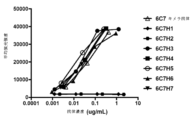
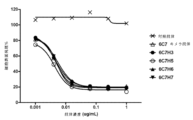


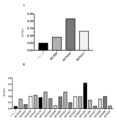
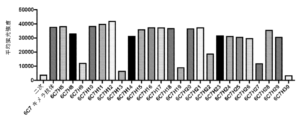


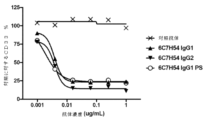
Classifications
-
- C—CHEMISTRY; METALLURGY
- C07—ORGANIC CHEMISTRY
- C07K—PEPTIDES
- C07K16/00—Immunoglobulins [IGs], e.g. monoclonal or polyclonal antibodies
- C07K16/18—Immunoglobulins [IGs], e.g. monoclonal or polyclonal antibodies against material from animals or humans
- C07K16/28—Immunoglobulins [IGs], e.g. monoclonal or polyclonal antibodies against material from animals or humans against receptors, cell surface antigens or cell surface determinants
- C07K16/2803—Immunoglobulins [IGs], e.g. monoclonal or polyclonal antibodies against material from animals or humans against receptors, cell surface antigens or cell surface determinants against the immunoglobulin superfamily
-
- A—HUMAN NECESSITIES
- A61—MEDICAL OR VETERINARY SCIENCE; HYGIENE
- A61P—SPECIFIC THERAPEUTIC ACTIVITY OF CHEMICAL COMPOUNDS OR MEDICINAL PREPARATIONS
- A61P25/00—Drugs for disorders of the nervous system
- A61P25/28—Drugs for disorders of the nervous system for treating neurodegenerative disorders of the central nervous system, e.g. nootropic agents, cognition enhancers, drugs for treating Alzheimer's disease or other forms of dementia
-
- A—HUMAN NECESSITIES
- A61—MEDICAL OR VETERINARY SCIENCE; HYGIENE
- A61P—SPECIFIC THERAPEUTIC ACTIVITY OF CHEMICAL COMPOUNDS OR MEDICINAL PREPARATIONS
- A61P31/00—Antiinfectives, i.e. antibiotics, antiseptics, chemotherapeutics
-
- A—HUMAN NECESSITIES
- A61—MEDICAL OR VETERINARY SCIENCE; HYGIENE
- A61P—SPECIFIC THERAPEUTIC ACTIVITY OF CHEMICAL COMPOUNDS OR MEDICINAL PREPARATIONS
- A61P35/00—Antineoplastic agents
-
- A—HUMAN NECESSITIES
- A61—MEDICAL OR VETERINARY SCIENCE; HYGIENE
- A61P—SPECIFIC THERAPEUTIC ACTIVITY OF CHEMICAL COMPOUNDS OR MEDICINAL PREPARATIONS
- A61P35/00—Antineoplastic agents
- A61P35/02—Antineoplastic agents specific for leukemia
-
- A—HUMAN NECESSITIES
- A61—MEDICAL OR VETERINARY SCIENCE; HYGIENE
- A61K—PREPARATIONS FOR MEDICAL, DENTAL OR TOILETRY PURPOSES
- A61K39/00—Medicinal preparations containing antigens or antibodies
- A61K2039/505—Medicinal preparations containing antigens or antibodies comprising antibodies
-
- C—CHEMISTRY; METALLURGY
- C07—ORGANIC CHEMISTRY
- C07K—PEPTIDES
- C07K2317/00—Immunoglobulins specific features
- C07K2317/20—Immunoglobulins specific features characterized by taxonomic origin
- C07K2317/21—Immunoglobulins specific features characterized by taxonomic origin from primates, e.g. man
-
- C—CHEMISTRY; METALLURGY
- C07—ORGANIC CHEMISTRY
- C07K—PEPTIDES
- C07K2317/00—Immunoglobulins specific features
- C07K2317/20—Immunoglobulins specific features characterized by taxonomic origin
- C07K2317/24—Immunoglobulins specific features characterized by taxonomic origin containing regions, domains or residues from different species, e.g. chimeric, humanized or veneered
-
- C—CHEMISTRY; METALLURGY
- C07—ORGANIC CHEMISTRY
- C07K—PEPTIDES
- C07K2317/00—Immunoglobulins specific features
- C07K2317/30—Immunoglobulins specific features characterized by aspects of specificity or valency
- C07K2317/31—Immunoglobulins specific features characterized by aspects of specificity or valency multispecific
-
- C—CHEMISTRY; METALLURGY
- C07—ORGANIC CHEMISTRY
- C07K—PEPTIDES
- C07K2317/00—Immunoglobulins specific features
- C07K2317/30—Immunoglobulins specific features characterized by aspects of specificity or valency
- C07K2317/34—Identification of a linear epitope shorter than 20 amino acid residues or of a conformational epitope defined by amino acid residues
-
- C—CHEMISTRY; METALLURGY
- C07—ORGANIC CHEMISTRY
- C07K—PEPTIDES
- C07K2317/00—Immunoglobulins specific features
- C07K2317/50—Immunoglobulins specific features characterized by immunoglobulin fragments
- C07K2317/52—Constant or Fc region; Isotype
-
- C—CHEMISTRY; METALLURGY
- C07—ORGANIC CHEMISTRY
- C07K—PEPTIDES
- C07K2317/00—Immunoglobulins specific features
- C07K2317/50—Immunoglobulins specific features characterized by immunoglobulin fragments
- C07K2317/55—Fab or Fab'
-
- C—CHEMISTRY; METALLURGY
- C07—ORGANIC CHEMISTRY
- C07K—PEPTIDES
- C07K2317/00—Immunoglobulins specific features
- C07K2317/50—Immunoglobulins specific features characterized by immunoglobulin fragments
- C07K2317/56—Immunoglobulins specific features characterized by immunoglobulin fragments variable (Fv) region, i.e. VH and/or VL
-
- C—CHEMISTRY; METALLURGY
- C07—ORGANIC CHEMISTRY
- C07K—PEPTIDES
- C07K2317/00—Immunoglobulins specific features
- C07K2317/70—Immunoglobulins specific features characterized by effect upon binding to a cell or to an antigen
-
- C—CHEMISTRY; METALLURGY
- C07—ORGANIC CHEMISTRY
- C07K—PEPTIDES
- C07K2317/00—Immunoglobulins specific features
- C07K2317/70—Immunoglobulins specific features characterized by effect upon binding to a cell or to an antigen
- C07K2317/73—Inducing cell death, e.g. apoptosis, necrosis or inhibition of cell proliferation
-
- C—CHEMISTRY; METALLURGY
- C07—ORGANIC CHEMISTRY
- C07K—PEPTIDES
- C07K2317/00—Immunoglobulins specific features
- C07K2317/70—Immunoglobulins specific features characterized by effect upon binding to a cell or to an antigen
- C07K2317/76—Antagonist effect on antigen, e.g. neutralization or inhibition of binding
-
- C—CHEMISTRY; METALLURGY
- C07—ORGANIC CHEMISTRY
- C07K—PEPTIDES
- C07K2317/00—Immunoglobulins specific features
- C07K2317/90—Immunoglobulins specific features characterized by (pharmaco)kinetic aspects or by stability of the immunoglobulin
- C07K2317/92—Affinity (KD), association rate (Ka), dissociation rate (Kd) or EC50 value
Landscapes
- Health & Medical Sciences (AREA)
- Chemical & Material Sciences (AREA)
- Organic Chemistry (AREA)
- Immunology (AREA)
- Medicinal Chemistry (AREA)
- Life Sciences & Earth Sciences (AREA)
- General Health & Medical Sciences (AREA)
- Nuclear Medicine, Radiotherapy & Molecular Imaging (AREA)
- Veterinary Medicine (AREA)
- Public Health (AREA)
- Animal Behavior & Ethology (AREA)
- Pharmacology & Pharmacy (AREA)
- General Chemical & Material Sciences (AREA)
- Chemical Kinetics & Catalysis (AREA)
- Molecular Biology (AREA)
- Genetics & Genomics (AREA)
- Biochemistry (AREA)
- Biophysics (AREA)
- Proteomics, Peptides & Aminoacids (AREA)
- Biomedical Technology (AREA)
- Neurology (AREA)
- Neurosurgery (AREA)
- Engineering & Computer Science (AREA)
- Bioinformatics & Cheminformatics (AREA)
- Oncology (AREA)
- Hospice & Palliative Care (AREA)
- Hematology (AREA)
- Communicable Diseases (AREA)
- Psychiatry (AREA)
- Peptides Or Proteins (AREA)
- Medicines Containing Antibodies Or Antigens For Use As Internal Diagnostic Agents (AREA)
- Preparation Of Compounds By Using Micro-Organisms (AREA)
- Micro-Organisms Or Cultivation Processes Thereof (AREA)
- Medicines That Contain Protein Lipid Enzymes And Other Medicines (AREA)
Description
関連出願の相互参照
本願は、2018年8月31日に出願された米国仮特許出願第62/726,053号に基づく利益を主張するものであり、この仮出願は、参照によりその全体が本明細書に組み込まれる。
CROSS-REFERENCE TO RELATED APPLICATIONS This application claims the benefit of U.S. Provisional Patent Application No. 62/726,053, filed Aug. 31, 2018, which is incorporated herein by reference in its entirety.
ASCIIテキストファイルによる配列表の提出
ASCIIテキストファイルでの次の提出物の内容は、その全体において参照により本明細書に組み込まれる:コンピュータ可読形態(CRF)の配列表(ファイル名:735022002840SEQLIST.TXT、記録日:2019年8月26日、サイズ:112KB)。
Submission of a Sequence Listing via ASCII Text File The contents of the following submission in an ASCII text file are incorporated herein by reference in their entirety: Sequence Listing in Computer Readable Form (CRF) (Filename: 735022002840SEQLIST.TXT, Date Recorded: August 26, 2019, Size: 112KB).
本開示の技術分野
本開示は、抗CD33抗体及びかかる抗体の治療的使用に関する。
TECHNICAL FIELD OF THE DISCLOSURE The present disclosure relates to anti-CD33 antibodies and therapeutic uses of such antibodies.
骨髄細胞表面抗原CD33前駆体(CD33)は、Siglec-3としても知られ、未熟型及び成熟型の骨髄細胞、樹状細胞、及びミクログリア細胞などの免疫細胞及び造血細胞上に発現する1型免疫グロブリン様膜貫通タンパク質である。(Crocker et al.(2007)Nat Rev Immunol.7:255-266、McMillan and Crocker(2008)Carbohydr Res.343:2050-2056、Von Gunten and Bochner(2008)Ann NY Acad Sci.1143:61-82、Handgretinger et al.(1993)Immunol Lett.37:223-228、及びHernandez-Caselles et al.(2006)J Leukoc Biol.79:46-58)。CD33は、Ig様C2型(免疫グロブリン様)及びIg様V型(免疫グロブリン様)の細胞外ドメイン、ならびに2つのITIM様モチーフをその細胞質ドメインに含む。CD33の3つの選択的スプライシング型(アイソフォーム)が同定されており、これはCD33Mと命名された高分子量バリアント、ならびにIg様V型ドメイン(リガンド結合部位)及びVドメインとCドメインとを連結するジスルフィド結合を欠いている小さいアイソフォームCD33mを含む。
The myeloid cell surface antigen CD33 precursor (CD33), also known as Siglec-3, is a
拡張コホート(例えば、数千の個体)に対して行われたゲノムワイド関連研究(GWAS)により、CD33の一塩基多型(SNP)rs3865444CC(別称rs3826656)及びrs3865444AAが、遅発型アルツハイマー病(AD)のリスクの遺伝的修飾因子として同定された。腫瘍学において、CD33の発現減少をもたらすCD33バリアントは、小児の急性骨髄性白血病(AML)の生存率の改善に関連することが示されている。寛解後の3年全生存率は、CD33の完全長発現低下に関連するrs3865444AAバリアントとの強い連鎖不均衡にあるバリアントrs35112940GGの保有者では84%+/-8%である。非保護的アレルの場合、寛解率は68%+/-15%である。また、保護的アレルの保有者でも、再発リスクが低く、無病生存率が高い。同様に、完全長CD33の発現の46%超の低下に関連するrs12459419のマイナーバリアントアレル(TT)についてホモ接合型である患者では、バリアントCC及びCTの保有者(52%対31%)よりも疾患の転帰が好ましく、診断上の芽細胞CD33発現が他の遺伝子型よりも著しく低い傾向が強い。これは、抗CD33抗体及び有毒なカリケアマイシンγ誘導体での治療を受ける患者にさえ当てはまる(Mortland et al.,(2013)Clin Cancer Res;1-8)。2459419TTアレルの保有者は、完全長CD33の発現の25%超の低減を示すrs12459419CTアレルの保有者と同様に、アルツハイマー病のリスクの低減も示す(Malik M.et al.(2015)Human Molecular Genetics,1-14)。これは、CD33の発現または機能の低減がアルツハイマー病及びがんにおいて有益であり得ることを示唆している。 Genome-wide association studies (GWAS) performed on extended cohorts (e.g., several thousand individuals) have identified the CD33 single nucleotide polymorphisms (SNPs) rs3865444 CC (also known as rs3826656) and rs3865444 AA as genetic modifiers of risk for late-onset Alzheimer's disease (AD). In oncology, CD33 variants leading to reduced expression of CD33 have been shown to be associated with improved survival in pediatric acute myeloid leukemia (AML). The 3-year overall survival rate after remission is 84% +/- 8% in carriers of the variant rs35112940 GG , which is in strong linkage disequilibrium with the rs3865444 AA variant associated with reduced full-length expression of CD33. For non-protective alleles, the remission rate is 68% +/- 15%. Carriers of protective alleles also have a lower risk of recurrence and a higher disease-free survival. Similarly, patients homozygous for the minor variant allele (TT) of rs12459419, associated with a greater than 46% reduction in full-length CD33 expression, have a more favorable disease outcome than carriers of variants CC and CT (52% vs. 31%) and are more likely to have significantly lower diagnostic blast CD33 expression than other genotypes. This is true even for patients treated with anti-CD33 antibodies and toxic calicheamicin gamma derivatives (Mortland et al., (2013) Clin Cancer Res; 1-8). Carriers of the 2459419 TT allele also show a reduced risk of Alzheimer's disease, as do carriers of the rs12459419 CT allele, which show a greater than 25% reduction in full-length CD33 expression (Malik M. et al. (2015) Human Molecular Genetics, 1-14). This suggests that reducing CD33 expression or function may be beneficial in Alzheimer's disease and cancer.
CD33に対する抗体は、例えば、US7,342,110、US7,557,189、US8,119,787、US8,337,855、US8,124,069、US5,730,982、WO2012/074097、WO2004/043344、WO1993/020848、WO2012/045752、WO2007/014743、WO2003/093298、WO2011/036183、WO1991/009058、WO2008/058021、WO2011/038301、WO2016/201389、WO2016/201388、Hoyer et al(2008)Am J Clin Pathol,129:316-323、Rollins-Ravel and Roth(2012)Histopathology 60:933-942、Perez-Olivia et al(2011)Glycobiol 21:757-770、Ferlasso et al(2000)Eur J Immunol 30:827-833、Vitale et al(2001)Proc Natl Acad Sci USA 98:5764-5769、Jandus et al(2011)Biochem Pharmacol 82:323-332、O’Reilly and Paulson(2009)Trends Pharmcol Sci 30:240-248、Jurcic(2012)Curr Hematol Malig Rep 7:65-73、及びRicart(2011)Clin Cancer Res 17:6417-6427に記載されている。 Antibodies against CD33 are described, for example, in US 7,342,110, US 7,557,189, US 8,119,787, US 8,337,855, US 8,124,069, US 5,730,982, WO 2012/074097, WO 2004/043344, WO 1993/020848, WO2012/045752, WO2007/014743, WO2003/093298, WO2011/036183, WO1991/009058, WO2008/058021, WO2011/038301, WO2016/201389, WO2016/20 1388, Hoyer et al (2008) Am J Clin Pathol, 129:316-323, Rollins-Ravel and Roth (2012) Histopathology 60:933-942, Perez-Olivia et al (2011) Gl ycobiol 21:757-770, Ferlasso et al (2000) Eur J Immunol 30:827-833, Vitale et al (2001) Proc Natl Acad Sci USA 98:5764-5769 et al (2011) Biochem Pharmacol 82:323-332, O'Reilly and Paulson (2009) Trends Pharmacol Sci 30:240-248, Jurcic (2012) Curr Hematol Malig Rep 7:65-73, and Ricart (2011) Clin Cancer Res 17:6417-6427.
したがって、望まれないCD33活性に関連する疾患、障害、及び病態を治療するための治療用抗CD33抗体が必要とされている。 Therefore, there is a need for therapeutic anti-CD33 antibodies to treat diseases, disorders, and conditions associated with unwanted CD33 activity.
本明細書で引用される全ての参考文献は、特許、特許出願及び公開文献を含め、その全体が参照により本明細書に組み込まれる。 All references cited herein, including patents, patent applications, and published documents, are hereby incorporated by reference in their entirety.
本開示は、一般に、ヒトCD33に特異的に結合する抗体、例えば、モノクローナル抗体、キメラ抗体、ヒト化抗体、抗体断片などを含む組成物、及びかかる組成物を使用する方法を対象とする。 The present disclosure is generally directed to compositions comprising antibodies, e.g., monoclonal antibodies, chimeric antibodies, humanized antibodies, antibody fragments, etc., that specifically bind to human CD33, and methods of using such compositions.
本開示の特定の態様は、少なくとも部分的には、改善及び/または向上した機能的特徴を有する抗CD33抗体の同定に基づく。いくつかの実施形態において、本開示の抗CD33抗体は、参照抗体(例えば、配列番号3のアミノ酸配列を含む重鎖可変領域及び配列番号4のアミノ酸配列を含む軽鎖可変領域を含む抗CD33抗体)と比べて、1つ以上の改善及び/または向上した機能的特徴を含む。いくつかの実施形態において、本開示の抗CD33抗体は、参照抗CD33抗体(例えば、配列番号3のアミノ酸配列を含む重鎖可変領域及び配列番号4のアミノ酸配列を含む軽鎖可変領域を含む抗CD33抗体)のものよりも高いCD33(例えば、ヒトCD33)に対する親和性を有する。いくつかの実施形態において、本開示の抗CD33抗体は、参照抗体(例えば、配列番号3のアミノ酸配列を含む重鎖可変領域及び配列番号4のアミノ酸配列を含む軽鎖可変領域を含む抗CD33抗体)のものよりも低い半数有効濃度(EC50)で、ヒト初代樹状細胞などのヒト細胞に結合する。いくつかの実施形態において、本開示の抗CD33抗体は、参照抗体(例えば、配列番号3の配列を含む重鎖可変領域及び配列番号4の配列を含む軽鎖可変領域を含む抗CD33抗体)のものよりも低い半数有効濃度(EC50)で、CD33の細胞レベルを低下させる(例えば、細胞表面レベルを低下させる、または下げる)。 Certain aspects of the present disclosure are based, at least in part, on the identification of anti-CD33 antibodies with improved and/or enhanced functional characteristics. In some embodiments, the anti-CD33 antibodies of the present disclosure comprise one or more improved and/or enhanced functional characteristics as compared to a reference antibody (e.g., an anti-CD33 antibody comprising a heavy chain variable region comprising the amino acid sequence of SEQ ID NO: 3 and a light chain variable region comprising the amino acid sequence of SEQ ID NO: 4). In some embodiments, the anti-CD33 antibodies of the present disclosure have a higher affinity for CD33 (e.g., human CD33) than that of the reference anti-CD33 antibody (e.g., an anti-CD33 antibody comprising a heavy chain variable region comprising the amino acid sequence of SEQ ID NO: 3 and a light chain variable region comprising the amino acid sequence of SEQ ID NO: 4). In some embodiments, the anti-CD33 antibodies of the present disclosure bind to human cells, such as human primary dendritic cells, at a lower median effective concentration (EC 50 ) than that of the reference antibody (e.g., an anti-CD33 antibody comprising a heavy chain variable region comprising the amino acid sequence of SEQ ID NO: 3 and a light chain variable region comprising the amino acid sequence of SEQ ID NO: 4 ). In some embodiments, an anti-CD33 antibody of the present disclosure reduces cellular levels of CD33 (e.g., reduces or lowers cell surface levels) at a lower median effective concentration ( EC50) than that of a reference antibody (e.g., an anti-CD33 antibody comprising a heavy chain variable region comprising the sequence of SEQ ID NO:3 and a light chain variable region comprising the sequence of SEQ ID NO:4 ).
したがって、一態様において、本開示は、CD33タンパク質に結合する抗体であって、該抗体は、重鎖可変領域及び軽鎖可変領域を含み、重鎖可変領域は、配列番号8~30から選択されるアミノ酸配列を含むHVR-H1、配列番号33のアミノ酸配列を含むHVR-H2、配列番号39~40から選択されるアミノ酸配列を含むHVR-H3、配列番号47のアミノ酸配列を含むHVR-L1、配列番号53~55から選択されるアミノ酸配列を含むHVR-L2、及び配列番号58~62から選択されるアミノ酸配列を含むHVR-L3を含む、抗体に関する。 Thus, in one aspect, the disclosure relates to an antibody that binds to CD33 protein, the antibody comprising a heavy chain variable region and a light chain variable region, the heavy chain variable region comprising HVR-H1 comprising an amino acid sequence selected from SEQ ID NOs: 8-30, HVR-H2 comprising an amino acid sequence of SEQ ID NO: 33, HVR-H3 comprising an amino acid sequence selected from SEQ ID NOs: 39-40, HVR-L1 comprising an amino acid sequence of SEQ ID NO: 47, HVR-L2 comprising an amino acid sequence selected from SEQ ID NOs: 53-55, and HVR-L3 comprising an amino acid sequence selected from SEQ ID NOs: 58-62.
別の態様では、本開示は、CD33タンパク質に結合する抗体であって、該抗体は、重鎖可変領域及び軽鎖可変領域を含み、重鎖可変領域は、抗体6C7H8、6C7H9、6C7H10、6C7H11、6C7H12、6C7H13、6C7H14、6C7H15、6C7H16、6C7H17、6C7H18、6C7H19、6C7H20、6C7H21、6C7H22、6C7H23、6C7H24、6C7H25、6C7H26、6C7H27、6C7H28、6C7H29、6C7H30、6C7H31、6C7H32、6C7H33、6C7H34、6C7H35、6C7H36、6C7H37、6C7H38、6C7H39、6C7H40、6C7H41、6C7H42、6C7H43、6C7H44、6C7H45、6C7H46、6C7H47、6C7H48、6C7H49、6C7H50、6C7H51、6C7H52、6C7H53、または6C7H54のHVR-H1、HVR-H2、及びHVR-H3を含む、抗体に関する。 In another aspect, the disclosure provides an antibody that binds to a CD33 protein, the antibody comprising a heavy chain variable region and a light chain variable region, the heavy chain variable region being selected from the group consisting of antibodies 6C7H8, 6C7H9, 6C7H10, 6C7H11, 6C7H12, 6C7H13, 6C7H14, 6C7H15, 6C7H16, 6C7H17, 6C7H18, 6C7H19, 6C7H20, 6C7H21, 6C7H22, 6C7H23, 6C7H24, 6C7H25, 6C7H26, 6C7H27, 6C7H28, 6C7H 29, 6C7H30, 6C7H31, 6C7H32, 6C7H33, 6C7H34, 6C7H35, 6C7H36, 6C7H37, 6C7H38, 6C7H39, 6C7H40, 6C7H41, 6C7H42, 6C7H43, 6C7H44, 6C7H45, 6C7H46, 6C7H47, 6C7H48, 6C7H49, 6C7H50, 6C7H51, 6C7H52, 6C7H53, or 6C7H54, and including HVR-H1, HVR-H2, and HVR-H3.
別の態様では、本開示は、CD33タンパク質に結合する抗体であって、該抗体は、重鎖可変領域及び軽鎖可変領域を含み、軽鎖可変領域は、抗体6C7H8、6C7H9、6C7H10、6C7H11、6C7H12、6C7H13、6C7H14、6C7H15、6C7H16、6C7H17、6C7H18、6C7H19、6C7H20、6C7H21、6C7H22、6C7H23、6C7H24、6C7H25、6C7H26、6C7H27、6C7H28、6C7H29、6C7H30、6C7H31、6C7H32、6C7H33、6C7H34、6C7H35、6C7H36、6C7H37、6C7H38、6C7H39、6C7H40、6C7H41、6C7H42、6C7H43、6C7H44、6C7H45、6C7H46、6C7H47、6C7H48、6C7H49、6C7H50、6C7H51、6C7H52、6C7H53、または6C7H54のHVR-L1、HVR-L2、及びHVR-L3を含む、抗体に関する。 In another aspect, the disclosure provides an antibody that binds to a CD33 protein, the antibody comprising a heavy chain variable region and a light chain variable region, the light chain variable region being selected from the group consisting of antibodies 6C7H8, 6C7H9, 6C7H10, 6C7H11, 6C7H12, 6C7H13, 6C7H14, 6C7H15, 6C7H16, 6C7H17, 6C7H18, 6C7H19, 6C7H20, 6C7H21, 6C7H22, 6C7H23, 6C7H24, 6C7H25, 6C7H26, 6C7H27, 6C7H28, 6C7H 29, 6C7H30, 6C7H31, 6C7H32, 6C7H33, 6C7H34, 6C7H35, 6C7H36, 6C7H37, 6C7H38, 6C7H39, 6C7H40, 6C7H41, 6C7H42, 6C7H43, 6C7H44, 6C7H45, 6C7H46, 6C7H47, 6C7H48, 6C7H49, 6C7H50, 6C7H51, 6C7H52, 6C7H53, or 6C7H54.
別の態様では、本開示は、CD33タンパク質に結合する抗体であって、該抗体は、重鎖可変領域及び軽鎖可変領域を含み、重鎖可変領域は、抗体6C7H8、6C7H9、6C7H10、6C7H11、6C7H12、6C7H13、6C7H14、6C7H15、6C7H16、6C7H17、6C7H18、6C7H19、6C7H20、6C7H21、6C7H22、6C7H23、6C7H24、6C7H25、6C7H26、6C7H27、6C7H28、6C7H29、6C7H30、6C7H31、6C7H32、6C7H33、6C7H34、6C7H35、6C7H36、6C7H37、6C7H38、6C7H39、6C7H40、6C7H41、6C7H42、6C7H43、6C7H44、6C7H45、6C7H46、6C7H47、6C7H48、6C7H49、6C7H50、6C7H51、6C7H52、6C7H53、または6C7H54のHVR-H1、HVR-H2、及びHVR-H3を含み、軽鎖可変領域は、抗体6C7H8、6C7H9、6C7H10、6C7H11、6C7H12、6C7H13、6C7H14、6C7H15、6C7H16、6C7H17、6C7H18、6C7H19、6C7H20、6C7H21、6C7H22、6C7H23、6C7H24、6C7H25、6C7H26、6C7H27、6C7H28、6C7H29、6C7H30、6C7H31、6C7H32、6C7H33、6C7H34、6C7H35、6C7H36、6C7H37、6C7H38、6C7H39、6C7H40、6C7H41、6C7H42、6C7H43、6C7H44、6C7H45、6C7H46、6C7H47、6C7H48、6C7H49、6C7H50、6C7H51、6C7H52、6C7H53、または6C7H54のHVR-L1、HVR-L2、及びHVR-L3を含む、抗体に関する。 In another aspect, the disclosure provides an antibody that binds to a CD33 protein, the antibody comprising a heavy chain variable region and a light chain variable region, the heavy chain variable region being selected from the group consisting of antibodies 6C7H8, 6C7H9, 6C7H10, 6C7H11, 6C7H12, 6C7H13, 6C7H14, 6C7H15, 6C7H16, 6C7H17, 6C7H18, 6C7H19, 6C7H20, 6C7H21, 6C7H22, 6C7H23, 6C7H24, 6C7H25, 6C7H26, 6C7H27, 6C7H29, 6C7H30, 6C7H31, 6C7H32, 6C7H33, 6C7H34, 6C7H35, 6C7H36, 6C7H37, 6C7H38, 6C7H39, 6C7H40, 6C7H41, 6C7H42, 6C7H43, 6C7H44, 6C7H45, 6C7H46, 6C7H47, 6C7H48, 6C7H49, 6C7H50, 6C7H51, 6C7H52, 6C7H53, 6C7H54, 6C7H55, 6C7H56, 6C7H57, 6C7H58, 6C7H59, 6C7H60, 6C7H61, 6C7H62, 6C7H63, 6C7H64, 6C7H65, 6C7H66, 6 7H27, 6C7H28, 6C7H29, 6C7H30, 6C7H31, 6C7H32, 6C7H33, 6C7H34, 6C7H35, 6C7H36, 6C7H37, 6C7H38, 6C7H39, 6C7H40, 6C7H41, 6C7H42, 6C7H43, 6C7H44, 6C7H45, 6C7H46, 6C7H47, 6C7H48, 6C7H49, 6C7H50, 6C7H51, 6C7H52, 6C7H53, or 6C7H54 HV and the light chain variable region comprises HVR-H1, HVR-H2, and HVR-H3 of antibodies 6C7H8, 6C7H9, 6C7H10, 6C7H11, 6C7H12, 6C7H13, 6C7H14, 6C7H15, 6C7H16, 6C7H17, 6C7H18, 6C7H19, 6C7H20, 6C7H21, 6C7H22, 6C7H23, 6C7H24, 6C7H25, 6C7H26, 6C7H27, 6C7H28, 6C7H29, 6C7H30, 6C7H31 , 6C7H32, 6C7H33, 6C7H34, 6C7H35, 6C7H36, 6C7H37, 6C7H38, 6C7H39, 6C7H40, 6C7H41, 6C7H42, 6C7H43, 6C7H44, 6C7H45, 6C7H46, 6C7H47, 6C7H48, 6C7H49, 6C7H50, 6C7H51, 6C7H52, 6C7H53, or 6C7H54.
別の態様では、本開示は、CD33タンパク質に結合する抗体であって、該抗体は、抗体6C7H8、6C7H9、6C7H10、6C7H11、6C7H12、6C7H13、6C7H14、6C7H15、6C7H16、6C7H17、6C7H18、6C7H19、6C7H20、6C7H21、6C7H22、6C7H23、6C7H24、6C7H25、6C7H26、6C7H27、6C7H28、6C7H29、6C7H30、6C7H31、6C7H32、6C7H33、6C7H34、6C7H35、6C7H36、6C7H37、6C7H38、6C7H39、6C7H40、6C7H41、6C7H42、6C7H43、6C7H44、6C7H45、6C7H46、6C7H47、6C7H48、6C7H49、6C7H50、6C7H51、6C7H52、6C7H53、または6C7H54の重鎖可変領域を含み、該抗体は、抗体6C7H8、6C7H9、6C7H10、6C7H11、6C7H12、6C7H13、6C7H14、6C7H15、6C7H16、6C7H17、6C7H18、6C7H19、6C7H20、6C7H21、6C7H22、6C7H23、6C7H24、6C7H25、6C7H26、6C7H27、6C7H28、6C7H29、6C7H30、6C7H31、6C7H32、6C7H33、6C7H34、6C7H35、6C7H36、6C7H37、6C7H38、6C7H39、6C7H40、6C7H41、6C7H42、6C7H43、6C7H44、6C7H45、6C7H46、6C7H47、6C7H48、6C7H49、6C7H50、6C7H51、6C7H52、6C7H53、または6C7H54の軽鎖可変領域を含む、抗体に関する。 In another aspect, the disclosure provides an antibody that binds to CD33 protein, the antibody being selected from the group consisting of antibodies 6C7H8, 6C7H9, 6C7H10, 6C7H11, 6C7H12, 6C7H13, 6C7H14, 6C7H15, 6C7H16, 6C7H17, 6C7H18, 6C7H19, 6C7H20, 6C7H21, 6C7H22, 6C7H23, 6C7H24, 6C7H25, 6C7H26, 6C7H27, 6C7H2 8, 6C7H29, 6C7H30, 6C7H31, 6C7H32, 6C7H33, 6C7H34, 6C7H35, 6C7H36, 6C7H37, 6C7H38, 6C7H39, 6C7H40, 6C7H41, 6C7H42, 6C7H43, 6C7H44, 6C7H45, 6C7H46, 6C7H47, 6C7H48, 6C7H49, 6C7H50, 6C7H51, 6C7H52, 6C7H53, or 6C7H 54 heavy chain variable regions, the antibodies being selected from the group consisting of antibodies 6C7H8, 6C7H9, 6C7H10, 6C7H11, 6C7H12, 6C7H13, 6C7H14, 6C7H15, 6C7H16, 6C7H17, 6C7H18, 6C7H19, 6C7H20, 6C7H21, 6C7H22, 6C7H23, 6C7H24, 6C7H25, 6C7H26, 6C7H27, 6C7H28, 6C7H29, 6C7H30, 6C7H31, 6C7H32, 6C7H33, 6C7H34, 6C7H35, 6C7H36, 6C7H37, 6C7H38, 6C7H39, 6C7H40, 6C7H41, 6C7H42, 6C7H43, 6C7H44, 6C7H45, 6C7H46, 6C7H47, 6C7H48, 6C7H49 ... 1, 6C7H32, 6C7H33, 6C7H34, 6C7H35, 6C7H36, 6C7H37, 6C7H38, 6C7H39, 6C7H40, 6C7H41, 6C7H42, 6C7H43, 6C7H44, 6C7H45, 6C7H46, 6C7H47, 6C7H48, 6C7H49, 6C7H50, 6C7H51, 6C7H52, 6C7H53, or 6C7H54.
別の態様では、本開示は、CD33タンパク質に結合する抗体であって、該抗体は、配列番号68~93から選択されるアミノ酸配列を含む重鎖可変領域、及び/または配列番号97~103から選択されるアミノ酸配列を含む軽鎖可変領域を含む、抗体に関する。 In another aspect, the disclosure relates to an antibody that binds to a CD33 protein, the antibody comprising a heavy chain variable region comprising an amino acid sequence selected from SEQ ID NOs: 68-93 and/or a light chain variable region comprising an amino acid sequence selected from SEQ ID NOs: 97-103.
別の態様では、本開示は、CD33タンパク質に結合する抗体であって、該抗体は、抗体6C7H8、6C7H9、6C7H10、6C7H11、6C7H12、6C7H13、6C7H14、6C7H15、6C7H16、6C7H17、6C7H18、6C7H19、6C7H20、6C7H21、6C7H22、6C7H23、6C7H24、6C7H25、6C7H26、6C7H27、6C7H28、6C7H29、6C7H30、6C7H31、6C7H32、6C7H33、6C7H34、6C7H35、6C7H36、6C7H37、6C7H38、6C7H39、6C7H40、6C7H41、6C7H42、6C7H43、6C7H44、6C7H45、6C7H46、6C7H47、6C7H48、6C7H49、6C7H50、6C7H51、6C7H52、6C7H53、または6C7H54の重鎖可変領域を含み、該抗体は、抗体6C7H8、6C7H9、6C7H10、6C7H11、6C7H12、6C7H13、6C7H14、6C7H15、6C7H16、6C7H17、6C7H18、6C7H19、6C7H20、6C7H21、6C7H22、6C7H23、6C7H24、6C7H25、6C7H26、6C7H27、6C7H28、6C7H29、6C7H30、6C7H31、6C7H32、6C7H33、6C7H34、6C7H35、6C7H36、6C7H37、6C7H38、6C7H39、6C7H40、6C7H41、6C7H42、6C7H43、6C7H44、6C7H45、6C7H46、6C7H47、6C7H48、6C7H49、6C7H50、6C7H51、6C7H52、6C7H53、または6C7H54の軽鎖可変領域を含む、抗体に関する。 In another aspect, the disclosure provides an antibody that binds to CD33 protein, the antibody being selected from the group consisting of antibodies 6C7H8, 6C7H9, 6C7H10, 6C7H11, 6C7H12, 6C7H13, 6C7H14, 6C7H15, 6C7H16, 6C7H17, 6C7H18, 6C7H19, 6C7H20, 6C7H21, 6C7H22, 6C7H23, 6C7H24, 6C7H25, 6C7H26, 6C7H27, 6C7H2 8, 6C7H29, 6C7H30, 6C7H31, 6C7H32, 6C7H33, 6C7H34, 6C7H35, 6C7H36, 6C7H37, 6C7H38, 6C7H39, 6C7H40, 6C7H41, 6C7H42, 6C7H43, 6C7H44, 6C7H45, 6C7H46, 6C7H47, 6C7H48, 6C7H49, 6C7H50, 6C7H51, 6C7H52, 6C7H53, or 6C7H 54 heavy chain variable regions, the antibodies being selected from the group consisting of antibodies 6C7H8, 6C7H9, 6C7H10, 6C7H11, 6C7H12, 6C7H13, 6C7H14, 6C7H15, 6C7H16, 6C7H17, 6C7H18, 6C7H19, 6C7H20, 6C7H21, 6C7H22, 6C7H23, 6C7H24, 6C7H25, 6C7H26, 6C7H27, 6C7H28, 6C7H29, 6C7H30, 6C7H31, 6C7H32, 6C7H33, 6C7H34, 6C7H35, 6C7H36, 6C7H37, 6C7H38, 6C7H39, 6C7H40, 6C7H41, 6C7H42, 6C7H43, 6C7H44, 6C7H45, 6C7H46, 6C7H47, 6C7H48, 6C7H49 ... 1, 6C7H32, 6C7H33, 6C7H34, 6C7H35, 6C7H36, 6C7H37, 6C7H38, 6C7H39, 6C7H40, 6C7H41, 6C7H42, 6C7H43, 6C7H44, 6C7H45, 6C7H46, 6C7H47, 6C7H48, 6C7H49, 6C7H50, 6C7H51, 6C7H52, 6C7H53, or 6C7H54.
別の態様では、本開示は、CD33に結合する単離された抗体であって、該抗体は、重鎖可変領域及び軽鎖可変領域を含み、重鎖可変領域は、配列番号23のアミノ酸配列を含むHVR-H1、配列番号33のアミノ酸配列を含むHVR-H2、配列番号39のアミノ酸配列を含むHVR-H3を含み、軽鎖可変領域は、配列番号47のアミノ酸配列を含むHVR-L1、配列番号53のアミノ酸配列を含むHVR-L2、及び配列番号61のアミノ酸配列を含むHVR-L3を含む、単離された抗体に関する。 In another aspect, the disclosure relates to an isolated antibody that binds to CD33, the antibody comprising a heavy chain variable region and a light chain variable region, the heavy chain variable region comprising HVR-H1 comprising the amino acid sequence of SEQ ID NO:23, HVR-H2 comprising the amino acid sequence of SEQ ID NO:33, and HVR-H3 comprising the amino acid sequence of SEQ ID NO:39, and the light chain variable region comprising HVR-L1 comprising the amino acid sequence of SEQ ID NO:47, HVR-L2 comprising the amino acid sequence of SEQ ID NO:53, and HVR-L3 comprising the amino acid sequence of SEQ ID NO:61.
別の態様では、本開示は、CD33に結合する単離された抗体であって、該抗体は、配列番号83のアミノ酸配列を含む重鎖可変領域及び配列番号102のアミノ酸配列を含む軽鎖可変領域を含む、単離された抗体に関する。 In another aspect, the disclosure relates to an isolated antibody that binds to CD33, the antibody comprising a heavy chain variable region comprising the amino acid sequence of SEQ ID NO:83 and a light chain variable region comprising the amino acid sequence of SEQ ID NO:102.
別の態様では、本開示は、CD33に結合する単離された抗体であって、該抗体は、
(a)配列番号120のアミノ酸配列を含む重鎖及び配列番号122のアミノ酸配列を含む軽鎖、または
(b)配列番号121のアミノ酸配列を含む重鎖及び配列番号122のアミノ酸配列を含む軽鎖を含む、単離された抗体に関する。
In another aspect, the disclosure provides an isolated antibody that binds to CD33, the antibody comprising:
The present invention relates to an isolated antibody comprising: (a) a heavy chain comprising the amino acid sequence of SEQ ID NO: 120 and a light chain comprising the amino acid sequence of SEQ ID NO: 122; or (b) a heavy chain comprising the amino acid sequence of SEQ ID NO: 121 and a light chain comprising the amino acid sequence of SEQ ID NO: 122.
先行実施形態のいずれかと組み合わされ得るいくつかの実施形態において、重鎖可変領域は、VH FR1、VH FR2、VH FR3、及びVH FR4から選択される1つ、2つ、3つ、または4つのフレームワーク領域を含み、VH FR1は、配列番号5~6からなる群から選択される配列を含み、VH FR2は、配列番号31~32からなる群から選択される配列を含み、VH FR3は、配列番号34~36からなる群から選択される配列を含み、VH FR4は、配列番号41の配列を含み、軽鎖可変領域は、VL FR1、VL FR2、VL FR3、及びVL FR4から選択される1つ、2つ、3つ、または4つのフレームワーク領域を含み、VL FR1は、配列番号42~46からなる群から選択される配列を含み、VL FR2は、配列番号48~51からなる群から選択される配列を含み、VL FR3は、配列番号56~57からなる群から選択される配列を含み、VL FR4は、配列番号63~64からなる群から選択される配列を含む。 In some embodiments that may be combined with any of the preceding embodiments, the heavy chain variable region comprises one, two, three, or four framework regions selected from VH FR1, VH FR2, VH FR3, and VH FR4, where VH FR1 comprises a sequence selected from the group consisting of SEQ ID NOs: 5-6, VH FR2 comprises a sequence selected from the group consisting of SEQ ID NOs: 31-32, VH FR3 comprises a sequence selected from the group consisting of SEQ ID NOs: 34-36, and VH FR4 comprises a sequence of SEQ ID NO: 41; the light chain variable region comprises one, two, three, or four framework regions selected from VL FR1, VL FR2, VL FR3, and VL FR4, where VL FR1 comprises a sequence selected from the group consisting of SEQ ID NOs: 42-46, and VL FR2 comprises a sequence selected from the group consisting of SEQ ID NOs: 48-51, and VL FR3 comprises a sequence selected from the group consisting of SEQ ID NOs: 56-57, and VL FR4 comprises a sequence selected from the group consisting of SEQ ID NOs: 63-64.
先行実施形態のいずれかと組み合わされ得るいくつかの実施形態において、本抗体は、IgGクラス、IgMクラス、またはIgAクラスのものである。いくつかの実施形態において、本抗体は、IgGクラスのものであり、IgG1、IgG2、IgG3、またはIgG4アイソタイプを有する。いくつかの実施形態において、本抗体は、IgG4アイソタイプを有し、本抗体は、残基位置228にS228Pアミノ酸置換、残基位置234にF234Aアミノ酸置換、及び残基位置235にL235Aアミノ酸置換を含み、残基位置のナンバリングは、EUナンバリングに従う。いくつかの実施形態において、本抗体は、Fc領域においてC127S、L234A、L234F、L235A、L235E、S267E、K322A、L328F、A330S、P331S、E345R、E430G、S440Y、及びこれらの任意の組み合わせからなる群から選択される残基位置に1つ以上のアミノ酸置換を含み、残基のナンバリングは、EUナンバリングに従う。いくつかの実施形態において、Fc領域は、位置E430Gにアミノ酸置換を含み、残基位置のナンバリングは、EUナンバリングに従うか、Fc領域は、位置L234A、L235A、及びP331Aにアミノ酸置換を含み、残基位置のナンバリングは、EUナンバリングに従うか、Fc領域は、位置L234A、L235A、P331A、及びE430Gにアミノ酸置換を含み、残基位置のナンバリングは、EUナンバリングに従うか、Fc領域は、位置K322A及びE430Gにアミノ酸置換を含み、残基位置のナンバリングは、EUナンバリングに従うか、Fc領域は、位置P331S及びE430Gにアミノ酸置換を含み、残基位置のナンバリングは、EUナンバリングに従うか、Fc領域は、位置A330S、P331S、及びE430Gにアミノ酸置換を含み、残基位置のナンバリングは、EUナンバリングに従うか、Fc領域は、位置K322A、A330S、及びP331Sにアミノ酸置換を含み、残基位置のナンバリングは、EUナンバリングに従うか、Fc領域は、位置K322A、P331S、及びE430Gにアミノ酸置換を含み、残基位置のナンバリングは、EUナンバリングに従うか、Fc領域は、位置E430Gにアミノ酸置換を含み、残基位置のナンバリングは、EUナンバリングに従うか、Fc領域は、位置A330S、P331S、及びE430Gにアミノ酸置換を含み、残基位置のナンバリングは、EUナンバリングに従うか、Fc領域は、位置S267E及びL328Fにアミノ酸置換を含み、残基位置のナンバリングは、EUナンバリングに従うか、Fc領域は、位置C127Sにアミノ酸置換を含み、残基位置のナンバリングは、EUナンバリングに従うか、またはFc領域は、位置E345R、E430G、及びS440Yにアミノ酸置換を含み、残基位置のナンバリングは、EUナンバリングに従う。 In some embodiments that may be combined with any of the preceding embodiments, the antibody is of the IgG class, the IgM class, or the IgA class. In some embodiments, the antibody is of the IgG class and has an IgG1, IgG2, IgG3, or IgG4 isotype. In some embodiments, the antibody has an IgG4 isotype, and the antibody comprises a S228P amino acid substitution at residue position 228, a F234A amino acid substitution at residue position 234, and a L235A amino acid substitution at residue position 235, where the numbering of the residue positions is according to EU numbering. In some embodiments, the antibody comprises one or more amino acid substitutions in the Fc region at residue positions selected from the group consisting of C127S, L234A, L234F, L235A, L235E, S267E, K322A, L328F, A330S, P331S, E345R, E430G, S440Y, and any combination thereof, where residue numbering is according to EU numbering. In some embodiments, the Fc region comprises an amino acid substitution at position E430G, where the numbering of the residue positions is according to EU numbering; the Fc region comprises amino acid substitutions at positions L234A, L235A, and P331A, where the numbering of the residue positions is according to EU numbering; the Fc region comprises amino acid substitutions at positions L234A, L235A, P331A, and E430G, where the numbering of the residue positions is according to EU numbering; the Fc region comprises amino acid substitutions at positions K322A and E430G, where numbering of the residue positions is according to EU numbering; the Fc region comprises amino acid substitutions at positions P331S and E430G, where numbering of the residue positions is according to EU numbering; the Fc region comprises amino acid substitutions at positions A330S, P331S, and E430G, where numbering of the residue positions is according to EU numbering; the Fc region comprises amino acid substitutions at positions K322A, A330S, and P331S, where the numbering of the residue positions is according to EU numbering; or the Fc region comprises amino acid substitutions at positions K322A, P331S, and E430G, where the numbering of the residue positions is according to EU numbering; the Fc region comprises amino acid substitutions at position E430G, where the numbering of the residue positions is according to EU numbering; or the Fc region comprises amino acid substitutions at positions A330S, P331S, and E430G, where the numbering of the residue positions is according to EU numbering. The numbering of the positions is according to EU numbering, or the Fc region contains amino acid substitutions at positions S267E and L328F and the numbering of the residue positions is according to EU numbering, or the Fc region contains amino acid substitutions at position C127S and the numbering of the residue positions is according to EU numbering, or the Fc region contains amino acid substitutions at positions E345R, E430G, and S440Y and the numbering of the residue positions is according to EU numbering.
先行実施形態のいずれかと組み合わされ得るいくつかの実施形態において、CD33タンパク質は、哺乳動物タンパク質またはヒトタンパク質である。いくつかの実施形態において、CD33タンパク質は、野生型タンパク質である。いくつかの実施形態において、CD33タンパク質は、天然に存在するバリアントである。先行実施形態のいずれかと組み合わされ得るいくつかの実施形態において、CD33タンパク質は、ヒト樹状細胞、ヒトマクロファージ、ヒト単球、ヒト破骨細胞、ヒト好中球、ヒトT細胞、ヒトヘルパーT細胞、ヒト細胞傷害性T細胞、ヒト顆粒球、及びヒトミクログリアからなる群から選択される1つ以上の細胞上に発現している。 In some embodiments that may be combined with any of the preceding embodiments, the CD33 protein is a mammalian or human protein. In some embodiments, the CD33 protein is a wild-type protein. In some embodiments, the CD33 protein is a naturally occurring variant. In some embodiments that may be combined with any of the preceding embodiments, the CD33 protein is expressed on one or more cells selected from the group consisting of human dendritic cells, human macrophages, human monocytes, human osteoclasts, human neutrophils, human T cells, human helper T cells, human cytotoxic T cells, human granulocytes, and human microglia.
先行実施形態のいずれかと組み合わされ得るいくつかの実施形態において、本抗体は、ヒトCD33タンパク質に特異的に結合する。いくつかの実施形態において、本抗体は、ヒトCD33タンパク質に結合し、別の種由来のCD33オーソログまたはホモログと交差反応しない。先行実施形態のいずれかと組み合わされ得るいくつかの実施形態において、本抗体は、ヒトCD33または哺乳動物CD33タンパク質上のアミノ酸残基を含むエピトープに結合する抗体断片である。先行実施形態のいずれかと組み合わされ得るいくつかの実施形態において、本抗体は、ヒトCD33、ヒトCD33の天然に存在するバリアント、及びヒトCD33の疾患バリアントからなる群から選択される1つ以上のヒトタンパク質に結合する抗体断片である。いくつかの実施形態において、抗体断片は、ヒトCD33、ヒトCD33の天然に存在するバリアント、及びヒトCD33の疾患バリアントからなる群から選択される1つ以上のヒトタンパク質に結合する第2の抗体断片に架橋されている。いくつかの実施形態において、断片は、Fab、Fab′、Fab′-SH、F(ab′)2、Fv、またはscFv断片である。 In some embodiments that may be combined with any of the preceding embodiments, the antibody specifically binds to human CD33 protein. In some embodiments, the antibody binds to human CD33 protein and does not cross-react with CD33 orthologs or homologs from another species. In some embodiments that may be combined with any of the preceding embodiments, the antibody is an antibody fragment that binds to an epitope that includes amino acid residues on human CD33 or mammalian CD33 protein. In some embodiments that may be combined with any of the preceding embodiments, the antibody is an antibody fragment that binds to one or more human proteins selected from the group consisting of human CD33, naturally occurring variants of human CD33, and disease variants of human CD33. In some embodiments, the antibody fragment is crosslinked to a second antibody fragment that binds to one or more human proteins selected from the group consisting of human CD33, naturally occurring variants of human CD33, and disease variants of human CD33. In some embodiments, the fragment is a Fab, Fab', Fab'-SH, F(ab')2, Fv, or scFv fragment.
先行実施形態のいずれかと組み合わされ得るいくつかの実施形態において、本抗体は、ヒト化抗体、二重特異性抗体、モノクローナル抗体、多価抗体、コンジュゲート抗体、またはキメラ抗体である。いくつかの実施形態において、本抗体は、モノクローナル抗体である。いくつかの実施形態において、本抗体は、第1の抗原及び第2の抗原を認識する二重特異性抗体である。いくつかの実施形態において、第1の抗原は、CD33であり、第2の抗原は、血液脳関門を通過する輸送を促進する抗原;トランスフェリン受容体(TR)、インスリン受容体(HIR)、インスリン様成長因子受容体(IGFR)、低密度リポタンパク質受容体関連タンパク質1及び2(LPR-1及び2)、ジフテリア毒素受容体、CRM197、ラマ単一ドメイン抗体、TMEM 30(A)、タンパク質形質導入ドメイン、TAT、Syn-B、ペネトラチン、ポリアルギニンペプチド、アンジオペプペプチド、及びANG1005からなる群から選択される血液脳関門を通過する輸送を促進する抗原;病因ペプチドまたはタンパク質及び病因核酸からなる群から選択される病因物質であって、病因ペプチドまたはタンパク質は、アミロイドβ、アミロイドβオリゴマー、アミロイドβ斑、アミロイド前駆体タンパク質またはその断片、タウ、IAPP、α-シヌクレイン、TDP-43、FUSタンパク質、C9orf72(9番染色体オープンリーディングフレーム72)、c9RANタンパク質、プリオンタンパク質、PrPSc、ハンチンチン、カルシトニン、スーパーオキシドジスムターゼ、アタキシン、アタキシン1、アタキシン2、アタキシン3、アタキシン7、アタキシン8、アタキシン10、レビー小体、心房性ナトリウム利尿因子、膵島アミロイドポリペプチド、インスリン、アポリポタンパク質AI、血清アミロイドA、メディン、プロラクチン、トランスサイレチン、リゾチーム、β2ミクログロブリン、ゲルゾリン、ケラトエピテリン、シスタチン、免疫グロブリン軽鎖AL、S-IBMタンパク質、リピート関連非ATG(RAN)翻訳産物、ジペプチドリピート(DPR)ペプチド、グリシン-アラニン(GA)リピートペプチド、グリシン-プロリン(GP)リピートペプチド、グリシン-アルギニン(GR)リピートペプチド、プロリン-アラニン(PA)リピートペプチド、ユビキチン、及びプロリン-アルギニン(PR)リピートペプチドからなる群から選択され、病因核酸は、アンチセンスGGCCCC(G2C4)リピート伸長RNAである、病因物質;免疫細胞上に発現しているリガンド及び/またはタンパク質であって、CD40、OX40、ICOS、CD28、CD137/4-1BB、CD27、GITR、PD-L1、CTLA4、PD-L2、PD-1、B7-H3、B7-H4、HVEM、LIGHT、BTLA、CD38、TIGIT、VISTA、KIR、GAL9、TIM1、TIM3、TIM4、A2AR、LAG3、DR5、CD39、CD70、CD73、TREM1、TREM2、Siglec-5、Siglec-7、Siglec-9、Siglec-11、SirpA、CD47、CSF1-受容体、及びホスファチジルセリンからなる群から選択されるリガンド及び/またはタンパク質;ならびに1つ以上の腫瘍細胞上に発現しているタンパク質、脂質、多糖、または糖脂質である。
In some embodiments that may be combined with any of the preceding embodiments, the antibody is a humanized antibody, a bispecific antibody, a monoclonal antibody, a multivalent antibody, a conjugated antibody, or a chimeric antibody. In some embodiments, the antibody is a monoclonal antibody. In some embodiments, the antibody is a bispecific antibody that recognizes a first antigen and a second antigen. In some embodiments, the first antigen is CD33 and the second antigen is an antigen that promotes transport across the blood-brain barrier; transferrin receptor (TR), insulin receptor (HIR), insulin-like growth factor receptor (IGFR), low density lipoprotein receptor-
先行実施形態のいずれかと組み合わされ得るいくつかの実施形態において、本抗体は、病因ペプチド、病因タンパク質、アミロイドβ、アミロイドβオリゴマー、アミロイドβ斑、アミロイド前駆体タンパク質またはその断片、タウ、IAPP、α-シヌクレイン、TDP-43、FUSタンパク質、C9orf72(9番染色体オープンリーディングフレーム72)、プリオンタンパク質、PrPSc、ハンチンチン、カルシトニン、スーパーオキシドジスムターゼ、アタキシン、アタキシン1、アタキシン2、アタキシン3、アタキシン7、アタキシン8、アタキシン10、レビー小体、心房性ナトリウム利尿因子、膵島アミロイドポリペプチド、インスリン、アポリポタンパク質AI、血清アミロイドA、メディン、プロラクチン、トランスサイレチン、リゾチーム、β2ミクログロブリン、ゲルゾリン、ケラトエピテリン、シスタチン、免疫グロブリン軽鎖AL、S-IBMタンパク質、リピート関連非ATG(RAN)翻訳産物、ジペプチドリピート(DPR)ペプチド、グリシン-アラニン(GA)リピートペプチド、グリシン-プロリン(GP)リピートペプチド、グリシン-アルギニン(GR)リピートペプチド、プロリン-アラニン(PA)リピートペプチド、ユビキチン、及びプロリン-アルギニン(PR)リピートペプチド、ならびにこれらの任意の組み合わせからなる群から選択される病因物質に特異的に結合する1つ以上の抗体と組み合わせて、またはCD40、OX40、ICOS、CD28、CD137/4-1BB、CD27、GITR、PD-L1、CTLA4、PD-L2、PD-1、B7-H3、B7-H4、HVEM、LIGHT、BTLA、CD38、TIGIT、VISTA、KIR、GAL9、TIM1、TIM3、TIM4、A2AR3、DR5、CD39、CD70、CD73、LAG3、TREM1、TREM2、Siglec-5、Siglec-7、Siglec-9、Siglec-11、SirpA、CD47、CSF1-受容体、ホスファチジルセリン、病因核酸、アンチセンスGGCCCC(G2C4)リピート伸長RNA、及びこれらの任意の組み合わせからなる群から選択される免疫調節タンパク質に結合する1つ以上の抗体と組み合わせて使用される。
In some embodiments that may be combined with any of the preceding embodiments, the antibody is an antibody that binds to a pathogenic peptide, a pathogenic protein, amyloid beta, amyloid beta oligomers, amyloid beta plaques, amyloid precursor protein or fragments thereof, tau, IAPP, α-synuclein, TDP-43, FUS protein, C9orf72 (chromosome 9 open reading frame 72), prion protein, PrPSc, huntingtin, calcitonin, superoxide dismutase, ataxin,
先行実施形態のいずれかと組み合わされ得るいくつかの実施形態において、本抗体は、配列番号3のアミノ酸配列を含む重鎖可変領域及び配列番号4のアミノ酸配列を含む軽鎖可変領域を含む抗CD33抗体よりも少なくとも1.8倍低いヒトCD33についての解離定数(KD)を有し、KDは、BioLayer干渉法によって決定される。 In some embodiments that may be combined with any of the preceding embodiments, the antibody has a dissociation constant (KD) for human CD33 that is at least 1.8-fold lower than an anti-CD33 antibody comprising a heavy chain variable region comprising the amino acid sequence of SEQ ID NO:3 and a light chain variable region comprising the amino acid sequence of SEQ ID NO :4, where the KD is determined by BioLayer interferometry.
先行実施形態のいずれかと組み合わされ得るいくつかの実施形態において、本抗体は、約2nM~約200pMの範囲、または約200pM未満のヒトCD33についての解離定数(KD)を有し、KDは、BioLayer干渉法によって決定される。 In some embodiments that may be combined with any of the preceding embodiments, the antibody has a dissociation constant (K D ) for human CD33 ranging from about 2 nM to about 200 pM, or less than about 200 pM, where the K D is determined by BioLayer interferometry.
先行実施形態のいずれかと組み合わされ得るいくつかの実施形態において、本抗体は、CD33の細胞表面レベルを低下させる。いくつかの実施形態において、CD33は、ヒト樹状細胞の表面上に発現している。いくつかの実施形態において、本抗体は、in vitroでCD33の細胞表面レベルを低下させる。いくつかの実施形態において、本抗体は、フローサイトメトリーによって測定して40pM未満の半数有効濃度(EC50)で、in vitroでCD33の細胞表面レベルを低下させる。 In some embodiments that may be combined with any of the preceding embodiments, the antibody reduces cell surface levels of CD33. In some embodiments, CD33 is expressed on the surface of human dendritic cells. In some embodiments, the antibody reduces cell surface levels of CD33 in vitro. In some embodiments, the antibody reduces cell surface levels of CD33 in vitro with a half maximal effective concentration ( EC50 ) of less than 40 pM as measured by flow cytometry.
先行実施形態のいずれかと組み合わされ得るいくつかの実施形態において、本抗体は、1つ以上の疾患関連ミクログリア(DAM)マーカーの発現を増大させる。いくつかの実施形態において、1つ以上のDAMマーカーは、ApoE3、Tyrobp、B2m、Trem2、Cst7、Ctsl、Lpl、Cd9、Axl、Csf1、Ccl6、Itgax、Clec7a、Lilrb4、Timp2、またはこれらの任意の組み合わせである。 In some embodiments that may be combined with any of the preceding embodiments, the antibody increases expression of one or more disease-associated microglia (DAM) markers. In some embodiments, the one or more DAM markers are ApoE3, Tyrobp, B2m, Trem2, Cst7, Ctsl, Lpl, Cd9, Axl, Csf1, Ccl6, Itgax, Clec7a, Lilrb4, Timp2, or any combination thereof.
先行実施形態のいずれかと組み合わされ得るいくつかの実施形態において、本抗体は、6C7H8、6C7H9、6C7H10、6C7H11、6C7H12、6C7H13、6C7H14、6C7H15、6C7H16、6C7H17、6C7H18、6C7H19、6C7H20、6C7H21、6C7H22、6C7H23、6C7H24、6C7H25、6C7H26、6C7H27、6C7H28、6C7H29、6C7H30、6C7H31、6C7H32、6C7H33、6C7H34、6C7H35、6C7H36、6C7H37、6C7H38、6C7H39、6C7H40、6C7H41、6C7H42、6C7H43、6C7H44、6C7H45、6C7H46、6C7H47、6C7H48、6C7H49、6C7H50、6C7H51、6C7H52、6C7H53、及び6C7H54、ならびにこれらの任意の組み合わせからなる群から選択される1つ以上の抗体と、ヒトCD33への結合について競合する。 In some embodiments that may be combined with any of the preceding embodiments, the antibody is selected from the group consisting of 6C7H8, 6C7H9, 6C7H10, 6C7H11, 6C7H12, 6C7H13, 6C7H14, 6C7H15, 6C7H16, 6C7H17, 6C7H18, 6C7H19, 6C7H20, 6C7H21, 6C7H22, 6C7H23, 6C7H24, 6C7H25, 6C7H26, 6C7H27, 6C7H28, 6C7H29, 6C7H30, 6C7H31, 6C7H32, Competes for binding to human CD33 with one or more antibodies selected from the group consisting of 6C7H33, 6C7H34, 6C7H35, 6C7H36, 6C7H37, 6C7H38, 6C7H39, 6C7H40, 6C7H41, 6C7H42, 6C7H43, 6C7H44, 6C7H45, 6C7H46, 6C7H47, 6C7H48, 6C7H49, 6C7H50, 6C7H51, 6C7H52, 6C7H53, and 6C7H54, and any combination thereof.
先行実施形態のいずれかと組み合わされ得るいくつかの実施形態において、本抗体は、6C7H8、6C7H9、6C7H10、6C7H11、6C7H12、6C7H13、6C7H14、6C7H15、6C7H16、6C7H17、6C7H18、6C7H19、6C7H20、6C7H21、6C7H22、6C7H23、6C7H24、6C7H25、6C7H26、6C7H27、6C7H28、6C7H29、6C7H30、6C7H31、6C7H32、6C7H33、6C7H34、6C7H35、6C7H36、6C7H37、6C7H38、6C7H39、6C7H40、6C7H41、6C7H42、6C7H43、6C7H44、6C7H45、6C7H46、6C7H47、6C7H48、6C7H49、6C7H50、6C7H51、6C7H52、6C7H53、及び6C7H54からなる群から選択される抗体として本質的に同じか、またはそれと重複するCD33エピトープに結合する。 In some embodiments that may be combined with any of the preceding embodiments, the antibody is selected from the group consisting of 6C7H8, 6C7H9, 6C7H10, 6C7H11, 6C7H12, 6C7H13, 6C7H14, 6C7H15, 6C7H16, 6C7H17, 6C7H18, 6C7H19, 6C7H20, 6C7H21, 6C7H22, 6C7H23, 6C7H24, 6C7H25, 6C7H26, 6C7H27, 6C7H28, 6C7H29, 6C7H30, 6C7H31, 6C7H 32, 6C7H33, 6C7H34, 6C7H35, 6C7H36, 6C7H37, 6C7H38, 6C7H39, 6C7H40, 6C7H41, 6C7H42, 6C7H43, 6C7H44, 6C7H45, 6C7H46, 6C7H47, 6C7H48, 6C7H49, 6C7H50, 6C7H51, 6C7H52, 6C7H53, and 6C7H54 bind to essentially the same or overlapping CD33 epitope as an antibody selected from the group consisting of:
先行実施形態のいずれかと組み合わされ得るいくつかの実施形態において、本抗体は、配列番号118のアミノ酸配列を含むFc領域を有する。 In some embodiments that may be combined with any of the preceding embodiments, the antibody has an Fc region comprising the amino acid sequence of SEQ ID NO:118.
先行実施形態のいずれかと組み合わされ得るいくつかの実施形態において、本開示の抗CD33抗体は、重鎖可変ドメイン及び軽鎖可変ドメインを含み、(a)HVR-H1は、配列番号8のアミノ酸配列を含み、HVR-H2は、配列番号33のアミノ酸配列を含み、HVR-H3は、配列番号38のアミノ酸配列を含み、HVR-L1は、配列番号47のアミノ酸配列を含み、HVR-L2は、配列番号52のアミノ酸配列を含み、HVR-L3は、配列番号58のアミノ酸配列を含み、(b)HVR-H1は、配列番号8のアミノ酸配列を含み、HVR-H2は、配列番号33のアミノ酸配列を含み、HVR-H3は、配列番号39のアミノ酸配列を含み、HVR-L1は、配列番号47のアミノ酸配列を含み、HVR-L2は、配列番号53のアミノ酸配列を含み、HVR-L3は、配列番号58のアミノ酸配列を含み、(c)HVR-H1は、配列番号9のアミノ酸配列を含み、HVR-H2は、配列番号33のアミノ酸配列を含み、HVR-H3は、配列番号39のアミノ酸配列を含み、HVR-L1は、配列番号47のアミノ酸配列を含み、HVR-L2は、配列番号54のアミノ酸配列を含み、HVR-L3は、配列番号58のアミノ酸配列を含み、(d)HVR-H1は、配列番号9のアミノ酸配列を含み、HVR-H2は、配列番号33のアミノ酸配列を含み、HVR-H3は、配列番号39のアミノ酸配列を含み、HVR-L1は、配列番号47のアミノ酸配列を含み、HVR-L2は、配列番号53のアミノ酸配列を含み、HVR-L3は、配列番号58のアミノ酸配列を含み、(e)HVR-H1は、配列番号9のアミノ酸配列を含み、HVR-H2は、配列番号33のアミノ酸配列を含み、HVR-H3は、配列番号39のアミノ酸配列を含み、HVR-L1は、配列番号47のアミノ酸配列を含み、HVR-L2は、配列番号55のアミノ酸配列を含み、HVR-L3は、配列番号58のアミノ酸配列を含み、(f)HVR-H1は、配列番号10のアミノ酸配列を含み、HVR-H2は、配列番号33のアミノ酸配列を含み、HVR-H3は、配列番号39のアミノ酸配列を含み、HVR-L1は、配列番号47のアミノ酸配列を含み、HVR-L2は、配列番号53のアミノ酸配列を含み、HVR-L3は、配列番号58のアミノ酸配列を含み、(g)HVR-H1は、配列番号11のアミノ酸配列を含み、HVR-H2は、配列番号33のアミノ酸配列を含み、HVR-H3は、配列番号39のアミノ酸配列を含み、HVR-L1は、配列番号47のアミノ酸配列を含み、HVR-L2は、配列番号53のアミノ酸配列を含み、HVR-L3は、配列番号58のアミノ酸配列を含み、(h)HVR-H1は、配列番号12のアミノ酸配列を含み、HVR-H2は、配列番号33のアミノ酸配列を含み、HVR-H3は、配列番号39のアミノ酸配列を含み、HVR-L1は、配列番号47のアミノ酸配列を含み、HVR-L2は、配列番号53のアミノ酸配列を含み、HVR-L3は、配列番号58のアミノ酸配列を含み、(i)HVR-H1は、配列番号13のアミノ酸配列を含み、HVR-H2は、配列番号33のアミノ酸配列を含み、HVR-H3は、配列番号39のアミノ酸配列を含み、HVR-L1は、配列番号47のアミノ酸配列を含み、HVR-L2は、配列番号53のアミノ酸配列を含み、HVR-L3は、配列番号58のアミノ酸配列を含み、(j)HVR-H1は、配列番号14のアミノ酸配列を含み、HVR-H2は、配列番号33のアミノ酸配列を含み、HVR-H3は、配列番号39のアミノ酸配列を含み、HVR-L1は、配列番号47のアミノ酸配列を含み、HVR-L2は、配列番号53のアミノ酸配列を含み、HVR-L3は、配列番号58のアミノ酸配列を含み、(k)HVR-H1は、配列番号15のアミノ酸配列を含み、HVR-H2は、配列番号33のアミノ酸配列を含み、HVR-H3は、配列番号39のアミノ酸配列を含み、HVR-L1は、配列番号47のアミノ酸配列を含み、HVR-L2は、配列番号53のアミノ酸配列を含み、HVR-L3は、配列番号58のアミノ酸配列を含み、(l)HVR-H1は、配列番号16のアミノ酸配列を含み、HVR-H2は、配列番号33のアミノ酸配列を含み、HVR-H3は、配列番号39のアミノ酸配列を含み、HVR-L1は、配列番号47のアミノ酸配列を含み、HVR-L2は、配列番号53のアミノ酸配列を含み、HVR-L3は、配列番号58のアミノ酸配列を含み、(m)HVR-H1は、配列番号17のアミノ酸配列を含み、HVR-H2は、配列番号33のアミノ酸配列を含み、HVR-H3は、配列番号39のアミノ酸配列を含み、HVR-L1は、配列番号47のアミノ酸配列を含み、HVR-L2は、配列番号53のアミノ酸配列を含み、HVR-L3は、配列番号58のアミノ酸配列を含み、(n)HVR-H1は、配列番号18のアミノ酸配列を含み、HVR-H2は、配列番号33のアミノ酸配列を含み、HVR-H3は、配列番号39のアミノ酸配列を含み、HVR-L1は、配列番号47のアミノ酸配列を含み、HVR-L2は、配列番号53のアミノ酸配列を含み、HVR-L3は、配列番号58のアミノ酸配列を含み、(o)HVR-H1は、配列番号19のアミノ酸配列を含み、HVR-H2は、配列番号33のアミノ酸配列を含み、HVR-H3は、配列番号39のアミノ酸配列を含み、HVR-L1は、配列番号47のアミノ酸配列を含み、HVR-L2は、配列番号53のアミノ酸配列を含み、HVR-L3は、配列番号58のアミノ酸配列を含み、(p)HVR-H1は、配列番号20のアミノ酸配列を含み、HVR-H2は、配列番号33のアミノ酸配列を含み、HVR-H3は、配列番号39のアミノ酸配列を含み、HVR-L1は、配列番号47のアミノ酸配列を含み、HVR-L2は、配列番号53のアミノ酸配列を含み、HVR-L3は、配列番号58のアミノ酸配列を含み、(q)HVR-H1は、配列番号21のアミノ酸配列を含み、HVR-H2は、配列番号33のアミノ酸配列を含み、HVR-H3は、配列番号39のアミノ酸配列を含み、HVR-L1は、配列番号47のアミノ酸配列を含み、HVR-L2は、配列番号53のアミノ酸配列を含み、HVR-L3は、配列番号58のアミノ酸配列を含み、(r)HVR-H1は、配列番号22のアミノ酸配列を含み、HVR-H2は、配列番号33のアミノ酸配列を含み、HVR-H3は、配列番号39のアミノ酸配列を含み、HVR-L1は、配列番号47のアミノ酸配列を含み、HVR-L2は、配列番号53のアミノ酸配列を含み、HVR-L3は、配列番号58のアミノ酸配列を含み、(s)HVR-H1は、配列番号23のアミノ酸配列を含み、HVR-H2は、配列番号33のアミノ酸配列を含み、HVR-H3は、配列番号39のアミノ酸配列を含み、HVR-L1は、配列番号47のアミノ酸配列を含み、HVR-L2は、配列番号53のアミノ酸配列を含み、HVR-L3は、配列番号58のアミノ酸配列を含み、(t)HVR-H1は、配列番号24のアミノ酸配列を含み、HVR-H2は、配列番号33のアミノ酸配列を含み、HVR-H3は、配列番号39のアミノ酸配列を含み、HVR-L1は、配列番号47のアミノ酸配列を含み、HVR-L2は、配列番号53のアミノ酸配列を含み、HVR-L3は、配列番号58のアミノ酸配列を含み、(u)HVR-H1は、配列番号25のアミノ酸配列を含み、HVR-H2は、配列番号33のアミノ酸配列を含み、HVR-H3は、配列番号39のアミノ酸配列を含み、HVR-L1は、配列番号47のアミノ酸配列を含み、HVR-L2は、配列番号53のアミノ酸配列を含み、HVR-L3は、配列番号58のアミノ酸配列を含み、(v)HVR-H1は、配列番号26のアミノ酸配列を含み、HVR-H2は、配列番号33のアミノ酸配列を含み、HVR-H3は、配列番号39のアミノ酸配列を含み、HVR-L1は、配列番号47のアミノ酸配列を含み、HVR-L2は、配列番号53のアミノ酸配列を含み、HVR-L3は、配列番号58のアミノ酸配列を含み、(w)HVR-H1は、配列番号27のアミノ酸配列を含み、HVR-H2は、配列番号33のアミノ酸配列を含み、HVR-H3は、配列番号39のアミノ酸配列を含み、HVR-L1は、配列番号47のアミノ酸配列を含み、HVR-L2は、配列番号53のアミノ酸配列を含み、HVR-L3は、配列番号58のアミノ酸配列を含み、(x)HVR-H1は、配列番号28のアミノ酸配列を含み、HVR-H2は、配列番号33のアミノ酸配列を含み、HVR-H3は、配列番号39のアミノ酸配列を含み、HVR-L1は、配列番号47のアミノ酸配列を含み、HVR-L2は、配列番号53のアミノ酸配列を含み、HVR-L3は、配列番号58のアミノ酸配列を含み、(y)HVR-H1は、配列番号29のアミノ酸配列を含み、HVR-H2は、配列番号33のアミノ酸配列を含み、HVR-H3は、配列番号39のアミノ酸配列を含み、HVR-L1は、配列番号47のアミノ酸配列を含み、HVR-L2は、配列番号53のアミノ酸配列を含み、HVR-L3は、配列番号59のアミノ酸配列を含み、(z)HVR-H1は、配列番号29のアミノ酸配列を含み、HVR-H2は、配列番号33のアミノ酸配列を含み、HVR-H3は、配列番号39のアミノ酸配列を含み、HVR-L1は、配列番号47のアミノ酸配列を含み、HVR-L2は、配列番号53のアミノ酸配列を含み、HVR-L3は、配列番号60のアミノ酸配列を含み、(aa)HVR-H1は、配列番号29のアミノ酸配列を含み、HVR-H2は、配列番号33のアミノ酸配列を含み、HVR-H3は、配列番号39のアミノ酸配列を含み、HVR-L1は、配列番号47のアミノ酸配列を含み、HVR-L2は、配列番号53のアミノ酸配列を含み、HVR-L3は、配列番号61のアミノ酸配列を含み、(bb)HVR-H1は、配列番号29のアミノ酸配列を含み、HVR-H2は、配列番号33のアミノ酸配列を含み、HVR-H3は、配列番号39のアミノ酸配列を含み、HVR-L1は、配列番号47のアミノ酸配列を含み、HVR-L2は、配列番号53のアミノ酸配列を含み、HVR-L3は、配列番号62のアミノ酸配列を含み、(cc)HVR-H1は、配列番号30のアミノ酸配列を含み、HVR-H2は、配列番号33のアミノ酸配列を含み、HVR-H3は、配列番号40のアミノ酸配列を含み、HVR-L1は、配列番号47のアミノ酸配列を含み、HVR-L2は、配列番号53のアミノ酸配列を含み、
HVR-L3は、配列番号59のアミノ酸配列を含み、(dd)HVR-H1は、配列番号30のアミノ酸配列を含み、HVR-H2は、配列番号33のアミノ酸配列を含み、HVR-H3は、配列番号40のアミノ酸配列を含み、HVR-L1は、配列番号47のアミノ酸配列を含み、HVR-L2は、配列番号53のアミノ酸配列を含み、HVR-L3は、配列番号60のアミノ酸配列を含み、(ee)HVR-H1は、配列番号30のアミノ酸配列を含み、HVR-H2は、配列番号33のアミノ酸配列を含み、HVR-H3は、配列番号40のアミノ酸配列を含み、HVR-L1は、配列番号47のアミノ酸配列を含み、HVR-L2は、配列番号53のアミノ酸配列を含み、HVR-L3は、配列番号61のアミノ酸配列を含み、(ff)HVR-H1は、配列番号30のアミノ酸配列を含み、HVR-H2は、配列番号33のアミノ酸配列を含み、HVR-H3は、配列番号40のアミノ酸配列を含み、HVR-L1は、配列番号47のアミノ酸配列を含み、HVR-L2は、配列番号53のアミノ酸配列を含み、HVR-L3は、配列番号62のアミノ酸配列を含み、(gg)HVR-H1は、配列番号30のアミノ酸配列を含み、HVR-H2は、配列番号33のアミノ酸配列を含み、HVR-H3は、配列番号39のアミノ酸配列を含み、HVR-L1は、配列番号47のアミノ酸配列を含み、HVR-L2は、配列番号53のアミノ酸配列を含み、HVR-L3は、配列番号60のアミノ酸配列を含み、(hh)HVR-H1は、配列番号30のアミノ酸配列を含み、HVR-H2は、配列番号33のアミノ酸配列を含み、HVR-H3は、配列番号39のアミノ酸配列を含み、HVR-L1は、配列番号47のアミノ酸配列を含み、HVR-L2は、配列番号53のアミノ酸配列を含み、HVR-L3は、配列番号62のアミノ酸配列を含み、(ii)HVR-H1は、配列番号23のアミノ酸配列を含み、HVR-H2は、配列番号33のアミノ酸配列を含み、HVR-H3は、配列番号39のアミノ酸配列を含み、HVR-L1は、配列番号47のアミノ酸配列を含み、HVR-L2は、配列番号53のアミノ酸配列を含み、HVR-L3は、配列番号60のアミノ酸配列を含み、(jj)HVR-H1は、配列番号23のアミノ酸配列を含み、HVR-H2は、配列番号33のアミノ酸配列を含み、HVR-H3は、配列番号39のアミノ酸配列を含み、HVR-L1は、配列番号47のアミノ酸配列を含み、HVR-L2は、配列番号53のアミノ酸配列を含み、HVR-L3は、配列番号62のアミノ酸配列を含み、(kk)HVR-H1は、配列番号30のアミノ酸配列を含み、HVR-H2は、配列番号33のアミノ酸配列を含み、HVR-H3は、配列番号39のアミノ酸配列を含み、HVR-L1は、配列番号47のアミノ酸配列を含み、HVR-L2は、配列番号53のアミノ酸配列を含み、HVR-L3は、配列番号59のアミノ酸配列を含み、(ll)HVR-H1は、配列番号30のアミノ酸配列を含み、HVR-H2は、配列番号33のアミノ酸配列を含み、HVR-H3は、配列番号39のアミノ酸配列を含み、HVR-L1は、配列番号47のアミノ酸配列を含み、HVR-L2は、配列番号53のアミノ酸配列を含み、HVR-L3は、配列番号61のアミノ酸配列を含み、(mm)HVR-H1は、配列番号28のアミノ酸配列を含み、HVR-H2は、配列番号33のアミノ酸配列を含み、HVR-H3は、配列番号39のアミノ酸配列を含み、HVR-L1は、配列番号47のアミノ酸配列を含み、HVR-L2は、配列番号53のアミノ酸配列を含み、HVR-L3は、配列番号59のアミノ酸配列を含み、(nn)HVR-H1は、配列番号28のアミノ酸配列を含み、HVR-H2は、配列番号33のアミノ酸配列を含み、HVR-H3は、配列番号39のアミノ酸配列を含み、HVR-L1は、配列番号47のアミノ酸配列を含み、HVR-L2は、配列番号53のアミノ酸配列を含み、HVR-L3は、配列番号61のアミノ酸配列を含む。
In some embodiments that may be combined with any of the preceding embodiments, an anti-CD33 antibody of the disclosure comprises a heavy chain variable domain and a light chain variable domain, wherein (a) HVR-H1 comprises the amino acid sequence of SEQ ID NO: 8, HVR-H2 comprises the amino acid sequence of SEQ ID NO: 33, HVR-H3 comprises the amino acid sequence of SEQ ID NO: 38, HVR-L1 comprises the amino acid sequence of SEQ ID NO: 47, HVR-L2 comprises the amino acid sequence of SEQ ID NO: 52, and HVR-L3 comprises the amino acid sequence of SEQ ID NO: 58; (b) HVR-H1 comprises the amino acid sequence of SEQ ID NO: 8, HVR-H2 comprises the amino acid sequence of SEQ ID NO: 33, and HVR-H3 comprises the amino acid sequence of SEQ ID NO: 38. comprises the amino acid sequence of SEQ ID NO:39, HVR-L1 comprises the amino acid sequence of SEQ ID NO:47, HVR-L2 comprises the amino acid sequence of SEQ ID NO:53, and HVR-L3 comprises the amino acid sequence of SEQ ID NO:58; (c) HVR-H1 comprises the amino acid sequence of SEQ ID NO:9, HVR-H2 comprises the amino acid sequence of SEQ ID NO:33, and HVR-H3 comprises the amino acid sequence of SEQ ID NO:39, HVR-L1 comprises the amino acid sequence of SEQ ID NO:47, HVR-L2 comprises the amino acid sequence of SEQ ID NO:54, and HVR-L3 comprises the amino acid sequence of SEQ ID NO:58; (d) HVR-H1 comprises the amino acid sequence of SEQ ID NO:9 and HVR-H2 comprises the amino acid sequence of SEQ ID NO: , HVR-H3 comprises the amino acid sequence of SEQ ID NO: 39, HVR-L1 comprises the amino acid sequence of SEQ ID NO: 47, HVR-L2 comprises the amino acid sequence of SEQ ID NO: 53, and HVR-L3 comprises the amino acid sequence of SEQ ID NO: 58; (e) HVR-H1 comprises the amino acid sequence of SEQ ID NO: 9, HVR-H2 comprises the amino acid sequence of SEQ ID NO: 33, HVR-H3 comprises the amino acid sequence of SEQ ID NO: 39, HVR-L1 comprises the amino acid sequence of SEQ ID NO: 47, HVR-L2 comprises the amino acid sequence of SEQ ID NO: 55, and HVR-L3 comprises the amino acid sequence of SEQ ID NO: 58; (f) HVR-H1 comprises the amino acid sequence of SEQ ID NO: 9, HVR-H2 comprises the amino acid sequence of SEQ ID NO: 33, HVR-H3 comprises the amino acid sequence of SEQ ID NO: 39, HVR-L1 comprises the amino acid sequence of SEQ ID NO: 47, HVR-L2 comprises the amino acid sequence of SEQ ID NO: 55, and HVR-L3 comprises the amino acid sequence of SEQ ID NO: 58; 10, HVR-H2 comprises the amino acid sequence of SEQ ID NO: 33, HVR-H3 comprises the amino acid sequence of SEQ ID NO: 39, HVR-L1 comprises the amino acid sequence of SEQ ID NO: 47, HVR-L2 comprises the amino acid sequence of SEQ ID NO: 53, and HVR-L3 comprises the amino acid sequence of SEQ ID NO: 58; (g) HVR-H1 comprises the amino acid sequence of SEQ ID NO: 11, HVR-H2 comprises the amino acid sequence of SEQ ID NO: 33, HVR-H3 comprises the amino acid sequence of SEQ ID NO: 39, HVR-L1 comprises the amino acid sequence of SEQ ID NO: 47, HVR-L2 comprises the amino acid sequence of SEQ ID NO: 53, and HVR-L3 comprises the amino acid sequence of SEQ ID NO: 58. (h) HVR-H1 comprises the amino acid sequence of SEQ ID NO: 12, HVR-H2 comprises the amino acid sequence of SEQ ID NO: 33, HVR-H3 comprises the amino acid sequence of SEQ ID NO: 39, HVR-L1 comprises the amino acid sequence of SEQ ID NO: 47, HVR-L2 comprises the amino acid sequence of SEQ ID NO: 53, and HVR-L3 comprises the amino acid sequence of SEQ ID NO: 58; (i) HVR-H1 comprises the amino acid sequence of SEQ ID NO: 13, HVR-H2 comprises the amino acid sequence of SEQ ID NO: 33, HVR-H3 comprises the amino acid sequence of SEQ ID NO: 39, HVR-L1 comprises the amino acid sequence of SEQ ID NO: 47, and HVR-L2 comprises (j) HVR-H1 comprises the amino acid sequence of SEQ ID NO: 14, HVR-H2 comprises the amino acid sequence of SEQ ID NO: 33, HVR-H3 comprises the amino acid sequence of SEQ ID NO: 39, HVR-L1 comprises the amino acid sequence of SEQ ID NO: 47, HVR-L2 comprises the amino acid sequence of SEQ ID NO: 53, and HVR-L3 comprises the amino acid sequence of SEQ ID NO: 58; (k) HVR-H1 comprises the amino acid sequence of SEQ ID NO: 15, HVR-H2 comprises the amino acid sequence of SEQ ID NO: 33, HVR-H3 comprises the amino acid sequence of SEQ ID NO: 39, and HVR-L1 comprises the amino acid sequence of SEQ ID NO: , HVR-L1 comprises the amino acid sequence of SEQ ID NO: 47, HVR-L2 comprises the amino acid sequence of SEQ ID NO: 53, and HVR-L3 comprises the amino acid sequence of SEQ ID NO: 58; (l) HVR-H1 comprises the amino acid sequence of SEQ ID NO: 16, HVR-H2 comprises the amino acid sequence of SEQ ID NO: 33, and HVR-H3 comprises the amino acid sequence of SEQ ID NO: 39, HVR-L1 comprises the amino acid sequence of SEQ ID NO: 47, HVR-L2 comprises the amino acid sequence of SEQ ID NO: 53, and HVR-L3 comprises the amino acid sequence of SEQ ID NO: 58; (m) HVR-H1 comprises the amino acid sequence of SEQ ID NO: 17, HVR-H2 comprises the amino acid sequence of SEQ ID NO: 33, and HVR-H3 comprises the amino acid sequence of SEQ ID NO: comprises the amino acid sequence of SEQ ID NO: 39, HVR-L1 comprises the amino acid sequence of SEQ ID NO: 47, HVR-L2 comprises the amino acid sequence of SEQ ID NO: 53, and HVR-L3 comprises the amino acid sequence of SEQ ID NO: 58; (n) HVR-H1 comprises the amino acid sequence of SEQ ID NO: 18, HVR-H2 comprises the amino acid sequence of SEQ ID NO: 33, and HVR-H3 comprises the amino acid sequence of SEQ ID NO: 39, HVR-L1 comprises the amino acid sequence of SEQ ID NO: 47, HVR-L2 comprises the amino acid sequence of SEQ ID NO: 53, and HVR-L3 comprises the amino acid sequence of SEQ ID NO: 58; (o) HVR-H1 comprises the amino acid sequence of SEQ ID NO: 19, and HVR-H (p) HVR-H1 comprises the amino acid sequence of SEQ ID NO: 20, HVR-H2 comprises the amino acid sequence of SEQ ID NO: 33, HVR-H3 comprises the amino acid sequence of SEQ ID NO: 39, HVR-L1 comprises the amino acid sequence of SEQ ID NO: 47, HVR-L2 comprises the amino acid sequence of SEQ ID NO: 53, and HVR-L3 comprises the amino acid sequence of SEQ ID NO: 58; (p) HVR-H1 comprises the amino acid sequence of SEQ ID NO: 20, HVR-H2 comprises the amino acid sequence of SEQ ID NO: 33, HVR-H3 comprises the amino acid sequence of SEQ ID NO: 39, HVR-L1 comprises the amino acid sequence of SEQ ID NO: 47, HVR-L2 comprises the amino acid sequence of SEQ ID NO: 53, and HVR-L3 comprises the amino acid sequence of SEQ ID NO: 58; (q) HVR- H1 comprises the amino acid sequence of SEQ ID NO:21, HVR-H2 comprises the amino acid sequence of SEQ ID NO:33, HVR-H3 comprises the amino acid sequence of SEQ ID NO:39, HVR-L1 comprises the amino acid sequence of SEQ ID NO:47, HVR-L2 comprises the amino acid sequence of SEQ ID NO:53, and HVR-L3 comprises the amino acid sequence of SEQ ID NO:58; (r) HVR-H1 comprises the amino acid sequence of SEQ ID NO:22, HVR-H2 comprises the amino acid sequence of SEQ ID NO:33, HVR-H3 comprises the amino acid sequence of SEQ ID NO:39, HVR-L1 comprises the amino acid sequence of SEQ ID NO:47, HVR-L2 comprises the amino acid sequence of SEQ ID NO:53, and HVR-L3 comprises the amino acid sequence of SEQ ID NO:58. comprises the amino acid sequence of SEQ ID NO: 58; (s) HVR-H1 comprises the amino acid sequence of SEQ ID NO: 23, HVR-H2 comprises the amino acid sequence of SEQ ID NO: 33, HVR-H3 comprises the amino acid sequence of SEQ ID NO: 39, HVR-L1 comprises the amino acid sequence of SEQ ID NO: 47, HVR-L2 comprises the amino acid sequence of SEQ ID NO: 53, and HVR-L3 comprises the amino acid sequence of SEQ ID NO: 58; (t) HVR-H1 comprises the amino acid sequence of SEQ ID NO: 24, HVR-H2 comprises the amino acid sequence of SEQ ID NO: 33, HVR-H3 comprises the amino acid sequence of SEQ ID NO: 39, HVR-L1 comprises the amino acid sequence of SEQ ID NO: 47, and HVR-L3 comprises the amino acid sequence of SEQ ID NO: 58. HVR-H1 comprises the amino acid sequence of SEQ ID NO: 25, HVR-H2 comprises the amino acid sequence of SEQ ID NO: 33, HVR-H3 comprises the amino acid sequence of SEQ ID NO: 39, HVR-L1 comprises the amino acid sequence of SEQ ID NO: 47, HVR-L2 comprises the amino acid sequence of SEQ ID NO: 53, and HVR-L3 comprises the amino acid sequence of SEQ ID NO: 58; (u) HVR-H1 comprises the amino acid sequence of SEQ ID NO: 25, HVR-H2 comprises the amino acid sequence of SEQ ID NO: 33, and HVR-H3 comprises the amino acid sequence of SEQ ID NO: 39, HVR-L1 comprises the amino acid sequence of SEQ ID NO: 47, HVR-L2 comprises the amino acid sequence of SEQ ID NO: 53, and HVR-L3 comprises the amino acid sequence of SEQ ID NO: 58; (v) HVR-H1 comprises the amino acid sequence of SEQ ID NO: 26, HVR-H2 comprises the amino acid sequence of SEQ ID NO: 33, and HVR-H3 comprises the amino acid sequence of SEQ ID NO: 39, and HVR-L1 comprises the amino acid sequence of SEQ ID NO: 26. HVR-L1 comprises the amino acid sequence of SEQ ID NO: 47, HVR-L2 comprises the amino acid sequence of SEQ ID NO: 53, and HVR-L3 comprises the amino acid sequence of SEQ ID NO: 58; (w) HVR-H1 comprises the amino acid sequence of SEQ ID NO: 27, HVR-H2 comprises the amino acid sequence of SEQ ID NO: 33, and HVR-H3 comprises the amino acid sequence of SEQ ID NO: 39; HVR-L1 comprises the amino acid sequence of SEQ ID NO: 47, HVR-L2 comprises the amino acid sequence of SEQ ID NO: 53, and HVR-L3 comprises the amino acid sequence of SEQ ID NO: 58; (x) HVR-H1 comprises the amino acid sequence of SEQ ID NO: 28, HVR-H2 comprises the amino acid sequence of SEQ ID NO: 33, and HVR -H3 comprises the amino acid sequence of SEQ ID NO:39, HVR-L1 comprises the amino acid sequence of SEQ ID NO:47, HVR-L2 comprises the amino acid sequence of SEQ ID NO:53, and HVR-L3 comprises the amino acid sequence of SEQ ID NO:58; (y) HVR-H1 comprises the amino acid sequence of SEQ ID NO:29, HVR-H2 comprises the amino acid sequence of SEQ ID NO:33, HVR-H3 comprises the amino acid sequence of SEQ ID NO:39, HVR-L1 comprises the amino acid sequence of SEQ ID NO:47, HVR-L2 comprises the amino acid sequence of SEQ ID NO:53, and HVR-L3 comprises the amino acid sequence of SEQ ID NO:59; (z) HVR-H1 comprises the amino acid sequence of SEQ ID NO:29, HVR-H1 comprises the amino acid sequence of SEQ ID NO: 29, HVR-H2 comprises the amino acid sequence of SEQ ID NO: 33, HVR-H3 comprises the amino acid sequence of SEQ ID NO: 39, HVR-L1 comprises the amino acid sequence of SEQ ID NO: 47, HVR-L2 comprises the amino acid sequence of SEQ ID NO: 53, and HVR-L3 comprises the amino acid sequence of SEQ ID NO: 60, (aa)HVR-H1 comprises the amino acid sequence of SEQ ID NO: 29, HVR-H2 comprises the amino acid sequence of SEQ ID NO: 33, HVR-H3 comprises the amino acid sequence of SEQ ID NO: 39, HVR-L1 comprises the amino acid sequence of SEQ ID NO: 47, HVR-L2 comprises the amino acid sequence of SEQ ID NO: 53, and HVR-L3 comprises the amino acid sequence of SEQ ID NO: 61, (bb ) HVR-H1 comprises the amino acid sequence of SEQ ID NO:29, HVR-H2 comprises the amino acid sequence of SEQ ID NO:33, HVR-H3 comprises the amino acid sequence of SEQ ID NO:39, HVR-L1 comprises the amino acid sequence of SEQ ID NO:47, HVR-L2 comprises the amino acid sequence of SEQ ID NO:53, and HVR-L3 comprises the amino acid sequence of SEQ ID NO:62; (cc) HVR-H1 comprises the amino acid sequence of SEQ ID NO:30, HVR-H2 comprises the amino acid sequence of SEQ ID NO:33, HVR-H3 comprises the amino acid sequence of SEQ ID NO:40, HVR-L1 comprises the amino acid sequence of SEQ ID NO:47, and HVR-L2 comprises the amino acid sequence of SEQ ID NO:53;
HVR-L3 comprises the amino acid sequence of SEQ ID NO:59, (dd) HVR-H1 comprises the amino acid sequence of SEQ ID NO:30, HVR-H2 comprises the amino acid sequence of SEQ ID NO:33, HVR-H3 comprises the amino acid sequence of SEQ ID NO:40, HVR-L1 comprises the amino acid sequence of SEQ ID NO:47, HVR-L2 comprises the amino acid sequence of SEQ ID NO:53, HVR-L3 comprises the amino acid sequence of SEQ ID NO:60, (ee) HVR-H1 comprises the amino acid sequence of SEQ ID NO:30, HVR-H2 comprises the amino acid sequence of SEQ ID NO:33, HVR-H3 comprises the amino acid sequence of SEQ ID NO:40, HVR-L1 comprises the amino acid sequence of SEQ ID NO:47, HVR-L2 comprises the amino acid sequence of SEQ ID NO:53, HVR-L3 comprises the amino acid sequence of SEQ ID NO:60 (ff) HVR-H1 comprises the amino acid sequence of SEQ ID NO: 30, HVR-H2 comprises the amino acid sequence of SEQ ID NO: 33, HVR-H3 comprises the amino acid sequence of SEQ ID NO: 40, HVR-L1 comprises the amino acid sequence of SEQ ID NO: 47, HVR-L2 comprises the amino acid sequence of SEQ ID NO: 53, and HVR-L3 comprises the amino acid sequence of SEQ ID NO: 61; (ff) HVR-H1 comprises the amino acid sequence of SEQ ID NO: 30, HVR-H2 comprises the amino acid sequence of SEQ ID NO: 33, HVR-H3 comprises the amino acid sequence of SEQ ID NO: 40, and HVR-L1 comprises the amino acid sequence of SEQ ID NO: 47. HVR-H1 comprises the amino acid sequence of SEQ ID NO:30, HVR-H2 comprises the amino acid sequence of SEQ ID NO:33, HVR-H3 comprises the amino acid sequence of SEQ ID NO:39, HVR-L1 comprises the amino acid sequence of SEQ ID NO:47, HVR-L2 comprises the amino acid sequence of SEQ ID NO:53, and HVR-L3 comprises the amino acid sequence of SEQ ID NO:60, (hh ) HVR-H1 comprises the amino acid sequence of SEQ ID NO: 30, HVR-H2 comprises the amino acid sequence of SEQ ID NO: 33, HVR-H3 comprises the amino acid sequence of SEQ ID NO: 39, HVR-L1 comprises the amino acid sequence of SEQ ID NO: 47, HVR-L2 comprises the amino acid sequence of SEQ ID NO: 53, and HVR-L3 comprises the amino acid sequence of SEQ ID NO: 62; (ii) HVR-H1 comprises the amino acid sequence of SEQ ID NO: 23, HVR-H2 comprises the amino acid sequence of SEQ ID NO: 33, and HVR-H3 comprises the amino acid sequence of SEQ ID NO: HVR-H1 comprises the amino acid sequence of SEQ ID NO: 23, HVR-H2 comprises the amino acid sequence of SEQ ID NO: 33, HVR-H3 comprises the amino acid sequence of SEQ ID NO: 39, HVR-L1 comprises the amino acid sequence of SEQ ID NO: 47, HVR-L2 comprises the amino acid sequence of SEQ ID NO: 53, and HVR-L3 comprises the amino acid sequence of SEQ ID NO: 60, (jj) HVR-H1 comprises the amino acid sequence of SEQ ID NO: 23, HVR-H2 comprises the amino acid sequence of SEQ ID NO: 33, and HVR-H3 comprises the amino acid sequence of SEQ ID NO: 39, HVR-L1 comprises the amino acid sequence of SEQ ID NO: 47, and HVR-L2 comprises the amino acid sequence of SEQ ID NO: 53. and HVR-L3 comprises the amino acid sequence of SEQ ID NO: 62; (kk) HVR-H1 comprises the amino acid sequence of SEQ ID NO: 30; HVR-H2 comprises the amino acid sequence of SEQ ID NO: 33; HVR-H3 comprises the amino acid sequence of SEQ ID NO: 39; HVR-L1 comprises the amino acid sequence of SEQ ID NO: 47; HVR-L2 comprises the amino acid sequence of SEQ ID NO: 53; and HVR-L3 comprises the amino acid sequence of SEQ ID NO: 59; (ll) HVR-H1 comprises the amino acid sequence of SEQ ID NO: 30; -H2 comprises the amino acid sequence of SEQ ID NO: 33, HVR-H3 comprises the amino acid sequence of SEQ ID NO: 39, HVR-L1 comprises the amino acid sequence of SEQ ID NO: 47, HVR-L2 comprises the amino acid sequence of SEQ ID NO: 53, and HVR-L3 comprises the amino acid sequence of SEQ ID NO: 61; (mm)HVR-H1 comprises the amino acid sequence of SEQ ID NO: 28, HVR-H2 comprises the amino acid sequence of SEQ ID NO: 33, HVR-H3 comprises the amino acid sequence of SEQ ID NO: 39, and HVR-L1 comprises the amino acid sequence of SEQ ID NO: 47. (nn) HVR-H1 comprises the amino acid sequence of SEQ ID NO:28, HVR-H2 comprises the amino acid sequence of SEQ ID NO:33, HVR-H3 comprises the amino acid sequence of SEQ ID NO:39, HVR-L1 comprises the amino acid sequence of SEQ ID NO:47, HVR-L2 comprises the amino acid sequence of SEQ ID NO:53, and HVR-L3 comprises the amino acid sequence of SEQ ID NO:61.
先行実施形態のいずれかと組み合わされ得るいくつかの実施形態において、本開示の抗CD33抗体は、配列番号94~103のいずれかから選択されるアミノ酸配列を含む軽鎖可変領域、及び/または配列番号65~93のいずれかから選択されるアミノ酸配列を含む重鎖可変ドメインを含む。いくつかの実施形態において、軽鎖可変ドメインは、配列番号94のアミノ酸配列を含み、重鎖可変ドメインは、配列番号65のアミノ酸配列を含む。いくつかの実施形態において、軽鎖可変ドメインは、配列番号94のアミノ酸配列を含み、重鎖可変ドメインは、配列番号66のアミノ酸配列を含む。いくつかの実施形態において、軽鎖可変ドメインは、配列番号95のアミノ酸配列を含み、重鎖可変ドメインは、配列番号65のアミノ酸配列を含む。いくつかの実施形態において、軽鎖可変ドメインは、配列番号95のアミノ酸配列を含み、重鎖可変ドメインは、配列番号67のアミノ酸配列を含む。いくつかの実施形態において、軽鎖可変ドメインは、配列番号95のアミノ酸配列を含み、重鎖可変ドメインは、配列番号66のアミノ酸配列を含む。いくつかの実施形態において、軽鎖可変ドメインは、配列番号96のアミノ酸配列を含み、重鎖可変ドメインは、配列番号65のアミノ酸配列を含む。いくつかの実施形態において、軽鎖可変ドメインは、配列番号96のアミノ酸配列を含み、重鎖可変ドメインは、配列番号67のアミノ酸配列を含む。いくつかの実施形態において、軽鎖可変ドメインは、配列番号97のアミノ酸配列を含み、重鎖可変ドメインは、配列番号68のアミノ酸配列を含む。いくつかの実施形態において、軽鎖可変ドメインは、配列番号98のアミノ酸配列を含み、重鎖可変ドメインは、配列番号69のアミノ酸配列を含む。いくつかの実施形態において、軽鎖可変ドメインは、配列番号97のアミノ酸配列を含み、重鎖可変ドメインは、配列番号69のアミノ酸配列を含む。いくつかの実施形態において、軽鎖可変ドメインは、配列番号94のアミノ酸配列を含み、重鎖可変ドメインは、配列番号65のアミノ酸配列を含む。いくつかの実施形態において、軽鎖可変ドメインは、配列番号99のアミノ酸配列を含み、重鎖可変ドメインは、配列番号69のアミノ酸配列を含む。いくつかの実施形態において、軽鎖可変ドメインは、配列番号97のアミノ酸配列を含み、重鎖可変ドメインは、配列番号70のアミノ酸配列を含む。いくつかの実施形態において、軽鎖可変ドメインは、配列番号97のアミノ酸配列を含み、重鎖可変ドメインは、配列番号71のアミノ酸配列を含む。いくつかの実施形態において、軽鎖可変ドメインは、配列番号97のアミノ酸配列を含み、重鎖可変ドメインは、配列番号72のアミノ酸配列を含む。いくつかの実施形態において、軽鎖可変ドメインは、配列番号97のアミノ酸配列を含み、重鎖可変ドメインは、配列番号73のアミノ酸配列を含む。いくつかの実施形態において、軽鎖可変ドメインは、配列番号97のアミノ酸配列を含み、重鎖可変ドメインは、配列番号74のアミノ酸配列を含む。いくつかの実施形態において、軽鎖可変ドメインは、配列番号97のアミノ酸配列を含み、重鎖可変ドメインは、配列番号75のアミノ酸配列を含む。いくつかの実施形態において、軽鎖可変ドメインは、配列番号97のアミノ酸配列を含み、重鎖可変ドメインは、配列番号76のアミノ酸配列を含む。いくつかの実施形態において、軽鎖可変ドメインは、配列番号97のアミノ酸配列を含み、重鎖可変ドメインは、配列番号77のアミノ酸配列を含む。いくつかの実施形態において、軽鎖可変ドメインは、配列番号97のアミノ酸配列を含み、重鎖可変ドメインは、配列番号78のアミノ酸配列を含む。いくつかの実施形態において、軽鎖可変ドメインは、配列番号97のアミノ酸配列を含み、重鎖可変ドメインは、配列番号79のアミノ酸配列を含む。いくつかの実施形態において、軽鎖可変ドメインは、配列番号97のアミノ酸配列を含み、重鎖可変ドメインは、配列番号80のアミノ酸配列を含む。いくつかの実施形態において、軽鎖可変ドメインは、配列番号97のアミノ酸配列を含み、重鎖可変ドメインは、配列番号81のアミノ酸配列を含む。いくつかの実施形態において、軽鎖可変ドメインは、配列番号97のアミノ酸配列を含み、重鎖可変ドメインは、配列番号82のアミノ酸配列を含む。いくつかの実施形態において、軽鎖可変ドメインは、配列番号97のアミノ酸配列を含み、重鎖可変ドメインは、配列番号83のアミノ酸配列を含む。いくつかの実施形態において、軽鎖可変ドメインは、配列番号97のアミノ酸配列を含み、重鎖可変ドメインは、配列番号84のアミノ酸配列を含む。いくつかの実施形態において、軽鎖可変ドメインは、配列番号97のアミノ酸配列を含み、重鎖可変ドメインは、配列番号85のアミノ酸配列を含む。いくつかの実施形態において、軽鎖可変ドメインは、配列番号97のアミノ酸配列を含み、重鎖可変ドメインは、配列番号86のアミノ酸配列を含む。いくつかの実施形態において、軽鎖可変ドメインは、配列番号97のアミノ酸配列を含み、重鎖可変ドメインは、配列番号87のアミノ酸配列を含む。いくつかの実施形態において、軽鎖可変ドメインは、配列番号97のアミノ酸配列を含み、重鎖可変ドメインは、配列番号88のアミノ酸配列を含む。いくつかの実施形態において、軽鎖可変ドメインは、配列番号100のアミノ酸配列を含み、重鎖可変ドメインは、配列番号89のアミノ酸配列を含む。いくつかの実施形態において、軽鎖可変ドメインは、配列番号101のアミノ酸配列を含み、重鎖可変ドメインは、配列番号89のアミノ酸配列を含む。いくつかの実施形態において、軽鎖可変ドメインは、配列番号102のアミノ酸配列を含み、重鎖可変ドメインは、配列番号89のアミノ酸配列を含む。いくつかの実施形態において、軽鎖可変ドメインは、配列番号103のアミノ酸配列を含み、重鎖可変ドメインは、配列番号89のアミノ酸配列を含む。いくつかの実施形態において、軽鎖可変ドメインは、配列番号100のアミノ酸配列を含み、重鎖可変ドメインは、配列番号90のアミノ酸配列を含む。いくつかの実施形態において、軽鎖可変ドメインは、配列番号101のアミノ酸配列を含み、重鎖可変ドメインは、配列番号90のアミノ酸配列を含む。いくつかの実施形態において、軽鎖可変ドメインは、配列番号102のアミノ酸配列を含み、重鎖可変ドメインは、配列番号90のアミノ酸配列を含む。いくつかの実施形態において、軽鎖可変ドメインは、配列番号103のアミノ酸配列を含み、重鎖可変ドメインは、配列番号90のアミノ酸配列を含む。いくつかの実施形態において、軽鎖可変ドメインは、配列番号100のアミノ酸配列を含み、重鎖可変ドメインは、配列番号91のアミノ酸配列を含む。いくつかの実施形態において、軽鎖可変ドメインは、配列番号101のアミノ酸配列を含み、重鎖可変ドメインは、配列番号91のアミノ酸配列を含む。いくつかの実施形態において、軽鎖可変ドメインは、配列番号102のアミノ酸配列を含み、重鎖可変ドメインは、配列番号91のアミノ酸配列を含む。いくつかの実施形態において、軽鎖可変ドメインは、配列番号103のアミノ酸配列を含み、重鎖可変ドメインは、配列番号91のアミノ酸配列を含む。いくつかの実施形態において、軽鎖可変ドメインは、配列番号101のアミノ酸配列を含み、重鎖可変ドメインは、配列番号92のアミノ酸配列を含む。いくつかの実施形態において、軽鎖可変ドメインは、配列番号103のアミノ酸配列を含み、重鎖可変ドメインは、配列番号92のアミノ酸配列を含む。いくつかの実施形態において、軽鎖可変ドメインは、配列番号101のアミノ酸配列を含み、重鎖可変ドメインは、配列番号93のアミノ酸配列を含む。いくつかの実施形態において、軽鎖可変ドメインは、配列番号103のアミノ酸配列を含み、重鎖可変ドメインは、配列番号93のアミノ酸配列を含む。いくつかの実施形態において、軽鎖可変ドメインは、配列番号101のアミノ酸配列を含み、重鎖可変ドメインは、配列番号83のアミノ酸配列を含む。いくつかの実施形態において、軽鎖可変ドメインは、配列番号103のアミノ酸配列を含み、重鎖可変ドメインは、配列番号83のアミノ酸配列を含む。いくつかの実施形態において、軽鎖可変ドメインは、配列番号100のアミノ酸配列を含み、重鎖可変ドメインは、配列番号92のアミノ酸配列を含む。いくつかの実施形態において、軽鎖可変ドメインは、配列番号102のアミノ酸配列を含み、重鎖可変ドメインは、配列番号92のアミノ酸配列を含む。いくつかの実施形態において、軽鎖可変ドメインは、配列番号100のアミノ酸配列を含み、重鎖可変ドメインは、配列番号93のアミノ酸配列を含む。いくつかの実施形態において、軽鎖可変ドメインは、配列番号102のアミノ酸配列を含み、重鎖可変ドメインは、配列番号93のアミノ酸配列を含む。いくつかの実施形態において、軽鎖可変ドメインは、配列番号100のアミノ酸配列を含み、重鎖可変ドメインは、配列番号83のアミノ酸配列を含む。いくつかの実施形態において、軽鎖可変ドメインは、配列番号102のアミノ酸配列を含み、重鎖可変ドメインは、配列番号83のアミノ酸配列を含む。 In some embodiments that may be combined with any of the preceding embodiments, an anti-CD33 antibody of the present disclosure comprises a light chain variable region comprising an amino acid sequence selected from any of SEQ ID NOs: 94-103, and/or a heavy chain variable domain comprising an amino acid sequence selected from any of SEQ ID NOs: 65-93. In some embodiments, the light chain variable domain comprises the amino acid sequence of SEQ ID NO: 94, and the heavy chain variable domain comprises the amino acid sequence of SEQ ID NO: 65. In some embodiments, the light chain variable domain comprises the amino acid sequence of SEQ ID NO: 94, and the heavy chain variable domain comprises the amino acid sequence of SEQ ID NO: 66. In some embodiments, the light chain variable domain comprises the amino acid sequence of SEQ ID NO: 95, and the heavy chain variable domain comprises the amino acid sequence of SEQ ID NO: 65. In some embodiments, the light chain variable domain comprises the amino acid sequence of SEQ ID NO: 95, and the heavy chain variable domain comprises the amino acid sequence of SEQ ID NO: 67. In some embodiments, the light chain variable domain comprises the amino acid sequence of SEQ ID NO: 95, and the heavy chain variable domain comprises the amino acid sequence of SEQ ID NO: 66. In some embodiments, the light chain variable domain comprises the amino acid sequence of SEQ ID NO:96 and the heavy chain variable domain comprises the amino acid sequence of SEQ ID NO:65. In some embodiments, the light chain variable domain comprises the amino acid sequence of SEQ ID NO:96 and the heavy chain variable domain comprises the amino acid sequence of SEQ ID NO:67. In some embodiments, the light chain variable domain comprises the amino acid sequence of SEQ ID NO:97 and the heavy chain variable domain comprises the amino acid sequence of SEQ ID NO:68. In some embodiments, the light chain variable domain comprises the amino acid sequence of SEQ ID NO:98 and the heavy chain variable domain comprises the amino acid sequence of SEQ ID NO:69. In some embodiments, the light chain variable domain comprises the amino acid sequence of SEQ ID NO:97 and the heavy chain variable domain comprises the amino acid sequence of SEQ ID NO:69. In some embodiments, the light chain variable domain comprises the amino acid sequence of SEQ ID NO:94 and the heavy chain variable domain comprises the amino acid sequence of SEQ ID NO:65. In some embodiments, the light chain variable domain comprises the amino acid sequence of SEQ ID NO:99 and the heavy chain variable domain comprises the amino acid sequence of SEQ ID NO:69. In some embodiments, the light chain variable domain comprises the amino acid sequence of SEQ ID NO:97 and the heavy chain variable domain comprises the amino acid sequence of SEQ ID NO:70. In some embodiments, the light chain variable domain comprises the amino acid sequence of SEQ ID NO:97 and the heavy chain variable domain comprises the amino acid sequence of SEQ ID NO:71. In some embodiments, the light chain variable domain comprises the amino acid sequence of SEQ ID NO:97 and the heavy chain variable domain comprises the amino acid sequence of SEQ ID NO:72. In some embodiments, the light chain variable domain comprises the amino acid sequence of SEQ ID NO:97 and the heavy chain variable domain comprises the amino acid sequence of SEQ ID NO:73. In some embodiments, the light chain variable domain comprises the amino acid sequence of SEQ ID NO:97 and the heavy chain variable domain comprises the amino acid sequence of SEQ ID NO:74. In some embodiments, the light chain variable domain comprises the amino acid sequence of SEQ ID NO:97 and the heavy chain variable domain comprises the amino acid sequence of SEQ ID NO:75. In some embodiments, the light chain variable domain comprises the amino acid sequence of SEQ ID NO:97 and the heavy chain variable domain comprises the amino acid sequence of SEQ ID NO:76. In some embodiments, the light chain variable domain comprises the amino acid sequence of SEQ ID NO:97 and the heavy chain variable domain comprises the amino acid sequence of SEQ ID NO:77. In some embodiments, the light chain variable domain comprises the amino acid sequence of SEQ ID NO:97 and the heavy chain variable domain comprises the amino acid sequence of SEQ ID NO:78. In some embodiments, the light chain variable domain comprises the amino acid sequence of SEQ ID NO:97 and the heavy chain variable domain comprises the amino acid sequence of SEQ ID NO:79. In some embodiments, the light chain variable domain comprises the amino acid sequence of SEQ ID NO:97 and the heavy chain variable domain comprises the amino acid sequence of SEQ ID NO:80. In some embodiments, the light chain variable domain comprises the amino acid sequence of SEQ ID NO:97 and the heavy chain variable domain comprises the amino acid sequence of SEQ ID NO:81. In some embodiments, the light chain variable domain comprises the amino acid sequence of SEQ ID NO:97 and the heavy chain variable domain comprises the amino acid sequence of SEQ ID NO:82. In some embodiments, the light chain variable domain comprises the amino acid sequence of SEQ ID NO:97 and the heavy chain variable domain comprises the amino acid sequence of SEQ ID NO:83. In some embodiments, the light chain variable domain comprises the amino acid sequence of SEQ ID NO:97 and the heavy chain variable domain comprises the amino acid sequence of SEQ ID NO:84. In some embodiments, the light chain variable domain comprises the amino acid sequence of SEQ ID NO:97 and the heavy chain variable domain comprises the amino acid sequence of SEQ ID NO:85. In some embodiments, the light chain variable domain comprises the amino acid sequence of SEQ ID NO:97 and the heavy chain variable domain comprises the amino acid sequence of SEQ ID NO:86. In some embodiments, the light chain variable domain comprises the amino acid sequence of SEQ ID NO:97 and the heavy chain variable domain comprises the amino acid sequence of SEQ ID NO:87. In some embodiments, the light chain variable domain comprises the amino acid sequence of SEQ ID NO:97 and the heavy chain variable domain comprises the amino acid sequence of SEQ ID NO:88. In some embodiments, the light chain variable domain comprises the amino acid sequence of SEQ ID NO:100 and the heavy chain variable domain comprises the amino acid sequence of SEQ ID NO:89. In some embodiments, the light chain variable domain comprises the amino acid sequence of SEQ ID NO:101 and the heavy chain variable domain comprises the amino acid sequence of SEQ ID NO:89. In some embodiments, the light chain variable domain comprises the amino acid sequence of SEQ ID NO: 102 and the heavy chain variable domain comprises the amino acid sequence of SEQ ID NO: 89. In some embodiments, the light chain variable domain comprises the amino acid sequence of SEQ ID NO: 103 and the heavy chain variable domain comprises the amino acid sequence of SEQ ID NO: 89. In some embodiments, the light chain variable domain comprises the amino acid sequence of SEQ ID NO: 100 and the heavy chain variable domain comprises the amino acid sequence of SEQ ID NO: 90. In some embodiments, the light chain variable domain comprises the amino acid sequence of SEQ ID NO: 101 and the heavy chain variable domain comprises the amino acid sequence of SEQ ID NO: 90. In some embodiments, the light chain variable domain comprises the amino acid sequence of SEQ ID NO: 102 and the heavy chain variable domain comprises the amino acid sequence of SEQ ID NO: 90. In some embodiments, the light chain variable domain comprises the amino acid sequence of SEQ ID NO: 103 and the heavy chain variable domain comprises the amino acid sequence of SEQ ID NO: 90. In some embodiments, the light chain variable domain comprises the amino acid sequence of SEQ ID NO: 100 and the heavy chain variable domain comprises the amino acid sequence of SEQ ID NO: 91. In some embodiments, the light chain variable domain comprises the amino acid sequence of SEQ ID NO: 101 and the heavy chain variable domain comprises the amino acid sequence of SEQ ID NO: 91. In some embodiments, the light chain variable domain comprises the amino acid sequence of SEQ ID NO: 102 and the heavy chain variable domain comprises the amino acid sequence of SEQ ID NO: 91. In some embodiments, the light chain variable domain comprises the amino acid sequence of SEQ ID NO: 103 and the heavy chain variable domain comprises the amino acid sequence of SEQ ID NO: 91. In some embodiments, the light chain variable domain comprises the amino acid sequence of SEQ ID NO: 101 and the heavy chain variable domain comprises the amino acid sequence of SEQ ID NO: 92. In some embodiments, the light chain variable domain comprises the amino acid sequence of SEQ ID NO: 103 and the heavy chain variable domain comprises the amino acid sequence of SEQ ID NO: 92. In some embodiments, the light chain variable domain comprises the amino acid sequence of SEQ ID NO: 101 and the heavy chain variable domain comprises the amino acid sequence of SEQ ID NO: 93. In some embodiments, the light chain variable domain comprises the amino acid sequence of SEQ ID NO: 103 and the heavy chain variable domain comprises the amino acid sequence of SEQ ID NO: 93. In some embodiments, the light chain variable domain comprises the amino acid sequence of SEQ ID NO: 101 and the heavy chain variable domain comprises the amino acid sequence of SEQ ID NO: 83. In some embodiments, the light chain variable domain comprises the amino acid sequence of SEQ ID NO: 103 and the heavy chain variable domain comprises the amino acid sequence of SEQ ID NO: 83. In some embodiments, the light chain variable domain comprises the amino acid sequence of SEQ ID NO: 100 and the heavy chain variable domain comprises the amino acid sequence of SEQ ID NO: 92. In some embodiments, the light chain variable domain comprises the amino acid sequence of SEQ ID NO: 102 and the heavy chain variable domain comprises the amino acid sequence of SEQ ID NO: 92. In some embodiments, the light chain variable domain comprises the amino acid sequence of SEQ ID NO: 100 and the heavy chain variable domain comprises the amino acid sequence of SEQ ID NO: 93. In some embodiments, the light chain variable domain comprises the amino acid sequence of SEQ ID NO: 102 and the heavy chain variable domain comprises the amino acid sequence of SEQ ID NO: 93. In some embodiments, the light chain variable domain comprises the amino acid sequence of SEQ ID NO: 100 and the heavy chain variable domain comprises the amino acid sequence of SEQ ID NO: 83. In some embodiments, the light chain variable domain comprises the amino acid sequence of SEQ ID NO: 102, and the heavy chain variable domain comprises the amino acid sequence of SEQ ID NO: 83.
別の態様では、本開示は、本明細書に記載される抗体のいずれかをコードする核酸配列を含む単離された核酸に関する。 In another aspect, the disclosure relates to an isolated nucleic acid comprising a nucleic acid sequence encoding any of the antibodies described herein.
別の態様では、本開示は、本明細書に記載される核酸のいずれかを含むベクターに関する。いくつかの実施形態において、ベクターは、発現ベクター及び/またはディスプレイベクターである。 In another aspect, the disclosure relates to a vector comprising any of the nucleic acids described herein. In some embodiments, the vector is an expression vector and/or a display vector.
別の態様では、本開示は、本明細書に記載される核酸またはベクターのいずれかを含む単離された宿主細胞に関する。 In another aspect, the present disclosure relates to an isolated host cell comprising any of the nucleic acids or vectors described herein.
別の態様では、本開示は、CD33に結合する抗体を生成する方法であって、抗体が生成されるように本明細書に記載される宿主細胞のいずれかを培養することを含む、方法に関する。いくつかの実施形態において、本方法は、細胞によって生成された抗体を回収することを更に含む。 In another aspect, the disclosure relates to a method of producing an antibody that binds to CD33, comprising culturing any of the host cells described herein such that the antibody is produced. In some embodiments, the method further comprises recovering the antibody produced by the cell.
別の態様では、本開示は、本明細書に記載される方法のいずれかによって生成された抗体に関する。 In another aspect, the disclosure relates to an antibody produced by any of the methods described herein.
別の態様では、本開示は、本明細書に記載される抗体のいずれか及び薬学的に許容される担体を含む医薬組成物に関する。いくつかの実施形態において、本開示は、薬剤の調製のための本明細書に記載される抗体のいずれかの使用に関する。 In another aspect, the disclosure relates to a pharmaceutical composition comprising any of the antibodies described herein and a pharma- ceutically acceptable carrier. In some embodiments, the disclosure relates to the use of any of the antibodies described herein for the preparation of a medicament.
別の態様では、本開示は、認知症、前頭側頭型認知症、アルツハイマー病、血管性認知症、混合型認知症、タウパチー病、感染症、及びがんからなる群から選択される疾患、障害、または傷害を予防し、そのリスクを低下させ、または治療する方法であって、それを必要とする個体に、治療有効量の本明細書に記載される抗体のいずれかを投与することを含む、方法に関する。いくつかの実施形態において、疾患、障害、または傷害は、がんである。いくつかの実施形態において、がんは、膀胱癌、脳癌、乳癌、結腸癌、直腸癌、子宮内膜癌、腎臓癌、腎細胞癌、腎盂癌、白血病、肺癌、黒色腫、非ホジキンリンパ腫、膵臓癌、前立腺癌、卵巣癌、線維肉腫、急性リンパ芽球性白血病(ALL)、急性骨髄性白血病(AML)、慢性リンパ性白血病(CLL)、慢性骨髄性白血病(CML)、及び多発性骨髄腫からなる群から選択される。いくつかの実施形態において、本開示は、認知症、前頭側頭型認知症、アルツハイマー病、血管性認知症、混合型認知症、タウパチー病、感染症、及びがんからなる群から選択される疾患、障害、または傷害を予防し、そのリスクを低下させ、または治療するのに有用な薬剤の調製のための本明細書に記載される抗体のいずれかの使用に関する。いくつかの実施形態において、疾患、障害、または傷害は、がんである。いくつかの実施形態において、がんは、膀胱癌、脳癌、乳癌、結腸癌、直腸癌、子宮内膜癌、腎臓癌、腎細胞癌、腎盂癌、白血病、肺癌、黒色腫、非ホジキンリンパ腫、膵臓癌、前立腺癌、卵巣癌、線維肉腫、急性リンパ芽球性白血病(ALL)、急性骨髄性白血病(AML)、慢性リンパ性白血病(CLL)、慢性骨髄性白血病(CML)、及び多発性骨髄腫からなる群から選択される。 In another aspect, the disclosure relates to a method of preventing, reducing the risk of, or treating a disease, disorder, or injury selected from the group consisting of dementia, frontotemporal dementia, Alzheimer's disease, vascular dementia, mixed dementia, taupathies, infectious diseases, and cancer, comprising administering to an individual in need thereof a therapeutically effective amount of any of the antibodies described herein. In some embodiments, the disease, disorder, or injury is cancer. In some embodiments, the cancer is selected from the group consisting of bladder cancer, brain cancer, breast cancer, colon cancer, rectal cancer, endometrial cancer, kidney cancer, renal cell carcinoma, renal pelvis cancer, leukemia, lung cancer, melanoma, non-Hodgkin's lymphoma, pancreatic cancer, prostate cancer, ovarian cancer, fibrosarcoma, acute lymphoblastic leukemia (ALL), acute myeloid leukemia (AML), chronic lymphocytic leukemia (CLL), chronic myeloid leukemia (CML), and multiple myeloma. In some embodiments, the disclosure relates to the use of any of the antibodies described herein for the preparation of a medicament useful for preventing, reducing the risk of, or treating a disease, disorder, or injury selected from the group consisting of dementia, frontotemporal dementia, Alzheimer's disease, vascular dementia, mixed dementia, taupathies, infectious diseases, and cancer. In some embodiments, the disease, disorder, or injury is cancer. In some embodiments, the cancer is selected from the group consisting of bladder cancer, brain cancer, breast cancer, colon cancer, rectal cancer, endometrial cancer, kidney cancer, renal cell carcinoma, renal pelvis cancer, leukemia, lung cancer, melanoma, non-Hodgkin's lymphoma, pancreatic cancer, prostate cancer, ovarian cancer, fibrosarcoma, acute lymphoblastic leukemia (ALL), acute myeloid leukemia (AML), chronic lymphocytic leukemia (CLL), chronic myeloid leukemia (CML), and multiple myeloma.
本明細書に記載される様々な実施形態の特性のうちの1つ、一部、または全てを組み合わせて、本発明の他の実施形態を形成してもよいことを理解されたい。本発明のこれら及び他の態様は、当業者には明らかになるであろう。本発明のこれら及び他の実施形態を、以下の詳細な説明によって更に説明する。 It should be understood that one, some, or all of the features of the various embodiments described herein may be combined to form other embodiments of the present invention. These and other aspects of the present invention will become apparent to those skilled in the art. These and other embodiments of the present invention are further described in the detailed description that follows.
本開示は、抗CD33抗体(例えば、モノクローナル抗体);かかる抗体を作製及び使用する方法;かかる抗体を含む医薬組成物;かかる抗体をコードする核酸;ならびにかかる抗体をコードする核酸を含む宿主細胞に関する。 The present disclosure relates to anti-CD33 antibodies (e.g., monoclonal antibodies); methods of making and using such antibodies; pharmaceutical compositions comprising such antibodies; nucleic acids encoding such antibodies; and host cells comprising nucleic acids encoding such antibodies.
本明細書に記載または参照される技術及び手法は、当業者には一般に熟知されており、従来の方法論、例えば、Sambrook et al.Molecular Cloning:A Laboratory Manual 3d edition(2001)Cold Spring Harbor Laboratory Press,Cold Spring Harbor,N.Y.、Current Protocols in Molecular Biology(F.M.Ausubel,et al.eds.,(2003)、Monoclonal Antibodies:A Practical Approach(P.Shepherd and C.Dean,eds.,Oxford University Press,2000)に記載されているような広く利用されている方法論を使用して一般的に用いられている。 The techniques and methods described or referenced herein are generally familiar to those of skill in the art and may be readily adapted to suit the needs of the art, for example, those described in Sambrook et al. Molecular Cloning: A Laboratory Manual 3d edition (2001) Cold Spring Harbor Laboratory Press, Cold Spring Harbor, N.Y. These are commonly used using widely available methodologies such as those described in Current Protocols in Molecular Biology (F.M. Ausubel, et al. eds., (2003) and Monoclonal Antibodies: A Practical Approach (P. Shepherd and C. Dean, eds., Oxford University Press, 2000).
I.定義
「CD33」または「CD33ポリペプチド」という用語は、特記なき限り、本明細書では同義に使用され、本明細書では、霊長類(例えば、ヒト及びカニクイザル)及びげっ歯類(例えば、マウス及びラット)などの哺乳動物を含む、任意の脊椎動物源に由来する任意の天然CD33を意味する。いくつかの実施形態において、この用語は、野生型配列と、天然に存在するバリアント配列、例えば、スプライスバリアントまたはアレルバリアントの両方を包含する。いくつかの実施形態において、この用語は、「完全長」のプロセシングされていないCD33とともに、細胞内でのプロセシングから生じる任意の形態のCD33を包含する。いくつかの実施形態において、CD33は、ヒトCD33アイソフォーム1(NCBI参照配列:NP_001763.3)である。いくつかの実施形態において、例示的なヒトCD33のアミノ酸配列は、配列番号1である。カニクイザルCD33のアミノ酸配列は、配列番号2(NCBI参照配列:XP_005590138.1)である。
I. Definitions The terms "CD33" or "CD33 polypeptide" are used interchangeably herein unless otherwise indicated and refer herein to any native CD33 from any vertebrate source, including mammals such as primates (e.g., humans and cynomolgus monkeys) and rodents (e.g., mice and rats). In some embodiments, the term encompasses both wild-type and naturally occurring variant sequences, e.g., splice or allelic variants. In some embodiments, the term encompasses "full-length" unprocessed CD33 as well as any form of CD33 that results from processing within the cell. In some embodiments, CD33 is human CD33 isoform 1 (NCBI Reference Sequence: NP_001763.3). In some embodiments, an exemplary human CD33 amino acid sequence is SEQ ID NO: 1. An exemplary cynomolgus monkey CD33 amino acid sequence is SEQ ID NO: 2 (NCBI Reference Sequence: XP_005590138.1).
「抗CD33抗体」、「CD33に結合する抗体」、及び「CD33に特異的に結合する抗体」という用語は、抗体が診断剤及び/または治療剤としてCD33を標的とするのに有用となるように十分な親和性でCD33に結合することができる抗体を意味する。一実施形態において、無関係の非CD33ポリペプチドへの抗CD33抗体の結合の程度は、例えばラジオイムノアッセイ(RIA)によって測定したとき、CD33への抗体の結合の約10%未満である。特定の実施形態において、CD33に結合する抗体は、<1μΜ、<100nM、<10nM、<1nM、<0.1nM、<0.01nM、または<0.001nM(例えば、10-8M以下、例えば10-8M~10-13M、例えば、10-9M~10-13M)の解離定数(KD)を有する。特定の実施形態において、抗CD33抗体は、異なる種に由来するCD33間で保存されるCD33のエピトープに結合する。 The terms "anti-CD33 antibody,""antibody that binds to CD33," and "antibody that specifically binds to CD33" refer to an antibody that can bind to CD33 with sufficient affinity such that the antibody is useful for targeting CD33 as a diagnostic and/or therapeutic agent. In one embodiment, the extent of binding of an anti-CD33 antibody to unrelated, non-CD33 polypeptides is less than about 10% of the binding of the antibody to CD33, e.g., as measured by radioimmunoassay (RIA). In certain embodiments, an antibody that binds to CD33 has a dissociation constant (KD) of <1 μM, <100 nM, <10 nM, <1 nM, <0.1 nM, <0.01 nM, or <0.001 nM (e.g., 10 −8 M or less, e.g., 10 −8 M to 10 −13 M, e.g., 10 −9 M to 10 −13 M). In certain embodiments, the anti-CD33 antibody binds to an epitope of CD33 that is conserved among CD33 from different species.
抗体の標的分子への結合に関して、特定のポリペプチドまたは特定のポリペプチド標的上のエピトープへの「特異的結合」またはそれに「特異的に結合する」またはそれに「特異的」という用語は、非特異的相互作用とは測定可能な程度に異なる結合を意味する。特異的結合は、例えば、ある分子の結合を対照分子の結合と比較して決定することによって測定することができる。例えば、特異的結合は、標的に類似した対照分子、例えば、過剰量の非標識標的との競合によって決定され得る。この場合、特異的結合は、標識標的のプローブへの結合が過剰量の非標識標的によって競合的に阻害される場合に示される。特定のポリペプチドまたは特定のポリペプチド標的上のエピトープへの「特異的結合」またはそれに「特異的に結合する」またはそれに「特異的」という用語は、本明細書で使用される場合、例えば、標的へのKDが約10-4M以下、10-5M以下、10-6M以下、10-7M以下、10-8M以下、10-9M以下、10-10M以下、10-11M以下、10-12M以下である、またはKDが10-4M~10-6Mもしくは10-6M~10-10Mもしくは10-7M~10-9Mの範囲である分子によって表され得る。当業者には理解されるであろうが、親和性及びKD値は逆相関している。抗原に対する高い親和性は、低いKD値によって測定される。一実施形態において、「特異的結合」という用語は、ある分子がいかなる他のポリペプチドまたはポリペプチドエピトープにも実質的に結合することなく特定のポリペプチドまたは特定のポリペプチド上のエピトープに結合するような結合を意味する。 With respect to the binding of an antibody to a target molecule, the term "specific binding" or "specifically binds" or "specific" to a particular polypeptide or epitope on a particular polypeptide target means a binding that is measurably different from non-specific interactions. Specific binding can be measured, for example, by determining the binding of a molecule compared to the binding of a control molecule. For example, specific binding can be determined by competition with a control molecule similar to the target, for example, an excess of unlabeled target. In this case, specific binding is indicated when the binding of the labeled target to the probe is competitively inhibited by an excess of unlabeled target. The term "specific binding" to or "specifically binds to" or "specific for" a particular polypeptide or epitope on a particular polypeptide target, as used herein, may be represented, for example, by a molecule having a KD for the target of about 10 -4 M or less, 10 -5 M or less, 10 -6 M or less, 10 -7 M or less, 10 -8 M or less, 10 -9 M or less, 10 -10 M or less, 10 -11 M or less, 10 -12 M or less, or a KD in the range of 10 -4 M to 10 -6 M, or 10 -6 M to 10 -10 M, or 10 -7 M to 10 -9 M. As will be appreciated by one of skill in the art, affinity and KD values are inversely related. A high affinity for an antigen is measured by a low KD value. In one embodiment, the term "specific binding" refers to binding such that a molecule binds to a particular polypeptide or an epitope on a particular polypeptide without substantially binding to any other polypeptides or polypeptide epitopes.
「免疫グロブリン」(Ig)という用語は、本明細書では「抗体」と同義に使用される。本明細書における「抗体」という用語は、最も広い意味で使用され、モノクローナル抗体、ポリクローナル抗体、多重特異性抗体(例えば、二重特異性抗体)、例えば少なくとも2つのインタクト抗体から形成されたもの、及び抗体断片(ただし、所望の生物学的活性を呈する場合に限る)を具体的に包含する。 The term "immunoglobulin" (Ig) is used herein synonymously with "antibody." The term "antibody" is used herein in the broadest sense and specifically includes monoclonal antibodies, polyclonal antibodies, multispecific antibodies (e.g., bispecific antibodies), such as those formed from at least two intact antibodies, and antibody fragments, so long as they exhibit the desired biological activity.
「天然抗体」とは、通常、2つの同一の軽(「L」)鎖及び2つの同一の重(「H」)鎖から構成される約150,000ダルトンのヘテロ四量体糖タンパク質である。各軽鎖は、1つのジスルフィド共有結合によって重鎖に結合しているが、ジスルフィド結合の数は、異なる免疫グロブリンアイソタイプの重鎖間で異なる。各重鎖及び軽鎖は、規則的な間隔を置いた鎖内ジスルフィド架橋も有する。各重鎖は、一方の末端に可変ドメイン(VH)を有し、これにいくつかの定常ドメインが続く。各軽鎖は、一方の末端に可変ドメイン(VL)を有し、他方の末端に定常ドメインを有する。軽鎖の定常ドメインは重鎖の第1の定常ドメインと並び、軽鎖の可変ドメインは重鎖の可変ドメインと並ぶ。特定のアミノ酸残基は、軽鎖及び重鎖の可変ドメイン間に界面を形成すると考えられている。 A "native antibody" is usually a heterotetrameric glycoprotein of about 150,000 daltons composed of two identical light ("L") chains and two identical heavy ("H") chains. Each light chain is linked to a heavy chain by one covalent disulfide bond, but the number of disulfide bonds varies among the heavy chains of different immunoglobulin isotypes. Each heavy and light chain also has regularly spaced intrachain disulfide bridges. Each heavy chain has a variable domain ( VH ) at one end followed by several constant domains. Each light chain has a variable domain ( VL ) at one end and a constant domain at the other end. The constant domain of the light chain is aligned with the first constant domain of the heavy chain, and the variable domain of the light chain is aligned with the variable domain of the heavy chain. Particular amino acid residues are believed to form an interface between the light and heavy chain variable domains.
異なるクラスの抗体の構造及び特性については、例えば、Basic and Clinical Immunology,8th Ed.,Daniel P.Stites,Abba I.Terr and Tristram G.Parslow(eds.),Appleton & Lange,Norwalk,CT,1994,page 71 and Chapter 6を参照されたい。 For the structure and properties of different classes of antibodies, see, for example, Basic and Clinical Immunology, 8th Ed., Daniel P. Stites, Abba I. Terr and Tristram G. Parslow (eds.), Appleton & Lange, Norwalk, CT, 1994, page 71 and Chapter 6.
いずれの脊椎動物種由来の軽鎖も、定常ドメインのアミノ酸配列に基づいてカッパ(「κ」)及びラムダ(「λ」)と呼ばれる2つの明確に異なる種類のうちの1つに割り当てることができる。免疫グロブリンは、重鎖の定常ドメイン(CH)のアミノ酸配列に応じて、異なるクラスまたはアイソタイプに割り当てることができる。免疫グロブリンには、IgA、IgD、IgE、IgG、及びIgMの5つのクラスがあり、それぞれ、アルファ(「α」)、デルタ(「δ」)、イプシロン(「ε」)、ガンマ(「γ」)、及びミュー(「μ」)と表記される重鎖を有する。γ及びαのクラスは、CH配列及び機能の比較的わずかな相違に基づいてサブクラス(アイソタイプ)に更に分類され、例えばヒトは、次のサブクラス:IgG1、IgG2、IgG3、IgG4、IgA1、及びIgA2を発現する。異なるクラスの免疫グロブリンのサブユニット構造及び三次元構成は周知であり、例えば、Abbas et al.,Cellular and Molecular Immunology,4th ed.(W.B.Saunders Co.,2000)に大まかに記載されている。 Light chains from any vertebrate species can be assigned to one of two clearly distinct types, called kappa ("κ") and lambda ("λ"), based on the amino acid sequence of the constant domain. Immunoglobulins can be assigned to different classes or isotypes, depending on the amino acid sequence of the constant domain (CH) of the heavy chain. There are five classes of immunoglobulins, IgA, IgD, IgE, IgG, and IgM, with heavy chains designated alpha ("α"), delta ("δ"), epsilon ("ε"), gamma ("γ"), and mu ("μ"). The gamma and alpha classes are further divided into subclasses (isotypes) based on relatively minor differences in CH sequence and function; for example, humans express the following subclasses: IgG1, IgG2, IgG3, IgG4, IgA1, and IgA2. The subunit structures and three-dimensional configurations of different classes of immunoglobulins are well known and have been generally described in, for example, Abbas et al., Cellular and Molecular Immunology, 4th ed. (W.B. Saunders Co., 2000).
本開示の抗CD33抗体などの抗体の「可変領域」または「可変ドメイン」は、抗体の重鎖または軽鎖のアミノ末端ドメインを意味する。重鎖及び軽鎖の可変ドメインは、それぞれ、「VH」及び「VL」という場合がある。これらのドメインは、一般に、抗体のうち(同じクラスの他の抗体と比べて)可変性が最も高い部分であり、抗原結合部位を含む。 "Variable region" or "variable domain" of an antibody, such as the anti-CD33 antibody of this disclosure, refers to the amino-terminal domains of the heavy or light chain of the antibody. The heavy and light chain variable domains are sometimes referred to as " VH " and " VL ", respectively. These domains are generally the most variable parts of an antibody (relative to other antibodies of the same class) and contain the antigen-binding site.
「可変」という用語は、可変ドメインの特定のセグメントの配列が、本開示の抗CD33抗体などの抗体間の配列で大幅に異なるという事実に関するものである。可変ドメインは抗原結合を媒介し、特定の抗原に対する特定の抗体の特異性を定義する。しかしながら、可変性は、可変ドメイン全体に均一に分布しているわけではない。むしろ、軽鎖と重鎖の両方の可変ドメイン中の超可変領域(HVR)と呼ばれる3つのセグメントに集中している。可変ドメインのうち、より高度に保存された部分は、フレームワーク領域(FR)と呼ばれる。天然の重鎖及び軽鎖の可変ドメインは各々、4つのFR領域を含み、これらの大部分は、3つのHVRで接続されたβシート構成をとり、これら3つのHVRはループを形成し、このループがβシート構成を接続し、場合によってはその一部を形成している。各鎖内のHVRは、FR領域によって近接して互いに結び付いており、他方の鎖のHVRとともに、抗体の抗原結合部位の形成に寄与する(Kabat et al.,Sequences of Immunological Interest,Fifth Edition,National Institute of Health,Bethesda,MD(1991)を参照されたい)。定常ドメインは、抗体の抗原への結合に直接関与しないが、抗体依存性細胞毒性における抗体の関与などの様々なエフェクター機能を呈する。 The term "variable" refers to the fact that the sequences of certain segments of the variable domains vary considerably between antibodies, such as the anti-CD33 antibodies of the present disclosure. The variable domains mediate antigen binding and define the specificity of a particular antibody for a particular antigen. However, the variability is not uniformly distributed throughout the variable domains. Rather, it is concentrated in three segments called hypervariable regions (HVRs) in both the light and heavy chain variable domains. The more highly conserved portions of the variable domains are called framework regions (FRs). Naturally occurring heavy and light chain variable domains each contain four FR regions, most of which are in a β-sheet configuration connected by three HVRs that form loops that connect and, in some cases, form part of the β-sheet configuration. The HVRs in each chain are held in close proximity to each other by the FR region and, together with the HVRs of the other chain, contribute to the formation of the antigen-binding site of the antibody (see Kabat et al., Sequences of Immunological Interest, Fifth Edition, National Institute of Health, Bethesda, MD (1991)). The constant domains are not directly involved in binding the antibody to an antigen, but exhibit various effector functions, such as the participation of the antibody in antibody-dependent cellular toxicity.
本明細書で使用される「モノクローナル抗体」という用語は、実質的に同種の抗体集団から得られる抗体、例えば本開示の抗CD33モノクローナル抗体を意味する。すなわち、その集団に含まれる個々の抗体は、微量で存在し得る可能性のある天然に存在する変異及び/または翻訳後修飾(例えば、異性化、アミド化など)を除き、同一である。モノクローナル抗体は、単一の抗原性部位に対するものであり、高度に特異的である。異なる決定基(エピトープ)に対する異なる抗体を典型的に含むポリクローナル抗体調製物とは対照的に、各モノクローナル抗体は、抗原上の単一の決定基に対するものである。その特異性に加えて、モノクローナル抗体は、ハイブリドーマ培養によって合成され、他の免疫グロブリンが夾雑していないという点で有利である。「モノクローナル」という修飾語は、実質的に同種の抗体集団から得られるという抗体の特徴を示すものであり、いずれかの特定の方法による抗体の生成を必要とするものとして解釈されてはならない。例えば、本開示に従って使用されるモノクローナル抗体は、次の方法、すなわち、DNA(複数可)、ウイルス様粒子、ポリペプチド(複数可)、及び/または細胞(複数可)のうちの1つ以上を用いたラット、マウス、ウサギ、モルモット、ハムスター及び/またはニワトリを含むがこれらに限定されない動物の免疫法、ハイブリドーマ法、B細胞クローニング方法、組み換えDNA法、ならびにヒト免疫グロブリン遺伝子座またはヒト免疫グロブリン配列をコードする遺伝子の一部または全てを有する動物においてヒト抗体またはヒト様抗体を生成するための技術のうちの1つ以上を含むがこれらに限定されない、種々の技術によって作製することができる。 As used herein, the term "monoclonal antibody" refers to an antibody obtained from a substantially homogenous population of antibodies, such as the anti-CD33 monoclonal antibody of the present disclosure. That is, the individual antibodies in the population are identical except for naturally occurring mutations and/or post-translational modifications (e.g., isomerization, amidation, etc.) that may be present in minor amounts. Monoclonal antibodies are directed against a single antigenic site and are highly specific. In contrast to polyclonal antibody preparations, which typically contain different antibodies directed against different determinants (epitopes), each monoclonal antibody is directed against a single determinant on the antigen. In addition to their specificity, monoclonal antibodies are advantageous in that they are synthesized by hybridoma culture and are free from contaminating other immunoglobulins. The modifier "monoclonal" indicates the character of the antibody as being obtained from a substantially homogenous population of antibodies and should not be construed as requiring production of the antibody by any particular method. For example, monoclonal antibodies for use in accordance with the present disclosure can be made by a variety of techniques, including, but not limited to, one or more of the following methods: immunization of animals, including, but not limited to, rats, mice, rabbits, guinea pigs, hamsters, and/or chickens with one or more of DNA(s), virus-like particles, polypeptide(s), and/or cell(s), hybridoma methods, B-cell cloning methods, recombinant DNA methods, and techniques for generating human or human-like antibodies in animals that have some or all of the human immunoglobulin loci or genes encoding human immunoglobulin sequences.
「完全長抗体」、「インタクト抗体」、または「全抗体」という用語は同義に使用され、抗体断片とは対照的に実質的にインタクトな形態にある本開示の抗CD33抗体などの抗体を意味する。具体的には、全抗体は、Fc領域を含む重鎖及び軽鎖を有するものを含む。定常ドメインは、天然配列の定常ドメイン(例えば、ヒト天然配列の定常ドメイン)であってもよいし、そのアミノ酸配列バリアントであってもよい。場合によっては、インタクト抗体は、1つ以上のエフェクター機能を有し得る。 The terms "full length antibody," "intact antibody," or "whole antibody" are used interchangeably and refer to an antibody, such as an anti-CD33 antibody of the present disclosure, in a substantially intact form as opposed to an antibody fragment. Specifically, whole antibodies include those having heavy and light chains, including an Fc region. The constant domains may be native sequence constant domains (e.g., human native sequence constant domains) or amino acid sequence variants thereof. In some cases, an intact antibody may have one or more effector functions.
「抗体断片」とは、インタクト抗体が結合する抗原に結合するインタクト抗体の一部分を含む、インタクト抗体以外の分子を意味する。抗体断片の例としては、Fab、Fab′、F(ab′)2及びFv断片;ダイアボディ;線状抗体(米国特許第5641870号、実施例2;Zapata et al.,Protein Eng.8(10):1057-1062(1995)を参照されたい);一本鎖抗体分子、及び抗体断片から形成された多重特異性抗体が挙げられる。 By "antibody fragment" is meant a molecule other than an intact antibody that contains a portion of an intact antibody that binds to the antigen to which the intact antibody binds. Examples of antibody fragments include Fab, Fab', F(ab') 2 , and Fv fragments; diabodies; linear antibodies (see U.S. Pat. No. 5,641,870, Example 2; Zapata et al., Protein Eng. 8(10):1057-1062 (1995)); single-chain antibody molecules, and multispecific antibodies formed from antibody fragments.
本開示の抗CD33抗体などの抗体をパパイン消化すると、「Fab」断片と呼ばれる2つの同一の抗原結合性断片と、残りの「Fc」断片とが生成される。「Fc」断片とは、容易に結晶化できることを反映した呼称である。Fab断片は、軽鎖全体と、それに加えて重鎖の可変領域ドメイン(VH)と、一方の重鎖の第1の定常ドメイン(CH1)とからなる。各Fab断片は、抗原結合に関しては一価であり、すなわち、単一の抗原結合部位を有する。抗体をペプシン処理すると、単一の大きなF(ab′)2断片が得られる。この断片は、異なる抗原結合活性を有する2つのジスルフィド結合したFab断片にほぼ対応し、依然として抗原を架橋することができる。Fab′断片は、CH1ドメインのカルボキシ末端に、抗体ヒンジ領域に由来する1つ以上のシステインを含む、いくつかの追加の残基を有する点で、Fab断片とは異なる。Fab′-SHとは、定常ドメインのシステイン残基(複数可)が遊離チオール基を持つFab′の本明細書における呼称である。F(ab′)2抗体断片は、元来、ヒンジシステインを間に有する一対のFab′断片として生成された。抗体断片の他の化学カップリングも公知である。 Papain digestion of an antibody, such as the anti-CD33 antibody of the present disclosure, produces two identical antigen-binding fragments called "Fab" fragments and a residual "Fc" fragment. The "Fc" fragment is a designation reflecting the ease with which it can be crystallized. The Fab fragment consists of an entire light chain plus the variable region domain ( VH ) of the heavy chain and the first constant domain ( CHI ) of one heavy chain. Each Fab fragment is monovalent with respect to antigen binding, i.e., it has a single antigen-binding site. Pepsin treatment of an antibody yields a single large F(ab ' ) 2 fragment. This fragment roughly corresponds to two disulfide-linked Fab fragments with different antigen-binding activities and is still capable of cross-linking antigen. The Fab' fragment differs from the Fab fragment in that it has several additional residues at the carboxy terminus of the CHI domain, including one or more cysteines from the antibody hinge region. Fab'-SH is the designation herein for Fab' in which the cysteine residue(s) of the constant domains bear a free thiol group. F(ab') 2 antibody fragments originally were produced as a pair of Fab' fragments which have hinge cysteines between them. Other chemical couplings of antibody fragments are also known.
Fc断片は、ジスルフィドによって互いに結び付けられた両重鎖のカルボキシ末端部分を含む。抗体のエフェクター機能はFc領域の配列によって決定される。この領域はまた、特定の細胞型に見出されるFc受容体(FcR)によって認識される。 The Fc fragment contains the carboxy-terminal portions of both heavy chains held together by disulfides. The effector functions of the antibody are determined by the sequence of the Fc region. This region is also recognized by Fc receptors (FcRs) found on certain cell types.
本開示の抗CD33抗体などの抗体の「機能性断片」は、インタクト抗体の一部分を含み、これは一般に、インタクト抗体の抗原結合領域もしくは可変領域、または修飾されたFcR結合能力を保持する、または有する、抗体のFc領域を含む。抗体断片の例としては、線状抗体、一本鎖抗体分子、及び抗体断片から形成された多重特異性抗体が挙げられる。 A "functional fragment" of an antibody, such as the anti-CD33 antibody of the present disclosure, includes a portion of an intact antibody, which generally includes the antigen-binding or variable region of the intact antibody, or the Fc region of the antibody that retains or has modified FcR binding ability. Examples of antibody fragments include linear antibodies, single-chain antibody molecules, and multispecific antibodies formed from antibody fragments.
「ダイアボディ」という用語は、短いリンカー(約5~10個の残基)をVHドメインとVLドメインとの間に用い、可変ドメインの鎖内ペアリングではなく鎖間ペアリングが達成されるようにし、それによって二価断片、すなわち2つの抗原結合部位を有する断片が生じるようにsFv断片(前段落参照)を構築することによって調製された、小さな抗体断片を意味する。二重特異性ダイアボディは、2つの抗体のVHドメイン及びVLドメインが異なるポリペプチド鎖上に存在している、2つの「交差」sFv断片のヘテロ二量体である。 The term "diabody" refers to small antibody fragments prepared by constructing sFv fragments (see previous paragraph) using a short linker (about 5-10 residues) between the VH and VL domains, such that interchain rather than intrachain pairing of the variable domains is achieved, thereby generating a bivalent fragment, i.e., a fragment with two antigen-binding sites. Bispecific diabodies are heterodimers of two "crossover" sFv fragments in which the VH and VL domains of the two antibodies are present on different polypeptide chains.
本明細書で使用される場合、「キメラ抗体」とは、本開示のキメラ抗CD33抗体などの抗体(免疫グロブリン)であって、重鎖及び/または軽鎖の一部分が、特定の種に由来する抗体または特定の抗体クラスもしくはサブクラスに属する抗体中の対応する配列と同一または相同であり、鎖(複数可)の残部が、別の種に由来する抗体または別の抗体クラスもしくはサブクラスに属する抗体中の対応する配列と同一または相同である抗体、ならびにかかる抗体の断片(ただし、所望の生物学的活性を呈する場合に限る)を意味する。本明細書における目的のキメラ抗体としては、PRIMATIZED(登録商標)抗体が挙げられ、この抗体の抗原結合領域は、例えば、マカクザルを目的の抗原で免疫することによって生成される抗体に由来する。本明細書で使用される場合、「ヒト化抗体」は、「キメラ抗体」のサブセットとして使用される。 As used herein, "chimeric antibody" refers to an antibody (immunoglobulin), such as the chimeric anti-CD33 antibody of the present disclosure, in which a portion of the heavy and/or light chain is identical or homologous to a corresponding sequence in an antibody from a particular species or belonging to a particular antibody class or subclass, and the remainder of the chain(s) is identical or homologous to a corresponding sequence in an antibody from another species or belonging to another antibody class or subclass, as well as fragments of such antibodies (provided they exhibit the desired biological activity). Chimeric antibodies of interest herein include PRIMATIZED® antibodies, whose antigen-binding regions are derived from antibodies generated, for example, by immunizing macaque monkeys with an antigen of interest. As used herein, "humanized antibody" is used as a subset of "chimeric antibody."
非ヒト(例えば、マウス)抗体の「ヒト化」型、例えば本開示の抗CD33抗体のヒト化型は、非ヒトHVR由来のアミノ酸残基及びヒトFR由来のアミノ酸残基を含むキメラ抗体である。特定の実施形態において、ヒト化抗体は、少なくとも1つ、典型的には2つの可変ドメインの実質的に全てを含み、そのHVR(例えば、CDR)の全てまたは実質的に全ては、非ヒト抗体のものに対応し、FR全てまたは実質的に全ては、ヒト抗体のものに対応する。ヒト化抗体は、場合により、ヒト抗体に由来する抗体定常領域の少なくとも一部分を含み得る。抗体、例えば非ヒト抗体の「ヒト化型」とは、ヒト化を経た抗体を意味する。 A "humanized" form of a non-human (e.g., murine) antibody, such as a humanized form of an anti-CD33 antibody of the present disclosure, is a chimeric antibody that comprises amino acid residues from a non-human HVR and amino acid residues from a human FR. In certain embodiments, a humanized antibody comprises substantially all of at least one, and typically two, variable domains, in which all or substantially all of the HVRs (e.g., CDRs) correspond to those of a non-human antibody and all or substantially all of the FRs correspond to those of a human antibody. A humanized antibody may optionally comprise at least a portion of an antibody constant region derived from a human antibody. A "humanized form" of an antibody, such as a non-human antibody, means an antibody that has undergone humanization.
「ヒト抗体」とは、ヒトによって生成された本開示の抗CD33抗体などの抗体のアミノ酸配列に対応するアミノ酸配列を有し、及び/または本明細書に開示されるヒト抗体を作製するための技術のいずれかを使用して作製された抗体である。このヒト抗体の定義は、非ヒト抗原結合残基を含むヒト化抗体を明確に除外する。ヒト抗体は、ファージディスプレイライブラリ及び酵母ディスプレイライブラリを含む当該技術分野で公知の様々な技術を使用して生成することができる。ヒト抗体は、抗原投与に応答してかかる抗体を生成するように修飾されているが内因性遺伝子座が無効化されているトランスジェニック動物、例えば、免疫化異種マウスに抗原を投与することにより調製することができ、また、ヒトB細胞ハイブリドーマ技術によって生成することもできる。 A "human antibody" is an antibody having an amino acid sequence that corresponds to that of an antibody, such as the anti-CD33 antibody of the present disclosure, generated by a human and/or generated using any of the techniques for generating human antibodies disclosed herein. This definition of a human antibody specifically excludes humanized antibodies that contain non-human antigen-binding residues. Human antibodies can be generated using a variety of techniques known in the art, including phage display libraries and yeast display libraries. Human antibodies can be prepared by administering antigen to transgenic animals, e.g., immunized xenogeneic mice, that have been modified to generate such antibodies in response to antigen challenge but have had their endogenous loci disabled, and can also be generated by human B-cell hybridoma technology.
本明細書で使用されるとき、「超可変領域」、「HVR」、または「HV」という用語は、抗体可変ドメイン、例えば本開示の抗CD33抗体の抗体可変ドメインのうち、配列に超可変性がある及び/または構造的に定義されたループを形成する領域を意味する。一般に、抗体は、6つのHVRを含み、3つがVHにあり(H1、H2、H3)、3つがVLにある(L1、L2、L3)。天然抗体では、H3及びL3が6つのHVRのうち最も高い多様性を示し、特にH3は、優れた特異性を抗体に与えるうえで固有の役割を果たすと考えられている。重鎖のみからなる天然に存在するラクダ科抗体は、軽鎖がない状態で、機能的であり、安定している。 As used herein, the term "hypervariable region", "HVR" or "HV" refers to a region of an antibody variable domain, such as that of an anti-CD33 antibody of the present disclosure, that is hypervariable in sequence and/or forms structurally defined loops. Generally, antibodies contain six HVRs, three in the VH (H1, H2, H3) and three in the VL (L1, L2, L3). In natural antibodies, H3 and L3 show the highest diversity of the six HVRs, and H3 in particular is believed to play a unique role in conferring fine specificity to antibodies. Naturally occurring camelid antibodies consisting of only heavy chains are functional and stable in the absence of light chains.
HVRに関するいくつかの記述が本明細書で使用されており、本明細書に包含される。いくつかの実施形態において、HVRは、配列可変性に基づくKabatによる相補性決定領域(CDR)であり得、最も一般的に使用されているものである(Kabatら、上掲)。いくつかの実施形態において、HVRは、Chothia CDRであり得る。Chothiaは、配列可変性ではなく、構造的ループの位置に関するものである(Chothia and Lesk J.Mol.Biol.196:901-917(1987))。いくつかの実施形態において、HVRは、AbM HVRであり得る。AbM HVRは、Kabat CDRとChothia構造的ループとの間の折衷案に相当し、Oxford MolecularのAbM抗体モデリングソフトウェアによって使用されている。いくつかの実施形態において、HVRは、「接触」HVRであり得る。「接触」HVRは、利用可能な複合体結晶構造の分析に基づく。これらのHVRの各々の残基を、以下に示す。

HVRは、次の「伸長HVR」を含み得る:VL中、24~36または24~34(L1)、46~56または50~56(L2)、及び89~97または89~96(L3)、ならびにVH中、26~35(H1)、50~65または49~65(好ましい実施形態)(H2)、及び93~102、94~102、または95~102(H3)。可変ドメイン残基は、これらの伸長HVRの定義の各々に対して、Kabatら(上掲)に従ってナンバリングされる。 HVRs may include the following "extended HVRs": 24-36 or 24-34 (L1), 46-56 or 50-56 (L2), and 89-97 or 89-96 (L3) in VL, and 26-35 (H1), 50-65 or 49-65 (preferred embodiment) (H2), and 93-102, 94-102, or 95-102 (H3) in VH. The variable domain residues are numbered according to Kabat et al. (supra) for each of these extended HVR definitions.
「フレームワーク」または「FR」残基は、本明細書に定義されるHVR残基以外の可変ドメイン残基である。 "Framework" or "FR" residues are those variable domain residues other than the HVR residues as defined herein.
本明細書で使用される「アクセプターヒトフレームワーク」は、ヒト免疫グロブリンフレームワークまたはヒトコンセンサスフレームワークに由来するVLまたはVHフレームワークのアミノ酸配列を含むフレームワークである。ヒト免疫グロブリンフレームワークまたはヒトコンセンサスフレームワークに「由来する」アクセプターヒトフレームワークは、当該フレームワークと同じアミノ酸配列を含んでもよいし、既存のアミノ酸配列変化を含んでもよい。いくつかの実施形態において、既存のアミノ酸変化の数は、10以下、9以下、8以下、7以下、6以下、5以下、4以下、3以下、または2以下である。既存のアミノ酸変化がVH中に存在する場合、好ましいアミノ酸変化は、位置71H、73H、及び78Hのうちの3個、2個、または1個のみに生じ、例えば、当該位置のアミノ酸残基は、71A、73T、及び/または78Aであり得る。一実施形態において、VLアクセプターヒトフレームワークの配列は、VLヒト免疫グロブリンフレームワーク配列またはヒトコンセンサスフレームワーク配列と同一である。 As used herein, an "acceptor human framework" is a framework that comprises the amino acid sequence of a VL or VH framework derived from a human immunoglobulin framework or a human consensus framework. An acceptor human framework "derived from" a human immunoglobulin framework or a human consensus framework may comprise the same amino acid sequence as the framework or may comprise pre-existing amino acid sequence changes. In some embodiments, the number of pre-existing amino acid changes is 10 or less, 9 or less, 8 or less, 7 or less, 6 or less, 5 or less, 4 or less, 3 or less, or 2 or less. When pre-existing amino acid changes are present in the VH, preferred amino acid changes occur at only 3, 2, or 1 of positions 71H, 73H, and 78H, e.g., the amino acid residues at such positions may be 71A, 73T, and/or 78A. In one embodiment, the sequence of the VL acceptor human framework is identical to the VL human immunoglobulin framework sequence or the human consensus framework sequence.
「ヒトコンセンサスフレームワーク」は、ヒト免疫グロブリンのVL配列またはVHフレームワーク配列の選択において最も一般的に生じるアミノ酸残基を表すフレームワークである。一般に、ヒト免疫グロブリンのVL配列またはVH配列の選択は、可変ドメイン配列のサブグループから行われる。一般に、配列のサブグループは、Kabat et al.,Sequences of Proteins of Immunological Interest,5th Ed.Public Health Service,National Institutes of Health,Bethesda,MD(1991)にあるようなサブグループである。例として、VLの場合、サブグループは、Kabatら(上掲)にあるようなサブグループカッパI、カッパII、カッパIII、またはカッパIVであり得る。更に、VHの場合、サブグループは、Kabatら(上掲)にあるようなサブグループI、サブグループII、またはサブグループIIIであり得る。 A "human consensus framework" is a framework that represents the most commonly occurring amino acid residues in the selection of human immunoglobulin VL or VH framework sequences. Generally, the selection of human immunoglobulin VL or VH sequences is made from a subgroup of variable domain sequences. Generally, the subgroup of sequences is a subgroup as in Kabat et al., Sequences of Proteins of Immunological Interest, 5th Ed. Public Health Service, National Institutes of Health, Bethesda, MD (1991). By way of example, for VL , the subgroup may be subgroup kappa I, kappa II, kappa III, or kappa IV as in Kabat et al. (supra). Moreover, for VH , the subgroup can be subgroup I, subgroup II, or subgroup III as in Kabat et al., supra.
例えば本開示の抗CD33抗体の特定位置における「アミノ酸修飾」は、特定の残基の置換もしくは欠失、または特定の残基に隣接する少なくとも1つのアミノ酸残基の挿入を意味する。特定の残基に「隣接する」挿入とは、その1~2個の残基内への挿入を意味する。挿入は、特定残基のN末端側またはC末端側であり得る。本明細書において好ましいアミノ酸修飾は、置換である。 For example, an "amino acid modification" at a particular position of an anti-CD33 antibody of the present disclosure refers to a substitution or deletion of the particular residue, or an insertion of at least one amino acid residue adjacent to the particular residue. An insertion "adjacent to" a particular residue refers to an insertion within 1-2 residues thereof. The insertion may be on the N-terminal or C-terminal side of the particular residue. A preferred amino acid modification herein is a substitution.
「親和性成熟」抗体、例えば本開示の親和性成熟抗CD33抗体とは、その1つ以上のHVRに1つ以上の変化を有し、その結果、抗原に対する抗体の親和性が、それらの変化(複数可)を有しない親抗体と比較して向上した抗体である。一実施形態において、親和性成熟抗体は、標的抗原に対してナノモルまたは更にはピコモルの親和性を有する。親和性成熟抗体は、当該技術分野で公知の手法によって生成される。例えば、Marks et al.Bio/Technology 10:779-783(1992)は、VHドメインとVLドメインのシャッフリングによる親和性成熟について記載している。HVR及び/またはフレームワーク残基のランダム変異誘発は、例えば、Barbas et al.Proc Nat.Acad.Sci.USA 91:3809-3813(1994)、Schier et al.Gene 169:147-155(1995)、Yelton et al.J.Immunol.155:1994-2004(1995)、Jackson et al.J.Immunol.154(7):3310-9(1995)、及びHawkins et al,J.Mol.Biol.226:889-896(1992)に記載されている。 An "affinity matured" antibody, e.g., an affinity matured anti-CD33 antibody of the disclosure, is an antibody that has one or more alterations in one or more HVRs thereof such that the affinity of the antibody for antigen is improved compared to a parent antibody that does not possess those alteration(s). In one embodiment, an affinity matured antibody has nanomolar or even picomolar affinity for the target antigen. Affinity matured antibodies are generated by techniques known in the art. For example, Marks et al. Bio/Technology 10:779-783 (1992) describes affinity maturation by shuffling of VH and VL domains. Random mutagenesis of HVR and/or framework residues has been described, for example, in Barbas et al. Proc Nat. Acad. Sci. USA 91:3809-3813 (1994), Schier et al. Gene 169:147-155 (1995), Yelton et al. J. Immunol. 155:1994-2004 (1995), Jackson et al. J. Immunol. 154(7):3310-9 (1995), and Hawkins et al, J. Mol. Biol. 226:889-896 (1992).
「Fv」は、完全な抗原認識部位及び抗原結合部位を含む最小の抗体断片である。この断片は、1つの重鎖及び1つの軽鎖の可変領域ドメインが非共有結合で緊密に会合した二量体からなる。これら2つのドメインの折り畳みにより、抗原結合のためのアミノ酸残基を寄与し、抗原結合特異性を抗体に与える6つの超可変ループ(H鎖及びL鎖から各々3ループ)が生じる。しかしながら、単一の可変ドメイン(または抗原に特異的な3つのHVRだけを含むFvの半分)であっても、結合部位全体よりも低い親和性であるにせよ、抗原を認識し結合する能力を有する。 An "Fv" is the smallest antibody fragment that contains a complete antigen recognition and binding site. It consists of a dimer of one heavy and one light chain variable region domain in tight, non-covalent association. Folding of these two domains results in six hypervariable loops (three loops each from the H and L chain) that contribute amino acid residues for antigen binding and confer antigen-binding specificity to the antibody. However, even a single variable domain (or half of an Fv containing only the three HVRs specific for an antigen) has the ability to recognize and bind antigen, albeit with a lower affinity than the entire binding site.
「一本鎖Fv」は、「sFv」または「scFv」とも略され、結合して単一のポリペプチド鎖になったVH及びVLの抗体ドメインを含む抗体断片である。好ましくは、sFvポリペプチドは、VHドメインとVLドメインとの間にポリペプチドリンカーを更に含み、これによりsFvは、抗原結合に望ましい構造を形成することができる。 A "single-chain Fv", also abbreviated as "sFv" or "scFv", is an antibody fragment comprising the VH and VL antibody domains linked into a single polypeptide chain. Preferably, the sFv polypeptide further comprises a polypeptide linker between the VH and VL domains which enables the sFv to form the desired structure for antigen binding.
抗体「エフェクター機能」は、抗体のFc領域(天然配列Fc領域またはアミノ酸配列バリアントFc領域)に起因する生物学的活性を意味し、抗体アイソタイプによって異なる。 Antibody "effector function" means a biological activity attributable to the Fc region of an antibody (either a native sequence Fc region or an amino acid sequence variant Fc region) and varies with the antibody isotype.
本明細書における「Fc領域」という用語は、天然配列Fc領域及びバリアントFc領域を含む、免疫グロブリン重鎖のC末端領域を定義するために使用される。免疫グロブリン重鎖のFc領域の境界は多様であり得るが、ヒトIgG重鎖Fc領域は通常、Cys226位のアミノ酸残基から、またはPro230から、そのカルボキシル末端まで広がると定義される。Fc領域のC末端リジン(EUナンバリングシステムによると残基447)は、例えば、抗体の生成もしくは精製中に、または抗体の重鎖をコードする核酸を組み換え操作することにより、除去され得る。したがって、インタクト抗体の組成物は、全K447残基が除去された抗体集団、K447残基が除去されていない抗体集団、及びK447残基を有する抗体と有しない抗体との混合物を有する抗体集団を含み得る。本開示の抗体における使用に好適な天然配列Fc領域には、ヒトIgG1、IgG2、IgG3及びIgG4が含まれる。 The term "Fc region" herein is used to define the C-terminal region of an immunoglobulin heavy chain, including native sequence Fc regions and variant Fc regions. Although the boundaries of an immunoglobulin heavy chain Fc region may vary, the human IgG heavy chain Fc region is usually defined as extending from the amino acid residue at Cys226, or from Pro230, to its carboxyl terminus. The C-terminal lysine of the Fc region (residue 447 according to the EU numbering system) may be removed, for example, during production or purification of the antibody, or by recombinantly engineering the nucleic acid encoding the heavy chain of the antibody. Thus, a composition of intact antibodies may include antibody populations in which the entire K447 residue has been removed, antibody populations in which the K447 residue has not been removed, and antibody populations having a mixture of antibodies with and without the K447 residue. Native sequence Fc regions suitable for use in the antibodies of the present disclosure include human IgG1, IgG2, IgG3, and IgG4.
「天然配列Fc領域」は、天然にみられるFc領域のアミノ酸配列と同一のアミノ酸配列を含む。天然配列ヒトFc領域には、天然配列ヒトIgG1 Fc領域(非A及びAアロタイプ)、天然配列ヒトIgG2 Fc領域、天然配列ヒトIgG3 Fc領域、及び天然配列ヒトIgG4 Fc領域、ならびにそれらの天然に存在するバリアントが含まれる。 A "native sequence Fc region" comprises an amino acid sequence identical to the amino acid sequence of an Fc region found in nature. Native sequence human Fc regions include native sequence human IgG1 Fc regions (non-A and A allotypes), native sequence human IgG2 Fc regions, native sequence human IgG3 Fc regions, and native sequence human IgG4 Fc regions, as well as naturally occurring variants thereof.
「バリアントFc領域」は、少なくとも1つのアミノ酸修飾、好ましくは1つ以上のアミノ酸置換(複数可)により、天然配列Fc領域のアミノ酸配列とは異なるアミノ酸配列を含む。好ましくは、バリアントFc領域は、天然配列Fc領域または親ポリペプチドのFc領域と比較して、天然配列Fc領域または親ポリペプチドのFc領域内に少なくとも1つのアミノ酸置換、例えば、約1~約10のアミノ酸置換、好ましくは約1~約5のアミノ酸置換を有する。本明細書におけるバリアントFc領域は、好ましくは、天然配列Fc領域及び/または親ポリペプチドのFc領域と少なくとも約80%の相同性、最も好ましくはそれらと少なくとも約90%の相同性、より好ましくはそれらと少なくとも約95%の相同性を有する。 A "variant Fc region" comprises an amino acid sequence that differs from that of a native sequence Fc region by at least one amino acid modification, preferably one or more amino acid substitution(s). Preferably, the variant Fc region has at least one amino acid substitution, e.g., about 1 to about 10 amino acid substitutions, preferably about 1 to about 5 amino acid substitutions, in the native sequence Fc region or the Fc region of the parent polypeptide compared to the native sequence Fc region or the Fc region of the parent polypeptide. The variant Fc region herein preferably has at least about 80% homology with the native sequence Fc region and/or the Fc region of the parent polypeptide, most preferably at least about 90% homology therewith, more preferably at least about 95% homology therewith.
「Fc受容体」または「FcR」は、抗体のFc領域に結合する受容体を表す。好ましいFcRは、天然配列ヒトFcRである。更に、好ましいFcRは、IgG抗体に結合するもの(ガンマ受容体)であり、FcRγI、FcγRII、及びFcγRIIIサブクラスの受容体を含み、これらの受容体のアレルバリアント及び選択的スプライシング形態を含む。FcγRII受容体は、FcγRIIA(「活性化受容体」)及びFcγRIIB(「抑制性受容体」)を含み、これらは、同様のアミノ酸配列を有し、主にその細胞質ドメインが異なる。活性化受容体FcγRIIAは、その細胞質ドメインに免疫受容体活性化チロシンモチーフ(「ITAM」)を含む。抑制性受容体FcγRIIBは、その細胞質ドメインに免疫受容体抑制性チロシンモチーフ(「ITIM」)を含む。他のFcRは、今後同定されるものを含め、本明細書では「FcR」という用語に包含される。FcRはまた、抗体の血清中半減期を延長し得る。 "Fc receptor" or "FcR" refers to a receptor that binds to the Fc region of an antibody. A preferred FcR is a native sequence human FcR. Further preferred FcRs are those that bind IgG antibodies (gamma receptors), including receptors of the FcRγI, FcγRII, and FcγRIII subclasses, including allelic variants and alternatively spliced forms of these receptors. FcγRII receptors include FcγRIIA (an "activating receptor") and FcγRIIB (an "inhibiting receptor"), which have similar amino acid sequences and differ primarily in their cytoplasmic domains. Activating receptor FcγRIIA contains an immunoreceptor tyrosine-based activation motif ("ITAM") in its cytoplasmic domain. Inhibiting receptor FcγRIIB contains an immunoreceptor tyrosine-based inhibitory motif ("ITIM") in its cytoplasmic domain. Other FcRs, including those yet to be identified, are encompassed by the term "FcR" herein. FcRs can also extend the serum half-life of antibodies.
本明細書で使用される場合、ペプチド、ポリペプチド、または抗体配列に関する「アミノ酸配列同一性パーセント(%)」及び「相同性」は、配列をアラインし、必要に応じてギャップを導入して、最大の配列同一性パーセントを達成した後に、いかなる保存的置換も配列同一性の一部とみなさずに、特定のペプチドまたはポリペプチド配列中のアミノ酸残基と同一である、候補配列中のアミノ酸残基の割合を意味する。アミノ酸配列同一性パーセントを決定するためのアラインメントは、当該技術分野の技術範囲内にある様々な方法で、例えば、BLAST、BLAST-2、ALIGN、またはMEGALIGN(商標)(DNASTAR)ソフトウェアなどの公的に利用可能なコンピュータソフトウェアを使用して達成することができる。当業者であれば、比較する配列の完全長にわたって最大のアラインメントを達成するために必要な当該技術分野において公知の任意のアルゴリズムを含め、アラインメントを測定するための適切なパラメータを決定することができる。 As used herein, "percent (%) amino acid sequence identity" and "homology" with respect to a peptide, polypeptide, or antibody sequence refer to the percentage of amino acid residues in a candidate sequence that are identical to amino acid residues in a particular peptide or polypeptide sequence, after aligning the sequences and introducing gaps, if necessary, to achieve the maximum percent sequence identity, without considering any conservative substitutions as part of the sequence identity. Alignment to determine percent amino acid sequence identity can be accomplished in a variety of ways within the skill of the art, for example, using publicly available computer software such as BLAST, BLAST-2, ALIGN, or MEGALIGN™ (DNASTAR) software. Those skilled in the art can determine appropriate parameters for measuring alignment, including any algorithms known in the art necessary to achieve maximum alignment over the full length of the sequences being compared.
「競合する」という用語は、同じエピトープについて競合する抗体(例えば、中和抗体)の文脈で使用される場合、試験される抗体が、共通の抗原(例えば、CD33またはその断片)に対する参照分子(例えば、リガンド、または参照抗体)の特異的結合を防止または阻害する(例えば、低減させる)、アッセイにおいて決定される、抗体間の競合を意味する。抗体が別の抗体と競合するかどうかを決定するには、多数の種類の競合結合アッセイ、例えば、固相直接または間接ラジオイムノアッセイ(RIA)、固相直接または間接酵素イムノアッセイ(EIA)、サンドイッチ競合アッセイ(例えば、Stahli et al.,1983,Methods in Enzymology 9:242-253を参照されたい)、固相直接ビオチン-アビジンEIA(例えば、Kirkland et al.,1986,J.Immunol.137:3614-3619を参照されたい)、固相直接標識アッセイ、固相直接標識サンドイッチアッセイ(例えば、Harlow and Lane,1988,Antibodies,A Laboratory Manual,Cold Spring Harbor Pressを参照されたい)、1-125標識を使用した固相直接標識RIA(例えば、Morel et al.,1988,Molec.Immunol.25:7-15を参照されたい)、固相直接ビオチン-アビジンEIA(例えば、Cheung,et al.,1990,Virology 176:546-552を参照されたい)、及び直接標識RIA(Moldenhauer et al.,1990,Scand.J.Immunol.32:77-82)を使用することができる。典型的に、かかるアッセイは、固体表面に結合した精製された抗原、またはこれらのいずれかを有する細胞、未標識の試験抗体、及び標識された参照抗体の使用を伴う。競合的阻害は、試験抗体の存在下で固体表面または細胞に結合した標識の量を決定することによって測定される。通常、試験抗体は過剰量で存在する。競合アッセイによって同定される抗体(競合抗体)には、参照抗体と同じエピトープに結合する抗体と、立体障害が生じるのに十分な程度に、参照抗体の結合するエピトープに近い、近接するエピトープに結合する抗体とが含まれる。競合結合を決定する方法に関する更なる詳細をここで提供する。通常、競合抗体が過剰量で存在するとき、競合抗体は、共通の抗原に対する参照抗体の特異的結合を少なくとも20%、30%、40%、50%、60%、70%、80%、85%、90%、95%、97.5%、及び/または約100%阻害する(例えば、低減させる)。 The term "compete," when used in the context of competing antibodies for the same epitope (e.g., neutralizing antibodies), refers to competition between the antibodies as determined in an assay in which the antibody being tested prevents or inhibits (e.g., reduces) specific binding of a reference molecule (e.g., a ligand, or reference antibody) to a common antigen (e.g., CD33 or a fragment thereof). To determine whether an antibody competes with another antibody, numerous types of competitive binding assays can be used, e.g., solid-phase direct or indirect radioimmunoassays (RIA), solid-phase direct or indirect enzyme immunoassays (EIA), sandwich competition assays (see, e.g., Stahli et al., 1983, Methods in Enzymology 9:242-253), solid-phase direct biotin-avidin EIA (see, e.g., Kirkland et al., 1986, J. Immunol. 137:3614-3619), solid-phase direct label assays, solid-phase direct label sandwich assays (see, e.g., Harlow and Lane, 1988, Antibodies, A Laboratory Manual, Cold Spring Harbor Press, 1999), and the like. Press), solid phase direct labeling RIA using 1-125 label (see, e.g., Morel et al., 1988, Molec. Immunol. 25:7-15), solid phase direct biotin-avidin EIA (see, e.g., Cheung, et al., 1990, Virology 176:546-552), and direct labeling RIA (Moldenhauer et al., 1990, Scand. J. Immunol. 32:77-82) can be used. Typically, such assays involve the use of purified antigen bound to a solid surface, or cells bearing either of these, an unlabeled test antibody, and a labeled reference antibody. Competitive inhibition is measured by determining the amount of label bound to the solid surface or cells in the presence of the test antibody. Usually, the test antibody is present in excess. Antibodies identified by competitive assays (competing antibodies) include antibodies that bind to the same epitope as the reference antibody and antibodies that bind to nearby epitopes close enough to the epitope bound by the reference antibody to cause steric hindrance. Further details regarding methods for determining competitive binding are provided herein. Typically, when a competing antibody is present in excess, it inhibits (e.g., reduces) specific binding of the reference antibody to a common antigen by at least 20%, 30%, 40%, 50%, 60%, 70%, 80%, 85%, 90%, 95%, 97.5%, and/or about 100%.
本明細書で使用される場合、CD33ポリペプチドと第2のポリペプチドとの間の「相互作用」は、限定するものではないが、タンパク質間相互作用、物理的相互作用、化学的相互作用、結合、共有結合、及びイオン結合を包含する。本明細書で使用される場合、抗体が2つのポリペプチド間の相互作用を中断、低減、または完全に消失させるとき、その抗体は、2つのポリペプチド間の「相互作用を阻害する」。その本開示の抗体が2つのポリペプチドのうちの1つに結合するとき、その抗体は、2つのポリペプチド間の「相互作用を阻害する」。いくつかの実施形態において、相互作用は、少なくとも約20%、30%、40%、50%、60%、70%、80%、85%、90%、95%、97.5%、及び/または約100%阻害され得る。 As used herein, an "interaction" between a CD33 polypeptide and a second polypeptide includes, but is not limited to, protein-protein interactions, physical interactions, chemical interactions, bonds, covalent bonds, and ionic bonds. As used herein, an antibody "inhibits an interaction" between two polypeptides when the antibody disrupts, reduces, or completely eliminates the interaction between the two polypeptides. An antibody of the present disclosure "inhibits an interaction" between two polypeptides when the antibody binds to one of the two polypeptides. In some embodiments, the interaction may be inhibited by at least about 20%, 30%, 40%, 50%, 60%, 70%, 80%, 85%, 90%, 95%, 97.5%, and/or about 100%.
「エピトープ」という用語には、抗体が結合することのできるあらゆる決定基が含まれる。エピトープは、抗原のうち、その抗原を標的とする抗体が結合する領域であり、抗原がポリペプチドである場合には、抗体に直接接触する特定のアミノ酸を含む。ほとんどの場合、エピトープはポリペプチド上に存在するが、いくつかの事例では、他の種類の分子、例えば核酸上に存在することもある。エピトープ決定基は、化学的に活性な表面分子群、例えばアミノ酸、糖側鎖、ホスホリル基またはスルホニル基を含み得、特定の三次元構造的特徴、及び/または特定の電荷特徴を有し得る。一般に、特定の標的抗原に特異的な抗体は、ポリペプチド及び/または高分子の複合混合物において、標的抗原上のエピトープを優先的に認識する。 The term "epitope" includes any determinant capable of being bound by an antibody. An epitope is a region of an antigen to which an antibody directed against that antigen binds and, if the antigen is a polypeptide, includes specific amino acids that directly contact the antibody. In most cases, epitopes reside on polypeptides, but in some cases, they may reside on other types of molecules, e.g., nucleic acids. Epitopes may include chemically active surface groups of molecules, e.g., amino acids, sugar side chains, phosphoryl or sulfonyl groups, may have specific three-dimensional structural features, and/or specific charge characteristics. In general, an antibody specific for a particular target antigen will preferentially recognize an epitope on the target antigen in a complex mixture of polypeptides and/or macromolecules.
「アゴニスト」抗体または「活性化」抗体とは、抗体が抗原に結合した後、抗原の1つ以上の活性または機能を誘導する(例えば、増大させる)抗体である。 An "agonist" or "activating" antibody is an antibody that induces (e.g., increases) one or more activities or functions of an antigen after the antibody binds to the antigen.
「アンタゴニスト」抗体または「遮断」抗体または「阻害」抗体とは、抗体が抗原に結合した後、1つ以上のリガンドに対する抗原の結合を低減させる、阻害する、及び/または消失させる(例えば、減少させる)抗体、及び/または、抗体が抗原に結合した後、抗原の1つ以上の活性または機能を低減させる、阻害する、及び/または消失させる(例えば、減少させる)抗体である。いくつかの実施形態において、アンタゴニスト抗体、または遮断抗体、または阻害抗体は、1つ以上のリガンドへの抗原の結合及び/または抗原の1つ以上の活性もしくは機能を実質的または完全に阻害する。 An "antagonist" or "blocking" or "inhibitory" antibody is an antibody that reduces, inhibits, and/or eliminates (e.g., decreases) binding of an antigen to one or more ligands after the antibody binds to the antigen and/or reduces, inhibits, and/or eliminates (e.g., decreases) one or more activities or functions of the antigen after the antibody binds to the antigen. In some embodiments, an antagonist, blocking, or inhibitory antibody substantially or completely inhibits binding of an antigen to one or more ligands and/or one or more activities or functions of the antigen.
「単離された」抗体、例えば単離された本開示の抗CD33抗体は、その産生環境の成分から(例えば、自然にまたは組み換え的に)同定、分離、及び/または回収されたものである。好ましくは、単離された抗体は、その産生環境に由来する他の全ての夾雑成分と会合していない。その産生環境に由来する夾雑成分、例えば、組み換えトランスフェクト細胞に起因するものなどは、典型的に抗体の研究上、診断上、または治療上の使用を妨げる物質であり、これらには、酵素、ホルモン、及び他のタンパク質性または非タンパク質性の溶質が含まれ得る。好ましい実施形態において、本抗体は、(1)抗体が、例えば、ローリー法によって決定したときに、95重量%超、いくつかの実施形態では99重量%超になるまで、(2)スピニングカップ配列決定装置の使用により、少なくとも15個のN末端もしくは内部アミノ酸配列の残基を得るのに十分な程度になるまで、または(3)クマシーブルー染色もしくは好ましくはシルバー染色を使用して、非還元条件もしくは還元条件下でSDS-PAGEによって均質性が得られるまで、精製される。単離された抗体には、組み換えT細胞内でのin situ抗体が含まれるが、これは、抗体の天然環境の少なくとも1つの構成成分が存在していないためである。しかしながら、通常、単離されたポリペプチドまたは抗体は、少なくとも1つの精製ステップによって調製される。 An "isolated" antibody, e.g., an isolated anti-CD33 antibody of the present disclosure, is one that has been identified, separated, and/or recovered (e.g., naturally or recombinantly) from components of its production environment. Preferably, an isolated antibody is free of association with all other contaminating components from its production environment, such as those resulting from recombinantly transfected cells, that typically interfere with the research, diagnostic, or therapeutic use of the antibody, and may include enzymes, hormones, and other proteinaceous or non-proteinaceous solutes. In a preferred embodiment, the antibody is purified (1) until the antibody is greater than 95% by weight, and in some embodiments greater than 99% by weight, as determined, e.g., by the Lowry method; (2) to a degree sufficient to obtain at least 15 residues of N-terminal or internal amino acid sequence by use of a spinning cup sequencer; or (3) to homogeneity by SDS-PAGE under non-reducing or reducing conditions using Coomassie blue staining or preferably silver staining. Isolated antibody includes the antibody in situ within recombinant T cells, since at least one component of the antibody's natural environment will not be present. Ordinarily, however, an isolated polypeptide or antibody will be prepared by at least one purification step.
本開示の抗CD33抗体などの抗体をコードする「単離された」核酸分子は、その核酸分子が生成された環境において通常会合している少なくとも1つの夾雑核酸分子から同定及び分離された核酸分子である。好ましくは、単離された核酸は、産生環境に関連する全ての成分と会合していない。本明細書のポリペプチド及び抗体をコードする単離された核酸分子は、天然にみられる形態または状況とは異なる形態で存在する。したがって、単離された核酸分子は、細胞内に天然に存在する本明細書のポリペプチド及び抗体をコードする核酸とは区別される。 An "isolated" nucleic acid molecule encoding an antibody, such as an anti-CD33 antibody of the present disclosure, is a nucleic acid molecule that has been identified and separated from at least one contaminant nucleic acid molecule with which it is normally associated in the environment in which it is produced. Preferably, an isolated nucleic acid is free of association with all components associated with the production environment. Isolated nucleic acid molecules encoding the polypeptides and antibodies of the present disclosure are present in a form or context that is different from that in which they are found in nature. Thus, isolated nucleic acid molecules are distinguished from nucleic acids encoding the polypeptides and antibodies of the present disclosure that naturally occur in a cell.
本明細書で使用される「ベクター」という用語は、結合している別の核酸を輸送することができる核酸分子を意味することを意図する。ベクターの一種には「プラスミド」がある。プラスミドは、環状二本鎖DNAで、追加のDNAセグメントをライゲーションすることができるものを意味する。別の種類のベクターは、ファージベクターである。別の種類のベクターは、ウイルスベクターであり、この場合、追加のDNAセグメントは、ウイルスゲノム中にライゲーションすることができる。特定のベクターは、導入された宿主細胞中で自己複製が可能である(例えば、細菌複製起点を有する細菌ベクター及びエピソーム哺乳動物ベクター)。他のベクター(例えば、非エピソーム哺乳動物ベクター)は、宿主細胞に導入すると、宿主細胞のゲノム中に組み込むことができ、これにより宿主ゲノムとともに複製される。更に、特定のベクターは、作動可能に連結した遺伝子の発現を導くことができる。そのようなベクターは、本明細書において、「組み換え発現ベクター」または単に「発現ベクター」という。一般に、組み換えDNA技術において利用される発現ベクターは、プラスミドの形態である場合が多い。本明細書において、「プラスミド」及び「ベクター」は、プラスミドがベクターのうちで最も一般的に使用される形態であるため、同義に使用され得る。 As used herein, the term "vector" is intended to mean a nucleic acid molecule capable of transporting another nucleic acid to which it is linked. One type of vector is a "plasmid." A plasmid is a circular double-stranded DNA into which additional DNA segments can be ligated. Another type of vector is a phage vector. Another type of vector is a viral vector, in which additional DNA segments can be ligated into the viral genome. Certain vectors are capable of autonomous replication in a host cell into which they are introduced (e.g., bacterial vectors having a bacterial origin of replication and episomal mammalian vectors). Other vectors (e.g., non-episomal mammalian vectors) can be integrated into the genome of the host cell upon introduction into the host cell, and are thereby replicated along with the host genome. In addition, certain vectors can direct the expression of genes to which they are operably linked. Such vectors are referred to herein as "recombinant expression vectors" or simply "expression vectors." In general, expression vectors utilized in recombinant DNA techniques are often in the form of plasmids. As used herein, "plasmid" and "vector" may be used interchangeably, as plasmids are the most commonly used form of vector.
「ポリヌクレオチド」または「核酸」は、本明細書では同義に使用され、任意の長さのヌクレオチドの重合体を意味し、DNA及びRNAを含む。ヌクレオチドは、デオキシリボヌクレオチド、リボヌクレオチド、修飾ヌクレオチドもしくは塩基、及び/またはそれらの類似体、あるいはDNAもしくはRNAポリメラーゼによりまたは合成反応により重合体中に組み込まれ得る任意の基質であり得る。 "Polynucleotide" or "nucleic acid" are used interchangeably herein to mean a polymer of nucleotides of any length, including DNA and RNA. The nucleotides can be deoxyribonucleotides, ribonucleotides, modified nucleotides or bases, and/or their analogs, or any substrate that can be incorporated into a polymer by DNA or RNA polymerase or by a synthetic reaction.
「宿主細胞」は、ポリヌクレオチド挿入物を組み込むためのベクター(複数可)のレシピエントになり得るか、レシピエントになっている個々の細胞または細胞培養物を含む。宿主細胞は、単一の宿主細胞の子孫を含み、その子孫は、自然発生的、偶発的または意図的な変異により、元の親細胞と必ずしも完全に同一でない場合がある(形態学的またはゲノムDNA相補鎖において)。宿主細胞は、本開示のポリヌクレオチド(複数可)をin vivoでトランスフェクトした細胞を含む。 "Host cell" includes an individual cell or cell culture that can be or has been the recipient of a vector(s) for incorporating a polynucleotide insert. A host cell includes the progeny of a single host cell, which may not necessarily be completely identical (in morphology or in complementary genomic DNA strands) to the original parent cell due to spontaneous, accidental or deliberate mutations. A host cell includes cells transfected in vivo with a polynucleotide(s) of the present disclosure.
本明細書で使用される「担体」には、用いられる投与量及び濃度で、その担体に曝露される細胞または哺乳動物に対して無毒である、薬学的に許容される担体、賦形剤または安定剤が含まれる。 As used herein, "carrier" includes a pharma- ceutically acceptable carrier, excipient, or stabilizer that is non-toxic to cells or mammals exposed to the carrier at the dosages and concentrations employed.
本明細書で使用される場合、「予防する」という用語は、個体における特定の疾患、障害、または病態の発生または再発に対する予防法を提供することを含む。個体は、特定の疾患、障害、もしくは病態にかかりやすく感受性があり得る、またはかかる疾患、障害、もしくは病態を発症するリスクがあり得るが、その疾患、障害、または病態の診断を未だ受けていないものである。 As used herein, the term "prevent" includes providing prophylaxis against the occurrence or recurrence of a particular disease, disorder, or condition in an individual. An individual may be predisposed or susceptible to a particular disease, disorder, or condition, or may be at risk for developing such a disease, disorder, or condition, but has not yet been diagnosed with the disease, disorder, or condition.
本明細書で使用される場合、特定の疾患、障害、または病態を発症する「リスクがある」個体は、検出可能な疾患または疾患の症状を有していてもいなくてもよく、本明細書に記載される治療方法の前に、検出可能な疾患または疾患の症状を呈していてもいなくてもよい。「リスクがある」とは、個体が1つ以上のリスク因子を有することを意味し、リスク因子は、当該技術分野で公知である特定の疾患、障害、または病態の発症と相関する測定可能なパラメータである。これらのリスク因子のうちの1つ以上を有する個体は、これらのリスク因子のうちの1つ以上を有しない個体と比べ、特定の疾患、障害、または病態を発症する可能性が高い。 As used herein, an individual "at risk" of developing a particular disease, disorder, or condition may or may not have detectable disease or symptoms of the disease, and may or may not exhibit detectable disease or symptoms of the disease prior to the treatment methods described herein. "At risk" means that an individual has one or more risk factors, which are measurable parameters that correlate with the development of a particular disease, disorder, or condition, as known in the art. Individuals who have one or more of these risk factors are more likely to develop a particular disease, disorder, or condition than individuals who do not have one or more of these risk factors.
本明細書で使用される場合、「治療」という用語は、臨床病理の過程で治療される個体の自然経過を変化させるように設計された臨床的介入を意味する。治療の望ましい効果としては、特定の疾患、障害または病態の進行速度の減少、病的状態の回復または緩和、及び寛解または予後の改善が挙げられる。個体が「治療」に成功するのは、例えば、特定の疾患、障害、または病態に関連する1つ以上の症状が軽減または消失した場合である。 As used herein, the term "treatment" refers to a clinical intervention designed to alter the natural course of a clinical pathology in a treated individual. Desirable effects of treatment include a reduction in the rate of progression of a particular disease, disorder, or condition, amelioration or alleviation of a pathological condition, and remission or improvement of prognosis. An individual is successfully "treated" if, for example, one or more symptoms associated with a particular disease, disorder, or condition are reduced or eliminated.
「有効量」は、少なくとも、所望の治療結果または予防結果を達成するために必要な投与量及び期間で、有効な量を意味する。有効量は、1回以上の投与で提供され得る。本明細書における有効量は、個体の病状、年齢、性別及び体重、ならびに個体において所望の応答を引き起こす治療の能力などの因子によって異なり得る。有効量はまた、治療のあらゆる毒性または有害な影響よりも治療上有益な効果が勝るものでもある。予防的使用に関して、有益な結果または望ましい結果には、疾患のリスクの消失もしくは低下、重症度の軽減、または疾患(疾患の生化学的、組織学的及び/または行動学的症状、その合併症、ならびに疾患の発症中に呈示される中間的な病理学的表現型を含む)の発生の遅延などの結果が含まれる。治療的使用に関して、有益な結果または望ましい結果には、疾患に起因する1つ以上の症状の減弱、疾患の罹患者の生活の質の向上、疾患の治療に必要な他の薬の用量の減少、標的化などを介した別の薬の効果の増大、疾患進行の遅延、及び/または生存期間延長などの臨床的結果が含まれる。薬物、化合物または医薬組成物の有効量は、直接的または間接的に、予防的処置または治療的処置を実施するのに十分な量である。臨床的文脈において理解されるように、薬物、化合物、または医薬組成物の有効量は、別の薬物、化合物、または医薬組成物との併用で達成されてもよいし、そうでなくてもよい。したがって、「有効量」は、1つ以上の治療剤を投与するという文脈で考慮されてもよく、また、1つ以上の他の薬剤との併用で望ましい結果が達成され得るまたは達成される場合、単一の薬剤が有効量で与えられるとみなされてもよい。 "Effective amount" means an amount effective, at least at the dosage and for the period of time necessary to achieve the desired therapeutic or prophylactic result. An effective amount may be provided in one or more administrations. An effective amount herein may vary depending on factors such as the individual's medical condition, age, sex, and weight, and the ability of the treatment to elicit a desired response in the individual. An effective amount is also one in which any toxic or detrimental effects of the treatment are outweighed by the therapeutically beneficial effects. With respect to prophylactic use, beneficial or desired results include results such as elimination or reduction of the risk of disease, reduction in severity, or delay in the onset of disease (including biochemical, histological, and/or behavioral symptoms of the disease, its complications, and intermediate pathological phenotypes exhibited during the development of the disease). With respect to therapeutic use, beneficial or desired results include clinical results such as attenuation of one or more symptoms caused by the disease, improvement in the quality of life of an individual suffering from the disease, reduction in the dose of another drug required to treat the disease, increased effectiveness of another drug via targeting, etc., delayed disease progression, and/or prolonged survival. An effective amount of a drug, compound, or pharmaceutical composition is an amount sufficient to effect prophylactic or therapeutic treatment, directly or indirectly. As understood in a clinical context, an effective amount of a drug, compound, or pharmaceutical composition may or may not be achieved in combination with another drug, compound, or pharmaceutical composition. Thus, an "effective amount" may be considered in the context of administering one or more therapeutic agents, and a single agent may be considered to be given in an effective amount when a desired result can or is achieved in combination with one or more other agents.
治療、予防、またはリスク低減を目的とする「個体」は、ヒト、飼育動物及び家畜、ならびに動物園、競技用またはペット用の動物、例えば、イヌ、ウマ、ウサギ、ウシ、ブタ、ハムスター、アレチネズミ、マウス、フェレット、ラット、ネコなどを含む、哺乳動物に分類される任意の動物を意味する。いくつかの実施形態において、個体はヒトである。 For purposes of treatment, prevention, or risk reduction, an "individual" refers to any animal classified as a mammal, including humans, domestic and farm animals, and zoo, sport, or pet animals, such as dogs, horses, rabbits, cows, pigs, hamsters, gerbils, mice, ferrets, rats, cats, etc. In some embodiments, the individual is a human.
本明細書で使用される場合、別の化合物または組成物との「併用」投与は、同時投与及び/または異なる時間での投与を含む。併用投与はまた、合剤としての投与または別個の組成物としての投与を包含し、異なる投与頻度または間隔での投与、及び同じ投与経路または異なる投与経路を使用した投与を含む。いくつかの実施形態において、併用投与とは、同じ治療レジメンの一部としての投与である。 As used herein, administration "in combination with" another compound or composition includes simultaneous administration and/or administration at different times. Co-administration also encompasses administration as a combined agent or as separate compositions, administration at different dosing frequencies or intervals, and administration using the same or different routes of administration. In some embodiments, co-administration is administration as part of the same treatment regimen.
本明細書で使用される「約」という用語は、この技術分野における当業者であれば容易に理解するそれぞれの値の通常の誤差範囲を意味する。本明細書における「約」を付した値またはパラメータへの言及は、その値またはパラメータ自体を対象にした実施形態を含む(かつ記載する)ものである。 As used herein, the term "about" refers to the normal error range for the respective value, which would be readily understood by one of ordinary skill in the art. Reference herein to a value or parameter with "about" includes (and describes) embodiments directed to that value or parameter itself.
本明細書及び添付の特許請求の範囲において使用される場合、単数形「a」、「an」及び「the」は、文脈が特に明示しない限り、複数形を含む。例えば、「抗体」への言及は、1つの抗体からモル量などの多数の抗体までの言及であり、当業者に公知のその等価物を含むなどということである。 As used in this specification and the appended claims, the singular forms "a," "an," and "the" include the plural unless the context clearly indicates otherwise. For example, a reference to an "antibody" is a reference to one antibody to a number of antibodies, such as molar amounts, and includes equivalents thereof known to those of skill in the art, and so forth.
本明細書に記載される本開示の態様及び実施形態は、態様及び実施形態を「含む」、態様及び実施形態「からなる」、ならびに態様及び実施形態「から本質的になる」ことを含むことを理解されたい。 It is to be understood that the aspects and embodiments of the present disclosure described herein include "comprising," "consisting," and "consisting essentially of" aspects and embodiments.
概説
本開示は、部分的には、1つ以上の改善及び/または向上した機能的特徴を(例えば、配列番号3の配列を含む重鎖可変領域及び配列番号4の配列を含む軽鎖可変領域を有する抗CD33抗体と比べて)呈する抗CD33抗体(例えば、改善/向上した動態でCD33の細胞表面レベルを低下させる及び/またはCD33に結合する抗体を含む);かかる抗体を作製及び使用する方法;かかる抗体を含む医薬組成物;かかる抗体をコードする核酸;ならびにかかる抗体をコードする核酸を含む宿主細胞に関する。
Overview The present disclosure relates, in part, to anti-CD33 antibodies (including, e.g., antibodies that reduce cell surface levels of CD33 and/or bind to CD33 with improved/enhanced kinetics) that exhibit one or more improved and/or enhanced functional characteristics (e.g., compared to an anti-CD33 antibody having a heavy chain variable region comprising the sequence of SEQ ID NO:3 and a light chain variable region comprising the sequence of SEQ ID NO:4); methods of making and using such antibodies; pharmaceutical compositions comprising such antibodies; nucleic acids encoding such antibodies; and host cells comprising nucleic acids encoding such antibodies.
いくつかの実施形態において、本開示の抗CD33抗体は、抗体がCD33と1つ以上の天然グリカンリガンドとの間の相互作用を阻害する能力に少なくとも部分的に起因する1つ以上の活性を有する。いくつかの実施形態において、本開示の抗CD33抗体は、CD33の分解、下方制御、切断、受容体脱感作、及び/またはリソソーム標的化を誘導することによって抗体がCD33の細胞発現(例えば、細胞表面発現)を低減させる能力に少なくとも部分的に起因する1つ以上の活性を有し得る。いくつかの実施形態において、抗CD33抗体は、以下の特性のうちの1つ以上を呈する:a)配列番号3の配列を含む重鎖可変領域及び配列番号4の配列を含む軽鎖可変領域を有する抗CD33抗体のものよりも低いヒトCD33についての解離定数(KD)を有する;b)初代ヒト樹状細胞などのヒト細胞に結合する;c)配列番号3の配列を含む重鎖可変領域及び配列番号4の配列を含む軽鎖可変領域を有する抗CD33抗体のものよりも低い半数有効濃度(EC50)でCD33の細胞表面レベルを低下させる(例えば、in vitroで初代ヒト樹状細胞上のCD33の細胞表面レベルを低下させる);d)例えば、解離定数(KD)が表面プラズモン共鳴もしくはBioLayer干渉法によって決定される場合、約0.061nM~約0.40nMの範囲であり得るヒトCD33についてのKDを有する;及び/またはe.例えば、半数有効濃度(EC50)がフローサイトメトリーによってin vitroで決定される場合、約78pM~約40pMの範囲であり得るEC50でCD33の細胞表面レベルを低下させる(例えば、in vitroで初代ヒト樹状細胞上のCD33の細胞表面レベルを低下させる)。本明細書に開示されるように、半数有効濃度(EC50)は、本開示の抗CD33抗体が細胞上または細胞内のCD33の細胞レベルを、未処理の細胞のものの半分まで低下させる濃度、またはその抗体が細胞上のCD33に結合する最大半数を達成する濃度を意味する。 In some embodiments, the anti-CD33 antibodies of the present disclosure have one or more activities attributable, at least in part, to the ability of the antibody to inhibit the interaction between CD33 and one or more natural glycan ligands. In some embodiments, the anti-CD33 antibodies of the present disclosure may have one or more activities attributable, at least in part, to the ability of the antibody to reduce cellular expression (e.g., cell surface expression) of CD33 by inducing degradation, downregulation, cleavage, receptor desensitization, and/or lysosomal targeting of CD33. In some embodiments, the anti-CD33 antibody exhibits one or more of the following properties: a) has a dissociation constant (K D ) for human CD33 that is lower than that of an anti-CD33 antibody having a heavy chain variable region comprising the sequence of SEQ ID NO:3 and a light chain variable region comprising the sequence of SEQ ID NO:4; b) binds to human cells, such as primary human dendritic cells; c) reduces cell surface levels of CD33 at a lower half effective concentration (EC 50 ) than that of an anti-CD33 antibody having a heavy chain variable region comprising the sequence of SEQ ID NO:3 and a light chain variable region comprising the sequence of SEQ ID NO:4 (e.g., reduces cell surface levels of CD33 on primary human dendritic cells in vitro); d) has a K D for human CD33 that can range from about 0.061 nM to about 0.40 nM, e.g., when the dissociation constant (K D ) is determined by surface plasmon resonance or BioLayer interferometry; and/or e. For example, the half maximal effective concentration (EC 50 ) reduces cell surface levels of CD33 (e.g., reduces cell surface levels of CD33 on primary human dendritic cells in vitro) with an EC 50 that can range from about 78 pM to about 40 pM, as determined in vitro by flow cytometry. As disclosed herein, half maximal effective concentration (EC 50 ) refers to the concentration at which an anti-CD33 antibody of the disclosure reduces the cellular levels of CD33 on or within a cell to half that of untreated cells, or the concentration at which the antibody achieves half-maximal binding to CD33 on a cell.
有利なことには、本開示の抗CD33抗体は、対照抗CD33抗体(例えば、配列番号3の配列を含む重鎖可変領域及び配列番号4の配列を含む軽鎖可変領域を有する対照抗CD33抗体)と比較してより強力に(例えば、低いEC50で)CD33の細胞表面発現(例えば、最大約1.6倍または最大18倍)を低減させる(例えば、実施例3参照)。更に、有利なことには、本開示の抗CD33抗体は、対照抗CD33抗体(例えば、配列番号3の配列を含む重鎖可変領域及び配列番号4の配列を含む軽鎖可変領域を有する対照抗CD33抗体)と比較してより高いCD33に対する親和性(例えば、最大およそ7倍高い親和性)(例えば、表面プラズモン共鳴によって測定してより低いKD値)を有する。驚くべきことに、CD33に対する親和性の増大は、CD33の細胞表面発現の低減の能力または効力の増大と必ずしも相関するとは限らない。 Advantageously, the anti-CD33 antibodies of the present disclosure reduce cell surface expression of CD33 more potently (e.g., with a lower EC50 ) (e.g., up to about 1.6-fold or up to 18-fold) as compared to a control anti-CD33 antibody (e.g., a control anti-CD33 antibody having a heavy chain variable region comprising the sequence of SEQ ID NO:3 and a light chain variable region comprising the sequence of SEQ ID NO:4) (see, e.g., Example 3). Furthermore, advantageously, the anti-CD33 antibodies of the present disclosure have a higher affinity for CD33 (e.g., up to about 7-fold higher affinity) (e.g., a lower K value as measured by surface plasmon resonance) as compared to a control anti-CD33 antibody (e.g., a control anti-CD33 antibody having a heavy chain variable region comprising the sequence of SEQ ID NO:3 and a light chain variable region comprising the sequence of SEQ ID NO:4). Surprisingly, increased affinity for CD33 does not necessarily correlate with increased ability or potency of reducing cell surface expression of CD33.
本開示の特定の態様は、少なくとも部分的には、細胞上のCD33の細胞表面レベルを低下させ、1つ以上のCD33活性(限定するものではないが、例えば、単球、マクロファージ、T細胞、樹状細胞及び/またはミクログリアの細胞増殖の低減;樹状細胞、骨髄由来樹状細胞、単球、ミクログリア、M1ミクログリア、活性化M1ミクログリア、M2ミクログリア、マクロファージ、M1マクロファージ、活性化M1マクロファージ、及び/またはM2マクロファージによって誘導されるT細胞増殖の低減;好中球、樹状細胞、骨髄由来樹状細胞、マクロファージ、M1マクロファージ、活性化M1マクロファージ、M2マクロファージ、単球、破骨細胞、T細胞、ヘルパーT細胞、細胞傷害性T細胞、顆粒球、ミクログリア、M1ミクログリア、活性化M1ミクログリア、及び/またはM2ミクログリアの生存率低下;好中球、樹状細胞、骨髄由来樹状細胞、マクロファージ、M1マクロファージ、活性化M1マクロファージ、M2マクロファージ、単球、破骨細胞、T細胞、ヘルパーT細胞、細胞傷害性T細胞、顆粒球、ミクログリア、M1ミクログリア、活性化M1ミクログリア、及び/またはM2ミクログリアの増殖の減少;好中球、樹状細胞、骨髄由来樹状細胞、マクロファージ、M1マクロファージ、活性化M1マクロファージ、M2マクロファージ、単球、破骨細胞、T細胞、ヘルパーT細胞、細胞傷害性T細胞、顆粒球、ミクログリア、M1ミクログリア、活性化M1ミクログリア、及び/またはM2ミクログリアの遊走の阻害;好中球、樹状細胞、骨髄由来樹状細胞、マクロファージ、M1マクロファージ、活性化M1マクロファージ、M2マクロファージ、単球、破骨細胞、T細胞、ヘルパーT細胞、細胞傷害性T細胞、顆粒球、ミクログリア、M1ミクログリア、活性化M1ミクログリア、及び/またはM2ミクログリアの1つ以上の機能の低下;単球、マクロファージ、T細胞、樹状細胞、好中球、及び/またはミクログリアの増殖の低減;単球、マクロファージ、T細胞、樹状細胞、好中球、及び/またはミクログリアの全体的機能性の低下;膀胱癌、脳癌、乳癌、結腸癌、直腸癌、子宮内膜癌、腎臓癌、腎細胞癌、腎盂癌、白血病、肺癌、黒色腫、非ホジキンリンパ腫、急性骨髄性白血病、膵臓癌、前立腺癌、卵巣癌、線維肉腫、及び甲状腺癌から選択される異なる種類のがんに対する有益な免疫応答の阻害;認知症、前頭側頭型認知症、アルツハイマー病、血管性認知症、混合型認知症、クロイツフェルト・ヤコブ病、正常圧水頭症、筋萎縮性側索硬化症、ハンチントン病、タウパチー病、那須・ハコラ病、脳卒中、急性外傷、慢性外傷、本態性振戦、ベーチェット病、パーキンソン病、レビー小体型認知症、多系統萎縮症、シャイ・ドレーガー症候群、進行性核上性麻痺、大脳皮質基底核神経節変性症、急性散在性脳脊髄炎、肉芽腫症、サルコイドーシス、老人病、痙攣、脊髄傷害、外傷性脳傷害、加齢性黄斑変性症、緑内障、網膜色素変性症、網膜変性、及び多発性硬化症から選択される異なる種類の神経障害に対する有益な免疫応答の阻害;腫瘍細胞上のCD33リガンドへの結合;樹状細胞、骨髄由来樹状細胞、単球、ミクログリア、T細胞、好中球、及び/またはマクロファージ上のCD33リガンドへの結合;ミクログリア、マクロファージ、樹状細胞、骨髄由来樹状細胞、好中球、T細胞、ヘルパーT細胞、または細胞傷害性T細胞のうちの1つ以上による腫瘍細胞殺傷の阻害;ミクログリア、マクロファージ、樹状細胞、骨髄由来樹状細胞、好中球、T細胞、ヘルパーT細胞、または細胞傷害性T細胞のうちの1つ以上の抗腫瘍細胞増殖活性の阻害;ミクログリア、マクロファージ、樹状細胞、骨髄由来樹状細胞、好中球、T細胞、ヘルパーT細胞、または細胞傷害性T細胞のうちの1つ以上の抗腫瘍細胞転移活性の阻害;ミクログリア、マクロファージ、樹状細胞、骨髄由来樹状細胞、好中球、T細胞、ヘルパーT細胞、または細胞傷害性T細胞のうちの1つ以上で発現するCD86などの1つ以上の炎症性受容体の発現の調節;免疫抑制性樹状細胞、免疫抑制性マクロファージ、骨髄由来抑制性細胞、腫瘍関連マクロファージ、免疫抑制性好中球、及び制御性T細胞のうちの1つ以上の腫瘍への浸潤の増強;腫瘍、末梢血、または他のリンパ系器官における腫瘍促進性骨髄/顆粒球免疫抑制性細胞の数の増大;骨髄由来抑制性細胞腫瘍促進活性の増大;腫瘍殺傷能を有する腫瘍特異的Tリンパ球の活性化の低下;腫瘍殺傷能を有する腫瘍特異的Tリンパ球の浸潤の減少;腫瘍成長速度の増大;腫瘍再発率の増大;抗腫瘍T細胞応答を調節する1つ以上の免疫療法(場合により、1つ以上の免疫療法は、CD40、OX40、ICOS、CD28、CD137/4-1BB、CD27、GITR、PD-L1、CTLA4、PD-L2、PD-1、B7-H3、B7-H4、HVEM、LIGHT、BTLA、VISTA、KIR、GAL9、TIM1、TIM3、TIM4、A2AR、LAG3、DR-5、CD39、CD70、TREM1、TREM2、Siglec-5、Siglec-7、Siglec-9、Siglec-11、SirpA、CD447、CSF-1受容体、及びこれらの任意の組み合わせから選択される1つ以上のタンパク質を標的とする免疫療法である)、または1つ以上の化学療法剤及び/またはがんワクチンの有効性の低下)の低減、中和、防止、または抑制をもたらす改善/向上した能力を含め、1つ以上の改善及び/または向上した機能的特徴を(例えば、配列番号3の配列を含む重鎖可変領域及び配列番号4の配列を含む軽鎖可変領域を有する抗CD33抗体と比べて)呈する抗CD33抗体の同定に基づく。 Certain aspects of the present disclosure are directed, at least in part, to reducing cell surface levels of CD33 on cells and inhibiting one or more CD33 activities (e.g., but not limited to, reduced cell proliferation of monocytes, macrophages, T cells, dendritic cells, and/or microglia; reduced T cell proliferation induced by dendritic cells, bone marrow derived dendritic cells, monocytes, microglia, M1 microglia, activated M1 microglia, M2 microglia, macrophages, M1 macrophages, activated M1 macrophages, and/or M2 macrophages; reduced T cell proliferation induced by neutrophils, dendritic cells, bone marrow derived dendritic cells, macrophages, M1 macrophages, activated M1 macrophages, M2 macrophages, monocytes, osteoclasts, T reduced viability of T cells, helper T cells, cytotoxic T cells, granulocytes, microglia, M1 microglia, activated M1 microglia, and/or M2 microglia; reduced proliferation of neutrophils, dendritic cells, bone marrow derived dendritic cells, macrophages, M1 macrophages, activated M1 macrophages, M2 macrophages, monocytes, osteoclasts, T cells, helper T cells, cytotoxic T cells, granulocytes, microglia, M1 microglia, activated M1 microglia, M2 macrophages, monocytes, osteoclasts, T cells, helper T cells, cytotoxic T cells inhibiting migration of cells, granulocytes, microglia, M1 microglia, activated M1 microglia, and/or M2 microglia; decreasing one or more functions of neutrophils, dendritic cells, bone marrow derived dendritic cells, macrophages, M1 macrophages, activated M1 macrophages, M2 macrophages, monocytes, osteoclasts, T cells, helper T cells, cytotoxic T cells, granulocytes, microglia, M1 microglia, activated M1 microglia, and/or M2 microglia; reducing proliferation of monocytes, macrophages, T cells, dendritic cells, neutrophils, and/or microglia; decreasing overall functionality of monocytes, macrophages, T cells, dendritic cells, neutrophils, and/or microglia; bladder cancer, brain cancer, Inhibition of beneficial immune responses against different types of cancer selected from breast cancer, colon cancer, rectal cancer, endometrial cancer, kidney cancer, renal cell carcinoma, renal pelvis cancer, leukemia, lung cancer, melanoma, non-Hodgkin's lymphoma, acute myeloid leukemia, pancreatic cancer, prostate cancer, ovarian cancer, fibrosarcoma, and thyroid cancer; Dementia, frontotemporal dementia, Alzheimer's disease, vascular dementia, mixed dementia, Creutzfeldt-Jakob disease, normal pressure hydrocephalus, amyotrophic lateral sclerosis, Huntington's disease, taupathies, Nasu-Hakola disease, stroke, acute trauma, chronic trauma, essential tremor, Behcet's disease, Parkinson's disease, dementia with Lewy bodies, multiple system atrophy, Shy-Drager syndrome, progressive supranuclear palsy, corticobasal ganglionic degeneration, acute disseminated cerebral Inhibition of beneficial immune responses against different types of neurological disorders selected from myelitis, granulomatosis, sarcoidosis, geriatric diseases, convulsions, spinal cord injury, traumatic brain injury, age-related macular degeneration, glaucoma, retinitis pigmentosa, retinal degeneration, and multiple sclerosis; binding to CD33 ligands on tumor cells; binding to CD33 ligands on dendritic cells, bone marrow derived dendritic cells, monocytes, microglia, T cells, neutrophils, and/or macrophages; inhibition of tumor cell killing by one or more of microglia, macrophages, dendritic cells, bone marrow derived dendritic cells, neutrophils, T cells, helper T cells, or cytotoxic T cells; inhibition of tumor cell killing by one or more of microglia, macrophages, dendritic cells, bone marrow derived dendritic cells, neutrophils, T cells, helper T cells, or cytotoxic T cells; inhibiting anti-tumor cell proliferation activity of one or more of microglia, macrophages, dendritic cells, bone marrow-derived dendritic cells, neutrophils, T cells, helper T cells, or cytotoxic T cells; inhibiting anti-tumor cell metastasis activity of one or more of microglia, macrophages, dendritic cells, bone marrow-derived dendritic cells, neutrophils, T cells, helper T cells, or cytotoxic T cells; modulating the expression of one or more inflammatory receptors, such as CD86, expressed on one or more of microglia, macrophages, dendritic cells, bone marrow-derived dendritic cells, neutrophils, T cells, helper T cells, or cytotoxic T cells; enhancing the infiltration of one or more of immunosuppressive dendritic cells, immunosuppressive macrophages, bone marrow-derived suppressor cells, tumor-associated macrophages, immunosuppressive neutrophils, and regulatory T cells into tumors; or other lymphoid organs; increasing the number of tumor-promoting myeloid/granulocytic immunosuppressive cells; increasing myeloid-derived suppressor cell tumor-promoting activity; decreasing activation of tumor-killing tumor-specific T lymphocytes; decreasing infiltration of tumor-killing tumor-specific T lymphocytes; increasing tumor growth rate; increasing tumor recurrence rate; one or more immunotherapies modulating anti-tumor T cell responses (optionally the one or more immunotherapies are selected from the group consisting of CD40, OX40, ICOS, CD28, CD137/4-1BB, CD27, GITR, PD-L1, CTLA4, PD-L2, PD-1, B7-H3, B7-H4, HVEM, LIGHT, BTLA, VISTA, KIR, GAL9, TIM1, TIM3, TIM4, A2AR, LA2, The present invention is based on the identification of an anti-CD33 antibody that exhibits one or more improved and/or enhanced functional characteristics (e.g., compared to an anti-CD33 antibody having a heavy chain variable region comprising the sequence of SEQ ID NO:3 and a light chain variable region comprising the sequence of SEQ ID NO:4), including an improved/improved ability to reduce, neutralize, prevent, or inhibit the efficacy of one or more chemotherapeutic agents and/or cancer vaccines (immunotherapy targeting one or more proteins selected from the group consisting of 1, 2, 3, 4, 5, 6, 7, 8, 9, 10, 11, 12, 13, 14, 15, 16, 17, 18, 19, 20, 21, 22, 23, 24, 25, 26, 27, 28, 29, 30, 31, 32, 33, 34, 35, 36, 37, 38, 39, 40, 41, 42, 43, 44, 45, 46, 47, 48, 49, 50, 51, 52, 53, 54, 55, 56, 57, 58, 59, 60, 61, 62, 63, 64, 65, 66, 67, 68, 69, 70, 71, 72, 73, 74, 75, 76, 77, 78, 79, 80, 81, 82, 83, 84, 85, 86, 87, 88, 89, 90, 91, 92, 93, 94, 95, 96, 97, 9
いくつかの実施形態において、本明細書に記載される抗CD33抗体によるがんの治療は、(i)腫瘍浸潤性CD3+T細胞の数の増大;(ii)非腫瘍形成性CD14+骨髄細胞におけるCD33の細胞レベルの低下(場合により、非腫瘍形成性CD14+骨髄細胞は、腫瘍浸潤性細胞であるか、または場合により、非腫瘍形成性CD14+骨髄細胞は血液中に存在する);(iii)非腫瘍形成性CD14+骨髄細胞の数の低減(場合により、非腫瘍形成性CD14+骨髄細胞は、腫瘍浸潤性細胞であるか、または場合により、非腫瘍形成性CD14+骨髄細胞は血液中に存在する);(iv)1つ以上の細胞におけるPD-L1、PD-L2、B7-H7、B7-H3、CD200R、CD163、及び/またはCD206レベルの低下(場合により、1つ以上の細胞は、非腫瘍形成性骨髄由来抑制性細胞(MDSC)である);(v)固形腫瘍の腫瘍成長速度の減少;(vi)腫瘍体積の低減;(vii)1つ以上のPD-1阻害剤の有効性の増大;(viii)1つ以上のチェックポイント阻害療法及び/または免疫調節療法の有効性の増大(場合により、1つ以上のチェックポイント阻害療法及び/または免疫調節療法は、CTL4、アデノシン経路、PD-L1、PD-L2、OX40、TIM3、LAG3、またはこれらの任意の組み合わせのうちの1つ以上を標的とする);(ix)1つ以上の化学療法剤の有効性の増大(場合により、化学療法剤のうちの1つ以上は、ゲムシタビン、カペシタビン、アントラサイクリン、ドキソルビシン(Adriamycin(登録商標))、エピルビシン(Ellence(登録商標))、タキサン、パクリタキセル(Taxol(登録商標))、ドセタキセル(Taxotere(登録商標))、5-フルオロウラシル(5-FU)、シクロホスファミド(Cytoxan(登録商標))、カルボプラチン(Paraplatin(登録商標))、及びこれらの任意の組み合わせである);(x)非腫瘍形成性骨髄由来抑制性細胞(MDSC)の存在下でのT細胞の増殖の増大;(xi)非腫瘍形成性骨髄由来抑制性細胞(MDSC)の分化、生存、及び/または1つ以上の機能の阻害;ならびに(xii)化学的または放射性毒素にコンジュゲートした場合の固形腫瘍及び関連する血管におけるCD33発現免疫抑制性非腫瘍形成性骨髄細胞及び/または非腫瘍形成性CD14発現細胞の殺傷を行い得る。 In some embodiments, treating cancer with the anti-CD33 antibodies described herein results in: (i) an increase in the number of tumor-infiltrating CD3 + T cells; (ii) a decrease in the cellular levels of CD33 in non-tumorigenic CD14 + bone marrow cells (optionally, the non-tumorigenic CD14 + bone marrow cells are tumor-infiltrating cells or, optionally, the non-tumorigenic CD14 + bone marrow cells are present in the blood); (iii) a decrease in the number of non-tumorigenic CD14 + bone marrow cells (optionally, the non-tumorigenic CD14 + bone marrow cells are tumor-infiltrating cells or, optionally, the non-tumorigenic CD14 + bone marrow cells are present in the blood). + myeloid cells are present in the blood); (iv) a decrease in PD-L1, PD-L2, B7-H7, B7-H3, CD200R, CD163, and/or CD206 levels in one or more cells (optionally, one or more cells are non-tumorigenic myeloid-derived suppressor cells (MDSCs)); (v) a decrease in tumor growth rate of a solid tumor; (vi) a decrease in tumor volume; (vii) an increase in the efficacy of one or more PD-1 inhibitors; (viii) an increase in the efficacy of one or more checkpoint inhibition therapies and/or immunomodulatory therapies (optionally, the one or more checkpoint inhibition therapies and/or immunomodulatory therapies target one or more of CTL4, adenosine pathway, PD-L1, PD-L2, OX40, TIM3, LAG3, or any combination thereof); (ix) an increase in the efficacy of one or more chemotherapeutic agents (optionally, one or more of the chemotherapeutic agents are gemcitabine, capecitabine, (x) increasing proliferation of T cells in the presence of non-tumorigenic myeloid-derived suppressor cells (MDSCs); (xi) inhibiting differentiation, survival, and/or one or more functions of non-tumorigenic myeloid-derived suppressor cells (MDSCs); and (xii) killing of CD33-expressing immunosuppressive non-tumorigenic myeloid cells and/or non-tumorigenic CD14-expressing cells in solid tumors and associated vasculature when conjugated to a chemical or radiotoxin.
いくつかの実施形態において、本開示の骨髄細胞は、限定するものではないが、CD45+CD14+骨髄細胞、CD14+骨髄細胞、及び骨髄由来抑制性細胞(MDSC)を含む。いくつかの実施形態において、本開示の骨髄細胞は、非腫瘍形成性骨髄細胞である。免疫抑制性細胞は、骨髄由来抑制性細胞(MDSC)といわれる場合もある。ヒトの場合、MDSCは、次のマーカーの組み合わせのうちの1つによって定義され得る:(1)CD14+HLA-DRlow/-、(2)CD14+IL4Rα+、(3)CD14+HLA-DR-IL4Rα+、(4)CD34+CD14+CD11b+CD33+、(5)CD11b+CD14+CD33+、(6)CD33+HLA-DR-、(7)Lin-HLA-DR-、(8)Lin-HLA-DR-CD33+、(9)Lin-HLA-DR-CD33+CD11b+、(10)Lin-CD33+CD11b+CD15+、(11)Lin-HLA-DR-CD33+CD11b+CD14-CD15+、(12)CD11b+CD14-CD33+、(13)CD11b+CD14-HLA-DR-CD33+CD15+、(14)CD33+HLA-DR-CD15+、(15)CD15+IL4Rα+、(16)CD11b+CD15+CD66b+、(17)CD15+FSClow SSChigh、(18)CD15high CD33+、(19)CD11b+CD14-CD15+、(20)CD66b+SSChigh、及び(21)CD11b+CD15+(Solito S et al.Annals of the NY Academy of Sciences,2014も参照されたい)。マウスの場合、MDSCは、表面マーカーCD45+、CD11b+、Gr1+、及び/またはIl4Ra+の発現によって定義され得る。更なる例示的な免疫抑制性単球系列は、CD45+、CD11b+、Gr1low;及びCD45+、CD11c+である。 In some embodiments, the bone marrow cells of the present disclosure include, but are not limited to, CD45+CD14+ bone marrow cells, CD14+ bone marrow cells, and myeloid-derived suppressor cells (MDSCs). In some embodiments, the bone marrow cells of the present disclosure are non-tumorigenic bone marrow cells. Immunosuppressive cells may also be referred to as myeloid-derived suppressor cells (MDSCs). In humans, MDSCs can be defined by one of the following combinations of markers: (1) CD14+HLA-DR low/-, (2) CD14+IL4Rα+, (3) CD14+HLA-DR-IL4Rα+, (4) CD34+CD14+CD11b+CD33+, (5) CD11b+CD14+CD33+, (6) CD33+HLA-DR-, (7) Lin-HLA-DR-, (8) Lin-HLA-DR-CD33+, (9) Lin-HLA- DR-CD33+CD11b+, (10) Lin-CD33+CD11b+CD15+, (11) Lin-HLA-DR-CD33+CD11b+CD14-CD15+, (12) CD11b+CD14-CD33+, (13) CD11b+CD14-HLA-DR-C D33+CD15+, (14) CD33+HLA-DR-CD15+, (15) CD15+IL4Rα+, (16) CD11b+CD15+CD66b+, (17) CD15+FSClow SSChigh, (18) CD15high CD33+, (19) CD11b+CD14-CD15+, (20) CD66b+SSChigh, and (21) CD11b+CD15+ (see also Solito S et al. Annals of the NY Academy of Sciences, 2014). In mice, MDSCs can be defined by expression of surface markers CD45+, CD11b+, Gr1+, and/or Il4Ra+. Further exemplary immunosuppressive monocyte lineages are CD45+, CD11b+, Gr1low; and CD45+, CD11c+.
CD33タンパク質
一態様において、本開示は、本開示のCD33タンパク質内のエピトープなどの領域と相互作用する、または別様に結合する、単離された(例えば、モノクローナル)抗体などの抗体を提供する。いくつかの実施形態において、本抗体は、(例えば、配列番号3の配列を含む重鎖可変領域及び配列番号4の配列を含む軽鎖可変領域を有する抗CD33抗体と比べて)改善/向上した動態で本開示のCD33タンパク質内のエピトープなどの領域と相互作用する、または別様に結合する。いくつかの実施形態において、本抗体は、対照抗体のものよりも(例えば、配列番号3の配列を含む重鎖可変領域及び配列番号4の配列を含む軽鎖可変領域を有する抗CD33抗体と比べて)低い半数有効濃度(EC50)で、樹状細胞などのヒト細胞上のCD33タンパク質内のエピトープなどの領域と相互作用する、または別様に結合する。いくつかの実施形態において、本開示の抗CD33抗体は、CD33タンパク質に結合し、CD33タンパク質に結合した後、1つ以上のCD33活性、例えば、細胞上のCD33発現に関連する活性を調節する。したがって、本明細書で使用される場合、本開示のCD33タンパク質は、限定するものではないが、哺乳動物CD33タンパク質、ヒトCD33タンパク質、マウスCD33タンパク質、及びラットCD33タンパク質を含む。
CD33 Protein In one aspect, the disclosure provides an antibody, such as an isolated (e.g., monoclonal) antibody, that interacts with or otherwise binds to a region, such as an epitope, within a CD33 protein of the disclosure. In some embodiments, the antibody interacts with or otherwise binds to a region, such as an epitope, within a CD33 protein of the disclosure with improved/enhanced kinetics (e.g., compared to an anti-CD33 antibody having a heavy chain variable region comprising the sequence of SEQ ID NO: 3 and a light chain variable region comprising the sequence of SEQ ID NO: 4). In some embodiments, the antibody interacts with or otherwise binds to a region, such as an epitope, within a CD33 protein on a human cell, such as a dendritic cell, with a lower median effective concentration ( EC50 ) than that of a control antibody (e.g., compared to an anti-CD33 antibody having a heavy chain variable region comprising the sequence of SEQ ID NO: 3 and a light chain variable region comprising the sequence of SEQ ID NO: 4). In some embodiments, the anti-CD33 antibody of the disclosure binds to a CD33 protein and, after binding to the CD33 protein, modulates one or more CD33 activities, e.g., activities associated with CD33 expression on a cell. Thus, as used herein, CD33 proteins of the present disclosure include, but are not limited to, mammalian CD33 proteins, human CD33 proteins, mouse CD33 proteins, and rat CD33 proteins.
CD33は、CD33分子、Siglec3、Siglec-3、CD33抗原(Gp67)、P67、Gp67、シアル酸結合Ig様レクチン3、骨髄細胞表面抗原CD33、またはFLJ00391と様々に呼ばれている。 CD33 is variously called CD33 molecule, Siglec3, Siglec-3, CD33 antigen (Gp67), P67, Gp67, sialic acid-binding Ig-like lectin 3, myeloid cell surface antigen CD33, or FLJ00391.
CD33は、限定するものではないが、マクロファージ、樹状細胞、破骨細胞、単球、及びミクログリアなどの骨髄系細胞で主に発現する免疫グロブリン様受容体である。いくつかの実施形態において、CD33は、CD64と受容体シグナル伝達複合体を形成する。いくつかの実施形態において、CD33シグナル伝達は、PI3Kまたは他の細胞内シグナルの下流阻害をもたらす。骨髄細胞では、Toll様受容体(TLR)シグナルが、例えば感染応答という文脈において、CD33活性の阻害に重要である。TLR、例えばマクロファージ及び樹状細胞において発現するTLRは、病理学的炎症応答においても重要な役割を果たす。 CD33 is an immunoglobulin-like receptor that is expressed primarily on myeloid cells, including, but not limited to, macrophages, dendritic cells, osteoclasts, monocytes, and microglia. In some embodiments, CD33 forms a receptor signaling complex with CD64. In some embodiments, CD33 signaling leads to downstream inhibition of PI3K or other intracellular signals. In myeloid cells, Toll-like receptor (TLR) signals are important for the inhibition of CD33 activity, for example, in the context of an infection response. TLRs, such as those expressed on macrophages and dendritic cells, also play important roles in pathological inflammatory responses.
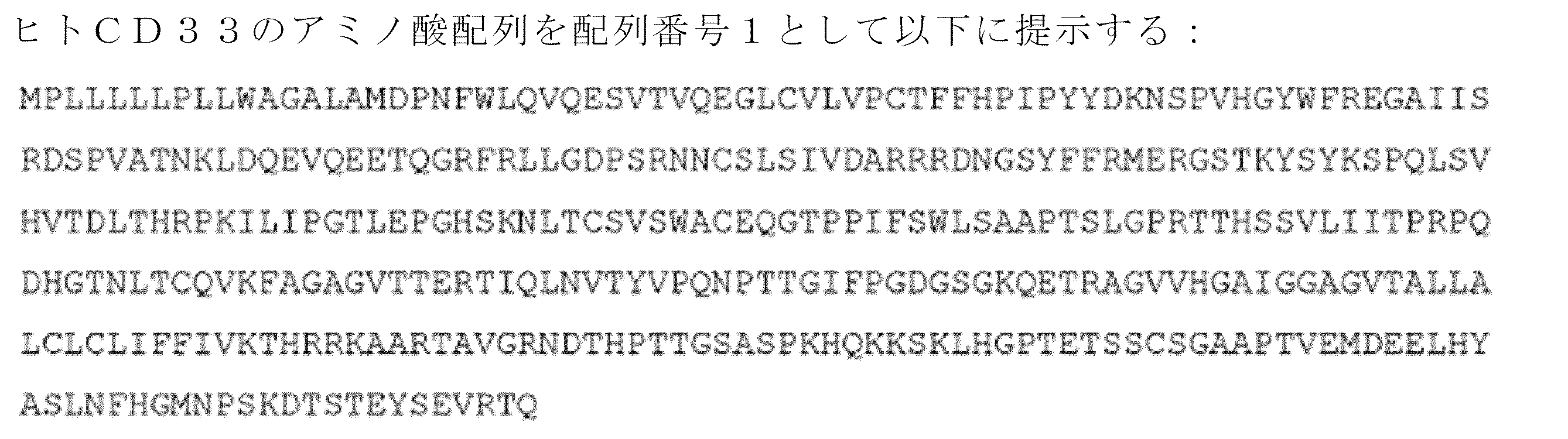
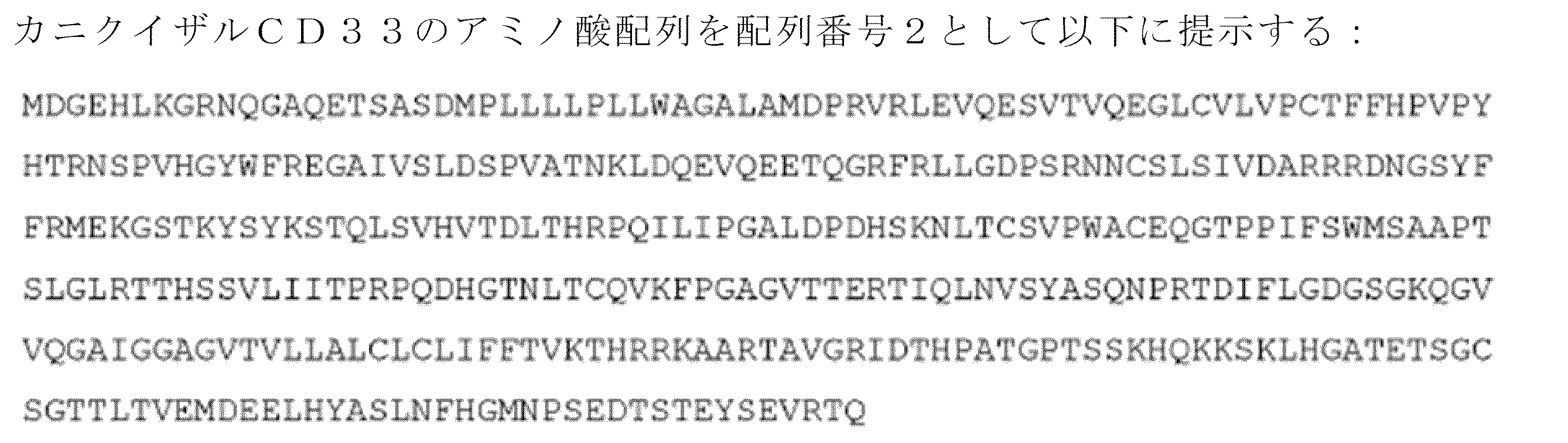
いくつかの実施形態において、CD33は、シグナル配列を含むプレタンパク質である。いくつかの実施形態において、CD33は、成熟タンパク質である。いくつかの実施形態において、成熟CD33タンパク質は、シグナル配列を含まない。いくつかの実施形態において、成熟CD33タンパク質は、細胞上に発現している。いくつかの実施形態において、成熟CD33タンパク質は、限定するものではないが、ヒト樹状細胞、ヒトマクロファージ、ヒト単球、ヒト破骨細胞、ヒト好中球、ヒトT細胞、ヒトヘルパーT細胞、ヒト細胞傷害性T細胞、ヒト顆粒球、及びヒトミクログリアを含む細胞で、例えば細胞の表面で発現している。本開示の抗CD33抗体は、本明細書に開示される任意の細胞上に発現している本開示のCD33タンパク質のいずれかに結合し得る。 In some embodiments, CD33 is a preprotein that includes a signal sequence. In some embodiments, CD33 is a mature protein. In some embodiments, the mature CD33 protein does not include a signal sequence. In some embodiments, the mature CD33 protein is expressed on a cell. In some embodiments, the mature CD33 protein is expressed, for example, on the surface of a cell, including, but not limited to, human dendritic cells, human macrophages, human monocytes, human osteoclasts, human neutrophils, human T cells, human helper T cells, human cytotoxic T cells, human granulocytes, and human microglia. The anti-CD33 antibodies of the present disclosure may bind to any of the CD33 proteins of the present disclosure expressed on any cell disclosed herein.
ヒトCD33などの本開示のCD33タンパク質は、限定するものではないが、配列番号1のアミノ酸残基1~17に位置するシグナル配列、配列番号1のアミノ酸残基19~135に位置する細胞外免疫グロブリン様可変型(IgV)ドメイン、配列番号1のアミノ酸残基145~228に位置するIg様C2型ドメイン、配列番号1のアミノ酸残基260~282に位置する膜貫通ドメイン、配列番号1のアミノ酸残基338~343に位置するITIMモチーフ1、及び配列番号1のアミノ酸残基356~361に位置するITIMモチーフ2を含むいくつかのドメインを含む。当業者には理解されるであろうが、本開示のドメインの開始残基及び終了残基は、ドメインの決定に使用されるコンピュータモデリングプログラムまたは使用される方法に応じて異なり得る。
The CD33 proteins of the present disclosure, such as human CD33, contain several domains, including, but not limited to, a signal sequence located at amino acid residues 1-17 of SEQ ID NO:1, an extracellular immunoglobulin-like variable (IgV) domain located at amino acid residues 19-135 of SEQ ID NO:1, an Ig-like C2-type domain located at amino acid residues 145-228 of SEQ ID NO:1, a transmembrane domain located at amino acid residues 260-282 of SEQ ID NO:1, an
本開示の特定の態様は、ヒトCD33、または限定するものではないが哺乳動物CD33タンパク質及び他の種由来のCD33オーソログを含むそのホモログに結合する抗CD33抗体を提供する。いくつかの実施形態において、本開示の抗CD33抗体は、改善/向上した結合動態及び/またはCD33の細胞レベルの低下などの改善した活性で(例えば、配列番号3の配列を含む重鎖可変領域及び配列番号4の配列を含む軽鎖可変領域を有する抗CD33抗体と比べて)、ヒトCD33、またはそのホモログに結合する。 Certain aspects of the disclosure provide anti-CD33 antibodies that bind to human CD33 or homologs thereof, including but not limited to mammalian CD33 proteins and CD33 orthologs from other species. In some embodiments, the anti-CD33 antibodies of the disclosure bind to human CD33 or homologs thereof with improved activity, such as improved/enhanced binding kinetics and/or reduced cellular levels of CD33 (e.g., compared to an anti-CD33 antibody having a heavy chain variable region comprising the sequence of SEQ ID NO:3 and a light chain variable region comprising the sequence of SEQ ID NO:4).
したがって、本明細書で使用される場合、本開示の「CD33」タンパク質は、限定するものではないが、哺乳動物CD33タンパク質、ヒトCD33タンパク質、霊長類CD33タンパク質、マウスCD33タンパク質、及びラットCD33タンパク質を含む。更に、本開示の抗CD33抗体は、ヒトCD33タンパク質、霊長類CD33内のエピトープに結合し得る。いくつかの実施形態において、本開示の抗CD33抗体は、ヒトCD33に特異的に結合し得る。いくつかの実施形態において、本開示の抗CD33抗体は、カニクイザルCD33に結合し得る。いくつかの実施形態において、本開示の抗CD33抗体は、ヒトCD33及びカニクイザルCD33に結合し得る。 Thus, as used herein, the "CD33" protein of the present disclosure includes, but is not limited to, mammalian CD33 protein, human CD33 protein, primate CD33 protein, mouse CD33 protein, and rat CD33 protein. Additionally, the anti-CD33 antibodies of the present disclosure may bind to epitopes within human CD33 protein, primate CD33. In some embodiments, the anti-CD33 antibodies of the present disclosure may specifically bind to human CD33. In some embodiments, the anti-CD33 antibodies of the present disclosure may bind to cynomolgus CD33. In some embodiments, the anti-CD33 antibodies of the present disclosure may bind to human CD33 and cynomolgus CD33.
いくつかの実施形態において、本開示の抗体は、pH依存的にCD33に結合し得る。いくつかの実施形態において、本開示の抗体は、中性pHでCD33に結合し、CD33タンパク質から解離することなく内在化され得る。あるいは、酸性pHで、本開示の抗体は、内在化した後、CD33から解離し、次いで、エンドソーム/リソソーム経路によって分解される。特定の実施形態において、抗CD33抗体は、5.5~8.0、5.5~7.5、5.5~7.0、5.5~6.5、5.5~6.0、6.0~8.0、6.5~8.0、7.0~8.0、7.5~8.0、6.0~7.5、6.0~7.0、6.5~7.5の範囲のpHでCD33に結合する。特定の実施形態において、抗CD33抗体は、6.0未満、5.5未満、5.0未満、4.5未満、4.0未満、3.5未満、3.0未満、2.5未満、または2.0未満のpHでCD33から解離する。 In some embodiments, the antibodies of the present disclosure may bind to CD33 in a pH-dependent manner. In some embodiments, the antibodies of the present disclosure may bind to CD33 at neutral pH and be internalized without dissociating from the CD33 protein. Alternatively, at acidic pH, the antibodies of the present disclosure dissociate from CD33 after internalization and are then degraded by the endosomal/lysosomal pathway. In certain embodiments, the anti-CD33 antibodies bind to CD33 at a pH in the range of 5.5-8.0, 5.5-7.5, 5.5-7.0, 5.5-6.5, 5.5-6.0, 6.0-8.0, 6.5-8.0, 7.0-8.0, 7.5-8.0, 6.0-7.5, 6.0-7.0, 6.5-7.5. In certain embodiments, the anti-CD33 antibody dissociates from CD33 at a pH less than 6.0, less than 5.5, less than 5.0, less than 4.5, less than 4.0, less than 3.5, less than 3.0, less than 2.5, or less than 2.0.
いくつかの実施形態において、本開示の抗体は、本開示の野生型CD33タンパク質、その天然に存在するバリアント、及び/またはその疾患バリアントに結合する。 In some embodiments, the antibodies of the present disclosure bind to the wild-type CD33 protein of the present disclosure, its naturally occurring variants, and/or its disease variants.
いくつかの実施形態において、本開示の抗体は、ヒトCD33のバリアントに結合し、このバリアントは、(C)ヌクレオチドの一塩基多型(SNP)rs3865444Cを含む。いくつかの実施形態において、CD33の細胞レベルを低下させる及び/またはCD33と結合もしくは相互作用する本開示の抗体は、ヒトCD33のバリアントに結合し、このバリアントは、(A)ヌクレオチドのSNP rs3865444を含む。いくつかの実施形態において、本開示の抗CD33抗体は、ヒトCD33のバリアントに結合し、このバリアントは、SNP rs3865444ACまたはrs3865444CCを含む。 In some embodiments, antibodies of the disclosure bind to a variant of human CD33, which variant comprises the single nucleotide polymorphism (SNP) rs3865444C at nucleotide (C). In some embodiments, antibodies of the disclosure that reduce cellular levels of CD33 and/or bind to or interact with CD33 bind to a variant of human CD33, which variant comprises the SNP rs3865444 at nucleotide (A). In some embodiments, anti-CD33 antibodies of the disclosure bind to a variant of human CD33, which variant comprises SNP rs3865444 AC or rs3865444 CC .
いくつかの実施形態において、CD33の細胞レベルを低下させる及び/またはCD33と結合もしくは相互作用する本開示の抗体は、ヒトCD33のバリアントに結合し、このバリアントは、GGヌクレオチド、AAヌクレオチド、またはAGヌクレオチドのSNP rs35112940を含む。いくつかの実施形態において、CD33の細胞レベルを低下させる及び/またはCD33と結合もしくは相互作用する本開示の抗体は、ヒトCD33のバリアントに結合し、このバリアントは、CC、CT、またはTT遺伝子型のSNP rs12459419を含む。特定の実施形態において、対象は、GGヌクレオチド、CGヌクレオチド、またはCCヌクレオチドのコーディングSNP、rs1803についてホモ接合性またはヘテロ接合性を有する。 In some embodiments, the antibodies of the present disclosure that reduce cellular levels of CD33 and/or bind or interact with CD33 bind to a variant of human CD33, the variant comprising SNP rs35112940 at a GG, AA, or AG nucleotide. In some embodiments, the antibodies of the present disclosure that reduce cellular levels of CD33 and/or bind or interact with CD33 bind to a variant of human CD33, the variant comprising SNP rs12459419 at a CC, CT, or TT genotype. In certain embodiments, the subject is homozygous or heterozygous for the coding SNP, rs1803 at a GG, CG, or CC nucleotide.
いくつかの実施形態において、CD33の細胞レベルを低下させる及び/またはCD33と結合もしくは相互作用する本開示の抗体は、限定するものではないが、ヒト樹状細胞、ヒトマクロファージ、ヒト単球、ヒト破骨細胞、ヒト好中球、ヒトT細胞、ヒトヘルパーT細胞、ヒト細胞傷害性T細胞、ヒト顆粒球、及びヒトミクログリアを含む細胞の表面上に発現したCD33タンパク質に結合する。いくつかの実施形態において、CD33の細胞レベルを低下させる及び/またはCD33と結合もしくは相互作用する本開示の抗体は、細胞表面上に発現したCD33タンパク質に結合し、表面に発現しているCD33タンパク質に結合した後、本開示の少なくとも1つのCD33活性を調節する(例えば、誘導または阻害する)。本開示のいくつかの実施形態において、抗CD33抗体は、CD33タンパク質に特異的に結合する。本開示のいくつかの実施形態において、抗CD33抗体は、少なくとも1つの追加のSiglecタンパク質に更に結合する。いくつかの実施形態において、抗CD33抗体は、少なくとも1つの追加のSiglecタンパク質の1つ以上の活性または少なくとも1つの追加のSiglecタンパク質を発現する細胞の1つ以上の活性を調節する。 In some embodiments, the antibodies of the present disclosure that reduce cellular levels of CD33 and/or bind or interact with CD33 bind to CD33 protein expressed on the surface of cells, including, but not limited to, human dendritic cells, human macrophages, human monocytes, human osteoclasts, human neutrophils, human T cells, human helper T cells, human cytotoxic T cells, human granulocytes, and human microglia. In some embodiments, the antibodies of the present disclosure that reduce cellular levels of CD33 and/or bind or interact with CD33 bind to CD33 protein expressed on the cell surface and modulate (e.g., induce or inhibit) at least one CD33 activity of the present disclosure after binding to the surface-expressed CD33 protein. In some embodiments of the present disclosure, the anti-CD33 antibody specifically binds to CD33 protein. In some embodiments of the present disclosure, the anti-CD33 antibody further binds to at least one additional Siglec protein. In some embodiments, the anti-CD33 antibody modulates one or more activities of at least one additional Siglec protein or one or more activities of a cell expressing at least one additional Siglec protein.
CD33リガンド
本開示のCD33タンパク質は、1つ以上のCD33リガンドと相互作用する(例えば、結合する)ことができる。
CD33 Ligands The CD33 proteins of the present disclosure can interact with (eg, bind to) one or more CD33 ligands.
例示的なCD33リガンドとしては、限定するものではないが、シアル酸、シアル酸含有糖脂質、シアル酸含有糖タンパク質、α-2,6-結合シアル酸含有糖脂質、α-2,6-結合シアル酸含有糖タンパク質、α-2,3-結合シアル酸含有糖脂質、α-2,3-結合シアル酸含有糖タンパク質、α-1-酸糖タンパク質(AGP)、CD24タンパク質、ガングリオシド(例えば、シアル酸付加グリカンに結合したセラミドを含む糖脂質)、分泌型ムチン、赤血球上に発現したCD33リガンド、細菌細胞上に発現したCD33リガンド、アポトーシス細胞上に発現したCD33リガンド、腫瘍細胞上に発現したCD33リガンド、ウイルス上に発現したCD33リガンド、樹状細胞上に発現したCD33リガンド、神経細胞上に発現したCD33リガンド、グリア細胞上に発現したCD33リガンド、ミクログリア上に発現したCD33リガンド、アストロサイト上に発現したCD33リガンド、βアミロイド斑上のCD33リガンド、タウのもつれ(Tau tangles)上のCD33リガンド、病因タンパク質上のCD33リガンド、病因ペプチド上のCD33リガンド、マクロファージ上に発現したCD33リガンド、ナチュラルキラー細胞上に発現したCD33リガンド、T細胞上に発現したCD33リガンド、ヘルパーT細胞上に発現したCD33リガンド、細胞傷害性T細胞上に発現したCD33リガンド、B細胞上に発現したCD33リガンド、腫瘍埋没型免疫抑制性樹状細胞上に発現したCD33リガンド、腫瘍埋没型免疫抑制性マクロファージ上に発現したCD33リガンド、骨髄由来抑制性細胞上に発現したCD33リガンド、及び制御性T細胞上に発現したCD33リガンドが挙げられる。いくつかの実施形態において、本開示のCD33リガンドは、ガングリオシドである。ガングリオシドは、概して、共通するラクト-セラミドコア及び1つ以上のシアル酸残基を共有する。 Exemplary CD33 ligands include, but are not limited to, sialic acid, sialic acid-containing glycolipids, sialic acid-containing glycoproteins, α-2,6-linked sialic acid-containing glycolipids, α-2,6-linked sialic acid-containing glycoproteins, α-2,3-linked sialic acid-containing glycolipids, α-2,3-linked sialic acid-containing glycoproteins, α-1-acid glycoprotein (AGP), CD24 protein, gangliosides (e.g., glycolipids containing ceramide bound to sialylated glycans), secreted mucins, and erythrocyte-expressed sialic acid-containing glycoproteins. CD33 ligand, CD33 ligand expressed on bacterial cells, CD33 ligand expressed on apoptotic cells, CD33 ligand expressed on tumor cells, CD33 ligand expressed on viruses, CD33 ligand expressed on dendritic cells, CD33 ligand expressed on neuronal cells, CD33 ligand expressed on glial cells, CD33 ligand expressed on microglia, CD33 ligand expressed on astrocytes, CD33 ligand on β-amyloid plaques, Tau tangles (Tau Examples of CD33 ligands include CD33 ligands on tangles, CD33 ligands on pathogenic proteins, CD33 ligands on pathogenic peptides, CD33 ligands expressed on macrophages, CD33 ligands expressed on natural killer cells, CD33 ligands expressed on T cells, CD33 ligands expressed on helper T cells, CD33 ligands expressed on cytotoxic T cells, CD33 ligands expressed on B cells, CD33 ligands expressed on tumor-embedded immunosuppressive dendritic cells, CD33 ligands expressed on tumor-embedded immunosuppressive macrophages, CD33 ligands expressed on myeloid-derived suppressor cells, and CD33 ligands expressed on regulatory T cells. In some embodiments, the CD33 ligands of the present disclosure are gangliosides. Gangliosides generally share a common lacto-ceramide core and one or more sialic acid residues.
好適なガングリオシドリガンドの更なる例を表Aに列挙する。概して、ガングリオシドは、1つ以上のシアル酸(例えば、n-アセチル-ノイラミン酸、NANA)が糖鎖上に結合したスフィンゴ糖脂質から構成される分子である。

抗CD33抗体
本開示の特定の態様は、1つ以上の改善及び/または向上した機能的特徴を含む抗CD33抗体に関する。いくつかの実施形態において、本開示の抗CD33抗体は、参照または対照の抗体(例えば、配列番号3のアミノ酸配列を含む重鎖可変領域及び配列番号4のアミノ酸配列を含む軽鎖可変領域を含む抗CD33抗体)と比べて、1つ以上の改善及び/または向上した機能的特徴を含む。いくつかの実施形態において、本開示の抗CD33抗体は、参照または対照の抗CD33抗体(例えば、配列番号3のアミノ酸配列を含む重鎖可変領域及び配列番号4のアミノ酸配列を含む軽鎖可変領域を含む抗CD33抗体)のものよりも高いCD33(例えば、ヒトCD33)に対する親和性を有する。いくつかの実施形態において、本開示の抗CD33抗体は、参照または対照の抗体(例えば、配列番号3のアミノ酸配列を含む重鎖可変領域及び配列番号4のアミノ酸配列を含む軽鎖可変領域を含む抗CD33抗体)のものよりも低い半数有効濃度(EC50)で、ヒト初代樹状細胞などのヒト細胞に結合する。いくつかの実施形態において、本開示の抗CD33抗体は、参照または対照の抗体(例えば、配列番号3の配列を含む重鎖可変領域及び配列番号4の配列を含む軽鎖可変領域を含む抗CD33抗体)のものよりも低い半数有効濃度(EC50)で、CD33の細胞レベルを低下させる(例えば、細胞表面レベルを低下させる、または下げる)。
Anti-CD33 Antibodies Certain aspects of the present disclosure relate to anti-CD33 antibodies comprising one or more improved and/or enhanced functional characteristics. In some embodiments, the anti-CD33 antibodies of the present disclosure comprise one or more improved and/or enhanced functional characteristics as compared to a reference or control antibody (e.g., an anti-CD33 antibody comprising a heavy chain variable region comprising the amino acid sequence of SEQ ID NO: 3 and a light chain variable region comprising the amino acid sequence of SEQ ID NO: 4). In some embodiments, the anti-CD33 antibodies of the present disclosure have a higher affinity for CD33 (e.g., human CD33) than that of the reference or control anti-CD33 antibody (e.g., an anti-CD33 antibody comprising a heavy chain variable region comprising the amino acid sequence of SEQ ID NO: 3 and a light chain variable region comprising the amino acid sequence of SEQ ID NO: 4). In some embodiments, the anti-CD33 antibodies of the present disclosure bind to human cells, such as human primary dendritic cells, at a lower median effective concentration (EC 50 ) than that of the reference or control antibody (e.g., an anti-CD33 antibody comprising a heavy chain variable region comprising the amino acid sequence of SEQ ID NO: 3 and a light chain variable region comprising the amino acid sequence of SEQ ID NO: 4 ). In some embodiments, an anti-CD33 antibody of the present disclosure reduces cellular levels of CD33 (e.g., reduces or lowers cell surface levels) at a lower median effective concentration ( EC50) than that of a reference or control antibody (e.g., an anti-CD33 antibody comprising a heavy chain variable region comprising the sequence of SEQ ID NO:3 and a light chain variable region comprising the sequence of SEQ ID NO:4 ).
CD33の細胞レベルとは、限定するものではないが、CD33の細胞表面レベル、CD33の細胞内レベル、及びCD33の総レベルを意味し得る。いくつかの実施形態において、CD33の細胞レベルの低下は、CD33の細胞表面レベルの低下を含む。いくつかの実施形態において、CD33の細胞レベル(例えば、CD33の細胞表面レベル)を低下させる本開示の抗CD33抗体は、次の特性のうちの1つ以上を有する:(1)1つ以上のCD33活性を阻害または低減する;(2)CD33がそのリガンドの1つ以上に結合することを阻害または低減する能力;(3)CD33発現細胞におけるCD33発現を低減させる能力;(4)CD33タンパク質と相互作用する、結合する、またはそれを認識する能力;(5)CD33タンパク質と特異的に相互作用または結合する能力;及び(6)本明細書において記載または企図される疾患または障害の任意の態様を治療し、改善し、または予防する能力。 The cellular level of CD33 can mean, but is not limited to, the cell surface level of CD33, the intracellular level of CD33, and the total level of CD33. In some embodiments, the reduction in the cellular level of CD33 includes the reduction in the cell surface level of CD33. In some embodiments, the anti-CD33 antibodies of the present disclosure that reduce the cellular level of CD33 (e.g., the cell surface level of CD33) have one or more of the following properties: (1) inhibit or reduce one or more CD33 activities; (2) the ability to inhibit or reduce binding of CD33 to one or more of its ligands; (3) the ability to reduce CD33 expression in CD33-expressing cells; (4) the ability to interact with, bind to, or recognize CD33 protein; (5) the ability to specifically interact with or bind to CD33 protein; and (6) the ability to treat, ameliorate, or prevent any aspect of a disease or disorder described or contemplated herein.
本開示の抗CD33抗体は、標的抗原(例えば、ヒトCD33)に対してナノモルまたは更にはピコモルの親和性を有し得る。特定の実施形態において、抗体の解離定数(KD)は、約0.001~約100nMである。特定の実施形態において、抗体のKDは、約0.01~約10nMである。特定の実施形態において、抗体のKDは、約0.23~約3.88nMである。いくつかの実施形態において、抗体のKDは、約100nM、90nM、80nM、70nM、60nM、50nM、40nM、30nM、20nM、10nM、9.5nM、9nM、8.5nM、8nM、7.5nM、7nM、6.5nM、6nM、5.5nM、5nM、4.5nM、4nM、3.5nM、3nM、2.5nM、2nM、1.5nM、1nM、0.9nM、0.8nM、0.7nM、0.6nM、0.5nM、0.4nM、0.3nM、0.2nM、0.1nM、.05nM、.01nM、または.005nM以下である。いくつかの実施形態において、抗体のKDは、約0.40nM未満である。いくつかの実施形態において、抗体のKDは、約0.30nM未満である。いくつかの実施形態において、抗体のKDは、約0.20nM未満である。いくつかの実施形態において、KDは、約0.10nM未満である。いくつかの実施形態において、抗体のKDは、約0.061nMである。いくつかの実施形態において、抗体のKDは、約.001nM、.005nM、.01nM、.05nM、0.1nM、0.2nM、0.3nM、0.4nM、0.5nM、0.6nM、0.7nM、0.8nM、0.9nM、1nM、1.5nM、2nM、2.5nM、3nM 3.5nM、4nM、4.5nM、5nM、5.5nM、6nM、6.5nM、7nM、7.5nM、8nM、8.5nM、9nM、9.5nM、10nM.20nM、30nM、40nM、50nM、60nM、70nM、80nM、または90nM以上である。すなわち、抗体のKDは、約100nM、90nM、80nM、70nM、60nM、50nM、40nM、30nM、20nM、10nM、9.5nM、9nM、8.5nM、8nM、7.5nM、7nM、6.5nM、6nM、5.5nM、5nM、4.5nM、4nM、3.5nM、3nM、2.5nM、2nM、1.5nM、1nM、0.9nM、0.8nM、0.7nM、0.6nM、0.5nM、0.4nM、0.3nM、0.2nM、0.1nM、.05nM、.01nM、または.005nMの上限、及び約.001nM、.005nM、.01nM、.05nM、0.1nM、0.2nM、0.3nM、0.4nM、0.5nM、0.6nM、0.7nM、0.8nM、0.9nM、1nM、1.5nM、2nM、2.5nM、3nM、3.5nM、4nM、4.5nM、5nM、5.5nM、6nM、6.5nM、7nM、7.5nM、8nM、8.5nM、9nM、9.5nM、10nM.20nM、30nM、40nM、50nM、60nM、70nM、80nM、または90nMの独立して選択される下限を有する親和性の範囲であって、下限が上限未満である範囲のいずれかであり得る。いくつかの実施形態において、抗体のKDは、約10nM、約9nM、約8nM、約7nM、約6nM、約5nM、約4nM、約3nM、約2nM、約1nM、約900pM、約800pM、約700pM、約600pM、約500pM、約400pM、約300pM、約200pM、または約100pMのいずれかである。抗体の親和性を測定する様々な方法が当該技術分野において公知であり、これには、例えば、表面プラズモン共鳴またはBioLayer干渉法を使用することが含まれる(例えば、以下の実施例3参照)。いくつかの実施形態において、CD33についてのKDは、およそ25℃の温度で決定される。いくつかの実施形態において、CD33についてのKDは、およそ4℃の温度で決定される。いくつかの実施形態において、KDは、一価抗体(例えば、Fab)または一価形態の完全長抗体を使用して決定される。いくつかの実施形態において、KDは、二価抗体及び単量体組み換えCD33タンパク質を使用して決定される。 Anti-CD33 antibodies of the present disclosure may have nanomolar or even picomolar affinities for a target antigen (e.g., human CD33). In certain embodiments, the dissociation constant (K D ) of the antibody is from about 0.001 to about 100 nM. In certain embodiments, the K D of the antibody is from about 0.01 to about 10 nM. In certain embodiments, the K D of the antibody is from about 0.23 to about 3.88 nM. In some embodiments, the KD of the antibody is about 100 nM, 90 nM, 80 nM, 70 nM, 60 nM, 50 nM, 40 nM, 30 nM, 20 nM, 10 nM, 9.5 nM, 9 nM, 8.5 nM, 8 nM, 7.5 nM, 7 nM, 6.5 nM, 6 nM, 5.5 nM, 5 nM, 4.5 nM, 4 nM, 3.5 nM, 3 nM, 2.5 nM, 2 nM, 1.5 nM, 1 nM, 0.9 nM, 0.8 nM, 0.7 nM, 0.6 nM, 0.5 nM, 0.4 nM, 0.3 nM, 0.2 nM, 0.1 nM, .05 nM, .01 nM, or .005 nM or less. In some embodiments, the antibody KD is less than about 0.40 nM. In some embodiments, the antibody KD is less than about 0.30 nM. In some embodiments, the antibody KD is less than about 0.20 nM. In some embodiments, the antibody KD is less than about 0.10 nM. In some embodiments, the antibody KD is less than about 0.061 nM. In some embodiments, the antibody KD is less than about 0.001 nM, 0.005 nM, 0.01 nM, 0.02 ... 0.5nM, 0.1nM, 0.2nM, 0.3nM, 0.4nM, 0.5nM, 0.6nM, 0.7nM, 0.8nM, 0.9nM, 1nM, 1.5nM, 2nM, 2.5nM, 3nM 3.5nM, 4nM, 4.5nM, 5nM, 5.5nM, 6nM, 6.5nM, 7nM, 7.5nM, 8nM, 8.5nM, 9nM, 9.5nM, 10nM. 20nM, 30nM, 40nM, 50nM, 60nM, 70nM, 80nM, or 90nM or more. That is, the K D of the antibody may have an upper limit of about 100 nM, 90 nM, 80 nM, 70 nM, 60 nM, 50 nM, 40 nM, 30 nM, 20 nM, 10 nM, 9.5 nM, 9 nM, 8.5 nM, 8 nM, 7.5 nM, 7 nM, 6.5 nM, 6 nM, 5.5 nM, 5 nM, 4.5 nM, 4 nM, 3.5 nM, 3 nM, 2.5 nM, 2 nM, 1.5 nM, 1 nM, 0.9 nM, 0.8 nM, 0.7 nM, 0.6 nM, 0.5 nM, 0.4 nM, 0.3 nM, 0.2 nM, 0.1 nM, .05 nM, .01 nM, or .005 nM, and an upper limit of about .001 nM, . The affinity range may be any of the following ranges having an independently selected lower limit of 0.005nM, .01nM, .05nM, 0.1nM, 0.2nM, 0.3nM, 0.4nM, 0.5nM, 0.6nM, 0.7nM, 0.8nM, 0.9nM, 1nM, 1.5nM, 2nM, 2.5nM, 3nM, 3.5nM, 4nM, 4.5nM, 5nM, 5.5nM, 6nM, 6.5nM, 7nM, 7.5nM, 8nM, 8.5nM, 9nM, 9.5nM, 10nM. 20nM, 30nM, 40nM, 50nM, 60nM, 70nM, 80nM, or 90nM, where the lower limit is less than the upper limit. In some embodiments, the K D of the antibody is about 10 nM, about 9 nM, about 8 nM, about 7 nM, about 6 nM, about 5 nM, about 4 nM, about 3 nM, about 2 nM, about 1 nM, about 900 pM, about 800 pM, about 700 pM, about 600 pM, about 500 pM, about 400 pM, about 300 pM, about 200 pM, or about 100 pM. Various methods of measuring the affinity of an antibody are known in the art, including, for example, using surface plasmon resonance or BioLayer interferometry (see, for example, Example 3 below). In some embodiments, the K D for CD33 is determined at a temperature of approximately 25° C. In some embodiments, the K D for CD33 is determined at a temperature of approximately 4° C. In some embodiments, the K D is determined using a monovalent antibody (e.g., Fab) or a monovalent form of the full-length antibody. In some embodiments, the K D is determined using a bivalent antibody and a monomeric recombinant CD33 protein.
いくつかの実施形態において、本開示の抗CD33抗体は、参照抗CD33抗体(例えば、配列番号3のアミノ酸配列を含む重鎖可変領域及び配列番号4のアミノ酸配列を含む軽鎖可変領域を含む抗CD33抗体)よりも低いCD33についての解離定数(KD)を有する。いくつかの実施形態において、本開示の抗CD33抗体は、標的についての参照抗CD33抗体(例えば、配列番号3のアミノ酸配列を含む重鎖可変領域及び配列番号4のアミノ酸配列を含む軽鎖可変領域を含む抗CD33抗体)のKDよりも少なくとも約5%、少なくとも約10%、少なくとも約15%、少なくとも約20%、少なくとも約25%、少なくとも約30%、少なくとも約35%、少なくとも約40%、少なくとも約45%、少なくとも約50%、少なくとも約55%、少なくとも約60%、少なくとも約65%、少なくとも約70%、少なくとも約75%、少なくとも約80%、少なくとも約85%、少なくとも約90%、少なくとも約95%、または少なくとも約99%低い標的(例えば、ヒトCD33)についてのKDを有する。いくつかの実施形態において、本開示の抗CD33抗体は、標的についての参照抗CD33抗体(例えば、配列番号3のアミノ酸配列を含む重鎖可変領域及び配列番号4のアミノ酸配列を含む軽鎖可変領域を含む抗CD33抗体)のKDよりも少なくとも約1倍、少なくとも約1.1倍、少なくとも約1.5倍、少なくとも約2倍、少なくとも約3倍、少なくとも約4倍、少なくとも約5倍、少なくとも約6倍、少なくとも約7倍、少なくとも約8倍、少なくとも約9倍、少なくとも約10倍、少なくとも約12.5倍、少なくとも約15倍、少なくとも約17.5倍、少なくとも約20倍、少なくとも約22.5倍、少なくとも約25倍、少なくとも約27.5倍、少なくとも約30倍、少なくとも約50倍、または少なくとも約100倍低い標的(例えば、ヒトCD33)についてのKDを有する。いくつかの実施形態において、本開示の抗CD33抗体は、配列番号3のアミノ酸配列を含む重鎖可変領域及び配列番号4のアミノ酸配列を含む軽鎖可変領域を有する抗CD33抗体よりも少なくとも7倍高いヒトCD33についてのKDを有する。いくつかの実施形態において、本開示の抗CD33抗体は、配列番号3のアミノ酸配列を含む重鎖可変領域及び配列番号4のアミノ酸配列を含む軽鎖可変領域を有する抗CD33抗体よりも少なくとも1.8倍高いヒトCD33についてのKDを有する。いくつかの実施形態において、親和性は、表面プラズモン共鳴によって測定される。いくつかの実施形態において、親和性は、およそ25℃の温度で測定される。いくつかの実施形態において、親和性は、およそ4℃の温度で測定される。いくつかの実施形態において、親和性は、以下の実施例に記載されるような実験的アプローチを使用して測定される。 In some embodiments, an anti-CD33 antibody of the present disclosure has a lower dissociation constant (KD) for CD33 than a reference anti-CD33 antibody (e.g., an anti-CD33 antibody comprising a heavy chain variable region comprising the amino acid sequence of SEQ ID NO:3 and a light chain variable region comprising the amino acid sequence of SEQ ID NO: 4 ). In some embodiments, an anti-CD33 antibody of the disclosure has a KD for a target (e.g., human CD33) that is at least about 5 % , at least about 10%, at least about 15%, at least about 20%, at least about 25%, at least about 30%, at least about 35%, at least about 40%, at least about 45%, at least about 50%, at least about 55%, at least about 60%, at least about 65%, at least about 70%, at least about 75%, at least about 80%, at least about 85%, at least about 90%, at least about 95%, or at least about 99% lower than the KD of a reference anti-CD33 antibody for the target (e.g., an anti-CD33 antibody comprising a heavy chain variable region comprising the amino acid sequence of SEQ ID NO:3 and a light chain variable region comprising the amino acid sequence of SEQ ID NO:4). In some embodiments, an anti-CD33 antibody of the disclosure has a KD for a target (e.g., human CD33) that is at least about 1 fold, at least about 1.1 fold , at least about 1.5 fold, at least about 2 fold, at least about 3 fold, at least about 4 fold, at least about 5 fold, at least about 6 fold, at least about 7 fold, at least about 8 fold, at least about 9 fold, at least about 10 fold, at least about 12.5 fold, at least about 15 fold, at least about 17.5 fold, at least about 20 fold, at least about 22.5 fold, at least about 25 fold, at least about 27.5 fold, at least about 30 fold, at least about 50 fold, or at least about 100 fold lower than the KD of a reference anti-CD33 antibody for the target (e.g., an anti-CD33 antibody comprising a heavy chain variable region comprising the amino acid sequence of SEQ ID NO:3 and a light chain variable region comprising the amino acid sequence of SEQ ID NO:4). In some embodiments, an anti-CD33 antibody of the disclosure has a KD for human CD33 that is at least 7-fold higher than an anti-CD33 antibody having a heavy chain variable region comprising the amino acid sequence of SEQ ID NO: 3 and a light chain variable region comprising the amino acid sequence of SEQ ID NO: 4. In some embodiments, an anti-CD33 antibody of the disclosure has a KD for human CD33 that is at least 1.8-fold higher than an anti-CD33 antibody having a heavy chain variable region comprising the amino acid sequence of SEQ ID NO: 3 and a light chain variable region comprising the amino acid sequence of SEQ ID NO: 4. In some embodiments, affinity is measured by surface plasmon resonance. In some embodiments, affinity is measured at a temperature of approximately 25° C. In some embodiments, affinity is measured at a temperature of approximately 4° C. In some embodiments, affinity is measured using an experimental approach such as that described in the Examples below.
本開示の抗CD33抗体は、ピコモル範囲の半数有効濃度(EC50)(例えば、初代ヒト樹状細胞を使用してin vitroで測定した場合)でCD33の細胞レベル(例えば、細胞表面レベル)を低下させ得る。特定の実施形態において、抗体のEC50は、約0.1~約500pMである。特定の実施形態において、抗体のEC50は、約1~約250pMである。特定の実施形態において、抗体のEC50は、約27pM~約40pMである。特定の実施形態において、抗体のEC50は、約78pM~約40pMである。いくつかの実施形態において、抗体のEC50は、約500pM、400pM、300pM、250pM、225pM、200pM、175pM、150pM、125pM、100pM、75pM、50pM、25pM、10pM、1pM、または0.5pM以下である。いくつかの実施形態において、抗体のEC50は、約74.3pM未満である。いくつかの実施形態において、抗体のEC50は、約0.1pM、0.5pM、1pM、10pM、25pM、50pM、75pM、100pM、125pM、150pM、175pM、200pM、225pM、250pM、300pM、または400pM以上である。すなわち、抗体のEC50は、約500pM、400pM、300pM、250pM、225pM、200pM、175pM、150pM、125pM、100pM、75pM、50pM、25pM、10pM、1pM、または0.5pMの上限、及び約0.1pM、0.5pM、1pM、10pM、25pM、50pM、75pM、100pM、125pM、150pM、175pM、200pM、225pM、250pM、300pM、または400pMの独立して選択される下限を有する範囲であって、下限が上限未満である範囲のいずれかであり得る。いくつかの実施形態において、抗体のEC50は、約1pM、2pM、3pM、4pM、5pM、6pM、7pM、8pM、9pM、10pM、15pM、20pM、25pM、30pM、35pM、40pM、45pM、50pM、55pM、60pM、65pM、70pM、75pM、80pM、85pM、90pM、95pM、100pM、105pM、110pM、115pM、120pM、125pM、130pM、135pM、140pM、145pM、150pM、155pM、160pM、165pM、170pM、175pM、180pM、185pM、190pM、195pM、または200pMのいずれかである。抗体のEC50値を測定する様々な方法が当該技術分野において公知であり、これには、例えば、フローサイトメトリーによるものが含まれる(例えば、以下の実施例3参照)。いくつかの実施形態において、EC50は、初代ヒト樹状細胞を使用してin vitroで測定される。いくつかの実施形態において、EC50は、初代ヒト単球を使用してin vitroで測定される。いくつかの実施形態において、EC50は、初代ヒトマクロファージを使用してin vitroで測定される。いくつかの実施形態において、EC50は、ヒトCD33をトランスフェクトした培養細胞を使用してin vitroで測定される。いくつかの実施形態において、EC50は、およそ4℃の温度で測定される。いくつかの実施形態において、EC50は、およそ25℃の温度で測定される。いくつかの実施形態において、EC50は、およそ35℃の温度で測定される。いくつかの実施形態において、EC50は、およそ37℃の温度で測定される。いくつかの実施形態において、EC50は、一価抗体(例えば、Fab)または一価形態の完全長抗体を使用して決定される。いくつかの実施形態において、EC50は、増大したFc受容体結合を示す定常領域を含む抗体を使用して決定される。いくつかの実施形態において、EC50は、低減したFc受容体結合を示す定常領域を含む抗体を使用して決定される。
Anti-CD33 antibodies of the present disclosure may reduce cellular levels (e.g., cell surface levels) of CD33 with half maximal effective concentrations (EC 50 ) in the picomolar range (e.g., as measured in vitro using primary human dendritic cells). In certain embodiments, the antibody EC 50 is from about 0.1 to about 500 pM. In certain embodiments, the antibody EC 50 is from about 1 to about 250 pM. In certain embodiments, the antibody EC 50 is from about 27 pM to about 40 pM. In certain embodiments, the antibody EC 50 is from about 78 pM to about 40 pM. In some embodiments, the EC50 of the antibody is about 500 pM, 400 pM, 300 pM, 250 pM, 225 pM, 200 pM, 175 pM, 150 pM, 125 pM, 100 pM, 75 pM, 50 pM, 25 pM, 10 pM, 1 pM, or 0.5 pM or less. In some embodiments, the EC50 of the antibody is less than about 74.3 pM. In some embodiments, the EC50 of the antibody is about 0.1 pM, 0.5 pM, 1 pM, 10 pM, 25 pM, 50 pM, 75 pM, 100 pM, 125 pM, 150 pM, 175 pM, 200 pM, 225 pM, 250 pM, 300 pM, or 400 pM or more. That is, the EC50 of the antibody can be any of a range having an upper limit of about 500 pM, 400 pM, 300 pM, 250 pM, 225 pM, 200 pM, 175 pM, 150 pM, 125 pM, 100 pM, 75 pM, 50 pM, 25 pM, 10 pM, 1 pM, or 0.5 pM and an independently selected lower limit of about 0.1 pM, 0.5 pM, 1 pM, 10 pM, 25 pM, 50 pM, 75 pM, 100 pM, 125 pM, 150 pM, 175 pM, 200 pM, 225 pM, 250 pM, 300 pM, or 400 pM, where the lower limit is less than the upper limit. 50 is approximately 1 pM, 2 pM, 3 pM, 4 pM, 5 pM, 6 pM, 7 pM, 8 pM, 9 pM, 10 pM, 15 pM, 20 pM, 25 pM, 30 pM, 35 pM, 40 pM, 45 pM, 50 pM, 55 pM, 60 pM, 65 pM, 70 pM, 75 pM, 80 pM, 85 pM, 90 pM, 95 pM, 100 pM, 105 pM, 110 pM, 115 pM, 120 pM, 125 pM, 130 pM, 135 pM, 140 pM, 145 pM, 150 pM, 155 pM, 160 pM, 165 pM, 170 pM, 175 pM, 180 pM, 185 pM, 190 pM, 195 pM, or 200 pM. Various methods of measuring an antibody's EC 50 value are known in the art, including, for example, by flow cytometry (see, for example, Example 3 below). In some embodiments, the
いくつかの実施形態において、本開示の抗CD33抗体は、参照抗CD33抗体(例えば、配列番号3のアミノ酸配列を含む重鎖可変領域及び配列番号4のアミノ酸配列を含む軽鎖可変領域を含む抗CD33抗体)よりも低いEC50(例えば、初代ヒト樹状細胞を使用してin vitroで測定した場合)で、CD33の細胞レベルを低下させる(例えば、細胞表面レベルを低下させる、または下げる)。いくつかの実施形態において、本開示の抗CD33抗体は、参照抗CD33抗体(例えば、配列番号3のアミノ酸配列を含む重鎖可変領域及び配列番号4のアミノ酸配列を含む軽鎖可変領域を含む抗CD33抗体)のEC50よりも少なくとも約5%、少なくとも約10%、少なくとも約15%、少なくとも約20%、少なくとも約25%、少なくとも約30%、少なくとも約35%、少なくとも約40%、少なくとも約45%、少なくとも約50%、少なくとも約55%、少なくとも約60%、少なくとも約65%、少なくとも約70%、少なくとも約75%、少なくとも約80%、少なくとも約85%、少なくとも約90%、少なくとも約95%、または少なくとも約99%低いEC50で、CD33の細胞レベルを低下させる(例えば、細胞表面レベルを低下させる、または下げる)。いくつかの実施形態において、本開示の抗CD33抗体は、参照抗CD33抗体(例えば、配列番号3のアミノ酸配列を含む重鎖可変領域及び配列番号4のアミノ酸配列を含む軽鎖可変領域を含む抗CD33抗体)のEC50よりも少なくとも約1倍、少なくとも約1.1倍、少なくとも約1.5倍、少なくとも約2倍、少なくとも約3倍、少なくとも約4倍、少なくとも約5倍、少なくとも約6倍、少なくとも約7倍、少なくとも約8倍、少なくとも約9倍、少なくとも約10倍、少なくとも約12.5倍、少なくとも約15倍、少なくとも約17.5倍、少なくとも約20倍、少なくとも約22.5倍、少なくとも約25倍、少なくとも約27.5倍、少なくとも約30倍、少なくとも約50倍、または少なくとも約100倍低いEC50で、CD33の細胞レベルを低下させる(例えば、細胞表面レベルを低下させる、または下げる)。いくつかの実施形態において、本開示の抗CD33抗体は、配列番号3のアミノ酸配列を含む重鎖可変領域及び配列番号4のアミノ酸配列を含む軽鎖可変領域を有する抗CD33抗体よりも少なくとも1.2倍~1.6倍または1.1倍~1.6倍低いEC50を有する。いくつかの実施形態において、EC50は、初代ヒト樹状細胞を使用してin vitroで測定される。いくつかの実施形態において、EC50は、初代ヒト単球を使用してin vitroで測定される。いくつかの実施形態において、EC50は、初代ヒトマクロファージを使用してin vitroで測定される。いくつかの実施形態において、EC50は、ヒトCD33をトランスフェクトした培養細胞を使用してin vitroで測定される。いくつかの実施形態において、EC50は、フローサイトメトリーによって測定される。いくつかの実施形態において、EC50は、およそ25℃の温度で測定される。いくつかの実施形態において、EC50は、およそ35℃の温度で測定される。いくつかの実施形態において、EC50は、およそ37℃の温度で測定される。いくつかの実施形態において、EC50は、増大したFc受容体結合を示す定常領域を含む抗体を使用して決定される。いくつかの実施形態において、EC50は、低減したFc受容体結合を示す定常領域を含む抗体を使用して決定される。いくつかの実施形態において、EC50は、以下の実施例3に記載されるような実験的アプローチを使用して測定される。
In some embodiments, an anti-CD33 antibody of the present disclosure reduces cellular levels of CD33 (e.g., reduces or lowers cell surface levels) with a lower EC50 (e.g., as measured in vitro using primary human dendritic cells) than a reference anti-CD33 antibody (e.g., an anti-CD33 antibody comprising a heavy chain variable region comprising the amino acid sequence of SEQ ID NO:3 and a light chain variable region comprising the amino acid sequence of SEQ ID NO: 4 ). In some embodiments, the anti-CD33 antibodies of the present disclosure reduce cellular levels of CD33 (e.g., reduce or lower cell surface levels) with an EC50 that is at least about 5%, at least about 10%, at least about 15%, at least about 20%, at least about 25%, at least about 30%, at least about 35%, at least about 40%, at least about 45%, at least about 50%, at least about 55%, at least about 60%, at least about 65%, at least about 70%, at least about 75%, at least about 80%, at least about 85%, at least about 90%, at least about 95%, or at least about 99% lower than the EC50 of a reference anti-CD33 antibody (e.g., an anti-CD33 antibody comprising a heavy chain variable region comprising the amino acid sequence of SEQ ID NO:3 and a light chain variable region comprising the amino acid sequence of SEQ ID NO:4). In some embodiments, the anti-CD33 antibodies of the present disclosure reduce cellular levels of CD33 (e.g., reduce or lower cell surface levels) with an EC50 that is at least about 1-fold, at least about 1.1-fold, at least about 1.5-fold, at least about 2-fold, at least about 3-fold, at least about 4-fold, at least about 5-fold, at least about 6-fold, at least about 7-fold, at least about 8-fold, at least about 9-fold, at least about 10-fold, at least about 12.5-fold, at least about 15-fold, at least about 17.5-fold, at least about 20-fold, at least about 22.5-fold, at least about 25-fold, at least about 27.5-fold, at least about 30-fold, at least about 50-fold, or at least about 100-fold lower than the EC50 of a reference anti-CD33 antibody (e.g., an anti-CD33 antibody comprising a heavy chain variable region comprising the amino acid sequence of SEQ ID NO:3 and a light chain variable region comprising the amino acid sequence of SEQ ID NO:4). In some embodiments, an anti-CD33 antibody of the disclosure has an
本明細書に記載されるまたは当該技術分野で公知である任意のin vitro細胞ベースアッセイまたは好適なin vivoモデルが、CD33と1つ以上のCD33リガンドとの間の相互作用(例えば、結合)の阻害を測定するために使用され得る。いくつかの実施形態において、本開示の抗CD33抗体は、CD33と1つ以上のCD33リガンドとの間の相互作用(例えば、結合)を、本明細書に記載されるまたは当該技術分野で公知である任意のin vitroアッセイまたは細胞ベース培養アッセイを利用して飽和抗体濃度で少なくとも21%、少なくとも22%、少なくとも23%、少なくとも24%、少なくとも25%、少なくとも26%、少なくとも27%、少なくとも28%、少なくとも29%、少なくとも30%、少なくとも31%、少なくとも32%、少なくとも33%、少なくとも34%、少なくとも35%、少なくとも36%、少なくとも37%、少なくとも38%、少なくとも39%、少なくとも40%、少なくとも41%、少なくとも42%、少なくとも43%、少なくとも44%、少なくとも45%、少なくとも46%、少なくとも47%、少なくとも48%、少なくとも49%、少なくとも50%、少なくとも51%、少なくとも52%、少なくとも53%、少なくとも54%、少なくとも55%、少なくとも56%、少なくとも57%、少なくとも58%、少なくとも59%、少なくとも60%、少なくとも61%、少なくとも62%、少なくとも63%、少なくとも64%、少なくとも65%、少なくとも66%、少なくとも67%、少なくとも68%、少なくとも69%、少なくとも70%、少なくとも71%、少なくとも72%、少なくとも73%、少なくとも74%、少なくとも75%、少なくとも76%、少なくとも77%、少なくとも78%、少なくとも79%、少なくとも80%、少なくとも81%、少なくとも82%、少なくとも83%、少なくとも84%、少なくとも85%、少なくとも86%、少なくとも87%、少なくとも88%、少なくとも89%、少なくとも90%、少なくとも91%、少なくとも92%、少なくとも93%、少なくとも94%、少なくとも95%、少なくとも96%、少なくとも97%、少なくとも98%、少なくとも99%、またはそれ以上阻害する。 Any in vitro cell-based assay or suitable in vivo model described herein or known in the art can be used to measure inhibition of an interaction (e.g., binding) between CD33 and one or more CD33 ligands. In some embodiments, the anti-CD33 antibodies of the present disclosure inhibit an interaction (e.g., binding) between CD33 and one or more CD33 ligands using any in vitro cell-based assay or suitable in vivo model described herein or known in the art. At least 21%, at least 22%, at least 23%, at least 24%, at least 25%, at least 26%, at least 27%, at least 28%, at least 29%, at least 30%, at least 31%, at least 32%, at least 33%, at least 34%, at least 35%, at least 36%, at least 37%, at least 38%, at least 39%, at least 40%, at least 41%, at least 42%, at least 43%, at least 44%, at least 45%, at least 46%, at least 47%, at least 48%, at least 49%, at least 50%, at least 51%, at least 52%, at least 53%, at least 54%, at least 55%, at least 56%, at least 57%, at least 58%, at least inhibits at least 59%, at least 60%, at least 61%, at least 62%, at least 63%, at least 64%, at least 65%, at least 66%, at least 67%, at least 68%, at least 69%, at least 70%, at least 71%, at least 72%, at least 73%, at least 74%, at least 75%, at least 76%, at least 77%, at least 78%, at least 79%, at least 80%, at least 81%, at least 82%, at least 83%, at least 84%, at least 85%, at least 86%, at least 87%, at least 88%, at least 89%, at least 90%, at least 91%, at least 92%, at least 93%, at least 94%, at least 95%, at least 96%, at least 97%, at least 98%, at least 99%, or more.
いくつかの実施形態において、本開示の抗CD33抗体は、CD33の細胞表面クラスター化を阻害する。いくつかの実施形態において、本開示の抗CD33抗体は、限定するものではないが、LCK及びFYNなどのSrcファミリーチロシンキナーゼによるTyr-340及びTyr-358のリン酸化;チロシン特異的タンパク質ホスファターゼSHP1及びSHP2の動員及び結合;Dynamini-1のグアニンヌクレオチド交換因子として作用するPLC-γ1の動員及び結合;SH2-ドメイン含有タンパク質(例えば、Crkl)の動員及び結合;脾臓チロシンキナーゼSykの動員及び結合;SH3-SH2-SH3成長因子受容体結合タンパク質2(Grb2)の動員及び結合;複数のSH2含有タンパク質の動員及び結合;タンパク質キナーゼCによるSer-307及びSer-342のリン酸化;単球、マクロファージ、T細胞、樹状細胞好中球、及び/またはミクログリアにおける1つ以上の抗炎症性サイトカインIL-4、IL-10、IL-13、IL-35、IL-16、TGF-β、IL-1Ra、G-CSF、及びTNF、IFN-β1a、IFN-β1b、またはIL-6の可溶性受容体の発現の調節;細胞内カルシウム動員の減少;単球、マクロファージ、T細胞、樹状細胞、好中球、及び/またはミクログリアにおける1つ以上の炎症誘発性サイトカインIFN-a4、IFN-b、IL-1β、TNF-α、IL-6、IL-8、CRP、IL-20ファミリーメンバー、LIF、IFN-γ、OSM、CNTF、GM-CSF、IL-11、IL-12、IL-17、IL-18、IL-23、CXCL10、IL-33、CRP、IL-33、MCP-1、及びMIP-1-βの発現の調節;C1qa、C1qB、C1qC、C1s、C1R、C4、C2、C3、ITGB2、HMOX1、LAT2、CASP1、CSTA、VSIG4、MS4A4A、C3AR1、GPX1、TyroBP、ALOX5AP、ITGAM、SLC7A7、CD4、ITGAX、PYCARD、CD14、CD16、HLA-DR、及びCCR2から選択される1つ以上のタンパク質の発現の調節;細胞外シグナル調節キナーゼ(ERK)リン酸化の阻害;複数の細胞タンパク質に対するチロシンリン酸化の減少;C-Cケモカイン受容体7(CCR7)の発現の調節;CCL19発現細胞及びCCL21発現細胞へのミクログリア細胞走化性の阻害;ホスホイノシチド3-キナーゼの活性化;単球、マクロファージ、T細胞、樹状細胞及び/またはミクログリアの細胞増殖の低減;樹状細胞、骨髄由来樹状細胞、単球、ミクログリア、M1ミクログリア、活性化M1ミクログリア、M2ミクログリア、マクロファージ、M1マクロファージ、活性化M1マクロファージ、及び/またはM2マクロファージによって誘導されるT細胞増殖の低減;破骨細胞生成の阻害、破骨細胞形成速度の減少、またはその両方;好中球、樹状細胞、骨髄由来樹状細胞、マクロファージ、M1マクロファージ、活性化M1マクロファージ、M2マクロファージ、単球、破骨細胞、T細胞、ヘルパーT細胞、細胞傷害性T細胞、顆粒球、ミクログリア、M1ミクログリア、活性化M1ミクログリア、及び/またはM2ミクログリアの生存率低下;好中球、樹状細胞、骨髄由来樹状細胞、マクロファージ、M1マクロファージ、活性化M1マクロファージ、M2マクロファージ、単球、破骨細胞、T細胞、ヘルパーT細胞、細胞傷害性T細胞、顆粒球、ミクログリア、M1ミクログリア、活性化M1ミクログリア、及び/またはM2ミクログリアの増殖の減少;好中球、樹状細胞、骨髄由来樹状細胞、マクロファージ、M1マクロファージ、活性化M1マクロファージ、M2マクロファージ、単球、破骨細胞、T細胞、ヘルパーT細胞、細胞傷害性T細胞、顆粒球、ミクログリア、M1ミクログリア、活性化M1ミクログリア、及び/またはM2ミクログリアの遊走の阻害;好中球、樹状細胞、骨髄由来樹状細胞、マクロファージ、M1マクロファージ、活性化M1マクロファージ、M2マクロファージ、単球、破骨細胞、T細胞、ヘルパーT細胞、細胞傷害性T細胞、顆粒球、ミクログリア、M1ミクログリア、活性化M1ミクログリア、及び/またはM2ミクログリアの1つ以上の機能の低下;好中球、樹状細胞、骨髄由来樹状細胞、マクロファージ、M1マクロファージ、活性化M1マクロファージ、M2マクロファージ、単球、破骨細胞、T細胞、ヘルパーT細胞、細胞傷害性T細胞、顆粒球、ミクログリア、M1ミクログリア、活性化M1ミクログリア、及び/またはM2ミクログリアの成熟の阻害;単球、マクロファージ、T細胞、樹状細胞、好中球、及び/またはミクログリアの細胞死及びアポトーシスの増大;単球、マクロファージ、T細胞、樹状細胞、好中球、及び/またはミクログリアの食作用活性の低減;単球、マクロファージ、T細胞、樹状細胞、好中球、及び/またはミクログリアの増殖の低減;単球、マクロファージ、T細胞、樹状細胞、好中球、及び/またはミクログリアの全体的機能性の低下、ITAM含有受容体のリン酸化;ITAMシグナル伝達を媒介するシグナル伝達分子のリン酸化;パターン認識受容体の活性化の低下;Toll様受容体の活性化の低下;細胞破片及びタンパク質破片のクリアランスの損傷関連の活性化の低下;CD33とそのリガンドの1つ以上との間の相互作用;CD33とCD64などの共受容体との間の相互作用;アポトーシス性ニューロンクリアランス、神経組織破片クリアランス、機能不全シナプスクリアランス、非神経組織破片クリアランス、細菌もしくは他の異物クリアランス、病因タンパク質クリアランス、及び腫瘍細胞クリアランスから選択される1つ以上の種類のクリアランスの低下;アポトーシス性ニューロン、神経組織破片、非神経組織破片、細菌、他の異物、病因タンパク質、病因ペプチド、病因核酸、病因脂質、または腫瘍細胞のうちの1つ以上の食作用の阻害;病因核酸のクリアランスの阻害(例えば、病因核酸は、アンチセンスGGCCCC(G2C4)リピート伸長RNAである);アミロイドβ、アミロイドβ斑、アミロイド前駆体タンパク質またはその断片、タウ、IAPP、α-シヌクレイン、TDP-43、FUSタンパク質、C9orf72(9番染色体オープンリーディングフレーム72)、c9RANタンパク質、プリオンタンパク質、PrPSc、ハンチンチン、カルシトニン、スーパーオキシドジスムターゼ、アタキシン、アタキシン1、アタキシン2、アタキシン3、アタキシン7、アタキシン8、アタキシン10、レビー小体、心房性ナトリウム利尿因子、膵島アミロイドポリペプチド、インスリン、アポリポタンパク質AI、血清アミロイドA、メディン、プロラクチン、トランスサイレチン、リゾチーム、β2ミクログロブリン、ゲルゾリン、ケラトエピテリン、シスタチン、免疫グロブリン軽鎖AL、S-IBMタンパク質、リピート関連非ATG(RAN)翻訳産物、ジペプチドリピート(DPR)ペプチド、グリシン-アラニン(GA)リピートペプチド、グリシン-プロリン(GP)リピートペプチド、グリシン-アルギニン(GR)リピートペプチド、プロリン-アラニン(PA)リピートペプチド、ユビキチン、及びプロリン-アルギニン(PR)リピートペプチドから選択される病因タンパク質のクリアランスの活性化;膀胱癌、脳癌、乳癌、結腸癌、直腸癌、子宮内膜癌、腎臓癌、腎細胞癌、腎盂癌、白血病、肺癌、黒色腫、非ホジキンリンパ腫、急性骨髄性白血病、膵臓癌、前立腺癌、卵巣癌、線維肉腫、及び甲状腺癌から選択される異なる種類のがんに対する有益な免疫応答の阻害;認知症、前頭側頭型認知症、アルツハイマー病、血管性認知症、混合型認知症、クロイツフェルト・ヤコブ病、正常圧水頭症、筋萎縮性側索硬化症、ハンチントン病、タウパチー病、那須・ハコラ病、脳卒中、急性外傷、慢性外傷、本態性振戦、ベーチェット病、パーキンソン病、レビー小体型認知症、多系統萎縮症、シャイ・ドレーガー症候群、進行性核上性麻痺、大脳皮質基底核神経節変性症、急性散在性脳脊髄炎、肉芽腫症、サルコイドーシス、老人病、痙攣、脊髄傷害、外傷性脳傷害、加齢性黄斑変性症、緑内障、網膜色素変性症、網膜変性、及び多発性硬化症から選択される異なる種類の神経障害に対する有益な免疫応答の阻害;ループス、急性及び慢性大腸炎、損傷治癒、クローン病、炎症性腸疾患、潰瘍性大腸炎、肥満症、マラリア、気道感染症、敗血症、眼感染症、全身感染症、ループス、関節炎、低骨密度、骨粗鬆症、骨形成、大理石骨病、及び骨パジェット病から選択される異なる種類の炎症性障害及び感染性障害に対する有益な免疫応答の阻害;腫瘍細胞上のCD33リガンドへの結合;樹状細胞、骨髄由来樹状細胞、単球、ミクログリア、T細胞、好中球、及び/またはマクロファージ上のCD33リガンドへの結合;ミクログリア、マクロファージ、樹状細胞、骨髄由来樹状細胞、好中球、T細胞、ヘルパーT細胞、または細胞傷害性T細胞のうちの1つ以上による腫瘍細胞殺傷の阻害;ミクログリア、マクロファージ、樹状細胞、骨髄由来樹状細胞、好中球、T細胞、ヘルパーT細胞、または細胞傷害性T細胞のうちの1つ以上の抗腫瘍細胞増殖活性の阻害;ミクログリア、マクロファージ、樹状細胞、骨髄由来樹状細胞、好中球、T細胞、ヘルパーT細胞、または細胞傷害性T細胞のうちの1つ以上の抗腫瘍細胞転移活性の阻害;免疫抑制性樹状細胞、免疫抑制性マクロファージ、骨髄由来抑制性細胞、腫瘍関連マクロファージ、または制御性T細胞の促進;TREM1、TREM2、FcgR、DAP10、及びDAP12などの1つ以上のITAMモチーフ含有受容体の阻害;モチーフD/Ex0-2YxxL/IX6-8YxxL/I(配列番号104)を含む1つ以上の受容体の阻害;病原体関連分子パターン(PAMP)を特定する受容体、及び損傷関連分子パターン(DAMP)を特定する受容体などの1つ以上のパターン認識受容体(PRR)によるシグナル伝達の阻害;1つ以上のToll様受容体によるシグナル伝達の阻害;JAK-STATシグナル伝達経路の阻害;活性化B細胞の核内因子カッパ軽鎖エンハンサー(NFκB)の阻害;PLCγ/PKC/カルシウム動員の阻害;PI3K/Akt、Ras/MAPKシグナル伝達の阻害;ミクログリア、マクロファージ、樹状細胞、骨髄由来樹状細胞、好中球、T細胞、ヘルパーT細胞、または細胞傷害性T細胞のうちの1つ以上に発現したCD86などの1つ以上の炎症性受容体の発現の低減;1つ以上のCD33依存的遺伝子の発現増大;破壊されたCD33依存的遺伝子発現の正常化;ならびにNFAT転写因子などの1つ以上のITAM依存的遺伝子の発現減少のうちの1つ以上の相殺を含め、CD33タンパク質の1つ以上の活性を阻害する。 In some embodiments, the anti-CD33 antibodies of the present disclosure inhibit cell surface clustering of CD33. In some embodiments, the anti-CD33 antibodies of the present disclosure inhibit the phosphorylation of Tyr-340 and Tyr-358 by Src family tyrosine kinases, such as, but not limited to, LCK and FYN; recruitment and binding of tyrosine-specific protein phosphatases SHP1 and SHP2; recruitment and binding of PLC-γ1, which acts as a guanine nucleotide exchange factor for Dynamini-1; recruitment and binding of SH2-domain containing proteins (e.g., Crkl); recruitment and binding of spleen tyrosine kinase Syk; recruitment and binding of SH3-SH2-SH3 growth factor receptor bound protein 2 (Grb2); recruitment and binding of multiple SH2-containing proteins phosphorylation of Ser-307 and Ser-342 by protein kinase C; modulation of expression of soluble receptors for one or more anti-inflammatory cytokines IL-4, IL-10, IL-13, IL-35, IL-16, TGF-β, IL-1Ra, G-CSF, and TNF, IFN-β1a, IFN-β1b, or IL-6 in monocytes, macrophages, T cells, dendritic cells, neutrophils, and/or microglia; reduction of intracellular calcium mobilization; modulation of expression of one or more pro-inflammatory cytokines IFN-a4, IFN-b, IL-1β, TNF-α in monocytes, macrophages, T cells, dendritic cells, neutrophils, and/or microglia. , IL-6, IL-8, CRP, IL-20 family member, LIF, IFN-γ, OSM, CNTF, GM-CSF, IL-11, IL-12, IL -17, regulation of expression of IL-18, IL-23, CXCL10, IL-33, CRP, IL-33, MCP-1, and MIP-1-β; C1qa, C1qB , C1qC, C1s, C1R, C4, C2, C3, ITGB2, HMOX1, LAT2, CASP1, CSTA, VSIG4, MS4A4A, C3AR1, GPX1, TyroBP, ALOX5AP, ITGAM, SLC7A7, CD4, ITGAX, PYCARD, CD14, CD16, HLA-DR, and CC R2; inhibition of extracellular signal-regulated kinase (ERK) phosphorylation; reduction of tyrosine phosphorylation of multiple cellular proteins; modulation of C-C chemokine receptor 7 (CCR7) expression; inhibition of microglial cell chemotaxis to CCL19-expressing cells and CCL21-expressing cells; activation of phosphoinositide 3-kinase; reduction of cellular proliferation of monocytes, macrophages, T cells, dendritic cells and/or microglia; dendritic cells, bone marrow-derived dendritic cells, monocytes, microglia, M1 microglia, activated M1 microglia, M2 microglia, macrophages, M1 macrophages, activated M1 macrophages inhibiting osteoclastogenesis, decreasing the rate of osteoclast formation, or both; reducing the viability of neutrophils, dendritic cells, bone marrow derived dendritic cells, macrophages, M1 macrophages, activated M1 macrophages, M2 macrophages, monocytes, osteoclasts, T cells, helper T cells, cytotoxic T cells, granulocytes, microglia, M1 microglia, activated M1 microglia, and/or M2 microglia; reducing proliferation of T cells, cytotoxic T cells, granulocytes, microglia, M1 microglia, activated M1 microglia, and/or M2 microglia; inhibiting migration of neutrophils, dendritic cells, bone marrow derived dendritic cells, macrophages, M1 macrophages, activated M1 macrophages, M2 macrophages, monocytes, osteoclasts, T cells, helper T cells, cytotoxic T cells, granulocytes, microglia, M1 microglia, activated M1 microglia, and/or M2 microglia; neutrophils, dendritic cells, bone marrow derived dendritic cells, macrophages, M1 macrophages, activated M1 macrophages, M2 macrophages, monocytes, osteoclasts, T cells, helper Decreasing one or more functions of T cells, cytotoxic T cells, granulocytes, microglia, M1 microglia, activated M1 microglia, and/or M2 microglia; Inhibiting maturation of neutrophils, dendritic cells, bone marrow derived dendritic cells, macrophages, M1 macrophages, activated M1 macrophages, M2 macrophages, monocytes, osteoclasts, T cells, helper T cells, cytotoxic T cells, granulocytes, microglia, M1 microglia, activated M1 microglia, and/or M2 microglia; Increasing cell death and apoptosis of monocytes, macrophages, T cells, dendritic cells, neutrophils, and/or microglia; Inhibiting maturation of monocytes, macrophages, T cells, dendritic cells, neutrophils, and/or microglia. reduced phagocytic activity of monocytes, neutrophils, and/or microglia; reduced proliferation of monocytes, macrophages, T cells, dendritic cells, neutrophils, and/or microglia; reduced overall functionality of monocytes, macrophages, T cells, dendritic cells, neutrophils, and/or microglia, phosphorylation of ITAM-containing receptors; phosphorylation of signaling molecules that mediate ITAM signaling; reduced activation of pattern recognition receptors; reduced activation of Toll-like receptors; reduced damage-related activation of clearance of cellular and protein debris; interactions between CD33 and one or more of its ligands; interactions between CD33 and co-receptors such as CD64; reducing one or more types of clearance selected from cis-neuron clearance, neural tissue debris clearance, dysfunctional synapse clearance, non-neural tissue debris clearance, bacterial or other foreign body clearance, pathogenic protein clearance, and tumor cell clearance; inhibiting phagocytosis of one or more of apoptotic neurons, neural tissue debris, non-neural tissue debris, bacteria, other foreign body, pathogenic protein, pathogenic peptide, pathogenic nucleic acid, pathogenic lipid, or tumor cell; inhibiting clearance of pathogenic nucleic acid (e.g., the pathogenic nucleic acid is an antisense GGCCCC (G2C4) repeat expansion RNA); amyloid beta, amyloid beta plaques, Amyloid precursor protein or fragments thereof, tau, IAPP, α-synuclein, TDP-43, FUS protein, C9orf72 (chromosome 9 open reading frame 72), c9RAN protein, prion protein, PrPSc, huntingtin, calcitonin, superoxide dismutase, ataxin, ataxin 1, ataxin 2, ataxin 3, ataxin 7, ataxin 8, ataxin 10, Lewy bodies, atrial natriuretic factor, islet amyloid polypeptide, insulin, apolipoprotein AI, serum amyloid A, medin, prolactin, transthyretin, lysozyme, β2 mycobacterium, Activation of clearance of pathogenic proteins selected from globulin, gelsolin, keratoepithelin, cystatin, immunoglobulin light chain AL, S-IBM protein, repeat-associated non-ATG (RAN) translation products, dipeptide repeat (DPR) peptides, glycine-alanine (GA) repeat peptides, glycine-proline (GP) repeat peptides, glycine-arginine (GR) repeat peptides, proline-alanine (PA) repeat peptides, ubiquitin, and proline-arginine (PR) repeat peptides; bladder cancer, brain cancer, breast cancer, colon cancer, rectal cancer, endometrial cancer, kidney cancer, renal cell carcinoma, renal pelvis cancer, leukemia, lung cancer, melanoma. , non-Hodgkin's lymphoma, acute myeloid leukemia, pancreatic cancer, prostate cancer, ovarian cancer, fibrosarcoma, and thyroid cancer; dementia, frontotemporal dementia, Alzheimer's disease, vascular dementia, mixed dementia, Creutzfeldt-Jakob disease, normal pressure hydrocephalus, amyotrophic lateral sclerosis, Huntington's disease, tauopathy, Nasu-Hakola disease, stroke, acute trauma, chronic trauma, essential tremor, Behcet's disease, Parkinson's disease, dementia with Lewy bodies, multiple system atrophy, Shy-Drager syndrome, progressive supranuclear palsy, corticobasal ganglionic degeneration, acute disseminated encephalomyelitis, granulomatous disease, sarcoidosis, geriatric diseases, spasticity inhibition of beneficial immune responses against different types of neurological disorders selected from: spasms, spinal cord injury, traumatic brain injury, age-related macular degeneration, glaucoma, retinitis pigmentosa, retinal degeneration, and multiple sclerosis; inhibition of beneficial immune responses against different types of inflammatory and infectious disorders selected from: lupus, acute and chronic colitis, wound healing, Crohn's disease, inflammatory bowel disease, ulcerative colitis, obesity, malaria, respiratory tract infections, sepsis, eye infections, systemic infections, lupus, arthritis, low bone density, osteoporosis, bone formation, osteopetrosis, and Paget's disease of bone; binding to CD33 ligand on tumor cells; dendritic cells, bone marrow derived dendritic cells, monocytes, microglia, T cells, neutrophils, and and/or binding to CD33 ligand on macrophages; inhibition of tumor cell killing by one or more of microglia, macrophages, dendritic cells, bone marrow derived dendritic cells, neutrophils, T cells, helper T cells, or cytotoxic T cells; inhibition of anti-tumor cell proliferation activity of one or more of microglia, macrophages, dendritic cells, bone marrow derived dendritic cells, neutrophils, T cells, helper T cells, or cytotoxic T cells; inhibition of anti-tumor cell metastasis activity of one or more of microglia, macrophages, dendritic cells, bone marrow derived dendritic cells, neutrophils, T cells, helper T cells, or cytotoxic T cells; immunosuppressive dendritic cells, immunosuppressive macrophages, promotion of myeloid-derived suppressor cells, tumor-associated macrophages, or regulatory T cells; inhibition of one or more ITAM motif-containing receptors, such as TREM1, TREM2, FcgR, DAP10, and DAP12; inhibition of one or more receptors containing the motif D/Ex0-2YxxL/IX6-8YxxL/I (SEQ ID NO: 104); inhibition of signaling by one or more pattern recognition receptors (PRRs), such as receptors that specify pathogen-associated molecular patterns (PAMPs) and receptors that specify damage-associated molecular patterns (DAMPs); inhibition of signaling by one or more Toll-like receptors; inhibition of the JAK-STAT signaling pathway; nuclear transcription of activated B cells Inhibiting one or more activities of CD33 protein, including counteracting one or more of the following: inhibition of intrinsic factor kappa light chain enhancer (NFκB); inhibition of PLCγ/PKC/calcium mobilization; inhibition of PI3K/Akt, Ras/MAPK signaling; reducing expression of one or more inflammatory receptors, such as CD86, expressed on one or more of microglia, macrophages, dendritic cells, bone marrow-derived dendritic cells, neutrophils, T cells, helper T cells, or cytotoxic T cells; increasing expression of one or more CD33-dependent genes; normalizing disrupted CD33-dependent gene expression; and reducing expression of one or more ITAM-dependent genes, such as NFAT transcription factors.
いくつかの実施形態において、本開示の抗CD33抗体は、限定するものではないが、腫瘍浸潤性CD3+T細胞の数の増大;CD14+骨髄細胞、例えば腫瘍浸潤性CD14+骨髄細胞及び血液中に存在するCD14+骨髄細胞におけるCD33の細胞レベルの低下;CD14+骨髄細胞、例えば腫瘍浸潤性CD14+骨髄細胞及び血液中に存在するCD14+骨髄細胞の数の低減;骨髄由来抑制性細胞(MDSC)などの1つ以上の細胞におけるPD-L1、PD-L2、B7-H7、B7-H3、CD200R、CD163、及び/またはCD206レベルの低下;固形腫瘍の腫瘍成長速度の減少;腫瘍体積の低減;1つ以上のPD-1阻害剤の有効性の増大;1つ以上のチェックポイント阻害療法及び/または免疫調節療法、例えばCTL4、アデノシン経路、PD-L1、PD-L2、OX40、TIM3、LAG3、またはこれらの任意の組み合わせのうちの1つ以上を標的とするチェックポイント阻害療法及び/または免疫調節療法の有効性の増大;1つ以上の化学療法剤の有効性の増大(場合により、化学療法剤のうちの1つ以上は、ゲムシタビン、カペシタビン、アントラサイクリン、ドキソルビシン(Adriamycin(登録商標))、エピルビシン(Ellence(登録商標))、タキサン、パクリタキセル(Taxol(登録商標))、ドセタキセル(Taxotere(登録商標))、5-フルオロウラシル(5-FU)、シクロホスファミド(Cytoxan(登録商標))、カルボプラチン(Paraplatin(登録商標))、オキサリプラチン(Elotaxin(登録商標))、ロイコボリン、テモゾロミド(Temodar(登録商標))、及びこれらの任意の組み合わせである);骨髄由来抑制性細胞(MDSC)の存在下でのT細胞の増殖の増大;骨髄由来抑制性細胞(MDSC)の分化、生存、及び/または1つ以上の機能の阻害;ならびに化学的または放射性毒素にコンジュゲートした場合の固形腫瘍及び関連する血管におけるCD33発現免疫抑制性非腫瘍形成性骨髄細胞及び/または非腫瘍形成性CD14発現細胞の殺傷を含む、CD33タンパク質の1つ以上の活性を呈する。 In some embodiments, the anti-CD33 antibodies of the present disclosure are capable of inhibiting, but not limited to, increasing the number of tumor-infiltrating CD3 + T cells; decreasing the cellular levels of CD33 on CD14 + bone marrow cells, e.g., tumor-infiltrating CD14 + bone marrow cells and CD14 + bone marrow cells present in the blood ; + a reduction in the number of myeloid cells; a reduction in PD-L1, PD-L2, B7-H7, B7-H3, CD200R, CD163, and/or CD206 levels in one or more cells, such as myeloid-derived suppressor cells (MDSCs); a reduction in tumor growth rate of solid tumors; a reduction in tumor volume; an increase in the efficacy of one or more PD-1 inhibitors; an increase in the efficacy of one or more checkpoint inhibition therapies and/or immunomodulatory therapies, e.g., checkpoint inhibition therapies and/or immunomodulatory therapies targeting one or more of CTL4, the adenosine pathway, PD-L1, PD-L2, OX40, TIM3, LAG3, or any combination thereof; an increase in the efficacy of one or more chemotherapeutic agents (optionally one or more of the chemotherapeutic agents are gemcitabine, capecitabine, an anthracycline, doxorubicin (Adriamycin®), epirubicin (Ellence®), and any combination thereof); increasing proliferation of T cells in the presence of myeloid-derived suppressor cells (MDSCs); inhibiting differentiation, survival, and/or one or more functions of myeloid-derived suppressor cells (MDSCs); and killing of CD33-expressing immunosuppressive non-tumorigenic myeloid cells and/or non-tumorigenic CD14-expressing cells in solid tumors and associated vasculature when conjugated to a chemical or radiotoxin.
いくつかの実施形態において、抗CD33抗体は、本開示のCD33タンパク質と、1つ以上のCD33リガンドとの間の相互作用(例えば、結合)を阻害し、CD33リガンドは、限定するものではないが、赤血球上に発現したCD33リガンド、細菌細胞上に発現したCD33リガンド、アポトーシス細胞上に発現したCD33リガンド、腫瘍細胞上に発現したCD33リガンド、ウイルス上に発現したCD33リガンド、樹状細胞上に発現したCD33リガンド、神経細胞上に発現したCD33リガンド、グリア細胞上に発現したCD33リガンド、ミクログリア上に発現したCD33リガンド、アストロサイト上に発現したCD33リガンド、βアミロイド斑上のCD33リガンド、タウのもつれ上のCD33リガンド、病因タンパク質上のCD33リガンド、病因ペプチド上のCD33リガンド、マクロファージ上に発現したCD33リガンド、ナチュラルキラー細胞上に発現したCD33リガンド、T細胞上に発現したCD33リガンド、ヘルパーT細胞上に発現したCD33リガンド、細胞傷害性T細胞上に発現したCD33リガンド、B細胞上に発現したCD33リガンド、腫瘍埋没型免疫抑制性樹状細胞上に発現したCD33リガンド、腫瘍埋没型免疫抑制性マクロファージ上に発現したCD33リガンド、骨髄由来抑制性細胞上に発現したCD33リガンド、制御性T細胞上に発現したCD33リガンド、分泌型ムチン、シアル酸、シアル酸含有糖脂質、シアル酸含有糖タンパク質、α-2,6-結合シアル酸含有糖脂質、α-2,6-結合シアル酸含有糖タンパク質、α-2,3-結合シアル酸含有糖脂質、α-2,3-結合シアル酸含有糖タンパク質、α-1-酸糖タンパク質(AGP)、CD24タンパク質、及びガングリオシドを含む。 In some embodiments, the anti-CD33 antibody inhibits an interaction (e.g., binding) between a CD33 protein of the present disclosure and one or more CD33 ligands, including, but not limited to, CD33 ligand expressed on red blood cells, CD33 ligand expressed on bacterial cells, CD33 ligand expressed on apoptotic cells, CD33 ligand expressed on tumor cells, CD33 ligand expressed on viruses, CD33 ligand expressed on dendritic cells, CD33 ligand expressed on neuronal cells, CD33 ligand expressed on glial cells, CD33 ligand expressed on microglia, CD33 ligand expressed on astrocytes, CD33 ligand on beta amyloid plaques, CD33 ligand on tau tangles, CD33 ligand on pathogenic proteins, CD33 ligand on pathogenic peptides, CD33 ligand expressed on macrophages, CD33 ligand expressed on a cytotoxic T cell, CD33 ligand expressed on a natural killer cell, CD33 ligand expressed on a T cell, CD33 ligand expressed on a helper T cell, CD33 ligand expressed on a cytotoxic T cell, CD33 ligand expressed on a B cell, CD33 ligand expressed on a tumor-embedded immunosuppressive dendritic cell, CD33 ligand expressed on a tumor-embedded immunosuppressive macrophage, CD33 ligand expressed on a bone marrow-derived suppressor cell, CD33 ligand expressed on a regulatory T cell, secretory mucin, sialic acid, sialic acid-containing glycolipid, sialic acid-containing glycoprotein, α-2,6-linked sialic acid-containing glycolipid, α-2,6-linked sialic acid-containing glycoprotein, α-2,3-linked sialic acid-containing glycolipid, α-2,3-linked sialic acid-containing glycoprotein, α-1-acid glycoprotein (AGP), CD24 protein, and ganglioside.
いくつかの実施形態において、本開示の抗CD33抗体は、細胞表面上に発現した本開示のCD33タンパク質に結合し、ネイキッド抗体は、CD33タンパク質と1つ以上のCD33リガンドとの間の相互作用(例えば、結合)を阻害する。いくつかの実施形態において、本CD33タンパク質に結合する本開示の抗CD33抗体は、CD33タンパク質と1つ以上のCD33リガンドとの間の相互作用(例えば、結合)を、細胞表面上または細胞内部のいずれかで、当該タンパク質と相互作用できるCD33の有効レベルを下げることによって、阻害する。いくつかの実施形態において、本CD33タンパク質に結合する本開示の抗CD33抗体は、CD33の分解を誘導することによって、CD33タンパク質と1つ以上のCD33リガンドとの間の相互作用(例えば、結合)を阻害する。 In some embodiments, the anti-CD33 antibodies of the present disclosure bind to a CD33 protein of the present disclosure expressed on the cell surface, and the naked antibody inhibits the interaction (e.g., binding) between the CD33 protein and one or more CD33 ligands. In some embodiments, the anti-CD33 antibodies of the present disclosure that bind to the CD33 protein inhibit the interaction (e.g., binding) between the CD33 protein and one or more CD33 ligands by reducing the effective level of CD33 that can interact with the protein, either on the cell surface or inside the cell. In some embodiments, the anti-CD33 antibodies of the present disclosure that bind to the CD33 protein inhibit the interaction (e.g., binding) between the CD33 protein and one or more CD33 ligands by inducing degradation of CD33.
本明細書で使用される場合、CD33のレベルとは、CD33をコードする遺伝子の発現レベル、CD33をコードする1つ以上の転写産物の発現レベル、CD33タンパク質の発現レベル、及び/または細胞内部及び/または細胞表面上に存在するCD33タンパク質の量を意味し得る。CD33のレベルを決定するには、遺伝子の発現、転写、翻訳、及び/またはタンパク質の存在量もしくは局在化のレベルを測定するための当該技術分野において公知の任意の方法を使用することができる。 As used herein, the level of CD33 can refer to the expression level of the gene encoding CD33, the expression level of one or more transcripts encoding CD33, the expression level of CD33 protein, and/or the amount of CD33 protein present inside and/or on the cell surface. To determine the level of CD33, any method known in the art for measuring the level of gene expression, transcription, translation, and/or protein abundance or localization can be used.
更に、本開示の抗CD33抗体は、認知症、前頭側頭型認知症、アルツハイマー病、血管性認知症、混合型認知症、クロイツフェルト・ヤコブ病、正常圧水頭症、筋萎縮性側索硬化症、ハンチントン病、タウパチー病、那須・ハコラ病、脳卒中、急性外傷、慢性外傷、ループス、急性及び慢性大腸炎、関節リウマチ、損傷治癒、クローン病、炎症性腸疾患、潰瘍性大腸炎、肥満症、マラリア、本態性振戦、中枢神経ループス、ベーチェット病、パーキンソン病、レビー小体型認知症、多系統萎縮症、シャイ・ドレーガー症候群、進行性核上性麻痺、大脳皮質基底核神経節変性症、急性散在性脳脊髄炎、肉芽腫症、サルコイドーシス、老人病、痙攣、脊髄傷害、外傷性脳傷害、加齢性黄斑変性症、緑内障、網膜色素変性症、網膜変性、気道感染症、敗血症、眼感染症、全身感染症、ループス、関節炎、多発性硬化症、低骨密度、骨粗鬆症、骨形成、大理石骨病、骨パジェット病、膀胱癌、脳癌、乳癌、結腸癌、直腸癌、子宮内膜癌、腎臓癌、腎細胞癌、腎盂癌、白血病、肺癌、黒色腫、非ホジキンリンパ腫、膵臓癌、前立腺癌、卵巣癌、線維肉腫、急性リンパ芽球性白血病(ALL)、急性骨髄性白血病(AML)、慢性リンパ性白血病(CLL)、慢性骨髄性白血病(CML)、多発性骨髄腫、真性多血症、本態性血小板増加症、原発性もしくは特発性骨髄線維症、原発性もしくは特発性骨髄硬化症、骨髄由来腫瘍、CD33を発現する腫瘍、甲状腺癌を含むがん、感染症、CNSヘルペス、寄生虫感染症、Trypanosome感染症、Cruzi感染症、Pseudomonas aeruginosa感染症、Leishmania donovani感染症、B群Streptococcus感染症、Campylobacter jejuni感染症、Neisseria meningiditis感染症、I型HIV、及び/またはHaemophilus influenzaを予防し、そのリスクを低下させ、または治療するために使用され得る。いくつかの実施形態において、本開示の抗CD33抗体は、それを必要とする個体において1つ以上の免疫細胞の生存、成熟、機能、遊走、もしくは増殖を誘導もしくは促進するために;またはそれを必要とする個体において制御性T細胞、腫瘍埋没型免疫抑制性樹状細胞、腫瘍埋没型免疫抑制性マクロファージ、骨髄由来抑制性細胞、腫瘍関連マクロファージ、急性骨髄性白血病(AML)細胞、慢性リンパ性白血病(CLL)細胞、及び/または慢性骨髄性白血病(CML)細胞の活性、機能、もしくは生存率を低下させるために使用され得る。いくつかの実施形態において、本開示の抗CD33抗体は、モノクローナル抗体である。 Furthermore, the anti-CD33 antibody of the present disclosure may be used to treat dementia, frontotemporal dementia, Alzheimer's disease, vascular dementia, mixed dementia, Creutzfeldt-Jakob disease, normal pressure hydrocephalus, amyotrophic lateral sclerosis, Huntington's disease, taupathy disease, Nasu-Hakola disease, stroke, acute trauma, chronic trauma, lupus, acute and chronic colitis, rheumatoid arthritis, wound healing, Crohn's disease, inflammatory bowel disease, ulcerative colitis, Obesity, malaria, essential tremor, central nervous system lupus, Behcet's disease, Parkinson's disease, dementia with Lewy bodies, multiple system atrophy, Shy-Drager syndrome, progressive supranuclear palsy, corticobasal ganglionic degeneration, acute disseminated encephalomyelitis, granulomatous disease, sarcoidosis, geriatric diseases, convulsions, spinal cord injury, traumatic brain injury, age-related macular degeneration, glaucoma, retinitis pigmentosa, retinal degeneration, respiratory tract infections , sepsis, eye infections, systemic infections, lupus, arthritis, multiple sclerosis, low bone density, osteoporosis, bone formation, osteopetrosis, Paget's disease of bone, bladder cancer, brain cancer, breast cancer, colon cancer, rectal cancer, endometrial cancer, kidney cancer, renal cell carcinoma, renal pelvis cancer, leukemia, lung cancer, melanoma, non-Hodgkin's lymphoma, pancreatic cancer, prostate cancer, ovarian cancer, fibrosarcoma, acute lymphoblastic leukemia (ALL), acute myeloid leukemia (AML), Chronic lymphocytic leukemia (CLL), chronic myelogenous leukemia (CML), multiple myeloma, polycythemia vera, essential thrombocytosis, primary or idiopathic myelofibrosis, primary or idiopathic myelosclerosis, bone marrow derived tumors, tumors expressing CD33, cancer including thyroid cancer, infectious diseases, CNS herpes, parasitic infections, Trypanosome infections, Cruzi infections, Pseudomonas In some embodiments, the compositions may be used to prevent, reduce the risk of, or treat a P. aeruginosa infection, a Leishmania donovani infection, a group B Streptococcus infection, a Campylobacter jejuni infection, a Neisseria meningiditis infection, HIV type I, and/or a Haemophilus influenza infection. In some embodiments, the anti-CD33 antibodies of the present disclosure may be used to induce or promote the survival, maturation, function, migration, or proliferation of one or more immune cells in an individual in need thereof; or to reduce the activity, function, or viability of regulatory T cells, tumor-embedded immunosuppressive dendritic cells, tumor-embedded immunosuppressive macrophages, myeloid-derived suppressor cells, tumor-associated macrophages, acute myeloid leukemia (AML) cells, chronic lymphocytic leukemia (CLL) cells, and/or chronic myeloid leukemia (CML) cells in an individual in need thereof. In some embodiments, the anti-CD33 antibodies of the present disclosure are monoclonal antibodies.
いくつかの実施形態において、単離された本開示の抗CD33抗体は、CD33の細胞レベル(例えば、細胞表面レベル、細胞内レベル、及び/または総レベル)を低下させる。いくつかの実施形態において、単離された本開示の抗CD33抗体は、CD33の下方制御を誘導する。いくつかの実施形態において、単離された本開示の抗CD33抗体は、CD33の切断を誘導する。いくつかの実施形態において、単離された本開示の抗CD33抗体は、CD33の内在化を誘導する。いくつかの実施形態において、単離された本開示の抗CD33抗体は、CD33のシェディングを誘導する。いくつかの実施形態において、単離された本開示の抗CD33抗体は、CD33の分解を誘導する。いくつかの実施形態において、単離された本開示の抗CD33抗体は、CD33の脱感作を誘導する。いくつかの実施形態において、単離された本開示の抗CD33抗体は、リガンド模倣体として作用して、CD33を一時的に活性化する。いくつかの実施形態において、単離された本開示の抗CD33抗体は、リガンド模倣体として作用し、CD33の細胞レベルの低下及び/またはCD33と1つ以上のCD33リガンドとの間の相互作用(例えば、結合)の阻害を誘導する前にCD33を一時的に活性化する。いくつかの実施形態において、単離された本開示の抗CD33抗体は、リガンド模倣体として作用し、CD33の分解を誘導する前にCD33を一時的に活性化する。いくつかの実施形態において、単離された本開示の抗CD33抗体は、リガンド模倣体として作用し、CD33の切断を誘導する前にCD33を一時的に活性化する。いくつかの実施形態において、単離された本開示の抗CD33抗体は、リガンド模倣体として作用し、CD33の内在化を誘導する前にCD33を一時的に活性化する。いくつかの実施形態において、単離された本開示の抗CD33抗体は、リガンド模倣体として作用し、CD33のシェディングを誘導する前にCD33を一時的に活性化する。いくつかの実施形態において、単離された本開示の抗CD33抗体は、リガンド模倣体として作用し、CD33発現の下方制御を誘導する前にCD33を一時的に活性化する。いくつかの実施形態において、単離された本開示の抗CD33抗体は、リガンド模倣体として作用し、CD33の脱感作を誘導する前にCD33を一時的に活性化する。 In some embodiments, the isolated anti-CD33 antibody of the present disclosure reduces cellular levels of CD33 (e.g., cell surface levels, intracellular levels, and/or total levels). In some embodiments, the isolated anti-CD33 antibody of the present disclosure induces downregulation of CD33. In some embodiments, the isolated anti-CD33 antibody of the present disclosure induces cleavage of CD33. In some embodiments, the isolated anti-CD33 antibody of the present disclosure induces internalization of CD33. In some embodiments, the isolated anti-CD33 antibody of the present disclosure induces shedding of CD33. In some embodiments, the isolated anti-CD33 antibody of the present disclosure induces degradation of CD33. In some embodiments, the isolated anti-CD33 antibody of the present disclosure induces desensitization of CD33. In some embodiments, the isolated anti-CD33 antibody of the present disclosure acts as a ligand mimic to temporarily activate CD33. In some embodiments, an isolated anti-CD33 antibody of the present disclosure acts as a ligand mimic and transiently activates CD33 before inducing a reduction in cellular levels of CD33 and/or inhibition of an interaction (e.g., binding) between CD33 and one or more CD33 ligands. In some embodiments, an isolated anti-CD33 antibody of the present disclosure acts as a ligand mimic and transiently activates CD33 before inducing degradation of CD33. In some embodiments, an isolated anti-CD33 antibody of the present disclosure acts as a ligand mimic and transiently activates CD33 before inducing cleavage of CD33. In some embodiments, an isolated anti-CD33 antibody of the present disclosure acts as a ligand mimic and transiently activates CD33 before inducing internalization of CD33. In some embodiments, an isolated anti-CD33 antibody of the present disclosure acts as a ligand mimic and transiently activates CD33 before inducing shedding of CD33. In some embodiments, the isolated anti-CD33 antibodies of the present disclosure act as ligand mimetics, transiently activating CD33 before inducing downregulation of CD33 expression. In some embodiments, the isolated anti-CD33 antibodies of the present disclosure act as ligand mimetics, transiently activating CD33 before inducing desensitization of CD33.
いくつかの実施形態において、単離された本開示の抗CD33抗体は、ヒト抗体、ヒト化抗体、二重特異性抗体、モノクローナル抗体、多価抗体、またはキメラ抗体である。かかる抗体の例示的説明は、本開示の随所に見出される。 In some embodiments, the isolated anti-CD33 antibody of the present disclosure is a human antibody, a humanized antibody, a bispecific antibody, a monoclonal antibody, a multivalent antibody, or a chimeric antibody. Exemplary descriptions of such antibodies are found throughout this disclosure.
いくつかの実施形態において、本開示の抗CD33抗体は、ヒトCD33、またはそのホモログ(限定するものではないが、哺乳動物CD33タンパク質を含む)に結合する。いくつかの実施形態において、本開示の抗CD33抗体は、ヒトCD33に特異的に結合する。いくつかの実施形態において、本開示の抗CD33抗体は、ヒトCD33に結合し、他の種由来のCD33オーソログまたはホモログと交差反応しない。いくつかの実施形態において、本開示の抗CD33抗体は、ヒトCD33に結合するが、カニクイザルCD33には結合しない。いくつかの実施形態において、本開示の抗CD33抗体は、ヒトCD33とカニクイザルCD33の両方に結合する。 In some embodiments, the anti-CD33 antibodies of the present disclosure bind to human CD33, or homologs thereof (including but not limited to mammalian CD33 proteins). In some embodiments, the anti-CD33 antibodies of the present disclosure specifically bind to human CD33. In some embodiments, the anti-CD33 antibodies of the present disclosure bind to human CD33 and do not cross-react with CD33 orthologs or homologs from other species. In some embodiments, the anti-CD33 antibodies of the present disclosure bind to human CD33 but do not bind to cynomolgus CD33. In some embodiments, the anti-CD33 antibodies of the present disclosure bind to both human CD33 and cynomolgus CD33.
いくつかの実施形態において、本開示の抗CD33抗体は、細胞表面上に発現した本開示のCD33タンパク質に結合し、表面に発現しているCD33タンパク質に結合した後、本開示の1つ以上のCD33活性を調節する(例えば、誘導または阻害する)。いくつかの実施形態において、本開示の抗CD33抗体は、不活性抗体である。 In some embodiments, the anti-CD33 antibodies of the present disclosure bind to a CD33 protein of the present disclosure expressed on the cell surface and modulate (e.g., induce or inhibit) one or more CD33 activities of the present disclosure after binding to the surface-expressed CD33 protein. In some embodiments, the anti-CD33 antibodies of the present disclosure are inactive antibodies.
抗CD33抗体結合領域
いくつかの実施形態において、本開示の抗CD33抗体は、立体構造エピトープに結合し得る。いくつかの実施形態において、本開示の抗CD33抗体は、非連続的CD33エピトープに結合し得る。いくつかの実施形態において、非連続的CD33エピトープは、2個以上のペプチド、3個以上のペプチド、4個以上のペプチド、5個以上のペプチド、6個以上のペプチド、7個以上のペプチド、8個以上のペプチド、9個以上のペプチド、または10個以上のペプチドを含む。いくつかの実施形態において、本開示の抗CD33抗体は、1つ以上のペプチドを含むCD33エピトープに結合し得る。本明細書に開示されるように、CD33エピトープは、配列番号1のアミノ酸配列の5個以上、6個以上、7個以上、8個以上、9個以上、10個以上、11個以上、12個以上、13個以上、14個以上、15個以上、16個以上、17個以上、18個以上、19個以上、もしくは20個以上のアミノ酸残基、または配列番号1のアミノ酸配列に対応する哺乳動物CD33タンパク質上の5個以上、6個以上、7個以上、8個以上、9個以上、10個以上、11個以上、12個以上、13個以上、14個以上、15個以上、16個以上、17個以上、18個以上、19個以上、もしくは20個以上のアミノ酸残基を含む、1つ以上のペプチドを含み得る。
Anti-CD33 Antibody Binding Region In some embodiments, the anti-CD33 antibodies of the present disclosure may bind to a conformational epitope. In some embodiments, the anti-CD33 antibodies of the present disclosure may bind to a discontinuous CD33 epitope. In some embodiments, the discontinuous CD33 epitope comprises two or more peptides, three or more peptides, four or more peptides, five or more peptides, six or more peptides, seven or more peptides, eight or more peptides, nine or more peptides, or ten or more peptides. In some embodiments, the anti-CD33 antibodies of the present disclosure may bind to a CD33 epitope that comprises one or more peptides. As disclosed herein, a CD33 epitope may comprise one or more peptides that include 5 or more, 6 or more, 7 or more, 8 or more, 9 or more, 10 or more, 11 or more, 12 or more, 13 or more, 14 or more, 15 or more, 16 or more, 17 or more, 18 or more, 19 or more, or 20 or more amino acid residues of the amino acid sequence of SEQ ID NO:1, or 5 or more, 6 or more, 7 or more, 8 or more, 9 or more, 10 or more, 11 or more, 12 or more, 13 or more, 14 or more, 15 or more, 16 or more, 17 or more, 18 or more, 19 or more, or 20 or more amino acid residues on a mammalian CD33 protein that corresponds to the amino acid sequence of SEQ ID NO:1.
いくつかの実施形態において、本開示の抗CD33抗体は、配列番号3のアミノ酸配列を含む重鎖可変領域及び配列番号4のアミノ酸配列を含む軽鎖可変領域を含む抗CD33抗体が結合するCD33エピトープと同じか、またはそれと重複するヒトCD33のエピトープに結合する。いくつかの実施形態において、本開示の抗CD33抗体は、配列番号3のアミノ酸配列を含む重鎖可変領域及び配列番号4のアミノ酸配列を含む軽鎖可変領域を含む抗CD33抗体が結合するものと本質的に同じCD33エピトープに結合する。 In some embodiments, the anti-CD33 antibodies of the present disclosure bind to an epitope of human CD33 that is the same as or overlaps with the CD33 epitope bound by an anti-CD33 antibody comprising a heavy chain variable region comprising the amino acid sequence of SEQ ID NO:3 and a light chain variable region comprising the amino acid sequence of SEQ ID NO:4. In some embodiments, the anti-CD33 antibodies of the present disclosure bind to essentially the same CD33 epitope as an anti-CD33 antibody comprising a heavy chain variable region comprising the amino acid sequence of SEQ ID NO:3 and a light chain variable region comprising the amino acid sequence of SEQ ID NO:4.
いくつかの実施形態において、本開示の抗CD33抗体は、配列番号3のアミノ酸配列を含む重鎖可変領域及び配列番号4のアミノ酸配列を含む軽鎖可変領域を含む抗CD33抗体の結合を競合的に阻害する。いくつかの実施形態において、本開示の抗CD33抗体は、配列番号3のアミノ酸配列を含む重鎖可変領域及び配列番号4のアミノ酸配列を含む軽鎖可変領域を含む抗CD33抗体と、CD33(例えばヒトCD33)への結合について競合する。 In some embodiments, an anti-CD33 antibody of the present disclosure competitively inhibits binding of an anti-CD33 antibody comprising a heavy chain variable region comprising the amino acid sequence of SEQ ID NO:3 and a light chain variable region comprising the amino acid sequence of SEQ ID NO:4. In some embodiments, an anti-CD33 antibody of the present disclosure competes for binding to CD33 (e.g., human CD33) with an anti-CD33 antibody comprising a heavy chain variable region comprising the amino acid sequence of SEQ ID NO:3 and a light chain variable region comprising the amino acid sequence of SEQ ID NO:4.
いくつかの実施形態において、本開示の抗CD33抗体は、表7、8、9、10、11、及び12に列挙された抗体のいずれかから選択される少なくとも1つの抗体の結合を競合的に阻害する。いくつかの実施形態において、本開示の抗CD33抗体は、6C7H1、6C7H2、6C7H3、6C7H4、6C7H5、6C7H6、6C7H7、6C7H8、6C7H9、6C7H10、6C7H11、6C7H12、6C7H13、6C7H14、6C7H15、6C7H16、6C7H17、6C7H18、6C7H19、6C7H20、6C7H21、6C7H22、6C7H23、6C7H24、6C7H25、6C7H26、6C7H27、6C7H28、6C7H29、6C7H30、6C7H31、6C7H32、6C7H33、6C7H34、6C7H35、6C7H36、6C7H37、6C7H38、6C7H39、6C7H40、6C7H41、6C7H42、6C7H43、6C7H44、6C7H45、6C7H46、6C7H47、6C7H48、6C7H49、6C7H50、6C7H51、6C7H52、6C7H53、及び6C7H54、ならびにこれらの任意の組み合わせから選択される少なくとも1つの抗体の結合を競合的に阻害する。いくつかの実施形態において、本開示の抗CD33抗体が、6C7H1、6C7H2、6C7H3、6C7H4、6C7H5、6C7H6、6C7H7、6C7H8、6C7H9、6C7H10、6C7H11、6C7H12、6C7H13、6C7H14、6C7H15、6C7H16、6C7H17、6C7H18、6C7H19、6C7H20、6C7H21、6C7H22、6C7H23、6C7H24、6C7H25、6C7H26、6C7H27、6C7H28、6C7H29、6C7H30、6C7H31、6C7H32、6C7H33、6C7H34、6C7H35、6C7H36、6C7H37、6C7H38、6C7H39、6C7H40、6C7H41、6C7H42、6C7H43、6C7H44、6C7H45、6C7H46、6C7H47、6C7H48、6C7H49、6C7H50、6C7H51、6C7H52、6C7H53、及び6C7H54、ならびにこれらの任意の組み合わせから選択される1つ以上の抗体と、CD33への結合について競合するのは、抗CD33抗体が、6C7H1、6C7H2、6C7H3、6C7H4、6C7H5、6C7H6、6C7H7、6C7H8、6C7H9、6C7H10、6C7H11、6C7H12、6C7H13、6C7H14、6C7H15、6C7H16、6C7H17、6C7H18、6C7H19、6C7H20、6C7H21、6C7H22、6C7H23、6C7H24、6C7H25、6C7H26、6C7H27、6C7H28、6C7H29、6C7H30、6C7H31、6C7H32、6C7H33、6C7H34、6C7H35、6C7H36、6C7H37、6C7H38、6C7H39、6C7H40、6C7H41、6C7H42、6C7H43、6C7H44、6C7H45、6C7H46、6C7H47、6C7H48、6C7H49、6C7H50、6C7H51、6C7H52、6C7H53、及び6C7H54、ならびにこれらの任意の組み合わせから選択される1つ以上の抗体のCD33への結合を、抗CD33抗体の非存在下でのCD33への結合と比較して約50%~100%の範囲の量で低減させるときである。いくつかの実施形態において、本開示の抗CD33抗体が、6C7H1、6C7H2、6C7H3、6C7H4、6C7H5、6C7H6、6C7H7、6C7H8、6C7H9、6C7H10、6C7H11、6C7H12、6C7H13、6C7H14、6C7H15、6C7H16、6C7H17、6C7H18、6C7H19、6C7H20、6C7H21、6C7H22、6C7H23、6C7H24、6C7H25、6C7H26、6C7H27、6C7H28、6C7H29、6C7H30、6C7H31、6C7H32、6C7H33、6C7H34、6C7H35、6C7H36、6C7H37、6C7H38、6C7H39、6C7H40、6C7H41、6C7H42、6C7H43、6C7H44、6C7H45、6C7H46、6C7H47、6C7H48、6C7H49、6C7H50、6C7H51、6C7H52、6C7H53、及び6C7H54、ならびにこれらの任意の組み合わせから選択される1つ以上の抗体と、CD33への結合について競合するのは、抗CD33抗体が、6C7H1、6C7H2、6C7H3、6C7H4、6C7H5、6C7H6、6C7H7、6C7H8、6C7H9、6C7H10、6C7H11、6C7H12、6C7H13、6C7H14、6C7H15、6C7H16、6C7H17、6C7H18、6C7H19、6C7H20、6C7H21、6C7H22、6C7H23、6C7H24、6C7H25、6C7H26、6C7H27、6C7H28、6C7H29、6C7H30、6C7H31、6C7H32、6C7H33、6C7H34、6C7H35、6C7H36、6C7H37、6C7H38、6C7H39、6C7H40、6C7H41、6C7H42、6C7H43、6C7H44、6C7H45、6C7H46、6C7H47、6C7H48、6C7H49、6C7H50、6C7H51、6C7H52、6C7H53、及び6C7H54、ならびにこれらの任意の組み合わせから選択される1つ以上の抗体のCD33への結合を、抗CD33抗体の非存在下でのCD33への結合と比較して少なくとも50%、少なくとも55%、少なくとも60%、少なくとも65%、少なくとも70%、少なくとも75%、少なくとも80%、少なくとも85%、少なくとも90%、少なくとも95%、または100%低減させるときである。いくつかの実施形態において、6C7H1、6C7H2、6C7H3、6C7H4、6C7H5、6C7H6、6C7H7、6C7H8、6C7H9、6C7H10、6C7H11、6C7H12、6C7H13、6C7H14、6C7H15、6C7H16、6C7H17、6C7H18、6C7H19、6C7H20、6C7H21、6C7H22、6C7H23、6C7H24、6C7H25、6C7H26、6C7H27、6C7H28、6C7H29、6C7H30、6C7H31、6C7H32、6C7H33、6C7H34、6C7H35、6C7H36、6C7H37、6C7H38、6C7H39、6C7H40、6C7H41、6C7H42、6C7H43、6C7H44、6C7H45、6C7H46、6C7H47、6C7H48、6C7H49、6C7H50、6C7H51、6C7H52、6C7H53、及び6C7H54、ならびにこれらの任意の組み合わせから選択される1つ以上の抗体のCD33への結合を100%低減させる本開示の抗CD33抗体は、抗CD33抗体が、6C7H1、6C7H2、6C7H3、6C7H4、6C7H5、6C7H6、6C7H7、6C7H8、6C7H9、6C7H10、6C7H11、6C7H12、6C7H13、6C7H14、6C7H15、6C7H16、6C7H17、6C7H18、6C7H19、6C7H20、6C7H21、6C7H22、6C7H23、6C7H24、6C7H25、6C7H26、6C7H27、6C7H28、6C7H29、6C7H30、6C7H31、6C7H32、6C7H33、6C7H34、6C7H35、6C7H36、6C7H37、6C7H38、6C7H39、6C7H40、6C7H41、6C7H42、6C7H43、6C7H44、6C7H45、6C7H46、6C7H47、6C7H48、6C7H49、6C7H50、6C7H51、6C7H52、6C7H53、及び6C7H54、ならびにこれらの任意の組み合わせから選択される1つ以上の抗体のCD33への結合を本質的に完全に遮断することを示す。いくつかの実施形態において、抗CD33抗体と、6C7H1、6C7H2、6C7H3、6C7H4、6C7H5、6C7H6、6C7H7、6C7H8、6C7H9、6C7H10、6C7H11、6C7H12、6C7H13、6C7H14、6C7H15、6C7H16、6C7H17、6C7H18、6C7H19、6C7H20、6C7H21、6C7H22、6C7H23、6C7H24、6C7H25、6C7H26、6C7H27、6C7H28、6C7H29、6C7H30、6C7H31、6C7H32、6C7H33、6C7H34、6C7H35、6C7H36、6C7H37、6C7H38、6C7H39、6C7H40、6C7H41、6C7H42、6C7H43、6C7H44、6C7H45、6C7H46、6C7H47、6C7H48、6C7H49、6C7H50、6C7H51、6C7H52、6C7H53、及び6C7H54、ならびにこれらの任意の組み合わせから選択される1つ以上の抗体とは、抗CD33抗体と、6C7H1、6C7H2、6C7H3、6C7H4、6C7H5、6C7H6、6C7H7、6C7H8、6C7H9、6C7H10、6C7H11、6C7H12、6C7H13、6C7H14、6C7H15、6C7H16、6C7H17、6C7H18、6C7H19、6C7H20、6C7H21、6C7H22、6C7H23、6C7H24、6C7H25、6C7H26、6C7H27、6C7H28、6C7H29、6C7H30、6C7H31、6C7H32、6C7H33、6C7H34、6C7H35、6C7H36、6C7H37、6C7H38、6C7H39、6C7H40、6C7H41、6C7H42、6C7H43、6C7H44、6C7H45、6C7H46、6C7H47、6C7H48、6C7H49、6C7H50、6C7H51、6C7H52、6C7H53、及び6C7H54、ならびにこれらの任意の組み合わせから選択される1つ以上の抗体とが、10:1の比、9:1の比、8:1の比、7:1の比、6:1の比、5:1の比、4:1の比、3:1の比、2:1の比、1:1の比、0.75:1の比、0.5:1の比、0.25:1の比、0.1:1の比、0.075:1の比、0.050:1の比、0.025:1の比、0.01:1の比、0.0075:の比、0.0050:1の比、0.0025:1の比、0.001:の比、0.00075:1の比、0.00050:1の比、0.00025:1の比、0.0001:の比、1:10の比、1:9の比、1:8の比、1:7の比、1:6の比、1:5の比、1:4の比、1:3の比、1:2の比、1:0.75の比、1:0.5の比、1:0.25の比、1:0.1の比、1:0.075の比、1:0.050の比、1:0.025の比、1:0.01の比、1:0.0075の比、1:0.0050の比、1:0.0025の比、1:0.001の比、1:0.00075の比、1:0.00050の比、1:0.00025の比、または1:0.0001の比に対応する量で存在する。いくつかの実施形態において、抗CD33抗体は、6C7H1、6C7H2、6C7H3、6C7H4、6C7H5、6C7H6、6C7H7、6C7H8、6C7H9、6C7H10、6C7H11、6C7H12、6C7H13、6C7H14、6C7H15、6C7H16、6C7H17、6C7H18、6C7H19、6C7H20、6C7H21、6C7H22、6C7H23、6C7H24、6C7H25、6C7H26、6C7H27、
6C7H28、6C7H29、6C7H30、6C7H31、6C7H32、6C7H33、6C7H34、6C7H35、6C7H36、6C7H37、6C7H38、6C7H39、6C7H40、6C7H41、6C7H42、6C7H43、6C7H44、6C7H45、6C7H46、6C7H47、6C7H48、6C7H49、6C7H50、6C7H51、6C7H52、6C7H53、及び6C7H54、ならびにこれらの任意の組み合わせから選択される1つ以上の抗体の量と比較して約1.5倍~100倍の範囲、または100倍超の過剰量で存在する。いくつかの実施形態において、抗CD33抗体は、6C7H1、6C7H2、6C7H3、6C7H4、6C7H5、6C7H6、6C7H7、6C7H8、6C7H9、6C7H10、6C7H11、6C7H12、6C7H13、6C7H14、6C7H15、6C7H16、6C7H17、6C7H18、6C7H19、6C7H20、6C7H21、6C7H22、6C7H23、6C7H24、6C7H25、6C7H26、6C7H27、6C7H28、6C7H29、6C7H30、6C7H31、6C7H32、6C7H33、6C7H34、6C7H35、6C7H36、6C7H37、6C7H38、6C7H39、6C7H40、6C7H41、6C7H42、6C7H43、6C7H44、6C7H45、6C7H46、6C7H47、6C7H48、6C7H49、6C7H50、6C7H51、6C7H52、6C7H53、及び6C7H54、ならびにこれらの任意の組み合わせから選択される1つ以上の抗体の量と比較して約2倍、3倍、4倍、5倍、6倍、7倍、8倍、9倍、10倍、15倍、20倍、25倍、30倍、35倍、40倍、45倍、50倍、55倍、60倍、65倍、70倍、75倍、80倍、85倍、90倍、95倍、または100倍の過剰量で存在する。
In some embodiments, the anti-CD33 antibodies of the present disclosure competitively inhibit the binding of at least one antibody selected from any of the antibodies listed in Tables 7, 8, 9, 10, 11, and 12. In some embodiments, the anti-CD33 antibodies of the disclosure are 6C7H1, 6C7H2, 6C7H3, 6C7H4, 6C7H5, 6C7H6, 6C7H7, 6C7H8, 6C7H9, 6C7H10, 6C7H11, 6C7H12, 6C7H13, 6C7H14, 6C7H15, 6C7H16, 6C7H17, 6C7H18, 6C7H19, 6C7H20, 6C7H21, 6C7H22, 6C7H23, 6C7H24, 6C7H25, 6C7H26, 6C7H27, 6C7H28, 6C7H29, 6C7H30, 6C7H31, 6C7H32, 6C7H33, 6C7H34, 6C7H35, 6C7H36, 6C7H37, 6C7H38, 6C7H39, 6C7H40, 6C7H41, 6C7H42, 6C7H43, 6C7H44, 6C7H45, 6C7H46, 6C7H47, 6C7H48, 6C7H49, 6C7H50, 6C7H51, 6C7H52, 6C7H53, 6C7H54, 6C7H55, 6C7H56, 6C7H57, 6C7H58, 6C7H59, 6C7H60, 6C7H61, 6C7H62, 6C7H63, C7H30, 6C7H31, 6C7H32, 6C7H33, 6C7H34, 6C7H35, 6C7H36, 6C7H37, 6C7H38, 6C7H39, 6C7H40, 6C7H41, 6C7H42, 6C7H43, 6C7H44, 6C7H45, 6C7H46, 6C7H47, 6C7H48, 6C7H49, 6C7H50, 6C7H51, 6C7H52, 6C7H53, and 6C7H54, and any combination thereof. In some embodiments, the anti-CD33 antibodies of the disclosure are 6C7H1, 6C7H2, 6C7H3, 6C7H4, 6C7H5, 6C7H6, 6C7H7, 6C7H8, 6C7H9, 6C7H10, 6C7H11, 6C7H12, 6C7H13, 6C7H14, 6C7H15, 6C7H16, 6C7H17, 6C7H18, 6C7H19, 6C7H20, 6C7H21, 6C7H22, 6C7H23, 6C7H24, 6C7H25, 6C7H26, 6C7H27, 6C7H28, 6C7H29, 6C7H30, 6C7H31, 6C7H32, 6C7H33, 6C7H34, 6C7H35, 6C7H36, 6C7H37, 6C7H38, 6C7H39, 6C7H40, 6C7H41, 6C7H42, 6C7H43, 6C7H44, 6C7H45, 6C7H46, 6C7H47, 6C7H48, 6C7H49, 6C7H50, 6C7H51, 6C7H52, 6C7H53, 6C7H54, 6C7H55, 6C7H56, 6C7H57, 6C7H58, 6C7H59, 6C7H60, 6C7H61, 6C7H62, 6C7H63, and 6C7H51, 6C7H52, 6C7H53, and 6C7H54, and any combination thereof, the anti-CD33 antibody competes for binding to CD33 with one or more antibodies selected from 6C7H31, 6C7H32, 6C7H33, 6C7H34, 6C7H35, 6C7H36, 6C7H37, 6C7H38, 6C7H39, 6C7H40, 6C7H41, 6C7H42, 6C7H43, 6C7H44, 6C7H45, 6C7H46, 6C7H47, 6C7H48, 6C7H49, 6C7H50, 6C7H51, 6C7H52, 6C7H53, and 6C7H54, and any combination thereof. H1, 6C7H2, 6C7H3, 6C7H4, 6C7H5, 6C7H6, 6C7H7, 6C7H8, 6C7H9, 6C7H10, 6C7H11, 6C7H12, 6C7H13, 6C7H14, 6C7H15, 6C7H16, 6C7H17, 6C7H18, 6 C7H19, 6C7H20, 6C7H21, 6C7H22, 6C7H23, 6C7H24, 6C7H25, 6C7H26, 6C7 H27, 6C7H28, 6C7H29, 6C7H30, 6C7H31, 6C7H32, 6C7H33, 6C7H34, 6C7H3 and 6C7H52, 6C7H53, and 6C7H54, and any combination thereof, is reduced by an amount ranging from about 50% to 100% compared to binding to CD33 in the absence of the anti-CD33 antibody. In some embodiments, the anti-CD33 antibodies of the disclosure are 6C7H1, 6C7H2, 6C7H3, 6C7H4, 6C7H5, 6C7H6, 6C7H7, 6C7H8, 6C7H9, 6C7H10, 6C7H11, 6C7H12, 6C7H13, 6C7H14, 6C7H15, 6C7H16, 6C7H17, 6C7H18, 6C7H19, 6C7H20, 6C7H21, 6C7H22, 6C7H23, 6C7H24, 6C7H25, 6C7H26, 6C7H27, 6C7H28, 6C7H29, 6C7H30, 6C7H31, 6C7H32, 6C7H33, 6C7H34, 6C7H35, 6C7H36, 6C7H37, 6C7H38, 6C7H39, 6C7H40, 6C7H41, 6C7H42, 6C7H43, 6C7H44, 6C7H45, 6C7H46, 6C7H47, 6C7H48, 6C7H49, 6C7H50, 6C7H51, 6C7H52, 6C7H53, 6C7H54, 6C7H55, 6C7H56, 6C7H57, 6C7H58, 6C7H59, 6C7H60, 6C7H61, 6C7H62, 6C7H63, and 6C7H51, 6C7H52, 6C7H53, and 6C7H54, and any combination thereof, the anti-CD33 antibody competes for binding to CD33 with one or more antibodies selected from 6C7H1, 6C7H2, 6C7H3, 6C7H4, 6C7H51, 6C7H52, 6C7H53, and 6C7H54. 7H8, 6C7H9, 6C7H10, 6C7H11, 6C7H12, 6C7H13, 6C7H14, 6C7H15, 6C7H16, 6C7 H17, 6C7H18, 6C7H19, 6C7H20, 6C7H21, 6C7H22, 6C7H23, 6C7H24, 6C7H25, 6C7 H26, 6C7H27, 6C7H28, 6C7H29, 6C7H30, 6C7H31, 6C7H32, 6C7H33, 6C7H34, 6C7 H35, 6C7H36, 6C7H37, 6C7H38, 6C7H39, 6C7H40, 6C7H41, 6C7H42, 6C7H43, 6C7 H44, 6C7H45, 6C7H46, 6C7H47, 6C7H48, 6C7H49, 6C7H50, 6C7H51, 6C7H52, 6C7H53, and 6C7H54, and any combination thereof, is reduced in binding to CD33 by at least 50%, at least 55%, at least 60%, at least 65%, at least 70%, at least 75%, at least 80%, at least 85%, at least 90%, at least 95%, or 100% compared to binding to CD33 in the absence of the anti-CD33 antibody. In some embodiments, 6C7H1, 6C7H2, 6C7H3, 6C7H4, 6C7H5, 6C7H6, 6C7H7, 6C7H8, 6C7H9, 6C7H10, 6C7H11, 6C7H12, 6C7H13, 6C7H14, 6C7H15, 6C7H16, 6C7H17, 6C7H18, 6C7H19, 6C7H20, 6C7H21, 6C7H22, 6C7H23, 6C7H24, 6C7H25, 6C7H26, 6C7H27, 6C7H28, 6C7H29, 6C7H30, 6C7H31 , 6C7H32, 6C7H33, 6C7H34, 6C7H35, 6C7H36, 6C7H37, 6C7H38, 6C7H39, 6C7H40, 6C7H41, 6C7H42, 6C7H43, 6C7H44, 6C7H45, 6C7H46, 6C7H47, 6C7H48, 6C7H49, 6C7H50, 6C7H51, 6C7H52, 6C7H53, and 6C7H54, and any combination thereof, to CD33. The three antibodies are anti-CD33 antibodies: 6C7H1, 6C7H2, 6C7H3, 6C7H4, 6C7H5, 6C7H6, 6C7H7, 6C7H8, 6C7H9, 6C7H10, 6C7H11, 6C7H12, 6C7H13, 6C7H14, 6C7H15, 6C7H16, 6C7H17, 6C7H18, 6C7H19, 6C7H20, 6C7H21, 6C7H22, 6C7H23, 6C7H24, 6C7H25, 6C7H26, 6C7H27, 6C7H28, 6C7H29, 6C7H30, and 6C7H31. , 6C7H32, 6C7H33, 6C7H34, 6C7H35, 6C7H36, 6C7H37, 6C7H38, 6C7H39, 6C7H40, 6C7H41, 6C7H42, 6C7H43, 6C7H44, 6C7H45, 6C7H46, 6C7H47, 6C7H48, 6C7H49, 6C7H50, 6C7H51, 6C7H52, 6C7H53, and 6C7H54, and any combination thereof, to CD33. In some embodiments, an anti-CD33 antibody and 6C7H1, 6C7H2, 6C7H3, 6C7H4, 6C7H5, 6C7H6, 6C7H7, 6C7H8, 6C7H9, 6C7H10, 6C7H11, 6C7H12, 6C7H13, 6C7H14, 6C7H15, 6C7H16, 6C7H17, 6C7H18, 6C7H19, 6C7H20, 6C7H21, 6C7H22, 6C7H23, 6C7H24, 6C7H25, 6C7H26, 6C7H27, 6C7H28, 6C7H29, 6C7H30, 6C7H31, 6C7H32, 6C7H 33, 6C7H34, 6C7H35, 6C7H36, 6C7H37, 6C7H38, 6C7H39, 6C7H40, 6C7H41, 6C7H42, 6C7H43, 6C7H44, 6 One or more antibodies selected from the group consisting of an anti-CD33 antibody and 6C7H1, 6C7H2, 6C7H3, 6C7H4, 6C7H5, 6C7H6, 6C7H7, 6C7H8, 6C7H9, 6C7H10, 6C7H11, 6C7H12, 6C7H13, 6C7H14, 6C7H15, 6C7H16, 6C7H17, 6C7H18, 6C7H19, 6C7H2 0, 6C7H21, 6C7H22, 6C7H23, 6C7H24, 6C7H25, 6C7H26, 6C7H27, 6C7H28, 6C7H29, 6C7H30, 6C7H31, 6C 7H32, 6C7H33, 6C7H34, 6C7H35, 6C7H36, 6C7H37, 6C7H38, 6C7H39, 6C7H40, 6C7H41, 6C7H42, 6C7H43, 6C7H44, 6C7H45, 6C7H46, 6C7H47, 6C7H48, 6C7H49, 6C7H50, 6C7H51, 6C7H52, 6C7H53, and 6C7H54, and any combination thereof, with one or more antibodies selected from the following: 10:1 ratio, 9:1 ratio, 8:1 ratio, 7:1 ratio, 6:1 ratio, 5:1 ratio, 4:1 ratio, 3:1 ratio, 2:1 ratio, 1:1 ratio, 0.75:1 ratio, 0.5:1 ratio, 0.25:1 ratio, 0.1:1 ratio, 0.075:1 ratio, 0.050:1 ratio, 0.025:1 ratio, 0.01 :1 ratio, 0.0075:1 ratio, 0.0050:1 ratio, 0.0025:1 ratio, 0.001:1 ratio, 0.00075:1 ratio, 0.00050:1 ratio, 0.00025:1 ratio, 0.0001:1 ratio, 1:10 ratio, 1:9 ratio, 1:8 ratio, 1:7 ratio, 1:6 ratio, 1:5 ratio, 1:4 ratio, 1:3 ratio, 1:2 ratio, 1:0.75 ratio, 1:0.5 ratio In some embodiments, the amine compound is present in an amount corresponding to a ratio of 1:0.25, a ratio of 1:0.1, a ratio of 1:0.075, a ratio of 1:0.050, a ratio of 1:0.025, a ratio of 1:0.01, a ratio of 1:0.0075, a ratio of 1:0.0050, a ratio of 1:0.0025, a ratio of 1:0.001, a ratio of 1:0.00075, a ratio of 1:0.00050, a ratio of 1:0.00025, or a ratio of 1:0.0001. In some embodiments, the anti-CD33 antibody is 6C7H1, 6C7H2, 6C7H3, 6C7H4, 6C7H5, 6C7H6, 6C7H7, 6C7H8, 6C7H9, 6C7H10, 6C7H11, 6C7H12, 6C7H13, 6C7H14, 6C7H15, 6C7H16, 6C7H17, 6C7H18, 6C7H19, 6C7H20, 6C7H21, 6C7H22, 6C7H23, 6C7H24, 6C7H25, 6C7H26, 6C7H27,
and 6C7H52, 6C7H53, and 6C7H54, and any combination thereof. In some embodiments, the anti-CD33 antibody is 6C7H1, 6C7H2, 6C7H3, 6C7H4, 6C7H5, 6C7H6, 6C7H7, 6C7H8, 6C7H9, 6C7H10, 6C7H11, 6C7H12, 6C7H13, 6C7H14, 6C7H15, 6C7H16, 6C7H17, 6C7 H18, 6C7H19, 6C7H20, 6C7H21, 6C7H22, 6C7H23, 6C7H24, 6C7H25, 6C7H26, 6C7H27, 6 C7H28, 6C7H29, 6C7H30, 6C7H31, 6C7H32, 6C7H33, 6C7H34, 6C7H35, 6C7H36, 6C7H37 , 6C7H38, 6C7H39, 6C7H40, 6C7H41, 6C7H42, 6C7H43, 6C7H44, 6C7H45, 6C7H46, 6C7H47, 6C7H48, 6C7H49, 6C7H50, 6C7H51, 6C7H52, 6C7H53, and 6C7H54, and any combination thereof.
いくつかの実施形態において、本開示の抗CD33抗体は、表7、8、9、10、11及び12に列挙された抗体のいずれかから選択される少なくとも1つの抗体が結合するCD33エピトープと同じか、またはそれと重複するヒトCD33のエピトープに結合する。いくつかの実施形態において、本開示の抗CD33抗体は、6C7H1、6C7H2、6C7H3、6C7H4、6C7H5、6C7H6、6C7H7、6C7H8、6C7H9、6C7H10、6C7H11、6C7H12、6C7H13、6C7H14、6C7H15、6C7H16、6C7H17、6C7H18、6C7H19、6C7H20、6C7H21、6C7H22、6C7H23、6C7H24、6C7H25、6C7H26、6C7H27、6C7H28、6C7H29、6C7H30、6C7H31、6C7H32、6C7H33、6C7H34、6C7H35、6C7H36、6C7H37、6C7H38、6C7H39、6C7H40、6C7H41、6C7H42、6C7H43、6C7H44、6C7H45、6C7H46、6C7H47、6C7H48、6C7H49、6C7H50、6C7H51、6C7H52、6C7H53、及び6C7H54から選択される少なくとも1つの抗体が結合するCD33エピトープと同じか、またはそれと重複するヒトCD33のエピトープに結合する。 In some embodiments, the anti-CD33 antibodies of the present disclosure bind to an epitope on human CD33 that is the same as or overlaps with a CD33 epitope bound by at least one antibody selected from any of the antibodies listed in Tables 7, 8, 9, 10, 11, and 12. In some embodiments, the anti-CD33 antibodies of the disclosure are 6C7H1, 6C7H2, 6C7H3, 6C7H4, 6C7H5, 6C7H6, 6C7H7, 6C7H8, 6C7H9, 6C7H10, 6C7H11, 6C7H12, 6C7H13, 6C7H14, 6C7H15, 6C7H16, 6C7H17, 6C7H18, 6C7H19, 6C7H20, 6C7H21, 6C7H22, 6C7H23, 6C7H24, 6C7H25, 6C7H26, 6C7H27, 6C7H28, 6C7H29, 6C7H30, 6C7 It binds to an epitope of human CD33 that is the same as or overlaps with the CD33 epitope bound by at least one antibody selected from H31, 6C7H32, 6C7H33, 6C7H34, 6C7H35, 6C7H36, 6C7H37, 6C7H38, 6C7H39, 6C7H40, 6C7H41, 6C7H42, 6C7H43, 6C7H44, 6C7H45, 6C7H46, 6C7H47, 6C7H48, 6C7H49, 6C7H50, 6C7H51, 6C7H52, 6C7H53, and 6C7H54.
いくつかの実施形態において、本開示の抗CD33抗体は、表7、8、9、10、11及び12に列挙された抗体のいずれかから選択される少なくとも1つの抗体が結合するものと本質的に同じCD33エピトープに結合する。いくつかの実施形態において、本開示の抗CD33抗体は、6C7H1、6C7H2、6C7H3、6C7H4、6C7H5、6C7H6、6C7H7、6C7H8、6C7H9、6C7H10、6C7H11、6C7H12、6C7H13、6C7H14、6C7H15、6C7H16、6C7H17、6C7H18、6C7H19、6C7H20、6C7H21、6C7H22、6C7H23、6C7H24、6C7H25、6C7H26、6C7H27、6C7H28、6C7H29、6C7H30、6C7H31、6C7H32、6C7H33、6C7H34、6C7H35、6C7H36、6C7H37、6C7H38、6C7H39、6C7H40、6C7H41、6C7H42、6C7H43、6C7H44、6C7H45、6C7H46、6C7H47、6C7H48、6C7H49、6C7H50、6C7H51、6C7H52、6C7H53、及び6C7H54から選択される少なくとも1つの抗体が結合するものと本質的に同じCD33エピトープに結合する。抗体が結合するエピトープをマッピングするための例示的な方法の詳細は、Morris(1996)“Epitope Mapping Protocols,”in Methods in Molecular Biology vol.66(Humana Press,Totowa,NJ)に提示されている。 In some embodiments, the anti-CD33 antibodies of the present disclosure bind to essentially the same CD33 epitope as at least one antibody selected from any of the antibodies listed in Tables 7, 8, 9, 10, 11, and 12. In some embodiments, the anti-CD33 antibodies of the disclosure are 6C7H1, 6C7H2, 6C7H3, 6C7H4, 6C7H5, 6C7H6, 6C7H7, 6C7H8, 6C7H9, 6C7H10, 6C7H11, 6C7H12, 6C7H13, 6C7H14, 6C7H15, 6C7H16, 6C7H17, 6C7H18, 6C7H19, 6C7H20, 6C7H21, 6C7H22, 6C7H23, 6C7H24, 6C7H25, 6C7H26, 6C7H27, 6C7H28, 6C7H29, and 6C7H54. Details of exemplary methods for mapping antibody-binding epitopes are provided in Morris (1996) "Epitope Mapping Protocols," in Methods in Molecular Biology vol. 66 (Humana Press, Totowa, NJ).
いくつかの実施形態において、本開示の抗CD33抗体は、6C7H1、6C7H2、6C7H3、6C7H4、6C7H5、6C7H6、6C7H7、6C7H8、6C7H9、6C7H10、6C7H11、6C7H12、6C7H13、6C7H14、6C7H15、6C7H16、6C7H17、6C7H18、6C7H19、6C7H20、6C7H21、6C7H22、6C7H23、6C7H24、6C7H25、6C7H26、6C7H27、6C7H28、6C7H29、6C7H30、6C7H31、6C7H32、6C7H33、6C7H34、6C7H35、6C7H36、6C7H37、6C7H38、6C7H39、6C7H40、6C7H41、6C7H42、6C7H43、6C7H44、6C7H45、6C7H46、6C7H47、6C7H48、6C7H49、6C7H50、6C7H51、6C7H52、6C7H53、及び6C7H54、ならびにこれらの任意の組み合わせから選択される1つ以上の抗体と、CD33(例えば、ヒトCD33)への結合について競合する。 In some embodiments, the anti-CD33 antibodies of the present disclosure are 6C7H1, 6C7H2, 6C7H3, 6C7H4, 6C7H5, 6C7H6, 6C7H7, 6C7H8, 6C7H9, 6C7H10, 6C7H11, 6C7H12, 6C7H13, 6C7H14, 6C7H15, 6C7H16, 6C7H17, 6C7H18, 6C7H19, 6C7H20, 6C7H21, 6C7H22, 6C7H23, 6C7H24, 6C7H25, 6C7H26, 6C7H27, 6C7H28, 6C7H29, 6C7H30, 6C 7H31, 6C7H32, 6C7H33, 6C7H34, 6C7H35, 6C7H36, 6C7H37, 6C7H38, 6C7H39, 6C7H40, 6C7H41, 6C7H42, 6C7H43, 6C7H44, 6C7H45, 6C7H46, 6C7H47, 6C7H48, 6C7H49, 6C7H50, 6C7H51, 6C7H52, 6C7H53, and 6C7H54, and any combination thereof, for binding to CD33 (e.g., human CD33).
当該技術分野で公知である任意の好適な競合アッセイまたはCD33結合アッセイ、例えばBIAcore分析、ELISAアッセイ、またはフローサイトメトリーを利用して、抗CD33抗体が、6C7H1、6C7H2、6C7H3、6C7H4、6C7H5、6C7H6、6C7H7、6C7H8、6C7H9、6C7H10、6C7H11、6C7H12、6C7H13、6C7H14、6C7H15、6C7H16、6C7H17、6C7H18、6C7H19、6C7H20、6C7H21、6C7H22、6C7H23、6C7H24、6C7H25、6C7H26、6C7H27、6C7H28、6C7H29、6C7H30、6C7H31、6C7H32、6C7H33、6C7H34、6C7H35、6C7H36、6C7H37、6C7H38、6C7H39、6C7H40、6C7H41、6C7H42、6C7H43、6C7H44、6C7H45、6C7H46、6C7H47、6C7H48、6C7H49、6C7H50、6C7H51、6C7H52、6C7H53、及び6C7H54、ならびにこれらの任意の組み合わせから選択される1つ以上の抗体と、CD33への結合について競合するかどうかを決定することができる。例示的な競合アッセイでは、固定化されたCD33または細胞表面上にCD33を発現している細胞を、CD33(例えば、ヒトまたは非ヒト霊長類)に結合する標識された第1の抗体と、CD33への結合について第1の抗体と競合する能力が試験される未標識の第2の抗体とを含む溶液中で、インキュベートする。第2の抗体は、ハイブリドーマ上清中に存在してもよい。対照として、固定化されたCD33またはCD33発現細胞を、標識された第1の抗体を含むが未標識の第2の抗体を含まない溶液中でインキュベートする。第1の抗体がCD33に結合できるようにする条件下でのインキュベーション後、余剰の未結合抗体を除去し、固定化されたCD33またはCD33発現細胞に関連する標識の量を測定する。固定化されたCD33またはCD33発現細胞に関連する標識の量が試験試料中で対照試料と比べて実質的に低減している場合、それは、第2の抗体がCD33への結合について第1の抗体と競合していることを示す。Harlow and Lane(1988)Antibodies:A Laboratory Manual ch.14(Cold Spring Harbor Laboratory,Cold Spring Harbor,NY)を参照されたい。 Using any suitable competitive or CD33 binding assay known in the art, such as BIAcore analysis, ELISA assay, or flow cytometry, the anti-CD33 antibodies 6C7H1, 6C7H2, 6C7H3, 6C7H4, 6C7H5, 6C7H6, 6C7H7, 6C7H8, 6C7H9, 6C7H10, 6C7H11, 6C7H12, 6C7H13, 6C7H14, 6C7H15, 6C7H16, 6C7H17, 6C7H18, 6C7H19, 6C7H20, 6C7H21, 6C7H22, 6C7H23, 6C7H24, 6C7H25, 6C7H26, In one embodiment, the antibody or antibody composition of the present invention can be used to determine whether the antibody or antibody competes for binding to CD33 with one or more antibodies selected from 6C7H27, 6C7H28, 6C7H29, 6C7H30, 6C7H31, 6C7H32, 6C7H33, 6C7H34, 6C7H35, 6C7H36, 6C7H37, 6C7H38, 6C7H39, 6C7H40, 6C7H41, 6C7H42, 6C7H43, 6C7H44, 6C7H45, 6C7H46, 6C7H47, 6C7H48, 6C7H49, 6C7H50, 6C7H51, 6C7H52, 6C7H53, and 6C7H54, and any combination thereof. In an exemplary competitive assay, immobilized CD33 or cells expressing CD33 on the cell surface are incubated in a solution containing a labeled first antibody that binds to CD33 (e.g., human or non-human primate) and an unlabeled second antibody whose ability to compete with the first antibody for binding to CD33 is tested. The second antibody may be present in the hybridoma supernatant. As a control, immobilized CD33 or CD33-expressing cells are incubated in a solution containing the labeled first antibody but not the unlabeled second antibody. After incubation under conditions that allow the first antibody to bind to CD33, excess unbound antibody is removed and the amount of label associated with the immobilized CD33 or CD33-expressing cells is measured. If the amount of label associated with the immobilized CD33 or CD33-expressing cells is substantially reduced in the test sample compared to the control sample, it indicates that the second antibody competes with the first antibody for binding to CD33. See Harlow and Lane (1988) Antibodies: A Laboratory Manual ch. 14 (Cold Spring Harbor Laboratory, Cold Spring Harbor, NY).
抗CD33抗体の軽鎖及び重鎖可変領域
いくつかの実施形態において、本開示の抗CD33抗体は、HVR-H1、HVR-H2、及びHVR-H3(表7に示す)から選択される1つ以上(例えば、1つ以上、2つ以上、または3つ全て)のHVRを含む重鎖可変領域を含む。いくつかの実施形態において、重鎖可変領域は、HVR-H1、HVR-H2、及びHVR-H3(表7に示す)を含む。いくつかの実施形態において、本開示の抗CD33抗体は、HVR-L1、HVR-L2、及びHVR-L3(表8に示す)から選択される1つ以上(例えば、1つ以上、2つ以上、または3つ全て)のHVRを含む軽鎖可変領域を含む。いくつかの実施形態において、重鎖可変領域は、HVR-L1、HVR-L2、及びHVR-L3(表8に示す)を含む。
Light and Heavy Chain Variable Regions of Anti-CD33 Antibodies In some embodiments, an anti-CD33 antibody of the disclosure comprises a heavy chain variable region comprising one or more (e.g., one or more, two or more, or all three) HVRs selected from HVR-H1, HVR-H2, and HVR-H3 (shown in Table 7). In some embodiments, the heavy chain variable region comprises HVR-H1, HVR-H2, and HVR-H3 (shown in Table 7). In some embodiments, an anti-CD33 antibody of the disclosure comprises a light chain variable region comprising one or more (e.g., one or more, two or more, or all three) HVRs selected from HVR-L1, HVR-L2, and HVR-L3 (shown in Table 8). In some embodiments, the heavy chain variable region comprises HVR-L1, HVR-L2, and HVR-L3 (shown in Table 8).
いくつかの実施形態において、本開示の抗CD33抗体は、(a)6C7H1、6C7H2、6C7H3、6C7H4、6C7H5、6C7H6、6C7H7、6C7H8、6C7H9、6C7H10、6C7H11、6C7H12、6C7H13、6C7H14、6C7H15、6C7H16、6C7H17、6C7H18、6C7H19、6C7H20、6C7H21、6C7H22、6C7H23、6C7H24、6C7H25、6C7H26、6C7H27、6C7H28、6C7H29、6C7H30、6C7H31、6C7H32、6C7H33、6C7H34、6C7H35、6C7H36、6C7H37、6C7H38、6C7H39、6C7H40、6C7H41、6C7H42、6C7H43、6C7H44、6C7H45、6C7H46、6C7H47、6C7H48、6C7H49、6C7H50、6C7H51、6C7H52、6C7H53、6C7H54、及びこれらの任意の組み合わせから選択される抗体のうちのいずれか1つのHVR-L1、HVR-L2、及びHVR-L3から選択される少なくとも1つ、2つ、または3つのHVRを含む軽鎖可変領域;及び/または(b)6C7H1、6C7H2、6C7H3、6C7H4、6C7H5、6C7H6、6C7H7、6C7H8、6C7H9、6C7H10、6C7H11、6C7H12、6C7H13、6C7H14、6C7H15、6C7H16、6C7H17、6C7H18、6C7H19、6C7H20、6C7H21、6C7H22、6C7H23、6C7H24、6C7H25、6C7H26、6C7H27、6C7H28、6C7H29、6C7H30、6C7H31、6C7H32、6C7H33、6C7H34、6C7H35、6C7H36、6C7H37、6C7H38、6C7H39、6C7H40、6C7H41、6C7H42、6C7H43、6C7H44、6C7H45、6C7H46、6C7H47、6C7H48、6C7H49、6C7H50、6C7H51、6C7H52、6C7H53、6C7H54、及びこれらの任意の組み合わせから選択される抗体のうちのいずれか1つのHVR-H1、HVR-H2、及びHVR-H3から選択される少なくとも1つ、2つ、または3つのHVRを含む重鎖可変領域を含む。いくつかの実施形態において、本開示の抗CD33抗体は、(i)6C7H1、6C7H2、6C7H3、6C7H4、6C7H5、6C7H6、6C7H7、6C7H8、6C7H9、6C7H10、6C7H11、6C7H12、6C7H13、6C7H14、6C7H15、6C7H16、6C7H17、6C7H18、6C7H19、6C7H20、6C7H21、6C7H22、6C7H23、6C7H24、6C7H25、6C7H26、6C7H27、6C7H28、6C7H29、6C7H30、6C7H31、6C7H32、6C7H33、6C7H34、6C7H35、6C7H36、6C7H37、6C7H38、6C7H39、6C7H40、6C7H41、6C7H42、6C7H43、6C7H44、6C7H45、6C7H46、6C7H47、6C7H48、6C7H49、6C7H50、6C7H51、6C7H52、6C7H53、及び6C7H54から選択される抗体のアミノ酸配列を含むHVR-L1;(ii)6C7H1、6C7H2、6C7H3、6C7H4、6C7H5、6C7H6、6C7H7、6C7H8、6C7H9、6C7H10、6C7H11、6C7H12、6C7H13、6C7H14、6C7H15、6C7H16、6C7H17、6C7H18、6C7H19、6C7H20、6C7H21、6C7H22、6C7H23、6C7H24、6C7H25、6C7H26、6C7H27、6C7H28、6C7H29、6C7H30、6C7H31、6C7H32、6C7H33、6C7H34、6C7H35、6C7H36、6C7H37、6C7H38、6C7H39、6C7H40、6C7H41、6C7H42、6C7H43、6C7H44、6C7H45、6C7H46、6C7H47、6C7H48、6C7H49、6C7H50、6C7H51、6C7H52、6C7H53、及び6C7H54から選択される抗体のアミノ酸配列を含むHVR-L2;(iii)6C7H1、6C7H2、6C7H3、6C7H4、6C7H5、6C7H6、6C7H7、6C7H8、6C7H9、6C7H10、6C7H11、6C7H12、6C7H13、6C7H14、6C7H15、6C7H16、6C7H17、6C7H18、6C7H19、6C7H20、6C7H21、6C7H22、6C7H23、6C7H24、6C7H25、6C7H26、6C7H27、6C7H28、6C7H29、6C7H30、6C7H31、6C7H32、6C7H33、6C7H34、6C7H35、6C7H36、6C7H37、6C7H38、6C7H39、6C7H40、6C7H41、6C7H42、6C7H43、6C7H44、6C7H45、6C7H46、6C7H47、6C7H48、6C7H49、6C7H50、6C7H51、6C7H52、6C7H53、及び6C7H54から選択される抗体のアミノ酸配列を含むHVR-L3;(iv)6C7H1、6C7H2、6C7H3、6C7H4、6C7H5、6C7H6、6C7H7、6C7H8、6C7H9、6C7H10、6C7H11、6C7H12、6C7H13、6C7H14、6C7H15、6C7H16、6C7H17、6C7H18、6C7H19、6C7H20、6C7H21、6C7H22、6C7H23、6C7H24、6C7H25、6C7H26、6C7H27、6C7H28、6C7H29、6C7H30、6C7H31、6C7H32、6C7H33、6C7H34、6C7H35、6C7H36、6C7H37、6C7H38、6C7H39、6C7H40、6C7H41、6C7H42、6C7H43、6C7H44、6C7H45、6C7H46、6C7H47、6C7H48、6C7H49、6C7H50、6C7H51、6C7H52、6C7H53、及び6C7H54から選択される抗体のアミノ酸配列を含むHVR-H1;(v)6C7H1、6C7H2、6C7H3、6C7H4、6C7H5、6C7H6、6C7H7、6C7H8、6C7H9、6C7H10、6C7H11、6C7H12、6C7H13、6C7H14、6C7H15、6C7H16、6C7H17、6C7H18、6C7H19、6C7H20、6C7H21、6C7H22、6C7H23、6C7H24、6C7H25、6C7H26、6C7H27、6C7H28、6C7H29、6C7H30、6C7H31、6C7H32、6C7H33、6C7H34、6C7H35、6C7H36、6C7H37、6C7H38、6C7H39、6C7H40、6C7H41、6C7H42、6C7H43、6C7H44、6C7H45、6C7H46、6C7H47、6C7H48、6C7H49、6C7H50、6C7H51、6C7H52、6C7H53、及び6C7H54から選択される抗体のアミノ酸配列を含むHVR-H2;ならびに(vi)6C7H1、6C7H2、6C7H3、6C7H4、6C7H5、6C7H6、6C7H7、6C7H8、6C7H9、6C7H10、6C7H11、6C7H12、6C7H13、6C7H14、6C7H15、6C7H16、6C7H17、6C7H18、6C7H19、6C7H20、6C7H21、6C7H22、6C7H23、6C7H24、6C7H25、6C7H26、6C7H27、6C7H28、6C7H29、6C7H30、6C7H31、6C7H32、6C7H33、6C7H34、6C7H35、6C7H36、6C7H37、6C7H38、6C7H39、6C7H40、6C7H41、6C7H42、6C7H43、6C7H44、6C7H45、6C7H46、6C7H47、6C7H48、6C7H49、6C7H50、6C7H51、6C7H52、6C7H53、及び6C7H54から選択される抗体のアミノ酸配列を含むHVR-H3から選択される、少なくとも1つ、2つ、3つ、4つ、5つ、または6つのHVRを含む。いくつかの実施形態において、HVR-L1、HVR-L2、HVR-L3、HVR-H1、HVR-H2、及びHVR-H3は、6C7H1、6C7H2、6C7H3、6C7H4、6C7H5、6C7H6、6C7H7、6C7H8、6C7H9、6C7H10、6C7H11、6C7H12、6C7H13、6C7H14、6C7H15、6C7H16、6C7H17、6C7H18、6C7H19、6C7H20、6C7H21、6C7H22、6C7H23、6C7H24、6C7H25、6C7H26、6C7H27、6C7H28、6C7H29、6C7H30、6C7H31、6C7H32、6C7H33、6C7H34、6C7H35、6C7H36、6C7H37、6C7H38、6C7H39、6C7H40、6C7H41、6C7H42、6C7H43、6C7H44、6C7H45、6C7H46、6C7H47、6C7H48、6C7H49、6C7H50、6C7H51、6C7H52、6C7H53、及び6C7H54、ならびにこれらの任意の組み合わせから選択される抗体のEUもしくはKabat CDR、Chothia CDR、または接触CDRの配列を含む。 In some embodiments, the anti-CD33 antibodies of the present disclosure are selected from the group consisting of (a) 6C7H1, 6C7H2, 6C7H3, 6C7H4, 6C7H5, 6C7H6, 6C7H7, 6C7H8, 6C7H9, 6C7H10, 6C7H11, 6C7H12, 6C7H13, 6C7H14, 6C7H15, 6C7H16, 6C7H17, 6C7H18, 6C7H19, 6C7H20, 6C7H21, 6C7H22, 6C7H23, 6C7H24, 6C7H25, 6C7H26, 6C7H27, 6C7H28, 6C7H29, 6C7H30, 6C7H31, 6C7 and at least one, two, or three HVRs selected from HVR-L1, HVR-L2, and HVR-L3 of any one of the antibodies selected from 6C7H32, 6C7H33, 6C7H34, 6C7H35, 6C7H36, 6C7H37, 6C7H38, 6C7H39, 6C7H40, 6C7H41, 6C7H42, 6C7H43, 6C7H44, 6C7H45, 6C7H46, 6C7H47, 6C7H48, 6C7H49, 6C7H50, 6C7H51, 6C7H52, 6C7H53, 6C7H54, and any combination thereof. and/or (b) a light chain variable region comprising 6C7H1, 6C7H2, 6C7H3, 6C7H4, 6C7H5, 6C7H6, 6C7H7, 6C7H8, 6C7H9, 6C7H10, 6C7H11, 6C7H12, 6C7H13, 6C7H14, 6C7H15, 6C7H16, 6C7H17, 6C7H18, 6C7H19, 6C7H20, 6C7H21, 6C7H22, 6C7H23, 6C7H24, 6C7H25, 6C7H26, 6C7H27, 6C7H28, 6C7H29, 6C7H30, 6C7H31, 6C7H32, 6C7H33, 6C7H34, 6C7H35, 6C7H36, 6C7H37, 6C7H38, 6C7H39, 6C7H40, 6C7H41, 6C7H42, 6C7H43, 6C7H44, 6C7H45, 6C7H46, 6C7H47, 6C7H48, 6C7H49, 6C7H50, 6C7H51, 6C7H52, 6C7H53, 6C7H54, 6C7H55, 6C7H56, 6C7H57, 6C7H58, 6C7H59, 6C7H60, 6C7H61, 6C7H62, 6C7H63, 6C7 and any combination thereof. In some embodiments, the anti-CD33 antibodies of the disclosure are: (i) 6C7H1, 6C7H2, 6C7H3, 6C7H4, 6C7H5, 6C7H6, 6C7H7, 6C7H8, 6C7H9, 6C7H10, 6C7H11, 6C7H12, 6C7H13, 6C7H14, 6C7H15, 6C7H16, 6C7H17, 6C7H18, 6C7H19, 6C7H20, 6C7H21, 6C7H22, 6C7H23, 6C7H24, 6C7H25, 6C7H26, 6C7H27, 6C7H28, 6C7H29, 6C7H30, 6C7H31, 6C7H32, 6C7H33, 6C7H34, 6C7H35, 6C7H36, 6C7H37, 6C7H38, 6C7H39, 6C7H40, 6C7H41, (ii) an HVR-L1 comprising an amino acid sequence of an antibody selected from 6C7H42, 6C7H43, 6C7H44, 6C7H45, 6C7H46, 6C7H47, 6C7H48, 6C7H49, 6C7H50, 6C7H51, 6C7H52, 6C7H53, and 6C7H54; 7H6, 6C7H7, 6C7H8, 6C7H9, 6C7H10, 6C7H11, 6C7H12, 6C7H13, 6C7H14, 6C7H15, 6C7H16, 6C7H17 , 6C7H18, 6C7H19, 6C7H20, 6C7H21, 6C7H22, 6C7H23, 6C7H24, 6C7H25, 6C7H26, 6C7H27, 6C7H28, 6C7H29, 6C7H30, 6C7H31, 6C7H32, 6C7H33, 6C7H34, 6C7H35, 6C7H36, 6C7H37, 6C7H38, 6C7H39, 6C7H40, 6C7H41, 6C7H42, 6C7H43, 6C7H44, 6C7H45, 6C7H46, 6C7H47, 6C7H48, 6C7H49, 6C7H50, (iii) an HVR-L2 comprising an amino acid sequence of an antibody selected from 6C7H51, 6C7H52, 6C7H53, and 6C7H54; , 6C7H16, 6C7H17, 6C7H18, 6C7H19, 6C7H20, 6C7H21, 6C7H22, 6C7H23, 6C7H24, 6C7H25, 6C7H26 , 6C7H27, 6C7H28, 6C7H29, 6C7H30, 6C7H31, 6C7H32, 6C7H33, 6C7H34, 6C7H35, 6C7H36, 6C7H37 (iv) an HVR-L3 comprising an amino acid sequence of an antibody selected from 6C7H38, 6C7H39, 6C7H40, 6C7H41, 6C7H42, 6C7H43, 6C7H44, 6C7H45, 6C7H46, 6C7H47, 6C7H48, 6C7H49, 6C7H50, 6C7H51, 6C7H52, 6C7H53, and 6C7H54; 1, 6C7H2, 6C7H3, 6C7H4, 6C7H5, 6C7H6, 6C7H7, 6C7H8, 6C7H9, 6C7H10, 6C7H11, 6C7H12, 6C7H13 , 6C7H14, 6C7H15, 6C7H16, 6C7H17, 6C7H18, 6C7H19, 6C7H20, 6C7H21, 6C7H22, 6C7H23, 6C7H24 , 6C7H25, 6C7H26, 6C7H27, 6C7H28, 6C7H29, 6C7H30, 6C7H31, 6C7H32, 6C7H33, 6C7H34, 6C7H35 , 6C7H36, 6C7H37, 6C7H38, 6C7H39, 6C7H40, 6C7H41, 6C7H42, 6C7H43, 6C7H44, 6C7H45, 6C7H46 , 6C7H47, 6C7H48, 6C7H49, 6C7H50, 6C7H51, 6C7H52, 6C7H53, and 6C7H54; (v) HVR-H1, 6C7H2, 6C7H3, 6C7H4, 6C7H5, 6C7H6, 6C7H7, 6C7H8, 6C7H9, 6C7H10, 6C7H11 , 6C7H12, 6C7H13, 6C7H14, 6C7H15, 6C7H16, 6C7H17, 6C7H18, 6C7H19, 6C7H20, 6C7H21, 6C7H22 , 6C7H23, 6C7H24, 6C7H25, 6C7H26, 6C7H27, 6C7H28, 6C7H29, 6C7H30, 6C7H31, 6C7H32, 6C7H33, selected from 6C7H34, 6C7H35, 6C7H36, 6C7H37, 6C7H38, 6C7H39, 6C7H40, 6C7H41, 6C7H42, 6C7H43, 6C7H44, 6C7H45, 6C7H46, 6C7H47, 6C7H48, 6C7H49, 6C7H50, 6C7H51, 6C7H52, 6C7H53, and 6C7H54; and (vi) an HVR-H2 comprising the amino acid sequence of an antibody having 6C7H1, 6C7H2, 6C7H3, 6C7H4, 6C7H5, 6C7H6, 6C7H7, 6C7H8, 6C7H9, 6C7H10, 6C7H11, 6C7H12, 6C7H13, 6C7H14, 6C7H15, 6C7H16, 6C7H17, 6C7H18, 6C7H19, 6C7 H20, 6C7H21, 6C7H22, 6C7H23, 6C7H24, 6C7H25, 6C7H26, 6C7H27, 6C7H28, 6C7H29, 6C7H30, 6C7 H31, 6C7H32, 6C7H33, 6C7H34, 6C7H35, 6C7H36, 6C7H37, 6C7H38, 6C7H39, 6C7H40, 6C7H41, 6C7 and HVR-H3 comprising an amino acid sequence of an antibody selected from 6C7H50, 6C7H51, 6C7H52, 6C7H53, and 6C7H54. In some embodiments, HVR-L1, HVR-L2, HVR-L3, HVR-H1, HVR-H2, and HVR-H3 are selected from the group consisting of 6C7H1, 6C7H2, 6C7H3, 6C7H4, 6C7H5, 6C7H6, 6C7H7, 6C7H8, 6C7H9, 6C7H10, 6C7H11, 6C7H12, 6C7H13, 6C7H14, 6C7H15, 6C7H16, 6C7H17, 6C7H18, 6C7H19, 6C7H20, 6C7H21, 6C7H22, 6C7H23, 6C7H24, 6C7H25, 6C7H26, 6C7H27, 6C7H28, 6C7H29, 6C7H30, 6C7H31, 6C7H32, 6C7H33, 6C7H34, 6C7H35, 6C7H36, 6C7H37, 6C7H38, 6C7H39, 6C7H40, 6C7H41, 6C7H42, 6C7H43, 6C7H44, 6C7H45, 6C7H46, 6C7H47, 6C7H48, 6C7H49, 6C7H50, 6C7H51, 6C7H52, 6C7H53, 6C7H54, 6C7H55, 6C7H56, 6C7H57, 6C7H58, 6C7H59, The antibody comprises the EU or Kabat CDR, Chothia CDR, or contact CDR sequences of an antibody selected from C7H27, 6C7H28, 6C7H29, 6C7H30, 6C7H31, 6C7H32, 6C7H33, 6C7H34, 6C7H35, 6C7H36, 6C7H37, 6C7H38, 6C7H39, 6C7H40, 6C7H41, 6C7H42, 6C7H43, 6C7H44, 6C7H45, 6C7H46, 6C7H47, 6C7H48, 6C7H49, 6C7H50, 6C7H51, 6C7H52, 6C7H53, and 6C7H54, and any combination thereof.
いくつかの実施形態において、本開示の抗CD33抗体は、軽鎖可変ドメイン及び重鎖可変ドメインを含み、軽鎖可変ドメインは、(a)配列番号47のアミノ酸配列を含むHVR-L1、(b)配列番号52~55から選択されるアミノ酸配列を含むHVR-L2、及び(c)配列番号58~62から選択されるアミノ酸配列を含むHVR-L3のうちの1つ以上を含み、及び/または重鎖可変ドメインは、(a)配列番号8~30から選択されるアミノ酸配列を含むHVR-H1、(b)配列番号33のアミノ酸配列を含むHVR-H2、及び(c)配列番号38~40から選択されるアミノ酸配列を含むHVR-H3のうちの1つ以上を含む。 In some embodiments, the anti-CD33 antibody of the present disclosure comprises a light chain variable domain and a heavy chain variable domain, the light chain variable domain comprises one or more of (a) HVR-L1 comprising the amino acid sequence of SEQ ID NO: 47, (b) HVR-L2 comprising an amino acid sequence selected from SEQ ID NOs: 52-55, and (c) HVR-L3 comprising an amino acid sequence selected from SEQ ID NOs: 58-62, and/or the heavy chain variable domain comprises one or more of (a) HVR-H1 comprising an amino acid sequence selected from SEQ ID NOs: 8-30, (b) HVR-H2 comprising the amino acid sequence of SEQ ID NO: 33, and (c) HVR-H3 comprising an amino acid sequence selected from SEQ ID NOs: 38-40.
いくつかの実施形態において、本開示の抗CD33抗体は、重鎖可変ドメイン及び軽鎖可変ドメインを含み、(a)HVR-H1は、配列番号8のアミノ酸配列を含み、HVR-H2は、配列番号33のアミノ酸配列を含み、HVR-H3は、配列番号38のアミノ酸配列を含み、HVR-L1は、配列番号47のアミノ酸配列を含み、HVR-L2は、配列番号52のアミノ酸配列を含み、HVR-L3は、配列番号58のアミノ酸配列を含み、(b)HVR-H1は、配列番号8のアミノ酸配列を含み、HVR-H2は、配列番号33のアミノ酸配列を含み、HVR-H3は、配列番号39のアミノ酸配列を含み、HVR-L1は、配列番号47のアミノ酸配列を含み、HVR-L2は、配列番号53のアミノ酸配列を含み、HVR-L3は、配列番号58のアミノ酸配列を含み、(c)HVR-H1は、配列番号9のアミノ酸配列を含み、HVR-H2は、配列番号33のアミノ酸配列を含み、HVR-H3は、配列番号39のアミノ酸配列を含み、HVR-L1は、配列番号47のアミノ酸配列を含み、HVR-L2は、配列番号54のアミノ酸配列を含み、HVR-L3は、配列番号58のアミノ酸配列を含み、(d)HVR-H1は、配列番号9のアミノ酸配列を含み、HVR-H2は、配列番号33のアミノ酸配列を含み、HVR-H3は、配列番号39のアミノ酸配列を含み、HVR-L1は、配列番号47のアミノ酸配列を含み、HVR-L2は、配列番号53のアミノ酸配列を含み、HVR-L3は、配列番号58のアミノ酸配列を含み、(e)HVR-H1は、配列番号9のアミノ酸配列を含み、HVR-H2は、配列番号33のアミノ酸配列を含み、HVR-H3は、配列番号39のアミノ酸配列を含み、HVR-L1は、配列番号47のアミノ酸配列を含み、HVR-L2は、配列番号55のアミノ酸配列を含み、HVR-L3は、配列番号58のアミノ酸配列を含み、(f)HVR-H1は、配列番号10のアミノ酸配列を含み、HVR-H2は、配列番号33のアミノ酸配列を含み、HVR-H3は、配列番号39のアミノ酸配列を含み、HVR-L1は、配列番号47のアミノ酸配列を含み、HVR-L2は、配列番号53のアミノ酸配列を含み、HVR-L3は、配列番号58のアミノ酸配列を含み、(g)HVR-H1は、配列番号11のアミノ酸配列を含み、HVR-H2は、配列番号33のアミノ酸配列を含み、HVR-H3は、配列番号39のアミノ酸配列を含み、HVR-L1は、配列番号47のアミノ酸配列を含み、HVR-L2は、配列番号53のアミノ酸配列を含み、HVR-L3は、配列番号58のアミノ酸配列を含み、(h)HVR-H1は、配列番号12のアミノ酸配列を含み、HVR-H2は、配列番号33のアミノ酸配列を含み、HVR-H3は、配列番号39のアミノ酸配列を含み、HVR-L1は、配列番号47のアミノ酸配列を含み、HVR-L2は、配列番号53のアミノ酸配列を含み、HVR-L3は、配列番号58のアミノ酸配列を含み、(i)HVR-H1は、配列番号13のアミノ酸配列を含み、HVR-H2は、配列番号33のアミノ酸配列を含み、HVR-H3は、配列番号39のアミノ酸配列を含み、HVR-L1は、配列番号47のアミノ酸配列を含み、HVR-L2は、配列番号53のアミノ酸配列を含み、HVR-L3は、配列番号58のアミノ酸配列を含み、(j)HVR-H1は、配列番号14のアミノ酸配列を含み、HVR-H2は、配列番号33のアミノ酸配列を含み、HVR-H3は、配列番号39のアミノ酸配列を含み、HVR-L1は、配列番号47のアミノ酸配列を含み、HVR-L2は、配列番号53のアミノ酸配列を含み、HVR-L3は、配列番号58のアミノ酸配列を含み、(k)HVR-H1は、配列番号15のアミノ酸配列を含み、HVR-H2は、配列番号33のアミノ酸配列を含み、HVR-H3は、配列番号39のアミノ酸配列を含み、HVR-L1は、配列番号47のアミノ酸配列を含み、HVR-L2は、配列番号53のアミノ酸配列を含み、HVR-L3は、配列番号58のアミノ酸配列を含み、(l)HVR-H1は、配列番号16のアミノ酸配列を含み、HVR-H2は、配列番号33のアミノ酸配列を含み、HVR-H3は、配列番号39のアミノ酸配列を含み、HVR-L1は、配列番号47のアミノ酸配列を含み、HVR-L2は、配列番号53のアミノ酸配列を含み、HVR-L3は、配列番号58のアミノ酸配列を含み、(m)HVR-H1は、配列番号17のアミノ酸配列を含み、HVR-H2は、配列番号33のアミノ酸配列を含み、HVR-H3は、配列番号39のアミノ酸配列を含み、HVR-L1は、配列番号47のアミノ酸配列を含み、HVR-L2は、配列番号53のアミノ酸配列を含み、HVR-L3は、配列番号58のアミノ酸配列を含み、(n)HVR-H1は、配列番号18のアミノ酸配列を含み、HVR-H2は、配列番号33のアミノ酸配列を含み、HVR-H3は、配列番号39のアミノ酸配列を含み、HVR-L1は、配列番号47のアミノ酸配列を含み、HVR-L2は、配列番号53のアミノ酸配列を含み、HVR-L3は、配列番号58のアミノ酸配列を含み、(o)HVR-H1は、配列番号19のアミノ酸配列を含み、HVR-H2は、配列番号33のアミノ酸配列を含み、HVR-H3は、配列番号39のアミノ酸配列を含み、HVR-L1は、配列番号47のアミノ酸配列を含み、HVR-L2は、配列番号53のアミノ酸配列を含み、HVR-L3は、配列番号58のアミノ酸配列を含み、(p)HVR-H1は、配列番号20のアミノ酸配列を含み、HVR-H2は、配列番号33のアミノ酸配列を含み、HVR-H3は、配列番号39のアミノ酸配列を含み、HVR-L1は、配列番号47のアミノ酸配列を含み、HVR-L2は、配列番号53のアミノ酸配列を含み、HVR-L3は、配列番号58のアミノ酸配列を含み、(q)HVR-H1は、配列番号21のアミノ酸配列を含み、HVR-H2は、配列番号33のアミノ酸配列を含み、HVR-H3は、配列番号39のアミノ酸配列を含み、HVR-L1は、配列番号47のアミノ酸配列を含み、HVR-L2は、配列番号53のアミノ酸配列を含み、HVR-L3は、配列番号58のアミノ酸配列を含み、(r)HVR-H1は、配列番号22のアミノ酸配列を含み、HVR-H2は、配列番号33のアミノ酸配列を含み、HVR-H3は、配列番号39のアミノ酸配列を含み、HVR-L1は、配列番号47のアミノ酸配列を含み、HVR-L2は、配列番号53のアミノ酸配列を含み、HVR-L3は、配列番号58のアミノ酸配列を含み、(s)HVR-H1は、配列番号23のアミノ酸配列を含み、HVR-H2は、配列番号33のアミノ酸配列を含み、HVR-H3は、配列番号39のアミノ酸配列を含み、HVR-L1は、配列番号47のアミノ酸配列を含み、HVR-L2は、配列番号53のアミノ酸配列を含み、HVR-L3は、配列番号58のアミノ酸配列を含み、(t)HVR-H1は、配列番号24のアミノ酸配列を含み、HVR-H2は、配列番号33のアミノ酸配列を含み、HVR-H3は、配列番号39のアミノ酸配列を含み、HVR-L1は、配列番号47のアミノ酸配列を含み、HVR-L2は、配列番号53のアミノ酸配列を含み、HVR-L3は、配列番号58のアミノ酸配列を含み、(u)HVR-H1は、配列番号25のアミノ酸配列を含み、HVR-H2は、配列番号33のアミノ酸配列を含み、HVR-H3は、配列番号39のアミノ酸配列を含み、HVR-L1は、配列番号47のアミノ酸配列を含み、HVR-L2は、配列番号53のアミノ酸配列を含み、HVR-L3は、配列番号58のアミノ酸配列を含み、(v)HVR-H1は、配列番号26のアミノ酸配列を含み、HVR-H2は、配列番号33のアミノ酸配列を含み、HVR-H3は、配列番号39のアミノ酸配列を含み、HVR-L1は、配列番号47のアミノ酸配列を含み、HVR-L2は、配列番号53のアミノ酸配列を含み、HVR-L3は、配列番号58のアミノ酸配列を含み、(w)HVR-H1は、配列番号27のアミノ酸配列を含み、HVR-H2は、配列番号33のアミノ酸配列を含み、HVR-H3は、配列番号39のアミノ酸配列を含み、HVR-L1は、配列番号47のアミノ酸配列を含み、HVR-L2は、配列番号53のアミノ酸配列を含み、HVR-L3は、配列番号58のアミノ酸配列を含み、(x)HVR-H1は、配列番号28のアミノ酸配列を含み、HVR-H2は、配列番号33のアミノ酸配列を含み、HVR-H3は、配列番号39のアミノ酸配列を含み、HVR-L1は、配列番号47のアミノ酸配列を含み、HVR-L2は、配列番号53のアミノ酸配列を含み、HVR-L3は、配列番号58のアミノ酸配列を含み、(y)HVR-H1は、配列番号29のアミノ酸配列を含み、HVR-H2は、配列番号33のアミノ酸配列を含み、HVR-H3は、配列番号39のアミノ酸配列を含み、HVR-L1は、配列番号47のアミノ酸配列を含み、HVR-L2は、配列番号53のアミノ酸配列を含み、HVR-L3は、配列番号59のアミノ酸配列を含み、(z)HVR-H1は、配列番号29のアミノ酸配列を含み、HVR-H2は、配列番号33のアミノ酸配列を含み、HVR-H3は、配列番号39のアミノ酸配列を含み、HVR-L1は、配列番号47のアミノ酸配列を含み、HVR-L2は、配列番号53のアミノ酸配列を含み、HVR-L3は、配列番号60のアミノ酸配列を含み、(aa)HVR-H1は、配列番号29のアミノ酸配列を含み、HVR-H2は、配列番号33のアミノ酸配列を含み、HVR-H3は、配列番号39のアミノ酸配列を含み、HVR-L1は、配列番号47のアミノ酸配列を含み、HVR-L2は、配列番号53のアミノ酸配列を含み、HVR-L3は、配列番号61のアミノ酸配列を含み、(bb)HVR-H1は、配列番号29のアミノ酸配列を含み、HVR-H2は、配列番号33のアミノ酸配列を含み、HVR-H3は、配列番号39のアミノ酸配列を含み、HVR-L1は、配列番号47のアミノ酸配列を含み、HVR-L2は、配列番号53のアミノ酸配列を含み、HVR-L3は、配列番号62のアミノ酸配列を含み、(cc)HVR-H1は、配列番号30のアミノ酸配列を含み、HVR-H2は、配列番号33のアミノ酸配列を含み、HVR-H3は、配列番号40のアミノ酸配列を含み、HVR-L1は、配列番号47のアミノ酸配列を含み、HVR-L2は、配列番号53のアミノ酸配列を含み、HVR-L3は、配列番号59のアミノ酸配列を含み、(dd)HVR-H1は、配列番号30のアミノ酸配列を含み、HVR-H2は、配列番号33のアミノ酸配列を含み、HVR-H3は、配列番号40のアミノ酸配列を含み、HVR-L1は、配列番号47のアミノ酸配列を含み、HVR-L2は、配列番号53のアミノ酸配列を含み、HVR-L3は、配列番号60のアミノ酸配列を含み、(ee)HVR-H1は、配列番号30のアミノ酸配列を含み、HVR-H2は、配列番号33のアミノ酸配列を含み、HVR-H3は、配列番号40のアミノ酸配列を含み、HVR-L1は、配列番号47のアミノ酸配列を含み、HVR-L2は、配列番号53のアミノ酸配列を含み、HVR-L3は、配列番号61のアミノ酸配列を含み、(ff)HVR-H1は、配列番号30のアミノ酸配列を含み、HVR-H2は、配列番号33のアミノ酸配列を含み、HVR-H3は、配列番号40のアミノ酸配列を含み、HVR-L1は、
配列番号47のアミノ酸配列を含み、HVR-L2は、配列番号53のアミノ酸配列を含み、HVR-L3は、配列番号62のアミノ酸配列を含み、(gg)HVR-H1は、配列番号30のアミノ酸配列を含み、HVR-H2は、配列番号33のアミノ酸配列を含み、HVR-H3は、配列番号39のアミノ酸配列を含み、HVR-L1は、配列番号47のアミノ酸配列を含み、HVR-L2は、配列番号53のアミノ酸配列を含み、HVR-L3は、配列番号60のアミノ酸配列を含み、(hh)HVR-H1は、配列番号30のアミノ酸配列を含み、HVR-H2は、配列番号33のアミノ酸配列を含み、HVR-H3は、配列番号39のアミノ酸配列を含み、HVR-L1は、配列番号47のアミノ酸配列を含み、HVR-L2は、配列番号53のアミノ酸配列を含み、HVR-L3は、配列番号62のアミノ酸配列を含み、(ii)HVR-H1は、配列番号23のアミノ酸配列を含み、HVR-H2は、配列番号33のアミノ酸配列を含み、HVR-H3は、配列番号39のアミノ酸配列を含み、HVR-L1は、配列番号47のアミノ酸配列を含み、HVR-L2は、配列番号53のアミノ酸配列を含み、HVR-L3は、配列番号60のアミノ酸配列を含み、(jj)HVR-H1は、配列番号23のアミノ酸配列を含み、HVR-H2は、配列番号33のアミノ酸配列を含み、HVR-H3は、配列番号39のアミノ酸配列を含み、HVR-L1は、配列番号47のアミノ酸配列を含み、HVR-L2は、配列番号53のアミノ酸配列を含み、HVR-L3は、配列番号62のアミノ酸配列を含み、(kk)HVR-H1は、配列番号30のアミノ酸配列を含み、HVR-H2は、配列番号33のアミノ酸配列を含み、HVR-H3は、配列番号39のアミノ酸配列を含み、HVR-L1は、配列番号47のアミノ酸配列を含み、HVR-L2は、配列番号53のアミノ酸配列を含み、HVR-L3は、配列番号59のアミノ酸配列を含み、(ll)HVR-H1は、配列番号30のアミノ酸配列を含み、HVR-H2は、配列番号33のアミノ酸配列を含み、HVR-H3は、配列番号39のアミノ酸配列を含み、HVR-L1は、配列番号47のアミノ酸配列を含み、HVR-L2は、配列番号53のアミノ酸配列を含み、HVR-L3は、配列番号61のアミノ酸配列を含み、(mm)HVR-H1は、配列番号28のアミノ酸配列を含み、HVR-H2は、配列番号33のアミノ酸配列を含み、HVR-H3は、配列番号39のアミノ酸配列を含み、HVR-L1は、配列番号47のアミノ酸配列を含み、HVR-L2は、配列番号53のアミノ酸配列を含み、HVR-L3は、配列番号59のアミノ酸配列を含み、(nn)HVR-H1は、配列番号28のアミノ酸配列を含み、HVR-H2は、配列番号33のアミノ酸配列を含み、HVR-H3は、配列番号39のアミノ酸配列を含み、HVR-L1は、配列番号47のアミノ酸配列を含み、HVR-L2は、配列番号53のアミノ酸配列を含み、HVR-L3は、配列番号61のアミノ酸配列を含む。
In some embodiments, an anti-CD33 antibody of the disclosure comprises a heavy chain variable domain and a light chain variable domain, wherein (a) HVR-H1 comprises the amino acid sequence of SEQ ID NO: 8, HVR-H2 comprises the amino acid sequence of SEQ ID NO: 33, HVR-H3 comprises the amino acid sequence of SEQ ID NO: 38, HVR-L1 comprises the amino acid sequence of SEQ ID NO: 47, HVR-L2 comprises the amino acid sequence of SEQ ID NO: 52, and HVR-L3 comprises the amino acid sequence of SEQ ID NO: 58; (b) HVR-H1 comprises the amino acid sequence of SEQ ID NO: 8, HVR-H2 comprises the amino acid sequence of SEQ ID NO: 33, HVR-H3 comprises the amino acid sequence of SEQ ID NO: 39, HVR-L1 comprises the amino acid sequence of SEQ ID NO: 47, and HVR-L3 comprises the amino acid sequence of SEQ ID NO: 58. HVR-L2 comprises the amino acid sequence of SEQ ID NO:53, and HVR-L3 comprises the amino acid sequence of SEQ ID NO:58; (c) HVR-H1 comprises the amino acid sequence of SEQ ID NO:9, HVR-H2 comprises the amino acid sequence of SEQ ID NO:33, and HVR-H3 comprises the amino acid sequence of SEQ ID NO:39, HVR-L1 comprises the amino acid sequence of SEQ ID NO:47, HVR-L2 comprises the amino acid sequence of SEQ ID NO:54, and HVR-L3 comprises the amino acid sequence of SEQ ID NO:58; (d) HVR-H1 comprises the amino acid sequence of SEQ ID NO:9, HVR-H2 comprises the amino acid sequence of SEQ ID NO:33, and HVR-H3 comprises the amino acid sequence of SEQ ID NO:39, and HVR-L1 comprises the amino acid sequence of SEQ ID NO:47; HVR-H1 comprises the amino acid sequence of SEQ ID NO: 10, HVR-H2 comprises the amino acid sequence of SEQ ID NO: 33, HVR-H3 comprises the amino acid sequence of SEQ ID NO: 39, HVR-L1 comprises the amino acid sequence of SEQ ID NO: 47, HVR-L2 comprises the amino acid sequence of SEQ ID NO: 55, and HVR-L3 comprises the amino acid sequence of SEQ ID NO: 58; (e) HVR-H1 comprises the amino acid sequence of SEQ ID NO: 9, HVR-H2 comprises the amino acid sequence of SEQ ID NO: 33, HVR-H3 comprises the amino acid sequence of SEQ ID NO: 39, HVR-L1 comprises the amino acid sequence of SEQ ID NO: 47, HVR-L2 comprises the amino acid sequence of SEQ ID NO: 55, and HVR-L3 comprises the amino acid sequence of SEQ ID NO: 58; (f) HVR-H1 comprises the amino acid sequence of SEQ ID NO: 10, HVR-H2 comprises the amino acid sequence of SEQ ID NO: 33, HVR-H3 comprises the amino acid sequence of SEQ ID NO: 39, HVR-L1 comprises the amino acid sequence of SEQ ID NO: 47, and HVR-L3 comprises the amino acid sequence of SEQ ID NO: 58. HVR-H1 comprises the amino acid sequence of SEQ ID NO: 12, HVR-H2 comprises the amino acid sequence of SEQ ID NO: 33, HVR-H3 comprises the amino acid sequence of SEQ ID NO: 39, HVR-L1 comprises the amino acid sequence of SEQ ID NO: 47, HVR-L2 comprises the amino acid sequence of SEQ ID NO: 53, and HVR-L3 comprises the amino acid sequence of SEQ ID NO: 58; (g) HVR-H1 comprises the amino acid sequence of SEQ ID NO: 11, HVR-H2 comprises the amino acid sequence of SEQ ID NO: 33, HVR-H3 comprises the amino acid sequence of SEQ ID NO: 39, HVR-L1 comprises the amino acid sequence of SEQ ID NO: 47, HVR-L2 comprises the amino acid sequence of SEQ ID NO: 53, and HVR-L3 comprises the amino acid sequence of SEQ ID NO: 58; (h) HVR-H1 comprises the amino acid sequence of SEQ ID NO: 12, HVR-H2 comprises the amino acid sequence of SEQ ID NO: 33, HVR-H3 comprises the amino acid sequence of SEQ ID NO: 39, HVR-L1 comprises the amino acid sequence of SEQ ID NO: 47, (i) HVR-H1 comprises the amino acid sequence of SEQ ID NO: 13, HVR-H2 comprises the amino acid sequence of SEQ ID NO: 33, HVR-H3 comprises the amino acid sequence of SEQ ID NO: 39, HVR-L1 comprises the amino acid sequence of SEQ ID NO: 47, HVR-L2 comprises the amino acid sequence of SEQ ID NO: 53, and HVR-L3 comprises the amino acid sequence of SEQ ID NO: 58; (j) HVR-H1 comprises the amino acid sequence of SEQ ID NO: 14, HVR-H2 comprises the amino acid sequence of SEQ ID NO: 33, HVR-H3 comprises the amino acid sequence of SEQ ID NO: 39, and HVR-L1 comprises the amino acid sequence of SEQ ID NO: 47; HVR-L2 comprises the amino acid sequence of SEQ ID NO:53, and HVR-L3 comprises the amino acid sequence of SEQ ID NO:58; (k) HVR-H1 comprises the amino acid sequence of SEQ ID NO:15, HVR-H2 comprises the amino acid sequence of SEQ ID NO:33, HVR-H3 comprises the amino acid sequence of SEQ ID NO:39, HVR-L1 comprises the amino acid sequence of SEQ ID NO:47, HVR-L2 comprises the amino acid sequence of SEQ ID NO:53, and HVR-L3 comprises the amino acid sequence of SEQ ID NO:58; (l) HVR-H1 comprises the amino acid sequence of SEQ ID NO:16, HVR-H2 comprises the amino acid sequence of SEQ ID NO:33, HVR-H3 comprises the amino acid sequence of SEQ ID NO:39, and HVR-L1 comprises the amino acid sequence of SEQ ID NO:47. , HVR-L2 comprises the amino acid sequence of SEQ ID NO: 53, and HVR-L3 comprises the amino acid sequence of SEQ ID NO: 58; (m) HVR-H1 comprises the amino acid sequence of SEQ ID NO: 17, HVR-H2 comprises the amino acid sequence of SEQ ID NO: 33, HVR-H3 comprises the amino acid sequence of SEQ ID NO: 39, HVR-L1 comprises the amino acid sequence of SEQ ID NO: 47, HVR-L2 comprises the amino acid sequence of SEQ ID NO: 53, and HVR-L3 comprises the amino acid sequence of SEQ ID NO: 58; (n) HVR-H1 comprises the amino acid sequence of SEQ ID NO: 18, HVR-H2 comprises the amino acid sequence of SEQ ID NO: 33, HVR-H3 comprises the amino acid sequence of SEQ ID NO: 39, and HVR-L1 comprises the amino acid sequence of SEQ ID NO: 47. (o) HVR-H1 comprises the amino acid sequence of SEQ ID NO: 19, HVR-H2 comprises the amino acid sequence of SEQ ID NO: 33, HVR-H3 comprises the amino acid sequence of SEQ ID NO: 39, HVR-L1 comprises the amino acid sequence of SEQ ID NO: 47, HVR-L2 comprises the amino acid sequence of SEQ ID NO: 53, and HVR-L3 comprises the amino acid sequence of SEQ ID NO: 58; (p) HVR-H1 comprises the amino acid sequence of SEQ ID NO: 20, HVR-H2 comprises the amino acid sequence of SEQ ID NO: 33, HVR-H3 comprises the amino acid sequence of SEQ ID NO: 39, and HVR-L1 comprises the amino acid sequence of SEQ ID NO: 47. (q) HVR-H1 comprises the amino acid sequence of SEQ ID NO:21, HVR-H2 comprises the amino acid sequence of SEQ ID NO:33, HVR-H3 comprises the amino acid sequence of SEQ ID NO:39, HVR-L1 comprises the amino acid sequence of SEQ ID NO:47, HVR-L2 comprises the amino acid sequence of SEQ ID NO:53, and HVR-L3 comprises the amino acid sequence of SEQ ID NO:58; (r) HVR-H1 comprises the amino acid sequence of SEQ ID NO:22, HVR-H2 comprises the amino acid sequence of SEQ ID NO:33, HVR-H3 comprises the amino acid sequence of SEQ ID NO:39, and HVR-L1 comprises the amino acid sequence of SEQ ID NO:47. and HVR-L2 comprises the amino acid sequence of SEQ ID NO:53 and HVR-L3 comprises the amino acid sequence of SEQ ID NO:58; (s) HVR-H1 comprises the amino acid sequence of SEQ ID NO:23, HVR-H2 comprises the amino acid sequence of SEQ ID NO:33, HVR-H3 comprises the amino acid sequence of SEQ ID NO:39, HVR-L1 comprises the amino acid sequence of SEQ ID NO:47, HVR-L2 comprises the amino acid sequence of SEQ ID NO:53 and HVR-L3 comprises the amino acid sequence of SEQ ID NO:58; (t) HVR-H1 comprises the amino acid sequence of SEQ ID NO:24, HVR-H2 comprises the amino acid sequence of SEQ ID NO:33, HVR-H3 comprises the amino acid sequence of SEQ ID NO:39 and HVR-L1 comprises the amino acid sequence of SEQ ID NO:47. and HVR-L1 comprises the amino acid sequence of SEQ ID NO: 47, HVR-L2 comprises the amino acid sequence of SEQ ID NO: 53, and HVR-L3 comprises the amino acid sequence of SEQ ID NO: 58; (u) HVR-H1 comprises the amino acid sequence of SEQ ID NO: 25, HVR-H2 comprises the amino acid sequence of SEQ ID NO: 33, and HVR-H3 comprises the amino acid sequence of SEQ ID NO: 39, HVR-L1 comprises the amino acid sequence of SEQ ID NO: 47, HVR-L2 comprises the amino acid sequence of SEQ ID NO: 53, and HVR-L3 comprises the amino acid sequence of SEQ ID NO: 58; (v) HVR-H1 comprises the amino acid sequence of SEQ ID NO: 26, HVR-H2 comprises the amino acid sequence of SEQ ID NO: 33, and HVR-H3 comprises the amino acid sequence of SEQ ID NO: 39, and HVR-L1 comprises the amino acid sequence of SEQ ID NO: 47 HVR-H1 comprises the amino acid sequence of SEQ ID NO:27, HVR-H2 comprises the amino acid sequence of SEQ ID NO:33, HVR-H3 comprises the amino acid sequence of SEQ ID NO:39, HVR-L1 comprises the amino acid sequence of SEQ ID NO:47, HVR-L2 comprises the amino acid sequence of SEQ ID NO:53, and HVR-L3 comprises the amino acid sequence of SEQ ID NO:58; (w) HVR-H1 comprises the amino acid sequence of SEQ ID NO:27, HVR-H2 comprises the amino acid sequence of SEQ ID NO:33, HVR-H3 comprises the amino acid sequence of SEQ ID NO:39, HVR-L1 comprises the amino acid sequence of SEQ ID NO:47, HVR-L2 comprises the amino acid sequence of SEQ ID NO:53, and HVR-L3 comprises the amino acid sequence of SEQ ID NO:58; (x) HVR-H1 comprises the amino acid sequence of SEQ ID NO:28, HVR-H2 comprises the amino acid sequence of SEQ ID NO:33, HVR-H3 comprises the amino acid sequence of SEQ ID NO:39, and HVR-L1 comprises the amino acid sequence of SEQ ID NO:47 (y) HVR-H1 comprises the amino acid sequence of SEQ ID NO:29, HVR-H2 comprises the amino acid sequence of SEQ ID NO:33, HVR-H3 comprises the amino acid sequence of SEQ ID NO:39, HVR-L1 comprises the amino acid sequence of SEQ ID NO:47, HVR-L2 comprises the amino acid sequence of SEQ ID NO:53, and HVR-L3 comprises the amino acid sequence of SEQ ID NO:59; (z) HVR-H1 comprises the amino acid sequence of SEQ ID NO:29, HVR-H2 comprises the amino acid sequence of SEQ ID NO:33, HVR-H3 comprises the amino acid sequence of SEQ ID NO:39, and HVR-L1 comprises the amino acid sequence of SEQ ID NO:47. HVR-H1 comprises the amino acid sequence of SEQ ID NO: 29, HVR-H2 comprises the amino acid sequence of SEQ ID NO: 33, HVR-H3 comprises the amino acid sequence of SEQ ID NO: 39, HVR-L1 comprises the amino acid sequence of SEQ ID NO: 47, HVR-L2 comprises the amino acid sequence of SEQ ID NO: 53, and HVR-L3 comprises the amino acid sequence of SEQ ID NO: 61; (bb) HVR-H1 comprises the amino acid sequence of SEQ ID NO: 29, HVR-H2 comprises the amino acid sequence of SEQ ID NO: 33, HVR-H3 comprises the amino acid sequence of SEQ ID NO: 39, and HVR-L1 comprises the amino acid sequence of SEQ ID NO: 47. HVR-H1 comprises the amino acid sequence of SEQ ID NO: 30, HVR-H2 comprises the amino acid sequence of SEQ ID NO: 33, HVR-H3 comprises the amino acid sequence of SEQ ID NO: 40, HVR-L1 comprises the amino acid sequence of SEQ ID NO: 47, HVR-L2 comprises the amino acid sequence of SEQ ID NO: 53, and HVR-L3 comprises the amino acid sequence of SEQ ID NO: 59; (dd) HVR-H1 comprises the amino acid sequence of SEQ ID NO: 30, HVR-H2 comprises the amino acid sequence of SEQ ID NO: 33, HVR-H3 comprises the amino acid sequence of SEQ ID NO: 40, and HVR-L1 comprises the amino acid sequence of SEQ ID NO: HVR-H1 comprises the amino acid sequence of SEQ ID NO: 30, HVR-H2 comprises the amino acid sequence of SEQ ID NO: 33, HVR-H3 comprises the amino acid sequence of SEQ ID NO: 40, HVR-L1 comprises the amino acid sequence of SEQ ID NO: 47, HVR-L2 comprises the amino acid sequence of SEQ ID NO: 53, and HVR-L3 comprises the amino acid sequence of SEQ ID NO: 60; (ee) HVR-H1 comprises the amino acid sequence of SEQ ID NO: 30, HVR-H2 comprises the amino acid sequence of SEQ ID NO: 33, HVR-H3 comprises the amino acid sequence of SEQ ID NO: 40, HVR-L1 comprises the amino acid sequence of SEQ ID NO: 47, HVR-L2 comprises the amino acid sequence of SEQ ID NO: 53, and HVR-L3 comprises the amino acid sequence of SEQ ID NO: 61; (ff) HVR-H1 comprises the amino acid sequence of SEQ ID NO: 30, HVR-H2 comprises the amino acid sequence of SEQ ID NO: 33, HVR-H3 comprises the amino acid sequence of SEQ ID NO: 40, and HVR-L1 comprises
(gg) HVR-H1 comprises the amino acid sequence of SEQ ID NO:30, HVR-H2 comprises the amino acid sequence of SEQ ID NO:33, HVR-H3 comprises the amino acid sequence of SEQ ID NO:39, HVR-L1 comprises the amino acid sequence of SEQ ID NO:47, HVR-L2 comprises the amino acid sequence of SEQ ID NO:53, and HVR-L3 comprises the amino acid sequence of SEQ ID NO:60; (hh) HVR-H1 comprises the amino acid sequence of SEQ ID NO:30, HVR-H2 comprises the amino acid sequence of SEQ ID NO:33, HVR-H3 comprises the amino acid sequence of SEQ ID NO:39, and HVR-L1 comprises the amino acid sequence of SEQ ID NO:47. (i) HVR-H1 comprises the amino acid sequence of SEQ ID NO: 23, HVR-H2 comprises the amino acid sequence of SEQ ID NO: 33, HVR-H3 comprises the amino acid sequence of SEQ ID NO: 39, HVR-L1 comprises the amino acid sequence of SEQ ID NO: 47, HVR-L2 comprises the amino acid sequence of SEQ ID NO: 53, and HVR-L3 comprises the amino acid sequence of SEQ ID NO: 60; (jj) HVR-H1 comprises the amino acid sequence of SEQ ID NO: 23, HVR-H2 comprises the amino acid sequence of SEQ ID NO: 33, HVR-H3 comprises the amino acid sequence of SEQ ID NO: 39, HVR-L1 comprises the amino acid sequence of SEQ ID NO: 47, and HVR-L2 comprises the amino acid sequence of SEQ ID NO: 53 and HVR-L3 comprises the amino acid sequence of SEQ ID NO: 62; (kk) HVR-H1 comprises the amino acid sequence of SEQ ID NO: 30, HVR-H2 comprises the amino acid sequence of SEQ ID NO: 33, HVR-H3 comprises the amino acid sequence of SEQ ID NO: 39, HVR-L1 comprises the amino acid sequence of SEQ ID NO: 47, HVR-L2 comprises the amino acid sequence of SEQ ID NO: 53, and HVR-L3 comprises the amino acid sequence of SEQ ID NO: 59; (ll) HVR-H1 comprises the amino acid sequence of SEQ ID NO: 30, HVR-H2 comprises the amino acid sequence of SEQ ID NO: 33, HVR-H3 comprises the amino acid sequence of SEQ ID NO: 39, HVR-L1 comprises the amino acid sequence of SEQ ID NO: 47, HVR-L2 comprises the amino acid sequence of SEQ ID NO: 53, and HVR-L3 comprises the amino acid sequence of SEQ ID NO: HVR-H1 comprises the amino acid sequence of SEQ ID NO: 28, HVR-H2 comprises the amino acid sequence of SEQ ID NO: 33, HVR-H3 comprises the amino acid sequence of SEQ ID NO: 39, HVR-L1 comprises the amino acid sequence of SEQ ID NO: 47, HVR-L2 comprises the amino acid sequence of SEQ ID NO: 53, and HVR-L3 comprises the amino acid sequence of SEQ ID NO: 59; (nn) HVR-H1 comprises the amino acid sequence of SEQ ID NO: 28, HVR-H2 comprises the amino acid sequence of SEQ ID NO: 33, HVR-H3 comprises the amino acid sequence of SEQ ID NO: 39, HVR-L1 comprises the amino acid sequence of SEQ ID NO: 47, HVR-L2 comprises the amino acid sequence of SEQ ID NO: 53, and HVR-L3 comprises the amino acid sequence of SEQ ID NO: 61.
いくつかの実施形態において、本開示の抗CD33抗体は、6C7H1、6C7H2、6C7H3、6C7H4、6C7H5、6C7H6、6C7H7、6C7H8、6C7H9、6C7H10、6C7H11、6C7H12、6C7H13、6C7H14、6C7H15、6C7H16、6C7H17、6C7H18、6C7H19、6C7H20、6C7H21、6C7H22、6C7H23、6C7H24、6C7H25、6C7H26、6C7H27、6C7H28、6C7H29、6C7H30、6C7H31、6C7H32、6C7H33、6C7H34、6C7H35、6C7H36、6C7H37、6C7H38、6C7H39、6C7H40、6C7H41、6C7H42、6C7H43、6C7H44、6C7H45、6C7H46、6C7H47、6C7H48、6C7H49、6C7H50、6C7H51、6C7H52、6C7H53、及び6C7H54から選択される抗体のうちのいずれか1つの軽鎖可変領域;及び/または6C7H1、6C7H2、6C7H3、6C7H4、6C7H5、6C7H6、6C7H7、6C7H8、6C7H9、6C7H10、6C7H11、6C7H12、6C7H13、6C7H14、6C7H15、6C7H16、6C7H17、6C7H18、6C7H19、6C7H20、6C7H21、6C7H22、6C7H23、6C7H24、6C7H25、6C7H26、6C7H27、6C7H28、6C7H29、6C7H30、6C7H31、6C7H32、6C7H33、6C7H34、6C7H35、6C7H36、6C7H37、6C7H38、6C7H39、6C7H40、6C7H41、6C7H42、6C7H43、6C7H44、6C7H45、6C7H46、6C7H47、6C7H48、6C7H49、6C7H50、6C7H51、6C7H52、6C7H53、及び6C7H54から選択される抗体のうちのいずれか1つの重鎖可変領域を含む。いくつかの実施形態において、本開示の抗CD33抗体は、表11に列挙された、もしくは6C7H1、6C7H2、6C7H3、6C7H4、6C7H5、6C7H6、6C7H7、6C7H8、6C7H9、6C7H10、6C7H11、6C7H12、6C7H13、6C7H14、6C7H15、6C7H16、6C7H17、6C7H18、6C7H19、6C7H20、6C7H21、6C7H22、6C7H23、6C7H24、6C7H25、6C7H26、6C7H27、6C7H28、6C7H29、6C7H30、6C7H31、6C7H32、6C7H33、6C7H34、6C7H35、6C7H36、6C7H37、6C7H38、6C7H39、6C7H40、6C7H41、6C7H42、6C7H43、6C7H44、6C7H45、6C7H46、6C7H47、6C7H48、6C7H49、6C7H50、6C7H51、6C7H52、6C7H53、及び6C7H54から選択される抗体のうちのいずれか1つの軽鎖可変領域;及び/または表12に列挙された、もしくは6C7H1、6C7H2、6C7H3、6C7H4、6C7H5、6C7H6、6C7H7、6C7H8、6C7H9、6C7H10、6C7H11、6C7H12、6C7H13、6C7H14、6C7H15、6C7H16、6C7H17、6C7H18、6C7H19、6C7H20、6C7H21、6C7H22、6C7H23、6C7H24、6C7H25、6C7H26、6C7H27、6C7H28、6C7H29、6C7H30、6C7H31、6C7H32、6C7H33、6C7H34、6C7H35、6C7H36、6C7H37、6C7H38、6C7H39、6C7H40、6C7H41、6C7H42、6C7H43、6C7H44、6C7H45、6C7H46、6C7H47、6C7H48、6C7H49、6C7H50、6C7H51、6C7H52、6C7H53、及び6C7H54から選択される抗体のうちのいずれか1つの重鎖可変領域を含む。 In some embodiments, the anti-CD33 antibodies of the present disclosure are 6C7H1, 6C7H2, 6C7H3, 6C7H4, 6C7H5, 6C7H6, 6C7H7, 6C7H8, 6C7H9, 6C7H10, 6C7H11, 6C7H12, 6C7H13, 6C7H14, 6C7H15, 6C7H16, 6C7H17, 6C7H18, 6C7H19, 6C7H20, 6C7H21, 6C7H22, 6C7H23, 6C7H24, 6C7H25, 6C7H26, 6C7H27, Any one of antibodies selected from 6C7H28, 6C7H29, 6C7H30, 6C7H31, 6C7H32, 6C7H33, 6C7H34, 6C7H35, 6C7H36, 6C7H37, 6C7H38, 6C7H39, 6C7H40, 6C7H41, 6C7H42, 6C7H43, 6C7H44, 6C7H45, 6C7H46, 6C7H47, 6C7H48, 6C7H49, 6C7H50, 6C7H51, 6C7H52, 6C7H53, and 6C7H54. one light chain variable region; and/or 6C7H1, 6C7H2, 6C7H3, 6C7H4, 6C7H5, 6C7H6, 6C7H7, 6C7H8, 6C7H9, 6C7H10, 6C7H11, 6C7H12, 6C7H13, 6C7H14, 6C7H15, 6C7H16, 6C7H17, 6C7H18, 6C7H19, 6C7H20, 6C7H21, 6C7H22, 6C7H23, 6C7H24, 6C7H25, 6C7H26, 6C7H27, 6C7H28, 6C7H2 9, 6C7H30, 6C7H31, 6C7H32, 6C7H33, 6C7H34, 6C7H35, 6C7H36, 6C7H37, 6C7H38, 6C7H39, 6C7H40, 6C7H41, 6C7H42, 6C7H43, 6C7H44, 6C7H45, 6C7H46, 6C7H47, 6C7H48, 6C7H49, 6C7H50, 6C7H51, 6C7H52, 6C7H53, and 6C7H54. In some embodiments, the anti-CD33 antibody of the disclosure is selected from the group consisting of those listed in Table 11, or 6C7H1, 6C7H2, 6C7H3, 6C7H4, 6C7H5, 6C7H6, 6C7H7, 6C7H8, 6C7H9, 6C7H10, 6C7H11, 6C7H12, 6C7H13, 6C7H14, 6C7H15, 6C7H16, 6C7H17, 6C7H18, 6C7H19, 6C7H20, 6C7H21, 6C7H22, 6C7H23, 6C7H24, 6C7H25, 6C7H26, Any one of antibodies selected from 6C7H27, 6C7H28, 6C7H29, 6C7H30, 6C7H31, 6C7H32, 6C7H33, 6C7H34, 6C7H35, 6C7H36, 6C7H37, 6C7H38, 6C7H39, 6C7H40, 6C7H41, 6C7H42, 6C7H43, 6C7H44, 6C7H45, 6C7H46, 6C7H47, 6C7H48, 6C7H49, 6C7H50, 6C7H51, 6C7H52, 6C7H53, and 6C7H54. and/or one of the light chain variable regions listed in Table 12, or 6C7H1, 6C7H2, 6C7H3, 6C7H4, 6C7H5, 6C7H6, 6C7H7, 6C7H8, 6C7H9, 6C7H10, 6C7H11, 6C7H12, 6C7H13, 6C7H14, 6C7H15, 6C7H16, 6C7H17, 6C7H18, 6C7H19, 6C7H20, 6C7H21, 6C7H22, 6C7H23, 6C7H24, 6C7H25, 6C7H26, 6C7H27, 6C7H28 , 6C7H29, 6C7H30, 6C7H31, 6C7H32, 6C7H33, 6C7H34, 6C7H35, 6C7H36, 6C7H37, 6C7H38, 6C7H39, 6C7H40, 6C7H41, 6C7H42, 6C7H43, 6C7H44, 6C7H45, 6C7H46, 6C7H47, 6C7H48, 6C7H49, 6C7H50, 6C7H51, 6C7H52, 6C7H53, and 6C7H54.
いくつかの実施形態において、本開示の抗CD33抗体は、配列番号94~103のいずれかから選択されるアミノ酸配列を含む軽鎖可変領域、及び/または配列番号65~93のいずれかから選択されるアミノ酸配列を含む重鎖可変ドメインを含む。いくつかの実施形態において、軽鎖可変ドメインは、配列番号94のアミノ酸配列を含み、重鎖可変ドメインは、配列番号65のアミノ酸配列を含む。いくつかの実施形態において、軽鎖可変ドメインは、配列番号94のアミノ酸配列を含み、重鎖可変ドメインは、配列番号66のアミノ酸配列を含む。いくつかの実施形態において、軽鎖可変ドメインは、配列番号95のアミノ酸配列を含み、重鎖可変ドメインは、配列番号65のアミノ酸配列を含む。いくつかの実施形態において、軽鎖可変ドメインは、配列番号95のアミノ酸配列を含み、重鎖可変ドメインは、配列番号67のアミノ酸配列を含む。いくつかの実施形態において、軽鎖可変ドメインは、配列番号95のアミノ酸配列を含み、重鎖可変ドメインは、配列番号66のアミノ酸配列を含む。いくつかの実施形態において、軽鎖可変ドメインは、配列番号96のアミノ酸配列を含み、重鎖可変ドメインは、配列番号65のアミノ酸配列を含む。いくつかの実施形態において、軽鎖可変ドメインは、配列番号96のアミノ酸配列を含み、重鎖可変ドメインは、配列番号67のアミノ酸配列を含む。いくつかの実施形態において、軽鎖可変ドメインは、配列番号97のアミノ酸配列を含み、重鎖可変ドメインは、配列番号68のアミノ酸配列を含む。いくつかの実施形態において、軽鎖可変ドメインは、配列番号98のアミノ酸配列を含み、重鎖可変ドメインは、配列番号69のアミノ酸配列を含む。いくつかの実施形態において、軽鎖可変ドメインは、配列番号97のアミノ酸配列を含み、重鎖可変ドメインは、配列番号69のアミノ酸配列を含む。いくつかの実施形態において、軽鎖可変ドメインは、配列番号94のアミノ酸配列を含み、重鎖可変ドメインは、配列番号65のアミノ酸配列を含む。いくつかの実施形態において、軽鎖可変ドメインは、配列番号99のアミノ酸配列を含み、重鎖可変ドメインは、配列番号69のアミノ酸配列を含む。いくつかの実施形態において、軽鎖可変ドメインは、配列番号97のアミノ酸配列を含み、重鎖可変ドメインは、配列番号70のアミノ酸配列を含む。いくつかの実施形態において、軽鎖可変ドメインは、配列番号97のアミノ酸配列を含み、重鎖可変ドメインは、配列番号71のアミノ酸配列を含む。いくつかの実施形態において、軽鎖可変ドメインは、配列番号97のアミノ酸配列を含み、重鎖可変ドメインは、配列番号72のアミノ酸配列を含む。いくつかの実施形態において、軽鎖可変ドメインは、配列番号97のアミノ酸配列を含み、重鎖可変ドメインは、配列番号73のアミノ酸配列を含む。いくつかの実施形態において、軽鎖可変ドメインは、配列番号97のアミノ酸配列を含み、重鎖可変ドメインは、配列番号74のアミノ酸配列を含む。いくつかの実施形態において、軽鎖可変ドメインは、配列番号97のアミノ酸配列を含み、重鎖可変ドメインは、配列番号75のアミノ酸配列を含む。いくつかの実施形態において、軽鎖可変ドメインは、配列番号97のアミノ酸配列を含み、重鎖可変ドメインは、配列番号76のアミノ酸配列を含む。いくつかの実施形態において、軽鎖可変ドメインは、配列番号97のアミノ酸配列を含み、重鎖可変ドメインは、配列番号77のアミノ酸配列を含む。いくつかの実施形態において、軽鎖可変ドメインは、配列番号97のアミノ酸配列を含み、重鎖可変ドメインは、配列番号78のアミノ酸配列を含む。いくつかの実施形態において、軽鎖可変ドメインは、配列番号97のアミノ酸配列を含み、重鎖可変ドメインは、配列番号79のアミノ酸配列を含む。いくつかの実施形態において、軽鎖可変ドメインは、配列番号97のアミノ酸配列を含み、重鎖可変ドメインは、配列番号80のアミノ酸配列を含む。いくつかの実施形態において、軽鎖可変ドメインは、配列番号97のアミノ酸配列を含み、重鎖可変ドメインは、配列番号81のアミノ酸配列を含む。いくつかの実施形態において、軽鎖可変ドメインは、配列番号97のアミノ酸配列を含み、重鎖可変ドメインは、配列番号82のアミノ酸配列を含む。いくつかの実施形態において、軽鎖可変ドメインは、配列番号97のアミノ酸配列を含み、重鎖可変ドメインは、配列番号83のアミノ酸配列を含む。いくつかの実施形態において、軽鎖可変ドメインは、配列番号97のアミノ酸配列を含み、重鎖可変ドメインは、配列番号84のアミノ酸配列を含む。いくつかの実施形態において、軽鎖可変ドメインは、配列番号97のアミノ酸配列を含み、重鎖可変ドメインは、配列番号85のアミノ酸配列を含む。いくつかの実施形態において、軽鎖可変ドメインは、配列番号97のアミノ酸配列を含み、重鎖可変ドメインは、配列番号86のアミノ酸配列を含む。いくつかの実施形態において、軽鎖可変ドメインは、配列番号97のアミノ酸配列を含み、重鎖可変ドメインは、配列番号87のアミノ酸配列を含む。いくつかの実施形態において、軽鎖可変ドメインは、配列番号97のアミノ酸配列を含み、重鎖可変ドメインは、配列番号88のアミノ酸配列を含む。いくつかの実施形態において、軽鎖可変ドメインは、配列番号100のアミノ酸配列を含み、重鎖可変ドメインは、配列番号89のアミノ酸配列を含む。いくつかの実施形態において、軽鎖可変ドメインは、配列番号101のアミノ酸配列を含み、重鎖可変ドメインは、配列番号89のアミノ酸配列を含む。いくつかの実施形態において、軽鎖可変ドメインは、配列番号102のアミノ酸配列を含み、重鎖可変ドメインは、配列番号89のアミノ酸配列を含む。いくつかの実施形態において、軽鎖可変ドメインは、配列番号103のアミノ酸配列を含み、重鎖可変ドメインは、配列番号89のアミノ酸配列を含む。いくつかの実施形態において、軽鎖可変ドメインは、配列番号100のアミノ酸配列を含み、重鎖可変ドメインは、配列番号90のアミノ酸配列を含む。いくつかの実施形態において、軽鎖可変ドメインは、配列番号101のアミノ酸配列を含み、重鎖可変ドメインは、配列番号90のアミノ酸配列を含む。いくつかの実施形態において、軽鎖可変ドメインは、配列番号102のアミノ酸配列を含み、重鎖可変ドメインは、配列番号90のアミノ酸配列を含む。いくつかの実施形態において、軽鎖可変ドメインは、配列番号103のアミノ酸配列を含み、重鎖可変ドメインは、配列番号90のアミノ酸配列を含む。いくつかの実施形態において、軽鎖可変ドメインは、配列番号100のアミノ酸配列を含み、重鎖可変ドメインは、配列番号91のアミノ酸配列を含む。いくつかの実施形態において、軽鎖可変ドメインは、配列番号101のアミノ酸配列を含み、重鎖可変ドメインは、配列番号91のアミノ酸配列を含む。いくつかの実施形態において、軽鎖可変ドメインは、配列番号102のアミノ酸配列を含み、重鎖可変ドメインは、配列番号91のアミノ酸配列を含む。いくつかの実施形態において、軽鎖可変ドメインは、配列番号103のアミノ酸配列を含み、重鎖可変ドメインは、配列番号91のアミノ酸配列を含む。いくつかの実施形態において、軽鎖可変ドメインは、配列番号101のアミノ酸配列を含み、重鎖可変ドメインは、配列番号92のアミノ酸配列を含む。いくつかの実施形態において、軽鎖可変ドメインは、配列番号103のアミノ酸配列を含み、重鎖可変ドメインは、配列番号92のアミノ酸配列を含む。いくつかの実施形態において、軽鎖可変ドメインは、配列番号101のアミノ酸配列を含み、重鎖可変ドメインは、配列番号93のアミノ酸配列を含む。いくつかの実施形態において、軽鎖可変ドメインは、配列番号103のアミノ酸配列を含み、重鎖可変ドメインは、配列番号93のアミノ酸配列を含む。いくつかの実施形態において、軽鎖可変ドメインは、配列番号101のアミノ酸配列を含み、重鎖可変ドメインは、配列番号83のアミノ酸配列を含む。いくつかの実施形態において、軽鎖可変ドメインは、配列番号103のアミノ酸配列を含み、重鎖可変ドメインは、配列番号83のアミノ酸配列を含む。いくつかの実施形態において、軽鎖可変ドメインは、配列番号100のアミノ酸配列を含み、重鎖可変ドメインは、配列番号92のアミノ酸配列を含む。いくつかの実施形態において、軽鎖可変ドメインは、配列番号102のアミノ酸配列を含み、重鎖可変ドメインは、配列番号92のアミノ酸配列を含む。いくつかの実施形態において、軽鎖可変ドメインは、配列番号100のアミノ酸配列を含み、重鎖可変ドメインは、配列番号93のアミノ酸配列を含む。いくつかの実施形態において、軽鎖可変ドメインは、配列番号102のアミノ酸配列を含み、重鎖可変ドメインは、配列番号93のアミノ酸配列を含む。いくつかの実施形態において、軽鎖可変ドメインは、配列番号100のアミノ酸配列を含み、重鎖可変ドメインは、配列番号83のアミノ酸配列を含む。いくつかの実施形態において、軽鎖可変ドメインは、配列番号102のアミノ酸配列を含み、重鎖可変ドメインは、配列番号83のアミノ酸配列を含む。 In some embodiments, an anti-CD33 antibody of the present disclosure comprises a light chain variable region comprising an amino acid sequence selected from any of SEQ ID NOs: 94-103, and/or a heavy chain variable domain comprising an amino acid sequence selected from any of SEQ ID NOs: 65-93. In some embodiments, the light chain variable domain comprises the amino acid sequence of SEQ ID NO: 94, and the heavy chain variable domain comprises the amino acid sequence of SEQ ID NO: 65. In some embodiments, the light chain variable domain comprises the amino acid sequence of SEQ ID NO: 94, and the heavy chain variable domain comprises the amino acid sequence of SEQ ID NO: 66. In some embodiments, the light chain variable domain comprises the amino acid sequence of SEQ ID NO: 95, and the heavy chain variable domain comprises the amino acid sequence of SEQ ID NO: 65. In some embodiments, the light chain variable domain comprises the amino acid sequence of SEQ ID NO: 95, and the heavy chain variable domain comprises the amino acid sequence of SEQ ID NO: 67. In some embodiments, the light chain variable domain comprises the amino acid sequence of SEQ ID NO: 95, and the heavy chain variable domain comprises the amino acid sequence of SEQ ID NO: 66. In some embodiments, the light chain variable domain comprises the amino acid sequence of SEQ ID NO: 96, and the heavy chain variable domain comprises the amino acid sequence of SEQ ID NO: 65. In some embodiments, the light chain variable domain comprises the amino acid sequence of SEQ ID NO:96 and the heavy chain variable domain comprises the amino acid sequence of SEQ ID NO:67. In some embodiments, the light chain variable domain comprises the amino acid sequence of SEQ ID NO:97 and the heavy chain variable domain comprises the amino acid sequence of SEQ ID NO:68. In some embodiments, the light chain variable domain comprises the amino acid sequence of SEQ ID NO:98 and the heavy chain variable domain comprises the amino acid sequence of SEQ ID NO:69. In some embodiments, the light chain variable domain comprises the amino acid sequence of SEQ ID NO:97 and the heavy chain variable domain comprises the amino acid sequence of SEQ ID NO:69. In some embodiments, the light chain variable domain comprises the amino acid sequence of SEQ ID NO:94 and the heavy chain variable domain comprises the amino acid sequence of SEQ ID NO:65. In some embodiments, the light chain variable domain comprises the amino acid sequence of SEQ ID NO:99 and the heavy chain variable domain comprises the amino acid sequence of SEQ ID NO:69. In some embodiments, the light chain variable domain comprises the amino acid sequence of SEQ ID NO:97 and the heavy chain variable domain comprises the amino acid sequence of SEQ ID NO:70. In some embodiments, the light chain variable domain comprises the amino acid sequence of SEQ ID NO:97 and the heavy chain variable domain comprises the amino acid sequence of SEQ ID NO:71. In some embodiments, the light chain variable domain comprises the amino acid sequence of SEQ ID NO:97 and the heavy chain variable domain comprises the amino acid sequence of SEQ ID NO:72. In some embodiments, the light chain variable domain comprises the amino acid sequence of SEQ ID NO:97 and the heavy chain variable domain comprises the amino acid sequence of SEQ ID NO:73. In some embodiments, the light chain variable domain comprises the amino acid sequence of SEQ ID NO:97 and the heavy chain variable domain comprises the amino acid sequence of SEQ ID NO:74. In some embodiments, the light chain variable domain comprises the amino acid sequence of SEQ ID NO:97 and the heavy chain variable domain comprises the amino acid sequence of SEQ ID NO:75. In some embodiments, the light chain variable domain comprises the amino acid sequence of SEQ ID NO:97 and the heavy chain variable domain comprises the amino acid sequence of SEQ ID NO:76. In some embodiments, the light chain variable domain comprises the amino acid sequence of SEQ ID NO:97 and the heavy chain variable domain comprises the amino acid sequence of SEQ ID NO:77. In some embodiments, the light chain variable domain comprises the amino acid sequence of SEQ ID NO:97 and the heavy chain variable domain comprises the amino acid sequence of SEQ ID NO:78. In some embodiments, the light chain variable domain comprises the amino acid sequence of SEQ ID NO:97 and the heavy chain variable domain comprises the amino acid sequence of SEQ ID NO:79. In some embodiments, the light chain variable domain comprises the amino acid sequence of SEQ ID NO:97 and the heavy chain variable domain comprises the amino acid sequence of SEQ ID NO:80. In some embodiments, the light chain variable domain comprises the amino acid sequence of SEQ ID NO:97 and the heavy chain variable domain comprises the amino acid sequence of SEQ ID NO:81. In some embodiments, the light chain variable domain comprises the amino acid sequence of SEQ ID NO:97 and the heavy chain variable domain comprises the amino acid sequence of SEQ ID NO:82. In some embodiments, the light chain variable domain comprises the amino acid sequence of SEQ ID NO:97 and the heavy chain variable domain comprises the amino acid sequence of SEQ ID NO:83. In some embodiments, the light chain variable domain comprises the amino acid sequence of SEQ ID NO:97 and the heavy chain variable domain comprises the amino acid sequence of SEQ ID NO:84. In some embodiments, the light chain variable domain comprises the amino acid sequence of SEQ ID NO:97 and the heavy chain variable domain comprises the amino acid sequence of SEQ ID NO:85. In some embodiments, the light chain variable domain comprises the amino acid sequence of SEQ ID NO:97 and the heavy chain variable domain comprises the amino acid sequence of SEQ ID NO:86. In some embodiments, the light chain variable domain comprises the amino acid sequence of SEQ ID NO:97 and the heavy chain variable domain comprises the amino acid sequence of SEQ ID NO:87. In some embodiments, the light chain variable domain comprises the amino acid sequence of SEQ ID NO:97 and the heavy chain variable domain comprises the amino acid sequence of SEQ ID NO:88. In some embodiments, the light chain variable domain comprises the amino acid sequence of SEQ ID NO:100 and the heavy chain variable domain comprises the amino acid sequence of SEQ ID NO:89. In some embodiments, the light chain variable domain comprises the amino acid sequence of SEQ ID NO:101 and the heavy chain variable domain comprises the amino acid sequence of SEQ ID NO:89. In some embodiments, the light chain variable domain comprises the amino acid sequence of SEQ ID NO:102 and the heavy chain variable domain comprises the amino acid sequence of SEQ ID NO:89. In some embodiments, the light chain variable domain comprises the amino acid sequence of SEQ ID NO: 103 and the heavy chain variable domain comprises the amino acid sequence of SEQ ID NO: 89. In some embodiments, the light chain variable domain comprises the amino acid sequence of SEQ ID NO: 100 and the heavy chain variable domain comprises the amino acid sequence of SEQ ID NO: 90. In some embodiments, the light chain variable domain comprises the amino acid sequence of SEQ ID NO: 101 and the heavy chain variable domain comprises the amino acid sequence of SEQ ID NO: 90. In some embodiments, the light chain variable domain comprises the amino acid sequence of SEQ ID NO: 102 and the heavy chain variable domain comprises the amino acid sequence of SEQ ID NO: 90. In some embodiments, the light chain variable domain comprises the amino acid sequence of SEQ ID NO: 103 and the heavy chain variable domain comprises the amino acid sequence of SEQ ID NO: 90. In some embodiments, the light chain variable domain comprises the amino acid sequence of SEQ ID NO: 100 and the heavy chain variable domain comprises the amino acid sequence of SEQ ID NO: 91. In some embodiments, the light chain variable domain comprises the amino acid sequence of SEQ ID NO: 101 and the heavy chain variable domain comprises the amino acid sequence of SEQ ID NO: 91. In some embodiments, the light chain variable domain comprises the amino acid sequence of SEQ ID NO: 102 and the heavy chain variable domain comprises the amino acid sequence of SEQ ID NO: 91. In some embodiments, the light chain variable domain comprises the amino acid sequence of SEQ ID NO: 103 and the heavy chain variable domain comprises the amino acid sequence of SEQ ID NO: 91. In some embodiments, the light chain variable domain comprises the amino acid sequence of SEQ ID NO: 101 and the heavy chain variable domain comprises the amino acid sequence of SEQ ID NO: 92. In some embodiments, the light chain variable domain comprises the amino acid sequence of SEQ ID NO: 103 and the heavy chain variable domain comprises the amino acid sequence of SEQ ID NO: 92. In some embodiments, the light chain variable domain comprises the amino acid sequence of SEQ ID NO: 101 and the heavy chain variable domain comprises the amino acid sequence of SEQ ID NO: 93. In some embodiments, the light chain variable domain comprises the amino acid sequence of SEQ ID NO: 103 and the heavy chain variable domain comprises the amino acid sequence of SEQ ID NO: 93. In some embodiments, the light chain variable domain comprises the amino acid sequence of SEQ ID NO: 101 and the heavy chain variable domain comprises the amino acid sequence of SEQ ID NO: 83. In some embodiments, the light chain variable domain comprises the amino acid sequence of SEQ ID NO: 103 and the heavy chain variable domain comprises the amino acid sequence of SEQ ID NO: 83. In some embodiments, the light chain variable domain comprises the amino acid sequence of SEQ ID NO: 100 and the heavy chain variable domain comprises the amino acid sequence of SEQ ID NO: 92. In some embodiments, the light chain variable domain comprises the amino acid sequence of SEQ ID NO: 102 and the heavy chain variable domain comprises the amino acid sequence of SEQ ID NO: 92. In some embodiments, the light chain variable domain comprises the amino acid sequence of SEQ ID NO: 100 and the heavy chain variable domain comprises the amino acid sequence of SEQ ID NO: 93. In some embodiments, the light chain variable domain comprises the amino acid sequence of SEQ ID NO: 102 and the heavy chain variable domain comprises the amino acid sequence of SEQ ID NO: 93. In some embodiments, the light chain variable domain comprises the amino acid sequence of SEQ ID NO: 100 and the heavy chain variable domain comprises the amino acid sequence of SEQ ID NO: 83. In some embodiments, the light chain variable domain comprises the amino acid sequence of SEQ ID NO: 102 and the heavy chain variable domain comprises the amino acid sequence of SEQ ID NO: 83.
いくつかの実施形態において、抗CD33抗体であって、上述の実施形態のいずれかにあるようなVH、及び上述の実施形態のいずれかにあるようなVLを含む抗体が提供される。いくつかの実施形態において、抗CD33抗体であって、上述の実施形態のいずれかにあるようなVH、及び上述の実施形態のいずれかにあるようなVLを含む抗体が本明細書に提供される。一実施形態において、本開示の抗CD33抗体は、配列番号65、66、67、68、69、70、71、72、73、74、75、76、77、78、79、80、81、82、83、84、85、86、87、88、89、90、91、92、及び93から選択されるVH配列、ならびに配列番号94、95、96、97、98、99、100、101、102、及び103から選択されるVL配列(これらの配列の翻訳後修飾を含む)を含む。いくつかの実施形態において、抗CD33抗体は、6C7H1、6C7H2、6C7H3、6C7H4、6C7H5、6C7H6、6C7H7、6C7H8、6C7H9、6C7H10、6C7H11、6C7H12、6C7H13、6C7H14、6C7H15、6C7H16、6C7H17、6C7H18、6C7H19、6C7H20、6C7H21、6C7H22、6C7H23、6C7H24、6C7H25、6C7H26、6C7H27、6C7H28、6C7H29、6C7H30、6C7H31、6C7H32、6C7H33、6C7H34、6C7H35、6C7H36、6C7H37、6C7H38、6C7H39、6C7H40、6C7H41、6C7H42、6C7H43、6C7H44、6C7H45、6C7H46、6C7H47、6C7H48、6C7H49、6C7H50、6C7H51、6C7H52、6C7H53、及び6C7H54から選択される抗体のVH配列及びVL配列を含む。 In some embodiments, an anti-CD33 antibody is provided, the antibody comprising a VH as in any of the above-mentioned embodiments, and a VL as in any of the above-mentioned embodiments. In some embodiments, an anti-CD33 antibody is provided herein, the antibody comprising a VH as in any of the above-mentioned embodiments, and a VL as in any of the above-mentioned embodiments. In one embodiment, the anti-CD33 antibody of the disclosure comprises a VH sequence selected from SEQ ID NOs: 65, 66, 67, 68, 69, 70, 71, 72, 73, 74, 75, 76, 77, 78, 79, 80, 81, 82, 83, 84, 85, 86, 87, 88, 89, 90, 91, 92, and 93, and a VL sequence selected from SEQ ID NOs: 94, 95, 96, 97, 98, 99, 100, 101, 102, and 103 (including post-translational modifications of these sequences). In some embodiments, the anti-CD33 antibody is 6C7H1, 6C7H2, 6C7H3, 6C7H4, 6C7H5, 6C7H6, 6C7H7, 6C7H8, 6C7H9, 6C7H10, 6C7H11, 6C7H12, 6C7H13, 6C7H14, 6C7H15, 6C7H16, 6C7H17, 6C7H18, 6C7H19, 6C7H20, 6C7H21, 6C7H22, 6C7H23, 6C7H24, 6C7H25, 6C7H26, 6C7H27 , 6C7H28, 6C7H29, 6C7H30, 6C7H31, 6C7H32, 6C7H33, 6C7H34, 6C7H35, 6C7H36, 6C7H37, 6C7H38, 6C7H39, 6C7H40, 6C7H41, 6C7H42, 6C7H43, 6C7H44, 6C7H45, 6C7H46, 6C7H47, 6C7H48, 6C7H49, 6C7H50, 6C7H51, 6C7H52, 6C7H53 , and 6C7H54 .
いくつかの実施形態において、抗CD33抗体であって、上述の実施形態のいずれかにあるようなVH、及び上述の実施形態のいずれかにあるようなVLを含む抗体が提供される。いくつかの実施形態において、本開示の抗CD33抗体は、配列番号65、66、67、68、69、70、71、72、73、74、75、76、77、78、79、80、81、82、83、84、85、86、87、88、89、90、91、92、及び93から選択されるVH配列、ならびに配列番号94、95、96、97、98、99、100、101、102、及び103から選択されるVL配列(これらの配列の翻訳後修飾を含む)を含む。いくつかの実施形態において、抗CD33抗体は、6C7H1、6C7H2、6C7H3、6C7H4、6C7H5、6C7H6、6C7H7、6C7H8、6C7H9、6C7H10、6C7H11、6C7H12、6C7H13、6C7H14、6C7H15、6C7H16、6C7H17、6C7H18、6C7H19、6C7H20、6C7H21、6C7H22、6C7H23、6C7H24、6C7H25、6C7H26、6C7H27、6C7H28、6C7H29、6C7H30、6C7H31、6C7H32、6C7H33、6C7H34、6C7H35、6C7H36、6C7H37、6C7H38、6C7H39、6C7H40、6C7H41、6C7H42、6C7H43、6C7H44、6C7H45、6C7H46、6C7H47、6C7H48、6C7H49、6C7H50、6C7H51、6C7H52、6C7H53、及び6C7H54から選択される抗体のVH配列及びVL配列を含む。 In some embodiments, an anti-CD33 antibody is provided, the antibody comprising a VH as in any of the above embodiments, and a VL as in any of the above embodiments. In some embodiments, the anti-CD33 antibody of the disclosure comprises a VH sequence selected from SEQ ID NOs: 65, 66, 67, 68, 69, 70, 71, 72, 73, 74, 75, 76, 77, 78, 79, 80, 81, 82, 83, 84, 85, 86, 87, 88, 89, 90, 91, 92, and 93, and a VL sequence selected from SEQ ID NOs: 94, 95, 96, 97, 98, 99, 100, 101, 102, and 103 (including post-translational modifications of these sequences). In some embodiments, the anti-CD33 antibody is 6C7H1, 6C7H2, 6C7H3, 6C7H4, 6C7H5, 6C7H6, 6C7H7, 6C7H8, 6C7H9, 6C7H10, 6C7H11, 6C7H12, 6C7H13, 6C7H14, 6C7H15, 6C7H16, 6C7H17, 6C7H18, 6C7H19, 6C7H20, 6C7H21, 6C7H22, 6C7H23, 6C7H24, 6C7H25, 6C7H26, 6C7H27 , 6C7H28, 6C7H29, 6C7H30, 6C7H31, 6C7H32, 6C7H33, 6C7H34, 6C7H35, 6C7H36, 6C7H37, 6C7H38, 6C7H39, 6C7H40, 6C7H41, 6C7H42, 6C7H43, 6C7H44, 6C7H45, 6C7H46, 6C7H47, 6C7H48, 6C7H49, 6C7H50, 6C7H51, 6C7H52, 6C7H53 , and 6C7H54 .
別の態様では、本開示の抗CD33抗体は、配列番号65、66、67、68、69、70、71、72、73、74、75、76、77、78、79、80、81、82、83、84、85、86、87、88、89、90、91、92、または93のアミノ酸配列に対して少なくとも90%、91%、92%、93%、94%、95%、96%、97%、98%、99%、または100%の配列同一性を有する重鎖可変ドメイン(VH)配列を含む。特定の実施形態において、配列番号65、66、67、68、69、70、71、72、73、74、75、76、77、78、79、80、81、82、83、84、85、86、87、88、89、90、91、92、または93のアミノ酸配列に対して少なくとも90%、91%、92%、93%、94%、95%、96%、97%、98%、または99%の同一性を有するVH配列は、参照配列と比べて、置換(例えば、保存的置換)、挿入、または欠失を含むが、その配列を含む抗CD33抗体は、CD33に結合する能力を保持する。特定の実施形態において、合計1~10個のアミノ酸が、配列番号65、66、67、68、69、70、71、72、73、74、75、76、77、78、79、80、81、82、83、84、85、86、87、88、89、90、91、92、または93において置換され、挿入され、及び/または欠失している。特定の実施形態において、合計1~5個のアミノ酸が、配列番号65、66、67、68、69、70、71、72、73、74、75、76、77、78、79、80、81、82、83、84、85、86、87、88、89、90、91、92、または93において置換され、挿入され、及び/または欠失している。特定の実施形態において、置換、挿入、または欠失は、HVRの外側の領域で(すなわち、FRにおいて)生じる。場合により、抗CD33抗体は、配列番号65、66、67、68、69、70、71、72、73、74、75、76、77、78、79、80、81、82、83、84、85、86、87、88、89、90、91、92、または93のVH配列(その配列の翻訳後修飾を含む)を含む。特定の一実施形態では、VHは、(a)表7に示されるHVR-H1のアミノ酸配列を含むHVR-H1、(b)表7に示されるHVR-H1のアミノ酸配列を含むHVR-H2、(c)表7に示されるHVR-H3のアミノ酸配列を含むHVR-H3から選択される1つ、2つ、または3つのHVRを含む。 In another aspect, an anti-CD33 antibody of the disclosure comprises a heavy chain variable domain (VH) sequence having at least 90%, 91%, 92%, 93%, 94%, 95%, 96%, 97%, 98%, 99%, or 100% sequence identity to the amino acid sequence of SEQ ID NO:65, 66, 67, 68, 69, 70, 71, 72, 73, 74, 75, 76, 77, 78, 79, 80, 81, 82, 83, 84, 85, 86, 87, 88, 89, 90, 91, 92, or 93. In certain embodiments, a VH sequence having at least 90%, 91%, 92%, 93%, 94%, 95%, 96%, 97%, 98%, or 99% identity to the amino acid sequence of SEQ ID NO: 65, 66, 67, 68, 69, 70, 71, 72, 73, 74, 75, 76, 77, 78, 79, 80, 81, 82, 83, 84, 85, 86, 87, 88, 89, 90, 91, 92, or 93 contains substitutions (e.g., conservative substitutions), insertions, or deletions compared to the reference sequence, but an anti-CD33 antibody comprising that sequence retains the ability to bind to CD33. In certain embodiments, a total of 1-10 amino acids have been substituted, inserted, and/or deleted in SEQ ID NO:65, 66, 67, 68, 69, 70, 71, 72, 73, 74, 75, 76, 77, 78, 79, 80, 81, 82, 83, 84, 85, 86, 87, 88, 89, 90, 91, 92, or 93. In certain embodiments, a total of 1-5 amino acids have been substituted, inserted, and/or deleted in SEQ ID NO:65, 66, 67, 68, 69, 70, 71, 72, 73, 74, 75, 76, 77, 78, 79, 80, 81, 82, 83, 84, 85, 86, 87, 88, 89, 90, 91, 92, or 93. In certain embodiments, the substitutions, insertions, or deletions occur in regions outside the HVRs (i.e., in the FRs). Optionally, the anti-CD33 antibody comprises a VH sequence (including post-translational modifications of that sequence) of SEQ ID NO: 65, 66, 67, 68, 69, 70, 71, 72, 73, 74, 75, 76, 77, 78, 79, 80, 81, 82, 83, 84, 85, 86, 87, 88, 89, 90, 91, 92, or 93. In one particular embodiment, the VH comprises one, two, or three HVRs selected from: (a) an HVR-H1 comprising the amino acid sequence of HVR-H1 set forth in Table 7; (b) an HVR-H2 comprising the amino acid sequence of HVR-H1 set forth in Table 7; or (c) an HVR-H3 comprising the amino acid sequence of HVR-H3 set forth in Table 7.
別の態様では、本開示の抗CD33抗体は、配列番号94、95、96、97、98、99、100、101、102、または103のアミノ酸配列に対して少なくとも90%、91%、92%、93%、94%、95%、96%、97%、98%、99%、または100%の配列同一性を有する軽鎖可変ドメイン(VL)を含む。特定の実施形態において、配列番号94、95、96、97、98、99、100、101、102、または103のアミノ酸配列に対して少なくとも90%、91%、92%、93%、94%、95%、96%、97%、98%、または99%の同一性を有するVL配列は、参照配列と比べて、置換(例えば、保存的置換)、挿入、または欠失を含むが、その配列を含む抗CD33抗体は、CD33に結合する能力を保持する。いくつかの実施形態において、合計1~10個のアミノ酸が、配列番号94、95、96、97、98、99、100、101、102、または103において置換され、挿入され、及び/または欠失している。特定の実施形態において、合計1~5個のアミノ酸が、配列番号94、95、96、97、98、99、100、101、102、または103において置換され、挿入され、及び/または欠失している。特定の実施形態において、置換、挿入、または欠失は、HVRの外側の領域で(すなわち、FRにおいて)生じる。場合により、抗CD33抗体は、配列番号94、95、96、97、98、99、100、101、102、または103のVL配列(その配列の翻訳後修飾を含む)を含む。特定の一実施形態では、VLは、(a)表8に示されるHVR-L1のアミノ酸配列を含むHVR-L1、(b)表8に示されるHVR-L2のアミノ酸配列を含むHVR-L2、及び(c)表8に示されるHVR-L3のアミノ酸配列を含むHVR-L3から選択される1つ、2つ、または3つのHVRを含む。 In another aspect, an anti-CD33 antibody of the disclosure comprises a light chain variable domain (VL) having at least 90%, 91%, 92%, 93%, 94%, 95%, 96%, 97%, 98%, 99%, or 100% sequence identity to the amino acid sequence of SEQ ID NO : 94, 95, 96, 97, 98, 99, 100, 101, 102, or 103. In certain embodiments, a VL sequence having at least 90%, 91%, 92%, 93%, 94%, 95%, 96%, 97%, 98%, or 99% identity to the amino acid sequence of SEQ ID NO: 94, 95, 96, 97, 98, 99, 100, 101, 102, or 103 contains substitutions (e.g., conservative substitutions), insertions, or deletions compared to the reference sequence, but an anti-CD33 antibody comprising that sequence retains the ability to bind to CD33. In some embodiments, a total of 1-10 amino acids are substituted, inserted, and/or deleted in SEQ ID NO: 94, 95, 96, 97, 98, 99, 100, 101, 102, or 103. In certain embodiments, a total of 1-5 amino acids are substituted, inserted, and/or deleted in SEQ ID NO: 94, 95, 96, 97, 98, 99, 100, 101, 102, or 103. In certain embodiments, the substitutions, insertions, or deletions occur in regions outside the HVRs (i.e., in the FRs). Optionally, the anti-CD33 antibody comprises the VL sequence of SEQ ID NO: 94, 95, 96, 97, 98, 99, 100, 101, 102, or 103 (including post-translational modifications of that sequence). In one specific embodiment, the VL comprises one, two, or three HVRs selected from: (a) an HVR-L1 comprising the amino acid sequence of an HVR-L1 set forth in Table 8; (b) an HVR-L2 comprising the amino acid sequence of an HVR-L2 set forth in Table 8; and (c) an HVR-L3 comprising the amino acid sequence of an HVR-L3 set forth in Table 8.
いくつかの実施形態において、(a)配列番号8のアミノ酸配列を含むHVR-H1、(b)配列番号33のアミノ酸配列を含むHVR-H2、(c)配列番号38のアミノ酸配列を含むHVR-H3、(d)配列番号47のアミノ酸配列を含むHVR-L1、(e)配列番号52のアミノ酸配列を含むHVR-L2、及び(f)配列番号58のアミノ酸配列を含むHVR-L3を含む抗CD33抗体が本明細書に提供される。いくつかの実施形態において、抗CD33抗体は、抗CD33モノクローナル抗体6C7H1である。いくつかの実施形態において、抗CD33抗体は、抗CD33モノクローナル抗体6C7H2である。いくつかの実施形態において、抗CD33抗体は、抗CD33モノクローナル抗体6C7H3である。いくつかの実施形態において、抗CD33抗体は、抗CD33モノクローナル抗体6C7H4である。いくつかの実施形態において、抗CD33抗体は、抗CD33モノクローナル抗体6C7H5である。いくつかの実施形態において、抗CD33抗体は、抗CD33モノクローナル抗体6C7H6である。いくつかの実施形態において、抗CD33抗体は、抗CD33モノクローナル抗体6C7H7である。 In some embodiments, provided herein is an anti-CD33 antibody comprising: (a) an HVR-H1 comprising the amino acid sequence of SEQ ID NO:8; (b) an HVR-H2 comprising the amino acid sequence of SEQ ID NO:33; (c) an HVR-H3 comprising the amino acid sequence of SEQ ID NO:38; (d) an HVR-L1 comprising the amino acid sequence of SEQ ID NO:47; (e) an HVR-L2 comprising the amino acid sequence of SEQ ID NO:52; and (f) an HVR-L3 comprising the amino acid sequence of SEQ ID NO:58. In some embodiments, the anti-CD33 antibody is anti-CD33 monoclonal antibody 6C7H1. In some embodiments, the anti-CD33 antibody is anti-CD33 monoclonal antibody 6C7H2. In some embodiments, the anti-CD33 antibody is anti-CD33 monoclonal antibody 6C7H3. In some embodiments, the anti-CD33 antibody is anti-CD33 monoclonal antibody 6C7H4. In some embodiments, the anti-CD33 antibody is anti-CD33 monoclonal antibody 6C7H5. In some embodiments, the anti-CD33 antibody is the anti-CD33 monoclonal antibody 6C7H6. In some embodiments, the anti-CD33 antibody is the anti-CD33 monoclonal antibody 6C7H7.
いくつかの実施形態において、(a)配列番号8のアミノ酸配列を含むHVR-H1、(b)配列番号33のアミノ酸配列を含むHVR-H2、(c)配列番号39のアミノ酸配列を含むHVR-H3、(d)配列番号47のアミノ酸配列を含むHVR-L1、(e)配列番号53のアミノ酸配列を含むHVR-L2、及び(f)配列番号58のアミノ酸配列を含むHVR-L3を含む抗CD33抗体が本明細書に提供される。いくつかの実施形態において、抗CD33抗体は、抗CD33モノクローナル抗体6C7H8である。 In some embodiments, provided herein is an anti-CD33 antibody comprising: (a) HVR-H1 comprising the amino acid sequence of SEQ ID NO:8; (b) HVR-H2 comprising the amino acid sequence of SEQ ID NO:33; (c) HVR-H3 comprising the amino acid sequence of SEQ ID NO:39; (d) HVR-L1 comprising the amino acid sequence of SEQ ID NO:47; (e) HVR-L2 comprising the amino acid sequence of SEQ ID NO:53; and (f) HVR-L3 comprising the amino acid sequence of SEQ ID NO:58. In some embodiments, the anti-CD33 antibody is anti-CD33 monoclonal antibody 6C7H8.
いくつかの実施形態において、(a)配列番号9のアミノ酸配列を含むHVR-H1、(b)配列番号33のアミノ酸配列を含むHVR-H2、(c)配列番号39のアミノ酸配列を含むHVR-H3、(d)配列番号47のアミノ酸配列を含むHVR-L1、(e)配列番号54のアミノ酸配列を含むHVR-L2、及び(f)配列番号58のアミノ酸配列を含むHVR-L3を含む抗CD33抗体が本明細書に提供される。いくつかの実施形態において、抗CD33抗体は、抗CD33モノクローナル抗体6C7H9である。 In some embodiments, provided herein is an anti-CD33 antibody comprising: (a) an HVR-H1 comprising the amino acid sequence of SEQ ID NO:9; (b) an HVR-H2 comprising the amino acid sequence of SEQ ID NO:33; (c) an HVR-H3 comprising the amino acid sequence of SEQ ID NO:39; (d) an HVR-L1 comprising the amino acid sequence of SEQ ID NO:47; (e) an HVR-L2 comprising the amino acid sequence of SEQ ID NO:54; and (f) an HVR-L3 comprising the amino acid sequence of SEQ ID NO:58. In some embodiments, the anti-CD33 antibody is the anti-CD33 monoclonal antibody 6C7H9.
いくつかの実施形態において、(a)配列番号9のアミノ酸配列を含むHVR-H1、(b)配列番号33のアミノ酸配列を含むHVR-H2、(c)配列番号39のアミノ酸配列を含むHVR-H3、(d)配列番号47のアミノ酸配列を含むHVR-L1、(e)配列番号53のアミノ酸配列を含むHVR-L2、及び(f)配列番号58のアミノ酸配列を含むHVR-L3を含む抗CD33抗体が本明細書に提供される。いくつかの実施形態において、抗CD33抗体は、抗CD33モノクローナル抗体6C7H10である。 In some embodiments, provided herein is an anti-CD33 antibody comprising: (a) an HVR-H1 comprising the amino acid sequence of SEQ ID NO:9; (b) an HVR-H2 comprising the amino acid sequence of SEQ ID NO:33; (c) an HVR-H3 comprising the amino acid sequence of SEQ ID NO:39; (d) an HVR-L1 comprising the amino acid sequence of SEQ ID NO:47; (e) an HVR-L2 comprising the amino acid sequence of SEQ ID NO:53; and (f) an HVR-L3 comprising the amino acid sequence of SEQ ID NO:58. In some embodiments, the anti-CD33 antibody is anti-CD33 monoclonal antibody 6C7H10.
いくつかの実施形態において、(a)配列番号9のアミノ酸配列を含むHVR-H1、(b)配列番号33のアミノ酸配列を含むHVR-H2、(c)配列番号39のアミノ酸配列を含むHVR-H3、(d)配列番号47のアミノ酸配列を含むHVR-L1、(e)配列番号55のアミノ酸配列を含むHVR-L2、及び(f)配列番号58のアミノ酸配列を含むHVR-L3を含む抗CD33抗体が本明細書に提供される。いくつかの実施形態において、抗CD33抗体は、抗CD33モノクローナル抗体6C7H11である。 In some embodiments, provided herein is an anti-CD33 antibody comprising: (a) HVR-H1 comprising the amino acid sequence of SEQ ID NO:9; (b) HVR-H2 comprising the amino acid sequence of SEQ ID NO:33; (c) HVR-H3 comprising the amino acid sequence of SEQ ID NO:39; (d) HVR-L1 comprising the amino acid sequence of SEQ ID NO:47; (e) HVR-L2 comprising the amino acid sequence of SEQ ID NO:55; and (f) HVR-L3 comprising the amino acid sequence of SEQ ID NO:58. In some embodiments, the anti-CD33 antibody is anti-CD33 monoclonal antibody 6C7H11.
いくつかの実施形態において、(a)配列番号10のアミノ酸配列を含むHVR-H1、(b)配列番号33のアミノ酸配列を含むHVR-H2、(c)配列番号39のアミノ酸配列を含むHVR-H3、(d)配列番号47のアミノ酸配列を含むHVR-L1、(e)配列番号53のアミノ酸配列を含むHVR-L2、及び(f)配列番号58のアミノ酸配列を含むHVR-L3を含む抗CD33抗体が本明細書に提供される。いくつかの実施形態において、抗CD33抗体は、抗CD33モノクローナル抗体6C7H12である。 In some embodiments, provided herein is an anti-CD33 antibody comprising: (a) HVR-H1 comprising the amino acid sequence of SEQ ID NO: 10; (b) HVR-H2 comprising the amino acid sequence of SEQ ID NO: 33; (c) HVR-H3 comprising the amino acid sequence of SEQ ID NO: 39; (d) HVR-L1 comprising the amino acid sequence of SEQ ID NO: 47; (e) HVR-L2 comprising the amino acid sequence of SEQ ID NO: 53; and (f) HVR-L3 comprising the amino acid sequence of SEQ ID NO: 58. In some embodiments, the anti-CD33 antibody is anti-CD33 monoclonal antibody 6C7H12.
いくつかの実施形態において、(a)配列番号11のアミノ酸配列を含むHVR-H1、(b)配列番号33のアミノ酸配列を含むHVR-H2、(c)配列番号39のアミノ酸配列を含むHVR-H3、(d)配列番号47のアミノ酸配列を含むHVR-L1、(e)配列番号53のアミノ酸配列を含むHVR-L2、及び(f)配列番号58のアミノ酸配列を含むHVR-L3を含む抗CD33抗体が本明細書に提供される。いくつかの実施形態において、抗CD33抗体は、抗CD33モノクローナル抗体6C7H13である。 In some embodiments, provided herein is an anti-CD33 antibody comprising: (a) an HVR-H1 comprising the amino acid sequence of SEQ ID NO: 11; (b) an HVR-H2 comprising the amino acid sequence of SEQ ID NO: 33; (c) an HVR-H3 comprising the amino acid sequence of SEQ ID NO: 39; (d) an HVR-L1 comprising the amino acid sequence of SEQ ID NO: 47; (e) an HVR-L2 comprising the amino acid sequence of SEQ ID NO: 53; and (f) an HVR-L3 comprising the amino acid sequence of SEQ ID NO: 58. In some embodiments, the anti-CD33 antibody is the anti-CD33 monoclonal antibody 6C7H13.
いくつかの実施形態において、(a)配列番号12のアミノ酸配列を含むHVR-H1、(b)配列番号33のアミノ酸配列を含むHVR-H2、(c)配列番号39のアミノ酸配列を含むHVR-H3、(d)配列番号47のアミノ酸配列を含むHVR-L1、(e)配列番号53のアミノ酸配列を含むHVR-L2、及び(f)配列番号58のアミノ酸配列を含むHVR-L3を含む抗CD33抗体が本明細書に提供される。いくつかの実施形態において、抗CD33抗体は、抗CD33モノクローナル抗体6C7H14である。 In some embodiments, provided herein is an anti-CD33 antibody comprising: (a) an HVR-H1 comprising the amino acid sequence of SEQ ID NO: 12; (b) an HVR-H2 comprising the amino acid sequence of SEQ ID NO: 33; (c) an HVR-H3 comprising the amino acid sequence of SEQ ID NO: 39; (d) an HVR-L1 comprising the amino acid sequence of SEQ ID NO: 47; (e) an HVR-L2 comprising the amino acid sequence of SEQ ID NO: 53; and (f) an HVR-L3 comprising the amino acid sequence of SEQ ID NO: 58. In some embodiments, the anti-CD33 antibody is the anti-CD33 monoclonal antibody 6C7H14.
いくつかの実施形態において、(a)配列番号13のアミノ酸配列を含むHVR-H1、(b)配列番号33のアミノ酸配列を含むHVR-H2、(c)配列番号39のアミノ酸配列を含むHVR-H3、(d)配列番号47のアミノ酸配列を含むHVR-L1、(e)配列番号53のアミノ酸配列を含むHVR-L2、及び(f)配列番号58のアミノ酸配列を含むHVR-L3を含む抗CD33抗体が本明細書に提供される。いくつかの実施形態において、抗CD33抗体は、抗CD33モノクローナル抗体6C7H15である。 In some embodiments, provided herein is an anti-CD33 antibody comprising: (a) an HVR-H1 comprising the amino acid sequence of SEQ ID NO: 13; (b) an HVR-H2 comprising the amino acid sequence of SEQ ID NO: 33; (c) an HVR-H3 comprising the amino acid sequence of SEQ ID NO: 39; (d) an HVR-L1 comprising the amino acid sequence of SEQ ID NO: 47; (e) an HVR-L2 comprising the amino acid sequence of SEQ ID NO: 53; and (f) an HVR-L3 comprising the amino acid sequence of SEQ ID NO: 58. In some embodiments, the anti-CD33 antibody is the anti-CD33 monoclonal antibody 6C7H15.
いくつかの実施形態において、(a)配列番号14のアミノ酸配列を含むHVR-H1、(b)配列番号33のアミノ酸配列を含むHVR-H2、(c)配列番号39のアミノ酸配列を含むHVR-H3、(d)配列番号47のアミノ酸配列を含むHVR-L1、(e)配列番号53のアミノ酸配列を含むHVR-L2、及び(f)配列番号58のアミノ酸配列を含むHVR-L3を含む抗CD33抗体が本明細書に提供される。いくつかの実施形態において、抗CD33抗体は、抗CD33モノクローナル抗体6C7H16である。 In some embodiments, provided herein is an anti-CD33 antibody comprising: (a) an HVR-H1 comprising the amino acid sequence of SEQ ID NO: 14; (b) an HVR-H2 comprising the amino acid sequence of SEQ ID NO: 33; (c) an HVR-H3 comprising the amino acid sequence of SEQ ID NO: 39; (d) an HVR-L1 comprising the amino acid sequence of SEQ ID NO: 47; (e) an HVR-L2 comprising the amino acid sequence of SEQ ID NO: 53; and (f) an HVR-L3 comprising the amino acid sequence of SEQ ID NO: 58. In some embodiments, the anti-CD33 antibody is the anti-CD33 monoclonal antibody 6C7H16.
いくつかの実施形態において、(a)配列番号15のアミノ酸配列を含むHVR-H1、(b)配列番号33のアミノ酸配列を含むHVR-H2、(c)配列番号39のアミノ酸配列を含むHVR-H3、(d)配列番号47のアミノ酸配列を含むHVR-L1、(e)配列番号53のアミノ酸配列を含むHVR-L2、及び(f)配列番号58のアミノ酸配列を含むHVR-L3を含む抗CD33抗体が本明細書に提供される。いくつかの実施形態において、抗CD33抗体は、抗CD33モノクローナル抗体6C7H17である。 In some embodiments, provided herein is an anti-CD33 antibody comprising: (a) an HVR-H1 comprising the amino acid sequence of SEQ ID NO: 15; (b) an HVR-H2 comprising the amino acid sequence of SEQ ID NO: 33; (c) an HVR-H3 comprising the amino acid sequence of SEQ ID NO: 39; (d) an HVR-L1 comprising the amino acid sequence of SEQ ID NO: 47; (e) an HVR-L2 comprising the amino acid sequence of SEQ ID NO: 53; and (f) an HVR-L3 comprising the amino acid sequence of SEQ ID NO: 58. In some embodiments, the anti-CD33 antibody is the anti-CD33 monoclonal antibody 6C7H17.
いくつかの実施形態において、(a)配列番号16のアミノ酸配列を含むHVR-H1、(b)配列番号33のアミノ酸配列を含むHVR-H2、(c)配列番号39のアミノ酸配列を含むHVR-H3、(d)配列番号47のアミノ酸配列を含むHVR-L1、(e)配列番号53のアミノ酸配列を含むHVR-L2、及び(f)配列番号58のアミノ酸配列を含むHVR-L3を含む抗CD33抗体が本明細書に提供される。いくつかの実施形態において、抗CD33抗体は、抗CD33モノクローナル抗体6C7H18である。 In some embodiments, provided herein is an anti-CD33 antibody comprising: (a) an HVR-H1 comprising the amino acid sequence of SEQ ID NO: 16; (b) an HVR-H2 comprising the amino acid sequence of SEQ ID NO: 33; (c) an HVR-H3 comprising the amino acid sequence of SEQ ID NO: 39; (d) an HVR-L1 comprising the amino acid sequence of SEQ ID NO: 47; (e) an HVR-L2 comprising the amino acid sequence of SEQ ID NO: 53; and (f) an HVR-L3 comprising the amino acid sequence of SEQ ID NO: 58. In some embodiments, the anti-CD33 antibody is the anti-CD33 monoclonal antibody 6C7H18.
いくつかの実施形態において、(a)配列番号17のアミノ酸配列を含むHVR-H1、(b)配列番号33のアミノ酸配列を含むHVR-H2、(c)配列番号39のアミノ酸配列を含むHVR-H3、(d)配列番号47のアミノ酸配列を含むHVR-L1、(e)配列番号53のアミノ酸配列を含むHVR-L2、及び(f)配列番号58のアミノ酸配列を含むHVR-L3を含む抗CD33抗体が本明細書に提供される。いくつかの実施形態において、抗CD33抗体は、抗CD33モノクローナル抗体6C7H19である。 In some embodiments, provided herein is an anti-CD33 antibody comprising: (a) an HVR-H1 comprising the amino acid sequence of SEQ ID NO: 17; (b) an HVR-H2 comprising the amino acid sequence of SEQ ID NO: 33; (c) an HVR-H3 comprising the amino acid sequence of SEQ ID NO: 39; (d) an HVR-L1 comprising the amino acid sequence of SEQ ID NO: 47; (e) an HVR-L2 comprising the amino acid sequence of SEQ ID NO: 53; and (f) an HVR-L3 comprising the amino acid sequence of SEQ ID NO: 58. In some embodiments, the anti-CD33 antibody is the anti-CD33 monoclonal antibody 6C7H19.
いくつかの実施形態において、(a)配列番号18のアミノ酸配列を含むHVR-H1、(b)配列番号33のアミノ酸配列を含むHVR-H2、(c)配列番号39のアミノ酸配列を含むHVR-H3、(d)配列番号47のアミノ酸配列を含むHVR-L1、(e)配列番号53のアミノ酸配列を含むHVR-L2、及び(f)配列番号58のアミノ酸配列を含むHVR-L3を含む抗CD33抗体が本明細書に提供される。いくつかの実施形態において、抗CD33抗体は、抗CD33モノクローナル抗体6C7H20である。 In some embodiments, provided herein is an anti-CD33 antibody comprising: (a) an HVR-H1 comprising the amino acid sequence of SEQ ID NO: 18; (b) an HVR-H2 comprising the amino acid sequence of SEQ ID NO: 33; (c) an HVR-H3 comprising the amino acid sequence of SEQ ID NO: 39; (d) an HVR-L1 comprising the amino acid sequence of SEQ ID NO: 47; (e) an HVR-L2 comprising the amino acid sequence of SEQ ID NO: 53; and (f) an HVR-L3 comprising the amino acid sequence of SEQ ID NO: 58. In some embodiments, the anti-CD33 antibody is the anti-CD33 monoclonal antibody 6C7H20.
いくつかの実施形態において、(a)配列番号19のアミノ酸配列を含むHVR-H1、(b)配列番号33のアミノ酸配列を含むHVR-H2、(c)配列番号39のアミノ酸配列を含むHVR-H3、(d)配列番号47のアミノ酸配列を含むHVR-L1、(e)配列番号53のアミノ酸配列を含むHVR-L2、及び(f)配列番号58のアミノ酸配列を含むHVR-L3を含む抗CD33抗体が本明細書に提供される。いくつかの実施形態において、抗CD33抗体は、抗CD33モノクローナル抗体6C7H21である。 In some embodiments, provided herein is an anti-CD33 antibody comprising: (a) an HVR-H1 comprising the amino acid sequence of SEQ ID NO: 19; (b) an HVR-H2 comprising the amino acid sequence of SEQ ID NO: 33; (c) an HVR-H3 comprising the amino acid sequence of SEQ ID NO: 39; (d) an HVR-L1 comprising the amino acid sequence of SEQ ID NO: 47; (e) an HVR-L2 comprising the amino acid sequence of SEQ ID NO: 53; and (f) an HVR-L3 comprising the amino acid sequence of SEQ ID NO: 58. In some embodiments, the anti-CD33 antibody is the anti-CD33 monoclonal antibody 6C7H21.
いくつかの実施形態において、(a)配列番号20のアミノ酸配列を含むHVR-H1、(b)配列番号33のアミノ酸配列を含むHVR-H2、(c)配列番号39のアミノ酸配列を含むHVR-H3、(d)配列番号47のアミノ酸配列を含むHVR-L1、(e)配列番号53のアミノ酸配列を含むHVR-L2、及び(f)配列番号58のアミノ酸配列を含むHVR-L3を含む抗CD33抗体が本明細書に提供される。いくつかの実施形態において、抗CD33抗体は、抗CD33モノクローナル抗体6C7H22である。 In some embodiments, provided herein is an anti-CD33 antibody comprising: (a) HVR-H1 comprising the amino acid sequence of SEQ ID NO:20; (b) HVR-H2 comprising the amino acid sequence of SEQ ID NO:33; (c) HVR-H3 comprising the amino acid sequence of SEQ ID NO:39; (d) HVR-L1 comprising the amino acid sequence of SEQ ID NO:47; (e) HVR-L2 comprising the amino acid sequence of SEQ ID NO:53; and (f) HVR-L3 comprising the amino acid sequence of SEQ ID NO:58. In some embodiments, the anti-CD33 antibody is anti-CD33 monoclonal antibody 6C7H22.
いくつかの実施形態において、(a)配列番号21のアミノ酸配列を含むHVR-H1、(b)配列番号33のアミノ酸配列を含むHVR-H2、(c)配列番号39のアミノ酸配列を含むHVR-H3、(d)配列番号47のアミノ酸配列を含むHVR-L1、(e)配列番号53のアミノ酸配列を含むHVR-L2、及び(f)配列番号58のアミノ酸配列を含むHVR-L3を含む抗CD33抗体が本明細書に提供される。いくつかの実施形態において、抗CD33抗体は、抗CD33モノクローナル抗体6C7H23である。 In some embodiments, provided herein is an anti-CD33 antibody comprising: (a) an HVR-H1 comprising the amino acid sequence of SEQ ID NO:21; (b) an HVR-H2 comprising the amino acid sequence of SEQ ID NO:33; (c) an HVR-H3 comprising the amino acid sequence of SEQ ID NO:39; (d) an HVR-L1 comprising the amino acid sequence of SEQ ID NO:47; (e) an HVR-L2 comprising the amino acid sequence of SEQ ID NO:53; and (f) an HVR-L3 comprising the amino acid sequence of SEQ ID NO:58. In some embodiments, the anti-CD33 antibody is the anti-CD33 monoclonal antibody 6C7H23.
いくつかの実施形態において、(a)配列番号22のアミノ酸配列を含むHVR-H1、(b)配列番号33のアミノ酸配列を含むHVR-H2、(c)配列番号39のアミノ酸配列を含むHVR-H3、(d)配列番号47のアミノ酸配列を含むHVR-L1、(e)配列番号53のアミノ酸配列を含むHVR-L2、及び(f)配列番号58のアミノ酸配列を含むHVR-L3を含む抗CD33抗体が本明細書に提供される。いくつかの実施形態において、抗CD33抗体は、抗CD33モノクローナル抗体6C7H24である。 In some embodiments, provided herein is an anti-CD33 antibody comprising: (a) HVR-H1 comprising the amino acid sequence of SEQ ID NO:22; (b) HVR-H2 comprising the amino acid sequence of SEQ ID NO:33; (c) HVR-H3 comprising the amino acid sequence of SEQ ID NO:39; (d) HVR-L1 comprising the amino acid sequence of SEQ ID NO:47; (e) HVR-L2 comprising the amino acid sequence of SEQ ID NO:53; and (f) HVR-L3 comprising the amino acid sequence of SEQ ID NO:58. In some embodiments, the anti-CD33 antibody is anti-CD33 monoclonal antibody 6C7H24.
いくつかの実施形態において、(a)配列番号23のアミノ酸配列を含むHVR-H1、(b)配列番号33のアミノ酸配列を含むHVR-H2、(c)配列番号39のアミノ酸配列を含むHVR-H3、(d)配列番号47のアミノ酸配列を含むHVR-L1、(e)配列番号53のアミノ酸配列を含むHVR-L2、及び(f)配列番号58のアミノ酸配列を含むHVR-L3を含む抗CD33抗体が本明細書に提供される。いくつかの実施形態において、抗CD33抗体は、抗CD33モノクローナル抗体6C7H25である。 In some embodiments, provided herein is an anti-CD33 antibody comprising: (a) HVR-H1 comprising the amino acid sequence of SEQ ID NO:23; (b) HVR-H2 comprising the amino acid sequence of SEQ ID NO:33; (c) HVR-H3 comprising the amino acid sequence of SEQ ID NO:39; (d) HVR-L1 comprising the amino acid sequence of SEQ ID NO:47; (e) HVR-L2 comprising the amino acid sequence of SEQ ID NO:53; and (f) HVR-L3 comprising the amino acid sequence of SEQ ID NO:58. In some embodiments, the anti-CD33 antibody is anti-CD33 monoclonal antibody 6C7H25.
いくつかの実施形態において、(a)配列番号24のアミノ酸配列を含むHVR-H1、(b)配列番号33のアミノ酸配列を含むHVR-H2、(c)配列番号39のアミノ酸配列を含むHVR-H3、(d)配列番号47のアミノ酸配列を含むHVR-L1、(e)配列番号53のアミノ酸配列を含むHVR-L2、及び(f)配列番号58のアミノ酸配列を含むHVR-L3を含む抗CD33抗体が本明細書に提供される。いくつかの実施形態において、抗CD33抗体は、抗CD33モノクローナル抗体6C7H26である。 In some embodiments, provided herein is an anti-CD33 antibody comprising: (a) an HVR-H1 comprising the amino acid sequence of SEQ ID NO:24; (b) an HVR-H2 comprising the amino acid sequence of SEQ ID NO:33; (c) an HVR-H3 comprising the amino acid sequence of SEQ ID NO:39; (d) an HVR-L1 comprising the amino acid sequence of SEQ ID NO:47; (e) an HVR-L2 comprising the amino acid sequence of SEQ ID NO:53; and (f) an HVR-L3 comprising the amino acid sequence of SEQ ID NO:58. In some embodiments, the anti-CD33 antibody is the anti-CD33 monoclonal antibody 6C7H26.
いくつかの実施形態において、(a)配列番号25のアミノ酸配列を含むHVR-H1、(b)配列番号33のアミノ酸配列を含むHVR-H2、(c)配列番号39のアミノ酸配列を含むHVR-H3、(d)配列番号47のアミノ酸配列を含むHVR-L1、(e)配列番号53のアミノ酸配列を含むHVR-L2、及び(f)配列番号58のアミノ酸配列を含むHVR-L3を含む抗CD33抗体が本明細書に提供される。いくつかの実施形態において、抗CD33抗体は、抗CD33モノクローナル抗体6C7H27である。 In some embodiments, provided herein is an anti-CD33 antibody comprising: (a) an HVR-H1 comprising the amino acid sequence of SEQ ID NO:25; (b) an HVR-H2 comprising the amino acid sequence of SEQ ID NO:33; (c) an HVR-H3 comprising the amino acid sequence of SEQ ID NO:39; (d) an HVR-L1 comprising the amino acid sequence of SEQ ID NO:47; (e) an HVR-L2 comprising the amino acid sequence of SEQ ID NO:53; and (f) an HVR-L3 comprising the amino acid sequence of SEQ ID NO:58. In some embodiments, the anti-CD33 antibody is the anti-CD33 monoclonal antibody 6C7H27.
いくつかの実施形態において、(a)配列番号26のアミノ酸配列を含むHVR-H1、(b)配列番号33のアミノ酸配列を含むHVR-H2、(c)配列番号39のアミノ酸配列を含むHVR-H3、(d)配列番号47のアミノ酸配列を含むHVR-L1、(e)配列番号53のアミノ酸配列を含むHVR-L2、及び(f)配列番号58のアミノ酸配列を含むHVR-L3を含む抗CD33抗体が本明細書に提供される。いくつかの実施形態において、抗CD33抗体は、抗CD33モノクローナル抗体6C7H28である。 In some embodiments, provided herein is an anti-CD33 antibody comprising: (a) an HVR-H1 comprising the amino acid sequence of SEQ ID NO:26; (b) an HVR-H2 comprising the amino acid sequence of SEQ ID NO:33; (c) an HVR-H3 comprising the amino acid sequence of SEQ ID NO:39; (d) an HVR-L1 comprising the amino acid sequence of SEQ ID NO:47; (e) an HVR-L2 comprising the amino acid sequence of SEQ ID NO:53; and (f) an HVR-L3 comprising the amino acid sequence of SEQ ID NO:58. In some embodiments, the anti-CD33 antibody is the anti-CD33 monoclonal antibody 6C7H28.
いくつかの実施形態において、(a)配列番号27のアミノ酸配列を含むHVR-H1、(b)配列番号33のアミノ酸配列を含むHVR-H2、(c)配列番号39のアミノ酸配列を含むHVR-H3、(d)配列番号47のアミノ酸配列を含むHVR-L1、(e)配列番号53のアミノ酸配列を含むHVR-L2、及び(f)配列番号58のアミノ酸配列を含むHVR-L3を含む抗CD33抗体が本明細書に提供される。いくつかの実施形態において、抗CD33抗体は、抗CD33モノクローナル抗体6C7H29である。 In some embodiments, provided herein is an anti-CD33 antibody comprising: (a) an HVR-H1 comprising the amino acid sequence of SEQ ID NO:27; (b) an HVR-H2 comprising the amino acid sequence of SEQ ID NO:33; (c) an HVR-H3 comprising the amino acid sequence of SEQ ID NO:39; (d) an HVR-L1 comprising the amino acid sequence of SEQ ID NO:47; (e) an HVR-L2 comprising the amino acid sequence of SEQ ID NO:53; and (f) an HVR-L3 comprising the amino acid sequence of SEQ ID NO:58. In some embodiments, the anti-CD33 antibody is the anti-CD33 monoclonal antibody 6C7H29.
いくつかの実施形態において、(a)配列番号28のアミノ酸配列を含むHVR-H1、(b)配列番号33のアミノ酸配列を含むHVR-H2、(c)配列番号39のアミノ酸配列を含むHVR-H3、(d)配列番号47のアミノ酸配列を含むHVR-L1、(e)配列番号53のアミノ酸配列を含むHVR-L2、及び(f)配列番号58のアミノ酸配列を含むHVR-L3を含む抗CD33抗体が本明細書に提供される。いくつかの実施形態において、抗CD33抗体は、抗CD33モノクローナル抗体6C7H30である。 In some embodiments, provided herein is an anti-CD33 antibody comprising: (a) an HVR-H1 comprising the amino acid sequence of SEQ ID NO:28; (b) an HVR-H2 comprising the amino acid sequence of SEQ ID NO:33; (c) an HVR-H3 comprising the amino acid sequence of SEQ ID NO:39; (d) an HVR-L1 comprising the amino acid sequence of SEQ ID NO:47; (e) an HVR-L2 comprising the amino acid sequence of SEQ ID NO:53; and (f) an HVR-L3 comprising the amino acid sequence of SEQ ID NO:58. In some embodiments, the anti-CD33 antibody is the anti-CD33 monoclonal antibody 6C7H30.
いくつかの実施形態において、(a)配列番号29のアミノ酸配列を含むHVR-H1、(b)配列番号33のアミノ酸配列を含むHVR-H2、(c)配列番号39のアミノ酸配列を含むHVR-H3、(d)配列番号47のアミノ酸配列を含むHVR-L1、(e)配列番号53のアミノ酸配列を含むHVR-L2、及び(f)配列番号59のアミノ酸配列を含むHVR-L3を含む抗CD33抗体が本明細書に提供される。いくつかの実施形態において、抗CD33抗体は、抗CD33モノクローナル抗体6C7H31である。いくつかの実施形態において、抗CD33抗体は、抗CD33モノクローナル抗体6C7H39である。いくつかの実施形態において、抗CD33抗体は、抗CD33モノクローナル抗体6C7H49である。 In some embodiments, provided herein is an anti-CD33 antibody comprising: (a) an HVR-H1 comprising the amino acid sequence of SEQ ID NO:29; (b) an HVR-H2 comprising the amino acid sequence of SEQ ID NO:33; (c) an HVR-H3 comprising the amino acid sequence of SEQ ID NO:39; (d) an HVR-L1 comprising the amino acid sequence of SEQ ID NO:47; (e) an HVR-L2 comprising the amino acid sequence of SEQ ID NO:53; and (f) an HVR-L3 comprising the amino acid sequence of SEQ ID NO:59. In some embodiments, the anti-CD33 antibody is the anti-CD33 monoclonal antibody 6C7H31. In some embodiments, the anti-CD33 antibody is the anti-CD33 monoclonal antibody 6C7H39. In some embodiments, the anti-CD33 antibody is the anti-CD33 monoclonal antibody 6C7H49.
いくつかの実施形態において、(a)配列番号29のアミノ酸配列を含むHVR-H1、(b)配列番号33のアミノ酸配列を含むHVR-H2、(c)配列番号39のアミノ酸配列を含むHVR-H3、(d)配列番号47のアミノ酸配列を含むHVR-L1、(e)配列番号53のアミノ酸配列を含むHVR-L2、及び(f)配列番号60のアミノ酸配列を含むHVR-L3を含む抗CD33抗体が本明細書に提供される。いくつかの実施形態において、抗CD33抗体は、抗CD33モノクローナル抗体6C7H32である。いくつかの実施形態において、抗CD33抗体は、抗CD33モノクローナル抗体6C7H40である。いくつかの実施形態において、抗CD33抗体は、抗CD33モノクローナル抗体6C7H43である。 In some embodiments, provided herein is an anti-CD33 antibody comprising: (a) an HVR-H1 comprising the amino acid sequence of SEQ ID NO:29; (b) an HVR-H2 comprising the amino acid sequence of SEQ ID NO:33; (c) an HVR-H3 comprising the amino acid sequence of SEQ ID NO:39; (d) an HVR-L1 comprising the amino acid sequence of SEQ ID NO:47; (e) an HVR-L2 comprising the amino acid sequence of SEQ ID NO:53; and (f) an HVR-L3 comprising the amino acid sequence of SEQ ID NO:60. In some embodiments, the anti-CD33 antibody is anti-CD33 monoclonal antibody 6C7H32. In some embodiments, the anti-CD33 antibody is anti-CD33 monoclonal antibody 6C7H40. In some embodiments, the anti-CD33 antibody is anti-CD33 monoclonal antibody 6C7H43.
いくつかの実施形態において、(a)配列番号29のアミノ酸配列を含むHVR-H1、(b)配列番号33のアミノ酸配列を含むHVR-H2、(c)配列番号39のアミノ酸配列を含むHVR-H3、(d)配列番号47のアミノ酸配列を含むHVR-L1、(e)配列番号53のアミノ酸配列を含むHVR-L2、及び(f)配列番号61のアミノ酸配列を含むHVR-L3を含む抗CD33抗体が本明細書に提供される。いくつかの実施形態において、抗CD33抗体は、抗CD33モノクローナル抗体6C7H33である。いくつかの実施形態において、抗CD33抗体は、抗CD33モノクローナル抗体6C7H41である。いくつかの実施形態において、抗CD33抗体は、抗CD33モノクローナル抗体6C7H50である。 In some embodiments, provided herein is an anti-CD33 antibody comprising: (a) an HVR-H1 comprising the amino acid sequence of SEQ ID NO:29; (b) an HVR-H2 comprising the amino acid sequence of SEQ ID NO:33; (c) an HVR-H3 comprising the amino acid sequence of SEQ ID NO:39; (d) an HVR-L1 comprising the amino acid sequence of SEQ ID NO:47; (e) an HVR-L2 comprising the amino acid sequence of SEQ ID NO:53; and (f) an HVR-L3 comprising the amino acid sequence of SEQ ID NO:61. In some embodiments, the anti-CD33 antibody is anti-CD33 monoclonal antibody 6C7H33. In some embodiments, the anti-CD33 antibody is anti-CD33 monoclonal antibody 6C7H41. In some embodiments, the anti-CD33 antibody is anti-CD33 monoclonal antibody 6C7H50.
いくつかの実施形態において、(a)配列番号29のアミノ酸配列を含むHVR-H1、(b)配列番号33のアミノ酸配列を含むHVR-H2、(c)配列番号39のアミノ酸配列を含むHVR-H3、(d)配列番号47のアミノ酸配列を含むHVR-L1、(e)配列番号53のアミノ酸配列を含むHVR-L2、及び(f)配列番号62のアミノ酸配列を含むHVR-L3を含む抗CD33抗体が本明細書に提供される。いくつかの実施形態において、抗CD33抗体は、抗CD33モノクローナル抗体6C7H34である。いくつかの実施形態において、抗CD33抗体は、抗CD33モノクローナル抗体6C7H42である。いくつかの実施形態において、抗CD33抗体は、抗CD33モノクローナル抗体6C7H44である。 In some embodiments, provided herein is an anti-CD33 antibody comprising: (a) an HVR-H1 comprising the amino acid sequence of SEQ ID NO:29; (b) an HVR-H2 comprising the amino acid sequence of SEQ ID NO:33; (c) an HVR-H3 comprising the amino acid sequence of SEQ ID NO:39; (d) an HVR-L1 comprising the amino acid sequence of SEQ ID NO:47; (e) an HVR-L2 comprising the amino acid sequence of SEQ ID NO:53; and (f) an HVR-L3 comprising the amino acid sequence of SEQ ID NO:62. In some embodiments, the anti-CD33 antibody is the anti-CD33 monoclonal antibody 6C7H34. In some embodiments, the anti-CD33 antibody is the anti-CD33 monoclonal antibody 6C7H42. In some embodiments, the anti-CD33 antibody is the anti-CD33 monoclonal antibody 6C7H44.
いくつかの実施形態において、(a)配列番号30のアミノ酸配列を含むHVR-H1、(b)配列番号33のアミノ酸配列を含むHVR-H2、(c)配列番号40のアミノ酸配列を含むHVR-H3、(d)配列番号47のアミノ酸配列を含むHVR-L1、(e)配列番号53のアミノ酸配列を含むHVR-L2、及び(f)配列番号59のアミノ酸配列を含むHVR-L3を含む抗CD33抗体が本明細書に提供される。いくつかの実施形態において、抗CD33抗体は、抗CD33モノクローナル抗体6C7H35である。 In some embodiments, provided herein is an anti-CD33 antibody comprising: (a) HVR-H1 comprising the amino acid sequence of SEQ ID NO:30; (b) HVR-H2 comprising the amino acid sequence of SEQ ID NO:33; (c) HVR-H3 comprising the amino acid sequence of SEQ ID NO:40; (d) HVR-L1 comprising the amino acid sequence of SEQ ID NO:47; (e) HVR-L2 comprising the amino acid sequence of SEQ ID NO:53; and (f) HVR-L3 comprising the amino acid sequence of SEQ ID NO:59. In some embodiments, the anti-CD33 antibody is anti-CD33 monoclonal antibody 6C7H35.
いくつかの実施形態において、(a)配列番号30のアミノ酸配列を含むHVR-H1、(b)配列番号33のアミノ酸配列を含むHVR-H2、(c)配列番号40のアミノ酸配列を含むHVR-H3、(d)配列番号47のアミノ酸配列を含むHVR-L1、(e)配列番号53のアミノ酸配列を含むHVR-L2、及び(f)配列番号60のアミノ酸配列を含むHVR-L3を含む抗CD33抗体が本明細書に提供される。いくつかの実施形態において、抗CD33抗体は、抗CD33モノクローナル抗体6C7H36である。 In some embodiments, provided herein is an anti-CD33 antibody comprising: (a) an HVR-H1 comprising the amino acid sequence of SEQ ID NO:30; (b) an HVR-H2 comprising the amino acid sequence of SEQ ID NO:33; (c) an HVR-H3 comprising the amino acid sequence of SEQ ID NO:40; (d) an HVR-L1 comprising the amino acid sequence of SEQ ID NO:47; (e) an HVR-L2 comprising the amino acid sequence of SEQ ID NO:53; and (f) an HVR-L3 comprising the amino acid sequence of SEQ ID NO:60. In some embodiments, the anti-CD33 antibody is the anti-CD33 monoclonal antibody 6C7H36.
いくつかの実施形態において、(a)配列番号30のアミノ酸配列を含むHVR-H1、(b)配列番号33のアミノ酸配列を含むHVR-H2、(c)配列番号40のアミノ酸配列を含むHVR-H3、(d)配列番号47のアミノ酸配列を含むHVR-L1、(e)配列番号53のアミノ酸配列を含むHVR-L2、及び(f)配列番号61のアミノ酸配列を含むHVR-L3を含む抗CD33抗体が本明細書に提供される。いくつかの実施形態において、抗CD33抗体は、抗CD33モノクローナル抗体6C7H37である。 In some embodiments, provided herein is an anti-CD33 antibody comprising: (a) HVR-H1 comprising the amino acid sequence of SEQ ID NO: 30; (b) HVR-H2 comprising the amino acid sequence of SEQ ID NO: 33; (c) HVR-H3 comprising the amino acid sequence of SEQ ID NO: 40; (d) HVR-L1 comprising the amino acid sequence of SEQ ID NO: 47; (e) HVR-L2 comprising the amino acid sequence of SEQ ID NO: 53; and (f) HVR-L3 comprising the amino acid sequence of SEQ ID NO: 61. In some embodiments, the anti-CD33 antibody is anti-CD33 monoclonal antibody 6C7H37.
いくつかの実施形態において、(a)配列番号30のアミノ酸配列を含むHVR-H1、(b)配列番号33のアミノ酸配列を含むHVR-H2、(c)配列番号40のアミノ酸配列を含むHVR-H3、(d)配列番号47のアミノ酸配列を含むHVR-L1、(e)配列番号53のアミノ酸配列を含むHVR-L2、及び(f)配列番号62のアミノ酸配列を含むHVR-L3を含む抗CD33抗体が本明細書に提供される。いくつかの実施形態において、抗CD33抗体は、抗CD33モノクローナル抗体6C7H38である。 In some embodiments, provided herein is an anti-CD33 antibody comprising: (a) HVR-H1 comprising the amino acid sequence of SEQ ID NO: 30; (b) HVR-H2 comprising the amino acid sequence of SEQ ID NO: 33; (c) HVR-H3 comprising the amino acid sequence of SEQ ID NO: 40; (d) HVR-L1 comprising the amino acid sequence of SEQ ID NO: 47; (e) HVR-L2 comprising the amino acid sequence of SEQ ID NO: 53; and (f) HVR-L3 comprising the amino acid sequence of SEQ ID NO: 62. In some embodiments, the anti-CD33 antibody is anti-CD33 monoclonal antibody 6C7H38.
いくつかの実施形態において、(a)配列番号30のアミノ酸配列を含むHVR-H1、(b)配列番号33のアミノ酸配列を含むHVR-H2、(c)配列番号39のアミノ酸配列を含むHVR-H3、(d)配列番号47のアミノ酸配列を含むHVR-L1、(e)配列番号53のアミノ酸配列を含むHVR-L2、及び(f)配列番号60のアミノ酸配列を含むHVR-L3を含む抗CD33抗体が本明細書に提供される。いくつかの実施形態において、抗CD33抗体は、抗CD33モノクローナル抗体6C7H45である。 In some embodiments, provided herein is an anti-CD33 antibody comprising: (a) an HVR-H1 comprising the amino acid sequence of SEQ ID NO: 30; (b) an HVR-H2 comprising the amino acid sequence of SEQ ID NO: 33; (c) an HVR-H3 comprising the amino acid sequence of SEQ ID NO: 39; (d) an HVR-L1 comprising the amino acid sequence of SEQ ID NO: 47; (e) an HVR-L2 comprising the amino acid sequence of SEQ ID NO: 53; and (f) an HVR-L3 comprising the amino acid sequence of SEQ ID NO: 60. In some embodiments, the anti-CD33 antibody is the anti-CD33 monoclonal antibody 6C7H45.
いくつかの実施形態において、(a)配列番号30のアミノ酸配列を含むHVR-H1、(b)配列番号33のアミノ酸配列を含むHVR-H2、(c)配列番号39のアミノ酸配列を含むHVR-H3、(d)配列番号47のアミノ酸配列を含むHVR-L1、(e)配列番号53のアミノ酸配列を含むHVR-L2、及び(f)配列番号62のアミノ酸配列を含むHVR-L3を含む抗CD33抗体が本明細書に提供される。いくつかの実施形態において、抗CD33抗体は、抗CD33モノクローナル抗体6C7H46である。 In some embodiments, provided herein is an anti-CD33 antibody comprising: (a) HVR-H1 comprising the amino acid sequence of SEQ ID NO: 30; (b) HVR-H2 comprising the amino acid sequence of SEQ ID NO: 33; (c) HVR-H3 comprising the amino acid sequence of SEQ ID NO: 39; (d) HVR-L1 comprising the amino acid sequence of SEQ ID NO: 47; (e) HVR-L2 comprising the amino acid sequence of SEQ ID NO: 53; and (f) HVR-L3 comprising the amino acid sequence of SEQ ID NO: 62. In some embodiments, the anti-CD33 antibody is anti-CD33 monoclonal antibody 6C7H46.
いくつかの実施形態において、(a)配列番号23のアミノ酸配列を含むHVR-H1、(b)配列番号33のアミノ酸配列を含むHVR-H2、(c)配列番号39のアミノ酸配列を含むHVR-H3、(d)配列番号47のアミノ酸配列を含むHVR-L1、(e)配列番号53のアミノ酸配列を含むHVR-L2、及び(f)配列番号60のアミノ酸配列を含むHVR-L3を含む抗CD33抗体が本明細書に提供される。いくつかの実施形態において、抗CD33抗体は、抗CD33モノクローナル抗体6C7H47である。 In some embodiments, provided herein is an anti-CD33 antibody comprising: (a) an HVR-H1 comprising the amino acid sequence of SEQ ID NO:23; (b) an HVR-H2 comprising the amino acid sequence of SEQ ID NO:33; (c) an HVR-H3 comprising the amino acid sequence of SEQ ID NO:39; (d) an HVR-L1 comprising the amino acid sequence of SEQ ID NO:47; (e) an HVR-L2 comprising the amino acid sequence of SEQ ID NO:53; and (f) an HVR-L3 comprising the amino acid sequence of SEQ ID NO:60. In some embodiments, the anti-CD33 antibody is the anti-CD33 monoclonal antibody 6C7H47.
いくつかの実施形態において、(a)配列番号23のアミノ酸配列を含むHVR-H1、(b)配列番号33のアミノ酸配列を含むHVR-H2、(c)配列番号39のアミノ酸配列を含むHVR-H3、(d)配列番号47のアミノ酸配列を含むHVR-L1、(e)配列番号53のアミノ酸配列を含むHVR-L2、及び(f)配列番号62のアミノ酸配列を含むHVR-L3を含む抗CD33抗体が本明細書に提供される。いくつかの実施形態において、抗CD33抗体は、抗CD33モノクローナル抗体6C7H48である。 In some embodiments, provided herein is an anti-CD33 antibody comprising: (a) HVR-H1 comprising the amino acid sequence of SEQ ID NO:23; (b) HVR-H2 comprising the amino acid sequence of SEQ ID NO:33; (c) HVR-H3 comprising the amino acid sequence of SEQ ID NO:39; (d) HVR-L1 comprising the amino acid sequence of SEQ ID NO:47; (e) HVR-L2 comprising the amino acid sequence of SEQ ID NO:53; and (f) HVR-L3 comprising the amino acid sequence of SEQ ID NO:62. In some embodiments, the anti-CD33 antibody is anti-CD33 monoclonal antibody 6C7H48.
いくつかの実施形態において、(a)配列番号30のアミノ酸配列を含むHVR-H1、(b)配列番号33のアミノ酸配列を含むHVR-H2、(c)配列番号39のアミノ酸配列を含むHVR-H3、(d)配列番号47のアミノ酸配列を含むHVR-L1、(e)配列番号53のアミノ酸配列を含むHVR-L2、及び(f)配列番号59のアミノ酸配列を含むHVR-L3を含む抗CD33抗体が本明細書に提供される。いくつかの実施形態において、抗CD33抗体は、抗CD33モノクローナル抗体6C7H51である。 In some embodiments, provided herein is an anti-CD33 antibody comprising: (a) HVR-H1 comprising the amino acid sequence of SEQ ID NO:30; (b) HVR-H2 comprising the amino acid sequence of SEQ ID NO:33; (c) HVR-H3 comprising the amino acid sequence of SEQ ID NO:39; (d) HVR-L1 comprising the amino acid sequence of SEQ ID NO:47; (e) HVR-L2 comprising the amino acid sequence of SEQ ID NO:53; and (f) HVR-L3 comprising the amino acid sequence of SEQ ID NO:59. In some embodiments, the anti-CD33 antibody is the anti-CD33 monoclonal antibody 6C7H51.
いくつかの実施形態において、(a)配列番号30のアミノ酸配列を含むHVR-H1、(b)配列番号33のアミノ酸配列を含むHVR-H2、(c)配列番号39のアミノ酸配列を含むHVR-H3、(d)配列番号47のアミノ酸配列を含むHVR-L1、(e)配列番号53のアミノ酸配列を含むHVR-L2、及び(f)配列番号61のアミノ酸配列を含むHVR-L3を含む抗CD33抗体が本明細書に提供される。いくつかの実施形態において、抗CD33抗体は、抗CD33モノクローナル抗体6C7H52である。 In some embodiments, provided herein is an anti-CD33 antibody comprising: (a) HVR-H1 comprising the amino acid sequence of SEQ ID NO: 30; (b) HVR-H2 comprising the amino acid sequence of SEQ ID NO: 33; (c) HVR-H3 comprising the amino acid sequence of SEQ ID NO: 39; (d) HVR-L1 comprising the amino acid sequence of SEQ ID NO: 47; (e) HVR-L2 comprising the amino acid sequence of SEQ ID NO: 53; and (f) HVR-L3 comprising the amino acid sequence of SEQ ID NO: 61. In some embodiments, the anti-CD33 antibody is anti-CD33 monoclonal antibody 6C7H52.
いくつかの実施形態において、(a)配列番号23のアミノ酸配列を含むHVR-H1、(b)配列番号33のアミノ酸配列を含むHVR-H2、(c)配列番号39のアミノ酸配列を含むHVR-H3、(d)配列番号47のアミノ酸配列を含むHVR-L1、(e)配列番号53のアミノ酸配列を含むHVR-L2、及び(f)配列番号59のアミノ酸配列を含むHVR-L3を含む抗CD33抗体が本明細書に提供される。いくつかの実施形態において、抗CD33抗体は、抗CD33モノクローナル抗体6C7H53である。 In some embodiments, provided herein is an anti-CD33 antibody comprising: (a) an HVR-H1 comprising the amino acid sequence of SEQ ID NO:23; (b) an HVR-H2 comprising the amino acid sequence of SEQ ID NO:33; (c) an HVR-H3 comprising the amino acid sequence of SEQ ID NO:39; (d) an HVR-L1 comprising the amino acid sequence of SEQ ID NO:47; (e) an HVR-L2 comprising the amino acid sequence of SEQ ID NO:53; and (f) an HVR-L3 comprising the amino acid sequence of SEQ ID NO:59. In some embodiments, the anti-CD33 antibody is the anti-CD33 monoclonal antibody 6C7H53.
いくつかの実施形態において、(a)配列番号23のアミノ酸配列を含むHVR-H1、(b)配列番号33のアミノ酸配列を含むHVR-H2、(c)配列番号39のアミノ酸配列を含むHVR-H3、(d)配列番号47のアミノ酸配列を含むHVR-L1、(e)配列番号53のアミノ酸配列を含むHVR-L2、及び(f)配列番号61のアミノ酸配列を含むHVR-L3を含む抗CD33抗体が本明細書に提供される。いくつかの実施形態において、抗CD33抗体は、抗CD33モノクローナル抗体6C7H54である。 In some embodiments, provided herein is an anti-CD33 antibody comprising: (a) HVR-H1 comprising the amino acid sequence of SEQ ID NO:23; (b) HVR-H2 comprising the amino acid sequence of SEQ ID NO:33; (c) HVR-H3 comprising the amino acid sequence of SEQ ID NO:39; (d) HVR-L1 comprising the amino acid sequence of SEQ ID NO:47; (e) HVR-L2 comprising the amino acid sequence of SEQ ID NO:53; and (f) HVR-L3 comprising the amino acid sequence of SEQ ID NO:61. In some embodiments, the anti-CD33 antibody is anti-CD33 monoclonal antibody 6C7H54.
本明細書では、抗CD33抗体が提供される。提供される抗体は、例えば、CD33が媒介する及び/またはCD33に関連する疾患、病態、または障害の診断または治療に有用である。 Provided herein are anti-CD33 antibodies. The provided antibodies are useful, for example, for the diagnosis or treatment of a disease, condition, or disorder mediated by and/or associated with CD33.
いくつかの実施形態において、上記実施形態のいずれかによる抗CD33抗体は、ヒト化抗体及び/またはヒト抗体を含む、モノクローナル抗体である。いくつかの実施形態において、抗CD33抗体は、抗体断片、例えば、Fv、Fab、Fab′、scFv、ダイアボディ、またはF(ab′)2断片である。いくつかの実施形態において、抗CD33抗体は、実質的に完全長の抗体、例えば、本明細書に定義されるIgG1抗体、IgG2a抗体、または他の抗体クラスもしくはアイソタイプである。 In some embodiments, the anti-CD33 antibody according to any of the above embodiments is a monoclonal antibody, including a humanized antibody and/or a human antibody. In some embodiments, the anti-CD33 antibody is an antibody fragment, e.g., an Fv, Fab, Fab', scFv, diabody, or F(ab')2 fragment. In some embodiments, the anti-CD33 antibody is a substantially full-length antibody, e.g., an IgG1 antibody, an IgG2a antibody, or other antibody class or isotype as defined herein.
いくつかの実施形態において、上記実施形態のいずれかによる抗CD33抗体は、以下に記載される特長のうちのいずれかを、単独でまたは組み合わせて組み込むことができる。 In some embodiments, an anti-CD33 antibody according to any of the above embodiments may incorporate any of the features described below, either alone or in combination.
抗CD33抗体結合親和性
本明細書に提供される抗体のいずれかのいくつかの実施形態において、本抗体は、<1μM、<100nM、<10nM、<1nM、<0.1nM、<0.01nM、または<0.001nM(例えば、10-8M以下、例えば、10-8M~10-13M、例えば、10-9M~10-13M)の解離定数(Kd)を有する。解離定数は、ELISA、表面プラズモン共鳴(SPR)、バイオレイヤー干渉法(例えば、ForteBioによるOctet Systemを参照されたい)、等温滴定熱量測定(ITC)、示差走査熱量測定(DSC)、円偏光二色性(CD)、ストップフロー分析、及び比色または蛍光によるタンパク質融解分析などの任意の生化学的技術または生物物理学的技術を含む、任意の分析技術によって決定され得る。一実施形態において、Kdは、放射標識抗原結合アッセイ(RIA)によって測定される。いくつかの実施形態において、RIAは、目的の抗体のFabバージョン及びその抗原を用い、例えばChen et al.J.Mol.Biol.293:865-881(1999)に記載されているように行われる。いくつかの実施形態において、Kdは、BIACORE表面プラズモン共鳴アッセイを使用して測定され、例えば、BIACORE-2000またはBIACORE-3000(BIAcore,Inc.、Piscataway,NJ)を使用したアッセイは、約10応答単位(RU)で固定化抗原CM5チップを用い、25℃で行われる。いくつかの実施形態において、KDは、一価抗体(例えば、Fab)または完全長抗体を使用して決定される。いくつかの実施形態において、KDは、一価形態の完全長抗体を使用して決定される。
Anti-CD33 Antibody Binding Affinity In some embodiments of any of the antibodies provided herein, the antibody has a dissociation constant (Kd) of <1 μM, <100 nM, <10 nM, <1 nM, <0.1 nM, <0.01 nM, or <0.001 nM (e.g., 10 −8 M or less, e.g., 10 −8 M to 10 −13 M, e.g., 10 −9 M to 10 −13 M). The dissociation constant may be determined by any analytical technique, including any biochemical or biophysical technique, such as ELISA, surface plasmon resonance (SPR), biolayer interferometry (see, e.g., the Octet System by ForteBio), isothermal titration calorimetry (ITC), differential scanning calorimetry (DSC), circular dichroism (CD), stopped-flow analysis, and colorimetric or fluorescent protein melting analysis. In one embodiment, Kd is measured by radiolabeled antigen binding assay (RIA). In some embodiments, RIA is performed using a Fab version of the antibody of interest and its antigen, e.g., as described in Chen et al. J. Mol. Biol. 293:865-881 (1999). In some embodiments, Kd is measured using a BIACORE surface plasmon resonance assay, e.g., an assay using a BIACORE-2000 or BIACORE-3000 (BIAcore, Inc., Piscataway, NJ) is performed at 25° C. using an immobilized antigen CM5 chip with about 10 response units (RU). In some embodiments, KD is determined using a monovalent antibody (e.g., Fab) or a full-length antibody. In some embodiments, KD is determined using a monovalent form of the full-length antibody.
抗体断片
本明細書に提供される抗体のいずれかのいくつかの実施形態において、本抗体は、抗体断片である。抗体断片としては、Fab、Fab′、Fab′-SH、F(ab′)2、Fv、及びscFv断片、ならびに以下に記載される他の断片が挙げられるが、これらに限定されない。特定の抗体断片の概説については、Hudson et al.Nat.Med.9:129-134(2003)を参照されたい。scFv断片の概説については、例えば、WO93/16185、ならびに米国特許第5571894号及び同第5587458号を参照されたい。サルベージ受容体結合エピトープ残基を含み、延長されたin vivo半減期を有するFab及びF(ab′)2断片の詳解については、米国特許第5869046号を参照されたい。
Antibody Fragments In some embodiments of any of the antibodies provided herein, the antibody is an antibody fragment. Antibody fragments include, but are not limited to, Fab, Fab', Fab'-SH, F(ab') 2 , Fv, and scFv fragments, as well as other fragments described below. For a review of certain antibody fragments, see Hudson et al. Nat. Med. 9:129-134 (2003). For a review of scFv fragments, see, e.g., WO 93/16185, and U.S. Pat. Nos. 5,571,894 and 5,587,458. For a detailed discussion of Fab and F(ab') 2 fragments that contain salvage receptor binding epitope residues and have extended in vivo half-lives, see U.S. Pat. No. 5,869,046.
ダイアボディは、二価または二重特異性であり得る2つの抗原結合部位を有する抗体断片である。例えば、EP404097、WO1993/01161、Hudson et al.Nat.Med.9:129-134(2003)を参照されたい。トリアボディ及びテトラボディもHudson et al.Nat.Med.9:129-134(2003)に記載されている。単一ドメイン抗体は、抗体の重鎖可変ドメインの全てもしくは一部、または軽鎖可変ドメインの全てもしくは一部を含む、抗体断片である。特定の実施形態において、単一ドメイン抗体は、ヒト単一ドメイン抗体である(例えば、米国特許第6248516号を参照されたい)。 Diabodies are antibody fragments with two antigen-binding sites that may be bivalent or bispecific. See, e.g., EP 404097, WO 1993/01161, Hudson et al. Nat. Med. 9:129-134 (2003). Triabodies and tetrabodies are also described in Hudson et al. Nat. Med. 9:129-134 (2003). Single domain antibodies are antibody fragments that contain all or a portion of the heavy chain variable domain or all or a portion of the light chain variable domain of an antibody. In certain embodiments, single domain antibodies are human single domain antibodies (see, e.g., U.S. Pat. No. 6,248,516).
抗体断片は、本明細書に記載されるように、インタクト抗体のタンパク分解消化のほか、組み換え宿主細胞(例えば、E.coliまたはファージ)による産生を含むがこれらに限定されない、様々な技術によって作製され得る。 Antibody fragments can be produced by a variety of techniques, including, but not limited to, proteolytic digestion of intact antibodies, as well as production by recombinant host cells (e.g., E. coli or phages), as described herein.
キメラ抗体及びヒト化抗体
本明細書に提供される抗体のいずれかのいくつかの実施形態において、本抗体は、キメラ抗体である。特定のキメラ抗体は、例えば、米国特許第4816567号に記載されている。一例において、キメラ抗体は、非ヒト可変領域(例えば、マウス、ラット、ハムスター、ウサギ、またはサルなどの非ヒト霊長類に由来する可変領域)及びヒト定常領域を含む。更なる例において、キメラ抗体は、クラスまたはサブクラスが親抗体のクラスまたはサブクラスから変化した「クラススイッチ」抗体である。キメラ抗体には、それらの抗原結合性断片が含まれる。
Chimeric and humanized antibodies In some embodiments of any of the antibodies provided herein, the antibody is a chimeric antibody. Certain chimeric antibodies are described, for example, in U.S. Pat. No. 4,816,567. In one example, a chimeric antibody comprises a non-human variable region (e.g., a variable region derived from a non-human primate such as a mouse, rat, hamster, rabbit, or monkey) and a human constant region. In a further example, a chimeric antibody is a "class-switched" antibody whose class or subclass has been changed from that of the parent antibody. Chimeric antibodies include antigen-binding fragments thereof.
本明細書に提供される抗体のいずれかのいくつかの実施形態において、本抗体は、ヒト化抗体である。典型的に、非ヒト抗体は、親の非ヒト抗体の特異性及び親和性を保持しながら、ヒトに対する免疫原性を低減するために、ヒト化される。特定の実施形態において、ヒト化抗体は、ヒトにおいて実質的に非免疫原性である。特定の実施形態において、ヒト化抗体は、ヒト化抗体の由来となる別の種に由来する抗体と実質的に同じ標的親和性を有する。例えば、米国特許第5530101号、同第5693761号、同第5693762号、及び同第5585089号を参照されたい。特定の実施形態において、免疫原性を低減しながら、抗原結合ドメインの天然の親和性を減弱することなく修飾され得る、抗体可変ドメインのアミノ酸が同定される。例えば、米国特許第5766886号及び同第5869619号を参照されたい。一般に、ヒト化抗体は、HVR(またはそれらの一部分)が非ヒト抗体に由来し、FR(またはそれらの一部分)がヒト抗体配列に由来する、1つ以上の可変ドメインを含む。ヒト化抗体は、場合により、ヒト定常領域の少なくとも一部分も含む。いくつかの実施形態において、ヒト化抗体におけるいくつかのFR残基は、例えば、抗体の特異性または親和性を復元または向上させるために、非ヒト抗体(例えば、HVR残基の由来となる抗体)に由来する対応する残基で置換される。 In some embodiments of any of the antibodies provided herein, the antibody is a humanized antibody. Typically, a non-human antibody is humanized to reduce immunogenicity to humans while retaining the specificity and affinity of the parent non-human antibody. In certain embodiments, a humanized antibody is substantially non-immunogenic in humans. In certain embodiments, a humanized antibody has substantially the same target affinity as an antibody from another species from which the humanized antibody is derived. See, e.g., U.S. Pat. Nos. 5,530,101, 5,693,761, 5,693,762, and 5,585,089. In certain embodiments, amino acids in an antibody variable domain are identified that can be modified without diminishing the native affinity of the antigen-binding domain while reducing immunogenicity. See, e.g., U.S. Pat. Nos. 5,766,886 and 5,869,619. Generally, a humanized antibody comprises one or more variable domains in which the HVRs (or portions thereof) are derived from a non-human antibody and the FRs (or portions thereof) are derived from human antibody sequences. A humanized antibody optionally also comprises at least a portion of a human constant region. In some embodiments, some FR residues in a humanized antibody are replaced with corresponding residues from the non-human antibody (e.g., the antibody from which the HVR residues are derived), e.g., to restore or improve antibody specificity or affinity.
ヒト化抗体及びそれらを作製する方法は、例えば、Almagro et al.Front.Biosci.13:161 9-1633(2008)に概説されており、例えば米国特許第5821337号、同第7527791号、同第6982321号、及び同第7087409号に更に記載されている。ヒト化に使用され得るヒトフレームワーク領域としては、「ベストフィット」法(例えば、Sims et al.J.Immunol.151:2296(1993)を参照されたい)を使用して選択されるフレームワーク領域;特定のサブグループの軽鎖または重鎖可変領域を持つヒト抗体のコンセンサス配列に由来するフレームワーク領域(例えば、Carter et al.Proc.Natl.Acad.Sci.USA 89:4285(1992)、及びPresta et al.,J.Immunol.151:2623(1993)を参照されたい);ヒト成熟(体細胞変異)フレームワーク領域またはヒト生殖細胞系列フレームワーク領域(例えば、Almagro and Fransson Front.Biosci.13:1619-1633(2008)を参照されたい);及びFRライブラリのスクリーニングから得られるフレームワーク領域(例えば、Baca et al.J.Biol.Chem.272:10678-10684(1997)及びRosok et al.J.Biol.Chem.271:22611-22618(1996)を参照されたい)が挙げられるが、これらに限定されない。 Humanized antibodies and methods for making them are reviewed, e.g., in Almagro et al. Front. Biosci. 13:161 9-1633 (2008) and further described, e.g., in U.S. Pat. Nos. 5,821,337, 7,527,791, 6,982,321, and 7,087,409. Human framework regions that may be used for humanization include framework regions selected using the "best-fit" method (see, e.g., Sims et al. J. Immunol. 151:2296 (1993)); framework regions derived from the consensus sequence of human antibodies having a particular subgroup of light or heavy chain variable regions (see, e.g., Carter et al. Proc. Natl. Acad. Sci. USA 89:4285 (1992), and Presta et al., J. Immunol. 151:2623 (1993)); human mature (somatically mutated) framework regions or human germline framework regions (see, e.g., Almagro and Fransson, J. Immunol. 151:2623 (1993)). Front. Biosci. 13:1619-1633 (2008); and framework regions obtained from screening of FR libraries (e.g., see Baca et al. J. Biol. Chem. 272:10678-10684 (1997) and Rosok et al. J. Biol. Chem. 271:22611-22618 (1996)).
ヒト抗体
本明細書に提供される抗体のいずれかのいくつかの実施形態において、本抗体は、ヒト抗体である。ヒト抗体は、当該技術分野で公知の様々な技術を使用して生成することができる。ヒト抗体については、van Dijk et al.Curr.Opin.Pharmacol.5:368-74(2001)及びLonberg Curr.Opin.Immunol.20:450-459(2008)に一般的に記載されている。
Human Antibodies In some embodiments of any of the antibodies provided herein, the antibody is a human antibody. Human antibodies can be generated using a variety of techniques known in the art. Human antibodies are generally described in van Dijk et al. Curr. Opin. Pharmacol. 5:368-74 (2001) and Lonberg Curr. Opin. Immunol. 20:450-459 (2008).
ヒト抗体は、抗原投与に応答してインタクトヒト抗体またはヒト可変領域を有するインタクト抗体を産生するように修飾されているトランスジェニック動物に免疫原を投与することによって調製することができる。マウス抗体の産生に欠損があり、ヒトIg遺伝子座の大きな断片を有するマウス系統は、マウス抗体を産生せずにヒト抗体を産生するであろうという予想のもとに、かかるマウス系統が工学操作される場合がある。大きなヒトIg断片により、大きく可変性のある遺伝子の多様性、ならびに抗体の産生及び発現の適切な調節が保たれ得る。抗体の多様化及び選択、ならびにヒトタンパク質に対する免疫寛容の欠如のためにマウス機序を利用することにより、これらのマウス系統において複製されたヒト抗体のレパートリーは、ヒト抗原を含め、任意の目的の抗原に対する高い親和性があり完全なヒト抗体をもたらし得る。ハイブリドーマ技術を使用すれば、所望の特異性を有する抗原特異的ヒトMAbを生成及び選択することができる。特定の例示的な方法は、米国特許第5545807号、EP546073、及びEP546073に記載されている。また、例えば、XENOMOUSE(商標)技術を説明している米国特許第6075181号及び同第6150584号、HUMAB(登録商標)技術を説明している米国特許第5770429号、K-M MOUSE(登録商標)技術を説明している米国特許第7041870号、ならびにVELOCIMOUSE(登録商標)技術を説明している米国特許出願公開第US2007/0061900号も参照されたい。かかる動物によって生成されたインタクト抗体由来のヒト可変領域は、例えば、異なるヒト定常領域と組み合わせることにより、更に修飾され得る。 Human antibodies can be prepared by administering immunogens to transgenic animals that have been modified to produce intact human antibodies or intact antibodies with human variable regions in response to antigen challenge. Mouse strains that are deficient in mouse antibody production and have large fragments of the human Ig loci may be engineered with the expectation that such mice will produce human antibodies without producing mouse antibodies. The large human Ig fragments allow for the preservation of large and variable genetic diversity and proper regulation of antibody production and expression. By utilizing mouse mechanisms for antibody diversification and selection, as well as the lack of immune tolerance to human proteins, the repertoire of human antibodies replicated in these mouse strains can result in high affinity, fully human antibodies to any antigen of interest, including human antigens. Using hybridoma technology, antigen-specific human MAbs with the desired specificity can be generated and selected. Certain exemplary methods are described in U.S. Pat. No. 5,545,807, EP 546,073, and EP 546,073. See also, for example, U.S. Pat. Nos. 6,075,181 and 6,150,584, which describe XENOMOUSE™ technology, U.S. Pat. No. 5,770,429, which describes HUMAB® technology, U.S. Pat. No. 7,041,870, which describes K-M MOUSE® technology, and U.S. Patent Application Publication No. US 2007/0061900, which describes VELOCIMOUSE® technology. Human variable regions from intact antibodies produced by such animals can be further modified, for example, by combining with a different human constant region.
ヒト抗体は、ハイブリドーマに基づく方法によって作製することもできる。ヒトモノクローナル抗体の産生のためのヒト骨髄腫細胞株及びマウス-ヒト異種骨髄腫細胞株については報告されている(例えば、Kozbor J.Immunol.133:3001(1984)及びBoerner et al.J.Immunol.147:86(1991)を参照されたい)。ヒトB細胞ハイブリドーマ技術を介して生成されるヒト抗体についても、Li et al.Proc.Natl.Acad.Sci.USA,1 03:3557-3562(2006)に記載されている。更なる方法としては、例えば、米国特許第7189826号(ハイブリドーマ細胞株由来のモノクローナルヒトIgM抗体の産生について記載している)に記載されるものが挙げられる。ヒトハイブリドーマ技術(トリオーマ技術)についても、Vollmers et al.Histology and Histopathology 20(3):927-937(2005)及びVollmers et al.Methods and Findings in Experimental and Clinical Pharmacology 27(3):185-91(2005)に記載されている。ヒト抗体は、ヒト由来のファージディスプレイライブラリから選択されるFvクローン可変ドメイン配列を単離することによって生成することもできる。かかる可変ドメイン配列は、次いで所望のヒト定常ドメインと組み合わせてもよい。抗体ライブラリからヒト抗体を選択するための技術を以下に記載する。 Human antibodies can also be made by hybridoma-based methods. Human myeloma cell lines and mouse-human heteromyeloma cell lines for the production of human monoclonal antibodies have been described (see, e.g., Kozbor J. Immunol. 133:3001 (1984) and Boerner et al. J. Immunol. 147:86 (1991)). Human antibodies generated via human B-cell hybridoma technology are also described in Li et al. Proc. Natl. Acad. Sci. USA, 1 03:3557-3562 (2006). Additional methods include those described, for example, in U.S. Pat. No. 7,189,826, which describes the production of monoclonal human IgM antibodies from hybridoma cell lines. Human hybridoma technology (trioma technology) is also described in Vollmers et al. Histology and Histopathology 20(3):927-937 (2005) and Vollmers et al. Methods and Findings in Experimental and Clinical Pharmacology 27(3):185-91 (2005). Human antibodies can also be generated by isolating Fv clone variable domain sequences selected from a human-derived phage display library. Such variable domain sequences may then be combined with desired human constant domains. Techniques for selecting human antibodies from antibody libraries are described below.
本明細書に提供される抗体のいずれかのいくつかの実施形態において、本抗体は、in vitro法及び/または所望される1つの活性もしくは複数の活性を有する抗体についてのコンビナトリアルライブラリのスクリーニングによって単離されたヒト抗体である。好適な例としては、ファージディスプレイ(CAT、Morphosys、Dyax、Biosite/Medarex、Xoma、Symphogen、Alexion(旧称Proliferon)、Affimed)、リボソームディスプレイ(CAT)、酵母ディスプレイ(Adimab)などが挙げられるが、これらに限定されない。特定のファージディスプレイ法では、VH及びVL遺伝子のレパートリーをポリメラーゼ連鎖反応(PCR)によって別々にクローニングし、ファージライブラリでランダムに組み換え、次いでこれを、Winter et al.Ann.Rev.Immunol.12:433-455(1994)に記載されるように、抗原結合ファージについてスクリーニングすることができる。例えば、ファージディスプレイライブラリを生成し、所望の結合特性を有する抗体についてかかるライブラリをスクリーニングする種々の方法が、当該技術分野では公知である。Sidhu et al.J.Mol.Biol.338(2):299-310,2004、Lee et al.J.Mol.Biol.340(5):1073-1093,2004、Fellouse Proc.Natl.Acad.Sci.USA 101(34):12467-12472(2004)、及びLee et al.J.Immunol.Methods 284(-2):1 19-132(2004)も参照されたい。ファージは典型的には、抗体断片を一本鎖Fv(scFv)断片またはFab断片のいずれかとして提示する。免疫化源由来のライブラリは、ハイブリドーマを構築する必要なく、免疫原に対する高親和性抗体をもたらす。あるいは、Griffiths et al.EMBO J.12:725-734(1993)に記載されるように、ナイーブレパートリーを(例えばヒトから)クローニングして、いかなる免疫化も行わずに、広範な非自己抗原及び自己抗原に対する単一の抗体源をもたらすことができる。最後に、ナイーブライブラリは、Hoogenboom et al.J.Mol.Biol.,227:381-388,1992に記載されるように、再編成されていないV遺伝子セグメントを幹細胞からクローニングし、ランダム配列を含むPCRプライマーを使用して可変性の高いHVR3領域をコードし、in vitroで再編成を達成することにより、合成的に作製することもできる。ヒト抗体ファージライブラリについて記載している特許公報としては、例えば、米国特許第5750373号、ならびに米国特許公開第2007/0292936号及び同第2009/0002360号が挙げられる。ヒト抗体ライブラリから単離された抗体は、本明細書ではヒト抗体またはヒト抗体断片とみなされる。 In some embodiments of any of the antibodies provided herein, the antibodies are human antibodies isolated by in vitro methods and/or screening of combinatorial libraries for antibodies with a desired activity or activities. Suitable examples include, but are not limited to, phage display (CAT, Morphosys, Dyax, Biosite/Medarex, Xoma, Symphogen, Alexion (formerly Proliferon), Affimed), ribosome display (CAT), yeast display (Adimab), and the like. In certain phage display methods, repertoires of VH and VL genes are separately cloned by polymerase chain reaction (PCR) and randomly recombined in a phage library, which are then transformed into a phage library as described in Winter et al. Ann. Rev. Immunol. 12:433-455 (1994). For example, various methods of generating phage display libraries and screening such libraries for antibodies with desired binding characteristics are known in the art. Sidhu et al. J. Mol. Biol. 338(2):299-310,2004; Lee et al. J. Mol. Biol. 340(5):1073-1093,2004; Fellowes Proc. Natl. Acad. Sci. USA 101(34):12467-12472 (2004); and Lee et al. J. Immunol. See also Methods 284(-2):1 19-132 (2004). Phages typically display antibody fragments as either single chain Fv (scFv) or Fab fragments. Libraries derived from immunized sources provide high affinity antibodies to immunogens without the need to construct hybridomas. Alternatively, naive repertoires can be cloned (e.g., from humans) to provide a single source of antibodies against a broad range of non-self and self antigens without any immunization, as described in Griffiths et al. EMBO J. 12:725-734 (1993). Finally, naive libraries can be used to generate antibodies against a broad range of non-self and self antigens without any immunization, as described in Hoogenboom et al. J. Mol. Biol. They can also be synthetically produced by cloning unrearranged V gene segments from stem cells and using PCR primers containing random sequences to encode the highly variable HVR3 region and achieve rearrangement in vitro, as described in J. Immunol., 227:381-388, 1992. Patent publications describing human antibody phage libraries include, for example, U.S. Pat. No. 5,750,373, and U.S. Patent Publication Nos. 2007/0292936 and 2009/0002360. Antibodies isolated from human antibody libraries are considered herein to be human antibodies or human antibody fragments.
Fc領域を含む定常領域
特定の実施形態において、抗CD33抗体は、アンタゴニスト抗体である。特定の実施形態において、抗CD33抗体は、アゴニスト抗体または不活性抗体である。いくつかの実施形態において、本開示の抗CD33抗体は、IgGクラス、IgMクラス、またはIgAクラスのものである。いくつかの実施形態において、本開示の抗CD33抗体は、IgGクラスものであり、IgG1、IgG2、IgG3、またはIgG4アイソタイプを有する。本明細書に提供される抗体のいずれかのいくつかの実施形態において、本抗体は、Fcを含む。いくつかの実施形態において、Fcは、ヒトIgG1、IgG2、IgG3、及び/またはIgG4アイソタイプである。いくつかの実施形態において、本抗体は、IgGクラス、IgMクラス、またはIgAクラスのものである。
Constant Regions Including Fc Regions In certain embodiments, the anti-CD33 antibody is an antagonist antibody. In certain embodiments, the anti-CD33 antibody is an agonist antibody or an inactive antibody. In some embodiments, the anti-CD33 antibody of the present disclosure is of the IgG class, the IgM class, or the IgA class. In some embodiments, the anti-CD33 antibody of the present disclosure is of the IgG class and has an IgG1, IgG2, IgG3, or IgG4 isotype. In some embodiments of any of the antibodies provided herein, the antibody comprises an Fc. In some embodiments, the Fc is a human IgG1, IgG2, IgG3, and/or IgG4 isotype. In some embodiments, the antibody is of the IgG class, the IgM class, or the IgA class.
特定の実施形態において、Fc領域は、以下の表Eに列挙されるFcバリアントを含む。Fcバリアントは、表Eに示すように、C末端リジン残基を含んでも含まなくてもよい。

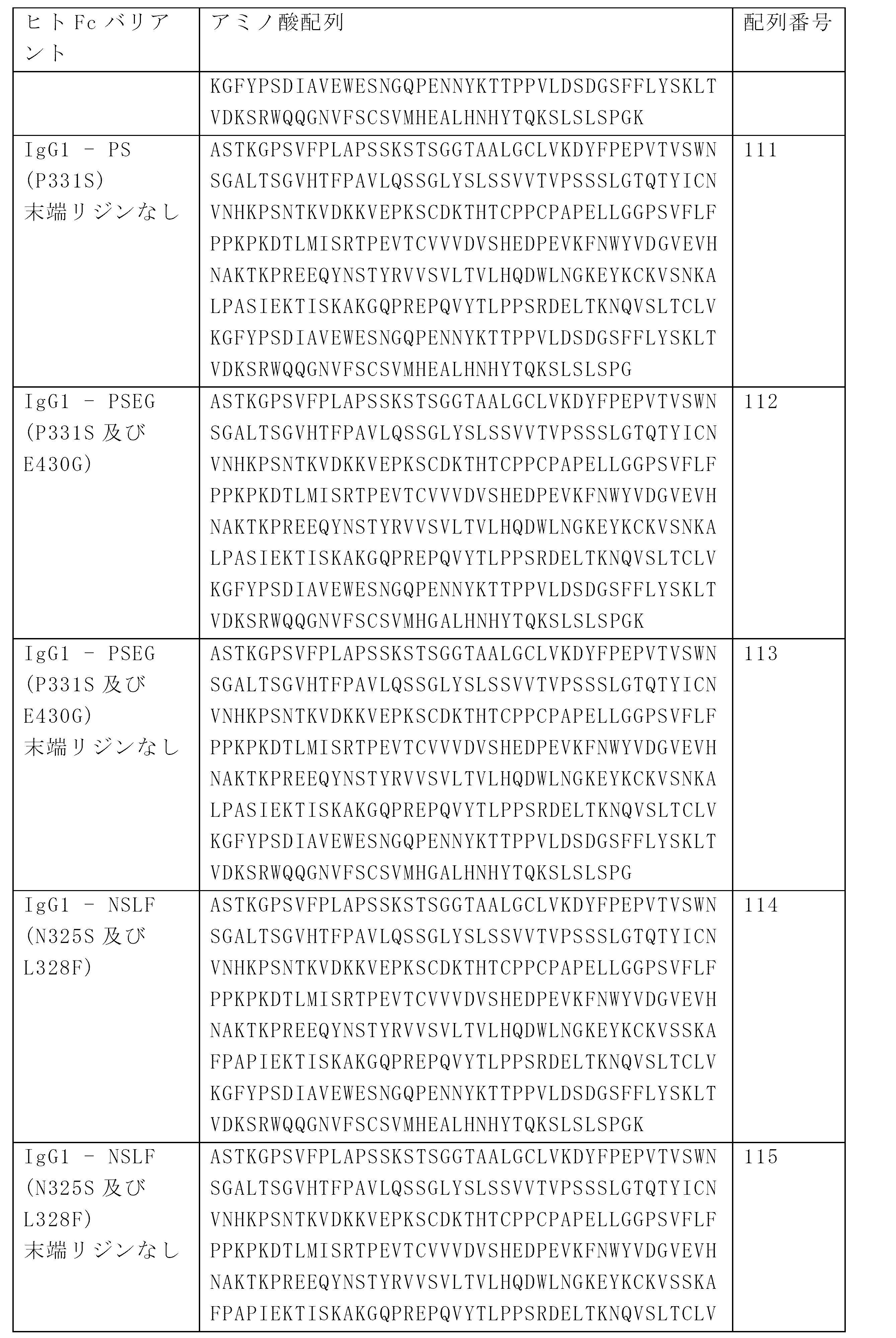
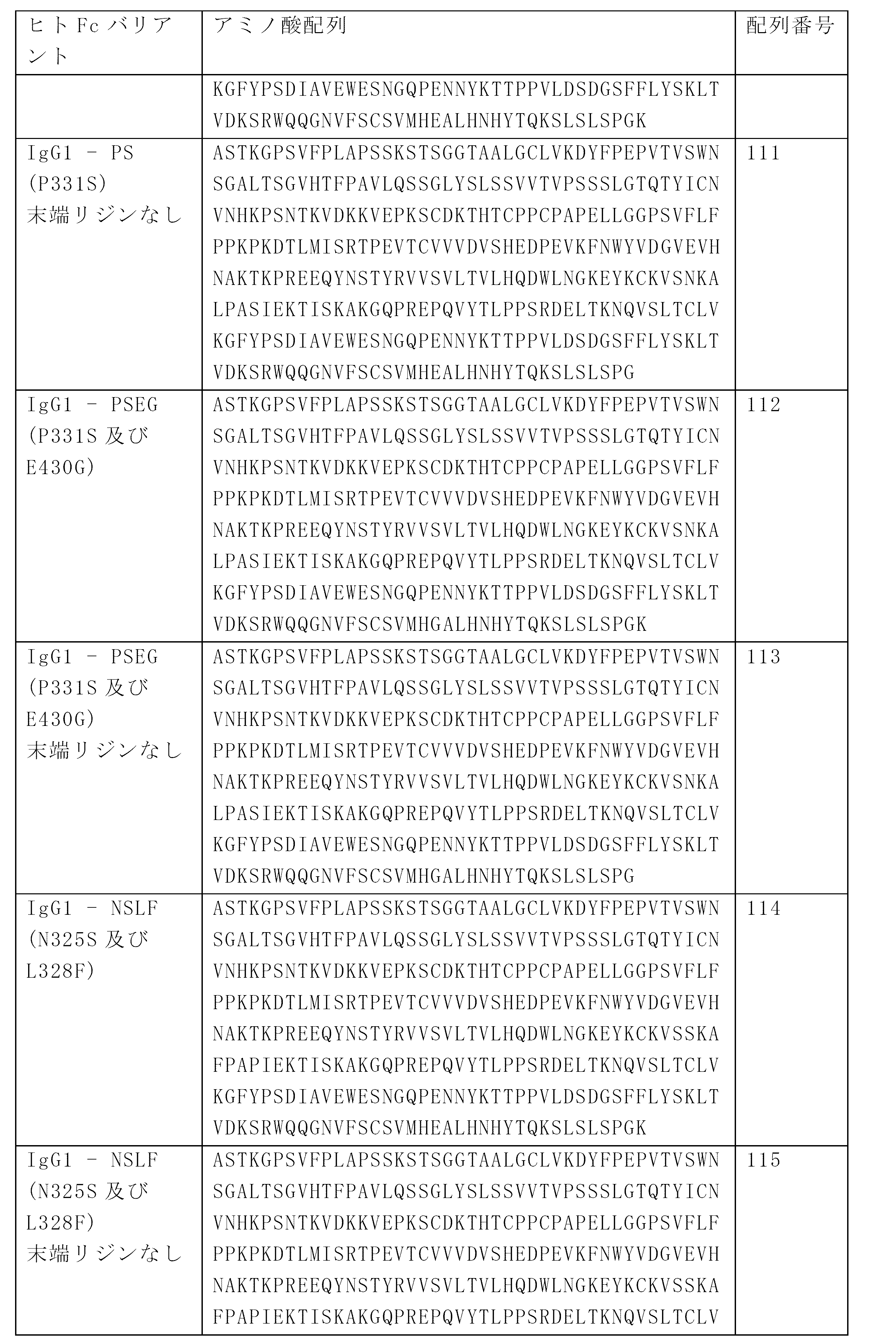
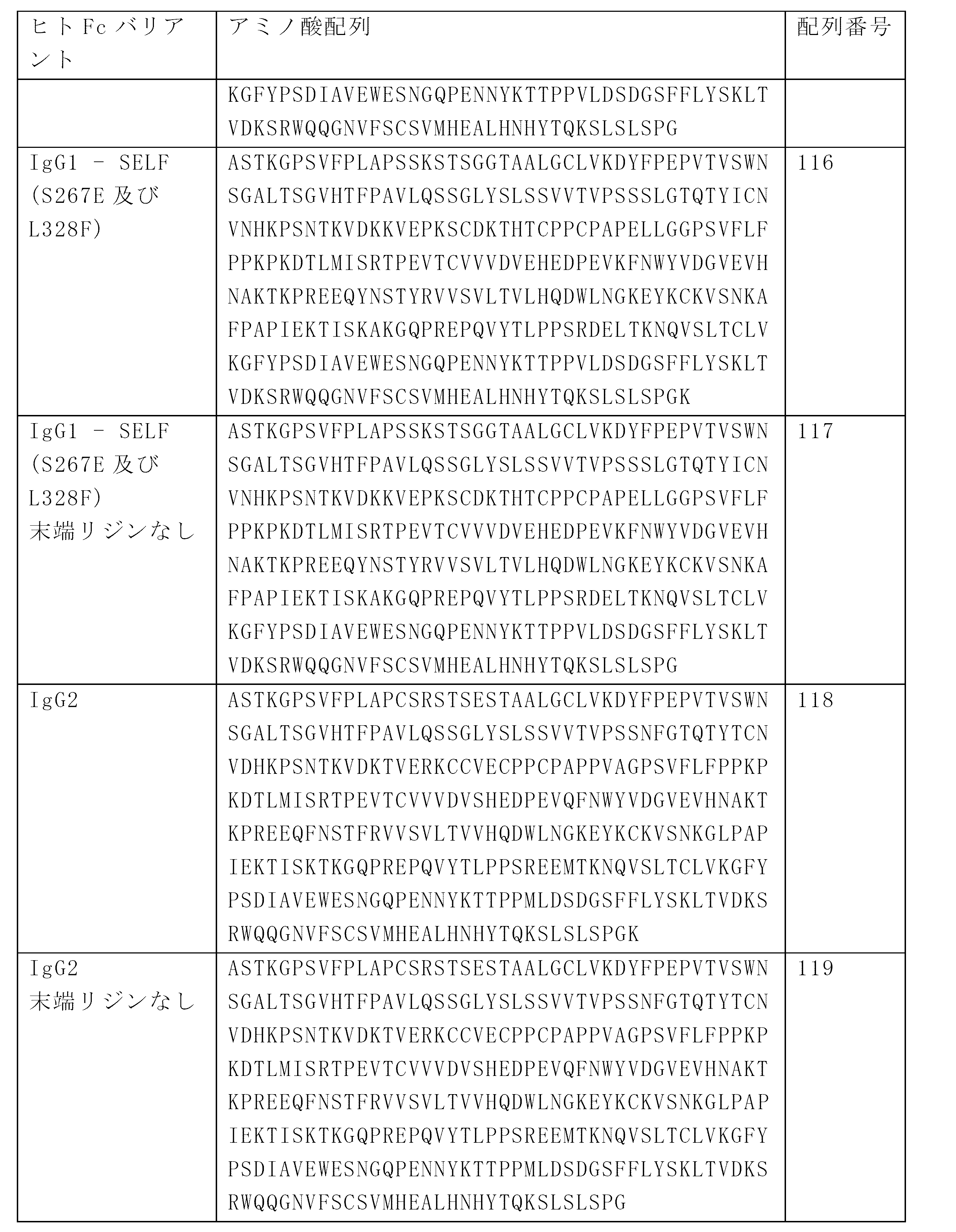
更なる抗CD33抗体、例えば、本開示のCD33タンパク質に特異的に結合する抗体は、その物理的/化学的特性及び/または生物学的活性について、当該技術分野で公知の様々なアッセイにより、同定、スクリーニング、及び/または解析することができる。 Additional anti-CD33 antibodies, e.g., antibodies that specifically bind to the CD33 protein of the present disclosure, can be identified, screened, and/or analyzed for their physical/chemical properties and/or biological activity by various assays known in the art.
Fcγ受容体と結合できる抗CD33抗体
いくつかの実施形態において、本開示の抗CD33抗体は、Fcγ受容体に結合する能力を保持する。いくつかの実施形態において、かかる抗体は、受容体活性化と適合する正確なエピトープ特異性を有するとき、例えばCD33受容体をクラスター化し、一時的に刺激する特長を有し得る。いくつかの実施形態において、かかる抗体は、後に、CD33の分解、CD33の脱感作、CD33の切断、CD33の内在化、CD33のシェディング、CD33発現の下方制御、及び/またはCD33のリソソーム分解を誘導することによって、CD33発現及び/またはCD33タンパク質の1つ以上の活性の長期持続的阻害剤として作用し得る。
Anti-CD33 Antibodies Capable of Binding to Fcγ Receptors In some embodiments, the anti-CD33 antibodies of the present disclosure retain the ability to bind to Fcγ receptors. In some embodiments, such antibodies, when they have the correct epitope specificity compatible with receptor activation, may have the ability to, for example, cluster and transiently stimulate CD33 receptors. In some embodiments, such antibodies may subsequently act as long-lasting inhibitors of CD33 expression and/or one or more activities of the CD33 protein by inducing CD33 degradation, CD33 desensitization, CD33 cleavage, CD33 internalization, CD33 shedding, downregulation of CD33 expression, and/or lysosomal degradation of CD33.
In vivoにおいて、本開示の抗CD33抗体は、考えられる複数の機序のうちのいずれか1つ以上によって、受容体をクラスター化し、CD33を一時的に活性化することができる。IgG2などのヒト抗体のいくつかのアイソタイプは、その特有の構造により、受容体をクラスター化し、または受容体をクラスター化構造に保持する固有の能力を有することで、Fc受容体に結合することなく、CD33などの受容体を一時的に活性化する(例えば、White et al.,(2015)Cancer Cell 27,138-148)。 In vivo, the anti-CD33 antibodies of the present disclosure can cluster receptors and transiently activate CD33 by any one or more of several possible mechanisms. Some isotypes of human antibodies, such as IgG2, have the inherent ability to cluster receptors or hold receptors in a clustered structure due to their unique structure, thereby transiently activating receptors such as CD33 without binding to Fc receptors (e.g., White et al., (2015) Cancer Cell 27, 138-148).
いくつかの実施形態において、他の抗体は、隣接する細胞上のFcg受容体に結合することによって、受容体(例えば、CD33)をクラスター化することができる。いくつかの実施形態において、抗体の定常IgG Fc領域がFcg受容体に結合すると、抗体の凝集が生じることがあり、次に、これらの抗体がその可変領域を介して受容体に結合し、受容体を凝集させ得る(Chu et al(2008)Mol Immunol,45:3926-3933、及びWilson et al.,(2011)Cancer Cell 19,101-113)。いくつかの実施形態において、in vivoで抗体をクラスター化するには、サイトカイン分泌、酸化的バースト、食作用の増大、及び抗体依存性細胞媒介性細胞傷害(ADCC)の増強を誘起しない抑制性Fcg受容体FcgR(FcgRIIB)への結合が好ましい方法であり、これは、FcgRIIBへの結合が、有害な免疫応答作用に関連しないからである。 In some embodiments, other antibodies can cluster receptors (e.g., CD33) by binding to Fcg receptors on neighboring cells. In some embodiments, antibody aggregation can occur when the constant IgG Fc region of an antibody binds to an Fcg receptor, and these antibodies can then bind and aggregate receptors via their variable regions (Chu et al (2008) Mol Immunol, 45:3926-3933, and Wilson et al., (2011) Cancer Cell 19, 101-113). In some embodiments, binding to the inhibitory Fcg receptor FcgR (FcgRIIB), which does not induce cytokine secretion, oxidative burst, increased phagocytosis, and enhanced antibody-dependent cell-mediated cytotoxicity (ADCC), is the preferred method for clustering antibodies in vivo because binding to FcgRIIB is not associated with adverse immune response effects.
本開示の抗CD33抗体が受容体をクラスター化し得る機序は他にもある。例えば、一緒に架橋された抗体断片(例えば、Fab断片)を使用すると、上記のように、Fcg受容体に結合するFc領域を有する抗体と同様の様式で、受容体(例えば、CD33)をクラスター化することができる。いくつかの実施形態において、架橋された抗体断片(例えば、Fab断片)は、細胞表面上で受容体クラスター化を誘導し、標的(例えば、CD33)上の適切なエピトープに結合する場合、アゴニスト抗体として一時的に機能し得る。 There are other mechanisms by which the anti-CD33 antibodies of the present disclosure may cluster receptors. For example, antibody fragments (e.g., Fab fragments) cross-linked together can be used to cluster receptors (e.g., CD33) in a manner similar to antibodies with Fc regions that bind to Fcg receptors, as described above. In some embodiments, cross-linked antibody fragments (e.g., Fab fragments) can induce receptor clustering on the cell surface and temporarily function as agonist antibodies when bound to the appropriate epitope on the target (e.g., CD33).
したがって、いくつかの実施形態において、CD33タンパク質に結合する本開示の抗体は、そのエピトープ特異性により、CD33に結合し、1つ以上のCD33活性を一時的に活性化した後、例えば、CD33の細胞レベルを低下させ、1つ以上のCD33活性を阻害し、及び/またはCD33と1つ以上のCD33リガンドとの間の相互作用(例えば、結合)を阻害する抗体を含み得る。いくつかの実施形態において、かかる抗体は、CD33上のリガンド結合部位に結合して天然リガンドの作用を一時的に模倣することができ、またはリガンド結合部位ではない1つ以上のドメインに結合することによって標的抗原を刺激してシグナルを伝達することができる。いくつかの実施形態において、かかる抗体は、リガンド結合に干渉しない。いくつかの実施形態において、抗体がCD33上のリガンド結合部位に結合するかしないかにかかわらず、本抗体は、後に、CD33の分解、CD33の脱感作、CD33の切断、CD33の内在化、CD33のシェディング、CD33発現の下方制御、及び/またはCD33のリソソーム分解を誘導することによって、CD33発現及び/またはCD33タンパク質の1つ以上の活性の長期持続的阻害剤として作用し得る。 Thus, in some embodiments, antibodies of the present disclosure that bind to CD33 protein may include antibodies that, by virtue of their epitope specificity, bind to CD33 and transiently activate one or more CD33 activities, and then, for example, reduce cellular levels of CD33, inhibit one or more CD33 activities, and/or inhibit the interaction (e.g., binding) between CD33 and one or more CD33 ligands. In some embodiments, such antibodies can bind to a ligand binding site on CD33 to transiently mimic the action of a natural ligand, or can stimulate a target antigen to transduce a signal by binding to one or more domains that are not the ligand binding site. In some embodiments, such antibodies do not interfere with ligand binding. In some embodiments, whether or not the antibody binds to a ligand binding site on CD33, the antibody may subsequently act as a long-lasting inhibitor of CD33 expression and/or one or more activities of the CD33 protein by inducing CD33 degradation, CD33 desensitization, CD33 cleavage, CD33 internalization, CD33 shedding, downregulation of CD33 expression, and/or lysosomal degradation of CD33.
いくつかの実施形態において、本開示の抗CD33抗体は、CD33タンパク質の1つ以上の活性を一時的に誘導する抗体である。いくつかの実施形態において、本抗体は、細胞内に発現しているCD33タンパク質に結合した後、1つ以上の活性を一時的に誘導する。いくつかの実施形態において、CD33タンパク質は、細胞表面上に発現している。いくつかの実施形態において、本開示の抗CD33抗体によって一時的に誘導されるCD33タンパク質の1つ以上の活性は、限定するものではないが、LCK及びFYNなどのSrcファミリーチロシンキナーゼによるTyr-340及びTyr-358のリン酸化;チロシン特異的タンパク質ホスファターゼSHP1及びSHP2の動員及び結合;Dynamini-1のグアニンヌクレオチド交換因子として作用するPLC-γ1の動員及び結合;SH2-ドメイン含有タンパク質(例えば、Crkl)の動員及び結合;脾臓チロシンキナーゼSykの動員及び結合;SH3-SH2-SH3成長因子受容体結合タンパク質2(Grb2)の動員及び結合;複数のSH2含有タンパク質の動員及び結合;タンパク質キナーゼCによるSer-307及びSer-342のリン酸化;単球、マクロファージ、T細胞、樹状細胞好中球、及び/またはミクログリアにおける1つ以上の抗炎症性サイトカインIL-4、IL-10、IL-13、IL-35、IL-16、TGF-β、IL-1Ra、G-CSF、及びTNF、IFN-β1a、IFN-β1b、またはIL-6の可溶性受容体の発現の調節;細胞内カルシウム動員の減少;単球、マクロファージ、T細胞、樹状細胞、好中球、及び/またはミクログリアにおける1つ以上の炎症誘発性サイトカインIFN-a4、IFN-b、IL-1β、TNF-α、IL-6、IL-8、CRP、IL-20ファミリーメンバー、LIF、IFN-γ、OSM、CNTF、GM-CSF、IL-11、IL-12、IL-17、IL-18、IL-23、CXCL10、IL-33、CRP、IL-33、MCP-1、及びMIP-1-βの発現の調節;C1qa、C1qB、C1qC、C1s、C1R、C4、C2、C3、ITGB2、HMOX1、LAT2、CASP1、CSTA、VSIG4、MS4A4A、C3AR1、GPX1、TyroBP、ALOX5AP、ITGAM、SLC7A7、CD4、ITGAX、PYCARD、CD14、CD16、HLA-DR、及びCCR2から選択される1つ以上のタンパク質の発現の調節;細胞外シグナル調節キナーゼ(ERK)リン酸化の阻害;複数の細胞タンパク質に対するチロシンリン酸化の減少;C-Cケモカイン受容体7(CCR7)の発現の調節;CCL19発現細胞及びCCL21発現細胞へのミクログリア細胞走化性の阻害;ホスホイノシチド3-キナーゼの活性化;単球、マクロファージ、T細胞、樹状細胞及び/またはミクログリアの細胞増殖の低減;樹状細胞、骨髄由来樹状細胞、単球、ミクログリア、M1ミクログリア、活性化M1ミクログリア、M2ミクログリア、マクロファージ、M1マクロファージ、活性化M1マクロファージ、及び/またはM2マクロファージによって誘導されるT細胞増殖の低減;破骨細胞生成の阻害、破骨細胞形成速度の減少、またはその両方;好中球、樹状細胞、骨髄由来樹状細胞、マクロファージ、M1マクロファージ、活性化M1マクロファージ、M2マクロファージ、単球、破骨細胞、T細胞、ヘルパーT細胞、細胞傷害性T細胞、顆粒球、ミクログリア、M1ミクログリア、活性化M1ミクログリア、及び/またはM2ミクログリアの生存率低下;好中球、樹状細胞、骨髄由来樹状細胞、マクロファージ、M1マクロファージ、活性化M1マクロファージ、M2マクロファージ、単球、破骨細胞、T細胞、ヘルパーT細胞、細胞傷害性T細胞、顆粒球、ミクログリア、M1ミクログリア、活性化M1ミクログリア、及び/またはM2ミクログリアの増殖の減少;好中球、樹状細胞、骨髄由来樹状細胞、マクロファージ、M1マクロファージ、活性化M1マクロファージ、M2マクロファージ、単球、破骨細胞、T細胞、ヘルパーT細胞、細胞傷害性T細胞、顆粒球、ミクログリア、M1ミクログリア、活性化M1ミクログリア、及び/またはM2ミクログリアの遊走の阻害;好中球、樹状細胞、骨髄由来樹状細胞、マクロファージ、M1マクロファージ、活性化M1マクロファージ、M2マクロファージ、単球、破骨細胞、T細胞、ヘルパーT細胞、細胞傷害性T細胞、顆粒球、ミクログリア、M1ミクログリア、活性化M1ミクログリア、及び/またはM2ミクログリアの1つ以上の機能の低下;好中球、樹状細胞、骨髄由来樹状細胞、マクロファージ、M1マクロファージ、活性化M1マクロファージ、M2マクロファージ、単球、破骨細胞、T細胞、ヘルパーT細胞、細胞傷害性T細胞、顆粒球、ミクログリア、M1ミクログリア、活性化M1ミクログリア、及び/またはM2ミクログリアの成熟の阻害;単球、マクロファージ、T細胞、樹状細胞、好中球、及び/またはミクログリアの細胞死及びアポトーシスの増大;単球、マクロファージ、T細胞、樹状細胞、好中球、及び/またはミクログリアの食作用活性の低減;単球、マクロファージ、T細胞、樹状細胞、好中球、及び/またはミクログリアの増殖の低減;単球、マクロファージ、T細胞、樹状細胞、好中球、及び/またはミクログリアの全体的機能性の低下、ITAM含有受容体のリン酸化;ITAMシグナル伝達を媒介するシグナル伝達分子のリン酸化;パターン認識受容体の活性化の低下;Toll様受容体の活性化の低下;細胞破片及びタンパク質破片のクリアランスの損傷関連の活性化の低下;CD33とそのリガンドの1つ以上との間の相互作用;CD33とCD64などの共受容体との間の相互作用;アポトーシス性ニューロンクリアランス、機能不全シナプスクリアランス、神経組織破片クリアランス、非神経組織破片クリアランス、細菌もしくは他の異物クリアランス、病因タンパク質クリアランス、及び腫瘍細胞クリアランスから選択される1つ以上の種類のクリアランスの低下;アポトーシス性ニューロン、神経組織破片、非神経組織破片、細菌、他の異物、病因タンパク質、病因ペプチド、病因核酸、病因脂質、または腫瘍細胞のうちの1つ以上の食作用の阻害;病因核酸のクリアランスの阻害(例えば、病因核酸は、アンチセンスGGCCCC(G2C4)リピート伸長RNAである);アミロイドβ、アミロイドβ斑、アミロイド前駆体タンパク質またはその断片、タウ、IAPP、α-シヌクレイン、TDP-43、FUSタンパク質、C9orf72(9番染色体オープンリーディングフレーム72)、c9RANタンパク質、プリオンタンパク質、PrPSc、ハンチンチン、カルシトニン、スーパーオキシドジスムターゼ、アタキシン、アタキシン1、アタキシン2、アタキシン3、アタキシン7、アタキシン8、アタキシン10、レビー小体、心房性ナトリウム利尿因子、膵島アミロイドポリペプチド、インスリン、アポリポタンパク質AI、血清アミロイドA、メディン、プロラクチン、トランスサイレチン、リゾチーム、β2ミクログロブリン、ゲルゾリン、ケラトエピテリン、シスタチン、免疫グロブリン軽鎖AL、S-IBMタンパク質、リピート関連非ATG(RAN)翻訳産物、ジペプチドリピート(DPR)ペプチド、グリシン-アラニン(GA)リピートペプチド、グリシン-プロリン(GP)リピートペプチド、グリシン-アルギニン(GR)リピートペプチド、プロリン-アラニン(PA)リピートペプチド、ユビキチン、及びプロリン-アルギニン(PR)リピートペプチドから選択される病因タンパク質のクリアランスの活性化;膀胱癌、脳癌、乳癌、結腸癌、直腸癌、子宮内膜癌、腎臓癌、腎細胞癌、腎盂癌、白血病、肺癌、黒色腫、非ホジキンリンパ腫、急性骨髄性白血病、膵臓癌、前立腺癌、卵巣癌、線維肉腫、及び甲状腺癌から選択される異なる種類のがんに対する有益な免疫応答の阻害;認知症、前頭側頭型認知症、アルツハイマー病、血管性認知症、混合型認知症、クロイツフェルト・ヤコブ病、正常圧水頭症、筋萎縮性側索硬化症、ハンチントン病、タウパチー病、那須・ハコラ病、脳卒中、急性外傷、慢性外傷、本態性振戦、ベーチェット病、パーキンソン病、レビー小体型認知症、多系統萎縮症、シャイ・ドレーガー症候群、進行性核上性麻痺、大脳皮質基底核神経節変性症、急性散在性脳脊髄炎、肉芽腫症、サルコイドーシス、老人病、痙攣、脊髄傷害、外傷性脳傷害、加齢性黄斑変性症、緑内障、網膜色素変性症、網膜変性、及び多発性硬化症から選択される異なる種類の神経障害に対する有益な免疫応答の阻害;ループス、急性及び慢性大腸炎、損傷治癒、クローン病、炎症性腸疾患、潰瘍性大腸炎、肥満症、マラリア、気道感染症、敗血症、眼感染症、全身感染症、ループス、関節炎、低骨密度、骨粗鬆症、骨形成、大理石骨病、及び骨パジェット病から選択される異なる種類の炎症性障害及び感染性障害に対する有益な免疫応答の阻害;アポトーシス性ニューロン、神経組織破片、機能不全シナプス、非神経組織破片、細菌、他の異物、病因タンパク質、病因ペプチド、病因核酸、または腫瘍細胞のうちの1つ以上の食作用の阻害(病因核酸は、アンチセンスGGCCCC(G2C4)リピート伸長RNAであり得、病因タンパク質は、アミロイドβ、アミロイドβオリゴマー、アミロイドβ斑、アミロイド前駆体タンパク質またはその断片、タウ、IAPP、α-シヌクレイン、TDP-43、FUSタンパク質、C9orf72(9番染色体オープンリーディングフレーム72)、c9RANタンパク質、プリオンタンパク質、PrPSc、ハンチンチン、カルシトニン、スーパーオキシドジスムターゼ、アタキシン、アタキシン1、アタキシン2、アタキシン3、アタキシン7、アタキシン8、アタキシン10、レビー小体、心房性ナトリウム利尿因子、膵島アミロイドポリペプチド、インスリン、アポリポタンパク質AI、血清アミロイドA、メディン、プロラクチン、トランスサイレチン、リゾチーム、β2ミクログロブリン、ゲルゾリン、ケラトエピテリン、シスタチン、免疫グロブリン軽鎖AL、S-IBMタンパク質、リピート関連非ATG(RAN)翻訳産物、ジペプチドリピート(DPR)ペプチド、グリシン-アラニン(GA)リピートペプチド、グリシン-プロリン(GP)リピートペプチド、グリシン-アルギニン(GR)リピートペプチド、プロリン-アラニン(PA)リピートペプチド、ユビキチン、及びプロリン-アルギニン(PR)リピートペプチドを含み得、腫瘍細胞は、膀胱癌、脳癌、乳癌、結腸癌、直腸癌、子宮内膜癌、腎臓癌、腎細胞癌、腎盂癌、白血病、肺癌、黒色腫、非ホジキンリンパ腫、
膵臓癌、前立腺癌、卵巣癌、線維肉腫、または甲状腺癌から選択されるがんに由来し得る);腫瘍細胞上のCD33リガンドへの結合;樹状細胞、骨髄由来樹状細胞、単球、ミクログリア、T細胞、好中球、及び/またはマクロファージ上のCD33リガンドへの結合;ミクログリア、マクロファージ、樹状細胞、骨髄由来樹状細胞、好中球、T細胞、ヘルパーT細胞、または細胞傷害性T細胞のうちの1つ以上による腫瘍細胞殺傷の阻害;ミクログリア、マクロファージ、樹状細胞、骨髄由来樹状細胞、好中球、T細胞、ヘルパーT細胞、または細胞傷害性T細胞のうちの1つ以上の抗腫瘍細胞増殖活性の阻害;ミクログリア、マクロファージ、樹状細胞、骨髄由来樹状細胞、好中球、T細胞、ヘルパーT細胞、または細胞傷害性T細胞のうちの1つ以上の抗腫瘍細胞転移活性の阻害;免疫抑制性樹状細胞、免疫抑制性マクロファージ、骨髄由来抑制性細胞、腫瘍関連マクロファージ、または制御性T細胞の促進;TREM1、TREM2、FcgR、DAP10、及びDAP12などの1つ以上のITAMモチーフ含有受容体の阻害;モチーフD/Ex0-2YxxL/IX6-8YxxL/I(配列番号104)を含む1つ以上の受容体の阻害;病原体関連分子パターン(PAMP)を特定する受容体、及び損傷関連分子パターン(DAMP)を特定する受容体などの1つ以上のパターン認識受容体(PRR)によるシグナル伝達の阻害;1つ以上のToll様受容体によるシグナル伝達の阻害;JAK-STATシグナル伝達経路の阻害;活性化B細胞の核内因子カッパ軽鎖エンハンサー(NFκB)の阻害;PLCγ/PKC/カルシウム動員の阻害;PI3K/Akt、Ras/MAPKシグナル伝達の阻害;ミクログリア、マクロファージ、樹状細胞、骨髄由来樹状細胞、好中球、T細胞、ヘルパーT細胞、または細胞傷害性T細胞のうちの1つ以上に発現したCD86などの1つ以上の炎症性受容体の発現の調節;1つ以上のCD33依存的遺伝子の発現増大;破壊されたCD33依存的遺伝子発現の正常化;ならびにNFAT転写因子などの1つ以上のITAM依存的遺伝子の発現減少を含み得る。本開示の抗CD33抗体は、CD33タンパク質の1つ以上の活性を一時的に誘導するその能力について、当該技術分野で公知であり本明細書に開示される任意の好適な技術またはアッセイを利用して試験され得る。かかる抗体が一時的に誘導する活性にかかわらず、かかる抗体は、後に、CD33の分解、CD33の脱感作、CD33の切断、CD33の内在化、CD33のシェディング、CD33発現の下方制御、及び/またはCD33のリソソーム分解を誘導することによって、CD33発現及び/またはCD33タンパク質の1つ以上の活性の長期持続的阻害剤として作用し得る。いくつかの実施形態において、CD33抗体は、Fc受容体への結合とは関係なくCD33タンパク質の1つ以上の活性を一時的に誘導する。
In some embodiments, the anti-CD33 antibodies of the present disclosure are antibodies that transiently induce one or more activities of the CD33 protein. In some embodiments, the antibodies transiently induce one or more activities after binding to CD33 protein expressed within a cell. In some embodiments, the CD33 protein is expressed on the cell surface. In some embodiments, the one or more activities of the CD33 protein that are transiently induced by the anti-CD33 antibodies of the present disclosure include, but are not limited to, phosphorylation of Tyr-340 and Tyr-358 by Src family tyrosine kinases, such as LCK and FYN; recruitment and binding of tyrosine-specific protein phosphatases SHP1 and SHP2; recruitment and binding of PLC-γ1, which acts as a guanine nucleotide exchange factor for Dynamini-1; recruitment and binding of SH2-domain containing proteins (e.g., Crkl); recruitment and binding of the spleen tyrosine kinase Syk; and induction of SH3-SH2-SH3 growth factor receptor activator (SCR)-dependent phosphorylation of Tyr-340 and Tyr-358 by Src family tyrosine kinases, such as LCK and FYN; recruitment and binding of tyrosine-specific protein phosphatases SHP1 and SHP2; recruitment and binding of PLC-γ1, which acts as a guanine nucleotide exchange factor for Dynamini-1; recruitment and binding of SH2-domain containing proteins (e.g., Crkl); recruitment and binding of spleen tyrosine kinase Syk; and induction of SH3-SH2-SH3 growth factor receptor activator (SH3-SH2-SH3 ... recruitment and binding of receptor-bound protein 2 (Grb2); recruitment and binding of multiple SH2-containing proteins; phosphorylation of Ser-307 and Ser-342 by protein kinase C; modulation of expression of one or more anti-inflammatory cytokines IL-4, IL-10, IL-13, IL-35, IL-16, TGF-β, IL-1Ra, G-CSF, and soluble receptors for TNF, IFN-β1a, IFN-β1b, or IL-6 in monocytes, macrophages, T cells, dendritic cells, neutrophils, and/or microglia; reduction of intracellular calcium mobilization; Modulation of expression of one or more of the proinflammatory cytokines IFN-a4, IFN-b, IL-1β, TNF-α, IL-6, IL-8, CRP, IL-20 family members, LIF, IFN-γ, OSM, CNTF, GM-CSF, IL-11, IL-12, IL-17, IL-18, IL-23, CXCL10, IL-33, CRP, IL-33, MCP-1, and MIP-1-β in inflammatory glial cells; C1qa, C1qB, C1qC, C1s, C1R, C4, C2, C3, ITGB2, HMOX1, LAT2, CASP1, CSTA, VSIG4, MS4A4A, C3AR1, GPX1, TyroBP, ALK1, ALK2 ... modulation of expression of one or more proteins selected from OX5AP, ITGAM, SLC7A7, CD4, ITGAX, PYCARD, CD14, CD16, HLA-DR, and CCR2; inhibition of extracellular signal-regulated kinase (ERK) phosphorylation; reduction of tyrosine phosphorylation of multiple cellular proteins; modulation of expression of C-C chemokine receptor 7 (CCR7); inhibition of microglial cell chemotaxis to CCL19-expressing cells and CCL21-expressing cells; activation of phosphoinositide 3-kinase; reduction of cell proliferation of monocytes, macrophages, T cells, dendritic cells, and/or microglia; dendritic cells, bone marrow-derived dendritic cells, monocytes, reducing T-cell proliferation induced by microglia, M1 microglia, activated M1 microglia, M2 microglia, macrophages, M1 macrophages, activated M1 macrophages, and/or M2 macrophages; inhibiting osteoclastogenesis, decreasing the rate of osteoclast formation, or both; reducing the viability of neutrophils, dendritic cells, bone marrow derived dendritic cells, macrophages, M1 macrophages, activated M1 macrophages, M2 macrophages, monocytes, osteoclasts, T cells, helper T cells, cytotoxic T cells, granulocytes, microglia, M1 microglia, activated M1 microglia, and/or M2 microglia; Decreased proliferation of neutrophils, dendritic cells, bone marrow derived dendritic cells, macrophages, M1 macrophages, activated M1 macrophages, M2 macrophages, monocytes, osteoclasts, T cells, helper T cells, cytotoxic T cells, granulocytes, microglia, M1 microglia, activated M1 microglia, and/or M2 microglia; Decreased proliferation of neutrophils, dendritic cells, bone marrow derived dendritic cells, macrophages, M1 macrophages, activated M1 macrophages, M2 macrophages, monocytes, osteoclasts, T cells, helper T cells, cytotoxic T cells, granulocytes, microglia, M1 microglia, activated M1 microglia, and/or M2 microglia inhibiting migration of lymphocytes; decreasing the function of one or more of neutrophils, dendritic cells, bone marrow derived dendritic cells, macrophages, M1 macrophages, activated M1 macrophages, M2 macrophages, monocytes, osteoclasts, T cells, helper T cells, cytotoxic T cells, granulocytes, microglia, M1 microglia, activated M1 microglia, and/or M2 microglia; inhibition of maturation of M1 and/or M2 microglia; increased cell death and apoptosis of monocytes, macrophages, T cells, dendritic cells, neutrophils, and/or microglia; decreased phagocytic activity of monocytes, macrophages, T cells, dendritic cells, neutrophils, and/or microglia; decreased proliferation of monocytes, macrophages, T cells, dendritic cells, neutrophils, and/or microglia; decreased overall functionality of monocytes, macrophages, T cells, dendritic cells, neutrophils, and/or microglia, phosphorylation of ITAM-containing receptors; phosphorylation of signaling molecules that mediate ITAM signaling; decreased activation of pattern recognition receptors; a reduction in activation of Toll-like receptors; a reduction in injury-related activation of clearance of cellular and protein debris; an interaction between CD33 and one or more of its ligands; an interaction between CD33 and a co-receptor such as CD64; a reduction in one or more types of clearance selected from apoptotic neuron clearance, dysfunctional synapse clearance, neural tissue debris clearance, non-neural tissue debris clearance, bacteria or other foreign body clearance, pathogenic protein clearance, and tumor cell clearance; apoptotic neurons, neural tissue debris, non-neural tissue debris, bacteria, other foreign body, pathogenic protein, Inhibition of phagocytosis of one or more of a pathogenic peptide, a pathogenic nucleic acid, a pathogenic lipid, or a tumor cell; Inhibition of clearance of a pathogenic nucleic acid (e.g., the pathogenic nucleic acid is an antisense GGCCCC (G2C4) repeat expanded RNA); Amyloid beta, Amyloid beta plaques, amyloid precursor protein or fragments thereof, tau, IAPP, α-synuclein, TDP-43, FUS protein, C9orf72 (chromosome 9 open reading frame 72), c9RAN protein, prion protein, PrPSc, huntingtin, calcitonin, superoxide dismutase, ataxin, ataxin 1, ataxin 2, ataxin 3, ataxin 7, ataxin 8, ataxin 10, Lewy body, atrial natriuretic factor, islet amyloid polypeptide, insulin, apolipoprotein AI, serum amyloid A, medin, prolactin, transthyretin, lysozyme, β2 microglobulin, gelsolin, keratoepithelin, cystatin, immunoglobulin light chain AL, S-IBM protein, repeat-associated non-ATG (RAN) translation products, dipeptide repeat (DPR) peptide, glycine-alanine (GA) repeat peptide, glycine-proline (GP) repeat peptide, glycine-arginine (GR) repeat Activation of clearance of pathogenic proteins selected from ubiquitin, proline-alanine (PA) repeat peptides, ubiquitin, and proline-arginine (PR) repeat peptides; inhibition of beneficial immune responses against different types of cancer selected from bladder cancer, brain cancer, breast cancer, colon cancer, rectal cancer, endometrial cancer, kidney cancer, renal cell carcinoma, renal pelvis cancer, leukemia, lung cancer, melanoma, non-Hodgkin's lymphoma, acute myeloid leukemia, pancreatic cancer, prostate cancer, ovarian cancer, fibrosarcoma, and thyroid cancer; Dementia, frontotemporal dementia, Alzheimer's disease, vascular dementia, mixed dementia, Creutzfeldt-Jakob disease, normal pressure hydrocephalus, amyotrophic lateral sclerosis, haematological disorders, and rheumatoid arthritis. inhibition of beneficial immune responses against different types of neurological disorders selected from: Chinton's disease, taupathies, Nasu-Hakola disease, stroke, acute trauma, chronic trauma, essential tremor, Behcet's disease, Parkinson's disease, dementia with Lewy bodies, multiple system atrophy, Shy-Drager syndrome, progressive supranuclear palsy, corticobasal ganglionic degeneration, acute disseminated encephalomyelitis, granulomatous diseases, sarcoidosis, geriatric diseases, convulsions, spinal cord injury, traumatic brain injury, age-related macular degeneration, glaucoma, retinitis pigmentosa, retinal degeneration, and multiple sclerosis; lupus, acute and chronic colitis, wound healing, Crohn's disease, inflammatory bowel disease, ulcerative colitis, obesity, malaria, airway sensitivity inhibiting beneficial immune responses to different types of inflammatory and infectious disorders selected from infections, sepsis, eye infections, systemic infections, lupus, arthritis, low bone density, osteoporosis, bone formation, osteopetrosis, and Paget's disease of bone; inhibiting phagocytosis of one or more of apoptotic neurons, neural tissue debris, dysfunctional synapses, non-neural tissue debris, bacteria, other foreign bodies, pathogenic proteins, pathogenic peptides, pathogenic nucleic acids, or tumor cells (the pathogenic nucleic acids can be antisense GGCCCC (G2C4) repeat expanded RNA and the pathogenic proteins can be amyloid beta, amyloid beta oligomers, amyloid beta plaques, amyloid precursor protein or or fragments thereof, tau, IAPP, α-synuclein, TDP-43, FUS protein, C9orf72 (chromosome 9 open reading frame 72), c9RAN protein, prion protein, PrPSc, huntingtin, calcitonin, superoxide dismutase, ataxin, ataxin 1, ataxin 2, ataxin 3, ataxin 7, ataxin 8, ataxin 10, Lewy bodies, atrial natriuretic factor, islet amyloid polypeptide, insulin, apolipoprotein AI, serum amyloid A, medin, prolactin, transthyretin, lysozyme, β2 microglobulin the tumor cells may include bladder cancer, brain cancer, breast cancer, colon cancer, rectal cancer, endometrial cancer, kidney cancer, renal cell carcinoma, renal pelvis cancer, leukemia, lung cancer, melanoma, non-Hodgkin's lymphoma,
pancreatic cancer, prostate cancer, ovarian cancer, fibrosarcoma, or thyroid cancer); binding to CD33 ligand on tumor cells; binding to CD33 ligand on dendritic cells, bone marrow derived dendritic cells, monocytes, microglia, T cells, neutrophils, and/or macrophages; inhibition of tumor cell killing by one or more of microglia, macrophages, dendritic cells, bone marrow derived dendritic cells, neutrophils, T cells, helper T cells, or cytotoxic T cells; microglia, macrophages, dendritic cells, bone marrow derived dendritic cells, Inhibition of anti-tumor cell proliferation activity of one or more of neutrophils, T cells, helper T cells, or cytotoxic T cells; Inhibition of anti-tumor cell metastasis activity of one or more of microglia, macrophages, dendritic cells, bone marrow-derived dendritic cells, neutrophils, T cells, helper T cells, or cytotoxic T cells; Promotion of immunosuppressive dendritic cells, immunosuppressive macrophages, bone marrow-derived suppressor cells, tumor-associated macrophages, or regulatory T cells; Promotion of one or more ITAMs such as TREM1, TREM2, FcgR, DAP10, and DAP12. Inhibition of motif-containing receptors; inhibition of one or more receptors containing the motif D/Ex0-2YxxL/IX6-8YxxL/I (SEQ ID NO: 104); inhibition of signaling by one or more pattern recognition receptors (PRRs), such as receptors that specify pathogen-associated molecular patterns (PAMPs) and receptors that specify damage-associated molecular patterns (DAMPs); inhibition of signaling by one or more Toll-like receptors; inhibition of the JAK-STAT signaling pathway; inhibition of nuclear factor kappa-light-chain-enhancer of activated B cells (NFκB). Anti-CD33 antibodies of the present disclosure may include, but are not limited to, inhibition of PLCγ/PKC/calcium mobilization, inhibition of PI3K/Akt, Ras/MAPK signaling, modulation of expression of one or more inflammatory receptors, such as CD86, expressed on one or more of microglia, macrophages, dendritic cells, bone marrow-derived dendritic cells, neutrophils, T cells, helper T cells, or cytotoxic T cells, increased expression of one or more CD33-dependent genes, normalization of disrupted CD33-dependent gene expression, and decreased expression of one or more ITAM-dependent genes, such as NFAT transcription factors. Anti-CD33 antibodies of the present disclosure may be tested for their ability to transiently induce one or more activities of CD33 protein utilizing any suitable technique or assay known in the art and disclosed herein. Regardless of the activity that such antibodies induce temporarily, such antibodies may subsequently act as long-term inhibitors of CD33 expression and/or one or more activities of the CD33 protein by inducing CD33 degradation, CD33 desensitization, CD33 cleavage, CD33 internalization, CD33 shedding, downregulation of CD33 expression, and/or lysosomal degradation of CD33. In some embodiments, CD33 antibodies transiently induce one or more activities of the CD33 protein independent of binding to an Fc receptor.
例示的な抗体Fcアイソタイプ及び修飾を以下の表Bに記載する。いくつかの実施形態において、Fcγ受容体に結合できる本開示の抗CD33抗体は、以下の表Bに列挙されるFcアイソタイプを有する。

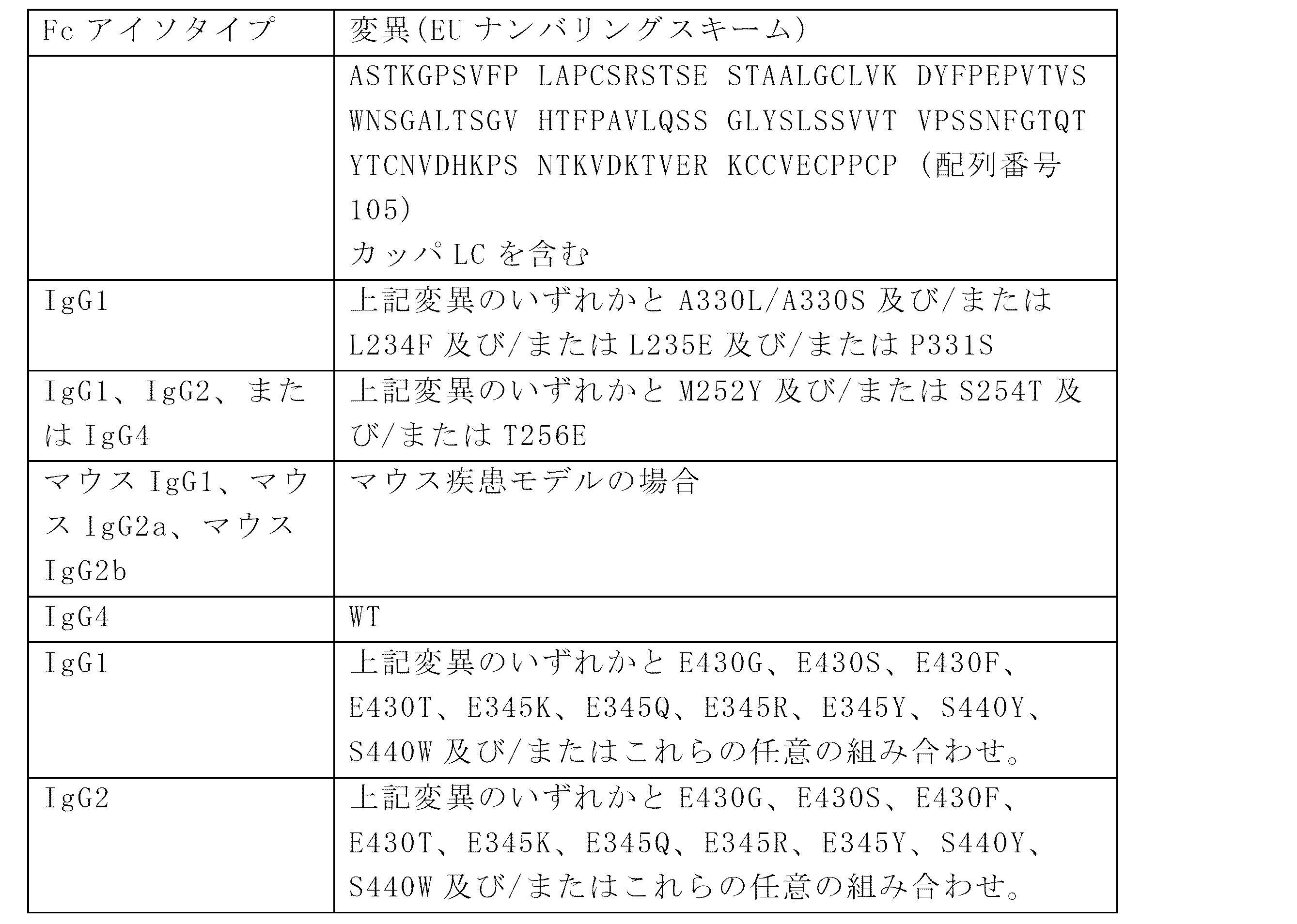
表Bに記載されるアイソタイプに加えて、理論に束縛されることを望むものではないが、ヒトFcg受容体I、IIA、IIC、IIIA、IIIB及び/またはマウスFcg受容体I、III及びIVに結合する、ヒトIgG1またはIgG3アイソタイプの抗体及びそれらの変異体(例えばStrohl(2009)Current Opinion in Biotechnology 2009,20:685-691)も、一過性アゴニスト抗体として作用し得ると考えられる。 In addition to the isotypes listed in Table B, and without wishing to be bound by theory, it is believed that antibodies of human IgG1 or IgG3 isotypes and variants thereof (e.g., Strohl (2009) Current Opinion in Biotechnology 2009, 20:685-691) that bind to human Fcg receptors I, IIA, IIC, IIIA, IIIB and/or mouse Fcg receptors I, III and IV may also act as transient agonist antibodies.
いくつかの実施形態において、Fcγ受容体結合抗体は、IgGクラス、IgMクラス、またはIgAクラスのものである。いくつかの実施形態において、Fcγ受容体結合抗体は、IgG1、IgG2、IgG3、またはIgG4アイソタイプを有する。いくつかの実施形態において、本抗体は、Fc領域において任意の組み合わせでC127S、L234A、L234F、L235A、L235E、S267E、K322A、L328F、A330S、P331S、E345R、E430G、S440Yからなる群から選択される残基位置に1個以上(例えば、1個以上、2個以上、3個以上、4個以上、5個以上、6個以上、7個以上、8個以上、9個以上、10個以上、11個以上、12個以上、または13個全ての)アミノ酸置換を含む(残基位置はEUナンバリングに従う)。いくつかの実施形態において、Fc領域は、位置E430Gにアミノ酸置換を含む。いくつかの実施形態において、Fc領域は、位置L234A、L235A、及びP331Aにアミノ酸置換を含む。いくつかの実施形態において、Fc領域は、位置L234A、L235A、P331Aにアミノ酸置換を含む。いくつかの実施形態において、Fc領域は、位置K322A及びE430Gにアミノ酸置換を含む。いくつかの実施形態において、Fc領域は、位置P331S及びE430Gにアミノ酸置換を含む。いくつかの実施形態において、Fc領域は、位置A330S、P331S、及びE430Gにアミノ酸置換を含む。いくつかの実施形態において、Fc領域は、位置K322A、A330S、及びP331Sにアミノ酸置換を含む。いくつかの実施形態において、Fc領域は、位置K322A、P331S、及びE430Gにアミノ酸置換を含む。いくつかの実施形態において、Fc領域は、位置A330S、P331S、及びE430Gにアミノ酸置換を含む。いくつかの実施形態において、Fc領域は、位置S267E及びL328Fにアミノ酸置換を含む。いくつかの実施形態において、Fc領域は、位置C127Sにアミノ酸置換を含む。いくつかの実施形態において、Fc領域は、位置E345R、E430G及びS440Yにアミノ酸置換を含む。いくつかの実施形態において、Fc領域は、位置P331Sにアミノ酸置換を含む。いくつかの実施形態において、Fc領域は、位置L234A、L235A、及びP331Sにアミノ酸置換を含む。いくつかの実施形態において、Fc領域は、位置S267E及びL328Fにアミノ酸置換を含む。いくつかの実施形態において、上記アミノ酸置換のナンバリングは、EUナンバリングに従う。 In some embodiments, the Fcγ receptor binding antibody is of the IgG class, IgM class, or IgA class. In some embodiments, the Fcγ receptor binding antibody has an IgG1, IgG2, IgG3, or IgG4 isotype. In some embodiments, the antibody comprises one or more (e.g., one or more, two or more, three or more, four or more, five or more, six or more, seven or more, eight or more, nine or more, ten or more, eleven or more, twelve or more, or all thirteen) amino acid substitutions at residue positions selected from the group consisting of C127S, L234A, L234F, L235A, L235E, S267E, K322A, L328F, A330S, P331S, E345R, E430G, S440Y in any combination in the Fc region (residue positions according to EU numbering). In some embodiments, the Fc region comprises an amino acid substitution at position E430G. In some embodiments, the Fc region comprises amino acid substitutions at positions L234A, L235A, and P331A. In some embodiments, the Fc region comprises amino acid substitutions at positions L234A, L235A, P331A. In some embodiments, the Fc region comprises amino acid substitutions at positions K322A and E430G. In some embodiments, the Fc region comprises amino acid substitutions at positions P331S and E430G. In some embodiments, the Fc region comprises amino acid substitutions at positions A330S, P331S, and E430G. In some embodiments, the Fc region comprises amino acid substitutions at positions K322A, A330S, and P331S. In some embodiments, the Fc region comprises amino acid substitutions at positions K322A, P331S, and E430G. In some embodiments, the Fc region comprises amino acid substitutions at positions A330S, P331S, and E430G. In some embodiments, the Fc region comprises amino acid substitutions at positions S267E and L328F. In some embodiments, the Fc region comprises amino acid substitutions at position C127S. In some embodiments, the Fc region comprises amino acid substitutions at positions E345R, E430G, and S440Y. In some embodiments, the Fc region comprises amino acid substitutions at position P331S. In some embodiments, the Fc region comprises amino acid substitutions at positions L234A, L235A, and P331S. In some embodiments, the Fc region comprises amino acid substitutions at positions S267E and L328F. In some embodiments, the numbering of the above amino acid substitutions is according to EU numbering.
特定の実施形態において、Fcγ受容体結合抗体は、IgG2アイソタイプを有する。いくつかの実施形態において、Fcγ受容体結合抗体は、ヒトIgG2定常領域を含む。いくつかの実施形態において、ヒトIgG2定常領域は、Fc領域を含む。いくつかの実施形態において、Fcγ受容体結合抗体は、抑制性Fc受容体に結合する。特定の実施形態において、抑制性Fc受容体は、抑制性Fc-γ受容体IIB(FcγIIB)である。いくつかの実施形態において、Fc領域は、1つ以上の修飾を含む。例えば、いくつかの実施形態において、Fc領域は、1つ以上のアミノ酸置換を含む(例えば、同じアイソタイプの野生型Fc領域と比べて)。いくつかの実施形態において、1つ以上のアミノ酸置換は、V234A(Alegre et al.,(1994)Transplantation 57:1537-1543.31;Xu et al.,(2000)Cell Immunol,200:16-26)、G237A(Cole et al.(1999)Transplantation,68:563-571)、H268Q、V309L、A330S、P331S(US2007/0148167;Armour et al.(1999)Eur J Immunol 29:2613-2624;Armour et al.(2000)The Haematology Journal 1(Suppl.1):27;Armour et al.(2000)The Haematology Journal 1(Suppl.1):27)、C232S、及び/またはC233S(White et al.(2015)Cancer Cell 27,138-148)、S267E、L328F(Chu et al.,(2008)Mol Immunol,45:3926-3933)、M252Y、S254T、及び/またはT256Eから選択され、ここで、アミノ酸の位置は、EUナンバリング規則に従う。 In certain embodiments, the Fcγ receptor binding antibody has an IgG2 isotype. In some embodiments, the Fcγ receptor binding antibody comprises a human IgG2 constant region. In some embodiments, the human IgG2 constant region comprises an Fc region. In some embodiments, the Fcγ receptor binding antibody binds to an inhibitory Fc receptor. In certain embodiments, the inhibitory Fc receptor is inhibitory Fc-gamma receptor IIB (FcγIIB). In some embodiments, the Fc region comprises one or more modifications. For example, in some embodiments, the Fc region comprises one or more amino acid substitutions (e.g., compared to a wild-type Fc region of the same isotype). In some embodiments, the one or more amino acid substitutions are selected from the group consisting of V234A (Alegre et al., (1994) Transplantation 57:1537-1543.31; Xu et al., (2000) Cell Immunol, 200:16-26), G237A (Cole et al. (1999) Transplantation, 68:563-571), H268Q, V309L, A330S, P331S (US2007/0148167; Armour et al. (1999) Eur J Immunol 29:2613-2624; Armour et al. (2000) The Haematology Journal 1(Suppl.1):27; Armour et al. (2000) The Haematology Journal 1(Suppl.1):27), C232S, and/or C233S (White et al. (2015) Cancer Cell 27,138-148), S267E, L328F (Chu et al., (2008) Mol Immunol,45:3926-3933), M252Y, S254T, and/or T256E, where the amino acid positions are according to the EU numbering convention.
いくつかの実施形態において、Fcγ受容体結合抗体は、C127Sアミノ酸置換を含む重鎖定常ドメインを含むIgG2アイソタイプを有し、ここで、アミノ酸の位置は、EUナンバリング規則に従う(White et al.,(2015)Cancer Cell 27,138-148、Lightle et al.,(2010)PROTEIN SCIENCE 19:753-762、及びWO2008079246)。 In some embodiments, the Fcγ receptor binding antibody has an IgG2 isotype comprising a heavy chain constant domain containing a C127S amino acid substitution, where the amino acid positions are according to the EU numbering convention (White et al., (2015) Cancer Cell 27, 138-148; Lightle et al., (2010) PROTEIN SCIENCE 19:753-762; and WO2008079246).
いくつかの実施形態において、Fcγ受容体結合抗体は、C214Sアミノ酸置換を含むカッパ軽鎖定常ドメインを含むIgG2アイソタイプを有し、ここで、アミノ酸の位置は、EUナンバリング規則に従う(White et al.,(2015)Cancer Cell 27,138-148、Lightle et al.,(2010)PROTEIN SCIENCE 19:753-762、及びWO2008079246)。 In some embodiments, the Fcγ receptor binding antibody has an IgG2 isotype comprising a kappa light chain constant domain containing a C214S amino acid substitution, where the amino acid positions are according to the EU numbering convention (White et al., (2015) Cancer Cell 27, 138-148; Lightle et al., (2010) PROTEIN SCIENCE 19:753-762; and WO2008079246).
特定の実施形態において、Fcγ受容体結合抗体は、IgG1アイソタイプを有する。いくつかの実施形態において、Fcγ受容体結合抗体は、マウスIgG1定常領域を含む。いくつかの実施形態において、Fcγ受容体結合抗体は、ヒトIgG1定常領域を含む。いくつかの実施形態において、ヒトIgG1定常領域は、Fc領域を含む。いくつかの実施形態において、Fcγ受容体結合抗体は、抑制性Fc受容体に結合する。特定の実施形態において、抑制性Fc受容体は、抑制性Fc-γ受容体IIB(FcγIIB)である。いくつかの実施形態において、Fc領域は、1つ以上の修飾を含む。例えば、いくつかの実施形態において、Fc領域は、1つ以上のアミノ酸置換を含む(例えば、同じアイソタイプの野生型Fc領域と比べて)。いくつかの実施形態において、1つ以上のアミノ酸置換は、N297A(Bolt S et al.(1993)Eur J Immunol 23:403-411)、D265A(Shields et al.(2001)R.J.Biol.Chem.276,6591-6604)、D270A、L234A、L235A(Hutchins et al.(1995)Proc Natl Acad Sci USA,92:11980-11984;Alegre et al.,(1994)Transplantation 57:1537-1543.31;Xu et al.,(2000)Cell Immunol,200:16-26)、G237A(Alegre et al.(1994)Transplantation 57:1537-1543.31;Xu et al.(2000)Cell Immunol,200:16-26)、P238D、L328E、E233D、G237D、H268D、P271G、A330R、C226S、C229S、E233P、L234V、L234F、L235E(McEarchern et al.,(2007)Blood,109:1185-1192)、P331S(Sazinsky et al.,(2008)Proc Natl Acad Sci USA 2008,105:20167-20172)、S267E、L328F、A330L、M252Y、S254T、T256E、N297Q、P238S、P238A、A327Q、A327G、P329A、K322A、及び/またはT394Dから選択され、ここで、アミノ酸の位置は、EUナンバリング規則に従う。 In certain embodiments, the Fcγ receptor binding antibody has an IgG1 isotype. In some embodiments, the Fcγ receptor binding antibody comprises a murine IgG1 constant region. In some embodiments, the Fcγ receptor binding antibody comprises a human IgG1 constant region. In some embodiments, the human IgG1 constant region comprises an Fc region. In some embodiments, the Fcγ receptor binding antibody binds to an inhibitory Fc receptor. In certain embodiments, the inhibitory Fc receptor is inhibitory Fc-gamma receptor IIB (FcγIIB). In some embodiments, the Fc region comprises one or more modifications. For example, in some embodiments, the Fc region comprises one or more amino acid substitutions (e.g., compared to a wild-type Fc region of the same isotype). In some embodiments, the one or more amino acid substitutions are N297A (Bolt S et al. (1993) Eur J Immunol 23:403-411), D265A (Shields et al. (2001) R. J. Biol. Chem. 276, 6591-6604), D270A, L234A, L235A (Hutchins et al. (1995) Proc Natl Acad Sci USA, 92:11980-11984; Alegre et al., (1994) Transplantation 57:1537-1543.31; Xu et al., (2000) Cell 11:11982-11983; Immunol, 200:16-26), G237A (Alegre et al. (1994) Transplantation 57:1537-1543.31; Xu et al. (2000) Cell Immunol, 200:16-26), P238D, L P331S (Sa Zinsky et al., (2008) Proc. Natl Acad Sci USA 2008,105:20167-20172), S267E, L328F, A330L, M252Y, S254T, T256E, N297Q, P238S, P238A, A327Q, A327G, P329A, K322A, and/or T394D, where the amino acid positions are according to the EU numbering rules.
いくつかの実施形態において、本抗体は、IgG2アイソタイプ重鎖定常ドメイン1(CH1)及びヒンジ領域を含む(White et al.,(2015)Cancer Cell 27,138-148)。特定の実施形態において、IgG2アイソタイプのCH1及びヒンジ領域は、ASTKGPSVFPLAPCSRSTSESTAALGCLVKDYFPEPVTVSWNSGALTSGVHTFPAVLQSSGLYSLSSVVTVPSSNFGTQTYTCNVDHKPSNTKVDKTVERKCCVECPPCP(配列番号105)のアミノ酸配列を含む。いくつかの実施形態において、抗体Fc領域は、S267Eアミノ酸置換、L328Fアミノ酸置換、もしくはその両方、及び/またはN297AもしくはN297Qアミノ酸置換を含み、ここで、アミノ酸の位置は、EUナンバリング規則に従う。 In some embodiments, the antibody comprises an IgG2 isotype heavy chain constant domain 1 (CH1) and hinge region (White et al., (2015) Cancer Cell 27, 138-148). In certain embodiments, the IgG2 isotype CH1 and hinge region comprises the amino acid sequence ASTKGPSVFPLAPCCSRSTSESTAALGCLVKDYFPEPVTVSWNSGALTSGVHTFPAVLQSSGLYSLSSVTVPSSNFGTQTYTCNVDHKPSNTKVDKTVERKCCVECPCP (SEQ ID NO: 105). In some embodiments, the antibody Fc region comprises an S267E amino acid substitution, an L328F amino acid substitution, or both, and/or an N297A or N297Q amino acid substitution, where the amino acid positions are according to the EU numbering convention.
特定の実施形態において、Fcγ受容体結合抗体は、IgG4アイソタイプを有する。いくつかの実施形態において、Fcγ受容体結合抗体は、ヒトIgG4定常領域を含む。いくつかの実施形態において、ヒトIgG4定常領域は、Fc領域を含む。いくつかの実施形態において、Fcγ受容体結合抗体は、抑制性Fc受容体に結合する。特定の実施形態において、抑制性Fc受容体は、抑制性Fc-γ受容体IIB(FcγIIB)である。いくつかの実施形態において、Fc領域は、1つ以上の修飾を含む。例えば、いくつかの実施形態において、Fc領域は、1つ以上のアミノ酸置換を含む(例えば、同じアイソタイプの野生型Fc領域と比べて)。いくつかの実施形態において、1つ以上のアミノ酸置換は、L235A、G237A、S228P、L236E(Reddy et al.,(2000)J Immunol,164:1925-1933)、S267E、E318A、L328F、M252Y、S254T、及び/またはT256Eから選択され、ここで、アミノ酸の位置は、EUナンバリング規則に従う。 In certain embodiments, the Fcγ receptor binding antibody has an IgG4 isotype. In some embodiments, the Fcγ receptor binding antibody comprises a human IgG4 constant region. In some embodiments, the human IgG4 constant region comprises an Fc region. In some embodiments, the Fcγ receptor binding antibody binds to an inhibitory Fc receptor. In certain embodiments, the inhibitory Fc receptor is inhibitory Fc-gamma receptor IIB (FcγIIB). In some embodiments, the Fc region comprises one or more modifications. For example, in some embodiments, the Fc region comprises one or more amino acid substitutions (e.g., compared to a wild-type Fc region of the same isotype). In some embodiments, the one or more amino acid substitutions are selected from L235A, G237A, S228P, L236E (Reddy et al., (2000) J Immunol, 164:1925-1933), S267E, E318A, L328F, M252Y, S254T, and/or T256E, where the amino acid positions are according to the EU numbering convention.
特定の実施形態において、Fcγ受容体結合抗体は、ハイブリッドIgG2/4アイソタイプを有する。いくつかの実施形態において、Fcγ受容体結合抗体は、ヒトIgG2のアミノ酸118~260(EUナンバリングに従う)と、ヒトIgG4のアミノ酸261~447(EUナンバリングに従う)とを含むアミノ酸配列を含む(WO1997/11971;WO2007/106585)。 In certain embodiments, the Fcγ receptor binding antibody has a hybrid IgG2/4 isotype. In some embodiments, the Fcγ receptor binding antibody comprises an amino acid sequence that includes amino acids 118-260 (according to EU numbering) of human IgG2 and amino acids 261-447 (according to EU numbering) of human IgG4 (WO1997/11971; WO2007/106585).
特定の実施形態において、本抗体は、マウスIgG4定常領域を含む(Bartholomaeus,et al.(2014).J.Immunol.192,2091-2098)。 In certain embodiments, the antibody comprises a mouse IgG4 constant region (Bartholomaeus, et al. (2014). J. Immunol. 192, 2091-2098).
いくつかの実施形態において、Fc領域は、A330L、L234F、L235E、またはP331S(EUに従う)及びこれらの任意の組み合わせからなる群から選択される1つ以上の追加のアミノ酸置換を更に含む。 In some embodiments, the Fc region further comprises one or more additional amino acid substitutions selected from the group consisting of A330L, L234F, L235E, or P331S (according to EU), and any combination thereof.
特定の実施形態において、本抗体は、Fc領域においてC127S、L234A、L234F、L235A、L235E、S267E、K322A、L328F、A330S、P331S、E345R、E430G、S440Y、及びこれらの任意の組み合わせから選択される残基位置に1つ以上のアミノ酸置換を含み、残基のナンバリングは、EUナンバリングに従う。いくつかの実施形態において、Fc領域は、位置E430G、L234A、L235A、及びP331Sにアミノ酸置換を含み、残基位置のナンバリングは、EUナンバリングに従う。いくつかの実施形態において、Fc領域は、位置E430G及びP331Sにアミノ酸置換を含み、残基位置のナンバリングは、EUナンバリングに従う。いくつかの実施形態において、Fc領域は、位置E430G及びK322Aにアミノ酸置換を含み、残基位置のナンバリングは、EUナンバリングに従う。いくつかの実施形態において、Fc領域は、位置E430G、A330S、及びP331Sにアミノ酸置換を含み、残基位置のナンバリングは、EUナンバリングに従う。いくつかの実施形態において、Fc領域は、位置E430G、K322A、A330S、及びP331Sにアミノ酸置換を含み、残基位置のナンバリングは、EUナンバリングに従う。いくつかの実施形態において、Fc領域は、位置E430G、K322A、及びA330Sにアミノ酸置換を含み、残基位置のナンバリングは、EUナンバリングに従う。いくつかの実施形態において、Fc領域は、位置E430G、K322A、及びP331Sにアミノ酸置換を含み、残基位置のナンバリングは、EUナンバリングに従う。いくつかの実施形態において、Fc領域は、位置S267E及びL328Fにアミノ酸置換を含み、残基位置のナンバリングは、EUナンバリングに従う。いくつかの実施形態において、Fc領域は、位置C127Sにアミノ酸置換を含み、残基位置のナンバリングは、EUナンバリングに従う。いくつかの実施形態において、Fc領域は、位置E345R、E430G及びS440Yにアミノ酸置換を含み、残基位置のナンバリングは、EUナンバリングに従う。いくつかの実施形態において、Fc領域は、位置L234A、L235A、及びP331Sにアミノ酸置換を含み、残基位置のナンバリングは、EUナンバリングに従う。 In certain embodiments, the antibody comprises one or more amino acid substitutions in the Fc region at residue positions selected from C127S, L234A, L234F, L235A, L235E, S267E, K322A, L328F, A330S, P331S, E345R, E430G, S440Y, and any combination thereof, where the numbering of the residues is according to EU numbering. In some embodiments, the Fc region comprises amino acid substitutions at positions E430G, L234A, L235A, and P331S, where the numbering of the residue positions is according to EU numbering. In some embodiments, the Fc region comprises amino acid substitutions at positions E430G and P331S, where the numbering of the residue positions is according to EU numbering. In some embodiments, the Fc region comprises amino acid substitutions at positions E430G and K322A, where the numbering of the residue positions is according to EU numbering. In some embodiments, the Fc region comprises amino acid substitutions at positions E430G, A330S, and P331S, where the numbering of the residue positions is according to EU numbering. In some embodiments, the Fc region comprises amino acid substitutions at positions E430G, K322A, A330S, and P331S, where the numbering of the residue positions is according to EU numbering. In some embodiments, the Fc region comprises amino acid substitutions at positions E430G, K322A, and A330S, where the numbering of the residue positions is according to EU numbering. In some embodiments, the Fc region comprises amino acid substitutions at positions E430G, K322A, and P331S, where the numbering of the residue positions is according to EU numbering. In some embodiments, the Fc region comprises amino acid substitutions at positions S267E and L328F, where the numbering of the residue positions is according to EU numbering. In some embodiments, the Fc region comprises amino acid substitutions at position C127S, where the numbering of the residue positions is according to EU numbering. In some embodiments, the Fc region comprises amino acid substitutions at positions E345R, E430G, and S440Y, where the numbering of the residue positions is according to EU numbering. In some embodiments, the Fc region comprises amino acid substitutions at positions L234A, L235A, and P331S, where the numbering of the residue positions is according to EU numbering.
不活性抗体
本開示の抗CD33抗体の別のクラスには、不活性抗体が含まれる。本明細書で使用される場合、「不活性」抗体とは、その標的抗原(例えば、CD33)に特異的に結合するが、抗原機能を調節する(例えば、低下/阻害するまたは活性化/誘導する)ことはない抗体を意味する。例えば、CD33の場合、不活性抗体は、CD33の細胞レベルを調節せず、CD33と1つ以上のCD33リガンドとの間の相互作用(例えば、結合)を調節せず、またはCD33タンパク質の1つ以上の活性を調節しない。いくつかの実施形態において、細胞表面上でCD33をクラスター化する能力を有しない抗体は、受容体活性化と適合するエピトープ特異性を有している場合であっても、不活性抗体であり得る。
Inactive Antibodies Another class of anti-CD33 antibodies of the present disclosure includes inactive antibodies. As used herein, an "inactive" antibody refers to an antibody that specifically binds to its target antigen (e.g., CD33) but does not modulate (e.g., reduce/inhibit or activate/induce) antigen function. For example, in the case of CD33, an inactive antibody does not modulate the cellular levels of CD33, does not modulate the interaction (e.g., binding) between CD33 and one or more CD33 ligands, or does not modulate one or more activities of the CD33 protein. In some embodiments, an antibody that does not have the ability to cluster CD33 on the cell surface can be an inactive antibody even if it has an epitope specificity compatible with receptor activation.
いくつかの実施形態において、CD33タンパク質に結合する抗体には、CD33に結合するが、そのエピトープ特異性または特徴により、CD33の細胞レベルを低下させず、及び/またはCD33と1つ以上のCD33リガンドとの間の相互作用(例えば、結合)を阻害しない抗体が含まれ得る。いくつかの実施形態において、かかる抗体は、例えば、毒素(例えば、化学療法薬)を腫瘍細胞へ輸送するためのカーゴとして使用することができる。したがって、いくつかの実施形態において、本開示の抗体は、CD33に結合するが、CD33細胞レベルを低下させること、CD33と1つ以上のCD33リガンドとの間の相互作用(例えば、結合)を阻害すること、またはCD33タンパク質の1つ以上の活性を誘導することができない不活性抗体である。 In some embodiments, antibodies that bind to CD33 protein may include antibodies that bind to CD33 but do not reduce cellular levels of CD33 and/or inhibit interactions (e.g., binding) between CD33 and one or more CD33 ligands due to their epitope specificity or characteristics. In some embodiments, such antibodies can be used, for example, as cargo to deliver toxins (e.g., chemotherapeutic drugs) to tumor cells. Thus, in some embodiments, the antibodies of the present disclosure are inactive antibodies that bind to CD33 but are unable to reduce cellular levels of CD33, inhibit interactions (e.g., binding) between CD33 and one or more CD33 ligands, or induce one or more activities of the CD33 protein.
細胞上のCD33の細胞レベルを低下させる抗体も、低下させない抗体も、1つ以上のFcg受容体への結合の低減を示す不活性Fc領域と組み合わせることができる。このようなFc領域及び修飾の例を以下の表Cに記載する。いくつかの実施形態において、不活性Fc領域を含む抗体は、以下の表Cに列挙されるFcアイソタイプを有する。 Antibodies that do or do not reduce cellular levels of CD33 on cells can be combined with an inactive Fc region that exhibits reduced binding to one or more Fcg receptors. Examples of such Fc regions and modifications are listed in Table C below. In some embodiments, antibodies that include an inactive Fc region have an Fc isotype listed in Table C below.
抑制性抗CD33抗体
本開示の抗CD33抗体の第3のクラスには、1つ以上のCD33活性を遮断するか、または別様に阻害する抗体が含まれる。いくつかの実施形態において、CD33タンパク質に結合する抗体には、CD33の細胞レベル(例えば、CD33の細胞表面レベル)を低下させ、CD33及び/または1つ以上のCD33リガンドの間の相互作用(例えば、結合)を阻害し、CD33タンパク質の1つ以上の活性を阻害する抗体が含まれ得る。かかる抗体は、CD33と1つ以上のCD33リガンドとの間の相互作用(例えば、結合)を防止すること、または1つ以上のCD33リガンドの存在下でCD33の細胞外ドメインから細胞の細胞質内へのシグナル伝達を防止することのいずれかによって、CD33タンパク質の1つ以上の活性を阻害する。抗体はまた、CD33の分解、CD33の脱感作、CD33の切断、CD33の内在化、CD33のシェディング、CD33発現の下方制御、及び/またはCD33のリソソーム分解を誘導することによりCD33の細胞表面レベルを低下させることによって、CD33タンパク質の1つ以上の活性を阻害し得る。いくつかの実施形態において、かかる抗CD33抗体は、CD33を一時的に活性化しない場合がある。
Inhibitory Anti-CD33 Antibodies A third class of anti-CD33 antibodies of the present disclosure includes antibodies that block or otherwise inhibit one or more CD33 activities. In some embodiments, antibodies that bind to CD33 protein can include antibodies that reduce cellular levels of CD33 (e.g., cell surface levels of CD33), inhibit interactions (e.g., binding) between CD33 and/or one or more CD33 ligands, and inhibit one or more activities of the CD33 protein. Such antibodies inhibit one or more activities of the CD33 protein by either preventing interactions (e.g., binding) between CD33 and one or more CD33 ligands, or by preventing signaling from the extracellular domain of CD33 into the cytoplasm of the cell in the presence of one or more CD33 ligands. The antibodies may also inhibit one or more activities of the CD33 protein by reducing cell surface levels of CD33 by inducing CD33 degradation, CD33 desensitization, CD33 cleavage, CD33 internalization, CD33 shedding, downregulation of CD33 expression, and/or lysosomal degradation of CD33. In some embodiments, such anti-CD33 antibodies may not temporarily activate CD33.
いくつかの実施形態において、本開示の抗CD33抗体は、本開示の一過性抗CD33アゴニスト抗体のエピトープ特異性を有し得るが、Fcg受容体に結合することができないFcドメインを有しているため、例えば、CD33を一時的にクラスター化し、活性化することはできない。 In some embodiments, the anti-CD33 antibodies of the present disclosure may have the epitope specificity of the transient anti-CD33 agonist antibodies of the present disclosure, but have an Fc domain that is incapable of binding to an Fcg receptor and, therefore, is unable to transiently cluster and activate CD33, for example.
いくつかの実施形態において、本開示の抗CD33抗体は、限定するものではないが、次の活性のうちの1つ以上を有する:シアル酸含有糖脂質またはシアル酸含有糖タンパク質などの1つ以上のCD33リガンドへのCD33タンパク質の結合を減少させる能力、サイトカインシグナル伝達(SOCS)タンパク質(例えば、SOCS3タンパク質)のサプレッサーのCD33タンパク質への結合を減少させる能力、CD33タンパク質のプロテアソーム分解を増大させる能力、循環樹状細胞、マクロファージ、単球、T細胞、及び/またはミクログリアの表面上のCD33の機能的発現を低減させる能力、LCK及びFYNなどのSrcファミリーチロシンキナーゼによるTyr-340及びTyr-358のリン酸化を減少させる能力、チロシン特異性タンパク質ホスファターゼSHP1及びSHP2の動員及び結合を減少させる能力、Dynamin-1のグアニンヌクレオチド交換因子として作用するPLC-g1の動員及び結合を減少させる能力、Crklの動員及び結合を減少させる能力、脾臓チロシンキナーゼSykの動員及び結合を減少させる能力、SH3-SH2-SH3成長因子受容体結合タンパク質2(Grb2)の動員及び結合を減少させる能力、複数のSH2含有タンパク質の動員及び結合を減少させる能力、細胞内カルシウム動員を増大させる能力、炎症誘発性サイトカインIL-1β、IL-8、及びTNF-αの生成を調節する能力、ホスホイノシチド3-キナーゼの活性化を低下させる能力、単球、マクロファージ、樹状細胞、T細胞、及び/またはミクログリアの増殖を増大させる能力、単球、マクロファージ、樹状細胞、T細胞、及び/またはミクログリアの生存率を高める能力、複数の細胞タンパク質に対するチロシンリン酸化を増大させる能力、単球、マクロファージ、樹状細胞及び/またはミクログリアの食作用活性を増大させる能力、単球、マクロファージ、樹状細胞、T細胞、及び/またはミクログリアの細胞増殖を増大させる能力、ITAMシグナル伝達を媒介するシグナル伝達分子のリン酸化を増大させる能力、パターン認識受容体の機能を増大させる能力、Toll様受容体の機能を増大させる能力、損傷関連分子パターン(DAMP)受容体の機能を増大させる能力、C-Cケモカイン受容体7(CCR7)の発現を調節する能力、ならびに細胞破片及びタンパク質破片のクリアランスを増大させる能力。 In some embodiments, the anti-CD33 antibodies of the present disclosure have one or more of the following activities, including, but not limited to, the ability to decrease binding of CD33 protein to one or more CD33 ligands, such as sialic acid-containing glycolipids or sialic acid-containing glycoproteins, the ability to decrease binding of suppressors of cytokine signaling (SOCS) proteins (e.g., SOCS3 protein) to CD33 protein, the ability to increase proteasomal degradation of CD33 protein on the surface of circulating dendritic cells, macrophages, monocytes, T cells, and/or microglia. the ability to reduce the functional expression of CD33, the ability to reduce phosphorylation of Tyr-340 and Tyr-358 by Src family tyrosine kinases such as LCK and FYN, the ability to reduce the recruitment and binding of tyrosine-specific protein phosphatases SHP1 and SHP2, the ability to reduce the recruitment and binding of PLC-g1 which acts as a guanine nucleotide exchange factor for Dynamin-1, the ability to reduce the recruitment and binding of Crkl, the ability to reduce the recruitment and binding of the spleen tyrosine kinase Syk, the ability to reduce the recruitment and binding of SH3-SH2-SH3 growth factor receptor-bound protein 2 (Grb 2), ability to decrease recruitment and binding of multiple SH2-containing proteins, ability to increase intracellular calcium mobilization, ability to modulate production of the proinflammatory cytokines IL-1β, IL-8, and TNF-α, ability to decrease activation of phosphoinositide 3-kinase, ability to increase proliferation of monocytes, macrophages, dendritic cells, T cells, and/or microglia, ability to increase survival of monocytes, macrophages, dendritic cells, T cells, and/or microglia, ability to increase tyrosine phosphorylation of multiple cellular proteins ... proliferation of monocytes, macrophages, dendritic cells, T cells, and/or microglia, ability to increase proliferation of monocytes, macrophages, dendritic cells, T cells, and/or microglia, ability to increase proliferation of monocytes, macrophages, dendritic cells, T cells, and/or microglia, ability to increase proliferation of monocytes, macrophages, dendritic cells, T cells, and/or microglia, ability Ability to increase phagocytic activity of macrophages, dendritic cells and/or microglia, ability to increase cell proliferation of monocytes, macrophages, dendritic cells, T cells and/or microglia, ability to increase phosphorylation of signaling molecules that mediate ITAM signaling, ability to increase function of pattern recognition receptors, ability to increase function of Toll-like receptors, ability to increase function of damage-associated molecular pattern (DAMP) receptors, ability to modulate expression of C-C chemokine receptor 7 (CCR7), and ability to increase clearance of cellular and protein debris.
いくつかの実施形態において、本開示の抗CD33抗体は、1つ以上のFcg受容体への結合の低減を示すFc領域を有する。このようなFc領域及び修飾の例を以下の表Cに記載する。いくつかの実施形態において、本抗体は、以下の表Cに列挙されるFcアイソタイプを有する。 In some embodiments, the anti-CD33 antibodies of the disclosure have an Fc region that exhibits reduced binding to one or more Fcg receptors. Examples of such Fc regions and modifications are described in Table C below. In some embodiments, the antibodies have an Fc isotype listed in Table C below.
Fcγ受容体への結合が低減した抗体Fcアイソタイプ
いくつかの実施形態において、Fcγ受容体への結合が低減した抗CD33抗体は、以下の表Cに列挙されるFcアイソタイプを有する。
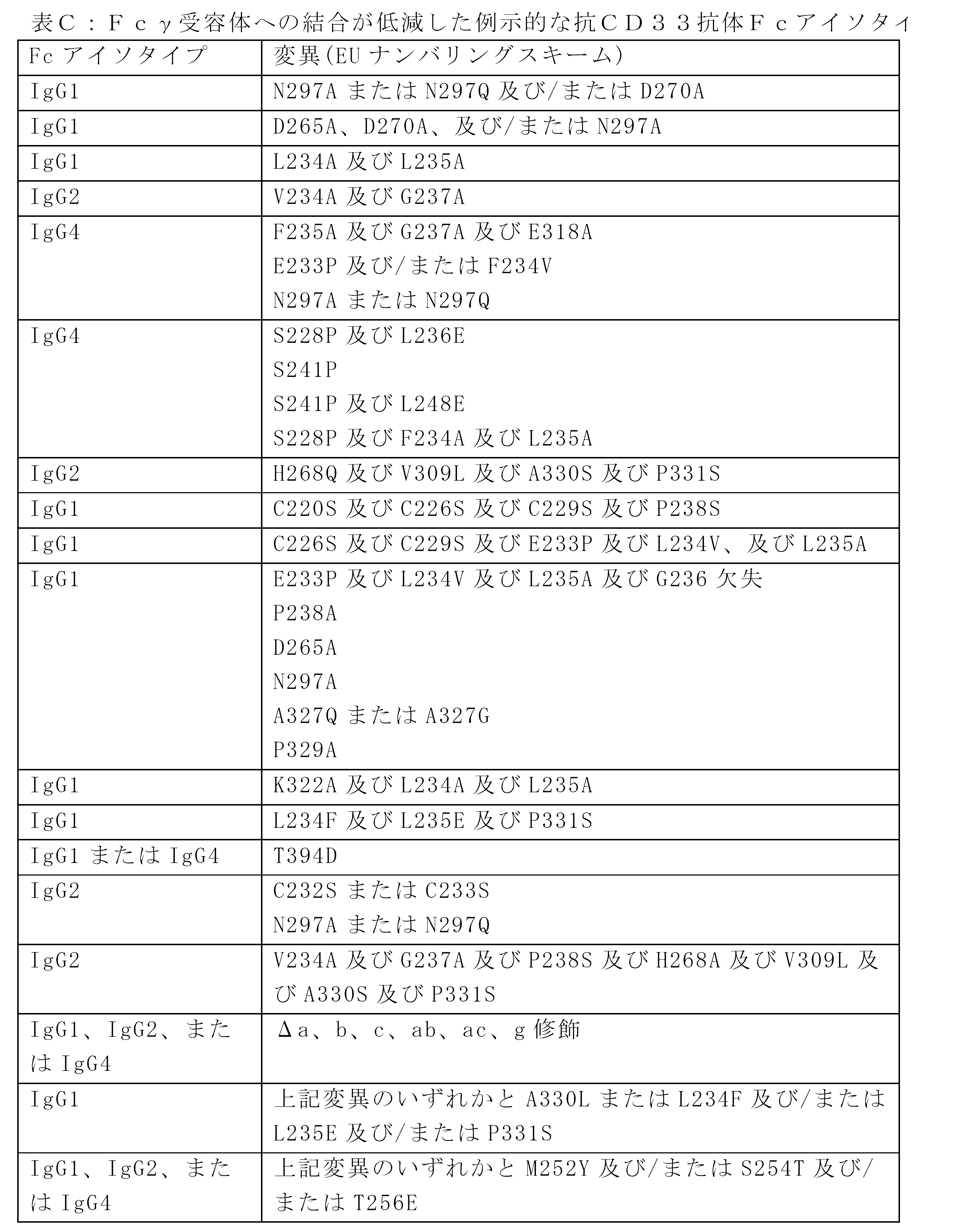
特定の実施形態において、抗CD33抗体は、IgG1アイソタイプを有する。いくつかの実施形態において、本抗体は、マウスIgG1定常領域を含む。いくつかの実施形態において、本抗体は、ヒトIgG1定常領域を含む。いくつかの実施形態において、ヒトIgG1定常領域は、Fc領域を含む。いくつかの実施形態において、Fc領域は、1つ以上の修飾を含む。例えば、いくつかの実施形態において、Fc領域は、1つ以上のアミノ酸置換を含む(例えば、同じアイソタイプの野生型Fc領域と比べて)。 In certain embodiments, the anti-CD33 antibody has an IgG1 isotype. In some embodiments, the antibody comprises a murine IgG1 constant region. In some embodiments, the antibody comprises a human IgG1 constant region. In some embodiments, the human IgG1 constant region comprises an Fc region. In some embodiments, the Fc region comprises one or more modifications. For example, in some embodiments, the Fc region comprises one or more amino acid substitutions (e.g., compared to a wild-type Fc region of the same isotype).
いくつかの実施形態において、1つ以上のアミノ酸置換は、N297A、N297Q(Bolt S et al.(1993)Eur J Immunol 23:403-411)、D265A、D270A、L234A、L235A(McEarchern et al.,(2007)Blood,109:1185-1192)、C226S、C229S(McEarchern et al.,(2007)Blood,109:1185-1192)、P238S(Davis et al.,(2007)J Rheumatol,34:2204-2210)、E233P、L234V(McEarchern et al.,(2007)Blood,109:1185-1192)、P238A、A327Q、A327G、P329A(Shields RL,et al.,(2001)J Biol Chem.276(9):6591-604)、K322A、L234F、L235E(Hezareh,et al.,(2001)J Virol 75,12161-12168;Oganesyan et al.,(2008).Acta Crystallographica 64,700-704)、P331S(Oganesyan et al.,(2008)Acta Crystallographica 64,700-704)、T394D(Wilkinson et al.(2013)MAbs 5(3):406-417)、A330L、M252Y、S254T、及び/またはT256Eから選択され、ここで、アミノ酸の位置は、EUナンバリング規則に従う。特定の実施形態において、Fc領域は、グリシン236(EUナンバリング規則に従う)に対応する位置にアミノ酸欠失を更に含む。
In some embodiments, the one or more amino acid substitutions are N297A, N297Q (Bolt S et al. (1993) Eur J Immunol 23:403-411), D265A, D270A, L234A, L235A (McEarchern et al., (2007) Blood, 109:1185-1192), C226S, C229S (McEarchern et al., (2007) Blood, 109:1185-1192), P238S (Davis et al., (2007) J Rheumatol, 34:2204-2210), E233P, L234V (McEarchern et al., (2007) J Rheumatol, 34:2204-2210), al. , (2007) Blood, 109:1185-1192), P238A, A327Q, A327G, P329A (Shields RL, et al., (2001) J Biol Chem. 276(9):6591-604), K322A, L234F, L235E (Hezareh, et al., (2001)
いくつかの実施形態において、抗CD33抗体は、C220Sアミノ酸置換(EUナンバリング規則に従う)を含む重鎖定常領域を含むIgG1アイソタイプを有する。いくつかの実施形態において、Fc領域は、A330L、L234F、L235E、及び/またはP331S(EUナンバリング規則に従う)から選択される1つ以上の更なるアミノ酸置換を更に含む。特定の実施形態において、抗CD33抗体は、IgG2アイソタイプを有する。いくつかの実施形態において、抗CD33抗体は、ヒトIgG2定常領域を含む。いくつかの実施形態において、ヒトIgG2定常領域は、Fc領域を含む。いくつかの実施形態において、Fc領域は、1つ以上の修飾を含む。例えば、いくつかの実施形態において、Fc領域は、1つ以上のアミノ酸置換を含む(例えば、同じアイソタイプの野生型Fc領域と比べて)。いくつかの実施形態において、1つ以上のアミノ酸置換は、P238S、V234A、G237A、H268A、H268Q、H268E、V309L、N297A、N297Q、V309L、A330S、P331S、C232S、C233S、M252Y、S254T、及び/またはT256Eから選択され、ここで、アミノ酸の位置は、EUナンバリング規則に従う(Vafa O.et al.,(2014)Methods 65:114-126)。 In some embodiments, the anti-CD33 antibody has an IgG1 isotype comprising a heavy chain constant region comprising a C220S amino acid substitution (according to the EU numbering convention). In some embodiments, the Fc region further comprises one or more additional amino acid substitutions selected from A330L, L234F, L235E, and/or P331S (according to the EU numbering convention). In certain embodiments, the anti-CD33 antibody has an IgG2 isotype. In some embodiments, the anti-CD33 antibody comprises a human IgG2 constant region. In some embodiments, the human IgG2 constant region comprises an Fc region. In some embodiments, the Fc region comprises one or more modifications. For example, in some embodiments, the Fc region comprises one or more amino acid substitutions (e.g., compared to a wild-type Fc region of the same isotype). In some embodiments, the one or more amino acid substitutions are selected from P238S, V234A, G237A, H268A, H268Q, H268E, V309L, N297A, N297Q, V309L, A330S, P331S, C232S, C233S, M252Y, S254T, and/or T256E, where the amino acid positions are according to the EU numbering convention (Vafa O. et al., (2014) Methods 65:114-126).
特定の実施形態において、抗CD33抗体は、IgG4アイソタイプを有する。いくつかの実施形態において、抗CD33抗体は、ヒトIgG4定常領域を含む。いくつかの実施形態において、ヒトIgG4定常領域は、Fc領域を含む。いくつかの実施形態において、Fc領域は、1つ以上の修飾を含む。例えば、いくつかの実施形態において、Fc領域は、1つ以上のアミノ酸置換を含む(例えば、同じアイソタイプの野生型Fc領域と比べて)。いくつかの実施形態において、1つ以上のアミノ酸置換は、E233P、F234V、L235A、G237A、E318A(Hutchins et al.(1995)Proc Natl Acad Sci USA,92:11980-11984)、S228P、L234A/F234A、L236E、S241P、L248E(Reddy et al.,(2000)J Immunol,164:1925-1933;Angal et al.,(1993)Mol Immunol.30(1):105-8;US8614299 B2;Vafa O.et al.,(2014)Methods 65:114-126)、T394D、M252Y、S254T、T256E、N297A、及び/またはN297Qから選択され、ここで、アミノ酸の位置は、EUナンバリング規則に従う。いくつかの実施形態において、本抗体は、IgG4アイソタイプを有し、残基位置228にS228Pアミノ酸置換、残基位置234にF234Aアミノ酸置換、及び残基位置235にL235Aアミノ酸置換を含む(残基位置はEUナンバリングに従う)。 In certain embodiments, the anti-CD33 antibody has an IgG4 isotype. In some embodiments, the anti-CD33 antibody comprises a human IgG4 constant region. In some embodiments, the human IgG4 constant region comprises an Fc region. In some embodiments, the Fc region comprises one or more modifications. For example, in some embodiments, the Fc region comprises one or more amino acid substitutions (e.g., compared to a wild-type Fc region of the same isotype). In some embodiments, the one or more amino acid substitutions are selected from the group consisting of E233P, F234V, L235A, G237A, E318A (Hutchins et al. (1995) Proc Natl Acad Sci USA, 92:11980-11984), S228P, L234A/F234A, L236E, S241P, L248E (Reddy et al., (2000) J Immunol, 164:1925-1933; Angal et al., (1993) Mol Immunol. 30(1):105-8; US8614299 B2; Vafa O. et al., (2014) Methods 65:114-126), T394D, M252Y, S254T, T256E, N297A, and/or N297Q, where the amino acid positions are according to the EU numbering convention. In some embodiments, the antibody has an IgG4 isotype and contains an S228P amino acid substitution at residue position 228, an F234A amino acid substitution at residue position 234, and an L235A amino acid substitution at residue position 235 (wherein the residue positions are according to the EU numbering convention).
いくつかの実施形態において、Fc領域は、M252Y、S254T、及び/またはT256Eから選択される1つ以上の更なるアミノ酸置換を更に含み、ここで、アミノ酸の位置は、EUナンバリング規則に従う。 In some embodiments, the Fc region further comprises one or more additional amino acid substitutions selected from M252Y, S254T, and/or T256E, where the amino acid positions are according to the EU numbering convention.
更なるIgG変異
いくつかの実施形態において、本明細書に記載されるIgG1バリアントのうちの1つ以上は、補体活性化をなくすために、A330L変異(Lazar et al.,(2006)Proc Natl Acad Sci USA,103:4005-4010)、またはL234F、L235E、及び/またはP331S変異のうちの1つ以上(Sazinsky et al.,(2008)Proc Natl Acad Sci USA,105:20167-20172)と組み合わせることができ、ここで、アミノ酸の位置は、EUナンバリング規則に従う。いくつかの実施形態において、本明細書に記載されるIgGバリアントは、抗CD33抗体のヒト血清中半減期を向上させる1つ以上の変異(例えば、EUナンバリング規則に従ったM252Y、S254T、T256E変異)と組み合わせることができる(Dall’Acqua et al.,(2006)J Biol Chem,281:23514-23524、及びStrohl e al.,(2009)Current Opinion in Biotechnology,20:685-691)。
Additional IgG Mutations In some embodiments, one or more of the IgG1 variants described herein can be combined with the A330L mutation (Lazar et al., (2006) Proc Natl Acad Sci USA, 103:4005-4010), or one or more of the L234F, L235E, and/or P331S mutations (Sazinsky et al., (2008) Proc Natl Acad Sci USA, 105:20167-20172), to abolish complement activation, where amino acid positions are according to the EU numbering convention. In some embodiments, the IgG variants described herein can be combined with one or more mutations that improve the human serum half-life of the anti-CD33 antibody (e.g., M252Y, S254T, T256E mutations according to the EU numbering convention) (Dall'Acqua et al., (2006) J Biol Chem, 281:23514-23524, and Strohl et al., (2009) Current Opinion in Biotechnology, 20:685-691).
いくつかの実施形態において、本開示のIgG4バリアントは、抗体の安定化を向上させるために、S228P変異(EUナンバリング規則に従う)(Angal et al.,(1993)Mol Immunol,30:105-108)及び/またはPeters et al.,(2012)J Biol Chem.13;287(29):24525-33)に記載されている1つ以上の変異と組み合わせることができる。 In some embodiments, the IgG4 variants of the present disclosure can be combined with the S228P mutation (according to the EU numbering convention) (Angal et al., (1993) Mol Immunol, 30:105-108) and/or one or more of the mutations described in Peters et al., (2012) J Biol Chem. 13;287(29):24525-33) to improve antibody stabilization.
二重特異性抗体
本開示の特定の態様は、本開示のCD33タンパク質上の1つ以上のドメイン及び第2の抗原に結合する二重特異性抗体に関する。二重特異性抗体を生成する方法は、当該技術分野で周知であり、本明細書に記載される。いくつかの実施形態において、本開示の二重特異性抗体は、本開示のCD33タンパク質の1つ以上のアミノ酸残基、例えば、ヒトCD33(配列番号1)の1つ以上のアミノ酸残基、または配列番号1のアミノ酸残基に対応するCD33タンパク質上のアミノ酸残基に結合する。いくつかの実施形態において、本開示の二重特異性抗体は、第1の抗原及び第2の抗原を認識する。いくつかの実施形態において、第1の抗原は、CD33タンパク質またはその天然に存在するバリアントである。いくつかの実施形態において、第2の抗原もまた、CD33タンパク質またはその天然に存在するバリアントである。いくつかの実施形態において、第2の抗原は、血液脳関門を通過する輸送を促進する抗原である(例えば、Gabathuler R.,Neurobiol.Dis.37(2010)48-57を参照されたい)。このような第2の抗原には、限定するものではないが、トランスフェリン受容体(TR)、インスリン受容体(HIR)、インスリン様成長因子受容体(IGFR)、低密度リポタンパク質受容体関連タンパク質1及び2(LPR-1及び2)、ジフテリア毒素受容体、CRM197、ラマ単一ドメイン抗体、TMEM30(A)、タンパク質形質導入ドメイン、TAT、Syn-B、ペネトラチン、ポリアルギニンペプチド、ANG1005などのアンジオペプペプチド(例えば、Gabathuler,2010参照)、ならびに血液脳関門内皮細胞上に豊富に存在する他の細胞表面タンパク質(例えば、Daneman et al.,PLoS One.2010 Oct 29;5(10):e13741参照)が含まれる。いくつかの実施形態において、第2の抗原は、限定するものではないが、アミロイドβ、アミロイドβオリゴマー、アミロイドβ斑、アミロイド前駆体タンパク質またはその断片、タウ、IAPP、α-シヌクレイン、TDP-43、FUSタンパク質、C9orf72(9番染色体オープンリーディングフレーム72)、c9RANタンパク質、プリオンタンパク質、PrPSc、ハンチンチン、カルシトニン、スーパーオキシドジスムターゼ、アタキシン、アタキシン1、アタキシン2、アタキシン3、アタキシン7、アタキシン8、アタキシン10、レビー小体、心房性ナトリウム利尿因子、膵島アミロイドポリペプチド、インスリン、アポリポタンパク質AI、血清アミロイドA、メディン、プロラクチン、トランスサイレチン、リゾチーム、β2ミクログロブリン、ゲルゾリン、ケラトエピテリン、シスタチン、免疫グロブリン軽鎖AL、S-IBMタンパク質、リピート関連非ATG(RAN)翻訳産物、ジペプチドリピート(DPR)ペプチド、グリシン-アラニン(GA)リピートペプチド、グリシン-プロリン(GP)リピートペプチド、グリシン-アルギニン(GR)リピートペプチド、プロリン-アラニン(PA)リピートペプチド、ユビキチン、及びプロリン-アルギニン(PR)リピートペプチドを含む、病因タンパク質である。いくつかの実施形態において、第2の抗原は、免疫細胞上に発現している1つ以上のリガンド及び/またはタンパク質であり、限定するものではないが、CD40、OX40、ICOS、CD28、CD137/4-1BB、CD27、GITR、PD-L1、CTLA4、PD-L2、PD-1、B7-H3、B7-H4、HVEM、LIGHT、BTLA、CD38、TIGIT、VISTA、KIR、GAL9、TIM1、TIM3、TIM4、A2AR、LAG3、DR5、CD39、CD70、CD73、TREM1、TREM2、Siglec-5、Siglec-7、Siglec-9、Siglec-11、SirpA、CD47、CSF1-受容体、CD3、及びホスファチジルセリンを含む。いくつかの実施形態において、第2の抗原は、1つ以上の腫瘍細胞上に発現しているタンパク質、脂質、多糖または糖脂質である。
Bispecific Antibodies Certain aspects of the present disclosure relate to bispecific antibodies that bind to one or more domains on the CD33 protein of the present disclosure and a second antigen. Methods of generating bispecific antibodies are well known in the art and described herein. In some embodiments, a bispecific antibody of the present disclosure binds to one or more amino acid residues of a CD33 protein of the present disclosure, e.g., one or more amino acid residues of human CD33 (SEQ ID NO: 1), or amino acid residues on the CD33 protein that correspond to the amino acid residues of SEQ ID NO: 1. In some embodiments, a bispecific antibody of the present disclosure recognizes a first antigen and a second antigen. In some embodiments, the first antigen is a CD33 protein or a naturally occurring variant thereof. In some embodiments, the second antigen is also a CD33 protein or a naturally occurring variant thereof. In some embodiments, the second antigen is an antigen that promotes transport across the blood-brain barrier (see, e.g., Gabathler R., Neurobiol. Dis. 37 (2010) 48-57). Such second antigens include, but are not limited to, transferrin receptor (TR), insulin receptor (HIR), insulin-like growth factor receptor (IGFR), low density lipoprotein receptor-related
抗体断片
本開示の特定の態様は、本開示のCD33タンパク質、CD33タンパク質の天然に存在するバリアント、及びCD33タンパク質の疾患バリアントのうちの1つ以上に結合する抗体断片に関する。いくつかの実施形態において、抗体断片は、Fab、Fab′、Fab′-SH、F(ab′)2、Fv、またはscFv断片である。
Antibody Fragments Certain aspects of the present disclosure relate to antibody fragments that bind to one or more of the CD33 proteins, naturally occurring variants of CD33 proteins, and disease variants of CD33 proteins of the present disclosure. In some embodiments, the antibody fragment is a Fab, Fab', Fab'-SH, F(ab')2, Fv, or scFv fragment.
いくつかの実施形態において、抗体断片は、第2のCD33抗体と組み合わせて、及び/またはアミロイドβ、アミロイドβオリゴマー、アミロイドβ斑、アミロイド前駆体タンパク質またはその断片、タウ、IAPP、α-シヌクレイン、TDP-43、FUSタンパク質、C9orf72(9番染色体オープンリーディングフレーム72)、c9RANタンパク質、プリオンタンパク質、PrPSc、ハンチンチン、カルシトニン、スーパーオキシドジスムターゼ、アタキシン、アタキシン1、アタキシン2、アタキシン3、アタキシン7、アタキシン8、アタキシン10、レビー小体、心房性ナトリウム利尿因子、膵島アミロイドポリペプチド、インスリン、アポリポタンパク質AI、血清アミロイドA、メディン、プロラクチン、トランスサイレチン、リゾチーム、β2ミクログロブリン、ゲルゾリン、ケラトエピテリン、シスタチン、免疫グロブリン軽鎖AL、S-IBMタンパク質、リピート関連非ATG(RAN)翻訳産物、ジペプチドリピート(DPR)ペプチド、グリシン-アラニン(GA)リピートペプチド、グリシン-プロリン(GP)リピートペプチド、グリシン-アルギニン(GR)リピートペプチド、プロリン-アラニン(PA)リピートペプチド、ユビキチン、及びプロリン-アルギニン(PR)リピートペプチド、ならびにこれらの任意の組み合わせから選択される病因タンパク質に特異的に結合する1つ以上の抗体と組み合わせて、またはCD40、OX40、ICOS、CD28、CD137/4-1BB、CD27、GITR、PD-L1、CTLA4、PD-L2、PD-1、B7-H3、B7-H4、HVEM、LIGHT、BTLA、CD38、TIGIT、VISTA、KIR、GAL9、TIM1、TIM3、TIM4、A2AR、LAG3、DR5、CD39、CD70、CD73、TREM1、TREM2、CD47、CSF-1受容体、Siglec-5、Siglec-7、Siglec-9、Siglec-11、ホスファチジルセリン、及びこれらの任意の組み合わせからなる群から選択される免疫調節タンパク質に結合する1つ以上の抗体と組み合わせて使用される。 In some embodiments, the antibody fragment is used in combination with a second CD33 antibody and/or with amyloid beta, amyloid beta oligomers, amyloid beta plaques, amyloid precursor protein or fragments thereof, tau, IAPP, α-synuclein, TDP-43, FUS protein, C9orf72 (chromosome 9 open reading frame 72), c9RAN protein, prion protein, PrPSc, huntingtin, calcitonin, superoxide dismutase, ataxin, ataxin 1, ataxin 2, ataxin 3, ataxin 7, ataxin 8, ataxin 10, Lewy bodies, atrial natriuretic factor, islet amyloid polypeptide, insulin, apolipoprotein AI, serum amyloid A, medin, prolactin, transthyretin, lysozyme, β2 microglobulin, gelsolin, keratoepithelin, cystatin, immunoglobulin light chain AL, S-IBM protein, repeat-associated non-ATG (RAN) translation products, dipeptide repeat (DPR) peptide, glycine-alanine (GA) repeat In some embodiments, the antibody may be a ubiquitin or ubiquitin-binding domain, or in combination with one or more antibodies that specifically bind to a pathogenic protein selected from the group consisting of CD40, OX40, ICOS, CD28, CD137/4-1BB, CD27, GITR, PD-L1, CTLA4, PD-L2, PD-1, B7-, PD-L2-binding domain, PD-L1-binding domain ... It is used in combination with one or more antibodies that bind to an immunomodulatory protein selected from the group consisting of H3, B7-H4, HVEM, LIGHT, BTLA, CD38, TIGIT, VISTA, KIR, GAL9, TIM1, TIM3, TIM4, A2AR, LAG3, DR5, CD39, CD70, CD73, TREM1, TREM2, CD47, CSF-1 receptor, Siglec-5, Siglec-7, Siglec-9, Siglec-11, phosphatidylserine, and any combination thereof.
いくつかの実施形態において、本開示の抗体断片は、本開示の抗CD33抗体のいずれかと同じエピトープと結合する機能性断片であってもよい。いくつかの実施形態において、抗体断片は、本開示の抗CD33抗体または抗体断片を小型化したものであり、対応する完全長抗体と同じエピトープを有するが、分子量がかなり小さいものである。このような小型化した抗CD33抗体断片は、より優れた脳透過能を有し、半減期がより短くなり得るため、イメージング及び診断用途に有利である(例えば、Lutje S et al.,Bioconjug Chem.2014 Feb 19;25(2):335-41、Tavare R et al.,Proc Natl Acad Sci U S A.2014 Jan 21;111(3):1108-13、及びWiehr S et al.,Prostate.2014 May;74(7):743-55を参照されたい)。したがって、いくつかの実施形態において、本開示の抗CD33抗体断片は、対応する完全長抗体と比較して良好な脳透過能を有し、及び/または対応する完全長抗体と比較して短い半減期を有する。 In some embodiments, an antibody fragment of the present disclosure may be a functional fragment that binds to the same epitope as any of the anti-CD33 antibodies of the present disclosure. In some embodiments, an antibody fragment is a miniaturized version of an anti-CD33 antibody or antibody fragment of the present disclosure that has the same epitope as the corresponding full-length antibody, but is of a much smaller molecular weight. Such miniaturized anti-CD33 antibody fragments may have better brain penetration and shorter half-lives, which are advantageous for imaging and diagnostic applications (see, e.g., Lutje S et al., Bioconjug Chem. 2014 Feb 19; 25(2): 335-41, Tavare R et al., Proc Natl Acad Sci U S A. 2014 Jan 21; 111(3): 1108-13, and Wiehr S et al., Prostate. 2014 May; 74(7): 743-55). Thus, in some embodiments, the anti-CD33 antibody fragments of the present disclosure have better brain penetration and/or shorter half-lives than the corresponding full-length antibodies.
抗体フレームワーク
本明細書に記載される抗体はいずれもフレームワークを更に含む。いくつかの実施形態において、フレームワークは、ヒト免疫グロブリンフレームワークである。例えば、いくつかの実施形態において、抗体(例えば、抗CD33抗体)は、上記実施形態のいずれかにあるようなHVRを含み、アクセプターヒトフレームワーク、例えば、ヒト免疫グロブリンフレームワークまたはヒトコンセンサスフレームワークを更に含む。ヒト免疫グロブリンフレームワークがヒト抗体の一部である場合もあれば、非ヒト抗体が1つ以上の内因性フレームワークをヒトフレームワーク領域(複数可)に置き換えることによってヒト化される場合もある。ヒト化に使用され得るヒトフレームワーク領域としては、「ベストフィット」法(例えば、Sims et al.J.Immunol.151:2296(1993)を参照されたい)を使用して選択されるフレームワーク領域;特定のサブグループの軽鎖または重鎖可変領域を持つヒト抗体のコンセンサス配列に由来するフレームワーク領域(例えば、Carter et al.Proc.Natl.Acad.Sci.USA,89:4285(1992)、及びPresta et al.J.Immunol.,151:2623(1993)を参照されたい);ヒト成熟(体細胞変異)フレームワーク領域またはヒト生殖細胞系列フレームワーク領域(例えば、Almagro and Fransson,Front.Biosci.13:1619-1633(2008)を参照されたい);及びFRライブラリのスクリーニングから得られるフレームワーク領域(例えば、Baca et al.,J.Biol.Chem.272:10678-10684(1997)及びRosok et al.,J.Biol.Chem.271:22611-22618(1996)を参照されたい)が挙げられるが、これらに限定されない。
Antibody Framework Any of the antibodies described herein further comprises a framework. In some embodiments, the framework is a human immunoglobulin framework. For example, in some embodiments, an antibody (e.g., an anti-CD33 antibody) comprises an HVR as in any of the above embodiments and further comprises an acceptor human framework, e.g., a human immunoglobulin framework or a human consensus framework. The human immunoglobulin framework may be part of a human antibody, or a non-human antibody may be humanized by replacing one or more endogenous frameworks with a human framework region(s). Human framework regions that may be used for humanization include framework regions selected using the "best-fit" method (see, e.g., Sims et al. J. Immunol. 151:2296 (1993)); framework regions derived from the consensus sequence of human antibodies having a particular subgroup of light or heavy chain variable regions (see, e.g., Carter et al. Proc. Natl. Acad. Sci. USA, 89:4285 (1992) and Presta et al. J. Immunol., 151:2623 (1993)); human mature (somatically mutated) framework regions or human germline framework regions (see, e.g., Almagro and Fransson, Front. Biosci. 13:1619-1633 (2008); and framework regions obtained from screening of FR libraries (see, e.g., Baca et al., J. Biol. Chem. 272:10678-10684 (1997) and Rosok et al., J. Biol. Chem. 271:22611-22618 (1996)).
完全長抗体
いくつかの実施形態において、本開示の抗CD33抗体は、上述の可変重鎖配列を含む完全長重鎖と、上述の可変軽鎖配列を含む完全長軽鎖とを含む。特定の実施形態において、抗CD33抗体は、配列番号120または121の完全長重鎖配列、及び配列番号122の完全長軽鎖配列を含む。
Full Length Antibodies In some embodiments, the anti-CD33 antibodies of the present disclosure comprise a full length heavy chain comprising the variable heavy chain sequence described above, and a full length light chain comprising the variable light chain sequence described above. In certain embodiments, the anti-CD33 antibodies comprise the full length heavy chain sequence of SEQ ID NO: 120 or 121, and the full length light chain sequence of SEQ ID NO: 122.
CD33活性
免疫関連タンパク質の発現の調節
いくつかの実施形態において、本開示の抗CD33抗体は、細胞内に発現しているCD33タンパク質に結合した後、PD-L1、PD-L2、B7-H2、B7-H3、CD200R、CD163及び/またはCD206の発現を調節し得る。発現の調節(例えば、増大または減少)には、限定するものではないが、遺伝子発現における調節、転写発現における調節、またはタンパク質発現における調節が含まれ得る。遺伝子、転写産物(例えば、mRNA)、及び/またはタンパク質の発現を決定するには、当該技術分野で公知である任意の方法が使用され得る。例えば、ノーザンブロット分析は、抗炎症メディエーターの遺伝子発現レベルを決定するために使用され得、RT-PCRは、抗炎症メディエーターの転写のレベルを決定するために使用され得、ウェスタンブロット分析は、抗炎症メディエーターのタンパク質レベルを決定するために使用され得る。
CD33 Activity Modulation of Expression of Immune Related Proteins In some embodiments, the anti-CD33 antibodies of the present disclosure may modulate the expression of PD-L1, PD-L2, B7-H2, B7-H3, CD200R, CD163, and/or CD206 after binding to CD33 protein expressed in a cell. Modulation of expression (e.g., increasing or decreasing) may include, but is not limited to, modulation in gene expression, modulation in transcriptional expression, or modulation in protein expression. Any method known in the art may be used to determine the expression of genes, transcripts (e.g., mRNA), and/or proteins. For example, Northern blot analysis may be used to determine gene expression levels of anti-inflammatory mediators, RT-PCR may be used to determine the level of transcription of anti-inflammatory mediators, and Western blot analysis may be used to determine the protein levels of anti-inflammatory mediators.
本明細書で使用される場合、PD-L1、PD-L2、B7-H2、B7-H3、CD200R、CD163及び/またはCD206の発現が調節され得るのは、その発現が、本開示の抗CD33抗体で治療される対象の1つ以上の細胞において、該抗体で治療されていない対応する対象の1つ以上の細胞において発現したPD-L1、PD-L2、B7-H2、B7-H3、CD200R、CD163及び/またはCD206の発現と比較して調節される(例えば、増大または減少する)場合である。いくつかの実施形態において、本開示の抗CD33抗体は、対象の1つ以上の細胞におけるPD-L1、PD-L2、B7-H2、B7-H3、CD200R、CD163及び/またはCD206の発現を、該抗体で治療されていない対応する対象の1つ以上の細胞におけるPD-L1、PD-L2、B7-H3、CD200R、CD163及び/またはCD206の発現と比較して、例えば少なくとも10%、少なくとも15%、少なくとも20%、少なくとも25%、少なくとも30%、少なくとも35%、少なくとも40%、少なくとも45%、少なくとも50%、少なくとも55%、少なくとも60%、少なくとも65%、少なくとも70%、少なくとも75%、少なくとも80%、少なくとも85%、少なくとも90%、少なくとも95%、少なくとも100%、少なくとも110%、少なくとも115%、少なくとも120%、少なくとも125%、少なくとも130%、少なくとも135%、少なくとも140%、少なくとも145%、少なくとも150%、少なくとも160%、少なくとも170%、少なくとも180%、少なくとも190%、または少なくとも200%調節し得る。他の実施形態において、本開示の抗CD33抗体は、対象の1つ以上の細胞におけるPD-L1、PD-L2、B7-H2、B7-H3、CD200R、CD163及び/またはCD206の発現を、該抗体で治療されていない対応する対象の1つ以上の細胞におけるPD-L1、PD-L2、B7-H2、B7-H3、CD200R、CD163及び/またはCD206の発現と比較して、例えば少なくとも1.5倍、少なくとも1.6倍、少なくとも1.7倍、少なくとも1.8倍、少なくとも1.9倍、少なくとも2.0倍、少なくとも2.1倍、少なくとも2.15倍、少なくとも2.2倍、少なくとも2.25倍、少なくとも2.3倍、少なくとも2.35倍、少なくとも2.4倍、少なくとも2.45倍、少なくとも2.5倍、少なくとも2.55倍、少なくとも3.0倍、少なくとも3.5倍、少なくとも4.0倍、少なくとも4.5倍、少なくとも5.0倍、少なくとも5.5倍、少なくとも6.0倍、少なくとも6.5倍、少なくとも7.0倍、少なくとも7.5倍、少なくとも8.0倍、少なくとも8.5倍、少なくとも9.0倍、少なくとも9.5倍、または少なくとも10倍調節する。 As used herein, expression of PD-L1, PD-L2, B7-H2, B7-H3, CD200R, CD163 and/or CD206 can be modulated if its expression is modulated (e.g., increased or decreased) in one or more cells of a subject treated with an anti-CD33 antibody of the present disclosure compared to the expression of PD-L1, PD-L2, B7-H2, B7-H3, CD200R, CD163 and/or CD206 expressed in one or more cells of a corresponding subject not treated with the antibody. In some embodiments, an anti-CD33 antibody of the disclosure increases expression of PD-L1, PD-L2, B7-H2, B7-H3, CD200R, CD163, and/or CD206 in one or more cells of a subject, compared to expression of PD-L1, PD-L2, B7-H3, CD200R, CD163, and/or CD206 in one or more cells of a corresponding subject not treated with the antibody, e.g., by at least 10%, at least 15%, at least 20%, at least 25%, at least 30%, at least 35%, at least 40%, at least 45%, It may be modulated by at least 50%, at least 55%, at least 60%, at least 65%, at least 70%, at least 75%, at least 80%, at least 85%, at least 90%, at least 95%, at least 100%, at least 110%, at least 115%, at least 120%, at least 125%, at least 130%, at least 135%, at least 140%, at least 145%, at least 150%, at least 160%, at least 170%, at least 180%, at least 190%, or at least 200%. In other embodiments, the anti-CD33 antibodies of the disclosure increase expression of PD-L1, PD-L2, B7-H2, B7-H3, CD200R, CD163 and/or CD206 in one or more cells of a subject, e.g., by at least 1.5 fold, at least 1.6 fold, at least 1.7 fold, at least 1.8 fold, at least 1.9 fold, at least 2.0 fold, at least 2.1 fold, at least 2.2 fold, at least 2.3 fold, at least 2.4 fold, at least 2.5 fold, at least 2.6 fold, at least 2.7 fold, at least 2.8 fold, at least 2.9 fold, at least 3.0 fold, at least 3.1 fold, at least 3.2 fold, at least 3.3 fold, at least 3.4 fold, at least 3.5 fold, at least 3.6 fold, at least 3.7 fold, at least 3.8 fold, at least 3.9 ...9 fold, at least 3.8 fold, at least 3.9 fold, at least 3.9 fold, at least 3.1 fold, at least 3.2 fold, at least 3.3 fold, at least 3.4 fold, at least 3.5 fold, at least 3.6 fold, at least 3.7 fold, at least 3.8 fold, at least 3.9 fold, at least 3.9 fold, at least 3.8 fold, at least 3.9 fold, at least 3.9 fold, at least 3.9 The amount is adjusted by at least 2.15-fold, at least 2.2-fold, at least 2.25-fold, at least 2.3-fold, at least 2.35-fold, at least 2.4-fold, at least 2.45-fold, at least 2.5-fold, at least 2.55-fold, at least 3.0-fold, at least 3.5-fold, at least 4.0-fold, at least 4.5-fold, at least 5.0-fold, at least 5.5-fold, at least 6.0-fold, at least 6.5-fold, at least 7.0-fold, at least 7.5-fold, at least 8.0-fold, at least 8.5-fold, at least 9.0-fold, at least 9.5-fold, or at least 10-fold.
いくつかの実施形態において、本開示の抗CD33抗体は、限定するものではないが、認知症、前頭側頭型認知症、アルツハイマー病、血管性認知症、混合型認知症、クロイツフェルト・ヤコブ病、正常圧水頭症、筋萎縮性側索硬化症、ハンチントン病、タウパチー病、那須・ハコラ病、脳卒中、急性外傷、慢性外傷、ループス、急性及び慢性大腸炎、関節リウマチ、損傷治癒、クローン病、炎症性腸疾患、潰瘍性大腸炎、肥満症、マラリア、本態性振戦、中枢神経ループス、ベーチェット病、パーキンソン病、レビー小体型認知症、多系統萎縮症、シャイ・ドレーガー症候群、進行性核上性麻痺、大脳皮質基底核神経節変性症、急性散在性脳脊髄炎、肉芽腫症、サルコイドーシス、老人病、痙攣、脊髄傷害、外傷性脳傷害、加齢性黄斑変性症、緑内障、網膜色素変性症、網膜変性、気道感染症、敗血症、眼感染症、全身感染症、ループス、関節炎、多発性硬化症、低骨密度、骨粗鬆症、骨形成、大理石骨病、骨パジェット病、ならびに膀胱癌、脳癌、乳癌、結腸癌、直腸癌、子宮内膜癌、腎臓癌、腎細胞癌、腎盂癌、白血病、肺癌、黒色腫、非ホジキンリンパ腫、膵臓癌、前立腺癌、卵巣癌、線維肉腫、急性リンパ芽球性白血病(ALL)、急性骨髄性白血病(AML)、慢性リンパ性白血病(CLL)、慢性骨髄性白血病(CML)、多発性骨髄腫、真性多血症、本態性血小板増加症、原発性もしくは特発性骨髄線維症、原発性もしくは特発性骨髄硬化症、骨髄由来腫瘍、CD33を発現する腫瘍、甲状腺癌を含むがん、感染症、CNSヘルペス、寄生虫感染症、Trypanosome感染症、Cruzi感染症、Pseudomonas aeruginosa感染症、Leishmania donovani感染症、B群Streptococcus感染症、Campylobacter jejuni感染症、Neisseria meningiditis感染症、I型HIV、ならびにHaemophilus influenzaを含む、PD-L1、PD-L2、B7-H2、B7-H3、CD200R、CD163及び/またはCD206の異常なレベルに関連する病態及び/または疾患を予防し、そのリスクを低下させ、または治療するのに有用である。 In some embodiments, the anti-CD33 antibodies of the present disclosure are used to treat a variety of conditions, including, but not limited to, dementia, frontotemporal dementia, Alzheimer's disease, vascular dementia, mixed dementia, Creutzfeldt-Jakob disease, normal pressure hydrocephalus, amyotrophic lateral sclerosis, Huntington's disease, tauopathy, Nasu-Hakola disease, stroke, acute trauma, chronic trauma, lupus, acute and chronic colitis, rheumatoid arthritis, wound healing, clotting Diseases of the genitals, inflammatory bowel disease, ulcerative colitis, obesity, malaria, essential tremor, central nervous system lupus, Behcet's disease, Parkinson's disease, dementia with Lewy bodies, multiple system atrophy, Shy-Drager syndrome, progressive supranuclear palsy, corticobasal ganglionic degeneration, acute disseminated encephalomyelitis, granulomatous disease, sarcoidosis, geriatric diseases, convulsions, spinal cord injury, traumatic brain injury, age-related macular degeneration, glaucoma, retinitis pigmentosa, Retinal degeneration, respiratory tract infections, sepsis, eye infections, systemic infections, lupus, arthritis, multiple sclerosis, low bone density, osteoporosis, bone formation, osteopetrosis, Paget's disease of bone, as well as bladder cancer, brain cancer, breast cancer, colon cancer, rectal cancer, endometrial cancer, kidney cancer, renal cell carcinoma, renal pelvis cancer, leukemia, lung cancer, melanoma, non-Hodgkin's lymphoma, pancreatic cancer, prostate cancer, ovarian cancer, fibrosarcoma, acute lymphoblastic leukemia (ALL), acute myeloid leukemia (AML ... Myeloproliferative Disorders (AML), chronic lymphocytic leukemia (CLL), chronic myelogenous leukemia (CML), multiple myeloma, polycythemia vera, essential thrombocytosis, primary or idiopathic myelofibrosis, primary or idiopathic myelosclerosis, bone marrow derived tumors, tumors expressing CD33, cancer including thyroid cancer, infectious diseases, CNS herpes, parasitic infections, Trypanosome infections, Cruzi infections, Pseudomonas The present invention is useful for preventing, reducing the risk of, or treating conditions and/or diseases associated with abnormal levels of PD-L1, PD-L2, B7-H2, B7-H3, CD200R, CD163, and/or CD206, including P. aeruginosa infection, Leishmania donovani infection, group B Streptococcus infection, Campylobacter jejuni infection, Neisseria meningiditis infection, HIV type I, and Haemophilus influenza.
いくつかの実施形態において、本開示の抗CD33抗体は、1つ以上の神経変性疾患関連ステージ2ミクログリア型(疾患関連ミクログリア(DAM)マーカー)の発現を調節する(例えば、増大させる)ことができる。疾患関連ミクログリアとは、静止型または非活性化型のミクログリアと比較して、ApoE3、Tyrobp、B2m、Trem2、Cst7、Ctsl、Lpl、Cd9、Axl、Csf1、Ccl6、Itgax、Clec7a、Lilrb4、Timp2の発現増大、ならびにミクログリア恒常性維持分子Cx3crl及びP2ry12またはP2ry13の発現減少を呈するミクログリアを意味する。 In some embodiments, the anti-CD33 antibodies of the present disclosure can modulate (e.g., increase) the expression of one or more neurodegenerative disease-associated stage 2 microglia types (Disease-Associated Microglia (DAM) markers). Disease-associated microglia refers to microglia that exhibit increased expression of ApoE3, Tyrobp, B2m, Trem2, Cst7, Ctsl, Lpl, Cd9, Axl, Csf1, Ccl6, Itgax, Clec7a, Lilrb4, Timp2, and decreased expression of the microglial homeostatic molecules Cx3crl and P2ry12 or P2ry13, compared to quiescent or non-activated microglia.
したがって、いくつかの実施形態において、本開示の抗CD33抗体は、個体の1つ以上の細胞における1つ以上のDAMマーカー、すなわちApoE3、Tyrobp、B2m、Trem2、Cst7、Ctsl、Lpl、Cd9、Axl、Csf1、Ccl6、Itgax、Clec7a、Lilrb4、Timp2、またはこれらの任意の組み合わせの発現を、抗CD33抗体で治療されていない対応する個体の1つ以上の細胞における1つ以上のDAMマーカー、例えばApoE3、Tyrobp、B2m、Trem2、Cst7、Ctsl、Lpl、Cd9、Axl、Csf1、Ccl6、Itgax、Clec7a、Lilrb4、Timp2、及びこれらの任意の組み合わせの発現と比較して、例えば少なくとも10%、少なくとも15%、少なくとも20%、少なくとも25%、少なくとも30%、少なくとも35%、少なくとも40%、少なくとも45%、少なくとも50%、少なくとも55%、少なくとも60%、少なくとも65%、少なくとも70%、少なくとも75%、少なくとも80%、少なくとも85%、少なくとも90%、少なくとも95%、少なくとも100%、少なくとも110%、少なくとも115%、少なくとも120%、少なくとも125%、少なくとも130%、少なくとも135%、少なくとも140%、少なくとも145%、少なくとも150%、少なくとも160%、少なくとも170%、少なくとも180%、少なくとも190%、または少なくとも200%増大させ得る。Keren-Shaul et al.Cell 169:1276-1290(2017)を参照されたい。この文献は、参照によりその全体が本明細書に組み込まれる。他の実施形態において、本開示の抗CD33抗体は、個体の1つ以上の細胞における1つ以上のDAMマーカー、例えばApoE3、Tyrobp、B2m、Trem2、Cst7、Ctsl、Lpl、Cd9、Axl、Csf1、Ccl6、Itgax、Clec7a、Lilrb4、Timp2、Trem2、及びこれらの任意の組み合わせの発現を、抗CD33抗体で治療されていない対応する個体の1つ以上の細胞における1つ以上のDAMマーカー、例えばApoE3、Tyrobp、B2m、Trem2、Cst7、Ctsl、Lpl、Cd9、Axl、Csf1、Ccl6、Itgax、Clec7a、Lilrb4、Timp2、及びこれらの任意の組み合わせの発現と比較して、例えば少なくとも1.5倍、少なくとも1.6倍、少なくとも1.7倍、少なくとも1.8倍、少なくとも1.9倍、少なくとも2.0倍、少なくとも2.1倍、少なくとも2.15倍、少なくとも2.2倍、少なくとも2.25倍、少なくとも2.3倍、少なくとも2.35倍、少なくとも2.4倍、少なくとも2.45倍、少なくとも2.5倍、少なくとも2.55倍、少なくとも3.0倍、少なくとも3.5倍、少なくとも4.0倍、少なくとも4.5倍、少なくとも5.0倍、少なくとも5.5倍、少なくとも6.0倍、少なくとも6.5倍、少なくとも7.0倍、少なくとも7.5倍、少なくとも8.0倍、少なくとも8.5倍、少なくとも9.0倍、少なくとも9.5倍、または少なくとも10倍調節する(例えば、増大させる)。いくつかの実施形態において、DAMマーカーはCst7である。いくつかの実施形態において、DAMマーカーはCcl6である。いくつかの実施形態において、DAMマーカーはItgaxである。いくつかの実施形態において、調節は、発現の増大である。いくつかの実施形態において、DAMの数またはその発現の増大は、炎症活性を伴わないミクログリア食作用活性の増大を含め、ミクログリア食作用活性の増大に関連する。いくつかの実施形態において、本開示の抗CD33抗体は、少なくとも1つのミクログリアチェックポイント分子によってミクログリア免疫活性に課される制限を解除または回避することにより、DAMの数または発現の増大をもたらす。 Thus, in some embodiments, the anti-CD33 antibodies of the present disclosure may be used to enhance expression of one or more DAM markers, i.e., ApoE3, Tyrobp, B2m, Trem2, Cst7, Ctsl, Lpl, Cd9, Axl, Csf1, Ccl6, Itgax, Clec7a, Lilrb4, Timp2, or any combination thereof, in one or more cells of an individual, compared to expression of one or more DAM markers, e.g., ApoE3, Tyrobp, B2m, Trem2, Cst7, Ctsl, Lpl, Cd9, Axl, Csf1, Ccl6, Itgax, Clec7a, Lilrb4, Timp2, or any combination thereof, in one or more cells of a corresponding individual who is not treated with the anti-CD33 antibody, e.g., For example, the cellular cellular endothelial cell proliferation rate may be increased by at least 10%, at least 15%, at least 20%, at least 25%, at least 30%, at least 35%, at least 40%, at least 45%, at least 50%, at least 55%, at least 60%, at least 65%, at least 70%, at least 75%, at least 80%, at least 85%, at least 90%, at least 95%, at least 100%, at least 110%, at least 115%, at least 120%, at least 125%, at least 130%, at least 135%, at least 140%, at least 145%, at least 150%, at least 160%, at least 170%, at least 180%, at least 190%, or at least 200%. See Keren-Shaul et al. Cell 169:1276-1290 (2017), which is incorporated by reference in its entirety. In other embodiments, the anti-CD33 antibodies of the disclosure increase expression of one or more DAM markers, e.g., ApoE3, Tyrobp, B2m, Trem2, Cst7, Ctsl, Lpl, Cd9, Axl, Csf1, Ccl6, Itgax, Clec7a, Lilrb4, Timp2, Trem2, and any combination thereof, in one or more cells of the individual, compared to expression of one or more DAM markers, e.g., ApoE3, Tyrobp, B2m, Trem2, Cst7, Ctsl, Lpl, Cd9, Axl, Csf1, Ccl6, Itgax, Clec7a, Lilrb4, Timp2, Trem2, and any combination thereof, in one or more cells of a corresponding individual who is not treated with the anti-CD33 antibody, e.g., by at least 1. The DAM marker is modulated (e.g., increased) by 5-fold, at least 1.6-fold, at least 1.7-fold, at least 1.8-fold, at least 1.9-fold, at least 2.0-fold, at least 2.1-fold, at least 2.15-fold, at least 2.2-fold, at least 2.25-fold, at least 2.3-fold, at least 2.35-fold, at least 2.4-fold, at least 2.45-fold, at least 2.5-fold, at least 2.55-fold, at least 3.0-fold, at least 3.5-fold, at least 4.0-fold, at least 4.5-fold, at least 5.0-fold, at least 5.5-fold, at least 6.0-fold, at least 6.5-fold, at least 7.0-fold, at least 7.5-fold, at least 8.0-fold, at least 8.5-fold, at least 9.0-fold, at least 9.5-fold, or at least 10-fold. In some embodiments, the DAM marker is Cst7. In some embodiments, the DAM marker is Ccl6. In some embodiments, the DAM marker is Itgax. In some embodiments, the modulation is increased expression. In some embodiments, an increase in the number or expression of DAMs is associated with increased microglial phagocytic activity, including increased microglial phagocytic activity without inflammatory activity. In some embodiments, the anti-CD33 antibodies of the present disclosure result in an increase in the number or expression of DAMs by relieving or circumventing the restrictions imposed on microglial immune activity by at least one microglial checkpoint molecule.
本明細書では更に、個体が抗CD33抗体治療に対するレスポンダーであるかノンレスポンダーであるかを決定する方法であって、(a)治療前の個体から得られた該個体由来の試料中の1つ以上の神経変性疾患関連ステージ2ミクログリア型(DAM)マーカー、例えばApoE3、Tyrobp、B2m、Trem2、Cst7、Ctsl、Lpl、Cd9、Axl、Csf1、Ccl6、Itgax、Clec7a、Lilrb4、Timp2、及びこれらの任意の組み合わせのレベルを測定するステップ、(b)第1の治療後の時点で個体から得られた該個体由来の試料中の1つ以上の神経変性疾患関連ステージ2ミクログリア型(DAM)マーカー、例えばApoE3、Tyrobp、B2m、Trem2、Cst7、Ctsl、Lpl、Cd9、Axl、Csf1、Ccl6、Itgax、Clec7a、Lilrb4、Timp2、及びこれらの任意の組み合わせのレベルを測定するステップ、ならびに(c)ステップii)で測定されたレベルをステップi)で測定されたレベルと比較するステップを含み、該レベル間の差は、該個体がレスポンダーであるかノンレスポンダーであるかを示す、方法が提供される。いくつかの実施形態において、該レベル間の差は、上昇であり、該個体がレスポンダーであることを示す。いくつかの実施形態において、該レベル間の差は、低下または無変化であり、該個体がノンレスポンダーであることを示す。いくつかの実施形態において、DAMマーカーはCst7である。いくつかの実施形態において、DAMマーカーはCcl6である。いくつかの実施形態において、DAMマーカーはItgaxである。 Further provided herein is a method for determining whether an individual is a responder or non-responder to anti-CD33 antibody treatment, comprising the steps of: (a) measuring the level of one or more neurodegenerative disease-associated stage 2 microglia (DAM) markers, such as ApoE3, Tyrobp, B2m, Trem2, Cst7, Ctsl, Lpl, Cd9, Axl, Csf1, Ccl6, Itgax, Clec7a, Lilrb4, Timp2, and any combination thereof, in a sample from the individual obtained from the individual prior to treatment; (b) measuring the level of one or more neurodegenerative disease-associated stage 2 microglia (DAM) markers, such as ApoE3, Tyrobp, B2m, Trem2, Cst7, Ctsl, Lpl, Cd9, Axl, Csf1, Ccl6, Itgax, Clec7a, Lilrb4, Timp2, and any combination thereof, in a sample from the individual obtained from the individual at a time point following a first treatment; The method includes measuring the level of one or more neurodegenerative disease-related stage 2 microglia (DAM) markers, such as ApoE3, Tyrobp, B2m, Trem2, Cst7, Ctsl, Lpl, Cd9, Axl, Csf1, Ccl6, Itgax, Clec7a, Lilrb4, Timp2, and any combination thereof, in a sample from the body, and (c) comparing the level measured in step ii) with the level measured in step i), wherein the difference between the levels indicates whether the individual is a responder or a non-responder. In some embodiments, the difference between the levels is an increase, indicating that the individual is a responder. In some embodiments, the difference between the levels is a decrease or no change, indicating that the individual is a non-responder. In some embodiments, the DAM marker is Cst7. In some embodiments, the DAM marker is Ccl6. In some embodiments, the DAM marker is Itgax.
抗原特異的T細胞の増殖を誘導する骨髄由来樹状細胞の能力の向上または正常化
いくつかの実施形態において、本開示の抗CD33抗体は、細胞内に発現しているCD33タンパク質に結合した後、抗原特異的T細胞の増殖を誘導する骨髄由来樹状細胞の能力を向上及び/または正常化し得る。
Improving or normalizing the ability of bone marrow-derived dendritic cells to induce proliferation of antigen-specific T cells In some embodiments, the anti-CD33 antibodies of the present disclosure may enhance and/or normalize the ability of bone marrow-derived dendritic cells to induce proliferation of antigen-specific T cells after binding to CD33 protein expressed within the cells.
いくつかの実施形態において、本開示の抗CD33アンタゴニスト抗体は、対象の1つ以上の骨髄由来樹状細胞において抗原特異的T細胞の増殖を誘導する骨髄由来樹状細胞の能力を、該抗体で治療されていない対応する対象の1つ以上の骨髄由来樹状細胞において抗原特異的T細胞の増殖を誘導する骨髄由来樹状細胞の能力と比較して、例えば少なくとも10%、少なくとも15%、少なくとも20%、少なくとも25%、少なくとも30%、少なくとも35%、少なくとも40%、少なくとも45%、少なくとも50%、少なくとも55%、少なくとも60%、少なくとも65%、少なくとも70%、少なくとも75%、少なくとも80%、少なくとも85%、少なくとも90%、少なくとも95%、少なくとも100%、少なくとも110%、少なくとも115%、少なくとも120%、少なくとも125%、少なくとも130%、少なくとも135%、少なくとも140%、少なくとも145%、少なくとも150%、少なくとも160%、少なくとも170%、少なくとも180%、少なくとも190%、または少なくとも200%向上及び/または正常化し得る。他の実施形態において、抗CD33アンタゴニスト抗体は、対象の1つ以上の骨髄由来樹状細胞において抗原特異的T細胞の増殖を誘導する骨髄由来樹状細胞の能力を、該抗体で治療されていない対応する対象の1つ以上の骨髄由来樹状細胞において抗原特異的T細胞の増殖を誘導する骨髄由来樹状細胞の能力と比較して、例えば少なくとも少なくとも1.5倍、少なくとも1.6倍、少なくとも1.7倍、少なくとも1.8倍、少なくとも1.9倍、少なくとも2.0倍、少なくとも2.1倍、少なくとも2.15倍、少なくとも2.2倍、少なくとも2.25倍、少なくとも2.3倍、少なくとも2.35倍、少なくとも2.4倍、少なくとも2.45倍、少なくとも2.5倍、少なくとも2.55倍、少なくとも3.0倍、少なくとも3.5倍、少なくとも4.0倍、少なくとも4.5倍、少なくとも5.0倍、少なくとも5.5倍、少なくとも6.0倍、少なくとも6.5倍、少なくとも7.0倍、少なくとも7.5倍、少なくとも8.0倍、少なくとも8.5倍、少なくとも9.0倍、少なくとも9.5倍、または少なくとも10倍向上及び/または正常化し得る。 In some embodiments, the anti-CD33 antagonist antibodies of the present disclosure improve the ability of bone marrow-derived dendritic cells to induce proliferation of antigen-specific T cells in one or more bone marrow-derived dendritic cells of a subject by, for example, at least 10%, at least 15%, at least 20%, at least 25%, at least 30%, at least 35%, at least 40%, at least 45%, at least 50 ... It may be improved and/or normalized by 5%, at least 60%, at least 65%, at least 70%, at least 75%, at least 80%, at least 85%, at least 90%, at least 95%, at least 100%, at least 110%, at least 115%, at least 120%, at least 125%, at least 130%, at least 135%, at least 140%, at least 145%, at least 150%, at least 160%, at least 170%, at least 180%, at least 190%, or at least 200%. In other embodiments, the anti-CD33 antagonist antibody increases the ability of bone marrow-derived dendritic cells to induce antigen-specific T cell proliferation in one or more bone marrow-derived dendritic cells of a subject by, for example, at least at least 1.5-fold, at least 1.6-fold, at least 1.7-fold, at least 1.8-fold, at least 1.9-fold, at least 2.0-fold, at least 2.1-fold, at least 2.15-fold, at least 2.2-fold, at least 2.3-fold, at least 2.4-fold, at least 2.5-fold, at least 2.6-fold, at least 2.7-fold, at least 2.8-fold, at least 2.9-fold, at least 3.0-fold, at least 3.1-fold, at least 3.2-fold, at least 3.3-fold, at least 3.4-fold, at least 3.5-fold, at least 3.6-fold, at least 3.7-fold, at least 3.8-fold, at least 3.9-fold, at least 4.0-fold, at least 4.0-fold, at least 4.1-fold, at least 4.2-fold, at least 4.2-fold, at least 4.3 ... fold, at least 2.25-fold, at least 2.3-fold, at least 2.35-fold, at least 2.4-fold, at least 2.45-fold, at least 2.5-fold, at least 2.55-fold, at least 3.0-fold, at least 3.5-fold, at least 4.0-fold, at least 4.5-fold, at least 5.0-fold, at least 5.5-fold, at least 6.0-fold, at least 6.5-fold, at least 7.0-fold, at least 7.5-fold, at least 8.0-fold, at least 8.5-fold, at least 9.0-fold, at least 9.5-fold, or at least 10-fold improvement and/or normalization.
いくつかの実施形態において、本開示の抗CD33抗体は、限定するものではないが、認知症、前頭側頭型認知症、アルツハイマー病、血管性認知症、混合型認知症、クロイツフェルト・ヤコブ病、正常圧水頭症、筋萎縮性側索硬化症、ハンチントン病、タウパチー病、那須・ハコラ病、脳卒中、急性外傷、慢性外傷、ループス、急性及び慢性大腸炎、関節リウマチ、損傷治癒、クローン病、炎症性腸疾患、潰瘍性大腸炎、肥満症、マラリア、本態性振戦、中枢神経ループス、ベーチェット病、パーキンソン病、レビー小体型認知症、多系統萎縮症、シャイ・ドレーガー症候群、進行性核上性麻痺、大脳皮質基底核神経節変性症、急性散在性脳脊髄炎、肉芽腫症、サルコイドーシス、老人病、痙攣、脊髄傷害、外傷性脳傷害、加齢性黄斑変性症、緑内障、網膜色素変性症、網膜変性、気道感染症、敗血症、眼感染症、全身感染症、ループス、関節炎、多発性硬化症、低骨密度、骨粗鬆症、骨形成、大理石骨病、骨パジェット病、ならびに膀胱癌、脳癌、乳癌、結腸癌、直腸癌、子宮内膜癌、腎臓癌、腎細胞癌、腎盂癌、白血病、肺癌、黒色腫、非ホジキンリンパ腫、膵臓癌、前立腺癌、卵巣癌、線維肉腫、急性リンパ芽球性白血病(ALL)、急性骨髄性白血病(AML)、慢性リンパ性白血病(CLL)、慢性骨髄性白血病(CML)、多発性骨髄腫、真性多血症、本態性血小板増加症、原発性もしくは特発性骨髄線維症、原発性もしくは特発性骨髄硬化症、骨髄由来腫瘍、CD33を発現する腫瘍、甲状腺癌を含むがん、感染症、CNSヘルペス、寄生虫感染症、Trypanosome感染症、Cruzi感染症、Pseudomonas aeruginosa感染症、Leishmania donovani感染症、B群Streptococcus感染症、Campylobacter jejuni感染症、Neisseria meningiditis感染症、I型HIV、ならびにHaemophilus influenzaを含む、抗原特異的T細胞の増殖を誘導する骨髄由来樹状細胞の能力の低下または失調に関連する病態及び/または疾患を予防し、そのリスクを低下させ、または治療するのに有益である。 In some embodiments, the anti-CD33 antibodies of the present disclosure are used to treat a variety of conditions, including, but not limited to, dementia, frontotemporal dementia, Alzheimer's disease, vascular dementia, mixed dementia, Creutzfeldt-Jakob disease, normal pressure hydrocephalus, amyotrophic lateral sclerosis, Huntington's disease, tauopathy, Nasu-Hakola disease, stroke, acute trauma, chronic trauma, lupus, acute and chronic colitis, rheumatoid arthritis, wound healing, clotting Diseases of the genitals, inflammatory bowel disease, ulcerative colitis, obesity, malaria, essential tremor, central nervous system lupus, Behcet's disease, Parkinson's disease, dementia with Lewy bodies, multiple system atrophy, Shy-Drager syndrome, progressive supranuclear palsy, corticobasal ganglionic degeneration, acute disseminated encephalomyelitis, granulomatous disease, sarcoidosis, geriatric diseases, convulsions, spinal cord injury, traumatic brain injury, age-related macular degeneration, glaucoma, retinitis pigmentosa, Retinal degeneration, respiratory tract infections, sepsis, eye infections, systemic infections, lupus, arthritis, multiple sclerosis, low bone density, osteoporosis, bone formation, osteopetrosis, Paget's disease of bone, as well as bladder cancer, brain cancer, breast cancer, colon cancer, rectal cancer, endometrial cancer, kidney cancer, renal cell carcinoma, renal pelvis cancer, leukemia, lung cancer, melanoma, non-Hodgkin's lymphoma, pancreatic cancer, prostate cancer, ovarian cancer, fibrosarcoma, acute lymphoblastic leukemia (ALL), acute myeloid leukemia (AML ... Myeloproliferative Disorders (AML), chronic lymphocytic leukemia (CLL), chronic myelogenous leukemia (CML), multiple myeloma, polycythemia vera, essential thrombocytosis, primary or idiopathic myelofibrosis, primary or idiopathic myelosclerosis, bone marrow derived tumors, tumors expressing CD33, cancer including thyroid cancer, infectious diseases, CNS herpes, parasitic infections, Trypanosome infections, Cruzi infections, Pseudomonas The present invention is useful for preventing, reducing the risk of, or treating conditions and/or diseases associated with a reduced or impaired ability of bone marrow-derived dendritic cells to induce proliferation of antigen-specific T cells, including P. aeruginosa infection, Leishmania donovani infection, group B Streptococcus infection, Campylobacter jejuni infection, Neisseria meningiditis infection, HIV type I, and Haemophilus influenza.
CD33発現細胞の増殖及び生存
いくつかの実施形態において、本開示の抗CD33抗体は、細胞上に発現しているCD33タンパク質に結合した後、樹状細胞、マクロファージ、単球、好中球、破骨細胞、皮膚のランゲルハンス細胞、クッパー細胞、T細胞、ヘルパーT細胞、細胞傷害性T細胞、及びミクログリア細胞の増殖、生存、及び/または機能を増大させ得る。
Proliferation and Survival of CD33-Expressing Cells In some embodiments, the anti-CD33 antibodies of the present disclosure may increase the proliferation, survival, and/or function of dendritic cells, macrophages, monocytes, neutrophils, osteoclasts, dermal Langerhans cells, Kupffer cells, T cells, helper T cells, cytotoxic T cells, and microglial cells after binding to the CD33 protein expressed on the cells.
ミクログリア細胞は、脳及び脊髄の常在性マクロファージであるグリア細胞の一種であり、したがって、中枢神経系(CNS)の能動免疫防御の第1形態として、かつ主要形態として作用する。ミクログリア細胞は、脳内の総グリア細胞集団の20%を構成する。ミクログリア細胞は、CNSからプラーク、損傷ニューロン、及び感染因子を絶えず清掃している。脳及び脊髄は、易損性の神経組織に大多数の病原体が到達するのを防ぐ血液脳関門として知られる一連の内皮細胞によって身体の他の部分から分離されていることから、「免疫特権」器官とみなされる。感染因子が脳内に直接導入された場合、または血液脳関門を通過した場合、ミクログリア細胞は、感染因子が感受性の神経組織に損傷を与える前に、迅速に反応して炎症を制限し、感染因子を破壊しなければならない。身体の他の部分からの抗体を利用できない(血液脳関門を通過するほど小さい抗体はほとんどない)ため、ミクログリアは、異物を認識し、それを飲み込み、T細胞を活性化する抗原提示細胞として作用できなければならない。このプロセスは、致命的になり得る損傷を防ぐために迅速に行われなければならないので、ミクログリア細胞は、CNS中の小さな病的変化に対してさえ極めて敏感である。ミクログリア細胞は、この感受性を、部分的には、細胞外カリウムのわずかな変化にも反応する特有のカリウムチャネルを有することによって達成する。 Microglial cells are a type of glial cell that are the resident macrophages of the brain and spinal cord, and therefore act as the first and primary form of active immune defense of the central nervous system (CNS). Microglial cells constitute 20% of the total glial cell population in the brain. They constantly clean the CNS of plaques, damaged neurons, and infectious agents. The brain and spinal cord are considered "immune privileged" organs because they are separated from the rest of the body by a series of endothelial cells known as the blood-brain barrier, which prevents most pathogens from reaching the vulnerable nervous tissue. If an infectious agent is introduced directly into the brain or crosses the blood-brain barrier, microglial cells must rapidly respond to limit inflammation and destroy the infectious agent before it can damage susceptible nervous tissue. Unable to utilize antibodies from the rest of the body (few antibodies are small enough to cross the blood-brain barrier), microglia must be able to recognize the foreign body, engulf it, and act as antigen-presenting cells to activate T cells. Because this process must occur quickly to prevent potentially fatal damage, microglial cells are extremely sensitive to even small pathological changes in the CNS. They achieve this sensitivity, in part, by possessing unique potassium channels that respond to even small changes in extracellular potassium.
本明細書で使用される場合、本開示のマクロファージは、限定するものではないが、M1マクロファージ、活性化M1マクロファージ、及びM2マクロファージを含む。本明細書で使用される場合、本開示のミクログリア細胞は、限定するものではないが、M1ミクログリア細胞、活性化M1ミクログリア細胞、及びM2ミクログリア細胞を含む。 As used herein, macrophages of the present disclosure include, but are not limited to, M1 macrophages, activated M1 macrophages, and M2 macrophages. As used herein, microglial cells of the present disclosure include, but are not limited to, M1 microglial cells, activated M1 microglial cells, and M2 microglial cells.
いくつかの実施形態において、本開示の抗CD33抗体は、樹状細胞、単球、及び/またはマクロファージ上のCD80、CD83及び/またはCD86の発現を増大させ得る。 In some embodiments, the anti-CD33 antibodies of the present disclosure may increase expression of CD80, CD83, and/or CD86 on dendritic cells, monocytes, and/or macrophages.
本明細書で使用される場合、マクロファージ、樹状細胞、単球、T細胞、好中球、及び/またはミクログリアの増殖速度、生存、及び/または機能は、本開示の抗CD33抗体で治療した対象における樹状細胞、マクロファージ、単球、好中球、破骨細胞、皮膚のランゲルハンス細胞、クッパー細胞、及び/またはミクログリアの増殖速度、生存、及び/または機能が、該抗体で治療されていない対応する対象における樹状細胞、マクロファージ、単球、破骨細胞、皮膚のランゲルハンス細胞、クッパー細胞、T細胞、好中球、及び/またはミクログリアの増殖速度、生存、及び/または機能を上回る場合、発現の増大を含み得る。いくつかの実施形態において、本開示の抗CD33抗体は、対象における樹状細胞、マクロファージ、単球、破骨細胞、皮膚のランゲルハンス細胞、クッパー細胞、T細胞、及び/またはミクログリアの増殖速度、生存、及び/または機能を、該抗体で治療されていない対応する対象における樹状細胞、マクロファージ、単球、破骨細胞、皮膚のランゲルハンス細胞、クッパー細胞、T細胞、及び/またはミクログリアの増殖速度、生存、及び/または機能と比較して、例えば少なくとも10%、少なくとも15%、少なくとも20%、少なくとも25%、少なくとも30%、少なくとも35%、少なくとも40%、少なくとも45%、少なくとも50%、少なくとも55%、少なくとも60%、少なくとも65%、少なくとも70%、少なくとも75%、少なくとも80%、少なくとも85%、少なくとも90%、少なくとも95%、少なくとも100%、少なくとも110%、少なくとも115%、少なくとも120%、少なくとも125%、少なくとも130%、少なくとも135%、少なくとも140%、少なくとも145%、少なくとも150%、少なくとも160%、少なくとも170%、少なくとも180%、少なくとも190%、または少なくとも200%増大させ得る。他の実施形態において、本開示の抗CD33抗体は、対象における樹状細胞、マクロファージ、単球、破骨細胞、皮膚のランゲルハンス細胞、クッパー細胞、T細胞、及び/またはミクログリアの増殖速度、生存、及び/または機能を、該抗体で治療されていない対応する対象における樹状細胞、マクロファージ、単球、破骨細胞、皮膚のランゲルハンス細胞、クッパー細胞、T細胞、及び/またはミクログリアの増殖速度、生存、及び/または機能と比較して、例えば少なくとも1.5倍、少なくとも1.6倍、少なくとも1.7倍、少なくとも1.8倍、少なくとも1.9倍、少なくとも2.0倍、少なくとも2.1倍、少なくとも2.15倍、少なくとも2.2倍、少なくとも2.25倍、少なくとも2.3倍、少なくとも2.35倍、少なくとも2.4倍、少なくとも2.45倍、少なくとも2.5倍、少なくとも2.55倍、少なくとも3.0倍、少なくとも3.5倍、少なくとも4.0倍、少なくとも4.5倍、少なくとも5.0倍、少なくとも5.5倍、少なくとも6.0倍、少なくとも6.5倍、少なくとも7.0倍、少なくとも7.5倍、少なくとも8.0倍、少なくとも8.5倍、少なくとも9.0倍、少なくとも9.5倍、または少なくとも10倍増大させ得る。 As used herein, proliferation rate, survival, and/or function of macrophages, dendritic cells, monocytes, T cells, neutrophils, and/or microglia may include increased expression when the proliferation rate, survival, and/or function of dendritic cells, macrophages, monocytes, neutrophils, osteoclasts, dermal Langerhans cells, Kupffer cells, and/or microglia in a subject treated with an anti-CD33 antibody of the present disclosure exceeds the proliferation rate, survival, and/or function of dendritic cells, macrophages, monocytes, osteoclasts, dermal Langerhans cells, Kupffer cells, T cells, neutrophils, and/or microglia in a corresponding subject not treated with the antibody. In some embodiments, an anti-CD33 antibody of the disclosure reduces the proliferation rate, survival, and/or function of dendritic cells, macrophages, monocytes, osteoclasts, dermal Langerhans cells, Kupffer cells, T cells, and/or microglia in a subject, compared to the proliferation rate, survival, and/or function of dendritic cells, macrophages, monocytes, osteoclasts, dermal Langerhans cells, Kupffer cells, T cells, and/or microglia in a corresponding subject not treated with the antibody, e.g., by at least 10%, at least 15%, at least 20%, at least 25%, at least 30%, at least 35%. , at least 40%, at least 45%, at least 50%, at least 55%, at least 60%, at least 65%, at least 70%, at least 75%, at least 80%, at least 85%, at least 90%, at least 95%, at least 100%, at least 110%, at least 115%, at least 120%, at least 125%, at least 130%, at least 135%, at least 140%, at least 145%, at least 150%, at least 160%, at least 170%, at least 180%, at least 190%, or at least 200%. In other embodiments, the anti-CD33 antibodies of the disclosure increase the proliferation rate, survival, and/or function of dendritic cells, macrophages, monocytes, osteoclasts, dermal Langerhans cells, Kupffer cells, T cells, and/or microglia in a subject, e.g., by at least 1.5 fold, at least 1.6 fold, at least 1.7 fold, at least 1.8 fold, at least 1.9 fold, at least 2 fold, at least 3 fold, at least 4 fold, at least 5 fold, at least 6 fold, at least 7 fold, at least 8 fold, at least 9 fold, at least 10 fold, at least 11 fold, at least 12 fold, at least 13 fold, at least 14 fold, at least 15 fold, at least 16 fold, at least 17 fold, at least 18 fold, at least 19 fold, at least 20 fold, at least 25 fold, at least 30 fold, at least 35 fold, at least 40 fold, at least 40 fold, at least 50 fold, at least 60 fold, at least 70 fold, at least 80 fold, at least 90 fold, at least 100 fold, at least 110 fold, at least 120 fold, at least 130 fold, at least 140 fold, at least 150 fold, at least 160 fold, at least 170 fold, at least 180 fold, at least 190 fold, at least 25 ... .0-fold, at least 2.1-fold, at least 2.15-fold, at least 2.2-fold, at least 2.25-fold, at least 2.3-fold, at least 2.35-fold, at least 2.4-fold, at least 2.45-fold, at least 2.5-fold, at least 2.55-fold, at least 3.0-fold, at least 3.5-fold, at least 4.0-fold, at least 4.5-fold, at least 5.0-fold, at least 5.5-fold, at least 6.0-fold, at least 6.5-fold, at least 7.0-fold, at least 7.5-fold, at least 8.0-fold, at least 8.5-fold, at least 9.0-fold, at least 9.5-fold, or at least 10-fold increase.
いくつかの実施形態において、本開示の抗CD33抗体は、限定するものではないが、認知症、前頭側頭型認知症、アルツハイマー病、血管性認知症、混合型認知症、クロイツフェルト・ヤコブ病、正常圧水頭症、筋萎縮性側索硬化症、ハンチントン病、タウパチー病、那須・ハコラ病、脳卒中、急性外傷、慢性外傷、ループス、急性及び慢性大腸炎、関節リウマチ、損傷治癒、クローン病、炎症性腸疾患、潰瘍性大腸炎、肥満症、マラリア、本態性振戦、中枢神経ループス、ベーチェット病、パーキンソン病、レビー小体型認知症、多系統萎縮症、シャイ・ドレーガー症候群、進行性核上性麻痺、大脳皮質基底核神経節変性症、急性散在性脳脊髄炎、肉芽腫症、サルコイドーシス、老人病、痙攣、脊髄傷害、外傷性脳傷害、加齢性黄斑変性症、緑内障、網膜色素変性症、網膜変性、気道感染症、敗血症、眼感染症、全身感染症、ループス、関節炎、多発性硬化症、低骨密度、骨粗鬆症、骨形成、大理石骨病、骨パジェット病、ならびに膀胱癌、脳癌、乳癌、結腸癌、直腸癌、子宮内膜癌、腎臓癌、腎細胞癌、腎盂癌、白血病、肺癌、黒色腫、非ホジキンリンパ腫、膵臓癌、前立腺癌、卵巣癌、線維肉腫、急性リンパ芽球性白血病(ALL)、急性骨髄性白血病(AML)、慢性リンパ性白血病(CLL)、慢性骨髄性白血病(CML)、多発性骨髄腫、真性多血症、本態性血小板増加症、原発性もしくは特発性骨髄線維症、原発性もしくは特発性骨髄硬化症、骨髄由来腫瘍、CD33を発現する腫瘍、甲状腺癌を含むがん、感染症、CNSヘルペス、寄生虫感染症、Trypanosome感染症、Cruzi感染症、Pseudomonas aeruginosa感染症、Leishmania donovani感染症、B群Streptococcus感染症、Campylobacter jejuni感染症、Neisseria meningiditis感染症、I型HIV、ならびにHaemophilus influenzaを含む、樹状細胞、好中球、マクロファージ、単球、破骨細胞、皮膚のランゲルハンス細胞、クッパー細胞、T細胞、及び/またはミクログリアの増殖、生存、アポトーシス増大及び/または機能の低下に関連する病態及び/または疾患を予防し、そのリスクを低下させ、または治療するのに有益である。 In some embodiments, the anti-CD33 antibodies of the present disclosure are used to treat a variety of conditions, including, but not limited to, dementia, frontotemporal dementia, Alzheimer's disease, vascular dementia, mixed dementia, Creutzfeldt-Jakob disease, normal pressure hydrocephalus, amyotrophic lateral sclerosis, Huntington's disease, tauopathy, Nasu-Hakola disease, stroke, acute trauma, chronic trauma, lupus, acute and chronic colitis, rheumatoid arthritis, wound healing, clotting Diseases of the genitals, inflammatory bowel disease, ulcerative colitis, obesity, malaria, essential tremor, central nervous system lupus, Behcet's disease, Parkinson's disease, dementia with Lewy bodies, multiple system atrophy, Shy-Drager syndrome, progressive supranuclear palsy, corticobasal ganglionic degeneration, acute disseminated encephalomyelitis, granulomatous disease, sarcoidosis, geriatric diseases, convulsions, spinal cord injury, traumatic brain injury, age-related macular degeneration, glaucoma, retinitis pigmentosa, Retinal degeneration, respiratory tract infections, sepsis, eye infections, systemic infections, lupus, arthritis, multiple sclerosis, low bone density, osteoporosis, bone formation, osteopetrosis, Paget's disease of bone, as well as bladder cancer, brain cancer, breast cancer, colon cancer, rectal cancer, endometrial cancer, kidney cancer, renal cell carcinoma, renal pelvis cancer, leukemia, lung cancer, melanoma, non-Hodgkin's lymphoma, pancreatic cancer, prostate cancer, ovarian cancer, fibrosarcoma, acute lymphoblastic leukemia (ALL), acute myeloid leukemia (AML ... Myeloproliferative Disorders (AML), chronic lymphocytic leukemia (CLL), chronic myelogenous leukemia (CML), multiple myeloma, polycythemia vera, essential thrombocytosis, primary or idiopathic myelofibrosis, primary or idiopathic myelosclerosis, bone marrow derived tumors, tumors expressing CD33, cancer including thyroid cancer, infectious diseases, CNS herpes, parasitic infections, Trypanosome infections, Cruzi infections, Pseudomonas The present invention is useful for preventing, reducing the risk of, or treating conditions and/or diseases associated with proliferation, survival, increased apoptosis, and/or decreased function of dendritic cells, neutrophils, macrophages, monocytes, osteoclasts, dermal Langerhans cells, Kupffer cells, T cells, and/or microglia, including P. aeruginosa infection, Leishmania donovani infection, group B Streptococcus infection, Campylobacter jejuni infection, Neisseria meningiditis infection, HIV type I, and Haemophilus influenza.
免疫細胞のCD33依存的活性化
いくつかの実施形態において、本開示の抗CD33アンタゴニスト抗体は、細胞傷害性T細胞、ヘルパーT細胞、またはその両方の活性を増大させ得る。いくつかの実施形態において、本開示の抗CD33アンタゴニスト抗体は、限定するものではないが、膀胱癌、脳癌、乳癌、結腸癌、直腸癌、子宮内膜癌、腎臓癌、腎細胞癌、腎盂癌、白血病、肺癌、黒色腫、非ホジキンリンパ腫、膵臓癌、前立腺癌、卵巣癌、線維肉腫、及び甲状腺癌などの固形腫瘍を含む腫瘍を含む、細胞傷害性T細胞、ヘルパーT細胞、またはその両方の活性の減少に関連する病態及び/または疾患を予防し、そのリスクを低下させ、または治療するのに有益である。
CD33-Dependent Activation of Immune Cells In some embodiments, the anti-CD33 antagonist antibodies of the present disclosure may increase the activity of cytotoxic T cells, helper T cells, or both. In some embodiments, the anti-CD33 antagonist antibodies of the present disclosure are useful for preventing, reducing the risk of, or treating conditions and/or diseases associated with decreased activity of cytotoxic T cells, helper T cells, or both, including tumors, including solid tumors such as, but not limited to, bladder cancer, brain cancer, breast cancer, colon cancer, rectal cancer, endometrial cancer, kidney cancer, renal cell carcinoma, renal pelvis cancer, leukemia, lung cancer, melanoma, non-Hodgkin's lymphoma, pancreatic cancer, prostate cancer, ovarian cancer, fibrosarcoma, and thyroid cancer.
いくつかの実施形態において、本開示の抗CD33アンタゴニスト抗体は、T細胞、細胞傷害性T細胞、CD3+T細胞、ヘルパーT細胞、樹状細胞、マクロファージ、単球、好中球、破骨細胞、皮膚のランゲルハンス細胞、クッパー細胞、及び/またはミクログリア細胞の増殖、生存、活性、及び/または数の増大を誘導し得る。いくつかの実施形態において、本開示の抗CD33アンタゴニスト抗体は、骨髄由来抑制性細胞(MDSC)の存在下で、T細胞、細胞傷害性T細胞、CD3+T細胞、ヘルパーT細胞、樹状細胞、マクロファージ、単球、好中球、破骨細胞、皮膚のランゲルハンス細胞、クッパー細胞、及び/またはミクログリア細胞の増殖、生存、活性、及び/または数の増大を誘導する。 In some embodiments, the anti-CD33 antagonist antibodies of the present disclosure may induce proliferation, survival, activity, and/or increased numbers of T cells, cytotoxic T cells, CD3 + T cells, helper T cells, dendritic cells, macrophages, monocytes, neutrophils, osteoclasts, dermal Langerhans cells, Kupffer cells, and/or microglial cells. In some embodiments, the anti-CD33 antagonist antibodies of the present disclosure induce proliferation, survival, activity, and/or increased numbers of T cells, cytotoxic T cells, CD3 + T cells, helper T cells, dendritic cells, macrophages, monocytes, neutrophils, osteoclasts, dermal Langerhans cells, Kupffer cells, and/or microglial cells in the presence of myeloid-derived suppressor cells (MDSCs).
本明細書で使用される場合、T細胞、細胞傷害性T細胞、CD3+T細胞、ヘルパーT細胞、樹状細胞、マクロファージ、単球、好中球、破骨細胞、皮膚のランゲルハンス細胞、クッパー細胞、及び/またはミクログリア細胞の増殖速度、生存、活性、及び/または数は、本開示の抗CD33抗体で治療した対象におけるT細胞、細胞傷害性T細胞、CD3+T細胞、ヘルパーT細胞、樹状細胞、マクロファージ、単球、好中球、破骨細胞、皮膚のランゲルハンス細胞、クッパー細胞、及び/またはミクログリア細胞の増殖速度、生存、活性、及び/または数が、該抗体で治療されていない対応する対象におけるT細胞、細胞傷害性T細胞、CD3+T細胞、ヘルパーT細胞、樹状細胞、マクロファージ、単球、好中球、破骨細胞、皮膚のランゲルハンス細胞、クッパー細胞、及び/またはミクログリア細胞の増殖速度、生存、活性、及び/または数を上回る場合、割合の増大を含み得る。いくつかの実施形態において、本開示の抗CD33抗体は、対象におけるT細胞、細胞傷害性T細胞、CD3+T細胞、ヘルパーT細胞、樹状細胞、マクロファージ、単球、好中球、破骨細胞、皮膚のランゲルハンス細胞、クッパー細胞、及び/またはミクログリア細胞の増殖、生存、活性、及び/または数を、該抗体で治療されていない対応する対象におけるT細胞、細胞傷害性T細胞、CD3+T細胞、ヘルパーT細胞、樹状細胞、マクロファージ、単球、好中球、破骨細胞、皮膚のランゲルハンス細胞、クッパー細胞、及び/またはミクログリア細胞の増殖、生存、活性、及び/または数のレベルと比較して、例えば少なくとも10%、少なくとも15%、少なくとも20%、少なくとも25%、少なくとも30%、少なくとも35%、少なくとも40%、少なくとも45%、少なくとも50%、少なくとも55%、少なくとも60%、少なくとも65%、少なくとも70%、少なくとも75%、少なくとも80%、少なくとも85%、少なくとも90%、少なくとも95%、少なくとも100%、少なくとも110%、少なくとも115%、少なくとも120%、少なくとも125%、少なくとも130%、少なくとも135%、少なくとも140%、少なくとも145%、少なくとも150%、少なくとも160%、少なくとも170%、少なくとも180%、少なくとも190%、または少なくとも200%増大させ得る。他の実施形態において、本開示の抗CD33抗体は、対象におけるT細胞、細胞傷害性T細胞、CD3+T細胞、ヘルパーT細胞、樹状細胞、マクロファージ、単球、好中球、破骨細胞、皮膚のランゲルハンス細胞、クッパー細胞、及び/またはミクログリア細胞の増殖、生存、活性、及び/または数を、該抗体で治療されていない対応する対象におけるT細胞、細胞傷害性T細胞、CD3+T細胞、ヘルパーT細胞、樹状細胞、マクロファージ、単球、好中球、破骨細胞、皮膚のランゲルハンス細胞、クッパー細胞、及び/またはミクログリア細胞の増殖、生存、活性、及び/または数のレベルと比較して、例えば少なくとも1.5倍、少なくとも1.6倍、少なくとも1.7倍、少なくとも1.8倍、少なくとも1.9倍、少なくとも2.0倍、少なくとも2.1倍、少なくとも2.15倍、少なくとも2.2倍、少なくとも2.25倍、少なくとも2.3倍、少なくとも2.35倍、少なくとも2.4倍、少なくとも2.45倍、少なくとも2.5倍、少なくとも2.55倍、少なくとも3.0倍、少なくとも3.5倍、少なくとも4.0倍、少なくとも4.5倍、少なくとも5.0倍、少なくとも5.5倍、少なくとも6.0倍、少なくとも6.5倍、少なくとも7.0倍、少なくとも7.5倍、少なくとも8.0倍、少なくとも8.5倍、少なくとも9.0倍、少なくとも9.5倍、または少なくとも10倍増大させ得る。 As used herein, the proliferation rate, survival, activity, and/or number of T cells, cytotoxic T cells, CD3 + T cells, helper T cells, dendritic cells, macrophages, monocytes, neutrophils, osteoclasts, dermal Langerhans cells, Kupffer cells, and/or microglial cells in a subject treated with an anti-CD33 antibody of the disclosure is compared to the proliferation rate, survival, activity, and/or number of T cells, cytotoxic T cells, CD3 + T cells, helper T cells, dendritic cells, macrophages, monocytes, neutrophils, osteoclasts, dermal Langerhans cells, Kupffer cells, and/or microglial cells in a corresponding subject not treated with the antibody. In some embodiments, the anti-CD33 antibodies of the present disclosure may increase the proliferation, survival, activity, and/or number of T cells, cytotoxic T cells, CD3+ T cells, helper T cells, dendritic cells, macrophages, monocytes, neutrophils, osteoclasts, dermal Langerhans cells, Kupffer cells, and/or microglial cells in a subject relative to the proliferation, survival, activity, and/or number of T cells, cytotoxic T cells, CD3 + T cells, helper T cells, dendritic cells, macrophages, monocytes, neutrophils, osteoclasts, dermal Langerhans cells, Kupffer cells, and/or microglial cells in a corresponding subject not treated with the antibody. As compared to the levels of proliferation, survival, activity and/or number of T cells, helper T cells, dendritic cells, macrophages, monocytes, neutrophils, osteoclasts, dermal Langerhans cells, Kupffer cells, and/or microglial cells, the proliferation, survival, activity and/or number may be increased by, for example, at least 10%, at least 15%, at least 20%, at least 25%, at least 30%, at least 35%, at least 40%, at least 45%, at least 50%, at least 55%, at least 60%, at least 65%, at least 70%, at least 75%, at least 80%, at least 85%, at least 90%, at least 95%, at least 100%, at least 110%, at least 115%, at least 120%, at least 125%, at least 130%, at least 135%, at least 140%, at least 145%, at least 150%, at least 160%, at least 170%, at least 180%, at least 190%, or at least 200%. In other embodiments, an anti-CD33 antibody of the disclosure increases the proliferation, survival, activity, and/or number of T cells, cytotoxic T cells, CD3 + T cells, helper T cells, dendritic cells, macrophages, monocytes, neutrophils, osteoclasts, dermal Langerhans cells, Kupffer cells, and/or microglial cells in a subject, e.g., by at least 1.5 fold, at least 1.6 fold, at least 1.7 fold, at least 1.8 fold, at least 1.9 fold, at least 2.0 fold, at least 2.1 fold , at least 2.15 fold, at least 2.2 fold, at least 2.25 fold, at least 2.3 fold, compared to the level of proliferation, survival, activity, and/or number of T cells, cytotoxic T cells, CD3 + T cells, helper T cells, dendritic cells, macrophages, monocytes, neutrophils, osteoclasts, dermal Langerhans cells, Kupffer cells, and/or microglial cells in a corresponding subject not treated with the antibody. , at least 2.35-fold, at least 2.4-fold, at least 2.45-fold, at least 2.5-fold, at least 2.55-fold, at least 3.0-fold, at least 3.5-fold, at least 4.0-fold, at least 4.5-fold, at least 5.0-fold, at least 5.5-fold, at least 6.0-fold, at least 6.5-fold, at least 7.0-fold, at least 7.5-fold, at least 8.0-fold, at least 8.5-fold, at least 9.0-fold, at least 9.5-fold, or at least 10-fold.
腫瘍関連免疫細胞のCD33依存的阻害
いくつかの実施形態において、本開示の抗CD33アゴニスト抗体は、活性を減少させ、増殖を減少させ、生存率を低下させ、機能性を低下させ、腫瘍もしくはリンパ系器官(例えば、脾臓及びリンパ節)への浸潤、CD14+骨髄細胞の数を減少させ、腫瘍成長速度を減少させ、腫瘍体積を低減させ、骨髄由来抑制性細胞(MDSC)の分化、生存、及び/または1つ以上の機能を低減もしくは阻害し、及び/または制御性T細胞もしくは抑制性腫瘍埋没型免疫抑制性樹状細胞、もしくは腫瘍関連マクロファージ、もしくは骨髄由来抑制性細胞のアポトーシスを促進し得る。いくつかの実施形態において、本開示の抗CD33アゴニスト抗体は、限定するものではないが、CD33を発現しない固形腫瘍、例えば膀胱癌、脳癌、乳癌、結腸癌、直腸癌、子宮内膜癌、腎臓癌、腎細胞癌、腎盂癌、肺癌、黒色腫、非ホジキンリンパ腫、膵臓癌、前立腺癌、卵巣癌、線維肉腫、甲状腺癌、及びCD33を発現する血液腫瘍、例えば白血病細胞を含む腫瘍を含む、1つ以上の種類の免疫抑制性細胞の活性に関連する病態及び/または疾患を予防し、そのリスクを低下させ、または治療するのに有益である。
CD33-Dependent Inhibition of Tumor-Associated Immune Cells In some embodiments, the anti-CD33 agonist antibodies of the present disclosure may decrease the activity, decrease the proliferation, decrease the viability, decrease the functionality, infiltration of tumors or lymphoid organs (e.g., spleen and lymph nodes), decrease the number of CD14 + myeloid cells, decrease tumor growth rate, decrease tumor volume, decrease or inhibit differentiation, survival, and/or one or more functions of myeloid-derived suppressor cells (MDSCs), and/or promote apoptosis of regulatory T cells or suppressive tumor-embedded immunosuppressive dendritic cells, or tumor-associated macrophages, or myeloid-derived suppressor cells. In some embodiments, the anti-CD33 agonist antibodies of the present disclosure are useful for preventing, reducing the risk of, or treating conditions and/or diseases associated with the activity of one or more types of immunosuppressive cells, including, but not limited to, solid tumors that do not express CD33, such as bladder cancer, brain cancer, breast cancer, colon cancer, rectal cancer, endometrial cancer, kidney cancer, renal cell carcinoma, renal pelvis cancer, lung cancer, melanoma, non-Hodgkin's lymphoma, pancreatic cancer, prostate cancer, ovarian cancer, fibrosarcoma, thyroid cancer, and hematological tumors that express CD33, such as tumors comprising leukemia cells.
いくつかの実施形態において、本開示の抗CD33アンタゴニスト抗体は、CD14+骨髄細胞の数を減少させ、腫瘍成長速度を減少させ、腫瘍体積を低減させ、または骨髄由来抑制性細胞(MDSC)の分化、生存、及び/または1つ以上の機能を低減もしくは阻害し得る。 In some embodiments, the anti-CD33 antagonist antibodies of the present disclosure may reduce the number of CD14 + myeloid cells, reduce tumor growth rate, reduce tumor volume, or reduce or inhibit differentiation, survival, and/or one or more functions of myeloid-derived suppressor cells (MDSCs).
いくつかの実施形態において、本開示の抗CD33抗体は、対象において、該抗体で治療されていない対応する対象におけるCD14+骨髄細胞の数、腫瘍成長速度、腫瘍体積、または骨髄由来抑制性細胞(MDSC)の分化、生存、及び/または1つ以上の機能のレベルと比較して、例えば少なくとも10%、少なくとも15%、少なくとも20%、少なくとも25%、少なくとも30%、少なくとも35%、少なくとも40%、少なくとも45%、少なくとも50%、少なくとも55%、少なくとも60%、少なくとも65%、少なくとも70%、少なくとも75%、少なくとも80%、少なくとも85%、少なくとも90%、少なくとも95%、少なくとも100%、少なくとも110%、少なくとも115%、少なくとも120%、少なくとも125%、少なくとも130%、少なくとも135%、少なくとも140%、少なくとも145%、少なくとも150%、少なくとも160%、少なくとも170%、少なくとも180%、少なくとも190%、または少なくとも200%、CD14+骨髄細胞の数を減少させ、腫瘍成長速度を減少させ、腫瘍体積を低減させ、または骨髄由来抑制性細胞(MDSC)の分化、生存、及び/または1つ以上の機能を低減もしくは阻害し得る。他の実施形態において、本開示の抗CD33抗体は、対象において、該抗体で治療されていない対応する対象におけるCD14+骨髄細胞の数、腫瘍成長速度、腫瘍体積、または分化、生存、及び/または骨髄由来抑制性細胞(MDSC)の1つ以上の機能のレベルと比較して、例えば少なくとも1.5倍、少なくとも1.6倍、少なくとも1.7倍、少なくとも1.8倍、少なくとも1.9倍、少なくとも2.0倍、少なくとも2.1倍、少なくとも2.15倍、少なくとも2.2倍、少なくとも2.25倍、少なくとも2.3倍、少なくとも2.35倍、少なくとも2.4倍、少なくとも2.45倍、少なくとも2.5倍、少なくとも2.55倍、少なくとも3.0倍、少なくとも3.5倍、少なくとも4.0倍、少なくとも4.5倍、少なくとも5.0倍、少なくとも5.5倍、少なくとも6.0倍、少なくとも6.5倍、少なくとも7.0倍、少なくとも7.5倍、少なくとも8.0倍、少なくとも8.5倍、少なくとも9.0倍、少なくとも9.5倍、または少なくとも10倍、CD14+骨髄細胞の数を減少させ、腫瘍成長速度を減少させ、腫瘍体積を低減させ、または骨髄由来抑制性細胞(MDSC)の分化、生存、及び/または1つ以上の機能を低減もしくは阻害し得る。 In some embodiments, the anti-CD33 antibodies of the present disclosure reduce, in a subject, CD14 expression in a corresponding subject not treated with the antibody. + CD14+ CD14+ CD14+ CD14+ CD14+ CD14+ CD14+ CD14+ CD14+ + myeloid cell numbers, reduce tumor growth rate, reduce tumor volume, or reduce or inhibit differentiation, survival, and/or one or more functions of myeloid-derived suppressor cells (MDSCs). In other embodiments, the anti-CD33 antibodies of the present disclosure may reduce in a subject the CD14 + myeloid cell numbers, reduce tumor growth rate, reduce tumor volume, or reduce or inhibit differentiation, survival, and/or one or more functions of myeloid-derived suppressor cells (MDSCs). + an increase in CD14 expression, e.g., at least 1.5-fold, at least 1.6-fold, at least 1.7-fold, at least 1.8-fold, at least 1.9-fold, at least 2.0-fold, at least 2.1-fold, at least 2.15-fold, at least 2.2-fold, at least 2.25-fold, at least 2.3-fold, at least 2.35-fold, at least 2.4-fold, at least 2.45-fold, at least 2.5-fold, at least 2.55-fold, at least 3.0-fold, at least 3.5-fold, at least 4.0-fold, at least 4.5-fold, at least 5.0-fold, at least 5.5-fold, at least 6.0-fold, at least 6.5-fold, at least 7.0-fold, at least 7.5-fold, at least 8.0-fold, at least 8.5-fold, at least 9.0-fold, at least 9.5-fold, or at least 10-fold, compared to the number of myeloid cells, tumor growth rate, tumor volume, or the level of differentiation, survival, and/or one or more functions of myeloid-derived suppressor cells (MDSCs) + May decrease the number of myeloid cells, decrease tumor growth rate, decrease tumor volume, or decrease or inhibit differentiation, survival, and/or one or more functions of myeloid-derived suppressor cells (MDSCs).
チェックポイント阻害療法の有効性の増大
いくつかの実施形態において、本開示の抗CD33アンタゴニスト抗体は、1つ以上のチェックポイント阻害療法及び/または免疫調節療法、例えばPD-1阻害剤、またはCTL4、アデノシン経路、PD-L1、PD-L2、OX40、TIM3、及び/またはLAG3のうちの1つ以上を標的とする療法の有効性を増大させ得る。
Increasing the Efficacy of Checkpoint Inhibition Therapy In some embodiments, the anti-CD33 antagonist antibodies of the present disclosure may increase the efficacy of one or more checkpoint inhibition therapies and/or immunomodulatory therapies, such as PD-1 inhibitors, or therapies targeting one or more of CTL4, the adenosine pathway, PD-L1, PD-L2, OX40, TIM3, and/or LAG3.
いくつかの実施形態において、本開示の抗CD33抗体は、1つ以上のチェックポイント阻害療法及び/または免疫調節療法、例えばPD-1阻害剤、またはCTL4、アデノシン経路、PD-L1、PD-L2、OX40、TIM3、及び/またはLAG3のうちの1つ以上を標的とする療法を受けている対象において、かかる1つ以上の療法の有効性を、1つ以上のチェックポイント阻害療法及び/または免疫調節療法、例えばPD-1阻害剤、またはCTL4、アデノシン経路、PD-L1、PD-L2、OX40、TIM3、及び/またはLAG3のうちの1つ以上を標的とする療法を受けており、該抗体で治療されていない対応する対象におけるかかる1つ以上の療法の有効性のレベルと比較して、例えば少なくとも10%、少なくとも15%、少なくとも20%、少なくとも25%、少なくとも30%、少なくとも35%、少なくとも40%、少なくとも45%、少なくとも50%、少なくとも55%、少なくとも60%、少なくとも65%、少なくとも70%、少なくとも75%、少なくとも80%、少なくとも85%、少なくとも90%、少なくとも95%、少なくとも100%、少なくとも110%、少なくとも115%、少なくとも120%、少なくとも125%、少なくとも130%、少なくとも135%、少なくとも140%、少なくとも145%、少なくとも150%、少なくとも160%、少なくとも170%、少なくとも180%、少なくとも190%、または少なくとも200%増大させ得る。他の実施形態において、本開示の抗CD33抗体は、1つ以上のチェックポイント阻害療法及び/または免疫調節療法、例えばPD-1阻害剤、またはCTL4、アデノシン経路、PD-L1、PD-L2、OX40、TIM3、及び/またはLAG3のうちの1つ以上を標的とする療法を受けている対象において、かかる1つ以上の療法の有効性を、1つ以上のチェックポイント阻害療法及び/または免疫調節療法、例えばPD-1阻害剤、またはCTL4、アデノシン経路、PD-L1、PD-L2、OX40、TIM3、及び/またはLAG3のうちの1つ以上を標的とする療法を受けており、該抗体で治療されていない対応する対象におけるかかる1つ以上の療法の有効性のレベルと比較して、例えば少なくとも1.5倍、少なくとも1.6倍、少なくとも1.7倍、少なくとも1.8倍、少なくとも1.9倍、少なくとも2.0倍、少なくとも2.1倍、少なくとも2.15倍、少なくとも2.2倍、少なくとも2.25倍、少なくとも2.3倍、少なくとも2.35倍、少なくとも2.4倍、少なくとも2.45倍、少なくとも2.5倍、少なくとも2.55倍、少なくとも3.0倍、少なくとも3.5倍、少なくとも4.0倍、少なくとも4.5倍、少なくとも5.0倍、少なくとも5.5倍、少なくとも6.0倍、少なくとも6.5倍、少なくとも7.0倍、少なくとも7.5倍、少なくとも8.0倍、少なくとも8.5倍、少なくとも9.0倍、少なくとも9.5倍、または少なくとも10倍増大させ得る。 In some embodiments, the anti-CD33 antibodies of the present disclosure are used to assess the efficacy of one or more checkpoint inhibition and/or immunomodulatory therapies, e.g., a PD-1 inhibitor, or a therapy targeting one or more of CTL4, the adenosine pathway, PD-L1, PD-L2, OX40, TIM3, and/or LAG3, in a subject receiving such one or more therapies, as compared to the level of efficacy of such one or more therapies in a corresponding subject receiving one or more checkpoint inhibition and/or immunomodulatory therapies, e.g., a PD-1 inhibitor, or a therapy targeting one or more of CTL4, the adenosine pathway, PD-L1, PD-L2, OX40, TIM3, and/or LAG3, who has not been treated with the antibody, e.g., For example, the amount of oxidized or oxidized cellulose may be increased by at least 10%, at least 15%, at least 20%, at least 25%, at least 30%, at least 35%, at least 40%, at least 45%, at least 50%, at least 55%, at least 60%, at least 65%, at least 70%, at least 75%, at least 80%, at least 85%, at least 90%, at least 95%, at least 100%, at least 110%, at least 115%, at least 120%, at least 125%, at least 130%, at least 135%, at least 140%, at least 145%, at least 150%, at least 160%, at least 170%, at least 180%, at least 190%, or at least 200%. In other embodiments, the anti-CD33 antibodies of the present disclosure may be used to enhance, e.g., reduce, the efficacy of one or more checkpoint inhibition and/or immunomodulatory therapies, e.g., a PD-1 inhibitor, or a therapy targeting one or more of CTL4, the adenosine pathway, PD-L1, PD-L2, OX40, TIM3, and/or LAG3, in a subject receiving such one or more therapies, as compared to the level of efficacy of such one or more therapies in a corresponding subject receiving such one or more checkpoint inhibition and/or immunomodulatory therapies, e.g., a PD-1 inhibitor, or a therapy targeting one or more of CTL4, the adenosine pathway, PD-L1, PD-L2, OX40, TIM3, and/or LAG3, who has not been treated with the antibody. It may be increased by at least 1.5 times, at least 1.6 times, at least 1.7 times, at least 1.8 times, at least 1.9 times, at least 2.0 times, at least 2.1 times, at least 2.15 times, at least 2.2 times, at least 2.25 times, at least 2.3 times, at least 2.35 times, at least 2.4 times, at least 2.45 times, at least 2.5 times, at least 2.55 times, at least 3.0 times, at least 3.5 times, at least 4.0 times, at least 4.5 times, at least 5.0 times, at least 5.5 times, at least 6.0 times, at least 6.5 times, at least 7.0 times, at least 7.5 times, at least 8.0 times, at least 8.5 times, at least 9.0 times, at least 9.5 times, or at least 10 times.
化学療法剤の有効性の増大
いくつかの実施形態において、本開示の抗CD33アンタゴニスト抗体は、ゲムシタビン、カペシタビン、アントラサイクリン、ドキソルビシン(Adriamycin(登録商標))、エピルビシン(Ellence(登録商標))、タキサン、パクリタキセル(Taxol(登録商標))、ドセタキセル(Taxotere(登録商標))、5-フルオロウラシル(5-FU)、シクロホスファミド(Cytoxan(登録商標))、カルボプラチン(Paraplatin(登録商標))、オキサリプラチン(Elotaxin(登録商標))、ロイコボリン、及び/またはテモゾロミド(Temodar(登録商標))などの1つ以上の化学療法剤の有効性を増大させ得る。
Increasing the Effectiveness of Chemotherapeutic Agents In some embodiments, the anti-CD33 antagonist antibodies of the present disclosure may increase the effectiveness of one or more chemotherapeutic agents, such as gemcitabine, capecitabine, anthracyclines, doxorubicin (Adriamycin®), epirubicin (Ellence®), taxanes, paclitaxel (Taxol®), docetaxel (Taxotere®), 5-fluorouracil (5-FU), cyclophosphamide (Cytoxan®), carboplatin (Paraplatin®), oxaliplatin (Elotaxin®), leucovorin, and/or temozolomide (Temodar®).
いくつかの実施形態において、本開示の抗CD33抗体は、1つ以上の化学療法剤を受けている対象において、かかる1つ以上の療法の有効性を、1つ以上の化学療法剤を受けており、該抗体で治療されていない対応する対象におけるかかる1つ以上の療法の有効性のレベルと比較して、例えば少なくとも10%、少なくとも15%、少なくとも20%、少なくとも25%、少なくとも30%、少なくとも35%、少なくとも40%、少なくとも45%、少なくとも50%、少なくとも55%、少なくとも60%、少なくとも65%、少なくとも70%、少なくとも75%、少なくとも80%、少なくとも85%、少なくとも90%、少なくとも95%、少なくとも100%、少なくとも110%、少なくとも115%、少なくとも120%、少なくとも125%、少なくとも130%、少なくとも135%、少なくとも140%、少なくとも145%、少なくとも150%、少なくとも160%、少なくとも170%、少なくとも180%、少なくとも190%、または少なくとも200%増大させ得る。他の実施形態において、本開示の抗CD33抗体は、かかる1つ以上の療法を受けている対象において、1つ以上の化学療法剤の有効性を、かかる1つ以上の療法を受けており、該抗体で治療されていない対応する対象における1つ以上の化学療法剤の有効性のレベルと比較して、例えば少なくとも1.5倍、少なくとも1.6倍、少なくとも1.7倍、少なくとも1.8倍、少なくとも1.9倍、少なくとも2.0倍、少なくとも2.1倍、少なくとも2.15倍、少なくとも2.2倍、少なくとも2.25倍、少なくとも2.3倍、少なくとも2.35倍、少なくとも2.4倍、少なくとも2.45倍、少なくとも2.5倍、少なくとも2.55倍、少なくとも3.0倍、少なくとも3.5倍、少なくとも4.0倍、少なくとも4.5倍、少なくとも5.0倍、少なくとも5.5倍、少なくとも6.0倍、少なくとも6.5倍、少なくとも7.0倍、少なくとも7.5倍、少なくとも8.0倍、少なくとも8.5倍、少なくとも9.0倍、少なくとも9.5倍、または少なくとも10倍増大させ得る。 In some embodiments, an anti-CD33 antibody of the present disclosure may increase the efficacy of one or more chemotherapeutic agents in a subject receiving one or more chemotherapeutic agents, e.g., by at least 10%, at least 15%, at least 20%, at least 25%, at least 30%, at least 35%, at least 40%, at least 45%, at least 50%, at least 55%, at least 60%, at least 65%, at least 70%, at least 75%, at least 80%, at least 85%, at least 90%, at least 95%, at least 100%, at least 110%, at least 115%, at least 120%, at least 125%, at least 130%, at least 135%, at least 140%, at least 145%, at least 150%, at least 160%, at least 170%, at least 180%, at least 190%, or at least 200%, as compared to the level of efficacy of such one or more therapies in a corresponding subject receiving one or more chemotherapeutic agents and not treated with the antibody. In other embodiments, the anti-CD33 antibodies of the present disclosure increase the efficacy of one or more chemotherapeutic agents in a subject receiving such one or more therapies, e.g., at least 1.5 fold, at least 1.6 fold, at least 1.7 fold, at least 1.8 fold, at least 1.9 fold, at least 2.0 fold, at least 2.1 fold, at least 2.15 fold, at least 2.2 fold, at least 2.3 fold, at least 2.4 fold, at least 2.5 fold, at least 2.6 fold, at least 2.7 fold, at least 2.8 fold, at least 2.9 fold, at least 3.0 fold, at least 3.1 fold, at least 3.2 fold, at least 3.3 fold, at least 3.4 fold, at least 3.5 fold, at least 3.6 fold, at least 3.7 fold, at least 3.8 fold, at least 3.9 fold, at least 4.0 fold, at least 4.1 fold, at least 4.2 fold, at least 4.3 fold, at least 4.4 fold, at least 4.5 fold, at least 4.6 fold, at least 4.7 fold, at least 4.8 fold, at least 4.9 fold, at least 5.0 fold, at least 5.1 fold, at least 5.2 fold, at least 5.3 fold, at least 5.4 fold, at least 5.5 fold, at least 5.6 fold, at least 5.7 fold, at least 5.8 fold, at least 5.9 fold, at least 6.0 fold, at least 6.1 fold, at least 6.2 fold, at least 6.3 fold, at least 6.4 fold, at least 6. . 25-fold, at least 2.3-fold, at least 2.35-fold, at least 2.4-fold, at least 2.45-fold, at least 2.5-fold, at least 2.55-fold, at least 3.0-fold, at least 3.5-fold, at least 4.0-fold, at least 4.5-fold, at least 5.0-fold, at least 5.5-fold, at least 6.0-fold, at least 6.5-fold, at least 7.0-fold, at least 7.5-fold, at least 8.0-fold, at least 8.5-fold, at least 9.0-fold, at least 9.5-fold, or at least 10-fold increase.
抗体の調製
本開示の抗CD33抗体は、ポリクローナル抗体、モノクローナル抗体、ヒト化抗体及びキメラ抗体、ヒト抗体、抗体断片(例えば、Fab、Fab′-SH、Fv、scFv、及びF(ab′)2)、二重特異性抗体及び多特異性抗体、多価抗体、ヘテロコンジュゲート抗体、コンジュゲート抗体、ライブラリ由来抗体、改変されたエフェクター機能を有する抗体、抗体の一部分を含む融合タンパク質、ならびに本開示のCD33タンパク質のアミノ酸残基を有するエピトープなどの抗原認識部位を含む免疫グロブリン分子の任意の他の改変形態(抗体のグリコシル化バリアント、抗体のアミノ酸配列バリアント、及び共有結合的に修飾された抗体を含む)を包含し得る。抗CD33抗体は、ヒト、ネズミ、ラットまたは任意の他の起源であってよい(キメラ抗体またはヒト化抗体を含む)。
Antibody Preparation Anti-CD33 antibodies of the present disclosure may include polyclonal, monoclonal, humanized and chimeric antibodies, human antibodies, antibody fragments (e.g., Fab, Fab'-SH, Fv, scFv, and F(ab') 2 ), bispecific and multispecific antibodies, multivalent antibodies, heteroconjugate antibodies, conjugated antibodies, library-derived antibodies, antibodies with altered effector functions, fusion proteins comprising portions of antibodies, and any other modified form of immunoglobulin molecule that comprises an antigen recognition site, such as an epitope, having amino acid residues of the CD33 protein of the present disclosure, including glycosylation variants of antibodies, amino acid sequence variants of antibodies, and covalently modified antibodies. Anti-CD33 antibodies may be human, murine, rat, or of any other origin, including chimeric or humanized antibodies.
(1)ポリクローナル抗体
ポリクローナル抗体、例えば抗CD33ポリクローナル抗体は、一般に、関連抗原及びアジュバントの皮下(sc)注射または腹腔内(ip)注射を複数回行うことによって動物内で産生される。関連抗原(例えば、精製されたまたは組み換えの本開示のCD33タンパク質)を、免疫しようとする種において免疫原性であるタンパク質、例えば、キーホールリンペットヘモシアニン(KLH)、血清アルブミン、ウシサイログロブリン、またはダイズトリプシン阻害剤に、二官能性剤または誘導体化剤、例えば、マレイミドベンゾイルスルホスクシンイミドエステル(システイン残基を介したコンジュゲート)、N-ヒドロキシスクシンイミド(リジン残基を介する)、グルタルアルデヒド、コハク酸無水物、SOCl2、またはR1N=C=NR(式中、R及びR1は独立して低級アルキル基である)を使用して、コンジュゲートすることが有用であり得る。用いることができるアジュバントの例としては、フロイント完全アジュバント及びMPL-TDMアジュバント(モノホスホリルリピドA、合成トレハロースジコリノミコール酸エステル)が挙げられる。当業者であれば、過度な実験をすることなく、免疫化プロトコルを選択することができる。
(1) Polyclonal Antibodies Polyclonal antibodies, such as anti-CD33 polyclonal antibodies, are generally raised in animals by multiple subcutaneous (sc) or intraperitoneal (ip) injections of the relevant antigen and an adjuvant. It may be useful to conjugate the relevant antigen (e.g., purified or recombinant CD33 protein of the present disclosure) to a protein that is immunogenic in the species to be immunized, such as keyhole limpet hemocyanin (KLH), serum albumin, bovine thyroglobulin, or soybean trypsin inhibitor, using a bifunctional or derivatizing agent, such as maleimidobenzoyl sulfosuccinimide ester (conjugation via cysteine residues), N-hydroxysuccinimide (via lysine residues), glutaraldehyde, succinic anhydride, SOCl 2 , or R 1 N═C═NR, where R and R 1 are independently lower alkyl groups. Examples of adjuvants that may be used include Freund's complete adjuvant and MPL-TDM adjuvant (monophosphoryl lipid A, synthetic trehalose dicorynomycolic acid ester). One skilled in the art can select the immunization protocol without undue experimentation.
所望の抗原、免疫原性コンジュゲート、または誘導体に対する動物の免疫化は、例えば、100μg(ウサギの場合)または5μg(マウスの場合)のタンパク質またはコンジュゲートを3倍量のフロイント完全アジュバントと合わせ、この溶液を複数部位に皮内注射することによってなされる。1か月後、フロイント完全アジュバント中のペプチドまたはコンジュゲートの元の量の1/5~1/10を複数部位に皮下注射することによって動物に追加免疫を行う。7~14日後、動物から採血し、血清の抗体力価をアッセイする。力価が安定状態に達するまで、動物に追加免疫を行う。コンジュゲートはまた、組み換え細胞培養でタンパク質融合体として作製することができる。また、ミョウバンなどの凝集剤も免疫応答を高めるのに好適である。 Animals are immunized against the desired antigen, immunogenic conjugate, or derivative by combining, for example, 100 μg (for rabbits) or 5 μg (for mice) of protein or conjugate with 3 times the amount of Freund's complete adjuvant and injecting the solution intradermally at multiple sites. One month later, the animals are boosted with 1/5 to 1/10 of the original amount of peptide or conjugate in Freund's complete adjuvant by subcutaneous injection at multiple sites. Seven to 14 days later, the animals are bled and the serum is assayed for antibody titer. Animals are boosted until the titer reaches a plateau. Conjugates can also be made as protein fusions in recombinant cell culture. Aggregating agents such as alum are also suitable for enhancing the immune response.
(2)モノクローナル抗体
抗CD33モノクローナル抗体などのモノクローナル抗体は、実質的に同種の抗体集団から得られるものであり、すなわち、その集団に含まれる個々の抗体は、微量で存在し得る可能性のある天然に存在する変異及び/または翻訳後修飾(例えば、異性化、アミド化)を除き、同一である。したがって、「モノクローナル」という修飾語は、異なる抗体の混合物ではないという抗体の特徴を示す。
(2) Monoclonal Antibodies Monoclonal antibodies, such as anti-CD33 monoclonal antibodies, are obtained from a substantially homogenous population of antibodies, i.e., the individual antibodies within the population are identical except for naturally occurring mutations and/or post-translational modifications (e.g., isomerization, amidation) that may be present in minor amounts. Thus, the modifier "monoclonal" indicates the character of the antibody as not being a mixture of distinct antibodies.
例えば、抗CD33モノクローナル抗体は、Kohler et al.,Nature,256:495(1975)に最初に記載されたハイブリドーマ法を使用して作製されてもよいし、組み換えDNA法(米国特許第4,816,567号)によって作製されてもよい。 For example, anti-CD33 monoclonal antibodies may be made using the hybridoma method first described by Kohler et al., Nature, 256:495 (1975), or may be made by recombinant DNA methods (U.S. Pat. No. 4,816,567).
ハイブリドーマ法では、マウスまたは他の適切な宿主動物、例えばハムスターを上述のように免疫化することで、免疫化に使用されるタンパク質(例えば、精製されたまたは組み換えの本開示のCD33タンパク質)に特異的に結合する抗体を産生する、または産生することができるリンパ球が生じる。あるいは、リンパ球は、in vitroで免疫化してもよい。次いで、ポリエチレングリコールなどの好適な融合剤を使用し、リンパ球を骨髄腫細胞と融合させて、ハイブリドーマ細胞を形成する(Goding,Monoclonal Antibodies:Principles and Practice,pp.59-103(Academic Press,1986))。 In the hybridoma method, a mouse or other suitable host animal, such as a hamster, is immunized as described above to generate lymphocytes that produce or are capable of producing antibodies that specifically bind to the protein used for immunization (e.g., purified or recombinant CD33 protein of the present disclosure). Alternatively, lymphocytes may be immunized in vitro. The lymphocytes are then fused with myeloma cells using a suitable fusing agent, such as polyethylene glycol, to form hybridoma cells (Goding, Monoclonal Antibodies: Principles and Practice, pp. 59-103 (Academic Press, 1986)).
免疫剤は、典型的に、抗原性タンパク質(例えば、精製されたまたは組み換えの本開示のCD33タンパク質)またはその融合バリアントを含む。一般に、ヒト起源の細胞が所望される場合には、末梢血リンパ球(「PBL」)が使用されるのに対し、非ヒト哺乳動物起源が所望される場合には、脾臓細胞またはリンパ節細胞が使用される。次いで、ポリエチレングリコールなどの好適な融合剤を使用し、リンパ球を不死化細胞株と融合させて、ハイブリドーマ細胞を形成する。Goding,Monoclonal Antibodies:Principles and Practice,Academic Press(1986),pp.59-103。 The immunizing agent typically includes an antigenic protein (e.g., a purified or recombinant CD33 protein of the present disclosure) or a fusion variant thereof. Generally, peripheral blood lymphocytes ("PBLs") are used if cells of human origin are desired, whereas spleen cells or lymph node cells are used if non-human mammalian sources are desired. The lymphocytes are then fused with an immortalized cell line using a suitable fusing agent, such as polyethylene glycol, to form a hybridoma cell. Goding, Monoclonal Antibodies: Principles and Practice, Academic Press (1986), pp. 59-103.
不死化細胞株は、通常、形質転換された哺乳動物細胞、特にげっ歯類、ウシまたはヒト起源の骨髄腫細胞である。通常、ラットまたはマウスの骨髄腫細胞株が用いられる。このように調製されたハイブリドーマ細胞を、融合していない親骨髄腫細胞の増殖または生存を阻害する1つ以上の物質を好ましくは含む好適な培養培地に播種し、増殖させる。例えば、親骨髄腫細胞が酵素ヒポキサンチングアニンホスホリボシルトランスフェラーゼ(HGPRTまたはHPRT)を欠く場合、ハイブリドーマ用の培養培地は、典型的に、HGPRT欠損細胞の増殖を妨げる物質であるヒポキサンチン、アミノプテリン、及びチミジン(HAT培地)を含む。 The immortalized cell lines are usually transformed mammalian cells, particularly myeloma cells of rodent, bovine or human origin. Usually, rat or mouse myeloma cell lines are used. The hybridoma cells thus prepared are seeded and grown in a suitable culture medium, preferably containing one or more substances that inhibit the growth or survival of the unfused parental myeloma cells. For example, if the parental myeloma cells lack the enzyme hypoxanthine guanine phosphoribosyltransferase (HGPRT or HPRT), the culture medium for the hybridoma typically contains hypoxanthine, aminopterin, and thymidine (HAT medium), substances that prevent the growth of HGPRT-deficient cells.
好ましい不死化骨髄腫細胞は、効率的に融合し、選択された抗体産生細胞による安定した高レベルの抗体産生を支援し、HAT培地などの培地に感受性を示すものである。なかでも、MOPC-21及びMPC-11マウス腫瘍に由来するもの(Salk Institute Cell Distribution Center,San Diego,California USAから入手可能)、ならびにSP-2細胞及びその誘導体(例えば、X63-Ag8-653)(American Type Culture Collection,Manassas,Virginia USAから入手可能)などのマウス骨髄腫株が好ましい。ヒトモノクローナル抗体の産生のためのヒト骨髄腫細胞株及びマウス-ヒト異種骨髄腫細胞株についても報告されている(Kozbor,J.Immunol.,133:3001(1984)、Brodeur et al.,Monoclonal Antibody Production Techniques and Applications,pp.51-63(Marcel Dekker,Inc.,New York,1987))。 Preferred immortalized myeloma cells are those that fuse efficiently, support stable high-level antibody production by selected antibody-producing cells, and are sensitive to media such as HAT medium. Among these, mouse myeloma lines such as those derived from MOPC-21 and MPC-11 mouse tumors (available from the Salk Institute Cell Distribution Center, San Diego, California, USA), and SP-2 cells and their derivatives (e.g., X63-Ag8-653) (available from the American Type Culture Collection, Manassas, Virginia, USA) are preferred. Human myeloma cell lines and mouse-human heteromyeloma cell lines for the production of human monoclonal antibodies have also been reported (Kozbor, J. Immunol., 133:3001 (1984); Brodeur et al., Monoclonal Antibody Production Techniques and Applications, pp.51-63 (Marcel Dekker, Inc., New York, 1987)).
ハイブリドーマ細胞を増殖させる培養培地は、抗原(例えば、本開示のCD33タンパク質)に対するモノクローナル抗体の産生についてアッセイされる。好ましくは、ハイブリドーマ細胞によって産生されるモノクローナル抗体の結合特異性は、免疫沈降またはin vitro結合アッセイ、例えばラジオイムノアッセイ(RIA)または酵素結合免疫吸着アッセイ(ELISA)によって決定される。 The culture medium in which the hybridoma cells are grown is assayed for production of monoclonal antibodies against the antigen (e.g., the CD33 protein of the present disclosure). Preferably, the binding specificity of the monoclonal antibodies produced by the hybridoma cells is determined by immunoprecipitation or an in vitro binding assay, such as a radioimmunoassay (RIA) or enzyme-linked immunosorbent assay (ELISA).
ハイブリドーマ細胞を培養する培養培地は、所望の抗原(例えば、本開示のCD33タンパク質)に対するモノクローナル抗体の存在についてアッセイされ得る。好ましくは、モノクローナル抗体の結合親和性及び特異性は、免疫沈降またはin vitro結合アッセイ、例えばラジオイムノアッセイ(RIA)または酵素結合アッセイ(ELISA)によって決定され得る。このような技術及びアッセイは、当該技術分野で公知である。例えば、結合親和性は、Munson et al.,Anal.Biochem.,107:220(1980)のスキャッチャード分析によって決定され得る。 The culture medium in which the hybridoma cells are cultured can be assayed for the presence of monoclonal antibodies against the desired antigen (e.g., the CD33 protein of the present disclosure). Preferably, the binding affinity and specificity of the monoclonal antibodies can be determined by immunoprecipitation or an in vitro binding assay, such as a radioimmunoassay (RIA) or an enzyme-linked assay (ELISA). Such techniques and assays are known in the art. For example, the binding affinity can be determined by the Scatchard analysis of Munson et al., Anal. Biochem., 107:220 (1980).
所望の特異性、親和性、及び/または活性を持つ抗体を産生するハイブリドーマ細胞を同定した後、クローンを限界希釈法によってサブクローニングし、標準的な方法によって増殖させることができる(Goding、上掲)。この目的に好適な培養培地には、例えば、D-MEM培地またはRPMI-1640培地が含まれる。更に、ハイブリドーマ細胞は、哺乳動物においてin vivoで腫瘍として増殖させてもよい。 After hybridoma cells that produce antibodies of the desired specificity, affinity, and/or activity are identified, the clones can be subcloned by limiting dilution and grown by standard methods (Goding, supra). Suitable culture media for this purpose include, for example, D-MEM medium or RPMI-1640 medium. Additionally, hybridoma cells may be grown in vivo as tumors in mammals.
サブクローンによって分泌されるモノクローナル抗体は、従来の免疫グロブリン精製手法、例えば、プロテインA-セファロースクロマトグラフィー、ヒドロキシアパタイトクロマトグラフィー、ゲル電気泳動、透析、アフィニティークロマトグラフィー、及び上述の他の方法などによって、培養培地、腹水、または血清から好適に分離される。 The monoclonal antibodies secreted by the subclones are suitably separated from the culture medium, ascites fluid, or serum by conventional immunoglobulin purification techniques, such as, for example, protein A-Sepharose chromatography, hydroxyapatite chromatography, gel electrophoresis, dialysis, affinity chromatography, and other methods described above.
抗CD33モノクローナル抗体は、組み換えDNA法、例えば米国特許第4,816,567号に開示された方法及び上述の方法によっても作製され得る。モノクローナル抗体をコードするDNAは、従来の手法を使用して(例えば、マウス抗体の重鎖及び軽鎖をコードする遺伝子に特異的に結合するオリゴヌクレオチドプローブを使用して)容易に単離及び配列決定される。ハイブリドーマ細胞は、このようなDNAの好ましい供給源として機能する。DNAが単離されたら、そのDNAを発現ベクターに入れることができ、次いで、これを、さもなければ免疫グロブリンタンパク質を産生しないE.coli細胞、サルCOS細胞、チャイニーズハムスター卵巣(CHO)細胞、または骨髄腫細胞などの宿主細胞にトランスフェクトすることにより、かかる組み換え宿主細胞中でモノクローナル抗体を合成させる。抗体をコードするDNAの細菌における組み換え発現についての総説には、Skerra et al.,Curr.Opin.Immunol.,5:256-262(1993)及びPluckthun,Immunol.Rev.130:151-188(1992)がある。 Anti-CD33 monoclonal antibodies can also be produced by recombinant DNA methods, such as those disclosed in U.S. Pat. No. 4,816,567 and described above. DNA encoding the monoclonal antibodies is readily isolated and sequenced using conventional techniques (e.g., using oligonucleotide probes that specifically bind to genes encoding the heavy and light chains of mouse antibodies). Hybridoma cells serve as a preferred source of such DNA. Once isolated, the DNA can be placed into an expression vector, which is then transfected into host cells, such as E. coli cells, monkey COS cells, Chinese hamster ovary (CHO) cells, or myeloma cells, that do not otherwise produce immunoglobulin proteins, to synthesize the monoclonal antibody in such recombinant host cells. A review of recombinant expression of antibody-encoding DNA in bacteria is provided by Skerra et al., Curr. Opin. Immunol. , 5:256-262 (1993) and Pluckthun, Immunol. Rev. 130:151-188 (1992).
特定の実施形態において、抗CD33抗体は、McCafferty et al.,Nature,348:552-554(1990)に記載される技術を使用して生成された抗体ファージライブラリから単離することができる。Clackson et al.,Nature,352:624-628(1991)及びMarks et al.,J.Mol.Biol.,222:581-597(1991)は、それぞれ、ファージライブラリからのマウス抗体及びヒト抗体の単離について記載している。後続の公開文献は、鎖シャッフリングによる高親和性(ナノモル(「nM」)範囲)のヒト抗体の生成(Marks et al.,Bio/Technology,10:779-783(1992))、ならびに非常に大きいファージライブラリを構築するための方策としてのコンビナトリアル感染及びin vivo組み換え(Waterhouse et al.,Nucl.Acids Res.,21:2265-2266(1993))について記載している。したがって、これらの技術は、所望の特異性を持つモノクローナル抗体(例えば、本開示のCD33タンパク質に結合するもの)を単離するための従来のモノクローナル抗体ハイブリドーマ技術の実行可能な代替案である。 In certain embodiments, anti-CD33 antibodies can be isolated from antibody phage libraries generated using the techniques described in McCafferty et al., Nature, 348:552-554 (1990). Clackson et al., Nature, 352:624-628 (1991) and Marks et al., J. Mol. Biol., 222:581-597 (1991) describe the isolation of murine and human antibodies, respectively, from phage libraries. Subsequent publications have described the generation of high affinity (nanomolar ("nM") range) human antibodies by chain shuffling (Marks et al., Bio/Technology, 10:779-783 (1992)), as well as combinatorial infection and in vivo recombination as strategies for constructing very large phage libraries (Waterhouse et al., Nucl. Acids Res., 21:2265-2266 (1993)). Thus, these techniques are viable alternatives to traditional monoclonal antibody hybridoma techniques for isolating monoclonal antibodies with desired specificities (e.g., those that bind to the CD33 protein of the present disclosure).
抗体またはその断片をコードするDNAはまた、例えば、ヒト重鎖及び軽鎖定常ドメインのコード配列を相同マウス配列の代わりに置き換えることによって(米国特許第4,816,567号、Morrison,et al.,Proc.Natl Acad.Sci.USA,81:6851(1984))、または免疫グロブリンコード配列に非免疫グロブリンポリペプチドのコード配列の全てもしくは一部を共有結合させることによって、改変することができる。典型的には、かかる非免疫グロブリンポリペプチドを、ある抗体の定常ドメインの代わりに置き換えて、またはある抗体の1つの抗原結合部位の可変ドメインの代わりに用いて、ある抗原に対して特異性を有する1つの抗原結合部位と、異なる抗原に対して特異性を有する別の抗原結合部位とを含むキメラ二価抗体を作り出す。 DNA encoding antibodies or fragments thereof can also be modified, for example, by substituting coding sequences for human heavy and light chain constant domains for the homologous murine sequences (U.S. Pat. No. 4,816,567; Morrison, et al., Proc. Natl Acad. Sci. USA, 81:6851 (1984)), or by covalently linking all or part of the coding sequence of a non-immunoglobulin polypeptide to the immunoglobulin coding sequence. Typically, such a non-immunoglobulin polypeptide is substituted for the constant domains of an antibody or substituted for the variable domains of one antigen-binding site of an antibody to create a chimeric bivalent antibody containing one antigen-binding site with specificity for one antigen and another antigen-binding site with specificity for a different antigen.
本明細書に記載されるモノクローナル抗体(例えば、本開示の抗CD33抗体またはその断片)は、一価であり得、その調製については、当該技術分野で周知である。例えば、1つの方法は、免疫グロブリンの軽鎖及び修飾された重鎖の組み換え発現を必要とする。重鎖は、重鎖架橋を防止するように、一般にFc領域内の任意の点でトランケートされる。あるいは、関連するシステイン残基を、別のアミノ酸残基で置換するか、架橋を防止するように欠失させてもよい。In vitro法も一価抗体の調製に好適である。抗体を消化して、その断片、特にFab断片を生成することは、当該技術分野において公知の常法を使用して達成することができる。 The monoclonal antibodies described herein (e.g., the anti-CD33 antibodies or fragments thereof of the present disclosure) can be monovalent, the preparation of which is well known in the art. For example, one method involves recombinant expression of an immunoglobulin light chain and a modified heavy chain. The heavy chain is generally truncated at some point within the Fc region to prevent heavy chain cross-linking. Alternatively, the relevant cysteine residues may be replaced with another amino acid residue or deleted to prevent cross-linking. In vitro methods are also suitable for the preparation of monovalent antibodies. Digestion of the antibody to generate fragments thereof, particularly Fab fragments, can be accomplished using routine methods known in the art.
キメラまたはハイブリッドの抗CD33抗体もまた、架橋剤を必要とするものを含め、合成タンパク質化学における公知の方法を使用してin vitroで調製され得る。例えば、ジスルフィド交換反応を使用して、またはチオエーテル結合を形成することにより、免疫毒素を構築してもよい。この目的に好適な試薬の例としては、イミノチオレート及びメチル-4-メルカプトブチルイミデートが挙げられる。 Chimeric or hybrid anti-CD33 antibodies can also be prepared in vitro using known methods in synthetic protein chemistry, including those involving crosslinking agents. For example, immunotoxins may be constructed using a disulfide exchange reaction or by forming a thioether bond. Examples of suitable reagents for this purpose include iminothiolate and methyl-4-mercaptobutyrimidate.
(3)ヒト化抗体
本開示の抗CD33抗体またはその抗体断片は、ヒト化抗体またはヒト抗体を更に含み得る。非ヒト(例えば、マウス)抗体のヒト化型は、非ヒト免疫グロブリンに由来する最小配列を含む、キメラ免疫グロブリン、免疫グロブリン鎖、またはその断片(例えば、Fab、Fab′-SH、Fv、scFv、F(ab′)2、または抗体の他の抗原結合サブ配列)である。ヒト化抗体には、レシピエントの相補性決定領域(CDR)の残基が、所望の特異性、親和性、及び能力を有するマウス、ラット、またはウサギなどの非ヒト種(ドナー抗体)のCDRの残基に置き換えられている、ヒト免疫グロブリン(レシピエント抗体)が含まれる。場合により、ヒト免疫グロブリンのFvフレームワーク残基が、対応する非ヒト残基に置き換えられる。ヒト化抗体はまた、レシピエント抗体にも、移入されたCDRまたはフレームワーク配列にも見出されない残基を含み得る。一般に、ヒト化抗体は、少なくとも1つ、典型的には2つの可変ドメインの実質的に全てを含み、ここで、CDR領域の全てまたは実質的に全ては、非ヒト免疫グロブリンのCDR領域に対応し、FR領域の全てまたは実質的に全ては、ヒト免疫グロブリンコンセンサス配列のFR領域である。ヒト化抗体はまた、最適には、免疫グロブリン定常領域(Fc)の少なくとも一部、典型的にはヒト免疫グロブリンの少なくとも一部を含む。Jones et al.,Nature 321:522-525(1986)、Riechmann et al.,Nature 332:323-329(1988)、及びPresta,Curr.Opin.Struct.Biol.2:593-596(1992)。
(3) Humanized Antibodies The anti-CD33 antibodies or antibody fragments thereof of the present disclosure may further include humanized or human antibodies. Humanized forms of non-human (e.g., murine) antibodies are chimeric immunoglobulins, immunoglobulin chains, or fragments thereof (e.g., Fab, Fab'-SH, Fv, scFv, F(ab') 2 , or other antigen-binding subsequences of antibodies) that contain minimal sequence derived from the non-human immunoglobulin. Humanized antibodies include human immunoglobulins (recipient antibodies) in which residues from the complementarity determining regions (CDRs) of the recipient are replaced by residues from the CDRs of a non-human species (donor antibody) such as mouse, rat, or rabbit having the desired specificity, affinity, and capacity. In some cases, Fv framework residues of the human immunoglobulin are replaced by corresponding non-human residues. Humanized antibodies may also include residues that are found neither in the recipient antibody nor in the imported CDR or framework sequences. In general, a humanized antibody will comprise substantially all of at least one, and typically two, variable domains, in which all or substantially all of the CDR regions correspond to those of a non-human immunoglobulin and all or substantially all of the FR regions are those of a human immunoglobulin consensus sequence. The humanized antibody optimally also will comprise at least a portion of an immunoglobulin constant region (Fc), typically that of a human immunoglobulin. Jones et al., Nature 321:522-525 (1986), Riechmann et al., Nature 332:323-329 (1988), and Presta, Curr. Opin. Struct. Biol. 2:593-596 (1992).
非ヒト抗体のヒト化方法は、当該技術分野で周知である。一般に、ヒト化抗体は、ヒト以外の供給源から導入された1つ以上のアミノ酸残基を有する。これらの非ヒトアミノ酸残基は、多くの場合、「移入」残基と呼ばれ、典型的には「移入」可変ドメインから得られる。ヒト化は、本質的に、Winter及び共同研究者ら、Jones et al.,Nature 321:522-525(1986)、Riechmann et al.,Nature 332:323-327(1988)、Verhoeyen et al.,Science 239:1534-1536(1988)の方法に従って、またはげっ歯類のCDRもしくはCDR配列をヒト抗体の対応する配列の代わりに用いることによって行うことができる。したがって、このような「ヒト化」抗体は、インタクトなヒト可変ドメインよりも実質的に小さい部分が、非ヒト種由来の対応する配列で置換されている、キメラ抗体である(米国特許第4,816,567号)。実際には、ヒト化抗体は、典型的に、いくつかのCDR残基と、場合によりいくつかのFR残基とが、げっ歯類抗体の類似部位の残基で置換されているヒト抗体である。 Methods for humanizing non-human antibodies are well known in the art. Generally, a humanized antibody has one or more amino acid residues introduced from a source other than human. These non-human amino acid residues are often referred to as "import" residues, typically taken from an "import" variable domain. Humanization can be performed essentially according to the methods of Winter and coworkers, Jones et al., Nature 321:522-525 (1986), Riechmann et al., Nature 332:323-327 (1988), Verhoeyen et al., Science 239:1534-1536 (1988), or by substituting rodent CDRs or CDR sequences for the corresponding sequences of a human antibody. Such "humanized" antibodies are thus chimeric antibodies in which substantially less than an intact human variable domain has been substituted by the corresponding sequence from a non-human species (U.S. Patent No. 4,816,567). In practice, humanized antibodies are typically human antibodies in which some CDR residues and possibly some FR residues are substituted by residues from analogous sites in rodent antibodies.
ヒト化抗体の作製に使用されるヒト可変ドメインの選択は、軽鎖と重鎖の両方で、抗原性を低減させることが非常に重要である。いわゆる「ベストフィット」法では、げっ歯類抗体の可変ドメインの配列を、既知のヒト可変ドメイン配列の全ライブラリに対してスクリーニングする。次いで、げっ歯類の配列に最も近いヒト配列を、ヒト化抗体のヒトフレームワーク(FR)とする。Sims et al.,J.Immunol.,151:2296(1993)、Chothia et al.,J.Mol.Biol.,196:901(1987)。別の方法は、軽鎖または重鎖の特定のサブグループの全ヒト抗体のコンセンサス配列に由来する特定のフレームワークを使用する。同じフレームワークをいくつかの異なるヒト化抗体に使用することができる。Carter et al.,Proc.Nat’l Acad.Sci.USA 89:4285(1992)、Presta et al.,J.Immunol.151:2623(1993)。 The choice of human variable domains used to make humanized antibodies, both light and heavy chains, is very important to reduce antigenicity. In the so-called "best-fit" method, the sequence of the variable domain of a rodent antibody is screened against the entire library of known human variable domain sequences. The human sequence that is closest to the rodent sequence is then taken as the human framework (FR) of the humanized antibody. Sims et al., J. Immunol., 151:2296 (1993), Chothia et al., J. Mol. Biol., 196:901 (1987). Another method uses a specific framework derived from the consensus sequence of all human antibodies of a particular subgroup of light or heavy chains. The same framework can be used for several different humanized antibodies. Carter et al., Proc. Nat'l Acad. Sci. USA 89:4285 (1992), Presta et al. , J. Immunol. 151:2623 (1993).
更に、抗体は、抗原に対する高い親和性及び他の好ましい生物学的特性を保ったままヒト化されることが重要である。この目的を達成するために、好ましい方法によれば、ヒト化抗体は、親配列及びヒト化配列の三次元モデルを使用して親配列と様々な概念上のヒト化産物について分析するプロセスによって、調製される。三次元免疫グロブリンモデルは一般に利用可能であり、当業者にはよく知られている。選択された免疫グロブリン候補配列から推定される三次元立体構造を例示及び表示するコンピュータプログラムが利用可能である。これらの表示を検討することにより、当該免疫グロブリン候補配列の機能において残基が果たすと予想される役割の分析、すなわち、免疫グロブリン候補がその抗原と結合する能力に影響する残基の分析が可能となる。このようにして、標的抗原または抗原(例えば、本開示のCD33タンパク質)に対する親和性の増大などの所望の抗体特性が達成されるように、レシピエント及び移入配列からFR残基を選択し、組み合わせることができる。一般に、CDR残基は、抗原結合への影響に直接的かつ最も実質的に関与している。 Furthermore, it is important that antibodies be humanized while retaining high affinity for the antigen and other favorable biological properties. To this end, according to a preferred method, humanized antibodies are prepared by a process of analysis of the parental sequences and various conceptual humanized products using three-dimensional models of the parental and humanized sequences. Three-dimensional immunoglobulin models are generally available and are familiar to those skilled in the art. Computer programs are available that illustrate and display predicted three-dimensional conformations of selected immunoglobulin candidate sequences. Inspection of these displays allows analysis of the likely role of residues in the function of the immunoglobulin candidate sequence, i.e., analysis of residues that influence the ability of the immunoglobulin candidate to bind its antigen. In this way, FR residues can be selected and combined from the recipient and import sequences to achieve the desired antibody characteristic, such as increased affinity for the target antigen or antigens (e.g., the CD33 protein of the present disclosure). In general, the CDR residues are directly and most substantially involved in influencing antigen binding.
様々な形態のヒト化抗CD33抗体が企図される。例えば、ヒト化抗CD33抗体は、Fabなどの抗体断片であってよく、これは場合により、免疫コンジュゲートを生成するために、1つ以上の細胞傷害剤(複数可)とコンジュゲートされる。あるいは、ヒト化抗CD33抗体は、インタクトIgG1抗体などのインタクト抗体であってもよい。 Various forms of humanized anti-CD33 antibodies are contemplated. For example, the humanized anti-CD33 antibody may be an antibody fragment, such as a Fab, which is optionally conjugated to one or more cytotoxic agent(s) to generate an immunoconjugate. Alternatively, the humanized anti-CD33 antibody may be an intact antibody, such as an intact IgG1 antibody.
(4)抗体断片
特定の実施形態において、全抗体の抗CD33抗体ではなく、抗CD33抗体断片を使用する利点がある。断片サイズがより小さければ、迅速なクリアランス及び良好な脳透過性が可能になる。
(4) Antibody Fragments In certain embodiments, there are advantages to using anti-CD33 antibody fragments rather than whole antibodies. The smaller fragment size allows for rapid clearance and better brain penetration.
抗体断片を生成するための技術は、様々なものが開発されている。従来、これらの断片は、インタクト抗体のタンパク分解消化によって得られていた(例えば、Morimoto et al.,J.Biochem.Biophys.Method.24:107-117(1992)、及びBrennan et al.,Science 229:81(1985)を参照されたい)。しかしながら、これらの断片は、現在、組み換え宿主細胞によって、例えば、本開示の抗CD33抗体をコードする核酸を使用して、直接生成することができる。Fab、Fv及びscFv抗体断片は全て、E.coli中で発現及び分泌され得るため、これらの断片の大量生産が容易になっている。抗CD33抗体断片は、上述の抗体ファージライブラリから単離することもできる。あるいは、Fab′-SH断片をE.coliから直接回収し、化学的にカップリングして、F(ab′)2断片を形成することができる(Carter et al.,Bio/Technology 10:163-167(1992))。別のアプローチでは、F(ab′)2断片を組み換え宿主細胞培養から直接単離することができる。in vivo半減期が延長されたFab及びF(ab′)2抗体断片の生成については、米国特許第5,869,046号に記載されている。他の実施形態において、最適な抗体は、一本鎖Fv断片(scFv)である。WO93/16185、米国特許第5,571,894号及び米国特許第5,587,458号を参照されたい。抗CD33抗体断片は、例えば、米国特許第5,641,870号に記載されている「線状抗体」であってもよい。かかる線状抗体断片は、単一特異性であっても二重特異性であってもよい。 A variety of techniques have been developed for producing antibody fragments. Traditionally, these fragments were obtained by proteolytic digestion of intact antibodies (see, e.g., Morimoto et al., J. Biochem. Biophys. Method. 24:107-117 (1992); and Brennan et al., Science 229:81 (1985)). However, these fragments can now be produced directly by recombinant host cells, for example, using nucleic acids encoding the anti-CD33 antibodies of the present disclosure. Fab, Fv and scFv antibody fragments can all be expressed and secreted in E. coli, facilitating the production of large amounts of these fragments. Anti-CD33 antibody fragments can also be isolated from the antibody phage libraries discussed above. Alternatively, Fab'-SH fragments can be transformed into E. coli. In another approach, F(ab') 2 fragments can be directly isolated from recombinant host cell culture. The production of Fab and F(ab') 2 antibody fragments with extended in vivo half-lives is described in U.S. Pat. No. 5,869,046. In another embodiment, the antibody of choice is a single chain Fv fragment (scFv). See WO 93/16185, U.S. Pat. No. 5,571,894, and U.S. Pat. No. 5,587,458. The anti- CD33 antibody fragment may be a "linear antibody," e.g., as described in U.S. Pat. No. 5,641,870. Such linear antibody fragments may be monospecific or bispecific.
(5)二重特異性抗体及び多特異性抗体
二重特異性抗体(BsAb)は、同じまたは別のタンパク質(例えば、1つ以上の本開示のCD33タンパク質)上のエピトープを含む、少なくとも2つの異なるエピトープに対する結合特異性を有する抗体である。あるいは、BsAbの1つの部分を標的CD33抗原に結合するように武装させてもよく、別の部分を第2のタンパク質に結合するアームと組み合わせてもよい。このような抗体は、完全長抗体または抗体断片から得ることができる(例えば、F(ab′)2二重特異性抗体)。
(5) Bispecific and Multispecific Antibodies Bispecific antibodies (BsAbs) are antibodies that have binding specificities for at least two different epitopes, including epitopes on the same or different proteins (e.g., one or more of the CD33 proteins of the present disclosure). Alternatively, one portion of the BsAb may be armed to bind to the target CD33 antigen, and another portion may be combined with an arm that binds to a second protein. Such antibodies can be derived from full-length antibodies or antibody fragments (e.g., F(ab') 2 bispecific antibodies).
二重特異性抗体の作製方法は、当該技術分野で公知である。完全長の二重特異性抗体の従来の生成は、2対の免疫グロブリン重鎖/軽鎖の同時発現に基づくものであり、これらの2つの鎖は、異なる特異性を有する。Millstein et al.,Nature,305:537-539(1983)。免疫グロブリンの重鎖と軽鎖は、ランダムな組み合わせであるため、これらのハイブリドーマ(クアドローマ)は、10種の異なる抗体分子の混合物を産生する可能性があり、正しい二重特異性構造を有するのは、これらのうちの1つのみである。正しい分子の精製は、通常はアフィニティークロマトグラフィーステップにより行われるが、かなり煩雑であり、生成物の収率は低くなる。同様の手法がWO93/08829及びTraunecker et al.,EMBO J.,10:3655-3659(1991)に開示されている。 Methods for producing bispecific antibodies are known in the art. Traditional production of full-length bispecific antibodies is based on the co-expression of two pairs of immunoglobulin heavy/light chains, where these two chains have different specificities. Millstein et al., Nature, 305:537-539 (1983). Because of the random assortment of immunoglobulin heavy and light chains, these hybridomas (quadromas) may produce a mixture of 10 different antibody molecules, only one of which has the correct bispecific structure. Purification of the correct molecule is usually done by affinity chromatography steps, which are quite cumbersome and result in low product yields. Similar techniques are disclosed in WO 93/08829 and Traunecker et al., EMBO J., 10:3655-3659 (1991).
異なるアプローチでは、所望の結合特異性を有する抗体可変ドメイン(抗体-抗原結合部位)を免疫グロブリン定常ドメイン配列に融合させる。融合は、好ましくは、ヒンジ、CH2及びCH3領域の少なくとも一部を含む免疫グロブリン重鎖定常ドメインとの融合である。軽鎖結合に必要な部位を含む第1の重鎖定常領域(CH1)が、融合体のうちの少なくとも1つに存在するのが好ましい。免疫グロブリン重鎖融合体をコードするDNAと、所望により、免疫グロブリン軽鎖をコードするDNAとを別個の発現ベクターに挿入し、好適な宿主生物にコトランスフェクトする。こうすると、構築に使用される3つのポリペプチド鎖の割合が異なるときに最適な収率が得られる実施形態では、3つのポリペプチド断片の相互比率を調節するうえで優れた柔軟性がもたらされる。しかしながら、少なくとも2つのポリペプチド鎖の発現が同じ割合であるときに高収率が得られる場合、または割合に特定の重要性がない場合には、2つまたは3つ全てのポリペプチド鎖のコード配列を1つの発現ベクターに挿入することが可能である。 In a different approach, antibody variable domains with the desired binding specificities (antibody-antigen combining sites) are fused to immunoglobulin constant domain sequences. The fusions are preferably with immunoglobulin heavy chain constant domains, including at least part of the hinge, C H 2 and C H 3 regions. The first heavy chain constant region (C H 1), containing the site necessary for light chain binding, is preferably present in at least one of the fusions. DNAs encoding the immunoglobulin heavy chain fusions and, optionally, the immunoglobulin light chain, are inserted into separate expression vectors and co-transfected into a suitable host organism. This allows great flexibility in adjusting the mutual ratios of the three polypeptide fragments in embodiments where optimal yields are obtained when different proportions of the three polypeptide chains are used in the construction. However, it is possible to insert the coding sequences for two or all three polypeptide chains into one expression vector, in cases where high yields are obtained when the expression of at least two polypeptide chains is in the same proportion, or where the proportions are not of particular importance.
このアプローチの好ましい一実施形態において、二重特異性抗体は、第1の結合特異性を有する一方のアームのハイブリッド免疫グロブリン重鎖と、他方のアームのハイブリッド免疫グロブリン重鎖-軽鎖対(第2の結合特異性を提供する)から構成される。この非対称構造は、免疫グロブリン軽鎖が二重特異性分子の半分のみに存在することにより容易な分離方法が提供されるため、不要な免疫グロブリン鎖の組み合わせから所望の二重特異性化合物を分離するのが簡便になることが見出された。このアプローチは、WO94/04690に開示されている。二重特異性抗体の生成に関する更なる詳細については、例えば、Suresh et al.,Methods in Enzymology 121:210(1986)を参照されたい。 In a preferred embodiment of this approach, the bispecific antibody is composed of a hybrid immunoglobulin heavy chain in one arm having a first binding specificity and a hybrid immunoglobulin heavy chain-light chain pair in the other arm (providing a second binding specificity). This asymmetric structure has been found to facilitate separation of the desired bispecific compound from unwanted immunoglobulin chain combinations, since the immunoglobulin light chain is present in only one half of the bispecific molecule, providing an easy method of separation. This approach is disclosed in WO 94/04690. For further details regarding the generation of bispecific antibodies, see, for example, Suresh et al., Methods in Enzymology 121:210 (1986).
WO96/27011または米国特許第5,731,168号に記載される別のアプローチによれば、一対の抗体分子間の界面を工学操作して、組み換え細胞培養物から回収されるヘテロ二量体の割合を最大にすることができる。好ましい界面は、抗体定常ドメインのCH3領域の少なくとも一部を含む。この方法では、第1の抗体分子の界面の1つ以上の小さいアミノ酸側鎖を、より大きい側鎖(例えば、チロシンまたはトリプトファン)に置き換える。この大きい側鎖(複数可)と同一または同様の大きさの補償「キャビティ」を、第2の抗体分子の界面上に、大きいアミノ酸側鎖をより小さいアミノ酸側鎖(例えば、アラニンまたはトレオニン)に置き換えることによって作り出す。これにより、ホモ二量体などの他の不要な最終産物よりもヘテロ二量体の収率が増大する機構が提供される。 According to another approach described in WO 96/27011 or US Pat. No. 5,731,168, the interface between a pair of antibody molecules can be engineered to maximize the percentage of heterodimers recovered from recombinant cell culture. A preferred interface comprises at least a portion of the C H 3 region of an antibody constant domain. In this method, one or more small amino acid side chains at the interface of a first antibody molecule are replaced with larger side chains (e.g., tyrosine or tryptophan). A compensatory "cavity" of identical or similar size to the large side chain(s) is created on the interface of a second antibody molecule by replacing the large amino acid side chain with a smaller one (e.g., alanine or threonine). This provides a mechanism for increasing the yield of heterodimers over other unwanted end-products such as homodimers.
二重特異性抗体を抗体断片から生成するための技術は、文献で説明されている。例えば、二重特異性抗体は、化学結合を使用して調製することができる。Brennan et al.,Science 229:81(1985)は、インタクト抗体をタンパク分解的に切断してF(ab′)2断片を生成する手法を記載している。これらの断片を、ジチオール錯化剤である亜ヒ酸ナトリウムの存在下で還元して、隣接ジチオールを安定させ、分子間ジスルフィド形成を防止する。次いで、生成されたFab′断片を、チオニトロ安息香酸(TNB)誘導体に変換する。次いで、Fab′-TNB誘導体のうちの1つをFab′-TNB誘導体に再変換して、二重特異性抗体を形成する。生成された二重特異性抗体は、酵素の選択的固定化のための作用物質として使用することができる。 Techniques for generating bispecific antibodies from antibody fragments are described in the literature. For example, bispecific antibodies can be prepared using chemical linkage. Brennan et al., Science 229:81 (1985) describe a technique in which intact antibodies are proteolytically cleaved to generate F(ab') 2 fragments. These fragments are reduced in the presence of the dithiol complexing agent sodium arsenite to stabilize vicinal dithiols and prevent intermolecular disulfide formation. The Fab' fragments generated are then converted to thionitrobenzoic acid (TNB) derivatives. One of the Fab'-TNB derivatives is then reconverted to the Fab'-TNB derivative to form the bispecific antibody. The bispecific antibodies generated can be used as agents for the selective immobilization of enzymes.
Fab′断片をE.coliから直接回収し、化学的にカップリングして、二重特異性抗体を形成することもできる。Shalaby et al.,J.Exp.Med.175:217-225(1992)は、完全ヒト化二重特異性抗体F(ab′)2分子の生成について記載している。各Fab′断片をE.coliから別々に分泌させ、in vitroで指向性化学的カップリングに供することで、二重特異性抗体が形成された。このように形成された二重特異性抗体は、ErbB2受容体を過剰発現する細胞及び正常なヒトT細胞に結合するとともに、ヒト乳房腫瘍標的に対するヒト細胞傷害性リンパ球の溶解活性を誘発することができた。 Fab' fragments can also be directly recovered from E. coli and chemically coupled to form bispecific antibodies. Shalaby et al., J. Exp. Med. 175:217-225 (1992) describe the generation of fully humanized bispecific antibody F(ab') 2 molecules. Each Fab' fragment was separately secreted from E. coli and subjected to directed chemical coupling in vitro to form the bispecific antibody. The bispecific antibody thus formed was capable of binding to cells overexpressing the ErbB2 receptor and normal human T cells as well as inducing the lytic activity of human cytotoxic lymphocytes against human breast tumor targets.
組み換え細胞培養物から二価抗体断片を直接的に作製及び単離するための様々な技術も報告されている。例えば、ロイシンジッパーの使用により、二価ヘテロ二量体が生成されている。Kostelny et al.,J.Immunol.,148(5):1547-1553(1992)。Fos及びJunタンパク質に由来するロイシンジッパーペプチドを、遺伝子融合によって、2つの異なる抗体のFab′部分に結合し、この抗体ホモ二量体をヒンジ領域で還元して単量体を形成し、次いで、これを再び酸化することで、抗体ヘテロ二量体が形成された。Hollinger et al.,Proc.Nat’l Acad.Sci.USA,90:6444-6448(1993)に記載された「ダイアボディ」技術は、二重特異性/二価抗体断片を作製するための代替的機構を提供している。当該断片は、同じ鎖上の2つのドメイン間で対合が形成されないような短いリンカーによって軽鎖可変ドメイン(VL)に接続された重鎖可変ドメイン(VH)を含む。したがって、1つの断片のVHドメイン及びVLドメインを、別の断片の相補的なVLドメイン及びVHドメインと対合させ、それにより、2つの抗原結合部位を形成する。一本鎖Fv(sFv)二量体の使用によって二重特異性/二価抗体断片を作製する別の方策も報告されている。Gruber et al.,J.Immunol.,152:5368(1994)を参照されたい。 Various techniques have also been reported for directly producing and isolating bivalent antibody fragments from recombinant cell culture. For example, bivalent heterodimers have been generated by the use of leucine zippers. Kostelny et al., J. Immunol., 148(5):1547-1553 (1992). The leucine zipper peptides from the Fos and Jun proteins were attached to the Fab' portions of two different antibodies by gene fusion, and the antibody homodimers were reduced at the hinge region to form monomers that were then reoxidized to form the antibody heterodimers. The "diabody" technology described in Hollinger et al., Proc. Nat'l Acad. Sci. USA, 90:6444-6448 (1993) provides an alternative mechanism for making bispecific/bivalent antibody fragments. The fragments comprise a heavy-chain variable domain (VH) connected to a light-chain variable domain ( VL ) by a linker that is so short that pairing between the two domains on the same chain is not possible. The VH and VL domains of one fragment are thus forced to pair with the complementary VL and VH domains of another fragment, thereby forming two antigen-binding sites. Another strategy for making bispecific/bivalent antibody fragments by the use of single-chain Fv (sFv) dimers has also been reported. See Gruber et al., J. Immunol., 152:5368 (1994).
2価を超える抗体も企図される。例えば、三重特異性抗体を調製することができる。Tutt et al.,J.Immunol.147:60(1991)。 Antibodies with more than two valencies are also contemplated. For example, trispecific antibodies can be prepared. Tutt et al., J. Immunol. 147:60 (1991).
例示的な二重特異性抗体は、所与の分子(例えば、本開示のCD33タンパク質)上の2つの異なるエピトープに結合し得る。あるいは、特定のタンパク質を発現する細胞に細胞防御機構を集中させるために、CD33シグナル伝達成分を標的とするアームを、T細胞受容体分子(例えば、CD2、CD3、CD28またはB7)などの白血球上の誘発分子、またはFcγRI(CD64)、FcγRII(CD32)及びFcγRIII(CD16)などのIgG(FcγR)のFc受容体に結合するアームと組み合わせてもよい。また、二重特異性抗体を使用して、特定のタンパク質を発現する細胞に細胞傷害剤を局在化させることができる。このような抗体は、タンパク質結合アームと、細胞傷害剤または放射性核種キレート剤、例えば、EOTUBE、DPTA、DOTAまたはTETAに結合するアームとを有する。目的の二重特異性抗体の別のものは、目的のタンパク質に結合し、更に組織因子(TF)に結合する。 Exemplary bispecific antibodies may bind to two different epitopes on a given molecule (e.g., the CD33 protein of the present disclosure). Alternatively, to focus cellular defense mechanisms on cells expressing a particular protein, an arm targeting a CD33 signaling component may be combined with an arm that binds to a triggering molecule on white blood cells, such as a T cell receptor molecule (e.g., CD2, CD3, CD28, or B7), or an Fc receptor for IgG (FcγR), such as FcγRI (CD64), FcγRII (CD32), and FcγRIII (CD16). Bispecific antibodies can also be used to localize cytotoxic agents to cells expressing a particular protein. Such antibodies have a protein-binding arm and an arm that binds a cytotoxic agent or radionuclide chelator, such as EOTUBE, DPTA, DOTA, or TETA. Another of the bispecific antibodies of interest binds the protein of interest and also binds tissue factor (TF).
(6)多価抗体
多価抗体は、その抗体が結合する抗原を発現する細胞によって、二価抗体よりも速く内在化(及び/または異化)され得る。本開示の抗CD33抗体またはその抗体断片は、3つ以上の抗原結合部位を有する(IgMクラス以外の)多価抗体(例えば、四価抗体)であり得、抗体のポリペプチド鎖をコードする核酸の組み換え発現によって容易に生成することができる。多価抗体は、二量体化ドメイン、及び3つ以上の抗原結合部位を含み得る。好ましい二量体化ドメインは、Fc領域またはヒンジ領域を含む。このシナリオでは、抗体は、Fc領域と、Fc領域のアミノ末端側に3つ以上の抗原結合部位とを含むことになる。本明細書における好ましい多価抗体は、3~約8の抗原結合部位を含むが、好ましくは4つの抗原結合部位を含む。多価抗体は、少なくとも1つのポリペプチド鎖(好ましくは2つのポリペプチド鎖)を含み、ここで、ポリペプチド鎖(複数可)は、2つ以上の可変ドメインを含む。例えば、ポリペプチド鎖(複数可)は、VD1-(X1)n-VD2-(X2)n-Fcを含み得、ここで、VD1は第1の可変ドメインであり、VD2は第2の可変ドメインであり、FcはFc領域の1つのポリペプチド鎖であり、X1及びX2はアミノ酸またはポリペプチドを表し、nは0または1である。同様に、ポリペプチド鎖(複数可)は、VH-CH1-可動性リンカー-VH-CH1-Fc領域鎖またはVH-CH1-VH-CH1-Fc領域鎖を含み得る。本明細書における多価抗体は、好ましくは、少なくとも2つ(好ましくは4つ)の軽鎖可変ドメインポリペプチドを更に含む。本明細書における多価抗体は、例えば、約2~約8の軽鎖可変ドメインポリペプチドを含み得る。ここで企図される軽鎖可変ドメインポリペプチドは、軽鎖可変ドメインを含み、場合により、CLドメインを更に含む。多価抗体は、CD33抗原だけでなく、限定するものではないが、更なる抗原である、Aβペプチド抗原、またはαシヌクレインタンパク質抗原、またはタウタンパク質抗原、またはTDP-43タンパク質抗原、またはプリオンタンパク質抗原、またはハンチンチンタンパク質抗原、またはRAN翻訳産物抗原、例えば、グリシン-アラニン(GA)、グリシン-プロリン(GP)、グリシン-アルギニン(GR)、プロリン-アラニン(PA)、もしくはプロリン-アルギニン(PR)から構成されるジペプチドリピート(DPRペプチド)、インスリン受容体、インスリン様成長因子受容体、トランスフェリン受容体、または抗体の血液脳関門を通過する輸送を促進する任意の他の抗原を認識し得る。
(6) Multivalent antibodies Multivalent antibodies may be internalized (and/or catabolized) faster than bivalent antibodies by cells expressing the antigen to which the antibody binds. The anti-CD33 antibody or antibody fragment thereof of the present disclosure may be a multivalent antibody (other than IgM class) having three or more antigen binding sites (e.g., a tetravalent antibody) and can be readily generated by recombinant expression of a nucleic acid encoding the polypeptide chain of the antibody. The multivalent antibody may include a dimerization domain and three or more antigen binding sites. A preferred dimerization domain includes an Fc region or a hinge region. In this scenario, the antibody will include an Fc region and three or more antigen binding sites amino-terminal to the Fc region. A preferred multivalent antibody herein includes three to about eight antigen binding sites, but preferably includes four antigen binding sites. A multivalent antibody includes at least one polypeptide chain (preferably two polypeptide chains), where the polypeptide chain(s) includes two or more variable domains. For example, the polypeptide chain(s) may comprise VD1-(X1)n-VD2-(X2)n-Fc, where VD1 is a first variable domain, VD2 is a second variable domain, Fc is one polypeptide chain of an Fc region, X1 and X2 represent amino acids or polypeptides, and n is 0 or 1. Similarly, the polypeptide chain(s) may comprise VH- C H1 -flexible linker- VH - C H1 -Fc region chain or VH- C H1 - VH -C H1 -Fc region chain. The multivalent antibodies herein preferably further comprise at least two (preferably four) light chain variable domain polypeptides. The multivalent antibodies herein may comprise, for example, from about two to about eight light chain variable domain polypeptides. The light chain variable domain polypeptides contemplated herein comprise a light chain variable domain and optionally further comprise a CL domain. The multivalent antibody may recognize not only the CD33 antigen, but also further antigens, including but not limited to, Aβ peptide antigen, or α-synuclein protein antigen, or tau protein antigen, or TDP-43 protein antigen, or prion protein antigen, or huntingtin protein antigen, or RAN translation product antigen, such as dipeptide repeats composed of glycine-alanine (GA), glycine-proline (GP), glycine-arginine (GR), proline-alanine (PA), or proline-arginine (PR) (DPR peptide), insulin receptor, insulin-like growth factor receptor, transferrin receptor, or any other antigen that facilitates transport of the antibody across the blood-brain barrier.
(7)ヘテロコンジュゲート抗体
ヘテロコンジュゲート抗体もまた、本開示の範囲内である。ヘテロコンジュゲート抗体は、共有結合した2つの抗体(例えば、本開示の抗CD33抗体またはその抗体断片)から構成される。例えば、ヘテロコンジュゲート中の抗体の一方がアビジンにカップリングされ、他方がビオチンにカップリングされ得る。このような抗体は、例えば、望まれない細胞に免疫系細胞を標的化するために提案されており(米国特許第4,676,980号)、HIV感染症の治療に使用されている。国際公開第WO91/00360号、同第WO92/200373号、及びEP0308936。抗体は、架橋剤を必要とするものを含め、合成タンパク質化学における公知の方法を使用してin vitroで調製され得ることが企図される。例えば、ジスルフィド交換反応を使用して、またはチオエーテル結合を形成することにより、免疫毒素を構築してもよい。この目的に好適な試薬の例としては、イミノチオレート及びメチル-4-メルカプトブチルイミデート、ならびに例えば米国特許第4,676,980号に開示されているものが挙げられる。ヘテロコンジュゲート抗体は、任意の簡便な架橋方法を使用して作製することができる。好適な架橋剤は、当該技術分野で周知であり、いくつかの架橋技術とともに、米国特許第4,676,980号に開示されている。
(7) Heteroconjugate antibodies Heteroconjugate antibodies are also within the scope of the present disclosure. Heteroconjugate antibodies are composed of two covalently linked antibodies (e.g., the anti-CD33 antibody of the present disclosure or antibody fragments thereof). For example, one of the antibodies in the heteroconjugate can be coupled to avidin and the other to biotin. Such antibodies have been proposed, for example, to target immune system cells to unwanted cells (U.S. Pat. No. 4,676,980) and have been used to treat HIV infection. International Publication Nos. WO91/00360, WO92/200373, and EP0308936. It is contemplated that antibodies can be prepared in vitro using known methods in synthetic protein chemistry, including those requiring crosslinking agents. For example, immunotoxins can be constructed using disulfide exchange reactions or by forming thioether bonds. Examples of suitable reagents for this purpose include iminothiolate and methyl-4-mercaptobutyrimidate and those disclosed, for example, in U.S. Patent No. 4,676,980. Heteroconjugate antibodies can be made using any convenient cross-linking method. Suitable cross-linking agents are known in the art, and are disclosed in U.S. Patent No. 4,676,980, along with a number of cross-linking techniques.
(8)エフェクター機能の工学操作
本開示の抗CD33抗体を修飾して、抗体のエフェクター機能を改変し、及び/または血清中半減期を延長することが望ましい場合がある。例えば、定常領域上のFc受容体結合部位を修飾または変異させて、特定のFc受容体、例えばFcγRI、FcγRII、及び/またはFcγRIIIに対する結合親和性を除去または低減させることができる。いくつかの実施形態において、エフェクター機能は、抗体のFc領域(例えば、IgGのCH2ドメイン中)のN-グリコシル化を除去することによって低下する。いくつかの実施形態において、エフェクター機能は、PCT WO99/58572及びArmour et al.,Molecular Immunology 40:585-593(2003)、Reddy et al.,J.Immunology 164:1925-1933(2000)に記載されるように、ヒトIgGの233~236、297、及び/または327~331などの領域を修飾することによって低下する。
(8) Effector Function Engineering It may be desirable to modify the anti-CD33 antibodies of the present disclosure to alter the effector function of the antibody and/or to increase serum half-life. For example, the Fc receptor binding sites on the constant region can be modified or mutated to eliminate or reduce binding affinity to specific Fc receptors, e.g., FcγRI, FcγRII, and/or FcγRIII. In some embodiments, effector function is reduced by removing N-glycosylation in the Fc region of the antibody (e.g., in the CH2 domain of IgG). In some embodiments, effector function is reduced by removing N-glycosylation in the Fc region of the antibody (e.g., in the CH2 domain of IgG). In some embodiments, effector function is reduced by removing N-glycosylation in the Fc region of the antibody (e.g., in the CH2 domain of IgG), as described in PCT WO99/58572 and Armour et al., Molecular Immunology 40:585-593 (2003), Reddy et al., J. Immunol. 1999: 1311-1315 (2003), ... As described in Immunology 164:1925-1933 (2000), this can be reduced by modifying regions such as 233-236, 297, and/or 327-331 of human IgG.
抗体の血清中半減期を延長させるには、例えば、米国特許第5,739,277号に記載されるように、サルベージ受容体結合エピトープを抗体(特に抗体断片)中に組み込むことができる。本明細書で使用される場合、「サルベージ受容体結合エピトープ」という用語は、IgG分子のin vivo血清中半減期を延長させる要因となるIgG分子(例えば、IgG1、IgG2、IgG3またはIgG4)のFc領域のエピトープを意味する。 To increase the serum half-life of an antibody, a salvage receptor binding epitope can be incorporated into the antibody (especially an antibody fragment), as described, for example, in U.S. Patent No. 5,739,277. As used herein, the term "salvage receptor binding epitope" refers to an epitope in the Fc region of an IgG molecule (e.g., IgG1 , IgG2 , IgG3 or IgG4 ) that is responsible for increasing the in vivo serum half-life of the IgG molecule.
(9)他のアミノ酸配列修飾
本開示の抗CD33抗体またはその抗体断片のアミノ酸配列修飾もまた企図される。例えば、抗体または抗体断片の結合親和性及び/または他の生物学的特性を改善することが望ましいことがある。抗体または抗体断片のアミノ酸配列バリアントは、その抗体もしくは抗体断片をコードする核酸中に適切なヌクレオチド変化を導入することによって、またはペプチド合成によって調製される。かかる修飾としては、例えば、抗体のアミノ酸配列内の残基からの欠失、及び/またはその残基への挿入、及び/またはその残基の置換が挙げられる。欠失、挿入及び置換は、最終的な構築物に到達するように、任意の組み合わせがなされる。ただし、最終的な構築物が所望の特徴(すなわち、本開示のCD33タンパク質と結合し、または物理的に相互作用する能力)を有することを条件とする。また、アミノ酸の変化により、抗体の翻訳後プロセスも変わる場合があり、例えば、グリコシル化部位の数または位置が変更する場合がある。
(9) Other Amino Acid Sequence Modifications Amino acid sequence modifications of the anti-CD33 antibody or antibody fragment of the present disclosure are also contemplated. For example, it may be desirable to improve the binding affinity and/or other biological properties of the antibody or antibody fragment. Amino acid sequence variants of the antibody or antibody fragment are prepared by introducing appropriate nucleotide changes into the nucleic acid encoding the antibody or antibody fragment, or by peptide synthesis. Such modifications include, for example, deletions from, and/or insertions into, and/or substitutions of residues within the amino acid sequence of the antibody. Any combination of deletions, insertions, and substitutions may be made to arrive at the final construct, provided that the final construct has the desired characteristics (i.e., the ability to bind or physically interact with the CD33 protein of the present disclosure). Amino acid changes may also alter post-translational processing of the antibody, for example, changing the number or location of glycosylation sites.
変異誘発に好ましい位置である抗CD33抗体の特定の残基または領域を同定するのに有用な方法は、「アラニンスキャニング変異誘発」と呼ばれ、Cunningham and Wells in Science,244:1081-1085(1989)に記載される。この場合、標的残基のうちのある残基または群(例えば、arg、asp、his、lys及びgluなどの荷電残基)を特定し、これを中性アミノ酸または負に荷電したアミノ酸(最も好ましくはアラニンまたはポリアラニン)で置き換え、アミノ酸と標的抗原との相互作用に影響を与えるようにする。次いで、その置換部位に、またはその置換部位の代わりに、更なるバリアントまたは他のバリアントを導入することによって、当該置換に対して機能感受性を示すアミノ酸位置を精密化する。したがって、アミノ酸配列変化を導入する部位は予め決定されているが、変異自体の性質は、予め決定される必要はない。例えば、所与の部位における変異の働きを分析するためには、標的コドンまたは標的領域でアラニンスキャニングまたはランダム変異誘発を行い、発現した抗体バリアントを所望の活性についてスクリーニングする。 A useful method for identifying specific residues or regions of an anti-CD33 antibody that are preferred locations for mutagenesis is called "alanine scanning mutagenesis" and is described in Cunningham and Wells in Science, 244:1081-1085 (1989). In this case, a residue or group of target residues (e.g., charged residues such as arg, asp, his, lys, and glu) is identified and replaced with a neutral or negatively charged amino acid (most preferably alanine or polyalanine) to affect the interaction of the amino acid with the target antigen. Amino acid locations that are functionally sensitive to the substitution are then refined by introducing further or other variants at or in place of the substitution site. Thus, while the site for introducing an amino acid sequence change is predetermined, the nature of the mutation itself need not be predetermined. For example, to analyze the performance of a mutation at a given site, alanine scanning or random mutagenesis is performed at the target codon or region and the expressed antibody variants are screened for the desired activity.
アミノ酸配列の挿入には、1残基から100以上の残基を含有するポリペプチドの長さにまで及ぶアミノ(「N」)末端及び/またはカルボキシ(「C」)末端の融合、ならびに1つまたは複数のアミノ酸残基の配列内挿入が含まれる。末端挿入の例としては、N末端メチオニル残基を有する抗体または細胞傷害性ポリペプチドに融合した抗体が挙げられる。抗体分子の他の挿入バリアントには、抗体の血清中半減期を延長させる酵素またはポリペプチドを抗体のN末端またはC末端に融合することが含まれる。 Amino acid sequence insertions include amino ("N")- and/or carboxy ("C")-terminal fusions ranging in length from one residue to polypeptides containing 100 or more residues, as well as intrasequence insertions of one or more amino acid residues. Examples of terminal insertions include an antibody with an N-terminal methionyl residue or an antibody fused to a cytotoxic polypeptide. Other insertional variants of antibody molecules include fusing an enzyme or a polypeptide which extends the serum half-life of the antibody to the N- or C-terminus of the antibody.
別の種類のバリアントは、アミノ酸置換バリアントである。これらのバリアントは、抗体分子内に、異なる残基に置き換えられた少なくとも1つのアミノ酸残基を有する。置換変異導入に関して最も関心ある部位は、超可変領域を含むが、FRの変化も企図される。保存的置換について、以下の表Dに「好ましい置換」という見出しで示す。かかる置換が生物学的活性に変化をもたらす場合は、表Dに「例示的な置換」と表示される、またはアミノ酸クラスに関して以下に更に記載される、より実質的な変化を導入し、産物をスクリーニングしてもよい。
Another type of variant is an amino acid substitution variant. These variants have at least one amino acid residue in the antibody molecule replaced with a different residue. The sites of greatest interest for substitution mutagenesis include the hypervariable regions, although FR changes are also contemplated. Conservative substitutions are shown below in Table D under the heading "preferred substitutions." If such substitutions result in altered biological activity, more substantial changes, designated "exemplary substitutions" in Table D or further described below for amino acid classes, may be introduced and the products screened.
抗体の生物学的特性の実質的な改変は、(a)置換領域内のポリペプチド主鎖の構造、例えば、シートもしくはヘリックスの立体構造、(b)標的部位における分子の電荷もしくは疎水性、または(c)側鎖の嵩を維持することに対する作用が著しく異なる置換を選択することによって達成される。天然に存在する残基は、共通する側鎖特性に基づいて次の各群に分類される:
(1)疎水性:ノルロイシン、met、ala、val、leu、ile;
(2)中性親水性:cys、ser、thr;
(3)酸性:asp、glu;
(4)塩基性:asn、gln、his、lys、arg;
(5)鎖配向に影響する残基:gly、pro;及び
(6)芳香族性:trp、tyr、phe。
Substantial modification of the biological properties of antibodies is achieved by selecting substitutions that differ significantly in their effect on (a) the structure of the polypeptide backbone in the area of substitution, e.g., sheet or helix conformation, (b) the charge or hydrophobicity of the molecule at the target site, or (c) maintaining side chain bulk. Naturally occurring residues are divided into the following groups based on shared side chain properties:
(1) Hydrophobic: norleucine, met, ala, val, leu, ile;
(2) Neutral hydrophilicity: cys, ser, thr;
(3) Acidic: asp, glu;
(4) basic: asn, gln, his, lys, arg;
(5) residues that affect chain orientation: gly, pro; and (6) aromaticity: trp, tyr, phe.
非保存的置換は、これらのクラスのうちの1つのメンバーを別のクラスに交換することを伴う。 Non-conservative substitutions involve exchanging a member of one of these classes for another class.
抗体の適切な立体構造の維持に関与しない任意のシステイン残基を、通常、セリンで置換して、分子の酸化安定性を改善し、異常な架橋を防止することもできる。逆に、システイン結合(複数可)を抗体に付加すると、その安定性を改善することができる(特に、抗体がFv断片などの抗体断片である場合)。 Any cysteine residue not involved in maintaining the proper conformation of the antibody can also be substituted, typically with serine, to improve the oxidative stability of the molecule and prevent aberrant crosslinking. Conversely, the addition of cysteine bond(s) to an antibody can improve its stability (particularly where the antibody is an antibody fragment such as an Fv fragment).
特に好ましい種類の置換バリアントは、親抗体(例えばヒト化抗体またはヒト抗CD33抗体)の1つ以上の超可変領域残基を置換することを伴う。一般に、得られるバリアント(複数可)で、更なる開発のために選択されるものは、その生成源となる親抗体と比べて改善された生物学的特性を有する。かかる置換バリアントを生成するための簡便な方法は、ファージディスプレイを使用した親和性成熟を伴う。簡潔に述べると、いくつかの超可変領域部位(例えば、6~7つの部位)を変異させて、可能性のある全てのアミノ置換を各部位に生成する。このようにして生成された抗体バリアントを、繊維状ファージ粒子から、各粒子内にパッケージングされたM13の遺伝子III産物への融合体として一価形態で提示させる。次いで、ファージが提示したバリアントを、本明細書に開示されるような生物学的活性(例えば、結合親和性)についてスクリーニングする。修飾の候補となる超可変領域部位を同定するためには、アラニンスキャニング変異誘発を行って、抗原結合に著しく寄与する超可変領域残基を同定することができる。あるいは、または更に、抗原-抗体複合体の結晶構造を分析して、抗体と抗原(例えば、本開示のCD33タンパク質)との間の接触点を同定することが有益であり得る。かかる接触残基及び隣接残基は、本明細書に詳述される技術による置換の候補である。かかるバリアントが生成されたら、本明細書に記載されるようにバリアントのパネルをスクリーニングに供し、1つ以上の関連アッセイにおいて優れた特性を有する抗体を更なる開発のために選択することができる。 A particularly preferred type of substitution variant involves substituting one or more hypervariable region residues of a parent antibody (e.g., a humanized antibody or a human anti-CD33 antibody). Generally, the resulting variant(s) selected for further development will have improved biological properties relative to the parent antibody from which they were generated. A convenient method for generating such substitution variants involves affinity maturation using phage display. Briefly, several hypervariable region sites (e.g., 6-7 sites) are mutated to generate all possible amino substitutions at each site. The antibody variants thus generated are displayed in a monovalent fashion from filamentous phage particles as fusions to the gene III product of M13 packaged within each particle. The phage-displayed variants are then screened for biological activity (e.g., binding affinity) as disclosed herein. To identify candidate hypervariable region sites for modification, alanine scanning mutagenesis can be performed to identify hypervariable region residues that contribute significantly to antigen binding. Alternatively, or in addition, it may be beneficial to analyze a crystal structure of the antigen-antibody complex to identify contact points between the antibody and the antigen (e.g., the CD33 protein of the present disclosure). Such contact and adjacent residues are candidates for substitution by the techniques detailed herein. Once such variants are generated, the panel of variants can be subjected to screening as described herein, and antibodies with superior properties in one or more relevant assays can be selected for further development.
抗体の別の種類のアミノ酸バリアントは、抗体の元のグリコシル化パターンを変化させる。変化とは、抗体中に認められる1つ以上の炭水化物部分の欠失、及び/または抗体中に存在しない1つ以上のグリコシル化部位の付加を意味する。 Another type of amino acid variant of an antibody alters the original glycosylation pattern of the antibody. By alteration is meant the deletion of one or more carbohydrate moieties found in the antibody and/or the addition of one or more glycosylation sites that are not present in the antibody.
抗体のグリコシル化は、典型的に、N結合型またはO結合型のいずれかである。N結合型とは、炭水化物部分がアスパラギン残基の側鎖に結合したものを意味する。トリペプチド配列であるアスパラギン-X-セリン及びアスパラギン-X-トレオニン(式中、Xは、プロリン以外の任意のアミノ酸である)は、炭水化物部分がアスパラギン側鎖に酵素的に結合するための認識配列である。したがって、ポリペプチド中にこれらのトリペプチド配列のいずれかが存在すれば、潜在的なグリコシル化部位が生じる。O結合型グリコシル化とは、糖類のN-アセイルガラクトサミン(N-aceylgalactosamine)、ガラクトースまたはキシロースのうちの1つが、ヒドロキシアミノ酸(5-ヒドロキシプロリンまたは5-ヒドロキシリジンも使用され得るが、最も一般的にはセリンまたはトレオニン)に結合することを意味する。 Glycosylation of antibodies is typically either N-linked or O-linked. N-linked means that the carbohydrate moiety is attached to the side chain of an asparagine residue. The tripeptide sequences asparagine-X-serine and asparagine-X-threonine, where X is any amino acid except proline, are the recognition sequences for enzymatic attachment of the carbohydrate moiety to the asparagine side chain. Thus, the presence of either of these tripeptide sequences in a polypeptide creates a potential glycosylation site. O-linked glycosylation means that one of the sugars N-aceylgalactosamine, galactose or xylose is attached to a hydroxyamino acid (most commonly serine or threonine, although 5-hydroxyproline or 5-hydroxylysine can also be used).
抗体へのグリコシル化部位の付加は、上述のトリペプチド配列のうちの1つ以上を含むようにアミノ酸配列を変化させることによって簡便に達成される(N-結合型グリコシル化部位の場合)。この変化は、元の抗体の配列への1つ以上のセリンまたはトレオニン残基の付加またはそれによる置換によって行うこともできる(O結合型グリコシル化部位の場合)。 Addition of glycosylation sites to an antibody is conveniently accomplished by altering the amino acid sequence to contain one or more of the tripeptide sequences described above (for N-linked glycosylation sites). The alteration can also be made by the addition of, or substitution by, one or more serine or threonine residues to the original antibody sequence (for O-linked glycosylation sites).
抗IgE抗体のアミノ酸配列バリアントをコードする核酸分子は、当該技術分野で公知の種々の方法によって調製される。これらの方法は、天然源からの単離(天然に存在するアミノ酸配列バリアントの場合)、または先に調製されたバリアントもしくは非バリアント型の抗体(例えば、本開示の抗CD33抗体)もしくは抗体断片のオリゴヌクレオチドによる(または部位特異的な)変異誘発、PCR変異誘発、及びカセット変異誘発による調製を含むが、これらに限定されない。 Nucleic acid molecules encoding amino acid sequence variants of anti-IgE antibodies are prepared by a variety of methods known in the art, including, but not limited to, isolation from natural sources (in the case of naturally occurring amino acid sequence variants) or preparation by oligonucleotide-directed (or site-directed) mutagenesis, PCR mutagenesis, and cassette mutagenesis of previously prepared variant or non-variant antibodies (e.g., anti-CD33 antibodies of the present disclosure) or antibody fragments.
(10)抗体コンジュゲート
本開示の抗CD33抗体またはその抗体断片は、検出可能なマーカー、毒素、または治療剤にコンジュゲートすることができる。検出可能なマーカー、毒素、または治療剤などの分子を抗体にコンジュゲートするには、当該技術分野で公知である任意の好適な方法を使用してよい。
(10) Antibody Conjugates The anti-CD33 antibodies or antibody fragments thereof of the present disclosure can be conjugated to a detectable marker, a toxin, or a therapeutic agent. Any suitable method known in the art may be used to conjugate a molecule such as a detectable marker, a toxin, or a therapeutic agent to an antibody.
例えば、薬物コンジュゲーションは、生物学的活性のある細胞傷害性(抗がん性)ペイロードまたは薬物を、特定の腫瘍マーカー(例えば、理想的には腫瘍細胞内または腫瘍細胞上にのみ認められるタンパク質)を特異的に標的とする抗体にカップリングすることを伴う。抗体は、これらのタンパク質を体内で追跡し、がん細胞表面に付着する。抗体と標的タンパク質(抗原)との間の生化学的反応は、腫瘍細胞内のシグナルを誘発し、次いで腫瘍細胞は、その抗体を細胞毒素とともに吸収し、または内在化する。ADCが内在化されると、細胞傷害薬物が放出され、がんを殺傷する。この標的化により、理想的には、薬物の副作用が低減し、他の化学療法剤よりも治療域が広くなる。抗体をコンジュゲートする技術は、開示されており、当該技術分野では公知である(例えば、Jane de Lartigue,OncLive July 5,2012;ADC Review on antibody-drug conjugates;及びDucry et al.,(2010).Bioconjugate Chemistry 21(1):5-13を参照されたい)。 For example, drug conjugation involves coupling a biologically active cytotoxic (anticancer) payload or drug to an antibody that specifically targets a particular tumor marker (e.g., a protein ideally found only in or on tumor cells). The antibody tracks these proteins through the body and attaches to the cancer cell surface. A biochemical reaction between the antibody and the target protein (antigen) triggers a signal in the tumor cell, which then absorbs or internalizes the antibody along with a cytotoxin. Once the ADC is internalized, the cytotoxic drug is released, killing the cancer. This targeting ideally reduces the side effects of the drug and provides a wider therapeutic window than other chemotherapeutic agents. Techniques for conjugating antibodies have been disclosed and are known in the art (see, e.g., Jane de Lartigue, OncLive July 5, 2012; ADC Review on antibody-drug conjugates; and Ducry et al., (2010). Bioconjugate Chemistry 21(1):5-13).
いくつかの実施形態において、本開示の抗CD33抗体は、リシン、リシンA鎖、ドキソルビシン、ダウノルビシン、メイタンシノイド、タキソール、臭化エチジウム、マイトマイシン、エトポシド、テノポシド、ビンクリスチン、ビンブラスチン、コルヒチン、ジヒドロキシアントラシンジオン、アクチノマイシン、ジフテリア毒素、Pseudomonas外毒素(PE)A、PE40、アブリン、アブリンA鎖、モデシンA鎖、αサルシン、ゲロニン、ミトゲリン、レトストリクトシン、フェノマイシン、エノマイシン、クリシン、クロチン、カリケアミシン、Saponaria officinalis阻害剤、糖質コルチコイド、アウリスタチン、オーロマイシン、イットリウム、ビスマス、コンブレスタチン、デュオカルマイシン、ドラスタチン、cc1065、及びシスプラチンから選択される毒素にコンジュゲートされ得る。 In some embodiments, the anti-CD33 antibodies of the present disclosure are selected from the group consisting of ricin, ricin A chain, doxorubicin, daunorubicin, maytansinoids, taxol, ethidium bromide, mitomycin, etoposide, tenoposide, vincristine, vinblastine, colchicine, dihydroxyanthracin dione, actinomycin, diphtheria toxin, Pseudomonas exotoxin (PE) A, PE40, abrin, abrin A chain, modeccin A chain, alpha-sarcin, gelonin, mitogenin, letostrictocin, phenomycin, enomycin, chrysin, crotin, calicheamicin, saponaria officinalis inhibitors, glucocorticoids, auristatins, auromycins, yttrium, bismuth, combrestatins, duocarmycins, dolastatins, cc1065, and cisplatin.
(11)他の抗体修飾
本開示の抗CD33抗体またはその抗体断片を更に修飾して、当該技術分野において公知であり、容易に入手可能な更なる非タンパク質性部分を含有させることができる。好ましくは、抗体の誘導体化に好適な部分は、水溶性ポリマーである。水溶性ポリマーの非限定的な例には、ポリエチレングリコール(PEG)、エチレングリコール/プロピレングリコールのコポリマー、カルボキシメチルセルロース、デキストラン、ポリビニルアルコール、ポリビニルピロリドン、ポリ-1,3-ジオキソラン、ポリ-1,3,6-トリオキサン、エチレン/無水マレイン酸コポリマー、ポリアミノ酸(ホモポリマーまたはランダムコポリマーのいずれか)、及びデキストランまたはポリ(n-ビニルピロリドン)ポリエチレングリコール、ポリプロピレングリコールホモポリマー、ポリプロピレンオキシド/エチレンオキシドコポリマー、ポリオキシエチル化ポリオール(例えば、グリセロール)、ポリビニルアルコール、ならびにこれらの混合物が挙げられるが、これらに限定されない。ポリエチレングリコールプロピオンアルデヒドは、水中でのその安定性により、製造における利点を有し得る。ポリマーは、任意の分子量のものであってよく、分岐でも非分岐でもよい。抗体に結合させるポリマーの数は様々であり得、2つ以上のポリマーを結合させる場合、それらは同じ分子であっても異なる分子であってもよい。一般に、誘導体化に使用されるポリマーの数及び/または種類は、限定するものではないが、改善しようとする抗体の特定の特性または機能、抗体誘導体が規定条件下の療法で使用されるかどうかなどの検討事項に基づいて決定することができる。かかる技術及び他の好適な処方は、Remington:The Science and Practice of Pharmacy,20th Ed.,Alfonso Gennaro,Ed.,Philadelphia College of Pharmacy and Science(2000)に開示されている。
(11) Other Antibody Modifications The anti-CD33 antibodies or antibody fragments thereof of the present disclosure can be further modified to contain additional nonproteinaceous moieties that are known in the art and readily available. Preferably, the moieties suitable for derivatization of the antibody are water-soluble polymers. Non-limiting examples of water-soluble polymers include, but are not limited to, polyethylene glycol (PEG), ethylene glycol/propylene glycol copolymers, carboxymethylcellulose, dextran, polyvinyl alcohol, polyvinylpyrrolidone, poly-1,3-dioxolane, poly-1,3,6-trioxane, ethylene/maleic anhydride copolymers, polyamino acids (either homopolymers or random copolymers), and dextran or poly(n-vinylpyrrolidone) polyethylene glycol, polypropylene glycol homopolymer, polypropylene oxide/ethylene oxide copolymer, polyoxyethylated polyols (e.g., glycerol), polyvinyl alcohol, and mixtures thereof. Polyethylene glycol propionaldehyde may have advantages in manufacturing due to its stability in water. The polymers may be of any molecular weight and may be branched or unbranched. The number of polymers attached to the antibody can vary, and when two or more polymers are attached, they can be the same or different molecules. In general, the number and/or type of polymers used for derivatization can be determined based on considerations such as, but not limited to, the particular property or function of the antibody to be improved, whether the antibody derivative will be used in therapy under defined conditions, etc. Such techniques and other suitable formulations are disclosed in Remington: The Science and Practice of Pharmacy, 20th Ed., Alfonso Gennaro, Ed., Philadelphia College of Pharmacy and Science (2000).
結合アッセイ及び他のアッセイ
本開示の抗CD33抗体の抗原結合活性は、例えば、ELISA、表面プラズモン共鳴(SPR)、ウェスタンブロットなどの公知の方法によって試験することができる。
Binding and Other Assays The antigen-binding activity of the anti-CD33 antibodies of the present disclosure can be tested by known methods, such as, for example, ELISA, surface plasmon resonance (SPR), Western blot, and the like.
いくつかの実施形態において、本明細書に記載される抗体のいずれかと競合する抗体を同定するために、競合アッセイが使用され得る。いくつかの実施形態において、表7、8、9、10、11、及び12に列挙された、または6C7H1、6C7H2、6C7H3、6C7H4、6C7H5、6C7H6、6C7H7、6C7H8、6C7H9、6C7H10、6C7H11、6C7H12、6C7H13、6C7H14、6C7H15、6C7H16、6C7H17、6C7H18、6C7H19、6C7H20、6C7H21、6C7H22、6C7H23、6C7H24、6C7H25、6C7H26、6C7H27、6C7H28、6C7H29、6C7H30、6C7H31、6C7H32、6C7H33、6C7H34、6C7H35、6C7H36、6C7H37、6C7H38、6C7H39、6C7H40、6C7H41、6C7H42、6C7H43、6C7H44、6C7H45、6C7H46、6C7H47、6C7H48、6C7H49、6C7H50、6C7H51、6C7H52、6C7H53、及び6C7H54から選択される抗体のうちのいずれかと、CD33への結合について競合する抗体を同定するために、競合アッセイが使用され得る。特定の実施形態において、そのような競合抗体は、表7、8、9、10、11、及び12に列挙された、または6C7H1、6C7H2、6C7H3、6C7H4、6C7H5、6C7H6、6C7H7、6C7H8、6C7H9、6C7H10、6C7H11、6C7H12、6C7H13、6C7H14、6C7H15、6C7H16、6C7H17、6C7H18、6C7H19、6C7H20、6C7H21、6C7H22、6C7H23、6C7H24、6C7H25、6C7H26、6C7H27、6C7H28、6C7H29、6C7H30、6C7H31、6C7H32、6C7H33、6C7H34、6C7H35、6C7H36、6C7H37、6C7H38、6C7H39、6C7H40、6C7H41、6C7H42、6C7H43、6C7H44、6C7H45、6C7H46、6C7H47、6C7H48、6C7H49、6C7H50、6C7H51、6C7H52、6C7H53、及び6C7H54から選択される抗体のうちのいずれかが結合するものと同じエピトープ(例えば、線状エピトープまたは立体構造エピトープ)に結合する。抗体が結合するエピトープをマッピングするための例示的な方法の詳細は、Morris(1996)“Epitope Mapping Protocols,”in Methods in Molecular Biology vol.66(Humana Press,Totowa,NJ)に提示されている。 In some embodiments, a competitive assay may be used to identify antibodies that compete with any of the antibodies described herein. In some embodiments, the antibodies listed in Tables 7, 8, 9, 10, 11, and 12, or 6C7H1, 6C7H2, 6C7H3, 6C7H4, 6C7H5, 6C7H6, 6C7H7, 6C7H8, 6C7H9, 6C7H10, 6C7H11, 6C7H12, 6C7H13, 6C7H14, 6C7H15, 6C7H16, 6C7H17, 6C7H18, 6C7H19, 6C7H20, 6C7H21, 6C7H22, 6C7H23, 6C7H24, 6C7H25, 6C7H26, 6C7H27, 6C7H28, 6C7H29, A competition assay may be used to identify antibodies that compete for binding to CD33 with any of the antibodies selected from 6C7H30, 6C7H31, 6C7H32, 6C7H33, 6C7H34, 6C7H35, 6C7H36, 6C7H37, 6C7H38, 6C7H39, 6C7H40, 6C7H41, 6C7H42, 6C7H43, 6C7H44, 6C7H45, 6C7H46, 6C7H47, 6C7H48, 6C7H49, 6C7H50, 6C7H51, 6C7H52, 6C7H53, and 6C7H54. In certain embodiments, such competing antibodies are those listed in Tables 7, 8, 9, 10, 11, and 12, or 6C7H1, 6C7H2, 6C7H3, 6C7H4, 6C7H5, 6C7H6, 6C7H7, 6C7H8, 6C7H9, 6C7H10, 6C7H11, 6C7H12, 6C7H13, 6C7H14, 6C7H15, 6C7H16, 6C7H17, 6C7H18, 6C7H19, 6C7H20, 6C7H21, 6C7H22, 6C7H23, 6C7H24, 6C7H25, 6C7H26, 6C7H27, 6C7H28, 6C7H 29, 6C7H30, 6C7H31, 6C7H32, 6C7H33, 6C7H34, 6C7H35, 6C7H36, 6C7H37, 6C7H38, 6C7H39, 6C7H40, 6C7H41, 6C7H42, 6C7H43, 6C7H44, 6C7H45, 6C7H46, 6C7H47, 6C7H48, 6C7H49, 6C7H50, 6C7H51, 6C7H52, 6C7H53, and 6C7H54 bind to the same epitope (e.g., a linear epitope or a conformational epitope) as any of the antibodies selected from Details of exemplary methods for mapping antibody-binding epitopes are provided in Morris (1996) "Epitope Mapping Protocols," in Methods in Molecular Biology vol. 66 (Humana Press, Totowa, NJ).
例示的な競合アッセイでは、固定化されたCD33または細胞表面上にCD33を発現している細胞を、CD33(例えば、ヒトまたは非ヒト霊長類)に結合する標識された第1の抗体と、CD33への結合について第1の抗体と競合する能力が試験される未標識の第2の抗体とを含む溶液中で、インキュベートする。第2の抗体は、ハイブリドーマ上清中に存在してもよい。対照として、固定化されたCD33またはCD33発現細胞を、標識された第1の抗体を含むが未標識の第2の抗体を含まない溶液中でインキュベートする。第1の抗体がCD33に結合できるようにする条件下でのインキュベーション後、余剰の未結合抗体を除去し、固定化されたCD33またはCD33発現細胞に関連する標識の量を測定する。固定化されたCD33またはCD33発現細胞に関連する標識の量が試験試料中で対照試料と比べて実質的に低減している場合、それは、第2の抗体がCD33への結合について第1の抗体と競合していることを示す。Harlow and Lane(1988)Antibodies:A Laboratory Manual ch.14(Cold Spring Harbor Laboratory,Cold Spring Harbor,NY)を参照されたい。 In an exemplary competitive assay, immobilized CD33 or cells expressing CD33 on the cell surface are incubated in a solution containing a labeled first antibody that binds to CD33 (e.g., human or non-human primate) and an unlabeled second antibody whose ability to compete with the first antibody for binding to CD33 is tested. The second antibody may be present in the hybridoma supernatant. As a control, immobilized CD33 or CD33-expressing cells are incubated in a solution containing the labeled first antibody but not the unlabeled second antibody. After incubation under conditions that allow the first antibody to bind to CD33, excess unbound antibody is removed and the amount of label associated with the immobilized CD33 or CD33-expressing cells is measured. If the amount of label associated with the immobilized CD33 or CD33-expressing cells is substantially reduced in the test sample compared to the control sample, it indicates that the second antibody competes with the first antibody for binding to CD33. See Harlow and Lane (1988) Antibodies: A Laboratory Manual ch. 14 (Cold Spring Harbor Laboratory, Cold Spring Harbor, NY).
核酸、ベクター、及び宿主細胞
本開示の抗CD33抗体は、例えば、米国特許第4,816,567号に記載されている組み換え法及び組成物を使用して生成することができる。いくつかの実施形態において、本開示の抗CD33抗体のうちのいずれかをコードするヌクレオチド配列を有する単離された核酸が提供される。かかる核酸は、抗CD33抗体のVLを含むアミノ酸配列及び/またはVHを含むアミノ酸配列(例えば、抗体の軽鎖及び/または重鎖)をコードし得る。いくつかの実施形態において、かかる核酸を含む1つ以上のベクター(例えば、発現ベクター)が提供される。いくつかの実施形態では、かかる核酸を含む宿主細胞も提供される。いくつかの実施形態において、宿主細胞は、(1)抗体のVLを含むアミノ酸配列及び抗体のVHを含むアミノ酸配列をコードする核酸を含むベクター、または(2)抗体のVLを含むアミノ酸配列をコードする核酸を含む第1のベクター、及び抗体のVHを含むアミノ酸配列をコードする核酸を含む第2のベクターを含む(例えば、それらで形質転換されている)。いくつかの実施形態において、宿主細胞は、真核細胞、例えば、チャイニーズハムスター卵巣(CHO)細胞またはリンパ系細胞(例えば、Y0、NS0、Sp20細胞)である。本開示の宿主細胞は、限定するものではないが、単離細胞、in vitro培養細胞、及びex vivo培養細胞も含む。
Nucleic Acids, Vectors, and Host Cells The anti-CD33 antibodies of the present disclosure can be produced using recombinant methods and compositions described, for example, in U.S. Patent No. 4,816,567. In some embodiments, an isolated nucleic acid having a nucleotide sequence encoding any of the anti-CD33 antibodies of the present disclosure is provided. Such a nucleic acid may encode an amino acid sequence comprising the VL and/or an amino acid sequence comprising the VH of an anti-CD33 antibody (e.g., the light and/or heavy chains of the antibody). In some embodiments, one or more vectors (e.g., expression vectors) comprising such a nucleic acid are provided. In some embodiments, a host cell comprising such a nucleic acid is also provided. In some embodiments, the host cell comprises (e.g., has been transformed with) (1) a vector comprising a nucleic acid encoding an amino acid sequence comprising the VL of the antibody and an amino acid sequence comprising the VH of the antibody, or (2) a first vector comprising a nucleic acid encoding an amino acid sequence comprising the VL of the antibody and a second vector comprising a nucleic acid encoding an amino acid sequence comprising the VH of the antibody. In some embodiments, the host cell is a eukaryotic cell, such as a Chinese Hamster Ovary (CHO) cell or a lymphoid cell (e.g., Y0, NS0, Sp20 cell). Host cells of the present disclosure also include, but are not limited to, isolated cells, in vitro cultured cells, and ex vivo cultured cells.
本開示の抗CD33抗体の作製方法を提供する。いくつかの実施形態において、本方法は、抗CD33抗体をコードする核酸を含む本開示の宿主細胞を、抗体の発現に好適な条件下で培養することを含む。いくつかの実施形態において、抗体は、その後、宿主細胞(または宿主細胞培養培地)から回収される。 A method of making an anti-CD33 antibody of the present disclosure is provided. In some embodiments, the method includes culturing a host cell of the present disclosure that includes a nucleic acid encoding an anti-CD33 antibody under conditions suitable for expression of the antibody. In some embodiments, the antibody is then recovered from the host cell (or host cell culture medium).
本開示の抗CD33抗体を組み換え産生するには、抗CD33抗体をコードする核酸を単離し、1つ以上のベクターに挿入して、宿主細胞内で更なるクローニング及び/または発現を行う。かかる核酸は、従来の手法を使用して(例えば、抗体の重鎖及び軽鎖をコードする遺伝子に特異的に結合することができるオリゴヌクレオチドプローブを使用して)容易に単離及び配列決定され得る。 To recombinantly produce an anti-CD33 antibody of the present disclosure, nucleic acid encoding the anti-CD33 antibody is isolated and inserted into one or more vectors for further cloning and/or expression in a host cell. Such nucleic acid can be readily isolated and sequenced using conventional techniques (e.g., using oligonucleotide probes capable of specifically binding to genes encoding the antibody heavy and light chains).
本開示の抗CD33抗体またはその断片、本明細書に記載されるポリペプチド(抗体を含む)のいずれかをコードする核酸配列を含む好適なベクターとしては、限定するものではないが、クローニングベクター及び発現ベクターが挙げられる。好適なクローニングベクターは、標準的技術に従って構築することもでき、あるいは当該技術分野において入手可能な多数のクローニングベクターから選択することもできる。選択されるクローニングベクターは、使用予定の宿主細胞に応じて様々であり得るが、有用なクローニングベクターは、一般に、自己複製能を有し、特定の制限エンドヌクレアーゼの標的を1つ有し得、及び/またはベクターを含むクローンの選択に使用することができるマーカーの遺伝子を保有し得る。好適な例としては、プラスミド及び細菌ウイルス、例えば、pUC18、pUC19、Bluescript(例えば、pBS SK+)及びその誘導体、mpl8、mpl9、pBR322、pMB9、ColE1、pCR1、RP4、ファージDNA、ならびにpSA3及びpAT28などのシャトルベクターが挙げられる。これら及び多くの他のクローニングベクターが、BioRad、Strategene、及びInvitrogenなどの商業的供給業者から入手可能である。 Suitable vectors containing nucleic acid sequences encoding any of the disclosed anti-CD33 antibodies or fragments thereof, polypeptides (including antibodies) described herein include, but are not limited to, cloning vectors and expression vectors. Suitable cloning vectors can be constructed according to standard techniques or can be selected from the many cloning vectors available in the art. The cloning vector selected can vary depending on the host cell to be used, but useful cloning vectors generally have the ability to replicate autonomously, may have a specific restriction endonuclease target, and/or may carry a marker gene that can be used to select clones containing the vector. Suitable examples include plasmids and bacterial viruses, such as pUC18, pUC19, Bluescript (e.g., pBS SK+) and its derivatives, mpl8, mpl9, pBR322, pMB9, ColE1, pCR1, RP4, phage DNA, and shuttle vectors such as pSA3 and pAT28. These and many other cloning vectors are available from commercial suppliers such as BioRad, Strategene, and Invitrogen.
抗体コーディングベクターのクローニングまたは発現に好適な宿主細胞には、原核細胞または真核細胞が含まれる。例えば、本開示の抗CD33抗体は、特にグリコシル化及びFcエフェクター機能が必要とされない場合には、細菌において産生され得る。細菌における抗体断片及びポリペプチドの発現について(例えば、米国特許第5,648,237号、同第5,789,199号、及び同第5,840,523号)。発現後、抗体は、可溶性画分中の細菌細胞ペーストから単離され得、更に精製され得る。 Suitable host cells for cloning or expressing antibody-encoding vectors include prokaryotic or eukaryotic cells. For example, the anti-CD33 antibodies of the present disclosure can be produced in bacteria, particularly if glycosylation and Fc effector functions are not required. For expression of antibody fragments and polypeptides in bacteria (e.g., U.S. Pat. Nos. 5,648,237, 5,789,199, and 5,840,523), after expression, the antibody can be isolated from the bacterial cell paste in a soluble fraction and further purified.
原核生物に加えて、糸状菌または酵母などの真核微生物もまた、抗体コーディングベクターに好適なクローニング宿主または発現宿主であり、これらには、グリコシル化経路が「ヒト化」されており、部分的または完全なヒトグリコシル化パターンを有する抗体の産生をもたらす、真菌株及び酵母株が含まれる(例えば、Gerngross Nat.Biotech.22:1409-1414(2004);及びLi et al.Nat.Biotech.24:210-215(2006))。 In addition to prokaryotes, eukaryotic microbes such as filamentous fungi or yeast are also suitable cloning or expression hosts for antibody-encoding vectors, including fungal and yeast strains in which the glycosylation pathway has been "humanized," resulting in the production of antibodies with partial or fully human glycosylation patterns (e.g., Gerngross Nat. Biotech. 22:1409-1414 (2004); and Li et al. Nat. Biotech. 24:210-215 (2006)).
グリコシル化抗体の発現に好適な宿主細胞は、多細胞生物(無脊椎動物及び脊椎動物)から得ることもできる。無脊椎動物細胞の例には、植物細胞及び昆虫細胞が挙げられる。昆虫細胞とともに、特に、Spodoptera frugiperda細胞のトランスフェクションに使用することができる、多数のバキュロウイルス株が同定されている。植物細胞培養物もまた、宿主として利用することができる(例えば、米国特許第5,959,177号、同第6,040,498号、同第6,420,548号、同第7,125,978号、及び同第6,417,429号(トランスジェニック植物で抗体を産生するためのPLANTIBODIES(商標)技術について記載している))。 Suitable host cells for the expression of glycosylated antibodies can also be obtained from multicellular organisms (invertebrates and vertebrates). Examples of invertebrate cells include plant cells and insect cells. Numerous baculovirus strains have been identified that can be used to transfect insect cells, particularly Spodoptera frugiperda cells. Plant cell cultures can also be utilized as hosts (see, for example, U.S. Pat. Nos. 5,959,177, 6,040,498, 6,420,548, 7,125,978, and 6,417,429 (which describe the PLANTIBODIES™ technology for producing antibodies in transgenic plants)).
脊椎動物細胞も宿主として使用され得る。例えば、懸濁液中で増殖するように適合された哺乳動物細胞株が、有用であり得る。有用な哺乳動物宿主細胞株の他の例は、SV40により形質転換されたサル腎臓CV1株(COS-7);ヒト胎児由来腎臓株(293細胞または例えばGraham et al.J.Gen Virol.36:59(1977)に記載されているような293細胞);ベビーハムスター腎臓細胞(BHK);マウスセルトリ細胞(例えば、Mather,Biol.Reprod.23:243-251(1980)に記載されているTM4細胞);サル腎臓細胞(CV1);アフリカミドリザル腎臓細胞(VERO-76);ヒト子宮頸癌細胞(HELA);イヌ科腎臓細胞(MDCK;バッファローラット肝細胞(BRL 3A);ヒト肺細胞(W138);ヒト肝細胞(Hep G2);マウス乳腺腫瘍(MMT 060562);例えば、Mather et al.Annals N.Y.Acad.Sci.383:44-68(1982)に記載されているTRI細胞;MRC 5細胞;及びFS4細胞である。他の有用な哺乳動物宿主細胞株としては、DHFR-CHO細胞(Urlaub et al.Proc.Natl.Acad.Sci.USA 77:4216(1980))を含むチャイニーズハムスター卵巣(CHO)細胞;ならびにY0、NS0及びSp2/0などの骨髄腫細胞株が挙げられる。抗体産生に好適な特定の哺乳動物宿主細胞株の総説については、例えば、Yazaki and Wu,Methods in Molecular Biology,Vol.248(B.K.C.Lo,ed.,Humana Press,Totowa,NJ),pp.255-268(2003)を参照されたい。 Vertebrate cells may also be used as hosts. For example, mammalian cell lines adapted to grow in suspension may be useful. Other examples of useful mammalian host cell lines include SV40 transformed monkey kidney CV1 line (COS-7); human embryonic kidney line (293 cells or 293 cells as described, for example, in Graham et al. J. Gen Virol. 36:59 (1977)); baby hamster kidney cells (BHK); mouse Sertoli cells (for example, TM4 cells as described in Mather, Biol. Reprod. 23:243-251 (1980)); monkey kidney cells (CV1); African green monkey kidney cells (VERO-76); human cervical carcinoma cells (HELA); canine kidney cells (MDCK; buffalo rat hepatocytes (BRL 3A); human lung cells (W138); human hepatocytes (Hep G2); mouse mammary tumor (MMT 060562); for example, Mather et al. al. Annals N. Y. Acad. Sci. 383:44-68 (1982); MRC 5 cells; and FS4 cells. Other useful mammalian host cell lines include Chinese hamster ovary (CHO) cells, including DHFR-CHO cells (Urlaub et al. Proc. Natl. Acad. Sci. USA 77:4216 (1980)); and myeloma cell lines such as Y0, NS0 and Sp2/0. For reviews of certain mammalian host cell lines suitable for antibody production, see, for example, Yazaki and Wu, Methods in Molecular Biology, Vol. 248 (B.K.C. Lo, ed., Humana Press, Totowa, NJ), pp. 255-268 (2003).
医薬組成物/製剤
本明細書では、本開示の抗CD33抗体及び薬学的に許容される担体を含む医薬組成物及び/または医薬製剤が提供される。
Pharmaceutical Compositions/Formulations Provided herein are pharmaceutical compositions and/or formulations comprising an anti-CD33 antibody of the disclosure and a pharma- ceutically acceptable carrier.
いくつかの実施形態において、薬学的に許容される担体は、用いられる投与量及び濃度においてレシピエントに無毒であることが好ましい。本明細書に記載される抗体は、固体、半固体、液体、または気体の形態にある調製物に製剤化され得る。このような製剤の例としては、限定するものではないが、錠剤、カプセル剤、散剤、顆粒、軟膏、液剤、坐剤、注射剤、吸入剤、ゲル、マイクロスフェア、及びエアロゾルが挙げられる。薬学的に許容される担体は、所望の製剤に応じて、動物またはヒトへの投与のための医薬組成物を製剤化するために一般的に使用されるビヒクルである希釈剤の薬学的に許容される無毒の担体を含み得る。特定の実施形態において、医薬組成物は、例えば組成物のpH、浸透圧、粘度、清澄性、色、等張性、匂い、無菌性、安定性、分解速度もしくは放出速度、吸着性または浸透性を改変する、維持する、または保つための製剤材料を含み得る。 In some embodiments, pharma- ceutically acceptable carriers are preferably non-toxic to recipients at the dosages and concentrations employed. The antibodies described herein may be formulated into preparations in solid, semi-solid, liquid, or gaseous form. Examples of such formulations include, but are not limited to, tablets, capsules, powders, granules, ointments, liquids, suppositories, injections, inhalants, gels, microspheres, and aerosols. Pharmaceutically acceptable carriers may include pharma- ceutically acceptable non-toxic carriers of diluents, which are vehicles commonly used to formulate pharmaceutical compositions for administration to animals or humans, depending on the desired formulation. In certain embodiments, pharmaceutical compositions may include formulation materials to modify, maintain, or preserve, for example, the pH, osmolality, viscosity, clarity, color, isotonicity, odor, sterility, stability, dissolution or release rate, adsorption, or permeability of the composition.
特定の実施形態において、薬学的に許容される担体としては、アミノ酸(例えばグリシン、グルタミン、アスパラギン、アルギニンまたはリジン);抗菌薬;抗酸化剤(例えばアスコルビン酸、亜硫酸ナトリウムまたは亜硫酸水素ナトリウム);バッファー(例えばホウ酸、炭酸水素、Tris-HCl、クエン酸、リン酸または他の有機酸);増量剤(例えばマンニトールまたはグリシン);キレート剤(例えばエチレンジアミン四酢酸(EDTA));錯化剤(例えばカフェイン、ポリビニルピロリドン、β-シクロデキストリンまたはヒドロキシプロピル-β-シクロデキストリン);充填剤;単糖類;二糖類;及び他の炭水化物(例えばグルコース、マンノースまたはデキストリン);タンパク質(例えば血清アルブミン、ゼラチンまたは免疫グロブリン);着色剤、香味剤、及び希釈剤;乳化剤;親水性ポリマー(例えばポリビニルピロリドン);低分子量ポリペプチド;塩形成対イオン(例えばナトリウム);防腐剤(例えば塩化ベンザルコニウム、安息香酸、サリチル酸、チメロサール、フェネチルアルコール、メチルパラベン、プロピルパラベン、クロルヘキシジン、ソルビン酸または過酸化水素);溶媒(例えばグリセリン、プロピレングリコールまたはポリエチレングリコール);糖アルコール(例えばマンニトールまたはソルビトール);懸濁化剤;界面活性剤または湿潤剤(例えばプルロニック、PEG、ソルビタンエステル、ポリソルベート、例えばポリソルベート20、ポリソルベート80、トリトン、トロメタミン、レシチン、コレステロール、チロキサポール(tyloxapal));安定性向上剤(例えばスクロースまたはソルビトール);張度向上剤(例えばアルカリ金属ハロゲン化物、好ましくは塩化ナトリウムまたは塩化カリウム、マンニトールソルビトール);送達ビヒクル;希釈剤;賦形剤及び/または薬学的アジュバントが挙げられるが、これらに限定されない。様々な種類の投与に好適な製剤の更なる例は、Remington:The Science and Practice of Pharmacy,Pharmaceutical Press 22nd ed.(2013)に見出すことができる。薬物送達法の簡潔な総説については、Langer,Science 249:1527-1533(1990)を参照されたい。 In certain embodiments, pharma- ceutically acceptable carriers include amino acids (e.g., glycine, glutamine, asparagine, arginine, or lysine); antimicrobial agents; antioxidants (e.g., ascorbic acid, sodium sulfite, or sodium bisulfite); buffers (e.g., boric acid, bicarbonate, Tris-HCl, citric acid, phosphoric acid, or other organic acids); bulking agents (e.g., mannitol or glycine); chelating agents (e.g., ethylenediaminetetraacetic acid (EDTA)); complexing agents (e.g., caffeine, polyvinylpyrrolidone, β-cyclodextrin, or hydroxypropyl-β-cyclodextrin); fillers; monosaccharides; disaccharides; and other carbohydrates (e.g., glucose, mannose, or dextrin); proteins (e.g., serum albumin, gelatin, or immunoglobulins); colorants, flavoring agents, and diluents; emulsifiers; hydrophilic polymers (e.g., polyvinylpyrrolidone); low molecular weight polypeptides; salt-forming counterions (e.g., sodium); preservatives (e.g., benzalkonium chloride, benzoic acid, salicylic acid, thimerosal, phenethyl alcohol, methylparaben, propylparaben, chlorhexidine, sorbic acid or hydrogen peroxide); solvents (e.g., glycerin, propylene glycol or polyethylene glycol); sugar alcohols (e.g., mannitol or sorbitol); suspending agents; surfactants or wetting agents (e.g., pluronics, PEG, sorbitan esters, polysorbates such as polysorbate 20, polysorbate 80, triton, tromethamine, lecithin, cholesterol, tyloxapal); stability enhancers (e.g., sucrose or sorbitol); tonicity enhancers (e.g., alkali metal halides, preferably sodium or potassium chloride, mannitol sorbitol); delivery vehicles; diluents; excipients and/or pharmaceutical adjuvants. Further examples of suitable formulations for various types of administration can be found in Remington: The Science and Practice of Pharmacy, Pharmaceutical Press 22nd ed. (2013). For a brief review of drug delivery methods, see Langer, Science 249:1527-1533 (1990).
非経口投与に好適な製剤には、抗酸化剤、バッファー、静菌剤、及び製剤を意図されるレシピエントの血液と等張にする溶質を含み得る水性及び非水性の等張性無菌注射液剤と、懸濁化剤、可溶化剤、粘稠化剤、安定剤、及び防腐剤を含み得る水性及び非水性の無菌懸濁剤とが含まれる。 Formulations suitable for parenteral administration include aqueous and non-aqueous isotonic sterile injection solutions which may contain antioxidants, buffers, bacteriostats, and solutes that render the formulation isotonic with the blood of the intended recipient, and aqueous and non-aqueous sterile suspensions which may contain suspending agents, solubilizers, thickening agents, stabilizers, and preservatives.
製剤は、脳または中枢神経系で保持され、安定化するように最適化され得る。作用物質が頭蓋区画に投与される場合、その作用物質がその区画内に保持され、拡散せず、または拡散しても血液脳関門を通過しないことが望ましい。安定化技術には、分子量の増大を達成するために、架橋、多量体化、またはポリエチレングリコール、ポリアクリルアミド、中性タンパク質担体などの基への連結などが含まれる。 Formulations can be optimized to be retained and stabilized in the brain or central nervous system. When an agent is administered to the cranial compartment, it is desirable for the agent to be retained within that compartment and not diffuse or diffuse across the blood-brain barrier. Stabilization techniques include crosslinking, multimerization, or linking to groups such as polyethylene glycol, polyacrylamide, neutral protein carriers, etc. to achieve increased molecular weight.
保持を増大させるための他の方策には、本開示の抗CD33抗体などの抗体を生分解性または生体内分解性のあるインプラント中に封じ込めることが含まれる。治療的活性物質の放出速度は、ポリマーマトリックスを介した輸送速度及びインプラントの生分解速度によって制御される。インプラントは、粒子、シート、パッチ、プラーク、繊維、マイクロカプセルなどであってよく、選択された挿入部位に適合する任意のサイズまたは形状であってよい。用いることができる生分解性ポリマー組成物は、分解したときに単量体などの生理学的に許容される分解生成物を生じる、有機エステルまたはエーテルであり得る。無水物、アミド、オルトエステルなどを、単独でまたは他の単量体と組み合わせて使用してもよい。これらのポリマーは、縮合ポリマーである。ポリマーは、架橋されていても架橋されていなくてもよい。特に対象となるのは、ヒドロキシ脂肪族カルボン酸のポリマー(ホモポリマーまたはコポリマーのいずれか)及び多糖である。対象となるポリエステルには、D-乳酸、L-乳酸、ラセミ乳酸、グリコール酸、ポリカプロラクトン、及びこれらの組み合わせのポリマーが含まれる。対象となる多糖には、アルギン酸カルシウム及び官能化セルロース、特に、非水溶性であり分子量が約5kD~500kDであることを特徴とするカルボキシメチルセルロースエステルなどがある。生分解性ヒドロゲルも本開示のインプラントに用いることができる。ヒドロゲルは、典型的に、液体を吸収する能力を特徴とするコポリマー材料である。用いることができる例示的な生分解性ヒドロゲルは、Heller in:Hydrogels in Medicine and Pharmacy,N.A.Peppes ed.,Vol.III,CRC Press,Boca Raton,Fla.,1987,pp 137-149に記載されている。 Other strategies for increasing retention include encapsulating antibodies, such as the anti-CD33 antibodies of the present disclosure, in biodegradable or bioerodible implants. The release rate of the therapeutically active agent is controlled by the rate of transport through the polymer matrix and the rate of biodegradation of the implant. The implant may be a particle, sheet, patch, plaque, fiber, microcapsule, etc., and may be of any size or shape that fits the selected insertion site. Biodegradable polymer compositions that can be used can be organic esters or ethers that, upon degradation, yield physiologically acceptable degradation products, such as monomers. Anhydrides, amides, orthoesters, etc., may be used alone or in combination with other monomers. These polymers are condensation polymers. The polymers may be crosslinked or uncrosslinked. Of particular interest are polymers of hydroxyaliphatic carboxylic acids (either homopolymers or copolymers) and polysaccharides. Polyesters of interest include polymers of D-lactic acid, L-lactic acid, racemic lactic acid, glycolic acid, polycaprolactone, and combinations thereof. Polysaccharides of interest include calcium alginate and functionalized celluloses, particularly carboxymethylcellulose esters, which are characterized by being water insoluble and having a molecular weight of about 5 kD to 500 kD. Biodegradable hydrogels may also be used in the implants of the present disclosure. Hydrogels are typically copolymeric materials characterized by their ability to absorb liquids. Exemplary biodegradable hydrogels that may be used are described in Heller in: Hydrogels in Medicine and Pharmacy, N. A. Peppes ed., Vol. III, CRC Press, Boca Raton, Fla., 1987, pp 137-149.
医薬の投与量
本開示の抗CD33抗体を含む本開示の医薬組成物は、公知の方法に従って、例えば、ボーラスもしくはある期間にわたる連続注入による静脈内投与、筋肉内、腹腔内、脳髄内、頭蓋内、脊髄内、皮下、関節内、髄液内、髄腔内、経口、局所または吸入の各経路によって、該抗体での治療を必要とする個体、好ましくはヒトに投与することができる。
Pharmaceutical Dosage Pharmaceutical compositions of the present disclosure comprising the anti-CD33 antibodies of the present disclosure can be administered to an individual, preferably a human, in need of treatment with the antibody in accordance with known methods, for example, by intravenous administration, either as a bolus or by continuous infusion over a period of time, intramuscular, intraperitoneal, intracerebral, intracranial, intraspinal, subcutaneous, intraarticular, intracerebrospinal fluid, intrathecal, oral, topical, or inhalation routes.
本開示の医薬組成物の投与量及び所望の薬物濃度は、想定される特定の用途に応じて異なり得る。適切な投与量または投与経路の決定は、十分に当業者の技術範囲内である。動物実験は、ヒトの治療に有効な用量を決定するための信頼性の高い指針を提供する。有効量の種間スケーリングは、Mordenti,J.and Chappell,W.“The Use of Interspecies Scaling in Toxicokinetics,”In Toxicokinetics and New Drug Development,Yacobi et al.,Eds,Pergamon Press,New York 1989,pp.42-46に記載される原則に従って行うことができる。 Dosages and desired drug concentrations of the pharmaceutical compositions of the present disclosure may vary depending on the particular use envisioned. Determination of appropriate dosages or routes of administration is well within the skill of one of ordinary skill in the art. Animal studies provide reliable guidance for determining effective doses for human treatment. Interspecies scaling of effective doses can be performed according to the principles set forth in Mordenti, J. and Chappell, W. "The Use of Interspecies Scaling in Toxicokinetics," In Toxicokinetics and New Drug Development, Yacobi et al., Eds, Pergamon Press, New York 1989, pp. 42-46.
本開示の抗CD33抗体のいずれかをin vivo投与する場合、通常投与量は、投与経路に応じて、個体の体重を基準に1日当たり約10ng/kg~約100mg/kg以上、好ましくは約1mg/kg/日~10mg/kg/日の範囲であり得る。治療される疾患、障害または病態の重症度に応じて数日以上にわたる反復投与の場合、治療は、症状の所望の抑制が達成されるまで継続される。 When any of the anti-CD33 antibodies of the present disclosure are administered in vivo, typical dosages may range from about 10 ng/kg to about 100 mg/kg or more, preferably about 1 mg/kg/day to 10 mg/kg/day, of the individual's body weight, depending on the route of administration. For repeated administration over several days or more, depending on the severity of the disease, disorder, or condition being treated, treatment is continued until the desired suppression of symptoms is achieved.
例示的な投薬レジメンは、約2mg/kgの初回用量の抗CD33抗体を投与し、続いて、約1mg/kgの週1回の維持用量を隔週で投与することを含み得る。医師が達成しようとする薬物動態減衰のパターンに応じて、他の投薬レジメンが有用である場合もある。例えば、週1~21回の個体への投薬が本明細書において企図される。特定の実施形態において、約3μg/kg~約2mg/kgの範囲(例えば約3μg/kg、約10μg/kg、約30μg/kg、約100μg/kg、約300μg/kg、約1mg/kg及び約2/mg/kg)での投薬を用いることができる。特定の実施形態において、投薬頻度は、1日3回、1日2回、1日1回、隔日1回、週1回、2週間に1回、4週間に1回、5週間に1回、6週間に1回、7週間に1回、8週間に1回、9週間に1回、10週間に1回、または月1回、2か月に1回、3か月に1回またはそれ以上である。治療の経過は、従来の技術及びアッセイによって容易にモニタリングされる。投薬レジメンは、投与される抗CD33抗体を含め、使用される用量とは関係なく、経時的に変えてもよい。 An exemplary dosing regimen may include administering an initial dose of about 2 mg/kg of anti-CD33 antibody, followed by weekly maintenance doses of about 1 mg/kg every other week. Other dosing regimens may be useful depending on the pattern of pharmacokinetic decay the physician wishes to achieve. For example, dosing an individual 1-21 times per week is contemplated herein. In certain embodiments, dosing in the range of about 3 μg/kg to about 2 mg/kg (e.g., about 3 μg/kg, about 10 μg/kg, about 30 μg/kg, about 100 μg/kg, about 300 μg/kg, about 1 mg/kg, and about 2 mg/kg) may be used. In certain embodiments, the dosing frequency is three times a day, twice a day, once a day, once every other day, once a week, once every two weeks, once every four weeks, once every five weeks, once every six weeks, once every seven weeks, once every eight weeks, once every nine weeks, once every ten weeks, or once a month, once every two months, once every three months or more. The progress of treatment is easily monitored by conventional techniques and assays. Dosing regimens, including the anti-CD33 antibody administered, may be varied over time, regardless of the dosage used.
特定の抗CD33抗体の投与量は、抗CD33抗体の投与を1回以上受けている個体において経験的に決定され得る。個体には、漸増用量の抗CD33抗体が投与される。抗CD33抗体の有効性を評価するために、本開示の疾患、障害、または病態(例えば、前頭側頭型認知症、アルツハイマー病、血管性認知症、痙攣、網膜ジストロフィー、外傷性脳傷害、脊髄傷害、長期抑圧、アテローム動脈硬化性血管疾患、及び正常老化の望ましくない症状)のうちのいずれかの臨床症状がモニタリングされ得る。 Dosages of a particular anti-CD33 antibody may be empirically determined in individuals who have received one or more doses of the anti-CD33 antibody. Individuals are administered increasing doses of the anti-CD33 antibody. Clinical symptoms of any of the diseases, disorders, or conditions disclosed herein (e.g., frontotemporal dementia, Alzheimer's disease, vascular dementia, seizures, retinal dystrophies, traumatic brain injury, spinal cord injury, long-term depression, atherosclerotic vascular disease, and undesirable symptoms of normal aging) may be monitored to assess the effectiveness of the anti-CD33 antibody.
本開示の抗CD33抗体の投与は、例えば、レシピエントの生理学的状態、投与の目的が治療的であるか予防的であるか、また当業者に知られる他の要素に応じて、連続的であっても間欠的であってもよい。抗CD33抗体の投与は、予め選択された期間にわたって本質的に連続的になされてもよいし、一連の間隔を空けた投与であってもよい。 Administration of the anti-CD33 antibodies of the present disclosure may be continuous or intermittent, depending, for example, on the physiological condition of the recipient, whether the purpose of the administration is therapeutic or prophylactic, and other factors known to those of skill in the art. Administration of the anti-CD33 antibodies may be essentially continuous over a preselected period of time or may be a series of spaced doses.
特定の投与量及び送達方法に関する指針は、文献に提示されている。例えば、米国特許第4,657,760号、同第5,206,344号、または同第5,225,212号を参照されたい。異なる製剤が異なる治療及び異なる障害に有効であり、特定の器官または組織の治療を意図した投与が別の器官または組織への投与とは異なる様式の送達を必要とし得ることは、本開示の範囲内である。更に、投与量は、1回以上の別個の投与によって投与されてもよいし、または連続注入によって投与されてもよい。病態に応じて数日以上にわたる反復投与の場合、治療は、疾患症状の所望の抑制が達成されるまで継続される。しかしながら、他の投与量レジメンも有用であり得る。この治療の経過は、従来の技術及びアッセイによって容易にモニタリングされる。 Guidance regarding specific dosages and delivery methods is provided in the literature. See, for example, U.S. Pat. Nos. 4,657,760, 5,206,344, or 5,225,212. It is within the scope of this disclosure that different formulations are effective for different treatments and different disorders, and that administration intended for treatment of a particular organ or tissue may require a different mode of delivery than administration to another organ or tissue. Furthermore, the dosage may be administered by one or more separate administrations, or by continuous infusion. In the case of repeated administration over several days or more depending on the pathology, treatment is continued until the desired suppression of disease symptoms is achieved. However, other dosage regimens may be useful. The progress of this treatment is easily monitored by conventional techniques and assays.
治療的使用
本明細書に開示されるように、本開示の抗CD33抗体は、様々な疾患及び障害を予防し、そのリスクを低下させ、または治療するために使用され得る。
Therapeutic Uses As disclosed herein, the anti-CD33 antibodies of the present disclosure may be used to prevent, reduce the risk of, or treat a variety of diseases and disorders.
本開示の抗CD33抗体は、認知症、前頭側頭型認知症、アルツハイマー病、血管性認知症、混合型認知症、クロイツフェルト・ヤコブ病、正常圧水頭症、筋萎縮性側索硬化症、ハンチントン病、タウパチー病、那須・ハコラ病、脳卒中、急性外傷、慢性外傷、ループス、急性及び慢性大腸炎、関節リウマチ、損傷治癒、クローン病、炎症性腸疾患、潰瘍性大腸炎、肥満症、マラリア、本態性振戦、中枢神経ループス、ベーチェット病、パーキンソン病、レビー小体型認知症、多系統萎縮症、シャイ・ドレーガー症候群、進行性核上性麻痺、大脳皮質基底核神経節変性症、急性散在性脳脊髄炎、肉芽腫症、サルコイドーシス、老人病、痙攣、脊髄傷害、外傷性脳傷害、加齢性黄斑変性症、緑内障、網膜色素変性症、網膜変性、気道感染症、敗血症、眼感染症、全身感染症、ループス、関節炎、多発性硬化症、低骨密度、骨粗鬆症、骨形成、大理石骨病、骨パジェット病、ならびに膀胱癌、脳癌、乳癌、結腸癌、直腸癌、子宮内膜癌、腎臓癌、腎細胞癌、腎盂癌、白血病、肺癌、黒色腫、非ホジキンリンパ腫、膵臓癌、前立腺癌、卵巣癌、線維肉腫、急性リンパ芽球性白血病(ALL)、急性骨髄性白血病(AML)、慢性リンパ性白血病(CLL)、慢性骨髄性白血病(CML)、多発性骨髄腫、真性多血症、本態性血小板増加症、原発性もしくは特発性骨髄線維症、原発性もしくは特発性骨髄硬化症、骨髄由来腫瘍、CD33を発現する腫瘍、甲状腺癌を含むがん、感染症、CNSヘルペス、寄生虫感染症、Trypanosome感染症、Cruzi感染症、Pseudomonas aeruginosa感染症、Leishmania donovani感染症、B群Streptococcus感染症、Campylobacter jejuni感染症、Neisseria meningiditis感染症、I型HIV、及び/またはHaemophilus influenzaを予防し、そのリスクを低下させ、または治療するために使用され得る。いくつかの実施形態において、CD33抗体は、アゴニスト抗体である。いくつかの実施形態において、本抗体は、不活性抗体である。いくつかの実施形態において、本抗体は、アンタゴニスト抗体である。 The anti-CD33 antibody disclosed herein is useful in treating dementia, frontotemporal dementia, Alzheimer's disease, vascular dementia, mixed dementia, Creutzfeldt-Jakob disease, normal pressure hydrocephalus, amyotrophic lateral sclerosis, Huntington's disease, taupathy, Nasu-Hakola disease, stroke, acute trauma, chronic trauma, lupus, acute and chronic colitis, rheumatoid arthritis, wound healing, Crohn's disease, inflammatory bowel disease, ulcerative colitis, obesity , malaria, essential tremor, central nervous system lupus, Behcet's disease, Parkinson's disease, dementia with Lewy bodies, multiple system atrophy, Shy-Drager syndrome, progressive supranuclear palsy, corticobasal ganglionic degeneration, acute disseminated encephalomyelitis, granulomatous disease, sarcoidosis, geriatric diseases, convulsions, spinal cord injury, traumatic brain injury, age-related macular degeneration, glaucoma, retinitis pigmentosa, retinal degeneration, respiratory tract infection, sepsis , eye infections, systemic infections, lupus, arthritis, multiple sclerosis, low bone density, osteoporosis, bone formation, osteopetrosis, Paget's disease of bone, as well as bladder cancer, brain cancer, breast cancer, colon cancer, rectal cancer, endometrial cancer, kidney cancer, renal cell carcinoma, renal pelvis cancer, leukemia, lung cancer, melanoma, non-Hodgkin's lymphoma, pancreatic cancer, prostate cancer, ovarian cancer, fibrosarcoma, acute lymphoblastic leukemia (ALL), acute myeloid leukemia (AML) , chronic lymphocytic leukemia (CLL), chronic myelogenous leukemia (CML), multiple myeloma, polycythemia vera, essential thrombocytosis, primary or idiopathic myelofibrosis, primary or idiopathic myelosclerosis, bone marrow derived tumors, tumors expressing CD33, cancer including thyroid cancer, infectious diseases, CNS herpes, parasitic infections, Trypanosome infections, Cruzi infections, Pseudomonas The CD33 antibody may be used to prevent, reduce the risk of, or treat a P. aeruginosa infection, a Leishmania donovani infection, a group B Streptococcus infection, a Campylobacter jejuni infection, a Neisseria meningiditis infection, HIV type I, and/or a Haemophilus influenza infection. In some embodiments, the CD33 antibody is an agonist antibody. In some embodiments, the antibody is an inactive antibody. In some embodiments, the antibody is an antagonist antibody.
いくつかの実施形態において、本開示は、CD33の細胞レベルを低下させ、CD33と1つ以上のCD33リガンドとの間の相互作用を阻害し、またはその両方を行う治療有効量の本開示の抗体を、それを必要とする個体に投与することにより、認知症、前頭側頭型認知症、アルツハイマー病、血管性認知症、混合型認知症、クロイツフェルト・ヤコブ病、正常圧水頭症、筋萎縮性側索硬化症、ハンチントン病、タウパチー病、那須・ハコラ病、脳卒中、急性外傷、慢性外傷、ループス、急性及び慢性大腸炎、関節リウマチ、損傷治癒、クローン病、炎症性腸疾患、潰瘍性大腸炎、肥満症、マラリア、本態性振戦、中枢神経ループス、ベーチェット病、パーキンソン病、レビー小体型認知症、多系統萎縮症、シャイ・ドレーガー症候群、進行性核上性麻痺、大脳皮質基底核神経節変性症、急性散在性脳脊髄炎、肉芽腫症、サルコイドーシス、老人病、痙攣、脊髄傷害、外傷性脳傷害、加齢性黄斑変性症、緑内障、網膜色素変性症、網膜変性、気道感染症、敗血症、眼感染症、全身感染症、ループス、関節炎、多発性硬化症、低骨密度、骨粗鬆症、骨形成、大理石骨病、骨パジェット病、がん、膀胱癌、脳癌、乳癌、結腸癌、直腸癌、子宮内膜癌、腎臓癌、腎細胞癌、腎盂癌、白血病、肺癌、黒色腫、非ホジキンリンパ腫、膵臓癌、前立腺癌、卵巣癌、線維肉腫、急性リンパ芽球性白血病(ALL)、急性骨髄性白血病(AML)、慢性リンパ性白血病(CLL)、慢性骨髄性白血病(CML)、多発性骨髄腫、真性多血症、本態性血小板増加症、原発性もしくは特発性骨髄線維症、原発性もしくは特発性骨髄硬化症、骨髄由来腫瘍、CD33を発現する腫瘍、甲状腺癌、感染症、CNSヘルペス、寄生虫感染症、Trypanosome感染症、Cruzi感染症、Pseudomonas aeruginosa感染症、Leishmania donovani感染症、B群Streptococcus感染症、Campylobacter jejuni感染症、Neisseria meningiditis感染症、I型HIV、及び/またはHaemophilus influenzaを予防し、そのリスクを低下させ、または治療する方法を提供する。 In some embodiments, the present disclosure provides a method for treating dementia, frontotemporal dementia, Alzheimer's disease, vascular dementia, mixed dementia, Creutzfeldt-Jakob disease, normal pressure hydrocephalus, amyotrophic lateral sclerosis, Huntington's disease, taupathy, and the like, by administering to an individual in need thereof a therapeutically effective amount of an antibody of the present disclosure that reduces cellular levels of CD33, inhibits the interaction between CD33 and one or more CD33 ligands, or both. -Hakola disease, stroke, acute trauma, chronic trauma, lupus, acute and chronic colitis, rheumatoid arthritis, wound healing, Crohn's disease, inflammatory bowel disease, ulcerative colitis, obesity, malaria, essential tremor, central nervous system lupus, Behcet's disease, Parkinson's disease, dementia with Lewy bodies, multiple system atrophy, Shy-Drager syndrome, progressive supranuclear palsy, corticobasal ganglionic degeneration, acute disseminated encephalomyelitis, granulomatous disease, sarcoidosis, geriatrics Human diseases, convulsions, spinal cord injuries, traumatic brain injuries, age-related macular degeneration, glaucoma, retinitis pigmentosa, retinal degeneration, respiratory tract infections, sepsis, eye infections, systemic infections, lupus, arthritis, multiple sclerosis, low bone density, osteoporosis, bone formation, osteopetrosis, Paget's disease of bone, cancer, bladder cancer, brain cancer, breast cancer, colon cancer, rectal cancer, endometrial cancer, kidney cancer, renal cell carcinoma, renal pelvis cancer, leukemia, lung cancer, melanoma, non-Hodgkin's lymphoma, pancreatic cancer, prostate cancer, ovarian cancer, fibrosarcoma, acute Lymphoblastic leukemia (ALL), acute myeloid leukemia (AML), chronic lymphocytic leukemia (CLL), chronic myelogenous leukemia (CML), multiple myeloma, polycythemia vera, essential thrombocytosis, primary or idiopathic myelofibrosis, primary or idiopathic myelosclerosis, bone marrow derived tumors, tumors expressing CD33, thyroid cancer, infectious diseases, CNS herpes, parasitic infections, Trypanosome infections, Cruzi infections, Pseudomonas The present invention provides a method for preventing, reducing the risk of, or treating P. aeruginosa infection, Leishmania donovani infection, group B Streptococcus infection, Campylobacter jejuni infection, Neisseria meningiditis infection, HIV type I, and/or Haemophilus influenza.
いくつかの実施形態において、本開示は、CD33の細胞レベルを低下させ、CD33と1つ以上のCD33リガンドとの間の相互作用を阻害し、またはその両方を行う治療有効量の本開示の抗体を、それを必要とする個体に投与することにより、がんを予防し、そのリスクを低下させ、または治療する方法を提供する。いくつかの実施形態において、本抗体は、(a)免疫抑制性樹状細胞、免疫抑制性マクロファージ、免疫抑制性好中球、非腫瘍形成性骨髄由来抑制性細胞、腫瘍関連マクロファージ、非腫瘍形成性CD14+骨髄細胞、及び制御性T細胞のうちの1つ以上の増殖、成熟、遊走、分化、及び/または機能の促進;(b)免疫抑制性樹状細胞、免疫抑制性マクロファージ、免疫抑制性好中球、非腫瘍形成性骨髄由来抑制性細胞、腫瘍関連マクロファージ、及び制御性T細胞のうちの1つ以上の腫瘍への浸潤の増強;(c)腫瘍、末梢血、または他のリンパ系器官における腫瘍促進性骨髄/顆粒球免疫抑制性細胞及び/または非腫瘍形成性CD14+骨髄細胞の数の増大;(d)腫瘍殺傷能を有する腫瘍特異的Tリンパ球の活性化の低下;(e)腫瘍殺傷能を有する腫瘍特異的Tリンパ球の浸潤の減少;(f)腫瘍体積の増大;(g)腫瘍成長速度の増大;(h)転移の増大;(i)腫瘍再発率の増大;(j)1つ以上のPD-1リガンドの発現の増大;(k)抗腫瘍T細胞応答を調節する1つ以上の免疫療法(場合により、1つ以上の免疫療法は、CD40、OX40、ICOS、CD28、CD137/4-1BB、CD27、GITR、PD-L1、CTLA4、PD-L2、PD-1、B7-H3、B7-H4、HVEM、LIGHT、BTLA、CD38、TIGIT、VISTA、KIR、GAL9、TIM1、TIM3、TIM4、A2AR、LAG3、DR5、CD39、CD70、CD73、TREM1、TREM2、Siglec-5、Siglec-7、Siglec-9、Siglec-11、SirpA、CD47、CSF-1受容体、及びこれらの任意の組み合わせからなる群から選択される1つ以上のタンパク質を標的とする免疫療法である)、または1つ以上のがんワクチンの有効性の低下;ならびに(l)1つ以上の化学療法剤の有効性の低下(場合により、化学療法剤のうちの1つ以上は、ゲムシタビン、カペシタビン、アントラサイクリン、ドキソルビシン(Adriamycin(登録商標))、エピルビシン(Ellence(登録商標))、タキサン、パクリタキセル(Taxol(登録商標))、ドセタキセル(Taxotere(登録商標))、5-フルオロウラシル(5-FU)、シクロホスファミド(Cytoxan(登録商標))、カルボプラチン(Paraplatin(登録商標))、オキサリプラチン(Elotaxin(登録商標))、ロイコボリン、テモゾロミド(Temodar(登録商標))、及びこれらの任意の組み合わせである)から選択される、1つ以上のCD33活性を阻害する。いくつかの実施形態において、本抗体は、(a)腫瘍浸潤性CD3+T細胞の数の増大;(b)非腫瘍形成性CD14+骨髄細胞におけるCD33の細胞レベルの低下(場合により、非腫瘍形成性CD14+骨髄細胞は、腫瘍浸潤性細胞であるか、または場合により、非腫瘍形成性CD14+骨髄細胞は血液中に存在する);(c)非腫瘍形成性CD14+骨髄細胞の数の低減(場合により、非腫瘍形成性CD14+骨髄細胞は、腫瘍浸潤性細胞であるか、または場合により、非腫瘍形成性CD14+骨髄細胞は血液中に存在する);(d)1つ以上の細胞におけるPD-L1レベルの低下(場合により、1つ以上の細胞は、非腫瘍形成性骨髄由来抑制性細胞(MDSC)である);(e)固形腫瘍の腫瘍成長速度の減少;(f)腫瘍体積の低減;(g)1つ以上のPD-1阻害剤の有効性の増大;(h)1つ以上のチェックポイント阻害療法及び/または免疫調節療法の有効性の増大(場合により、1つ以上のチェックポイント阻害療法及び/または免疫調節療法は、CTL4、アデノシン経路、PD-L1、PD-L2、OX40、TIM3、LAG3、またはこれらの任意の組み合わせのうちの1つ以上を標的とする);(i)1つ以上の化学療法剤の有効性の増大(場合により、化学療法剤のうちの1つ以上は、ゲムシタビン、カペシタビン、アントラサイクリン、ドキソルビシン(Adriamycin(登録商標))、エピルビシン(Ellence(登録商標))、タキサン、パクリタキセル(Taxol(登録商標))、ドセタキセル(Taxotere(登録商標))、5-フルオロウラシル(5-FU)、シクロホスファミド(Cytoxan(登録商標))、カルボプラチン(Paraplatin(登録商標))、オキサリプラチン(Elotaxin(登録商標))、ロイコボリン、テモゾロミド(Temodar(登録商標))、及びこれらの任意の組み合わせである);ならびに(j)化学的または放射性毒素にコンジュゲートした場合の固形腫瘍及び関連する血管におけるCD33発現免疫抑制性骨髄細胞及び/またはCD14発現細胞の殺傷から選択される1つ以上の活性を呈する。 In some embodiments, the disclosure provides methods of preventing, reducing the risk of, or treating cancer by administering to an individual in need thereof a therapeutically effective amount of an antibody of the disclosure that reduces cellular levels of CD33, inhibits the interaction between CD33 and one or more CD33 ligands, or both. In some embodiments, the antibody is capable of (a) promoting the proliferation, maturation, migration, differentiation, and/or function of one or more of immunosuppressive dendritic cells, immunosuppressive macrophages, immunosuppressive neutrophils, non-tumorigenic myeloid-derived suppressor cells, tumor-associated macrophages, non-tumorigenic CD14 + myeloid cells, and regulatory T cells; (b) enhancing the infiltration of one or more of immunosuppressive dendritic cells, immunosuppressive macrophages, immunosuppressive neutrophils, non-tumorigenic myeloid-derived suppressor cells, tumor-associated macrophages, and regulatory T cells into tumors; (c) inhibiting the proliferation, maturation, migration, differentiation, and/or function of one or more of immunosuppressive dendritic cells, immunosuppressive macrophages, immunosuppressive neutrophils, non-tumorigenic myeloid-derived suppressor cells, tumor-associated macrophages, and regulatory T cells in tumors, peripheral blood, or other lymphoid organs. ( d ) an increase in the number of bone marrow cells; (e) a decrease in the activation of tumor-specific T lymphocytes capable of killing tumors; (f) an increase in tumor volume; (g) an increase in the rate of tumor growth; (h) an increase in metastasis; (i) an increase in the rate of tumor recurrence; (j) an increase in the expression of one or more PD-1 ligands; (k) one or more immunotherapies that modulate anti-tumor T cell responses (optionally the one or more immunotherapies are selected from the group consisting of CD40, OX40, ICOS, CD28, CD1 37/4-1BB, CD27, GITR, PD-L1, CTLA4, PD-L2, PD-1, B7-H3, B7-H4, HVEM, LIGHT, BTLA, CD38, TIGIT, VISTA, KIR, GAL9, TIM1, T IM3, TIM4, A2AR, LAG3, DR5, CD39, CD70, CD73, TREM1, TREM2, Siglec-5, Siglec-7, Siglec-9, Siglec-11, SirpA, CD47, CSF-1 and (l) reducing the effectiveness of one or more cancer vaccines, or one or more immunotherapies targeting one or more proteins selected from the group consisting of: cyclophosphamide, cyclophosphamide (CD33), ... In some embodiments, the antibody induces: (a) an increase in the number of tumor-infiltrating CD3 + T cells; (b) a decrease in the cellular levels of CD33 in non-tumorigenic CD14 + bone marrow cells (optionally, the non-tumorigenic CD14 + bone marrow cells are tumor-infiltrating cells or, optionally, the non-tumorigenic CD14 + bone marrow cells are present in the blood); (c) a decrease in the number of non-tumorigenic CD14 + bone marrow cells (optionally, the non-tumorigenic CD14 + bone marrow cells are tumor-infiltrating cells or, optionally, the non-tumorigenic CD14 + bone marrow cells are present in the blood). + myeloid cells are present in the blood); (d) a decrease in PD-L1 levels in one or more cells (optionally, the one or more cells are non-tumorigenic myeloid-derived suppressor cells (MDSCs)); (e) a decrease in tumor growth rate of a solid tumor; (f) a decrease in tumor volume; (g) an increase in the efficacy of one or more PD-1 inhibitors; (h) an increase in the efficacy of one or more checkpoint inhibition therapies and/or immunomodulatory therapies (optionally, the one or more checkpoint inhibition therapies and/or immunomodulatory therapies target one or more of CTL4, adenosine pathway, PD-L1, PD-L2, OX40, TIM3, LAG3, or any combination thereof); (i) an increase in the efficacy of one or more chemotherapeutic agents (optionally, one or more of the chemotherapeutic agents are gemcitabine, capecitabine, antagonismanl, or any combination thereof); lacycline, doxorubicin (Adriamycin®), epirubicin (Ellence®), taxanes, paclitaxel (Taxol®), docetaxel (Taxotere®), 5-fluorouracil (5-FU), cyclophosphamide (Cytoxan®), carboplatin (Paraplatin®), oxaliplatin (Elotaxin®), leucovorin, temozolomide (Temodar®), and any combination thereof; and (j) killing of CD33-expressing immunosuppressive myeloid cells and/or CD14-expressing cells in solid tumors and associated vasculature when conjugated to a chemical or radiotoxin.
本明細書に開示されるように、本開示の抗CD33抗体は、1つ以上の免疫細胞(例えば、自然免疫細胞または適応免疫細胞)の生存、成熟、機能、遊走、または増殖を誘導及び/または促進するのに使用されてもよい。いくつかの実施形態において、本開示は、CD33の細胞レベルを低下させ、CD33と1つ以上のCD33リガンドとの間の相互作用を阻害し、またはその両方を行う治療有効量の本開示の抗体を個体に投与することによって、それを必要とする当該個体において、1つ以上の免疫細胞の生存、成熟、機能、遊走、または増殖を誘導または促進する方法を提供する。いくつかの実施形態において、1つ以上の免疫細胞は、樹状細胞、マクロファージ、ミクログリア、好中球、T細胞、ヘルパーT細胞、細胞傷害性T細胞、及びこれらの任意の組み合わせから選択される。 As disclosed herein, the anti-CD33 antibodies of the present disclosure may be used to induce and/or promote the survival, maturation, function, migration, or proliferation of one or more immune cells (e.g., innate or adaptive immune cells). In some embodiments, the present disclosure provides a method of inducing or promoting the survival, maturation, function, migration, or proliferation of one or more immune cells in an individual in need thereof by administering to the individual a therapeutically effective amount of an antibody of the present disclosure that reduces cellular levels of CD33, inhibits the interaction between CD33 and one or more CD33 ligands, or both. In some embodiments, the one or more immune cells are selected from dendritic cells, macrophages, microglia, neutrophils, T cells, helper T cells, cytotoxic T cells, and any combination thereof.
いくつかの実施形態において、本抗体は、抗CD33アゴニスト抗体である。いくつかの実施形態において、本抗体は、初めにアゴニストとして作用し、次いで長期アンタゴニスト抗体として作用する、本開示の一過性抗CD33アゴニスト抗体である。いくつかの実施形態において、本抗体は、不活性抗CD33抗体である。いくつかの実施形態において、本抗体は、抗CD33アンタゴニスト抗体である。いくつかの実施形態において、抗CD33抗体は、CD33の細胞レベル(例えば、細胞表面レベル、細胞内レベル、または総レベル)を低下させる。いくつかの実施形態において、抗CD33抗体は、CD33の分解を誘導する。いくつかの実施形態において、抗CD33抗体は、CD33の切断を誘導する。いくつかの実施形態において、抗CD33抗体は、CD33の内在化を誘導する。いくつかの実施形態において、抗CD33抗体は、CD33のシェディングを誘導する。いくつかの実施形態において、抗CD33抗体は、CD33発現の下方制御を誘導する。いくつかの実施形態において、抗CD33抗体は、CD33と1つ以上のCD33リガンドとの間の相互作用(例えば、結合)を阻害する。いくつかの実施形態において、抗CD33抗体は、CD33を一時的に活性化し、次いで、CD33の分解を誘導する。いくつかの実施形態において、抗CD33抗体は、CD33を一時的に活性化し、次いで、CD33の切断を誘導する。いくつかの実施形態において、抗CD33抗体は、CD33を一時的に活性化し、次いで、CD33の内在化を誘導する。いくつかの実施形態において、抗CD33抗体は、CD33を一時的に活性化し、次いで、CD33のシェディングを誘導する。いくつかの実施形態において、抗CD33抗体は、CD33発現を一時的に活性化し、次いで、CD33発現の下方制御を誘導する。いくつかの実施形態において、抗CD33抗体は、CD33を一時的に活性化し、次いで、CD33の発現減少を誘導する。特定の実施形態において、個体は、一塩基多型(SNP)rs3865444CCまたはACを有するCD33バリアントアレルを有する。特定の実施形態において、個体は、一塩基多型(SNP)2459419CCまたはCTを有するCD33バリアントアレルを有する。 In some embodiments, the antibody is an anti-CD33 agonist antibody. In some embodiments, the antibody is a transient anti-CD33 agonist antibody of the present disclosure that acts initially as an agonist and then as a long-term antagonist antibody. In some embodiments, the antibody is an inactive anti-CD33 antibody. In some embodiments, the antibody is an anti-CD33 antagonist antibody. In some embodiments, the anti-CD33 antibody reduces cellular levels (e.g., cell surface levels, intracellular levels, or total levels) of CD33. In some embodiments, the anti-CD33 antibody induces degradation of CD33. In some embodiments, the anti-CD33 antibody induces cleavage of CD33. In some embodiments, the anti-CD33 antibody induces internalization of CD33. In some embodiments, the anti-CD33 antibody induces shedding of CD33. In some embodiments, the anti-CD33 antibody induces downregulation of CD33 expression. In some embodiments, the anti-CD33 antibody inhibits the interaction (e.g., binding) between CD33 and one or more CD33 ligands. In some embodiments, the anti-CD33 antibody transiently activates CD33 and then induces degradation of CD33. In some embodiments, the anti-CD33 antibody transiently activates CD33 and then induces cleavage of CD33. In some embodiments, the anti-CD33 antibody transiently activates CD33 and then induces internalization of CD33. In some embodiments, the anti-CD33 antibody transiently activates CD33 and then induces shedding of CD33. In some embodiments, the anti-CD33 antibody transiently activates CD33 expression and then induces downregulation of CD33 expression. In some embodiments, the anti-CD33 antibody transiently activates CD33 and then induces decreased expression of CD33. In certain embodiments, the individual has a CD33 variant allele with single nucleotide polymorphism (SNP) rs3865444CC or AC. In certain embodiments, the individual has a CD33 variant allele with single nucleotide polymorphism (SNP) 2459419CC or CT.
本明細書に開示されるように、本開示の抗CD33抗体は、更に、制御性T細胞、腫瘍埋没型免疫抑制性樹状細胞、腫瘍埋没型免疫抑制性マクロファージ、骨髄由来抑制性細胞、腫瘍関連マクロファージ、急性骨髄性白血病(AML)細胞、慢性リンパ性白血病(CLL)細胞、及び/または慢性骨髄性白血病(CML)細胞の活性、機能、または生存率を低下させるために使用され得る。いくつかの実施形態において、本開示は、CD33と結合または相互作用する治療有効量の抗体を個体に投与することにより、それを必要とする当該個体において、制御性T細胞、腫瘍埋没型免疫抑制性樹状細胞、腫瘍埋没型免疫抑制性マクロファージ、骨髄由来抑制性細胞、腫瘍関連マクロファージ、急性骨髄性白血病(AML)細胞、慢性リンパ性白血病(CLL)細胞、または慢性骨髄性白血病(CML)細胞の活性、機能、または生存率を低下させる方法を提供する。いくつかの実施形態において、本抗体は、アンタゴニスト抗体、不活性抗体、またはアゴニスト抗体から選択される。いくつかの実施形態において、本抗体は、単離された本開示の抗CD33抗体または抗CD33抗体コンジュゲートである。いくつかの実施形態において、抗CD33抗体コンジュゲートは、検出可能なマーカー、毒素、または治療剤にコンジュゲートされた抗CD33抗体を含む。 As disclosed herein, the anti-CD33 antibodies of the present disclosure may further be used to reduce the activity, function, or viability of regulatory T cells, tumor-embedded immunosuppressive dendritic cells, tumor-embedded immunosuppressive macrophages, myeloid-derived suppressive cells, tumor-associated macrophages, acute myeloid leukemia (AML) cells, chronic lymphocytic leukemia (CLL) cells, and/or chronic myeloid leukemia (CML) cells. In some embodiments, the present disclosure provides a method of reducing the activity, function, or viability of regulatory T cells, tumor-embedded immunosuppressive dendritic cells, tumor-embedded immunosuppressive macrophages, myeloid-derived suppressive cells, tumor-associated macrophages, acute myeloid leukemia (AML) cells, chronic lymphocytic leukemia (CLL) cells, or chronic myeloid leukemia (CML) cells in an individual in need thereof by administering to the individual a therapeutically effective amount of an antibody that binds to or interacts with CD33. In some embodiments, the antibody is selected from an antagonistic antibody, an inactive antibody, or an agonistic antibody. In some embodiments, the antibody is an isolated anti-CD33 antibody or an anti-CD33 antibody conjugate of the present disclosure. In some embodiments, the anti-CD33 antibody conjugate comprises an anti-CD33 antibody conjugated to a detectable marker, a toxin, or a therapeutic agent.
本明細書に開示されるように、本開示の抗CD33抗体は、1つ以上の細胞で、in vitroまたはin vivoでCD33の細胞レベルを低下させるため、CD33と1つ以上のCD33リガンドとの間の相互作用を阻害するため、またはその両方のために使用され得る。いくつかの実施形態において、本開示は、治療有効量の単離された本開示の抗CD33抗体を個体に投与することにより、それを必要とする当該個体において、1つ以上の細胞でCD33の細胞レベルを低下させ、CD33と1つ以上のCD33リガンドとの間の相互作用を阻害し、またはその両方を行う方法を提供する。いくつかの実施形態において、抗CD33抗体は、CD33の細胞レベルをin vivoで低下させる。 As disclosed herein, the anti-CD33 antibodies of the present disclosure can be used to reduce cellular levels of CD33 in one or more cells in vitro or in vivo, inhibit the interaction between CD33 and one or more CD33 ligands, or both. In some embodiments, the present disclosure provides a method of reducing cellular levels of CD33 in one or more cells, inhibiting the interaction between CD33 and one or more CD33 ligands, or both, in an individual in need thereof by administering to the individual a therapeutically effective amount of an isolated anti-CD33 antibody of the present disclosure. In some embodiments, the anti-CD33 antibody reduces cellular levels of CD33 in vivo.
本明細書に開示されるように、本開示の抗CD33抗体は、限定するものではないが、樹状細胞、骨髄由来樹状細胞、単球、ミクログリア、T細胞、及びマクロファージ、及び/または細胞株を含む1つ以上の細胞で、CD33の細胞レベルを低下させるために使用され得る。いくつかの実施形態において、本開示は、治療有効量の本開示の抗CD33抗体を個体に投与することにより、それを必要とする当該個体において、1つ以上の細胞でCD33の細胞レベルを低下させる方法を提供する。いくつかの実施形態において、1つ以上の細胞は、樹状細胞、骨髄由来樹状細胞、単球、ミクログリア、T細胞、及びマクロファージ、ならびにこれらの任意の組み合わせから選択される。いくつかの実施形態において、抗CD33抗体は、CD33の細胞レベルをin vivoで低下させる。CD33の細胞レベルとは、限定するものではないが、CD33の細胞表面レベル、CD33の細胞内レベル、及びCD33の総レベルを意味し得る。いくつかの実施形態において、CD33の細胞レベルの低下は、CD33の細胞表面レベルの低下を含む。本明細書で使用される場合、CD33の細胞表面レベルは、本明細書に記載されるまたは当該技術分野で公知である任意のin vitro細胞ベースアッセイまたは好適なin vivoモデルによって測定され得る。いくつかの実施形態において、CD33の細胞レベルの低下は、CD33の細胞内レベルの低下を含む。本明細書で使用される場合、CD33の細胞内レベルは、本明細書に記載されるまたは当該技術分野で公知である任意のin vitro細胞ベースアッセイまたは好適なin vivoモデルによって測定され得る。いくつかの実施形態において、CD33の細胞レベルの低下は、CD33の総レベルの低下を含む。本明細書で使用される場合、CD33の総レベルは、本明細書に記載されるまたは当該技術分野で公知である任意のin vitro細胞ベースアッセイまたは好適なin vivoモデルによって測定され得る。いくつかの実施形態において、抗CD33抗体は、CD33の分解、CD33の切断、CD33の内在化、CD33のシェディング、及び/またはCD33発現の下方制御を誘導する。いくつかの実施形態において、CD33の細胞レベルは、in vitro細胞アッセイを利用して、初代細胞(例えば、樹状細胞、骨髄由来樹状細胞、単球、ミクログリア、T細胞、及びマクロファージ)または細胞株について測定される。 As disclosed herein, the anti-CD33 antibodies of the present disclosure may be used to reduce cellular levels of CD33 in one or more cells, including, but not limited to, dendritic cells, bone marrow-derived dendritic cells, monocytes, microglia, T cells, and macrophages, and/or cell lines. In some embodiments, the present disclosure provides a method of reducing cellular levels of CD33 in one or more cells in an individual in need thereof by administering to the individual a therapeutically effective amount of an anti-CD33 antibody of the present disclosure. In some embodiments, the one or more cells are selected from dendritic cells, bone marrow-derived dendritic cells, monocytes, microglia, T cells, and macrophages, and any combination thereof. In some embodiments, the anti-CD33 antibody reduces cellular levels of CD33 in vivo. Cellular levels of CD33 may mean, but are not limited to, cell surface levels of CD33, intracellular levels of CD33, and total levels of CD33. In some embodiments, reducing cellular levels of CD33 includes reducing cell surface levels of CD33. As used herein, cell surface levels of CD33 may be measured by any in vitro cell-based assay or suitable in vivo model described herein or known in the art. In some embodiments, a reduction in cellular levels of CD33 includes a reduction in intracellular levels of CD33. As used herein, an intracellular level of CD33 may be measured by any in vitro cell-based assay or suitable in vivo model described herein or known in the art. In some embodiments, a reduction in cellular levels of CD33 includes a reduction in total levels of CD33. As used herein, a total level of CD33 may be measured by any in vitro cell-based assay or suitable in vivo model described herein or known in the art. In some embodiments, the anti-CD33 antibody induces degradation of CD33, cleavage of CD33, internalization of CD33, shedding of CD33, and/or downregulation of CD33 expression. In some embodiments, cellular levels of CD33 are measured in primary cells (e.g., dendritic cells, bone marrow-derived dendritic cells, monocytes, microglia, T cells, and macrophages) or cell lines using in vitro cell assays.
本開示の他の態様は、抗CD33抗体での治療を必要とする対象をその治療のために選択する方法であって、a.試料(例えば、血液試料)を対象から得ることと、b.対象に存在するCD33アレルを検出することと、c.対象が1つ以上のCD33アレルを有する場合、CD33と結合または相互作用する抗体での治療のために対象を選択することとを含み、1つ以上のCD33アレルは、rs3865444AC、及びrs3865444CCからなる群から選択される方法に関する。本開示の他の態様は、CD33と結合または相互作用する抗体に対する応答性の評価を、それを必要とする対象において行う方法であって、a.抗CD33抗体を対象に投与する前に対象から得られた血液試料中の非腫瘍形成性骨髄細胞におけるCD45+及びCD14+の発現レベルを測定することと、b.対象に治療有効量の抗体を投与することと、c.抗CD33抗体の投与後に対象から得られた血液試料中の非腫瘍形成性骨髄細胞におけるCD45+及びCD14+の発現レベルを測定することとを含み、抗CD33抗体の投与後の非腫瘍形成性骨髄細胞におけるCD45+CD14+のレベルの低下は、対象がその薬剤に対する応答性を持つことを示す、方法に関する。血液試料などの試料を得るための任意の好適な方法を使用してよい。更に、CD33バリアント及び/またはアレルを検出する任意の公知の方法、例えばSNP分析を使用してもよいことが理解されよう。いくつかの実施形態において、応答性を評価する方法は、1つ以上の追加の治療有効量の抗体を投与することを更に含む。いくつかの実施形態において、対象はヒトである。 Another aspect of the disclosure is a method of selecting a subject in need of treatment with an anti-CD33 antibody, comprising: a. obtaining a sample (e.g., a blood sample) from the subject; b. detecting CD33 alleles present in the subject; and c. selecting the subject for treatment with an antibody that binds to or interacts with CD33 if the subject has one or more CD33 alleles, wherein the one or more CD33 alleles are selected from the group consisting of rs3865444 AC and rs3865444 CC. Another aspect of the disclosure is a method of assessing responsiveness to an antibody that binds to or interacts with CD33 in a subject in need thereof, comprising: a. measuring expression levels of CD45+ and CD14+ in non-tumorigenic bone marrow cells in a blood sample obtained from the subject prior to administering an anti-CD33 antibody to the subject; b. administering a therapeutically effective amount of the antibody to the subject; and c . determining whether the subject has one or more CD33 alleles selected from the group consisting of rs3865444 AC and rs3865444 CC. Another aspect of the disclosure is a method of evaluating responsiveness to an antibody that binds to or interacts with CD33 in a subject in need thereof, comprising: a. measuring expression levels of CD45 + and CD14 + in non-tumorigenic bone marrow cells in a blood sample obtained from the subject prior to administering an anti-CD33 antibody to the subject; b. administering a therapeutically effective amount of the antibody to the subject; and c. determining whether the subject has one or more CD33 alleles selected from the group consisting of rs3865444 AC and rs3865444 CC. and measuring the expression levels of CD45 + and CD14 + in non-tumorigenic bone marrow cells in a blood sample obtained from the subject after administration of an anti-CD33 antibody, where a decrease in the level of CD45 + CD14 + in non-tumorigenic bone marrow cells after administration of the anti-CD33 antibody indicates that the subject is responsive to the agent. Any suitable method for obtaining a sample, such as a blood sample, may be used. It will be further understood that any known method for detecting CD33 variants and/or alleles, such as SNP analysis, may be used. In some embodiments, the method for assessing responsiveness further comprises administering one or more additional therapeutically effective amounts of the antibody. In some embodiments, the subject is a human.
いくつかの実施形態において、個体は、CD33のバリアントを有する。いくつかの実施形態において、バリアントは、限定するものではないが、(a)SNP rs3865444AC;(b)SNP rs3865444CC;(c)SNP rs35112940GG、AA、AG;及び(d)SNP rs12459419CC、CTまたはTT;ならびにこれらの任意の組み合わせから選択される1つ以上の多型を含む。 In some embodiments, the individual has a variant of CD33. In some embodiments, the variant includes one or more polymorphisms selected from, but not limited to, (a) SNP rs3865444 AC ; (b) SNP rs3865444 CC ; (c) SNP rs35112940 GG , AA , AG ; and (d) SNP rs12459419 CC , CT , or TT ; and any combination thereof.
いくつかの実施形態において、本開示の方法は、抗CD33抗体または二重特異性抗CD33抗体と、パターン認識受容体に結合する抗体、Toll様受容体に結合する抗体、損傷関連分子パターン(DAMP)受容体に結合する抗体、及び/またはサイトカインに結合する抗体もしくはインターロイキンに結合する抗体)との共投与を更に伴い得る。 In some embodiments, the methods of the disclosure may further involve co-administration of an anti-CD33 antibody or a bispecific anti-CD33 antibody with an antibody that binds to a pattern recognition receptor, an antibody that binds to a Toll-like receptor, an antibody that binds to a damage-associated molecular pattern (DAMP) receptor, and/or an antibody that binds to a cytokine or an antibody that binds to an interleukin.
いくつかの実施形態において、本開示の方法は、抑制性チェックポイント分子に特異的に結合する少なくとも1つの抗体、及び/または1つ以上の標準的もしくは試験的な抗がん療法を個体に投与することを更に含み得る。いくつかの実施形態において、抑制性チェックポイント分子に特異的に結合する少なくとも1つの抗体は、抗CD33抗体と組み合わせて投与される。いくつかの実施形態において、抑制性チェックポイント分子に特異的に結合する少なくとも1つの抗体は、抗PD-L1抗体、抗CTLA4抗体、抗PD-L2抗体、抗PD-1抗体、抗B7-H3抗体、抗B7-H4抗体、及び抗HVEM抗体、抗Bリンパ球Tリンパ球アテニュエーター(BTLA)抗体、抗キラー抑制性受容体(KIR)抗体、抗GAL9抗体、抗TIM3抗体、抗A2AR抗体、抗LAG-3抗体、抗ホスファチジルセリン抗体、抗CD27抗体、抗TNFa抗体、抗Siglec-5抗体、抗Siglec-7抗体、抗Siglec-9抗体、抗Siglec-11抗体、抗TREM1アンタゴニスト抗体、抗TREM2アンタゴニスト抗体、ならびにこれらの任意の組み合わせから選択される。いくつかの実施形態において、1つ以上の標準的または試験的な抗がん療法は、放射線療法、細胞傷害性化学療法、標的療法、イマチニブ療法、トラスツズマブ療法、エタネルセプト療法、養子細胞移入(ACT)療法、キメラ抗原受容体T細胞移入(CAR-T)療法、ワクチン療法、及びサイトカイン療法から選択される。 In some embodiments, the methods of the disclosure may further include administering to the individual at least one antibody that specifically binds to an inhibitory checkpoint molecule and/or one or more standard or experimental anti-cancer therapies. In some embodiments, at least one antibody that specifically binds to an inhibitory checkpoint molecule is administered in combination with an anti-CD33 antibody. In some embodiments, the at least one antibody that specifically binds to an inhibitory checkpoint molecule is selected from an anti-PD-L1 antibody, an anti-CTLA4 antibody, an anti-PD-L2 antibody, an anti-PD-1 antibody, an anti-B7-H3 antibody, an anti-B7-H4 antibody, and an anti-HVEM antibody, an anti-B-lymphocyte T-lymphocyte attenuator (BTLA) antibody, an anti-killer inhibitory receptor (KIR) antibody, an anti-GAL9 antibody, an anti-TIM3 antibody, an anti-A2AR antibody, an anti-LAG-3 antibody, an anti-phosphatidylserine antibody, an anti-CD27 antibody, an anti-TNFa antibody, an anti-Siglec-5 antibody, an anti-Siglec-7 antibody, an anti-Siglec-9 antibody, an anti-Siglec-11 antibody, an anti-TREM1 antagonist antibody, an anti-TREM2 antagonist antibody, and any combination thereof. In some embodiments, the one or more standard or experimental anti-cancer therapies are selected from radiation therapy, cytotoxic chemotherapy, targeted therapy, imatinib therapy, trastuzumab therapy, etanercept therapy, adoptive cell transfer (ACT) therapy, chimeric antigen receptor T cell transfer (CAR-T) therapy, vaccine therapy, and cytokine therapy.
いくつかの実施形態において、本開示の方法は、抑制性サイトカインに特異的に結合する少なくとも1つの抗体を個体に投与することを更に含み得る。いくつかの実施形態において、抑制性サイトカインに特異的に結合する少なくとも1つの抗体は、抗CD33抗体と組み合わせて投与される。いくつかの実施形態において、抑制性サイトカインに特異的に結合する少なくとも1つの抗体は、抗CCL2抗体、抗CSF-1抗体、抗IL-2抗体、及びこれらの任意の組み合わせから選択される。 In some embodiments, the methods of the present disclosure may further include administering to the individual at least one antibody that specifically binds to an inhibitory cytokine. In some embodiments, the at least one antibody that specifically binds to an inhibitory cytokine is administered in combination with an anti-CD33 antibody. In some embodiments, the at least one antibody that specifically binds to an inhibitory cytokine is selected from an anti-CCL2 antibody, an anti-CSF-1 antibody, an anti-IL-2 antibody, and any combination thereof.
いくつかの実施形態において、本開示の方法は、刺激性チェックポイントタンパク質に特異的に結合する少なくとも1つのアゴニスト抗体を個体に投与することを更に含み得る。いくつかの実施形態において、刺激性チェックポイントタンパク質に特異的に結合する少なくとも1つのアゴニスト抗体は、抗CD33抗体と組み合わせて投与される。いくつかの実施形態において、刺激性チェックポイントタンパク質に特異的に結合する少なくとも1つのアゴニスト抗体は、抗CD40アゴニスト抗体、抗OX40アゴニスト抗体、抗ICOSアゴニスト抗体、抗CD28アゴニスト抗体、抗TREM1アゴニスト抗体、抗TREM2アゴニスト抗体、抗CD137/4-1BBアゴニスト抗体、抗CD27アゴニスト抗体、抗糖質コルチコイド誘導性TNFR関連タンパク質GITRアゴニスト抗体、及びこれらの任意の組み合わせから選択される。 In some embodiments, the methods of the present disclosure may further comprise administering to the individual at least one agonist antibody that specifically binds to a stimulatory checkpoint protein. In some embodiments, the at least one agonist antibody that specifically binds to a stimulatory checkpoint protein is administered in combination with an anti-CD33 antibody. In some embodiments, the at least one agonist antibody that specifically binds to a stimulatory checkpoint protein is selected from an anti-CD40 agonist antibody, an anti-OX40 agonist antibody, an anti-ICOS agonist antibody, an anti-CD28 agonist antibody, an anti-TREM1 agonist antibody, an anti-TREM2 agonist antibody, an anti-CD137/4-1BB agonist antibody, an anti-CD27 agonist antibody, an anti-glucocorticoid-induced TNFR-related protein GITR agonist antibody, and any combination thereof.
いくつかの実施形態において、本開示の方法は、少なくとも1つの刺激性サイトカインを個体に投与することを更に含み得る。いくつかの実施形態において、少なくとも1つの刺激性サイトカインは、抗CD33抗体と組み合わせて投与される。いくつかの実施形態において、少なくとも1つの刺激性サイトカインは、IFN-a4、IFN-b、IL-1β、TNF-α、IL-6、IL-8、CRP、IL-20ファミリーメンバー、LIF、IFN-γ、OSM、CNTF、GM-CSF、IL-11、IL-12、IL-17、IL-18、IL-23、CXCL10、IL-33、CRP、IL-33、MCP-1、MIP-1-β、及びこれらの任意の組み合わせから選択される。 In some embodiments, the methods of the present disclosure may further include administering at least one stimulatory cytokine to the individual. In some embodiments, the at least one stimulatory cytokine is administered in combination with an anti-CD33 antibody. In some embodiments, the at least one stimulatory cytokine is selected from IFN-a4, IFN-b, IL-1β, TNF-α, IL-6, IL-8, CRP, IL-20 family members, LIF, IFN-γ, OSM, CNTF, GM-CSF, IL-11, IL-12, IL-17, IL-18, IL-23, CXCL10, IL-33, CRP, IL-33, MCP-1, MIP-1-β, and any combination thereof.
いくつかの実施形態において、対象または個体は、哺乳動物である。哺乳動物は、限定するものではないが、家畜(例えば、ウシ、ヒツジ、ネコ、イヌ、及びウマ)、霊長類(例えば、ヒト及びサルなどの非ヒト霊長類)、ウサギ、及びげっ歯類(例えば、マウス及びラット)を含む。いくつかの実施形態において、対象または個体は、ヒトである。 In some embodiments, the subject or individual is a mammal. Mammals include, but are not limited to, domestic animals (e.g., cows, sheep, cats, dogs, and horses), primates (e.g., humans and non-human primates such as monkeys), rabbits, and rodents (e.g., mice and rats). In some embodiments, the subject or individual is a human.
認知症
認知症は、それまでに障害のなかった人において、正常な老化から予想され得るものを超える全体的認知能力の重大な損失として現れる非特異的症候群(すなわち、徴候及び症状の集まり)である。認知症は、特有の全体的な脳傷害の結果として、変化しないこともある。あるいは、認知症は、進行性であり、身体の損傷または疾患によって長期的な減退がもたらされる場合もある。認知症は、高齢者集団においてより多く一般的にみられるが、65歳以前に発症することもある。認知症によって影響を受ける認知領域には、限定するものではないが、記憶、注意持続時間、言語及び問題解決が含まれる。一般に、個体が認知症と診断されるまでには、少なくとも6か月間、症状が存在する必要がある。
Dementia Dementia is a non-specific syndrome (i.e., a collection of signs and symptoms) that manifests in previously unimpaired individuals as a significant loss of global cognitive ability beyond that which can be expected from normal aging. Dementia may be static, as a result of specific global brain damage. Alternatively, dementia may be progressive, with long-term decline resulting from physical injury or disease. Dementia is more common in the elderly population, but may develop before age 65. Cognitive domains affected by dementia include, but are not limited to, memory, attention span, language, and problem solving. In general, symptoms must be present for at least six months before an individual is diagnosed with dementia.
認知症の例示的な形態には、限定するものではないが、前頭側頭型認知症、アルツハイマー病、血管性認知症、意味性認知症、及びレビー小体型認知症が含まれる。 Exemplary forms of dementia include, but are not limited to, frontotemporal dementia, Alzheimer's disease, vascular dementia, semantic dementia, and dementia with Lewy bodies.
いくつかの実施形態において、本開示の抗CD33抗体を投与することで、認知症を予防し、そのリスクを低下させ、及び/または治療することができる。いくつかの実施形態において、抗CD33抗体は、認知症を有する個体において、1つ以上のCD33活性を調節することができる。 In some embodiments, administration of an anti-CD33 antibody of the present disclosure can prevent, reduce the risk of, and/or treat dementia. In some embodiments, the anti-CD33 antibody can modulate one or more CD33 activities in an individual with dementia.
前頭側頭型認知症
前頭側頭型認知症(FTD)は、脳の前頭葉の進行性変性から生じる病態である。この変性は、時間の経過とともに側頭葉に進むことがある。罹患率では、FTDは、アルツハイマー病(AD)に次いで、初老年性認知症症例の20%を占める。FTDの臨床的特徴には、記憶障害、行動異常、人格変化、及び言語障害が含まれる(Cruts,M.& Van Broeckhoven,C.,Trends Genet.24:186-194(2008);Neary,D.,et al.,Neurology 51:1546-1554(1998);Ratnavalli,E.,Brayne,C.,Dawson,K.& Hodges,J.R.,Neurology 58:1615-1621(2002))。
Frontotemporal Dementia Frontotemporal dementia (FTD) is a condition resulting from progressive degeneration of the frontal lobes of the brain. This degeneration can progress to the temporal lobes over time. In terms of prevalence, FTD is second only to Alzheimer's disease (AD), accounting for 20% of presenile dementia cases. Clinical features of FTD include memory impairment, behavioral abnormalities, personality changes, and language disorders (Cruts, M. & Van Broeckhoven, C., Trends Genet. 24:186-194 (2008); Neary, D., et al., Neurology 51:1546-1554 (1998); Ratnavalli, E., Brayne, C., Dawson, K. & Hodges, J.R., Neurology 58:1615-1621 (2002)).
FTD症例のかなりの部分が常染色体優性の様式で遺伝するが、症状は、たとえ1つの家族であっても、行動障害を伴うFTDから、原発性進行性失語まで、大脳皮質基底核神経節変性症までの範囲にわたることがある。FTDは、ほとんどの神経変性疾患と同様に、罹患脳における特定のタンパク質凝集の病理学的存在によって特徴付けることができる。歴史的に、FTDに関する最初の記述は、神経原線維変化またはピック球における過リン酸化タウタンパク質の神経細胞内蓄積の存在を認めたものである。微小管関連タンパク質タウの因果的役割は、いくつかの家族において、タウタンパク質をコードする遺伝子の変異を同定することによって裏付けられた(Hutton,M.,et al.,Nature 393:702-705(1998)。しかしながら、FTD脳の大部分は、過リン酸化タウの蓄積を示さず、ユビキチン(Ub)及びTAR DNA結合タンパク質(TDP43)に対して免疫反応性を呈する(Neumann,M.,et al.,Arch.Neurol.64:1388-1394(2007))。Ub封入体(FTD-U)を有するこれらのFTD症例の大部分は、プログラニュリン遺伝子に変異を持つことが示された。 Although a significant proportion of FTD cases are inherited in an autosomal dominant manner, symptoms, even in one family, can range from FTD with behavioral disorders to primary progressive aphasia to corticobasal ganglionic degeneration. FTD, like most neurodegenerative diseases, can be characterized by the pathological presence of specific protein aggregates in the affected brain. Historically, the first description of FTD recognized the presence of intraneuronal accumulations of hyperphosphorylated tau protein in neurofibrillary tangles or Pick's globules. The causal role of the microtubule-associated protein tau was supported by the identification of mutations in the gene encoding the tau protein in several families (Hutton, M., et al., Nature 393:702-705 (1998). However, the majority of FTD brains do not show accumulation of hyperphosphorylated tau and are immunoreactive for ubiquitin (Ub) and TAR DNA-binding protein (TDP43) (Neumann, M., et al., Arch. Neurol. 64:1388-1394 (2007)). The majority of these FTD cases with Ub inclusions (FTD-U) were shown to have mutations in the progranulin gene.
いくつかの実施形態において、本開示の抗CD33抗体を投与することで、FTDを予防し、そのリスクを低下させ、及び/または治療することができる。いくつかの実施形態において、抗CD33抗体を投与することで、FTDを有する個体において、1つ以上のCD33活性を調節することができる。 In some embodiments, administration of an anti-CD33 antibody of the present disclosure can prevent, reduce the risk of, and/or treat FTD. In some embodiments, administration of an anti-CD33 antibody can modulate one or more CD33 activities in an individual with FTD.
アルツハイマー病
アルツハイマー病(AD)は、認知症の最も一般的な形態である。この疾患に治療法はなく、進行するにつれて悪化し、最終的には死に至る。ほとんどの場合、ADは、65歳を越えた人において診断される。しかしながら、あまり一般的ではない早期発症型のアルツハイマー病は、より早期に発症することがある。
Alzheimer's Disease Alzheimer's disease (AD) is the most common form of dementia. There is no cure for the disease, which worsens as it progresses, eventually leading to death. In most cases, AD is diagnosed in people over the age of 65. However, the less common early-onset form of Alzheimer's disease can develop earlier.
アルツハイマー病の一般的症状には、近時事象の想起困難などの行動症状、認知症状、混乱、易刺激性及び攻撃性、気分変動、言語障害、ならびに長期の記憶喪失が含まれる。疾患が進行するにつれて、身体機能が失われ、最終的に死に至る。アルツハイマー病は、未知かつ不定の期間にわたって進行してから完全に顕性化するものであり、何年も診断未確定で進行する場合がある。 Common symptoms of Alzheimer's disease include behavioral symptoms such as difficulty recalling recent events, cognitive symptoms, confusion, irritability and aggression, mood swings, speech problems, and long-term memory loss. As the disease progresses, bodily functions are lost and eventually death occurs. Alzheimer's disease progresses over an unknown and indeterminate period of time before becoming fully manifest and may go undiagnosed for years.
いくつかの実施形態において、本開示の抗CD33抗体を投与することで、アルツハイマー病を予防し、そのリスクを低下させ、及び/または治療することができる。いくつかの実施形態において、抗CD33抗体を投与することで、アルツハイマー病を有する個体において、1つ以上のCD33活性を調節することができる。 In some embodiments, administration of an anti-CD33 antibody of the present disclosure can prevent, reduce the risk of, and/or treat Alzheimer's disease. In some embodiments, administration of an anti-CD33 antibody can modulate one or more CD33 activities in an individual with Alzheimer's disease.
パーキンソン病
パーキンソン病は、特発性もしくは原発性パーキンソニズム、低運動性硬直症候群(HRS)、または振戦麻痺と呼ばれることもあり、運動系制御に影響を与える神経変性脳障害である。脳内におけるドーパミン産生細胞の進行性死がパーキンソン病の主要な症状を引き起こす。ほとんどの場合、パーキンソン病は、50歳を越えた人において診断される。パーキンソン病は、ほとんどの人で特発性(原因不明)である。しかしながら、遺伝的要因がこの疾患にも関与している。
Parkinson's Disease Parkinson's disease, sometimes called idiopathic or primary parkinsonism, hypokinetic rigidity syndrome (HRS), or paralysis agitans, is a neurodegenerative brain disorder that affects motor system control. The progressive death of dopamine-producing cells in the brain causes the main symptoms of Parkinson's disease. In most cases, Parkinson's disease is diagnosed in people over the age of 50. Parkinson's disease is idiopathic (of unknown cause) in most people. However, genetic factors also play a role in the disease.
パーキンソン病の症状には、限定するものではないが、手、腕、足、顎及び顔の振戦、四肢及び胴の筋強剛、運動の遅さ(運動緩慢)、姿勢反射障害、歩行困難、神経精神障害、発語または行動の変化、うつ病、不安、疼痛、精神病、認知症、幻覚ならびに睡眠問題が含まれる。 Symptoms of Parkinson's disease include, but are not limited to, tremors in the hands, arms, legs, jaw and face, rigidity of the limbs and trunk, slowness of movement (bradykinesia), impaired postural reflexes, difficulty walking, neuropsychiatric disorders, changes in speech or behavior, depression, anxiety, pain, psychosis, dementia, hallucinations and sleep problems.
いくつかの実施形態において、本開示の抗CD33抗体を投与することで、パーキンソン病を予防し、そのリスクを低下させ、及び/または治療することができる。いくつかの実施形態において、抗CD33抗体を投与することで、パーキンソン病を有する個体において、1つ以上のCD33活性を調節することができる。 In some embodiments, administration of an anti-CD33 antibody of the present disclosure can prevent, reduce the risk of, and/or treat Parkinson's disease. In some embodiments, administration of an anti-CD33 antibody can modulate one or more CD33 activities in an individual with Parkinson's disease.
筋萎縮性側索硬化症(ALS)
本明細書で使用される場合、筋萎縮性側索硬化症(ALS)または運動ニューロン疾患またはルーゲーリッグ病は、同義に使用され、急速に進行する筋力低下、筋萎縮及び線維束性収縮、筋痙縮、発話困難(構音障害)、嚥下困難(嚥下障害)ならびに呼吸困難(呼吸障害)を特徴とする様々な病因を有する消耗性疾患を意味する。
Amyotrophic lateral sclerosis (ALS)
As used herein, amyotrophic lateral sclerosis (ALS) or motor neuron disease or Lou Gehrig's disease are used interchangeably and refer to a debilitating disease with various etiologies characterized by rapidly progressive muscle weakness, muscle atrophy and fasciculations, muscle spasticity, difficulty speaking (dysarthria), difficulty swallowing (dysphagia) and difficulty breathing (respiratory disorders).
プログラニュリンがALSに関与し(Schymick,JC et al.,(2007)J Neurol Neurosurg Psychiatry.;78:754-6)、TDP-43などのALS原因タンパク質に起因する損傷を防ぐ(Laird,AS et al.,(2010).PLoS ONE 5:e13368)ことが示されている。pro-NGFがp75を介して脊髄傷害後の乏突起膠細胞及び皮質脊髄ニューロンの死を誘導することも実証された(Beatty et al.,Neuron(2002),36,pp.375-386;Giehl et al,Proc.Natl.Acad.Sci USA(2004),101,pp 6226-30)。 Progranulin has been shown to be involved in ALS (Schymick, JC et al., (2007) J Neurol Neurosurg Psychiatry.; 78: 754-6) and to prevent damage caused by ALS-causing proteins such as TDP-43 (Laird, AS et al., (2010). PLoS ONE 5: e13368). It has also been demonstrated that pro-NGF induces the death of oligodendrocytes and corticospinal neurons after spinal cord injury through p75 (Beatty et al., Neuron (2002), 36, pp. 375-386; Giehl et al., Proc. Natl. Acad. Sci USA (2004), 101, pp. 6226-30).
いくつかの実施形態において、本開示の抗CD33抗体を投与することで、ALSを予防し、そのリスクを低下させ、及び/または治療することができる。いくつかの実施形態において、抗CD33抗体を投与することで、筋萎縮性側索硬化症を有する個体において、1つ以上のCD33活性を調節することができる。 In some embodiments, administration of an anti-CD33 antibody of the present disclosure can prevent, reduce the risk of, and/or treat ALS. In some embodiments, administration of an anti-CD33 antibody can modulate one or more CD33 activities in an individual with amyotrophic lateral sclerosis.
ハンチントン病
ハンチントン病(HD)は、ハンチンチン遺伝子(HTT)の常染色体優性変異によって引き起こされる遺伝性神経変性疾患である。ハンチンチン遺伝子内のサイトカイン-アデニン-グアニン(CAG)のトリプレットリピートが伸長すると、当該遺伝子によってコードされるハンチンチンタンパク質(Htt)の変異型が産生される。この変異型ハンチンチンタンパク質(mHtt)は毒性があり、ニューロン死に関与する。ハンチントン病の症状は、35~44歳の間に現れるのが最も一般的であるが、あらゆる年齢で発生し得る。
Huntington's Disease Huntington's disease (HD) is an inherited neurodegenerative disorder caused by an autosomal dominant mutation in the huntingtin gene (HTT). Expansion of a cytokine-adenine-guanine (CAG) triplet repeat in the huntingtin gene results in the production of a mutant form of the huntingtin protein (Htt) encoded by the gene. This mutant huntingtin protein (mHtt) is toxic and is associated with neuronal death. Symptoms of Huntington's disease most commonly appear between the ages of 35 and 44, but can occur at any age.
ハンチントン病の症状には、限定するものではないが、運動機能障害、痙攣様不規則運動(舞踏運動)、異常な眼球運動、バランス障害、痙攣、咀嚼困難、嚥下困難、認知障害、発語変化、記憶障害、思考困難、不眠、疲労、認知症、人格変化、うつ病、不安及び強迫的行動が含まれる。 Symptoms of Huntington's disease include, but are not limited to, motor dysfunction, spasmodic irregular movements (chorea), abnormal eye movements, loss of balance, seizures, difficulty chewing, difficulty swallowing, cognitive impairment, speech changes, memory problems, difficulty thinking, insomnia, fatigue, dementia, personality changes, depression, anxiety and obsessive-compulsive behaviors.
いくつかの実施形態において、本開示の抗CD33抗体を投与することで、ハンチントン病(HD)を予防し、そのリスクを低下させ、及び/または治療することができる。いくつかの実施形態において、抗CD33抗体を投与することで、ハンチントン病を有する個体において、1つ以上のCD33活性を調節することができる。 In some embodiments, administration of an anti-CD33 antibody of the present disclosure can prevent, reduce the risk of, and/or treat Huntington's disease (HD). In some embodiments, administration of an anti-CD33 antibody can modulate one or more CD33 activities in an individual with Huntington's disease.
タウパチー病
タウパチー病またはタウオパチーは、脳内における微小管関連タンパク質タウの凝集によって引き起こされる神経変性疾患の一種である。アルツハイマー病(AD)が最もよく知られたタウパチー病であり、タウタンパク質がニューロン内で不溶性神経原線維変化(NFT)の形態で蓄積することを伴う。他のタウパチー病及び障害には、進行性核上性麻痺、ボクサー認知症(慢性外傷性脳症)、17番染色体に連鎖する前頭側頭型認知症パーキンソニズム、Lytico-Bodig病(グアムのパーキンソン-認知症複合症候群)、神経原線維変化優性認知症、神経節膠腫及び神経節細胞腫、髄膜血管腫症、亜急性硬化性全脳炎、鉛脳症、結節性硬化症、ハレルフォルデン・スパッツ病、リポフスチン症、ピック病、皮質基底核変性症、嗜銀顆粒病(AGD)、ハンチントン病、ならびに前頭側頭葉変性症が含まれる。
Tauopathy or tauopathy is a type of neurodegenerative disease caused by the aggregation of the microtubule-associated protein tau in the brain. Alzheimer's disease (AD) is the most well-known tauopathy, which involves the accumulation of tau protein in neurons in the form of insoluble neurofibrillary tangles (NFTs). Other taupathic diseases and disorders include progressive supranuclear palsy, dementia pugilistica (chronic traumatic encephalopathy), frontotemporal dementia parkinsonism linked to chromosome 17, Lytico-Bodig disease (Parkinson-dementia complex syndrome of Guam), neurofibrillary tangle dominant dementia, gangliogliomas and gangliocytomas, meningioangiomatosis, subacute sclerosing panencephalitis, lead encephalopathy, tuberous sclerosis, Hallervorden-Spatz disease, lipofuscinosis, Pick's disease, corticobasal degeneration, argyrophilic grain disease (AGD), Huntington's disease, and frontotemporal lobar degeneration.
いくつかの実施形態において、本開示の抗CD33抗体を投与することで、タウパチー病を予防し、そのリスクを低下させ、及び/または治療することができる。いくつかの実施形態において、抗CD33抗体を投与することで、タウパチー病を有する個体において、1つ以上のCD33活性を調節することができる。 In some embodiments, administration of an anti-CD33 antibody of the present disclosure can prevent, reduce the risk of, and/or treat a taupathic disease. In some embodiments, administration of an anti-CD33 antibody can modulate one or more CD33 activities in an individual with a taupathic disease.
多発性硬化症
多発性硬化症(MS)は、散在性硬化症または散在性脳脊髄炎と呼ばれることもある。MSは、脳及び脊髄の軸索を覆う脂質性ミエリン鞘が損傷を受けて、脱髄及び瘢痕化ならびに広範な徴候及び症状が生じる炎症性疾患である。MSは、脳及び脊髄の神経細胞が互いに効果的に情報伝達を行う能力に影響を及ぼす。神経細胞は、ミエリンと呼ばれる絶縁性物質内にある軸索と呼ばれる長い線維に沿って活動電位と呼ばれる電気信号を送ることによって情報を伝達している。MSでは、身体自体の免疫系がミエリンを攻撃し、損傷を与える。ミエリンが失われると、軸索は、シグナル伝達を効果的に行うことができなくなる。MSの発症は、通常、若年成人で起こり、女性でより一般的である(http://en.wikipedia.org/wiki/Multiple_sclerosis - cite_note-pmid18970977-1)。
Multiple Sclerosis Multiple sclerosis (MS) is sometimes called disseminated sclerosis or disseminated encephalomyelitis. MS is an inflammatory disease in which the lipid myelin sheath that covers the axons in the brain and spinal cord is damaged, resulting in demyelination and scarring and a wide range of signs and symptoms. MS affects the ability of nerve cells in the brain and spinal cord to communicate effectively with each other. Nerve cells communicate by sending electrical signals called action potentials along long fibers called axons that are inside an insulating substance called myelin. In MS, the body's own immune system attacks and damages the myelin. When myelin is lost, axons are unable to transmit signals effectively. Onset of MS usually occurs in young adults and is more common in women (http://en.wikipedia.org/wiki/Multiple_sclerosis-cite_note-pmid18970977-1).
MSの症状には、限定するものではないが、感覚喪失または打診痛などの感覚変化;感覚減退及び感覚異常などの刺痛またはしびれ感;筋力低下;クローヌス;筋痙攣;移動困難;運動失調などの協調及びバランス困難;構音障害などの発語障害または嚥下障害などの嚥下困難;眼振、視神経炎(眼閃を含む)及び複視などの視覚問題;疲労;急性または慢性の疼痛;ならびに膀胱及び腸管障害;様々な程度の認知障害;うつ病または気分不安定の感情症状;通常の周辺温度よりも高い温度に曝されることにより現存する症状が増悪するウートホフ現象;ならびに頸部を曲げると背中から下方に電気が走ったような感覚があるレルミット徴候が含まれる。 Symptoms of MS include, but are not limited to, sensory changes such as loss of sensation or tenderness to percussion; tingling or numbness such as hypoesthesia and dysesthesias; muscle weakness; clonus; muscle spasms; difficulty moving; coordination and balance difficulties such as ataxia; speech disorders such as dysarthria or swallowing difficulties such as dysphagia; vision problems such as nystagmus, optic neuritis (including flashes of the eyes) and diplopia; fatigue; acute or chronic pain; and bladder and bowel disorders; varying degrees of cognitive impairment; emotional symptoms of depression or mood lability; Uthof's phenomenon, in which exposure to temperatures higher than normal ambient temperatures exacerbates existing symptoms; and Lhermitte's sign, in which a person experiences an electrical shock sensation down the back when bending the neck.
いくつかの実施形態において、本開示の抗CD33抗体を投与することで、多発性硬化症を予防し、そのリスクを低下させ、及び/または治療することができる。いくつかの実施形態において、抗CD33抗体を投与することで、多発性硬化症を有する個体において、1つ以上のCD33活性を調節することができる。 In some embodiments, administration of an anti-CD33 antibody of the present disclosure can prevent, reduce the risk of, and/or treat multiple sclerosis. In some embodiments, administration of an anti-CD33 antibody can modulate one or more CD33 activities in an individual with multiple sclerosis.
がん
本開示の更なる態様は、治療有効量の単離された本開示の抗CD33抗体を、それを必要とする個体に投与することにより、がんを予防し、そのリスクを低下させ、または治療する方法を提供する。単離された本開示の抗体のいずれも、これらの方法で使用することができる。いくつかの実施形態において、単離された抗体は、本開示のアゴニスト抗体である。他の実施形態において、単離された抗体は、本開示のアンタゴニスト抗体である。他の実施形態において、単離された抗体は、本開示の不活性抗体である。他の実施形態において、単離された抗体は、本開示の抗体コンジュゲートである。
Cancer A further aspect of the present disclosure provides methods of preventing, reducing the risk of, or treating cancer by administering a therapeutically effective amount of an isolated anti-CD33 antibody of the present disclosure to an individual in need thereof. Any of the isolated antibodies of the present disclosure can be used in these methods. In some embodiments, the isolated antibody is an agonist antibody of the present disclosure. In other embodiments, the isolated antibody is an antagonist antibody of the present disclosure. In other embodiments, the isolated antibody is an inactive antibody of the present disclosure. In other embodiments, the isolated antibody is an antibody conjugate of the present disclosure.
本明細書に開示されるように、腫瘍微小環境は、Tリンパ球、マクロファージ、及び骨髄/顆粒球系細胞を含む、雑多な免疫浸潤物を含有することが知られている。腫瘍中の制御性T細胞、腫瘍埋没型免疫抑制性骨髄細胞、及び/またはM2-マクロファージの存在及び活性は、予後不良と関連している。対照的に、細胞傷害性T細胞の存在及び活性は、がん治療に有益である。細胞傷害性T細胞の活性を直接的または間接的に向上させ、様々な免疫抑制性細胞の数及び活性を低下させる療法は、大きな治療上の利益をもたらすことが期待される。将来的に重要な前臨床試験では、免疫抑制性細胞を標的とする薬物(例えば、CSF1/CSF1R遮断抗体)と細胞傷害性T細胞を活性化する免疫チェックポイント遮断抗体との間の相乗効果が示された。このことから、両方の細胞型を操作すると、個々の療法があまり効果的でない腫瘍モデルにおいて有効性が示されることが示唆される(Zhu Y;Cancer Res.2014 Sep 15;74(18):5057-69)。したがって、いくつかの実施形態において、骨髄細胞、T細胞のサブセット、及び腫瘍関連免疫細胞上に発現するCD33を遮断することにより、有益な抗腫瘍免疫応答が刺激され、その結果、治療的な抗腫瘍免疫応答が生じ得る。
As disclosed herein, the tumor microenvironment is known to contain a heterogeneous immune infiltrate, including T lymphocytes, macrophages, and myeloid/granulocytic cells. The presence and activity of regulatory T cells, tumor-embedded immunosuppressive myeloid cells, and/or M2-macrophages in tumors is associated with poor prognosis. In contrast, the presence and activity of cytotoxic T cells is beneficial for cancer treatment. Therapies that directly or indirectly enhance the activity of cytotoxic T cells and reduce the number and activity of various immunosuppressive cells are expected to provide significant therapeutic benefit. Pivotal preclinical studies have demonstrated synergy between drugs targeting immunosuppressive cells (e.g., CSF1/CSF1R blocking antibodies) and immune checkpoint blocking antibodies that activate cytotoxic T cells. This suggests that manipulation of both cell types may demonstrate efficacy in tumor models in which individual therapies are less effective (Zhu Y; Cancer Res. 2014
いくつかの実施形態において、がんを予防し、そのリスクを低下させ、またはがんを有する個体を治療する方法は、抑制性チェックポイント分子に特異的に結合する少なくとも1つの抗体を当該個体に投与することを更に含む。抑制性チェックポイント分子に特異的に結合する抗体の例には、限定するものではないが、抗PD-L1抗体、抗CTLA4抗体、抗PD-L2抗体、抗PD-1抗体、抗B7-H3抗体、抗B7-H4抗体、及び抗HVEM抗体、抗BTLA抗体、抗GAL9抗体、抗TIM3抗体、抗A2AR抗体、抗LAG-3抗体、抗ホスファチジルセリン抗体、ならびにこれらの任意の組み合わせが含まれる。いくつかの実施形態において、抑制性チェックポイント分子に特異的に結合する少なくとも1つの抗体は、本開示の抗CD33アンタゴニスト抗体と組み合わせて投与される。 In some embodiments, the method of preventing, reducing the risk of, or treating an individual with cancer further comprises administering to the individual at least one antibody that specifically binds to an inhibitory checkpoint molecule. Examples of antibodies that specifically bind to an inhibitory checkpoint molecule include, but are not limited to, anti-PD-L1 antibodies, anti-CTLA4 antibodies, anti-PD-L2 antibodies, anti-PD-1 antibodies, anti-B7-H3 antibodies, anti-B7-H4 antibodies, and anti-HVEM antibodies, anti-BTLA antibodies, anti-GAL9 antibodies, anti-TIM3 antibodies, anti-A2AR antibodies, anti-LAG-3 antibodies, anti-phosphatidylserine antibodies, and any combination thereof. In some embodiments, at least one antibody that specifically binds to an inhibitory checkpoint molecule is administered in combination with an anti-CD33 antagonist antibody of the present disclosure.
いくつかの実施形態において、本開示の方法によって予防または治療されるがんには、限定するものではないが、扁平細胞癌(例えば、扁平上皮細胞癌)、小細胞肺癌、非小細胞肺肺癌、肺腺癌及び肺扁平上皮癌を含む肺癌、腹膜癌、肝細胞癌、胃腸癌及び消化管間質癌を含む胃癌、膵臓癌、膠芽腫、子宮頸癌、卵巣癌、肝臓癌、膀胱癌、尿路癌、ヘパトーマ、乳癌、結腸癌、直腸癌、大腸癌、子宮内膜癌または子宮癌、唾液腺癌、腎臓癌、前立腺癌、外陰癌、甲状腺癌、肝癌、肛門癌、陰茎癌、黒色腫、表在拡大型黒色腫、悪性黒子型黒色腫、末端黒子型黒色腫、結節性黒色腫、多発性骨髄腫及びB細胞リンパ腫;慢性リンパ性白血病(CLL);急性リンパ芽球性白血病(ALL);毛様細胞性白血病;慢性骨髄芽球性白血病;及び移植後リンパ球増殖性疾患(PTLD)、及び母斑症に伴う血管増殖異常、浮腫(脳腫瘍に伴うものなど)、メイグス症候群、脳癌及び頭頸部癌、ならびに関連する転移が含まれる。いくつかの実施形態において、がんは、大腸癌である。いくつかの実施形態において、がんは、非小細胞肺癌、膠芽腫、神経芽細胞腫、腎細胞癌、膀胱癌、卵巣癌、黒色腫、乳癌、胃癌、及び肝細胞癌から選択される。いくつかの実施形態において、がんは、トリプルネガティブ乳癌である。いくつかの実施形態において、がんは、早期がんであっても末期がんであってもよい。いくつかの実施形態において、がんは、原発性腫瘍であり得る。いくつかの実施形態では、がんは、上記の種類のいずれかのがんに由来する第2の部位における転移性腫瘍であってもよい。 In some embodiments, cancers that may be prevented or treated by the methods of the present disclosure include, but are not limited to, squamous cell carcinoma (e.g., squamous cell carcinoma), lung cancer, including small cell lung cancer, non-small cell lung cancer, lung adenocarcinoma, and lung squamous cell carcinoma, peritoneal cancer, hepatocellular carcinoma, gastric cancer, including gastrointestinal cancer and gastrointestinal stromal cancer, pancreatic cancer, glioblastoma, cervical cancer, ovarian cancer, liver cancer, bladder cancer, urinary tract cancer, hepatoma, breast cancer, colon cancer, rectal cancer, colorectal cancer, endometrial or uterine cancer, salivary gland cancer, kidney cancer, prostate cancer, and vulvar cancer. , thyroid cancer, liver cancer, anal cancer, penile cancer, melanoma, superficial spreading melanoma, lentigo maligna melanoma, acral lentigo melanoma, nodular melanoma, multiple myeloma and B-cell lymphoma; chronic lymphocytic leukemia (CLL); acute lymphoblastic leukemia (ALL); hairy cell leukemia; chronic myeloblastic leukemia; and post-transplant lymphoproliferative disorders (PTLD), and vascular proliferation disorders associated with phacomatosis, edema (such as those associated with brain tumors), Meigs syndrome, brain and head and neck cancers, and associated metastases. In some embodiments, the cancer is colorectal cancer. In some embodiments, the cancer is selected from non-small cell lung cancer, glioblastoma, neuroblastoma, renal cell carcinoma, bladder cancer, ovarian cancer, melanoma, breast cancer, gastric cancer, and hepatocellular carcinoma. In some embodiments, the cancer is triple-negative breast cancer. In some embodiments, the cancer may be early stage or late stage. In some embodiments, the cancer may be a primary tumor. In some embodiments, the cancer may be a metastatic tumor at a second site originating from any of the above types of cancer.
いくつかの実施形態において、本開示の抗CD33抗体は、限定するものではないが、膀胱癌、乳癌、結腸直腸癌、子宮内膜癌、腎臓癌、腎細胞癌、腎盂癌、白血病、肺癌、黒色腫、非ホジキンリンパ腫、膵臓癌、前立腺癌、卵巣癌、線維肉腫、及び甲状腺癌を含むがんを予防し、そのリスクを低下させ、または治療するために使用され得る。 In some embodiments, the anti-CD33 antibodies of the present disclosure may be used to prevent, reduce the risk of, or treat cancer, including, but not limited to, bladder cancer, breast cancer, colorectal cancer, endometrial cancer, kidney cancer, renal cell carcinoma, renal pelvis cancer, leukemia, lung cancer, melanoma, non-Hodgkin's lymphoma, pancreatic cancer, prostate cancer, ovarian cancer, fibrosarcoma, and thyroid cancer.
いくつかの実施形態において、本開示は、治療有効量の本開示の抗CD33抗体を個体に投与することにより、がんを予防し、そのリスクを低下させ、またはがんを有する個体を治療する方法を提供する。 In some embodiments, the present disclosure provides a method of preventing, reducing the risk of, or treating an individual having cancer by administering to the individual a therapeutically effective amount of an anti-CD33 antibody of the present disclosure.
いくつかの実施形態において、本方法は、抑制性免疫チェックポイント分子に特異的に結合する少なくとも1つの抗体、及び/または別の標準的もしくは試験的な抗がん療法を個体に投与することを更に含む。いくつかの実施形態において、抑制性チェックポイント分子に特異的に結合する少なくとも1つの抗体は、本開示の抗CD33抗体と組み合わせて投与される。いくつかの実施形態において、抑制性チェックポイント分子に特異的に結合する少なくとも1つの抗体は、抗PD-L1抗体、抗CTLA4抗体、抗PD-L2抗体、抗PD-1抗体、抗B7-H3抗体、抗B7-H4抗体、及び抗HVEM抗体、抗Bリンパ球Tリンパ球アテニュエーター(BTLA)抗体、抗キラー抑制性受容体(KIR)抗体、抗GAL9抗体、抗TIM3抗体、抗A2AR抗体、抗LAG-3抗体、抗ホスファチジルセリン抗体、抗CD27抗体、ならびにこれらの任意の組み合わせから選択される。いくつかの実施形態において、標準的または試験的な抗がん療法は、放射線療法、細胞傷害性化学療法、標的療法、イマチニブ(Gleevec(登録商標))、トラスツズマブ(Herceptin(登録商標))、養子細胞移入(ACT)、キメラ抗原受容体T細胞移入(CAR-T)、ワクチン療法、及びサイトカイン療法から選択される1つ以上の療法である。 In some embodiments, the method further comprises administering to the individual at least one antibody that specifically binds to an inhibitory immune checkpoint molecule and/or another standard or experimental anti-cancer therapy. In some embodiments, the at least one antibody that specifically binds to an inhibitory checkpoint molecule is administered in combination with an anti-CD33 antibody of the present disclosure. In some embodiments, the at least one antibody that specifically binds to an inhibitory checkpoint molecule is selected from an anti-PD-L1 antibody, an anti-CTLA4 antibody, an anti-PD-L2 antibody, an anti-PD-1 antibody, an anti-B7-H3 antibody, an anti-B7-H4 antibody, and an anti-HVEM antibody, an anti-B-lymphocyte T-lymphocyte attenuator (BTLA) antibody, an anti-killer inhibitory receptor (KIR) antibody, an anti-GAL9 antibody, an anti-TIM3 antibody, an anti-A2AR antibody, an anti-LAG-3 antibody, an anti-phosphatidylserine antibody, an anti-CD27 antibody, and any combination thereof. In some embodiments, the standard or experimental anti-cancer therapy is one or more therapies selected from radiation therapy, cytotoxic chemotherapy, targeted therapy, imatinib (Gleevec®), trastuzumab (Herceptin®), adoptive cell transfer (ACT), chimeric antigen receptor T cell transfer (CAR-T), vaccine therapy, and cytokine therapy.
いくつかの実施形態において、本方法は、抑制性サイトカインに特異的に結合する少なくとも1つの抗体を個体に投与することを更に含む。いくつかの実施形態において、抑制性サイトカインに特異的に結合する少なくとも1つの抗体は、本開示の抗CD33抗体と組み合わせて投与される。いくつかの実施形態において、抑制性サイトカインに特異的に結合する少なくとも1つの抗体は、抗CCL2抗体、抗CSF-1抗体、抗IL-2抗体、及びこれらの任意の組み合わせから選択される。 In some embodiments, the method further comprises administering to the individual at least one antibody that specifically binds to the inhibitory cytokine. In some embodiments, the at least one antibody that specifically binds to the inhibitory cytokine is administered in combination with an anti-CD33 antibody of the present disclosure. In some embodiments, the at least one antibody that specifically binds to the inhibitory cytokine is selected from an anti-CCL2 antibody, an anti-CSF-1 antibody, an anti-IL-2 antibody, and any combination thereof.
いくつかの実施形態において、本方法は、刺激性免疫チェックポイントタンパク質に特異的に結合する少なくとも1つのアゴニスト抗体を個体に投与することを更に含む。いくつかの実施形態において、刺激性チェックポイントタンパク質に特異的に結合する少なくとも1つのアゴニスト抗体は、本開示の抗CD33抗体と組み合わせて投与される。いくつかの実施形態において、刺激性チェックポイントタンパク質に特異的に結合する少なくとも1つのアゴニスト抗体は、抗CD40アゴニスト抗体、抗OX40アゴニスト抗体、抗ICOSアゴニスト抗体、抗CD28アゴニスト抗体、抗CD137/4-1BBアゴニスト抗体、抗CD27アゴニスト抗体、抗糖質コルチコイド誘導性TNFR関連タンパク質GITRアゴニスト抗体、及びこれらの任意の組み合わせから選択される。 In some embodiments, the method further comprises administering to the individual at least one agonist antibody that specifically binds to a stimulatory immune checkpoint protein. In some embodiments, the at least one agonist antibody that specifically binds to a stimulatory checkpoint protein is administered in combination with an anti-CD33 antibody of the present disclosure. In some embodiments, the at least one agonist antibody that specifically binds to a stimulatory checkpoint protein is selected from an anti-CD40 agonist antibody, an anti-OX40 agonist antibody, an anti-ICOS agonist antibody, an anti-CD28 agonist antibody, an anti-CD137/4-1BB agonist antibody, an anti-CD27 agonist antibody, an anti-glucocorticoid-induced TNFR-related protein GITR agonist antibody, and any combination thereof.
いくつかの実施形態において、本方法は、少なくとも1つの刺激性サイトカインを個体に投与することを更に含む。いくつかの実施形態において、少なくとも1つの刺激性サイトカインは、本開示の抗CD33抗体と組み合わせて投与される。いくつかの実施形態において、少なくとも1つの刺激性サイトカインは、TNF-α、IL-6、IL-8、CRP、IL-20ファミリーメンバー、LIF、OSM、CNTF、IL-11、IL-12、IL-17、IL-8、CRP、IFN-α、IFN-β、IL-2、IL-18、GM-CSF、G-CSF、及びこれらの任意の組み合わせから選択される。 In some embodiments, the method further comprises administering at least one stimulatory cytokine to the individual. In some embodiments, the at least one stimulatory cytokine is administered in combination with an anti-CD33 antibody of the present disclosure. In some embodiments, the at least one stimulatory cytokine is selected from TNF-α, IL-6, IL-8, CRP, IL-20 family members, LIF, OSM, CNTF, IL-11, IL-12, IL-17, IL-8, CRP, IFN-α, IFN-β, IL-2, IL-18, GM-CSF, G-CSF, and any combination thereof.
いくつかの実施形態において、対象または個体は、哺乳動物である。哺乳動物は、限定するものではないが、家畜(例えば、ウシ、ヒツジ、ネコ、イヌ、及びウマ)、霊長類(例えば、ヒト及びサルなどの非ヒト霊長類)、ウサギ、及びげっ歯類(例えば、マウス及びラット)を含む。いくつかの実施形態において、対象または個体は、ヒトである。 In some embodiments, the subject or individual is a mammal. Mammals include, but are not limited to, domestic animals (e.g., cows, sheep, cats, dogs, and horses), primates (e.g., humans and non-human primates such as monkeys), rabbits, and rodents (e.g., mice and rats). In some embodiments, the subject or individual is a human.
本明細書において提供される抗体(及び任意の追加の治療剤)は、非経口、肺内、鼻腔内、病巣内投与、脳髄内、頭蓋内、脊髄内、髄液内、髄腔内、経口、局所、または吸入の各経路を含む、任意の好適な手段によって投与することができる。非経口注入としては、筋肉内投与、ボーラスもしくはある期間にわたる連続注入による静脈内投与、動脈内投与、関節内投与、腹腔内投与、または皮下投与が挙げられる。いくつかの実施形態において、投与は、静脈内投与である。いくつかの実施形態において、投与は、皮下である。投薬は、任意の好適な経路によるもの、例えば、投与が短時間であるか長期であるかに部分的に応じて、静脈内注射または皮下注射などの注射によるものであり得る。単回投与または様々な時点における複数回投与、ボーラス投与、及びパルス注入を含むがこれらに限定されない、様々な投薬スケジュールが本明細書で企図される。 The antibodies (and any additional therapeutic agents) provided herein can be administered by any suitable means, including parenteral, intrapulmonary, intranasal, intralesional, intracerebral, intracranial, intraspinal, intracerebrospinal, intrathecal, oral, topical, or inhalation routes. Parenteral infusions include intramuscular, intravenous, intraarterial, intraarticular, intraperitoneal, or subcutaneous administration, either as a bolus or continuous infusion over a period of time. In some embodiments, administration is intravenous. In some embodiments, administration is subcutaneous. Dosing can be by any suitable route, for example, by injection, such as intravenous or subcutaneous injection, depending in part on whether administration is brief or chronic. Various dosing schedules are contemplated herein, including, but not limited to, single or multiple doses at various times, bolus administration, and pulse infusion.
本明細書において提供される抗体は、適正な医療行為と一致する様式で製剤化され、投薬され、投与されるものとする。この文脈において考慮すべき要素には、治療される特定の障害、治療される特定の哺乳動物、個々の患者の臨床状態、障害の原因、薬剤の送達部位、投与方法、投与スケジューリング、及び医師に知られる他の要素が含まれる。本抗体は、必須ではないが、場合により、問題の障害を予防または治療するために現在使用されている1つ以上の薬剤とともに製剤化される。そのような他の薬剤の有効量は、製剤中に存在する抗体の量、障害または治療の種類、及び上述の他の要素に左右される。これらは一般的に、本明細書に記載されるものと同じ投与量及び投与経路で使用されるか、または本明細書に記載される投与量の約1~99%、もしくは経験的/臨床的に適切と判断される任意の投与量及び任意の経路で使用される。 The antibodies provided herein are to be formulated, dosed, and administered in a manner consistent with good medical practice. Factors to be considered in this context include the particular disorder being treated, the particular mammal being treated, the clinical condition of the individual patient, the cause of the disorder, the site of delivery of the agent, the method of administration, the administration schedule, and other factors known to the physician. The antibodies are optionally, but not necessarily, formulated with one or more agents currently used to prevent or treat the disorder in question. The effective amount of such other agents will depend on the amount of antibody present in the formulation, the type of disorder or treatment, and other factors discussed above. These will generally be used in the same dosages and routes of administration as described herein, or about 1-99% of the dosages described herein, or any dosages and routes deemed empirically/clinically appropriate.
疾患の予防または治療の場合、本開示の抗体の適切な投与量(単独または1つ以上の他の追加の治療剤と組み合わせて使用する場合)は、治療される疾患の種類、抗体の種類、疾患の重症度及び経過、抗体が予防目的で投与されるか治療目的で投与されるか、治療歴、患者の臨床歴及び抗体への応答、ならびに主治医の判断に左右される。本抗体は、好適には、1回で、または一連の治療にわたり、患者に投与される。 For the prevention or treatment of disease, the appropriate dosage of the antibodies of the present disclosure (when used alone or in combination with one or more other additional therapeutic agents) will depend on the type of disease being treated, the type of antibody, the severity and course of the disease, whether the antibody is administered for prophylactic or therapeutic purposes, previous treatments, the patient's clinical history and response to the antibody, and the judgment of the attending physician. The antibodies are preferably administered to the patient at one time or over a series of treatments.
疾患の種類及び重症度に応じて、抗体約1μg/kg~15mg/kg(例えば、0.1mg/kg~10mg/kg)が、患者に投与する初回候補投与量であってよく、これは例えば、1回以上の別個の投与によるものか、または連続注入によるものかにかかわらない。1つの典型的な一日投与量は、上述の要素に応じて、約1μg/kg~100mg/kgの範囲またはそれ以上であり得る。病態に応じて数日以上にわたる反復投与の場合、治療は、一般的に、疾患症状の所望の抑制が生じるまで継続される。抗体の例示的な投与量の1つは、約0.05mg/kg~約10mg/kgの範囲内である。したがって、約0.5mg/kg、2.0mg/kg、4.0mg/kg、または10mg/kg(またはこれらの任意の組み合わせ)の1つ以上の用量が患者に投与され得る。かかる用量は、間欠的に、例えば、毎週または3週間毎(例えば、患者が約2~約20回、または例えば約6回用量の抗体を受けるように)投与され得る。特定の実施形態において、投薬頻度は、1日3回、1日2回、1日1回、隔日1回、週1回、2週間に1回、4週間に1回、5週間に1回、6週間に1回、7週間に1回、8週間に1回、9週間に1回、10週間に1回、または月1回、2か月に1回、3か月に1回またはそれ以上である。高い初回負荷量を投与した後に、1回以上の低い用量を投与してもよい。しかしながら、他の投与量レジメンも有用であり得る。この治療の経過は、従来の技術及びアッセイによって容易にモニタリングされる。 Depending on the type and severity of the disease, about 1 μg/kg to 15 mg/kg (e.g., 0.1 mg/kg to 10 mg/kg) of the antibody may be administered to the patient as an initial candidate dose, whether by one or more separate administrations or by continuous infusion, for example. One typical daily dosage may range from about 1 μg/kg to 100 mg/kg or more, depending on the factors mentioned above. For repeated administration over several days or more depending on the condition, treatment is generally continued until a desired suppression of disease symptoms occurs. One exemplary dosage of the antibody is in the range of about 0.05 mg/kg to about 10 mg/kg. Thus, one or more doses of about 0.5 mg/kg, 2.0 mg/kg, 4.0 mg/kg, or 10 mg/kg (or any combination thereof) may be administered to the patient. Such doses may be administered intermittently, for example, weekly or every three weeks (e.g., such that the patient receives about 2 to about 20, or, for example, about 6 doses of the antibody). In certain embodiments, the dosing frequency is three times a day, twice a day, once a day, once every other day, once a week, once every two weeks, once every four weeks, once every five weeks, once every six weeks, once every seven weeks, once every eight weeks, once every nine weeks, once every ten weeks, or once a month, once every two months, once every three months, or more. A high initial loading dose may be administered, followed by one or more lower doses. However, other dosage regimens may be useful. The progress of this treatment is easily monitored by conventional techniques and assays.
診断的使用
本抗体のいずれかのいくつかの実施形態において、本明細書において提供される抗CD33抗体のうちのいずれも、試料または個体におけるCD33の存在を検出するために有用である。本明細書で使用される「検出する」という用語は、定量的検出または定性的検出を包含する。本明細書では、個体または個体に由来する組織試料におけるCD33の検出などの診断目的で本開示の抗体を使用する方法が提供される。いくつかの実施形態において、個体はヒトである。
Diagnostic Uses In some embodiments of any of the present antibodies, any of the anti-CD33 antibodies provided herein are useful for detecting the presence of CD33 in a sample or an individual. As used herein, the term "detect" encompasses quantitative or qualitative detection. Provided herein are methods of using the antibodies of the present disclosure for diagnostic purposes, such as detecting CD33 in an individual or a tissue sample derived from an individual. In some embodiments, the individual is a human.
検出法は、抗原に結合した抗体の定量を含み得る。生体試料中の抗体の検出は、免疫蛍光顕微鏡法、免疫細胞化学、免疫組織化学、ELISA、FACS分析、免疫沈降、またはマイクロポジトロン放出断層撮影を含む、当該技術分野において公知の任意の方法で行うことができる。特定の実施形態において、抗体は、例えば、18Fで放射性標識され、その後、マイクロポジトロン放出断層撮影分析を利用して検出される。抗体結合はまた、ポジトロン放出断層撮影(PET)、X線コンピュータ断層撮影、単一光子放射コンピュータ断層撮影(SPECT)、コンピュータ断層撮影(CT)、及びコンピュータ体軸断層撮影(CAT)などの非侵襲的技術によって、患者において定量され得る。 The detection method may include quantifying the antibody bound to the antigen. The detection of the antibody in the biological sample can be performed by any method known in the art, including immunofluorescence microscopy, immunocytochemistry, immunohistochemistry, ELISA, FACS analysis, immunoprecipitation, or micropositron emission tomography. In certain embodiments, the antibody is radiolabeled, for example, with 18F , and then detected using micropositron emission tomography analysis. Antibody binding can also be quantified in patients by non-invasive techniques such as positron emission tomography (PET), X-ray computed tomography, single photon emission computed tomography (SPECT), computed tomography (CT), and computed axial tomography (CAT).
キット/製造品
本明細書では、本明細書に記載される抗CD33抗体を含む製造品(例えば、キット)が提供される。製造品は、本明細書に記載される抗体を含む1つ以上の容器を含み得る。容器は、バイアル、ボトル、ジャー、軟包装(例えば、密封マイラーバッグまたはプラスチック袋)などを含むがこれらに限定されない、任意の好適な包装であってよい。容器は、単位用量、バルク包装(例えば、複数回用量包装)または分割単位用量でもよい。
Kits/Articles of Manufacture Provided herein are articles of manufacture (e.g., kits) that include the anti-CD33 antibodies described herein. The articles of manufacture may include one or more containers that include the antibodies described herein. The containers may be any suitable packaging, including, but not limited to, vials, bottles, jars, flexible packaging (e.g., sealed Mylar bags or plastic bags), and the like. The containers may be unit dose, bulk packaging (e.g., multi-dose packaging), or sub-unit doses.
いくつかの実施形態において、キットは、第2の薬剤を更に含み得る。いくつかの実施形態において、第2の薬剤は、注射用静菌水(BWFI)、リン酸緩衝食塩水、リンゲル液、及びデキストロース溶液などを含むがこれらに限定されない、薬学的に許容されるバッファーまたは希釈剤である。いくつかの実施形態において、第2の薬剤は、薬学的活性物質である。 In some embodiments, the kit may further include a second agent. In some embodiments, the second agent is a pharma- ceutically acceptable buffer or diluent, including, but not limited to, bacteriostatic water for injection (BWFI), phosphate buffered saline, Ringer's solution, dextrose solution, and the like. In some embodiments, the second agent is a pharma- ceutical active agent.
製造品のうちのいずれかのいくつかの実施形態において、製造品は、本開示の方法に従った使用のための説明書を更に含む。説明書は、一般的に、意図される治療についての投与量、投薬スケジュール、及び投与経路に関する情報を含む。いくつかの実施形態において、これらの説明書は、本開示のいずれかの方法に従って、認知症、前頭側頭型認知症、アルツハイマー病、血管性認知症、混合型認知症、クロイツフェルト・ヤコブ病、正常圧水頭症、筋萎縮性側索硬化症、ハンチントン病、タウパチー病、那須・ハコラ病、脳卒中、急性外傷、慢性外傷、ループス、急性及び慢性大腸炎、関節リウマチ、損傷治癒、クローン病、炎症性腸疾患、潰瘍性大腸炎、肥満症、マラリア、本態性振戦、中枢神経ループス、ベーチェット病、パーキンソン病、レビー小体型認知症、多系統萎縮症、シャイ・ドレーガー症候群、進行性核上性麻痺、大脳皮質基底核神経節変性症、急性散在性脳脊髄炎、肉芽腫症、サルコイドーシス、老人病、痙攣、脊髄傷害、外傷性脳傷害、加齢性黄斑変性症、緑内障、網膜色素変性症、網膜変性、気道感染症、敗血症、眼感染症、全身感染症、ループス、関節炎、多発性硬化症、低骨密度、骨粗鬆症、骨形成、大理石骨病、骨パジェット病、ならびに膀胱癌、脳癌、乳癌、結腸癌、直腸癌、子宮内膜癌、腎臓癌、腎細胞癌、腎盂癌、白血病、肺癌、黒色腫、非ホジキンリンパ腫、膵臓癌、前立腺癌、卵巣癌、線維肉腫、急性リンパ芽球性白血病(ALL)、急性骨髄性白血病(AML)、慢性リンパ性白血病(CLL)、慢性骨髄性白血病(CML)、多発性骨髄腫、真性多血症、本態性血小板増加症、原発性もしくは特発性骨髄線維症、原発性もしくは特発性骨髄硬化症、骨髄由来腫瘍、CD33を発現する腫瘍、甲状腺癌を含むがん、感染症、CNSヘルペス、寄生虫感染症、Trypanosome感染症、Cruzi感染症、Pseudomonas aeruginosa感染症、Leishmania donovani感染症、B群Streptococcus感染症、Campylobacter jejuni感染症、Neisseria meningiditis感染症、I型HIV、ならびにHaemophilus influenzaから選択される疾患、障害、または傷害を予防し、そのリスクを低下させ、またはそれを有する個体を治療するために、単離された本開示の抗体(例えば、本明細書に記載される抗CD33抗体)を投与することに関する記述を含む。いくつかの実施形態において、説明書は、抗CD33抗体及び第2の薬剤(例えば、第2の薬学的活性物質)の使用に関する説明を含む。 In some embodiments of any of the articles of manufacture, the article of manufacture further comprises instructions for use in accordance with the methods of the present disclosure. The instructions generally include information regarding dosages, dosing schedules, and routes of administration for the intended treatment. In some embodiments, the instructions may further comprise instructions for use in accordance with any of the methods of the present disclosure to treat dementia, frontotemporal dementia, Alzheimer's disease, vascular dementia, mixed dementia, Creutzfeldt-Jakob disease, normal pressure hydrocephalus, amyotrophic lateral sclerosis, Huntington's disease, taupathies, Nasu-Hakola disease, stroke, acute trauma, chronic trauma, lupus, acute and chronic colitis, rheumatoid arthritis, wound healing, clopidogrel, leukemia, glaucoma ... Diseases of the genitals, inflammatory bowel disease, ulcerative colitis, obesity, malaria, essential tremor, central nervous system lupus, Behcet's disease, Parkinson's disease, dementia with Lewy bodies, multiple system atrophy, Shy-Drager syndrome, progressive supranuclear palsy, corticobasal ganglionic degeneration, acute disseminated encephalomyelitis, granulomatous disease, sarcoidosis, geriatric diseases, convulsions, spinal cord injury, traumatic brain injury, age-related macular degeneration, glaucoma, retinitis pigmentosa, Retinal degeneration, respiratory tract infections, sepsis, eye infections, systemic infections, lupus, arthritis, multiple sclerosis, low bone density, osteoporosis, bone formation, osteopetrosis, Paget's disease of bone, as well as bladder cancer, brain cancer, breast cancer, colon cancer, rectal cancer, endometrial cancer, kidney cancer, renal cell carcinoma, renal pelvis cancer, leukemia, lung cancer, melanoma, non-Hodgkin's lymphoma, pancreatic cancer, prostate cancer, ovarian cancer, fibrosarcoma, acute lymphoblastic leukemia (ALL), acute myeloid leukemia (AML ... Myeloproliferative Disorders (AML), chronic lymphocytic leukemia (CLL), chronic myelogenous leukemia (CML), multiple myeloma, polycythemia vera, essential thrombocytosis, primary or idiopathic myelofibrosis, primary or idiopathic myelosclerosis, bone marrow derived tumors, tumors expressing CD33, cancer including thyroid cancer, infectious diseases, CNS herpes, parasitic infections, Trypanosome infections, Cruzi infections, Pseudomonas In some embodiments, the instructions include instructions for administering an isolated antibody of the present disclosure (e.g., an anti-CD33 antibody described herein) to prevent, reduce the risk of, or treat an individual having a disease, disorder, or injury selected from: P. aeruginosa infection, Leishmania donovani infection, Group B Streptococcus infection, Campylobacter jejuni infection, Neisseria meningiditis infection, HIV type I, and Haemophilus influenza. In some embodiments, the instructions include instructions for use of the anti-CD33 antibody and a second agent (e.g., a second pharmacologic active agent).
いくつかの実施形態において、説明書は、例えば、個体において、組織試料において、または細胞において、CD33タンパク質を検出する方法の記述を含む。キット及び/または製造品は、個体が疾患を有するか、及び疾患の段階を判定することに基づいて、治療に好適な個体を選択することに関する記述を更に含み得る。 In some embodiments, the instructions include a description of how to detect CD33 protein, e.g., in an individual, in a tissue sample, or in a cell. The kit and/or article of manufacture may further include a description of selecting an individual suitable for treatment based on determining whether the individual has the disease and the stage of the disease.
いくつかの実施形態において、キット及び/または製造品は、本開示の別の抗体(例えば、抑制性チェックポイント分子に特異的に結合する少なくとも1つの抗体、抑制性サイトカインに特異的に結合する少なくとも1つの抗体、及び/または刺激性チェックポイントタンパク質に特異的に結合する少なくとも1つのアゴニスト抗体)及び/または少なくとも1つの刺激性サイトカインを更に含み得る。いくつかの実施形態において、キット及び/または製造品は、本開示のいずれかの方法に従って、本明細書に記載される抗CD33抗体と組み合わせて抗体及び/または刺激性サイトカインを使用するための説明書、本明細書に記載される抗CD33抗体を抗体及び/または刺激性サイトカインと組み合わせて使用するための説明書、または本明細書に記載される抗CD33抗体ならびに抗体及び/または刺激性サイトカインを使用するための説明書を更に含み得る。 In some embodiments, the kit and/or article of manufacture may further comprise another antibody of the present disclosure (e.g., at least one antibody that specifically binds to an inhibitory checkpoint molecule, at least one antibody that specifically binds to an inhibitory cytokine, and/or at least one agonist antibody that specifically binds to a stimulatory checkpoint protein) and/or at least one stimulatory cytokine. In some embodiments, the kit and/or article of manufacture may further comprise instructions for using an antibody and/or stimulatory cytokine in combination with an anti-CD33 antibody described herein, instructions for using an anti-CD33 antibody described herein in combination with an antibody and/or stimulatory cytokine, or instructions for using an anti-CD33 antibody and an antibody and/or stimulatory cytokine described herein according to any of the methods of the present disclosure.
説明書は、一般的に、意図される治療についての投与量、投薬スケジュール、及び投与経路に関する情報を含む。容器は、単位用量、バルク包装(例えば、複数回用量包装)または分割単位用量でもよい。本開示のキット及び/または製造品に付属する説明書は、典型的に、ラベルまたは添付文書(例えば、キットに含まれる書面)に書かれた説明書であるが、機械で読み取り可能な説明書(例えば、磁気ディスクまたは光学式記憶ディスクに保存された説明書)も許容される。 The instructions typically include information regarding dosages, dosing schedules, and routes of administration for the intended treatment. The containers may be unit dose, bulk packages (e.g., multi-dose packages), or sub-unit doses. Instructions accompanying the kits and/or articles of manufacture of the present disclosure are typically written instructions on a label or package insert (e.g., written material included with the kit), although machine-readable instructions (e.g., instructions stored on a magnetic or optical storage disk) are also acceptable.
ラベルまたは添付文書は、その組成物が、例えば、本開示の疾患を治療するために使用されることを示す。本明細書に記載される方法のうちのいずれかを実施するための説明書が提供されてもよい。 The label or package insert indicates that the composition is used, for example, to treat a disease of the disclosure. Instructions for performing any of the methods described herein may be provided.
本開示のキット及び/または製造品は、好適な包装がなされる。好適な包装としては、バイアル、ボトル、ジャー、軟包装(例えば、密封マイラーバッグまたはプラスチック袋)などが挙げられるが、これらに限定されない。特定のデバイス、例えば吸入器、経鼻投与デバイス(例えば、アトマイザー)、またはミニポンプなどの注入デバイスと組み合わせて使用するためのパッケージも企図される。キット及び/または製造品は、無菌アクセスポートを有し得る(例えば、容器は、皮下注射針によって貫通可能な栓を有する静注液バッグまたはバイアルであってよい)。容器も同様に、無菌アクセスポートを有し得る(例えば、容器は、皮下注射針によって貫通可能な栓を有する静注液バッグまたはバイアルであってよい)。組成物中の少なくとも1つの活性物質は、本明細書に記載される抗CD33抗体である。容器は、第2の薬学的活性物質を更に含んでもよい。 The kits and/or articles of manufacture of the present disclosure are suitable for packaging. Suitable packaging includes, but is not limited to, vials, bottles, jars, flexible packaging (e.g., sealed Mylar bags or plastic bags), and the like. Packages for use in combination with certain devices, such as inhalers, nasal administration devices (e.g., atomizers), or injection devices, such as mini-pumps, are also contemplated. The kits and/or articles of manufacture may have a sterile access port (e.g., the container may be an intravenous fluid bag or vial with a stopper pierceable by a hypodermic needle). The container may also have a sterile access port (e.g., the container may be an intravenous fluid bag or vial with a stopper pierceable by a hypodermic needle). At least one active agent in the composition is an anti-CD33 antibody as described herein. The container may further include a second pharma- ceutical active agent.
キット及び/または製造品は、場合により、バッファー及び説明情報などの追加の構成要素を備えてもよい。通常、キットは、容器と、その容器に付属または関連するラベルまたは添付文書(複数可)とを含む。 The kit and/or article of manufacture may optionally include additional components, such as buffers and instructional information. Typically, the kit includes a container and a label or package insert(s) on or associated with the container.
本開示は、以下の実施例を参照することによって、より十分に理解されるであろう。しかしながら、これらは、本開示の範囲を限定するものとして解釈されるべきではない。本開示全体にわたる全ての引用は、参照により本明細書に明示的に組み込まれる。 The present disclosure will be more fully understood by reference to the following examples, which should not, however, be construed as limiting the scope of the disclosure. All citations throughout this disclosure are expressly incorporated herein by reference.
実施例1:マウス抗CD33抗体のヒト化、及びかかるヒト化バリアントの結合パラメータ
以下の実施例の目的は、マウス抗ヒトCD33抗体である6C7のヒト化バリアントを生成すること、及びこのヒト化抗体のCD33への結合を解析することであった。マウス6C7抗体は、配列EVKLEESGGGLVQPGGSMKLSCVGSGFTFSNYCMNWVRQSPEKGLEWVAEIRLKSNNYVTNYVESVKGRFTISRDDSKSRVYLQMNNLRGEDTGFYYCTRDGYYVPFAYWGQGTLVTVSA(配列番号3)を含む重鎖可変領域、及びQLVLTQSSSASFSLGASAKLTCTLSSQHSTYTIEWYQQQPLKPPKYVMELKKDGSHSTGDGIPDRFSGSSSGADRYLSISNIQPEDEAIYICGVGDTIKEQFVYVFGGGTKVTVL(配列番号4)の配列を含む軽鎖可変領域を含むものであった。抗CD33抗体6C7は、以前にWO2016/201388に開示されており、ここで、重鎖可変領域は配列番号65によってコードされるものであり、軽鎖可変領域は配列番号242によってコードされるものであった。
Example 1: Humanization of a murine anti-CD33 antibody and binding parameters of such humanized variants The aim of the following examples was to generate humanized variants of the murine anti-human CD33 antibody 6C7 and to analyze the binding of this humanized antibody to CD33. The murine 6C7 antibody has a heavy chain variable region comprising the sequence EVKLEESGGGLVQPGGSMKLSCVGSGFTFSNYCMNWVRQSPEKGLEWVAEIRLKSNNYVTNYVESVKGRFTISRDDSKSRVYLQMNNLRGEDTGFYYCTRDGYYVPFAYWGQGTLVTVSA (SEQ ID NO: 3). and a light chain variable region comprising the sequence of QLVLTQSSSASFSLGASAKLTCTLSSQHSTYTIEWYQQQPLKPPKYVMELKKDGSHSTGDGIPDRFSGSSSGADRYLSISNIQPEDEAIYICGVGDTIKEQFVYVFGGGTKVTVL (SEQ ID NO: 4). The anti-CD33 antibody 6C7 was previously disclosed in WO 2016/201388, where the heavy chain variable region was encoded by SEQ ID NO: 65 and the light chain variable region was encoded by SEQ ID NO: 242.
親マウス抗体のCDRを、そのマウス抗体と配列が最も近いヒト生殖系列フレームワークにグラフトすることにより、抗CD33抗体6C7をヒト化した。1つ以上のフレームワーク復帰変異を有する抗体も生成した。抗CD33抗体6C7のヒト化抗体を合計7種生成した(6C7H1~6C7H7)。抗CD33抗体の重鎖可変領域配列は、以下の表11に示してある。抗CD33抗体の軽鎖可変領域配列は、以下の表12に示してある。 Anti-CD33 antibody 6C7 was humanized by grafting the CDRs of the parent murine antibody into the human germline framework that is closest in sequence to the murine antibody. Antibodies with one or more framework back mutations were also generated. A total of seven humanized versions of anti-CD33 antibody 6C7 were generated (6C7H1-6C7H7). The heavy chain variable region sequences of the anti-CD33 antibodies are shown in Table 11 below. The light chain variable region sequences of the anti-CD33 antibodies are shown in Table 12 below.
6C7のヒト化抗CD33抗体7種の初代樹状細胞に対する結合をフローサイトメトリーによって評価し、抗CD33抗体6C7の可変重鎖配列及び可変軽鎖配列を含んだ抗CD33 6C7キメラ抗体のものと結合性を比較した。RosetteSep(商標)単球単離抗体カクテル(StemCell Technologies)を使用して健康なヒトドナーの血液から単球を単離した。単離された単球を100ng/mLのGM-CSF及び100ng/mLのIL-4(Peprotech)で樹状細胞に分化させた。樹状細胞を抗CD33抗体の希釈物とともに30分間、暗所の氷上でインキュベートし、続いて蛍光的にコンジュゲートされた抗ヒトIgG二次抗体とともに30分間インキュベートした。細胞をFACSバッファー(PBS+2%FBS、2mM EDTA)中で2回洗浄し、フローサイトメトリーをBD FACS Cantoで行った。FlowJoソフトウェア(Ashland,OR)を使用してデータを分析した。結果を図1に示す。 Binding of 6C7 humanized anti-CD33 antibodies to seven primary dendritic cells was assessed by flow cytometry and compared to that of an anti-CD33 6C7 chimeric antibody that contained the variable heavy and light chain sequences of the anti-CD33 antibody 6C7. Monocytes were isolated from the blood of healthy human donors using RosetteSep™ Monocyte Isolation Antibody Cocktail (StemCell Technologies). Isolated monocytes were differentiated into dendritic cells with 100 ng/mL GM-CSF and 100 ng/mL IL-4 (Peprotech). Dendritic cells were incubated with dilutions of anti-CD33 antibodies for 30 minutes on ice in the dark, followed by incubation with a fluorescently conjugated anti-human IgG secondary antibody for 30 minutes. Cells were washed twice in FACS buffer (PBS + 2% FBS, 2 mM EDTA) and flow cytometry was performed on a BD FACS Canto. Data was analyzed using FlowJo software (Ashland, OR). Results are shown in Figure 1.
樹状細胞への結合について試験した7種のヒト化抗体のうち、6C7H3、6C7H4、6C7H5、6C7H6、及び6C7H7の5種の抗体のみが細胞に結合した。これらの実験において、抗CD33抗体6C7H1及び6C7H2は樹状細胞に結合しなかった。 Of the seven humanized antibodies tested for binding to dendritic cells, only five antibodies bound to the cells: 6C7H3, 6C7H4, 6C7H5, 6C7H6, and 6C7H7. The anti-CD33 antibodies 6C7H1 and 6C7H2 did not bind to dendritic cells in these experiments.
実施例2:ヒト化抗CD33抗体によるCD33細胞表面下方制御
以下の実施例の目的は、ヒト化抗CD33 6C7抗体(上記の実施例1に記載したようなもの)が初代ヒト樹状細胞上のCD33の細胞表面レベルを低下させることができるかどうかを試験することであった。
Example 2: CD33 Cell Surface Downregulation by Humanized Anti-CD33 Antibodies The purpose of the following example was to test whether the humanized anti-CD33 6C7 antibody (as described in Example 1 above) could reduce cell surface levels of CD33 on primary human dendritic cells.
RosetteSep(商標)単球単離抗体カクテル(StemCell Technologies)を使用して健康なヒトドナーの血液から単球を単離した。単離された単球を100ng/mLのGM-CSF及び100ng/mLのIL-4(Peprotech)で樹状細胞に分化させた。樹状細胞を、10%Hyclone FBS、2mMグルタミン、pen/strep、及び非必須アミノ酸を補った2mLのRPMI中に、96ウェルプレートに100,000細胞/ウェルで播種するか、24ウェルプレートに200,000細胞/mLで播種するか、または6ウェルディッシュに500,000細胞で播種した。抗CD33抗体またはアイソタイプ対照抗体をウェルに加え、24時間、37℃、5%CO2でインキュベートした。標準的技術に従うFACS分析によって細胞表面受容体発現を検出した。簡潔に述べると、細胞を抗CD33-FITCクローンHIM3-4(BD Biosciences)とともに30分間、暗所の氷上でインキュベートした。細胞をFACSバッファー(PBS+2%FBS、2mM EDTA)中で2回洗浄し、フローサイトメトリーをBD FACS Cantoで行った。FlowJoソフトウェア(Ashland,OR)を使用してデータを分析し、CD33表面発現を、抗体の非存在下での発現と比較した受容体発現のパーセントとして計算した。結果を図2に示す。 Monocytes were isolated from the blood of healthy human donors using RosetteSep™ Monocyte Isolation Antibody Cocktail (StemCell Technologies). Isolated monocytes were differentiated into dendritic cells with 100 ng/mL GM-CSF and 100 ng/mL IL-4 (Peprotech). Dendritic cells were seeded at 100,000 cells/well in 96-well plates, 200,000 cells/mL in 24-well plates, or 500,000 cells in 6-well dishes in 2 mL of RPMI supplemented with 10% Hyclone FBS, 2 mM glutamine, pen/strep, and non-essential amino acids. Anti-CD33 or isotype control antibodies were added to the wells and incubated for 24 hours at 37° C., 5% CO 2 . Cell surface receptor expression was detected by FACS analysis according to standard techniques. Briefly, cells were incubated with anti-CD33-FITC clone HIM3-4 (BD Biosciences) for 30 minutes on ice in the dark. Cells were washed twice in FACS buffer (PBS + 2% FBS, 2 mM EDTA) and flow cytometry was performed on a BD FACS Canto. Data were analyzed using FlowJo software (Ashland, OR) and CD33 surface expression was calculated as a percentage of receptor expression compared to expression in the absence of antibody. Results are shown in Figure 2.
試験した4種全てのヒト化抗CD33抗体(6C7H3、6C7H5、6C7H6、6C7H7)も、抗CD33キメラ抗体6C7も、樹状細胞の表面上のCD33の細胞表面レベルを低下させることができ、抗CD33抗体6C7H5がヒト化抗体では最も強力であった。 All four humanized anti-CD33 antibodies tested (6C7H3, 6C7H5, 6C7H6, 6C7H7) as well as the anti-CD33 chimeric antibody 6C7 were able to reduce cell surface levels of CD33 on the surface of dendritic cells, with the anti-CD33 antibody 6C7H5 being the most potent of the humanized antibodies.
実施例3:抗CD33抗体6C7H5の工学操作及びかかる修飾抗体の解析
以下の実施例の目的は、抗CD33抗体6C7H5の結合特性及び他の望ましい機能的特性を維持しつつ、抗体を不安定にし得る配列を除去した、抗CD33抗体6C7H5のバリアントを生成し、解析することであった。
Example 3 Engineering of Anti-CD33 Antibody 6C7H5 and Analysis of Such Modified Antibodies The objective of the following examples was to generate and analyze variants of anti-CD33 antibody 6C7H5 that retain the binding characteristics and other desirable functional properties of anti-CD33 antibody 6C7H5 while removing sequences that may destabilize the antibody.
ヒト化抗体の重鎖及び/または軽鎖における標的変異誘発によって抗CD33抗体6C7H5の工学操作を行い、その後、抗体バリアントを哺乳動物細胞で発現させ、更なる分析のために精製した。HVR H3及びHVR L2に修飾を含んだ6C7H5のバリアント抗体24種を生成した。これら24種の抗体の組み換えCD33への結合をELISAによって試験したところ、24種中1種の抗体のみがバックグラウンドレベルを超える結合を示した(データは示さない)。この抗体、抗体6C7H8の重鎖可変領域HVR配列は、以下の表7に示してある。この抗体の軽鎖可変領域HVR配列は、以下の表8に示してある。この抗体の重鎖フレームワーク領域は、以下の表9に示してある。この抗体の軽鎖フレームワーク領域は、以下の表10に示してある。この抗体の重鎖可変領域配列は、以下の表11に示してある。この抗体の軽鎖可変領域配列は、以下の表12に示してある。 Anti-CD33 antibody 6C7H5 was engineered by targeted mutagenesis in the humanized antibody heavy and/or light chains, after which the antibody variants were expressed in mammalian cells and purified for further analysis. Twenty-four variant antibodies of 6C7H5 were generated that contained modifications in HVR H3 and HVR L2. These 24 antibodies were tested for binding to recombinant CD33 by ELISA, and only one of the 24 antibodies showed binding above background levels (data not shown). The heavy chain variable region HVR sequence of this antibody, antibody 6C7H8, is shown in Table 7 below. The light chain variable region HVR sequence of this antibody is shown in Table 8 below. The heavy chain framework region of this antibody is shown in Table 9 below. The light chain framework region of this antibody is shown in Table 10 below. The heavy chain variable region sequence of this antibody is shown in Table 11 below. The light chain variable region sequence of this antibody is shown in Table 12 below.
樹状細胞及びカニクイザルCD33への結合
抗CD33抗体6C7H8の哺乳動物細胞への結合を、上記の実施例1に記載した方法を使用したフローサイトメトリーにより、2μg/mLの抗体濃度で試験した。結果を図3に示す。
Binding to Dendritic Cells and Cynomolgus Monkey CD33 Binding of the anti-CD33 antibody 6C7H8 to mammalian cells was tested at an antibody concentration of 2 μg/mL by flow cytometry using the methods described above in Example 1. The results are shown in FIG.
抗CD33抗体6C7H8は、親ヒト化抗体、抗CD33抗体6C7H5、及び抗CD33抗体6C7キメラ抗体と同様のレベルで樹状細胞に結合することが見出された。 Anti-CD33 antibody 6C7H8 was found to bind to dendritic cells at a similar level as the parent humanized antibody, anti-CD33 antibody 6C7H5, and the anti-CD33 antibody 6C7 chimeric antibody.
抗CD33抗体6C7H8のカニクイザルCD33への結合についても、ELISAによって評価した。簡潔に述べると、ELISAプレートを組み換えヒトCD33タンパク質(Sino Biologicals)または組み換えカニクイザルCD33タンパク質(Novoタンパク質)で一晩コーティングし、その後、抗体を加え、2時間インキュベートした。結合した抗体を西洋ワサビペルオキシダーゼ-抗ヒトIgG抗体コンジュゲート(Jackson Immunoresearch)で検出し、TMBで発色させた。結果を図4に示し、以下の表4にまとめる。 Binding of anti-CD33 antibody 6C7H8 to cynomolgus CD33 was also assessed by ELISA. Briefly, ELISA plates were coated overnight with recombinant human CD33 protein (Sino Biologicals) or recombinant cynomolgus CD33 protein (Novo Proteins), after which antibody was added and incubated for 2 hours. Bound antibody was detected with horseradish peroxidase-anti-human IgG antibody conjugate (Jackson Immunoresearch) and developed with TMB. The results are shown in Figure 4 and summarized in Table 4 below.
抗体6C7H8、その親抗体である6C7H5、及び6C7キメラ抗体は全て、ヒトCD33に同様に結合した。対照的に、抗体6C7H5及び6C7キメラ抗体はカニクイザルCD33に対して中程度の結合を示したが、抗CD33抗体6C7H8は、カニクイザルCD33への結合をほとんどまたは全く呈さなかった。 Antibody 6C7H8, its parent antibody 6C7H5, and the 6C7 chimeric antibody all bound similarly to human CD33. In contrast, antibody 6C7H5 and the 6C7 chimeric antibody showed moderate binding to cynomolgus CD33, while the anti-CD33 antibody 6C7H8 exhibited little to no binding to cynomolgus CD33.
表面CD33の下方制御
抗CD33抗体6C7H8が樹状細胞の表面上のCD33のレベルを低下させる能力について、上記の実施例2に記載した方法を使用して評価した。結果を図5に示し、以下の表1にまとめる。
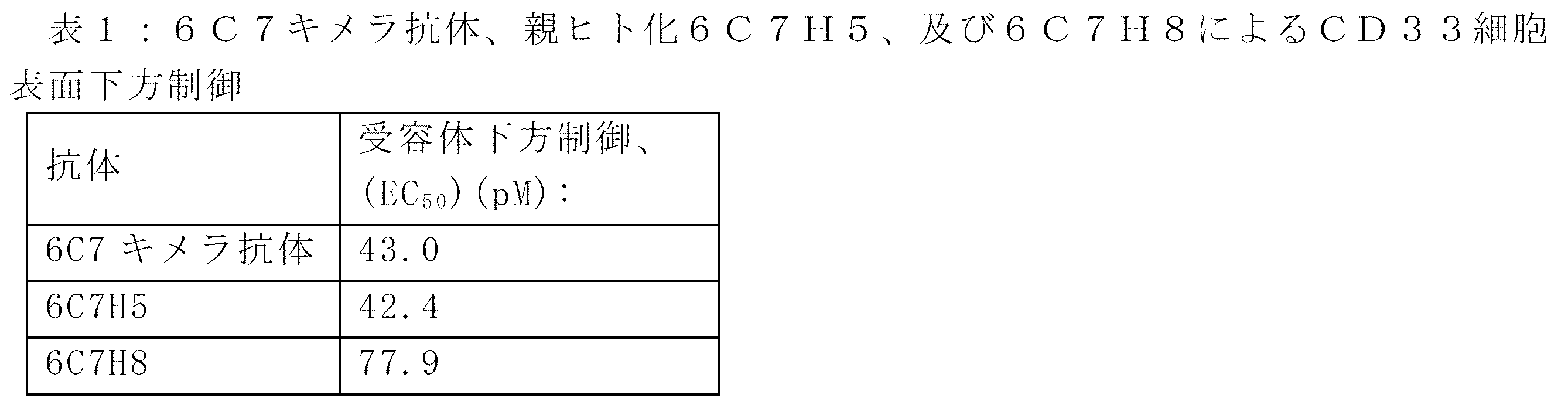
抗CD33抗体6C7H8は、樹状細胞の表面上のCD33のレベルを低下させたが、親ヒト化抗体(抗体6C7H5)及び6C7キメラ抗体と比較すると若干低減した効力を呈した。 The anti-CD33 antibody 6C7H8 reduced the levels of CD33 on the surface of dendritic cells, but with slightly reduced potency compared to the parent humanized antibody (antibody 6C7H5) and the 6C7 chimeric antibody.
ヒト化6C7H8のバリアント
抗体6C7H5にはあったが抗体6C7H8では低減していた結合特性及び他の機能的特性を復元するために、更なるタンパク質工学操作を抗CD33抗体6C7H8に行った。抗体6C7H8のHVR H1、HVR L2、ならびに重鎖のフレームワーク1及びフレームワーク2の標的変異誘発を行うことにより、35種の更なる抗CD33抗体を生成した。別個の工学操作アプローチでは、標的変異誘発による抗体6C7H8のHVR H1の標的変異誘発により、19種の更なるバリアント抗CD33抗体が得られた。抗CD33抗体の組み換えCD33への結合をELISAによって試験した。結果を図6A及び図6Bに示す。
Humanized 6C7H8 variants Further protein engineering was performed on anti-CD33 antibody 6C7H8 to restore the binding and other functional properties present in antibody 6C7H5 but reduced in antibody 6C7H8. Thirty-five additional anti-CD33 antibodies were generated by targeted mutagenesis of HVR H1, HVR L2, and
HVR H1及びHVR L2に修飾を含む35種の抗CD33抗体のうち、3種の抗体だけがバックグラウンドレベルを超えるCD33への結合を呈した。これら3種の抗CD33抗体(6C7H9、6C7H10、及び6C7H11)のCD33への結合については、図6Aに示してある。図6Bに示すように、HVR H1に修飾を含む19種の抗CD33抗体、すなわち抗体バリアント6C7H12~6C7H30は、様々なCD33結合性を呈したが、抗体6C7H25が最も強い結合を示し、6C7H13、6C7H19、6C7H27、及び6C7H30を含むいくつかの抗体は、バックグラウンドレベルを超える中程度の結合しか示さなかった。抗体バリアント6C7H9~6C7H30の重鎖可変領域HVR配列は、以下の表7に示してある。抗体の軽鎖可変領域HVR配列は、以下の表8に示してある。抗体の重鎖フレームワーク領域は、以下の表9に示してある。抗体の軽鎖フレームワーク領域は、以下の表10に示してある。抗体の重鎖可変領域配列は、以下の表11に示してある。抗体の軽鎖可変領域配列は、以下の表12に示してある。 Of the 35 anti-CD33 antibodies containing modifications in HVR H1 and HVR L2, only three antibodies exhibited binding to CD33 above background levels. The binding of these three anti-CD33 antibodies (6C7H9, 6C7H10, and 6C7H11) to CD33 is shown in Figure 6A. As shown in Figure 6B, the 19 anti-CD33 antibodies containing modifications in HVR H1, i.e., antibody variants 6C7H12-6C7H30, exhibited a range of CD33 binding, with antibody 6C7H25 exhibiting the strongest binding and several antibodies, including 6C7H13, 6C7H19, 6C7H27, and 6C7H30, exhibiting only moderate binding above background levels. The heavy chain variable region HVR sequences of antibody variants 6C7H9-6C7H30 are shown below in Table 7. The antibody light chain variable region HVR sequences are shown in Table 8 below. The antibody heavy chain framework regions are shown in Table 9 below. The antibody light chain framework regions are shown in Table 10 below. The antibody heavy chain variable region sequences are shown in Table 11 below. The antibody light chain variable region sequences are shown in Table 12 below.
ヒト化6C7H8のバリアント:親和性パラメータ
ヒトCD33に対する抗体バリアントの親和性パラメータを、BioLayer干渉法により、標準的技術(Estep et al.(2013)MAbs 5(2):270-8)に従うForteBioアッセイで測定し、親抗体(抗体6C7H8)及び親ヒト化抗体(抗体6C7H5)のものと比較した。簡潔に述べると、抗体を抗ヒトFc Biosensors(Pall ForteBio)で捕捉した。次いで、組み換えヒトCD33(10nM、Sino Biologicals)を、捕捉された抗CD33表面に結合させた(会合時間200秒、解離時間1200秒)。ローカルフィッティングを使用して、各抗体の会合速度定数及び解離速度定数(それぞれka及びkd)を抽出した。見かけの親和性定数(KD)を比率kd/kaから計算した。結果を以下の表2に示す。

ヒト化6C7H8のバリアント:樹状細胞結合性
抗体バリアントの初代ヒト樹状細胞への結合を、実施例1に記載した方法に従い、2μg/mLの抗体濃度で評価した。結果を図7に示す。
Humanized 6C7H8 variants: dendritic cell binding Binding of the antibody variants to primary human dendritic cells was evaluated at an antibody concentration of 2 μg/mL according to the method described in Example 1. The results are shown in FIG.
HVR H1及びHVR L2に修飾を含む3種の抗体バリアントのうち、2種の抗体、6C7H10及び6C7H11のみが、親抗体(6C7H8)、親ヒト化抗体(6C7H5)、または6C7キメラ抗体のものと同様のレベルで樹状細胞に結合した。6C7H9抗体バリアントは、実質的に低減した樹状細胞結合性を呈した。HVR1に修飾を含む19種の抗CD33抗体バリアントのうち、14種の抗体は、親抗体(6C7H8)、親ヒト化抗体(6C7H5)、または6C7キメラ抗体のものと同様のレベルで樹状細胞に結合した。5種の抗CD33抗体(6C7H13、6C7H19、6C7H22、6C7H27、及び6C7H30)は、あらゆる親抗体のものと比べて60%未満の結合を呈した。これら5種の抗CD33抗体の見かけの親和性定数(KD)は親抗体の10倍以内であったが、低減した細胞結合性を呈した5種全ての抗CD33抗体が、最も高い解離速度定数を有していた。 Of the three antibody variants containing modifications in HVR H1 and HVR L2, only two antibodies, 6C7H10 and 6C7H11, bound to dendritic cells at levels similar to those of the parental antibody (6C7H8), the parental humanized antibody (6C7H5), or the 6C7 chimeric antibody. The 6C7H9 antibody variant exhibited substantially reduced dendritic cell binding. Of the 19 anti-CD33 antibody variants containing modifications in HVR1, 14 antibodies bound to dendritic cells at levels similar to those of the parental antibody (6C7H8), the parental humanized antibody (6C7H5), or the 6C7 chimeric antibody. Five anti-CD33 antibodies (6C7H13, 6C7H19, 6C7H22, 6C7H27, and 6C7H30) exhibited less than 60% binding compared to any parental antibody. Although the apparent affinity constants (K D ) of these five anti-CD33 antibodies were within 10-fold of the parent antibody, all five anti-CD33 antibodies that exhibited reduced cell binding had the highest dissociation rate constants.
ヒト化6C7H8のバリアント:表面CD33の下方制御
抗CD33抗体バリアント6C7H9~6C7H30が樹状細胞の表面上のCD33のレベルを低下させる能力について、実施例2に記載した方法に従って評価した。抗CD33抗体バリアントを、親抗体(6C7H8)、親ヒト化抗体(6C7H5)、及び6C7キメラ抗体と比較した。半数有効濃度(EC50)及びCD33の最大低下を以下の表3にまとめる。11種の抗CD33抗体バリアント(6C7H10、6C7H13、6C7H17、6C7H19、6C7H20、6C7H21、6C7H22、6C7H23、6C7H24、6C7H25、及び6C7H30)に関するこれらの試験の結果は、図8A及び図8Bに示してある。ここでは、これらのバリアントを親6C7H8抗体、親6C7H5ヒト化抗体、及び6C7キメラ抗体と比較している。
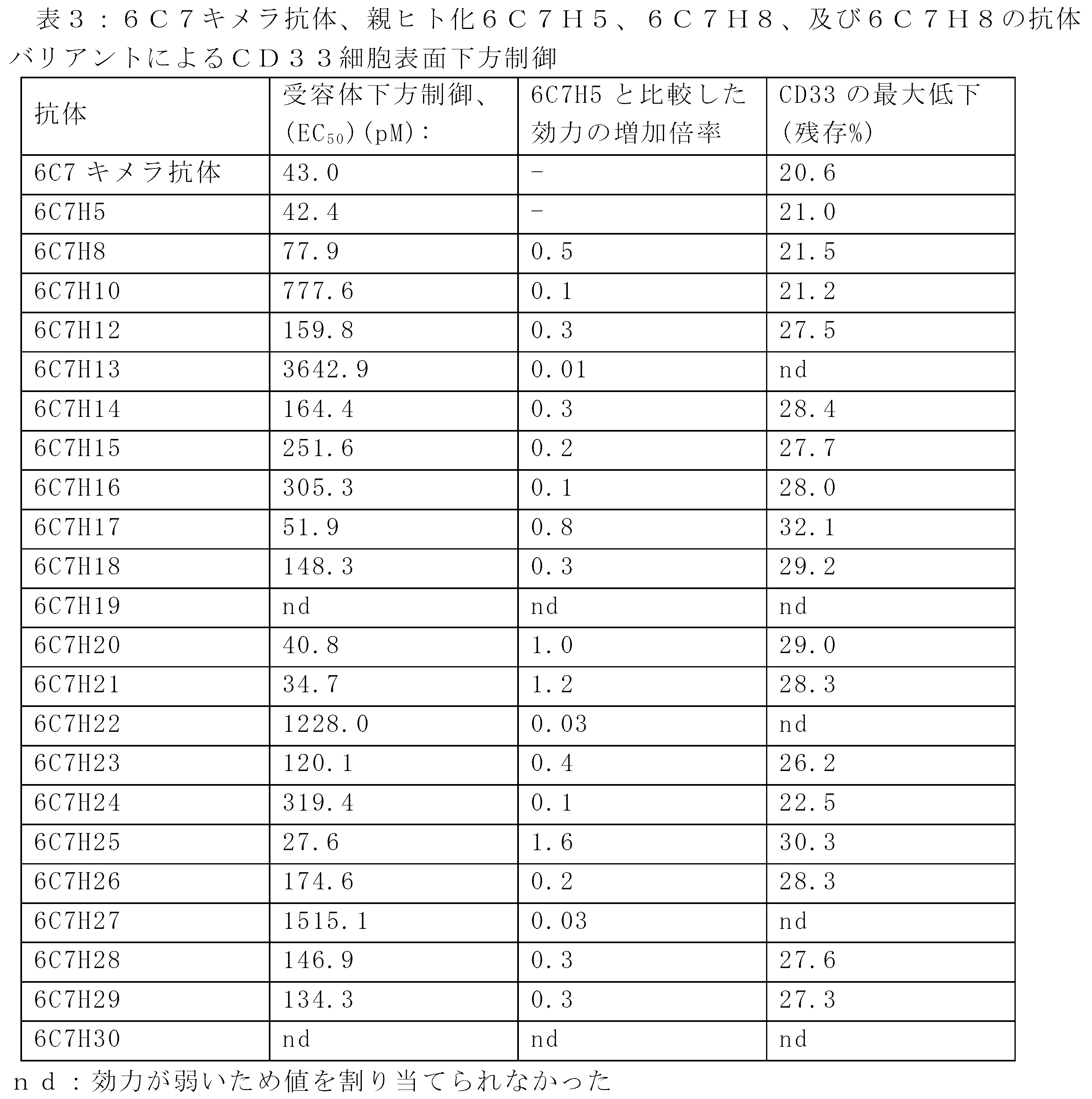
これらの抗体は、樹状細胞の表面上のCD33レベルを低下させる様々な効力を呈した。予想通り、6C7H13、6C7H19、6C7H22、6C7H27、及び6C7H30により例示される、実質的に低減した細胞結合性を示した抗CD33抗体は、CD33の下方制御において実質的に低減した効力を有していた。更に10種の抗CD33抗体も、細胞表面CD33レベル低下効力の低減を示した(例えば、親ヒト化抗体6C7H5で観察されたものと比較して、細胞表面CD33レベル低下効力の改善率が0.1倍~0.3倍であった)。4種の抗CD33抗体(6C7H17、6C7H20、6C7H21、及び6C7H25)は、同様またはわずかに改善した細胞表面CD33レベル低下効力を示し、改善率は親ヒト化抗CD33抗体6C7H5で観察されたものと比較して0.8倍~1.6倍であった。驚くべきことに、同様または改善した効力を持つ抗CD33抗体のうちの数種の親和性は、抗体6C7H10、6C7H14、6C7H16、6C7H18、6C7H24、6C7H26、及び6C7H28により例示される、CD33を下方制御する効力の低減を示した抗体の親和性と同様であった。したがって、標的に対する抗CD33抗体の親和性は、細胞表面上のCD33を下方制御する抗CD33抗体の能力を予測するものではなかった。 These antibodies exhibited varying potency in reducing CD33 levels on the surface of dendritic cells. As expected, anti-CD33 antibodies that exhibited substantially reduced cell binding, exemplified by 6C7H13, 6C7H19, 6C7H22, 6C7H27, and 6C7H30, had substantially reduced potency in downregulating CD33. Ten additional anti-CD33 antibodies also exhibited reduced potency in reducing cell surface CD33 levels (e.g., 0.1- to 0.3-fold improvement in potency in reducing cell surface CD33 levels compared to that observed with the parent humanized antibody 6C7H5). Four anti-CD33 antibodies (6C7H17, 6C7H20, 6C7H21, and 6C7H25) exhibited similar or slightly improved potency in reducing cell surface CD33 levels, with improvements of 0.8- to 1.6-fold compared to that observed with the parent humanized anti-CD33 antibody 6C7H5. Surprisingly, the affinities of several of the anti-CD33 antibodies with similar or improved potency were similar to those of antibodies that showed reduced potency in downregulating CD33, exemplified by antibodies 6C7H10, 6C7H14, 6C7H16, 6C7H18, 6C7H24, 6C7H26, and 6C7H28. Thus, the affinity of an anti-CD33 antibody for a target was not predictive of the ability of the anti-CD33 antibody to downregulate CD33 on the cell surface.
抗CD33抗体6C7H17、6C7H20、6C7H21、及び6C7H25がCD33を下方制御する効力は、親ヒト化抗体(6C7H5)及び6C7キメラ抗体で観察されたものと比較して同様かまたはわずかに改善していたが、同様または改善した効力を有する抗CD33抗体バリアントは、それほど大きなCD33レベルの最大低下を示さなかった。 The potency of anti-CD33 antibodies 6C7H17, 6C7H20, 6C7H21, and 6C7H25 to downregulate CD33 was similar or slightly improved compared to that observed with the parent humanized antibody (6C7H5) and the 6C7 chimeric antibody, but anti-CD33 antibody variants with similar or improved potency did not show as large a maximal reduction in CD33 levels.
更なる抗体バリアント
結合及び機能的活性が改善した抗体を得るために、HVR H1、HVR H3、HVR L2、HVR L3、重鎖フレームワーク1、重鎖フレームワーク2、重鎖フレームワーク3、軽鎖フレームワーク1、及び軽鎖フレームワーク2における標的変異誘発により、本開示の抗CD33抗体の更なる工学操作を行い、24種の更なる抗CD33抗体バリアント(6C7H31~6C7H54)を得た。抗CD33抗体バリアント6C7H31~6C7H54の重鎖可変領域HVR配列は、以下の表7に示してある。抗体の軽鎖可変領域HVR配列は、以下の表8に示してある。抗体の重鎖フレームワーク領域は、以下の表9に示してある。抗体の軽鎖フレームワーク領域は、以下の表10に示してある。抗体の重鎖可変領域配列は、以下の表11に示してある。抗体の軽鎖可変領域配列は、以下の表12に示してある。
Further Antibody Variants The anti-CD33 antibodies of the present disclosure were further engineered by targeted mutagenesis in HVR H1, HVR H3, HVR L2, HVR L3,
更なる抗体バリアント:樹状細胞及びカニクイザルCD33への結合
抗CD33抗体バリアント6C7H31~6C7H54の初代ヒト樹状細胞への結合を、実施例1に記載した方法に従ったフローサイトメトリーにより、1μg/mLの抗体濃度で評価した。抗CD33抗体バリアントを、親ヒト化抗体(6C7H5)及び6C7キメラ抗体と比較した。これらの試験の結果を図9に示す。
Further antibody variants: binding to dendritic cells and cynomolgus CD33 The binding of anti-CD33 antibody variants 6C7H31-6C7H54 to primary human dendritic cells was assessed at an antibody concentration of 1 μg/mL by flow cytometry according to the method described in Example 1. The anti-CD33 antibody variants were compared to the parent humanized antibody (6C7H5) and the 6C7 chimeric antibody. The results of these studies are shown in FIG. 9.
樹状細胞への結合について試験した24種の抗CD33抗体バリアントのうち、18種の抗CD33抗体バリアントは、親ヒト化抗体(6C7H5)及び6C7キメラ抗体で観察されたものと同様の初代ヒト樹状細胞結合性を呈した。6種の抗CD33抗体(6C7H31、6C7H32、6C7H33、6C7H34、6C7H42、及び6C7H43)は、これらの細胞に対する結合の若干の低減を示した。 Of the 24 anti-CD33 antibody variants tested for binding to dendritic cells, 18 anti-CD33 antibody variants exhibited primary human dendritic cell binding similar to that observed with the parent humanized antibody (6C7H5) and the 6C7 chimeric antibody. Six anti-CD33 antibodies (6C7H31, 6C7H32, 6C7H33, 6C7H34, 6C7H42, and 6C7H43) showed slightly reduced binding to these cells.
抗CD33抗体バリアントがカニクイザルCD33に結合する能力について、上述の方法に従い、ELISAアッセイで更に評価した。抗CD33抗体バリアントを、親ヒト化抗体(6C7H5)及び6C7キメラ抗体と比較した。結果を以下の表4にまとめる。また、抗CD33抗体バリアントのうちの8種に関する結合データを図10A及び10Bに示す。

試験した26種の抗CD33抗体バリアントのうち19種は、カニクイザルCD33への結合を示さなかったか、または親ヒト化抗体(6C7H5)もしくは6C7キメラ抗体で観察されたものと比較して実質的に低減した結合を示した。3種の抗CD33抗体(6C7H36、6C7H37、及び6C7H38)は、親ヒト化抗体(6C7H5)及び6C7キメラ抗体で観察された場合と同様にカニクイザルCD33に結合した。4種の抗CD33抗体(6C7H47、6C7H48、6C7H52、及び6C7H54)は、実質的に改善したカニクイザルCD33結合性を示した。1種の抗CD33抗体、6C7H54は、驚くべきことに、改善された効力と、カニクイザルCD33への最も強い最大結合の両方を示した。 Nineteen of the 26 anti-CD33 antibody variants tested showed no binding to cynomolgus monkey CD33 or substantially reduced binding compared to that observed with the parent humanized antibody (6C7H5) or the 6C7 chimeric antibody. Three anti-CD33 antibodies (6C7H36, 6C7H37, and 6C7H38) bound to cynomolgus monkey CD33 similarly to that observed with the parent humanized antibody (6C7H5) and the 6C7 chimeric antibody. Four anti-CD33 antibodies (6C7H47, 6C7H48, 6C7H52, and 6C7H54) showed substantially improved cynomolgus monkey CD33 binding. One anti-CD33 antibody, 6C7H54, surprisingly showed both improved potency and the strongest maximal binding to cynomolgus monkey CD33.
更なる抗体バリアント:親和性パラメータ
ヒトCD33及びカニクイザルCD33に対する抗CD33抗体6C7H54の親和性パラメータを、BioLayer干渉法により、上述の方法に従うForteBioアッセイで測定した。結果を以下の表5にまとめる。

抗CD33抗体6C7H54は、親ヒト化抗体(6C7H5)または6C7キメラ抗体で観察されたものと比較して予想外に改善されたヒトCD33親和性を有することが見出された(表2参照)。更に、抗体6C7H54のカニクイザルCD33に対する結合親和性は、この抗体のヒトCD33に対する結合親和性の3倍以内であることが見出された。 The anti-CD33 antibody 6C7H54 was found to have unexpectedly improved affinity for human CD33 compared to that observed with the parent humanized antibody (6C7H5) or the 6C7 chimeric antibody (see Table 2). Furthermore, the binding affinity of antibody 6C7H54 to cynomolgus monkey CD33 was found to be within 3-fold of the binding affinity of this antibody to human CD33.
更なる抗体バリアント:表面CD33の下方制御
24種の抗CD33抗体バリアント(6C7H31~6C7H54)が樹状細胞の表面上のCD33のレベルを低下させる能力について、上記の実施例2に記載した方法に従って更に評価した。抗CD33抗体バリアントを、ヒト樹状細胞上のCD33細胞表面レベルを低下させる能力について、親ヒト化抗体、6C7H5、及び6C7キメラ抗体と比較した。半数有効濃度(EC50)を以下の表6にまとめる。また、抗CD33バリアントのうちの3種(6C7H38、6C7H47、及び6C7H54)に関する結果は図11に示してあり、ここでは、これらのバリアントを親6C7H5ヒト化抗体及び6C7キメラ抗体と比較している。

抗CD33抗体の全てが樹状細胞の表面上のCD33を低下させ、親ヒト化抗体(6C7H5)及び6C7キメラ抗体で観察されたものの2倍以内の効力を呈した。最も強いカニクイザルCD33結合性を示した2種の抗CD33抗体(6C7H47及び6C7H54)のうち、抗体6C7H54は、CD33の下方制御において効力が高く、かつ、これらの細胞上のCD33の細胞表面レベルを低下させる、または下げることにおいて、親ヒト化抗体(6C7H5)と6C7キメラ抗体のいずれよりも効力が高かった。抗体の全てが同様のCD33最大低下を呈した(図11、データは示さない)。上述の工学操作法を使用して生成された24種の抗CD33抗体バリアントのうち、また、4つの工学操作キャンペーンによって生成された合計102種の抗CD33抗体バリアントのうち、抗CD33抗体6C7H54は、強力なCD33下方制御と細胞表面CD33レベルの最大低下の両方を呈した。更に、この抗CD33抗体は、ヒトCD33とカニクイザルCD33の両方に対して、親ヒト化抗体(6C7H5)及び6C7キメラ抗体で観察されたものと比較して予想外に改善された親和性を示した。
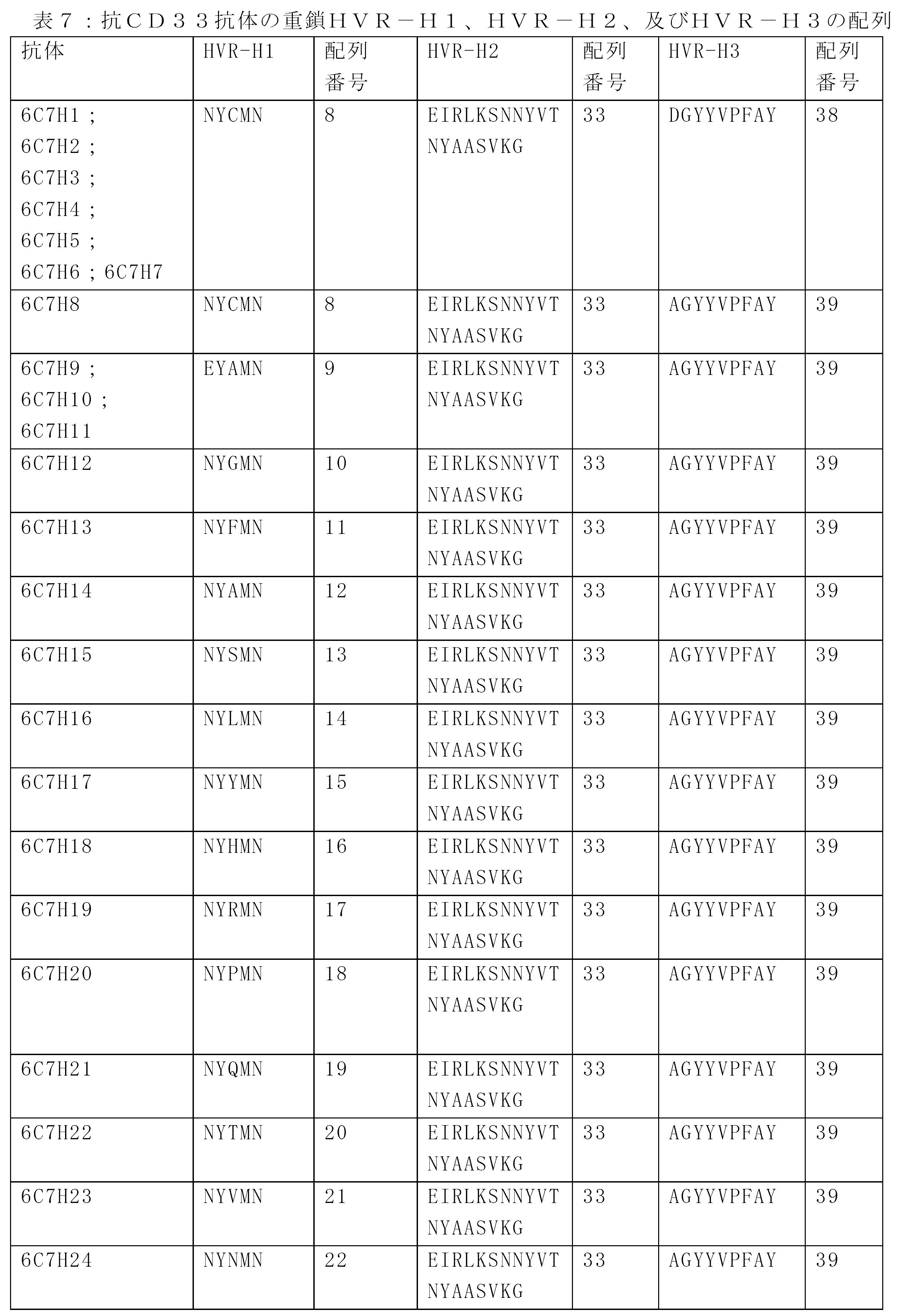


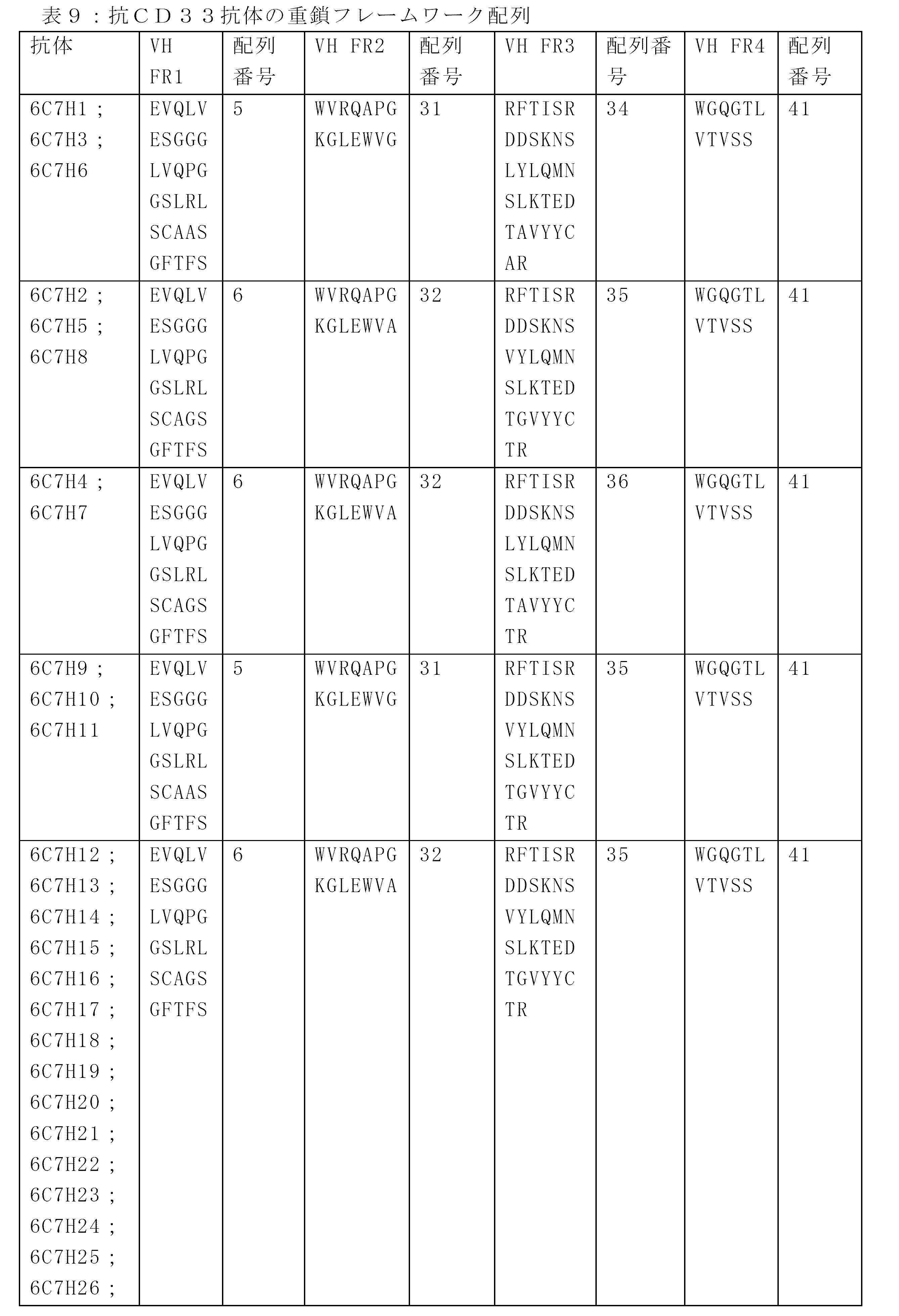
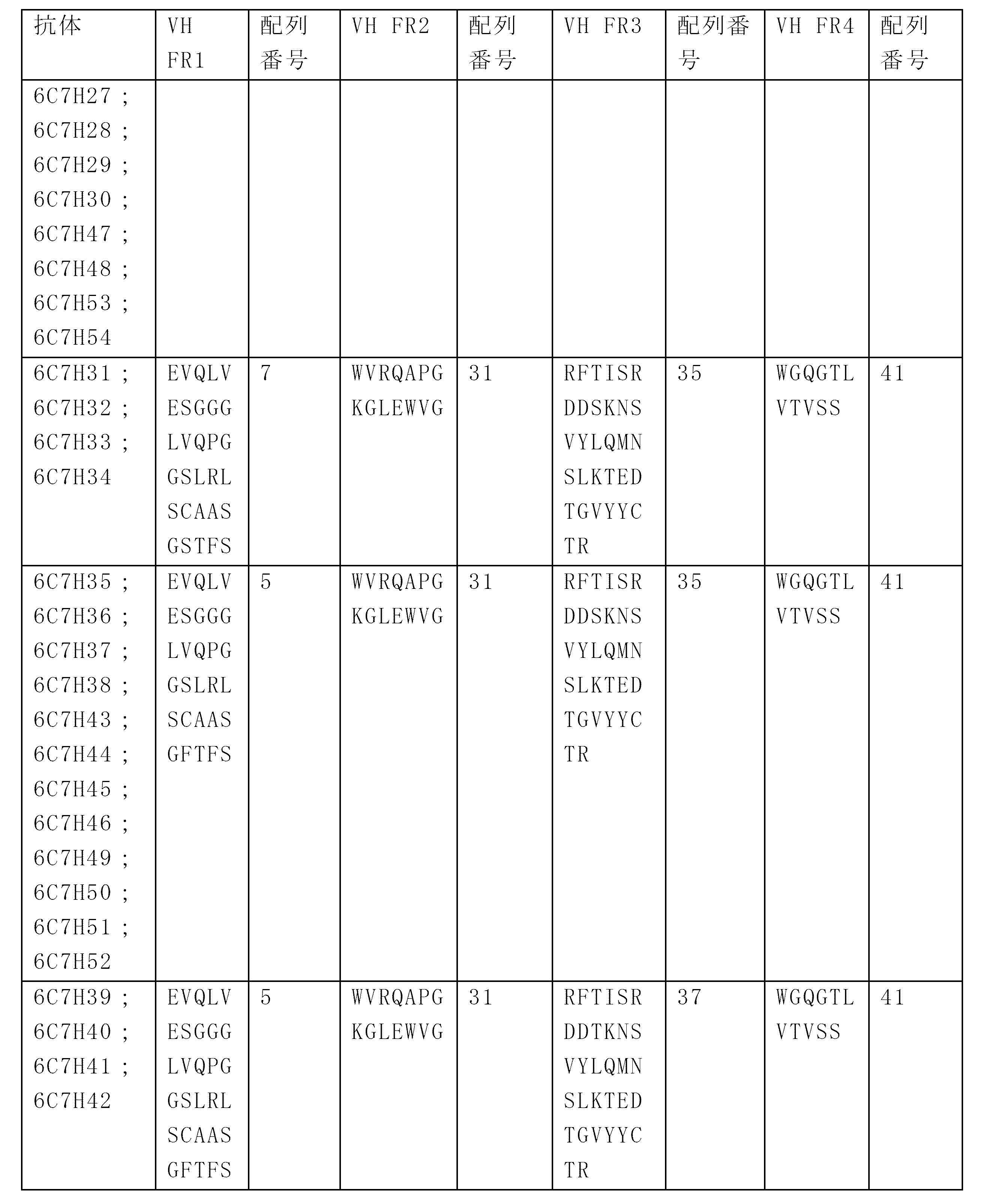

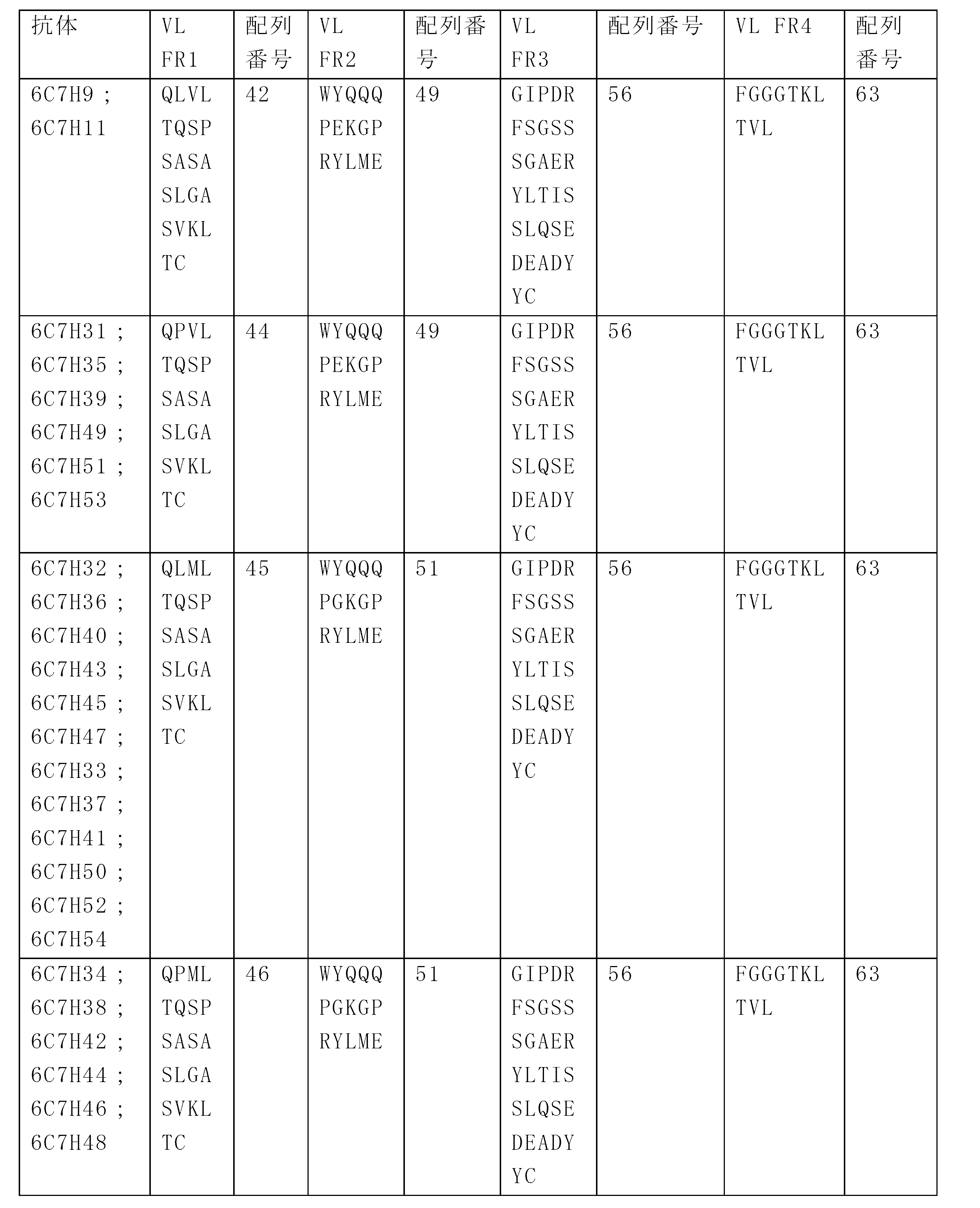


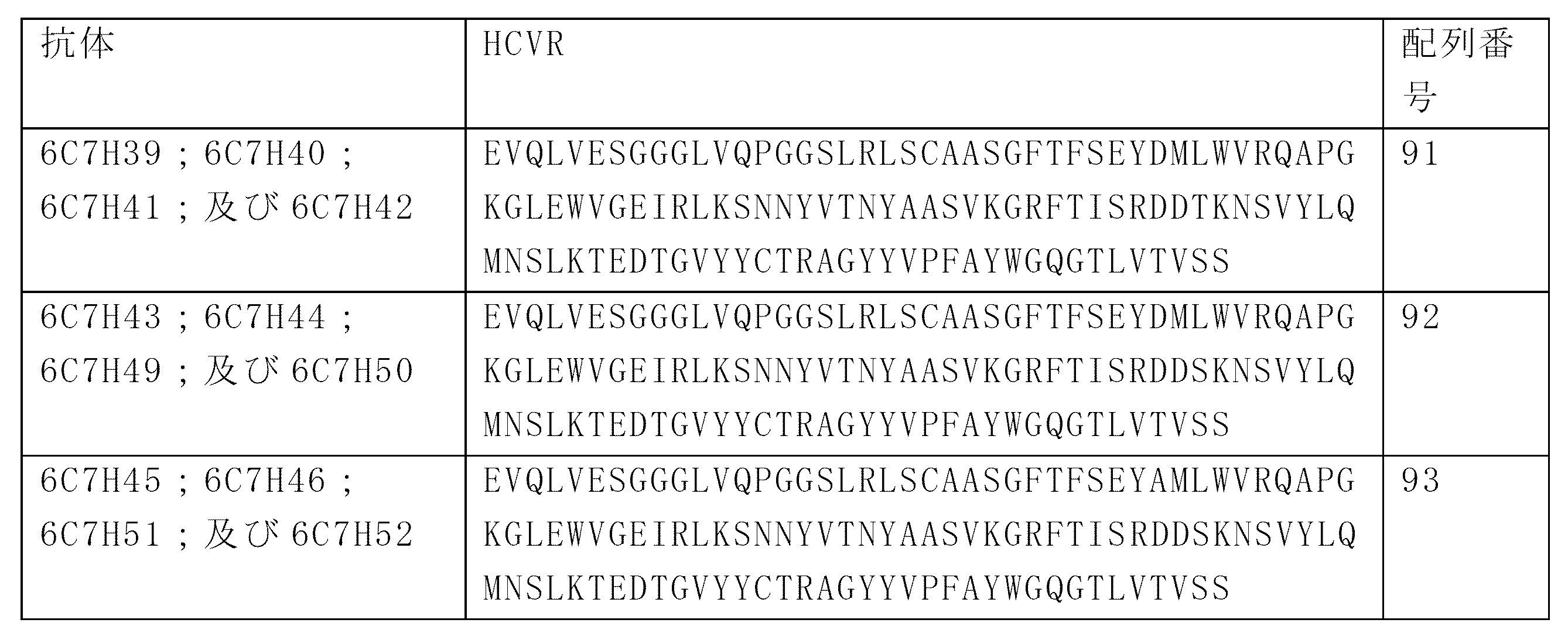

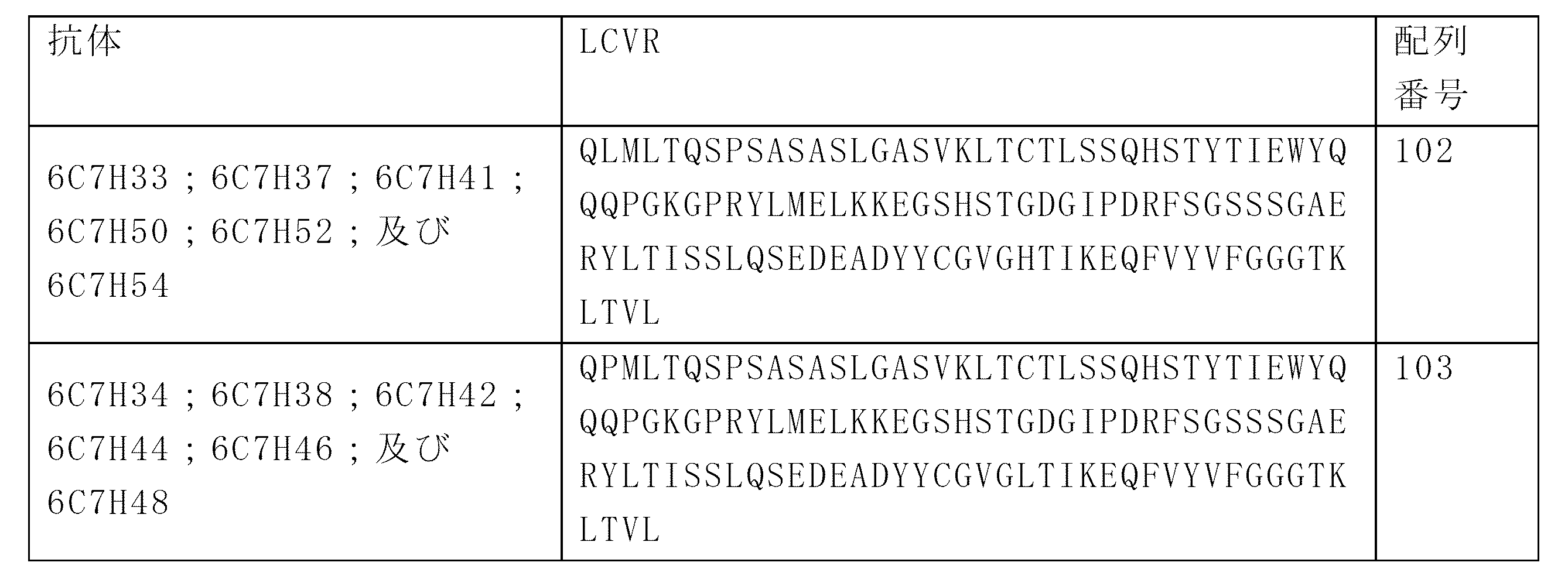
実施例4:Fc領域が抗CD33抗体の内在化に与える影響の解析
この実施例の目的は、抗CD33抗体がin vitro及びin vivoで初代骨髄細胞上のCD33の細胞表面レベルを低下させる能力に対するFcの影響を評価することであった。
Example 4: Analysis of the effect of the Fc region on the internalization of anti-CD33 antibodies The purpose of this example was to evaluate the effect of Fc on the ability of anti-CD33 antibodies to reduce cell surface levels of CD33 on primary bone marrow cells in vitro and in vivo.
抗体のFc領域は、細胞の表面上に発現したFcγ受容体と相互作用することができ、CD33を内因的に発現する骨髄及び他の免疫細胞は、複数のFcγ受容体も発現する。したがって、様々なヒトIgGアイソタイプの抗体のFcと細胞表面Fcγ受容体との間の相互作用及び抗体のクラスター化能力が、受容体を内在化する抗体の能力に及ぼす影響について試験した。 The Fc region of an antibody can interact with Fcγ receptors expressed on the surface of cells, and myeloid and other immune cells that endogenously express CD33 also express multiple Fcγ receptors. Therefore, we tested the effect of the interaction between the Fc and cell surface Fcγ receptors of antibodies of various human IgG isotypes and the clustering ability of the antibodies on their ability to internalize the receptor.
6C7H8、6C7H10、または6C7H54の可変領域を含む抗CD33抗体、及び様々なヒトIgGバリアントを生成した。試験したFcは、IgG1(全てのFcγ受容体に結合する);IgG1 P331S(P331S変異を含み、減少したC1q結合性を示すが、全てのFcγ受容体に結合する);IgG1 IgG1 SELF(S267E及びL328F変異を含み、CD32B及びCD32AのR131バリアントへの向上した結合を呈する);IgG2(CD32Aにしか実質的結合を示さない);及びIgG1 LALAPS(L234A、L235A、及びP331S変異を含み、Fcγ受容体のいずれに対しても結合をほとんどまたは全く呈さない)を含んだ。抗体が初代ヒト樹状細胞上の細胞表面CD33のレベルを低下させる能力について、実施例2に記載した方法に従って評価した。データを図12A、12B、及び12Cに示す。表13は、半数有効濃度(EC50)及び抗体による最大CD33下方制御をまとめている。

異なるFcバリアントを使用して構築された抗CD33抗体は、樹状細胞の表面上のCD33のレベルを低下させる様々な能力を呈した。IgG1 SELFの抗体6C7H10は、CD33の下方制御において抗体6C7H10 IgG1抗体よりも25.8倍強力であったため、IgG1 SELFアイソタイプが最も強い効力を表した。これら2つの抗体は、同様のCD33レベル最大低下を示した。驚くべきことに、抗体6C7H8 IgG1 LALAPS及び抗体6C7H10 IgG1 LALAPS抗体は、CD33の下方制御において、それらの同族野生型IgG1抗体よりも実質的に効果が低く、両方のIgG1 LALAPS抗体によるCD33レベルの低下は40%未満であった。抗体6C7H10 IgG2及び抗体6C7H54 IgG2抗体は、効力において、それらの野生型IgG1対応物と同様であった。抗体6C7H10 IgG2抗体によるCD33の最大低下は抗体6C7H10 IgG1によるものと同様であったが、抗体6C7H54 IgG2抗体は、抗体6C7H54 IgG1よりも大きなCD33最大低下を示した。対照的に、抗体6C7H54 IgG1 PSは、CD33の下方制御において、抗体6C7H54 IgG1で観察されたものと比較してわずかに改善された効力を示したが、これら2つの抗体は、同様のCD33最大低下を示した。これらのデータは、Fc領域が抗CD33抗体による効力と受容体最大低下の両方に強く影響したことを示し、受容体下方制御が抗体と1つ以上のFcγ受容体との相互作用によって向上することを示唆している。
非公式の配列表
CD33配列(配列番号1~2)
ヒトCD33のアミノ酸配列(配列番号1):
MPLLLLLPLLWAGALAMDPNFWLQVQESVTVQEGLCVLVPCTFFHPIPYYDKNSPVHGYWFREGAIISRDSPVATNKLDQEVQEETQGRFRLLGDPSRNNCSLSIVDARRRDNGSYFFRMERGSTKYSYKSPQLSVHVTDLTHRPKILIPGTLEPGHSKNLTCSVSWACEQGTPPIFSWLSAAPTSLGPRTTHSSVLIITPRPQDHGTNLTCQVKFAGAGVTTERTIQLNVTYVPQNPTTGIFPGDGSGKQETRAGVVHGAIGGAGVTALLALCLCLIFFIVKTHRRKAARTAVGRNDTHPTTGSASPKHQKKSKLHGPTETSSCSGAAPTVEMDEELHYASLNFHGMNPSKDTSTEYSEVRTQ
カニクイザルCD33のアミノ酸配列(配列番号2):
MDGEHLKGRNQGAQETSASDMPLLLLPLLWAGALAMDPRVRLEVQESVTVQEGLCVLVPCTFFHPVPYHTRNSPVHGYWFREGAIVSLDSPVATNKLDQEVQEETQGRFRLLGDPSRNNCSLSIVDARRRDNGSYFFRMEKGSTKYSYKSTQLSVHVTDLTHRPQILIPGALDPDHSKNLTCSVPWACEQGTPPIFSWMSAAPTSLGLRTTHSSVLIITPRPQDHGTNLTCQVKFPGAGVTTERTIQLNVSYASQNPRTDIFLGDGSGKQGVVQGAIGGAGVTVLLALCLCLIFFTVKTHRRKAARTAVGRIDTHPATGPTSSKHQKKSKLHGATETSGCSGTTLTVEMDEELHYASLNFHGMNPSEDTSTEYSEVRTQ
参照抗CD33抗体配列(配列番号3~4)
マウス6C7抗体の重鎖可変領域(配列番号3)
EVKLEESGGGLVQPGGSMKLSCVGSGFTFSNYCMNWVRQSPEKGLEWVAEIRLKSNNYVTNYVESVKGRFTISRDDSKSRVYLQMNNLRGEDTGFYYCTRDGYYVPFAYWGQGTLVTVSA
マウス6C7抗体の軽鎖可変領域(配列番号4)
QLVLTQSSSASFSLGASAKLTCTLSSQHSTYTIEWYQQQPLKPPKYVMELKKDGSHSTGDGIPDRFSGSSSGADRYLSISNIQPEDEAIYICGVGDTIKEQFVYVFGGGTKVTVL
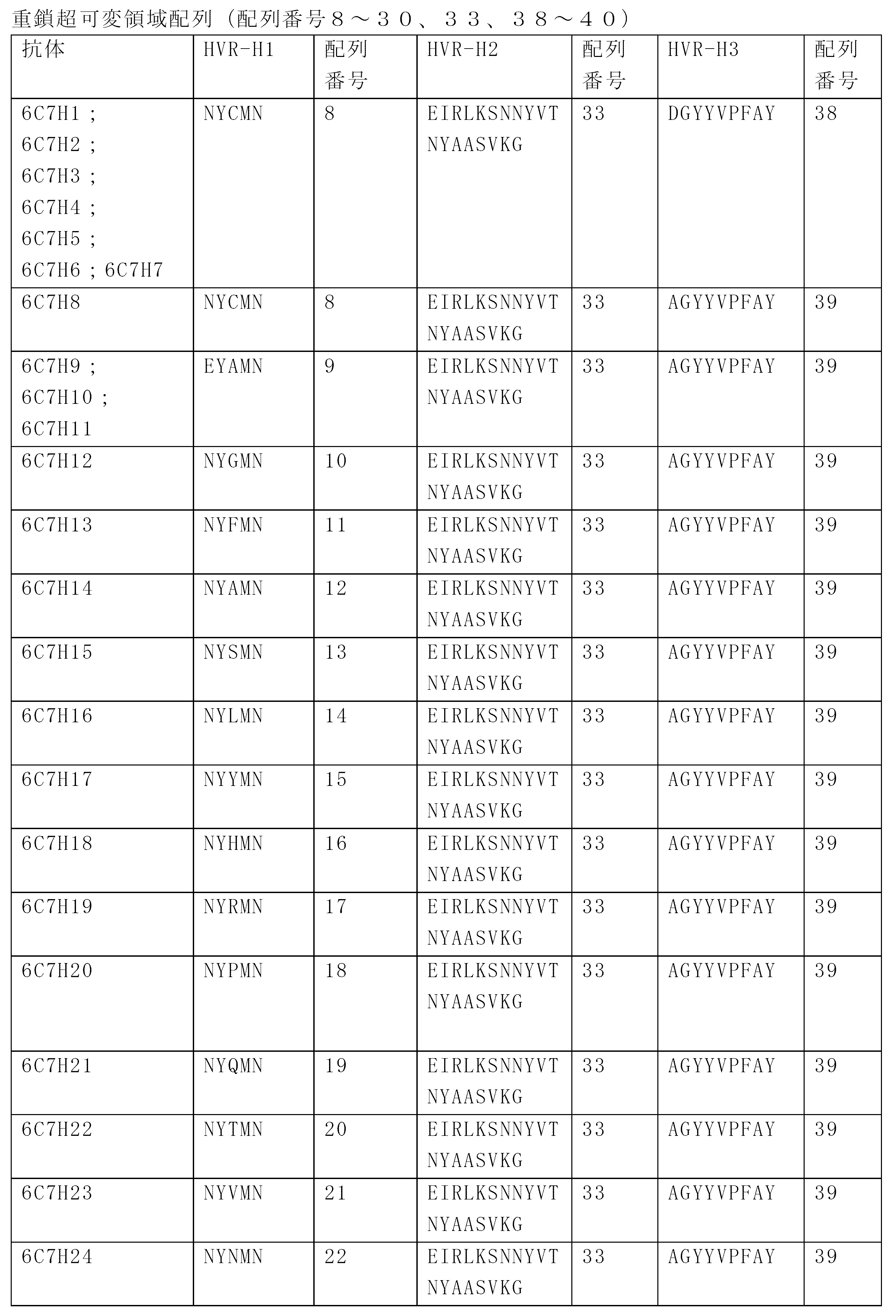
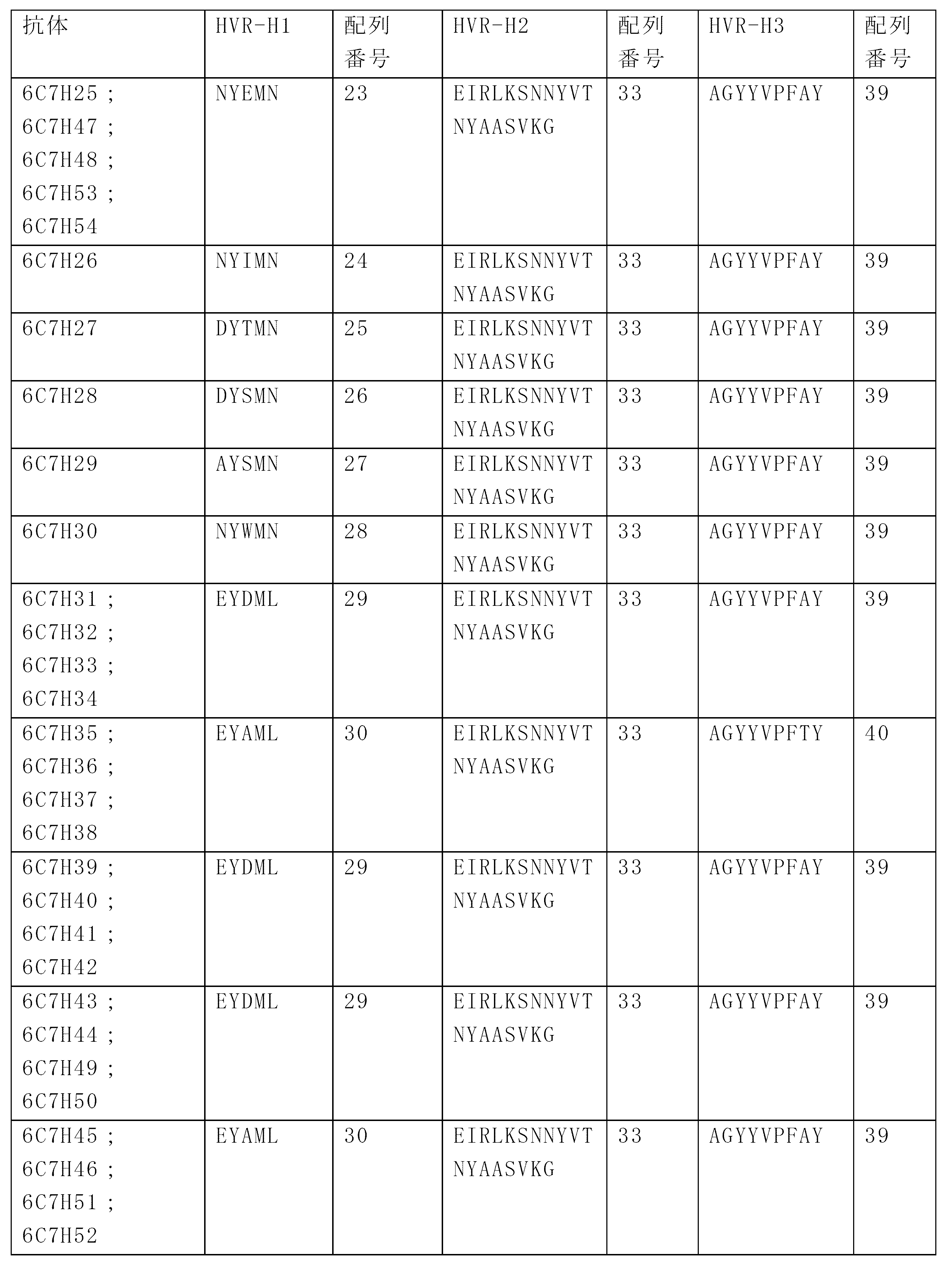
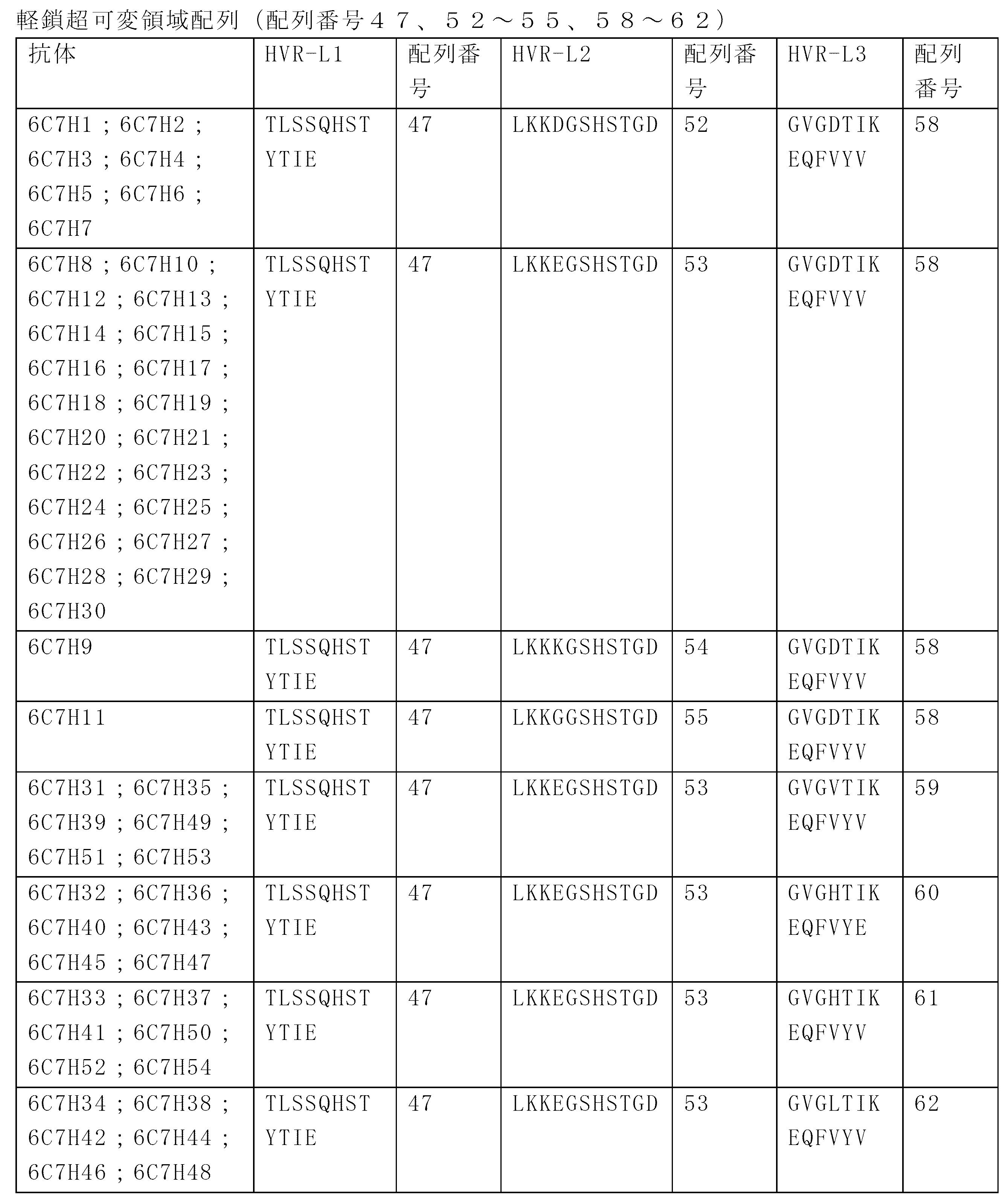


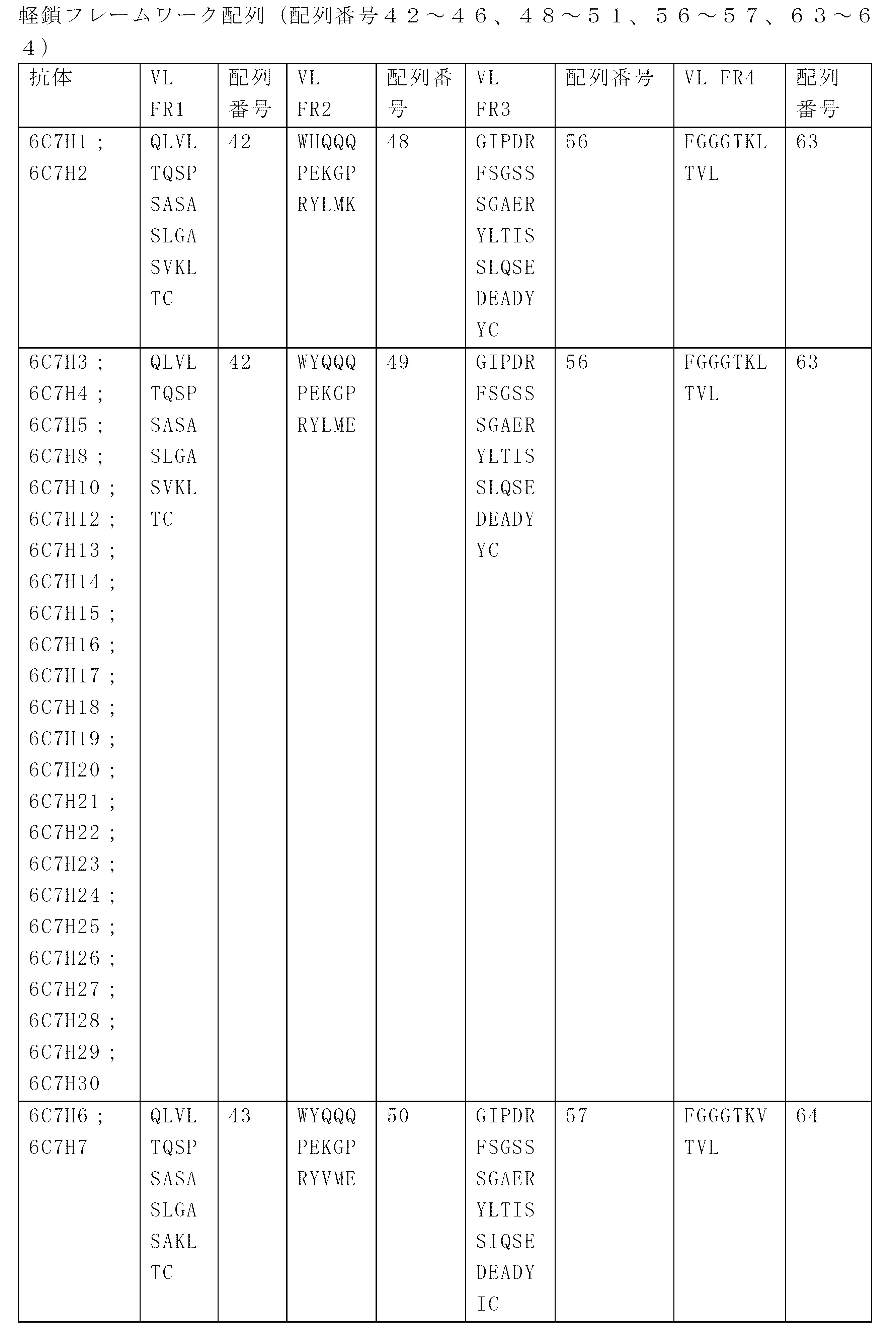

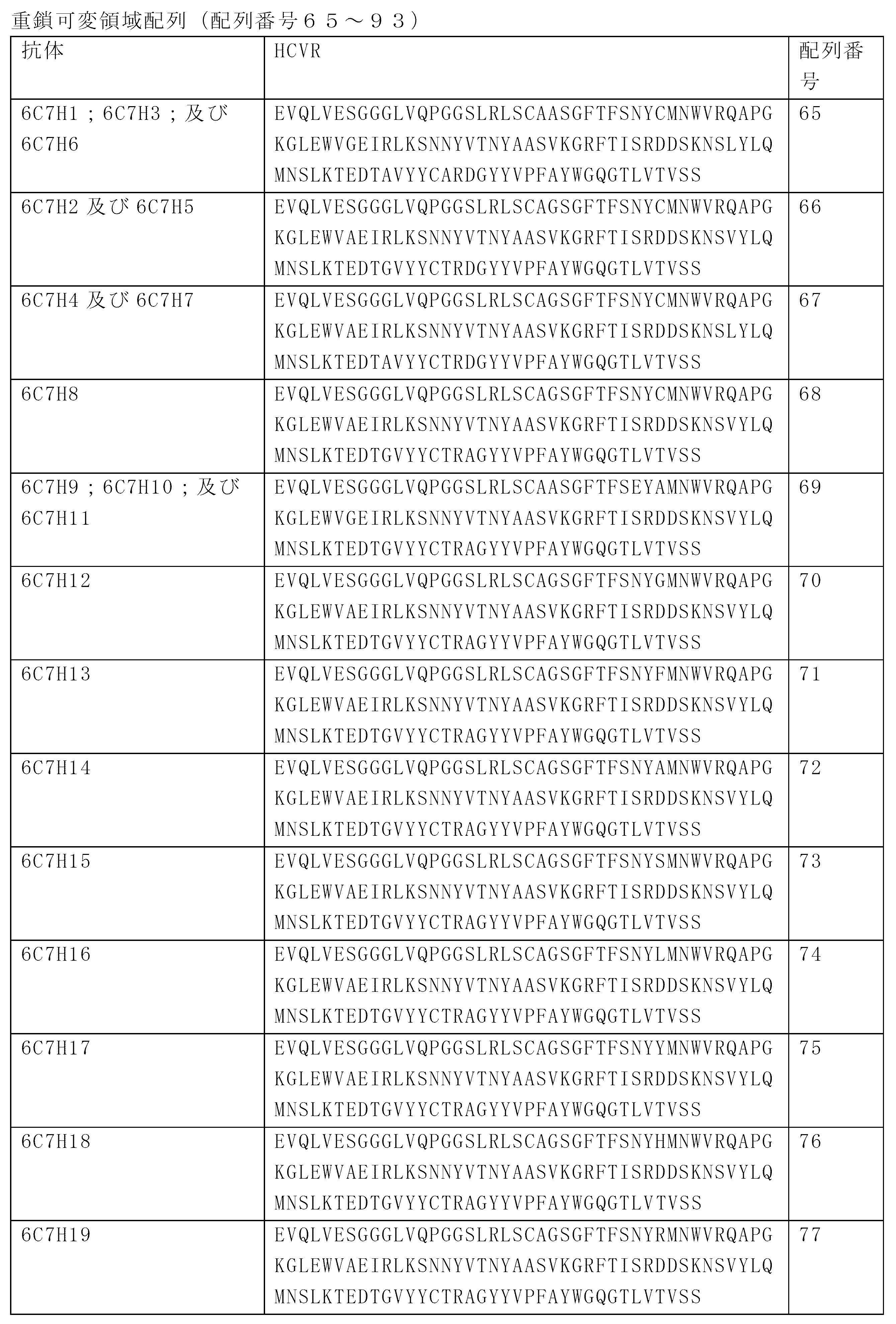

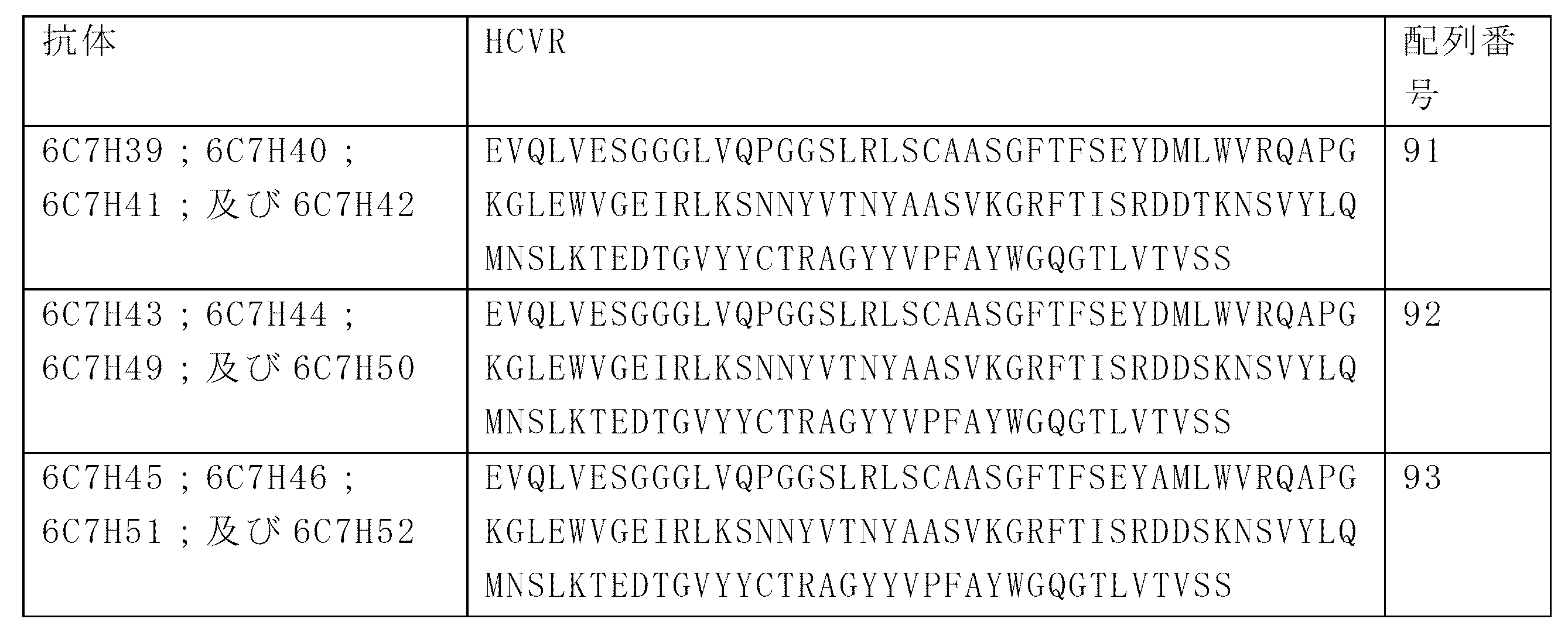

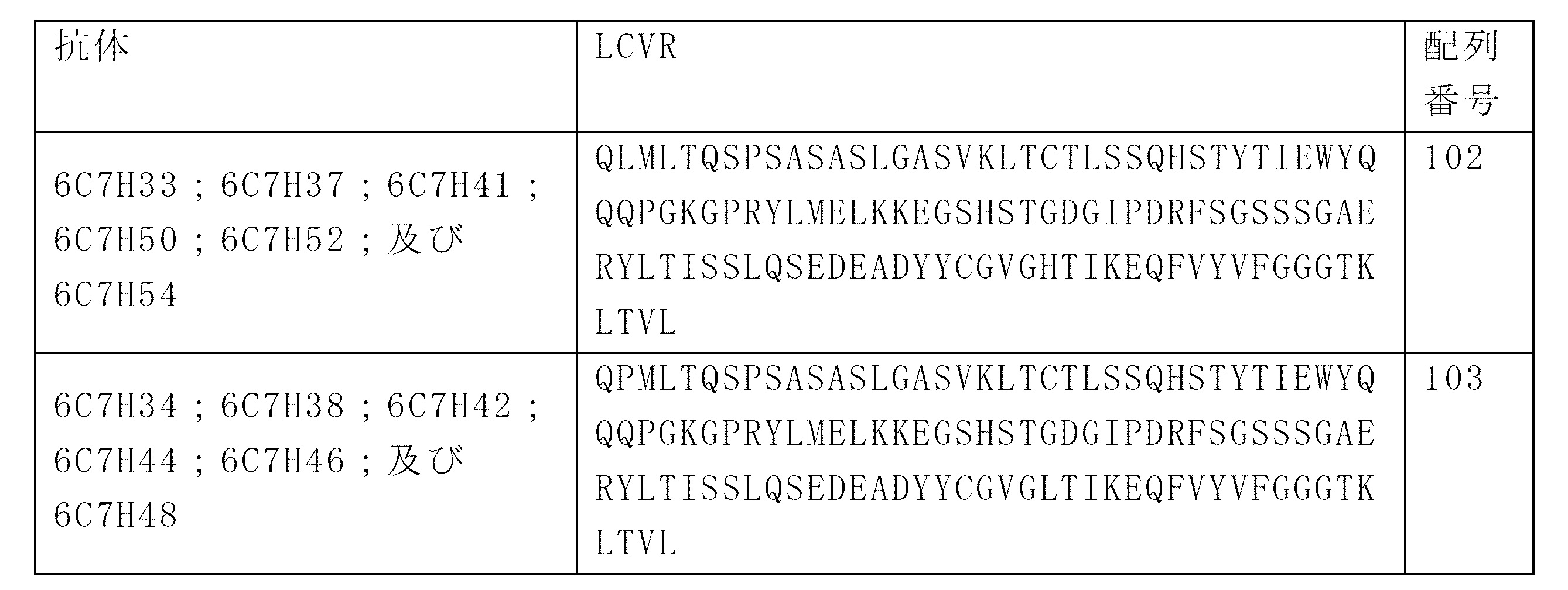
モチーフD/Ex0-2YxxL/IX6-8YxxL/I(配列番号104)
ASTKGPSVFP LAPCSRSTSE STAALGCLVK DYFPEPVTVS WNSGALTSGV HTFPAVLQSS GLYSLSSVVT VPSSNFGTQT YTCNVDHKPS NTKVDKTVER KCCVECPPCP(配列番号105)
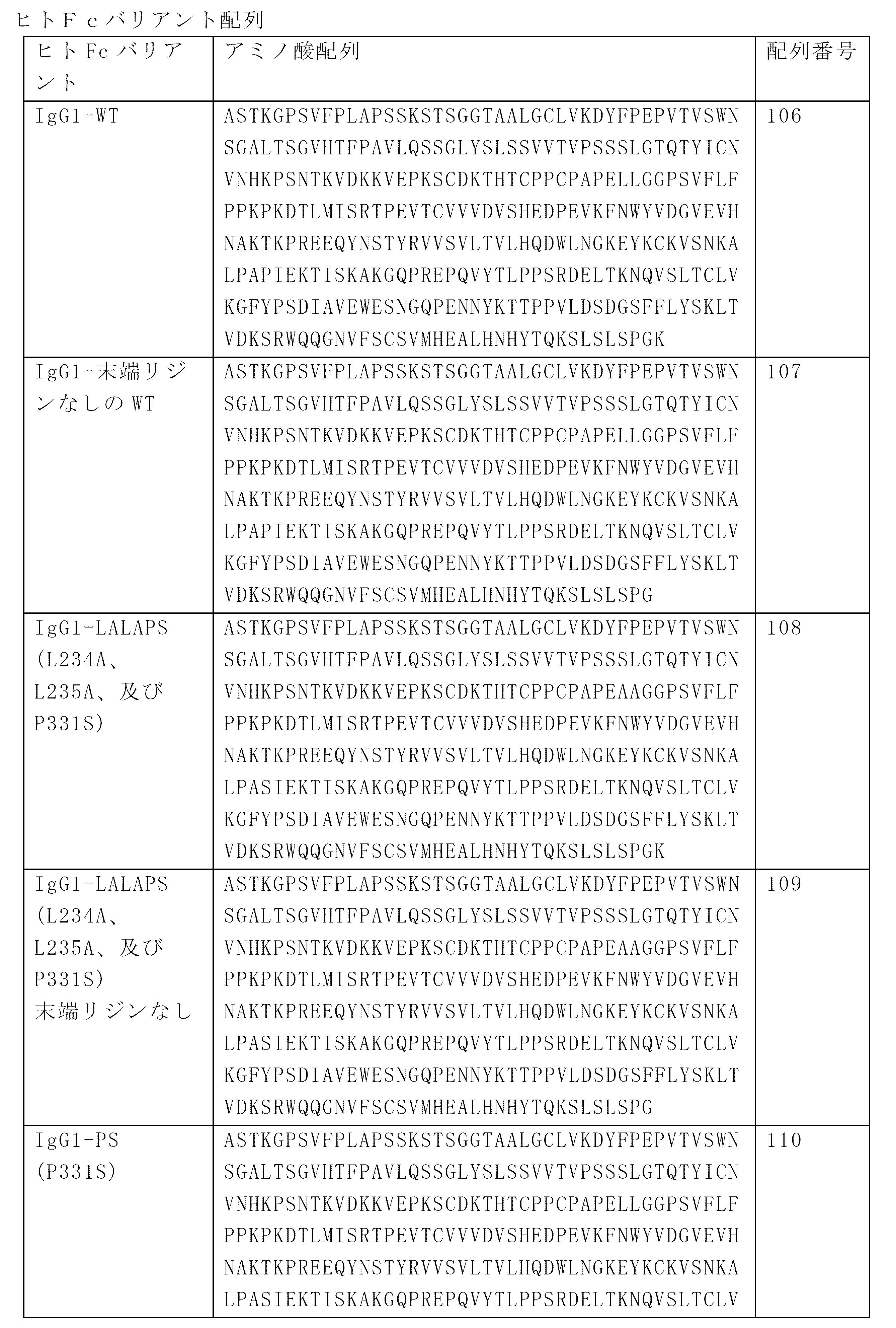


末端リジンありの重鎖(配列番号120)
EVQLVESGGGLVQPGGSLRLSCAGSGFTFSNYEMNWVRQAPGKGLEWVAEIRLKSNNYVTNYAASVKGRFTISRDDSKNSVYLQMNSLKTEDTGVYYCTRAGYYVPFAYWGQGTLVTVSSASTKGPSVFPLAPCSRSTSESTAALGCLVKDYFPEPVTVSWNSGALTSGVHTFPAVLQSSGLYSLSSVVTVPSSNFGTQTYTCNVDHKPSNTKVDKTVERKCCVECPPCPAPPVAGPSVFLFPPKPKDTLMISRTPEVTCVVVDVSHEDPEVQFNWYVDGVEVHNAKTKPREEQFNSTFRVVSVLTVVHQDWLNGKEYKCKVSNKGLPAPIEKTISKTKGQPREPQVYTLPPSREEMTKNQVSLTCLVKGFYPSDIAVEWESNGQPENNYKTTPPMLDSDGSFFLYSKLTVDKSRWQQGNVFSCSVMHEALHNHYTQKSLSLSPGK
末端リジンなしの重鎖(配列番号121)
EVQLVESGGGLVQPGGSLRLSCAGSGFTFSNYEMNWVRQAPGKGLEWVAEIRLKSNNYVTNYAASVKGRFTISRDDSKNSVYLQMNSLKTEDTGVYYCTRAGYYVPFAYWGQGTLVTVSSASTKGPSVFPLAPCSRSTSESTAALGCLVKDYFPEPVTVSWNSGALTSGVHTFPAVLQSSGLYSLSSVVTVPSSNFGTQTYTCNVDHKPSNTKVDKTVERKCCVECPPCPAPPVAGPSVFLFPPKPKDTLMISRTPEVTCVVVDVSHEDPEVQFNWYVDGVEVHNAKTKPREEQFNSTFRVVSVLTVVHQDWLNGKEYKCKVSNKGLPAPIEKTISKTKGQPREPQVYTLPPSREEMTKNQVSLTCLVKGFYPSDIAVEWESNGQPENNYKTTPPMLDSDGSFFLYSKLTVDKSRWQQGNVFSCSVMHEALHNHYTQKSLSLSPG
軽鎖(配列番号122)
QLMLTQSPSASASLGASVKLTCTLSSQHSTYTIEWYQQQPGKGPRYLMELKKEGSHSTGDGIPDRFSGSSSGAERYLTISSLQSEDEADYYCGVGHTIKEQFVYVFGGGTKLTVLGQPKAAPSVTLFPPSSEELQANKATLVCLISDFYPGAVTVAWKADSSPVKAGVETTTPSKQSNNKYAASSYLSLTPEQWKSHRSYSCQVTHEGSTVEKTVAPTECS
Anti-CD33 antibodies constructed using different Fc variants exhibited different abilities to reduce the levels of CD33 on the surface of dendritic cells. The IgG1 SELF isotype displayed the strongest potency, as the IgG1 SELF antibody 6C7H10 was 25.8 times more potent than the 6C7H10 IgG1 antibody in downregulating CD33. These two antibodies showed similar maximum reductions in CD33 levels. Surprisingly, the 6C7H8 IgG1 LALAPS and 6C7H10 IgG1 LALAPS antibodies were substantially less effective in downregulating CD33 than their cognate wild-type IgG1 antibodies, with both IgG1 LALAPS antibodies reducing CD33 levels by less than 40%. Antibodies 6C7H10 IgG2 and 6C7H54 IgG2 were similar in potency to their wild-type IgG1 counterparts. The maximum reduction of CD33 by antibody 6C7H10 IgG2 was similar to that by antibody 6C7H10 IgG1, while antibody 6C7H54 IgG2 showed a greater maximum reduction of CD33 than antibody 6C7H54 IgG1. In contrast, antibody 6C7H54 IgG1 PS showed slightly improved potency in downregulating CD33 compared to that observed with antibody 6C7H54 IgG1, although these two antibodies showed similar maximum reduction of CD33. These data indicate that the Fc region strongly influenced both potency and maximum receptor reduction by anti-CD33 antibodies, suggesting that receptor downregulation is enhanced by the interaction of the antibody with one or more Fcγ receptors.
Unofficial sequence listing CD33 sequences (SEQ ID NOs: 1-2)
Amino acid sequence of human CD33 (SEQ ID NO:1):
MPLLLLLPLLLWAGALAMDPNFWLQVQESVTVQEGLCVLVPCTFHPIPYYDKNSPVHGYWFREGAIISRDSPVATNKLDQEVQEETQGRFR LLGDPSRNNCSLIVDARRRDNGSYFFRMERGSTKYSYKSPQLSVHVTDLTHRPKILIPGTLEPGHSKNLTCSVSWACEQGTPPIFSWLSA APTSLGPRTTHSSSVLIITPRPQDHGTNLTCQVKFAGAGVTTERTIQLNVTYVPQNPTTGIFPGDGSGKQETRAGVVHGAIGGAGVTALLAL CLCLIFIVKTHRRKAARTAVGRNDTHPTTGSASPKHQKKSKLHGPTETSSCSGAAPTVEMDEELHYASLNFHGMNPSKDTSTEYSEVRTQ
Amino acid sequence of cynomolgus monkey CD33 (SEQ ID NO:2):
MDGEHLKGRNQGAQETSASDMPLLLPLLLWAGALAMDPRVRLEVQESVTVQEGLCVLVPCTFHPVPYHTRNSPVHGYWFREGAIVSLDSPVAT NKLDQEVQEETQGRFRLLGDPSRNNCSLSIVDARRRDNGSYFFRMEKGSTKYSYKSTQLSVHVTDLTHRPQILIPGALDPDHSKNLTCSVPWACE QGTPPIFSWMSAAPTSLGLRTTHSSSVLIITPRPQDHGTNLTCQVKFPGAGVTTERTIQLNVSYASQNPRTDIFLGDGSGKQGVVQGAIGGAGVTV LLALCLCLIFFTVKTHRRKAARTAVGRIDTHPATGPTSSKHQKKSKLHGATETSGCSGTTLTVEMDEELHYASLNFHGMNPSEDTSTEYSEVRTQ
Reference anti-CD33 antibody sequences (SEQ ID NOs: 3-4)
Heavy chain variable region of mouse 6C7 antibody (SEQ ID NO:3)
EVKLEESGGGLVQPGGSMKLSCVGSGFTF SNYCMNWVRQSPEKGLEWVAEIRLKSNNYVT NYVESVKGRFTISRDDSKSRVYLQMNNLRGEDTGFYYCTRDGYYVPFAYWGQGTLVTVSA
Light chain variable region of mouse 6C7 antibody (SEQ ID NO:4)
QLVLTQSSSASFSLGASAKLTCTLSSQHSTYTIEWYQQQPLKPPKYVMELKKDGSHSTGDGIPDRFSGSSSGADRYLSISNIQPEDEAIYICGVGDTIKEQFVYVFGGGTKVTVL
ASTKGPSVFP LAPCSRSTSE STAALGCLVK DYFPEPVTVS WNSGALTSGV HTFPAVLQSS GLYSLSSVVT VPSSNFGTQT YTCNVDHKPS NTKVDKTVER KCCVECPPCP (SEQ ID NO: 105)
Heavy chain with terminal lysine (SEQ ID NO: 120)
EVQLVESGGGLVQPGGSLRLSCAGSGFTFSNYEMNWVRQAPGKGLEWVAEIRLKSNNYVTNYAASVKGRFTISRDDSKNSVYLQMNSLKTEDTGVYYCTRAGYYVPFAYWG QGTLVTVSSASTKGPSVFPLAPCSRSTSESTAALGCLVKDYFPEPVTVSWNSGALTSGVHTFPAVLQSSGLYSLSSVVTVPSSNFGTQTYTCNVDHKPSNTKVDKTVERKCC VECPCPAPPVAGPSVFLFPPKPKDTLMISRTPEVTCVVVDVSHEDPEVQFNWYVDGVEVHNAKTKPREEQFNSTFRVVSVLTVVHQDWLNGKEYKCKVSNKGLPAPIEKT ISKTKGQPREPQVYTLPPSREEMTKNQVSLTCLVKGFYPSDIAVEWESNGQPENNYKTTPPMLDSDGSFFLYSKLTVDKSRWQQGNVFSCSVMHEALHNHYTQKSLSLSPGK
Heavy chain without terminal lysine (SEQ ID NO:121)
EVQLVESGGGLVQPGGSLRLSCAGSGFTFSNYEMNWVRQAPGKGLEWVAEIRLKSNNYVTNYAASVKGRFTISRDDSKNSVYLQMNSLKTEDTGVYYCTRAGYYVPFAYWG QGTLVTVSSASTKGPSVFPLAPCSRSTSESTAALGCLVKDYFPEPVTVSWNSGALTSGVHTFPAVLQSSGLYSLSSVVTVPSSNFGTQTYTCNVDHKPSNTKVDKTVERKC CVECPPCPAPPVAGPSVFLFPPKPKDTLMISRTPEVTCVVVDVSHEDPEVQFNWYVDGVEVHNAKTKPREEQFNSTFRVVSVLTVVHQDWLNGKEYKCKVSNKGLPAPIEK TISKTKGQPREPQVYTLPPSREEMTKNQVSLTCLVKGFYPSDIAVEWESNGQPENNYKTTPPMLDSDGSFFLYSKLTVDKSRWQQGNVFSCSVMHEALHNHYTQKSLSLSPG
Light Chain (SEQ ID NO: 122)
QLMLTQSPSASLGASVKLTCTLSSQHSTYTIEWYQQQPGKGPRYLMELKKEGSHSTGDGIPDRFSGSSSGAERYLTISSLQSEDEADYYCGVGHTIIKEQFVYVFGGGT KLTVLGQPKAAPSVTLFPPSSEELQANKATLVCLISDFYPGAVTVAWKADSSPVKAGVETTTPSKQSNNKYAASSYLSLTPEQWKSHRSYSCQVTHEGSTVEKTVAPTECS
Claims (18)
HVR-H1が配列番号8のアミノ酸配列を含み、HVR-H2が配列番号33のアミノ酸配列を含み、HVR-H3が配列番号39のアミノ酸配列を含み、HVR-L1が配列番号47のアミノ酸配列を含み、HVR-L2が配列番号53のアミノ酸配列を含み、及びHVR-L3が配列番号58のアミノ酸配列を含む;
HVR-H1が配列番号9のアミノ酸配列を含み、HVR-H2が配列番号33のアミノ酸配列を含み、HVR-H3が配列番号39のアミノ酸配列を含み、HVR-L1が配列番号47のアミノ酸配列を含み、HVR-L2が配列番号54のアミノ酸配列を含み、及びHVR-L3が配列番号58のアミノ酸配列を含む;
HVR-H1が配列番号9のアミノ酸配列を含み、HVR-H2が配列番号33のアミノ酸配列を含み、HVR-H3が配列番号39のアミノ酸配列を含み、HVR-L1が配列番号47のアミノ酸配列を含み、HVR-L2が配列番号53のアミノ酸配列を含み、及びHVR-L3が配列番号58のアミノ酸配列を含む;
HVR-H1が配列番号9のアミノ酸配列を含み、HVR-H2が配列番号33のアミノ酸配列を含み、HVR-H3が配列番号39のアミノ酸配列を含み、HVR-L1が配列番号47のアミノ酸配列を含み、HVR-L2が配列番号55のアミノ酸配列を含み、及びHVR-L3が配列番号58のアミノ酸配列を含む;
HVR-H1が配列番号10のアミノ酸配列を含み、HVR-H2が配列番号33のアミノ酸配列を含み、HVR-H3が配列番号39のアミノ酸配列を含み、HVR-L1が配列番号47のアミノ酸配列を含み、HVR-L2が配列番号53のアミノ酸配列を含み、及びHVR-L3が配列番号58のアミノ酸配列を含む;
HVR-H1が配列番号11のアミノ酸配列を含み、HVR-H2が配列番号33のアミノ酸配列を含み、HVR-H3が配列番号39のアミノ酸配列を含み、HVR-L1が配列番号47のアミノ酸配列を含み、HVR-L2が配列番号53のアミノ酸配列を含み、及びHVR-L3が配列番号58のアミノ酸配列を含む;
HVR-H1が配列番号12のアミノ酸配列を含み、HVR-H2が配列番号33のアミノ酸配列を含み、HVR-H3が配列番号39のアミノ酸配列を含み、HVR-L1が配列番号47のアミノ酸配列を含み、HVR-L2が配列番号53のアミノ酸配列を含み、及びHVR-L3が配列番号58のアミノ酸配列を含む;
HVR-H1が配列番号13のアミノ酸配列を含み、HVR-H2が配列番号33のアミノ酸配列を含み、HVR-H3が配列番号39のアミノ酸配列を含み、HVR-L1が配列番号47のアミノ酸配列を含み、HVR-L2が配列番号53のアミノ酸配列を含み、及びHVR-L3が配列番号58のアミノ酸配列を含む;
HVR-H1が配列番号14のアミノ酸配列を含み、HVR-H2が配列番号33のアミノ酸配列を含み、HVR-H3が配列番号39のアミノ酸配列を含み、HVR-L1が配列番号47のアミノ酸配列を含み、HVR-L2が配列番号53のアミノ酸配列を含み、及びHVR-L3が配列番号58のアミノ酸配列を含む;
HVR-H1が配列番号15のアミノ酸配列を含み、HVR-H2が配列番号33のアミノ酸配列を含み、HVR-H3が配列番号39のアミノ酸配列を含み、HVR-L1が配列番号47のアミノ酸配列を含み、HVR-L2が配列番号53のアミノ酸配列を含み、及びHVR-L3が配列番号58のアミノ酸配列を含む;
HVR-H1が配列番号16のアミノ酸配列を含み、HVR-H2が配列番号33のアミノ酸配列を含み、HVR-H3が配列番号39のアミノ酸配列を含み、HVR-L1が配列番号47のアミノ酸配列を含み、HVR-L2が配列番号53のアミノ酸配列を含み、及びHVR-L3が配列番号58のアミノ酸配列を含む;
HVR-H1が配列番号17のアミノ酸配列を含み、HVR-H2が配列番号33のアミノ酸配列を含み、HVR-H3が配列番号39のアミノ酸配列を含み、HVR-L1が配列番号47のアミノ酸配列を含み、HVR-L2が配列番号53のアミノ酸配列を含み、及びHVR-L3が配列番号58のアミノ酸配列を含む;
HVR-H1が配列番号18のアミノ酸配列を含み、HVR-H2が配列番号33のアミノ酸配列を含み、HVR-H3が配列番号39のアミノ酸配列を含み、HVR-L1が配列番号47のアミノ酸配列を含み、HVR-L2が配列番号53のアミノ酸配列を含み、及びHVR-L3が配列番号58のアミノ酸配列を含む;
HVR-H1が配列番号19のアミノ酸配列を含み、HVR-H2が配列番号33のアミノ酸配列を含み、HVR-H3が配列番号39のアミノ酸配列を含み、HVR-L1が配列番号47のアミノ酸配列を含み、HVR-L2が配列番号53のアミノ酸配列を含み、及びHVR-L3が配列番号58のアミノ酸配列を含む;
HVR-H1が配列番号20のアミノ酸配列を含み、HVR-H2が配列番号33のアミノ酸配列を含み、HVR-H3が配列番号39のアミノ酸配列を含み、HVR-L1が配列番号47のアミノ酸配列を含み、HVR-L2が配列番号53のアミノ酸配列を含み、及びHVR-L3が配列番号58のアミノ酸配列を含む;
HVR-H1が配列番号21のアミノ酸配列を含み、HVR-H2が配列番号33のアミノ酸配列を含み、HVR-H3が配列番号39のアミノ酸配列を含み、HVR-L1が配列番号47のアミノ酸配列を含み、HVR-L2が配列番号53のアミノ酸配列を含み、及びHVR-L3が配列番号58のアミノ酸配列を含む;
HVR-H1が配列番号22のアミノ酸配列を含み、HVR-H2が配列番号33のアミノ酸配列を含み、HVR-H3が配列番号39のアミノ酸配列を含み、HVR-L1が配列番号47のアミノ酸配列を含み、HVR-L2が配列番号53のアミノ酸配列を含み、及びHVR-L3が配列番号58のアミノ酸配列を含む;
HVR-H1が配列番号23のアミノ酸配列を含み、HVR-H2が配列番号33のアミノ酸配列を含み、HVR-H3が配列番号39のアミノ酸配列を含み、HVR-L1が配列番号47のアミノ酸配列を含み、HVR-L2が配列番号53のアミノ酸配列を含み、及びHVR-L3が配列番号58のアミノ酸配列を含む;
HVR-H1が配列番号24のアミノ酸配列を含み、HVR-H2が配列番号33のアミノ酸配列を含み、HVR-H3が配列番号39のアミノ酸配列を含み、HVR-L1が配列番号47のアミノ酸配列を含み、HVR-L2が配列番号53のアミノ酸配列を含み、及びHVR-L3が配列番号58のアミノ酸配列を含む;
HVR-H1が配列番号25のアミノ酸配列を含み、HVR-H2が配列番号33のアミノ酸配列を含み、HVR-H3が配列番号39のアミノ酸配列を含み、HVR-L1が配列番号47のアミノ酸配列を含み、HVR-L2が配列番号53のアミノ酸配列を含み、及びHVR-L3が配列番号58のアミノ酸配列を含む;
HVR-H1が配列番号26のアミノ酸配列を含み、HVR-H2が配列番号33のアミノ酸配列を含み、HVR-H3が配列番号39のアミノ酸配列を含み、HVR-L1が配列番号47のアミノ酸配列を含み、HVR-L2が配列番号53のアミノ酸配列を含み、及びHVR-L3が配列番号58のアミノ酸配列を含む;
HVR-H1が配列番号27のアミノ酸配列を含み、HVR-H2が配列番号33のアミノ酸配列を含み、HVR-H3が配列番号39のアミノ酸配列を含み、HVR-L1が配列番号47のアミノ酸配列を含み、HVR-L2が配列番号53のアミノ酸配列を含み、及びHVR-L3が配列番号58のアミノ酸配列を含む;
HVR-H1が配列番号28のアミノ酸配列を含み、HVR-H2が配列番号33のアミノ酸配列を含み、HVR-H3が配列番号39のアミノ酸配列を含み、HVR-L1が配列番号47のアミノ酸配列を含み、HVR-L2が配列番号53のアミノ酸配列を含み、及びHVR-L3が配列番号58のアミノ酸配列を含む;
HVR-H1が配列番号29のアミノ酸配列を含み、HVR-H2が配列番号33のアミノ酸配列を含み、HVR-H3が配列番号39のアミノ酸配列を含み、HVR-L1が配列番号47のアミノ酸配列を含み、HVR-L2が配列番号53のアミノ酸配列を含み、及びHVR-L3が配列番号59のアミノ酸配列を含む;
HVR-H1が配列番号29のアミノ酸配列を含み、HVR-H2が配列番号33のアミノ酸配列を含み、HVR-H3が配列番号39のアミノ酸配列を含み、HVR-L1が配列番号47のアミノ酸配列を含み、HVR-L2が配列番号53のアミノ酸配列を含み、及びHVR-L3が配列番号60のアミノ酸配列を含む;
HVR-H1が配列番号29のアミノ酸配列を含み、HVR-H2が配列番号33のアミノ酸配列を含み、HVR-H3が配列番号39のアミノ酸配列を含み、HVR-L1が配列番号47のアミノ酸配列を含み、HVR-L2が配列番号53のアミノ酸配列を含み、及びHVR-L3が配列番号61のアミノ酸配列を含む;
HVR-H1が配列番号29のアミノ酸配列を含み、HVR-H2が配列番号33のアミノ酸配列を含み、HVR-H3が配列番号39のアミノ酸配列を含み、HVR-L1が配列番号47のアミノ酸配列を含み、HVR-L2が配列番号53のアミノ酸配列を含み、及びHVR-L3が配列番号62のアミノ酸配列を含む;
HVR-H1が配列番号30のアミノ酸配列を含み、HVR-H2が配列番号33のアミノ酸配列を含み、HVR-H3が配列番号40のアミノ酸配列を含み、HVR-L1が配列番号47のアミノ酸配列を含み、HVR-L2が配列番号53のアミノ酸配列を含み、及びHVR-L3が配列番号59のアミノ酸配列を含む;
HVR-H1が配列番号30のアミノ酸配列を含み、HVR-H2が配列番号33のアミノ酸配列を含み、HVR-H3が配列番号40のアミノ酸配列を含み、HVR-L1が配列番号47のアミノ酸配列を含み、HVR-L2が配列番号53のアミノ酸配列を含み、及びHVR-L3が配列番号60のアミノ酸配列を含む;
HVR-H1が配列番号30のアミノ酸配列を含み、HVR-H2が配列番号33のアミノ酸配列を含み、HVR-H3が配列番号40のアミノ酸配列を含み、HVR-L1が配列番号47のアミノ酸配列を含み、HVR-L2が配列番号53のアミノ酸配列を含み、及びHVR-L3が配列番号61のアミノ酸配列を含む;
HVR-H1が配列番号30のアミノ酸配列を含み、HVR-H2が配列番号33のアミノ酸配列を含み、HVR-H3が配列番号40のアミノ酸配列を含み、HVR-L1が配列番号47のアミノ酸配列を含み、HVR-L2が配列番号53のアミノ酸配列を含み、及びHVR-L3が配列番号62のアミノ酸配列を含む;
HVR-H1が配列番号30のアミノ酸配列を含み、HVR-H2が配列番号33のアミノ酸配列を含み、HVR-H3が配列番号39のアミノ酸配列を含み、HVR-L1が配列番号47のアミノ酸配列を含み、HVR-L2が配列番号53のアミノ酸配列を含み、及びHVR-L3が配列番号60のアミノ酸配列を含む;
HVR-H1が配列番号30のアミノ酸配列を含み、HVR-H2が配列番号33のアミノ酸配列を含み、HVR-H3が配列番号39のアミノ酸配列を含み、HVR-L1が配列番号47のアミノ酸配列を含み、HVR-L2が配列番号53のアミノ酸配列を含み、及びHVR-L3が配列番号62のアミノ酸配列を含む;
HVR-H1が配列番号23のアミノ酸配列を含み、HVR-H2が配列番号33のアミノ酸配列を含み、HVR-H3が配列番号39のアミノ酸配列を含み、HVR-L1が配列番号47のアミノ酸配列を含み、HVR-L2が配列番号53のアミノ酸配列を含み、及びHVR-L3が配列番号60のアミノ酸配列を含む;
HVR-H1が配列番号23のアミノ酸配列を含み、HVR-H2が配列番号33のアミノ酸配列を含み、HVR-H3が配列番号39のアミノ酸配列を含み、HVR-L1が配列番号47のアミノ酸配列を含み、HVR-L2が配列番号53のアミノ酸配列を含み、及びHVR-L3が配列番号62のアミノ酸配列を含む;
HVR-H1が配列番号30のアミノ酸配列を含み、HVR-H2が配列番号33のアミノ酸配列を含み、HVR-H3が配列番号39のアミノ酸配列を含み、HVR-L1が配列番号47のアミノ酸配列を含み、HVR-L2が配列番号53のアミノ酸配列を含み、及びHVR-L3が配列番号59のアミノ酸配列を含む;
HVR-H1が配列番号30のアミノ酸配列を含み、HVR-H2が配列番号33のアミノ酸配列を含み、HVR-H3が配列番号39のアミノ酸配列を含み、HVR-L1が配列番号47のアミノ酸配列を含み、HVR-L2が配列番号53のアミノ酸配列を含み、及びHVR-L3が配列番号61のアミノ酸配列を含む;
HVR-H1が配列番号23のアミノ酸配列を含み、HVR-H2が配列番号33のアミノ酸配列を含み、HVR-H3が配列番号39のアミノ酸配列を含み、HVR-L1が配列番号47のアミノ酸配列を含み、HVR-L2が配列番号53のアミノ酸配列を含み、及びHVR-L3が配列番号59のアミノ酸配列を含む;または
HVR-H1が配列番号23のアミノ酸配列を含み、HVR-H2が配列番号33のアミノ酸配列を含み、HVR-H3が配列番号39のアミノ酸配列を含み、HVR-L1が配列番号47のアミノ酸配列を含み、HVR-L2が配列番号53のアミノ酸配列を含み、及びHVR-L3が配列番号61のアミノ酸配列を含む、抗体。 1. An isolated antibody that binds to CD33, said antibody comprising a heavy chain variable region comprising HVR-H1, HVR-H2, and HVR-H3, and a light chain variable region comprising HVR-L1, HVR-L2, and HVR-L3;
HVR-H1 comprises the amino acid sequence of SEQ ID NO:8, HVR-H2 comprises the amino acid sequence of SEQ ID NO:33, HVR-H3 comprises the amino acid sequence of SEQ ID NO:39, HVR-L1 comprises the amino acid sequence of SEQ ID NO:47, HVR-L2 comprises the amino acid sequence of SEQ ID NO:53, and HVR-L3 comprises the amino acid sequence of SEQ ID NO:58;
HVR-H1 comprises the amino acid sequence of SEQ ID NO:9, HVR-H2 comprises the amino acid sequence of SEQ ID NO:33, HVR-H3 comprises the amino acid sequence of SEQ ID NO:39, HVR-L1 comprises the amino acid sequence of SEQ ID NO:47, HVR-L2 comprises the amino acid sequence of SEQ ID NO:54, and HVR-L3 comprises the amino acid sequence of SEQ ID NO:58;
HVR-H1 comprises the amino acid sequence of SEQ ID NO:9, HVR-H2 comprises the amino acid sequence of SEQ ID NO:33, HVR-H3 comprises the amino acid sequence of SEQ ID NO:39, HVR-L1 comprises the amino acid sequence of SEQ ID NO:47, HVR-L2 comprises the amino acid sequence of SEQ ID NO:53, and HVR-L3 comprises the amino acid sequence of SEQ ID NO:58;
HVR-H1 comprises the amino acid sequence of SEQ ID NO:9, HVR-H2 comprises the amino acid sequence of SEQ ID NO:33, HVR-H3 comprises the amino acid sequence of SEQ ID NO:39, HVR-L1 comprises the amino acid sequence of SEQ ID NO:47, HVR-L2 comprises the amino acid sequence of SEQ ID NO:55, and HVR-L3 comprises the amino acid sequence of SEQ ID NO:58;
HVR-H1 comprises the amino acid sequence of SEQ ID NO:10, HVR-H2 comprises the amino acid sequence of SEQ ID NO:33, HVR-H3 comprises the amino acid sequence of SEQ ID NO:39, HVR-L1 comprises the amino acid sequence of SEQ ID NO:47, HVR-L2 comprises the amino acid sequence of SEQ ID NO:53, and HVR-L3 comprises the amino acid sequence of SEQ ID NO:58;
HVR-H1 comprises the amino acid sequence of SEQ ID NO:11, HVR-H2 comprises the amino acid sequence of SEQ ID NO:33, HVR-H3 comprises the amino acid sequence of SEQ ID NO:39, HVR-L1 comprises the amino acid sequence of SEQ ID NO:47, HVR-L2 comprises the amino acid sequence of SEQ ID NO:53, and HVR-L3 comprises the amino acid sequence of SEQ ID NO:58;
HVR-H1 comprises the amino acid sequence of SEQ ID NO:12, HVR-H2 comprises the amino acid sequence of SEQ ID NO:33, HVR-H3 comprises the amino acid sequence of SEQ ID NO:39, HVR-L1 comprises the amino acid sequence of SEQ ID NO:47, HVR-L2 comprises the amino acid sequence of SEQ ID NO:53, and HVR-L3 comprises the amino acid sequence of SEQ ID NO:58;
HVR-H1 comprises the amino acid sequence of SEQ ID NO:13, HVR-H2 comprises the amino acid sequence of SEQ ID NO:33, HVR-H3 comprises the amino acid sequence of SEQ ID NO:39, HVR-L1 comprises the amino acid sequence of SEQ ID NO:47, HVR-L2 comprises the amino acid sequence of SEQ ID NO:53, and HVR-L3 comprises the amino acid sequence of SEQ ID NO:58;
HVR-H1 comprises the amino acid sequence of SEQ ID NO:14, HVR-H2 comprises the amino acid sequence of SEQ ID NO:33, HVR-H3 comprises the amino acid sequence of SEQ ID NO:39, HVR-L1 comprises the amino acid sequence of SEQ ID NO:47, HVR-L2 comprises the amino acid sequence of SEQ ID NO:53, and HVR-L3 comprises the amino acid sequence of SEQ ID NO:58;
HVR-H1 comprises the amino acid sequence of SEQ ID NO:15, HVR-H2 comprises the amino acid sequence of SEQ ID NO:33, HVR-H3 comprises the amino acid sequence of SEQ ID NO:39, HVR-L1 comprises the amino acid sequence of SEQ ID NO:47, HVR-L2 comprises the amino acid sequence of SEQ ID NO:53, and HVR-L3 comprises the amino acid sequence of SEQ ID NO:58;
HVR-H1 comprises the amino acid sequence of SEQ ID NO:16, HVR-H2 comprises the amino acid sequence of SEQ ID NO:33, HVR-H3 comprises the amino acid sequence of SEQ ID NO:39, HVR-L1 comprises the amino acid sequence of SEQ ID NO:47, HVR-L2 comprises the amino acid sequence of SEQ ID NO:53, and HVR-L3 comprises the amino acid sequence of SEQ ID NO:58;
HVR-H1 comprises the amino acid sequence of SEQ ID NO:17, HVR-H2 comprises the amino acid sequence of SEQ ID NO:33, HVR-H3 comprises the amino acid sequence of SEQ ID NO:39, HVR-L1 comprises the amino acid sequence of SEQ ID NO:47, HVR-L2 comprises the amino acid sequence of SEQ ID NO:53, and HVR-L3 comprises the amino acid sequence of SEQ ID NO:58;
HVR-H1 comprises the amino acid sequence of SEQ ID NO:18, HVR-H2 comprises the amino acid sequence of SEQ ID NO:33, HVR-H3 comprises the amino acid sequence of SEQ ID NO:39, HVR-L1 comprises the amino acid sequence of SEQ ID NO:47, HVR-L2 comprises the amino acid sequence of SEQ ID NO:53, and HVR-L3 comprises the amino acid sequence of SEQ ID NO:58;
HVR-H1 comprises the amino acid sequence of SEQ ID NO:19, HVR-H2 comprises the amino acid sequence of SEQ ID NO:33, HVR-H3 comprises the amino acid sequence of SEQ ID NO:39, HVR-L1 comprises the amino acid sequence of SEQ ID NO:47, HVR-L2 comprises the amino acid sequence of SEQ ID NO:53, and HVR-L3 comprises the amino acid sequence of SEQ ID NO:58;
HVR-H1 comprises the amino acid sequence of SEQ ID NO:20, HVR-H2 comprises the amino acid sequence of SEQ ID NO:33, HVR-H3 comprises the amino acid sequence of SEQ ID NO:39, HVR-L1 comprises the amino acid sequence of SEQ ID NO:47, HVR-L2 comprises the amino acid sequence of SEQ ID NO:53, and HVR-L3 comprises the amino acid sequence of SEQ ID NO:58;
HVR-H1 comprises the amino acid sequence of SEQ ID NO:21, HVR-H2 comprises the amino acid sequence of SEQ ID NO:33, HVR-H3 comprises the amino acid sequence of SEQ ID NO:39, HVR-L1 comprises the amino acid sequence of SEQ ID NO:47, HVR-L2 comprises the amino acid sequence of SEQ ID NO:53, and HVR-L3 comprises the amino acid sequence of SEQ ID NO:58;
HVR-H1 comprises the amino acid sequence of SEQ ID NO:22, HVR-H2 comprises the amino acid sequence of SEQ ID NO:33, HVR-H3 comprises the amino acid sequence of SEQ ID NO:39, HVR-L1 comprises the amino acid sequence of SEQ ID NO:47, HVR-L2 comprises the amino acid sequence of SEQ ID NO:53, and HVR-L3 comprises the amino acid sequence of SEQ ID NO:58;
HVR-H1 comprises the amino acid sequence of SEQ ID NO:23, HVR-H2 comprises the amino acid sequence of SEQ ID NO:33, HVR-H3 comprises the amino acid sequence of SEQ ID NO:39, HVR-L1 comprises the amino acid sequence of SEQ ID NO:47, HVR-L2 comprises the amino acid sequence of SEQ ID NO:53, and HVR-L3 comprises the amino acid sequence of SEQ ID NO:58;
HVR-H1 comprises the amino acid sequence of SEQ ID NO:24, HVR-H2 comprises the amino acid sequence of SEQ ID NO:33, HVR-H3 comprises the amino acid sequence of SEQ ID NO:39, HVR-L1 comprises the amino acid sequence of SEQ ID NO:47, HVR-L2 comprises the amino acid sequence of SEQ ID NO:53, and HVR-L3 comprises the amino acid sequence of SEQ ID NO:58;
HVR-H1 comprises the amino acid sequence of SEQ ID NO:25, HVR-H2 comprises the amino acid sequence of SEQ ID NO:33, HVR-H3 comprises the amino acid sequence of SEQ ID NO:39, HVR-L1 comprises the amino acid sequence of SEQ ID NO:47, HVR-L2 comprises the amino acid sequence of SEQ ID NO:53, and HVR-L3 comprises the amino acid sequence of SEQ ID NO:58;
HVR-H1 comprises the amino acid sequence of SEQ ID NO:26, HVR-H2 comprises the amino acid sequence of SEQ ID NO:33, HVR-H3 comprises the amino acid sequence of SEQ ID NO:39, HVR-L1 comprises the amino acid sequence of SEQ ID NO:47, HVR-L2 comprises the amino acid sequence of SEQ ID NO:53, and HVR-L3 comprises the amino acid sequence of SEQ ID NO:58;
HVR-H1 comprises the amino acid sequence of SEQ ID NO:27, HVR-H2 comprises the amino acid sequence of SEQ ID NO:33, HVR-H3 comprises the amino acid sequence of SEQ ID NO:39, HVR-L1 comprises the amino acid sequence of SEQ ID NO:47, HVR-L2 comprises the amino acid sequence of SEQ ID NO:53, and HVR-L3 comprises the amino acid sequence of SEQ ID NO:58;
HVR-H1 comprises the amino acid sequence of SEQ ID NO:28, HVR-H2 comprises the amino acid sequence of SEQ ID NO:33, HVR-H3 comprises the amino acid sequence of SEQ ID NO:39, HVR-L1 comprises the amino acid sequence of SEQ ID NO:47, HVR-L2 comprises the amino acid sequence of SEQ ID NO:53, and HVR-L3 comprises the amino acid sequence of SEQ ID NO:58;
HVR-H1 comprises the amino acid sequence of SEQ ID NO:29, HVR-H2 comprises the amino acid sequence of SEQ ID NO:33, HVR-H3 comprises the amino acid sequence of SEQ ID NO:39, HVR-L1 comprises the amino acid sequence of SEQ ID NO:47, HVR-L2 comprises the amino acid sequence of SEQ ID NO:53, and HVR-L3 comprises the amino acid sequence of SEQ ID NO:59;
HVR-H1 comprises the amino acid sequence of SEQ ID NO:29, HVR-H2 comprises the amino acid sequence of SEQ ID NO:33, HVR-H3 comprises the amino acid sequence of SEQ ID NO:39, HVR-L1 comprises the amino acid sequence of SEQ ID NO:47, HVR-L2 comprises the amino acid sequence of SEQ ID NO:53, and HVR-L3 comprises the amino acid sequence of SEQ ID NO:60;
HVR-H1 comprises the amino acid sequence of SEQ ID NO:29, HVR-H2 comprises the amino acid sequence of SEQ ID NO:33, HVR-H3 comprises the amino acid sequence of SEQ ID NO:39, HVR-L1 comprises the amino acid sequence of SEQ ID NO:47, HVR-L2 comprises the amino acid sequence of SEQ ID NO:53, and HVR-L3 comprises the amino acid sequence of SEQ ID NO:61;
HVR-H1 comprises the amino acid sequence of SEQ ID NO:29, HVR-H2 comprises the amino acid sequence of SEQ ID NO:33, HVR-H3 comprises the amino acid sequence of SEQ ID NO:39, HVR-L1 comprises the amino acid sequence of SEQ ID NO:47, HVR-L2 comprises the amino acid sequence of SEQ ID NO:53, and HVR-L3 comprises the amino acid sequence of SEQ ID NO:62;
HVR-H1 comprises the amino acid sequence of SEQ ID NO:30, HVR-H2 comprises the amino acid sequence of SEQ ID NO:33, HVR-H3 comprises the amino acid sequence of SEQ ID NO:40, HVR-L1 comprises the amino acid sequence of SEQ ID NO:47, HVR-L2 comprises the amino acid sequence of SEQ ID NO:53, and HVR-L3 comprises the amino acid sequence of SEQ ID NO:59;
HVR-H1 comprises the amino acid sequence of SEQ ID NO:30, HVR-H2 comprises the amino acid sequence of SEQ ID NO:33, HVR-H3 comprises the amino acid sequence of SEQ ID NO:40, HVR-L1 comprises the amino acid sequence of SEQ ID NO:47, HVR-L2 comprises the amino acid sequence of SEQ ID NO:53, and HVR-L3 comprises the amino acid sequence of SEQ ID NO:60;
HVR-H1 comprises the amino acid sequence of SEQ ID NO:30, HVR-H2 comprises the amino acid sequence of SEQ ID NO:33, HVR-H3 comprises the amino acid sequence of SEQ ID NO:40, HVR-L1 comprises the amino acid sequence of SEQ ID NO:47, HVR-L2 comprises the amino acid sequence of SEQ ID NO:53, and HVR-L3 comprises the amino acid sequence of SEQ ID NO:61;
HVR-H1 comprises the amino acid sequence of SEQ ID NO:30, HVR-H2 comprises the amino acid sequence of SEQ ID NO:33, HVR-H3 comprises the amino acid sequence of SEQ ID NO:40, HVR-L1 comprises the amino acid sequence of SEQ ID NO:47, HVR-L2 comprises the amino acid sequence of SEQ ID NO:53, and HVR-L3 comprises the amino acid sequence of SEQ ID NO:62 ;
HVR-H1 comprises the amino acid sequence of SEQ ID NO:30, HVR-H2 comprises the amino acid sequence of SEQ ID NO:33, HVR-H3 comprises the amino acid sequence of SEQ ID NO:39, HVR-L1 comprises the amino acid sequence of SEQ ID NO:47, HVR-L2 comprises the amino acid sequence of SEQ ID NO:53, and HVR-L3 comprises the amino acid sequence of SEQ ID NO:60;
HVR-H1 comprises the amino acid sequence of SEQ ID NO:30, HVR-H2 comprises the amino acid sequence of SEQ ID NO:33, HVR-H3 comprises the amino acid sequence of SEQ ID NO:39, HVR-L1 comprises the amino acid sequence of SEQ ID NO:47, HVR-L2 comprises the amino acid sequence of SEQ ID NO:53, and HVR-L3 comprises the amino acid sequence of SEQ ID NO:62;
HVR-H1 comprises the amino acid sequence of SEQ ID NO:23, HVR-H2 comprises the amino acid sequence of SEQ ID NO:33, HVR-H3 comprises the amino acid sequence of SEQ ID NO:39, HVR-L1 comprises the amino acid sequence of SEQ ID NO:47, HVR-L2 comprises the amino acid sequence of SEQ ID NO:53, and HVR-L3 comprises the amino acid sequence of SEQ ID NO:60;
HVR-H1 comprises the amino acid sequence of SEQ ID NO:23, HVR-H2 comprises the amino acid sequence of SEQ ID NO:33, HVR-H3 comprises the amino acid sequence of SEQ ID NO:39, HVR-L1 comprises the amino acid sequence of SEQ ID NO:47, HVR-L2 comprises the amino acid sequence of SEQ ID NO:53, and HVR-L3 comprises the amino acid sequence of SEQ ID NO:62;
HVR-H1 comprises the amino acid sequence of SEQ ID NO:30, HVR-H2 comprises the amino acid sequence of SEQ ID NO:33, HVR-H3 comprises the amino acid sequence of SEQ ID NO:39, HVR-L1 comprises the amino acid sequence of SEQ ID NO:47, HVR-L2 comprises the amino acid sequence of SEQ ID NO:53, and HVR-L3 comprises the amino acid sequence of SEQ ID NO:59;
HVR-H1 comprises the amino acid sequence of SEQ ID NO:30, HVR-H2 comprises the amino acid sequence of SEQ ID NO:33, HVR-H3 comprises the amino acid sequence of SEQ ID NO:39, HVR-L1 comprises the amino acid sequence of SEQ ID NO:47, HVR-L2 comprises the amino acid sequence of SEQ ID NO:53, and HVR-L3 comprises the amino acid sequence of SEQ ID NO:61;
an antibody, wherein HVR-H1 comprises the amino acid sequence of SEQ ID NO:23, HVR-H2 comprises the amino acid sequence of SEQ ID NO:33, HVR-H3 comprises the amino acid sequence of SEQ ID NO:39, HVR-L1 comprises the amino acid sequence of SEQ ID NO:47, HVR-L2 comprises the amino acid sequence of SEQ ID NO:53, and HVR-L3 comprises the amino acid sequence of SEQ ID NO:59; or an antibody, wherein HVR-H1 comprises the amino acid sequence of SEQ ID NO:23, HVR-H2 comprises the amino acid sequence of SEQ ID NO:33, HVR-H3 comprises the amino acid sequence of SEQ ID NO:39, HVR-L1 comprises the amino acid sequence of SEQ ID NO:47, HVR-L2 comprises the amino acid sequence of SEQ ID NO:53, and HVR-L3 comprises the amino acid sequence of SEQ ID NO:61.
配列番号68のアミノ酸配列を含む重鎖可変領域、及び配列番号97のアミノ酸配列を含む軽鎖可変領域を含む;
配列番号69のアミノ酸配列を含む重鎖可変領域、及び配列番号98のアミノ酸配列を含む軽鎖可変領域を含む;
配列番号69のアミノ酸配列を含む重鎖可変領域、及び配列番号97のアミノ酸配列を含む軽鎖可変領域を含む;
配列番号69のアミノ酸配列を含む重鎖可変領域、及び配列番号99のアミノ酸配列を含む軽鎖可変領域を含む;
配列番号70のアミノ酸配列を含む重鎖可変領域、及び配列番号97のアミノ酸配列を含む軽鎖可変領域を含む;
配列番号71のアミノ酸配列を含む重鎖可変領域、及び配列番号97のアミノ酸配列を含む軽鎖可変領域を含む;
配列番号72のアミノ酸配列を含む重鎖可変領域、及び配列番号97のアミノ酸配列を含む軽鎖可変領域を含む;
配列番号73のアミノ酸配列を含む重鎖可変領域、及び配列番号97のアミノ酸配列を含む軽鎖可変領域を含む;
配列番号74のアミノ酸配列を含む重鎖可変領域、及び配列番号97のアミノ酸配列を含む軽鎖可変領域を含む;
配列番号75のアミノ酸配列を含む重鎖可変領域、及び配列番号97のアミノ酸配列を含む軽鎖可変領域を含む;
配列番号76のアミノ酸配列を含む重鎖可変領域、及び配列番号97のアミノ酸配列を含む軽鎖可変領域を含む;
配列番号77のアミノ酸配列を含む重鎖可変領域、及び配列番号97のアミノ酸配列を含む軽鎖可変領域を含む;
配列番号78のアミノ酸配列を含む重鎖可変領域、及び配列番号97のアミノ酸配列を含む軽鎖可変領域を含む;
配列番号79のアミノ酸配列を含む重鎖可変領域、及び配列番号97のアミノ酸配列を含む軽鎖可変領域を含む;
配列番号80のアミノ酸配列を含む重鎖可変領域、及び配列番号97のアミノ酸配列を含む軽鎖可変領域を含む;
配列番号81のアミノ酸配列を含む重鎖可変領域、及び配列番号97のアミノ酸配列を含む軽鎖可変領域を含む;
配列番号82のアミノ酸配列を含む重鎖可変領域、及び配列番号97のアミノ酸配列を含む軽鎖可変領域を含む;
配列番号83のアミノ酸配列を含む重鎖可変領域、及び配列番号97のアミノ酸配列を含む軽鎖可変領域を含む;
配列番号84のアミノ酸配列を含む重鎖可変領域、及び配列番号97のアミノ酸配列を含む軽鎖可変領域を含む;
配列番号85のアミノ酸配列を含む重鎖可変領域、及び配列番号97のアミノ酸配列を含む軽鎖可変領域を含む;
配列番号86のアミノ酸配列を含む重鎖可変領域、及び配列番号97のアミノ酸配列を含む軽鎖可変領域を含む;
配列番号87のアミノ酸配列を含む重鎖可変領域、及び配列番号97のアミノ酸配列を含む軽鎖可変領域を含む;
配列番号88のアミノ酸配列を含む重鎖可変領域、及び配列番号97のアミノ酸配列を含む軽鎖可変領域を含む;
配列番号89のアミノ酸配列を含む重鎖可変領域、及び配列番号100のアミノ酸配列を含む軽鎖可変領域を含む;
配列番号89のアミノ酸配列を含む重鎖可変領域、及び配列番号101のアミノ酸配列を含む軽鎖可変領域を含む;
配列番号89のアミノ酸配列を含む重鎖可変領域、及び配列番号102のアミノ酸配列を含む軽鎖可変領域を含む;
配列番号89のアミノ酸配列を含む重鎖可変領域、及び配列番号103のアミノ酸配列を含む軽鎖可変領域を含む;
配列番号90のアミノ酸配列を含む重鎖可変領域、及び配列番号100のアミノ酸配列を含む軽鎖可変領域を含む;
配列番号90のアミノ酸配列を含む重鎖可変領域、及び配列番号101のアミノ酸配列を含む軽鎖可変領域を含む;
配列番号90のアミノ酸配列を含む重鎖可変領域、及び配列番号102のアミノ酸配列を含む軽鎖可変領域を含む;
配列番号90のアミノ酸配列を含む重鎖可変領域、及び配列番号103のアミノ酸配列を含む軽鎖可変領域を含む;
配列番号91のアミノ酸配列を含む重鎖可変領域、及び配列番号100のアミノ酸配列を含む軽鎖可変領域を含む;
配列番号91のアミノ酸配列を含む重鎖可変領域、及び配列番号101のアミノ酸配列を含む軽鎖可変領域を含む;
配列番号91のアミノ酸配列を含む重鎖可変領域、及び配列番号102のアミノ酸配列を含む軽鎖可変領域を含む;
配列番号91のアミノ酸配列を含む重鎖可変領域、及び配列番号103のアミノ酸配列を含む軽鎖可変領域を含む;
配列番号92のアミノ酸配列を含む重鎖可変領域、及び配列番号101のアミノ酸配列を含む軽鎖可変領域を含む;
配列番号92のアミノ酸配列を含む重鎖可変領域、及び配列番号103のアミノ酸配列を含む軽鎖可変領域を含む;
配列番号93のアミノ酸配列を含む重鎖可変領域、及び配列番号101のアミノ酸配列を含む軽鎖可変領域を含む;
配列番号93のアミノ酸配列を含む重鎖可変領域、及び配列番号103のアミノ酸配列を含む軽鎖可変領域を含む;
配列番号83のアミノ酸配列を含む重鎖可変領域、及び配列番号101のアミノ酸配列を含む軽鎖可変領域を含む;
配列番号83のアミノ酸配列を含む重鎖可変領域、及び配列番号103のアミノ酸配列を含む軽鎖可変領域を含む;
配列番号92のアミノ酸配列を含む重鎖可変領域、及び配列番号100のアミノ酸配列を含む軽鎖可変領域を含む;
配列番号92のアミノ酸配列を含む重鎖可変領域、及び配列番号102のアミノ酸配列を含む軽鎖可変領域を含む;
配列番号93のアミノ酸配列を含む重鎖可変領域、及び配列番号100のアミノ酸配列を含む軽鎖可変領域を含む;
配列番号93のアミノ酸配列を含む重鎖可変領域、及び配列番号102のアミノ酸配列を含む軽鎖可変領域を含む;
配列番号83のアミノ酸配列を含む重鎖可変領域、及び配列番号100のアミノ酸配列を含む軽鎖可変領域を含む;
配列番号83のアミノ酸配列を含む重鎖可変領域、及び配列番号102のアミノ酸配列を含む軽鎖可変領域を含む;
配列番号120のアミノ酸配列を含む重鎖、及び配列番号122のアミノ酸配列を含む軽鎖を含む;または
配列番号121のアミノ酸配列を含む重鎖、及び配列番号122のアミノ酸配列を含む軽鎖を含む
請求項1に記載の抗体。 The antibody,
a heavy chain variable region comprising the amino acid sequence of SEQ ID NO:68, and a light chain variable region comprising the amino acid sequence of SEQ ID NO:97;
a heavy chain variable region comprising the amino acid sequence of SEQ ID NO:69, and a light chain variable region comprising the amino acid sequence of SEQ ID NO:98;
a heavy chain variable region comprising the amino acid sequence of SEQ ID NO:69, and a light chain variable region comprising the amino acid sequence of SEQ ID NO:97;
a heavy chain variable region comprising the amino acid sequence of SEQ ID NO:69, and a light chain variable region comprising the amino acid sequence of SEQ ID NO:99;
a heavy chain variable region comprising the amino acid sequence of SEQ ID NO:70, and a light chain variable region comprising the amino acid sequence of SEQ ID NO:97;
a heavy chain variable region comprising the amino acid sequence of SEQ ID NO:71, and a light chain variable region comprising the amino acid sequence of SEQ ID NO:97;
a heavy chain variable region comprising the amino acid sequence of SEQ ID NO:72, and a light chain variable region comprising the amino acid sequence of SEQ ID NO:97;
a heavy chain variable region comprising the amino acid sequence of SEQ ID NO:73, and a light chain variable region comprising the amino acid sequence of SEQ ID NO:97;
a heavy chain variable region comprising the amino acid sequence of SEQ ID NO:74, and a light chain variable region comprising the amino acid sequence of SEQ ID NO:97;
a heavy chain variable region comprising the amino acid sequence of SEQ ID NO:75, and a light chain variable region comprising the amino acid sequence of SEQ ID NO:97;
a heavy chain variable region comprising the amino acid sequence of SEQ ID NO:76, and a light chain variable region comprising the amino acid sequence of SEQ ID NO:97;
a heavy chain variable region comprising the amino acid sequence of SEQ ID NO:77, and a light chain variable region comprising the amino acid sequence of SEQ ID NO:97;
a heavy chain variable region comprising the amino acid sequence of SEQ ID NO:78, and a light chain variable region comprising the amino acid sequence of SEQ ID NO:97;
a heavy chain variable region comprising the amino acid sequence of SEQ ID NO:79, and a light chain variable region comprising the amino acid sequence of SEQ ID NO:97;
a heavy chain variable region comprising the amino acid sequence of SEQ ID NO:80, and a light chain variable region comprising the amino acid sequence of SEQ ID NO:97;
a heavy chain variable region comprising the amino acid sequence of SEQ ID NO:81, and a light chain variable region comprising the amino acid sequence of SEQ ID NO:97;
a heavy chain variable region comprising the amino acid sequence of SEQ ID NO:82, and a light chain variable region comprising the amino acid sequence of SEQ ID NO:97;
a heavy chain variable region comprising the amino acid sequence of SEQ ID NO:83, and a light chain variable region comprising the amino acid sequence of SEQ ID NO:97;
a heavy chain variable region comprising the amino acid sequence of SEQ ID NO:84, and a light chain variable region comprising the amino acid sequence of SEQ ID NO:97;
a heavy chain variable region comprising the amino acid sequence of SEQ ID NO:85, and a light chain variable region comprising the amino acid sequence of SEQ ID NO:97;
a heavy chain variable region comprising the amino acid sequence of SEQ ID NO:86, and a light chain variable region comprising the amino acid sequence of SEQ ID NO:97;
a heavy chain variable region comprising the amino acid sequence of SEQ ID NO:87, and a light chain variable region comprising the amino acid sequence of SEQ ID NO:97;
a heavy chain variable region comprising the amino acid sequence of SEQ ID NO:88, and a light chain variable region comprising the amino acid sequence of SEQ ID NO:97;
a heavy chain variable region comprising the amino acid sequence of SEQ ID NO:89, and a light chain variable region comprising the amino acid sequence of SEQ ID NO:100;
a heavy chain variable region comprising the amino acid sequence of SEQ ID NO:89, and a light chain variable region comprising the amino acid sequence of SEQ ID NO:101;
a heavy chain variable region comprising the amino acid sequence of SEQ ID NO:89, and a light chain variable region comprising the amino acid sequence of SEQ ID NO:102;
a heavy chain variable region comprising the amino acid sequence of SEQ ID NO:89, and a light chain variable region comprising the amino acid sequence of SEQ ID NO:103;
a heavy chain variable region comprising the amino acid sequence of SEQ ID NO:90, and a light chain variable region comprising the amino acid sequence of SEQ ID NO:100;
a heavy chain variable region comprising the amino acid sequence of SEQ ID NO:90, and a light chain variable region comprising the amino acid sequence of SEQ ID NO:101;
a heavy chain variable region comprising the amino acid sequence of SEQ ID NO:90, and a light chain variable region comprising the amino acid sequence of SEQ ID NO:102;
a heavy chain variable region comprising the amino acid sequence of SEQ ID NO:90, and a light chain variable region comprising the amino acid sequence of SEQ ID NO:103;
a heavy chain variable region comprising the amino acid sequence of SEQ ID NO:91, and a light chain variable region comprising the amino acid sequence of SEQ ID NO:100;
a heavy chain variable region comprising the amino acid sequence of SEQ ID NO:91, and a light chain variable region comprising the amino acid sequence of SEQ ID NO:101;
a heavy chain variable region comprising the amino acid sequence of SEQ ID NO:91, and a light chain variable region comprising the amino acid sequence of SEQ ID NO:102;
a heavy chain variable region comprising the amino acid sequence of SEQ ID NO:91, and a light chain variable region comprising the amino acid sequence of SEQ ID NO:103;
a heavy chain variable region comprising the amino acid sequence of SEQ ID NO:92, and a light chain variable region comprising the amino acid sequence of SEQ ID NO:101;
a heavy chain variable region comprising the amino acid sequence of SEQ ID NO:92, and a light chain variable region comprising the amino acid sequence of SEQ ID NO:103;
a heavy chain variable region comprising the amino acid sequence of SEQ ID NO:93, and a light chain variable region comprising the amino acid sequence of SEQ ID NO:101;
a heavy chain variable region comprising the amino acid sequence of SEQ ID NO:93, and a light chain variable region comprising the amino acid sequence of SEQ ID NO:103;
a heavy chain variable region comprising the amino acid sequence of SEQ ID NO:83, and a light chain variable region comprising the amino acid sequence of SEQ ID NO:101;
a heavy chain variable region comprising the amino acid sequence of SEQ ID NO:83, and a light chain variable region comprising the amino acid sequence of SEQ ID NO:103;
a heavy chain variable region comprising the amino acid sequence of SEQ ID NO:92, and a light chain variable region comprising the amino acid sequence of SEQ ID NO:100;
a heavy chain variable region comprising the amino acid sequence of SEQ ID NO:92, and a light chain variable region comprising the amino acid sequence of SEQ ID NO:102;
a heavy chain variable region comprising the amino acid sequence of SEQ ID NO:93, and a light chain variable region comprising the amino acid sequence of SEQ ID NO:100;
a heavy chain variable region comprising the amino acid sequence of SEQ ID NO:93, and a light chain variable region comprising the amino acid sequence of SEQ ID NO:102;
a heavy chain variable region comprising the amino acid sequence of SEQ ID NO:83, and a light chain variable region comprising the amino acid sequence of SEQ ID NO:100;
a heavy chain variable region comprising the amino acid sequence of SEQ ID NO:83, and a light chain variable region comprising the amino acid sequence of SEQ ID NO:102;
The antibody of claim 1, comprising a heavy chain comprising the amino acid sequence of SEQ ID NO: 120 and a light chain comprising the amino acid sequence of SEQ ID NO: 122; or comprising a heavy chain comprising the amino acid sequence of SEQ ID NO: 121 and a light chain comprising the amino acid sequence of SEQ ID NO: 122.
(a)配列番号120のアミノ酸配列を含む重鎖、及び配列番号122のアミノ酸配列を含む軽鎖を含む;または
(b)配列番号121のアミノ酸配列を含む重鎖、及び配列番号122のアミノ酸配列を含む軽鎖を含む
請求項2または4に記載の抗体。 The antibody comprising:
(a) a heavy chain comprising the amino acid sequence of SEQ ID NO: 120, and a light chain comprising the amino acid sequence of SEQ ID NO: 122; or
(b) a heavy chain comprising the amino acid sequence of SEQ ID NO: 121, and a light chain comprising the amino acid sequence of SEQ ID NO: 122.
The antibody of claim 2 or 4 .
(ii)前記抗体は、IgGクラス、IgMクラス、またはIgAクラスのものである、請求項1~5のいずれか1項に記載の抗体。 The antibody of any one of claims 1 to 5 , wherein: (i) the antibody is a monoclonal antibody; and/or (ii) the antibody is of the IgG class, the IgM class, or the IgA class.
(ii)前記抗体は、IgG4アイソタイプを有し、残基位置228にS228Pアミノ酸置換、残基位置234にL234Aアミノ酸置換、及び残基位置235にL235Aアミノ酸置換を含み、前記残基位置のナンバリングは、EUナンバリングに従う;または
(iii):
(a)Fc領域は、位置E430Gにアミノ酸置換を含み、前記残基位置のナンバリングは、EUナンバリングに従うか、
(b)Fc領域は、位置L234A、L235A、及びP331Sにアミノ酸置換を含み、前記残基位置のナンバリングは、EUナンバリングに従うか、
(c)Fc領域は、位置L234A、L235A、P331S、及びE430Gにアミノ酸置換を含み、前記残基位置のナンバリングは、EUナンバリングに従うか、
(d)Fc領域は、位置K322A及びE430Gにアミノ酸置換を含み、前記残基位置のナンバリングは、EUナンバリングに従うか、
(e)Fc領域は、位置P331S及びE430Gにアミノ酸置換を含み、前記残基位置のナンバリングは、EUナンバリングに従うか、
(f)Fc領域は、位置A330S、P331S、及びE430Gにアミノ酸置換を含み、前記残基位置のナンバリングは、EUナンバリングに従うか、
(g)Fc領域は、位置K322A、A330S、及びP331Sにアミノ酸置換を含み、前記残基位置のナンバリングは、EUナンバリングに従うか、
(h)Fc領域は、位置K322A、P331S、及びE430Gにアミノ酸置換を含み、前記残基位置のナンバリングは、EUナンバリングに従うか、
(i)Fc領域は、位置E430Gにアミノ酸置換を含み、前記残基位置のナンバリングは、EUナンバリングに従うか、
(j)Fc領域は、位置A330S、P331S、及びE430Gにアミノ酸置換を含み、前記残基位置のナンバリングは、EUナンバリングに従うか、
(k)Fc領域は、位置S267E及びL328Fにアミノ酸置換を含み、前記残基位置のナンバリングは、EUナンバリングに従うか、
(l)Fc領域は、位置C127Sにアミノ酸置換を含み、前記残基位置のナンバリングは、EUナンバリングに従うか、
(m)Fc領域は、位置E345R、E430G、及びS440Yにアミノ酸置換を含み、前記残基位置のナンバリングは、EUナンバリングに従うか、
(n)Fc領域は、位置P331Sにアミノ酸置換を含み、前記残基位置のナンバリングは、EUナンバリングに従うか、または
(o)Fc領域は、位置L234A、L235A、及びP331Sにアミノ酸置換を含み、前記残基位置のナンバリングは、EUナンバリングに従う、
請求項1~7のいずれか1項に記載の抗体。 (i) the antibody comprises one or more amino acid substitutions in the Fc region at residue positions selected from the group consisting of C127S, L234A, L234F, L235A, L235E, S267E, K322A, L328F, A330S, P331S, E345R, E430G, S440Y, and any combination thereof, wherein the numbering of said residue positions is according to EU numbering;
(ii) the antibody has an IgG4 isotype and contains a S228P amino acid substitution at residue position 228, a L234A amino acid substitution at residue position 234, and a L235A amino acid substitution at residue position 235, wherein the numbering of the residue positions is according to EU numbering; or (iii):
(a) the Fc region comprises an amino acid substitution at position E430G, wherein the numbering of said residue positions is according to EU numbering; or
(b) the Fc region comprises amino acid substitutions at positions L234A, L235A, and P331S, wherein the numbering of said residue positions is according to EU numbering; or
(c) the Fc region comprises amino acid substitutions at positions L234A, L235A, P331S, and E430G, wherein the numbering of said residue positions is according to EU numbering; or
(d) the Fc region comprises amino acid substitutions at positions K322A and E430G, wherein the numbering of said residue positions is according to EU numbering; or
(e) the Fc region comprises amino acid substitutions at positions P331S and E430G, wherein the numbering of said residue positions is according to EU numbering; or
(f) the Fc region comprises amino acid substitutions at positions A330S, P331S, and E430G, wherein the numbering of said residue positions is according to EU numbering; or
(g) the Fc region comprises amino acid substitutions at positions K322A, A330S, and P331S, wherein the numbering of said residue positions is according to EU numbering; or
(h) the Fc region comprises amino acid substitutions at positions K322A, P331S, and E430G, wherein the numbering of said residue positions is according to EU numbering; or
(i) the Fc region comprises an amino acid substitution at position E430G, wherein the numbering of said residue positions is according to EU numbering; or
(j) the Fc region comprises amino acid substitutions at positions A330S, P331S, and E430G, wherein the numbering of said residue positions is according to EU numbering; or
(k) the Fc region comprises amino acid substitutions at positions S267E and L328F, wherein the numbering of said residue positions is according to EU numbering; or
(l) the Fc region comprises an amino acid substitution at position C127S, wherein the numbering of said residue positions is according to EU numbering; or
(m) the Fc region comprises amino acid substitutions at positions E345R, E430G, and S440Y, wherein the numbering of said residue positions is according to EU numbering; or
(n) the Fc region comprises an amino acid substitution at position P331S, wherein the numbering of said residue positions is according to EU numbering; or (o) the Fc region comprises amino acid substitutions at positions L234A, L235A, and P331S, wherein the numbering of said residue positions is according to EU numbering.
The antibody according to any one of claims 1 to 7 .
(ii)前記抗体は、ヒトCD33、ヒトCD33の天然に存在するバリアント、及びヒトCD33の疾患バリアントからなる群から選択される1つ以上のヒトタンパク質に結合する抗体断片である、
請求項1~8のいずれか1項に記載の抗体。 (i) the antibody is an antibody fragment that binds to an epitope that includes amino acid residues on human CD33 or cynomolgus CD33 protein;
(ii) the antibody is an antibody fragment that binds to one or more human proteins selected from the group consisting of human CD33, naturally occurring variants of human CD33, and disease variants of human CD33;
The antibody according to any one of claims 1 to 8 .
請求項9に記載の抗体。 the antibody fragment is crosslinked to a second antibody fragment that binds one or more human proteins selected from the group consisting of human CD33, naturally occurring variants of human CD33, and disease variants of human CD33, and/or the fragment is a Fab, Fab', Fab'-SH, F(ab')2, Fv, or scFv fragment;
The antibody described in claim 9 .
(ii)前記抗体は、200pMまたは200pM未満のヒトCD33についての解離定数(KD)を有し、前記KDは、BioLayer干渉法によって決定される;
(iii)前記抗体は、フローサイトメトリーによって測定して40pM未満の半数有効濃度(EC50)で、in vitroでCD33の細胞表面レベルを低下させる;及び/または
(iv)前記抗体は、配列番号118のアミノ酸配列を含むFc領域を含む、
請求項1~10のいずれか1項に記載の抗体。 (i) the antibody has a dissociation constant (KD) for human CD33 that is at least 1.8-fold lower than an anti-CD33 antibody comprising a heavy chain variable region comprising the amino acid sequence of SEQ ID NO:3 and a light chain variable region comprising the amino acid sequence of SEQ ID NO :4, wherein the KD is determined by BioLayer interferometry;
(ii) the antibody has a dissociation constant ( KD ) for human CD33 of 200 pM or less than 200 pM, wherein the KD is determined by BioLayer interferometry;
(iii) the antibody reduces cell surface levels of CD33 in vitro with a median effective concentration ( EC50 ) of less than 40 pM as measured by flow cytometry; and/or (iv) the antibody comprises an Fc region comprising the amino acid sequence of SEQ ID NO: 118.
The antibody according to any one of claims 1 to 10 .
Applications Claiming Priority (3)
| Application Number | Priority Date | Filing Date | Title |
|---|---|---|---|
| US201862726053P | 2018-08-31 | 2018-08-31 | |
| US62/726,053 | 2018-08-31 | ||
| PCT/US2019/048994 WO2020047374A1 (en) | 2018-08-31 | 2019-08-30 | Anti-cd33 antibodies and methods of use thereof |
Publications (3)
| Publication Number | Publication Date |
|---|---|
| JP2021534797A JP2021534797A (en) | 2021-12-16 |
| JPWO2020047374A5 JPWO2020047374A5 (en) | 2022-09-07 |
| JP7586813B2 true JP7586813B2 (en) | 2024-11-19 |
Family
ID=67957407
Family Applications (1)
| Application Number | Title | Priority Date | Filing Date |
|---|---|---|---|
| JP2021511561A Active JP7586813B2 (en) | 2018-08-31 | 2019-08-30 | Anti-CD33 antibodies and methods of use thereof |
Country Status (22)
| Country | Link |
|---|---|
| US (2) | US12247073B2 (en) |
| EP (1) | EP3843851A1 (en) |
| JP (1) | JP7586813B2 (en) |
| KR (1) | KR20210070986A (en) |
| CN (2) | CN112912144A (en) |
| AR (1) | AR119259A1 (en) |
| AU (1) | AU2019331018A1 (en) |
| BR (1) | BR112021003016A2 (en) |
| CA (1) | CA3108808A1 (en) |
| CL (1) | CL2021000501A1 (en) |
| CO (1) | CO2021003078A2 (en) |
| CR (1) | CR20210155A (en) |
| EA (1) | EA202190235A1 (en) |
| EC (1) | ECSP21022299A (en) |
| IL (1) | IL281008A (en) |
| MA (1) | MA53492A (en) |
| MX (1) | MX2021002299A (en) |
| PE (1) | PE20211096A1 (en) |
| PH (1) | PH12021550332A1 (en) |
| SG (1) | SG11202101552SA (en) |
| TW (1) | TW202016307A (en) |
| WO (1) | WO2020047374A1 (en) |
Families Citing this family (8)
| Publication number | Priority date | Publication date | Assignee | Title |
|---|---|---|---|---|
| JOP20190248A1 (en) | 2017-04-21 | 2019-10-20 | Amgen Inc | Trem2 antigen binding proteins and uses thereof |
| CA3057447A1 (en) | 2017-08-03 | 2019-02-07 | Alector Llc | Anti-cd33 antibodies and methods of use thereof |
| BR112021003016A2 (en) * | 2018-08-31 | 2021-05-18 | Alector Llc | isolated antibodies, isolated nucleic acid, vector, host cell, methods for producing an antibody and for preventing, reducing the risk or treating a disease and pharmaceutical composition |
| BR112022011337A2 (en) * | 2019-12-12 | 2022-08-23 | Alector Llc | METHOD TO TREAT AND/OR DELAY THE PROGRESSION OF A DISEASE OR INJURY IN AN INDIVIDUAL |
| MA71661A (en) * | 2020-10-14 | 2025-05-30 | Denali Therapeutics Inc. | FUSION PROTEINS COMPRISING SULFOGLUCOSAMINE SULFOHYDROLASE ENZYMES AND RELATED METHODS |
| WO2023081898A1 (en) | 2021-11-08 | 2023-05-11 | Alector Llc | Soluble cd33 as a biomarker for anti-cd33 efficacy |
| WO2024026318A2 (en) * | 2022-07-25 | 2024-02-01 | Rhode Island Hospital | Diagnosis, prognosis and treatment of malignant neoplasms |
| CN115724959B (en) * | 2022-11-11 | 2023-06-20 | 杭州华葵金配生物科技有限公司 | Antibody targeting influenza A virus nucleoprotein and application thereof |
Citations (1)
| Publication number | Priority date | Publication date | Assignee | Title |
|---|---|---|---|---|
| JP2018518176A (en) | 2015-06-12 | 2018-07-12 | アレクトル エルエルシー | Anti-CD33 antibody and method of use thereof |
Family Cites Families (129)
| Publication number | Priority date | Publication date | Assignee | Title |
|---|---|---|---|---|
| US5730A (en) | 1848-08-22 | Improvement in steam cotton-presses | ||
| US69A (en) | 1836-10-27 | Machine eor picking or breaking wool and ginned or seedless cotton | ||
| US8124A (en) | 1851-05-27 | mcfarlan | ||
| US982A (en) | 1838-10-16 | Stove fob -warming and cooking | ||
| US4657760A (en) | 1979-03-20 | 1987-04-14 | Ortho Pharmaceutical Corporation | Methods and compositions using monoclonal antibody to human T cells |
| US4469863A (en) | 1980-11-12 | 1984-09-04 | Ts O Paul O P | Nonionic nucleic acid alkyl and aryl phosphonates and processes for manufacture and use thereof |
| US4816567A (en) | 1983-04-08 | 1989-03-28 | Genentech, Inc. | Recombinant immunoglobin preparations |
| US5206344A (en) | 1985-06-26 | 1993-04-27 | Cetus Oncology Corporation | Interleukin-2 muteins and polymer conjugation thereof |
| US4676980A (en) | 1985-09-23 | 1987-06-30 | The United States Of America As Represented By The Secretary Of The Department Of Health And Human Services | Target specific cross-linked heteroantibodies |
| GB8601597D0 (en) | 1986-01-23 | 1986-02-26 | Wilson R H | Nucleotide sequences |
| US6548640B1 (en) | 1986-03-27 | 2003-04-15 | Btg International Limited | Altered antibodies |
| US5567610A (en) | 1986-09-04 | 1996-10-22 | Bioinvent International Ab | Method of producing human monoclonal antibodies and kit therefor |
| ES2058199T3 (en) | 1987-09-23 | 1994-11-01 | Bristol Myers Squibb Co | ANTIBODY HETEROCONJUGATES FOR THE ELIMINATION OF HIV-INFECTED CELLS. |
| GB8823869D0 (en) | 1988-10-12 | 1988-11-16 | Medical Res Council | Production of antibodies |
| ATE102631T1 (en) | 1988-11-11 | 1994-03-15 | Medical Res Council | CLONING OF IMMUNOGLOBULIN SEQUENCES FROM THE VARIABLE DOMAINS. |
| US5175384A (en) | 1988-12-05 | 1992-12-29 | Genpharm International | Transgenic mice depleted in mature t-cells and methods for making transgenic mice |
| US5530101A (en) | 1988-12-28 | 1996-06-25 | Protein Design Labs, Inc. | Humanized immunoglobulins |
| DE3920358A1 (en) | 1989-06-22 | 1991-01-17 | Behringwerke Ag | BISPECIFIC AND OLIGO-SPECIFIC, MONO- AND OLIGOVALENT ANTI-BODY CONSTRUCTS, THEIR PRODUCTION AND USE |
| DE69029036T2 (en) | 1989-06-29 | 1997-05-22 | Medarex Inc | SPECIFIC REAGENTS FOR AIDS THERAPY |
| US5225212A (en) | 1989-10-20 | 1993-07-06 | Liposome Technology, Inc. | Microreservoir liposome composition and method |
| US5959177A (en) | 1989-10-27 | 1999-09-28 | The Scripps Research Institute | Transgenic plants expressing assembled secretory antibodies |
| AU659083B2 (en) | 1989-12-14 | 1995-05-11 | Sloan-Kettering Institute For Cancer Research | Therapeutic uses of the hypervariable region of monoclonal antibody M195 and constructs thereof |
| ATE139258T1 (en) | 1990-01-12 | 1996-06-15 | Cell Genesys Inc | GENERATION OF XENOGENE ANTIBODIES |
| US6075181A (en) | 1990-01-12 | 2000-06-13 | Abgenix, Inc. | Human antibodies derived from immunized xenomice |
| US6150584A (en) | 1990-01-12 | 2000-11-21 | Abgenix, Inc. | Human antibodies derived from immunized xenomice |
| US5321131A (en) | 1990-03-08 | 1994-06-14 | Hybridon, Inc. | Site-specific functionalization of oligodeoxynucleotides for non-radioactive labelling |
| US5229275A (en) | 1990-04-26 | 1993-07-20 | Akzo N.V. | In-vitro method for producing antigen-specific human monoclonal antibodies |
| WO1992000373A1 (en) | 1990-06-29 | 1992-01-09 | Biosource Genetics Corporation | Melanin production by transformed microorganisms |
| AU8507191A (en) | 1990-08-29 | 1992-03-30 | Genpharm International, Inc. | Transgenic non-human animals capable of producing heterologous antibodies |
| US5770429A (en) | 1990-08-29 | 1998-06-23 | Genpharm International, Inc. | Transgenic non-human animals capable of producing heterologous antibodies |
| US5545806A (en) | 1990-08-29 | 1996-08-13 | Genpharm International, Inc. | Ransgenic non-human animals for producing heterologous antibodies |
| US5661016A (en) | 1990-08-29 | 1997-08-26 | Genpharm International Inc. | Transgenic non-human animals capable of producing heterologous antibodies of various isotypes |
| US5625126A (en) | 1990-08-29 | 1997-04-29 | Genpharm International, Inc. | Transgenic non-human animals for producing heterologous antibodies |
| US5633425A (en) | 1990-08-29 | 1997-05-27 | Genpharm International, Inc. | Transgenic non-human animals capable of producing heterologous antibodies |
| CA2095633C (en) | 1990-12-03 | 2003-02-04 | Lisa J. Garrard | Enrichment method for variant proteins with altered binding properties |
| US5571894A (en) | 1991-02-05 | 1996-11-05 | Ciba-Geigy Corporation | Recombinant antibodies specific for a growth factor receptor |
| EP0586505A1 (en) | 1991-05-14 | 1994-03-16 | Repligen Corporation | Heteroconjugate antibodies for treatment of hiv infection |
| US5719262A (en) | 1993-11-22 | 1998-02-17 | Buchardt, Deceased; Ole | Peptide nucleic acids having amino acid side chains |
| DK51092D0 (en) | 1991-05-24 | 1992-04-15 | Ole Buchardt | OLIGONUCLEOTIDE ANALOGUE DESCRIBED BY PEN, MONOMERIC SYNTHONES AND PROCEDURES FOR PREPARING THEREOF, AND APPLICATIONS THEREOF |
| EP0940468A1 (en) | 1991-06-14 | 1999-09-08 | Genentech, Inc. | Humanized antibody variable domain |
| GB9114948D0 (en) | 1991-07-11 | 1991-08-28 | Pfizer Ltd | Process for preparing sertraline intermediates |
| EP0604580A1 (en) | 1991-09-19 | 1994-07-06 | Genentech, Inc. | EXPRESSION IN E. COLI OF ANTIBODY FRAGMENTS HAVING AT LEAST A CYSTEINE PRESENT AS A FREE THIOL, USE FOR THE PRODUCTION OF BIFUNCTIONAL F(ab') 2? ANTIBODIES |
| US5565332A (en) | 1991-09-23 | 1996-10-15 | Medical Research Council | Production of chimeric antibodies - a combinatorial approach |
| FI941572A7 (en) | 1991-10-07 | 1994-05-27 | Oncologix Inc | Combination and method of use of anti-erbB-2 monoclonal antibodies |
| WO1993008829A1 (en) | 1991-11-04 | 1993-05-13 | The Regents Of The University Of California | Compositions that mediate killing of hiv-infected cells |
| EP0617706B1 (en) | 1991-11-25 | 2001-10-17 | Enzon, Inc. | Multivalent antigen-binding proteins |
| US5869619A (en) | 1991-12-13 | 1999-02-09 | Xoma Corporation | Modified antibody variable domains |
| ATE249840T1 (en) | 1991-12-13 | 2003-10-15 | Xoma Corp | METHOD AND MATERIALS FOR PRODUCING MODIFIED VARIABLE ANTIBODY DOMAIN AND THERAPEUTIC USE THEREOF |
| US5700922A (en) | 1991-12-24 | 1997-12-23 | Isis Pharmaceuticals, Inc. | PNA-DNA-PNA chimeric macromolecules |
| DE69334255D1 (en) | 1992-02-06 | 2009-02-12 | Novartis Vaccines & Diagnostic | Marker for cancer and biosynthetic binding protein for it |
| US5714350A (en) | 1992-03-09 | 1998-02-03 | Protein Design Labs, Inc. | Increasing antibody affinity by altering glycosylation in the immunoglobulin variable region |
| US5573905A (en) | 1992-03-30 | 1996-11-12 | The Scripps Research Institute | Encoded combinatorial chemical libraries |
| ZA932523B (en) | 1992-04-10 | 1994-10-08 | Res Dev Foundation | Immunotoxins directed against cd33 related surface antigens |
| WO1994002499A1 (en) | 1992-07-27 | 1994-02-03 | Hybridon, Inc. | Oligonucleotide alkylphosphonothioates |
| JPH08500017A (en) | 1992-08-17 | 1996-01-09 | ジェネンテク,インコーポレイテッド | Bispecific immune adhesin |
| CA2154358A1 (en) | 1993-01-21 | 1994-08-04 | Hybridon, Inc. | Integrated oligonucleotides |
| US5637684A (en) | 1994-02-23 | 1997-06-10 | Isis Pharmaceuticals, Inc. | Phosphoramidate and phosphorothioamidate oligomeric compounds |
| US5789199A (en) | 1994-11-03 | 1998-08-04 | Genentech, Inc. | Process for bacterial production of polypeptides |
| US5840523A (en) | 1995-03-01 | 1998-11-24 | Genetech, Inc. | Methods and compositions for secretion of heterologous polypeptides |
| US5731168A (en) | 1995-03-01 | 1998-03-24 | Genentech, Inc. | Method for making heteromultimeric polypeptides |
| US5641870A (en) | 1995-04-20 | 1997-06-24 | Genentech, Inc. | Low pH hydrophobic interaction chromatography for antibody purification |
| US5869046A (en) | 1995-04-14 | 1999-02-09 | Genentech, Inc. | Altered polypeptides with increased half-life |
| US5739277A (en) | 1995-04-14 | 1998-04-14 | Genentech Inc. | Altered polypeptides with increased half-life |
| EP0822830B1 (en) | 1995-04-27 | 2008-04-02 | Amgen Fremont Inc. | Human anti-IL-8 antibodies, derived from immunized xenomice |
| EP0823941A4 (en) | 1995-04-28 | 2001-09-19 | Abgenix Inc | Human antibodies derived from immunized xenomice |
| US5962674A (en) | 1995-06-01 | 1999-10-05 | Hybridon, Inc. | Synthesis of oligonucleotides containing alkylphosphonate internucleoside linkages |
| US5955599A (en) | 1995-06-01 | 1999-09-21 | Hybridon, Inc. | Process for making oligonucleotides containing o- and s- methylphosphotriester internucleoside linkages |
| US5614622A (en) | 1995-06-01 | 1997-03-25 | Hybridon, Inc. | 5-pentenoyl moiety as a nucleoside-amino protecting group, 4-pentenoyl-protected nucleotide synthons, and related oligonucleotide syntheses |
| US6140482A (en) | 1995-06-01 | 2000-10-31 | Hybridon, Inc. | Primary phosphoramidate internucleoside linkages and oligonucleotides containing the same |
| US5637683A (en) | 1995-07-13 | 1997-06-10 | Cornell Research Foundation, Inc. | Nucleic acid analog with amide linkage and method of making that analog |
| US5652356A (en) | 1995-08-17 | 1997-07-29 | Hybridon, Inc. | Inverted chimeric and hybrid oligonucleotides |
| AU7378096A (en) | 1995-09-28 | 1997-04-17 | Alexion Pharmaceuticals, Inc. | Porcine cell interaction proteins |
| DE19544393A1 (en) | 1995-11-15 | 1997-05-22 | Hoechst Schering Agrevo Gmbh | Synergistic herbicidal mixtures |
| AU4089397A (en) | 1996-08-26 | 1998-03-19 | Hybridon, Inc. | Improved reagents and process for synthesis of oligonucleotides containing phosphorodithioate internucleoside linkages |
| US5886165A (en) | 1996-09-24 | 1999-03-23 | Hybridon, Inc. | Mixed backbone antisense oligonucleotides containing 2'-5'-ribonucleotide- and 3'-5'-deoxyribonucleotides segments |
| EP1500329B1 (en) | 1996-12-03 | 2012-03-21 | Amgen Fremont Inc. | Human antibodies that specifically bind human TNF alpha |
| US5739314A (en) | 1997-04-25 | 1998-04-14 | Hybridon, Inc. | Method for synthesizing 2'-O-substituted pyrimidine nucleosides |
| US6040498A (en) | 1998-08-11 | 2000-03-21 | North Caroline State University | Genetically engineered duckweed |
| US6610833B1 (en) | 1997-11-24 | 2003-08-26 | The Institute For Human Genetics And Biochemistry | Monoclonal human natural antibodies |
| BR9813365A (en) | 1997-12-05 | 2004-06-15 | Scripps Research Inst | Method for Production and Humanization of a Mouse Monoclonal Antibody |
| US6506559B1 (en) | 1997-12-23 | 2003-01-14 | Carnegie Institute Of Washington | Genetic inhibition by double-stranded RNA |
| GB9809951D0 (en) | 1998-05-08 | 1998-07-08 | Univ Cambridge Tech | Binding molecules |
| DE19956568A1 (en) | 1999-01-30 | 2000-08-17 | Roland Kreutzer | Method and medicament for inhibiting the expression of a given gene |
| IL145496A0 (en) | 1999-03-24 | 2002-06-30 | Exiqon As | Improved synthesis of [2.2.1] bicyclo nucleosides |
| KR20010001577A (en) | 1999-06-07 | 2001-01-05 | 윤종용 | Process for Preparing Oligopeptidenucleotide Probe Using Polymeric Photoacid Generator |
| AU6629200A (en) | 1999-08-25 | 2001-03-19 | Philip P Garner | Alpha-helical peptide nucleic acid alpha-pna |
| US7125978B1 (en) | 1999-10-04 | 2006-10-24 | Medicago Inc. | Promoter for regulating expression of foreign genes |
| DE60022369T2 (en) | 1999-10-04 | 2006-05-18 | Medicago Inc., Sainte Foy | PROCESS FOR REGULATING THE TRANSCRIPTION OF FOREIGN GENES IN THE PRESENCE OF NITROGEN |
| WO2001029058A1 (en) | 1999-10-15 | 2001-04-26 | University Of Massachusetts | Rna interference pathway genes as tools for targeted genetic interference |
| GB9927444D0 (en) | 1999-11-19 | 2000-01-19 | Cancer Res Campaign Tech | Inhibiting gene expression |
| US6596541B2 (en) | 2000-10-31 | 2003-07-22 | Regeneron Pharmaceuticals, Inc. | Methods of modifying eukaryotic cells |
| ES2405944T3 (en) | 2000-11-30 | 2013-06-04 | Medarex, Inc. | Nucleic acids encoding reorganized human immunoglobulin sequences from transgenic transchromosomal mice zadas |
| US6455308B1 (en) | 2001-08-01 | 2002-09-24 | Isis Pharmaceuticals, Inc. | Antisense modulation of serum amyloid A4 expression |
| US7718387B2 (en) | 2001-09-20 | 2010-05-18 | Board Of Regents, The University Of Texas System | Measuring circulating therapeutic antibody, antigen and antigen/antibody complexes using ELISA assays |
| US20030206916A1 (en) | 2002-05-03 | 2003-11-06 | Rush-Presbyterian-St. Luke's Medical Center | Immunogenic peptides |
| CA2502413A1 (en) | 2002-11-01 | 2004-05-21 | The Regents Of The University Of Colorado, A Body Corporate | Quantitative analysis of protein isoforms using matrix-assisted laser desorption/ionization time of flight mass spectrometry |
| HUE026914T2 (en) | 2002-11-07 | 2016-08-29 | Immunogen Inc | Anti-cd33 antibodies and method for treatment of acute myeloid leukemia using the same |
| MXPA06011199A (en) | 2004-03-31 | 2007-04-16 | Genentech Inc | Humanized anti-tgf-beta antibodies. |
| MX2007008017A (en) | 2004-12-31 | 2007-09-12 | Genentech Inc | Polypeptides that bind br3 and uses thereof. |
| EP1851245B1 (en) | 2005-01-26 | 2012-10-10 | Amgen Fremont Inc. | Antibodies against interleukin-1 beta |
| US7700099B2 (en) | 2005-02-14 | 2010-04-20 | Merck & Co., Inc. | Non-immunostimulatory antibody and compositions containing the same |
| TW200726776A (en) | 2005-07-29 | 2007-07-16 | Friedrich Alexander University Of Erlangen Nuremberg | CD33-specific single-chain immunotoxin and methods of use |
| US7420041B2 (en) | 2006-02-24 | 2008-09-02 | Arius Research Inc. | Cytotoxicity mediation of cells evidencing surface expression of TROP-2 |
| HUE066795T2 (en) | 2006-03-15 | 2024-09-28 | Alexion Pharma Inc | Treatment of patients with paroxysmal nocturnal haemoglobinuria with a complement inhibitor |
| AR060871A1 (en) | 2006-05-09 | 2008-07-16 | Genentech Inc | UNION OF POLYPEPTIDES WITH OPTIMIZED SUPERCONTIGES |
| WO2008058021A2 (en) | 2006-11-02 | 2008-05-15 | Seattle Genetics, Inc. | Methods of treating neoplastic, autoimmune and inflammatory diseases |
| UY30776A1 (en) | 2006-12-21 | 2008-07-03 | Medarex Inc | CD44 ANTIBODIES |
| CN100592373C (en) | 2007-05-25 | 2010-02-24 | 群康科技(深圳)有限公司 | Liquid crystal display panel driving device and driving method thereof |
| CA3187687A1 (en) | 2007-09-14 | 2009-03-19 | Adimab, Llc | Rationally designed, synthetic antibody libraries and uses therefor |
| US8877688B2 (en) | 2007-09-14 | 2014-11-04 | Adimab, Llc | Rationally designed, synthetic antibody libraries and uses therefor |
| FR2945538B1 (en) | 2009-05-12 | 2014-12-26 | Sanofi Aventis | HUMANIZED ANTIBODIES SPECIFIC TO THE PROTOFIBRILLARY FORM OF THE BETA-AMYLOID PEPTIDE. |
| DE102009045006A1 (en) | 2009-09-25 | 2011-04-14 | Technische Universität Dresden | Anti-CD33 antibodies and their use for immuno-targeting in the treatment of CD33-associated diseases |
| EP3187877A1 (en) | 2009-09-25 | 2017-07-05 | XOMA Technology Ltd. | Screening methods |
| EP3336225B1 (en) | 2010-07-16 | 2020-02-19 | Adimab, LLC | Antibody libraries |
| UA112062C2 (en) | 2010-10-04 | 2016-07-25 | Бьорінгер Інгельхайм Інтернаціональ Гмбх | CD33-Binding Agent |
| WO2012074097A1 (en) | 2010-12-03 | 2012-06-07 | 協和発酵キリン株式会社 | Anti-cd33 antibody |
| US20130309223A1 (en) | 2012-05-18 | 2013-11-21 | Seattle Genetics, Inc. | CD33 Antibodies And Use Of Same To Treat Cancer |
| CN102952191B (en) | 2012-09-17 | 2014-05-14 | 浙江大学 | Fully human CD33 single-chain antibody ZJL101 and applications thereof |
| EP2978446B1 (en) | 2013-03-27 | 2020-03-04 | The General Hospital Corporation | Anti-cd33 antibody for use in treating alzheimer's disease |
| AU2014362238A1 (en) | 2013-12-13 | 2016-06-09 | Genentech, Inc. | Anti-CD33 antibodies and immunoconjugates |
| AR101669A1 (en) | 2014-07-31 | 2017-01-04 | Amgen Res Munich Gmbh | ANTIBODY CONSTRUCTS FOR CDH19 AND CD3 |
| US20170313770A1 (en) * | 2014-10-01 | 2017-11-02 | Order-Made Medical Research Inc. | Reagents for detecting or diagnosing cancer cells having high invasive capacity |
| EP3227340B1 (en) | 2014-12-04 | 2020-06-17 | Mediterranea Theranostic S.R.L. | Humanized anti-trop-2 monoclonal antibodies and uses thereof |
| WO2016201389A2 (en) | 2015-06-12 | 2016-12-15 | Alector Llc | Anti-cd33 antibodies and methods of use thereof |
| CA3057447A1 (en) | 2017-08-03 | 2019-02-07 | Alector Llc | Anti-cd33 antibodies and methods of use thereof |
| JOP20190116A1 (en) | 2018-05-24 | 2019-11-24 | Janssen Biotech Inc | CD33 antibody, and CD33 bis-specific antibody 33 (CD33) / CD3 and their uses |
| BR112021003016A2 (en) | 2018-08-31 | 2021-05-18 | Alector Llc | isolated antibodies, isolated nucleic acid, vector, host cell, methods for producing an antibody and for preventing, reducing the risk or treating a disease and pharmaceutical composition |
| WO2020047452A2 (en) | 2018-08-31 | 2020-03-05 | Novartis Ag | Methods of making chimeric antigen receptor-expressing cells |
| BR112022011337A2 (en) | 2019-12-12 | 2022-08-23 | Alector Llc | METHOD TO TREAT AND/OR DELAY THE PROGRESSION OF A DISEASE OR INJURY IN AN INDIVIDUAL |
-
2019
- 2019-08-30 BR BR112021003016-6A patent/BR112021003016A2/en not_active Application Discontinuation
- 2019-08-30 CN CN201980070570.9A patent/CN112912144A/en active Pending
- 2019-08-30 CN CN202110955735.XA patent/CN113801229B/en active Active
- 2019-08-30 JP JP2021511561A patent/JP7586813B2/en active Active
- 2019-08-30 MA MA053492A patent/MA53492A/en unknown
- 2019-08-30 PE PE2021000264A patent/PE20211096A1/en unknown
- 2019-08-30 TW TW108131323A patent/TW202016307A/en unknown
- 2019-08-30 US US17/272,083 patent/US12247073B2/en active Active
- 2019-08-30 AR ARP190102478A patent/AR119259A1/en not_active Application Discontinuation
- 2019-08-30 SG SG11202101552SA patent/SG11202101552SA/en unknown
- 2019-08-30 KR KR1020217009223A patent/KR20210070986A/en not_active Ceased
- 2019-08-30 EA EA202190235A patent/EA202190235A1/en unknown
- 2019-08-30 WO PCT/US2019/048994 patent/WO2020047374A1/en not_active Ceased
- 2019-08-30 CR CR20210155A patent/CR20210155A/en unknown
- 2019-08-30 EP EP19769302.1A patent/EP3843851A1/en active Pending
- 2019-08-30 AU AU2019331018A patent/AU2019331018A1/en not_active Abandoned
- 2019-08-30 MX MX2021002299A patent/MX2021002299A/en unknown
- 2019-08-30 CA CA3108808A patent/CA3108808A1/en active Pending
-
2021
- 2021-02-16 PH PH12021550332A patent/PH12021550332A1/en unknown
- 2021-02-21 IL IL281008A patent/IL281008A/en unknown
- 2021-02-26 CL CL2021000501A patent/CL2021000501A1/en unknown
- 2021-03-09 CO CONC2021/0003078A patent/CO2021003078A2/en unknown
- 2021-03-30 EC ECSENADI202122299A patent/ECSP21022299A/en unknown
-
2025
- 2025-02-06 US US19/047,214 patent/US20250270319A1/en active Pending
Patent Citations (1)
| Publication number | Priority date | Publication date | Assignee | Title |
|---|---|---|---|---|
| JP2018518176A (en) | 2015-06-12 | 2018-07-12 | アレクトル エルエルシー | Anti-CD33 antibody and method of use thereof |
Also Published As
| Publication number | Publication date |
|---|---|
| WO2020047374A1 (en) | 2020-03-05 |
| MX2021002299A (en) | 2021-04-28 |
| EP3843851A1 (en) | 2021-07-07 |
| CA3108808A1 (en) | 2020-03-05 |
| CN113801229B (en) | 2024-11-26 |
| CO2021003078A2 (en) | 2021-03-19 |
| US20210317208A1 (en) | 2021-10-14 |
| CN113801229A (en) | 2021-12-17 |
| CL2021000501A1 (en) | 2021-07-23 |
| US12247073B2 (en) | 2025-03-11 |
| US20250270319A1 (en) | 2025-08-28 |
| AR119259A1 (en) | 2021-12-09 |
| AU2019331018A1 (en) | 2021-03-11 |
| PH12021550332A1 (en) | 2021-10-04 |
| SG11202101552SA (en) | 2021-03-30 |
| IL281008A (en) | 2021-04-29 |
| CN112912144A (en) | 2021-06-04 |
| BR112021003016A2 (en) | 2021-05-18 |
| KR20210070986A (en) | 2021-06-15 |
| EA202190235A1 (en) | 2021-07-02 |
| JP2021534797A (en) | 2021-12-16 |
| CR20210155A (en) | 2021-05-10 |
| ECSP21022299A (en) | 2021-04-29 |
| MA53492A (en) | 2021-09-15 |
| PE20211096A1 (en) | 2021-06-14 |
| TW202016307A (en) | 2020-05-01 |
Similar Documents
| Publication | Publication Date | Title |
|---|---|---|
| US20220162309A1 (en) | Anti-cd33 antibodies and methods of use thereof | |
| TWI868807B (en) | Anti-trem2 antibodies and methods of use thereof | |
| JP7586813B2 (en) | Anti-CD33 antibodies and methods of use thereof | |
| JP7535495B2 (en) | Anti-Siglec-5 Antibodies and Methods of Use Thereof | |
| US20230035072A1 (en) | Methods of use of anti-cd33 antibodies | |
| JP7382970B2 (en) | Anti-Siglec-7 antibody and method of use thereof | |
| HK40059921A (en) | Anti-cd33 antibodies and methods of use thereof | |
| HK40048108A (en) | Anti-cd33 antibodies and methods of use thereof | |
| HK40079770A (en) | Methods of use of anti-cd33 antibodies | |
| HK40047633A (en) | Anti-siglec-7 antibodies and methods of use thereof | |
| HK40019909B (en) | Anti-cd33 antibodies and methods of use thereof |
Legal Events
| Date | Code | Title | Description |
|---|---|---|---|
| A521 | Request for written amendment filed |
Free format text: JAPANESE INTERMEDIATE CODE: A523 Effective date: 20220830 |
|
| A621 | Written request for application examination |
Free format text: JAPANESE INTERMEDIATE CODE: A621 Effective date: 20220830 |
|
| A131 | Notification of reasons for refusal |
Free format text: JAPANESE INTERMEDIATE CODE: A131 Effective date: 20230801 |
|
| A601 | Written request for extension of time |
Free format text: JAPANESE INTERMEDIATE CODE: A601 Effective date: 20230922 |
|
| A521 | Request for written amendment filed |
Free format text: JAPANESE INTERMEDIATE CODE: A523 Effective date: 20240201 |
|
| A131 | Notification of reasons for refusal |
Free format text: JAPANESE INTERMEDIATE CODE: A131 Effective date: 20240312 |
|
| A601 | Written request for extension of time |
Free format text: JAPANESE INTERMEDIATE CODE: A601 Effective date: 20240610 |
|
| TRDD | Decision of grant or rejection written | ||
| A01 | Written decision to grant a patent or to grant a registration (utility model) |
Free format text: JAPANESE INTERMEDIATE CODE: A01 Effective date: 20241015 |
|
| A61 | First payment of annual fees (during grant procedure) |
Free format text: JAPANESE INTERMEDIATE CODE: A61 Effective date: 20241107 |
|
| R150 | Certificate of patent or registration of utility model |
Ref document number: 7586813 Country of ref document: JP Free format text: JAPANESE INTERMEDIATE CODE: R150 |