JP7581334B2 - Systems and methods for plant species identification - Patents.com - Google Patents
Systems and methods for plant species identification - Patents.com Download PDFInfo
- Publication number
- JP7581334B2 JP7581334B2 JP2022513875A JP2022513875A JP7581334B2 JP 7581334 B2 JP7581334 B2 JP 7581334B2 JP 2022513875 A JP2022513875 A JP 2022513875A JP 2022513875 A JP2022513875 A JP 2022513875A JP 7581334 B2 JP7581334 B2 JP 7581334B2
- Authority
- JP
- Japan
- Prior art keywords
- image
- species
- module
- plant
- weed
- Prior art date
- Legal status (The legal status is an assumption and is not a legal conclusion. Google has not performed a legal analysis and makes no representation as to the accuracy of the status listed.)
- Active
Links
Images




Classifications
-
- A—HUMAN NECESSITIES
- A01—AGRICULTURE; FORESTRY; ANIMAL HUSBANDRY; HUNTING; TRAPPING; FISHING
- A01M—CATCHING, TRAPPING OR SCARING OF ANIMALS; APPARATUS FOR THE DESTRUCTION OF NOXIOUS ANIMALS OR NOXIOUS PLANTS
- A01M21/00—Apparatus for the destruction of unwanted vegetation, e.g. weeds
-
- G—PHYSICS
- G06—COMPUTING OR CALCULATING; COUNTING
- G06V—IMAGE OR VIDEO RECOGNITION OR UNDERSTANDING
- G06V10/00—Arrangements for image or video recognition or understanding
- G06V10/70—Arrangements for image or video recognition or understanding using pattern recognition or machine learning
- G06V10/82—Arrangements for image or video recognition or understanding using pattern recognition or machine learning using neural networks
-
- G—PHYSICS
- G06—COMPUTING OR CALCULATING; COUNTING
- G06T—IMAGE DATA PROCESSING OR GENERATION, IN GENERAL
- G06T7/00—Image analysis
- G06T7/0002—Inspection of images, e.g. flaw detection
- G06T7/0004—Industrial image inspection
- G06T7/001—Industrial image inspection using an image reference approach
-
- G—PHYSICS
- G06—COMPUTING OR CALCULATING; COUNTING
- G06V—IMAGE OR VIDEO RECOGNITION OR UNDERSTANDING
- G06V20/00—Scenes; Scene-specific elements
- G06V20/10—Terrestrial scenes
- G06V20/188—Vegetation
-
- G—PHYSICS
- G06—COMPUTING OR CALCULATING; COUNTING
- G06T—IMAGE DATA PROCESSING OR GENERATION, IN GENERAL
- G06T2207/00—Indexing scheme for image analysis or image enhancement
- G06T2207/10—Image acquisition modality
- G06T2207/10024—Color image
-
- G—PHYSICS
- G06—COMPUTING OR CALCULATING; COUNTING
- G06T—IMAGE DATA PROCESSING OR GENERATION, IN GENERAL
- G06T2207/00—Indexing scheme for image analysis or image enhancement
- G06T2207/20—Special algorithmic details
- G06T2207/20081—Training; Learning
Landscapes
- Engineering & Computer Science (AREA)
- Theoretical Computer Science (AREA)
- Physics & Mathematics (AREA)
- General Physics & Mathematics (AREA)
- Computer Vision & Pattern Recognition (AREA)
- General Health & Medical Sciences (AREA)
- Multimedia (AREA)
- Evolutionary Computation (AREA)
- Health & Medical Sciences (AREA)
- Life Sciences & Earth Sciences (AREA)
- Computing Systems (AREA)
- Databases & Information Systems (AREA)
- Medical Informatics (AREA)
- Software Systems (AREA)
- Quality & Reliability (AREA)
- Artificial Intelligence (AREA)
- Insects & Arthropods (AREA)
- Pest Control & Pesticides (AREA)
- Wood Science & Technology (AREA)
- Zoology (AREA)
- Environmental Sciences (AREA)
- Image Analysis (AREA)
Description
本発明は、全体として電子データ処理に関し、より具体的には、圃場において雑草を識別するための画像処理方法、コンピュータプログラム製品およびシステムに関する。 The present invention relates generally to electronic data processing, and more specifically to image processing methods, computer program products and systems for identifying weeds in fields.
農地に雑草群落が存在することは悪影響がある(H.ファンヘームスト(H.vanHeemst)、「収穫量への雑草競合の影響(The influence of weed competition on crop yield)」、農業システム(Agricultural Systems)、18巻、第2号、81~93ページ、1985年、参照)。この文書の文脈における雑草は、フィールドで栽培される作物とは異なる、フィールドに育つあらゆる植物に関する。研究により2つの主たる理由、競合および植物健康の問題が特定されている。特定の植物種(例えば、雑草)は、土壌、栄養および日光を求めて作物と争い、作物の成長をより遅くし、より少なくする。また、雑草には害虫や病害の宿主であるものもある。これに関して、農業従事者は除草剤を使用して雑草群の駆除または制限を行う。 The presence of weed populations on agricultural land has negative effects (see H. van Heemst, "The influence of weed competition on crop yield", Agricultural Systems, Vol. 18, No. 2, pp. 81-93, 1985). Weeds in the context of this document refer to any plant growing in the field that is distinct from the crop cultivated in the field. Research has identified two main reasons: competition and plant health problems. Certain plant species (e.g. weeds) compete with the crop for soil, nutrients and sunlight, making the crop grow slower and less. Some weeds are also hosts to pests and diseases. In this regard, farmers use herbicides to eliminate or limit the weed population.
以下の表には、雑草とそれらの各EPPOコードの例がいくつか含まれている。
表1:雑草例
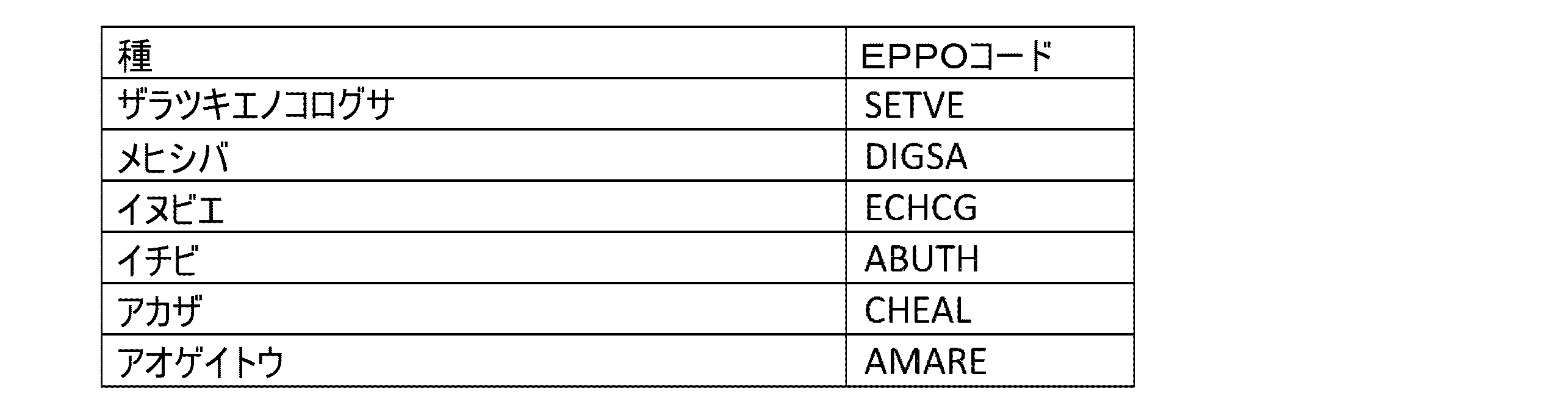
Table 1: Examples of weeds
このように、近年、農業は1つの複雑な課題に直面している。入手可能な資源の最適化を確保して食糧収量を最適化し、環境への影響を最小化する必要性である。雑草の制御を例に挙げると、農業従事者は通常、異なる雑草には、他とは異なる密度、成長速度および成長段階があるという事実を無視して、表面あたり同量の除草剤を散布する。しかしながら、生物学的な研究によると、異なるタイプおよび比率の除草剤を使用することで、製品の有効性を最適化し、より良い作物生育が実現され、環境に対する化学物質の堆積を減少させることがわかっている。早期の雑草の識別は、植物衛生製品の使用にあたり、最適化と性能向上を可能にし、集中的な除草剤の使用を少なくすることおよびより特定された除草剤の使用へと導く。 Thus, in recent years, agriculture faces a complex challenge: the need to ensure the optimization of available resources to optimize food yields and minimize environmental impact. Take weed control for example: farmers usually apply the same amount of herbicide per surface, ignoring the fact that different weeds have different densities, growth rates and growth stages. However, biological studies have shown that using different types and rates of herbicides can optimize the effectiveness of the products, resulting in better crop growth and reducing chemical deposition in the environment. Early weed identification allows optimization and performance improvement in the use of plant health products, leading to less intensive and more specific herbicides.
新たな技術によって、雑草が存在する領域のみに正確な量の除草剤を散布することが記載されている、場所特有の雑草管理(Site Specific Weed Management)(SSWM)(L.ティエン(L.Tian)、J.F.リード(J.F.Reid)およびJ.W.ヒュンメル(J.W.Hummel)、「場所特有の雑草管理のための精密噴霧器の開発(Development of a precision sprayer for site-specific weed management)」、ASAEのトランザクション、42巻、第4号、893ページ、1999年、参照)がもたらされた。SSWMは、最適に噴霧することにより除草剤の使用を大幅に減少させる。SSWMを適用する際の2つの重大なタスクとしては、雑草と作物との正確な区別および適切な雑草の定量化と段階分けとを実現させることである。その問題に取り組む従来の方法は、画像上で植物を手作業でセグメント化することだが、これには非常に多くの時間がかかる。 New technology has led to Site Specific Weed Management (SSWM) (see L. Tian, J.F. Reid and J.W. Hummel, "Development of a precision sprayer for site-specific weed management", Transactions of the ASAE, Vol. 42, No. 4, p. 893, 1999), which describes the application of precise amounts of herbicide only to areas where weeds are present. SSWM significantly reduces herbicide use by optimizing spraying. Two critical tasks in applying SSWM are to achieve accurate differentiation between weeds and crops and proper weed quantification and staging. The traditional way to address the problem is to manually segment the plants in the image, which is very time-consuming.
さらに近年では、畳み込みニューラルネットワーク(CNN)に基づく機械学習技術が導入されている。CNNは農業において多くの用途があるが、雑草の定量化はまだ満足のいくレベルで解決されていない。トレーニング済み標準化CNNに基づいて圃場における雑草識別のためのセマンティック・セグメンテーションは、ドメインの違いにより、植物画像データセットには十分に機能しない。セマンティック・セグメンテーションとは、画像を画素レベルで理解すること、すなわち、画像内の各画素にオブジェクトクラスを割り当てることを意味する。加えて、視覚的な差がほとんど全くない植物をセグメント化する本質的な複雑さによって、農業従事者が十分な正確性をもって雑草識別の問題を解決するために標準化CNNトポロジーをうまく適用することが阻止されている。 More recently, machine learning techniques based on convolutional neural networks (CNNs) have been introduced. Although CNNs have many applications in agriculture, weed quantification has not yet been solved at a satisfactory level. Semantic segmentation for weed identification in fields based on trained standardized CNNs does not work well for plant image datasets due to domain differences. Semantic segmentation means understanding an image at pixel level, i.e., assigning an object class to each pixel in an image. In addition, the inherent complexity of segmenting plants with almost no visual differences prevents farmers from successfully applying standardized CNN topologies to solve the weed identification problem with sufficient accuracy.
モーテンセン(Mortensen)他は、深層学習を使用して作物および雑草のセマンティック・セグメンテーションに対する研究(A.K.モーテンセン(A.K.Mortensen)、M.ディルマン(M.Dyrmann)、H.カーストフト(H.Karstoft)、R.N.ヨルゲンセン(R.N.Jorgensen)、R.ギスラム(R.Gislum)他、「深層畳み込みニューラルネットワークを使用した混合作物のセマンティック・セグメンテーション(Semantic segmentation of mixed crops using deep convolutional neural network)」、CIGR-AgEng会議、2016年6月26~29日、オーフス、デンマーク。要約および原著論文、1~6ページ、組織委員会、CIGR2016、2016年、参照)を提示し、ここで彼らは異なる作物種のセマンティック・セグメンテーションにおいて79%の画素精度を得た。後に、彼らは、94%のすばらしい画素精度で、実際のケースにおいて画素に正しく「トウモロコシ」または「雑草」とラベル付けしてトウモロコシ作物を23の異なる雑草種から区別できた(M.ディルマン(M.Dyrmann)、A.K.モーテンセン(A.K.Mortensen)、H.S.ミッディビー(H.S.Midtiby)、R.N.ヨルゲンセン(R.N.Jorgensen)他、「完全畳み込みニューラルネットワーク使用による画像での雑草と作物との画素単位の分類(Pixel-wise classification of weeds and crops in images by using a fully convolutional neural network)」、農業工学に関する国際会議のトランザクション、オーフス、デンマーク、26~29ページ、2016年)。他の著者は、より良好なセグメンテーションにつながり得る新たなアーキテクチャおよび方法を見つけるべく、深層CNNを使用した作物と雑草とのセマンティック・セグメンテーションを研究した。2018年に、サ(Sa)他(I.サ(I.Sa)、Z.チェン(Z.Chen)、M.ポポビッチ(M.Popovic)、R.カンナー(R.Khanna)、F.リービッシュ(F.Liebisch)、J.ニエト(J.Nieto)およびR.ジークヴァルト(R.Siegwart)、「ウィードネット:多重スペクトル画像を使用した高密度なセマンティック雑草分類およびスマート農業のための超小型無人飛行機(weednet: Dense semantic weed classification using multispectral images and mav for smart farming)」、IEEEロボティクスおよびオートメーションレターズ(IEEE Robotics and Automation Letters)、3巻、第1号、588~595ページ、2018年、参照)は、ウィードネットと呼ばれる彼らの改良型VGG-16で作物と雑草とをセグメント化することにおいて80%のF1スコアを得て、ミリオト他(A.ミリオト(A.Milioto)、P.ロッテス(P.Lottes)およびC.スタックニス(C.Stachniss)、「cnnにおける背景知識を活用した精密農業ロボットのための作物および雑草のリアルタイムセマンティック・セグメンテーション(real-time semantic segmentation of crop and weed for precision agriculture robots leveraging background knowledge in cnn)」、2018年ロボティクスおよびオートメーションに関するIEEE国際会議(ICRA)(2018 IEEE International Conference on Robotics and Automation)、2229~2235ページ、IEEE、2018年、参照)は、作物、雑草および土壌の画素単位の分類で80.8%のmIoUを達成した。このような先行技術研究は、作物に注目し、全ての雑草種を(分類の観点から)単一のクラスとして捉えている。このような先行技術の方法で得られた画素精度は、フィールドを保護する活動を最適化しようとする農業従事者を十分にサポートするにはまだ満足のいくレベルではない。 Mortensen et al. conducted a study on semantic segmentation of crops and weeds using deep learning (A.K. Mortensen, M. Dyrmann, H. Karstoft, R.N. Jorgensen, R. Ghislum et al., "Semantic segmentation of mixed crops using deep convolutional neural networks"). network), CIGR-AgEng Conference, 26-29 June 2016, Aarhus, Denmark. Abstract and Original Paper, pages 1-6, Organizing Committee, CIGR2016, 2016, see, where they obtained a pixel accuracy of 79% for semantic segmentation of different crop species. Later, they were able to distinguish corn crops from 23 different weed species, correctly labeling pixels as "corn" or "weed" in real cases with an impressive pixel accuracy of 94% (M. Dyrmann, A. K. Mortensen, H. S. Midtiby, R. N. Jorgensen et al., "Pixel-wise classification of weeds and crops in images by using a fully convolutional neural network," in Proc. Natl. Clin. Soc., 2011, pp. 1171-1185, 2011). (2016), Transactions of the International Conference on Agricultural Engineering, Aarhus, Denmark, pp. 26-29. Other authors have studied semantic segmentation of crops and weeds using deep CNNs to find new architectures and methods that may lead to better segmentation. In 2018, I. Sa et al. (I. Sa, Z. Chen, M. Popovic, R. Khanna, F. Liebisch, J. Nieto and R. Siegwart), "Weednet: Dense semantic weed classification using multispectral images and miniature unmanned aerial vehicles for smart farming," IEEE Robotics and Automation Letters. (A. Milioto, P. Lottes, and C. Stachniss, "Real-time semantic segmentation of crop and weed for precision agriculture robots leveraging background knowledge in CNN," Journal of Computer Aided Real-Time Agriculture (2018), Vol. 3, No. 1, pp. 588-595, 2018, see) obtained an F1 score of 80% in segmenting crops and weeds with their improved VGG-16, called WeedNet, and Milioto et al. (A. Milioto, P. Lottes, and C. Stachniss, "Real-time semantic segmentation of crop and weed for precision agriculture robots leveraging background knowledge in CNN," Journal of Computer Aided Real-Time Agriculture (2018), Vol. 3, No. 1, pp. 588-595, 2018, see) obtained an F1 score of 80% in segmenting crops and weeds with their improved VGG-16, called WeedNet, and "knowledge in cnn," 2018 IEEE International Conference on Robotics and Automation (ICRA), pp. 2229-2235, IEEE, 2018, achieved a mIoU of 80.8% for pixel-by-pixel classification of crops, weeds, and soil. Such prior art work focuses on crops and considers all weed species as a single class (from a classification perspective). The pixel accuracy achieved by such prior art methods is still not satisfactory to fully support farmers in optimizing their field protection activities.
そのため、植物種の識別のために改善した画像解析機能を持つシステムおよび方法を提供する必要がある。その結果、本明細書中で使用される植物種識別は、特定の植物種、例えば圃場で作物と競合する雑草種に属する植物の体積定量化の問題に関する。すなわち、植物種識別ステップの結果は、圃場にどの植物種が存在するかおよび特定の種の植物が正確にどこで見つかるのかに関する情報である。さらに、例えば、植物の茎、葉、果実等の各植物の異なる部分の存在および体積に関する付加情報を得ることに関心がある。例えば、特定の植物種の植物要素(例えば、果実)に関してより高い粒度を持つこのような情報は、特定の予想される種子の数のおかげで、圃場によって提供される潜在的な収穫量に関してまたは特定の雑草が急速に広がり得るリスクに関してさえも役立つ情報を提供できる。 There is therefore a need to provide systems and methods with improved image analysis capabilities for plant species identification. As a result, plant species identification as used herein relates to the problem of volumetric quantification of plants belonging to a particular plant species, e.g. a weed species competing with a crop in a field. That is to say, the result of the plant species identification step is information about which plant species are present in the field and where exactly plants of a particular species are found. Furthermore, it is of interest to obtain additional information about the presence and volume of different parts of each plant, e.g. the plant's stems, leaves, fruits, etc. Such information with a higher granularity, e.g. regarding plant elements (e.g. fruits) of a particular plant species, can provide useful information regarding the potential yield offered by a field, thanks to a certain expected number of seeds, or even regarding the risk that a particular weed may spread rapidly.
雑草体積の定量化の問題は、CNNトポロジーを使用したセマンティック・セグメンテーション技術の適用により解決され、その結果、例えば、標準PSPNet等の公知のセグメンテーションアプローチによって達成できるものよりも高い画素精度を雑草のセグメンテーションにおいて得られる。 The problem of weed volume quantification is solved by applying a semantic segmentation technique using a CNN topology, resulting in higher pixel accuracy in weed segmentation than can be achieved by known segmentation approaches such as the standard PSPNet.
本発明の実施形態は、作物畑における植物種を識別するためのコンピュータに実装される方法と、コンピュータシステムのメモリに記憶され、コンピュータシステムの1以上のプロセッサによって実行される場合に、1以上のプロセッサに方法を実行させるコンピュータ可読命令を有するコンピュータプログラム製品とを備える。さらなる実施形態は、コンピュータに実装される方法を実行するように構成されているコンピュータシステムに関する(例えば、前述のコンピュータプログラム製品の実行時)。 Embodiments of the present invention comprise a computer-implemented method for identifying plant species in a crop field, and a computer program product having computer-readable instructions stored in a memory of a computer system and that, when executed by one or more processors of the computer system, cause the one or more processors to perform the method. Further embodiments relate to a computer system configured to perform the computer-implemented method (e.g., upon execution of the aforementioned computer program product).
作物畑における植物種を識別するためのコンピュータに実装される方法は、本明細書で二重タスクCNNと呼ばれる特定の畳み込みニューラルネットワークを使用する。二重タスクCNNは、2つの異なるタスクを行うように構成されているトポロジーを有する。各タスクはその関連する損失関数に関連付けられており、二重タスクCNN全体は、2つの(異なる)損失関数を考慮してトレーニングされる。このアプローチでは、第1タスク(中間モジュールによって行われる分類タスク)が第2タスク(二重タスクCNNのセマンティック・セグメンテーション・モジュールによって行われるセグメンテーションタスク)をガイドして、植物種のセグメンテーション結果の全体的な精度の向上に導く。セマンティック・セグメンテーション・モジュールは、本明細書において「セグメンテーション・モジュール」とも呼ばれる。 A computer-implemented method for identifying plant species in a crop field uses a particular convolutional neural network, referred to herein as a dual-task CNN. The dual-task CNN has a topology that is configured to perform two different tasks. Each task is associated with its associated loss function, and the entire dual-task CNN is trained considering the two (different) loss functions. In this approach, the first task (the classification task performed by the intermediate module) guides the second task (the segmentation task performed by the semantic segmentation module of the dual-task CNN) leading to an improvement in the overall accuracy of the plant species segmentation results. The semantic segmentation module is also referred to herein as the "segmentation module."
二重タスクCNNの中間モジュールは、テスト入力画像上に存在する植物種を判定するにあたって第1タスクを実行する。その結果、第1タスクは第1損失関数に関連付けられる。植物種の判定は、分類タスクに対応する。従って、中間モジュールは、分類ニューラルネットワークまたは回帰型ニューラルネットワーク(例えば、RESNET50畳み込みニューラルネットワーク等のRESNET*バックボーンを使用する残差ネットワークに基づくもの)によって実装できる。分類ニューラルネットワーク(すなわち、分類タスクを行うように構成されているニューラルネットワーク)を使用する場合、出力は、例えば、作物や雑草植物を表す特定の画像にどの植物種が存在するのかに関する情報である。加えて、回帰型ニューラルネットワークを使用する場合、存在する植物種の比率に関する情報が提供される。両方のCNNタイプとも、作物と雑草植物を有するテスト入力画像に存在している植物種に関する情報を提供する。 The intermediate module of the dual-task CNN performs a first task in determining the plant species present on the test input image. As a result, the first task is associated with a first loss function. The determination of the plant species corresponds to a classification task. The intermediate module can therefore be implemented by a classification neural network or a recurrent neural network (e.g., based on a residual network using a RESNET* backbone, such as the RESNET50 convolutional neural network). When using a classification neural network (i.e., a neural network configured to perform a classification task), the output is information about which plant species are present in a particular image, e.g., representing crop and weed plants. In addition, when using a recurrent neural network, information about the proportion of plant species present is provided. Both CNN types provide information about the plant species present in a test input image having crop and weed plants.
分類ニューラルネットワークが中間モジュールとして使用される場合、第1損失関数は、有利には、属するクラスに応じて各サンプル(画素)が重み付けされる「重み付けバイナリ交差エントロピー」である。中間モジュールは、複数のクラスの存在を同時にサポートするために、最後の活性化層として「シグモイド」を使用する。例えば、テスト入力画像の分析されたセクション(すなわち、画像のタイル)には、トウモロコシ植物、異なる雑草種の雑草植物および土壌に属する画素が同時に含まれていてもよい。シグモイド活性化層は、テキスト入力画像上のさまざまなクラスの存在に関する予測を立てる際に、このような複数のクラスを同時に処理できる。 When a classification neural network is used as the intermediate module, the first loss function is advantageously "weighted binary cross entropy", where each sample (pixel) is weighted according to the class it belongs to. The intermediate module uses a "sigmoid" as the last activation layer to support the presence of multiple classes simultaneously. For example, an analyzed section of a test input image (i.e. a tile of the image) may simultaneously contain pixels belonging to corn plants, weed plants of different weed species and soil. The sigmoid activation layer can handle such multiple classes simultaneously when making predictions about the presence of various classes on a text input image.
バイナリ交差エントロピーおよびカテゴリ交差エントロピーは、この分野の専門家には既知である。以下の重み付けカテゴリ交差エントロピーは、カテゴリ交差エントロピーと同様だが、重み付けwcが追加されている。


中間モジュールが回帰型ニューラルネットワークによって実装される場合、第1損失関数は、有利には「平均二乗誤差」または「平均誤差」である。中間モジュールは、複数のクラスの存在を同時にサポートするために、最後の活性化層として「線形」または「シグモイド」を使用してもよい。 If the intermediate module is implemented by a recurrent neural network, the first loss function is advantageously the "mean squared error" or "average error". The intermediate module may use a "linear" or "sigmoid" as the last activation layer to simultaneously support the presence of multiple classes.
二重タスクCNNのセグメンテーション・モジュールは、テスト入力画像をセグメント化するにあたって第2タスクを行い、テスト入力画像の画素毎にクラスを判定する。クラスは、判定された植物種を含む。第2タスクは、第1損失関数とは異なる第2損失関数に関連付けられている。有利には、第2損失関数は「重み付けカテゴリ交差エントロピー」である。例えば、セグメンテーション・モジュールは、(例えば、PSPNet、DeepLabまたは区分的トポロジーに基づく)ピラミッドプーリングモジュールによって実装されてもよい。 The segmentation module of the dual-task CNN performs a second task in segmenting the test input image and determining a class for each pixel of the test input image. The class comprises the determined plant species. The second task is associated with a second loss function different from the first loss function. Advantageously, the second loss function is "weighted categorical cross entropy". For example, the segmentation module may be implemented by a pyramid pooling module (e.g., based on PSPNet, DeepLab or piecewise topology).
言い換えれば、二重タスクCNNによって行われる各タスクは、それ自体の損失関数に基づいて最適化される。しかしながら、中間モジュールおよびセグメンテーション・モジュールは、第1および第2損失関数を考慮して一緒にトレーニングされている。2つの異なる損失関数を有する2つのモジュールのこの共同トレーニングは、中間モジュールのトレーニングがセグメンテーション・モジュールのトレーニングによって影響され、またその逆も起こり、最終的なセグメンテーション結果の画素精度の向上に導く影響を持っている。セマンティック・セグメンテーションのための伝統的なPSPNetのトレーニング(H.ザオ(H.Zhao)、J.シー(J.Shi)、X.チー(X.Qi)、X.ワン(X.Wang)およびJ.ジア(J.Jia)、「ピラミッドシーン解析ネットワーク(Pyramid scene parsing network)」、コンピュータビジョンおよびパターン認識に関するIEEE会議のトランザクション(Proceedings of the IEEE conference on computer vision and pattern recognition)、2881~2890ページ、2017年、参照)は、中間セグメンテーション損失を使用した監視によって初期結果を生成し、第2ステップがその後の残差を最終的な損失とともに学習する2段階のトレーニングステップに依存する。このように、深層学習ニューラルネットワークの最適化は、解決がより単純である各最適化タスクを有する2つの最適化タスクに分解される。しかしながら、このアプローチは良い結果をもたらし得るが、第1(中間)損失からの学習は、第2(最終的)損失のあるネットワークでトレーニングしている間に消える。伝統的なPSPNetをセマティック・セグメンテーションに使用すると実現できる利点があるにもかかわらず、分析された画像の画素の数パーセントにしか存在しないクラスを抽出する能力が欠落している。この問題は、(セグメンテーション・モジュールによって行われる)セグメンテーションタスクと同時にトレーニングされている(中間モジュールによって行われる)第2分類または回帰タスクを追加することで、伝統的なセグメンテーション・モジュール(例えば、PSPNet)の開示された拡張によって解決される。このことは、2つの損失関数による同時の学習プロセスにガイドを提供する。 In other words, each task performed by the dual-task CNN is optimized based on its own loss function. However, the intermediate module and the segmentation module are trained together considering the first and second loss functions. This joint training of two modules with two different loss functions has the effect that the training of the intermediate module is influenced by the training of the segmentation module and vice versa, leading to an improvement in the pixel accuracy of the final segmentation result. Training a traditional PSPNet for semantic segmentation (see H. Zhao, J. Shi, X. Qi, X. Wang, and J. Jia, “Pyramid scene parsing network,” Proceedings of the IEEE conference on computer vision and pattern recognition, pp. 2881-2890, 2017) relies on a two-stage training step in which an initial result is generated by supervision using an intermediate segmentation loss, and a second step learns the subsequent residuals together with the final loss. In this way, the optimization of deep learning neural networks is decomposed into two optimization tasks, with each optimization task being simpler to solve. However, while this approach can produce good results, the learning from the first (intermediate) loss disappears while training the network with the second (final) loss. Despite the advantages that can be realized when using traditional PSPNet for semantic segmentation, it lacks the ability to extract classes that are present in only a few percent of the pixels of the analyzed image. This problem is solved by the disclosed extension of traditional segmentation modules (e.g., PSPNet) by adding a second classification or regression task (performed by the intermediate module) that is trained simultaneously with the segmentation task (performed by the segmentation module). This provides a guide to the simultaneous learning process with two loss functions.
ニューラルネットワークが、トレーニング戦略として任意の時点でアクティブである単一の損失関数で順次トレーニングされる2つの異なる問題に分割される伝統的なPSPNetアプローチとは対照的に、本明細書に開示されるアプローチでは、両方のタスク(分類およびセグメンテーションタスク)は、両方のタスクの各損失関数の単純な重み付け加算によって同じ時に(すなわち同時に)トレーニングされている。 In contrast to the traditional PSPNet approach, where the neural network is split into two different problems that are trained sequentially with a single loss function that is active at any given time as a training strategy, in the approach disclosed herein, both tasks (classification and segmentation tasks) are trained at the same time (i.e., simultaneously) by a simple weighted addition of the respective loss functions of both tasks.
本明細書で開示される二重タスクCNNトポロジーは、伝統的なセマンティック・セグメンテーション・ネットワークを実際の二重タスクネットワークに拡張し、ここではネットワークの重みは2つの損失関数に対して同時に最適化され、このようにして分類損失がセグメンテーション損失をガイドする。損失関数は、各サンプル(画素)が重みと関連付けられる重み付け交差エントロピー関数であってもよい。以下においては、二重タスクCNNのトレーニングデータセットが説明され、これは、1つのデータサブセットに手動でアノテーションされた画像が含まれ、さらなるデータサブセットに自動的にアノテーションされた画像が含まれる異なるデータサブセットを組み合わせる。サンプルの重みは、対象が属するデータサブセットに関連付けられることができる。自動的にアノテーションされた画像を含むデータサブセットからのサンプルは、手動でアノテーションされたデータセットからのサンプルよりも高い重みを有していてもよい。典型的に、手動でアノテーションされたデータサブセットは、人間が「その他」または「不明」と分類した画素を含む。実際の画像へのドメイン適応を可能にするための残りの少しの重みを有しつつ、このような画素が二重タスクCNNのトレーニングに対して与える影響を減らすため、このようなピクセルに対して、(例えば、10から1000の範囲内の数の分だけ)重みが減らせてもよい。その結果、重みの減少はどのようにしても負の数になることはできない。 The dual-task CNN topology disclosed herein extends traditional semantic segmentation networks to real dual-task networks, where the network weights are simultaneously optimized for two loss functions, in this way the classification loss guides the segmentation loss. The loss function may be a weighted cross-entropy function, where each sample (pixel) is associated with a weight. In the following, a training dataset for the dual-task CNN is described, which combines different data subsets, where one data subset contains manually annotated images and a further data subset contains automatically annotated images. The weight of a sample can be associated with the data subset to which the subject belongs. Samples from the data subset containing automatically annotated images may have a higher weight than samples from the manually annotated dataset. Typically, the manually annotated data subset contains pixels classified by humans as "other" or "unknown". Such pixels may have their weights reduced (e.g., by a number in the range of 10 to 1000) to reduce their impact on the training of the dual-task CNN while still having a small amount of weight remaining to allow domain adaptation to real images. As a result, the weight reduction cannot be negative in any way.
有利には、二重タスクCNNモジュールは、手動でアノテーションされたトレーニング画像を含む1つのサブセットと自動でアノテーションされたトレーニング画像とを含むもう一方のサブセットとの2つのトレーニングデータサブセットの組み合わせを含む画像トレーニングデータセットに基づいて共同でトレーニングされる。 Advantageously, the dual-task CNN module is jointly trained on an image training dataset comprising a combination of two training data subsets, one subset comprising manually annotated training images and the other subset comprising automatically annotated training images.
例えば、第1データサブセットは、特定の作物種の作物植物および1以上の雑草種の雑草植物がある圃場内の実際の状況を表す画像を含んでもよく、ここでは雑草植物は作物植物の間に広がっている。第1データサブセットは、トレーニング画像の画素が属する植物種を示す手動画素アノテーションを有する。典型的に、人間のユーザは第1データセットの画像のそれぞれを見て、画像の特定のサブセクションを特定のクラス(例えば、作物種、雑草、種、土壌)に属すとしてマークする。一実装例では、手動画素アノテーションは、特定の植物種の植物の画素が各植物種としてアノテーションされるのみならず、階層的な方法で特定の植物種も茎、葉、果実等のさまざまな植物要素のアノテーションのためのサブクラスも有していてもよいという点でより高いレベルの粒度であってもよい。すなわち、アノテーションは、トウモロコシ1、トウモロコシ1:葉、トウモロコシ1:果実、雑草1、雑草1:葉、雑草1:果実等のタグを使用して行うことができる。多くの場合、ユーザは単純に画像上で長方形(またはフリーフォーム形状を含む他の形状)を指定して、指定領域に対するアノテーションを入力するだけであるため、このようなアノテーションは画素レベルではかなり不正確である。トレーニング画像におけるクラスの自然な分布を考慮すると、このような手動のアノテーションは大まかな近似にすぎないことが明確である。 For example, the first data subset may include images representing an actual situation in a field with crop plants of a particular crop species and weed plants of one or more weed species, where the weed plants are spread among the crop plants. The first data subset has manual pixel annotations indicating the plant species to which pixels of the training images belong. Typically, a human user looks at each of the images of the first data set and marks certain subsections of the image as belonging to a particular class (e.g., crop species, weeds, seeds, soil). In one implementation, the manual pixel annotation may be at a higher level of granularity in that not only are the pixels of plants of a particular plant species annotated as each plant species, but in a hierarchical manner, the particular plant species may also have subclasses for annotation of various plant elements such as stems, leaves, fruits, etc. That is, annotation may be done using tags such as corn1, corn1:leaf, corn1:fruit, weed1, weed1:leaf, weed1:fruit, etc. In many cases, such annotations are quite inaccurate at the pixel level because users simply draw rectangles (or other shapes, including freeform shapes) on the image to input annotations for the designated regions. Given the natural distribution of classes in training images, it is clear that such manual annotations are only rough approximations.
この目的のために、第1データサブセットは、画素レベルで正しい自動生成されたアノテーションを有するトレーニング画像を含む第2サブセットによって補完(強化)される。自動的にアノテーションされたトレーニング画像を得ることは、異なる方法で実現されてもよい。 For this purpose, the first data subset is complemented (enhanced) by a second subset containing training images with pixel-level correct automatically generated annotations. Obtaining automatically annotated training images may be realized in different ways.
例えば、第2データサブセットは、元は単一の植物画像から得られた異なる植物種の複数の植物を表す画像を含んでもよい。その結果、各単一植物画像は、特定の種の単一植物を表す。その後、単一植物画像からそれぞれの単一植物に属する画像部分を抽出し、抽出された画像部分を土壌の背景画像に貼り付けることによって、テスト画像が合成できる。その結果、多数の単一の植物画像が様々な植物種に関連付けられてもよい。しかしながら、単一の植物画像毎に(抽出されたセクションの各画素がそれぞれの種の植物の部分を表すことがわかっているため)それぞれの種がわかっており、後に土壌の背景画像に貼り付けられる抽出された画像部分が画素レベルで各アノテーションに関連付けられる。従って、第2データサブセットの画素は、元の単一植物画像から知られている、それらが属するクラス(種)で自動的にアノテーションされている。 For example, the second data subset may include images representing multiple plants of different plant species originally derived from a single plant image. Each single plant image then represents a single plant of a particular species. A test image can then be synthesized by extracting image parts belonging to each single plant from the single plant images and pasting the extracted image parts onto a soil background image. As a result, a large number of single plant images may be associated with different plant species. However, for each single plant image, the respective species is known (as it is known that each pixel of the extracted section represents a part of a plant of the respective species) and the extracted image parts that are later pasted onto the soil background image are associated with each annotation at pixel level. Thus, the pixels of the second data subset have been automatically annotated with the class (species) to which they belong, known from the original single plant images.
例えば、自動生成されたアノテーションを有する他のデータサブセットは、単一の(雑草)種の複数の(雑草)植物を表す(典型的に、1つの画像に同じ植物種の異なる成長段階も表す)実際の状況画像を含む第3データサブセットであることができる。第3データサブセットは、単一種の植物のみを含むので、画素は、各植物種に対応する対応クラスアノテーションで簡単に自動的にアノテーションできる。例えば、周知の葉のセグメンテーションアルゴリズムを使用して、元の実際の単一種画像の画像からすべての画素を抽出し、対応するクラス情報でそれらにアノテーションすることができる。 For example, the other data subset with automatically generated annotations can be a third data subset containing real situation images representing multiple (weed) plants of a single (weed) species (typically also representing different growth stages of the same plant species in one image). Since the third data subset contains only single species of plants, the pixels can be easily automatically annotated with the corresponding class annotations corresponding to each plant species. For example, well-known leaf segmentation algorithms can be used to extract all pixels from the original real single species image and annotate them with the corresponding class information.
その後、トレーニングされた二重タスクCNNは、下記の方法でテスト入力画像に適用される。テスト入力は、二重タスクCNNを実行しているコンピュータシステムによって受信される。テスト入力には、異なる種に属する植物を表す画像が含まれる。例えば、画像は、圃場における特定の作物種の作物植物および前述の作物植物の中にある(すなわち、作物植物の間に広がっている)1以上の雑草種の雑草植物を表してもよい。 The trained dual-task CNN is then applied to test input images in the following manner: The test input is received by a computer system running the dual-task CNN. The test input includes images representing plants belonging to different species. For example, the images may represent crop plants of a particular crop species in a field and weed plants of one or more weed species that are among (i.e., spread among) the crop plants.
コンピュータシステムは、中間モジュールの入力の形状の次元を有するテスト入力画像からタイルを抽出する画像タイル抽出部を有する。典型的に、テスト入力画像は高解像度のものであることが期待される。二重タスクCNNも同様の解像度の画像でトレーニングされていると想定される。例えば、解像度が1024x1024から10,000x10,000画素以上の画像は、高解像画像と考えられる。しかしながら、中間モジュールの入力の形状(第1層)の次元はより低くなる(例えば、一般的なRESNET50ベースの分類ニューラルネットワークの入力の形状は(473,473,3)となることができる)。従って、画像タイル抽出部は、テスト入力画像を中間モジュールの入力の形状に合う画像タイルに分割する。 The computer system has an image tile extractor that extracts tiles from a test input image that has dimensions of the shape of the intermediate module's input. Typically, the test input image is expected to be of high resolution. It is assumed that the dual-task CNN is also trained on images with similar resolution. For example, images with a resolution of 1024x1024 to 10,000x10,000 pixels or more are considered high-resolution images. However, the shape of the intermediate module's input (first layer) will be lower in dimension (e.g., the shape of the input of a typical RESNET50-based classification neural network can be (473, 473, 3)). Thus, the image tile extractor divides the test input image into image tiles that fit the shape of the intermediate module's input.
下記においては、抽出されたタイルのそれぞれが別々に処理され、セグメンテーションタスクの最後に、セグメント化されたタイルが全体的なセグメント化された画像に再構築される。抽出されたタイル毎に、中間モジュールは、各タイルに存在する1以上の植物種の存在を予測する。セグメンテーション・モジュールへのこの第1(分類)タスクの出力は、中間モジュールにより分類された全ての特性を有する中間特性マップである。 In what follows, each of the extracted tiles is processed separately and at the end of the segmentation task, the segmented tiles are reconstructed into a global segmented image. For each extracted tile, the intermediate module predicts the presence of one or more plant species present in each tile. The output of this first (classification) task to the segmentation module is an intermediate feature map with all the features classified by the intermediate module.
セグメンテーション・モジュールは、マスク画像を生成するにあたって中間特性マップを使用し、ここで、マスク上の各画素は、関連するクラスに属する前述の画素の確率を表す「0~1」の値(すなわち、[0、1]間隔内の値)に関連付けられている。これは、中間特性マップからマルチスケール特徴とコンテキスト情報を抽出し、抽出された情報を連結してセマンティック・セグメンテーションを行うことで実現される。 The segmentation module uses the intermediate feature maps to generate a mask image, where each pixel on the mask is associated with a value between 0 and 1 (i.e., a value in the [0,1] interval) that represents the probability of said pixel belonging to the associated class. This is achieved by extracting multi-scale features and contextual information from the intermediate feature maps and concatenating the extracted information to perform semantic segmentation.
最後に、生成されたマスク(各タイルのマスク)が最終的な画像へと組み合わされる。最終的に再構成された画像は、画素毎にそれが特定の植物種に属しているかどうか、そして、属している場合はどの種に属しているかを示す付加情報を有する、元のテスト入力画像に対応する。例えば、色分けが使用されてもよく、その場合、各植物種に固有の色が割り当てられ、最終画像における画素の画素色が割り当てられた色で調整される。 Finally, the generated masks (for each tile) are combined into a final image. The final reconstructed image corresponds to the original test input image with additional information for each pixel indicating whether it belongs to a particular plant species and, if so, which species it belongs to. For example, color coding may be used, where each plant species is assigned a unique color and the pixel color of the pixel in the final image is adjusted with the assigned color.
セグメンテーション・モジュールが、セマンティック・セグメンテーションを実行するためのピラミッドプーリングモジュールによって実装される場合、典型的に、中間モジュールによって提供される中間特性マップをスキャンし、異なるスケールとサイズの情報を統合するマルチスケール特性検出のための4つの配列を作成する、異なる受容野を有する4つの分離したフィルタを含む。 When the segmentation module is implemented by a pyramid pooling module for performing semantic segmentation, it typically includes four separate filters with different receptive fields that scan the intermediate feature map provided by the intermediate module and create four arrays for multi-scale feature detection that integrate information of different scales and sizes.
さらに、ピラミッドプーリングモジュールは、典型的に、バイリニア補間法を使用して各配列の画像サイズを中間特性マップのサイズへと復元するように構成されている複数のアップサンプリング層を含む。さらに、ピラミッドプーリングモジュールの畳み込み層は、4つの分離されたフィルタからコンテキスト情報を抽出し、コンテキスト情報を異なるスケールとサイズの情報と連結して、中間特性マップと同じサイズの最終特性マップを生成する。さらに、ピラミッドプーリングモジュールは、典型的に、全結合層を含み、最後の活性化層「softmax」を有する生成されたマスクとして最終的な画素単位の予測を計算する。「softmax」アクティベーション関数は、ロジットとして知られている数を合計が1になる確率へと変更するので、有利である。ロジットは、アクティベーションが行われる前にニューラルネットワークの最後の層によって出力される素点である。一般的に、「softmax」関数は、潜在的な結果のリストの確率分布を表すベクトルを出力する。植物種のセグメンテーションの問題に適用すると、各画素がちょうど1つのクラスにしか属せないという点で、画素は相互に排他的である(例えば、画素は土壌または特定の種の植物のいずれかであるが、同時に両方であることはできない)。従って、「softmax」は、画素毎に特定のクラス(例えば、植物種または土壌)に属する確率を予測する。 Furthermore, the pyramid pooling module typically includes multiple upsampling layers configured to restore the image size of each array to the size of the intermediate feature map using bilinear interpolation. Furthermore, the convolutional layer of the pyramid pooling module extracts context information from the four separated filters and concatenates the context information with the different scale and size information to generate a final feature map of the same size as the intermediate feature map. Furthermore, the pyramid pooling module typically includes a fully connected layer to calculate the final pixel-wise prediction as the generated mask with a final activation layer "softmax". The "softmax" activation function is advantageous because it changes a number known as a logit into a probability that sums to 1. Logits are the raw scores output by the last layer of the neural network before activation is performed. In general, the "softmax" function outputs a vector that represents a probability distribution of a list of potential outcomes. When applied to the problem of plant species segmentation, pixels are mutually exclusive in that each pixel can belong to exactly one class (e.g., a pixel is either soil or a particular species of plant, but not both at the same time). Therefore, "softmax" predicts for each pixel the probability that it belongs to a particular class (e.g., plant species or soil).
本発明のさらなる態様は、添付の特許請求の範囲に具体的に示されている要素および組み合わせによって実現および達成されるであろう。前述の一般的な説明および下記の発明を実施するための形態はいずれも、例示的かつ説明的なものにすぎず、説明通りに本発明を限定するものではないということを理解されたい。 Further aspects of the invention will be realized and attained by the elements and combinations particularly pointed out in the appended claims. It is to be understood that both the foregoing general description and the following detailed description are exemplary and explanatory only and are not intended to limit the invention as set forth.
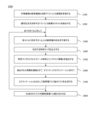
図1は、一実施形態による二重タスク畳み込みニューラルネットワーク120を使用して農地で植物種(例えば、作物または雑草種)を識別するためのコンピュータシステム100の構成図を含む。図2は、一実施形態による農地で植物種を識別するためのコンピュータに実装される方法1000の概略フローチャートである。方法1000は、コンピュータシステム100によって実行されてもよい。以下の詳細な説明では、図2の方法1000は、図1のシステム100と関連して開示される。従って、説明は両方の図面で使用される参照番号を参照する。さらに、図3は、一実施形態による二重タスク畳み込みニューラルネットワーク122のトポロジー例を示す。そのため、コンピュータシステム100のコンポーネントまたはモジュールに関して実施形態例が考察されている場合、説明は図1の説明と関連して図3の参照番号も参照する。
1 includes a block diagram of a computer system 100 for identifying plant species (e.g., crop or weed species) in an agricultural field using a dual-task convolutional
コンピュータシステム100の目的は、圃場(耕地または温室)のセクション1における作物植物の間に生える植物の種および位置を識別するために農業従事者をサポートすることである。このようなセクションは、文献上で区画と呼ばれることもある。図面では、異なる植物種を区別するために異なる物体形状が使用されている。例においては、三角形はフィールドで栽培されている特定の種の作物植物を表すために使用されている。他の全ての形状は、異なる雑草種の雑草植物を表している。点で描かれた背景は、セクション1の土壌部分(すなわち、植物によって隠されていない地面の部分)を表す。画像記録装置90(例えば、1024から10000pxまでの範囲の解像度で高解像画像を記録可能なデジタルカメラ)は、セクション1の画像を撮影し、その画像をテスト入力画像91としてコンピュータシステム100に提供し、ここで対応するインターフェース110によって受信される1100。テスト入力画像91は、セクション1の属する圃場における作物種10(三角形)の作物植物を模式的に表す。さらに、テスト入力91は、前述の作物植物の間にある1以上の雑草種11、12、13の雑草植物を表す。雑草植物は、作物植物(作物種10)の間に広がっている。自然の野原の場合、異なる雑草種の雑草は、非常に定期的に広まることができるまたは特定の集団で現れ得る。例においては、種11(例えば、メヒシバ)の雑草植物の集団、種13(例えば、ザラツキエノコログサ)の雑草植物の集団、および種12(例えば、アカザ)の雑草植物の2つの集団が存在する。模式例に示すように、画像91中の植物には重なり合った部分があり得る。例えば、いくつかの作物植物は、(図1に模式的に示されるように)他の作物植物と重なり合い、いくつかの雑草植物と重なり合う。雑草植物もまた作物植物と重なり合ってもよい。
The purpose of the computer system 100 is to support the farmer to identify the species and location of plants growing among the crop plants in a
テスト入力画像を(およびトレーニング画像も)受信するためのインターフェース110のほかに、コンピュータシステムは更なる処理のためにテスト入力からタイルを抽出する画像タイル抽出モジュール130を有する。さらに、画像再構築モジュール140を使用して、処理タイルをユーザ(例えば、農業従事者)に出力される完全セグメント化画像92へと最終的に再構築する。テキスト入力画像のセマンティック・セグメンテーションを達成するための画像処理は、二重タスク畳み込みニューラルネットワーク120(DTCNN)により行われる。DTCNN120は、次の2つのサブモジュールを有する。
- テスト入力画像91上に存在する雑草種11、12、13を判定するにあたって第1タスクを実行するための中間モジュール121。第1タスクは、DTCNNの最適化の目的のための第1損失関数LF1に関連付けられている。DTCNNモデルの第1タスク(分類)は、タイルごとに入力画像を解析し、入力画像の各小部分(すなわち、タイル)中の異なるクラスの存在を予測する。
- テスト入力画像91の画素毎にクラスを判定するためにテスト入力画像91をセグメント化する第2タスクを実行するためのセグメンテーション・モジュール122。当然、画素ごとのクラスは、特定の画素が単一のクラスにのみ属することができるという点において排他的である。一旦、画像タイルが分類タスクを通過すれば、セグメンテーション・モジュールに渡される特性マップへと縮小される。クラスには、判定された雑草種が(および作物種と土壌種も)含まれる。第2タスクは、第2の異なる損失関数LF2に関連付けられている。タイル毎のセグメンテーション・モジュールの生成1700された出力は、クラス毎の対応マスクである。このマスクは、タイルと同じサイズを持つ画像によって表され、ここで、各画素は、その画素が関連付けられたクラスに属する可能性を表す間隔[0,1]の値に関連付けられる。値が1に近いほど、画素がそのクラスに属している可能性が高い。所定の閾値を上回る値は、クラスに属していると考えられる。このバイナリマスクは、セグメンテーション・モジュールにより生成1700されたセグメンテーションタスク出力と考えられる。
Besides the interface 110 for receiving the test input images (and also the training images), the computer system has an image tile extraction module 130 that extracts tiles from the test input for further processing. Furthermore, an image reconstruction module 140 is used to finally reconstruct the processed tiles into a fully segmented
- an
- a
最終的な後処理は、それらのマスクを解釈および組み合わせ、全てのタイルを最終的なセグメント化画像に再構築する。 The final post-processing interprets and combines these masks to reconstruct all the tiles into the final segmented image.
DTCNNモデルは、(例えば、区画1の)異なる照明条件、葉の重なり、背景およびマルチスケール検出に対してある程度の不変性を表し、これは先行技術のアプローチで使用されるモデルをしのぐ。 The DTCNN model exhibits a degree of invariance to different lighting conditions (e.g., for plot 1), overlapping leaves, backgrounds and multi-scale detection, which outperforms models used in prior art approaches.
DTCNN120をテスト入力に適用する前に、ネットワークはトレーニングデータセットの画像でトレーニングされ、それにより、中間モジュール121およびセグメンテーション・モジュール122は、第1および第2損失関数LF1、LF2を考慮に入れた上で一緒にトレーニングされる。これは、次のように2つの損失関数に対して最小化することによって直接的に行われる。
組み合わせ損失=セグメンテーション損失+アルファ*分類損失
ここで、アルファは、[0,100]の範囲内の数であることができる。その結果、「セグメンテーション損失」はLF2に関連付けられ、「分類損失」はLF1に関連付けられている。例えば、アルファ=0.2を選択し、セグメンテーションタスクに重み付けカテゴリ交差エントロピー損失関数LF2を考慮し、分類タスクに重み付けカテゴリ交差エントロピー損失関数LF1を考慮してもよい。すなわち、両方のモジュールのトレーニングは、2つの関連する損失関数の最適化と同時に並行して起こる。前述のように、PSPNetトポロジー等の先行技術のセグメンテーション・ネットワークは、2つの後続のトレーニング段階を有するが、第2段階のトレーニングを実施すると、第1段階のトレーニングがほとんど失われる。対照的に、タスク毎に別々の損失関数を有する共同トレーニングアプローチは、各損失関数を通して各タスクのパフォーマンスを別々に測定できる一方、同時に、(分類タスク用の)中間モジュール121と(セグメンテーションタスク用の)セグメンテーション・モジュール122を含むDTCNN120のトポロジー全体の重みを設定する。
Before applying the
Combined Loss = Segmentation Loss + Alpha * Classification Loss, where Alpha can be a number in the range of [0, 100]. As a result, the "segmentation loss" is associated with LF2 and the "classification loss" is associated with LF1. For example, we may choose Alpha = 0.2 and consider the weighted categorical cross-entropy loss function LF2 for the segmentation task and the weighted categorical cross-entropy loss function LF1 for the classification task. That is, the training of both modules occurs in parallel with the optimization of the two related loss functions. As mentioned above, prior art segmentation networks such as the PSPNet topology have two subsequent training stages, but the training of the first stage is almost lost when training the second stage. In contrast, the joint training approach with separate loss functions for each task can measure the performance of each task separately through each loss function, while simultaneously setting the weights of the entire topology of the
開示のネットワークアーキテクチャ120は、セグメント化される画像の種類を説明する固有の特徴を分析することで選択された。色が付加情報を提供しない(雑草および作物植物は典型的に全て緑色である)ため、判定は植物の形状および境界を分析することにむしろ基づく。DTCNNは、以下の3つ主要性状を有する。
- 空間的情報の抽出。モデルは葉のグループをセグメント化できるが、実際には、画像上の全ての画素を1つずつ分類することを行っている。その結果、ネットワークは単一の画素に注目するが、同時に、オブジェクトをセグメント化するための空間的情報を抽出できる。このようにして、モデルは、特定の領域のどの画素が葉に属するのかを学習するという点において、葉が何であるかの抽象的な概念を学習する。この特性は「画素グループ化」と呼ばれる。
- 高特性解像度。異なる雑草種の葉は非常に類似し得る。2種類の葉の違いが、ちょうど20画素程度の高解像度テスト入力画像全体で見える画像が存在することがある。これは、DTCNNが、画素の小さなグループに注目してこのような軽微な違いを検出するフィルタを学習する必要があることを意味する。これはまた、さまざまな植物のサブ要素(例えば、果物、茎等)を検出する学習フィルタに関しても当てはまる。
- マルチスケール検出。典型的に、葉のスケールは画像毎に変わる。多くの場合、同じ画像に異なる成長段階にある異なる植物が表される。従って、DTCNNは同じ画像に共存する異なる年齢で異なるサイズの同じ種類の葉(すなわち、同じ植物種の葉)を認識しなくてはならない。例えば、後の成長段階では、植物はすでに果実を実らせているかもしれない。従って、特定の種に特有の果実の特徴を学習することもまた、前述の種を認識することに役立ち得る。
The disclosed
- Extraction of spatial information. Although the model can segment groups of leaves, it is actually classifying every pixel in the image one by one. As a result, the network focuses on a single pixel, but at the same time, it can extract spatial information to segment the object. In this way, the model learns an abstract concept of what a leaf is, in that it learns which pixels in a particular region belong to a leaf. This property is called "pixel grouping".
- High feature resolution. Leaves of different weed species can be very similar. There may be images where the difference between two types of leaves is visible across a high-resolution test input image of just 20 pixels or so. This means that DTCNN needs to learn filters that focus on small groups of pixels to detect such subtle differences. This is also true for the learning filters that detect different plant sub-elements (e.g. fruits, stems, etc.).
- Multi-scale detection. Typically, the scale of leaves varies from image to image. Often, different plants at different growth stages are represented in the same image. Thus, DTCNN must recognize leaves of the same kind (i.e., leaves of the same plant species) of different ages and sizes coexisting in the same image. For example, at a later growth stage, the plant may already bear fruits. Thus, learning the fruit features specific to a particular species can also help in recognizing said species.
ピラミッドシーン解析ネットワーク(PSPNet)は、2017年にザオ他(上記参照)により公開された、シーンを理解するためのセマンティック・セグメンテーションに特化した深層学習モデルである。これは、画像内の各要素の色、形状および位置を考慮した画像の各画素をオブジェクトの一部として分類することを含む。PSPNetは、マルチスケール情報(ピラミッド形モジュール)とコンテキスト情報との2つの主要な特性を集約する標準セマンティック・セグメンテーション・ネットワークである。2012 PASCAL VOCデータセット(M.エバリンガム(M.Everingham)、L.ファンホール(L.VanGool)、C.K.ウィリアムス(C.K.Williams)、J.ウィン(J.Winn)およびA.ジッサーマン(A.Zisserman)、「パスカルビジュアルオブジェクトクラス(voc)チャレンジ(The pascal visual object classes (voc) challenge)」、コンピュータビジョンの国際ジャーナル(International journal of computer vision)、88巻、第2号、303~338ページ、2010年、参照)にて、PSPNetは、DeepLab(L.-C.チェン(L.-C.Chen)、G.パパンドレウ(G.Papandreou)、I.コッキノス(I.Kokkinos)、K.マーフィー(K.Murphy)およびA.L.ユール(A.L.Yuille)、「ディープラブ:深層畳み込みネット、Atrous畳み込み、完全結合crfsによるセマンティック画像セグメンテーション(Deeplab: Semantic image segmentation with deep convolutional nets, atrous convolution, and fully connected crfs)」、パターン解析および機械知能に関するIEEEトランザクション(IEEE transactions on pattern analysis and machine intelligence)、40巻、第4号、834~848ページ、2018年、参照)または区分的(G.リン(G.Lin)、C.シェン(C.Shen)、A.ファンデンヘンゲル(A.VanDenHengel)およびI.リード(I.Reid)、「セマンティック・セグメンテーションのための深層構造モデルの効率的な区分的トレーニング(Efficient piecewise training of deep structured models for semantic segmentation)」、コンピュータビジョンおよびパターン認識に関するIEEE会議のトランザクション(Proceedings of the IEEE Conference on Computer Vision and Pattern Recognition)、3194~3203ページ、2016年、参照)等の他のモデルよりも良好であった。さらに、PSPNetは、(マルチスケール検出のための)ピラミッドプーリング層を有しているため、雑草識別問題を解決するために必要なパラメータに適しているようであり、セマンティック・セグメンテーション(高解像度)とシーン解析(コンテキスト情報)に特化している。そうは言うものの、当業者はセグメンテーション・モジュール122の基礎として、当技術分野で周知の任意の他のセマンティック・セグメンテーション・モジュールを使用してもよい。
Pyramid Scene Parsing Network (PSPNet) is a deep learning model published in 2017 by Zhao et al. (see above) that specializes in semantic segmentation for scene understanding. It involves classifying each pixel of an image as part of an object, taking into account the color, shape and position of each element in the image. PSPNet is a standard semantic segmentation network that aggregates two main properties: multi-scale information (pyramidal modules) and contextual information. 2012 PASCAL VOC dataset (M. Everingham, L. VanGool, C.K. Williams, J. Winn, and A. Zisserman, "The pascal visual object classes (voc) challenge," International journal of computer vision, vol. 13, no. 1, pp. 1171-1175, 2012). In the paper, PSPNet was developed as a prototype for DeepLab (L.-C. Chen, G. Papandreou, I. Kokkinos, K. Murphy, and A.L. Yuille, “Deeplab: Semantic image segmentation with deep convolutional nets, atrous convolution, and fully connected crfs,” in the Journal of Computer Vision, Vol. 88, No. 2, pp. 303-338, 2010, for reference). IEEE Transactions on Pattern Analysis and Machine Intelligence, Vol. 40, No. 4, pp. 834-848, 2018) or piecewise (G. Lin, C. Shen, A. VanDenHengel, and I. Reid, "Efficient piecewise training of deep structured models for semantic segmentation," IEEE Transactions on Pattern Analysis and Machine Intelligence, Vol. 40, No. 4, pp. 834-848, 2018) (see "PSPNet: A Pseudo-Segmentation of Weeds in a Multi-Scale Environment," Proceedings of the IEEE Conference on Computer Vision and Pattern Recognition, pp. 3194-3203, 2016). Furthermore, PSPNet appears to be well suited to the parameters required to solve the weed identification problem, since it has a pyramid pooling layer (for multi-scale detection), and it is specialized in semantic segmentation (high resolution) and scene analysis (contextual information). That said, one skilled in the art may use any other semantic segmentation module known in the art as the basis for the
しかしながら、伝統的なPSPNetトポロジーを実際のフィールドの状況画像に適用した場合の結果は満足のいくものではない。問題は、トレーニング用のセマンティック・セグメンテーション・データセットが多くの場合、非常に異なるクラスを提示することである。色、形状およびテクスチャに相違が見つかるため、異なるモデルがこの全ての情報を収集することに特化して、各画素を予測する。一方で、作物および異なる雑草種を有する画像に示されるクラスは、形状および色において非常に類似したクラスである。違いは植物の葉(または植物の果実等の他の特徴的な植物要素)の微細な境界線やエッジで主に見つけられる。さらに、実際のフィールドの画像は、典型的に葉の重なり、照明の変化および異なるマルチスケールや成長段階の形態を表す。このような理由から、あらかじめトレーニングされたネットワークは、植物画像データセットにはうまく機能しない。 However, the results of applying traditional PSPNet topologies to real field situation images are not satisfactory. The problem is that training semantic segmentation datasets often present very different classes. Different models specialize in collecting all this information to predict each pixel, since differences are found in color, shape and texture. On the other hand, the classes presented in images with crops and different weed species are very similar classes in shape and color. The differences are mainly found in the fine borders and edges of plant leaves (or other characteristic plant elements such as plant fruits). Moreover, real field images typically exhibit overlapping leaves, lighting changes and different multi-scale and growth stage morphologies. For these reasons, pre-trained networks do not work well on plant image datasets.
コンテキスト情報を抽出するためのPSPNetの能力は、逆効果にさえなり得る。
他の検出シナリオでは、例えば、背景として空を検出することで飛行機や航空機を分類することに役立ち得る。しかしながら植物画像データセットでは、背景と隣接するオブジェクトとは、多くの場合、識別対象とほぼ同じように見える。その情報を使用すると、実際的に分類を誤った方向に導き得る。さらに、全ての葉はほぼ同じ色である。多くの場合、単一オブジェクトは、そのオブジェクトを他のオブジェクトから区別する共通画素強度(色)を示す。この場合、全ての葉はその部分では同様に見え、色は付加情報を提供しない。従って、DTCNN120のトレーニングはエッジおよび境界線に注目する。
The PSPNet's ability to extract contextual information may even be counterproductive.
In other detection scenarios, for example, detecting the sky as the background can help classify airplanes and aircraft. However, in plant image datasets, the background and adjacent objects often look almost the same as the target of identification. Using that information can actually mislead the classification. Furthermore, all leaves are almost the same color. Often a single object exhibits a common pixel intensity (color) that distinguishes it from other objects. In this case, all leaves look the same in their parts, and color does not provide additional information. Therefore, training of the
植物画像データセットへの適用においてセマンティック・セグメンテーション・モジュールの利点の恩恵を得るには、DTCNN120のトポロジーに分類タスクを追加する。モデルは、画素単位の分類を学習するように画像の小さな部分を同時に分類するためにトレーニングされている。PSPNet等の、この伝統的なセマンティック・セグメンテーション・ネットの変形例により、軽微な相違の検出(セグメンテーションタスク使用)への注目を損なわずに、画素のグループ化(分類タスク使用)が改善される。その結果、分類タスクがそれ自体の損失関数に関連付けられ、セグメンテーションタスクもそれ自体の損失関数に関連付けられることが重要であり、両方のタスクが同時に両方の損失関数を考慮して同時に一緒にトレーニングされることが重要である。
To reap the benefits of the semantic segmentation module in its application to the plant image dataset, a classification task is added to the topology of the
コンピュータシステム100がテスト入力画像91を受信すると、抽出モジュール130が中間モジュール121の入力の形状の次元を有するテスト入力画像から1200枚のタイルを抽出する。CNNへの入力は常に4D配列である。つまり、入力データは、(バッチサイズ、高さ、幅、深さ)の形状を持ち、ここで第1の次元は毎回、処理される画像の数を表し、他の3つの次元は高さ、幅および深さである画像の次元を表す。画像の深さはカラーチャンネルの数である。例えば、RGB画像は深さ3、グレースケール画像は深さ1である。例えば、中間モジュールは、RESNET50トポロジーまたはRESNETファミリーのトポロジーのその他の適切なメンバー等の、RESNETアーキテクチャに基づく分類CNN121-1または回帰型CNN121-2として実装されてもよい。中間モジュールの第1層の次元は、さらなるタイルに関する処理のために、画像が抽出部130によって分割されてなるタイルの次元を決定する。例えば、RESNET50 CNNトポロジーを使用する場合、タイルの次元は(473,473,3)入力の形状に適うように構成される。
When the computer system 100 receives the
中間モジュール121は、各タイルに対し、各タイルに存在する1以上の植物種の存在を予測する1300。中間モジュールの出力は、テスト入力画像に存在する植物種を(クラスとして)提供する分類結果121o2を含み(当然、雑草種のクラスのほか、分類結果は作物種および土壌のクラスも含む)、さらに、識別されたクラスに関連付けられた抽出特性を有する対応する中間特性マップを含む。さらなる処理のために、セグメンテーション・モジュール122に中間特性マップ121o1のみが出力される1400。中間特性マップのサイズは、入力画像のサイズ(タイルのサイズに対応)のほんの一部(例えば、1/8)である。
The
図3の実施形態例は、PSPNetトポロジーに基づくピラミッドプーリングモジュールで実装されているセグメンテーション・モジュール122を示している。システムのテスト実行において、PSPNetが他のセマンティック・セグメンテーション・トポロジーをしのいだことに注目されたい。しかしながら、当業者は他のセグメンテーション・トポロジーを使用して、セグメンテーション・モジュール122を実装してもよい。PSPNetの実装においては、最も高いアクティベーションを有する特性(すなわち、アクティベーションの局所的近傍が最大の特性)を中間特性マップから選択するにあたって初期フィルタ機能を実行するプーリング層122-1が典型的に中間特性マップ121o1を処理する。
The example embodiment of FIG. 3 shows the
選択された特性は、その後、中間特性マップ121o1の選択された特性をスキャンし、マルチスケール特性検出のための4つの配列を作成して異なるスケールとサイズの情報を統合する異なる受容野を有する4つの分離したフィルタを実装するフィルタリング層122-2に転送される。 The selected features are then forwarded to a filtering layer 122-2 which implements four separate filters with different receptive fields that scan the intermediate feature map 121o1 for the selected features and integrates information of different scales and sizes to create four arrays for multi-scale feature detection.
フィルタリング層122-2の右側のフィルタは、最も粗いレベルであり、各特性マップに全体平均プーリングを行って単一のバイナリ出力を生成する。左側に続くフィルタは、特性マップを2×2のサブ領域に分割し、その後、各サブ領域に平均プーリングを行う第2レベルである。左側にある次のフィルタは、特性マップを3×3のサブ領域に分割し、その後、各サブ領域に平均プーリングを行う第3レベルである。左側にあるフィルタは、特性マップを6×6のサブ領域に分割し、その後、各サブ領域にプーリングを行う最も細かいレベルである。N=4のフィルターレベルとM=2048の入力特性マップの数での例では、出力特性マップは(1/4)×2048=512であり、すなわち512個の出力特徴マップである。 The filter on the right of filtering layer 122-2 is the coarsest level, performing global average pooling on each feature map to produce a single binary output. The next filter on the left is the second level, which splits the feature map into 2x2 subregions, then average pools on each subregion. The next filter on the left is the third level, which splits the feature map into 3x3 subregions, then average pools on each subregion. The filter on the left is the finest level, which splits the feature map into 6x6 subregions, then pools on each subregion. In our example with N=4 filter levels and M=2048 number of input feature maps, the output feature maps are (1/4)x2048=512, or 512 output feature maps.
ピラミッドプーリングモジュールの次の段階は、バイリニア補間法を使用して各配列の画像サイズを中間特性マップ121o1のサイズに復元するように構成されている複数のアップサンプリング層122-3を含む。概して、バイリニア補間法は、各低次元特性マップを元の特性マップと同じサイズになるようにアップサンプルするために行われる。 The next stage of the pyramid pooling module includes multiple upsampling layers 122-3 that are configured to restore the image size of each array to the size of the intermediate feature map 121o1 using bilinear interpolation. In general, bilinear interpolation is performed to upsample each low-dimensional feature map to be the same size as the original feature map.
以下の畳み込み層122-4は、4つの分離したフィルタからコンテキスト情報を抽出し、コンテキスト情報を異なるスケールとサイズの情報と結合して1600、中間特性マップ121-o1と同じサイズの最終特性マップ122-4oを生成するように構成されている。言い換えると、アップサンプルされた特性マップのすべての異なるレベルは、元の特性マップと結合される。これらの特性マップは、全体事前分布として融合される。時として文献上では、最終特性マップ122-4oを提供する畳み込み層122-4は、ピラミッドプーリングモジュールの最後と見なされる。しかしながら、本文書の文脈では、画素単位の予測層122-5もピラミッドプーリングモジュールの層と考えられている。 The following convolutional layer 122-4 is configured to extract context information from the four separate filters and combine 1600 the context information with information of different scales and sizes to generate a final feature map 122-4o of the same size as the intermediate feature map 121-o1. In other words, all the different levels of the upsampled feature map are combined with the original feature map. These feature maps are fused as a global prior distribution. Sometimes in the literature, the convolutional layer 122-4 providing the final feature map 122-4o is considered as the last of the pyramid pooling module. However, in the context of this document, the pixel-wise prediction layer 122-5 is also considered as a layer of the pyramid pooling module.
画素単位の予測層122-5は、最終特性マップを使用して最終予測マップを生成する畳み込み層である。例えば、それは全結合層122-5によって実装されて、最後の活性化層「softmax」(すなわち、正規化指数関数)を有する生成されたマスクとして最終的な画素単位の予測を計算してもよい。ソフトマックスアクティベーションの利点については、先に説明済みである。最終予測結果は、現在処理されている画像タイルの画素単位のセグメンテーション122oである。 The pixel-wise prediction layer 122-5 is a convolutional layer that uses the final feature map to generate the final prediction map. For example, it may be implemented by a fully connected layer 122-5 to compute the final pixel-wise prediction as a generated mask with a final activation layer "softmax" (i.e., a normalized exponential function). The advantages of softmax activation have been explained above. The final prediction result is a pixel-wise segmentation 122o of the image tile currently being processed.
抽出された全てのタイルがDTCNN120によって処理されると、画像再構成モジュール140は、元の画像のサイズに対応し、画素毎にそれが属するクラスを含む完全にセグメント化された画像92を再構成する。例えば、再構成画像92は、色分けを使用して、各画素のクラスを示すことができる。図1の模式図では、セグメント化画像92は、異なるテクスチャを使用して、様々な画素のクラスを識別する。例えば、クラス10(作物)に属すると分類された画素を有する表面は、れんがのテクスチャで表される。当然、テクスチャは単一の画素をマークするように使用はできない。しかしながら、クラス毎に特定の色値を有する明確な色は使用できる。従って、テクスチャは、その背後のマーキング概念を示すように概略図で簡略化されたマーキングとして使用されるにすぎない。例えば、クラス11(第1雑草種)の雑草植物に属する画素は、灰色の陰影テクスチャでマーキングされ、クラス12(第2雑草種)の雑草植物に属する画素は、チェス盤のようなテクスチャでマーキングされ、クラス13(第3雑草種)の雑草植物に属する画素は、縞模様のテクスチャでマーキングされている。最後に、画像92で土壌の背景クラスに属する画素は、点で描かれたテクスチャ19でマーキングされている。
Once all the extracted tiles have been processed by the
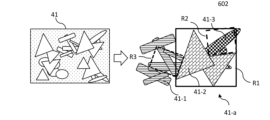
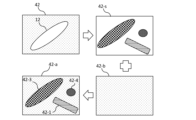
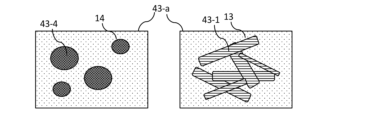
図4Aから4Cは、二重タスクCNNをトレーニングするために使用できるトレーニングデータサブセットを作成するための異なる方法を示している。DTCNNのセグメンテーション・モジュールと共に中間モジュールをトレーニングするために使用される画像トレーニングデータセットは、図4Aに開示されるように画像の手動アノテーションを使用して生成された第1データサブセットと、図4Bおよび4Cのいずれかにおいて開示されるように自動アノテーションで生成されたさらなるサブセットを少なくとも含む。 Figures 4A to 4C show different methods for creating training data subsets that can be used to train a dual-task CNN. The image training dataset used to train the intermediate module along with the segmentation module of the DTCNN includes at least a first data subset generated using manual annotation of images as disclosed in Figure 4A and a further subset generated with automatic annotation as disclosed in either of Figures 4B and 4C.
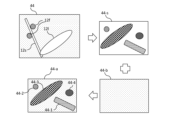
図4Aは、トレーニングデータの第1データサブセットの手動アノテーションされたトレーニング画像の作成を示した。ある作物種の作物植物と作物植物の間にある1以上の雑草種の雑草植物が存在する圃場における実際の状況を表すオリジナル画像41は、手動アノテーションのために人間のユーザに提供される。ユーザは、画像内の異なる要素を対応するクラス(例えば、作物種、雑草種、土壌)に割り当てすることを試みる。図4Aaの例の画像41とその要素は、図1の画像91とその要素に対応する。手動アノテーションタスクの結果は、手動画素アノテーション41-1、41-2、41-3が、各トレーニング画像の画素が属する種を示す、第1データサブセットに属するトレーニング画像毎である。アノテーションされた画像41-aで使用されるテクスチャは、図1の画像92に関して説明されたテクスチャに対応する。図4Aの例では、手動アノテーションの結果は、オリジナル画像41の右上隅のみに概略的に示されている。概略図は、アノテーションが画素レベルで正しいことを暗示しているが、手動アノテーションされた画像に関して現実的にはこうはいかない。典型的には、ユーザが特定の植物を認識できなかったことにより、誤ったクラスに割り当てられているか、全くクラスが割り当てられていないかのいずれかの画素が手動アノテーションされた画像に多数存在する。言い換えると、手動アノテーションは、多数の画素が正しくアノテーションされていないという意味においてノイズがある。
Figure 4A illustrated the creation of manually annotated training images of the first data subset of training data. An
典型的に、ユーザは、単純に画像内の長方形を選択し、このような長方形をクラスに割り当てる。長方形内の画素を作物種41-2として分類するために長方形R1を使用してもよい。しかしながら、R1は雑草種41-1および41-2に関連する画素も含む。ユーザは、R1内にあるまたはR1と重なる長方形R2およびR3をさらに示して、それらを各雑草種クラスに割り当ててもよい。このようなアノテーション方法では、画素レベルでの正しいアノテーションに導くことができないということが明確である。手動アノテーションタスクにおいてユーザをサポートするために、コンピュータシステムがユーザにいくつかの分類サポート機能を提供してもよい。 Typically, the user simply selects rectangles in the image and assigns such rectangles to classes. Rectangle R1 may be used to classify pixels within the rectangle as crop species 41-2. However, R1 also contains pixels related to weed species 41-1 and 41-2. The user may further indicate rectangles R2 and R3 that are within or overlap R1 and assign them to the respective weed species classes. It is clear that such annotation methods cannot lead to correct annotation at pixel level. To support the user in the manual annotation task, the computer system may provide the user with some classification support functions.
例えば、システムは自動化された土壌セグメンテーションを提供してもよく、安定的で簡易的なカラーベースのセグメンテーションアルゴリズムを使用して、地面(土壌)の存在を自動的に削除し、手動セグメンテーションから自動的に取り除くことができる。アルゴリズム例は、(L*a*b*色空間の)Lab色チャネルに対する単純な閾値化に基づき、ここではチャネルaの正の値を有する画素がセグメンテーションから削除されて、精密なセグメンテーションが得られる。 For example, the system may provide automated soil segmentation, using a robust and simple color-based segmentation algorithm to automatically remove the presence of ground (soil) and automatically remove it from the manual segmentation. The example algorithm is based on a simple thresholding on the Lab color channels (in the L*a*b* color space), where pixels with positive values in channel a are removed from the segmentation to obtain a refined segmentation.
さらに、システムは、重なり合う植物の部分に対するサポートを提供してもよく、特に後の生物季節学的段階では、植物が重なり合うことによって、すべてのクラスを正確にセグメント化するにはアノテーションがより複雑になる。これを軽減するために、システムの手動アノテーション機能は、別のアノテーションの中にアノテーションをマーキングすることを可能にする(例えば、R1中のR2)。この場合、(R2に割り当てられる)内側のアノテーションは、(R1に割り当てられる)外側のアノテーションに属するセグメンテーションから削除される。これは、すべての種を正確にアノテーションする必要がないため、アノテーション処理を簡略化する。重なり合っている種のみに「囲み」のアノテーションまたは重なり合いを示すその他のアノテーションをアノテーションすることのみで十分である。 Furthermore, the system may provide support for overlapping plant parts, which makes annotation more complicated to accurately segment all classes, especially at later phenological stages. To mitigate this, the manual annotation feature of the system allows marking an annotation inside another annotation (e.g. R2 in R1). In this case, the inner annotation (assigned to R2) is removed from the segmentation that belongs to the outer annotation (assigned to R1). This simplifies the annotation process, since it is not necessary to accurately annotate all species. It is sufficient to only annotate overlapping species with an "enclosure" annotation or other annotation indicating overlap.
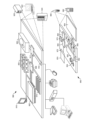
第1画像データサブセットを生成するには、以下の条件がシステムのテスト実行において有効であった。2017年、ドイツおよびスペインの2つの異なる場所で大規模な画像取得キャンペーンが実施された。各2.0x2.5mの24の区画の一式が植えられた。これらの区画では、2列のトウモロコシ(ズィー・メイス)が、6つの異なる雑草種、3つの「草葉」雑草(ザラツキエノコログサ、メヒシバ、イヌビエ)および3つの「広葉」雑草(イチビ、アカザ、アオゲイトウ)と共に植えられた。各区画は、キャノンEOS 700D SLRのカメラおよびサムスンA8の携帯電話の2つの異なるデバイスを使用して、上面視と斜視で撮像された。画像取得を容易にするため、2つの携帯電話と2つのSLRカメラを保持する金属構造体が作られ、上部画像(高さ2.0メートル、焦点距離18mm)および透視画像(高さ1.6メートル、角度30度、焦点距離18mm)が撮影された。このような4つの画像は、時間の節約のため同時に撮影されてもよいが、トレーニングデータの品質には影響しない。 To generate the first image data subset, the following conditions were valid in a test run of the system: A large-scale image acquisition campaign was carried out in 2017 in two different locations in Germany and Spain. A set of 24 plots, each 2.0 x 2.5 m, was planted. In these plots, two rows of corn (Zea mays) were planted together with six different weed species, three "grass-leaf" weeds (foxtail, crabgrass, barnyard grass) and three "broadleaf" weeds (velvetleaf, pigweed, redroot pigweed). Each plot was imaged in top view and oblique view using two different devices: a Canon EOS 700D SLR camera and a Samsung A8 mobile phone. To facilitate image acquisition, a metal structure was created to hold two mobile phones and two SLR cameras, and top images (height 2.0 meters, focal length 18 mm) and perspective images (height 1.6 meters, angle 30 degrees, focal length 18 mm) were taken. Four such images may be taken simultaneously to save time, but without affecting the quality of the training data.
トウモロコシおよび雑草の異なる生物季節学的段階を集めるために、9週間の期間にわたって週3回、1日2回、画像が撮影された。試験は2017年5月に開始して、2017年6月に終了した。露出過度および/または不鮮明な画像を削除した後、合計1679枚の画像が、対応するEPPOコード(ZEAMX、SETVE、DIGSA、ECHCG、ABUTH、CHEAL、AMARE)に従って名付けられた7つの対象クラスに手動でセグメント化された。 Images were taken three times a week, twice a day, over a nine-week period to collect different phenological stages of maize and weeds. The study started in May 2017 and ended in June 2017. After removing overexposed and/or blurry images, a total of 1679 images were manually segmented into seven object classes named according to their corresponding EPPO codes (ZEAMX, SETVE, DIGSA, ECHCG, ABUTH, CHEAL, AMARE).
対象の雑草は特定の位置に植えられていたが、実験区画に野生で成長した未知の雑草により、このタスクがより複雑なものとなった。この問題に対処するために、2つの新しいクラス(一般的な広葉雑草および一般的な草葉雑草)が追加されて、未知または対象でない雑草のアノテーションを可能にした。DTCNNトポロジーは、これらのノイズのあるアノテーションを無視するように構成された。 Although the target weeds were planted at specific locations, unknown weeds growing wild in the experimental plots made this task more complicated. To address this issue, two new classes (common broadleaf weeds and common grassy weeds) were added to allow annotation of unknown or non-target weeds. The DTCNN topology was configured to ignore these noisy annotations.
トレーニングの目的のために、そしていかなるバイアスも回避するために、実験区画は、トレーニング、テストおよび検証の区画に分離された。8つの区画がトレーニングに使用され、2つが検証に使用され、他の2つがテストに使用された。 For training purposes and to avoid any bias, the experimental plots were separated into training, testing and validation plots. Eight plots were used for training, two for validation and the other two for testing.
第1データサブセットは、その後、以下に記載される第2または第3データサブセットのいずれかであり得る少なくとも1つのさらなるサブセットを有するトレーニング画像データセットに組み合わされた。 The first data subset was then combined into a training image dataset with at least one further subset, which may be either the second or third data subset described below.
第2データサブセットの生成が図4Bに記載されている。第2セットは、合成的に生成された画像で構成され、これは画素レベルで正しく自動的にアノテーション可能である。第2サブセットの最終的な合成的に生成された画像42-aは、元の単一の植物画像42から得られる異なる雑草種の複数の雑草植物を表し、各単一の植物画像は、単一種の単一植物12を表す。単一の植物要素は、(例えば、葉のセグメンテーションアルゴリズムで)単一の植物画像から抽出され、土壌の背景画像42-bに貼り付けられる。従って、抽出された単一の植物要素(画像42-s内で異なるテクスチャで示される)が既知の植物種に属するため、第2データサブセットは画素レベルで各雑草種に属する画素のアノテーション42-1、42-3、42-4で完全に自動的にアノテーションされることができる。葉のセグメンテーションアルゴリズムによって抽出された画素が、単一の植物に本当に属しており、その後、各単一の植物画像の植物の既知の種によって自動的にアノテーションできる画素のみが実質的に含まれるため、このような自動アノテーションには手動アノテーションよりもはるかにノイズが少ない。
The generation of the second data subset is described in FIG. 4B. The second set is composed of synthetically generated images, which can be correctly automatically annotated at pixel level. The final synthetically generated images 42-a of the second subset represent a number of weed plants of different weed species obtained from the original
第1データサブセットと第2データサブセットとの組み合わせは、データセットの実質的な複雑性によってアノテーションが困難で、エラーが起こりやすい第1データサブセットの欠点をいくつか克服する。結果として、トレーニングとテスト用のアノテーションされた画像の量は限定され、ノイズがある。これは、単一の植物画像によって生成された画像コミュニティを含む第2サブセットの合成画像を第1サブセットと組み合わせて使用することで克服できる。この目的のために、単一植物の追加的な取得キャンペーンが実施された。 The combination of the first and second data subsets overcomes some of the shortcomings of the first data subset, which is difficult to annotate and prone to errors due to the substantial complexity of the dataset. As a result, the amount of annotated images for training and testing is limited and noisy. This can be overcome by using synthetic images of the second subset, including image communities generated by single plant images, in combination with the first subset. For this purpose, an additional acquisition campaign of single plants was carried out.
合成データセットは、アカザ、ヨウシュチョウセンアサガオおよびソバカズラの3つの新たな雑草種にフィーチャーした。これは画像で構成され、各画像が温室の80x80cmの区画上で単一の植物を表している。スペインからは2つの温室があった。それらのそれぞれには、異なる種が播種され、温室1にはAMARE、DIGSA、ECHCGおよびSETVE、温室2にはABUTH、CHESS、DATST、POLCO、ZEAMXが播種された。合計8つの雑草と1つの作物があった。各種から、30から36個の単一植物が播種された。0日目から80日目まで、個々の植物のそれぞれに応じて、平日(月から金)毎に画像が1つ撮影された。それらの全てが最終日までもったわけではないため、最終(第2)データサブセットは、9つの異なる種の異なる成長段階における単一植物の6906枚の画像を含んだ。
The synthetic dataset featured three new weed species: pigweed, American weed and bindweed. It was composed of images, each image representing a single plant on a 80x80 cm plot of a greenhouse. There were two greenhouses from Spain. Each of them was sown with a different species: AMARE, DIGSA, ECHCG and SETVE in
各画像にはたった1つの植物しか現れないため、サブセット内の全ての画像はラベル付けされる。葉のセグメンテーションのための深層学習モデルを使用ことで、データセット全体を自動的にアノテーションできた。合成植物群落生成アルゴリズムは、実際の葉のセグメント化された画像を取得して、それらを実際の背景画像に貼り付けることができる。単一の植物データセットの使用は、葉および/または植物を自動的にセグメント化し、それらを候補リポジトリに保存することを可能にする。どの候補が実行可能であったかを識別した後、最終フォルダには、9つの種に不均一に分割された11096枚の画像が含まれていた。群落生成アルゴリズムは、リポジトリから候補を取得し、それらを特定の方法で土壌画像に貼り付ける。 Since only one plant appears in each image, all images in the subset are labeled. Using a deep learning model for leaf segmentation, the entire dataset could be automatically annotated. The synthetic plant community generation algorithm is able to take segmented images of real leaves and glue them onto a real background image. The use of a single plant dataset allows for automatically segmenting leaves and/or plants and storing them in a candidate repository. After identifying which candidates were viable, the final folder contained 11,096 images unevenly divided into 9 species. The community generation algorithm takes the candidates from the repository and glues them onto the soil image in a specific way.
これらの画像を生成するために、各領域を説明する3つのパラメータに関連付けられたいくつかのランダムな領域が作成される。モデルパラメータは、植物種、成長段階および密度である。植物種は、領域のパラメータに応じてモンテカルロアプローチに従って育てられる。
このアルゴリズムのパイプラインは以下の通りである。
(i)栽培領域はランダムなサイズの楕円に作られる。
(ii)各楕円には、クラス(種)、年齢(播種後の日数)、密度(0から1の間の実数)がランダムに割り当てられる。
(iii)画像内のロケーション点は、各植物候補に対してランダムにサンプリングされる。
(iv)ロケーション点に応じて、候補が栽培領域内にあるかどうか(ない場合、潜在的な候補は不合格と判定される)。
(v)候補が楕円内にある場合、アルゴリズムは0から1の間の数をランダムにサンプリングし、それをその栽培領域の「密度」パラメータと比較する。サンプリングされた数が「密度」の閾値より大きい場合、候補は不合格と判定される。
(vi)アルゴリズムは、候補リポジトリから栽培領域の要件に適した候補画像を選択し、それを区画画像に配置する。
To generate these images, several random regions are created, associated with three parameters that describe each region: plant species, growth stage and density. Plant species are grown according to the parameters of the region, following a Monte Carlo approach.
The pipeline of this algorithm is as follows:
(i) The growing areas are made into ellipses of random size.
(ii) Each ellipse is randomly assigned a class (species), age (days since sowing), and density (a real number between 0 and 1).
(iii) Location points in the image are randomly sampled for each plant candidate.
(iv) Depending on the location point, whether the candidate is within the growing area (if not, the potential candidate is rejected).
(v) If the candidate is within the ellipse, the algorithm randomly samples a number between 0 and 1 and compares it to the "density" parameter of that growing region. If the sampled number is greater than the "density" threshold, the candidate is rejected.
(vi) The algorithm selects candidate images from the candidate repository that fit the requirements of the cultivation area and places them on the plot image.
この方法により、画像が生成され、この画像には様々な成長段階にあるいくつかの植物種が不均一な密度で存在する。第2データサブセットは、5000枚の合成画像で作られた。5000枚の生成された区画画像のうち、80%はトレーニング用、10%は検証用、別の10%はテスト用に保有された。 This method generates images that contain a heterogeneous density of several plant species at various stages of development. A second data subset was created with 5000 synthetic images. Of the 5000 generated plot images, 80% were kept for training, 10% for validation, and another 10% for testing.
図4Cは、第1データサブセットと組み合わせて代替的に使用して、トレーニング画像データセットを形成できる第3データサブセットを示す。当然、3つの全てのデータサブセットを組み合わせてトレーニングデータセットにすることもできる。第3データセットは、単一の雑草種の複数の雑草植物を表す画像43-aを含む。第3データサブセットの画像も、単一の雑草種に属する画素のアノテーション42-3、43-1、43-4で自動的にアノテーションされる。 Figure 4C shows a third data subset that can alternatively be used in combination with the first data subset to form a training image dataset. Of course, all three data subsets can be combined into a training dataset. The third dataset includes image 43-a representing multiple weed plants of a single weed species. The images of the third data subset are also automatically annotated with annotations 42-3, 43-1, 43-4 of pixels belonging to a single weed species.
第1データサブセットが不均衡なクラスおよびノイズのあるアノテーションを呈する一方、合成第2データサブセットは、重なり合う植物要素を有して成長する実際の植物群落を適切に模倣することに関していくつかの問題を有し得る。不均衡なクラスのある状況例としては、画素の30%に関連付けられている1つのクラスと、画素の0.0001%のみに関連付けられている別のクラスを有することがある。これに加えて、いずれのクラスでもあり得る未知である画素が存在する可能性もある。第3データサブセットは、各区画に単一種を有する制御された環境で育つ植物の画像を含む。区画地は日常的にチェックされ、別の種の植物が生えるといつでも手作業で除去された。区画毎に単一の種を有するということは、全ての画像が既にラベル付けされおり、従って、自動セグメンテーションが実現可能であることを暗に示している。高、中、わずかの3つの密度(面積当たりの作物植物の数)の区画があった。画像は2つのキャンペーンで撮影され、1つはスペインで4245枚の画像、もう1つはドイツで818枚の画像が撮影された。概念は同じであるものの、スペインとドイツの画像には、特に土壌/背景において、相当な違いがあった。 While the first data subset exhibits imbalanced classes and noisy annotations, the synthetic second data subset may have some issues with respect to adequately mimicking real plant communities growing with overlapping plant elements. An example of a situation with imbalanced classes is having one class associated with 30% of the pixels and another class associated with only 0.0001% of the pixels. In addition to this, there may be unknown pixels that could be either class. The third data subset contains images of plants growing in a controlled environment with a single species in each plot. The plots were routinely checked and manually removed whenever a plant of another species appeared. Having a single species per plot implies that all images were already labeled and therefore automatic segmentation is feasible. There were three densities (number of crop plants per area) of plots: high, medium and sparse. Images were taken in two campaigns, one in Spain with 4245 images and the other in Germany with 818 images. Although the concept is the same, there are significant differences between the Spanish and German images, especially in terms of soil/background.
葉のセグメンテーションアルゴリズム(例えば、先に説明した葉のセグメンテーションアルゴリズム)を使用することで、セマンティック・セグメンテーションのグラウンドトゥルースラベル(ground-truth label)として機能する、画像毎に自動的に生成されたラベル付きのマスクが得られる。このセグメンテーション方法は、画素レベルではまだいくつかの間違いを犯すが、第3データサブセットは正確にアノテーションされていると考えることができる。 Using a leaf segmentation algorithm (e.g., the leaf segmentation algorithm described above), we obtain an automatically generated labeled mask for each image that serves as ground-truth labels for the semantic segmentation. Although this segmentation method still makes some mistakes at the pixel level, the third data subset can be considered accurately annotated.
第2および第3データサブセットは類似しているが、それらの違いにおいて補完的である。第2データサブセットは、同じ画像にいくつかの種を示すため、植物群落栽培の点ではより現実的である。その一方、第3データサブセットでは、1つの種しか存在しないが、実際のフィールドの画像のより良いテクスチャ、重なり合い、陰影および形状(すなわち、より多くの情報)を示す。 The second and third data subsets are similar but complementary in their differences. The second data subset is more realistic in terms of plant community cultivation since it shows several species in the same image. On the other hand, the third data subset shows better texture, overlap, shading and shape (i.e. more information) of the real field image, although only one species is present.
3つのデータサブセットの組み合わせを含めることで、異なるトレーニング実験が行われた。全ての実験は、第1データサブセットの検証とテストに対して評価された。いくつかの実験において、1つより多い画像トレーニングデータセットがトレーニングに使用された。データサブセットが異なる数の画像を有していたため、ジェネレータを使用して、同等な方法で異なるデータサブセットから画像をフェッチした。ジェネレータは、毎回、各データサブセットから1つの画像を取得する。データサブセットの画像がなくなったら(すなわち、ジェネレータが各サブセットの最後の画像を取得したら)、他のサブセットの画像をインクリメントしつつ、各サブセットに対して最初からやり直す。 Different training experiments were performed by including combinations of the three data subsets. All experiments were evaluated against validation and testing on the first data subset. In some experiments, more than one image training dataset was used for training. As the data subsets had different numbers of images, a generator was used to fetch images from the different data subsets in an equivalent manner. The generator retrieves one image from each data subset each time. Once a data subset runs out of images (i.e. the generator retrieves the last image of each subset), it starts over for each subset while incrementing the images of the other subsets.
バイアスを回避するために、既に言及したように、各データサブセットは、80%をトレーニング用の画像、別の10%を検証用、そして最後の10%をテスト用へと分割された。 To avoid bias, as already mentioned, each data subset was split into 80% training images, another 10% validation, and the final 10% testing.
データ拡張が、新たな画像がジェネレータによってフェッチされる度に適用された。データ拡張に適用された変換には、回転、高さおよび/または幅のシフト、ズーム、垂直および/または水平反転、画素強度のシフト(色の変化)およびガウスぼかしが含まれた。本明細書に開示されるセマンティック・セグメンテーション方法は画像からタイルを抽出し、一貫性を保つことが重要なため、せん断は推奨されない。 Data augmentation was applied every time a new image was fetched by the generator. Transformations applied for data augmentation included rotation, height and/or width shift, zoom, vertical and/or horizontal flip, pixel intensity shift (color change) and Gaussian blur. Shearing is not recommended since the semantic segmentation method disclosed herein extracts tiles from the image and consistency is important.
プログラムコードは、TensorFlowを背景として使用し、Keras深層学習ライブラリで実装された。エポック当たりの減衰=10-6で学習率lr=0.001、運動量=0.9およびネステロフ加速勾配法を使用して、両方のタスクのオプティマイザとして確率的勾配降下法が使用された。データサブセットに存在するクラスの不均衡を解決するために、Balanced Accuracy(BAC)が最も適したアルゴリズム性能メトリックとして選択された(このような場合、「通常の」精度の使用は推奨されない)。 The program code was implemented in the Keras deep learning library, using TensorFlow as background. Stochastic gradient descent was used as the optimizer for both tasks, using a learning rate lr=0.001, momentum=0.9 and the Nesterov accelerated gradient method with decay= 10-6 per epoch. To address the class imbalance present in the data subsets, Balanced Accuracy (BAC) was selected as the most suitable algorithm performance metric (the use of "normal" accuracy is not recommended in such cases).
DTCNNのトレーニングのため、16GBのメモリを有するNVIDIA Tesla V100 GPUを使用した。入力画像のサイズを考慮して、バッチサイズは6に設定された。「携帯取込装置を使用した自動植物病害診断を小麦に適用した使用事例(Automatic plant disease diagnosis using mobile capture devices, applied on a wheat use case)」、農業におけるコンピュータと電子機器(Computers and Electronics in Agriculture)、138巻、200~209ページ、2017年においてA.ヨハネス(A.Johannes)他によって、および「野生における携帯取込装置ベースの作物病害分類のための深層畳み込みニューラルネットワーク(Deep convolutional neural networks for mobile capture device-based crop disease classification in the wild)」、農業におけるコンピュータと電子機器(Computers and Electronics in Agriculture)、2018年においてA.ピコン(A.Picon)他によって説明された同じ方法論に従って、第1データサブセットの検証サブセットと、balanced accuracy(BAC)およびDice-Sorensen係数の計算値を使用して、異なる雑草種の検証セットを最大化する閾値を計算した。 For training DTCNN, an NVIDIA Tesla V100 GPU with 16 GB memory was used. Considering the size of the input images, the batch size was set to 6. "Automatic plant disease diagnosis using mobile capture devices, applied on a wheat use case," Computers and Electronics in Agriculture, Vol. 138, pp. 200-209, 2017, A. and by A. Johannes et al. in “Deep convolutional neural networks for mobile capture device-based crop disease classification in the wild,” Computers and Electronics in Agriculture, 2018 by A. Following the same methodology described by A. Picon et al., a validation subset of the first data subset and the calculated values of balanced accuracy (BAC) and Dice-Sorensen coefficients were used to calculate the thresholds that maximize the validation set of different weed species.
第1データサブセットからのテスト用画像は実際のフィールド状況を表すため、それらを使用して様々な実験がテストされた。トレーニングされた異なるデータセットの使用の影響を測定するため、異なるデータサブセットを組み合わせていくつかのモデルがトレーニングされた。2セットの実験が使用された。1つのセットはセグメンテーション・モジュールのためのPSPNetトポロジーに基づいて提案された二重タスクCNNの性能を検証することに焦点を当て、別のセットは異なるデータサブセットの組み合わせに対する影響を測定するためのものである。 Since the test images from the first data subset represent real field situations, various experiments were tested using them. To measure the impact of using different trained datasets, several models were trained combining different data subsets. Two sets of experiments were used: one set focused on validating the performance of the proposed dual-task CNN based on the PSPNet topology for the segmentation module, and another set to measure the impact of combining different data subsets.
二重タスクPSPNetの実装が通常の単一タスクPSPNetよりも優れた性能を有することを検証することに焦点を当てた2つの実験は以下の通りである(実験は、使用トポロジーと、使用データサブセットの数によって名付けられる)。
‐PSPNet第1+第3。この実験では、第1データサブセットと第3データサブセットとの両方からの画像でトレーニングされたベースラインPSPNetを使用する。この組み合わせは、トレーニングに最良のデータサブセットの組み合わせとして選択された。
‐二重タスクPSPNet第1+第3。この実験は前のものと同様だが、伝統的なPSPNetネットワークアーキテクチャを開示の二重タスクPSPNetで置き換えた。
Two experiments focused on verifying that the implementation of dual-task PSPNet has better performance than the conventional single-task PSPNet are as follows (the experiments are named according to the topology and number of data subsets used).
- PSPNet 1st + 3rd. In this experiment, we use a baseline PSPNet trained on images from both the 1st and 3rd data subsets. This combination was selected as the best data subset combination for training.
- Dual-Task PSPNet 1st + 3rd. This experiment is similar to the previous one, but replaces the traditional PSPNet network architecture with the disclosed dual-task PSPNet.
得られた結果は、二重タスク(分類およびセグメンテーション)CNNの使用が、伝統的なアーキテクチャを使用した場合に得られた~45%に対して~48%の平均Dice-Sorensen係数(DSC)を得たことを表している。さらに、balanced accuracyがわずかに改善されている。どちらのモデルも、播種後第2週目(中期段階)の間における画像記録でピーク性能を表している。さらに、二重タスクPSPNet第1+第3は、特に初期段階で、PSPNetよりも優れたスコアを奏する。しかし、時間が経つとその性能はPSPNetよりも速く低下する。(播種後第4週目の間に記録された画像に関する)最悪のDTCNN予測では、伝統的なPSPNet予測と同様の値を得る。 The obtained results show that the use of a dual-task (classification and segmentation) CNN obtains an average Dice-Sorensen coefficient (DSC) of 48% compared to 45% obtained when using a traditional architecture. Furthermore, the balanced accuracy is slightly improved. Both models show peak performance for images recorded during the second week after seeding (middle stage). Furthermore, dual-task PSPNet1+3 performs better scores than PSPNet, especially in the early stages. However, over time its performance degrades faster than PSPNet. The worst DTCNN prediction (for images recorded during the fourth week after seeding) obtains values similar to the traditional PSPNet prediction.
二重タスクCNNの性能への様々なデータサブセットの影響は、以下の実験によって検証された。 The impact of different data subsets on the performance of the dual-task CNN was verified by the following experiments.
DTCNN第1。この実験では、トレーニングは第1データサブセットに対してのみ行なわれた。このデータセットには、画像の数の少なさ、高い複雑性、不正確なアノテーションおよび高いクラスの不均衡性の問題がいくつかあった。 DTCNN 1st. In this experiment, training was performed only on the 1st data subset. This dataset had several issues: low number of images, high complexity, inaccurate annotations, and high class imbalance.
DTCNN第2。この実験では、合成第2データサブセットがトレーニングに使用された。合成画像は空間分布、照明、背景およびスケールに違いを呈するので、ドメインシフトによる性能の低下が予想されていた。画素の自動アノテーションが各画素に正しいクラスでアノテーションすることを確実にするため、適正な葉の形状とエッジに関する情報は、ほぼ完璧なグラウンドトゥルースアノテーションでのトレーニングに好適である。 DTCNN 2. In this experiment, the synthetic 2 data subset was used for training. Since synthetic images exhibit differences in spatial distribution, illumination, background and scale, performance degradation due to domain shift was expected. To ensure that automatic pixel annotation annotates each pixel with the correct class, proper leaf shape and edge information is suitable for training on near-perfect ground truth annotations.
DTCNN第3。この実験では、単一種(第3)データサブセットがトレーニングに使用される。植物の画像は実際の状況下で取得されるが、このデータセットからは植物群落の相互作用は取得できない。 DTCNN 3rd. In this experiment, the single-species (3rd) data subset is used for training. Plant images are captured under real conditions, but plant community interactions cannot be captured from this dataset.
DTCNN第1+第2。この実験では、第1および第2データサブセットからの画像がトレーニングのために組み合わされる。第2データサブセットは、合成画像を組み込むことで、第1データサブセットからのクラスの不均衡および品質の悪いアノテーションの影響を減らすことを可能にする。 DTCNN 1st + 2nd. In this experiment, images from the 1st and 2nd data subsets are combined for training. The 2nd data subset allows to incorporate synthetic images to reduce the impact of class imbalance and poor quality annotations from the 1st data subset.
DTCNN第1+第3。この実験では、画像第1および第3データサブセットがトレーニングのために組み合わされる。第3データサブセットは、第3データサブセットからの単一種画像を含めることで、第1データサブセットからのクラスの不均衡および品質の悪いアノテーションの影響を減らすことを可能にする。 DTCNN 1st + 3rd. In this experiment, the 1st and 3rd data subsets of images are combined for training. The 3rd data subset allows to reduce the impact of class imbalance and poor quality annotations from the 1st data subset by including single species images from the 3rd data subset.
DTCNN第1+第2+第3。最後のモデルは、全てのデータサブセットを補完する。 DTCNN 1st + 2nd + 3rd. The final model imputs all data subsets.
結論付けると、対象の第1データサブセットがサポートするデータセット(第2、第3)のいずれかと組み合わされると、ドメインシフトが減少し、より正確な結果が得られる。第1および第3データサブセットを組み合わせてDTCNNのトレーニングに使用すると、最良の結果が得られた。 In conclusion, when the first data subset of interest is combined with one of the supporting datasets (second, third), the domain shift is reduced and more accurate results are obtained. The best results were obtained when the first and third data subsets were combined and used to train the DTCNN.
図4Dは、(図4Bで自動アノテーションに使用されている)単一植物画像44が植物のさらなる要素を表すシナリオを示す。この画像44では、葉12lの他に、植物の茎12sおよび果実12fを見ることができる。多くの植物に関して、果実は茎の葉の色とは異なる色を持っている。このような場合、既存のセグメンテーション方法を使用して、果実12fに属する画素と植物の葉12lに属する画素(または葉と同じ色を持つ植物の他の要素)をセグメント化できる。その後、図4Bに関して説明したような同様の方法で、植物の葉だけでなく、その果実も合成的に生成された画像44-sに貼り付けることができる。背景画像44-bと組み合わせて、より現実的なアノテーションされた画像44-aが生成され、これには、今、(図4Bから既知のオブジェクト44-1、44-3および44-4に加えて)植物12*の果実を表すアノテーションされたオブジェクト44-2も含まれる。
Figure 4D shows a scenario where a single plant image 44 (used for automatic annotation in Figure 4B) represents further elements of a plant. In this
当業者はまた、植物の果実と葉との色の違いを使用して、図4Cで説明されている方法を改良し、各植物の葉と果実とを表すオブジェクトを含む自動的にアノテーションされた画像を生成することも可能であることを述べておくべきである。葉と同様の色である他の植物要素(例えば、茎)のアノテーションに関しては、このような要素の手動アノテーションを使用してもよい。 It should also be noted that those skilled in the art may use the color differences between the fruits and leaves of the plants to improve upon the method described in FIG. 4C to generate an automatically annotated image that includes objects representing the leaves and fruits of each plant. As for annotation of other plant elements (e.g., stems) that are similarly colored to the leaves, manual annotation of such elements may be used.
植物の果実の表現も含む自動アノテーション画像を使用する場合、DTCNNは、異なる植物種を区別するだけでなく、画像を植物の各果実(例えば、作物)に属する画素にセグメント化するようにもトレーニングできる。通常、圃場では1つの作物種しか栽培されていない。このような場合、先に説明したように、この作物種の葉と果実を含む自動的にアノテーションされた画像と、他の植物種(雑草)の画像とを使用してDTCNNをトレーニングすれば十分である。図5は、一般的なコンピュータデバイス900と一般的なモバイルコンピュータデバイス950との例を示す図であり、これらは本明細書で説明されている技術と使用されてもよい。コンピューティングデバイス900は、ラップトップ、デスクトップ、ワークステーション、携帯情報端末、サーバ、ブレードサーバ、メインフレームおよびその他の適切なコンピュータ等、様々な形態のデジタルコンピュータを表すと意図される。理想的には、デバイス900は機械学習アルゴリズムを処理するように構成されたGPUを有する。一般的なコンピュータデバイス900は、図1のコンピュータシステム100に対応してもよい。コンピューティングデバイス950は、携帯情報端末、携帯電話、スマートフォンおよび他の同様のコンピューティングデバイス等、様々な形態のモバイルデバイスを表すと意図される。例えば、コンピューティングデバイス950は、ユーザがテスト入力画像をキャプチャしてそれらをコンピュータデバイス900に提供し、次に、コンピュータデバイスから、様々な雑草植物の位置と雑草植物のそれぞれの種を画像上で示すセグメント化された画像を受け取る、GUIフロントエンドとして使用されてもよい。その結果、コンピューティングデバイス950はまた、図1の出力デバイス50を含んでもよい。ここに示されているコンポーネント、それらの接続と関係性およびそれらの機能は、例示としての意図のみであり、本文書で説明および/または主張されている発明の実装例を限定する意図はない。
When using automatically annotated images that also contain representations of plant fruits, the DTCNN can be trained not only to distinguish between different plant species, but also to segment the image into pixels belonging to each fruit of the plant (e.g., crop). Typically, only one crop species is grown in a field. In such a case, it is sufficient to train the DTCNN using automatically annotated images containing the leaves and fruits of this crop species and images of other plant species (weeds), as explained above. FIG. 5 illustrates examples of a
コンピューティングデバイス900は、プロセッサ902、メモリ904、ストレージデバイス906、メモリ904と高速拡張ポート910に接続している高速インターフェース908および低速バス914とストレージデバイス906に接続している低速インターフェース912を備える。コンポーネント902、904、906、908、910および912のそれぞれは、様々なバスを使用して相互接続され、共通のマザーボードに取り付けられてもよいし、必要に応じて他の方法であってもよい。プロセッサ902は、高速インターフェース908に接続されているディスプレイ916等の外部入力/出力デバイス上にGUIのグラフィック情報を表示するために、メモリ904またはストレージデバイス906に記憶された命令を含む、コンピューティングデバイス900内で実行するための命令を処理できる。他の実装例では、多数のメモリおよびメモリの種類とともに、必要に応じて、多数の処理ユニットおよび/または多数のバスが使用されてもよい。また、多数のコンピューティングデバイス900は、(例えば、サーババンク、ブレードサーバのグループ、または処理デバイスとして)必要な操作の一部を提供する各デバイスに接続されてもよい。
The
メモリ904は、コンピューティングデバイス900内に情報を記憶する。一実装例では、メモリ904は揮発性メモリユニットまたは複数の揮発性メモリユニットである。他の実装例では、メモリ904は不揮発性メモリユニットまたは複数の不揮発性メモリユニットである。メモリ904はまた、磁気または光学ディスク等の他の形態のコンピュータ可読媒体であってもよい。
The
ストレージデバイス906は、コンピューティングデバイス900に大容量のストレージを提供可能である。一実装例では、ストレージデバイス906は、フロッピーディスクデバイス、ハードディスクデバイス、光学ディスクデバイスもしくはテープデバイス等のコンピュータ可読媒体、フラッシュメモリもしくは他の同様のソリッドステートメモリデバイスまたはストレージエリアネットワークもしくは他の構成のデバイスを含むデバイスの配列であってもよいし、それらを含んでもよい。コンピュータプログラム製品は、情報キャリアに明確に具現化できる。コンピュータプログラム製品はまた、実行されると、上記のような1以上の方法を行う命令を含んでもよい。情報キャリアは、メモリ904、ストレージデバイス906またはプロセッサ902のメモリ等、コンピュータまたは機械可読媒体である。
The
高速制御部908は、コンピューティングデバイス900の帯域幅消費動作を管理し、一方で低速制御部912は、より低い帯域幅消費動作を管理する。このような機能の割り当ては例示にすぎない。一実装例では、高速制御部908は、メモリ904と、(例えば、グラフィックプロセッサまたはアクセラレータを通した)ディスプレイ916と、様々な拡張カード(不図示)を受け入れ得る高速拡張ポート910に接続される。実装例では、低速制御部912は、ストレージデバイス906と低速拡張ポート914とに接続されている。さまざまな通信ポート(例えば、USB、Bluetooth(登録商標)、イーサネット、ワイヤレスイーサネット)を含み得る低速拡張ポートは、キーボード、ポインティングデバイス、スキャナまたはネットワークアダプタを通して等のスイッチもしくはルータ等のネットワークデバイス等の1以上の入力/出力デバイスに接続されてもよい。
The high-
コンピューティングデバイス900は、図に示されるように、数ある異なる形態で実装されてもよい。例えば、標準サーバ920として、またはそのようなサーバのグループ内で複数回実装されてもよい。また、ラックサーバシステム924の一部として実装されてもよい。さらに、ラップトップコンピュータ922等のパーソナルコンピュータに実装されてもよい。代替的に、コンピューティングデバイス900からのコンポーネントが、デバイス950等のモバイルデバイス(不図示)内の他のコンポーネントと組み合わされてもよい。このようなデバイスのそれぞれは、1以上のコンピューティングデバイス900、950を含んでもよく、システム全体は互いに通信する多数のコンピューティングデバイス900、950から構成されてもよい。
コンピューティングデバイス950は、他のコンポーネントの内とりわけ、プロセッサ952、メモリ964、ディスプレイ954等の入力/出力デバイス、通信インターフェース966およびトランシーバ968を含む。デバイス950には、追加のストレージを提供するために、マイクロドライブまたは他のデバイス等のストレージデバイスも設けられてもよい。コンポーネント950、952、964、954、966および968のそれぞれは様々なバスを使用して相互接続され、コンポーネントのいくつかは共通のマザーボードに取り付けられてもよいし、必要に応じて他の方法であってもよい。
プロセッサ952は、メモリ964に記憶された命令を含む、コンピューティングデバイス950内の命令を実行できる。プロセッサは、分離した多数のアナログおよびデジタル処理ユニットを含むチップのチップセットとして実装されてもよい。プロセッサは、例えば、ユーザインターフェースの制御、デバイス950によって実行されるアプリケーションおよびデバイス950による無線通信等のデバイス950の他のコンポーネントの調整のために提供されてもよい。
The
プロセッサ952は、ディスプレイ954に接続された制御インターフェース958およびディスプレイインターフェース956を通してユーザと通信してもよい。ディスプレイ954は、例えば、TFT LC(薄膜トランジスタ液晶ディスプレイ)またはOLED(有機発光ダイオード)ディスプレイまたは他の適切なディスプレイ技術であってもよい。ディスプレイインターフェース956は、グラフィックおよび他の情報をユーザに提示するためにディスプレイ954を駆動するための適切な回路を備えてもよい。制御インターフェース958は、ユーザから指令を受け取り、それらをプロセッサ952に提出するために変換してもよい。さらに、外部インターフェース962が、デバイス950の他のデバイスとの近距離通信を可能にするように、プロセッサ952と通信して提供されてもよい。外部インターフェース962は、例えば、いくつかの実装例での有線通信または他の実装例での無線通信を提供してもよく、多数のインターフェースが使用されてもよい。
The
メモリ964は、コンピューティングデバイス950内に情報を記憶する。メモリ964は、1以上のコンピュータ可読媒体、揮発性メモリユニットまたは不揮発性メモリユニットとして実装できる。拡張メモリ984はまた、例えば、SIMM(シングルインラインメモリモジュール)カードインターフェースを含んでもよい拡張インターフェース982を通して提供され、デバイス950に接続されてもよい。このような拡張メモリ984は、デバイス950のための余剰ストレージ空間を提供してもよいし、デバイス950のためのアプリケーションまたは他の情報を記憶してもよい。具体的には、拡張メモリ984は、上記のプロセスを実行または補足するための命令を含んでもよく、安全情報もまた含んでもよい。このように、例えば、拡張メモリ984は、デバイス950のためのセキュリティモジュールとしての機能を果たしてもよく、デバイス950の安全な使用を許可する命令がプログラムされていてもよい。さらに、安全アプリケーションは、SIMMカードを介して、ハッキング不可能な方法でSIMMカードに識別情報を配置する等の付加情報とともに提供されてもよい。
The
メモリは、以下に説明されるように、例えば、フラッシュメモリおよび/またはNVRAMメモリを含んでもよい。一実装例では、コンピュータプログラム製品は、情報キャリアに明確に具現化される。コンピュータプログラム製品は、実行されると、上記のような1以上の方法を行う命令を含む。情報キャリアは、例えば、トランシーバ968または外部インターフェース962を介して受信されてもよい、メモリ964、拡張メモリ984またはプロセッサ952上のメモリ等のコンピュータまたは機械可読媒体である。
The memory may include, for example, flash memory and/or NVRAM memory, as described below. In one implementation, the computer program product is tangibly embodied on an information carrier. The computer program product includes instructions that, when executed, perform one or more methods, such as those described above. The information carrier is, for example, a computer or machine-readable medium, such as
デバイス950は、必要に応じてデジタル信号処理回路を含んでもよい通信インターフェース966を通して無線で通信してもよい。通信インターフェース966は、とりわけ、GSM音声通話、SMS、EMSもしくはMMSメッセージング、CDMA、TDMA、PDC、WCDMA(登録商標)、CDMA2000またはGPRS等の様々なモードまたはプロトコル下における通信を提供してもよい。このような通信は、例えば、無線周波数トランシーバ968を通して起こってもよい。さらに、BLUETOOTH(登録商標)、WiFiまたは他のこのようなトランシーバ(不図示)を使用するなどして、短距離通信が起こってもよい。さらに、GPS(全地球測位システム)受信モジュール980が、デバイス950に対し追加的なナビゲーションおよび位置に関連する無線データを提供してもよく、これはデバイス950上で実行されるアプリケーションによって必要に応じて使用されてもよい。
The
デバイス950はまた、ユーザから話した情報を受け取り、それを使用可能なデジタル情報に変換し得るオーディオコーデック960を使用して聴覚的に通信してもよい。オーディオコーデック960は同様に、例えば、デバイス950の受話器のスピーカを通して等、ユーザのために可聴音を生成してもよい。このような音は、音声電話からの音を含んでもよく、録音された音(例えば、音声メッセージ、音楽ファイル等)を含んでもよく、デバイス950上で動作するアプリケーションによって生成された音を含んでもよい。
The
コンピューティングデバイス950は、図に示されるように、数ある異なる形態で実装されてもよい。例えば、携帯電話980として実装されてもよい。また、スマートフォン982、携帯情報端末またはその他の同様のモバイルデバイスの一部として実装されてもよい。
The
ここで説明されるシステムおよび技術の様々な実装例は、デジタル電子回路、集積回路、特別設計ASIC(特定用途向け集積回路)、コンピュータハードウェア、ファームウェア、ソフトウェアおよび/またはそれらの組み合わせで実現できる。これらの様々な実装例は、少なくとも1つのプログラム可能なプロセッサを含むプログラム可能なシステム上で実行可能および/または解釈可能な1以上のコンピュータプログラムにおける実装を含むことができ、少なくとも1つのプログラム可能なプロセッサは、特別または汎用であってもよく、ストレージシステム、少なくとも1つの入力デバイスおよび少なくとも1つの出力デバイスからデータおよび命令を受信し、ストレージシステム、少なくとも1つの入力デバイスおよび少なくとも1つの出力デバイスにデータおよび命令を送信するために接続されている。 Various implementations of the systems and techniques described herein may be realized in digital electronic circuitry, integrated circuits, specially designed ASICs (application specific integrated circuits), computer hardware, firmware, software, and/or combinations thereof. These various implementations may include implementations in one or more computer programs executable and/or interpretable on a programmable system including at least one programmable processor, which may be special or general purpose, and coupled to receive data and instructions from and transmit data and instructions to the storage system, at least one input device, and at least one output device.
(プログラム、ソフトウェア、ソフトウェアアプリケーションまたはコードとしても知られている)これらのコンピュータプログラムは、プログラム可能なプロセッサのための機械語命令を含み、高水準手続き型言語および/もしくはオブジェクト指向プログラミング言語で、ならびに/またはアセンブリ言語/機械語で実装できる。本明細書中で使用される場合、「機械可読媒体」および「コンピュータ可読媒体」という用語は、機械語命令を機械可読信号として受信する機械可読媒体を含む、機械語命令および/またはデータをプログラム可能なプロセッサに提供するために使用される、任意のコンピュータプログラム製品、装置および/またはデバイス(例えば、磁気ディスク、光学ディスク、メモリ、プログラム可能な論理素子(PLD))を指す。「機械可読信号」という用語は、プログラム可能なプロセッサに機械語命令および/またはデータを提供するために使用される任意の信号を指す。 These computer programs (also known as programs, software, software applications or code) contain machine instructions for a programmable processor and can be implemented in high-level procedural and/or object-oriented programming languages and/or assembly/machine language. As used herein, the terms "machine-readable medium" and "computer-readable medium" refer to any computer program product, apparatus and/or device (e.g., magnetic disk, optical disk, memory, programmable logic device (PLD)) used to provide machine instructions and/or data to a programmable processor, including a machine-readable medium that receives machine instructions as a machine-readable signal. The term "machine-readable signal" refers to any signal used to provide machine instructions and/or data to a programmable processor.
ユーザとの相互作用を提供するために、本明細書に説明されているシステムおよび技術は、ユーザに情報を表示するためのディスプレイデバイス(例えば、CRT(陰極線管)またはLDC(液晶ディスプレイ)モニタ)と、それによってユーザがコンピュータに入力を提供できるキーボードおよびポインティングデバイス(例えば、マウスまたはトラックボール)を有するコンピュータ上で実装できる。また、ユーザとの相互作用を提供するために、他の種類のデバイスを使用することもできる。例えば、ユーザに提供されるフィードバックは、任意の形態の感覚フィードバック(例えば、視覚的フィードバック、聴覚的フィードバックまたは触覚的フィードバック)であることができる。また、ユーザからの入力は、音響、音声または触覚入力を含む任意の形態で受け取ることができる。 To provide interaction with a user, the systems and techniques described herein can be implemented on a computer having a display device (e.g., a CRT (cathode ray tube) or LCD (liquid crystal display) monitor) for displaying information to a user, and a keyboard and pointing device (e.g., a mouse or trackball) by which the user can provide input to the computer. Other types of devices can also be used to provide interaction with a user. For example, feedback provided to the user can be any form of sensory feedback (e.g., visual feedback, auditory feedback, or tactile feedback). Input from the user can also be received in any form, including acoustic, speech, or tactile input.
ここで説明されているシステムおよび技術は、(例えば、データサーバとしての)バックエンドコンポーネントを含む、またはミドルウェアコンポーネント(例えば、アプリケーションサーバ)を含む、またはフロントエンドコンポーネント(例えば、ユーザがそれを通してここで説明されているシステムおよび技術の実装と相互作用できるグラフィカルユーザインターフェースまたはウェブブラウザ有するクライアントコンピュータ)を含む、またはこのようなバックエンド、ミドルウェアならびにフロントエンドコンポーネントの任意の組み合わせであるコンピューティングデバイスに実装できる。システムのコンポーネントは、デジタルデータ通信の任意の形態または媒体(例えば、通信ネットワーク)によって相互接続できる。通信ネットワークの例として、ローカルエリアネットワーク(「LAN」)、広域ネットワーク(「WAN」)、およびインターネットが挙げられる。 The systems and techniques described herein can be implemented in a computing device that includes a back-end component (e.g., as a data server), or includes a middleware component (e.g., an application server), or includes a front-end component (e.g., a client computer having a graphical user interface or web browser through which a user can interact with an implementation of the systems and techniques described herein), or is any combination of such back-end, middleware, and front-end components. The components of the system can be interconnected by any form or medium of digital data communication (e.g., a communications network). Examples of communications networks include a local area network ("LAN"), a wide area network ("WAN"), and the Internet.
コンピューティングデバイスは、クライアントおよびサーバを含むことができる。クライアントおよびサーバは一般的に互いから遠隔であり、典型的に通信ネットワークを通じて相互作用する。クライアントとサーバの関係性は、各コンピュータで実行され、互いに対しクライアント対サーバの関係性を持つコンピュータプログラムによって生じる。 Computing devices may include clients and servers. Clients and servers are generally remote from each other and typically interact through a communication network. The relationship of client and server arises by virtue of computer programs running on the respective computers and having a client-server relationship to each other.
いくつかの実施形態が説明された。しかしながら、本発明の思想および範囲から逸脱することなく、様々な改良が行われもよいことが理解されるであろう。 Several embodiments have been described. However, it will be understood that various modifications may be made without departing from the spirit and scope of the invention.
さらに、図に示される論理フローは、希望の結果を実現するために、示されている特定の順序または連番での順序である必要はない。さらに、他のステップが提供されてもよいし、ステップが説明されたフローから削除されてもよく、他のコンポーネントが説明されたシステムに追加または説明されたシステムから削除されてもよい。従って、他の実施形態は以下の特許請求の範囲内にある。 Furthermore, the logic flows depicted in the figures need not be in the particular order shown or sequential order to achieve desired results. Moreover, other steps may be provided or steps may be deleted from the described flows, and other components may be added to or deleted from the described systems. Accordingly, other embodiments are within the scope of the following claims.
さらに、本発明の実施形態、特に本発明の方法は、農業機械と相互作用し、農業機械を操作、制御および/またはモニタリングするために使用されてもよい。本発明の好適な実施形態として、本発明の方法は、農業機械を操作、制御および/またはモニタリングするための制御信号またはオンオフ信号等の信号を出力するステップをさらに含む。本発明の有利な実施形態として、本発明の方法は、本発明の方法における雑草の識別または植物の識別ステップの結果に応じて、農業機械を操作、制御、および/またはモニタリングするための制御信号またはオンオフ信号等の信号を出力するステップをさらに含む。さらに好適には、特定の雑草が識別された場合、この特定の雑草を対象とする方法で農業機械を操作するための制御またはオンオフ信号が出力され、例えば、この特定の雑草を対象とした除草剤または他の作物保護剤を噴霧もしくは散布するために、または噴霧もしくは散布の準備のために農業機械を操作するための制御信号が出力される。有利には、特定の雑草が識別され、(例えば、雑草の量、雑草体積の量、面積(例えば、ヘクタール)またはこの雑草が識別された地理的位置の数に関する)この特定の雑草に関連する特定の事前定義された閾値を上回る場合、この特定の雑草を対象とした方法で農業機械を操作するための制御またはオンオフ信号が出力される。例えば、この特定の雑草を対象とする除草剤または他の作物保護剤を噴霧もしくは散布するために、または噴霧もしくは散布の準備のために農業機械を操作するための制御信号が出力される。農業機械は、フィールドの植物を処理するための1以上の処理機構を含んでもよい。処理機構には、雑草、病害または昆虫を処理するための化学的、機械的、電気的処理機構またはこのような処理機構の組み合わせが含まれる。農業機械は、検出および制御システムをさらに含んでもよい。検出システムは、スマート機械がフィールドを移動するに合わせて、フィールドの状況において検出するように構成されていてもよい。制御システムは、検出されたフィールドの状況に基づいて処理機構を制御するように構成されていてもよい。 Furthermore, embodiments of the present invention, in particular the method of the present invention, may be used to interact with agricultural machinery and to operate, control and/or monitor the agricultural machinery. As a preferred embodiment of the present invention, the method of the present invention further comprises a step of outputting a signal, such as a control signal or an on-off signal, for operating, controlling and/or monitoring the agricultural machinery. As an advantageous embodiment of the present invention, the method of the present invention further comprises a step of outputting a signal, such as a control signal or an on-off signal, for operating, controlling and/or monitoring the agricultural machinery depending on the result of the weed identification or plant identification step of the method of the present invention. Even more preferably, when a specific weed is identified, a control or on-off signal is output for operating the agricultural machinery in a manner targeting this specific weed, for example, a control signal is output for operating the agricultural machinery to spray or apply a herbicide or other crop protection agent targeted at this specific weed, or in preparation for spraying or applying the herbicide or other crop protection agent. Advantageously, when a particular weed is identified and exceeds a particular predefined threshold value related to this particular weed (e.g., related to the amount of weed, the amount of weed volume, the area (e.g., hectares) or the number of geographic locations where this weed is identified), a control or on-off signal is output to operate the agricultural machinery in a manner targeted to this particular weed. For example, a control signal is output to operate the agricultural machinery to spray or apply, or in preparation for spraying or applying, a herbicide or other crop protection agent targeted to this particular weed. The agricultural machinery may include one or more treatment mechanisms for treating plants in the field. The treatment mechanisms include chemical, mechanical, electrical treatment mechanisms or combinations of such treatment mechanisms for treating weeds, diseases or insects. The agricultural machinery may further include a detection and control system. The detection system may be configured to detect in the field conditions as the smart machine moves through the field. The control system may be configured to control the treatment mechanisms based on the detected field conditions.
一実施形態では、処理機構は化学処理機構である。このような実施形態の農業機械は、化学薬品または作物保護剤をフィールドに散布するための1以上のノズルを有する噴霧器を含む。 In one embodiment, the treatment mechanism is a chemical treatment mechanism. In such an embodiment, the agricultural machinery includes a sprayer having one or more nozzles for applying a chemical or crop protection agent to a field.
一実施形態では、検出システムは農業機械がフィールドを横断するに合わせてフィールドの状況を検出するための1以上の検出コンポーネントを備える。検出コンポーネントは、フィールドの画像を撮影するカメラ等の光学的検出コンポーネントであってもよい。光学的検出コンポーネントは、例えば、画像記録装置90であってもよい(図1参照)。 In one embodiment, the detection system includes one or more detection components for detecting conditions in the field as the agricultural machine traverses the field. The detection components may be optical detection components, such as a camera that captures images of the field. The optical detection component may be, for example, an image recording device 90 (see FIG. 1).
さらなる実施形態では、農業機械は1以上の検出コンポーネントに関連する1以上の処理要素を含む。このような実施形態では、検出コンポーネントは駆動方向で見た場合に処置要素の前に配置されてもよい。このようにして、検出コンポーネントはフィールドの状況を感知でき、システムは感知されたフィールドの状況を分析でき、このような分析に基づいて処置要素を制御できる。これにより、農業機械がフィールドを横断している間、処理時に存在するリアルタイムのフィールド状況に基づいた対象を絞った処理が可能になる。 In a further embodiment, the agricultural machine includes one or more processing elements associated with one or more detection components. In such an embodiment, the detection components may be positioned in front of the treatment elements when viewed in the drive direction. In this way, the detection components can sense field conditions and the system can analyze the sensed field conditions and control the treatment elements based on such analysis. This allows targeted treatment while the agricultural machine is traversing the field based on real-time field conditions present at the time of treatment.
さらなる実施形態では、噴霧器は多数の光学的検出コンポーネントに関連する多数のノズルを含む。このような実施形態では、光学的検出コンポーネントは、駆動方向から見たときにノズルの前に配置される。さらに、光学的検出コンポーネントのそれぞれは、噴霧器がフィールド内を移動する際に、光学的コンポーネントの視野と関連するノズルの噴霧形状が少なくとも部分的に重なるように、ノズルに関連付けられている。 In further embodiments, the sprayer includes multiple nozzles associated with multiple optical detection components. In such embodiments, the optical detection components are positioned in front of the nozzles when viewed from the drive direction. Further, each of the optical detection components is associated with a nozzle such that the field of view of the optical component and the spray shape of the associated nozzle at least partially overlap as the sprayer moves through the field.
さらなる実施形態では、制御システムは検出システムによって提供されるような感知されたフィールドの状況を分析するように構成されている。このような分析に基づいて、処置機構の位置が分析されたフィールドの位置に達すると、制御システムは処置機構を作動させるための制御信号を生成するようにさらに構成されている。 In a further embodiment, the control system is configured to analyze the conditions of the sensed field as provided by the detection system. Based on such analysis, the control system is further configured to generate a control signal for actuating the treatment mechanism when the position of the treatment mechanism reaches the position of the analyzed field.
図6は、分散型コンピュータ環境の一部としてのスマート農業機械210を示す。
Figure 6 shows a smart
スマート農業機械210は、スマート噴霧器であってもよく、接続システム212を含む。
接続システム212は、スマート農業機械210を分散型コンピュータ環境に通信可能に接続するように構成されている。スマート農業機械210で収集されたデータを、分散型コンピュータ環境の1以上のリモートコンピューティングリソース212、214、216に提供するように構成されていてもよい。1つのコンピューティングリソース212、214、216は、スマート農業機械210にデータを送信するように、またはスマート農業機械210からデータを受信するように構成されていてもよいデータ管理システム214であってもよい。例えば、検出マップとして、または散布中に記録されたデータを含む散布マップとして、スマート農業機械10からデータ管理システム214に送信されてもよい。さらなるコンピューティングリソース212、214、216は、制御プロトコル、起動コードもしくは決定ロジックをスマート農業機械210に提供するように、またはスマート農業機械210からデータを受信するように構成されていてもよいフィールド管理システム216であってもよい。このようなデータはまた、データ管理システム214を通して受信さてもよい。さらに、さらなるコンピューティングリソース212、214、216は、フィールド管理システム214および/またはスマート農業機械210からクライアントデータを受信するように構成されていてもよいクライアントコンピュータ216であってもよい。このようなクライアントデータは、例えば、スマート農業機械210を使用して特定のフィールドで実施される予定の散布スケジュール、または特定のフィールドの健康状態に対する見識を提供するためのフィールド分析データを含む。
Smart
The
図7は、スマート噴霧器システムの例を示す。 Figure 7 shows an example of a smart sprayer system.
システムは、除草剤、殺菌剤または殺虫剤等の農薬を散布するための噴霧器220を有するトラクタを備える。噴霧器220は、トラクタに脱着可能に取り付けられていてもよいし、直接的に取り付けられていてもよい。噴霧器220は、噴霧器220のブームに沿って配置されている多数のノズル222を有するブームを備える。ノズル222は、規則的または不規則的な間隔でブームに沿って固定または移動可能に配置されていてもよい。各ノズル222は、ノズル222からフィールドへの流体放出を調整するための制御可能バルブを含む。
The system includes a tractor having a
1以上のタンク24が、パイプ226を通してノズル222と流体接続されている。各タンク224は、フィールド上に分散される流体混合液の1以上の成分を保持する。これには、除草剤混合物、除草剤混合物の成分、特定の雑草に対する選択的な除草剤、殺菌剤、殺菌剤混合物、殺菌剤と植物成長調整剤混合物、植物成長調整剤、水、油等のような化学的に活性または不活性な成分が含まれていてもよい。各タンク224は、タンク224からパイプ226までの流体放出を調整するための制御可能バルブをさらに備えていてもよい。このような装置は、フィールドに放出される混合液を制御することを可能にする。
One or more tanks 24 are in fluid communication with the
さらに、スマート噴霧器システムは、ブームに沿って配置された多数の検出コンポーネント230を有する検出システム228を含む。検出コンポーネント230は、規則的または不規則的な間隔でブームに沿って固定または移動可能に配置されてもよい。検出コンポーネント230は、1以上のフィールドの状況を感知するように構成されている。検出コンポーネント230は、フィールドの画像を提供する光学的検出コンポーネント230であってもよい。適切な光学的検出コンポーネント230は、マルチスペクトルカメラ、ステレオカメラ、IRカメラ、CCDカメラ、ハイパースペクトルカメラ、超音波またはLIDAR(光検出および測距システム)カメラである。代替的にまたは追加的に、検出コンポーネント230は、湿度、光、温度、風またはその他の適切なフィールドの状況を測定するためのセンサを含んでもよい。
Further, the smart sprayer system includes a
検出コンポーネント230は、(駆動方向から見ると)ノズル222の前に配置されている。
図1に示す実施形態では、検出コンポーネント230は光学的検出コンポーネントであり、ノズルが各位置に達すると、視野がフィールド上の各ノズル222の噴霧形状を含むまたは噴霧形状に少なくとも重なるように、各検出コンポーネント230は、単一のノズル222に関連付けられている。他の装置では、各検出コンポーネント30が、1を超えるノズル222に関連付けられてもよいし、1を超える検出コンポーネント30が、各ノズル222に関連付けられてもよい。
The
1, the
検出コンポーネント230、タンクバルブおよびノズルバルブは、制御システム232に通信可能に接続されている。図1に示される実施形態では、制御システム232が、主噴霧器ハウジング内に位置づけられ、各コンポーネントに配線されている。別の実施形態では、検出コンポーネント230、タンクバルブまたはノズルバルブは、制御システム232に無線で接続されていてもよい。さらに別の実施形態では、1を超える制御システム232が噴霧器ハウジングまたはトラクタに分散されていてもよく、検出コンポーネント230、タンクバルブまたはノズルバルブに通信可能に接続されていてもよい。
The
制御システム232は、制御プロトコルに従って、検出コンポーネント、タンクバルブまたはノズルバルブを制御および/またはモニタリングするように構成されている。この点において、制御システム232は、多数のモジュールを備えてもよい。1つのモジュールは、例えば、検出コンポーネントを制御して、フィールドの画像等のデータを収集する。さらなるモジュールは、画像等の収集されたデータを分析して、タンクまたはノズルバルブ制御のためのパラメータを導き出す。さらに、さらなるモジュールは、このような導き出されたパラメータに基づいてタンクおよび/またはノズルバルブを制御する。
The
図8は、化学的制御機構を介して雑草、病害または昆虫を制御するためのスマート噴霧器システムのための制御プロトコルを示す。 Figure 8 shows a control protocol for a smart sprayer system to control weeds, diseases or insects via chemical control mechanisms.
スマート噴霧器がフィールドでの散布操作を始動すると、スマート噴霧器システムの制御プロトコルがトリガされてもよい。第1ステップ240では、光学的検出コンポーネントがトリガされて、フィールドの画像等のデータを提供する。第2ステップ242では、各光学的検出コンポーネントによって提供された画像等の提供データが、化学制御機構の対象に応じて、雑草、病害または昆虫に関して分析される。本発明のコンテキストにおいては、このような画像は本発明の方法を使用して分析される。第3ステップ244では、このような分析からパラメータが導き出され、タンクおよびノズルバルブのための制御信号が導出および/または出力される。例えば、本発明の方法を使用して特定の雑草が識別された場合、識別された雑草を対象とする特定の除草剤または作物保護剤を噴霧もしくは散布するため、または噴霧もしくは散布の準備のためのタンクおよびノズルバルブの制御信号が導出および/または出力される。第4ステップ246では、このような制御信号が各タンクおよび/またはノズルバルブに提供される。
When the smart sprayer initiates a spraying operation in a field, a control protocol of the smart sprayer system may be triggered. In a
システム設定のおかげで、各タンクおよびノズルバルブは個別に制御できる。従って、1つの画像のみが雑草の存在を表す場合、その光学検出コンポーネントの視野をカバーする噴霧形状を有する光学検出コンポーネントに関連付けられた各ノズルのみがトリガされる。同様に、多数の画像が雑草の存在を示す場合、本発明の方法を使用した画像分析が行われた後、それらの光学的検出コンポーネントの視野をカバーする噴霧形状を有するそれらの光学的検出コンポーネントに関連する各ノズルがトリガされる。 Thanks to the system setup, each tank and nozzle valve can be controlled individually. Thus, if only one image shows the presence of weeds, only each nozzle associated with the optical detection component with a spray shape that covers the field of view of that optical detection component is triggered. Similarly, if multiple images show the presence of weeds, after image analysis using the method of the present invention, each nozzle associated with those optical detection components with a spray shape that covers the field of view of those optical detection components is triggered.
このような対象を絞った処置に加えて、タンクバルブの制御は、フィールドの光学的検出コンポーネントによって感知される状況に応じて、処置の組成の調整を可能にする。例えば、第1タンクは、第1有効成分組成物を含む第1除草剤を含んでもよく、第2タンクは、第2有効成分組成物を含む第2除草剤を含んでもよい。本発明の方法を使用する画像分析の結果に応じて、第1または第2または両方のタンクのバルブをトリガして、フィールドに散布するために各除草剤を提供してもよい。 In addition to such targeted treatment, control of the tank valves allows for adjustment of the composition of the treatment depending on the conditions sensed by the optical detection components in the field. For example, a first tank may contain a first herbicide having a first active ingredient composition and a second tank may contain a second herbicide having a second active ingredient composition. Depending on the results of the image analysis using the method of the present invention, the valves of the first or second or both tanks may be triggered to provide each herbicide for application to the field.
他の有利な実施形態では、作物保護剤を散布するための可変レートアプリケーション(VRA)マップが、本発明の方法を使用する画像分析に基づいて生成されてもよく、ここで、これから分析される画像は、例えば、農業機械、無人航空機(例えば、ドローン)または任意の移動可能装置に取り付けられてもよい画像記録装置90を通して得られる。この可変作業適用(VRA)マップは、後に他の農業機械、無人航空機、除草剤または作物保護剤を適用するための移動可能装置によって使用されてもよい。
In another advantageous embodiment, a variable rate application (VRA) map for spraying crop protection agents may be generated based on image analysis using the method of the present invention, where the images to be analyzed are obtained, for example, through an
他の有利な実施形態では、本発明の方法を使用する画像分析は、散布が実施された後、例えば、この散布が実施されてから1日、2日、3日、4日、5日、6日、7日、10日、2週間、3週間、4週間後の例えば、この散布の有効性、適時性および完全性の観点において、除草剤または作物保護剤の散布をモニタリングするためにも使用できる。この画像分析の結果、特に本発明の方法における雑草識別または植物識別のステップの結果に応じて、農業機械を操作、制御および/またはモニタリングするための制御信号またはオンオフ信号等の信号が出力されてもよい。 In another advantageous embodiment, the image analysis using the method of the invention can also be used to monitor the application of a herbicide or crop protection agent in terms of its effectiveness, timeliness and completeness, for example 1 day, 2 days, 3 days, 4 days, 5 days, 6 days, 7 days, 10 days, 2 weeks, 3 weeks, 4 weeks after the application has been carried out. As a result of this image analysis, in particular depending on the result of the weed identification or plant identification step in the method of the invention, a signal may be output, such as a control signal or an on-off signal for operating, controlling and/or monitoring agricultural machinery.
Claims (21)
前記トポロジーを有する二重タスク畳み込みニューラルネットワーク(120)は、
テスト入力画像(91)上に存在する雑草種(11、12、13)を判定するにあたって、第1損失関数(LF1)と関連付けられている第1タスクを実行するように構成されている中間モジュール(121)と、
前記テスト入力画像(91)の画素毎に、前記判定された雑草種を含むクラスを判定するために前記テスト入力画像(91)をセグメント化するにあたって、第2の異なる損失関数(LF2)と関連付けられている第2タスクを実行するように構成されているセマンティック・セグメンテーション・モジュール(122)と、
を備え、
前記中間モジュールおよび前記セグメンテーション・モジュールは、前記第1損失関数および前記第2損失関数(LF1、LF2)を考慮して、一緒にトレーニングされ、
前記方法は、
圃場における作物種の作物植物と、前記作物植物の間にある1以上の雑草種の雑草植物とを表す画像を含むテスト入力(91)を受信すること(1100)と、
前記テスト入力画像から前記中間モジュールの入力の形状の次元を有するタイルを抽出すること(1200)と、
抽出されたタイル毎に、
前記中間モジュール(121)は、前記各タイルに存在する1以上の雑草種の存在を予測(1300)し、
前記中間モジュール(121)は、前記第1タスクの出力として前記セグメンテーション・モジュール(122)に対応する中間特性マップ(121-o1)を出力(1400)し、
前記セグメンテーション・モジュールは、前記中間特性マップからマルチスケール特性およびコンテキスト情報を抽出(1500)し、前記抽出された情報を連結(1600)させて、セマンティック・セグメンテーションを行うことで、前記第2タスクのセグメンテーション出力として雑草種クラス毎にマスクを生成(1700)し、前記マスクは、タイルと同じサイズを有する画像であり、前記マスク上の各画素は、関連づけられたクラスに属する前記画素の確率を表す値に関連付けられており、
前記生成されたマスクを、特定の雑草種に属しているかどうか、および属している場合、どの雑草種に属しているのかを画素毎に示している最終画像へと組み合わせる(1800)こととを備える方法。 A computer-implemented method (1000) for identifying weeds in an agricultural field using a dual-task convolutional neural network (120) having a topology, comprising:
A dual-task convolutional neural network (120) having said topology comprises:
an intermediate module (121) configured to perform a first task associated with a first loss function (LF1) in determining weed species (11, 12, 13) present on a test input image (91);
a semantic segmentation module (122) configured to perform a second task associated with a second different loss function (LF2) in segmenting the test input image (91) to determine, for each pixel of the test input image (91), a class that includes the determined weed species;
Equipped with
the intermediate module and the segmentation module are trained together taking into account the first loss function and the second loss function (LF1, LF2);
The method comprises:
Receiving (1100) a test input (91) comprising an image representing crop plants of a crop species and weed plants of one or more weed species located between said crop plants in a field;
Extracting tiles from the test input image (1200) having dimensions of the shape of the input of the intermediate module;
For each extracted tile,
The intermediate module (121) predicts (1300) the presence of one or more weed species present in each of the tiles;
The intermediate module (121) outputs (1400) an intermediate feature map (121-o1) corresponding to the segmentation module (122) as an output of the first task;
The segmentation module extracts (1500) multi-scale features and context information from the intermediate feature maps, concatenates (1600) the extracted information, and performs semantic segmentation to generate (1700) a mask for each weed species class as a segmentation output of the second task, the mask being an image having the same size as a tile, and each pixel on the mask being associated with a value representing the probability of the pixel belonging to the associated class;
and combining (1800) the generated mask into a final image indicating, for each pixel, whether it belongs to a particular weed species, and if so, which weed species it belongs to.
作物種(10)の作物植物と、前記作物植物の間にある1以上の雑草種(11、12、13)の雑草植物とを有する圃場内の実際の状況を表す画像(41-a)を有し、トレーニング画像の前記画素が属する種を示す手動画素アノテーション(41-1、41-2、41-3)を有する第1データサブセット、並びに
土壌の背景画像に貼り付けられる、各単一植物画像が単一種の植物を表す単一植物画像から得られる異なる雑草種の複数の雑草植物を表す画像(42-a)を有し、単一雑草種に属する前記画素の自動アノテーション(42-1、42-3、42-4)を有する第2データサブセット、及び
単一雑草種の複数の雑草植物を表す画像(43-a)を有し、前記単一雑草種に属する前記画素の自動アノテーション(42-3、43-1、43-4)を有する第3データサブセット、
の少なくとも1つと、
を備える、請求項1から6のいずれか一項に記載の方法。 The image training dataset used to train the intermediate module together with the segmentation module is
a first data subset comprising an image (41-a) representative of a real situation in a field with crop plants of a crop species (10) and weed plants of one or more weed species (11, 12, 13) between said crop plants, said image comprising manual pixel annotations (41-1, 41-2, 41-3) indicating the species to which said pixels of the training images belong, and a second data subset comprising an image (42-a) representative of a plurality of weed plants of different weed species obtained from single plant images, each single plant image representing a plant of a single species, overlaid on a soil background image, said image comprising automatic annotations (42-1, 42-3, 42-4) of said pixels belonging to the single weed species, and a third data subset comprising an image (43-a) representative of a plurality of weed plants of a single weed species, said image comprising automatic annotations (42-3, 43-1, 43-4) of said pixels belonging to the single weed species,
At least one of
The method of any one of claims 1 to 6, comprising:
前記信号は、前記特定の雑草を対象とした除草剤または他の作物保護剤を噴霧または散布することをトリガするように構成されている、請求項1から13のいずれか一項に記載の方法。 and outputting a signal for operating, controlling and/or monitoring an agricultural machine if a particular weed is identified.
14. The method of any one of claims 1 to 13, wherein the signal is configured to trigger the spraying or application of a herbicide or other crop protection agent targeted to the particular weed.
前記トポロジーを有する二重タスク畳み込みニューラルネットワーク(120)は、
テスト入力画像(91)上に存在する植物種(11、12、13)を判定するにあたって、第1損失関数(LF1)と関連付けられている第1タスクを実行するように構成されている中間モジュール(121)と、
前記テスト入力画像(91)の画素毎に、前記判定された植物種を含むクラスを判定するために前記テスト入力画像(91)をセグメント化するにあたって、第2の異なる損失関数(LF2)と関連付けられている第2タスクを実行するように構成されているセマンティック・セグメンテーション・モジュール(122)と、
を備え、
前記中間モジュールおよび前記セグメンテーション・モジュールは、前記第1損失関数および前記第2損失関数(LF1、LF2)を考慮して、一緒にトレーニングされ、
前記方法は、
圃場における複数の植物種の植物を表す画像を含むテスト入力(91)を受信すること(1100)と、
前記テスト入力画像から前記中間モジュールの入力の形状の次元を有するタイルを抽出すること(1200)と、
抽出されたタイル毎に、
前記中間モジュール(121)は、前記各タイルに存在する1以上の植物種の存在を予測(1300)し、
前記中間モジュール(121)は、前記第1タスクの出力として前記セグメンテーション・モジュール(122)に対応する中間特性マップ(121-o1)を出力(1400)し、
前記セグメンテーション・モジュールは、前記中間特性マップからマルチスケール特性およびコンテキスト情報を抽出(1500)し、前記抽出された情報を連結(1600)させて、セマンティック・セグメンテーションを行うことで、前記第2タスクのセグメンテーション出力として植物種クラス毎にマスクを生成(1700)し、前記マスクは、タイルと同じサイズを有する画像であり、ここで前記マスク上の各画素は、関連づけられたクラスに属する前記画素の確率を表す値に関連付けられており、
前記生成されたマスクを、特定の植物種に属しているかどうか、および属している場合、どの植物種に属しているのかを画素毎に示している最終画像へと組み合わせる(1800)こととを備える方法。 A computer-implemented method (1000) for identifying plant species in a field using a dual-task convolutional neural network (120) having a topology, comprising:
A dual-task convolutional neural network (120) having said topology comprises:
an intermediate module (121) configured to perform a first task associated with a first loss function (LF1) in determining the plant species (11, 12, 13) present on a test input image (91);
a semantic segmentation module (122) configured to perform a second task associated with a second different loss function (LF2) in segmenting the test input image (91) to determine, for each pixel of the test input image (91), a class that includes the determined plant species;
Equipped with
the intermediate module and the segmentation module are trained together taking into account the first loss function and the second loss function (LF1, LF2);
The method comprises:
Receiving (1100) a test input (91) including images representing plants of a plurality of plant species in a field;
Extracting tiles from the test input image (1200) having dimensions of the shape of the input of the intermediate module;
For each extracted tile,
The intermediate module (121) predicts (1300) the presence of one or more plant species present in each of the tiles;
The intermediate module (121) outputs (1400) an intermediate feature map (121-o1) corresponding to the segmentation module (122) as an output of the first task;
The segmentation module extracts (1500) multi-scale features and context information from the intermediate feature maps, concatenates (1600) the extracted information, and performs semantic segmentation to generate (1700) a mask for each plant species class as a segmentation output of the second task, the mask being an image having the same size as a tile, where each pixel on the mask is associated with a value representing the probability of the pixel belonging to an associated class;
and combining (1800) the generated masks into a final image indicating, for each pixel, whether and if so, which plant species it belongs to.
前記信号は前記特定の雑草を対象とした除草剤または他の作物保護剤を噴霧または散布することをトリガするように構成されている、請求項17記載の方法。 and outputting a signal for operating, controlling and/or monitoring an agricultural machine if a particular weed is identified.
20. The method of claim 17, wherein the signal is configured to trigger a spray or application of a herbicide or other crop protection agent targeted to the particular weed.
前記トポロジーを有する二重タスク畳み込みニューラルネットワーク(120)は、
テスト入力画像(91)上に存在する植物種(11、12、13)と各植物種(12)の植物果実(12f)を判定するにあたって、第1損失関数(LF1)と関連付けられている第1タスクを実行するように構成されている中間モジュール(121)と、
前記テスト入力画像(91)の画素毎に、前記判定された植物種と植物果実とを含むクラスを判定するために前記テスト入力画像(91)をセグメント化するにあたって、第2の異なる損失関数(LF2)と関連付けられている第2タスクを実行するように構成されているセマンティック・セグメンテーション・モジュール(122)と、
を備え、
前記中間モジュールおよび前記セグメンテーション・モジュールは、前記第1損失関数および前記第2損失関数(LF1、LF2)を考慮して、一緒にトレーニングされ、
前記方法は、
植物果実を持つ少なくとも1つの植物を有する圃場における複数の植物種の植物を表す画像を含むテスト入力(91)を受信することと、
前記テスト入力画像から前記中間モジュールの入力の形状の次元を有するタイルを抽出することと、
抽出されたタイル毎に、
前記中間モジュール(121)は、前記各タイルに存在する1以上の植物種と各植物種の植物果実の存在を予測し、
前記中間モジュール(121)は、前記第1タスクの出力として前記セグメンテーション・モジュール(122)に対応する中間特性マップ(121-o1)を出力(1400)し、
前記セグメンテーション・モジュールは、前記中間特性マップからマルチスケール特性およびコンテキスト情報を抽出し、前記抽出された情報を連結させて、セマンティック・セグメンテーションを行うことで、前記第2タスクのセグメンテーション出力として植物種クラスと植物果実クラス毎にマスクを生成し、前記マスクは、タイルと同じサイズを有する画像であり、ここで前記マスク上の各画素は、関連づけられたクラスに属する前記画素の確率を表す値に関連付けられており、
前記生成されたマスクを、特定の植物種または特定の植物果実クラスに属しているかどうか、および属している場合、どの植物種または特定の植物果実クラスに属しているのかを画素毎に示している最終画像へと組み合わせることとを備える方法。 1. A computer-implemented method for identifying plant species and plant fruits in a field using a dual-task convolutional neural network (120) having a topology, the method comprising:
A dual-task convolutional neural network (120) having said topology comprises:
an intermediate module (121) configured to perform a first task associated with a first loss function (LF1) in determining plant species (11, 12, 13) and plant fruits (12f) of each plant species (12) present on a test input image (91);
a semantic segmentation module (122) configured to perform a second task associated with a second different loss function (LF2) in segmenting the test input image (91) to determine, for each pixel of the test input image (91), a class comprising the determined plant species and a plant fruit;
Equipped with
the intermediate module and the segmentation module are trained together taking into account the first loss function and the second loss function (LF1, LF2);
The method comprises:
receiving a test input (91) including images representing plants of a plurality of plant species in a field having at least one plant bearing a plant fruit;
Extracting tiles from the test input image having dimensions of the shape of the input of the intermediate module;
For each extracted tile,
the intermediate module (121) predicts the presence of one or more plant species and plant fruits of each plant species present in each of the tiles;
The intermediate module (121) outputs (1400) an intermediate feature map (121-o1) corresponding to the segmentation module (122) as an output of the first task;
the segmentation module extracts multi-scale features and contextual information from the intermediate feature maps and concatenates the extracted information to perform semantic segmentation to generate masks for each plant species class and plant fruit class as segmentation output of the second task, the masks being images having the same size as a tile, where each pixel on the mask is associated with a value representing the probability of the pixel belonging to an associated class;
and combining the generated masks into a final image indicating, for each pixel, whether and if so, which plant species or particular plant fruit class it belongs to.
前記特定の植物果実クラスに属する画素の数と、対応する作物植物種に属する画素の数との比率を推定することと、
をさらに備える、請求項19記載の方法。 determining a number of pixels belonging to a particular plant fruit class associated with a crop grown in the field;
estimating the ratio of the number of pixels belonging to said particular plant fruit class to the number of pixels belonging to a corresponding crop plant species;
20. The method of claim 19, further comprising:
前記信号は前記特定の雑草を対象とした除草剤または他の作物保護剤を噴霧または散布することをトリガするように構成されている、請求項19または20記載の方法。 and outputting a signal for operating, controlling and/or monitoring an agricultural machine if a particular weed is identified.
21. The method of claim 19 or 20, wherein the signal is configured to trigger the spraying or application of a herbicide or other crop protection agent targeted to the particular weed.
Applications Claiming Priority (3)
| Application Number | Priority Date | Filing Date | Title |
|---|---|---|---|
| EP19195608 | 2019-09-05 | ||
| EP19195608.5 | 2019-09-05 | ||
| PCT/EP2020/074600 WO2021043904A1 (en) | 2019-09-05 | 2020-09-03 | System and method for identification of plant species |
Publications (3)
| Publication Number | Publication Date |
|---|---|
| JP2022546998A JP2022546998A (en) | 2022-11-10 |
| JP2022546998A5 JP2022546998A5 (en) | 2024-09-12 |
| JP7581334B2 true JP7581334B2 (en) | 2024-11-12 |
Family
ID=67874336
Family Applications (1)
| Application Number | Title | Priority Date | Filing Date |
|---|---|---|---|
| JP2022513875A Active JP7581334B2 (en) | 2019-09-05 | 2020-09-03 | Systems and methods for plant species identification - Patents.com |
Country Status (8)
| Country | Link |
|---|---|
| US (1) | US12142033B2 (en) |
| EP (1) | EP4025047B1 (en) |
| JP (1) | JP7581334B2 (en) |
| CN (1) | CN114341948A (en) |
| AR (1) | AR119901A1 (en) |
| BR (1) | BR112022002385A2 (en) |
| CA (1) | CA3148726A1 (en) |
| WO (1) | WO2021043904A1 (en) |
Families Citing this family (54)
| Publication number | Priority date | Publication date | Assignee | Title |
|---|---|---|---|---|
| US11672203B2 (en) | 2018-10-26 | 2023-06-13 | Deere & Company | Predictive map generation and control |
| US11641800B2 (en) | 2020-02-06 | 2023-05-09 | Deere & Company | Agricultural harvesting machine with pre-emergence weed detection and mitigation system |
| US12069978B2 (en) | 2018-10-26 | 2024-08-27 | Deere & Company | Predictive environmental characteristic map generation and control system |
| US11957072B2 (en) | 2020-02-06 | 2024-04-16 | Deere & Company | Pre-emergence weed detection and mitigation system |
| US11589509B2 (en) | 2018-10-26 | 2023-02-28 | Deere & Company | Predictive machine characteristic map generation and control system |
| US11950877B2 (en) * | 2019-02-05 | 2024-04-09 | University Of Virginia Patent Foundation | System and method for fully automatic LV segmentation of myocardial first-pass perfusion images |
| CN111325240A (en) * | 2020-01-23 | 2020-06-23 | 杭州睿琪软件有限公司 | Computer-executable methods and computer systems related to weeds |
| US12225846B2 (en) * | 2020-02-06 | 2025-02-18 | Deere & Company | Machine control using a predictive map |
| US12329148B2 (en) | 2020-02-06 | 2025-06-17 | Deere & Company | Predictive weed map and material application machine control |
| AU2021200024B2 (en) | 2020-02-06 | 2026-04-09 | Deere & Company | Agricultural harvesting machine with pre-emergence weed detection and mitigation system |
| US12035648B2 (en) * | 2020-02-06 | 2024-07-16 | Deere & Company | Predictive weed map generation and control system |
| CN115039139B (en) * | 2020-02-28 | 2025-04-18 | Oppo广东移动通信有限公司 | Method, system and computer readable medium for obtaining fused multi-scale first and second dimensional receptive field information |
| CN113807143B (en) * | 2020-06-12 | 2024-11-12 | 广州极飞科技股份有限公司 | Crop connectivity domain identification method, device and operation system |
| US12045992B2 (en) * | 2020-11-10 | 2024-07-23 | Nec Corporation | Multi-domain semantic segmentation with label shifts |
| WO2022208427A1 (en) * | 2021-03-31 | 2022-10-06 | Upl Limited | System and method for identifying weeds |
| US12567173B2 (en) * | 2021-05-07 | 2026-03-03 | Northeastern University | Infant 2D pose estimation and posture detection system |
| JP7718684B2 (en) * | 2021-08-26 | 2025-08-05 | 国立大学法人 筑波大学 | Segmented image estimation device, segmented image estimation method, and program |
| CN113781417B (en) * | 2021-08-30 | 2025-04-22 | 中国三峡新能源(集团)股份有限公司四川分公司 | Fire prevention monitoring method, device, terminal and storage medium based on weed detection |
| CN113781306B (en) * | 2021-09-09 | 2024-03-08 | 西北工业大学 | Hyperspectral image super-resolution reconstruction method based on two-stage strategy |
| US12035707B2 (en) * | 2021-09-23 | 2024-07-16 | Cnh Industrial America Llc | System and method for performing spraying operations with an agricultural applicator |
| US12632957B2 (en) * | 2021-09-30 | 2026-05-19 | Monsanto Technology Llc | Methods and systems for use in processing images related to crops |
| EP4165987B1 (en) * | 2021-10-18 | 2024-08-07 | Bilberry SAS | Plant treatment system with plant recognition |
| WO2023072980A1 (en) * | 2021-10-26 | 2023-05-04 | Basf Agro Trademarks Gmbh | Monitoring the treatment of an agricultural field |
| CN114398892B (en) * | 2021-11-30 | 2024-09-24 | 苏州空天信息研究院 | Image mapping realization method based on topological structure |
| US12389828B2 (en) * | 2021-12-07 | 2025-08-19 | Cnh Industrial America Llc | System and method for an agricultural applicator |
| US20230186623A1 (en) * | 2021-12-14 | 2023-06-15 | Ping An Technology (Shenzhen) Co., Ltd. | Systems and methods for crop disease diagnosis |
| CA3251033A1 (en) * | 2022-04-08 | 2025-07-08 | Eirene Projetos E Consultoria Ltda | System, device and method for plant identification and spray control |
| EP4533201A1 (en) * | 2022-05-26 | 2025-04-09 | Farm-NG Inc. | Image segmentation for row following and associated training system |
| NL2032111B1 (en) * | 2022-06-09 | 2023-12-18 | Look E B V | A method of real-time controlling a remote device, and training a learning algorithm |
| CN114863287A (en) * | 2022-06-15 | 2022-08-05 | 南京林业大学 | Alfalfa field weed identification method based on image classification fusion segmentation module |
| CN115104468A (en) * | 2022-06-22 | 2022-09-27 | 杨粉莉 | A kind of growth inhibition method of orchard grass |
| CN115413550B (en) * | 2022-11-07 | 2023-03-14 | 中化现代农业有限公司 | Sugar beet plant protection method and sugar beet plant protection equipment |
| CN116229143A (en) * | 2022-12-26 | 2023-06-06 | 华为技术有限公司 | Image processing method, device and computing device |
| CN116468263A (en) * | 2023-02-24 | 2023-07-21 | 四川思极科技有限公司 | Discharge early warning method, device, electronic equipment and storage medium for transmission line channel |
| CN115880574B (en) * | 2023-03-02 | 2023-06-16 | 吉林大学 | Underwater optical image lightweight target identification method, device and medium |
| CN116434255B (en) * | 2023-03-17 | 2025-12-23 | 武汉大学 | Visual intention analysis method and system based on cross-modal pyramid alignment |
| CN116883836B (en) * | 2023-06-19 | 2025-12-12 | 武汉大学 | Automatic Identification Method and System for Agricultural Product Grades Based on Graph Convolutional Neural Networks |
| CN116740570B (en) * | 2023-06-20 | 2026-03-17 | 中国人民解放军国防科技大学 | Remote sensing image road extraction method, apparatus and equipment based on masked image modeling |
| CN116863212B (en) * | 2023-06-27 | 2026-01-09 | 武汉轻工大学 | Methods, devices, equipment and storage media for identifying weeds and seedlings in crop areas |
| CN116977877B (en) * | 2023-07-18 | 2026-05-19 | 武汉大学 | A method and system for pesticide residue detection based on UAV hyperspectral technology |
| WO2025026591A1 (en) * | 2023-08-03 | 2025-02-06 | Basf Se | Ontology based training of image classifiers |
| CN117218519B (en) * | 2023-09-25 | 2026-01-06 | 中国科学院南京地理与湖泊研究所 | A method for real-time image recognition and distribution display of submerged plants |
| CN117274566B (en) * | 2023-09-25 | 2024-04-26 | 北京工业大学 | Real-time weeding method based on deep learning and inter-plant weed distribution conditions |
| US12112536B1 (en) * | 2023-10-19 | 2024-10-08 | Tartan Aerial Sense Tech Private Limited | Camera apparatus and method of training and operating neural network model for enhanced foliage detection |
| CN117115668B (en) * | 2023-10-23 | 2024-01-26 | 安徽农业大学 | A method, electronic device and storage medium for extracting crop canopy phenotype information |
| KR102697521B1 (en) * | 2023-11-20 | 2024-08-22 | (주) 지오씨엔아이 | Method and system for the wetland terrestrial plant precision classification using high-resolution images and LiDAR point cloud |
| CN117357928B (en) * | 2023-12-08 | 2024-04-12 | 广州泽力医药科技有限公司 | Plant extraction method and system based on Internet of things |
| CN117853930B (en) * | 2024-01-25 | 2024-11-05 | 湖南省第二测绘院 | Machine learning-based field inspection method and system |
| CN118799343B (en) * | 2024-09-13 | 2024-11-15 | 慧诺瑞德(北京)科技有限公司 | Plant segmentation method, device and equipment based on depth information |
| CN119048853B (en) * | 2024-10-31 | 2025-01-24 | 北京中实信息技术有限公司 | Chinese herbal medicine visual identification method, electronic equipment and storage medium |
| CN119478517A (en) * | 2024-11-06 | 2025-02-18 | 华南农业大学 | A weed target recognition method under complex conditions based on deep learning |
| WO2026132098A1 (en) * | 2024-12-19 | 2026-06-25 | Bayer Aktiengesellschaft | Method for improving crop rotation |
| CN119478842B (en) * | 2025-01-15 | 2025-08-05 | 绵阳师范学院 | A plant specimen classification system and method integrating multi-scale directional texture features |
| CN121766619B (en) * | 2026-03-03 | 2026-05-22 | 四川农业大学 | Sheldrake breeding method and system based on multi-mode large model |
Citations (3)
| Publication number | Priority date | Publication date | Assignee | Title |
|---|---|---|---|---|
| WO2017194399A1 (en) | 2016-05-12 | 2017-11-16 | Bayer Cropscience Aktiengesellschaft | Recognition of weed in a natural environment |
| CN108805083A (en) | 2018-06-13 | 2018-11-13 | 中国科学技术大学 | The video behavior detection method of single phase |
| US20190220666A1 (en) | 2016-05-12 | 2019-07-18 | Bayer Cropscience Aktiengesellschaft | Recognition of weed in a natural environment |
Family Cites Families (4)
| Publication number | Priority date | Publication date | Assignee | Title |
|---|---|---|---|---|
| EP3675621B1 (en) * | 2017-05-09 | 2024-08-07 | Blue River Technology Inc. | Automated plant detection using image data |
| KR102463175B1 (en) * | 2017-09-04 | 2022-11-04 | 삼성전자주식회사 | Method and apparatus of recognizing object |
| CN109711448A (en) | 2018-12-19 | 2019-05-03 | 华东理工大学 | Based on the plant image fine grit classification method for differentiating key field and deep learning |
| US10373317B1 (en) | 2019-01-22 | 2019-08-06 | StradVision, Inc. | Learning method and learning device for attention-driven image segmentation by using at least one adaptive loss weight map to be used for updating HD maps required to satisfy level 4 of autonomous vehicles and testing method and testing device using the same |
-
2020
- 2020-09-03 BR BR112022002385A patent/BR112022002385A2/en unknown
- 2020-09-03 EP EP20767539.8A patent/EP4025047B1/en active Active
- 2020-09-03 US US17/640,742 patent/US12142033B2/en active Active
- 2020-09-03 CN CN202080062373.5A patent/CN114341948A/en active Pending
- 2020-09-03 JP JP2022513875A patent/JP7581334B2/en active Active
- 2020-09-03 WO PCT/EP2020/074600 patent/WO2021043904A1/en not_active Ceased
- 2020-09-03 CA CA3148726A patent/CA3148726A1/en active Pending
- 2020-09-04 AR ARP200102478A patent/AR119901A1/en active IP Right Grant
Patent Citations (4)
| Publication number | Priority date | Publication date | Assignee | Title |
|---|---|---|---|---|
| WO2017194399A1 (en) | 2016-05-12 | 2017-11-16 | Bayer Cropscience Aktiengesellschaft | Recognition of weed in a natural environment |
| JP2019520631A (en) | 2016-05-12 | 2019-07-18 | ビーエーエスエフ ソシエタス・ヨーロピアBasf Se | Weed recognition in the natural environment |
| US20190220666A1 (en) | 2016-05-12 | 2019-07-18 | Bayer Cropscience Aktiengesellschaft | Recognition of weed in a natural environment |
| CN108805083A (en) | 2018-06-13 | 2018-11-13 | 中国科学技术大学 | The video behavior detection method of single phase |
Non-Patent Citations (2)
| Title |
|---|
| Lottes Philipp et al.,"Fully Convolutional Networks With Sequential Information for Robust Crop and Weed Detection in Precision Farming",IEEE Robotics and Automation Letters[online],IEEE,2018年,Vol.3,No.4,pp.2870-2877,[検索日 2024.5.24], インターネット:<URL:https://ieeexplore.ieee.org/stamp/stamp.jsp?tp=&arnumber=8379414&tag=1>,DOI: 10.1109/LRA.2018.2846289 |
| 中田敦,レタスの「間引き」を自動化する農業ロボット 今後は深層学習を採用し、「雑草」も除去,NIKKEI Robotics,日経BP社,2016年07月10日,第13号,pp.12~13 |
Also Published As
| Publication number | Publication date |
|---|---|
| CA3148726A1 (en) | 2021-03-11 |
| EP4025047A1 (en) | 2022-07-13 |
| AR119901A1 (en) | 2022-01-19 |
| JP2022546998A (en) | 2022-11-10 |
| US20220327815A1 (en) | 2022-10-13 |
| WO2021043904A1 (en) | 2021-03-11 |
| BR112022002385A2 (en) | 2022-04-26 |
| EP4025047B1 (en) | 2025-08-13 |
| US12142033B2 (en) | 2024-11-12 |
| CN114341948A (en) | 2022-04-12 |
Similar Documents
| Publication | Publication Date | Title |
|---|---|---|
| EP4025047B1 (en) | System and method for identification of plant species | |
| Peng et al. | Weed detection in paddy field using an improved RetinaNet network | |
| Alibabaei et al. | A review of the challenges of using deep learning algorithms to support decision-making in agricultural activities | |
| Sadeghi-Tehran et al. | DeepCount: in-field automatic quantification of wheat spikes using simple linear iterative clustering and deep convolutional neural networks | |
| Qu et al. | Deep learning-based weed–crop recognition for smart agricultural equipment: A review | |
| Farjon et al. | Deep-learning-based counting methods, datasets, and applications in agriculture: A review | |
| Gao et al. | Cross-domain transfer learning for weed segmentation and mapping in precision farming using ground and UAV images | |
| Zenkl et al. | Outdoor plant segmentation with deep learning for high-throughput field phenotyping on a diverse wheat dataset | |
| Pai et al. | Deep learning techniques for weed detection in agricultural environments: A comprehensive review | |
| Jiménez-Brenes et al. | Automatic UAV-based detection of Cynodon dactylon for site-specific vineyard management | |
| Huang et al. | Deep localization model for intra-row crop detection in paddy field | |
| Boissard et al. | A cognitive vision approach to early pest detection in greenhouse crops | |
| Zhang et al. | Rapeseed stand count estimation at leaf development stages with UAV imagery and convolutional neural networks | |
| Janneh et al. | Multi-level feature re-weighted fusion for the semantic segmentation of crops and weeds | |
| Buddha et al. | Weed detection and classification in high altitude aerial images for robot-based precision agriculture | |
| Xu et al. | Cucumber flower detection based on YOLOv5s-SE7 within greenhouse environments | |
| Lin et al. | Multi-task deep convolutional neural network for weed detection and navigation path extraction | |
| Ajayi et al. | Drone-based crop type identification with convolutional neural networks: an evaluation of the performance of RESNET architectures | |
| Lyu et al. | Development of phenotyping system using low altitude UAV imagery and deep learning | |
| Hobbs et al. | Large-scale counting and localization of pineapple inflorescence through deep density-estimation | |
| Shinde et al. | An Indian annotated weed dataset for computer vision tasks in precision farming | |
| Raveena et al. | Detectron2 powered-image segmentation and object detection for smart weed control program in coffee plantation | |
| Hnida et al. | Enhanced multi-scale detection of olive tree crowns in UAV orthophotos using a deep learning architecture | |
| Ke et al. | Intelligent vineyard blade density measurement method incorporating a lightweight vision transformer | |
| Ramesh et al. | Detection of commercial crop weeds using machine learning algorithms |
Legal Events
| Date | Code | Title | Description |
|---|---|---|---|
| A521 | Request for written amendment filed |
Free format text: JAPANESE INTERMEDIATE CODE: A523 Effective date: 20230901 |
|
| A621 | Written request for application examination |
Free format text: JAPANESE INTERMEDIATE CODE: A621 Effective date: 20230901 |
|
| A977 | Report on retrieval |
Free format text: JAPANESE INTERMEDIATE CODE: A971007 Effective date: 20240520 |
|
| A131 | Notification of reasons for refusal |
Free format text: JAPANESE INTERMEDIATE CODE: A131 Effective date: 20240604 |
|
| A524 | Written submission of copy of amendment under article 19 pct |
Free format text: JAPANESE INTERMEDIATE CODE: A524 Effective date: 20240904 |
|
| TRDD | Decision of grant or rejection written | ||
| A01 | Written decision to grant a patent or to grant a registration (utility model) |
Free format text: JAPANESE INTERMEDIATE CODE: A01 Effective date: 20241001 |
|
| A61 | First payment of annual fees (during grant procedure) |
Free format text: JAPANESE INTERMEDIATE CODE: A61 Effective date: 20241030 |
|
| R150 | Certificate of patent or registration of utility model |
Ref document number: 7581334 Country of ref document: JP Free format text: JAPANESE INTERMEDIATE CODE: R150 |