JP7541925B2 - Perfluoroaminoolefins and methods for making and using same - Patents.com - Google Patents
Perfluoroaminoolefins and methods for making and using same - Patents.com Download PDFInfo
- Publication number
- JP7541925B2 JP7541925B2 JP2020564119A JP2020564119A JP7541925B2 JP 7541925 B2 JP7541925 B2 JP 7541925B2 JP 2020564119 A JP2020564119 A JP 2020564119A JP 2020564119 A JP2020564119 A JP 2020564119A JP 7541925 B2 JP7541925 B2 JP 7541925B2
- Authority
- JP
- Japan
- Prior art keywords
- perfluorinated
- compound
- working fluid
- heat
- item
- Prior art date
- Legal status (The legal status is an assumption and is not a legal conclusion. Google has not performed a legal analysis and makes no representation as to the accuracy of the status listed.)
- Active
Links
Images


Classifications
-
- C—CHEMISTRY; METALLURGY
- C07—ORGANIC CHEMISTRY
- C07C—ACYCLIC OR CARBOCYCLIC COMPOUNDS
- C07C211/00—Compounds containing amino groups bound to a carbon skeleton
- C07C211/01—Compounds containing amino groups bound to a carbon skeleton having amino groups bound to acyclic carbon atoms
- C07C211/20—Compounds containing amino groups bound to a carbon skeleton having amino groups bound to acyclic carbon atoms of an acyclic unsaturated carbon skeleton
- C07C211/24—Compounds containing amino groups bound to a carbon skeleton having amino groups bound to acyclic carbon atoms of an acyclic unsaturated carbon skeleton the carbon skeleton being further substituted by halogen atoms or by nitro or nitroso groups
-
- C—CHEMISTRY; METALLURGY
- C07—ORGANIC CHEMISTRY
- C07C—ACYCLIC OR CARBOCYCLIC COMPOUNDS
- C07C211/00—Compounds containing amino groups bound to a carbon skeleton
- C07C211/33—Compounds containing amino groups bound to a carbon skeleton having amino groups bound to carbon atoms of rings other than six-membered aromatic rings
- C07C211/39—Compounds containing amino groups bound to a carbon skeleton having amino groups bound to carbon atoms of rings other than six-membered aromatic rings of an unsaturated carbon skeleton
- C07C211/40—Compounds containing amino groups bound to a carbon skeleton having amino groups bound to carbon atoms of rings other than six-membered aromatic rings of an unsaturated carbon skeleton containing only non-condensed rings
-
- C—CHEMISTRY; METALLURGY
- C07—ORGANIC CHEMISTRY
- C07D—HETEROCYCLIC COMPOUNDS
- C07D207/00—Heterocyclic compounds containing five-membered rings not condensed with other rings, with one nitrogen atom as the only ring hetero atom
- C07D207/02—Heterocyclic compounds containing five-membered rings not condensed with other rings, with one nitrogen atom as the only ring hetero atom with only hydrogen or carbon atoms directly attached to the ring nitrogen atom
- C07D207/04—Heterocyclic compounds containing five-membered rings not condensed with other rings, with one nitrogen atom as the only ring hetero atom with only hydrogen or carbon atoms directly attached to the ring nitrogen atom having no double bonds between ring members or between ring members and non-ring members
- C07D207/10—Heterocyclic compounds containing five-membered rings not condensed with other rings, with one nitrogen atom as the only ring hetero atom with only hydrogen or carbon atoms directly attached to the ring nitrogen atom having no double bonds between ring members or between ring members and non-ring members with hetero atoms or with carbon atoms having three bonds to hetero atoms with at the most one bond to halogen, e.g. ester or nitrile radicals, directly attached to ring carbon atoms
-
- C—CHEMISTRY; METALLURGY
- C07—ORGANIC CHEMISTRY
- C07D—HETEROCYCLIC COMPOUNDS
- C07D211/00—Heterocyclic compounds containing hydrogenated pyridine rings, not condensed with other rings
- C07D211/04—Heterocyclic compounds containing hydrogenated pyridine rings, not condensed with other rings with only hydrogen or carbon atoms directly attached to the ring nitrogen atom
- C07D211/06—Heterocyclic compounds containing hydrogenated pyridine rings, not condensed with other rings with only hydrogen or carbon atoms directly attached to the ring nitrogen atom having no double bonds between ring members or between ring members and non-ring members
- C07D211/36—Heterocyclic compounds containing hydrogenated pyridine rings, not condensed with other rings with only hydrogen or carbon atoms directly attached to the ring nitrogen atom having no double bonds between ring members or between ring members and non-ring members with hetero atoms or with carbon atoms having three bonds to hetero atoms with at the most one bond to halogen, e.g. ester or nitrile radicals, directly attached to ring carbon atoms
- C07D211/38—Halogen atoms or nitro radicals
-
- C—CHEMISTRY; METALLURGY
- C07—ORGANIC CHEMISTRY
- C07D—HETEROCYCLIC COMPOUNDS
- C07D223/00—Heterocyclic compounds containing seven-membered rings having one nitrogen atom as the only ring hetero atom
- C07D223/02—Heterocyclic compounds containing seven-membered rings having one nitrogen atom as the only ring hetero atom not condensed with other rings
- C07D223/04—Heterocyclic compounds containing seven-membered rings having one nitrogen atom as the only ring hetero atom not condensed with other rings with only hydrogen atoms, halogen atoms, hydrocarbon or substituted hydrocarbon radicals, directly attached to ring carbon atoms
-
- C—CHEMISTRY; METALLURGY
- C07—ORGANIC CHEMISTRY
- C07D—HETEROCYCLIC COMPOUNDS
- C07D265/00—Heterocyclic compounds containing six-membered rings having one nitrogen atom and one oxygen atom as the only ring hetero atoms
- C07D265/28—1,4-Oxazines; Hydrogenated 1,4-oxazines
- C07D265/30—1,4-Oxazines; Hydrogenated 1,4-oxazines not condensed with other rings
-
- C—CHEMISTRY; METALLURGY
- C08—ORGANIC MACROMOLECULAR COMPOUNDS; THEIR PREPARATION OR CHEMICAL WORKING-UP; COMPOSITIONS BASED THEREON
- C08J—WORKING-UP; GENERAL PROCESSES OF COMPOUNDING; AFTER-TREATMENT NOT COVERED BY SUBCLASSES C08B, C08C, C08F, C08G or C08H
- C08J9/00—Working-up of macromolecular substances to porous or cellular articles or materials; After-treatment thereof
- C08J9/0014—Use of organic additives
- C08J9/0028—Use of organic additives containing nitrogen
-
- C—CHEMISTRY; METALLURGY
- C08—ORGANIC MACROMOLECULAR COMPOUNDS; THEIR PREPARATION OR CHEMICAL WORKING-UP; COMPOSITIONS BASED THEREON
- C08J—WORKING-UP; GENERAL PROCESSES OF COMPOUNDING; AFTER-TREATMENT NOT COVERED BY SUBCLASSES C08B, C08C, C08F, C08G or C08H
- C08J9/00—Working-up of macromolecular substances to porous or cellular articles or materials; After-treatment thereof
- C08J9/04—Working-up of macromolecular substances to porous or cellular articles or materials; After-treatment thereof using blowing gases generated by a previously added blowing agent
- C08J9/12—Working-up of macromolecular substances to porous or cellular articles or materials; After-treatment thereof using blowing gases generated by a previously added blowing agent by a physical blowing agent
- C08J9/125—Water, e.g. hydrated salts
-
- C—CHEMISTRY; METALLURGY
- C08—ORGANIC MACROMOLECULAR COMPOUNDS; THEIR PREPARATION OR CHEMICAL WORKING-UP; COMPOSITIONS BASED THEREON
- C08J—WORKING-UP; GENERAL PROCESSES OF COMPOUNDING; AFTER-TREATMENT NOT COVERED BY SUBCLASSES C08B, C08C, C08F, C08G or C08H
- C08J9/00—Working-up of macromolecular substances to porous or cellular articles or materials; After-treatment thereof
- C08J9/04—Working-up of macromolecular substances to porous or cellular articles or materials; After-treatment thereof using blowing gases generated by a previously added blowing agent
- C08J9/12—Working-up of macromolecular substances to porous or cellular articles or materials; After-treatment thereof using blowing gases generated by a previously added blowing agent by a physical blowing agent
- C08J9/14—Working-up of macromolecular substances to porous or cellular articles or materials; After-treatment thereof using blowing gases generated by a previously added blowing agent by a physical blowing agent organic
- C08J9/142—Compounds containing oxygen but no halogen atom
-
- C—CHEMISTRY; METALLURGY
- C08—ORGANIC MACROMOLECULAR COMPOUNDS; THEIR PREPARATION OR CHEMICAL WORKING-UP; COMPOSITIONS BASED THEREON
- C08J—WORKING-UP; GENERAL PROCESSES OF COMPOUNDING; AFTER-TREATMENT NOT COVERED BY SUBCLASSES C08B, C08C, C08F, C08G or C08H
- C08J9/00—Working-up of macromolecular substances to porous or cellular articles or materials; After-treatment thereof
- C08J9/04—Working-up of macromolecular substances to porous or cellular articles or materials; After-treatment thereof using blowing gases generated by a previously added blowing agent
- C08J9/12—Working-up of macromolecular substances to porous or cellular articles or materials; After-treatment thereof using blowing gases generated by a previously added blowing agent by a physical blowing agent
- C08J9/14—Working-up of macromolecular substances to porous or cellular articles or materials; After-treatment thereof using blowing gases generated by a previously added blowing agent by a physical blowing agent organic
- C08J9/143—Halogen containing compounds
-
- C—CHEMISTRY; METALLURGY
- C08—ORGANIC MACROMOLECULAR COMPOUNDS; THEIR PREPARATION OR CHEMICAL WORKING-UP; COMPOSITIONS BASED THEREON
- C08J—WORKING-UP; GENERAL PROCESSES OF COMPOUNDING; AFTER-TREATMENT NOT COVERED BY SUBCLASSES C08B, C08C, C08F, C08G or C08H
- C08J9/00—Working-up of macromolecular substances to porous or cellular articles or materials; After-treatment thereof
- C08J9/04—Working-up of macromolecular substances to porous or cellular articles or materials; After-treatment thereof using blowing gases generated by a previously added blowing agent
- C08J9/12—Working-up of macromolecular substances to porous or cellular articles or materials; After-treatment thereof using blowing gases generated by a previously added blowing agent by a physical blowing agent
- C08J9/14—Working-up of macromolecular substances to porous or cellular articles or materials; After-treatment thereof using blowing gases generated by a previously added blowing agent by a physical blowing agent organic
- C08J9/149—Mixtures of blowing agents covered by more than one of the groups C08J9/141 - C08J9/143
-
- C—CHEMISTRY; METALLURGY
- C09—DYES; PAINTS; POLISHES; NATURAL RESINS; ADHESIVES; COMPOSITIONS NOT OTHERWISE PROVIDED FOR; APPLICATIONS OF MATERIALS NOT OTHERWISE PROVIDED FOR
- C09D—COATING COMPOSITIONS, e.g. PAINTS, VARNISHES OR LACQUERS; FILLING PASTES; CHEMICAL PAINT OR INK REMOVERS; INKS; CORRECTING FLUIDS; WOODSTAINS; PASTES OR SOLIDS FOR COLOURING OR PRINTING; USE OF MATERIALS THEREFOR
- C09D127/00—Coating compositions based on homopolymers or copolymers of compounds having one or more unsaturated aliphatic radicals, each having only one carbon-to-carbon double bond, and at least one being terminated by a halogen; Coating compositions based on derivatives of such polymers
- C09D127/02—Coating compositions based on homopolymers or copolymers of compounds having one or more unsaturated aliphatic radicals, each having only one carbon-to-carbon double bond, and at least one being terminated by a halogen; Coating compositions based on derivatives of such polymers not modified by chemical after-treatment
- C09D127/12—Coating compositions based on homopolymers or copolymers of compounds having one or more unsaturated aliphatic radicals, each having only one carbon-to-carbon double bond, and at least one being terminated by a halogen; Coating compositions based on derivatives of such polymers not modified by chemical after-treatment containing fluorine atoms
- C09D127/18—Homopolymers or copolymers of tetrafluoroethene
-
- C—CHEMISTRY; METALLURGY
- C09—DYES; PAINTS; POLISHES; NATURAL RESINS; ADHESIVES; COMPOSITIONS NOT OTHERWISE PROVIDED FOR; APPLICATIONS OF MATERIALS NOT OTHERWISE PROVIDED FOR
- C09D—COATING COMPOSITIONS, e.g. PAINTS, VARNISHES OR LACQUERS; FILLING PASTES; CHEMICAL PAINT OR INK REMOVERS; INKS; CORRECTING FLUIDS; WOODSTAINS; PASTES OR SOLIDS FOR COLOURING OR PRINTING; USE OF MATERIALS THEREFOR
- C09D7/00—Features of coating compositions, not provided for in group C09D5/00; Processes for incorporating ingredients in coating compositions
- C09D7/40—Additives
- C09D7/60—Additives non-macromolecular
- C09D7/63—Additives non-macromolecular organic
-
- C—CHEMISTRY; METALLURGY
- C09—DYES; PAINTS; POLISHES; NATURAL RESINS; ADHESIVES; COMPOSITIONS NOT OTHERWISE PROVIDED FOR; APPLICATIONS OF MATERIALS NOT OTHERWISE PROVIDED FOR
- C09K—MATERIALS FOR MISCELLANEOUS APPLICATIONS, NOT PROVIDED FOR ELSEWHERE
- C09K5/00—Heat-transfer, heat-exchange or heat-storage materials, e.g. refrigerants; Materials for the production of heat or cold by chemical reactions other than by combustion
- C09K5/02—Materials undergoing a change of physical state when used
- C09K5/04—Materials undergoing a change of physical state when used the change of state being from liquid to vapour or vice versa
-
- F—MECHANICAL ENGINEERING; LIGHTING; HEATING; WEAPONS; BLASTING
- F01—MACHINES OR ENGINES IN GENERAL; ENGINE PLANTS IN GENERAL; STEAM ENGINES
- F01K—STEAM ENGINE PLANTS; STEAM ACCUMULATORS; ENGINE PLANTS NOT OTHERWISE PROVIDED FOR; ENGINES USING SPECIAL WORKING FLUIDS OR CYCLES
- F01K25/00—Plants or engines characterised by use of special working fluids, not otherwise provided for; Plants operating in closed cycles and not otherwise provided for
- F01K25/02—Plants or engines characterised by use of special working fluids, not otherwise provided for; Plants operating in closed cycles and not otherwise provided for the fluid remaining in the liquid phase
-
- F—MECHANICAL ENGINEERING; LIGHTING; HEATING; WEAPONS; BLASTING
- F01—MACHINES OR ENGINES IN GENERAL; ENGINE PLANTS IN GENERAL; STEAM ENGINES
- F01K—STEAM ENGINE PLANTS; STEAM ACCUMULATORS; ENGINE PLANTS NOT OTHERWISE PROVIDED FOR; ENGINES USING SPECIAL WORKING FLUIDS OR CYCLES
- F01K25/00—Plants or engines characterised by use of special working fluids, not otherwise provided for; Plants operating in closed cycles and not otherwise provided for
- F01K25/08—Plants or engines characterised by use of special working fluids, not otherwise provided for; Plants operating in closed cycles and not otherwise provided for using special vapours
- F01K25/10—Plants or engines characterised by use of special working fluids, not otherwise provided for; Plants operating in closed cycles and not otherwise provided for using special vapours the vapours being cold, e.g. ammonia, carbon dioxide, ether
-
- F—MECHANICAL ENGINEERING; LIGHTING; HEATING; WEAPONS; BLASTING
- F28—HEAT EXCHANGE IN GENERAL
- F28F—DETAILS OF HEAT-EXCHANGE AND HEAT-TRANSFER APPARATUS, OF GENERAL APPLICATION
- F28F23/00—Features relating to the use of intermediate heat-exchange materials, e.g. selection of compositions
-
- H—ELECTRICITY
- H01—ELECTRIC ELEMENTS
- H01M—PROCESSES OR MEANS, e.g. BATTERIES, FOR THE DIRECT CONVERSION OF CHEMICAL ENERGY INTO ELECTRICAL ENERGY
- H01M10/00—Secondary cells; Manufacture thereof
- H01M10/60—Heating or cooling; Temperature control
- H01M10/61—Types of temperature control
- H01M10/613—Cooling or keeping cold
-
- H—ELECTRICITY
- H05—ELECTRIC TECHNIQUES NOT OTHERWISE PROVIDED FOR
- H05K—PRINTED CIRCUITS; CASINGS OR CONSTRUCTIONAL DETAILS OF ELECTRIC APPARATUS; MANUFACTURE OF ASSEMBLAGES OF ELECTRICAL COMPONENTS
- H05K7/00—Constructional details common to different types of electric apparatus
- H05K7/20—Modifications to facilitate cooling, ventilating, or heating
- H05K7/20218—Modifications to facilitate cooling, ventilating, or heating using a liquid coolant without phase change in electronic enclosures
- H05K7/20236—Modifications to facilitate cooling, ventilating, or heating using a liquid coolant without phase change in electronic enclosures by immersion
-
- C—CHEMISTRY; METALLURGY
- C07—ORGANIC CHEMISTRY
- C07C—ACYCLIC OR CARBOCYCLIC COMPOUNDS
- C07C2601/00—Systems containing only non-condensed rings
- C07C2601/06—Systems containing only non-condensed rings with a five-membered ring
- C07C2601/10—Systems containing only non-condensed rings with a five-membered ring the ring being unsaturated
-
- C—CHEMISTRY; METALLURGY
- C07—ORGANIC CHEMISTRY
- C07C—ACYCLIC OR CARBOCYCLIC COMPOUNDS
- C07C2601/00—Systems containing only non-condensed rings
- C07C2601/12—Systems containing only non-condensed rings with a six-membered ring
- C07C2601/16—Systems containing only non-condensed rings with a six-membered ring the ring being unsaturated
-
- C—CHEMISTRY; METALLURGY
- C07—ORGANIC CHEMISTRY
- C07C—ACYCLIC OR CARBOCYCLIC COMPOUNDS
- C07C2601/00—Systems containing only non-condensed rings
- C07C2601/18—Systems containing only non-condensed rings with a ring being at least seven-membered
-
- C—CHEMISTRY; METALLURGY
- C08—ORGANIC MACROMOLECULAR COMPOUNDS; THEIR PREPARATION OR CHEMICAL WORKING-UP; COMPOSITIONS BASED THEREON
- C08J—WORKING-UP; GENERAL PROCESSES OF COMPOUNDING; AFTER-TREATMENT NOT COVERED BY SUBCLASSES C08B, C08C, C08F, C08G or C08H
- C08J2203/00—Foams characterized by the expanding agent
- C08J2203/10—Water or water-releasing compounds
-
- C—CHEMISTRY; METALLURGY
- C08—ORGANIC MACROMOLECULAR COMPOUNDS; THEIR PREPARATION OR CHEMICAL WORKING-UP; COMPOSITIONS BASED THEREON
- C08J—WORKING-UP; GENERAL PROCESSES OF COMPOUNDING; AFTER-TREATMENT NOT COVERED BY SUBCLASSES C08B, C08C, C08F, C08G or C08H
- C08J2203/00—Foams characterized by the expanding agent
- C08J2203/12—Organic compounds only containing carbon, hydrogen and oxygen atoms, e.g. ketone or alcohol
-
- C—CHEMISTRY; METALLURGY
- C08—ORGANIC MACROMOLECULAR COMPOUNDS; THEIR PREPARATION OR CHEMICAL WORKING-UP; COMPOSITIONS BASED THEREON
- C08J—WORKING-UP; GENERAL PROCESSES OF COMPOUNDING; AFTER-TREATMENT NOT COVERED BY SUBCLASSES C08B, C08C, C08F, C08G or C08H
- C08J2203/00—Foams characterized by the expanding agent
- C08J2203/14—Saturated hydrocarbons, e.g. butane; Unspecified hydrocarbons
-
- C—CHEMISTRY; METALLURGY
- C08—ORGANIC MACROMOLECULAR COMPOUNDS; THEIR PREPARATION OR CHEMICAL WORKING-UP; COMPOSITIONS BASED THEREON
- C08J—WORKING-UP; GENERAL PROCESSES OF COMPOUNDING; AFTER-TREATMENT NOT COVERED BY SUBCLASSES C08B, C08C, C08F, C08G or C08H
- C08J2203/00—Foams characterized by the expanding agent
- C08J2203/16—Unsaturated hydrocarbons
- C08J2203/162—Halogenated unsaturated hydrocarbons, e.g. H2C=CF2
-
- C—CHEMISTRY; METALLURGY
- C08—ORGANIC MACROMOLECULAR COMPOUNDS; THEIR PREPARATION OR CHEMICAL WORKING-UP; COMPOSITIONS BASED THEREON
- C08J—WORKING-UP; GENERAL PROCESSES OF COMPOUNDING; AFTER-TREATMENT NOT COVERED BY SUBCLASSES C08B, C08C, C08F, C08G or C08H
- C08J2203/00—Foams characterized by the expanding agent
- C08J2203/18—Binary blends of expanding agents
- C08J2203/182—Binary blends of expanding agents of physical blowing agents, e.g. acetone and butane
-
- C—CHEMISTRY; METALLURGY
- C08—ORGANIC MACROMOLECULAR COMPOUNDS; THEIR PREPARATION OR CHEMICAL WORKING-UP; COMPOSITIONS BASED THEREON
- C08J—WORKING-UP; GENERAL PROCESSES OF COMPOUNDING; AFTER-TREATMENT NOT COVERED BY SUBCLASSES C08B, C08C, C08F, C08G or C08H
- C08J2361/00—Characterised by the use of condensation polymers of aldehydes or ketones; Derivatives of such polymers
- C08J2361/04—Condensation polymers of aldehydes or ketones with phenols only
-
- C—CHEMISTRY; METALLURGY
- C08—ORGANIC MACROMOLECULAR COMPOUNDS; THEIR PREPARATION OR CHEMICAL WORKING-UP; COMPOSITIONS BASED THEREON
- C08J—WORKING-UP; GENERAL PROCESSES OF COMPOUNDING; AFTER-TREATMENT NOT COVERED BY SUBCLASSES C08B, C08C, C08F, C08G or C08H
- C08J2375/00—Characterised by the use of polyureas or polyurethanes; Derivatives of such polymers
- C08J2375/04—Polyurethanes
-
- C—CHEMISTRY; METALLURGY
- C09—DYES; PAINTS; POLISHES; NATURAL RESINS; ADHESIVES; COMPOSITIONS NOT OTHERWISE PROVIDED FOR; APPLICATIONS OF MATERIALS NOT OTHERWISE PROVIDED FOR
- C09D—COATING COMPOSITIONS, e.g. PAINTS, VARNISHES OR LACQUERS; FILLING PASTES; CHEMICAL PAINT OR INK REMOVERS; INKS; CORRECTING FLUIDS; WOODSTAINS; PASTES OR SOLIDS FOR COLOURING OR PRINTING; USE OF MATERIALS THEREFOR
- C09D7/00—Features of coating compositions, not provided for in group C09D5/00; Processes for incorporating ingredients in coating compositions
- C09D7/40—Additives
-
- Y—GENERAL TAGGING OF NEW TECHNOLOGICAL DEVELOPMENTS; GENERAL TAGGING OF CROSS-SECTIONAL TECHNOLOGIES SPANNING OVER SEVERAL SECTIONS OF THE IPC; TECHNICAL SUBJECTS COVERED BY FORMER USPC CROSS-REFERENCE ART COLLECTIONS [XRACs] AND DIGESTS
- Y02—TECHNOLOGIES OR APPLICATIONS FOR MITIGATION OR ADAPTATION AGAINST CLIMATE CHANGE
- Y02E—REDUCTION OF GREENHOUSE GAS [GHG] EMISSIONS, RELATED TO ENERGY GENERATION, TRANSMISSION OR DISTRIBUTION
- Y02E60/00—Enabling technologies; Technologies with a potential or indirect contribution to GHG emissions mitigation
- Y02E60/10—Energy storage using batteries
Landscapes
- Chemical & Material Sciences (AREA)
- Organic Chemistry (AREA)
- Engineering & Computer Science (AREA)
- Materials Engineering (AREA)
- Chemical Kinetics & Catalysis (AREA)
- Polymers & Plastics (AREA)
- Medicinal Chemistry (AREA)
- Health & Medical Sciences (AREA)
- Physics & Mathematics (AREA)
- Thermal Sciences (AREA)
- Combustion & Propulsion (AREA)
- General Engineering & Computer Science (AREA)
- Mechanical Engineering (AREA)
- Microelectronics & Electronic Packaging (AREA)
- Life Sciences & Earth Sciences (AREA)
- Wood Science & Technology (AREA)
- Manufacturing & Machinery (AREA)
- Electrochemistry (AREA)
- General Chemical & Material Sciences (AREA)
- Organic Low-Molecular-Weight Compounds And Preparation Thereof (AREA)
- Manufacture Of Porous Articles, And Recovery And Treatment Of Waste Products (AREA)
- Paints Or Removers (AREA)
- Pyrrole Compounds (AREA)
Description
本開示は、全フッ素化アミノオレフィン並びにその作製方法及び使用方法に関する。 This disclosure relates to perfluorinated amino olefins and methods for making and using same.
地球温暖化係数が低く、同時に高い熱安定性、不燃性、良好な溶解力、及び広い動作温度範囲を実現して種々の用途の要件を満たす不活性フッ素化流体が継続して必要とされている。これらの用途には、熱伝達、浸漬冷却、コーティング/潤滑剤、誘電性流体、及び発泡体が挙げられるが、これらに限定されない。 There is a continuing need for inert fluorinated fluids that provide low global warming potential while at the same time providing high thermal stability, non-flammability, good solvency, and a wide operating temperature range to meet the requirements of a variety of applications, including, but not limited to, heat transfer, immersion cooling, coatings/lubricants, dielectric fluids, and foams.
一態様において、全フッ素化アミノオレフィン化合物が提供される。全フッ素化アミノオレフィン化合物は、以下の一般式(I):CFY=CXN(Rf)CF2Rf’
[式中、
(a)Rf及びRf’は、(i)独立して、1~8個の炭素原子を有し、任意に少なくとも1個の連結されたO若しくはN原子を含む直鎖若しくは分枝鎖ペルフルオロアルキル基から選択されるか、又は(ii)一緒に結合して、4~8個の環炭素原子を有し、任意に少なくとも1個の連結されたO原子を含む全フッ素化環構造を形成し、かつ
(b)X及びYは、(i)独立して、1~4個の炭素原子を有するペルフルオロアルキル基から選択されるか、又は(ii)一緒に結合して、5~6個の環炭素原子を有する全フッ素化環構造を形成する]によって表される。
In one embodiment, a perfluorinated amino olefin compound is provided. The perfluorinated amino olefin compound has the following general formula (I): CFY=CXN( Rf ) CF2Rf '
[Wherein,
(a) R f and R f ' are (i) independently selected from straight or branched perfluoroalkyl groups having 1 to 8 carbon atoms, optionally containing at least one linked O or N atom, or (ii) joined together to form a perfluorinated ring structure having 4 to 8 ring carbon atoms, optionally containing at least one linked O atom, and (b) X and Y are (i) independently selected from perfluoroalkyl groups having 1 to 4 carbon atoms, or (ii) joined together to form a perfluorinated ring structure having 5 to 6 ring carbon atoms.
一態様において、浸漬冷却システムが提供される。このシステムは、(A)内部空間を有するハウジングと、(B)内部空間内に配置された熱発生構成要素と、(C)熱発生構成要素と接触するように内部空間内に配置された作動流体液とを含み、作動流体は、上記の一般式(I)の全フッ素化アミノオレフィンを含む。 In one aspect, an immersion cooling system is provided. The system includes: (A) a housing having an interior space; (B) a heat-generating component disposed within the interior space; and (C) a working fluid liquid disposed within the interior space in contact with the heat-generating component, the working fluid comprising a perfluorinated amino olefin of general formula (I) above.
別の態様において、リチウムイオン電池パックのための熱管理システムが提供され、このシステムは、(A)リチウムイオン電池パックと、(B)リチウムイオン電池パックと熱連通している作動流体とを含み、作動流体は、上記の一般式(I)による全フッ素化アミノオレフィン化合物を含む。 In another aspect, a thermal management system for a lithium ion battery pack is provided, the system including: (A) a lithium ion battery pack; and (B) a working fluid in thermal communication with the lithium ion battery pack, the working fluid including a perfluorinated amino olefin compound according to general formula (I) above.
一態様において、全フッ素化アミノオレフィンの作製方法が提供される。この方法は、全フッ素化イミンを、金属フッ化物触媒の存在下でペルフルオロオレフィンと接触させることを含み、全フッ素化イミンは、一般式(II)RfN=CFRf’で表され、式中、Rf及びRf’は、(i)独立して、1~8個の炭素原子を有し、任意に少なくとも1個の連結されたO若しくはN原子を含む直鎖若しくは分枝鎖ペルフルオロアルキル基から選択されるか、又は(ii)一緒に結合して、4~8個の環炭素原子を有し、任意に少なくとも1個の連結されたO原子を含む全フッ素化環構造を形成し、ペルフルオロオレフィンは、一般式(III)CXF=CFYで表され、式中、X及びYは、(i)独立して、1~4個の炭素原子を有するペルフルオロアルキル基から選択されるか、又は(ii)一緒に結合して、5~6個の環炭素原子を有する全フッ素化環構造を形成する。 In one aspect, a method for making perfluorinated aminoolefins is provided. The method includes contacting a perfluorinated imine with a perfluoroolefin in the presence of a metal fluoride catalyst, the perfluorinated imine being represented by the general formula (II) RfN=CFRf', where Rf and Rf' are (i) independently selected from linear or branched perfluoroalkyl groups having 1 to 8 carbon atoms, optionally containing at least one linked O or N atom, or (ii) bonded together to form a perfluorinated ring structure having 4 to 8 ring carbon atoms, optionally containing at least one linked O atom, and the perfluorinated olefin being represented by the general formula (III) CXF=CFY, where X and Y are (i) independently selected from perfluoroalkyl groups having 1 to 4 carbon atoms, or (ii) bonded together to form a perfluorinated ring structure having 5 to 6 ring carbon atoms.
上記の本開示の概要は、各実施形態を説明することを意図したものではない。本発明の1つ以上の実施形態の詳細は、以下の説明にも記載される。その他の特徴、目的及び利点は、本明細書から及び特許請求の範囲から明らかになろう。 The above summary of the disclosure is not intended to describe every embodiment. Details of one or more embodiments of the invention are also set forth in the following description. Other features, objects, and advantages will become apparent from the specification and from the claims.
本明細書で用いる場合、
用語「a」、「an」及び「the」は、互換的に用いられ、1以上を意味し、
用語「及び/又は」は、述べられた事柄の一方又は両方が起こり得ることを示すために用いられ、例えば、A及び/又はBは、(A及びB)並びに(A又はB)を含み、
用語「アルキル」は、飽和炭化水素であるアルカンの基である一価の基を指す。アルキル基は、直鎖、分枝鎖、環状、又はこれらの組み合わせであってよく、
用語「連結された」は、炭素鎖(直鎖若しくは分枝鎖又は環内)の少なくとも2個の炭素原子に結合して炭素-ヘテロ原子-炭素結合を形成する、炭素以外の原子(例えば、酸素又は窒素)を意味し、
用語「全フッ素化(perfluorinated)」は、C-H結合中の全ての水素原子がC-F結合で置き換えられている基又は化合物を意味する。
As used herein,
The terms "a,""an," and "the" are used interchangeably and mean one or more;
The term "and/or" is used to indicate that either or both of the stated things may occur. For example, A and/or B includes (A and B) as well as (A or B);
The term "alkyl" refers to a monovalent group that is a radical of an alkane that is a saturated hydrocarbon. An alkyl group can be linear, branched, cyclic, or combinations thereof;
The term "linked" means an atom other than carbon (e.g., oxygen or nitrogen) that is attached to at least two carbon atoms of a carbon chain (linear or branched or in a ring) to form a carbon-heteroatom-carbon bond;
The term "perfluorinated" refers to a group or compound in which all hydrogen atoms in a C--H bond have been replaced with a C--F bond.
更に本明細書では、端点による範囲の記載は、その範囲内に包含される全ての数を含む(例えば、1~10は、1.4、1.9、2.33、5.75、9.98などを含む)。 Furthermore, herein, ranges recited by endpoints include all numbers subsumed within that range (e.g., 1 to 10 includes 1.4, 1.9, 2.33, 5.75, 9.98, etc.).
更に本明細書では、「少なくとも1つ」の記載は、1以上の全ての数を含む(例えば、少なくとも2、少なくとも4、少なくとも6、少なくとも8、少なくとも10、少なくとも25、少なくとも50、少なくとも100など)。 Furthermore, as used herein, the term "at least one" includes all numbers greater than or equal to 1 (e.g., at least 2, at least 4, at least 6, at least 8, at least 10, at least 25, at least 50, at least 100, etc.).
本明細書で用いる場合、「A、B及びCのうちの少なくとも1つを含む」は、単独の要素A、単独の要素B、単独の要素C、A及びB、A及びC、B及びC、並びに3つ全ての組み合わせを指す。 As used herein, "comprising at least one of A, B, and C" refers to element A alone, element B alone, element C alone, A and B, A and C, B and C, and combinations of all three.
本開示の目的で、当然のことながら、本明細書で開示される不飽和フッ素化化合物は、一般式又は化学構造のいずれかに示されているものと関係なく、E異性体、Z異性体又はE異性体とZ異性体との混合物を含んでもよい。 For purposes of this disclosure, it is understood that the unsaturated fluorinated compounds disclosed herein may include E isomers, Z isomers, or mixtures of E and Z isomers, regardless of what is shown in either the general formula or chemical structure.
ペルフルオロカーボン(PFC)、全フッ素化三級アミン(PFA)、ペルフルオロポリエーテル(PFPE)及びハイドロフルオロカーボン(HFC)などの特殊材料は、例えば、発電及び送電、反応性金属キャスティング、電子デバイス及び電池の熱管理のための熱伝達、電池の熱暴走防止、半導体製造における熱伝達、半導体の洗浄、並びに発泡添加剤としての使用などの用途において有用にする特性の組み合わせを有する。これらの特殊材料は、一般的に、難燃性であるか、又は不燃性であり、非常に良好な熱安定性及び化学安定性を有し、オゾン破壊性でなく、更に低い導電率、高い誘電強度、高い熱容量、高い気化熱、高い揮発性、乾燥後の非常に低い残留率、非腐食性及び/又は有機体における低い相互溶解度などの用途に必要な特性を有する。 Specialty materials such as perfluorocarbons (PFCs), perfluorinated tertiary amines (PFAs), perfluoropolyethers (PFPEs) and hydrofluorocarbons (HFCs) have a combination of properties that make them useful in applications such as power generation and transmission, reactive metal casting, heat transfer for thermal management of electronic devices and batteries, thermal runaway prevention in batteries, heat transfer in semiconductor manufacturing, semiconductor cleaning, and use as foaming additives. These specialty materials are generally flame retardant or non-flammable, have very good thermal and chemical stability, are not ozone depleting, and have properties required for the application such as low electrical conductivity, high dielectric strength, high heat capacity, high heat of vaporization, high volatility, very low residue after drying, non-corrosiveness and/or low mutual solubility in organic matter.
PFC、PFPE、及びHFCの良好な熱及び化学安定性は、長い大気寿命及び高い地球温暖化係数(GWP)にもつながる。その結果、これらの材料のいくつかは、排ガスを制御するための京都議定書及びそれに続く規制に従った温室ガスの列挙内に含まれる。これらの規制の目的は、温室ガスを使用するプロセスからの温室ガスの排出を低減し、その気候変動への影響を少なくするか、又は最小限に抑えることである。排出ガスの捕獲及び/又は排出前の消滅は両方とも、困難であり、かつ費用がかかることが証明されている。これらの用途には、より環境に適合する特性を有する代用材料が必要である。 The good thermal and chemical stability of PFCs, PFPEs, and HFCs also translates into long atmospheric lifetimes and high Global Warming Potential (GWP). As a result, some of these materials are included within the list of greenhouse gases according to the Kyoto Protocol and subsequent regulations to control emissions. The objective of these regulations is to reduce greenhouse gas emissions from processes that use them and to reduce or minimize their impact on climate change. Both capturing and/or destroying the emissions prior to emission have proven difficult and expensive. Substitute materials with more environmentally compatible properties are needed for these applications.
ハイドロフルオロエーテル(HFE)及びフルオロケトン(FK)の2群の先端材料は、消火剤及び精密洗浄、浸漬冷却、並びに電子機器のコーティングなどの数種類の用途や、それらの製造に用いられるプロセスにおける高GWP材料の代用に十分であることが示された。しかしながら、これらの材料は、化学安定性が限定されていることから、全ての用途において代用として機能することはできない。いくつかの用途では、HFE及びFKの化学組成は適さない。例えば、HFEの炭素骨格は、動力伝達装置中の誘電性絶縁ガスとして使用される場合、導電性炭素質堆積物を形成して装置の故障を引き起こす傾向がある。また、ポリウレタン発泡添加剤としての使用では、HFE及びFKは、一般的に、発泡に有用なポリオール/アミン成分と過度に反応しやすい。 Two groups of advanced materials, hydrofluoroethers (HFEs) and fluoroketones (FKs), have been shown to be sufficient substitutes for high GWP materials in several applications, such as fire extinguishing and precision cleaning, immersion cooling, and coatings for electronic devices and the processes used to manufacture them. However, these materials cannot function as substitutes in all applications due to their limited chemical stability. For some applications, the chemical composition of HFEs and FKs is not suitable. For example, the carbon backbone of HFEs, when used as dielectric insulating gases in power transmission devices, tends to form conductive carbonaceous deposits and cause device failure. Also, when used as polyurethane foaming additives, HFEs and FKs are generally prone to excessive reaction with the polyol/amine components useful for foaming.
その結果、特定の用途において十分かつ安全に機能する追加の代用材料が所望される。これらの新規の代用材料は、環境に適合するように置き換えられる材料と比較して非常に短い大気寿命及び低いGWPも有することが求められる。 As a result, additional replacement materials that perform adequately and safely in specific applications are desirable. These new replacement materials are also required to have very short atmospheric lifetimes and low GWPs compared to the materials they replace in order to be environmentally compatible.
本明細書に開示された全フッ素化アミノオレフィンは、例えば、発電及び送電用の絶縁誘電性ガス、反応性溶融金属キャスティング用の保護被覆材、直接接触浸漬冷却及び伝熱、半導体の洗浄、有機ランキンサイクル設備用の作動流体、並びに発泡添加剤としての使用における用途に望ましい特性の多くを有する。 The perfluorinated aminoolefins disclosed herein have many desirable properties for applications in, for example, insulating dielectric gases for power generation and transmission, protective coatings for reactive molten metal casting, direct contact immersion cooling and heat transfer, semiconductor cleaning, working fluids for organic Rankine cycle equipment, and for use as foaming additives.
本開示の全フッ素化アミノオレフィン(本明細書では互換的に本開示の化合物と称する)は、一般式(I)
CFY=CXN(Rf)CF2Rf’ (I)
[式中、
Rf及びRf’は、(i)独立して、1~8個の炭素原子を有し、任意に少なくとも1個の連結されたO若しくはN原子を含む直鎖若しくは分枝鎖ペルフルオロアルキル基から選択されるか、又は(ii)一緒に結合して、4~8個の環炭素原子を有し、任意に少なくとも1つのエーテル結合を含む全フッ素化環構造を形成し、かつ
X及びYは、(i)独立して、1~4個の炭素原子を有するペルフルオロアルキル基から選択されるか、又は(ii)一緒に結合して、5~6個の環炭素原子を有する全フッ素化環構造を形成する]によって表される。
The perfluorinated aminoolefins of the present disclosure (interchangeably referred to herein as compounds of the present disclosure) have the general formula (I):
CFY=CXN(Rf) CF2Rf ' (I)
[Wherein,
Rf and Rf' are (i) independently selected from linear or branched perfluoroalkyl groups having 1 to 8 carbon atoms, optionally containing at least one linked O or N atom, or (ii) joined together to form a perfluorinated ring structure having 4 to 8 ring carbon atoms, optionally containing at least one ether linkage, and X and Y are (i) independently selected from perfluoroalkyl groups having 1 to 4 carbon atoms, or (ii) joined together to form a perfluorinated ring structure having 5 to 6 ring carbon atoms.
一実施形態において、Rf及びRf’は、独立して、1~8個の炭素原子、2~6個の炭素原子、又は更には2~4個の炭素原子を有し、任意に少なくとも1個の連結された酸素原子(又はエーテル結合)を含む直鎖又は分枝鎖ペルフルオロアルキル基から選択される。例示的なRf及びRf’基としては、-CF3、-(CF2)nCF3[式中、nは、1、2、3、4、5又は6である]、C(CF3)2CF3及び-CF(CF3)CF3が挙げられる。 In one embodiment, Rf and Rf' are independently selected from linear or branched perfluoroalkyl groups having 1 to 8 carbon atoms, 2 to 6 carbon atoms, or even 2 to 4 carbon atoms, and optionally containing at least one linked oxygen atom (or ether linkage). Exemplary Rf and Rf' groups include -CF3 , -( CF2 ) nCF3 , where n is 1, 2, 3, 4, 5, or 6, C( CF3 ) 2CF3 , and -CF ( CF3 ) CF3 .
別の実施形態では、Rf及びRf’は、結合して、任意の酸素又は窒素などの連結されたヘテロ原子に加えて、合計4~8個の炭素原子を含む環構造部分を形成する。環構造部分は、4、5、又は6員環を含んでもよい。カルボキシイミデート由来の窒素原子で構成される環は、環内に酸素原子(エーテル結合)も含んでいてもよい。加えて、又は代替的に、環は、酸素、窒素、又はこれらの組み合わせから選択される少なくとも1個の連結された原子を任意に含み得るペンダント状全フッ素化アルキル基を含んでもよい。例示的な環状構造としては、ピロールなどの5員環、及びピリジンなどの6員環、及び連結された酸素を含む6員環(1,4-オキサジンなど)が挙げられる。 In another embodiment, Rf and Rf' are combined to form a ring structure moiety containing a total of 4 to 8 carbon atoms in addition to any linked heteroatoms such as oxygen or nitrogen. The ring structure moiety may include 4, 5, or 6 membered rings. The ring composed of the nitrogen atom from the carboximidate may also include an oxygen atom (ether linkage) in the ring. Additionally or alternatively, the ring may include a pendant perfluorinated alkyl group that may optionally include at least one linked atom selected from oxygen, nitrogen, or combinations thereof. Exemplary cyclic structures include 5 membered rings such as pyrrole, and 6 membered rings such as pyridine, and 6 membered rings containing linked oxygen (such as 1,4-oxazine).
一実施形態において、X及びYは、独立して、1~4個の炭素原子を有する直鎖又は分枝鎖ペルフルオロアルキル基から選択される。例示的なX及びY基はとしては、-CF3、-(CF2)nCF3[式中、nは、1、2、又は3である]、C(CF3)2CF3及び-CF(CF3)CF3が挙げられる。 In one embodiment, X and Y are independently selected from straight or branched chain perfluoroalkyl groups having 1 to 4 carbon atoms. Exemplary X and Y groups include -CF3 , -( CF2 ) nCF3 , where n is 1, 2, or 3, C ( CF3 ) 2CF3 , and -CF( CF3 ) CF3 .
別の実施形態では、X及びYは、結合して、全フッ素化5又は6員環構造を形成する。 In another embodiment, X and Y are linked to form a perfluorinated 5- or 6-membered ring structure.
本開示の例示的な化合物としては、以下が挙げられる。

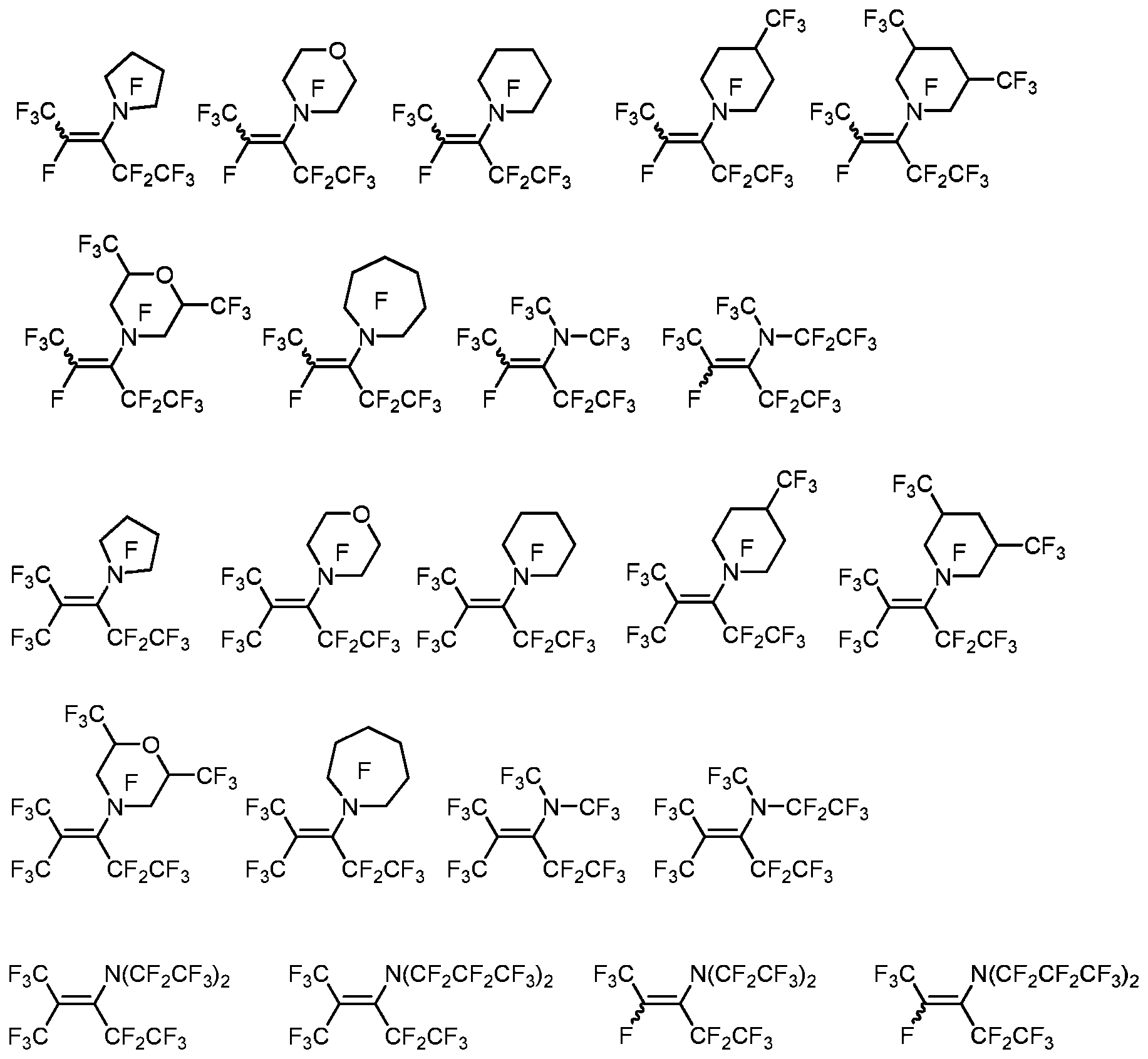
一実施形態において、本開示の化合物は、一般式II:CFRf’=NRfの全フッ素化イミンを、金属フッ化物触媒[M]Fの存在下で一般式III:CFX=CFYのペルフルオロオレフィンと接触させることによって調製することができる[式中、X、Y、Rf及びRf’は、上記のとおりである]。例示的な反応を以下に示す。

一実施形態において、全フッ素化イミンは、全フッ素化イミドイルフロリド、全フッ素化オキサジン、又は全フッ素化ピロール化合物から選択される。このような化合物は、市販されているか、又はH.V.Rasika Dias et al.in Dalton Transactions,2011,vol.40,8569-8580;T.Abe,et al.in J.Fluorine Chem.1989,vol.45,293-311、及びA.F.Gontar,et al.in Izvestiya Akademii Nauk SSSR,Seriya Khimicheskaya,1984,vol.33,8、1711-1714に開示されるものなどの方法を用いて合成することができる。 In one embodiment, the perfluorinated imine is selected from perfluorinated imidoyl fluorides, perfluorinated oxazines, or perfluorinated pyrrole compounds. Such compounds are commercially available or can be prepared by the methods described in H. V. Rasika Dias et al. in Dalton Transactions, 2011, vol. 40, 8569-8580; T. Abe, et al. in J. Fluorine Chem. 1989, vol. 45, 293-311, and A. F. Gontar, et al. in Izvestiya Akademii Nauk SSSR, Seriya Khimicheskaya, 1984, vol. It can be synthesized using methods such as those disclosed in 33, 8, 1711-1714.
例示的な全フッ素化イミンとしては、以下が挙げられる。
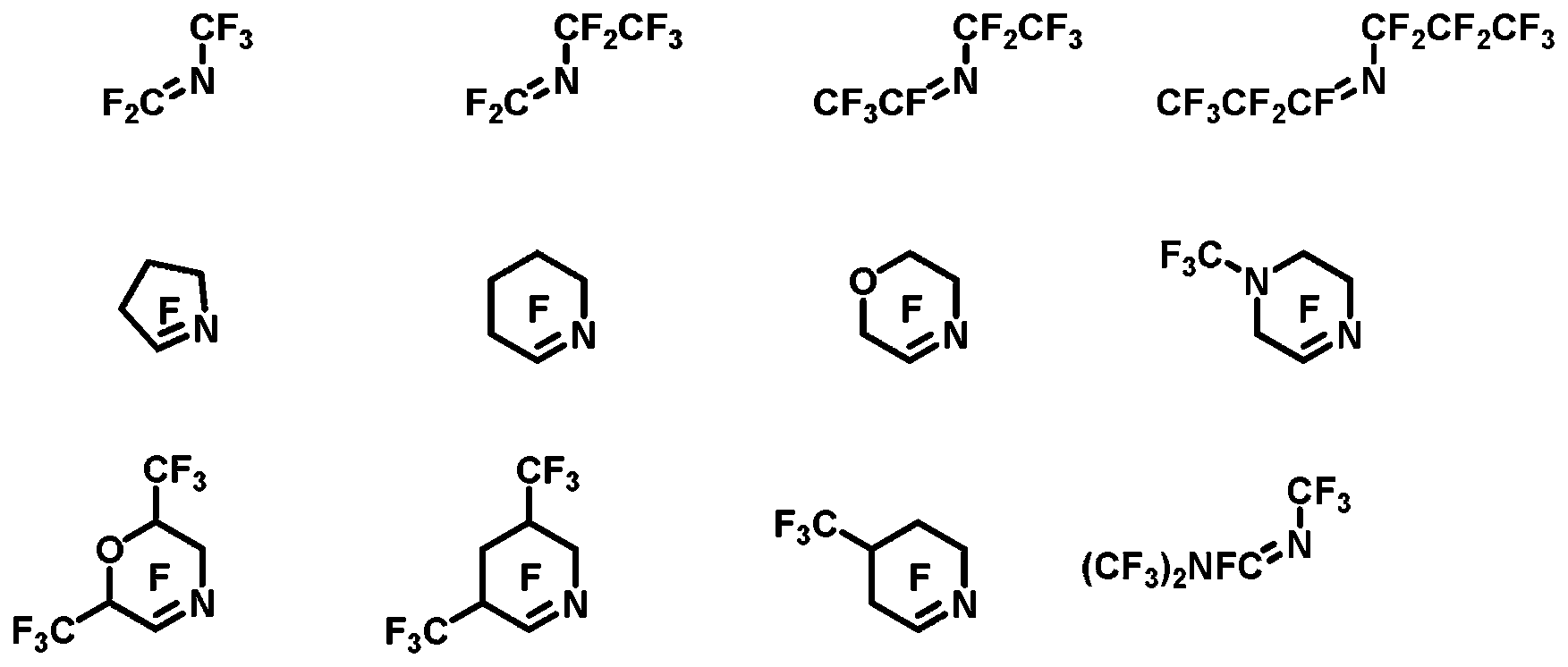
一実施形態において、ペルフルオロオレフィンは、一般式III:CFX=CFY[式中、X及びYは、上記のとおりである]によって表される。このようなペルフルオロオレフィンは、市販され得るか、又は当該技術分野において公知の技術を用いて合成することができる。 In one embodiment, the perfluoroolefin is represented by the general formula III: CFX=CFY, where X and Y are as defined above. Such perfluoroolefins may be commercially available or may be synthesized using techniques known in the art.
例示的なペルフルオロオレフィンとしては、

金属フッ化物触媒は、当該技術分野において既知であり、CsF、KF、AlF3、MgF2、CaF2、SrF2、BaF2、及びこれらの組み合わせが挙げられ得る。金属フッ化物触媒は、反応中に再生されるため、典型的には少量(例えば、全フッ素化オレフィンに対して50、40、30、又は更には20モル%未満)が使用される。 Metal fluoride catalysts are known in the art and can include CsF, KF, AlF3 , MgF2 , CaF2 , SrF2 , BaF2 , and combinations thereof. Metal fluoride catalysts are typically used in small amounts (e.g., less than 50, 40, 30, or even 20 mol % based on total fluorinated olefins) because they are regenerated during the reaction.
式IIIのペルフルオロオレフィン及び式IIの全フッ素化イミンを、周囲温度又は40、50若しくは70℃超の温度などの高温であろうが、金属フッ化物触媒の存在下で合わせて加熱する。 A perfluoroolefin of formula III and a perfluorinated imine of formula II are heated together in the presence of a metal fluoride catalyst, which may be at ambient temperature or at an elevated temperature, such as a temperature greater than 40, 50 or 70° C.
式IIIのペルフルオロオレフィンと式IIの全フッ素化イミンとの比率は、典型的には、0.85未満~1又は更には0.70未満~1である。 The ratio of perfluoroolefin of formula III to perfluorinated imine of formula II is typically less than 0.85 to 1 or even less than 0.70 to 1.
溶媒を使用して、反応を生じさせるために反応物質を可溶化してもよい。有用な溶媒としては、極性非プロトン性溶媒などの有機溶媒が挙げられる。極性非プロトン性溶媒としては、個別に又は混合物として使用できる、エーテル(ビス(2-メトキシエチル)エーテル及びテトラエチレングリコールジメチルエーテルなど)、ニトリル(アセトニトリル、アジポニトリル、及びベンゾニトリルなど)、ジメチルスルホキシド、N-メチルピロリジノン(NMP)、N,N-ジメチルホルムアミド(DMF)、及びテトラヒドロチオフェン-1,1-ジオキシド(スルホラン)が挙げられる。 A solvent may be used to solubilize the reactants for the reaction to occur. Useful solvents include organic solvents, such as polar aprotic solvents. Polar aprotic solvents include ethers (such as bis(2-methoxyethyl)ether and tetraethylene glycol dimethyl ether), nitriles (such as acetonitrile, adiponitrile, and benzonitrile), dimethyl sulfoxide, N-methylpyrrolidinone (NMP), N,N-dimethylformamide (DMF), and tetrahydrothiophene-1,1-dioxide (sulfolane), which can be used individually or as mixtures.
一実施形態において、反応から得られたフッ素化化合物を精製して、所望の全フッ素化アミノオレフィンを単離することができる。精製は、蒸留、吸収、抽出、クロマトグラフィー及び再結晶を含む従来の手段によって行うことができる。精製は、本開示の化合物を(その立体異性体の全ての形態で)出発物質、副生成物等の不純物から単離するために実施することができる。本明細書で使用する場合、用語「精製形態」は、本開示の化合物が少なくとも75重量%、80重量%、85重量%、90重量%、95重量%、98重量%、又は更には99重量%の純度であることを意味する。 In one embodiment, the fluorinated compound obtained from the reaction can be purified to isolate the desired fully fluorinated amino olefin. Purification can be performed by conventional means including distillation, absorption, extraction, chromatography and recrystallization. Purification can be performed to isolate the compounds of the present disclosure (in all of their stereoisomeric forms) from impurities such as starting materials, by-products, etc. As used herein, the term "purified form" means that the compounds of the present disclosure are at least 75%, 80%, 85%, 90%, 95%, 98%, or even 99% pure by weight.
本開示の化合物は、良好な環境特性を有し、不燃性、化学的不活性、高い熱安定性、良好な溶解力等の良好な性能属性を有する。 The compounds disclosed herein have good environmental properties and good performance attributes such as non-flammability, chemical inertness, high thermal stability, and good solvency.
一実施形態において、本開示の化合物は、低い環境負荷を有し得る。この点に関して、本開示の化合物は、1000未満、700未満、又は更には500未満の地球温暖化係数(GWP)を有し得る。本明細書で使用する場合、GWPは、化合物の構造に基づく化合物の地球温暖化係数の相対的尺度である。化合物のGWPは、1990年に気候変動に関する政府間パネル(IPCC)によって規定され、2007年に改訂されており、特定の積分期間(ITH)にわたる、1キログラムのCO2放出による温暖化に対する、1キログラムの化合物放出による温暖化として計算される。

この式中、aiは大気中の化合物の単位質量増加当たりの放射強制力(その化合物のIR吸光度に起因する大気を通る放射束の変化)であり、Cは化合物の大気濃度であり、τは化合物の大気寿命であり、tは時間であり、iは対象化合物である。一般的に許容されるITHは、短期間の効果(20年間)と長期間の効果(500年間以上)との間の折衷点を表す100年間である。大気中の有機化合物iの濃度は、擬一次速度論(すなわち、指数関数的減衰)に従うと仮定される。同じ時間間隔のCO2の濃度は、大気からのCO2の交換及び除去に関する、より複雑なモデルを組み込む(Bern炭素循環モデル)。 In this equation, a i is the radiative forcing (change in radiative flux through the atmosphere due to the IR absorbance of that compound) per unit mass increase of the compound in the atmosphere, C is the atmospheric concentration of the compound, τ is the atmospheric lifetime of the compound, t is time, and i is the compound of interest. A commonly accepted ITH is 100 years, which represents a compromise between short-term effects (20 years) and long-term effects (500 years or more). The concentration of organic compound i in the atmosphere is assumed to follow pseudo-first-order kinetics (i.e., exponential decay). The concentration of CO 2 over the same time interval incorporates a more complex model of exchange and removal of CO 2 from the atmosphere (Bern carbon cycle model).
一実施形態において、本開示の化合物は、実施例の項で開示される大気寿命試験方法に従って試験した場合、10年未満、又は更には5年未満の大気寿命を有する。 In one embodiment, the compounds of the present disclosure have an atmospheric lifetime of less than 10 years, or even less than 5 years, when tested according to the atmospheric lifetime test method disclosed in the Examples section.
不燃性は、ASTM D-3278-96 e-1、「Standard Test Method for Flash Point of Liquids by Small Scale Closed-Cup Apparatus」等の標準方法を用いることによって評価することができる。一実施形態において、本開示の化合物は、ASTM D-3278-96 e-1に準拠した密閉式引火点試験に基づいて不燃性である。 Non-flammability can be evaluated using standard methods such as ASTM D-3278-96 e-1, "Standard Test Method for Flash Point of Liquids by Small Scale Closed-Cup Apparatus." In one embodiment, the compounds of the present disclosure are non-flammable based on a closed cup flash point test in accordance with ASTM D-3278-96 e-1.
一実施形態において、本開示の化合物は、動物組織において生体内蓄積しない。例えば、本開示のいくつかの化合物は、動物組織において生体内蓄積する傾向の低減を示す低log Kow値を実現することができ、ここでKowは、オクタノール相及び水性相を含む二相系中の所与の化合物の濃度比として規定される、オクタノール/水の分配係数である。一実施形態において、log Kow値は、7、6、5、又は更には4未満である。 In one embodiment, the compounds of the present disclosure do not bioaccumulate in animal tissue. For example, some compounds of the present disclosure can achieve low log Kow values, which indicate a reduced tendency to bioaccumulate in animal tissue, where Kow is the octanol/water partition coefficient, defined as the concentration ratio of a given compound in a two-phase system comprising an octanol phase and an aqueous phase. In one embodiment, the log Kow value is less than 7, 6, 5, or even 4.
一実施形態において、本開示の化合物は、熱的に安定であり、化合物を加熱したときに純度の損失が最小限であることを意味する。例えば、全フッ素化アミノオレフィンを60℃で24時間加熱した場合、5%未満、3%未満、又は更には1%未満の損失である。一実施形態において、全フッ素化アミノオレフィンを100、120又は更には150℃で24時間加熱した場合、5%未満、3%未満、又は更には1%未満の損失である。 In one embodiment, the compounds of the present disclosure are thermally stable, meaning that there is minimal loss of purity when the compounds are heated. For example, when fully fluorinated amino olefins are heated at 60° C. for 24 hours, there is less than 5%, less than 3%, or even less than 1% loss. In one embodiment, when fully fluorinated amino olefins are heated at 100, 120, or even 150° C. for 24 hours, there is less than 5%, less than 3%, or even less than 1% loss.
一実施形態において、本開示の化合物は、広い操作範囲を有する。本開示の化合物の有用な液体領域は、その流動点とその沸点との間である。流動点は、化合物をなおも流動することができる最低温度である。流動点は、例えば、ASTM D97-16「Standard Test Method for Pour Point of Petroleum Products」によって決定することができる。一実施形態において、本開示の化合物は、0℃、-20℃、-30℃、-40℃又は更には-60℃未満の流動点を有する。一実施形態において、本開示の化合物は、大気圧下で少なくとも100℃、150℃、又は更には200℃の沸点を有する。いくつかの実施形態において、本開示の化合物は、約50℃~約200℃、約100℃~約150℃、又は更には約110℃~約130℃の沸点を有する。 In one embodiment, the compounds of the present disclosure have a wide operating range. The useful liquid region of the compounds of the present disclosure is between their pour point and their boiling point. The pour point is the lowest temperature at which the compound can still flow. The pour point can be determined, for example, by ASTM D97-16 "Standard Test Method for Pour Point of Petroleum Products". In one embodiment, the compounds of the present disclosure have a pour point of less than 0°C, -20°C, -30°C, -40°C or even -60°C. In one embodiment, the compounds of the present disclosure have a boiling point of at least 100°C, 150°C, or even 200°C at atmospheric pressure. In some embodiments, the compounds of the present disclosure have a boiling point of about 50°C to about 200°C, about 100°C to about 150°C, or even about 110°C to about 130°C.
一実施形態において、本開示の化合物は、1kHz(キロヘルツ)で測定してASTM D150によって決定したときに、2.3未満、2.2未満、2.1未満、又は更には2.0未満の誘電率を有する。 In one embodiment, the compounds of the present disclosure have a dielectric constant of less than 2.3, less than 2.2, less than 2.1, or even less than 2.0 as measured at 1 kHz (kilohertz) and determined by ASTM D150.
熱伝達 Heat transfer
いくつかの実施形態において、本開示の化合物は、デバイスに又はそのデバイスから熱を伝達するための伝熱装置中で使用され得る。 In some embodiments, the compounds of the present disclosure may be used in heat transfer devices to transfer heat to or from a device.
提供される熱伝達のための装置はデバイスを含んでもよい。デバイスとは、冷却、加熱又は所定の温度若しくは温度範囲に維持されるコンポーネント、加工対象物、アセンブリ等であってもよい。このようなデバイスには、電気コンポーネント、機械コンポーネント及び光学コンポーネントが含まれる。本開示のデバイスの例としては、マイクロプロセッサ、半導体デバイスを製造するために使用されるウエハ、電力制御半導体、配電スイッチギヤ、電力変圧器、回路基板、マルチチップモジュール、パッケージ化された及びパッケージ化されていない半導体デバイス、レーザー、化学反応器、燃料電池並びに電気化学セルが挙げられるが、これらに限定されない。いくつかの実施形態において、デバイスは、冷却器、加熱器、又はそれらの組み合わせを含み得る。 The provided apparatus for heat transfer may include a device. A device may be a component, work piece, assembly, etc. that is to be cooled, heated, or maintained at a predetermined temperature or temperature range. Such devices include electrical components, mechanical components, and optical components. Examples of devices of the present disclosure include, but are not limited to, microprocessors, wafers used to manufacture semiconductor devices, power control semiconductors, power distribution switchgear, power transformers, circuit boards, multi-chip modules, packaged and unpackaged semiconductor devices, lasers, chemical reactors, fuel cells, and electrochemical cells. In some embodiments, the device may include a cooler, a heater, or a combination thereof.
提供される装置は、熱を伝達するための機構を備えてもよい。その機構は、熱伝達流体を含んでもよい。熱伝達流体は、1種以上の式(I)の全フッ素化アミノオレフィン化合物を含んでもよい。デバイスと熱接触するように熱伝達機構を配置することによって、熱を伝達し得る。熱伝達機構は、デバイスと熱接触するように配置されるとき、デバイスから熱を除去するか、若しくはデバイスに熱を供給するか、又は選択された温度若しくは温度範囲にデバイスを維持する。熱流の方向(デバイスから又はデバイスに)は、デバイスと熱伝達機構との間の相対的温度差によって決定される。 The provided device may include a mechanism for transferring heat. The mechanism may include a heat transfer fluid. The heat transfer fluid may include one or more perfluorinated aminoolefin compounds of formula (I). Heat may be transferred by placing the heat transfer mechanism in thermal contact with the device. When placed in thermal contact with the device, the heat transfer mechanism removes heat from the device, or supplies heat to the device, or maintains the device at a selected temperature or temperature range. The direction of heat flow (from or to the device) is determined by the relative temperature difference between the device and the heat transfer mechanism.
熱伝達機構としては、これらに限定されるものではないが、ポンプ、弁、流体収納システム、圧力制御システム、凝縮器、熱交換器、熱源、ヒートシンク、冷却システム、能動型温度制御システム及び受動型温度制御システムを含む、熱伝達流体を管理するための設備を挙げることができる。好適な熱伝達機構の例としては、プラズマ強化化学蒸着(PECVD)ツールの温度制御ウエハチャック、ダイ性能試験のための温度制御試験ヘッド、半導体プロセス装置内の温度制御作動領域、熱衝撃試験槽液体収容容器及び恒温槽が挙げられるが、これらに限定されない。エッチャー、アッシャー、PECVDチャンバ、気相はんだ付けデバイス、及び熱衝撃試験器等の一部の系では、所望の動作温度の上限は、170℃、200℃、又は更には230℃の高温であり得る。 Heat transfer mechanisms can include equipment for managing heat transfer fluids, including, but not limited to, pumps, valves, fluid containment systems, pressure control systems, condensers, heat exchangers, heat sources, heat sinks, cooling systems, active temperature control systems, and passive temperature control systems. Examples of suitable heat transfer mechanisms include, but are not limited to, temperature controlled wafer chucks in plasma enhanced chemical vapor deposition (PECVD) tools, temperature controlled test heads for die performance testing, temperature controlled operating areas in semiconductor processing equipment, thermal shock test chamber liquid containment vessels, and thermostatic chambers. In some systems, such as etchers, ashers, PECVD chambers, vapor phase soldering devices, and thermal shock testers, the desired upper operating temperature limit can be as high as 170°C, 200°C, or even 230°C.
提供される装置として、冷蔵システム、冷却システム、試験装置及び機械加工装置も挙げることができる。いくつかの実施形態において、提供される装置は、恒温槽又は熱衝撃試験槽であり得る。 The provided equipment may also include refrigeration systems, cooling systems, testing equipment, and machining equipment. In some embodiments, the provided equipment may be a thermostatic chamber or a thermal shock test chamber.
その他の態様では、デバイスを準備することと、機構を用いてデバイスへ又はデバイスから熱を伝達することと、を含む、熱を伝達する方法が提供される。機構は、式(I)の全フッ素化アミノオレフィン化合物などの熱伝達流体を含んでもよい。 In another aspect, a method of transferring heat is provided that includes providing a device and transferring heat to or from the device with a mechanism. The mechanism may include a heat transfer fluid, such as a perfluorinated amino olefin compound of formula (I).
有機ランキンサイクル作動流体 Organic Rankine cycle working fluid
いくつかの実施形態において、本開示の化合物は、ランキンサイクルで熱エネルギーを機械エネルギーに変換するための作動流体として使用してもよい。装置は、作動流体を気化させて気化作動流体を形成するための熱源と、気化作動流体を通過させることにより熱エネルギーを機械エネルギーに変換するタービンと、タービンを通過した後の気化作動流体を冷却するための凝縮器と、作動流体を再循環させるためのポンプとを更に含んでもよい。 In some embodiments, the compounds of the present disclosure may be used as a working fluid for converting thermal energy to mechanical energy in a Rankine cycle. The apparatus may further include a heat source for vaporizing the working fluid to form a vaporized working fluid, a turbine for converting thermal energy to mechanical energy by passing the vaporized working fluid through it, a condenser for cooling the vaporized working fluid after passing through the turbine, and a pump for recirculating the working fluid.
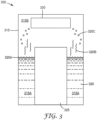
式(I)の1種以上の全フッ素化アミノオレフィン化合物を含む作動流体を含む、ランキンサイクルで熱エネルギーを機械エネルギーに変換するためのプロセスが提供される。図1を参照して、外部熱源から熱を受け取るエバポレーター/ボイラー120を含む典型的なランキンサイクルシステム100を示す。エバポレーター/ボイラー120は、閉鎖系100内に含まれる有機ランキンサイクル作動流体を気化する。ランキンサイクルシステム100は、システム内の気化作動流体で動き、発電機180のスイッチを入れて電力を生成するために使用されるタービン160も含む。次いで気化作動流体を凝縮器140に通して供給し、過剰な熱が除去され、液体作動流体が再液化される。パワーポンプ130は、凝縮器140を出た液体の圧力を上げ、また、サイクル内で更に使用するため、ポンプによってエバポレーター/ボイラー120に戻す。次いで凝縮器140から放出された熱は、第2のランキンサイクルシステム(図示せず)を動かす等、他の目的のために使用することができる。
A process for converting thermal energy to mechanical energy in a Rankine cycle is provided that includes a working fluid that includes one or more perfluorinated aminoolefin compounds of formula (I). Referring to FIG. 1, a typical
一般的には、等エントロピーであるか、又は温度エントロピー線図上で右上がり斜線を有するかのいずれかの飽和蒸気曲線を有する流体を有することが望ましい。飽和蒸気曲線が右上がり斜線を有する場合、ランキンサイクル効率は、膨張器を出た蒸気から熱を回収し、回収した熱を使用してポンプから出た液体を予熱するための予備の熱交換器(又は復熱装置)を使用して改善することができる。図2は、復熱装置を含むランキンサイクルシステムの図である。 It is generally desirable to have a fluid with a saturated vapor curve that is either isentropic or has a positive slope on the temperature entropy diagram. If the saturated vapor curve has a positive slope, the Rankine cycle efficiency can be improved by using an extra heat exchanger (or recuperator) to recover heat from the vapor leaving the expander and use the recovered heat to preheat the liquid leaving the pump. Figure 2 is a diagram of a Rankine cycle system including a recuperator.
図2を参照して、外部熱源から熱を受け取るエバポレーター/ボイラー220を含むランキンサイクルシステム200を示す。エバポレーター/ボイラー220は、閉鎖系200内に含まれる有機ランキンサイクル作動流体を気化する。ランキンサイクルシステム200は、システム内の気化作動流体で動き、発電機270のスイッチを入れて電力を生成するために使用されるタービン260も含む。次いで気化作動流体を復熱装置280に通して供給し、いくらかの過剰な熱がそこから凝縮器250へ除去され、そこで作動流体は凝縮されて液体に戻る。パワーポンプ240は、凝縮器250を出た液体の圧力を上げ、また、サイクル内で更に使用するため、ポンプによって復熱装置280に戻して予熱した後、エバポレーター/ボイラー220に戻す。次いで凝縮器250から放出された熱は、第2のランキンサイクルシステム(図示せず)を動かす等、他の目的のために使用することができる。
2, a
いくつかの実施形態において、本開示は、ランキンサイクルで熱エネルギーを機械エネルギーに変換するプロセスに関する。このプロセスは、熱源を使用して、1種以上の式(I)の全フッ素化アミノオレフィン化合物を含む作動流体を気化し、気化した作動流体を形成することを含んでもよい。いくつかの実施形態において、熱は、熱源からエバポレーター又はボイラー内の作動流体に伝達される。気化作動流体は、加圧されてもよく、膨張により作動するように使用することができる。熱源は、化石燃料、例えば、石油、石炭又は天然ガス由来のもの等、任意の形態であってもよい。更に、いくつかの実施形態において、熱源は、原子力、太陽エネルギー、又は燃料電池から得ることができる。他の実施形態において、熱は、他の場合であれば大気に失われていたと思われる他の熱伝達システムからの「廃熱」であり得る。いくつかの実施形態において、「廃熱」は、第2のランキンサイクルシステム(第2のランキンサイクルの凝縮器又は他の冷却デバイス)から回収される熱であることができる。 In some embodiments, the present disclosure relates to a process for converting thermal energy to mechanical energy in a Rankine cycle. The process may include using a heat source to vaporize a working fluid comprising one or more perfluorinated aminoolefin compounds of formula (I) to form a vaporized working fluid. In some embodiments, heat is transferred from the heat source to the working fluid in an evaporator or boiler. The vaporized working fluid may be pressurized and used to work by expansion. The heat source may be in any form, such as from a fossil fuel, e.g., oil, coal, or natural gas. Additionally, in some embodiments, the heat source may be derived from nuclear power, solar energy, or fuel cells. In other embodiments, the heat may be "waste heat" from other heat transfer systems that would otherwise be lost to the atmosphere. In some embodiments, the "waste heat" may be heat recovered from a second Rankine cycle system (a condenser or other cooling device of the second Rankine cycle).
更なる「廃熱」源は、メタンガスが燃焼処理される埋立地で見出すことができる。提供されるプロセスにおいて有用であり得る他の「廃熱」源は、地熱源、並びに排気ガス中で著しい熱を出すガスタービンエンジン等の他の種類のエンジンから水及び潤滑剤等の冷却液への熱である。 Additional "waste heat" sources can be found in landfills where methane gas is combusted. Other "waste heat" sources that may be useful in the provided processes are geothermal sources, as well as heat from other types of engines, such as gas turbine engines, that give off significant heat in their exhaust gases to coolants such as water and lubricants.
提供されるプロセスにおいて、気化作動流体は、デバイスを通って膨張することができ、デバイスは、加圧した作動流体を機械エネルギーに変換することができる。いくつかの実施形態において、気化作動流体は、タービンを通って膨張し、タービンは気化作動流体の膨張圧からシャフトを回転させることができる。このタービンは、その結果、いくつかの実施形態において、発電機を作動させ、それにより発電するといった、機械的仕事を行うために使用することができる。他の実施形態において、このタービンは、ベルト、ホイール、ギア、又は取り付けた若しくは連結したデバイスで使用するための機械的仕事若しくはエネルギーを移すことができる他のデバイスを駆動するために使用することができる。 In the provided process, the vaporized working fluid can expand through a device that can convert the pressurized working fluid into mechanical energy. In some embodiments, the vaporized working fluid can expand through a turbine that can rotate a shaft from the expanding pressure of the vaporized working fluid. This turbine can then be used to perform mechanical work, such as in some embodiments to power a generator, thereby generating electricity. In other embodiments, this turbine can be used to drive a belt, wheel, gear, or other device that can transfer mechanical work or energy for use in an attached or coupled device.
気化作動流体が機械エネルギーに変換された後、気化した(その時点で膨張した)作動流体を、冷却源を使用して凝縮し、再使用のために液化することができる。凝縮器によって放出された熱は、同じ又は別のランキンサイクルシステムに再循環させる等、他の目的に使用して、エネルギーを節約することができる。最後に、凝縮された作動流体は、閉鎖系で再使用するため、ポンプによってボイラー又はエバポレーターに戻すことができる。 After the vaporized working fluid has been converted to mechanical energy, the vaporized (now expanded) working fluid can be condensed using a cooling source and liquefied for reuse. The heat released by the condenser can be used for other purposes, such as being recirculated to the same or another Rankine cycle system, thus saving energy. Finally, the condensed working fluid can be pumped back to the boiler or evaporator for reuse in a closed system.
発泡 Foaming
一実施形態において、本明細書に開示される全フッ素化アミノオレフィンは、ポリマー発泡体の製造、特に、ポリウレタン発泡体及びフェノール系発泡体の製造における核形成剤として使用することができる。これに関連して、いくつかの実施形態において、本開示は、1種以上の発泡剤と、1種以上の発泡性ポリマー又はその前駆体組成物と、式(I)の全フッ素化アミノオレフィン化合物を含む1種以上の核形成剤とを含む、発泡性組成物を対象とする。 In one embodiment, the perfluorinated aminoolefins disclosed herein can be used as nucleating agents in the production of polymer foams, particularly polyurethane and phenolic foams. In this regard, in some embodiments, the present disclosure is directed to a foamable composition comprising one or more blowing agents, one or more foamable polymers or precursor compositions thereof, and one or more nucleating agents comprising a perfluorinated aminoolefin compound of formula (I).
いくつかの実施形態において、生成される発泡性組成物中に、ポリマーを発泡させるために気化される液体若しくは気体状発泡剤、又はポリマーを発泡させるためにin situで生成される気体状の発泡剤を含む、様々な発泡剤を用いることができる。発泡剤の代表例としては、ハイドロクロロフルオロカーボン(HCFC)、ハイドロフルオロカーボン(HFC)、ハイドロクロロカーボン(HCC)、ヨードフルオロカーボン(IFC)、ハイドロフルオロオレフィン(HFO)、炭化水素、及びハイドロフルオロエーテル(HFE)が挙げられる。生成される発泡性組成物に使用するための発泡剤は、大気圧で約-45℃~約100℃の沸点を有し得る。典型的には、大気圧では、発泡剤は、少なくとも約15℃の沸点を有し、より典型的には、約20℃~約80℃の沸点を有する。使用できる発泡剤の更なる代表例としては、約5~約7個の炭素原子を有する脂肪族及び脂環式炭化水素、例えばn-ペンタン及びシクロペンタン;ギ酸メチル等のエステル;HFO、例えばCF3CH=CHCF3、CF3CH=CHF;HFC、例えばCF3CF2CHFCHFCF3、CF3CH2CF2H、CF3CH2CF2CH3、CF3CF2H、CH3CF2H(HFC-152a)、CF3CH2CH2CF3及びCHF2CF2CH2F;HCFC、例えばCH3CCl2F、CF3CHCl2、及びCF2HCl;HCC、例えば2-クロロプロパン、並びにIFC、例えばCF3I、並びにHFE、例えばC4F9OCH3が挙げられる。特定の配合物では、水とイソシアネート等の発泡剤前駆体との反応から生じるCO2を発泡剤として使用することができる。 In some embodiments, a variety of blowing agents can be used in the resulting foamable composition, including liquid or gaseous blowing agents that are vaporized to foam the polymer, or gaseous blowing agents that are generated in situ to foam the polymer. Representative examples of blowing agents include hydrochlorofluorocarbons (HCFCs), hydrofluorocarbons (HFCs), hydrochlorocarbons (HCCs), iodofluorocarbons (IFCs), hydrofluoroolefins (HFOs), hydrocarbons, and hydrofluoroethers (HFEs). Blowing agents for use in the resulting foamable composition can have a boiling point of about -45°C to about 100°C at atmospheric pressure. Typically, at atmospheric pressure, the blowing agents have a boiling point of at least about 15°C, more typically from about 20°C to about 80°C. Further representative examples of blowing agents that can be used include aliphatic and cycloaliphatic hydrocarbons having from about 5 to about 7 carbon atoms, such as n-pentane and cyclopentane ; esters such as methyl formate ; HFOs, such as CF3CH = CHCF3 , CF3CH =CHF; HFCs, such as CF3CF2CHFCHFCF3 , CF3CH2CF2H , CF3CH2CF2CH3 , CF3CF2H , CH3CF2H (HFC - 152a ), CF3CH2CH2CF3 , and CHF2CF2CH2F ; HCFCs , such as CH3CCl2F , CF3CHCl2 , and CF2 HCl; HCCs such as 2-chloropropane, and IFCs such as CF 3 I, and HFEs such as C 4 F 9 OCH 3. In certain formulations, CO 2 resulting from the reaction of water with a blowing agent precursor such as an isocyanate can be used as the blowing agent.
様々な実施形態において、生成される発泡性組成物は、1種以上の発泡性ポリマー又はその前駆体組成物も含み得る。生成される発泡性組成物で用いるのに好適な発泡性ポリマーとしては、例えば、ポリオレフィン(例えば、ポリスチレン、ポリ(塩化ビニル)、及びポリエチレン)が挙げられる。発泡体は、従来の押出法を用いてスチレンポリマーから調製することができる。発泡剤組成物は、押出機内の熱可塑化スチレンポリマー流に注入され、熱可塑化スチレンポリマー流と混合された後、押出されて発泡体を形成することができる。好適なスチレンポリマーの代表例としては、例えば、スチレン、α-メチルスチレン、環アルキル化スチレン及び環ハロゲン化スチレンの固体ホモポリマー、並びにこれらモノマーと微量の他の容易に共重合可能なオレフィン性モノマー(例えば、メチルメタクリレート、アクリロニトリル、無水マレイン酸、無水シトラコン酸、無水イタコン酸、アクリル酸、N-ビニルカルバゾール、ブタジエン、及びジビニルベンゼン)とのコポリマーが挙げられる。α好適な塩化ビニルポリマーとしては、例えば、塩化ビニルホモポリマー及び塩化ビニルと他のビニルモノマーとのコポリマーが挙げられる。エチレンホモポリマー及びエチレンと例えば、2-ブテン、アクリル酸、プロピレン又はブタジエンとのコポリマーも有用となり得る。異なるタイプのポリマーの混合物を使用することができる。 In various embodiments, the foamable composition produced may also include one or more foamable polymers or precursor compositions thereof. Suitable foamable polymers for use in the foamable composition produced include, for example, polyolefins (e.g., polystyrene, poly(vinyl chloride), and polyethylene). Foams can be prepared from styrene polymers using conventional extrusion techniques. The blowing agent composition can be injected into a heat-plasticized styrene polymer stream in an extruder and mixed with the heat-plasticized styrene polymer stream and then extruded to form a foam. Representative examples of suitable styrene polymers include, for example, solid homopolymers of styrene, α-methylstyrene, ring-alkylated styrenes, and ring-halogenated styrenes, as well as copolymers of these monomers with minor amounts of other readily copolymerizable olefinic monomers (e.g., methyl methacrylate, acrylonitrile, maleic anhydride, citraconic anhydride, itaconic anhydride, acrylic acid, N-vinylcarbazole, butadiene, and divinylbenzene). Suitable vinyl chloride polymers include, for example, vinyl chloride homopolymers and copolymers of vinyl chloride with other vinyl monomers. Ethylene homopolymers and copolymers of ethylene with, for example, 2-butene, acrylic acid, propylene or butadiene may also be useful. Mixtures of different types of polymers can be used.
生成される発泡性組成物で用いるのに好適な発泡性ポリマーの前駆体としては、例えば、フェノール性ポリマー、シリコーンポリマー、及びイソシアネート系ポリマーの前駆体、例えば、ポリウレタン、ポリイソシアヌレート、ポリ尿素、ポリカルボジイミド、及びポリイミドが挙げられ得る。典型的には、イソシアネート系ポリマーの前駆体は、ポリウレタン又はポリイソシアヌレート発泡体を調製するための発泡剤として利用される。 Suitable foamable polymer precursors for use in the resulting foamable composition may include, for example, phenolic polymers, silicone polymers, and precursors to isocyanate-based polymers, such as polyurethanes, polyisocyanurates, polyureas, polycarbodiimides, and polyimides. Typically, precursors to isocyanate-based polymers are utilized as blowing agents to prepare polyurethane or polyisocyanurate foams.
生成される発泡性組成物で用いるのに好適なポリイソシアネートとしては、脂肪族、脂環式、アリール脂肪族、芳香族、若しくは複素環式ポリイソシアネート、又はそれらの組み合わせが挙げられる。ポリマー発泡体の製造で用いるのに好適ないずれのポリイソシアネートも利用することができる。例えば、純粋、変性、又は未精製の形態の芳香族ジイソシアネート(トルエン及びジフェニルメタンジイソシアネート等)を用いてもよい。MDI変形体(ウレタン、アロファネート、尿素、ビウレット、カルボジイミド、ウレトンイミン、又はイソシアヌレート残基を導入することによって修飾されたジフェニルメタンジイソシアネート)及び未精製物又はポリマーMDI(ポリメチレンポリフェニレンポリイソシアネート)として当該技術分野において既知のジフェニルメタンジイソシアネートとそのオリゴマーとの混合物が有用であり得る。好適なポリイソシアネートの代表例としては、例えば、エチレンジイソシアネート、1,4-テトラメチレンジイソシアネート、1,6-ヘキサメチレンジイソシアネート、トリメチルヘキサメチレンジイソシアネート、1,12-ドデカンジイソシアネート、シクロブタン-1,3-ジイソシアネート、シクロヘキサン-1,3-及び-1,4-ジイソシアネート(及びこれらの異性体の混合物)、ジイソシアナト-3,3,5-トリメチル-5-イソシアナトメチルシクロヘキサン、2,4-及び2,6-トルエンジイソシアネート(及びこれらの異性体の混合物)、ジフェニルメタン-2,4’-及び/又は-4,4’-ジイソシアネート、ナフタレン-1,5-ジイソシアネート、4当量の上記イソシアネート含有化合物と、2つのイソシアネート反応性基を含有する化合物との反応生成物、トリフェニルメタン-4,4’、4’’-トリイソシアネート、ポリメチレンポリフェニレンポリイソシアネート、m-及びp-イソシアナトフェニルスルホニルイソシアネート、過塩素化アリールポリイソシアネート、カルボジイミド基を含有するポリイソシアネート、ノルボルナンジイソシアネート、アロファネート基を含有するポリイソシアネート、イソシアヌレート基を含有するポリイソシアネート、ウレタン基を含有するポリイソシアネート、アクリル化尿素基を含有するポリイソシアネート、ビウレット基を含有するポリイソシアネート、短鎖重合反応により生成されたポリイソシアネート、エステル基を含有するポリイソシアネート、上記ジイソシアネートとアセタールとの反応生成物、ポリマー脂肪酸エステルを含有するポリイソシアネート、並びにこれらの混合物が挙げられる。イソシアネート基を有する蒸留残滓(イソシアネート市販製品で得られたもの)も、単独で、又は1種以上の上記ポリイソシアネート溶液中で使用することができる。 Suitable polyisocyanates for use in the resulting foamable composition include aliphatic, cycloaliphatic, arylaliphatic, aromatic, or heterocyclic polyisocyanates, or combinations thereof. Any polyisocyanate suitable for use in the manufacture of polymeric foams can be utilized. For example, aromatic diisocyanates (such as toluene and diphenylmethane diisocyanate) in pure, modified, or crude form may be used. MDI variants (diphenylmethane diisocyanate modified by introducing urethane, allophanate, urea, biuret, carbodiimide, uretonimine, or isocyanurate residues) and mixtures of diphenylmethane diisocyanate and its oligomers, known in the art as crude or polymeric MDI (polymethylene polyphenylene polyisocyanate), may be useful. Representative examples of suitable polyisocyanates include, for example, ethylene diisocyanate, 1,4-tetramethylene diisocyanate, 1,6-hexamethylene diisocyanate, trimethylhexamethylene diisocyanate, 1,12-dodecane diisocyanate, cyclobutane-1,3-diisocyanate, cyclohexane-1,3- and -1,4-diisocyanate (and mixtures of these isomers), diisocyanato-3,3,5-trimethyl-5-isocyanatomethylcyclohexane, 2,4- and 2,6-toluene diisocyanate (and mixtures of these isomers), diphenylmethane-2,4'- and/or -4,4'-diisocyanate, naphthalene-1,5-diisocyanate, reaction products of four equivalents of the above isocyanate-containing compounds with compounds containing two isocyanate-reactive groups. , triphenylmethane-4,4',4''-triisocyanate, polymethylene polyphenylene polyisocyanate, m- and p-isocyanatophenylsulfonyl isocyanate, perchlorinated aryl polyisocyanate, polyisocyanate containing carbodiimide groups, norbornane diisocyanate, polyisocyanate containing allophanate groups, polyisocyanate containing isocyanurate groups, polyisocyanate containing urethane groups, polyisocyanate containing acrylated urea groups, polyisocyanate containing biuret groups, polyisocyanate produced by short chain polymerization reaction, polyisocyanate containing ester groups, reaction products of the above diisocyanates with acetals, polyisocyanate containing polymeric fatty acid esters, and mixtures thereof. Distillation residues having isocyanate groups (obtained from commercial isocyanate products) can also be used alone or in one or more of the above polyisocyanate solutions.
本開示の発泡性組成物で用いるのに好適な反応性水素含有化合物は、少なくとも2つのイソシアネート反応性水素原子を有する、例えば、ヒドロキシル基、第1級若しくは第2級アミン基、カルボン酸基、又はチオール基、又はこれらの組み合わせの形態のものである。ポリオール、すなわち、一分子当たり少なくとも2つのヒドロキシル基を有する化合物を、ポリイソシアネートとのその望ましい反応性により用いてもよい。このようなポリオールは、例えば、ポリエステル、ポリエーテル、ポリチオエーテル、ポリアセタール、ポリカーボネート、ポリメタクリレート、ポリエステルアミド、又はこれらの化合物のヒドロキシル含有プレポリマー及び化学量論量未満のポリイソシアネートであってもよい。 Suitable reactive hydrogen-containing compounds for use in the foamable compositions of the present disclosure are those having at least two isocyanate-reactive hydrogen atoms, e.g., in the form of hydroxyl groups, primary or secondary amine groups, carboxylic acid groups, or thiol groups, or combinations thereof. Polyols, i.e., compounds having at least two hydroxyl groups per molecule, may also be used due to their desirable reactivity with polyisocyanates. Such polyols may be, for example, polyesters, polyethers, polythioethers, polyacetals, polycarbonates, polymethacrylates, polyesteramides, or hydroxyl-containing prepolymers of these compounds and less than stoichiometric amounts of polyisocyanates.
有用なポリオールとしては、エチレングリコール、1,2-及び1,3-プロピレングリコール、1,4-及び2,3-ブチレングリコール、1,5-ペンタンジオール、1,6-ヘキサンジオール、1,8-オクタンジオール、ネオペンチルグリコール、1,4-ビス(ヒドロキシメチル)シクロヘキサン、2-メチル-1,3-プロパンジオール、ジブロモブテンジオール、グリセロール、トリメチロールプロパン、1,2,6-ヘキサントリオール、トリメチロールエタン、ペンタエリスリトール、キニトール、マンニトール、ソルビトール、ジエチレングリコール、トリエチレングリコール、テトラエチレングリコール、高級ポリエチレングリコール、ジプロピレングリコール、高級ポリプロピレングリコール、ジブチレングリコール、高級ポリブチレングリコール、4,4’-ジヒドロキシジフェニルプロパン、及びジヒドロキシメチルヒドロキノンが挙げられる。他の好適なポリオールとしては、多塩基酸とポリオールとの縮合物(アジピン酸ポリエチレンとポリカプロラクトン系ポリオール等)、並びにヒドロキシアルデヒドとヒドロキシケトンとの混合物(「ホルモース」)及び還元によってその混合物から得られる多価アルコール(「ホルミトール」)(触媒の金属化合物及び当該技術分野において既知の共触媒のエンジオール形成できる化合物の存在下でのホルムアルデヒド水和物の自動縮合中に形成される)が挙げられる。低分子量の多価アルコール中のポリイソシアネート重付加生成物の溶液、特にイオン基を含有するポリウレタン尿素の溶液及び/又はポリヒドラゾジカルボンアミドの溶液も使用することができる(独国特許第2,638,759号参照)。 Useful polyols include ethylene glycol, 1,2- and 1,3-propylene glycol, 1,4- and 2,3-butylene glycol, 1,5-pentanediol, 1,6-hexanediol, 1,8-octanediol, neopentyl glycol, 1,4-bis(hydroxymethyl)cyclohexane, 2-methyl-1,3-propanediol, dibromobutenediol, glycerol, trimethylolpropane, 1,2,6-hexanetriol, trimethylolethane, pentaerythritol, quinitol, mannitol, sorbitol, diethylene glycol, triethylene glycol, tetraethylene glycol, higher polyethylene glycols, dipropylene glycol, higher polypropylene glycols, dibutylene glycol, higher polybutylene glycols, 4,4'-dihydroxydiphenylpropane, and dihydroxymethylhydroquinone. Other suitable polyols include condensates of polybasic acids and polyols (such as polyethylene adipate and polycaprolactone-based polyols), as well as mixtures of hydroxyaldehydes and hydroxyketones ("formoses") and polyhydric alcohols obtained therefrom by reduction ("formitols") (formulated during the autocondensation of formaldehyde hydrate in the presence of catalytic metal compounds and cocatalytic compounds capable of forming enediols known in the art). Solutions of polyisocyanate polyaddition products in low molecular weight polyhydric alcohols can also be used, in particular solutions of polyurethaneureas containing ionic groups and/or solutions of polyhydrazodicarbonamides (see German Patent No. 2,638,759).
多くの他のイソシアネート反応性水素原子を含有する化合物が、本発明の好ましい発泡性組成物に有用であり、このことは、ポリウレタン科学及び技術の当業者には明らかであろう。 Many other compounds containing isocyanate-reactive hydrogen atoms are useful in the preferred foamable compositions of the present invention, as will be apparent to those skilled in the art of polyurethane science and technology.
生成される発泡性組成物で用いるのに好適なフェノール性ポリマー前駆体としては、例えば、触媒の存在下でのフェノールとアルデヒドとの反応の生成物が挙げられる。本開示のフェノール性発泡体の代表的な用途としては、屋根断熱のための使用、建築用途の外壁断熱のための外装製品としての使用、並びに工業用途のパイプ及びブロック断熱等の成形部品のための使用が挙げられる。 Phenolic polymer precursors suitable for use in the resulting foamable compositions include, for example, the products of the reaction of phenols with aldehydes in the presence of a catalyst. Representative applications of the phenolic foams of the present disclosure include use for roof insulation, as exterior products for exterior wall insulation in building applications, and for molded parts such as pipe and block insulation in industrial applications.
生成される発泡性組成物は、式(I)に関して上述した全フッ素化アミノオレフィン化合物を含む核形成剤を含んでもよい。The Handbook of Polymeric Foams and Foam Technology,Daniel Klempner and Kurt C.Frisch,ed.,(Oxford University Press,1991)は、均一な多孔性微細構造の構成物が、核形成剤(nucleating agent)とも称する「核剤(nucleazite)」を使用することによって得ることができることを開示している。 The foamable composition produced may include a nucleating agent, including a perfluorinated aminoolefin compound as described above with respect to formula (I). The Handbook of Polymeric Foams and Foam Technology, Daniel Klempner and Kurt C. Frisch, ed., (Oxford University Press, 1991), discloses that compositions of uniform porous microstructures can be obtained by using "nucleating agents," also referred to as "nucleazites."
様々な実施形態において、本開示の発泡性組成物は、核形成剤と発泡剤とのモル比が、1:50、1:25、1:9、又は1:7、1:3、又は1:2以下であってもよい。 In various embodiments, the foamable compositions of the present disclosure may have a molar ratio of nucleating agent to blowing agent of 1:50, 1:25, 1:9, or 1:7, 1:3, or 1:2 or less.
発泡体配合物の他の従来成分が、任意選択により、本開示の発泡性組成物中に存在してよい。例えば、架橋剤又は鎖延長剤、泡安定剤又は界面活性剤、触媒及び難燃剤を使用することができる。他の可能な成分としては、フィラー(例えば、カーボンブラック)、着色剤、抗真菌剤、殺菌剤、酸化防止剤、補強剤、静電気防止剤及び他の添加剤又は加工助剤が挙げられる。 Other conventional components of foam formulations may optionally be present in the foamable compositions of the present disclosure. For example, crosslinkers or chain extenders, foam stabilizers or surfactants, catalysts and flame retardants may be used. Other possible components include fillers (e.g., carbon black), colorants, antifungals, bactericides, antioxidants, reinforcing agents, antistatic agents and other additives or processing aids.
いくつかの実施形態において、ポリマー発泡体は、少なくとも1種の発泡性ポリマー又はその前駆体組成物及び上で説明したような核形成剤の存在下で、少なくとも1種の液体若しくは気体状発泡剤を気化させるか、又は少なくとも1種の気体状発泡剤を発生させることによって調製することができる。更なる実施形態において、ポリマー発泡体は、生成する発泡性組成物を使用して、上で説明したような核形成剤と、少なくとも1種の有機ポリイソシアネートと、少なくとも2個の反応性水素原子を含有する少なくとも1種の化合物との存在下で、少なくとも1種の発泡剤を(例えば、前駆体反応の熱を利用することによって)気化させることによって調製することができる。ポリイソシアネート系発泡体の作製において、一般的に、ポリイソシアネートと、反応性水素含有化合物と、発泡剤組成物とを組み合わせて、十分に混合し(例えば、様々な既知の種類の混合ヘッド及び噴霧装置のいずれかを用いて)、膨張させ、硬化させて、多孔性ポリマーにすることができる。ポリイソシアネートと反応性水素含有化合物との反応前に、発泡性組成物の特定の成分を予めブレンドしておくことは便利であることが多いが、必須ではない。例えば、反応性水素含有化合物と、発泡剤組成物と、ポリイソシアネートを除く任意の他の成分(例えば、界面活性剤)とをまずブレンドし、次いで、得られた混合物をポリイソシアネートと組み合わせると有用であることが多い。あるいは、発泡性組成物の全ての成分を別々に導入することができる。反応性水素含有化合物の全て又は一部分とポリイソシアネートとを予備反応させて、プレポリマーを形成することも可能である。 In some embodiments, the polymer foam can be prepared by vaporizing at least one liquid or gaseous blowing agent or generating at least one gaseous blowing agent in the presence of at least one foamable polymer or its precursor composition and a nucleating agent as described above. In further embodiments, the polymer foam can be prepared by using the resulting foamable composition to vaporize (e.g., by utilizing the heat of the precursor reaction) at least one blowing agent in the presence of a nucleating agent as described above, at least one organic polyisocyanate, and at least one compound containing at least two reactive hydrogen atoms. In making polyisocyanate-based foams, the polyisocyanate, reactive hydrogen-containing compound, and blowing agent composition are generally combined and thoroughly mixed (e.g., using any of a variety of known types of mixing heads and spraying equipment), expanded, and cured into a porous polymer. It is often convenient, but not necessary, to pre-blend certain components of the foamable composition prior to reaction of the polyisocyanate with the reactive hydrogen-containing compound. For example, it is often useful to first blend the reactive hydrogen-containing compound, the blowing agent composition, and any other ingredients except the polyisocyanate (e.g., surfactants), and then combine the resulting mixture with the polyisocyanate. Alternatively, all of the components of the foamable composition can be introduced separately. It is also possible to pre-react all or a portion of the reactive hydrogen-containing compound with the polyisocyanate to form a prepolymer.
誘電体 Dielectric
いくつかの実施形態において、本開示は、1種以上の式(I)の全フッ素化アミノオレフィン化合物を含む誘電性流体及びそのような誘電性流体を含む電気デバイス(例えば、コンデンサ、スイッチギヤ、変圧器、電気ケーブル又は電気バス)を対象とする。本出願の目的のために、用語「誘電性流体」は、液体誘電体及び気体誘電体の両方を包含する。流体、気体又は液体の物理的状態は、それが使用される電気デバイスの温度動作条件及び圧力動作条件で決まる。 In some embodiments, the present disclosure is directed to dielectric fluids comprising one or more perfluorinated aminoolefin compounds of formula (I) and electrical devices (e.g., capacitors, switchgear, transformers, electrical cables, or electrical buses) comprising such dielectric fluids. For purposes of this application, the term "dielectric fluid" encompasses both liquid and gas dielectrics. The physical state of the fluid, gas, or liquid is determined by the temperature and pressure operating conditions of the electrical device in which it is used.
いくつかの実施形態において、誘電性流体は、1種以上の式(I)の全フッ素化アミノオレフィン化合物と、任意に1種以上の第2の誘電性流体とを含む。好適な第2の誘電性流体としては、例えば、空気、窒素、亜酸化窒素、酸素、ヘリウム、アルゴン、二酸化炭素、ヘプタフルオロイソブチロニトリル、2,3,3,3-テトラフルオロ-2-(トリフルオロメトキシ)プロパンニトリル、1,1,1,3,4,4,4-ヘプタフルオロ-3-(トリフルオロメチル)ブタン-2-オン、SF6又はこれらの組み合わせが挙げられる。第2の誘電性流体は、非凝縮性ガス又は不活性ガスであってもよい。一般に、第2の誘電性流体は、25℃又は電気デバイスの動作温度において、蒸気圧が少なくとも70kPaであるような量で使用され得る。 In some embodiments, the dielectric fluid comprises one or more perfluorinated aminoolefin compounds of formula (I) and, optionally, one or more second dielectric fluids. Suitable second dielectric fluids include, for example, air, nitrogen, nitrous oxide, oxygen, helium, argon, carbon dioxide, heptafluoroisobutyronitrile, 2,3,3,3-tetrafluoro-2-(trifluoromethoxy)propanenitrile, 1,1,1,3,4,4,4-heptafluoro-3-(trifluoromethyl)butan-2-one, SF6 , or combinations thereof. The second dielectric fluid may be a non-condensable gas or an inert gas. In general, the second dielectric fluid may be used in an amount such that the vapor pressure is at least 70 kPa at 25° C. or the operating temperature of the electrical device.
本出願の誘電性流体は、電気絶縁に、並びに電気エネルギーの送電及び配電に使用されるアーク消去及び電流遮断機器に有用である。一般に、本開示の誘電性流体を使用することができる電気デバイスには以下の3つの主要なタイプがある:(1)ガス絶縁回路遮断器及び電流遮断設備、(2)ガス絶縁送電線、並びに(3)ガス絶縁変圧器又は(4)ガス絶縁変電設備(gas-insulated substation)。このようなガス絶縁設備は、送配電システムの主要構成要素である。 The dielectric fluids of the present application are useful for electrical insulation and for arc quenching and current interruption equipment used in the transmission and distribution of electrical energy. In general, there are three main types of electrical devices in which the dielectric fluids of the present disclosure can be used: (1) gas-insulated circuit breakers and current interruption equipment, (2) gas-insulated transmission lines, and (3) gas-insulated transformers or (4) gas-insulated substations. Such gas-insulated equipment is a major component of the electrical power transmission and distribution system.
いくつかの実施形態において、本開示は、気体誘電体が電極間の空間を満たすように互いに離れた金属電極を備える、コンデンサなどの電気デバイスを提供する。電気デバイスの内部空間は、気体誘電性流体と平衡状態にある液体誘電性流体の収容容器を備えることもある。したがって、収容容器は、誘電性流体のいかなる損失も補充し得る。 In some embodiments, the present disclosure provides an electrical device, such as a capacitor, that includes metal electrodes spaced apart such that a gas dielectric fills the space between the electrodes. The interior space of the electrical device may include a reservoir of a liquid dielectric fluid in equilibrium with the gas dielectric fluid. Thus, the reservoir may replenish any loss of dielectric fluid.
コーティング/潤滑剤 Coatings/lubricants
いくつかの実施形態において、本開示は、1種以上の式(I)の全フッ素化アミノオレフィン化合物を含む溶媒組成物と、溶媒組成物に可溶性又は分散性である1種以上のコーティング材料と、を含むコーティング組成物に関する。 In some embodiments, the present disclosure relates to a coating composition comprising a solvent composition comprising one or more perfluorinated aminoolefin compounds of formula (I) and one or more coating materials that are soluble or dispersible in the solvent composition.
様々な実施形態において、コーティング組成物のコーティング材料としては、顔料、潤滑剤、安定剤、接着剤、酸化防止剤、染料、ポリマー、医薬、離型剤、無機酸化物等、及びこれらの組み合わせを挙げることができる。例えば、コーティング材料としては、ペルフルオロポリエーテル、炭化水素、及びシリコーン潤滑剤;テトラフルオロエチレンの非晶質コポリマー;ポリテトラフルオロエチレン、又はこれらの組み合わせを挙げることができる。好適なコーティング材料の更なる例としては、二酸化チタン、酸化鉄、酸化マグネシウム、ペルフルオロポリエーテル、ポリシロキサン、ステアリン酸、アクリル接着剤、ポリテトラフルオロエチレン、テトラフルオロエチレンの非晶質コポリマー、又はこれらの組み合わせが挙げられる。 In various embodiments, the coating materials of the coating composition can include pigments, lubricants, stabilizers, adhesives, antioxidants, dyes, polymers, pharmaceuticals, release agents, inorganic oxides, and the like, and combinations thereof. For example, the coating materials can include perfluoropolyethers, hydrocarbons, and silicone lubricants; amorphous copolymers of tetrafluoroethylene; polytetrafluoroethylene, or combinations thereof. Further examples of suitable coating materials include titanium dioxide, iron oxide, magnesium oxide, perfluoropolyethers, polysiloxanes, stearic acid, acrylic adhesives, polytetrafluoroethylene, amorphous copolymers of tetrafluoroethylene, or combinations thereof.
いくつかの実施形態において、上記コーティング組成物は、コーティング付着に有用となる可能性があり、この場合、全フッ素化アミノオレフィン化合物がコーティング材料の担体として機能し、基材表面への材料の付着を可能にする。これに関連して、本開示は、更に、コーティング組成物を使用して基材表面にコーティングを付着させるプロセスに関する。このプロセスは、基材の少なくとも一方の表面の少なくとも一部分に、(a)1種以上の式(I)に関して上述した全フッ素化アミノオレフィン化合物を含有する溶媒組成物と、(b)この溶媒組成物に可溶性又は分散性である1種以上のコーティング材料と、を含む液体コーティング組成物のコーティングを適用する工程を含む。溶媒組成物は、1種以上の共分散剤若しくは共溶媒及び/又は1種以上の添加剤(例えば、界面活性剤、着色剤、安定剤、酸化防止剤、難燃剤等)を更に含んでもよい。好ましくは、プロセスは、例えば、蒸発させることによって(蒸発は、例えば、熱又は真空の適用によって促進することができる)、コーティングから溶媒組成物を除去する工程を更に含む。 In some embodiments, the coating composition may be useful for coating deposition, where the perfluorinated aminoolefin compound acts as a carrier for the coating material, allowing the material to be deposited on the substrate surface. In this regard, the present disclosure further relates to a process for depositing a coating on a substrate surface using the coating composition. The process includes applying to at least a portion of at least one surface of a substrate a coating of a liquid coating composition comprising (a) a solvent composition containing one or more perfluorinated aminoolefin compounds as described above with respect to formula (I) and (b) one or more coating materials that are soluble or dispersible in the solvent composition. The solvent composition may further comprise one or more co-dispersants or co-solvents and/or one or more additives (e.g., surfactants, colorants, stabilizers, antioxidants, flame retardants, etc.). Preferably, the process further includes removing the solvent composition from the coating, e.g., by evaporation (evaporation can be facilitated, e.g., by application of heat or vacuum).
様々な実施形態において、コーティング組成物を形成するために、コーティング組成物の構成成分(すなわち、用いられる全フッ素化アミノオレフィン化合物、コーティング材料及び任意の共分散剤又は共溶媒)を、コーティング材料を溶解、分散又は乳化するために用いられる任意の従来の混合技術によって、例えば、機械的撹拌、超音波撹拌、及び手動撹拌等によって組み合わせることができる。溶媒組成物及びコーティング材料は、所望のコーティング厚に応じて任意の比率で組み合わせることができる。例えば、コーティング材料は、コーティング組成物の約0.1~約10重量パーセントを構成し得る。 In various embodiments, the components of the coating composition (i.e., the perfluorinated aminoolefin compound used, the coating material, and any co-dispersants or co-solvents) can be combined to form the coating composition by any conventional mixing technique used to dissolve, disperse, or emulsify the coating material, such as, for example, mechanical stirring, ultrasonic stirring, and manual stirring. The solvent composition and the coating material can be combined in any ratio depending on the desired coating thickness. For example, the coating material can comprise about 0.1 to about 10 weight percent of the coating composition.
例示的な実施形態において、本開示の付着プロセスは、任意の従来技術によりコーティング組成物を基材に適用することによって実行することができる。例えば、組成物を基材上にはけ塗りすること若しくは噴霧すること(例えば、エアゾールとして)ができ、又は基材にスピンコーティングすることができる。いくつかの実施形態において、基材は、組成物に浸漬することによりコーティングされてもよい。浸漬は、任意の好適な温度で行うことができ、任意の都合のよい長さの時間にわたって維持することができる。基材が、カテーテルなどの管であり、カテーテルの管腔壁に組成物を確実にコーティングすることが望まれる場合、減圧の適用により管腔内に組成物を引き込んでもよい。 In exemplary embodiments, the deposition process of the present disclosure can be carried out by applying the coating composition to the substrate by any conventional technique. For example, the composition can be brushed or sprayed (e.g., as an aerosol) onto the substrate, or can be spin-coated onto the substrate. In some embodiments, the substrate can be coated by immersion in the composition. Immersion can be at any suitable temperature and maintained for any convenient length of time. If the substrate is a tube, such as a catheter, and it is desired to ensure that the composition is coated on the luminal wall of the catheter, the composition can be drawn into the lumen by application of reduced pressure.
様々な実施形態において、コーティングを基材に適用した後、溶媒組成物をコーティングから(例えば、蒸発によって)除去することができる。所望であれば、蒸発速度を、減圧又は穏やかな熱の適用により加速することができる。コーティングは、任意の都合のよい厚さであってよく、実際には、厚さは、コーティング材料の粘度、コーティングが適用される温度、及び引き上げ速度(浸漬が用いられる場合)などの要因によって決定されるものとなる。 In various embodiments, after the coating is applied to the substrate, the solvent composition can be removed from the coating (e.g., by evaporation). If desired, the evaporation rate can be accelerated by application of reduced pressure or mild heat. The coating can be of any convenient thickness, and in practice the thickness will be determined by factors such as the viscosity of the coating material, the temperature at which the coating is applied, and the withdrawal rate (if immersion is used).
有機基材及び無機基材の両方を本開示のプロセスによってコーティングすることができる。基材の代表例としては、金属、セラミック、ガラス、ポリカーボネート、ポリスチレン、アクリロニトリル-ブタジエン-スチレンコポリマー、天然繊維(及び天然繊維に由来する布地)、例えば、綿、絹、毛皮、スエード、革、リネン及びウール、合成繊維(及び布地)、例えば、ポリエステル、レーヨン、アクリル、ナイロン又はこれらの混紡、天然繊維と合成繊維との混紡を含む布地、並びに上記材料の複合材が挙げられる。いくつかの実施形態において、コーティングされ得る基材としては、例えば、ペルフルオロポリエーテル潤滑剤を用いた磁気ハードディスク若しくは電気コネクタ、又はシリコーン潤滑剤を用いた医療機器が挙げられる。 Both organic and inorganic substrates can be coated by the process of the present disclosure. Representative examples of substrates include metals, ceramics, glass, polycarbonates, polystyrene, acrylonitrile-butadiene-styrene copolymers, natural fibers (and fabrics derived from natural fibers), such as cotton, silk, fur, suede, leather, linen and wool, synthetic fibers (and fabrics), such as polyester, rayon, acrylic, nylon or blends thereof, fabrics including blends of natural and synthetic fibers, and composites of the above materials. In some embodiments, substrates that can be coated include, for example, magnetic hard disks or electrical connectors with perfluoropolyether lubricants, or medical devices with silicone lubricants.
直接接触電子浸漬冷却 Direct contact electronic immersion cooling
いくつかの実施形態において、本開示の化合物は、高価値の電子冷却用途に使用できる。例としては、軍用電子機器及びスーパーコンピュータの用途並びに現代電力半導体[電界効果トランジスタ(FET)及び絶縁ゲートバイポーラトランジスタ(IGBT)等]が挙げられる。サーバ及びデスクトップコンピュータ等のより主流の電子機器は、歴史的に使用されている空冷を有するが、近年、より高い計算能力への要求により、チップパワーのレベルが、改善された効率により液体冷却が高性能機械に出現し始めたレベルまで引き上げられた。 In some embodiments, the compounds of the present disclosure can be used in high-value electronic cooling applications. Examples include military electronics and supercomputer applications as well as modern power semiconductors [such as field effect transistors (FETs) and insulated gate bipolar transistors (IGBTs)]. More mainstream electronics such as servers and desktop computers have historically had air cooling used, but in recent years the demand for higher computing power has driven chip power levels to such a level that liquid cooling has begun to appear in high performance machines due to improved efficiency.
式(I)の全フッ素化アミノオレフィン化合物は、単独で又は組み合わせて、熱管理を実現し、限界動作条件下で最適なコンポーネント性能を維持するために、直接接触により、様々な電子部品から熱を伝達するための流体として用いてもよい。 The perfluorinated aminoolefin compounds of formula (I), alone or in combination, may be used as fluids to transfer heat, by direct contact, from various electronic components to achieve thermal management and maintain optimal component performance under extreme operating conditions.
いくつかの実施形態において、本開示は、コンピュータサーバを含めた電子デバイス用の二相浸漬冷却流体としての全フッ素化アミノオレフィン化合物の使用を説明する。 In some embodiments, the present disclosure describes the use of perfluorinated amino olefin compounds as two-phase immersion cooling fluids for electronic devices, including computer servers.
大規模コンピュータサーバシステムは、著しいワークロードを実行し、その稼働中に大量の熱を生成し得る。熱のかなりの部分は、これらのサーバの稼働によって生成される。生成された大量の熱に部分的に起因して、これらのサーバは典型的にはラックマウントされ、内部ファン及び/又はラックの後部若しくはサーバエコシステム内の他の場所に取り付けられたファンを介して空冷される。ますます多くの処理及びストレージリソースへのアクセスの必要性が拡大し続けているので、サーバシステムの密度(すなわち、単一のサーバに配置された処理能力及び/若しくはストレージの量、単一のラック内に配置されたサーバの数、並びに/又は単一のサーバファームに配備されたサーバ及び若しくはラックの数)が増加し続けている。これらのサーバシステムにおける処理又はストレージ密度を高めたいという要望により、結果として生じる熱的課題は、依然として大きな障害となっている。従来の空冷システム(例えば、ファンベース)は大量の電力を必要とし、そのようなシステムを駆動するために必要とされる電力のコストは、サーバ密度の増加と共に指数関数的に増加する。したがって、現代サーバシステムの所望の処理及び/又はストレージ密度の増加を可能にしながら、サーバを冷却するための効率的な低電力使用システムが必要とされている。 Large-scale computer server systems run significant workloads and can generate large amounts of heat during their operation. A significant portion of the heat is generated by the operation of these servers. Due in part to the large amount of heat generated, these servers are typically rack mounted and air cooled via internal fans and/or fans mounted at the rear of the rack or elsewhere in the server ecosystem. As the need for access to more and more processing and storage resources continues to expand, the density of server systems (i.e., the amount of processing power and/or storage deployed in a single server, the number of servers deployed in a single rack, and/or the number of servers and/or racks deployed in a single server farm) continues to increase. Due to the desire to increase the processing or storage density in these server systems, the resulting thermal challenges remain a significant obstacle. Traditional air cooling systems (e.g., fan-based) require large amounts of power, and the cost of the power required to drive such systems increases exponentially with increasing server density. Thus, there is a need for an efficient, low power usage system for cooling servers while enabling the desired increases in processing and/or storage density of modern server systems.
別の実施形態では、本発明は、電子機器用の単相浸漬冷却流体としての本開示の化合物の使用を説明する。単相浸漬冷却は、コンピュータサーバの冷却において長い歴史がある。単相浸漬において相転移はない。その代わりに、液体は、それぞれコンピュータハードウェア及び熱交換器に流れるか、圧送される際に温められ、冷却され、それによってサーバから熱を伝達させる。サーバの単相浸漬冷却に使用される流体は、典型的には、蒸発損失を制御するために約75℃を超える高い沸騰温度を有する。 In another embodiment, the present invention describes the use of the disclosed compounds as single-phase immersion cooling fluids for electronic devices. Single-phase immersion cooling has a long history in cooling computer servers. There are no phase changes in single-phase immersion. Instead, the liquid warms and cools as it flows or is pumped through the computer hardware and the heat exchanger, respectively, thereby transferring heat from the server. Fluids used for single-phase immersion cooling of servers typically have high boiling temperatures, above about 75° C., to control evaporative losses.
いくつかの実施形態では、本開示は、上述の全フッ素化アミノオレフィン含有作動流体を含む浸漬冷却システムを対象とし得る。一般的に、浸漬冷却システムは、1つ以上の熱発生構成要素を冷却するための二相気化凝縮冷却容器として稼働し得る。図3に示すように、いくつかの実施形態では、二相浸漬冷却システム300は、内部空間315を有するハウジングを含んでもよい。内部空間315の下部体積315A内に、上部液体表面320A(すなわち、液相320の最上部レベル)を有する全フッ素化アミノオレフィン含有作動流体の液相320が配置されてもよい。内部空間315はまた、上部液体表面320Aからハウジングの上部まで延びる上部体積315Bを含んでもよい。
In some embodiments, the present disclosure may be directed to an immersion cooling system including the perfluorinated aminoolefin-containing working fluid described above. In general, the immersion cooling system may operate as a two-phase evaporative condensation cooling vessel for cooling one or more heat-generating components. As shown in FIG. 3, in some embodiments, the two-phase
いくつかの実施形態では、熱発生構成要素325は、作動流体の液相320に少なくとも部分的に浸漬される(及び完全に浸漬されるまで)ように、内部空間315内に配置されてもよい。すなわち、熱発生構成要素325は上部液体表面320Aの下方に部分的にのみ沈められているように図示されているが、いくつかの実施形態では、熱発生構成要素325は、上部液体表面320Aの下に完全に沈められてもよい。いくつかの実施形態では、熱発生構成要素は、コンピュータサーバなどの1つ以上の電子デバイスを含み得る。
In some embodiments, the heat-generating
様々な実施形態において、熱交換器330(例えば、凝縮器)は、上部体積315B内に配置されてもよい。概ね、熱交換器330は、発熱要素325によって生成される熱の結果として生成される作動流体の気相320Bを凝縮することができるように構成されてもよい。例えば、熱交換器330は、作動流体の気相の凝縮温度よりも低い温度で維持される外部表面を有してもよい。この点で、上昇気相320Bが熱交換器330と接触する際に熱交換器330に潜熱を放出することによって、熱交換器330で、作動流体の上昇気相320Bを液相又は凝縮物320Cに再凝縮することができる。次いで、得られた凝縮物320Cを、下部体積の315Aに配置された液相320に戻すことができる。
In various embodiments, a heat exchanger 330 (e.g., a condenser) may be disposed within the
いくつかの実施形態では、本開示は、単相浸漬冷却によって稼働する浸漬冷却システムを対象とし得る。概ね、単相浸漬冷却システムは、作動流体の液相に少なくとも部分的に浸漬される(及び完全に浸漬されるまで)ように、ハウジングの内部空間内に配置された熱発生構成要素を含むことができるという点で、二相システムのものに類似している。単相システムは、ポンプ及び熱交換器を更に含むことができ、ポンプは、作動流体を熱発生構成要素及び熱交換器に、そして熱発生構成要素及び熱交換器から移送させるように稼働し、熱交換器は作動流体を冷却するように稼働する。熱交換器は、ハウジング内又はハウジングの外部に配置されてもよい。 In some embodiments, the present disclosure may be directed to an immersion cooling system that operates by single-phase immersion cooling. In general, single-phase immersion cooling systems are similar to those of two-phase systems in that they may include heat-generating components disposed within an interior space of a housing such that they are at least partially immersed (and up to being fully immersed) in the liquid phase of a working fluid. Single-phase systems may further include a pump and a heat exchanger, where the pump is operative to transfer the working fluid to and from the heat-generating components and the heat exchanger, and the heat exchanger is operative to cool the working fluid. The heat exchanger may be disposed within the housing or external to the housing.
本開示は、図3に適切な二相浸漬冷却システムの具体例を図示しているが、本開示の全フッ素化アミノオレフィン含有作動流体の利益及び利点は、任意の既知の二相又は単相浸漬冷却システムにおいて実現され得ることを理解されたい。 Although the present disclosure illustrates a specific example of a suitable two-phase immersion cooling system in FIG. 3, it should be understood that the benefits and advantages of the perfluorinated aminoolefin-containing working fluids of the present disclosure may be realized in any known two-phase or single-phase immersion cooling system.
いくつかの実施形態では、本開示は、電子部品を冷却するための方法を対象とし得る。概ね、本方法は、全フッ素化アミノオレフィン又は作動流体を含む液体中に、熱発生電子部品(例えば、コンピュータサーバ)を少なくとも部分的に浸漬することを含むことができる。本方法は、本開示の化合物又は本開示の化合物を含む作動流体を使用して、熱発生電子部品から熱を伝達させることを更に含むことができる。 In some embodiments, the present disclosure may be directed to a method for cooling an electronic component. Generally, the method may include at least partially immersing a heat-generating electronic component (e.g., a computer server) in a liquid comprising a perfluorinated amino olefin or a working fluid. The method may further include transferring heat from the heat-generating electronic component using a compound of the present disclosure or a working fluid comprising a compound of the present disclosure.
直接接触浸液電池の熱管理 Thermal management of direct contact flooded batteries
いくつかの実施形態において、本開示の化合物は、特定の条件下における熱暴走として知られる突発故障を防止するための、電気化学セル(例えば、リチウムイオン電池)内の熱管理システムとして使用することができる。熱暴走は、熱によって引き起こされる一連の内部発熱反応である。過剰な熱の生成は、過充電、過熱、又は内部電気短絡が原因となり得る。内部短絡は、典型的には、製造欠陥又は不純物、樹枝状リチウム形成、及び機械的損傷によって引き起こされる。典型的には、充電デバイス及び電池パック中には、過充電又は過熱の事象において電池を無効にする保護回路があるが、これは内部欠陥又は機械的損傷によって引き起こされる内部短絡から電池を保護することができない。 In some embodiments, the compounds of the present disclosure can be used as a thermal management system in electrochemical cells (e.g., lithium ion batteries) to prevent catastrophic failure known as thermal runaway under certain conditions. Thermal runaway is a series of internal exothermic reactions caused by heat. Excessive heat generation can be caused by overcharging, overheating, or internal electrical shorts. Internal shorts are typically caused by manufacturing defects or impurities, dendritic lithium formation, and mechanical damage. Typically, there is protection circuitry in charging devices and battery packs that disables the battery in the event of overcharging or overheating, but this cannot protect the battery from internal shorts caused by internal defects or mechanical damage.
電池の直接接触流体浸漬は、突発的な熱暴走事象を低確率に軽減することができるが、リチウムイオン電池パックの効率的な通常動作のために必要とされる継続的な熱管理も実現する。このタイプの用途は、熱交換システムと共に流体を使用して所望の動作温度範囲を維持するとき、熱管理を提供する。しかしながら、任意のリチウムイオン電池の機械的損傷又は内部短絡の事象において、流体は、蒸発冷却を介した、熱暴走事象の、パック内の隣接する電池への伝播又はカスケージングも防止し、それによって複数の電池が関わる突発的熱暴走事象のリスクが大幅に軽減されると考えられる。上述の電子機器の浸漬冷却と同様に、電池の浸漬冷却及び熱管理は、単相又は二相浸漬冷却用に設計されたシステムを使用して実現することができ、電池を冷却するための流体の必要条件は、電子機器に関して上述したものと類似している。いずれのシナリオにおいても、流体は、電池の温度の増減を維持するために電池と熱連通して配置される(すなわち、流体を介して熱が電池へ又は電池から伝達され得る)。 Direct contact fluid immersion of the batteries can mitigate sudden thermal runaway events to a low probability, but also provides the ongoing thermal management required for efficient normal operation of the lithium-ion battery pack. This type of application provides thermal management when using a fluid along with a heat exchange system to maintain a desired operating temperature range. However, in the event of mechanical damage or internal short circuit of any lithium-ion battery, the fluid also prevents the propagation or cascading of a thermal runaway event to adjacent batteries in the pack via evaporative cooling, thereby significantly reducing the risk of a sudden thermal runaway event involving multiple batteries. Similar to the immersion cooling of electronics described above, immersion cooling and thermal management of batteries can be achieved using systems designed for single-phase or two-phase immersion cooling, with the fluid requirements for cooling the batteries being similar to those described above for electronics. In either scenario, a fluid is placed in thermal communication with the batteries (i.e., heat can be transferred to or from the batteries via the fluid) to maintain the temperature of the batteries increasing or decreasing.
他の用途 Other uses
本開示の化合物は、他の用途で使用することができる。一実施形態において、本開示の化合物は、重合におけるモノマーとして使用してもよい。 The compounds of the present disclosure can be used in other applications. In one embodiment, the compounds of the present disclosure may be used as monomers in polymerizations.
別段断りのない限り、実施例及び明細書のその他の部分における、全ての部、百分率、比などは重量によるものであり、実施例で用いた全ての試薬は、全般的な化学物質供給元、例えば、Sigma-Aldrich Company(Saint Louis,Missouri)などから入手したもの、若しくは、入手可能なものであるか、又は、通常の方法によって合成することができる。 Unless otherwise noted, all parts, percentages, ratios, etc. in the examples and the rest of the specification are by weight, and all reagents used in the examples were obtained or are available from general chemical suppliers, such as Sigma-Aldrich Company, Saint Louis, Missouri, or can be synthesized by conventional methods.
以下の略語をこの項で使用している:L=リットル、mL=ミリリットル、sec=秒、min=分、h=時間、g=グラム、mol=モル、mmol=ミリモル、℃=摂氏温度。

試験方法 Testing method
ガスクロマトグラフ水素炎イオン化検出器(GC-FID)による試験方法 Testing method using a gas chromatograph flame ionization detector (GC-FID)
GC-FID分析を、Restek RtX-200ガスクロマトグラフィーカラム(Bellefonte,PA)及びヘリウムキャリヤーガスを装備したAgilent Technologies 7890B GC System(Santa Clara,CA)で実施した。材料をカラムに注入したら、以下の温度シーケンスを実行した:40℃で5分維持し、最終温度250℃に達するまで21分の長さにわたって10℃/分の温度上昇させ、次いで250℃で15分維持した。Agilent Open LAB CDSA ChemStationソフトウェアを使用したデータ解析で、生成物の純度及びGC収率を決定することができる。 GC-FID analysis was performed on an Agilent Technologies 7890B GC System (Santa Clara, CA) equipped with a Restek RtX-200 gas chromatography column (Bellefonte, PA) and helium carrier gas. Once the material was injected onto the column, the following temperature sequence was performed: 40°C held for 5 min, ramped at 10°C/min over a 21 min period until a final temperature of 250°C was reached, then held at 250°C for 15 min. Data analysis using Agilent Open LAB CDSA ChemStation software allowed the determination of product purity and GC yield.
調製例1(PE-1):2,2,3,3,4,4,5,5-オクタフルオロ-1-(ペルフルオロシクロヘキサ-1-エン-1-イル)ピロリジンの調製

300mLのハステロイ反応容器に、CsF(6.8g、45mmol)及びジグリム(80mL)を添加した。得られた混合物を室温(25℃)で撹拌し、ここに30分にわたってペルフルオロシクロヘキセン(30.1g、115mmol)を投入し、このとき温度の上昇は観察されなかった。次いで、得られた混合物に、2,2,3,3,4,4,5-ヘプタフルオロピロール(27.1g、139mmol)を添加した。30分撹拌した後、反応混合物の温度を65℃までゆっくり上昇させた。2時間撹拌した後、得られた反応混合物を80℃まで加熱し、同じ温度で一晩撹拌させた。次いで、混合物を室温(25℃)まで放冷させた後、水及び飽和NaHCO3を添加した。フルオラス相を分離し、収集し、GC-FIDで分析したところ、2,2,3,3,4,4,5-ヘプタフルオロピロール出発物質の完全な変換を示した。粗フルオラス相を同心管蒸留により蒸留し、無色液状の2,2,3,3,4,4,5,5-オクタフルオロ-1-(ペルフルオロシクロヘキセ-1-エン-1-イル)ピロリジン(139℃/740mmHg、47g、単離収率65%)を得た。ガスクロマトグラフ質量分析(GC-MS)及び19F核磁気共鳴(NMR)分析により、所望の2,2,3,3,4,4,5,5-オクタフルオロ-1-(ペルフルオロシクロヘキセ-1-エン-1-イル)ピロリジンの単離化合物であることが確認された。 To a 300 mL Hastelloy reaction vessel was added CsF (6.8 g, 45 mmol) and diglyme (80 mL). The resulting mixture was stirred at room temperature (25° C.) and perfluorocyclohexene (30.1 g, 115 mmol) was charged over 30 minutes, with no temperature increase being observed. To the resulting mixture was then added 2,2,3,3,4,4,5-heptafluoropyrrole (27.1 g, 139 mmol). After stirring for 30 minutes, the temperature of the reaction mixture was slowly increased to 65° C. After stirring for 2 hours, the resulting reaction mixture was heated to 80° C. and allowed to stir at the same temperature overnight. The mixture was then allowed to cool to room temperature (25° C.) before water and saturated NaHCO 3 were added. The fluorous phase was separated, collected, and analyzed by GC-FID, which showed complete conversion of the 2,2,3,3,4,4,5-heptafluoropyrrole starting material. The crude fluorous phase was distilled by concentric tube distillation to give 2,2,3,3,4,4,5,5-octafluoro-1-(perfluorocyclohex-1-en-1-yl)pyrrolidine (139° C./740 mmHg, 47 g, 65% isolated yield) as a colorless liquid, which was confirmed by gas chromatography-mass spectrometry (GC-MS) and 19 F nuclear magnetic resonance (NMR) analysis to be the desired isolated compound, 2,2,3,3,4,4,5,5-octafluoro-1-(perfluorocyclohex-1-en-1-yl)pyrrolidine.
調製例2(PE-2):2,2,3,3,4,4,5,5-オクタフルオロ-1-(ペルフルオロシクロペンタ-1-エン-1-イル)ピロリジンの調製

300mLのハステロイ反応容器に、CsF(7.2g、47mmol)及びジグリム(66mL)を添加した。次いで、得られた混合物を撹拌しながら、ここにペルフルオロシクロペンテン(32.2g、152mmol)を投入した。温度上昇は観察されなかった。得られた混合物に、30分にわたって2,2,3,3,4,4,5-ヘプタフルオロピロール(30.6g、157mmol)を添加した。完全に添加した後、更に30分撹拌し、反応温度を60℃までゆっくり上昇させた。同じ温度で2日間撹拌した後、混合物を撹拌しながら室温(25℃)まで放冷させ、続いて水(100mL)を添加した。フルオラス相を分離し、収集し、GC-FIDで分析したところ、2,2,3,3,4,4,5-ヘプタフルオロピロール出発物質の完全な変換を示した。フルオラス相を単板蒸留(single-plate distillation)により精製し、無色液状の2,2,3,3,4,4,5,5-オクタフルオロ-1-(ペルフルオロシクロペンタ-1-エン-1-イル)ピロリジン(114℃/740mmHg、50.2g、単離収率71%)を得た。GC-MS及び19F NMR分析により、所望の2,2,3,3,4,4,5,5-オクタフルオロ-1-(ペルフルオロシクロヘキセ-1-エン-1-イル)ピロリジンの単離化合物であることが確認された。 To a 300 mL Hastelloy reaction vessel was added CsF (7.2 g, 47 mmol) and diglyme (66 mL). The resulting mixture was then charged with perfluorocyclopentene (32.2 g, 152 mmol) while stirring. No temperature increase was observed. To the resulting mixture was added 2,2,3,3,4,4,5-heptafluoropyrrole (30.6 g, 157 mmol) over 30 minutes. After complete addition, the reaction temperature was slowly increased to 60° C. with stirring for an additional 30 minutes. After stirring at the same temperature for 2 days, the mixture was allowed to cool to room temperature (25° C.) with stirring, followed by the addition of water (100 mL). The fluorous phase was separated, collected, and analyzed by GC-FID, which showed complete conversion of the 2,2,3,3,4,4,5-heptafluoropyrrole starting material. The fluorous phase was purified by single-plate distillation to give 2,2,3,3,4,4,5,5-octafluoro-1-(perfluorocyclopent-1-en-1-yl)pyrrolidine (114° C./740 mmHg, 50.2 g, 71% isolated yield) as a colorless liquid. GC-MS and 19 F NMR analysis confirmed the isolated compound to be the desired 2,2,3,3,4,4,5,5-octafluoro-1-(perfluorocyclohex-1-en-1-yl)pyrrolidine.
調製例3(PE-3):2,2,3,3,5,5,6,6-オクタフルオロ-4-(ペルフルオロシクロペンタ-1-エン-1-イル)モルホリンの調製

600mLのステンレス反応容器に、CsF(25.8g、170mmol)及びジグリム(159mL)を添加した。反応器を密閉し、次いで減圧下で排気した。次いで、排気した反応容器にペルフルオロシクロペンテン(90.1g、425mmol)を投入した。得られた撹拌反応混合物に、2,2,3,3,5,6,6-ヘプタフルオロ-1,4-オキサジン(107.8g、511mmol)を30分かけて添加し、38℃への内部温度の上昇が観察された。次いで、得られた反応混合物を80℃までゆっくり加熱し、続いて同じ温度で16時間撹拌した。得られた反応混合物に、水(250mL)を添加した。フルオラス相を分離し、収集し、GC-FIDで分析したところ、2,2,3,3,4,4,5-ヘプタフルオロピロール出発物質の完全な変換を示した。フルオラス相を同心管蒸留により精製し、無色液状の2,2,3,3,5,5,6,6-オクタフルオロ-4-(ペルフルオロシクロペンタ-1-エン-1-イル)モルホリン(129℃/740mmHg、141.3g、単離収率79%)を得た。19F NMR分析により、所望の2,2,3,3,5,5,6,6-オクタフルオロ-4-(ペルフルオロシクロペンタ-1-エン-1-イル)モルホリンの単離化合物であることが確認された。 To a 600 mL stainless steel reaction vessel was added CsF (25.8 g, 170 mmol) and diglyme (159 mL). The reactor was sealed and then evacuated under reduced pressure. The evacuated reaction vessel was then charged with perfluorocyclopentene (90.1 g, 425 mmol). To the resulting stirred reaction mixture was added 2,2,3,3,5,6,6-heptafluoro-1,4-oxazine (107.8 g, 511 mmol) over 30 minutes and an increase in internal temperature to 38°C was observed. The resulting reaction mixture was then slowly heated to 80°C and subsequently stirred at the same temperature for 16 hours. To the resulting reaction mixture was added water (250 mL). The fluorous phase was separated, collected, and analyzed by GC-FID, which indicated complete conversion of the 2,2,3,3,4,4,5-heptafluoropyrrole starting material. The fluorous phase was purified by concentric tube distillation to obtain a colorless liquid, 2,2,3,3,5,5,6,6-octafluoro-4-(perfluorocyclopent-1-en-1-yl)morpholine (129°C/740 mmHg, 141.3 g, 79% isolated yield). 19F NMR analysis confirmed the isolated compound to be the desired 2,2,3,3,5,5,6,6-octafluoro-4-(perfluorocyclopent-1-en-1-yl)morpholine.
調製例4(PE-4):2,2,3,3,4,4,5,5-オクタフルオロ-1-(ペルフルオロペンタ-2-エン-3-イル)ピロリジン及び2,2,3,3,4,4,5,5-オクタフルオロ-1-(ペルフルオロペンタ-2-エンー2-イル)ピロリジンの調製

300mLのハステロイ反応容器に、CsF(7.8g、51mmol)及びジグリム(69g、514mmol)を添加した。得られた混合物を減圧下で排気し、次いで撹拌しながらペルフルオロペンタ-2-エン(32g、128mmol)を投入したところ、温度の上昇は一切観察されなかった。2,2,3,3,4,4,5-ヘプタフルオロピロール(25.0g、128mmol)を、得られた混合物に添加した。完全に添加した後、反応温度を60℃までゆっくり上昇させた。同じ温度で一晩撹拌した後、反応混合物を室温(25℃)に放冷し、続いて水(100mL)を添加した。フルオラス層をGC-FIDで分析したところ、2,2,3,3,4,4,5-ヘプタフルオロピロール出発物質の完全な変換を示した。フルオラス相を単板蒸留により精製し、無色液状の2,2,3,3,4,4,5,5-オクタフルオロ-1-(ペルフルオロペンタ-2-エン-2-イル)ピロリジン(125℃/740mmHg、9.9g、単離収率18%)を得た。GC-MS分析により、所望の2,2,3,3,4,4,5,5-オクタフルオロ-1-(ペルフルオロペンタ-2-エン-2-イル)ピロリジンの単離化合物であることが確認された。 To a 300 mL Hastelloy reaction vessel, CsF (7.8 g, 51 mmol) and diglyme (69 g, 514 mmol) were added. The resulting mixture was evacuated under reduced pressure and then perfluoropent-2-ene (32 g, 128 mmol) was charged with stirring, without any increase in temperature being observed. 2,2,3,3,4,4,5-heptafluoropyrrole (25.0 g, 128 mmol) was added to the resulting mixture. After complete addition, the reaction temperature was slowly increased to 60°C. After stirring overnight at the same temperature, the reaction mixture was allowed to cool to room temperature (25°C) followed by the addition of water (100 mL). The fluorous layer was analyzed by GC-FID, which showed complete conversion of the 2,2,3,3,4,4,5-heptafluoropyrrole starting material. The fluorous phase was purified by single plate distillation to obtain a colorless liquid 2,2,3,3,4,4,5,5-octafluoro-1-(perfluoropent-2-en-2-yl)pyrrolidine (125°C/740mmHg, 9.9g, isolated yield 18%). GC-MS analysis confirmed that the isolated compound was the desired 2,2,3,3,4,4,5,5-octafluoro-1-(perfluoropent-2-en-2-yl)pyrrolidine.
調製例5(PE-5):2,3,3,4,4,5,5-ヘプタフルオロ-N,N-ビス(トリフルオロメチル)シクロペンタ-1-エン-1-アミンの調製

300mLのハステロイ反応容器に、CsF(7.23g、47.6mmol)及びジグリム(42.5mL)を添加した。次いで反応容器を密閉し、減圧下で排気し、撹拌しながら70℃までゆっくり加熱した。得られた混合物に、1,1-ジフルオロ-N-(トリフルオロメチル)メタンイミン(16.0g、120mmol)を、1gのバッチ投入で、2時間かけて添加した。得られた反応混合物を、同じ温度で16時間撹拌させた。次いで、反応混合物を室温(25℃)まで放冷した後、水(50mL)を添加した。フルオラス層をGC-FIDで分析したところ、所望の2,3,3,4,4,5,5-ヘプタフルオロ-N,N-ビス(トリフルオロメチル)シクロペンタ-1-エン-1-アミン(未修正のGC-FID収率による純度3%)を示すピークを示した。構造は、GC-MS分析によって、所望の2,3,3,4,4,5,5-ヘプタフルオロ-N,N-ビス(トリフルオロメチル)シクロペンタ-1-エン-1-アミンであることが確認された。 To a 300 mL Hastelloy reaction vessel was added CsF (7.23 g, 47.6 mmol) and diglyme (42.5 mL). The reaction vessel was then sealed, evacuated under reduced pressure, and slowly heated to 70° C. with stirring. To the resulting mixture was added 1,1-difluoro-N-(trifluoromethyl)methanimine (16.0 g, 120 mmol) in 1 g batches over 2 hours. The resulting reaction mixture was allowed to stir at the same temperature for 16 hours. The reaction mixture was then allowed to cool to room temperature (25° C.) before adding water (50 mL). The fluorous layer was analyzed by GC-FID, which showed peaks indicative of the desired 2,3,3,4,4,5,5-heptafluoro-N,N-bis(trifluoromethyl)cyclopent-1-en-1-amine (3% purity by uncorrected GC-FID yield). The structure was confirmed by GC-MS analysis to be the desired 2,3,3,4,4,5,5-heptafluoro-N,N-bis(trifluoromethyl)cyclopent-1-en-1-amine.
調製反例1(PCE-1):1,1,1,3,4,4,5,5,5-ノナフルオロ-2-(トリフルオロメチル)ペンタ-2-エンとヘキサフルオロアセトンとのCsF触媒反応による1,1,1,4,4,5,5,5-オクタフルオロ-3-((ペルフルオロプロパン-2-イル)オキシ)-2-(トリフルオロメチル)ペンタ-2-エンの調製 Preparation Counterexample 1 (PCE-1): Preparation of 1,1,1,4,4,5,5,5-Octafluoro-3-((perfluoropropan-2-yl)oxy)-2-(trifluoromethyl)pent-2-ene by CsF-catalyzed reaction of 1,1,1,3,4,4,5,5,5-Nonafluoro-2-(trifluoromethyl)pent-2-ene with hexafluoroacetone
この合成では、本開示の調製例で記載したイミンのC=N二重結合へのオレフィンC-F結合の付加と同様に、CsFを触媒として使用した、ヘキサフルオロアセトンのC=O二重結合への1,1,1,3,4,4,5,5,5-ノナフルオロ-2-(トリフルオロメチル)ペンタ-2-エンのオレフィンC-F結合の付加を試みた。

300mLのハステロイパール反応容器に、無水CsF(3.104g、20.4mmol)、無水ジグリム(80.8g)、無水スルホラン(21.0g)及び1,1,1,3,4,4,5,5,5-ノナフルオロ-2-(トリフルオロメチル)ペンタ-2-エン(54.63g、182.1mmol)を添加した。反応器を即座に密閉し、得られた混合物をドライアイス浴中で-50℃未満まで冷却し、真空ポンプを使用して1トール未満まで排気し、次いでレクチャーボトルからヘキサフルオロアセトン(34.40g、207.2mmol)をバッチ投入した。添加が完了したら、パール反応器を、機械的オーバーヘッド式撹拌装置及び加熱マントルを装備したリアクタースタンドに取り付けた。撹拌(毎分1000回転)を開始し、反応温度を3時間の長さにわたってゆっくり70℃に上昇させ、次いで70℃で1.5時間保持した後、反応混合物を室温(28℃)まで一晩冷却させた。翌朝、室温で残圧を反応器から通気し、反応器をドライアイス浴中で-40℃未満まで冷却し、短時間排気し、次いで吸引により100mLの水を添加して反応混合物をクエンチした。室温に温めて撹拌した後、反応器を取り外し、反応混合物を分液漏斗に移し、底部のフルオラス層(42.95g)を単離し、GC-FIDで分析した。GC分析によって、未反応の1,1,1,3,4,4,5,5,5-ノナフルオロ-2-(トリフルオロメチル)ペンタ-2-エン(85.6面積%)及び1,1,1,2,2,3,3,5,5,5-デカフルオロ-4-(トリフルオロメチル)ペンタン11.73%の存在が、単離フルオラス相中の唯一の有意な成分として明らかにされた。所望のヘキサフルオロアセトンとの付加生成物の証拠は、GC-FIDによって検出されなかった。この結果は、本開示に記載の全フッ素化イミンとペルフルオロオレフィンとの驚くほどの反応性に反して、これらの反応条件下で、ヘキサフルオロアセトンのC=O二重結合への1,1,1,3,4,4,5,5,5-ノナフルオロ-2-(トリフルオロメチル)ペンタ-2-エンのオレフィンC-F結合の付加が生じないことを示す。 To a 300 mL Hastelloy Parr reaction vessel was added anhydrous CsF (3.104 g, 20.4 mmol), anhydrous diglyme (80.8 g), anhydrous sulfolane (21.0 g), and 1,1,1,3,4,4,5,5,5-nonafluoro-2-(trifluoromethyl)pent-2-ene (54.63 g, 182.1 mmol). The reactor was immediately sealed and the resulting mixture was cooled to less than −50° C. in a dry ice bath, evacuated to less than 1 Torr using a vacuum pump, and then batch-charged with hexafluoroacetone (34.40 g, 207.2 mmol) from a lecture bottle. Once addition was complete, the Parr reactor was attached to a reactor stand equipped with mechanical overhead stirring and a heating mantle. Stirring (1000 revolutions per minute) was started and the reaction temperature was slowly increased to 70°C over a period of 3 hours, then held at 70°C for 1.5 hours, after which the reaction mixture was allowed to cool to room temperature (28°C) overnight. The following morning at room temperature, the residual pressure was vented from the reactor, the reactor was cooled to below -40°C in a dry ice bath, evacuated briefly, and then the reaction mixture was quenched by the addition of 100 mL of water via suction. After warming to room temperature and stirring, the reactor was removed and the reaction mixture was transferred to a separatory funnel and the bottom fluorous layer (42.95 g) was isolated and analyzed by GC-FID. GC analysis revealed the presence of unreacted 1,1,1,3,4,4,5,5,5-nonafluoro-2-(trifluoromethyl)pent-2-ene (85.6 area %) and 11.73% 1,1,1,2,2,3,3,5,5,5-decafluoro-4-(trifluoromethyl)pentane as the only significant components in the isolated fluorous phase. No evidence of the desired addition product with hexafluoroacetone was detected by GC-FID. This result indicates that, contrary to the surprising reactivity of perfluorinated imines with perfluoroolefins described in this disclosure, addition of the olefin C-F bond of 1,1,1,3,4,4,5,5,5-nonafluoro-2-(trifluoromethyl)pent-2-ene to the C=O double bond of hexafluoroacetone does not occur under these reaction conditions.
調製反例2(PCE-2):2,2,3,3,6,6-ヘキサフルオロ-5-[1,2,2,2-テトラフルオロ-1-(トリフルオロメチル)エチル]-1,4-オキサジンの調製

この実験では、本開示の調製例で記載したイミンのC=N二重結合への他のオレフィンC-F結合の付加と同様に、KFを触媒として使用した、2,2,3,3,5,6,6-ヘプタフルオロ-1,4-オキサジンのC=N二重結合への1,1,2,3,3,3-ヘキサフルオロプロペンのオレフィンC-F結合の付加を試みた。 In this experiment, we attempted the addition of the olefin C-F bond of 1,1,2,3,3,3-hexafluoropropene to the C=N double bond of 2,2,3,3,5,6,6-heptafluoro-1,4-oxazine using KF as a catalyst, similar to the addition of other olefin C-F bonds to the C=N double bond of imines described in the preparation examples of this disclosure.
600mLのステンレス反応容器に、KF(6.0g、103mmol)、ジグリム(130g)、Adogen 464(1g、2.1mmol)及び2,2,3,3,5,6,6-ヘプタフルオロ-1,4-オキサジン(51.3g、243.3mmol)を投入した。反応器を密閉し、70℃に加熱した。ヘキサフルオロプロペン(54.7g、365mmol)を約2時間かけて添加した。反応混合物を70℃で16時間保持し、次いで室温まで冷却した。反応容器を空にし、KF(8.0g、138mmol)、ジグリム(150g)、Adogen 464(1g、2.1mmol)、2,2,3,3,5,6,6-ヘプタフルオロ-1,4-オキサジン(150g、711mmol)及びヘキサフルオロプロペン(160g、1066mmol)を使用して反応を繰り返した。2つの反応混合物を合わせて、分液漏斗に添加した。下相を水洗し、硫酸マグネシウムで乾燥し、濾過して300グラムの物質を得、これを、15トレイ真空ジャケット付きOldershawカラムを使用した分別により精製し、132.6グラムの2,2,3,3,6,6-ヘキサフルオロ-5-[1,2,2,2-テトラフルオロ-1-(トリフルオロメチル)エチル]-1,4-オキサジン(純度98.5%超、沸点:約80℃)を得た。構造は、GC-MS及び19F NMR分析によって確認した。この結果は、本開示に記載の全フッ素化イミンのC=Nへのペルフルオロシクロペンテン及びペルフルオロシクロヘキセンのオレフィンC-F結合の付加に反して、これらの反応条件下で、ヘキサフルオロアセトンのC=N二重結合への、1,1,2,3,3,3-ヘキサフルオロプロペン等の特定のオレフィンC-F結合の付加が生じないことを示す。 A 600 mL stainless steel reaction vessel was charged with KF (6.0 g, 103 mmol), diglyme (130 g), Adogen 464 (1 g, 2.1 mmol) and 2,2,3,3,5,6,6-heptafluoro-1,4-oxazine (51.3 g, 243.3 mmol). The reactor was sealed and heated to 70° C. Hexafluoropropene (54.7 g, 365 mmol) was added over approximately 2 hours. The reaction mixture was held at 70° C. for 16 hours and then cooled to room temperature. The reaction vessel was emptied and the reaction was repeated using KF (8.0 g, 138 mmol), diglyme (150 g), Adogen 464 (1 g, 2.1 mmol), 2,2,3,3,5,6,6-heptafluoro-1,4-oxazine (150 g, 711 mmol) and hexafluoropropene (160 g, 1066 mmol). The two reaction mixtures were combined and added to a separatory funnel. The lower phase was washed with water, dried over magnesium sulfate and filtered to give 300 grams of material which was purified by fractionation using a 15-tray vacuum jacketed Oldershaw column to give 132.6 grams of 2,2,3,3,6,6-hexafluoro-5-[1,2,2,2-tetrafluoro-1-(trifluoromethyl)ethyl]-1,4-oxazine (>98.5% purity, boiling point: ca. 80° C.). The structures were confirmed by GC-MS and 19 F NMR analysis, which show that contrary to the addition of olefinic C-F bonds of perfluorocyclopentene and perfluorocyclohexene to the C=N of perfluorinated imines described in this disclosure, the addition of certain olefinic C-F bonds, such as 1,1,2,3,3,3-hexafluoropropene, to the C=N double bond of hexafluoroacetone does not occur under these reaction conditions.
物理的特性: Physical characteristics:
PE-1の熱安定性 Thermal stability of PE-1
1.0gのPE-1をガラスバイアル瓶に充填し、次いで秤量した量の吸収剤を添加することによって熱安定性を測定した。サンプルを60℃で24時間撹拌し、放冷し、次いで分解及び純度の変化についてGC-FIDによって分析した。様々な吸収剤を使用した熱安定性試験の結果を、表2に示す。

PE-1、PE-2、PE-3及びPE-4に関する流動点のデータ Pour point data for PE-1, PE-2, PE-3 and PE-4
PE-1、PE-2、PE-3及びPE-4の流動点を視覚的に決定し、サンプルが水平に保持されながら5秒以内に流れることが観察された最低温度として定義した。サンプル102mLをバイアル瓶に入れ、液体窒素冷却したペンタン浴中で固化するまで冷却した。次いで液体窒素冷却源を除去することによってサンプルをペンタン浴中でゆっくり温め(典型的には、1~2℃/分の上昇)、3~5℃毎に観察した。各サンプルの流動点を表3にまとめる。

PE-1の大気寿命及び地球温暖化係数(GWP) Atmospheric lifetime and global warming potential (GWP) of PE-1
PE-1の大気寿命は、ヒドロキシル基とのその反応速度から決定した。気体PE-1とヒドロキシル基との反応の擬一次桁速度を、クロロメタン及びエタン等の基準化合物に対する一連の実験において測定した。測定は、研磨した半導体グレードの石英ウィンドウを備える5.7Lの加熱したフーリエ変換赤外分光(FTIR)ガスセル中で実施した。480Wの水銀-キセノンバルブを備えるORIEL Instruments UV Lamp,Model 66921[Newport Corporation(Irvine,CA,USA)]を用いて、水蒸気の存在下でオゾンを光分解してヒドロキシ基を発生させた。PE-1及び基準化合物の濃度を、反応時間の関数として、Midac Corporation(Westfield,MA,USA)製のI-Series FTIRを用いて測定した。大気寿命を、基準化合物に対するPE-1の反応速度と、報告された基準化合物の寿命とから、以下に示すように算出した:

この大気寿命を用いてPE-1の地球温暖化係数(GWP)を推定した。GWPを、気候変動に関する政府間パネル(IPCC)2013の方法に従って、100年積分時間地平線(integration time horizon、ITH)を用いて算出した。この計算で用いた放射効率は、PE-1で測定した赤外線断面に基づいた。PE-1は416のGWPを有することが見出された。これに対して、飽和ペルフルオロカーボンの場合、飽和ペルフルオロカーボンは、典型的には、5000を超えるGWPを有する。 This atmospheric lifetime was used to estimate the Global Warming Potential (GWP) of PE-1. GWP was calculated using a 100-year integration time horizon (ITH) following the Intergovernmental Panel on Climate Change (IPCC) 2013 method. The radiative efficiency used in this calculation was based on the infrared cross section measured on PE-1. PE-1 was found to have a GWP of 416. In comparison, saturated perfluorocarbons typically have a GWP of over 5000 for saturated perfluorocarbons.
PE-1、FC-43(CE-1)、及びFC-70(CE-2)、及びFC-71(CE-3)の誘電率 Dielectric constants of PE-1, FC-43 (CE-1), FC-70 (CE-2), and FC-71 (CE-3)
PE-1の誘電率(ASTM D150-11に準拠して試験)を測定した。1kHzで測定した誘電率は1.98だった。この誘電率は、FC-43(1.9)、FC-70(1.98)及びFC-71(1.97)と同程度である。 The dielectric constant of PE-1 (tested in accordance with ASTM D150-11) was measured. The dielectric constant measured at 1 kHz was 1.98. This dielectric constant is comparable to that of FC-43 (1.9), FC-70 (1.98), and FC-71 (1.97).
上記の特許出願において引用されたすべての参考文献、特許文献又は特許出願は、一貫した形でその全文が参照により本明細書に組み込まれる。組み込まれた参照文献の一部と本出願との間に不一致又は矛盾がある場合、前述の記載における情報が優先するものとする。前述の記載は、当業者が、特許請求の範囲に記載の開示を実践することを可能にするためのものであり、本開示の範囲を限定するものと解釈すべきではなく、本開示の範囲は特許請求の範囲及びその全ての等価物によって定義される。
本願発明は以下の態様を包含する。
(項目1)
以下の一般式(I):
CFY=CXN(R
f
)CF
2
R
f
’
[式中、
(a)R
f
及びR
f
’は、(i)独立して、1~8個の炭素原子を有し、任意に少なくとも1個の連結されたO若しくはN原子を含む直鎖若しくは分枝鎖ペルフルオロアルキル基から選択されるか、又は(ii)一緒に結合して、4~8個の環炭素原子を有し、任意に少なくとも1個の連結されたO原子を含む全フッ素化環構造を形成し、かつ
(b)X及びYは、(i)独立して、1~4個の炭素原子を有するペルフルオロアルキル基から選択されるか、又は(ii)一緒に結合して、5~6個の環炭素原子を有する全フッ素化環構造を形成する]
で表される全フッ素化アミノオレフィン化合物。
(項目2)
R
f
及びR
f
’が、一緒に結合して、5又は6員環を形成する、項目1に記載の化合物。
(項目3)
前記4~8個の環炭素原子を有する全フッ素化環構造が、少なくとも1つの全フッ素化アルキル置換基を更に含む、項目1又は2に記載の化合物。
(項目4)
R
f
及びR
f
’が、独立して、-CF
3
、-CF
2
CF
3
、又は-CF
2
CF
2
CF
3
から選択される、項目1に記載の化合物。
(項目5)
X及びYが、一緒に結合して、5員環を形成する、項目1~4のいずれかに記載の化合物。
(項目6)
前記5~6個の環炭素原子を有する全フッ素化環構造が、少なくとも1つの全フッ素化アルキル置換基を更に含む、項目1~5のいずれかに記載の化合物。
(項目7)
X及びYが、-CF
3
である、項目1~4のいずれかに記載の化合物。
(項目8)
(i)Xが-CF
3
であり、Yが-CF
2
CF
3
であるか、又は(ii)Xが-CF
2
CF
3
であり、Yが-CF
3
である、項目1~4のいずれかに記載の化合物。
(項目9)
前記全フッ素化アミノオレフィン化合物が、
(項目10)
前記全フッ素化アミノオレフィン化合物が、
(項目11)
前記全フッ素化アミノオレフィン化合物が、2.3未満の誘電率を有する、項目1~10のいずれかに記載の化合物。
(項目12)
前記全フッ素化アミノオレフィン化合物が、-30℃未満の流動点を有する、項目1~11のいずれかに記載の化合物。
(項目13)
発泡剤と、
発泡性ポリマー又はその前駆体組成物と、
核形成剤と、を含み、前記核形成剤が、項目1~12のいずれかに記載の全フッ素化アミノオレフィン化合物を含む、発泡性組成物。
(項目14)
前記核形成剤及び前記発泡剤が、1:2未満のモル比である、項目13に記載の発泡性組成物。
(項目15)
前記発泡剤が、約5~約7個の炭素原子を有する脂肪族炭化水素、約5~約7個の炭素原子を有する脂環式炭化水素、炭化水素エステル、水、又はこれらの組み合わせを含む、項目13又は14に記載の発泡性組成物。
(項目16)
少なくとも1種の発泡性ポリマー又はその前駆体組成物及び核形成剤の存在下で、少なくとも1種の液体若しくは気体状発泡剤を気化させるか、又は少なくとも1種の気体状発泡剤を発生させることを含む、ポリマー発泡体を調製するためのプロセスであって、前記核形成剤が、項目1~12のいずれかに記載の全フッ素化アミノオレフィン化合物を含む、プロセス。
(項目17)
項目16に記載の発泡性組成物を用いて作製された、発泡体。
(項目18)
項目1~12のいずれかに記載の全フッ素化アミノオレフィン化合物を含む誘電性流体を含み、
電気デバイスである、デバイス。
(項目19)
前記電気デバイスが、ガス絶縁回路遮断器、電流遮断設備、ガス絶縁送電線、ガス絶縁変圧器又はガス絶縁変電設備を含む、項目18に記載のデバイス。
(項目20)
前記誘電性流体が第2の誘電性流体を更に含む、項目18又は19に記載のデバイス。
(項目21)
前記第2の誘電性流体が不活性ガスを含む、項目20に記載のデバイス。
(項目22)
前記第2の誘電性流体が、空気、窒素、亜酸化窒素、酸素、ヘリウム、アルゴン、二酸化炭素、ヘプタフルオロイソブチロニトリル、2,3,3,3-テトラフルオロ-2-(トリフルオロメトキシ)プロパンニトリル、1,1,1,3,4,4,4-ヘプタフルオロ-3-(トリフルオロメチル)ブタン-2-オン、SF
6
、又はこれらの組み合わせを含む、項目20に記載のデバイス。
(項目23)
項目1~12のいずれかに記載の全フッ素化アミノオレフィン化合物を含む溶媒組成物と、
前記溶媒組成物に可溶性又は分散性であるコーティング材料と、
を含む、コーティング組成物。
(項目24)
前記コーティング材料が、顔料、潤滑剤、安定剤、接着剤、酸化防止剤、染料、ポリマー、医薬、離型剤、無機酸化物を含む、項目23に記載のコーティング組成物。
(項目25)
前記コーティング材料が、ペルフルオロポリエーテル、炭化水素、シリコーン潤滑剤、テトラフルオロエチレンのコポリマー、又はポリテトラフルオロエチレンを含む、項目23又は24に記載の組成物。
(項目26)
ランキンサイクルにおいて熱エネルギーを機械エネルギーに変換するための装置であって、
作動流体と、
前記作動流体を気化させて、気化した作動流体を形成するための熱源と、
前記気化した作動流体を通過させ、それによって熱エネルギーを機械エネルギーに変換するタービンと、
前記気化した作動流体を、前記タービンに通した後、冷却するための凝縮器と、
前記作動流体を再循環させるためのポンプと、を備え、
前記作動流体が、項目1~12のいずれかに記載の全フッ素化アミノオレフィン化合物を含む、装置。
(項目27)
前記全フッ素化アミノオレフィン化合物が、前記作動流体中に、前記作動流体の総重量に基づいて少なくとも25重量%の量で存在する、項目26に記載の装置。
(項目28)
ランキンサイクルにおいて熱エネルギーを機械エネルギーに変換するためのプロセスであって、
作動流体を熱源によって気化させて、気化した作動流体を形成することと、
前記気化した作動流体を、タービンに通して膨張させることと、
前記気化した作動流体を、冷却源を使用して冷却して、凝縮した作動流体を形成することと、
前記凝縮した作動流体をポンプ輸送することと、を含み、
前記作動流体が、項目1~12のいずれかに記載の全フッ素化アミノオレフィン化合物を含む、プロセス。
(項目29)
廃熱を回収するためのプロセスであって、
液体の作動流体を、廃熱を生成するプロセスと連通している熱交換器に通過させ、気化した作動流体を生成することと、
前記気化した作動流体を前記熱交換器から取り出すことと、
前記気化した作動流体を、前記廃熱が機械エネルギーに変換される膨張器に通過させることと、
前記気化した作動流体が前記膨張器を通過した後に、前記気化した作動流体を冷却することと、を含み、
前記作動流体が、項目1~12のいずれかに記載の全フッ素化アミノオレフィン化合物を含む、プロセス。
(項目30)
内部空間を有するハウジングと、
前記内部空間内に配置された熱発生構成要素と、
前記熱発生構成要素と接触するように前記内部空間内に配置された作動流体液と
を含む、浸漬冷却システムであって、
前記作動流体が項目1~12のいずれかに記載の全フッ素化アミノオレフィン化合物を含む、浸漬冷却システム。
(項目31)
前記全フッ素化アミノオレフィン化合物が、前記作動流体中に、前記作動流体の総重量に基づいて少なくとも25重量%の量で存在する、項目30に記載のシステム。
(項目32)
前記熱発生構成要素が電子デバイスを含む、項目30又は31に記載のシステム。
(項目33)
前記電子デバイスがコンピュータサーバを含む、項目32に記載のシステム。
(項目34)
前記浸漬冷却システムが、前記作動流体液の気化時に前記作動流体の蒸気が接触するように前記システム内に配置された熱交換器を更に含む、項目30~33のいずれかに記載のシステム。
(項目35)
前記浸漬冷却システムが、二相浸漬冷却システムを含む、項目30~34のいずれかに記載のシステム。
(項目36)
前記浸漬冷却システムが、単相浸漬冷却システムを含む、項目30~34のいずれかに記載のシステム。
(項目37)
前記浸漬冷却システムが、前記作動流体を、熱交換器へ及び熱交換器から移送するように構成されているポンプを更に含む、項目30~36のいずれかに記載のシステム。
(項目38)
作動流体中に熱発生構成要素を少なくとも部分的に浸漬することと、
前記作動流体を使用して、前記熱発生構成要素から熱を伝達することと、
を含む、熱発生構成要素を冷却するための方法であって、
前記作動流体が項目1~12のいずれかに記載の全フッ素化アミノオレフィン化合物を含む、方法。
(項目39)
リチウムイオン電池パックと、
前記リチウムイオン電池パックと熱連通している作動流体と
を含む、リチウムイオン電池パックのための熱管理システムであって、
前記作動流体が、項目1~12のいずれかに記載の全フッ素化アミノオレフィン化合物を含む、熱管理システム。
(項目40)
前記全フッ素化アミノオレフィン化合物が、前記作動流体中に、前記作動流体の総重量に基づいて少なくとも25重量%の量で存在する、項目39に記載のシステム。
(項目41)
マイクロプロセッサ、半導体デバイスを製造するために使用される半導体ウエハ、電力制御半導体、電気化学セル、配電スイッチギヤ、電力変圧器、回路基板、マルチチップモジュール、パッケージ化された若しくはパッケージ化されていない半導体デバイス、燃料電池、又はレーザーから選択される電子デバイスと、
前記電子デバイスと熱連通している作動流体と
を含む、電子デバイス用の熱管理システムであって、
前記作動流体が、項目1~12のいずれかに記載の全フッ素化アミノオレフィン化合物を含む、熱管理システム。
(項目42)
前記デバイスが、マイクロプロセッサ、半導体デバイスを製造するために使用される半導体ウエハ、電力制御半導体、回路基板、マルチチップモジュール、又はパッケージ化された若しくはパッケージ化されていない半導体デバイスから選択される、項目41に記載の熱管理システム。
(項目43)
前記電子デバイスが、前記作動流体中に少なくとも部分的に浸漬されている、項目41又は42に記載の熱管理システム。
(項目44)
項目1~12のいずれかに記載の全フッ素化アミノオレフィン化合物を含む作動流体であって、前記不飽和フッ素化化合物が、前記作動流体中に、前記作動流体の総重量に基づいて少なくとも5重量%の量で存在する、作動流体。
(項目45)
共溶媒を更に含む、項目44に記載の作動流体。
(項目46)
熱を伝達するための装置であって、
デバイスと、
前記デバイスへ又は前記デバイスから熱を伝達するための機構と、を含み、前記機構が、項目1~12のいずれかに記載の全フッ素化アミノオレフィン化合物を含む熱伝達流体を含む、装置。
(項目47)
前記デバイスが、マイクロプロセッサ、半導体デバイスを製造するために使用される半導体ウエハ、電力制御半導体、電気化学セル、配電スイッチギヤ、電力変圧器、回路基板、マルチチップモジュール、パッケージ化された若しくはパッケージ化されていない半導体デバイス、燃料電池及びレーザーから選択される、項目46に記載の熱を伝達するための装置。
(項目48)
項目1に記載の全フッ素化アミノオレフィンの作製方法であって、一般式(II)RfN=CFRf’[式中、Rf及びRf’は、(i)独立して、1~8個の炭素原子を有し、任意に少なくとも1個の連結されたO若しくはN原子を含む直鎖若しくは分枝鎖ペルフルオロアルキル基から選択されるか、又は(ii)一緒に結合して、4~8個の環炭素原子を有し、任意に少なくとも1個の連結されたO原子を含む全フッ素化環構造を形成する]の全フッ素化イミンを、一般式(III)CXF=CFY[式中、X及びYは、(i)独立して、1~4個の炭素原子を有するペルフルオロアルキル基から選択されるか、又は(ii)一緒に結合して、5~6個の環炭素原子を有する全フッ素化環構造を形成する]の全フッ素化オレフィンと、金属フッ化物触媒の存在下で接触させることを含む、方法。
All references, patent documents or patent applications cited in the above patent application are incorporated herein by reference in their entirety for consistency. In the event of any inconsistency or discrepancy between any of the incorporated references and this application, the information in the above description shall prevail. The above description is intended to enable a person skilled in the art to practice the disclosure as set forth in the claims, and should not be construed as limiting the scope of the disclosure, which is defined by the claims and all equivalents thereof.
The present invention includes the following aspects.
(Item 1)
The following general formula (I):
CFY= CXN ( Rf ) CF2Rf '
[Wherein,
(a) R f and R f ' are (i) independently selected from straight or branched perfluoroalkyl groups having 1 to 8 carbon atoms and optionally containing at least one linked O or N atom, or (ii) joined together to form a perfluorinated ring structure having 4 to 8 ring carbon atoms and optionally containing at least one linked O atom; and
(b) X and Y are (i) independently selected from perfluoroalkyl groups having 1 to 4 carbon atoms, or (ii) joined together to form a perfluorinated ring structure having 5 to 6 ring carbon atoms.
A perfluorinated aminoolefin compound represented by the formula:
(Item 2)
2. The compound according to item 1, wherein R f and R f ' are joined together to form a 5- or 6-membered ring.
(Item 3)
3. The compound according to claim 1 or 2, wherein the perfluorinated ring structure having 4 to 8 ring carbon atoms further comprises at least one perfluorinated alkyl substituent.
(Item 4)
2. The compound according to claim 1, wherein R f and R f ' are independently selected from -CF 3 , -CF 2 CF 3 , or -CF 2 CF 2 CF 3 .
(Item 5)
5. The compound according to any one of items 1 to 4, wherein X and Y are joined together to form a 5-membered ring.
(Item 6)
6. The compound according to any one of items 1 to 5, wherein the perfluorinated ring structure having 5 to 6 ring carbon atoms further comprises at least one perfluorinated alkyl substituent.
(Item 7)
5. The compound according to any one of items 1 to 4, wherein X and Y are -CF3 .
(Item 8)
A compound according to any one of claims 1 to 4, wherein ( i ) X is -CF3 and Y is -CF2CF3 , or (ii) X is -CF2CF3 and Y is -CF3 .
(Item 9)
The perfluorinated aminoolefin compound is
(Item 10)
The perfluorinated aminoolefin compound is
(Item 11)
11. The compound according to any of the preceding claims, wherein the perfluorinated amino olefin compound has a dielectric constant of less than 2.3.
(Item 12)
12. The compound according to any of the preceding claims, wherein the perfluorinated amino olefin compound has a pour point of less than -30°C.
(Item 13)
A foaming agent;
a foamable polymer or a precursor composition thereof;
and a nucleating agent, wherein the nucleating agent comprises the perfluorinated amino olefin compound according to any one of items 1 to 12.
(Item 14)
14. The foamable composition according to claim 13, wherein the nucleating agent and the blowing agent are in a molar ratio of less than 1:2.
(Item 15)
15. The foamable composition according to claim 13 or 14, wherein the blowing agent comprises an aliphatic hydrocarbon having from about 5 to about 7 carbon atoms, a cycloaliphatic hydrocarbon having from about 5 to about 7 carbon atoms, a hydrocarbon ester, water, or a combination thereof.
(Item 16)
13. A process for preparing a polymer foam comprising vaporizing at least one liquid or gaseous blowing agent or generating at least one gaseous blowing agent in the presence of at least one foamable polymer or precursor composition thereof and a nucleating agent, wherein the nucleating agent comprises a perfluorinated amino olefin compound according to any of the preceding claims.
(Item 17)
17. A foam made using the foamable composition according to claim 16.
(Item 18)
A dielectric fluid comprising the perfluorinated aminoolefin compound according to any one of items 1 to 12,
A device that is an electrical device.
(Item 19)
20. The device of claim 18, wherein the electrical device comprises a gas-insulated circuit breaker, a current interruption equipment, a gas-insulated transmission line, a gas-insulated transformer, or a gas-insulated substation equipment.
(Item 20)
20. The device of claim 18 or 19, wherein the dielectric fluid further comprises a second dielectric fluid.
(Item 21)
21. The device of claim 20, wherein the second dielectric fluid comprises an inert gas.
(Item 22)
21. The device of claim 20, wherein the second dielectric fluid comprises air, nitrogen, nitrous oxide, oxygen, helium, argon, carbon dioxide, heptafluoroisobutyronitrile, 2,3,3,3-tetrafluoro-2-(trifluoromethoxy)propanenitrile, 1,1,1,3,4,4,4-heptafluoro-3-(trifluoromethyl)butan-2-one, SF 6 , or combinations thereof.
(Item 23)
A solvent composition comprising the perfluorinated aminoolefin compound according to any one of items 1 to 12;
a coating material that is soluble or dispersible in the solvent composition;
1. A coating composition comprising:
(Item 24)
24. The coating composition of claim 23, wherein the coating material comprises a pigment, a lubricant, a stabilizer, an adhesive, an antioxidant, a dye, a polymer, a pharmaceutical, a release agent, an inorganic oxide.
(Item 25)
25. The composition of claim 23 or 24, wherein the coating material comprises a perfluoropolyether, a hydrocarbon, a silicone lubricant, a copolymer of tetrafluoroethylene, or polytetrafluoroethylene.
(Item 26)
1. An apparatus for converting thermal energy to mechanical energy in a Rankine cycle, comprising:
A working fluid;
a heat source for vaporizing the working fluid to form a vaporized working fluid;
a turbine through which the vaporized working fluid is passed, thereby converting thermal energy into mechanical energy;
a condenser for cooling the vaporized working fluid after passing it through the turbine;
a pump for recirculating the working fluid;
13. An apparatus, wherein the working fluid comprises the perfluorinated amino olefin compound according to any one of items 1 to 12.
(Item 27)
27. The apparatus of claim 26, wherein the perfluorinated amino olefin compound is present in the working fluid in an amount of at least 25% by weight, based on the total weight of the working fluid.
(Item 28)
1. A process for converting thermal energy to mechanical energy in a Rankine cycle, comprising:
vaporizing the working fluid with a heat source to form a vaporized working fluid;
expanding the vaporized working fluid through a turbine;
cooling the vaporized working fluid using a cooling source to form a condensed working fluid;
and pumping the condensed working fluid;
13. A process wherein the working fluid comprises a perfluorinated amino olefin compound according to any of items 1 to 12.
(Item 29)
1. A process for recovering waste heat, comprising:
passing the liquid working fluid through a heat exchanger in communication with a process that produces waste heat to produce a vaporized working fluid;
removing the vaporized working fluid from the heat exchanger;
passing the vaporized working fluid through an expander where the waste heat is converted into mechanical energy;
cooling the vaporized working fluid after it has passed through the expander;
13. A process wherein the working fluid comprises a perfluorinated amino olefin compound according to any of items 1 to 12.
(Item 30)
a housing having an interior space;
a heat generating component disposed within the interior space;
a working fluid disposed within the interior space in contact with the heat generating component;
1. An immersion cooling system comprising:
13. An immersion cooling system, wherein the working fluid comprises the perfluorinated aminoolefin compound according to any one of items 1 to 12.
(Item 31)
31. The system of claim 30, wherein the perfluorinated amino olefin compound is present in the working fluid in an amount of at least 25 wt.%, based on the total weight of the working fluid.
(Item 32)
32. The system of claim 30 or 31, wherein the heat-generating component comprises an electronic device.
(Item 33)
33. The system of claim 32, wherein the electronic device comprises a computer server.
(Item 34)
34. The system of any of claims 30-33, wherein the submersion cooling system further comprises a heat exchanger disposed within the system such that the working fluid vapor contacts the working fluid liquid upon vaporization.
(Item 35)
35. The system of any of claims 30 to 34, wherein the immersion cooling system comprises a two-phase immersion cooling system.
(Item 36)
35. The system of any of claims 30-34, wherein the immersion cooling system comprises a single-phase immersion cooling system.
(Item 37)
37. The system of any of claims 30-36, wherein the submersion cooling system further comprises a pump configured to transport the working fluid to and from a heat exchanger.
(Item 38)
at least partially immersing a heat generating component in a working fluid;
transferring heat from the heat-generating component using the working fluid;
1. A method for cooling a heat-generating component, comprising:
13. The method according to claim 1, wherein the working fluid comprises a perfluorinated aminoolefin compound according to any one of items 1 to 12.
(Item 39)
A lithium-ion battery pack;
a working fluid in thermal communication with the lithium ion battery pack;
1. A thermal management system for a lithium ion battery pack, comprising:
13. A thermal management system, wherein the working fluid comprises the perfluorinated amino olefin compound according to any one of items 1 to 12.
(Item 40)
40. The system of claim 39, wherein the perfluorinated amino olefin compound is present in the working fluid in an amount of at least 25 wt.%, based on the total weight of the working fluid.
(Item 41)
an electronic device selected from a microprocessor, a semiconductor wafer used to manufacture a semiconductor device, a power control semiconductor, an electrochemical cell, a power distribution switchgear, a power transformer, a circuit board, a multi-chip module, a packaged or unpackaged semiconductor device, a fuel cell, or a laser;
a working fluid in thermal communication with the electronic device;
1. A thermal management system for an electronic device, comprising:
13. A thermal management system, wherein the working fluid comprises the perfluorinated amino olefin compound according to any one of items 1 to 12.
(Item 42)
Item 42. The thermal management system of item 41, wherein the device is selected from a microprocessor, a semiconductor wafer used to manufacture a semiconductor device, a power control semiconductor, a circuit board, a multi-chip module, or a packaged or unpackaged semiconductor device.
(Item 43)
Item 43. The thermal management system of item 41 or 42, wherein the electronic device is at least partially immersed in the working fluid.
(Item 44)
13. A working fluid comprising the perfluorinated aminoolefin compound according to any one of items 1 to 12, wherein the unsaturated fluorinated compound is present in the working fluid in an amount of at least 5 wt % based on the total weight of the working fluid.
(Item 45)
45. The working fluid of claim 44, further comprising a co-solvent.
(Item 46)
1. An apparatus for transferring heat, comprising:
A device,
and a mechanism for transferring heat to or from said device, said mechanism comprising a heat transfer fluid comprising the perfluorinated amino olefin compound according to any of items 1 to 12.
(Item 47)
47. The apparatus for transferring heat according to claim 46, wherein the device is selected from microprocessors, semiconductor wafers used to manufacture semiconductor devices, power control semiconductors, electrochemical cells, power distribution switchgear, power transformers, circuit boards, multi-chip modules, packaged or unpackaged semiconductor devices, fuel cells and lasers.
(Item 48)
Item 1 is a method for preparing a perfluorinated amino olefin, comprising contacting a perfluorinated imine of general formula (II) RfN=CFRf', in which Rf and Rf' are (i) independently selected from linear or branched perfluoroalkyl groups having 1 to 8 carbon atoms, optionally containing at least one linked O or N atom, or (ii) bonded together to form a perfluorinated ring structure having 4 to 8 ring carbon atoms, optionally containing at least one linked O atom, with a perfluorinated olefin of general formula (III) CXF=CFY, in which X and Y are (i) independently selected from perfluoroalkyl groups having 1 to 4 carbon atoms, or (ii) bonded together to form a perfluorinated ring structure having 5 to 6 ring carbon atoms, in the presence of a metal fluoride catalyst.
Claims (10)
CFY=CXN(Rf)CF2Rf’
[式中、
(a)Rf及びRf’は、(i)独立して、1~8個の炭素原子を有し、任意に少なくとも1個の連結されたO若しくはN原子を含む直鎖若しくは分枝鎖ペルフルオロアルキル基から選択されるか、又は(ii)一緒に結合して、4~8個の環炭素原子を有し、任意に少なくとも1個の連結されたO原子を含む全フッ素化環構造を形成し、かつ
(b)X及びYは、(i)独立して、1~4個の炭素原子を有するペルフルオロアルキル基から選択されるか、又は(ii)一緒に結合して、5~6個の環炭素原子を有する全フッ素化環構造を形成する]
で表される全フッ素化アミノオレフィン化合物。 The following general formula (I):
CFY=CXN( Rf ) CF2Rf '
[Wherein,
(a) R f and R f ' are (i) independently selected from linear or branched perfluoroalkyl groups having 1 to 8 carbon atoms, optionally containing at least one linked O or N atom, or (ii) joined together to form a perfluorinated ring structure having 4 to 8 ring carbon atoms, optionally containing at least one linked O atom, and (b) X and Y are (i) independently selected from perfluoroalkyl groups having 1 to 4 carbon atoms, or (ii) joined together to form a perfluorinated ring structure having 5 to 6 ring carbon atoms.
A perfluorinated aminoolefin compound represented by the formula:


Applications Claiming Priority (3)
| Application Number | Priority Date | Filing Date | Title |
|---|---|---|---|
| US201862671500P | 2018-05-15 | 2018-05-15 | |
| US62/671,500 | 2018-05-15 | ||
| PCT/IB2019/053893 WO2019220293A1 (en) | 2018-05-15 | 2019-05-10 | Perfluoroaminoolefins and methods of making and using the same |
Publications (3)
| Publication Number | Publication Date |
|---|---|
| JP2021523196A JP2021523196A (en) | 2021-09-02 |
| JP2021523196A5 JP2021523196A5 (en) | 2022-05-30 |
| JP7541925B2 true JP7541925B2 (en) | 2024-08-29 |
Family
ID=67106075
Family Applications (1)
| Application Number | Title | Priority Date | Filing Date |
|---|---|---|---|
| JP2020564119A Active JP7541925B2 (en) | 2018-05-15 | 2019-05-10 | Perfluoroaminoolefins and methods for making and using same - Patents.com |
Country Status (5)
| Country | Link |
|---|---|
| US (1) | US11629133B2 (en) |
| JP (1) | JP7541925B2 (en) |
| KR (1) | KR102672413B1 (en) |
| CN (1) | CN112135811A (en) |
| WO (1) | WO2019220293A1 (en) |
Families Citing this family (10)
| Publication number | Priority date | Publication date | Assignee | Title |
|---|---|---|---|---|
| WO2021124032A1 (en) | 2019-12-19 | 2021-06-24 | 3M Innovative Properties Company | Fluorinated coumarins |
| US12238892B2 (en) * | 2020-12-21 | 2025-02-25 | Intel Corporation | Immersion cooling for integrated circuit devices |
| CN112618997A (en) * | 2020-12-30 | 2021-04-09 | 蜂巢能源科技有限公司 | Liquid-cooling fire fighting system and method of battery energy storage system |
| US11917793B2 (en) * | 2021-01-11 | 2024-02-27 | Cisco Technology, Inc. | Localized immersion cooling enclosure |
| US12029012B2 (en) * | 2021-07-23 | 2024-07-02 | Super Micro Computer, Inc. | Fluid immersion cooling system with multiple layers of coolant fluids |
| CN113789160B (en) * | 2021-09-10 | 2023-07-04 | 浙江巨化技术中心有限公司 | Composition containing polyethylene glycol sulfur nitrogen hybridization modifier, application of composition to liquid coolant and immersed liquid cooling system |
| CN113773812B (en) * | 2021-09-13 | 2023-07-04 | 浙江巨化技术中心有限公司 | Composition containing heterocyclic accelerator, application of composition to liquid coolant and immersed liquid cooling system |
| CN114163293A (en) * | 2021-11-09 | 2022-03-11 | 浙江诺亚氟化工有限公司 | Preparation method of 2H-perfluoro (2-methylpentane) |
| US20230247795A1 (en) | 2022-01-28 | 2023-08-03 | The Research Foundation For The State University Of New York | Regenerative preheater for phase change cooling applications |
| CN114316909B (en) * | 2022-03-03 | 2022-06-24 | 北京宇极科技发展有限公司 | Fluorine-containing heat transfer fluid and preparation method and application thereof |
Citations (3)
| Publication number | Priority date | Publication date | Assignee | Title |
|---|---|---|---|---|
| JP2013535529A (en) | 2010-07-09 | 2013-09-12 | イー・アイ・デュポン・ドウ・ヌムール・アンド・カンパニー | Novel alkyl perfluoroalkene ethers and their use |
| WO2016196240A1 (en) | 2015-06-05 | 2016-12-08 | 3M Innovative Properties Company | Hydrofluoroolefins and methods of using same |
| JP2017509819A (en) | 2013-12-20 | 2017-04-06 | スリーエム イノベイティブ プロパティズ カンパニー | Fluorinated olefins as working fluids and methods of use |
Family Cites Families (6)
| Publication number | Priority date | Publication date | Assignee | Title |
|---|---|---|---|---|
| US3933831A (en) * | 1973-11-07 | 1976-01-20 | Pcr, Inc. | Perfluorinated tertiary amines |
| DE2638759A1 (en) | 1976-08-27 | 1978-03-09 | Bayer Ag | SOLUTIONS OF POLYISOCYANATE POLYADDITION PRODUCTS |
| US6019909A (en) * | 1993-01-22 | 2000-02-01 | Daikin Industries, Ltd. | Fluorinated hydrocarbon compound and process for its preparation, and refrigerator oil and magnetic recording medium lubricant |
| JP2507922B2 (en) * | 1994-07-29 | 1996-06-19 | 工業技術院長 | Novel fluorine-containing oligomer and method for producing the same |
| JPH10168474A (en) * | 1996-12-06 | 1998-06-23 | Daikin Ind Ltd | Extreme-pressure additive, fluorinated grease composition, heat transfer medium, mold release agent, liquid for measuring pressure, and masking oil |
| EP3500546B1 (en) | 2016-08-22 | 2021-02-24 | 3M Innovative Properties Company | Propenylamines and methods of making and using same |
-
2019
- 2019-05-10 US US17/055,498 patent/US11629133B2/en active Active
- 2019-05-10 JP JP2020564119A patent/JP7541925B2/en active Active
- 2019-05-10 WO PCT/IB2019/053893 patent/WO2019220293A1/en not_active Ceased
- 2019-05-10 CN CN201980032107.5A patent/CN112135811A/en active Pending
- 2019-05-10 KR KR1020207033763A patent/KR102672413B1/en active Active
Patent Citations (3)
| Publication number | Priority date | Publication date | Assignee | Title |
|---|---|---|---|---|
| JP2013535529A (en) | 2010-07-09 | 2013-09-12 | イー・アイ・デュポン・ドウ・ヌムール・アンド・カンパニー | Novel alkyl perfluoroalkene ethers and their use |
| JP2017509819A (en) | 2013-12-20 | 2017-04-06 | スリーエム イノベイティブ プロパティズ カンパニー | Fluorinated olefins as working fluids and methods of use |
| WO2016196240A1 (en) | 2015-06-05 | 2016-12-08 | 3M Innovative Properties Company | Hydrofluoroolefins and methods of using same |
Non-Patent Citations (3)
| Title |
|---|
| Barnes, Robert N. et al.,Reaction Involving Fluoride Ion. Part 31. Co-oligomers of Perfluoro-1-methyl-1,3-diazacyclopent-2- and -3-ene,Journal of the Chemical Society, Perkin Transactions 1: Organic and Bio-Organic Chemistry (1972-1999),1985年,(1),pp. 53-56 |
| De Pasquale, Ralph J.,An Approach to the Synthesis of F-Tertiary Amines,Journal of Organic Chemistry,1978年,43(9),pp. 1727-1729 |
| Pushkina, L. N. et al.,Fluorine NMR spectra of pentafluorophenyl derivatives,Organic Magnetic Resonance,1972年,4(5),pp. 607-623 |
Also Published As
| Publication number | Publication date |
|---|---|
| JP2021523196A (en) | 2021-09-02 |
| KR20210010868A (en) | 2021-01-28 |
| KR102672413B1 (en) | 2024-06-07 |
| WO2019220293A1 (en) | 2019-11-21 |
| CN112135811A (en) | 2020-12-25 |
| US11629133B2 (en) | 2023-04-18 |
| US20210221776A1 (en) | 2021-07-22 |
Similar Documents
| Publication | Publication Date | Title |
|---|---|---|
| KR102672413B1 (en) | Perfluoroaminoolefin and methods for making and using the same | |
| US10557069B2 (en) | Fluorinated olefins as working fluids and methods of using same | |
| US10738001B2 (en) | Hydrofluoroolefins and methods of using same | |
| CN106715549B (en) | Nitrogen-containing hydrofluoroethers and methods of use thereof | |
| US11858875B2 (en) | Propenylamines and methods of making and using same | |
| US10577335B2 (en) | Allylic terminally unsaturated hydrofluoroamine and allylic terminally unsaturated hydrofluoroether compounds and methods of using the same | |
| KR20190005200A (en) | Hydrofluoroolefins and their use | |
| CN112004651A (en) | Fluorosulfones | |
| JP7120713B2 (en) | Hydrofluoroolefin and its use | |
| JP7043489B2 (en) | Nitrogen and / or oxygen-containing hydrofluoroolefins, and methods for producing and using them. |
Legal Events
| Date | Code | Title | Description |
|---|---|---|---|
| RD03 | Notification of appointment of power of attorney |
Free format text: JAPANESE INTERMEDIATE CODE: A7423 Effective date: 20220317 |
|
| A521 | Request for written amendment filed |
Free format text: JAPANESE INTERMEDIATE CODE: A523 Effective date: 20220510 |
|
| A621 | Written request for application examination |
Free format text: JAPANESE INTERMEDIATE CODE: A621 Effective date: 20220510 |
|
| A977 | Report on retrieval |
Free format text: JAPANESE INTERMEDIATE CODE: A971007 Effective date: 20230427 |
|
| A131 | Notification of reasons for refusal |
Free format text: JAPANESE INTERMEDIATE CODE: A131 Effective date: 20230516 |
|
| A601 | Written request for extension of time |
Free format text: JAPANESE INTERMEDIATE CODE: A601 Effective date: 20230815 |
|
| A601 | Written request for extension of time |
Free format text: JAPANESE INTERMEDIATE CODE: A601 Effective date: 20231013 |
|
| A02 | Decision of refusal |
Free format text: JAPANESE INTERMEDIATE CODE: A02 Effective date: 20240227 |
|
| A521 | Request for written amendment filed |
Free format text: JAPANESE INTERMEDIATE CODE: A523 Effective date: 20240626 |
|
| A911 | Transfer to examiner for re-examination before appeal (zenchi) |
Free format text: JAPANESE INTERMEDIATE CODE: A911 Effective date: 20240703 |
|
| TRDD | Decision of grant or rejection written | ||
| A01 | Written decision to grant a patent or to grant a registration (utility model) |
Free format text: JAPANESE INTERMEDIATE CODE: A01 Effective date: 20240723 |
|
| A61 | First payment of annual fees (during grant procedure) |
Free format text: JAPANESE INTERMEDIATE CODE: A61 Effective date: 20240819 |
|
| R150 | Certificate of patent or registration of utility model |
Ref document number: 7541925 Country of ref document: JP Free format text: JAPANESE INTERMEDIATE CODE: R150 |