JP7378552B2 - Micromechanical functional assembly with tribological coating - Google Patents
Micromechanical functional assembly with tribological coating Download PDFInfo
- Publication number
- JP7378552B2 JP7378552B2 JP2022129167A JP2022129167A JP7378552B2 JP 7378552 B2 JP7378552 B2 JP 7378552B2 JP 2022129167 A JP2022129167 A JP 2022129167A JP 2022129167 A JP2022129167 A JP 2022129167A JP 7378552 B2 JP7378552 B2 JP 7378552B2
- Authority
- JP
- Japan
- Prior art keywords
- layer
- functional
- base material
- functional assembly
- nanocrystalline
- Prior art date
- Legal status (The legal status is an assumption and is not a legal conclusion. Google has not performed a legal analysis and makes no representation as to the accuracy of the status listed.)
- Active
Links
Images




Classifications
-
- G—PHYSICS
- G04—HOROLOGY
- G04B—MECHANICALLY-DRIVEN CLOCKS OR WATCHES; MECHANICAL PARTS OF CLOCKS OR WATCHES IN GENERAL; TIME PIECES USING THE POSITION OF THE SUN, MOON OR STARS
- G04B15/00—Escapements
- G04B15/14—Component parts or constructional details, e.g. construction of the lever or the escape wheel
-
- B—PERFORMING OPERATIONS; TRANSPORTING
- B32—LAYERED PRODUCTS
- B32B—LAYERED PRODUCTS, i.e. PRODUCTS BUILT-UP OF STRATA OF FLAT OR NON-FLAT, e.g. CELLULAR OR HONEYCOMB, FORM
- B32B9/00—Layered products comprising a layer of a particular substance not covered by groups B32B11/00 - B32B29/00
- B32B9/005—Layered products comprising a layer of a particular substance not covered by groups B32B11/00 - B32B29/00 comprising one layer of ceramic material, e.g. porcelain, ceramic tile
- B32B9/007—Layered products comprising a layer of a particular substance not covered by groups B32B11/00 - B32B29/00 comprising one layer of ceramic material, e.g. porcelain, ceramic tile comprising carbon, e.g. graphite, composite carbon
-
- B—PERFORMING OPERATIONS; TRANSPORTING
- B81—MICROSTRUCTURAL TECHNOLOGY
- B81B—MICROSTRUCTURAL DEVICES OR SYSTEMS, e.g. MICROMECHANICAL DEVICES
- B81B3/00—Devices comprising flexible or deformable elements, e.g. comprising elastic tongues or membranes
- B81B3/0064—Constitution or structural means for improving or controlling the physical properties of a device
- B81B3/0067—Mechanical properties
- B81B3/0075—For improving wear resistance
-
- B—PERFORMING OPERATIONS; TRANSPORTING
- B82—NANOTECHNOLOGY
- B82Y—SPECIFIC USES OR APPLICATIONS OF NANOSTRUCTURES; MEASUREMENT OR ANALYSIS OF NANOSTRUCTURES; MANUFACTURE OR TREATMENT OF NANOSTRUCTURES
- B82Y30/00—Nanotechnology for materials or surface science, e.g. nanocomposites
-
- C—CHEMISTRY; METALLURGY
- C09—DYES; PAINTS; POLISHES; NATURAL RESINS; ADHESIVES; COMPOSITIONS NOT OTHERWISE PROVIDED FOR; APPLICATIONS OF MATERIALS NOT OTHERWISE PROVIDED FOR
- C09D—COATING COMPOSITIONS, e.g. PAINTS, VARNISHES OR LACQUERS; FILLING PASTES; CHEMICAL PAINT OR INK REMOVERS; INKS; CORRECTING FLUIDS; WOODSTAINS; PASTES OR SOLIDS FOR COLOURING OR PRINTING; USE OF MATERIALS THEREFOR
- C09D1/00—Coating compositions, e.g. paints, varnishes or lacquers, based on inorganic substances
-
- C—CHEMISTRY; METALLURGY
- C23—COATING METALLIC MATERIAL; COATING MATERIAL WITH METALLIC MATERIAL; CHEMICAL SURFACE TREATMENT; DIFFUSION TREATMENT OF METALLIC MATERIAL; COATING BY VACUUM EVAPORATION, BY SPUTTERING, BY ION IMPLANTATION OR BY CHEMICAL VAPOUR DEPOSITION, IN GENERAL; INHIBITING CORROSION OF METALLIC MATERIAL OR INCRUSTATION IN GENERAL
- C23C—COATING METALLIC MATERIAL; COATING MATERIAL WITH METALLIC MATERIAL; SURFACE TREATMENT OF METALLIC MATERIAL BY DIFFUSION INTO THE SURFACE, BY CHEMICAL CONVERSION OR SUBSTITUTION; COATING BY VACUUM EVAPORATION, BY SPUTTERING, BY ION IMPLANTATION OR BY CHEMICAL VAPOUR DEPOSITION, IN GENERAL
- C23C16/00—Chemical coating by decomposition of gaseous compounds, without leaving reaction products of surface material in the coating, i.e. chemical vapour deposition [CVD] processes
- C23C16/22—Chemical coating by decomposition of gaseous compounds, without leaving reaction products of surface material in the coating, i.e. chemical vapour deposition [CVD] processes characterised by the deposition of inorganic material, other than metallic material
- C23C16/26—Deposition of carbon only
- C23C16/27—Diamond only
-
- C—CHEMISTRY; METALLURGY
- C23—COATING METALLIC MATERIAL; COATING MATERIAL WITH METALLIC MATERIAL; CHEMICAL SURFACE TREATMENT; DIFFUSION TREATMENT OF METALLIC MATERIAL; COATING BY VACUUM EVAPORATION, BY SPUTTERING, BY ION IMPLANTATION OR BY CHEMICAL VAPOUR DEPOSITION, IN GENERAL; INHIBITING CORROSION OF METALLIC MATERIAL OR INCRUSTATION IN GENERAL
- C23C—COATING METALLIC MATERIAL; COATING MATERIAL WITH METALLIC MATERIAL; SURFACE TREATMENT OF METALLIC MATERIAL BY DIFFUSION INTO THE SURFACE, BY CHEMICAL CONVERSION OR SUBSTITUTION; COATING BY VACUUM EVAPORATION, BY SPUTTERING, BY ION IMPLANTATION OR BY CHEMICAL VAPOUR DEPOSITION, IN GENERAL
- C23C16/00—Chemical coating by decomposition of gaseous compounds, without leaving reaction products of surface material in the coating, i.e. chemical vapour deposition [CVD] processes
- C23C16/22—Chemical coating by decomposition of gaseous compounds, without leaving reaction products of surface material in the coating, i.e. chemical vapour deposition [CVD] processes characterised by the deposition of inorganic material, other than metallic material
- C23C16/30—Deposition of compounds, mixtures or solid solutions, e.g. borides, carbides, nitrides
-
- C—CHEMISTRY; METALLURGY
- C23—COATING METALLIC MATERIAL; COATING MATERIAL WITH METALLIC MATERIAL; CHEMICAL SURFACE TREATMENT; DIFFUSION TREATMENT OF METALLIC MATERIAL; COATING BY VACUUM EVAPORATION, BY SPUTTERING, BY ION IMPLANTATION OR BY CHEMICAL VAPOUR DEPOSITION, IN GENERAL; INHIBITING CORROSION OF METALLIC MATERIAL OR INCRUSTATION IN GENERAL
- C23C—COATING METALLIC MATERIAL; COATING MATERIAL WITH METALLIC MATERIAL; SURFACE TREATMENT OF METALLIC MATERIAL BY DIFFUSION INTO THE SURFACE, BY CHEMICAL CONVERSION OR SUBSTITUTION; COATING BY VACUUM EVAPORATION, BY SPUTTERING, BY ION IMPLANTATION OR BY CHEMICAL VAPOUR DEPOSITION, IN GENERAL
- C23C16/00—Chemical coating by decomposition of gaseous compounds, without leaving reaction products of surface material in the coating, i.e. chemical vapour deposition [CVD] processes
- C23C16/44—Chemical coating by decomposition of gaseous compounds, without leaving reaction products of surface material in the coating, i.e. chemical vapour deposition [CVD] processes characterised by the method of coating
- C23C16/50—Chemical coating by decomposition of gaseous compounds, without leaving reaction products of surface material in the coating, i.e. chemical vapour deposition [CVD] processes characterised by the method of coating using electric discharges
- C23C16/505—Chemical coating by decomposition of gaseous compounds, without leaving reaction products of surface material in the coating, i.e. chemical vapour deposition [CVD] processes characterised by the method of coating using electric discharges using radio frequency discharges
-
- C—CHEMISTRY; METALLURGY
- C23—COATING METALLIC MATERIAL; COATING MATERIAL WITH METALLIC MATERIAL; CHEMICAL SURFACE TREATMENT; DIFFUSION TREATMENT OF METALLIC MATERIAL; COATING BY VACUUM EVAPORATION, BY SPUTTERING, BY ION IMPLANTATION OR BY CHEMICAL VAPOUR DEPOSITION, IN GENERAL; INHIBITING CORROSION OF METALLIC MATERIAL OR INCRUSTATION IN GENERAL
- C23C—COATING METALLIC MATERIAL; COATING MATERIAL WITH METALLIC MATERIAL; SURFACE TREATMENT OF METALLIC MATERIAL BY DIFFUSION INTO THE SURFACE, BY CHEMICAL CONVERSION OR SUBSTITUTION; COATING BY VACUUM EVAPORATION, BY SPUTTERING, BY ION IMPLANTATION OR BY CHEMICAL VAPOUR DEPOSITION, IN GENERAL
- C23C16/00—Chemical coating by decomposition of gaseous compounds, without leaving reaction products of surface material in the coating, i.e. chemical vapour deposition [CVD] processes
- C23C16/56—After-treatment
-
- G—PHYSICS
- G04—HOROLOGY
- G04B—MECHANICALLY-DRIVEN CLOCKS OR WATCHES; MECHANICAL PARTS OF CLOCKS OR WATCHES IN GENERAL; TIME PIECES USING THE POSITION OF THE SUN, MOON OR STARS
- G04B1/00—Driving mechanisms
- G04B1/10—Driving mechanisms with mainspring
- G04B1/14—Mainsprings; Bridles therefor
- G04B1/145—Composition and manufacture of the springs
-
- G—PHYSICS
- G04—HOROLOGY
- G04B—MECHANICALLY-DRIVEN CLOCKS OR WATCHES; MECHANICAL PARTS OF CLOCKS OR WATCHES IN GENERAL; TIME PIECES USING THE POSITION OF THE SUN, MOON OR STARS
- G04B15/00—Escapements
- G04B15/06—Free escapements
- G04B15/08—Lever escapements
-
- G—PHYSICS
- G04—HOROLOGY
- G04D—APPARATUS OR TOOLS SPECIALLY DESIGNED FOR MAKING OR MAINTAINING CLOCKS OR WATCHES
- G04D3/00—Watchmakers' or watch-repairers' machines or tools for working materials
- G04D3/0069—Watchmakers' or watch-repairers' machines or tools for working materials for working with non-mechanical means, e.g. chemical, electrochemical, metallising, vapourising; with electron beams, laser beams
-
- G—PHYSICS
- G04—HOROLOGY
- G04D—APPARATUS OR TOOLS SPECIALLY DESIGNED FOR MAKING OR MAINTAINING CLOCKS OR WATCHES
- G04D3/00—Watchmakers' or watch-repairers' machines or tools for working materials
- G04D3/0074—Watchmakers' or watch-repairers' machines or tools for working materials for treatment of the material, e.g. surface treatment
-
- G—PHYSICS
- G04—HOROLOGY
- G04D—APPARATUS OR TOOLS SPECIALLY DESIGNED FOR MAKING OR MAINTAINING CLOCKS OR WATCHES
- G04D3/00—Watchmakers' or watch-repairers' machines or tools for working materials
- G04D3/0074—Watchmakers' or watch-repairers' machines or tools for working materials for treatment of the material, e.g. surface treatment
- G04D3/0087—Watchmakers' or watch-repairers' machines or tools for working materials for treatment of the material, e.g. surface treatment for components of the escapement mechanism, e.g. lever escapement, escape wheel
-
- B—PERFORMING OPERATIONS; TRANSPORTING
- B81—MICROSTRUCTURAL TECHNOLOGY
- B81B—MICROSTRUCTURAL DEVICES OR SYSTEMS, e.g. MICROMECHANICAL DEVICES
- B81B2201/00—Specific applications of microelectromechanical systems
- B81B2201/03—Microengines and actuators
- B81B2201/035—Microgears
Landscapes
- Chemical & Material Sciences (AREA)
- Engineering & Computer Science (AREA)
- Physics & Mathematics (AREA)
- General Physics & Mathematics (AREA)
- Materials Engineering (AREA)
- Metallurgy (AREA)
- Organic Chemistry (AREA)
- Mechanical Engineering (AREA)
- Chemical Kinetics & Catalysis (AREA)
- General Chemical & Material Sciences (AREA)
- Inorganic Chemistry (AREA)
- Nanotechnology (AREA)
- Plasma & Fusion (AREA)
- Crystallography & Structural Chemistry (AREA)
- Condensed Matter Physics & Semiconductors (AREA)
- Ceramic Engineering (AREA)
- Life Sciences & Earth Sciences (AREA)
- Wood Science & Technology (AREA)
- Composite Materials (AREA)
- Computer Hardware Design (AREA)
- Microelectronics & Electronic Packaging (AREA)
- Optics & Photonics (AREA)
- Chemical Vapour Deposition (AREA)
- Laminated Bodies (AREA)
- Micromachines (AREA)
- Crystals, And After-Treatments Of Crystals (AREA)
Description
本発明は、トライボロジー(摩擦)被覆を必要とする摩擦接触する面がある少なくとも1つの部分を含むマイクロメカニカルな機能的アセンブリーに関する。このマイクロメカニカルな機能的アセンブリーは、特に、エスケープ車やアンカーのパレットのような、互いに機械的に連係するマイクロメカニカルな計時器用部品の対に関する。 The present invention relates to a micromechanical functional assembly comprising at least one part with a frictionally contacting surface requiring a tribological coating. This micromechanical functional assembly relates in particular to a pair of micromechanical timekeeping parts mechanically interlocked with each other, such as an escape car or an anchor pallet.
化学蒸着によってダイヤモンド(CVDダイヤモンド)を製造する技術が最初に開発されたときに、ダイヤモンド固有の硬さのために、トライボロジー的に大きな期待が寄せられた。2つのダイヤモンド面の間を乾燥摩擦させることは、接触する計時器用部品どうしを接着してしまうために、トライボロジー的に有望ではない。これは、ダイヤモンド対ダイヤモンドの対の2つのパートナー材料の炭素原子(C-C)の間に結合が形成されることに起因している。この接着の影響を最小限に抑えるには、ダイヤモンド対ダイヤモンドの材料の対は、相対湿度(%RH)が少なくとも50%である環境に存在する必要がある。この50%RHのしきい値のおかげで、接触面に水(H2O)の微小液滴を供給することができる。これによって、ある面の別の面に対する接線方向の変位力FTが減少する。したがって、このような微小液滴は、接触する計時器用部品の相対的な運動を促進させる局所的な潤滑剤として機能する。前記しきい値を下回る場合、接着の現象が悪化し、短い負荷時間で接触が不安定になる。 When the technique of producing diamond by chemical vapor deposition (CVD diamond) was first developed, it held great tribological promise due to diamond's inherent hardness. Dry rubbing between two diamond surfaces is tribologically unpromising because it would cause the contacting horological parts to adhere to each other. This is due to the formation of bonds between the carbon atoms (CC) of the two partner materials of the diamond-to-diamond pair. To minimize the effects of this adhesion, the diamond-to-diamond material pair should exist in an environment where the relative humidity (%RH) is at least 50%. This 50% RH threshold allows the application of microdroplets of water (H 2 O) to the contact surface. This reduces the tangential displacement force F T of one surface relative to another. Such microdroplets thus act as a localized lubricant that facilitates the relative movement of the timepiece components in contact. Below said threshold, the phenomenon of adhesion worsens and the contact becomes unstable at short loading times.
したがって、動的な接触条件(低い垂直方向の力と高い接線方向の力)の下で、図1に示しているように、ダイアモンドとダイアモンドの対のグローバル摩擦係数CoFは、0.2より低くなることがある。残念ながら、このような環境条件では、5分間を超えた試験においては材料の対のトライボロジー的安定性が確実とはならない。実際に、この試験において3.5分から摩擦が不安定になっている。 Therefore, under dynamic contact conditions (low normal force and high tangential force), the global friction coefficient CoF of the diamond-diamond pair is lower than 0.2, as shown in Fig. 1. It may happen. Unfortunately, under such environmental conditions, the tribological stability of the material pair cannot be assured for tests lasting longer than 5 minutes. In fact, in this test, the friction became unstable after 3.5 minutes.
このような状況で、本発明が解決しようとする課題は、長期間にわたって、潤滑剤なしで安定したトライボロジーふるまいを確実にしつつ、このダイヤモンド/ダイヤモンド対をマイクロメカニカルな機能的アセンブリーにおいて用いることに関連している。 In this context, the problem that the present invention seeks to solve is related to the use of this diamond/diamond pair in micromechanical functional assemblies while ensuring stable tribological behavior without lubricants over long periods of time. are doing.
本発明の主題は、ダイヤモンド層のトライボロジー的性質を変えることによって、前記課題を解決することである。実際に、上で説明したように、水素、酸素又は湿度の雰囲気は、長期間使用するときに維持することが難しい。本発明の主題は、前記環境が発生させる原子的なOH又はHの不動態化結合を他の分子で置き換えることである。本発明にしたがって、ダイヤモンド層を官能化することによって、このようなトライボロジー的性質を変えるための極端な面改質を達成することができる。特に、本発明にしたがって、ダイヤモンド層が硫黄とフッ素の化合物で官能化される。 The subject of the invention is to solve this problem by changing the tribological properties of the diamond layer. Indeed, as explained above, hydrogen, oxygen or humidity atmospheres are difficult to maintain during long-term use. The subject of the invention is to replace the atomic OH or H passivating bonds generated by the environment with other molecules. By functionalizing the diamond layer according to the present invention, extreme surface modification to change such tribological properties can be achieved. In particular, according to the invention, the diamond layer is functionalized with compounds of sulfur and fluorine.
したがって、本発明は、第2の機能面と摩擦接触するように意図されている第1の機能面がある少なくとも1つの第1の部分を含むマイクロメカニカルな機能的アセンブリーに関する。前記第2の機能面は、前記第1の部分、又は前記第1の部分と機能的アセンブリーを構成する少なくとも1つの第2の部分のいずれかに属する。前記機能的アセンブリーにおいて、前記第1の機能面及び前記第2の機能面は、超ナノ結晶、ナノ結晶又は微結晶のダイヤモンドを含む第1の層によって形成され、前記第1の層は、S原子とF原子を含む第2の層で被覆されている。前記第1の層は、前記第1及び第2の部分を構成している基材と同じ材料によって、又は前記基材とは異なる材料によって、作ることができることがわかる。 The invention therefore relates to a micromechanical functional assembly comprising at least one first part with a first functional surface intended to be in frictional contact with a second functional surface. The second functional surface belongs either to the first part or to at least one second part forming a functional assembly with the first part. In the functional assembly, the first functional surface and the second functional surface are formed by a first layer comprising ultra-nanocrystalline, nanocrystalline or microcrystalline diamond, and the first layer comprises S It is coated with a second layer containing atoms and F atoms. It will be appreciated that the first layer can be made of the same material as the substrate constituting the first and second parts, or of a different material than the substrate.
試験によって、このような機能面のトライボロジー的ふるまいが改善することが観察された。この改善は、(C-C)結合の形成を防ぐ役割を果たすために相対湿度が十分高くなくなっても(C-C)結合の形成を防ぐようなSに起因していると考えられる。したがって、少なくとも標準的な基準となるものと同等の性能で、パレット/エスケープ車の接触を潤滑せずに、スイス式アンカーエスケープのような運動する計時器用システムの機能を提供することが可能となる。 Through testing, it was observed that this functional tribological behavior improved. This improvement is believed to be due to S preventing the formation of (CC) bonds even when the relative humidity is no longer high enough to play a role in preventing the formation of (CC) bonds. It is therefore possible to provide the functionality of a moving timekeeping system, such as a Swiss anchor escape, without lubricating the pallet/escape vehicle contact, with performance at least comparable to that of the standard reference. .
このようなトライボロジー的ふるまいは、接触している2つの機能面が同じ組成のトライボロジー層で被覆されている場合に特に改善する。 Such tribological behavior is particularly improved if the two functional surfaces in contact are coated with tribological layers of the same composition.
本発明は、さらに、反応性イオンエッチングによってダイヤモンドを官能化する方法に関する。反応性イオンエッチングは、一般的に、ケイ素上におけるディープエッチングに用いられる。発明者らによって、典型的には30~70Wの範囲内である、非常に低いパワーの反応性イオンエッチング装置を用いることによって、小さな寸法構成の計時器用部品のような部分上でSとFの化合物を合成することができることがわかった。 The invention further relates to a method of functionalizing diamond by reactive ion etching. Reactive ion etching is commonly used for deep etching on silicon. By using a very low power reactive ion etching system, typically in the range of 30-70 W, we have demonstrated that It turns out that the compound can be synthesized.
添付の図面を参照しながら以下の説明を読むことで、目的、利点及び機能が明らかになる。 BRIEF DESCRIPTION OF THE DRAWINGS Objects, advantages and functions will become apparent from the following description when read in conjunction with the accompanying drawings.
本発明は、機能面又は接触面と呼ばれる1つ又は複数の面にて摩擦が発生する少なくとも1つの部分を含む機能的アセンブリーに関する。本発明に係る機能的アセンブリーは、摩擦接触するように意図されている2つの機能面がある単一の部分を含むことができる。例えば、計時器の分野において、この機能的アセンブリーは、ブレードによって形成されるバレルばねによって構成していて、このバレルばねの一方の面がこのバレルばねの他方の面と接触するように意図されていることができる。代わりに、機能的アセンブリーは、少なくとも2つの部分を含み、その各部分にはそれぞれ、他方の部分の機能面との摩擦が発生するように意図されている機能面があることができる。例えば、計時器の分野において、機能的アセンブリー1には、図3に示しているように、アンカー5のパレット4である第1の部分2と、エスケープ車6である第2の部分3があることができる。より正確には、パレット4には、安静面Aとインパルス面Bがあり、これらの安静面Aとインパルス面Bは、エスケープ車6の歯7の安静面Cとインパルス面Dと連係する。これらの面A、B、C、Dは、大きな応力が与えられる機能面であり、高レベルの摩擦及び/又は接触の対象となり、これには摩擦を低減するために本発明に係るトライボロジー層を必要とし得る。別の時計のアプリケーションにおいて、第1の部分は可動部品のシャフト、第2の部分はベアリングであることができる。この分野の別のアプリケーションによると、第1及び第2の部分は、歯車の歯であることができる。
The present invention relates to a functional assembly comprising at least one part in which friction occurs on one or more surfaces, referred to as functional surfaces or contact surfaces. A functional assembly according to the invention may include a single part with two functional surfaces intended to be in frictional contact. For example, in the field of timekeeping, this functional assembly consists of a barrel spring formed by a blade, one side of which is intended to be in contact with the other side of this barrel spring. I can be there. Alternatively, the functional assembly may include at least two parts, each of which has a functional surface that is intended to generate friction with a functional surface of the other part. For example, in the field of timekeeping, the
図2に示しているように、機能的アセンブリー1は、基材8によって形成される第1の部分2と第2の部分3を含み、これらの第1の部分2と第2の部分3の機能面2a、3a上に少なくともトライボロジー層9がある。この層9は、UNCD(超ナノ結晶のダイヤモンド:Ultrananocrystalline Diamond)、NCD(ナノ結晶のダイヤモンド:Nanocrystalline Diamond)又はMCD(微結晶のダイヤモンド:Microcrystalline Diamond)であることができるダイヤモンドの第1の層9aによって形成される。本発明によると、この第1の層9aは、第1の層9a上に第2の層9bを形成する、硫黄化合物、具体的にはSとF、で官能化される。好ましいことに、第1の層9aは、SF6で官能化される。SF2やSF4のような他のガスも可能であるが、これらは、より危険であり、用途が限定される。一般的には、ダイヤモンド層の面にある官能化されたSとFは、図4に示しているようにロッドの形態である。SとFの第2の層は、概して一定ではない厚みを有し、ナノメーター的な寸法構成であり、典型的には、平均厚みが、2~50nm、具体的には5~10nm、の範囲内である。SとFの第2の層を視覚化し化学的に分析するための適切な技術としては、例えば、X線光電子分光法(XPS)や飛行時間型二次イオン質量分析法(TOF-SIMS)がある。なお、この層は非常に薄く、存在する化合物を精密に特定することが難しい場合がある。以下、SとFを含む層に基づいて説明する。
As shown in FIG. 2, the
本発明によると、接触が意図されている面はそれぞれ、SとFによって官能化されたダイヤモンド層で被覆される。ダイヤモンドの第1の層9a及びSとFの第2の層9bを含む層9は、800nm~1200nm、好ましくは900~1200nm、の範囲内の平均厚みを有し、このダイヤモンドは、MCD、NCD、又はUNCDのダイヤモンドである。
According to the invention, each surface intended for contact is coated with a diamond layer functionalized with S and F. The
例えば、前記基材は、セラミックス、ケイ素、酸化ケイ素、窒化ケイ素、炭化ケイ素及び鋼を含む材料の群から選択することができる。また、前記基材と前記ダイヤモンド層が単一の固体材料を形成していることもできる。好ましい実施形態において、前記基材は、ケイ素であり、微結晶のダイヤモンド層がSとFで官能化される。 For example, the substrate can be selected from the group of materials including ceramics, silicon, silicon oxide, silicon nitride, silicon carbide and steel. It is also possible that the substrate and the diamond layer form a single solid material. In a preferred embodiment, the substrate is silicon and the microcrystalline diamond layer is functionalized with S and F.
ダイヤモンド層を官能化する方法は、以下の通りである。事前に、基材が固体ダイヤモンドではない場合には、化学蒸着(CVD)やホットフィラメント技術によって、ダイヤモンド層を堆積させる。次に、エッチングではなく堆積を実現するために、超低パワーの反応性イオンエッチング法(RIE)によって、前記ダイヤモンド層上に、硫黄とフッ素を第2の超微細層の形態で堆積させる。図8に、プラズマ反応器11を用いてダイヤモンドを官能化するための装置10をおおまかに示している。これは、例えば、「容量性結合」タイプのものであることができる。
The method of functionalizing the diamond layer is as follows. Beforehand, if the substrate is not solid diamond, a diamond layer is deposited by chemical vapor deposition (CVD) or hot filament techniques. Sulfur and fluorine are then deposited in the form of a second ultra-fine layer on the diamond layer by ultra-low power reactive ion etching (RIE) to achieve deposition rather than etching. In FIG. 8, an
この方法のパラメーターは、以下の通りである。
- 反応性ガス(12)は、SF6、SF4、SF2のようなSとFを含み、流量は、3~20sccm(標準立方cm/分:cm3・分-1)、好ましくは5~10sccm、の範囲内である。
- 無線周波数(RF)のパワーは、30~70W、好ましくは40~60Wの範囲内である。
- 反応器内の圧力は、3~15×106N/m2(30~150バール)、好ましくは8~12×106N/m2(80~120バール)、の範囲内である。
- 反応時間は、20~120分、好ましくは30~70分、の範囲内である。
The parameters of this method are as follows.
- the reactive gas (12) comprises S and F, such as SF 6 , SF 4 , SF 2 , with a flow rate of 3 to 20 sccm (standard cubic cm/min: cm 3 · min ), preferably 5 ~10 sccm.
- Radio frequency (RF) power is in the range 30-70W, preferably 40-60W.
- The pressure in the reactor is in the range from 30 to 150 bar , preferably from 80 to 120 bar .
- The reaction time is in the range from 20 to 120 minutes, preferably from 30 to 70 minutes.
このようにして得られた第2の官能化層は、反応時間が1時間のオーダーであっても、数nmのオーダーの非常に薄い厚みを有する。 The second functionalized layer obtained in this way has a very small thickness, on the order of a few nm, even if the reaction time is on the order of 1 hour.
本発明に係る機能的アセンブリーのトライボロジー的ふるまいを評価するために試験を行った。 Tests were conducted to evaluate the tribological behavior of the functional assembly according to the invention.
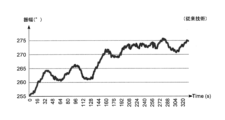
Si製のエスケープ車とSi製のパレットリフトを、SとF、具体的にはSF6、で官能化された微結晶のダイヤモンドで被覆した。したがって、官能化されたダイヤモンド/官能化されたダイヤモンドの対を用いて試験を行い、ルビーと接触する潤滑された鋼を用いた標準アンカーと比較した。ワークプレートに取り付けられたスイス式アンカーエスケープの性能を測定するためにFEMTOトルク試験を行った。加えられたトルクは16N・mであった。図7a及び7bにそれぞれ、標準アンカー及び本発明にしたがって処理されたアンカーについてのバランス車(3つのアームがある)の振幅の測定結果を示している。標準アンカーの場合、平均振幅は、1時間の試験のときに274°である。本発明にしたがって処理されたアンカーの場合、平均振幅は、1時間の試験のときに256°であり、これは標準アンカーのものよりも18°小さい。700秒における一時的な障害は別として、振幅の規則性は非常に良好であり、標準の基準バージョンよりも優れていることがわかる。 A Si escape vehicle and a Si pallet lift were coated with microcrystalline diamond functionalized with S and F, specifically SF 6 . Therefore, tests were conducted using a functionalized diamond/functionalized diamond pair and compared to a standard anchor using lubricated steel in contact with ruby. FEMTO torque tests were conducted to measure the performance of the Swiss style anchor escape attached to the work plate. The applied torque was 16 N·m. Figures 7a and 7b show measurements of the amplitude of a balance wheel (with three arms) for a standard anchor and an anchor treated according to the invention, respectively. For the standard anchor, the average amplitude is 274° during the 1 hour test. For anchors treated according to the invention, the average amplitude is 256° during the 1 hour test, which is 18° less than that of the standard anchor. It can be seen that apart from a temporary disturbance at 700 seconds, the amplitude regularity is very good and is better than the standard reference version.
また、並行して、25m及び2500mの距離で直径2mmのボールを用いるボール/平面トライボメーターを用いてトライボロジー的試験も行った。25mの試験は、SF6官能化ダイヤモンド層があるSi基材をそれぞれ有するボール/平面対(SF6//SF6)と、比較用のボール/平面対を用いて行った。この比較用のボール/平面対においては、ボールが、官能化されていない微結晶のダイヤモンドで被覆されたSi基材であり、平面が、本発明にしたがって官能化された微結晶のダイヤモンドで被覆されたSi基材(MCD//SF6)である。これらの試験の目的は、2つの接触面を官能化することの利点を強調することである。垂直方向の力10mN、摺動速さ10mm/s、振幅4mmで試験を行った。図5a及び5bにそれぞれ、比較用の対及び本発明に係る対についての、距離の関数としての動摩擦係数を示している。比較用の対における平均摩擦係数が0.1よりも大きいことがわかる。比較用の対においては、ピークが多く、あまり安定していない。一方、本発明に係る対においては、平均摩擦係数は0.1未満であり、安定している。この同じ本発明に係る対に対して、2500mの距離にわたっての、より長い試験を行った。図6に結果を示している。平均摩擦係数は低く、25mの試験の平均摩擦係数と同じである。短い慣らし期間の後に、試験期間全体にわたって摩擦係数が安定になっている。 In parallel, tribological tests were also carried out using a ball/plane tribometer using a 2 mm diameter ball at distances of 25 m and 2500 m. A 25 m test was conducted using a ball/plane pair each having a Si substrate with an SF 6 functionalized diamond layer (SF 6 //SF 6 ) and a comparison ball/plane pair. In this comparative ball/plane pair, the ball is a Si substrate coated with unfunctionalized microcrystalline diamond and the plane is coated with microcrystalline diamond functionalized according to the present invention. It is a Si base material (MCD//SF 6 ). The purpose of these tests is to highlight the benefits of functionalizing the two contact surfaces. The test was conducted with a vertical force of 10 mN, a sliding speed of 10 mm/s, and an amplitude of 4 mm. Figures 5a and 5b show the coefficient of kinetic friction as a function of distance for a comparative pair and a pair according to the invention, respectively. It can be seen that the average coefficient of friction in the comparison pair is greater than 0.1. The comparison pair has many peaks and is not very stable. On the other hand, in the pair according to the present invention, the average coefficient of friction is less than 0.1 and is stable. This same inventive pair was subjected to a longer test over a distance of 2500 m. The results are shown in Figure 6. The average coefficient of friction is low and the same as the average coefficient of friction for the 25 m test. After a short running-in period, the coefficient of friction remains stable throughout the test period.
このように、FEMTOトルク試験とトライボロジー的試験は、官能化されたダイヤモンド対に対して官能化されたダイヤモンドを使用した場合において非常に良好にふるまうことを裏付けた。 Thus, FEMTO torque tests and tribological tests confirmed very good behavior when using functionalized diamond versus functionalized diamond pairs.
1 機能的アセンブリー
2 第1の部分
2a 機能面とも呼ばれる第1の接触面
3 第2の部分
3a 機能面とも呼ばれる第2の接触面
4 パレット
4a 安静面
4b インパルス面
5 アンカー
6 エスケープ車
7 歯
7c 安静面
7d インパルス面
8 基材
9 トライボロジー層
9a ダイヤモンドを含む第1の層
9b SとFを含む第2の層
10 官能化装置
11 反応器
12 ガス
13 プラズマ
14 電極
1
Claims (14)
前記第1の基材(8)上に、第2の機能面(3a)と摩擦接触するように意図されている第1の機能面(2a)があり、
前記第2の機能面(3a)は、前記第1の部分(2)、又は第2の基材によって形成される少なくとも1つの第2の部分(3)のいずれかに属し、
前記第2の基材上に、前記第2の機能面(3a)があり、
前記第2の部分(3)は、前記第1の部分(2)と前記機能的アセンブリー(1)を構成し、
前記第1の機能面(2a)と前記第2の機能面(3a)がある前記機能的アセンブリー(1)は、第1の層(9a)によって形成され、
この第1の層(9a)は、前記第1の基材(8)と前記第2の基材(8)と一体的となっているか、又は前記第1の基材(8)と前記第2の基材(8)とは別個のものであるかのいずれかであり、
前記第1の層(9a)は、超ナノ結晶、ナノ結晶又は微結晶のダイヤモンドを含み、
前記第1の層(9a)上に、S及びF原子を含む第2の層(9b)があり、
前記第2の層(9b)は、2~50nmの範囲内の平均厚みを有する
ことを特徴とする機能的アセンブリー(1)。 A micromechanical functional assembly (1) comprising at least one first part (2) formed by a first substrate (8), comprising:
on said first substrate (8) there is a first functional surface (2a) intended to be in frictional contact with a second functional surface (3a);
The second functional surface ( 3a ) belongs to either the first part (2) or at least one second part (3) formed by a second base material,
The second functional surface (3a) is on the second base material,
said second part (3) constitutes said functional assembly (1) with said first part (2);
said functional assembly (1) with said first functional surface (2a) and said second functional surface (3a) is formed by a first layer (9a);
This first layer (9a) is integrated with the first base material (8) and the second base material (8), or is formed with the first base material (8) and the second base material (8). It is either separate from the base material (8) of No. 2,
The first layer (9a) contains ultra-nanocrystalline, nanocrystalline or microcrystalline diamond,
On the first layer (9a), there is a second layer (9b) containing S and F atoms,
Functional assembly (1), characterized in that said second layer (9b) has an average thickness in the range from 2 to 50 nm .
ことを特徴とする請求項1に記載の機能的アセンブリー(1)。 Functional assembly (1) according to claim 1, characterized in that said second layer (9b) comprises SF6 .
ことを特徴とする請求項1に記載の機能的アセンブリー(1)。 Functional assembly (1) according to claim 1, characterized in that said second layer (9b) is formed by a rod.
前記第2の部分(3)は、エスケープ車(6)である
ことを特徴とする請求項1に記載の機能的アセンブリー(1)。 The first part (2) is a pallet (4),
Functional assembly (1) according to claim 1, characterized in that said second part (3) is an escape vehicle (6).
前記第2の部分(3)は、ベアリングである
ことを特徴とする請求項1に記載の機能的アセンブリー(1)。 The first part (2) is a shaft of a moving part,
Functional assembly (1) according to claim 1, characterized in that said second part (3) is a bearing.
ことを特徴とする請求項1に記載の機能的アセンブリー(1)。 Functional assembly (1) according to claim 1, characterized in that said first part (2) and said second part (3) are gear teeth.
前記第1の部分(2)は、ブレードによって形成されるバレルばねであり、
前記ブレードの前面が、前記第1の機能面を形成し、
前記ブレードの背面が、前記第2の機能面を形成する
ことを特徴とする請求項1に記載の機能的アセンブリー(1)。 The second functional surface belongs to the first part (2),
said first part (2) is a barrel spring formed by a blade;
a front surface of the blade forms the first functional surface;
Functional assembly (1) according to claim 1, characterized in that the back side of the blade forms the second functional surface.
ことを特徴とする請求項1に記載の機能的アセンブリー(1)。 When the first layer (9a) is different from the first base material (8) and the second base material (8), the first base material (8) and the second base material Functional assembly (1) according to claim 1, characterized in that (8) is made of a material selected from ceramics, silicon, silicon oxide, silicon nitride, silicon carbide and steel.
a)前記超ナノ結晶、ナノ結晶又は微結晶のダイヤモンドの第1の層(9a)で被覆された少なくとも1つの第1の基材(8)、又は超ナノ結晶、ナノ結晶又は微結晶のダイヤモンドによって作られた少なくとも1つの第1の基材(8)、を用意する用意ステップと、及び
b)反応器(11)と電極(14)がある反応性イオンエッチング装置(10)において前記用意ステップa)の第1の基材(8)を官能化するステップとを備え、
この官能化が、反応性ガス(12)としてSとFを含む化合物を用いて、40~60Wの範囲内の高周波パワーで行われ、
前記電極(14)の間の電圧が、130~170Vの範囲内である
ことを特徴とする方法。 A method of functionalizing ultra-nanocrystalline, nanocrystalline or microcrystalline diamond, the method comprising:
a) at least one first substrate (8) coated with said first layer (9a) of ultra-nanocrystalline, nanocrystalline or microcrystalline diamond; or ultra-nanocrystalline, nanocrystalline or microcrystalline diamond; b) providing at least one first substrate (8), made by: and b) said providing step in a reactive ion etching apparatus (10) with a reactor (11) and an electrode (14). functionalizing the first substrate (8) of a);
This functionalization is carried out with a compound containing S and F as reactive gas (12) at a radio frequency power in the range of 40-60 W;
A method characterized in that the voltage between said electrodes (14) is in the range 130-170V .
ことを特徴とする請求項9に記載の方法。 10. The method of claim 9, wherein the compound is SF6 .
ことを特徴とする請求項9に記載の方法。 Process according to claim 9, characterized in that the pressure in the reactor ( 11 ) is in the range from 30 to 150 bar .
ことを特徴とする請求項9に記載の方法。 Method according to claim 9, characterized in that the flow rate of the reactive gas (12) in the reactor (11) is in the range of 3 to 20 sccm .
ことを特徴とする請求項9に記載の方法。 Process according to claim 9, characterized in that the functionalization time of the first substrate (8) in the reactor (11) is in the range of 20 to 120 minutes .
ことを特徴とする請求項9に記載の方法。 10. Method according to claim 9, characterized in that in the reactive ion etching device (10) capacitive plasma coupling is performed.
Applications Claiming Priority (2)
| Application Number | Priority Date | Filing Date | Title |
|---|---|---|---|
| EP21212556.1A EP4191345B1 (en) | 2021-12-06 | 2021-12-06 | Micromechanical functional assembly with a tribological coating |
| EP21212556.1 | 2021-12-06 |
Publications (2)
| Publication Number | Publication Date |
|---|---|
| JP2023084081A JP2023084081A (en) | 2023-06-16 |
| JP7378552B2 true JP7378552B2 (en) | 2023-11-13 |
Family
ID=78851020
Family Applications (1)
| Application Number | Title | Priority Date | Filing Date |
|---|---|---|---|
| JP2022129167A Active JP7378552B2 (en) | 2021-12-06 | 2022-08-15 | Micromechanical functional assembly with tribological coating |
Country Status (4)
| Country | Link |
|---|---|
| US (1) | US20230173788A1 (en) |
| EP (1) | EP4191345B1 (en) |
| JP (1) | JP7378552B2 (en) |
| CN (1) | CN116224739B (en) |
Citations (1)
| Publication number | Priority date | Publication date | Assignee | Title |
|---|---|---|---|---|
| JP2001520974A (en) | 1997-10-27 | 2001-11-06 | アドバンスト・リフラクトリー・テクノロジーズ・インコーポレイテッド | Polishing method of CVD diamond film by oxygen plasma |
Family Cites Families (9)
| Publication number | Priority date | Publication date | Assignee | Title |
|---|---|---|---|---|
| FR2731715B1 (en) * | 1995-03-17 | 1997-05-16 | Suisse Electronique Microtech | MICRO-MECHANICAL PART AND METHOD FOR PRODUCING THE SAME |
| JP5647232B2 (en) * | 2009-05-18 | 2014-12-24 | ザ スウォッチ グループ リサーチアンド ディベロップメント リミティド. | Method for coating micromechanical components while maintaining high friction performance applied to micromechanical systems |
| EP2631721A1 (en) * | 2012-02-23 | 2013-08-28 | Richemont International S.A. | Diamond-covered titanium clock components |
| CH708413B1 (en) * | 2013-08-02 | 2020-11-30 | Swatch Group Res & Dev Ltd | A substrate comprising a diamond coating and a method of depositing such a coating. |
| CH709665A2 (en) * | 2014-05-16 | 2015-11-30 | Nivarox Sa | clockwork without lubrication in contact torque. |
| EP3171230B1 (en) * | 2015-11-19 | 2019-02-27 | Nivarox-FAR S.A. | Timepiece component with improved tribology |
| CH712308A1 (en) * | 2016-03-30 | 2017-10-13 | Officine Panerai Ag | Self lubricated cylinder system for timepiece. |
| EP3627237B1 (en) * | 2018-09-20 | 2022-04-06 | ETA SA Manufacture Horlogère Suisse | Component made of micro-machinable material for resonator with high quality factor |
| EP3839649A1 (en) * | 2019-12-20 | 2021-06-23 | Nivarox-FAR S.A. | Rigid timepiece component for oscillator mechanism or for escapement mechanism and clockwork comprising such a component |
-
2021
- 2021-12-06 EP EP21212556.1A patent/EP4191345B1/en active Active
-
2022
- 2022-07-28 US US17/815,626 patent/US20230173788A1/en not_active Abandoned
- 2022-08-15 JP JP2022129167A patent/JP7378552B2/en active Active
- 2022-11-17 CN CN202211439543.4A patent/CN116224739B/en active Active
Patent Citations (1)
| Publication number | Priority date | Publication date | Assignee | Title |
|---|---|---|---|---|
| JP2001520974A (en) | 1997-10-27 | 2001-11-06 | アドバンスト・リフラクトリー・テクノロジーズ・インコーポレイテッド | Polishing method of CVD diamond film by oxygen plasma |
Also Published As
| Publication number | Publication date |
|---|---|
| US20230173788A1 (en) | 2023-06-08 |
| CN116224739B (en) | 2025-10-10 |
| CN116224739A (en) | 2023-06-06 |
| EP4191345B1 (en) | 2025-06-04 |
| EP4191345A1 (en) | 2023-06-07 |
| JP2023084081A (en) | 2023-06-16 |
Similar Documents
| Publication | Publication Date | Title |
|---|---|---|
| Wang et al. | Fluorine and sulfur co-doped amorphous carbon films to achieve ultra-low friction under high vacuum | |
| Miyake et al. | Microtribological properties and potential applications of hard, lubricating coatings | |
| JP5647232B2 (en) | Method for coating micromechanical components while maintaining high friction performance applied to micromechanical systems | |
| JP5938122B2 (en) | Watch escapement without lubrication | |
| EP2239637B1 (en) | Timepiece wheel train and timepiece | |
| Huang et al. | Effect of deposition temperature on the microstructure and tribological properties of Si-DLC coatings prepared by PECVD | |
| Bhushan | Tribology on the macroscale to nanoscale of microelectromechanical system materials: a review | |
| CN103249864B (en) | By the method for two diamond coatings coating micromechanical parts | |
| JP2007513297A (en) | Differential having cross-shaft thin film coating and method for manufacturing the same | |
| Beake et al. | Nano-scratch, nanoindentation and fretting tests of 5–80 nm ta-C films on Si (1 0 0) | |
| Mangolini et al. | How hydrogen and oxygen vapor affect the tribochemistry of silicon-and oxygen-containing hydrogenated amorphous carbon under low-friction conditions: A study combining X-ray absorption spectromicroscopy and data science methods | |
| JP2021032882A (en) | Watch regulator mechanism with high quality factor and minimal lubrication | |
| CN111801627A (en) | Manufacturing method of silicon-based clock spring | |
| EP3627237B1 (en) | Component made of micro-machinable material for resonator with high quality factor | |
| CN116224739B (en) | Micromechanical functional components with tribological coatings | |
| Usman et al. | Silicon wafer as a feasible candidate for tribological characterization of thin coatings under high contact stress? | |
| HK40090982A (en) | Micromechanical functional assembly with a tribological coating | |
| CH702576A2 (en) | Micro-mechanical piece such as an anchor and an escape wheel for a timepiece, comprises a core made of silicon, a first coating layer comprising diamond, a second coating layer on the first layer, and an intermediate layer | |
| Adachi et al. | Tribology of carbon nitride coatings | |
| Pham et al. | Tribochemical interactions of Si-doped DLC film against steel in sliding contact | |
| Miyake et al. | Micro-tribological properties and applications of super-hard and lubricating coatings | |
| Li et al. | Microtribological Properties of DLC Films Prepared by Different Methods. | |
| CN119615105A (en) | A composite coating for ceramic sealing material surface and preparation method thereof | |
| JP5426898B2 (en) | Sliding member and manufacturing method thereof | |
| CH719203A2 (en) | Functional set of micromechanics with a tribological coating. |
Legal Events
| Date | Code | Title | Description |
|---|---|---|---|
| A621 | Written request for application examination |
Free format text: JAPANESE INTERMEDIATE CODE: A621 Effective date: 20220815 |
|
| A131 | Notification of reasons for refusal |
Free format text: JAPANESE INTERMEDIATE CODE: A131 Effective date: 20230704 |
|
| A521 | Request for written amendment filed |
Free format text: JAPANESE INTERMEDIATE CODE: A523 Effective date: 20230802 |
|
| TRDD | Decision of grant or rejection written | ||
| A01 | Written decision to grant a patent or to grant a registration (utility model) |
Free format text: JAPANESE INTERMEDIATE CODE: A01 Effective date: 20231024 |
|
| A61 | First payment of annual fees (during grant procedure) |
Free format text: JAPANESE INTERMEDIATE CODE: A61 Effective date: 20231031 |
|
| R150 | Certificate of patent or registration of utility model |
Ref document number: 7378552 Country of ref document: JP Free format text: JAPANESE INTERMEDIATE CODE: R150 |