JP7230552B2 - In-vehicle monitor device - Google Patents
In-vehicle monitor device Download PDFInfo
- Publication number
- JP7230552B2 JP7230552B2 JP2019020868A JP2019020868A JP7230552B2 JP 7230552 B2 JP7230552 B2 JP 7230552B2 JP 2019020868 A JP2019020868 A JP 2019020868A JP 2019020868 A JP2019020868 A JP 2019020868A JP 7230552 B2 JP7230552 B2 JP 7230552B2
- Authority
- JP
- Japan
- Prior art keywords
- vehicle
- environment
- unit
- vehicle interior
- interior
- Prior art date
- Legal status (The legal status is an assumption and is not a legal conclusion. Google has not performed a legal analysis and makes no representation as to the accuracy of the status listed.)
- Active
Links
Images




Landscapes
- Fittings On The Vehicle Exterior For Carrying Loads, And Devices For Holding Or Mounting Articles (AREA)
- Emergency Alarm Devices (AREA)
- Alarm Systems (AREA)
- Charge And Discharge Circuits For Batteries Or The Like (AREA)
Description
この明細書における開示は、車室内モニタ装置に関する。 The disclosure in this specification relates to an in-vehicle monitor.
特許文献1には、駐車された車内に人が存在している場合に、車内温度が人体に危険な危険温度に到達する可能性を推定する装置が開示されている。特許文献1に開示の装置は、車内温度が危険温度に到達する前に、人検出通報を車外に出力する、空気調和機を起動させる、窓を開放させる等、車内に残された人が危険な状態に陥らないような処置を実行する。 Patent Literature 1 discloses an apparatus for estimating the possibility that, when a person is present in a parked vehicle, the temperature inside the vehicle reaches a dangerous temperature that is dangerous to the human body. The device disclosed in Patent Document 1 outputs a human detection notification to the outside of the vehicle, activates an air conditioner, opens a window, etc., before the temperature inside the vehicle reaches a dangerous temperature. Take action to avoid getting stuck.
特許文献1では、車内環境の悪化に対処する場合に、車内温度を除いた他の車内外の状況は、何ら考慮されていなかった。そのため、車内環境の悪化に対処する処置が、車内外の状況に起因して、継続困難となる場合や、別のリスクを誘発する場合等が想定され得た。 In Patent Literature 1, when coping with deterioration of the environment inside the vehicle, conditions inside and outside the vehicle other than the temperature inside the vehicle are not taken into consideration at all. Therefore, it is conceivable that measures to cope with the deterioration of the environment inside the vehicle may become difficult to continue due to conditions inside and outside the vehicle, or may induce other risks.
開示される目的は、車両の状況を考慮して、室内環境の悪化に対処可能な車室内モニタ装置を提供することである。 An object of the disclosure is to provide an in-vehicle monitor device capable of coping with the deterioration of the indoor environment in consideration of the situation of the vehicle.
この明細書に開示された複数の態様は、それぞれの目的を達成するために、互いに異なる技術的手段を採用する。また、特許請求の範囲およびこの項に記載した括弧内の符号は、ひとつの態様として後述する実施形態に記載の具体的手段との対応関係を示す一例であって、技術的範囲を限定するものではない。 The multiple aspects disclosed in this specification employ different technical means to achieve their respective objectives. In addition, the symbols in parentheses described in the claims and this section are examples showing the corresponding relationship with the specific means described in the embodiment described later as one aspect, and limit the technical scope. isn't it.
開示された車室内モニタ装置のひとつは、駐車状態にある車両(Va)において、車室内を監視する車室内モニタ装置であって、車室内に残された生物(P)を検知する生物検知部(110)と、生物にとって好ましくない車室内の環境悪化の発生を判定する環境判定部(120)と、車室内の環境悪化の発生が判定された場合に、車両に搭載されたバッテリ(92)の電力を利用して、車室内の環境を改善させる改善処置を車載機器に実行させる環境改善部(130)と、バッテリの残量低下を判定する残量判定部(140)と、バッテリの残量低下が判定された場合に、車両の周囲に駐車された他車両(Vb)に、電力の無線送電の実施を要求する送電要求部(150)と、生物が車両の外部に出た場合に、車両から離れる生物の移動方向を記録する生物追跡部(170)と、を備える。 One of the disclosed vehicle interior monitor devices is a vehicle interior monitor device that monitors the interior of a vehicle (Va) in a parked state, and includes a living thing detection unit that detects living things (P) left in the vehicle interior. (110), an environment determination unit (120) that determines the occurrence of deterioration of the vehicle interior environment that is unfavorable for living things, and a battery (92) that is mounted on the vehicle when it is determined that the deterioration of the vehicle interior environment has occurred. an environment improvement unit (130) that causes an in-vehicle device to perform improvement measures to improve the environment in the vehicle cabin using the electric power of the vehicle; A power transmission requesting unit (150) for requesting wireless power transmission to other vehicles (Vb) parked around the vehicle when it is determined that the amount of electricity has decreased; , and a creature tracking unit (170) that records the moving direction of the creature leaving the vehicle .
この開示によれば、車室内の環境を改善させる改善処置を車載機器が実行中に、車両に搭載されたバッテリの残量低下が生じた場合、車両の周囲に駐車された他車両に、電力の無線送電の実施が要求される。故に、環境改善部は、バッテリの残量が低下しても、他車両より送電される電力を利用して、車載機器に改善処置を継続させることができる。したがって、車室内モニタ装置は、車両の状況を考慮しつつ、室内環境の悪化に対処可能となる。 According to this disclosure, when the remaining amount of the battery mounted on the vehicle becomes low while the vehicle-mounted device is performing improvement measures to improve the environment in the vehicle, other vehicles parked around the vehicle are supplied with electric power. of wireless power transmission is required. Therefore, even if the remaining amount of the battery is low, the environmental improvement unit can use the power transmitted from the other vehicle to cause the in-vehicle device to continue the improvement action. Therefore, the vehicle interior monitor device can cope with the deterioration of the interior environment while taking into consideration the situation of the vehicle.
開示された車室内モニタ装置のひとつは、駐車状態にある車両(Va)において、車室内を監視する車室内モニタ装置であって、車室内に残された生物(P)を検知する生物検知部(110)と、生物にとって好ましくない車室内の環境悪化の発生を判定する環境判定部(120)と、車室内の環境悪化の発生が判定された場合に、車室内の環境を改善させる改善処置として、車両に設けられた窓を開ける作動を車載機器に実行させる環境改善部(130)と、車両の周囲に存在する人の検知情報を取得する車外検知部(160)と、を備え、環境改善部は、車両の周囲に人が検知された場合に、車両の周囲に人が検知されない場合よりも、窓の開度を小さくする。 One of the disclosed vehicle interior monitor devices is a vehicle interior monitor device that monitors the interior of a vehicle (Va) in a parked state, and includes a living thing detection unit that detects living things (P) left in the vehicle interior. (110), an environment determination unit (120) that determines the occurrence of deterioration of the vehicle interior environment that is unfavorable to living things, and an improvement action for improving the vehicle interior environment when it is determined that the deterioration of the vehicle interior environment has occurred. as an environment improvement unit (130) that causes an in-vehicle device to open a window provided in the vehicle; The improving unit makes the opening of the window smaller when a person is detected around the vehicle than when no person is detected around the vehicle.
この開示によれば、車両に設けられた窓を開ける作動を車載機器に実行させるに際し、車両の周囲に人の存在が検知された場合には、検知されない場合よりも窓の開度が小さくされる。故に、車室内の環境を改善させるため、車両の窓を開けたとしても、車室内の生物が連れ去られるリスクが軽減され得る。したがって、車室内モニタ装置は、車両の状況を考慮しつつ、室内環境の悪化に対処可能となる。 According to this disclosure, when causing an in-vehicle device to open a window provided in a vehicle, when the presence of a person is detected around the vehicle, the degree of opening of the window is made smaller than when the presence is not detected. be. Therefore, even if the window of the vehicle is opened to improve the environment inside the vehicle, the risk of living beings in the vehicle being taken away can be reduced. Therefore, the vehicle interior monitor device can cope with the deterioration of the interior environment while taking into consideration the situation of the vehicle.
(第1実施形態)
第1実施形態の車室内モニタ装置について、図1~図4を参照しながら説明する。車室内モニタ装置は、自車両Vaに搭載されたコンピュータである車室内モニタECU100によって提供される。車室内モニタECU100は、特に自車両Vaの駐車時において、車室内に取り残された犬や猫などのペット、乳幼児等の生物Pの状態をモニタリングする。自車両Vaは、走行駆動源としてモータを備える電気自動車であり、運転者による運転操作がない状態で自律走行可能な自動運転車両である。
(First embodiment)
A vehicle interior monitor device according to a first embodiment will be described with reference to FIGS. 1 to 4. FIG. The in-vehicle monitor device is provided by an in-vehicle monitor ECU 100, which is a computer installed in the own vehicle Va. The in-vehicle monitor ECU 100 monitors the state of animals P such as pets such as dogs and cats, and infants left behind in the vehicle, especially when the vehicle Va is parked. The self-vehicle Va is an electric vehicle that includes a motor as a drive source, and is an automatically driving vehicle that can autonomously travel without a driving operation by the driver.
車室内モニタECU100は、車内センサ10、エアコンECU20、パワーウインドウECU30、照合ECU40、自動運転制御ユニット50、車外通信機80、およびバッテリECU90等の他の車載機器と、車載ネットワークを介して相互に通信可能に接続されている。各ECUおよび制御ユニットは、プロセッサ、RAM、メモリ装置、入出力インターフェース、およびそれらを接続するバスを備えるマイクロコンピュータを主体として構成されている。
The in-vehicle monitor ECU 100 communicates with other in-vehicle devices such as the in-
車内センサ10は、車室内の環境に関する種々の情報を検出して車室内モニタ情報として出力するセンサである。車内センサ10は、車室内カメラ11、マイク12、体温計13、および室温計14を含む。車室内カメラ11は、車室内を撮像し、その撮像データを逐次車室内モニタECU100に出力する。マイク12は、車室内の音を検出し、検出結果を逐次車室内モニタECU100に出力する。体温計13は、車室内の生体の体温を検出する。体温計13は、生体に取り付けられる接触型のセンサでもよく、サーモグラフィ等の非接触型のセンサでもよい。室温計14は、車室内の温度(室温)を検出し、逐次車室内モニタECU100に出力する。
The in-
エアコンECU20は、HVACユニット21およびミスト発生装置22の作動を制御する。HVACユニット21は、送風機と、送風機からの送風空気を温度調整するヒートポンプサイクル装置とを備える空調装置である。HVACユニット21は、車室内の複数個所に開口する吹出口から温度調整された送風空気を吹き出す。HVACユニット21は、ダンパ等により各吹出口からの風量を個別に調整可能である。ミスト発生装置22は、車室内に霧状の水を噴射する装置である。
パワーウインドウECU30は、自車両Vaの各ドア等に設けられたサイドウインドウの開閉を制御する制御装置である。パワーウインドウECU30は、各ドアに設置された複数のパワーウインドウモータ31と信号ラインを介して接続されている。パワーウインドウECU30は、各パワーウインドウモータ31を個別に制御可能に構成されており、複数のサイドウインドウの開度を個別に調整可能である。
The
照合ECU40は、電子キー等の車外の発信機から発信された信号に基づき発信機の照合を実行し、照合が成立した場合に、ドアロックの解除等の所定の車載機器の作動を許可する制御装置である。照合ECU40は、自車両Vaの各ドアハンドル等に設けられた複数のアンテナ41と接続されている。照合ECU40は、アンテナ41にて受信した発信機からの信号に基づき照合を行う。また、照合ECU40は、各アンテナ41にて受信された信号の受信強度の差に基づいて、発信機の移動方向を推定可能である。
The
自動運転制御ユニット50は、車外センサ70および走行制御ユニット60と通信バスを介して接続されている。自動運転制御ユニット50は、車外センサ70から取得した情報や、地図情報、現在位置情報等を組み合わせて自車両Vaの走行計画を生成する。自動運転制御ユニット50は、生成した走行計画に基づく自車両Vaの制御指令を、走行制御ユニット60に逐次出力する。
The automatic
車外センサ70は、自車両Vaの周辺環境を監視する自律センサである。車外センサ70は、例えば車外カメラ71、ソナー72、ライダ、ミリ波レーダ等を含む。車外センサ70は、自車両Vaの周囲に存在する人や他車両等の移動物体、および道路設置や区画線等の静止物体を検出し、検出結果を自動運転制御ユニット50に出力する。なお、車外センサ70は、日射量を検出する日射センサや、外気温を検出する外気温センサ等を含んでいてもよい。
The vehicle
走行制御ユニット60は、自車両Vaに搭載された車載センサ群および車載アクチュエータ群と直接的又は間接的に電気接続されている。車載センサ群は、自車両Vaの状態を検出する複数のセンサである。車載センサ群には、例えば車速センサ、加速度センサ、ヨーレートセンサ等が含まれている。車載アクチュエータ群は、自車両Vaの加減速制御および操作制御等を実行する。車載アクチュエータ群には、例えば、駆動用および回生用のモータジェネレータ駆動用モータ、ブレーキアクチュエータ、並びにステアリングアクチュエータ等が含まれている。
The
走行制御ユニット60は、プロセッサ、RAM、メモリ装置および入出力インターフェースを有する制御回路を主体に構成された車載コンピュータである。走行制御ユニット60は、車載センサ群の出力に基づく自車両Vaの状態情報を、自動運転インターフェースユニットに逐次提供する。走行制御ユニット60は、駆動、制動および操舵等の制御指令を自動運転制御ユニット50から取得する。走行制御ユニット60は、取得した制御指令に基づき、車載アクチュエータ群を作動させ、走行計画に基づく自動走行を実施する。
The
車外通信機80は、車載機器と車外システムとの無線通信を可能とする構成である。車外通信機80は、LTE通信モジュール81およびBLE通信モジュール82を備える。LTE通信モジュール81は、LTE(Long Term Evolution)の通信規格に沿ったV2N(Vehicle to cellular Network)通信の機能を有し、車外の通信ネットワークNWと無線通信可能である。通信ネットワークNWには、病院などの救急センタのシステム等が接続されている。LTE通信モジュール81は、通信ネットワークNWを介して自車両Vaのユーザが携帯する端末MUと無線通信可能である。なお、車外通信機80は、LTE通信モジュール81に代えて、5G等の他の通信規格に沿って通信ネットワークNWと無線通信可能な通信モジュールを備えていてもよい。
The vehicle-
BLE通信モジュール82は、Bluetooth Low Energy(Bluetoothは登録商標)の近距離無線通信規格に沿って通信を行うモジュールである。BLE通信モジュール82は、近距離無線通信により自車両Vaの周辺の携帯端末Mや、駐車された他車両Vb、充電施設CS等と相互に通信可能である。なお、車外通信機80は、BLE通信モジュール82に代えて、Wi-Fi(登録商標)やZigBee(登録商標)等の他の規格に沿って近距離無線通信を行う通信モジュールを有していてもよい。
The BLE communication module 82 is a module that performs communication according to the short-range wireless communication standard of Bluetooth Low Energy (Bluetooth is a registered trademark). The BLE communication module 82 can mutually communicate with a mobile terminal M in the vicinity of the own vehicle Va, another parked vehicle Vb, a charging facility CS, and the like, by short-range wireless communication. Note that the
バッテリECU90は、バッテリ92および受電コイル91と電気的に接続されている。バッテリ92は、受電コイル91とリレーを介して電気的に接続されている。受電コイル91は、外部の他車両Vbや充電施設CS等の給電コイルCLv、CLcから受電した電力をバッテリ92に出力する。バッテリECU90は、自車両Vaのバッテリ92の挙動の監視および充放電の制御を行う。バッテリECU90は、バッテリ92の残量が予め設定された閾値を下回ると、バッテリ92の残量低下を車室内モニタECU100に通知する。バッテリECU90は、無線送電の可能な状態になると、バッテリ92および受電コイル91間のリレーをオンにして、無線送電によるバッテリ92の充電を開始する。
車室内モニタECU100は、プロセッサ101、RAM102、メモリ装置103、I/O、およびこれらを接続するバスを備えるマイクロコンピュータを主体として構成され、車内LANに接続されている。車室内モニタECU100は、メモリ装置103に記憶された制御プログラムを実行することにより、室内環境の悪化への対処に関わる種々の制御を、自車両Vaの状況に応じて実現する。メモリ装置103は、コンピュータによって読み取り可能なプログラムおよびデータを非一時的に格納する非遷移的実体的記憶媒体(non-transitory tangible storage medium)である。また、非遷移的実体的記憶媒体は、半導体メモリまたは磁気ディスクなどによって実現される。
The in-
車室内モニタECU100は、上述の制御プログラムの実行により実現される機能ブロックとして、生物検知部110、環境判定部120、環境改善部130、残量判定部140、および送電要求部150を備える。
The in-
生物検知部110は、車内センサ10にて取得される各種車室内モニタ情報に基づき、車室内に取り残された生物Pを検知する。より具体的には、生物検知部110は、生物Pに関する有無情報、種別情報、車室内における現在位置情報、生体情報等を取得する。
The
生物検知部110は、車室内カメラ11の撮像データを利用した画像認識等により、生物Pの有無および生物Pの種別を判別する。生物検知部110は、生物Pの種別として、例えば人、犬、猫などといった動物の種類、および犬種、猫種といった品種等を判別する。生物Pに発信機Bが取り付けられている場合には、生物検知部110は、発信機Bからの信号に基づき生物Pの有無および種別を判別してもよい。
The living
生物検知部110は、車室内における生物Pの現在位置を特定する。生物検知部110は、例えば撮像データに基づき、予め規定された車室内の複数エリアのうち生物Pの存在するエリアを現在位置として特定する。
The living
生物検知部110は、体温計13の検出した体温情報を生体情報として取得する。加えて、特に生物Pがペットである場合に、生物検知部110は、マイク12にて検出した生物Pの呼吸音から生物Pの健康状態を推定し、生体情報として取得する。例えば生物検知部110は、呼吸のリズムや深さ等の呼吸状態を呼吸音から推定し、呼吸状態に基づく生物Pの健康状態を異常の有無等の複数段階のレベル情報として算出する。
The
環境判定部120は、車内センサ10の検出情報に基づき、生物Pにとって好ましくない車室内の環境悪化の発生を判定する。例えば環境判定部120は、室温の過度な上昇を、車室内の環境悪化の発生として判定する。環境判定部120は、室温計14にて検出された室温情報に基づき、室温が閾温度を上回る場合に、環境悪化が発生したと判定する。また環境判定部120は、室温情報に生体情報を組み合わせて環境悪化が発生したか否かを判定してもよい。
The
上述の判定に加えて、環境判定部120は、生体情報に基づき生物Pの健康状態が悪化しているか否かを判定する。例えば環境判定部120は、生物Pの体温の過度の上昇、呼吸状態の異常発生等に基づき、健康状態の悪化を判定する。環境判定部120は、特に後述の改善処置の開始後にこの判定を実施する。
In addition to the determination described above, the
環境改善部130は、環境判定部120にて環境悪化の発生が判定された場合に、バッテリ92の電力を利用して車室内の環境を改善させる改善処置を車載機器に実行させる。例えば環境改善部130は、改善処置として、自律走行による自車両Vaの日陰への移動を自動運転制御ユニット50に実行させる。この場合、日陰の特定は、車外センサ70の検出情報や、地図情報、太陽の位置情報などに基づき自動運転制御ユニット50等にて行われる。
When the
また、環境改善部130は、改善処置として、自車両Vaに無線送電が可能な充電施設CSの設置場所への移動を、自動運転制御ユニット50に実行させてもよい。この場合、充電施設CSの設置場所は、車外通信機80を介した充電施設CSとの通信によって取得される。また、充電のための自車両Vaの位置調整は、車外カメラ71による画像認識に基づいて自動運転制御ユニット50等にて行われる。
In addition, the
また、環境改善部130は、改善処置として、HVACユニット21による車室内の温度調整をエアコンECU20に実行させてもよい。この場合、環境改善部130は、生物Pの現在エリアに吹き出す空調風の風量をそれ以外のエリアよりも増大させる等により、現在エリアの温度調整を、それ以外のエリアよりも優先させる。なお、環境改善部130は、温度調整としてミスト発生装置22の作動を実行させてもよい。また、環境改善部130は、HVACユニット21にて送風のみを実行させてもよい。
In addition, the
加えて環境改善部130は、上述したような改善処置の開始後に生物Pの健康状態の悪化が判定された場合に、自車両Vaの周囲の携帯端末Mへ向けて、BLE通信モジュール82から救助要請の通知を送信させる。環境改善部130は、救助要請を通知する場合、自車両Vaのドアロックの解除を照合ECU40に実行させる。結果として環境改善部130は、救助者による生物Pの車室内からの救助を容易にする。
In addition, when it is determined that the health condition of the creature P has deteriorated after the above-described improvement measures have been started, the
残量判定部140は、改善処置の開始後に、バッテリ92の残量低下を判定する。残量判定部140は、バッテリECU90からの残量低下通知の有無に基づき、残量が低下したか否かを判定する。
The remaining
送電要求部150は、バッテリ92の残量低下が判定された場合に、自車両Vaの周囲に駐車された他車両Vbの車載器IVUに、電力の無線送電の実施を要求する。送電要求部150は、要求が許可されると、車載器IVUに対して無線送電可能な位置への移動を要請する。送電要求部150は、無線送電可能な状態となると、バッテリECU90に対して他車両Vbからの受電を開始させる。
When it is determined that the remaining amount of the
次に、車室内モニタECU100が実行する処理の一例について、図2~図4のフローチャートを参照して説明する。車室内モニタECU100は、まず図2に示す改善処置の開始処理を実行する。この処理は、自車両Vaが駐車状態となった時点または駐車状態となって一定時間経過した時点で実行される。
Next, an example of processing executed by the vehicle
車室内モニタECU100は、まずステップS110にて、車内センサ10の検出した車室内モニタ情報を取得する。次に、ステップS120へと進み、車室内モニタ情報に基づき車室内に生物Pが検知されたか否かを判定する。ここで生物Pが検知されていないと判定された場合には、改善処置を実施する必要がないため、本フローを終了する。
The in-
一方で生物Pが検知されたと判定された場合には、ステップS130へと進み、車室内モニタ情報から生物Pの種別および現在位置を特定する。ステップS140では、室温情報等に基づいて、車室内の環境を推定する。ステップS150では、推定した車室内環境に基づき、車室内環境が悪化したか否かを判定する。悪化していないと判定されると、ステップS155へと進む。ステップS155では、後述の改善処置が開始されていた場合、改善処置を完了し、本フローを終了する。ステップS150およびステップS155の処理より、環境の悪化が緩和された場合に改善処置が自動的に完了される。 On the other hand, if it is determined that the creature P has been detected, the process proceeds to step S130, and the type and current position of the creature P are specified from the vehicle interior monitor information. In step S140, the environment inside the vehicle is estimated based on room temperature information and the like. In step S150, it is determined whether the vehicle interior environment has deteriorated based on the estimated vehicle interior environment. If it is determined that the condition has not deteriorated, the process proceeds to step S155. In step S155, if the improvement action, which will be described later, has been started, the improvement action is completed, and this flow ends. When the deterioration of the environment is alleviated by the processing of steps S150 and S155, the remedial action is automatically completed.
一方で車室内環境が悪化したと判定された場合には、ステップS160へと進み、改善処置を開始する。ステップS160では、例えばHVACユニット21による温度調整のエリア制御、自律走行による自車両Vaの日陰への移動等を改善処置として実行する。これらの改善処置は、並行して実行されてもよく、選択的に実行されてもよい。ステップS160にて改善処置を開始すると、本フローを終了する。以上の一連の処理は、自車両Vaの駐車中に繰り返し実行される。
On the other hand, if it is determined that the vehicle interior environment has deteriorated, the process proceeds to step S160, and improvement measures are started. In step S160, for example, area control for temperature adjustment by the
次に、図3に示すバッテリ92の管理処理について説明する。この処理は、車室内環境の改善処置が開始された場合に実行される。車室内モニタECU100は、まずステップS171にて、バッテリ92の残量を取得する。次に、ステップS172にて、バッテリ92の残量が閾値を下回るか否かを判定する。閾値を下回ると判定されると、ステップS173へと進む。ステップS173では、自車両Vaの周囲の他車両Vbに対する送電要求を車外通信機80から送信させる。
Next, management processing of the
ステップS172にてバッテリ92の残量が閾値を上回っていると判定した場合、ステップS175へと進む。ステップS175では、改善処置が完了したか否かを判定する。改善処置が完了していないと判定した場合には、改善処置の完了までにバッテリ92の残量が不足する可能性があるため、ステップS171へと戻り、一連の処理を再度実行する。一方ステップS175にて改善処置が完了したと判定されると、一連の処理を終了する。
If it is determined in step S172 that the remaining amount of the
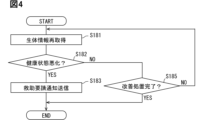
次に、図4に示す生体状態の管理処理について説明する。この処理は、車室内環境の改善処置が開始された場合に実行される。車室内モニタECU100は、まずステップS181にて、生物Pの生体情報を再取得する。次にステップS182では、再取得した生体情報に基づいて、生物Pの健康状態が悪化したか否かを判定する。
Next, the biological condition management process shown in FIG. 4 will be described. This process is executed when a vehicle interior environment improvement measure is started. First, the in-
健康状態が悪化したと判定された場合、ステップS183へと進み、車外通信機80から救助要請通知を送信させる。一方で、ステップS182にて健康状態が悪化していないと判定された場合には、ステップS185にて改善処置が完了したか否かを判定する。改善処置が完了していないと判定した場合には、改善処置の完了までに生物Pの健康状態が悪化する可能性があるため、ステップS181へと戻り、一連の処理を再度実行する。一方ステップS185にて改善処置が完了したと判定されると、一連の処理を終了する。
If it is determined that the health condition has deteriorated, the process advances to step S183 to cause the
次に第1実施形態の車室内モニタECU100の構成および作用効果について説明する。
Next, the configuration and effects of the in-
車室内モニタECU100は、車室内に残された生物Pを検知する生物検知部110と、生物Pにとって好ましくない車室内の環境悪化の発生を判定する環境判定部120を備える。車室内モニタECU100は、車室内の環境悪化が判定された場合に、バッテリ92の電力を利用した改善処置を車載機器に実行させる環境改善部130を備える。車室内モニタECU100は、バッテリ92の残量低下を判定する残量判定部140と、バッテリ92の残量低下が判定された場合に、自車両Vaの周囲に駐車された他車両Vbに、電力の無線送電の実施を要求する送電要求部150とを備える。
The in-
これによれば、車室内モニタECU100は、車室内の環境を改善させる改善処置を車載機器が実行中に、バッテリ92の残量低下が生じた場合、自車両Vaの周囲に駐車された他車両Vbに、電力の無線送電の実施を要求する。故に、環境改善部130は、バッテリ92の残量が低下しても、他車両Vbより送電される電力を利用して、車載機器に改善処置を継続させることができる。したがって、車室内モニタECU100は、自車両Vaの状況を考慮しつつ、室内環境の悪化に対処可能となる。
According to this, the in-
環境改善部130は、車室内の環境悪化が判定された場合に、自車両Vaに設けられた自動運転機能に、自律走行による日陰への移動を実行させる。これによれば、車室内モニタECU100は、自車両Vaの状況を考慮して自車両Vaを日陰へと移動させることで、室温の上昇を抑制できる。結果として、車室内モニタECU100は、生物Pの健康状態が悪化するリスクをより低減することができる。
When it is determined that the environment in the vehicle interior has deteriorated, the
環境改善部130は、車室内の環境悪化が判定された場合に、自車両Vaに設けられた自動運転機能に、自車両Vaへ無線送電が可能な充電施設CSの設置場所への移動を実行させる。これによれば、車室内モニタECU100は、自車両Vaの状況を考慮して、充電施設CSの設置場所への移動を実行できる。したがって、自車両Vaは、充電施設CSからの無線送電を受けることが可能となる。結果として、車室内モニタECU100は、バッテリ92の電力を利用した改善処置をより安定して継続することができる。
When it is determined that the environment in the vehicle interior has deteriorated, the
生物検知部110は、車室内における生物Pの位置を、現在エリアとして特定する。環境改善部130は、自車両Vaに搭載されたHVACユニット21の作動により、現在エリアの温度を、現在エリア以外の温度よりも優先的に改善させる。これによれば、車室内モニタECU100は、生物Pの存在する現在エリアを把握することで、現在エリアの温度を優先して改善することが可能となる。したがって、車室内モニタECU100は、より効率的な車室内環境の改善を実施できる。
The living
環境判定部120は、環境改善部130による改善処置の開始後に、生物Pの健康状態が悪化したか否かをさらに判定する。環境改善部130は、生物Pの健康状態の悪化が判定された場合に、自車両Vaの周囲の携帯端末Mへ向けて、車外通信機80から救助要請の通知を送信させる。これによれば、車室内モニタECU100は、改善処置を開始したにもかかわらず生物Pの健康状態が悪化した場合、携帯端末Mを介して自車両Vaの周囲の人に生物Pの救助要請を実施できる。したがって、車室内モニタECU100は、より生物Pの保護を優先した制御を実施可能となる。
The
環境判定部120は、車室内に設置されたマイク12によって集音される音情報に基づき、生物Pの呼吸状態を推定し、生物Pの健康状態の悪化を判定する。これによれば、車室内モニタECU100は、生物Pの呼吸状態に関する情報を利用して生物Pの健康状態を判定できる。したがって、車室内モニタECU100は、生物Pの健康状態について、より精度の高い判定が可能となる。
The
(第2実施形態)
第2実施形態では、第1実施形態における車室内モニタECU100の変形例について説明する。図5~図7において第1実施形態の図面中と同一符号を付した構成要素は、同様の構成要素であり、同様の作用効果を奏するものである。
(Second embodiment)
In the second embodiment, a modification of the vehicle
第2実施形態の車室内モニタECU100は、機能ブロックとして、第1実施形態と同じものに加えて車外検知部160および生物追跡部170を有する。
The in-
車外検知部160は、車外センサ70の各種検出情報に基づいて、車両の周囲に存在する人の検知情報を取得する。加えて車外検知部160は、自車両Vaの周囲に検知された人について、予め警戒不要として登録された除外条件を満たすか否かを判定する。車外検知部160は、例えば検知された人の所持する携帯端末MとBLE通信モジュール82を介して通信を行い、携帯端末Mが予め登録された端末であると認証された場合に、除外条件を満たすと判定する。
The vehicle
車外検知部160の検知結果に基づき、環境改善部130は、改善処置として、サイドウインドウの開放制御をパワーウインドウECU30に実行させる。環境改善部130は、自車両Vaの周囲に人が検知されている場合には、自車両Vaの周囲に人が検知されていない場合よりも、サイドウインドウの開度を小さくする。加えて、環境改善部130は、自車両Vaの周囲に検知された人が除外条件を満たしている場合に、除外条件を満たさない人しか検知されていない場合よりも、窓の開度を大きくする。また、環境改善部130は、自車両Vaの周囲に人が検知された場合に、複数のサイドウインドウのうちで、生物Pの現在位置に近い一つの開度を現在位置から遠い他の一つの開度よりも小さくする。
Based on the detection result of vehicle
生物追跡部170は、生物Pが自車両Vaの外部に出た場合に、自車両Vaから離れる生物Pの移動方向を記録する。具体的には、生物追跡部170は、照合ECU40にて推定された発信機Bの移動方向に関する情報を取得して記録する。または、生物追跡部170は、車外センサ70の検出情報に基づいて生物Pの移動方向を推定してもよい。加えて生物追跡部170は、生物Pを連れ去った人物が存在する場合、当該人物を特定可能な情報を記録してもよい。例えば生物追跡部170は、車外カメラ71の撮像データに基づいて、人物の顔や体型等のデータを記録してもよい。
The living
次に第2実施形態の車室内モニタECU100が実行する処理の一例について、図6および図7を参照して説明する。車室内モニタECU100は、まず図6に示す改善処置の開始処理を実行する。図6におけるステップS210~S250までの処理は、図2のステップS110~S150までの処理と同様であるため、説明を省略する。
Next, an example of processing executed by the vehicle
ステップS250にて環境が悪化したと判定された場合、まずステップS260にて、自車両Vaの周囲の人の検知情報を取得する。次に、ステップS270では、検知情報に基づいて自車両Vaの周囲の人の有無を判定する。自車両Vaの周囲に人が検知されたと判定された場合には、ステップS280へと進み、サイドウインドウを所定の開度で開放(例えば全開)してフローを終了する。 When it is determined in step S250 that the environment has deteriorated, first, in step S260, detection information of people around the vehicle Va is acquired. Next, in step S270, the presence or absence of a person around the own vehicle Va is determined based on the detection information. When it is determined that a person has been detected around the host vehicle Va, the process proceeds to step S280, the side windows are opened to a predetermined degree (for example, fully opened), and the flow ends.
一方ステップS270にて人が検知されていると判定された場合には、ステップS275へと進み、検知された人に関して除外条件が成立するか否かを判定する。除外条件が満たされていると判定された場合には、ステップS280へと進む。一方で、除外条件が満たされていないと判定された場合には、ステップS290へと進む。ステップS290では、サイドウインドウの開度を、ステップS280よりも小さい開度で開放し、フローを終了する。 On the other hand, if it is determined in step S270 that a person has been detected, the process advances to step S275 to determine whether an exclusion condition is satisfied for the detected person. If it is determined that the exclusion condition is satisfied, the process proceeds to step S280. On the other hand, if it is determined that the exclusion condition is not satisfied, the process proceeds to step S290. In step S290, the opening degree of the side window is opened to an opening degree smaller than that in step S280, and the flow ends.
加えてステップS290では、ステップS230にて特定した生物Pの現在位置に基づき、生物Pに相対的に近い位置のサイドウインドウを、遠い位置のサイドウインドウよりも小さい開度で開放する。第2実施形態において、ステップS260~S290の処理が、改善処置に相当する。以上の一連の処理は、自車両Vaの駐車中に繰り返し実行される。したがって車室内モニタECU100は、自車両Vaの周囲の人の状況に合わせて、サイドウインドウの開度を継続的に実行可能となっている。
In addition, in step S290, based on the current position of the creature P identified in step S230, the side window located relatively close to the creature P is opened with a smaller opening degree than the side window located farther away. In the second embodiment, the processing of steps S260-S290 corresponds to improvement measures. The above series of processes are repeatedly executed while the host vehicle Va is parked. Therefore, the in-
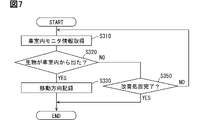
次に、図7に示す移動記録処理について説明する。車室内モニタECU100は、図7の処理を、ステップS280またはステップS290にてサイドウインドウの開放処理が実行された場合に開始する。まずステップS310では、車室内モニタ情報を取得する。ステップS320では、車室内モニタ情報に基づき、車室内の撮像データを利用した画像認識や、発信機Bの位置情報等から、生物Pが車室内から出たか否かを判定する。
Next, the movement recording process shown in FIG. 7 will be described. In-
生物Pが車室内から出たと判定された場合、ステップS330へと進み、生物Pの移動方向を記録する。一方でステップS320にて生物Pが車室内に残っていると判定された場合には、ステップS350に進み、改善処置が完了したか否かを判定する。改善処置が完了していないと判定した場合には、サイドウインドウの開放された状態が維持されているため、ステップS310に戻り、一連の処理を再度実行する。ステップS350にて改善処理が完了したと判定された場合には、一連の処理を終了する。 If it is determined that the creature P has left the vehicle interior, the process advances to step S330 to record the movement direction of the creature P. On the other hand, if it is determined in step S320 that the creature P remains in the vehicle interior, the process proceeds to step S350 to determine whether or not improvement measures have been completed. If it is determined that the improvement measures have not been completed, the side window remains open, so the process returns to step S310 and the series of processes is executed again. If it is determined in step S350 that the improvement processing has been completed, the series of processing ends.
次に第2実施形態の車室内モニタECU100の構成および作用効果について説明する。
Next, the configuration and effects of the in-
第2実施形態の車室内モニタECU100において、環境改善部130は、車室内の環境悪化が判定された場合に、サイドウインドウを開ける作動を改善処置としてパワーウインドウECU30に実行させる。環境改善部130は、自車両Vaの周囲に人が検知された場合に、自車両Vaの周囲に人が検知されない場合よりも、サイドウインドウの開度を小さくする。
In the vehicle
これによれば、自車両Vaに設けられたサイドウインドウを開ける作動をパワーウインドウECU30に実行させるに際し、自車両Vaの周囲に人の存在が検知された場合には、検知されない場合よりもサイドウインドウの開度が小さくされる。故に、車室内の環境を改善させるため、車両の窓を開けたとしても、車室内の生物Pが連れ去られるリスクが軽減され得る。したがって、車室内モニタECU100は、自車両Vaの状況を考慮しつつ、室内環境の悪化に対処可能となる。
According to this, when the
生物検知部110は、車室内における生物Pの現在位置を特定する。環境改善部130は、自車両Vaの周囲に人が検知された場合に、自車両Vaの複数のサイドウインドウのうちで、生物Pの現在位置に近い一つの開度を現在位置から遠い他の一つの開度よりも小さくする。以上によれば、生物Pの現在位置に近いサイドウインドウから生物Pが車外へ脱出することを抑制しつつ、車室内環境の改善処置を継続することができる。
The living
車室内モニタECU100は、生物Pが自車両Vaの外部に出た場合に、自車両Vaから離れる生物Pの移動方向を記録する生物追跡部170を備える。これによれば、車室内モニタECU100は、生物Pの車室内からの連れ去りまたは逃走が発生した場合でも、生物Pの移動方向を記録することで、生物Pの移動先に関する手がかりを残すことが可能となる。
The in-
(他の実施形態)
この明細書における開示は、例示された実施形態に制限されない。開示は、例示された実施形態と、それらに基づく当業者による変形態様を包含する。例えば、開示は、実施形態において示された部品および/または要素の組み合わせに限定されない。開示は、多様な組み合わせによって実施可能である。開示は、実施形態に追加可能な追加的な部分をもつことができる。開示は、実施形態の部品および/または要素が省略されたものを包含する。開示は、ひとつの実施形態と他の実施形態との間における部品および/または要素の置き換え、または組み合わせを包含する。開示される技術的範囲は、実施形態の記載に限定されない。開示されるいくつかの技術的範囲は、特許請求の範囲の記載によって示され、さらに特許請求の範囲の記載と均等の意味および範囲内での全ての変更を含むものと解されるべきである。
(Other embodiments)
The disclosure herein is not limited to the illustrated embodiments. The disclosure encompasses the illustrated embodiments and variations thereon by those skilled in the art. For example, the disclosure is not limited to the combinations of parts and/or elements shown in the embodiments. The disclosure can be implemented in various combinations. The disclosure can have additional parts that can be added to the embodiments. The disclosure encompasses omitting parts and/or elements of the embodiments. The disclosure encompasses permutations or combinations of parts and/or elements between one embodiment and another. The disclosed technical scope is not limited to the description of the embodiments. The disclosed technical scope is indicated by the description of the claims, and should be understood to include all modifications within the meaning and range of equivalents to the description of the claims. .
上述の実施形態のプロセッサは、1つまたは複数のCPU(Central Processing Unit)を含む処理部である。こうしたプロセッサは、CPUに加えて、GPU(Graphics Processing Unit)およびDFP(Data Flow Processor)等を含む処理部であってよい。さらにプロセッサは、FPGA(Field-Programmable Gate Array)、並びにAIの学習および推論等の特定処理に特化したIPコア等を含む処理部であってもよい。こうしたプロセッサの各演算回路部は、プリント基板に個別に実装された構成であってもよく、またはASIC(Application Specific Integrated Circuit)およびFPGA等に実装された構成であってもよい。 The processor of the above-described embodiments is a processing unit that includes one or more CPUs (Central Processing Units). Such a processor may be a processing unit including a GPU (Graphics Processing Unit), a DFP (Data Flow Processor), etc., in addition to the CPU. Further, the processor may be a processing unit including an FPGA (Field-Programmable Gate Array) and an IP core specialized for specific processing such as AI learning and inference. Each arithmetic circuit unit of such a processor may be configured to be individually mounted on a printed circuit board, or may be configured to be mounted on an ASIC (Application Specific Integrated Circuit), FPGA, or the like.
制御プログラムを記憶するメモリ装置には、フラッシュメモリおよびハードディスク等の種々の非遷移的実体的記憶媒体(non-transitory tangible storage medium)が採用可能である。こうした記憶媒体の形態も、適宜変更されてよい。例えば記憶媒体は、メモリカード等の形態であり、車載ECUに設けられたスロット部に挿入されて、制御回路に電気的に接続される構成であってよい。 Various non-transitory tangible storage media such as flash memory and hard disk can be used as the memory device for storing the control program. The form of such a storage medium may also be changed as appropriate. For example, the storage medium may be in the form of a memory card or the like, and may be configured to be inserted into a slot provided in an in-vehicle ECU and electrically connected to the control circuit.
本開示に記載の制御部およびその手法は、コンピュータプログラムにより具体化された1つ乃至は複数の機能を実行するようにプログラムされたプロセッサを構成する専用コンピュータにより、実現されてもよい。あるいは、本開示に記載の装置およびその手法は、専用ハードウエア論理回路により、実現されてもよい。もしくは、本開示に記載の装置およびその手法は、コンピュータプログラムを実行するプロセッサと1つ以上のハードウエア論理回路との組み合わせにより構成された1つ以上の専用コンピュータにより、実現されてもよい。また、コンピュータプログラムは、コンピュータにより実行されるインストラクションとして、コンピュータ読み取り可能な非遷移有形記録媒体に記憶されていてもよい。 The controller and techniques described in this disclosure may be implemented by a special purpose computer comprising a processor programmed to perform one or more functions embodied by a computer program. Alternatively, the apparatus and techniques described in this disclosure may be implemented by dedicated hardware logic circuitry. Alternatively, the apparatus and techniques described in this disclosure may be implemented by one or more special purpose computers configured by a combination of a processor executing a computer program and one or more hardware logic circuits. The computer program may also be stored as computer-executable instructions on a computer-readable non-transitional tangible recording medium.
車室内モニタECU100は、上述の各実施形態における複数の改善処置を適宜組み合わせて実施してもよい。
The in-
車室内モニタECU100は、環境判定部120によって環境が悪化したと判定された場合、生物Pに対して水分の提供を実施してもよい。
The in-
車室内モニタECU100は、車室内に食品や電子機器等、生物P以外の熱に弱い物体が存在する場合、より低い閾温度でHVACユニット21を作動させて車室内の温度調整を実施してもよい。この場合、車室内モニタECU100は、熱に弱い物体の存在を、車室内カメラ11の撮像データや、ユーザによる手動設定等に基づいて認識する。
When there are food, electronic equipment, or other heat-sensitive objects other than the organism P in the vehicle interior, the vehicle
100 車室内モニタECU(車室内モニタ装置)、 110 生物検知部、 120 環境判定部、 130 環境改善部、 140 残量判定部、 150 送電要求部、 160 車外検知部、 170 生物追跡部、 12 マイク、 20 エアコンECU(車載機器)、 21 HVACユニット(空調装置)、 30 パワーウインドウECU(車載機器)、 50 自動運転制御ユニット(車載機器)、 80 車外通信機(車載通信機)、 92 バッテリ、 CS 充電施設、 M 携帯端末、 P 生物、 Va 自車両(車両)、 Vb 他車両。 100 in-vehicle monitor ECU (in-vehicle monitor device), 110 organism detection unit, 120 environment determination unit, 130 environment improvement unit, 140 remaining amount determination unit, 150 power transmission request unit, 160 vehicle exterior detection unit, 170 organism tracking unit, 12 microphone , 20 air conditioner ECU (vehicle device), 21 HVAC unit (air conditioner), 30 power window ECU (vehicle device), 50 automatic operation control unit (vehicle device), 80 external communication device (vehicle communication device), 92 battery, CS Charging facility, M portable terminal, P living thing, Va own vehicle (vehicle), Vb other vehicle.
Claims (10)
前記車室内に残された生物(P)を検知する生物検知部(110)と、
前記生物にとって好ましくない前記車室内の環境悪化の発生を判定する環境判定部(120)と、
前記車室内の環境悪化の発生が判定された場合に、前記車両に搭載されたバッテリ(92)の電力を利用して、前記車室内の環境を改善させる改善処置を車載機器(20、30、50)に実行させる環境改善部(130)と、
前記バッテリの残量低下を判定する残量判定部(140)と、
前記バッテリの残量低下が判定された場合に、前記車両の周囲に駐車された他車両(Vb)に、電力の無線送電の実施を要求する送電要求部(150)と、
前記生物が前記車両の外部に出た場合に、前記車両から離れる前記生物の移動方向を記録する生物追跡部(170)と、
を備える車室内モニタ装置。 A vehicle interior monitor device for monitoring the interior of a vehicle (Va) in a parked state,
a living thing detection unit (110) for detecting living things (P) left in the vehicle interior;
an environment determination unit (120) that determines the occurrence of deterioration of the environment in the vehicle interior that is not favorable for the living things;
When it is determined that the environment in the vehicle interior has deteriorated, the vehicle-mounted devices (20, 30, 30, 50) to execute an environment improvement unit (130);
a remaining amount determination unit (140) for determining a decrease in the remaining amount of the battery;
a power transmission request unit (150) that requests another vehicle (Vb) parked around the vehicle to perform wireless power transmission when it is determined that the remaining amount of the battery is low;
an organism tracking unit (170) that records the direction of movement of the organism away from the vehicle when the organism exits the vehicle;
A vehicle interior monitor device.
前記車室内に残された生物(P)を検知する生物検知部(110)と、
前記生物にとって好ましくない前記車室内の環境悪化の発生を判定する環境判定部(120)と、
前記車室内の環境悪化の発生が判定された場合に、前記車室内の環境を改善させる改善処置として、前記車両に設けられた窓を開ける作動を車載機器(30)に実行させる環境改善部(130)と、
前記車両の周囲に存在する人の検知情報を取得する車外検知部(160)と、
を備え、
前記環境改善部は、前記車両の周囲に人が検知された場合に、前記車両の周囲に人が検知されない場合よりも、前記窓の開度を小さくする車室内モニタ装置。 A vehicle interior monitor device for monitoring the interior of a vehicle (Va) in a parked state,
a living thing detection unit (110) for detecting living things (P) left in the vehicle interior;
an environment determination unit (120) that determines the occurrence of deterioration of the environment in the vehicle interior that is not favorable for the living things;
When it is determined that the environment in the vehicle interior has deteriorated, as an improvement measure for improving the environment in the vehicle interior, an environment improvement unit ( 130) and
a vehicle exterior detection unit (160) that acquires detection information of people present around the vehicle;
with
The vehicle interior monitoring device, wherein the environment improvement unit reduces the degree of opening of the window when a person is detected around the vehicle compared to when no person is detected around the vehicle.
前記環境改善部は、前記車両の周囲に検知された人が前記除外条件を満たしている場合に、前記除外条件を満たさない人しか検知されない場合よりも、前記窓の開度を大きくする請求項2に記載の車室内モニタ装置。 The vehicle exterior detection unit determines whether or not a person detected around the vehicle satisfies an exclusion condition registered in advance as no warning,
3. The environment improvement unit, when a person detected around the vehicle satisfies the exclusion condition, increases the degree of opening of the window more than when only a person not satisfying the exclusion condition is detected. 2. The in-vehicle monitor device according to 2.
前記環境改善部は、前記車両の周囲に人が検知された場合に、前記車両に設けられた複数の窓のうちで、前記現在位置に近い一つの開度を前記現在位置から遠い他の一つの開度よりも小さくする請求項2または3に記載の車室内モニタ装置。 The living thing detection unit identifies the current position of the living thing in the vehicle interior,
When a person is detected around the vehicle, the environment improvement unit adjusts the opening degree of one of a plurality of windows provided in the vehicle that is closer to the current position to the other one that is farther from the current position. 4. The in-vehicle monitor device according to claim 2 or 3, wherein the opening degree is smaller than one.
前記環境改善部は、前記車両に搭載された空調装置(21)の作動により、前記現在エリアの温度を、前記現在エリア以外の温度よりも優先的に改善させる請求項1から請求項7のいずれか1項に記載の車室内モニタ装置。 The living thing detection unit identifies the position of the living thing in the vehicle interior as a current area,
8. The environment improvement unit according to any one of claims 1 to 7 , wherein the environment improvement unit improves the temperature of the current area preferentially over the temperatures of other areas than the current area by operating an air conditioner (21) mounted on the vehicle. 1. A vehicle interior monitor device according to claim 1.
前記環境改善部は、前記生物の健康状態の悪化が判定された場合に、前記車両の周囲の携帯端末(M)へ向けて、車載通信機(80)から救助要請の通知を送信させる請求項1から請求項8のいずれか1項に記載の車室内モニタ装置。 The environment determination unit further determines whether the health condition of the creature has deteriorated after the improvement action by the environment improvement unit is started,
The environmental improvement unit, when it is determined that the health condition of the creature is deteriorating, transmits a notification of a rescue request from the vehicle-mounted communication device (80) to the mobile terminals (M) around the vehicle. The in-vehicle monitor device according to any one of claims 1 to 8 .
前記環境判定部は、前記呼吸状態に基づいて前記生物の健康状態の悪化を判定する請求項1から請求項9のいずれか1項に記載の車室内モニタ装置。 The living thing detection unit estimates the breathing state of the living thing based on sound information collected by a microphone (12) installed in the vehicle interior,
10. The in-vehicle monitor device according to any one of claims 1 to 9 , wherein the environment determination unit determines deterioration of the health condition of the creature based on the respiratory state.
Priority Applications (1)
| Application Number | Priority Date | Filing Date | Title |
|---|---|---|---|
| JP2019020868A JP7230552B2 (en) | 2019-02-07 | 2019-02-07 | In-vehicle monitor device |
Applications Claiming Priority (1)
| Application Number | Priority Date | Filing Date | Title |
|---|---|---|---|
| JP2019020868A JP7230552B2 (en) | 2019-02-07 | 2019-02-07 | In-vehicle monitor device |
Publications (2)
| Publication Number | Publication Date |
|---|---|
| JP2020128124A JP2020128124A (en) | 2020-08-27 |
| JP7230552B2 true JP7230552B2 (en) | 2023-03-01 |
Family
ID=72174091
Family Applications (1)
| Application Number | Title | Priority Date | Filing Date |
|---|---|---|---|
| JP2019020868A Active JP7230552B2 (en) | 2019-02-07 | 2019-02-07 | In-vehicle monitor device |
Country Status (1)
| Country | Link |
|---|---|
| JP (1) | JP7230552B2 (en) |
Families Citing this family (5)
| Publication number | Priority date | Publication date | Assignee | Title |
|---|---|---|---|---|
| EP4336474A4 (en) | 2021-06-04 | 2024-07-17 | NEC Corporation | DEVICE FOR MONITORING THE VEHICLE INTERIOR, METHOD FOR MONITORING THE VEHICLE INTERIOR AND PROGRAM |
| JP2023030311A (en) * | 2021-08-23 | 2023-03-08 | 株式会社デンソー | Vehicle interior monitoring device |
| JP7613341B2 (en) * | 2021-11-10 | 2025-01-15 | トヨタ自動車株式会社 | Vehicle air conditioning system |
| JP7759266B2 (en) * | 2022-01-24 | 2025-10-23 | 株式会社Subaru | Vehicle emergency rescue request system |
| CN116968677A (en) * | 2022-04-21 | 2023-10-31 | 北京车和家汽车科技有限公司 | Vehicle alarm control methods, devices, media, equipment and vehicles |
Citations (5)
| Publication number | Priority date | Publication date | Assignee | Title |
|---|---|---|---|---|
| JP2010095127A (en) | 2008-10-16 | 2010-04-30 | Calsonic Kansei Corp | Air conditioning system for vehicle |
| JP2013128354A (en) | 2011-12-19 | 2013-06-27 | Mitsubishi Electric Corp | Power transmission/reception device, power transmission/reception system and power transmission/reception method |
| JP2017128321A (en) | 2016-01-15 | 2017-07-27 | 株式会社デンソー | Occupant detection system and vehicle air conditioner equipped with the same |
| JP2018055691A (en) | 2017-10-12 | 2018-04-05 | みこらった株式会社 | Automatic driving vehicle |
| JP2018191408A (en) | 2017-05-01 | 2018-11-29 | マツダ株式会社 | Inter-vehicle power supply / reception device |
Family Cites Families (1)
| Publication number | Priority date | Publication date | Assignee | Title |
|---|---|---|---|---|
| US9845050B1 (en) * | 2015-05-27 | 2017-12-19 | Steven P. Garza | Intelligent vehicle occupancy monitoring system |
-
2019
- 2019-02-07 JP JP2019020868A patent/JP7230552B2/en active Active
Patent Citations (5)
| Publication number | Priority date | Publication date | Assignee | Title |
|---|---|---|---|---|
| JP2010095127A (en) | 2008-10-16 | 2010-04-30 | Calsonic Kansei Corp | Air conditioning system for vehicle |
| JP2013128354A (en) | 2011-12-19 | 2013-06-27 | Mitsubishi Electric Corp | Power transmission/reception device, power transmission/reception system and power transmission/reception method |
| JP2017128321A (en) | 2016-01-15 | 2017-07-27 | 株式会社デンソー | Occupant detection system and vehicle air conditioner equipped with the same |
| JP2018191408A (en) | 2017-05-01 | 2018-11-29 | マツダ株式会社 | Inter-vehicle power supply / reception device |
| JP2018055691A (en) | 2017-10-12 | 2018-04-05 | みこらった株式会社 | Automatic driving vehicle |
Also Published As
| Publication number | Publication date |
|---|---|
| JP2020128124A (en) | 2020-08-27 |
Similar Documents
| Publication | Publication Date | Title |
|---|---|---|
| JP2020128124A (en) | Vehicle interior monitor | |
| CN107650905A (en) | Vehicle remote with passenger's detection, which stops, to be aided in | |
| US11465631B2 (en) | Personalization system and method for a vehicle based on spatial locations of occupants' body portions | |
| US9475360B2 (en) | Vehicle safety arrangement, vehicle and a method for increasing vehicle safety | |
| US10457113B2 (en) | Vehicle extreme temperature safety systems and methods | |
| CN109322585A (en) | Activation of vehicle liftgate actuation | |
| CN110154949B (en) | Methods and devices to prevent collision between tailgate and connecting accessories | |
| CN109878516A (en) | The monitoring and adjustment in the gap between vehicle | |
| CN108263325A (en) | A kind of interior omission life entity detecting system based on image processing techniques | |
| US20170154513A1 (en) | Systems And Methods For Automatic Detection Of An Occupant Condition In A Vehicle Based On Data Aggregation | |
| EP3081731A1 (en) | Vehcile exit assist system for optimizing exit from the vehicle during parking | |
| CN113859171B (en) | Control method, device, equipment and storage medium for vehicle | |
| CN109383498A (en) | For controlling the softdog of vehicle drive assist system | |
| US20230356719A1 (en) | Methods and systems for detection and prevention of unattended vehicle deaths | |
| CN110388159A (en) | System and method for preventing garage door from closing in lifting type car door opening | |
| US12054172B2 (en) | Vehicle occupant risky behavior recognition and risk mitigation | |
| CN115427268A (en) | AI-enabled alarm to detect locked occupants | |
| CN114987379A (en) | Control method of vehicle, and computer storage medium | |
| US12522202B2 (en) | Adaptive vehicle occupant detection and monitoring | |
| WO2023026937A1 (en) | In-passenger-cabin monitor device | |
| US20240059234A1 (en) | Vehicle occupancy sensor systems and methods | |
| CN108437741A (en) | The protection processing method and device of children in vehicles | |
| CN116353478A (en) | A car safety early warning method, system and equipment | |
| KR20190061398A (en) | Method for controlling group driving | |
| JP2007090915A (en) | In-car environmental management system |
Legal Events
| Date | Code | Title | Description |
|---|---|---|---|
| A621 | Written request for application examination |
Free format text: JAPANESE INTERMEDIATE CODE: A621 Effective date: 20210716 |
|
| A977 | Report on retrieval |
Free format text: JAPANESE INTERMEDIATE CODE: A971007 Effective date: 20220728 |
|
| A131 | Notification of reasons for refusal |
Free format text: JAPANESE INTERMEDIATE CODE: A131 Effective date: 20220809 |
|
| A521 | Request for written amendment filed |
Free format text: JAPANESE INTERMEDIATE CODE: A523 Effective date: 20220929 |
|
| TRDD | Decision of grant or rejection written | ||
| A01 | Written decision to grant a patent or to grant a registration (utility model) |
Free format text: JAPANESE INTERMEDIATE CODE: A01 Effective date: 20230117 |
|
| A61 | First payment of annual fees (during grant procedure) |
Free format text: JAPANESE INTERMEDIATE CODE: A61 Effective date: 20230130 |
|
| R151 | Written notification of patent or utility model registration |
Ref document number: 7230552 Country of ref document: JP Free format text: JAPANESE INTERMEDIATE CODE: R151 |
|
| R250 | Receipt of annual fees |
Free format text: JAPANESE INTERMEDIATE CODE: R250 |