JP7168317B2 - Aqueous dispersion of polyurethane resin composition - Google Patents
Aqueous dispersion of polyurethane resin composition Download PDFInfo
- Publication number
- JP7168317B2 JP7168317B2 JP2017238187A JP2017238187A JP7168317B2 JP 7168317 B2 JP7168317 B2 JP 7168317B2 JP 2017238187 A JP2017238187 A JP 2017238187A JP 2017238187 A JP2017238187 A JP 2017238187A JP 7168317 B2 JP7168317 B2 JP 7168317B2
- Authority
- JP
- Japan
- Prior art keywords
- polyurethane resin
- resin composition
- compound
- producing
- aqueous dispersion
- Prior art date
- Legal status (The legal status is an assumption and is not a legal conclusion. Google has not performed a legal analysis and makes no representation as to the accuracy of the status listed.)
- Active
Links
Landscapes
- Ink Jet (AREA)
- Ink Jet Recording Methods And Recording Media Thereof (AREA)
- Compositions Of Macromolecular Compounds (AREA)
- Polyurethanes Or Polyureas (AREA)
- Inks, Pencil-Leads, Or Crayons (AREA)
Description
本発明は、ポリウレタン樹脂組成物水性分散体に関する。 The present invention relates to a polyurethane resin composition aqueous dispersion.
ポリウレタン樹脂は、優れた柔軟性、密着性、耐薬品性、機械的強度及び耐衝撃性を有することから、従来、塗料、接着剤、繊維加工処理剤、紙処理剤及びインキ等に使用されてきた。密着性向上の観点から、ウレタン樹脂とブロックイソシアネート等の架橋剤とを併用する場合が多いが、ブロックイソシアネートは基本的には疎水性のため、溶剤系での使用に限られるという課題があった。近年、作業環境改善の観点からVOC規制により、各分野において水系化の動きが活発化しており、水系薬剤に親和性の高いブロックイソシアネートの開発にも拍車がかかっている。例えば、分子中にノニオン性極性基を有するブロック化ポリイソシアネート化合物を含有するポリウレタンエマルションが開示されている(特許文献1参照)。
しかしながら、特許文献1に記載のブロック化ポリイソシアネート化合物はノニオン性極性基を有する為、水との親和性が高く、ブロックイソシアネート基の経時安定性が悪いという問題があった。
また、ブロックイソシアネート基の安定性向上とウレタン樹脂の密着性向上の観点から、水分散可能なポリカーボネート系ウレタン樹脂の末端にブロックイソシアネート基を導入したポリウレタン樹脂水分散体が開示されている(特許文献2~4参照)。
しかしながら、特許文献2に記載のポリウレタン樹脂水分散体は末端にブロックイソシアネート基を導入しているため、密着性向上を狙ってブロックイソシアネート基含量を上げるとウレタン樹脂の分子量が低下し、乾燥皮膜の物性(破断強度、破断伸度)の低下が顕著となり、密着性と乾燥皮膜の物性の両立が困難であるといった問題があった。
Polyurethane resins have been used in paints, adhesives, fiber processing agents, paper processing agents, inks, etc., due to their excellent flexibility, adhesion, chemical resistance, mechanical strength and impact resistance. rice field. From the viewpoint of improving adhesion, it is often the case that a urethane resin and a cross-linking agent such as blocked isocyanate are used in combination. . In recent years, from the viewpoint of improving the working environment, the movement toward water-based chemicals has become active in various fields due to VOC regulations, and the development of blocked isocyanates with high affinity for water-based chemicals has also been accelerated. For example, a polyurethane emulsion containing a blocked polyisocyanate compound having a nonionic polar group in the molecule is disclosed (see Patent Document 1).
However, since the blocked polyisocyanate compound described in Patent Document 1 has a nonionic polar group, it has a high affinity with water and has a problem that the blocked isocyanate group has poor stability over time.
Further, from the viewpoint of improving the stability of the blocked isocyanate group and the adhesion of the urethane resin, an aqueous polyurethane resin dispersion is disclosed in which a blocked isocyanate group is introduced at the end of a water-dispersible polycarbonate-based urethane resin (Patent document 2-4).
However, since the aqueous polyurethane resin dispersion described in Patent Document 2 has a blocked isocyanate group introduced at the end thereof, increasing the content of the blocked isocyanate group with the aim of improving adhesion reduces the molecular weight of the urethane resin, resulting in the formation of a dry film. There was a problem that physical properties (breaking strength, breaking elongation) decreased significantly, making it difficult to achieve both adhesion and physical properties of the dry film.
本発明の課題は、乾燥皮膜の物性と密着性が共に優れるポリウレタン樹脂組成物水性分散体を提供することにある。
An object of the present invention is to provide an aqueous dispersion of a polyurethane resin composition that gives a dry film having excellent physical properties and adhesion.
本発明者らは、前記目的を達成すべく鋭意検討を行った結果、本発明に到達した。
即ち本発明は、水とポリウレタン樹脂(U)とブロック化ポリイソシアネート化合物(J)と粘着性付与剤(T)を含有するポリウレタン樹脂組成物水性分散体の製造方法であって、
ポリウレタン樹脂(U)が、ポリオール(a)とポリイソシアネート(b)とカルボキシル基又はアミノ基及び2個の水酸基を含有する化合物(c)との反応物であって末端にイソシアネート基を有するウレタンプレポリマー(P)と鎖伸長剤(d)との反応物であるポリウレタン樹脂組成物であり、ブロック化ポリイソシアネート化合物(J)がポリイソシアネート化合物(I)とイソシアネートブロック化剤(e)との反応物であり、イソシアネートブロック化剤(e)が環の構成単位としてイミノ基と窒素-炭素2重結合とを有する5員環化合物であり、前記ウレタンプレポリマー(P)と粘着性付与剤(T)とブロック化ポリイソシアネート化合物(J)と中和剤を混合後、水中に分散した後に前記ウレタンプレポリマー(P)と前記伸長剤(d)を反応させるポリウレタン樹脂組成物水性分散体(Q)の製造方法;インクジェットインク用樹脂組成物水分散体(Q)、顔料(P)、及び保湿安定助剤(M)を含有するインクジェットインクの製造方法である。
The present inventors arrived at the present invention as a result of intensive studies to achieve the above object.
That is, the present invention provides a method for producing an aqueous dispersion of a polyurethane resin composition containing water, a polyurethane resin (U), a blocked polyisocyanate compound (J), and a tackifier (T),
Polyurethane resin (U) is a urethane resin which is a reaction product of polyol (a), polyisocyanate (b), and compound (c) containing a carboxyl group or an amino group and two hydroxyl groups and having an isocyanate group at the end. A polyurethane resin composition that is a reaction product of a polymer (P) and a chain extender (d), wherein the blocked polyisocyanate compound (J) is a reaction product of the polyisocyanate compound (I) and the isocyanate blocking agent (e) and the isocyanate blocking agent (e) is a five-membered ring compound having an imino group and a nitrogen-carbon double bond as ring constituent units, and the urethane prepolymer (P) and the tackifier (T ), a blocked polyisocyanate compound (J) , and a neutralizing agent are mixed, dispersed in water, and then the urethane prepolymer (P) and the elongating agent (d) are reacted to form an aqueous polyurethane resin composition dispersion (Q). A method for producing an inkjet ink containing an inkjet ink resin composition aqueous dispersion (Q), a pigment (P), and a moisturizing stabilizing aid (M).
本発明のポリウレタン樹脂組成物水性分散体は粘着性付与剤とブロック化ポリイソシアネート化合物を含有しポリウレタン樹脂組成物水性分散体の乾燥皮膜は、優れた破断強度と破断伸度を示し、紙との密着性に優れる。 The polyurethane resin composition aqueous dispersion of the present invention contains a tackifier and a blocked polyisocyanate compound. Excellent adhesion.
<ポリウレタン樹脂(U)>
本発明におけるポリウレタン樹脂(U)は、ポリオール(a)、ポリイソシアネート(b)、カルボキシル基またはアミノ基と2個の水酸基を含有する化合物(c)及び鎖伸長剤(d)を必須構成原料とするポリウレタン樹脂である。以下各成分について説明する。
<Polyurethane resin (U)>
The polyurethane resin (U) in the present invention comprises a polyol (a), a polyisocyanate (b), a compound (c) containing a carboxyl group or an amino group and two hydroxyl groups, and a chain extender (d) as essential constituent raw materials. It is a polyurethane resin that Each component will be described below.
ポリオール(a)としては数平均分子量(以下、Mnと略記)300以上のポリオール(a1)、及びMn300未満の低分子ポリオール(a2)が挙げられる。
尚、本発明におけるポリオールのMnはポリエチレングリコールを標準としてゲルパーミュエーションクロマトグラフィー(GPC)によって測定されるものである。但し、低分子ポリオールのMnは化学式からの計算値である。
Examples of polyol (a) include polyol (a1) having a number average molecular weight (hereinafter abbreviated as Mn) of 300 or more and low-molecular-weight polyol (a2) having Mn of less than 300.
The Mn of the polyol in the present invention is measured by gel permeation chromatography (GPC) using polyethylene glycol as a standard. However, the Mn of the low-molecular-weight polyol is a calculated value from the chemical formula.
ポリオール(a)は以下に記載のものの内、1種のみを使用してもよいし、2種以上を併用してもよい。 Among the polyols (a) described below, only one type may be used, or two or more types may be used in combination.
Mn300以上のポリオール(a1)としては、ポリエーテルポリオール(a11)及びポリエステルポリオール(a12)等が挙げられる。 Examples of the polyol (a1) having an Mn of 300 or more include polyether polyol (a11) and polyester polyol (a12).
ポリエーテルポリオール(a11)としては、脂肪族ポリエーテルポリオール及び芳香族環含有ポリエーテルポリオールが挙げられる。 Polyether polyols (a11) include aliphatic polyether polyols and aromatic ring-containing polyether polyols.
脂肪族ポリエーテルポリオールとしては、例えばポリオキシアルキレンポリオール[ポリエチレングリコール(以下、PEGと略記)等]、ポリオキシプロピレンポリオール[ポリプロピレングリコール等]、ポリオキシエチレン/プロピレンポリオール及びポリテトラメチレンエーテルグリコール等が挙げられる。 Examples of aliphatic polyether polyols include polyoxyalkylene polyol [polyethylene glycol (hereinafter abbreviated as PEG), etc.], polyoxypropylene polyol [polypropylene glycol, etc.], polyoxyethylene/propylene polyol and polytetramethylene ether glycol. mentioned.
脂肪族ポリエーテルポリオールとしては、PTMG1000[Mn=1,000のポリ(オキシテトラメチレン)グリコール、三菱化学(株)製]、PTMG2000[Mn=2,000のポリ(オキシテトラメチレン)グリコール、三菱化学(株)製]、PTMG3000[Mn=3,000のポリ(オキシテトラメチレン)グリコール、三菱化学(株)製]、PTGL2000[Mn=2,000の変性ポリ(オキシテトラメチレン)グリコール、保土谷化学工業(株)製]、PTGL3000[Mn=3,000の変性ポリ(オキシテトラメチレン)グリコール、保土谷化学工業(株)製]、及びサンニックスジオールGP-3000[Mn=3,000のポリプロピレンエーテルトリオール、三洋化成工業(株)製]等が挙げられる。 Aliphatic polyether polyols include PTMG1000 [Mn = 1,000 poly(oxytetramethylene) glycol, manufactured by Mitsubishi Chemical Corporation], PTMG2000 [Mn = 2,000 poly(oxytetramethylene) glycol, Mitsubishi Chemical Co., Ltd.], PTMG3000 [Mn = 3,000 poly(oxytetramethylene) glycol, Mitsubishi Chemical Co., Ltd.], PTGL2000 [Mn = 2,000 modified poly(oxytetramethylene) glycol, Hodogaya Chemical Kogyo Co., Ltd.], PTGL3000 [Mn = 3,000 modified poly(oxytetramethylene) glycol, Hodogaya Chemical Industry Co., Ltd.], and Sannics Diol GP-3000 [Mn = 3,000 polypropylene ether triol, manufactured by Sanyo Chemical Industries, Ltd.] and the like.
芳香族ポリエーテルポリオールとしては、例えばビスフェノールAのエチレンオキサイド(以下、EOと略記)付加物[ビスフェノールAのEO2モル付加物、ビスフェノールAのEO4モル付加物、ビスフェノールAのEO6モル付加物、ビスフェノールAのEO8モル付加物、ビスフェノールAのEO10モル付加物及びビスフェノールAのEO20モル付加物等]及びビスフェノールAのプロピレンオキサイド(以下、POと略記)付加物[ビスフェノールAのPO2モル付加物、ビスフェノールAのPO3モル付加物、ビスフェノールAのPO5モル付加物等]等のビスフェノール骨格を有するポリオール並びにレゾルシンのEO又はPO付加物等が挙げられる。 Examples of aromatic polyether polyols include ethylene oxide (hereinafter abbreviated as EO) adducts of bisphenol A [2 mol EO adduct of bisphenol A, 4 mol EO adduct of bisphenol A, 6 mol EO adduct of bisphenol A, bisphenol A EO 8 mol adducts, EO 10 mol adducts of bisphenol A, EO 20 mol adducts of bisphenol A, etc.] and propylene oxide (hereinafter abbreviated as PO) adducts of bisphenol A [PO 2 mol adducts of bisphenol A, bisphenol A 3 mol PO adducts, 5 mol PO adducts of bisphenol A, etc.] and EO or PO adducts of resorcin.
(a11)のMnは、ポリウレタン樹脂(U)の機械物性の観点から、好ましくは300以上、より好ましくは300~10,000、更に好ましくは300~6,000である。 Mn of (a11) is preferably 300 or more, more preferably 300 to 10,000, still more preferably 300 to 6,000, from the viewpoint of mechanical properties of the polyurethane resin (U).
ポリエステルポリオール(a12)としては、縮合型ポリエステルポリオール、ポリラクトンポリオール、ポリカーボネートポリオール及びヒマシ油系ポリオール等が挙げられる。 Polyester polyols (a12) include condensed polyester polyols, polylactone polyols, polycarbonate polyols and castor oil-based polyols.
縮合型ポリエステルポリオールは、低分子量(Mn300未満)多価アルコールと炭素数2~10の多価カルボン酸又はそのエステル形成性誘導体とのポリエステルポリオールである。
低分子量多価アルコールとしては、Mn300未満の2価~8価又はそれ以上の脂肪族多価アルコール及びMn300未満の2価~8価又はそれ以上のフェノールのアルキレンオキサイド(EO、PO、1,2-、1,3-、2,3-又は1,4-ブチレンオキサイド等を表し、以下AOと略記)低モル付加物が使用できる。
縮合型ポリエステルポリオールに使用できる低分子量多価アルコールの内好ましいのは、エチレングリコール、プロピレングリコール、1,4-ブタンジオール、ネオペンチルグリコール、1,6-ヘキサングリコール、ビスフェノールAのEO又はPO低モル付加物及びこれらの併用である。
The condensation type polyester polyol is a polyester polyol of a low molecular weight (Mn less than 300) polyhydric alcohol and a polycarboxylic acid having 2 to 10 carbon atoms or an ester-forming derivative thereof.
Low-molecular-weight polyhydric alcohols include aliphatic polyhydric alcohols with a valence of 2 to 8 or more with Mn less than 300 and alkylene oxides of phenol with a valence of 2 to 8 or more with Mn less than 300 (EO, PO, 1,2 -, 1,3-, 2,3- or 1,4-butylene oxide, etc. (hereinafter abbreviated as AO) can be used.
Among the low-molecular-weight polyhydric alcohols that can be used in condensation-type polyester polyols, preferred are ethylene glycol, propylene glycol, 1,4-butanediol, neopentyl glycol, 1,6-hexane glycol, and EO or PO low mol of bisphenol A. adducts and combinations thereof.
縮合型ポリエステルポリオールに使用できる炭素数2~10の多価カルボン酸又はそのエステル形成性誘導体としては、脂肪族ジカルボン酸(コハク酸、アジピン酸、アゼライン酸、セバチン酸、フマル酸及びマレイン酸等)、脂環式ジカルボン酸(ダイマー酸等)、芳香族ジカルボン酸(テレフタル酸、イソフタル酸及びフタル酸等)、3価又はそれ以上のポリカルボン酸(トリメリット酸及びピロメリット酸等)、これらの無水物(無水コハク酸、無水マレイン酸、無水フタル酸及び無水トリメリット酸等)、これらの酸ハロゲン化物(アジピン酸ジクロライド等)、これらの低分子量アルキルエステル(コハク酸ジメチル及びフタル酸ジメチル等)並びこれらの併用が挙げられる。 Examples of polyvalent carboxylic acids having 2 to 10 carbon atoms or ester-forming derivatives thereof that can be used in condensed polyester polyols include aliphatic dicarboxylic acids (succinic acid, adipic acid, azelaic acid, sebacic acid, fumaric acid, maleic acid, etc.). , alicyclic dicarboxylic acids (dimer acid, etc.), aromatic dicarboxylic acids (terephthalic acid, isophthalic acid, phthalic acid, etc.), trivalent or higher polycarboxylic acids (trimellitic acid, pyromellitic acid, etc.), these Anhydrides (succinic anhydride, maleic anhydride, phthalic anhydride, trimellitic anhydride, etc.), their acid halides (adipic acid dichloride, etc.), their low molecular weight alkyl esters (dimethyl succinate and dimethyl phthalate, etc.) and combinations thereof.
縮合型ポリエステルポリオールの具体例としては、ポリエチレンアジペートジオール、ポリブチレンアジペートジオール、ポリヘキサメチレンアジペートジオール、ポリヘキサメチレンイソフタレートジオール、ポリヘキサメチレンテレフタレートジオール、ポリネオペンチルアジペートジオール、ポリエチレンプロピレンアジペートジオール、ポリエチレンブチレンアジペートジオール、ポリブチレンヘキサメチレンアジペートジオール、ポリジエチレンアジペートジオール、ポリ(ポリテトラメチレンエーテル)アジペートジオール、ポリ(3-メチルペンチレンアジペート)ジオール、ポリエチレンアゼレートジオール、ポリエチレンセバケートジオール、ポリブチレンアゼレートジオール、ポリブチレンセバケートジオール及びポリネオペンチルテレフタレートジオール等が挙げられる。 Specific examples of condensation-type polyester polyols include polyethylene adipate diol, polybutylene adipate diol, polyhexamethylene adipate diol, polyhexamethylene isophthalate diol, polyhexamethylene terephthalate diol, polyneopentyl adipate diol, polyethylene propylene adipate diol, and polyethylene. butylene adipate diol, polybutylene hexamethylene adipate diol, polydiethylene adipate diol, poly(polytetramethylene ether) adipate diol, poly(3-methylpentylene adipate) diol, polyethylene azelate diol, polyethylene sebacate diol, polybutylene aze latex diol, polybutylene sebacate diol and polyneopentyl terephthalate diol.
縮合型ポリエステルポリオールの市販品としては、サンエスター2610[Mn=1,000のポリエチレンアジペートジオール、三洋化成工業(株)製]、サンエスター4620[Mn=2,000のポリテトラメチレンアジペートジオール]、サンエスター2620[Mn=2,000のポリエチレンアジペートジオール、三洋化成工業(株)製]、クラレポリオールP-2010[Mn=2,000のポリ-3-メチル-1,5-ペンタンアジペートジオール]、クラレポリオールP-3010[Mn=3,000のポリ-3-メチル-1,5-ペンタンアジペートジオール]及びクラレポリオールP-6010[Mn=6,000のポリ-3-メチル-1,5-ペンタンアジペートジオール]等が挙げられる。 Commercially available condensed polyester polyols include Sanester 2610 [polyethylene adipate diol with Mn = 1,000, manufactured by Sanyo Chemical Industries, Ltd.], Sanester 4620 [polytetramethylene adipate diol with Mn = 2,000], Sanester 2620 [Mn = 2,000 polyethylene adipate diol, manufactured by Sanyo Chemical Industries, Ltd.], Kuraray Polyol P-2010 [Mn = 2,000 poly-3-methyl-1,5-pentane adipate diol], Kuraray Polyol P-3010 [poly-3-methyl-1,5-pentane adipate diol with Mn = 3,000] and Kuraray Polyol P-6010 [poly-3-methyl-1,5-pentane with Mn = 6,000 adipate diol] and the like.
ポリラクトンポリオールは、上記低分子量多価アルコールへのラクトンの重付加物であり、ラクトンとしては、炭素数4~12のラクトン(例えばγ-ブチロラクトン、γ-バレロラクトン及びε-カプロラクトン)等が挙げられる。
ポリラクトンポリオールの具体例としては、例えばポリカプロラクトンジオール、ポリバレロラクトンジオール及びポリカプロラクトントリオール等が挙げられる。
Polylactone polyol is a polyadduct of lactone to the above low molecular weight polyhydric alcohol, and lactones include lactones having 4 to 12 carbon atoms (eg, γ-butyrolactone, γ-valerolactone and ε-caprolactone). be done.
Specific examples of polylactone polyols include polycaprolactone diol, polyvalerolactone diol and polycaprolactone triol.
ポリカーボネートポリオールとしては、上記低分子量多価アルコールと、低分子カーボネート化合物(例えば、アルキル基の炭素数1~6のジアルキルカーボネート、炭素数2~6のアルキレン基を有するアルキレンカーボネート及び炭素数6~9のアリール基を有するジアリールカーボネート)とを、脱アルコール反応させながら縮合させることによって製造されるポリカーボネートポリオール等が挙げられる。低分子量多価アルコール及びアルキレンカーボネートはそれぞれ2種以上併用してもよい。 Polycarbonate polyols include the above low-molecular-weight polyhydric alcohols and low-molecular-weight carbonate compounds (e.g., dialkyl carbonates having alkyl groups of 1 to 6 carbon atoms, alkylene carbonates having alkylene groups of 2 to 6 carbon atoms, and alkylene carbonates having 6 to 9 carbon atoms). and a diaryl carbonate having an aryl group) are condensed while undergoing a dealcoholization reaction. Two or more of the low-molecular-weight polyhydric alcohols and alkylene carbonates may be used in combination.
ポリカーボネートポリオールの具体例としては、ポリヘキサメチレンカーボネートジオール、ポリペンタメチレンカーボネートジオール、3-メチル-5-ペンタン-カーボネートジオール、ポリテトラメチレンカーボネートジオール及びポリ(テトラメチレン/ヘキサメチレン)カーボネートジオール(例えば1,4-ブタンジオールと1,6-ヘキサンジオールをジアルキルカーボネートと脱アルコール反応させながら縮合させて得られるジオール)等が挙げられる。 Specific examples of polycarbonate polyols include polyhexamethylene carbonate diol, polypentamethylene carbonate diol, 3-methyl-5-pentane-carbonate diol, polytetramethylene carbonate diol and poly(tetramethylene/hexamethylene) carbonate diol (eg, 1 ,4-butanediol and 1,6-hexanediol are condensed with a dialkyl carbonate while undergoing a dealcoholization reaction).
ポリカーボネートポリオールの市販品としては、ニッポラン980R[Mn=2,000のポリヘキサメチレンカーボネートジオール、日本ポリウレタン工業(株)製]、クラレポリオールC-3090[Mn=3,000のポリ(3-メチル-5-ペンタンジオール/ヘキサメチレン)カーボネートジオール]、及びT4672[Mn=2,000のポリ(テトラメチレン/ヘキサメチレン)カーボネートジオール、旭化成ケミカルズ(株)製]等が挙げられる。 Commercially available polycarbonate polyols include Nippolan 980R [Mn = 2,000 polyhexamethylene carbonate diol, manufactured by Nippon Polyurethane Industry Co., Ltd.], Kuraray Polyol C-3090 [Mn = 3,000 poly(3-methyl- 5-pentanediol/hexamethylene) carbonate diol], and T4672 [poly(tetramethylene/hexamethylene) carbonate diol with Mn=2,000, manufactured by Asahi Kasei Chemicals].
ヒマシ油系ポリオールには、ヒマシ油、及びポリオール又はAOで変性された変性ヒマシ油が含まれる。変性ヒマシ油はヒマシ油とポリオールとのエステル交換及び/又はAO付加により製造できる。ヒマシ油系ポリオールとしては、ヒマシ油、トリメチロールプロパン変性ヒマシ油、ペンタエリスリトール変性ヒマシ油、ヒマシ油のEO(4~30モル)付加物等が挙げられる。 Castor oil-based polyols include castor oil and modified castor oil modified with a polyol or AO. Modified castor oil can be produced by transesterification and/or AO addition of castor oil with polyols. Castor oil-based polyols include castor oil, trimethylolpropane-modified castor oil, pentaerythritol-modified castor oil, and EO (4 to 30 mol) adducts of castor oil.
ポリエステルポリオール(a12)の内好ましいのは、縮合型ポリエステルポリオール及びポリラクトンポリオールである。 Condensed polyester polyols and polylactone polyols are preferred among the polyester polyols (a12).
Mn300未満の低分子ポリオール(a2)としては、脂肪族2価アルコール(エチレングリコール、プロピレングリコール、1,4-ブタンジオール、1,5-ペンタンジオール、ネオペンチルグリコール、1,6-ヘキサンジオール、1,8-オクタンジオール、1,4-シクロヘキサンジメタノール及びこれらのEO及び/又はPO付加物等)、脂肪族3価アルコール(グリセリン、トリメチロールプロパン及びこれらのEO及び/又はPO付加物等)及び4価以上の脂肪族アルコール(ペンタエリスルトール、ソルビトール及びこれらのEO及び/又はPO付加物等)が挙げられる。(a2)の内、耐水性、耐熱黄変性の観点から好ましいのは、2~3価の脂肪族アルコールであり、脂肪族3価アルコールはポリウレタン樹脂粒子中に架橋構造を形成させることが出来、ウレタン皮膜の耐水性、及び耐薬品性向上という効果を得ることが出来る点で好ましい。脂肪族2価アルコールとしては、エチレングリコール、プロピレングリコール、1,4-ブタンジオール、ネオペンチルグリコール及び1,6-ヘキサンジオールが特に好ましく、脂肪族3価アルコールとしては、トリメチロールプロパンが特に好ましい。 Low-molecular-weight polyols (a2) having an Mn of less than 300 include aliphatic dihydric alcohols (ethylene glycol, propylene glycol, 1,4-butanediol, 1,5-pentanediol, neopentyl glycol, 1,6-hexanediol, 1 ,8-octanediol, 1,4-cyclohexanedimethanol and their EO and/or PO adducts, etc.), aliphatic trihydric alcohols (glycerin, trimethylolpropane and their EO and/or PO adducts, etc.) and Aliphatic alcohols having a valence of 4 or more (pentaerythritol, sorbitol and their EO and/or PO adducts, etc.) can be mentioned. Among (a2), dihydric to trihydric aliphatic alcohols are preferable from the viewpoint of water resistance and heat-resistant yellowing. It is preferable in that the effect of improving the water resistance and chemical resistance of the urethane film can be obtained. Ethylene glycol, propylene glycol, 1,4-butanediol, neopentyl glycol and 1,6-hexanediol are particularly preferable as the aliphatic dihydric alcohol, and trimethylolpropane is particularly preferable as the aliphatic trihydric alcohol.
ポリウレタン樹脂(U)の必須構成成分であるポリイソシアネート(b)としては、従来ポリウレタン樹脂製造に使用されているものが使用できる。ポリイソシアネート(b)としては、2~3個又はそれ以上のイソシアネート基を有する炭素数6~20(イソシアネート基中の炭素を除く、以下同様)の芳香族ポリイソシアネート(b1)、炭素数2~18の脂肪族ポリイソシアネート(b2)、炭素数4~15の脂環式ポリイソシアネート(b3)、炭素数8~15の芳香脂肪族ポリイソシアネート(b4)及び(b1)~(b4)の誘導体(例えばイソシアヌレート化物)が挙げられる。 As the polyisocyanate (b), which is an essential component of the polyurethane resin (U), those conventionally used in the production of polyurethane resins can be used. As the polyisocyanate (b), an aromatic polyisocyanate (b1) having 2 to 3 or more isocyanate groups and having 6 to 20 carbon atoms (excluding carbon atoms in the isocyanate groups; the same shall apply hereinafter), 18 aliphatic polyisocyanate (b2), alicyclic polyisocyanate having 4 to 15 carbon atoms (b3), araliphatic polyisocyanate having 8 to 15 carbon atoms (b4) and derivatives of (b1) to (b4) ( For example, isocyanurate compounds) can be mentioned.
炭素数6~20の芳香族ポリイソシアネート(b1)としては、例えば1,3-又は1,4-フェニレンジイソシアネート、2,4-又は2,6-トリレンジイソシアネート(TDI)、4,4’-又は2,4’-ジフェニルメタンジイソシアネート(MDI)、1,5-ナフチレンジイソシアネート、4,4’,4’’-トリフェニルメタントリイソシアネート、m-又はp-イソシアナトフェニルスルホニルイソシアネート、クルードMDI等が挙げられる。 Examples of the aromatic polyisocyanate (b1) having 6 to 20 carbon atoms include 1,3- or 1,4-phenylene diisocyanate, 2,4- or 2,6-tolylene diisocyanate (TDI), 4,4'- or 2,4'-diphenylmethane diisocyanate (MDI), 1,5-naphthylene diisocyanate, 4,4',4''-triphenylmethane triisocyanate, m- or p-isocyanatophenylsulfonyl isocyanate, crude MDI, etc. mentioned.
炭素数2~18の脂肪族ポリイソシアネート(b2)としては、例えばエチレンジイソシアネート、テトラメチレンジイソシアネート、ヘキサメチレンジイソシアネート(HDI)、ドデカメチレンジイソシアネート、2,2,4-トリメチルヘキサメチレンジイソシアネート、リジンジイソシアネート、2-イソシアナトエチル-2,6-ジイソシアナトヘキサノエート等が挙げられる。 Examples of aliphatic polyisocyanates (b2) having 2 to 18 carbon atoms include ethylene diisocyanate, tetramethylene diisocyanate, hexamethylene diisocyanate (HDI), dodecamethylene diisocyanate, 2,2,4-trimethylhexamethylene diisocyanate, lysine diisocyanate, 2 -isocyanatoethyl-2,6-diisocyanatohexanoate and the like.
炭素数4~15の脂環式ポリイソシアネート(b3)としては、例えばイソホロンジイソシアネート(IPDI)、4,4-ジシクロヘキシルメタンジイソシアネート(水添MDI)、シクロヘキシレンジイソシアネート、メチルシクロヘキシレンジイソシアネート(水添TDI)、ビス(2-イソシアナトエチル)-4-シクロヘキセン-1,2-ジカルボキシレート、2,5-又は2,6-ノルボルナンジイソシアネート等が挙げられる。 Examples of the alicyclic polyisocyanate (b3) having 4 to 15 carbon atoms include isophorone diisocyanate (IPDI), 4,4-dicyclohexylmethane diisocyanate (hydrogenated MDI), cyclohexylene diisocyanate, and methylcyclohexylene diisocyanate (hydrogenated TDI). , bis(2-isocyanatoethyl)-4-cyclohexene-1,2-dicarboxylate, 2,5- or 2,6-norbornane diisocyanate, and the like.
炭素数8~15の芳香脂肪族ポリイソシアネート(b4)としては、例えばm-及び/又はp-キシリレンジイソシアネート(XDI)、α,α,α’,α’-テトラメチルキシリレンジイソシアネート(TMXDI)等が挙げられる。 Examples of the araliphatic polyisocyanate (b4) having 8 to 15 carbon atoms include m- and/or p-xylylene diisocyanate (XDI) and α,α,α',α'-tetramethylxylylene diisocyanate (TMXDI). etc.
ポリイソシアネート(b)の内、得られる皮膜の機械的強度及び耐候性の観点から好ましいのは(b2)及び(b3)、更に好ましいのは(b3)、特に好ましいのはIPDI及び水添MDIである。 Of the polyisocyanates (b), preferred are (b2) and (b3), more preferred is (b3), and particularly preferred are IPDI and hydrogenated MDI from the viewpoint of the mechanical strength and weather resistance of the resulting film. be.
本発明のポリウレタン樹脂(U)は、ポリオール(a)とポリイソシアネート(b)以外にカルボキシル基又はアミノ基及び2個の水酸基を含有する化合物(c)も必須の構成原料である。 In addition to the polyol (a) and the polyisocyanate (b), the compound (c) containing a carboxyl group or an amino group and two hydroxyl groups is also an essential component of the polyurethane resin (U) of the present invention.
カルボキシル基又はアミノ基及び2個の水酸基を含有する化合物(c)としては、カルボキシル基と2個の水酸基を含有する化合物(c1)及びアミノ基と2個の水酸基を含有する化合物(c2)が挙げられる。
(c1)としては、ジアルキロールアルカン酸(例えば2,2-ジメチロールプロピオン酸、2,2-ジメチロールブタン酸、2,2-ジメチロールヘプタン酸及び2,2-ジメチロールオクタン酸)、酒石酸等、並びにこれらの化合物を中和剤で中和した塩が挙げられる。
Examples of the compound (c) containing a carboxyl group or an amino group and two hydroxyl groups include a compound (c1) containing a carboxyl group and two hydroxyl groups and a compound (c2) containing an amino group and two hydroxyl groups. mentioned.
(c1) includes dialkylolalkanoic acids (e.g. 2,2-dimethylolpropionic acid, 2,2-dimethylolbutanoic acid, 2,2-dimethylolheptanoic acid and 2,2-dimethyloloctanoic acid), Examples thereof include tartaric acid and the like, and salts obtained by neutralizing these compounds with a neutralizing agent.
(c1)の塩に用いられる中和剤としては、例えばアンモニア、炭素数1~20のアミン化合物又はアルカリ金属水酸化物(水酸化ナトリウム、水酸化カリウム及び水酸化リチウム等)が挙げられる。 Neutralizing agents used in the salt of (c1) include, for example, ammonia, amine compounds having 1 to 20 carbon atoms, and alkali metal hydroxides (sodium hydroxide, potassium hydroxide, lithium hydroxide, etc.).
(c1)の内、得られる皮膜の樹脂物性及びポリウレタン樹脂水性分散体の分散安定性の観点から好ましいのは、2,2-ジメチロールプロピオン酸及び2,2-ジメチロールブタン酸及びこれらの塩類であり、更に好ましいのは2,2-ジメチロールプロピオン酸及び2,2-ジメチロールブタン酸のアンモニア又は炭素数1~20のアミン化合物による中和塩である。 Among (c1), 2,2-dimethylolpropionic acid, 2,2-dimethylolbutanoic acid, and salts thereof are preferred from the viewpoint of the physical properties of the resulting film and the dispersion stability of the aqueous polyurethane resin dispersion. More preferred are neutralized salts of 2,2-dimethylolpropionic acid and 2,2-dimethylolbutanoic acid with ammonia or amine compounds having 1 to 20 carbon atoms.
アミノ基と2個の水酸基を含有する化合物(c2)において、アミノ基とは3級アミノ基のプロトンで中和された基 、未中和の該3級アミノ基、及び4級アンモニウム基を指すものとする。
例えばカチオン性基として3級アミノ基を有し、水酸基を有する化合物、炭素数1~20の3級アミノ基含有ジオール[N-アルキルジアルカノールアミン(例えばN-メチルジエタノールアミン、N-プロピルジエタノールアミン、N-ブチルジエタノールアミン及びN-メチルジプロパノールアミン)及びN,N-ジアルキルモノアルカノールアミン(例えばN,N-ジメチルエタノールアミン)等]等の化合物、およびこれを中和剤で中和した塩が挙げられる。
In the compound (c2) containing an amino group and two hydroxyl groups, the amino group refers to a proton-neutralized group of a tertiary amino group, the unneutralized tertiary amino group, and a quaternary ammonium group. shall be
For example, a compound having a tertiary amino group as a cationic group and a hydroxyl group, a tertiary amino group-containing diol having 1 to 20 carbon atoms [N-alkyldialkanolamine (e.g., N-methyldiethanolamine, N-propyldiethanolamine, N -butyldiethanolamine and N-methyldipropanolamine) and N,N-dialkylmonoalkanolamine (e.g., N,N-dimethylethanolamine)], and salts thereof neutralized with a neutralizing agent. .
(c2)に用いられる中和剤としては、例えば炭素数1~10のモノカルボン酸(例えばギ酸、酢酸、プロパン酸等)、炭酸、炭酸ジメチル、硫酸ジメチル、メチルクロライド及びベンジルクロライド等が挙げられる。 Examples of the neutralizing agent used in (c2) include monocarboxylic acids having 1 to 10 carbon atoms (eg formic acid, acetic acid, propanoic acid, etc.), carbonic acid, dimethyl carbonate, dimethyl sulfate, methyl chloride and benzyl chloride. .
(c1)及び(c2)に用いられる中和剤は、ウレタン化反応前、ウレタン化反応中、ウレタン化反応後、水分散工程前、水分散工程中又は水分散後のいずれの時期に添加しても良いが、ウレタン樹脂の安定性及び水性分散体の安定性の観点から、水分散工程前又は水分散工程中に添加することが好ましい。また、脱溶剤時に揮発した中和剤を脱溶剤後に追添加しても良く、追添加する中和剤種は上記記載のものから自由に選択することができる。 The neutralizing agent used in (c1) and (c2) is added before the urethanization reaction, during the urethanization reaction, after the urethanization reaction, before the water dispersion step, during the water dispersion step, or after the water dispersion. However, from the viewpoint of the stability of the urethane resin and the stability of the aqueous dispersion, it is preferable to add it before the water dispersion step or during the water dispersion step. Further, the neutralizing agent volatilized during the removal of the solvent may be additionally added after the removal of the solvent, and the type of the additional neutralizing agent to be added can be freely selected from those described above.
(c)の使用量は、ウレタン樹脂組成物水性分散体の安定性の観点から、(U)中のカルボキシル基とアミノ基の合計の含有量が、(U)の重量に基づいて、好ましくは1.2~5.0重量%、より好ましくは1.2~4.8重量%、更に好ましくは1.2~4.5重量%となるよう調節する。
(c2)の場合、アミノ基の含有量は、3級アミノ基中の窒素原子のみの重量%を指す。
From the viewpoint of stability of the urethane resin composition aqueous dispersion, the amount of (c) used is preferably such that the total content of carboxyl groups and amino groups in (U) is based on the weight of (U). It is adjusted to 1.2 to 5.0% by weight, more preferably 1.2 to 4.8% by weight, still more preferably 1.2 to 4.5% by weight.
In the case of (c2), the content of amino groups refers to the weight percent of only the nitrogen atoms in the tertiary amino groups.
鎖伸長剤(d)としては、Mn又は化学式量300未満の低分子ポリオール(a2)、水、炭素数2~10のジアミン類(例えばエチレンジアミン、プロピレンジアミン、ヘキサメチレンジアミン、イソホロンジアミン、トルエンジアミン及びピペラジン)、炭素数2~10のポリアルキレンポリアミン類(例えばジエチレントリアミン、トリエチレンテトラミン及びテトラエチレンペンタミン)、ヒドラジン又はその誘導体(二塩基酸ジヒドラジド例えばアジピン酸ジヒドラジド等)、炭素数2~30のポリエポキシ化合物(例えば、1,6-ヘキサンジオールジグリシジルエーテル、トリメチロールプロパンポリグリシ
ジルエーテル等)及び炭素数2~10のアミノアルコール類(例えばエタノールアミン、ジエタノールアミン、2-アミノ-2-メチルプロパノール及びトリエタノールアミン)等が挙げられる。
Examples of the chain extender (d) include Mn or a low-molecular-weight polyol (a2) having a chemical formula weight of less than 300, water, diamines having 2 to 10 carbon atoms (e.g., ethylenediamine, propylenediamine, hexamethylenediamine, isophoronediamine, toluenediamine and piperazine), polyalkylenepolyamines having 2 to 10 carbon atoms (e.g. diethylenetriamine, triethylenetetramine and tetraethylenepentamine), hydrazine or its derivatives (dibasic acid dihydrazide such as adipic acid dihydrazide), poly Epoxy compounds (e.g., 1,6-hexanediol diglycidyl ether, trimethylolpropane polyglycidyl ether, etc.) and amino alcohols having 2 to 10 carbon atoms (e.g., ethanolamine, diethanolamine, 2-amino-2-methylpropanol and tri ethanolamine) and the like.
本発明におけるポリウレタン樹脂(U)は、必要により反応停止剤を使用することができる。反応停止剤としては、炭素数1~8のモノアルコール類(メタノール、エタノール、イソプロパノール、セロソルブ類及びカルビトール類等)、炭素数1~10のモノアミン類(モノメチルアミン、モノエチルアミン、モノブチルアミン、ジブチルアミン及びモノオクチルアミン等のモノ又はジアルキルアミン;モノエタノールアミン、ジエタノールアミン及びジイソプロパノールアミン等のモノ又はジアルカノールアミン等)が挙げられる。 The polyurethane resin (U) in the present invention may optionally contain a reaction terminator. As a reaction terminator, monoalcohols having 1 to 8 carbon atoms (methanol, ethanol, isopropanol, cellosolves and carbitols, etc.), monoamines having 1 to 10 carbon atoms (monomethylamine, monoethylamine, monobutylamine, di mono- or dialkylamines such as butylamine and monooctylamine; mono- or dialkanolamines such as monoethanolamine, diethanolamine and diisopropanolamine;
本発明におけるポリウレタン樹脂(U)は、必要により酸化防止剤、着色防止剤、耐候安定剤、可塑剤及び離型剤等の添加剤を含有することができる。これらの添加剤の使用量は(U)の重量に基づいて好ましくは10重量%以下、更に好ましくは3重量%以下、特に好ましくは1重量%以下である。 The polyurethane resin (U) in the present invention may contain additives such as antioxidants, anti-coloring agents, weather stabilizers, plasticizers and release agents, if necessary. The amount of these additives used is preferably 10% by weight or less, more preferably 3% by weight or less, and particularly preferably 1% by weight or less based on the weight of (U).
粘着性付与剤(T)は、得られる塗膜に対し密着性を付与するためのものである。
好ましく用いることのできる粘着付与剤(T)としては、例えば、ロジン、ロジン誘導体、石油系樹脂、テルペン系樹脂、クマロン樹脂、インデン樹脂などが挙げられる。
ロジン誘導体としては、重合ロジン、不均化ロジン、水素添加ロジン、マレイン化ロジン、フマル化ロジン、およびこれらのグリセリンエステル、ペンタエリスリトールエステル、メチルエステル、エチルエステル、ブチルエステル、エチレングリコールエステル等が挙げられる。
テルペン系樹脂としては、テルペン樹脂、ジペンテン樹脂、α-ピネン重合体、β-ピネン重合体、テルペンフェノール樹脂、芳香族変性テルペン樹脂、水素添加テルペン樹脂等が挙げられる。
石油系樹脂としては、炭素数5個の石油留分を重合した石油樹脂、マレイン酸変性、フタル酸変性した石油樹脂等が挙げられる。
粘着性付与成分(T)は、単独で用いてもよく、2種以上を混合して使用しても良い。
The tackifier (T) is for imparting adhesion to the resulting coating film.
Tackifiers (T) that can be preferably used include, for example, rosin, rosin derivatives, petroleum-based resins, terpene-based resins, coumarone resins, and indene resins.
Examples of rosin derivatives include polymerized rosin, disproportionated rosin, hydrogenated rosin, maleated rosin, fumarated rosin, and their glycerin esters, pentaerythritol esters, methyl esters, ethyl esters, butyl esters, and ethylene glycol esters. be done.
Terpene resins include terpene resins, dipentene resins, α-pinene polymers, β-pinene polymers, terpene phenol resins, aromatic modified terpene resins, and hydrogenated terpene resins.
Petroleum-based resins include petroleum resins obtained by polymerizing petroleum fractions having 5 carbon atoms, maleic acid-modified petroleum resins, phthalic acid-modified petroleum resins, and the like.
The tackifier component (T) may be used alone or in combination of two or more.
本発明において、粘着性付与剤(T)は、密着性の観点から、ロジン、ロジン誘導体、テルペン系樹脂、石油系樹脂が好ましい。 In the present invention, the tackifier (T) is preferably rosin, rosin derivatives, terpene-based resins, and petroleum-based resins from the viewpoint of adhesion.
粘着性付与剤(T)の含有量は、密着性の観点から、ポリウレタン樹脂(U)の重量に基づき、好ましくは1~150重量%、更に好ましくは3~120重量%、特に好ましくは5~90重量%である。 From the viewpoint of adhesion, the content of the tackifier (T) is preferably 1 to 150% by weight, more preferably 3 to 120% by weight, and particularly preferably 5 to 150% by weight, based on the weight of the polyurethane resin (U). 90% by weight.
粘着性付与剤(T)の水酸基価は、密着性の観点から、好ましくは100~350mgKOH/g、更に好ましくは120~320mgKOH/g、特に好ましくは140~300mgKOH/gである。 The hydroxyl value of the tackifier (T) is preferably 100 to 350 mgKOH/g, more preferably 120 to 320 mgKOH/g, particularly preferably 140 to 300 mgKOH/g, from the viewpoint of adhesion.
ブロック化ポリイソシアネート化合物(J)は、ポリイソシアネート化合物(I)のイソシアネート基をイソシアネートブロック化剤(e)でブロックしたブロック化ポリイソシアネート化合物である。以下各成分について説明する。 The blocked polyisocyanate compound (J) is a blocked polyisocyanate compound obtained by blocking the isocyanate groups of the polyisocyanate compound (I) with the isocyanate blocking agent (e). Each component will be described below.
ポリイソシアネート化合物(I)としては、ポリイソシアネート(b)のビュレット体(I1)、ポリイソシアネート(b)のイソシアヌレート体(I2)およびポリオール(a)とポリイソシアネート(b)のプレポリマー(I3)等が挙げられる。 Examples of the polyisocyanate compound (I) include buret (I1) of polyisocyanate (b), isocyanurate (I2) of polyisocyanate (b), and prepolymer (I3) of polyol (a) and polyisocyanate (b). etc.
ポリイソシアネート化合物(I)のイソシアネート基含量は、(I)の重量に対するイソシアネート基(分子量42)の重量%として計算される。(I)のイソシアネート基含量は密着性の観点から、好ましくは2.0~30.0重量%、更に好ましくは2.5~28.0重量%、特に好ましくは3.0~25.0重量%である。 The isocyanate group content of polyisocyanate compound (I) is calculated as the weight percent of isocyanate groups (molecular weight 42) relative to the weight of (I). From the viewpoint of adhesion, the isocyanate group content of (I) is preferably 2.0 to 30.0% by weight, more preferably 2.5 to 28.0% by weight, and particularly preferably 3.0 to 25.0% by weight. %.
イソシアネートブロック化剤(e)としては、炭素数2~6のラクタム(例えばε-カプロラクタム、δ-バレロラクタム、γ-ブチロラクタム等)、炭素数1~15のオキシム[例えばアセトオキシム、メチルエチルケトオキシム(MEKオキシム)、メチルイソブチルケトオキシム(MIBKオキシム)、シクロヘキサノンオキシム等]、炭素数2~15の第二級アミン[例えば脂肪族アミン(ジメチルアミン、ジイソピルアミン、ジ-n-プロピルアミン、ジイソブチルアミン等)、炭素数4~15の脂環式アミン(メチルヘキシルアミン、ジシクロヘキシルアミン等)、芳香族アミン(アニリン、ジフェニルアミン等)]、炭素数6~20のフェノールおよびアルキルフェノール[例えばフェノール、クレゾール、エチルフェノール、n-プロピルフェノール、イソプロピルフェノール、n-ブチルフェノール、オクチルフェノール、ノニルフェノール、キシレノール、ジイソプロピルフェノール、ジ-t-ブチルフェノール等]、環の構成単位としてイミノ基と窒素-炭素2重結合とを有する5員環化合物[例えばイミダゾール、2-メチルイミダゾール、ピラゾール、3-メチルピラゾール、3,5-ジメチルピラゾール、1,2,4-トリアゾール等]、イミン[例えばエチレンイミン、ポリエチレンイミン等]、活性メチレン含有化合物[例えばマロン酸ジメチル、マロン酸ジエチル、マロン酸ジイソプロピル、アセチルアセトン、アセト酢酸メチル、アセト酢酸エチル等]、特許公開2002-309217号公報及び特許公開2008-239890号公報に記載のブロック化剤、並びにこれらの2種以上の混合物が挙げられる。
これらの内、好ましいものは、炭素数1~15のオキシム、炭素数2~15の第二級アミン、環の構成単位としてイミノ基と窒素-炭素2重結合とを有する5員環化合物、活性メチレン含有化合物であり、更に好ましくはメチルエチルケトオキシム、ジイソプロピルアミン、3,5-ジメチルピラゾール、マロン酸ジエチル、である。
Examples of the isocyanate blocking agent (e) include lactams having 2 to 6 carbon atoms (e.g., ε-caprolactam, δ-valerolactam, γ-butyrolactam, etc.), oximes having 1 to 15 carbon atoms [e.g., acetoxime, methyl ethyl ketoxime (MEK oxime), methyl isobutyl ketoxime (MIBK oxime), cyclohexanone oxime, etc.], secondary amines having 2 to 15 carbon atoms [e.g., aliphatic amines (dimethylamine, diisopropylamine, di-n-propylamine, diisobutylamine, etc.), C4-C15 alicyclic amines (methylhexylamine, dicyclohexylamine, etc.), aromatic amines (aniline, diphenylamine, etc.)], C6-C20 phenols and alkylphenols [e.g. phenol, cresol, ethylphenol, n -propylphenol, isopropylphenol, n-butylphenol, octylphenol, nonylphenol, xylenol, diisopropylphenol, di-t-butylphenol, etc.], a five-membered ring compound having an imino group and a nitrogen-carbon double bond as ring constituent units [ imidazole, 2-methylimidazole, pyrazole, 3-methylpyrazole, 3,5-dimethylpyrazole, 1,2,4-triazole, etc.], imines [e.g., ethyleneimine, polyethyleneimine, etc.], active methylene-containing compounds [e.g., malon dimethyl acid, diethyl malonate, diisopropyl malonate, acetylacetone, methyl acetoacetate, ethyl acetoacetate, etc.], the blocking agents described in Patent Publication Nos. 2002-309217 and 2008-239890, and two of these A mixture of the above may be mentioned.
Among these, preferred are oximes having 1 to 15 carbon atoms, secondary amines having 2 to 15 carbon atoms, five-membered ring compounds having an imino group and a nitrogen-carbon double bond as ring constituent units, activity Methylene-containing compounds, more preferably methyl ethyl ketoxime, diisopropylamine, 3,5-dimethylpyrazole, diethyl malonate.
本発明におけるブロック化ポリイソシアネート化合物(J)は、イソシアネート化合物(I)とブロック化剤(e)を反応させて得られる。
即ち、添加の方法には、(1)(I)に(e)を添加する方法、(2)(e)に(I)を添加する方法が含まれる。これらの内、反応の再現性の観点から好ましいのは、(1)の方法である。
The blocked polyisocyanate compound (J) in the present invention is obtained by reacting the isocyanate compound (I) with the blocking agent (e).
That is, methods of addition include (1) a method of adding (e) to (I) and (2) a method of adding (I) to (e). Of these, the method (1) is preferable from the viewpoint of reproducibility of the reaction.
前記(1)~(2)の方法における反応温度は、副反応抑制の観点から好ましくは20~120℃、更に好ましくは40~110℃である。反応時間は副反応抑制の観点から好ましくは0.5~5時間、更に好ましくは0.5~4時間である。 The reaction temperature in the methods (1) and (2) is preferably 20 to 120°C, more preferably 40 to 110°C, from the viewpoint of suppressing side reactions. From the viewpoint of suppressing side reactions, the reaction time is preferably 0.5 to 5 hours, more preferably 0.5 to 4 hours.
ポリイソシアネート化合物(I3)におけるポリオール(a)とポリイソシアネート(b)のウレタン化反応を促進させるために公知のウレタン化触媒を使用することも可能である。ウレタン化触媒としては、金属触媒[錫系(トリメチルチンラウレート、トリメチルチンヒドロキサイド、ジメチルチンジラウレート、ジブチルチンジアセテート、ジブチルチンジラウレート、スタナスオクトエート及びジブチルチンマレエート等)、鉛系(オレイン酸鉛、2-エチルヘキサン酸鉛、ナフテン酸鉛及びオクテン酸鉛等)、コバルト系(ナフテン酸コバルト等)、ビスマス系{ビスマストリス(2-エチルヘキサノエート等}及び水銀系(フェニル水銀プロピオン酸塩等)等]、アミン触媒[トリエチレンジアミン、テトラメチルエチレンジアミン、テトラメチルヘキシレンジアミン、ジアザビシクロアルケン類{1,8-ジアザビシクロ[5.4.0]-7-ウンデセン}等;ジアルキルアミノアルキルアミン類{ジメチルアミノエチルアミン、ジメチルアミノプロピルアミン、ジエチルアミノプロピルアミン、ジブチルアミノエチルアミン、ジメチルアミノオクチルアミン及びジプロピルアミノプロピルアミン等]又は複素環式アミノアルキルアミン類[2-(1-アジリジニル)エチルアミン及び4-(1-ピペリジニル)-2-ヘキシルアミン等]の炭酸塩又は有機酸塩(ギ酸塩等)等;N-メチルモルホリン、N-エチルモルホリン、トリエチルアミン、ジエチルエタノールアミン及びジメチルエタノールアミン等]、並びにこれらの2種以上の混合物が挙げられる。 A known urethanization catalyst can be used to accelerate the urethanization reaction between polyol (a) and polyisocyanate (b) in polyisocyanate compound (I3). As urethanization catalysts, metal catalysts [tin-based (trimethyltin laurate, trimethyltin hydroxide, dimethyltin dilaurate, dibutyltin diacetate, dibutyltin dilaurate, stannus octoate, dibutyltin maleate, etc.), lead-based (oleic lead acid, lead 2-ethylhexanoate, lead naphthenate and lead octenate), cobalt-based (cobalt naphthenate, etc.), bismuth-based (bismuth tris (2-ethylhexanoate, etc.), and mercury-based (phenylmercuric propionate acid salts, etc.), etc.], amine catalysts [triethylenediamine, tetramethylethylenediamine, tetramethylhexylenediamine, diazabicycloalkenes {1,8-diazabicyclo[5.4.0]-7-undecene}, etc.; dialkylamino Alkylamines {dimethylaminoethylamine, dimethylaminopropylamine, diethylaminopropylamine, dibutylaminoethylamine, dimethylaminooctylamine and dipropylaminopropylamine, etc.] or heterocyclic aminoalkylamines [2-(1-aziridinyl)ethylamine and 4-(1-piperidinyl)-2-hexylamine, etc.] carbonate or organic acid salt (formate, etc.), etc.; N-methylmorpholine, N-ethylmorpholine, triethylamine, diethylethanolamine, dimethylethanolamine, etc.] , as well as mixtures of two or more thereof.
反応触媒の使用量は、得られるブロック化ポリイソシアネート化合物(J)の重量に基づいて、好ましくは1%以下、より好ましくは0.001~0.1%である。 The amount of the reaction catalyst used is preferably 1% or less, more preferably 0.001 to 0.1%, based on the weight of the resulting blocked polyisocyanate compound (J).
本発明のブロック化ポリイソシアネート化合物(J)は、その粘度調整を目的として、更に可塑剤及び/又は有機溶剤(S2)を含有することができる。 The blocked polyisocyanate compound (J) of the present invention may further contain a plasticizer and/or an organic solvent (S2) for the purpose of adjusting its viscosity.
可塑剤としては、芳香族カルボン酸エステル[ジエチルフタレート(DEP)、ジブチルフタレート(DBP)、ジ-2-エチルヘキシルフタレート(DOP)、ジラウリルフタレ-ト、ジステアリルフタレート及びジイソノニルフタレート(DINP)等のフタル酸エステル等]、脂肪族カルボン酸エステル[メチルアセチルリシノレート、ジ-2-エチルヘキシルアジペート(DOA)、ジ-2-エチルヘキシルセバケート(DOS)、アジピン酸-プロピレングリコールポリエステル及び2,2,4-トリメチル-1,3-ペンタンジオールジイソブチレート等]、リン酸エステル[トリフェニルホスフェート及びトリクレジルホスフェート等]及びこれら2種以上の混合物が挙げられる。これらの内、(A)との相溶性の観点から好ましいのは芳香族カルボン酸エステル、更に好ましいのはDOP及びDINPである。 Plasticizers include aromatic carboxylic acid esters such as diethyl phthalate (DEP), dibutyl phthalate (DBP), di-2-ethylhexyl phthalate (DOP), dilauryl phthalate, distearyl phthalate and diisononyl phthalate (DINP). esters, etc.], aliphatic carboxylic acid esters [methyl acetyl ricinoleate, di-2-ethylhexyl adipate (DOA), di-2-ethylhexyl sebacate (DOS), adipic acid-propylene glycol polyester and 2,2,4-trimethyl -1,3-pentanediol diisobutyrate, etc.], phosphate esters [triphenyl phosphate and tricresyl phosphate, etc.] and mixtures of two or more thereof. Among these, aromatic carboxylic acid esters are preferred from the viewpoint of compatibility with (A), and DOP and DINP are more preferred.
有機溶剤(S2)としては、ケトン系溶剤(例えばアセトン及びメチルエチルケトン)、エステル系溶剤(例えば酢酸エチル、ニ塩基酸エステル(DBE))、エーテル系溶剤(例えばテトラヒドロフラン)、アミド系溶剤(例えばN,N-ジメチルホルムアミド及びN-メチルピロリドン)、アルコール系溶剤(例えばイソプロピルアルコール)及び芳香族炭化水素系溶剤(例えばトルエン)等]を含有してもよい。 Examples of the organic solvent (S2) include ketone solvents (e.g. acetone and methyl ethyl ketone), ester solvents (e.g. ethyl acetate, dibasic acid ester (DBE)), ether solvents (e.g. tetrahydrofuran), amide solvents (e.g. N, N-dimethylformamide and N-methylpyrrolidone), alcohol solvents (eg isopropyl alcohol) and aromatic hydrocarbon solvents (eg toluene)].
ブロック化ポリイソシアネート化合物(J)の含有量は、密着性及び機械物性の観点から、ポリウレタン樹脂(U)の重量に基づき、好ましくは1~150重量%、更に好ましくは3~120重量%、特に好ましくは5~90重量%である。 The content of the blocked polyisocyanate compound (J) is preferably 1 to 150% by weight, more preferably 3 to 120% by weight, based on the weight of the polyurethane resin (U), from the viewpoint of adhesion and mechanical properties. It is preferably 5 to 90% by weight.
ブロック化ポリイソシアネート化合物(J)のブロック化剤の解離温度を低下させて、低温硬化を速めるために、ブロックドイソシアネート解離触媒(f)を使用してもよい。解離触媒(f)としては、金属触媒(f1)やアミン触媒(f2)が挙げられる。金属触媒(f1)やアミン触媒(f2)は、単独で使用してもよく、2種以上を併用してもよい。 A blocked isocyanate dissociation catalyst (f) may be used in order to lower the dissociation temperature of the blocking agent of the blocked polyisocyanate compound (J) and speed up low-temperature curing. Examples of the dissociation catalyst (f) include metal catalysts (f1) and amine catalysts (f2). The metal catalyst (f1) and amine catalyst (f2) may be used alone or in combination of two or more.
上記金属触媒(f1)としては、金属(M)と炭素の結合を有する有機金属化合物(f11)、該金属(M)との配位結合を有する金属錯体(f12)、および該金属(M)のカルボン酸塩(f13)からなる群より選ばれる1種又は2種以上が挙げられる。 Examples of the metal catalyst (f1) include an organometallic compound (f11) having a bond between the metal (M) and carbon, a metal complex (f12) having a coordination bond with the metal (M), and the metal (M) 1 or 2 or more selected from the group consisting of carboxylates (f13) of
上記有機金属化合物(f11)としてはジブチル錫ジラウレート、ジブチル錫ジ-2-エチルヘキサネート、ジオクチル錫ジラウレート、ジブチル錫ジアセテート、ジメチル錫ジマレート、ジブチル錫ジオキサイド、ジオクチル錫オキサイド等の有機錫、チタン酸テトラ-n-ブチル、チタン酸テトライソプロピル等の有機チタン、有機ビスマス、有機鉛、有機ニッケル等が挙げられる。 Examples of the organometallic compound (f11) include organic tin such as dibutyltin dilaurate, dibutyltin di-2-ethylhexanate, dioctyltin dilaurate, dibutyltin diacetate, dimethyltin dimaleate, dibutyltin dioxide and dioctyltin oxide, and titanium. Examples include organic titanium such as tetra-n-butyl acid and tetraisopropyl titanate, organic bismuth, organic lead, and organic nickel.
上記金属錯体(f12)としては、金属(M)のアセチルアセトナート塩等であり、例えば、錫アセチルアセトナート、ビスマスアセチルアセトナート、チタンアセチルアセトナート、鉛アセチルアセトナート、ジルコニウムアセチルアセトナート、鉄アセチルアセトナート、アルミニウムアセチルアセトナート、亜鉛アセチルアセトナート、マンガンアセチルアセトナート、コバルトアセチルアセトナート等が挙げられる。 Examples of the metal complex (f12) include acetylacetonate salts of metal (M), such as tin acetylacetonate, bismuth acetylacetonate, titanium acetylacetonate, lead acetylacetonate, zirconium acetylacetonate, iron Acetylacetonate, aluminum acetylacetonate, zinc acetylacetonate, manganese acetylacetonate, cobalt acetylacetonate and the like.
上記カルボン酸金属塩(f13)としてはカルボン酸錫系(オクチル酸錫、酢酸錫、ラウリン酸錫、オレイン酸錫等)、カルボン酸ビスマス系(オクチル酸ビスマス、ナフテン酸ビスマス等)、カルボン酸鉛系(オレイン酸鉛、2-エチルヘキサン酸鉛、ナフテン酸鉛、オクテン酸鉛等)、カルボン酸ニッケル系(オクチル酸ニッケル、ナフテン酸ニッケル等)、カルボン酸チタン系(テレフタル酸チタン等)等が挙げられる。 Examples of the carboxylic acid metal salt (f13) include tin carboxylates (tin octylate, tin acetate, tin laurate, tin oleate, etc.), bismuth carboxylates (bismuth octylate, bismuth naphthenate, etc.), and lead carboxylates. (lead oleate, lead 2-ethylhexanoate, lead naphthenate, lead octenate, etc.), nickel carboxylate (nickel octylate, nickel naphthenate, etc.), titanium carboxylate (titanium terephthalate, etc.), etc. mentioned.
上記金属触媒(f1)の内で好ましいのは、金属(M)がSn、Bi、Ti、Pb、Zr、Fe、Al、Zn、及びMnからなる群より選ばれる1種又は2種以上の金属(M1)である有機金属化合物(f111)、該金属(M1)との配位結合を有する金属錯体(f121)、並びに該金属(M)のカルボン酸塩(f131)であり、更に好ましいのはジブチル錫ジラウレート、オクチル酸錫、オクチル酸ビスマス、ナフテン酸ビスマス、錫アセチルアセトナート、ビスマスアセチルアセトナート、チタンアセチルアセトナートである。 Among the above metal catalysts (f1), the metal (M) is preferably one or more metals selected from the group consisting of Sn, Bi, Ti, Pb, Zr, Fe, Al, Zn, and Mn. An organometallic compound (f111) which is (M1), a metal complex (f121) having a coordinate bond with the metal (M1), and a carboxylate (f131) of the metal (M), more preferably dibutyltin dilaurate, tin octylate, bismuth octylate, bismuth naphthenate, tin acetylacetonate, bismuth acetylacetonate, titanium acetylacetonate.
アミン触媒(f2)としては、1~3級アミン(f21)、4級アンモニウム塩(f22)が挙げられる。アミン触媒は、単独で使用してもよく、2種以上を併用してもよい。 Amine catalysts (f2) include primary to tertiary amines (f21) and quaternary ammonium salts (f22). Amine catalysts may be used alone or in combination of two or more.
1~3級アミン(f21)としては、ビス(ジメチルアミノエチル)エーテル、ペンタメチルジエチレントリアミン、ペンタメチルジプロピレントリアミン、N-メチル-(ジメチルアミノプロピル)アミノエタノールアミン、ジモルホリノジエチルエーテル、ジメチルアミノエタノール、ジメチルアミノエトキシエタノール、トリメチルアミノエチルエタノールアミン、ジメチルエタノールアミン、テトラメチルエチレンジアミン、テトラメチルプロピレンジアミン、テトラメチルヘキサメチレンジアミン、ジメチルシクロヘキシルアミン、メチルジシクロヘキシルアミン、トリエチレンジアミン、トリス(3-ジメチルアミノプロピル)アミン、トリス(3-ジメチルアミノプロピル)ヘキサヒドロ-s-トリアジン、トリス(ジメチルアミノメチル)フェノール、1-メチルイミダゾール、1,2-ジメチルイミダゾール、1-イソブチル-2-メチルイミダゾール、メチルモルホリン、エチルモルホリン、ジメチルアミノエチルモルホリン、1,8-ジアザビシクロ[5,4,0]-ウンデセン-7、1,8-ジアザビシクロ[5,4,0]-ウンデセン-7の弱酸塩(フェノール塩、2-エチルヘキサン酸塩、ギ酸塩等)、1,5-ジアザビシクロ[4,3,0]-ノネン-5、1,5-ジアザビシクロ[4,3,0]-ノネン-5の弱酸塩(フェノール塩、2-エチルヘキサン酸塩、ギ酸塩等)、1,2-ジメチルテトラヒドロピリミジン、2-ジメチルテトラヒドロピリミジンの弱酸塩(フェノール塩、2-エチルヘキサン酸塩、ギ酸塩等)、テトラメチルグアニジンなどが挙げられる。 Examples of primary to tertiary amines (f21) include bis(dimethylaminoethyl) ether, pentamethyldiethylenetriamine, pentamethyldipropylenetriamine, N-methyl-(dimethylaminopropyl)aminoethanolamine, dimorpholinodiethyl ether, and dimethylaminoethanol. , dimethylaminoethoxyethanol, trimethylaminoethylethanolamine, dimethylethanolamine, tetramethylethylenediamine, tetramethylpropylenediamine, tetramethylhexamethylenediamine, dimethylcyclohexylamine, methyldicyclohexylamine, triethylenediamine, tris(3-dimethylaminopropyl) Amine, tris(3-dimethylaminopropyl)hexahydro-s-triazine, tris(dimethylaminomethyl)phenol, 1-methylimidazole, 1,2-dimethylimidazole, 1-isobutyl-2-methylimidazole, methylmorpholine, ethylmorpholine , dimethylaminoethylmorpholine, 1,8-diazabicyclo[5,4,0]-undecene-7, weak acid salts of 1,8-diazabicyclo[5,4,0]-undecene-7 (phenol salts, 2-ethylhexane acid, formate, etc.), 1,5-diazabicyclo[4,3,0]-nonene-5, a weak acid salt of 1,5-diazabicyclo[4,3,0]-nonene-5 (phenol salt, 2- ethylhexanoate, formate, etc.), weak acid salts of 1,2-dimethyltetrahydropyrimidine, 2-dimethyltetrahydropyrimidine (phenol salt, 2-ethylhexanoate, formate, etc.), tetramethylguanidine and the like.
4級アンモニウム塩(f22)としては下記の4級アンモニウムの弱酸塩(フェノール塩、2-エチルヘキサン酸塩、ギ酸塩等)が挙げられる。4級アンモニウムとしては、テトラメチルアンモニウム、メチルトリエチルアンモニウム、エチルトリメチルアンモニウム、プロピルトリメチルアンモニウム、ブチルトリメチルアンモニウム、ペンチルトリメチルアンモニウム、ヘキシルトリメチルアンモニウム、ヘプチルトリメチルアンモニウム、オクチルトリメチルアンモニウム、ノニルトリメチルアンモニウム、デシルトリメチルアンモニウム、ウンデシルトリメチルアンモニウム、ドデシルトリメチルアンモニウム、トリデシルトリメチルアンモニウム、テトラデシルトリメチルアンモニウム、ヘプタデシルトリメチルアンモニウム、ヘキサデシルトリメチルアンモニウム、ヘプタデシルトリメチルアンモニウム、オクタデシルトリメチルアンモニウム、トリエチルメチルアンモニウム、テトラエチルアンモニウム、テトラプロピルアンモニウム、テトラブチルアンモニウム、1-メチル-1-アザニア-4-アザビシクロ[2,2,2]オクタニウム、1,1-ジメチル-4-メチルピペリジニウム、1-メチルモルホリニウム、1-メチルピペリジニウム、トリアルキルヒドロキシプロピルアンモニウムとしては(2-ヒドロキシプロピル)トリメチルアンモニウム、(2-ヒドロキシプロピル)トリエチルアンモニウム、(2-ヒドロキシプロピル)トリプロピルアンモニウム、(2-ヒドロキシプロピル)トリブチルアンモニウム、ヒドロキシエチルトリメチルアンモニウム、トリメチルアミノエトキシエタノール等が挙げられる。 Examples of the quaternary ammonium salt (f22) include the following weak acid salts of quaternary ammonium (phenol salt, 2-ethylhexanoate, formate, etc.). Examples of quaternary ammonium include tetramethylammonium, methyltriethylammonium, ethyltrimethylammonium, propyltrimethylammonium, butyltrimethylammonium, pentyltrimethylammonium, hexyltrimethylammonium, heptyltrimethylammonium, octyltrimethylammonium, nonyltrimethylammonium, decyltrimethylammonium, undecyltrimethylammonium, dodecyltrimethylammonium, tridecyltrimethylammonium, tetradecyltrimethylammonium, heptadecyltrimethylammonium, hexadecyltrimethylammonium, heptadecyltrimethylammonium, octadecyltrimethylammonium, triethylmethylammonium, tetraethylammonium, tetrapropylammonium, tetramethylammonium butylammonium, 1-methyl-1-azania-4-azabicyclo[2,2,2]octanium, 1,1-dimethyl-4-methylpiperidinium, 1-methylmorpholinium, 1-methylpiperidinium, Trialkylhydroxypropylammonium includes (2-hydroxypropyl)trimethylammonium, (2-hydroxypropyl)triethylammonium, (2-hydroxypropyl)tripropylammonium, (2-hydroxypropyl)tributylammonium, hydroxyethyltrimethylammonium, trimethyl Aminoethoxyethanol and the like can be mentioned.
アミン触媒(f2)の内で好ましいのは、酸解離定数(pKa)が11以上の強塩基を含有しているアミン触媒で、更に好ましいのは、1,8-ジアザビシクロ[5,4,0]-ウンデセン-7、1,8-ジアザビシクロ[5,4,0]-ウンデセン-7の弱酸塩(フェノール塩、2-エチルヘキサン酸塩、ギ酸塩等)、1,5-ジアザビシクロ[4,3,0]-ノネン-5、1,5-ジアザビシクロ[4,3,0]-ノネン-5の弱酸塩(フェノール塩、2-エチルヘキサン酸塩、ギ酸塩等)、テトラメチルアンモニウムの弱酸塩(フェノール塩、2-エチルヘキサン酸塩、ギ酸塩等)、メチルトリエチルアンモニウムの弱酸塩(フェノール塩、2-エチルヘキサン酸塩、ギ酸塩等)、テトラエチルアンモニウムの弱酸塩(フェノール塩、2-エチルヘキサン酸塩、ギ酸塩等)、(2-ヒドロキシプロピル)トリメチルアンモニウムの弱酸塩(フェノール塩、2-エチルヘキサン酸塩、ギ酸塩等)である。 Among the amine catalysts (f2), preferred are amine catalysts containing a strong base with an acid dissociation constant (pKa) of 11 or more, more preferred are 1,8-diazabicyclo[5,4,0] - undecene-7, 1,8-diazabicyclo[5,4,0]-undecene-7 weak acid salt (phenol salt, 2-ethylhexanoate, formate, etc.), 1,5-diazabicyclo[4,3, 0]-nonene-5, 1,5-diazabicyclo[4,3,0]-nonene-5 weak acid salts (phenol salt, 2-ethylhexanoate, formate, etc.), tetramethylammonium weak acid salts (phenol salt, 2-ethylhexanoate, formate, etc.), weak acid of methyltriethylammonium (phenol salt, 2-ethylhexanoate, formate, etc.), weak acid of tetraethylammonium (phenol salt, 2-ethylhexanoic acid salts, formates, etc.), and weak acid salts of (2-hydroxypropyl)trimethylammonium (phenol salts, 2-ethylhexanoates, formates, etc.).
ポリウレタン樹脂組成物水性分散体(Q)はポリウレタン樹脂組成物(K)からなる粒子を含有する。該粒子の体積平均粒子径(Dv)は、0.01~1μmであり、ポリウレタン樹脂組成物水性分散体の分散安定性の観点から、好ましくは0.02~0.2μmである。(Dv)が0.01μm以上であると粘度が適正でありハンドリング性が良好であり、1μm以下であると分散安定性が良い。 The polyurethane resin composition aqueous dispersion (Q) contains particles of the polyurethane resin composition (K). The volume average particle diameter (Dv) of the particles is 0.01 to 1 μm, preferably 0.02 to 0.2 μm from the viewpoint of the dispersion stability of the polyurethane resin composition aqueous dispersion. When (Dv) is 0.01 µm or more, the viscosity is appropriate and the handleability is good, and when it is 1 µm or less, the dispersion stability is good.
(Q)の体積平均粒子径(Dv)は、(U)中のイオン性基、分散剤量及び分散工程で使用する分散機の種類及び運転条件によってきまる。従って、(Q)の体積平均粒子径(Dv)を所望の範囲とするためには、分散工程において、後述の回転式分散機、超音波式分散機及び混練機から選択される装置を用いると共に、必要により(U)中に導入されるイオン性基の含有量と、必要により添加する分散剤(h)の量を適宜調整すればよい。
体積平均粒子径(Dv)は光散乱粒度分布測定装置で測定される。
The volume average particle size (Dv) of (Q) is determined by the ionic groups in (U), the amount of dispersant, and the type and operating conditions of the disperser used in the dispersing step. Therefore, in order to make the volume average particle diameter (Dv) of (Q) within the desired range, in the dispersion step, a device selected from a rotary disperser, an ultrasonic disperser and a kneader, which will be described later, is used. If necessary, the content of the ionic group introduced into (U) and the amount of the dispersing agent (h) added if necessary may be appropriately adjusted.
The volume average particle diameter (Dv) is measured with a light scattering particle size analyzer.
<ポリウレタン樹脂水性分散体、その製造方法>
本発明におけるポリウレタン樹脂組成物水性分散体(Q)は、水とポリウレタン樹脂(U)及び粘着性付与剤(T)、ブロック化ポリイソシアネート化合物(J)からなるポリウレタン樹脂組成物(K)を含有するポリウレタン樹脂組成物水性分散体である。上記ポリウレタン樹脂(U)は、ポリオール(a)、ポリイソシアネート(b)、及びカルボキシル基またはアミノ基と2個の水酸基を含有する化合物(c)を必須構成原料とするウレタンプレポリマー(P)と粘着性付与剤(T)とブロック化ポリイソシアネート化合物(J)と中和剤とを所定の重量比で混合後、水中に分散した後に(P)と反応性を有する鎖伸長剤(d)を反応させることにより製造されるのが好ましい。また、(U)は分子中に架橋構造を有していることが好ましく、(U)へ架橋構造を導入するためには、ポリオール(a)、ポリイソシアネート(b)及び/又は鎖伸長剤(d)に3官能以上の多官能モノマーを使用することにより、(U)中に架橋構造を導入することが可能である。
<Polyurethane Resin Aqueous Dispersion and Method for Producing the Same>
The polyurethane resin composition aqueous dispersion (Q) in the present invention contains a polyurethane resin composition (K) comprising water, a polyurethane resin (U), a tackifier (T), and a blocked polyisocyanate compound (J). It is a polyurethane resin composition aqueous dispersion. The polyurethane resin (U) comprises a polyol (a), a polyisocyanate (b), and a urethane prepolymer (P) comprising a compound (c) containing a carboxyl group or an amino group and two hydroxyl groups as essential constituent raw materials. After mixing the tackifier (T), the blocked polyisocyanate compound (J) and the neutralizer in a predetermined weight ratio, after dispersing in water, a chain extender (d) reactive with (P) is added. It is preferably produced by reacting. In addition, (U) preferably has a crosslinked structure in the molecule. In order to introduce the crosslinked structure into (U), polyol (a), polyisocyanate (b) and/or a chain extender ( By using a trifunctional or higher polyfunctional monomer for d), it is possible to introduce a crosslinked structure into (U).
また、ポリオール(a)、ポリイソシアネート(b)、及びカルボキシル基またはアミノ基と2個の水酸基を含有する化合物(c)を有機溶剤(S1)存在下で反応させて末端にイソシアネート基を有するウレタンプレポリマー(P)の溶剤溶液(P1)を得た後、溶剤溶液(P1)と粘着性付与剤(T)と、ブロック化ポリイソシアネート化合物(J)と中和剤との混合物を水で乳化させた後、鎖伸長剤(d)を反応させた後に有機溶剤(S1)を溜去することにより製造されてもよい。 In addition, a polyol (a), a polyisocyanate (b), and a compound (c) containing a carboxyl group or an amino group and two hydroxyl groups are reacted in the presence of an organic solvent (S1) to produce a urethane having an isocyanate group at its end. After obtaining a solvent solution (P1) of the prepolymer (P), a mixture of the solvent solution (P1), the tackifier (T), the blocked polyisocyanate compound (J) and the neutralizer is emulsified with water. After reacting with the chain extender (d), the organic solvent (S1) may be distilled off.
有機溶剤(S1)はケトン系溶剤(例えばアセトン及びメチルエチルケトン)、エステル系溶剤(例えば酢酸エチル)、エーテル系溶剤(例えばテトラヒドロフラン)、アミド系溶剤(例えばN,N-ジメチルホルムアミド及びN-メチルピロリドン)、アルコール系溶剤(例えばイソプロピルアルコール)及び芳香族炭化水素系溶剤(例えばトルエン)等が使用されるが、アセトンが好ましい。
本発明におけるポリウレタン樹脂組成物水性分散体は、(P)の分散性及び水性分散体の安定性の観点から、必要により(P)と(T)と(J)と中和剤の混合物を分散剤(h)の存在下で水に分散させることができる。
Organic solvents (S1) include ketone solvents (eg acetone and methyl ethyl ketone), ester solvents (eg ethyl acetate), ether solvents (eg tetrahydrofuran), amide solvents (eg N,N-dimethylformamide and N-methylpyrrolidone). , an alcoholic solvent (eg, isopropyl alcohol), an aromatic hydrocarbon solvent (eg, toluene), etc. are used, but acetone is preferred.
From the viewpoint of the dispersibility of (P) and the stability of the aqueous dispersion, the polyurethane resin composition aqueous dispersion in the present invention may contain a mixture of (P), (T), (J) and a neutralizing agent, if necessary. It can be dispersed in water in the presence of agent (h).
分散剤(h)としては、ノニオン性界面活性剤(h1)、アニオン性界面活性剤(h2)、カチオン性界面活性剤(h3)、両性界面活性剤(h4)及びその他の乳化分散剤(h5)が挙げられる。(h)は単独で使用してもよいし、2種以上を併用することもできる。 Dispersants (h) include nonionic surfactants (h1), anionic surfactants (h2), cationic surfactants (h3), amphoteric surfactants (h4) and other emulsifying dispersants (h5 ). (h) may be used alone or in combination of two or more.
(h1)としては、例えばAO付加型ノニオン性界面活性剤及び多価アルコール型ノニオン性界面活性剤が挙げられる。AO付加型としては、炭素数10~20の脂肪族アルコールのEO付加物、フェノールのEO付加物、ノニルフェノールのEO付加物、炭素数8~22のアルキルアミンのEO付加物及びポリプロピレングリコールのEO付加物等が挙げられ、多価アルコール型としては、多価(3~8価又はそれ以上)アルコール(炭素数2~30)の脂肪酸(炭素数8~24)エステル(例えばグリセリンモノステアレート、グリセリンモノオレエート、ソルビタンモノラウレート及びソルビタンモノオレエート等)及びアルキル(炭素数4~24)ポリ(重合度1~10)グリコシド等が挙げられる。 (h1) includes, for example, AO addition type nonionic surfactants and polyhydric alcohol type nonionic surfactants. Examples of AO addition types include EO adducts of aliphatic alcohols having 10 to 20 carbon atoms, EO adducts of phenol, EO adducts of nonylphenol, EO adducts of alkylamines having 8 to 22 carbon atoms, and EO adducts of polypropylene glycol. Examples of polyhydric alcohol types include fatty acid (8 to 24 carbon atoms) esters of polyhydric (3 to 8 or more) alcohols (2 to 30 carbon atoms) (e.g. glycerin monostearate, glycerin monooleate, sorbitan monolaurate, sorbitan monooleate, etc.) and alkyl (C4-24) poly(polymerization degree 1-10) glycosides.
(h2)としては、例えば炭素数8~24の炭化水素基を有するエーテルカルボン酸又はその塩[ラウリルエーテル酢酸ナトリウム及び(ポリ)オキシエチレン(付加モル数1~100)ラウリルエーテル酢酸ナトリウム等];炭素数8~24の炭化水素基を有する硫酸エステル又はエーテル硫酸エステル及びそれらの塩[ラウリル硫酸ナトリウム、(ポリ)オキシエチレン(付加モル数1~100)ラウリル硫酸ナトリウム、(ポリ)オキシエチレン(付加モル数1~100)ラウリル硫酸トリエタノールアミン及び(ポリ)オキシエチレン(付加モル数1~100)ヤシ油脂肪酸モノエタノールアミド硫酸ナトリウム等];炭素数8~24の炭化水素基を有するスルホン酸塩[ドデシルベンゼンスルホン酸ナトリウム等];炭素数8~24の炭化水素基を1個又は2個有するスルホコハク酸塩;炭素数8~24の炭化水素基を有するリン酸エステル又はエーテルリン酸エステル及びそれらの塩[ラウリルリン酸ナトリウム及び(ポリ)オキシエチレン(付加モル数1~100)ラウリルエーテルリン酸ナトリウム等];炭素数8~24の炭化水素基を有する脂肪酸塩[ラウリン酸ナトリウム及びラウリン酸トリエタノールアミン等];並びに炭素数8~24の炭化水素基を有するアシル化アミノ酸塩[ヤシ油脂肪酸メチルタウリンナトリウム、ヤシ油脂肪酸サルコシンナトリウム、ヤシ油脂肪酸サルコシントリエタノールアミン、N-ヤシ油脂肪酸アシル-L-グルタミン酸トリエタノールアミン、N-ヤシ油脂肪酸アシル-L-グルタミン酸ナトリウム及びラウロイルメチル-β-アラニンナトリウム等]が挙げられる。 (h2) is, for example, an ether carboxylic acid having a hydrocarbon group of 8 to 24 carbon atoms or a salt thereof [sodium lauryl ether acetate and (poly)oxyethylene (addition mole number 1 to 100) sodium lauryl ether acetate]; Sulfuric esters or ether sulfates having a hydrocarbon group with 8 to 24 carbon atoms and salts thereof [sodium lauryl sulfate, (poly) oxyethylene (addition mole number 1 to 100) sodium lauryl sulfate, (poly) oxyethylene (addition 1 to 100 moles) triethanolamine lauryl sulfate and (poly)oxyethylene (1 to 100 moles added) coconut oil fatty acid monoethanolamide sodium sulfate, etc.]; [sodium dodecylbenzenesulfonate, etc.]; sulfosuccinates having one or two hydrocarbon groups of 8 to 24 carbon atoms; phosphates or ether phosphates having hydrocarbon groups of 8 to 24 carbon atoms and their salts [sodium lauryl phosphate and (poly)oxyethylene (addition mole number 1 to 100) sodium lauryl ether phosphate, etc.]; ethanolamine, etc.]; and acylated amino acid salts having a hydrocarbon group of 8 to 24 carbon atoms [sodium coconut fatty acid methyl taurate, sodium coconut fatty acid sarcosine, coconut fatty acid sarcosine triethanolamine, N-coconut fatty acid acyl- triethanolamine L-glutamic acid, sodium N-coconut fatty acid acyl-L-glutamate, sodium lauroylmethyl-β-alanine, etc.].
(h3)としては、例えば第4級アンモニウム塩型[塩化ステアリルトリメチルアンモニウム、塩化ベヘニルトリメチルアンモニウム、塩化ジステアリルジメチルアンモニウム及びエチル硫酸ラノリン脂肪酸アミノプロピルエチルジメチルアンモニウム等]並びにアミン塩型[ステアリン酸ジエチルアミノエチルアミド乳酸塩、ジラウリルアミン塩酸塩及びオレイルアミン乳酸塩等]が挙げられる。 (h3) includes, for example, quaternary ammonium salt type [stearyltrimethylammonium chloride, behenyltrimethylammonium chloride, distearyldimethylammonium chloride, ethyl sulfate lanolin fatty acid aminopropylethyldimethylammonium, etc.] and amine salt type [diethylaminoethyl stearate amide lactate, dilaurylamine hydrochloride, oleylamine lactate, etc.].
(h4)としては、例えばベタイン型両性界面活性剤[ヤシ油脂肪酸アミドプロピルジメチルアミノ酢酸ベタイン、ラウリルジメチルアミノ酢酸ベタイン、2-アルキル-N-カルボキシメチル-N-ヒドロキシエチルイミダゾリニウムベタイン、ラウリルヒドロキシスルホベタイン及びラウロイルアミドエチルヒドロキシエチルカルボキシメチルベタインヒドロキシプロピルリン酸ナトリウム等]並びにアミノ酸型両性界面活性剤[β-ラウリルアミノプロピオン酸ナトリウム等]が挙げられる。 Examples of (h4) include betaine-type amphoteric surfactants [coconut fatty acid amidopropyldimethylaminoacetate betaine, lauryldimethylaminoacetate betaine, 2-alkyl-N-carboxymethyl-N-hydroxyethylimidazolinium betaine, laurylhydroxy sulfobetaine and lauroylamidoethyl hydroxyethyl carboxymethyl betaine sodium hydroxypropyl phosphate, etc.] and amino acid-type amphoteric surfactants [sodium β-laurylaminopropionate, etc.].
(h5)としては、例えばポリビニルアルコール、デンプン及びその誘導体、カルボキシメチルセルロース、メチルセルロース及びヒドロキシエチルセルロース等のセルロース誘導体並びにポリアクリル酸ソーダ等のカルボキシル基含有(共)重合体及び米国特許第5906704号明細書に記載のウレタン基又はエステル基を有する乳化分散剤[例えばポリカプロラクトンポリオールとポリエーテルジオールをポリイソシアネートで連結させたもの]等が挙げられる。 (h5) includes, for example, polyvinyl alcohol, starch and derivatives thereof, cellulose derivatives such as carboxymethylcellulose, methylcellulose and hydroxyethylcellulose, and carboxyl group-containing (co)polymers such as polysodium acrylate, and U.S. Pat. No. 5,906,704. Examples thereof include emulsifying dispersants having a urethane group or an ester group as described [for example, a polycaprolactone polyol and a polyether diol linked with a polyisocyanate].
分散剤(h)は、ウレタンプレポリマー(P)のウレタン化反応前、ウレタン化反応中、ウレタン化反応後、(P)と(J)の混合中、混合後、(P)と(J)の混合物の水分散工程前、水分散工程中又は水分散後のいずれの時期に添加しても良いが、(P)と(J)の混合物の分散性及び水性分散体の安定性の観点から、(P)と(J)の混合中、混合後、(P)と(J)の混合物の水分散工程前又は水分散工程中に添加することが好ましい。 The dispersant (h) is used before, during, and after the urethanization reaction of the urethane prepolymer (P), during and after mixing (P) and (J), and (P) and (J). It may be added at any time before the water dispersion step of the mixture of (P) and (J) during the water dispersion step or after the water dispersion, but from the viewpoint of the dispersibility of the mixture of (P) and (J) and the stability of the aqueous dispersion , during or after the mixing of (P) and (J), and before or during the water dispersion step of the mixture of (P) and (J).
(h)の含有量はポリウレタン樹脂組成物(K)の重量に基づいて好ましくは0.01~20重量%、より好ましくは0.01~10重量%、更に好ましくは0.1~5重量%である。 The content of (h) is preferably 0.01 to 20 wt%, more preferably 0.01 to 10 wt%, still more preferably 0.1 to 5 wt%, based on the weight of the polyurethane resin composition (K). is.
本発明におけるポリウレタン樹脂組成物水性分散体は、有機溶剤(S1)[ケトン系溶剤(例えばアセトン及びメチルエチルケトン)、エステル系溶剤(例えば酢酸エチル)、エーテル系溶剤(例えばテトラヒドロフラン)、アミド系溶剤(例えばN,N-ジメチルホルムアミド及びN-メチルピロリドン)、アルコール系溶剤(例えばイソプロピルアルコール)及び芳香族炭化水素系溶剤(例えばトルエン)等]を含有してもよい。 The polyurethane resin composition aqueous dispersion in the present invention contains an organic solvent (S1) [ketone solvent (e.g. acetone and methyl ethyl ketone), ester solvent (e.g. ethyl acetate), ether solvent (e.g. tetrahydrofuran), amide solvent (e.g. N,N-dimethylformamide and N-methylpyrrolidone), alcohol solvents (eg isopropyl alcohol) and aromatic hydrocarbon solvents (eg toluene), etc.].
本発明において、ウレタンプレポリマー(P)は、ポリオール(a)、ポリイソシアネート(b)、カルボキシル基またはアミノ基と2個の水酸基を含有する化合物(c)を、加熱可能な設備で加熱して反応することで得られる。例えば、容器中に(P)の原料を仕込んで均一撹拌後、加熱乾燥機や加熱炉で無撹拌下に加熱する方法や、簡易加圧反応装置(オートクレーブ)、コルベン、一軸若しくは二軸の混練機、プラストミル又は万能混練機等で、攪拌又は混練しながら加熱して反応する方法等が挙げられる。なかでも、攪拌又は混練しながら加熱して反応する方法は、得られる(P)の均質性が高くなり、得られる皮膜の機械的物性、耐久性、耐薬品性及び耐磨耗性等がより優れる傾向があるため好ましい。 In the present invention, the urethane prepolymer (P) is prepared by heating a polyol (a), a polyisocyanate (b), a compound (c) containing a carboxyl group or an amino group and two hydroxyl groups with a heatable facility. Obtained by reaction. For example, a method of charging the raw material of (P) in a container and stirring it uniformly, then heating it with a heat dryer or a heating furnace without stirring, a simple pressurized reactor (autoclave), Kolben, single-screw or twin-screw kneading. A method of reacting by heating while stirring or kneading with a machine, plastomill, universal kneader, or the like can be mentioned. Among them, the method of reacting by heating while stirring or kneading increases the homogeneity of the obtained (P), and the mechanical properties, durability, chemical resistance, abrasion resistance, etc. of the obtained film are improved. preferred because it tends to be superior.
ウレタンプレポリマー(P)を製造する際の反応温度は、(P)のアロハネート基及びビューレット基の含有量の観点から、60~120℃が好ましく、更に好ましくは60~110℃であり、最も好ましくは60~100℃である。また、(P)を製造する際の時間は、使用する設備により適宜選択することができるが、一般的に1分~100時間が好ましく、更に好ましくは3分~30時間であり、特に好ましくは5分~20時間である。この範囲であれば、本発明の効果を十分に発揮できる(P)が得られる。 The reaction temperature for producing the urethane prepolymer (P) is preferably 60 to 120° C., more preferably 60 to 110° C., and most It is preferably 60 to 100°C. The time for producing (P) can be appropriately selected depending on the equipment used, but is generally preferably 1 minute to 100 hours, more preferably 3 minutes to 30 hours, and particularly preferably 5 minutes to 20 hours. Within this range, (P) that can sufficiently exhibit the effects of the present invention can be obtained.
ウレタン化反応速度をコントロールするために、公知の反応触媒(オクチル酸錫及びビスマスオクチル酸塩等)及び反応遅延剤(リン酸等)等を使用することができる。これらの触媒又は反応遅延剤の添加量は、(P)の重量に基づき、好ましくは0.001~3重量%、更に好ましくは0.005~2重量%、特に好ましくは0.01~1重量%である。 In order to control the urethanization reaction rate, known reaction catalysts (such as tin octylate and bismuth octylate) and reaction retarders (such as phosphoric acid) can be used. The amount of these catalysts or reaction retarders added is preferably 0.001 to 3% by weight, more preferably 0.005 to 2% by weight, and particularly preferably 0.01 to 1% by weight, based on the weight of (P). %.
ウレタンプレポリマー(P)と粘着性付与剤(T)とブロック化ポリイソシアネート化合物(J)を混合する装置としては、プレポリマー(P)の合成に用いられた装置をそのまま使用することができる。 As an apparatus for mixing the urethane prepolymer (P), the tackifier (T) and the blocked polyisocyanate compound (J), the apparatus used for synthesizing the prepolymer (P) can be used as it is.
ウレタンプレポリマー(P)を水中に分散する装置としては、分散能力のある装置(A)であれば使用可能であるが、温度調整及び分散能力等の観点から、回転式分散混合装置(A1)、超音波式分散機(A2)又は混練機(A3)を用いることが好ましく、なかでも分散能力が特に優れる(A1)が更に好ましい。 As a device for dispersing the urethane prepolymer (P) in water, any device (A) having a dispersing ability can be used. , an ultrasonic disperser (A2) or a kneader (A3) is preferably used, and among them, the (A1), which has particularly excellent dispersing ability, is more preferable.
回転式分散混合装置(A1)の主たる分散原理は、駆動部の回転等によって処理物に外部から剪断力を与えて微粒子化し、分散させるというものである。また、(A1)は、常圧、減圧又は加圧下で稼働させることができる。 The main dispersing principle of the rotary dispersing/mixing apparatus (A1) is to apply a shearing force to the material to be treated from the outside by rotating the drive unit, etc., to atomize and disperse the material. Also, (A1) can be operated under normal pressure, reduced pressure, or increased pressure.
回転式分散混合装置(A1)としては、例えばマックスブレンドやヘリカル翼等の一般的な攪拌羽を有する混合装置、TKホモミキサー[プライミクス(株)製]、クレアミックス[エムテクニック(株)製]、フィルミックス[プライミクス(株)製]、ウルトラターラックス[IKA(株)製]、エバラマイルダー[荏原製作所(株)製]、キャビトロン(ユーロテック社製)及びバイオミキサー[日本精機(株)製]等が例示される。 As the rotary dispersion mixer (A1), for example, a mixer having general stirring blades such as Maxblend and helical blades, TK Homomixer [manufactured by Primix Co., Ltd.], Clearmix [manufactured by M Technique Co., Ltd.] , Filmix [manufactured by Primix Co., Ltd.], Ultra Turrax [manufactured by IKA Co., Ltd.], Ebara Milder [manufactured by Ebara Corporation], Cavitron (manufactured by Eurotech Co., Ltd.) and Bio Mixer [manufactured by Nippon Seiki Co., Ltd. manufactured] and the like are exemplified.
回転式分散混合装置(A1)を用いてウレタンプレポリマー(P)と粘着性付与剤(T)とブロック化ポリイソシアネート化合物(J)の混合物を分散処理する際の回転数は、分散能力の観点から、好ましくは10~30000rpm、より好ましくは20~20000rpm、更に好ましくは30~10000rpmである。 The number of revolutions when dispersing the mixture of the urethane prepolymer (P), the tackifier (T) and the blocked polyisocyanate compound (J) using the rotary dispersing and mixing device (A1) is determined from the viewpoint of the dispersing ability. , preferably 10 to 30,000 rpm, more preferably 20 to 20,000 rpm, still more preferably 30 to 10,000 rpm.
超音波式分散装置(A2)の主たる分散原理は、駆動部の振動によって処理物に外部からエネルギーを与えて微粒子化し、分散させるというものである。また、(A2)は、常圧、減圧又は加圧下で稼働させることができる。 The main dispersing principle of the ultrasonic dispersing device (A2) is to apply external energy to the material to be treated by vibration of the drive unit to micronize and disperse the material. Also, (A2) can be operated under normal pressure, reduced pressure, or increased pressure.
超音波式分散装置(A2)としては、池本理化工業(株)、コスモ・バイオ(株)及び(株)ギンセン等から市販されている超音波式分散装置等を使用できる。 As the ultrasonic dispersion device (A2), an ultrasonic dispersion device commercially available from Ikemoto Rika Kogyo Co., Ltd., Cosmo Bio Co., Ltd., Ginsen Co., etc. can be used.
超音波式分散装置(A2)を用いてウレタンプレポリマー(P)と粘着性付与剤(T)とブロック化ポリイソシアネート化合物(J)の混合物を分散処理する際の振動数は、分散能力の観点から、好ましくは1~100kHz、より好ましくは3~60kHz、特に好ましくは10~30kHzである。 The frequency when dispersing the mixture of the urethane prepolymer (P), the tackifier (T) and the blocked polyisocyanate compound (J) using the ultrasonic dispersing device (A2) is determined from the viewpoint of the dispersing ability. , preferably 1 to 100 kHz, more preferably 3 to 60 kHz, and particularly preferably 10 to 30 kHz.
混練機(A3)の主たる分散原理は、(A3)の回転部で処理物を練ることでエネルギーを与えて微粒子化し、分散させるというものである。また(A3)は、常圧、減圧又は加圧下で稼働させることができる。
混練機(A3)としては、二軸押出機[池貝(株)製PCM-30等]、ニーダー[(株)栗本鐵工所製KRCニーダー等]、万能混合機[プライミクス(株)製ハイビスミックス等]及びプラストミル[(株)東洋精機製作所製ラボプラストミル等]等が例示される。
The main dispersing principle of the kneader (A3) is to knead the material to be processed in the rotating part of (A3) to apply energy to make it fine and to disperse it. (A3) can be operated under normal pressure, reduced pressure, or increased pressure.
As the kneader (A3), a twin-screw extruder [PCM-30 manufactured by Ikegai Co., Ltd.], a kneader [KRC Kneader manufactured by Kurimoto Co., Ltd.], a universal mixer [Hibismix manufactured by Primix Co., Ltd. etc.] and Plastomill [Labo Plastomill manufactured by Toyo Seiki Seisakusho Co., Ltd.] and the like are exemplified.
混練機(A3)を用いてウレタンプレポリマー(P)と粘着性付与剤(T)とブロック化ポリイソシアネート化合物(J)の混合物を分散処理する際の回転数は、分散能力の観点から、好ましくは1~1000rpm、より好ましくは3~500rpm、特に好ましくは10~200rpmである。
分散装置(A)に供給されるウレタンプレポリマー(P)と粘着性付与剤(T)とブロック化ポリイソシアネート化合物(J)の混合物と水の重量比は、目的とする水性分散体の樹脂成分含有量によって適宜選択されるが、好ましくは{(P)+(T)+(J)}/水=10/2~10/100であり、より好ましくは10/5~10/50である。
分散装置(A)にて分散を行う際は、必要に応じて、pH調整剤、消泡剤、抑泡剤、酸化防止剤、着色防止剤、可塑剤及び離型剤等から選ばれる添加剤を1種以上を添加することができる。また、必要に応じて、分散後に脱溶剤、濃縮、希釈等を行ってもよい。
The number of revolutions when the mixture of the urethane prepolymer (P), the tackifier (T) and the blocked polyisocyanate compound (J) is dispersed using the kneader (A3) is preferable from the viewpoint of the dispersing ability. is 1 to 1000 rpm, more preferably 3 to 500 rpm, particularly preferably 10 to 200 rpm.
The weight ratio of the mixture of the urethane prepolymer (P), the tackifier (T) and the blocked polyisocyanate compound (J) supplied to the dispersing device (A) and the water is the resin component of the desired aqueous dispersion. Although it is appropriately selected depending on the content, it is preferably {(P)+(T)+(J)}/water=10/2 to 10/100, more preferably 10/5 to 10/50.
When dispersing in the dispersing device (A), if necessary, additives selected from pH adjusters, defoaming agents, foam inhibitors, antioxidants, anti-coloring agents, plasticizers, release agents, etc. can be added. Moreover, solvent removal, concentration, dilution, etc. may be performed after dispersion, if necessary.
ウレタンプレポリマー(P)と粘着性付与剤(T)とブロック化ポリイソシアネート化合物(J)の混合物を分散させた後に、鎖伸長剤(d)を反応させる装置としては特に限定されないが、分散装置(A)、コルベン、スタティックミキサー等で混合しながら反応させるのが好ましい。 The device for reacting the chain extender (d) after dispersing the mixture of the urethane prepolymer (P), the tackifier (T) and the blocked polyisocyanate compound (J) is not particularly limited, but a dispersing device. (A) It is preferable to carry out the reaction while mixing with Kolben, a static mixer, or the like.
本発明の製造方法で得られるポリウレタン樹脂組成物水性分散体の固形分濃度(揮発性成分以外の成分の含有量)は、水性分散体の取り扱い易さの観点から、好ましくは20~65重量%、更に好ましくは25~55重量%である。固形分濃度は、水性分散体約1gをペトリ皿上にうすく伸ばし、精秤した後、循環式定温乾燥機を用いて130℃で、45分間加熱した後の重量を精秤し、加熱前の重量に対する加熱後の残存重量の割合(百分率)を計算することにより得ることができる。 The solid content concentration (content of components other than volatile components) of the polyurethane resin composition aqueous dispersion obtained by the production method of the present invention is preferably 20 to 65% by weight from the viewpoint of ease of handling of the aqueous dispersion. , more preferably 25 to 55% by weight. For the solid content concentration, about 1 g of the aqueous dispersion was thinly spread on a Petri dish, weighed accurately, heated at 130° C. for 45 minutes using a circulating constant temperature dryer, and then weighed accurately. It can be obtained by calculating the ratio (percentage) of the remaining weight after heating to the weight.
本発明の製造方法で得られるポリウレタン樹脂組成物水性分散体の粘度は、好ましくは1~100,000mPa・s、更に好ましくは5~5,000mPa・sである。粘度はBL型粘度計を用いて、25℃の定温下で測定することができる。 The viscosity of the polyurethane resin composition aqueous dispersion obtained by the production method of the present invention is preferably 1 to 100,000 mPa·s, more preferably 5 to 5,000 mPa·s. The viscosity can be measured at a constant temperature of 25°C using a BL-type viscometer.
本発明の製造方法で得られるポリウレタン樹脂組成物水性分散体のpHは、好ましくは6~12、更に好ましくは7~10である。pHは、pH Meter M-12[堀場製作所(株)製]で25℃で測定することができる。 The pH of the polyurethane resin composition aqueous dispersion obtained by the production method of the present invention is preferably 6-12, more preferably 7-10. The pH can be measured at 25° C. with a pH Meter M-12 [manufactured by Horiba, Ltd.].
ポリウレタン樹脂組成物水性分散体(Q)をインクジェットインク用に用いる場合、(Q)以外にさらに顔料(P)、保湿安定助剤(M)、水性分散体樹脂又は水溶性樹脂、粘度調整剤、消泡剤、防腐剤、劣化防止剤、安定化剤、凍結防止剤及び水等を含有することができる。 When the polyurethane resin composition aqueous dispersion (Q) is used for an inkjet ink, in addition to (Q), a pigment (P), a moisturizing stabilizer (M), an aqueous dispersion resin or water-soluble resin, a viscosity modifier, Antifoaming agents, preservatives, antidegradants, stabilizers, antifreeze agents, water and the like can be contained.
顔料(P)としては、水への溶解度が1以下の無機顔料(例えば白色顔料、黒色顔料、灰色顔料、赤色顔料、茶色顔料、黄色顔料、緑色顔料、青色顔料、紫色顔料及びメタリック顔料)並びに有機顔料(例えば天然有機顔料合成系有機顔料、ニトロソ顔料、ニトロ顔料、顔料色素型アゾ顔料、水溶性染料からつくるアゾレーキ、難溶性染料からつくるアゾレーキ、塩基性染料からつくるレーキ、酸性染料からつくるレーキ、キサンタンレーキ、アントラキノンレーキ、バット染料からの顔料及びフタロシアニン顔料)等が挙げられる。顔料の含有量は、インクジェットインク(L)の重量に基づいて好ましくは50重量%以下、さらに好ましくは30重量%以下である。 As the pigment (P), inorganic pigments having a solubility in water of 1 or less (for example, white pigment, black pigment, gray pigment, red pigment, brown pigment, yellow pigment, green pigment, blue pigment, purple pigment and metallic pigment) and Organic pigments (e.g. synthetic organic pigments, nitroso pigments, nitro pigments, pigment type azo pigments, azo lakes made from water-soluble dyes, azo lakes made from sparingly soluble dyes, lakes made from basic dyes, lakes made from acid dyes , xanthan lakes, anthraquinone lakes, pigments from vat dyes and phthalocyanine pigments) and the like. The pigment content is preferably 50% by weight or less, more preferably 30% by weight or less, based on the weight of the inkjet ink (L).
保湿安定助剤(M)としては、特に限定されないが、水酸基を有する化合物であって、沸点が100℃以上であるものが好ましい。例えば、ジグリセリン、プロピレングリコール、エチレングリコール、1,3-プロパンジオール、トリエチレングリコールモノブチルエーテルが挙げられる。 Although the moisturizing stabilizing agent (M) is not particularly limited, it is preferably a compound having a hydroxyl group and having a boiling point of 100°C or higher. Examples include diglycerin, propylene glycol, ethylene glycol, 1,3-propanediol, triethylene glycol monobutyl ether.
水性分散体樹脂又は水溶性樹脂としては、例えば本発明におけるポリウレタン樹脂以外の水性分散性又は水溶性のポリウレタン樹脂、ポリアクリル樹脂及びポリエステル樹脂等が挙げられる。 Examples of aqueous dispersion resins or water-soluble resins include aqueous-dispersible or water-soluble polyurethane resins, polyacrylic resins and polyester resins other than the polyurethane resin of the present invention.
粘度調整剤としては増粘剤、例えば無機系粘度調整剤(ケイ酸ソーダやベントナイト等)、セルロース系粘度調整剤(Mnが20,000以上のメチルセルロール、カルボキシメチルセルロース及びヒドロキシメチルセルロース等)、タンパク質系粘度調整剤(カゼイン、カゼインソーダ及びカゼインアンモニウム等)、アクリル系(Mnが20,000以上のポリアクリル酸ナトリウム及びポリアクリル酸アンモニウム等)及びビニル系粘度調整剤(Mnが20,000以上のポリビニルアルコール等)が挙げられる。 Viscosity modifiers include thickeners such as inorganic viscosity modifiers (sodium silicate, bentonite, etc.), cellulose viscosity modifiers (methyl cellulose, carboxymethyl cellulose, hydroxymethyl cellulose, etc. with Mn of 20,000 or more), proteins Viscosity modifiers (casein, soda caseinate, ammonium caseinate, etc.), acrylic (sodium polyacrylate and ammonium polyacrylate with Mn of 20,000 or more) and vinyl viscosity modifiers (Mn of 20,000 or more). polyvinyl alcohol, etc.).
消泡剤としては、長鎖アルコール(オクチルアルコール等)、ソルビタン誘導体(ソルビタンモノオレート等)、シリコーンオイル(ポリメチルシロキサン及びポリエーテル変性シリコーン等)等が挙げられる。 Antifoaming agents include long-chain alcohols (octyl alcohol, etc.), sorbitan derivatives (sorbitan monooleate, etc.), silicone oils (polymethylsiloxane, polyether-modified silicone, etc.), and the like.
防腐剤としては、有機窒素硫黄化合物系防腐剤及び有機硫黄ハロゲン化物系防腐剤等が挙げられる。
劣化防止剤及び安定化剤(紫外線吸収剤及び酸化防止剤等)としてはヒンダードフェノール系、ヒンダードアミン系、ヒドラジン系、リン系、ベンゾフェノン系及びベンゾトリアゾール系劣化防止剤及び安定化剤等が挙げられる。
Examples of antiseptics include organic nitrogen-sulfur compound-based antiseptics and organic sulfur halide-based antiseptics.
Degradation inhibitors and stabilizers (ultraviolet absorbers, antioxidants, etc.) include hindered phenol-based, hindered amine-based, hydrazine-based, phosphorus-based, benzophenone-based and benzotriazole-based anti-degradation agents and stabilizers. .
凍結防止剤としては、エチレングリコール及びプロピレングリコール等が挙げられる。
粘度調整剤、消泡剤、防腐剤、劣化防止剤、安定化剤及び凍結防止剤の含有量は、インクジェットインク(L)の重量に基づいてそれぞれ好ましくは5重量%以下、さらに好ましくは3重量%以下である。
Antifreeze agents include ethylene glycol, propylene glycol, and the like.
The content of the viscosity modifier, antifoaming agent, antiseptic, antidegradant, stabilizer, and antifreeze is preferably 5% by weight or less, more preferably 3% by weight, based on the weight of the inkjet ink (L). % or less.
以下、実施例により本発明を更に説明するが、本発明はこれらに限定されるものではない。尚、以下において部は重量部を表す。 EXAMPLES The present invention will be further described with reference to examples below, but the present invention is not limited to these examples. In addition, a part represents a weight part below.
製造例1 <ブロック化ポリイソシアネート化合物(J-1)の製造>
撹拌機及び温度計を備えた反応容器にヘキサメチレンジイソシアネートのイソシアヌレート体(I2-1)[旭化成社製「デュラネートTPA-100」 ]45.1部及び溶剤として二塩基酸エステル「DBE」[三協化学(株)製]を30部、3,5-ジメチルピラゾール(e-1)24.9部を仕込んで、70℃で2時間ブロック化反応を行い、ブロック化ポリイソシアネート化合物 (J-1)の70%溶液を得た。
Production Example 1 <Production of blocked polyisocyanate compound (J-1)>
In a reaction vessel equipped with a stirrer and a thermometer, 45.1 parts of isocyanurate of hexamethylene diisocyanate (I2-1) ["Duranate TPA-100" manufactured by Asahi Kasei Corporation] and dibasic acid ester "DBE" [3 30 parts of Kyokagaku Co., Ltd.] and 24.9 parts of 3,5-dimethylpyrazole (e-1) were charged, and a blocking reaction was performed at 70 ° C. for 2 hours to obtain a blocked polyisocyanate compound (J-1 ) to give a 70% solution.
実施例1 <ポリウレタン樹脂水性分散体(Q-1)の製造>
撹拌機及び加熱装置を備えた簡易加圧反応装置にMn2,000のポリヘキサメチレンカーボネートジオール(a1-1)[ニッポラン980R:東ソー(株)製]217部、1,4-ブタンジオール(a2-1)3部、4,4’-ジシクロヘキシルメタンジイソシアネート(b-1)119部、2,2-ジメチロールプロピオン酸(c-1)21.5部及びアセトン154部を仕込んで85℃で10時間攪拌してウレタン化反応を行い、ウレタンプレポリマー(P-1)のアセトン溶液を製造した。
次いで、粘着性付与剤、テルペンフェノール樹脂(「マイティエースG125」、水酸基価100~150mgKOH/g、ヤスハラケミカル社製)(T-1)36部、製造例1で得られたブロック化ポリイソシアネート化合物(J-1)溶液51.5部、トリエチルアミン(中和剤)11.3部、アセトン119部を加え、均一化した後、水787部を200rpmで撹拌しながら加え混合物を分散させた。得られた分散体に鎖伸長剤である10重量%のジエチレントリアミン水溶液23.3部を加え、減圧下に65℃で8時間かけてアセトンを留去し、ポリウレタン樹脂水性分散体(Q-1)を得た。
Example 1 <Production of polyurethane resin aqueous dispersion (Q-1)>
217 parts of polyhexamethylene carbonate diol (a1-1) of Mn 2,000 [Nipporan 980R: manufactured by Tosoh Corporation], 1,4-butanediol (a2- 1) 3 parts, 119 parts of 4,4′-dicyclohexylmethane diisocyanate (b-1), 21.5 parts of 2,2-dimethylolpropionic acid (c-1) and 154 parts of acetone were charged and heated at 85° C. for 10 hours. The urethane-forming reaction was carried out with stirring to produce an acetone solution of urethane prepolymer (P-1).
Next, a tackifier, a terpene phenol resin ("Mighty Ace G125", hydroxyl value 100 to 150 mgKOH/g, manufactured by Yasuhara Chemical Co., Ltd.) (T-1) 36 parts, the blocked polyisocyanate compound obtained in Production Example 1 ( J-1) 51.5 parts of solution, 11.3 parts of triethylamine (neutralizing agent) and 119 parts of acetone were added and homogenized, and then 787 parts of water was added while stirring at 200 rpm to disperse the mixture. 23.3 parts of a 10% by weight diethylenetriamine aqueous solution as a chain extender was added to the obtained dispersion, and acetone was distilled off under reduced pressure at 65° C. over 8 hours to obtain an aqueous polyurethane resin dispersion (Q-1). got
実施例2 <ポリウレタン樹脂水性分散体(Q-2)の製造>
撹拌機及び加熱装置を備えた簡易加圧反応装置にMn2,000のポリテトラメチレンエーテルグリコール(a1-2)[PTMG 2000:三菱ケミカル(株)製]190部、1,4-ブタンジオール(a2-1)21部、イソホロンジイソシアネート(b-2)132部、2,2-ジメチロールプロピオン酸(c-1)17.2部及びアセトン154部を仕込んで85℃で10時間攪拌してウレタン化反応を行い、ウレタンプレポリマー(P-2)のアセトン溶液を製造した。
次いで、粘着性付与剤、テルペンフェノール樹脂(「マイティエースG125」、水酸基価100~150mgKOH/g、ヤスハラケミカル社製)(T-1)36部、製造例1で得られたブロック化ポリイソシアネート化合物(J-1)溶液51.5部、トリエチルアミン(中和剤)9.1部、アセトン119部を加え、均一化した後、水787部を200rpmで撹拌しながら加え混合物を分散させた。得られた分散体に鎖伸長剤である10重量%のジエチレントリアミン水溶液23.3部を加え、減圧下に65℃で8時間かけてアセトンを留去し、ポリウレタン樹脂水性分散体(Q-2)を得た。
Example 2 <Production of polyurethane resin aqueous dispersion (Q-2)>
190 parts of Mn 2,000 polytetramethylene ether glycol (a1-2) [PTMG 2000: manufactured by Mitsubishi Chemical Corporation], 1,4-butanediol (a2 -1) 21 parts, 132 parts of isophorone diisocyanate (b-2), 17.2 parts of 2,2-dimethylolpropionic acid (c-1) and 154 parts of acetone are charged and stirred at 85 ° C. for 10 hours to urethanize. A reaction was carried out to produce an acetone solution of the urethane prepolymer (P-2).
Next, a tackifier, a terpene phenol resin ("Mighty Ace G125", hydroxyl value 100 to 150 mgKOH/g, manufactured by Yasuhara Chemical Co., Ltd.) (T-1) 36 parts, the blocked polyisocyanate compound obtained in Production Example 1 ( J-1) 51.5 parts of the solution, 9.1 parts of triethylamine (neutralizer) and 119 parts of acetone were added and homogenized, and then 787 parts of water was added while stirring at 200 rpm to disperse the mixture. 23.3 parts of a 10% by weight diethylenetriamine aqueous solution as a chain extender was added to the obtained dispersion, and acetone was distilled off under reduced pressure at 65° C. over 8 hours to obtain an aqueous polyurethane resin dispersion (Q-2). got
<実施例3>
実施例1において、テルペンフェノール樹脂(T-1)36部の代わりに粘着性付与剤、テルペンフェノール樹脂(「マイティエースK125」、水酸基価200~250mgKOH/g、ヤスハラケミカル社製)(T-2)36部を使用する以外は、実施例1と同様にしてポリウレタン樹脂組成物水性分散体(Q-3)を得た。
<Example 3>
In Example 1, instead of 36 parts of terpene phenol resin (T-1), a tackifier, terpene phenol resin ("Mighty Ace K125", hydroxyl value 200 to 250 mgKOH / g, manufactured by Yasuhara Chemical Co.) (T-2) A polyurethane resin composition aqueous dispersion (Q-3) was obtained in the same manner as in Example 1, except that 36 parts were used.
<実施例4>
実施例1において、テルペンフェノール樹脂(T-1)36部の代わりに粘着性付与剤、ロジン誘導体(「パインクリスタルD-6011」、水酸基価110~125mgKOH/g、荒川化学社製)(T-3)36部を使用する以外は、実施例1と同様にしてポリウレタン樹脂組成物水性分散体(Q-4)を得た。
<Example 4>
In Example 1, instead of 36 parts of terpene phenol resin (T-1), a tackifier, a rosin derivative ("Pine Crystal D-6011", hydroxyl value 110 to 125 mgKOH / g, manufactured by Arakawa Chemical Co.) (T- 3) A polyurethane resin composition aqueous dispersion (Q-4) was obtained in the same manner as in Example 1, except that 36 parts was used.
<実施例5>
実施例1において、テルペンフェノール樹脂(T-1)36部の代わりに粘着性付与剤、石油樹脂(「アルコンM100」荒川化学社製)(T-4)36部を使用する以外は、実施例1と同様にしてポリウレタン樹脂組成物水性分散体(Q-5)を得た。
<Example 5>
In Example 1, instead of 36 parts of terpene phenol resin (T-1), tackifier, petroleum resin ("Alcon M100" manufactured by Arakawa Chemical Co., Ltd.) (T-4) 36 parts was used. Polyurethane resin composition aqueous dispersion (Q-5) was obtained in the same manner as in Example 1.
<比較例1>
実施例1において、テルペンフェノール樹脂(T-1)36部を使用しないこと以外は、実施例1と同様にして比較ポリウレタン樹脂組成物水性分散体(Q’-1)を得た。
<Comparative Example 1>
A comparative polyurethane resin composition aqueous dispersion (Q′-1) was obtained in the same manner as in Example 1, except that 36 parts of the terpene phenol resin (T-1) was not used.
<比較例2>
実施例1において、ブロック化ポリイソシアネート化合物(J-1)溶液51.5部を使用しないこと以外は、実施例1と同様にして比較ポリウレタン樹脂組成物水性分散体(Q’-2)を得た。
<Comparative Example 2>
Comparative polyurethane resin composition aqueous dispersion (Q'-2) was obtained in the same manner as in Example 1, except that 51.5 parts of the blocked polyisocyanate compound (J-1) solution was not used. rice field.
<比較例3> 撹拌機及び加熱装置を備えた簡易加圧反応装置にMn2,000のポリテトラメチレンエーテルグリコール(a1-2)[PTMG 2000:三菱ケミカル(株)製]251部、1,4-ブタンジオール(a2-1)17部、イソホロンジイソシアネート(b-2)92部、及びアセトン154部を仕込んで85℃で10時間攪拌してウレタン化反応を行い、ウレタンプレポリマー(P’-1)のアセトン溶液を製造した。
次いで、乳化剤としてのポリオキシアルキレンアルキルエーテル(三洋化成工業製 「ナロアクティー CL120」)36部、粘着性付与剤、テルペンフェノール樹脂(「マイティエースG125」、水酸基価100~150mgKOH/g、ヤスハラケミカル社製)(T-1)36部、製造例1で得られたブロック化ポリイソシアネート化合物(J-1)溶液51.5部、アセトン119部を加え、均一化した後、水787部を200rpmで撹拌しながら加え混合物を分散させた。得られた分散体に鎖伸長剤である10重量%のジエチレントリアミン水溶液14.9部を加え、減圧下に65℃で8時間かけてアセトンを留去し、ポリウレタン樹脂水性分散体(Q’-3)を得た。
<Comparative Example 3> 251 parts of Mn 2,000 polytetramethylene ether glycol (a1-2) [PTMG 2000: manufactured by Mitsubishi Chemical Corporation] was added to a simple pressurized reactor equipped with a stirrer and a heating device. -Butanediol (a2-1) 17 parts, isophorone diisocyanate (b-2) 92 parts, and acetone 154 parts were charged and stirred at 85 ° C. for 10 hours to perform a urethanization reaction, and a urethane prepolymer (P'-1). ) was prepared in acetone.
Then, polyoxyalkylene alkyl ether ("Naroacty CL120" manufactured by Sanyo Chemical Industries) 36 parts as an emulsifier, tackifier, terpene phenol resin ("Mighty Ace G125", hydroxyl value 100 to 150 mgKOH / g, manufactured by Yasuhara Chemical Co., Ltd. ) (T-1) 36 parts, 51.5 parts of the blocked polyisocyanate compound (J-1) solution obtained in Production Example 1, and 119 parts of acetone were added and homogenized, and then 787 parts of water was stirred at 200 rpm. while adding to disperse the mixture. 14.9 parts of a 10% by weight diethylenetriamine aqueous solution as a chain extender was added to the obtained dispersion, and acetone was distilled off under reduced pressure at 65° C. over 8 hours to obtain an aqueous polyurethane resin dispersion (Q'-3 ).
<比較例4>
撹拌機及び加熱装置を備えた簡易加圧反応装置にMn2,000のポリヘキサメチレンカーボネートジオール(a1-1)[ニッポラン980R:東ソー(株)製]250部、4,4’-ジシクロヘキシルメタンジイソシアネート(b-1)105部、2,2-ジメチロールプロピオン酸(c-1)17.8部及びアセトン93.4部を仕込んで85℃で12時間攪拌してウレタン化反応を行い、次いでメチルエチルケトンオキシム(e-2)7.1部を仕込み、85℃で3時間反応させウレタンプレポリマー(P’-2)のアセトン溶液を製造した。
次いで、トリエチルアミン(中和剤)9.5部、アセトン275部を加え、均一化した後、水667部を200rpmで撹拌しながら加え混合物を分散させた。得られた分散体に鎖伸長剤である10重量%のジエチレントリアミン水溶液42.5部を加え、減圧下に65℃で8時間かけてアセトンを留去し、分子内の末端にブロックイソシアネート基を有するポリウレタン樹脂水性分散体(Q’-4)を得た。
<Comparative Example 4>
250 parts of polyhexamethylene carbonate diol (a1-1) of Mn 2,000 [Nipporan 980R: manufactured by Tosoh Corporation], 4,4'-dicyclohexylmethane diisocyanate ( 105 parts of b-1), 17.8 parts of 2,2-dimethylolpropionic acid (c-1) and 93.4 parts of acetone are charged and stirred at 85°C for 12 hours to carry out a urethanization reaction, followed by methyl ethyl ketone oxime. 7.1 parts of (e-2) were charged and reacted at 85° C. for 3 hours to produce an acetone solution of urethane prepolymer (P′- 2 ).
Then, 9.5 parts of triethylamine (neutralizing agent) and 275 parts of acetone were added and homogenized, and then 667 parts of water was added while stirring at 200 rpm to disperse the mixture. 42.5 parts of a 10% by weight diethylenetriamine aqueous solution, which is a chain extender, is added to the obtained dispersion, and acetone is distilled off under reduced pressure at 65° C. over 8 hours to obtain a polymer having a blocked isocyanate group at the end of the molecule. A polyurethane resin aqueous dispersion (Q'-4) was obtained.

実施例6~10、比較例5~8 <インクジェットインクの製造と評価>
実施例1~5、比較例1~4で得られたポリウレタン樹脂水性分散体(Q-1)~(Q-5)、(Q’-1)~(Q’-4)23部、顔料[カーボンブラック水分散体(「Aqua-Black162」、東海カーボン(株)製、固形分20wt%)15部、保湿安定助剤、プロピレングリコール20部、グリセリン20部、及びイオン交換水22部を配合し、10分間混合して、インクジェットインク(L-1)~(L-5)、(L’-1)~(L’-4)を得た。
Examples 6 to 10, Comparative Examples 5 to 8 <Production and evaluation of inkjet ink>
23 parts of polyurethane resin aqueous dispersions (Q-1) to (Q-5) and (Q'-1) to (Q'-4) obtained in Examples 1 to 5 and Comparative Examples 1 to 4; 15 parts of carbon black water dispersion ("Aqua-Black 162", manufactured by Tokai Carbon Co., Ltd., solid content 20 wt%), moisturizing stabilizer, 20 parts of propylene glycol, 20 parts of glycerin, and 22 parts of ion-exchanged water are blended. , and mixed for 10 minutes to obtain inkjet inks (L-1) to (L-5) and (L'-1) to (L'-4).
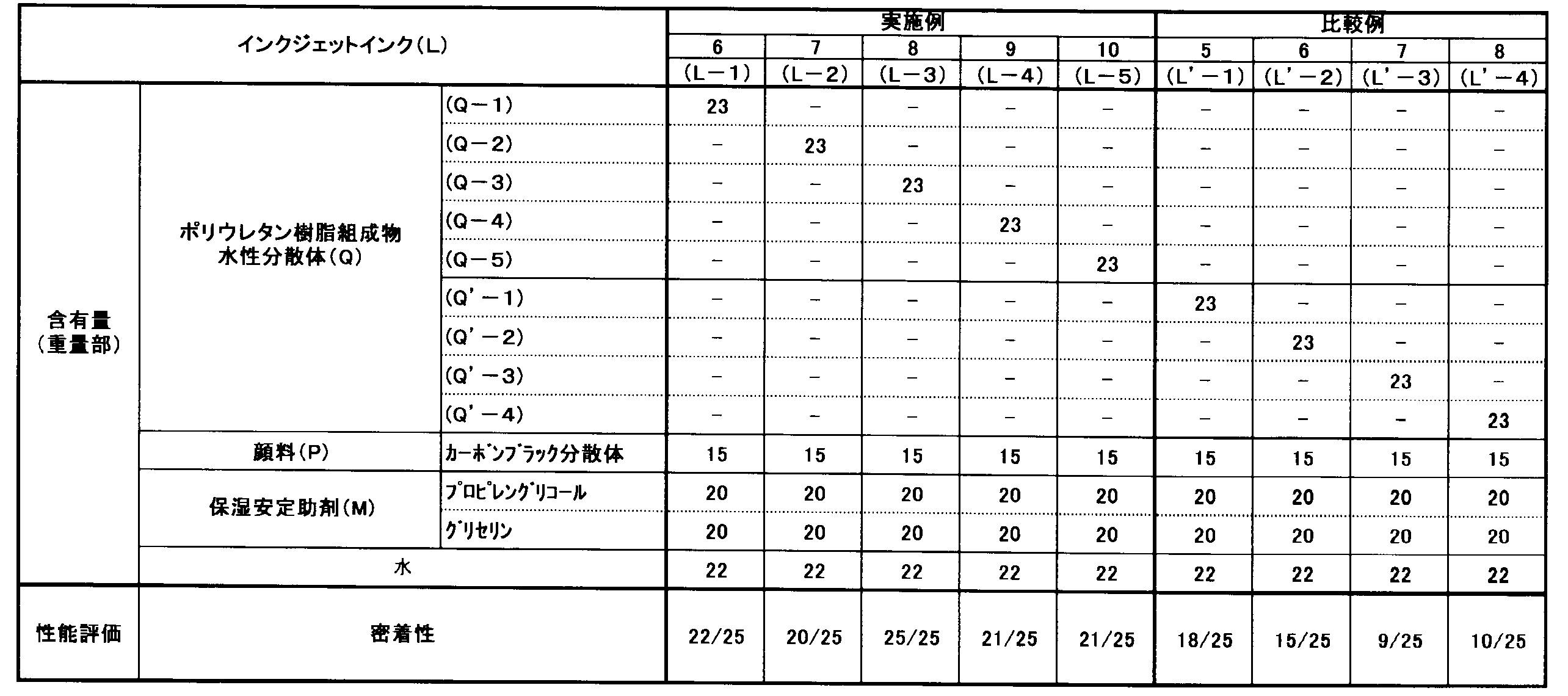
評価方法
<ポリウレタン樹脂組成物の皮膜物性(破断強度、破断伸度)>
ポリウレタン樹脂組成物水分散体10部を、縦10cm×横20cm×深さ1cmのポリプロピレン製モールドに、水分乾燥後のフィルム膜厚が200μmになる量を流し込み、室温で12時間乾燥後、循風乾燥機で105℃で3時間加熱乾燥することによって得られるフィルムの物性測定を行い、破断強度、及び破断伸度を測定した。
尚、破断強度及び破断伸度の測定は、JIS K7311に記載の5.引張試験に基づいて行った。
Evaluation method <Physical properties of polyurethane resin composition film (breaking strength, breaking elongation)>
10 parts of the aqueous dispersion of the polyurethane resin composition was poured into a polypropylene mold of 10 cm long, 20 cm wide, and 1 cm deep so that the film thickness after moisture drying would be 200 μm, dried at room temperature for 12 hours, and then circulated. The physical properties of the film obtained by heat drying at 105° C. for 3 hours in a dryer were measured, and the breaking strength and breaking elongation were measured.
The breaking strength and breaking elongation are measured according to 5. of JIS K7311. Based on tensile test.
<画像の密着性>
作製した水性インク(L-1)~(L-5)、(L’-1)~(L’-4)を5cm×20cmのコート紙[「オーロラコート」、日本製紙製]に乾燥後の膜厚が2μmとなるよう塗布し、140℃で10分乾燥し、塗膜を作製した。この塗膜面をセロテープ(登録商標)にて剥離テストを行い、残留する1mm角塗膜の数を調べた。表示は分子に残留数を、分母にはじめにクロスカットした数を示した。
<Image Adhesion>
After drying the prepared water-based inks (L-1) to (L- 5 ) and (L'-1) to (L'- 4 ) on 5 cm × 20 cm coated paper ["Aurora Coat", manufactured by Nippon Paper Industries] It was applied to a film thickness of 2 μm and dried at 140° C. for 10 minutes to prepare a coating film. The surface of this coating film was subjected to a peeling test with Sellotape (registered trademark) to determine the number of remaining 1 mm square coating films. The display shows the remaining number in the numerator and the number originally cross-cut in the denominator.
表1に示したように、実施例1~5の本発明のポリウレタン樹脂組成物水性分散体(Q-1)~(Q-5)は、乾燥皮膜の物性(破断強度と破断伸度)に優れることがわかる。
一方、(c)を構成原料として含まないポリウレタン樹脂水性分散体(Q’-3)の比較例3は破断強度は不良であり、分子内の末端にブロックイソシアネート基を有するポリウレタン樹脂水性分散体(Q’-4)の比較例4も破断強度と破断伸度が不良である。
表2のインキ(L)での紙との密着性で示したように、実施例6~10は優れた剥離試験結果であった。一方、比較例1~4のポリウレタン樹脂水性分散体を用いた比較例5~8は密着性が不良であった。
As shown in Table 1, the polyurethane resin composition aqueous dispersions (Q-1) to (Q-5) of the present invention of Examples 1 to 5 show physical properties (breaking strength and breaking elongation) of the dry film. I know you're good.
On the other hand, Comparative Example 3 of the polyurethane resin aqueous dispersion (Q'-3) which does not contain (c) as a constituent raw material has poor breaking strength, and the polyurethane resin aqueous dispersion (Q'-3) having a blocked isocyanate group at the end of the molecule ( Comparative Example 4 of Q'-4) is also poor in breaking strength and breaking elongation.
Examples 6-10 gave excellent peel test results, as shown by the adhesion to paper for ink (L) in Table 2. On the other hand, Comparative Examples 5 to 8 using the polyurethane resin aqueous dispersions of Comparative Examples 1 to 4 exhibited poor adhesion.
本発明のポリウレタン樹脂組成物水性分散体は、インクジェットインク、水性塗料組成物、水性接着剤組成物、水性繊維加工処理剤組成物(顔料捺染用バインダー組成物、不織布用バインダー組成物、補強繊維用集束剤組成物、抗菌剤用バインダー組成物及び人工皮革・合成皮革用原料組成物等)、水性コーティング組成物(防水コーティング組成物、撥水コーティング組成物及び防汚コーティング組成物等)、水性紙処理剤組成物や水性インキ組成物等に好適に使用できる。 The polyurethane resin composition aqueous dispersion of the present invention can be used as an inkjet ink, an aqueous coating composition, an aqueous adhesive composition, an aqueous fiber processing agent composition (a binder composition for pigment printing, a binder composition for nonwoven fabrics, a reinforcing fiber). sizing agent composition, binder composition for antibacterial agent, raw material composition for artificial leather/synthetic leather, etc.), water-based coating composition (waterproof coating composition, water-repellent coating composition, antifouling coating composition, etc.), water-based paper It can be suitably used for processing agent compositions, water-based ink compositions, and the like.
Claims (7)
ポリウレタン樹脂(U)が、末端にイソシアネート基を有するウレタンプレポリマー(P)と鎖伸長剤(d)との反応物であるポリウレタン樹脂であり、
前記ウレタンプレポリマー(P)が、ポリオール(a)(下記化合物(c)に該当するものを除く)と、ポリイソシアネート(b)と、カルボキシル基又はアミノ基及び2個の水酸基を含有する化合物(c)との反応物であり、
前記化合物(c)がカルボキシル基と2個の水酸基を含有する化合物(c1)、3級アミノ基と2個の水酸基を含有する化合物(c2)又は4級アンモニウム基と2個の水酸基を含有する化合物(c2’)であり、
ブロック化ポリイソシアネート化合物(J)がポリイソシアネート化合物(I)とイソシアネートブロック化剤(e)との反応物であり、イソシアネートブロック化剤(e)が環の構成単位としてイミノ基と窒素-炭素2重結合とを有する5員環化合物であり、前記ウレタンプレポリマー(P)と粘着性付与剤(T)とブロック化ポリイソシアネート化合物(J)と中和剤を混合後、水中に分散した後に前記ウレタンプレポリマー(P)と前記鎖伸長剤(d)を反応させるポリウレタン樹脂組成物水性分散体(Q)の製造方法。 A method for producing a polyurethane resin composition aqueous dispersion containing water, a polyurethane resin (U), a blocked polyisocyanate compound (J) and a tackifier (T), comprising:
The polyurethane resin (U) is a polyurethane resin which is a reaction product of a urethane prepolymer (P) having an isocyanate group at its end and a chain extender (d),
The urethane prepolymer (P) comprises a polyol (a) (excluding those corresponding to the compound (c) below) , a polyisocyanate (b), and a compound containing a carboxyl group or an amino group and two hydroxyl groups ( c) is a reaction product with
The compound (c) contains a compound (c1) containing a carboxyl group and two hydroxyl groups, a compound (c2) containing a tertiary amino group and two hydroxyl groups, or a quaternary ammonium group and two hydroxyl groups. a compound (c2′),
The blocked polyisocyanate compound (J) is a reaction product of the polyisocyanate compound (I) and the isocyanate blocking agent (e), and the isocyanate blocking agent (e) is an imino group and nitrogen-carbon 2 as ring constituent units. It is a five-membered ring compound having a heavy bond, and after mixing the urethane prepolymer (P), the tackifier (T), the blocked polyisocyanate compound (J) and the neutralizer, dispersed in water, and then the A method for producing a polyurethane resin composition aqueous dispersion (Q), wherein the urethane prepolymer (P) and the chain extender (d) are reacted.
Applications Claiming Priority (2)
| Application Number | Priority Date | Filing Date | Title |
|---|---|---|---|
| JP2016240815 | 2016-12-13 | ||
| JP2016240815 | 2016-12-13 |
Publications (2)
| Publication Number | Publication Date |
|---|---|
| JP2018095876A JP2018095876A (en) | 2018-06-21 |
| JP7168317B2 true JP7168317B2 (en) | 2022-11-09 |
Family
ID=62632562
Family Applications (1)
| Application Number | Title | Priority Date | Filing Date |
|---|---|---|---|
| JP2017238187A Active JP7168317B2 (en) | 2016-12-13 | 2017-12-13 | Aqueous dispersion of polyurethane resin composition |
Country Status (1)
| Country | Link |
|---|---|
| JP (1) | JP7168317B2 (en) |
Families Citing this family (7)
| Publication number | Priority date | Publication date | Assignee | Title |
|---|---|---|---|---|
| JP6484268B2 (en) * | 2017-03-09 | 2019-03-13 | 三洋化成工業株式会社 | Process for producing blocked isocyanate |
| JP7031368B2 (en) * | 2018-02-28 | 2022-03-08 | 昭和電工マテリアルズ株式会社 | Binders for printing inks, printing inks and printed matter |
| CN112313286B (en) * | 2018-06-27 | 2023-08-25 | Dic株式会社 | Urethane resin composition, surface treatment agent and article |
| JP2022146166A (en) * | 2021-03-22 | 2022-10-05 | 三洋化成工業株式会社 | Composite resin aqueous dispersion for inkjet |
| CN114573466B (en) * | 2022-03-02 | 2024-03-22 | 安徽大学 | Red anthraquinone compound and application thereof |
| KR102915178B1 (en) * | 2023-01-13 | 2026-01-21 | 한국소재융합연구원 | Manufacturing method of water-based coating resin for UHMWPE rope |
| CN120098524B (en) * | 2025-03-17 | 2025-11-14 | 无锡新而奇化工科技有限公司 | A high-performance polyurethane coating and its preparation method |
Citations (13)
| Publication number | Priority date | Publication date | Assignee | Title |
|---|---|---|---|---|
| JP2000007909A (en) | 1998-06-19 | 2000-01-11 | Sekisui Chem Co Ltd | Urethane-based aqueous composition |
| JP2001011146A (en) | 1999-06-28 | 2001-01-16 | Nitto Denko Corp | Aqueous dispersion of tackifier resin, method for producing the same, and water-dispersed pressure-sensitive adhesive composition |
| JP2002294020A (en) | 2001-01-23 | 2002-10-09 | Kuraray Co Ltd | Aqueous dispersion |
| JP2009215506A (en) | 2008-03-12 | 2009-09-24 | Riso Kagaku Corp | Ink for textile printing inkjet |
| JP2011523428A (en) | 2008-05-08 | 2011-08-11 | イー・アイ・デュポン・ドウ・ヌムール・アンド・カンパニー | Ink-jet ink for fabrics containing a crosslinked polyurethane and further containing an additional reactive component |
| JP2011202004A (en) | 2010-03-25 | 2011-10-13 | Tokai Carbon Co Ltd | Pigment dispersion composition, and inkjet ink composition |
| CN102277119A (en) | 2010-06-09 | 2011-12-14 | 日本聚氨酯工业株式会社 | Polyurethane binder |
| JP2011256236A (en) | 2010-06-07 | 2011-12-22 | Mitsui Chemicals Inc | Coating material |
| JP2012067278A (en) | 2010-08-27 | 2012-04-05 | Sanyo Chem Ind Ltd | Adhesive for dry laminate |
| JP2012251062A (en) | 2011-06-02 | 2012-12-20 | Matsui Shikiso Chem Co Ltd | Inkjet printing ink |
| JP2014129617A (en) | 2012-12-28 | 2014-07-10 | Matsui Shikiso Chem Co Ltd | Inkjet printing method and fabric fiber product |
| JP2014189568A (en) | 2013-03-26 | 2014-10-06 | Dic Corp | Aqueous resin composition, primer, and laminate and packaging material obtained by using the same |
| WO2016143573A1 (en) | 2015-03-10 | 2016-09-15 | 東洋紡株式会社 | Water-based adhesive resin composition for olefin substrate |
Family Cites Families (9)
| Publication number | Priority date | Publication date | Assignee | Title |
|---|---|---|---|---|
| JPH04293986A (en) * | 1991-03-25 | 1992-10-19 | Sunstar Eng Inc | Two-pack water-base urethane adhesive and emulsion as its principal component |
| JPH08170063A (en) * | 1994-10-20 | 1996-07-02 | Sekisui Chem Co Ltd | Urethane-based water-based adhesive composition |
| JPH08170064A (en) * | 1994-10-20 | 1996-07-02 | Sekisui Chem Co Ltd | Urethane-based water-based adhesive composition |
| JPH08269429A (en) * | 1995-03-30 | 1996-10-15 | Sekisui Chem Co Ltd | Method for producing urethane-based water-based adhesive |
| JPH09157625A (en) * | 1995-12-07 | 1997-06-17 | Sekisui Chem Co Ltd | Urethane-based water-based adhesive |
| JPH09255867A (en) * | 1996-03-26 | 1997-09-30 | Sekisui Chem Co Ltd | Aqueous composition |
| JPH1053709A (en) * | 1996-06-05 | 1998-02-24 | Sekisui Chem Co Ltd | Emulsion composition and adhesive |
| JPH1025325A (en) * | 1996-07-12 | 1998-01-27 | Sekisui Chem Co Ltd | Urethane emulsion and water-based adhesive |
| JPH10330720A (en) * | 1997-05-29 | 1998-12-15 | Sekisui Chem Co Ltd | Urethane-based water-based adhesive |
-
2017
- 2017-12-13 JP JP2017238187A patent/JP7168317B2/en active Active
Patent Citations (13)
| Publication number | Priority date | Publication date | Assignee | Title |
|---|---|---|---|---|
| JP2000007909A (en) | 1998-06-19 | 2000-01-11 | Sekisui Chem Co Ltd | Urethane-based aqueous composition |
| JP2001011146A (en) | 1999-06-28 | 2001-01-16 | Nitto Denko Corp | Aqueous dispersion of tackifier resin, method for producing the same, and water-dispersed pressure-sensitive adhesive composition |
| JP2002294020A (en) | 2001-01-23 | 2002-10-09 | Kuraray Co Ltd | Aqueous dispersion |
| JP2009215506A (en) | 2008-03-12 | 2009-09-24 | Riso Kagaku Corp | Ink for textile printing inkjet |
| JP2011523428A (en) | 2008-05-08 | 2011-08-11 | イー・アイ・デュポン・ドウ・ヌムール・アンド・カンパニー | Ink-jet ink for fabrics containing a crosslinked polyurethane and further containing an additional reactive component |
| JP2011202004A (en) | 2010-03-25 | 2011-10-13 | Tokai Carbon Co Ltd | Pigment dispersion composition, and inkjet ink composition |
| JP2011256236A (en) | 2010-06-07 | 2011-12-22 | Mitsui Chemicals Inc | Coating material |
| CN102277119A (en) | 2010-06-09 | 2011-12-14 | 日本聚氨酯工业株式会社 | Polyurethane binder |
| JP2012067278A (en) | 2010-08-27 | 2012-04-05 | Sanyo Chem Ind Ltd | Adhesive for dry laminate |
| JP2012251062A (en) | 2011-06-02 | 2012-12-20 | Matsui Shikiso Chem Co Ltd | Inkjet printing ink |
| JP2014129617A (en) | 2012-12-28 | 2014-07-10 | Matsui Shikiso Chem Co Ltd | Inkjet printing method and fabric fiber product |
| JP2014189568A (en) | 2013-03-26 | 2014-10-06 | Dic Corp | Aqueous resin composition, primer, and laminate and packaging material obtained by using the same |
| WO2016143573A1 (en) | 2015-03-10 | 2016-09-15 | 東洋紡株式会社 | Water-based adhesive resin composition for olefin substrate |
Also Published As
| Publication number | Publication date |
|---|---|
| JP2018095876A (en) | 2018-06-21 |
Similar Documents
| Publication | Publication Date | Title |
|---|---|---|
| JP2018095876A (en) | Aqueous dispersion of polyurethane resin composition | |
| CN104203999B (en) | Vinyl resin and resin composition | |
| CN102405243B (en) | Aqueous polyurethane resin dispersion | |
| JP2018053245A (en) | Polyurethane resin composition aqueous dispersion and process for producing the same | |
| US7271216B2 (en) | Polyurethane resin aqueous dispersion and sheet material obtained from the same | |
| JP2013227528A (en) | Polyurethane-based resin aqueous dispersion | |
| JP7168335B2 (en) | Aqueous dispersion of polyurethane resin composition | |
| JP5940409B2 (en) | Polyurethane resin water dispersion | |
| JP2018141119A (en) | Polyurethane resin aqueous dispersion body | |
| JP7319892B2 (en) | Polyurethane resin aqueous dispersion and method for producing polyurethane resin aqueous dispersion | |
| JP2016188362A (en) | Polyurethane resin water dispersion | |
| JP2010254977A (en) | Polyurethane resin emulsion for water-based coating | |
| JP4964916B2 (en) | Polyurethane resin water dispersion | |
| JP2020100814A (en) | Polyurethane resin aqueous dispersion and printing ink using the same | |
| JP2010195982A (en) | Polyurethane resin emulsion for water-based paint | |
| JP7691972B2 (en) | Polyurethane resin aqueous dispersion | |
| JP2007270036A (en) | Polyurethane resin aqueous dispersion | |
| JP5415023B2 (en) | Polyurethane resin emulsion | |
| JP2011122034A (en) | Polyurethane resin emulsion | |
| JP2011068870A (en) | Polyurethane resin emulsion | |
| JP2015166442A (en) | Active hydrogen compound having sulfonic acid (salt) group and polyurethane resin using the same | |
| JP6342924B2 (en) | Polyurethane resin aqueous dispersion | |
| JP2022170713A (en) | Method for producing polyurethane resin aqueous dispersion | |
| JPH10279650A (en) | Water-base polyurethane resin dispersion | |
| JP2017160423A (en) | Polyurethane resin water dispersion for inkjet ink |
Legal Events
| Date | Code | Title | Description |
|---|---|---|---|
| A621 | Written request for application examination |
Free format text: JAPANESE INTERMEDIATE CODE: A621 Effective date: 20201001 |
|
| A977 | Report on retrieval |
Free format text: JAPANESE INTERMEDIATE CODE: A971007 Effective date: 20210708 |
|
| A131 | Notification of reasons for refusal |
Free format text: JAPANESE INTERMEDIATE CODE: A131 Effective date: 20210907 |
|
| A521 | Request for written amendment filed |
Free format text: JAPANESE INTERMEDIATE CODE: A523 Effective date: 20211101 |
|
| A131 | Notification of reasons for refusal |
Free format text: JAPANESE INTERMEDIATE CODE: A131 Effective date: 20220405 |
|
| A521 | Request for written amendment filed |
Free format text: JAPANESE INTERMEDIATE CODE: A523 Effective date: 20220415 |
|
| A131 | Notification of reasons for refusal |
Free format text: JAPANESE INTERMEDIATE CODE: A131 Effective date: 20220830 |
|
| A521 | Request for written amendment filed |
Free format text: JAPANESE INTERMEDIATE CODE: A523 Effective date: 20221011 |
|
| TRDD | Decision of grant or rejection written | ||
| A01 | Written decision to grant a patent or to grant a registration (utility model) |
Free format text: JAPANESE INTERMEDIATE CODE: A01 Effective date: 20221025 |
|
| A61 | First payment of annual fees (during grant procedure) |
Free format text: JAPANESE INTERMEDIATE CODE: A61 Effective date: 20221027 |
|
| R150 | Certificate of patent or registration of utility model |
Ref document number: 7168317 Country of ref document: JP Free format text: JAPANESE INTERMEDIATE CODE: R150 |
|
| R250 | Receipt of annual fees |
Free format text: JAPANESE INTERMEDIATE CODE: R250 |